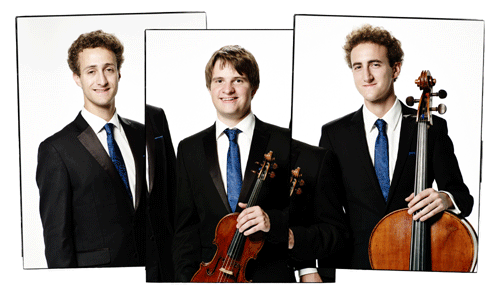
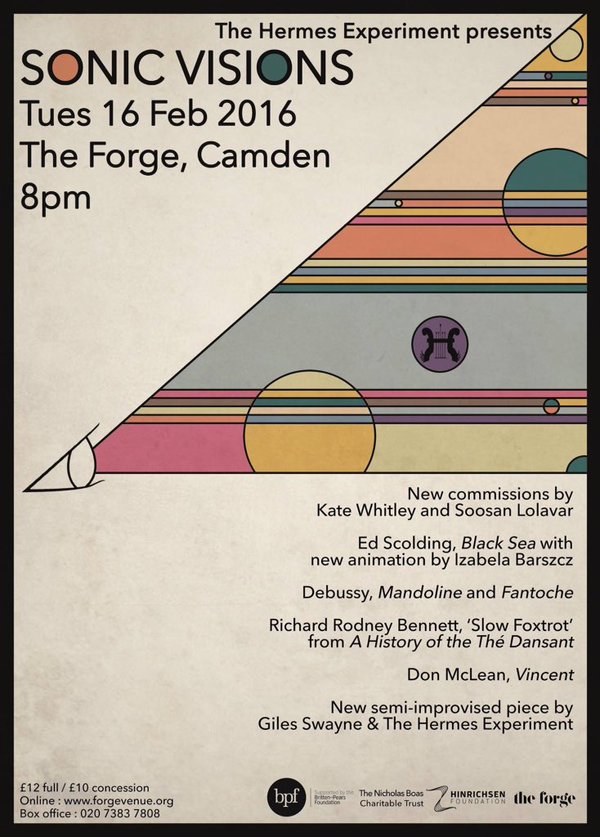
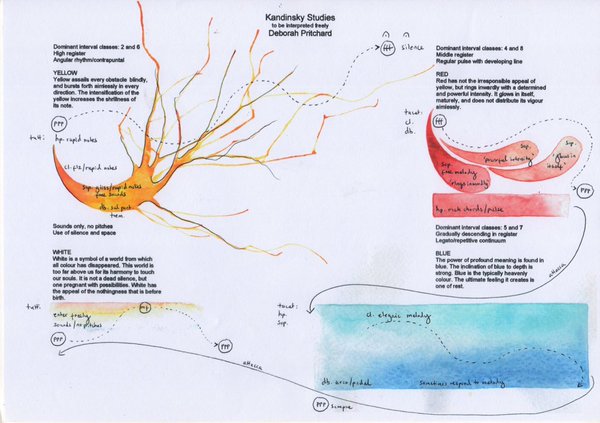
Ensemble In Process presents:
Ensemble In Process: Americuration (featuring Zubin Kanga, Marsyas Trio, Jonathan Russell, Seth Bedford & Maria Fiore Mazzarini) IKLECTIK, Old Paradise Yard, 20 Carlisle Lane, Waterloo, London, SE1 7LG, England
Monday 15th May 2017, 7.30pm – information
Formed just under a year and a half ago, Ensemble In Process has progressed from being a small chamber ensemble (formed to compete in Nonclassical‘s annual Battle of the Bands Competition) to being a multiple-direction contemporary music project. Now straddling London and New York – and planning performances, programming and networking across the UK, America, Europe and the wider globe – they have a particular focus on helping contemporary composers without sufficient UK resources to achieve performances of their work within the UK.
Participating are the three members of the Marsyas Trio – pianist Zubin Kanga, flautist Helen Vidovich and cellist Valerie Welbanks – and violinist Maria Fiore Mazzarini (plus Seth Bedford and Brian Mark, performing voice and piano respectively on some of their own works and on those of others).
Programme:
Steve Reich – Vermont Counterpoint (for flute & tape)
Timo Andres – At the River (for piano)
David Lang – Killer (for violin & electronics)
Ian Dicke – Get Rich Quick (for piano & fixed media) (UK premiere)
Seth Bedford – Three Cabaret Songs (for piano & voice) (UK premiere)
George Crumb – Vox Balaenae (for electric flute, cello and amplified piano)
Jonathan Russell – Assorted Past (for piano)
Missy Mazzoli – Isabelle Eberhardt Dreams of Pianos (for piano & video installation)
Ryan Brown – Bedside Manner (for flute & cello) (UK premiere)
Brian Mark – Lucid Dreaming (for flute & cello) (world premiere)
Michael Gordon – Light is Calling (for violin)
Steve Reich – Piano Counterpoint (for piano & electronics)
Regarding the future, Brian claims that “Ensemble In Process… will be a rotating vehicle with respect to size, instrumentation, and nature of specific programming. Eventually, it will also feature a special annual transatlantic event, which will become a six-hour concert marathon that will take place between London and select US cities via live streaming. After its debut concert and the first year of operation, Ensemble in Process… will eventually launch into an annual series of multiple diverse concerts and other exciting outreach activities.”
Meanwhile, here are soundclips and video examples for the concert programme (where I could find them…):
* * * * * * * *
A little under two weeks previously, there’s another Kammer Klang session at Café Oto, presenting an evening of London loft music on the ground floor again. This time, the concert has a particularly strong theatrical tinge, though not necessarily in a conventional manner.
strong>Kammer Klang presents:
Scenatet performs Matt Rogers + David Helbich + Yshani Perinpanayagam performs Benjamin Oliver + Slips DJs Café Oto, 18-22 Ashwin Street, Dalston, London, E8 3DL, England
Tuesday 2nd May 2017, 7.30pm – information here and here
The Fresh Klang performance this month is a new keyboard duet by Benjamin Oliver ‘Mr. Turquoise Synth’, which “explores how the contrasting sonorities of the piano (acoustic) and synth (low memory electronics) and modes of production (human/computer agency) can be combined and juxtaposed. Initially the duet partners are isolated but gradually become entwined in a playful and dynamic relationship.” It’ll be performed as a solo by pianist/keyboard player Yshani Perinpanayagam (Del Mar Piano Trio, Rambert Dance Company, and ‘Showstopper! The Improvised Musical’) and features both the venue piano and a bespoke one-bit pulse synthesiser designed by chiptune jazzer Blake Troise (Protodome).
Brussels-based philosopher-composer David Helbich (perhaps best known for his ‘Belgian Solutions‘ project, which spots, photographs and documents various frequently absurd-but-human fixings and methods) goes beyond the territory of being a conceptual musician in order to explore and share along the very faultline which separates musical concepts from non-musical concepts. It’s worth noting that David is the kind of composer who chooses to write for air guitar. Having dispensed with instruments, sound and multi-media trappings, what he’s mostly now interested in is the audience, with whom he will be performing one of his “No Music” sessions,
“No Music is no music, but still a musical experience. No music, still for your ears. Since 2010 I have worked on scores for pieces that could be performed right at the spot, in whatever context, as long as one could freely use both hands and had two functioning ears. The pieces offer notated situations of organised listening and simple ear manipulations. I understand the this material more as a practice than as a series of composition, even though they can appear as such. Pieces appear in printed form as well as in spontaneous performances or entirely set theatrical or concert performances. These interventions are entirely personal and therefore not so much interactive as “inner-active”, self-performative. The reader as the performer as the listener.”
Below is an example from a performance in Brussels.
In between, there’s Scenatet – an ensemble working under the remit of “art music theatre in unusual spaces” and generally works with younger Danish composers, creating cross-genre performances involving elements of drama and “happenings” as well as music. Though the ensemble consists of twelve permanent musicians, for this concert, they’ll be down to a trio of Vicky Wright (clarinet), Mina Fred (viola) and My Hellgren (cello) in order to perform the world premiere of Matt Rogers‘ ‘Weep At The Elastic As It Stretches’ The piece is an attempt to “embody the attitudes and spirit” of N.F. Simpson’s 1958 absurdist play ‘A Resounding Tinkle’, which “ask(s) that we rejoice in all manner of unexpected objects, situations and concepts, taking great delight in the most categorical of descriptions and in a complete lack of distinction between the mundane and the exotic.”
This month’s Kammer Klang DJ set is provided by Tom Rose and Laurie Tompkins, the people behind the London/Berlin record label Slip (which specializes in “exploratory work which negotiates the fringes of new instrumental and electronic music” and is heavily involved with site-specific live events from instrumental performances through to club nights).
Programme:
Fresh Klang: Benjamin Oliver – Mr. Turquoise Synth
Matt Rogers – Weep at the Elastic as it Stretches (world premiere)
David Helbich – No Music (a performative rehearsal)
DJs: Slip
Punters at Café Oto will tell you that the beloved Dalston art pit sells a variety of craft beers. To my knowledge, none of them are made with singing yeasts. Next month, that might change.
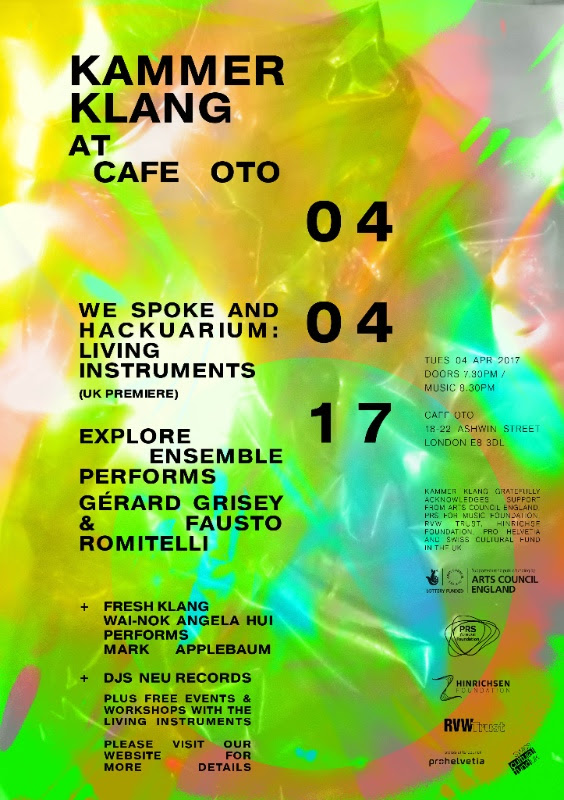
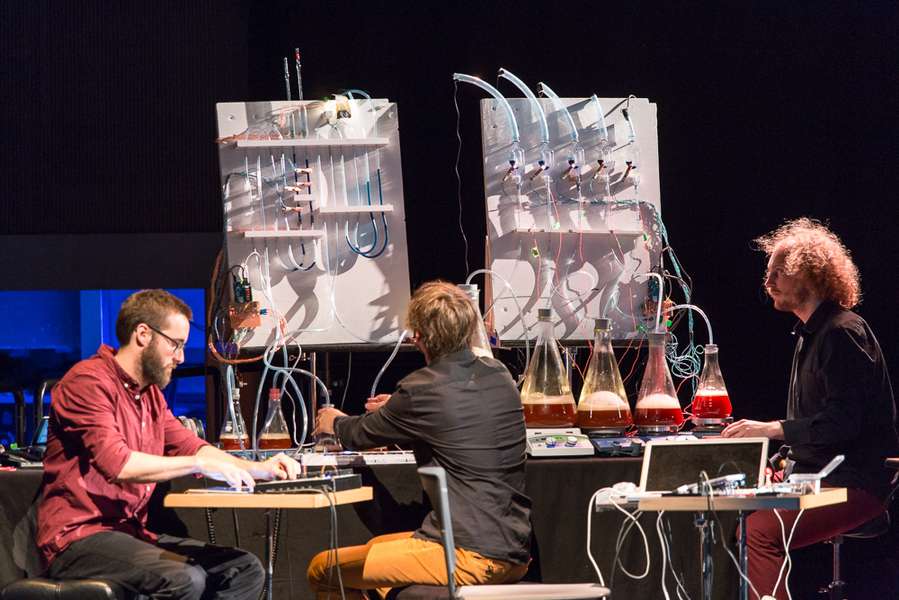
The centrepiece of this month’s Kammer Klang activities at Oto are the Living Instruments – “musical instruments based on microorganisms, built by a team including classically trained musicians and professional and hobbyist scientists” – which are making their British debut following their world debut at Le Bourg, Lausanne and an appearance in Darmstadt at the 2016 International Summer Course for New Music. Initiated by Swiss DIY-biology open lab Hackuarium as a low-tech, low-cost, open source interdisciplinary research project, they’re being presented and performed by the Swiss-Anglo ensemble We Spoke, who’ll be triggering the lifeforms and interpreting their output.
Both ensemble and organisms are taking up residence at Café Oto for five days, incorporating a public exhibition, a two-day composer’s workship culminating in a free performance, and a headlining slot on the April Kammer Klang bill. Here’s more on the science and method behind the project:
“Performers will stimulate fermentation bubbles, paramecia, moss, visualised radioactive traces and other curiosities of nature, their activity and data converted into sound via sensors. The nature of the instruments allows the performers to engage with them interactively, and the cyclic behaviour of the living objects is reflected musically in rich grooves and rhythmic patterns.”
Control devices featured include the Mossphone (which monitors the physical reactions of moss when it’s touched, and interprets them as analogues to “singing, snarling, murmuring or growling”), the yeast-driven Bubble Organ, the bacteriological marshal-and-track Paramecia Controller and the iPadPix app (part Geiger counter, part cloud chamber, part drum machine), in conjunction with the Virtual Soprano instrument controller (which translates facial movements into music). Some of the chemical and biological actions will be projected onto screens as a visual accompaniment.
The Living Instruments in action
The composer’s workshop (with ten places available to those who can send a CV and a couple of sentences outlining their interest in the project) gives composers a crash-course in the workings of the organisms and their control devices, plus the opportunity to compose and fine tune a piece using the control software, to be presented to the public on the Monday night concert.
* * * * * * * *
Also playing at Kammer Klang are twentieth/twenty-first century classical specialists Explore Ensemble, made up of soloists associated with the Royal College of Music. They’ll be playing two pieces: both of them by composers whose lives were unfairly cut short, and both of whom were associated with the evolving-timbre-over-time school of spectral music.
“In Latin, “talea” means “cutting,” and in Gérard Grisey’s ‘Talea’, an initial idea is gradually excised—elements removed and others taking their place. In two parts played without pause, the work is intended to — in the composer’s words — “express two aspects or, more precisely, two auditory angles of a single phenomenon.” But his concise description feels inadequate to describe the experience of hearing the score. ‘Talea’s power comes from its examination and illumination of an overtone cycle, a phenomenon integral to Grisey’s output (and spectral music in general).
“Somehow when one hears the ensemble (flute, clarinet, violin, cello and piano) illuminating Grisey’s argument, it feels like being exposed to one of life’s basic building blocks—like grasping at DNA and holding it in your hands. The five players alternate between moments of great ferocity (especially in the piano), and those of eerie quietude — at times almost as if everything has been shut down completely; at others, sounds emerge like soft groans from the earth itself. The timbres float, hover, barge into your brain, recede, reform themselves, take you hostage. As the scurrying of the first part calms down in the second, the waters reform, interrupted by various phenomena, until a kind of miraculous climax occurs near the end. Bit by bit, the violinist states the overtone scale with a thrilling baldness—as if everything previously had been building toward this moment—before the violinist repeats the scale again, and this time the sequence is abruptly cut off.”
The second piece is ‘Domeniche alla periferia dell’impero’, composed by Fausto Romitelli (a student of Grisey’s who took strong inspiration from both him). The piece – the second section of which is dedicated to Grisey and his fellow Spectralist Hugues Dufourt – was worked out in various versions between 1996 and 2000 prior to Romitelli’s untimely death from cancer. Again, I’ve lifted a little text from the Talea Ensemble pages to illustrate the nature of his work:
“Romitelli’s music is a collage of styles that defy classification; his work drawing from all corners and incorporating timbres associated with psychedelic rock music and spectral harmony. From screaming electric guitar and electronics to sensual textures, his music is fresh and innovative in the contemporary canon. At times, his hellish sound-world evokes nightmarish and hallucinatory qualities that inspire a visceral listening experience.”
The composer himself once laid his methods out as follows: “At the centre of my composing lies the idea of considering sound as a material into which one plunges in order to forge its physical and perceptive characteristics: grain, thickness, porosity, luminosity, density and elasticity. Hence it is sculpture of sound, instrumental synthesis, anamorphosis, transformation of the spectral morphology, and a constant drift towards unsustainable densities, distortions and interferences, thanks also to the assistance of electro-acoustic technologies. And increasing importance is given to the sonorities of non-academic derivation and to the sullied, violent sound of a prevalently metallic origin of certain rock and techno music.”
Examples of both pieces below, plus excerpts of Explore Ensemble performing another Romitelli piece, ‘Professor Bad Trip’:
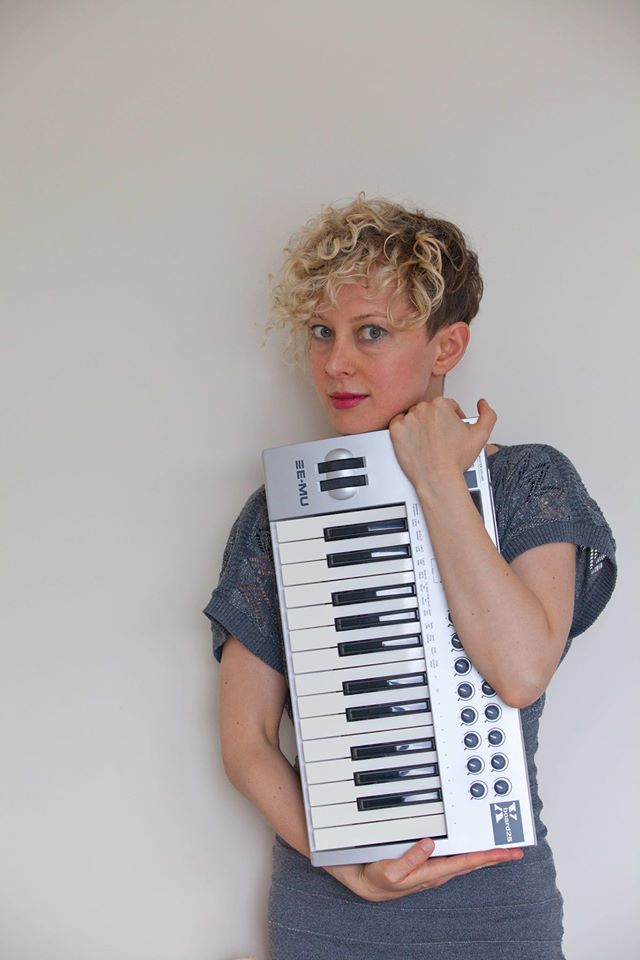
This month’s Fresh Klang item is provided by London-based percussionist Wai-Nok Angela Hui, one of the percussion finalists in the BBC Young Musician of the Year 2010 and a performer with the BBC Symphony Orchestra as well as a soloist and chamber musician. She searches for the unexplored possibilities between classical music, musical theatre and art, and collaborates with artists, poets and painters, incorporating a multitude of instruments and styles.
She’ll be performing ‘Aphasia’ by Mark Applebaum– a demanding physical/philosophical performance piece written for hand gestures synchronised to pre-recorded sound. (The latter is based on thousands of edited and transformed vocal samples originated by baritone Nicholas Isherwood, from sung notes, musical phrases and intoned numbers in a variety of language through to drones, lip smacks and hiccups). Here’s an excerpt from Camille Brown’s ‘Stanford Report’ essay on the original work, plus a video of Applebaum himself performing it.
“While the piece was inspired by a conversation between Isherwood and Applebaum, the idea to write a piece for a mute singer with hand motions was Applebaum’s own “obsession.” His intention was to have Aphasia come across as a metaphor for “expressive paralysis,” something that unnerves him every time he “confronts the terror of composing a new piece.” So how does one go about the paradox of writing a composition for a performance that has no form of verbal communication or written words?
“Applebaum began by collaborating with Isherwood to produce the sounds, a collection of three hours of Isherwood singing. The singing consisted of “a bunch of crazy sounds – very strange things I asked of him.” From there Applebaum isolated individual samples and transformed his selections radically through computer processes. The result, he said, “was a garbled voice of sorts.” Applebaum then choreographed “a kind of invented nonsense sign language” to accompany the now otherworldly sound sequence. Based on everyday activities, the gestures were recorded as a written musical score, using icons with names such as “give me the money” and “Post-it Notes.”
“These gestures, each of which are described in detail in the work’s appendix, are intended to reflect the composer’s fascination in “absurdity that seems to be the consequence of tedious, obsessive attention to ridiculous things.” Or, in other words, how bizarre the actions of our mundane routine of activity seem when they are examined out of context… The fast-paced and unexpected nature of Aphasia in performance that gives it charm and broad appeal. Since the piece is so far removed from what is recognized as common musical practice, it is equally accessible to music experts and novice listeners alike. As Applebaum points out, “Kids love it. So do people who need a break from conventional modes of expression.”
This months’ Kammer Klang DJ set is provided by Neu Records, an independent label which, last year, released We Spoke’s album ‘Different Beat’ (featuring the music of Fritz Hauser). Based in Barcelona, the label is devoted to recording contemporary music in surround and 3D formats, as well as providing a platform for interaction between international composers and performers of the highest level.
Programme summary:
Fresh Klang: Mark Applebaum – Aphasia (performed by Wai-Nok Angela Hui)
Explore Ensemble performs:
Gérard Grisey – Talea (for violin, cello, flute, clarinet, and piano) (performed by Explore Ensemble)
Fausto Romitelli – Domeniche alla periferia dell’impero (for four instruments) (performed by Explore Ensemble)
Living Instruments (UK premiere – presented and performed by We Spoke Ensemble & Hackuarium)
DJs: Neu Records
Full dates:
Living Instruments Composers’ Workshop – Café Oto, 18-22 Ashwin Street, Dalston, London, E8 3DL, England, Friday 31st March 2017, 12.00pm-7.00pm & Monday 3rd April 2017, 12.00pm-7.00pm – information here and here
Living Instruments Exhibition – Café Oto, 18-22 Ashwin Street, Dalston, London, E8 3DL, England, Saturday 1st April 2017, 11.00am-8.00pm – information here and here
Living Instruments free performance (featuring outcomes of Composers’ Workshop) – Café Oto, 18-22 Ashwin Street, Dalston, London, E8 3DL, England, Monday 3rd April 2017, 8.00pm – information here and here
Kammer Klang (We Spoke & Living Instruments + Explore Ensemble + Wai-Nok Angela Hui)- Café Oto, 18-22 Ashwin Street, Dalston, London, E8 3DL, England, Tuesday 4th April 2017, 7.30pm – information here and here
“Why does the world need a Piano Day? For many reasons, but mostly, because it doesn’t hurt to celebrate the piano and everything around it: performers, composers, piano builders, tuners, movers and most important, the listener.” – Nils Frahm, Piano Day founder)
This year, Piano Day is on the 29th of March. I did a pretty exhaustive guide to last year’s event – I doubt that I’ll go to the same lengths this year (if you’re interested, have a look at the official site), but here are a couple of upcoming concerts related both to that and to its tinkly little brother, World Toy Piano Day eleven days earlier on 18th March.
Xenia Pestova presents:
Xenia Pestova: Non-Piano IKLECTIK Art Lab, ‘Old Paradise Yard’, 20 Carlisle Lane, Lambeth, London, SE1 7LG, England
Saturday 18th March 2017, 8.30pm – information
Xenia is also one of the several pianists performing at the Daylight Music Piano Day concert at the start of April.
Arctic Circle presents:
Daylight Music 251: Piano Day with Sophie Hutchings + Arthur Lea + Xenia Pestova + Lorenzo Masotto Union Chapel, Compton Terrace, Islington, London, N1 2UN, England
Saturday 1st April 2017, 12.00pm – free event (suggested donation: £5.00) – information
“For centuries, people have found joy in playing, and listening to, the piano. Nils Frahm thought this beloved instrument should be honoured, and launched Piano Day in 2015. Daylight Music will be joining in the worldwide celebrations with a special concert of piano delights — including performances from Sophie Hutchings, Arthur Lea, Xenia Pestova and Lorenzo Masotto. From John Cage interpreted on toy piano, to retro rhythm’n’blues and southern soul to post-classical reflection from the other side of the world.”
There’s plenty going on at the three-day mid-March Sheffield Classical Weekend, with the city permeated with music including many old and new favourites. Among what’s on offer are two different performances of Arvo Pärt’s ‘Fratres’ (one by a wind band, one by a host of strings), two Dreams of China concerts covering formal Chinese classical compositions) and a host of choral shows (the classic monk’s-debauchery of Orff’s ‘Carmina Burana’ via Schubert’s ‘Mirjam’s Siegesgesang’ and Brahms’ ‘Ziguenerlieder’, through to a variety of pops choirs.) Though I’d advise checking out the entire, pleasingly diverse programme, here are my own brief and subjective picks from it, if you’re interested.
* * * * * * * *
Oliver Coates & cellists: ‘Canticles of the Sky’ – Kelham Island Museum, Alma St, Sheffield, S3 8RY, England, Saturday 18th March 2017, 3:30pm & 5.00pm – information
“A UK premiere featuring star cellist Oliver Coates (Radiohead, ‘Under The Skin’ and ‘There Will Be Blood’). Olly and a host of cellists will surround the Kelham Island audience and lift you skyward with this ethereal and dreamy work from Pulitzer and Grammy-winning composer John Luther Adams. Also featuring extracts from J.S Bach’s Cello Suites.”
* * * * * * * *
Five Choirs: Sounds From Heaven – St Marie’s Cathedral, Norfolk Row, Sheffield S1 2JB, England, Sunday 19th March 2017, 2:30pm – information
“Perched around the sides of the excellent acoustic space within the Cathedral Church of St Marie, five Sheffield chamber choirs – Abbeydale Singers, Sheffield Chamber Choir, Sterndale Singers, Sheffield Chorale and Viva Voce – will “create a swoonsome heart-lifting soundscape of song.” As well as old and new choral standbys by John Tavener, Arvo Pärt, Felix Mendelssohn and others, the concert will include the premiere of ‘Kraal’ a commission for five simultaneous choirs written by Jenny Jackson (a member of Sheffield’s own contemporary composer collective, Platform 4).”
* * * * * * * *
More music fostered by Platform 4 will be popping up a few times over the weekend. Flautist Rachel Shirley performs “a selection of colourful and inventive works for flute, piano, blown bottles and saxophone“; there’s an evening date at Yellow Arch Studios with players from Sheffield Music Academy, performing the collective’s own “imaginative cutting-edge compositions”. There’s a “mind-bending” collaboration with Opera On Locationin which “stories are turned upside down and endings become beginnings in (a) selection of operatic palindromes, where the music is the same both backwards and forwards… featuring Paul Hindemith’s short opera ‘Hin Und Zurück’ (‘There And Back’), plus new bitesize and puzzling pieces…” Platform 4 also contribute the cello-and-electric keyboard piece ‘Upright Stance’ to be performed alongside Shostakovich’s Cello Concerto at Oliver Coates’ concert with Sheffield Music Hub Senior Schools.
Opera On Location with Platform 4 – Upper Chapel, Norfolk Street, Sheffield, S1 2JD, England, Friday 17th March 2017, 8:30pm – information (contains strong and sexually explicit language – recommended for 18+)
Rachel Shirley: ‘Hooting & Drinking’ – Channing Hall @ Upper Chapel, Norfolk Street, Sheffield, S1 2JD, Saturday 18th March 2017, 3.30pm – information
Oliver Coates & Sheffield Music Hub Senior Schools: ‘From The Heart: Shostakovich’ – City Hall Ballroom @ Sheffield City Hall, Barkers Pool, Sheffield, S1 2JA, England, Sunday 19th March, 12:00pm – information
Platform 4 with Sheffield Music Academy – Yellow Arch Studios, 30-36 Burton Road, Neepsend, Sheffield, S3 8BX, England, Sunday 19th March 2017, 6:30pm – information
Each of these mini-concerts sets one of Boulez’s first three Piano Sonatas against another piece. ‘The Conflict And The Passion’ pitches ‘Piano Sonata No. 1’ against Beethoven’s Kreutzer Sonata in a study of thwarted passions. ‘Deconstruction & Digitalisation’ presents the classical deconstruction of ‘Piano Sonata No. 2’ and the electro-acoustic contrasts of ‘Anthemes II’. ‘Choice And Chance’ (the only one of the concerts to feature two Boulez compositions) offers ‘Piano Sonata No. 3’ and the clarinet-and-orchestra piece ‘Domaines’, contrasting a piece in which major options are available to the performer and one which is considerably more ordered and regimented.
The series opens on Friday with a special Boulez-inspired concert in which “the avant-garde becomes child’s play… primary school children from across the city explore the curious frontiers of contemporary electronic music and present the results of their musical experimentation.”
Sound Laboratory:
‘Computer Music’ – Firth Hall @ University of Sheffield, Western Bank, Sheffield, S10 2TN, England, Friday 17th March 2017, 1:30pm – information
‘The Conflict & The Passion’ – Upper Chapel, Norfolk Street, Sheffield, S1 2JD, England, Saturday 18th March 1:30pm – information
‘Deconstruction & Digitalisation’ – Upper Chapel, Norfolk Street, Sheffield, S1 2JD, England, Saturday 18th March 3:30pm – information
‘Choice and Chance’ – Upper Chapel, Norfolk Street, Sheffield, S1 2JD, England, Saturday 18th March 5:00pm – information
* * * * * * * *
Among the Chinese-inspired events is one in which Chinese and European chamber music merge as celebrated guzheng zither soloist Xia Jing teams up with The Fidelio Trio (Darragh Morgan on violin, Adi Tal on cello and Mary Dullea on piano). They’ll be presenting a concert of brand-new musical premieres – Gao Ping’s ‘Feng Zheng’ (‘Kite’), Jeroen Speak’s ‘Silk Dialogues 7’, Dylan Lardelli‘s ‘Shells’, and ‘Time Bends In The Rock’ by Sheffield-based composer Dorothy Ker.
In addition, there’s a variety of pop-up performances across the three days, featuring abbreviated sets by event headliners plus showings by small instrumental and vocal groups. It’s an open-minded spill moving out from classical forms to embrace folk, alt.chamber and other kinds of music.
One promising set of contributors are Manchester quintet Kabantu, who’ve thankfully dropped their previous name Project Jam Sandwich and who also “throw away the rulebook to bridge countries and cultures, creating an exuberant and joyful soundworld… vocal harmonies from South Africa coalesce with everything from Celtic reels and Brazilian samba to Balkan folk music and beyond.” Featuring violin, guitar, cello, double bass and percussion in addition to voices, they’re playing a pop-up show but also two separate consecutive-but-entirely-different sets at Yellow Arch Studios.
Classical by Night – Kabantu @ Yellow Arch Studios, 30-36 Burton Road, Neepsend, Sheffield, S3 8BX, England, Sunday 19th March 2017, 6.30pm & 9:30pm – information here and here
As well as composers ranging from Grieg to Takemitsu, these three upcoming London gigs take in trolls, moths, David Bowie, extended fiddles and oboes, and just a tiny hint of saw abuse. Let’s have a look and listen.
* * * * * * * *
Kammer Klang presents:
Klara Lewis + Phaedra Ensemble (performing Leo Chadburn) + Christopher Redgate + John Uren + Holodisc DJs Café Oto, 18-22 Ashwin Street, Dalston, London, E8 3DL, England
Tuesday 7th March 2017, 7.30pm – information here and here
From the Kammerers (supplemented by a few text raids from here and there)…
“In our second show of 2017 we are joined by Klara Lewis, the critically acclaimed sound sculptress who has performed in clubs and art galleries around the world. Lewis builds her work from heavily manipulated samples and field recordings, creating a unique combination of the organic and the digital. Klara’s second album ‘Too’ was released in 2016 on Editions Mego to great acclaim. She will be performing with Nik Colk Void, an experimental electronic recording artist who is one part of Factory Floor (an alliance with Gabriel Gurnsey) and one-third of Carter Tutti Void (with former Throbbing Gristle members Cosey Fanny Tutti and Chris Carter). Coming from an English art school background, and an education that was decidedly non-musical in nature, Nik’s work is as conceptual as it is visceral – exploring the out-regions of pushing and manipulating sound (via modular synthesis, extended guitar techniques and vocal processing), and collaborating with contemporary visual artists such as Haroon Mirza and Philippe Parreno.
“We are also joined by Phaedra Ensemble, whose performances explore the spaces between classical, experimental and contemporary music. Phaedra brings together some of London’s most exciting musicians to curate programmes with new collaborations, reinterpretations of well-known modern works and forgotten classics. Its members have a strong intuition for genre-crossing and interdisciplinary work, often in collaboration with artists from other disciplines. This month Phaedra will perform ‘The Indistinguishables’, a 2014 string-quartet-and-electronics work by Leo Chadburn. Leo is a composer and performer of experimental and electronic music, gallery music and (as Simon Bookish) avant-pop. ‘The Indistinguishables’ works through a cycle of seventy names of UK moth species, each accompanied by a chord or phrase, like a fleeting soundtrack to these evocative words. The recordings are triggered by the quartet, so the pacing of the pauses and resonances is under their control, part of their ensemble dynamic.
“Phaedra will also be performing this month’s “Fresh Klang” work, which is from British composer John Uren. ‘A few weeks after David Bowie’s death in January 2016, Dr Mark Taubert, a palliative care doctor based in Cardiff, wrote an open letter to Bowie, posthumously thanking him for the soundtrack he had provided to his life, his dedication to his art, and the inspiration he was, and continues to be, for others also facing end-of-life illnesses. Retweeted by Bowie’s son, Duncan Jones, Mark’s letter has gone on to have a huge impact, and has been recited at several Letters Live events by Jarvis Cocker and Benedict Cumberbatch. John collaborated with Mark for this composition, combining a recording of Mark reading his own beautiful letter with fragile strings and electronic timbres; acting as a cushion for Mark’s words to drift across.
“The distinguished oboeist Christopher Redgate will perform his own work ‘Multiphonia’. Since his time as a student at the Royal Academy of Music, he has specialised in the performance of contemporary oboe music. Now the Evelyn Barbirolli Research Fellow at the Royal Academy of Music and a Fellow of the Royal Academy of Music, Christopher (in collaboration with Howarth of London) has redesigned the instrument. He performs exclusively on his creation, the Howarth-Redgate 21st Century Oboe, which offers extended capability for twenty-first-century music including microtones, multiphonics, extended range and electronics.
“There will also be DJ sets from the people behind British experimental music label Holodisc.”
Programme:
Fresh Klang: John Uren – Her Own Dying Moments (performed by Phaedra Ensemble)
Leo Chadburn – The Indistinguishables (performed by Phaedra Ensemble)
Christopher Redgate – Multiphonia (for solo oboe)
Klara Lewis + Nik Colk Void – improvised set
* * * * * * * *
South and slightly west, here are a couple of interesting-looking duo shows at the 1901 Club in Waterloo – picked out from the rest of the venue’s busy schedule by dint of having interesting instrumentation, interesting juxtapositions, or the promise of new pieces being premiered.
* * * * * * * *
Hattori Foundation presents:
Hattori Foundation Rush-Hour Recital: Tomos Xerri & Claire Wickes 1901 Club, 7 Exton Street, Waterloo, London, SE1 8UE, England
Thursday 16th March 2017, 6.00pm – information
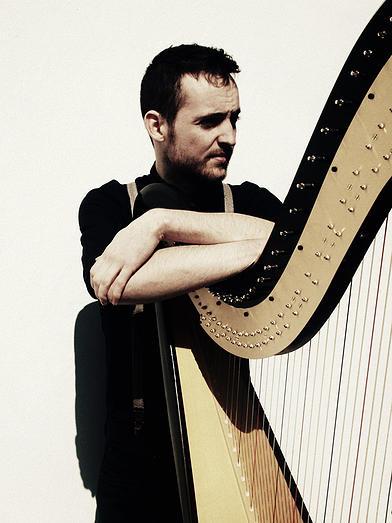
Outstanding contemporary harpist and Riot Ensemble member Tomos Xerri performs regular duet concerts with English National Opera’s principal flautist Claire Wickes (who also plays as guest principal with most of the big London orchestras, as well as the São Paulo Symphony). Here’s one of those shows – one of the Hattori Foundation’s showcase concerts, nicely timed for the Waterloo homeward-bounders.
While Claire and Tomos will be playing a set of established pieces by Takemitsu, Debussy, Piazzolla and American tonal hero Lowell Liebermann (as well as a sonata by the distinguished twentieth-century British polymath William Alwyn), they are both strong enthusiasts for contemporary music, and are premiering a new composition by Trinity Laban alumnus Liam Mattison (a recent partipant in the LSO’s Panufnik Composers Scheme).
Look out, too, for any mention of Tomas’ upcoming musical-saw-and-electronics project… which at the moment seems to be more of a tingling promise than anything concrete. If any more evidence shows up, I’ll blog it myself.
1901 Club presents:
Elisabeth Turmo & Elena Toponogova: “Two Journeys” 1901 Club, 7 Exton Street, Waterloo, London, SE1 8UE, England
Friday 17th March 2017, 6.30pm – information
This is a musical celebration of two cultures, Norwegian and Russian, performed by Norwegian violinist Elisabeth Turmo and Siberian pianist Elena Toponogova. Both are recent or imminent Masters graduates from the Royal College of Music, with growing international reputations. Elizabeth has performed as a soloist with the Arctic Philharmonic, the Oslo Chamber Orchestra, the Toppen International Festival Orchestra and the Barratt Due Symphony Orchestra; while Elena has performed as a chamber musician and soloist across the United Kingdom, Russia and Germany.
Already tagged as “conveying the stormful temperament of a northern Norwegian” in her concert performances, Elisabeth is also an up-and-coming exponent of the hardingfele, or “Hardanger fiddle” – the thin-wooded Norwegian violin with additional sympathetic strings which is traditionally used for folk dances and church processionals, and which bridges the gap between Norway’s ecclesiastical life and its supernatural mythology (by way of “troll-tunings” and Robert Johnson-esque myths about music lessons from the Devil).
Several hardingfele pieces will be performed as part of the concert set. I doubt that these will include a solo arrangement of Michael Grolid’s recent ‘Ouverture’ (as played here two years ago by Elizabeth and Barratt Due’s Symphony Orchestra) but I’ve included it in lieu of her having posted up any other recordings with the instrument.
Emre Engin & Jennifer Hughes: ‘A Journey to the Musical Plateaus’ 1901 Arts Club, 7 Exton Street, Waterloo, London, SE1 8UE, England
Thursday 1st December 2016, 6.30pm – information
With this 1901 Club chamber recital, violinist Emre Engin quietly caps the first phase of an exciting international career (which began with his studies at the Uludag University State Conservatory in Anatolia, Turkey, and has moved through the Royal College of Music in London and the Manhattan School of Music in New York to his current status as in-demand, prize-winning London-based soloist, trio leader and educator). As well as music by Bach, Prokofiev and Paganini, the concert includes the world premiere of Emre’s own first significant composition ‘A piece for violin and piano (in memoriam of an unborn child)’.
Emre is accompanied by another prize-winning musician – pianist Jennifer Hughes. A Park Lane Group Artist and cross-Europe performer specialising in duo accompaniment and piano songs, Jennifer (reknowned for her skill as a supportive musician) also coaches work at the Royal College of Music, Aldeburgh Young Musicians, New Virtuosi Mastercourse and Voksenåsen Summer Academy.
Programme:
Johann Sebastian Bach – Solo Sonata No.2 in A minor (incorporating the Fuga by Alfred Schnittke)
Emre Engin – A piece for violin and piano (in memoriam of an unborn child) (world premiere)
Nicolò Paganini – Caprice No.15
Sergei Prokofiev – Violin and Piano Sonata No.2 in D major, Op.94bis
* * * * * * * *
Curated Place/Moving Classics & Psappha present:
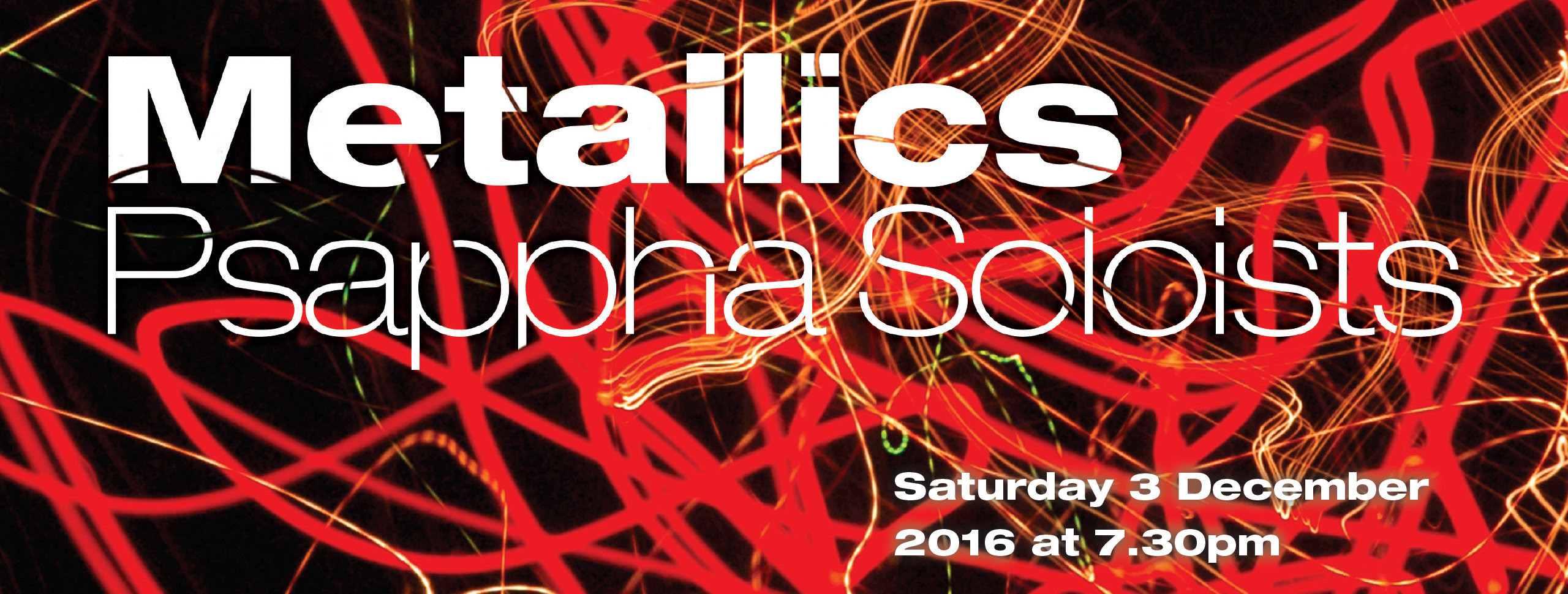
Psappha Soloists: ‘Metallics’
St Michael’s Church, 36-38 George Leigh Street, Ancoats, Manchester, M4 5DG, England
Saturday 3rd December 2016, 7.30pm – information
Several of the players from Manchester contemporary classical ensemble Psappha congregate in their hometown for a concert of current music. “Featuring emerging composers alongside established twentieth century greats the programme has been curated to showcase Psappha’s virtuoso musicians in an eclectic mix of music that – along with tape and electronics – explores the sonorities of each individual instrument. The centrepiece of this performance is the world première of Stylianos Dimou‘s ‘Metallics’, in which acoustic sounds undergo electronic transformation resulting in the assembly of sonic twins.”
Below is a videoclip of an Psapphas renderings of one of the pieces on the bill, to give you an idea of how the concert will run. As for the Stylianos Dimou piece, here’s a soundclip of an earlier, recently-recorded ensemble piece which probably has little to do with the form and execution of ‘Metallics’ but which does provide a window on his “conception of structure as a fluid and sculpted entity that can be conceived as a byproduct of microscopic manipulation of the timbral and gestural dimensions of music” expressed via “blurred sonorities, harmonic fluidity and gestural formation.”
Back down in London, various musicians from the Philharmonia Orchestra are playing a pair of evening/late-night shows at Brasserie Zédel. While the big January show’s already sold out, tickets are still available for a couple of smaller December shows featuring subdivisions of the orchestra.
The first of the two shows offers “a unique opportunity to hear members of the cello section in this late night show in an eclectic mix of music, imbued with virtuosity, soaring melodies and infectious dance rhythms”, featuring pieces by Mozart, Wagner, Nicolò Paganini and Astor Piazzola, as well as the lesser-known but compositionally prolific German cellist-composer Julius Klengel (who produced hundreds of etudes and solo works for the instrument during his late nineteenth/early twentieth-century lifetime). The concert will also feature a newer piece by Philharmonia-affiliated contemporary British composer Richard Birchall – ‘Viral’, a five-minute cello quartet.
Live At Zédel presents:
Philharmonia Orchestra cello section Brasserie Zédel, 20 Sherwood Street, Soho, London W1F 7ED, England
Friday 9th December 2016, 10.00pm – information
Live At Zédel presents:
Members of the Philharmonia Orchestra Brasserie Zédel, 20 Sherwood Street, Soho, London W1F 7ED, England
Tuesday 13th December 2016, 7.00pm – information
The Riot Ensemble presents:
The Riot Ensemble: ‘The Viola in my Life’ The Forge, 3-7 Delancey Street, Camden Town, London, NW1 7NL, England
Monday 21st November 2016, 7.00pm – information
“Led by a core group of seven musicians, The Riot Ensemble programme a wide array of the new music from across the globe, connecting people to great contemporary music and collaborating with a prestigious roster of guest artists in musician-led and organised performances. One of the few emerging ensembles in the UK to regularly commission and perform music by international emerging composers, they present the young composers they commission alongside exciting and established music from Bach to Birtwistle.
“This performance – The Viola in my Life’ – features Riot’s new Artistic Board Member Stephen Upshaw, who programmed this concert alongside fellow rioters Sarah Mason & Claudia Maria Racovicean.”
Programme:
Mark Simpson – New Work for Solo Viola (world premiere) Morton Feldman – The Viola in My Life 3 (for viola and piano) Mark Bowden – Hoist (for solo percussion) Jack Sheen – Each One Cancels Out the Last (for viola, piano and tape) (world premiere) Anna Meredith – Flex (for solo percussion) Tigran Mansurian – Duet (for viola and percussion) (UK premiere)
“Venezuelan virtuoso pianist Clara Rodríguez joins forces with TangOpera Duo to mark the centenary of her compatriot, composer Antonio Estévez (1916-1988) with a concert showcasing his works for piano and voice as part of a vibrant programme of piano pieces by some of the giants of Latin American classical music, including the seminal Argentine composer Alberto Ginastera (Argentina) (1916-1983), who also celebrates his centenary this year.
“Antonio Estévez is one of the most important Venezuelan composers of the 20th century, known especially for his ‘Cantata criolla’ and ‘Mediodía en el llan’o, recorded by the Simón Bolívar Youth Orchestra in 2008. A leading light of the Parisian-Venezuelan avant garde, Estévez’s music stands out for its rare beauty and profound originality. In Clara Rodríguez, Estévez has a longstanding ambassador for his legacy – her successful campaign to establish his output on the ABRSM 2015-2016 exam syllabus saw his music performed by thousands of pianists in the UK.
Heard here alongside some of Latin America’s most famous composers, such as Villa-Lobos (Brazil) and Cervantes (Cuba), this event places Estévez firmly amongst the panoply of Latin America’s ‘great’ composers. If you are unfamiliar with his music, this programme will be a revelation.”
Programme:
Antonio Estévez – 17 Piezas infantiles
Antonio Estévez – Songs (Selection)
Heitor Villa-Lobos – Bachianas brasileiras No. 4 (Selection)
Heitor Villa-Lobos – Ciclo brasileiro (Selection)
Alberto Ginastera – Three Argentinean Dances
Alberto Ginastera – Dos canciones Op. 3
Ignacio Cervantes – Three Cuban Dances
Federico Ruiz – Encuentro de Antonio y Florentino
Performers:
Clara Rodríguez – piano
TangOpera Duo – soprano & piano
William Roberts – actor
Timothy Adès – translator-poet
A quick sprint, and some quicker comments, through some imminent (and not-quite-so-imminent) classical performances about to take place in the Smoke. (One day I’ll get all of this stuff up well in advance. One day…)
* * * * * * * *
Shadwell Opera presents:
‘Erwartung/Twice Through The Heart’ Hackney Showroom, Hackney Downs Studios, Amhurst Terrace, Hackney, London, E8 2BT, England
Friday 4th & Saturday 5th November 2016, 7.30pm – information here
“A disused mine. You mime.
“The same sentence. The sound gets stuck.
“Life. Life.
“Shadwell Opera present a dazzling double-bill of one woman psychodramas: ‘Erwartung’ by Arnold Schoenberg and ‘Twice Through The Heart’ by Mark-Anthony Turnage. Separated in the writing by ninety years, these two monodramas (both to words by female librettists, Marie Pappenheim and Jackie Kay) break apart and reconstitute the mind of an isolated woman in extraordinary stream-of-consciousness narrations.
“Directed by Shadwell Opera’s artistic director Jack Furness and associate director Celine Lowenthal, and conducted by musical director Finnegan Downie Dear, this programme will feature the role debuts of the exciting operatic talents Madeleine Pierard and Kate Howden.”
Here’s a little more information, courtesy of the ‘Planet Hugill‘ classical music blog (which tipped me off to the fact that these were being performed).
“Schoenberg’s ‘Erwartung’ was written in 1909 with a libretto by Marie Pappenheim, but had to wait until 1924 to receive its first performance when Alexander Zemlinsky conducted it in Prague. Schoenberg said of the work ‘In ‘Erwartung’ the aim is to represent in slow motion everything that occurs during a single second of maximum spiritual excitement, stretching it out to half an hour.’
“Mark-Anthony Turnage’s ‘Twice Through The Heart’ was written between 1994 and 1996, and revised subsequently and received its first performance in 1997. The libretto, by Jackie Kay, is based on a 1992 poetry documentary which she had written for the BBC.”
* * * * * * * *
rarescale presents:
‘Contraventions – new music for contrabass flute’ with Carla Rees IKLECTIK, Old Paradise Yard, 20 Carlisle Lane, Waterloo, London, SE1 7LG, England
Saturday 5 November 2016 (workshop 4.00pm-7.00pm; concert 8.00pm) – information
“UK-based low flutes player Carla Rees tours a concert of new music for contrabass flute and electronics. The contrabass flute is a rare instrument, most usually found in flute choirs, but in this programme it takes on a new solo persona. It is both impressive in sound and size, and complimented by electronics this concert will be a sonic delight of rarely heard music. The concert will feature premiere performances of several new pieces, including music by Matthew Whiteside, Piers Tattersall, Benjamin Tassie and Michael Oliva.
“Carla is the artistic director of rarescale (an ensemble which exists to promote chamber music repertoire for low flutes), and director of low flutes publishing company Tetractys. She has been working closely with Michael and Matthew along with other composers who are writing new works for the tour.
“From 4.00pm to 7.00pm there will be a workshop for composers to explore writing for the contrabass flute. Composers are invited to bring sketches or new works to try out (scores can also be submitted to Carla in advance), and all their questions about the instrument will be answered during the afternoon. The entry fee for the workshop includes entry to the concert.”
* * * * * * * *
As part of the fourth London Festival of Bulgarian Culture, the organisers of the Ethical Society and Sunday Concerts at Conway Hall are putting on three chamber music concerts, which they’re calling “a musical journey along the Danube: through Bulgaria and beyond.” Each of these will feature at least one Bulgarian work (alongside other items from the classical repertoire which have at least a glancing connection with the country or the river) and be performed primarily by British-based Bulgarian musicians plus compatriots from abroad and sympathetic colleagues from Britain and elsewhere.
To be honest, if you took the players out of the equation, the Bulgarian connection would be tenuous. Leaving aside the fact that the universality of the Haydn, Schubert, Brahms and Mozart pieces chosen for the programme has almost rendered them a common world possession, the inclusion of works by the Hungarian Dohnányi, the Czechoslovakian Drdla and the intensely Czech Dvořák and Smetana means that the concerts fade into an amorphous Danubian appreciation of late classical and romantic string music, perhaps with some of its attention towards eastern Europe, but with its centre still fixed on Vienna or Prague rather than Sofia. Only two actual Bulgarian composers are having their works performed – lynchpin twentieth-century classicist/folk integrator Pancho Vladigerov (whose conscientious approach and assured pedagogy made him the mentor to most post-war Bulgarian composers) and contemporary British-Bulgarian composer Dobrinka Tabakova (whose 2002 trio ‘Insight’ is being played during the first concert). In other respects, representation of the home side is pretty slim. No Emanuil Manolov, no Alexandra Fol, no Georgi Atanasov or Albena Petrovic-Vratchanska.
Admittedly, these choices are partly down to the instrumentation and tone chosen for the concert – piano and string pieces from duo to quintet; accessible classical-melodicism; the warmer, more positive folk-culture-inspired end of small-state nationalism. Quibbles aside, it’s a good opportunity to hear the Vladigerov pieces (beloved Bulgarian staples which don’t tend to travel much outside the country) and the diverse pedigree of the players contributing to this collective and cooperative effort is encouraging and heartening, as well as impressive. Should be a good set of shows.
London Festival of Bulgarian Culture: Concert 1 Conway Hall, 25 Red Lion Square, Bloomsbury, London, WC1R 4RL, London
Sunday 6th November 2016, 5:30 pm – information here and here
Programme:
Pre-concert talk by pianist and music commentator Michael Round (at 5.30pm in the Brockway Room)
Franz Joseph Haydn – Piano Trio in G Hob.XV:25 ‘Gypsy’
František Drdla – Souvenir & Serenade in A major
Dobrinka Tabakova – Insight (for string trio)
Fritz Kreisler – La Gitana & Schön Rosmarin (for violin and piano)
Franz Schubert – Quintet in A D667 ‘Trout’ (for string quartet and piano)
Performers:
Julita Fasseva, 2016
Evgeniy Chevkenov (violin – Professor at Richard Wagner Conservatoire, Vienna)
Devorina Gamalova (viola – Professor at Birmingham Conservatoire)
Alexander Somov (cello – Principal cellist at Strasbourg Philharmonic)
Simon Callaghan (piano – Artistic director of Conway Hall Sunday Concerts)
Julita Fasseva (double bass – member of Royal Flemish Philharmonic)
London Festival of Bulgarian Culture: Concert 2 Conway Hall, 25 Red Lion Square, Bloomsbury, London, WC1R 4RL, London
Sunday 13th November 2016, 6:30 pm – information here and here
Programme:
Ernö Dohnányi – Serenade for string trio Op.10
Bedřich Smetana – Macbeth and the Witches (for solo piano)
Pancho Vladigerov – Bulgarian Rhapsody ‘Vardar’ Op.16
Johannes Brahms – Piano Quintet in F minor Op.34
Pavel Minev (violin- Soloist of Moscow State Philharmonic)
Ivo Stankov (violin – Artistic director of LFBC)
Alexander Zemtsov (viola – Professor at Guildhall School of Music)
Guy Johnston (cello – Winner of ‘BBC Musician of the year’ competition),
Ashley Wass (piano – Laureate at Leeds International Piano Competition)
London Festival of Bulgarian Culture: Concert 3 Conway Hall, 25 Red Lion Square, Bloomsbury, London, WC1R 4RL, London
Sunday 20th November 2016, 6:30 pm – information here and here
Programme:
Wolfgang Amadeus Mozart – Sonata for Violin and Piano in B flat K454
Pancho Vladigerov – Piano Trio Op.4
Antonín Dvořák – Piano Quintet in A Op.81
Performers:
Ludmil Angelov, 2016
Dimitar Burov (violin, Head of Strings at Harrow School, programme supervisor)
Yana Burov (violin, Leader of ‘Inspirity’ String Quartet)
Michael Gieler (viola, Principal at Royal Concertgebouw Orchestra),
Gerard Le Feuvre (cello, Director of Kings Chamber Orchestra)
Ludmil Angelov (piano, Laureate of International Chopin Piano Competition)
At opposite ends of the month, here are the latest examples of two regular and recurring London gigs with their roots in classical music but navigating (especially in the case of Kammer Klang) its rewarding outer margins and potential associations.
* * * * * * * *
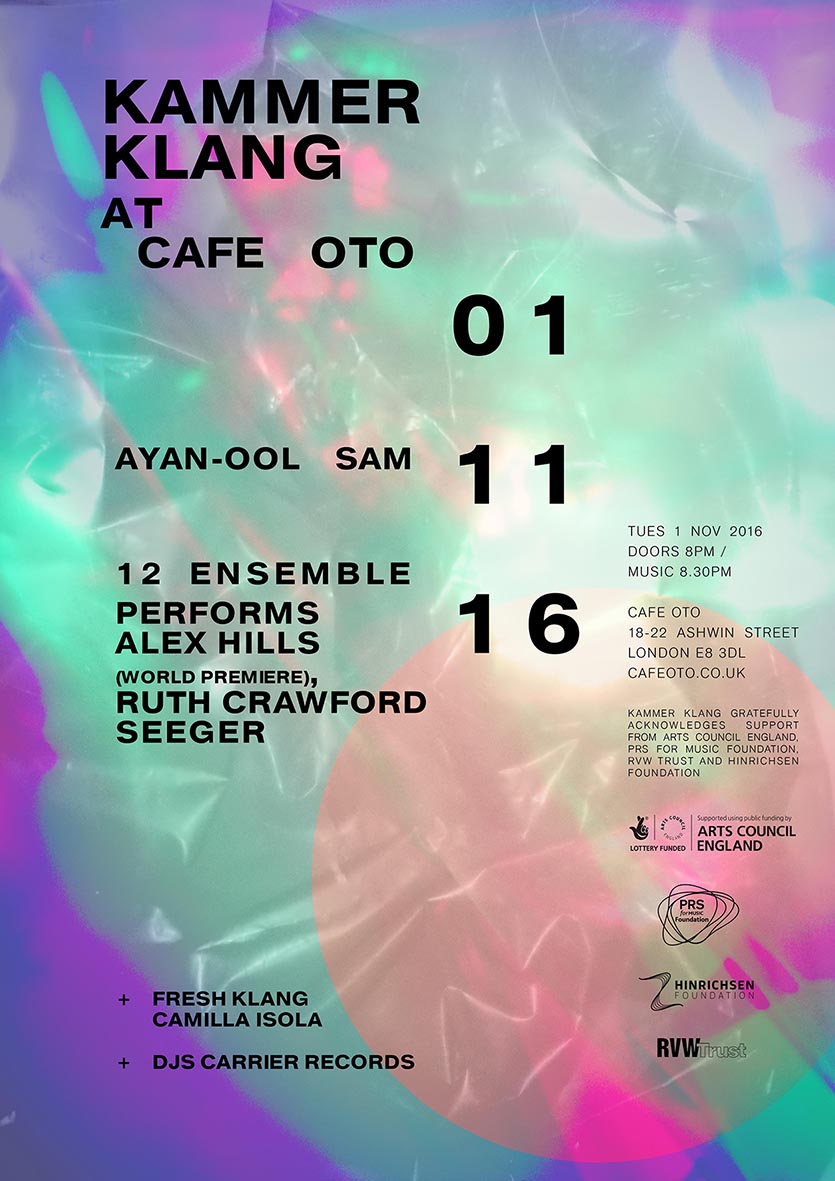
Kammer Klang presents:
Ayan-ool Sam + 12 Ensemble + Camilla Isola + Carrier Records DJ set Café Oto, 18-22 Ashwin Street, Dalston, London, E8 3DL, England
Tuesday 1st November 2016, 8.00pm – information here, here and here
Headliner Ayan-ool Sam is an acclaimed xöömeizhi, or master of xöömei throat singing (the traditional droning polyphonic music of the Tuva republic in southern Siberia: solo vocalisations developed to mimic and revere both animate and inanimate sounds from nature, in line with the region’s ancient animism). He’s a former student of “xöömeizhi’s xöömeizhi” Kongar-ool, half of Alash Ensemble (with Bady-Dorzhu Ondar), and a frequent throat-singing competition winner whose garlands range from being voted this year’s People’s Xöömeizhi of the Republic of Tuva to gaining the nickname of “Golden Throat” from banjo ace and prolific world music collaborator Béla Fleck. He’ll be performing traditional xöömei as counterpart and capstone to the rest of the evening’s repertoire and explorations.
Having spent the earlier part of the year in Iceland for a HEIMA artistic residency (as well as providing the musical backbone for Max Richter’s ‘Vivaldi Recomposed’ project in Paris), orchestral duodecet 12 Ensemble are back in their London hometown for this show. Considered to be London’s foremost un-conducted string orchestra, they’ve recorded and are currently readying a debut album for next year, featuring works by William Walton, Johns Woolrich and Tavener, and the young British composer Kate Whitley (you can see the group performing her piece, ‘Autumn Songs’, below). Previously, 12 Ensemble were Ensemble in Residence for two years at the Forge in Camden, collaborating with several international artists including the tenor Nicky Spence, the pianist Mei Yi Foo and the violist Simon Rowland-Jones. On this occasion, they’ll be performing works by Alex Hills and Ruth Crawford Seeger.
Alex Hills is a London-based contemporary composer with a growing reputation for his “interesting and considerable gifts” (Tempo). His recent album of chamber compositions ‘The Music Of Making Strange‘ showcases his interest in diverse elements including spectralism, experimental chamber and punk rock. A performance of one of its pieces, ‘Knight’s Move’, is below.
The Hills piece receiving its world premiere tonight is ‘OutsideIn’, which takes inspiration from E. A. Abbott’s classic 1884 novel ‘Flatland‘ (a geometric and philosophical satire). ‘Flatland’ is a recurring source of ideas for Alex – another such piece, a choral work named after the book, can be downloaded for free here. Discussing his interest in “‘flat’ musical worlds”, Alex explains “in a two-dimensional world, a highly complex ‘inside’ would be quite invisible from the ‘outside’, yet to a hypothetical three-dimensional being staring down from above, that same inside would appear completely different.”
Regarding ‘OutsideIn’, Alex continues by describing the piece as “an attempt to think about the relationship between a soloist and an ensemble (a concerto?) in spatial terms. Rather than an ensemble acting as an accompanist to a virtuosic soloist, or a discursive, dialogue-like relationship between them, I place the soloist inside or outside the ensemble’s sound (or the ensemble in or out of the soloist’s)… ‘In’ and ‘out’ also imply boundaries and a centre, which on the one hand are made physically by the ensemble in a horizontal way, with the soloist in the centre and the other two most prominent instruments (first violin and double bass) at the edges, and also by how the musical lines move in register (vertical musical space), initially continually drawn inwards towards a centre of gravity, then at the end of the piece escaping away from that centre outwards.” Alex gives credit for further inspiration to the “virtuosity, imagination and creative freedom” of 12 Ensemble violinist and longtime Hills collaborator Aisha Orazbayev, who’ll be the featured soloist for the premiere.
A valued contemporary and fellow traveller to American modernists such as Charles Ives and Henry Cowell, Ruth Crawford Seeger was a self-taught composer pioneering a specifically American brand of dissonant, meta-mystical music. Among the elements feeding into this were Ruth’s early fascination with the atonal, innovative and highly personal mysticisms of Alexander Scriabin and her own friendship with the poet Carl Sandburg (who was the almost exclusive source of the texts she set to music, although she also carried out a self-translated, twelve-tone setting of the Bhagvad Gita). Her own pugnacious, assertive modernism was further tempered by her studies with musicologist and theorist Charles Seeger, whose concept of “dissonant counterpoint” became a major element in her work and whose cultural Marxism she came to share (leading her into an increasingly missionary devotion to curating American folk music, at the expense of her own composing) and whom she married in 1931 (at a stroke, becoming the stepmother of future folk music hero Pete Seeger).
Ruth’s late return to focussing on her own compositions (after years of selflessly serving and propogating the folk songs of others) was cut short by her death from cancer at the age of fifty-two, although not before she’d delivered a final Suite for wind quintet which incorporated everything she’d learned across her musical life; from post-tonal pluralism, American serialism and Russian-inspired mysticism to her later immersion in folk. Obscured by the reputations of her male contemporaries for many years, Ruth’s work and reputation (particularly that of her 1930s work) has been being revived. 12 Ensemble will be performing her 1931 ‘Andante for string quartet’: a key Crawford Seeger piece whose carefully structured technical dissonances do not deny its growing tragic melody line. Ruth herself valued the latter to the extent that she rearranged the piece for orchestra seven years later, in the hope that the larger arrangement and a skilled conductor would bring out the embedded line to greater effect. Here’s a taste of the original quartet version:
The Fresh Klang act for November is dancer, choreographer and performance artist Camilla Isola, a Trinity Laban graduate in her early twenties at the start of what promises to be an interesting career. She’ll be premiering a brand new solo work which, like the Alex Hills piece, draws on ideas and inspirations from ‘Flatland’, exploring dimensional states and the physical dilemma of the body. One of her previous pieces is shown below:
DJs from Carrier Records (the seven-year-old New York improv, experimental and contemporary classical label who released the Alex Hill album mentioned above) will see out the remaining gaps in the evening.
* * * * * * * *
SOLO presents:
SOLO 02: Daniel Pioro
Crypt of @ St Andrew Holborn, 5 St Andrew St, Holborn, London, EC4A 3AB, England
Friday 25 November 2016, 7.00pm – information
The intimate concert recital series SOLO – showcasing unusual works for solo instruments from early music through to new commissions – returns with a showcase in the vaulted crypt of St Andrew Holborn from acclaimed violinist Daniel Pioro.
As player, commissioner, leader and active champion of new music, Daniel’s experience is broad and assertive. He’s a member of innovative chamber ensemble CHROMA, current leader of the Fibonacci Sequence, and the former leader of the London Contemporary Orchestra (with whom he’s played, amongst other pieces, the ‘Triple Concerto’ by Radiohead polymath Jonny Greenwood and Schnittke’s notorious ‘Concerto Grosso No. 1’). He’s worked as a soloist or ensemble player with the Orchestra of St Johns Smith Square (Mozart’s ‘Sinfonia Concertante’, John Woolrich’s ‘Capriccio’), the BBC Philharmonic (Colin Matthews’ ‘Violin Concerto’, Thomas Adès’s ‘Concentric Paths’) and the London Sinfonietta. Daniel has also forged close musical working and performance relationships with a variety of contemporary dancers and with author Michael Morpurgo.
For this concert, Daniel will celebrate and share his eclectic tastes via a set list including “everything from the intricacies of Heinrich Ignaz Franz von Biber’s ‘Passacaglia for Solo Violin’ to the mind-bending repetitions of ‘Knee Play No. 2′ from Philip Glass’ extraordinary opera ‘Einstein on the Beach’.” Also on the set list is ‘Elsewhere’ by Edmund Finnis (a violin-and-reverb piece which Daniel debuted at St Johns Smith Square in June this year), works by American composers La Monte Young and Pulitzer Prize-winning Caroline Shaw (of ACME and Roomful Of Teeth) and the world première of a new piece by SOLO curator Alex Groves. There’ll also be another as-yet-unspecified baroque violin piece: this time by eighteenth-century composer-performer Nicola Matteis, an emigre virtuoso once reknowned throughout Georgian London, subsequently forgotten as a composer until the late twentieth century. (This performance will restore some of his music to its old haunts.)
No doubt there’ll be a more detailed set list emerging shortly, when tickets go on sale.
Helen Grime Day Wigmore Hall, 36 Wigmore Street, Marylebone, London, W1U 2BP, England
Saturday 15th October 2016, 1.00pm/6.00pm/7.30pm – information
Wigmore Hall is devoting a whole day to the work of Scottish composer Helen Grime, who’s about to begin her term as the Hall’s first female composer-in-residence for the 2016/2017 and 2017/2018 seasons.
An hour-long early afternoon concert will be entirely devoted to Helen’s chamber music, played by a five-piece ensemble of strings, oboe and piano. There’ll be two sets of instrumental works originally inspired by fine art minatures – ‘Three Whistler Miniatures’ (triggered by Helen’s encounter with James Whistler’s chalk and pastel drawings in Boston’s Isabella Stewart Museum) and ‘Aviary Sketches’, influenced by the mysterious ‘assemblage boxes’ of American artist and sculptor Joseph Cornell. There’ll also be performances of Helen’s ‘Oboe Quartet’, and her string duo ‘To See The Summer Sky’, plus the British premiere of the piano and oboe duo ‘Five North Eastern Scenes’. (Here’s a version of the Whistler piece…)
From the press release: “Helen Grime’s ‘Seven Pierrot Miniatures’ (NB – a companion piece to Schoenberg’s ‘Pierrot Lunaire’) project the composer’s uncanny feeling for instrumental tone colours and textural contrasts, whilst her ‘Clarinet Concerto’ (to be played by soloist Mark van de Wiel) is a study in virtuosity that grows more meditative as it unfolds. Oliver Knussen and Elliott Carter have been formative influences in Grime’s career; her duo ‘Embrace’ picks up the duos in Knussen’s delightful ‘Songs without Voices’, and the Carter duo, written for Knussen’s 50th birthday, mirrors this.” There’ll also be a performance of Leoš Janáček’s woodland fantasy ‘Concertino’.
There are two takes on two of those Grime pieces below:
In between the concerts, at 6.00pm, Helen will give a forty-five minute talk.
Helen Grime – Three Whistler Miniatures (for piano, violin & cello)
Helen Grime – Aviary Sketches (after Joseph Cornell) (for violin, viola & cello)
Helen Grime – To see the summer sky (for violin & viola)
Helen Grime – Five North Eastern Scenes (for oboe & piano) (UK première)
Helen Grime – Oboe Quartet (for oboe, violin, viola & cello)
(evening concert:)
Helen Grime – Embrace (for Bb clarinet & C trumpet)
Helen Grime – Seven Pierrot Miniatures (for piccolo, bass clarinet, piano, viola & voice)
Oliver Knussen – Songs without Voices Op. 26 (for flute, cor anglais, clarinet, horn, piano and string trio )
Helen Grime – Clarinet Concerto (for clarinet, piccolo, contrabassoon, harp & strings)
Elliott Carter – Au Quai (for bassoon and viola)
Helen Grime – Luna (for piccolo, oboe/clarinet, E-flat clarinet, horn, percussion & piano)
Leoš Janáček – Concertino (for piano, two violins, viola, clarinet, French horn and bassoon )
Incidentally, Helen has recently announced her first new work as part of the residency, which will be a piano concerto for Huw Watkins and Birmingham Contemporary Music Group. This will be premiered at the hall in March 2017. In the meantime, here’s a dip into yet another Grimes piece (her acclaimed orchestral work ‘Near Midnight’, which already seems to be working its way into the repertoire…)
* * * * * * * *
If you’re interested in hearing Helen’s ‘Aviary Sketches’ twice in one month, the The Coriolan String Trio are including it in their Conway Hall concert a couple of weeks after Helen Grimes Day, sandwiched in between two pieces of established classical repertoire…
Conway Hall Sunday Concerts presents:
Coriolan String Trio + Adam Brown Conway Hall, 25 Red Lion Square, Bloomsbury, London, WC1R 4RL, London
Sunday 30th October 2016, 5:30 pm – information
From the Conway Hall publicity mailshot – “The Coriolan String Trio combines the forces of chamber musicians from two renowned chamber groups, with a thirst for exploring and expanding on the repertoire for String Trio. As founding members of the Finzi String Quartet, viola player Ruth Gibson and violinist Sara Wolstenholme performed internationally, broadcast and recorded together until 2012. Until 2012, Robin Michael was cellist in the critically acclaimed Fidelio Trio for over ten years, with an extensive discography and premiering over a hundred new works for the genre. Since first meeting in 2013, all three have enjoyed collaborating through Wye Valley Chamber Music Festival and projects at Kings Place, London.”
Programme:
Ludwig van Beethoven – String Trio in G Op.9/1
Helen Grime – Aviary Sketches (after Joseph Cornell)
Wolfgang Amadeus Mozart – Divertimento in E flat K563
As a bonus, “at a pre-concert recital at 5.30pm, guitarist Adam Brown will perform solo, presenting varied dance forms from across Latin America. Performed works will be recorded on a forthcoming album that will include dynamic new arrangements and exciting first recordings.” No extra details on that, but here’s Adam performing a take on a Jimmy van Heusen classic…
* * * * * * **
In between the previous two shows, The Ligeti Quartet are touring their interesting ‘Fellow Travellers’ programme at a couple of English venues.
From the Forge website:
“The Ligeti Quartet – consisting of violinists Mandira de Saram and Patrick Dawkins, viola player Richard Jones and cellist Val Welbanks – is dedicated to performing modern and contemporary music, commissioning new works, and engaging a diverse audience. Formed in 2010, they were united by their fascination with the music of György Ligeti, and have since established a reputation as leading exponents of new music.
“The title of this programme and the opening piece, ‘Fellow Traveler’, suggest socio-political and Cold War connotations. The pieces of music you will hear at this concert refer in various ways to tensions and freedom, unity through eclecticism – relevant themes in the month before the US presidential election. The concert is built around two major works by Samuel Barber and Dmitri Shostakovich, contemporaries who in this programme represent classics of the mid-20th century USA and USSR. Their music was related in language but written under very different circumstances; Barber composed his quartet in the prime of his life, buoyed by the artistic perks of The New Deal; Shostakovich wrote of his fear of mortality, in the grips of terminal illness and under Soviet scrutiny.”
The concert also includes quartet works by the polystylistic pioneer Alfred Schnittke, the polymathic jazz-and-classical composer John Zorn (from a set of intricate, witty compositions inspired by the rules and forms of sadomasochism), and the premiere of a new Duke Ellington-inspired quartet composed by another jazz musician, Laura Jurd (who’s also on tour this month).
Programme:
John Adams – Fellow Traveler
Alfred Schnittke – String Quartet No. 3
Samuel Barber – String Quartet in B minor, Op. 11
John Zorn – Cat O’Nine Tails
Laura Jurd – Jump Cut Shuffle (world premiere)
Dmitri Shostakovich – String Quartet No. 13, op. 138
The Forge, 3-7 Delancey Street, Camden Town, London, NW1 7NL, England, Monday 17th October 2016, 7:00 pm – information
In addition, the Quartet will be playing another show at the end of the month, in Aberdeenshire (as part of the ongoing Scotland-wide Sound Festival). This show will feature a different set, although one which illustrates the Quartet’s interests and preoccupations with modern and twentieth-century music.
A quick reminder/primer for this week’s London concert paying tribute to the late British composer Jonathan Harvey and concentrating on his love for a cappella choral music:
* * * * * * * * *
BBC Singers: ‘Other Presences: The Music of Jonathan Harvey’ LSO St Luke’s, 161 Old Street, St Luke’s, London, EC1V 9NG, England
Friday 23rd September 2016, 7.30pm – information here and here
“Haunting, spiritual, ecstatic: Jonathan Harvey’s music blurs the boundaries between east and west, body and soul. Its lucid, bell-like resonances and pioneering use of electronics will take you on a journey into new and transformative worlds.
“’Mortuos Plango, Vivos Voco’ is an electro-acoustic masterpiece. Spinning sonorities ring out as it blends sound samples of a cathedral bell and the voice of a chorister. The looped, harmonised trumpet parts in ‘Other Presences’ weave sounds that echo the music of Tibetan Buddhist purification rituals. ‘Forms Of Emptiness’ sets the vivid flashes of joy in poetry by e.e cummings against a Buddhist Sanskrit chant, creating moments that feel transient and scarcely real.
“Experience Harvey’s compelling music alongside Britten’s virtuosic cantata ‘A.M.D.G.’ and a new work by Wim Henderickx, whose music reflects his fascination for eastern sound-worlds and philosophies.”
Benjamin Britten – ‘A.M.D.G. Op.17’ (Ad Majorem Dei Gloriam)
Jonathan Harvey – ‘Mortuos Plango, Vivos Voco’
Jonathan Harvey – ‘I Love The Lord’
Jonathan Harvey – ‘The Annunication’
Jonathan Harvey – ‘Other Presences’
Wim Henderickx – ‘Blossomings’ (world premiere)
Jonathan Harvey – ‘Forms Of Emptiness’
Jonathan Harvey – ‘How Could The Soul Not Take Flight’
There’s more on the Wim Henderickx piece in a post penned by the composer himself at ‘Classical Diary’. In it, Wim discusses the interest in Buddhism and spirituality which he shared with Jonathan Harvey, and which led to his composing ‘Blossomings’ as both a salute to Harvey and a triptych setting of texts from different and parallel religious traditions, starting with eighteenth century Tibetan Buddhism (‘From the blossoming lotus’ by Jigme Lingpa), twelfth century Christianity (Hildegard of Bingen’s ‘Holy Spirit’) and 13th century Islam (Jalāl ad-Dīn Muhammad Rūmī’s poem ‘O love’ (text by Rumi). As well as going deeper into the significance of the chosen texts, Wim also comments on the musical structure of the piece, with its inspirations of Tibetan open-air ceremonial music, its use of mixed choir performing multiple functions, the double bell trumpet employed by the soloist as commenter and introducer, and the way in which optional electronics “create a sonorous background of the harmonic material sung by the choir (and) give the work a spatial effect.”
Meanwhile, here are versions of some of the other material on the concert programme, drawn from a variety of sources:
Following yesterday’s post regarding imminent piano concerts in London, here’s news about one in Sheffield. Part of Sheffield University’s ongoing Festival of the Mind this month (and part of the university’s Sound Laboratory series), it’s a free show blending one of the twentieth century’s major piano works with new visual content and scientific context. Not an offer you get every day…
* * * * * * * *
“Birdsong is something that most of us hear every day, but how much notice do we really take? As part of the University of Sheffield’s Festival of the Mind, the language of birds will be translated for solo piano in a unique, immersive and multi-sensory two-hour performance providing a mesmerising meditation on music, nature and landscape.
“Our adventure through science, music, nature and imagination is led by Tim Birkhead (ornithologist and Professor of Behavioural Ecology at the University of Sheffield), with pianist Noah Kang performing Olivier Messiaen’s monumental masterpiece ‘Catalogue d’Oiseaux’, which reproduces the songs of seventy-seven different birds (from the brightly insistent call of the skylark to the menacing tones of the tawny owl). The performance will capture the magic of birdsong, whilst immersing the audience in bold new visuals (inspired by Tim’s research and realised by Sheffield-based design team Human) which follow the music’s original task of vividly capturing the birds’ interactions with a series of stunning French landscapes.
“The concert itself starts at 7.30pm, with Professor Peter Hill providing a pre-concert talk about Messiaen and birds at 6.10pm.”
Festival of the Mind presents:
Tim Birkhead/Noah Kang/Human: ‘Sound Laboratory: Sounds of the Birds’ Firth Hall @ University of Sheffield, Western Bank, Sheffield, S10 2TN, England
Wednesday 21st September 2016, 6.10 pm – free event (but requires pre-booking) – information
On the offchance that you weren’t already aware of this, Peter Hill is himself a celebrated interpreter of Messiaen’s piano works. Here’s part of his own version of the ‘Catalogue’.
Some news on a couple of pieces of music drama showing in London and Edinburgh this month – one a fully-fledged conceptual solo piece (involving original contemporary classical compositions and diverse performance techniques), the other a more conventional theatrical play themed around the wartime exile of Benjamin Britten.
Here’s a little more information about each of them (combed, shaped and styled in a hurry, from the press releases).
“Héloïse’s increasing interest in the dramatic potential of the unaccompanied voice has led her to experiment with a wide range of more contemporary techniques. ‘Scenes from the End’ is a fully staged, physical drama that combines classical and operatic vocal techniques, as well as improvisation, acting and body percussion. In it, Héloïse aims to confront the audience with the uncomfortable themes of death and grief, challenging them to reevaluate their own attitudes towards these difficult issues.
‘Scenes from the End’ is a collaboration with young composer Jonathan Woolgar (a previous award-winner of the BBC Proms Young Composers’ Competition) and with director Emily Burns. Using a colourful array of vocal and theatrical means, the show paints historic, comic and tragic pictures of “the end”, from the heat-death of the universe to the end of an individual life. This is virtuoso music theatre on a scale that is both cosmic and intimate.”
‘Scenes From The End’ is being performed at the Edinburgh Fringe Festival, with a couple of preview performances in London a week and a half beforehand. There’ll be a further run of London performances in December.
Tristan Bates Theatre, 1A Tower St, Covent Garden, London, WC2H 9NP
Tuesday 6th December 2016 to Saturday 10th December 2016, 7.30pm (plus one 3pm performance on the 10th) – no information online yet
Although Héloïse is someone I’d like to catch up with for a chat at some point, for the moment I’d better point you in the direction of this recent interview she’s done (freshly published today!) with the LaLaLa Records vocal music homepage, covering ‘Scenes From The End’ and several of her other projects.
* * * * * * * *
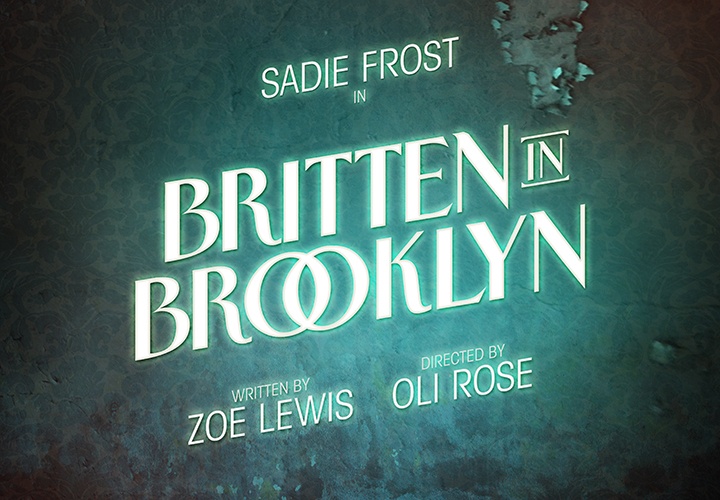
“Based on true events, the world premiere of Zoe Lewis‘s passionate and thought-provoking play ’Britten In Brooklyn’ takes place in the beautiful and unique setting of Wilton’s Music Hall. Starring Sadie Frost and directed by Oli Rose, it plays for a strictly limited season of 21 performances.
“New York City, 1940. A dilapidated house in Brooklyn Heights. The bohemian lifestyle of Benjamin Britten, WH Auden, Carson McCullers and Gypsy Rose Lee in the artistic community at 7 Middagh Street starts to unravel as World War II becomes a brutal reality. Exiled in America for his beliefs and a national disgrace, Benjamin Britten must decide which way his conflicted political ideals lie but the constant parties, doomed affairs and John Dunne, the mysterious stranger, provide an easy distraction.”
‘Britten in Brooklyn’ Wilton’s Music Hall, 1 Graces Alley, Whitechapel, London, E1 8JB, England
Wednesday 31st August 2016 to Saturday 17th September 2016, 7.30pm (plus 2.30pm matinee performance on Wednesdays and Saturdays) – information
A very quick post regarding an upcoming free London show from the Fidelio Trio – sadly, they’re not playing any of the original repertoire which they’ve commissioned over the years, but if you’re interested in hearing them take on music from the established canon from classical to Romantic through to the brink of chromatic modernism, and if you’re interesting in getting a formal chance to conversing with the kind of small ensemble which does invite commissions, this might suit you.
Rhinegold LIVE presents:
The Fidelio Trio Conway Hall, 25 Red Lion Square, Bloomsbury, London, WC1R 4RL, London
Tuesday 19th July 2016, 6:15 pm – free event – information here and here
“The ‘virtuosic Fidelio Trio’ (Sunday Times) are Darragh Morgan, violin, Adi Tal, cello and Mary Dullea, piano. Shortlisted for the 2016 Royal Philharmonic Society Music Awards – one of the highest recognitions for live classical music-making in the UK – they perform diverse repertoire internationally, broadcast regularly on BBC Radio 3, RTÉ Lyric FM, WNYC, NPR and in 2010 were featured in a Sky Arts documentary.
Champions of classical and contemporary alike (and with a string of new commissions to their name), this recital will explore some of the trio’s favourite repertoire. Join us and experience the on-stage chemistry which caught the attention of this year’s RPS Ensemble Award jury.
The evening starts with a drinks reception at 6.15pm, with the concert starting at 7.00pm. The concert is followed by an informal Q&A which will be conducted by Kimon Daltas, editor of Classical Music magazine.”
Programme:
Ludwig van Beethoven: Piano Trio in D major Op. 70 No. 1 ‘Ghost’ – I. Allegro vivace e con brio
Antonín Dvořák: Piano Trio No. 4 in E minor Op. 90 ‘Dumky’ – I. Lento maestoso – Allegro quasi doppio movimento
Arnold Schoenberg (arr. Eduard Steuermann): Verklärte Nacht
If you’re interested in hearing how the trio take on brand new repertoire, here are some clips of them in action, presenting debut live premieres of John Buckley’s 2014 ‘Piano Trio’ (from 2014) and Scott Wilson’s ‘Head Neck Chest Four Five Six Thing’ (from March this year).
While I missed the chance to plug the Sin Eater Festival a few weeks ago, I’m just about in time for the modest fireworks which herald the Frome Festival in Wiltshire.
I’m too late to plug the opening party (in which Frome’s own electro-poppers Sweet Machine shared a bill with psychedelic synth-cabarettier, rock biographer and all-round performance character Alan Clayson); I don’t have much to say about the festival’s big-draw act Reef (currently enjoying a new revival of their original ‘90s revival of 70s blues-rock); and I feel sorry that the free gig by “ukular fusion” band The Mother Ukersdoesn’t involve furious Mahavishnukulele jazz shredding (instead of being a variation on banjo-happy rockgrass covers). But there’s plenty more on offer, so here are a few other things picked out from the billing.
It’s by no means everything on offer (the festival’s full of visual art, talks and theatre; there’s plenty more jazz and classical; and there’s a show by Billy Bragg which will probably take care of itself) but these represent the bits-between-the-bits which are closest to ‘Misfit City’s natural constituency (if such a thing exists).
At the upstairs room at the Archangel pub, The Magical Folk Garden continues to turn itself into an annual institution with a series of cushion-strewn/standing-room-only unplugged gigs, creating a “euphonious forest of folk and contemporary acoustic music from some of the UK’s finest talents.” It’s all pretty well-scrubbed and tasteful – there’s nothing to scare the horses here. That said, a few of the performers might own horses, and some might whisper them; while a few might go all ‘Poldark’ and ride off on one, bareback and bare-chested, a honey-coloured guitar bouncing up and down on the withers (it all probably depends on the state of the booze and the pollen count).
The Tuesday show features two Bath acts – lit-pop cello-and-guitar duo The Bookshop Band and romantic solo-balladeer Tom Corneill – plus the sunny pure-pop/psychedelic fizz of Trowbridge’s The Pigeons.
The Wednesday show has a band-backed performance from Frome’s Al O’Kane (a gravel-and-honey country-blues-folker who, with his mix of rolling American roots guitar and British mysticism, can come across as a one-man ‘Led Zeppelin III’). Also playing are Alex Taylor (bouncy, jazz-and-funk-tinged, broadening his sound and filling out his pockets with pedals and loops) and young songwriter Emma Shoosmith, whose output has ranged from thoughtful folkified Taylor Swift covers to the lilting ska-tinted song shown below.
The Thursday show has a chamber-folk air. Bookshop Band multi-instrumentalist Beth Porter returns with her own augmented-string quartet band The Availables and her own clutch of intricate literary songs. Also on board are the strings, percussion rustles and detailed guitar of Rivers Of England (fronted by Rob Spaulding) who, although they take on some pretty familiar modern folk tropes, land them in an interesting marginal territory in which the early-’70s John Martyn and the early-’80s Julian Cope sit down to exchange lines and tips. The bill’s completed by the lost-boy charm of Avebury singer-songwriter (and Nick Harper protégé) George Wilding with his warm, abstracted songs of distraction and heartbreak (simultaneously soothing and haunting).
The Friday folk-final involves wayward Bristol-and-Bath folk septet The Cedar. Beth Porter makes her third Magical Folk Garden appearance of the week as the band’s cellist, alongside five other musicians. Playing a variety of instruments and implements (from guitar, glockenspiel, viola, organ and ukulele to calculator, screwdriver, musical and tri-square) they weave Neil Gay’s slightly distracted songs into a musical fabric that’s sometimes Belle-&-Sebastian communal, sometimes music-school precise, and sometimes as frayed as a scrap-basket oddment.
The rest of the evening gently mixes Western with Western. Accompanying herself on guitar, baritone ukulele, harmonium or shruti box, Bradford-on-Avon’s Jess Vincent delivers a set of original country-folk songs with a sound and demeanour that’s seen her compared to both Iris DeMent and Kate Bush. Evening openers Ali George and Ruby Brown do their own take on Gram-and-Emmylou duets, filtered through Ali’s trunkful of original English folk/clawhammer guitar songs.
* * * * * * * *
The town’s Rook Lane Chapel arts centre is hosting plenty of events. These two in particular caught my ear:
Snowapple Rook Lane Chapel, Bath Street, Frome, BA11 1DN, England
Thursday 7th July 2016, 7:30pm – information
“Snowapple is an outstanding female harmony trio from Amsterdam who draw on folk, classical and chanson influences, in unique, charming and beautiful arrangements of original songs. Having sold out the Granary for the last two years, Snowapple have earned a reputation all over Europe and the US, and this year appear in the perfect setting of Rook Lane Arts.”
Praying For The Rain Rook Lane Chapel, Bath Street, Frome, BA11 1DN, England
Friday 8th July 2016, 8.00pm – information
From the blurb: “Known for their dynamic and compelling live performances, Praying For The Rain blend contemporary folk, Celtic and world music with irresistible rhythms, memorable melodies, beautifully crafted vocals and inspired musicianship. Their music brings to mind a modern blend of Crosby, Stills and Nash, Robert Plant, to Fleet Foxes and the Dave Matthews Band, creating a truly uplifting experience. Following last year’s sell out concert, Praying for the Rain return to Rook Lane for Frome Festival 2016. Expect an exhilarating night of high energy, movement and wonderfully engaging songs.“
I’m sure I remember Praying For The Rain from when I was a regular at Martyn Swain’s wonderful Dreamhouse acoustic nights, a refuge of warm bohemian chic and unplugged music alongside the Splash Club in scuzzy mid-’90s Kings Cross. These were the same shows at which I was delighted by up-close performances from Marcy Detroit, Simons Warner and Whitaker and many more… there’s a little bit about Dreamhouse here, since someone’s been writing a crowdfunded book about the Splash years (and you can still pitch in to help it). Dreamhouse was the kind of night where you could expect table candles and belly dancing interludes most weeks; but during their own slot, Praying For The Rain completely overflowed the little Water Rats stage with finger-cymbals, accordions, cellos, cirrus-band harmonies and what seemed like about ten people on whispering percussion, temporarily transforming the place to a full-on New Age folk temple.
Although they seem rather more bluesy and straightforward-rootsy than I remember through the gauzes of memory, it’s good to see that they’ve lasted the twenty-year distance and garnered themselves a new up-to-date list of comparisons.
* * * * * * * *
Over at the Granary, there’s a semi-unplugged triple bill and a visit from a ‘Misfit City’ favourite.
Three Is The Magic Number presents:
Three Corners + Molly Ross + Gum Girl The Granary @ The George Hotel, 4 Market Place, Frome, BA11 1AF, England
Friday 8th July 2016, 8.00pm – free/pay-what-you-like
Regular Frome-and-Wiltshire unplugged night Acoustic Plus takes on a new identity for this three-act bill of “original songs, haunting vocals, mesmeric music” celebrating a diversity of approach via three different acts. Molly Ross offers fledgling piano pop touches on folk and R&B; Three Corners (with their roots in 1980s new-wavers The Impossible Dreamers, and featuring ex-Dreamers Nick Waterhouse and Caroline Radcliffe) play sparse, questing songs around more of a loose blues-and-jazz-informed tip; but the one I find most interesting is the dreamy beat’n’texture pop of Gum Girl.
As Arch Garrison, North Sea Radio Orchestra mastermind Craig Fortnam and Stars In Battledress‘ James Larcombe explore gentle, intricate psychedelic folk: partly gentle clean chapel tones, partly kosmische textures, partly chalk-ridge geomancy. A duo of Craig’s nylon-strung acoustic guitar and James’ assorted keyboards (organ, monosynth, harmonium and piano), their two albums’ worth of songs have enabled Craig to bring the smaller and more personal songs he writes to life, when they don’t fit the grander feel of NSRO. Their ‘Will Be A Pilgrim‘ album was one of my favourites of 2014 – an unexpected gem of small voice and thinking space. Support comes from local favourites Dexter’s Extra Breakfast, playing Dave Clark’s soft-petalled and “Weltschmerzian” songs of middle-aged reflection.
* * * * * * * *
John D Revelator The Griffin, 25 Milk Street, Frome, BA11 3DB, England
Saturday 9th July 2016, 8.00pm – free event
At the Griffin, John D Revelator will be bringing along their dark-tinged acoustic swamp-pop for a free show. Even if there’s not actually such a thing as the “Somerset Levels delta”, they’ll lie to their last tooth and their last busted guitar string trying to persuade you that it does exist.
* * * * * * * *
Towards the end of the festival, the second of Frome’s two substantial concert halls is offering two very different performances on the same day. One is a post-lunchtime concert of vividly Catalonian Spanish classical music from the twentieth century; the other is an evening show of polymusical fusion from an all-star collective trio.
Elena Riu & Clara Sanabras: ’A Taste Of Spain’ Cooper Hall @ Selwood Manor, Jacks Lane, Frome, BA11 3NL, England
Saturday 9th July 2016, 1.00pm – information
Pianist Elena Riu and singing multi-instrumentalist Clara Sanabras (the latter on voice, harp, oud, charango and guitar) perform selections from the ‘Songs & Dances’ of Catalan impressionist/miniaturist composer Federico Mompou and the ‘Spanish Dances’ of his compatriot Enrique Granados, interspersed with Clara’s performances of the original Catalan folk songs on which Mompou drew.
“Birdworld is made up of musicians Adam Teixeira (drums/percussion), Gregor Riddell (cello/electronics); and Alex Stuart (guitar). The project came about when Gregor and Adam met during self-directed Banff Creative Residencies where they discovered a shared interest in blending electronic and acoustic sounds. Since Adam moved to the UK in 2014 they have continued to develop BirdWorld, adding Alex along the way. Combining their artistic voices as both instrumentalists and composers, the trio will showcase each members original compositions arranged specifically for this unique musical exchange. Creating a unified sound that blends the inspirations of modern jazz, world music, contemporary classical, rock and electronic music in a rare concert setting.”
Here’s a video of the original two-piece in action, to give you two-thirds of an idea of what might be on offer.
Three contemporary classical concerts coming up in London between now and the end of the month, including a number of premiere performances of new pieces.
* * * * * * * *
IKLECTIK presents :
rarescale (Carla Rees & Michael Oliva) IKLECTIK, Old Paradise Yard, 20 Carlisle Lane, Waterloo, London, SE1 7LG, England
Sunday 19th June 2016, 8.00pm – information
Programme:
Piers Tattersall – Analogue
Michael Oliva – Bereft Adrift
Pauline Oliveros- Bye Bye Butterfly
György Ligeti – Artikulation
Bruno Maderna – Music su due dimensioni
Dan Di Maggio – Same Old Monsters
Thea Musgrave – Narcissus
Performers:
Carla Rees (flute & bass flute)
Michael Oliva (electronics)
rarescale is a flexible-instrumentation contemporary chamber music ensemble which exists to promote the alto flute and its repertoire. Its artistic director, Carla Rees, is a UK-based low flutes specialist – player, arranger and the director of music publishing company Tetractys. She plays Kingma System flutes and works frequently in collaboration with composers to develop new repertoire and techniques: she’s also released five records with rarescale‘s in-house record company.
rarescale‘s composer-in-residence, Michael Oliva, also performs regularly with the ensemble in the UK, Europe and the United States. Originally trained as a biochemist, Michael is now a composer with a fondness for writing operas and music for electronics and woodwind. In addition he runs madestrange opera, a company dedicated to producing new forms of the genre for modern audiences, including Michael’s own multimedia operas ‘Black & Blue’, ‘Midsummer’ and ‘The Girl Who Liked To Be Thrown Around’. Michael also teaches composition with electronics at the Royal College of Music, where he is Area Leader for Electroacoustic Music, and runs the termly “From the Soundhouse” series of concerts of electronic music.
Here’s a video of an earlier rarescale performance.
* * * * * * * *
Douglas Finch – Inner Landscapes CD Launch The Forge, 3-7 Delancey Street, Camden Town, London, NW1 7NL, England
Monday 20th June 2016, 7:00 pm – information
From the Forge’s press release:
Douglas Finch (photo by David Yeo)
“Douglas Finch, described as “a true virtuoso” (‘The Independent’), is best known for his innovative and imaginative approach to performance, and for helping to revive the lost art of classical improvisation in concert. As a pianist (winner of the silver medal at the Queen Elisabeth International Competition in Brussels in 1978) and improviser, Finch has already recorded extensively – most recently with the saxophonist Martin Speake, but also with The Continuum Ensemble for NMC and Avie.
“This event celebrates the first ever CD recording of Douglas Finch’s piano and chamber music. ‘Inner Landscapes: Douglas Finch – Piano and Chamber Music 1984-2013’ was recently released on the Prima Facie label. The music was selected from Finch’s catalogue of over forty works, which range from piano, chamber ensemble, orchestra and theatre music to the soundtracks for five feature-length films. The evening will include a performance of selected works from the recording, played by Lisa Nelsen (flute), Aleksander Szram (piano) and Mieko Kanno (violin). Each ticket includes a complimentary glass of wine and a copy of the CD.”
Douglas himself will also be performing, playing “a short piece which is not on the CD, as well as an improvisation to mark the occasion, based on themes that you suggest on the night.”
* * * * * * * *
June 2016
Reform Club Lunchtime Concerts presents:
Douglas Finch and Bobby Chen: Two Pianos (Four Hands) Reform Club, 104 Pall Mall, Westminster, London, SW1Y 5EW, England
Wednesday 29th June 2016, 12pm – information
Later in the month, Douglas Finch will also be performing with fellow pianist and regular duet partner Bobby Chen at a lunchtime show at the Reform Club. In addition to a performance of Rachmaninov’s ‘Suite for Two Pianos, Op 5 no 1′, they’ll be premiering one of Douglas’ own compositions, provisionally titled ‘Hapsburg Burlesques – Fantasy Transcriptions on Der Rosenkavalier, Mahagony and Other Elegies’ and working around variations on Strauss, Beethoven and others.
This is almost certainly to be a formal club event with a dress code and restricted access to non-members, so be sure to email and enquire about tickets in advance using the link above. Meanwhile, here’s a sample of Douglas’ improvisations and “instant variations”.
Just quickly mentioning this solo fundraising event initiated by Olga Stezhko: a forty-five minute late-lunchtime piano performance on the north side of central London, this coming Thursday…
Olga Stezhko St Pancras Parish Church, Euston Road, St Pancras, London, NW1 2BA, England
Thursday 21st April 2016, 1.15pm – free entry (with fundraising donations encouraged)
Olga: “Please join me at my lunchtime recital in aid of the Friends of the Belarusian Children’s Hospice (UK). I have been a long-time supporter of this amazing charity that provides children’s hospice-at-home care in Belarus. Their comprehensive palliative care creates positive experiences for terminally-ill children and precious memories for their families.
I will be playing two Debussy suites – ‘Suite bergamasque’ and ‘Children’s Corner’ – and Prokofiev’s ‘Tales of an Old Grandmother’. The event is free and all proceeds from a retiring collection will go to the FBCH. Your support will be greatly appreciated!”
Union Chapel, Compton Terrace, Islington, London, N1 2UN, England, Tuesday 12th April 2016, 7.30pm – more information here and here
A double-bill of experimental musicians revealing the secret sounds of some of England’s most majestic pipe organs and using the instruments to their full potential. The tour takes in some of the finest organs in the UK; housed in Birmingham Town Hall, Leeds Town Hall, The Meeting House at Sussex University Brighton, Colston Hall Bristol and the Union Chapel London.
Australian trio The Necks are known for their improvisational approach, never playing the same set twice and each performance a ‘thrilling, emotional journey into the unknown’ (Guardian). This concert sees pianist Chris Abrahams eschew his usual instrument in favour of the organ, showing off the versatility of its deep, warm sounds as part of a trio.
Organist and composer James McVinnie is fast becoming the country’s leading performer of new organ music as comfortable playing medieval music as he is collaborating with the likes of Nico Muhly, Oneohtrix Point Never, Richard Reed Parry (Arcade Fire) and Bryce Dessner (The National). Here he plays a specially-commissioned new score by Tom Jenkinson (which intertwines expansive classical influences with the chaotic intricacy for which Jenkinson is so well known in his work as Squarepusher) as well as performing two of Philip Glass’s most emblematic organ pieces, ‘Mad Rush’ and ‘Music in Similar Motion’.
Tom Jenkinson: “The experience of hearing organ music as a child is one of the most significant influences on my work. Through this new set of pieces I intend to explore some of the darker and more mysterious timbres available on these fantastic instruments.”
James McVinnie: “The organ is the ‘original synthesiser’ — an orchestra of sound like no other, which can fill huge architectural spaces without amplification but can also create a huge range of colourful and beguiling sounds. I enjoy working with many living composers and electronic musicians breathing new life into this grand, noble instrument and I’m thrilled to be now working with Tom Jenkinson on his beautiful and haunting new work.”
Chris Abrahams, The Necks: “With the pipe organ, the Necks take the idea of site-specific music making to another level; one where both the site and the instrument are the same. The hugeness of sound coming from an organ comes about through the combination of thousands of discreet sound producing units as well as the complex, multi directional reverberations possible in the hall space. The sound seems everywhere. Sometimes a pipe set is split between both sides of the pipe array, making possible wild “panning” effects; some pipes sound from the front of the instrument – like the massive bass pipes of the Leeds Town Hall organ; others sound from unseen pipe chambers deep within the confines of the instrument. Each organ is an important part of the building in which it is housed and is reflective of the economic and cultural aspirations of the city that brought it into being.”
Here’s a quick clip of James McVinnie performing a snippet of Morton Feldman’s ‘Principal Sound’ from another event, last month.
* * * * * * * *
The Amalie Trio/Eleanor Janes/Maya Soltan/P.J. Harris present:
‘The Female Persona’ The Forge, 3-7 Delancey Street, Camden Town, London, NW1 7NL, England
Tuesday 12th April 2016, 7.30pm – more information
Programme:
Robert Schumann – ‘Frauenliebe und –leben (Op. 42)’
William Bolcom – ‘Let Evening Come’
Sally Beamish – ‘Sonata for voice, viola and piano’
Francis Poulenc/ Jean Cocteau – ‘La Voix humaine’
Performers:
The Amalie Trio (Catherine Backhouse – mezzo soprano; Alexa Beattie – viola; Elspeth Wyllie – piano)
Eleanor Janes – soprano
Maya Soltan – piano
PJ Harris – director (‘La Voix Humaine’)
“The members of The Amalie Trio (Catherine Backhouse, Alexa Beattie and Elspeth Wyllie) first met as pupils at St. Mary’s Music School in Edinburgh. Now establishing themselves amongst Scotland’s most outstanding young soloists, they unite to champion the wonderful repertoire for mezzo-soprano, viola and piano. Considering their audiences at every turn they offer thoughtful, varied and engaging programmes that bring freshness and life to a large and flexible repertoire ranging from Brahms to Bernstein.
At this concert the Amalie Trio will perform the London premiere of ‘Sonata for voice, viola and piano’ by Sally Beamish, alongside the work that inspired it: Robert Schumann’s ‘Frauenliebe und –leben’ (a song-cycle based, in turn, on poems by Adelbert von Chamisso which voice a woman’s perspective on her love for a man, from first meeting through marriage to his death and her widowhood). The end of life is the subject of William Bolcom’s trio piece ‘Let Evening Come’, which sets the texts of three female American poets: Maya Angelou, Emily Dickenson and Jane Kenyon.
The second half of the evening features a performance of the Francis Poulenc/Jean Cocteau collaboration ‘La Voix humaine’, an emotionally powerful monodrama presented as one side of a telephone conversation between a suicidal woman and her ex-lover. The piece explores the nature of fear, depression and nervous exhaustion that obsession, rejection and the loss of a lover can bring on. Poulenc, who had himself experienced the pain of separation wrote: ‘I’m writing an opera – you know what it’s about: a woman (me) is making a last telephone call to her lover who is getting married the next day.’ As the woman attempts to disguise her despair and panic with superficial chat, Poulenc’s music expresses her true state as she verges towards a mental breakdown. Performed by London soprano Eleanor James and pianist Maya Soltan, this version of the piece was directed by P.J. Harris (who’s worked with Scottish Opera and Opéra National du Rhin).”
“Described as “simply knockout” (Alex Julyan, Wellcome Trust Fellow) and selected as a Time Out London Critic’s Choice, Project Instrumental brings thrilling performances to unbounded audiences. Instrument-inspired, rather than genre-led, the group evolves around a core of strings and what can be done with them, across genres and instrumental combinations, to create truly enlivening performances, for anyone. Bold, imaginative and boundary defying, this virtuosic group strips back the peripherals with their straightforward contemporary approach to, to create not just concerts, but experiences.”
Programme:
Thomas Seltz: String Quartet No.1
Joby Talbot: String Quartet No.2
Nico Muhly: Diacritical Marks
This concert is, for the most part, a repeat performance of Project Instrumental’s late February free appearance at the Southbank Centre. I’ll just requote from the preview that I wrote at the time:
“Though Project Instrumental haven’t made this explicit, all of the contemporary classical composers whose quartets are being played either originally stem from, or confidently dip into, a broad field of popular music. Nico Muhly has long been a byword for latterday classical/pop crossovers, balancing operas and contemporary music ensemble commissions with arrangements and co-writes for Grizzly Bear, Björk, Antony and the Johnsons and Philip Glass. Joby Talbot spent nine years playing on and expanding Neil Hannon’s chamber-pop songs for The Divine Comedy before moving on to a diverse compositional career of ballets, concerti, orchestral and choral works and madrigals (while still doing film scores and arrangement works relating to pop, such as his reworking of songs by The White Stripes for choreographer Wayne McGregor). Thomas Seltz, spent his teenage years recording and touring as a rock guitarist and songwriter with French rock bands (most notably TORO) before making the shift to classical composition at the University of Edinburgh from 2006. Since then, he’s maintained his interest in the classical/popular faultline, writing an electric bass guitar concerto (for the Scottish Chamber Orchestra and John Patitucci), ‘Awesome X’ (a comic opera about reality TV) and ‘Mandarin’ (a concerto written for Chinese erhu player Peng Yueqiang and Edinburgh crossover-chamber ensemble Mr McFall’s Chamber).
All four composers refuse to be pigeonholed either by their established classical reputations or by their current or past roots/impingements upon pop and rock, seeing it all as a set of disciplines between which they can step as they choose. Seltz’s quartet (completed only last year) documents and honours his musical history, in particular his transition from rock musician to contemporary composer, via rock-inspired “strong dynamic, rhythmic and melodic elements”. Talbot’s possesses a wheeling dovelike softness in its graceful minimal approach, while Dessner’s takes tips from Reich, Adams and Glass but explodes them with a hoedown vigour. Sidestepping his confessed anxieties regarding the emotional exposure of the form, Muhly’s is bookended by an emphasis on lively ticking mechanisms and accents, counterbalanced by a more rhapsodic (and possibly concealing) middle section.”
* * * * * * * *
Back during the February performance, the Project Instrumental string quartet performance had an additional piece in the programme – ‘Tenebre’, written by Bryce Dessner, who divides his time between playing and composing for rock group The National and working the classical music and high-art world: curating Cleveland’s MusicNOW New Music festival, performing as part of classical improvisers Clogs and generating a large number of pieces for assorted classical ensembles. Although Project Instrumental might not be playing his work this month, a new Dessner composition is the centrepiece of the latest Britten Sinfonia At Lunch tour, which is on the road a little later in the month:
Britten Sinfonia presents ‘At Lunch Four’
St Andrew’s Hall @ The Halls, St Andrews Plan, Norwich, Norfolk, NR3 1AU, England, Friday 8th April 2016, 1.00pm – more information
“Bryce Dessner, known to many as the guitarist from The National, has been leading a double life as a prolific composer and curator in the realm of creative new music. His music, marked by a keen sensitivity to instrumental colour and texture, features in this hour-long programme alongside Bartok’s folklore-inspired pedagogical Duos and Schumann’s ever-popular Piano Quartet.”
The London gig includes a pre-concert discussion between Bryce Dessner and Dr Kate Kennedy at 12.15pm (free, but places must be booked in advance); the Cambridge gig includes a 2.15pm post-concert discussion led by a member of the University of Cambridge’s Faculty of Music (free to ticket holders). More information here.
* * * * * * * *
At around the same time, London sees the premiere of a new work by British composer Julian Dawes (who recently had a retrospective concert of his work performed at The Forge). As with much of Julian’s work, it draws on Jewish themes and is performed by several outstanding British-Jewish musicians: in addition, it’s being performed at one of London’s most culturally-enthused and artistically open synagogues:
New London Synagogue presents:
Julian Dawes: ‘Pesach Cantata’ New London Synagogue, 33 Abbey Road, St John’s Wood, London, NW8 0AT, England
Sunday 10th April 2016, 7.30pm – more information
Set from a libretto by Rabbi Roderick Young, ‘Pesach Cantata’ is a new cantata for soloists, chorus and chamber ensemble in which the story of Pesach (Passover) is told by a grandfather to his grandchild, and which includes three other characters, Miriam, Aaron and Rabban Gamliel.
Following the previous post’s coverage of the Daylight Music prelude for Piano Day, here’s all of the information that I could gather up about the main event, which is taking place all around the world on Monday 28th March.
This is the second Piano Day, following its very successful launch in 2015 by Berlin-based pianist and piano specialist Nils Frahm as a day for musical unity. As Nils puts it: “why does the world need a Piano Day? For many reasons, but mostly because it doesn’t hurt to celebrate the piano and everything around it: performers, composers, piano builders, tuners, movers and most important, the listener.” For anyone who plays, or loves, or has wrestled with the wood-strings-felt-and-levers monster, or its digital facsimiles, this is a day for you.
The event kicks off in Germany with a piano marathon…
Justė Survilaitė presents:
Piano Day | Berlin: ‘24 Hours Piano Non-Stop Session’ Michelberger Hotel, Warschauerstrasse 39/40, 10243 Berlin, Germany
Sunday 27th March 2016, midnight, to Monday 28th March 2016, midnight – more information
Twenty-four pianists play through a full twenty-four hour period, beginning at midnight on Sunday 27th March, and going all the way through into Monday, finishing at midnight on the 28th.
The contributors come from the wide range of creative musicians who make their home in, or are drawn to, the energised art scene of contemporary Berlin; and represent its cultural breadth. There are classical players (Víkingur Ólafsson, Marina Baranova); there are jazz and improv players (Declan Forde, Jo Junghanss, Rieko Okuda, Marco Maria and Amine Mesnaoui, the Moroccan jazz/New Music electric pianist who specialises in playing inside his Fender Rhodes). There are musicians from the dance scene – techno star/DJ/label boss Lucio Aquilina, electronica producer-composer Florestano (whose musical ideas all start on “an old black piano”) and Sonar Kollectiv mainstay Arnold Kasar (whose work is informed by dance music, Arthur Russell and prepared piano).
Extra genre spice is added by English singer-songwriter and crossover multidiscipline musician Tom Adams, Anglo-Czech prodigy Emika (whose work spans from dubstep to classical), , Claudio Donzelli of folk trio Mighty Oaks, Doron Burstein (the composer/player behind the ‘Don’t Shoot the Pianist’ speakeasy event at Berlin’s Fahimi Bar) and Eike Schulz (who as well as being a pianist is one of the three scriptwriters behind recent one-take heist film ‘Victoria’) Other contributors to the day are more difficult for me to track and pin down from five hundred miles away (Kolja Ulbrich, Ellas, Janek Prachta, Christian Badzura, Solaris 4.1, Susann Helm) and even more special guests are promised for the twenty-four hour stint.
In addition, there’s a second associated Berlin event:
“When is something old actually something new? Does music evolve in the imagination of the composer, in the hands of the musician or the listener’s head? And do these questions have a practical application in the concert hall?
On Piano Day, composer Frieder Nagel and Jochen Küpper (founder of Stattbad) will launch their new discussion series ‘Raw Classic Podium’, which offers the public the opportunity to enjoy art unpolished – together with selected artists from the neoclassical scene. Martin Kohlstedt opens the new series of events with an insight into his creative process. The idea of the finished work is abandoned – a workshop starts. Working on techniques of modular composition, the pianist draws the audience into his activity. One way or another, expect an intense experience.”
* * * * * * * *
There are three concerts in England (all of which are in London):
Alev Lenz presents:
Piano Day | London: Alev Lenz + Lucy Claire + Yuri Kondo + Marie Schreer One Good Deed Today, 73 Kingsland Road, London, E2 8AG, England
Monday 28th March 2016, 7.00pm – free event – more information
“Last year, Alev Lenz and Lucy Claire brought us two new Piano Day tunes fresh from Alev’s London studio. This year the two have decided to celebrate Piano Day with a special acoustic piano concert together with Yuri Kono and Marie Schreer. You will not only be able to hear the four women’s collaborative tracks premiered at the celebration (all of which you will be able to find on Lucy Claire’s new EP, ‘Collaborations No. 2’), but also short solo sets from all four artists: and you will have the opportunity to buy their respective works (including the brand-new EP) in a one-day-only special Piano Day pop-up shop.”
Float PR/Drowned in Sound/LateNightTales present:
Piano Day | London: Anna Rose Carter + Ed Harcourt + Lily Hunter Green + Michael Salu + Robert Kaniepien + Felix Faire
De Montfort Suite @ Town Hall Hotel, Patriot Square, Bethnal Green London E2 9NF, England
Monday 28th March 2016, 7.00pm – more information here and here
“Float PR, the Drowned In Sound webzine and the Late Night Tales label team up for an evening of piano, art, film and honey.
Anna Rose Carter (the modern classical/ambient/minimalist pianist who’s one half of Moon Ate The Dark, in which her piano is fed through guitar signal processors and amplifiers by Christopher Brett Bailey) will perform a solo piano set made up of new compositions, existing pieces and works in progress. Chamber pop singer-songwriter and multi-instrumentalist Ed Harcourt will premiere some piano version of new material from his forthcoming seventh album, set for release later this year. Artist and musician Lily Hunter Green (accompanied by violinist Tom Moore) will perform on the piano against a backdrop of bee recordings. She will also present to the audience how her project ‘Bee Composed’ (which saw her placing a beehive inside a piano) has helped increase awareness of the declining bee population.
Musician and creative coder Felix Faire (whose work explores embodied and synaesthetic experiences of music, space and image through the media of light, sound and code) will presents a real-time audio-visual performance using the ROLI Seaboard RISE, a radically new musical instrument that reimagines the piano keyboard as a soft, continuous surface and puts expression back at the player’s fingertips. (Felix’s previous work with ROLI technologies has included a Oskar Fischinger-inspired ROLI Seaboard GRAND ‘motion experiment’ designed to audio-visually illustrate the instrument’s delicate sensitivity and continuous expression: every nuanced sound created by contact with the Seaboard was translated into a swirling plume of ink, responding directly to the haptic expression of the performer).
In addition, Michael Salu (an award-winning creative director, writer and visual artist) will present the exclusive first play of ‘Nocturnes’ (a specially commissioned short film created for Piano Day) and artist Robert Kaniepien (a.k.a. R.K. Polak) will create a bespoke piece of art across the evening on a 160cm x 160cm canvas using oil pastels, acrylic, enamel and pencil (a continuation of his ‘Tendencies’ series).”
Erased Tapes Records presents:
Piano Day | London: Peter Broderick + Michael Price & Peter Gregson + Douglas Dare The Courtyard Theatre, 40 Pitfield Street, Hoxton, London, N1 6EU, England
Monday 28th March 2016, 7.00pm – more information
An intimate evening of piano performances from Erased Tapes artists and associates, with experimental folk musician and multiple collaborator Peter Broderick, film and television composer Michael Price (in duet with cellist Peter Gregson), and piano/glitch singer-songwriter Douglas Dare. All proceeds raised will go towards the donation of a piano for the World Heart Beat Music Academy, an organisation whose mission is to provide music training and mentorship to disadvantaged youth in London.
* * * * * * * *
Across the Channel, there are two concerts in France…
Église Saint-Merri will host a dance-and-piano performance by Alvise Sinivia and Sabine Rivière (“Le son n’a pas de jambes sur lesquelles se tenir’, or ‘The sound has no legs on which to stand’); a program of American minimalists performed by Melaine Dalibert (which may also include her own ‘Cortège à Véra Molnar’); piano improvisations by Frederic Blondy and Alvise Sinivia (one piano apparently “suspended in the air”, the other “on the ground”) and Marina Voznyuk of Murailles; plus ‘Capricorn’ a poetry-and-piano performance by J.G. Matthews.
T.Beach is the Lopez sisters (two voice, four hands) who play a piano music of water and love, inspired by the poetry of beaches and featuring recreational and melancholic French-language songs set to primitive rhythms.
A self-taught multi-instrumentalist, Rasim Biyikli creates free-spirited music in multiple formats for film, art installations, software and so on. He is the founder of the research studio and multi-media resource center Studio d’en Ô, and – as a pianist – has worked and collaborated on many albums. He is best known for his project Man, which sits at the crossroads of pop, jazz, contemporary and electronic music (in the tradition of composers such as Brian Eno, Yann Tiersen, Angelo Badalamenti and Ennio Morricone).
In a special virtual concert (recorded live in Radio Canada/CBC Music’s Studio 211) Montreal-based pianist Jean-Michel Blais will perform compositions from his forthcoming debut album ’II’(out on Arts & Crafts Records on 8th April), a collection of piano pieces and textures influenced by Erik Satie, Lubomyr Melnyk and Philip Glass and incorporating subtle touches of electronics and field recordings.
* * * * * * * *
There’s also an event in Israel…
Piano Day & The Zone present:
Piano Day | Tel Aviv-Jaffa: Maya Dunietz + Deejay Shuzin + Tomer Bar + Dani Gottfried + Shlomo Gronich + Yonatan Daskal Haezor/The Zone, Harechev 13, 67771 Tel Aviv, Israel
Monday 28th March 2016, 6.00pm – more information (in Hebrew)
The Israel event for Piano Day features two jazz pianists separated by sixty years but linked by their musical enthusiasm (veteran and Red Sea Jazz Festival founder Dani Gottfried and the up-and-coming Tomer Bar), Yonatan Daskal (keyboard player for Castle In Time Orchestra, Quarter To Africa and many more) and a contribution by Deejay Shuzin.
In addition, there are performances by two of the broadest and most industrious of Israeli musical talents – Shlomo Gronich, a gifted pianist who, for four decades, has composed and delivered pop songs, soundtracks, television and dance music and orchestral/choral work (from a palette of jazz, classical, soul, prog rock and original Israeli songs, and working with a host of collaborators of all ages and backgrounds); and his latterday parallel Maya Dunietz (whose work covers and excels within a remarkably broad range of musical styles and approaches – free jazz, art rock, punk, polka, “circus-core” and classical; plus choral conducting, stints with the bands Eatliz, Habiluim, The Midnight Peacocks and the creation of sound installations).
* * * * * * * *
There are two very different concerts taking place in Australia…
Piano Day | Brisbane: Alistair Noble + Momo
Private house concert, Brisbane, Australia
Monday 28th March 2016, 6.00pm – more information – direct booking here
“Brisbane-based pianists and composers Alistair Noble and Momo Hamada will host an intimate living-room concert, playing their own pieces as well as some by Nils Frahm. Organic vegan finger food and selected teas will be provided.”
Bennetts Lane Jazz Club presents:
Piano Day | Melbourne: Luke Howard + Nat Bartsch + Timothy Coghill + Timothy Stevens Bennetts Lane Jazz Club, 25 Bennetts Lane, Melbourne, 30000 Australia
Monday 28th March 2016, 7.00pm – pay-what-you-like – more information
“A special evening of solo performances by Melbourne-born jazz pianist and composer Luke Howard and his friends: trio leaders and soloists Nat Bartsch and Tim Stevens, plus instrumental scenic-pop composer Timothy Coghill. They’ll be playing their own compositions, including several new works of Nat’s. You will also have an opportunity to hear a few of Luke’s favourite compositions by Nils Frahm, Max Richter and Nico Muhly. Entry is by donation with all proceeds to Entertainment Assist, supporting the mental health of Australian entertainment industry workers.”
* * * * * * * *
Lithuania and Slovenia are providing one concert each…
LOFTAS will host a performance by German pianist Volker Bertlemann, better known as Hauschka, an experimental/pop crossover musician who’s also one of the most recognizable twentiy-first century proponents of prepared piano.
Kino Šiška presents:
Piano Day | Ljubljana: Bowrain + Nace Slak Kino Šiška, Trg Prekomorskih Brigad 3, Ljubljana
Monday 28th March 2016, 8.00pm –more information
Kino Šiška is hosting an exclusive solo piano perfomance by Bowrain, a.k.a. Tine Grgurevič, whose music usually incorporates jazz piano, modern classical elements, electronic beats and textures, and cunning uses of cultural and philosophical sampling. The evening will be opened by Nace Slak, a 17-year-old student at the Conservatory for Music and Ballet Ljubljana, who will perform piano pieces by Nils Frahm.
* * * * * * * *
Finally, there’s a show in Japan…
Sonorium/ Kitchen Label presents:
Piano Day | Tokyo: Haruka Nakamura Duo/Trio Sonorium, 3-53-16, Suginami-ku, 168-0063 Tokyo, Japan
Monday 28th March 2016, 7.30pm – more information
The Piano Day celebration in Tokyo will host a show by pianist Haruka Nakamura playing in duo/trio setups with two other members of his regular ensemble (Akira Uchida on saxophone and Isao Saito on percussion).
* * * * * * * *
If all of this is making you feel a little left out – perhaps your country or city isn’t represented, or perhaps you’re feeling that you might have put something together yourself – then what’s stopping you? This the day when you don’t have to walk past that piano on the street, or in your workplace, or even gathering dust in your home. This is the day when you can strum a stray melody, pick out a single note, or indulge yourself with a full performance of anything at all, and know that you’ll be in touch with all kinds of players (from the remarkable to the casual) across the globe. And – if you missed the day altogether and are reading this too late, head back up and check out some of those links. Pianos everywhere. If I have a bit of time, I’ll flesh them out with a few more.
Three more London shows for the upcoming weekend. If regular readers are finding it all too predictable to find Baba Yaga and Daylight Music shows listed in these posts, I’d have to agree with you that those guys aren’t the only game in town – it’s just that both of them run a persistently strong game.
Daylight Music information first…
* * * * * * * *
Daylight Music presents:
Daylight Music 221: Haiku Salut + Poppy Ackroyd + Gavin Greenaway + Angus MacRae + Oliver Cherer Union Chapel, Compton Terrace, Islington, London, N1 2UN, England
Saturday 26th March 2016, 12.00pm – free/pay-what-you-like event (suggested donation: £5.00) – more information
“For the last event in their current season, Daylight Music is delighted to join in the celebrations for this year’s Piano Day – with piano highlights and delights including lots of artists playing on a baby grand on the Union Chapel stage – in a concert kindly supported by UK publishers Manners McDade.”
Born in Belgrade, Serbia, but resident in Paris for many years, Ivan Ilić is best known for his solo performances of French classical piano music (in particular an acclaimed and controversial 2008 recording of Debussy’s 24 Préludes and a recording of Leopold Godowsky’s left-hand Studies on Chopin’s Études) He also performs music by contemporary composers including Morton Feldman (the subject of his next recording), John Metcalf, Keeril Makan and Dmitri Tymoczko.
Haiku Salut – the Derbyshire-based dream pop/post-folk/neo-everything trio (influenced equally by the evocative film soundtracks of Yann Tiersen and Benoît Charest, the genre-melting electronica of early Múm, and the impressionistic writing of Haruki Murakami) will be setting aside their multi-instrumental skills to play a short piano trio set.
Fresh from her support slot to Jo Quail last week, Poppy Ackroyd will be performing several of her own post-classical piano originals; perhaps making use of field recordings, but certainly incorporating the specific sonic qualities of the Union Chapel space into the performance.
Gavin Greenaway (whose work as composer and conductor covers an extensive variety of film scores, Paul McCartney’s oratorio ‘Ecce Cor Meum’, the 2012 Thames Diamond Jubilee Pageant and assorted theme park and sporting events) previews his “immediately engaging, unashamedly melodic and deeply personal” solo piano album ‘Il Falco Bianco’ on Tenuto Records, which takes in alternating flavours of post-minimalism, concert-hall majesty, jazz and prepared piano (with eighty-eight table tennis balls).
Angus MacRae (who has composed for and in conjuction with filmmakers, choreographers, theatre pieces, animations and photography exhibitions) performs pieces from his piano repertoire which “blend melancholic melodies with minimalist structures and rich, atmospheric electronics”.
In between the acts, Oliver Cherer – a.k.a. ambient isolationist-turned-pagan folkscaper Dollboy – will explore the inside of the piano.
* * * * * * * *
Details on the Baba Yaga’s Huts shows in a moment…
Some more classical music performances in England this month.
* * * * * * * *
The Britten Sinfonia return for the second of this year’s (and the third overall) ‘At Lunch’ concert series of mid-day performances across the east of England, this time managing to stretch as far as the south coast.
Britten Sinfonia presents ‘At Lunch Three’
St Andrew’s Hall @ The Halls, St Andrews Plan, Norwich, Norfolk, NR3 1AU, England, Friday 19th February 2016, 1.00pm – more information
Claude Debussy – Syrinx
Franco Donatoni – Small II
Daníel Bjarnason – new work (world premiere tour)
Franco Donatoni – Marches
Claude Debussy – Sonata for flute, viola and harp (L137)
amended setlist for Southampton adds:
André Jolivet – Petite Suite
Toru Takemitsu – And Then I Knew ‘Twas Wind
“The combination of flute, viola and harp may not be the most familiar trio ensemble, but it is one that certainly lends itself to the rich exploration of colour and harmonies that is typical of Debussy’s output. A deeply expressive curiosity in soundscapes and association with visual art also features in the compositions of Icelandic composer Daníel Bjarnason, whose new work features alongside that of Debussy in this programme.”
The London and Cambridge gigs include an “in conversation” event (a pre-concert discussion on Daníel Bjarnason’s new work) before the concert at 12.15pm in London, or after the concert at 2.15pm in Cambridge. Tickets are free but must be booked in advance in London, and are only available to concert ticket holders in Cambridge.
* * * * * * * *
Back in Norwich, there’s a promising trio concert…
“Named after the legendary violinist Adolf Busch and inspired by trio member Mathieu van Bellen’s possession of Busch’s 1783 J.B. Guadagnini violin, the London-based Busch Trio – previously The Busch Ensemble – are emerging as one of the leading young piano trios among the new generation, receiving enthusiastic responses from audiences and critics across the UK and Europe. Recognised for their achievements and the “incredible verve” of their playing, they were winners of the 2012 Royal Overseas League Competition and went on to win several prizes including 2nd prize and the recording prize at the 2012 Salieri-Zinetti International Chamber Music Competition and the 3rd prize at the 2013 Pinerolo International Chamber Music Competition in Italy as well as the 2nd prize at the International Schumann Chamber Music Award in Frankfurt.
Since its formation in 2012 highlights of the Trio’s performances in the UK have included the Edinburgh Festival Fringe, Queen Elizabeth Hall, the Sage Gateshead and a critically acclaimed appearance at Wigmore Hall. They have also given concerts in the Netherlands, France, Germany, Switzerland, Italy and Denmark. The trio enjoys the support of the Tunnell Trust, the Kirckman Concert Society, the Park Lane Group and the Cavatina Chamber Music Trust, as well as being awarded the MMSF Philharmonia Orchestra Ensemble Award. Most recently they have completed the prestigious ChamberStudio Mentorship Programme, which has offered them teaching from some of the world’s leading musicians. They are currently receiving guidance from members of the Artemis Quartet at the Queen Elizabeth Music Chapel in Brussels.”
This concert includes a pre-concert discussion with the trio members at 6.30pm. In addition to two familiar Romantic-era classics, the programme includes a performance of ‘Ackermusik’ by jazz/Eastern-cultures-inspired Dutch composer Theo Loevendie (which Loevendie notes is “written in a mosaic form of five repetitive elements” and which possibly, though not explicitly, pays tribute to the low, breathy vibrato clarinet stylings of late British trad-jazzer Acker Bilk).
Programme:
Theo Loevendie – Ackermusik
Johannes Brahms – Piano Trio No. 2 in C major Op. 87
Franz Schubert – Piano Trio No 2 in E flat D929
Performers:
Omri Epstein – piano
Mathieu van Bellen – violin
Ori Epstein – cello
Here’s a recent recording of the Busch Trio performing the third (Poc adagio) movement of Dvorak’s Piano Trio in F minor, op.65, as well as a previous performance of ‘Ackermusic’ by the Van Baerle Trio.
* * * * * * * *
More gig news shortly, including William D. Drake in Italy and Louis Barrabas on the rampage across Scotland and northern England.
News on upcoming classical-and-related gigs in London and Bonn…
* * * * * * * *
The Hermes Experiment presents: Sonic Visions The Forge, 3-7 Delancey Street, Camden Town, London, NW1 7NL, England
Tuesday 16th February 2016, 8:00 pm – more information
“Described as “barmy but brilliant” by ‘Classical Music Magazine’ (and winners of both Park Lane Group Young Artists 2015/16 and of Nonclassical’s Battle of the Bands 2014), The Hermes Experiment is an ensemble of four young professional musicians who are passionate about contemporary and experimental music, and thus inspired to create something innovative and unique. Capitalising on their deliberately idiosyncratic combination of instruments, the ensemble regularly commissions new works, as well as creating their own innovative arrangements and venturing into live free improvisation.
The ensemble has established itself on the London contemporary classical scene with regular performances across the city for organisations including Nonclassical, Kammerklang, Listenpony and Bastard Assignments. Other highlights have included being selected to perform at the 2014 UK Young Artists Festival in Leicester, and giving a concert at Aubazine Abbey in France as part of the L’Aura des Arts festival. The Hermes Experiment is also dedicated to the value of contemporary music in education and community contexts, having taken part in the Wigmore Hall Learning’s ‘Chamber Tots’ and ‘For Crying Out Loud’ 2014/15 schemes.
So far, The Hermes Experiment has commissioned new work from thirty-one composers at various stages of their careers (including Giles Swayne, Stevie Wishart and Misha Mullov-Abbado). The ensemble also strives to create a platform for cross-disciplinary collaboration and has recently created a ‘musical exhibition’ with photographer Thurstan Redding.
The Sonic Visions show will explore ways in which aural experiences have been influenced by visual stimuli. The programme is led by new commissions that respond to a visual element, as interpreted by composers Kate Whitley and Soosan Lolavar; plus a new piece devised in collaboration with Giles Swayne based on a graphic score, and the premiere of an animation by Izabela Barszcz based on Ed Scolding‘s ‘Black Sea’. The Hermes Experiment will also be interpreting three other new graphic scores, devised by Deborah Pritchard, Andy Ingamells and Eloise Gynn as part of a competition linked to the event. The programme will be completed by arrangements that explore three very varied composers/songwriters that have been inspired by the world of visual art: Claude Debussy, Richard Rodney Bennett and Don McLean. This concert is supported by the Britten-Pears Foundation and the Hinrichsen Foundation.
Programme:
Kate Whitley – My Hands (setting of a poem by Nadine Tunasi – world premiere)
Soosan Lolavar – Mah Didam (world premiere)
Ed Scolding – Black Sea (with new animation by Izabela Barszcz)
Claude Debussy – Mandoline and Fantoche
Richard Rodney Bennett – Slow Foxtrot (from ‘A History of Thé Dansant’)
Don McLean – Vincent (new arrangement by The Hermes Experiment)
New semi-improvised piece by Giles Swayne & The Hermes Experiment
New graphic scores by Deborah Pritchard, Andy Ingamells and Eloise Gynn
Performers:
Oliver Pashley – clarinet
Anne Denholm – harp
Marianne Schofield – double bass
Héloïse Werner – soprano/co-director
Supported by
Hanna Grzekiewicz – co-director/marketing/development
Kate Whitley and Soosan Lolavar have both provided blog entries discussing the genesis of their Sonic Visions pieces (based on a poem setting and on an exploration of the links between Iranian music and Renaissance Counterpoint, respectively). The graphic score for Deborah Pritchard’s piece (which is apparently called ‘Kandinsky Studies’) showed up on Twitter recently, so I’ve reproduced it below:
Deborah Pritchard: score for ‘Kandinsky Studies’, 2016
Also below are a couple of videos – one of the Hermes Experiment in the flow of free improvisation, the other of them performing William Cole’s ‘me faytz trobar’.
* * * * * * * *
News on an ongoing concert and commissioning series…
“In the year 2020, the world will celebrate the 250th birthday of Ludwig van Beethoven, who was born in Bonn. In partnership with German radio station WDR Köln, pianist and Bonn native Susanne Kessel has begun an international composition project, inviting composers from all over the world to write a short piano piece “for Beethoven” with a duration of four minutes or under.
Since the start of the project, Susanne has been performing all the pieces at a series of concerts in Bonn (with some pieces also being presented at Speicher am Kaufhauskanal in Hamburg). All pieces will subsequently be published in a “precious paper” sheet-music edition by Editions Musica Ferrum of London.”
As of February 5th of this year, Susanne has received fifty-seven of the planned two hundred and fifty pieces. The next of the concerts in the performance series takes place on February 25th, in the Bonn instrument store Klavierhaus Klavins, and will feature premieres of work by the following composers:
Ivo van Emmerik – Dutch composer and onetime student of, among others, John Cage, Brian Ferneyhough and Morton Feldman (regarding whom he’s sometimes been suggested as a successor) with a strong interest in multi-media musical staging, electronic music and computer applications.
Mike Garson – cross-disciplinary American jazz, rock and experimental pianist and arranger (best known for his mid-‘70s work with David Bowie).
Robert HP Platz – German composer and founder/conductor of Ensemble Köln, generally better known for large-scale projects which can include operatic works, children’s music, literature, poetry, audio tapes and visual arts.
Claudio Puntin – Swiss composer, clarinettist and loop musician best known for wild, beautiful and moody electronica and post-jazz as a member of ensembles including ambiq and Sepiasonic as well as work for film, television and theatre.
Markus Reuter – German cross-disciplinary composer, touch guitarist, teacher and instrument designer, known for his work with centrozoon, Stick Men and others (as well as for his recent full-scale orchestral piece ‘Todmorden 513’).
Klaus Runze – German “intermedia” artist, composer, educator and theorist (pursuing, amongst other things, structured improvisation, composition, sonic sculpture, and painting-while-performing)
Mateo Soto – award-winning Spanish composer and recent winner of YouTube CODE 2016 Series Call for Scores.
Knut Vaage – Norwegian composer and member of the ensembles JKL and Fat Battery, whose work explores the boundaries between composition and improvisations.
Five of the composers (van Emmerik, Platz, Puntin, Reuter and Vaage) will be attending and possibly speaking, as will German percussionist/composer/music professor Dennis Kuhn and Swiss composer-pianist Lars Werdenberg (founder of New Music platform Chaotic Moebius), both of whom have previously contributed pieces to the project.
There are a series of concerts coming up featuring East Anglian musician Laura Cannell. Playing a variety of instruments (predominantly straight or overbowed fiddle and double recorders, but also percussion and “other rarified wind instruments”, Laura fuses early and mediaeval music with a mixed ancient-and-modern approach to improvisation and to transcendent musical ceremony, taking fragments or inspirations from earlier sounds and melodies as the basis for exploration, illustration and linkages.
Laura will be playing up and down the country over the next few months at a variety of different events and locations, Each one has different musicians on the bill – Brooklyn-based Dutch lutenist and composer Josef van Wissem, who’s bringing the baroque lute out towards the worlds of experimental rock, folk and film; Liverpudlian tape-loop composer In Atoms whose “blissful and evocative” soundscapes and tones mix heath music and throbbing clubby sub-bass with the industrial and reveal him straddling Anglo-pastoralism and the European electronic grandeur of the Schultzes and Jarres; and two Yorkshire singers, Stephanie Hladowski (whose work stretches from reggae to traditional folk) and Magpahi (a.k.a. Todmorden based multi-instrumentalist Alison Cooper, who assembles a collage of folk song, fairy tale, Elizabethan poetry and dreamworld sonics from a variety of instruments and is inspired by “sepia stories, stray animals and recurring dreams of migration”).
Here’s the gig list, and something from each of Laura’s gigmates (including something quite rare from Magpani via the Was Is Das clubnight and promotions):
Laura has further gigs coming up later in the year, which I’ll also be posting about in due course.
* * * * * * * *
Born in Nagoya, (but now based in Bristol with his wife and collaborator, alt.folk singer Rachael Dadd) Ichi is paying London another visit with his truckload of invented instruments and mind-snagging riffs, digging a dayglo-lined tunnel between the avant-garde and a children’s playroom.
Ichi (The Harrison, 28 Harrison Street, London, WC1H 8JF, UK, Saturday 23rd January 2016, 8.00pm) – £11.00 – information – tickets
From the Harrison’s blurb:
Ichi takes the notion of a one-man band to new limits, combining his quirky handmade instrument inventions (stilt-bass, kalilaphone, balloon-pipes, hatbox-pedal-drum, tapumpet, percussion-shoes & hat-trick-hat) with steel-drum, ping-pong balls, toys & everyday objects all in the space of one short set. Somehow there’s an ancient, ritualistic feel to his performances – he’s like the misplaced leader of a tribe. To see Ichi live is to witness something so playful and unusual you know that you’re experiencing something entirely new. It`s fun, it`s danceable, it`s exciting…. Also a practicing and exhibiting artist and film-maker, Ichi is usually seen with a cine camera in his hand, or his hands rooting through Bristol skips for materials for his musical and sculptural inventions, or his hands in the earth making human sized interactive earth xylophones as he did at Bristol`s Forage Festival.
And where words fail, there’s always the video to Ichi’s recent single Go Gagambo, “a song about mistaken identity (gagambo is an insect unfortunate enough to be mistaken as a big mosquito, resulting in probable death by angry clapping hands)”.
* * * * * * * *
I’d been hoping to bring you news of London acoustic steampunk-prog hero Tom Slatter playing Britain’s first actual steampunk bar (the recently opened Yellow Book, which is squirreled away in the Lanes of Brighton and claims to have been founded by time-travelling Victorians). Sadly not. Message just in – “This gig has been postponed. Don’t go there expecting to see me on the 23rd! Do go there if you want to see the venue, which is lovely. I will be playing at the Yellow Book in the near future. Watch this space.”
* * * * * * * *
More gig news next time, including shows by Of Arrowe Hill and Earl Zinger with the Emanative & Collocutor Duo; plus an appearance by Sealionwoman.
More January gig previews – a lunchtime mini-tour of chamber music in London and the east of England, and a single interesting classical concert in unusual surroundings.
* * * * * * * *
A recent trip to Norwich (still a prime ‘Misfit City’ stomping ground, partly thanks to all of those hometown Burning Shed concerts in the past decade or so) brought me into touch with the next set of gigs. The classical ensemble Britten Sinfonia has close links with the east of England and is honouring that with its At Lunch mini-tours, which swing in a loose arc between Norwich, Cambridge and London, bringing sturdy classical repertoire plus new premieres with them. Here’s information on the second of these tours (sorry, I missed the first one) which takes place mid-month:
Anna Clyne (photo by Javier Oddo)
Britten Sinfonia presents ‘At Lunch Two’
St Andrew’s Hall @ The Halls, St Andrews Plan, Norwich, Norfolk, NR3 1AU, England, Friday 15th January 2016 – £3.00 to £9.00 plus booking fee – tickets
Wigmore Hall, 36 Wigmore Street, Marylebone, London, W1U 2BP, England, Wednesday 20th January 2016, 1.00pm – £11.00 to £13.00 – information & tickets
Programme:
Johann Sebastian Bach – Gott versorget alles Leben (from Cantata BWV187)
Domenico Scarlatti (arr. Salvatore Sciarrino) – Due arie notturne dal campo
Arvo Pärt – Fratres (for string quartet)
Johann Sebastian Bach – Seufzer, Tranen, Kummer, Not (from Cantata BWV21)
György Ligeti – Continuum
Anna Clyne – This Lunar Beauty (world premiere tour)
Johann Sebastian Bach – Tief gebückt und voller Reue (from Cantata BWV199)
A pre-occupation with texture permeates this programme, beginning with two arias from the grand master of counterpoint, J. S. Bach. Ligeti’s ‘Continuum’ tests not only the limits of the soloist but also the exhilarating knife-edge between hearing individual notes and continuous sound. A world premiere from Grammy-nominated composer of acoustic and electro-acoustic music, Anna Clyne, whose music seeks to explore resonant soundscapes and propelling textures, completes the journey from the baroque to present day.
* * * * * * * *
Back to Norwich, to drop in on a classical chamber music series assembled by acclaimed Belgian cellist David Cohen and assorted friends.
Usually when I cover classical or modern classical concerts it’s because they feature premieres of new pieces or intriguing new interpretations and juxtapositions. While this one does feature a premiere (Gavin Higgins’ ‘Howl’) as well as a recent Michael Nyman string quartet from 2011, in this case I was intrigued by the venue – the John Innes Centre, a long-established plant and microbial research centre which lends its lecture theatre for these concerts. If you’re of an intellectual, associative and site-specific mindset, you can listen to the structures in the music unfold while simultaneously considering that you’re surrounded by the echoes of people thinking about – and unravelling the shape of – vegetable genomes.
Michael Nyman – String Quartet No. 5 (‘Let’s not make a song and dance out of this’) Gavin Higgins – Howl (for solo cello & string quartet) – world premiere
Franz Schubert – String Quintet in C
Music performed by the ensemble on the other two days of the residency (15th and 16th January) includes chamber works by Brahms, Arensky, Schnittke, Beethoven and Paganini – the full listing is here.
* * * * * * * *
More gig news next time, including shows by Laura Cannell, Ichi and Tom Slatter.
Swoon. /swo͞on/ A verb. To be emotionally affected by someone or something that one admires; become ecstatic. Here are some people and things that make me swoon. #swoon #swoonage


 The Fresh Klang performance this month is a new keyboard duet by Benjamin Oliver ‘Mr. Turquoise Synth’, which “explores how the contrasting sonorities of the piano (acoustic) and synth (low memory electronics) and modes of production (human/computer agency) can be combined and juxtaposed. Initially the duet partners are isolated but gradually become entwined in a playful and dynamic relationship.” It’ll be performed as a solo by pianist/keyboard player Yshani Perinpanayagam (Del Mar Piano Trio, Rambert Dance Company, and ‘Showstopper! The Improvised Musical’) and features both the venue piano and a bespoke one-bit pulse synthesiser designed by chiptune jazzer Blake Troise (Protodome).