Archive | post-progressive rock RSS feed for this section

July/August 2015 – upcoming London gigs for 3rd July (Shiver/The Fierce & The Dead/Alex’s Hand in Camden, and The Spiders of Destiny in Deptford); Tim Bowness tours in August; a release date for Levitation’s ‘Meanwhile Gardens’

30 Jun

More art-rock roars coming up…

Facemelter, 3rd July 2015

Shiver, The Fierce And The Dead, Alex’s Hand @ The Facemelter (The Black Heart, 2-3 Greenland Place, Camden, London, NW1 0AP, UK, Friday 3rd July, 7.30pm – £8.00/£6.00)

A night of insane math rock, prog, jazzcore and experimental riffs from some of Europe’s finest.

Shiver are the latest group from Acoustic Ladyland and TrioVD guitarist and producer Chris Sharkey. The trio have been challenging audiences perceptions of music for just over a year, sitting as comfortably at EFG London Jazz Festival as they have when headlining the PX3 stage at ArcTanGent Festival. Stretching the span of instrumentation and the imagination, this trio flits between solid, head-nodding riffs, ambient spaces and frantic electronic cacophony. Tonight they will be playing new material from their recently released third album.

The Fierce & The Dead are a hugely respected and critically acclaimed noisy pronk four-piece from London. Their precise musicianship and schizophrenic, immensely complex, yet catchy music has earned them headline slots all over the UK. Featuring internationally renowned guitarist, loop artist, blogger and all-round independent music guru Matt Stevens, TFATD have shared the stage with bands including PHILM, Knifeworld, Thumpermonkey, Anathema, Cleft and Lost in the Riots. Tonight they will premiere unheard material from their upcoming EP.

Formed in Seattle a few short years ago, experimental four-piece  Alex’s Hand subsequently relocated to Berlin and have been wreaking havoc on Europe’s DIY noise, post-punk and garage ever since. They’ve shared the stage with MoRkObOt, which must have been a bizarre evening. As at home on stage as they are playing avant garde installations (such as 24 hour festival Avant Garden) in a punk squat in Berlin, this will be their first venture to the UK.

More details here, and tickets available here.

I should put in a particular word for Alex’s Hand here, having watched them grow and sprawl over the past few years along a meandering but inspiring path from arch art-pop parodists to noisy song-brawlers and most recently to a kind of spontaneous noise-prog ensemble. There are a few ‘Misfit City’ reviews of their earlier material – one for ‘Madame Psychosis‘ and one for ‘This Cat Is A Genius‘. Although I’ve not covered Shiver yet, I do also have reviews of early Fierce & The Dead material (here and here), as well as a look at the band’s Matt Stevens playing a solo slot.

******

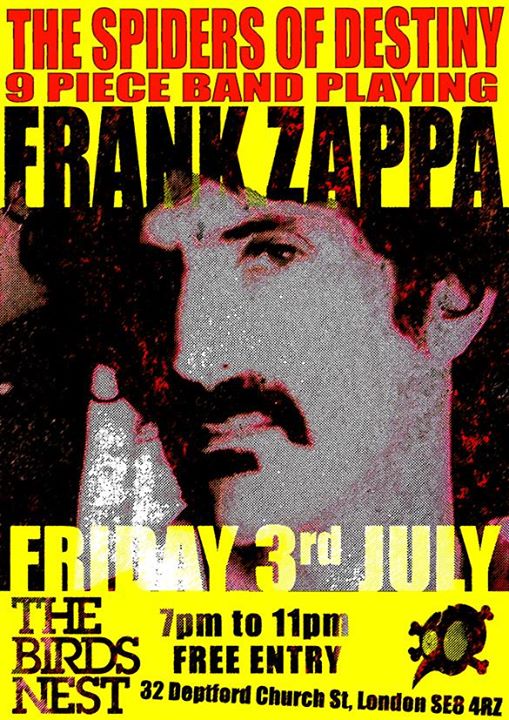
If you’d rather spend a free evening with Uncle Frank, The Spiders of Destiny are playing another London gig of Zappa music on the same day. As ever, expect some of London’s most accomplished art-rockers to work their way back and forth through the Zappa catalogue. The Deptford venue they’re playing this time has plenty of history, whether under its current name, its old monicker of The Oxford Arms or any other title it’s enjoyed over several hundred years. If you don’t spot Frank’s ghost leaning on the sound desk and having an appreciative smoke, you could try looking out for the ghosts of Dire Straits or Christopher Marlowe instead… Up-to-date details here or here, with two-as-yet unnamed bands to be added to the bill.

The Spiders of Destiny (The Birds Nest, 32 Deptford Church Street, London, SE8 4RZ, Friday 3rd July 2015 – 7.30pm, free)

The Spiders of Destiny play Zappa, The Birds Nest, July 5th 2015

********

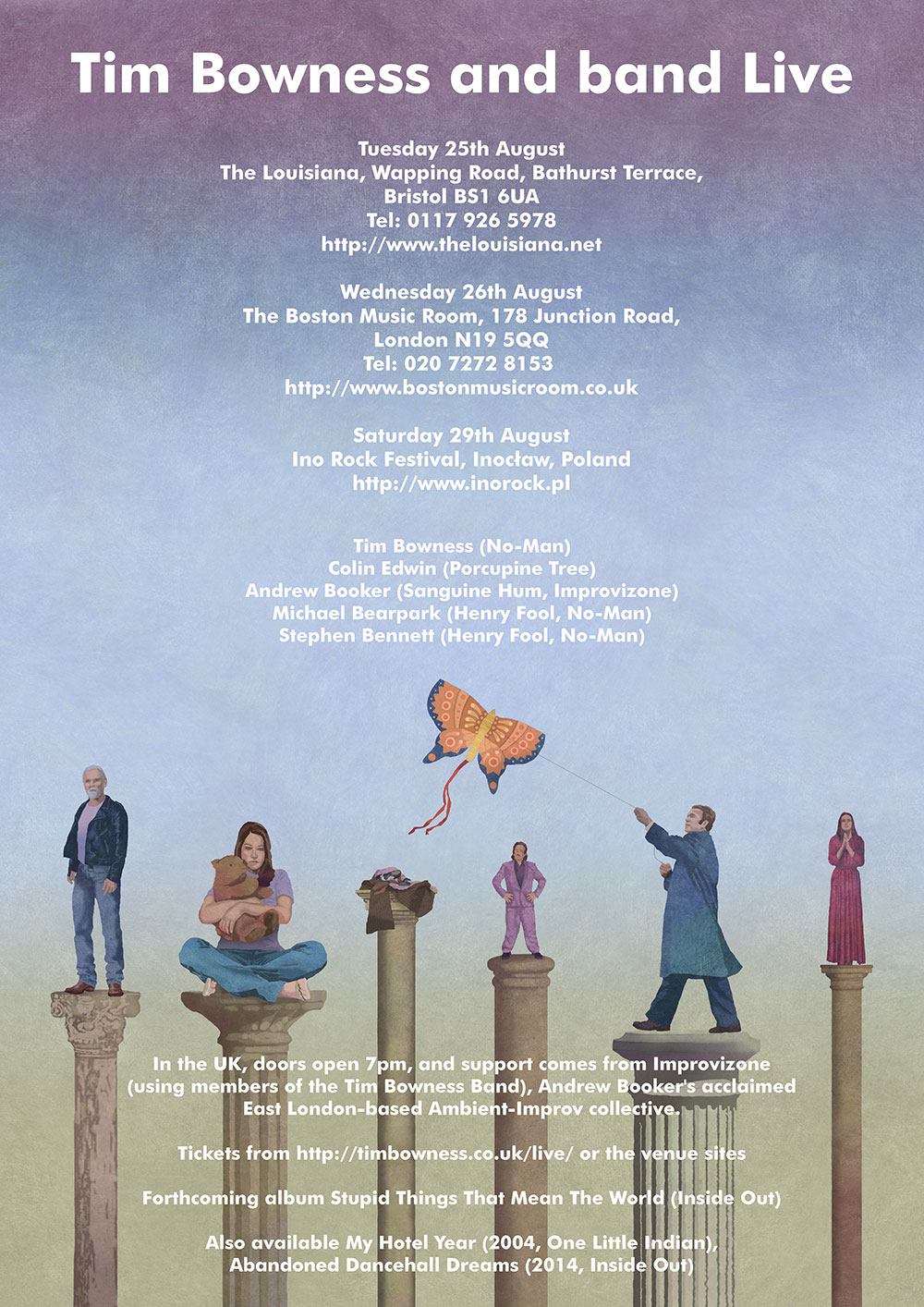
Tim Bowness live flyer, August 2015Looking further ahead, Tim Bowness is out on a very brief tour in August, playing a handful of dates in England and Poland to promote his imminent album ‘Stupid Things That Mean The World’ as mentioned last month. His band features his usual cohorts of Andrew Booker (drums – also of Sanguine Hum), Michael Bearpark (guitar – Darkroom, Henry Fool), Stephen Bennett (keyboards – Henry Fool) and the more recent recruit Colin Edwin (bass guitar – Porcupine Tree).

The Lousiana, Wapping Road, Bathurst Terrace, Bristol, BS1 6UA, UK, Tuesday 25th August, 7.00pm – tickets here and here.

The Boston Music Room, 178 Junction Road, London, N19 5QQ, UK, Wednesday 26th August, 7.00pm – £17.00 – tickets here and here.

Ino Rock Festival, Theatre Letni, Inoclaw, Poland, Saturday 29th August – 35.94 euros – tickets here (other acts at the festival are Fish, Motorpsycho, State Urge and Millenium).

Playing support at the Bristol and London gigs will be Improvizone, the flexible live-ambient improvising collective led by Bowness band drummer Andrew Booker. The rest of the Improvizone lineup looks as if it will be drawn from the current Bowness band (Michael Bearpark is a frequent Improvizoner) so perhaps you should expect the same band playing in two very different configurations. Up-to-date news will be here.

*****

Levitation: 'Meanwhile Gardens' (2015 issue)

Levitation: ‘Meanwhile Gardens’ (2015 issue)

Another follow-up from last month – there’s now a release date from Flashback Records for the lost Levitation album ‘Meanwhile Gardens’. Mark Burgess of Flashback posted the following on the Facebook fan page for the band’s lost recordings yesterday:

There is at last a provisional release date for ‘Meanwhile Gardens’. 23rd October 2015! Pre-orders will be available in due course from the Bandcamp site and elsewhere. The album is now with the pressing plant, but the lead time on the vinyl is long (pressing plants are straining under the pressure of so much vinyl at the moment, hence the provisional nature of the release date). You should all give yourselves a pat on the back and raise a toast to this group because without this page it might never have happened. Thank you all for your enthusiastic support!

Levitation, circa 1992

June 2015 – upcoming London gigs on 26th June – Bing Selfish & The Windsors/Andrew Ford/élan/Ragmatic play Club Integral @ The Others; The Many Few/Purple Implosion/Halcyon Days play the Dublin Castle

20 Jun

Usually I’ve got pin-sharp memories of where and when I saw a band play. The one occasion when I saw The Kenny Process Team is an exception. I’ve got next to nothing. A scruffy black cube of a room somewhere, with guitar leads and primary-colours gaffa on the floor; a small-kit drummer ticking away with a pair of bisected sticks. A guitarist and bass player sit on amplifiers or boxes, playing with the whiskery, matter-of-fact precision of master joiners shaping their umpteenth wooden cabinet. A second guitarist stands off to one side, with a flowing sheaf of dreadlocks. The lone black guy in an otherwise white quartet, he almost looks as if he’s been teleported in from a reggae backline but his eyes, wary and committed, tell a different story. Clearly engrossed in the music, he plays blunt, abbreviated questioning lines against the rolling machinery of his bandmates; their mixture of Fifties-twang and conversational Fred Frith art-rock arpeggios, of lean spare proggy lines a-tilt on the wave tube.

As regards the rest of it, I remember nothing. Not the stairs up or down to the venue, nor where it was. “Somewhere in London” is the best I can do. Otherwise, this little memory exists in a cell of its own – a room floating in a void, a space that existed purely as a setting for the music. I certainly wasn’t drunk, nor under the influence of anything stronger than a semiquaver. I may well have been slightly hypnotised by the Team’s cramped fluidity, the crystallising complexities jagging up from simple bases. Bar a single, rare record, the band themselves have sometimes seemed to have vanished down a black hole. Even the web only offers the smallest scraps on them. While I only encountered them once, they apparently played together for eighteen years. Perpetually on the sidelines? Deliberate masters of self-effacement, only really coalescing for gigs?

Seeing a different iteration of The Kenny Process Team pop up around a decade later for a Club Integral gig, therefore, is quite surprising, although everyone concerned has probably been hiding in plain sight. I guess that they won’t have been the invisible band to everyone (and, in particular, not the more knowledgeable people who are likely to make up a Club Integral audience) – but if, like me, you remember the Team as an oblique one-night encounter which snagged in your memory, here’s an opportunity to catch up.

Blurb follows…

Club Integral presents “A Thousand Butterfly Skeletons” featuring Bing Selfish & The Windsors, élan, Andrew Ford and Ragmatic (The Others, 6-8 Manor Road, Stoke Newington, London, N16 5SA, UK, Friday 26th June, 8.00 pm – price £5.00/£3.00 concession)

In an exciting one-off performance, fabled DIY pioneer and visionary misanthrope Bing Selfish is joined by micro-lounge minimalist rock quartet The Windsors. From the early eighties Bing Selfish has followed his own unique path, assisted on the journey by a plethora of maverick musicians from Jim Whelton, Rob Storey, through to Bill Gilonis and Chris Cornetto. Drawing from the well of European avant-garde sensibility, from the Symbolists to the Situationists, coupled with relentless punning and sardonic rhyming, Bing has built his own parallel world, defiantly in opposition to 21st century neo-conservative capitalism, and mainstream musical consurism. Many magazines, records, radio shows and films later he still stands upon the stage, and he’s still seriously pissed off. Chris Cutler has described him as “a phenomenon in the galaxy of songsters today” while ‘The Wire’ has hailed him as “an intuitively sharp lyricist with few peers.” More pungently, Options USA has imagined his character as “a self-pitying drunk, a self-loathing homosexual, a bitter poli-sci professor, or all of the above.”

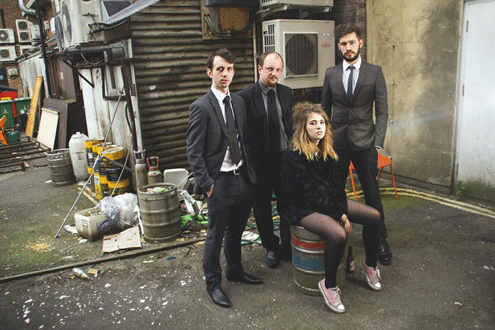
The Windsors rose from the ashes of the legendary Kenny Process Team, described by Eugene Chadbourne as “forward-looking electric guitar music with a rock base, (stylistically) somewhere between the precision control of surf rock groups such as the Ventures and the almost classical compositions Captain Beefheart.” The new group (Simon King – guitar, Tom Murrow – drums, Matthew Armstrong – bass, and Phil Bartai – keyboards) play intricate, driving instrumentals composed by Kevin Plummer with the band. This is a one-off chance to hear them apply their genius for deftness, intricacy and dynamic arrangement to the anarchic poesy of Bing’s song catalogue.

élan is the kosmische muzik side-project of Dave Tucker (The Fall, London Improvisers Orchestra, Charm School) and friends. He is joined by Matt Chiltern (Spork) on bass, and Ed Lush (Test Dept. Spork) on drums and percussion. Expect krautrock.

Ragamatic is Reiner Heidhorn, a sitar-and-electronics musician from Weilheim in Germany. The music is a result of Reiner’s many years studying classical Hindustani music whilst simultaneously making electronic music. With an emphasis on ragas from northern India, played in the style of master sitar player Vilyat Khan, Reiner locates the natural meeting point between Indian classical music and contemporary electronics.”
Projections by Rudapinka, aka Inga Tillere.

Andrew Ford is also playing – details to be circulated later.

More information on the concert and on other Club Integral events is here.

If you’d prefer something a little more straightahead, then another option is to catch The Many Few playing on the same night, promising to “edify and exultate your earballs and eyedrums with our own original guitar-drum-and-vocal shenanigans… on an optimistically lovely Friday Juneful night coming soon, in the company of assorted fellow groovesters.”

(Headliners t.b.c.) + Purple Implosion + The Many Few + Halcyon Days (Bugbear @ The Dublin Castle, 94 Parkway, NW1 7AN, London, UK, Friday 26th June, 7.30pm – £7.00/£5.00)

I covered some early Many Few demos some years ago, offering assorted comments and insults on their witty, slightly wonky songcraft which the band still seems to remember with affection. As for other descriptions, Bugbear settles for “kitchen-sink lo-fi indie-pop with female/male harmonies and vocal sharings over some Smiths meets McCarthy C86 type backing. Some interesting twists and turns. A bit of The Monochrome Set, something of Yeah Yeah No and stuff like that.” (The Bugbears go on to quote a bit of the ‘Misfit City’ review a bit later on – or, rather, misquote it. It’s a bittersweet world, writing about indie-pop.)

Also on the bill are Halcyon Days (“hooky electro-pop with a nod to 80’s pop but with an electro interface more akin to New Order off-shoot Electronica”) and Purple Implosion (“another great band mixing spiky post-punking punk-funk with counter-cultural garage-birthed rock’n’roll featuring out-there frontman antics.. but always pretty damn danceable.”) In addition, there’s also an unconfirmed headline act. Probably Kate Bush again, or perhaps The Sonic Jewels. You’ll just have to go along and hope, I suppose.

More information here and tickets here.

June 2015 – some videos – Tim Bowness, William D. Drake, Thumpermonkey

2 Jun

A few videos to pass the time.

Firstly, here’s the newest video from Tim Bowness, promoting the lead single from next month’s ‘Stupid Things That Mean The World’ album. The Great Electric Teenage Dream features a cut’n’paste scratch effort built up from fragments from the Prelinger archive.

While I’m limbering up for a big William D. Drake catchup (reviews of this month’s ‘Revere Reach’ album and its predecessor ‘The Rising Of The Lights’), here’s the uproarious Chaos Engineers video from the former’s lead single. ‘Distant Buzzing’ features appearances, on- or off-video, from assorted Drake associates – the Larcombe Brothers (from Stars In Battledress), Dug Parker (from North Sea Radio Orchestra), Stuffy Gilchrist and many others…including a certain sordid, waxy tyrant from the 1980s. And a donkey.

Finally, do you ever hear anyone complaining bitterly that all of the artistry has gone out of rock vocals? If so, play them this video of Thumpermonkey‘s Woody recording voicework for the band’s upcoming album, and watch a grin breaking like sunrise across their face. (I don’t cover Thumpermonkey enough in this blog. That’s going to change.)

June 2015 – upcoming London gigs – A Formal Horse & Ham Legion; Olga Stezhko; The Spiders of Destiny play Frank Zappa; a Bowie Night in Soho

29 May

Here’s some quick info on upcoming gigs in early June which I’ve heard about – all of them in London.

Over the last couple of years, Westminster Kingsway College has established itself as one of the capital’s finest homes for quirky art-rock – by which I don’t mean student hobby bands thrown together for campness or for ironic prankery, but a rich, complex, committed electric music spanning the range between gutter-punk and flouncing prog via metal, jazz, folk, avant-gardening and anything else which gets melted down into the stew. Here’s one of those gigs that proves the point.

A Formal Horse, 2015

A Formal Horse + Ham Legion (Westminster Kingsway College, 211 Gray’s Inn Road, London, WC1X 8RA, Tuesday 2nd June, 6.30pm)

A Formal Horse is a new progressive rock quartet based in Southampton. Although the band’s sound is difficult to pinpoint, their dense instrumental passages are reminiscent of King Crimson and Mahavishnu Orchestra, whilst Francesca Lewis’ lead vocals evoke the whimsical surrealism of the 1970s’ Canterbury scene. Wonky melodies and serene vocals over a brutal sound – their music keeps you on your toes. However, A Formal Horse go beyond simply regurgitating the music of their predecessors. With influences as diverse as Bartók and Bon Iver, the band prove that there is still much territory to be explored in the field of British progressive rock.

In June 2014, the band released their debut EP, which was recorded by Rob Aubrey (IQ, Transatlantic). They went on to perform at London’s Resonance Weekend alongside Bigelf and Änglagård, and were described by Prog Magazine as a “festival highpoint”. Since, they have shared stages with Knifeworld and Lifesigns, cementing their position at the forefront of the British progressive scene.

Ham Legion spent 2014 honing their sound and developing a storming live show. You can expect a collision of beaming up beat power pop, grinding metal outbursts, dramatic changes of mood, sudden passages of twistingly epic prog then moments of restrained delivery and somber reflection. They are striking out in 2015 with the release of their debut album towards the end of the year.

Tickets available here – £6.00/£5.00

Olga Stezkho: 'Eta Carinae'

Olga Stezkho: ‘Eta Carinae’

Olga Stezhko (the far-thinking Belarusian classical pianist whose ‘Eta Carina’ album impressed me so much last year) has two London concerts coming up in the first fortnight of the month. The second’s likely to be an all-access crowd-pleaser. Given its charity fundraiser status, I’m not sure whether the first is likely to feature or indulge any of Olga’s intriguing conceptual preoccupations with Scriabin, Busoni, cosmology and early twentieth century consciousness, but even if it isn’t it’s a great opportunity to see a fine musician at work in a grand location.

Olga Stezhko charity piano recital in aid of Friends of the Belarusian Children’s Hospice (St Pancras Parish Church, Euston, London NW1 2BA, Thursday 4th June, 1:15pm – 2:00pm)

Programme not revealed – free admission, donations requested.

EC4 Music in aid of The Prince’s Trust (Barbican Hall, Tuesday 9th June, 7:30pm – 9:30pm)

The choir and orchestra of London-based EC4 Music return for their seventh fundraising concert in aid of The Prince’s Trust with a stirring selection of music from both sides of the Atlantic.

Programme:

Leonard Bernstein – Overture from ‘Candide’
Aaron Copland – Appalachian Spring
George Gershwin – Rhapsody in Blue
Vaughan Williams – Serenade to Music
Leonard Bernstein – Chichester Psalms
Eric Whitacre – Water Night
Hubert Parry – Blest Pair of Sirens

Performers:

EC4 Music Choir and Orchestra
Tim Crosley – conductor
Olga Stezhko – piano
Claire Seaton – soprano
Roderick Morris – countertenor
Thomas Herford – tenor
Adam Green – baritone

Tickets available here – prices from £10.00 – £35.00 plus booking fee.

Some of London’s most active art-rockers are brewing up a free Zappa homage in Croydon at around the same time. Details below:

event-20150606spidersplayza
The Spiders of Destiny play Frank Zappa (The Oval Tavern, 131 Oval Road, Croydon, CR0 6BR, Saturday 6th June, 8:30pm)

Great googly moogly! On June 6th, nine-piece tribute band Spiders Of Destiny come to The Oval Tavern to play a marathon set of music by the late, great Frank Zappa. Featuring world class performers with a sense of humour from notable prog/alternative bands such as: Knifeworld, Perhaps Contraption, Pigshackle, Medieval Baebes, The Display Team, Hot Head Show, Poino, Spiritwo, First, A Sweet Niche and more. So polish up your zircon-encrusted tweezers, trim your poodle, learn the mudshark dance and join us as we propagate the conceptual continuity instigated by one of the masters of modern music.

More info here – this gig is FREE ENTRY but there will be a donations jug doing the rounds during the intermission.

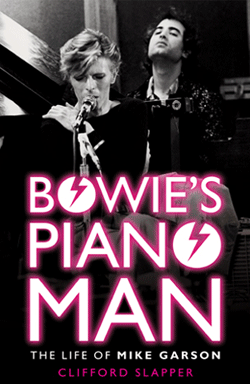
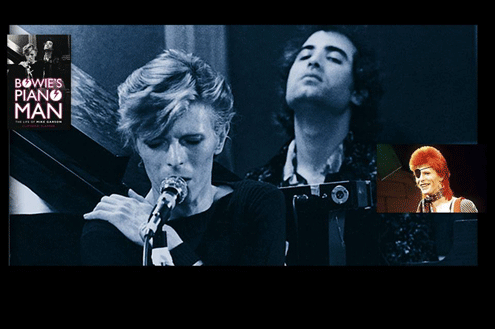
book-bowiespianomanAnyone with an interest in David Bowie, rock history, cabaret, electropop and all of the other things that get swept up into Bowie’s art should head to Soho on Thursday 11th June for A Bowie Night at Gerry’s Club, at which pianist and writer Clifford Slapper launches his book ‘Bowie’s Piano Man: The Life of Mike Garson‘ (which also has its own Facebook page).

As well as readings and signings there will be performances of Bowie songs from avowed fans Danie Cox (from “flock-rockers” The Featherz), Ray Burmiston (of ’80s heroes Passion Puppets), club siren Katherine Ellis (Freemasons, Ruff Driverz, Bimbo Jones etc.) and acoustic singer Jorge Vadio. There’ll also be a performance from a longtime ‘Misfit City’ favourite – London balladeer, Brel translator and onetime ‘Pirate Jenny’s’ host Des de Moor, who’ll presumably be singing his Bowie-gone-chanson interpretations from his ‘Darkness and Disgrace’ show. (I’m particularly pleased to see that Des is back onstage. It’s been a long time.)

More on the book below, and more on Gerry’s Club here.

“It is pointless to talk about his ability as a pianist. He is exceptional. However, there are very, very few musicians, let alone pianists, who naturally understand the movement and free thinking necessary to hurl themselves into experimental or traditional areas of music, sometimes, ironically, at the same time. Mike does this with such enthusiasm that it makes my heart glad just to be in the same room with him.” – David Bowie

Mike Garson has played piano on sixteen David Bowie albums, including Aladdin Sane, with his celebrated piano solo on its title track, Diamond Dogs, Young Americans, 1. Outside and Reality. He has also played live with Bowie on countless tours and shows, and remains his most long-standing and frequent band member.

For some time Clifford Slapper has been working very closely with Garson to write a book which explores the life of this extraordinary and eccentric modern musician. It documents in detail how as a pianist he was catapulted overnight from the obscure world of New York’s avant-garde jazz scene to a close and long connection with Bowie. In addition, Garson is recognised as a classical virtuoso, a jazz master and one of the world’s greatest exponents of improvisation. He has also recorded and performed live with other rock legends such as the Smashing Pumpkins and Nine Inch Nails. All of this is covered by this first ever biography of Mike Garson.

Its starting point was several days of in-depth and frank conversation with Garson himself, and covers a wide range of themes which will be of interest to all Bowie fans, but also to anyone with a passion for music, social history or the process of creative inspiration. Input has also come from many interviews with those who have worked with him over the years, including Earl Slick, Trent Reznor, Sterling Campbell, Reeves Gabrels, Dave Liebman and many others.

event-20150611bowienight

May 2015 – End-of-May gigs (mostly London) – Bank Holiday weekenders from Daylight Music and SmileAcoustic; a mixed-classical benefit for Nepal; Knifeworld again; fun and frolics underneath the arches with John Ellis and co.

22 May

Just because I’m likely to be stuck indoors for the next fortnight doesn’t mean that you have to be. Some interesting gigs are coming up in – mostly in London, I’m afraid – but just in case any of you are London-based, here are some ideas to see you through until June.

First of all, there are two free Daylight Music events over the weekend. Running eclectic free gigs that span from cosy to experimental, and from classical to folk to noise-pop, Daylight Music have been a Misfit City favourite for a long time. See here for reviews of previous events in September and October 2013 and in January 2014; and see below for details on the upcoming concerts…

Join us for a weekend of music with artist travelling from Los Angeles, Wales and Spain to dazzle you. And while you’re reading this, have a listen to a special mix by Ex-Easter Island Head.

Daylight Music 190: Winter Villains + Poppy Ackroyd + Jon DeRosa (Union Chapel – Saturday 23rd May, midday to 2pm)

The new Spring Season kicks off with a name to watch; Poppy Ackroyd is a classically trained pianist and violinist who weaves delicate, atmosphere music by manipulating and multi-tracking sounds from just those two instruments. On the same week, you can hear Cardiff’s Winter Villains and their intricate chamber pop music (the duo were nominated for the Welsh Music Prize in 2013) and Jon DeRosa from the USA, whose new album ‘Black Halo’ is out via Rocket Girl on 25 May. Hannah Lawrence plays some usual and some unusual melodies on the Henry Willis organ in between this week. Full details here.

Colleen with Ex-Easter Island Head (LSO St Luke’s – Sunday 24th May 7.30pm)

A double bill of musicians renowned for manipulating your expectations as much as they do their instruments; creating hypnotic minimalist music from simple arrays of strings, percussion and even just vocals. Colleen mixes acoustic instruments with electronic sampling techniques to create rhythmic, lyrical folk-pop songs. Her new album Captain of None will focus on a melodic repertoire, with fast-paced tracks rooted by prominent bass lines and her instruments of choice, the treble viola da gamba and her voice. Liverpool-based Ex-Easter Island Head turn the electric guitar on its head, to compose physical, droning soundscapes.

Next up, on Bank Holiday Monday there’s an afternoon-and-evening free concert in Bethnal Green, promoted by unplugged specialists Smile Acoustic (who are new to me, but seem very welcoming). Far too many different acts to summarize quickly – although I do recognise Matt Finucane, who first came to my attention doing anti-pop with Empty Vessels years ago and who’s now matured (though he probably wouldn’t use the word) into a sinister songwriter and a horror/science fiction writer. Read on…

SmileAcoustic: Tasting Menu Bank Holiday Special (Rich Mix – Monday 25th May, 4pm onwards)

Smile Acoustic has been making many friends, and all our friends seem to make great music… so we thought it high time for a get together. An extra long weekend requires extra entertainment after all! So we present a feast of flavours, in our first ever Tasting Menu. Full information here.

4pm – Prash Gor, Kirsten McClure, Lauren Lucille, Matt Finucane, Dave Santos, Gian Luca, Mark Harrison, Jeremy of The Green Rock River Band, Horatio James

7pm – Bellatrix, Camilo Menjura, Arthur Lea

Yes we’re cramming in a ridiculous amount of talent into an additional late afternoon show, as well as our usual evening gig. An incredible array of original songsters will be gracing the stage, with a line up that takes us all the way from banjo to beatbox. Free entry as ever, as is the cake. See you there!

On Friday 29th May, in west London, UK Music for Nepal are putting on a classical music benefit aiming to raise ten thousand pounds for the victims of the earthquake. It’s mostly performances of Romantic and Baroque work (by Chopin, Rachmaninoff, Brahms, Bach, Liszt and Fauré), but with a few outbreaks of early twentieth century modernism via some Scriabin pieces, plus a world premiere of a new piano work by composer Keith Burstein (a onetime Romantic Futurist and still an ongoing champion of latterday tonal music – see here for a long-ago review of his first String Quartet). It’s also got a striking array of performance talent – see below…

Gala Concert for Nepal @ St Barnabas Church, Ealing, May 29th 2015
Gala Concert for Nepal (St Barnabas Church, Ealing, London, Friday 29th May, 7.30pm)

Programme:

Johann Sebastian Bach – Chorale Prelude “Nun Komm die Heiden Heiland” BMV 659
Frédéric Chopin – Polonaise-fantaisie in A flat major, Op.61
Gabriel Fauré – Sicilienne, Op.78
Gabriel Fauré – Élégie, Op.24
Aleksandr Scriabin – Etude in D# minor Op.8 No12
Aleksandr Scriabin – Nocturne for Left Hand
Sergei Rachmaninov – Cello Sonata in G minor, Op.19
Franz Liszt – Consolations, S.172
Sergei Rachmaninov – Prelude in G minor Op. 23 No. 5
Johannes Brahms – Variations on a theme by Paganini (Book 1)
(and a world premiere by composer Keith Burstein)

Performers:

Alicja Fiderkiewicz, Carlo Grante, Artur Pizarro, Murray McLachlan, Viv McLean, Nico de Villiers, Keith Burstein – piano
Corinne Morris – cello

Tickets available here – prices from £20.00 to £50.00.

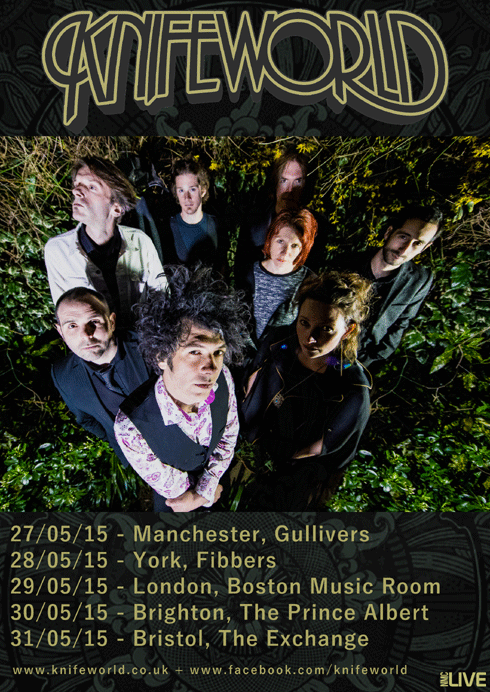
Also on Friday 29th May there’s the latest London gig by Knifeworld, part of a five-date English tour also taking in Manchester, York, Bristol and Brighton (as mentioned a few posts back). Expect an evening of explosive, tuneful and corrugated art rock played with the vigour of a soul revue and the complexities of a ’70s prog band. For the York gig, they’re supported by motorik rockers Muttley Crew and for the London gig by bounding art-rockers Barringtone (ex-Clor) and Cesarians. The Brighton gig is a Tim Smith benefit gig at which they’re supported by prog-poppers Ham Legion, the mysterious M U M M Y (a brand new project by Cardiacs affiliates Jo Spratley and Bic Hayes) and self-styled bitter and twisted songwriter Stephen Evens (who says of himself that “the songs are beautiful and the words are horrible. I don’t know why you don’t think that’s a good thing…”).

Knifeworld on tour, May 2015

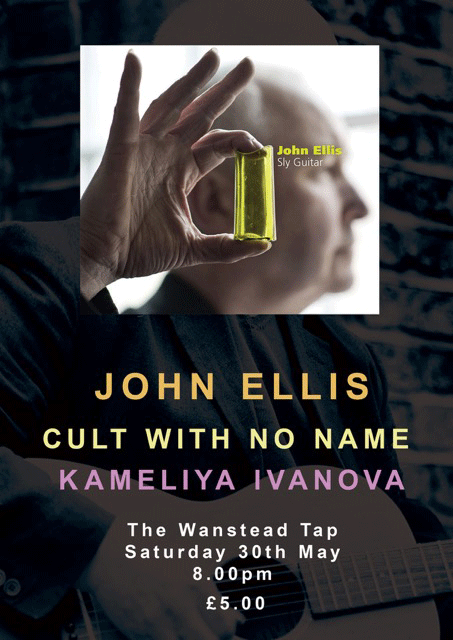
Finally, on Saturday 30th May at 8pm there’s what’s billed as “a night of fun and frolics” at the Wanstead Tap (a craft beer shop in Forest Gate which doubles – or quadruples – as café, bar and performance space). The main attraction is John Ellis (the former Peter Hammill, Stranglers and Peter Gabriel guitarist whom ‘Misfit City’ last encountered via his ‘Sly Guitar‘ album). John’s solo gigs are rare, but he’s something of a master of post-punk art-rock guitar, so well worth seeing. Also on the bill are “post-punk electronic balladeers” Cult With No Name and Kamelia Ivanova (who’s either highly mysterious or needs to fix his or her Facebook page). See below for the flyer.

John Ellis concert @ The Wanstead Tap, 30th May 2015

May 2014 – through the feed – Johnny Parry Orchestra, Matt Stevens: new and new-ish albums

19 May

I keep a regular eye on the ‘Organ’ blog. In the good old, grim old days of print, paste, photocopy and crude HTML, ‘Organ’ was a big inspiration for ‘Misfit City’. While there’s been a lot of turbulent water under the bridge since then, and though Sean Worrall – he who is ‘Organ’ – claims his days of animated gonzo reviewing are long past, the current blog is still a great source of news and rapid-fire information/reaction regarding music, the London art scene, occasional politics and whatever other related thoughts are passing through Sean’s head. Some time (when I’m feeling even more solipsistic than usual) I might write some more about ‘Organ’ and ‘Misfit City’ and the 1990s, although I suspect that few people can pronounce better on Sean and his singular range of experiences than he can himself. (I’m hoping that he writes a proper memoir one of these days.)

Right now, here’s something I picked up from ‘Organ’ late last week and am sharing now: it triggers a different kind of nostalgia.

Johnny Parry Orchestra: 'An Anthology Of All Things'

Johnny Parry Orchestra: ‘An Anthology Of All Things’

Today, the Johnny Parry Orchestra release their second album ‘An Anthology Of All Things’. I first became aware of Johnny in 2002 when, as a solo act, he sent his debut album ‘Break Your Little Heart’ to the original incarnation of ‘Misfit City’. At the time ‘Misfit City’ was going down with all hands (ie, me) and so despite all best intentions and protestations, the album just sat on my shelf. I think it’s still there. I owe it to Johnny to revisit it properly sometime.

Fortunately (for my conscience, anyway), being neglected by me hasn’t hurt Johnny in the slightest. In the intervening twelve years he’s continued to work on and release music from his base in Bedford, steadily building himself up from solo dream-popster to trio leader, then becoming a small-ensemble boss and eventually expanding to the role of orchestral maestro. Now moving with assurance within the world of substantial arts grants, community music and event concerts, the latter-day Johnny Parry composes, arranges and conducts on a large scale and has worked with musical names as diverse as Talvin Singh, Michael Nyman, Seb Rochford and Beth Orton as well as Turner Prize-winning artist Martin Creed. Not bad for someone whom in 2002 was wandering Toronto amidst the wreckage of a record contract, seeking solace and inspiration from the city’s buskers. If life handed him a lemon, he certainly went on to grow lemon groves.

‘An Anthology Of All Things’ is Johnny’s second orchestral/choral album – funded by Bedford Creative Arts, it features (in addition to the JPO) the Bedford Arts Choir and soprano Donna Lennard. Already gaining comparisons to Benjamin Britten – albeit a Britten with a strong pop leaning – it’s very much community-shaped, with Johnny drawing his settable texts from lyrics donated (consciously or otherwise) by the Bedford public. The video excerpts below should demonstrate how this works. The first of these (for the sixth movement) is the result of Johnny soliciting and assembling original romantic testaments from friends, including couples, about their own feelings:

The second video is for the fifth movement, which gleans its text from the dedications on park benches in and around Bedford:

Some of the remaining movements are inspired by reflections on Bedford historical figures and childhood heroes, plus the town’s memories of the Second World War: others draw on more general or abstracted themes such as the human body, the elements of narrative, the components of travel and “youthful boundary defiance”. Here are a few more snippings from the press release:

“A captivating small town experience that has a far wider resonance… magnificent, masterful and sweepingly heart-warming, and performs a velvety emotional cut and paste approach. It dares to be huge and expansive but retains a deeply personal core which carries the intimate, often evocative thoughts and statements that are at times uncomfortable, innocent, whimsical and on occasions playfully risqué.”

The album can be ordered directly from here (though you’ll need to use PayPal)

While I’m beating myself up a little for not keeping up with obligations, here’s something from someone else whose work I need to keep up with more regularly. Matt Stevens is no stranger to ‘Misfit City’ – see this review of him threshing up a lively storm at Roastfest a few years ago with just an acoustic guitar, loops, a pedalboard and plenty of bearish enthusiasm. Likewise, there are a couple of reviews of his early work with the collaborative band The Fierce & The Dead (here and here), an outfit which has grown from a trio of interesting polystylistic rock dabblers into a roaring garage-prog quartet with a shaggy, behemoth sound to it.

Matt Stevens: 'Lucid'

Matt Stevens: ‘Lucid’

First and foremost, though, Matt is a ceaselessly enthusiastic solo artist, and in March he released his fourth solo album ‘Lucid’. Compared to his earlier solo work, it’s more of a band record, predominantly based around Matt’s friends and contemporaries in British art-rock (Stuart Marshall from The Fierce & The Dead and Charlie Cawood from Knifeworld are the rhythm section for most of the record, while sundry other Fiercies, Knifeworlders, Trojan Horses, Guapo-sians and Chrome Hoofers also make a showing – hello Emmett Elvin, Nick Duke and Kev Feazey). However, it also draws from latterday prog via Jem Godfrey (of Frost*), dark ambience from Helicopter Quartet‘s violinist Chrissie Caulfield, and cosmic jazz in the shape of Lorenzo Feliciati of Naked Truth, who may or may not be responsible for the presence on the album of his NT bandmate Pat Mastelloto, the increasingly ubiquitous and inventive King Crimson drummer who’s become something of a touchstone for art-rock crossovers. (Mysterious vibraphone player Jon Hart is also on board but, as always, wherever he’s coming from is anyone’s guess.)

Matt himself describes ‘Lucid’ as:

“a significant step up from the previous albums. It’s inspired by a bit of a dark time, but hopefully it’s an uplifting record… all the players really were outstanding. It’s a record that reflects my love of Jesu and Celtic Frost as much as the Mahavishnu Orchestra and King Crimson or even Peter Gabriel and I’m really proud of it. If you’re not going to take risks and try and do something interesting what’s the point?”

The preview video below (which has been out for a few months now) should give you some idea of what Matt’s aiming for. If you like what you hear, the album’s out on Esoteric Antenna Records and you can get it either from Burning Shed or Cherry Red.

Johnny Parry online:
Homepage Facebook Twitter YouTube

Matt Stevens online:
Homepage Facebook Twitter MySpace Bandcamp LastFM YouTube

February 2012 – EP reviews – British Theatre’s ‘EP’ (“a fresh start, but some old pains linger”)

28 Feb

British Theatre: 'EP'

British Theatre: ‘EP’


All rock bands potentially contain storms. Oceansize were one of the few who genuinely sounded as if they did. For twelve years and four albums, the Manchester quintet careened along just at the underside of a breakthrough. They crafted a complex, roaring and passionate music, which took no prisoners but captured plenty of imagination. While they were around, they barrelled the psychedelic back into heavy metal, the dirt back into prog and the starscapes back into grunge. Perhaps it’s not such a surprise that in 2011 they finally (violently, and without explanation) blew themselves out – like a blazing oil-rig, suddenly snuffed.

Maybe we shouldn’t shed too many tears for Oceansize, even though it was a shame to lose them. Sometimes a situation just comes to an end. Sometimes all of that volatile fuel just runs out, and you’re left with dead, falling machinery. Everyone involved has maintained a taut, wounded silence since the split: but now there’s British Theatre, made up of two former Oceansizers: Richard “Gambler” Ingrams and the band’s battered cherub of a frontman, Mike Vennart. Once wrapped inside a romantic name that made you think of heavy mechanisms or naked storms, they’re now hiding behind a monicker that spins off only confusing signals. A rarified, slightly stuffy textbook? A drawing-room comedy? Kitchen-sink bitterness?

More important is what the music contains, and what the changes have churned up. There are strong strands joining British Theatre’s music to what came before with Oceansize. There’s the crooning bawl of Mike’s voice, for one – a perpetually skinned innocence rising to a pitch of blasted, despairing resistance. Having a tormented side comes as standard for the children of grunge: and British Theatre have carried Oceansize’s moody habits along with them. There’s also the flexible guitars (a mass of tones and liquescent washes) and the interest in long, shape-shifting song structures and their connection to expressiveness. The EP’s closing instrumental – Little Death #3 (6th Gen Degrade) – isn’t far off the wordless romantic-industrial pieces which used to complete Oceansize EPs: winding like a bashed-up river though the remains of a factory district. If Manchester were ever pummelled into the ground, this is what the aftermath might sound like – the sound swallowed up in a cocoon, gentle noises of sifting rubble and Mike’s crumpled guitar nosing in on the breeze, delivering misshapen bluesy asides.

What’s changed is working method. Even before Oceansize fissioned, Gambler had been making a separate name for himself as a solo keyboard player and electronica artist. With Mike now also an enthusiastic convert (both men play “everything” in the new band), British Theatre take on a far more electronic approach, abandoning the metallic live-band contortions of Oceansize to take tips from laptop culture and dubstep, pasting and transparentizing layers of shaped instrumentation and sound effects, plunging deeper into the post-rock melt.

ID Parade On Ice sets up what’s different now. Overlapping electronic polyrhythms, twinkling synth patterns, ghostly floating twinkles of piano flown in from distant rooms. Draughty guitar hums smudge into ominous yellow-wallpaper textures. Lopsided creaking sounds stalk through the music (part untended door, part straining hull) as do bony typewriter clacks and clinks of wire: the harp-trembling of guitar harmonics recall John Fahey. The brutal disaffection of the song, however, is pure Oceansize; as is Mike’s yearning scar of vocal and the bursting choruses.

This may be a fresh start but some old pains linger, whether Mike’s still licking wounds from the split, acting out a teeth-baring Vennart snarl at paymasters or even taking a swipe at the controlling appetite of an audience: “Sit down, be the tormenter – make all of us dance / to songs cynical in tone… / Insist this is a cold magisterial charade, / a pornographic paid display… / Well, I’m glad to fake it for our sake.” Certainly the dark undercurrent of violence, desperation and disgust that seeped through Oceansize songs is still present, as Mike mutters “our engine’s thriving on ketamine and mogadon, / cut ear to ear, cut ear to ear. / Our engine’s thriving on violence and bleeding tongues – / let’s bite away, let’s bite our way out,” while riding a winding snare of melody across a landscape of shifting keyboard smears and stretched beats.

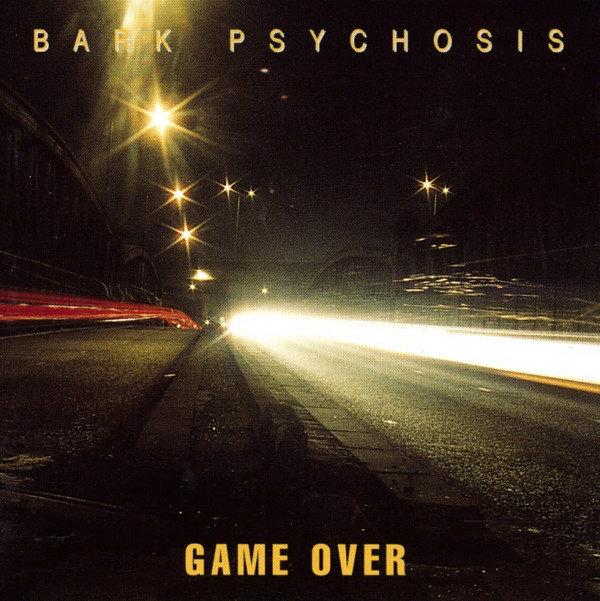
While with Oceansize, Mike and Gambler often seemed to be merging the beefiness of Pearl Jam with the ambitious structures and songwriting of new-prog. With British Theatre, they’re as likely to sound like a grunged-up Talk Talk with pattering dance-loops and restless, frowning tattoos. Gold Bruise, a broodingly lovely ballad with ghostly siren sustain, mouthpiece buzz and Rhodes piano touches floating above a subtle dubstep pulse, shows how far they’ve travelled. It echoes the weightless cocooned take on urban melancholia which Bark Psychosis mined in the mid-’90s for ‘Hex’; but the lovely folk melody threading through it (sung by Mike in a heartbreaking murmur) recalls something far older.

So does the subject matter – archetypal flaming youth and violent life, wound down to its fatal conclusion, only seen and mourned from the outside. Mike’s sung words, spacey and elusive, wreath the story in flashes and outcrops, transforming grit into mythology: “The boy that shot the bullet, decked in yellow gold; / pulled out of the river, angel’s hair for rope.” Despite the beautiful flares of lyrical colour, there’s little doubt that this is a mourning: in fact, for all of Mike’s gentle flow, a stricken raging against a waste and a path gone desperately wrong. “All the stranger’s battle cries / are back to front, wrong to right. / Nothing cradles you through all your crimes…. / You should be calling time / and bursting bubbles / but after all this time you couldn’t care less.” This is an aching, stirring return: the staging and the muscle have changed, but there are still deep storms here.

British Theatre: ‘EP’
Bandcamp
Download-only EP
Released: 25th February 2012

Buy it from:
Bandcamp.

British Theatre online:
Homepage Facebook Twitter BandcampTumblr

January 2010 – EP reviews – Orders of the British Empire’s ‘Rebuild (“bulge-eyed romantic ear-splitters, about to pop a vein”)

5 Jan
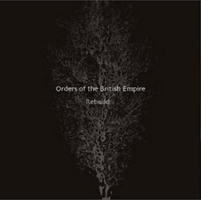
Orders of the British Empire: 'Rebuild' EP

Orders of the British Empire: ‘Rebuild’ EP

Orders Of The British Empire wear some pretty evident, pretty well-known influences upfront. These North London bandmates are avowed disciples of Mogwai, of Pelican and of Oceansize – and it shows.

While OBE are members of the broad church of instrumental post-rockers, they operate at the brutal, crunchy, masculine end of the genre. In other words, the one which relies on a bristly bromance between hardcore punk, hurricane-textured shoegazery and epic heavy metal, all reconfigured for sensitive guys with tattoos. It’s the side of post-rock which brings most of the previously-despised rock muscle roaring back in; and which (while abhorring and deleting the spotlit solos and preening, cocksure singing) is rammed full of guitars which fret, bulge and wail like a man who’s undergoing an apocalyptic religious conversion but who’s also reduced to frantic speechless hand-gestures to explain just how he feels.

There’s certainly enough of the hallmarks of this art-brute school of sound. There are the melancholy guitar arpeggios which cloudburst into sleet-storms of frantically scrubbed strings and distortion sprays. There are the hush-to-shriek dynamics and the clear evidence that everyone involved can play like a demon, but have had to carefully weave and duck their skills past the frowns of the punk police (or perhaps their own vestiges of punk embarrassment). There are the Godspeed You Black Emperor digressions into dry-boned countrified vistas, suggesting poisoned prairies under oil-smeared skies. There’s the sneaking feeling that this kind of music should just bite the bullet and call itself “psychedelic metal”, if that didn’t throw up unfortunate thoughts of a saucer-eyed Ozzy Osbourne chanting and dribbling blood down his kaftan.

So – not terribly original at root, and building heavily on what’s gone before. Yet what saves OBE (and then some) is that their hearts are as upfront as their debts. To a man, they’re bulge-eyed romantic ear-splitters, about to pop a vein in the service of expression. Their decision not to include a singer means that all of that passion feeds magnificently into their churning hands. The guitars bypass the pitfall into neurotic stiffness which often plagues post-rock: instead, they play with the suppleness and flex of tormented blues. The drums pace and clamour at the back like a fierce and loving sergeant – not just keeping time, but chivvying each of the other instruments.

Admittedly, the other payback is that their music is stadium-sized, and dazzled by its own overwhelming importance. The wordless songs march under fierce manifestos (Rebuild With Gunpowder), namecheck mythical serpents and Earth-hammering asteroids (Apophis Reigns) and cast up, without a hint of self-consciousness, questions for everyday existential heroes (What Would You Do). Even so, OBE have delivered up a striking, accomplished opening statement – especially as, rather than being a squad of pierce-festooned hardcore athletes with scalp-locks, they turn out to be a bashful-looking crew of soft-lipped boy-men.

There’s much to savour on ‘Rebuild’. Partly, it’s the sonic excitement, with the fluttering intro thrums and emotional math-riffing of Rebuild With Gunpowder; or the gushes of deep, disgruntled pink noise which swell under the increasingly frantic What Would You Do, like the breath of a sleeping giant. The multi-part Apophis Reigns boasts a spectacularly emotive flow of Western desert chords and ear-scouring guitar boil; the lapping lake-music of Roundabouts offers comparative simplicity and a clear view into the band’s romanticism, bypassing the epic storminess.

All things said, it’s refreshing when a band who, on first count, seem so derivative can in fact be so transformative – and so soon. Swerving aside from simple tribute, OBE rapidly become flushed with their own life and their own fascinations.

Orders Of The British Empire: ‘Rebuild’ EP
Big Cartel/Bandcamp
CD/download EP
Released: 1st January 2010

Get it from:
Big Cartel or Bandcamp

Orders Of The British Empire online:
Facebook MySpace Bandcamp

February 2003 – live reviews – House of Stairs label launch concert (evening 2) featuring William D. Drake, Cheval de Frise, Stars in Battledress and Miss Helsinki @ The Arts Cafe, Toynbee Hall, Aldgate, London; plus Delicate AWOL @ 93 Feet East, Shoreditch, London, both 17th February 2003 (“East End might mean left-field tonight…”)

19 Feb

Less than a week ago, the House of Stairs label put on their Camden launch gig at the Underworld: Max Tundra DJ-ed, filling the gaps with a spicy and witty mix of art-rock, prank techno and pop buzz. But tonight we’re out east in the pizza, pine and paintings environment of the Arts Café for the second, “quiet” gig – and Richard Larcombe is de-facto man-on-the-muzak, even as he bustles about setting up for his turns in two of tonight’s bands. Eerie shapes and twists of music waft through the busy air: the chatter at the bar is underscored by the filtering eeriness of Messiaen and the swooping rattling studio gulps of Boulez. East End might mean left-field tonight.

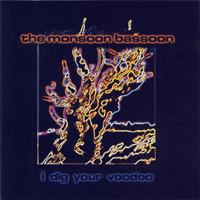
Miss Helsinki, bless them, display more pop bones in their body. Popping up from the wreck of the much-lamented Monsoon Bassoon, they feature both of the Bassoon’s singing guitarists (Dan Chudley and Kavus Torabi) plus the increasingly ubiquitous Larcombe on bass and harmonies. But they’ve lost both a drummer and Kavus’s keyboard-playing brother Bobak in the last month: and so it’s a stripped-down-and-unplugged Helsinki trio playing for us tonight, both aided and hindered by a backing tape. It’s only their third live appearance.

Frustratingly, they’re still lolling like a tall layer cake whipped out of the oven too soon. There’s something to be said for a bit of engaging pop roughness; and for Torabi’s endearing habit of boggling like Tom Baker at the end of a tricky lick. But although Miss Helsinki’s ambitions are clear, they’re still struggling to reach them. They have a tough act to follow, of course. One of the few bands to unite the approval of both London proggies and the NME, The Monsoon Bassoon wrapped a broad spectrum of ingredients (including Naked City, King Crimson and Shudder to Think) into their explosive, racing psychedelic rock.

Though Miss Helsinki retain some of those flavours, they’ve pastoralised them: the bursts of unusual chording and rampant arpeggiating are still there, but the thrashing intensity has been replaced by a sunny warmth and they’ve obviously settled on Andy Partridge as their guardian angel. But Helsinki music is a good deal more complex and demanding than XTC’s, straining the abilities of Chudley and Torabi’s affable, unvirtuosic boy-next-door voices as they hop over the cheerfully convoluted melodies like tap-dancing cats on a hot tin roof.

Despite this – and despite the fluffed notes and stumbles over the over-detailed backing tapes – ‘I Felt Your Arms Around Me’ is a bright little gem of spiky-haired art-pop, powered by the same giddy celebration of the best Monsoon Bassoon songs. Kavus (air-punching and doing triumphant kicks from his guitar stool) obviously knows it. ‘Surf’s Up’ – featuring a repeated chant of “silhouettes you know from fire” – takes them to places last touched by the psychedelic folk-science of Gastr del Sol; and the romping cowboy-pop of ‘Rodeo’ (“the world seems drunk, with a stetson in place”) ensures that they finish on a note of charm and enthusiasm. Miss Helsinki are a long way from filling the Bassoon’s busy shoes, but the signs are good.

With Miss Helsinki, Richard Larcombe is a deft, understated bass player. With his own band Defeat the Young – backed up by brother James – he steps up to become a witty, elegant frontman with tales of social absurdity and romantic scrapes. But tonight, for Stars in Battledress (an equal-partnership duo of both Larcombe brothers), he takes a step sideways. Up onstage, he cuts a quieter, more sober figure than he does with Defeat the Young. His sophisticated social-jester persona is mostly absent. His ready wit is intact, but here it’s diffused – more musing in its nature, leaning on subtle insinuations and surreal impressions rather than crackling wordplay. It’s also tinted with a peculiar, guarded English melancholy, and there’s an unsettling sense of loss and submission behind Richard’s refined and aristocratic drawl. “Blessed are all with vision unswerving. / Don’t watch me weep – go back to sleep…”

On Richard’s guitar – round about where people usually paste their dude-rock logos or political slogans – there’s a beautifully executed painting of a mallard duck, apparently snipped from a spotter’s guide. It’s appropriate. Stars in Battledress’ drifting tapestries of songscape take place in a watery never-land England of ponds and rivers and thin blue children, posh academies and school gymnasiums, the rituals of government offices and the embarrassments of public speaking; Cambridge water-meadows distorted by a lysergic autumnal haze. Someone in the audience mutters that Stars in Battledress are the best argument he’s ever witnessed against a public school education. I think he’s failing to press past the immaculate antique sheen of their surface. Theirs is a ghostly watercolour world of ruefully suppressed emotions with a tidal tendency to seep back up. Part Evelyn Waugh, part Syd Barrett and part Sea Nymphs.

James – strumming and fondling snowfall arpeggios from his piano and contributing apple-bright harmonies – provides most of Stars in Battledress’ colours, picking up on his brother’s words and extending them outwards in rippling classically-inspired musical inventions. Richard plays some understated, skeletal guitar and trundles a harmonium through the queasy distress signal of ‘Haunted Hotel’, but mostly he stays out at the front, clasping the mike stand like a sad, dapper figurehead. There’s a break from this in the roaring-’40s guitar-waltz of ‘Hollywood Says So’, as Richard delves hilariously into ludicrous showbiz gaudiness (“drive fast cars, play guitars, win prizes / – girls in every port, in all five sizes”) but ends up spat out in a wad of comic bitterness. (“I’ve been over-directed, I’ve been cut in one take. / I’m a dated two-reeler that no-one will make.”) Their cryptic finale – the hummed, valedictory ‘Women from the Ministry’ – hovers in the mind like the flicker of antique cinema light, images of lost houses, withered photographs.

Cheval de Frise are… plain remarkable. Bare to the waist and sporting Trotsky glasses, Vincent Beysselance studies his drumkit with a jazz warrior’s eye, his lean expression and sculpted moustachios lending him the air of a razor-sharp beatnik. Guitarist Thomas Bonvalent looks as if the Taliban have booted him out for excessive zeal. Sporting an enormous bushy chest-length beard, battered clothes and an expression of sincerely crazed intensity, he’s twitching visibly even before he plays a note. His nylon-string acoustic guitar has been modified – or de-modified, with both the sound-hole and the pre-amp controls crudely and defiantly smothered with duct tape. As he plays, biting on a pick, his face seethes beneath his beard.

“Pastoral acoustic mathcore” was what someone wrote on the Cheval de Frise packet. Ah ha, ha, ha – I don’t think so. Pastoral acoustic mathcore would be very nice – perhaps a Guitar Craft picking exercise, pared down by post-punk minimalism and softened by visions of green fields. Are Cheval de Frise like that? No. For the first seven minutes or so, Cheval de Frise seem absolutely demented. After that – and once the broken seizures of drumming and the intricate splatterwork of guitar has had time to get to work on your brain and your reflexes – you start to understand. Although your body will make the connection before your mind does.

Right from the off, Bonvalent’s playing is disturbingly wild; slamming down obsessively on a single note or isolated interval, or spasming music up, down or across the neck of the guitar. Beysselance’s drumming is a boiling whirl of ideas and instincts, acted out with a brinksman’s forcefulness, with enough breakneck substance both to keep the duo’s momentum and to craze it with brilliant stress fractures. People cram to the edge of the Arts Café’s tiny stage, swaying like a wheatfield in a whirlwind, and yelping approval.

Behind the apparent free-scene chaos, Cheval de Frise have serious intentions. The drums have their melodies as well as their upheavals, and although Bonvalent’s open-mouthed drooling visage suggests a man in terminal acid psychosis, he frequently rips into hyperspeed, hypertonal spirals of intense picking which John McLaughlin would be proud of. Every now and again, in the midst of a free section, the two Friseurs exchange a quick cue-ing glance and then slam into perfect alignment, calling a rigorous Zappa-style composed music module up out of memory. Bonvalent’s playing might often parallels the spewing, disjointed clicking noises of the post-Derek Bailey improv school, but the musician he’s really closest to is the iconoclastic lo-fi jazz rebel Billy Jenkins. Deliberately or not, Cheval de Frise ‘s music is a hyperactive flamencoid strain of Jenkins’ “spass” approach – a slew of intense musicality in which ugly sounds, wrong notes, anti-technique and smash-ups in timing and phrasing are as part of the great spontaneous inspiration as skill, structure, complex ambition or the beautiful moment.

It is, also, an intensely devotional music, as burningly thrilling as Nusrat Fateh Ali Khan’s qu’waali shriek, a gospel choir tearing the roof off the sucker, or the closer-to-God whirling of a Sufi dervish. Bonvalent’s physical abandonment (at points close to ecstatic convulsions) is religious in its intensity. As pieces skid to a halt, he bobs his head thankfully to the audience, smiling and almost moved to tears. If it’s like that onstage, it’s not that much less intense down here. Being up close to music this inspirationally driven raises the hairs on the back of the neck. When Cheval de Frise finally peel off their instruments and stumble into the crowd, the feel of the audience unclipping themselves from their joyful tenterhooks is like a dam bursting.

I don’t envy William D. Drake – a onetime Cardiac songwriter with a joyous genteel-gone-berserk keyboard style – for having to follow that. But I’m going to have to leave him to it, as I’m double-booked for gigs this evening; and so I have to slip out of the Arts Café to stride the Spitalfields half-mile or so over to 93 Feet East, to see Delicate AWOL on a rare London visit. I’ll just have to promise to catch up with the Drakey magic next time he plays… I will, really…

93 Feet East turns out to be an over-pleased-with-itself Brick Lane bar, milking the wobbly momentum of trendy Shoreditch Twattery while it still lasts. It also has the rudest security staff I’ve ever met. Not five minutes after the music stops, they’re in your face; all but digging their chins into your shoulders, dangling heavy barrier chains in one hand with the bored and arrogant stance of animal stockmen, yelling at you to move out. Regular punters must really want to come back to this place.

It’s a sorry way to end an evening, especially after Delicate AWOL have been exercising their luminous charm on you. Walking in on the band mid-flow, the first thing I see is Caroline Ross joyfully bouncing tiny beaters off the keys of her little glockenspiel. Its fairy tingles resound in the air as the rest of the band keep up a stiff-swung groove behind her. Delicate AWOL have been drawing connections between Latinate ’70s fusion and limpid Tortoise-school indie art-rock for a few years now. These days – extended from a guitar-rock indie four-piece to a more ambitious sextet featuring Ben Page’s swishing textural synths, Jo Wright’s Chet Baker-ish trumpet commentary and Ross’ own multi-instrumental enthusiasm – they’re in a much better position to cook up their jazzified stew.

Inevitably, the enchantingly gamine Ross is the focus, smiling beatifically from beneath her shaggy russet bob and swapping between percussion, flute and thoughtful slide guitar. There’s also her soft spring-thaw of a voice: a gentle but commanding stroke to soothe the ruffling from the craggier guitar of husband Jim Version and the dogged Can-ish rhythm-section circling of Michael Donelly and Tom Page. Rising above the hum and the wind-rattle of ‘That Terminal’s Down’, brushing against the reedy melancholia of a melodica, drawling through a sleepy-lidded chant of “your breath goes slow”, she’s hypnotic, bringing a hint of Scottish lullaby into Delicate AWOL’s sleepy mix. Alongside the Pram-like tinkles and kitchen-table craftsmanship, the woozy instrumental Americana of ‘The China-Green Prairie Tribunal’, the southern-border dance-steps of ‘Broken Window in a Mexican Bank’ and the doughnut-bulging space-groove they hop into for ‘The Rolling Year’.

One of Delicate AWOL’s greatest strengths is their ability to wander open-armed between these varied inspirations without ever inducing the suspicion that they’re simply trying to fill their basket with crowd-pleasing nuggets. Their intelligence is of the gentle kind – simply enjoying their explorations rather than ticking them off on a list and practising their traveller’s poses afterwards. Surprising, this takes them further than a ruthless musical ambition would – as does the way they flit disarmingly between other-worldliness and neighbourly charm, most evident in Version’s professorial enthusiasm and Ross’ affectionate, amused handling of fans and hecklers alike.

Even in the grubby concrete shell of an average indie-circuit venue, Delicate AWOL can get a campfire atmosphere going. A rewarding thing on a cold February night, especially with the impatient rattle of a chain behind you. If I ended up being treated like cattle, at least I got to spend half-an-hour home on the range beforehand.

Cheval de Frise online:
Homepage, Facebook, Soundcloud, online store, Last.fm, Apple Music, YouTube, Deezer, Spotify, Amazon Music

Stars in Battledress online:
Homepage, Facebook, Twitter, MySpace, Soundcloud, Bandcamp, Last.fm, Apple Music, YouTube, Deezer, Tidal, Spotify, Amazon Music

Miss Helsinki online:
(2022 update – no links available. See Kavus Torabi and Daniel Chudley Le Corre)

Delicate AWOL online:
MySpace,Last.fm, YouTube, Spotify, Amazon Music, Wikipedia entry

House of Stairs online:
(2022 update – there are no longer any web pages for the House of Stairs label, although there is a discogs.com page)

February 2003 – live reviews – House of Stairs label launch concert (evening 1) featuring Nøught, Foe and Defeat the Young, The Underworld, Camden Town, London, 12th February 2003 (“the Underworld fills with familiar London pronk and math-rock faces”)

13 Feb

Well-worn jokes about “first steps” line up at my door, to be kicked aside. Let’s not goof about. As the House of Stairs label throws its musical launch party, the Underworld fills with familiar London pronk and math-rock faces, fans and musicians grinning at each other as if it was the first day of a school trip. The still-friendly fragments of The Monsoon Bassoon, the occasional Cardiac, plus those particular paying punters who materialise like the genie of the lamp at the faintest hint of a twitchy rhythm or a whole-tone scale blasted out of a loud guitar.

For once, the records being played between the bands nudge and tickle the audience’s mind rather than simply provide aural cud to chew in the interval. When you’re lucky enough to have avant-prog, lo-fi techno wunderkind Max Tundra on hand to do your DJ-ing for you, you get more than the usual jukebox package – Peter Gabriel songs mingle with prank cut-ups of Tony Blair speeches, hilarious jungle-electronica renditions of ’80s pop hits, and ear-opening art-rock oddities whipped from rare vinyl. Priceless from any perspective.

Defeat the Young are the most literate – or literary – members of the House of Stairs stable by a country mile. They’re also the most demanding listen. Richard Larcombe‘s wit is complex and arch; his melodies are crenellated and mediaevalesque, pumped out of harmoniums, sharp-fingered guitars and hurdy-gurdies. Also, while there’s a distinctly proggy kink to his music (like Kevin Ayers cuddling up with Gentle Giant or William D. Drake), he’s drawn more to Havelock Ellis and Groucho Marx than to Tolkien or Carlos Castenada. Thank God for that. A faux-Edwardian English Zappa with highbrow kinks might not be to everyone’s taste. But it’s infinitely better than being subjected to another charlatan wrapped in suspect mysticism and stale denim.

Like a skilful card-trick, Larcombe’s wicked sense of humour also works best up close. In the cavernous rock cellar of The Underworld, he seems out of place – squinting against dim lighting in a venue more accustomed to thrash-metal and ska-punk than to his own rampantly sophisticated English stylings. I always seem to come up with flower metaphors whenever I try reviewing Defeat the Young. Tonight, the phrase is “hothouse flowers”. With two nouveau-metal bands roaring up from behind them, I’m worrying over whether the rarified and sophisticated humour in DTY’s music will wilt in this blunter setting. But they try hard, displaying a determined refusal to compromise. A long, scene-setting introduction (involving virtually the entire plot of The Marx Brothers’ ‘Duck Soup’) sprinkles conceptual theatrics back into the agenda, while (at the other end of preciousness) Jodie Scott’s feedback-heavy guitar adds some belligerent beef to the sound.

Still, it’s not until ‘Nothing from Something’ that things really get moving, as Larcombe gets to grips with his maze-y rake’s progress, bringing some deceptively drawling wit to bear. By ‘Natural Cash’ he’s in ebullient form, punching the air while his feet cycle his pedal harmonium and his lime-tinted vocal quicksteps adroitly through the tricky pitches. Propelled by his perverse and wayward imagination, he guides us through a risque world of sepia photos, elegant penmanship, social theorising and sexual quirks, all couched in a shower of beautiful golden language. Tonight wasn’t really quite his night, but Richard Larcombe is undoubtedly a major talent. He’s already way out there in that field where the erudite spectre of Oscar Wilde grabs the twisty bones of art-rock for a feverish waltz (and for a good snog, if it’s lucky).

The gap between Defeat the Young and the harder-rocking shapes of the rest of the evening should have been bridged by the violent, mordantly comical dada-metal of Lapsus Linguae, but for reasons unknown, they’ve had to stay in Glasgow. The evil smirks and the transmogrified Iron Maiden t-shirts remain north of the border tonight, to infest the queasy nightmares of pub-rockers who’d rather be dreaming of Joe Elliott. So it’s straight on to Foe – whose drummer Paul Westwood hardly gets a break from his turn on the drums and hammer dulcimer for Defeat the Young before he’s clambering back behind the kit for his main band.

If a change really is as good as a rest, he doesn’t need the break – the light percussive touch he uses for Defeat the Young has no place in Foe. Pop-eyed, Westwood lashes his way through this set like an escaped convict desperately hurdling fences. Jason Carty and Crawford Blair thread the gaps in his drumming with rapid intricacies of guitar and bass – a constantly shifting and jerking formation, pouncing in multiple directions. They’re not so much a power trio as a pared-down swarm. One part Don Caballero, one part double-duo King Crimson, and one part higher mathematics, Foe’s music sounds as if it’s been threshed out in cold areas of the brain until it finally lost its temper and exploded. Yet – Westwood’s controlled, wide-eyed intensity aside – Foe themselves are calm, observing their music and keeping it ticking busily until the time comes to dive in with all six feet for a burst of sudden violence.

Sounds familiar? Consciously or otherwise, the all-instrumental Foe parallel the current Crimson’s cerebral-metal approach, apart from refusing to sweeten it with the occasional pop tune. Blair’s grinding bass is as brutal and pitiless as a giant clock ticking, but also carries their complex whole-tone melodies up and down the scale and across the contorting tempi. Carty’s metallic creative/disruptive guitar acts as dissector and illustrator – raiding the harmony and timing of each piece and asking the tricky questions before rocking out into triumphant predatory riffs, pulling the whole band into line with it. Sometimes Foe hurtle like speed-metal Rock in Opposition; sometimes they spend a couple of seconds pinging and pulsing like free-jazzers; sometimes they slam into unyielding hardcore for a few bars.

“How do I play this again?”, yells a mock-baffled Carty, during a break in the action. He’s chuckling – he does remember it, but it’d be easy to get lost in the wanton folds and traps of this music. It’s a real lark’s tongue-twister; more Cuneiform than uniform. In spite of that, there’s a woman dancing in the front row. Incredibly, she’s performing a delighted bump and grind to Foe’s music – her pelvis and body twirls and undulates in perfect time to their constantly altering rhythms. So much for this being brain-only music.

She turns out to be the girlfriend of Nøught‘s drummer. Which explains a lot. Nøught themselves emerge onstage shadowed by conflicting reputations. They’re not actually a House of Stairs band at the moment, but they could be so easily. For evolutionary rockers, grumbling hopefully over their CD players, Nøught are a beacon band – assimilating the instrumental ideas of King Crimson, John McLaughlin and R.I.O., then marrying them to the urgency and directness of punk, grunge and hardcore. But their constant line-up and instrumentation changes (perhaps driven by James Sedwards’ need to bring a variety of tools and voices to his music) have tended to scupper the band and dip it into inactivity rather then renew its energy. Today’s Nøught are a conventional rock power trio plus keyboards, dispending with the second guitarists or Theremins of past live outings. They could be an octet with triangles, euphoniums and bagpipes next week and it wouldn’t surprise me too much. I’d just be happy so long as they kept playing, and stopped disappearing.

Sedwards himself is surrounded by guitars. Two of them are impeccably-finished Les Pauls mounted on flat racks, their strings prepared with objects and blocks (as if John Cage had infiltrated Yes ‘ road crew.) But his guitar of choice is the trashy, rhomboid Fender Jaguar: a Kurt Cobain favourite. It tells you a lot about his approach. Yes, Nøught do like to make a lot of noise. Sedwards’ reticent, un-rocking look (like a young Rowan Atkinson) belie his talents as a fierce, assertive guitarist. And then some. Nøught’s music leaps out of his guitar in a series of bucketing, challenging jumps: a boggling harmonic steeplechase, leaving few notes untouched. Imagine quickfire origami, performed with steel sheets, and you get some idea of how Nøught work.

Their raciness also brings to mind King Crimson’s ‘Red’ gone mutant mariachi. There’s constructive dissonance a-plenty – Sedwards revels in throwing flamboyant, startling chords into his majestic grand designs, catching us off guard. On record, Sedwards revels in the use of choppy strings and blazing big-band brass, and though there’s nothing of that here, there’s been a renaissance in the keyboards department. That muscular undercurrent of organ (triumphant chords supporting the widening paths of guitar and wiry, driven bass) brings an unexpected rhythm’n’blues feel back to the music. Touches of Hendrix or Muddy Waters roots to blend in with the Fripp roars, the John McLaughlin jumps and the Sonic Youth smashes, bringing a different grittiness to Nøught’s aggressive playing. The band has never sounded so human, so assured – and it’s a good balance to those industrial moments when Sedwards assaults his flat-mounted guitars with drumsticks or runs the screams of whirling power-drill chucks through the pickups. Whatever else Nøught’s downtime has provided, it’s brought them a sense of roots and placement that was so lacking in the wall-of-noise incarnation that rattled the walls of venues a year or so ago.

This is an undersung gig, to be sure – a half-full (though comfortable) Underworld suggests that half of the art-rock community in London haven’t even heard about the concert – but there’s a definite sense of homecoming heroes to this one. Good foundations for a strong new house of deserving players, I hope.

Nøught online:
Homepage, Facebook, MySpace, Soundcloud, Last.fm, Apple Music, YouTube, Deezer, Qobuz, Tidal, Spotify, Amazon Music

Foe online:
MySpace, Bandcamp, Last.fm, Amazon Music

Defeat the Young online:
(2022 update – no links available. See Lost Crowns.)

Max Tundra online:
Homepage, Facebook, Twitter, Soundcloud, Instagram, Mixcloud, Bandcamp, Last.fm, Apple Music, YouTube, Deezer, Tidal, Spotify, Amazon Music

House of Stairs online:
(2022 update – there are no longer any web pages for the House of Stairs label, although there is a discogs.com page)

December 2002 – album reviews – Various Artists: ‘House of Stairs Volume 1: Useless in Bed’ compilation (“happily balanced on the rougher brinks and fringes”)

4 Dec

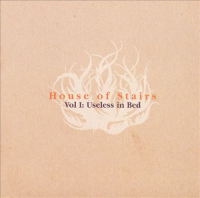
Various Artists: 'House of Stairs Vol. 1 - Useless in Bed'

Various Artists: ‘House of Stairs Vol. 1 – Useless in Bed’

Placing yourself on faultlines, rather than easily marketable turf, brings risks but inspiration – ask a San Franciscan. That the three London art-rock bands who originally set up the House of Stairs label (The Monsoon Bassoon, Geiger Counter, and Ursa) have all now split or mutated into something else is perhaps proof of both.

Regardless, ‘Useless In Bed’ – the first House of Stairs release – is a declaration of brotherhood. Compiling the work of musicians dwelling on various faultlines (though still mostly centred on London art-rock, it also takes in music from Chicago, Atlanta and Bordeaux), it both defines the edges of prog, jazz, art-rock, hardcore, electronica, folk, improv and noise rock, or encourages people to spill across them.

 
Hard-rocking math-proggers Foe – sprung from the wreckage of Geiger Counter – offer the most urgent track. ‘Triangulator’ is full of furious refracting guitar lines over Crawford Blair’s piano-growl of bass. For six minutes it swings, chops, drops down trapdoors, executes perverse King Crimson leaps between mordantly grim chords, and savages minor keys like The 5uu’s on far too much coffee. Geiger Counter’s posthumous statement is ‘Drink Your Milk’ – less obviously wired than ‘Triangulator’, it still carves up its grunge-y math riffs with heavy enthusiasm, embracing sweeter interludes of short-lived luminous peace as it does so. Nouveau Metal is spreading…

The Monsoon Bassoon‘s own posthumous offering is a explosive and complicated song from when their mingling of Henry Cow and gamelan-Crimson art-rock ran full tilt into their love of American alt.rockers like Shudder To Think. The psychedelic squeal of guitars on ‘Stag’ marches from plateau to jagged plateau in a skirl of trippy flute and meshing riffs, held together by the band’s tight discipline.

 
These days various Bassooners have regrouped in Miss Helsinki, who deliver a sparkling piece of progressive pop called ‘I Felt Your Arms Around Me’. Less surreal than most Bassoon confections, it’s still an acid-flavoured love song whose rattling good XTC jangle and tootling clarinets don’t stop it hurtling delightedly into a complex, storm-tossed middle section in which they see just how much you can rock the train without slinging it off the rails.

 
If you’d prefer to stick with the Bassoon’s skronkier legacy, Chicago’s Sweep the Leg Johnny are still juggling that torch. With the superb ‘Only in a Rerun’, they’re obviously on a roll – it’s a rich mixture of harsh Schizoid Man tones and flamboyant jazz-metal attack from the raw husky wail of Steve Sostak’s alto sax and Chris Daly’s bloodthirsty roar of guitar, tossing Sostak’s airy vocal like a bull tossing a skinny matador. Slewing between dEUS busyness and violent post-Slint minimalism, this is a rough bareback ride to put a wicked smile on your face.

 
Manic Glaswegian pranksters Lapsus Linguae provide ‘Olestra (There’s Only One Drinking Fountain in Heaven)’. A stab of theatrical art-metal somewhere between Faith No More and Beck (with a Resident eyeballing it from the director’s chair) it has all you need to storm the castle of pomp. There’s a man called Penelope Collegefriend singing in a rampant bellow like a punk Freddie Mercury; there’s an inexplicable strings break and a rolling piano line continually chopped off with guillotine precision; there are namechecks for Hermann Hesse and Charlton Heston, and choicely bizarre lyrics like “More I eat, the hungrier I feel – / I lick menus, ignore the meals.”

 
Holding up the genteel-er proggie end are the whimsical and witty projects of the Larcombe brothers. With ‘Sand (Blowing About)’, Stars in Battledress provide a beautiful dance of fluent piano and autoharp: but beyond the divertimento prettiness, James Larcombe leads the duo through eddies of suggestive Debussyan chords.

Richard Larcombe goes on to turn in a conceptual tease on Defeat the Young‘s wonderful ‘I’m Ruining Something’ – an absurdist essay on the corruptions of power which blends Gentle Giant with Lewis Carroll and Stravinsky. Larcombe greets his ensemble of actors, trombone, and full-blown operatic chorus as a lounge-lizard lord of misrule, sighing a manifesto of playful destruction in his arch, refined tones. “I’m recognised as your one sovereign Lord Protector / Trust me – I’ve learned of your country by tape and slide projector. / Each day I’ll go out of my way to spoil, deface and tarnish, / like he who ruins carpentry by swapping glue for varnish.” Oboe, piano and hammer dulcimer float in a dreamy arrangement like an August haze. Apparently there’s a whole album’s worth of this story in the Larcombe shed – ‘The Golden Spike’ – and it’s only one of their dastardly plans.

Both of House Of Stairs’ lo-fi electronica boffins seem to grab inspiration from bargain-bucket electrical goods. Desmotabs create an appealing Stylophone fanfare buzz on ‘Gaseous Exchange at the Alveoli’, let their drum machine go nuts and assault a heart monitor, and squiggle some demented Mini-Moog solos before the entire track melts like a Dali model. Max Tundra (the Frank Zappa of the techno world) continues his marvellous and bizarre mission to fuse hardcore dance music with prog rock. ‘Life in a Lift Shaft’ equals Desmotabs buzz-for-buzz while festooning tough and hilariously uptight Tundra beats with jittery robot piano and fat sub-bass from the tar-pits. Alarm-clocks fly past on tiny wings trying to take bites out of the zany, sunny tune.

The free-er bands – as usual – have a harder time. Gnarly bass-and-drums duo Guapo can be the missing link between ‘Red’ and Ruins when they want to be. However, their grinding ‘Pharoah’ – despite Dave Smith’s excellent Brufordian snarework – is mostly as subtle as a flying breezeblock. Dragging large chunks of pyramid across the desert and insisting that you appreciate each tortuous step, they occasionally snap, shoot off the flywheel and go ape with some fearsome tattoo riffs. Hardcore acoustic fusioneers Cheval de Frise hop up and down with impatience on ‘Chiendents’, banging their heads against their own lo-fi envelope, manically coiling up tighter and tighter acoustic guitar scrabbles against the tussling drums. Compression to destruction, breaking out in wild slashes.

 
And finally there’s the hardcore department, with the recently defunct Ursa demonstrating why they’ll be a sad loss to the British heavy scene. Avoiding hardcore’s usual fixed, deafening riffage and reductive howling, ‘The Blooding’ begins with a studied ponderousness and heaviness which gives way to an inspiring controlled demolition. Galloping punked-up Iron Maiden guitar runs charge under giant toppling riffs, the band dodging falling masonry via nifty turn-on-a-dime spins while losing none of their brute power. American Heritage, likewise, execute proggie timeswitches with rapid and brutal thrash flair, their sound a bleak, bare cliff of thick guitar noise. It’s anyone’s guess as to why they’ve called their track ‘Phil Collins’ – it’s an unlikely tribute, whether it’s aimed square at the Genesis drumstool or at the white-soul crowdpleaser.

 
Anyhow… here’s a house of many doors, happily balanced on the rougher brinks and fringes and demonstrating the breadth of personalities camped out in even one small part of today’s art-rock community. Admirable.

Various Artists: ‘House of Stairs Volume 1: Useless in Bed’
House of Stairs, HOS001 (5030094077829)
CD-only compilation album
Released: 2nd December 2002
Get it from:
(2020 update) best obtained second-hand
 

September 2001 – EP reviews – centrozoon’s ‘The Divine Beast’ (“a kind of relay race across trance territory, whipping up a tautly disciplined psychedelic frenzy”)

27 Sep

centrozoon: 'The Divine Beast'

centrozoon: ‘The Divine Beast’

There are some musicians who claim to consider themselves aerials, with their feet lightly arched off the ground and their heads inclined into some kind of ether, through which they conduct the music and songs which are looking for a means to get to earth. Robert Fripp is one of these claimants, but whether his occasional disciples centrozoon think the same way is questionable.

centrozoon’s touch-guitarist Markus Reuter is a graduate of Fripp’s school of Guitar Craft, and previously played with the Craft-inspired Europa String Choir, but an enquiring look at the Centrozoon website reveals little in the way of earnest, wintry Frippian mystique (though much in the way of dry German humour). If centrozoon (of whom the other half is synth-and-beats man Bernhard Wöstheinrich) are channelling music, it’s of a much more liberating and less clotted variety than Fripp has been downloading into King Crimson over the past few years.

There’s certainly a latter-day Crimsonic element to their work – the rich swathes of Soundscapes-style ambient tone colour, the wild electronic percussion, and the brassy or droning sounds that Markus employs while soloing on his Warr Guitar. But there’s less of the tightness that makes and sometimes mars King Crimson’s music; and a more thoroughly integrated use of the clubland elements of trance, techno and garage that have recently been informing Crimsonic offshoots like BPM&M and ProjeKCts Three and X.


Thúsgg (Skinny and Crazed Mix) possesses that analogue-synth gastric twist that regularly seeps up into club music. Bernhard launches a rapid, broken-beat squirt-funk-and-dripping-water cave ambience, through which Markus flies big wheeling paths of Frippian improvisation in unearthly arpeggios. But barely halfway through, most of the beats quietly fall away: Markus’s chilly howl of overdriven Warr briefly rises, saxophone-like, into free-time jazz questioning, before both centrozooners dissolve into a duet of shifting ambient lambency.


The sixteen-minute extract from ‘The Cult of: Bibiboo’ shows an even broader example of centrozoon’s fusion of club culture and evolutionary rock textures. The duo engage in a kind of relay race across trance territory, whipping up a tautly disciplined psychedelic frenzy. It flowers from auroral ambience through thunder-drum percussion and what sounds like nods to the ‘X-Files’ theme, to warm and constellatory ambient drifts, cut by flares of harmonised Warr and quizzical harmonies.

Five-and-a-half minutes in, it’s become a glittering chillout zone covered in singing glassy loops. By nine minutes, Markus’s weaving Soundscapes are rubbing up against clipped artillery shell boom-beats, and by eleven minutes he’s razoring the starry sky with saw-toothed shapes and snarls. By the thirteen-minute marker Bernhard’s thundering distorted beats have forced Markus back into the angelic role, and they finally coast onto a home stretch of firework bangs and prismatic orchestration.

Tagging all this rich invention as “Fripp on Ecstasy” seems cheap, but it’ll do for now as we start to tune in to the powerful, thrilling hybrid music centrozoon have to offer.

centrozoon: ‘The Divine Beast’
self-released, CZCD01 (no barcode)
CD-only EP
Released:
September 2001
Get it from: download from Bandcamp or Amazon Music
centrozoon online:
Homepage Facebook Twitter MySpace Bandcamp Last FM YouTube Vimeo Google Play Pandora Spotify Amazon Music
 

October 2000 – album reviews – Radiohead’s ‘Kid A’ (“allowing – or forcibly inducing – change to come through”)

2 Oct
Radiohead: 'Kid A'

Radiohead: ‘Kid A’

Radiohead are history. And they know they are: elevated into a pantheon of great expectations and rock landmarks a mere three albums into their career, and somewhat against their own wishes. Like a latterday Pink Floyd crossed with Nirvana (with the universality of both) they’ve had the rock world at their feet. But they’re also fully aware that, like Miles Davis before them, they need to let go of an expected history before they congeal. Embracing the difficult development of their own history by allowing – or forcibly inducing – change to come through.

So it’s goodbye to Old Radiohead’s upfront army of rock guitars, Thom Yorke’s frenzied in-yer-face angst, and those singles scooping at the soul like the hook in the fish’s mouth. And all the talk of the band making a record that mostly junks standard concepts of guitars, lyrics and pure song in favour of Warp Records-style electronica and muttering left-field oddness has turned out to be true.

‘Kid A’ does indeed have no singles and no singalongs – lovesick, punch-drunk or otherwise. It has a bleary, fractalized, impersonal mountain-scape etched out on computer for a cover; a lyrical agenda which is plainest in its absence. And its diverse pieces are deliberately disassociated from each other. Sometimes chill, sometimes as mechanistic as automata moving in a warehouse; all strung-out and scrambled by filters, Pro-Tools or anti-technique. Trusted “recorder” Nigel Godrich plays an odd mixture of Eno and Albini roles, squeezed alongside the band in the producer’s chair. Sometimes you can hear a band member at work, untweaked. More often you can’t. It’s like a set of glass cases enclosing specimens, puzzling specimens of music pulled up and laid out with a firm “that’s what you’re getting – goodbye” sense to it. Anti-pop, not pleasing anyone’s appetite for a snackable chorus.

And already (to filch another Yorke line) the knives are out. Radiohead are busily having their seams ripped open and their functioning organs speared, teased out and compared scrupulously against charts; a list of names marking off the components of ‘Kid A’ track by track. And, increasingly, marking it down. “Charles Mingus, Autechre, Alice Coltrane, Boards of Canada, Aphex Twin…” goes the chant. “Rip-off. Buy the originals. Who the hell do Radiohead think they are?” And yes, none of ‘Kid A’ is as groundbreaking as any of those recorded texts, which Yorke and co readily cite as influences. There’s no element that a student of improv, post-rock, serious electronica or revolution jazz won’t have heard already. But this also means that one of the world’s biggest rock bands have admitted they’re at least as much learners as teachers. Sounds like cause for celebration to me.

In fact it’s other legendary records – the likes of Robert Wyatt’s ‘Rock Bottom’, Scott Walker’s ‘Tilt’ and Robert Fripp‘s ‘Exposure’ – which ‘Kid A’ is most genuinely akin to. Each of these records strives to meet its ends by a mixture of instinct, cold science flushed hot again with consuming passion, and their own secretive internalised logic. It’s a big step going from ‘OK Computer’ (one of the most explicit and upfront records of the ’90s, in which Thom Yorke was a incandescent clench of ego; stubborn, scarred, and railing against the draining fear and indifference of the adult world we’re trained for) to a twenty-first century record which is as weirdly egoless as this one is. An inarticulate speech of the heart via samplers, hazard and evasion.

 
Significantly, the most memorable and accessible song on ‘Kid A’ (the tear-blown strum and shivering strings of How To Disappear Completely, echoing both King Crimson‘s desperately vulnerable Waiting Man and Walker’s cryptic Patriot) sees Yorke singing softly and acceptingly of the ultimate relinquishment. Drifting away from himself in Dublin, becoming insubstantial, not as a surrender, but as some kind of transcendence. “I’m not here… this isn’t happening,” he sings, a tired relief (and, almost, a kind of love) suffusing his voice as the quivering violins flutter down, snow-like, obscuring the signposts.

It’s the emotional rightness in ‘Kid A’ that finally pulls it clear of the dissectory attacks people are aiming at it. As if the cry of rage that dominated ‘OK Computer’ is now diffused in a temporarily helpless scatter of images and impulses. As if the echo, coming back, has impacted on a band whose foes and fears are now nested in the fabric of the world, who can no longer respond with a simple song.

The fabulously grotesque artwork (a booklet of nightmare kid’s drawings) that lurks, hidden, in the back of the CD tray, gives a little glance into this world. Stick men boot each other in the balls; small mice squeaking copyright signs wander into the maw of a toothy beast growling a trademark; frightened eyes stare out of threatened houses, and Tony Blair’s PR grin is distorted into empty-eyed predatory lust. A nation of grinning little bears end up on the end of people’s forks or balaclava-clad and tooled up with Kalashnikovs, and a screaming parade of vitriolically surreal words march across the pages like circus handbills. Like the doomsday rhetoric of Godspeed You Black Emperor, it’s almost comical… yet it jolts, like the sound of a chisel stealthily tapping at your wall.

 
And perhaps ‘Kid A’, rather than being the rebel songbook for this world, is the recovery notes for those as cracked by it as ‘OK Computer’ predicted they would be. There’s a terrible surrender and relief about Everything in Its Right Place, freewheeling along on tranquillised electric piano chording with a slipstream of sliced up, gossamer-keening Yorke vocals tangled in its tail. In which two of the few comprehensible lines are “yesterday I woke up sucking on a lemon – yesterday I woke up soaking,” and “what is that you tried to say?” This is disarrangement, dysfunctionality – not order. Yet Yorke seems to realise that this too has its place in a person’s history; and the sheer beauty of his singing throughout implies there’s hope waiting up beyond the dissolution.

 
About half of ‘Kid A’ ties in with this dissolve. The clinking music-box-meets-hip-hop narcosis of the title track, a nursery lullaby as rendered by an uptight and drier Massive Attack. Yorke’s bass-warped, filtered and generally fucked voice wavers, croons and ties little musical bows in and out of the pernickety beats, while words about “heads on sticks”, “ventriloquists” and “a little white lie” work their way through the dirty pink clouds. Who blinks first? The gaudily humming electro-disco on Idioteque reveals an empty dancefloor grooving away to itself as catastrophe looms. Yorke, in a slurred keen, is spilling out surreal sub-sense like David Byrne on sodium pentothal (“laugh until my head falls off / I swallow ’til I burst… / Women and children first, and children first…”) but sounds ecstatically happy (“here I’m alive, everything all of the time”), and the last sounds on the track aren’t death-booms but an aviary of feverish guitar loops.

 
The breakdown’s in the motorik groove of The National Anthem, adhesive thumbstains of bass underpinning a brawling rabble of brass that sound fresh from a vigorous drunken debate at Mingus’ Jazz Workshop or the Art Ensemble of Chicago. Yorke’s voice winds out of the airshaft with a lobotomised “everyone around here… everyone is so clear”: later quavering “everyone has got the fear” as the horns become restive, but affirming “it’s holding on… it’s holding on.”

 
The other half? Anyone’s guess. The smears and rumbles, the webbing of indistinct voices, the gusts of emotion hurtling up towards invisible targets, all blur the picture. The ghostly tundra ring of Treefingers gives away nothing but a deathly peace. The unravelling trip-hop of In Limbo, full of unhitched folk guitar and stutters of echoed organ, is lost somewhere in the subconscious: grumbling “you’re living in a fantasy world” while itself threatened by nightmares of loss and disappearance (“I’m on your side, / nowhere to hide, / trapdoors that open, / I spiral down”), and finally swirling away in a rush of killing reverb as if down an enormous storm drain.

 
There are a few dud or ill-fitting moments while Radiohead grope in the fog. Morning Bell, for one, where they knock out a scratchy, swamping, insect-buzzing song which sounds like nothing so much as Echo & The Bunnymen shaking with the D.T.s. Or the tribal tom booms, wiry laceration of rhythm guitars and guilt-ridden lyric on Optimistic, harkening back too much to ‘The Bends’ (or the out-of-focus U2 of ‘The Unforgettable Fire’). But the starved boniness renders these hauntingly hollow-eyed stuff, compared to the previous fire. “If you try the best you can / the best you can is good enough,” sings Yorke, with a scratched, dented demeanour belying his words.

 
The final act is Motion Picture Soundtrack, journeying on an exultant wheeze of harmonium, celestially riffling harps and gusting bass wind as Thom Yorke settles back into love as if he’s settling back into a wrecked old armchair. And it’s love among the trashed – “red wine and sleeping pills / help me get back to your arms. / Cheap sex and sad films / Help me get where I belong.” Querulous (as he protests “Stop sending letters, / letters always get burned. / It’s not like the movies,”), but there’s happy-sad commitment here as he murmurs “I think you’re crazy, maybe… / I will see you in the next life.” Then one last delayed pink gush of electrophonic orchestration, and out.

 
But it’s in its totality that ‘Kid A’ sinks into your mind. There’s no way it could ever be counted as a flawless record – in fact, it revels in its flagrant imperfection with such a fierce joy (and one born of abstract willpower) that it’s hard to condemn it for that. But it’s a vitally important record for Radiohead; and a rewarding one for the listener.

The peculiar triumph of ‘Kid A’ is the way that it transcends both its own wanton abstractions and Radiohead’s past explicitness to resonate beyond each of them, in the way that an impact on a random strand can shake the whole web. To hear it is to be haunted by the emotional husks of messages long lost and made irrelevant, or by the impressions left by intentions deflected and displaced into half-formed actions and events. To have your mind rippled by the last exhausted breeze from a shockwave far, far away. To be moved by the vibration of history – Radiohead’s history, at any rate – as it passes.

Radiohead: ‘Kid A’
Parlophone, CDKIDA 1 (72435 2959020)/7243 5 27753 4 7 (72435 27753 47)/LPKIDA 1 (724352 959013)
CD/cassette/10-inch double vinyl album
Released:
2nd October 2000
Get it from: (2020 update) buy/download from W.A.S.T.E. Store, Google Play or Amazon Music; stream via Soundcloud, Deezer, YouTube, Apple Music or Spotify
Radiohead online:
Homepage Facebook Twitter MySpace Soundcloud Bandcamp Last FM Apple Music YouTube Vimeo Deezer Google Play Pandora Spotify Tidal Instagram Amazon Music
 

July 1999 – EP reviews – Cardiacs/Camp Blackfoot’s ‘Cardiacs Meet Camp Blackfoot’ EP (“an explosion in a fairground repair shop… a belting mixture of howling-for-vengeance free-jazz saxes, prog-from-hell and hardcore trash-blues”)

12 Jul
Cardiacs/Camp Blackfoot: 'Cardiacs Meet Camp Blackfoot' EP

Cardiacs/Camp Blackfoot: ‘Cardiacs Meet Camp Blackfoot’ EP

You already know Cardiacs, or you ought to. They’re that gang of besuited gentlemen from Chessington, Kingston and Milton Keynes – upsetters of pop rules known for busting out of tight waistcoats, with a sound like an explosion in a fairground repair shop. And who specialise in hatefully brilliant singles midway between masochism and ecstacy, as pleasurable as scratching a really luxurious, pestilential itch.

‘Sleep All Eyes Open’ doesn’t let that line of guilty pleasures down, tying knots in Super Furry Animals and The Glitter Band to make a glammy mess of noisy guitars and monkey-gland logic. Here’s something that really enjoys how gloriously dumb-to-the-max it is – listen to those handclaps, and that dum-dum riff bouncing its knuckles along the ground. Yet it evolves fast, ideas yomping around, running off into ever-more crowded angles and arguments while Tim Smith yelps like a circusful of trampolining dogs. Cardiacs always cram their songs to bursting point but never lose any of it to blind alleys or prog meandering. And if I still haven’t a clue what they’re singing about, I think there’s something in the back of my head which does, whooping and waving a flag whenever I hear them let something like this out of the box.

The five-year-old bonus tracks (from the mind-boggling ‘Sing to God’ album) haven’t worn badly either. ‘Dirty Boy’ hammers and claws through seven minutes of huge black-metal guitars and ends up flailing against the wall in an ecstatic stuck groove of wailing choir and electric-shock organ. Foundling is a mediaeval creak of sleep, death and aching men’s feet, worthy of Robert Wyatt. Finally, there’s a celebratory, singalongaTim instrumental mix of ‘Insect Hooves on Lassie’ – and that’s so tuneful it could get a corpse up and idiot-dancing within seconds. These guys are old enough to be Blur’s granddads, for God’s sake – how come they still make almost any other British rock group sound half-hearted and half-asleep?

Camp Blackfoot, hanging onto the other half of this EP, grab the challenge with both hands and a ravening mouthful of teeth. It says here that they’ve chewed their way out of the corpse of Thirteen Ghosts (Oxford’s finest in thrash-improv… hmmm), and they don’t bother with all that business of the dichotomy between social discipline and chaotic emotions. They just hit the record button and scream. A belting mixture of howling-for-vengeance free-jazz saxes, prog-from- hell and hardcore trash-blues comes tumbling out onto the carpet and burns a huge hole in it. Somewhere, Lester Bangs is laughing his head off.

If you wanted to hear serious avant-garde psychobilly locked into a no-holds-barred deathmatch with art-noise, you’ve come to the right place. Ruins forcibly manhandling the Blues Explosion into a blender wouldn’t even come close to the shredding monster-movie music of ‘The Blue Hood’; while ‘The Other Giaconda’ is what might’ve happened had King Crimson ever really exploded onstage in squalling Stooges style, neurotic precision blowing the safety valve a foot deep into the ceiling. And ‘The Red Mist’ tops the lot- squiggly Morricone noises that burst into enormous barbed- wire riffing and an epically hallucinating murder song, a weird doomed narrative which sees a desperate man’s mutter rising to a horrified scream: “The street melts under my feet… I’m drowning in a boiling sea of salt,/ faces are ugly / I – Mother of God!”

Songs to crash your car to, and the soundtrack to strutting away from the blaze looking cooler than ever. Not really something that works with Coldplay, I think.

Cardiacs/Camp Blackfoot: ‘Cardiacs Meet Camp Blackfoot’
Org Records, ORG 056CD (5 028151 010568)
CD-only EP
Released: 12th July 1999

Get it from: (2020 update) Limited edition of 1,000 – best obtained second-hand.
Cardiacs online:
Homepage Facebook MySpace Soundcloud Bandcamp Last FM Apple Music YouTube Google Play Pandora Amazon Music
Camp Blackfoot online:
Homepage MySpace Last FM YouTube Amazon Music

June 1999 – album reviews – The Monsoon Bassoon’s ‘I Dig Your Voodoo’ (“gloriously twisted tunes with gritty, testifying zeal”)

7 Jun
The Monsoon Bassoon: 'I Dig Your Voodoo'

The Monsoon Bassoon: ‘I Dig Your Voodoo’

You could say that The Monsoon Bassoon are like three train-tracks converging on a single set of points. Going full-tilt on the first is a savage, grinning, tuneful thing from that edgy end of indie-rock that spawned Pixies or Shudder To Think – one eye a gimlet, the other a Catherine wheel. Riding the second, there’s a rigorous interlocking mechanism poised like a mantis: its lifeblood a nerve-pumping mix of math-rock mesh and prog rock verve. Careening along the third track is a thrashing shotgun wedding of baroque black metal and head-fuck psychedelia, steam spurting out of every joint. High speed. Impact imminent. This could be messy.

In fact, it ends up as something wonderful. Where there should’ve been mangled smoking fragments strewn across the neighbourhood, an ornate and brand-new beast is racing ahead. Gleaming gears whirling, showering fat sparks – taking on the stodgy, mulchy, rotted-down state of guitar rock and carving an intricate furrow through it, smashing exuberantly through fences en route. Ten tracks of delirious celebratory intricacies, and explosive rock detonations, ‘I Dig Your Voodoo’ rejoices unashamed in the sheer excitement of motion. If you could fix it so that a tropical rainstorm blasted through a double reed, you’d probably end up with this kind of melodious shrapnel.

The very thought of latterday psychedelic rock can prompt a checklist: druggy sonic syrup, honeybee harmonies, static songs, ad-infinitum wobbly jamming… Forget that. Instead, and for starters, imagine a roller-coasting XTC arguing their way down the corkscrew. Imagine Gorky’s Zygotic Mynci if they’d been shorn of their Brian Wilson fixation, off their heads on chaos theory and frantically shagging a stapling machine. In The Monsoon Bassoon two duelling slashing guitars, a fat-geared-but-light-footed rhythm section and three urchin-meets-starchild singers (Sarah Measures, Dan Chudley and Kavus Torabi) fractalise their songs into manic battling melodies. There are pop hooks aplenty, generally on the verge of turning into egg-whisks and grappling irons: there’s an alphabet soup of puzzling riffs, quirks and blissful deranged woodwind. If the band are clearly enthralled by their own avid craftmanship, they’re also firing up their gloriously twisted tunes with gritty, testifying zeal, running the shoe-leather off the soul-punk poseurs.

Even so, managing to bag an NME Single of the Week with each of their three singles so far must have been as vividly strange for the Bassooners as their songs are to everyone else. At a time when artier British tastemakers generally save their praise for musicians across the Atlantic – Flaming Lips and Pavement, Jim O’Rourke, Godspeed, Dave Pajo and his ever-unwinding adventures – left-field rockers over here are rarely given many sniffs of approval. While there are some exceptions, the Bassoon doesn’t fit the gaps in the sorter. They lack the 1960s classic-pop castellations of the aforementioned Gorky’s, or Super Furry Animals; nor do they have the latter’s comfortable indie pounding and canny dilution of experimental juices: nor do they ever resort to those sullen, reductive punk-gang posturings with which Mogwai feel they need to justify their own rugged sound-paintings. Operating right off the critical and commercial radar, driven by a stubborn and guileless enthusiasm, the Monsoon Bassoon give off the impression of a band mounting an unexpected coup which is as much of a surprise to them as it is to everyone else.

That said, a shortage of ambition – or of sheer bloody cheek – is the last thing that this band need to worry about. With joyous, inspirational disregard for their own dignity, The Monsoon Bassoon blow the lid off the whole shebang in a well-overdue explosion – and the last that I heard, it was still heading skywards. When ‘The King of Evil’ kicks in at Mach 3 (with its interweaving jitterbug melodies and Sarah purring her foxy way along the switch-backing melody) and when it closes in a welter of rough’n’ready choral excitement, giant celebratory chords and the sound of Kavus and Dan’s guitars utterly losing it, screaming in delight… you can hear liberation. This is rock music flowering into shape without the usual restrictions on decreed shape, or on fashion manifesto; and it’s all the better for it, yelling “fuck you, get out of my way!” while in the same breath flashing a brilliant grin and adding “but you can come too.”

There are left-field forebears to spot, for sure. Beyond the Naked City reed-punk and the manic gearshifting, there’s a chainmail of intent and disciplined guitar patterns (equal parts Television and Henry Cow) while their zeal for distressed chords and textures would do Sonic Youth proud. Blue Junction – in which meticulous chamber-minimalism suddenly explodes into New Wave thrash – anchors them to Steve Reich, as does their ‘Magic Roundabout’ way with a circling riff. Sometimes the band resemble a younger, more hyperactive King Crimson (those revolving guitars, Sarah’s daredevil flutes and reeds, the way the music booms back and forth between celestial minimalism and bellowing, screaming blasts of red-hot air) yet they have more of a sense of sheer fun and active dynamism. The lunatic shadow of Cardiacs walks alongside them too – unsurprisingly, as it’s Tim Smith’s jaggedy production that’s trimming off any of the album’s residual cuteness, feathering the guitars with a swarming shiver, and turning the music into a multi-coloured paintbomb blowing up in a garage.

But The Monsoon Bassoon are very much their own people – sporting their irrepressible pop edge; spin-drying their surreal, prismatic lyrics into motion-blurs; bouncing melodies off a riot-ballet of pummelling rhythms. The band’s collective readiness to go from ragged pop coo to thrash to heavy prog to freak-noise – all at the flick of a wrist – ensures that nothing has time to go stale. They could be strafing and racing, relentlessly hammering a metallic riff to death until it haemorrhages rainbows, as they do on The Constrictor and Commando. Or (as on ‘Soda Pop and Ash’) they could be fattening a snakey wisp of wistful melody on those knotty guitars and skewering your attention through your third eye. Or – as on the fragmentary, wonder-struck ‘Volcano’ – they could be sliding off the edge of the world, pupils dilated, as a lone glissando guitar scribbles hazy colour across the sky. Whichever way they go, a brainstorm of invention is guaranteed to hit you in the ears at just the right moment, spinning the music into a fascinating new course.

‘Wise Guy’ was the first of their singles to wear a bizarre groove in London indie-radio playlists and has lost none of its ability to set your head dancing. Six minutes of choppy pop (as if they’d collided the best bits of ‘Red’, ‘Fear of Music’, ‘Living in the Past’ and ‘Paranoid Android’ to audaciously tuneful effect), it periodically explodes like axe-heads coming through hotel-room doors, twirls pirouettes, and leaps up to a trumpeting, triumphant, speaker-melting fanfare. Kavus, Dan and Sarah babble about uncut diamonds and flashbulbs and gravity gone bored; about digging (perhaps into trouble, probably into revelation), and about “three silver sixes” (which might be about dice, and might be about something more occult). Both wild and meticulous, the music races away into a game of pouncing, quick swap grooves and joshing body-slams. Through the flashes, the song’s actual meaning is more elusive, more felt than voiced; it flirts around you and threads its way into your instincts, dancing on giddy splinters as it does.

Yet in spite of the tangled, giddy innocence their enthusiasm suggests, there’s more to the Monsoon Bassoon than just adrenalin art or an agreeably scrambled psychedelic circus. As their leaf-storm of lyrics tumbles by, it leaves scratches of faith, fear, things seen from the corners of eyes and in the corners of souls. Flashes of purgatory, intimations of danger – “lovely tornado, / who is such a fucking laugh, / turns up on my turf… Like glass I may crack. / Unlike glass I’ll not be replaced.” The menace lurking in the places where a glittering chord can’t hurl illumination. It’s all of a piece with the band’s fizzing, open spirit of inquiry: it’s the other side of the receiver. Their journey offers fractured glimpses of disturbing places – a kaleidoscopic stream of raw life-jolts, bad comedowns, metaphysical jitters and naked feelings all fusing together.

It takes guts and risk to walk the Bassoon’s kind of wayward line, to let yourself be carried along in the impulses of creating this music’s headlong rush. Towards the end of the gloriously-titled Fuck You Fuck Your Telescope, there’s a panicked, repeating wail of “wake up teetering everyday.” On Blue Junction the music bursts from serenity into pulsing frenzy as soon as Kavus blurts “he was out of the country and down on his luck / when you came out laughing and I came unstuck.” Among the chopping riffs and lofting spirals of ‘Best of Badluck 97’, Kavus is seething and licking wounds. “I broke my neck to kiss her / The year this mother went up to 11. / Saddle-sore and still there’s more… / No sword of iron ever struck such blows. / Such a swarm of death, self-centred I… / Inside I’m six foot deep.” Shortly afterwards, the whole group carols “and I can’t catch up, / and I can’t wake up, / and I won’t grow up, / and I can’t stand up” as if their collective backs are against the wall, and all that they can do is sing the threat away: a harmony of defiance.

The forbidding tones of ‘In the Iceman’s Back Garden’ (slow, pagan, cathedralline), closes the album like a shower of luminous earth hitting a coffin lid. It’s the sort of epic you’d expect from a band stuck into their fourth album, grown-up, newly spiritual and eager to wrestle with the indifferent savagery of the universe. A world away from the vivacious peekaboo of ‘Wise Guy’, it’s no less impressive. If the former was a firework display, ‘…Iceman’ is the glow on the lip of a volcano, showing that The Monsoon Bassoon are just as effective when rooted to the planet and letting something dark and troubling seep through them to the surface. It starts off as dark embers, slowly fanned and building up to destroying flame: an enormous iron clang, then a foreboding clarinet, intoning over the top of a massive, bells-of-doom guitar lattice that’s enough to send most of the Goth bands of the world running home to mother. And this time there’s an almost religious terror in the vocals – a fierce song commemorating the end of something as it has been known before, and tinged with fear as to what will happen next.

The voices and lyrics are murky, mysterious, entranced. Faces, dirt, hair, stars, cries and eyes creep out of the word-darkness – little clues. In one of the few clear moments, they’re keening “He won’t dare…” There are a few moments of tumbling vocals, slashing guitars and urgent reeds during which the whole thing seems to whirl: then the guitars flail and the clarinet screams as a fierce, beautiful, terrible light pours down from above. A final, desperately beautiful chant, then they beat our hearts to death with a riff the size of the sky before bursting into a stream of starry feedback that sweeps all before it. If the apocalypse is going to be this beautiful, roll on Doomsday.

Stubborn, ludicrous, gloriously eccentric; ‘I Dig Your Voodoo’ is all these things: but it’s also one of the bravest, most exciting British rock albums of its time… by a long twisty neck. Jumping the tracks with style and a vengeance.

The Monsoon Bassoon: ‘I Dig Your Voodoo’
Weird Neighbourhood Records, WNRS4 (5 024545 078428)
CD-only album
Released:
7th June 1999
Buy it from: Best obtained second-hand. (Note, April 2013 – Believers Roast plan to reissue this along with the rest of the Monsoon Bassoon catalogue at some point in the next few years.)
The Monsoon Bassoon online:
MySpace Soundcloud Last FM YouTube Spotify Amazon Music

December 1998 – album reviews – Porcupine Tree’s ‘Metanoia’ (“the possibilities which the band’s music has while it’s still at the point of wide-eyed, newborn naivety”)

27 Dec

Porcupine Tree: 'Metanoia'

Porcupine Tree: ‘Metanoia’

As Porcupine Tree straighten out their more obviously exploratory aspects and firm up into a more solid rock configuration, Steven Wilson seems concerned to show us that although his psychedelic prog band is solidifying, it’s not becoming rigid. After last year’s live album ‘Coma Divine‘, here’s ‘Metanoia’: a collector’s set of band improvisations from the rehearsal studio during the making of ‘Signify’.

Obviously intended to illustrate the possibilities which the band’s music has while it’s still at the point of wide-eyed, newborn naivety, it’s also a window into the band’s uncensored enjoyment of music-making. At the beginning of Mesmer III you can hear drummer Chris Maitland enthusing like a schoolboy – “Brilliant, Richard… That’s really evil!” – while Richard Barbieri unwraps a particularly ominous electronic texture from his mysterious lash-up of analogue synths. Compared to the carefully-honed concert expansions of ‘Coma Divine’ (allowing the band to play out loud without ever getting too self-indulgent), ‘Metanoia’ takes Porcupine Tree’s live freedom off in a different direction, where the only limitations (or necessary brakes) are the musicians’ awareness of those specific moments in time.

Mesmer II is the most confident (and consequently least yielding) of the improvs. It begins as a Frippish guitar fanfare over Prince-style boom-bat drums; it gradually psyches itself up into more familar Porcupine Tree planetarium music, with orrery twinkles and rolls from Barbieri. But it’s an exploration in which the influences seem to have blended naturally into the moment – a good sign.

 
Of most obvious interest to regular Porcupine Tree followers will be the Metanoia I/Intermediate Jesus medley, featuring a first draft of the Intermediate Jesus instrumental from ‘Signify’. This version emerges out of a typical raw Porkies atmospheric. Dreamy, swampy psych-rock fragments flicker in and out of a quiet power-station ambience: Colin Edwin‘s small, arching bass hook becomes the keel over which Wilson decorates the distance with echo-guitar details. The music eventually settles down into a dark-tinged, broody, space-psych flavour with a backwash of drowsy sonic fabric: reminiscent of the beautiful golden haze which U2’s Eno-assisted ‘Unforgettable Fire’ revelled in, in between the rock hits. At this point, still uncertain of itself, the music of Porcupine Tree has an uncontrived innocence to it; something that’s rare anywhere in the current prog canon, let alone in their own history.

 
Mesmer I builds from minimal, grudging soundscapes of cymbal tones, electrosculpture and flanged guitar effects. Eventually, it’s been shaped into a disjointed groove (a gawkier, rockier take on ‘In A Silent Way’, maybe) up to the point where it’s hit U2 funk and a dance-groove recalling Porcupine Tree’s own ‘Voyage 34’. Here, Barbieri’s inventiveness plays foil to the brasher edge of Wilson’s stadium-rock guitar flourishes, brushing in and out of the mix with scratchily tender gusts of electronics like the wet coronas around streetlights. Metanoia II, like its predecessor, is anchored by a little Edwin bass hook around which Maitland lays haphazardly tremorous drumming, Wilson a fragmentary glissando, and Barbieri abuses his wibbling VCS3 in full On the Run tradition. This piece will subsequently (a) blossom lyrically and (b) accelerate into a kind of soft-edged speed-metal, with the same sort of instinctive flow as Porcupine Tree’s own ‘Moonloop’.

 
It’s Mesmer III/Coma Divine, though, that allows Porcupine Tree to insinuate themselves into the improvising tradition. “Do something completely different” suggests a restless Wilson. Time out for meditation – and already Steven is bored… Someone fiddles with a shortwave radio but, ending up with dull afternoon cut-ups, abandons it. Behind tiny touches from a dormant rhythm section, the band start to induce shifting planes of sound. A Barbieri noise (an orchestra haunting a train tunnel) ebbing in and out; hardly there, like kettle steam. A suspicion of an introverted ’70s jazz-rock, melted down in ’90s solvent, draining out in a Barbieri wing-flutter. A section which has the lonely looping meander of Bark Psychosis‘ Bloodrush. At last, a return to a very soft take on the band’s psych-rock drift, Wilson’s guitar trailing over rocking-chair drum and bass, transparent synth swathing a shroud of narcosis around it. A band usually lumped in with Marillion and Gong has just paid visits to the post-rock haunts of Tortoise, Labradford and beyond, without contrivance, drawing up natural sound from the source. When they finish, it’s like the shift in reality at the end of a sleepwalk.

 
As an afterthought, there’s Milan – Porcupine Tree out of the studio and captured in conversation during one of those bleached, interminable spare moments on tour. They’re uncomfortable, travel-blurred, in unfamiliar suits and ineptly trying to organise their Italian meal. In the “gastronomic capital of the world… known for its joi-de-vivre,” they’re ill-at-ease, messed around, trying to cope, teasing each other. “I just feel stupid,” is the final aggrieved statement of the album – a moment of Spinal Tap bathos to counter the explorations elsewhere. Displaced from normal patterns, they’re forced to improvise again, in the way we all have to. They’re surviving.

Porcupine Tree: ‘Metanoia’
Delerium Records/Chromatic Records, CHRM 003 (no barcode)
10-inch vinyl-only double album
Released:
December 1998
Get it from: (2020 update) Original vinyl version best obtained second-hand; album was later reissued on CD.
Porcupine Tree online:
Homepage Facebook Twitter MySpace Soundcloud Bandcamp Last FM Apple Music YouTube Vimeo Deezer Google Play Pandora Spotify Tidal Instagram Amazon Music
 

October 1998 – EP reviews – Dark Star’s ‘Graceadelica’ (“a fistful of brilliant flares criss-crossed with human fragility”)

28 Oct

Dark Star: 'Graceadelica' EP

Dark Star: ‘Graceadelica’ EP

Hallelujah. David Francolini, Laurence O’Keefe and Christian “Bic” Hayes – refugees from the indie/prog/psych collision of Levitation – have quietly regrouped as Dark Star. Listening to their superb debut EP somehow makes the whole painful Levitation saga (all those spats, frustrations and blown hopes) worthwhile. But while Levitation ran, jumped, shook rooms, dazzled, and finally shattered, Dark Star – a power’n’glory trio that’ll rip off your head and return it to you all lit up and twice the size – take every bit of that energy, aim it, and channel it on course.

So what would happen if someone took British underground psych-rock as a foundation, then scanned the heights of British ’90s indie for what it had to offer? If they took Primal Scream’s panoramic hallucinatory peak, the funky drummer grace of The Stone Roses on ‘Fool’s Gold’, Radiohead’s lacerating skill and intensity, Spiritualized‘s on-off blinks of revelation, the waves of transporting guitar frenzy The Verve dealt in when Ashcroft cut out the rock-god schtick, and then fused it all together? And – unbelievably – got it right? They’d get this.

‘Graceadelica’ itself storms right out at you full-tilt, laced with detail, power and adrenalin quakes. Bic’s ghostly guitars are everywhere – chittering in the midground, weaving sensuous smoky patterns and Cocteaus star-clusters beyond, sketching spare cascading melodies upfront, then suddenly exploding into your ear in a storm of shocked echo over Francolini’s immaculate power-funk drumming. And it’s about memory barbed and refracted by mystery: someone stalking the city with a incredible secret to recover. “I must have hit the floor, / some dark uncertain hours before /…Those half familiar streets / were swimming underneath my cobwebbed feet. / My aching bones were dry, / a skeleton beneath the lead-grey sky. / Yeah, it’s all coming back to me now… maybe too late.” Pounding the pavement, finding a pathway to the key. “Feels like I’m walking over water, / subhuman urban messiah. / Slow-bound for church of the neon, / my resurrection’s in a glass on the bar…”

 
The title track carries off the prize for grace and scope, but the whole EP is a fistful of brilliant flares criss-crossed with human fragility. The heavy-metal bullet of ‘Crow Song’ – like PJ Harvey fucking Ted Hughes on Metallica’s drum riser – is haunted, a hapless killer’s nightmare. O’Keefe’s supple, astonishing basswork oozes power, but the song itself is flinching from guilt (“Hope you don’t mind, but if I let you in – no-one must know, no-one must know”) and the unfolding of terrible rituals: “You see, he speaks to me in sleep: and I don’t like what he says. And when I wake I find another feather, just next to me on the pillow…”

On ‘New Model Worker’, Bic’s voice is both tannoy-sneer and humble plea, the guitars a cataclysmic swing between grinding industrial filth and tiny, tender, praying filaments. “Season’s cycle’s turning overtime, and I’m a new model worker with too much on the mind. / There’s nothing to decide, there’s nowhere here to hide. / And just to breath in; the future becomes what’s left behind.” ‘Solitude Song’, hovering over a huge depressive plunge, refuses to deny anything – “There’s nothing wrong with you / (“I’m sorry, Doctor”) / You’re acting like a fool (“Well, someone’s got to…”) “. Instead, it’s braved out, and they jerk your tears out while they howl for strength “until the cloud’s gone, and we’re through… / Laugh when it’s over.”

Dark Star have only just started, and already they’re way better than Levitation ever were. Unless they blow out that revealing light again. Like Levitation, Dark Star are possessed of such power that they could as easily shake the world or tear the muscles off their own bones. Top marks for effort and promise, lads, but don’t let the frenzy buck you off this time. ‘Gracedelica’, at least, is an object lesson in how to ride the bastard over the horizon and back.

Dark Star: ‘Gracedelica’
EMI Records Ltd/Harvest Records, CDEM523/10EM523 (724388615822)
CD/vinyl EP
Released: 26th October 1998
Get it from:
(2020 update – best obtained second-hand)
Dark Star online:
Facebook MySpace Last FM Apple Music YouTube Deezer Spotify Amazon Music
 

October 1998 – live reviews – ‘The Sound Of Satellite’ (featuring Sand, Lucha Libre, Yossarian, Karamazov, Heavy Q) @ Notre Dame Hall, London, Friday 9th October (“The Young Gods meet ‘Rugrats’…”)

13 Oct

This time, I’ve done it.

For once, I’ve arrived on time… and Notre Dame Hall is so empty that I reckon I’m going to be outnumbered by the bands. Above me, a glitterball spins very, very slowly. Off to stage-right, a slide is projected onto the wall back-to-front. Smoke drifts across from the other side of the stage, as if one of the boxes of gear has quietly caught fire. Horace Andy plays over the sound system. I’ve never noticed that squirmy edge to the sweetness of his voice; or how well it suits embarrassment.

No. It doesn’t go on like that. In fact, and independently of tonight’s acts, it ends up as one of the friendliest concerts I’ve been to in ages. But that first half-hour – of me as the lone non-label person in the house – gives me an idea of the risk which labels like Satellite take on whenever they put a night like this together. If you’re a mainstream label with a nice little crop of pushable guitar pop bands, and you want to hire out some dedicated pub for a concert party: well, fine, you’re probably onto a winner. If, alternatively, you’re a small label best known for fringe electronica such as Fridge, Rothko, and Add N To X (one of whom is DJ-ing tonight) and you’re hiring this big cinematic ballroom… then you must be trying not to sneak nervous, sidelong glances into the looming face of failure.

When I befriend Pete, the Satellite house photographer, he tells me that as soon as tonight is finished they’re taking the whole thing – lock, stock and barrel – over to Paris, to repeat the concert. Within the day. Gluttons for punishment. Or people who believe in what they have to offer.

* * * * * * * *

What they offer (or unleash) first is Heavy Q, whom I know from a single truly bizarre piece of experimental vinyl. He/she/it/they?… He. One Japanese guy, Lee Young Sin, in a glitterscaled wrestlers mask, hunched over a pair of samplers as if preparing to split them in half by sheer willpower (one of them, appropriately, is labelled “Quasimidi”). We’ll see him later as part of Lucha Libre, the other members of whom are tracing his every move with Handycams.

What he’s up to right now is squeezing out slice’n’dice anti-dance music as the hall begins to fill up; a scary dead-funk cyborg strop interspersed with cut-ups of Japanese telly chatter and cheering. At one point a sampled announcer burbles a bit of plain English – “breaking the earth for us tonight” – with the cheesy enthusiasm of someone who knows the next bit of hype which they can stick in their arm will be along in another few minutes. That same hysterically enthusiastic announcer will be weaving in and out of Lee’s music like a persistent hiccup; a glassy, untrustable ringmaster to his sonic circus.

Heavy Q’s second piece is a randomised assault of backbreaking drum sounds; drum’n’bass minus the calming balance of the bass. His third is a children’s chant, slapped up against a deathly brutal industrial tom rattle. As he moves over to rummage on his table of electronic debris, the sound runs on without him, mutating into Bollywood singsong, strangled by tortured electronics. By the end of it, Lee has turned himself into a vast, vulgar techno-god statue on top of the table. Arching back and moaning a deep thick bass vocal into his microphone, he’s almost at one with his sampler. He drinks from a sparkle ray-gun; he adjusts his electronics like he’s tying his shoelaces. Throwing a sarcastic cock-rock pose, he waves a theremin aerial around at phallus height.

Is this the answer to the problem of the personality void in electronica? Living up to the gigantic sonics by taking onto yourself the aspects of a monster movie?

* * * * * * * *

Talking of the personality void… things are working out contrary to expectations. At any given unpretentious, good-time indie gig, I’ll be out in the cold, a blip on the doorlist among self-satisfied strangers. Here, on a night that ought to smack of exclusive club, a night which you’d expect to exclude, I’m making ceaseless cheerful conversation. Buoyed by camaraderie, I and my new friends agree that, in contrast to Heavy Q’s theatrics, Karamasov have the slightly bored, stiff look of too many art-scene bands.

Perhaps it’s that old cliche of Teutonic cool: half of the band is genuinely German (guitarist/cellist Johannes von Weizsacker and stately blonde percussionist Berit Immig), while the London half (bassist Harry Rambaut and synth player Adam Stewart) aren’t exactly Essex ravers. Certainly their music’s lodged in European post-rock cool rather than Pacific rim commercial frenzy, their set opener wheeling along on Harry’s sproingy pre-jazz bass, Jonathan’s phased guitar scrub, and a lonely, farting-Dalek riff on Moogbass. They look at each other as if they’re setting up lab equipment; or preparing John Cage’s piano, like good little acolytes. Their second piece is something from the chillier end of Stereolab‘s science school, albeit with a few sniffs of quiet humanity appended. Echo-slapping cello effects, and skinny Moog squirts something like Philly soul strings, sketched and autopsied. The cello scrapes like a worn wheel; Berit’s oddly heavy-metal drumming is rookie-tense, but snaps tight regardless. On the beady-eyed Roadsnack, she switches to spiky organ against Jonathan’s piano-ping guitar.

Out on the floor, meanwhile, we’re waiting for them to enjoy themselves. I know, I know; there’s a certain credibility to that kind of icily unmoved, Euro-scientific music creation. But… Karamasov come across so much better when they drop it, hang out, and just play. It’s probably not intentional, but Uneven Surface sounds something like Genesis’ Watcher Of The Skies filtered through Faust. Hmmm. ‘The Wire’ would have a fit; but the bass stabs and drum riffs are received with joy by the Satellite audience. Happy Hour ain’t the Housemartins (which would’ve been interesting, come to think of it), but sounds more like Neu! reinventing lounge music, as Berit tinkles out melodies on the vibraphone. Most welcome of all is a piece I didn’t catch the name of, in which the increasingly impressive Berit sings in a detached Nico murmur (not unlike Elizabeth K.’s interjections for Eyeless In Gaza) over a tune not unlike a relaxed cross between Levitation and A.R. Kane (with a bit of the brisk arty hoppiness of a warmer German band, F.S.K).

During the next interval, the DJ plays Egg and Soft Machine rather than some fearsome tranche of blunt improv. A definite feeling of thaw is in the air.

* * * * * * * *

Yossarian turns out to be both a band (two keyboardists out of a ’50s B-movie and a drummer) and a bald mad-scientist character, looking not unlike Alan McGee. This is Tim London – Yossarian’s prime human body. In a previous life, he was the slightly warped pop brains behind Soho (if you remember the Smiths-sampling ‘Hippychick’, not that there was much else).
These days he’s wrapping his cortex round far artier pop shapes. One piece – all drones, cymballine drums and organ – sounds like Mark Hollis knitting together Labradford and Spiritualized; a chorus of “I will call, and you will come” and an unexpected blaze of harmonica. Other pieces sound like late ‘60s Scott Walker sitting down hard on late ‘80s Pet Shop Boys, and others…

Vocoders, yet! Those pained machine voices are back, along with Air-style pretty melodies served with an avant-garde hiss and a cheesy Bontempi beat under the flagrant detail. What is this nut trying to morph into and sell to us now? E.L.P.? The Glitter Band? By the time I’ve decided that it’s a sort of electronica ‘Parklife’ with car-crash keyboards, he’s exploring bleak Bowie ‘Low’-ies and hitching them up onto Prodigy-style wall-of-fire beatoramas like an erupting Las Vegas volcano.

All of a sudden, I see Tim London revealed as electronic art’s own John Shuttleworth, and relax a bit. It’s an impression carried in his archness, in his taste for a classically creaky lounge-pop tune, his self- conscious anti-cool (“I’ve never played in that time signature before”, he drawls), his total deadpan approach to the ridiculous or to any intimations of hubris, and most of all in the way that, having thrown electronics at us all evening, he encores by – get this – playing the spoons. Respect is due. My old man’s a Cyberman an’ all that.

* * * * * * * *

Osakan noisefreak-fusioneers Lucha Libre have bigger hats than anyone else. They also have bigger presence, taking the stage like EMF used to do. They possess a double-brass frontline – one capering trombonist leader (Teruhiko Heima) in a Kiss ‘Destroyer’ T-shirt; one surreally dignified sax player (Akifumi Minamimoto). There’s also a transplanted heavy metal core in the shape of Takashi Sakuma, a sampler-wielding guitarist with long tartan shorts, a serious Van Halen fixation, and one of those hilariously literal Japanese sweatshirts. This one reads “Pretty Tough Sport”. Finally, they have a digital heart on frantic overdrive – everyone except drummer Jun Tsutusui seems to be doubling on synth.

By their seventh number their bassist (Lee Young Sin, back in a different guise) is walking on his hands and playing the synth with his head amidst a hurricane of Coltrane-meets-Black-Sabbath saxophone. Before that, we’ve been privy to a Donington’s-worth of heavy-metal axe abuse; a swelter of industrial goofing and salsa horns; and a stage act best described as The Young Gods meet ‘Rugrats’. We’ve also, as a responsible audience, totally turned around received notions about arty label nights by absolutely loving it to bits and yelling for more, as the twit from ‘Melody Maker’ shakes his head and frets about missing ‘Friends’. Lucha Libre continue their delightful murder of cool regardless.

Now they sound like ships coming into a drunken docking on Mars – big trombone blurts, the rattle and squiggle of electronic timepieces, and phenomenal yowls and divebombs from the metal kid. Now they’re on a big, spacious, tricky funk beat: Akifumi an oasis of reedy calm as a funky harpsichord riff pops up from keyboardist Soichi Murota and the band head into the slabby, tottering, Theremin-ized jazz-funk of the ‘We Have No Our Groove’ single. Next, they pull out in order to plait Led Zeppelin into the ‘Mission Impossible’ theme.

By the encore, Teruhiko is hammering out a torn tom tattoo on a commandeered chunk of Jun’s drumkit. Stuck horn drones giggle at him; the sax thrashes – squalling and wailing – in a cauldron of frenzied bop, and Takahashi fires Heavy Q’s abandoned raygun into his guitar pickups. It’s like seeing a particularly extrovert software virus trash your screen, in blazes of grinning colour. As they settle into a long final lope, razzing trombone carrying the melody over the clipped sax and Durutti guitar picking, the air inexplicably fills with a powdery scent of flowers. This is some sort of Lucha Libre Japanese magic, I guess: the sort of thing which that passionately confused nation throws up so well.

* * * * * * * *

With a massive wall of dry-ice fog and a sound like Satan belching (it’s some sort of conch, in fact), Sand prepare to close the evening. A massive mound of frizzy dreadlocks hoves into view and starts growling Andean death-metal at us. Crops wither within a three-mile radius.

This thing is – to stretch the Trades Description Act a little – Sand’s singer. Whether it’s possible to declare a force of nature part of your band is a matter for Sand and their lawyers. They used to be called Germ, which is an understatement and a half. They should have been Epidemic. To put Sand into perspective, they are something of a return to normality after Lucha Libre’s mad playground display, even if they do both feature upfront trombone. Sand are also, by far, the most assured band on tonight – elastic harmonic bass from John Edwards, the precise touches on Rowan Oliver’s looping drums, the wash of ravishing electro-gale off Tim Wright’s keyboards: a bit like Rain Tree Crow with a trombone, but only if they’d been fronted by David Sylvian’s monster-from-the-Id. This is something which the Sonic Youth-style drumsticked drone guitar and the ‘Bitches Brew’ mute on Hilary Jeffery’s trombone only accentuates.

The monster on vocals – whose name is, apparently, George – evidently knows harmonic overtone chanting. His reverberating rasp blends in with the trombone’s blare, the slipping geological sample and the Bruford threes which Rowan is now shooting off the top of his kit. The mike slips deeper into that mane of dreads. From the unseen mouth the Devil pukes noise, sprawling and rolling: echoes of Diamanda Galas, balled’n’bassed up, or of Magma. If many of the smooth dream-rock tones of Sand suggest a vigorous muscle-flexing tone-up, that voice feels like being rolled hard in the gravel afterwards. Among other things, Sand offer a crushing world-music for the ever-so-slightly masochistic.

“You can dance to the next one,” comments band spokesman Hilary, draining the spit from his trombone as John brings on a double bass to play… well, some salsa from hell; the guitar and keyboard filling up the spaces in the music with an inspired patina of drone-trash. As another Sand piece forms (a reedy melodica, skullclick percussion, a lost wail from Mr Mountain as the band traverses a flat, disturning plain of atonal movement) you wonder whether this band would ever really make you want to dance. Why should you want them to, when instead you can suffer the perverse enjoyment of feeling Sand twitch the crust of the earth from under your feet?

* * * * * * * *

I don’t care. The liberating, socialising force of dance was the one aspect of electronic music that was ignored tonight; possibly because it was redundant. In between writing my notes I’ve filled my ears, had a doughnut, leafed through vinyl stalls, and spent an evening in the belly of the art-beast, chatting away to some of the nicest people I’ve met in ten years of making up gig numbers.

I finally let my tired eyelids swell, and turn my weary ankles homewards. Satellite are packing up, engrimed with cigarette smoke and fired up on the warmth of the evening, making ready to ship it all across the Channel to the City of Light.

This time, I don’t fear for them.

Sand online:
Homepage

Lucha Libre online:
Homepage

Yossarian online:
Homepage

Karamazov online:
Homepage

Heavy Q Connection online:
Homepage

Satellite Records online:
Homepage

(2018 update – after twenty years, it’s no surprise that most of those bands and projects have long since ended. Post-2001, Satellite Records was mostly reabsorbed into its ongoing parent label, Soul Jazz; and the Satellite, Yossarian, Lucha Libre and Heavy Q links above connect only to discographies. Yossarian’s Tim London (a.k.a. Tim Brinkhurst) now works as a film-maker, as a music lecturer at the British & Irish Modern Music Institute in Birmingham, and as producer, most notably with Young Fathers. The members of Karamazov are still friends and collaborators, working together in various combinations in The Chap and Omo. Sand also continues in various forms and names, generally helmed by Tim Wright and Hilary Jeffery. It’s unclear what’s become of the members of Lucha Libre, although saxophonist Akifumi Minamimoto did also put some time in with “jazz/R.I.O. progsters” Djamra. Meanwhile, Notre Dame Hall ended four decades of musical history covering beat pop to punk to avant-gardery in 2001, when it became first the Venue theatre and then the Leicester Square Theatre.

Oh – and sorry about the lack of pictures. When I got friendly with Satellite’s photographer, it clearly didn’t include me blagging post-concert photos out of him.)

October 1997 – live album reviews – Porcupine Tree’s ‘Coma Divine (“driving performances, captured with crystal clarity… showing what the band can be like when removed from Wilson’s zealous studio-bound quality control”)

20 Oct
Porcupine Tree: 'Coma Divine'

Porcupine Tree: ‘Coma Divine’

In the eleven years that he’s been developing it, Steven Wilson has guided his Porcupine Tree project along a path of sinuous, gentle, considered swerves. We’ve seen it emerge from a clutch of playful one-man bedroom-band attempts to emulate the psychedelic heroism of the Gong/Floyd/Hillage/Can era, and go on to flirt with the wide-eyed double dawn of acid-house and rave while dipping in and out of experimental sonic abstractions. Eventually it established itself as a full-figured four-man contemporary rock group, and today’s band is a much sleeker, more professional thing than its origins suggested. Solid and melodic, rocking effortlessly, drawing on the pellucid visions of psychedelic sound and the soaring space-blues solos of ‘Wish You Were Here’, reweaving them into the starfield sweeps of ’90s rave and trance-techno, and allowing them to blossom out of the heart of spectral English pop and folk dreams.

Wilson has an ambiguous, on-off relationship with progressive rock. One month he’ll be asserting himself as the British prog scene’s lone saviour amongst a swill of sub-Genesis, the next rebranding his work as “modern rock” among the likes of The Verve, Korn or Mansun. Something which belies the simple truth that Porcupine Tree are, in essence, a contemporary prog-rock band. But if so, they’re one which is practising what the scene ought to be practising. They’re leaning to past traditions of impeccable extended musicianship and structural ambition, but eschewing podgy FM blandness and looking instead to contemporary musical motifs, technologies and methodologies.

That said, 1996’s ‘Signify’ was almost too accomplished. Sixty-odd minutes of polished, grooving songs and sleek instrumental blowouts that went down like a little pinch of manna with a worldwide prog audience, but which also ensured the Porkies’ ascendency at the expense (to this reviewer, at least) of their warmth and their mutable possibilities. ‘Coma Divine’ redresses the balance a bit – not just by being a particularly good live album (driving performances, captured with crystal clarity) but by showing what the band can be like when removed from Wilson’s zealous studio-bound quality control. Recorded during the band’s Italian tour in 1997, it captures them in ripping form, tearing through the likes of ravening distorted acid-rocker Not Beautiful Anymore and the stabbing, mathematical Neu!-style thrash of Signify, expounding on the dreamy rock tone-poem of The Sky Moves Sideways, and delivering a poised, hypnotic Radioactive Toy to an ecstatic audience.

Porcupine Tree draw frequent Pink Floyd comparisons, invited by the band’s preference for atmosphere and solid construction over any temptations to proggy twiddles and busyness. And also by the cushioning synthesizers, Wilson’s quiet vocals and his protracted, articulate bluesy guitar leads. When you hear them live, the parallels don’t hold nearly as much water. Floyd have never really rocked out with such intensity as this band, and have always possessed a certain English stolidity which Porcupine Tree avoid (in spite of Wilson’s nonchalant approach to front-man duties). Waiting – previously no more than a Tree-by-numbers single – is reborn here, jauntified by Wilson’s jangling electric twelve-string. And even if The Sleep of No Dreaming strays dangerously near to the despised neo-prog (it’s just a little too close to a half-hearted ‘Dark Side of the Moon’), Wilson’s unusually raw wail on the chorus gives the live version all the authority it needs.

It’s the live freedom offered to other members of the band that makes the most difference. Colin Edwin‘s fretless bass, reliable but uninspired on record, becomes a looming stretchy presence on ‘The Sky Moves Sideways’. When he steps on his mutron pedal, he’s more Bootsy Collins than Roger Waters. Dislocated Day (always one of the Tree’s most thrilling moments) gets a huge boost from his interaction with Chris Maitland‘s hissing cymbals and turbocharged drums, the rhythm section taking the song and running with it. Although it’s keyboardist Richard Barbieri who proves to be the Tree’s ace-in-the-hole when he’s let off the leash. He matches Wilson blast for blast as he wrenches blistering melodies, frayed foaming tones and astonishingly vocal burbles out of his armoury of old analogue synths; or embraces the band in a sea of marble-sheened electronics.

And while Wilson’s guitar takes centre stage, it’s Barbieri’s utter mastery of sonics which gives Porcupine Tree their robe of starlight as – at their most liberated – they swell through the long, trancey second section of Waiting, the mesmerised improvisations that extend Radioactive Toy. Or the highlight of ‘Coma Divine’: a beautifully fluid journey through Moonloop which evolves through honey-warm ambience, glittering astronomical detail, guitar explorations that sleepwalk and levitate, to the final joyous rampage through spacey, ornamental, Ozrics-y riffing at the climax. Splendid.

Porcupine Tree: ‘Coma Divine’
Delerium Records, DELEC CD 067 (5 032966 096723)
CD-only album
Released:
20th October 1997
Get it from: (2020 update) Original CD best obtained second-hand; expanded 2016 double CD edition available from Burning Shed.
Porcupine Tree online:
Homepage Facebook Twitter MySpace Soundcloud Bandcamp Last FM Apple Music YouTube Vimeo Deezer Google Play Pandora Spotify Tidal Instagram Amazon Music

July 1997 – album reviews – Sadhappy’s ‘Good Day Bad Dream’ (“a contemporary progressive group that’s unafraid to mingle technique, horror, street-smarts and a mordant, lethal wit”)

4 Jul

Sadhappy: 'Good Day Bad Dream'

Sadhappy: ‘Good Day Bad Dream’

The voice on the telephone chuckles. “Sure, it all made sense to me. You just burn it out, past the pain. / Sure it’s all toxin: you just work it out of your system.” Somewhere between a Berklee College education, an Olympia punk statement and the world of woodshed ravings you’ll find this – rolling down a quiet highway like a fatal fog-wall.

For their fourth album, the alliance of drummer/sample mangler Evan Schiller and bassist/spoken-word freak Paul Hinklin has convulsed yet again to install a new Sadhappy lineup. Out goes eccentric Critters Buggin/Tuatara sax player Skerik. In comes Michael Manring, ’90s bass guitar genius, for a very different approach to the power trio. Two basses might sound like a recipe for disaster – ‘Jazz Odyssey’ doubled up, or cheesy slap-funk duels. Sadhappy get around this by realising the implicit power in the timbre of the bass guitar: the added resonance, the volcanic rumble it’s impossible to ignore, the sheer booty-shaking body. And they go for it full-bloodedly. In the resulting low-end carnage, saxes and guitars are not missed.


A lot of this is to do with Manring, who’s rivalled only by Tony Levin, Victor Wooten and Doug Wimbish as a contemporary redefiner of bass guitar. Not content with just a jaw-droppingly dextrous technique (whether grooving fingerstyle, slapping, tapping, or picking), he’s as liable to mutate melodies by abrading them with an EBow and/or in-flight retuning. And, as you’d expect, ‘Good Day Bad Dream’ is a treasure box of bass sounds – the levitational noises on Lost in Bass; the chainsaw punk rumble on Maintenance Pissed and Chronic Subsonic Tonic; the multitracked interplay of worming harmonics, chunky strums, and wolf-wails on The Kitchen Sink. But it’s no mere technique-fest.


Yes, for the most part it’s instrumental. And at its most basic (Home Lobotomy Kit, Honeymoon Deathbed) it tugs us through a darker edged and more credible fusion revamp via Hinklin’s brutally precise twanging, growling basslines, Schiller’s clattering, tight as a mantrap drums, and Manring’s distorted, storming, articulate leads. And there’s a strong element of the roaring hybrid of thrash, fusion and left field virtuosics that fuelled Manring’s last album ‘Thonk’, recorded as an attempt to escape his inconvenient reputation as a jazz-leaning New Age muso. But in meeting the streetwise intelligence of Schiller’s drumming and Hinklin’s sardonic New Music/punk’n’sarcasm influences, Manring’s restless and complex musicality has completed its journey away from the New Age racks.


‘Good Day Bad Dream’ emerges from this as an album blending multiple strands of modern electric music with surprising success. It’s an overlapping low end approach of eerie smoggy textures, wrapping up art punk, weird funk, jazz, dark ambience, sampledelia, progressive rock, sound massage, and a dash of psychological sewage. The trio nod to Mingus, the smouldering dark star of modern jazz, with a strutting and dextrous cover of his sarcastic II b.s. With the fifteen minutes of deathly textures and world-swallowing bass oceanics on The Death of Webern, they’ve got that scary isolationist-ambient game sown up too.


Evan Schiller’s light touch throughout ensures that the band are never bogged down. Within The Kitchen Sink’s light-fingered ostinatos, King Crimson riff choirs and E bow calls, his precise percussion approach rings, swooshes, crashes and drops out to leave perilous canyons in the texture of the music. On SBD, he shines with an array of sparse metallic taps and lethally timed buzz-rolls under a lowering cloud of bass, a dark canopy of wails and murmurs through which Manring winds skeletal insect-trails of overdriven bass, twisting and skirling like cyborg bagpipes.
……………………………………..


But the key to Sadhappy’s success in reaching out beyond the fusion ghetto is Paul Hinklin’s acidic humour, which lurks somewhere in the triangle between Tom Waits, Frank Zappa and Bill Hicks. In the recurring, repulsive figure of Oscar (a forty-nine-year-old backwoods Beavis with a voice like a plastics bonfire), he gives Sadhappy their own all-American idiot guide, a lottery sweepstake winner with “money comin’ out of his ass” swaggering over a racket of bellowing grunge-garage art rock riffs. His new rich man’s horizons lead him only as far as the porn racks at the general store, or to the bar; a coarsened American Dreamer content to do nothing more than wallow in his own filth and boast about it (“Yeah, you gotta work for the rest of your life: I own the streets I piss in!”).


On False Information – a sort of post-Laswell take on a ‘Remain in Light’ groove, burrowing through post-rock and hip hop en route – Hinkler offers us a lighter look at the aches and absurdities of the modern human condition. “All the guilt, all the shames, all the blames, / all the payments that you pay for crimes you never even committed, / never even thought of – what’s up with that?”. Schiller’s pin-sharp sample-heavy beats jab and dodge like a lethal flyweight boxer as Hinklin’s sardonic voice chuckles at enlightenment: “You see past everything and you say, this is just me plus garbage. Hell, if I couldn’t see the garbage, then I would be the garbage. Thank God I can tell I’m not the garbage. “‘Scuse me, honey. I have to take myself out to the trash. What is truly me will come back to dinner. It’ll just be me minus garbage.””


Sometimes though, the humour goes darker. In the harsh fable of Hammering Man, the townsfolk turn out to watch the unveiling of a statue: “a testament to the nameless brave, to the unselfish, the holy slaves. The ones who gave their bodies and minds to the army, the ones that gave themselves to the might of the all powerful industrial machine. The ones that had made America strong, the ones that had made America beautiful. The ones that, through no fault of their own, had turned it into a wasteland.” Small wonder that the statue crumbles, toppling to pin the spectators to the earth.


In the brooding dusky groovescape of Oscar Gets Laid, we get to see a younger Oscar, callow and innocent, rubbing up for the first time against the world that’s going to corrupt him. Manring’s mixture of rattling ominous echoes and scritching, coppery industrial harmonics send a shiver down the spine, as Hinklin’s murmured vocals explore paranoia and fascination down the back alleyways of the mean streets – malevolent shadows, and the breath of heroin ghosting out of the skins of hookers. At last: a contemporary progressive group that’s unafraid to mingle technique, horror, street-smarts and a mordant, lethal wit.


It’s also one that’s firmly rooted in the present, soaking up the lessons of grunge, dance, and sampler culture, while still playing the arse off all comers. Even if ‘Good Day Bad Dream’ sometimes strains the limits of its excellence by being just a little too diffuse, too dependent on fusion fallback, Sadhappy move through their music with assurance, imagination, presence and a brutal vigour. And that’s an all too rare combination.

The smile on the face of a charming, constructive killer.

Sadhappy: ‘Good Day Bad Dream’
Periscope Recordings, PERISCOPE RECORDINGS CD04 (7 96873 00042 0)
CD/download album
Released: 2nd July 1997

Get it from: (2020 update) Original CD printed in a run of 1,000 – CD and download best obtained from Bandcamp.
Sadhappy online:
Homepage Bandcamp Last FM YouTube Vimeo
Google Play Spotify Amazon Music
 

November 1996 – EP reviews – Pram’s ‘Music for Your Movies’ (“profundity stretched over that soap-bubble surface”)

18 Nov

Pram: 'Music for Your Movies'

Pram: ‘Music for Your Movies’

A tangible relief. You know when you treasure a band whose very awkwardness is their spur to genius? And you dread the day when they inevitably develop, move on, make that breakthrough? How you torture yourself with wondering exactly how they’re going to sell out, which part of their off-the-wall wonder is going to be sloughed off like an old coat or an outgrown friend? And how wonderful (and how rare) it is, when they make that leap while still swinging all of that weird and precious baggage.

Over four albums and assorted spring showers of invention, Pram have made music which sounds like daydreams captured in rented rooms and played on dolls-house instruments. Tinkly, tiny and exquisite: beautifully fragile songs, with profundity stretched over that soap-bubble surface. Music recorded in the kitchen sink during those sparkling times an hour or so before noon or dusk sets in; dusted by trumpets and cobwebs, and licked by ebbtides of slide guitar. They’ve got only the flakiest of reference points – tranquillised ’50s lounge-music echoes, say; or the ferment of polycultural Birmingham nightclubs; or Can’s immersive and unlikely groove; or the deliquescing pop of Syd Barrett’s Pink Floyd on See Emily Play (it’s that sustained, wobbly organ, and that obstinate un-rock twitchiness to Daren Garratt’s drumming: free-jazz leanings, or dodgy-but-compelling technique?). They’ve none of the portentousness of yer Sylvians or Cures, and none of the slackitudes of post-rockers: nor the inhumanity of those ambient characters who sound as if they’re wearing their eyeballs back-to-front. Pram’s music has always been winningly human: frail, sensual, intimate, and very lovely.

 
The last time we heard from them (on ‘Sargasso Sea’), Pram had drifted aground and drew wonder even from that, rattling like a wind-harp as they moulded music out of disappointment, sleep and stranded hearts. On ‘Music for Your Movies’, they’ve kept their home-made clatter and every scrap of their inventiveness, but have tightened up their pop. Everything falls into place now instead of merely stumbling together, weaving in delicate threads of dub, drum’n’bass, cinema organ. Rosie’s voice, though still weary conversationalist rather than acrobatic diva, has a new bounce and a lilt to it. And her lyrics (while still existing in the reverie that the white page lends so many poems, crucially detaching them from registering as real life) have a new zest.

 
There’s something celebratory about these songs. The Sargasso that trapped is now a playground for her to transform with enchantment in Sea Jungle’s free-floating love song, while Silver Nitrate celebrates the transforming imaginative power of film as a feminist liberation: “The woman who discovered light / was dazzled by her ingenuity /…With silver nitrate she could make time wait / she could gather all of her hopes and her dreams and make them her destiny / …and spun her thoughts like spiders webs / and with these delicate chains was set free.” On Eggshells it might be Rosie who suffers, locked out from her lover by his own absorption in his past wounds, but she’s the stronger, the more loyal, despite her exposure. Only Carnival of Souls sees Rosie failing to escape the net of her own entrapments, with figures from her past parading through her sleeping head (“feels like I’m living / in a zombie movie”).

https://youtu.be/XsDhRwwhBJE
 
Pram have already made stagnation seductive. Now, wheels oiled, they’re rolling forward to explore the waking world. Lucky world.

Pram: ‘Music for Your Movies’
Duophonic Super 45s, DS45-CD15 (5024545032727)
CD/vinyl EP
Released:
18th November 1996
Get it from: (2020 update) Best obtained second-hand.
Pram online:
Homepage Facebook Twitter MySpace Bandcamp Last FM Apple Music YouTube Deezer Google Play Spotify Tidal Amazon Music
 

June 1995 – EP reviews – The Monsoon Bassoon’s ‘Redoubtable’ (“inventive, and with an inquisitiveness which we haven’t heard over this side of the fence for many years”)

14 Jun
The Monsoon Bassoon: 'Redoubtable' EP

The Monsoon Bassoon: ‘Redoubtable’ EP

Currently sparking off in the recesses of the British underground, thriving with the punks and the noiseniks and far away from the picturesque lands of the boutique prog record labels, are a clutch of bands who are causing a highly enjoyable confusion amongst a growing number of people via a combination of odd rhythmic and tonal complexities, a taste for exotic textures, a yen for close-packed melodies and a knowledge of more than three chords. Worried by this, the Genre Police have attempted to flag them down, caution them and pigeonhole them in a little index, but when they attempt to slap labels onto them they find that the labels have a tendency to fit poorly and to lose their shape.

The milieu of these bands is the contemporary equivalent of the late ’60s seeding ground for progressive rock, and one of the best of them is The Monsoon Bassoon, which grew up like a little seed of bewildered hope out of the ashes of Plymouth death-metal band Die Laughing to mutate into this far more nutritious form (as heard on this tasty little four-tracker). Aside from the mathematical skill of some of the guitar playing, and an occasional tendency to knock you flat with a wallop of ferocious lawnmower riffing, there’s little of the directly metallic about the band now. There is, however, a good deal more of that underground breed of progressive guitar music that owes little to ‘Supper’s Ready’ and more to the convoluted dystopian vistas of British and American art rock – strict minimalism packed with dense little tunes; peculiar Fred Frith froth; XTC edge; smidgins of concentrated Beefheart alternative folky weirdness; Mercury Rev’s fluting, blissfully twisted noodling-from-another-planet.

To these ears, though, the strongest influences are some of the most inspired moments of King Crimson – the ‘Discipline’ years in the tendency of Dan and Kavus’ guitars to jangle into gamelan patterns at the drop of a hat, and the sour-jazz mayhem of ’21st Century Schizoid Man’ in Sarah’s wild-and-lofty Ian-McDonald-meets-John-Zorn woodwinds (no-one in this band seems to use surnames…)

Certainly ‘Bullfight in a China Shop’ and ‘Tokhmeh’ have that ‘Discipline’-ary ‘Frame by Frame’/’Neal and Jack and Me’ chime to them. The former’s tight, cheerfully lopsided instrumental webwork comes over like Steve Reich through Guitar Craft, with a weird pop sugaring and a Brufordian snare twitch: there are verbally-coleslawed lyrics about dry-cleaning and shellfish, and a tootling flute to scatter bright sunshine everywhere. ‘Tokhmeh’ is similar but sedater; Sarah’s flute pealing up and down a fistful of weird tuttis and fugues, a bit closer to the ‘I Advance Masked’ projects. More light-hearted than Crimson-ics, maybe not as forceful either; but just as inventive, and with an inquisitiveness which we haven’t heard over this side of the fence for many years.

One gets the feeling that the Fripp himself would approve. For years he’s been caustic in his dismissal of the time-locked prog scene and its ever-hopeful copies of the monster ’70s acts. This band are much closer to being the heirs of his mind. Influenced by Crimson they may be, but they aren’t to be found in a drawer marked “Epitaph Retreads”, or helping Peter Sinfield restore a Gothic tapestry. Despite their chirpier aspects, The Monsoon Bassoon have their feet planted firmly in the harder, scuzzier, post-punk ’90s underground, and play accordingly. The grinding, throbbing, bottom-heavy ‘Digger’ starts out like a grunge version of ‘Twist and Shout’ before the rasp of clarinet and increasingly eccentric guitar turn it into a rolling, roiling hybrid of ‘Red’ and early Cardiacs. ‘Café Bazaa’ churns up the previous gamelan chameleonics with a nastier thrash-monster edge held over from Die Laughing days but leavened by a mutinous pop-urchin bounce and yammering text overload from their barking voices, spattering non-sequiturs all over the place.

One to add to Cardiacs, Gorky’s Zygotic Mynci and Poisoned Electrick Head as current dispensers of refurbished progressive medicine. Get yourself a dose.

The Monsoon Bassoon: ‘Redoubtable’
Org Records, ORGAN 013 (no barcode)
Cassette-only EP
Released:
1995
Get it from: (2020 update) Rare, and best obtained second-hand.
The Monsoon Bassoon online:
MySpace Soundcloud Last FM YouTube Spotify Amazon Music

February 1995 – album reviews – Laundry’s ‘Blacktongue’ (“a scuffed, brooding black-iron hybrid”)

20 Feb
Laundry: 'Blacktongue'

Laundry: ‘Blacktongue’

Pity the aging hardcore punk purists. They’ll talk about the punk wars they fought in order to kill off prog rock, but they forgot that little pockets on each side of a war have a tendency to learn each others’ languages and swap cigarettes during lulls in the battle. Or that invaders tend to crossbreed with the invaded. In Britain at the beginning of the ’80s, the likes of Magazine and Cardiacs drew prog rock ambition back into punk energy. Over in the States in the ’90s, the second coming of punk was spearheaded by Kurt Cobain – a Robert Fripp fan. You can shout and proclaim your Year Zeroes all you like, but you can’t kill knowledge or the desire to grow.

Hence, in the here and now, the appearance of bands such as Laundry. Like the lunatic punk/prog/funk/freak metal band Primus (with whom they share their astonishing drummer Herb Alexander), they hail from the fertile Bay Area scene in northern California and have roots in art punk bands Grotus and Sordid Humor. But they’ll just as readily admit to drawing from European prog and art rock such as Can and King Crimson as from the usual suspects; the terrifying electro negativism of the likes of Nine Inch Nails, plus strange post-punk/psych experimentalists like Butthole Surfers. Laundry’s deep black, forbidding music (using similar instrumentation to the later, stripped down versions of King Crimson) plants itself in that dark and hellish area in which “alternative” and “prog” seem must suited to meet and surprise each other.

Musically at least, it’s an unselfconscious blend – a scuffed, brooding black-iron hybrid of ‘Discipline’ rock gamelan, gruff Nomeansno hardcore force, and Pearl Jam histrionics. The latter comes courtesy of former Sordid Humor drummer Toby Hawkins’ snarling Vedder esque baritone, while guitarist Tom Butler chops out minimal metal riffs or a Fripp-like mixture of metallic rending noises and compellingly ugly solos. The real strength, though, is in the rhythm section: Herb swaggering around his drums like a funkier, fluider Bill Bruford and the remarkable Ian Varriale playing phenomenally dirty, polyphonically funky basslines on the Chapman Stick (which has so long been considered an instrument for jazz technicians and art rock eggheads that it’s a revelation to hear it sounding as raw as it does here).
Despite the strong musicality of the players, this is far from an airy prog trip. This Laundry seems to be where the darkest, dirtiest stains on the soul are scoured out, or are wrung out by the mangle. The oppressed, threatening, dissatisfied feel of grunge, which forced a seething dysfunctional contemporary rage into the mainstream, still casts a long shadow over contemporary American rock; and Laundry are very much part of that.

And how. Toby Hawkins (although he seems to have escaped Trent Reznor’s pathological need to actively shock or destroy the sensibilities of his audience) is consumed by the sort of fuck-up negativity that even the most confrontational of hardcore bellowers or the darkest of grungers would find difficult to relate to. Recurrent images of disgust, physical and mental sickness pervade ‘Blacktongue’: Alice in Chains were a barrel of laughs by comparison. The harsh, paranoid sexual fable of the title track and the grinding depression/sedation rant of ‘Misery Alarm’ are just two examples: the fantastical psychosis of ‘Monarch Man’ (prefaced by colossal distorted cat purring) lays colourful musings of twisted beauty over a tortuously funked up Crimson-ic march, while the angel messenger in ‘Skin’ brings only word of freezing, disease, and sexual loathing.

Not light-hearted stuff by any means, and the unremitting bleakness of the album does tell against it. While the music draws on fury and darkness to swell its compulsive strength, the lyrical content – reading like notes from an agonised, hopeless therapy session – displays an unrelenting despair, misery and withdrawal from human life, without the leavening of humour and compassion that make such thoughts palatable. Consequently, many a ferocious burst of taut musical excitement is dragged down by the millstone of Hawkins’ suicidal roar.

There are some moments of relief, however. If you’re into the pattern side of Laundry’s music, there’s the disconnected Stick geometries of ‘Monkey’s Wrench’. If you’re looking for redemption in song, there’s ‘Canvas’, in which Hawkins (backed by Butler’s lilting arpeggios) breaks out of his doomy caterwauling to discover the possibilities of art therapy and achieve a measure of peace. “Try to make sense of your shadow, paint a picture of the way it should be, colours arranged carefully…/ Inside the frame on the wall, paint your heart under a waterfall / paint your world the way it should be, so you can understand what you see.”

Generally, though, Laundry are more interested in dysfunction than healing. And despite Hawkins’ self-flagellating attempts to build significance out of the topic, it takes the wit of a guest to really get things moving. “I can’t stand it for anyone to be more awkward, self hateful, stupid, or inappropriate than I am” crackles the sardonic, telephone relayed voice of Bay Area artist Don Bajema on ’19’. Over a marvellous brooding thudding riff (a slower, darker ‘Thela Hun Ginjeet’), Bajema unwinds his cynical but concerned ideas: deliberate awkwardness, withdrawal and self humiliation may be his only logical response to and defence against a sick and ridiculous world, but it’s simultaneously an unwanted mask against those he truly loves, “the last people I would want to see me like this…” A disturbing confession, but one that rings so true that it’s easily the moment that makes the album.

Will Laundry clean up? Dubious – even deep-dyed grungers will have trouble with their uncompromising grimness and suspicion of anything approaching a tune; and Toby Hawkins’s obsession with depression and psychosis comes across all too often as self-indulgent droning and ranting, without the redemptive melodies of Nirvana or Pearl Jam. What draws the band out of this trough of misery is their brutal power, their brooding energy and the masterly rhythmatism of Varriale and Herb: the powerful spine of the music which tugs them towards the darker, unforgiving end of progressive rock, towards Hammill-esque heart-crushing and 21st century schizophrenia. Flawed and muddied by defeatism it might be, but ‘Blacktongue’ is still a potent (if still no more than potential) statement from a band in waiting.

Laundry: ‘Blacktongue’
Mammoth Records/Prawn Song Records, MR0098 2 (35498009822)
CD-only album
Released:
20th February 1995
Get it from: (2020 update) Best obtained second-hand.
Laundry online:
MySpace Last FM YouTube Spotify Amazon Music

October 1994 – mini-album reviews – King Crimson’s ‘VROOOM’ (“like a gigantic work-worn machine developing a telling fault”)

31 Oct

King Crimson: 'VROOOM'

King Crimson: ‘VROOOM’

The first new music from King Crimson in a whole decade rolls in with a yawn… or the sound of a hitman’s car tyres slithering quietly past your house. I don’t know. Whatever it is, it’s subliminal – a dark, stretching, barely audible ambient sound. Reverbed and resting right on the edge of the listener’s attention, it’s something which creeps in and cases the joint, maybe clears it of distractions. The last set of King Crimson albums, back in the ’80s, went straight in with clean, pealing, bell-like guitar patterns. Perhaps there’s a big clue to current Crimsonizing in that this one doesn’t.

Although the band’s known for its high turnover of disparate personnel and fresh starts, ‘VROOOM’ unexpectedly reunites that stable-against-the-odds 1980s Crimson lineup (Robert Fripp, Adrian Belew, Tony Levin and Bill Bruford) but augments them with two new members: Trey Gunn (a graduate of Fripp’s Guitar Craft course, doubling Levin’s 10-string Chapman Stick) and Pat Mastelotto (a jobbing, dextrous rock drummer best known for being part of American AOR act Mr Mister). Historically, when Crimson’s added members it’s been for as much for specific sonorities as much as personal approach. Perhaps a jazz or military saxophonist to break up a beat group, or a violinist to bring in classical textures. Maybe a Stick player to replace, fan out and reshape the bass chair; maybe, to upset the whole applecart and reboot the other players’ brains, an avant-garde improv percussionist with a thousand-yard stare and a junkyard armoury, or a master of cartoonish sound-effect guitar. Conversely, this is the first time Fripp’s apparently hired people mostly to thicken out the existing sound. This might be another clue.
What emerges – after that scouting roll – does and doesn’t sound like King Crimson. The New York brightnesses of the ’80s lineup (those circular Steve Reich and Talking Heads echoes which so thoroughly rebooted Crimson’s former Anglo-prog approach) have been banished. The title track is a descending, angry staircase of screech – simultaneously in synch and slightly ragged, like a gigantic work-worn machine developing a telling fault. If there’s a template for it, it’s the sound and structure of key ’70s Crimson track Red (the frowning, minimalist/totalitarian march which announced that Fripp had honed his once-florid instincts to a fine metallic economy).

The difference is that the big bare bones of this follow-up are fletched with additional details; disruptive flams and spurs, heavy digital processing resulting in analogue splurge, gears splintering but carrying on. A second huge instrumental track – THRaK – lurches forward in angry displacements, a blind giant hammering at a wall. In both tracks there are breathers which aren’t breathers – sighing passages where instruments fall back and Fripp’s misty ambient drones come in; or where a clambering bittersweet arpeggio makes a bed for a solo passage of wracked and pearly beauty before the hammers come down again. Throughout, there’s the sense of highly-stressed engineering precision just one slip away from disastrously throwing a rod, or a kind of hellish chamber music electrified to breaking point.

The band’s nervously sunny human face during the ’80s, Adrian Belew has been sucked backwards into this bigger, blurrier ensemble (predominantly providing a battery of guitar shrieks, leftfield lunges and rubbery solo lines). He still sings; is still the go-to song guy; but it’s clear that the songs have been almost entirely subverted by the new approach. On Sex Sleep Eat Drink Dream, King Crimson rattles through a bluesy lurch; Adrian sounding like an animatronic waiter covering John Lee Hooker, delivering sub-Dada wordplay in murmur-to-scream builds before the band explodes into barely contained passages of full-on percussive chaos.

A little of the ’80s Crimson is allowed into Cage, with Fripp’s cackling speed-arpeggios making it a close cousin to ‘Discipline’s breakneck Thela Hun Ginjeet. Like Thela, it’s a neurotic street cry, but what was once simply threatening has now turned actively murderous as Belew’s prissy paranoia is taken up to international level (“walking down the street, do you stare at your feet / and never do you let your eyes meet the freaks, / the deadbeat addicts, social fanatics, / they’re a dime a dozen and they carry guns. / Halloween every other day of the week… Holy smoke! somebody blew up the Pope!”) while didgeridoos yelp and Fripp provides a barrage of his most jarring, churning guitar disruptions.

 
A third instrumental – When I Say Stop, Continue – mingles both King Crimson’s old knack for doomy improvised sound-pictures and the band’s puckishly dry sense of humour. Over an ambient creeping horror of a Fripp Soundscape, the band knock, shrill, drill and build up a swelling industrial noiseuntil Belew yells “Ok, come to a dead stop. One, two, three, four!…” only for the band to wilfully drift on without him, trailing ghostly shrouds of presence, until the drummers slam and nail the doors shut.

 
Only with One Time do both King Crimson and Belew emerge from this deliberately uneasy fug. Here, the sextet drop delicately into perfect synch and sweet restraint, a softly-mutated post-bossa pulse and Levin’s springy bassline coaxing along Belew’s lapping reverse-rhythm guitar and gentle vocal melancholia. It’s a reminder that King Crimson also have a knack for the beautiful offbeat ballad alongside the harsh upheaval. This is no exception, grasping wistfully and tenderly after a fleeting sense of centredness, throwing what’s come before into a more human-scaled relief.

King Crimson: ‘VROOOM’
Discipline Global Mobile, DGM 0004 (5 028676 900016)
CD-only mini-album
Released:
31st October 1994
Get it from: (2020 update) some original copies still available from Burning Shed – also reissued, along with the material from its companion volume ‘The VROOOM Sessions’, as part of 2015’s 16-disc ‘THRAK BOX (King Crimson Live and Studio Recordings 1994-1997)’, also available from Burning Shed
King Crimson online:
Homepage Facebook Twitter MySpace Soundcloud Last FM Apple Music YouTube Vimeo Deezer Google Play Pandora Spotify Tidal Instagram Amazon Music
 

SWOONAGE

Swoon. /swo͞on/ A verb. To be emotionally affected by someone or something that one admires; become ecstatic. Here are some people and things that make me swoon. #swoon #swoonage

Post-Punk Monk

Searching for divinity in records from '78-'85 or so…

theartyassassin

...wandering through music...

Get In Her Ears

Promoting and Supporting Women in Music

Die or D.I.Y.?

...wandering through music...

Music Aficionado

Quality articles about the golden age of music

THE ACTIVE LISTENER

...wandering through music...

Planet Hugill

...wandering through music...

Listening to Ladies

...wandering through music...

ATTN:Magazine

Not from concentrate.

Xposed Club

improvised/experimental/music

The Quietus

...wandering through music...

I Quite Like Gigs

Music Reviews, music thoughts and musical wonderings

furia log

...wandering through music...

The Recoup

SINCE 2013: Books and books and books and books and occasionally other things

A jumped-up pantry boy

To say the least, oh truly disappointed

PROOF POSITIVE

A new semi-regular gig in London

Gapplegate Classical-Modern Music Review

...wandering through music...

When The Horn Blows

...wandering through music...

:::::::::::: Ekho :::::::::::: Women in Sonic Art

Celebrating the Work of Women within Sonic Art: an expanding archive promoting equality in the sonic field

Ned Raggett Ponders It All

Just another WordPress.com weblog

FLIPSIDE REVIEWS

...wandering through music...

Headphone Commute

honest words on honest music

The One-Liner Miner

...wandering through music...

Yeah I Know It Sucks

an absurdist review blog

Obat Kanker Payudara Ginseng RH 2

...wandering through music...

poplifer.wordpress.com/

Waiting for the gift of sound and vision

Good Music Speaks

A music blog written by Rich Brown

Do The Math

...wandering through music...

Archived Music Press

Scans from the Melody Maker and N.M.E. circa 1987-1996

The World's Worst Records

...wandering through music...

Soundscapes

...wandering through music...

OLD SCHOOL RECORD REVIEW

Where You Are Always Wrong

FRIDAY NIGHT BOYS

...wandering through music...

Fragile or Possibly Extinct

Life Outside the Womb

a closer listen

a home for instrumental and experimental music

Bird is the Worm

New Jazz: We Search. We Recommend. You Listen.

...wandering through music...

Life Just Bounces

...wandering through music...

Lucid Culture

JAZZ, CLASSICAL MUSIC AND THE ARTS IN NEW YORK CITY

Aquarium Drunkard

...wandering through music...

eyesplinters

Just another WordPress.com site

NewFrontEars

...wandering through music...

FormerConformer

Striving for Difference