Here are the details on this weekend’s Daylight Music event in London…
Daylight Music 193: Jo Mango + The Great Albatross + Circle Meets Dot (Union Chapel, Compton Terrace, Islington, London, N1 2UN – Saturday 13th June, 12pm to 2pm)
Glasgow-based multi-instrumentalist Jo Mango’s second album ‘Murmuration’ was released in 2012 to great acclaim. This wonderfully wistful album combined unique selections from Jo’s eclectic musical instrument collection, with inspiration from her adventures: travelling the world as a member of Vashti Bunyan’s band; her experiences completing a Doctorate in Musicology; her collaborations with David Byrne, Devendra Banhart, Coco Rosie, Teenage Fanclub and Admiral Fallow amongst others.
The Great Albatross is the indie music project of singer/songwriter A. Wesley Chung (formerly of Boris Smile). The project was formed in Glasgow, Scotland in 2011 and consists of an expansive, international list of contributors and collaborators. The project has performed both in the US and UK, including both days of the 2013 Count Your Lucky Stars/Topshelf Records SXSW showcase in Austin, TX. The Great Albatross have performed alongside the likes of Into It. Over It., Admiral Fallow, Miaoux Miaoux, Jo Mango, Owen, Joan of Arc, Empire! Empire! (I was a lonely estate), Joie de Vivre, and Football, Etc.
Sparking with the energy of a brand new meeting of minds, Circle Meets Dot is an emerging collaboration between Wesley Chung of The Great Albatross and Jo Mango. Soaring summer melodies steeped in California sunshine meet cloudy-day Scottish literary lyricism
Ed Dowie will be providing some light bird music in between the acts today/on Saturday. Using his mouth, his keyboard, some Max/MSP twiddlings and a whole host of bird recordings, he hopes to soundtrack the audience’s toilet and coffee breaks, as well as providing a backdrop to some cardboard bird spotting around James Cubitt’s beautiful building. Ed has been making music since the late 1990s, firstly as one third of Parlophone’s Brothers in Sound, then later a solo act under the name Redarthur. After a 5-year hiatus which he spent living in University libraries & music technology labs making strange bleeps, he returned to the music industry to join The Paper Cinema, a puppetry/animation/theatre/music hybrid (that tours both internationally & in Hackney).
Free entry, but donations are (as ever) encouraged.
Or if you’re in Rome, looping guitarist Matt Stevens is playing a house concert in the Batteria Nomentana district in the evening. As it’s a private gig, public information is scarce, but tickets and details are available here. For an earlier account of Matt in action, here’s a live review of his appearance at Roastfest from a few years ago. Matt will be performing again in the UK shortly with The Fierce & The Dead – more details on that soon.
Having only just played at the last-for-now Tuesdays Post concert this past Sunday, loop duo Darkroom are performing at two more London gigs this month, both of them at typically interesting events.
Hubbub @ The Hub, The Wellcome Collection, 183 Euston Road, London NW1 2BE, UK, Thursday 11th June (time t.b.c.)
The Hubbub group (based at the Wellcome Trust) is a project with a brief to explore work, rest and play; past, present and future. The two members of Darkroom will be participating in a closed session, being “wired up and investigated” as part of the research. Details are still a little unclear (although I do know that the work will be live-streamed) so keep an eye on the Darkroom Twitter account. For an early taste of the project, here’s psychologist, writer and Hubbub investigator Charles Fernyhough guesting on a half-hour long Darkroom track, a late-night atmospheric piece recorded in The Hub earlier this year.
And on the upcoming Sunday, there’s this:
Listening Club @ The Peckham Pelican, 92 Peckham Road, London, SE15 5PY, UK – 4.00pm to 9.00pm – free entry
This is an events series in association with St John Sessions ( showcasing new experimental music. In addition to Darkroom, the gig also features sound artists Kostis Kilymis (from Thessaloniki via London), Franz Rosati (from Rome) and Memorial Bench (from London, I think). More chat about this over on Twitter.
Shortly after I posted news on voicelooper Georgina Brett’s Tuesdays Post concert on Sunday (which, incidentally, will be the last one for a while) she got in touch with news of two more gigs she’s playing tomorrow and on Saturday, so here’s the information on those (more or less in her own words).
Chant Live! featuring Dave Barbarossa/Youth/Georgina Brett/Regina Martin/Dan Morrell/Jon Moss/Tom Nettlemouth/Jamie Grashion & very special guests, (Unit 5, Mirage Centre, First Way, Wembley, London, HA9 0J, Friday 5th June, 7.30pm)
The return of the legendary open source band! A showcase gig in a hidden private club venue in Wembley, ten minutes walk from Wembley Park tube – a bit of magic brought to the perimeter of the stadium itself. On stage will be myself, Dave Barbarossa (Adam & the Ants, Bow, Wow, Wow), Youth (Killing Joke, The Orb), Jon Moss (Culture Club) and Cosmic Trigger(Jamie Grashion and Tom Nettlemouth). There’s also pre gig talks about all things cosmic, the fractal universe and drumming with Gina Martin and the Queenswood Drummers. Great club sound system. An adventure!! Two drum kits, two bass guitars, djembe drum circle. Give voice, give hands, be the band: bring a drum or a shaker, percussion, chants, on-the-fly recordings, loops, mixes, mashes. Free event – for more info, call Guy on 07947 061257.
Silencio Sessions, 6th June 2015
Silencio presents ‘Surfing On Sine Waves’ featuring Georgina Brett/Cos Chapman/James Conway/Tom Fox (LP Cafe, 173 The Parade, Watford, Hertfordshire WD17, Saturday 6th June, 6.30pm)
A night of looping, experimental and electronic improvised music. As well as me there’s:
Cos Chapman, former oceanographer turned solo improvised electronics performer and member of both I Am Meat and Rude Mechanicals (there will be a fascinating video of how he creates his instruments from recycled materials).
James Conway, a Brighton based musician usually seen with electronic outfit Not These Tones: this time it’s an eclectic solo show on mixer, sampler and synth duties. No two performances by James are the same; it’s method in the moment, thrill in the risk.
Tom Fox, an experimental instrument builder who focuses on using reclaimed materials to create new and unique sounds and textures from common items, and will be presenting a film on his methods.
Also just in, news on this weekend’s Daylight Music event…
Daylight Music 191: School of Noise + Sarah Angliss + Astra Forward (Union Chapel, Compton Terrace, Islington, London, N1 2UN – Saturday 6th June, 12pm to 2pm)
School of Noise are a collective of artists who run workshops for children, enabling them to make their own weird and wonderful instruments and experiment with sound art. They’re appearing live on stage for the first time performing their own pieces of experimental and electronic music. The group, made up of children ages 7-13, met at the School of Noise workshops where they explored a variety of approaches to creating, sculpting and listening to sound. The project, started by London musician Dan Mayfield, has been influenced by the works of Brian Dennis who ran the Shoreditch Experimental Music School in the late 1960’s.
Sarah Angliss is an award winning composer and performer whose music reflects her fascination with European folklore, faded variety acts and long-forgotten machines. Sarah is known for her highly unusual stage set which mixes theremin, saw and ancient instruments with the ensemble of musical robots she’s designed and built to work with her on stage.
Astra Forward is a Brighton based singer-songwriter and multi-instrumentalist. A raw vocal talent, she combines acapella, synth organ drones, ethereal harmonies and alternate guitar tunings into her performances. As a singer and keyboardist in The Robot Heart and Diagrams, Astra has toured throughout Europe and the U.K, supporting the likes of Gomez, Ben Ottewell, Athlete and St. Vincent. At this concert, she will play a solo set of her intricate and beautifully vulnerable electronica.
Alex Hall/Elephant returns to create an improvised guitar soundscape in between acts this week.
Free entry, but donations are (as ever) encouraged.
This just in from all-round Mancunian multi-media bloke (poet, songwriter, saxophonist, theatre-and-film collaborator) Alabaster DePlume. He’s on a tour of off-the-beaten track venues in the south of England this week with experimental Edinburgh improvisers SiNK, having started off in Aberystywyth over the weekend (sorry, I heard about that gig too late). It’s not entirely clear what they’re doing, but it’s safe to assume that there’ll be a spirit of discovery.
About SiNK, Alabaster says:
The tour celebrates their new album, ‘Ossicles’… Last time I played with them they created a ‘sound mirror’ – a bass drum on its side filled with water, with a speaker underneath. They played their music through the speaker and projected a light onto the water which was reflected onto the ceiling, where it displayed the geometrical shapes created by the sounds. They then played in response to the shapes (and each other) which changed in response to their playing.
Tour dates:
The Prince Albert, Rodborough Hill, Stroud, Gloucestershire, GL5 3SS, Tuesday 2nd June, 8.00 pm – free event.
Some more early June gig previews for London – these would have been in the previous post if I’d picked up on them earlier.
Firstly, a Facemelter promotion (from the experimental rock/post-hardcore wing of the Chaos Theory organisation whose jazz gigs I’ve also enjoyed)…
Alright The Captain + Iran Iran + Porshyne @ The Facemelter (The Black Heart, 2-3 Greenland Place, Camden, London, NW1 0AP, Friday 5th June , 7.30pm
Three heroes of math rock, alternative and post-rock travel from different corners of the UK to unite and form this amazing lineup.
Derby-based trio Alright The Captain masterfully combine virtuosic instrumentalism with unabashed musical experimentation and have effortlessly established themselves as a sonic force to be reckoned with, thanks to their increasingly inimitable, uniquely imaginative brand of math-rock. Their sprawling and varied career has seen them sharing stages with post-rock luminaries including Mono, toe, 65daysofstatic, Pelican, Tera Melos, ASIWYFA, Maybeshewill, Adebisi Shank (RIP), This Will Destroy You, ZU and many more. Their new album ‘Contact Fix’ (which ‘Musical Mathematics’ describes as “div(ing) in and out of math rock, prog and post rock – but, at its heart, it’s different”) has gone down a storm.
Iran Iran are another supremely talented bunch of musicians who stunned and impressed all who saw them at ArcTanGent last year. With insanely complex rhythms and thunderously heavy riffs, the four-piece from Bristol have evolved since their excellent first EP ‘Crystal Math’ and are packing a punch. They’ve played with Future Of The Left, Cleft, Alright The Captain, This Town Needs Guns, You Slut!, Alpha Male Tea Party, Death Pedals and many others. Fans of complex musical wizardry or heavy riffs will love their new EP ‘Milk Time For Spiders’.
Brightoners Porshyne dance between ambient intervals and melodic vocals to intensely intricate, fantastically crunchy prog rock riffs. With just a few single releases and a session filmed by Small Pond Recordings, they already sold out their first headline show in Brighton. This is your chance to catch the band before their career takes off.
More info here and here, and tickets here (£5.00 advance, £7.00 on the door).
At the end of the same week, Georgina Brett’s Tuesdays Post event returns to Stoke Newington with another evening of ambient/progressive live music, including ‘Misfit City’ favourites Darkroom…
Minny Pops/Spaceheads/Darkroom/Georgina Brett & Hems @ Tuesdays Post, (The Others, 6 Manor Rd, London, N16 5SA, Friday 7th June, 7.00pm)
Formed by vocalist/band leader Wally van Middendorp in Amsterdam in 1978, Dutch electro pioneers Minny Pops took their name from a primitive Korg drum machine. The band released several singles and a debut album, Drastic Measures, Drastic Movement, on independent Dutch label Plurex before joining the legendary Manchester label Factory Records in 1980 (which resulted in them being produced by Martin Hannett, touring with both Joy Division and New Order, and becoming the first Dutch group to record a Peel Session). Singles including Dolphin’s Spurt, Secret Story and Time were followed by the acclaimed album ‘Sparks In A Dark Room’ in 1982. The band released two further albums (‘Poste Restante’ and ‘Fourth Floor’) before splitting in 1985. In 2012, the band reunited for a series of gigs in the UK, the Netherlands and Belgium and recorded a 7-inch single for Tim Burgess’ O Genesis label. After a pause to draw breath, 2014 has seen Minny Pops performing live once again.
Spaceheads are a cosmic duo of trumpet electronics and drums. Formed in 1990, they have developed a blend of electronics and sunshine fanfares over the course of ten albums, three EPs and much touring across Europe and the USA. Andy Diagram (also of James) plays trumpet with a mobile phone stuck to the top with a fish slice and Richard Harrison plays drums with big bendy metal sheets stuck to the top. They create live looped layers of brass driven by flurries of free flowing funky drums. Andy and Richard have achieved an intuition of what each is about to do next which makes their semi-improvised gigs a joy to behold. They release their first studio album in ten years – ‘A Short Ride On The Arrow of Time’ – this Autumn.
Darkroom – the UK-based duo of Michael Bearpark (guitars) and Andrew Ostler (synths)- expertly ride the line between luscious, old-school progressive rock and modern ambient electronics. At times reminiscent of early Tangerine Dream with hints of Fripp and Eno, they create clouds of sequenced synths, chewy grooves, and looped phrases to support a variety of acoustic and electric guitar melodies that twist and turn in surprising, occasionally aggressive, ways.
Hems Aka Henrique Matias will be playing live with Georgina Brett. Henrique is a multi-talented composer, programmer and DJ. He specialises in Multimedia programming (from internet things to Max/MSP and similars), although not all his live music and performances sounds like computer music (sometimes he takes his drum machines and crazy things out of the house). Georgina Brett’s music is created using her voice and effects pedals, creating instant choirs of sound, often in an hypnotic style. The point of this music is not only to captivate with extraordinary timing and melodic style but also to help the listener to relax in our ever-increasingly fast world.
Interactive visuals and multimedia projections are by Hanzo and Rucksack Cinema.
More information here – tickets £7.00 on the door.
By all accounts The Forge (in Camden Town) has spent the last few years becoming one of north London’s most interesting small venues for mixed music. I’ve yet to go there and see for myself: but in its full June calendar (also featuring funk, jazz, classical and Cuban music as well as assorted poetry) the following four concerts caught my interest:
Notus Winds & Eliza McCarthy (Wednesday 3nd June, 7.30pm)
Part of the classical monthly series Wednesdays at The Forge, this time featuring award-winning chamber ensemble Notus Winds and solo pianist Eliza McCarthy with a program of contemporary compositions (more information here). Tickets £10.00 to £12.00.
Programme:
Harrison Birtwistle – 5 Distances
György Ligeti – Ten Pieces
Arvo Pärt – Quintettino
Anders Hillborg – Six Pieces for Wind Quintet
Fenella Humphreys: Bach to the Future Part 1 (Tuesday 9th June, 7.30pm)
The first of three concerts presented by violinist Fenella Humphreys, featuring commissions of six new works by six of Britain’s leading composers to accompany Bach’s glorious 6 Sonatas and Partitas for unaccompanied violin. This first concert includes new works by Cheryl Frances-Hoad and Gordon Crosse alongside extraordinary music by Bach, Scott, Westhoff, Hindemith. Tickets £10.00 to £12.00.
Programme:
Cyril Scott – Bumble-Bees (1928)
Johann Paul von Westhoff – Suite no. 5 in D minor (1682)
Gordon Crosse – Orkney Dreaming (2014)
Fritz Kreisler – Recitativo and Scherzo-Caprice op. 6 (1911)
Paul Hindemith – Sonata op. 31 no. 2 ‘Es ist so schönes Wetter draussen’ (1924)
Johann Sebastian Bach – Partita no. 3 in E major BWV 1006 (c. 1720)
Cheryl Frances-Hoad – Suite no. 1 (2014)
Eugene Ysaye – 2nd Sonata op. 27 (1923)
Reciprocity: a new work by Daniel Patrick Cohen (Wednesday 10th June, 7.00pm)
Reciprocity is a 28 minute work for voice, taped narration, eight celli, piano, and percussion. The piece was composed by Daniel Patrick Cohen from six poems by the late Darya Farha, a Canadian poet, therapist, filmmaker and clothing designer. Darya was an extraordinary woman whose sharp intelligence, dry wit, distaste for orthodoxies and boundless empathy fuelled restless journey through her unfinished life. Darya died of breast cancer in 2011 when she was 46, and Reciprocity was commissioned by her sister Juliana Farha, who lives in London. Reciprocity is not about cancer, however. Instead, its human and universal themes of joy, pleasure, fear and anger, along with its intriguing instrumentation are sure to engage a broad audience. You can read more on the project here, and here. Tickets £6.00.
She’Koyokh & Veda Slovena Bulgarian Choir (Thursday 11th June, 8.00pm)
In a unique collaboration, She’Koyokh & Veda Slovena Bulgarian Choir combine the fiery panache of klezmer and Balkan music with the timeless beauty of Bulgarian voices, weaving Jewish, Turkish and Balkan music into the rich tapestry of the Bulgarian choral tradition. Read She’Koyokh’s piece on their Veda Slovena collaboration here. Tickets £10.00 to £12.00.
(All events taking place at The Forge, 3-7 Delancey Street, London, NW1 7NL)
Here’s some quick info on upcoming gigs in early June which I’ve heard about – all of them in London.
Over the last couple of years, Westminster Kingsway College has established itself as one of the capital’s finest homes for quirky art-rock – by which I don’t mean student hobby bands thrown together for campness or for ironic prankery, but a rich, complex, committed electric music spanning the range between gutter-punk and flouncing prog via metal, jazz, folk, avant-gardening and anything else which gets melted down into the stew. Here’s one of those gigs that proves the point.
A Formal Horse + Ham Legion (Westminster Kingsway College, 211 Gray’s Inn Road, London, WC1X 8RA, Tuesday 2nd June, 6.30pm)
A Formal Horse is a new progressive rock quartet based in Southampton. Although the band’s sound is difficult to pinpoint, their dense instrumental passages are reminiscent of King Crimson and Mahavishnu Orchestra, whilst Francesca Lewis’ lead vocals evoke the whimsical surrealism of the 1970s’ Canterbury scene. Wonky melodies and serene vocals over a brutal sound – their music keeps you on your toes. However, A Formal Horse go beyond simply regurgitating the music of their predecessors. With influences as diverse as Bartók and Bon Iver, the band prove that there is still much territory to be explored in the field of British progressive rock.
In June 2014, the band released their debut EP, which was recorded by Rob Aubrey (IQ, Transatlantic). They went on to perform at London’s Resonance Weekend alongside Bigelf and Änglagård, and were described by Prog Magazine as a “festival highpoint”. Since, they have shared stages with Knifeworld and Lifesigns, cementing their position at the forefront of the British progressive scene.
Ham Legion spent 2014 honing their sound and developing a storming live show. You can expect a collision of beaming up beat power pop, grinding metal outbursts, dramatic changes of mood, sudden passages of twistingly epic prog then moments of restrained delivery and somber reflection. They are striking out in 2015 with the release of their debut album towards the end of the year.
Olga Stezhko (the far-thinking Belarusian classical pianist whose ‘Eta Carina’ album impressed me so much last year) has two London concerts coming up in the first fortnight of the month. The second’s likely to be an all-access crowd-pleaser. Given its charity fundraiser status, I’m not sure whether the first is likely to feature or indulge any of Olga’s intriguing conceptual preoccupations with Scriabin, Busoni, cosmology and early twentieth century consciousness, but even if it isn’t it’s a great opportunity to see a fine musician at work in a grand location.
Programme not revealed – free admission, donations requested.
EC4 Music in aid of The Prince’s Trust (Barbican Hall, Tuesday 9th June, 7:30pm – 9:30pm)
The choir and orchestra of London-based EC4 Music return for their seventh fundraising concert in aid of The Prince’s Trust with a stirring selection of music from both sides of the Atlantic.
Programme:
Leonard Bernstein – Overture from ‘Candide’
Aaron Copland – Appalachian Spring
George Gershwin – Rhapsody in Blue
Vaughan Williams – Serenade to Music
Leonard Bernstein – Chichester Psalms
Eric Whitacre – Water Night
Hubert Parry – Blest Pair of Sirens
Performers:
EC4 Music Choir and Orchestra
Tim Crosley – conductor
Olga Stezhko – piano
Claire Seaton – soprano
Roderick Morris – countertenor
Thomas Herford – tenor
Adam Green – baritone
Tickets available here – prices from £10.00 – £35.00 plus booking fee.
Some of London’s most active art-rockers are brewing up a free Zappa homage in Croydon at around the same time. Details below:
The Spiders of Destiny play Frank Zappa (The Oval Tavern, 131 Oval Road, Croydon, CR0 6BR, Saturday 6th June, 8:30pm)
Great googly moogly! On June 6th, nine-piece tribute band Spiders Of Destiny come to The Oval Tavern to play a marathon set of music by the late, great Frank Zappa. Featuring world class performers with a sense of humour from notable prog/alternative bands such as: Knifeworld, Perhaps Contraption, Pigshackle, Medieval Baebes, The Display Team, Hot Head Show, Poino, Spiritwo, First, A Sweet Niche and more. So polish up your zircon-encrusted tweezers, trim your poodle, learn the mudshark dance and join us as we propagate the conceptual continuity instigated by one of the masters of modern music.
More info here – this gig is FREE ENTRY but there will be a donations jug doing the rounds during the intermission.
Anyone with an interest in David Bowie, rock history, cabaret, electropop and all of the other things that get swept up into Bowie’s art should head to Soho on Thursday 11th June for A Bowie Night at Gerry’s Club, at which pianist and writer Clifford Slapper launches his book ‘Bowie’s Piano Man: The Life of Mike Garson‘ (which also has its own Facebook page).
As well as readings and signings there will be performances of Bowie songs from avowed fans Danie Cox (from “flock-rockers” The Featherz), Ray Burmiston (of ’80s heroes Passion Puppets), club siren Katherine Ellis (Freemasons, Ruff Driverz, Bimbo Jones etc.) and acoustic singer Jorge Vadio. There’ll also be a performance from a longtime ‘Misfit City’ favourite – London balladeer, Brel translator and onetime ‘Pirate Jenny’s’ host Des de Moor, who’ll presumably be singing his Bowie-gone-chanson interpretations from his ‘Darkness and Disgrace’ show. (I’m particularly pleased to see that Des is back onstage. It’s been a long time.)
More on the book below, and more on Gerry’s Club here.
“It is pointless to talk about his ability as a pianist. He is exceptional. However, there are very, very few musicians, let alone pianists, who naturally understand the movement and free thinking necessary to hurl themselves into experimental or traditional areas of music, sometimes, ironically, at the same time. Mike does this with such enthusiasm that it makes my heart glad just to be in the same room with him.” – David Bowie
Mike Garson has played piano on sixteen David Bowie albums, including Aladdin Sane, with his celebrated piano solo on its title track, Diamond Dogs, Young Americans, 1. Outside and Reality. He has also played live with Bowie on countless tours and shows, and remains his most long-standing and frequent band member.
For some time Clifford Slapper has been working very closely with Garson to write a book which explores the life of this extraordinary and eccentric modern musician. It documents in detail how as a pianist he was catapulted overnight from the obscure world of New York’s avant-garde jazz scene to a close and long connection with Bowie. In addition, Garson is recognised as a classical virtuoso, a jazz master and one of the world’s greatest exponents of improvisation. He has also recorded and performed live with other rock legends such as the Smashing Pumpkins and Nine Inch Nails. All of this is covered by this first ever biography of Mike Garson.
Its starting point was several days of in-depth and frank conversation with Garson himself, and covers a wide range of themes which will be of interest to all Bowie fans, but also to anyone with a passion for music, social history or the process of creative inspiration. Input has also come from many interviews with those who have worked with him over the years, including Earl Slick, Trent Reznor, Sterling Campbell, Reeves Gabrels, Dave Liebman and many others.
I’m really out of the loop – I didn’t even know that Gryphon were playing, let alone touring. If I’d known, I’d have blogged about it earlier (and perhaps saved up for a ticket).
Gryphon are a wonderful band – a serious-minded but no-bullshit bassoon-and-crumhorn-toting electric folk/prog oddity with a perfect and elegant focus. They seemed to come about almost by accident in the early ’70s, as if a group of matter-of-fact mediaeval music scholars had suddenly been caught up on a lolling tongue of rock and taken off for a ride for a few years. I’ve not seen them play since 2009, when after thirty-one years they finally put on a reunion at the Queen Elizabeth Hall. In a lone concession to rock theatre, reed player Brian Gulland turned up in a Wild Man of Borneo barnet and matching beard, and had the latter shaved off with a straight razor during the encore. Otherwise it was a straight demonstration that it was Gryphon’s music which had always mattered – inclusive, always choosing the deft path over the clotted, as clear as a bell and never overblown. They promised us a new album, but went quiet about that very quickly: at least they’re still up for playing.
If you’ve not already committed to something else for tomorrow’s London evening (and I know I’ve already pitched you two other options in the past week) do go along, but don’t just take my word for it. Here’s Organ’s typically gonzo-rapturous take on the band and the tour. I couldn’t agree with them more.
Gryphon are on tour, this is a very very good thing, Gryphon are gloriously beautiful, they’re like Bagpuss or strawberry jam on toast, they’re like every good thing from back there when all was good, pipe organs and tank engines and crumhorn-wielding and jousting and as cool as f. And tomorrow is the final night of their rather unexpected current tour – It has been a long time coming and so it is with enormous pleasure that we announce the Gryphon “None the Wiser” tour. – Gryphon bring their unique blend of English prog, refined folk and mediaeval warmth to London’s Union Chappel
Gryphon is the oldest and the newest thing – a legendary British band that’s as exhilarating, energetic, unpredictable and addictive now as it was when the band last toured, in the 1970s. At that time, no-one could pigeonhole Gryphon. The band appeared on BBC Radios 1, 2…
Just because I’m likely to be stuck indoors for the next fortnight doesn’t mean that you have to be. Some interesting gigs are coming up in – mostly in London, I’m afraid – but just in case any of you are London-based, here are some ideas to see you through until June.
First of all, there are two free Daylight Music events over the weekend. Running eclectic free gigs that span from cosy to experimental, and from classical to folk to noise-pop, Daylight Music have been a Misfit City favourite for a long time. See here for reviews of previous events in September and October 2013 and in January 2014; and see below for details on the upcoming concerts…
Join us for a weekend of music with artist travelling from Los Angeles, Wales and Spain to dazzle you. And while you’re reading this, have a listen to a special mix by Ex-Easter Island Head.
Daylight Music 190: Winter Villains + Poppy Ackroyd + Jon DeRosa (Union Chapel – Saturday 23rd May, midday to 2pm)
The new Spring Season kicks off with a name to watch; Poppy Ackroyd is a classically trained pianist and violinist who weaves delicate, atmosphere music by manipulating and multi-tracking sounds from just those two instruments. On the same week, you can hear Cardiff’s Winter Villains and their intricate chamber pop music (the duo were nominated for the Welsh Music Prize in 2013) and Jon DeRosa from the USA, whose new album ‘Black Halo’ is out via Rocket Girl on 25 May. Hannah Lawrence plays some usual and some unusual melodies on the Henry Willis organ in between this week. Full details here.
Colleen with Ex-Easter Island Head (LSO St Luke’s – Sunday 24th May 7.30pm)
A double bill of musicians renowned for manipulating your expectations as much as they do their instruments; creating hypnotic minimalist music from simple arrays of strings, percussion and even just vocals. Colleen mixes acoustic instruments with electronic sampling techniques to create rhythmic, lyrical folk-pop songs. Her new album Captain of None will focus on a melodic repertoire, with fast-paced tracks rooted by prominent bass lines and her instruments of choice, the treble viola da gamba and her voice. Liverpool-based Ex-Easter Island Head turn the electric guitar on its head, to compose physical, droning soundscapes.
Next up, on Bank Holiday Monday there’s an afternoon-and-evening free concert in Bethnal Green, promoted by unplugged specialists Smile Acoustic (who are new to me, but seem very welcoming). Far too many different acts to summarize quickly – although I do recognise Matt Finucane, who first came to my attention doing anti-pop with Empty Vessels years ago and who’s now matured (though he probably wouldn’t use the word) into a sinister songwriter and a horror/science fiction writer. Read on…
SmileAcoustic: Tasting Menu Bank Holiday Special (Rich Mix – Monday 25th May, 4pm onwards)
Smile Acoustic has been making many friends, and all our friends seem to make great music… so we thought it high time for a get together. An extra long weekend requires extra entertainment after all! So we present a feast of flavours, in our first ever Tasting Menu. Full information here.
Yes we’re cramming in a ridiculous amount of talent into an additional late afternoon show, as well as our usual evening gig. An incredible array of original songsters will be gracing the stage, with a line up that takes us all the way from banjo to beatbox. Free entry as ever, as is the cake. See you there!
On Friday 29th May, in west London, UK Music for Nepal are putting on a classical music benefit aiming to raise ten thousand pounds for the victims of the earthquake. It’s mostly performances of Romantic and Baroque work (by Chopin, Rachmaninoff, Brahms, Bach, Liszt and Fauré), but with a few outbreaks of early twentieth century modernism via some Scriabin pieces, plus a world premiere of a new piano work by composer Keith Burstein (a onetime Romantic Futurist and still an ongoing champion of latterday tonal music – see here for a long-ago review of his first String Quartet). It’s also got a striking array of performance talent – see below…
Gala Concert for Nepal (St Barnabas Church, Ealing, London, Friday 29th May, 7.30pm)
Programme:
Johann Sebastian Bach – Chorale Prelude “Nun Komm die Heiden Heiland” BMV 659
Frédéric Chopin – Polonaise-fantaisie in A flat major, Op.61
Gabriel Fauré – Sicilienne, Op.78
Gabriel Fauré – Élégie, Op.24
Aleksandr Scriabin – Etude in D# minor Op.8 No12
Aleksandr Scriabin – Nocturne for Left Hand
Sergei Rachmaninov – Cello Sonata in G minor, Op.19
Franz Liszt – Consolations, S.172
Sergei Rachmaninov – Prelude in G minor Op. 23 No. 5
Johannes Brahms – Variations on a theme by Paganini (Book 1)
(and a world premiere by composer Keith Burstein)
Tickets available here – prices from £20.00 to £50.00.
Also on Friday 29th May there’s the latest London gig by Knifeworld, part of a five-date English tour also taking in Manchester, York, Bristol and Brighton (as mentioned a few posts back). Expect an evening of explosive, tuneful and corrugated art rock played with the vigour of a soul revue and the complexities of a ’70s prog band. For the York gig, they’re supported by motorik rockers Muttley Crew and for the London gig by bounding art-rockers Barringtone (ex-Clor) and Cesarians. The Brighton gig is a Tim Smith benefit gig at which they’re supported by prog-poppers Ham Legion, the mysterious M U M M Y (a brand new project by Cardiacs affiliates Jo Spratley and Bic Hayes) and self-styled bitter and twisted songwriter Stephen Evens (who says of himself that “the songs are beautiful and the words are horrible. I don’t know why you don’t think that’s a good thing…”).
Finally, on Saturday 30th May at 8pm there’s what’s billed as “a night of fun and frolics” at the Wanstead Tap (a craft beer shop in Forest Gate which doubles – or quadruples – as café, bar and performance space). The main attraction is John Ellis (the former Peter Hammill, Stranglers and Peter Gabriel guitarist whom ‘Misfit City’ last encountered via his ‘Sly Guitar‘ album). John’s solo gigs are rare, but he’s something of a master of post-punk art-rock guitar, so well worth seeing. Also on the bill are “post-punk electronic balladeers” Cult With No Name and Kamelia Ivanova (who’s either highly mysterious or needs to fix his or her Facebook page). See below for the flyer.
I’m not sure whether I’ll be covering as much garage rock this year as I did last year. I find that a little of it goes a long way without generating much to write about, unless you start reviewing the audience or pulling in some other contextual hobby-horses. That said, I do like what Baba Yaga’s Hut do, and part of what they do includes this noisy sweatbox of a show coming up at the weekend:
Baba Yaga’s Hut presents:
Pigs Pigs Pigs Pigs Pigs Pigs Pigs + Luminous Bodies + Casual Sect + Girl Sweat The Victoria, 451 Queensbridge Road, Hackney, London, E8 3AS, England
Saturday February 6th 2016, 8.00pm – more information
Heavy-motorik Tynesiders Pigs Pigs Pigs Pigs Pigs Pigs Pigs are pretty brutal. That psychotic iteration-stutter of a name gives it all away before you even get to the music. I dropped a few chromosomes just by listening to them. Imagine the tangled ball-web of a lurking cellar spider: imagine Hawkwind being carjacked halfway down Ladbroke Grove, the steering wheel dragged out of Dave Brock’s hands. Expect a dystopian thrum of attenuated gutter grooves, early Ubu synth sousings and righteously pissed-off howls from singer Matt Baty, plus tossing, turning rhythm and cymbal work from the band’s drummer Ewan MacKenzie, who adds a powerful synaptic crackle to the whole business. Here’s twelve-and-a-half minutes of them…
https://vimeo.com/122271442
Regarding the support bands… Luminous Bodies lurched up from the underground back in December, when they were seen supporting Rocket from the Tombs in London. For those of you who don’t remember that particular occasion, they’re a noise-rock supergroup, a gang of self-proclaimed knuckle-draggers pounded together like clumps of dirty wet clay, sharing players with bands including Ikara Colt, Part Chimp and Terminal Cheesecake. Casual Sect began knocking out their ratchety noisepunk (part conspiracy paranoia, part wink-to-camera) across a set of demos and gigs last year. Girl Sweat is less familiar to me: a one-man show of soiled electro-pop exotica and psychedelic fringe from Stockton-on-Tees, where the smog chews at the fake leather in the pub furnishings.
* * * * * * * *
More gig news shortly – Teeth Of The Sea, an evening of Bad Elephant Music, and much more (including plenty of folk-baroque guitar).
Looking for a little authority? I have as little as anyone.
However, in a year in which I personally failed to keep up with many things – developments, any number of fast-flying cutting edges, review promises – I can still offer a set of personal snapshots. I can’t tell you what was best, in terms of music – but I can tell you what I heard and saw, and how it affected me.
Embarrassingly, few of the recordings and events covered below actually made it into the blog on time as reviews. Many of them haven’t even made it in now. You can expect to see me working proper 2014 reviews into the blog during 2015, adding some belated tassels to the kite’s tail. For now, though, I hope that these retrospective mentions make up for my lack of effectiveness at the time; and there are so many playable tracks and videos embedded down there that it looks like a Tumblr account, or a drunken quilt. Enjoy.
* * * *
So… my 2014 as listener and attender, then…
Time-poor and money-poor in London, with heavy family commitments, I had to watch gig after gig slip by. In many respects the year has been defined by what I didn’t get to see. I missed Prince’s secret gig at the Electric Ballroom; I missed Steven Wilson, St Vincent, the Loose Tubes reunion and The Wolfhounds; I missed Henry Fool, Imogen Heap‘s Reverb, the Crimson ProjeKCt and the London Jazz Festival. I missed that shaky, defiant Henry Cow reunion at the Lyndsey Cooper memorial concert in November. I missed all of the TuesdaysPost gigs and the Drill Festival in Brighton. I missed #TORYCORE’s visceral jazz-doom-metal rage assault on the cruelties of government policy, a short bus ride away at the Camden People’s Theatre. Perhaps mostly painfully, I missed all of Kate Bush‘s ‘Before the Dawn’ shows. I missed the bands that I should have seen, and I probably missed the bands that you caught; and who knows how many classical concerts I didn’t even know about?
When I did have the money for a concert, it was generally one which was off at the sides, but disproportionately rewarding. For instance – in a side room at the glossied-up Roundhouse, sandwiched in between Stars in Battledress and Arch Garrison (more on whom later), I saw Prescott. An unholy and hugely enjoyable alliance of Rhodri Marsden (currently with Scritti Politti, previously everywhere), onetime Stump bassist Kev Hopper and South London experimental drummer Frank Byng, they played a rolling, feinting game of improv-rock handball, like a post-punk take on Miles Davis groove gumbo.
On another evening I hung out underground in Dalston down at the Servant Jazz Quarters, dodging stuffed weasels. Slicked in purple light, I watched cuddly misanthrope Benjamin Shaw lay into Prince George, his girlfriend, his job, himself and most of the world, and then – from out of his cloud of slaggings – give his chuckling audience the doe-eyes to make sure that we still loved him. Also on the bill, Jack Hayter and son whittled us keen, humane songs out of musical driftwood, and the Superman Revenge Squad turned detailed geek-angst into pin-sharp bedsit art.
In October, I had reason to thank the five-quid standing ticket tradition at the Proms. Having joining a shuffling ticket queue that snaked from the Albert Hall past the Royal College of Music and practically to Queen’s Gate, I got into the concert by the skin of my teeth (the very last ticket) in time to see the Leipzig Gewandhaus Orchestra deliver a performance of Beethoven’s Ninth which was so good that it made people in the audience literally scream with joy. Getting to hear Friedrich Cerha’s ‘Paraphrase’ (an eerie and nebulous deconstruction of the Ninth’s opening) as a companion piece was a delightfully sour cherry on the cake.
Out of sheer necessity, most of my journeys out into live music were via free gigs – generally, Ben Eshmade’s Daylight Music concerts at the Union Chapel on Saturday afternoons. This was a lifeline which I often shared with my wife and my three-year-old son Oscar, who continues to make his way into any resulting reviews as companion, unintentional critic and occasional disruptor (You’ll probably be hearing more from, or at least about, Oscar during 2015 – assuming that he gets over his current hatred of live music before I disown him). Yet I shouldn’t complain too much about being stuck with Daylight Music as a default destination. Every one of their gigs featured at least one act which traipsed out of Ben’s address book and won me over.
As a result, I have plenty of Daylight memories. It was a good place to see instrumentalists (such as Dean McPhee and his smoky Yorkshire-via-Morocco loop guitar) and if you wanted to see a harp mixing it with a laptop or a percussionist moving from steel drum to typewriter – but still expected a tune – it was the gig to go to. The Ida Y Vuelta Ensemble offered explosive London flamenco and brought on a live, quick-changing dancer whose heels hammered hell out of a tabletop. The immaculately arty odd-couple duo Bitch ‘n’ Monk came with Yoko Ono’s endorsement, sang soprano, screamed flute, and offered us a melange of Colombian punk-jazz and beatboxing. Cross-cultural, mixed-instrumental families Flux and Digitonal took assorted cinematic, acoustic and electronic elements and blew them up into glowing paper lanterns, or drowned them five enchanted fathoms deep.
Daylight was also a great place for songwriters – Clémence Freschard, keeping a chapelful of fans happy with a still, small, studiously cool performance; Daniel Marcus Clark telling us song-stories, muffing up a third of the verses, corpsing with rue and being warmly forgiven; Rachael Dadd skipping and clapping her band onstage and then capering from instrument to instrument to play her skittery folk. Via a soft-breathing, barely-there chamber-pop vision of strings and tantalisingly unfinished stories, Emily Scott unrolled her introspective vistas and promenades of solitude and reflection, like a James Joyce belle with a ukelele. Johnny Lynch of The Pictish Trail shed his lo-fi blip-boxes and courted us with a chalk-and-cheese mix of stand-up comedy and terrifying folk songs. Anchored by deep Pentangle-esque double bass, the Vespers trio offered three separate songwriter’s takes on the perils of loving.
Louis Barrabas plays Santa…
And there was more… Robert Glover from epic45 turned up with his Field Harmonics side project, drowning pop songs in a bushy welter of chiming electronica. The Middle Ones travelled from separate ends of the country to gush, clang guitar, giggle, squeeze an accordion and deliver smart, unorthodox kitchen-sink songs of commitments, bicycles, romantic flutters and the interweaving of different generations. Franky & The Jacks charmed with smart suits, great barbering and a hot-jazz/Southern balladeer take on rockabilly; and while Crayola Lectern weren’t new to me (their debut album was a humble highlight of 2013), it was here that I first got to hear their waterlogged, beautiful Edwardian-esque melancholy in the flesh for the first time, complete with cornets, whispers and gentle lysergia.
Still, my attendance record was nowhere near perfect. I missed Bird to Beast‘s acid folk, Richard James, the classical triple-whammy of Oliver Coates, James McVinnie and Liam Byrne (complete with viol da gamba), Showman’s Wagon, and I’m sure that my old ‘Misfit City’ mate Vaughan Simons will be disappointed that I missed Louis Barabbas’ Christmas show – although I’ve now seen Louis’ Santa photos, and reckon that Oscar will probably thank me for not dragging him along to that one.
Back in the world of pick-up, plug-in-and-play music, I paid little attention to mainstream releases, but occasionally some things did get through to me. With ‘Unrepentant Geraldines’, Tori Amos left behind much of the heraldic esoterica that’s swarmed in of her work in recent years and turned out her most intimate and engaging collection of songs for ages. Back at the tail end of 1991, she’d made me cry, gasp, yearn and fall over myself when I first heard Silent All These Years: in 2014, she did the same thing with Invisible Boy. Another album which I’d looked forward to inexplicably failed to connect. Usually, Elbow’s Guy Garvey can sing about middle-aged men strolling through Manchester suburbs and make it sound numinous and heartfilling. Fuelled by the foundering of a long-term romance and by Guy’s inspirational sojourn in New York, ‘The Take Off and Landing of Everything’ took Elbow to the top of the British charts. Yet even as Guy sang about the magic of Manhattan, and invited us into dark metaphorical dreams of a coracle-frail love swallowed up in the Atlantic, all I could think about was how flat and grey these grand emotions sounded – and how Elbow’s gift for illustrating the extraordinary wonder of ordinary sights (and driving them up into the hearts and singing voices of arena crowds) seemed to have deserted them.
This was odd, considering the fact that quite a number of the albums which did touch me also mirrored my own greying state and the sometimes unsettling rollout of new perspectives that comes with it. Building workable compromises with age – or simply fucking it all off and being as honest as possible in what’s no longer, in truth, just a young man’s game – clearly had its own dignity, even its own triumphs. With ‘Double Chorus’, Michigan punk-poppers Kenny & The Swordfish delivered a semi-autobiographical record from hard giggers turned to compromised family men. Still holding to their noisy guitars and ska chops (like a two-man fusion of Fishbone and The Clash) they raged against the loss of youth’s freedom, shivered with the chill of fading targets and opportunities, and struck uneasy bargains with the new state of affairs, but never gave up.
A little extra gristle and grizzle also suited The Scaramanga Six and their ‘Scenes of Mild Peril’ DVD. Banged out rough and filmed live in a Brixton studio and in a commandeered Bridlington golf lodge, their cartoon-limned, carefully overblown tales of brooding everyday fury, murderous emotion and self-inflicted bruises were stripped of the elaborate visual wit of the band’s promo videos. Instead, they were gifted with an extra, claustrophobic grain; and as ever, the band kept up their reputation as the other kind of Yorkshire Gothic.
On a similar tip, as well as nursing a reissue of 1987’s ‘Unseen Ripples From a Pebble’ reformed C86 post-punk survivors The Wolfhounds slung out their first new album in twenty-four years called (with a sour, proud prod and a wink) ‘Middle Aged Freaks’. If I’m going to listen to clanging, sneering garage rock, I’m going to listen to some that’s been made by weathered old dogs like these: men with plenty of miles on their clocks, a bloody-minded attention to texture and the world’s complications, and a collective bellyful of acid-dipped wit whether they’re turning out disturbing precises of current day morality, mocking their own deluded shadow-selves (“you’re a tough old tenderised piece of meat / and your sage advice is on repeat… / A line of charlie while the kid’s asleep. / A chopped hog Harley with a baby seat,”) or soothing the frustrations with sympathy and stoicism. (“Sometimes in each life we all must fail – / but those weren’t the words of your father. / And into each life must fall some hail. / You know – like rain, but harder.”) Amongst the harsh punchy guitars, a whisper of samples even recalled front Wolfhound David Callahan’s other old band, Moonshake (another of my ‘90s favourites).
Moving into his fifties and making the best of an enforced band hiatus, no-man singer Tim Bowness pulled together some of the project’s stalled work as well as sundry other personal musings and ideas and come up with ‘Abandoned Dancehall Dreams, an album of brilliantly-lit and beautifully played art-pop spanning muscular to delicate and dealing with personal histories, mid-life stock taking and the choices and chokes which go to form people’s lives. Many of the songs (while not quite Morrissey-esque tirades) had an underlying seethe of north-west English non-conformance and grit: a quality which perhaps had lain a little too softly on his previous work, and which now finally put the lie to the recurring (and unfair) Bowness reputation as a solipsistic crooner. Beyond these more plangent stabs, there was space for moments of peerless spiralling romance and even a spot of Northern classical-fusion collaboration with Andrew Keeling.
‘Abandoned Dancehall Dreams’ also spawned a brace of animated videos, including this one for rattling lead-in track The Warm-Up Man Forever. (For me, it suggests that in later life that skinny little candy-striped computer-graphic guy from Dire Straits’ old Money for Nothing video thickened into an embittered and flat-capped folkie; his polygons bloated, and Pixar never returning his calls. See what you think…)
I might have ignored – or simply missed – the pop music which most people were listening to this year but I found in other places. Bailey Cremeans – a teenaged keyboard balladeer from Missouri – offered me rapturously sad songs on ‘Celestial City’. On ‘Two Magpies’, hyperventilating clink-and-murmur Londoners Quimper burrowed into the toybox and assembled a manic play of fairy-tale shadows, fuzzy-felt and sexual menace. Stretched between America’s East and West Coasts, New York roots-polystylist Mama Crow and Ecuadorian player-producer Daniel Lofredo Rota teamed up as Liminal Digs – arriving with the playful and slightly scary ‘Dragonfly’ EP, which flitted between Latina acoustic acid-folk and electronica with wantonness, a wandering and salty female wit, and an occasional flash of teeth.
Two bands from Brooklyn, in particular, caught and held my enthusiasm. With a song called High Time, from their debut EP, Legs earwormed their way into my affections. It wasn’t that they were particularly new-sounding. That celebratory-sounding disco-pop – packed full of skatting, singable keyboard hooks – was pure ‘80s; part Prince, part Talking Heads, partly smooth Donald Fagen awkwardness (circa ‘The Nightfly’). So too, was their preppy shirt-and-tie look. But their songs were adorably infectious and cleverly layered, with lead singer Tito Ramsey sketching out a picture of a New York party scene raddled by insecurities, uptight resentful dancing, panic attacks, and unstable summer romances eaten away by drug habits.
Elsewhere in the borough, Trevor Wilson maintained his rickety, compelling psych-folk Vocal Ensemble by transforming them into a partnership of equals called Anawan although it was still his startling, deer-nervy songs that propelled them. If the renamed and, slightly repurposed band lost a little of their eerie incantatory fall-apart quality, they made up for it by strengthening their West Coast-inspired harmonies and sun-spattered glint. Imagine Syd Barrett directing The Mamas & The Papas and you’re partway there, though Anawan’s joyous mewl and trip-triggering song swerves are entirely their own.
One strand of music that I particularly enjoyed in 2014 was the sound of women, looping. There was Howlet, illustrating grand and dreamy obsessions on ‘Afraidarck’ by draping cavernous recording space with layered but minimal spider-silk vocal lines and the barest of beats. There was Georgina Brett, working with voice only to improvise spiralling spring-paths of call, response and return or detailed masses of counterpoint on-the-fly. Yasmyn Hendrix pursued the same method to decorate and festoon a capella pop songs, whether she was creating her own or working out a clever, rainy-day cover of Massive Attack’s ‘Teardrop’.
Possibly the most outstanding for me was the spellbinding singer-songwriter-cellist Laura Moody, equally skilled at daredevil string playing and pyrotechnic performance-art vocal. She didn’t actually make use of looping technology; but her meticulous wreathing patterning, embedded minimalism and elastic poise suggested that it had had a strong impact on her anyway. Surprisingly, Laura’s ‘Acrobats’ album (released quietly in November) didn’t go for the same witty, barnstorming élan as her earlier work, condensing and reining in those extraordinary performance skills in favour of elliptical nu-folk songs: innerspatial and introspective, no less compelling.
In Seattle, the remarkable Kye Alfred Hillig pumped out two albums for free (‘Real Snow’ and ‘The Buddhist’), adding to an ever-growing catalogue coursing from genre to genre (this year it was synth-pop, alt.country and bare-bones sadcore). Unlike many of his sloppily prolific contemporaries, all of his work emerged diamond-clear, fully-formed and packed with striking, pungently-emotional songs. A better blogger than me would have been yelling about him all year: I suppose that I’d better be that better blogger in 2015.
On another tack, it was good to see one of 2013’s lesser-known losses (that of promising Belgian art-punk Floky Pevée) commemorated and soothed by the multi-artist album ‘Ceci N’Est Pas Un Disque’. Here, the five songs which Floky recorded with his band Kabul Golf Club were restored and then revisited, turned inside out by eight different bands and a host of different treatments: indie-country, hardcore, electropunk, sludge metal, funk and post-rock. There was humour, but no cheap laughs; there was craft, but no sanctimonious genre purity. Instead, everyone involved did their best to show how far Floky might have gone, and just how much diverse potential already existed in the songs beyond the pummel and screams. It was the best of tombstones.
As has often been the case with ‘Misfit City’, much inspiration came from English psychedelic rock. Not in the shallow, easily-hyped mould of TOY or Temples (with their skinny young limbs, cloaking haircuts and by-the-book cribs of The Stooges, Hawkwind and Can) but in the high-and-low, the sidelines under the radar, the semi-secret pockets. Often, it came from men and women who’d already done several decades of growing-up away from the general public.
With little more than a nylon-strung guitar, a pair of archaic-sounding keyboards and a soft cracked voice, Arch Garrison’s ‘ I Will Be A Pilgrim’ delved into folk-baroque and folkways simultaneously. With equal amounts of airy beauty it unearthed and merged ancient English journey-ritual and personal soul-searching, its warm psychogeographic songcraft leaving the listener with nourished heart and aching feet.
Arch Garrison’s rarely-spotted cousins, Stars in Battledress, also broke cover; emerging under their own name for the first time in over a decade. With ‘In Droplet Form’ they provided an engaging, sometimes sombre record of pre-weathered, fully committed Englishiana, knitted together from the sound of antique wireless songs, bell-rounds, the water-dampened mustiness of old institutions, and eerie garden-shed-drones. Richard Larcombe’s cunning and tragicomic lyrics were the weft in the weave – feinting, bleeding, mystifying, bitingly literate and frequently hilarious.
Descending from the same psychedelic cloud, Knifeworld’s ‘The Unravelling’ delivered flagrant horn-drenched excitements of guitars, tingling Rhodes and double-jointed rock punch, but was also drenched in hauntings and mournings which stayed with you long after the fadeout. One of Knifeworld’s members, Emmett Elvin (already a journeyman for innumerable other projects including Chrome Hoof) went on to build on the triumph of ‘The Unravelling’ with his own audacious ‘Bloody Marvels’ album, in which his own dazzling compositions built monkey-ladders to the stars and back. No less ambitious was Trojan Horse‘s ‘World Turned Upside Down’, in which four musically ravenous young Salfordians baked themselves a gigantic layer-cake of prog, psychedelia, hi-concept funk and Northern rock, laced it with history and hallucinogens, shared it around and then ate the rest, all with noisy gusto and generosity.
If after all that you really and truly just wanted the motorik, you could always opt for the big, bluff, quaking noise of ZOFFF (a late-in-the-year Brightonian supergroup of grizzled sprites and younger heads with assorted Crayola Lectern/Dark Star/Electric Soft Parade connections). And having seen him spend much of the previous year creating an exciting, crabbed and roaring punk-prog with The Fierce & The Dead, it was still good to see that irrepressible loop-strummer Matt Stevens back in the solo saddle with ‘Lucid’, maintaining his upward progress with a set of instrumentals peppered by multiple looped-and-lashed guitars and with guest stars and influences drawing from black metal, prog and jazz. With ‘Curious Yellow’, airy Bristolians Hi Fiction Science delivered a near-perfect Krautrock-blended approximation of West Coast acid rock and English acid folk (not to mention being a big hit with Oscar, who’s dubbed the entire band ‘Ladyhorse’ on the strength of their cover artwork). From Rome, still pegging away at his winning fusion of light-touch prog and fuzzy Britpop, Sterbus offered a little in-between-albums grab-bag in the shape of ‘A Wonderful Distrust’. From Florida, Scott Miller and Anjie Skaya sent over ‘Liquid Days’, a spontaneous song-album of cracked, wonder-struck voice, wandering guitar and Russian violin which (in its own humble, crumpled-loons way) evoked the Incredible String Band, Van Morrison and The Bathers. A compulsive scattershot releaser of albums, Scott reckoned that he was onto something better with this one; and he was right.
Two revenant records from another psychedelic hero loomed in the background. Six years gone from music, and still an invalid, Tim Smith continues to command a tremendous love from the surprising number of musicians who continue to claim him as a key influence. His presence haunted several of my favourite albums of this year; those by Knifeworld and Arch Garrison in particular. Two opportunities to listen back to the fatherlode came with a reissue of ‘Extra Special Oceanland World’ (Tim’s lone, wounded-sounding solo project from the early ‘90s) and with a grand double vinyl reissue of Cardiacs’ multiple-personality magnum opus ‘Sing To God’ (in all of its kaleidoscopic, childish inspiration).
Apart from my encounter with Beethoven and Cerha at the Proms, my dips into classical music were few and far between. However, they were often pretty memorable. They began with Keith Burstein‘s evening at the Lithuanian Embassy on January 29th, at which the stubborn, stalwart neo-tonal iconoclast (veteran of numerous spats with both the musical establishment and the press) played and discussed the new Naxos recording of his ‘Elixir’ symphony and ‘Songs of Love & Solitude’ cycle. Despite ‘Elixir’s initial roots as a lambently romantic London concerto, Keith eventually had to make a long train journey to Lithuania and an appointment with the Kaunus City Symphony Orchestra in order to get the two works performed and recorded in full. He was rewarded for it. The KCSO’s velvety sound brought out fresh depth in the symphony’s lush nerviness (a nostalgic Brahms-in-Vienna majesty undercut and expanded by more contemporary slithering tonal planes and disruptive rhythmic upheavals) and the lingering, opulent reveries of the song-cycle (for the latter, see below). Keith Burstein’s life and work tend to be filled with metaphysical rumblings, whether sought out and attracted. This Lithuanian voyage, too, was suffused with both wonder and shadows as Keith reconnected with his own Baltic Jewish family history while stepping carefully around the last vestigial snags of Stalinism which once engulfed Lithuania, still haunt some of its old guard, and may have added to the darker tones in the recording.
More metaphysics were stirred up in May when Olga Stezhko released her ‘Eta Carinae’ album. The Belarusian pianist’s performance of idiosyncratic early-twentieth-century works by Alexander Scriabin and Ferruccio Busoni wasn’t just a set of vigorous and individual interpretation: it was a philosophical exercise, and a multi-layered education in itself. Olga’s programmatic intent (and her intriguing sleevenote essay) mapped the pieces onto the explosion of knowledge at the time of their composition, from mysticism to astrophysics, from the development of human reason to the first pryings into the heart of the atom.
Another marriage of the scientific and the numinous arrived in June, when Markus Reuter (best known as an art-rocker who makes evanescent experiments on electric touch guitar) asserted his own entry into orchestral composing. ‘Todmorden 513’ (performed by the Colorado Chamber Orchestra) was at root a cycling, shifting, algorhythmic curtain of mathematical haunts and oblique manipulations. Emerging into the concert hall, it transformed into something greater; far more moving and psychologically suggestive than this dry, blackboard summary I’m offering here.
It was also wonderful to see a long-overdue release compiling music by Richard Causton, whose underrated, thoughtful and mercurial composer’s catalogue remains treasurable to a growing number of music directors but still mostly secret to the public. It deserves more. On the NMC release of ‘Millennium Scenes’, some of this imbalance was redressed. The Hallé Orchestra and the Birmingham Contemporary Music Group provided stunning interpretations of selected Causton works – the queasy alarm and anger of the title piece (which offered a stern critique of millennial triumphalism even as it set the cat amongst the party pigeons), the dense vigour of the Chamber Symphony, the nightscapes of Notturno, the suspended fever-dream of The Persistence Of Memory and the bright-flickering septet colourings of Kingfishers Catch Fire. It was an overdue reminder that (especially when set against the sleight-of-hand of much modern classical composition) Richard Causton’s vivid, surprising compositions have both a rare accessibility and a rare integrity.
On an even more personal note as regards classical music… in October I was best man at the Anglo-Irish-Japanese wedding of Michael O’Callaghan and Yukiko Kondo, which sprawled happily across north London between Islington, Holloway and Highgate. On its own, this would have been an ambitious and inclusive event. The reception made it even more of a remarkable occasion, becoming a loose-limbed, semi-spontaneous classical concert (with various incursions from pop, ukulele cabaret and jazz). Assorted guests, most of them members of The Learning Orchestra, stepped up and played – taking turns to deliver assorted solos, duets and trios by composers including Borodin, Elgar, Mozart, Puccini, Fred Godfrey and Swedish traditional sources. It was a welcome jolt – a reminder to me (so often the lone, semi-detached listener) that music is not just something which we purchase, drip-feed into our ears by speaker or bud or sit in front of; but something that lives and lifts in our own hands, a natural expression of community. Part soiree and part shebeen, the evening’s final coda was a nifty and playful French horn solo by Jim Rattigan in which he fused Charlie Parker, Wagner and Miles Davis, with Donna Lee merging into the Siegfried Horn Call.
Jim Rattigan’s own gigs (with variously-sized ensembles) were apparently one of the joys of London jazz life over the past year. Sadly, I played far too little attention to jazz in 2014. I was delighted to hear about the return of Loose Tubes (reconvening to blow up a juicy brass noise for the first time since 1990) but that was yet another one of the gigs I missed. A particular highlight on record was Billy Bottle & The Multiple‘s ‘Unrecorded Beam’ – a sumptuous, slightly Canterbury-flavoured extrapolation from Henry David Thoreau poems which drew on an inspired, solid-yet-shifting ensemble including Kate Westbrook, Mike Outram and Roz Harding (Producer-engineer Lee Fletcher added a stunning extra dimension to the album, weaving and whirling the listener’s perspective into and around the band, as if he’d fitted his microphones to a darting bee). Other than that, my encounters with jazz were fitful. There were downloaded dates with the cinematic torchy musings of Slowly Rolling Camera, and with the bouncing vocalese and spilling piano salad of the Lauren Lee Jazz Project‘s ‘Makebeliever’, but otherwise it was all about old records, or appreciated stolen licks appearing in other genres. I should have done better.
I prefer hip hop when it questions, weaves and converses rather than just constantly retreading a set of brags. With the megalomania and Renaissance man posturings of the main players reaching delirous levels this year (and consequently leaving me cold), my hip hop experience was sidelined. In spite of that, I had my favourites here as well. I enjoyed Ice Cold Sophist; and El-P and Killer Mike’s second album as their continuing Run the Jewels team-up, in which their occasional lyrical brutality was counterbalanced by their quick-shifting skill and invention. Animator and DJ JayMcQ‘s ‘Tales From My Parent’s Spare Bedroom’ was another hit for me: a cheeky turntable mash-up from behind a Philadelphian white-picket fence.
Surprisingly, assorted efforts by Christian rap collective Humble Beast also rode high. Speaking as an atheist (however gentle) if anyone had told me that one of my favourite rap albums of 2014 would be Propaganda’s ‘Crimson Cord’ I’d never have believed them. Still, there it was: a wise, profound, slam-poetic album in which Propaganda’s religious faith never snagged his flow, articulacy or questioning mind but proved to be an integral part of his compassion, positivity, social responsibility and outspokenness. Beautiful Oddity’s lively, omnivorous production style (from shimmering respiring ambience to rock-guitar-edged corner-slams) proved to be the perfect frame.
Overall, however, I didn’t pay enough attention to hip hop. Similarly, although the density and discursive potential of contemporary R&B genuinely appeals to me I heard little that I actually liked this year. As with jazz, I heard a few things bubbling away in assorted underground strata, a world away from perfume-deal hyper-commerciality or from the constipated melismae being squeezed out on TV talent shows… but all those songs were from before 2014. I’m clearly not listening in the right places yet. I must do better this year.
In contrast to shortfalls in my hip hop and R&B listening, I did get to hear and engage with plenty of noise music, ambient material and post-rock. Although I’m not convinced that ‘Misfit City’’s avant-garde credentials are that predominant, I did receive a lot of music submitted from those areas, containing its fair share of gems. From Trondheim, there was the ferocious cosmic mood-rock of SVK’s ‘Avernus’; from Helsinki, the jazz-noise duo-roar of Good Romans’ ‘Open This Door, Never Look Back’. The far-flung Sontag Shogun collective made a virtue of each of its members being footloose on different continents; on ‘Tale’, they offered an aural world trek piecing together field recordings and accompaniments into a collection of pieces which pursued their playful “lullanoise” concept and also offered an essay on listening.
From New York, Sufjan Stevens revisited 2001 and reissued his extraordinarily diverse album of poached’n’tossed electronica, ‘Enjoy Your Rabbit’. Back in Britain, Darkroom steered their flowing, beautifully etiolated landscapes of eerie guitar and airflecking synths into film soundtracking, via ‘Rhombus’.
If you were after purer noise experimentation, you could look to the overwhelming nuclear blatter and power electronics of Cthulhu Detonator ’s ‘Sucking The Blood Of Celestial Bodies’, the fuzz, breath, dazed piano and radiophonic space echoes of Con Rit‘s ‘Drawing Down Of The Moon’. One slice of noisiness which particularly appealed to me was the Herhalen label’s triple-artist cassette ‘Bourgeois Kerb Stomp’, which was split between the bouncing distortions, little mechanisms and samples of Splashy the Blame-Shifter, the torrential drum-machines-and-feedback onslaught of Lenina, and the downbeat Salford dole-life sound-paintings of Ship Canal (one of which was a lo-fi, dirty-Proustian ramble through the artist’s old takeaway food bills).
The enthusiasm and productivity of certain labels was inspiring. The longstanding wing-and-a-prayer avant-gardeners Silber Media were heroically popping out a little gallery of albums every month, of which ‘Absolut Gehör’ (Origami Arktika’s collection of scutter-and-drone Norwegian psych-folk) was a standout. So too was the gigantic ‘QRD – The Guitarists’ four-hour virtual box set, with no less than fifty-five tracks of experimental cross-genre players buzzing, strumming, droning, looping and mashing their instruments, accompanied by nearly two thousand four hundred pages of interview. (Talk about writing the book on something.)
Fluttery Records bombarded me with assorted post-rock promos during the year, including the expansive Anglo-Scandinavian sonic portraiture of Row Boat‘s ‘In Between’ and the mongrelised techno-rock of AL_X’s ‘Shunt’. Hidden Shoal continued to stake their claim to be releasers of some of the broadest, most accessible art-pop and avant-garde recordings. Some of my favorites were Markus Mehr’s ‘Binary Rooms’ (assorted interferences floating over majestic found sound) and Chloë March’s ‘Nights Bright Days’ (an art-pop songwriter cycle with a Eurydice twist).
The label-less and the isolated continued to prove themselves at least as good as the feted and celebrated. From deep in Sussex, Coriaplex offered an ice-dewed trip into space-rock with ‘One Way To Forever’. Perpetually unappreciated outside of certain small arty enclaves in Poland, David Hurn continued to prove himself much more than a London sadcore murmurer. His ‘Museum of You’ EP might not have contained a single syllable of his disillusioned and waspishly compassionate songwriting, but its eerie spacious chamber instrumentals impressed in other ways. Dank with air-driven keyboards, rattles, distant cellos and musique concrete samples, they rumbled like late Talk Talk or Bark Psychosis struck voiceless. Maybe it’s a coincidence that David lives in the East London regions, north of the Thames and east of the Lea, that spawned some of the best British post-rock in the late ‘80s and early ‘90s; or maybe something’s rubbing off.
Another graduate of those particular times and places (former Redbridgian Ian Crause, once the creative force behind Disco Inferno) turned out one of the most outstanding experimental records of the year. Inexplicably snubbed by indie labels and small art endeavours alike, battling indifference and occasional homelessness, he gritted his teeth and completed ‘The Song of Phaethon’. We’d heard an early version of this piece back in 2012, but 2014 saw the whole uncompromising vision flood out as an EP. Like Chloë March, Ian drew on Greek myth, but in a far more immersive way. Using the legend of Apollo’s bastard son (whose sense of entitlement saw him wresting control of the sun-god’s chariot and carelessly scorching the earth before a thunderbolt brought him down) he wove it into a scathing metaphorical critique of neo-liberalism and the Iraq war. His “picturesound” technique melded a trudging bardic chant with a flooding rush of illustrative samples, the biting lyrical fable illustrated and orchestrated by the sound of screaming jets, whinnying horses, munitions, news broadcasts, snatches of other musics from Greece and the Gulf. The artful,vicious coda (Phaethon, lying prone and dying in the wreckage he’d created, still blithely justifying himself) was spiced with samples of Blair bluster. Slap. (Incidentally, right at the end of the year, and just when he seemed to have burnt himself out for a long time, Ian unexpectedly resurfaced with a couple of bright-sounding muttery pop singles, one of them in Spanish…)
* * * *
I seem to have started my look back across the year with a sense of shrunkenness and frustration. Getting to the end of it, I find that even in my own small subjective sliver of 2014 there’s a remarkable richness – and that’s comforting. All things considered, it was a surprisingly good year for music. Frequently, the only thing that really seemed to be missing was me. But more about that next time…
I keep a regular eye on the ‘Organ’ blog. In the good old, grim old days of print, paste, photocopy and crude HTML, ‘Organ’ was a big inspiration for ‘Misfit City’. While there’s been a lot of turbulent water under the bridge since then, and though Sean Worrall – he who is ‘Organ’ – claims his days of animated gonzo reviewing are long past, the current blog is still a great source of news and rapid-fire information/reaction regarding music, the London art scene, occasional politics and whatever other related thoughts are passing through Sean’s head. Some time (when I’m feeling even more solipsistic than usual) I might write some more about ‘Organ’ and ‘Misfit City’ and the 1990s, although I suspect that few people can pronounce better on Sean and his singular range of experiences than he can himself. (I’m hoping that he writes a proper memoir one of these days.)
Right now, here’s something I picked up from ‘Organ’ late last week and am sharing now: it triggers a different kind of nostalgia.
Johnny Parry Orchestra: ‘An Anthology Of All Things’
Today, the Johnny Parry Orchestra release their second album ‘An Anthology Of All Things’. I first became aware of Johnny in 2002 when, as a solo act, he sent his debut album ‘Break Your Little Heart’ to the original incarnation of ‘Misfit City’. At the time ‘Misfit City’ was going down with all hands (ie, me) and so despite all best intentions and protestations, the album just sat on my shelf. I think it’s still there. I owe it to Johnny to revisit it properly sometime.
Fortunately (for my conscience, anyway), being neglected by me hasn’t hurt Johnny in the slightest. In the intervening twelve years he’s continued to work on and release music from his base in Bedford, steadily building himself up from solo dream-popster to trio leader, then becoming a small-ensemble boss and eventually expanding to the role of orchestral maestro. Now moving with assurance within the world of substantial arts grants, community music and event concerts, the latter-day Johnny Parry composes, arranges and conducts on a large scale and has worked with musical names as diverse as Talvin Singh, Michael Nyman, Seb Rochford and Beth Orton as well as Turner Prize-winning artist Martin Creed. Not bad for someone whom in 2002 was wandering Toronto amidst the wreckage of a record contract, seeking solace and inspiration from the city’s buskers. If life handed him a lemon, he certainly went on to grow lemon groves.
‘An Anthology Of All Things’ is Johnny’s second orchestral/choral album – funded by Bedford Creative Arts, it features (in addition to the JPO) the Bedford Arts Choir and soprano Donna Lennard. Already gaining comparisons to Benjamin Britten – albeit a Britten with a strong pop leaning – it’s very much community-shaped, with Johnny drawing his settable texts from lyrics donated (consciously or otherwise) by the Bedford public. The video excerpts below should demonstrate how this works. The first of these (for the sixth movement) is the result of Johnny soliciting and assembling original romantic testaments from friends, including couples, about their own feelings:
The second video is for the fifth movement, which gleans its text from the dedications on park benches in and around Bedford:
Some of the remaining movements are inspired by reflections on Bedford historical figures and childhood heroes, plus the town’s memories of the Second World War: others draw on more general or abstracted themes such as the human body, the elements of narrative, the components of travel and “youthful boundary defiance”. Here are a few more snippings from the press release:
“A captivating small town experience that has a far wider resonance… magnificent, masterful and sweepingly heart-warming, and performs a velvety emotional cut and paste approach. It dares to be huge and expansive but retains a deeply personal core which carries the intimate, often evocative thoughts and statements that are at times uncomfortable, innocent, whimsical and on occasions playfully risqué.”
The album can be ordered directly from here (though you’ll need to use PayPal)
While I’m beating myself up a little for not keeping up with obligations, here’s something from someone else whose work I need to keep up with more regularly. Matt Stevens is no stranger to ‘Misfit City’ – see this review of him threshing up a lively storm at Roastfest a few years ago with just an acoustic guitar, loops, a pedalboard and plenty of bearish enthusiasm. Likewise, there are a couple of reviews of his early work with the collaborative band The Fierce & The Dead (here and here), an outfit which has grown from a trio of interesting polystylistic rock dabblers into a roaring garage-prog quartet with a shaggy, behemoth sound to it.
Matt Stevens: ‘Lucid’
First and foremost, though, Matt is a ceaselessly enthusiastic solo artist, and in March he released his fourth solo album ‘Lucid’. Compared to his earlier solo work, it’s more of a band record, predominantly based around Matt’s friends and contemporaries in British art-rock (Stuart Marshall from The Fierce & The Dead and Charlie Cawood from Knifeworld are the rhythm section for most of the record, while sundry other Fiercies, Knifeworlders, Trojan Horses, Guapo-sians and Chrome Hoofers also make a showing – hello Emmett Elvin, Nick Duke and Kev Feazey). However, it also draws from latterday prog via Jem Godfrey (of Frost*), dark ambience from Helicopter Quartet‘s violinist Chrissie Caulfield, and cosmic jazz in the shape of Lorenzo Feliciati of Naked Truth, who may or may not be responsible for the presence on the album of his NT bandmate Pat Mastelloto, the increasingly ubiquitous and inventive King Crimson drummer who’s become something of a touchstone for art-rock crossovers. (Mysterious vibraphone player Jon Hart is also on board but, as always, wherever he’s coming from is anyone’s guess.)
Matt himself describes ‘Lucid’ as:
“a significant step up from the previous albums. It’s inspired by a bit of a dark time, but hopefully it’s an uplifting record… all the players really were outstanding. It’s a record that reflects my love of Jesu and Celtic Frost as much as the Mahavishnu Orchestra and King Crimson or even Peter Gabriel and I’m really proud of it. If you’re not going to take risks and try and do something interesting what’s the point?”
The preview video below (which has been out for a few months now) should give you some idea of what Matt’s aiming for. If you like what you hear, the album’s out on Esoteric Antenna Records and you can get it either from Burning Shed or Cherry Red.
Multi-disciplinary New York trio Sontag Shogun (including Jeremy Young, whom I reviewed playing live in London last year as Foxout!’s guitarist) sent me some news about the recent release of their debut album ‘Tale’. Ostensibly post-rockers, Sontag Shogun don’t conform much to the genre’s more insular tendencies, being made up of three restless multi-media artists moving from craft to craft and from continent to continent. Jeremy, for instance, also co-runs the band’s not-just-a-record-label Palaver Press, which unifies sound publication with assorted texts and fine-art bookbinding.
‘Tale’ was recorded in carefully-hoarded scraps created around the world while Jeremy (sound sources and contact miking) was studying in London, Jesse Perlstein (laptop, tweaked voice and kleptomaniac microphone) was traveling in Korea, and Ian Temple (the grand piano) was back at home in Brooklyn. Field recordings were gleaned from diverse adventures including “a trek through a Columbian jungle, a piano tuner testing the ivory at the Southbank Centre and a South Korean traditional singer hitting a buk (or leather folk drum).” Back in New York, the results were looped, layered and mixed with planned performance (both final takes and rehearsal scrapings) to create a tender collage and a trans-genre which Sontag Shogun call “lullanoise”.
For a taste of what this sounds like, here’s the simple and beautiful but implicatory video for one of the album’s piano-led tracks, The Musk Ox (directed by Isabel Nao):
and here’s a video of Sontag Shogun performing another album track, Let The Flies In, live in France in 2013:
‘Tale’ is available as either CD and download and can be ordered from here.
A fortnight on from our last visit to Daylight Music, my family and I are back again. Blame the warmth of the welcome, blame the homemade cake; blame my little son Oscar’s hopes of grabbing a set of hand-bells again. Blame a rare opportunity for us all to like the same kind of thing, but I think we’re hooked. If not hooked, we’re already used to that Daylight Music atmosphere: the occasional sound of a baby’s coo echoing through the cavernous vault of the Union Chapel, the slightly sleepy post-lunchtime ambience, the arts’n’crafts feel to proceedings; that gentle, polite undercurrent of London community ambience that’s getting more and more difficult to find in this time of mounting rents and bugger-my-neighbour.
Daylight family matters – Caitlin and Ben.
A full-family, free-or-whatever event at a major London junction, Daylight remains something to treasure. Things do change here, of course. The autumn wears on and there’s less and less sun to slip in and kiss the Gothic brickwork, less physical warmth to rouge the stone. The lowering October light dims the room rather than illuminates it, so that everyone onstage seems to be performing inside an unrestored oil painting, beneath a filmy pall of soot and years – but the Daylight mixture of low-key quirk and put-you-at-yer-ease continues to work its magic. Compering the event with his usual pin-point fuzziness, Ben Eshmade seems more and more like a gentle young cousin slowly evolving into a beloved uncle. Caitlin Hogan (Daylight’s beaming, leggy factotum-and-mascot) not only plays the church organ but frisks cheerfully around at the interval with an usherette’s tray. We’re warmed – and when we aren’t, we just pull our clothes around ourselves a little tighter and wait to see who’s come to the show this time.
A short time ago, New York singer-songwriter Annie Dressner crossed the Atlantic to England, swapping the brashness of her hometown for the more reticent self-assurance of Cambridge. As part of the deal, gridlocks were traded for grass commons, skyscrapers for Gothic spires, the swarming of yellow cabs for the purr of passing bicycles. New York isn’t entirely left behind, though: Annie’s very first song today is called Brooklyn. Her soft strum sketches out an altogether quieter place than the ever-rising hipster centre we’d expect: more sideslip Bohemian ’50s than rattling, overcrowded Noughties. The art-life, though, remains at the core of the story in the passing images of painter’s hats and “whiskey in a broken glass”, in the sketch of flawed new lives, the talk of friends, the passing spectre of discouragement.
Annie Dresser – softness is deceptive.
Annie herself seems winsome, demure, even folk-soprano cute at the start (Oscar, who’s something of a two-year-old ladykiller, is certainly intrigued). Her dialogue, as she chats to us in between songs, is a halting soft-voiced take on that scatting New York curl of rapid ideas and the slipping between subjects. She claims not to be used to holding a crowd on her own (“Usually my husband plays with me. He tells jokes about cheese,”) but she gives it her best shot: giving us North London travel advice, or revealing which of her songs is her grandmother’s favourite. I’m not sure that she’s quite as much the shy ingénue as she implies. For all her easy-going, soft-cheeked charm, and for all the hushed and humble tones to her singing, she’s got a subtle self-assurance as she stands up there: for all the world like a Modigliani model who got the joke.
I’m not sure how much difference Annie’s Cambridge relocation is likely to make to her songwriting. Her songs don’t need backdrops of big cities or the hungers of creativity in order to work or to find focus: they can work anywhere. In fact, her quiet songs seem better suited to quieter rooms in quieter towns, or just to moments in which people’s reactions are contained in reflection – delicately muted regrets, a steady and accepting love.
Annie seems to write songs like other people read books – pulling in her attention, quietening; becoming stiller, gently illuminated. She’s mastered small, telling, understated images and the knack of placing them, lightly, in the best passing places. Something innocuous like a picture of a turtle becomes tinted with significance, as if caught by a stray beam of light at just the right moment.
Dressner in detail.
Rather than being dramas, Annie’s songs are filled, unobtrusively, with little details of life’s motions. When the blows fall, as they must, they fall softly but decisively, like the moment in Lost In A Car where she sings “the wind was high / and your candle blew out.” When she sings about death, she sings about it in a series of aftershocks or in that slow repetitive rub of mingled grief, guilt and simple wishes that silently burnishes the pain: “if I had come / out in the cold dark night… / I can’t forget, even if I tried: / I can’t forget the night you died… / If I had come a minute sooner…”
Heartbreaker (which, like Lost In A Car, is from this year’s spring EP, ‘East Twenties’) picks over the memory of love lost by running over domestic details, slowly working around and creating the sketch of a man (“your father was a painter and your mother was a teacher – I remember all the things in your house”) but never obsessing over the man himself. Instead the song becomes a gentle, telling rebuke: the testament of someone who cared enough to notice all of the small building blocks of a loved one’s life; the account of someone who cared enough to remember. Annie doesn’t wreak obvious and horrible revenges in song. She’ll just tack you to the scene of your crime – once, with one expertly- and regretfully-placed pin – and what’s worse, she’ll stay sympathetic.
A band of Buriers.
For the most part, this kind of subtlety is the sort of things Buriers just trip over – or more likely, stride over – while their eyes stay fixed on a savage, lowering horizon full of stormclouds and junk. A thunder-tommed, string-heavy vehicle for the splintered, semi-apocalyptic ramblings of poet-songwriter James P. Honey, superficially they seem to be snapping at the heels of Godspeed! You Black Emperor; intent on seizing the title of house-band for the Grand Collapse. Despite eschewing electric instruments (this time out, at least), they’ve certainly got most of the necessary ingredients. Cello and viola, droning menacingly or carving the air with dark, bitten post-romantic melodies; a smoggy aura of passive-aggressive ferocity with a hint of tragic, tender despair leaching through; war-drum rumbles and a close relationship with the dystopian spoken word.
Their first piece sets the scene and nails it – an unsettled English almost-rap layering slashes of scene over lowering, growling string drones. Hollow wood, full of heavy weather. Looking beyond those easy Godspeed comparisons, though, Buriers have a voice of their own – one with a distinct purple tint. Post–rock parsimonies be damned: chivvied on by James’ welter of words, Buriers continually thump up against their disciplined constraints in search of something which sprawls or potentially brawls. They smudge and crumple the lines between booze-spattered vignettes of romance (emerging wearily from behind nicotine stains and inertia) and violent Ginsbergdelaireian flowerings of collaged, surreal imagery.
Laura Mallows of Buriers strings us along.
On Slides By, for instance, James and the band spin out loose-jointed low-rent vignettes. Passion that accumulates itself from tawdry scraps and spontaneous moments of visual poetry, hungrily seized upon. “Glass of bourbon, a poorly rolled smoke, / then it’s time to go home. / Spend my whole night chasing your eyes – two flakes of burning coal… / And so I say to you, I swear / nowhere could ever seem so dreary. / Within your palm a lock of hair is smouldering and rising up, oh so lightly. / Snaking upwards, coiling along the ceiling. / Rebuild our cynicism there, / abreast to all my mighty, misty, misplaced feelings.”
On Stuffing A Chest (led by Jamie Romain’s ominous cello figure) James blurts out a kaleidoscope chant of cut-up impressions and intimations – “A skin like flung paint on a window… / Head on to the edge of the night / residing in a western crockery plantation… / Material plenitude, / seraphim skin, / sexually potent media and humour hanged and left silhouetted through a dazzling stained-glass window to wither.” As his portents pile up, the song seems no more than a few loose images away from disemboweling itself. The anchoring string growl of Jamie (and of violinist Laura Mallon) holds it together, like coarse sail-thread.
It’s a shame to deny the atmospheric power of the Buriers ensemble as a whole, but the attention is constantly caught and held by the febrile James. No slouch as a guitarist (he contributes a beautiful, rippled nylon-string finger-picking part to Dim Half Light, and intermittently wrings delicate sprawls out of a ukelele) it’s as voice and emoter that he shines; or, rather, smoulders with a dark discomfort. His vocal is crisp and doomy, brooding and fastidious. He doesn’t mince his words: he snaps them off, shifting agitatedly between politics and abstractions (a snarled “well-heeled” is rapidly rhymed with a distracted “old film reel”), but snipping each phrase clean.
By nature James sounds fey, even effete, but voice and song are transformed by the ferocity of his words and convictions as they slide over each other. In attitude, if not in tone, his performance carries with it a labyrinth of echoes – Cohen, Reed and Patti Smith among them – but there’s a stubborn Englishness in there as well. Not just in the way that his verbal flashes of fang, whisker and dissent recall modern English songs’ own crepuscular, compelling rank of anti-heroes (Curtis, Hammill, Mark E. Smith). There’s also that porcelain gnash of thwarted, inward-turned privilege that hangs around him. Sometimes he could be a harried, half-deranged young schoolmaster, trapped in a staid public school while dreaming of freedom in the slums; one binge of words and absinthe away from fomenting revolt.
James P. Honey in flow and frenzy…
Then there’s his physical presence. Trapped in position by his microphone, James squirms and chafes against the necessity like a bug stuck on a pin, while haranguing us with hellfire intensity. His head rocks and bobs; his eyes and teeth lock; his feet sway and twitch in tiny shuffles and anxious hops. When not constrained by guitar or uke his elbows flail, as his forearms move in frantic twists and swivels. While he declaims his words, his hands accent them in frantic conduction, clasp in desperate spasms, or pluck savagely at his T-shirt as if trying to scrape their way through to his vitals.
Set against his rolling, literary imagery and precise, mannered diction, James’ tortured physicality almost looks comical – less Cave or Iggy than a Rowan Atkinson vicar possessed by the spirit of a rabid weasel. What sells it to us is his naked fervour. Maybe it’s a willing possession: James’ surrender to his bursts of words suggest that poetic discipline will always be less important to him than channeling (or reviving) an epileptic torrent of meaning.
Not everyone is sold on this (including the scattering of toddlers in the Daylight audience – Oscar toddles determinedly off to the colouring-in table during Buriers’ set, and stays there) but there’s no denying the commitment onstage and the band’s sustained grind of shimmering intensity. By the time Lynch Mob Hero rolls around, facing off against a time “when the city kills off the poets”), James is increasingly wracked; stumbling to the front of the drum-kit to hammer at the cymbals with a pair of beaters. Wriggling in a fury of words, he lets them shake him out as they will. On Buriers’ final song, he pleads for a kind of mercy – “God be kind – my ship is small.”
* * *
A change of act and a change of mood. I retrieve Oscar from the crayons and felt tips. There’s another short break. Let’s go back a bit…
In November 1973 (when I was barely three years old, and missing most of the significance at the time), Mike Oldfield’s ‘Tubular Bells’ was nowhere near as ubiquitous as it is today. While there was a growing buzz about its fusion of rock technology, ’60s conservatoire minimalism and folk textures, its all-conquering grip on record players, planetaria, whistling hippy milkmen and (by degrees) pop culture in general was still some way off. Nonetheless, at that point it had enough momentum for a reluctant Oldfield to be cajoled into playing a version on television. To reproduce what had previously been a mass of overdubs, Oldfield was joined by an diverse dream-team.
For those who are interested, here’s that original telly performance (courtesy of YouTube). A sizeable chunk of Oldfield’s broadcast band came from Henry Cow, touchstone avant-rockers inspired by Mao, blues, free-jazz, performance poetry and fearsome contemporary composition, who’d been organising their own cross-genre Explorers’ Club events. (The Cow’s work is worth a whole article in itself: their questioning collective spirit led them to challenges which still lurk in the musical undergrowth to this day, still challenging any halfway-political art musician prepared to kick at the wheels of the applecart). With remaining spaces to fill, Oldfield pulled in musicians drawn from a wide but sympathetic spectrum – from Gong; from Soft Machine; from The Rolling Stones; from folk and classical woodwind-playing.
To put it mildly, it was a crowded podium that evening, pregnant with cross-genre possibilities and implicit predictions. Karl Jenkins blew oboe – a Soft Machine member at the time, it was twenty-two long years before he himself would grow grand on his own wave of chart-storming cross-genre malarkey, via ‘Adiemus’. A few years before that one of the Gongsters – Steve Hillage – would stage his own later-life transformation, returning with System 7’s ambient techno to woo and wow a 1990s generation of dance freaks. Even the most obscure contributor, Ted Speight, was a musical journeyman: his own career would map from Lol Coxhill’s avant-garde fusion jazz to the artful punkified pub-rock of Kilburn & The High Road (at the side of Ian Dury) and, by the millennium, back again to London jazz.
That one-off broadcast wasn’t the end of the story, either. By the following year David Bedford (Oldfield’s friend, and a burgeoning crossover composer) had written up an orchestral version of Tubular Bells to perform and record with the Royal Philharmonic Orchestra. In doing so he joined further significant British culture dots to the puzzle. The Royal Albert Hall – where the concert was recorded, and where high art meets broad public a stone’s throw from London’s royal palaces. Thomas Beecham, the RPO’s belligerent founder, conductor and impresario – eight years dead by the time his orchestra was playing Oldfield, but with his own legacy of revitalising English concert music still very much intact. Lastly, Worcester Cathedral, where Oldfield eventually re-recorded some of his Tubular Bells guitar parts under the soar and shadow of five hundred years worth of evolving English architecture.
The reason that I’m bringing all of these things up is that the Tubular Bells events were, in their way, high-water marks in post-war British music. In terms of that era’s art-music fusion they might have been at the easy-listening end, but their tunefulness and canny textural appeal allowed them to poke their heads right up into the mainstream. For a brief moment, they trespassed over those stubborn cultural divides which separated music into sullen and defensive camps muttering stale arguments about high versus low, fossilized versus spontaneous, conservative versus radical. It wasn’t a moment which lasted. With a few honourable exceptions (most obviously in jazz, such as Mike Gibbs and Keith Tippett) few musicians maintained those crossing points.
Many British musicians (Henry Cow among them) ultimately had to look to Europe or America if they wanted to cross-fertilise, at that level or a higher one. Back at home, most of the genres subsided back into their cramped little stockades to percolate and evolve separately. It was as if, as a musical nation, the British had given up on inclusiveness in favour of more miserly joys. They swapped the possibilities of crosstalk for more limited experiences of belonging – being in on an exclusive clique, the petty rivalries of defining your own group against another; the footie-fan logic and competing crunch of pop tribes. A proud Mod might argue that this was a good thing; another reviewer might argue that the friction between scenes and identities provided sparks of its own, and they’d have a point. For me, though, disappointments came with the choice. It’s not that all the opportunities vanished, but for a long time it was as if many of us had gone into our houses and shut the doors.
We Are Children (We Make Sound).
This is turning into a rant. Let’s get back to 2013, to the considered, warm inclusivity of Daylight Music, and to where a ten-to-fifteen strong We Are Children (We Make Sound) are onstage, picking their way through a note-perfect version of Tubular Bells, revelling gently in their own tender, communal sound; and gently blowing away not just the years, but the resistances. I can’t call them revolutionary, especially in the light of what I’ve just written about memories of early-’70s icebreaking. I can’t even claim that they’re the only barrier-crossing ensemble around. But it’s great to be able to peg them as an indicator of how Western music culture – and, narrowing the scope, British music culture – has softened its adolescent stiffness, relaxed its intolerant bark.
Born from after-hours jams between students and staff from the Institute of Contemporary Music Performance, over in Kilburn, We Are Children come from a fresh generation of musicians (most, but by no means all of them, are still in their twenties). Within the lineup, I spot some half-familiar faces from various London gigs and cellar-jams. Here’s the sensual feline pout and mussed-blond curls of Chinese Missy rocker Richard Bond, today dividing his time between guitar and clarinet. Here’s dreadlocked guitarist Niels Bax from groove-players What?!. Here are singer Gyongyi Salla and flautist Abi Murray, both of whom hover around the capital as songwriters (Ziaflow and ABI, respectively). As individuals, as part of smaller groups, as gigging and communicating musicians, these and other We Are Children members continually work and learn across a wide range of music throughout London, and they don’t thinking twice about doing so. That genre permeability which was ground-breaking in 1973 (and which was subsequently scorned as a betrayal of the tribe) is reestabished within a broader perspective; a healthy, heterogeneous fabric taken for granted, and casually encouraged.
Assorted Children…
Having said all that, We Are Children are playing a little bit safe today, perhaps in friendly deference to Daylight’s sleepy early-afternoon babies. Happy to work with both driving rock pulses and dance-and-dubstep mixology experiments, they bring neither to this afternoon’s live party. While they’re nominally a composing and arranging collective, this afternoon’s showcase is a little more conservative, focussing on a couple of familiar classics of melodious minimalism plus a solid pair of pieces from the leadership. For now, though, this gentler, more doctrinal taste is fine. The ensemble sets up a cool October glow, breathing a loving life back into the familiar and working up some new tunes of their own. As they carefully, unfussily work their way around what were once crusted old encampments, We Are Children have a tender communal feel to them. Nominal leaders Dan Gaylard and Alastair Beveridge both look as if butter wouldn’t melt in their mouths. Meanwhile, Audrey Riley – the veteran strings sessioneer and the band’s tutor-cum-guiding-light – oversees proceedings and provides some silent backbone. She glares protectively from behind her cello, a determined mother-hen with a steely glint.
Audrey might provide the anchor, but it’s Alistair who’s responsible for today’s Tubular Bells treatment, leading from the grand piano and providing a remarkably faithful arrangement for We Have Children’s smaller forces (centred predominantly round a quintet of clean electric guitars, bass and a string duo of Audrey and violinist Richard Jones). Imperceptibly, and with great skill, he shaves down Oldfield’s ringing repetitions and multiple layers to fit a ten-minute piece and a thirteen-person ensemble (the core bolstered by glockenspiel, by Abi’s flute and by the voices of both Gyongyi and fellow London songwriter Jo Kelsey. The piano anchors with that familiar dancing, pulse, and somehow all of the missing textures are masked. If anything, the original piece emerges refreshed, especially after two decades of intermittent and questionable reworking by Oldfield himself. Earlier on, a somewhat reshuffled We Are Children (flute, glock and voices out; drumkit and a second bass guitar in) have already taken us on an immaculate trip through Steve Reich’s Electric Counterpoint – less trippy-disciplined than the original, with the opened-up instrumentation and acoustic-electric sound bringing out intimations of both folk-round and disco pulse. The music is replete with examples of the mutual sympathy and interaction which We Are Children have built up over three years of jamming and unlikely pub gigs – violin and flute blend for a second, then cycle smoothly apart: guitars ravel into a delicate thirty-string mechanism.
Cell-out…
The ensemble’s original material fits in seamlessly with the regroomed, revitalised Reich and Oldfield warhorses. Circles (written by Alistair) slims down We Are Children to the string duo, a quartet of guitars and a single bass. It manages to be many things – a neo-minimalist declaration, smooth and detailed. Riding on a Satie-esque continuo, the melody line passes in a ripple through the players: an oscillated hocketed sway with a tingling, conversational counterpoint. A fourth piece (for which I don’t catch the name) has a murkier quality. They’ve shuffled the lineup again – the electric guitar quartet against the string duo; a return of bass, piano, drums and female voices; a returning flute this time joined by clarinet. What emerges from this configuration journeys through a set of moods, interlocked like a meshwork of paper rings. A Scottish/English border folk air filters through string duo and piano, dissolving into string noise. Drums and piano pick up and point a beat in three-time. A dawdling sensual theme passes from violin to clarinet; as flute is worked in, the drums become jazzier, stretching and moulding the rhythm around the weaving melody instruments.
Viewed as a whole, We Are Children’s pieces (whether adopted or originated) build up a utopian sound-picture, part rural and part urban – they’re both verdant woodlands and immaculate ductwork; warm sunsets on glass; the patter and pulse of working cities overlaid with their parks, borders and spaces to dream. Sitting on my lap, Oscar listens quietly and thoughtfully, his attention held. I was ten before I first heard ‘Tubular Bells’; sixteen before I heard Reich. In this band’s inclusive space- itself enveloped by Daylight Music’s easy welcome – my son’s getting an earlier and much more natural introduction than I did, untroubled by tribal antipathies. When Ben Eshmade first brought We Are Children into Daylight Music – much earlier in their concert series – he described them as “what I imagined a Daylight band might sound like.” He’s righter than he knows, and it’s a credit to both ensemble and event.
In some respects, when you’re chasing music, being broke is easy. Almost everyone sympathises with it (not least the musicians themselves). A bigger challenge is to keep up with both music and a young family: neglect either, and you feel sick at heart. Chances fly past and it sometimes seems as if, whatever you do, someone’s going to get disappointed.
My own, fairly recent family is typical in this. Getting us all together behind one piece of music, at one time, can be tricky. Regular readers will already know that I like music in all its forms – from scream to coo; from four-square pop craftsmanship to impulsive tangle-ups; from stroke to slap, from massed strings to static. In the face of this indiscriminate barrage, my wife prefers her music to be more ordered and comfortable. (We did enjoy a freak one-off bonding over some Belgian avant-jazz six years ago – marriage always has its surprises). As for Oscar, at two-and-a-half years old he hasn’t settled on absolute likes yet; but as he hones his toddler free-improv skills and makes up scrambled songs about the Gruffalo, making musical noises with any convenient object (or watching other people do it) fascinates him.
Well, if you’re broke, you track down free gigs – as for the other challenge, go looking for something family-friendly. Hiding in plain sight in the middle of north London, Daylight Music offers both, hosting fortnightly pay-what-you-like triple bills beneath the piling, bounding Victorian-Gothic rooftops of Union Chapel. Persuading Clare and Oscar to go is easy. It’s a single bus ride away; it’s in the early afternoon; it’s mostly acoustic. Apparently, there’s cake. I think that’s the clincher. We go.
Inside, we find something like a church fête. The merchandise stall nuzzles up against Christian Aid posters; and yes, there’s cake – people volunteer to bake and bring it in. Beneath the Chapel’s bold and cavernous octagon of elevated brickwork, a gentle, meandering throng of people criss-cross the aisles like drowsy autumn bees, settling gradually into the wooden pews. Children’s faces are dotted around the audience – happy or distracted toddlers, anxious infants who’ll be smiling at the thumps and arpeggios later. During breaks in performance, a strikingly tall and kind-looking lady called Caitlin cat-steps over to the grand pipe organ and plays us a weave of half-melted pop hits and memory-songs. Despite the Chapel’s imposing scale, this is all remarkably cosy.
In recent years, unfriendly rumbles have rattled round the woodwork of the more family-friendly, acousti-folky end of music. Certain commentators have been drawing ominous conclusions about a resurgent conservatism, the rejection of multiculturalism and the stealthy rehabilitation of a rigid and stratified Britain strapped into place by ersatz traditions. It’s an uneasy picture, not least because the distaste drives so many things before it – farmer’s markets, bespoke festivals, the parodification and commodification of working-class folk culture, even the innocuous folk-rock of Mumford & Sons are all rolled up into a looming kipple-spectre of incipient English fascism. You could imagine the same questionable bile being aimed at Daylight Music – at the grand church setting, the tea-and-cakes, the shortage of outright punk and smoke, the Mothercare cups, even the efforts to make people comfortable.
Look a little more closely, and the cheap shots are belied. There’s a faint fray of urbanism to Daylight Music and to the Chapel – a slight scuffing and engriming in the Victorian iron and woodwork; a dash of non-conformism (both with and without the capitals) to the gathering and its setting. There are glimpses of more lived-in faces punctuating the young professionals, yummy mummies and cultured grandparents (hard-bitten elderly hippies, tattooed ex-bruisers; that nervy look which struggling musicians get, two decades into lean times). There’s that mingling of quiet anxiety with generosity which hangs around the trestle-table food counter, raising money for the homeless. Indeed, there’s even something of the trade union fund-raiser to Daylight Music.You sling your voluntary contribution into a plastic bucket at the door; you’re smiled at; you feel like part of something bigger and more inclusive, and a little more generous.
Daylight Music’s Ben Eshmade – making us an offer we won’t refuse.
Although plenty of people are involved, Daylight Music is primarily another outcropping of enthusiasm from Ben Eshmade: broadcaster, promoter, occasional French horn blower and the man behind Arctic Circle, Chiller Cabinet and other warm-spirited musical things with cold names. Ambling onstage to introduce acts and deliver Daylight parish notices, Ben’s the gentler kind of presiding presence. Despite his amiable, bumbling manner (part distracted curate, part Sunday scholar and part walk-leader) it’s clear that there’s expertise and resolve hidden beneath those layers of fuzz and softness. I suspect that he knows everything that’s ticking over throughout the afternoon. Ever so slightly, there’s a sense that Daylight Music are holding off the darkness of ignorance in a matter-of-fact way and with the simplest of tools – decency, enthusiasm, a place to gather and music’s qualities of balm and binding. If London was flattened by meteorites or missiles tomorrow, you get the impression that Ben and the rest of the Daylighters would be dusting themselves down and going around afterwards – knocking at the fragments of doors; rigging tarpaulins and mending guitars; ensuring that everyone was given a flapjack while we put society back together.
Jack Hayter, at work.
Today’s first act seems as if he’s already been through a little war or two. Looking like a man carved out of driftwood (and dwarfed by the Chapel’s glowing rose window) a slightly battered Jack Hayter is suffering, though not on our account. He’s got toothache, and he might have managed to give himself organophosphate poisoning this week from accidentally squirting dog-flea killer in his eye. He’s taking it well, though: downbeat afflictions and mishaps seem to suit him. Later on, he’ll be singing “I’ve got teeth like tombstones, skin like clay – / well, it could be the scurvy, but anyway.. / The symptoms will fade if you come around / tomorrow – well, I was thinking, I’ll impress you somehow…”
Despite twelve years of on/off solo work (plus bandwork with Spongefinger and Dollboy) Jack seems perpetually fated to be known from his Jack-of-all-trades period with Hefner – when he was Darren Hayman’s handy sidekick, the have-a-go guy playing pedal steel and anything else which the others couldn’t manage. Watching him up there by himself with just his acoustic guitar (and a voice that’s not so much husky as husk), I can’t think of him as anything else but his own man. Both he and his songs are of a part: stubbed and illuminated by poverty and handiwork, scraped down to the bumpy grain and crafted to the true.
His Devon-gone-Estuary accent rattling against his throat, he sings movingly – even elegaically – about the come-and-go of Margate seafront, capturing in fingernail sketches hints of dereliction, the sweep of world currents, and the ongoing business of life: “Seahorse eggs, bladder wrack, / starfish in the sand, / and the Balkan girls on the West Beach with their prams.” With wryness and fellow feeling, he sings about being short of money (“it just sits in my wallet / rehearsing its final goodbye…/ Every letter that hits the welcome mat / is a fancy shade of brown,”) and shifts seamlessly between the metaphysical and the bare-boned personal. (“Trust is just belief without evidence. / Faith is a river that leads to the light. / So I’ll write songs… / so we can sleep better tonight.”)
Jack Hayter – songs of tall ships, peeling paint, old aircraft and weathered people.
While there’s a soft centre to his songs, Jack’s a long way from that breed of walking-pullover songwriters who fluff up the average acoustic night. I mentioned driftwood earlier, but perhaps weathered garden sheds are better comparisons: those unintentional brittle monuments to ordinary men’s lives and their fumbled, uncompleted dreams. Gaps and splinters in the planking; fugs of memories of hard work and shaping, of small private failings and imaginary wickedness.
There are snags in these songs. In one rippled, helpless brooding on love and mistakes Jack casts wildering, dissonant chords in amongst the slash and finger-picking. He passionately rasps fragments of revealing (“your freckled arms wrapped around to drag me under or set me free… / She puts her trust in lucky charms… / Every time we go to pieces, every time we go to war,”) with his bleached, crumpled vocals making them sound like damaged photographs held fearfully at fingertips, their significance lingering even as their colours and clarity parch.
Where Jack truly comes into his own, though, is when he blends these roughened surfaces and threadbare textures with a broader scope: the hauntings of memory, perhaps, or a drunken fantasy. I Stole The Cutty Sark is the latter, a boozy-dream-come-lover’s-bet in which Jack’s decrepit old soak of a narrator imagines commandeering the famous old Greenwich clipper and sailing it (topgallants filled with drunkard’s breath) across south London parkland and streets to serenade his girl at Lee (“I bet she’d sleep with a man who’s got a tall ship…”). It snatches romance from the brink of the ludicrous – even restores a little dignity and life to its own shipwrecked subject.
‘Misfit City’ Jr. at play – Oscar enjoys the show.
Another antique vessel – this time a plane – haunts The Shackleton: a post-war sub-hunter haunting the north-eastern coast in the 1960s, droning overhead while lonely Cold War teenagers pursue the wrong people, go through pregnancy scares and flinch from dreams of the mushroom cloud. From these elements, and from two tales of shredded correspondence in sorry little boxes, Jack spins out an aching kitchen-sink ballad of how people repeat their mistakes, neglect their cues, fail to be protected; in the end, how they come to miss what they feared and learn (too late) to love what they once only took for granted. He calls all of this time-travel. Oscar, too young to understand any of it, is still fascinated by the plaintive bony man onstage with his exhausted face and his air of dessicated kindness; the songs lolling from his guitar.
A few things about Candythief take me back to that wrangle which I mentioned earlier – the one about the politics of folk music. Superficially, they seem worlds (and perhaps a property band or two) away from Jack Hayter. As driving force and songwriter, Diana de Cabarrus has learned to be flexible while leading a Lego-flexible band lineup which clicks and pops available members into place as and when possible. This afternoon they’re a duo – Diana fronting on lipstick-red guitar, with Jason Dickinson’s vigorous fiddle playing and vocal harmonies adding some friendly sinew to her songs.
Part of a Daylight Music experience – baby cups, toys, Victorian woodwork, and Candythief in the background.
There’s nothing wrong with Candythief’s craft – it’s their cleanliness that jolts a little, after Jack’s scuff and scrape. Diana’s taste for adding a little crunch to her guitar is offset by her occasional dashes of loopage – choir-lady codas, little ziggurats of arpeggios – while Jason’s all-around virtuosity is further buffered by his beaming, ready-to-please showmanship. Their cheerful confidence extends to each other and to the audience; they deliver updates and clear intros at every opportunity, they’re nicely turned-out… They could hardly be more iconic of the modern, middle-class, tech’ed-up professional folkie if they tried.
Still, it’s churlish to snap at them for their impeccable diction, or for the fresh-faced, well-brushed aspect which they bring to their music and manner – after all, no-one snaps at Kate Rusby for making the effort. A songwriter’s voice finds itself while working through all manner of factors – family, shoes, regions, songs caught up from records or by ear, the day-jobs cadged on and survived, the places traveled and the things seen in passing. Diana’s own background (taking in a desert childhood and links with King Creosote and lo-fi Fence Records folk) suggests that there’s more to her than the assured, well-groomed perpetual-debutante which she presents as. Listening past the image doesn’t necessarily reveal all of this, but it does reveal a songwriter of thoughtfulness and impact behind the cool tones and bright sounds.
Candythief-in-chief – Diana de Cabarrus
Not just that, but Diana proves to have a taste for mournful reflection which parallels those scrappier, plangent Hayter regrets. Her songs are windows onto other lives, onto which her own feelings overlap to etch away the politeness with a soft, stubborn acid. Many of the subjects are other women; such as the young girl at the centre of one particular time-blurred song, in which you can’t be sure whether Diana is looking at a daughter or niece, at a stranger, or at herself. Whoever it is, Diana appears to be both looking towards future journeys and looking back on them from that future, her responses a mixture of concern, solidarity and trepidation. (“Your face was so smooth – / you had no idea.”)
In the sleeve-plucking Time In The Tin Diana protests at how everyday lives are pecked away and blurred by the waste and distraction of marketing: “Please don’t spend the hours staring at the distant shrines in shopping malls, / the speechless saints in magazines and city walls… /With our minds thus occupied / we didn’t see our hands get tied… / Who dares tell you good enough / means buying into all this stuff / while the thoughts inside your head / are dismissed, remain unsaid?” As with the best political songs, the polemic is tempered by the personal, reflecting “summer was discovery – now the slightest wind chills me, / and I’ve set nothing aside. / I’ve only scattered thoughts to hide / from quicker clock face hands, from rain that turns it all to sand. / A bit more life is in the can: with hands outstretched we try to cram / every last taste and scent and breath / that rings of life, but every pledge / holds its promise and the line / towards home is hard to find.”
Jason Dickinson (Candythief’s fiddler).
Also buried beneath that clean surface and Diana’s own still, bright-eyed presence (like a guitar-toting reedbird) is Candythief’s taste for the cunning disarrangements of psychedelia and of folk – the flicks in the beat, the wrong-footing rhythms which inspire thought and dance together. Several Candythief songs skip between multiple paces, stirring up the barbs and challenges in the narratives. “We thought we were walking, making our own path… /You can’t close your grip ‘cos your hands are cold… / You ate up the insults, described them as fate. / Rattling the cage, / rewriting the same page – / footprints on your skin / where the robbers all crept in.”
They end – joyfully – on a new single, The Starting Gun, which takes this practically to prog levels. Leaping from a scrum of guitar and violin up to a stepped and spiky arrangement, it’s a stirring wake-up shout. “Your heart’s a roaring furnace underneath the evening news, / a mighty engine longing for the chance to be the fuse… / Draw the curtain back, join what was once apart, / scrape the grease from your beating heart. / We are bullets of pure light unraveling in time / through damage, loss, theft; the darkest of each other’s crimes.” Jason and Diana end on a confident crash, grinning at each other – clean sparks.
The soft armoury – Directorsound in action.
It takes a while for Directorsound‘s pool of mostly acoustic instruments to be assembled onstage. A nylon-strung guitar and a bouzouki, an autoharp and an accordion, a Tibetan singing bowl; dangling hammers, sticks and strikeables; sundry pedals; a miniature gong the breadth of a hand. Most vividly, there’s a compact and jutting array of hand-bells painted in bright toy-like colours, pointing outwards like clown-car klaxons. Apparently, this last item is a belldalabra.
If you’re still determined to think about things politically, there are a few options. Should we be expecting an admirable, inclusive world-music approach, or just the spoilt, self-indulgent tourism of an inveterate instrument collector? Is all of this wood, brass and hollow space about a love of open sound, or is it simple acoustic puritanism? I have to admit that I’m musing on something completely different – Daylight Music’s family atmosphere and the band name mingle lazily into a daydream of Thomas the Tank Engine, the Fat Controller hiding himself away from squabbling trains in order to piece together steampunk tunes in his bedroom. (Of course, it turns out that someone’s already beaten me to this…)
Idle speculation is rendered moot by the ambling arrival of Directorsound himself, Nick Palmer. Far from being any kind of poser – or any kind of prover – he’s a sweet skinny haystack of a man for whom any hints of ego or preciousness dissolve into the air with his music. He communicates with us via friendly mutters and the occasional warm, shy peer-out from between tousled fringe and beard. From the off, he engrosses himself in the business of stroking sound out of bells and strings and drum-skins, beginning with a ruminative solo on Spanish guitar but soon progressing to a smooth shuttling between instruments (an assured, hands-on craftsman, moving between tools).
Accompanying Nick on his explorations are two ghostly, gentle-faced women: one on harmonium, one on flute. Standing on either side of him, like handmaidens or like muses, they mingle an air of the slightly worn with one of peaceful contentment. Neither of them speak: instead, both softly watch Nick as they play, possibly picking up cues, most of which are invisible if they exist at all. While it’s Nick who initiates most of the patterns and melodies (and who rides swap-shot on the reliable single-instrument drones and figures his companions provide), no-one onstage appears to be in absolute charge. Instead, music happens as a mutual pass-around, shifting its focus equably between woodwind, soundbox, reed-buzz, string and chime. Three pieces along, Nick is picking up his piano accordion, playing his own take on a café reel and punctuating it with horn-honks and stomps of foot-tambourine, until the trio are summoning up strolling, bobbing images of fairground and French sidewalk.
Directorsound spread out…
The belldalabra (which has been sitting tantalisingly in plain sight throughout the set) finally comes to the fore on the fourth piece. “It even sounds good when you move it,” Nick chuckles in passing, bringing it in closer even as he’s strapping on a pair of leg-bells. What follows is a stirring, flurrying one-man duet. Nick’s autoharp lies flat on a chair, his beaters ringing softly off its strings when they’re not rapping and fluttering across the belldalabra in exquisite slithers and chimes, a full flow of musical counterpoint from harmonium and flute turning the ringing into glints on the tide. In time, Nick sets the beaters aside in favour of the bouzouki; but his strumming hand still makes regular, hawk-talon lunges back at the autoharp as the piece blossoms into a Celto-Grecian tapestry of stamps and zings. When it’s going at full tilt, Nick is racking belldalabra, tambourine, leg-bells, gong and even a set of box-hinges in a continuous weaving sweep.
If this prolonged and frequently ecstatic dream-folk reminds me of anything in particular, it’s The Incredible String Band, though that’s a tenuous connection at best. Nick’s sunlit tunefulness and his enthusiasm for quilting diverse and divergent instruments into the mix certainly recalls the ISB’s “grab-anything” psychedelic enthusiasm. Yet he has no pretensions towards following their wildly cluttered and creative songcraft, nor any interest in emulating their engaging cracked-crow vocals. Directorsound’s music stays all-instrumental, and comparatively edgeless. Rather than being the product of quirky scattershot individualism, it’s both evasive and welcoming. Nick and his fellow players seem content to summon up broad, bright, impressionistic blurs of scene and culture (a ripple across a wheatfield, a Mistral gust, or holiday memories of a drift of indigenous evening music winding down a warm street) rather than dig into their roots or to challenge them.
Oscar explores the belldalabra.
In spite of this, Directorsound remain honest – and, frankly, loveable. Simultaneously introverted and inclusive, the music absorbs musical ideas and feelings like a sponge, but breathes them all back out without a hint of selfishness or self-consciousness. The other Incredible String Band component that’s missing is the alpha-male jockeying for position which both fired up and benighted the latter group. With Nick as the lone (and unchallenged) Directorsound member in the studio, the project was never going to be anyone’s wrestling ground, but even with this in mind, the courtesy, the mutual kindness and the shy, unassuming generosity of the band is palpable from the moment they set foot onstage to the moment that they finally wander off, instruments in hand, into the Chapel’s shadows.
Before that, while Directorsound are still packing up. I bring Oscar up for a closer look at the instruments. Those previously silent women are now happily animated, smiling broadly, chatting to people from the stage. With an open smile, Nick shoves the belldalabra and a beater over towards us. Encouraged, Oscar taps out some ringing notes of his own, briefly making himself part of the band and part of the afternoon. It’s very much a Daylight Music moment.
Walking into the Luxe, I feel even shabbier than usual. I fear those spotless white napkins and wooden counters; I look sidelong at the pricey menu; I sidle off to the side door as soon as possible. Like most of the rest of Spitalfields, this place has gone upmarket and left me behind. Until about a decade ago, it was the Spitz – another restaurant, another bar, another venue. Much loved, and more boho-genteel: I’d come here for electronica, for rock of the post- and mathy variety, and for the occasional off-centre songwriter.
Occasionally I’d come for jazz – something which, as a language, still sits oddly in London’s mouth. It’s not that the city spurns jazz – enough London musicians, venues and festivals give the lie to that. But I feel that sometime it seems a little deracinated here, even in a town where more recent arrivals like reggae and salsa now seem like part of tradition. Supper jazz might be healthy, foyer spaces still welcoming, but outside of grants or outright corporate sponsorship, it’s mostly a tribute to the tenacity and dedication of London’s jazzers that the music keeps its personal, inventive foothold here. The old Spitz was a place which welcomed jazz in plenty of its diverse strands and split-tongued digressions. When you were at a Spitz jazz event, you could feel the music striving, feel its life; and when all of that ended London jazz was diminished.
This picture’s a little too gloomy. There were – and are – other venues, and for those who still want it, the displaced spirit of the Spitz lives on elsewhere as a jazz collective. But it’s heartening that Chaos Theory Promotions (that mobile feast of wide-spanning musical interest, springing from place to place across London) seem to be paying a little homage to old times when they drop their Jazz Market night into the Luxe. Some things stay changed, sadly. I’ve not been here in years, but in Spitz days the music owned the top floor (and a Shoreditch panorama, such as it was). Now it’s down in the basement bar, sharing with the comedy and competing with the toilets: sidelined. Never mind. The Chaos brokers themselves are brimful of enthusiasm, and three jazz trios have come to chat.
If jazz is a language, What?! keep it as handfuls of sentences plunged into a deep baggy pocket, mixed up with anything else they’ve found during the week. Everything in the pocket is regularly hauled up for inspection, to be chucked and scattered casually across a table, just to see how it will fall. The boys certainly aren’t purists, although their taste for locating comfortable licks and riffs in whichever genre they’re toying with does keep you guessing as to how much of what they do is serious. In keeping with this, they’re acting as class clowns tonight. In fetching scarlet dressing-gown and shades, his white-man dreads spilling from a Rasta cap, guitarist Niels Bakx is part-Trustafarian and part-trannie. Bass guitarist Ago Collura, his back turned to the audience, is Reverse Man – a white mask strapped to the back of his head beneath his Tyrolean stovepipe hat, a collar and tie sprouting from the nape of his neck. Having apparently lost a bet, sparky drummer Raphael Lanthaler performs stripped to the waist and down to his underpants (though he’s been allowed to keep his hatful of bright rainbow-dyed feathers as well as his delighted grin).
On record, What?! strut and step like a cool-jazz function band about to be warmed-up and overcome by a sly sense of mischief. Both of their recent singles make a showing tonight – the Brubeck reggae of Tikka Masala (now with extra curlicues from Ago’s bass and curves of wah on the rhythm guitar); a spiked-up, rockier version of Schwaffelen, passing a swaying cats-cradle of jazz and ska touches over and over the tune. This kind of music is what they’re most at home with. It’s not, however, what they’re most drawn to doing. What?! like to stray – prancing into diced-up, chequered rock patterns dominated by the thwack of Raphael’s tom; laying out a sun-stroked Caribbean hiccup for a minute; or suddenly picking up and pelting through some driving motorbike music. Still very young (at an age where anything and everything can be hysterically funny), and still drunk on the musical options that surround them as busy session players and broad listeners, What?! can certainly groove: but they won’t settle.
It’s unclear how many of the band’s disruptions, false halts and oblique quotes are written rather than improvised, but their sense of fun constantly overpowers their artfulness, and every so often their humour dips towards novelty territory. When they slip into a quick strum through Happy Birthday for a friend, it’s warm but a touch too crowd-pleasing. I doubt that What?! wouldn’t care if anyone told them that. An easy-going and sociable band, they’ve invited buddies up to play and clearly thrive on it.
Like a dayglo Tom Waits in his checkered-tablecloth bowler and green tints, the jazz-prankster Moo Clef sits in for a couple of songs. One he plays straight, blowing a fiesta trumpet over a reggae section, fluent and cool-fired. For the other, he adds various sung, rapped and chanted interjections that he tweaks and filters into cartoon oddities via effects pedals. At one point, a chipmunk-voiced cover of Smells Like Teen Spirit takes over, the band smoothly slipping into light-touch Nirvana riffage. The joke wobbles somewhere between Battles and Zappa: disarming romp, or sarcastic cheese. (Or lounge act. Ha.)
It’s a different story when Yasmyn Hendrix and her flower-child headscarf step up to front the trio for Stay With Me. Usually she’s found in unlikely venues, crafting herself castles out of her own vocal loops. Here she plays it straight and soulful, her light but bluesy vocals lounging and skittering over What?!’s skein of tango-funk and Come Together dub-shimmer. For a while, the band sit back and enjoy playing as accompanists. For a while, they stay rooted. They’re good at it. Those quick-cut style shifts and the metafoolery are just part of their choices, not their only option.
Still, in between clear individual pieces the band improvise loosely, and as much with genre as with anything else. They’ll roll out a strolling lunar echo (Raphael sighing and gusting on the drums with near-silent brushstrokes while Niels caresses out wide chords), or crawl through a fragmented, broken-backed jazz ballad that they’ve deconstructed to the point of disintegration. Once they spit out a talking-blues bossa (with Niels on vivid slide guitar), only to refit it midway and produce a tumbling complex skeleton of arpeggiated notes, traveling from Elmore James to Gilberto to Robert Fripp’s League of Gentlemen in a matter of minutes. Towards the end, they throw in a grunge-rock climb complete with punk screaming. Raphael (tonight’s head joker) continually tosses in triggers: false stops and starts, or stalking who-blinks-first contests with Ago.
Again, how much of this is quick coin whipped out of a trick-bag is unclear. What is clear is What?!’s breadth of reference, be it a midsection of shoegazing-summer guitar-echo, a little reggae chip or a mass-less bridging passage of math-rock brewing like a disappearing wreath of mercury fumes. Sometimes their work is a puzzle; sometimes it’s cut-and-shunt. Sometimes, though, it seems as if they’ve scattered themselves out a bit too far, becoming a set of waggling jazz-hands where they should be a breathing, scatting jazz lung. They could do with a little time to breathe in and rethink, maybe.
On first sighting, Macchina del Tempo are raw-boned, hard-faced men. They look like the kind of band that shows up at remote and friendless small-town gigs, purely to prey on other bands. You could imagine them cornering some other, more hapless group in order to swipe and swig their beer in front of them, shake them down for their gig money and then steal their van, all without cracking those stony expressions.
Stocky guitarist Walter Fazio, glowering above his inverted Slayer goatee, looks particularly fearsome, purposeful and frowning – the kind of man who’d grunt one word and unleash hell. Then you see him play. As he smiles, broad and unguarded, while one of his liquid runs of notes hits the spot, then you understand what Macchina del Tempo are really about. Jazz Market regulars, this fusion trio made common cause a few years ago. Two Brits and an Italian, forged in and scarred by the grim working heat of innumerable cover bands, they made a leap to somewhere they could flower.
Macchina del Tempo heading towards fusion temperature (photo by Magda Wrzeszcz @ http://magdawrzeszcz.com)
What Macchina del Tempo provide tonight is a strong contrast to What?!’s permanent state of playful. Effortlessly inventive but tightly-drilled, they roll out four long and muscular pieces of driving jazz-rock ,each with a gritty core which suggests that there might be something to that initial hard-man appearance. If you’re imagining the kind of shrill sterile tech-wank that afflicted jazz-fusion when it gulped down the wrong bits of synthpop and heavy metal at the end of the ‘70s, think again – and think further back. There’s certainly plenty of rock in here, but from the organic end, in which sweat and texture add body and warmth as well as disrupting any shop-fresh sheen.
Certainly Macchina are as much Motorhead as they are Mahavishnu or Metheny (and, given the choice, they appear to be more Rush than Yellowjackets). One of their offerings blends a long-throw fusion funk with creamy jazz metal, a tight seethe of musicality with a laddering, gibbon swing to it. Another starts as a swinging Jimmy Page-meets-Sonny Sharrock hydra – tremendously fluent, ribbed with dissonant slashes but full of tight prog-rock pounces of unison guitar and bass, with a strong rumbling taste of Ace Of Spades (and a final united scurry like La Villa Strangiato).
However, Walter’s persistently inventive guitar playing ensures that the band’s music never boils dry. There might be a bit of Hendrix in his floating horn-wail of lead line, continually playing a push, stroke’n’stretch game with its envelope. There’s probably a pinch of Allan Holdsworth ripple, some dirty Mike Stern blues or Foley McCrearey whumph, an occasional trilling coil of fretboard tapping… whatever there is, it’s subsumed into Walter’s own voice. For the forty minutes he’s onstage, he’s playing almost continually and never once puts a foot wrong. For the full set, he wraps you in the ins and outs of his conversation, his pauses for thought, his gently brooding reflections, frowns and unspoken implications. Guitarists this compelling and fertile are rare – and they’re a pleasure to encounter.
Macchina del Tempo – Jamie McKenzie nails a scale (photo by Magda Wrzeszcz @ http://magdawrzeszcz.com)
From the start, it’s also been clear that Macchina have an utter mastery of the flexible groove. While drummer Mick Claridge can certainly swing, it’s only part of his vocabulary as the band drive and chivvy through their smooth shifts of time and tempo. On bass guitar, Jamie McKenzie plays neither the great soloist nor the staid, conservative backliner. Instead he firmly unzips the chords in all their glory, then fingers his way around and across the scales in a continous springy roam. A dextrous fretted fingerstylist, he knows where every note needs to go. His playing creates a webbing of involved, swung-baroque bass-line, over which Walter’s guitar can flicker like a sly chameleon whenever it needs to. Mick subtly supports the arc; swirls under it, drums cruising and lifting like a river-rise.
A prolix music blogger lurks in the shadows… (photo by Magda Wrzeszcz @ http://magdawrzeszcz.com)
They’re certainly making an impact – around me, bodies rapidly lose their reluctance, peeling up from the Luxe’s dark faux-leather sofas to sway and wave to the Macchina percolations. A third piece, though it starts with a crabby rock sidle strangely similar to You Really Got Me, soon turns into electric-chicken jazz funk. Mick slides greasy rhythms from hand to hand even as he pins the piece to the floor, a human nail-gun. For the last in their foursome of amplified groove, the band’s funk turns a little Mahavishnu: full of tensing stops, bullish balance and hot scraps sliding unregarding from that smouldering guitar. Even now, deep into their set, the three Macchina men seem transformed by their playing. Seeing those tough faces softened and gentled into something resembling reverence – it does the heart good.
What?! have the playful end of things covered tonight. Macchina del Tempo have so convincingly laid claim to solidity and substance that they’d be tough to follow with something similar. It falls to A Sweet Niche, then, to stagger splay-armed along the edge; to rake their nails down the rough wall of art and shout the appropriate odds.
Ben Handysides drums with dainty motions but powerful strikes. He looks like a handsome public-school rugger star who’s thinking about becoming a poet; he can play jazz, folk, progressive rock, kletzmer and sundry permutations of all of those and more. This makes him a shoo-in for A Sweet Niche when they play live. While they’ve already got an established drummer for composing and recording, he lives, rather disobligingly, far off in Cornwall (where he can presumably maintain the freshness required for their studio sessions). Everyone else in the band besides Ben seems to have intense sidelines in film, or theatre, or the spiky world of contemporary classical. Perhaps this explains the open-marriage, flyaway feel of the band; and why Ben currently seems like a blond bridge linking the two remaining poles of A Sweet Niche together.
A Sweet Niche – Oliver Sellwood’s baritone lecture (photo by Magda Wrzeszcz @ http://magdawrzeszcz.com)
One of these two poles is Oliver Sellwood, on baritone sax. He’s a fluid rippling player (with plenty of bassy skronk in him whenever he needs it) and he’s as well turned out as his playing: neat haircut, neat glasses, unflappable demeanour. He can blow like a demon, but he delivers these storms coolly and professorial, as if chatting from a podium. The other pole is on the other side of Ben and looks as if he’ll rattle himself to bits at any moment. In his agony-scarlet sweat top, Keir Cooper is spindly and driven; bristle-bearded, and playing a guitar as if someone will nail him to it at set’s end. Everything about him screams “art lifer”. He’s the filmmaker. He probably sleeps once or twice every five years, if someone else talks him into it.
A Sweet Niche cast off with a clutch of snaking instrumental wiggles. Oliver’s baritone sax tattoo soon settles into a blaring drone, around which Ben casts up a ticking construction set before the band blaze up into distortion. Keir is clearly going to be the splinter in the jam – his face crumples into walnut creases as he drives shattered howls out of his guitar. Ben looks loose in comparison, his drumsticks dangling like plucked lilies. Oliver disregards them both, ripping off a sax solo as if he was wrenching a seam from a jacket: it’s a little Arabian in tone, a reproving and arrogant ripple of grace above the chaos, of which there’s plenty more to come.
A Sweet Niche – Keir Cooper, about to bounce off another wall (photo by Magda Wrzeszcz @ http://magdawrzeszcz.com)
Their second salvo, Eye Music II is crash noise from the off. Their third begins as a kind of minimalist ska, then becomes Yaketty-Yak re-imagined for math-rockers. After Ben delivers a burst of horse-clopping rimshots, they break for another swirl of Arabian saxophone, heavy on the romance, before heading back towards the ska armed with hammer-swipes of noise. To top it off, the coda is a lullaby pop tune.
As a band – or, perhaps, as a spasm – A Sweet Niche seem to crouch somewhere between John Zorn (in his more impish Naked City moods) and the wracked, Maoist judders of English free jazz. Moments where a passage of brittle swing mutates into a kind of thrash samba could be put down to dark humour, but it’s difficult to calculate the shape of the band’s intent when a cheerful passage of saxophone sleaze is overtaken by screeching guitar alarm and then a taut, distant game of musical tag as Keir and Oliver dot each other with single notes and with silence.
It’s tricky to pin down whether what they do is political, or disruptive for its own sake, or just a natural expression of brain hiccups; or whether all of these options are equally valued or dismissed. Besides their wary body language – which could be a deceptive feint anyway – they give little away personally. There are no arcane jokes at the microphone, and few wacky titles (although the choppy ta-ta-ta and carousel echos of Bananagirl inspire even more confusion, as if Bagpuss had joined Slayer).
A Sweet Niche – Keir Cooper plays another agonizing chord (photo by Magda Wrzeszcz @ http://magdawrzeszcz.com)
Ultimately A Sweet Niche’s aim seems to be to blow their education out of their minds, like a bolus of brain-snot. Chunks of structure regularly whiz past our ears (Oliver, in particular, has a knack for hurling fervent and compressed musical dialogue) while Keir is ceaseless in shaking off his thoughts as an urgent, committed racket. At one point, following a particularly intense bit of guitar wringing, he blinks with astonishment. For a few seconds, he looks relieved, with a surprised smile and the hint of shy laughter fluttering round his chops, and a “where did that come from?” shrug lifting his arms. As they head towards the end of their set, though, their disruptive peace-destroying turns into a dotted bounce. Bit by bit, they’re turning to a dance even if at the next song they’ll be trying to squash us against the wall with ripped slices of metallic thrash-hop.
They end with a thunderous, purging blast through Duodecimal. Then, bizarrely, they’re back for an encore, augmented by Chloe Herington (the unflappable reedswoman from Chrome Hoof, VALVE and Knifeworld) who suddenly pops up to moonlight and to add a new factor to the band’s unruly chemistry. There’s plenty of muttering, subtle stares and subliminal eyebrow gestures before they get started. It’s unclear whether they’re cueing each other, playing chicken or attempting some kind of disguised wink-murder.
A Sweet Niche with a pensive Chloe Herington (photo by Magda Wrzeszcz @ http://magdawrzeszcz.com)
Just as I’m losing interest, they reel out a tremendous length of jazz-thrash-turned-sludge-metal. Her alto sax hovering, Chloe stays silent for most of it before jerking into place right at the pell-mell coda. She blows ten or fifteen seconds of twisting Coltrane overblowing over the roar, and then everything crashes to a halt. The night’s over, and so is A Sweet Niche’s psychological shell game. The strains and strange focusses slough away like last month’s bandages: with the instruments down, they’re suddenly warm with each other.
Chloe Herington waits for a cue which only she knows about (photo by Magda Wrzeszcz @ http://magdawrzeszcz.com)
Ten minutes later, sleepy and stumbling, I’m making my way south-west of Spitalfields and I’m ever so slightly lost. Trying to find the tube, I’m wandering past the cluster of City skyscrapers by Bishopsgate – pushy assertions, half-formed nubbins and works-in-progress, garlanded by lights: and the finished statements, shoved heavenwards. Appropriate really.
Around my midnight bleariness (and as I’m passing the arrested concrete stump of the Pinnacle building, humiliated and frozen by market forces) I’m thinking dimly about language again, about tunes and stutters and babels and temporary silences. I don’t come to a conclusion, but as the last echoes of the gig swirl away in my mind I’m feeling glad that this part of town’s got some of its more unusual dialogues back.
There are no shocks on ‘Shh.’ In certain respects, it could hardly be cosier – Canadian guitarist and arranger Terry Gomes isn’t the spikiest of artists. Three previous self-released albums of countrified folk-pop, with a clean and amiable early-’60s sonic sensibility, have seen him develop into a promising singer-songwriter. Yet even though 2009’s ‘Loose Ends’ (with subtler reflections on loss and orphanhood starting to ripple his songcraft) saw Terry beginning to sound something like a junior Richard Hawley, he’s always risked a headlong disappearance into the kind of consummate professionalism that swallows musicians without a trace.
While it’s a dumb, lazy rock canard that you’re automatically more genuine the more sprawling and trashy you are, it’s still true that the kind of sober musical strengths Terry favours could dip him straight into into the polished, preppy and staid. The clean-cut approach and old-school session-player clarity; the background of university studies, music teaching and classical guitar; the history of working dues paid at the modest end of rock bands and chamber ensembles. Then again, Terry’s also a Zappa fan with a taste for tongue-in-cheek, and a man who entertains himself by playing Dick Dale-flavoured prog-rock tributes to Toronto hockey teams on a pink-paisley Telecaster. There’s straight, and there’s not-so-straight.
Changing tack for his fourth album, Terry has set aside lyrics, singing and songwriting for the moment in order to reinvent himself through a different vintage lens. For ‘Shh.’, he’s exploring his skills as an instrumental jazz guitarist, albeit one who keeps his pop knack close to hand. Don’t expect much in the way of wild exploration or improvised threshing – Terry’s fluent, trim playing stays hand-in-glove with his upfront melodies, and most of the music sits nicely somewhere between 1950s-inflected cool jazz territory and clipped slap-back pop. Harkening after the bright tunefulness of Wes Montgomery and Kenny Burrell, it also keeps that Ventures/Shadows mix of twang and tune-dotting, while easing off into a relaxed George Benson accessibility.
There’s enough heart in the music to pull in some top Ottowan musical talent, all of whom play with warmth. Sharing drum duties with Jeff Asselin, Ouzo Power’s Ross Murray also co-produces. Jazz festival mainstay John Geggie provides most of the bass, while his fellow jazz veterans Dave Renaud and Peter Hum (plus Pulse Mondiale guitarist René Gely) make passing drop-ins as Terry’s front-line foils. Show-band stalwart Gino Scaffidi bolsters the rhythm guitar on half of the tracks, and there are further contributions from Afro-pop players Stu Watkins and Rob Graves, from Back-Talk Organ Trio’s Don Cumming and from classical percussionist Jonathan Wade. All of this gives ‘Shh.’ a diverse but easygoing small-group sound, an ability for quick shifts in style and the feeling of a happy gathering.
Terry’s prime concern, though, seems to be with keeping a friendly eye on the audience. In West Coast tradition, composition consistently trumps improvisation. Rather than brooding and brewing over a standard, Terry presents original engaging pieces of his own with clear straightforward hooks to hum along with and meticulous, perky arrangements. The album fires off short, tidy bursts of tunefulness like a musical espresso machine, all craft and polish. Every lick and fill is nicely honed, with the scope, rhythms and harmonic sophistication of jazz predominantly used as tools to gently buff and expand the melodies.
At its simplest, this emerges as breezy affectionate pastiche. On a couple of straightforward walking-jazz pieces, Terry strolls in loping step with Dave Renaud (who offers soft cartoonish clarinet on If It Walks Like A Duck and airy alto sax on Velvet Wings), and the two strut like two old buddies kidding each other over memories of smooth moves. Left to front the band by himself on Cool Cats, Terry switches between crisp finger-snapping swing and mellow reflection in an eyeblink, before blasting out a brief big-band roar via his fuzz pedal. Closing the record, Shake Shop Shenanigans abandons jazz altogether for snappy surf-rock, in which Terry’s early-’60s outlaw tone is offset both by its own fairground vigour and by Don Cummings’ background swipes of vaporous ghost-train organ.
Other pieces are less obvious, but stay unruffled. The ticking, steady pop instrumental Forever in a Day (on which Peter Hum offers an understated piano counterpart to Terry’s distorted, honeyed lead) breezes easily through its gentle, rhapsodic tune and its Latin undercurrents. René Gely adds nylon-string counterpoint to BG Bound’s driving song, conversing with Terry’s sleepy electric tones over the undulating bossa feel and the bobbing rhythms of Rob Graves’ congas and vibraslap. The three work together again on the velvety, Frisell-icana-styled duet of Gone; René adding occasional dreamy furls of steel guitar as well as nylon-string as Terry paints a happy lonesome sound full of gentle swells and breathy changes of mood.
No shocks, then – but that doesn’t mean that ‘Shh.’ is devoid of pleasing surprises. It’s easy to tag Terry for paying tribute to West Coast comfort and rock’n’roll twang, not to mention hopscotching gently in the footsteps of Hoagy Carmichael. But I suspect that, like Zappa, he’s well aware of the pastiche element. He’s open about ‘Shh.’ being influenced more by television and film soundtracks than by pure tradition, and he clearly loves the pop currency that he’s reshuffling in his own tunes. If he occasionally slinks along the cheese margin, he’s doing it deliberately and with enjoyment.
I’m also guessing that as well as the subliminal Zappa in Terry’s musical DNA, there’s a tiny touch of Spike Jones. ‘Shh.’ has no outright parody, no screams or gargling noises, but its good humour regularly spills over into outright winks and friendly stunts. Some of these are more vigorous than others (the fleeting music-hall flourishes of old-style melodrama, Queen-style) while others are inclusive chuckles embedded in the tunes themselves. Da Bug’s brush-drum shuffle toys with sly little shifts of metre, and with droll rolls and clucks of guitar picking. The tootling swing of Welcome cheerfully indulges a classical guitar-inspired section with bowed bass before nipping happily back into jazz (sparking some neat unison lines between Terry and Gino Scaffadi as it does).
All of this is too lighthearted, too integrated to be particularly postmodern or self-consciously stylised. It’s more the kind of gentle musical wit that’s been out of fashion for too long. At its broadest, it offers They Went That-a-Way, a theme for an imaginary helter-skelter Western that’s one-third ‘Bonanza’, one-third Eight Miles High and one-third Chuck Jones. Stuffed with galloping melodies and sudden switches in direction, this leads the band hither and yon in a hall-of mirrors scuttle; bursting in and out of cowboy orchestration, runaway fretboard zips and Jonathan Wade’s trick-bag rattle of orchestral percussion.
At the other end of the scale from the horse-laughs is The Skater. With the illustrative flair of a silent movie, a trio of Terrys etch out a musical impression of a day on the ice: a little cloudy, a little classical, it takes a Satie-via-Carmichael journey of long lines and pointed details. Beginning with initial lazy strokes across the rink, it builds through ambitious strumming to straining arabesques, only to career downwards in a windmilling slither of muted flamencoid chords as the skater heads out of control; finally picking up and reviving that cruising, swanlike dignity. There’s an art to this kind of light entertainment. Part of Terry’s own subtle artistry is to make it seem lighter than it really is.
Terry Gomes: ‘Shh.’
Bleeding Heart Recordings, BH01
CD/download album
Released: 15th May 2013
All right, they suckered me. I thought that What?! were starting a gimmick tradition of rolling out cute singles named after foodstuffs. A natural suspicion – their debut single had the crowd-pleasing title of Tikka Masala. Actually, it turns out that “schwaffelen” is Dutch slang, and refers to a man repeatedly bouncing his semi-erect penis off assorted objects (ranging from someone else’s cheekbone to the side of the Taj Mahal). Handy phrase – consider me educated. I’ve been saved some embarrassment the next time I’m snacking in Amsterdam, but have been left with a delightful image of waffles-and-cream that I now need to bleach from my mind. Thanks for that.
What?! remain the kind of supple instrumental trio that gives slick a good name – guitar, bass guitar, drums and a thorough versing in everything out there which grooves. They also own a not-so-secret knowledge of plenty of things which don’t groove but which do lurk, puzzle over things and then jump out at you. But they’ve yet to really show their other teeth: those rougher, odder inspirations they claim to get from Zappa, Dub Trio and Mr Bungle. So far, they’ve been more about delicate sunlit jazzy chords and walks, clean deft swing, and plenty of space. You get the feeling that they could do anything with their material – as soon as they wanted to – and that they’re fencing with expectations. It’s just that it’s still not clear when they’re going to stop fencing and start carving.
As much as you might want them to get nastier, Schwaffelen doesn’t show What?! chucking away any of their finesse in favour of skronk or sludge. If they’re stepping towards a spikier direction, they’re starting subtle – taking some sour art-rock patterns and passing them back and forth through the smooth-jazz filter. As with Tikka Masala, there’s a hint of Take 5 in the gently precise stops and feints as a bossa nova is displaced and reshuffled into math-rock spikes. But the truth is that, in spite of the cock-bouncing title, What?! keep their all-things-to-all-men decorum throughout – even when hitting the distortion pedals.
If you’re hoping for some upheaval – something like the obsessive rhythmic knotting of Battles, say, or the disruptive slice-and-dice of Naked City – you’re in the wrong place. Schwaffelen’s flexing sections do include a flawless switch into driving rock as guitarist Niels Bakx starts blasting away and Agostino Collura’s nimble bass drops its funky slither and locks down into root-note pummeling. But this is more an exercise in clever distraction. Even as Raphael Lanthaler drums along at motorway-punk velocity, the whole band are keeping an eye on the little loping twists of the original rhythm: as it ghosts on underneath, they’ll lock seamlessly back into it whenever they choose. Even the texture phase (in which Niels seems to be channeling the sparse echo-spangled touch of Andy Summers) adds some extra breadth but no questioning depth or disruption.
Perhaps it doesn’t matter – whatever else they might or might not do, What?! remain supremely elegant puzzlers. But it still feels as if there’s much more to them. The Key Ness remix of Schwaffelen is barely half the length of the original, but during its stay it chops, rewinds and pans the original riffs around a gastric roller-coaster of sub-bass and boiling P-Funk synth. Along the way, it twirls past Alice Coltrane harp cascades, brief bursts of classical soul orchestras, wind-tossed shouts from hip-hop MCs and gutsy flowerings of Spanish guitar. It sounds more like what must go on in the trio’s heads – what they must listen to on iPods, gulp down from session to session, or coast by on the bus.
One last thing, going back to the original track… As it snaps to a halt and telescopes away, with a quick twist-and-growl, those push-pulling rhythms leave you in a state of expectation. There’s a moment of hover. Then there’s several messy, prolonged seconds of the most horrendous splurging musical spoff-noise you can imagine. Maybe it’s a surprise, a pancaked blast-beat hurled out by Raphael to be crushed flat in the mix. Whatever it is, it’s a Zappa-style kiss-off. Perhaps I’ve been unfair to What?!. They did finally deliver that dirty splatter.
What?!: ‘Schwaffelen’
What?! (self-released) (no catalogue number or barcode)
Download-only single
Released: 1st April 2013
A skilled and flexible working guitarist since the early 1970s (travelling through punk, post-punk, pub rock, rhythm-and-blues and progressive rock in no particular order), John Ellis has never curdled as a musician. What he’s avoided doing up to now is making a player’s album. Generally he’s been content to tweak a song’s architecture as a team member (in The Vibrators and the mark two Stranglers) or as a flexible, innovative sideman (delivering fanged electric churn for Peters Hammill and Gabriel, or airship noises and roaring-Twenties fanfares for Judge Smith). Even when left to his own devices, he’s stayed away from guitar heroics – often, away from the guitar itself. He’s fermented semi-ambient hubbub for art galleries, filtered Victorian Japonisms through electronica, and taken strides into multimedia, but left the protracted strutting and soloing alone.
On ‘Sly Guitar’, however he returns to (and lays into) his main instrument with a sharp-clawed and swaggering stylishness. It’s the kind of performance that suggests he’s ripped the tail-fin off a 1950s Cadillac and carved a new guitar from it. Things are different this time. In some respects, the key to appreciating ‘Sly Guitar’ is knowing about John’s participation in a 2007 art prank, when he helped to fake a lost Hendrix rendition of the Welsh national anthem. While this particular stunt got his playing onto ‘Newsnight‘ – and was originally a joke about co-opting celebrities into random causes – viewed from here, it’s as much about the puckish and gleeful enjoyment which John gets out of playing guitar. Aspects of Ellis wit might show up on the records he’s worked on (qv. the intuitive bite of those Hammill albums, his thoughtful tricks with Smith, or the raw horse-laughs in his own rare solo songs), but a sense of liberated fun doesn’t always make it across. On ‘Sly Guitar’ it does.
I said “player’s album” – I’m also suggesting that this is the record on which John Ellis finally lets it all hang out. That’s a little misleading. Discreetly virtuosic yet always understated, John’s technique is marked out by the lean, sharp economy he’s learned from years of punk and art-rock. There are also plenty of examples of his taste for bouncing around inside delay units, and for the blocky synthwork and drum loops explored on 2008’s ‘Map of Limbo’. The music’s also liberally slathered with John’s beloved EBow sustainer, transforming notes into assorted hoots and stuttering violin chugs, or pulling them out into taffee-lengths.
These in turn blend in with ideas from all over the place. Fun notwithstanding, John’s art-school training consistently underlies his current approach (one track, with all irony intact, is called I Remember Futurism). He picks up odds-and-ends from the fashions and fads he’s seen pass by and reinterprets them with a playful magpie interest. The results blend an edgy and brittle flair with fastidious design, offset with a mischievous, practical form of musical adapt-and-reclaim.
Many of the tunes on ‘Sly Guitar’ have much in common with old pop-instrumental albums. There are tinges of Joe Meek and of perky surf-guitar capsules from the ’60s; and of those meticulous prog-tinged jingles from the ’70s. But this is just part of an overall collage effect which plucks inspiration from Hendrix, Hank Marvin and John Williams, from Robert Fripp and John Martyn; even from the likes of Fred Frith and Henry Kaiser. It also suggests that over the years John has copped a listen to everything from ‘No Pussyfooting’ and ‘Temple Head’ to On-U Sound and Moby. At the least, he’s caught their echoes as they’ve seeped through airwaves or were circulated alongside technology.
Certainly John’s thinking hard about latterday pop and accessibility; insistent club beats and nods to old crowd-pleasers drive much of the album. Pieces like Levitation and the eleven-minute title track sit on funk grooves with sleek flicks of rhythm guitar and curved, humming chromium lead lines. Snappily and space-ily rendered, the latter are recorded close enough to hear the speaker cones jumping and flattening while wellings of EBow sustain stack up behind like a pile of moonlit clouds. In the chop’n’chat of Farud Gets Electricity, John mixes a Latin loop and a dash of Stray Cats rockabilly into the recipe. Futuro’s leisurely boom-bat, wood-clack beat and clipped industrial framing recall a slimline version of Tackhead’s industrial hip-hop. Making the most of the album’s pop-up digital production sheen, it’s fleshed out by jawharp synth boings and fake horn stabs; its smoulder-point guitar lines hanging in the middle distance like burning ropes.
The beats may be familiar, but the tweaked and ruffled electrophonic timbres which John uses to build up the tunes are less so. Pedalo is as rhythmic as anything else on the record (gliding atop a cavernous trip-hop loop and cracking dub snare) but its body is made up of a mongrel set of slotted-in guitar voices – fanfare tones of firefly and conch; power-growls of distorted fuzz; a pitch-shifted shrill of parade melody teetering on top. All of these come together in spite of themselves, an ill-matched platoon who’ve learned to march in step. Under a skywriting blast of EBow sustain, I Remember Futurism interweaves a rippling set of arpeggios, passing them between a calm sky-blue organ and a guitar which sounds like a harp made of iron girders.
Embedded deep in the mix of the latter are the tinkling, caught-up accents of Brazilian cymbals and bells, and other pieces probe even deeper into worldbeat. Walking in the footsteps of Jon Hassell’s Fourth World Music, and of Transglobal Underground, John brews up vividly staged polycultural blends in which the frowning lines between ethnology and fraudulence, sympathy and exploitation might perhaps blur into irrelevance. His cyborg guitar tones counterpoint the eerie ornamented leaps of the Middle Eastern music he sources, undercutting its spiritual passion with impressionist sound-builds recalling insect swarms, oppressive heat, or the spine-crawling sense of secret surveillance. Hollowing out a Nile processional (on Don’t Be Misled By Your Eyes), he repacks it with drilling mosquito sounds, duetting Arabian slide lines and choral synths. The leisurely Levantine trip-hop of Flies elevates a souk-call vocal sample like a dreamy kite, but then subtly pollutes it with hovering swarms of static guitar buzz.
These last are much like the withering drones employed by Robert Fripp on ‘Exposure’ back in 1979, painting threatening sonic portraits of decaying industrial landscapes. You could only speculate as to whether John’s applying these same ominous atmospherics to the torn cities of the Arab spring; the idea hangs heavy. Initially The Bowl Maker of Lhasa (framed by temple bells and further baleful Frippish insect buzzes and pitch-collapses) sounds as if it’s going to do something similarly politicized for Tibet. However, it rapidly returns to clear hip-hop and funk sources – the sleek dancing duel between stinging clean guitar and EBow whistle, the playful way it lifts and reshapes a sly quote from ‘Freddie’s Dead’ in the middle of its drum-machine swing. While there are a few left-field touches (such as a timbral shift which refracts the familiar street beats into something with a twist of copper and stained glass), perhaps it’s better just to enjoy the imaginative, enthusiastic sound-painting; and not to over-freight the pieces with too much extra meaning.
The remaining tracks, though, bypass the club beats for a deeper exploration of John’s textural art-rock side. The brief roundabout of Echoplexing presents a bone-and-wood clatter of choppily-strummed flamenco guitar: echoing off to the sides of the soundfield, it joins stinging treble guitar lines and zipping insect sounds, stitched together by a child-chant organ part. The loop-and-splay Infanta shows John at his purest both as player and as music processor. Dialling up a sparkling silvery electric guitar tone, he begins the tune with Spanish classical inflections nestled in a sharp snappy reverb before abruptly leaving them to pulse and circle inside a loop-hang while he gets on with other business. He goes on to juggle a section of Hendrix jinks and transfigured rock’n’roll quotes; a countrified oud tone; elegant touches of shading, slurring and EBow elisions; a razor buzz bouncing in the background.
Elsewhere, March Of The Kitchen Taps floats a cluster of hovering, uneasy guitar parts (floats, wails and squeals) against swishing electronics like ventilation fan-blades, and against massed samples of metallic taps and bangs which flutter, slice and nail the pulse down. Cue jokes about everything-and-the-kitchen-sink: Crow On A Dying Dog eggs these on further, blending even more twiddling kitchen metals with a bagful of plastic electronics – bass twangs, burbling random-pitched vocalise, synthesized big-band swing and blaring horn-guitar parts. As a flight of sampled rooks flap past, it sounds like a weird and wilful collision between suitcase synth-pop and bleak mediaeval soundtracks.
It’s these particular pieces, in fact, that seal both the fate and triumph of ‘Sly Guitar’. Forks and taps aside, it is a kitchen-sink album: one which flea-jumps enthusiastically between slick beats and toy noises, easy funk and experimental chop-suey, clippable music and idiosyncratic personal sketches. John may have finally turned in his “player’s” album, but even this far along in the game he refuses to play it straight. Dipping in and out of formalism and fooling around, coursing around plug-ins and unravellings, he’s turned in an album which celebrates and fans out his plurality as a musician. Having mastered a humble, low-key chameleonic wilfulness – in which the appropriate art and the immediate idea directly shapes the method – he’s let it become part of him, even when he’s flexing free.
John Ellis: ‘Sly Guitar’
Chanoyu Records, CHA002
CD/download album
Released: 6th May 2013
Sometimes you can come across simple treasures hiding in the backroom. Dutch guitarist Niels Bakx, Sicilian drummer Raphael Lanthaler and Tyrolean bass player Agostino Collura are part of that under-appreciated swirl of humble, talented international musicians who fly in, settle down and quietly underpin bands in London, as in many big cities. People like these plug away behind the people with the big ideas and the knack for fronting. They’re the ones who finesse the roughness, who add the musical depth and the polish which brings shine and sophistication to performance. And sometimes, they secretly bring more.
Individually, each of these three have clearly got the chops and the temperament to keep themselves in demand with songwriters (Agostino plays with Anna Waldmann’s band The Cry Baby, Niels and Raphael back Charlotte Eriksson in The Glass Child), embedded in soul collectives (Agostino’s work with Retrospective For Love) and driving mixed groove-band (Raphael’s Snail Trail). Together, though, Niels, Raphael and Agostino are something else.
As What?!, they’re an assured and formidable unit; an airy, confident groove-trio audibly revelling in their flexibility and their knack for carefully-sprung timing. On spec, there’s nothing particularly unusual in what they do. Enough years spent plugging away at sessions and keeping punters happy with funk, soul, jazz and reggae tunes have made them experts in warm, sunny, foot-moving musicality: but it’s what’s beyond the blueprint that’s interesting.
Their debut single Tikka Masala (named, consciously or not, after a meal made up on the spot to keep British customers happy) is a sweet-natured hall-of-mirrors groove, light and slinky. There’s reggae in it, thanks to Raphael’s displaced bass drum taps, his tight-tuned tom rattles and Niel’s skinny-supple rhythm guitar. There’s funk in the warm spaces between strokes and beats. There’s jazz in everything, from the little golden runs of licks to the turnarounds to the feel that the rhythms are to be flung from hand to hand, danced over, teased and tag-teamed around. There are subtle refractions, interruptions of rhythm and key, that make you think briefly of progressive rock at its least bombastic and most aware. There are also flares of hard rock when all three musicians line up under a suddenly roaring guitar and suddenly start jabbing together ahead of the beat.
What’s really special about it is their complete control over the music. Their discipline is absolute but relaxed, with the feel that at any time they could shift rhythm, speed, genre back and forth in a moment, and yet not drop a single thing along the way. There are no self-conscious cut-ups in What?!’s music – no need to deconstruct. Why should there be when they’re masters of structure? – so much that if you flipped Tikka Masala around and spun it backwards it would keep every bit of its symmetry and bounce. For a demonstration of this, play the bonus track Alasam Akkit as that’s exactly what that is – a backwards-play of the A-side which sounds almost as good as the forwards version. A backwards-play which you can still dance to. Remarkable.
Exactly what this leads to, I’m not sure. Perhaps the outcome is that What?! set themselves up as a twenty-first century Sly and Robbie-plus-one. Perhaps they remain a supremely-accomplished hobby band, something which the trio engage in when they’re not otherwise employed keeping other people happy. Or do they push ahead as self-sufficient instrumentalists, seeing how far they can push, stretch and double-feint their masterful musicality? The only thing I can be sure of is that, whenever they do get together, all ways – for those moments – are open; and it’s tremendously refreshing.
What?!: ‘Tikka Masala’
What?! (self-released) (no catalogue number or barcode)
Download-only single
Released: 11th October 2012
Something old, something new, something borrowed, something blue; and all in one package. Henry Fool (resurgent with the ‘Men Singing‘ album after over a decade of woodshedding) are offering a free look at what they do and what they’ve done. A four-minute edit of a rolling juggernaut from the new album; an exclusive, keyboard-led instrumental; two tracks lifted from the band’s 2001 debut album.
While the older tracks (touted via their expansive Steven Wilson mix) might pull in some attention, Henry Fool offer plenty on their own account. Like a number of their contemporaries (such as Sanguine Hum, with whom they currently share drummer Andrew Booker) the band pick carefully through the detailed instrumental weaves of progressive rock left behind by the likes of Soft Machine and Genesis during the early ’70s. Admittedly, they’ve also got the odd thing in common with the sometimes inspired, sometimes benighted neo-proggers of the 1980s. Keyboard whiz Stephen Bennett was one; while guitar puzzler and sometime singer Tim Bowness (better known for no-man) had his own mid-’80s brush with the genre via a bellowing one-night stand with Hertfordshire pompsters Gothique. However, the Fool’s music is churned and tinted by connections and cross-talk with jazz, Brian Eno, Cambridge, avant-garde texture loops and post-rock, making it a subtler and more diverse stew.
For the most part Henry Fool are reappraising that old-school prog fabric, re-cutting it via thinking shaped by four more decades of musical developments, step-backs and parallels. At no point does it feel that they’re simply replicating the old vintage – still less watering it down. It’s more as if they’re inhabiting it; as if they’d moved into an old house, given the interiors a fresh coat of paint, and are now at the stage where they’re hanging bright new pictures and squinting at them, trying to see if they fit with the lines of the beams. Plucked from ‘Men Singing’, the four-minute edit of Everyone In Sweden (trimmed down from its original fourteen) keeps much of its vigour and its cunning ancestry: slow-motion Soft Machine keyboard cascades married to the rapid aggressive wobble of a 1976 Genesis groove, layered with scribbling synth lines which scurry over the structure like a gang of weasels. While clipped, wrangling guitars (part-post-punk, part-post-rock) hack against the smoothness, the edit brings out aspects less evident in the long version – the chippy funk in Peter Chilvers’ fretless bass, or the ghost-train lean of the chords.
As you might expect from the punning title, the Bennett-led A Canterbury Scene (exclusive to the EP) reveals more Soft Machine elements. Centred around the brittle tones of electric piano – wah-ed and echoed in the style of late ’60s Miles Davis bands – it gradually shifts to more Egg-like territories collided with grand Yes string parts. Lurking in the shadows of pomp, it edges its way around the outside, never setting a foot in the brasher spotlight. Written in a dicey 25/8, Poppy Q (its counterpart from those 2001 tracks) is a careful pick-through of electric piano, like a tiptoe through a prog minefield. One minimal keyboard figure arches over odd chords and a faux-Mellotron counterpoint, before the whole band step up into a stately twitching rhythm, keyboards interplaying with a bass part which pulls its shape from the original piano line.
Heartattack (also from the 2001 album) is the only track on which Tim Bowness unleashes his whispered, impeccably English spring-water croon. It’s also the song that best shows how Henry Fool differ from the standard prog approaches. While so many bands in the genre expand everything from ballad to suite into a mass of crammed lyrics and grand significance, Tim opts for a quick peep-show look into a life more ordinary, with a jolt of inner panic. “Stone-in-love and lost again, / you’re walking through the fields. / Summer fresh, your life’s a mess, / you’re wearing down your heels. / Don’t look back, / you’ll have a heart attack.” Thirty-five syllables of narrative, and that’s it. The rest is your own guess, to be worked out against a backdrop of clover-burst keyboard chords, discreet-but-urgent guitar peals and clenching rhythms. Prog balladry from the leanest side, in which the musical scenery is as much the story as the words are, but in which the delicacy asserts a refusal to hammer home the meaning.
Henry Fool: ‘The Free Henry Fool Download EP’
Burning Shed (no catalogue number or barcode)
Download-only EP
Released: 8th March 2013
The second part in Darkroom’s ‘Fallout’ trilogy ( a set of interwoven concert travelogues) sees the unorthodox dark-ambient trio shrink to fit circumstances: recorded over the course of four gigs in Cambridge between spring 2000 and spring 2001, ‘Fallout 2’ records their first period of work as a duo. With singer Tim Bowness temporarily absent from the group, the five lengthy live tracks see Darkroom’s sound now built up entirely from Andrew Ostler’s infinitely malleable, polluted volume of electronic sounds and Michael Bearpark’s massed, heaven-and-hell loop guitars.
Subtracting the singer should have meant removing the human face from Darkroom’s activities. It should have forced their music – which was already suffused with hanging menace, dense atmospherics and chaotic leanings – further down the road to alienation. In fact, the opposite is true. Minus those fragmentary Bowness sighs, whispers and melodic wails, Darkroom do relinquish part of their edge of romance and distress. But they also dispense with the intimations of human disintegration, morbidity and panic which Tim’s beautifully tortured vocal tones brought to the project.
In his absence, Darkroom is able to relax and experiment with a two-way balance instead of the three-way teeter they’d thrived on previously. Os and Michael sit back and play off each other – not in unison, but in a dialogue of occasional crossings and of deceptive, mock-disengaged responses. As with ‘Fallout One‘, the two-man Darkroom continue to embrace instinctive wandering noise-stews rather than art-rock discipline.
For this album, at least, these are gentler brews: one even begins with a serene duet of heaven-scented loop guitar and a windblown squiggle of pink noise, rather than the warning tones of before. Released from some of his duties as textural foil to Tim, it’s Michael who now gives the music its anchors: cyclic calling phrases, humming confections of layered Frippertronic-like loops, space-echoed licks, sometimes a sound like someone wrenching their way out of a giant metal tank. Os – as usual – takes responsible for most of the layers of sonic detail and for the most drastic directional shifts within Darkroom’s ever-restless improvisations.
Os’ increasing plunderphonic tendencies (linking and threading pieces with snippets of international radio conversation, Cambridge choristers or muezzin calls) prove that behind his responsibilities for the main body of Darkroom’s sound, he’s also the joker in the pack, dialling up effects and textures from a vast trick-bag of electronic sounds which he then sloshes across the speakers and leaves to evolve. His rhythms, too, betray a sense of cool, amused mischief. He’ll stitch in trails of techno beats, or hijack a piece five-and-a-half minutes in with jazzy cymbals and toms drenched in flapping dub treatments. He’ll even drop in the occasional comedy drum-wallop to accompany some blooping synth sounds he appears to have stolen off a kiddy-ride in a shopping center. Inscrutable humour aside, Os also assembles a remarkable variety of more solid elements to flesh out Darkroom’s randomness: imposing psychedelic cadences, static veils and suggestive electrophonic shapes.
Though Michael Bearpark’s playing still owes a debt to Robert Fripp (via his “Bearatronics” loops and his occasional digressions into trumpet-guitar), he’s far less formally-minded. While you could also draw parallels to the mangled roots sounds used by David Torn, Michael is a far more reticent, distant and watchful guitarist: less flamboyant, but similarly eclectic. Across the album, he comes up with the kind of junkyard guitar that Marc Ribot would be proud of; or treats us to yanks and scrabbles of twanging guitar in the vein of Henry Kaiser or Fred Frith. He unwinds collapsing, Spanish-guitar-style electric rolls; or feeds in the Bill Frisell-influenced ghost-country minimalism that he’s increasingly stamped onto Darkroom music. Os responds with gusty, gauzy swirls of noise, or busies himself chopping up the sound even as Michael enriches it.
It’s co-operation of a kind, I suppose. Sometimes the Bearpark/Os interplay is gloriously subtle. More often, they’re engaged in a game of reverse-chicken in which they seem to be seeing just how far they can wander from each other’s playing before Darkroom collapses, adding a kind of free-jazz risk to the elements of illbience, Krautrock and musique concrete that already flourish in the group’s sound. Darkroom’s apparent abstract shapelessness (more accurately their indifference to, and boredom with, the monotonous formality of much electronic music) seems to put a lot of people off. However, their loosely-knit and liberated music still has few rivals or peers in electronica.
Darkroom: ‘Fallout 3’
Tim Bowness returns for ‘Fallout 3’ which at first listen sounds as if it could be pegged as the kinder, gentler Darkroom. This seems an unlikely label. Nonetheless, the album initially seems something of a let-up from Darkroom’s unsettling dark-ambient explorations.
As the group’s main studio-flexer, Os exerts most of the active control over the emerging music. On this occasion, he does this by taking more of those Darkroom live recordings and drastically remixing them. Drawn from two of the mid-2000 Cambridge gigs which initiated ‘Fallout 2’ (plus four other gigs between 1999 and 2000 in Cambridge and London), ‘Fallout 3’ is tagged as “a celebration of the art of post-production” and compresses their rich, chaotic improvised sprawl into a thickening wall of noise. This is Darkroom as jelly, rather than their usual coils of prismatic vapour. In the process, it displays a side of the group which might appeal better to ambient-music aficionados and art/noise acolytes (those who’ve so far proved immune to, or unconscious of, Darkroom’s brooding wide-open power).
The art-rock richness of Tim’s keening, beautiful-agony vocal was previously something of a scene-stealer – especially when it reached heights of drama which recalled Peter Hammill at full tilt. This time it drifts faintly through the mix like a displaced ghost. Half-obscured, half-dreamy, its physical presence fades to a livid imprint. As for the industrial-melodic textures of Michael’s guitars (and his layered MiniDisc manipulations), these have sunk even deeper than before into the fabric of Darkroom sounds, as have most of the drum loops. The most audible Darkroom instrumentation to be heard on ‘Fallout 3’ is the humble studio fader and the reverb unit, teasing their way through the music and rebuilding detail.
Turned right down, ‘Fallout 3’ sounds like the smooth-peanut-butter option compared to the crunchier varieties of ‘Fallout One’ and ‘Fallout 2′. Turned up, though, the music piles upwards inexorably; like a thick fluid shot through with veins of displaced voices. Sometimes these voices belong to Tim, processed almost beyond recognition to become muttering crowds or alien choirboys. Sometimes they’re radio voices stroked out of the ether by Os’ continuing casual interest in plunderphonics. Those little instrumental dialogues and monologues that used to weave through Darkroom pieces have been melted down too. Everything played becomes food to feed this new amorphous monster.
The result is that, more than ever, Darkroom’s music has the amnesiac, dissolving qualities of oceans. Powerful and ever-massing, and strangely indifferent to the repercussions of its nature. The sound itself, for what it’s worth, is closer to dry land if perhaps not stable ground. That continuously-rumbling, near-geological depth of soundfield and the thick “angry-earth” quality to the sound brings this reinvented Darkroom closer to the relentless, tectonic grind of Robert Hampson’s dark-ambient process music in Main. Like Main’s, the pieces on ‘Fallout 3’ are much of a muchness. All are slightly differing curves on a line mostly heading in one direction, arcing beyond post-rock to the land of out-rock. There’s far less of the more identifiable tendencies of the past – nowhere near as much of that Fripp-&-Eno-swimming-in-Lee-Perry’s-galactic-fishtank feel. The always diffuse identities of the Darkroom players are now barely there at all. The music has turned them inside out.
Consequently this is seventy-five minutes of impressive and utter liquefaction that’s still– identifiably – Darkroom, and which also enables them to thumb an invisible nose at past accusations of formlessness. Even when their musical substance is reduced to something as intangible as this, Darkroom’s baleful and beautiful intent remains intact: a long way beyond the easy trance to which most electronic acts are finally reduced. Darkroom’s vision is still inexplicable and alien. It’s also still undeniable.
Neither kinder nor gentler, then. Just even more seductively suffocating and inscrutable.
Darkroom: ‘Fallout 2’ & ‘Fallout 3’ Burning Shed (no catalogue numbers or barcodes)
CD-R/download albums
Released: 01 January 2002 (‘Fallout 2’) & 1st February 2002 (‘Fallout 3’)
Perhaps it’s his own fault for perpetually playing the faded-lily crooner, the songwriter victim of ever-blasted hopes, the sigher in lonely cafes. At any rate, Tim Bowness doesn’t get nearly enough credit for his mischievous sense of humour. For instance: in his understated and perfectly burnished way, he’s one of the most stylish and distinctive vocalists in British rock, whether he’s refining and wrangling art-pop with Steven Wilson in no-man or lending his silky melancholy tenor to assorted projects from OSI to centrozoon, Rajna to White Willow. Yet for the whole of this second Henry Fool record – for which the involvement of him and his voice might have been the biggest selling points – he shuts up altogether and plays guitar instead. Inevitably, the album’s called ‘Men Singing’.
Tim also contributes the track titles – enigmatic, silly, sometimes both simultaneously – and, I’m guessing, the sleevenotes. In the latter, his Henry Fool partner-in-chief Stephen Bennett is credited with impressions of Miles Davis and Terry Riley, but also with an impression of Mavis Riley from ‘Coronation Street’. It’s an intriguing glance into their working relationship. Presumably, this means Tim gets to be Rita Tanner. Not inconceivable. Following a phase of relatively sober hairstyles, he is looking more bouffant these days.
Of course, Henry Fool have a history of not quite doing what’s expected of them. While they’re nominally a progressive rock band, you might better describe them as highly-accomplished prog fans on a weekend trip to their influences, who get bored with the direct route and carry out chance diversions to their other interests as they go. Their 2001 debut album certainly drew echoes and ripples from Soft Machine, from mid-’70s Genesis or Pink Floyd, or the more ruminative moments of King Crimson. Yet there were post-punk spikes in the road, stopping the music from becoming grand and flowery; and stubborn, counter-intuitive post-rock kinks (reminiscent of Slint, Fridge or Tortoise) that reigned in or derailed the pastoral draperies.
In addition, rather than grand drama or ill-advised theories-of-everything, Tim’s songwriting (sparse and bloodsqueezed, honed for understatement) offered flashes of human fragility, thumbnail sketches of love and loneliness, and brief twilight peeks into inconclusive lives. It made for an uneasy listen, and maybe the prog world as a while wasn’t ready for a band more Raymond Carver than William Gibson or Siddharta. Henry Fool made a couple of slightly disjointed festival appearances and then went to sleep for a decade under a haystack of perfectionism, studio wrangling and sundry distractions.
Cue, much later, this re-emergence – in which the entire band sounds utterly invigorated. There might be no words this time, (and the music’s smooth flow belies its long gestation) but the intent is clear.
As of the moment, Henry Fool’s a seven-piece collective: part-time players and guest players (many from the no-man orbit) fluttering in and out of place to pulse out fluent streams of music, like happy quasars. Most of the original collaborators are back – multi-instrumental Eno collaborator Peter Chilvers returns on fretless bass, Cambridge jazz veteran Myke Clifford provides reeds and woodwind, and Michael Bearpark continues to commit a variety of guitar solos and interferences from skittering textural glissandi to raw, probing melodies. Of the newer recruits, Andrew Booker (from the no-man live band and, more recently, Sanguine Hum) draws, drives and hauls the drum patterns. The latest player to be pulled into the talent pool is I Monster’s Jarrod Gosling, who brings further prog- and post-rock ingredients along with him as well as sounds from the world of organic electronica – mixing, Mellotrons, a touch of Moog bass and a tinkling glockenspiel.
Most of the out-and-out proggery still comes courtesy of Stephen Bennett, whose keyboard skills and theatrical instincts (thanks to some solid neo-prog history via his 1980s band LaHost) adds most of the harmony and decoration to the project. The Tim Bowness stamp on the project is in the ideas and the overall compass. Never an instrumental virtuoso himself, he leaves the spotlight to others and provides the music’s spine rather than its face – sitting in the background, he rolls out a variety of low-key but crucial guitar lines. These generate the music’s understated art-rock elements of challenge and upset; and it’s still the friendly grapple between Stephen’s wide-eyed fluency and Tim’s beady, quizzical interference that brings the music to life.
The four lengthy, semi-improvised tracks on ‘Men Singing’ manage to be steeped in English prog and psychedelic reference points without becoming waterlogged by any of them. Even the guest appearance of a genuine ’70s art-rock guest star – Phil Manzanera, invited in to channel Quiet Sun on two tracks – fails to upset the balance. Instead, he slots smoothly into the work, engaging in an equal-terms quadrille of unorthodox lead and rhythmic noises with Michael Bearpark. It’s due to the band’s thinking patterns. Rather than going for an unfolding narrative or for linear doodling, Henry Fool works as a kind of coasting, vertical jam; with layer upon layer of subtle music thoughts playing out and exploring over their rolling instrumentals. Throughout, Peter Chilvers restrains himself to spare, crunching, authoritative rumbles and wahs on bass, like a giant turning over in bed – pinning and shaping each long measure with the minimum of showmanship.
The fourteen minutes of Everyone In Sweden are those which most strongly suggest mid-’70s British jazz-rock, carried as they are on upfront and ever-fluid Booker drumming, and woven through by high-buzzing analogue synths. At points it could sound like Soft Machine taking a crack at Los Endos, although a variety of knotty guitar approaches from Manzanera, Bearpark and Bowness and the airy punch of Myke Clifford’s soprano sax spin the music through further territories and changes. At half the length, Man Singing sounds like a lost jam between Miles Davis and the journeying Pink Floyd of ‘Ummagumma’ – elusive funk with bursts of Herbie Mann-ish flute from Myke Clifford, irritated-elephant interjections from Manzanera, and juicy elusive funk-slurs and pings from Chilvers. Bowness, meanwhile, hovers on a tremulous Bark Psychosis guitar; glimpsed occasionally through gaps in the rest of the music, and keeping the questions raised.
The lumbering two-note fuzz bass anchoring and stippling My Favourite Zombie Dream suggests something less gracious. On this one the band plays cruder even as it holds and manipulates tension. Toms bob uneasily, synthesizers string out warped buzzes and trumpeting tonal tumbles. A backdrop of Mellotron gauzes, crash-spring guitar and wrenched organ tones add further disruptive edges. Increasing layers of Stephen Bennett parts pay tribute to a variety of keyboard players from prog to Krautrock – all simultaneously.
Thirteen-and-a-half minutes of Chic Hippo round everything off. This one’s a game of two halves. The first is a leisurely, arena-friendly stroll – the boom-bat drums and the pecking bass, the brace of real violins (courtesy of Steve Bingham) flying alongside the pop-up musings of the Mellotron. There are trumpet lines, moving in jabbing boxer shuffles; and melting electric piano dreams. There are flown-in swerves of parachute-collapse guitar distortion, or bulges like the revving of temperamental guitars. For the second half, a steamy mid-tempo pulse decorated with stern doubled saxophone honks and Wurlitzer piano arpeggios picks everything else up and runs with it. Guitars hang off the sides of the tune, peeling in strips: Bowness offers serene minor arpeggios, Bearpark a scything fuzzed slide line.
Yet while the album is drenched in detail and in finely-worked passing salutes to the creative hum of the early ’70s, that’s not what’s important about it. What matters is the lifting and the liberation; those layers of floated space stacked up above the rhythms and the tickalongs, and the way in which they’re filled. Henry Fool’s biggest achievement is the way in which they’ve freed themselves. It could be a decade of clever editing – something given back from those years of doubt and wrangling – but that doesn’t explain the spirit of fluency here.
While the band have kept some of that beady edge and economy which set them apart on their original arrival, every second of this album is packed with the kind of music that seems to have arrived without agenda or awkwardness. In between the shifts in tone, the mood colourings and the instrumental dialogs, Henry Fool have found a way to travel in a state of easy grace. From the opening cymbal twists to the final harmonious thin-out, every single sound on here (collectively hovering in position like an immaculate air display) feels like the sound of a musician playing through their instruments in the right voice for the right moment… and that’s a rare achievement anywhere. For nearly forty sustained minutes, everyone’s attuned; all in chorus.
Men singing. What do you know? – perhaps it wasn’t a joke after all.
Henry Fool: ‘Men Singing’
KScope Music, KSCOPE244 / 802644824420 or KSCOPE836 / 802644583617
CD/vinyl/download album
Released: 11th March 2013
Damn, but latter-day post-rock bands can be dour. Something renders so many of them dry, or scrunched up into a kind of passive-aggressive melodrama. Too many of them belong to the post-Mogwai/Explosions In The Sky faction – increasingly hackneyed building blocks of minimal, stilted guitar arpeggios, building to a fuzzed-up tumble of noise via a gradual crescendo. I’ve heard it too often now. It’s like watching the same slow-motion fireworks every night – every time, the same chilly histrionics.
Perth sextet Apricot Rail, trailing this new single for their second album ‘Quarrels’, manage to avoid that disappointment. As ever, they bring some of the original post-rock enchantment back as well as plenty of enchantment of their own. Admittedly, on a first hearing Basket Press is more conventionally post-rocky than their previous outing (2011’s ‘Surry Hills’ EP, in which whirring warmth and a sun-dappled shuffling of approaches gave their music the vivid craft of a beautiful set of handmade holiday postcards). The band have even returned to those pluck/build/fuzz/hallucinate ingredients I’ve just been savaging, and there’s less of the generous instrument-swapping that’s freshened their approach in the past.
In spite of this, Apricot Rail manage to avoid drabness and predictability. Basket Press is a five-minute garland of distinct and graceful stages. Part summery harvest-time music, part rippling classical suite, part affectionate conversation, it’s bound together with a palpable friendliness. First there’s a lone guitar sketching out slow American-folk arpeggios with a touch of echo (the chords, save for one crucial falling note, reworking the floating Pink Floyd melancholia of Us And Them). Then, as woodwind player Mayuka airs a fuzzy flute trail of sustained notes, there are three. Guitarists Ambrose, Jack and Justin strum, curl and gently chisel out firmer chords over a cosy fuss of drums, as if they were rounding off a carved scroll. From this, a move to that on-the-one post-rock downstrum – then, as two guitars mix a light picking of melody with pinging counter harmonics, Mayuka’s flute wakes into a twining, rising counterpoint. Bass and drums move in via a low dotting – a patter, and a dialogue.
All along, the feeling is of a mutual binding, of teamwork, all six musicians facing inwards to share the exchange. The music slips through phases like breathing, like the momentum of thoughts; like assured working hands shifting their grip on a gardening hoe. A rare and understated joy wells through it, passing hints. In many respects, all of this is moving to a similar pulse as that mid-’70s sweep of world-folk and chamber-jazz melanged into being by Paul McCandless, Ralph Towner and their colleagues in Oregon. As the lowest-pitched guitar stirs a new folkier rhythm into the band circle, Mayuka responds with sweet McCandless-esque clarinet curves. Upping the ante, a detailed guitar study – a Mediterranean sparkle – works its way in over rising supportive drums. Another guitar, sitting in the mid-register, embroiders sweet minimal rosettes of lazy cycling notes.
Eventually the band builds through a mass of roaring pedalwork and noise into the kind of land-sliding, sleeting mass of guitar-descend which we’re used to as that conclusive Mogwai-tradition flourish. This time, though: it’s been prepared for. Rather than the expected ragged glory of a ruined Sysiphus-bound downwards into gravity’s clutches, it’s a payoff – a burst of energy from what the musicians have put into the song and stored there.
For the curious – a basket press is a wine-making device, one used for over a thousand years. I can see the connection. Harvest arrives.
Apricot Rail: ‘Basket Press’ Hidden Shoals Recordings (no catalogue number or barcode)
Download-only single
Released: 10th January 2013
Maybe it’s due to simply not being on the right label (they’re homed neither at Warp Records nor at Rephlex, nor at any of the other established electronica houses who provide a credible passport to attention). Maybe it’s the frustration of continually bouncing, disregarded and unloved, off the defense radar at ‘The Wire’. Maybe it’s simply the usual difficulties regarding working on and playing an abstract, thickly electronic music with even fewer anchors than most of the buzzing, bleeping efforts in that particular field.
Whatever it is, while the mightily amorphous Darkroom should have been a serious avant-garde cult act by now. Instead, they’ve been in retreat since their initial late ‘90s rising and since those times when they brought their galactic rumble-and-wail to some of the artier club-nights around London. It’s dispiriting – but at least this has been a strategic retreat rather than slinking off, defeated, to lick their wounded diodes.
Darkroom remain active, particularly in their native Cambridge. They still haunt basements, galleries and art-house cinemas whenever they can, recording hours and hours of live material. They’re still more or less unknown: but they’ve been making the most of this anonymity. At least it allows them to continue to explore their own unsettling take on ambient music, unencumbered by the demands of the more familiar electronica clubs or by any micro-cultures other than their own. The ‘Fallout’ trilogy (of which this is the first installment) is the result.
These recordings present an unadulterated Darkroom, live and in the raw – a sound of boiling sea-stuff, of natural chaos, of expansively stewing noise. They’ve abandoned the song experiments and the more disciplined, streamlined aspects of their previous album ‘Seethrough‘ in order to embrace more of the chaotic, massy, polytextural wanderings that they touched on in their ‘Daylight’ debut. Each of the tracks on ‘Fallout One’ is functionally numbered: One to Seven. None are graced with any more of a name, nor indeed any more clues of any kind. There are no sine-wave surfing references, no snippets of French or intimations of disturbance, no jokes (unless you count the press release name-checking both Photek and Satan). There aren’t even any nods to the collective’s old Samuel Beckett fetish.
Darkroom don’t guide anymore. They drift remotely through their music with a mixture of utter authority and confusing haphazardness, stirring ideas in and spinning them out. You can’t place yourself with this music: you can only live with it. Any associations which you care to make are now entirely your own.
‘Fallout One’ also emphasizes an increasing musical dominance by Andrew Ostler, the keyboard-and-programming corner of the Darkroom triangle. Freshly returned from his solo project Carbon Boy, Os brings back plenty – he adds a glut of shortwave radio voices; he disrupts Darkroom’s light-footed beats and breaks them up into free-jazz stumbles. His relentless mutations of dense electronics regularly distort and destroy any settled landscapes that the group might have settled on. Lurking in the background, Michael Bearpark concentrates on turning his guitar into a slow-hand blur of inscrutable forbidding noise. When he’s not doing that he’s building up a succession of aquamarine loops, sounding like a coldly psychotic take on Michael Brook.
By comparison, singer Tim Bowness seems more displaced than ever. Already abstract, whenever his vocals appear now they take the form of shocked, drowning, incoherent whoops and keens, half-submerged in the swirl of choking ambience and psychedelic space echo which his collaborators are cooking up. As ever, the effect is similar to the contorted vocal tapestries of Tim Buckley’s ‘Starsailor’. This time, though, Bowness sounds as if he’s gradually being sucked down a black hole, protesting all the way. It’s a far cry from the measured, beautifully-finished art-pop tones and diction of his day-job in no-man. Still, he seems to thrive on the chance to unleash this kind of utterly unguarded noise.
Caught as live as this, Darkroom’s music is more disorientating and disturbing than it’s ever been before on album. Though always too lushly endowed with timbre and detail to be unrelentingly hostile, it offers little in the way of chill-out calm or methodical reassurance. Even the gentler tracks such as Three or Four regularly see Darkroom’s more pastoral landscapes bent out of shape. A desperate, looping Bowness mantra of “say” will be overcome by data squirts and snippets of Gregorian chant; a hum of guitar will be scratched over by a violently juddering, reedy electronic screech; clicking needles will have a strange banana-boat yodel stretched across them.
Throughout, Os’ sculpting of the sounds induces sonic meltdown. Hiccups of sounds, whale song, a mutilated loop of geothermal Mellotron or a dignified broadcaster’s voice will all be sucked up, shredded and blown out, or brought round and round like a small corpse flattened onto a moving tyre. In their collision of the beautiful, the horror-inducing and the plain distorted, Darkroom offer nothing easy. ‘Fallout One’ is music for dissolving cities – a cool-headed, unconditional embracing of confusion.
Darkroom: ‘Fallout One’
Burning Shed (no catalogue number or barcode)
CD-R/download album
Released: 01 January 2001
In a faithless world (in my own faithless world, anyway) one of the few things that can substitute for a religious experience is finding a place where sound can be transfigured. This could be as simple as a random encounter with a naturally-shaped space that has a whisper, or as calculated as deliberately finding somewhere in a newer concrete structure where the right note in a scale suddenly booms like amplified doo-wop. It might explain why there’s a primal pleasure about singing in the shower – that embrace of the feeling that you’re in the right location for the ritual of sound to run its course.
Toby Hay (the brother of Tomorrow We Sail’s Tim Hay) made full use of this feeling when recording this debut EP of acoustic guitar. It helped that Tim’s own stairwell, at home in Leeds, provided the ideal sound. One evening – while Tim, all ears, manned the console – Toby sat down on the stairs and recorded then and there. Still only 21, his guitar technique is already fully formed and his playing strikingly visual (it’s hardly surprising to find that he also works as a filmmaker). That sense of placement and location stretches further than his choice of where to sit down and hear the natural reverb, and into the fabric of his music.
The inspirations are immediately recognisable. A fingerstyle player, Toby’s music is firmly in the ornate British folk-baroque approach, continuing a line begun by Davy Graham, Bert Jansch and Martin Carthy in the ’60s and continued, over the years, by players including Michael Hedges and Martin Simpson. The EP aligns Toby’s own compositions alongside his variations on and extrapolations of standards, to the point where only the familiarity of a tune separates them.
For Variations On O’Carolans’ Dream, Toby immerses himself in the world of Irish baroque harp music, reworked through the guitar. While here he’s following in the footsteps of the likes of Duck Baker, his performance is confident, revelling in the guitar sonorities which add spice to the transposition. His thumbwork in the bass is strong – especially in the second section, where he chops toothily into the bassline – and the riffling harp-like flourishes which he brings to his fingerwork offer something back to the original. By the third section, the baroque structures have melded seamlessly with an Indian-inflected pulsealong.
As you might have guessed from the title, And We’ll Take A Cup Of Kindness Yet is Toby’s extrapolation of Auld Lang Syne. In some respects it’s the most straightforward piece on the EP, travelling from a sleepy, breezy statement of the original melody before running away into double-time. From its start as a song of sitting down, drinking and remembering, it’s transmuted into a fast-flowing travelling piece, heavy on the double-stopping and the thumbing of bass notes, before slowing again into a classical inspired study which doesn’t so much recapitulate the original tune as revive it.
Of the three Hay originals, Platform 16 is another travelling song. Its intro bounces and rings out on high harmonics: as the music wheels onwards, Toby’s sliding, percussive attack on the notes as they’re made out is so sharp that it sounds like pickwork. Night Terror Blues is another demonstration of quiet excellence. Winding up out of hushed beginnings, it becomes a strong-stepping baroque blues. Stabbing in the treble, there’s a slithering in the bass range – like a slipping foot on the run.
The remaining original – Where The River’s All Rain And Roses – takes its title from Jack Kerouac. More explicitly, it comes from a dusktime description of swishing across the Mississippi river on the bridge at Port Allen, Louisiana in “a misty pinpoint darkness.” Kerouac’s original passage is an undulant swirl of description – a journey through foglight and dropping evening captured in smudged yellows and purples, in the swings of a sharply curving drive. Yet Toby’s own piece has none of the arresting jazz stimulus which one might expect from a Kerouac tribute. Nor does it try to recapture that American freeway motion; of driving through the astonishing scenery and through the liberty of the rolling roads into revelation.
Instead, Toby seems to be taking his cue not from the motion or the self-absorption, but from Kerouac’s descriptions of what he passes through en route – the textures of the mists, the way he hails the Mississippi as “a washed clod in the rainy night… a dissolving, a riding of the tide down the eternal waterbed, a contribution to brown foams, a voyaging past endless vales and trees and levees…” For once, the music hovers rather than drives. Over a billowing airblown shruti box drone (the EP’s lone overdub), Toby picks out an elegant Gymnopedie-via-Ralph Towner progression, its melody carried in the bass and midrange. Stepping back and forth, it maintains its chords via high, clipped double-stopping. When a new sequence emerges midway and, chord by chord, rides up to a sparse and ecstatic point of grace, it does so with the same pointillistic pacing. Droplets in the fog, light snagged in vapour, or moments of eternity seen through movement – whatever this brings to the mind, it captures a position in time and in space that’s mystifying. For a moment, just like that moment when the sound in the stairwell deepens to a subtle boom.
Toby Hay: ‘Guitar I (the stairwell sessions)’
Toby Hay (self-released, no catalogue number or barcode)
CD/download EP
Released: 13th December 2012
Swoon. /swo͞on/ A verb. To be emotionally affected by someone or something that one admires; become ecstatic. Here are some people and things that make me swoon. #swoon #swoonage


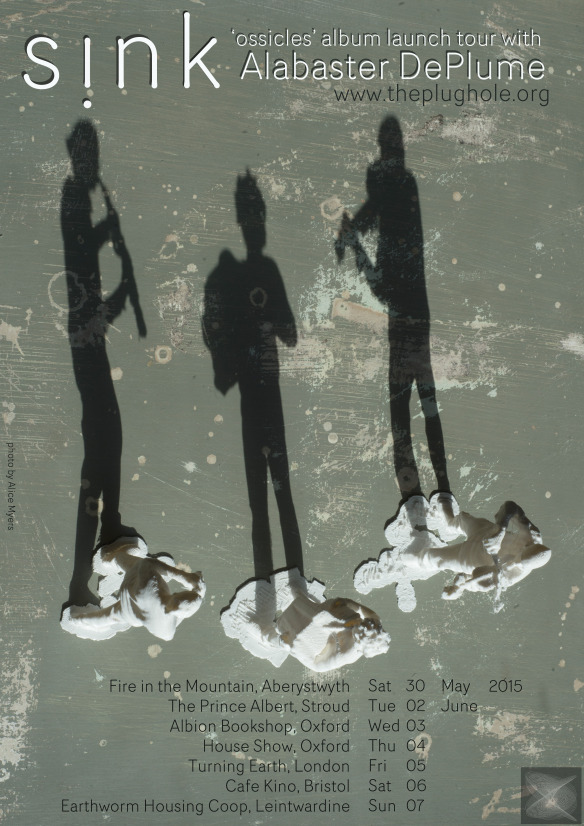
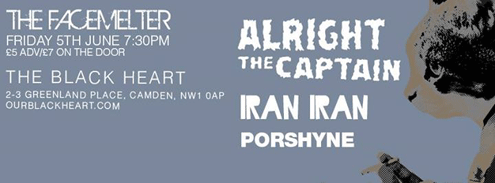
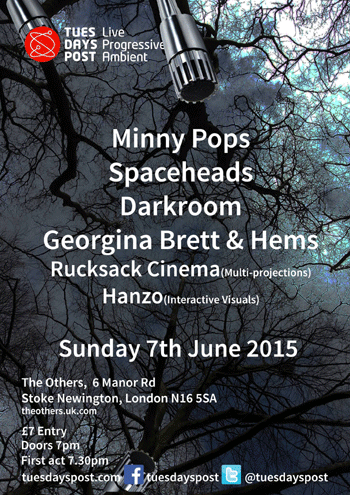
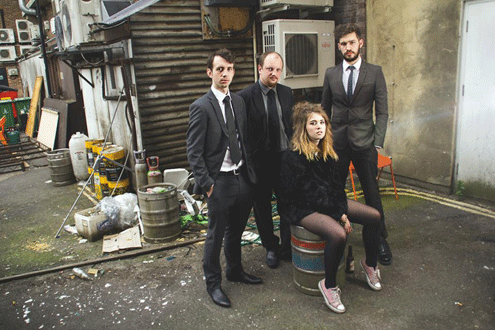

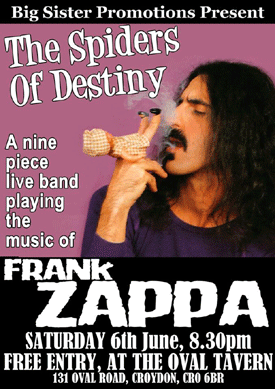
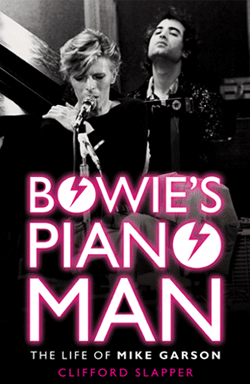
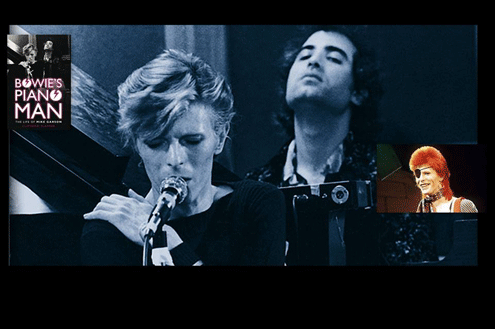

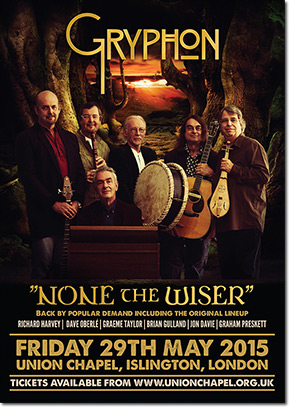

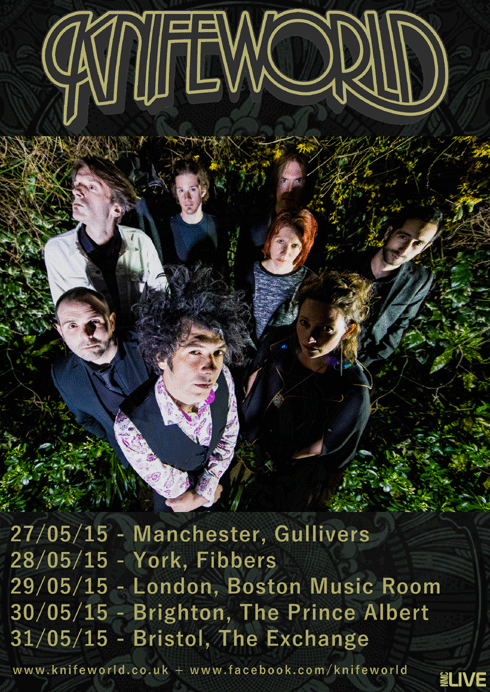
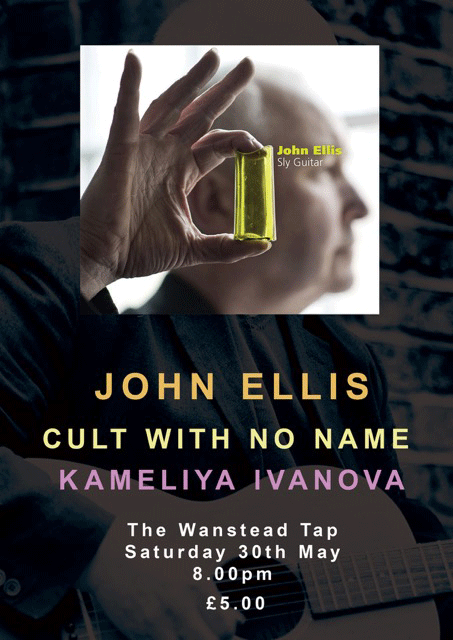



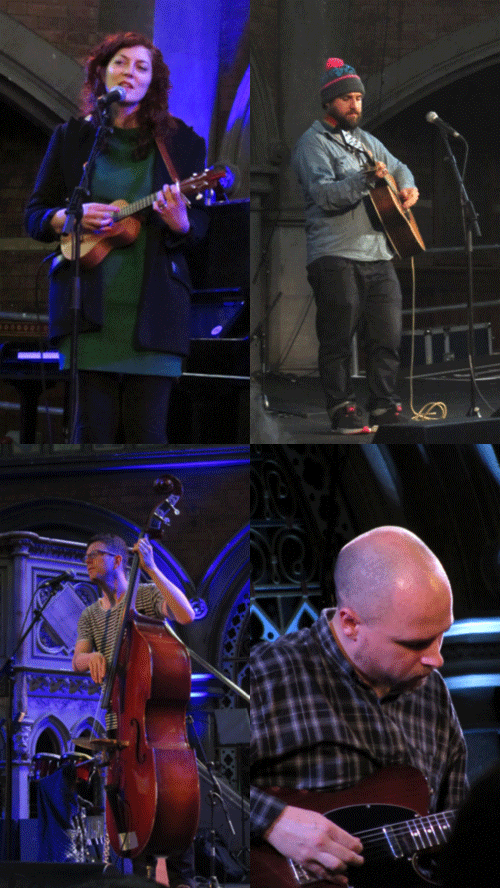
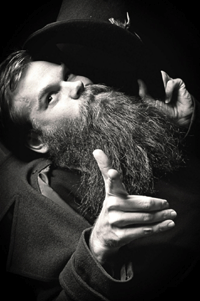


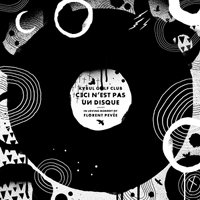
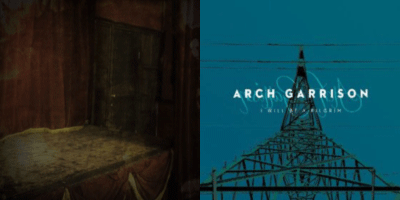


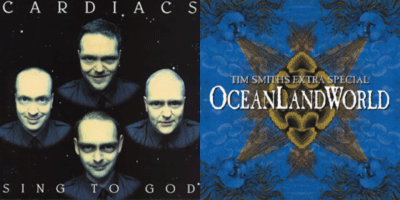
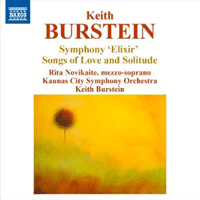
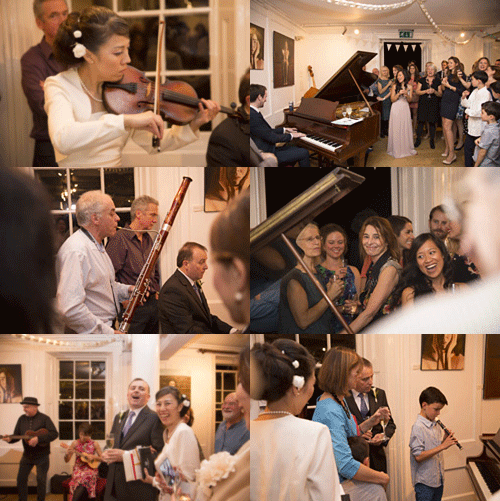
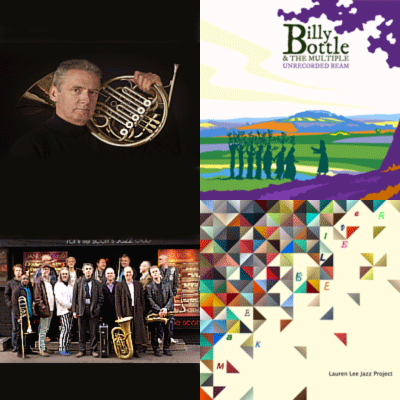
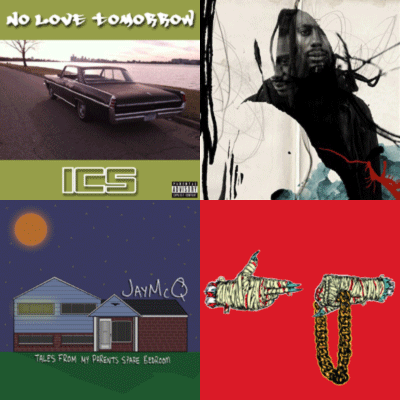
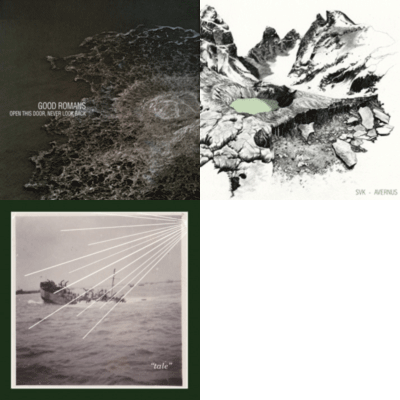
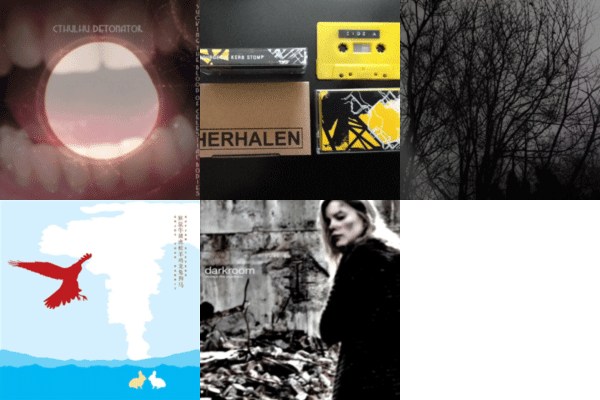

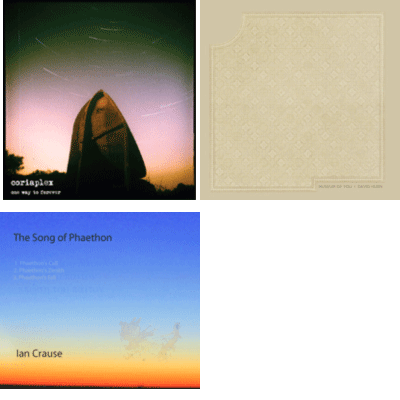


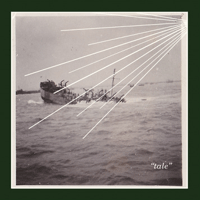




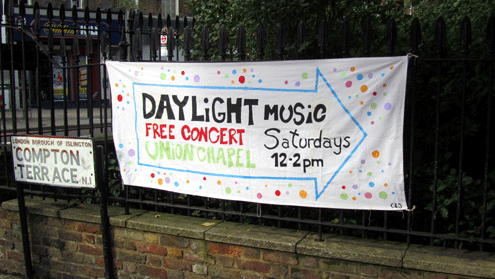
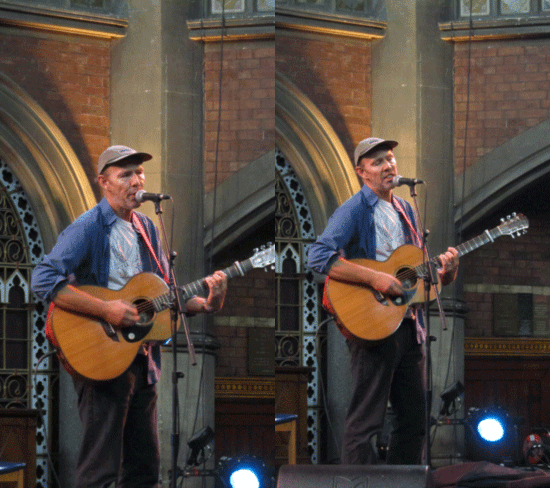
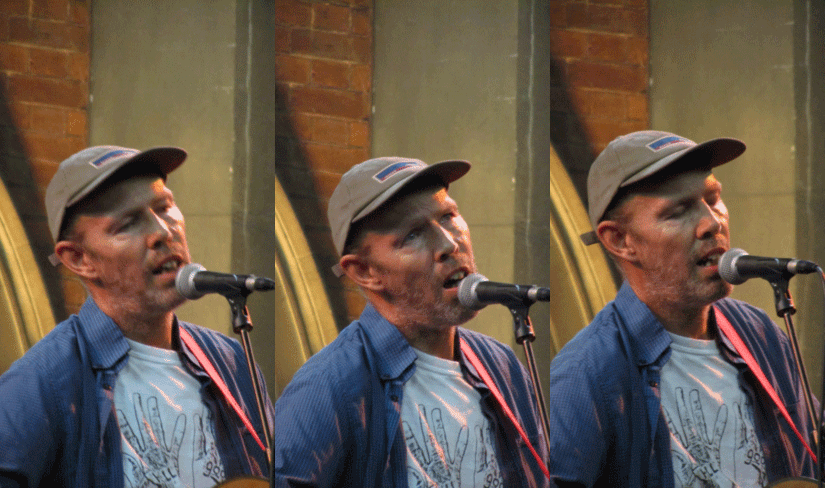
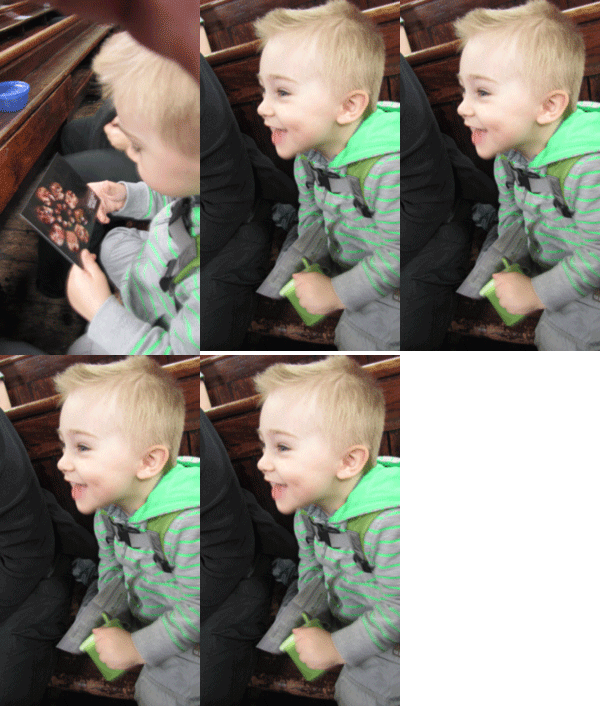
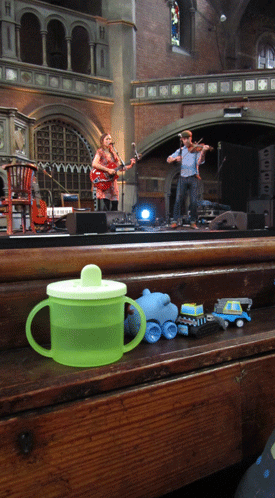
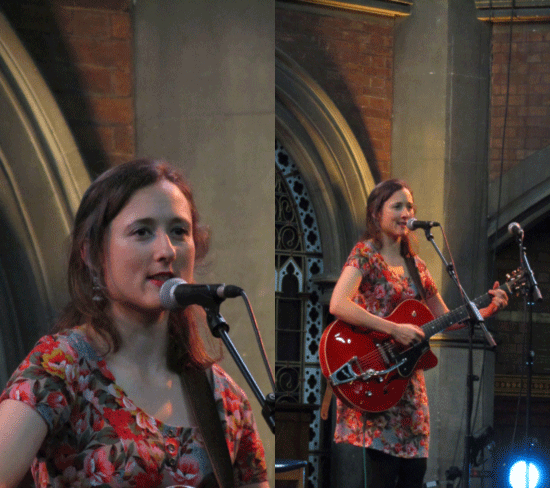
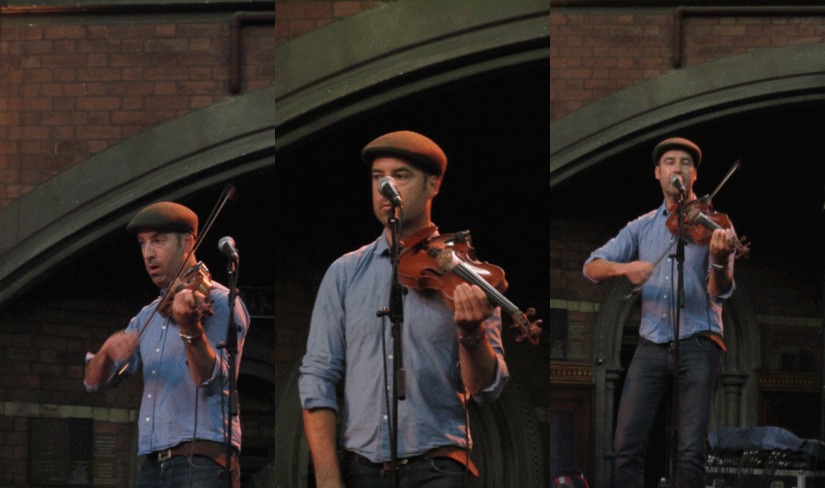
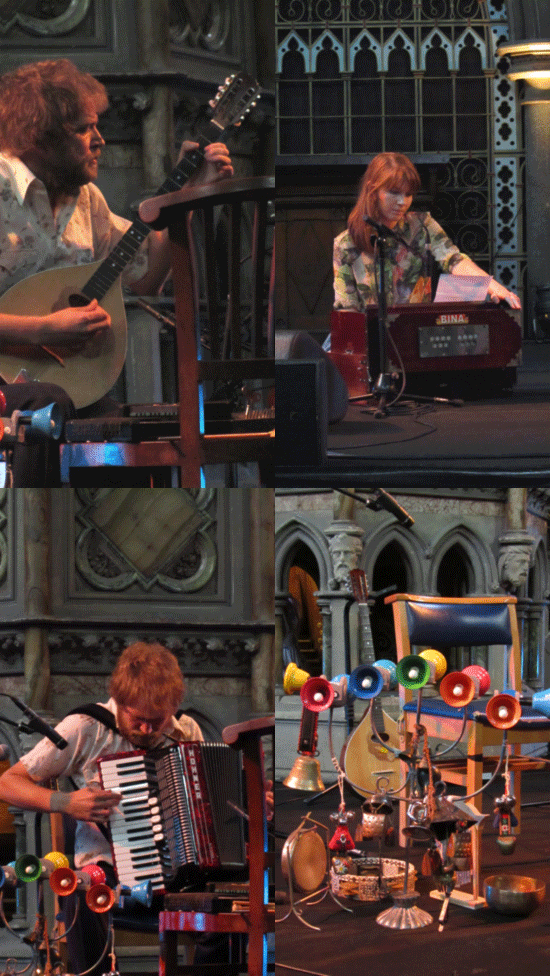
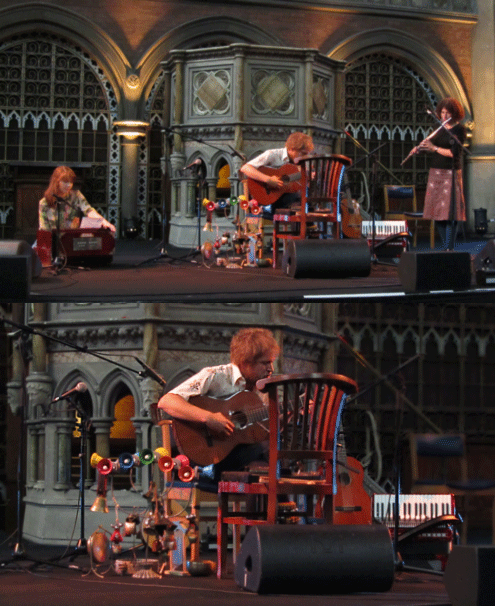
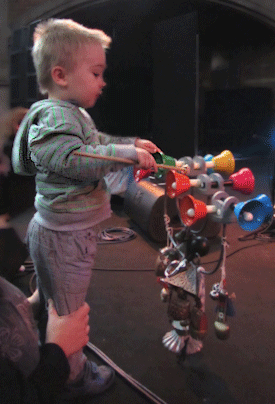
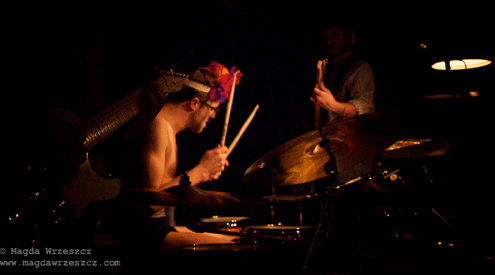


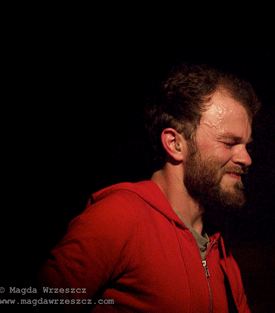
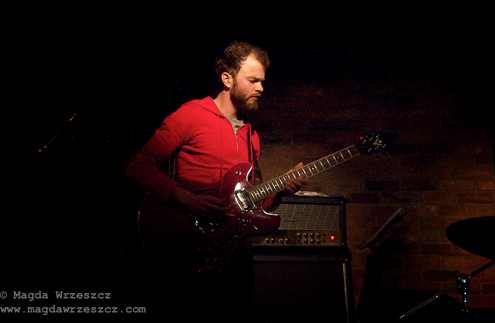



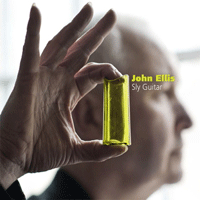


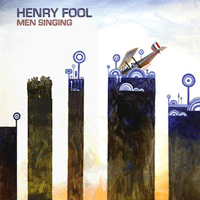


 Misfit City