Archive | DIY music RSS feed for this section

May 2016 – upcoming gigs – The Burning Hell spend May in Britain and Ireland; a short English tour for Knifeworld and The Cesarians; V A L V E soundtrack London’s Mysterical Day.

6 May

Smart, talkative Canadian pop band The Burning Hell are playing a UK tour for most of the month, in support of their new album ‘Public Library’. The vehicle for songwriter Mathias Kom, they deliver engaging and melodious indie/folk/pop tunes about building enthusiasms, about making connections and conversations, and about the small absurdities of serious life, all with a delightful rapid-patter lyrical delivery. Recent examples are below, as are the tour dates:


  • Magic Lantern Cinema, Penbryn Corbett Avenue, Tywyn, LL36 0AH, Wales, Sunday 8th May 2016
  • The Roisin Dubh, Dominic Street, Galway, Ireland, Monday 9th May 2016
  • Whelan’s, 25 Wexford Street, Dublin 2, Ireland, Tuesday 10th May 2016
  • DeBarra’s Folk Club, 55 Pearse Street, Clonakilty, West Cork, Ireland Wednesday 11th May 2016
  • Start The Bus, 7-9 Baldwin Street, Bristol, BS1 1RU, England, Thursday 12th May 2016
  • Clwb Ifor Bach, 11 Womanby Street, Cardiff, CF10 1BR, Wales, Friday 13th May 2016
  • The Eagle Inn, 18-19 Collier Street, Salford, M3 7DW, England, Saturday 14th May 2016 (both matinee and evening performances)
  • Arden Road Social Club, Arden Road, Halifax, HX1 3AG, England, Monday 16th May 2016
  • The Crescent Working Men’s Club, 8 The Crescent, York,YO24 1AW, England, Tuesday 17th May 2016
  • The Lemon Tree, 5 West North Street, Aberdeen, AB24 5AT, Scotland, Wednesday 18th May 2016
  • The Drouthy Cobbler, 48A High Street, Elgin IV30 1BU, Scotland, Thursday 19th May 2016
  • The Hug & Pint, 171 Great Western Road, Glasgow, G4 9AW, Scotland, Friday 20th May 2016
  • Mickleton Village Hall, Market Place, Mickleton-in-Teesdale, Durham, DL12 0JY England, Saturday 21st May 2016
  • Spanky van Dykes, 17 Goldsmith Street, Nottingham NG1 5JT, England, Sunday 22nd May 2016
  • Middlesborough Institute of Modern Art, Centre Square, Middlesbrough, TS1 2AZ, England, Monday 23rd May 2016 (free show)
  • Oslo, 1a Amhurst Road, Hackney, London, E8 1LL, England, Tuesday 24th May 2016
  • The Hope & Ruin, 11-12 Queens Road, Brighton, BN1 3WA, England, Wednesday 25th May 2016
  • Moshi Moshi @ Tom Thumb Theatre, 2a Eastern Esplanade, Cliftonville, Margate, CT9 2LB, England, Thursday 26th May 2016

* * * * * * * *

Starting at around the same time, Knifeworld English tour, May 2016Knifeworld will be performing a quick four-date English tour, promoting their new album ‘Bottled Out Of Eden’. Regular readers will need little introduction to the band, whose ornate and crenellated puzzle-box psychedelia has been featuring in here for years; newcomers should definitely check out their wanton, decorative, brass-rich tunes which span a web of influences and comparisons from Syd Barrett, Mercury Rev, Steve Reich, Cardiacs and XTC while maintaining the distinctive and complex songwriting vision of leader Kavus Torabi. Support on all dates will be from string-and-horn-drenched art-rockers The Cesarians, whose tunes run the gamut from lush pop to flea-itching rap scrapes.

  • The Musician, 42 Crafton Street West, Leicester, LE1 2DE, England, Monday 9th May 2016
  • Brudenell Social Club, 17 Brudenell Road, Leeds, LS6 1HA, England, Tuesday 10th May 2016
  • The Green Door Store, Lower Goods Yard, Brighton Train Station, Brighton BN1 4FQ, England, Wednesday 11th May 2016
  • Bush Hall, 310 Uxbridge Road, Shepherds Bush, London, W12 7LJ, England, Thursday 12th May 2016

* * * * * * * *
It’s also worth mentioning that Knifeworld bassoonist/saxophonist/occasional singer Chlöe Herington (also known for her work as part of Chrome Hoof) will be taking her experimental project V A L V E out again later in the month. The project – which has been known to make music from diagrammatic sources including transposed ECG readings and fragmentary notation found in skips, as well as Chloe’s own instrumentation (which extends beyond reeds to guitar and sampler) – makes an live soundtrack contribution to feminist-slanted arts-meet A Mysterical Day.

A Mysterical Day, 14th May 2016

Serpentine Galleries present:
A Mysterical Day
The Cockpit Theatre, Gateforth Street, Lisson Grove, London, NW8 8EH, England
Saturday 14th May 2016, 1.00pm
– more information here and here

“Inspired by the life and work of Hilma af Klint, as well as the exhibition of DAS INSTITUT, this session brings together artists, writers and historians to explore mysticism, feminism and performance. Participants include Saelia Aparicio, Clodagh Emoe, Florence Peake, Zina Saro-Wiwa, Tai Shani, V A L V E (Chlöe Herington/Elen Evans) and more. Programmed in collaboration with artist Tai Shani.”

All I know re the V A L V E contribution is that Chlöe is being joined by harpist Elen Evans for the performance, that she’ll be working with various invented instruments of her own devising, and that pieces will include “FEM – a five-note ‘automated’ cycle – and Futures, in which the melodic structure is determined by a tarot card score.” Meanwhile, here are a couple of V A L V E soundclips, plus one of a tinkling, echoing new instrument which Chlöe built recently out of contact microphones and sundry rubble.


April 2016 – upcoming gigs – two for April 16th: the third Festival Ambient de Paris with Ujjaya, Asmorod and others; and roaring about in London with Godzilla Black plus cohorts.

15 Apr

Tomorrow – two cities, two gigs. In Paris, people will be filing into the mediaeval cellars, all serious and attentive, fascinated by texture and the warp and weft of sound. In London, it looks as if they’ll be torn between wanting to be handsome psychotic brutes in sharp suits or shabby, demented hermits in bird masks.

* * * * * * * *

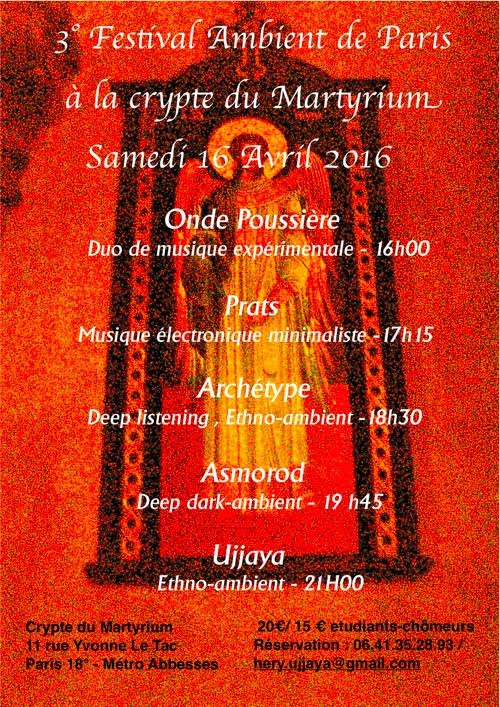
3ieme Festival Ambient de Paris, 2016 3ieme Festival Ambient de Paris
Crypt du Martyrium de Saint-Denis, 11 rue Yvonne Le Tac, 75018 Paris, France
Saturday 16th April 2016, 4.00pm
– more information here and here

From the organisers…

”Crypt du Martyrium is the most mystic and secret of Paris crypts (the head of the first bishop Denis was found here in 300 AD, and it was also the birthplace of the Jesuit Society). For one night only, artists from Paris and its suburbs will enchant this unique historical place with the kind of music you will hardly hear anywhere else in France.

The festival welcomes :

Ujjaya – an French ethno-ambient veteran, deeply influenced by Robert Rich, Steve Roach, Jon Hassell and Jorge Reyes. With his new found interest in suspended gamelan (which he’ll be enchanting the crypt with tonight), Loren Nerell has become another point of reference for his ongoing work. (For more information, try one or both of his two free-to-download albums: ‘De Retour’ and ‘The Master of Crossroads’.)


Onde Poussière – an experimental duo specializing in hypnotic minimalism and controlled chaos, and featuring Doedelzak (synth) and Kecap Tuyul (table-top prepared guitar). Think an ambient version of Jim O’Rourke , Taku Sugimoto or even Autechre.


Patrick Wiklacz – also known as Prats – is influenced by Terry Riley, Klaus Schulze and Bernard Parmeggiani. He will unleash his own electronic universe on synth and MIDI controller – a mix of repetitive minimalism, ambient and electro-acoustic music.


Archetype – an heir to Oöphoi, Alio Die and Mathias Grassow (and performing on guitar, synth, voice and table harp)Archetype makes deep listening music and also plays some ethno-ambient music not unlike Dead Can Dance.


Asmorod – the founder of the Snowblood label, synth/keyboard player Asmorod is both very discreet and very influential in the dark ambient scene (he’s an acknowleged influence on Kammarheit’s ‘Hysope’ album).


* * * * * * * *

Godzilla Black + Bobbie Peru + Punching Swans + Mashiro
The Hope & Anchor, 207 Upper Street, Islington, London, N1 1RL, England
Saturday 16th April 2016, 7.00pm
more information

Godzilla Black + Bobbie Peru + Punching Swans + Mashiro, 16th April 2016Godzilla Black have been unsettling ears since 2006 with their own personal brand of depraved heaviness. This is the official launch party for their new album, ‘Press The Flesh’, which was released on 1st April through Quisling Records. ‘Press The Flesh’ is the most ‘normal’ Godzilla Black record to date, drawing on influences such as Cardiacs, Liars and The Jesus Lizard, underscored by feeling of sensuality in all the wrong places. ACCEPT NO IMITATIONS.”

I may have to revise that “James-Barry-in-a-sleetstorm” description with which I always saddle Godzilla Black. Listening through to ‘Press The Flesh’ reveals the band in all of their romping glory, sometimes sounding like gonzo-industrial hero Foetus hijacking a soul revue, sometimes like late Cardiacs channelling early Roxy. Glam-descends meet blaring beefhorns, with lyrics full of dark jokes and carnivorous, cannibalistic disassociation. They’re flowering into something sharky and vivid. Clips below for album opener ‘The Other Other White Meat’ and the first ‘Press The Flesh’ single, ‘First Class Flesh’ (note that there’s a theme developing here…)


In support are Bobbie Peru, whose music is heavily influenced by punk, post-punk, rockabilly and 60’s garage; and who offer “an abrasively grooving electric live show with a vibe somewhere between Sonic Youth, Nomeansno and Groop Dogdrill.” Currently recording their third full-length album in Manchester (and constantly playing live around the north-west of England), the band are something of a fixture in the world of indie and post-punk tours, having racked up road support slots with Black Francis, Buzzcocks, Spear Of Destiny, Killing Joke and The Fall since their own emergence in the mid-2000s.

Medway convulsers Punching Swans are self-described as “thrilling dischordance for fans of Future Of The Left and Fugazi”, although I can hear hints of The Residents lurking in their threshing pop-savvy upending of rituals, and when they’re not hammering alarmingly at a darker idea they’re out on the whoop chasing the spirit of ‘Song 2’. It’s the cryptic strangeness that makes them special, though – they’ve recently brought out a concept album about “a man cast out from society and taking on the habits and compulsions of a depraved bird, gone to seed,”, and are making the woodsbound videos to match. There’s a peek into this particular world below.

Oxford abstract mathcore metallists Masiro bring “heaviness, other-wordly atmosphere and headfuck grooves. Touching on Pelican, Isis and Battles. Don’t expect a singalong.” All right, then. Evidence of their jabbing attention-deficit methods is here:

 
* * * * * * * *

More shortly…
 

April 2016 – upcoming gigs – street-level shamanism and more at the Gnod weekender in London, April 9th & 10th

7 Apr

In some respects Gnod – who are curating, and playing at, an extended gig in London this weekend – are a dubby Salfordian reflection of Godspeed You! Black Emperor. They share certain working methods – a collective, leaderless initiative springing from communal warehouse living; a passionate ethos of anti-establishment, anti-authoritarian feeling expressed in vast, cavernous and primarily instrumental musicscapes; an atmosphere sourced from circulating cultural-economic ghosts of deprivation and stagnation.

As regards the music itself, the parallels shift a little. Though both bands use drones and scattered, marginal snippets of speech, Gnod’s approach is a good deal broader and looser than Godspeed’s blend of classical/minimal string austerity and wind-tunnel punk rage, seeding itself from a variety of persistently underground forms. In the stew are industrial dance music, noise rock and anarchic dub; mystical hippy staples of overtone chanting and psychedelic ritual music (stripped of their frivolous navel-gazing associations and brought back to their mind-opening sources); free jazz; and a swathe of aural art-punk collagery (the latter of which, in Gnod form, recalls apocalyptic Godspeedian end-of-days graffiti, an approving response to Linder Sterling’s sharp visual comments on consumerism, and diary notes from besieged squats and hermit bedsits).

Other information is there if you choose to dig it up. We know that Gnod are from the other Islington – that liminal corner of Salford in the elbow of the River Irwell between the rails, the university and the skeletons of light industry, where the Islington Mill Arts Centre (in which the band live and work) has flourished since the mid-‘90s. We know that multi-instrumentalists and producer-theorists Chris Haslam and Paddy Shine have been in the band from the start: we know that the other two current members happen to be Marlene Ribeiro and Alex Macarte. We know that what seems to be dozens of others (but might be the same six people in a constant shuffle of personae) phase in and out of the band according to need, whim and inspiration; and that these include Manchester improv saxophonist David McLean, journeyman keyboard player John Paul Moran and drummer Chris Morley (once of Welsh experimental rockers Klaus Kinski, now propelling no-wave’d punk-funkers target=”_blank”>Queer’d Science).

We also know that the hybrid steam of subcultural influences and spirit of resistance that boils off from all of these ingredients is winning Gnod awestruck acclaim. ‘The Quietus’ (increasingly the British tastemaker as regards bands negotiating that slippery margin between absolute chthonic obscurity and cultural penetration) has not only sung their praises but been seduced into actually recording with them; while digging into Gnod’s web of ongoing connections and activities shakes up all kinds of other possibilities. The Gnod network of fellowship stretches across Europe and encompasses ever-roving Can singer Damo Suzuki, billowing gonzoid sample-psych from the late ‘80s (revived arsequake veterans Terminal Cheesecake sport former Gnoddist Neil Francis as their current frontman), classic British post-punk (via The Monochrome Set and The Blue Orchids), Louise Woodcock’s multi-media feminist art and a Catalonian psychedelic scene which gives a new meaning to Spanish castle magic (a few years ago, Gnod teamed up with Barcelona’s Black Bombaim as “Black Gnod”).

Having been casting out recordings since 2009, Gnod came up to speed with the beefy-but-spectral ecclesiastic dubgrind of 2011’s ‘INGNODWETRUST’ (following up with 2012’s ‘Science & Industry’, a sort of post-industrial ‘Sketches of Spain’ for trumpet, drones, ironscrape guitar haze and indistinct female declamations). They’re currently best known for 2014’s mammoth 110-minute ‘Infinity Machines’, in which their instincts for mood and social challenge came into focus. For that album, Gnod returned to (scorched) earth and conjured up a classic post-war Mancunian landscape of bones, threat and concrete; marrying a bleak Joy Division grind and deadzone chimes with knell-beating Rhodes piano, distorted boomings like rusting gasholders being beaten into dub drums, and aghast chemtrails of free sax which sounded like black-sailed galleons creeping up the Ship Canal and advancing into the Irwell. Amidst the grindings and slithering drones and the pollutant-smeared sleet, vocal samples of resistance and disquiet gave shape to a dawning and outspoken atmosphere of scepticism; in Breaking The Hex, they finally unleashed an eleventh-hour blast of dub/punk/sax/noise rebellion, while the title track was a harmonium keen over dark sonic bubbles.

While it didn’t wear its manifesto in the shape of a set of placardable lyrics, ‘Infinity Machines’ was a work of Salford shamanism, spitting the city’s ongoing gentrification back into its own face. Since then, Gnod have refused to simply rework it – instead they’ve allowed the feelings that inspired it to lead them naturally into new forms. Last year’s ‘Mirror’ album was written on tour in a slew of traveller’s energy and impacted by destructive mental turbulence within the Gnod circle: inspired in part by rage at government austerity programs which apparently declared war on the poor) propelled the band away from grand studioscapes and into a raw, live feel. It’s more personalised, its anger and alienation borne on pendulous and discombobulated noise-punk anti-grooves. Hands slam onto instruments and slip beats; the music flares into outright rage rather than stern painterly stews. Amidst the overtone vocals and chants, there’s persistent raw yelling; while the soundscapes have shifted towards slowed sirens, and a dragging, coshing pace: a clear early Swans influence.

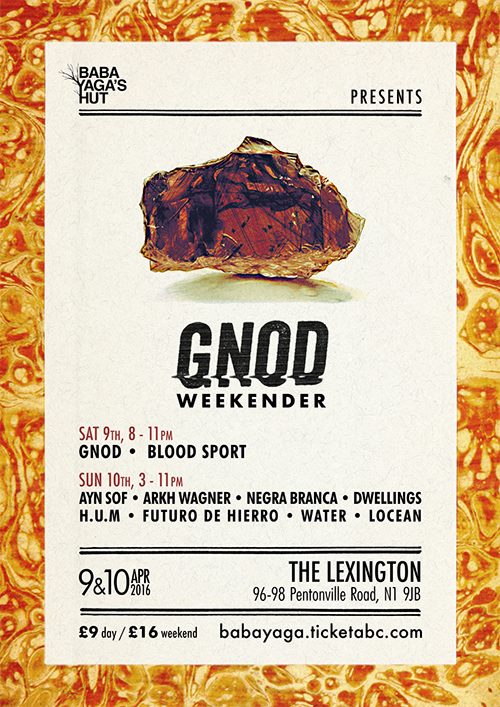
Baba Yaga’s Hut presents:
Gnod Weekender, part 1: Gnod + Blood Sport
The Lexington, 96-98 Pentonville Road, Islington, London, N1 9JB, England
Saturday 9th April 2016, 8.00pm
more informationtickets
Gnod Weekender part 2: Locean + Water + Futuro de Hierro + H.U.M + Dwellings + Negra Branca + Arkh Wagner + Ayn Sof
The Lexington, 96-98 Pentonville Road, Islington, London, N1 9JB, England
Sunday 10th April 2016, 3.00pm to 11.00pm
more informationtickets

Gnod Weekender, 9th-10th April 2016Much of all of the above is going to come together over the course of this weekend, in which Gnod and a host of like-minded friends bring their collective approach to the current homestead of quirky London rock.

Saturday sees a full Gnod performance, supported by Sheffield trio Blood Sport, whose spindly and aggressive style is a ghostly, glassy-toned, black-sun approximation of Afrobeat and soukous. As for what Gnod themselves might be doing, the grind and gnarl of ‘Mirror’ might be their current output but they have a history of changing state and presenting an expectant audience with something unexpected: so be prepared for anything which reflects their history and their potentials (up to and including party blowers, possibly).

Sunday’s afternoon-to-late-night show features Gnod side projects and assorted friends in an eight-hour orgy. Some feature current Gnod members. Paddy Shine’s immersive “tantric vocal loop” project Ayn Sof will be opening the show; Dwellings is founder and bass player Chris Haslam doing hard-beat industrial electronica – dull-thud compulsive flesh beats, like the woody rattle of an early S&M loom, played in tandem with dank gothic synth drones. Negra Branca is a Marlene Ribeiro project, expanding on the “melodic and tonal dreamscapes” which she plays as part of the main band, full of squashy analogue synth shapes and temple-goddess vocals.


In Arkh Wagner, Alex Macarte (one of the more directly mystical Gnod members, if his online talk is anything to go by) teams up with Mark Wagner, a London-based multi-disciplinary artist and cybernetic mysticist, whose working practices are steeped in “cymagick” (a visualization of sound which takes in invisible and occult connections and “the vibratory nature of all things”). Their track Turn Off Your Mind (a narrative backed by a deepening pulse-chime in a confusion of noise surf) is a meditation on staring into the void, and on going too far out.


Mark Wagner’s also taking the stage as one-third of H.U.M. (or “Hypnotic Ultrasonic Magick”), a merging with two similarly shamanic noisemakers from Bristol’s ZamZam Records (these being the enigmatic surnameless H, or “Heloise”, who slipped into Bristol six years ago from a French fine arts background and has since been bewitching audiences with gigs that fall somewhere between installation and ritual and take place in caves, swimming pools and sundry found space, and fellow émigré and ambient droner Uiutna, originally from Switzerland but making her own way in the Bristolian avant-garde). H and Uiutna relocated to France recently but return to England for this event. H.U.M. present themselves as a kind of psychic cross-cultural art coven, citing “alchemical practice, incantation, chanting, drones, ritual drumming, French variété” as both inspiration and activity… although “French variété” is also on the list, so either a showbiz tinge or a sliver of hidden humour has been worked deep into the atmospheres. Here’s a clip of them in action:


Over in Barcelona, multi-instrumentalist, producer and happeneer Víctor Hurtado is the core of a “magic-inspired” scene of ritual psychedelic music. First coming to notice as the man behind acid-assemblage unit Qa’a (a richly detailed stew of lysergic rock and Nurse With Wound noise-and-texture garnishing), he’d soon diversify into a greater spontaneity with Huan (a project which he describes as “animalistic pulsations… almost like a living organism, that is at times sick, dying or excited”). Having collaborated with Jochen Arbeit, Steven Stapleton and more recently with Chris Haslam in the “monolithic, rhythmic, repetitive” Ordre Etern, Victor is bringing his Futuro de Hierro project to London for the Gnod Weekender. His latest musical pathway, it’s an outgrowth of his interest in more extreme and violent forms of electronic dance (such as speedcore and gabba) fused with techno, music concrete and a heightened psychedelic sensibility, featuring “disjointed rhythms” and “destroyed sounds, sonic detritus and live sound manipulation.”


All-female “art-carnage” troupe Water are another part of the Venn diagram which Gnod inhabit. Specifically, they represent the circles which intersect Manchester’s visual arts and multimedia, and the Devi Collective which coalesced around the Mill to commemorate and interpret last year’s William Burroughs centenary. Citing Throbbing Gristle, Wu-Tang Clan’s Rza and “well-witch horror scores” as creative spurs, they’re currently a five piece of multi-media “queen bee” Louise Woodcock, spoken-word poet/noise-guitarist Laura Bolger, visual artists Amy Horgan and Rachel Goodyear, and Emma Thompson (usually encountered as a DIY/punk/experimental gig promoter).

Soundcloud clips reveal something sounding like post-industrial Maenads: eerie threadlike female choruses and Laura’s dub-echo declamations seeping through a freeform background of womb-bass, malfunctioning engine drones, clanks and whistles, piston hisses, machine scrapes and tekiah blasts. The involvement of at least three women from a visual arts background – plus some striking photos – suggests that there’s a spectacle involved. Evidence of lengthy Water performances inspired by Aleister Crowley, by séances and by water rituals suggest that they’re fascinated with rite, summoning and form in a way which spans primordiality, Greek legend and map-fixes on esoterica ranging from Renaissance art to the present day. All of it slips through the fingers if seized on second-hand: it seems as if Water are an experience best soaked up live.


Laura Bolger reappears to add smeared, dreamlike vocals and narrations to the final act on the bill, Locean – another full-on Irwellian music collective in the Gnod and Devi orbit (sharing both Louse Woodcock and sometime Gnod tapesman/ranter Neil Francis). Offering another queasy grinding ride of driving punk-psych, noise improvisations and punk wail, their mantric sound binds The Velvet Underground, Mother Gong, Bauhaus and an abrasive Fall-esque groove in with bass-echo and wheel-rim guitar. As with Gnod and Water, they’re technically minimal but build up to a grand scale with their scratching, multiplying sonic detail: Laura’s words and musings, floating on the sound-wash like scraps of diaries and manifestos, ranges from odd and oblique polemics to numinous childhood memories.


As I post this, tickets are still available. If you’re spending most of your time trapped in London’s gravity well, this might be your best chance for a while to get something of that Islington Mill atmosphere and inspiration, and to beat along with Gnod’s dark-toned, troubled yet committed heart.
 

March 2016 – upcoming gigs – London murk and sarcasm – an industry-baiting evening of 30-second songs by the Pocket Gods and mystery buddies; plus noise rock from Arabrot, Shitwife and Godzilla Black at Corsica Studios

15 Mar

Two London gigs for Thursday…

* * * * * * * *

Pocket Gods @ Zigfrid von Underbelly, 17th March 2016

The Pocket Gods (’30 Second Song Set’) + tbc
Zigfrid von Underbelly, 11 Hoxton Square, Hoxton, London, N1 6NU, England
Thursday 17th March 2016, 7.00pm
– free event – more information

Here’s the chirp – ”London lo-fi indie popsters The Pocket Gods play a free St Patrick’s Day gig in Hoxton, London to promote their groundbreaking album ‘100×30’ – which features one hundred songs, all of which are thirty seconds long and some of which will be featured. Free entry and some great support bands!“

Sweet, isn’t it?

Here’s the rest of the story.

‘100×30’ was released last December. It’s a sharp, timely yet self-mocking broadside aimed at the music industry as a whole, and also at the amorphous greed’n’gratification culture that’s gulping down what remains of it. Masterminding this collection of half-minute jabs are The Pocket Gods – shabby knowing masters of multiple styles, mix’n’matching shreds of chart pop, punk, synth-blurb, soggy psych and outright pisstakes (including Blur, and Dappy from N-Dubz). Sometimes they sound like a back-bedroom Zappa Band operating on cheapjack equipment from a small-town branch of Argos, and sometimes like a more eclectic Half Man Half Biscuit aiming more of their jokes at the towers of power.

Threaded through the whole album is a sense of indignation at the implosion of music as a workable career (“my royalty statement is a thing of wonder, and keeps me in a state of permanent hunger”) and the dismissal of artists who can no longer be counted as fresh and malleable meat. One lyric points out, with sardonic but righteous indignation, “I can write songs about anything, because I’ve lived a little longer”; and there’s quite a bit of moping about the prospect of a future which involves little more than making unwanted music on a laptop. Across the tracks, the subject matter paints a scathing, resolutely unimpressed picture of vulgarity and short-termisms. Songs attack the rent hikes which force music venue closures; lampoon the encroachment of multinational corporate interests into independent business (the entwinement of Orchard and Sony takes a pounding, which – since Orchard is releasing the album – is a particularly fanged move); and pour sarcasm onto side topics like the sorry parade of boss-pleasing reality-TV contestants, the cluelessness of A&R men and the ludicrous table prices at the Brits (apparent sideshows which point towards the bigger problem). The Gods even slag off laptop music and mount a harpsichord-driven assault on the memory of Steve Jobs. So much for the individual being independently empowered by technology.

With the proven flexibility of the Pocket Gods, it’s tempting to assume that the brace of performers elsewhere on the album are just pseudonyms. Not a bit of it. Some – including oddball pop mutterer Michael Panasuk and fuzz-guitar flourisher Brian Heywood – appear to be rogue film, television and library music composers. Two more are former chart stars (Owen Paul and Mungo Jerry’s Ray Dorset, each damn near unrecognisable).Some veer towards cabaret (the semi-genteel, character-vocalled acoustipop of The Low Countries) or sarky contrarian Scottish dolour (Bill Aitken). Others even sound like glossy successes in waiting, including power-popper Katy Thorn, gobby R&B-er Tricey R, immaculate faux-Californian rockers Dead Crow Road, countrified Elvis-alike Osborne Jones, twinkling white-boy hip hoppers Foxgrease and full-bore electropop drama queens Hands Of Industry. The burnished countrified chart-pop of Heywood Moore even sounds as if it could make a killing in the American Bible Belt (sweeping out of the same CCM radio playlists as the likes of Lexi Elisha – not bad for a band that’s actually from Dunstable). None of this seems to stop any of them from joining in. Some of them may be taking a long-delayed, heartfelt chomp at the hand that feeds so grudgingly, or refuses to feed at all; or which they see starving others, from audience to artist, both fiscally and spiritually.

Despite all of this justifiable resentment, it could all turn precious and self-righteous were it not for the jabs of anti-pomposity which the Gods and their friends turn in on themselves (the musician-skewering of ‘Small Town Musos’ and ‘Mac Book Ho’ made me laugh out loud, as did a song about the natural progression from ambitious Radio 1 listener to experienced Radio 2 couch-fogey). There are also the other moments – the flip side to the flipness – in which the half-minute song limit becomes a lesson in how much can be achieved in a short time. John Rowland’s plunderphonics and piano instrumentals; upROAR’s quick echo-laden harp passage, Orb collaborator Another Fine Day’s gorgeous burst of echo-soused kalimba; or when writer and narrator Michael Hingston (who’s already spent two tracks guesting with the Pocket Gods, bidding goodbye to the swelling ranks of closed-down London music venues in a hardbitten wise-barfly drawl) gently blows thirty seconds of tentative, unaccompanied saxophone.

Finally, there’s the persistent realist-absurdist wit of The Pocket Gods themselves – party hosts, project backbone and the only act formally confirmed as performing at the Hoxton gig on Thursday (yes, I was going to get back to that…) Come along to see who else makes it. Meanwhile, you can play through the whole album below; and even buy it (if you feel that that won’t somehow spoil either the joke or the protest).

https://soundcloud.com/thejacula/sets/100×30
 

* * * * * * * *

Baba Yaga’s Hut presents:
Arabrot + Shitwife + Godzilla Black
Corsica Studios, 4-5 Elephant Road, Elephant & Castle, London, SE17 1LB, England
Thursday 17th March 2016, 8.00pm
more information

Arabrot + Shitwife +Godzilla Black @ Baba Yaga's Hut, 17th March 2016Norwegian noise-rockers Arabrot have spent a decade and a half feeding classical, Biblical, existential and surreal tropes through a grand and gothic avant-rock mangle. As you can imagine from this, both their gigs and records have had an immediate raw-lifed, raw-liver feel to them, despite what ‘The Quietus’ describes as the band’s “velveteen grace”. More recently, group leader Kjetil Nernes spent two years recovering from throat cancer, during which he’s fought off and defeated encroaching death not just via hospital treatment and homestay but by hurling himself back into Arabrot recording and touring. Having admitted that the experience was “as close to real physical and psychological hell as you can go”, Kjetil has spun his reactions into Arabrot’s latest album, ‘The Gospel’, which is suffused with spectres of death, illness and his own defiance.

Shitwife have possibly the most discouraging band name in history – an evil grunt of a handle, a surly trucker’s growl of a monicker. We last encountered them in the listings for a Christmas gig, in which they were described as an “astonishingly brutal drums/laptop/electronics juggernaut fusing rave, death metal, noise and post-hardcore.” As far as I know, they’ve had no reason to mess with that formula in the intervening three months. Here’s a clip of them in action at a different gig last September (just a short walk away from ‘Misfit City’ HQ, not that I knew it) plus a more recent video showing laptop/keyscruncher Wayne Adams engaged in a painting session (and looking far sweeter than he ought to, given that his other band’s called Ladyscraper).


As I’ve said before, Godzilla Black seem to have made themselves into London noise-rock favourites while not actually having much to do with noise-rock at all. Most of the latter’s in the brawling muscle which they apply to their John-Barry-writes-for-Ruins-or-King-Crimson tunes; and in the garnish of hiss and fry lying on top of that muscle, adding a pitch and pinch of disintegration to their drums-and-horns pimp-roll. Otherwise what I’m hearing is spy-movie glamour all the way, albeit gone slightly weird: extra panicky descends and clangings, sax stranglebursts and sampler squeals. Brand new single ‘First Class Flesh’ sounds as if its about some kind of disassociative disorder: singer John McKenzie boggling, all glazed and juicy, about body parts but not actually about bodies (ending up neither sexy nor creepy, but away in a skewed and disfocussed branch-off of both).


* * * * * * * *

More March gig previews shortly…
 

October 2015 – upcoming London gigs – gamelan/dance fusion with My Tricksy Spirit, Wax Wings and Segara Madu; Nordic pop at Ja Ja Ja (Kill J, Loveless and Maasai); anarchistwood’s Samhain/NYE party (with Rude Mechanicals, Jane Ruby and more)

23 Oct

More concerts for the end of October…

* * * * * * * *

As the opening concert of the South East Asian Festival 2015, there’s a performance at the Forge by My Tricksy Spirit, a new musical project which fuses the shimmering sounds of gendér wayang – Balinese gamelan instruments – with dub, electronic, ambient, trip-hop, and psychedelic rock. The Forge’s writeup is below (tweaked a little by me).

My Tricksy Spirit @ The Forge, 28th October 2015

My Tricksy Spirit (The Forge , 3-7 Delancey Street, Camden Town, London, NW1 7NL, UK, Monday 26th October 2015, ) – £10.00 

Performed on the bronze-and-bamboo “gendér” metallophones which gives the music its name – and featuring intricate, interlocking melodies played with mallets and damped with the wrists – gendér wayang is a subset of Balinese gamelan music. Involving between two and four players (a small number for a gamelan ensemble) it is used in the island’s Hindu rituals including life-cycle ceremonies, temple festivals, purification rituals and cremations (as well as in the sacred wayang kulit shadow-puppet dramas, based on ancient Indian epics).

The My Tricksy Spirit project was started by Nick Gray, who teaches south-east Asian music at the School of Oriental and African Studies at University of London, and who runs the gendér group that forms the basis of the band. Using Ableton Live, several synths and effects, guitar, bass and drums, the music is played through a mixing desk – much like dub – to create an intense psychedelic journey through sound.

Tonight’s band features Nick Gray (violin and vocal), Paula Friar and Rachel Wilcox (gendérs) and four other musicians: Tomoya Forster of Pumarosa (bass guitar, effects, mixing desk), Julian Vickary of General Skank (synthesizer and effects), Charlie Cawood of Knifeworld (bass guitar, sitar, guitar) and Rob Shipster of Buttress Root Drumming (electronics, drums), who also produced My Tricksy Spirit’s upcoming album.

Support comes from electronica/world-house act Wax Wings and from another of Nick Gray’s SOAS gendér wayang ensembles, Segara Madu (who mostly play repertoire pieces from the Balinese village of Sukawati, as taught by the late I Wayan Loceng). More information and gig tickets are here, with the Facebook event page here.

* * * * * * * *

Arguably, there’s not been enough pop or R&B in here recently. Let’s set that straight.

Ja Ja Ja, 29th October 2015

Kill J + Loveless + Maasai (Ja Ja Ja @ The Lexington, 96-98 Pentonville Road, Islington, London, N1 9JB, UK, Thursday 29th October 2015,) – £5.00/£7.00

Straight from the publicity:

Founded in 2009, Ja Ja Ja is the definitive Nordic website and club night celebrating the very best new music emerging from Sweden, Finland, Iceland, Norway and Denmark. Each month at London’s The Lexington, Ja Ja Ja hand-picks the finest emerging talent from the Nordic countries, making sure that only the best music is filtered through to your ears.

KIll J (a.k.a. Julie Aagaard) has been turning heads the past two years with her signature blend of dark experimental pop. A devastating one-two-punch with debut singles Phoenix and Bullet set the blogosphere buzzing, also catching the keen eye of ‘The Guardian’, ‘Indie ‘, ‘Stereogum’, ‘Pigeons and Planes’ and landing airplay on BBC Radio 1 and BBC Radio 6music. Deliciously diverse, the sugary sweet Cold Stone revealed a more innocent and naive side of KIll J, whilst Propaganda burst forth as “a bombastic, fangs-bared snarl at sexism” (‘Stereogum’). There’s more to come too, with an EP promised this fall.

Prominent identities in their own right, Eirik Tillerli and Filip Kollsete teamed up late 2013 to form Norwegian beat crooners Loveless. Following back-to-back remixes, debut single How To Love You was instantly added to national radio. Clocking in excess of 500K streams last year, their music has picked up attention from blogs, magazines and DJs all over the world; also landing them on some of the biggest festivals in Norway, not to mention their own club night in Oslo, Klubb Loveless (where guests include Artful/Artful Dodger and NVOY). New single They Don’t Know was recently hailed Record of the Week on BBC Radio 1xtra, serving the first taste of upcoming project ‘Relationships’.

Maasai is a Stockholm-based duo consisting of Dominique Teymouri and Zackarias Ekelund. Together they create soulful sound landscapes with a cinematic touch and lyrical depths. The pair broke on to the scene with debut single Memories, pulling inspiration from varied and abstract constructs – places, people, surroundings and everywhere in between. Follow-up tracks The Healer and Forgive Me have since held a captive audience; also hinting to the fearless, fragile and all-the-while dreamy atmosphere inhabited by MAASAI’s upcoming debut album – set for release later this year.

Resident DJs Project Fresh Socks are along for the ride in October; having also spun up a storm at Ja Ja Ja’s first club night of the season last week at The Lexington with CHINAH (Denmark), The Fjords (Norway) and Axel Flovent (Iceland).

Up to date information for this particular Ja Ja Ja night is here and tickets are here.

* * * * * * * *
Flapping-in-the-wind time… here’s what looks like a very interesting gig, but the colourful cloud of information around it keeps changing shape. Here we go..

Subterfuge presents Samhain Special/Labiatory New Year’s Eve Party with Rude Mechanicals + NiMBUL + Bad Suburban Nightmare + We Are A Communist + Jane Ruby + Milky Sugar (Subterfuge @ The Others, 6-8 Manor Road, Stoke Newington, London, N16 5SA, UK, Friday 30th October 2015, 7.00pm) – £3.00 to £6.00 and upwards

Samhain Subterfuge, 30th October 2015

Run by arch, arty but heartful prank-rockers anarchistwood (whose own ingredients span post-punk cantatas, skeletal lo-fi garage pop, silly voices and quickfire sampler collages), this is the last Subterfuge club night of the year (hence the split between a Halloween/Samhain night and a New Year’s Eve shindig) and promises a fabulous musical sprawl – a right old grab-bag of this and that, in the best way. anarchistwood themselves are playing, though at the moment it’s unclear whether or not they’re teaming up with dysfunctional Chatham polymath and Stuckist art brute Sexton Ming (as the anti-supergroup called Nimbul), or playing as themselves. I guess that whichever way it goes you could expect a roughly equal mix of distracted behaviour, political protest, self-absorbed memory jigsaws and détournements with echoes of Beefheart, Crass, The Raincoats and the high point of a Pride parade. But that’s all it is – a guess.

Compared to Earth and Neil Young at their most dogged and noisy, Dan Hrekow – a.k.a Bad Suburban Nightmare – plays “impossibly slow and melancholic” grunge-drone instrumentals on a minimal setup of distorted guitar and pedals. In violent contrast, Rude Mechanicals play party music for paranoid schizophrenics, fronted by the peroxide-beehive rantings of Miss Roberts (who looks like a doubled-back-drag-queen version of Patsy Stone, and speak-sings like a collision between Dagmar Krause and Holly Penfield), Their songs are rattling hallucinatory-jam sandwiches about sinister neighbours, stand-up arguments and alien mice on the Tube, mixing jazz, punk and cabaret together in equal measures and played with both needle-sharp precision and full glamour oomph.

Of the rest, We Are A Communist provide “trashy guitar-laden sci-fi surf music, with stylophones to boot – a must for Man or Astroman? fans”; onetime Naked Ruby frontwoman (and current Deptford Beach Babes member) Jane Ruby turns up to sing her solo mixture of torch, garage rock’n’roll, flamenco and blues songs with twists of Spanish & Arabic flavours; and Milky Sugar performs “punk go go”… but that’s where I run out of information.

I’ve no actual idea about the order in which everyone’s going on, as the various info and flyers seem to contradict each other: either that or the whole event is morphing too fast for me to keep up with it. Presumably they’re working to some functional anarchist or I Ching method to establish it, or you just turn up and see what happens. Perhaps that’s what they’re doing. Either/and/or DJ Sugarlump SS, DJ KG Lumphead and MC Sadogasm provide some extra noises, punkvertery & Kodek provide visuals, and they’ve got a proactive but generous door price policy – three quid if you’re unwaged, four quid if you’re a student with an NUS card, and six quid if you’re neither but have shown enough commitment to arrive before 9pm. After that, they charge more. More information is here; keep track of developments as best you can on Facebook here; and there’s the usual array of tasters below.

* * * * * * * *

More shortly…

October/November 2015 – upcoming London gigs – intercontinental psych & noise with Baba Yaga (Bitchin’ Bajas, Tomaga and Demian Castellanos, Acid Mothers Temple and Zeni Geva); and more LUME jazz with Tom Taylor/Rob Luft and Cath Roberts/Seth Bennett/Andrew Lisle

23 Oct

Pausing only to remind you that the last week of October includes two of the Pierre Bensusan acoustic gigs at the Half Moon in Putney (which I mentioned in the previous post), here come the last of my selected London gigs for the month, and the first for the start of November. As ever, it’s just a small sampling of what’s on in town, but it’s what’s caught my attention.

* * * * * * * *

Bitchin’ Bajas + Tomaga + Demian Castellanos (Baba Yaga’s Hut & Hands in the Dark @ Cafe Oto, 18-22 Ashwin Street, Dalston, London, E8 3DL, UK, Monday 26th October 2015, 8.00pm) – £9.00

Baba Yaga's Hut, 26th October 2015I’ve heard Chicago trio Bitchin’ Bajas described as “psychedelic easy listening” – presumably by someone who insists on being shouted at in conversation. Despite that swaggering faux-dumb name (the one that makes them sound as if they play manic Tejano to be drowned out by fist-fighting oil workers) they’re more ‘Bitches Brew’ than cathouse. They spin out protracted rhapsodic instrumentals drawing on a variety of introspective, mindful influences and parallels, looking back to the hallowed bucolic trance of Harmonia and Cluster, the ecstatic modular pulses of Terry Riley, the breezy but depthless Pacific cool of West Coast jazz, and perhaps the dissolving pastoralism of Talk Talk. Though they’re multi-instrumentalists, they wear their skills lightly, working wind instruments and mallet percussion into their mists of keyboard and workhorse organ and their landscape of lively rolling, rilling glissandi and drone chords. Sometimes overlapping into ambient electronica, they’re never quite dilute enough to fit into it: even at their most vaporous and transparent, they’re the smoke that never quite fades, the tang that holds your attention. As the clip below shows, they’re perhaps a little too diffuse to work at an open air festival: embraced by the Oto space, they should do just fine.

Synth/sounds looper Tom Relleen and drummer Valentina Magaletti keep in step – just about – as Tomaga, an impressionistic improvising duo drawing on drone music, free jazz and modular synth work hanging off the edge of rock. Simple oscillating melodies percolate loosely over a syncopated jazz lope with hanging coffee-can taps and rattles and shortwave radio whines; sometimes a synth organ hangs by itself, burbling, while the percussion sways and alarms like an approaching freight train. It’s music of preoccupation, with brief flashes of bright sunlight through the pressing focus.

Best known as the figure behind London psychedelic/kosmische projects The Orichalc Phase and The Oscillation, Cornish-born loop guitarist Demian Castellanos steps out under his own name for his most personal work so far. Like Fred Frith or G.P. Hall, Demian’s had a history of playing guitar with implements – paper, cutlery or whatever else came to hand – and feeding the sounds through volume swells and sundry pedals: like Hall, he’s also possessed of a nature-inspired, painterly view of music. For this current work, he’s going back to his formative years of woodshedding as a cottage-bound teenager at the isolated southernmost tip of the British coast; creating rich, portentous and melodious sound layers drawing on early-‘90s shoegaze, on raga and drone, and on echoing, guttering British, Indian, American and German psychedelic influences.


More gig info is here, and tickets are available here.

* * * * * * * *

On the first day of November, there’s a double bill of Japanese heaviness at Corsica Studios.

Acid Mothers Temple & The Melting Paraiso UFO + Zeni Geva (Baba Yaga’s Hut @ Corsica Studios, 4-5 Elephant Road, London, SE17 1LB, UK, Sunday 1st November 2015, 7.30pm) – £14.00

Zeni Geva (or Zeni Gaiva, depending on how you translate the phonetics – conceptually, it translates as “money violence”) have been around since 1987. Led by guitarist/singer/noise-chopper KK Null, and currently backed up solely by drummer Tatsuya Yoshida to make a quake-strength power duo, they have initial links to legendary noise-Dadaists The Boredoms (and even the venue-destroying pre-Boredoms chaos act Hanatarash, which featured Mitsuru Tabata, until relatively recently Zeni Geva’s second guitarist). You’d expect them to have an abrasive side, and you’d be right. Their default musical setting is one of boiling, barking aggression, with tight and furious knots of threshing machine guitar; their records have savage, sadistic titles like ‘Total Castration’ and ‘Desire For Agony’; their progressive hardcore approach takes assorted forms hostage (aside from the obvious, there’s math and noise rock, psychedelia and death metal in the tangle) and makes them jump like puppets.

And yet, in spite of this, there’s a world of difference between Zeni Geva and your average long-lived heavy-thunderfuck band. It’s mostly in the way they use calm – little, perfectly-formed lacunae of space in between the blurs and blows, bringing their bursts of frenzy into focus (Steve Albini is both fan and sometime collaborator, and you can see why). It’s a terrible cliché to compare Japanese musicians to martial artists, but in this case there’s some substance to it. The brutality is sheer craft rather than an end in itself, every movement seems considered and purely executed; and live, in between each flurry of songblows and each ugly song name, they seem enormously humble, friendly and pleased to be there.

Acid Mothers Temple have taken twenty years to set themselves up as a revered psychedelic institution, but it seems as if they’ve been doing it for much longer, such is leader Makoto Kawabata’s talent for back-engineering himself into the culture. Part of this is down to the way he and his cohorts have mastered the ingredients, including the tearing metallic squalls, mellow blues tracery and starry smears of Hendrixian guitar, the whispering lapping Gong synths, the Pink Floyd mantra riffs and Zappa-esque air sculpture solos, and the zoned-out post-James Brown grooves (with the addition of Japanese chanting and noise-squalls). Much of the rest of it is to do with AMT’s open, overlapping community approach. Their musical impetus has utilised multiple faces and names, from their own simpler reconfigurations (the heavier trippier playing of Acid Mothers Temple & the Cosmic Inferno, the Sabbath-y sludge of Acid Mothers Temple & Space Paranoid) to the friendly absorption or co-opting of contemporaries (Acid Mothers Temple SWR, with Ruins, and Acid Mothers Afrirampo) and of heroes from the original psychedelic generation (the team-up with Daevid Allen and Gilli Smyth as Acid Mothers Gong, and with Mani Neumeier as Acid Mothers Guru Guru). If old heroes are unavailable or disinclined to pool resources, AMT have simply shrugged and continued anyway (such as when they took up hurdy-gurdys and acid folk and briefly became Acid Mothers Temple & the Incredible Strange Band).

If this makes Kawabata and co sound like slick chancers (and even if AMT album titles like ‘Starless and Bible Black Sabbath’ do suggest both avid, nerdy fandom and piss-taking on a Julian Cope level), I’m selling them short. Acid Mothers Temple might be a brand as much as an ethos, but that hasn‘t stopped their project and record-releasing ethics being continually dedicated to possibilities and continuance,rather than simply banking a following (or colonizing someone else’s). Their communal origins may have been two decades behind those of their inspiration but were hardly any less sincere; and their exploration of less obvious musical areas en route (including opera, Terry Riley minimalism, Nepalese folk and southern European Occitan culture) have led them into interesting places and opened further doors to anyone following them.

First and foremost, anyone who’s seen AMT play will vouch to their talent of both mastering their sources and creating music which lives, thrills and involves in the moment. This week’s London concert features the more space-rock inclined Acid Mothers Temple & the Melting Paraiso U.F.O. lineup – probably the easiest entry point to an increasingly rewarding musical world. See below for a full-length concert clip of the band in action.

More gig info is here, and tickets are available here.

* * * * * * * *

Also on the Sunday, it’s time for the monthly LUME gig: more jazz in Dalston…

LUME logo

Tom Taylor/Rob Luft and Cath Roberts/Seth Bennett/Andrew Lisle (LUME @ The Vortex Jazz Club, 11 Gillett Square, Dalston, London, N16 8JH, UK, Sunday 1st November 2015, 7.30pm) – £10.00

For our November Vortex gig, we welcome a duo and a trio to the stage, for a night of improvised music.

Tonight sees the first meeting of a new improvising trio featuring LUME’s co-director Cath Roberts (baritone saxophone), Seth Bennett (double bass) and Andrew Lisle (drums). Andrew is known for being one of the drummers in heavyweight Leeds anarcho-sextet Shatner’s Bassoon, and as a prolific improviser working with a multitude of musicians on the free scene (Colin Webster, Alex Ward, Daniel Thompson, Tom Wheatley and more). Seth leads his own ensembles Nut Club and En Bas Quartet, as well as being involved in many other projects across musical styles including Fragments Trio, Metamorphic and The Horse Loom. He and Cath play together as a duo, as well as in Word of Moth and Cath’s quintet Sloth Racket. In addition to this and her LUME work, Cath also leads Quadraceratops (a septet) and has a duo with guitarist Anton Hunter, Ripsaw Catfish.

Seth Bennett, Cath Roberts, Andrew Lisle

The new duo featuring Tom Taylor and Rob Luft is a recent collaboration borne out of a mutual love of improvised music. The music draws attention to the many common features of the two instruments, and mixes high-intensity improvisation with more tender and reflective textures.

A former award-winning classical piano graduate at the Royal Northern College of Music in Manchester, Tom is now a rising British jazz star, having transferred to London in 2009 to pursue a Masters in jazz piano at Trinity College of Music (studying with Simon Purcell, Liam Noble and Nick Weldon). Since then he’s played the main jazz festivals in Manchester and London and Kongsberg Jazz Festival in Norway. He’s a member of the Jack Davies Big Band and of Southbound (both of whom have recorded for V&V Records) and also plays in the collaborative electro-acoustic trio duck-rabbit with saxophonist Joe Wright and double bass player James Opstad. Rob began his career as a jazz guitarist in Sevenoaks, where he took lessons from Mike Outram and turned professional at 15. He has been a mainstay of the National Youth Jazz Orchestra for many years, having been its guitarist since 2010 and having played in the associated NYJO Nonet. He currently co-leads the band Organism and plays with various groups on the London jazz circuit; including positions with Nigel Hitchcock, Gareth Lockrane and the Callum Au Big Band.

Rob Luft, Tom Taylor

More information here, and tickets here.

* * * * * * * *

More imminent gig previews shortly…

October 2015 – upcoming London gigs – electro-industrial at Corsica Studios (Necro Deathmort, DeadFader and Cementimental), and intercontinental at Café Oto (Maurice Louca, John Bence and Sam Shalabi)

4 Oct

More gigs for the coming week…

Firstly, Baba Yaga’s Hut are running an evening at Corsica Studios, which takes in the London date of an electro-industrial tour.

Necro Deathmort/DeadFader/Cementimental @ Baba Yaga's Hut, 5th October 2015Necro Deathmort + Deadfader + Cementimental (Baba Yaga’s Hut @ Corsica Studios, 4-5 Elephant Road, London, SE17 1LB, UK, Monday 5th October 2015, 8.00pm) – £6.00

As if Necro Deathmort‘s name didn’t tell you enough about them, over an eight year career they’ve released albums called ‘This Beat Is Necrotronic’ and ‘Music Of Bleak Origin’ (although more recent albums have seen a shift towards a less morbid and more science-fictional outlook. Dark electronica festival veterans with a drone, doom and noise approach, the project entangles electronic instrumentalist AJ Cookson (The Montauk Project, Medes, Sol Invicto) with Matthew Rozeik (guitarist from post-metal/post-prog band Astrohenge). Their music rises from gurgling boneyard beats, medical-equipment breakdowns, squishy miasmas and faux-sax drones towards something ruined and regal – a grand deathbed vision.

Sharing Necro Deathmort’s current tour is Berlin-based dubstep/noise/electro fusilladeer DeadFader – memorably described as “chainsaw-step” by Baked Goods Distribution (who went on to rave about how the project coughs up “the most seismic grooves imaginable” and that the music “sinks its teeth into your arm and refuses to let go”). I can’t top that as a description right now – have a listen below and see if you agree with it.

Joining Necro Deathmort and DeadFader for the London date are CementimentalEverything I can dig up about these guys is a barking blur of ludicrous disinformation: almost the only lucid facts coughed up from their promotional flotsam is that they’re led by a “noisician” called Dr. Age (or Tim Drage, who may or may not have a daytime/surface job in cute Lego animations) and have been doing “harsh noise, circuit-bending, rough music since 2000AD”. The Dr. is supported by a cast of obscure and possibly imaginary characters – a guitarist called Toru, a part-time turntablist, a man called Mrs Columbo (who handles the incoherent screaming), and “additionalists” called Murray the Eel and Sir Concord Discount (the latter’s a “rock goblin”). Maybe this makes Centimental sound like the joke band on the bill, and there’s plenty of humour in what they do (a couple of early tracks were called Too Long and Merzbow It Ain’t, while a more recent one’s called Commendable Amputation of an Excessive Gargoyle), but the fact remains that they’ve been going for nearly half again as long as their gigmates. Draw your own conclusions.


Up-to-date info here, tickets here.

* * * * * * * *

On the Thursday, there’s a Cafe Oto convening of music from Cairo, Bristol and Montreal, running in parallel to events in Egypt and Lebanon and covering a broad variety of influences and outcomes.

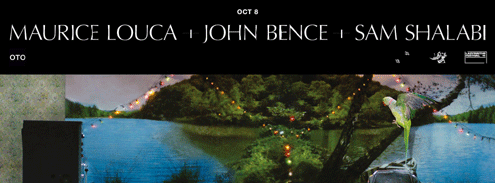
Maurice Louca + John Bence + Sam Shalabi, October 8th 2015

Maurice Louca + John Bence + Sam Shalabi (Café Oto, 18-22 Ashwin Street, Dalston, London, E8 3DL, UK, October 8th 2015, 8.00pm) – £12.00/£14.00

Cafe Oto, in collaboration with Thirtythree Thirtythree   and Nawa Recordings, bring you the second edition of the five-part event series entitled ‘Labyrinths’ (or ‘Mātāhāt’ in Arabic) and based in London, Cairo and Beirut over October and November.

Maurice Louca is an Egyptian musician and composer born in Cairo where he lives and works. As well as being the co-founder of the bands Bikya, Alif and Dwarves of East Agouza, he lends his sound to numerous projects, composing for theatre, film and contemporary art. Inspired by many influences, from psychedelic to Egyptian shaabi, his second album ‘Benhayyi Al-Baghbaghan (Salute the Parrot)’, released on Nawa Recordings in November 2014, shattered the confines of musical and cultural labelling and was dubbed by many as a game-changer for the region’s bustling independent music scene. Amidst his collaborations and inconspicuous touring across Europe and the Arab world in the last few years, Louca has sought a richer and much more complex sound. ‘Benhayyi Al-Baghbaghan’, the fruit of such intense reinvention and a departure from his first solo album ‘Garraya’, is a work that leaves ample space for fluidity and improvisation, paving the way for unique live renderings.

From a family background rich in classical pedigree and firmly embedded in Bristol’s forward-facing electronic music culture, John Bence has pooled a breadth of influence scarcely credible for a composer only entering his second decade, and now he is starting to put his inspiration into live and recorded motion. As a producer he is already thinking ten steps ahead, often incorporating voice or home recorded percussion into his cyclical technique of scoring, recording, manipulating, re-scoring and re-recording in waves, creating heady, intoxicating ripples of harmony and noise. An obscure snippet of dub-plate drone under a previous moniker was enough for Nicolas Jaar, who instantly approached him about a release on his Other People label. Six months on, ‘Disquiet’ was released – a masterful hybrid of classical and electronic clocking in at a tantalising ten minutes. More, much more, is coming. Mercurial, elusive and of seemingly limitless imagination, John Bence is rising to the surface.

Sam Shalabi is an Egyptian-Canadian composer and improviser living between Montreal, Quebec and Cairo, Egypt. Beginning in punk rock in the late 70s, his work has evolved into a fusion of experimental, modern Arabic music that incorporates traditional Arabic, shaabi, noise, classical, text, free improvisation and jazz. He has released five solo albums (including ‘On Hashish’- a musical mediation on German writer Walter Benjamin; ‘Osama’, an audio collage on Arabophobia in the wake of 9/11; and his most recent ‘Music for Arabs’), five albums with Shalabi Effect (a free improvisation quartet that bridges western psychedelic music and Arabic Maqam scales) and three albums with Land of Kush (an experimental 30-member orchestra for which he composes). He has appeared on over sixty albums and toured Europe, North America and North Africa. Recent projects include the release of the sixth Shalabi Effect album, a duo album with Stefan Christoff, two albums on the Italian label Sagittarius with Beirut, Turkish and Egyptian musicians and a tour in the eastern U.S with Alvarius B (playing solo oud). He is also releasing ‘Isis and Osiris’ (a new composition for oud and electronics) on Nashazphone as well as releasing an album with The Dwarves of East Agouza (a Cairo based trio with Maurice Louca and Alan Bishop) while currently working on his sixth solo album.

Tickets and up-to-date information are here and here.

* * * * * * * *

More noise rock and fringe jazz shortly…

November 2015 – upcoming gigs – Mutations Festival in Brighton, 28th & 29th November 2015

24 Aug

Here’s a quick signal booster (or, perhaps more accurately, noise booster) for the debut Mutations festival coming up in Brighton at the end of November. (The press release just came in from Stereo Sanctity today). Note that tickets go on sale in the middle of this week, and that there’s only a thousand tickets. I’ve just seen a Facebook counter suggesting that 330 people have already committed themselves to tickets. Move fast.

Mutations 2015 banner

Mutations is a new multi-venue inner city festival in Brighton, England, born out of last years acclaimed DRILL:BRIGHTON. With Wire’s touring project moving onto the next urban sonic assault, co-curators One Inch Badge decided the time was right for a forward thinking, annual, artist-lead festival that would be static to Brighton on the last weekend of November

Spanning two days and nights on the 28th and 29th November with an incredibly intimate capacity of just 1,000, Mutations is a music-lover’s event. Alongside the music you can also expect pop-up record fairs, poster art exhibitions, photography and more.

Mutations is a creative mass of genre hybrids and expression, delivering some of the most inspiring, creative and interesting music the world has to offer; a host of other national and international acts including genuinely alternative rock, aggressive noise, experimental house, singer-songwriters, doom metal, electronica, drone, experimental folk and various other experimental sounds.

Acts confirmed so far are Lightning Bolt, METZ, John Talabot, Josh T. Pearson, Tourist, OM, Chelsea Wolfe, Willis Earl Beal, Ought, Jane Weaver, Natalie Prass, BRNS, Kagoule, Vision Fortune, Blaenavon, All Tvvins, Lowly, Plastic Mermaids, Chastity, Mount Bank, Abi Wade, Sea Bastard, Blacklisters, Foreign Skin and Nature Channel.

Mutations festival, Brighton, 2015Venues will include Concorde 2, All Saint’s Church, The Arch, The Old Market, The Haunt, Patterns, Sticky Mike’s Frog Bar, Green Door Store, The Prince Albert, The Hope And Ruin and The Bee’s Mouth, with more to be confirmed.

Pre-sale launches this Wednesday 26th August at 9.00am (exclusively via See Tickets) with general sale following on Friday 28th August at 9.00am.

Mutations Festival online:
Homepage Facebook Twitter

June 2015 – upcoming London gigs – The Orchestra Pit’s “Scaledown #110” on Friday

24 Jun

If you’re in central London, there’ll be assorted noises in Fitzrovia this Friday evening… and so, over to the Orchestra Pit’s blurb-roll…

Gagarin + Hamilton Yarns + Gold Vox + Lisa Jayne + Bobby Barry + Bad Moth @ The Orchestra Pit‘s “ Scaledown #110” (The King & Queen, 1 Foley Street, London, W1W 6DL, UK, Friday 26th June 2015, 7.00pm – free)

Mrs June Sunshine rises and climbs majestically up the wooden staircase, gliding along the corridor until Mrs June Sunshine rests and shines her golden spotlight in the scaledown room. She shines upon each scaledown invited artist in no particular order:

Gagarin – also known for his work with Ludus, Nico, John Cale and Pere Ubu, but best loved around these parts for being one half of both Roshi (featuring Pars Radio and Low Bias), and the whole of Gagarin; Graham ‘Dids’ Dowdall is a masterful musician, whose latest album ‘AOTICP’ continues to mine and define “that sonic interface when nature comes back into the city”.

Hamilton Yarns come from Brighton and they create beautifully hand-crafted musical packages on their own hark! recordings imprint. They are Hamilton Yarns, and we are delighted to welcome them back after a five year absence.

Gold Vox are an elegant exciting recorder duo. Close undulating harmonies, mediaeval, modern, trilling and thrilling. Be blown into another dimension.

Lisa Jayne is a poet, artist, life model and one half of Map 71 (the words/drums + noise combo).

Mr Bobby Barry shall be performing compositions from his book of prose ‘Music In Text‘.

Bad Moth – be prepared to be tickled and highly amused by this eccentric accordion/violin duo who make a most welcome return to scaledown heights.

It’s free – just turn up.

June 2015 – upcoming live events – Steve Lawson plays in Poole, Birmingham & London; the Ian Smith 50th birthday event at the Vortex

24 Jun

Gregarious loop bassist Steve Lawson has announced (at pretty short notice) three gigs in England over the coming week. As ever, they’ll be a tuneful/melodic/noisy hybrid of jazz, pop, electronic and ambient influences squeezed through Steve’s battery of sound treatments, and salted by the usual mixture of stand-up comedy, general gabby friendliness and opinionation; the last of which isn’t a word, but is a pretty good definition of what Steve does when he’s not playing, and sometimes when he is playing. At a Lawson gig you get the whole brand, and then some. You can take your family; you can take your friends; you can take a donkey whose legs are in need of a bit of honing…

Steve Lawson live

Steve Lawson + Echo Engine + others (SoundCellar @ The Blue Boar, 29 Market Close, Poole, Dorset, BH15 1NE, UK, Thursday June 25th – 8.30pm, £8.50 )

This is the one which counts as a full gig – a solo Steve Lawson set, after which he’ll be joined by the Echo Engine trio (Daniel Biro on keyboards, ) plus ex Bjork/D’Influence drummer Pascal Consoli and the ECM-inspired saxophonist Jon Lloyd. Up-to-date info is here and here, and you can reserve your ticket via email here.

Scott Pellegrom + Andy Edwards + Adam Gammage (Birmingham Dream Cymbals Day @ Glee Club, Birmingham, B5 4TD, UK – Sunday June 28th, 6.00pm – £10.00/£15.00)

This is actually a drum clinic appearance, at which Steve will be playing with drummer and regular collaborator Andy Edwards. Up-to-date info is here and tickets are here. Also performing are Adam Gammage (Baxter Dury band) and Scott Pellegrom.

Ian Smith’s 50th Birthday Event @ The Vortex Jazz Club, 11 Gillett Square, London, N16 8AZ, UK, Monday June 29th, 6.00pm – £13.20

Steve will be performing at this expansive celebratory gig for London Improvisers Orchestra founder Ian Smith – an event so substantial that it needs its own section further down this post. Steve will be playing in the 10pm slot alongside drummer Jason Cooper and guitarist Reeves Gabrels (both currently members of The Cure). Tickets here: more on the event in a moment.

As usual, Steve has plenty of other things going on, not least an appearance at The One Dayer: Independent Music, Money & Tech conference at Cecil Sharp House in London on July 1st, where (as a longstanding advocate of independent artist-run music careers) he’ll be one of the speakers. He’s also planning further collaborations with loop vocalist/beatboxer Beardyman (having previously played with him in a “dream team” improvising quartet alongside drummer Andy Gangadeen and guitar journeyman Gary Lucas), with fellow bass guitarists Divinity Roxx and Jonas Hellborg (the latter for an October tour) and with Jon Thorne’s semi-experimental Sunshine Brothers trio (for an August appearance at the Manchester Jazz Festival. If you want to read about what he did earlier in his career, here are links to the ‘Misfit City’ archive reviews of ‘And Nothing But The Bass‘, ‘Not Dancing For Chicken‘, ‘Conversations‘ and the first in the ‘Lessons Learned From An Ancient Feline‘ series, early steps on a path of explorations and musical hook-ups.

*****

And now, some more on the Ian Smith birthday event at the Vortex at the end of the month, which sees a remarkable lineup of British jazz players and other improvisers swarm into Dalston to pay tribute to one of their own living heroes. (Hopefully the timings I’ve cited here are right, as the layouts in the original postings are a little confusing…)

Ian Smith 50th Birthday Event @ The Vortex

Ian Smith’s 50th Birthday Event @ The Vortex Jazz Club, 11 Gillett Square, London, N16 8AZ, UK, Monday June 29th, 6.00pm – £13.20

Ian MacGowan (aka Smith) arrived in London in 1990 from Dublin with two phone numbers in his hand: John Stevens and Derek Bailey. Those were the only two numbers he wanted at the time, but as the months went on he got to know and play with many amazing musicians – he founded The Gathering with Maggie Nichols, and the London Improvisers Orchestra with Steve Beresford and Evan Parker. He ended up playing and recording with John and Derek, and plays with anybody who wants to start from nothing. Most of tonight’s cast are old friends; some new; all are beautifully personal voices. He’ll be playing with most of them.

In the Square, 6.00pm:
Henry Lowther, Byron Wallen – trumpets
Julian Faultless – french horn
Alan Tomlinson, Sarah Gail Brand, Ed Lucas – trombones
Oren Marshall, Dave Powell – tubas
Steve Beresford – occasional conductor

In the Vortex downstairs, 7.00pm:
Pete McPhail – alto sax
Tom Wheatley – bass
Steve Noble – drums

In the Vortex upstairs, 8.00pm
B. J. Cole – pedal steel
Ansuman Biswas – percussion

In the Vortex upstairs, 9.00pm:
Rowland Sutherland – flutes
Marcio Mattos – bass

In the Vortex upstairs, 9.30pm:
Sibyl Madrigal – poetry

In the Vortex upstairs, 10.00pm:
Reeves Gabrels – guitar
Steve Lawson – bass guitar
Jason Cooper – drums

and more special guests to be confirmed.

Tickets here.

June 2015 – upcoming London gigs – some options for Thursday night – Birdeatbaby leading the theatrics at the Black Heart; or Jammin’ Society at The Others

16 Jun

A few options for London gig-going this coming Thursday night.

event-20150618birdeatsbaby
Birdeatsbaby + Gabby Young + Death In Texas, (The Black Heart, 2-3 Greenland Place, London NW1 0AP, UK, Thursday 18th June, 8.00pm)

There’s an invasion of Brightonian theatrics (with some honorary Londoners on board) at the Black Heart in Camden as the ambitious orchestral rockers/dark-cabaret pop stars Birdeatsbaby launch their new single – a cover of Muse’s Muscle Museum. The band promise “an unmissable launch party featuring some amazing live musicians, visuals and videos, new costumes and special guests!” Support comes from another showstopper – Gabby Young of Gabby Young & Other Animals fame (described by ‘The Guardian’ as “a gloriously cheerful live performer with an entertaining jumble of styles that match her flamboyant image. She has the power, clarity and precision of an opera diva but also an impressive jazz singer (with) thoughtful, sophisticated songs that continually switch direction,”) – and from the London-based Death In Texas, a dark and dreamy keyboards-and-drums drama-pop duo (whom we’ve encountered before). Tickets available here – priced £8.00. For a potential taste of the evening, have a look at the three videos below.

Alternatively, if you fancy something a little more interactive, there’s this:

The Jammin Society (The Others, 6-8 Manor Road, Stoke Newington, London, N16 5SA, UK, Thursday 18th June, 7.00pm) – free event

This is billed as “an alternative weekly vox, MC, muso, artist, dancer, poet, DJ, performer jam night. Bring your voice, your instrument or just your ears and get involved with the creation/appreciation of a unique sonic soundscape: KAOSS pads, Space Echoes, phasers, creative compression and homemade reverbs all have a role to play! All the gear provided: kit, amps, mics, conga, keys, lights, projectors, decks, dancefloor, bar, comfy sofas…” There’s a different house band providing the core of the music each week – I think that this week it’s Vibe Machine, but the Society season will also feature No Jam, Mana Wax and Playpen Playboys. More details here.

June 2015 – upcoming gigs – Imminent shows at the Hope & Ruin in Brighton (Liebezeit & Irmler, Prolapse & Slum of Legs), plus the tours they belong to

11 Jun

If I was a Brightonian, I suspect that I’d be spending quite a lot of evenings at the Hope & Ruin. Not only does it host some of the town’s most interesting gigs, its interior décor – patched together in a pack-rat/caddis-fly jumble of enthusiasm – makes it feel like the vessel   of some spacegoing carny out of ‘Firefly’ or ‘Doctor Who’.

I’m guessing that most people who’ve read the post title will already know all about these – since cult art, Brighton and a gossip grapevine make a happy mash – but two upcoming Hope & Ruin gigs have caught my attention. One features two leading lights of the original Krautrock/kosmische/German experimental rock scene (something else that’s become as Brightonian as the Pavilion). The other one sees the return of one of Britain’s more interesting wrangle-rock rackets from the 1990s: on this occasion, backed up by a more than worthy heir from the current decade. Both are stops on longer UK tours – I’ll include details on those as well.

Jaki Liebezeit & Hans Joachim Irmler @ The Hope & Ruin, 11-12 Queens Road, Brighton, BN1 3WA, UK, Thursday 17th June (doors 8.00pm)

The former Can drummer Jaki Liebezeit is one of the great beat stylists of experimental rock. Described as “a master of the pause and the stop”, he plays cutting, lean and propulsive rhythms from a small kit: alongside Neu!’s Klaus Dinger, he pioneered the mechanistic motorik beat which you’ll hear behind half a hundred nouveau-Krautrock bands. Hans Joachim Irmler () has had various multi-instrumental and production role in and around Faust over the years, but predominantly plays organ (a highly customisable transistor model which he built himself over forty years ago) and boxes-of-tricks (having created or co-created most of Faust’s unusual noise processors). Longstanding collaborators, Irmler and Liebezeit released the ‘FLUT’ album in 2014 featuring a “hypnotic maelstrom” of organ and drum improvisations. I’ve not reviewed it, but the ever-reliable ‘Quietus’ did – and it’s this vein of music which they’ll be performing.

More details here – although if you’re a fan, all of this will be old news and you’ll already have your tickets. If the Krautrock galaxy is still relatively new and obscure to you – and you’re within grabbing distance of Brighton – this sounds like the perfect opportunity to immerse yourself in the cult. (If recent rumblings about Liebezeit’s retirement are true, it might also be one of your last opportunities to taste the original flavour). If you’re not in Brighton, note that there are also tour dates in London, Fife and Glasgow (beginning on Friday) as listed below:

    Sunday 14th June 2015 – Platform, The Bridge, 1000 Westerhouse Road, Glasgow, G34 9JW, UK – details here.
    Tuesday 16th June – Cafe OTO, 18-22 Ashwin Street, Dalston, London E8 3DL, UK – details here.

Prolapse + Slum Of Legs @ The Hope & Ruin, 11-12 Queens Road, Brighton, BN1 3WA, UK, Tuesday 23rd June (doors 8.00pm)

Art-punks who emerged in the 1990s, Prolapse came up with a much more assured and individual take on the form than most, apparently by accident. The dual vocal frontline of Linda Steelyard and Mick Derrick (the former singing and the latter ranting,) often came across as disruptive theatre, a performance partnership which veered dramatically between combative duologues, utter disjunction or play-fights. Meanwhile the band behind them pegged brutally away on Krautrockian/Fall-esque rhythms, riffs and noises, like a Dada Hummvee worn down to its wheel-rims. The members have tended to claim that it all happened spontaneously and in general was a muckaround, but this was a band that was smart enough to work out when not to think – if you dug deep enough into them you found Master’s degrees, archaeologists, ceramicists and future journalists.

In 1999, after three albums and enough touring to wear them down, Prolapse very sensibly split up just before the point when it all became too frustrating. This year, having been enticed back from various locations and interesting jobs by Mogwai (who’ve invited them to play support at the latter’s 20th anniversary shows) they’ve opted to play a six-date UK tour, for which the other remaining dates are:

    Friday 19th June – The Maze, 257 Mansfield Road, City Centre, Nottingham, NG1 3FT, UK, 19th June (supported by Grey Hairs and Hot Shorts) – buy tickets here.

Playing support at the Brighton gig are Slum of Legs – an inspirational, instrument-swapping, all-female travelling brainstorm of a band. Although they have roots in Raincoats-style post-punk and Riot Grrl (and more than a few similarities to the spontaneous inventiveness of Prolapse) Slum Of Legs have a particular approach to lyric writing which is all their own – intricate, irreverent, literate and broad-ranging. So even if the musical style doesn’t altogether appeal to you, go for the sake of the words and see what else falls into place. (Again, I’m late to the table for this one, so I’ll refer you to this spray of enthusiasm from ‘Collapse Board’, which sets out a view of the Slum Of Legs stall in a way that’s far better, and probably far closer to their pulse, than I could right now.) More info on the gig is here.

REVIEW – Atona: ‘Disabling The NHS’ single, 2012 (“talk about rude health”)

1 Oct
Atona: 'Disabling The NHS'

Atona: ‘Disabling The NHS’

First MC NxtGen’s Andrew Lansley Rap, and now this – the oncoming carve-up of the NHS is certainly pulling the British protest song out of its ghetto. Talk about rude health…

Everyone in Britain needs healthcare, but who is healthcare for? Is it for the people who need it in order to stay alive, mobile or relatively sane on a day to day basis? Or is it for private concerns who use it as an avenue for extending business plans and for pulling in another income stream – and who are now circling the choice plum of public healthcare? Keith Lindsay-Cameron (a.k.a. “Keith Ordinary Guy”, retired youth worker turned protest-letter writer) has needed healthcare more than most. By his own admission, Keith has had a long-term struggle with mental health issues. His are of that particular kind which leave you eminently sane, but also painfully shorn of the thicker skin required to make headway in an increasingly brutal and predatory society.

This sensitivity might have driven the superbly dignified orator’s vitriol of Keith’s “A Letter a Day to Number 10” campaign (a one-sided public correspondence with David Cameron, holding him and his government to account for the increasing wreck of social support). It’s also left him profoundly grateful to a National Health Service for keeping him intact when his own problems were just too much. While few of us in Britain actively share Keith’s dogged social commitment and sharp sense of a general justice – and fewer still either share or are brave enough to admit to sharing his medical difficulties), most of us have various reason to thank the NHS (regardless of snarl-ups and corner-cutting) in its rickety benevolence. Certainly few issues seem as good for pulling us together and waking us up a little.

Hence Atona, a rapid coalescing of musicians, poets and general protesters around Keith’s ire-tipped missives. Disabling The NHS is their first salvo, a blend of tried-and-tested agit-prop methods slung out into the world for free. There’s a list of government ministers recited over a Gothic toll; a stolen-and-pasted-in sample of one of Cameron’s egregious, deceptive pronouncements on the NHS; a drive into plank-battering punk accusations and warnings – and at the heart of it, Keith himself reading his own cool and scathing denunciations (a stern people’s judge with a soft West Country accent).

With its gruff bang-and-shout, the anvil drumbeat, the framings of text and the clear love of plunderphonic razzing, this is all very much in the spirit of Crass, albeit pulled into the gentler, politer mainstream. Not a bad thing at all. After all, Keith doesn’t just channel crusty old memories of affronted people writing to the Times. He also channels those of seventeenth-century pamphleteers, who (much as Crass did) strived to nail down moral and workable verities for the future while the world turned upside-down around them. In any age, some people have got to work to keep the rest of us awake, and to keep twitching the clothes away from the naked emperors and pirates.

Atona: ‘Disabling The NHS’
Atona (self-released)
Download-only single
Released: 1st October 2012

Buy it from:
Free download from Soundcloud.

Atona online:
Facebook Sooundcloud

Keith Ordinary Guy online:
Homepage Facebook Twitter Youtube

May 2010 – single & track reviews – Tom Slatter’s ‘Seven Curses/Lines in the Dirt’; Zoo Kid’s ‘A Lizard State’; Madvillain’s ‘Papermill’

26 May
Tom Slatter: 'Seven Curses/Lines in the Dirt'
Tom Slatter: ‘Seven Curses/Lines in the Dirt’

As you might have expected if you’d already heard his ‘Spinning the Compass’ album, Tom Slatter’s ‘Seven Curses’ plays as if plucked straight from an Edwardian hardback or for an early Hammer horror short. It all rarely rises above tale-telling folk dynamics, but Tom’s voice creaks with hammy foreboding, while the music is draped with spooky death-strings and apprehensive guitar cadences.

His patronising English explorer (for which read “tomb-robber”) gets punished when he walks straight into a crossfire of malignant defensive spells, rendering him a disaster magnet spilling misfortune and death onto people around. It’s the other ‘Get Carter’. Tom sort of plays it straight, but fireside-storyteller straight, more than willing to bug his eyes and make spooky gestures of voice and arm if it helps the tale roll along. In the end, it’s a fragment of weird-camp, its plot unresolved, its narrator muttering evasively about a “compulsion” which might be his determination to tough it out or a coded admission of responsibilities for the series of mysterious deaths which are beginning to blot his passage through life.

‘Lines in the Dirt’, on the flipside, shuffles its sorcerous signifiers like Tarot cards. “Geoglyphs and pyramids, / the voices of the aliens. / Mashing up the holy root. / The feathers sprouting from your skin, / shaping babies’ skulls.” Again, there are witchy metal bands out there who’d play this straight, lurking by bookcases and growling out of the depths of their trench coats, drawing sigils with one hand and, with the other, fingering mysterious objects deep in their pockets. Tom, by comparison, sings it almost like a lounge song, despite the encroaching minor-key darkness of his chord voicings. A coda of droning, low-heat psychedelic guitars and Moog-y squeals restores some mystique, but it still feels as if Tom’s teasing us by flapping a book cover at us. Both songs feel like preludes, not quite satisfying in themselves: dainty bait to pull us into a full Slatter show with all of the invisible strings, stage-winks and poltergeist cupboard-flutters.

Zoo Kid has a similar home-made feel to his music, although on the evidence of ‘A Lizard State’, he favours boudoir soul rather than cosy weird-fic. As with the Slatterisms above, you can see mechanisms and levers being exposed within the songs, but in Zoo Kid’s case it seems to be because he can’t help those songs from starting to fall apart. ‘A Lizard State’ starts off like a soul record with a strong splash of doo-wop, but very quickly begins to warp. Literally. The rhythm guitar licks are off-kilter; the bass popping like yeast-bubbles from a dodgy batch. It’s increasingly unclear what’s coming from futzed samples and turntables and what’s coming from crooked live instruments.

Zoo Kid himself seems to be trying to embark on an Isaac Hayes-ian, blues-shaded song-rap about love and frustrations, but keeps baring fangs and throwing moodies, continually sabotaging himself with bursts of bitter insults and hip hop disses. As the song wobbles along, the feeling grows of being both pissed and pissed off while huddled up in the corner of some lounge club, losing control of the playlist. I’m guessing that what we’ve got here is a carefully-orchestrated live car-crash – lo-fi and saboteur-minded, ramshackle but clever, with Zoo thumbing his nose at conventional storytelling songcraft while embracing chaotic moods and sour, jittery emotional stews. I want to hear more of these messes.

Madvillain: 'Papermill'
Madvillain: ‘Papermill’

Combining the densely threaded raps of MF Doom with the broad sonic curiosity and production suss of Madlibz, hip hop groundbreakers Madvillain have been pretty quiet since their dazzling 2004 debut: various remixes and placeholders have kept things humming on a protracted low rumble while the two members pursue separate paths. Abrupt and deliberately inconclusive, a sudden slap out of nowhere, ‘Papermill’ breaks up the silence and moves things along.

Jerking loudly into life with no warning, as if woken with a cattle prod, it seems to be pretending that there’s been no hiatus, no interim questions. A deep-funk scat-and-guitar loop stolen from an obscure German band wobbles like a stack of pancakes. Doom freestyles over it in a blizzard of surreal sentence fragments, bits of loopy hustler aggrandisement scattering across flashes of lucidity and poet boasts – “stirred not shaken, / absurd verbs since word to hot bacon. / Wrote this rhyme on standard sandpaper, / worked out the plan and plot for grand caper.” There seems to be an underlying theme of conning the curious, and of baiting chaos in order to keep sharp. “Any bent ‘cept, idle threats all irrelevant. / Get your man’s wallet, tell him “found it”, and sell him it… / Forest Gump chumps get clumps of nuttin’ for nuttin’ / Tourist, show ’em where the shore is where the shark’s at. / Hold up, spark that, park rat… / Hand in the jar, got stuck, took it.”

There’s a Koranic quote near the end which translates as “you have your religion, while I have mine”. In true MC style, Doom’s positioning himself as being better, but it seems just as important that he’s different; building himself a portable compound of words and schemes, all too oblique to let himself be pinned down by anyone. There’s no attempt to build anything with clarity. You get a peek into the moment and that’s it, sucker. You’ll just have to wait until the next time that they swing over. Six more years? Perhaps, if you’re lucky.

Tom Slatter: ‘Seven Curses/Lines in the Dirt’
self-released (no catalogue number or barcode)
Download/streaming single
Released:
23rd May 2010

Get/stream it from:
(2022 update) Currently unavailable; might be reissued at some point as part of Tom Slatter’s Immoral Supporters club content.

Tom Slatter online:
Homepage, Facebook, Twitter, Soundcloud, Instagram, Bandcamp, Last.fm, Apple Music, YouTube, Vimeo, Deezer, Spotify, Amazon Music

Zoo Kid: ‘A Lizard State’
self-released (no catalogue number or barcode)
Download/streaming single
Released:
23rd May 2010

Get/stream it from:
(2022 update) Soundcloud, YouTube. Original download single was later made available on Zoo Kid’s ‘U.F.O.W.A.V.E.’ album. Currently reissued on the Kid Krule album ‘6 Feet Below the Moon’, streamable/downloadable from Apple Music, Deezer, Tidal, Spotify and Amazon Music.

Zoo Kid (King Krule) online:
Homepage, Facebook, Twitter, Soundcloud, Instagram, online store, Bandcamp, Last.fm, Apple Music, YouTube, Deezer, Tidal, Spotify, Amazon Music 

Madvillain: ‘Papermill’
[adult swim] (no catalogue number or barcode)
Download/streaming single
Released:
26th May 2010

Get/stream it from:
(2022 update) Original download no longer available; still streamable via YouTube. Track was briefly available on the download-only Various Artists compilation ‘Adult Swim Singles Program’.

Madvillain online:
Homepage, Soundcloud, online store, Bandcamp, Last.fm, Apple Music, YouTube, Deezer, Tidal, Spotify, Amazon Music

May 2009 – album reviews – Tom Slatter’s ‘Spinning the Compass’ (“…the heart amongst the wheels…”)

1 May
Tom Slatter: 'Spinning the Compass'
Tom Slatter: ‘Spinning the Compass’

Previously half of the obscure “post-apocalyptic quasi-acoustic indie-folk” duo Comrade Robot, Tom Slatter now marches off on his own, cogs a-whirring, with a short debut solo album mixing the macabre, the jolly and the poignant… all in the manner of a brainy kid’s puppet show. In part, the latter is down to the theatrical delivery: Tom’s ringmaster-next-door vocals, simultaneously declamatory and humble. In part, it’s due to the Cabaret Mechanical nature of the music itself – the lo-fi clack of programmed drums, the keyboards which are rarely far from stiff calliope posturing; the George Stephenson rattle of (mostly) acoustic guitar and piano; the steam-whistle synths. But a lot of it, frankly, is the robot-men.

Yes; lyrically, at least, ‘Spinning the Compass’ is a steampunk album: Victorian in tone, and riddled with altered, augmented characters who click and wheeze with gears, lenses, bellows and casements. Given the plumminess and the ambitions in the music, “steamprog” might be a better tag. The lone instrumental here pitches hooty synth against classical sounding guitarpeggios marching rapidly across a strange chord progression, disruptive but fluid.

What do you do with Tom Slatter: a man who leans towards the musical and lyrical complications of a Roy Harper, a Thomas Dolby or a Peter Hammill, but who also runs his scenarios like a cardboard pop-up theatre; and who could put a warm grin on the face of the ghost of Jim Henson? You settle back in your comfy chair and you listen to him, that’s what you do. You enjoy the jiggling figures. You laugh along with the stage whispers.

Regarding Tom’s song romps, the aforementioned Hammill is the easiest comparison to make. More specifically, the deliberately boyish songs Hammill (with fellow Van Der Graaf Generator alumnus Judge Smith) wrote about Vikings and airships on ‘Fool’s Mate’, with their whiff of yellowing comics pages and pulp ink. As with the more baroque Hammill moments, there’s a deliberate antiquity to this music. Tom, too, seems to love machines and dashing adventures, and the neurotic pomp of Empire. More accurately, as a storyteller he enjoys the twists and kinks and predicaments into which they place people. He’s got an interest in the way that the ponderous, increasingly amoral gravity of such things – of such seductive opportunities – warps both a person’s culture and their choices; even their ability, beyond a certain point, to choose at all.

Not all of ‘Spinning the Compass’ digs that deep. Some of it is simple, geeky fun. Aspects of Comrade Robot’s gleeful pulpiness remain in ‘Gaslight’, a triumphantly romantic love song which turns out to be set in a world plunged into eternal darkness – “even if they got on their knees and prayed for the dawn to come, / if they screamed to the heavens the night would never end / and you’d stay there beside me in the chill glow of the night.” A few other songs are straightforwardly robust Gothic nightmares, most obviously ‘Bad Dream’ with its flourishing Cardiacs-y guitar lines; and also the hammering ‘Lines Overheard at a Seance’ which builds its atmosphere of creepy weird-fiction madness while edging around the indescribable specifics. (“On a cold cold night I saw something evil – / turned the red, red walls a deep shade of grey, / and I’m not breaking down.”)

Throughout the album, Tom switches from hat to hat, playing individual characters in quirky situations or struggling, knowingly or otherwise, with their own moral choices and compromises. The balloon-riding Victorian hunter in the parlour-jazzy ‘Home’, for instance, lives a privileged, gun-toting ‘Boys’ Own’ life as one of the “kings of the great game, on top of the sky”, but he yearns to escape his macho, beast-slaughtering environment and reunite with his sweetheart. This, however, is a rare example of a ‘Spinning the Compass’ character choosing human-scaled love or humility over some form of devious power, or a hideous longevity. Most of Tom’s protagonists are sinking into (or already condemning themselves to) something far more horrible, whether they recognise it or not; and the further they commit themselves, the worse it gets.

For example, the triumphantly augmented Dickensian cyborg who narrates ‘Ingenious Devices’ is an oblivious monster; sardonic, and horribly selfish. As he watches lovers and family perish of old age, he himself revels in the engineering that keeps him alive (“My heart beats by pendulum. / I’ve filled grave with cogs and wheels, / so there’s no room.”) Ultimately his triumph resides in a post-human callousness, a reptilian dismissal – “I’ve seen them, with cracking skin, / greying hair, yellow teeth / and haunted eyes. / I’ll not be one of them. / I’ll fill my lungs with oil and steam /and never die.” In ‘I Still Smile’, Tom takes machine-man uncanniness to greater heights as (over a ghostly, stately, scintillating instrumental part) he plays the role of someone’s automated love-puppet, its memories and motivations mere shallow simulacrums of emotions and responsibilities – “My arms are always here / to make you feel complete / My face is fixed in a permanent grin / My latex skin never frowns / You bought me, to make you feel complete / And I’ll always be here. / Even when you’re crying, I still smile. /And your last touch of real skin hurt too much. / But I have all the time you need / My love never dies.”

As Tom warns elsewhere, though, “roses in the chains, / burning a pilot light / isn’t carrying a flame.” Even as early as the opening track, he’s flying the cautionary flags about how the mechanistic life dehumanises us all. “This mechanism, it’s driving us apart. / It shines a prism on the kind of love we share. / This mechanism is making passion spoil / It tastes of something, the cloying tang of wine and oil. /Our love relies on clockwork, / the careful use of gears and wheel – / this mechanism, it isn’t how we feel.” On a surface level, he’s playing that old trope of how horrible it is to become a Cyberman, or to be hijacked by the Maschinenmensch from ‘Metropolis’. On another, less geeky level, he’s singing about harbouring the wrong kind of awareness – analytics and risk assessments killing your spontaneity; cultivated programming replacing reactions, your arousals and your sympathies. Willingly importing programs into your mind can be as bad as literally forcing machinery into your flesh.

In the concluding song – the album’s title track – Tom addresses this while also ending up with the narrator’s role which is perhaps closest to himself. ‘Spinning the Compass’ is also his proggiest cut: ominous, wandering across assorted minor keys, and showing off his compositional strengths during a protracted acoustic guitar passage. The words, however, are what gives it its true core. Abandoning the previous metaphors of iron lungs and mannequin features, Tom sings about disintegrating crosswords and uncontrolled acceleration, about a gradual deterioration of sense and coherent structure.

At the end of the album, he’s placing himself as the human being now pinned (helplessly, and to his own horror) in the centre of an unbalanced and out-of-scale world, conned and gaslit into relinquishing his own corner of control within it. “Changing the rules while I was looking away, / five paths in the same dial. / Like living in a world of your own / all the time shrinking till all the roads meet. / White lines dashing past at speed / And up is left, east is west and no-one cares… / Like living in a mind not your own, / thinking thoughts you don’t understand… Do you get the feeling we’re running out time? / Have you heard the rumours of war planes in the skies? / With this spinning the end is surely nigh?” Apprehensive and pessimistic as it is, it’s a reaffirmation of the heart amongst the wheels, a shout out from the rose enmeshed in the chains.

Tom Slatter: ‘Spinning the Compass’
self-released (no catalogue number or barcode)
Download-only album
Released:
1st May 2009
Get/stream it from:
(2022 update) Currently available as remastered 2016 edition with two extra tracks – stream/download from Bandcamp, Apple Music, Deezer and Spotify 

Tom Slatter online:
Homepage, Facebook, Twitter, Soundcloud, Instagram, Bandcamp, Last.fm, Apple Music, YouTube, Vimeo, Deezer, Spotify, Amazon Music   

March 2003 – live reviews – North Sea Radio Orchestra @ St Clement Eastcheap, City of London, England, 15th March (“a polished Victorian never-never land of intricate miniatures and toymaker’s details”)

18 Mar

Once you’ve found it (tucked away in the cramped, confusing whorls of buildings and alleyways near the Monument) the diminutive Christopher Wren church of St Clement Eastcheap is like an old-fashioned kid’s treasure-box, hidden in a chest-of-drawers. Small but perfectly-formed (and bearing the decorous marks of its mid-Victorian refurbishment), it perches pertly between two well-known architectural schools – “enchanting” and “cute”. Tidy pillars spring up hopefully at the sides of its nave. That creamy yellow tint in the immaculate plasterwork of the walls sets off the lovingly-worn mahogany of choir stalls, pews and the massive pulpit. It’s tiny enough for a smallish art-rock audience to squeeze into and feel cosy: and there’s a nursery-rhyme connection too, if you know your oranges and your lemons.

Really, the North Sea Radio Orchestra couldn’t have picked a more appropriate venue. For the music of this retrofitted, romantic-progressive chamber ensemble, St Clements fits like a glove. It shares those hints of modestly-mingled English eras of scaled-down splendour, the atmosphere of nostalgic time travel and aan affectionate polish of traditional heritage. Once you’re inside, both of them also tempt you to blissfully engulf yourself in a luxurious dream of old England – open fields, spinneys, bright stars, sunlight and green thoughts – while all around you the ruthlessness, frenetic urban pace and concrete encroachment looms and sprawls. This may all be an imaginary, selective stance. On a superficial level, you could also get suspicious of well-spoken contemporary white musicians in London warding off angst by cooking up a hand-crafted pre-industrial daydream. But this does the NSRO a disservice. You could accuse them of forcing their innocence – and maybe yours as well – but whatever else they’re doing here is done entirely without malice.

Twenty people settle onstage and get a grip on their violas, cellos, trombones, bass clarinets or whatever. Familiar London art-rock faces abound. Conductor-composer Craig Fortnam and the ensemble’s soprano singer Sharron Saddington used to bob up and down on the fringes of the Cardiacs scene, first in the psychedelic tea-party of William D. Drake’s short-lived Lake Of Puppies and then in the bumptiously charming folk-pronk of The Shrubbies. James Larcombe (Stars In Battledress’ elegantly-tailored smoothie of a keyboard player) is soberly fingering a chamber organ. His brother and bandmate Richard is boosting the numbers in the eight-strong choir, right next to the wild Persian afro of onetime Monsoon Bassoon-er (and current Cardiac) Kavus Torabi. Out in the audience, the aforementioned Mr Drake sits next to Tim Smith, his old friend and former boss in Cardiacs. Across from them, there are various Foes and Ursas and Sidi Bou Saids. There’s a sense of occasion. We get a beautifully designed arts-and-crafts-styled programme to take home. It’s a long way from Camden pub gigs.

This isn’t solely because of the surroundings. North Sea Radio Orchestra might carry their assorted historical splinters of psychedelic rock, folk, and even punk along with them, but they are unabashedly classical in intent. Even the twistiest and most abrasive of the art-rockers in the lineup are sporting the sober concentration of churchgoers, and Sharron has traded her former outfit of cosy specs and jumpers (though not her artlessly warm smile) for a modest diva gown. Craig, his back turned, conscientiously conducts the ensemble. When he sits aside to strum a little polite guitar, he has to crane his neck round anxiously, making sure that the music is still running smoothly.

He needn’t worry. Despite the shades of complex tonality which inform the NSRO’s compositions (Frank Zappa, Benjamin Britten and Tim Smith have all left their mark on Craig’s inspiration), the music flows readily. Sometimes it’s a simple organ drone as a base for Dan Hewson’s trombone expositions. At the other end of the measure, there’s the rollicking Occasional Tables: a dancing interplay between clarinets with a gloriously drunken, attention-switching Frank Zappa/Henry Cow approach. With its mediaeval echoes, and an additional infusion of the peculiar darkness of post-Morton Feldman Californian conservatoire music, it’s given an edge by the astringent, atonal vibraphone shiver (and by Craig’s strict, almost military turn on bongos).

Intriguing as these are, it’s the NSRO’s orchestration of poems which connect deepest with the audience. Mostly these are Tennyson settings (with a sprinkling of Thomas Hardy and other contemporaries) but even Daniel Dundas Maitland’s modern Sonnet looks back to ornate Victoriana. So does Craig’s music, swirling its Early Music and contemporary classical influences together to meet halfway in a polished Victorian never-never land of intricate miniatures and toymaker’s details. Sharron’s vocals – sometimes piping, sometimes emoting in keen, theatrical wails – make for exquisitely brittle sugar-sculpture shapes, while rivulets of strings and woodwind launch themselves from the melody.

The heavenly sway of Move Eastward Happy Earth sets Sharron’s winsome soprano against the lazy, streaming clarinet of Nick Hayes and against Ben Davies’ slow waltz of trimmed-down piano. The choir (with a hearty, clever enthusiasm that reminds me of nothing so much as Gentle Giant) leaps in for stepped, skipping choruses and glorious vocal resolutions. For The Flower, drifts of strings slip from the vocal line and weave busily like something out of Schubert’s Trout Quintet. Onstage, everyone who isn’t smiling looks happily dazed, as if drunk on the sunny harmonies.

And so it continues, with parts of the NSRO dropping in and out to suit the music. For Thumb Piano, Craig trims it down to a revolving arpeggio of guitar harmonics in trio with the blues-tinged fluting of Hayes’ sweet’n’wild clarinet and Katja Mervola’s pizzicato viola. Harry Escott provides a cello improvisation, impressively-voiced chordal melodies sliding on top of a slithering bass drone. James Larcombe sketches out a collage of beady, kaleidoscopic chord progressions in his studious organ solo. The chorus, for their part, sing lustily in a London melting-pot of diverse accents. For the canon setting of Yeats’ He Wishes For The Cloths Of Heaven, the whole orchestra sings its way through Craig’s pop-folk melodies.

When the whole ensemble is running at full strength, St Clement brightens with music. Shelley’s Skylark, in particular, is profoundly ambitious – semi-connected cello lines swing like foghorns, thick Michael Byron-ish string parts disgorge dominant melodies, and the chorus is a rich blur of voices, pumping resolution into Hardy’s words. But best of all is a generous Fortnam orchestration of a piece by his former bandleader William D. Drake – a setting of William Johnson Cory’s Mimnermus In Church. With Richard Larcombe stepping out from the chorus to duet with Sharron, and the North Sea Radio Orchestra performing at its fullest stretch, the results are captivating. The voices of Sharron and Richard move around each other in dusty, reedy, yearning harmonies (he floating up to countertenor) while strings, piano, clarinets and brass open out like a delicate night-bloomer, fragrantly illustrating Cory’s salute to flawed and transient life in the face of a perfect yet chilly heaven. “All beauteous things for which we live by laws of time and space decay. / But O, the very reason why I clasp them is because they die.”

Yes, in pop culture terms it is music for an ivory tower, or for a detached oasis where you can secrete yourself away from the world. Only a mile or two to the west, I’m sure that electric guitars are roaring out rock, garage clubs are spinning off beats and bling, and someone’s delivering tonight’s definitive urban hymn. But emerging into the City of London – all higgledy-piggledy with glass skyscrapers, Renaissance guildhalls and mediaeval street names, a ragbag of congealed history in parallels – I couldn’t care less.

Like the best musicians, North Sea Radio Orchestra tap into timeless things (beauty, transient joys, the shift of seasons). But like the stubbornest, they also know the colours and shades of the times which they’ll want to employ, finding a way to make them mean something whenever and wherever they’re played. And though an antique church and a Victorian altar cloth made a beautiful frame tonight, this music – at its peak – would’ve sounded good even if the whole ensemble had been balanced atop a Docklands trash-heap.

North Sea Radio Orchestra online:
Homepage Facebook MySpace

St Clement Eastcheap online:
Homepage

February 2003 – live reviews – House of Stairs label launch concert (evening 2) featuring William D. Drake, Cheval de Frise, Stars in Battledress and Miss Helsinki @ The Arts Cafe, Toynbee Hall, Aldgate, London; plus Delicate AWOL @ 93 Feet East, Shoreditch, London, both 17th February 2003 (“East End might mean left-field tonight…”)

19 Feb

Less than a week ago, the House of Stairs label put on their Camden launch gig at the Underworld: Max Tundra DJ-ed, filling the gaps with a spicy and witty mix of art-rock, prank techno and pop buzz. But tonight we’re out east in the pizza, pine and paintings environment of the Arts Café for the second, “quiet” gig – and Richard Larcombe is de-facto man-on-the-muzak, even as he bustles about setting up for his turns in two of tonight’s bands. Eerie shapes and twists of music waft through the busy air: the chatter at the bar is underscored by the filtering eeriness of Messiaen and the swooping rattling studio gulps of Boulez. East End might mean left-field tonight.

Miss Helsinki, bless them, display more pop bones in their body. Popping up from the wreck of the much-lamented Monsoon Bassoon, they feature both of the Bassoon’s singing guitarists (Dan Chudley and Kavus Torabi) plus the increasingly ubiquitous Larcombe on bass and harmonies. But they’ve lost both a drummer and Kavus’s keyboard-playing brother Bobak in the last month: and so it’s a stripped-down-and-unplugged Helsinki trio playing for us tonight, both aided and hindered by a backing tape. It’s only their third live appearance.

Frustratingly, they’re still lolling like a tall layer cake whipped out of the oven too soon. There’s something to be said for a bit of engaging pop roughness; and for Torabi’s endearing habit of boggling like Tom Baker at the end of a tricky lick. But although Miss Helsinki’s ambitions are clear, they’re still struggling to reach them. They have a tough act to follow, of course. One of the few bands to unite the approval of both London proggies and the NME, The Monsoon Bassoon wrapped a broad spectrum of ingredients (including Naked City, King Crimson and Shudder to Think) into their explosive, racing psychedelic rock.

Though Miss Helsinki retain some of those flavours, they’ve pastoralised them: the bursts of unusual chording and rampant arpeggiating are still there, but the thrashing intensity has been replaced by a sunny warmth and they’ve obviously settled on Andy Partridge as their guardian angel. But Helsinki music is a good deal more complex and demanding than XTC’s, straining the abilities of Chudley and Torabi’s affable, unvirtuosic boy-next-door voices as they hop over the cheerfully convoluted melodies like tap-dancing cats on a hot tin roof.

Despite this – and despite the fluffed notes and stumbles over the over-detailed backing tapes – ‘I Felt Your Arms Around Me’ is a bright little gem of spiky-haired art-pop, powered by the same giddy celebration of the best Monsoon Bassoon songs. Kavus (air-punching and doing triumphant kicks from his guitar stool) obviously knows it. ‘Surf’s Up’ – featuring a repeated chant of “silhouettes you know from fire” – takes them to places last touched by the psychedelic folk-science of Gastr del Sol; and the romping cowboy-pop of ‘Rodeo’ (“the world seems drunk, with a stetson in place”) ensures that they finish on a note of charm and enthusiasm. Miss Helsinki are a long way from filling the Bassoon’s busy shoes, but the signs are good.

With Miss Helsinki, Richard Larcombe is a deft, understated bass player. With his own band Defeat the Young – backed up by brother James – he steps up to become a witty, elegant frontman with tales of social absurdity and romantic scrapes. But tonight, for Stars in Battledress (an equal-partnership duo of both Larcombe brothers), he takes a step sideways. Up onstage, he cuts a quieter, more sober figure than he does with Defeat the Young. His sophisticated social-jester persona is mostly absent. His ready wit is intact, but here it’s diffused – more musing in its nature, leaning on subtle insinuations and surreal impressions rather than crackling wordplay. It’s also tinted with a peculiar, guarded English melancholy, and there’s an unsettling sense of loss and submission behind Richard’s refined and aristocratic drawl. “Blessed are all with vision unswerving. / Don’t watch me weep – go back to sleep…”

On Richard’s guitar – round about where people usually paste their dude-rock logos or political slogans – there’s a beautifully executed painting of a mallard duck, apparently snipped from a spotter’s guide. It’s appropriate. Stars in Battledress’ drifting tapestries of songscape take place in a watery never-land England of ponds and rivers and thin blue children, posh academies and school gymnasiums, the rituals of government offices and the embarrassments of public speaking; Cambridge water-meadows distorted by a lysergic autumnal haze. Someone in the audience mutters that Stars in Battledress are the best argument he’s ever witnessed against a public school education. I think he’s failing to press past the immaculate antique sheen of their surface. Theirs is a ghostly watercolour world of ruefully suppressed emotions with a tidal tendency to seep back up. Part Evelyn Waugh, part Syd Barrett and part Sea Nymphs.

James – strumming and fondling snowfall arpeggios from his piano and contributing apple-bright harmonies – provides most of Stars in Battledress’ colours, picking up on his brother’s words and extending them outwards in rippling classically-inspired musical inventions. Richard plays some understated, skeletal guitar and trundles a harmonium through the queasy distress signal of ‘Haunted Hotel’, but mostly he stays out at the front, clasping the mike stand like a sad, dapper figurehead. There’s a break from this in the roaring-’40s guitar-waltz of ‘Hollywood Says So’, as Richard delves hilariously into ludicrous showbiz gaudiness (“drive fast cars, play guitars, win prizes / – girls in every port, in all five sizes”) but ends up spat out in a wad of comic bitterness. (“I’ve been over-directed, I’ve been cut in one take. / I’m a dated two-reeler that no-one will make.”) Their cryptic finale – the hummed, valedictory ‘Women from the Ministry’ – hovers in the mind like the flicker of antique cinema light, images of lost houses, withered photographs.

Cheval de Frise are… plain remarkable. Bare to the waist and sporting Trotsky glasses, Vincent Beysselance studies his drumkit with a jazz warrior’s eye, his lean expression and sculpted moustachios lending him the air of a razor-sharp beatnik. Guitarist Thomas Bonvalent looks as if the Taliban have booted him out for excessive zeal. Sporting an enormous bushy chest-length beard, battered clothes and an expression of sincerely crazed intensity, he’s twitching visibly even before he plays a note. His nylon-string acoustic guitar has been modified – or de-modified, with both the sound-hole and the pre-amp controls crudely and defiantly smothered with duct tape. As he plays, biting on a pick, his face seethes beneath his beard.

“Pastoral acoustic mathcore” was what someone wrote on the Cheval de Frise packet. Ah ha, ha, ha – I don’t think so. Pastoral acoustic mathcore would be very nice – perhaps a Guitar Craft picking exercise, pared down by post-punk minimalism and softened by visions of green fields. Are Cheval de Frise like that? No. For the first seven minutes or so, Cheval de Frise seem absolutely demented. After that – and once the broken seizures of drumming and the intricate splatterwork of guitar has had time to get to work on your brain and your reflexes – you start to understand. Although your body will make the connection before your mind does.

Right from the off, Bonvalent’s playing is disturbingly wild; slamming down obsessively on a single note or isolated interval, or spasming music up, down or across the neck of the guitar. Beysselance’s drumming is a boiling whirl of ideas and instincts, acted out with a brinksman’s forcefulness, with enough breakneck substance both to keep the duo’s momentum and to craze it with brilliant stress fractures. People cram to the edge of the Arts Café’s tiny stage, swaying like a wheatfield in a whirlwind, and yelping approval.

Behind the apparent free-scene chaos, Cheval de Frise have serious intentions. The drums have their melodies as well as their upheavals, and although Bonvalent’s open-mouthed drooling visage suggests a man in terminal acid psychosis, he frequently rips into hyperspeed, hypertonal spirals of intense picking which John McLaughlin would be proud of. Every now and again, in the midst of a free section, the two Friseurs exchange a quick cue-ing glance and then slam into perfect alignment, calling a rigorous Zappa-style composed music module up out of memory. Bonvalent’s playing might often parallels the spewing, disjointed clicking noises of the post-Derek Bailey improv school, but the musician he’s really closest to is the iconoclastic lo-fi jazz rebel Billy Jenkins. Deliberately or not, Cheval de Frise ‘s music is a hyperactive flamencoid strain of Jenkins’ “spass” approach – a slew of intense musicality in which ugly sounds, wrong notes, anti-technique and smash-ups in timing and phrasing are as part of the great spontaneous inspiration as skill, structure, complex ambition or the beautiful moment.

It is, also, an intensely devotional music, as burningly thrilling as Nusrat Fateh Ali Khan’s qu’waali shriek, a gospel choir tearing the roof off the sucker, or the closer-to-God whirling of a Sufi dervish. Bonvalent’s physical abandonment (at points close to ecstatic convulsions) is religious in its intensity. As pieces skid to a halt, he bobs his head thankfully to the audience, smiling and almost moved to tears. If it’s like that onstage, it’s not that much less intense down here. Being up close to music this inspirationally driven raises the hairs on the back of the neck. When Cheval de Frise finally peel off their instruments and stumble into the crowd, the feel of the audience unclipping themselves from their joyful tenterhooks is like a dam bursting.

I don’t envy William D. Drake – a onetime Cardiac songwriter with a joyous genteel-gone-berserk keyboard style – for having to follow that. But I’m going to have to leave him to it, as I’m double-booked for gigs this evening; and so I have to slip out of the Arts Café to stride the Spitalfields half-mile or so over to 93 Feet East, to see Delicate AWOL on a rare London visit. I’ll just have to promise to catch up with the Drakey magic next time he plays… I will, really…

93 Feet East turns out to be an over-pleased-with-itself Brick Lane bar, milking the wobbly momentum of trendy Shoreditch Twattery while it still lasts. It also has the rudest security staff I’ve ever met. Not five minutes after the music stops, they’re in your face; all but digging their chins into your shoulders, dangling heavy barrier chains in one hand with the bored and arrogant stance of animal stockmen, yelling at you to move out. Regular punters must really want to come back to this place.

It’s a sorry way to end an evening, especially after Delicate AWOL have been exercising their luminous charm on you. Walking in on the band mid-flow, the first thing I see is Caroline Ross joyfully bouncing tiny beaters off the keys of her little glockenspiel. Its fairy tingles resound in the air as the rest of the band keep up a stiff-swung groove behind her. Delicate AWOL have been drawing connections between Latinate ’70s fusion and limpid Tortoise-school indie art-rock for a few years now. These days – extended from a guitar-rock indie four-piece to a more ambitious sextet featuring Ben Page’s swishing textural synths, Jo Wright’s Chet Baker-ish trumpet commentary and Ross’ own multi-instrumental enthusiasm – they’re in a much better position to cook up their jazzified stew.

Inevitably, the enchantingly gamine Ross is the focus, smiling beatifically from beneath her shaggy russet bob and swapping between percussion, flute and thoughtful slide guitar. There’s also her soft spring-thaw of a voice: a gentle but commanding stroke to soothe the ruffling from the craggier guitar of husband Jim Version and the dogged Can-ish rhythm-section circling of Michael Donelly and Tom Page. Rising above the hum and the wind-rattle of ‘That Terminal’s Down’, brushing against the reedy melancholia of a melodica, drawling through a sleepy-lidded chant of “your breath goes slow”, she’s hypnotic, bringing a hint of Scottish lullaby into Delicate AWOL’s sleepy mix. Alongside the Pram-like tinkles and kitchen-table craftsmanship, the woozy instrumental Americana of ‘The China-Green Prairie Tribunal’, the southern-border dance-steps of ‘Broken Window in a Mexican Bank’ and the doughnut-bulging space-groove they hop into for ‘The Rolling Year’.

One of Delicate AWOL’s greatest strengths is their ability to wander open-armed between these varied inspirations without ever inducing the suspicion that they’re simply trying to fill their basket with crowd-pleasing nuggets. Their intelligence is of the gentle kind – simply enjoying their explorations rather than ticking them off on a list and practising their traveller’s poses afterwards. Surprising, this takes them further than a ruthless musical ambition would – as does the way they flit disarmingly between other-worldliness and neighbourly charm, most evident in Version’s professorial enthusiasm and Ross’ affectionate, amused handling of fans and hecklers alike.

Even in the grubby concrete shell of an average indie-circuit venue, Delicate AWOL can get a campfire atmosphere going. A rewarding thing on a cold February night, especially with the impatient rattle of a chain behind you. If I ended up being treated like cattle, at least I got to spend half-an-hour home on the range beforehand.

Cheval de Frise online:
Homepage, Facebook, Soundcloud, online store, Last.fm, Apple Music, YouTube, Deezer, Spotify, Amazon Music

Stars in Battledress online:
Homepage, Facebook, Twitter, MySpace, Soundcloud, Bandcamp, Last.fm, Apple Music, YouTube, Deezer, Tidal, Spotify, Amazon Music

Miss Helsinki online:
(2022 update – no links available. See Kavus Torabi and Daniel Chudley Le Corre)

Delicate AWOL online:
MySpace,Last.fm, YouTube, Spotify, Amazon Music, Wikipedia entry

House of Stairs online:
(2022 update – there are no longer any web pages for the House of Stairs label, although there is a discogs.com page)

February 2003 – live reviews – House of Stairs label launch concert (evening 1) featuring Nøught, Foe and Defeat the Young, The Underworld, Camden Town, London, 12th February 2003 (“the Underworld fills with familiar London pronk and math-rock faces”)

13 Feb

Well-worn jokes about “first steps” line up at my door, to be kicked aside. Let’s not goof about. As the House of Stairs label throws its musical launch party, the Underworld fills with familiar London pronk and math-rock faces, fans and musicians grinning at each other as if it was the first day of a school trip. The still-friendly fragments of The Monsoon Bassoon, the occasional Cardiac, plus those particular paying punters who materialise like the genie of the lamp at the faintest hint of a twitchy rhythm or a whole-tone scale blasted out of a loud guitar.

For once, the records being played between the bands nudge and tickle the audience’s mind rather than simply provide aural cud to chew in the interval. When you’re lucky enough to have avant-prog, lo-fi techno wunderkind Max Tundra on hand to do your DJ-ing for you, you get more than the usual jukebox package – Peter Gabriel songs mingle with prank cut-ups of Tony Blair speeches, hilarious jungle-electronica renditions of ’80s pop hits, and ear-opening art-rock oddities whipped from rare vinyl. Priceless from any perspective.

Defeat the Young are the most literate – or literary – members of the House of Stairs stable by a country mile. They’re also the most demanding listen. Richard Larcombe‘s wit is complex and arch; his melodies are crenellated and mediaevalesque, pumped out of harmoniums, sharp-fingered guitars and hurdy-gurdies. Also, while there’s a distinctly proggy kink to his music (like Kevin Ayers cuddling up with Gentle Giant or William D. Drake), he’s drawn more to Havelock Ellis and Groucho Marx than to Tolkien or Carlos Castenada. Thank God for that. A faux-Edwardian English Zappa with highbrow kinks might not be to everyone’s taste. But it’s infinitely better than being subjected to another charlatan wrapped in suspect mysticism and stale denim.

Like a skilful card-trick, Larcombe’s wicked sense of humour also works best up close. In the cavernous rock cellar of The Underworld, he seems out of place – squinting against dim lighting in a venue more accustomed to thrash-metal and ska-punk than to his own rampantly sophisticated English stylings. I always seem to come up with flower metaphors whenever I try reviewing Defeat the Young. Tonight, the phrase is “hothouse flowers”. With two nouveau-metal bands roaring up from behind them, I’m worrying over whether the rarified and sophisticated humour in DTY’s music will wilt in this blunter setting. But they try hard, displaying a determined refusal to compromise. A long, scene-setting introduction (involving virtually the entire plot of The Marx Brothers’ ‘Duck Soup’) sprinkles conceptual theatrics back into the agenda, while (at the other end of preciousness) Jodie Scott’s feedback-heavy guitar adds some belligerent beef to the sound.

Still, it’s not until ‘Nothing from Something’ that things really get moving, as Larcombe gets to grips with his maze-y rake’s progress, bringing some deceptively drawling wit to bear. By ‘Natural Cash’ he’s in ebullient form, punching the air while his feet cycle his pedal harmonium and his lime-tinted vocal quicksteps adroitly through the tricky pitches. Propelled by his perverse and wayward imagination, he guides us through a risque world of sepia photos, elegant penmanship, social theorising and sexual quirks, all couched in a shower of beautiful golden language. Tonight wasn’t really quite his night, but Richard Larcombe is undoubtedly a major talent. He’s already way out there in that field where the erudite spectre of Oscar Wilde grabs the twisty bones of art-rock for a feverish waltz (and for a good snog, if it’s lucky).

The gap between Defeat the Young and the harder-rocking shapes of the rest of the evening should have been bridged by the violent, mordantly comical dada-metal of Lapsus Linguae, but for reasons unknown, they’ve had to stay in Glasgow. The evil smirks and the transmogrified Iron Maiden t-shirts remain north of the border tonight, to infest the queasy nightmares of pub-rockers who’d rather be dreaming of Joe Elliott. So it’s straight on to Foe – whose drummer Paul Westwood hardly gets a break from his turn on the drums and hammer dulcimer for Defeat the Young before he’s clambering back behind the kit for his main band.

If a change really is as good as a rest, he doesn’t need the break – the light percussive touch he uses for Defeat the Young has no place in Foe. Pop-eyed, Westwood lashes his way through this set like an escaped convict desperately hurdling fences. Jason Carty and Crawford Blair thread the gaps in his drumming with rapid intricacies of guitar and bass – a constantly shifting and jerking formation, pouncing in multiple directions. They’re not so much a power trio as a pared-down swarm. One part Don Caballero, one part double-duo King Crimson, and one part higher mathematics, Foe’s music sounds as if it’s been threshed out in cold areas of the brain until it finally lost its temper and exploded. Yet – Westwood’s controlled, wide-eyed intensity aside – Foe themselves are calm, observing their music and keeping it ticking busily until the time comes to dive in with all six feet for a burst of sudden violence.

Sounds familiar? Consciously or otherwise, the all-instrumental Foe parallel the current Crimson’s cerebral-metal approach, apart from refusing to sweeten it with the occasional pop tune. Blair’s grinding bass is as brutal and pitiless as a giant clock ticking, but also carries their complex whole-tone melodies up and down the scale and across the contorting tempi. Carty’s metallic creative/disruptive guitar acts as dissector and illustrator – raiding the harmony and timing of each piece and asking the tricky questions before rocking out into triumphant predatory riffs, pulling the whole band into line with it. Sometimes Foe hurtle like speed-metal Rock in Opposition; sometimes they spend a couple of seconds pinging and pulsing like free-jazzers; sometimes they slam into unyielding hardcore for a few bars.

“How do I play this again?”, yells a mock-baffled Carty, during a break in the action. He’s chuckling – he does remember it, but it’d be easy to get lost in the wanton folds and traps of this music. It’s a real lark’s tongue-twister; more Cuneiform than uniform. In spite of that, there’s a woman dancing in the front row. Incredibly, she’s performing a delighted bump and grind to Foe’s music – her pelvis and body twirls and undulates in perfect time to their constantly altering rhythms. So much for this being brain-only music.

She turns out to be the girlfriend of Nøught‘s drummer. Which explains a lot. Nøught themselves emerge onstage shadowed by conflicting reputations. They’re not actually a House of Stairs band at the moment, but they could be so easily. For evolutionary rockers, grumbling hopefully over their CD players, Nøught are a beacon band – assimilating the instrumental ideas of King Crimson, John McLaughlin and R.I.O., then marrying them to the urgency and directness of punk, grunge and hardcore. But their constant line-up and instrumentation changes (perhaps driven by James Sedwards’ need to bring a variety of tools and voices to his music) have tended to scupper the band and dip it into inactivity rather then renew its energy. Today’s Nøught are a conventional rock power trio plus keyboards, dispending with the second guitarists or Theremins of past live outings. They could be an octet with triangles, euphoniums and bagpipes next week and it wouldn’t surprise me too much. I’d just be happy so long as they kept playing, and stopped disappearing.

Sedwards himself is surrounded by guitars. Two of them are impeccably-finished Les Pauls mounted on flat racks, their strings prepared with objects and blocks (as if John Cage had infiltrated Yes ‘ road crew.) But his guitar of choice is the trashy, rhomboid Fender Jaguar: a Kurt Cobain favourite. It tells you a lot about his approach. Yes, Nøught do like to make a lot of noise. Sedwards’ reticent, un-rocking look (like a young Rowan Atkinson) belie his talents as a fierce, assertive guitarist. And then some. Nøught’s music leaps out of his guitar in a series of bucketing, challenging jumps: a boggling harmonic steeplechase, leaving few notes untouched. Imagine quickfire origami, performed with steel sheets, and you get some idea of how Nøught work.

Their raciness also brings to mind King Crimson’s ‘Red’ gone mutant mariachi. There’s constructive dissonance a-plenty – Sedwards revels in throwing flamboyant, startling chords into his majestic grand designs, catching us off guard. On record, Sedwards revels in the use of choppy strings and blazing big-band brass, and though there’s nothing of that here, there’s been a renaissance in the keyboards department. That muscular undercurrent of organ (triumphant chords supporting the widening paths of guitar and wiry, driven bass) brings an unexpected rhythm’n’blues feel back to the music. Touches of Hendrix or Muddy Waters roots to blend in with the Fripp roars, the John McLaughlin jumps and the Sonic Youth smashes, bringing a different grittiness to Nøught’s aggressive playing. The band has never sounded so human, so assured – and it’s a good balance to those industrial moments when Sedwards assaults his flat-mounted guitars with drumsticks or runs the screams of whirling power-drill chucks through the pickups. Whatever else Nøught’s downtime has provided, it’s brought them a sense of roots and placement that was so lacking in the wall-of-noise incarnation that rattled the walls of venues a year or so ago.

This is an undersung gig, to be sure – a half-full (though comfortable) Underworld suggests that half of the art-rock community in London haven’t even heard about the concert – but there’s a definite sense of homecoming heroes to this one. Good foundations for a strong new house of deserving players, I hope.

Nøught online:
Homepage, Facebook, MySpace, Soundcloud, Last.fm, Apple Music, YouTube, Deezer, Qobuz, Tidal, Spotify, Amazon Music

Foe online:
MySpace, Bandcamp, Last.fm, Amazon Music

Defeat the Young online:
(2022 update – no links available. See Lost Crowns.)

Max Tundra online:
Homepage, Facebook, Twitter, Soundcloud, Instagram, Mixcloud, Bandcamp, Last.fm, Apple Music, YouTube, Deezer, Tidal, Spotify, Amazon Music

House of Stairs online:
(2022 update – there are no longer any web pages for the House of Stairs label, although there is a discogs.com page)

December 2002 – album reviews – Various Artists: ‘House of Stairs Volume 1: Useless in Bed’ compilation (“happily balanced on the rougher brinks and fringes”)

4 Dec

Various Artists: 'House of Stairs Vol. 1 - Useless in Bed'

Various Artists: ‘House of Stairs Vol. 1 – Useless in Bed’

Placing yourself on faultlines, rather than easily marketable turf, brings risks but inspiration – ask a San Franciscan. That the three London art-rock bands who originally set up the House of Stairs label (The Monsoon Bassoon, Geiger Counter, and Ursa) have all now split or mutated into something else is perhaps proof of both.

Regardless, ‘Useless In Bed’ – the first House of Stairs release – is a declaration of brotherhood. Compiling the work of musicians dwelling on various faultlines (though still mostly centred on London art-rock, it also takes in music from Chicago, Atlanta and Bordeaux), it both defines the edges of prog, jazz, art-rock, hardcore, electronica, folk, improv and noise rock, or encourages people to spill across them.


Hard-rocking math-proggers Foe – sprung from the wreckage of Geiger Counter – offer the most urgent track. ‘Triangulator’ is full of furious refracting guitar lines over Crawford Blair’s piano-growl of bass. For six minutes it swings, chops, drops down trapdoors, executes perverse King Crimson leaps between mordantly grim chords, and savages minor keys like The 5uu’s on far too much coffee. Geiger Counter’s posthumous statement is ‘Drink Your Milk’ – less obviously wired than ‘Triangulator’, it still carves up its grunge-y math riffs with heavy enthusiasm, embracing sweeter interludes of short-lived luminous peace as it does so. Nouveau Metal is spreading…

The Monsoon Bassoon‘s own posthumous offering is a explosive and complicated song from when their mingling of Henry Cow and gamelan-Crimson art-rock ran full tilt into their love of American alt.rockers like Shudder To Think. The psychedelic squeal of guitars on ‘Stag’ marches from plateau to jagged plateau in a skirl of trippy flute and meshing riffs, held together by the band’s tight discipline.


These days various Bassooners have regrouped in Miss Helsinki, who deliver a sparkling piece of progressive pop called ‘I Felt Your Arms Around Me’. Less surreal than most Bassoon confections, it’s still an acid-flavoured love song whose rattling good XTC jangle and tootling clarinets don’t stop it hurtling delightedly into a complex, storm-tossed middle section in which they see just how much you can rock the train without slinging it off the rails.

 
If you’d prefer to stick with the Bassoon’s skronkier legacy, Chicago’s Sweep the Leg Johnny are still juggling that torch. With the superb ‘Only in a Rerun’, they’re obviously on a roll – it’s a rich mixture of harsh Schizoid Man tones and flamboyant jazz-metal attack from the raw husky wail of Steve Sostak’s alto sax and Chris Daly’s bloodthirsty roar of guitar, tossing Sostak’s airy vocal like a bull tossing a skinny matador. Slewing between dEUS busyness and violent post-Slint minimalism, this is a rough bareback ride to put a wicked smile on your face.


Manic Glaswegian pranksters Lapsus Linguae provide ‘Olestra (There’s Only One Drinking Fountain in Heaven)’. A stab of theatrical art-metal somewhere between Faith No More and Beck (with a Resident eyeballing it from the director’s chair) it has all you need to storm the castle of pomp. There’s a man called Penelope Collegefriend singing in a rampant bellow like a punk Freddie Mercury; there’s an inexplicable strings break and a rolling piano line continually chopped off with guillotine precision; there are namechecks for Hermann Hesse and Charlton Heston, and choicely bizarre lyrics like “More I eat, the hungrier I feel – / I lick menus, ignore the meals.”


Holding up the genteel-er proggie end are the whimsical and witty projects of the Larcombe brothers. With ‘Sand (Blowing About)’, Stars in Battledress provide a beautiful dance of fluent piano and autoharp: but beyond the divertimento prettiness, James Larcombe leads the duo through eddies of suggestive Debussyan chords.

Richard Larcombe goes on to turn in a conceptual tease on Defeat the Young‘s wonderful ‘I’m Ruining Something’ – an absurdist essay on the corruptions of power which blends Gentle Giant with Lewis Carroll and Stravinsky. Larcombe greets his ensemble of actors, trombone, and full-blown operatic chorus as a lounge-lizard lord of misrule, sighing a manifesto of playful destruction in his arch, refined tones. “I’m recognised as your one sovereign Lord Protector / Trust me – I’ve learned of your country by tape and slide projector. / Each day I’ll go out of my way to spoil, deface and tarnish, / like he who ruins carpentry by swapping glue for varnish.” Oboe, piano and hammer dulcimer float in a dreamy arrangement like an August haze. Apparently there’s a whole album’s worth of this story in the Larcombe shed – ‘The Golden Spike’ – and it’s only one of their dastardly plans.

Both of House Of Stairs’ lo-fi electronica boffins seem to grab inspiration from bargain-bucket electrical goods. Desmotabs create an appealing Stylophone fanfare buzz on ‘Gaseous Exchange at the Alveoli’, let their drum machine go nuts and assault a heart monitor, and squiggle some demented Mini-Moog solos before the entire track melts like a Dali model. Max Tundra (the Frank Zappa of the techno world) continues his marvellous and bizarre mission to fuse hardcore dance music with prog rock. ‘Life in a Lift Shaft’ equals Desmotabs buzz-for-buzz while festooning tough and hilariously uptight Tundra beats with jittery robot piano and fat sub-bass from the tar-pits. Alarm-clocks fly past on tiny wings trying to take bites out of the zany, sunny tune.

The free-er bands – as usual – have a harder time. Gnarly bass-and-drums duo Guapo can be the missing link between ‘Red’ and Ruins when they want to be. However, their grinding ‘Pharoah’ – despite Dave Smith’s excellent Brufordian snarework – is mostly as subtle as a flying breezeblock. Dragging large chunks of pyramid across the desert and insisting that you appreciate each tortuous step, they occasionally snap, shoot off the flywheel and go ape with some fearsome tattoo riffs. Hardcore acoustic fusioneers Cheval de Frise hop up and down with impatience on ‘Chiendents’, banging their heads against their own lo-fi envelope, manically coiling up tighter and tighter acoustic guitar scrabbles against the tussling drums. Compression to destruction, breaking out in wild slashes.


And finally there’s the hardcore department, with the recently defunct Ursa demonstrating why they’ll be a sad loss to the British heavy scene. Avoiding hardcore’s usual fixed, deafening riffage and reductive howling, ‘The Blooding’ begins with a studied ponderousness and heaviness which gives way to an inspiring controlled demolition. Galloping punked-up Iron Maiden guitar runs charge under giant toppling riffs, the band dodging falling masonry via nifty turn-on-a-dime spins while losing none of their brute power. American Heritage, likewise, execute proggie timeswitches with rapid and brutal thrash flair, their sound a bleak, bare cliff of thick guitar noise. It’s anyone’s guess as to why they’ve called their track ‘Phil Collins’ – it’s an unlikely tribute, whether it’s aimed square at the Genesis drumstool or at the white-soul crowdpleaser.


Anyhow… here’s a house of many doors, happily balanced on the rougher brinks and fringes and demonstrating the breadth of personalities camped out in even one small part of today’s art-rock community. Admirable.

Various Artists: ‘House of Stairs Volume 1: Useless in Bed’
House of Stairs, HOS001 (5030094077829)
CD-only compilation album
Released: 2nd December 2002
Get it from:
(2020 update) best obtained second-hand
 

January 2001 – mini-album reviews – The Servant’s ‘With the Invisible’ (“art gets made, covertly, in rush-hour”)

22 Jan

The Servant: 'With the Invisible'

The Servant: ‘With the Invisible’

On last year’s ‘Mathematics’, Dan Black (the voice, face and most of the limbs of The Servant) lifted the lid on a peculiar pop world, fascinated by the chasms between reality and imagination and between formal order and animal madness. ‘Mathematics’ was a dance of numbers, monkeys and peculiar people-watching, jamming in suspicions of murder, deranged Bunuel-ish aristocrats and shopping mall alienation. Unusually, its sonic palette was just as wild as its subject matter. It was as chopped-up and mercurial as it was catchy and danceable, emphasising Dan’s omnivorous sampler as much as his peculiar sneer (thin and venomous, but in its way the wildest and most devil-may-care British pop vocal this side of Billy Mackenzie).

With Chris Burrows now recruited to the project to beef up the guitars, ‘With the Invisible’ hints at being a more conventional follow-up to ‘Mathematics’. In many ways, it is. It’s less extreme, more aligned towards the needs of a guitar band: the sounds are much less wild and varied, with less cunningness required to ensure the gelling of the musical ingredients. Hell, it could almost be Britpop; albeit at the Pulp end as opposed to the Shed Seven end. But I’m not convinced that this means Dan Black has shot his artistic wad. In fact, I’ve a suspicion that where ‘Mathematics’ rattled the cage of the fantastical, ‘With the Invisible’ (right down to the title) documents Dan’s interaction with the everyday – the office jobs, adverts, commuter rushes, conspicuous consumption and car ownership that most of us take on continually and take for granted.

Certainly ‘Biro’ is about sulking in an office, your mind scrabbling desperately for escape either in desk-based sculpture, the limited options of the office party (“wet-look in my hair?”) or violent fantasies – “I just killed my new boss / shut that cock up, with a rock, / non-stop in his face, / and what a smug face.” Inevitably, it concludes “it’s plain to you and it’s plain to me, / there’s nothing for you and there’s nothing for me,” but it has a colourful time getting there.

With that admitted, the next question is how to live under those circumstances, if at all. The brass-pumping ‘Milk Chocolate’ is a rebellion, which finds Dan capering under the motorway next to a blazing bonfire. Systematically, he’s burning all of his possessions from hi-fi to furniture right down to his clothes, trying to shake off the packaging of the modern world. But with “milk chocolate pumping through my heart” the contamination of consumption has already reached to the core of him, leaving him with the logical conclusion of joining his own trash on the fire.

Or not. The bodypopping, Prince-like, bubblegum funk of ‘In a Public Place’ suggests an accommodation, even a brainwave to slake that thirst for stimulation. Art gets made, covertly, in rush-hour. “Among stumbling commuters / I think about each step, / not where I’m trying to get.. / In a limited space, / I try to find a cube for me. / With suble changes of pace, / I move through various densities.” There’s even peace to be found – “watching people move, / they appear to groove / with the invisible.”

For a while, our man seems happy in a formal suit and in step with this world. By the time the White Town-ish synth pop of ‘Driving at Night’ shows up – deliberately tidy – he’s possibly taken it too far. “I try hard to be like I’m in an advert / as we descend upon upon the M1.” Before long, though, The Servant are back to poking holes in the fabric of the world again, trying to expose the workings. In the Jam-versus-hip-hop bust of ‘The Entire Universe’, this happens via rampant, tongue-in-cheek paranoia. “How can I trust my own memory? / Did what I thought I saw before occur?” yammers Dan, almost with relief, as flute shrieks and silvery Indian strings zing off the barking guitars. “How can I trust my own family? / Maybe they’ve lied for years to me.”

By the finale, ‘She Cursed Me’, the music is heading back towards the heady mix of sounds that characterised ‘Mathematics’: ironic tinges mixing with intimate pastiche, music box interludes, bright dreamy shifts of mood and texture with a sharp mind manipulating them. And Dan’s narration has moved well clear of city rules, looking backwards to villagey beginnings, the first stirrings of curiosity (“she cursed me with impatience / and I need to follow clouds,”) and the repercussions of actions (“our conversations by the pond / I wonder if they’re still going on – / swimming on the gluey pool, / around the church and up to the school.”)

The Servant are still marching to their own inner promptings; still bouncing on the shock of impulse. Still the colourful alien probe that’s embedded in the mundane. Keep watching.

The Servant: ‘With the Invisible’
Splinter Recordings, SP003CD (5 038622 102326)
CD-only mini-album
Released:
22nd January 2001
Get it from: (2020 update) CD best obtained second-hand; stream from last.fm.
The Servant online:
Homepage Last FM Apple Music YouTube Deezer Google Play Pandora Spotify Amazon Music
Additional notes: (2020 update) The Servant split up in 2007. Dan Black moved on to a solo career; Trevor Sharpe has played in Deadcuts.

April 2000 – mini-album reviews – The Servant’s ‘Mathematics’ (“cleverly constructed songs which nonetheless loll open like burgled cupboards, disarranged and pried into”)

24 Apr

The Servant: 'Mathematics'

The Servant: ‘Mathematics’

To realise just how good The Servant are, you have to look back a few years and see just how bad they could have been. Back to 1990s Swinging London and the age of the Young British Artists: paint, press and garbage flying everywhere while Damien Hirst, Tracy Emin and co. latched onto the multi-media cow and deliriously milked it for all it was worth. Restaurant tie-ins, TV shows, crappy crazy-golf designs… Anything which took the piss, got attention, built the empire.

British pop – siamese-twinned to art-school anyway – didn’t escape this cross-media surge. A slew of appalling artist/band tie-ins tumbled into the world. Big Bottom, Fat Les (or anything else in which Alex James cosied up to fellow Goldsmiths’ alumni). Various one-of/fuck-offs with conceptual artists barging onstage, messing around or just singing badly in the name of deconstruction or situationism. The original spark for this was Minty, the performance-art-cum-pop band assembled by the late Leigh Bowery – a genius costumier, an infamous artist’s model, an indispensable link between conceptual art and gay clubbing, portraiture and pop trash.

Minty, though, was his one ignominious failure, remaining better known for Nicola Chapman’s transparent dresses (and for Bowery literally shitting on his audience at one fateful concert) than for music or vision. Noisomely cheesy in their calculated obscenity, their attention-grabbing stunts and their sherbety gargling squeak-pop, they left a couple of singles (the childish shock-pop stream of sneering abuse on Useless Man and the paper-thin, bored-with-it-all drone of That’s Nice) which still sometimes pop up in arty DJ sets to remind us all of what was putrid even before it was dead and buried. Two fatal errors doomed Minty. One was their assumption that calling themselves “artists” ensured that art (rather than amplified fads) would come through them; and the other was attempting to plaster conceptual art’s whims onto the surface of pop, like cheap multicoloured cladding.

Servant leader Dan Black – who, like his bandmates Matt Fisher and Trevor Sharpe, was once part of the Minty circus – has obviously learnt from this. With The Servant, Black is smart enough to work from the other way around this time: writing scratchy, catchy songs which actually work, and then twisting their vision from within. Certainly The Servant avoids Minty’s sub-Wildean, cripplingly trashy desire to celebrate the trivial and superficial. Instead of sloppy art-to-pop, ‘Mathematics’ is full of shrewd Bowie’n’Devo-esque pop-to-art. Cleverly constructed songs which nonetheless loll open like burgled cupboards, disarranged and pried into.

It’s constructive criminality, though. Vandalising pop with creative intent, layering it with pop-up samples, buggering about with the implications, enjoying the theatrical interplay of sounds. It’s also the truest British parallel to Beck yet. Dan slithers in and out of sketchy transparent personas; paralleling Beck’s American easiness with his own Home Counties fussiness, Beck’s quirky patchwork of ideas and soul-revue showmanship with a violent jarring of public and private universes and with arch music-hall wit.

Dan himself seems to be constantly hovering, saturnine, above the songs. He’s just that little bit smarter than the music – involved in it but not quite of it. Although his thin nasal sneer of a voice recalls his previous band, this time he’s made sure that his irony has something substantial to grip onto. Teased for his eccentric dancing skills (“an orang-outan body-popping… a monkey who is rocking”), he gleefully makes himself the butt of an old Darwinian joke. “Look darling, it’s our cousins. / Come in and meet the family. / We are eating. / Well, you must join us. / Come on dear, lay another place for the apes and the chimpanzees,” he sings, to the accompaniment of brittle white soul-funk as monkeys cackle feverishly behind him, and broken pianos spin into the breaks.

It’s not just the supercilious servility of the band’s name that’s suspicious. Messing around with perceptions is The Servant’s stock-in-trade. Tuneful and catchy the songs may be, but each one is a mass of elaborately layered confusion in sound and text. Instruments and sounds appear in the wrong places, or squeezed into unusual forms by hip-hop-era sonic tinkering; and airy lyrics are jostled by intrusive sounds. It seems right that Dripping On Your Maths (popper-fuelled disco rhythms mixed up with a particularly wilful string quartet) makes jumpy little attacks on correctness and rationality. “Hunched up poring over graphs – / don’t blink, / just think / of all things and their link,” sings Dan sardonically, like a rebel maths tutor watching his sweating pupil’s tidy equations succumb to chaos. “Is this what you studied for? / A kind of mime, from nought to nine…”

The Servant’s music is a colourful, disturbingly surreal puppet show, in Dan plays the role of head marionette as well as that of chief string- puller. At the same time, he’s violently shaking the scenery with whichever limb is free, in order to reveal the workings of this enclosed world. The masterstroke in this approach is Conversation. It rips off and flips over the infamous Kashmir riff as a starter, but that isn’t all that it flips over. Initially, a kitchen-sink drama (illicit love, a girl making secret trips to a payphone, the delaying of a promised call) promises to develop into a classic little story. Then Dan starts to dismantle it with a cool, sadistic science. “The girl from verse one / Does not exist / Sure, you can feel her hands, but she’s just an idea.”

Toying with both our impatience and that of the luckless, fictional heroine (“Don’t you find the waiting tough / Even when occupied by love / and all that kind of stuff?”), he’s also dropping heavy hints to us that he’s not only the narrator, but the feckless love interest. “The tragedy is that Gary’s me / and it’s 7.40…” When he brazenly admits “If you feel any pain, / well, I’m to blame,” it’s a multiple confession. It’s also a superbly heartless one, with the air of a man pushing models around on a strategy board, or an author invading his own story for reasons of control or revenge. Yet it also pokes hard at our own complicity in the tale, as readers; while helping everything along via a smashing, seductively slithery tune.

More authorial meddling comes free with the supermarket voyeurism of Tangled Up in Headphone Lead. Lazily people-watching from a mall cafe, Dan attempts to divine the personalities of strangers from disconnected clues and cues (rubber marks left by hot shoes, hands running pinlike across tins, peculiar walks). The result’s a distracted, disassociated love song in which the lovers never even meet, and in which affection, confusion and atmospherics become hopelessly intermingled. There’s romantic, summery acoustic guitar, yes; but there’s also alien booms of Scuba breath. Heavenly swells of synth jab jaggedly as Dan’s latest persona meanders from thought to dysfunctional thought: “I wonder how you feel. / I struggle with complex food.” Obviously, he’s a stranger here himself.

The other thrust in ‘Mathematics’ is the creation of artfully sinister images of England. This makes Dan Black the evil quad to the three other recent self-conscious bards of Blighty: Neil Hannon, Richard Larcombe and (the pre-’13’) Damon Albarn. Too Late is an effete-yet-violent English nightmare. It drowses in cello sounds and summery meanders, but it’s also encircled by thunderstorms and by Miranda Sex Garden’s gently menacing backing vocals. “I imported horses from Dubai,” drones the aristocratic narrator. “Like great white sharks, we rode around the local park.. / Like spraying paint we flew across pedestrians…” It’s a decorous rampage with a sticky end; a final fall that’s heralded by a genteel waltz.

If that’s macabre, Walking Through Gardens is positively disturbing. Any song that claims “when my wife died I was happy” (and which talks about a corpse buried in the backyard with the same concern that it shows regarding the installation of a barbeque) is never going to make it onto Our Tune. Blending with echoes of Fred West’s psychotic house-proud callousness and with the pomp of English gardening culture, chaos and horror break through the herbaceous borders. “We’re finally going to get a patio!” announces our hero. Triumphally sweet orchestras and brave trumpet greet the joyful news, but other music is also worming up to meet it: violent surges of drum’n’bass, claustrophobically oppressive bass synths, metallic dripping noises and a meat-mincer of a mix. It’s ‘Ground Force’ versus ‘Blue Velvet’, with Foetus as referee. Guess who’s winning.

Life’s what you make it, and The Servant make it decidedly strange. But it’s been a long time since we’ve had anyone in British pop toying with the paper moons, mining the flutters and lunges of the subconscious, with such wit and danger or with such cunning artfulness.

The Servant: ‘Mathematics’
Splinter Recordings, SP001CD (5 038622 101626)
CD-only mini-album
Released:
24th April 2000
Get it from: (2020 update) CD best obtained second-hand; stream from last.fm.
The Servant online:
Homepage Last FM Apple Music YouTube Deezer Google Play Pandora Spotify Amazon Music
Additional notes: (2020 update) The Servant split up in 2007. Dan Black moved on to a solo career; Trevor Sharpe has played in Deadcuts.

LOOKBACKS – album reviews – Cindytalk’s ‘Wappinschaw’, 1994 (“one of 1994’s most intense, perverse and unusual lost albums”)

30 Aug

Cindytalk: 'Wappinschaw'

Cindytalk: ‘Wappinschaw’

For almost fourteen years now, Cindytalk have been forging a lonely path through the ever-changing styles of modern music. Despite the soft pink flush of their name, Cindytalk’s music has always been so out-there, so much a music of violent extremes, that they have (more or less by default – how much could you change when you touch both ends of the spectrum?) stayed the same – no bad thing – while refining their sound on each album.

Gordon Sharp, the mainstay of Cindytalk’s many line-ups, is perhaps best known as the voice of three haunting tracks on the first album by 4AD art-collective This Mortal Coil, which also spawned Elizabeth Fraser’s honey-drenched version of Tim Buckley’s Song To The Siren in 1983. Yet 4AD-ethereal was never really Sharp’s bag. Cindytalk operate in the same dark areas that Michael Gira and Swans did before they transformed into doom-laden acoustic hippies (no more titles like Raping A Slave, then, Michael? cheers, love!), or The Birthday Party before Nick Cave mellowed out into Satan’s crooner.

They’ve wilfully, awkwardly, pursued music of extremes. Their first album, ‘Camouflage Heart’, must rank somewhere alongside Lou Reed’s ‘Metal Machine Music’ for sheer unlistenable music for (dis)pleasure, that has to be owned simply to piss people off. And the mammoth ‘In This World’ was a double album of contradictions – one record of near-industrial rock with razor-sharp guitar sounds (varying between tooth- extraction by electric power drill or sheet-metal white noise), and one record of near-ambient instrumentals and songs, mostly played on very soft piano like Erik Satie on Mogadon.

But it’s been a long time since any new Cindytalk material; perhaps because of artistic reclusiveness, perhaps through being a true cult act. Having already had a protracted recording between 1990 and 1992, this album took a further two years to emerge on a record label in 1994. A lone concert aside, we’ve heard nothing from them since (that’s what y-o-u think.. – ED.). Hence this five-years-after-the-event review: cults can always do with getting bigger while they wait for the resurrection.

So, ‘Wappinschaw’; one of 1994’s most intense, perverse and unusual lost albums…


It opens deceptively simply, with an a-capella reworking of Ewan MacColl’s The First Time Ever I Saw Your Face, reflecting Gordon Sharp’s interest in folk idioms (especially his own native Scots). He’s singing solo, without echo or reverb, up close, right there in your darkened room. His voice – one of the most expressive at conveying rage, pain, fear – displays power here yet, somehow, also insecurity. A Song Of Changes is leaden-paced at first, but David Ros’ guitars are more blurry and hazed than previous industrial strength Cindytalk noise. Suddenly the guitars hit an almost bright riff around which Sharp fluctuates and soars. A song of changes, indeed – light is breaking into Cindytalk’s dark world: “Within the heart of everything, there is you…”


It doesn’t last, though. Return To Pain (hah!) lurches in on a mix of barely-scrubbed electric and slide guitars, creating an empty and menacing atmosphere as Sharp emotes through wordless high vocals. It’s nightmare swamp music, midnight in the Mississippi plains accompanied by the scariest of companions, before the tension explodes into a barrage of noise. Drums, shotgun guitars, and Sharp wailing that “everybody is Christ.” Y-e-e-es; whatever you say, Gordon.


Whichever expectations are set for them, Cindytalk trump them on this record. Wheesht is introduced by a tape of Alisdair Gray reading an extract from his mammoth Scottish psycho-epic ‘Lanark’: a story of a young boy dreaming about what lies beyond the clouds. Recorded over the sound of a ticking clock and a ghostly musical box, this exercise in unsettling atmospherics chills the spine and sets us up for Wheesht itself: a brutally short, non- musical violent collage of bass drones, sonic interferences, sampled voices, blood-curdling screams and other genuinely unnerving sounds.


To the looping, echoed scrapings of a low-tuned violin, Snowkiss restores some sense of calm with more of Cindytalk’s music for winter nights – Gordon’s vocals imploding out of their rage into delicate lines and wordless harmonies sung over the gentlest of chiming, raindrop pianos. The lyrics of Disappear evoke a painfully trapped life: “You’re in heaven now, / Inside your head. / No thoughts of flight, / Your wings are clipped…”, while a strongly martial beat provides the tracks only propulsion as guitars and sampled interference compete with each other in a swirling eddy of sound. The lively, echoing trumpet on Traumlose Nacht, mingled with delicate piano and evocative waves of rolling drums, provide some relief and a different sonic vocabulary – it sounds like incidental music for the dark magic and oppressive heat of ‘Angel Heart’.


The final track, Hush, starts as an guitar-and-solo-vocal acoustic lament (back to the folk singing of the opening track) but then gives way to influential voices from the heavens (including samples of Orson Welles and Joseph Beuys) before everything fades to leave a long passage of bagpipe music that is, after the tumult of Cindytalk in action, strangely beguiling and soothing… but wait. After a long pause, a final hidden track, Muster. An incendiary, veritably Napalm-Death’s- worth battery of hideous thrash-noise, over which Sharp’s passionate ragged voice issues forth evocations to notable spirits: “The Wappinschaw is an invocation of the spirits of Shiva: Rise, William Wallace, rise! Rise, Arthur Rimbaud, rise!” He goes on to summon the spirits of Pasolini, Sitting Bull, Che Guevara and Ho Chi Minh, amongst others. So unearthly does Sharp sound, so compelling, that I have no doubt that the spirits responded. Quite the most disturbing sound heard on CD for some time.


I wouldn’t like to hazard too close a guess at what kind of emotional traumas Gordon Sharp purges from himself to make this music; all razor blades, blizzards and crow feathers. It’s enough to say that, after fourteen years on the extremes, Cindytalk demand your rapt attention, your horrified fascination…

(review by Col Ainsley)

Cindytalk: ‘Wappinschaw’
Touched Recordings, TOUCH 1 (5 021958 432021)
CD-only album
Released: 1994

Get it from:
(2018 update) best obtained second-hand

Cindytalk online:
Homepage Homepage Facebook Twitter MySpace Soundcloud Bandcamp Last FM

July 1999 – EP reviews – Cardiacs/Camp Blackfoot’s ‘Cardiacs Meet Camp Blackfoot’ EP (“an explosion in a fairground repair shop… a belting mixture of howling-for-vengeance free-jazz saxes, prog-from-hell and hardcore trash-blues”)

12 Jul

Cardiacs/Camp Blackfoot: 'Cardiacs Meet Camp Blackfoot' EP

Cardiacs/Camp Blackfoot: ‘Cardiacs Meet Camp Blackfoot’ EP

You already know Cardiacs, or you ought to. They’re that gang of besuited gentlemen from Chessington, Kingston and Milton Keynes – upsetters of pop rules known for busting out of tight waistcoats, with a sound like an explosion in a fairground repair shop. And who specialise in hatefully brilliant singles midway between masochism and ecstacy, as pleasurable as scratching a really luxurious, pestilential itch.

‘Sleep All Eyes Open’ doesn’t let that line of guilty pleasures down, tying knots in Super Furry Animals and The Glitter Band to make a glammy mess of noisy guitars and monkey-gland logic. Here’s something that really enjoys how gloriously dumb-to-the-max it is – listen to those handclaps, and that dum-dum riff bouncing its knuckles along the ground. Yet it evolves fast, ideas yomping around, running off into ever-more crowded angles and arguments while Tim Smith yelps like a circusful of trampolining dogs. Cardiacs always cram their songs to bursting point but never lose any of it to blind alleys or prog meandering. And if I still haven’t a clue what they’re singing about, I think there’s something in the back of my head which does, whooping and waving a flag whenever I hear them let something like this out of the box.

The five-year-old bonus tracks (from the mind-boggling ‘Sing to God’ album) haven’t worn badly either. ‘Dirty Boy’ hammers and claws through seven minutes of huge black-metal guitars and ends up flailing against the wall in an ecstatic stuck groove of wailing choir and electric-shock organ. Foundling is a mediaeval creak of sleep, death and aching men’s feet, worthy of Robert Wyatt. Finally, there’s a celebratory, singalongaTim instrumental mix of ‘Insect Hooves on Lassie’ – and that’s so tuneful it could get a corpse up and idiot-dancing within seconds. These guys are old enough to be Blur’s granddads, for God’s sake – how come they still make almost any other British rock group sound half-hearted and half-asleep?


Camp Blackfoot, hanging onto the other half of this EP, grab the challenge with both hands and a ravening mouthful of teeth. It says here that they’ve chewed their way out of the corpse of Thirteen Ghosts (Oxford’s finest in thrash-improv… hmmm), and they don’t bother with all that business of the dichotomy between social discipline and chaotic emotions. They just hit the record button and scream. A belting mixture of howling-for-vengeance free-jazz saxes, prog-from- hell and hardcore trash-blues comes tumbling out onto the carpet and burns a huge hole in it. Somewhere, Lester Bangs is laughing his head off.

If you wanted to hear serious avant-garde psychobilly locked into a no-holds-barred deathmatch with art-noise, you’ve come to the right place. Ruins forcibly manhandling the Blues Explosion into a blender wouldn’t even come close to the shredding monster-movie music of ‘The Blue Hood’; while ‘The Other Giaconda’ is what might’ve happened had King Crimson ever really exploded onstage in squalling Stooges style, neurotic precision blowing the safety valve a foot deep into the ceiling. And ‘The Red Mist’ tops the lot- squiggly Morricone noises that burst into enormous barbed- wire riffing and an epically hallucinating murder song, a weird doomed narrative which sees a desperate man’s mutter rising to a horrified scream: “The street melts under my feet… I’m drowning in a boiling sea of salt,/ faces are ugly / I – Mother of God!”


Songs to crash your car to, and the soundtrack to strutting away from the blaze looking cooler than ever. Not really something that works with Coldplay, I think.

Cardiacs/Camp Blackfoot: ‘Cardiacs Meet Camp Blackfoot’
Org Records, ORG 056CD (5 028151 010568)
CD-only EP
Released: 12th July 1999

Get it from: (2020 update) Limited edition of 1,000 – best obtained second-hand.
Cardiacs online:
Homepage Facebook MySpace Soundcloud Bandcamp Last FM Apple Music YouTube Google Play Pandora Amazon Music
Camp Blackfoot online:
Homepage MySpace Last FM YouTube Amazon Music

October 1998 – album reviews – Michael Manring’s ‘The Book of Flame’ (“to get on the good foot while booting great clusters of noise about with the other”)

15 Oct

Michael Manring: 'The Book of Flame'

Michael Manring: ‘The Book of Flame’

If you’re already at the top of the tree, technique-wise – as Michael Manring is – you risk losing yourself in the skill, reheating old ideas with the energy you should be using to take yourself somewhere new. Thankfully, Manring’s smarter than that.

The meticulous, mellifluous bass guitarist who flowed his way through graceful jazz/New Age composites a decade ago has evolved into a much broader musician. His central playing style (a clean blend of Jaco Pastorius’ near-vocal virtuosity and the late Michael Hedges’ percussive contrapuntal bounce) remains intact, as do his harmonically dense tapping skills and fondness for stretching things out with the EBow sustainer. But having evolved a wider arsenal of bass noises – giant distorted trunks of feedback, fretboard noise, infinite-sustain drones, occasional On-U-Sound-a-like dub effects – he’s put them to compositional use, pushing out the envelope that way.

‘The Book of Flame’ continues the process begun on 1994’s ‘Thonk’: despite its good points, essentially a reaction record jumping vigorously into noisy heavy-metal fusion to ensure Manring wasn’t tagged with the “dextrous-wimp” label. Subsequent band work – dystopian prog-funk with Sadhappy, jazz-metal with Attention Deficit, more spacious experimental improv with Cloud Chamber – has seen Manring developing the side of his playing that looks towards “why” rather than “how”.

Though ‘The Book of Flame’ uses familiar colleagues (Michael Masley; Tim Alexander; Oregon reedsman Paul McCandless) as well as a few unfamiliar ones, it’s emphatically a solo album, with two-thirds of the tracks exclusively Manring-performed. And it’s his timeliest album to date, the one best attuned to its contemporary contexts. Although he hasn’t abandoned playing for computers and pure beat-science, Manring has discovered samplers, dance methodology and loop-culture with a vengeance, and battened onto them ravenously.


Having said that, there are enough real-time bass solos to satisfy technique-junkies: as usual with Manring, extending the instrument’s parameters. The Fire Sermon – executed on Manring’s ten-string bass, each string individually tuned – sounds like a squad of Terminators tap-dancing down a Busby Berkeley stairway, red eyes twinkling, chromium top hats waggling aloft. La Sagrada Familia hangs slippery fretless shapes in tuneful, trapeze-act harmonics patterns; and blurs from sustained notes to clusters of aggressive tapping (similar to Red Right Returning from 1992’s ‘Drastic Measures’). And there’s an echo of Stanley Clarke’s pluck’n’pop on No Wontons for Elvis, mingling athletic bluesiness with impossible tangles of contrapuntal squeaks.

Best of all is The Book of Living and Dying, a beautiful memorial and tribute to the late Hedges in the shape of a mournful lilting tune which shoots off to Hedges’ aspirant, meteor-popping celestial heights but then pulls itself back with a lump in its throat. But these are pretty much a sideline to the real business of ‘The Book of Flame’, which is to get on the good foot while booting great clusters of noise about with the other.


While there’s a lot of sonic experimentation on hand, this is also Manring’s most danceable record yet, with a set of busy tunes that shake their booties over cheeky, compressed, Prince-flavoured funk grooves with that tight, offhanded boom-blat rhythm. Adult Content/Brief Nudity has that, when it’s not breaking step into narcotic stumble-shuffling trip-hop ambience. Manring’s gang of basses converse with each other and McCandless’s bass clarinet, which explores and comments like Johnny Hodges taking the air in Paisley Park. Theseus in the Rains never entirely loses its hand-clappy purple groove-chat, even when Manring brings in skirling EBowed whines, percussive string bangs like abused filing-cabinets, and an assemblage of scrapes, pops and whines like an ailing flying saucer.


The approach goes furthest on Your Ad Here, which sets out like Adhan from ‘Thonk’ (high and low EBow drones like pipes and ney-flutes), but soon develops the legs of a tinny hip-hop beat. Manring exchanges singing Prince-y riffettes (descending from high plucked bass) and sharp, contrasting beat-science breakdowns – earthquake-wobbles, psychedelic space-echoes, drum shadows and computer noise. Closer to Tackhead than to Stu Hamm, anyhow, and with a similar dystopian flavour to its irresistible dance impulses.


‘The Book of Flame’ also sees Manring’s compositional and arranging diversity at its peak. Most misleading track award goes to The Adamski Photographs, both straight and twisted. Dave Tweedie’s violent heavy-Cobham drumming and the belligerent Allan Holdsworth-ish choruses could’ve tied it down to mainstream fusion, but Manring’s bass attacks (sputtering, clattering, playing a solo like someone molding tarmac) and the jarring groove (centred on Barry Gurley’s lurching, Thelonious Monk piano) ensure otherwise. In contrast, Ephemeris is a clean, almost inhumanly perfect two-minute phase of cyclical process music. A duo of basses playing in rolling, cascading minimalist harmony: each moving in and out, in-step, in a build-and-fade composition like a jazzed-up take on Philip Glass.


Booming swells of sustained cosmos-bass open The Book of Lies: an undulating atmospheric weave of drillbit melodies, tight clusters of clipped Jaco harmonics and thrumming prayer-like vocal groans before Alexander’s thunderous upfront drumming drags in Manring’s distorted heavy-metal lead bass, spluttering into all kinds of squealing feedback. And eventually it falls to Dromedary to bridge all the previous directions together: a framework of heavy funk and kitchen-sink-contents percussion regularly kicked in by distorted noisecore riffs and outer-space sample weirdness, around which Manring darts bubbling, talkative solo lines.


Accessible, yet challenging – and far too open-ended/minded to settle into the role of self-conscious masterpiece – ‘The Book of Flame’ is the best evidence yet of Michael Manring’s importance. Juggling high art and down-to-earth fun, he’s evolved from a rarified treasure into a broader pleasure, and seems set on the road to continue that way for a long time.

Michael Manring: ‘The Book of Flame’
Alchemy Records Ltd., ALCD 1015 (607387101520)
CD-only album
Released:
13th October 1998
Get it from: (2020 update) CD best obtained from large online dealers or second-hand.
Michael Manring online:
Homepage Facebook Twitter MySpace Bandcamp Last FM Apple Music YouTube Vimeo Deezer Google Play Pandora Spotify Instagram Amazon Music
 

October 1998 – live reviews – ‘The Sound Of Satellite’ (featuring Sand, Lucha Libre, Yossarian, Karamazov, Heavy Q) @ Notre Dame Hall, London, Friday 9th October (“The Young Gods meet ‘Rugrats’…”)

13 Oct

This time, I’ve done it.

For once, I’ve arrived on time… and Notre Dame Hall is so empty that I reckon I’m going to be outnumbered by the bands. Above me, a glitterball spins very, very slowly. Off to stage-right, a slide is projected onto the wall back-to-front. Smoke drifts across from the other side of the stage, as if one of the boxes of gear has quietly caught fire. Horace Andy plays over the sound system. I’ve never noticed that squirmy edge to the sweetness of his voice; or how well it suits embarrassment.

No. It doesn’t go on like that. In fact, and independently of tonight’s acts, it ends up as one of the friendliest concerts I’ve been to in ages. But that first half-hour – of me as the lone non-label person in the house – gives me an idea of the risk which labels like Satellite take on whenever they put a night like this together. If you’re a mainstream label with a nice little crop of pushable guitar pop bands, and you want to hire out some dedicated pub for a concert party: well, fine, you’re probably onto a winner. If, alternatively, you’re a small label best known for fringe electronica such as Fridge, Rothko, and Add N To X (one of whom is DJ-ing tonight) and you’re hiring this big cinematic ballroom… then you must be trying not to sneak nervous, sidelong glances into the looming face of failure.

When I befriend Pete, the Satellite house photographer, he tells me that as soon as tonight is finished they’re taking the whole thing – lock, stock and barrel – over to Paris, to repeat the concert. Within the day. Gluttons for punishment. Or people who believe in what they have to offer.

* * * * * * * *

What they offer (or unleash) first is Heavy Q, whom I know from a single truly bizarre piece of experimental vinyl. He/she/it/they?… He. One Japanese guy, Lee Young Sin, in a glitterscaled wrestlers mask, hunched over a pair of samplers as if preparing to split them in half by sheer willpower (one of them, appropriately, is labelled “Quasimidi”). We’ll see him later as part of Lucha Libre, the other members of whom are tracing his every move with Handycams.

What he’s up to right now is squeezing out slice’n’dice anti-dance music as the hall begins to fill up; a scary dead-funk cyborg strop interspersed with cut-ups of Japanese telly chatter and cheering. At one point a sampled announcer burbles a bit of plain English – “breaking the earth for us tonight” – with the cheesy enthusiasm of someone who knows the next bit of hype which they can stick in their arm will be along in another few minutes. That same hysterically enthusiastic announcer will be weaving in and out of Lee’s music like a persistent hiccup; a glassy, untrustable ringmaster to his sonic circus.

Heavy Q’s second piece is a randomised assault of backbreaking drum sounds; drum’n’bass minus the calming balance of the bass. His third is a children’s chant, slapped up against a deathly brutal industrial tom rattle. As he moves over to rummage on his table of electronic debris, the sound runs on without him, mutating into Bollywood singsong, strangled by tortured electronics. By the end of it, Lee has turned himself into a vast, vulgar techno-god statue on top of the table. Arching back and moaning a deep thick bass vocal into his microphone, he’s almost at one with his sampler. He drinks from a sparkle ray-gun; he adjusts his electronics like he’s tying his shoelaces. Throwing a sarcastic cock-rock pose, he waves a theremin aerial around at phallus height.

Is this the answer to the problem of the personality void in electronica? Living up to the gigantic sonics by taking onto yourself the aspects of a monster movie?

* * * * * * * *

Talking of the personality void… things are working out contrary to expectations. At any given unpretentious, good-time indie gig, I’ll be out in the cold, a blip on the doorlist among self-satisfied strangers. Here, on a night that ought to smack of exclusive club, a night which you’d expect to exclude, I’m making ceaseless cheerful conversation. Buoyed by camaraderie, I and my new friends agree that, in contrast to Heavy Q’s theatrics, Karamasov have the slightly bored, stiff look of too many art-scene bands.

Perhaps it’s that old cliche of Teutonic cool: half of the band is genuinely German (guitarist/cellist Johannes von Weizsacker and stately blonde percussionist Berit Immig), while the London half (bassist Harry Rambaut and synth player Adam Stewart) aren’t exactly Essex ravers. Certainly their music’s lodged in European post-rock cool rather than Pacific rim commercial frenzy, their set opener wheeling along on Harry’s sproingy pre-jazz bass, Jonathan’s phased guitar scrub, and a lonely, farting-Dalek riff on Moogbass. They look at each other as if they’re setting up lab equipment; or preparing John Cage’s piano, like good little acolytes. Their second piece is something from the chillier end of Stereolab‘s science school, albeit with a few sniffs of quiet humanity appended. Echo-slapping cello effects, and skinny Moog squirts something like Philly soul strings, sketched and autopsied. The cello scrapes like a worn wheel; Berit’s oddly heavy-metal drumming is rookie-tense, but snaps tight regardless. On the beady-eyed Roadsnack, she switches to spiky organ against Jonathan’s piano-ping guitar.

Out on the floor, meanwhile, we’re waiting for them to enjoy themselves. I know, I know; there’s a certain credibility to that kind of icily unmoved, Euro-scientific music creation. But… Karamasov come across so much better when they drop it, hang out, and just play. It’s probably not intentional, but Uneven Surface sounds something like Genesis’ Watcher Of The Skies filtered through Faust. Hmmm. ‘The Wire’ would have a fit; but the bass stabs and drum riffs are received with joy by the Satellite audience. Happy Hour ain’t the Housemartins (which would’ve been interesting, come to think of it), but sounds more like Neu! reinventing lounge music, as Berit tinkles out melodies on the vibraphone. Most welcome of all is a piece I didn’t catch the name of, in which the increasingly impressive Berit sings in a detached Nico murmur (not unlike Elizabeth K.’s interjections for Eyeless In Gaza) over a tune not unlike a relaxed cross between Levitation and A.R. Kane (with a bit of the brisk arty hoppiness of a warmer German band, F.S.K).

During the next interval, the DJ plays Egg and Soft Machine rather than some fearsome tranche of blunt improv. A definite feeling of thaw is in the air.

* * * * * * * *

Yossarian turns out to be both a band (two keyboardists out of a ’50s B-movie and a drummer) and a bald mad-scientist character, looking not unlike Alan McGee. This is Tim London – Yossarian’s prime human body. In a previous life, he was the slightly warped pop brains behind Soho (if you remember the Smiths-sampling ‘Hippychick’, not that there was much else).
These days he’s wrapping his cortex round far artier pop shapes. One piece – all drones, cymballine drums and organ – sounds like Mark Hollis knitting together Labradford and Spiritualized; a chorus of “I will call, and you will come” and an unexpected blaze of harmonica. Other pieces sound like late ‘60s Scott Walker sitting down hard on late ‘80s Pet Shop Boys, and others…

Vocoders, yet! Those pained machine voices are back, along with Air-style pretty melodies served with an avant-garde hiss and a cheesy Bontempi beat under the flagrant detail. What is this nut trying to morph into and sell to us now? E.L.P.? The Glitter Band? By the time I’ve decided that it’s a sort of electronica ‘Parklife’ with car-crash keyboards, he’s exploring bleak Bowie ‘Low’-ies and hitching them up onto Prodigy-style wall-of-fire beatoramas like an erupting Las Vegas volcano.

All of a sudden, I see Tim London revealed as electronic art’s own John Shuttleworth, and relax a bit. It’s an impression carried in his archness, in his taste for a classically creaky lounge-pop tune, his self- conscious anti-cool (“I’ve never played in that time signature before”, he drawls), his total deadpan approach to the ridiculous or to any intimations of hubris, and most of all in the way that, having thrown electronics at us all evening, he encores by – get this – playing the spoons. Respect is due. My old man’s a Cyberman an’ all that.

* * * * * * * *

Osakan noisefreak-fusioneers Lucha Libre have bigger hats than anyone else. They also have bigger presence, taking the stage like EMF used to do. They possess a double-brass frontline – one capering trombonist leader (Teruhiko Heima) in a Kiss ‘Destroyer’ T-shirt; one surreally dignified sax player (Akifumi Minamimoto). There’s also a transplanted heavy metal core in the shape of Takashi Sakuma, a sampler-wielding guitarist with long tartan shorts, a serious Van Halen fixation, and one of those hilariously literal Japanese sweatshirts. This one reads “Pretty Tough Sport”. Finally, they have a digital heart on frantic overdrive – everyone except drummer Jun Tsutusui seems to be doubling on synth.

By their seventh number their bassist (Lee Young Sin, back in a different guise) is walking on his hands and playing the synth with his head amidst a hurricane of Coltrane-meets-Black-Sabbath saxophone. Before that, we’ve been privy to a Donington’s-worth of heavy-metal axe abuse; a swelter of industrial goofing and salsa horns; and a stage act best described as The Young Gods meet ‘Rugrats’. We’ve also, as a responsible audience, totally turned around received notions about arty label nights by absolutely loving it to bits and yelling for more, as the twit from ‘Melody Maker’ shakes his head and frets about missing ‘Friends’. Lucha Libre continue their delightful murder of cool regardless.

Now they sound like ships coming into a drunken docking on Mars – big trombone blurts, the rattle and squiggle of electronic timepieces, and phenomenal yowls and divebombs from the metal kid. Now they’re on a big, spacious, tricky funk beat: Akifumi an oasis of reedy calm as a funky harpsichord riff pops up from keyboardist Soichi Murota and the band head into the slabby, tottering, Theremin-ized jazz-funk of the ‘We Have No Our Groove’ single. Next, they pull out in order to plait Led Zeppelin into the ‘Mission Impossible’ theme.

By the encore, Teruhiko is hammering out a torn tom tattoo on a commandeered chunk of Jun’s drumkit. Stuck horn drones giggle at him; the sax thrashes – squalling and wailing – in a cauldron of frenzied bop, and Takahashi fires Heavy Q’s abandoned raygun into his guitar pickups. It’s like seeing a particularly extrovert software virus trash your screen, in blazes of grinning colour. As they settle into a long final lope, razzing trombone carrying the melody over the clipped sax and Durutti guitar picking, the air inexplicably fills with a powdery scent of flowers. This is some sort of Lucha Libre Japanese magic, I guess: the sort of thing which that passionately confused nation throws up so well.

* * * * * * * *

With a massive wall of dry-ice fog and a sound like Satan belching (it’s some sort of conch, in fact), Sand prepare to close the evening. A massive mound of frizzy dreadlocks hoves into view and starts growling Andean death-metal at us. Crops wither within a three-mile radius.

This thing is – to stretch the Trades Description Act a little – Sand’s singer. Whether it’s possible to declare a force of nature part of your band is a matter for Sand and their lawyers. They used to be called Germ, which is an understatement and a half. They should have been Epidemic. To put Sand into perspective, they are something of a return to normality after Lucha Libre’s mad playground display, even if they do both feature upfront trombone. Sand are also, by far, the most assured band on tonight – elastic harmonic bass from John Edwards, the precise touches on Rowan Oliver’s looping drums, the wash of ravishing electro-gale off Tim Wright’s keyboards: a bit like Rain Tree Crow with a trombone, but only if they’d been fronted by David Sylvian’s monster-from-the-Id. This is something which the Sonic Youth-style drumsticked drone guitar and the ‘Bitches Brew’ mute on Hilary Jeffery’s trombone only accentuates.

The monster on vocals – whose name is, apparently, George – evidently knows harmonic overtone chanting. His reverberating rasp blends in with the trombone’s blare, the slipping geological sample and the Bruford threes which Rowan is now shooting off the top of his kit. The mike slips deeper into that mane of dreads. From the unseen mouth the Devil pukes noise, sprawling and rolling: echoes of Diamanda Galas, balled’n’bassed up, or of Magma. If many of the smooth dream-rock tones of Sand suggest a vigorous muscle-flexing tone-up, that voice feels like being rolled hard in the gravel afterwards. Among other things, Sand offer a crushing world-music for the ever-so-slightly masochistic.

“You can dance to the next one,” comments band spokesman Hilary, draining the spit from his trombone as John brings on a double bass to play… well, some salsa from hell; the guitar and keyboard filling up the spaces in the music with an inspired patina of drone-trash. As another Sand piece forms (a reedy melodica, skullclick percussion, a lost wail from Mr Mountain as the band traverses a flat, disturning plain of atonal movement) you wonder whether this band would ever really make you want to dance. Why should you want them to, when instead you can suffer the perverse enjoyment of feeling Sand twitch the crust of the earth from under your feet?

* * * * * * * *

I don’t care. The liberating, socialising force of dance was the one aspect of electronic music that was ignored tonight; possibly because it was redundant. In between writing my notes I’ve filled my ears, had a doughnut, leafed through vinyl stalls, and spent an evening in the belly of the art-beast, chatting away to some of the nicest people I’ve met in ten years of making up gig numbers.

I finally let my tired eyelids swell, and turn my weary ankles homewards. Satellite are packing up, engrimed with cigarette smoke and fired up on the warmth of the evening, making ready to ship it all across the Channel to the City of Light.

This time, I don’t fear for them.

Sand online:
Homepage

Lucha Libre online:
Homepage

Yossarian online:
Homepage

Karamazov online:
Homepage

Heavy Q Connection online:
Homepage

Satellite Records online:
Homepage

(2018 update – after twenty years, it’s no surprise that most of those bands and projects have long since ended. Post-2001, Satellite Records was mostly reabsorbed into its ongoing parent label, Soul Jazz; and the Satellite, Yossarian, Lucha Libre and Heavy Q links above connect only to discographies. Yossarian’s Tim London (a.k.a. Tim Brinkhurst) now works as a film-maker, as a music lecturer at the British & Irish Modern Music Institute in Birmingham, and as producer, most notably with Young Fathers. The members of Karamazov are still friends and collaborators, working together in various combinations in The Chap and Omo. Sand also continues in various forms and names, generally helmed by Tim Wright and Hilary Jeffery. It’s unclear what’s become of the members of Lucha Libre, although saxophonist Akifumi Minamimoto did also put some time in with “jazz/R.I.O. progsters” Djamra. Meanwhile, Notre Dame Hall ended four decades of musical history covering beat pop to punk to avant-gardery in 2001, when it became first the Venue theatre and then the Leicester Square Theatre.

Oh – and sorry about the lack of pictures. When I got friendly with Satellite’s photographer, it clearly didn’t include me blagging post-concert photos out of him.)

SWOONAGE

Swoon. /swo͞on/ A verb. To be emotionally affected by someone or something that one admires; become ecstatic. Here are some people and things that make me swoon. #swoon #swoonage

Post-Punk Monk

Searching for divinity in records from '78-'85 or so…

theartyassassin

...wandering through music...

Get In Her Ears

Promoting and Supporting Women in Music

Die or D.I.Y.?

...wandering through music...

Music Aficionado

Quality articles about the golden age of music

THE ACTIVE LISTENER

...wandering through music...

Planet Hugill

...wandering through music...

Listening to Ladies

...wandering through music...

ATTN:Magazine

Not from concentrate.

Xposed Club

improvised/experimental/music

The Quietus

...wandering through music...

I Quite Like Gigs

Music Reviews, music thoughts and musical wonderings

furia log

...wandering through music...

The Recoup

SINCE 2013: Books and books and books and books and occasionally other things

A jumped-up pantry boy

To say the least, oh truly disappointed

PROOF POSITIVE

A new semi-regular gig in London

Gapplegate Classical-Modern Music Review

...wandering through music...

When The Horn Blows

...wandering through music...

:::::::::::: Ekho :::::::::::: Women in Sonic Art

Celebrating the Work of Women within Sonic Art: an expanding archive promoting equality in the sonic field

Ned Raggett Ponders It All

Just another WordPress.com weblog

FLIPSIDE REVIEWS

...wandering through music...

Headphone Commute

honest words on honest music

The One-Liner Miner

...wandering through music...

Yeah I Know It Sucks

an absurdist review blog

Obat Kanker Payudara Ginseng RH 2

...wandering through music...

poplifer.wordpress.com/

Waiting for the gift of sound and vision

Good Music Speaks

A music blog written by Rich Brown

Do The Math

...wandering through music...

Archived Music Press

Scans from the Melody Maker and N.M.E. circa 1987-1996

The World's Worst Records

...wandering through music...

Soundscapes

...wandering through music...

OLD SCHOOL RECORD REVIEW

Where You Are Always Wrong

FRIDAY NIGHT BOYS

...wandering through music...

Fragile or Possibly Extinct

Life Outside the Womb

a closer listen

a home for instrumental and experimental music

...wandering through music...

Life Just Bounces

...wandering through music...

Lucid Culture

JAZZ, CLASSICAL MUSIC AND THE ARTS IN NEW YORK CITY

Aquarium Drunkard

...wandering through music...

eyesplinters

Just another WordPress.com site

NewFrontEars

...wandering through music...

FormerConformer

Striving for Difference