Archive | drum and bass RSS feed for this section

July 2013 – EP reviews – Jimmy The Hideous Penguin: ‘Colours’ (“a harbourful of soused and bobbing vinyl”)

7 Jul
Jimmy The Hideous Penguin: 'Colours'

Jimmy The Hideous Penguin: ‘Colours’

With a name like that, you expect an MC with a slew of stories. A brilliant, squat little microphone hassler compensating for his own lack of sleek, straightforward charm with a quacking, manic inventiveness and left-field imagination. You expect one story, at least.

Instead, Jimmy The Hideous Penguin is a turntablist; using that ludicrous name as a billboard to cover the heads-down, ’phones-on business of scratching, filtering and triggering. A member of DJ quartet Vince Mack Mahon (and one of the masterminds behind the Community Skratch turntable initiative) he’s from Galway. Appropriately, ‘Colours’ sounds like a sketch of Galway on a moderately bad day – soggy and drizzled-misted, but still bright and creative – but you can only stretch his hometown associations so far.

Ducking any of Galway’s high-culture Eire-isms (and, to be fair, many of Vince Mack Mahon’s hip-hop inspirations) Jimmy’s music instead listens eastwards towards Rhine-Ruhr electronica, while picking up occasional bits of English scruff on the needle. It also listens downwards (into well-travelled vinyl grooves) and inwards (through a radio dial set to a perpetually-displaced rural 1970s). Its electrophonic wanderings owe a fair bit to Kraftwerk, a little bit to BBC Radiophonics and quite a large bit to those early Jimmy Cauty-era Orb recordings. Adding a raw backbone of analogue synth-steps and thick, flittering drones to his eddies of turntable work, beat loops and found noises, Jimmy works up some interesting slop behind that cartoon billboard. Instead of those MC stories, you get scenery to make stories – an occasionally playful plunderphonic montage; a harbourful of soused and bobbing vinyl; a frown of uneasy concentration.

While there are some visitations from the drum-burrs and rhythmic grapples of drum and bass, dubstep and techno, Jimmy’s music prefers to wander off on its own. Moving along messier roads, it kicks up a little historic debris as it goes. Red, in particular, sounds like flotsam; washing up out of swells and reversals of wadded-up torch songs, old shellac albums part-drowned in the tide. Jimmy moves the music drunkenly around a European receiver, shuffling aural zones. First he’s playing frail electronic trumpets against twanging, nasal staccatos; then he’s manhandling a sneaking strand of funk drum, a hungry worm of double-time rattle accelerating it from within. Then he’s meandering through abandoned dockscapes at the back of a dark wind, and finally ends in a bend of misdirected psychedelic organ.

On much of the EP (in which one piece strays into another in jostling transitions), ’70s fantasy seems to be rubbing up against ’70s slump. When a stray Dalek shows up at the end of Green – grating out “they are approaching” – it sounds both menacing and surly. It even sounds impotent; like a grumpy gate-guard on the inside of a power-station picket line, slouched in its own little pocket of hate and with a tepid thermos of well-stewed tea clamped onto its sucker, watching strikers slouch into position for the start of a day of mutual glaring. The rest of the piece feels similarly boxed-in – a pained, brontosaurine lumber of panel-beating snare drum and warping sub-bass, weighed down by an oppressive dark-ambient echo and drifting off into a carbon-monoxide grind.

On the subject of ‘Doctor Who’, I could have sworn that I heard a far more obscure ’60s Whovian critter show up, too – ECCO, the incomprehensible computer from ‘The Ice Warriors‘ with the infuriating papery stutter which (even in 1967) made it sound like a remix victim. Presumably, Jimmy’s too young to remember this first-hand: if he’s not been crate-digging deeper into the Beeb’s sound library, maybe he’s been digging up and scratching someone else’s memories.

It’s equally likely that Jimmy’s stumbled across a bit of the Galway countryside that is forever 1978, or at least has a damp box of that year’s proggier vinyl dumped there. Quite early on during Blue’s multi-part sprawl, some of the more oceanic swirls from Jean Michel Jarre’s ‘Equinoxe’ waft through the mix. Later on, Jimmy will varispeed a eerie floating snatch of psychedelic folk (reed-boned flutes and acoustic guitar, like a conjunction of Mike Oldfield’s ‘Ommadawn’, Popol Vuh and ‘The Wicker Man’) before trickling a clip of muffled Rakim-esque rap-and-chatter over twinkles of fairytale guitar lifted straight from Yes’ ‘Circus Of Heaven’.

At the start, however, Blue is lo-fi, dodgem-car techno with a bassline like someone clubbing moles with a car door It’ll make a shift into chugging steamtrain funk, some rare old-school DJ scratching (“wicky-wicky” and all) and the sort of downbeat synth stagger that groans “hangover” at you. Wobbling out from the layering, voices sing with so much gauziness that you can’t tell whether they’re Irish or Lebanese. Others mutter wanly and stagger around the kitchen, failing to fry some eggs. From the latter, one glum mumble of “bugger…” turns into a single-word mantra. It travels mournfully round and round the turntable like a dropped glob of peanut butter: part of the soused, engaging sloppiness that gives the EP its own distinctive flavour.

Jimmy The Hideous Penguin: ‘Colours’
CS² Recordings, CS²-009
CD/download EP
Released: 2nd July 2013

Get it from:
CS² Recordings.

Jimmy The Hideous Penguin online:
Homepage Twitter MySpace Soundcloud Tumblr Bandcamp Last FM YouTube

Album reviews – Darkroom: ‘Fallout 2’ & ‘Fallout 3’ albums, 2002 (“a game of reverse-chicken… impressive and utter liquefaction”)

18 Mar

Darkroom: 'Fallout 2'

Darkroom: ‘Fallout 2’

The second part in Darkroom’s ‘Fallout’ trilogy ( a set of interwoven concert travelogues) sees the unorthodox dark-ambient trio shrink to fit circumstances: recorded over the course of four gigs in Cambridge between spring 2000 and spring 2001, ‘Fallout 2’ records their first period of work as a duo. With singer Tim Bowness temporarily absent from the group, the five lengthy live tracks see Darkroom’s sound now built up entirely from Andrew Ostler’s infinitely malleable, polluted volume of electronic sounds and Michael Bearpark’s massed, heaven-and-hell loop guitars.

Subtracting the singer should have meant removing the human face from Darkroom’s activities. It should have forced their music – which was already suffused with hanging menace, dense atmospherics and chaotic leanings – further down the road to alienation. In fact, the opposite is true. Minus those fragmentary Bowness sighs, whispers and melodic wails, Darkroom do relinquish part of their edge of romance and distress. But they also dispense with the intimations of human disintegration, morbidity and panic which Tim’s beautifully tortured vocal tones brought to the project.

In his absence, Darkroom is able to relax and experiment with a two-way balance instead of the three-way teeter they’d thrived on previously. Os and Michael sit back and play off each other – not in unison, but in a dialogue of occasional crossings and of deceptive, mock-disengaged responses. As with ‘Fallout One‘, the two-man Darkroom continue to embrace instinctive wandering noise-stews rather than art-rock discipline.

For this album, at least, these are gentler brews: one even begins with a serene duet of heaven-scented loop guitar and a windblown squiggle of pink noise, rather than the warning tones of before. Released from some of his duties as textural foil to Tim, it’s Michael who now gives the music its anchors: cyclic calling phrases, humming confections of layered Frippertronic-like loops, space-echoed licks, sometimes a sound like someone wrenching their way out of a giant metal tank. Os – as usual – takes responsible for most of the layers of sonic detail and for the most drastic directional shifts within Darkroom’s ever-restless improvisations.

Os’ increasing plunderphonic tendencies (linking and threading pieces with snippets of international radio conversation, Cambridge choristers or muezzin calls) prove that behind his responsibilities for the main body of Darkroom’s sound, he’s also the joker in the pack, dialling up effects and textures from a vast trick-bag of electronic sounds which he then sloshes across the speakers and leaves to evolve. His rhythms, too, betray a sense of cool, amused mischief. He’ll stitch in trails of techno beats, or hijack a piece five-and-a-half minutes in with jazzy cymbals and toms drenched in flapping dub treatments. He’ll even drop in the occasional comedy drum-wallop to accompany some blooping synth sounds he appears to have stolen off a kiddy-ride in a shopping center. Inscrutable humour aside, Os also assembles a remarkable variety of more solid elements to flesh out Darkroom’s randomness: imposing psychedelic cadences, static veils and suggestive electrophonic shapes.

Though Michael Bearpark’s playing still owes a debt to Robert Fripp (via his “Bearatronics” loops and his occasional digressions into trumpet-guitar), he’s far less formally-minded. While you could also draw parallels to the mangled roots sounds used by David Torn, Michael is a far more reticent, distant and watchful guitarist: less flamboyant, but similarly eclectic. Across the album, he comes up with the kind of junkyard guitar that Marc Ribot would be proud of; or treats us to yanks and scrabbles of twanging guitar in the vein of Henry Kaiser or Fred Frith. He unwinds collapsing, Spanish-guitar-style electric rolls; or feeds in the Bill Frisell-influenced ghost-country minimalism that he’s increasingly stamped onto Darkroom music. Os responds with gusty, gauzy swirls of noise, or busies himself chopping up the sound even as Michael enriches it.

It’s co-operation of a kind, I suppose. Sometimes the Bearpark/Os interplay is gloriously subtle. More often, they’re engaged in a game of reverse-chicken in which they seem to be seeing just how far they can wander from each other’s playing before Darkroom collapses, adding a kind of free-jazz risk to the elements of illbience, Krautrock and musique concrete that already flourish in the group’s sound. Darkroom’s apparent abstract shapelessness (more accurately their indifference to, and boredom with, the monotonous formality of much electronic music) seems to put a lot of people off. However, their loosely-knit and liberated music still has few rivals or peers in electronica.

Darkroom: 'Fallout 3'

Darkroom: ‘Fallout 3’

Tim Bowness returns for ‘Fallout 3’ which at first listen sounds as if it could be pegged as the kinder, gentler Darkroom. This seems an unlikely label. Nonetheless, the album initially seems something of a let-up from Darkroom’s unsettling dark-ambient explorations.

As the group’s main studio-flexer, Os exerts most of the active control over the emerging music. On this occasion, he does this by taking more of those Darkroom live recordings and drastically remixing them. Drawn from two of the mid-2000 Cambridge gigs which initiated ‘Fallout 2’ (plus four other gigs between 1999 and 2000 in Cambridge and London), ‘Fallout 3’ is tagged as “a celebration of the art of post-production” and compresses their rich, chaotic improvised sprawl into a thickening wall of noise. This is Darkroom as jelly, rather than their usual coils of prismatic vapour. In the process, it displays a side of the group which might appeal better to ambient-music aficionados and art/noise acolytes (those who’ve so far proved immune to, or unconscious of, Darkroom’s brooding wide-open power).

The art-rock richness of Tim’s keening, beautiful-agony vocal was previously something of a scene-stealer – especially when it reached heights of drama which recalled Peter Hammill at full tilt. This time it drifts faintly through the mix like a displaced ghost. Half-obscured, half-dreamy, its physical presence fades to a livid imprint. As for the industrial-melodic textures of Michael’s guitars (and his layered MiniDisc manipulations), these have sunk even deeper than before into the fabric of Darkroom sounds, as have most of the drum loops. The most audible Darkroom instrumentation to be heard on ‘Fallout 3’ is the humble studio fader and the reverb unit, teasing their way through the music and rebuilding detail.

Turned right down, ‘Fallout 3’ sounds like the smooth-peanut-butter option compared to the crunchier varieties of ‘Fallout One’ and ‘Fallout 2′. Turned up, though, the music piles upwards inexorably; like a thick fluid shot through with veins of displaced voices. Sometimes these voices belong to Tim, processed almost beyond recognition to become muttering crowds or alien choirboys. Sometimes they’re radio voices stroked out of the ether by Os’ continuing casual interest in plunderphonics. Those little instrumental dialogues and monologues that used to weave through Darkroom pieces have been melted down too. Everything played becomes food to feed this new amorphous monster.

The result is that, more than ever, Darkroom’s music has the amnesiac, dissolving qualities of oceans. Powerful and ever-massing, and strangely indifferent to the repercussions of its nature. The sound itself, for what it’s worth, is closer to dry land if perhaps not stable ground. That continuously-rumbling, near-geological depth of soundfield and the thick “angry-earth” quality to the sound brings this reinvented Darkroom closer to the relentless, tectonic grind of Robert Hampson’s dark-ambient process music in Main. Like Main’s, the pieces on ‘Fallout 3’ are much of a muchness. All are slightly differing curves on a line mostly heading in one direction, arcing beyond post-rock to the land of out-rock. There’s far less of the more identifiable tendencies of the past – nowhere near as much of that Fripp-&-Eno-swimming-in-Lee-Perry’s-galactic-fishtank feel. The always diffuse identities of the Darkroom players are now barely there at all. The music has turned them inside out.

Consequently this is seventy-five minutes of impressive and utter liquefaction that’s still– identifiably – Darkroom, and which also enables them to thumb an invisible nose at past accusations of formlessness. Even when their musical substance is reduced to something as intangible as this, Darkroom’s baleful and beautiful intent remains intact: a long way beyond the easy trance to which most electronic acts are finally reduced. Darkroom’s vision is still inexplicable and alien. It’s also still undeniable.

Neither kinder nor gentler, then. Just even more seductively suffocating and inscrutable.

Darkroom: ‘Fallout 2’ & ‘Fallout 3’
Burning Shed (no catalogue numbers or barcodes)
CD-R/download albums
Released: 01 January 2002 (‘Fallout 2’) & 1st February 2002 (‘Fallout 3’)

Get them from:
Burning Shed (‘Fallout 2‘, ‘Fallout 3‘) or Bandcamp (‘Fallout 2‘, ‘Fallout 3‘)

Darkroom online:
Homepage Facebook Twitter MySpace BandcampLastFM

REVIEW – Darkroom: ‘Fallout One’ album, 2001 (“like a small corpse flattened onto a moving tyre”)

13 Jan
Darkroom: 'Fallout One'

Darkroom: ‘Fallout One’

Maybe it’s due to simply not being on the right label (they’re homed neither at Warp Records nor at Rephlex, nor at any of the other established electronica houses who provide a credible passport to attention). Maybe it’s the frustration of continually bouncing, disregarded and unloved, off the defense radar at ‘The Wire’. Maybe it’s simply the usual difficulties regarding working on and playing an abstract, thickly electronic music with even fewer anchors than most of the buzzing, bleeping efforts in that particular field.

Whatever it is, while the mightily amorphous Darkroom should have been a serious avant-garde cult act by now. Instead, they’ve been in retreat since their initial late ‘90s rising and since those times when they brought their galactic rumble-and-wail to some of the artier club-nights around London. It’s dispiriting – but at least this has been a strategic retreat rather than slinking off, defeated, to lick their wounded diodes.

Darkroom remain active, particularly in their native Cambridge. They still haunt basements, galleries and art-house cinemas whenever they can, recording hours and hours of live material. They’re still more or less unknown: but they’ve been making the most of this anonymity. At least it allows them to continue to explore their own unsettling take on ambient music, unencumbered by the demands of the more familiar electronica clubs or by any micro-cultures other than their own. The ‘Fallout’ trilogy (of which this is the first installment) is the result.

These recordings present an unadulterated Darkroom, live and in the raw – a sound of boiling sea-stuff, of natural chaos, of expansively stewing noise. They’ve abandoned the song experiments and the more disciplined, streamlined aspects of their previous album ‘Seethrough‘ in order to embrace more of the chaotic, massy, polytextural wanderings that they touched on in their ‘Daylight’ debut. Each of the tracks on ‘Fallout One’ is functionally numbered: One to Seven. None are graced with any more of a name, nor indeed any more clues of any kind. There are no sine-wave surfing references, no snippets of French or intimations of disturbance, no jokes (unless you count the press release name-checking both Photek and Satan). There aren’t even any nods to the collective’s old Samuel Beckett fetish.

Darkroom don’t guide anymore. They drift remotely through their music with a mixture of utter authority and confusing haphazardness, stirring ideas in and spinning them out. You can’t place yourself with this music: you can only live with it. Any associations which you care to make are now entirely your own.

‘Fallout One’ also emphasizes an increasing musical dominance by Andrew Ostler, the keyboard-and-programming corner of the Darkroom triangle. Freshly returned from his solo project Carbon Boy, Os brings back plenty – he adds a glut of shortwave radio voices; he disrupts Darkroom’s light-footed beats and breaks them up into free-jazz stumbles. His relentless mutations of dense electronics regularly distort and destroy any settled landscapes that the group might have settled on. Lurking in the background, Michael Bearpark concentrates on turning his guitar into a slow-hand blur of inscrutable forbidding noise. When he’s not doing that he’s building up a succession of aquamarine loops, sounding like a coldly psychotic take on Michael Brook.

By comparison, singer Tim Bowness seems more displaced than ever. Already abstract, whenever his vocals appear now they take the form of shocked, drowning, incoherent whoops and keens, half-submerged in the swirl of choking ambience and psychedelic space echo which his collaborators are cooking up. As ever, the effect is similar to the contorted vocal tapestries of Tim Buckley’s ‘Starsailor’. This time, though, Bowness sounds as if he’s gradually being sucked down a black hole, protesting all the way. It’s a far cry from the measured, beautifully-finished art-pop tones and diction of his day-job in no-man. Still, he seems to thrive on the chance to unleash this kind of utterly unguarded noise.

Caught as live as this, Darkroom’s music is more disorientating and disturbing than it’s ever been before on album. Though always too lushly endowed with timbre and detail to be unrelentingly hostile, it offers little in the way of chill-out calm or methodical reassurance. Even the gentler tracks such as Three or Four regularly see Darkroom’s more pastoral landscapes bent out of shape. A desperate, looping Bowness mantra of “say” will be overcome by data squirts and snippets of Gregorian chant; a hum of guitar will be scratched over by a violently juddering, reedy electronic screech; clicking needles will have a strange banana-boat yodel stretched across them.

Throughout, Os’ sculpting of the sounds induces sonic meltdown. Hiccups of sounds, whale song, a mutilated loop of geothermal Mellotron or a dignified broadcaster’s voice will all be sucked up, shredded and blown out, or brought round and round like a small corpse flattened onto a moving tyre. In their collision of the beautiful, the horror-inducing and the plain distorted, Darkroom offer nothing easy. ‘Fallout One’ is music for dissolving cities – a cool-headed, unconditional embracing of confusion.

Darkroom: ‘Fallout One’
Burning Shed (no catalogue number or barcode)
CD-R/download album
Released: 01 January 2001

Buy it from:
Burning Shed or Bandcamp.

Darkroom online:
Homepage Facebook Twitter MySpace BandcampLastFM

November 2012 – EP reviews – One Thousand Lucky Cranes’ ‘One Thousand Lucky Cranes’ (“restful hiccups”)

28 Nov
One Thousand Lucky Cranes: 'One Thousand Lucky Cranes' EP

One Thousand Lucky Cranes: ‘One Thousand Lucky Cranes’ EP

From Tennessee to the heart of the mountains of central Japan is a long way. I’m not sure what’s brought Ben Bryant from one to the other, but his debut offering as One Thousand Lucky Cranes shows the stretch. While these four tunes are nominally in the box for downtempo chillout electronica (with a side helping of glitch), they’re also attenuated, deconstructed tunes. Untitled agglutinations. Restful hiccups. A feeling that’s a little like that moment when, relaxing on a beach somewhere, you’re momentarily jolted into realising just how far from home you are.

Despite the tumbling data-flop of its intro (and the corrupting glitch atmospherics which score creases and interruptions into its texture), No.1 quickly reveals itself as deconstructed soul. More specifically, a Philly-inspired slow jam; from the lustrous breath-sighs to the jazzy climbs, to those Air-style analogue doodles with their pitch-bending vocalisé effect. Everything in it has that cushioned lushness and summertime daydream feel to it, with electric piano pads stroked and lovingly distorted into tiled, fuzzed chillout chimes. Notes and sounds have a fallaway feel to them, as Ben toys with wavering queasy pitching or leaves us in expectation. Japanese trinket tinkles worm their way into the mix: toys wearing down their batteries on the console.

There’s a little bit of soul in No.2, though only the slightest taste. One of Ben’s sounds is sourced from the sweetest electric organ sounds, but sliced off the top of the frequencies and rendered from gospel hints into an artful saccharin. Most of the other sounds are flickered by processing – treble-sharpened melody gurgles, a sweet baby-tone climb glimpsed through a strobing blur of reverb. Even the drum sounds (despite keeping a thread of industrial funk running throughout) are inverted and upended, imploded beats and cymbal hits trapped in a thicket.

On No.3, glitched beats are dropped into the music like someone dropping random glass beads into a Geiger counter. A slow phased sweep of synth pads (like the luminous cloud-roll Prophet-noise of the late ‘70s), offers something slightly meditative and slightly irritated, cross-legged but glaring sideways. Layers of glitched percussion twists and carpet-bomb bass distortions are folded into the mix. If you’ve still kept hold of that beachy simile from above, imagine the same, but with little smoke-shells bursting in mid-air above the mellow golden sands.

No.4 rises out of a sea of finely sifted white noise, revealing an ominous minor-key structure behind it. There’s something here that’s similar to the sweetly-sung anxieties of Horace Andy at work with Massive Attack on ‘Mezzanine’: a hint of ghost-town industry, of grand soul with the security sucked out of it… perhaps an echo of Detroit despair imprinted on in the architecture. Rather than Andy’s sensual suede-creak of a voice, though, the vocal here is an accelerated burble, part-housefly and part child-babble, stretching and meandering around the slow-stepping arches of fuzzy melody. Glitch-taps and dubstep activity fire about in the percussion, data-screeches kick some cold sparks off the chords. Throughout, the white noise comes through in hose-spurts; or tide-smacks, pushing its way through the buildings – a dream of the first drops of the flood. As with all of the tracks on this EP, the sense of solidity, dislocation and imminent upset come bundled close together, blurred over like a multiple exposure.

One Thousand Lucky Cranes: ‘One Thousand Lucky Cranes’
One Thousand Lucky Cranes (self-released, no catalogue number or barcode)
Vinyl/download EP
Released: 26th November 2012

Get it from:
Nimbit Music, Bandcamp.

One Thousand Lucky Cranes online:
Facebook Twitter Soundcloud Tumblr Bandcamp

October 2008 – album reviews – Darkroom’s ‘Some of These Numbers Mean Something’ (“once engaged in perpetual fall, now they roam”)

10 Oct

Darkroom: 'Some Of These Numbers Mean Something'

Darkroom: ‘Some Of These Numbers Mean Something’

Perhaps the passage of time forces a shape on what used to be abstract, giving it some meaning. Perhaps Darkroom just got tired of toying with slow nebulae and with clouds of diffused adrenalin and panic. At any rate, the Cambridge dark-ambient duo (now based around Hertfordshire) are changing. Their first full-release album since 2002’s ‘Fallout 3‘ sees them producing a very different music from the leashed chaos of their first decade. Those looming, passive-aggressive electronic thunderheads and those forbidding razor-smears of guitar are easing into a sweeter mood.

There’s also the question of how that passage of time works the same effect on people as it does on bands. In many respects, watching Darkroom evolve has been like watching – in extreme slow motion – the unknotting of a glower. Whatever the image, there’s always more to electronica artists than their boxfuls of clicks and drones or their “take-it-or-leave-it” detachment from their completed music, for which the finely-honed details of a recording (rather than the performance within) is the ultimate statement. For Darkroom, perhaps this is closer to the surface than most. The group has rarely, if ever, been sought out for interview, but anyone who’s taken the trouble to talk to them has encountered soft-spoken yet determined men keeping a tremendous exploratory brainpower in reserve. While no-man singer Tim Bowness was part of Darkroom (howling wordless imprecations and grand voice fragments, a guttering horror-struck Lucifer tumbling through a churn of collapsing stars) much of this emphasis fell on him. With Tim long-since melted out of the picture, any such curiosity has to move in on the remaining Darkroom pair and what they might be bringing in.

It becomes more interesting, for example, that synth lynchpin Os programs (as Expert Sleepers) innovative sound modules and methods for other musicians to pursue, and cooks up lighting effects for video gaming at the point where it bleeds into video art; or that guitar-broiler Michael Bearpark’s sinewy textural playing is a flipside to his day-job in cutting-edge computational chemistry. While this kind of hard science hasn’t obviously dictated the form of Darkroom (generally they’ve surrendered to the unknown rather than tried to map it) it does seems that ideas of coloration, reaction, chemical excitement and chiaroscuro are built into the group at a deep and evolving level.

When I originally reviewed ‘Fallout 3’, I toyed with the idea of a kinder, gentler Darkroom, in which the pressured frowns and disorientations of their earlier music relinquished its forbidding edge. Here, this comes to pass. While they’re not exactly rolling over to have their bellies tickled, Darkroom have, in their way, mellowed. A decade into their work, they’ve stopped overwhelming us with gigantic, impenetrable sonic proofs and begun welcoming us with musicality. Though star-stuff is still implied, and they’ve kept much of their cosmic scale and atmospherics, they’ve switched off most of their former barrage of hostile radiation. What comes through now are blushes and bobs of warmth, a new appreciation of carefully worked detail. With Michael’s recent embrace of acoustic guitars (and the deployment of drummer Andrew Booker as a new group foil) we also get the sound of physical velocity, friction and fingerprints; of hands on sticks, gut and wood as well as electronic triggers. Where they once engaged in perpetual fall, now they roam.

Their 1999 album ‘Seethrough‘ (an unexpected collection of songs recorded while Tim Bowness was still on board and tugging them back towards his own musical heartland) originally seemed like a blip in Darkroom’s career. Listening to the camouflaged melodies and song structures sliding past in ‘Some Of These Numbers…’ suggests that with or without Tim some seeds might have been planted them for later emergence. Bar the vertiginous, unsettling loll of Insecure Digital (a teetering reminder of Darkroom’s roots in echoing noise and psychedelic dub) the music here sounds as if it comes from the heart and not from the more obscure sets of glands. Mercury Shuffle, in particular, rides on a soft and subtle ballad-chord sequence, inspiring rippled melodics. Booker, in his most prominent moment on the record, provides a subtle shuffle from which to launch Os’ rhapsodic faux-CS-80 synth buzz and Michael’s batwing-rises of screech-guitar. Beyond the drowsy interplay, the backgrounds show Darkroom at their gentlest: a riffling submarine twang, or space-rock-tinged Americana with a touch of Bill Frisell (and, perhaps more than a couple of echoes of Red River Valley).

While Darkroom have generally been open about their enjoyment of 1970s prog and fusion, and of 1980s pop (as well as the 1990s electronica boom which they both sprang from and dodged) it’s becoming more evident in the sounds they choose and the structures they etch. Album opener The Valley of Ten Thousand Smokes revisits some aspect of the group’s original brutal beauty – a brow-furrowed mumble of baleful sound, its hooded swamp-dragon guitar tones move foggily over a bass-drum thud that’s part hip-hop and part dream-course, as if some of the trancier elements of Pink Floyd’s Echoes were cheek-to-cheeking with the Aphex Twin. Yet it’s also more structured than they’d have allowed themselves before: more painstakingly orchestrated. Treated guitar parts flash over the lip of the tune’s leading edge like a handful of blades, sounding in the deep like Wagner horns or mingling Delta slide with digital interrupts.

A whole rackful of ideas are bound into the album’s title track, which travels from electronics fluttering around elegant classical-styled guitar harmonics via a subtly slowhanded Bearpark melody and bouncing Eurotrance suggestions from Os. These in turn thin out into a post-rock brew of expressive but hidden guitar and a succession of themes, each beautifully suggestive but barely touched upon. They’re like the points of a mathematical iceberg, nudged and smoothed by equally brief musical salutes (an aerial Fripp burn, a little Talking Heads funk) and, towards the end, the crash and hiss of sea-breakers.

While they’re shyly opening out this fan-spread of influences, Darkroom also reveal a new skill: that of touching on and drawing on the times and tones which inspire them without ever getting stuck to them. My Sunsets Are All One-Sided simultaneously revisits the rootless, reborn feel of very early jazz-fusion (before the pulls of groove and tradition dragged it back to something more predictable) and the creeping 1950s curiosity of the European avant-garde. Here’s a gentle Stockhausen toy-chime, eventually discovering its own little medley of small tunes. Here’s a lighthouse-revolve of guitar swells. Here’s a move, by degrees, from Zawinul to Hammer; to a point where a ‘Miami Vice’ bass-synth pulse and subtle Booker cymbalwork grounds Michael’s leaf-fall guitar work, and a shuffling batter of electronic funk is shadowed by the jingle of a roller toy.

Cuddling up with the light celestial touches of ’70s chamber-soul while filtering them through carefully-reserved 1990s arrangements, No Candy No Can Do also hints at the diaphanous mid-’80s tundrascapes on Cocteau Twins’ ‘Victorialand’. Twinkly flechettes of electric piano, slow spins of programmed glitter-dust and a watery Booker shuffle provide the shape, with a countrified psychedelic guitar patrolling the hazy horizon. Hints of dub, apparently played on a toy organ, even makes links to the frayed and contemplative Birmingham exotica of Pram.

The key to Darkroom’s transformation is in Michael’s work on acoustic nylon and steel-string guitars, which bring him down from his cruising altitudes and up from his witches-brew textural bubbling and leave him bare-armed at Darkroom’s forefront. On Two Is Ambient, he’s hooking out a Spanish guitar clang, looping against his own electric drones, warbles and wah-wah cycles and against Booker’s industrial snare and tight cymbals. The latter pulls in yet another layered Bearpark, this one exploring a stepping probing bass sound (begun on the low nylon strings, fretbuzz and all, and ending up somewhere in cavernous double bass territory). Os seems to be both manipulating these sounds with one hand and pushing again them with the other: presumably it’s him who’s responsible for the final chromatic crash and pink noise weirdout. Similarly, it’s Os who throws up the gelid synth-wobble, string-section cycles and speed-oscillation pranks in Chalk Is Organised Dust – a necessary wildcard foil to the loping, snapping drums (part Bill Bruford and part Can) and the snatches of blues, classical double-stops and jazz-bass ostinato which Michael’s now feeding into the tune (as if for ten years he’s been a hostage virtuoso, now finally set free of his leg-irons and running off in a kind of fluid hobble).

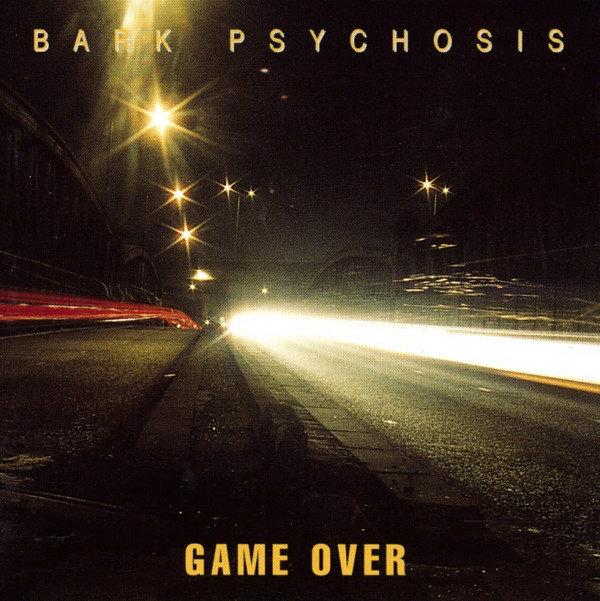
Turtles All The Way Down concludes the album on a dry joke. The title’s from Stephen Hawking, via any number of sources. It covers infinite regression (handy for loopers), desperate mythologizing and arguments stretched thin. The music itself is fired off from on the abstract coil of a steel-strung guitar lick in which jazz, blues, minimalism and an awkward all-ways dash combine in a way which would’ve raised a sour grin from John Fahey. This quickly moves into a gnarly munching electric drone, ghostly post-rock keyboards and spacious drum clatter. It’s a last-minute hollowing out of what’s gone before, the sounds and atmospherics recalling the anxious small-hours cruises of Bark Psychosis (sliding past the red lights at 3am, somewhere close to home but never in a stranger place).

It’s as if Darkroom have suddenly stopped, shaken awake, and reminded themselves not to let us settle into too much comfort. Much of the music on ‘Some Of These Numbers Mean Something’ may have dropped out of the previous interstellar char-and-chill in order to embrace a more human-scaled and earthbound warmth. Darkroom aren’t forgetting that the inhuman extremes are still there, waiting indifferently just outside the envelope.

Darkroom: ‘Some Of These Numbers Mean Something’
Burning Shed, BSHED 0408 (5060164400059)
CD/download album
Released: 3rd October 2008

Buy it from:
Burning Shed or Bandcamp.

Darkroom online:
Homepage Facebook Twitter MySpace BandcampLastFM

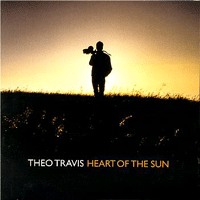
September 2001 – album reviews – Theo Travis ‘Heart of the Sun’ (“one of Britain’s finest yet least precious saxophonists”)

8 Sep

Theo Travis: 'Heart Of The Sun'

Theo Travis: ‘Heart Of The Sun’

Having followed a series of assured, wide-spanning loops passing through jazz, art-rock, prog, ambient electronics and Gong’s fertile psychedelic universe, perhaps it’s time for Theo Travis to come home. Or, perhaps, to build a home.

One of Britain’s finest (yet least precious) saxophonists, Travis has paid tribute to the post-bop traditions of Coltrane and Tyner, blown full improv and racing fusion, played balladeer and pop romanticist, and breathed frost over ambient darkness. ‘Heart Of The Sun’ summarises this breadth on a single album, unifying itself around his compositional variety and the flexible determination of his playing voice. It’s remarkable for the humility and warmth of its approach – partly from Steven Wilson’s beautifully atmospheric mixing (an object lesson in letting jazz studio performances breathe as naturally as live gigs), but more significantly from Travis’ uncomplicated attitude towards allowing music to happen.

A sometimes-unguarded, sometimes-studious musician – who gives his all either way – Travis is also someone who doesn’t need to throw a leader’s weight around. Subtly poised and authoritative, he stands back from the obvious limelight throughout ‘Heart Of The Sun’, allowing his guests (in particular, pearly-toned trumpet veteran Palle Mikkelborg) to illuminate the music, and then gracefully reflecting that light back himself. Grinding no axes, ‘Heart Of The Sun’ sits itself down at the accessible end of jazz, with Travis discreetly polishing his musical breadth to a smooth evanescent ‘Kind Of Blue’ consistency.

His standard quartet members – David Gordon on piano and organ, Andy Hamill on double bass and Marc Parnell on drums – are the album’s backbone (with occasional rhythm section substitutions from Stefan Weeke and Björn Lücker). Theo’s partnerships with these players allow him to exercise some more straightahead jazz moves, via a tenor sax tone blending the polished New York bite of Michael Brecker and Dave Liebman with the earthier strengths of British bluesman Dick Heckstall-Smith: as demonstrated on the velvet-smokey blues of All I Know. On the other hand, the standard crew also raise the stakes on Fast Life, in which Andy Hammill makes the most of his experiences backing contemporary drum’n’bass luminaries like 4 Hero and LTJ Bukem. It’s a nimble, daring demonstration of how clubland’s drum’n’bass beatscapes are both nourished by jazz and able to feed back into it. Hammill, Parnell and Gordon slip and slide through a succession of sleek, exciting, ever-morphing junglist pulses, like Red Snapper in black ties. Travis and Mikkelborg travel cheek to cheek over these flexing surges, quoting mischievously from mariachi and Mission Impossible, Mikkelborg occasionally rinsing the beats in a wash of wah-wah’ed electric trumpet.

It’s also the standard quartet who are behind the very different approach of Northern Lights – texturally, a close cousin to Travis’ dark-ambient work as half of the electronica duo Cipher. His soprano sax (making its only appearance) stands poised in a lonely, bowed-head intro, redolent with melancholia, over Eno-esque dark-water atmospherics. Mikkelborg responds with a silvery, fantastically tender muted melody – comforting and passionate – that comes and goes like caught breaths and compassionate advice above the carpet of Gordon’s Hammond organ, slowly warming and soothing that initial exposed chill.

The quartet – this time augmented by Mystics guitarist Mark Wood, a companion from Travis’ nights in the improv lab – turn in a relaxed yet magnificent performance on Barking Dogs And Caravans. A musical picture of childhood holidays and British holiday camps, it provides Travis’ best melodic solo of the album. But with its friendly air of disarmed tongue-in-cheek pomp, the barrel-organ Hammond figures and Wood’s Frisell-ish lacing of bell-like guitar, it’s also an opportunity for Travis to explore the more unselfconsciously affectionate corners of the British jazz impulse. Here, you can hear the same mingling of warm, pubby matey-ness and superbly expressive playing as found in the Loose Tubes school of Django Bates and Iain Ballamy: particularly when Travis cuts loose with some celebratory, laughing tenor wails.

Elsewhere, British improv-scene tendencies get a look in on That Old Smile: initially a deceptive, straight sounding blues strut driven by Parnell’s haughty cymbal. Wood – using a solid-yet-limber blowtorching tone – moves outward from a supporting position via a series of iridescent bubbles of sound, allying themselves with Gordon’s increasingly shardlike organ, The piece’s impatiently accelerating choruses (and its nods to the excitability of prog) moves to a point where the playing melts, with a dropping silence, into a heated atonal Bitches Brew jam. Inflamed by hissing cymbal work, Wood’s Sonny Sharrock-ish car-crusher guitar explorations utterly displace the saxophone as the heart of an aggressive whirl of mutinous invention.

More extra-curricular activities are represented by Gong guru Daevid Allen. His infamous glissando guitar (a gentle, thrilling shiver of sound, like sheets of luminous rain stroked by fingers of wind) adds an unearthly, spine-prickling element to offset the familiarity in the album’s lone cover – Van Heusen and Burke’s Here’s That Rainy Day. The returning Mikkelborg (on serenely confident flugelhorn) and Travis (in luxuriant, purring ballad mode) handle the traditional melodics, while the subtle icicle colorations of Gordon’s piano and Björn Lücker’s steady click of rimshot mingle with Allen’s eerie distortions of the atmosphere.

More outright subversion of tradition comes with the surreal Last Flight From Twinwood – an impressionistic, pulse-free, last-days-of-Glenn-Miller tribute in which a spectral big-band sound is provided care of multi-tracked Travis flutes and the one-man clarinet ensemble of Stewart Curtis (moonlighting from Kletzmer Groove). Mikkelborg’s delicately wah-ed electric trumpet haunts the music’s open spaces; Travis’ sometimes anguished tenor cuts across them. But the trump card comes in the unrepentant, disincorporated screech and spring-noise of Mark Wood’s distant guitar, a harbinger of failing aircraft machinery…

The sixteen-minute trail of Bass Rock is a final piece of Travis landscape portraiture, tracing a fluent and understated post-bop slide. Its freedom is defined by Stefan Weeke’s beautifully-timed, gliding elisions on double bass and the casually intent whisper of Lücker’s brush-drumming. And also by its cessations into near-silence but for oscillating ambient loops. Here, Gordon’s flickering touches of piano are sometimes the only foil to Travis’ sax – liberated now from discretion or restraint, to cry with a kind of baffled joy into the night. An open-ended homecoming.

Theo Travis: ‘Heart Of The Sun’
33 Jazz Records,  33JAZZ063 (5020883330631)
CD/download album
Released: 3rd September 2001

Buy it from:
Amazon

Theo Travis online:
Homepage Facebook MySpaceLast FM

January 2001 – mini-album reviews – The Servant’s ‘With the Invisible’ (“art gets made, covertly, in rush-hour”)

22 Jan
The Servant: 'With the Invisible'

The Servant: ‘With the Invisible’

On last year’s ‘Mathematics’, Dan Black (the voice, face and most of the limbs of The Servant) lifted the lid on a peculiar pop world, fascinated by the chasms between reality and imagination and between formal order and animal madness. ‘Mathematics’ was a dance of numbers, monkeys and peculiar people-watching, jamming in suspicions of murder, deranged Bunuel-ish aristocrats and shopping mall alienation. Unusually, its sonic palette was just as wild as its subject matter. It was as chopped-up and mercurial as it was catchy and danceable, emphasising Dan’s omnivorous sampler as much as his peculiar sneer (thin and venomous, but in its way the wildest and most devil-may-care British pop vocal this side of Billy Mackenzie).

With Chris Burrows now recruited to the project to beef up the guitars, ‘With the Invisible’ hints at being a more conventional follow-up to ‘Mathematics’. In many ways, it is. It’s less extreme, more aligned towards the needs of a guitar band: the sounds are much less wild and varied, with less cunningness required to ensure the gelling of the musical ingredients. Hell, it could almost be Britpop; albeit at the Pulp end as opposed to the Shed Seven end. But I’m not convinced that this means Dan Black has shot his artistic wad. In fact, I’ve a suspicion that where ‘Mathematics’ rattled the cage of the fantastical, ‘With the Invisible’ (right down to the title) documents Dan’s interaction with the everyday – the office jobs, adverts, commuter rushes, conspicuous consumption and car ownership that most of us take on continually and take for granted.

Certainly ‘Biro’ is about sulking in an office, your mind scrabbling desperately for escape either in desk-based sculpture, the limited options of the office party (“wet-look in my hair?”) or violent fantasies – “I just killed my new boss / shut that cock up, with a rock, / non-stop in his face, / and what a smug face.” Inevitably, it concludes “it’s plain to you and it’s plain to me, / there’s nothing for you and there’s nothing for me,” but it has a colourful time getting there.

With that admitted, the next question is how to live under those circumstances, if at all. The brass-pumping ‘Milk Chocolate’ is a rebellion, which finds Dan capering under the motorway next to a blazing bonfire. Systematically, he’s burning all of his possessions from hi-fi to furniture right down to his clothes, trying to shake off the packaging of the modern world. But with “milk chocolate pumping through my heart” the contamination of consumption has already reached to the core of him, leaving him with the logical conclusion of joining his own trash on the fire.

Or not. The bodypopping, Prince-like, bubblegum funk of ‘In a Public Place’ suggests an accommodation, even a brainwave to slake that thirst for stimulation. Art gets made, covertly, in rush-hour. “Among stumbling commuters / I think about each step, / not where I’m trying to get.. / In a limited space, / I try to find a cube for me. / With suble changes of pace, / I move through various densities.” There’s even peace to be found – “watching people move, / they appear to groove / with the invisible.”

For a while, our man seems happy in a formal suit and in step with this world. By the time the White Town-ish synth pop of ‘Driving at Night’ shows up – deliberately tidy – he’s possibly taken it too far. “I try hard to be like I’m in an advert / as we descend upon upon the M1.” Before long, though, The Servant are back to poking holes in the fabric of the world again, trying to expose the workings. In the Jam-versus-hip-hop bust of ‘The Entire Universe’, this happens via rampant, tongue-in-cheek paranoia. “How can I trust my own memory? / Did what I thought I saw before occur?” yammers Dan, almost with relief, as flute shrieks and silvery Indian strings zing off the barking guitars. “How can I trust my own family? / Maybe they’ve lied for years to me.”

By the finale, ‘She Cursed Me’, the music is heading back towards the heady mix of sounds that characterised ‘Mathematics’: ironic tinges mixing with intimate pastiche, music box interludes, bright dreamy shifts of mood and texture with a sharp mind manipulating them. And Dan’s narration has moved well clear of city rules, looking backwards to villagey beginnings, the first stirrings of curiosity (“she cursed me with impatience / and I need to follow clouds,”) and the repercussions of actions (“our conversations by the pond / I wonder if they’re still going on – / swimming on the gluey pool, / around the church and up to the school.”)

The Servant are still marching to their own inner promptings; still bouncing on the shock of impulse. Still the colourful alien probe that’s embedded in the mundane. Keep watching.

The Servant: ‘With the Invisible’
Splinter Recordings, SP003CD (5 038622 102326)
CD-only mini-album
Released:
22nd January 2001
Get it from: (2020 update) CD best obtained second-hand; stream from last.fm.
The Servant online:
Homepage Last FM Apple Music YouTube Deezer Google Play Pandora Spotify Amazon Music
Additional notes: (2020 update) The Servant split up in 2007. Dan Black moved on to a solo career; Trevor Sharpe has played in Deadcuts.

April 2000 – mini-album reviews – The Servant’s ‘Mathematics’ (“cleverly constructed songs which nonetheless loll open like burgled cupboards, disarranged and pried into”)

24 Apr
The Servant: 'Mathematics'

The Servant: ‘Mathematics’

To realise just how good The Servant are, you have to look back a few years and see just how bad they could have been. Back to 1990s Swinging London and the age of the Young British Artists: paint, press and garbage flying everywhere while Damien Hirst, Tracy Emin and co. latched onto the multi-media cow and deliriously milked it for all it was worth. Restaurant tie-ins, TV shows, crappy crazy-golf designs… Anything which took the piss, got attention, built the empire.

British pop – siamese-twinned to art-school anyway – didn’t escape this cross-media surge. A slew of appalling artist/band tie-ins tumbled into the world. Big Bottom, Fat Les (or anything else in which Alex James cosied up to fellow Goldsmiths’ alumni). Various one-of/fuck-offs with conceptual artists barging onstage, messing around or just singing badly in the name of deconstruction or situationism. The original spark for this was Minty, the performance-art-cum-pop band assembled by the late Leigh Bowery – a genius costumier, an infamous artist’s model, an indispensable link between conceptual art and gay clubbing, portraiture and pop trash.

Minty, though, was his one ignominious failure, remaining better known for Nicola Chapman’s transparent dresses (and for Bowery literally shitting on his audience at one fateful concert) than for music or vision. Noisomely cheesy in their calculated obscenity, their attention-grabbing stunts and their sherbety gargling squeak-pop, they left a couple of singles (the childish shock-pop stream of sneering abuse on Useless Man and the paper-thin, bored-with-it-all drone of That’s Nice) which still sometimes pop up in arty DJ sets to remind us all of what was putrid even before it was dead and buried. Two fatal errors doomed Minty. One was their assumption that calling themselves “artists” ensured that art (rather than amplified fads) would come through them; and the other was attempting to plaster conceptual art’s whims onto the surface of pop, like cheap multicoloured cladding.

Servant leader Dan Black – who, like his bandmates Matt Fisher and Trevor Sharpe, was once part of the Minty circus – has obviously learnt from this. With The Servant, Black is smart enough to work from the other way around this time: writing scratchy, catchy songs which actually work, and then twisting their vision from within. Certainly The Servant avoids Minty’s sub-Wildean, cripplingly trashy desire to celebrate the trivial and superficial. Instead of sloppy art-to-pop, ‘Mathematics’ is full of shrewd Bowie’n’Devo-esque pop-to-art. Cleverly constructed songs which nonetheless loll open like burgled cupboards, disarranged and pried into.

It’s constructive criminality, though. Vandalising pop with creative intent, layering it with pop-up samples, buggering about with the implications, enjoying the theatrical interplay of sounds. It’s also the truest British parallel to Beck yet. Dan slithers in and out of sketchy transparent personas; paralleling Beck’s American easiness with his own Home Counties fussiness, Beck’s quirky patchwork of ideas and soul-revue showmanship with a violent jarring of public and private universes and with arch music-hall wit.

Dan himself seems to be constantly hovering, saturnine, above the songs. He’s just that little bit smarter than the music – involved in it but not quite of it. Although his thin nasal sneer of a voice recalls his previous band, this time he’s made sure that his irony has something substantial to grip onto. Teased for his eccentric dancing skills (“an orang-outan body-popping… a monkey who is rocking”), he gleefully makes himself the butt of an old Darwinian joke. “Look darling, it’s our cousins. / Come in and meet the family. / We are eating. / Well, you must join us. / Come on dear, lay another place for the apes and the chimpanzees,” he sings, to the accompaniment of brittle white soul-funk as monkeys cackle feverishly behind him, and broken pianos spin into the breaks.

It’s not just the supercilious servility of the band’s name that’s suspicious. Messing around with perceptions is The Servant’s stock-in-trade. Tuneful and catchy the songs may be, but each one is a mass of elaborately layered confusion in sound and text. Instruments and sounds appear in the wrong places, or squeezed into unusual forms by hip-hop-era sonic tinkering; and airy lyrics are jostled by intrusive sounds. It seems right that Dripping On Your Maths (popper-fuelled disco rhythms mixed up with a particularly wilful string quartet) makes jumpy little attacks on correctness and rationality. “Hunched up poring over graphs – / don’t blink, / just think / of all things and their link,” sings Dan sardonically, like a rebel maths tutor watching his sweating pupil’s tidy equations succumb to chaos. “Is this what you studied for? / A kind of mime, from nought to nine…”

The Servant’s music is a colourful, disturbingly surreal puppet show, in Dan plays the role of head marionette as well as that of chief string- puller. At the same time, he’s violently shaking the scenery with whichever limb is free, in order to reveal the workings of this enclosed world. The masterstroke in this approach is Conversation. It rips off and flips over the infamous Kashmir riff as a starter, but that isn’t all that it flips over. Initially, a kitchen-sink drama (illicit love, a girl making secret trips to a payphone, the delaying of a promised call) promises to develop into a classic little story. Then Dan starts to dismantle it with a cool, sadistic science. “The girl from verse one / Does not exist / Sure, you can feel her hands, but she’s just an idea.”

Toying with both our impatience and that of the luckless, fictional heroine (“Don’t you find the waiting tough / Even when occupied by love / and all that kind of stuff?”), he’s also dropping heavy hints to us that he’s not only the narrator, but the feckless love interest. “The tragedy is that Gary’s me / and it’s 7.40…” When he brazenly admits “If you feel any pain, / well, I’m to blame,” it’s a multiple confession. It’s also a superbly heartless one, with the air of a man pushing models around on a strategy board, or an author invading his own story for reasons of control or revenge. Yet it also pokes hard at our own complicity in the tale, as readers; while helping everything along via a smashing, seductively slithery tune.

More authorial meddling comes free with the supermarket voyeurism of Tangled Up in Headphone Lead. Lazily people-watching from a mall cafe, Dan attempts to divine the personalities of strangers from disconnected clues and cues (rubber marks left by hot shoes, hands running pinlike across tins, peculiar walks). The result’s a distracted, disassociated love song in which the lovers never even meet, and in which affection, confusion and atmospherics become hopelessly intermingled. There’s romantic, summery acoustic guitar, yes; but there’s also alien booms of Scuba breath. Heavenly swells of synth jab jaggedly as Dan’s latest persona meanders from thought to dysfunctional thought: “I wonder how you feel. / I struggle with complex food.” Obviously, he’s a stranger here himself.

The other thrust in ‘Mathematics’ is the creation of artfully sinister images of England. This makes Dan Black the evil quad to the three other recent self-conscious bards of Blighty: Neil Hannon, Richard Larcombe and (the pre-’13’) Damon Albarn. Too Late is an effete-yet-violent English nightmare. It drowses in cello sounds and summery meanders, but it’s also encircled by thunderstorms and by Miranda Sex Garden’s gently menacing backing vocals. “I imported horses from Dubai,” drones the aristocratic narrator. “Like great white sharks, we rode around the local park.. / Like spraying paint we flew across pedestrians…” It’s a decorous rampage with a sticky end; a final fall that’s heralded by a genteel waltz.

If that’s macabre, Walking Through Gardens is positively disturbing. Any song that claims “when my wife died I was happy” (and which talks about a corpse buried in the backyard with the same concern that it shows regarding the installation of a barbeque) is never going to make it onto Our Tune. Blending with echoes of Fred West’s psychotic house-proud callousness and with the pomp of English gardening culture, chaos and horror break through the herbaceous borders. “We’re finally going to get a patio!” announces our hero. Triumphally sweet orchestras and brave trumpet greet the joyful news, but other music is also worming up to meet it: violent surges of drum’n’bass, claustrophobically oppressive bass synths, metallic dripping noises and a meat-mincer of a mix. It’s ‘Ground Force’ versus ‘Blue Velvet’, with Foetus as referee. Guess who’s winning.

Life’s what you make it, and The Servant make it decidedly strange. But it’s been a long time since we’ve had anyone in British pop toying with the paper moons, mining the flutters and lunges of the subconscious, with such wit and danger or with such cunning artfulness.

The Servant: ‘Mathematics’
Splinter Recordings, SP001CD (5 038622 101626)
CD-only mini-album
Released:
24th April 2000
Get it from: (2020 update) CD best obtained second-hand; stream from last.fm.
The Servant online:
Homepage Last FM Apple Music YouTube Deezer Google Play Pandora Spotify Amazon Music
Additional notes: (2020 update) The Servant split up in 2007. Dan Black moved on to a solo career; Trevor Sharpe has played in Deadcuts.

July 1999 – album reviews – Darkroom’s ‘Seethrough’ (“dropping casual, vinegar-dry references while somehow maintaining a ghostly mystique”)

22 Jul
Darkroom: 'Seethrough'

Darkroom: ‘Seethrough’

Transparent neither in style nor intent, Darkroom’s second album is demanding, mysterious; trickily opaque. This is not an unfamiliar position for this most obscure, obscured and inexplicable of ambient/illbient groups. The billowing instrumentals of Darkroom’s first album, ‘Daylight‘, made their points obliquely through a spray of trip-hop grace, thick detail and industrial derangement. About half of ‘Seethrough’ follows a similar path – baleful/beautiful semi-improvised noisescapes of layered electronics, angrily-stewing loop guitar and naked caress-through-to-howl vocals.

Resident synth necromancer Os fires off ratlike background rattles and spectral drum’n’bass rhythm triggers on the glutinous and dubbed-up Galaxy Craze, a threatening arrhythmic undulation in which Tim Bowness’ minimal, wraith-like subway singing is menaced by a fretless bass guitar part which probes like a giant animal’s tongue. On Charisma Carpenter, old-school ’80s synthpop riffs underpin the dense aviary heat of Michael Bearpark’s textured guitar. These OMD-styled tinklings make an unexpectedly cheerful counterpart to Tim’s lustrous and vaporous vocal chanting, which remains the most bizarre aspect of Darkroom’s music. Singing mere tumbling vowels, or sounds on the edge of becoming words, Tim delivers them with an eerily precise and chilly diction: like droplets of love-song which freeze to alien sleet as soon as they leave his mouth.

In spite of the textural invention and intelligence at work, only Kaylenz hints at the shocking intensity of Darkroom at full, live, improvising intensity. It takes up fourteen sprawling, disorientating minutes of the album, during which the tension between the celestial and the pestilential growing ever more violent. Electronica loops shade upwards into alarm, distorted hospital bells shrill. Mike’s country-toned guitar tang gives way to sharp buzz-edged swarming, while Tim’s vocals travel from weary, loving sorrow to a hysterical pitch of recriminations and a dash of lyrical perversity. Just before Kaylenz steps up – or breaks down – into a chaotic torrent of frighteningly emotional randomness, we hear Tim singing in a lost corner of the studio: a bored, beautiful, detached whisper of “you again, you again – / who’s to blame, if it’s all the same?”


This brings us to the wild card of ‘Seethrough’ – the presentation of Darkroom’s songwriting side, in which they sketch withering surreal portraits of disenchantment and alienation helped along by spacey glissandos of electric slide guitar. They’ve dabbled in words before (on the drum’n’bass/Fripp & Eno soundclash of the Carpetworld single) but here it’s more leisurely, more controlled; more disturbing. In some ways it’s an extension of Tim’s work on the cryptic dark-city musings of No-Man’s ‘Wild Opera’. In others it reflects the burnt-out, amoral contemplations of Tricky’s surreal, spliff-fuelled ‘Maxinquaye’.

If so, this is Tricky as played by Alec Guinness, dropping casual, vinegar-dry references to both Def Leppard and Janet Frame while somehow maintaining a ghostly mystique unhindered by the flapping of library cards. On the bobbing Morricone-meets-Orb dub of King Of The Cowboy Singers, Tim’s guarded, musical speaking voice recites both nonsense and significance to the beat – “trying to find a new life in an old boot, / walking to the new place in your old suit – / the king of the cowboy singers, / the toast of the Old School dinners…” The roiling, improvised star-stuff that usually pools out of Darkroom’s speakers is swapped for Dada-tinged narratives of shifting identities and habits; of introverted, stiffly English insanity and implosions of a starchy order.

Having said that, although Darkroom no longer quite sound as if they’re playing live from the surface of the sun, they’ve only retreated as far as a ski-lodge on Mercury. The glimpses of sky are always a bright merciless glare, the ground always dry dust; the scenery just a few steps away from white-out. Surly and blinded, Bludgeon Riffola surfaces through a swimming of harness bells as a filthy punk-blues fed through post-rock processing and glowing tracer-paths of needling synth-noise, Tim’s petulant vocals rope-swung and curdled with distortion.

The album’s masterpiece – the ten-minute stretch of Bottleneck – is blindingly white and exposed; a sinister mixture of Aphex Twin and Bill Frisell. Sparse, desolate slide guitar is chewed at by Os’ echoing dead-sea-surf static and smeared brass textures. Tim’s lonesome vocal (once it finally arrives) rides a stately dance of plucked orchestra strings, drawing out the shapes of a puzzle of betrayal and disgust. The charges are clear – “You never really loved your wife… / you never really knew your boys… / you never even liked the girl you said had claimed your heart – restart, restart.” But the story’s obscured: gaps between snapshots swallow it up. The figure of a man is reduced to a hat, a cigarette; an unfinished meal; an absence.

Then again, Darkroom aren’t here to provide clarity. Seethrough itself seals the album in a light and feverish running pulse, frosted by far-off gilded sprays of reserved prog-rock guitar. It’s tremulously sweet and frantic – trance-techno that’s neurotic rather than narcotic – and with a blurred, vocoder-ed vocal that queries the giddy transcendence of the music. “Too much misunderstanding; too much, too little love. / Too much to keep your hand in, too much to float above.” Dancing lightly on its feet, it moves with the crowd only to slip away quietly as the dreams evaporate. “Too much deliberation, too much you want to be. / Too much anticipation, too much you’ll never see – see through, seethrough.”

Blink, and it’s gone. Darkroom tease us with clarity, but lead us to a vanishing in the end.

Darkroom: ‘Seethrough’
Peoplesound, ART 4249-CD01
CD-only album
Released: 1999

Buy it from:
Original release deleted. 2003 remastered CD-R version available from Burning Shed; download version from Bandcamp.

Darkroom online:
Homepage Facebook Twitter MySpace BandcampLastFM

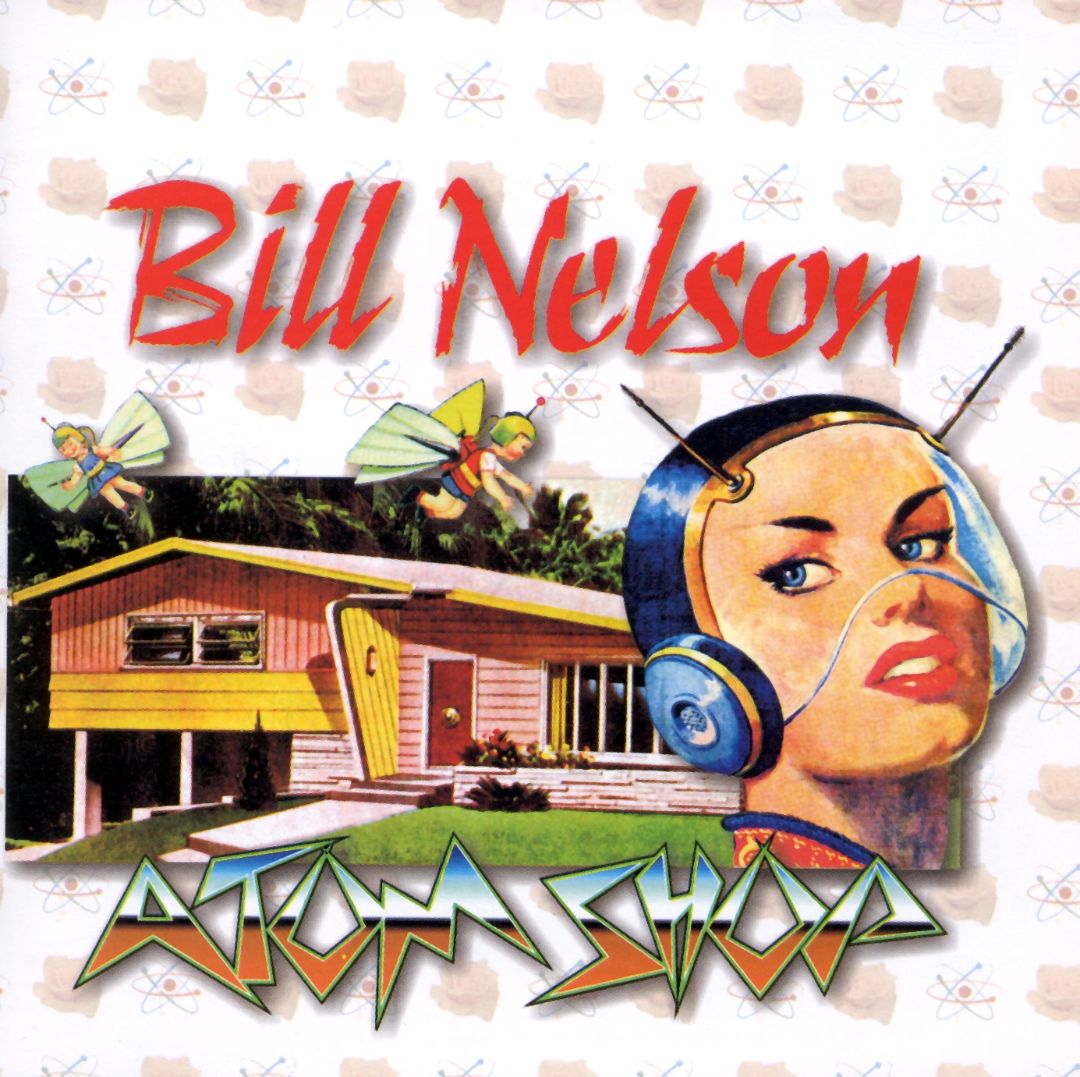
September 1998 – album reviews – Bill Nelson’s ‘Atom Shop’ (“freefalling away with the breakbeat imprint stamped onto the songs”)

20 Sep
Bill Nelson: 'Atom Shop'

Bill Nelson: ‘Atom Shop’

Compare and contrast. A while ago, Bowie – in a last-ditch attempt to prove he’s still relevant, still the musical chameleon of old – clambered aboard the drum’n’bass gravy train. That music’s normally made by lone bedsit technoheads; Bowie tried to do it with a bloated old rock band. Oops. Still, being Bowie, he could always pick up the phone and request the services of Goldie or some other jungle luminary. The end result sounded clumsy and desperate and – pointedly – as if Bowie had no real interest in drum’n’bass, since he kept dragging the music back towards the ever-more-familiar Bowierock. Not good.

On the other hand… Bill Nelson, him from ’70s Bowie contemporaries Be Bop Deluxe (and a man who mostly holed up in an ambient hermitage in Wakefield during the ’80s and ’90s) has also discovered drum’n’bass. A year before Bowie, too, with 1996’s rattlin’ good ‘After The Satellite Sings’, which sounded – unlike Bowie’s studied “so-how-do-I-do-jungle?” approach – like it had been a revelation and release to him, and without surrendering his own musical personality. Call me romantic, but I could imagine the middle-aged Nelson huddled over his radio each evening, tuning through the FM jungle pirate stations, listening in awe to the complex rhythms and then rushing to his music room to apply what he heard.

‘…Satellite…’ was a suave salvo of smartly retrofitted ’50s-accented art-pop with a bloodstream of “quintessentially English” drum’n’bass, if you can imagine such a thing – Nelson’s laid-back vocals (like a cross between David Sylvian and Cabaret Voltaire’s Stephen Mallinder) topping a very compacted sound, curiously lacking bass oomph but loaded with frenetic drum patterns, beatbox-assaulting jungle snares, burbling electronics and witty speech samples, including someone sounding suspiciously like Maggie Thatcher exclaiming “absolutely dazzled!” over the rush of beats. It was cheeky, it was damn cool, and it had a heart beating under its sharp starched creases.

‘Atom Shop’ is the follow-up; a boxload of demos that failed to get enough funding for the full studio treatment. All the better, ‘cos we know that that way lies ‘Earthling’, Bowie lumbering into a clumsy three-point turn and spilling his load. This album’s rougher edges help – not enough to convert a hardcore junglist, but evading the slickness of most crossover efforts. And it continues ‘…Satellite…’s so-quaint-it’s-cool eccentricity, from Nelson’s memories of being in hock to American glamour during his ’50s childhood and art-college ’60s in Yorkshire.

Pulp fiction, Beat writers, cartoons, natty bebop and cars with silver fins are all part of Atom Shop’s dream fabric. It kicks off with Wild & Dizzy’s swirl of trumpet mixups, dry drum’n’bass pulse, chill synths and blue guitar, peppered with ’50s dude voices. And one of the other songs is called Viva Le Voom-Voom, baby. There’s a lot of fanboy energy here: he’s knocking on 50, but Bill Nelson still sounds naïve and sparkling with enthusiasm, bless the old goat.

 
Though one thing you notice pretty fast is that ‘Atom Shop’ doesn’t have the hurtling clubby drive of ‘After the Satellite Sings’. Train With Fins looks back towards the more drum’n’bassed ‘…Satellite…’ songs like Flipside – fast and clattering upfront snare drum patterns, with a techno twang and banks of horn-like guitars calling up the ghosts of Stax – but, though speedy, it never breaks much of a sweat. Which is also true of Rocket Ship’s sliding jazz/d’n’b snake rattle and Trevor Horn stabs, or Popsicle Head Trip’s Ferry smooch and tight heavy-metal riffs – all mingling through the drum’n’bass dryness, but the beats ain’t so obvious as they could’ve been.

https://youtu.be/UIgHw6b3Af8
 
Magic Radio has a light d’n’b push to it, but ends up like The Orb doing Somewhere Over The Rainbow. ‘Atom Shop’ sounds more touched deeply in passing by drum’n’bass, rather than grabbed by it; as if it’s freefalling away with the breakbeat imprint stamped onto the songs, a teacher’s kiss. Here you’ll more often feel the pathways of d’n’b rather than the punch; the points where space has been prepared, the dynamics of the beat, waiting for the kick that never quite comes.

Oddly, though, ‘Atom Shop’s a much blacker album than its predecessor, even if it does sound less like a session on Massive FM. ‘…Satellite…’s most awkward point – the strafing, Fripp-like guitar solos – have been phased out for a bluesier approach. Nelson’s guitar is busy everywhere, and if there’s some of B.B.D.’s fluid finickiness to it, he can also sound like a sample-era John Lee Hooker, or the subtler detailing Hendrix of Little Wing and Up From The Sky. All this is dovetailed into the minimal trip-hop feel taken to the top of the charts by Garbage, Sneaker Pimps et al (especially for the more ominous Girlfriend With Miracles), but Nelson’s got a more developed musical sense.

https://youtu.be/2Vc_TDkFIIY
 
So everywhere you look, there are things going on: elements of electronica, samples and live instruments in a complex, but never fussy or muso, interweaving. Dobros and slides are all over Pointing At The Moon’s sleepiness, little bits of rural blues and gospel organs jostle into the arrangements; and so do probably all the “s”s in Mississippi too, if you can find ’em. And jazz dances wherever there’s room; trippy Dizzy Gillespie trumpet cascades, cheeky clarinets, even a bit of scat. Bill Nelson’s found, and gone into, the future we’re starting to guess at from our Portishead records and big-beat singles. A glittering, malleable, disorienting wonderland built out of chewed-up scraps of our past and ghosts in the record players. Something which he pins down in the sizzling hip-hop/jazz hybrid of Spinning Dizzy On the Dial when he sings “I’ve seen the luminous stuff of dreams, / I know what’s going down… Awake to all eternity / with the jazziest ghosts in town.”

https://youtu.be/w14qmruv7k0
 
It’s about a sensibility, I guess, a feeling. Which leaves us with the preoccupations of Nelson’s sighed, sometimes stoned vocals through an album of songs that are mostly poised in dreaminess. ‘…Satellite…’ celebrated the liberation Nelson’s kinetic d’n’b exploits offered him, poked fun at those who thought he might be a little old to join the jungle massive (“I had my sonic youth / When you were lost in ether… / I’ve got nothing to say, and I’m saying it. / Yeah, that’s the stuff for me.”) and had an undercurrent of suspicion at the American dream (“Whither thou goest, America, in thy shiny car in the night?”). But ‘Atom Shop’s more content to bask in sighs about “the way things swing”, “moving stars spun from mirror ball”, “Chet Baker on the lo-hi-fi”, trippy kittens, glamour girls from Mars, and Kerouac’s Dharma Bums. Perhaps he made his point the first time around.

https://youtu.be/FMofOHw9YGY
 
Rest assured that it stays on the right side of Austin Powers, thanks to things like the Beat-rapping on Billy Infinity, the shuffling shoe-drag balladry and springy guitars of She Gave Me Memory, and the way in which My World Spins cooks everything together best – gospel emphasis, lucid little guitar and electric piano strums, pitter-pat drum’n’bass velocity, a Cars-style creaky hipness and Nelson’s determination to keep his head clear: “now everybody’s got their information / but none of it matches mine. / Saints preserve my reputation and keep my thoughts sublime.” The sense of a mind open to new sounds and influences pervades. Before the closing Jetsons-style supermarket jingle, Nelson’s declared himself to be “sending signals and leaving clues / from the hymns of history to the far-future blues.”

 
And aside from the excitement for the listener, part of the greatness of Nelson’s current trajectory is hearing a rejuvenated art-rocker enjoying exploring startlingly new musical forms and weaving them into his history. Doing it for himself, without a style guru or scenester shoving a batch of 12-inch white labels into his hands, saying “Sample some breaks from this – it’s what the kids are into.” Keep flicking through those FM stations, Mr Nelson…

(review by Col Ainsley)

Bill Nelson: ‘Atom Shop’
Discipline Global Mobile, DGM 9806 (633367980625)
CD-only album
Released: 15th September 1998

Get it from:
Best obtained second-hand.

Bill Nelson online:
Homepage Facebook Twitter Soundcloud Bandcamp Last FM

September 1998 – EP reviews – Blowholy’s ‘Psalm 666’ (“a very young Trent Reznor chasing Tony Iommi down an endless cobbled alley”)

11 Sep
Blowholy: 'Psalm 666'

Blowholy: ‘Psalm 666’

For all the wild promo bluff (foaming descriptions of “’70s hell-riffing axe-gods having lo-fi nervous breakdowns whilst being sodomised by Satan’s own sampler under a layer of time-warped filth and modulated interference waves”) it’s easy to pin this one down. It was only a matter of time before someone copped on to the possibilities of fusing the rhythmical extremity of drum’n’bass junglism with the punch and theatrical flair of heavy metal. Strangely Brown (Blowholy’s one-man noise army) aims to be at the front of the queue to mate two musics more obsessed than most with extremity and big bangs.

If you can imagine a very young Trent Reznor chasing Tony Iommi down a narrow, endless cobbled alley, you’re halfway to imagining Blowholy. Knife-life guitar-riffs – pure Deep Purple and Black Sabbath, cored from their early ’70s pomp – ride on glittering junglist axles with a witchy, wiry vocal wound over the top. Electro-rattle meets bludgeon riffola – simple as that. Ministry did something similar with industrial techno at the start of the ’90s, and it’s fair to say that Blowholy owe them something. However, much of this EP springs from a distinctly British brand of humour and resentment.

Some of this is pulled from punk, some from the anarchic spirit of resistance in the free festivals, and some from the brutal rained-on sarcasm of the English cynic. Riding way back in the mix, crushed and distorted to a thin buzz, Strangely’s tones have a lip-smacking relish to them. He’s a rebellious and gleefully smart-arsed underdog, spitting out slap after slap to familiar targets, but with a engaging vigour. On the titular Psalm 666, he tears straight into consumerism (“Just buy what you’re told, / you are what you own. / Just do what you’re told and you’ll never be alone,”) and its pernicious work at frightening individuals into conformism. As with the metallic riffing, the song’s righteous punk disdain is tinged with Sabbath-style heavy-metal demonics (“Strip away the inane and just one voice remains. / It’s so subliminal, the devil’s own marching call: / ‘Come on, come on, come on, come on now, / fit in, fit in, fit in with the crowd’…”).

While Do As You’re Done By initially sounds more like personal revenge (“God, it gets me high to see the realisation dawn. / At last you’re facing someone you should really not have scorned!”) it’s more of a general roasting of the brainwashed – “I’ve had you here a year but you just never seem to learn. / So now it’s time to find out just what makes your flywheel turn. / If I open up your head I’ll see your tiny poisoned mind / I’m not expecting much, but I will see what I can find.” Beneath the occasional dungeon lyrics, it isn’t schoolboy sadism that drives Strangely: it’s ire at the smug, or the sheeplike, or the pretentious. ‘Dig Your Own’ (which mixes in some Mike Patton-style brat-rapping and a fistful of psychotically wiggling sax samples from Naked City) rips enthusiastic holes in some swell’s ballooning ego. “Claiming to bring the ultimate coup, / only to say what we already knew. / You’re going on so fast that you bring your own disaster. / En route from god to bastard, / so big; could not be vaster. / You’re going on so fast that it could never, ever last you…”

Scene & Herd charges back to the big unison Black Sabbath riffs, taking a sniff at speed-garage while it’s there. The dance elements are better integrated, wrapped in a grinning, glistening embrace with the guitars. This time, Strangely takes his knife to bandwagon-jumpers whose opportunism outstrips their knowledge or sincerity. “In all you do, it’s only you that you want to please… / There is no credence to the so-called words of wisdom that you sell. / But who can tell?” With great pleasure, he pronounces sentence: “It’s your fate to emulate / the world you think you have escaped / but merely aped.”

All well and good, but once the trick of drum’n’bass/metal fusion has become familiar, you do start hankering after some new tricks. Luckily, there’s Iconoplastic (Tzawai), in which Blowholy take a step on from the initial hybrid and produce something much more interesting. The power-riffing electric guitars are gone this time (occasionally replaced by scrabbles across a dislocated acoustic) and the stripes of waiting vacuum and rushing, balefully-textured noise stretched across the shuddering beat are more along the unrelenting sampledelic lines of Moonshake, Muslimgauze or The Young Gods than anything that finds its natural home in ‘Kerrang!’. The ominous Arabic samples (courtesy of Chalf Hassan) merge with the lo-fi percussive impulse, a jihad strike-force speeding across the sands. Meanwhile, the sardonic word-dancing has reached new levels of acidity. “Here we go again, with your self-important jive / about how you made a difference filling empty lives… / Well, it’s such a bed of roses with your collection of pet psychoses. / So tormented, like you meant it. / Oh, such a sensitive man!”

Blowholy are halfway there – they’re on the right track, but if they’re to become as musically interesting as the Naked City and Mr Bungle tracks they sample, they need the courage to consistently extend their own envelope. In other words, more Iconoplastics. But at least the drum’n’bass/metal crossover floodgates have been thrown open. That shaggy, long-in-the tooth rock monster has grown itself a new skeleton and is about to road-test it.

Blowholy: ‘Psalm 666’
Ketamine Leper Music, KETCDS 01 (no barcode)
CD-only EP
Released: 1998

Buy it from:
Best looked for second-hand, although CD versions will be extremely rare. Some tracks can be downloaded from Soundcloud as part of the ‘Church Bizarre’ album.

Blowholy online:
Homepage Facebook Soundcloud

August 1998 – album reviews – Darkroom’s ‘Daylight’ (“subtly distressed electronica”)

14 Aug

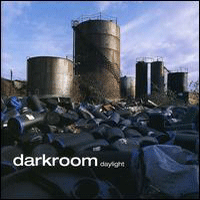
Darkroom: 'Daylight'

Darkroom: ‘Daylight’

To work out where Darkroom are coming from, you could do worse than take a look at ‘Daylight’s arresting cover. It’s a study of sturdy, corroded old industrial tanks, encircled by metal stairways and surrounded by a devil’s playground of battered, abandoned plastic drums. The drums are marked with hazard labels but yawn open, suggesting that their toxic contents have long since leached out into the environment.

Behind the towering tanks is a radiant blue sky and a slanting blanket of pure white fluffy cloud, against which they rear up like Reims Cathedral. It’s beautiful, in a warped way – the wreckage and castoffs of a once-bright new industry that, nonetheless, continue to assert themselves. Yet in this toxic paradise there’s not a person in sight.

No, this isn’t suggesting that Darkroom are the sort of electronica trio who revel in futurism, and who excise humanity from their orderly sequenced and oscillating musical vision of the world. The opposite is true. Darkroom’s music (in which Os’ sequences and textures are balanced by Michael Bearpark’s mutated post-industrial guitars and Tim Bowness’ naked swoony vocal wail) has humanity in spades. The live instrumentation and vocalising unites with the programmed sound and beats in a way that’s rare in over-purified electronic music, but in the music that emerges – one in which the technology provides uncertainty rather than comfortable form, and in which the threat of chaos and upset looms constantly in the background – the main note sounded is one of loss. One of the main qualities of daylight, after all, is its impermanence.

Via a previous EP, we’ve already heard the discontented seethe of Carpetworld: roof-skittering drum’n’bass with guttering snarls of wounded guitar and Tim’s voice reined in to a hooded whisper of acidic verbiage – the only lyrics on the record, and they’re about bad sex, looting and dodgy discos. We’ve also heard the beautiful flush of ‘Daylight’s title track: a tumbling chant (mournful but blissful) against a slow wallow of bass, the singing notes of Mike’s Frippertronical guitar, and Os’ dawn chorus of flickering sound. Darkroom can do in-yer-face, and they can do strokin’-yer-cheek. They do each of these in roughly equal amounts. Often they do both together, in an elusive blur of ambiguous emotion – the sort that makes you keep one eye on them and the other, anxiously, on the door; but which keeps you held in place, unable to resist the desire to see for yourself what comes next.

Ambiguity is in fact the keyword for this music. Brash, defined techno structures are missing, their place taken by sketchy outlines which the trio fill up with evolving, chaotic detail. The beats are light-footed: slow breaks languidly pacing the background, or pattering techno pulses like rats’ paws. The electronics hum like supercharged fridges close to bursting flamewards, or keen out lovely auroral shivers in the sky and in the shadowed spaces. Tim’s full-voiced mixture of blurred word-shapes and sub-verbal whoops are sometimes Buckley-ish in their tortured flamboyance, sometimes more like Liz Fraser’s outraged brother. Melodies drift, loop and contort: massy and queasily mutable, cloudscapes tortured out of their natural forms by the force of some cruel idiot god.

Sometimes Darkroom’s music sounds like Underworld (though tumbled from their throne and reeling with the impact of a massive nervous breakdown) or like Fripp and Eno sailing their boat into much more malevolent waters. Sprawl growls its overcast way past complex shifting slapping beats, squelched bass, crushed radio-talk and vocal frailties; a baleful camera scanning a wasteland. The opener, Crashed, is strung out, lovely but disfocussed, with a streak of elegant suffering running through it. The guitars rattle like motoring moon-buggies, the voice oppresses like a summer shower, and somewhere in the background, behind the throaty tick of percussion, a lone voice of optimism: a marimba chinking out its own little Steve Reich wavelet.

There are episodes of naked grace on board, beside the pollution, but ‘Daylight’ is still one of the most subtly distressed records to wriggle out of late ‘90s electronica. This is most obvious in the wrenching, frozen agony of Vladimir; but Died Inside seems to sob in anticipation for a collapse waiting to happen but never quite arriving. Looped calls, lilting gasps are answered across a chill and echoing gulf by the icy fuzz of a guarded guitar, prowling and snarling in its own isolation. Once, Tim’s voice reaches a rare degree of intelligibility – a panicked, unanswered plea of “d’you feel the same?”

The wonder that comes close in hand with this fear is laid out explicitly in No History. A soft hip-hop beat holds down the sky-stretchingly rapt vocal and the beautiful subterranean guitar moans: a soundtrack to the forever-flavoured moment when you lie stricken at the bottom of that fatal crevasse, watching the last and most brilliant stars of your lifetime pierce the beckoning void overhead. Like a fleeting memory of softer times, a snippet of (Sittin’ On The) Dock Of The Bay slips in. The amplifier buzz at the end is a benediction.

If there’s a time when there’s resolution, it’s when those two questioning background voices reach out across the comforting pulse of Estragon – Michael’s guitar like a high, bowed bell, Tim toned down to a florid whisper. Still, as it sails on towards its hushed conclusion, the key feeling of ‘Daylight’ remains one of loss. A lament for something unknown, but something voiceable. Something long gone past but reaching out for you again, as the day goes down and fades off into the poisonous beauty of a industrial sunset haunted by old unquiet ghosts.

Darkroom: ‘Daylight’
3rd Stone Ltd./The Halloween Society, HAL 8002 CD (5 023693 800226)
CD-only album
Released: 7th August 1998

Buy it from:
Burning Shed or Bandcamp

Darkroom online:
Homepage Facebook Twitter MySpace BandcampLastFM

July 1998 – EP reviews – Darkroom’s ‘Carpetworld’ (“swathed in contradiction… one long, haunting slab of sonic terrorism”)

15 Jul

Darkroom: 'Carpetworld' EP

Darkroom: ‘Carpetworld’ EP

Darkroom come swathed in contradiction: daytime shoppers on the sleeve, savage nightlife in the music. And no credits, though apparently it’s another one of those confounded No-Man offshoots ‑ don’t these bloody people ever sleep or anything? Evidently not, if the tracks on this single serve as an example of the sounds pulsating through their brains.

Carpetworld itself breaks all the rules ‑ the rules that say you can’t put vocals and lyrics recalling Soft Cell‑era Marc Almond over churning, vicious Frippish guitar ambience and hard‑as‑nails mechanoid beats falling somewhere between jungle and hardcore techno. A knife in the side of the rave generation’s blissout, it’s elegant in its brutality (“taking a twirl with your best friend’s girl, while the rest of the gang torch Carpetworld”), hovering in tatty clubs and observing the rituals of nihilism unfold as the backwash of bad E and the not-so-gentle ’90s poison the clubbers’ dreams.

Dance darkhorse it might be (it doesn’t run with any obvious scene, and fuck knows which playlist it’ll fit on in the increasingly segregated world of dance radio) but this is still cutting‑edge contemporary, with absolutely no fluffiness and Tim Bowness spitting out lyrics the likes of which we’ve never heard fall from his previously poetic mouth ‑ “Have useless sex with your ugly ex… / You velvet‑sneakered chancer, you broken-fist romancer…” as the beats flutter like a death’s head moth trapped in the throat. I’ll stay well out of the disturbing urban nightmare Darkroom are living in, but I’ll happily live it vicariously through their warped imaginings. Dante’s disco inferno.

After that, the Carpetwarehouse reworking does lacks a certain spontaneity. The original sounds like it’s literally fallen together in a paranoid improv session after a thoroughly unpleasant experience: This – apart from simply not being different enough – simply sounds like Darkroom have tried too hard at the atmospherics. OK, the beats are even more frenetic and Bowness achieves something he’s previously never managed in previous recordings: i.e., sounding fucking terrifying as his distorted voice rasps out the repeated mantra “I’m coming after you!” If you ever thought, from listening to No-Man’s work, that you could have that Bowness chap in a fight ‑ think again… Nonetheless, one does yearn for a battering, bloody remix from the diseased mind of Jim ‘Foetus’ Thirlwell, or Aphex Twin.

But, hell, Darkroom’s maverick genius still encompasses enough space for much more roaming, ambient trips. Daylight, in particular. Tim Bowness (like Martyn Bates) has always had one of those voices that are perfect to use as an instrument integral to a piece such as this, weaving magical wordless nothings in and around underwater tones and splashes of electronica. Anchoring this thoughtful pause from drifting off into inconsequentiality, a beautifully melodic bass riff and eerily clattering percussion ‑ like the echoing sound of camera shutters ‑ keep proceedings somewhere near planet Earth.

Ardri, though (nonsensical title ‑ always a bad sign), reeks too much of late ’70s/early ’80s ambient ‑ the kind of stuff the BBC would choose to soundtrack beautiful nature footage. Look, it’s a personal thing ‑ until someone out there finds even a slightly new direction with ambient (and I would certainly not rule Darkroom out of this), then the only sounds that interest me are the ones that either completely chill me out, or those that make the hairs on the back of my neck rise. This final track (like too much else in the field) gets my mind wandering after the first minute and thinking “So? What’s next?”

So, a downbeat end to a marvellous debut from Darkroom. Buy it for the title track and (whatever my gripes) for the remix, and just treat them as one long, haunting slab of sonic terrorism. Brilliant.

(review by Col Ainsley)

Darkroom: ‘Carpetworld’
3rd Stone Ltd./The Halloween Society, HAL 8001CD (5023693800158)
CD-only EP
Released: 6th July 1998

Buy it from:
(2018 update) This is now one of the rarest Darkroom releases – best obtained second-hand or from iTunes.

Darkroom online:
Homepage Facebook Twitter MySpace Soundcloud BandcampLastFM

May 1998 – album reviews – Blowpipe’s ‘Pendulum’ (“half given over to Blowpipe’s previous grace, half to a new and more aggressive club attack”)

18 May

Blowpipe: 'Pendulum'

Blowpipe: ‘Pendulum’

In jazz, things move on, and Blowpipe are no exception to this. Father-and-son brass-and-reed players Robin and Andrew Blick joined forces last year, making a mark for themselves last year at the point between hips and heads for their own spin on jazz-meets-clubland, sliding in alongside acid jazz with something a little more sophisticated and challenging.

The enthralling ‘First Circle‘ was the outcome: a rich and rewarding chill-out-and-expand intertwining of busily-bubbling electronica with old-school jazz conversation. Alongside guitarist Paul Reeson and the remarkable electronic sound-weaver Stephen Watkins, the Blicks set up a heartfelt and fertile union of jazz expression and latter-day dance-floor pulse, a tapestry of burbling intelligent techno, deft horn dialogue and fluent electro-acoustic textures. It was a joy to listen to, and its success has been recognised in one direction, at least.

‘Pendulum’ (a hot-on-the-heels follow up to ‘First Circle’) comes after Blowpipe’s deeper welcome into the ongoing club revolution – they’ve played on the new album by drum’n’bass pioneer Grooverider – and a big line-up shake-up. Whether burnt, inquisitive or disillusioned, the Blicks have opted to change the band’s instrumental chemistry. Blowpipe’s armoury of blowables (which already featured the Blicks’ trumpets, saxes, assorted horns and abused pipework) has been expanded by the addition of Nick Reynolds’ harmonica; they’ve also added a steady bass player in Tom Harrison; and there are frequent guest appearances (and stronger links to the jazz world) from saxophonist/flautist John Burgess of the Harry Beckett band and the Tom Bancroft Orchestra. But most crucially, both Reeson and Watkins are now out of the picture (apparently, halfway through recording). Consequently, while half of ‘Pendulum’ is given over to Blowpipe’s previous acoustic/ambient/electronica grace, the other half is shaped by a new and more aggressive club attack.

Of the old school stuff, Airport Woman is the most graceful: a mass of beat-free, blurring big spaces: back-and-forth cello loops, rainy-night muted trumpets, glows of soprano sax and a brief return from Paul Reeson. The Spell is Broken is wrapped in a backwards bassy ostinato (padded up by Tycho Andrews’ wah-guitar) like an orchestra in a North Sea fog, thick hazy air through which Andrew Blick’s trumpet clarion cuts like a lone lighthouse beam. Muting down and vague-ening in the heavy atmosphere, it gently illuminates (above the clanking guitar rhythm and the creak-crunching sonics).

However, this album’s signature is definitely made by the harder breed of Blowpipe pieces, by the post-Grooverider drum’n’bass influences. This could have been a good thing, given that music’s ferociously intelligent, toppy rhythmic attack: the bebop of the club scene. But in practice? Um… maybe not.

The main problem is a loss of that crucial Blowpipe balance. Neither of Stephen Watkins’ on/off successors (Patrick Mosley and Mike Servent) possess any of his subtlety, meaning that the detailed electronic textures of ‘Full Circle’ have been overturned in favour of synth washes and more blatant beats. And while the Blicks remain as eloquent as ever, Nick Reynolds’ harmonica virtuosity is of the tinny, bullying breed: a soulless Mark Feltham cop. Sometimes the new marriage is a happy one, as on Avanti’s drowsy harmonica patina and cloudy brass blankets, mixing it up with breakbeats, Harrison’s Bootsy bass, and Andrew’s cold trumpet motif. But when it’s at its worst, the Blicks seem sidelined within their own project, locked down in the cages of snare drum.

The analogue gut gurgles and video games blippery of Usurper work quite well, as Reynolds’ sharp harmonica riffs mingle with fluent fluttering sax and muted trumpet. But Unravel’s tight fast rattle and saurian bass quakes are overcome by the belting raucous harmonica and brass. Robin Blick’s soprano scribbles too frantically, Andrew’s echoed trumpet sounds busy and sour. The raw power of Scorched Earth’s distorted breakbeat and Harrison Wobble-y bassline can’t make up for the yammering, overbearing harmonica overkill: Reynolds blowing flatulently all over the Blicks’ bitty chips of sax and trumpet and Katherine Blake’s skidding tremolo violin. And School Disco (working title or what?) is just clodhopping: a flatfooted stomp which sounds like it was recorded in an underpass. John Burgess’ guesting flute fights to keep grace going against the dirty swathes of distorted harmonica.

When Reynolds is kept on a tighter leash, things work out much better. On the climactic Phoenix, for example, where Burgess’ bass clarinet and Andrew’s dawning trumpet lines repeatedly criss-cross each other over didgeridoo droning and Robin’s sax hangings. Or on Pendulum itself, which uses power without clumsiness. Rising off a big Bonham-y stomp with overdriven trumpet and giant floppy bass, Robin laces in some ascending saxes and curtains of brass. There’s a guest tenor scrawl from John Burgess: then, amid the whale-song trumpets, an incongruous Scott Walker sample pops up to breathe in bluer air. “The little clocks stop ticking now…” Everything does stop ticking. Everything kicks off again. Marvellously perverse, and a particular highlight on an album which sometimes fails to live up to Blowpipe’s initial promise, reminding us of how good they can be once they’re back in focus.

Blowpipe: ‘Pendulum’
Robot Records, ROB 001 (5019148617297)
CD-only album
Released:
15th May 1998
Get it from: (2020 update) Best obtained second-hand, or streamed.
Blowpipe online:
MySpace Amazon Music
Additional notes: Robin Blick now leads Blick Trio; Andrew Blick leads Gyratory System.
 

May 1996 – EP reviews – No-Man’s ‘Housewives Hooked on Heroin’ (“turning away from the light to embroil themselves in a polluted twilight”)

30 May
No-Man: 'Housewives Hooked on Heroin' EP

No-Man: ‘Housewives Hooked on Heroin’ EP

Mumsy cover art, titillating tabloid title and five tracks of wilful wrongfooting? For their first new material in two years, No-Man are not relying on the comforts of familiarity. Compared to the ornate, orchestrated silkiness of their first three albums, the No-Man sound of ’96 is much more confrontational. Bigger, noisier, dirtier; a swamp rather than a garden; these aesthetes are turning away from the light to embroil themselves in a polluted twilight.

‘Housewives Hooked on Heroin’ is the baleful first single from the forthcoming ‘Wild Opera‘ album – downbeat, low-key, opening on a bed of twangy guitar and suffocated electric piano chimes like a smog-ridden dawn over Las Vegas. A disaffected gasp of vocal pans over a landscape of weathered, weary icons – ageing pop starts, Howard Hughes – before enormous sour guitars slide in and drag it into a rolling chorus with the deathly beat-driven wallop of Sisters of Mercy. “Not even housewives hooked on heroin / could match my appetite for sin…”

No-Man come on like a flattened, ever-so-slightly Gothic Bowie, full of the empty hunger which you get on those evenings when there’s nothing you want to do, the heat’s pressing down and the light of day is stained by a sodium glow. Fittingly, Scanner’s Housewives Hooked on Methadone remix recasts the song in a fuzzy cloud of radio static, sirens and dusky synths hovering over a dry, frenetic junglist beat. I do miss his usual trademark dialogue samples, though, snatched illicitly from hidden conversations on mobile phones. Perhaps the housewives were on hold that evening.

If you’re already missing the thought of that departed beauty, No-Man do allow a nod to their more recent past with Where I’m Calling From, another fragile, obscure No-Man ballad connecting the stagnation of the earthbound and isolated with the loneliness of the stars. Tingling Robert Fripp Soundscapes meld with a limpid Steven Wilson Stars Die melody and the bitter, uncertain comment of Ian Carr’s reedy trumpet. Tim Bowness sings as if encapsulated in a phone box, wheeling through the outskirts of the Milky Way, making one final disaffected farewell call. “Where I’m calling from, you wouldn’t want to know…/ Where I’m calling from, you wouldn’t want to go.” A dog barks suddenly in the middle of all of this – it’s like the real world trying to get a last foothold in this dangerous reverie.

But that’s about as familiar as it gets. The spidery twitch of Hit the Ceiling (written and recorded, from start to finish, in one hour) hurls the spontaneous risks of current No-Man working strategies straight into our faces. Breakneck rattling drum track, skeletal guitar and the reverberating coloratura of a disembodied diva – Halloween in the attic of the Paris Opera. Urban Disco deepens their dance content with a dystopian shadowy blur of suffocating beats and whispering, glancing lyrical swipes at the self-satisfaction of hedonism, leaving the solipsis of previous No-Man behind in order to flit like a malevolent ghost around the cigarette-ends of the high life.

The ‘Wild Opera’ overture has been played. People seduced by the warm caresses of ‘Flowermouth’ and ‘Heaven Taste’ look set to be in for a rude awakening, but an interesting trip.

No-Man: ‘Housewives Hooked on Heroin’
3rd Stone Ltd, STONE 026CD (5023693002651)
CD-only EP
Released:
28th May 1996

Get it from: (2020 update) Original EP best obtained second-hand or from Burning Shed; Housewives Hooked on Heroin appears on No-Man’s ‘Wild Opera’ album, while Urban Disco reappeared on the ‘Dry Cleaning Ray’ mini-album. All of the EP tracks bar Housewives Hooked on Methadone were included on the 2010 double CD remaster of ‘Wild Opera’.

No-Man online:
Homepage, Facebook, Twitter, Soundcloud, Last.fm, YouTube, Instagram, online store, Apple Music, Deezer, Spotify, Amazon Music

SWOONAGE

Swoon. /swo͞on/ A verb. To be emotionally affected by someone or something that one admires; become ecstatic. Here are some people and things that make me swoon. #swoon #swoonage

Post-Punk Monk

Searching for divinity in records from '78-'85 or so…

theartyassassin

...wandering through music...

Get In Her Ears

Promoting and Supporting Women in Music

Die or D.I.Y.?

...wandering through music...

Music Aficionado

Quality articles about the golden age of music

THE ACTIVE LISTENER

...wandering through music...

Planet Hugill

...wandering through music...

Listening to Ladies

...wandering through music...

ATTN:Magazine

Not from concentrate.

Xposed Club

improvised/experimental/music

The Quietus

...wandering through music...

I Quite Like Gigs

Music Reviews, music thoughts and musical wonderings

furia log

...wandering through music...

The Recoup

SINCE 2013: Books and books and books and books and occasionally other things

A jumped-up pantry boy

To say the least, oh truly disappointed

PROOF POSITIVE

A new semi-regular gig in London

Gapplegate Classical-Modern Music Review

...wandering through music...

When The Horn Blows

...wandering through music...

:::::::::::: Ekho :::::::::::: Women in Sonic Art

Celebrating the Work of Women within Sonic Art: an expanding archive promoting equality in the sonic field

Ned Raggett Ponders It All

Just another WordPress.com weblog

FLIPSIDE REVIEWS

...wandering through music...

Headphone Commute

honest words on honest music

The One-Liner Miner

...wandering through music...

Yeah I Know It Sucks

an absurdist review blog

Obat Kanker Payudara Ginseng RH 2

...wandering through music...

poplifer.wordpress.com/

Waiting for the gift of sound and vision

Good Music Speaks

A music blog written by Rich Brown

Do The Math

...wandering through music...

Archived Music Press

Scans from the Melody Maker and N.M.E. circa 1987-1996

The World's Worst Records

...wandering through music...

Soundscapes

...wandering through music...

OLD SCHOOL RECORD REVIEW

Where You Are Always Wrong

FRIDAY NIGHT BOYS

...wandering through music...

Fragile or Possibly Extinct

Life Outside the Womb

a closer listen

a home for instrumental and experimental music

Bird is the Worm

New Jazz: We Search. We Recommend. You Listen.

...wandering through music...

Life Just Bounces

...wandering through music...

Lucid Culture

JAZZ, CLASSICAL MUSIC AND THE ARTS IN NEW YORK CITY

Aquarium Drunkard

...wandering through music...

eyesplinters

Just another WordPress.com site

NewFrontEars

...wandering through music...

FormerConformer

Striving for Difference