Archive | ambient music RSS feed for this section

October 2015 – upcoming London gigs – folk supergroup The Furrow Collective at Kings Place on the 1st; Mary Hampton, Nadine Khouri and Daudi Matsiko at Daylight Music; Alexander Hacke, Danielle de Picciotto and Thomas Ragsdale at the Hackney Attic on the 3rd; Andre Canniere at the Vortex on the 4th

26 Sep

A look forward to the first week of the coming month, with plenty of alternative folk, acoustic singer-songwriters and some multi-media music from a couple of former Berlin arts-scene linchpins, ending up with some jazz…

The Furrow Collective (Hall Two @ Kings Place, 90 York Way, Kings Cross, London, N1 9AG, UK, Thursday, 1 October 2015 – 8:00pm) – £9.50/£14.50

The Furrow Collective brings together four of the finest, award winning musicians on the UK folk scene – Rachel Newton, Lucy Farrell, Emily Portman and Alasdair Roberts – and delves into the obscure world of balladry at its darkest and quirkiest.

Each singer airs lesser-known gems from their traditional repertoire with an eclectic backing of harp, guitar, viola, concertina, banjo, musical saw and rousing harmonies. With a bold, improvisatory approach, their common focus is to capture the raw edges and fleeting magic of ballads, with storytelling taking centre stage. Emily and Alasdair are both known for their original, folklore-influenced songwriting, and, often finding themselves on the same bills they struck up a musical friendship, sharing stages and collaborating on each others albums. Lucy and Rachel are both bewitching solo artists in their own right as well as being sought-after session players and long-time collaborators with Emily Portman in her trio.

The Furrow Collective’s 2014 debut release, ‘At Our Next Meeting’ received widespread critical acclaim, as well as a BBC Radio Two Folk Award for Best Group and a Best Traditional Track nomination this year. A new EP is currently being recorded for release in autumn 2015, followed by an album in early 2016.

Tickets available here.

* * * * * * * *

More people singing at the weekend…

Daylight Music #201

Daylight Music 201: Mary Hampton, Nadine Khouri + Daudi Matsiko (Union Chapel, Compton Terrace, Islington, London, N1 2UN, UK – Saturday 3rd October 2015, 12.00pm-2.00pm) – free entry, suggested donation £5.00

Inspired by a passion for the winding road of the oral tradition from Homer onwards, Brighton-based songwriter Mary Hampton‘s songs possess an unusual transportive energy, moving her listeners through a sequence of shimmering landscapes that belong to past and present simultaneously. Accompanying herself on tenor guitar, and sometimes with members of her band Cotillion, she interprets material gathered from a wide range of sources, performing traditional songs alongside original work and settings of literary prose and poetry.

Nadine Khouri is a singer-songwriter currently based in London. A guitar-wielding folkie, with a love for shoegaze, moody soundtracks and spoken-word, Khouri’s music has been described by Rough Trade as a “music born of perennial outsider-status.” Her last release ‘A Song to the City’ was co-produced with Ryan Alfred (Calexico.) The EP also caught the attention of producer John Parish (PJ Harvey, This is the Kit) who invited her to guest on a song for his ‘Screenplay’ LP and subsequently to record her first album in his hometown of Bristol. Recorded live in a Georgian basement with a band assembled by Khouri, the resulting album ‘Lost Continents’ is a raw, atmospheric collection of meditations on loss and transformation, held within the hushed intimacy of Khouri’s voice. The first single from the album, You Got A Fire, is due for release in late October 2015.

Huntingdon is not famous for much. It was the birthplace of Oliver Cromwell and its local MP for many years was former Prime Minister John Major. Unlikelier still that the extraordinary songwriting talents of Daudi Matsiko (his name is pronounced “dowdy”) were nurtured in nearby Ramsey. Yet Daudi’s roots were somewhat further than Ramsey, his parents moving over from Uganda in the early 1980s. Daudi has been playing music since he was eight years old and writing songs since he was a teenager: although he’s still young, they speak of experience and trauma and gathered wisdom. Having suffered mental health problems in the past, he has used his music as a crucial salve in times of strife and stress. Daudi was lucky to grow up among a strong community of musicians – many of his Cambridgeshire buddies played on his breakthrough EP ‘A Brief Introduction To Failure’, which was supported by Gilles Peterson and helped bring him to a wider audience. His influences run the gamut, from The Mars Volta to Jeff Buckley, Beach Boys to Nick Drake. Plans are afoot for a new EP (working title: ‘The Lingering Effects Of Disconnection’).

More information on the concert is here.

* * * * * * * *

On the evening of the same day, Chaos Theory Promotions are back, displaying a continued knack for landing substantial art-music names…

Alexander Hacke/Danielle de Picciotto, October 3rd 2015

Alexander Hacke & Danielle de Picciotto + Thomas Ragsdale (Chaos Theory @ The Hackney Attic, Hackney Picturehouse, 270 Mare Street, Hackney, London, E8 1HE, UK, Saturday 3rd October 2015, 8.00pm) – £14.00/£18.00

Chaos Theory enthuse:

We cannot wait to share this.

After watching the onset of gentrification filling their previous creative oasis in Berlin, the extraordinary duo of multi-instrumentalist/producer Alexander Hacke (Einstürzende Neubauten) & multimedia artist-musician Danielle de Picciotto (of Berlin club culture, Pop Surrealism and Love Parade fame, as well as being a member of the latest Crime & The City Solution lineup alongside Alexander) have been nomadic since 2010.

Alexander Hacke/Danielle de Picciotto, 2015Giving up their home and most of their possessions, Danielle and Alexander have been touring the world, performing in Australia, doing residencies in Prague, Canada and Ireland, working in New York and recording in the Mojave Desert. (You may have seen them performing at Café Oto earlier this year, alongside Jarboe and Helen Money, as part of our 5 Years Of Chaos celebrations.)

This is the only UK show in their ongoing ‘We Are Gypsies Now’ tour, in which they will present music from Danielle’s new solo album ‘Tacoma’ (which speaks of leaving everything behind and trusting destiny to lead one’s way) and from their communal album ‘Perseverantia’ (which speaks of the strength and persistence necessary to survive outside of the grid) as well as material from their graphic diary ‘We Are Gypsies Now’ (which tells of how they gradually chose to become nomads) via glorious cinematic visuals. Here’s a small excerpt of their performance of ‘Perseverantia’ in February:

Thomas Ragsdale – best known as half of Manchester techno duo Ghosting Season and ambient duo worriedaboutsatan, as well as for his solo project Winter Son), also works as a film composer. He released his new album ‘Bait’ at the end of August via This Is It Forever, to coincide with the screening of Dominic Brunt’s film of the same name at Film4 Frightfest.

Thomas Ragsdale, 2015

The album started life as a film score to the UK thriller; but rather than just release the various background drones and atmospheres, Ragsdale re-opened the files he’d given Brunt and started to re-imagine the whole thing as one complete album, as opposed to merely a soundtrack. Thomas adds “after carefully editing the original soundtrack by expanding on some parts, and cutting back on others, ‘Bait’ was sequenced to take you down a similar path to the movie: at once beautiful as it is beguiling, intense as it is disturbing – shimmering drones give way to gnarled bass, refracting synth lines clatter over arctic atmospheres.” This night we’ll see the full fruits of his labours in a multi-media performance.

Tickets are available here.

* * * * * * * *

And finally…

LUME logo

Andre Canniere (LUME @ The Vortex Jazz Club, 11 Gillett Square, London, N16 8AZ, UK, Sunday 4th October 2015, 7.30pm) – £8.00/£10.00

LUME pitch in with some words:

For our October gig at the Vortex, we are pleased to welcome the fantastic trumpet player and LUME On Tour survivor Andre Canniere!

Andre Canniere is an acclaimed trumpet player, composer and educator. Originally from rural Pennsylvania (USA), he spent the first five years of his career in New York City where he worked with artists such as Maria Schneider, Bjorkestra, Kate McGarry, Ingrid Jensen, Donny McCaslin and Darcy James Argue. He has toured widely throughout the United States and Europe with performances at Wigmore Hall, Carnegie Hall, Birdland, the London Jazz Festival, The Hague Jazz Festival and the Rochester International Jazz Festival.

Since his arrival in the UK, Canniere’s profile has been steadily rising, both as a solo artist and a collaborator. ‘Coalescence’ (defined as “the union of diverse things into one body or form”) is his second release for Whirlwind Recordings and follows the critically acclaimed debut ‘Forward Space’, which Jazzwise Magazine hailed as “one of the best recordings in a long time” and included in their Albums of the Year list. Tonight Canniere presents his exciting new band – himself on trumpet plus Brigitte Beraha (voice), Tori Freestone (tenor saxophone), John Turville (piano), Dave Manington (bass), Tim Giles (drums) – performing new music inspired by the poetry of Charles Bukowski and Rainer Maria Rilke.

More on upcoming October gigs shortly, as I take a look at the second week…

…oh, hold on, here’s one more

September 2015 – upcoming gigs – Gong’s Dave Sturt and friends travel the world from Derbyshire on the 23rd; London gets more Daylight Music eclectica plus a Blacklisters/Joeyfat/Himself jabber-rock summit on the 26th

17 Sep

Here are details on some more interesting concerts coming up later this month. These run the gamut from soft psychedelic world-folk atmospherics to jabbering electric art-punk noise and sprechtstimme via dream-folk, caustic love songs and extended-technique art-rock instrumentals. (It was a shame to hear about the cancellation of the Charles Hayward gig in London on the 23rd – taking its ANTA, Gnob and Kavus Torabi support slots with it – but I’m sure that something similar will be rescheduled for anyone in need of their art-mash/stoner/prog/psych/metal salad…)

event20150923davesturtwirkw

Dave Sturt presents An Evening of Dreams & Absurdities (Upstairs @ The Red Lion, Market Place, Wirksworth, Matlock, Derbyshire, DE4 4ET, UK, 23rd September 2015, 8.00pm) – £8.00

As part of the Wirksworth Festival Fringe, Dave Sturt (bass guitarist with Gong, Bill Nelson, Steve Hillage and Jade Warrior, as well as being half of Cipher) showcases tracks from his forthcoming solo album ‘Dreams & Absurdities’ in an evening of world-class all-instrumental musicianship featuring beautiful eclectic music, soundscapes and various field recordings from Gong tours and elsewhere. The music is “mostly mellow and ambient – somewhere between melancholy and elation.”

For the performance, Dave will be accompanied by three guests. Chris Ellis (guitar and piano) is a multi-instrumentalist/singer-songwriter/actor, an ex-member of Anglesey band Ghostriders, and an award-winning soundtrack composer – he’s also a collaborator with Dave on the Past Lives Project (which recreates the recent ancestral histories of British communities by resurrecting their old cinefilm recordings and setting them to new music). Brian Boothby (low whistle, djembe) is an acclaimed folk musician, dramatist and writer and a member of the Derbyshire mixed-arts collective Genius Loci. Jeff Davenport (drums, percussion, HandSonic pad) has worked with jazz musicians Andy Sheppard and Phil Robson, pop artists James Morrison and Laura Mayne, and currently collaborates regularly with “Silent Pianist” Neil Brand providing soundracks to silent films, as well as working in Europe and the Far East on various projects with all manner of musicians.

Up-to-date details here  and here, with tickets available online from here or available from Traid Links via email enquiry.

* * * * * * * *

On the last post, I plugged a London double event on the 19th – a day with a Daylight Music concert at midday and a noisier rock gig in the evening (both events which are still about to happen as I post this). In another week’s time, history’s repeating (fortunately not as farce, though anyone familiar with the bands in the evening show can expect some twists and jabs of humour) so here’s what’s coming up on September 26th…

Daylight Music 200

Daylight Music 200: Ex-Easter Island Head + French For Rabbits + Louis Barabbas, plus a photo exhibition (Union Chapel, Compton Terrace, Islington, London, N1 2UN, UK – Saturday 26th September 2015, 12.00pm-2.00pm) – free entry, suggested donation £5.00

An extra special event to celebrate the 200th Daylight Music, featuring some of the most popular acts from the last six years (643 performances by 530 different acts; 15,254 cups of tea or coffee drunk; 9,863 slices of cake scoffed; 5,003 pieces of quiche devoured) and during which we’ll be raising funds for Daylight Music in 2016.

Ex-Easter Island Head are a Liverpool based musical collective composing and performing music for solid-body electric guitar, percussion and other instruments. They have performed their original compositions solo, as a duo, trio, quartet and as a large ensemble across a wide variety of events from site-specific installation works to live film scores. They create a sensation whenever they play. If you’ve never seen musicians hitting electric guitars with mallets before, then cancel all other plans for the day and head down.

French For Rabbits hail from the remote natural setting of Waikuku Beach, in New Zealand’s South Island. Vocalist Brooke Singer expresses intimate narratives against the cast of the damp colonial cold; her voice delicately steeled against winsome guitar lines and the eerie instrumentation of her bandmates. It’s a weather-beaten dreamscape, nostalgic for warmth and hopefully lilting towards sunnier climes.

Louis Barabbas is a writer, performer and label director, best known for caustic love songs and energetic stage shows that leave you pumped up and breathless.

The icing on the cake this week is an instrumental soundscape provided by Irish singer-songwriter and multi-instrumentalist Adrian Crowley, who (over his six-album career) has been described by the Independent as “a master of understatement” and cited by Ryan Adams as the answer to the question “who’s the best songwriter that no one’s heard of?”

To celebrate the fantastic photography taken throughout the lifespan of Daylight Music by a very talented bunch of volunteer photographers, there will be a lo-fi photo exhibition consisting of 200 postcards on the pews of the chapel for people to take away; plus there will be a limited numbers of brochures to buy featuring all of the photographs.

More information on the concert is here.

In the evening, there’s a change of pace and milieu over in Hackney as post-hardcore rubs up against a bit of playful English Dada. I’ve got a liking for those occasions when rock music drives itself up against persistent, wayward speech and stubs its toes on it; and this gig will offer plenty of opportunities for that…

Blacklisters, Joeyfat, Himself, September 26th

Blacklisters + Joeyfat + Himself (Pink Mist @ The Shacklewell Arms, 71 Shacklewell Lane, London, E8 2EB, UK, Saturday 26th September 2015, 8.00pm) – £8.00

Blacklisters’ aggressive, confrontational and darkly humorous performances have earned them a reputation as one of the best acts on the UK underground, drawing comparisons to the likes of The Jesus Lizard and Pissed Jeans. Their debut album ‘BLKLSTRS’ was released in 2012 to critical acclaim, landing them supports with Scratch Acid, Pig Destroyer, Future of the Left and Big Business, as well as a live session at Maida Vale studios for the Radio 1 Rock Show. Tonight’s special show is in support of their fearsome new record ‘Adult’ on Smalltown America. Produced by Matt Johnson (aka MJ of Hookworms) the album is a clear progression for the band and sees them fuse abstract art-noise with the brutally minimalist riffs that first put them on the radar.

Also playing are amorphous cult stalwarts Joeyfat, a band who’ve been defying conventions of “band logic” longer than most of us have been able to get into shows at all. Their sinewy math-inspired spoken-word has seen them share stages with the likes of Bilge Pump, S*M*A*S*H, Clearlake, Lords, Dartz, Art Brut, Trencher and Green Day, obviously. Catch them at this rare London show.

Direct from Leeds (unless they stopped off some place on the way), Himself’s shouty/talky interactive noise rock has been winning them plaudits up and down the company, including from Radio’s Daniel P. Carter who invited them to record a live session for the Radio 1 Rock Show earlier this year.

Tickets for the Shacklewell Arms gig are available here and here. Note that this is an 18+ event.


October 2015 – upcoming gigs – Jonas Hellborg & Steve Lawson in Birmingham, London & Leeds; Tim Bowness, Peter Chilvers, David Rhodes, Theo Travis quartet gig in Cardiff

7 Sep

Although there are still some September gigs to flag up, here’s advance notice of four interesting concerts in early October for those of you who are interested in the amorphous terrain between jazz, balladry, art pop and ambient electronica. (Just straight press release stuff – the analysis will have to wait for another time, although I’ve also stuck a few review links in where I’ve covered these musicians before…)

Hellborg & Lawson, 2015

Two of the world’s leading solo bass guitarists together on one stage.

Crossing musical boundaries and blowing listeners’ minds for over thirty years, Jonas Hellborg is one of the great innovators of the bass guitar. From the pyrotechnic flamboyance of his early solo electric albums, to his unique exploration of the richness and depth of the acoustic bass guitar, Jonas has changed the way people think about – and play – the bass. Whether as a solo artist, or collaborating with many of the most respected names in music, from John McLaughlin to PiL, Ginger Baker to Shawn Lane, Jonas’ signature sound and uncompromising creative philosophy have produced an unparalleled body of work, mostly on his own Bardo label. Lauded by press and public alike, this is a rare opportunity to hear Jonas up close in the UK.

Steve Lawson is one of the most celebrated solo bassists in British music history – early in his career, he opened for Level 42 on their first Greatest Hits comeback tour, placing his unique take on melodic looping-based live performance in front of tens of thousands of bass aficionados. Fifteen years of regular gigging across the UK, Europe and the US have solidified his place as a leading exponent of solo bass. Steve’s sound-world borrows liberally from electronica, jazz, pop, rock, ambient and experimental music, to form a sonic fingerprint as compelling as it is unique. Following on from two years of wide-ranging collaboration, playing alongside musicians as diverse as Reeves Gabrels and Beardyman, Andy Gangadeen and Divinity, (and with the imminent release of his twelfth and thirteenth all-solo albums – on the same day!) Steve is back with fresh explorations pushing the notion of what the bass can be in the twenty-first century. (Here are a couple of ‘Misfit City’ reviews of earlier Steve Lawson records for those who’ve not read/heard them -‘Not Dancing For Chicken‘ and ‘Conversations‘).

Full dates, details and links:

  • Tower of Song, 107 Pershore Rd South, Cotteridge, Birmingham, B30 3EL, UK, Sunday 4th October 2015 – £10.00, tickets here.
  • The Vortex Jazz Bar, 11 Gillett Street, Dalston, London, N16 8AZ, UK, Monday 5th October 2015 – price t.b.c. – contact venue for tickets.
  • Left Bank Leeds, The former St Margaret of Antioch Church, Cardigan Road, Hyde Park, Leeds, LS6 1LJ, UK, Tuesday 6th October 2015 – £10.00, tickets here.

* * * * * * * *

Bowness/Chilvers/Rhodes/Travis, October 2015

Tim Bowness/Peter Chilvers/David Rhodes/Theo Travis (Chapter in association with Burning Shed @ Chapter,  Market Road, Canton, Cardiff, Wales, CF5 1QE, UK, Saturday 3rd October 2015, 7.00pm) – £15.00

A unique combination of atmospheric music and songs performed by the following four British art-pop, jazz and textural music mainstays:

Tim Bowness is vocalist/co-writer with the band no-man, a long-running collaboration with Steven Wilson. He has also worked with Richard Barbieri (Porcupine Tree, Japan), Peter Hammill, Judy Dyble (ex-Fairport Convention), Roxy Music’s Phil Manzanera and others. He has released three solo albums – ‘My Hotel Year’ (2004), ‘Abandoned Dancehall Dreams’ (2014) and ‘Stupid Things That Mean The World‘ (2015).

Peter Chilvers is a frequent collaborator with Brian Eno (including co-creating the hugely successful app Bloom), Underworld’s Karl Hyde and Tim Bowness, Chilvers has become known for his innovative work with generative apps and imaginative use of electronic textures. (Here’s a review of ‘Thin Air‘, an album Peter did with Michael Bearpark many years ago).

David Rhodes is one of the world’s most respected and inventive guitarists, having worked extensively with Peter Gabriel as well as with Kate Bush, Talk Talk, Scott Walker, Japan, New Order, Paul McCartney and Blancmange, amongst many others. David has also released two solo albums (2010’s ‘Bittersweet’ and 2014’s ‘The David Rhodes Band’) and was a founding member of the influential post-punk band Random Hold.

Saxophonist and flautist Theo Travis (making his Chapter return after performing with the cinematic/musical crossover project Cipher) has an international reputation as one of the stars of the contemporary UK jazz scene. Travis has more recently emerged as a key figure in the progressive and art rock sphere, working with David Gilmour, Robert Fripp, David Sylvian, Porcupine Tree, Steven Wilson, Bill Nelson, Gong, Soft Machine Legacy, Bill Bruford, Harold Budd and more. He has recently released his ninth solo album ‘Transgression’ (and here’s a review of an earlier one).

The evening is presented by Burning Shed, the online label and store founded by Bowness and Chilvers with Pete Morgan that has become a global specialist in progressive, ambient/electronica and art rock music. As well as releasing works on its own imprint, amongst others, Burning Shed hosts the official online stores for Panegyric (King Crimson, Yes), Ape (Andy Partridge, XTC, The Milk & Honey Band), Jethro Tull, Kscope (Porcupine Tree, Sweet Billy Pilgrim), Thomas Dolby, All Saints (Brian Eno), Medium Productions (Jansen, Barbieri and Karn), Gentle Giant and Roxy Music’s Phil Manzanera.  The label has recently expanded into book publishing, and at this concert musician and author Anthony Reynolds (perhaps best known as the former frontman of Jack) will be signing copies of his Burning Shed Publishing book, ‘Japan – A Foreign Place (The Biography 1974-1984)’.

More information here, and tickets available here.

September 2015 – upcoming London gigs – Darkroom gently mess with our minds at Hubbub Late Spectacular, Friday 4th September

3 Sep

Just quickly plugging this event, as I unintentionally left it off the early-September preview from Tuesday. While I was initially drawn to it by the musical involvement of textural loop duo )and longtime ‘Misfit City’ favourites) Darkroom, there’s plenty here to interest anyone with curiosity about the workings of the mind. It’s free, although the scheduled talks and some larger activities are ticketed (you’ll need to get tickets for those from the Wellcome Collection on the night, from 6.30pm onwards).


Hubbub Late Spectacular, 4th September 2015

Hubbub Late Spectacular @ The Hub, The Wellcome Collection, 183 Euston Road, London NW1 2BE, UK, Friday 4th September 2015, 7.00pm) – free entry

A night to explore rest… and its opposites. What does “rest” mean to you? Join the Hubbub team to investigate rest and its opposites: from daydreaming and doodling, to fidgeting and lullabies. Catch a talk on the latest discoveries about what your brain’s up to when you’re doing nothing, or experience a live stream of sound from around Heathrow airport. From a documentary about an ape retirement home, to a workshop where you can try out historical relaxation techniques, this is an evening that will transform how you understand rest.

Activities – hear contemporary lullabies and add to a collaborative collection; learn about mapping alertness and environment through self-tracking; experience variations of relaxation and cacophony with a brand new audio piece from radio collective In The Dark; put rest to the test as you investigate some of the methods used by scientists to measure rest and its opposites; join the debate on “what’s wrong with work?”

Talks – “Fantasy and Fiction” with social scientist Felicity Callard and poet James Wilkes; “Free Time and Mindwandering” with psychologists and authors Claudia Hammond and Charles Fernyhough; “Mapping Rest” with neuroscientist Daniel Margulies and anthropologist Josh Berson.

Some comments from Hubbub investigator Charles Ferneyhough (the whole blog post is here):

The research project in Hubbub is investigating topics such the relation between the shifting periodicities of ambient music and the changing rhythms of conscious experience, and how and in what contexts these can have restful and restorative effects. We plan to extend these investigations into studies of neural connectivity in the “resting state”: the dynamic, fearsomely complex and increasingly well-studied patterns of activation shown by a brain that is not performing any specific task. We are employing new methodologies for assessing these nuances of subjective experience (both for audience and performers) in a scientifically rigorous manner, as well as exploring implications for clinical interventions… Darkroom are interrupting a tour promoting their new album ‘The Rest is Noise’ to perform with me in a sequence of three extended sets at the Hubbub Late Spectacular. Come and hear the sounds of improvised ambient music, and get a chance to give your feedback on the psychological and emotional effects of listening to this kind of music.

…plus some from Darkroom themselves:

Darkroom will play three sets, with unpredictably different shades and contrasts. It’s a free event (apart from the drinks) at this spectacular venue, and there’s an opportunity to take part in the experiment, as well as take in other talks and exhibitions on the night, and meet some of the other investigators and our collaborators.

Reposted here is a Soundcloud recording of Darkroom and Charles Fernyhough collaborating on a half-hour long track recorded at The Hub earlier this year.


Full event details are here and here.

June 2015 – upcoming London gigs this weekend – Daylight Music on Saturday (with Lucy Claire & Imogen Bland/HART/Thomas Stone/Laish); Hangover Lounge on Sunday (David Callahan/The Left Outsides)

25 Jun

Two good-looking free gigs from Daylight Music and The Hangover Lounge are happening in London over the weekend. Details below.

Daylight Music 195: Lucy Claire & Imogen Bland + HART + Thomas Stone, with Laish (Union Chapel, Compton Terrace, Islington, London, N1 2UN – Saturday 27th June, 12pm to 2pm) 

A Daylight Music exclusive, with the premier performance of musician Lucy Claire and dancer/choreographer Imogen Bland’s ‘Moon/Yew‘. The pair present a stark and beautiful music-and-movement exploration of Sylvia Plath’s ‘The Moon and the Yew Tree’. The music is a mix of classical ambience, field recordings and glitchy electronics. An ethereal atmospheric sound, warm and comforting yet strange and haunting with choreography telling a tale of isolation, ritualistic acts and unclear paths ahead. It’s the first time that Daylight has welcomed a dancer to the stage, making this an even more special occasion.*

HART is the ethereal shoe-gazing dream-pop/folk project of singer/songwriter Daniel Pattison. His debut EP is out in May 2015 and features string arrangements from the acclaimed American composer Nico Muhly.

http://www.youtube.com/watch?v=6XTHrNpLsPk

Thomas Stone creates his immersive music using contrabassoon, samplers and activated percussion, exploring themes of ritual and presence while blurring the boundaries of electronic and acoustic sound production. An enforced simplicity runs throughout the compositions – long tones underpinning slowly evolving motifs punctuated by cyclic rhythms, and gentle dissonances breaking to moments of fragile beauty.

In between the main performances this week will be shorter ones from Daniel Green, a.k.a. Laish.  A member of Brighton-based acoustic revivalists The Willkommen Collective, he’s made a name for himself as a writer and deliverer of captivating stories in song: on this occasion, however, he’ll be treating us to improvised guitar sets.

There’s a Soundcloud preview here.

Free entry, but donations are (as ever) encouraged.

Up-to-date information on the event is here.

* Actually, it’s not the first time – they had a flamenco dancer onstage last year with Ida y Vuelta. It says a lot about just how much happens at Daylight Music that they can actually forget things like that while writing their own blurb.

******

In spite of fairly frequent visits to Daylight Music, so far I’ve not made it down the road to visit the affiliated Hangover Lounge (part distant cousin, part slightly-more-rumpled neighbour). If they’re going to put on more free bills like the one on this Sunday, I’ll have to make more of an effort.

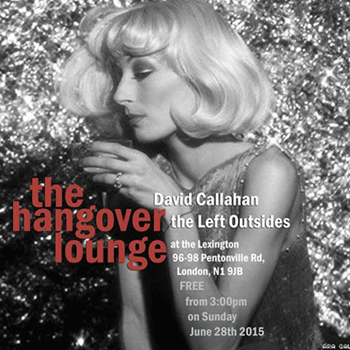
David Callahan + The Left-Outsides @ The Hangover Lounge, 28th June 2015

David Callahan + The Left Outsides (The Hangover Lounge @ The Lexington, 96-98 Pentonville Road, London, N1 9JB, Sunday 28th June 2015, 3.00pm – free)

David Callahan is best known as the frontman – or co-frontman – of two bands. The first of these, The Wolfhounds, was a mid-’80s post-punk band associated (for good or ill) with NME’s infamous C86 cassette to which they contributed alongside The Wedding Present, a young Primal Scream, The Pastels and others. While C86 set up and juxtaposed what were to become British indie archetypes (on the one side a parochial pop of jangling guitars and under-achievement, on the other an abrasive noisiness and surreal tendencies), The Wolfhounds were always a cut above, aided by a jagged garage-noisy way with a melody and their broader conceptual focus, plus David’ smart pointed way with a lyric and his arresting vocal (a precise, razoring punk sneer a few shades away from bitter blues – imagine a less theatrical Matt Johnson, if that helps). ‘If You Know What I Mean’ has described them as “the Stooges tempered by Big Star poetics” – read some more about that here.

Much of this carried over into David’s next project, Moonshake: one of a number of diverse but loosely-affiliated East London post-rock and indietronica bands (also including Stereolab, Disco Inferno, Bark Psychosis and A.R. Kane) who, for a few years, vigorously stripped out and rebooted pop and rock forms with experimental techniques. For the first few Moonshake albums (an exciting mangle of dub bass, guitar-noise and sample barrages owing equal amounts to hip hop and musique concrete), David worked in an exciting, two-headed arrangement with an equally distinctive singer-songwriter, Margaret Fiedler. When this ended in acrimony (and after Margaret wheeled away with half of the band to form Laika), David led Moonshake on his own for two further albums, adopting an increasingly cinematic and introspective approach (I’ve got a review of the last one here).

Since reuniting with a reinvigorated Wolfhounds in 2005 (a belated reunion album, ‘Middle Aged Freaks’, arrived nine years later), David has reverted to a more guitar-based sound but continued to write and record, with his broad and trenchant perspective intact. This Sunday’s solo appearance looks as if it’s going to be a rare acoustic set from him – featuring “all-new songs, sometimes in funny tunings” – but as he recently dug out his old Moonshake sampler for work with Manyfingers, he might surprise us with something a little more torrential and noisy.

I know less about the opening act, The Left Outsides, so the following is stolen straight from their Facebook page:

The Left Outsides are Mark Nicholas and Alison Cotton, a duo from Walthamstow, London who have been playing together since the winter of 2003. Both are former members of The Eighteenth Day of May and Mark is a former member of acid expressionists Of Arrowe Hill. Alison’s considerable viola skills have been put to good use in numerous bands including Saloon and Mathew Sawyer & The Ghosts. Their debut EP ‘Leaving The Frozen Butterflies Behind’ was released on the I Wish I Was Unpopular label in January 2006 and their album (titled ‘And Colours In Between’) was released in May 2007 on Transistor Records. A live album titled ‘Live At The Drop Out’ was self-released in January 2008. A 7″ single ‘The Third Light’ was released on the Hi-Beat Records label in July 2008. The Left Outsides are currently awaiting the release of their most recent album.

Up-to-date information on the Hangover Lounge gig is here.

June 2015 – upcoming live events – Steve Lawson plays in Poole, Birmingham & London; the Ian Smith 50th birthday event at the Vortex

24 Jun

Gregarious loop bassist Steve Lawson has announced (at pretty short notice) three gigs in England over the coming week. As ever, they’ll be a tuneful/melodic/noisy hybrid of jazz, pop, electronic and ambient influences squeezed through Steve’s battery of sound treatments, and salted by the usual mixture of stand-up comedy, general gabby friendliness and opinionation; the last of which isn’t a word, but is a pretty good definition of what Steve does when he’s not playing, and sometimes when he is playing. At a Lawson gig you get the whole brand, and then some. You can take your family; you can take your friends; you can take a donkey whose legs are in need of a bit of honing…

Steve Lawson live

Steve Lawson + Echo Engine + others (SoundCellar @ The Blue Boar, 29 Market Close, Poole, Dorset, BH15 1NE, UK, Thursday June 25th – 8.30pm, £8.50 )

This is the one which counts as a full gig – a solo Steve Lawson set, after which he’ll be joined by the Echo Engine trio (Daniel Biro on keyboards, ) plus ex Bjork/D’Influence drummer Pascal Consoli and the ECM-inspired saxophonist Jon Lloyd. Up-to-date info is here and here, and you can reserve your ticket via email here.

Scott Pellegrom + Andy Edwards + Adam Gammage (Birmingham Dream Cymbals Day @ Glee Club, Birmingham, B5 4TD, UK – Sunday June 28th, 6.00pm – £10.00/£15.00)

This is actually a drum clinic appearance, at which Steve will be playing with drummer and regular collaborator Andy Edwards. Up-to-date info is here and tickets are here. Also performing are Adam Gammage (Baxter Dury band) and Scott Pellegrom.

Ian Smith’s 50th Birthday Event @ The Vortex Jazz Club, 11 Gillett Square, London, N16 8AZ, UK, Monday June 29th, 6.00pm – £13.20

Steve will be performing at this expansive celebratory gig for London Improvisers Orchestra founder Ian Smith – an event so substantial that it needs its own section further down this post. Steve will be playing in the 10pm slot alongside drummer Jason Cooper and guitarist Reeves Gabrels (both currently members of The Cure). Tickets here: more on the event in a moment.

As usual, Steve has plenty of other things going on, not least an appearance at The One Dayer: Independent Music, Money & Tech conference at Cecil Sharp House in London on July 1st, where (as a longstanding advocate of independent artist-run music careers) he’ll be one of the speakers. He’s also planning further collaborations with loop vocalist/beatboxer Beardyman (having previously played with him in a “dream team” improvising quartet alongside drummer Andy Gangadeen and guitar journeyman Gary Lucas), with fellow bass guitarists Divinity Roxx and Jonas Hellborg (the latter for an October tour) and with Jon Thorne’s semi-experimental Sunshine Brothers trio (for an August appearance at the Manchester Jazz Festival. If you want to read about what he did earlier in his career, here are links to the ‘Misfit City’ archive reviews of ‘And Nothing But The Bass‘, ‘Not Dancing For Chicken‘, ‘Conversations‘ and the first in the ‘Lessons Learned From An Ancient Feline‘ series, early steps on a path of explorations and musical hook-ups.

*****

And now, some more on the Ian Smith birthday event at the Vortex at the end of the month, which sees a remarkable lineup of British jazz players and other improvisers swarm into Dalston to pay tribute to one of their own living heroes. (Hopefully the timings I’ve cited here are right, as the layouts in the original postings are a little confusing…)

Ian Smith 50th Birthday Event @ The Vortex

Ian Smith’s 50th Birthday Event @ The Vortex Jazz Club, 11 Gillett Square, London, N16 8AZ, UK, Monday June 29th, 6.00pm – £13.20

Ian MacGowan (aka Smith) arrived in London in 1990 from Dublin with two phone numbers in his hand: John Stevens and Derek Bailey. Those were the only two numbers he wanted at the time, but as the months went on he got to know and play with many amazing musicians – he founded The Gathering with Maggie Nichols, and the London Improvisers Orchestra with Steve Beresford and Evan Parker. He ended up playing and recording with John and Derek, and plays with anybody who wants to start from nothing. Most of tonight’s cast are old friends; some new; all are beautifully personal voices. He’ll be playing with most of them.

In the Square, 6.00pm:
Henry Lowther, Byron Wallen – trumpets
Julian Faultless – french horn
Alan Tomlinson, Sarah Gail Brand, Ed Lucas – trombones
Oren Marshall, Dave Powell – tubas
Steve Beresford – occasional conductor

In the Vortex downstairs, 7.00pm:
Pete McPhail – alto sax
Tom Wheatley – bass
Steve Noble – drums

In the Vortex upstairs, 8.00pm
B. J. Cole – pedal steel
Ansuman Biswas – percussion

In the Vortex upstairs, 9.00pm:
Rowland Sutherland – flutes
Marcio Mattos – bass

In the Vortex upstairs, 9.30pm:
Sibyl Madrigal – poetry

In the Vortex upstairs, 10.00pm:
Reeves Gabrels – guitar
Steve Lawson – bass guitar
Jason Cooper – drums

and more special guests to be confirmed.

Tickets here.

June 2015 – upcoming gigs this weekend – Daylight Music in London (with Jo Mango, The Great Albatross, Circle Meets Dot), Matt Stevens house concert in Rome

11 Jun

Here are the details on this weekend’s Daylight Music event in London…

Daylight Music 193: Jo Mango + The Great Albatross + Circle Meets Dot (Union Chapel, Compton Terrace, Islington, London, N1 2UN – Saturday 13th June, 12pm to 2pm)

Glasgow-based multi-instrumentalist Jo Mango’s second album ‘Murmuration’ was released in 2012 to great acclaim. This wonderfully wistful album combined unique selections from Jo’s eclectic musical instrument collection, with inspiration from her adventures: travelling the world as a member of Vashti Bunyan’s band; her experiences completing a Doctorate in Musicology; her collaborations with David Byrne, Devendra Banhart, Coco Rosie, Teenage Fanclub and Admiral Fallow amongst others.

The Great Albatross is the indie music project of singer/songwriter A. Wesley Chung (formerly of Boris Smile). The project was formed in Glasgow, Scotland in 2011 and consists of an expansive, international list of contributors and collaborators. The project has performed both in the US and UK, including both days of the 2013 Count Your Lucky Stars/Topshelf Records SXSW showcase in Austin, TX. The Great Albatross have performed alongside the likes of Into It. Over It., Admiral Fallow, Miaoux Miaoux, Jo Mango, Owen, Joan of Arc, Empire! Empire! (I was a lonely estate), Joie de Vivre, and Football, Etc.

Sparking with the energy of a brand new meeting of minds, Circle Meets Dot is an emerging collaboration between Wesley Chung of The Great Albatross and Jo Mango. Soaring summer melodies steeped in California sunshine meet cloudy-day Scottish literary lyricism

Ed Dowie will be providing some light bird music in between the acts today/on Saturday. Using his mouth, his keyboard, some Max/MSP twiddlings and a whole host of bird recordings, he hopes to soundtrack the audience’s toilet and coffee breaks, as well as providing a backdrop to some cardboard bird spotting around James Cubitt’s beautiful building. Ed has been making music since the late 1990s, firstly as one third of Parlophone’s Brothers in Sound, then later a solo act under the name Redarthur. After a 5-year hiatus which he spent living in University libraries & music technology labs making strange bleeps, he returned to the music industry to join The Paper Cinema, a puppetry/animation/theatre/music hybrid (that tours both internationally & in Hackney).

Free entry, but donations are (as ever) encouraged.

Or if you’re in Rome, looping guitarist Matt Stevens is playing a house concert in the Batteria Nomentana district in the evening. As it’s a private gig, public information is scarce, but tickets and details are available here. For an earlier account of Matt in action, here’s a live review of his appearance at Roastfest from a few years ago. Matt will be performing again in the UK shortly with The Fierce & The Dead – more details on that soon.

June 2015 – upcoming gigs – two more Darkroom gigs in London – Hubbub @ Wellcome Collection; Listening Club in Peckham

8 Jun

Having only just played at the last-for-now Tuesdays Post concert this past Sunday, loop duo Darkroom are performing at two more London gigs this month, both of them at typically interesting events.

Hubbub @ The Hub, The Wellcome Collection, 183 Euston Road, London NW1 2BE, UK, Thursday 11th June (time t.b.c.)

The Hubbub group (based at the Wellcome Trust) is a project with a brief to explore work, rest and play; past, present and future. The two members of Darkroom will be participating in a closed session, being “wired up and investigated” as part of the research. Details are still a little unclear (although I do know that the work will be live-streamed) so keep an eye on the Darkroom Twitter account. For an early taste of the project, here’s psychologist, writer and Hubbub investigator Charles Fernyhough guesting on a half-hour long Darkroom track, a late-night atmospheric piece recorded in The Hub earlier this year.

And on the upcoming Sunday, there’s this:

Listening Club @ The Peckham Pelican, 92 Peckham Road, London, SE15 5PY, UK – 4.00pm to 9.00pm – free entry

This is an events series in association with St John Sessions ( showcasing new experimental music. In addition to Darkroom, the gig also features sound artists Kostis Kilymis (from Thessaloniki via London), Franz Rosati (from Rome) and Memorial Bench (from London, I think). More chat about this over on Twitter.

June 2015 – upcoming gigs – tomorrow and this weekend in London and Watford – Chant Live! interactive gig; Silencio Sessions presents Surfing On Sinewaves; Daylight Music

4 Jun

Shortly after I posted news on voicelooper Georgina Brett’s Tuesdays Post concert on Sunday (which, incidentally, will be the last one for a while) she got in touch with news of two more gigs she’s playing tomorrow and on Saturday, so here’s the information on those (more or less in her own words).

Chant Live!, 5th June 2015

Chant Live! featuring Dave Barbarossa/Youth/Georgina Brett/Regina Martin/Dan Morrell/Jon Moss/Tom Nettlemouth/Jamie Grashion & very special guests, (Unit 5, Mirage Centre, First Way, Wembley, London, HA9 0J, Friday 5th June, 7.30pm)

The return of the legendary open source band! A showcase gig in a hidden private club venue in Wembley, ten minutes walk from Wembley Park tube – a bit of magic brought to the perimeter of the stadium itself. On stage will be myself, Dave Barbarossa (Adam & the Ants, Bow, Wow, Wow), Youth (Killing Joke, The Orb), Jon Moss (Culture Club) and Cosmic Trigger (Jamie Grashion and Tom Nettlemouth). There’s also pre gig talks about all things cosmic, the fractal universe and drumming with Gina Martin and the Queenswood Drummers. Great club sound system. An adventure!! Two drum kits, two bass guitars, djembe drum circle. Give voice, give hands, be the band: bring a drum or a shaker, percussion, chants, on-the-fly recordings, loops, mixes, mashes. Free event – for more info, call Guy on 07947 061257.

Silencio Sessions, 6th June 2015

Silencio Sessions, 6th June 2015

Silencio presents ‘Surfing On Sine Waves’ featuring Georgina Brett/Cos Chapman/James Conway/Tom Fox (LP Cafe, 173 The Parade, Watford, Hertfordshire WD17, Saturday 6th June, 6.30pm)

A night of looping, experimental and electronic improvised music.  As well as me there’s:

Cos Chapman, former oceanographer turned solo improvised electronics performer and member of both I Am Meat and Rude Mechanicals (there will be a fascinating video of how he creates his instruments from recycled materials).

James Conway, a Brighton based musician usually seen with electronic outfit Not These Tones: this time it’s an eclectic solo show on mixer, sampler and synth duties. No two performances by James are the same; it’s method in the moment, thrill in the risk.

Tom Fox, an experimental instrument builder who focuses on using reclaimed materials to create new and unique sounds and textures from common items, and will be presenting a film on his methods.

More info here – tickets £6.00 on the door.

Also just in, news on this weekend’s Daylight Music event…

Daylight Music 191: School of Noise + Sarah Angliss + Astra Forward (Union Chapel, Compton Terrace, Islington, London, N1 2UN – Saturday 6th June, 12pm to 2pm)

School of Noise are a collective of artists who run workshops for children, enabling them to make their own weird and wonderful instruments and experiment with sound art. They’re appearing live on stage for the first time performing their own pieces of experimental and electronic music. The group, made up of children ages 7-13, met at the School of Noise workshops where they explored a variety of approaches to creating, sculpting and listening to sound. The project, started by London musician Dan Mayfield, has been influenced by the works of Brian Dennis who ran the Shoreditch Experimental Music School in the late 1960’s.

Sarah Angliss is an award winning composer and performer whose music reflects her fascination with European folklore, faded variety acts and long-forgotten machines. Sarah is known for her highly unusual stage set which mixes theremin, saw and ancient instruments with the ensemble of musical robots she’s designed and built to work with her on stage.

Astra Forward is a Brighton based singer-songwriter and multi-instrumentalist. A raw vocal talent, she combines acapella, synth organ drones, ethereal harmonies and alternate guitar tunings into her performances. As a singer and keyboardist in The Robot Heart and Diagrams, Astra has toured throughout Europe and the U.K, supporting the likes of Gomez, Ben Ottewell, Athlete and St. Vincent. At this concert, she will play a solo set of her intricate and beautifully vulnerable electronica.

Alex Hall/Elephant returns to create an improvised guitar soundscape in between acts this week.

Free entry, but donations are (as ever) encouraged.

June 2015 – upcoming London gigs – prog rock/math rock/post-hardcore @ The Facemelter; electro-pop/drum’n’brass/loops/experimental ambience @ Tuesdays Post; eclectic classical/experimental chamber music/kletzmer & Bulgarian voices @ The Forge

31 May

Some more early June gig previews for London – these would have been in the previous post if I’d picked up on them earlier.

Firstly, a Facemelter promotion (from the experimental rock/post-hardcore wing of the Chaos Theory organisation whose jazz gigs I’ve also enjoyed)…

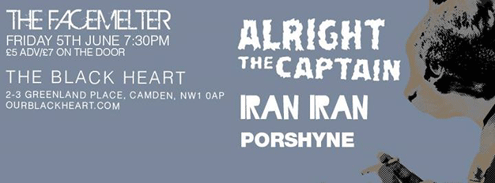
Facemelter, 5th June 2015

Alright The Captain + Iran Iran + Porshyne @  The Facemelter (The Black Heart, 2-3 Greenland Place, Camden, London, NW1 0AP, Friday 5th June , 7.30pm

Three heroes of math rock, alternative and post-rock travel from different corners of the UK to unite and form this amazing lineup.

Derby-based trio Alright The Captain masterfully combine virtuosic instrumentalism with unabashed musical experimentation and have effortlessly established themselves as a sonic force to be reckoned with, thanks to their increasingly inimitable, uniquely imaginative brand of math-rock. Their sprawling and varied career has seen them sharing stages with post-rock luminaries including Mono, toe, 65daysofstatic, Pelican, Tera Melos, ASIWYFA, Maybeshewill, Adebisi Shank (RIP), This Will Destroy You, ZU and many more. Their new album ‘Contact Fix’ (which ‘Musical Mathematics’ describes as “div(ing)  in and out of math rock, prog and post rock – but, at its heart, it’s different”) has gone down a storm.

Iran Iran are another supremely talented bunch of musicians who stunned and impressed all who saw them at ArcTanGent last year. With insanely complex rhythms and thunderously heavy riffs, the four-piece from Bristol have evolved since their excellent first EP ‘Crystal Math’ and are packing a punch. They’ve played with Future Of The Left, Cleft, Alright The Captain, This Town Needs Guns, You Slut!, Alpha Male Tea Party, Death Pedals and many others. Fans of complex musical wizardry or heavy riffs will love their new EP ‘Milk Time For Spiders’.

Brightoners Porshyne dance between ambient intervals and melodic vocals to intensely intricate, fantastically crunchy  prog rock riffs. With just a few single releases and a session filmed by Small Pond Recordings, they already sold out their first headline show in Brighton. This is your chance to catch the band before their career takes off.

More info here and here, and tickets here (£5.00 advance, £7.00 on the door).

At the end of the same week, Georgina Brett’s Tuesdays Post event returns to Stoke Newington with another evening of ambient/progressive live music, including ‘Misfit City’ favourites Darkroom

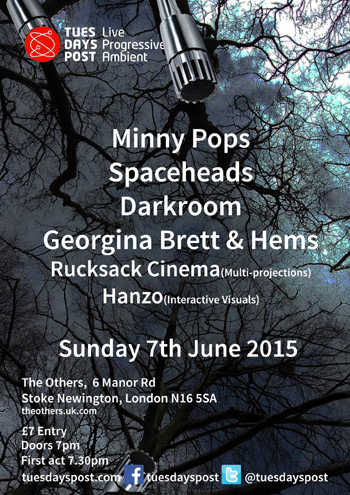
event-20150607tuesdayspost

Minny Pops/Spaceheads/Darkroom/Georgina Brett & Hems @ Tuesdays Post, (The Others, 6 Manor Rd, London, N16 5SA, Friday 7th June, 7.00pm)

Formed by vocalist/band leader Wally van Middendorp in Amsterdam in 1978, Dutch electro pioneers Minny Pops took their name from a primitive Korg drum machine. The band released several singles and a debut album, Drastic Measures, Drastic Movement, on independent Dutch label Plurex before joining the legendary Manchester label Factory Records in 1980 (which resulted in them being produced by Martin Hannett, touring with both Joy Division and New Order, and becoming the first Dutch group to record a Peel Session). Singles including Dolphin’s Spurt, Secret Story and Time were followed by the acclaimed album ‘Sparks In A Dark Room’ in 1982. The band released two further albums (‘Poste Restante’ and ‘Fourth Floor’) before splitting in 1985. In 2012, the band reunited for a series of gigs in the UK, the Netherlands and Belgium and recorded a 7-inch single for Tim Burgess’ O Genesis label. After a pause to draw breath, 2014 has seen Minny Pops performing live once again.

Spaceheads are a cosmic duo of trumpet electronics and drums. Formed in 1990, they have developed a blend of electronics and sunshine fanfares over the course of ten albums, three EPs and much touring across Europe and the USA. Andy Diagram (also of James) plays trumpet with a mobile phone stuck to the top with a fish slice and Richard Harrison plays drums with big bendy metal sheets stuck to the top. They create live looped layers of brass driven by flurries of free flowing funky drums. Andy and Richard have achieved an intuition of what each is about to do next which makes their semi-improvised gigs a joy to behold. They release their first studio album in ten years – ‘A Short Ride On The Arrow of Time’ – this Autumn.

Darkroom – the UK-based duo of Michael Bearpark (guitars) and Andrew Ostler (synths)- expertly ride the line between luscious, old-school progressive rock and modern ambient electronics. At times reminiscent of early Tangerine Dream with hints of Fripp and Eno, they create clouds of sequenced synths, chewy grooves, and looped phrases to support a variety of acoustic and electric guitar melodies that twist and turn in surprising, occasionally aggressive, ways.

Hems Aka Henrique Matias will be playing live with Georgina Brett. Henrique is a multi-talented composer, programmer and DJ. He specialises in Multimedia programming (from internet things to Max/MSP and similars), although not all his live music and performances sounds like computer music (sometimes he takes his drum machines and crazy things out of the house). Georgina Brett’s music is created using her voice and effects pedals, creating instant choirs of sound, often in an hypnotic style. The point of this music is not only to captivate with extraordinary timing and melodic style but also to help the listener to relax in our ever-increasingly fast world.

Interactive visuals and multimedia projections are by Hanzo and Rucksack Cinema.

More information here – tickets £7.00 on the door.

By all accounts The Forge (in Camden Town) has spent the last few years becoming one of north London’s most interesting small venues for mixed music. I’ve yet to go there and see for myself: but in its full June calendar (also featuring funk, jazz, classical and Cuban music as well as assorted poetry) the following four concerts caught my interest:

Notus Winds & Eliza McCarthy (Wednesday 3nd June, 7.30pm)

Part of the classical monthly series Wednesdays at The Forge, this time featuring award-winning chamber ensemble Notus Winds and solo pianist Eliza McCarthy with a program of contemporary compositions (more information here). Tickets £10.00 to £12.00.

Programme:

Harrison Birtwistle – 5 Distances
György Ligeti – Ten Pieces
Arvo Pärt – Quintettino
Anders Hillborg – Six Pieces for Wind Quintet

Fenella Humphreys: Bach to the Future Part 1 (Tuesday 9th June, 7.30pm)

The first of three concerts presented by violinist Fenella Humphreys, featuring commissions of six new works by six of Britain’s leading composers to accompany Bach’s glorious 6 Sonatas and Partitas for unaccompanied violin. This first concert includes new works by Cheryl Frances-Hoad and Gordon Crosse alongside extraordinary music by Bach, Scott, Westhoff, Hindemith. Tickets £10.00 to £12.00.

Programme:

Cyril Scott – Bumble-Bees (1928)
Johann Paul von Westhoff – Suite no. 5 in D minor (1682)
Gordon Crosse – Orkney Dreaming (2014)
Fritz Kreisler – Recitativo and Scherzo-Caprice op. 6 (1911)
Paul Hindemith – Sonata op. 31 no. 2 ‘Es ist so schönes Wetter draussen’ (1924)
Johann Sebastian Bach – Partita no. 3 in E major BWV 1006 (c. 1720)
Cheryl Frances-Hoad – Suite no. 1 (2014)
Eugene Ysaye – 2nd Sonata op. 27 (1923)

Reciprocity: a new work by Daniel Patrick Cohen (Wednesday 10th June, 7.00pm)

Reciprocity is a 28 minute work for voice, taped narration, eight celli, piano, and percussion. The piece was composed by Daniel Patrick Cohen from six poems by the late Darya Farha, a Canadian poet, therapist, filmmaker and clothing designer. Darya was an extraordinary woman whose sharp intelligence, dry wit, distaste for orthodoxies and boundless empathy fuelled restless journey through her unfinished life. Darya died of breast cancer in 2011 when she was 46, and Reciprocity was commissioned by her sister Juliana Farha, who lives in London. Reciprocity is not about cancer, however. Instead, its human and universal themes of joy, pleasure, fear and anger, along with its intriguing instrumentation are sure to engage a broad audience. You can read more on the project here, and here. Tickets £6.00.

She’Koyokh & Veda Slovena Bulgarian Choir (Thursday 11th June, 8.00pm)

In a unique collaboration, She’Koyokh & Veda Slovena Bulgarian Choir combine the fiery panache of klezmer and Balkan music with the timeless beauty of Bulgarian voices, weaving Jewish, Turkish and Balkan music into the rich tapestry of the Bulgarian choral tradition. Read She’Koyokh’s piece on their Veda Slovena collaboration here. Tickets £10.00 to £12.00.

(All events taking place at The Forge, 3-7 Delancey Street, London, NW1 7NL)

May 2014 – through the feed – Sontag Shogun debut album

12 May

Sontag Shogun: 'Tale'

Sontag Shogun: ‘Tale’

Multi-disciplinary New York trio Sontag Shogun (including Jeremy Young, whom I reviewed playing live in London last year as Foxout!’s guitarist) sent me some news about the recent release of their debut album ‘Tale’. Ostensibly post-rockers, Sontag Shogun don’t conform much to the genre’s more insular tendencies, being made up of three restless multi-media artists moving from craft to craft and from continent to continent. Jeremy, for instance, also co-runs the band’s not-just-a-record-label Palaver Press, which unifies sound publication with assorted texts and fine-art bookbinding.

‘Tale’ was recorded in carefully-hoarded scraps created around the world while Jeremy (sound sources and contact miking) was studying in London, Jesse Perlstein (laptop, tweaked voice and kleptomaniac microphone) was traveling in Korea, and Ian Temple (the grand piano) was back at home in Brooklyn. Field recordings were gleaned from diverse adventures including “a trek through a Columbian jungle, a piano tuner testing the ivory at the Southbank Centre and a South Korean traditional singer hitting a buk (or leather folk drum).” Back in New York, the results were looped, layered and mixed with planned performance (both final takes and rehearsal scrapings) to create a tender collage and a trans-genre which Sontag Shogun call “lullanoise”.

For a taste of what this sounds like, here’s the simple and beautiful but implicatory video for one of the album’s piano-led tracks, The Musk Ox (directed by Isabel Nao):

and here’s a video of Sontag Shogun performing another album track, Let The Flies In, live in France in 2013:

‘Tale’ is available as either CD and download and can be ordered from here.

Sontag Shogun online:
Homepage Facebook Soundcloud Tumblr Bandcamp Last FM

July 2013 – EP reviews – Jimmy The Hideous Penguin: ‘Colours’ (“a harbourful of soused and bobbing vinyl”)

7 Jul
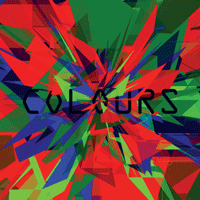
Jimmy The Hideous Penguin: 'Colours'

Jimmy The Hideous Penguin: ‘Colours’

With a name like that, you expect an MC with a slew of stories. A brilliant, squat little microphone hassler compensating for his own lack of sleek, straightforward charm with a quacking, manic inventiveness and left-field imagination. You expect one story, at least.

Instead, Jimmy The Hideous Penguin is a turntablist; using that ludicrous name as a billboard to cover the heads-down, ’phones-on business of scratching, filtering and triggering. A member of DJ quartet Vince Mack Mahon (and one of the masterminds behind the Community Skratch turntable initiative) he’s from Galway. Appropriately, ‘Colours’ sounds like a sketch of Galway on a moderately bad day – soggy and drizzled-misted, but still bright and creative – but you can only stretch his hometown associations so far.

Ducking any of Galway’s high-culture Eire-isms (and, to be fair, many of Vince Mack Mahon’s hip-hop inspirations) Jimmy’s music instead listens eastwards towards Rhine-Ruhr electronica, while picking up occasional bits of English scruff on the needle. It also listens downwards (into well-travelled vinyl grooves) and inwards (through a radio dial set to a perpetually-displaced rural 1970s). Its electrophonic wanderings owe a fair bit to Kraftwerk, a little bit to BBC Radiophonics and quite a large bit to those early Jimmy Cauty-era Orb recordings. Adding a raw backbone of analogue synth-steps and thick, flittering drones to his eddies of turntable work, beat loops and found noises, Jimmy works up some interesting slop behind that cartoon billboard. Instead of those MC stories, you get scenery to make stories – an occasionally playful plunderphonic montage; a harbourful of soused and bobbing vinyl; a frown of uneasy concentration.

While there are some visitations from the drum-burrs and rhythmic grapples of drum and bass, dubstep and techno, Jimmy’s music prefers to wander off on its own. Moving along messier roads, it kicks up a little historic debris as it goes. Red, in particular, sounds like flotsam; washing up out of swells and reversals of wadded-up torch songs, old shellac albums part-drowned in the tide. Jimmy moves the music drunkenly around a European receiver, shuffling aural zones. First he’s playing frail electronic trumpets against twanging, nasal staccatos; then he’s manhandling a sneaking strand of funk drum, a hungry worm of double-time rattle accelerating it from within. Then he’s meandering through abandoned dockscapes at the back of a dark wind, and finally ends in a bend of misdirected psychedelic organ.

On much of the EP (in which one piece strays into another in jostling transitions), ’70s fantasy seems to be rubbing up against ’70s slump. When a stray Dalek shows up at the end of Green – grating out “they are approaching” – it sounds both menacing and surly. It even sounds impotent; like a grumpy gate-guard on the inside of a power-station picket line, slouched in its own little pocket of hate and with a tepid thermos of well-stewed tea clamped onto its sucker, watching strikers slouch into position for the start of a day of mutual glaring. The rest of the piece feels similarly boxed-in – a pained, brontosaurine lumber of panel-beating snare drum and warping sub-bass, weighed down by an oppressive dark-ambient echo and drifting off into a carbon-monoxide grind.

On the subject of ‘Doctor Who’, I could have sworn that I heard a far more obscure ’60s Whovian critter show up, too – ECCO, the incomprehensible computer from ‘The Ice Warriors‘ with the infuriating papery stutter which (even in 1967) made it sound like a remix victim. Presumably, Jimmy’s too young to remember this first-hand: if he’s not been crate-digging deeper into the Beeb’s sound library, maybe he’s been digging up and scratching someone else’s memories.

It’s equally likely that Jimmy’s stumbled across a bit of the Galway countryside that is forever 1978, or at least has a damp box of that year’s proggier vinyl dumped there. Quite early on during Blue’s multi-part sprawl, some of the more oceanic swirls from Jean Michel Jarre’s ‘Equinoxe’ waft through the mix. Later on, Jimmy will varispeed a eerie floating snatch of psychedelic folk (reed-boned flutes and acoustic guitar, like a conjunction of Mike Oldfield’s ‘Ommadawn’, Popol Vuh and ‘The Wicker Man’) before trickling a clip of muffled Rakim-esque rap-and-chatter over twinkles of fairytale guitar lifted straight from Yes’ ‘Circus Of Heaven’.

At the start, however, Blue is lo-fi, dodgem-car techno with a bassline like someone clubbing moles with a car door It’ll make a shift into chugging steamtrain funk, some rare old-school DJ scratching (“wicky-wicky” and all) and the sort of downbeat synth stagger that groans “hangover” at you. Wobbling out from the layering, voices sing with so much gauziness that you can’t tell whether they’re Irish or Lebanese. Others mutter wanly and stagger around the kitchen, failing to fry some eggs. From the latter, one glum mumble of “bugger…” turns into a single-word mantra. It travels mournfully round and round the turntable like a dropped glob of peanut butter: part of the soused, engaging sloppiness that gives the EP its own distinctive flavour.

Jimmy The Hideous Penguin: ‘Colours’
CS² Recordings, CS²-009
CD/download EP
Released: 2nd July 2013

Get it from:
CS² Recordings.

Jimmy The Hideous Penguin online:
Homepage Twitter MySpace Soundcloud Tumblr Bandcamp Last FM YouTube

REVIEW – Fletcher|Fletcher|Reuter: ‘Islands’ single, 2013 (“setting things right as well as respecting the source”)

11 Jun

Fletcher/Fletcher/Reuter: 'Islands'

Fletcher|Fletcher|Reuter: ‘Islands’

Ironically, we often record cover versions to find out – or to show – who we are.

Markus Reuter, for instance, would prefer it if other people could stop telling him who he is. Too many of them are telling him that he’s obliged to be the twenty-first century’s Robert Fripp. They can’t get past his Frippic virtuosity on touch guitar, his past as a Fripp student, or his work with the man’s former King Crimson colleagues (in Stick Men and Tuner). They can’t even get over the fact that these days he plays all of the Fripp parts in the Crimson ProjeKCt…

Ah. Well, all right, but Markus’ vivid success in the sprawling latterday Crimson family shouldn’t have to box in a musician as stubbornly wide-ranging as he is. Yet it does, even though you don’t have to scratch him too deeply to discover that he’s not as enFrippened as he seems. When it comes to willful and wayward yet methodical 1970s virtuosi, Mike Oldfield is kernelled deeper in Markus’ heart than Fripp is. Hence this unexpected and open-armed cover of a long-forgotten Oldfield song, recorded by Markus in cahoots with long-term collaborators Lee and Lisa Fletcher, and demonstrating that Markus deals with more musical colours than just ‘Red’ ones.

A few sketchy parallels can be drawn here. When Oldfield released the original Islands single (back in 1987, towards the uglier end of his Virgin Records contract), he wasn’t entirely sure who he was. Though he’d made his name via intricate, acclaimed confections of multi-instrumental experimental rock, spatial Celtic folk and classical minimalism, by the mid-’80s Virgin had talked him into writing hit-and-miss pop songs dressed up with fat blobs of Fairlight, gated reverb and arena grease. The ‘Islands’ album floundered to cover both poles – a side of lengthy neoclassical fare (heavily spiced with chants, electric flourishes and whirring jazz flute) counterweighted a side of echoing pomp-rock (with straining guest singers and drums like torpid cannons). Even back then, this didn’t age well, despite spawning a vapid video album in which Bonnie Tyler and Kevin Ayers (in ‘Miami Vice’ regalia and power-frosted hairdos) sang and jostled their way through pastel-misted virtual realities and through corny CGI blizzards of New Age totems, ducking flying Tutankhamuns as they went.

At that point Mike Oldfield was pretty lost. Though he’d only stick the situation out for one more album (before rebelling and revitalizing himself via the inspired slice-and-dice music of ‘Amarok’) in 1987 he seemed beached. Islands – the song – ended up a little lost as well. Uniting strands of John Donne, Celtic Big Music and Dream Academy oboe, it could have triumphed over the crash of reverb: with its lyric of loneliness unclenching it could have become one of the decade’s all-join-hands power ballads. It even had Bonnie Tyler singing it, all sandpaper and yodels. What actually happened is that it floated round the middle of various European charts for a while and then sank.

In contrast to the lacquered, divided and ultimately stranded figure that Oldfield cut in the late ’80s, Lee Fletcher comes to Islands knowing himself and knowing what he’s doing. After a decade of quiet self-apprenticeship and networking, the Fletcher sound has blossomed into a rich pool of talented instrumentalists and instrumentation – digital blips to rattling jazz, frosty-fanged art-rock guitars to keening folk and glowing chamber music, choreographed with a mixture of precise delicacy and expansive flair. His auteur-producer take on Islands doesn’t just restore the song’s appeal. As a string quartet jumps from scratchy shellac recording to full live presence alongside uillean pipes and whistle – and as Markus rides happily at the centre of the song, his touch guitar chords and slithers fanning out like a nerve map – it restores the song’s lost Oldfield-ness. This could be as much rebuke as tribute. Either way, there’s the feel of setting things right as well as respecting the source.

There’s a little of the undulant Saharan patter of a Peter Gabriel song (reinforced by Tony Levin’s prowling spring of a bass part). There’s the spirit of an Irish pub session, too (Alan Burton’s pipework recalls other Oldfield moments, such as the haunted morning chills of ‘Ommadawn’ or Paddy Moloney’s warmer dip-ins on ‘Five Miles Out’ and ‘Amarok’). Finally, there’s the third side of the Fletcher|Fletcher|Reuter team – Lisa Fletcher. Compared to Lee or to Markus, it’s less clear whether she knows who she is, musically. More to the point, it’s not even clear whether she thinks its important. She’s the only member of the F|F|R trio who’s got form for actual impersonation (if you don’t believe me, check out her startling Sinead O’Connor impression from an old series of ‘Stars In Their Eyes’) and for now, she’s keeping up that sensuous and welcoming vocal persona with which she helmed Lee’s ‘Faith In Worthless Things‘ last year – a flushed, de-gushed and beautifully controlled Kate Bush mezzo which slips supple invisible fingers round the lyrics, caresses them, and passes on by.

It’s a low-key take compared to Bonnie’s hearts-and-guts original. What matters, though, is that it works: a vocal and a sentiment that’s a welling rather than a sobbing, and far better at catching the quickening thaw that’s being voiced in Oldfield’s lyrics. Beyond the beautiful sound, Lisa remains something of an enigma as a singer and as an adept interpreter – still playing a game of veils in which flashes of other singers, other sentiments distract our curiosity, and behind which she’s drawing out other people’s words and launching them with the subtlest of spins. It makes me wonder what she’ll sound like when she’s singing her own songs. For now, she’s transformed Islands into a shimmering welcome rather than an emotive wrack, and has kept her own mystery as she does it. No easy trick.

Fletcher|Fletcher|Reuter: ‘Islands’
Unsung Records (no catalogue number or barcode)
Download-only single
Released: 10th June 2013

Get it from:
Bandcamp

Fletcher|Fletcher|Reuter online:
Bandcamp

Lee Fletcher online:
Homepage Facebook Twitter Soundcloud Bandcamp

Lisa Fletcher online:
Facebook

Markus Reuter online:
Homepage Facebook Twitter MySpace Soundcloud Bandcamp Last FM YouTube

March 2013 – album reviews – Felipe Otondo’s ‘Tutuguri’ (“sound moulded by careful hands”)

26 Mar
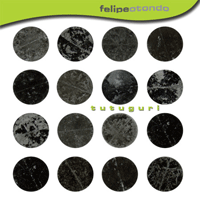
Felipe Otondo: 'Tutuguri'

Felipe Otondo: ‘Tutuguri’

Having pursued his studies from his native Chile to Denmark and then to the UK (he currently teaches at the University of Lancaster), electro-acoustic musician Felipe Otondo has already made himself a world traveler. The cosmopolitan sourcing of his music ensures that he travels even further afield, even while sitting at his computer. The four pieces on his debut album ‘Tutuguri’ draw on concepts, patterns, sounds and language from India, Java and Mexico as well as from European and American sound-labs.

This reminds me that, like bats, human beings use sound to find where we are. We often remain unaware of this, or even dismiss it. In cities, for example, we tend to think in terms of filtering out the extraneous noise – the rumbling press of traffic, the too-close babble of our neighbours on public transport or through the thin walls of apartment blocks; the persistent layering of unwanted music as ambient features for shopping or working. In spite of this, we’ll still use sounds to judge our way and to establish our place in a shifting world. Recurring sounds in the subway tell us that the service is regular, or when we need to change direction. Changing accents in voices and even birdsong rachet our subliminal paranoia up or down. Subtle switches in the quality of sound moving through the air tell us about weather, and about the places we move through. Some newly-blind people even report developing an echo-location sense, measuring the presence of oncoming pedestrians, lamp-posts and corners by the minute changes in echo and sound positioning.

Most importantly, we associate the places we know with an arrangement of sound. Wind will be shaped around a building in a particular way, the patterns of dialogue and intonation spoken in and around particular shops and café. Traffic lights and contraflows generate their own rhythms and exchanges. Blindfolded, I’d still be able to recognise the back-street where I currently live from its specific sound patterns: cars nudging the speed-bumps with a particular speed and duration, the toss and bend of the trees in the wind paths, the pitches of children’s voices in the school half-way along, the frequency of slow buses creeping to the nearby bus garage. These recognitions surprise us, often in ways which we don’t even consider until the connections occur to us.

To me (being less of a traveler than many) Felipe’s sound sources are more exotic, initially implying spatial journeys or international visits. The complex and beautifully-packaged CD sleeve for ‘Tutuguri’ enhances this, opening up like an origami flower (or like the jaws of a concealed alligator). The four intent and deceptively challenging pieces within the album are designed to shuffle the consciousness rather than soothe it. They divert the listener along other paths: associative, temporal, historical; hallucinatory or sacramental. When Felipe cites them as being “meditative”, he doesn’t mean relaxing, or lazy. Listening care is required. At a distance – at a point of detachment or reduction to background – Felipe’s pieces will sound like a fluttery wallpaper of treated sound effects. Up close, turned up, or simply heard on headphones, the craft is evident: Felipe’s years studying spatial sound and timbral perception have been well spent. He’ll set you down in the middle of a set of beautifully recorded instruments or noises – or as an offset, slightly distanced observer – and then gradually alter that sound-world in increments, or in sudden dartings.

The oldest piece on offer here, Ciguri, takes Native Mexican bell and gong sounds and cuts them loose from root time. This isn’t as straightforwardly surgical, or as uninvolved, as it might read. Felipe is open about the inspiration he’s drawn from the Mexican peyote ceremony (and from Antonin Artaud’s writings on it). In particular, he’s interested in the time-distortion effect experienced when ingesting mescaline (which he recreates here via digital editing). On the way, he also explores inharmonicity – the additional non-harmonic tones created within a sound, via variations in the source material’s state of rigidity and elasticity. Strictly speaking, this is a physical exploration, but if you’re talking ritual – if you’re talking metaphysics – the same idea might be extended to the participants in the ceremony. As in any sacrament, each of their experiences will be shaped by their willingness, and by how their own histories and attitudes impact on how their brain works and how their world is conceived.

On Ciguri, Felipe doesn’t make matters quite that explicit, but he does his very best to remind us of how subjective an experience this can be. Sound-wise, he places us in the heart of a slow heat of hanging metals, and we listen (over nine minutes) as they alter. During this time, different parts of the surrounding structure take turns to transmute while others remain still. Gently struck tones blur from a simple ping to a fluttering hummingbird drill: the substance of the metals themselves seem to move restlessly between solid resonant bronze, a whispering foil, or a mere shining hiss of elements. The reasons behind this may be all in the math, but it doesn’t feel that way. As the numbers race through their patterns, the world around us changes and we’re hypnotized by what feels like the universe breathing.

Another piece, Irama, draws directly on Javanese gamelan orchestra music (using manipulated recordings of the Sekar Petak ensemble at the University of York). Irama’s title comes from a flexible gamelan term – one that can be used to define the time between two notes, or the time between two actions; or the rhythmic relationships between parts of the composition; or tempo in general. Drawing all of these meanings together under one conceptual net suggests a substantial and integral connection between all of them, much as each of the Indonesian gongs, flutes, pots and zithers in a specific gamelan orchestra is honed and tuned to fit only with instruments from the same orchestra. Of course, digital electro-acoustic processing means that any relationship between notes, pitches or rhythms which didn’t already exist can be first conceived and then molded into shape: and Felipe flexes and reshapes the gamelan sounds according to his own design.

Irama’s gong sounds range from the familiar bronze boom to the kind of light dry patterings and tight-hide raps which you’d expect to hear bounding from frame drums. Over a particularly deep gong sound, a metallophone texture is stretched into a soft drone: when the broader percussion section returns, it’s joined by soft struck pings and an oceanic flutter. At crucial points, particular gong chimes cut through to suggest changes of intent and mood. Apart from these, all of the sounds which lope through Irama reinforce themselves, subtly adding to an arrangement which becomes denser and denser, shifting to a jazzier pulses before (nearly four minutes in) rising to flood-rate and then dispelling into nothing. A second section begins – sterilized pings and rings, more German laboratory than Javanese ritual. Drilling echoes are buried inside it, ringing edge-tones place themselves above it. At six minutes, the frame-drums return; at seven, the pulse has multiplied again to the point of flooding; at eight, softened rings are the dominant sound as the piece diminishes into calmness. As with Ciguri, there seems to be more than the mathematics at work here; but beyond the calculations, all of Irama could itself be an illustration of time as human experience – its repetitions, its bewildering multiplicity of voices; its moments of collective intensity and its sudden rapid lulls.

 
As a listener, attempting to put narratives (however clumsy) onto more elusive or abstract pieces of music is a common strategy. Thankfully, the mixed instrumental/vocal piece Teocalli already comes with a narrative. It’s based on ‘The Night Face Up’, a short story by the Argentine writer Julio Cortázar, whose surreal-modernist approach (creatively disrupting his plots and chances of resolution via a shifting, subjective consciousness and by the restless straw-shuffling of jazz) is well suited to the cut/paste/reshuffle of Felipe’s compositional tools.

The original tale is about an injured, hospitalized motorcyclist: delirious, and dreaming that he’s a man hunted by the ancient Aztecs and targeted for sacrifice. Location and context come adrift in the dreamer’s mind, but are carefully deployed by the writer – here, Felipe steps carefully into the latter role, guiding his strips and layers of sound into place. Hunters’ drums roll in the background, sometimes scooping up in an enormous glottal curl of extreme echo, swooped by fierce panning and sound-fielding. At times, they run backwards, creating great ominous bowls of sound-space. In a recurring cut-up, a little choir of men sing what sounds like a Mexican popular tune. This moves in and out of Teocalli like a radio which can’t stay fixed on the station, just as the injured man in the story can’t stay fixed within his own time or his own experience. Watchful silences bead within the piece, within the drum-slides; filled with tiny arrested hangs of reverberation.

Through these silences (but also often in the midst of great surging wrenches of drums, as they wrestle for our attention) women’s voices speak. Zapotec women, from a pre-Spanish civilization that lives alongside and intertwined with modern Mexico. They converse and chat, presumably about ordinary human matters – these are interview snippets, not field recordings. But as these women are separated from listeners like us by their language (and by our own crude knowledge, and cruder guesses, about their culture), they innocently become part of the sinister hallucinatory sound environment which Felipe creates. As drums sweep and skirl around our heads, so too does a whole jungle of suggestions – brief clusters of crickets, digitally squeezed and timeslid; bird calls, as of hunters hidden in the undergrowth. When one of the women speaks again, her unconcerned and easy voice is shaded into callousness. When, at one point, she suddenly laughs, easy and confident, the dense paranoia and wilderness swirling around her conspires to render her cruel.

There’s no final outcome to Teocalli – no cathartic slaughter, no rescue. Eventually Felipe’s piece just blows away into the shadows, like the memory of ugly wings pressed around you. The fever dream is over. With the passing sweat those eerie vicious terrors go with them. The deep-rooted fear (part-humble, part-racist) of an ancient, incipient otherness. The fear of comfort and security crumpling and allowing the past to pluck you away; a raw, helpless morsel.

 
In its way, the final ‘Tutuguri’ piece – Sarnath – is as ritualistic as the others, yet it doesn’t rely so much on recreating states of mind. Instead, it attempts to sculpt suggestions of place, history and connections. It’s based on Francis Booth’s Indian location recordings of places associated with the story of the Buddah (and is named after the deer park in which Buddhist Dharma was first taught). In a sense, Sarnath is both site-specific and displaced, bringing the noises of Buddah-touched locations to wherever its soundfiles are played. Concert venue. Boom box. Perhaps even a trekker’s smartphone, being carried on a pilgrimage of its own.

As Felipe switches between recordings (clicking up one-by-one the sonic capturess of different geographical stops on the Buddah journey), Sarnath itself seems to be moving from place to place in search of something. Literally, a footprint? Literally, an echo? Felipe toys with the field recordings: folding them on themselves, stretching them over time. A bell might sound, swell hugely, then drop away. Chants may be heard. On a half-distant road, a procession of ecstatically banging drums may wind its way to a shrine. Behind these, birds and animals twitter. Away from the devotions, there are the soft chips and scrapes of human work being carried on regardless. Here, Felipe’s notes most obviously cite the intense, subtle states of mind connected with meditation: here, with whispers of Buddha making their presence felt, it’s a traditional part of the tale. Here, too, are the tiny sounds to focus meditation; the small sonic flakes of the natural world around which attention can be wound.

 
‘Tutuguri’ is four pieces; four stories. None of them conclusive; and despite the sleevenotes and the substantial clues, at least part of the stories I’ve recounted here have been dreamed up by me. The solo listener – the sound moulded by careful hands around my ears, yes; some of the intimations perhaps patted into place. But in other cases this music is just process doing what process does: forming channels for their own sake, numbers making shapes and illusions as part of the pattern comes into view, and only part of that’s actually recognized. Much of the purely technical side of Felipe Otondo’s music escapes me: instead, I experience much of it as the psychological backwash, like the vapour trails after the plane has passed. Still, if I’m creating my own ideas for what Felipe’s music might entail or might intimate, there’s clearly enough extra substance there for me to build on. That’s what humans do: we use sound to find out where we are. Finding places we know: judging our way through what’s being presented to us; sometimes, the recognitions surprise us.

Working blind, but guided by sound, I travel too.

Felipe Otondo: ‘Tutuguri’
Sargasso Records, SCD28070 (5065001338700)
CD/download album
Released: 25th March 2013

Get it from:
Sargasso Records (CD) or Amazon (download).

Felipe Otondo online:
Homepage Soundcloud LastFM

Album reviews – Darkroom: ‘Fallout 2’ & ‘Fallout 3’ albums, 2002 (“a game of reverse-chicken… impressive and utter liquefaction”)

18 Mar

Darkroom: 'Fallout 2'

Darkroom: ‘Fallout 2’

The second part in Darkroom’s ‘Fallout’ trilogy ( a set of interwoven concert travelogues) sees the unorthodox dark-ambient trio shrink to fit circumstances: recorded over the course of four gigs in Cambridge between spring 2000 and spring 2001, ‘Fallout 2’ records their first period of work as a duo. With singer Tim Bowness temporarily absent from the group, the five lengthy live tracks see Darkroom’s sound now built up entirely from Andrew Ostler’s infinitely malleable, polluted volume of electronic sounds and Michael Bearpark’s massed, heaven-and-hell loop guitars.

Subtracting the singer should have meant removing the human face from Darkroom’s activities. It should have forced their music – which was already suffused with hanging menace, dense atmospherics and chaotic leanings – further down the road to alienation. In fact, the opposite is true. Minus those fragmentary Bowness sighs, whispers and melodic wails, Darkroom do relinquish part of their edge of romance and distress. But they also dispense with the intimations of human disintegration, morbidity and panic which Tim’s beautifully tortured vocal tones brought to the project.

In his absence, Darkroom is able to relax and experiment with a two-way balance instead of the three-way teeter they’d thrived on previously. Os and Michael sit back and play off each other – not in unison, but in a dialogue of occasional crossings and of deceptive, mock-disengaged responses. As with ‘Fallout One‘, the two-man Darkroom continue to embrace instinctive wandering noise-stews rather than art-rock discipline.

For this album, at least, these are gentler brews: one even begins with a serene duet of heaven-scented loop guitar and a windblown squiggle of pink noise, rather than the warning tones of before. Released from some of his duties as textural foil to Tim, it’s Michael who now gives the music its anchors: cyclic calling phrases, humming confections of layered Frippertronic-like loops, space-echoed licks, sometimes a sound like someone wrenching their way out of a giant metal tank. Os – as usual – takes responsible for most of the layers of sonic detail and for the most drastic directional shifts within Darkroom’s ever-restless improvisations.

Os’ increasing plunderphonic tendencies (linking and threading pieces with snippets of international radio conversation, Cambridge choristers or muezzin calls) prove that behind his responsibilities for the main body of Darkroom’s sound, he’s also the joker in the pack, dialling up effects and textures from a vast trick-bag of electronic sounds which he then sloshes across the speakers and leaves to evolve. His rhythms, too, betray a sense of cool, amused mischief. He’ll stitch in trails of techno beats, or hijack a piece five-and-a-half minutes in with jazzy cymbals and toms drenched in flapping dub treatments. He’ll even drop in the occasional comedy drum-wallop to accompany some blooping synth sounds he appears to have stolen off a kiddy-ride in a shopping center. Inscrutable humour aside, Os also assembles a remarkable variety of more solid elements to flesh out Darkroom’s randomness: imposing psychedelic cadences, static veils and suggestive electrophonic shapes.

Though Michael Bearpark’s playing still owes a debt to Robert Fripp (via his “Bearatronics” loops and his occasional digressions into trumpet-guitar), he’s far less formally-minded. While you could also draw parallels to the mangled roots sounds used by David Torn, Michael is a far more reticent, distant and watchful guitarist: less flamboyant, but similarly eclectic. Across the album, he comes up with the kind of junkyard guitar that Marc Ribot would be proud of; or treats us to yanks and scrabbles of twanging guitar in the vein of Henry Kaiser or Fred Frith. He unwinds collapsing, Spanish-guitar-style electric rolls; or feeds in the Bill Frisell-influenced ghost-country minimalism that he’s increasingly stamped onto Darkroom music. Os responds with gusty, gauzy swirls of noise, or busies himself chopping up the sound even as Michael enriches it.

It’s co-operation of a kind, I suppose. Sometimes the Bearpark/Os interplay is gloriously subtle. More often, they’re engaged in a game of reverse-chicken in which they seem to be seeing just how far they can wander from each other’s playing before Darkroom collapses, adding a kind of free-jazz risk to the elements of illbience, Krautrock and musique concrete that already flourish in the group’s sound. Darkroom’s apparent abstract shapelessness (more accurately their indifference to, and boredom with, the monotonous formality of much electronic music) seems to put a lot of people off. However, their loosely-knit and liberated music still has few rivals or peers in electronica.

Darkroom: 'Fallout 3'

Darkroom: ‘Fallout 3’

Tim Bowness returns for ‘Fallout 3’ which at first listen sounds as if it could be pegged as the kinder, gentler Darkroom. This seems an unlikely label. Nonetheless, the album initially seems something of a let-up from Darkroom’s unsettling dark-ambient explorations.

As the group’s main studio-flexer, Os exerts most of the active control over the emerging music. On this occasion, he does this by taking more of those Darkroom live recordings and drastically remixing them. Drawn from two of the mid-2000 Cambridge gigs which initiated ‘Fallout 2’ (plus four other gigs between 1999 and 2000 in Cambridge and London), ‘Fallout 3’ is tagged as “a celebration of the art of post-production” and compresses their rich, chaotic improvised sprawl into a thickening wall of noise. This is Darkroom as jelly, rather than their usual coils of prismatic vapour. In the process, it displays a side of the group which might appeal better to ambient-music aficionados and art/noise acolytes (those who’ve so far proved immune to, or unconscious of, Darkroom’s brooding wide-open power).

The art-rock richness of Tim’s keening, beautiful-agony vocal was previously something of a scene-stealer – especially when it reached heights of drama which recalled Peter Hammill at full tilt. This time it drifts faintly through the mix like a displaced ghost. Half-obscured, half-dreamy, its physical presence fades to a livid imprint. As for the industrial-melodic textures of Michael’s guitars (and his layered MiniDisc manipulations), these have sunk even deeper than before into the fabric of Darkroom sounds, as have most of the drum loops. The most audible Darkroom instrumentation to be heard on ‘Fallout 3’ is the humble studio fader and the reverb unit, teasing their way through the music and rebuilding detail.

Turned right down, ‘Fallout 3’ sounds like the smooth-peanut-butter option compared to the crunchier varieties of ‘Fallout One’ and ‘Fallout 2′. Turned up, though, the music piles upwards inexorably; like a thick fluid shot through with veins of displaced voices. Sometimes these voices belong to Tim, processed almost beyond recognition to become muttering crowds or alien choirboys. Sometimes they’re radio voices stroked out of the ether by Os’ continuing casual interest in plunderphonics. Those little instrumental dialogues and monologues that used to weave through Darkroom pieces have been melted down too. Everything played becomes food to feed this new amorphous monster.

The result is that, more than ever, Darkroom’s music has the amnesiac, dissolving qualities of oceans. Powerful and ever-massing, and strangely indifferent to the repercussions of its nature. The sound itself, for what it’s worth, is closer to dry land if perhaps not stable ground. That continuously-rumbling, near-geological depth of soundfield and the thick “angry-earth” quality to the sound brings this reinvented Darkroom closer to the relentless, tectonic grind of Robert Hampson’s dark-ambient process music in Main. Like Main’s, the pieces on ‘Fallout 3’ are much of a muchness. All are slightly differing curves on a line mostly heading in one direction, arcing beyond post-rock to the land of out-rock. There’s far less of the more identifiable tendencies of the past – nowhere near as much of that Fripp-&-Eno-swimming-in-Lee-Perry’s-galactic-fishtank feel. The always diffuse identities of the Darkroom players are now barely there at all. The music has turned them inside out.

Consequently this is seventy-five minutes of impressive and utter liquefaction that’s still– identifiably – Darkroom, and which also enables them to thumb an invisible nose at past accusations of formlessness. Even when their musical substance is reduced to something as intangible as this, Darkroom’s baleful and beautiful intent remains intact: a long way beyond the easy trance to which most electronic acts are finally reduced. Darkroom’s vision is still inexplicable and alien. It’s also still undeniable.

Neither kinder nor gentler, then. Just even more seductively suffocating and inscrutable.

Darkroom: ‘Fallout 2’ & ‘Fallout 3’
Burning Shed (no catalogue numbers or barcodes)
CD-R/download albums
Released: 01 January 2002 (‘Fallout 2’) & 1st February 2002 (‘Fallout 3’)

Get them from:
Burning Shed (‘Fallout 2‘, ‘Fallout 3‘) or Bandcamp (‘Fallout 2‘, ‘Fallout 3‘)

Darkroom online:
Homepage Facebook Twitter MySpace BandcampLastFM

February 2013 – mini-album reviews – Lee Fletcher’s ‘The Cracks Within: FiWT Remixes’ (“unstitched, re-embroidered, re-folded”)

9 Feb
Lee Fletcher: 'The Cracks Within: FiWT Remixes'

Lee Fletcher: ‘The Cracks Within: FiWT Remixes’

‘Faith In Worthless Things’ was one of 2012’s surprise pleasures. Lee Fletcher’s debut album was the late-blossoming distillation of years of work as engineer and confidant to assorted art-rock musicians, and of even more years absorbing influences and refining them in a budding songwriter’s heart.

What emerged was a sleek, assured and finely-honed planned-patchwork of an album. It pulled in sounds from touch guitars, Uillean pipes, crunchy rhythm loops, ukeleles, powdered trumpets and silky synthesizers; it mused on betrayals, work, bewitchment and people in general; and it drew on a wide but surprising coherent blend of string-quartet chamber pop, soul and trip hop, 1970s Scott Walker, King Crimson-flavoured progressive rock, electronica and Anglo-folk.

While Lee’s firm and expansive vision gave the album both shape and finish, it was also very much a group effort, achieved hand in hand with his singer wife Lisa plus the chameleonic touch guitarist/soundscaper Markus Reuter and a small battalion of interested musicians from around the world. This short album of follow-up remixes keeps that spirit, with a couple of returning collaborators and new reinventors let loose on the tracks.

Only two songs from ‘Faith In Worthless Things’ make it to this particular phase. There’s the title track – originally a humble state-of-the-world address sung by Lisa but dispatched by Lee, people-watching at the railway station in his Devon hometown, and sampling a picture of humanity from its wandering fragments on an ordinary morning. There’s also The Inner Voice, in which Lisa soars on a rich carpet of soul-inspired smoothness; delicately and beadily picking apart matters of confidence and collaboration, while unhitching – scuffed, but quietly determined – from a dragging entanglement. The latter was the album’s obvious single, so it’s interesting to see three different remixers work three different shades of pop out of it.

Of these, Brazilian proggers-turned-clubbers Worldengine offer perhaps the most satisfying reinvention – a slink-and-roll electronica take full of whispering creep, voice fuzz and closed-eye pulse beats. The smooth soul of the original is pared back in favour of odd, gently challenging chording and textures: as if Lisa’s vocal line has been gently unwound from its original branch and wrapped carefully around a new one. Imagine what might happen if David Torn had as much pop clout as Madonna does, and you’ll have some idea of where Worldengine take this.

Two other remixers take The Inner Voice further out, but perhaps with less originality. The mix from German DJ Ingo Vogelmann battles and switches restlessly between its whispering electronic-ambient chamber intro, heavily synthesized cyberpop and a naked acoustic strum. The onetime 4hero cohort Branwen Somatik offers a similarly morphing dance switchback – initially a slightly dubby hip-hop take with an eerie twist, then a transformation to minimally-sheathed soul-pop, finally melting away in a dubby whisper of liquefying beats.

There are no fewer than six versions of Faith In Worthless Things, including a return for Ingo Vogelmann who offers a mix replete with Orb/Jean Michel Jarre-flavoured electronica (strong on the breezy minimalism, and dappled with bits of dub and techno). Adrian Benavides has honed himself an industrial pop version full of collapsing sheet metal and drill bits. Fabio Trentini provides an ambient pop take with an art-pop tweak – part Japan (if the ‘Gentlemen Take Polaroids’ era took precedence) and part Crafty Guitarist. Lee’s words and Lisa’s sweet-but-stately vocals sit, unfazed, in these new cradles.

Having said that, this particular song is less suited to being strapped into dance, and other approaches are preferable. Under his Hollowcreature alias, David Picking seems to realise this; he keeps and highlights the train-swish from the intro, brings Lee’s own warm and pleasant guide vocals to the forefront for half of the time, and comes up with a subtly dubby version of the song’s English pastoral feel. The latter quality is something which Tim Motzer appears to have picked up on too, as he moves Faith In Worthless Things into a more British progressive rock area. This he does via a number of changes – jazz vibraphone, the ghost of a hard-rock riff and eventually a build up into a Pink Floyd blaze replete with Gilmourian guitar. It seems obvious, but there’s some clever sleight-of-hand here: Lisa is metamorphosed cunningly by the new arrangement into a leathered-up rock goddess, all without a change to her vocal part.

Tobias Reber, on the other hand, manages to be both daring and successful in his own mix, taking an unexpected creative risk and pulling it off. He contributes the best of the remixes on offer, as well as the most original. His reconstructive take on the songs sees it unstitched and re-embroidered, re-folded. The song is re-imagined over an uneasy sea-roll of structure. New chording, constructed from the components of the original piece, produces a striking new perspective; a different place from which Lee, through Lisa, can watch the world and see its unsettling currents ripple past and under him.

Each remix, though, gently unbuttons ‘Faith In Worthless Things’ again and reminds us of that collaborative feeling which suffused it. The rolling and friction between Lee’s ideas and where his accomplished collaborators took them – a journey in motion.

Lee Fletcher: ‘The Cracks Within: FiWT Remixes’
Unsung Records (no catalogue number or barcode)
Download-only mini-album
Released: 5th February 2013

Get it from:
Bandcamp

Lee Fletcher online:
Homepage Facebook TwitterBandcamp

REVIEW – Darkroom: ‘Fallout One’ album, 2001 (“like a small corpse flattened onto a moving tyre”)

13 Jan
Darkroom: 'Fallout One'

Darkroom: ‘Fallout One’

Maybe it’s due to simply not being on the right label (they’re homed neither at Warp Records nor at Rephlex, nor at any of the other established electronica houses who provide a credible passport to attention). Maybe it’s the frustration of continually bouncing, disregarded and unloved, off the defense radar at ‘The Wire’. Maybe it’s simply the usual difficulties regarding working on and playing an abstract, thickly electronic music with even fewer anchors than most of the buzzing, bleeping efforts in that particular field.

Whatever it is, while the mightily amorphous Darkroom should have been a serious avant-garde cult act by now. Instead, they’ve been in retreat since their initial late ‘90s rising and since those times when they brought their galactic rumble-and-wail to some of the artier club-nights around London. It’s dispiriting – but at least this has been a strategic retreat rather than slinking off, defeated, to lick their wounded diodes.

Darkroom remain active, particularly in their native Cambridge. They still haunt basements, galleries and art-house cinemas whenever they can, recording hours and hours of live material. They’re still more or less unknown: but they’ve been making the most of this anonymity. At least it allows them to continue to explore their own unsettling take on ambient music, unencumbered by the demands of the more familiar electronica clubs or by any micro-cultures other than their own. The ‘Fallout’ trilogy (of which this is the first installment) is the result.

These recordings present an unadulterated Darkroom, live and in the raw – a sound of boiling sea-stuff, of natural chaos, of expansively stewing noise. They’ve abandoned the song experiments and the more disciplined, streamlined aspects of their previous album ‘Seethrough‘ in order to embrace more of the chaotic, massy, polytextural wanderings that they touched on in their ‘Daylight’ debut. Each of the tracks on ‘Fallout One’ is functionally numbered: One to Seven. None are graced with any more of a name, nor indeed any more clues of any kind. There are no sine-wave surfing references, no snippets of French or intimations of disturbance, no jokes (unless you count the press release name-checking both Photek and Satan). There aren’t even any nods to the collective’s old Samuel Beckett fetish.

Darkroom don’t guide anymore. They drift remotely through their music with a mixture of utter authority and confusing haphazardness, stirring ideas in and spinning them out. You can’t place yourself with this music: you can only live with it. Any associations which you care to make are now entirely your own.

‘Fallout One’ also emphasizes an increasing musical dominance by Andrew Ostler, the keyboard-and-programming corner of the Darkroom triangle. Freshly returned from his solo project Carbon Boy, Os brings back plenty – he adds a glut of shortwave radio voices; he disrupts Darkroom’s light-footed beats and breaks them up into free-jazz stumbles. His relentless mutations of dense electronics regularly distort and destroy any settled landscapes that the group might have settled on. Lurking in the background, Michael Bearpark concentrates on turning his guitar into a slow-hand blur of inscrutable forbidding noise. When he’s not doing that he’s building up a succession of aquamarine loops, sounding like a coldly psychotic take on Michael Brook.

By comparison, singer Tim Bowness seems more displaced than ever. Already abstract, whenever his vocals appear now they take the form of shocked, drowning, incoherent whoops and keens, half-submerged in the swirl of choking ambience and psychedelic space echo which his collaborators are cooking up. As ever, the effect is similar to the contorted vocal tapestries of Tim Buckley’s ‘Starsailor’. This time, though, Bowness sounds as if he’s gradually being sucked down a black hole, protesting all the way. It’s a far cry from the measured, beautifully-finished art-pop tones and diction of his day-job in no-man. Still, he seems to thrive on the chance to unleash this kind of utterly unguarded noise.

Caught as live as this, Darkroom’s music is more disorientating and disturbing than it’s ever been before on album. Though always too lushly endowed with timbre and detail to be unrelentingly hostile, it offers little in the way of chill-out calm or methodical reassurance. Even the gentler tracks such as Three or Four regularly see Darkroom’s more pastoral landscapes bent out of shape. A desperate, looping Bowness mantra of “say” will be overcome by data squirts and snippets of Gregorian chant; a hum of guitar will be scratched over by a violently juddering, reedy electronic screech; clicking needles will have a strange banana-boat yodel stretched across them.

Throughout, Os’ sculpting of the sounds induces sonic meltdown. Hiccups of sounds, whale song, a mutilated loop of geothermal Mellotron or a dignified broadcaster’s voice will all be sucked up, shredded and blown out, or brought round and round like a small corpse flattened onto a moving tyre. In their collision of the beautiful, the horror-inducing and the plain distorted, Darkroom offer nothing easy. ‘Fallout One’ is music for dissolving cities – a cool-headed, unconditional embracing of confusion.

Darkroom: ‘Fallout One’
Burning Shed (no catalogue number or barcode)
CD-R/download album
Released: 01 January 2001

Buy it from:
Burning Shed or Bandcamp.

Darkroom online:
Homepage Facebook Twitter MySpace BandcampLastFM

November 2012 – EP reviews – One Thousand Lucky Cranes’ ‘One Thousand Lucky Cranes’ (“restful hiccups”)

28 Nov
One Thousand Lucky Cranes: 'One Thousand Lucky Cranes' EP

One Thousand Lucky Cranes: ‘One Thousand Lucky Cranes’ EP

From Tennessee to the heart of the mountains of central Japan is a long way. I’m not sure what’s brought Ben Bryant from one to the other, but his debut offering as One Thousand Lucky Cranes shows the stretch. While these four tunes are nominally in the box for downtempo chillout electronica (with a side helping of glitch), they’re also attenuated, deconstructed tunes. Untitled agglutinations. Restful hiccups. A feeling that’s a little like that moment when, relaxing on a beach somewhere, you’re momentarily jolted into realising just how far from home you are.

Despite the tumbling data-flop of its intro (and the corrupting glitch atmospherics which score creases and interruptions into its texture), No.1 quickly reveals itself as deconstructed soul. More specifically, a Philly-inspired slow jam; from the lustrous breath-sighs to the jazzy climbs, to those Air-style analogue doodles with their pitch-bending vocalisé effect. Everything in it has that cushioned lushness and summertime daydream feel to it, with electric piano pads stroked and lovingly distorted into tiled, fuzzed chillout chimes. Notes and sounds have a fallaway feel to them, as Ben toys with wavering queasy pitching or leaves us in expectation. Japanese trinket tinkles worm their way into the mix: toys wearing down their batteries on the console.

There’s a little bit of soul in No.2, though only the slightest taste. One of Ben’s sounds is sourced from the sweetest electric organ sounds, but sliced off the top of the frequencies and rendered from gospel hints into an artful saccharin. Most of the other sounds are flickered by processing – treble-sharpened melody gurgles, a sweet baby-tone climb glimpsed through a strobing blur of reverb. Even the drum sounds (despite keeping a thread of industrial funk running throughout) are inverted and upended, imploded beats and cymbal hits trapped in a thicket.

On No.3, glitched beats are dropped into the music like someone dropping random glass beads into a Geiger counter. A slow phased sweep of synth pads (like the luminous cloud-roll Prophet-noise of the late ‘70s), offers something slightly meditative and slightly irritated, cross-legged but glaring sideways. Layers of glitched percussion twists and carpet-bomb bass distortions are folded into the mix. If you’ve still kept hold of that beachy simile from above, imagine the same, but with little smoke-shells bursting in mid-air above the mellow golden sands.

No.4 rises out of a sea of finely sifted white noise, revealing an ominous minor-key structure behind it. There’s something here that’s similar to the sweetly-sung anxieties of Horace Andy at work with Massive Attack on ‘Mezzanine’: a hint of ghost-town industry, of grand soul with the security sucked out of it… perhaps an echo of Detroit despair imprinted on in the architecture. Rather than Andy’s sensual suede-creak of a voice, though, the vocal here is an accelerated burble, part-housefly and part child-babble, stretching and meandering around the slow-stepping arches of fuzzy melody. Glitch-taps and dubstep activity fire about in the percussion, data-screeches kick some cold sparks off the chords. Throughout, the white noise comes through in hose-spurts; or tide-smacks, pushing its way through the buildings – a dream of the first drops of the flood. As with all of the tracks on this EP, the sense of solidity, dislocation and imminent upset come bundled close together, blurred over like a multiple exposure.

One Thousand Lucky Cranes: ‘One Thousand Lucky Cranes’
One Thousand Lucky Cranes (self-released, no catalogue number or barcode)
Vinyl/download EP
Released: 26th November 2012

Get it from:
Nimbit Music, Bandcamp.

One Thousand Lucky Cranes online:
Facebook Twitter Soundcloud Tumblr Bandcamp

November 2012 – album reviews – Cthulhu Detonator’s ‘Infernal Machines’ (“beneath the razor squeals and data blurts, there’s a lot of composed thought going on”)

9 Nov
Cthulhu Detonator: 'Infernal Machines'

Cthulhu Detonator: ‘Infernal Machines’

Over in the pleasant and temperate Canadian climes of Victoria, Eric Hogg sometimes strolls the streets and sometimes makes noise. Perhaps he dreams of being under dental sedation, indulging himself in some grand and streaky nightmares of colour-bleed and sound-warp. A salubrious environment isn’t necessarily a bar to a sinister imagination.

Then again, while it’s certainly unsettling, is the shivering noise music Eric produces as Cthulhu Detonator necessarily sinister? And what are nightmares, anyway, if they’re not creativity fracking its way simultaneously through the subconscious and the known in search of new fuel? I’m guessing that whenever Eric does go walking, he’s chewing over everything he’s heard both recently and years ago, waiting for something to engage fully with the teeth in his brain.

The choice of project name mixes demolition tech with H.P. Lovecraft. This is worth remembering. At its fringes, genre music is increasingly morphing into cheerfully-tailored geek accessory, so this could have been superficial fantasy horror-noise – vat bubbles, flailing tentacles, steampunk sound effects and a comic-book feel. Actually, Cthulhu Detonator’s music springs from the well-corroded, confrontational gully worn by power electronics, making the most of sonic distressage and sample-flaying. However, Eric gives a wide berth to the more regressive, narcissistic elements of power electronics (the psychopathic posturing, the violent fixations and the taste for hate-politics, the desire to transgress and incur repulsion). He takes the noise, not the rage. He doesn’t turn over bodies, just sounds. Beneath the razor squeals and data blurts, there’s a lot of composed thought going on.

Just to finally lay those Lovecraft associations to rest – besides the name, the only other Lovecraft link here is one single piece, At The Mountains Of Madness. This is also a tenuous link at best: Eric makes no obvious attempts to reconstruct the narrative of the horror story whose title he’s borrowed, just using the latter as a springboard for scene setting. As on the rest of the album, he sets up an instrumental language and then corrupting it into something else via intensive sound processing. For At The Mountains Of Madness, it’s a simple-as-possible drum solo, mostly concerted, mostly stumbling hits. Drums and struck metal percussives are crushed and milled; the former crudely distorted, the latter phased into smears. A determinedly uncooperative beat gives way to a rabble-rousing tom whack broken up by jittered glassy echoes and crazed, triggered reverb. It has the contradictory feel of a wall of noise that’s made mostly of gaps, with the sharp attack of drum hits setting up anticipation of the scrunching decay that follows. Soundfields pop violently in and out of hearing: sometimes you can hear a click track bleeding through, providing something to rebel against.

Infernal Machine is part hellish, but almost conversational. Drawing on a source which sounds much like a squealing guitar on maximum tube scream, Eric chops it into whoops and squeaks by some jackhammering processing which swings in a pendulum arc across the soundfield smudging and seducing the sounds as it goes. Halfway in the electrophonic squeals are replaced by a gracefully screaming choir (courtesy of a multi-tracked guest, Fairen Berchard), which echoes down a long tunnel. Cross the Static Ocean resembles an elderly printer grind, looped and sealed up in a bobbing storm of hurtling white noise. Eric gets the most out of it – sweeping across its frequencies, digging out hisses and tenor grinds, cutting and pasting around the soundfield, making it strangely beautiful. (There’s also an abstract humour at play here – one moment even sounds like a freight train doing the Charleston while no-one is looking.)

As so often with noise music, what often makes a Cthulhu Detonator piece involving is where you can see the process of its developing impurity – whether you’re looking for the sound sources or the corrupted concepts. Some pieces sound close to classical music. While it’s not entirely clear where its gently blaring, tottering source sounds came from, Transmit.Disintegrate ends up sounding like a baroque trumpet chorale filtered and echoed through a roaring stonework gullet, gently billowing and swirling as it goes on its journey. Blinding White Light starts its life as a dramatic sequence of interminably held organ chords; as if Eric’s raiding stock Hammer Horror music for battles with the Devil. He runs this piece of Gothic corn through the harrow-blades of distortion until it melts into a sirening phase of shuddering pink-misting noise: you can feel the higher pitches being squashed flat onto the bass, like tissue onto iron. Towards the end it’s simply shifting between two simple but uncomfortably-matched chords; a jammed apocalypse.

Somewhere, the party is also being crashed by dance music. Initially, Rise Automatons has something in common with fluttering dubstep. You might consider beats to be crucial for this, but they’re missing. However, here are the swooping bassiness, the teasing rewinds, the timestretch; and Eric’s overdriven scribbling sounds like turntable scratches. But it doesn’t last: the structure collapses and is crumpled into a confusion of vengefully buzzing flies and feedback whoops. At one point, a dead TV whistle sneaks underneath the violent editing and panning.

Chrome Leviathan – bizarrely – appears to be based on a deep-funk lick, although it’s one that’s being carried on a gnarled data burst and surrounded by crash processing and the occasional clatter of glass fragments. It certainly owes something to the old Hank Shocklee noise-as-rhythm riff idea – playing with two hip-hop accented riffs before it’s done – although the exaggerated panning at the end is pure noise disruption. The party continues on Lava Box , where a catchy clapping pulse rhythm is applied to an indeterminate, squelched buzz. There’s a clear head-bobbing intent here, as rhythmic parts bop along inside the squish with an unselfconscious physicality that could as easily be slamming hip-hop or heavy metal. Eventually all of the mashed noise is left to bubble by itself – the rhythms, ultimately, don’t become a tyranny.

Two further pieces reassert the subtler powers of ambient noise and sound-pictures. On Womb, the main constituent ingredient is a discreet drive-along hum – like a small car on a lonely mountain road, but amplified up to the level of landscape. In the mid-ground, slow enveloping organ chords appear, so large and yet so quiet that they’re all but out of the image. All you can hear are the small details on their sky-covering surfaces – the sound-curve of their undersides and their strangely comforting overtones. Radio voices, none of them distinguishable, sprinkle this cloudy arch. There’s a dirty serenity to it all, an intimation of clear air and solitude, lightly misted with the pollution of noise and incursion.

Atom Thresher – the last track on the album, and in many respects the most industrial – heads back to smaller scenes and more claustrophobic concepts. Deep flapping interference spatters static around a bowl-shaped drone: a third sound layer adds a klaxoning extensor buzz; a fourth, the sound of machinery clanking and extracting. Whatever’s being milled out here is invisible; but the working sound eventually falls out into Geiger counter pops, and at the very end a short decisive silence.

After this series of journeys and pictures, the question of the inspirational process remains – the disjunction between comfortable surroundings and an output of rough-textured noise. Maybe the keynote of making this kind of music in a pleasant climate (rather than in a crappy recession town full of blocked-off hopes and angry knuckleheads) is that it’s simply less pressured, less draining, more fun; and that this in turn shapes the music. Certainly, as industrial music goes, Cthulhu Detonator doesn’t appear to be aimed helplessly into a corner and buzzing with rage; nor does Eric shut down his human responses and slip into a bleak hover-mode. Instead he shapes the rags, bones and hanks of his sources into something which is, if not necessarily hopeful, at least alive and active; and involved with itself.

Cthulhu Detonator: ‘Infernal Machines’
Cthulhu Detonator (no catalogue number or barcode)
Download-only album
Released: 2nd November 2012

Buy it from:
Bandcamp

Cthulhu Detonator online:
Soundcloud Bandcamp

October 2012 – album reviews – Lee Fletcher’s ‘Faith in Worthless Things’ (“rich and delicate”)

7 Oct
Lee Fletcher: 'Faith In Worthless Things'

Lee Fletcher: ‘Faith In Worthless Things’

And he came out from behind the console, and he spread out his dreams.

If you know Lee Fletcher already, it’s probably only in passing: maybe for the handful of mannered electro-pop tracks he and his wife Lisa have put out over the past decade as [halo]. More likely, you’ll know him for his extensive work as producer/engineer with centrozoon, Markus Reuter and with assorted King Crimson spin-offs including Tuner and Stick Men: well-established as a producer and engineer out at the more technical end of art-rock, you’d expect his own current music to be stark, or detached, or both.

It’s not just the question of his choice of colleague: it’s more that people in his position are generally there to get a job done, massaging and harassing slack musicians or their work into proper performance. If they’re of the more creative ilk, they might get to tweak their charges’ output into more original shapes. If they get around to putting out albums, these are likely to be back-to-basics vanity projects or all-star galleries of guest singers and studio flair – bought by fans for the tricks and the rarities, but then left to gather dust. Generally speaking, producers’ own records aren’t supposed to be romantic, aren’t supposed to be involved. Most especially, they’re not supposed to be revealing.

Lee Fletcher clearly has other ideas, and he won’t be doing quite what you expect of him.

Starting with the surface and working in… ‘Faith In Worthless Things’ certainly has the striking richness of sound you’d expect from someone of Lee’s experience. Live strings, wind instruments and solo cameos merge seamlessly with his own intricate programming and panoramic instrumentation in a fine blend of console wizardry and warm acoustic work. Rich and delicate arrangements encompass stirring contributions by guest players from right across the musical spectrum. Among others making their marks, the album boasts broad strokes and fine detail from art-rock guitarists Tim Motzer and Robert Fripp, jazz drift (from trumpeter Luca Calabrese, double bass player Oliver Klemp and drummer Matthias Macht), and sky-curve pedal steel playing from B. J. Cole. Equally memorable moments come when Uillean pipes (courtesy of Baka Beyond’s Alan Burton) and, to particular moving effect, Jacqueline Kershaw’s French horn are woven subtly into the mix, set against sonic glitch and pillowy atmospherics.

If any of this orchestrated, cross-disciplinary lushness suggests other precedents to you, you’re right. Anyone familiar with David Sylvian’s electro-acoustic songscapes in the 1980s (or who subsequently took on the likes of Jane Siberry, Caroline Lavelle or no-man, whose violinist Steve Bingham plays a prominent role here) will recognise the wellsprings and traditions from which ‘Faith In Worthless Things’ draws. Miracles On Trees (a nimble quiltwork canon of touch-guitar, pipes and vocal harmonies suggesting Kate Bush fronting King Crimson) brings in additional strands of clean New Age-y folktronica, while more neurotic, Crimsonic arpeggios are stitched through A Life On Loan. Elsewhere, you’ll find fleeting, delicately organised touches from industrial electronica and dancehall reggae (as if bled in from a wobbling radio dial) and ingredients from Lee’s recent forays into torch song (via David Lynch’s protégée Christa Bell).  There’s certainly a strong debt to Scott Walker’s luxuriant orchestral pop work, made explicit via an enthusiastically dreamy cover of Long About Now.

However, much of the sonic recipe is Lee’s own spin on things – a developing and broadening sonic signature which began to unveil itself earlier in the year on GRICE’s Fletcher-produced  ‘Propeller’ (which featured many of the same players and a similar production ethos). ‘Faith In Worthless Things’ is also shaped by two featured players in particular – historically, the other two beats of Lee’s musical heart. On touch guitar, Markus Reuter adds a broad catalogue of supporting instrumental parts: textured or clean, rhythmic or melodic, banked-up or solo. While integral to the album’s fabric, his playing  also fades skilfully out of the foreground – although he’s constantly present, it’s as if he’s seen only in brief flashes, running through the trees, keeping pace with the sound. Meanwhile, Lisa Fletcher takes centre-stage (as she did with [halo]) to provide almost all of the album’s vocals as well as acting as Lee’s muse and interpreter. She sings even the most painstaking lyric with the cool, classical, adult sensuality of a pop diva who might at any moment slide off her long black concert dress and walk, naked and magnificent, out into the sea.

In spite of all of this sterling support, if you drill down through the music (past all of the tasteful production stylings, the guest players and the ornamentation) you’ll find a songwriter’s album underneath. While his physical voice is present only as a few murmured harmonies-cum-guide vocals dropped across a handful of tracks, Lee Fletcher’s songwriting voice entirely dominates the album. It even has its own particular hallmarks – a sophisticated way with compositional patterns which takes as much from chanson and European music as it does from Anglo-American pop; plus a yen for long, looping melodic journeys across an extended succession of chords. Lyrically he follows the earnest, philosophical musings of prog song-poets such as Peter Hammill; immersing himself in concepts or thoughts and writing his way through them with shades of classic verse, occasionally knocking frictional sparks against the constraints of the surrounding pop music.

There’s an interesting pull-and-push between this ever-so-slightly awkward lyrical grain and Lisa’s glossy-smooth vocals, just enough of a catch and grind to put a polish on the one and a depth on the other. When both Fletchers team up as writers on The Inner Voice, there’s an extra lift, bringing in the kind of hi-concept soul soar you’d have expected from Minnie Riperton or Commodores, or indeed from Janelle Monáe (if the latter’s leant over from a soul background to look into art-pop, the Fletchers seem to be leaning the other way.) The cruising, creamy melody hides some sharp barbs : the song’s partly an elegant kiss-off to a past lover or collaborator, partly a “won’t-get-fooled-again” statement of intent and new faith and intent. “You did me a great favour, in a melancholic way,” sings Lisa, in cool and assured tones. “The lesson learned and actioned for today / is to listen to the inner voice and serve that impulse well./ Have courage in conviction, break the shell.” Gracious in retreat, but along the way a polite yet lethal line of stilettos are being inserted into a turned and oblivious back (like some kind of vengeful acupuncture).

While Lee’s other lyrical concerns occasionally stretch to brooding worksong (“marching up the hill all day, fetching pails of water for the crown / Until the playtime whistle sounds, and blows your hallowed dreams away”) and wide-eyed nature worship (“the seasons are aligning/ Shedding Mother Nature’s silver skin /bringing balance to the timing”) he’s at his best when he’s drifting into the hazy realm of the personal. Part of this touches on the mutability and contradictions of love – its ability, in any given moment, to contain frailty and fears alongside strength, devotion and enrapturement. On The Number, he and collaborator SiRenée set up a picture of the start of intimacy as a phone call into the unknown: “Hello, you’ve reached the number of my secret voice / And though I asked you not to call / Your instinct made the choice… / I knew you’d call, I knew you’d love me… Stranger on the line, I’ve known you always.” Dusted by Luca Calabrese’s  sprays of muted Jon Hassell-ish trumpet, SiRenée sings the words in a misty bank of close and teasing harmonies – an enigmatic telephone nymph, she spins a spell of reflected longing as if at any moment she could either become flesh or simply vanish.
At the other end of the scale, where love is sealed and secure (with spouse, friends, family or perhaps all together), there is Life’s A Long Time Short; a Markus Reuter co-write in which an encroaching chill of the knowledge of ageing and death begins to gnaw at that security. “Our time is fleeting – / a love so true is truly painful. / A hurt that’s so divine – / at once the symptom and remedy.” Against a mournful ominous French horn line and a decaying fall of twinkling, dying Reuter touch-guitar chords, the song gradually passes from innocence (“there is no end, all time descends – / the trick is not to care”) to a warning (“there is an end. / Make all amends”) while Lisa sings with a subtle and breathless sense of disquiet, like a flickering ghost. All along, Lee watches with a poignantly shifting mixture of love, devotion and horror. Caught up within the current of time, all he can do is celebrate and confirm the life and value he shares in the now, while watching the inevitable washing-away and mourning coming closer and closer: “And as you grow, /  I watch in rhapsody / the miracle you are…/Inside I’m screaming.” 

On other occasions, Lee looks further outside, though it’s not always a comfort. Peering at the rapacious dazzle of television and pop media on Is It Me (Or Is It You?) he gets burned for his pains, then frets and growls out a proggy sermon about the callousness of the wider world: “Such a passion for freedom and brutality… / we pillage the living, ever seeking, kiss and telling morality / besieging all senses with apathy.” It’s the album’s title track that provides him with the still point which he needs. Out at the railway station café from dawn till dusk, notepad in hand, he’s watching the universe go about its business. Rails lead away to both possibility and obscurity; travellers move from place to place, passing through crowds while wrapping themselves in solitude; and Lee is “dreaming of the perfect future /  tall on tales, and short on truth.”

Here, out in the flow, he plays observer to small, everyday aggravations and hints at family disappointments spawning both small aches and broken-up little personal worlds: “children crying, mothers braying / Fathers absent once again.” Here, too, he finds his sympathy renewed, his understanding broadened: “all at one with situation – / Circumstance breeds condemnation / of our fellow man.” Encompassed by the lives and voyages of others,  surrounded by the signs and signifiers of both possibility and stagnation, he comes to a quiet acceptance of human fallibility and connection – “we’re bound by time, though here alone – / many rivers run as one. / Faith to heal the cracks within, / praying for life’s worthless things.” A small and modest epiphany, it’s the heart of the album and the song that binds everything together – including Lee’s divided impulses as skilled producer, exploring songwriter and man with a heart. Affection and anger, dislocation and commonality, families and strangers, nature and the grind, all linked under a lovingly gilded arch of strings, soft voices and soundscapes.

Lee Fletcher: ‘Faith In Worthless Things’
Unsung Records, UR019CD (4260139121021)
CD/download album
Released: 1st October 2012

Buy it from:
Bandcamp

Lee Fletcher online:
Homepage Facebook TwitterBandcamp

REVIEW – Preludes: ‘The Moth’ & ‘The Swan’ EPs, 2011 & 2012 (“the shadow of a melody”)

6 Sep
Preludes: 'The Moth'

Preludes: ‘The Moth’

There’s the shadow of a melody in the house, floating in the dusty air. It’s coming from just around the corner, or maybe from up by the crumbling moulding.

Preludes is Matt Gasda (the sotto-voce poet who did most of the singing and keyboards in the ghostly riverbank psychedelics Bears in America) and his sister Emily. The Bears were a group so reticent and self-involved that listening to them was like spying on a set of old footprints, long-abandoned and filling with water. Some Preludes songs began life as Bears pieces before falling into this new form and flavour, so you can expect something of a family resemblance. Yet in their hypnotic and looping way, with their camp-fire canons and travelling-man guitars, Bears in America fitted (just) into the Americana bracket. In contrast, Preludes looks wistfully eastward, back towards Europe.

More specifically, Preludes capture a lost and fading atmosphere of East Coast grandeur: one which jealously guards its Old World connections, its cultural loftiness, its yellowing old money in a deadened and dreamy grip. While Matt may have relocated to New York City and settled in Brooklyn, Preludes seems to have set its heart further uptown. These songs emerge like a sigh haunting a shabby brownstone mansion on the Upper East Side, clinging to the scuffed books in its neglected library, or fluttering with a swirl of yellow leaves in its deep walled garden. It’s not that these are wordy songs of privilege; instead, they’re leisurely blurs of decaying luxury, drunk on elevated sensation and cut right back to free-drifting images of moons, flowers, loss and water, their stories dissolved. An encroaching darkness hovers around them, like time and chemistry eroding sepia photographs. At the same time, there’s a rapturous quality to the music: the thrill of the last gasp, the final pirouette of memory.

‘The Moth’ EP, and its title track in particular, set up the Preludes recipe from the start – pianos (drowned in a flat and musty reverb), blurry-edged keyboard layers (in this case, a wavering swoon of fake strings), and a faint and faded rag of vocal yearning after something it can’t quite describe, catching on whatever surrounds the moment. There’s a touch of Goth in the mix, and more than a suspicion of Nico or Anthony Hegarty; but the obliqueness and the gauzy obscurity are all Matt’s. Moonstruck, he murmurs soft, semi-operatic vocals in the backgrounds, muttering about cicadas and strange, longing transformations. Halfway along, a cheap drum machine begins to tap out a stately dance rhythm and Matt steps up to a new level of obscure, gently-impassioned reverie. (“And we’ll walk along the opening geraniums… /The light of the moon. / Open your milk-white eyes… We will never grow so old.”) It doesn’t mean so much when you pin it down. Just a handful of fleeting images, lighter than anything. Open your hand and let it drift on this sigh of breath, however, and it flushes gently with life.

It’s Emily Gasda who sings the out-of-focus waltz of The Moon And The Bonfires – sings in a small and distracted way over a softened skirl of goth keyboards; a spiralling distant dream of a barrel organ melody. Here’s more obscurity (nightswimming and natural lights; the sense of a particular, autumnal time of year). Here’s more plucking at floating, flowery images (“The violets of memory are growing in the water… / It’s like a debt you share…”) She sounds like a more peaceful version of Cranes’ Alison Shaw. The Goth tambourine and the bass drum thud behind her sound like a lull in a noisy evening. Perhaps these songs are some kind of refuge.

As goosefeather-soft as the rest, the last song – Nightlight Child – begins as a ghostly lullaby. A muffled drum and music box playout becomes a throb while Matt and Emily sing together, and for a while they’re Victorian in their magic and ruffles, their willingness to slip away into dream logic and wordplay and into ornamental fantasy. “Like water drawn from the well – moon drawn like a fish. / Nightlight child, it’s all right. / Nightlight child come to life / and from the shell alight. /A starry, starry night.” Gradually the lullaby play fades seamlessly into surreal and transforming fable: images turn macabre (moth eyes, floods rising from the throat to drown) and innocence and horror overlap. Unwinding ourselves from this particular gauze is less easy.

Preludes: 'The Swan'

Preludes: ‘The Swan’

Five-and-a-half months later (swimming back into view with a second EP, ‘The Swan’) Preludes are just as enclosed and enrapt in their consumptive old-world decay. “Snow falls in Central Park, / and for a day your fever drops,” sings Emily on a song which also coos “love is so cold” and reminisces – with a quiet, absorbed bliss – about kissing frozen hands. There’s never a suggestion that there’s any danger involved here, or a direct flicker of death. That particular disquiet just seeps into the gap that’s left for it.

In general the themes of sleep, death, illness and wasting-dream simply blush gently through the EP’s songs, each of them thinning the walls between experiences. The strangest of these is the title track, wrought with a chilly expressionism and drifting symbols. “I love the sorrow of your voice / and the wreckage of the old days” Matt muses, beneath a cloudy Blue Nile synth pad (a mirage of traffic in the evening sky) and a funerary piano line (a shard of dusty porcelain from a lost urn). Death and revival blur together (“you’re enclosed in the petals / made of snow, / born up into the clouds like ash”) in a way that’s as much phoenix as swan. “I’ll wait by the river / for the ice to tear itself up,” promises Matt, as the ritual works its way to conclusion. “Your blood will germinate the spring.” Over a minute of silence at the end of the song eases the point home.

On Sleepy Eye’d (backed by an enthusiastic music-box twinkle and lambent synth), Emily enjoys a much more innocent dream – “We’ll tear up the feathers of the stars / and make our bedding on the moon… / Take my hand, we’ll go skating on the glass, / catch fireflies with our hands.” For a while, Preludes sound as if they’ve slipped into ‘Little Nemo in Slumberland‘ and the air of rapt surrender lightens a little.

It’s only on The Well that brother and sister find out what happens when they write and sing together. Here, Emily sounds eerily like Mama Cass (moving almost imperceptibly from her previous ghostly solipsism to a kind of centred passion) while Matt murmurs an ashy, barely-there harmony. Somewhere in there is an ancient Scottish air, missing its drone but making do with a broken-limbed piano line and rising string-synth bleeds. “And the love you held in your hands like a bird / is waking up again.” sings Emily, cupping revival in her voice. “I will go down to the well / draw up water in my hands. / Tell all, all the dead / the world is now beautiful – / stop the clocks and open the windows. / We can’t understand.”

By the end of the song, it seems as if those strange arrested Preludes atmospheres might finally be breaking down, offering release. “Now I feel time as it flows / like the melting snow.” sings Emily. Somewhere out of earshot a gate is opening, a clock starting, a breath deepening.

Preludes: ‘The Moth’ & ‘The Swan’
Preludes (self-released)
Download-only EPs
Released: 21st August 2011 (‘The Moth’) & 8th February 2012 (‘The Swan’)

Get them from:
Bandcamp – ‘The Moth’; ‘The Swan’

Preludes online:
Bandcamp

May 2012 – album reviews – centrozoon’s ‘Boner’ (“a palette of capriciously shifting noises and sonic pounces”)

16 May

Centrozoon: 'Boner'

Centrozoon: ‘Boner’

Testing to destruction. For some, this isn’t a harsh and necessary process, but a judicious way of life. For the floating, ever-mutating alliance of centrozoon (magisterial touch-guitarist Markus Reuter and synth-bumping/pad-thumping lateral thinker Bernard Wöstheinrich) it seems to be a shrug of nature. Either that, or a compulsion. As centrozoon add to their body of work over the years, they’ve studiously avoided clinging to previous methods. Instead, they function as a kind of art-rock Laputa – hovering briefly over various musical terrains, dropping down tendrils to slurp up flavours and approaches. Despite their bone-dry sense of humour, they’ve always remained a little detached and aloof.

At the same time, centrozoon are driven hard by cryptic fascinations of their own, including their vigorous collision of schooled technical approaches and wild, derailing instinct. Their music has always been bipolar and simultaneous. Crude synth presets are embedded into beautifully-fashioned electric textures; ravening, artful touch-guitar solos play off the blunt wallop of electric whack-pads. En route, centrozoon have explored majestic dark-ambient drift music, ridden the clattering back of gabba techno (while flaying it to within a microtonal inch of its life) and spent time as rhapsodic prog-inspired melody men. In the early 2000s, they borrowed the lissom voice and hooded lyrics of Tim Bowness (on furlough from No-Man) to slide smoothly into a song-driven world of art-pop. Equally smoothly, Markus and Bernhard subsequently hit the eject button in order to reform as an introverted chamber electronics duo. Every time centrozoon go public, they’re different. Every time they seem to settle on a final format, they discreetly blow it up and start again.

Ultimately, centrozoon navigate their increasingly risky game of de-build and re-build by trimming back everything that they’d otherwise need to defend. They explode their identities as musicians to become a diffuse spray of wandering cells. They reduce themselves, once again, to enigmatic minds on the prowl; and now they’ve delivered the most abstract and challenging record of their career.

Emerging after a period of diversion, scatter and relative silence, ‘Boner’ suggests that it’s becoming increasingly pointless to define centrozoon‘s work as a clear interplay of individuals. Instead, their work has become a kind of willing entanglement into which each man – somehow – disappears at full volume. Suitably, the contributions of the band’s current third man Tobias Reber are mostly sonic collage (drastic laptop sound-mangling, heavily processed field recordings, occasional blurts of absurdist lo-fi vocal). With both Markus and Bernhard now enthusiastically jumbling up their own sounds, the band creates an intense and murky improvised electrophonic soup – extreme, exaggerately processed and roaming balefully across unstable tonal centres. It’s both utterly fragmentary and utterly involved. If anything, those interim years spent on other projects have only added to the creative centrozoon seethe, bringing the musicians and sounds closer together.

Where ‘Boner’ stands in the wider scheme of music isn’t clear. Not jazz – there’s no swing here, few melodic rushes or pursuits of harmony, no acknowledgement of pop moves. Not ambient as such – despite the atmospheric swishes of sustained texture, there’s little solid order and continuance, and precious little commitment to minimalism. Something in the drive and stance of the music links it to the far fringes of experimental rock. If so, it’s clinging on by a fingernail.

These new, uncomfortable compositions hang in the air like spasming irises or like nested Venetian blinds: multi-layered, periodically flexing open and shut to reveal new textures and patterns. Ever restless, centrozoon shuffle each and every one of these layers, flying in further sound-fields in the blink of an eye. A dribble of coffee-maker noise jump-cuts to a rumble of bass strings. A radiophonic pot-swoop is overwhelmed by a ringing metallic chord or an imperative percussion thump. In the arrhythmic wander of La Waltz of Kirk, hints of Zawinul tropicalia well through the gaps. On Cervus, ominous and dissonant passages in a classical-minor form recur first as vaporous synth pads, then as overdriven bassy touch-guitar lines.

You could try to cite assorted chaotic improvisers, plunderphonic artists and mixing-desk contrarians as close cousins to this music. However, what remains clearest (most evidently on the rumbles, quick body-blows and Mellotron hangings of Knock Outs) is centrozoon‘s familial relationship with King Crimson. More particularly, with that band’s most left-field improvisations – the atonal busyness of the ProjeKCts; the poly-everything lurch and creak of the ’90s Double Trio (spattering pulped MIDI all over the stage on ‘THRaKaTTak’) and the spidery skitter of ‘Starless and Bible Black’. The post-modern stomp of Markus’ work with another Crimson spin-off – Tuner – is also present. Both Tuner and ‘Boner’ share a hypnotic mixture of harshness and disorientation; an over-arching, out-of-focus beauty; and a grate-and-chop, channel-surfing mixture of signals to pour into your ears. Like Crimson, centrozoon also possess a rigid skeleton of stateliness which glides serenely through even their most chaotic improvised scrambles.

While attempting to make sense of this scattered map, it’s equally important to point out that centrozoon are also exploding the idea of what a commercial music album ought to be. Generally, such things are self-contained musical statements – linked to a point in time, a specific intent and a clearly-defined sales package. In making ‘Boner’, the band embraced as many constructive (and deconstructive) possibilities of chance, reinterpretation and creative dissension as they could. Hundreds of initial hours of free trio improvisation were cut and pasted into new compositions; then a third layer of process was added via two outside remixers, each of whom independently cloned and mixed down the finished sessions.

The result is two twinned but different takes on the final album, with different mixes and track sequences (the Marziano Fontana version emphasising those dramatic cuts and layering, the Adrian Benavides mix more spacious, smooth and chilly). Additionally, centrozoon sell ‘Boner’ in a bewildering variety of packages (via its “Bonestarter” campaign), with diverse extras plugging into the deal like bonus phone apps. Options now include one or both album versions; further choices of formats and downloads; signatures; custom clothing; original artwork; even personal access via one-to-one conversations or touch-guitar lessons.

It’s not that these moves, in themselves, are new. Alternate mixes and reinventions are commonplace, and compositions via mixing desk and improv have been around at least since Zappa. Jane Siberry has offered special-purchase deals with souvenirs and judicious personal access for years. What is new is centrozoon‘s audacity in coupling all of this to such a demanding, avant-garde musical package.

Even without the bonuses, ‘Boner’ may prove to be an incomprehensible palimpsest for many listeners – a palette of capriciously shifting noises and sonic pounces. For others, these same qualities will be a selling point. With colossal chutzpah and confidence – and a disregard of risk – centrozoon are selling the album with all of the confidence of arena rockers touting a singalong blockbuster. Bold, yes – and also pretty funny.

But ultimately, buying one of these bonus-laden ‘Boner’ arrays is rather more significant than buying a box-set edition of a rock album. Those who go for the full-deal set of clothing, decoration and tuition won’t just be grabbing nick-nacks, but buying into a whole centrozoon artistic method: effectively, into a way of life. As a consumer, how can you be sure that you truly own and understand the bewilderments of ‘Boner’ unless you have the Grand Deal with all of the trappings and the chance to press flesh with its creators? Alternatively: if you just own your preferred single recording of ‘Boner’, have you identified its core source, and swept aside all of those commercial refractions; all of those fetish fruits to sweeten the pill?

All of this casts up more questions than answers… as does the album itself. Those who don’t want to embrace the whole Bonestarter frenzy (and ultimately, even those who do) will ultimately find that their involvement will boil down to whether or not they find ‘Boner’s relentlessly abstract, unaccommodating music worth the investment.

Cautiously, I’d say that it is… although I’d add the warning that this music will never be quite what you expect it to be, or what you try to force it to be. Material of this nature is tough to understand, as such – you need to intuit instead, working your way into it. As you’ve seen, ‘Boner’ has already spun over a thousand analytical words out of me as I try to get to grips with its multiple paths and detonated form. Yet my primary reaction to the album is visceral and instinctive.

Beyond the chopped-up structures and the modular marketing, I’m listening to a trio persistently and inexorably falling into the realms of utter abstraction, only to pull themselves back out by their fierce musicality as players and editors. What I’m hearing through the hundreds of shifts and swaps is their determination to plot a course through this humming chaos. The cautious and catlike way in which they place their feet, while otherwise convulsing their music so utterly. The manner in which they orbit and flirt with musical collapse, like a capsule orbiting a threatening black hole.

It’s these things that I remember, past the sing-song AutoTuned rants in Bright Meowing and Smoked Info Monster; past the pocket-calculator seizures of Weak Spelling; even past the jigsaw-puzzle Bonestarter sale of mixed music, time and trophies. It’s this determination that links those fleeting glimpses – around jump-cut corners – of fingers hammering down on strings, keys and mouse buttons before vanishing into the edit.

centrozoon: ‘Boner’
Unsung Records,
CD/download album (plus assorted packages)
Released: 9th May 2012

Buy it from:
Centrozoon directly (includes various Bonestarter packages as mentioned in review), Burning Shed or Bandcamp

centrozoon online:
Homepage Facebook Twitter MySpace Bandcamp Last FM

January 2012 – EP reviews – Noise Research’s ‘Space Stones’ (“gigantic forces tapping on the outside of the bubble”)

7 Jan
Noise Research: 'Space Stones'

Noise Research: ‘Space Stones’

Ever-conscientious, Noise Research’s Ian Simpson goes out of his way to admit the traditional approach of this album-length EP, with its use of tape-loop and musique-concrete methods. It’s not a confession that matters. Plenty of atmosphere musicians draw on those techniques; just as plenty draw on the traditions of 1970s kosmische music and Germanic space-drones, or nod to the eerie smudge-cascades of spectralism.

It’s a rarer achievement to not only conjure up those astronomical Krautrock noises (and those visions of spaceships with sports-car contours) but also to recreate the feeling of otherness impinging on your comfortable, oblivious life; of gigantic impersonal forces tapping on the outside of the bubble.  Each of the four pieces on ‘Space Stones’ sends me spinning back to my eight-year-old self, and the sense of awe that I felt each time I saw the silhouette of the antique Zeiss projector that squatted, like a giant querulous bug, at the heart of the old London Planetarium.

With all but one piece being over nine minutes in length, each has plenty of time to unfold as an event in sound. Simultaneous chilliness and warmth pervade Cosmic Stones, in which a ringing organ overtone sits serenely under chilly breathlike rushes of a galactic string section. Over time (and almost at whim) the home pitch slides mercurially into a new position, a new anchor for thinking at the heart of a gradually expanding pool of reverb. Sun Stones sounds like the solar wind made audible: deep tenor flute-edge sounds bending and straining themselves around invisible objects, with an open-pipe high tenor drone loudening behind them.

A single organ cluster-tone sits suspended in place for Earth Stones – a bullet-time slice of instrumental captured and magnified from the middle of a stabbed, jarring chord. Around this, overtones change with geological slowness. Buried inside them, intimations of voices and trumpets come and go, as if the sounds and those who eavesdrop on them are in parallel times – unmatched, and unmatching.

Most suggestive is Space Stones itself, in which Noise Research’s sounds imply a slow, relentless poisoning at a molecular level. Aluminium oscillations dominate the sound, like radiation wavefronts hitting the metal skin of a space capsule. In the background, single-chord clusters roll like a muted brass-band section; by a third of the way through they’ve faded, giving way to slow swells of barely-there unease. By then, the pulsed sounds are echoing more rapidly, penetrating the capsule and bouncing off the inside. Two-thirds of the way in we’re looking at a dead scene: sonic suggestions of bars of unheeded light rotate eerily and unheeded across cabin space as the music drifts onwards. All that’s left is the paralysed fascination as we float on.

Noise Research: ‘Space Stones’ EP
Electronic Musik, EM162
Free download-only EP
Released: 2nd January 2012

Get it from:
Free download from archive.org

Noise Research online:
Homepage Tumblr

March 2011 – album reviews – Heath/Jay/Roedelius’ ‘Meeting the Magus’ reissue (“a varnish of mysticism cracks”)

29 Mar
Heath/Jay/Roedelius: 'Meeting The Magus'

Heath/Jay/Roedelius: ‘Meeting The Magus’

Even by the standards of beatless ambient electronica, the work made by Andrew Heath and Felix Jay under the name of Aqueous specializes in being elusive. Their serene, virtually weightless debut album often gave the impression that it was hiding behind itself as it flowed gently out of your speakers: a slender, slightly icy haze of suggestion.

In this 1997 team-up with a longtime Aqueous hero, the Krautrock synth-alchemist Hans-Joachim Roedelius (formerly of Cluster, and to whose Aquarello project Jay had contributed earlier in the decade) their music took on a different kind of transparency. It became easier to follow: even eager to help you along. Reissued by Roedelius fourteen years later, ‘Meeting The Magus’ remains an album on which a varnish of mysticism cracks to reveal a quiet understated joy.

Heath/Jay/Roedelius: 'First Lesson – To Renounce'

Admittedly, at first glance the album can send out a cloying message of cloistered, monastic posing. There’s a four-part Aqueous/Roedelius collaboration of “Lessons”, with titles like To Renounce and To Remember. But beyond the holy smokescreen set up by Heath and Jay (via the buzzing chanting intro tones of This Waiting Earth) lies a clearly enjoyable session. It seems that the two British synthesists came to their inspirational German counterpart more for warmth and common purpose than for instruction. It’s worth remembering that even monks, as they move around the cloisters, meet and smile – and brew things up. The original sleeve sported a profundity of meditative sky colours. The reissue humanizes the package by substituting a photo of a sculpted head with soft lines, blind sockets and terracotta-pink tone. It has the look of an amused, enigmatic toe.

While on Aqueous recordings the roles of Jay and Heath tend to blur together, the Lessons see them more clearly defined. While Roedelius plays more heavyweight digital piano and sample-rendered tones via his Kurzweil rig, Jay offers analogue sounds on older synths; plus a direct, electro-mechanical edge in the shape of Rhodes piano. Heath mediates (and meditates) in the middle with both analogue and digital keyboards, providing the reclusive structures for his collaborators to build on. It’s Jay’s decorations of Rhodes notes which silver the solemn analogue tolling on First Lesson; and which add skeletal, hopeful chords to the monastic walls of atmosphere on Second Lesson and to the ringing glass textures on Fourth.

Heath/Jay/Roedelius: 'Third Lesson – To Remember'

Roedelius comes more into his own by Third Lesson, laying swathes of amnesiac melody under Jay and Heath’s electronic abstractions. On Fourth Lesson, he lets tunes drip lightly from a harp-string setting. Throughout the Lessons the sound is reverent but revelatory, and turns playfully rebellious on Magister Interludi, which provides a playtime piece. Heath chinks and jingles while Roedelius wallops away at his keyboard drum-pads, and Jay cheerfully flails a one-note piano as if he’d trapped his finger in the strings. If the Lessons are ambient plainsong, then this is ambient garage rocking.

Although he doesn’t play any further part on the remainder of the album, Roedelius’ influence is written all over the rest of the pieces. Heath and Jay make up for his absence by imbuing tracks like Easter Sunday and Vergissmeinnicht with a new, more direct warmth and romanticism than they would have chosen previously. There’s a sense of Roedelius (even in absentia) adding zest and fresh melodic curves to the sounds, like a twist of flavour melting out of an ice-cube.

In general, attempting to get a grip on this music is still like trying to pick up water with a salad fork. But whereas most journeys to gurus or sacred mountains can mean development at the expense of the honesty and flaws which render us human, ‘Meeting the Magus’ shows that this particular journey left Heath and Jay’s Aqueous work a little thawed – and with greater humanity.

Heath/Jay/Roedelius: ‘Meeting The Magus’
Roedelius Musik, ROEDM001 (9120047330425)
Download-only album
Released: 24th March 2011 (album originally released 19th May 1997)

Buy it from:
Aqueous homepage store (original version), Digital-Tunes, Boomkat and others.

Aqueous (Andrew Heath/Felix Jay) online:
Homepage

Hans-Joachim Roedelius online:
HomepageFacebookTwitterMySpaceLast FMYou TubeiTunes

March 2011 – mini-album reviews – Playing with Nuns’ ‘Wave Equation’ (“a fly’s-ear perspective of a Zeppelin crash”)

15 Mar
Playing With Nuns: 'Wave Equation'

Playing With Nuns: ‘Wave Equation’

With hundreds of releases in the bag already, it’s difficult to even summarise the dark-ambient work of Playing With Nuns (alias D.I.Y. Argentine noiseworker Ariel Chapuis), let alone sort it through item by item. However, a few things are apparent for ‘Wave Equation’. One is that (by the usual Playing With Nuns standards) it presents a gentler face. The titles of the recording and of the individual songs are more reflective than usual: the elegant mathematical graph-shot on the cover art is devoid of the forthright challenge of other releases, No huge and tilting cranes, no feral cartoons. No naked women wrapped up in hazard tape.

By the bullish, confrontational standards of some avant-noise artists this might be taken as signs of a cop-out; or at least a digression into mathematical navel-gazing. That’s not the case. To my ears, this recording’s sound world is one of giganticism – everyday objects ramped up to a stunning blur of over-scaled, colliding sound. At particular points, it’s borderline unbearable (which Chapuis would probably take as a sober compliment). It might not have you fretting over dysfunctional anger, but it might make you too scared to catch the bus.

On the other hand, there’s little here in the way of avant-garde theatrics. Everything is matter-of-fact. There’s no attempt to make an obvious wall of aural assault, or to engage in shock tactics for the sake of it. Chapuis simply lets his noises off the leash, and lets them take their course.

In Advertising For Lizards, plunderphonics are writ large against a dirty-celestial skirl of feedback. Scraps of conversation are distorted and giganticised into enormous blurred wind instruments and furniture drags. These roll and scrape, as if being pulled along the inside of a vast balloon, while Chapuis cunningly pans them around the sound-field.

I Let You Tools is a little more traditionally concrète, making a clear play of sampling construction devices, power drills and saws. It also deliberately deforms samples of other noises (including voices) into sounding like power tools before it collages everything that it’s found. The final result is a sandwich of technological interactions: almost a cartoon. A set of cheery telephone pulse-codes are sandwiched into it, trapped between a barrage of tool noises on one side and a rumbling wall of power-electronics on the other. The latter sails up to loom large and demanding, like an particularly needy cruise liner.

On Sequences of Lost Children, the clearest sound is two alternating organ notes. The dominant sound, however, is microphone-fry; sizzling and crackling around the clunk of struck pipework and the playful vocal grumbles of synthesizer. Throughout, there’s the crunch of an abused pickup, crushed and buffeted underwater. Unpleasant aural suggestions swim into place – a polluted zone for drownings, filled with ominous and suspicious objects. It’s immersive, threatening, possibly death-haunted. Perversely, all of this busy sonic activity inflates it with an uncomfortable life-force.

Initially, Wave Equation itself offers the closest thing to a let-up. A loop of pleased-with-itself electronic hum, waver-pulse and munching static chews the cud. For about a minute, it’s joined by a radio voice of crunched, compressed Spanish. This relative calm doesn’t last. After one-and-a-half minutes, the idiot noise arrives – an inflated shrieking grind which bounces and rolls over the static, over the percolating electronics, over everything.

Nine-and-a-half minutes long, the spectacularly queasy Decline & Fall is the album centrepiece. It sounds like dynamic travel sickness – a soundscape of hugely magnified stomach flutters, aircraft propellers and groaning feedback. Meanwhile, something is continually crashing and bouncing along the ground, ploughing up colossal waves and furrows of static. Imagine a fly’s-ear perspective of a Zeppelin crash… yet even that doesn’t communicate the terrifying, carefree attitude to the sound.

That’s the key to the unease in this record. Picture a world run out of control and shrunk down to the clatter of a battered and juddering gearbox; and picture ourselves, in turn, shrunk down to ant-scale and trapped inside it. There’s the feel that the grinding forces and crunch of object (in particular, Decline & Fall’s perpetually prolonged ongoing crash) is just business as usual – a humdrum and relentless process of clumsy mechanical brutality while machines plough and scrape their way between destinations and across targets, indifferent to the rattled and fragile animals within and around them. Whatever happens, happens. If it’s brutal, that’s simply the nature of things. It’s like that power-lathe which doesn’t mean to deafen you, but which certainly will deafen you if you sit next to it. It’s nothing personal.

Playing With Nuns: ‘Wave Equation’
Kopp Netlabel, KOPP.17
Download-only mini-album (free)
Released: 6th March 2011

Buy it from:
Free download from Kopp Netlabel (rightclick) or Archive.org

Playing With Nuns online:
Homepage Facebook MySpace Soundcloud

SWOONAGE

Swoon. /swo͞on/ A verb. To be emotionally affected by someone or something that one admires; become ecstatic. Here are some people and things that make me swoon. #swoon #swoonage

Post-Punk Monk

Searching for divinity in records from '78-'85 or so…

theartyassassin

...wandering through music...

Get In Her Ears

Promoting and Supporting Women in Music

Die or D.I.Y.?

...wandering through music...

Music Aficionado

Quality articles about the golden age of music

THE ACTIVE LISTENER

...wandering through music...

Planet Hugill

...wandering through music...

Listening to Ladies

...wandering through music...

ATTN:Magazine

Not from concentrate.

Xposed Club

improvised/experimental/music

The Quietus

...wandering through music...

I Quite Like Gigs

Music Reviews, music thoughts and musical wonderings

furia log

...wandering through music...

The Recoup

SINCE 2013: Books and books and books and books and occasionally other things

A jumped-up pantry boy

To say the least, oh truly disappointed

PROOF POSITIVE

A new semi-regular gig in London

Gapplegate Classical-Modern Music Review

...wandering through music...

When The Horn Blows

...wandering through music...

:::::::::::: Ekho :::::::::::: Women in Sonic Art

Celebrating the Work of Women within Sonic Art: an expanding archive promoting equality in the sonic field

Ned Raggett Ponders It All

Just another WordPress.com weblog

FLIPSIDE REVIEWS

...wandering through music...

Headphone Commute

honest words on honest music

The One-Liner Miner

...wandering through music...

Yeah I Know It Sucks

an absurdist review blog

Obat Kanker Payudara Ginseng RH 2

...wandering through music...

poplifer.wordpress.com/

Waiting for the gift of sound and vision

Good Music Speaks

A music blog written by Rich Brown

Do The Math

...wandering through music...

Archived Music Press

Scans from the Melody Maker and N.M.E. circa 1987-1996

The World's Worst Records

...wandering through music...

Soundscapes

...wandering through music...

OLD SCHOOL RECORD REVIEW

Where You Are Always Wrong

FRIDAY NIGHT BOYS

...wandering through music...

Fragile or Possibly Extinct

Life Outside the Womb

a closer listen

a home for instrumental and experimental music

Bird is the Worm

New Jazz: We Search. We Recommend. You Listen.

...wandering through music...

Life Just Bounces

...wandering through music...

Lucid Culture

JAZZ, CLASSICAL MUSIC AND THE ARTS IN NEW YORK CITY

Aquarium Drunkard

...wandering through music...

eyesplinters

Just another WordPress.com site

NewFrontEars

...wandering through music...

FormerConformer

Striving for Difference