Despite the underlying wildness of her songwriting, Marika Hackman appreciates and makes use of the power of restraint. Previous songs such as Bath Is Black and Itchy Teeth have revealed a compelling songwriter with a cool fascination for messy play, for psychological dirt and guilt and the wracked physicality of the uneasy soul. That she doesn’t scream these things out adds to her power. Her cool, polished folk tones deliver her surreal, slithering insights and her deft, subtle analyses with the same thoughtful poise, whether she’s chiding or sharing, empathizing or emphasizing.
Underneath the spooky Latinesque folktronica groove of ‘Animal Fear’ (full of Shankar-ish string wails and spaghetti western gunshots) a menstrual werewolf subtext is swirling. Part ‘Ginger Snaps’ and part ‘Being Human’, it embraces blood and feminity, bandages, and the helpless stink of male terror. “I’ve been weeping silent like a wound. / Would you stitch me up or let the blood soak through, / watching my world turn from white to blue?” She sings as if she might be dying; she sings as if to a lover or a brother; but she’s never really pleading, never wholly dependent. She sits inside her transforming body and watches the changes come; watches the fumblings of her companion with the same half-resigned curiosity. “Look into my eyes and convince us both that I’ll last through the night; / I could land on my feet if I tried. / I’ve never jumped a chasm so wide / and made it to the opposite side. / Even now as we’re standing here, / I can see the doubt in your eyes, / I can smell the animal fear.”
The song is a tender, chiding mixture of vulnerability and disappointment, but its observations are shot through with self-awareness. “I was not a heavenly child,” admits Marika, “savage, with a temperament wild.” As the song travels through the changes, it blends into acceptance, a new understanding bleeding through in flashes (“oh, my body trembling… / and teeth… / I won’t bite.. / Sweet too soon, treacherous night.”) We don’t get to find out how this ends, but even as Marika (now more initiate than invalid) murmurs “she calls my name” you’re left with her finely-honed sense of self. Under the fur and nipples, under the wracking pain, an image emerges of a woman who may wander but will never be truly lost.
* * * *
Tanya Tagaq – a Canadian Inuit throat singer – also seems to have some empathy with this kind of lycanthropic humanity. She’s recently delivered a forthright cover of Pixies’ ‘Caribou’ like a tundra bolero with violins and horns, picking up on its occult hints and dreams of a changed, more animal life outside the city and slinging it back with an Inuit twist and the bloody-minded wit of a hard-bitten outdoorswoman. Tanya first came to broader attention a decade ago (thanks to her four-song turn on Björk’s ‘Medúlla’), and has continued to work her way into Western musical awareness via work with the Kronos Quartet and Mike Patton. This kind of collaborator choice suggests a determination to broaden and involve her music rather than dilute it. With last year’s award-winning Canadian success for her ‘Animism’ album, she’s pitched to continue making breakthroughs on her own terms.
‘Uja’ confirms this. A trailer single for a broader overseas release of ‘Animism’, it has something in common with previous deeply-involved folktronic endeavours such as or Foxout! and Mouth Music. It might mate and merge with electronic beats in longstanding worldbeat fashion, but rather than pandering to easy tastes it’s a stirring textural affair, deliberately pitched between ritual and pounding. It feels like an Arctic club night with all of the technology freezing round the edges and only kept functional by fierce body-warmth.
Log-clock ticks, harsh electronic reverb, and a ragged fabric of synth-noise and incisive drumming make up a base and a blanket. Over, under and around this Tanya works in multiple layers of percussive hum-grunts, drawls, gasps, seal barks and harmonic growls. Occasional shamanic interjections in Inuit (sliding in over the top like a wake-up call filtering through sleep) might be terse warnings, defiant fuck-you statements or camouflaged jokes at the expense of Anglo monolinguals. With Tanya being an assertively political artists and performer, they could be any or all. If I’m the butt of the joke, though, I can take it this time. ‘Uja’ made the blood jump in my feet and in my temples.
* * * *
London/Angeleno good-time band Swim Mountain retrofits, but in an easier, breezier way. They cover Beyoncé’s ‘Love On Top’ like someone flirting under a blanket, musical lines and instrumental parts wriggling under the surface like coy, excited limbs. As he showed on the debut Swim Mountain EP last autumn, head Swimmer Tom Skyrme is very good at disguising fairly limitd resources under a swelling, lucid-dream production style. He claims to have put this one together on a whim, belatedly falling in love with the song’s bravura modulations and ‘80s-inspired peppiness.
Personally, the Beyoncé diva-juggernaut leaves me cold. Despite her well-honed skills and precision vocals, much of what I see is branded, sub-Madonna acquisition and media powder-puffing (if she is the twenty-first century Madonna, we’ve all gone beige) so it’s interesting to hear the song outside her wind-tunnel of glamour. Tom’s lightly buttered, lysergic popcorn-soul take makes no attempt to match the ceiling-bumping, helium balloon assertiveness of the original. The pace is agreeable ‘70s midtempo; the wah-guitar plays peekaboo; the boinking bass comes sheathed in a tight reverb. The phaser button adds a gentle, sexy yawn; Tom’s warm nasal drawl (just on the likeable side of bland) dawdles amiably on the swooping paths Beyoncé cut, making no attempt to match her commanding calisthenics. A cloudy puff of keyboards fills the gaps, like a lazy pink smoke-bomb.
Previous Swim Mountain stylings have mostly recalled the stoned, sleeting Byrds guitar of ‘Five Miles High’: this one sounds like what Arnold Layne might have become if Syd Barrett had drunk deep on Memphis soul before he rolled another one, or like a more nappy-headed tie-dyed version of the Clarke/Duke Project. It’s all a little throwaway (despite the unexpected ending, which scrambles down an unexpected dip and clunks like a plastic lyre) but it’s lovingly crafted throwaway; a sugar basket which takes less time to eat than it does to admire. Plus I do like the way that Tom’s mix rolls out individual delicate moments for our attention, as if his faders were the sliding drawers in a jeweller’s desk.
Marika Hackman: ‘Animal Fear’
Dirty Hit Records (no barcode or catalogue number)
Download-only single (released 9th January 2015)
Tanya Tagaq: ‘Uja’
Six Shooter Records (no barcode or catalogue number
Stream-only single (released 6th January 2015)
Swim Mountain: ‘Love On Top’
Swim Mountain (no barcode or catalogue number)
Stream-only single (released 7th January 2015)
Both as year and as song, ‘2015’ is another fitful emergence for Enfield polymath Glen Byford – poet, photographer, digital trinketer, small-time maker and on-off DJ. In the past, he’s put out his original music (anxious water-tank electronica, skinny-wistful glitch tunes, poppy plunderphonics and disillusioned spoken-word bedsit blurts) under the cover names of Hunchbakk or Giles Babel. As of this year, all projects seem to have merged under the Babel label and shrunk down to their most skeletal: or perhaps that’s just how it feels under a January hangover.
Peeling off and discarding his usual quilt of samples, the perpetually uncomfortable Glen distractedly slung this one together on an iPad app while reading and watching television – as if he was working behind his own back and didn’t want to catch himself at it. It’s downbeat, clipped and telegrammatic – budget-tronica pows and zips; a knocking and near-undanceable beat; minimal decoration. Rather than opting for best hopes and public drive, he chooses to sit back and take the poison pill – “Another new year, and another January of good intentions. / Another January of new perceptions, misconceptions that things could change.”
The music, though, seems to disagree – glitching and flipping into a rumble of double-time, or shoving the voice to the back of the drawer like an unwanted sock. Meanwhile, Glen fidgets between hope and cynicism (“This year will be my year – / yeah, just like last year, / and just like every year,”)and represents that year with a brief collage of Playstation chip music, pings and trills, mutters, and incongrous hip hop samples of block party shouts and cheering crowds (“we have a party, right?… I tell you what we do…” Uncertain inspirations reign. Glen pads, tentative and barefoot, around his room.
* * * *
Shot of Hornets: ‘Elvis is Dead?’
In the time that Glen would take to roll over twice and go back to sleep, Shot of Hornets would have squeezed five quick changes into a song. Apparently not much older than 2014’s Christmas wrapping-paper, this band’s blocky, power-oozing pounce-and-trap tones suggests a much longer-established band: they mingle math-metal’s block-feints with hot funk spaces, thrash riffs with anthemic grunge righteousness, but never entirely pin themselves to anything. When he’s not bursting into hardcore screams, the soulful wreck of singing drummer Conor Celahane’s vocals are reminiscent of gospel-tinged hard-rock heroes King’s X (as are the clotted, meaty guitar wails of his brother Dan), but there’s just as much of Megadeth’s grand irritation in the stew as well.
Elvis is Dead? is a shape-changing dust-off about nothing more specific than uncertainty, vague disappointment and finding the pieces to pick up. The King himself only shows up in a desultory moan about Spotify (so I’m guessing that there’s something being said about the commodification and shrinkage of cultural heroes here), but generally the song sees the band gathering together their compass-bearings and firing off the odd sarcastic broadside. “So here we are now, / no better and no worse off, / in the same world as everyone else,” notes Conor, going on to confess “I have a number of doubts.”
The music is sinewy and jumpy beneath the roaring guitar, and every couple of minutes, there’s a change – a glide of softer melody, a shift into death growls, a barrage of bouncing swipes and screams. “The first prize for gift of the gab / goes straight to you / how d’you feel about that?” Conor yells before the song turns anthemic, finding both the funk and its final feet. (“Turning my back on ignorance, turning my back on selfish people, turning my back on ignorance and lies.”) In a final riff-bout, the rhythm hurtles and rebounds like an evil-minded squash ball. Promising. Let’s see what they do when their concentration settles.
* * * *
Even compared to the other prog juggernauts of the ’70s, King Crimson aren’t given much credit for contributing to the classic songbook. Given the various song-gems lurking in their back catalogue, this is unfair. It probably owes more to Robert Fripp’s unfortunate (and somewhat unfair) reputation as a lofty demon headmaster, verbally withering casual listeners from his lectern before immolating them with sprays of burning guitar sludge – an image which does his Bowie collaborations no harm, but which drags his main band down like a concrete overcoat. The fact remains that outside of slavish interpretations from neo-prog bands, as far as Crimson cover versions go there’s been little more than a speckling.
In the past few years, though, this has changed significantly. In 2011, The Unthanks transformed Crimson’s Starless into a haunting Northumbrian chorale. The year before, Symbolyc One ripped 21st Century Schizoid Man to ominous ribbons and recombined them for Kanye West’s ‘Power’. A year before that, Maynard James Keenan of Tool snarled his way through a pure Schizoid Man cover for The Human Experimente (It was impressive, in an art-metal way, although personally I’m keener on Johnny G’s lo-fi delta-blues version from 1982).
I Talk to the Wind, however, is probably the closest King Crimson has to a standard. A ghostly, semi-existential folk song from their first album, it’s already attracted several reinterpretations. Italian new-wavers Violet Eves did a respectfully mournful and elegant cover in 1985; Camper Van Beethoven and Eugene Chadbourne tore up a hilarious country-punk version in 1987. Probably the most famous version is Opus III’s techno-house take from 1992 (complete with New Romantic Gilliam-cum-Dali fantasy video, mashing up ‘Dune’, ‘Logopolis’ and ‘The Man Who Fell to Earth’ as Kirsty Hawkshaw’s androgynous glam-waif stalks, slinks and smoulders her way around a desert lodge).
For their own version, Heylel have chosen to recapture some of the original Crimson’s sumptuousness. Serving as a coda to the Red Giant sequence on the epic prog/folk/metal of their ‘Nebulae’ album, their take on I Talk To The Wind is solemn and sealed. The ceremonial pace, the full-scale orchestral tremble, the fathoms of shoegaze-guitar shudder and the solemn, Gilmourian guitar solo render it inter-generationally grand: touching on the string-swoons of Craig Armstrong or Sinatra’s orchestras, the stadium turbulence of ‘The Wall’ and the mournful psychedelic drones of Spiritualized or Slowdive. The video suggests that they’re heading up the live sessions in the Black Lodge from ‘Twin Peaks’.
Yet the original song is a small, lonesome beast – lyrical flute, a gentle fug of guitar, a pre-ELP Greg Lake singing the melancholy words with a vulnerable humility that he’d never show again. Heylel singer Ana Batista keeps this in mind. Her vocal might be full of assured, implicit soul-pop power, but she’s never tempted to let rip, never loses sight of that original restraint: and, restored to a waking dream, the song’s allowed to settle over us once again.
Giles Babel: ‘2015’
Hunchbakk (no catalogue number or barcode)
Download-only single (released 1st January 2015)
Shot of Hornets: ‘Elvis is Dead’
Shot of Hornets (no catalogue number or barcode)
Download-only single (released 1st January 2015)
Heylel: ‘I Talk To The Wind’
Heylel (no catalogue number or barcode)
Download/streaming single (released 7th January 2015)
Get them from:
Giles Babel: ‘2015’ – Bandcamp (pay-what-you-want)
Shot of Hornets: ‘Elvis is Dead’ – Bandcamp (pay-what-you-want)
Heylel: ‘I Talk To The Wind’ – Bandcamp or iTunes (as part of ‘Nebulae’ album)
You must have heard this one before. Alan Moore’s told a version, so has Groucho Marx. So have many others as the tale creeps down the years, gathering new clothes to wrap its bones in. Here’s another version.
One afternoon a doctor receives an unexpected patient – a middle-aged man, cheeks slack and jaw unshaven, creeping shyly into the consulting room where he sits, quivering, on the chair. His shoulders are hunched as if expecting a blow to fall. He wrings his battered hat in his hands and stammers that his world is imploding, that he feels that he cannot face a cruel present and uncertain future; that his body and mind are suffering and he doesn’t think that he can go on. The doctor is tempted to say “cheer up, it may never happen,” but restrains himself. It’s not purely out of professionalism – there’s something in his visitor’s muddy eyes that suggests that such flippancy would be more than cruel. Then the doctor has an idea. He puts on his most comforting, most reasonable voice. “What you need, my friend, is laughter. Here, I know the very thing for you. The great clown Grock is playing in town tonight – go and buy a ticket. He will make you forget your worries and your terrors.” The man says nothing for a moment, then, as he rises to leave, his eyes fill with terrible wounded tears. “But Doctor,” he stammers. “I am Grock…”
Chewing over this old chestnut has put me in mind of Knifeworld’s leader Kavus Torabi – a musician who’s spent years stuck fast in the guts of cult appeal but who’s suddenly starting to look a little ubiquitous. Steps upward via bigger cult bands (to Gong via Cardiacs and Mediaeval Babes) have helped him here. So, too, have his vigorous radio-show hostings and his eccentric, affectionate charm, belatedly recognised by a horde of magazines and webzines. So too, the frequency with which his lanky frame, explosive hairdo and glowing enthusiasm rock up at and around London gigs. By now, he’s well on his way to becoming a public personality – a vivacious, goofy, black-dandelion star with an infectious grin and throaty chuckle, whose career (to a new fan) would seem to have burst upwards in a series of random turns and innocent accidents.
The flipside of this is that he’s become something of a beloved clown, and it could have sunk him. Flying in the face of anxious rock pomposity and its accelerated quest for significance, Kavus openly refers to his work as “funny-music”. For two decades, on-and-off, he’s been releasing swarms of supercharged tatterdemalion art-rock songs (in which Canterbury whim grapples with Chicago nerve while spinning cogs of power-pop, psychedelia, prog and folk joust with reed-crammed avant-garde blares and slamming flashes of heavy metal) and ices this wild cake with baroque psychedelic imagery turned into a daffy, tongue-in-cheek juggling act. Upfront and loveable, Kavus will always bring accessibility and charm to the musical tumult behind him; but his oddball image has sometimes resisted and obscured deeper engagement. There’s a risk that his growing audience won’t grow with him; that when they listen to the ornate, shaggy-lantern rock of Knifeworld’s 2009 debut album ‘Buried Alone…‘ they might hear only its knotty playfulness, its busy collisions. While revelling in Knifeworld’s bird-flipping refusals to be either meat-and-potatoes rock or polished narcissistic artfulness, they’ll miss the emotive depths which wind beneath the band’s fairground-dazzle surface. Instead, they’ll be demanding constant cheery Kavus looning while they augur their own vague Phineas Freakears rebellions from the flyaway whorls in his barnet.
All in all, ‘The Unravelling’ – with its crucial shift in tone and weight – has arrived right on time. Kavus’ funny-music mask needs to crack. His entertainer face needs to blanch a little. He can’t remain the cute bastard child of Daevid Allen and Tom Baker forever.
That said, there’s little to suggest that Knifeworld’s second album is a calculated attempt at growing up, or at brushing away frivolity. Neither is it a “poor-me” album of mid-life crises or bleats about B-list fame. (Nor, in case you were worrying, are there any arch, camped-up traces of sad clown.) Instead, ‘The Unravelling’ seems to have formed out of sheer necessity. Its aches, fears and stalking black dogs have been cast out into the open by compulsive honesty and irresistible pressure. While undercurrents of darkness have snaked through the band’s colourful fantasias before, they’ve always been couched in fragmented word-games and arcane disguises – late-night fears sprouted a psychedelic froth of in-jokes, and tales of betrayal and shortfalls would spread and mutate into Ancient Mariner epics. Kavus was constantly hedging his bets; hanging little baubles of angst and honesty in his jagged, branching tunes like Christmas decorations. No more. Finally, he’s stopped the tease, stopped the sleight-of-hand and the fucking fan-dance.
What he’s revealing now is engaging, intimate and entirely human. At times, it’s heartbreaking. “My friends call out to me, / but I’m not home too many times,” he confides, on the very first song, swelling to a sudden pitch of raw hurt. “So some escaped or reproduced and some just fell apart. / Why? / Why did you grow those teeth in your heart?” At its roots, ‘The Unravelling’ is about love and vulnerability. It’s about feeling naked and thin-skinned at the mercy of dreadful forces of fate and irrationality, of memory and error. In its most reflective moments, it’s about the painful process of accepting the wounds. “Every passing year,” laments Kavus. “I feel those icy fingers poking me.”
Perversely, he’s singing about this while fortified by his biggest, most accomplished band yet. The current Knifeworld lineup is a solid brass-and-reeds-bolstered eight-piece – capable of fierce King Crimson snarls, elastic Shudder To Think bounds, sidesteps into complex harmonic spaghetti (a la Henry Cow) and rapid shifts of time signature or dynamic, but also possessing the immediate poise of a finely-honed pop band. Where on spec they ought to sprawl, they’re actually dead on-point. That extra cannonade of saxophones and Emmett Elvin’s wandering, watchful keyboards are as tight as an old-school soul revue. Musically, they’re brimming with confidence and simmering power: just listen to them charge their way through Don’t Land On Me like a progged-up John Barry Orchestra, deliver a pummelling but light-footed jazz-metal barrage on The Orphanage, or spice a vocal or string arrangement with an ingenious Kate Bush twist. Often they stop just short of swagger.
Some Knifeworld tics and tropes remain the same. Still present and correct are the proud eclecticism and visceral drive beneath the ornamentation; the vocal interplay between Kavus’ rusty earnestness and Mel Woods’ cool matter-of-fact tones; the naval tang of shanty and sea-song that soaks deep into the band’s marrow along with the rock-in-opposition and bristling prog. Yet the sound, formerly wayward and freewheeling, has been squeezed and sharpened by Kavus’ new preoccupations. Just as the lyrics have been pared from puzzle to pith, the vaulting chambers of psychedelic echo have been reduced to a tighter space (as if Gong had suddenly fallen under Joy Division’s shadow) and the tuneful sprawl has narrowed down to sinews and bones. Despite all of Knifeworld’s brassy collective strength, a miasma of unease hazes their horizon. It’s as if the whole octet – amps, guitars, horns, bassoon and all – are hurrying fearfully along the rim of a weakened dam. As if they’ve never felt so fragile, so ungainly and as likely to stumble… and it’s a long, long way down.
This is hardly surprising. In song terms, everything that Kavus has previously lived with but toyed with or danced around has finally reared up and shaken off the frills and protection. By his own account, ‘The Unravelling’ was inspired by ripples of pain in and around his own life and his tight-knit friendships in the last few years – solid bonds dissolving, unexpected savage blows from out of the darkness, free spirits tumbling into madness while the chickens come home to roost as vultures. Unsettling noises lope alongside several tunes – scrapes, friction-screeches or skeletal rattles; watch-ticks, muted footfalls and knocks – like eerie fellow travellers or frightened ghosts haunting dingy rooms, huddled in corners or stumbling, stricken; trying to stay unnoticed; afraid to live. Ominous bad-trip lyrics and phrases creep from song to song as eyes are shuttered, blocked off or sprout hideously from bare skulls; as hands hold secrets to be fumbled, dropped or cherished.
All of the trauma may or may not have settled to echoes now, but the music is still caught in the teeth of the drama. The Orphanage’s quick-flail riffing (packed with panicky staircases of crowded saxophone) frames a brief and bitter lyric of introverted desperation and disgusted intimacy, primed to implode, while the grand album opener I Can Teach You How To Lose A Fight bellies with muscular, operatic disquiet. Esther Dee’s guesting soprano dips and soars – a Valkyrie figurehead – while Knifeworld arc through star-peppered space and oncoming storms like the Flying Dutchman, and Mel delivers a portrait-in-flashes of a relationship wrenched off course by suspicions, resentments and absences. (“You’ll sleep alone, / bet I don’t get the chance / to watch it every night I’m home. / That halo won’t have far to drop, / ‘til it becomes a noose, /and I’m not gonna break you loose, no. / So steep inside my room, / when I’m not there, / too many times. / A witch-hunt for a bed, / uncover all my plan.”) In choral passion, and over explosive minefield rhythms, the band beat their hearts against the swelling poison – “every fight you lose, that breaks over us. / All the fights that you lost from the start, / unravelled something inside of you. / Every tooth you grew, that bites into us.” Even in Don’t Land On Me’s prog-Bolan/James Bond swagger (which bursts from thunder into light via great cruising stretches of acoustic guitar, dreamy verses and flashes of gospel ecstacy), Kavus unpacks bald moments of emotion. Confession, guilt and disconnection intertwine with his lysergic reveries of dream cities, withering stars, and the jolt of awakening. “Inside your dying sun, and you never caught me out. / Inside you’re dying, son. / Broken, unfound, there is only one thing I find – / we ran aground when I wouldn’t make up my mind.”
Back when he was a fresh-eyed twentysomething – wrangling guitars in The Monsoon Bassoon, and hatching ideas that would blossom again in Knifeworld – Kavus wrote a song called The Best Of Badluck 97. Wrapped in cryptic legends of iron swords and bitten hands, It covered a particular annus horribilis that sprawled and stank across the lives of him and his friends: band splits, broken romances, fallings-outs and other youthful horrors. Sixteen years on, history repeats with a fearful weight. In ‘The Unravelling’s eerie centrepiece (a haunted jig of snake-slide bass and revolving Rhodes piano) Kavus cites it directly – and with bitter rueful nostalgia – while nightmares of ruination and frightened statues take hold and things claw their way out of the garden. “That cursed year that caused the great divide. / …when we all regrouped it felt so different then, / like something had been lost, something had died. / Chemicals, craziness and confusion, / betrayals in between another’s thighs. / But I’d trade all I have to be right back there now, / ‘cos the skulls we buried have regrown their eyes.”
As a counterpart, Knifeworld deliver a bittersweet tribute to survival and thwarted hopes on Destroy The World We Love. “Oh well, it always ends up underground, then. / The best minds and all of that were going down,” sings Kavus. “The years that passed between, / unravelled all our dreams.” As the band thread and weave an intricate psychedelic cobweb (majestic crabbed guitar lines, Steve Reich wind cycles and delicate glock’n’Rhodes chimes) he muses over what’s been lost and what’s been salvaged: “I kind of miss all the madness, / I kind of miss the way we were, but, / for all the loss and the sadness, / me and you we made it through, / me and you we made it. / So we can never replace it, / and it’ll never come again, but / we got so close I could taste it.”
One particular story looms high above this knot of sorry tales – that of fallen Cardiacs leader Tim Smith, Kavus’ friend, onetime boss and profound inspiration. Although the man was shattered and silenced by a set of devastating strokes six years ago, his musical presence haunts ‘The Unravelling’, from its singalongs and switchbacks to the complex contrary rigging of its songcraft. His painful absence inspires the album’s two most involving songs, in which Kavus’ mingled love and grief burst into plain view. (“In my dreams still, you’re just like you were, you’re just fine. / In my waking, you are never out of my mind.”)
Travelling from exultation to dismay, and showcasing Knifeworld in all of their delicious tunefulness and irritation, Send Him Seaworthy is a coded parable of Tim Smith’s fall. Chloe Herington’s bassoon (increasingly, Knifeworld’s hotline to avant-garde classical rigour) lofts in stern spiny hogbacks above welters of nautical metaphor, as a jaunty sea-song is stretched and corrugated into proud crenellations, surging somewhere between the Sloop John B and Henry Cow. As the band defiantly fly their Cardiacs flag (“most set sail in the usual way, / and always stand to reason, / never set themselves ablaze. / Our proud galleon that sails today, /just dwarves the other vessels, / cuts through the waves,”) Kavus pursues his melody into every cranny and corner, as if hoping that he’ll find Tim tucked away in one of them, grinning and healed. “Enlisted men hit the waves again, / I can’t adjust the rudder – man overboard! / I never knew you’d capsize, my friend, /I said you were my brother, / I thought you’d be restored.” At the height of the drama, emotion capsizes the metaphor. Kavus drops all of the nautical play for an agonised real-life account of his own. “On the telephone at four AM, you said you wanted to stay. / It came as no surprise, ‘cos you were always that way. / I made up your bed and went back to mine. Yeah, I drifted but then, / when you never showed, how could I have known you’d never show up again?”
These same cold awakenings gnaw at This Empty Room Once Was Alive. A haunted, minimal hole-in-the-hull, this is a close cousin to Japan’s Ghosts: a stripped and eerie confessional in which a bass-less, drum-less, de-horned Kavus shivers outside the protection of his band. Only Emmett’s rippling dream-clock of Rhodes and Mel’s spectral harmony are there to keep him company against the night sounds and the early hours as he stares at the wall, “too terrified to sleep in case / the dreams in which you’re walking come, / that find me woken, staring at my pillow, / broken, spent, undone.” A background of ominous grinds and creaking scrapes suggest crumbling houses or rotting ship-hulks, or a slow, stranded disintegration of worth and significance. “When the curtain draws, / and buried all are we, / would this have made a difference? / And in the afterlife, / a gaudy purgatory,/ would we still remember?”
Then, with a strummed and beautiful sigh of cuatro strings, Kavus lets it all loose: a direct address to his broken friend, the words scraping against his teeth, full of profound sadness, sorrow and an acceptance of fear finally laid bare. “All I am is frightened / I’ll forget just what we had, / and all I am is scared / to cast what’s left of my mind back. / My dear friend, my sweet captain, / I can’t find the words to tell you, / just how deep the hole you left behind you when you fell became. /Around in circles limps this crippled horse that I’m still riding, / while old friends ring me up to ask me where have I been hiding?” At last he hits rock bottom… or, perhaps, ‘Rock Bottom’, as some of Robert Wyatt’s fluid account of transformative feeling is echoed here too, laving the sadness – that feeling of stun and shift; the sense of wonder, and of the human connection which redeems the disaster.
It’s that last which is going to save us, if anything will. Happy endings aren’t simply gifted to people: Kavus is sad enough and wise enough not to cheat and deny these bleak experiences he’s sung about (nor the marks they’ve scored onto people) by painting a smiley face over them. Instead, he leaves warmer points to glow inside the darker corners of these songs; bright crumbs of hope for us to gather up, those scraps that weren’t torn or whirled away. Destroy The World We Love patches some resolution and consolation into both its pealing Kavus guitar solo (which blends humility and dented heroism) and its warm, ghostly bind of a-capella – “Back in my room again, / I can’t remember when / you put to sleep my wars, /and turned my life to yours.”
To wrap up ‘The Unravelling’, I’m Hiding Behind My Eyes provides a bittersweet post-apocalyptic reverie. With cycling acoustic guitar and brittle piano flourishes, and a suppurating cosmic bleed as a backdrop, the song trudges away from the self-made wreckage as in brief, knotty breaks of guitar and horns, the band levers itself off the ground and puts itself back together. In soft and ashy tones, Kavus and Mel weigh up the losses, loyalties and shortfalls; accept them; then make a ragged plea for forgiveness, acceptance and something better. “Heavens fall, across the room, across the world, / After all we’ve lost… / If I fell into your arms, into your world, / could I dwell in your universe, / universe? / Even now I can’t begin to form the words, / to tell you how you’re my everything, / everything. / Worlds collapse, heavens fall, / and after all there’s really only us now.”
There’s no need to be a Grock (trapped in yourself, baling out hollow laughs to an audience that can’t really see you) nor a lost space cadet, out on your own and burned by your own dreams. In the end, ‘The Unravelling’ puts the remains of its battered faith behind compassion, and suggests that we can cede our own pain and finally surrender to our better natures simply by surrendering to each other, being ready to feel each other’s pain and being transformed by it. “Passing through this world of shadows, / I’m in love with you. / I’ll erase this world alive behind my eyes, / to spend my days in your universe.” That last word repeats and repeats to the fade, a hopeful mantra to the last.
Knifeworld: ‘The Unravelling’
Inside Out Music, 0506 858 (5052205068588)
CD/vinyl album
Released: 22nd July 2014
If you’re free tonight – and are in France in the vicinity of Lyons – here’s something for you which I wish that I’d known about earlier. Les Nuits de Fourvière (a seven-decade old French arts festival currently running its sixty-eighth programme) is presenting ‘The World of Robert Wyatt‘ tonight, featuring a full tribute performance of Wyatt’s 1974 classic ‘Rock Bottom’. Also on the menu is a selection of other Wyatt classics such as Moon in June, Shipbuilding and O Caroline.
Wyatt himself won’t be performing – instead, the honours will be done by a group of musicians led by Craig Fortnam (of North Sea Radio Orchestra, and whose second album as Arch Garrison I’m currently striving to finish a review of). Apparently some iteration of North Sea Orchestra will be the backbone of the ensemble – sadly minus lead singer Sharron Fortnam, but including Craig and William D. Drake amongst others. The ranks will be swelled by several outstanding French musicians – pianist Pascal Comelade and singers Silvain Vanot and Élise Caron (the latter of Groupe de Recherche et d’Improvisation Musicale and Orchestre National de Jazz. In addition, John Greaves (Wyatt’s longstanding Canterbury scene friend and collaborator, who played on his 1975 album ‘Ruth Is Stranger Than Richard’ as well as alongside him in one of the varied lineups of Henry Cow) will be contributing.
From the programme:
“Thank you for bringing a breath of fresh air to my music. To hear it played by other musicians makes me feel like a grandfather. It’s now leading a life of its own – but we, the grandparents, we also see ourselves in it somehow. It’s a wonderful feeling.” These were the words of Robert Wyatt when he welcomed the idea of creating a show around his work at Fourvière. Showing great modesty, these words shouldn’t minimize his essential contribution to the history of pop music. Because in his collaborative projects (Soft Machine, Matching Mole and more) as well as in his solo career, the Englishman is indeed a model: hasn’t he been a source of inspiration for personalities as well-known as Elvis Costello, Alain Bashung, Mark Hollis (Talk Talk), Björk and PJ Harvey? Fed on classical music and bebop songs as much as songs by Ray Charles and Burt Bacharach, Wyatt was swept by a never-ending desire to escape – perhaps this was reinforced by the accident that nailed him to a wheelchair for life in 1973. An eternal wanderer, he struts his imagination and his high-pitched voice, playing with the barriers between pop, jazz, Latin sounds and electronic music. An art of fugue brought to its poetic peak in the album Rock Bottom (1974), a “song of love and curiosity” intended for his wife and muse Alfie: here, as others put boats into bottles, Robert Wyatt has managed to fit an entire world, his personal world, into his songs. The fortieth anniversary of the release of this unparalleled album is the perfect opportunity to celebrate its maker.”
Hopefully there’ll be enough life in the tribute to float it over the channel to Britain in the near future. In a year when Henry Cow are reuniting for concerts in London and Huddersfield (to pay tribute to their late former member and comrade Lindsay Cooper), the time is ripe for more reflowerings from various Canterbury buds. Surely there’s a slot at the Purcell Room, The Ballroom, even Conway Hall if they’re feeling more modest and left-leaning… Suggestions are welcome (although they’re better off going to Craig Fortnam or to anyone who can help him fund it).
Meanwhile, if anyone out there can make it to the concert, please do tell us what it was like. Comments below…
News in on The Cricklewood Cats, a new band formed by a couple whom I’ve been following on and off since the early ’90s. Holly Penfield sings, Ian Ritchie plays everything else. (I like bands in which one member plays “everything else”. Associates, Elephant, no-man – the tradition’s a good one.)
For those of you who don’t know them, both Holly and Ian have long pedigrees. Starting out as a teenaged Glaswegian jazzer with rock leanings, Ian began his career in the mid-’70s playing saxophone for Deaf School, the theatrical Liverpudlian art-rockers who also gave us Madness/Elvis Costello producer Clive Langer. In the ’80s Ian took a left turn into programming, becoming an early exponent of that decade’s techno-pop via his own project Miro Miroe. From there, he moved on to sleek, glossy electronic productions for Pete Wylie (‘Sinful’), Laurie Anderson (‘Strange Angels’) and Roger Waters (‘Radio K.A.O.S’). Amongst other unlikely adventures, he helped to pioneer digital home recording, flung together the ‘Lonely Planet’ theme after a two-hour crash course in ambient downtempo, and played the sax on Wham’s ‘Club Tropicana’. By the early ’90s, he’d also met and married Holly as a result of working on her second album, ‘Parts Of My Privacy’.
A striking singer, Holly had been part of the flash and swill of the 1980s Los Angeles pop scene, into which she’d delivered ‘Full Grown Child‘ (a fairly average, commercially obscure album of New Wave pop-rock featuring, among others, future King Crimsoneer Pat Mastelotto). ‘Parts Of My Privacy’ was a much more psychologically involved work – a thematic dark-night-of-the-soul electronic ballad record, showcasing her passionate vocals, pulsating synths and Ian’s jazz-noir saxophone. It was based on Holly’s live ‘Fragile Human Monster‘ show – part rock torch-song revue, part performance art – which she performed in L.A and around the UK and Europe. Exploring her fractured psyche and pursuing human connection, while putting a contradictory twist on pop star roles, the show was a shamanic exploration of trauma and angst; persistently breaking the wall between performer and audience, and unafraid to fall on its face if it had to.
In some respects, Holly’s development at the time anticipated that of Tori Amos. Both travelled from brash hairsprayed Angeleno rock (‘Full Grown Child’, ‘Y Can’t Tori Read’) onto more eccentric, higher-achieving confessional efforts. Only one of them had hits and a grand piano; but then, only one of them regularly beat up an inflatable Edvard Munch ‘Scream’ doll onstage. The latter was one of the show’s regular features when I encountered Holly and Ian for the first time, one random night in Edinburgh in a year when they’d taken the Fragile Human Monster to the Fringe.
This in turn led to me becoming a regular at FHM gigs back in London at which Holly would deliver her naked-hearted synth ballads, display scars, converse with the audience and deliver climactic primal screams while Ian prowled the stage behind her, playing multiple saxophones and serving both as musical foil and wary backbone. Over the years, a diverse handful of support performers included Tim Bowness (with his occasional ambient folk band Samuel Smiles), Mark Bandola (ex-Lucy Show), psychedelic London songwriters Susan Chewter (Wise Wound) and Dean Carter, and Chapman Stick ace Jim Lampi. With varying degrees of buy-in, reluctance and affection, each were pulled into the culture of the show in one way or another. It was an intense cabaret of madness, compassion, stress relief and ongoing healing. Depending on how you felt on any given evening, it could be touching, ludicrous, therapeutic, alarming… you certainly had to leave embarrassment at the door. It was all too much for one show to contain for too long, and after several memorable years it finally burnt out.
For the last few decades, Ian’s continued his own explorations – early live techno and Big Chill electronica with Shen and Chance Element, ecstatic dance with Urubu, recreating the sax solos from ‘Dark Side of the Moon’ with the Roger Waters band, and innumerable jazz projects. Holly, meanwhile, has made a bigger name for herself in jazz cabaret in London and elsewhere, shaking down familiar standards with her own particular mixture of sass and kook: beyond the wigs and the campery, however, there’s always been a remarkable singer and performer. Over the years, Ian’s been a frequent contributor to Holly’s jazz bands, but they’ve not formed anything together until now.
In some respects – and on the evidence of their first single – The Cricklewood Cats doesn’t fall too far from what Holly and Ian have been up to in recent years. Rather than a return to the synth-pop balladry of ‘Parts Of My Privacy’, it’s a kind of virtual rockabilly with a strong flavour of jump blues and jumping jive. Ian’s “everything else” consists of plenty of saxophones, plenty of programming, bass, backing vocals and the ubiquitous ukelele; Holly’s collaborator on the lyrics is Tanya Chantier, who’s previously contributed to her jazz songs. Shake Your Skeleton’ is a life-affirming rattle-along on lusty, mocking baritone sax, with Holly setting the lighter and more vulnerable aspects of her balladry and cabaret aside in favour of delivering one of her gutsiest alto-range vocals to date. See above for the video cut (by Ian) from footage in ‘The Skeleton Dance’, a Walt Disney short from 1929.
The song pulls off the neat trick of simultaneously sounding faithful, sounding like a revival, and celebrating the art of the virtual band. As a consequence, there’s not much room for originality. All of the life here is in the happy, immediate unity of performance and production; and Ian cheerfully cites Louis Prima, Brian Setzer and The Cure’s 1983 swing diversion ‘The Love Cats’ rather than making any claims for breaking new ground. Still, The Cricklewood Cats seems to have brought out some of that same sense of fun and expression which Ian and Holly brought to the lighter side of the ‘Fragile Human Monster’ shows (yes, there was some of that too). I’m hope that as they grow into the project it becomes more of a channel for some of that era’s breadth of perspective and for Holly’s songwriting voice. Certainly their sheer musicality is intact.
In the meantime, you can download ‘Shake Your Skeleton’ from here. Incidentally, as far as I know there’s no connection with this.
Lucy Claire, dishing it out (photo courtesy of This Is It Forever Records)
Lucy Claire Thornton – currently better known as “Lucy Claire” – is a contemporary classical/ambient electronic crossover composer who counts Erik Satie, Peter Broderick and Bjork as influences, and whose work has been hailed as “brilliant, delicately-wrought sketches” by ‘The Quietus‘ and as “immersive and slightly disorienting” by New Music webcast station ‘Amazing Radio‘. She’s releasing her newest release ‘Collaborations EP No 1’ on This Is It Forever Records on June 15th: the same week features a launch concert in London promoted by Chaos Theory (the inspired crew who put on that Sweet Niche/Macchiana del Tiempo/What?! triple bill of fusion jazz which I reviewed last summer). Here’s what they have to say about this gig:
“(We are) excited to host this launch party for the first in a series of collaborations EPs from Lucy Claire, along with many guest performers. ‘Collaborations EP No 1’ will be available with unique handmade packaging at a reduced price at this event only, along with two download codes for remixes by worriedaboutsatan and Message To Bears…. This evening we will see Lucy perform works from ‘Collaborations No 1’, featuring (contributions from German singer/songwriter/producer) Alev Lenz and producer Bruised Skies.
Support will come from electronic classical composers Leah Kardos and Jim Perkins. Almost three years after we worked with Leah on the launch of her debut album ‘Feather Hammer’, we’re delighted to be back together. Tonight we will see bigo & twigetti label-mates Leah and Jim performing new collaborative material… as well as selected works from Leah’s second album ‘Machines’, a concept album with lyrics made up from cut up spam emails, which will feature singer Laura Wolk-Lewanowicz. We will also hear them perform new material by Jim (which will be released later in the year on bigo & twigetti) and re-workings of material from ‘Feather Hammer’.”
All three acts will be basing their performance around piano, electronics, and string quartet. The concert takes place on Thursday 19th June at 7.30pm, at Servant Jazz Quarters in Dalston, and advance tickets can be bought here for under a tenner. For various frustrating reasons, I suspect that I won’t be able to attend this gig myself. Perhaps someone who’s reading this could go, and then tell me what it was like? (Not that I want to make you feel like interns…)
* * *
Considering that he’s still cruelly immobilised by the after-effects of the strokes that felled him six years ago (see ‘Misfit City’ posts passim, here and here), the voice of Tim Smith has rarely been heard in the land so loudly. The profile of his band Cardiacs has been stealthily growing (albeit through YouTube and nostalgic webchat rather than their much-missed live shows) and we’ve recently had or will have new or imminent releases from self-confessed Smith acolytes Arch Garrison, Knifeworld and Stars In Battledress.
Tim Smith: ‘Tim Smith’s Extra Special OceanLandWorld’
Meanwhile, the core Smith-eries just keep on coming – this year’s already seen reissues of relatively rare Smithwork (Mr & Mrs Smith & Mr Drake or Spratleys Japs) and a deluxe double vinyl reissue of key Cardiacs album ‘Sing To God’ is due for July). At the end of last month, Tim’s mysterious label The Alphabet Business Concern also sneaked out a CD re-release of his obscure 1995 solo album ‘Tim Smith’s Extra-Special OceanLand World’. A typically arch and sinister ABC press release reveals all (well, not really… and all capitals are deliberate, or at least deliberately annoying):
“AN ANNOUNCEMENT! PLUCKY? PERHAPS. GIFTED? PERHAPS NOT. Nonetheless Tim Smith, in an unforeseen spat of hubris, took it upon himself to exclude his so-called friends (acquaintances at best) to perform a collection of songs in isolation. Foolhardily believeing it may raise enough capital to barter his way from the labyrinthine clutches of obligation to which HE had previously agreed and to which, thankfully, he is bound to this day, in 1995 this solo album was release. Circumstance , of both design and fate have since rendered this ‘offering’ unavailable. UNTIL NOW. As if to mock his feeble attempt at emancipation THE ALPHABET BUSINESS CONCERN once again make available ‘OceanLandWorld’ with the proviso that the covenant can never be broken.”
Ducking under Alphabet’s theatre-of-cruelty bombast, the following actual facts can be dug up. The OceanLandWorld album was recorded by Tim on his own between 1989 and 1990, during a time of upheaval in the entangled world of Cardiacs. Three of the band’s key instrumentalists – Sarah Smith, William D. Drake and Tim Quy – had all either left or were about to leave, and at the same time Tim’s marriage to Sarah had ended. Next to nothing’s been said about this last event, and the other departures have always been described in a matter-of-fact way. In the long term, it seems that the baggy, unlikely, familial mass of Cardiacs-people (with their collective love of music and their sense of common adversity and purpose) managed to accommodate and contain the various splits and departures without lasting bitterness.
Still, although the suggestion in the sleeve-notes that Tim recorded and performed the ‘OceanLandWorld’ songs alone “by way of a penance” is a typically Alphabettian joke, there’s a certain rue to the tone of the album (not least when, behind a bouncy pop march, Tim sings cryptically about tears and about worms chewing on wooden people). Previously wrung happily through the efforts of other people, Tim’s songs are now being filtered through machines: check out those cascading sequencers and springy synth-bass whacks behind his reedy squawk and bustling guitars. Hardly surprisingly, there’s a slight pre-fab feel to the album. If previous Cardiacs albums sometimes felt like the scruffy, well-lived-in old houses in the band’s south-west London suburbs, then ‘OceanLandWorld’ feels like a race around a new satellite town: thin slivers of post-war history, new bricks and formica, a Toytown street plan.
That sense of uneasy rootlessness plays a part in this picture. Tim stutters out an album of faux-jaunty pop songs, without his musical family to push against and to be held by (even if Sarah does briefly return on one song for a gracing of saxophone). The familiar staggering, stumbling embrace of Cardiacs songs is replaced by a Scalextric skid. It’s to Tim’s credit that he somehow turns this into an asset: to these ears, ‘OceanlandWorld’ captures the giddy weightless of post-traumatic sensation, the impression that everything you are has been tossed up into the air like streamers and comes down spread-out and thinned-out, but still recognisably you. In the same way, familiar Cardiacs tics and inspirations work their way through the fabric of the album, with epic punky chorales and proggy vistas opening up like a junkyard requiem.
The album also features one of Tim’s most breathtakingly beautiful songs, Swimming With The Snake. The man rarely, if ever, even starts to explain what his songs are about, but this particular song communicates mysterious undercurrents of pain, loss and love with a rare and stunning magic.
If what you’ve seen, heard, and read here intrigues you, you can order the reissued ‘OceanLandWorld’ from here.
I keep a regular eye on the ‘Organ’ blog. In the good old, grim old days of print, paste, photocopy and crude HTML, ‘Organ’ was a big inspiration for ‘Misfit City’. While there’s been a lot of turbulent water under the bridge since then, and though Sean Worrall – he who is ‘Organ’ – claims his days of animated gonzo reviewing are long past, the current blog is still a great source of news and rapid-fire information/reaction regarding music, the London art scene, occasional politics and whatever other related thoughts are passing through Sean’s head. Some time (when I’m feeling even more solipsistic than usual) I might write some more about ‘Organ’ and ‘Misfit City’ and the 1990s, although I suspect that few people can pronounce better on Sean and his singular range of experiences than he can himself. (I’m hoping that he writes a proper memoir one of these days.)
Right now, here’s something I picked up from ‘Organ’ late last week and am sharing now: it triggers a different kind of nostalgia.
Johnny Parry Orchestra: ‘An Anthology Of All Things’
Today, the Johnny Parry Orchestra release their second album ‘An Anthology Of All Things’. I first became aware of Johnny in 2002 when, as a solo act, he sent his debut album ‘Break Your Little Heart’ to the original incarnation of ‘Misfit City’. At the time ‘Misfit City’ was going down with all hands (ie, me) and so despite all best intentions and protestations, the album just sat on my shelf. I think it’s still there. I owe it to Johnny to revisit it properly sometime.
Fortunately (for my conscience, anyway), being neglected by me hasn’t hurt Johnny in the slightest. In the intervening twelve years he’s continued to work on and release music from his base in Bedford, steadily building himself up from solo dream-popster to trio leader, then becoming a small-ensemble boss and eventually expanding to the role of orchestral maestro. Now moving with assurance within the world of substantial arts grants, community music and event concerts, the latter-day Johnny Parry composes, arranges and conducts on a large scale and has worked with musical names as diverse as Talvin Singh, Michael Nyman, Seb Rochford and Beth Orton as well as Turner Prize-winning artist Martin Creed. Not bad for someone whom in 2002 was wandering Toronto amidst the wreckage of a record contract, seeking solace and inspiration from the city’s buskers. If life handed him a lemon, he certainly went on to grow lemon groves.
‘An Anthology Of All Things’ is Johnny’s second orchestral/choral album – funded by Bedford Creative Arts, it features (in addition to the JPO) the Bedford Arts Choir and soprano Donna Lennard. Already gaining comparisons to Benjamin Britten – albeit a Britten with a strong pop leaning – it’s very much community-shaped, with Johnny drawing his settable texts from lyrics donated (consciously or otherwise) by the Bedford public. The video excerpts below should demonstrate how this works. The first of these (for the sixth movement) is the result of Johnny soliciting and assembling original romantic testaments from friends, including couples, about their own feelings:
The second video is for the fifth movement, which gleans its text from the dedications on park benches in and around Bedford:
Some of the remaining movements are inspired by reflections on Bedford historical figures and childhood heroes, plus the town’s memories of the Second World War: others draw on more general or abstracted themes such as the human body, the elements of narrative, the components of travel and “youthful boundary defiance”. Here are a few more snippings from the press release:
“A captivating small town experience that has a far wider resonance… magnificent, masterful and sweepingly heart-warming, and performs a velvety emotional cut and paste approach. It dares to be huge and expansive but retains a deeply personal core which carries the intimate, often evocative thoughts and statements that are at times uncomfortable, innocent, whimsical and on occasions playfully risqué.”
The album can be ordered directly from here (though you’ll need to use PayPal)
While I’m beating myself up a little for not keeping up with obligations, here’s something from someone else whose work I need to keep up with more regularly. Matt Stevens is no stranger to ‘Misfit City’ – see this review of him threshing up a lively storm at Roastfest a few years ago with just an acoustic guitar, loops, a pedalboard and plenty of bearish enthusiasm. Likewise, there are a couple of reviews of his early work with the collaborative band The Fierce & The Dead (here and here), an outfit which has grown from a trio of interesting polystylistic rock dabblers into a roaring garage-prog quartet with a shaggy, behemoth sound to it.
Matt Stevens: ‘Lucid’
First and foremost, though, Matt is a ceaselessly enthusiastic solo artist, and in March he released his fourth solo album ‘Lucid’. Compared to his earlier solo work, it’s more of a band record, predominantly based around Matt’s friends and contemporaries in British art-rock (Stuart Marshall from The Fierce & The Dead and Charlie Cawood from Knifeworld are the rhythm section for most of the record, while sundry other Fiercies, Knifeworlders, Trojan Horses, Guapo-sians and Chrome Hoofers also make a showing – hello Emmett Elvin, Nick Duke and Kev Feazey). However, it also draws from latterday prog via Jem Godfrey (of Frost*), dark ambience from Helicopter Quartet‘s violinist Chrissie Caulfield, and cosmic jazz in the shape of Lorenzo Feliciati of Naked Truth, who may or may not be responsible for the presence on the album of his NT bandmate Pat Mastelloto, the increasingly ubiquitous and inventive King Crimson drummer who’s become something of a touchstone for art-rock crossovers. (Mysterious vibraphone player Jon Hart is also on board but, as always, wherever he’s coming from is anyone’s guess.)
Matt himself describes ‘Lucid’ as:
“a significant step up from the previous albums. It’s inspired by a bit of a dark time, but hopefully it’s an uplifting record… all the players really were outstanding. It’s a record that reflects my love of Jesu and Celtic Frost as much as the Mahavishnu Orchestra and King Crimson or even Peter Gabriel and I’m really proud of it. If you’re not going to take risks and try and do something interesting what’s the point?”
The preview video below (which has been out for a few months now) should give you some idea of what Matt’s aiming for. If you like what you hear, the album’s out on Esoteric Antenna Records and you can get it either from Burning Shed or Cherry Red.
Another crowdfunding request arrived in one of my inboxes yesterday (I have multiple identities and secret lives, but there’s no escape from news). This one was from Laura Moody, whom regular and assiduous ‘Misfit City’ readers might remember from her low-key guest appearance at the Liam Singer/Foxout!!! gig which I reviewed in summer 2013.
As well as being a superb cellist (with fistfuls of classical and extended techniques) Laura’s also an extremely good singer-songwriter responsible for a self-titled three-track EP released back in 2009 and which I really ought to review sometime. It showed her sweeping her multi-textured cello playing and her stunt-kite vocals into the service of some extraordinary songs. Complicated, tuneful and wood-noisy, they quivered with a thoroughly female complexity dealing mostly with the passage through womanhood (brains tussling with sexuality, daughterly angst, the farcical behaviour of older men) and brimming with an exuberant, theatrical wit. Here’s what ‘The Irish Times‘ said about Laura some time ago:
“…for enjoyable astonishment, nothing quite beats the singer-cellist Laura Moody. She plays lyrically; then as if it was a box for sound effects. She sings her own almost-pop songs, gurgles, hoots, wails, taps her throat with the bow. Yet it’s all seamless, as if she, the cello and the music are a single organism.”
I can second that, and here’s some more evidence.
While I’m dragging my feet about reviewing that EP properly, you can listen to it here. Meanwhile, there’s a follow-up coming soon, and here is Laura’s crowdfunding request:
“Dear Friends,
Well, it seems spring has sprung in more ways than one for me and I have really exciting developments to report! My debut album is very very nearly finished and I have a launch date for your diaries – 26th June this year at Wiltons Music Hall! I can’t wait to welcome you all there for what I think is going to be a magical evening at the most beautiful venue in London. But before I can do any of that I’m afraid I need to ask for your help…
I have launched a crowdfunding campaign on indiegogo to help me raise the money I need for the final stages of production and release. I really hope you’ll take a look at the video, the rewards on offer and consider getting involved. I am going to be releasing on my own label – the newly christened Surbiton Lagoon Records – but what this campaign really means is that you wonderful people will essentially be becoming my record label, the force that makes getting my music out into the world possible.
Some of you might have noticed on Facebook or Twitter that I rather nervously launched the campaign late on Friday afternoon. I figured that not much would happen until this week when I would have a chance to contact all of you properly about it. However… things kind of went a bit bananas with people pitching in to get me to 10% of my target by the end of the day and 30% by the end of the weekend. I am completely stunned and deeply moved by the enthusiasm and generosity everyone has shown. If you have already contributed to the campaign I really must thank you so, so much.
Thank you again for your time, support, encouragement and patience with getting this album out. It’s so close now and I’ll be keeping you updated as to how this all goes.
More soon
Laura xx
PS I will be supporting my friends Dollyman at the Hackney Attic in London this Friday. If you’re free please do come along for some songs and a drink to celebrate a great first week for my campaign!”
While I know Laura, I don’t know Dollyman, but for what it’s worth ‘Time Out’ described them as “fractious Mingus-informed punky jazz quartet offers broken themes full of menace and mischief. Possibly what Tom Waits’ band might sound like after he’s popped out for a smoke,” – all of which sounds promising.
What a pulsating Union Chapel hangover might be like…
You reckon that lost weekends are just for drunks? Try parenthood. Joyous as it may be, it can also be a swirl of cash-and time-poverty, torn-up plans, and utter confusion, much of which homes in on the weekend and turns it upside down. It’s the same, I tell you. The smear of lost hours, the existential dread, the sensation that you’ve fallen into a pocket outside of the real world; not to mention the worry that you won’t make it through to the end…
Regular ‘Misfit City’ readers know that my family and I tend to use Daylight Music’s Saturday concert afternoons (at the Union Chapel, up in the neck of Islington), as a way of finding ourselves again and of giving our weekends a bit of shape. Child-friendly and refreshing – and free – it’s something of a life-saver. So here we are again, slightly blurred and bleary. On this occasion, Daylight Music are doing their own Lost Weekend, teaming up with musical-comedown club The Hangover Lounge (another cultured and kid-friendly free event a few streets away in Pentonville) for a concert which sprawls over two days rather than one. Sounds interesting. Let’s see what we can make of it, starting at the Chapel… and come on, I shouldn’t be moaning. Just in order to be here, everyone playing today has travelled a lot further than we have.
Take the two women who make up The Middle Ones. Originally from different bits of the north of England, Anna Nols (voice, guitar, knee-socks) and Grace Denton (voice, occasional accordion, sceptical warmth) met up in Norwich, over to the east. These days, they’re separated between east and west – while Anna’s stayed put, Grace now lives and works in Bristol. Any Middle Ones activity now must involve clambering into a bus, a train or a tiny car, then driving a couple of hundred miles (quite a substantial, exciting deal in a country the size of England), and piling straight into playing or recording.
Anna Nols of The Middle Ones.
They don’t let this slow them down. I suspect that they thrive on it. If it turns out that Grace and Anna are smart, economical and unromantic (the kind of band who just email each other soundfiles over their iPhones) I’ll be broken-hearted. I prefer to think of The Middle Ones as being as spontaneous and goofy as their onstage chemistry suggests, like a happy hen-party stumbling across a pier. Beneath the horseplay, just as affectionate and committed to each other as they ever were, even if they now live leagues and leagues apart.
On record Anna and Grace are artful, exploratory and spontaneous, recording ad-hoc and lo-fi in churches, kitchens and staircases. Wrapped and soused in ingenious bumblescapes and immediate invention, their songs embrace slopped kitchen metals, slurred kid’s-band horns, and drunken drones, staggering enthusiastically through their rumpled mixes. Live, The Middle Ones trim themselves back to semi-acoustica: just an enthusiastic down-strummed indie guitar, that accordion and the sweet undubbed snag of their paired voices.
That Faust/Raincoats side to their work takes a back seat as a consequence, but another strand from their skein jumps right up to take its place. It’s the post-punk folkswoman tradition: the one which ladders down through Marine Girls, Harriet Wheeler of The Sundays, the fizzing, intermittent charms of The Bush The Tree & Me and many others. Anna and Grace might be less finessed than any of the above, but they make a virtue out of it. Gawky and charming, they twinkle at the Chapel’s imposing space; chuckle about their own shyness; lose track of their thoughts, and make jokes about being hemmed in by the mikes.
Grace Denton of The Middle Ones.
If that makes The Middle One sound like a pair of simpering dollies, you’re getting the wrong idea. When they stumble and laugh, I see no defensive, please-like-me gush; no apologies for being on a bigger stage than they think they deserve. I see two women well aware of how ludicrous performance can be, and of the inevitable clumsiness of gestures under a spotlight. I see them accept and forgive it all, happy to be nobody’s stars and nobody’s muses. Here’s a particularly female state of mind in which everything is both serious and funny at the same time, and where fresh insight sprouts in fertile terrain far away from narcissism. (As a dogged, navel-gazing writerbloke I’ve got to confess that I envy it.)
Their onstage demeanour, in fact, reveals what they’re really about as artists as well as performers. As they gently josh or beam at each other – or bend double over a shared joke – their songs celebrate the spectrum of sympathy and friendship in all of its impossibility, unlikeliness, awkward junctures and rebounding. In Quite Something (an indie jig underpinned and smeared about with Grace’s wayward accordion), they chew this over, singing “My lover, my love in a hundred different ways. / Still, you’re right – we could never quite both be the same.” Another song deals with the fluttering nerves of a faltering first date: cutting rapidly between the viewpoints of boy and girl, it puts them and their choices into a perspective of unrolling time. “She is lying on the grass, with her arm across her waist, / she is trying to be brave but I know what she won’t say… I don’t want to look back and think ‘why didn’t I say that?’ / I don’t want to look back and think ‘I should have shown him that – I should have shown him more.’”
Anna and Grace sing about the saddest or sweetest of things with the same bright earnestness. It makes them look straightforward. Actually, it distracts from their complexities. Like plenty of songwriters (or short-story stylists, come to that) The Middle Ones deal mostly with variants of the same situation, but shift around the factors – characters, memory, the weather. “This is something like faith, but a bit more real-life,” they announce on Courage, a clarion call for passion on the upswing. “It is the rehearsal that will make this – / we were not born to fit together. / Sleeping side by side, occasionally entwined, / there is a design but it’s not so divine… I like to see your name written down, the warmth is folding round… / looks like you’re coming home with me.” As regards relationships what seems to fascinate them is not so much individual feelings but the way in which people overlap and merge, sometimes imperfectly, sometimes not. At one point, they sing “we are two thoughts that fade together,” and this idea of wobbly unity is reflected in the way their voices interlace: an untutored, empathic harmony.
In the lyrics, this can become an echo of overlapped, stumbling thoughts. Upbeat and enthused – positively illuminated – I Liked You Straight Away sees their singing become a shingled babble of thoughts and joy-jets. “I liked you straight away (who wouldn’t?) / I like to think I’d say (I suddenly) / knew there’d come a day when I would think of little… yes,/ but how the light (a miracle) / round your mouth and eyes (a miracle) / make me sad, and I will always find something… / In supermarket aisles I’ll see you / laugh to look like fire (I’m dancing). / Dearest friend of mine, you were a perfect stranger – / I wish that I could see / the moment when it first hit me.” As it peaks, the song races away in a delighted game of shifting grammar and ecstatic time-travelling adoration, while Grace and Anna frisk onstage. “Oh, love, I should have known it then. / Love, I should have known you then. / Oh, love, didn’t I know back then. / Love, if I had know you then.”
The Middle Ones.
While The Middle Ones are great at sprinkling insight into this breathless, puppy-tumbling eroticism, they’re just as good when tackling other kinds of involvement. Portraying a younger woman’s friendship with an elderly man (on Young Explorer), they work out its strands and its development without ever needing to hammer home detail. They don’t reveal whether he’s friend, neighbour or relative. What’s important is that he’s one of her fixtures – one who’s about to be swallowed by time, one who’ll be missed. “I thought the old houses would all fall down / I thought the cobblestones would surely overturn / before they came and took and moved you out / to someone else’s road, / and someone else’s strange white clothes.” Over the course of the song, an initial childlike affection shades into deeper understanding (“your clever words struggled to be heard, / but your eyes still shine like in older times / when you were crossing borders, stranger waters … / With your luggage tied around the handle bars, / you don’t know where you’re going but you’re headed pretty far,”) and eventually an unexpected torch is passed as his long-ago young-man’s efforts inspire her own present-day awakening. Empathy blossoms like roses in the final harmonies: while the sentences tumble, the joy and fellow-feeling are daylight-clear. “The words, these are the words that you said. / Here we stand, up, up here, / and I can see you. / I can see you from up, up here. / I can see, oh / so much more now.”
Again and again, The Middle Ones’ songs delve into time – its chemistry and alterations, its revelations and decodings. In Hannah, they look at long-standing female friendships and how they simultaneously decay and sustain themselves: Passing years, marked through correspondence, see illnesses wax and wane, marriages arrive, and old bonds gradually fade to early chapters. “You’re the sweetest girl I’ve ever known… / I know you have shaped me, / just like I know we both keep changing, / but I’ll always be grateful – but I was twenty, and with you… I looked at myself and I saw you.”
Ironic, then, that Anna and Grace seem so untouched by time themselves. Edging towards their thirties, each woman still looks and acts like the half of the undergraduate duo they once were. Anna – pencil-slender, blinking and beaming through her glasses as she pecks happily away at her guitar – is the spit’n’archetype of the bohemian homespinner: all thrift-shop ingenuity, universally adored. Keying the accordion while punctuating the songs with delicate frowns and bursts of baffled humour, Grace is her unlikely travelling companion: the Thirties screen-queen lookalike, the one who’d frankly rather be Anna’s kind of bohemian. All of this might be camouflage for those keen songwriting minds – but I think not. For all of their onstage bumps and stumbles, they seem so comfortable in their skins that I can’t see it as anything other than genuine. They’re the odd couple who turn out to be the natural couple. They’ve come a long way. I can imagine them still travelling it, still chuckling along it, in fifty years time, with purple ribbons threaded into the accordion.
Plenty of hints are dropped today that most of the crowd has come for Clémence Freschard. I can see why. She ticks plenty of boxes for the kind of person who carefully, calculatedly chooses cooler brands of cigarette and songwriter. Her personal travelogue alone (which stretches from her beginnings in rural France through Parisian trottoirs, a spell in New York as a Brooklyner, and her present-day arty-émigré berth in Berlin) is more than enough to tickle the taste of a landlocked London hipster.
Clémence Freschard.
Added to that, there’s her lean, quiet singing – with its slight falling quality and its accented European English – and her eerie agelessness, in which those glints in her fall of bark-brown hair could be spotlight reflections or strands of early silver. Most of all, there’s her imperturbable presence. She delivers few, if any stage announcements. She doesn’t try to win us over with jokes. Whichever scenarios are played out in her lyrics (and, by implication, in her history) never ruffle her still expression. In both person and in song, she suggests an apparently blank slate – one which slowly and softly reveals its secret etchings.
Yet though she’s doll-like in her impassivity, she’s certainly not trying to be anyone’s toy. I couldn’t really call her Stepfordian (any more than I could call her Clémence – that “Freschard” mask is a perfect fit) but there’s an eerie automatic quality to her movements and playing, and to the mood that she projects. She smiles quite often. Her gaze maintains a bright, slightly absent sheen throughout her set, only warming a little when she spots a songwriter ally up in the gallery and invites him to sing along with her.
I remember that Laurie Anderson once described herself as a spy. It’s tempting to wonder whether Freschard might be following the same path. It’s certainly easy to imagine her sitting motionless in the same chair forever, with people coming and going around her in a shuffled, speeded blur, while all of the time she’s watching, observing.
Freschard – the impassive spy.
Sometimes she seems to be nothing but poise. Minus even the minimal arrangements of her records (the clipped touches of horn and mandriola, the bare and drowsy bossa percussion) she’s left with the classic, cloudy ring of her black guitar and those slight, faint-lined songs. Even these seem to have carefully combed and stripped before she came to play. Everything deemed surplus to requirement has long since floated away; unregarded; long stray hairs of songcraft coiling off, abandoned, on silent air currents.
It’s often difficult to make out what she’s left behind to hold on to. There’s plenty of falling rain, for sure, and plenty of inbetween moments. Too much of either, in fact. Aimless, distracted and lonely, I Miss You leans on First Avenue scenery for support, but does nothing with it. When Freschard murmurs about swamp water, dry whisky, Cajun stations and woozy kisses (on Sweet Sweet South) it feels as if she’s listlessly shuffling through antique Dixie postcards in a flea market before dropping them back, unbought. When she attempts to conjure the ennui of abandonment via a song about drumming fingers and staring out of windows, she skirts self-parody.
Angel finally tips the scale from delicate to dreary. Probably it’s a love song; perhaps something more morbid and sinister; but as its grey lines meander tiredly and tracelessly through my attention, it feels the same either way. That’s hard to forgive. Sometime it seems as if Freschard is no more than we choose to project onto her; and that if we really got bored, she might just cruise to a halt, staring blankly ahead until we had another idea.
Gradually, as better songs and better implications make a virtue of that impassive calm, she becomes more compelling. She begins to draw me into her unrippled world: one tune, mingling drowsy funk and Russian folk tune (dotted with hums and a languid hint of sex) curls insistently around my ears like a preening cat. Another – Boom Biddy Boom – maps eerie Eastern European folk inflections onto old rhythm-and-blues bop. It’s part-Diddley, part-John Lee Hooker, and either would have added a twist of salaciousness or solace to the swing. Freschard plays it as blank as a catwalk dancer, as a sleight-of-sashay, presenting fleeting and enigmatic visions of desperation in between the sways. “But’s and no, yes’es and no’es, / her hands on her hips, here she goes… / She’s a shout, she’s mighty fine. / Spit it out – she’s dynamite… / She’s sick sometime, / bound to lose. / Didn’t choose, didn’t plan. / Get the bouncing shoes… / It’s easy to start, it’s easy to let go. / Cross my heart, kiss my elbow.”
Wit and wickedness are welcome developments, and Freschard’s songs pick up when she allows herself to exercise them. Inside the thrumming pulse of Investigate, she probes themes of faithlessness and obsession with dry, vengeful precision. “When I’m not sleuthing, I’m gumshoe-ing, / I follow your every movement… / You think murder is my favourite crime, because it’s different every time / I have to tell you that’s not true / I just guess who loves who.” Fans and skeptics alike warm up a little. Her faint smile turns a little more mischievous.
But it’s two other songs that really slip out from beneath Freschard’s imperturbable gloss, fleshing out her stillness while making the best use of it. Where Did You Go – agoraphobic and lonely, absent and chilling – suggests that quietness is sometimes a deflated scream. “Household’s dry / like a river run dry… / I keep heading for the window like a locked-up fly, / with the birds buzzing in my head,” she sighs, with tired dysfunctionality seeping out from every line. “Didn’t make a difference – just to know,” she admits, before murmuring “I hit my head on the window pane” over and over again; a deadened mantra of acceptance. The song winds towards a conclusion of utter pathos – “if you come back I’ll put on an act, and you will never see / how I’ve fallen apart, and how sentimental I can be.” If you don’t pay attention, you’ll miss the vein of madness in the unmoving flesh, the pool of darkness spreading underneath the song. But then, that’s the point.
On her set-closer, High Tides, Freschard leafs through bittersweet recent memories, mapping the last dissolving phase of a love affair in which people fade from being ex-lovers to baffled friends grown thin and insubstantial. Shuffling disappointments without slipping under them, the song suggests a shaping, an accommodation; something to help with living alongside the letdowns. “You let salt water come between us. / We haven’t been wet; salt’s for peanuts,” she chides, softly. “But you know what? I don’t mind. / At least we cared, at least we tried.” Drawing happier times into the present, she lets them slip and fade away into a wistful dusk. “Told me, when you came around, my sun was sinking into the ground. / I found it cute, but it was true. / I thought of my first trip with you, / and the part I liked the most was the drive along the coast. / The driver’s jokes, the rear-view glances – / he called us ‘Mr and Mrs.’”
What’s left are those small signs of regret, the other small signs of tenderness, and in them there’s a kind of forgiveness. “Cleaning out my closet, I found your shirt / I wondered whose it was at first – / and when I go to bed, I wear it. / I know it’s strange, but I like the smell of it.” She breathes in and, at last, breaches her facade for us.
“There’ll be a lot of miserable songs,” warns Johnny Lynch, about a third of the way into his set. He eyes us – mock-beady, mock-bullish – over his tuning pegs. “I’m in a foul mood. I’m taking it out on you. If I’ve made one person cry, it’s been worth it.”
Johnny Lynch, a.k.a, The Pictish Trail.
We Londoners are happy to lap up Freschard’s blend of continental mystique and Brooklyn cool, but we’re also suckers for this kind of thing. Contrary to what you’d believe, we love being the butt of classic passive-aggressive Scottish wit… just as long as it growls at us with a twinkle in its eye. Johnny’s already got us in the palm of his hand, and he knows it. You’d expect the man behind The Pictish Trail‘s lo-fi folktronica to be shy and hunched. Instead, he’s ebullient – a natural, friendly showman who squanders half of his set on stand-up comedy and comes off none the worst for it.
The lone bloke on the bill today, he’s a manic sweating ball of cheerful energy: a short-legged fisherman figure, bobble-hatted, bristling of beard, remarkably charismatic. He’s dressed less for the Chapel’s mild wintery chill than for stiff sea breezes. He teases us with wry digressions. We tease him with friendly heckles, which he cheerfully fields and slings back at us. It feels as if we’re in a conspiracy together. He might want to make us blub, but he’s also got some bobble-hats to sell us; and, perhaps, some more things to share.
Having spent a heroic decade up in Fife (helping his erstwhile buddy King Creosote to run the D-I-Y folk initiative Fence Collective), Johnny moved on a year or so ago when the wheels came off Fence’s cart. Precisely what happened, and who’s in or out (or indeed, exactly what “out” means) is still a little vague – a gentleman’s disagreement, it seems, involving a metaphorical exchange of keys and a certain amount of clumping around before it was settled. Now Johnny’s on the other side of Scotland: settled on the Isle of Eigg, building his own house and his own new label, Lost Map. Expect no backbiting. Any scars from Fence seem to have been shrugged off. He’d prefer to show us his engagement ring, joke about London trains, and enthuse about Reeves and Mortimer’s bollock-tugging. He seems to enjoy sharing. Johnny’s come the best part of six hundred miles to entertain us for free. He seems happy with that too.
Cheerfulness – even that particular, mordant, Scottish cheerfulness-with-an-edge – isn’t something you’d usually associate with The Pictish Trail. On record, Johnny squashes cheap, startling synth-and-drumbox noises into his homemade recordings, ending up just as crumpled and experimental as The Middle Ones are. Suggestive and disfocussed, Pictish songs usually sound as if they’ve been recorded onto rubberized burlap. Blipping, spurting, gacking and murmuring from the shadows, they’re often both sinister and exhausted. When Johnny rolls them out in this more portable live setup (just voice and steel-string guitar) he has to steer them back towards traditional singer-songwriter territory. Fortunately, they make the crossing with some of their eerie magic intact. Settling back onto the barer uplands of acoustic folk, they touch down lightly but tellingly: a drift of plastic supermarket bags with freshly-scrawled stories on them.
Johnny’s voice – a high, carrying thing – comes across far better than it does when it has to wend its way through the fuzz and interruptions of his gizmos. It lifts and drops like a dying wind, going from thistledown-tender to elevated keen. While this wood-and-bare-wires version of his work has a few stray echoes of John Martyn in its brooding fingerpicking dynamism (and in Johnny’s own stealthy charisma) he shares with Alisdair Roberts a reluctance to play the polished singer-entertainer offering up something bonneted and twee, preferring instead to go and dig for ghost-songs and ancient patterns and to float them back into the present. I can also hear faint echoes of the Celtic impressionism which feeds, variously, Van Morrison, The Bathers and The Blue Nile – songs evanescing out into misty thinness without ever losing their emotional impact; or those deliberate, savouring steps that Johnny takes away from the expected path or the finishing point. It’s also there in that dusting of pervasive melancholia, settling without ever hardening into crude sentimental crusts.
Banter aside, Johnny’s working in serious territory. His songs carry plenty in them – much of it sorrowful – but much of it contained in verbal texture and suggestion rather than a straightforward lyric. He gives us deliberately blurred, inconclusive tales and narratives, dissolved down to elusive scraps and evocative fragments. Often, the songs seem to be rolling over in bed, as if driven by unquiet sleep. The Handstand Crowd, a sad soft account of isolation (“a party that everyone’s going to… / I’m staying at home… / you shouldn’t expect the worst, / it’s what you deserve,”) gradually deepens from its lonesome indie-folk mope and saturates with hallucinatory paranoia, like a napkin filling with dark water. “I can’t hide – / there’s no reason to your shadows closing in. /Oh, sordid silhouettes appear tonight… / he is tapping at my window.”
Pictish brood.
Earlier on, Johnny’s been singing unsettling suggestions which spiral straight out of childhood nightmares – “You know what’s good for you? /To leave the puppets in their cupboard with white sheets around their stomachs, / like they’re standing up in bed – are you sure they’re not dead?” Getting through these hauntings seems to be the greatest triumph (“Good morning, I don’t care… / I’m still alive, / I’ve waited the longest night.”) A little later, Johnny will introduce The Lighthouse as a tale “about a lighthouse keeper – he starts turning off the light and watching people die.” We chuckle along with him at the cheesy Gothic suspense story this brings to mind. The song – when it arrives – is a vision of the paralysis which chews away at a person’s responsibility and sense of connection. “I collect these thoughts…, / my lighthouse keeping the sun switched on… / My days I sleep alone; my nights I turn to stone… / and I watch you struggle – oh, I watch you struggle.”
A fervent, thoughtful cover of Graham Coxon’s A Day Is Far Too Long fits right into this lowering milieu, like a stone sunk into a wet beach. “On sticks and sand, lost my money, lost my hand. / Blood on my brain, too much salt in my veins, / and I thought pain was clean, and I thought hearts were strong, / but bones aren’t sticks anymore, and a day is far too long.” On I Will Pour It Down, the story that Johnny’s telling meets a flood of rural imagery and blurs right into it – “to the edge of time, I ride my bike to the sea – the colours of the fields, the glow when they start burning. / I’m calling in the cows, the horses and the sheep; / I’m calling in the light and the years.” Merging into a psychedelic tributary to a mass of time and landscape, it doesn’t quite dissolve to the point where Johnny’s hints of reproach dissolve as well. “If I was the sun I would not hide behind the cloud. / If I could rain, I would pour it down, / I would pour it down. / I would pour it down on your town.”
Lynch faces the mob…
This afternoon’s all-acoustic version of Wait Until is dedicated to Trigger from ‘Only Fools and Horses’. Another gag. We probably need it. It’s one of the first songs that Johnny wrote after the death of his mother – one which seems to mingle a helplessly dependent love song with a dreamscaped murder ballad. The original electrobeat-chiller version (with its stark, unsettling video of a stricken and glowering Johnny presiding over a basement full of hard-faced dancing schoolchildren) is almost too much to take on. Today, unplugged and unpropped, Johnny quietly underplays it; and while some of its furious edge melts away, its shifting painful core remains. “Wait until I arrive to tell me you’re going away / to tell me you’re so sorry. / Can we wait for water one last time / until the water covers our mouths? and our eyes, our eyes, our eyes. / Wait until your last chance to say goodbye, goodbye, goodbye.” Grief and violence thread inexorably together, betrayal merges with extinction. “I’m pushing you over so I can’t get up, I’m pushing you in fast so I can’t pull you out… / Oh the crime, the crime – / cover for me, cover me in your love, your love. / Tell me of your love, stay here my love.”
If you’re listening to the noises, it’s no more than a sad and sorry breath in the heather. If you tune in properly, it’s a primal scream. Maybe Johnny’s stand-up act – all of that friendly swashbuckling wit – isn’t just charm, but necessity. Maybe the gags and the friendly buffets are there to stop him, and us, from falling into the songs. In between two numbers, he delivers another quip: we laugh, and he grins like a flying cannonball. In another song, he asserts “I will just talk behind my stories and tell my life, spill my guts / I couldn’t live more, feel nothing at all – I live, or not.”
On the other hand, maybe he’s bearing witness rather than using his audience as a confessional. Those Scots intonations, soft and human, are rolling over a greater darkness – rain-stippled postcard beauty hunched on top of frowning granite. As with Iceland, the Hebrides (and Eigg in particular) have a reputation for hard-bitten common sense coexisting with the numinous and dangerous. I don’t know how much of that is true – you’d have to ask Johnny, and what’s true for Eigg might be less true in Fife, where some of his stories were born. It’s certainly true that Pictish Trail songs, however vague or mumbled, have been striped through with a fearful beauty and with a sense of inexplicable forces. The characters within them, even when they’re from this day and age, seem to tread old grooves of ritual and remembrance, weather and wake. Their new sorrows fall, naturally, into ancient places.
As Daylight Music ends for today, Johnny’s out at the front doing the meet-and-greet. People – little children, grandparents, students, young mothers – flock around him like happy birds. Some of them seem to have bought his bobble-hats, some haven’t. He looks overjoyed either way, as if there’s nowhere he’d rather be than here, enthusiastically making contact. Whatever ghosts and forces may have reared up as he sang, he himself looks far from haunted.
***
What? Oh yes…
The other half of the Lost Weekend, in which three other bands played on the following day down at the Hangover Lounge? We didn’t make it. Sorry – the weekend swallowed us again. I could try to make some comment about conceptual continuity here, and pretend to be pleased with it, but I’m too annoyed and embarrassed that we didn’t try to travel a little further, just this one time. It’s not as if we didn’t have some good examples to follow. We chickened out. I’m going to have to blame it on those bloody weekend timewarps.
(What a lame ending for a review. I need a drink.)
So what’s it to be, then? Stubborn elbows or secret soft centre? For Knifeworld, as ever, it’s both and neither. Kavus Torabi runs on this kind of contradiction. It’s what enables (or maybe forces) him to roll out singles like this – the kind which always seem to promise him the attention he deserves but never quite get him enough. Generally his songs teeter like dazed cats trying to scramble over the fence dividing open fields of sunny pop from that intricately entangled tesseract-space of what Kavus calls “funny music” (and which the rest of us drain our adjective-and-hyphen stores over, vainly trying to pin down a workable term).
‘Don’t Land On Me’ finally kicks down the fence. In its swirl and pounces, in its tiny bluffs and blind corners, in each acoustic guitar rope-trick and each Halloween feint of Emmett Elvin’s keyboards, it brings in the usual juicy psychedelic Knifeworld kinks. I suspect that Kavus can’t look at a nice fresh acid blotter without seeing a potential origami crocodile in there, waiting to be made. Yet this time, for every formidable bit of bassoon-pretzeling that Kavus offers up to the memory of his beloved Henry Cow there are two shots of pop. For every bit of elastic Shudder To Think limbo-dancing, there’s a flash of Marc Bolan coltishly tossing his curls and foot-stomping with Led Zeppelin.
Having unexpectedly ballooned into an octet (with a three-line battery of reeds and saxophones), Knifeworld are starting to sound bizarrely like a 1970s soul revue, albeit one that’s lurching out of line. ‘Don’t Land On Me’ has gilded harmony stabs and sugar-wraps of acoustic guitar; it has gratuitous campy explosions; it has stirring gospel-mama “yeahhh!”s from Chantal Brown (bringing a Loa or two from Vōdūn). Most surprisingly, it seems to have gobbled up that swashbuckling vamp from Live And Let Die, hiccupped it out again and gotten away with it – regularly, the band throw their hip intricacies to the wind and just romp up and down a ladder of soft-rock pizazz. Threaded through all of this sturdy bravado, though, is sadness and fear – a hollowing of the heart.
Half of the lyrics are Kavus’ usual ribbons of third-eye babble: tales of dying suns and mysterious cities of the mind, as much bragging as illumination. Yet all of a sudden he’ll turn out a belter: “In that treacherous slippery no-man’s land / between bolt-upright and dead-to-the-world in sleep, / I was dreaming that you were in my arms. / Dreams will only give promises they cannot keep.” Later on he’s hiding behind his own tune, chanting “falling down, unravelling”, and it’s up to his vocal foil Mel Woods to step up and deliver the drop – “Broken, unfound, there is only one thing I find – / we ran aground, and I wouldn’t make up my mind. / Hide it behind your hands, my eyes no longer see / Heavens above, stars explode, but don’t land on me.”
Kramies: ‘The Wooden Heart’
As the band charge off into the vamp again, they sound as if they’re dancing at the end-of-the-world party in mirror-strewn top hats: I’m guessing that Kavus will be trying not to meet the gaze of any of his own reflections. Kramies Windt, meanwhile, will be standing several good paces away, waving goodbye to everything with full acceptance.
While Knifeworld fret about doom and ward it off with their showbiz, Kramies gets by on faith. Not for him Knifeworld’s tussle of John Barry and John Adams, nor their trick-cycling. With Todd Tobias keeping a gentle producer’s eye on things, ‘The Wooden Heart’ rolls along on that familiar drowsy acoustic-guitar trudge that’s served forty years of green-tinted psychedelia from Camel to Mercury Rev to Porcupine Tree. A spectral moonlit fungus of vaporous keyboards grow on and around everything: a high-altitude electric wash of sparks, smoothness and textural drag spreads out at telescope height, snowploughing the Milky Way. As for the song, it’s less involved and intricate than much of the material which Kramies has sung up for us since his 2008 emergence. A dream-pop caroller with a lucid organic twist to his songs, he once came across as a mellower Paddy McAloon with a hint of pixie. Now he’s closer to visionary Neil Young territory, the point where American folk-song blurs without a jolt into slumbering subconscious. He’s singing softly and with understanding beyond his sleepy burr, like a wise newborn already dusted from the road.
This is a love song, of a different kind. Kramies is pulling up memories: treasuring them, but also acknowledging how memory and memorabilia gently cheat and distort the truths which they’re set up to hold onto – “Forged from the photograph when the tides they rode you down; / smudged from the perfect lens, so I brought you back to ground.” Despite the dreamy, distant atmospheres Kramies isn’t dwelling on someone gone. He’s celebrating someone never lost, someone coming into clearer focus as present merges with memory: “We fell in love with wind, sun and movies, / no need to stay. / Countdowns and journeys, conversations, fell through our day.”
In the middle, the song holds its breath for half a moment, then rises into a blissful dream-pop threshing; a massed quilt of hammering Slowdive-ian guitars joyfully plunging down onto each beat. “Spill out the haven, throw my maths chart away, ‘cos you’re the one,” Kramies sings, in an exultant sigh. “Throw my maps, a castaway.” It’s rare to find dream-pop that resolves with such assured optimism, in which you can sense experience shifting into its proper place. While Kavus and Knifeworld constantly quest for resolution – and spin some dazzling pirouettes along the way – Kramies seems to have mastered the talent of simply breathing it into shape.
Knifeworld: ‘Don’t Land On Me’ Believer’s Roast (no catalogue number or barcode)
Download-only single
Released: 9th September 2013
Kramies: ‘The Wooden Heart’ single
Hidden Shoals Recordings (no catalogue number or barcode)
Download-only single
Released: 5th September 2013
As I get off the bus in Clapton, the midsummer evening sun is giving the neighbourhood a lingering kiss. It brushes across the Clapton Portico (a bewildered, disinherited classical remnant, grafted onto a school at the end of an abbreviated road), takes away its sadness and helps it in its lonely loom. It limns the shopfronts of convenience stores and barbers and closed-down shops, and perks them up. It lends soft glows and sends little licks of shadow chasing around the stonework of the Round Chapel, and it brings out the last sleepy cheeps of the day from the local sparrows as I head down Glenarm Road towards Homerton.
Waiting for someone to sing..
Thirteen years ago – when I was living a lengthy stone’s-throw to the west, over in Stoke Newington – this part of east London was a soured inner suburb with a brooding, bullet-ridden reputation. The length of Clapton Road was tagged as Murder Mile – an edgy and angry place beset by resentments, drive-by shootings and unprovoked beatings. Flickers of anger sometimes still plague it. Almost two years ago, the second night of the 2011 London riots kicked off just a few minutes walk from here: a churn of flames, looting and outright war between police and estate kids. Barely a block away in Clarence Road, Pauline Pearce delivered the impassioned harangue which would establish her as a Hackney heroine. Now though, all is peaceful: and it gives me the chance to reflect that, as with people, the hair-raising reputations of many places come only from their occasional spasms.
The biggest fuck-you I get tonight comes from a house painted in a shocking purple and gesturing out from an otherwise cream-and-beige Victorian terrace, like some kind of bolshy architectural remix. As I’ve come to know in recent years, this part of London is a place where a very diverse set of people get on with living: it’s also the kind of area where people get out of doors not to go hunting but to break that pesky London reserve and meet their neighbours. Pubs become sitting rooms; sitting rooms and armchairs spill onto streets – another embedded global village. While people are a little thin on the ground tonight, this late-June evening (just beginning to show the mottlings of dusk) is suffused with an easy warmth. Later in the evening, Liam Singer will chuckle from behind his keyboard and gift the neighbourhood with a more welcome tag than it’s had in years. “It’s like Brooklyn, but if everyone was really friendly.”
Lampshading.
Sitting on the border of Clapton and Homerton, The Dentist is nothing if not hopeful. A former drop-in surgery a little north of the hospital, it’s a genial wreck of a building. Crumbled, scarified and grime-smeared, it stands like a worn, chewed tooth in a shopping parade halfway between old London main drag and international souk. An enterprising guy called Phil calls the upstairs home, while using the downstairs for pop-up gigs, shoestring theatre, and scratch-and-strike art gallery exhibits. The back garden is full of splintered wood and earth hummocks, plus a makeshift tabletop bar. The wine is rolled up from the cellar via a scary ravine. The whole place thrums with friendliness.
Inside, crowded into the front room and sharing its atmosphere of ravage and reclaim, we’re part of a show. In a place this small, within breathing or patting range of the musicians, it’s hard not to feel that way. Behind the players, the curving plate-glass façade of the old shopfront runs across and around: over their shoulders, we look out at the street life. It looks right back at us, sometimes with suspicious flicks of the eyes (a man in a shalwar kameez, hurrying past to the makeshift mosque next door), sometimes with a bemused acceptance (a local geezer ambling along to the chippy) and sometimes with outright delight (younger locals on a stroll, pointing and celebrating on their way to and from the Hackney bars further into town).
Sealionwoman – Tye and Kitty as the daylight fades.
To them, this must look like a gig in a bottle – the audience in full view, the musicians upfront but backs turned, the music bleeding out in faint enticing vapours. Speaking of which… cue musicians.
Tye McGivern slumps over a double bass, plucking, bowing and sometimes wrenching his notes: a man with strong, thoughtful butchers hands and the face of a weary rabbi. To his right, Kitty Whitelaw sways barefoot – grubby toes, blue nails, a jazz pulse, a little black dress and a feel for the taut sinews of a song. There’s no-one else. About five years ago Tye and Kitty were two-thirds of Kitty & The Drowning Bag, were a lot noisier, and had a drummer. For the couple of years that they’ve been Sealionwoman they’ve been drummer-less and bring their own extra noise in their pockets.
Sealionwoman deal in blurred versions of jazz and torch, and they’re perfectly suited to the smear of dusk that’s coming on as they begin to play. As influences, they’ll cite the crepuscular – Nick Cave and Morphine – but also cite the vivid, iconoclastic enactments and reinterpretations of jazz songs as carried off by Mina Agossi. There’s something in that. While they deal with plenty of old jazz standards – passed from hand to hand, worn smooth like wooden heirlooms – Sealionwoman share a trace of that Agossi rebellion against jazz performance manners and form, preferring to draw out song essence and perhaps a thread of history along with it.
Sealionwoman – Kitty Whitelaw possesses another standard.
However, what I’m hearing is something which shades Peggy Lee with Patti Smith. It’s partially that everything they do sounds a little bit like Fever – songs carried entirely and by necessity on the honk, creak and slide of Tye’s bass and the teasing dance-around of Kitty’s voice. It’s partly the lazily assured flutter of Kitty’s demeanour, and the way that it can quickly shift and escalate to an incantatory yell.
What they do has little to do with straightforward theatrics, and still less to do with diva drama. In his hands and on her lips, the songs turn as wayward as blown smoke: dip in and out of ritual; become stretched-out, yammering versions of themselves; go from breezy cool to swimming, waking dream. Sometimes Tye leans over to prod at a laptop or a fuzz pedal, furring up those woody bass notes to turn them into air-horns, or a sweep across concrete. Sometimes he drums with a pair of brushes on boxes and chairs. At other times his hands drum vigorously on the wood of the bass, booming out ritual and conversation, a vigorous and physical lover teetering on the border of tenderness and violence. Kitty sways, stands on tiptoe; brushes against the songs as if stretching for a passing kiss. Her voice folds around the melody line and uses it as a jumping off point, springing into the air, hanging, returning. Every so often a familiar tune and lyric slides through the circling murk. I spot Night And Day.
Mostly, though, it’s all about mood. Strangely blissful, narcoleptic – although by the end of the set and the dip of the late sunset they’ve risen in a slow heat, culminating in a Dionysiac frenzy of bass-drumming and banshee wails. It’s probably enough to put the wind up the Muslim congregation next door, praying their way through Asr. If they’re as Hackneyfied as everyone else around here, though, they’ll just shrug it off.
Foxout! ‘s Daniel Merrill, bowing against the dusk.
The gloaming has well and truly arrived as Foxout! settle down and begin. Perched opposite each other on a couple of stools, Daniel Merrill and Jeremy Young hunch over a network of effects pedals and rummage through what looks like a box of yellowed prehistoric teeth: these they mouth and mumble, blowing into a microphone to build up a warm, rambling noisescape of notes, feedback and harmonic buzz before they even pick up an instrument.
In fact, the teeth are reed tubes gutted from an old harmonium. Foxout! enjoy rejigging bits and pieces of antique musicality, and they’re extraordinarily good at it. Some more history might be useful, before we go any further. Essex-raised but with feet made for journeying, Daniel is the fiddler in Dead Rat Orchestra. Despite his youthful looks, he already has a decade of improvised folk music behind him, plus tours all over the globe (some of which were in the company of Godspeed You! Black Emperor (from whom he may have filched Foxout!’s abrupt exclamation mark). Another young veteran, Jeremy’s from Brooklyn music – he once played bleakly beautiful post-Godspeed chamber music with [the] slowest runner [in all the world] and limpid post-rock atmospherics with Sontag Shogun before moving on to solo experimental tonescapes and spoken word as szilárd. Both men wander; both men curate the work of others. Both men mingle.
Foxout! – Jeremy Young.
Right now, both men are studying here in London. As their orbits have converged, Foxout! has emerged – immersed in the tributaries of Celtic folk but flowing through some crafty filters as it contributes to the journey. Certainly the prime stamp and weft of the music is Celtic – reels and pibrochs; plangent, sad melodies. Yet it’s Celtic music folded back over itself, cross-cut with experimental sounds and processing, and by strands of improvisation from elsewhere.
Daniel is one of those musicians who looks extraordinarily sad while he plays. Concentration renders his long, bearded face into a subtle mask of tragedy until you expect lock-gates to burst and for three hundred years of folk laments to come pouring out of him. His fiddle is the main melodic phrasing voice, with Jeremy’s acoustic guitar serving as a taut, bounding dodging rhythm source. Jeremy himself is constantly watchful and supportive, his eyes fixed on Daniel, holding up his partner’s passionate forays.
Speaker.
What emerges is remarkable, not least for the way in which it shape-shifts between different disciplines, experiments and sound-art tricks with neither seam nor strain. At times Foxout! broil with a heated minimalism or take on a grain of compulsive, systematic Futurist patterning. At others, a flexing bough or current of history catches at them and pulls them back to direct expression. One piece is a sensitive plucked-and-bowed air-ballad played (for half its length), over the sound of a draining straw, but with neither bathos nor disruption. Strips of noise sometimes bluster through the wood and strings, like another conversation passing through. Another gorgeous ballad tune sounds as if it could have be minted yesterday, simultaneously fresh and ancient. In the latter, there’s a moment of perfect meshing as Daniel and Jeremy briefly sweep into lockstep, rolling out a near-telepathic unison of notes before dancing away from each other again.
Night begins to settle in properly. Shades of indigo, of dulled London brick and of gaudy shop-front neon sift in through the window. The Dentist’s front room starts to take on something of the air of an Irish lock-in – nothing rowdy, but with the same sense of deep involvement in the music. As Daniel announces “a new ditty”, a couple of guests step up. Usually, Laura Moody’s a mischievous classical renegade or an acrobatic singer-songwriter when she’s not a fizzing cocktail of both. Right now, though, she and her cello are demure and thoughtful – the sober and quiet accompanist providing deep, cloudy strings while Liam Singer (just a few minutes away from his headlining set), sits in to sing.
Foxout! – strings against the dying light.
The song all four share with us in semi-darkness- which may or may not be called As The Wind Turns Away – is a perfect closer. Sombre and gripping, there may not be too much too it (certainly Liam’s softly yearning tenor seem to be making much with fragmentary, cycling sentences) but they make a virtue of that.The song builds softly and inexorably with the dying of the light: a folky threnody for something a little out of focus, something over your shoulder, waiting to be picked up on. Listening to Foxout! gives you the dreamy and welcome impression that if you didn’t have roots before, you’re growing some now.
Liam Singer – songs against the sirens.
Sat behind a borrowed piano, and minus the sophisticated ornamentations that colour his chamber pop and detailed modern-classical minatures on record (those strings, mandolins and marimbas; those sundry twists and shifts of sound), Liam Singer runs his own set on a shoestring, and runs it well. As the delicate instrumental fantasia of On Earth A Wandering Stranger Was I Born unspools itself, it’s tenebrous but increasingly shot with hopeful illumination. While Liam performs, police cars occasionally sail up Chatworth Road in search of trouble, passing behind him in a quick welter of blue-and-red lights and siren-wail. They rock his soft resilient bubble of song, but don’t burst it.
Easygoing and enthusiastic in person, Liam ripples his own depths when he sits down to sing. Even when stripped down to piano-and-voice, his songs grow their own bosky Edenic atmosphere, filling out his excursions into classical minimalism with deeper shadings. I’ve noticed, previously, how he dips into American antiquity and draws it up up like well-water. His high, open tenor brings freshness and a glow of innocence, but older things lie in wait in the shade to snatch that away. At times, Liam’s like a young scholar running assured, fascinated fingers over the scuffed and scraped covers of ancient leather-bound books; but when the mood deepens and takes him, he sings like the man who’s been spat back out of the faery mound – fully aware and alive, but displaced, crucially out-of-joint with his times.
Still life at The Dentist – mixing desk, lollipops and scarification.
This is not just down to the tinge of Edwardian parlour song within Liam’s work, nor yet the occasional antiquarian “thou” or “thee” in his lyrics. There’s a mildly febrile quality to his songwriting, a flicker of Blakeian hallucination to add to the forays into classical piano and the Tennyson tint of mediaeval inflections. His song world is notable for its permeability – the mythic or the supernatural soak through into it, adding piquancy to his sharply edged portraits of involvement and solitude. On The Brief Encounter, Liam can bump into swarms of gentle slacker ghosts, massing there to comfort him as he heads up the coastal road. In the middle of Oh Endless Storm he can cite a rock-chained Andromeda, looming spectrally above him and disdaining rescue as he veers towards a break-up.
Liam immerses himself in the story-swirls, homing in on the core as he sings, “Love is a wind, rips through our hearts, that takes control / We long for a language to lose ourselves, / or for a way to let go.” Later on – as his piano notes spiral in a stately, panicking dance on One Breath Out – he’ll clutch after disappearing chances. “Never could I know as each one passed, / that the last would be the last… / Just one breath out and the world grows colder; / fight the war, but not the soldier. / And one hand moves to protect the other now – / but we’re falling anyhow.” Yet none of this is mawkish or precious – in between songs, Liam is relaxed, gently self-mocking and friendly. Two songs played with Laura Moody on cello (a snatched opportunity before she catches the train back to West London) become affectionate tickles and tussles, ranging from childlike warmth to a rousing gamelan jig.
Liam Singer
Even his solo piano miniatures, potentially an excuse for indulgence, carefully balance their romantic invention with a pucker of thoughtful modesty. The Dance of Cupid and Psyche pays subtle passing visits to Chopin, Satie and Air On The G-String, flushing its economy with a dash of vigour. On Hannah’s Dance (a lone flash from his decade-old debut, ‘The Empty Heart Of The Chameleon’) Liam displays a Tori Amos drive and fluidity but rounds it off within a single minute. The sweet cascading single, Stranger I Know, slips out of its crafty Shaker-gamelan arrangement and breathes easier, now less of a revelation than a relaxed celebration: “suckers, speeches, they can keep ’em all.”
In one week’s time, Liam’s new album – ‘Arc Iris‘ – is released, yet already he’s moving on from it. Half of the set is songs so new that they’re not on any record, and at least one of them – Three Songs – is fresh out of the notebook. “I’ll fuck it up tastefully,” promises Liam, shuffling his sheet music into place.
What emerges suggests that the drift away from Liam’s earlier experimentalism into fully-fledged romance (as promised by much of ‘Arc Iris’) is accelerating. Here is a beautiful but unnerving love-song, holding strong on the edge of wreck; swimming with gas-masks and cruelty and an unsettling Saint Sebastian gasp. “Someday I’ll see you sideways, / your pretty words are opening like arrows in the middle of my chest / ’til petals fall from my mouth / and I, I gasp for air / ‘cos something inside is pressurized… / When you feel it, you will know / that I was not crazy when I had to let it go.” Running through the words are hints of fairytale transmogrifications; always restlessness. Liam’s heading east after this concert, travelling over to play more gigs in France and Belgium. In another new song, with a vocal line like a perilous descent down crags and scree, he muses “from one skin to another we slide endlessly.” Perhaps he’d like to keep wandering on, heading to the edge of the world.
Ceiling.
Sitting beside the mixing desk is a jar of lollipops. By now, the contents are making the rounds among the audience and consequently Liam’s playing is being punctuated by furtive, respectful cellophane rustles, which he takes in good heart. Someone else is passing around a copy of ‘Paradise Lost’, which seems more appropriate, as the prowling monsters name-checked back in Oh Endless Storm are resurfacing in Love Me Today (“”There are dark things in the earth / soon they’ll be twisted / up for air /… as the ground gives way.”) Maybe I’m a being little suggestible, but it seems to me that there are also shadings of the twenty-first century ghosts which haunt Liam’s adopted hometown of New York. For over a decade the city’s romantic signifiers, once brash and confident, have been haunted by the shock of sudden and brutal dissolution. While Liam’s not one for hammer-blow songcraft, much of what he sings enfolds an onset of loss, from the counting to (ominously) the banking aircraft. “In the shadow of the moon, as our planes spin away / You know my eyes may tell you lies, but love me today.”
Under the cheerful coloured bulbs strung across The Dentist’s battered ceiling, he offers us a last dance. This’ll be to Unhand Me (You Horrid Thing), from ‘Arc Iris’, a brief, deliciously rueful song which sketches out the mixture of hope, awkward embarrassment and careful blundering steps that make up an ordinary, flakey relationship – prickles and all. “They’re playing our favourite song, the one that makes us both dance for a dare / ’til our feet turn to air / and our hands come apart, / as the guitar solo starts. / And that is the part / that breaks my heart.” It’s a different, generous note to end on, for a gig that’s felt like a cosy but inspiring house party. As I say my goodbyes and slip out of The Dentist, it looks as if the party will be going on for a while longer. Not only sound carries. Warmth does, too.
Ironically, we often record cover versions to find out – or to show – who we are.
Markus Reuter, for instance, would prefer it if other people could stop telling him who he is. Too many of them are telling him that he’s obliged to be the twenty-first century’s Robert Fripp. They can’t get past his Frippic virtuosity on touch guitar, his past as a Fripp student, or his work with the man’s former King Crimson colleagues (in Stick Men and Tuner). They can’t even get over the fact that these days he plays all of the Fripp parts in the Crimson ProjeKCt…
Ah. Well, all right, but Markus’ vivid success in the sprawling latterday Crimson family shouldn’t have to box in a musician as stubbornly wide-ranging as he is. Yet it does, even though you don’t have to scratch him too deeply to discover that he’s not as enFrippened as he seems. When it comes to willful and wayward yet methodical 1970s virtuosi, Mike Oldfield is kernelled deeper in Markus’ heart than Fripp is. Hence this unexpected and open-armed cover of a long-forgotten Oldfield song, recorded by Markus in cahoots with long-term collaborators Lee and Lisa Fletcher, and demonstrating that Markus deals with more musical colours than just ‘Red’ ones.
A few sketchy parallels can be drawn here. When Oldfield released the original Islands single (back in 1987, towards the uglier end of his Virgin Records contract), he wasn’t entirely sure who he was. Though he’d made his name via intricate, acclaimed confections of multi-instrumental experimental rock, spatial Celtic folk and classical minimalism, by the mid-’80s Virgin had talked him into writing hit-and-miss pop songs dressed up with fat blobs of Fairlight, gated reverb and arena grease. The ‘Islands’ album floundered to cover both poles – a side of lengthy neoclassical fare (heavily spiced with chants, electric flourishes and whirring jazz flute) counterweighted a side of echoing pomp-rock (with straining guest singers and drums like torpid cannons). Even back then, this didn’t age well, despite spawning a vapid video album in which Bonnie Tyler and Kevin Ayers (in ‘Miami Vice’ regalia and power-frosted hairdos) sang and jostled their way through pastel-misted virtual realities and through corny CGI blizzards of New Age totems, ducking flying Tutankhamuns as they went.
At that point Mike Oldfield was pretty lost. Though he’d only stick the situation out for one more album (before rebelling and revitalizing himself via the inspired slice-and-dice music of ‘Amarok’) in 1987 he seemed beached. Islands – the song – ended up a little lost as well. Uniting strands of John Donne, Celtic Big Music and Dream Academy oboe, it could have triumphed over the crash of reverb: with its lyric of loneliness unclenching it could have become one of the decade’s all-join-hands power ballads. It even had Bonnie Tyler singing it, all sandpaper and yodels. What actually happened is that it floated round the middle of various European charts for a while and then sank.
In contrast to the lacquered, divided and ultimately stranded figure that Oldfield cut in the late ’80s, Lee Fletcher comes to Islands knowing himself and knowing what he’s doing. After a decade of quiet self-apprenticeship and networking, the Fletcher sound has blossomed into a rich pool of talented instrumentalists and instrumentation – digital blips to rattling jazz, frosty-fanged art-rock guitars to keening folk and glowing chamber music, choreographed with a mixture of precise delicacy and expansive flair. His auteur-producer take on Islands doesn’t just restore the song’s appeal. As a string quartet jumps from scratchy shellac recording to full live presence alongside uillean pipes and whistle – and as Markus rides happily at the centre of the song, his touch guitar chords and slithers fanning out like a nerve map – it restores the song’s lost Oldfield-ness. This could be as much rebuke as tribute. Either way, there’s the feel of setting things right as well as respecting the source.
There’s a little of the undulant Saharan patter of a Peter Gabriel song (reinforced by Tony Levin’s prowling spring of a bass part). There’s the spirit of an Irish pub session, too (Alan Burton’s pipework recalls other Oldfield moments, such as the haunted morning chills of ‘Ommadawn’ or Paddy Moloney’s warmer dip-ins on ‘Five Miles Out’ and ‘Amarok’). Finally, there’s the third side of the Fletcher|Fletcher|Reuter team – Lisa Fletcher. Compared to Lee or to Markus, it’s less clear whether she knows who she is, musically. More to the point, it’s not even clear whether she thinks its important. She’s the only member of the F|F|R trio who’s got form for actual impersonation (if you don’t believe me, check out her startling Sinead O’Connor impression from an old series of ‘Stars In Their Eyes’) and for now, she’s keeping up that sensuous and welcoming vocal persona with which she helmed Lee’s ‘Faith In Worthless Things‘ last year – a flushed, de-gushed and beautifully controlled Kate Bush mezzo which slips supple invisible fingers round the lyrics, caresses them, and passes on by.
It’s a low-key take compared to Bonnie’s hearts-and-guts original. What matters, though, is that it works: a vocal and a sentiment that’s a welling rather than a sobbing, and far better at catching the quickening thaw that’s being voiced in Oldfield’s lyrics. Beyond the beautiful sound, Lisa remains something of an enigma as a singer and as an adept interpreter – still playing a game of veils in which flashes of other singers, other sentiments distract our curiosity, and behind which she’s drawing out other people’s words and launching them with the subtlest of spins. It makes me wonder what she’ll sound like when she’s singing her own songs. For now, she’s transformed Islands into a shimmering welcome rather than an emotive wrack, and has kept her own mystery as she does it. No easy trick.
Fletcher|Fletcher|Reuter: ‘Islands’
Unsung Records (no catalogue number or barcode)
Download-only single
Released: 10th June 2013
Walking into the Luxe, I feel even shabbier than usual. I fear those spotless white napkins and wooden counters; I look sidelong at the pricey menu; I sidle off to the side door as soon as possible. Like most of the rest of Spitalfields, this place has gone upmarket and left me behind. Until about a decade ago, it was the Spitz – another restaurant, another bar, another venue. Much loved, and more boho-genteel: I’d come here for electronica, for rock of the post- and mathy variety, and for the occasional off-centre songwriter.
Occasionally I’d come for jazz – something which, as a language, still sits oddly in London’s mouth. It’s not that the city spurns jazz – enough London musicians, venues and festivals give the lie to that. But I feel that sometime it seems a little deracinated here, even in a town where more recent arrivals like reggae and salsa now seem like part of tradition. Supper jazz might be healthy, foyer spaces still welcoming, but outside of grants or outright corporate sponsorship, it’s mostly a tribute to the tenacity and dedication of London’s jazzers that the music keeps its personal, inventive foothold here. The old Spitz was a place which welcomed jazz in plenty of its diverse strands and split-tongued digressions. When you were at a Spitz jazz event, you could feel the music striving, feel its life; and when all of that ended London jazz was diminished.
This picture’s a little too gloomy. There were – and are – other venues, and for those who still want it, the displaced spirit of the Spitz lives on elsewhere as a jazz collective. But it’s heartening that Chaos Theory Promotions (that mobile feast of wide-spanning musical interest, springing from place to place across London) seem to be paying a little homage to old times when they drop their Jazz Market night into the Luxe. Some things stay changed, sadly. I’ve not been here in years, but in Spitz days the music owned the top floor (and a Shoreditch panorama, such as it was). Now it’s down in the basement bar, sharing with the comedy and competing with the toilets: sidelined. Never mind. The Chaos brokers themselves are brimful of enthusiasm, and three jazz trios have come to chat.
If jazz is a language, What?! keep it as handfuls of sentences plunged into a deep baggy pocket, mixed up with anything else they’ve found during the week. Everything in the pocket is regularly hauled up for inspection, to be chucked and scattered casually across a table, just to see how it will fall. The boys certainly aren’t purists, although their taste for locating comfortable licks and riffs in whichever genre they’re toying with does keep you guessing as to how much of what they do is serious. In keeping with this, they’re acting as class clowns tonight. In fetching scarlet dressing-gown and shades, his white-man dreads spilling from a Rasta cap, guitarist Niels Bakx is part-Trustafarian and part-trannie. Bass guitarist Ago Collura, his back turned to the audience, is Reverse Man – a white mask strapped to the back of his head beneath his Tyrolean stovepipe hat, a collar and tie sprouting from the nape of his neck. Having apparently lost a bet, sparky drummer Raphael Lanthaler performs stripped to the waist and down to his underpants (though he’s been allowed to keep his hatful of bright rainbow-dyed feathers as well as his delighted grin).
On record, What?! strut and step like a cool-jazz function band about to be warmed-up and overcome by a sly sense of mischief. Both of their recent singles make a showing tonight – the Brubeck reggae of Tikka Masala (now with extra curlicues from Ago’s bass and curves of wah on the rhythm guitar); a spiked-up, rockier version of Schwaffelen, passing a swaying cats-cradle of jazz and ska touches over and over the tune. This kind of music is what they’re most at home with. It’s not, however, what they’re most drawn to doing. What?! like to stray – prancing into diced-up, chequered rock patterns dominated by the thwack of Raphael’s tom; laying out a sun-stroked Caribbean hiccup for a minute; or suddenly picking up and pelting through some driving motorbike music. Still very young (at an age where anything and everything can be hysterically funny), and still drunk on the musical options that surround them as busy session players and broad listeners, What?! can certainly groove: but they won’t settle.
It’s unclear how many of the band’s disruptions, false halts and oblique quotes are written rather than improvised, but their sense of fun constantly overpowers their artfulness, and every so often their humour dips towards novelty territory. When they slip into a quick strum through Happy Birthday for a friend, it’s warm but a touch too crowd-pleasing. I doubt that What?! wouldn’t care if anyone told them that. An easy-going and sociable band, they’ve invited buddies up to play and clearly thrive on it.
Like a dayglo Tom Waits in his checkered-tablecloth bowler and green tints, the jazz-prankster Moo Clef sits in for a couple of songs. One he plays straight, blowing a fiesta trumpet over a reggae section, fluent and cool-fired. For the other, he adds various sung, rapped and chanted interjections that he tweaks and filters into cartoon oddities via effects pedals. At one point, a chipmunk-voiced cover of Smells Like Teen Spirit takes over, the band smoothly slipping into light-touch Nirvana riffage. The joke wobbles somewhere between Battles and Zappa: disarming romp, or sarcastic cheese. (Or lounge act. Ha.)
It’s a different story when Yasmyn Hendrix and her flower-child headscarf step up to front the trio for Stay With Me. Usually she’s found in unlikely venues, crafting herself castles out of her own vocal loops. Here she plays it straight and soulful, her light but bluesy vocals lounging and skittering over What?!’s skein of tango-funk and Come Together dub-shimmer. For a while, the band sit back and enjoy playing as accompanists. For a while, they stay rooted. They’re good at it. Those quick-cut style shifts and the metafoolery are just part of their choices, not their only option.
Still, in between clear individual pieces the band improvise loosely, and as much with genre as with anything else. They’ll roll out a strolling lunar echo (Raphael sighing and gusting on the drums with near-silent brushstrokes while Niels caresses out wide chords), or crawl through a fragmented, broken-backed jazz ballad that they’ve deconstructed to the point of disintegration. Once they spit out a talking-blues bossa (with Niels on vivid slide guitar), only to refit it midway and produce a tumbling complex skeleton of arpeggiated notes, traveling from Elmore James to Gilberto to Robert Fripp’s League of Gentlemen in a matter of minutes. Towards the end, they throw in a grunge-rock climb complete with punk screaming. Raphael (tonight’s head joker) continually tosses in triggers: false stops and starts, or stalking who-blinks-first contests with Ago.
Again, how much of this is quick coin whipped out of a trick-bag is unclear. What is clear is What?!’s breadth of reference, be it a midsection of shoegazing-summer guitar-echo, a little reggae chip or a mass-less bridging passage of math-rock brewing like a disappearing wreath of mercury fumes. Sometimes their work is a puzzle; sometimes it’s cut-and-shunt. Sometimes, though, it seems as if they’ve scattered themselves out a bit too far, becoming a set of waggling jazz-hands where they should be a breathing, scatting jazz lung. They could do with a little time to breathe in and rethink, maybe.
On first sighting, Macchina del Tempo are raw-boned, hard-faced men. They look like the kind of band that shows up at remote and friendless small-town gigs, purely to prey on other bands. You could imagine them cornering some other, more hapless group in order to swipe and swig their beer in front of them, shake them down for their gig money and then steal their van, all without cracking those stony expressions.
Stocky guitarist Walter Fazio, glowering above his inverted Slayer goatee, looks particularly fearsome, purposeful and frowning – the kind of man who’d grunt one word and unleash hell. Then you see him play. As he smiles, broad and unguarded, while one of his liquid runs of notes hits the spot, then you understand what Macchina del Tempo are really about. Jazz Market regulars, this fusion trio made common cause a few years ago. Two Brits and an Italian, forged in and scarred by the grim working heat of innumerable cover bands, they made a leap to somewhere they could flower.
Macchina del Tempo heading towards fusion temperature (photo by Magda Wrzeszcz @ http://magdawrzeszcz.com)
What Macchina del Tempo provide tonight is a strong contrast to What?!’s permanent state of playful. Effortlessly inventive but tightly-drilled, they roll out four long and muscular pieces of driving jazz-rock ,each with a gritty core which suggests that there might be something to that initial hard-man appearance. If you’re imagining the kind of shrill sterile tech-wank that afflicted jazz-fusion when it gulped down the wrong bits of synthpop and heavy metal at the end of the ‘70s, think again – and think further back. There’s certainly plenty of rock in here, but from the organic end, in which sweat and texture add body and warmth as well as disrupting any shop-fresh sheen.
Certainly Macchina are as much Motorhead as they are Mahavishnu or Metheny (and, given the choice, they appear to be more Rush than Yellowjackets). One of their offerings blends a long-throw fusion funk with creamy jazz metal, a tight seethe of musicality with a laddering, gibbon swing to it. Another starts as a swinging Jimmy Page-meets-Sonny Sharrock hydra – tremendously fluent, ribbed with dissonant slashes but full of tight prog-rock pounces of unison guitar and bass, with a strong rumbling taste of Ace Of Spades (and a final united scurry like La Villa Strangiato).
However, Walter’s persistently inventive guitar playing ensures that the band’s music never boils dry. There might be a bit of Hendrix in his floating horn-wail of lead line, continually playing a push, stroke’n’stretch game with its envelope. There’s probably a pinch of Allan Holdsworth ripple, some dirty Mike Stern blues or Foley McCrearey whumph, an occasional trilling coil of fretboard tapping… whatever there is, it’s subsumed into Walter’s own voice. For the forty minutes he’s onstage, he’s playing almost continually and never once puts a foot wrong. For the full set, he wraps you in the ins and outs of his conversation, his pauses for thought, his gently brooding reflections, frowns and unspoken implications. Guitarists this compelling and fertile are rare – and they’re a pleasure to encounter.
Macchina del Tempo – Jamie McKenzie nails a scale (photo by Magda Wrzeszcz @ http://magdawrzeszcz.com)
From the start, it’s also been clear that Macchina have an utter mastery of the flexible groove. While drummer Mick Claridge can certainly swing, it’s only part of his vocabulary as the band drive and chivvy through their smooth shifts of time and tempo. On bass guitar, Jamie McKenzie plays neither the great soloist nor the staid, conservative backliner. Instead he firmly unzips the chords in all their glory, then fingers his way around and across the scales in a continous springy roam. A dextrous fretted fingerstylist, he knows where every note needs to go. His playing creates a webbing of involved, swung-baroque bass-line, over which Walter’s guitar can flicker like a sly chameleon whenever it needs to. Mick subtly supports the arc; swirls under it, drums cruising and lifting like a river-rise.
A prolix music blogger lurks in the shadows… (photo by Magda Wrzeszcz @ http://magdawrzeszcz.com)
They’re certainly making an impact – around me, bodies rapidly lose their reluctance, peeling up from the Luxe’s dark faux-leather sofas to sway and wave to the Macchina percolations. A third piece, though it starts with a crabby rock sidle strangely similar to You Really Got Me, soon turns into electric-chicken jazz funk. Mick slides greasy rhythms from hand to hand even as he pins the piece to the floor, a human nail-gun. For the last in their foursome of amplified groove, the band’s funk turns a little Mahavishnu: full of tensing stops, bullish balance and hot scraps sliding unregarding from that smouldering guitar. Even now, deep into their set, the three Macchina men seem transformed by their playing. Seeing those tough faces softened and gentled into something resembling reverence – it does the heart good.
What?! have the playful end of things covered tonight. Macchina del Tempo have so convincingly laid claim to solidity and substance that they’d be tough to follow with something similar. It falls to A Sweet Niche, then, to stagger splay-armed along the edge; to rake their nails down the rough wall of art and shout the appropriate odds.
Ben Handysides drums with dainty motions but powerful strikes. He looks like a handsome public-school rugger star who’s thinking about becoming a poet; he can play jazz, folk, progressive rock, kletzmer and sundry permutations of all of those and more. This makes him a shoo-in for A Sweet Niche when they play live. While they’ve already got an established drummer for composing and recording, he lives, rather disobligingly, far off in Cornwall (where he can presumably maintain the freshness required for their studio sessions). Everyone else in the band besides Ben seems to have intense sidelines in film, or theatre, or the spiky world of contemporary classical. Perhaps this explains the open-marriage, flyaway feel of the band; and why Ben currently seems like a blond bridge linking the two remaining poles of A Sweet Niche together.
A Sweet Niche – Oliver Sellwood’s baritone lecture (photo by Magda Wrzeszcz @ http://magdawrzeszcz.com)
One of these two poles is Oliver Sellwood, on baritone sax. He’s a fluid rippling player (with plenty of bassy skronk in him whenever he needs it) and he’s as well turned out as his playing: neat haircut, neat glasses, unflappable demeanour. He can blow like a demon, but he delivers these storms coolly and professorial, as if chatting from a podium. The other pole is on the other side of Ben and looks as if he’ll rattle himself to bits at any moment. In his agony-scarlet sweat top, Keir Cooper is spindly and driven; bristle-bearded, and playing a guitar as if someone will nail him to it at set’s end. Everything about him screams “art lifer”. He’s the filmmaker. He probably sleeps once or twice every five years, if someone else talks him into it.
A Sweet Niche cast off with a clutch of snaking instrumental wiggles. Oliver’s baritone sax tattoo soon settles into a blaring drone, around which Ben casts up a ticking construction set before the band blaze up into distortion. Keir is clearly going to be the splinter in the jam – his face crumples into walnut creases as he drives shattered howls out of his guitar. Ben looks loose in comparison, his drumsticks dangling like plucked lilies. Oliver disregards them both, ripping off a sax solo as if he was wrenching a seam from a jacket: it’s a little Arabian in tone, a reproving and arrogant ripple of grace above the chaos, of which there’s plenty more to come.
A Sweet Niche – Keir Cooper, about to bounce off another wall (photo by Magda Wrzeszcz @ http://magdawrzeszcz.com)
Their second salvo, Eye Music II is crash noise from the off. Their third begins as a kind of minimalist ska, then becomes Yaketty-Yak re-imagined for math-rockers. After Ben delivers a burst of horse-clopping rimshots, they break for another swirl of Arabian saxophone, heavy on the romance, before heading back towards the ska armed with hammer-swipes of noise. To top it off, the coda is a lullaby pop tune.
As a band – or, perhaps, as a spasm – A Sweet Niche seem to crouch somewhere between John Zorn (in his more impish Naked City moods) and the wracked, Maoist judders of English free jazz. Moments where a passage of brittle swing mutates into a kind of thrash samba could be put down to dark humour, but it’s difficult to calculate the shape of the band’s intent when a cheerful passage of saxophone sleaze is overtaken by screeching guitar alarm and then a taut, distant game of musical tag as Keir and Oliver dot each other with single notes and with silence.
It’s tricky to pin down whether what they do is political, or disruptive for its own sake, or just a natural expression of brain hiccups; or whether all of these options are equally valued or dismissed. Besides their wary body language – which could be a deceptive feint anyway – they give little away personally. There are no arcane jokes at the microphone, and few wacky titles (although the choppy ta-ta-ta and carousel echos of Bananagirl inspire even more confusion, as if Bagpuss had joined Slayer).
A Sweet Niche – Keir Cooper plays another agonizing chord (photo by Magda Wrzeszcz @ http://magdawrzeszcz.com)
Ultimately A Sweet Niche’s aim seems to be to blow their education out of their minds, like a bolus of brain-snot. Chunks of structure regularly whiz past our ears (Oliver, in particular, has a knack for hurling fervent and compressed musical dialogue) while Keir is ceaseless in shaking off his thoughts as an urgent, committed racket. At one point, following a particularly intense bit of guitar wringing, he blinks with astonishment. For a few seconds, he looks relieved, with a surprised smile and the hint of shy laughter fluttering round his chops, and a “where did that come from?” shrug lifting his arms. As they head towards the end of their set, though, their disruptive peace-destroying turns into a dotted bounce. Bit by bit, they’re turning to a dance even if at the next song they’ll be trying to squash us against the wall with ripped slices of metallic thrash-hop.
They end with a thunderous, purging blast through Duodecimal. Then, bizarrely, they’re back for an encore, augmented by Chloe Herington (the unflappable reedswoman from Chrome Hoof, VALVE and Knifeworld) who suddenly pops up to moonlight and to add a new factor to the band’s unruly chemistry. There’s plenty of muttering, subtle stares and subliminal eyebrow gestures before they get started. It’s unclear whether they’re cueing each other, playing chicken or attempting some kind of disguised wink-murder.
A Sweet Niche with a pensive Chloe Herington (photo by Magda Wrzeszcz @ http://magdawrzeszcz.com)
Just as I’m losing interest, they reel out a tremendous length of jazz-thrash-turned-sludge-metal. Her alto sax hovering, Chloe stays silent for most of it before jerking into place right at the pell-mell coda. She blows ten or fifteen seconds of twisting Coltrane overblowing over the roar, and then everything crashes to a halt. The night’s over, and so is A Sweet Niche’s psychological shell game. The strains and strange focusses slough away like last month’s bandages: with the instruments down, they’re suddenly warm with each other.
Chloe Herington waits for a cue which only she knows about (photo by Magda Wrzeszcz @ http://magdawrzeszcz.com)
Ten minutes later, sleepy and stumbling, I’m making my way south-west of Spitalfields and I’m ever so slightly lost. Trying to find the tube, I’m wandering past the cluster of City skyscrapers by Bishopsgate – pushy assertions, half-formed nubbins and works-in-progress, garlanded by lights: and the finished statements, shoved heavenwards. Appropriate really.
Around my midnight bleariness (and as I’m passing the arrested concrete stump of the Pinnacle building, humiliated and frozen by market forces) I’m thinking dimly about language again, about tunes and stutters and babels and temporary silences. I don’t come to a conclusion, but as the last echoes of the gig swirl away in my mind I’m feeling glad that this part of town’s got some of its more unusual dialogues back.
‘Faith In Worthless Things’ was one of 2012’s surprise pleasures. Lee Fletcher’s debut album was the late-blossoming distillation of years of work as engineer and confidant to assorted art-rock musicians, and of even more years absorbing influences and refining them in a budding songwriter’s heart.
What emerged was a sleek, assured and finely-honed planned-patchwork of an album. It pulled in sounds from touch guitars, Uillean pipes, crunchy rhythm loops, ukeleles, powdered trumpets and silky synthesizers; it mused on betrayals, work, bewitchment and people in general; and it drew on a wide but surprising coherent blend of string-quartet chamber pop, soul and trip hop, 1970s Scott Walker, King Crimson-flavoured progressive rock, electronica and Anglo-folk.
While Lee’s firm and expansive vision gave the album both shape and finish, it was also very much a group effort, achieved hand in hand with his singer wife Lisa plus the chameleonic touch guitarist/soundscaper Markus Reuter and a small battalion of interested musicians from around the world. This short album of follow-up remixes keeps that spirit, with a couple of returning collaborators and new reinventors let loose on the tracks.
Only two songs from ‘Faith In Worthless Things’ make it to this particular phase. There’s the title track – originally a humble state-of-the-world address sung by Lisa but dispatched by Lee, people-watching at the railway station in his Devon hometown, and sampling a picture of humanity from its wandering fragments on an ordinary morning. There’s also The Inner Voice, in which Lisa soars on a rich carpet of soul-inspired smoothness; delicately and beadily picking apart matters of confidence and collaboration, while unhitching – scuffed, but quietly determined – from a dragging entanglement. The latter was the album’s obvious single, so it’s interesting to see three different remixers work three different shades of pop out of it.
Of these, Brazilian proggers-turned-clubbers Worldengine offer perhaps the most satisfying reinvention – a slink-and-roll electronica take full of whispering creep, voice fuzz and closed-eye pulse beats. The smooth soul of the original is pared back in favour of odd, gently challenging chording and textures: as if Lisa’s vocal line has been gently unwound from its original branch and wrapped carefully around a new one. Imagine what might happen if David Torn had as much pop clout as Madonna does, and you’ll have some idea of where Worldengine take this.
Two other remixers take The Inner Voice further out, but perhaps with less originality. The mix from German DJ Ingo Vogelmann battles and switches restlessly between its whispering electronic-ambient chamber intro, heavily synthesized cyberpop and a naked acoustic strum. The onetime 4hero cohort Branwen Somatik offers a similarly morphing dance switchback – initially a slightly dubby hip-hop take with an eerie twist, then a transformation to minimally-sheathed soul-pop, finally melting away in a dubby whisper of liquefying beats.
There are no fewer than six versions of Faith In Worthless Things, including a return for Ingo Vogelmann who offers a mix replete with Orb/Jean Michel Jarre-flavoured electronica (strong on the breezy minimalism, and dappled with bits of dub and techno). Adrian Benavides has honed himself an industrial pop version full of collapsing sheet metal and drill bits. Fabio Trentini provides an ambient pop take with an art-pop tweak – part Japan (if the ‘Gentlemen Take Polaroids’ era took precedence) and part Crafty Guitarist. Lee’s words and Lisa’s sweet-but-stately vocals sit, unfazed, in these new cradles.
Having said that, this particular song is less suited to being strapped into dance, and other approaches are preferable. Under his Hollowcreature alias, David Picking seems to realise this; he keeps and highlights the train-swish from the intro, brings Lee’s own warm and pleasant guide vocals to the forefront for half of the time, and comes up with a subtly dubby version of the song’s English pastoral feel. The latter quality is something which Tim Motzer appears to have picked up on too, as he moves Faith In Worthless Things into a more British progressive rock area. This he does via a number of changes – jazz vibraphone, the ghost of a hard-rock riff and eventually a build up into a Pink Floyd blaze replete with Gilmourian guitar. It seems obvious, but there’s some clever sleight-of-hand here: Lisa is metamorphosed cunningly by the new arrangement into a leathered-up rock goddess, all without a change to her vocal part.
Tobias Reber, on the other hand, manages to be both daring and successful in his own mix, taking an unexpected creative risk and pulling it off. He contributes the best of the remixes on offer, as well as the most original. His reconstructive take on the songs sees it unstitched and re-embroidered, re-folded. The song is re-imagined over an uneasy sea-roll of structure. New chording, constructed from the components of the original piece, produces a striking new perspective; a different place from which Lee, through Lisa, can watch the world and see its unsettling currents ripple past and under him.
Each remix, though, gently unbuttons ‘Faith In Worthless Things’ again and reminds us of that collaborative feeling which suffused it. The rolling and friction between Lee’s ideas and where his accomplished collaborators took them – a journey in motion.
Lee Fletcher: ‘The Cracks Within: FiWT Remixes’
Unsung Records (no catalogue number or barcode)
Download-only mini-album
Released: 5th February 2013
Someone you love. Just the thought of them gives you a little catch, right there, under the chest; like a hard kiss or a light blow, reminding you that even when it’s going right, love is never entirely safe.
Devotion makes us vulnerable. You’re never more than a moment from the topple or the stumble, from the interrupted step to the full-force sprawl. That’s what Leah Banks’ songs are like. They don’t need much amplification beyond their feather-soft country-folk shapes and the superb, subtle brush-drum work that stokes them (more like the breath and sinews of a jazz master than the shed-whack of honky-tonk). They’ve got their own transporting power, their own risk, wrapped up in the hush.
Riverside, the first song on Leah’s ’Sincerely’ EP, has the panting pitch of the Song of Solomon. A coil of eroticism rises up like a sacrament via a thudflutter rush of muted acoustic guitar, heartbeat bass and swimming cello. The words are breathless and obsessive – “I can’t wait to see you, to look upon your face / I’ll dive into your adoring eyes and hang on every word you say. / And I can’t wait to feel you, to be held in your arms – / one hand resting on the small of my back, and the other round my neck.”
Leah’s delivery is a tense urgent moan, stretching and bending phrases, pushing against the metre as if it were clothes that suddenly felt too hot and too tight. There’s a touch of Sinead O’Connor in her fervour as she rides the buried complexities of female desire, poised between a caress and a snap, between devotion and greedy hunger. “Lover, please hurry, / I’m not sure how long I’ll last, / waiting here by the riverside, / my breath is wasted on the wind and waves, / when it should be dwelling in a kiss… / I’ll press into your chest as the wind blows my dress / and steal warmth from your presence.” Towards the end, there’s a little lacuna of drop-away. The song vanishes for a second, then gusts back into place. “The water is rushing, and without you here / I think I might fall in,” Leah warns. There’s been a change in the climate. Ignore it at your own risk.
That hint of the Song of Solomon lingers in the mind: while Leah’s own spiritual beliefs are never stated, all three of the songs on ‘Sincerely’ could have a religious cast. The grit and carnality in them don’t have to be a barrier. If we’re following this line of thought, consider the steamy metaphor in the ecstacy of Saint Theresa, or, closer to now, Al Green singing “Belle – oh, it’s you I want, but it’s Him I need.” The blend of the holy and the earthbound-but-urgent is no new thing – it’s what lets gospel tug at the hearts of secular people, and what lends that numinous shiver to country, to blues and indeed to anything which reaches out of the mess in the hope of finding something higher. Leah herself is telling without telling, although ambiguous clues flicker through the songs.
In contrast to the feverish pulse of longing in Riverside, The Only One is a confessional. “I wish I could stop my eyes from wandering / and keep my mind from its hungering,” Leah sings, in a regretful insomniac sigh. “Listen, the struggle makes me weak – / now I can hardly stand on my feet.” A tattoo of snare and acoustic guitar sets the reflective pace, while a mandolin (and an occasional brush of banjo) draws slow, colourful paper hoops around the chorus. At the kernel, the song might be about keeping faith, and the sometime bitterness of submitting to it: “How long will I drink from this cup? / Maybe I should just give up, / give up trying to fight it out, / give up trying to live without doubt.”
At one point Leah craves to return to a time “before our hearts were involved”, suggesting a lovers wrangle; yet throughout the song’s soft bourbon haze she leaves the surface meaning blurred. It could be about straying from religious devotion; it could just be a lonely kitchen-table song as Leah tries to scrape herself up off the floor one wretched and heart-sore night. There’s reproach in here, and somewhere there’s a reckoning to be had; but it’s never quite clear who’s to blame, or even if she’s blaming anyone. “And how does it feel to be the only one standing? / and how does it feel to be the only one left?” she sings, with a touch of asperity, before settling on a conclusion which weaves not through what’s happened, but through what’s going to happen next. “Lets go back to the beginning, / bring it back to the start. / I won’t do it again now – / this time I’ll do it right.”
Blame is easier to pin down in the final song on ‘Sincerely’: its title track. Carried along on a light and rolling road-pulse of guitar (which, along with the restless jazzy jabs of vocal, echoes Joni Mitchell’s reflective road-burned floats on ‘Hejira’), Leah holds her own hands up in admission. “I know I said I would, but what if I can’t?” she asks. “Sometimes I say things without even thinking, / sometimes I jump the gun.” In flight from somewhere, in flight to something, honesty is being pressed out of her with every roll of the wheels; although she doesn’t claim to have cured her failings. In her apology, there’s a blunt statement of self-knowledge. “There’s a sinking in my heart, / I know that I have failed you. / I just didn’t see it coming / and you never warned me, / so, / well, I could say I’m sorry, and I would be sincere. / I could try harder next time, but I would still be here.”
Even with guilt admitted and delivered, and even hoping to be saved and forgiven by love, there’s still grit in Leah; enough for her to throw her own challenge out into the confession. Once again, the lines blur in the song – lover, saviour, self. “I know that you love me – so where are you now? she “Make yourself known – / no, make yourself heard.” Perhaps she’s hoping, like Jacob, to encounter her angel on the road and to wrestle some meaning out of him. I suspect that she won’t settle for less. A woman of heart and mind, by any measure.
Leah Banks: ‘Sincerely’
Inus Records (no catalogue or barcode)
Download-only EP
Released: 16th October 2012
And he came out from behind the console, and he spread out his dreams.
If you know Lee Fletcher already, it’s probably only in passing: maybe for the handful of mannered electro-pop tracks he and his wife Lisa have put out over the past decade as [halo]. More likely, you’ll know him for his extensive work as producer/engineer with centrozoon, Markus Reuter and with assorted King Crimson spin-offs including Tuner and Stick Men: well-established as a producer and engineer out at the more technical end of art-rock, you’d expect his own current music to be stark, or detached, or both.
It’s not just the question of his choice of colleague: it’s more that people in his position are generally there to get a job done, massaging and harassing slack musicians or their work into proper performance. If they’re of the more creative ilk, they might get to tweak their charges’ output into more original shapes. If they get around to putting out albums, these are likely to be back-to-basics vanity projects or all-star galleries of guest singers and studio flair – bought by fans for the tricks and the rarities, but then left to gather dust. Generally speaking, producers’ own records aren’t supposed to be romantic, aren’t supposed to be involved. Most especially, they’re not supposed to be revealing.
Lee Fletcher clearly has other ideas, and he won’t be doing quite what you expect of him.
Starting with the surface and working in… ‘Faith In Worthless Things’ certainly has the striking richness of sound you’d expect from someone of Lee’s experience. Live strings, wind instruments and solo cameos merge seamlessly with his own intricate programming and panoramic instrumentation in a fine blend of console wizardry and warm acoustic work. Rich and delicate arrangements encompass stirring contributions by guest players from right across the musical spectrum. Among others making their marks, the album boasts broad strokes and fine detail from art-rock guitarists Tim Motzer and Robert Fripp, jazz drift (from trumpeter Luca Calabrese, double bass player Oliver Klemp and drummer Matthias Macht), and sky-curve pedal steel playing from B. J. Cole. Equally memorable moments come when Uillean pipes (courtesy of Baka Beyond’s Alan Burton) and, to particular moving effect, Jacqueline Kershaw’s French horn are woven subtly into the mix, set against sonic glitch and pillowy atmospherics.
If any of this orchestrated, cross-disciplinary lushness suggests other precedents to you, you’re right. Anyone familiar with David Sylvian’s electro-acoustic songscapes in the 1980s (or who subsequently took on the likes of Jane Siberry, Caroline Lavelle or no-man, whose violinist Steve Bingham plays a prominent role here) will recognise the wellsprings and traditions from which ‘Faith In Worthless Things’ draws. Miracles On Trees (a nimble quiltwork canon of touch-guitar, pipes and vocal harmonies suggesting Kate Bush fronting King Crimson) brings in additional strands of clean New Age-y folktronica, while more neurotic, Crimsonic arpeggios are stitched through A Life On Loan. Elsewhere, you’ll find fleeting, delicately organised touches from industrial electronica and dancehall reggae (as if bled in from a wobbling radio dial) and ingredients from Lee’s recent forays into torch song (via David Lynch’s protégée Christa Bell). There’s certainly a strong debt to Scott Walker’s luxuriant orchestral pop work, made explicit via an enthusiastically dreamy cover of Long About Now.
However, much of the sonic recipe is Lee’s own spin on things – a developing and broadening sonic signature which began to unveil itself earlier in the year on GRICE’s Fletcher-produced ‘Propeller’ (which featured many of the same players and a similar production ethos). ‘Faith In Worthless Things’ is also shaped by two featured players in particular – historically, the other two beats of Lee’s musical heart. On touch guitar, Markus Reuter adds a broad catalogue of supporting instrumental parts: textured or clean, rhythmic or melodic, banked-up or solo. While integral to the album’s fabric, his playing also fades skilfully out of the foreground – although he’s constantly present, it’s as if he’s seen only in brief flashes, running through the trees, keeping pace with the sound. Meanwhile, Lisa Fletcher takes centre-stage (as she did with [halo]) to provide almost all of the album’s vocals as well as acting as Lee’s muse and interpreter. She sings even the most painstaking lyric with the cool, classical, adult sensuality of a pop diva who might at any moment slide off her long black concert dress and walk, naked and magnificent, out into the sea.
In spite of all of this sterling support, if you drill down through the music (past all of the tasteful production stylings, the guest players and the ornamentation) you’ll find a songwriter’s album underneath. While his physical voice is present only as a few murmured harmonies-cum-guide vocals dropped across a handful of tracks, Lee Fletcher’s songwriting voice entirely dominates the album. It even has its own particular hallmarks – a sophisticated way with compositional patterns which takes as much from chanson and European music as it does from Anglo-American pop; plus a yen for long, looping melodic journeys across an extended succession of chords. Lyrically he follows the earnest, philosophical musings of prog song-poets such as Peter Hammill; immersing himself in concepts or thoughts and writing his way through them with shades of classic verse, occasionally knocking frictional sparks against the constraints of the surrounding pop music.
There’s an interesting pull-and-push between this ever-so-slightly awkward lyrical grain and Lisa’s glossy-smooth vocals, just enough of a catch and grind to put a polish on the one and a depth on the other. When both Fletchers team up as writers on The Inner Voice, there’s an extra lift, bringing in the kind of hi-concept soul soar you’d have expected from Minnie Riperton or Commodores, or indeed from Janelle Monáe (if the latter’s leant over from a soul background to look into art-pop, the Fletchers seem to be leaning the other way.) The cruising, creamy melody hides some sharp barbs : the song’s partly an elegant kiss-off to a past lover or collaborator, partly a “won’t-get-fooled-again” statement of intent and new faith and intent. “You did me a great favour, in a melancholic way,” sings Lisa, in cool and assured tones. “The lesson learned and actioned for today / is to listen to the inner voice and serve that impulse well./ Have courage in conviction, break the shell.” Gracious in retreat, but along the way a polite yet lethal line of stilettos are being inserted into a turned and oblivious back (like some kind of vengeful acupuncture).
While Lee’s other lyrical concerns occasionally stretch to brooding worksong (“marching up the hill all day, fetching pails of water for the crown / Until the playtime whistle sounds, and blows your hallowed dreams away”) and wide-eyed nature worship (“the seasons are aligning/ Shedding Mother Nature’s silver skin /bringing balance to the timing”) he’s at his best when he’s drifting into the hazy realm of the personal. Part of this touches on the mutability and contradictions of love – its ability, in any given moment, to contain frailty and fears alongside strength, devotion and enrapturement. On The Number, he and collaborator SiRenée set up a picture of the start of intimacy as a phone call into the unknown: “Hello, you’ve reached the number of my secret voice / And though I asked you not to call / Your instinct made the choice… / I knew you’d call, I knew you’d love me… Stranger on the line, I’ve known you always.” Dusted by Luca Calabrese’s sprays of muted Jon Hassell-ish trumpet, SiRenée sings the words in a misty bank of close and teasing harmonies – an enigmatic telephone nymph, she spins a spell of reflected longing as if at any moment she could either become flesh or simply vanish.
At the other end of the scale, where love is sealed and secure (with spouse, friends, family or perhaps all together), there is Life’s A Long Time Short; a Markus Reuter co-write in which an encroaching chill of the knowledge of ageing and death begins to gnaw at that security. “Our time is fleeting – / a love so true is truly painful. / A hurt that’s so divine – / at once the symptom and remedy.” Against a mournful ominous French horn line and a decaying fall of twinkling, dying Reuter touch-guitar chords, the song gradually passes from innocence (“there is no end, all time descends – / the trick is not to care”) to a warning (“there is an end. / Make all amends”) while Lisa sings with a subtle and breathless sense of disquiet, like a flickering ghost. All along, Lee watches with a poignantly shifting mixture of love, devotion and horror. Caught up within the current of time, all he can do is celebrate and confirm the life and value he shares in the now, while watching the inevitable washing-away and mourning coming closer and closer: “And as you grow, / I watch in rhapsody / the miracle you are…/Inside I’m screaming.”
On other occasions, Lee looks further outside, though it’s not always a comfort. Peering at the rapacious dazzle of television and pop media on Is It Me (Or Is It You?) he gets burned for his pains, then frets and growls out a proggy sermon about the callousness of the wider world: “Such a passion for freedom and brutality… / we pillage the living, ever seeking, kiss and telling morality / besieging all senses with apathy.” It’s the album’s title track that provides him with the still point which he needs. Out at the railway station café from dawn till dusk, notepad in hand, he’s watching the universe go about its business. Rails lead away to both possibility and obscurity; travellers move from place to place, passing through crowds while wrapping themselves in solitude; and Lee is “dreaming of the perfect future / tall on tales, and short on truth.”
Here, out in the flow, he plays observer to small, everyday aggravations and hints at family disappointments spawning both small aches and broken-up little personal worlds: “children crying, mothers braying / Fathers absent once again.” Here, too, he finds his sympathy renewed, his understanding broadened: “all at one with situation – / Circumstance breeds condemnation / of our fellow man.” Encompassed by the lives and voyages of others, surrounded by the signs and signifiers of both possibility and stagnation, he comes to a quiet acceptance of human fallibility and connection – “we’re bound by time, though here alone – / many rivers run as one. / Faith to heal the cracks within, / praying for life’s worthless things.” A small and modest epiphany, it’s the heart of the album and the song that binds everything together – including Lee’s divided impulses as skilled producer, exploring songwriter and man with a heart. Affection and anger, dislocation and commonality, families and strangers, nature and the grind, all linked under a lovingly gilded arch of strings, soft voices and soundscapes.
Lee Fletcher: ‘Faith In Worthless Things’
Unsung Records, UR019CD (4260139121021)
CD/download album
Released: 1st October 2012
Hmm. It’s only taken Elephant a year and a half to journey from being walkers in the gloaming (singing out their queasy, dissolved surrealism) to playing in the sunshine. There were some clues on their previous EP, ‘Assembly‘, which embraced mainstream pop while twirling mournfully like a mascara-ed panda; yet this is a firm step outwards from the obsessive feel of their early singles. Or is it?
Whether it’s Amelia Rivas’ French ancestry coming through, or just a shared and surfacing taste for classy Europop, Golden sees Elephant strip away their cavernous post-punk layers of dream-pop guitars and blood-throb synths in favour of gently bobbing acoustic strums, shimmering organ string pads, a touch of swing and bell-like keyboard smears. Actually, come to think of it, they’ve been here before on Actors, the surprising B-side to their second single Allured. This is altogether more sedate, though – a leisurely boat trip as compared to Actors’ chic bike ride, or perhaps a gentle merry-go-round bump’n’whirl. Compared to the hallucinatory greyness of their earlier work, it’s full-colour. French-tinged pop, for certain: an antique kind, filtered through Goffin and King and through Elephant’s subtle and invisible technical skills.
The link to what’s come before remains Amelia’s voice (still mournful and carrying a dry-eyed narcotic timbre, whatever she’s singing about) and her baffling way with a lyric, in which she dabs loosely associated words and phrases into a line like painted highlights and hopes that you’ll focus on her own scattered picture. With this kind of tune – this lightness, this air of sated contentment – I’m assuming that Golden is a love song. It certainly starts as intimate (“speaking in codes to you / in a drowned-out room. / Chandelier shelters us – / only space for two,”) but a chorus that gives equal weight to the words “escapade” and “hate” suggests something a little more complex.
Certainly by the second verse – “gazing from this altitude, / trapeze transforms to new. / The old was there all along. / Telescope straight to you,” – we’re in lyrical warpspace. Though Elephant have never sounded so cosy, so lovewrapped on the outside, the usual hallucinations are bleeding up from the inside. By the third verse, the summertime and the sunlight are taking on a shadow-etched ‘Twin Peaks’ hue – “The trees they whisper too, / as I glare from a bird’s eye view. / The grass entwines my feet and hands – / they hold me like you do.”
If you look at something too closely, cracks appear, and that’s true both when looking at songs and looking at love. Love and rage: the cuddle that ebbs away into a stifle… I’m backing off. Today I was promised sunshine, and a dank draught from the basement wasn’t part of the plan.
Perhaps if I don’t look too hard, I’ll be able to glide along on the surface, hold hands and enjoy the golden light. Perhaps it will all be OK. Will it?
Elephant: ‘Golden’
Elephant (self-released)
Download-only single
Released: 6th June 2012
Cceruleann’s previous, provocatively-titled pop single – ‘Fucking Wind‘ – seemed to be playing games with us. The soft, romantic sound versus that crude title. That sugary innocence, prancing onwards; oblivious to a silent looming hammer of anger. When I heard it, I thought it was supposed to be listened to from outside – that it was about the fury we sometimes feel towards the complacent and self-centred. It was as if the song had built a gun to point, teasingly, at its own head.
Hearts Stop doesn’t play the same shifting cards; but there’s still an odd, artful twist to Cceruleann’s songcraft, which means that anything even slightly unusual about them becomes loaded with significance. The fact that babydoll-voiced singer Marilyn and instrumentalist Elliot are siblings; that they live half a globe apart in Denver and in London; that together they’re writing these peculiar, minimal and contradictory electro-pop songs with their pretty little coatings… All of it adds to the uneasy allure.
This time, the artwork is a swarming beehive. Marching on an incongruous, thunderous hip-hop drumbeat and tuneful electropop bleeps, Hearts Stop is built around a slim haiku of lyric which Marilyn chants against a skein of wineglass warbles: “We can fly forever, / but we will fall when our hearts stop. / The fall will break us.” During the breakdowns, her multi-tracked voice twines coyly around itself, as new blips and patters worm their way into the skein. A distorted female laugh bubbles up in the mix, and stays there. A sampler dices and hiccups out the song title (two-and-a-half syllables of the haiku).
It’s as simple as that. And maybe it is as simple as that. Maybe there’s no more decoding to be done, and the bees are only wrapped around the single for effect. Maybe Cceruleann have just written another synth-pop anthem about love, broken hearts and death in the overblown way it’s supposed to go, so that we can keep singing songs about it.
Unless, perhaps, Cceruleann aren’t singing about love and heartbreak at all. Perhaps they’re actually making a point about work and obsession; about how we’re driven on by what we believe we ought to do, whether it’s grinding our lives to dust in a thankless job or slowly crushing ourselves to exhaustion against people and causes which simply don’t love us back. In this light, the song shifts into something different and more ambivalent – a sweet-sounding lemming-march, a chant for the worker bees who strive until they stumble and end and are swept aside for the next ones. Perhaps I’m imagining it. If so, it’s only because I don’t ever quite trust Cceruleann to play straight.
The effect is similar to one of those pocket mandalas you pick up at weekend markets. Do you know the ones I mean? Those little spheres of interwoven articulated wires which, under simple pressure, reform to flat discs; or extrude themselves out and around to form new, near-identical spheres with tiny spatial differences.
In such a way, Delicate AWOL have turned themselves inside out – the old shape inverting and realigning within itself. The blunt, metallic math-rock dots and points remain, as do the little axe-blows of guitar and the keen, floating intelligence. But the hard-bitten, streetwise urban perspectives they displayed on ‘Random Blinking Lights‘ have been flexed away, replaced by a blunted pastel sleepiness. Their music used to fit the sullen sludge of London’s clogged traffic arteries. Now it sounds as if it’s drifting through an endlessly attenuated suburban daybreak: through sleeping ranks of tidy little white subdivision houses, stretched out along the fringes of some anonymous American town.
None of the above is a slag-off. Yes, Delicate AWOL have retired their striking Throwing Muses-versus-Laika qualities of nerve, and have replaced them with the oddly narcotic soulfulness and dusty whispering you’d expect from Low or Cowboy Junkies. No, this is not a bad move. It’s allowed their minds to work in a different way, letting their thoughts seep out instead of being propelled out onto tape.
Warm, intimate, laden with clinging morning torpor, Hurray For Sugar lilts and tilts like a girl on a lazy swing; Caroline’s voice stroking your floppy ears, a lone glockenspiel tingling out a little scatter of light. “Arise, you’re waking – hurray for sugar. / Aware, a little – hurray for coffee… / beside your body, catherine wheels spin.” And even if the guitars have a clotted sleep-dirt feel to them, this is still a song about vision; or about the moments of utterly unguarded perception which adhere to the sticky margin between sleeping and fully waking. “I breathe in, I open the curtains. / I look outside at my neighbours, / behind their fences… such radiant faces.” A lovely piece of work, shambling like a sated and drowsy lover.
Having reabsorbed their 40 Shades Of Black instrumental alter-ego, Delicate AWOL express it again in Camford Heights: which sounds like a sort of Sonic Youth picnic for the close of a West English summer, the sun slanting away down the back of a sky like a rumpled sofa. Blunted, slurred jazz chords and round, resounding Manchester bass carry the tune, completed with casual drop-in visits from all kinds of other fellow travellers: Mogwai all stoned and finger-mumbling a cryptic chant off their massed steel strings, a young Adrian Belew in noise-haze mode, Frank Zappa adding a dirty air-sculpture like a colophon of smog. Before it’s over, Delicate AWOL have passed through a bewitching slew of guitar sounds: passing train bells, crashing wires, the music of pylons in the wind. From wan, sweet daybreak to dusty, sun-stupored dusk, they’ve got it all covered.
Delicate AWOL: ‘Hurray For Sugar’
day Release Records Ltd., DR106 (no barcode)
Vinyl-only single
Released: 2000
Buy it from:
Long-deleted – try to find this second-hand.
Another summer with Knifeworld: another EP with everything on it. If Kavus Torabi was a builder, rather than being head Knifeworlder, he wouldn’t simply build houses. He’d build deliciously awkward crenellated wonders, with Escher staircases and extra rooms poking out into the street two floors up.
As it is, Knifeworld songs never sound as if they started with an earnest bloke strumming away on a stool. Instead, they tend to sound like a gang of scruffy tattooed pixies, busily hauling down a fairy castle and squabbling over the work-shanties. The final outcome tends to be an almighty and skilful art-rock mashup, with horns and bassoons poking out of it every which-way and strangely kinking, spiraling spines of rhythm and harmony locking it all together. You could never accuse Knifeworld of being parsimonious with their music. That said, the amount of musicality which the band can squeeze into their songs is only one of the factors at work.
It’s almost a shame to digress from the sheer fun at play here, from the helter-skelter confection of Knifeworld’s riffs and melodies and the visual humour they’re now bringing to their video work. But it’s important to realize that across its three songs the ‘Clairvoyant Fortnight’ EP actually deals with some pretty serious matters – faith, grounding, mistakes and the business of building a life. All of this might be filtered through eccentric and kaleidoscopic wordplay; but whether expressed via the galactic prog visions of The Prime Of Our Decline, the magic’n’showbiz gabble of the title track or the dancing grumbles of In A Foreign Way, these songs are about spinning something solid out of flim-flam, and gaining the right perspectives.
Under its festoons of decoration and past the hither-and-yon dash of its scurrying melody, Clairvoyant Fortnight itself shows that Knifeworld can compress their strategic wildness into something approaching a catchy single – albeit on their own unusual terms. Half of the time the song sounds like an amalgam of various tasty and tuneful things that shouldn’t fit together but do – XTC, Motown, The Flaming Lips, a dash of 1950s finger-clicking and a brief twist of rapping. The rest of the time, it sounds like an Edwardian fairground carousel trying to slam-dance. Meanwhile, the lyrics are peppered with all manner of mystical, supernatural and hippy tropes. “Well, I’m in a relapse – everyone looks like I did when I was sixteen, yeah?” snipes Kavus, name-checking third eyes, second sight and Ouija boards alongside prophets and scripture.
Grousing and arguing as he sings, Kavus is torn between scepticism and credulity throughout. While he’s clearly implying that there’s little difference between cheap, narrow parlour magic and other forms of belief, he also recognizes the gravitational pull of the supernatural and the way that so many people use it to blot out or cure boredom, uncertainty and terror. In fact, he’s wrangled all of this into an oblique love song, embracing challenge, partnership and natural change as a better way out. “I never felt like giving up before,” he admits, towards the end. “You wrecked my life, but you gave me more… I dig your voodoo and I dig your vibe – I really think that we could make it.” He seems to be suggesting that as much as you choose your own poison, perhaps you choose your own magic too.
There’s plenty to be said about The Prime Of Our Decline. Most simply, it’s unabashed nu-prog done right, from its flamenco beginnings and sea-shanty lilt to the Zappa-meets-Yes riffage, the jumping glockenspiels and the dancing Gong-honkery when it gets up to speed. I could wax lyrical about the slippery percussion allsorts and the stellar rattle of Khyam Allami’s Brufordian snare drum; or about the cheeky burst near the end when the band briefly channels multiple ’70s prog bands in rapid slice-and-dice succession. Throughout its seven-and-a-half minutes, the song also keeps its streamlined shape – as slick as any pop hit you’d care to mention, its tricks with meter and texture cunningly sheathed within a hurtling, bell-swiping, sing-along whole.
Yet this too is a song about footholds; about grasping (and grasping at) your place in the universe. Knifeworld have a knack of dissecting difficult feelings via swirling psychedelic sleight-of-hand – this time, astronomical. Even as Mel and Kavus yammer about black holes and passing stars, their sunny-sounding chants are shot through with evocations of hubris (“we could foresee the day / when nature would bend to our will”), lonely voids, being cast adrift and self-disgust (“orbits and revolutions of the heart / have changed me into something I hate.”) They might be playing at being starchildren, but they’re still weighed down by dark matter.
Somewhere between these two songs there’s In A Foreign Way, a stately chamber-pop jig wobbling under sideswipes at its metre and batterings at the foundations. As the band hack and bounce, the melody doggedly maintains its rhythm, like an Irish matron under attack from a gang of larky Newton’s cradles. Appropriate: underneath the avant-rock fun (including the brief injection of a slice of Henry Cow) this is a song about the frayings and fixes of middle-age.
Kavus frets and kvetches as things unravel around him, old bungles come back to plague him and the familiar becomes blurred. As he does his best to perform running repairs, a chant circles his head – “Where you up to, where you up to, where you up to?” to which the resigned reply is “halfway…” It’d be grim if it weren’t for the zing of the music – stippled with tuned marching-band percussion and the clatter of brains happily at work. That’s Knifeworld for you, though – few bands make it so evident that the sheer joy of music can always salvage something from the darkness.
Knifeworld: ‘Clairvoyant Fortnight’ Believer’s Roast, BR008
CD/download EP
Released: 11th June 2012
Buy it from: (updated, May 2015) Original EP now deleted: all tracks are now available on the compilation album ‘Home Of The Newly Departed’.
While some of her work has been set to music, Ursula LeGuin is best known for her reconfigurations of science fiction, fantasy and myth. The narratives of her stories sheathe cunning, detailed challenges to race, to gender and to the ways in which one can tell a story. More recently her tales have shaded into a kind of conceptual ethnography in order to build stories almost entirely out of explorations of culture.
Less well known, LeGuin’s poetry initially seems like a different beast. Close examination sees the same preoccupations written in microcosm. Sparse and spare, the words in her poems are the tips of long quills of implied experience; to be drawn out and savoured. In these mid-’80s recordings, Californian composer Elinor Armer has taken five disparate Ursula LeGuin poems and (working in a stark, economical style as hardened and hollowed-out as driftwood sculpture) whittled a musical housing for them.
Assuming that it’s a song-cycle at all, ‘Lockerbones/Airbones’ is a loose one. The poems are taken from three separate volumes spanning thirteen years, and the interconnections in LeGuin’s text are tenuous. There are fleeting references to bodies of water. A falcon links two songs; extending this, references to birds link a full three. Unspecified protagonists (all of them apparently female) are observed via brief passing notes and at various ages, generally in relation to a loaded past or a fervently desired future. The obscure bones of the title transform and recur in the shape of crustacean shells or as feathers or teeth; possibly even in the irreducible state of the lean phrases making up the poems.
Armer, in turn, faithfully honours LeGuin’s verbal economy. Her music stops, starts and leaves prolonged expectant spaces as she delicately feathers the text. For ‘Lockerbones/Airbones’ she uses a quintet: flute, violin, piano and percussion set plus Wendy Hillhouse’s stooping mezzo-soprano. Armer keeps her own compositional liveliness on a tight leash. Nonetheless, she brings her particular yen for musical illustration to the table (as well as leavening touches of humour and compassion). Initially building up from a reserved, near-atonal sketchpad, Armer still works in tinges of modern America, ancient Greece and traditional Japan. Direct musical themes are hidden in favour of attentive, close-bound responses to the emotional charges of the poems. Ultimately, it’s this that provides the cycle’s unifying factor.
In the first piece, The Anger, a young woman’s frustrations burst out. She’s trapped between worlds of experience – one outgrown and chafing, the other filled with promise but sealed away). Rira Watanabe’s chivvying violin and Keisuke Nakagoshi’s piano accents usher in a flare of rage, with the first line sung against tolling, breaking percussion: “Unlock, unlock! / So long a silence / needs shouting / and latches smashed / and the damned hinges broken…” In airier drifts, the middle section dreams welcome and ceremony – “open air, the wine / poured out, the hands / empty: and slowly, / grave, straight, smiling, / to step across the threshold.” It feeds the eventual conclusion, in which that earlier impotent frustration becomes a clear, confident command.
The Child on the Shore is made up of a split dialogue between a daughter and her dead mother. Neither address each other directly: in the poem, their communications are carried by intermediaries of the natural world, by song, by death itself. The entire piece is a bleached landscape of bereavement rituals. Esther Landau’s lyrical flute-playing embodies the elements into which propitiatory gifts are flung – a ring into the sea, a feather into the wind.
In turn, Hillhouse gives voice to two exhausted threnodies, one for each woman. The child’s voice is angry with grief, demanding return of both tokens and parent. The mother’s is windblown and accepting; a thank-you for the gifts, a desire to soothe. Yet there is no confirmation that this message of comfort has been heard. The intermediaries themselves remain silent throughout. Armer divides the two voices with a bleak, unyielding curve of violin melody. Behind them, abrupt traces of marimba and piano stray and hit like bruising raindrops.
Footnote briefly enters the thoughts of a solitary woman. It’s unclear whether she’s an exile or a recluse, whether she’s young or old. Her hints at an aristocratic background could be no more than whim, or the last vestige of hauteur. Regardless of this, she finds kinship with nature in all of its wrack, decay and continuance – not just through the heraldic glamour of the falcons, but via the cast-up seaweed, the scavengers, the passing insects and the weather.
Armer treats this cultivated loneliness (and acceptance of the world) in kind. Still, slow and minimal in nature, the music is pierced and enlivened by visitants. After a drifting reflective start, a shift to a dissonant emphasis and Erica Johnson’s rattling wood percussion greets the naming of “crabs / prancing in the shadow / of fierce, stranded seaweed” while the appearance of bats is accompanied by violin and flute.
In Hard Words, Armer abandons melody altogether and goes for a plosive, theatrical hayashi approach. Hillhouse speaks and swoops LeGuin’s words like a Noh theatre chanter, springing the rhythms in the poetry, which itself abandons all but the most essential nuggets of phrase in an oblique look at the failings of human language. “Hard words / lockerbones / this is sour ground / dust to ashes / sounds soft / hard in the mouth / as stones / as teeth / Earth speaks birds / airbones / diphthongs.” The instrumentalists respond with zings of percussion; with tongued flutes, piano fragments and instrumental noises (including a short resigned squall of violin like the last gasp of a fax machine). On the final word, a lacuna of mingled flute and gong ends in a sub-audible skirl of breath. Relief and release.
The songs conclude with the wounded, optimistic For Katya. A muted and slender melody – seasoned by anger – fleshes out LeGuin’s words, which reinterprets the struggles for control between men and women in the form of a stark fairytale built from halting, frustrated syntax. “They always shut us up in towers / ever since once upon a…” Comfort arrives in the same mythic form, as a transformation of both sentence and outlook: “So we learn alone there / arts of unlocking / Till the old terrors / shed wolfskin and stand brothers…”
It’s an exhausted comfort: yet it’s indomitable, a long parched resistance holding out for a sane outcome. As Hillhouse sounds out the last word, a capella, its pitch hangs unresolved; waiting for the future to catch up with the hope.
In love and on the road: it should be sweet. Instead, you’re continually waiting to be wrong-footed.
First, there’s the music – electronic dream-pop of a multiple-nostalgic kind. The tune is balmy. The blipping synth lines, the crude keyboard beats, the hiccuping voice cut-ups are all from ’80s sample pop. That dazed, wet-gossamer female vocal and the smudge of stretched-out organ goo (swirling from speaker to speaker), draws inspiration from shoegazery and similar blissful-nauseous mid-’90s psychedelia. The puffed hints of melodica and the yawns of bass swim in from first-generation post-punk; or perhaps I’ve just been drawn into the dream, and am imagining them.
Then there’s the song itself. A girl in a car, savouring the moment, coos the simplest, most sugary lover’s line. “It’s OK, baby, don’t worry / ‘cos we’re driving with the summer breeze in my face.” That’s it. There are four more words in the entire lyric, one of which is “ethereal.”
Finally, lurking around the corner like a mugger-in-waiting, there’s that blunt instrument of a title. It’s already plastered all over the cover art. You keep expecting it to come down hard and smash the reverie. Or, alternatively, for everything to turn metaphysical and carnal as the gale hits, the cuteness ends, the car pulls over and everyone starts rutting in the back seat.
For something so light and fluffy on the surface, Cceruleann’s debut single throws up plenty of confusion. Even more subtext gets plastered in when you discover that the band are a brother-and-sister duo (instrumentalist Elliot, singer Marilyn). If I were you, I’d do my best to ignore that for now. In some ways, that’s easy to carry out: though moving together in musical step, Elliott and Marilyn sound as if they’re musing in different worlds. Along the way, some of Marilyn’s words are caught up and shredded, then tossed like happy litter in the wake of the tune. As for that title, it never arrives in the song. The f-bomb remains undetonated. Have they scammed us? Did they just get sick of their own song and punish it with a sarcastic name?
Or perhaps we’re looking in the wrong place. Maybe the real story is about the other person who’s out on that drive – perhaps listening to this endless burble of contentment and seething, their knuckles clenched white on the wheel or wrapped tight around the knees, wondering once again why it’s so impossible to see how another person sees, to feel their feelings, comprehend their tastes… even to understand how you can get through a single day of being with them anymore. Maybe the romance of the playful summer wind is lost along with that. As it teases and strokes at cheekbones, perhaps on the other side of the car it’s whipping petulantly at a cowlick; and while fringe blows aggressively into eyes, and as love heads into the sour spot for good, perhaps something vile is being muttered into that uncaring breeze.
“Oh, hello, / I’m a never-ever-let-it-show – / But I know that you know. / Maybe I should let it, let it show…”
On past evidence Elephant have a knack for drawing us in while admitting to little. Their debut single mingled dream-pop with reggae and industrial chill, and cold electronics with fairy-tale flashes. They ride on a solid understanding of black pop, yet constantly swerve away from it into Euro-cool whiteness. They readily confuse, and they excel in oblique feelings – perhaps they can’t help it. Amelia’s blank singing, their aloof and obscure post-punk textures, their taste for quick-cut lyrics and surreal, visual word-imagery… while their work so far is memorable, all of it’s a conundrum. Yet for a moment, on this second single, everything is clearer.
With only the subtlest indie-pop bleachings and dream-pop shadings, Allured is an R’n’B piano ballad: plain and simple. There’s the deep, minimal support of bass. There’s the gaps, space and swat of a heavy-lidded slow sex-beat; the sparse flick of tambourine like a shimmying skirt-fringe. Essentially it’s a slow jam that’s strayed out of the dance club in its heels and skintights, taken a wrong turning past the taxi rank, and been painlessly swallowed by Elephant’s dreamy way of doing things. In the video we watch as voyeurs as Amelia and Christian languidly nuzzle and smooch each other – lengthily, and uninterruptedly. Either they’re answering that “are-they-aren’t-they?” question that’s hung around Elephant since the beginning, or they’re very committed to the world of this particular song.
Whether Elephant have simply been infected by R’n’B’s outright and intoxicated sexuality, or whether they’ve swallowed it deliberately, is open to question. I suspect the latter. Few areas of twenty-first century pop haven’t rolled over and submitted to R’n’B’s sweaty vigour and its gobby, blinged-up sex’n’suss’n’opportunity confidence. While some diehard indie-poppers might still scream and scrub it off; or cling to older schools of soul, Elephant see a good thing and slurp it up, embracing and engulfing it in their turn. So here they are, reaching out greedily into the wide-open mainstream while happily sunk in obsession, drunk with sensuality.
Only the lyrics retain that peculiar Elephantine distortion. Amelia rolls the words around on her tongue, dabbing them with glottal stops and her own strange short-circuiting shifts of accent or syntax, whether wriggling into a tangled lick of coyness, circling orgasm (“our own anatomy, so I find the path – my brain / it carousels instantly, drives me to insane,”) or swimming in a stupor of surrendered identity (“I dreamt he’d written me… He took me away, crossed me away from the crowd…”) By rights, this clotted wordplay should cripple the song. Instead it lolls sexily across the beat, as if on the brink of falling out of bed.
Then the B-side – Actors – throws us right off the scent. Same old Elephant; entirely different set of clothes. Rather than the wallow of bass and beats, here are acoustic guitars on the strum, a skinny ice-rink organ, and a dose of fast-paced pop soufflé which chuffs around its drum track like a toy steam train. It’s a tune for people in mini-dresses to run around Paris to, or chase summer bicycles through Spanish Harlem. Once again, Amelia’s dazed delivery and tangled string of lyrics ensure that it keeps the Elephant stamp.
It’s anyone’s guess as to what she’s singing about this time – “hop around aimlessly, simply surrender to time. /Animations out past under the feet, imitating a shadow spine.” Somehow the words fall into place as she sings of paying the rent “with a monogram eye” or murmurs about “the highest apple in the tree.” Perhaps, like many of the best and sexiest club hook-ups, it’s just a happy accident.
Elephant: ‘Allured/Actors’ Memphis Industries, MI0193S/D vinyl 7″/download single released: 18th July 2011
Band named after large thing actually sounds small. Single named after tiny things suggests that small-sounding band (named after large thing) could go massive. Sometimes I love pop’s ridiculous anti-logic.
Elephant are two. Christian Pinchbeck coaxes noises out of computers and wrangles chittering textures from guitars. Amelia Rivas plays old sounds on modern keyboards while swimming and sighing distractedly through the middle, avoiding eye contact. It’s synth-pop, allegedly, but it’s also nothing quite so obvious. Amelia and Christian may or may not be a couple, but that’s not clear either. With Elephant, not much is.
Ants is Elephant’s debut single, and it spends its three minutes cunningly, surprisingly persuading various things that shouldn’t work together to cosy up and make something which does work. A gentle reggae bounce, a dribble of whiter-than-anything psychedelic guitar direct from Cocteau Twins; a roughed-up reedy synth figure like a bass accordion with hiccups. As for what the song might be about, it’s somewhere between love-gone-wrong and epilepsy; like David Lynch reimagined as lovers rock. “I’m tired and I’m bruised for you,” Amelia murmurs, moping elegantly across the backbeat. “The war that I fought made my body contort… I’m down in the black, and I’m blue.”
When we talk of indie-pop being sickly, we usually mean that it lacks power. Here, sickliness is power. Unease and disease blend together, reality is erased by symptoms, and experience is somehow amplified by the giddiness and blank alarm. Throughout, there are references to buckling knees; to floating and amnesia and jump-offs; to falling to the ground or into song. Even the chorus avoids clarity in favour of hallucinatory warp (“Ants now scurry on the floor, / I just can’t remember before,”) with all perspective thrown right out-of-whack. Yet Elephant snatch a victory from these flashes of confusion and disaster, sheathing them into a subtle, catchy, play-it-again heartbeat of song; a cool, black-and-white flicker of distress call.
While Ants cloaks strangeness under bits of spooky washed-out reggae ballad, its flipside Wolf Cry goes for out-and-out surrealism in a stream of Bunuel electro-punk. Amelia sings of seasons, seafarers and parted lovers. Deeper into the song, she jinks these acid-folk fairytales into blurred dreams of power struggles, throwing out images of hunky aristocrats or “militants on the roof.” Everything hangs together – precariously – over Christian’s alienated instrumental bonework: a flat backdrop of flat echoing skitters, deep red bassquakes, ghostly chords and spray-can snare hits. As the song riffles balefully through its repertoire of cinematic flashes, impressions build and cut (“the ticking of a clock, jumps to interior,”) or flirt, archly, around games of obscurity (“we all wear a mask to a fellow passer-by.”)
Ultimately, Wolf Cry comes apart in the fingers if you squeeze too hard (the strange syntax, the dodging of plot, their mingling of seduction and avoidance) in much the same way that the story of Ants comes to us half-melted. Elephant have a knack for this kind of anti-logical play, squeezing into the gaps in the story. Besides, they’ve already demonstrated that they’re masters at magicking something coherent out of disorientated fragments – not least via a fine mournful tune or two. Evasive or not, they’re very much in the room. I suspect that I’m going to go on talking about them.
Elephant: ‘Ants’ Memphis Industries, MI0172S vinyl 7″/download single released: 17th January 2011
Be wary of barristas, especially in airy little cafés in quiet back-streets. They feed you your coffee, they bring you your cake and cookies – in return, you ignore them and any of their own dreams. While you’re unwinding with the brew, relaxing or kvetching, gossiping or confessing, they’re stuck there with the crunch of the grinder, at a loose end. On quiet days, you’re probably the entertainment. If they happen to be writers of some kind, one day one of your stories might come bubbling back up.
As it happens, two members of StillWife still put in time as coffee-shucking barristas back in the band’s Melbourne hometown. Have any washed-up conversations washed up into their songs? I’m just saying. Or is it the coffee talking?…
There’s little that’s caffeinated about StillWife’s debut EP. Apart from those moments when one of the guitarists drives in a power-chord, a pointed solo or a burst of white noise (generally with the reluctance of a man drilling a necessary hole in the porch) it’s primarily about detailed acoustic fingerpicking and sleepy man-and-woman harmonies. There’s a soft, dusty touch of country music here. There’s something of Grandpappy in those guileless dollops of antique synth tone, like bubbles in the sun. There’s a little of Low in the semi-hush, as if they’d recorded it all on a distant Australian veranda. The drums are played by someone who’s so good, so subtle and egoless, he becomes the invisible springs that hold in place the band’s buoyant way with disillusionment.
Of the two primary singers, Dylan has the stoic country clarity of a youthful Willie Nelson while Moat’s she-panther tones capture the langourous, wounded and incurably passionate feel of both Stevie Nicks and Briana Corrigan. As for the songs, they’re about awkwardnesses and aches rather than grand passions. Their stock-in-trade is the ambiguities you don’t grow out of; the kind that make you mumble (as StillWife do in Olympia) “I know it’s wrong but I can’t bring myself to say I’m sorry. / You’re all I want, but I can’t say that I’m not feeling worried.” Both Moat and Dylan sound as if they’re in love with the slow, subtly adult pains that they sing about. Each of their voices comes twined around with the murmuring sounds of various bandmates singing along: as close as lovers, and sounding like straying echoes.
The EP’s centrepiece, Out To Sea, begins life as a duet of unraveling and entwining love and goes somewhere more apocalyptic. Moat sings cryptically about fire, about names and letting go, while from the second verse, Dylan’s muttering a grim counterpoint – “searching for the meaning in closing fires – / I’m calling on awful writers – / I’m taking pleasure in my own undoing.” As the song winds on, Moat launches meaningful non-sequiturs to wash up on the beach (“The youngest child, it don’t feel right, / it never will – he’s lost his light,”) while Dylan circles in despair (“and there is no me and there is no you; / and if there is no us, then there is no love; / and if there is no love then there’s nothing that’s true.”) The longer it continues, the more hallucinatory it becomes: even as they sing of separation, the two singers drift closer together. By the end, they’re not so much duetting as singing different parts of the same mind, chanting out “it’s in the way that winter’s coming around; / it’s in the snow-like stain, blood on the ground; / it’s in the wave descending, pulling me out to sea…”
Olympia – simpler – could just be about being too shy to ask someone out, its hotel setting a place of missed connections and missed handshakes. Or it could be about a failure of nerve in general – not having the pluck or energy to ask for what you want, even if it’s just a question of knocking on a door and speaking. In comparison, Haven’t You Heard is fairly lightweight: but perhaps its whimsy and gentler touch is needed to counterbalance the deeper aches elsewhere. Slung in a hammock of wry country picking, Dylan muses on unthinking aggression and ambition (“When I was a kid I had a lot to prove, / I was young and angry, with an overactive muse”), and touches – ever-so-lightly – on human cruelty. When not singing about warning off unwary aliens, he gently salutes the time when he finally “opened up my eyes and saw the view. / Saw the world for what it was – unfolding and askew.” A wonky electric solo ambles in like a sheepish grin. A second one opens out into a concluding cobweb of pulsating guitar noise, like a countrified version of Heroes.
With its Bo Diddley beats and stutters, its sudden embrace of dirty noise and its chopped-up minimal lyrics, So Sued turns StillWife’s usual working methods on their heads. Yet it still ties in with the band’s exploration of heartbreaks and awkwardnesses. A barbed kiss-off from girl-left-behind to boy-off-to-find-himself, it’s sung by Moat in a sardonic hiccup like a raised eyebrow. “You’re going solo, into the night… / You’re going solo / so get it right.” she jabs, before mocking with a chorus of “On the road, uh-huh; / on the road, ah-hah; / on the road, eh-heh… / We get it.” It’s bitter honey, powering on into pileups of screeching guitar as Moat wails – blue and biting – like a sarcastic banshee.
Creatures, though, might be the key to it all – the kind of beautifully wracked, subtle-heartbreak song that any lovelorn person needs to hear at least once. Licked around by misty synthesizers like weeping foghorns, it offers more of a Blue Nile approach to heartbreak – an intangible moment or event which nonetheless means everything, stretched in time as it soaks into the soul. Across a room, a soft-singing Dylan watches his lover dance; and at that moment realizes that it’s over, that what they’ve had has somehow been lost. “Through the crowd I see your face – content and undirected gaze. / Barefooted you begin to sway; I dance under the twilight’s haze, / and though it hurts I hold my tongue – some things can never be undone.”
Exactly what’s gone wrong, or what’s happened, is never revealed. An unthinking betrayal; or maybe simply the moment when common cause slips away, leaving just two separate bodies moving in an ever-growing space. There’s a tremendously sad dignity to this song, but that’s not all. A desperate hope-against-hope breaks through in a final pleading chorus: a sudden flare of forgiveness stretched out like a shaking hand – “Tell me you make mistakes – mistakes can always be unmade. / Tell me I’ve faith and I will pray – / just don’t leave me here this way…”
Utter quality. More of this, please.
StillWife: ‘StillWife EP’, 2012 Bandcamp
Download-only EP
Released: 8th March 2012
Swoon. /swo͞on/ A verb. To be emotionally affected by someone or something that one admires; become ecstatic. Here are some people and things that make me swoon. #swoon #swoonage







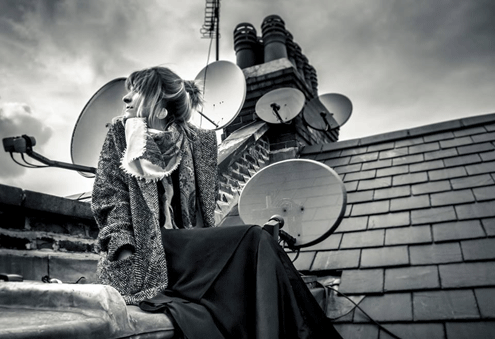
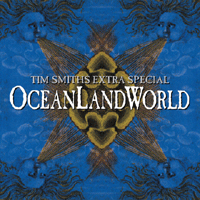


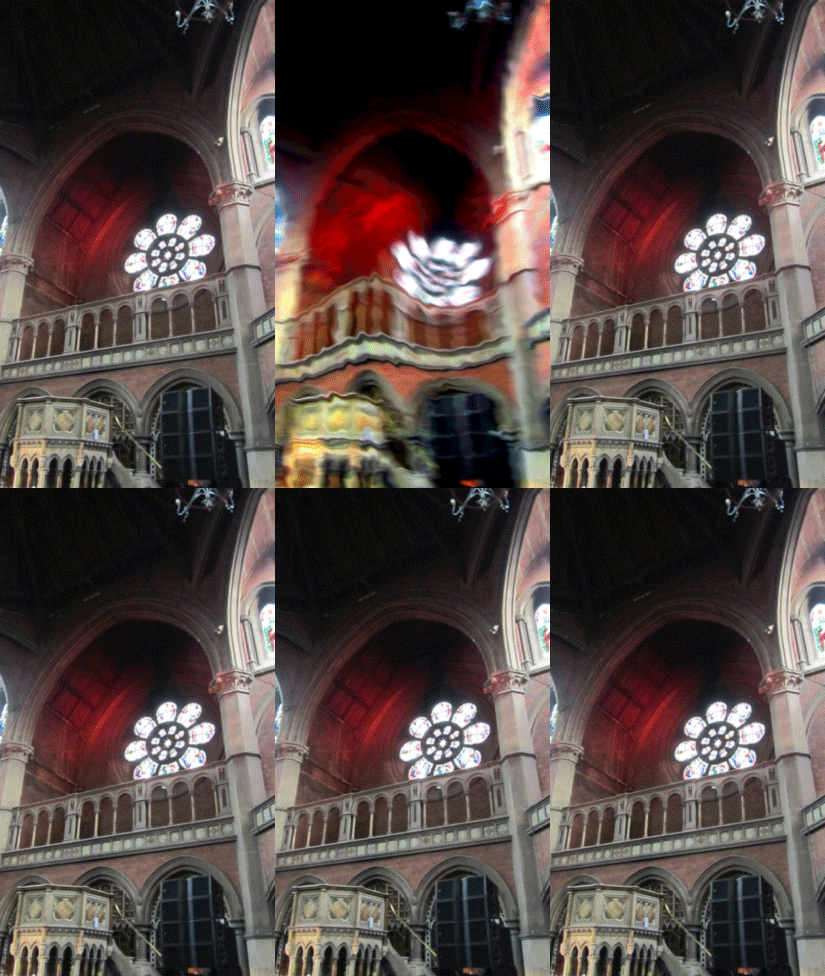
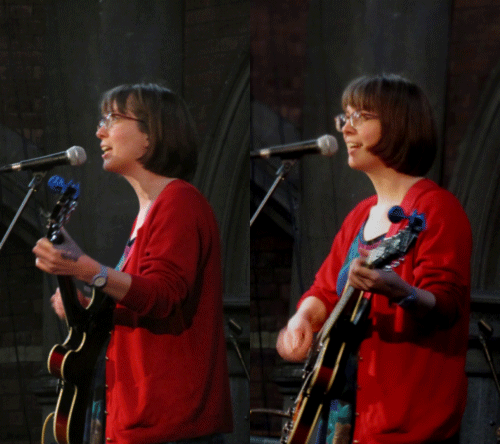
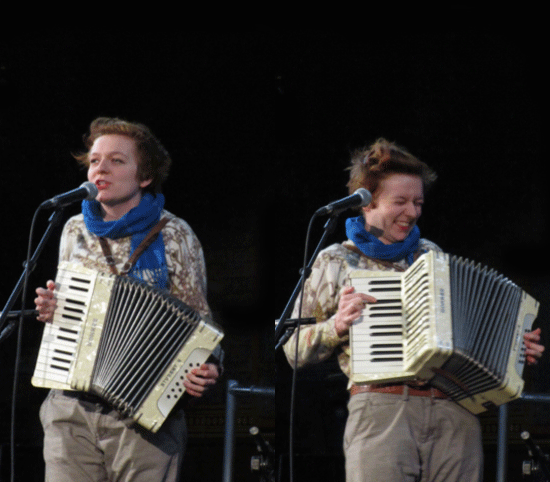
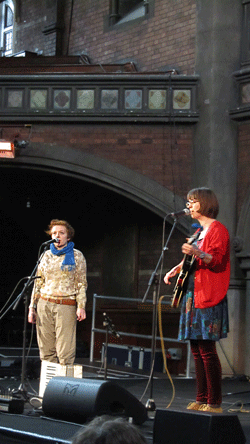
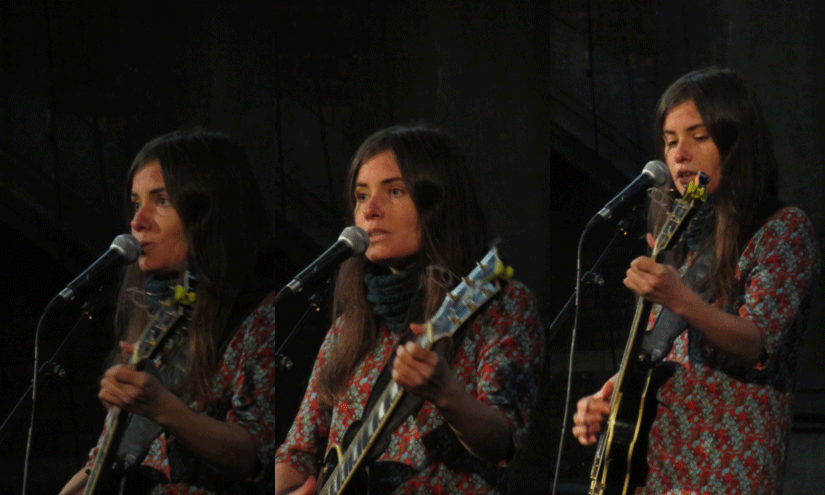
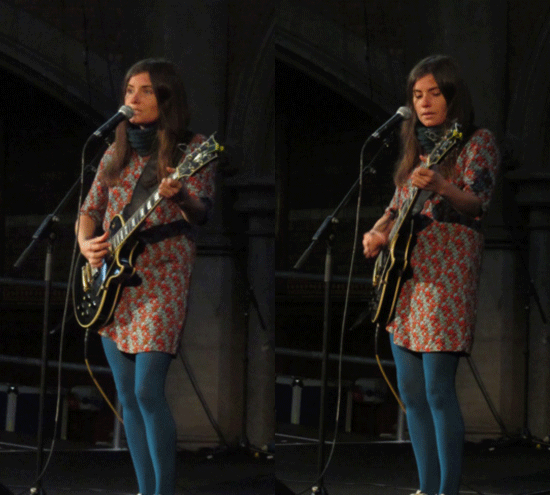
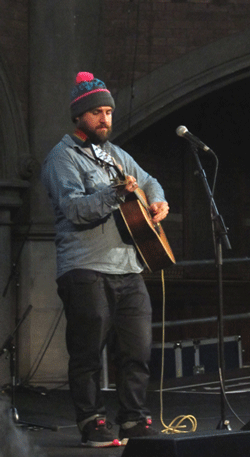
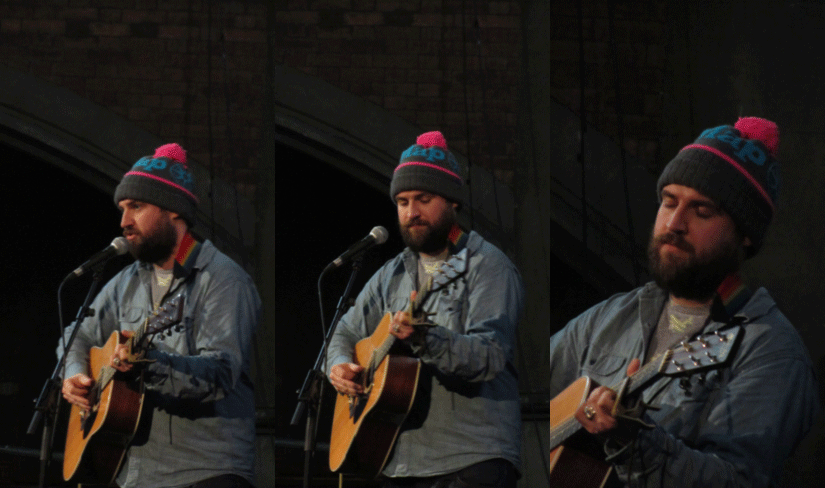
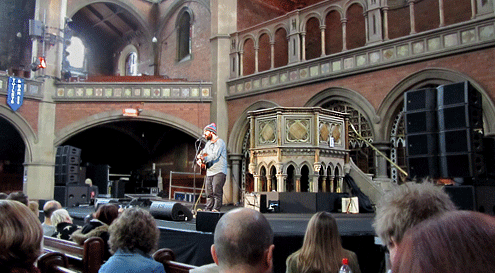

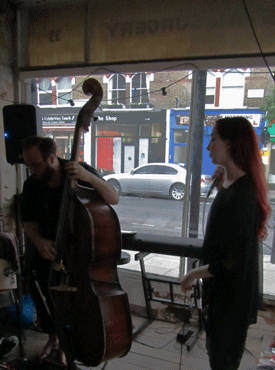

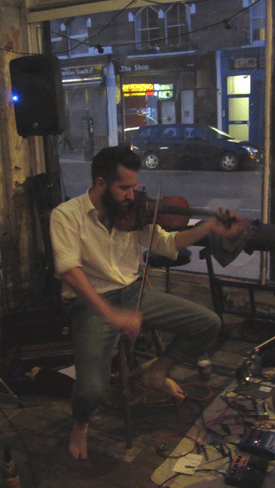
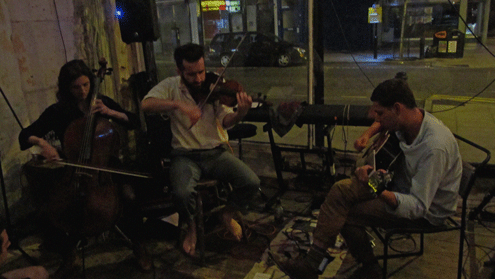
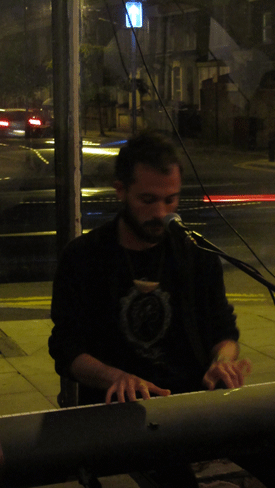


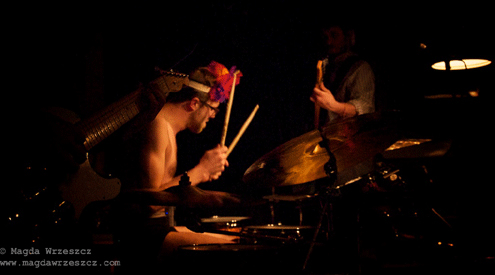


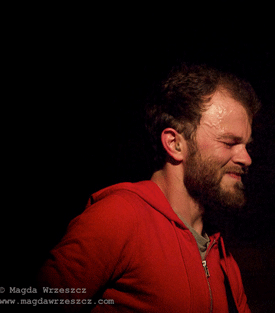
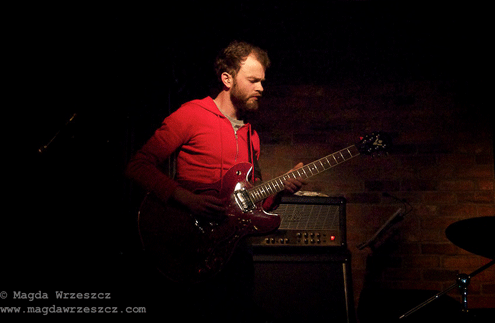




 Misfit City