Tag Archives: Bristol (England)

November 2015 – upcoming gigs – Illuminations London present Holly Herndon, Jam City and Claire Tolan in Bethnal Green and Josh T. Pearson, Richard Dawson, Briana Marela and Let’s Eat Grandma in Hackney; Laura Moody plays solo in Cardiff and Sheffield; Jenny Hval and Briana Marela tour the UK

2 Nov

Some more concert dates for the current week. If you’re thinking that these have a definite female slant to them, you’re right. I’m indulging my latent X as well as stretching my perspective.

Holly Herndon expanded A/V show (featuring Mat Dryhurst and Colin Self) + Jam City + Claire Tolan (Barbican & Rockfeedback present Illuminations  @ Oval Space, 29-32 The Oval, Bethnal Green, London, E2 9DT, UK, Wednesday 4th November 2015, 7:30pm) – £15.00

Having already made a showing at Liverpool and Bristol during October, peripatetic techno-pop/IDM composer Holly Herndon brings her expanded show to London. This is a full multi-media experience including the usual music, visuals and dance elements but with an interactive component that goes far beyond Holly’s onstage collaborations with programmer/life partner Mat Dryhurst and with interpretative dancer/additional singer Colin Self. In particular, Mat’s adaptive and conceptual SAGA software reaches out beyond the stage to work – consensually – with the audience members’ own browser histories and Facebook content; mixing it all into the visuals (and, potentially, the sounds) as a communal mashup, both representational and communicatory.

Intriguing as this factor is, it’s an adjunct to Holly’s music; which remains the core material of the show. Continually glitched, tweaked and deconstructed, her compositions are a cool, complex, thoughtful and exhilarating mixture. They’re informed by post-classical forms, dance techno, and anthemic synth pop; they utilize experimental textures and broad vocal stylings (from standard singing to semi-voluntary sounds) and they bury philosophical queries deep within their tunes. Holly’s soundwork is as immersive as her stagings, full of implied questions and reflections regarding our access to and immersion in technology and how this affects the way in which we think and express ourselves, leaving comet-trails of information, interaction and yearnings.

All of these additional subtexts and pointers are there if you want them, but Holly is first and foremost a communicating musician, and her pieces are as melodious and accessible as they are multi-layered. Drawing on her ongoing music studies (doctorate level at Stanford) , her time as a precocious and enquiring teenager steeped in the heat and fun of the Berlin club scene, and her work with everything from choirs to customised laptop software, they sometimes sound like particularly complicated pop songs, stuttering their way through myriad changes of attention and focus. Sometimes they sound like accelerated dream-state dances; sometimes like madrigals sung during earthquakes (see Unequal, below). At other times, they’re like the chatter of path-switching in a circuit; or like carefully-directed cultural channel-surfings which quick-step deftly back and forth across a breadth of urban art and experience (from grand opera house to downloads in cramped bedsits). Brain food which encourages you to wander.

http://www.youtube.com/watch?v=YdcUBRa47as

Also on the bill are Jam City and Claire Tolan, both of whom share Holly’s interest in interactions and in the results of our being embedded within a dense informational culture, although each has their own way of approaching the situation.

Jam City is the alias of dance-electronica producer and deconstructionist Jack Latham. Though Jack’s background in fashion and “corporate espionage” sounds almost too good to be true, as if it’s been dream-tailored for counter-cultural media discussions and for high-end elitist posing, he doesn’t use it that way. As a musician, he’s evolved from collaging various dubstep tropes towards using his work to develop and express questioning, outright political critiques of neoliberal capitalism (such as the Unhappy single, which explores the dulled angst of online porn consumers while juxtaposing it with riot footage). In the process, Jack’s also developed as a performer – backgrounding the laptops and the passive role of the standard electronica performer in order to retake the stage as guitarist and singer, and delivering a new phase of material described as sounding like a Prince record constructed from cold, chunky industrial sounds”.

Claire Tolan is an artist, programmer, sampler, writer and soundscaper specializing in autonomous sensory meridian r – a psychological process in which carefully-arranged sound and speech – usually a blend of themed, targeted whispers and quiet diegetic noises (scratches, scuffs, intimate room sounds) – triggers euphoric physical and mental reactions in the listener. With sharp wit, Claire links all of this to new developments in programming and acoustic surveillance technologies, exploring the question of how it might be applied: from simple mood enhancements and healing systems through to neurolinguistics and perception and to the potential manipulation and control of people. Her recent Holly Herndon collaboration Lonely At The Top (see below) might give some clues as to her concert performance. A cosseting monologue, coffee-pot dribbles and the close-up noises of small rooms are interspersed with the rubs and slaps of massage, fingernails ticking on keyboards and screens, and increasingly intimate sounds of hand and mouth: the language, desires and end results of relaxation tapes, executive relief, socially-reinforced senses of entitlement and prostitution blend and overlap to sardonic, disturbing effect.

http://www.youtube.com/watch?v=XdtCzPrx-JE

Information and tickets for the concert are here  while the Facebook event page is here. At the end of the month, Holly will also be appearing at All Tomorrow’s Parties at Prestatyn.

* * * * * * * *

There are some similarities between Holly Herndon and Laura Moody  – not least an overlap with classical music and a sense of being on the outcrops of songcraft, delving up malleable truths and questions. Yet whereas Holly’s a post-classical theoretician (reconciling her education with her human instincts, and with life outside the college bubble) and works primarily on computer, Laura comes from older and more familiar traditions, and is almost exclusively an acoustic performer. Possessing outstanding talent both as a singer and as a cellist – and able to cover both fields simultaneously, as well as beatboxing and cello-drumming – she pounces into her own music with the terrifying, exhilarating technical skills of a top-drawer classical soloist.

Laura’s songwriting instinct, meanwhile, seem to come from multiple directions at once. Tense twentieth-century string figures (from her earlier years playing avant-garde pieces with the Meredith Monk Ensemble, and her current work with the Elysian Quartet); ancient, eerie folk airs; expressionist opera; P.J. Harvey’s cleaver intensity; the clever, idiosyncratic and individual art pop of a Kate Bush, a Tom Waits or a Bjork. Everything that she delivers sounds immediate, whether it’s the savagely equivocal hormonal take-down of an older man on Creeping Alopecia, the raindrop attenuations of Call This Time Love, or the stormy dissections of love-gone-wrong and betrayal on Turn Away and We Are Waiting.

The live gigs are enthralling wonders: supple switchings between Laura’s own welcoming personality and the performance persona which handles the songs, blurring the line of physicality which separates woman and cello. She’s out on a brief tour now, playing outside London for a few events. Go see for yourselves.

Laura Moody:

* * * * * * * *

For many female pop musicians, an increasingly outright or explicit public sexuality is both a marketing point and the prime hook. To an extent, this is also true of Jenny Hval. Many people will have initially heard about her thanks to what seemed to be a head-turningly saucy lyric:“I arrived in town with an electric toothbrush pressed against my clitoris.” Curious (and possibly a little numbed by Rihanna, plus memories of lubricious Prince party-funk), many of us will have followed this expecting a licentious slow jam, only to find something very different – the opening line of a mirror-calm songscape of hovering bells, limpid murmurs and breathed-on acoustic guitars which dealt with the secret worlds of strangers within cities and, in particular, their self-reliance.

A polymath whose methods blur as artfully as her perspectives, Jenny doesn’t write songs so much as drop carefully-charged texts and pointers, and then explore and adorn these recitatives with chantlike melodies and poised minimal instrumental textures, pulling them apart and working in and out of the word-rhythms. Her guitars, keyboards and samplers (as well as her heavy-lashed, light-tongued vocals) work like soft-edged sculpting tools. Her lyrics are the lines of resistance.

For both new listeners and previous converts, sexuality remains a prime Hval hook. It’s what we expect to hear from her, although we’ve quickly learnt to appreciate that she turns the expected approaches on their heads and back-to-front. She revels in the unfixed: in the course of a single song, lovers will pass fluidly from mysterious passion to friendship to absence, and between gender, ages, species or state. Even when singing of cupping her own cunt (while cupping the blunt, unadorned and troublesome word itself, delivered throughout her songbook without a hint of shame, taboo or aggression and with a succinct matter-of-fact poise) she’ll let the action lead her somewhere that doesn’t fit the usual expectations and commodities – appreciating its centrality at her body’s core; being inspired to cup in turn a lover’s “soft dick… accepting restlessness, accepting no direction, accepting this fearful wanting that isn’t desire… can we just lie here being?”; or imagining a world of peaceful masturbators (“a million bedrooms with hands softly lulling… without telling anyone, a million ships come alone out on the calmest seas”) while asking, with a sense of disquiet “are we loving ourselves now? Are we mothering ourselves?”

Also running through Jenny’s work (whether entwined with or separate from the sexual themes), are ambiguous accounts of bodily disintegration. Opening her second album ‘Innocence Is Kinky’ with an account of watching online porn, she moves from commodified enervation into an eerie and exultant dream of escape, relinquishing her own body and its passive needs, and finally symbolically destroying the eyes with which she consumes the images. Yet this song and its sisters aren’t quite nightmares. Sometimes they’re triumphs – disassociative fantasies of freedom in which the wrack and ruin seem to be the natural rites of passage of a cool mind walking free, unconcerned, its passions become processes.

Jenny’s writing casts a wide net – violent upsets echoing classic French surrealism; deep-running strands of myth both classical and original (from the “Oslo Oedipus” of Innocence Is Kinky to the dark, quasi-pagan tree-figure in Amphibious, Androgynous that stands as lover, doppelganger and the next phase of self); and musings on the ambiguous trap of language (“the tongue is upon for the restless /An indecipherable alphabet / Each word an island less… And we speak in tongues from part to parts, broke all to parts / From invisible state, to invisible state…”). Most recently, on her latest album ‘Apocalypse, Girl’ the political subtexts have broken cover to become direct challenges (“You say I’m free now, that battle is over, / and feminism is over and socialism’s over. / Yeah, I say, I can consume what I want now..”). So too have preoccupations with ageing and survival (in the breathless narrative of Heaven, surrounded by loops and fractures of cemeteries and childhood choirs, Jenny wrestles with the pull of memory and the drag of mortality) and a increasingly solid approach to identity. “What is it to take care of yourself? Getting paid? Getting laid? Getting married? Getting pregnant? Fighting for visibility in your market? Realizing your potential? Being healthy, being clean, not making a fool of yourself, not hurting yourself? Shaving in all the right places?”

All of the above – the obliqueness and the rapier hits – makes listening to Jenny’s records akin to haunting her apartment at 2am (or some similar time  when manners and manneredness come unstuck and the shapes of other truths come walking). I’ve not been fortunate enough to see what her music is like live – though I know that past concert showings have seen her play bolstered with  guests or simply alone, surrounded by laptops, devices and ideas. On the five quick dates of her current UK tour, you’ll be able to see for yourselves.

Jenny Hval:

* * * * * * * * *

On the Glasgow, Manchester and Bristol dates, Jenny will be joined by her on-off tourmate Briana Marela, a singer-songwriter from the Pacific North-West who’s currently working a string of European tour dates in support of her second album ‘All Around Us’. As you might expect from something recorded in Iceland and co-produced with Sigur Rós associate Alex Somers, ‘All Around Us’ is ghosted and garnished with touches of Hopelandic enchantment (with beautiful smeared, paper-thin sounds intruding on the edge of the mix, like lost amnesiac ghosts or distant pipes), but it’s very much Briana’s inspiration – a luminous, thoughtful work blending layered melodic sample-patches and banking her petal-delicate vocals into choirs and a capella counterpoint.

Though Briana cites Björk, Laura Veirs, Vashti Bunyan and Meredith Monk as influences (she has something in common with Laura Moody, then), I can also hear the same kind of all-round sound-mastery that’s on display and working away in the songs of Imogen Heap; deep-level sonic exploration and sound curation tied to the urge to tell you a story and sing you a straight earworm. In the album’s lead single Surrender I can even hear something of the pure pop of ABBA, while the midnight lushness of the follow-up, Dani, recalls a Julee Cruise ‘Twin Peaks’ ballad.

Though Briana’s voice is soft, it’s never wispy – never insubstantial. If there’s a hint of girl-next-door to what she does, she’s the quiet, observant girl full of thoughts, going her own way but ready to let you walk alongside.  Like Jenny, though less explicitly, she explores possibilities of intimacy. Her songs hover carefully on the borderline between selfhood and loneliness, a delicate staking out of possible togetherness, subtly resisting the pressures to put out or submit, to be deformed by needs and expectations (“What does love mean in this day and age? /  To me it’s a moment where we resonate at two frequencies close in phase… /  It’s not a competition /  Everyone has music within them.” ). Meanwhile, the perfectly-pitched American-visionary tone of the album (its hallucinatory fairy-tale sonics, leaflike piano falls and misty country swells) suggests that there’s common ground between Briana’s dream pop and the ostensibly cleaner work of breakthrough CCM-pop singers like Lexi Elisha, which in turn suggests that there’ll be a lot of people who’ll end up liking this.

* * * * * * * *

In between dates with Jenny Hval, Briana Marela will also be joining the bill at another Illuminations concert in London, this one a stew of assorted flavours which also includes the battered Americana of Lift To Experience frontman Josh T. Pearson  and the skewed Tyneside noise-troubadour work of Richard Dawson.

Probably because of the female orientation of this particular post, I’ve got to admit that I’m more intrigued by the youngest act on the bill, and the only other female one. It’s difficult to work out just how tongue-in-cheek the psychedelic rag-doll sludge-pop” duo Let’s Eat Grandma are, assuming that they’re joking at all. Eyes down, singing from beneath and behind tumbling pre-Raphaelite locks, and tucked into stolen Stevie Nicks dresses, Rosa and Jenny rummage with various instruments like toybox-divers and play songs as if it’s only occurred to them to do so. Two Norwich teenagers who’ve known each other since childhood, they’ve sustained, into near adulthood, that mysterious blankness of two little girls who are ignoring your interruptions to their game. The songs themselves are tangled musical fairy stories, or (as with ‘Eat Shiitake Mushrooms Into Chocolate Sludge Cake’) extended wooden-legged instrumental mantras owing more to Faust or Beefheart: spontaneous-seeming, utterly absorbed in themselves. The band feels like a musical chrysalis twitching what might become an astounding breadth of wing. It’s all to discover.

Josh T. Pearson/Richard Dawson/Briana Marela/Let’s Eat Grandma (Rockfeedback present Illuminations @ St. John Church at Hackney, Lower Clapton Road, Hackney, London, E5 0PD, UK, Saturday 7th November 2015, 6.00pm) – £20.00 –  informationtickets

http://www.youtube.com/watch?v=4Nk8p-PiJJM

http://www.youtube.com/watch?v=R0mqRc0kaF0

* * * * * * * *

More concert previews coming shortly for November…

October 2015 – upcoming London gigs – electro-industrial at Corsica Studios (Necro Deathmort, DeadFader and Cementimental), and intercontinental at Café Oto (Maurice Louca, John Bence and Sam Shalabi)

4 Oct

More gigs for the coming week…

Firstly, Baba Yaga’s Hut are running an evening at Corsica Studios, which takes in the London date of an electro-industrial tour.

Necro Deathmort/DeadFader/Cementimental @ Baba Yaga's Hut, 5th October 2015Necro Deathmort + Deadfader + Cementimental (Baba Yaga’s Hut @ Corsica Studios, 4-5 Elephant Road, London, SE17 1LB, UK, Monday 5th October 2015, 8.00pm) – £6.00

As if Necro Deathmort‘s name didn’t tell you enough about them, over an eight year career they’ve released albums called ‘This Beat Is Necrotronic’ and ‘Music Of Bleak Origin’ (although more recent albums have seen a shift towards a less morbid and more science-fictional outlook. Dark electronica festival veterans with a drone, doom and noise approach, the project entangles electronic instrumentalist AJ Cookson (The Montauk Project, Medes, Sol Invicto) with Matthew Rozeik (guitarist from post-metal/post-prog band Astrohenge). Their music rises from gurgling boneyard beats, medical-equipment breakdowns, squishy miasmas and faux-sax drones towards something ruined and regal – a grand deathbed vision.

Sharing Necro Deathmort’s current tour is Berlin-based dubstep/noise/electro fusilladeer DeadFader – memorably described as “chainsaw-step” by Baked Goods Distribution (who went on to rave about how the project coughs up “the most seismic grooves imaginable” and that the music “sinks its teeth into your arm and refuses to let go”). I can’t top that as a description right now – have a listen below and see if you agree with it.

Joining Necro Deathmort and DeadFader for the London date are CementimentalEverything I can dig up about these guys is a barking blur of ludicrous disinformation: almost the only lucid facts coughed up from their promotional flotsam is that they’re led by a “noisician” called Dr. Age (or Tim Drage, who may or may not have a daytime/surface job in cute Lego animations) and have been doing “harsh noise, circuit-bending, rough music since 2000AD”. The Dr. is supported by a cast of obscure and possibly imaginary characters – a guitarist called Toru, a part-time turntablist, a man called Mrs Columbo (who handles the incoherent screaming), and “additionalists” called Murray the Eel and Sir Concord Discount (the latter’s a “rock goblin”). Maybe this makes Centimental sound like the joke band on the bill, and there’s plenty of humour in what they do (a couple of early tracks were called Too Long and Merzbow It Ain’t, while a more recent one’s called Commendable Amputation of an Excessive Gargoyle), but the fact remains that they’ve been going for nearly half again as long as their gigmates. Draw your own conclusions.

Up-to-date info here, tickets here.

* * * * * * * *

On the Thursday, there’s a Cafe Oto convening of music from Cairo, Bristol and Montreal, running in parallel to events in Egypt and Lebanon and covering a broad variety of influences and outcomes.

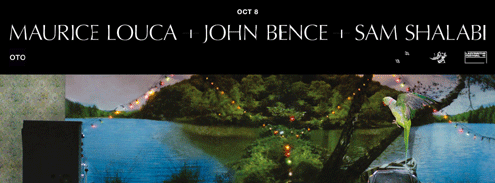
Maurice Louca + John Bence + Sam Shalabi, October 8th 2015

Maurice Louca + John Bence + Sam Shalabi (Café Oto, 18-22 Ashwin Street, Dalston, London, E8 3DL, UK, October 8th 2015, 8.00pm) – £12.00/£14.00

Cafe Oto, in collaboration with Thirtythree Thirtythree   and Nawa Recordings, bring you the second edition of the five-part event series entitled ‘Labyrinths’ (or ‘Mātāhāt’ in Arabic) and based in London, Cairo and Beirut over October and November.

Maurice Louca is an Egyptian musician and composer born in Cairo where he lives and works. As well as being the co-founder of the bands Bikya, Alif and Dwarves of East Agouza, he lends his sound to numerous projects, composing for theatre, film and contemporary art. Inspired by many influences, from psychedelic to Egyptian shaabi, his second album ‘Benhayyi Al-Baghbaghan (Salute the Parrot)’, released on Nawa Recordings in November 2014, shattered the confines of musical and cultural labelling and was dubbed by many as a game-changer for the region’s bustling independent music scene. Amidst his collaborations and inconspicuous touring across Europe and the Arab world in the last few years, Louca has sought a richer and much more complex sound. ‘Benhayyi Al-Baghbaghan’, the fruit of such intense reinvention and a departure from his first solo album ‘Garraya’, is a work that leaves ample space for fluidity and improvisation, paving the way for unique live renderings.

From a family background rich in classical pedigree and firmly embedded in Bristol’s forward-facing electronic music culture, John Bence has pooled a breadth of influence scarcely credible for a composer only entering his second decade, and now he is starting to put his inspiration into live and recorded motion. As a producer he is already thinking ten steps ahead, often incorporating voice or home recorded percussion into his cyclical technique of scoring, recording, manipulating, re-scoring and re-recording in waves, creating heady, intoxicating ripples of harmony and noise. An obscure snippet of dub-plate drone under a previous moniker was enough for Nicolas Jaar, who instantly approached him about a release on his Other People label. Six months on, ‘Disquiet’ was released – a masterful hybrid of classical and electronic clocking in at a tantalising ten minutes. More, much more, is coming. Mercurial, elusive and of seemingly limitless imagination, John Bence is rising to the surface.

Sam Shalabi is an Egyptian-Canadian composer and improviser living between Montreal, Quebec and Cairo, Egypt. Beginning in punk rock in the late 70s, his work has evolved into a fusion of experimental, modern Arabic music that incorporates traditional Arabic, shaabi, noise, classical, text, free improvisation and jazz. He has released five solo albums (including ‘On Hashish’- a musical mediation on German writer Walter Benjamin; ‘Osama’, an audio collage on Arabophobia in the wake of 9/11; and his most recent ‘Music for Arabs’), five albums with Shalabi Effect (a free improvisation quartet that bridges western psychedelic music and Arabic Maqam scales) and three albums with Land of Kush (an experimental 30-member orchestra for which he composes). He has appeared on over sixty albums and toured Europe, North America and North Africa. Recent projects include the release of the sixth Shalabi Effect album, a duo album with Stefan Christoff, two albums on the Italian label Sagittarius with Beirut, Turkish and Egyptian musicians and a tour in the eastern U.S with Alvarius B (playing solo oud). He is also releasing ‘Isis and Osiris’ (a new composition for oud and electronics) on Nashazphone as well as releasing an album with The Dwarves of East Agouza (a Cairo based trio with Maurice Louca and Alan Bishop) while currently working on his sixth solo album.

Tickets and up-to-date information are here and here.

* * * * * * * *

More noise rock and fringe jazz shortly…

September 2015 to January 2016 various – upcoming gigs – Theo Travis Double Talk tour, Death & Vanilla/LUST in London

24 Sep

While I’m not particularly happy with the fact that time and concentration opportunities are mainly restricting me to posting up gig news at present, there are side benefits. One of these is to go on virtual tours of my own, finding out (via tour schedules) where music is still happening in this time of chopped budgets and closed venues. If I’m covering musicians who play in out of the way places, or out-of-the-way venues, I get to find out even more – drawing myself out of my London-centric knowledge or a focus on big-gig places. I get to discover pubs, restaurants or found spaces in which people are still fanning musical sparks or maintaining a tradition instead of just selling up for luxury flats. I find this heartening.

Theo Travis

Theo Travis

Theo Travis has just announced an English tour for his Double Talk quartet, promoting their new album ‘Transgression’. Over the past decade, Theo’s made a name for himself as a musician who slips particularly easily and unfussily between genres. While he’s become the go-to saxophonist for British progressive and psychedelic rock and legacy fusion as well as for assorted ambient projects, he’s also achieved this without denting his impressive if understated jazz credentials. Double Talk – Theo on saxophones/flutes/ambitronics loops, plus Mike Outram (guitar), Pete Whittaker (Hammond organ) and Nic France (drums) – puts him together with three similarly flexible, fuss-free musicians.

Between them, the four can collectively boast involvement with some heavy-duty transatlantic jazz names (Nucleus, Loose Tubes, Tim Garland, Norma Winstone, Herbie Mann, John Etheridge, Slim Gaillard, Martin Speake), but also some serious engagements with rock (David Gilmour, Steven Wilson, The Wonder Stuff, Catherine Wheel), soul and dance (Bill Withers, Working Week), loop work with Robert Fripp and Steve Lawson, drum-and-bass with Photek, contemporary classical with Harvey Brough, and excursions into country and kids’ music. Having straddling all of these approaches via the application of talent and open-mindedness (and, crucially, a lack of preciousness), all four bring the same qualities and the lessons learned to Double Talk’s music – an airy English merge of fast-moving quizzical tunes, omnivorous jazz vocabulary and breezy humour bouncing on a solid chassis, but with the ability to move purposefully into open meditational territory and to stop and smell the fresh air whenever necessary.

The new tour starts on Saturday and crops up hither-and-yon until January next year – and here are the dates:

  • Jazzlive @ The Crypt, St. Giles Church, Camberwell Church Street, Camberwell, London, SE5 8JB, UK – Saturday 26th September 2015
  • The Eagle Tavern, 24 High Street, Rochester, Kent, ME1 1JT, UK (afternoon performance at 1.00pm) – Sunday 4th October 2015
  • Restormel Arts @ Bosun’s Charlestown, Quay Road, Charlestown, St Austell, Cornwall, PL25 3NJ, UK – Wednesday 21st October 2015 –
  • Jazz Steps @ Bonington Theatre, Front Street, Arnold, Nottingham, NG5 7EE, UK – Thursday 22nd October 2015 –
  • The Bear, Mill Yard, 24a Guildford Street, Luton LU1 2NR, UK – Friday 23rd October 2015 –
  • The Oval Tavern, 131 Oval Road, Croydon, CR0 6BR, UK – Sunday 1st November 2015 (afternoon performance at 1.00pm)
  • Sound Cellar @ The Blue Boar, 29 Market Close, Poole, Dorset, BH15 1NE, UK  – Thursday 5th November 2015 
  • International Guitar Festival of Great Britain @ Floral Pavilion Theatre, Marine Promenade, New Brighton, Wirral, CH45 2JS, UK – Thursday 12th November 2015
  • St Ives Jazz Club @ The Western Hotel, Royal Square, St Ives, Cornwall, TR26 2ND, UK  – Tuesday 17th November 2015 
  • Fringe Jazz @ The Mall, 25 Union Gallery, Clifton Village, Bristol, BS8 4JG, UK – Wednesday 18th November 2015
  • Fleece Jazz @ Stoke by Nayland Hotel, Keepers Lane, Leavenheath, Colchester, Essex, CO6 4PZ, UK – Friday 15th January 2016
  • Arts Depot, 5 Nether Street, North Finchley, London, N12 0GA, UK – Saturday 30th January 2016

 
* * * * * * * *

Closer to home for me, there’s the opportunity to discover a new set of promoters and their club nights. On this occasion it’s Baba Yaga’s Hut, who’ve been ferreting away for years on the fringes of some of the (once) cheaper, artier and edgier London districts without me hearing about them before. I think I’ll be mentioning them again, as their mashed-up roster of latterday hard-psychedelia, noise bands, alternative pop and assorted fence-vaulters certainly interest me. For now, here’s just one of their upcoming gigs, which is happening this coming Tuesday:

Death & Vanilla, 29th September 2015Death & Vanilla + Lust + T.Edwards (DJ) (Baba Yaga’s Hut @ Corsica Studios, 4-5 Elephant Road, London, SE17 1LB, UK, Tuesday 29th September 2015, 7.30pm) – £9.00/£10.00

Swedish dream-poppers Death & Vanilla have moved some way away from the psychedelic lounge-pop of their debut releases (in which they had a similar sepia-sampler sound to ’90s British post-rockers such as Broadcast and Pram, or even the cunning rush of Laika). These days they’re a tad more musically pointed and direct – positioning themselves straight in front of you, catching your eye and flipping open little musical doors as if they were some kind of musical advent calendar. In some respects, they sound like a more relaxed version of The United States Of America, the late ’60s experimentalists (part distracted folk carnival, part avant-garde tape effects) who arguably grandfathered and grandmothered the likes of Broadcast in the first place, albeit a little more smoothed out and hazy. They themselves offer “hands in the dark” and “Kraut-lullabies” as other labels which we can use. Check out a couple of their more recent songs below.

In support are multinational London-based quintet Lust, who’ve evidently looked back to those mid-’90s dream pop ideals of girl-group coos and quilted waves of balmlike guitar noise and decided, perhaps, to try to do it all better. With a sixty/forty girl/boy split, the instrumentation shared across genders, and Anna Haara Kristoferson, Moa Papillon and Andrea Muller singing in a creamy and hypnagogic triple-blend as they play, you can indulge happy memories of Lush (just one consonant shift away), Slowdive and My Bloody Valentine. You can also note that Lust seem a little cannier and calculated than Kevin Shields, Emma Anderson and co – not contrived as such, but perhaps a little more on-the-ball as regards their sense of pop music. The rills of ‘Loveless’ might never be far away, but neither is the songwriting suss of ‘Rumours’ and the directness of The Shirelles… or the option to go all gloriously New Romantic in a video. Take a look and a listen…

One “T. Edwards” is listed as playing as DJ for the night – I suppose that there’s a reasonable chance that this is man-of-all-seasons-and-many-instruments Terry Edwards, but you’ll have to find this out by yourselves.

Tickets available here, while up-to-date information is here.

Coming up – October events. It’s damn well snowballing…

July/August 2015 – upcoming London gigs for 3rd July (Shiver/The Fierce & The Dead/Alex’s Hand in Camden, and The Spiders of Destiny in Deptford); Tim Bowness tours in August; a release date for Levitation’s ‘Meanwhile Gardens’

30 Jun

More art-rock roars coming up…

Facemelter, 3rd July 2015

Shiver, The Fierce And The Dead, Alex’s Hand @ The Facemelter (The Black Heart, 2-3 Greenland Place, Camden, London, NW1 0AP, UK, Friday 3rd July, 7.30pm – £8.00/£6.00)

A night of insane math rock, prog, jazzcore and experimental riffs from some of Europe’s finest.

Shiver are the latest group from Acoustic Ladyland and TrioVD guitarist and producer Chris Sharkey. The trio have been challenging audiences perceptions of music for just over a year, sitting as comfortably at EFG London Jazz Festival as they have when headlining the PX3 stage at ArcTanGent Festival. Stretching the span of instrumentation and the imagination, this trio flits between solid, head-nodding riffs, ambient spaces and frantic electronic cacophony. Tonight they will be playing new material from their recently released third album.

The Fierce & The Dead are a hugely respected and critically acclaimed noisy pronk four-piece from London. Their precise musicianship and schizophrenic, immensely complex, yet catchy music has earned them headline slots all over the UK. Featuring internationally renowned guitarist, loop artist, blogger and all-round independent music guru Matt Stevens, TFATD have shared the stage with bands including PHILM, Knifeworld, Thumpermonkey, Anathema, Cleft and Lost in the Riots. Tonight they will premiere unheard material from their upcoming EP.

Formed in Seattle a few short years ago, experimental four-piece  Alex’s Hand subsequently relocated to Berlin and have been wreaking havoc on Europe’s DIY noise, post-punk and garage ever since. They’ve shared the stage with MoRkObOt, which must have been a bizarre evening. As at home on stage as they are playing avant garde installations (such as 24 hour festival Avant Garden) in a punk squat in Berlin, this will be their first venture to the UK.

More details here, and tickets available here.

I should put in a particular word for Alex’s Hand here, having watched them grow and sprawl over the past few years along a meandering but inspiring path from arch art-pop parodists to noisy song-brawlers and most recently to a kind of spontaneous noise-prog ensemble. There are a few ‘Misfit City’ reviews of their earlier material – one for ‘Madame Psychosis‘ and one for ‘This Cat Is A Genius‘. Although I’ve not covered Shiver yet, I do also have reviews of early Fierce & The Dead material (here and here), as well as a look at the band’s Matt Stevens playing a solo slot.

******

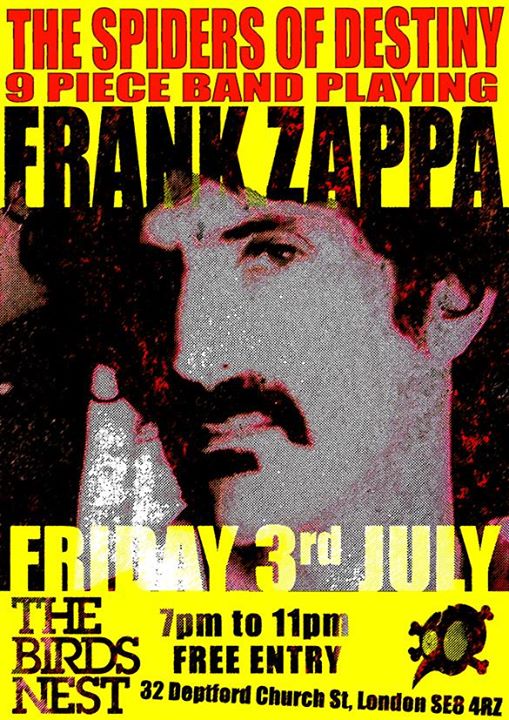
If you’d rather spend a free evening with Uncle Frank, The Spiders of Destiny are playing another London gig of Zappa music on the same day. As ever, expect some of London’s most accomplished art-rockers to work their way back and forth through the Zappa catalogue. The Deptford venue they’re playing this time has plenty of history, whether under its current name, its old monicker of The Oxford Arms or any other title it’s enjoyed over several hundred years. If you don’t spot Frank’s ghost leaning on the sound desk and having an appreciative smoke, you could try looking out for the ghosts of Dire Straits or Christopher Marlowe instead… Up-to-date details here or here, with two-as-yet unnamed bands to be added to the bill.

The Spiders of Destiny (The Birds Nest, 32 Deptford Church Street, London, SE8 4RZ, Friday 3rd July 2015 – 7.30pm, free)

The Spiders of Destiny play Zappa, The Birds Nest, July 5th 2015

********

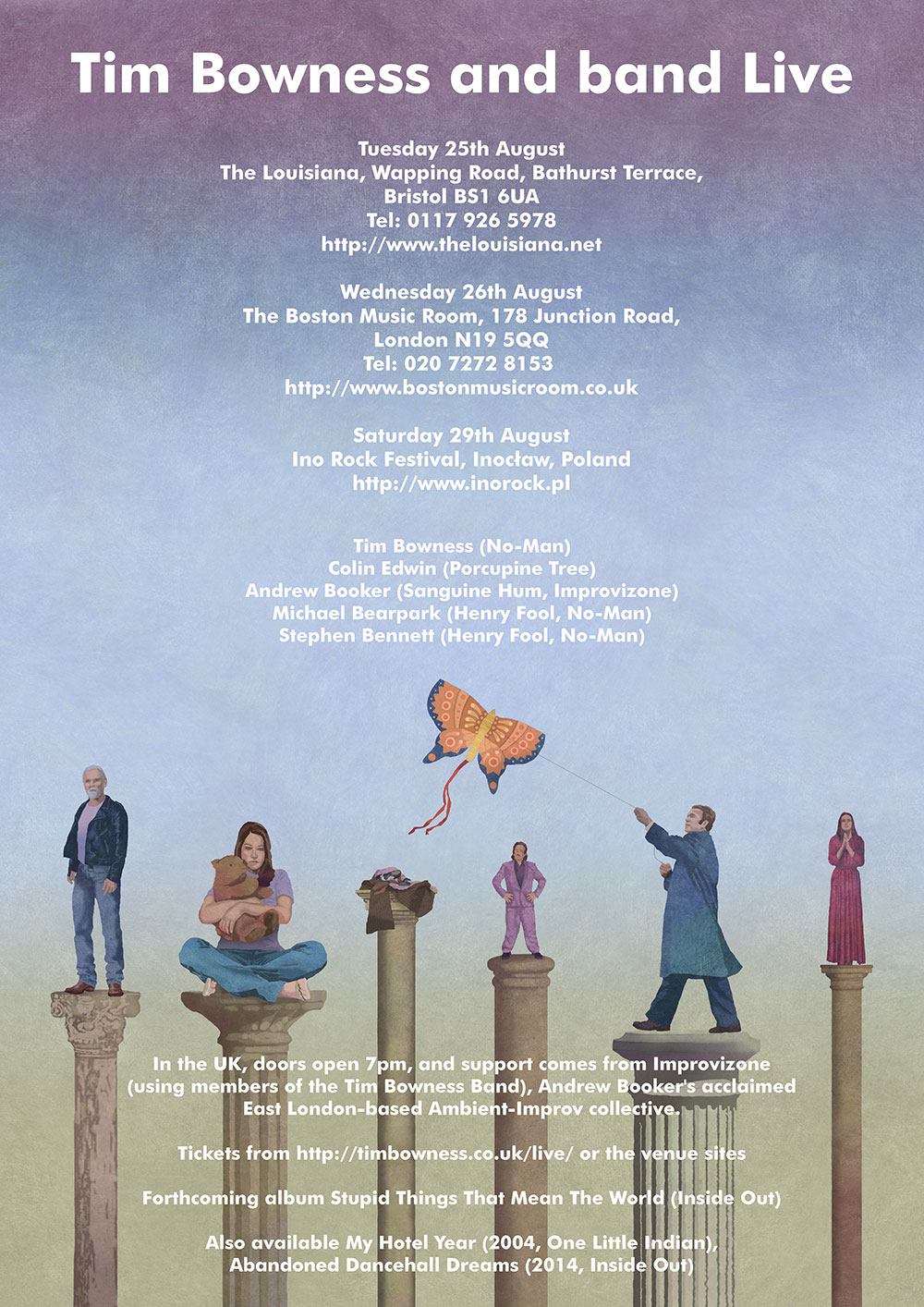
Tim Bowness live flyer, August 2015Looking further ahead, Tim Bowness is out on a very brief tour in August, playing a handful of dates in England and Poland to promote his imminent album ‘Stupid Things That Mean The World’ as mentioned last month. His band features his usual cohorts of Andrew Booker (drums – also of Sanguine Hum), Michael Bearpark (guitar – Darkroom, Henry Fool), Stephen Bennett (keyboards – Henry Fool) and the more recent recruit Colin Edwin (bass guitar – Porcupine Tree).

The Lousiana, Wapping Road, Bathurst Terrace, Bristol, BS1 6UA, UK, Tuesday 25th August, 7.00pm – tickets here and here.

The Boston Music Room, 178 Junction Road, London, N19 5QQ, UK, Wednesday 26th August, 7.00pm – £17.00 – tickets here and here.

Ino Rock Festival, Theatre Letni, Inoclaw, Poland, Saturday 29th August – 35.94 euros – tickets here (other acts at the festival are Fish, Motorpsycho, State Urge and Millenium).

Playing support at the Bristol and London gigs will be Improvizone, the flexible live-ambient improvising collective led by Bowness band drummer Andrew Booker. The rest of the Improvizone lineup looks as if it will be drawn from the current Bowness band (Michael Bearpark is a frequent Improvizoner) so perhaps you should expect the same band playing in two very different configurations. Up-to-date news will be here.

*****

Levitation: 'Meanwhile Gardens' (2015 issue)

Levitation: ‘Meanwhile Gardens’ (2015 issue)

Another follow-up from last month – there’s now a release date from Flashback Records for the lost Levitation album ‘Meanwhile Gardens’. Mark Burgess of Flashback posted the following on the Facebook fan page for the band’s lost recordings yesterday:

There is at last a provisional release date for ‘Meanwhile Gardens’. 23rd October 2015! Pre-orders will be available in due course from the Bandcamp site and elsewhere. The album is now with the pressing plant, but the lead time on the vinyl is long (pressing plants are straining under the pressure of so much vinyl at the moment, hence the provisional nature of the release date). You should all give yourselves a pat on the back and raise a toast to this group because without this page it might never have happened. Thank you all for your enthusiastic support!

Levitation, circa 1992

June 2015 – upcoming London gigs – prog rock/math rock/post-hardcore @ The Facemelter; electro-pop/drum’n’brass/loops/experimental ambience @ Tuesdays Post; eclectic classical/experimental chamber music/kletzmer & Bulgarian voices @ The Forge

31 May

Some more early June gig previews for London – these would have been in the previous post if I’d picked up on them earlier.

Firstly, a Facemelter promotion (from the experimental rock/post-hardcore wing of the Chaos Theory organisation whose jazz gigs I’ve also enjoyed)…

Facemelter, 5th June 2015

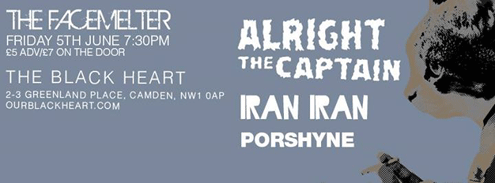
Alright The Captain + Iran Iran + Porshyne @  The Facemelter (The Black Heart, 2-3 Greenland Place, Camden, London, NW1 0AP, Friday 5th June , 7.30pm

Three heroes of math rock, alternative and post-rock travel from different corners of the UK to unite and form this amazing lineup.

Derby-based trio Alright The Captain masterfully combine virtuosic instrumentalism with unabashed musical experimentation and have effortlessly established themselves as a sonic force to be reckoned with, thanks to their increasingly inimitable, uniquely imaginative brand of math-rock. Their sprawling and varied career has seen them sharing stages with post-rock luminaries including Mono, toe, 65daysofstatic, Pelican, Tera Melos, ASIWYFA, Maybeshewill, Adebisi Shank (RIP), This Will Destroy You, ZU and many more. Their new album ‘Contact Fix’ (which ‘Musical Mathematics’ describes as “div(ing)  in and out of math rock, prog and post rock – but, at its heart, it’s different”) has gone down a storm.

Iran Iran are another supremely talented bunch of musicians who stunned and impressed all who saw them at ArcTanGent last year. With insanely complex rhythms and thunderously heavy riffs, the four-piece from Bristol have evolved since their excellent first EP ‘Crystal Math’ and are packing a punch. They’ve played with Future Of The Left, Cleft, Alright The Captain, This Town Needs Guns, You Slut!, Alpha Male Tea Party, Death Pedals and many others. Fans of complex musical wizardry or heavy riffs will love their new EP ‘Milk Time For Spiders’.

Brightoners Porshyne dance between ambient intervals and melodic vocals to intensely intricate, fantastically crunchy  prog rock riffs. With just a few single releases and a session filmed by Small Pond Recordings, they already sold out their first headline show in Brighton. This is your chance to catch the band before their career takes off.

More info here and here, and tickets here (£5.00 advance, £7.00 on the door).

At the end of the same week, Georgina Brett’s Tuesdays Post event returns to Stoke Newington with another evening of ambient/progressive live music, including ‘Misfit City’ favourites Darkroom

event-20150607tuesdayspost

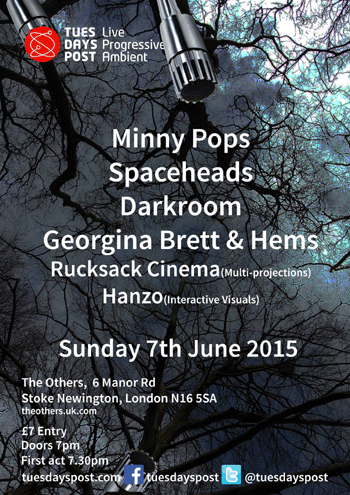
Minny Pops/Spaceheads/Darkroom/Georgina Brett & Hems @ Tuesdays Post, (The Others, 6 Manor Rd, London, N16 5SA, Friday 7th June, 7.00pm)

Formed by vocalist/band leader Wally van Middendorp in Amsterdam in 1978, Dutch electro pioneers Minny Pops took their name from a primitive Korg drum machine. The band released several singles and a debut album, Drastic Measures, Drastic Movement, on independent Dutch label Plurex before joining the legendary Manchester label Factory Records in 1980 (which resulted in them being produced by Martin Hannett, touring with both Joy Division and New Order, and becoming the first Dutch group to record a Peel Session). Singles including Dolphin’s Spurt, Secret Story and Time were followed by the acclaimed album ‘Sparks In A Dark Room’ in 1982. The band released two further albums (‘Poste Restante’ and ‘Fourth Floor’) before splitting in 1985. In 2012, the band reunited for a series of gigs in the UK, the Netherlands and Belgium and recorded a 7-inch single for Tim Burgess’ O Genesis label. After a pause to draw breath, 2014 has seen Minny Pops performing live once again.

Spaceheads are a cosmic duo of trumpet electronics and drums. Formed in 1990, they have developed a blend of electronics and sunshine fanfares over the course of ten albums, three EPs and much touring across Europe and the USA. Andy Diagram (also of James) plays trumpet with a mobile phone stuck to the top with a fish slice and Richard Harrison plays drums with big bendy metal sheets stuck to the top. They create live looped layers of brass driven by flurries of free flowing funky drums. Andy and Richard have achieved an intuition of what each is about to do next which makes their semi-improvised gigs a joy to behold. They release their first studio album in ten years – ‘A Short Ride On The Arrow of Time’ – this Autumn.

Darkroom – the UK-based duo of Michael Bearpark (guitars) and Andrew Ostler (synths)- expertly ride the line between luscious, old-school progressive rock and modern ambient electronics. At times reminiscent of early Tangerine Dream with hints of Fripp and Eno, they create clouds of sequenced synths, chewy grooves, and looped phrases to support a variety of acoustic and electric guitar melodies that twist and turn in surprising, occasionally aggressive, ways.

Hems Aka Henrique Matias will be playing live with Georgina Brett. Henrique is a multi-talented composer, programmer and DJ. He specialises in Multimedia programming (from internet things to Max/MSP and similars), although not all his live music and performances sounds like computer music (sometimes he takes his drum machines and crazy things out of the house). Georgina Brett’s music is created using her voice and effects pedals, creating instant choirs of sound, often in an hypnotic style. The point of this music is not only to captivate with extraordinary timing and melodic style but also to help the listener to relax in our ever-increasingly fast world.

Interactive visuals and multimedia projections are by Hanzo and Rucksack Cinema.

More information here – tickets £7.00 on the door.

By all accounts The Forge (in Camden Town) has spent the last few years becoming one of north London’s most interesting small venues for mixed music. I’ve yet to go there and see for myself: but in its full June calendar (also featuring funk, jazz, classical and Cuban music as well as assorted poetry) the following four concerts caught my interest:

Notus Winds & Eliza McCarthy (Wednesday 3nd June, 7.30pm)

Part of the classical monthly series Wednesdays at The Forge, this time featuring award-winning chamber ensemble Notus Winds and solo pianist Eliza McCarthy with a program of contemporary compositions (more information here). Tickets £10.00 to £12.00.

Programme:

Harrison Birtwistle – 5 Distances
György Ligeti – Ten Pieces
Arvo Pärt – Quintettino
Anders Hillborg – Six Pieces for Wind Quintet

Fenella Humphreys: Bach to the Future Part 1 (Tuesday 9th June, 7.30pm)

The first of three concerts presented by violinist Fenella Humphreys, featuring commissions of six new works by six of Britain’s leading composers to accompany Bach’s glorious 6 Sonatas and Partitas for unaccompanied violin. This first concert includes new works by Cheryl Frances-Hoad and Gordon Crosse alongside extraordinary music by Bach, Scott, Westhoff, Hindemith. Tickets £10.00 to £12.00.

Programme:

Cyril Scott – Bumble-Bees (1928)
Johann Paul von Westhoff – Suite no. 5 in D minor (1682)
Gordon Crosse – Orkney Dreaming (2014)
Fritz Kreisler – Recitativo and Scherzo-Caprice op. 6 (1911)
Paul Hindemith – Sonata op. 31 no. 2 ‘Es ist so schönes Wetter draussen’ (1924)
Johann Sebastian Bach – Partita no. 3 in E major BWV 1006 (c. 1720)
Cheryl Frances-Hoad – Suite no. 1 (2014)
Eugene Ysaye – 2nd Sonata op. 27 (1923)

Reciprocity: a new work by Daniel Patrick Cohen (Wednesday 10th June, 7.00pm)

Reciprocity is a 28 minute work for voice, taped narration, eight celli, piano, and percussion. The piece was composed by Daniel Patrick Cohen from six poems by the late Darya Farha, a Canadian poet, therapist, filmmaker and clothing designer. Darya was an extraordinary woman whose sharp intelligence, dry wit, distaste for orthodoxies and boundless empathy fuelled restless journey through her unfinished life. Darya died of breast cancer in 2011 when she was 46, and Reciprocity was commissioned by her sister Juliana Farha, who lives in London. Reciprocity is not about cancer, however. Instead, its human and universal themes of joy, pleasure, fear and anger, along with its intriguing instrumentation are sure to engage a broad audience. You can read more on the project here, and here. Tickets £6.00.

She’Koyokh & Veda Slovena Bulgarian Choir (Thursday 11th June, 8.00pm)

In a unique collaboration, She’Koyokh & Veda Slovena Bulgarian Choir combine the fiery panache of klezmer and Balkan music with the timeless beauty of Bulgarian voices, weaving Jewish, Turkish and Balkan music into the rich tapestry of the Bulgarian choral tradition. Read She’Koyokh’s piece on their Veda Slovena collaboration here. Tickets £10.00 to £12.00.

(All events taking place at The Forge, 3-7 Delancey Street, London, NW1 7NL)

January 2014 – live reviews – half of a Lost Weekend: Daylight Music presents The Middle Ones/Freschard/The Pictish Trail @ Union Chapel, Islington, London, 18th January 2014 (“the weekend swallowed us”)

23 Jan

What a pulsating Union Chapel hangover might be like...

What a pulsating Union Chapel hangover might be like…

You reckon that lost weekends are just for drunks? Try parenthood. Joyous as it may be, it can also be a swirl of cash-and time-poverty, torn-up plans, and utter confusion, much of which homes in on the weekend and turns it upside down. It’s the same, I tell you. The smear of lost hours, the existential dread, the sensation that you’ve fallen into a pocket outside of the real world; not to mention the worry that you won’t make it through to the end…

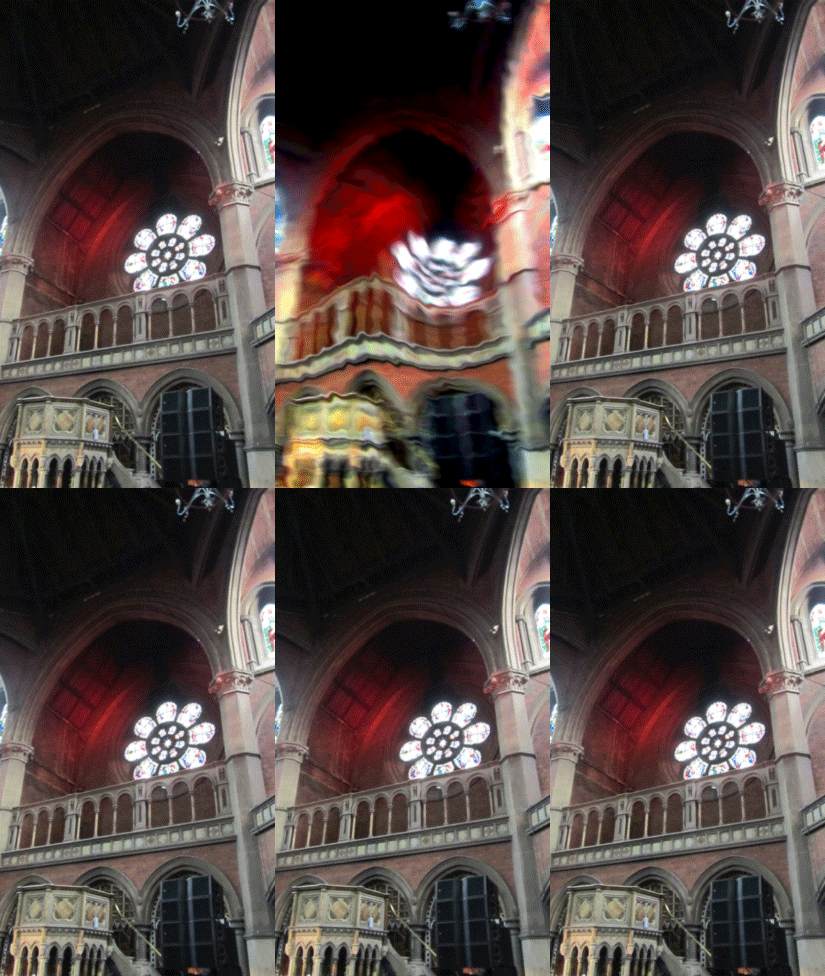
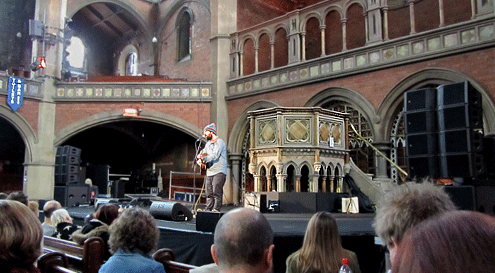
Regular ‘Misfit City’ readers know that my family and I tend to use Daylight Music’s Saturday concert afternoons (at the Union Chapel, up in the neck of Islington), as a way of finding ourselves again and of giving our weekends a bit of shape. Child-friendly and refreshing – and free – it’s something of a life-saver. So here we are again, slightly blurred and bleary. On this occasion, Daylight Music are doing their own Lost Weekend, teaming up with musical-comedown club The Hangover Lounge (another cultured and kid-friendly free event a few streets away in Pentonville) for a concert which sprawls over two days rather than one. Sounds interesting. Let’s see what we can make of it, starting at the Chapel… and come on, I shouldn’t be moaning. Just in order to be here, everyone playing today has travelled a lot further than we have.

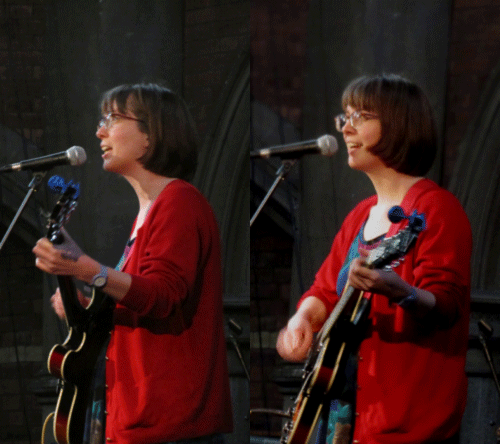
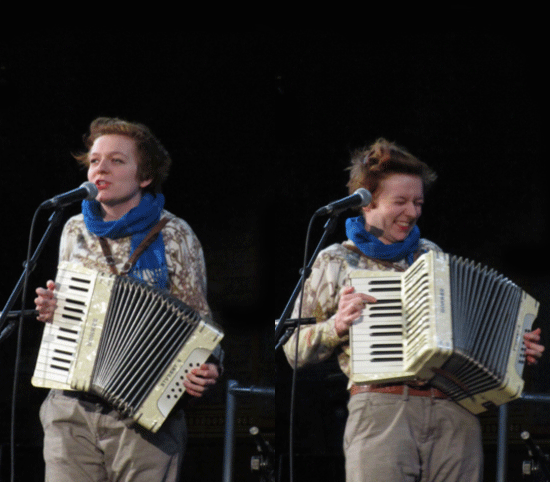
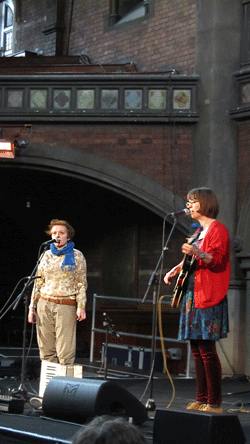
Take the two women who make up The Middle Ones. Originally from different bits of the north of England, Anna Nols (voice, guitar, knee-socks) and Grace Denton (voice, occasional accordion, sceptical warmth) met up in Norwich, over to the east. These days, they’re separated between east and west – while Anna’s stayed put, Grace now lives and works in Bristol. Any Middle Ones activity now must involve clambering into a bus, a train or a tiny car, then driving a couple of hundred miles (quite a substantial, exciting deal in a country the size of England), and piling straight into playing or recording.

Anna Nols of The Middle Ones.

Anna Nols of The Middle Ones.

They don’t let this slow them down. I suspect that they thrive on it. If it turns out that Grace and Anna are smart, economical and unromantic (the kind of band who just email each other soundfiles over their iPhones) I’ll be broken-hearted. I prefer to think of The Middle Ones as being as spontaneous and goofy as their onstage chemistry suggests, like a happy hen-party stumbling across a pier. Beneath the horseplay, just as affectionate and committed to each other as they ever were, even if they now live leagues and leagues apart.

On record Anna and Grace are artful, exploratory and spontaneous, recording ad-hoc and lo-fi in churches, kitchens and staircases. Wrapped and soused in ingenious bumblescapes and immediate invention, their songs embrace slopped kitchen metals, slurred kid’s-band horns, and drunken drones, staggering enthusiastically through their rumpled mixes. Live, The Middle Ones trim themselves back to semi-acoustica: just an enthusiastic down-strummed indie guitar, that accordion and the sweet undubbed snag of their paired voices.

That Faust/Raincoats side to their work takes a back seat as a consequence, but another strand from their skein jumps right up to take its place. It’s the post-punk folkswoman tradition: the one which ladders down through Marine Girls, Harriet Wheeler of The Sundays, the fizzing, intermittent charms of The Bush The Tree & Me and many others. Anna and Grace might be less finessed than any of the above, but they make a virtue out of it. Gawky and charming, they twinkle at the Chapel’s imposing space; chuckle about their own shyness; lose track of their thoughts, and make jokes about being hemmed in by the mikes.

Grace Denton of The Middle Ones.

Grace Denton of The Middle Ones.

If that makes The Middle One sound like a pair of simpering dollies, you’re getting the wrong idea. When they stumble and laugh, I see no defensive, please-like-me gush; no apologies for being on a bigger stage than they think they deserve. I see two women well aware of how ludicrous performance can be, and of the inevitable clumsiness of gestures under a spotlight. I see them accept and forgive it all, happy to be nobody’s stars and nobody’s muses. Here’s a particularly female state of mind in which everything is both serious and funny at the same time, and where fresh insight sprouts in fertile terrain far away from narcissism. (As a dogged, navel-gazing writerbloke I’ve got to confess that I envy it.)

Their onstage demeanour, in fact, reveals what they’re really about as artists as well as performers. As they gently josh or beam at each other – or bend double over a shared joke – their songs celebrate the spectrum of sympathy and friendship in all of its impossibility, unlikeliness, awkward junctures and rebounding. In Quite Something (an indie jig underpinned and smeared about with Grace’s wayward accordion), they chew this over, singing “My lover, my love in a hundred different ways. / Still, you’re right – we could never quite both be the same.” Another song deals with the fluttering nerves of a faltering first date: cutting rapidly between the viewpoints of boy and girl, it puts them and their choices into a perspective of unrolling time. “She is lying on the grass, with her arm across her waist, / she is trying to be brave but I know what she won’t say… I don’t want to look back and think ‘why didn’t I say that?’ / I don’t want to look back and think ‘I should have shown him that – I should have shown him more.’”

Anna and Grace sing about the saddest or sweetest of things with the same bright earnestness. It makes them look straightforward. Actually, it distracts from their complexities. Like plenty of songwriters (or short-story stylists, come to that) The Middle Ones deal mostly with variants of the same situation, but shift around the factors – characters, memory, the weather. “This is something like faith, but a bit more real-life,” they announce on Courage, a clarion call for passion on the upswing. “It is the rehearsal that will make this – / we were not born to fit together. / Sleeping side by side, occasionally entwined, / there is a design but it’s not so divine… I like to see your name written down, the warmth is folding round… / looks like you’re coming home with me.” As regards relationships what seems to fascinate them is not so much individual feelings but the way in which people overlap and merge, sometimes imperfectly, sometimes not. At one point, they sing “we are two thoughts that fade together,” and this idea of wobbly unity is reflected in the way their voices interlace: an untutored, empathic harmony.

In the lyrics, this can become an echo of overlapped, stumbling thoughts. Upbeat and enthused – positively illuminated – I Liked You Straight Away sees their singing become a shingled babble of thoughts and joy-jets. “I liked you straight away (who wouldn’t?) / I like to think I’d say (I suddenly) / knew there’d come a day when I would think of little… yes,/ but how the light (a miracle) / round your mouth and eyes (a miracle) / make me sad, and I will always find something… / In supermarket aisles I’ll see you / laugh to look like fire (I’m dancing). / Dearest friend of mine, you were a perfect stranger – / I wish that I could see / the moment when it first hit me.” As it peaks, the song races away in a delighted game of shifting grammar and ecstatic time-travelling adoration, while Grace and Anna frisk onstage. “Oh, love, I should have known it then. / Love, I should have known you then. / Oh, love, didn’t I know back then. / Love, if I had know you then.”

The Middle Ones.

The Middle Ones.

While The Middle Ones are great at sprinkling insight into this breathless, puppy-tumbling eroticism, they’re just as good when tackling other kinds of involvement. Portraying a younger woman’s friendship with an elderly man (on Young Explorer), they work out its strands and its development without ever needing to hammer home detail. They don’t reveal whether he’s friend, neighbour or relative. What’s important is that he’s one of her fixtures – one who’s about to be swallowed by time, one who’ll be missed. “I thought the old houses would all fall down / I thought the cobblestones would surely overturn / before they came and took and moved you out / to someone else’s road, / and someone else’s strange white clothes.” Over the course of the song, an initial childlike affection shades into deeper understanding (“your clever words struggled to be heard, / but your eyes still shine like in older times / when you were crossing borders, stranger waters … / With your luggage tied around the handle bars, / you don’t know where you’re going but you’re headed pretty far,”) and eventually an unexpected torch is passed as his long-ago young-man’s efforts inspire her own present-day awakening. Empathy blossoms like roses in the final harmonies: while the sentences tumble, the joy and fellow-feeling are daylight-clear. “The words, these are the words that you said. / Here we stand, up, up here, / and I can see you. / I can see you from up, up here. / I can see, oh / so much more now.”

Again and again, The Middle Ones’ songs delve into time – its chemistry and alterations, its revelations and decodings. In Hannah, they look at long-standing female friendships and how they simultaneously decay and sustain themselves: Passing years, marked through correspondence, see illnesses wax and wane, marriages arrive, and old bonds gradually fade to early chapters. “You’re the sweetest girl I’ve ever known… / I know you have shaped me, / just like I know we both keep changing, / but I’ll always be grateful – but I was twenty, and with you… I looked at myself and I saw you.”

Ironic, then, that Anna and Grace seem so untouched by time themselves. Edging towards their thirties, each woman still looks and acts like the half of the undergraduate duo they once were. Anna – pencil-slender, blinking and beaming through her glasses as she pecks happily away at her guitar – is the spit’n’archetype of the bohemian homespinner: all thrift-shop ingenuity, universally adored. Keying the accordion while punctuating the songs with delicate frowns and bursts of baffled humour, Grace is her unlikely travelling companion: the Thirties screen-queen lookalike, the one who’d frankly rather be Anna’s kind of bohemian. All of this might be camouflage for those keen songwriting minds – but I think not. For all of their onstage bumps and stumbles, they seem so comfortable in their skins that I can’t see it as anything other than genuine. They’re the odd couple who turn out to be the natural couple. They’ve come a long way. I can imagine them still travelling it, still chuckling along it, in fifty years time, with purple ribbons threaded into the accordion.

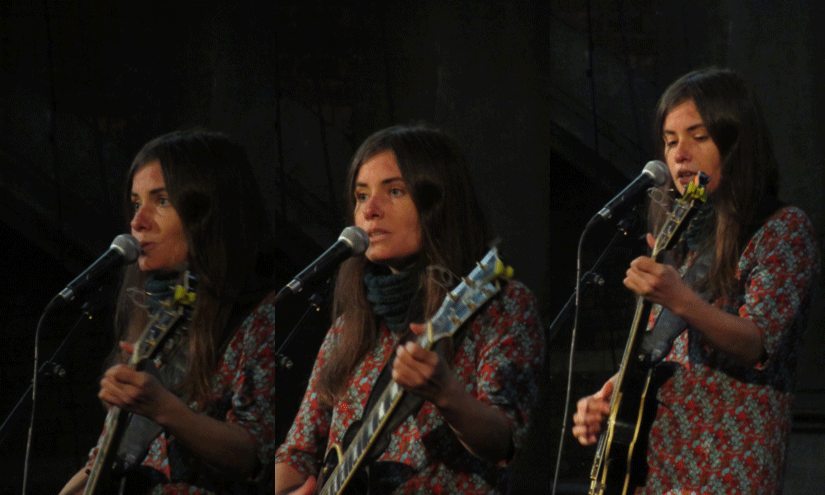
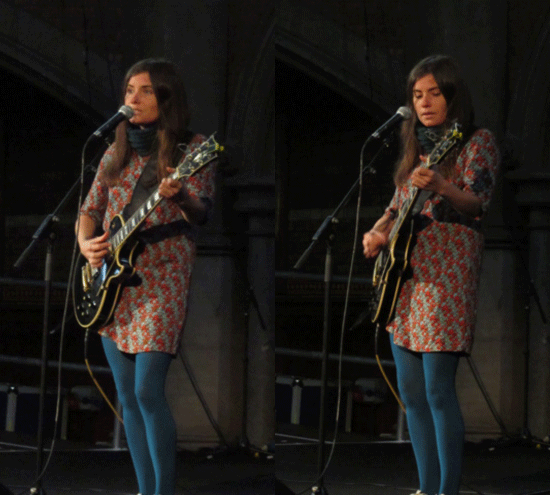
Plenty of hints are dropped today that most of the crowd has come for Clémence Freschard. I can see why. She ticks plenty of boxes for the kind of person who carefully, calculatedly chooses cooler brands of cigarette and songwriter. Her personal travelogue alone (which stretches from her beginnings in rural France through Parisian trottoirs, a spell in New York as a Brooklyner, and her present-day arty-émigré berth in Berlin) is more than enough to tickle the taste of a landlocked London hipster.

Clemence Freschard.

Clémence Freschard.

Added to that, there’s her lean, quiet singing – with its slight falling quality and its accented European English – and her eerie agelessness, in which those glints in her fall of bark-brown hair could be spotlight reflections or strands of early silver. Most of all, there’s her imperturbable presence. She delivers few, if any stage announcements. She doesn’t try to win us over with jokes. Whichever scenarios are played out in her lyrics (and, by implication, in her history) never ruffle her still expression. In both person and in song, she suggests an apparently blank slate – one which slowly and softly reveals its secret etchings.

Yet though she’s doll-like in her impassivity, she’s certainly not trying to be anyone’s toy. I couldn’t really call her Stepfordian (any more than I could call her Clémence – that “Freschard” mask is a perfect fit) but there’s an eerie automatic quality to her movements and playing, and to the mood that she projects. She smiles quite often. Her gaze maintains a bright, slightly absent sheen throughout her set, only warming a little when she spots a songwriter ally up in the gallery and invites him to sing along with her.

I remember that Laurie Anderson once described herself as a spy. It’s tempting to wonder whether Freschard might be following the same path. It’s certainly easy to imagine her sitting motionless in the same chair forever, with people coming and going around her in a shuffled, speeded blur, while all of the time she’s watching, observing.

Clemence Freschard.

Freschard – the impassive spy.

Sometimes she seems to be nothing but poise. Minus even the minimal arrangements of her records (the clipped touches of horn and mandriola, the bare and drowsy bossa percussion) she’s left with the classic, cloudy ring of her black guitar and those slight, faint-lined songs. Even these seem to have carefully combed and stripped before she came to play. Everything deemed surplus to requirement has long since floated away; unregarded; long stray hairs of songcraft coiling off, abandoned, on silent air currents.

It’s often difficult to make out what she’s left behind to hold on to. There’s plenty of falling rain, for sure, and plenty of inbetween moments. Too much of either, in fact. Aimless, distracted and lonely, I Miss You leans on First Avenue scenery for support, but does nothing with it. When Freschard murmurs about swamp water, dry whisky, Cajun stations and woozy kisses (on Sweet Sweet South) it feels as if she’s listlessly shuffling through antique Dixie postcards in a flea market before dropping them back, unbought. When she attempts to conjure the ennui of abandonment via a song about drumming fingers and staring out of windows, she skirts self-parody.

Angel finally tips the scale from delicate to dreary. Probably it’s a love song; perhaps something more morbid and sinister; but as its grey lines meander tiredly and tracelessly through my attention, it feels the same either way. That’s hard to forgive. Sometime it seems as if Freschard is no more than we choose to project onto her; and that if we really got bored, she might just cruise to a halt, staring blankly ahead until we had another idea.

Gradually, as better songs and better implications make a virtue of that impassive calm, she becomes more compelling. She begins to draw me into her unrippled world: one tune, mingling drowsy funk and Russian folk tune (dotted with hums and a languid hint of sex) curls insistently around my ears like a preening cat. Another – Boom Biddy Boom – maps eerie Eastern European folk inflections onto old rhythm-and-blues bop. It’s part-Diddley, part-John Lee Hooker, and either would have added a twist of salaciousness or solace to the swing. Freschard plays it as blank as a catwalk dancer, as a sleight-of-sashay, presenting fleeting and enigmatic visions of desperation in between the sways. “But’s and no, yes’es and no’es, / her hands on her hips, here she goes… / She’s a shout, she’s mighty fine. / Spit it out – she’s dynamite… / She’s sick sometime, / bound to lose. / Didn’t choose, didn’t plan. / Get the bouncing shoes… / It’s easy to start, it’s easy to let go. / Cross my heart, kiss my elbow.”

Wit and wickedness are welcome developments, and Freschard’s songs pick up when she allows herself to exercise them. Inside the thrumming pulse of Investigate, she probes themes of faithlessness and obsession with dry, vengeful precision. “When I’m not sleuthing, I’m gumshoe-ing, / I follow your every movement… / You think murder is my favourite crime, because it’s different every time / I have to tell you that’s not true / I just guess who loves who.” Fans and skeptics alike warm up a little. Her faint smile turns a little more mischievous.

But it’s two other songs that really slip out from beneath Freschard’s imperturbable gloss, fleshing out her stillness while making the best use of it. Where Did You Go – agoraphobic and lonely, absent and chilling – suggests that quietness is sometimes a deflated scream. “Household’s dry / like a river run dry… / I keep heading for the window like a locked-up fly, / with the birds buzzing in my head,” she sighs, with tired dysfunctionality seeping out from every line. “Didn’t make a difference – just to know,” she admits, before murmuring “I hit my head on the window pane” over and over again; a deadened mantra of acceptance. The song winds towards a conclusion of utter pathos – “if you come back I’ll put on an act, and you will never see / how I’ve fallen apart, and how sentimental I can be.” If you don’t pay attention, you’ll miss the vein of madness in the unmoving flesh, the pool of darkness spreading underneath the song. But then, that’s the point.

On her set-closer, High Tides, Freschard leafs through bittersweet recent memories, mapping the last dissolving phase of a love affair in which people fade from being ex-lovers to baffled friends grown thin and insubstantial. Shuffling disappointments without slipping under them, the song suggests a shaping, an accommodation; something to help with living alongside the letdowns. “You let salt water come between us. / We haven’t been wet; salt’s for peanuts,” she chides, softly. “But you know what? I don’t mind. / At least we cared, at least we tried.” Drawing happier times into the present, she lets them slip and fade away into a wistful dusk. “Told me, when you came around, my sun was sinking into the ground. / I found it cute, but it was true. / I thought of my first trip with you, / and the part I liked the most was the drive along the coast. / The driver’s jokes, the rear-view glances – / he called us ‘Mr and Mrs.’”

What’s left are those small signs of regret, the other small signs of tenderness, and in them there’s a kind of forgiveness. “Cleaning out my closet, I found your shirt / I wondered whose it was at first – / and when I go to bed, I wear it. / I know it’s strange, but I like the smell of it.” She breathes in and, at last, breaches her facade for us.

“There’ll be a lot of miserable songs,” warns Johnny Lynch, about a third of the way into his set. He eyes us – mock-beady, mock-bullish – over his tuning pegs. “I’m in a foul mood. I’m taking it out on you. If I’ve made one person cry, it’s been worth it.”

The Pictish Trail.

Johnny Lynch, a.k.a, The Pictish Trail.

We Londoners are happy to lap up Freschard’s blend of continental mystique and Brooklyn cool, but we’re also suckers for this kind of thing. Contrary to what you’d believe, we love being the butt of classic passive-aggressive Scottish wit… just as long as it growls at us with a twinkle in its eye. Johnny’s already got us in the palm of his hand, and he knows it. You’d expect the man behind The Pictish Trail‘s lo-fi folktronica to be shy and hunched. Instead, he’s ebullient – a natural, friendly showman who squanders half of his set on stand-up comedy and comes off none the worst for it.

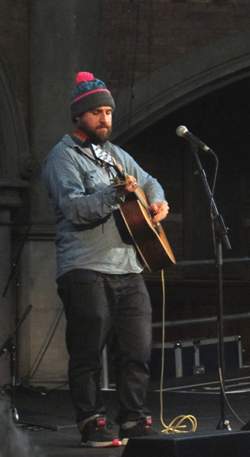
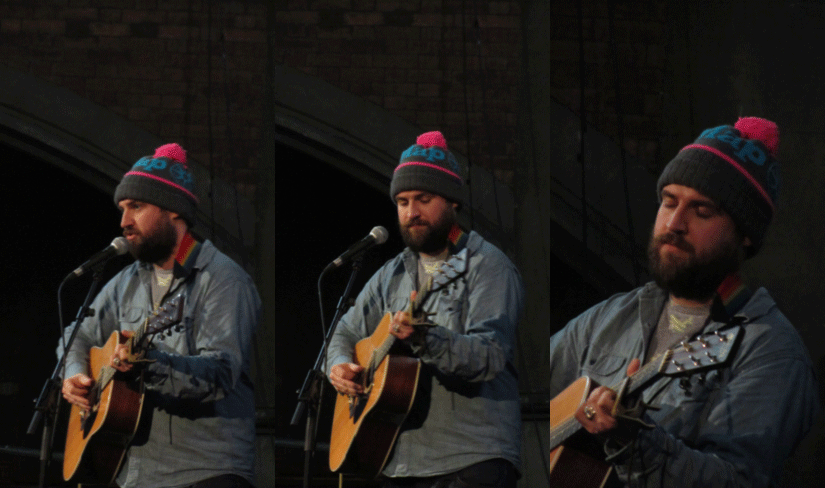
The lone bloke on the bill today, he’s a manic sweating ball of cheerful energy: a short-legged fisherman figure, bobble-hatted, bristling of beard, remarkably charismatic. He’s dressed less for the Chapel’s mild wintery chill than for stiff sea breezes. He teases us with wry digressions. We tease him with friendly heckles, which he cheerfully fields and slings back at us. It feels as if we’re in a conspiracy together. He might want to make us blub, but he’s also got some bobble-hats to sell us; and, perhaps, some more things to share.

Having spent a heroic decade up in Fife (helping his erstwhile buddy King Creosote to run the D-I-Y folk initiative Fence Collective), Johnny moved on a year or so ago when the wheels came off Fence’s cart. Precisely what happened, and who’s in or out (or indeed, exactly what “out” means) is still a little vague – a gentleman’s disagreement, it seems, involving a metaphorical exchange of keys and a certain amount of clumping around before it was settled. Now Johnny’s on the other side of Scotland: settled on the Isle of Eigg, building his own house and his own new label, Lost Map. Expect no backbiting. Any scars from Fence seem to have been shrugged off. He’d prefer to show us his engagement ring, joke about London trains, and enthuse about Reeves and Mortimer’s bollock-tugging. He seems to enjoy sharing. Johnny’s come the best part of six hundred miles to entertain us for free. He seems happy with that too.

Cheerfulness – even that particular, mordant, Scottish cheerfulness-with-an-edge – isn’t something you’d usually associate with The Pictish Trail. On record, Johnny squashes cheap, startling synth-and-drumbox noises into his homemade recordings, ending up just as crumpled and experimental as The Middle Ones are. Suggestive and disfocussed, Pictish songs usually sound as if they’ve been recorded onto rubberized burlap. Blipping, spurting, gacking and murmuring from the shadows, they’re often both sinister and exhausted. When Johnny rolls them out in this more portable live setup (just voice and steel-string guitar) he has to steer them back towards traditional singer-songwriter territory. Fortunately, they make the crossing with some of their eerie magic intact. Settling back onto the barer uplands of acoustic folk, they touch down lightly but tellingly: a drift of plastic supermarket bags with freshly-scrawled stories on them.

Johnny’s voice – a high, carrying thing – comes across far better than it does when it has to wend its way through the fuzz and interruptions of his gizmos. It lifts and drops like a dying wind, going from thistledown-tender to elevated keen. While this wood-and-bare-wires version of his work has a few stray echoes of John Martyn in its brooding fingerpicking dynamism (and in Johnny’s own stealthy charisma) he shares with Alisdair Roberts a reluctance to play the polished singer-entertainer offering up something bonneted and twee, preferring instead to go and dig for ghost-songs and ancient patterns and to float them back into the present. I can also hear faint echoes of the Celtic impressionism which feeds, variously, Van Morrison, The Bathers and The Blue Nile – songs evanescing out into misty thinness without ever losing their emotional impact; or those deliberate, savouring steps that Johnny takes away from the expected path or the finishing point. It’s also there in that dusting of pervasive melancholia, settling without ever hardening into crude sentimental crusts.

Banter aside, Johnny’s working in serious territory. His songs carry plenty in them – much of it sorrowful – but much of it contained in verbal texture and suggestion rather than a straightforward lyric. He gives us deliberately blurred, inconclusive tales and narratives, dissolved down to elusive scraps and evocative fragments. Often, the songs seem to be rolling over in bed, as if driven by unquiet sleep. The Handstand Crowd, a sad soft account of isolation (“a party that everyone’s going to… / I’m staying at home… / you shouldn’t expect the worst, / it’s what you deserve,”) gradually deepens from its lonesome indie-folk mope and saturates with hallucinatory paranoia, like a napkin filling with dark water. “I can’t hide – / there’s no reason to your shadows closing in. /Oh, sordid silhouettes appear tonight… / he is tapping at my window.”

Johnny Lynch, a.k.a. The Pictish Trail.

Pictish brood.

Earlier on, Johnny’s been singing unsettling suggestions which spiral straight out of childhood nightmares – “You know what’s good for you? /To leave the puppets in their cupboard with white sheets around their stomachs, / like they’re standing up in bed – are you sure they’re not dead?” Getting through these hauntings seems to be the greatest triumph (“Good morning, I don’t care… / I’m still alive, / I’ve waited the longest night.”) A little later, Johnny will introduce The Lighthouse as a tale “about a lighthouse keeper – he starts turning off the light and watching people die.” We chuckle along with him at the cheesy Gothic suspense story this brings to mind. The song – when it arrives – is a vision of the paralysis which chews away at a person’s responsibility and sense of connection. “I collect these thoughts…, / my lighthouse keeping the sun switched on… / My days I sleep alone; my nights I turn to stone… / and I watch you struggle – oh, I watch you struggle.”

A fervent, thoughtful cover of Graham Coxon’s A Day Is Far Too Long fits right into this lowering milieu, like a stone sunk into a wet beach. “On sticks and sand, lost my money, lost my hand. / Blood on my brain, too much salt in my veins, / and I thought pain was clean, and I thought hearts were strong, / but bones aren’t sticks anymore, and a day is far too long.” On I Will Pour It Down, the story that Johnny’s telling meets a flood of rural imagery and blurs right into it – “to the edge of time, I ride my bike to the sea – the colours of the fields, the glow when they start burning. / I’m calling in the cows, the horses and the sheep; / I’m calling in the light and the years.” Merging into a psychedelic tributary to a mass of time and landscape, it doesn’t quite dissolve to the point where Johnny’s hints of reproach dissolve as well. “If I was the sun I would not hide behind the cloud. / If I could rain, I would pour it down, / I would pour it down. / I would pour it down on your town.”

The Pictish Trail, ensconced in the Chapel.

Lynch faces the mob…

This afternoon’s all-acoustic version of Wait Until is dedicated to Trigger from ‘Only Fools and Horses’. Another gag. We probably need it. It’s one of the first songs that Johnny wrote after the death of his mother – one which seems to mingle a helplessly dependent love song with a dreamscaped murder ballad. The original electrobeat-chiller version (with its stark, unsettling video of a stricken and glowering Johnny presiding over a basement full of hard-faced dancing schoolchildren) is almost too much to take on. Today, unplugged and unpropped, Johnny quietly underplays it; and while some of its furious edge melts away, its shifting painful core remains. “Wait until I arrive to tell me you’re going away / to tell me you’re so sorry. / Can we wait for water one last time / until the water covers our mouths? and our eyes, our eyes, our eyes. / Wait until your last chance to say goodbye, goodbye, goodbye.” Grief and violence thread inexorably together, betrayal merges with extinction. “I’m pushing you over so I can’t get up, I’m pushing you in fast so I can’t pull you out… / Oh the crime, the crime – / cover for me, cover me in your love, your love. / Tell me of your love, stay here my love.”

If you’re listening to the noises, it’s no more than a sad and sorry breath in the heather. If you tune in properly, it’s a primal scream. Maybe Johnny’s stand-up act – all of that friendly swashbuckling wit – isn’t just charm, but necessity. Maybe the gags and the friendly buffets are there to stop him, and us, from falling into the songs. In between two numbers, he delivers another quip: we laugh, and he grins like a flying cannonball. In another song, he asserts “I will just talk behind my stories and tell my life, spill my guts / I couldn’t live more, feel nothing at all – I live, or not.”

On the other hand, maybe he’s bearing witness rather than using his audience as a confessional. Those Scots intonations, soft and human, are rolling over a greater darkness – rain-stippled postcard beauty hunched on top of frowning granite. As with Iceland, the Hebrides (and Eigg in particular) have a reputation for hard-bitten common sense coexisting with the numinous and dangerous. I don’t know how much of that is true – you’d have to ask Johnny, and what’s true for Eigg might be less true in Fife, where some of his stories were born. It’s certainly true that Pictish Trail songs, however vague or mumbled, have been striped through with a fearful beauty and with a sense of inexplicable forces. The characters within them, even when they’re from this day and age, seem to tread old grooves of ritual and remembrance, weather and wake. Their new sorrows fall, naturally, into ancient places.

As Daylight Music ends for today, Johnny’s out at the front doing the meet-and-greet. People – little children, grandparents, students, young mothers – flock around him like happy birds. Some of them seem to have bought his bobble-hats, some haven’t. He looks overjoyed either way, as if there’s nowhere he’d rather be than here, enthusiastically making contact. Whatever ghosts and forces may have reared up as he sang, he himself looks far from haunted.

***

What? Oh yes…

The other half of the Lost Weekend, in which three other bands played on the following day down at the Hangover Lounge? We didn’t make it. Sorry – the weekend swallowed us again. I could try to make some comment about conceptual continuity here, and pretend to be pleased with it, but I’m too annoyed and embarrassed that we didn’t try to travel a little further, just this one time. It’s not as if we didn’t have some good examples to follow. We chickened out. I’m going to have to blame it on those bloody weekend timewarps.

(What a lame ending for a review. I need a drink.)

The Middle Ones online:
Homepage Facebook Twitter Bandcamp

Freschard online:
Homepage Facebook MySpace Bandcamp Last FM

The Pictish Trail online:
Homepage Facebook Twitter MySpace Soundcloud

Daylight Music online:
Homepage Facebook Twitter Soundcloud

The Hangover Lounge online:
Homepage Facebook Twitter

Thanks to Andunemir for all of the videos.

SWOONAGE

Swoon. /swo͞on/ A verb. To be emotionally affected by someone or something that one admires; become ecstatic. Here are some people and things that make me swoon. #swoon #swoonage

Post-Punk Monk

Searching for divinity in records from '78-'85 or so…

theartyassassin

...wandering through music...

Get In Her Ears

Promoting and Supporting Women in Music

Die or D.I.Y.?

...wandering through music...

Music Aficionado

Quality articles about the golden age of music

THE ACTIVE LISTENER

...wandering through music...

Planet Hugill

...wandering through music...

Listening to Ladies

...wandering through music...

ATTN:Magazine

Not from concentrate.

Xposed Club

improvised/experimental/music

The Quietus

...wandering through music...

I Quite Like Gigs

Music Reviews, music thoughts and musical wonderings

furia log

...wandering through music...

The Recoup

SINCE 2013: Books and books and books and books and occasionally other things

A jumped-up pantry boy

To say the least, oh truly disappointed

PROOF POSITIVE

A new semi-regular gig in London

Gapplegate Classical-Modern Music Review

...wandering through music...

When The Horn Blows

...wandering through music...

:::::::::::: Ekho :::::::::::: Women in Sonic Art

Celebrating the Work of Women within Sonic Art: an expanding archive promoting equality in the sonic field

Ned Raggett Ponders It All

Just another WordPress.com weblog

FLIPSIDE REVIEWS

...wandering through music...

Headphone Commute

honest words on honest music

The One-Liner Miner

...wandering through music...

Yeah I Know It Sucks

an absurdist review blog

Obat Kanker Payudara Ginseng RH 2

...wandering through music...

poplifer.wordpress.com/

Waiting for the gift of sound and vision

Good Music Speaks

A music blog written by Rich Brown

Do The Math

...wandering through music...

Archived Music Press

Scans from the Melody Maker and N.M.E. circa 1987-1996

The World's Worst Records

...wandering through music...

Soundscapes

...wandering through music...

OLD SCHOOL RECORD REVIEW

Where You Are Always Wrong

FRIDAY NIGHT BOYS

...wandering through music...

Fragile or Possibly Extinct

Life Outside the Womb

a closer listen

a home for instrumental and experimental music

Bird is the Worm

New Jazz: We Search. We Recommend. You Listen.

...wandering through music...

Life Just Bounces

...wandering through music...

Lucid Culture

JAZZ, CLASSICAL MUSIC AND THE ARTS IN NEW YORK CITY

Aquarium Drunkard

...wandering through music...

eyesplinters

Just another WordPress.com site

NewFrontEars

...wandering through music...

FormerConformer

Striving for Difference