November 2008 – single & track reviews – Everything Everything’s ‘Suffragette Suffragette’; Solange’s ‘Sandcastle Disco’; William Control’s ‘Beautiful Loser’

24 Nov

Harkening back to 1980s art rock without being absolutely in hock to it, Manchester’s Everything Everything announce themselves with a single that puts a little fizz under the brain. Two stuttering guitars chatter over a rolling melodic bass part and tight disciplined drums; bursts of sweet harmonies offset awkward subjects. A super-literate wandering lyric repeatedly crosses back over its own tracks via wordplay, deliberate overthinking and self-mockery.

Thirty years ago, Everythings’ singer Jonathan Higgs – a brainy, twitchy, hectoring choirboy – could have slotted in neatly alongside post-modern post-punks like Edwyn Collins, Paddy McAloon, Green Gartside or Paul Haig, engaging deftly with more profound ideas and a brainier school of pop. These days he’s mostly got Alex Kapranos for company; but what sets him apart from his forebears and peers is that tone of a febrile urgency only just held in check. Everything Everything definitely have a sense of humour, but it’s also pretty clear that they pick serious matters, appreciate them, and choose to siren them out in a scalding and beautiful falsetto.

‘Suffragette Suffragette’ is a deliberately jumbled, deliberately uncomfortable boy-reaction to navigating the politics of feminism, and of attachment, while not laying down a straight party line. On the surface, Everything Everything might have a preachy pitch, but while they’re eager to dig up these thorny issues, they’re not going to lecture about them; rather, they’ll illustrate them in a variety of shifting voices and complex characterisations. Railing in character, Jon frets over mixed social and sexual signals, and an innate inability to process them.“When she casts off her clothes, I don’t know what is reality. / And my death throes, this indefinite pose, / her flesh codes inconceivable. / Oh, suffragette, suffragette, / I wanna be outlawed and AWOL. / No alphabet can be used yet; / no cassette is available. / Oh, I dunno how, I dunno how, / I’m gonna reset my whole radar.”

A querulous little guitar lick (like a frown crossing a forehead, or an interrupted gesture of doubt) keeps imposing itself on the tune. A great dumb metallic crunk of riffage repeatedly gatecrashes the chorus. The chorus itself is the whole band carolling “who’s gonna sit on your fence when I’m gone? / Who’s gonna sit on your fence when I’m not there?” (with “fence” sounding suspiciously like “face”). The whole song ends up as a huge stage wink being made about – and to – male awkwardness; but elsewhere Jon is busy spicing up the pot by spilling out quick, slippery lyrical gags about mediaeval humours, dog food and Electra complexes. The good news is you can sit down and unpack all of this while still humming the hooks. The bad news is that we’re going to have to wait a while before we hear any more.

For the moment, though, we have a startling B-side, ‘Luddites and Lambs’. A word-avalanche set to a sort of heavy-metal/prog Prefab Sprout tumult, it tears off in a fugue of multiple directions – carnality, car-crashes, evolution, pathology, even a cameo appearance by Girls Aloud. Lyrically, they’re grabbing a camera, pointing it at a situation, and violently zooming it in and out in order to capture absolutely all of the factors seeping in and bleeding out. Either that, or they’re determined to blow up scenarios and point excitedly at their atoms, while the guitars crash and bounce around them like splintering shale. Either way, they seem intent on bringing their own brand of New Complexity into pop music. It’s as thrilling as it is confusing.

Following up on her loving detailed tribute to ‘60s soul pop and girl groups back in February (on ‘I Decided’), Solange’s ‘Sandcastle Disco’ continues along similar lines. Classic Motown, Shirelles and Shangri-Las sounds are carefully re-honed with touches of contemporary R&B electronics, but with the hip hop firmly sidelined. Straddling R&B history, it draws on more decades than simply the ‘60s: producers Soulshock and Karlin originally made their mark with CeCe Peniston, Monica and Brandy back in the 1990s, while there’s also more than a few little touches from the Scandinavian Anglo-pop explosion of the last ten years; with co-writer Cee Lo Green bringing just a hint of Gnarls Barkley revivalism to the stew.

Most of it, however, is Solange herself in the present – directing a lively video which puts a contemporary CGI spin on all of those early green-screen seventies clips of tiny pop stars dancing on gigantic instruments; and, more importantly, delivering a song which doesn’t rely on its production dress-up to be on target. ‘Sandcastle Disco’ has upbeat insecurity. It has vulnerability delivered on top of a crisp, subtly muscular beat. “I’m a cool old Jane with the skip on my feet. / I play tough as nails with my heart on my sleeve,” sings Solange. “I’m nothing but a sand castle / Baby don’t blow me away, away.”

A brassier Freemasons Club mix puts some smack, sirens’n’stutter back into the atmosphere and sharpens the intent, but it doesn’t particularly reveal anything that wasn’t in there before – strong bones under the dropping of guardedness, a plea before the dice roll but one which won’t stop them being rolled in the first place. Admittedly it still sounds like a consolidation as Solange finds her developing voice (despite the lines which hit the money, a few of the other lyrics come across as fumbled factory off-cuts), but as stepping stones go, this is a lasting one.

Thinning his eyeliner, dropping his pitch and sinking waist-deep into a buzzing, drum-flailing electronica sound, William Francis (from upbeat Pacific seaboard horror-punks Aiden) has become William Control. ‘Beautiful Loser’ takes its title from Leonard Cohen and its spurt of morbid lyrics from any number of death-cult pop-rant traditions as William yells on about self-ending and terminal dances. “One last kiss before they cart me away / and just take one last look before my body decays. This is my last night on earth / My fucking hell. / All my life, all I’ve wanted to say / This is love, love, love, while the symphony plays. / Here in death, I would cut my breath just to stay. / I’ll never love again. / Take the vision away.”

Of course, it’s all accompanied by a compulsive stomping floor-filler of a tune, and it’s hard to immerse yourself in a genuine death spiral when you’re wanting to get up and monster-mash, a belligerent grin on your face, to a slasher beat like this one. William says that the William Control project allows him to express “dark lyrical content” which won’t work with Aiden. I think he just wants to keep his corpse paint on while escaping from the tinniness of pop-punk.

This single blazes with an arrogant energy, belying its end-of-the-line posturing. William’s not heading down; he’s stepping up while turning up the heat under the broiling dark energies and warped romanticism that energize and preserve goth culture and can make people like him figureheads. He knows exactly what he’s doing.

Everything Everything: ‘Suffragette Suffragette’
Salvia, TIC 008 (no catalogue number or barcode)
7″ vinyl single
Released:
24th November 2008

Get/stream it from:
(2022 update) Original single best obtained second-hand; downloadable/streamable from Soundcloud, YouTube, Tidal, Amazon Music; as part of ‘Man Alive’ album, also on Apple Music, Deezer, Spotify

Everything Everything online:
Homepage, Facebook, Twitter, Soundcloud, Instagram, online store, Bandcamp, Last.fm, Apple Music, YouTube, Deezer, Tidal, Spotify, Amazon Music    

Solange: ‘Sandcastle Disco’
Geffen Records, 1792377 (602517923775)
CD single
Released:
24th November 2008

Get/stream it from:
(2022 update) CD single best obtained second-hand; downloadable/streamable from Apple Music, YouTube, Deezer, Tidal, Spotify, Amazon Music

Solange online:
Homepage, Facebook, Twitter, Instagram, Bandcamp, Last.fm, Apple Music, YouTube, Deezer, Tidal, Spotify, Amazon Music 

William Control: ‘Beautiful Loser’
Victory Records (no catalogue number or barcode)
Download-only single
Released:
24th November 2008

Get/stream it from:
(2022 update) Original download no longer available; streamable on YouTube; as part of ‘Hate Culture’ album, also on Apple Music, Deezer, Tidal, Spotify, Amazon Music

William Control online:
Homepage, Facebook, Twitter, Soundcloud, Instagram, online store, Last.fm, Apple Music, YouTube, Deezer, Tidal, Spotify, Amazon Music

October 2008 – album reviews – Darkroom’s ‘Some of These Numbers Mean Something’ (“once engaged in perpetual fall, now they roam”)

10 Oct

Darkroom: 'Some Of These Numbers Mean Something'

Darkroom: ‘Some Of These Numbers Mean Something’

Perhaps the passage of time forces a shape on what used to be abstract, giving it some meaning. Perhaps Darkroom just got tired of toying with slow nebulae and with clouds of diffused adrenalin and panic. At any rate, the Cambridge dark-ambient duo (now based around Hertfordshire) are changing. Their first full-release album since 2002’s ‘Fallout 3‘ sees them producing a very different music from the leashed chaos of their first decade. Those looming, passive-aggressive electronic thunderheads and those forbidding razor-smears of guitar are easing into a sweeter mood.

There’s also the question of how that passage of time works the same effect on people as it does on bands. In many respects, watching Darkroom evolve has been like watching – in extreme slow motion – the unknotting of a glower. Whatever the image, there’s always more to electronica artists than their boxfuls of clicks and drones or their “take-it-or-leave-it” detachment from their completed music, for which the finely-honed details of a recording (rather than the performance within) is the ultimate statement. For Darkroom, perhaps this is closer to the surface than most. The group has rarely, if ever, been sought out for interview, but anyone who’s taken the trouble to talk to them has encountered soft-spoken yet determined men keeping a tremendous exploratory brainpower in reserve. While no-man singer Tim Bowness was part of Darkroom (howling wordless imprecations and grand voice fragments, a guttering horror-struck Lucifer tumbling through a churn of collapsing stars) much of this emphasis fell on him. With Tim long-since melted out of the picture, any such curiosity has to move in on the remaining Darkroom pair and what they might be bringing in.

It becomes more interesting, for example, that synth lynchpin Os programs (as Expert Sleepers) innovative sound modules and methods for other musicians to pursue, and cooks up lighting effects for video gaming at the point where it bleeds into video art; or that guitar-broiler Michael Bearpark’s sinewy textural playing is a flipside to his day-job in cutting-edge computational chemistry. While this kind of hard science hasn’t obviously dictated the form of Darkroom (generally they’ve surrendered to the unknown rather than tried to map it) it does seems that ideas of coloration, reaction, chemical excitement and chiaroscuro are built into the group at a deep and evolving level.

When I originally reviewed ‘Fallout 3’, I toyed with the idea of a kinder, gentler Darkroom, in which the pressured frowns and disorientations of their earlier music relinquished its forbidding edge. Here, this comes to pass. While they’re not exactly rolling over to have their bellies tickled, Darkroom have, in their way, mellowed. A decade into their work, they’ve stopped overwhelming us with gigantic, impenetrable sonic proofs and begun welcoming us with musicality. Though star-stuff is still implied, and they’ve kept much of their cosmic scale and atmospherics, they’ve switched off most of their former barrage of hostile radiation. What comes through now are blushes and bobs of warmth, a new appreciation of carefully worked detail. With Michael’s recent embrace of acoustic guitars (and the deployment of drummer Andrew Booker as a new group foil) we also get the sound of physical velocity, friction and fingerprints; of hands on sticks, gut and wood as well as electronic triggers. Where they once engaged in perpetual fall, now they roam.

Their 1999 album ‘Seethrough‘ (an unexpected collection of songs recorded while Tim Bowness was still on board and tugging them back towards his own musical heartland) originally seemed like a blip in Darkroom’s career. Listening to the camouflaged melodies and song structures sliding past in ‘Some Of These Numbers…’ suggests that with or without Tim some seeds might have been planted them for later emergence. Bar the vertiginous, unsettling loll of Insecure Digital (a teetering reminder of Darkroom’s roots in echoing noise and psychedelic dub) the music here sounds as if it comes from the heart and not from the more obscure sets of glands. Mercury Shuffle, in particular, rides on a soft and subtle ballad-chord sequence, inspiring rippled melodics. Booker, in his most prominent moment on the record, provides a subtle shuffle from which to launch Os’ rhapsodic faux-CS-80 synth buzz and Michael’s batwing-rises of screech-guitar. Beyond the drowsy interplay, the backgrounds show Darkroom at their gentlest: a riffling submarine twang, or space-rock-tinged Americana with a touch of Bill Frisell (and, perhaps more than a couple of echoes of Red River Valley).

While Darkroom have generally been open about their enjoyment of 1970s prog and fusion, and of 1980s pop (as well as the 1990s electronica boom which they both sprang from and dodged) it’s becoming more evident in the sounds they choose and the structures they etch. Album opener The Valley of Ten Thousand Smokes revisits some aspect of the group’s original brutal beauty – a brow-furrowed mumble of baleful sound, its hooded swamp-dragon guitar tones move foggily over a bass-drum thud that’s part hip-hop and part dream-course, as if some of the trancier elements of Pink Floyd’s Echoes were cheek-to-cheeking with the Aphex Twin. Yet it’s also more structured than they’d have allowed themselves before: more painstakingly orchestrated. Treated guitar parts flash over the lip of the tune’s leading edge like a handful of blades, sounding in the deep like Wagner horns or mingling Delta slide with digital interrupts.

A whole rackful of ideas are bound into the album’s title track, which travels from electronics fluttering around elegant classical-styled guitar harmonics via a subtly slowhanded Bearpark melody and bouncing Eurotrance suggestions from Os. These in turn thin out into a post-rock brew of expressive but hidden guitar and a succession of themes, each beautifully suggestive but barely touched upon. They’re like the points of a mathematical iceberg, nudged and smoothed by equally brief musical salutes (an aerial Fripp burn, a little Talking Heads funk) and, towards the end, the crash and hiss of sea-breakers.

While they’re shyly opening out this fan-spread of influences, Darkroom also reveal a new skill: that of touching on and drawing on the times and tones which inspire them without ever getting stuck to them. My Sunsets Are All One-Sided simultaneously revisits the rootless, reborn feel of very early jazz-fusion (before the pulls of groove and tradition dragged it back to something more predictable) and the creeping 1950s curiosity of the European avant-garde. Here’s a gentle Stockhausen toy-chime, eventually discovering its own little medley of small tunes. Here’s a lighthouse-revolve of guitar swells. Here’s a move, by degrees, from Zawinul to Hammer; to a point where a ‘Miami Vice’ bass-synth pulse and subtle Booker cymbalwork grounds Michael’s leaf-fall guitar work, and a shuffling batter of electronic funk is shadowed by the jingle of a roller toy.

Cuddling up with the light celestial touches of ’70s chamber-soul while filtering them through carefully-reserved 1990s arrangements, No Candy No Can Do also hints at the diaphanous mid-’80s tundrascapes on Cocteau Twins’ ‘Victorialand’. Twinkly flechettes of electric piano, slow spins of programmed glitter-dust and a watery Booker shuffle provide the shape, with a countrified psychedelic guitar patrolling the hazy horizon. Hints of dub, apparently played on a toy organ, even makes links to the frayed and contemplative Birmingham exotica of Pram.

The key to Darkroom’s transformation is in Michael’s work on acoustic nylon and steel-string guitars, which bring him down from his cruising altitudes and up from his witches-brew textural bubbling and leave him bare-armed at Darkroom’s forefront. On Two Is Ambient, he’s hooking out a Spanish guitar clang, looping against his own electric drones, warbles and wah-wah cycles and against Booker’s industrial snare and tight cymbals. The latter pulls in yet another layered Bearpark, this one exploring a stepping probing bass sound (begun on the low nylon strings, fretbuzz and all, and ending up somewhere in cavernous double bass territory). Os seems to be both manipulating these sounds with one hand and pushing again them with the other: presumably it’s him who’s responsible for the final chromatic crash and pink noise weirdout. Similarly, it’s Os who throws up the gelid synth-wobble, string-section cycles and speed-oscillation pranks in Chalk Is Organised Dust – a necessary wildcard foil to the loping, snapping drums (part Bill Bruford and part Can) and the snatches of blues, classical double-stops and jazz-bass ostinato which Michael’s now feeding into the tune (as if for ten years he’s been a hostage virtuoso, now finally set free of his leg-irons and running off in a kind of fluid hobble).

Turtles All The Way Down concludes the album on a dry joke. The title’s from Stephen Hawking, via any number of sources. It covers infinite regression (handy for loopers), desperate mythologizing and arguments stretched thin. The music itself is fired off from on the abstract coil of a steel-strung guitar lick in which jazz, blues, minimalism and an awkward all-ways dash combine in a way which would’ve raised a sour grin from John Fahey. This quickly moves into a gnarly munching electric drone, ghostly post-rock keyboards and spacious drum clatter. It’s a last-minute hollowing out of what’s gone before, the sounds and atmospherics recalling the anxious small-hours cruises of Bark Psychosis (sliding past the red lights at 3am, somewhere close to home but never in a stranger place).

It’s as if Darkroom have suddenly stopped, shaken awake, and reminded themselves not to let us settle into too much comfort. Much of the music on ‘Some Of These Numbers Mean Something’ may have dropped out of the previous interstellar char-and-chill in order to embrace a more human-scaled and earthbound warmth. Darkroom aren’t forgetting that the inhuman extremes are still there, waiting indifferently just outside the envelope.

Darkroom: ‘Some Of These Numbers Mean Something’
Burning Shed, BSHED 0408 (5060164400059)
CD/download album
Released: 3rd October 2008

Buy it from:
Burning Shed or Bandcamp.

Darkroom online:
Homepage Facebook Twitter MySpace BandcampLastFM

May 2008 – album reviews – centrozoon’s ‘Blast’ (2008 reissue) (“let the music fall inwards”)

10 May

centrozoon: 'Blast' (reissue)

centrozoon: ‘Blast’ (reissue)

Here’s a tale of escape.

Disciplines become traps: beautiful sounds become honey-traps. This can be more obvious along certain musical paths than others. Two particularly susceptible paths are ambient-synth playing and the underground swell of Robert Fripp’s Guitar Craft. The former can drift towards being a proliferating mass of lonely cells; each of them seeking an individual voice but often, obliviously, stuck in identical textures, wallowing in parallel. The latter follows a rigorous playing method and lifestyle which borders on benevolent culthood. While this banishes the shapeless flab which often devils ambient music, it can err in the other direction. At its best, the Craft births and burnishes exceptional players: at its worst, it produces musicians who devote themselves to obsessively burnishing a constant reiteration of stern, generic Fripp stylings.

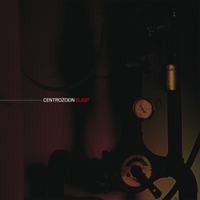
When touch-guitarist Markus Reuter (an accomplished Crafty, and part of the Crafty-dominated Europa String Choir) encountered former Subsonic Experience electronics-coaxer Bernhard Wöstheinrich and formed centrozoon, the team-up had conceptual and practical lineage from both the Crafty discipline and the ambient flood. On top of that, by the time they released their debut album ‘Blast’ in 2000, there wasn’t anything especially unusual in what (on paper) they offered – an alliance of mutant fretboard work and left-field synth-noise, stretched and softened into a minimal ambience. In chasing that direction, centrozoon were following a path which had been trodden since the mid-’70s and the days of… well, Fripp & Eno.

Their peculiar triumph (which is clear even eight years later, with this expanded reissue) was that ‘Blast’ escaped all of the expected pitfalls and mudbanks. It’s not that Markus and Bernhard simply brazened it all out; nor did they overwhelm their listeners by assuming wracked and exaggerated musical personalities. Instead, they opted to simply get out of the way. With minimal shepherding, they let the music fall inwards of its own accord. This sounds like abandoning responsibility, but it’s not. Ultimately, and with the right kind of awareness and attitude, it’s a very effective way of letting the music take its own shape.

On a superficial listen, ‘Blast’ isn’t an obvious leap into the unknown; nor is it immediately shocking, then or now. Each of the four pieces on the original release could conceivably see the same use as other ambient experiments – a gloss for cosmic afternoons; sonic wrappings for art installations; chemical soundtracks for intellectual stoners on introverted afternoons. As for immediate originality, let’s say that Fripp fans enthralled by the oceanic, ambient-improvised textures of Soundscaping will find plenty of pleasure here. In particular, the widening ice-vapour agglomerations of Markus’ Warr Guitar textures in Empire are an immediate homecoming. As they stretch near-subliminal fingers out into the void, they’re subtly transformed by Bernhard’s lullaby synth-pulse; moving from austerity into something like the hopeful whistling of a small boy in the rain, safe in a shapeless optimism.

Transformation is a key process here. Markus’ extreme processing and honing of his Warr Guitar touch-playing into textural drifts and folds, all sounds of strings and fingers worn away; Bernhard’s unschooled musical impulses becoming constructive. Most significantly, their effect upon each other – formalist liberated by upsetter, randomiser cradled by knower.

Markus might dominate Empire – however passively – but it’s Bernhard (the part-time abstract painter) who leads the more baleful Sign. Here, the low buzzes and wah-swells of synth gradually open up into a mournful piece of grand European ambience. For Crafty guitarists and King Crimson fans alike, this is the most Frippertronical piece on the album. That said, Markus eschews any of those intensely compressed Frippish emotions in his playing. Instead, his touch-guitar yields little more than a distant, echoing subway-tunnel ambience. It pulls the listening ear after it, as if co-opting it into the pursuit of an invisible stranger who’s only just out of reach; or a far-off footfall which must be caught up with.

Even this early in their career, it’s the ability to trigger that kind of unsettling mood and engagement in the listener that set centrozoon apart, and eased them out of those Crafty/ambient straitjackets. Their eerie approach to layered tonality may have had its similarities to the Fripp approach, but it’s been taken a few steps further along. Blank and unsettling, it feels like a kind of purposeful decay, a deliberate whittling-away of what underpins expectations and security: hollowing it out only slightly, just enough to make a change that’s sensed. As a listener, you venture out onto it, but the sound of the settling structure disturbs you.

In many respects, time has left ‘Blast’ strangely untouched, and for all the right reasons. The Fripp & Eno analogy still holds, not so much over sound and mood, but over how Markus’ discipline and rigorous self-schooling and Bernhard’s iconoclastic instincts meet and envelop each other. Even at this stage, they’re astonishingly well integrated. It’s difficult to look at their work looking for cracks in the method. Unified and unruffled, it stares back at you, and it’s you that blinks first.

More self-conscious (or perverse) than the other tracks on the record, the hooded, atmospheric Sense cops a few tricks directly from 1980s art-pop. Sparse lines and pared-down chords of electric piano recall the pairing of Richard Barbieri and David Sylvian. A upfront electro-pulse (OMD meets ’90s techno) is carved up into a jazz shimmy, while Bernhard’s bloopy electronic punctuation sounds like nothing so much as a Simmons drum set catching the cheesy hiccups. All of these are eventually upended when Markus sets aside his Invisible Man approach in favour of a growing grind of slow-motion garage-static. In parallel, Bernhard’s underlay of sound gradually becomes more and more unstable and less and less comforting; eventually it hones itself into a subtly disturbing sheath of noise.

On the original ‘Blast’, Sense was the disruptive moment. Power – a held-back track from the album sessions, now restored to the reissue – demonstrates that it wasn’t as much of a one-off as it seemed. Post-‘Blast’, centrozoon would begin several years of thorough engagement with dance music (actually, a kind of wilful grappling) which would flower in 2003 with the thumping techno-prog drive of their ‘Cult Of: Bibiboo’ album. Three years earlier, Power anticipates this and delivers an early take. Its rocking knock of rhythm and Bernhard’s dirty twangs of synth are a shift towards the dance-floor, away from icy dreams. Markus’ misty blurs of Warr playing are more direct and sharpened than they are elsewhere on the album, roaming purposefully behind the electronics like a searching headlight. The musical layers climb eerily, growing into an alarming constellation of eyes as Bernhard works in a march-rhythm built from a racheting percussion pulse. Nine minutes along, the beat courses away and the music planes on into ambience and a slow fade of atonal spirals.

Placed at the end of the reissue, Power supplants the title track of ‘Blast’ as its grand finale. Drawing attention to the band’s drive onwards to its dance phase makes some historic sense, but it also displace the album’s original emotional core. After the disruptions of Sense, Blast doesn’t immediately seem disturbing. For a long time it remains as beautifully eerie but conventional textural ambience. It hovers around the same close, elongated and barely-there notes like steam in a cathedral aisle, coiling itself backwards in the winking lights from the synths.

Over seventeen minutes Markus and Bernhard gradually, imperceptibly marshal the potential of horrific awe that’s within the music until it’s staring you in the face. Its intensity is subliminal, its aghast tone somehow removed from imminent peril. The horror here is backwards-looking, specifically European and instinctive, reeking of a darker history without ever clarifying what that is. This could be just soundtracking; but if so centrozoon have found silent films of overwhelming cataclysm to channel the music for. At a pinch, it could be cathedral music – if so, the building’s traumatised ghosts have crept out for a whirling pageant of blood and fire. It could be a troubled, unanswerable requiem; if so, this one’s for a calamity that’s overtaken even God, even memory. There’s something about it that emphasises the absence of words, of the shapes that make sense. It’s less the blast, and more the invisible and unexpected shockwave – like a glimpse over the shoulder at the terrible beauty of impelled destruction.

In the coming years, centrozoon would prove themselves far more mercurial and direct than the music on ‘Blast’ suggests. Compared to the hammering pulse of ‘…Bibiboo’ or the leaping, detailed art-pop of ‘Never Trust The Way You Are’, ‘Blast’ now sounds like hidden music, or perhaps hiding music: Bernhard and Markus remote almost to the point of vanishing, keeping their skills on a low bleed. Even here, though, there’s a determined stamp that set them apart from the noodlers and set them on course – but that’s not all. There’s still something special about ‘Blast’ and its ability to etch such hauntings out of such hushed musicality.

centrozoon: ‘Blast’
Unsung Records/Inner Knot Records, UR004CD (4260139120307)
CD/download album reissue
Released: 9th May 2008 (originally released 2000)

  • Followed by: ‘Sun Lounge Debris’.

Get it from:
Iapetus Records or Burning Shed (CD); or Bandcamp (download).

centrozoon online:
Homepage Facebook Twitter MySpace Bandcamp Last FM

June 2004 – live reviews – The Cox Cruise @ MV King Arthur, floating along the River Severn, Gloucestershire, early summer 2004 (featuring Earnest Cox, Ghosting, Charlie Says, Michael J. Sheehy & Paddy McCarthy of St Silas Intercession, Datapuddle) (“a self-propelled music bash”)

30 Jun

All we can see outside in the dark are moving, ghostly fronds – foliage bleached by the passing light spilling from our boat, nodding in the gusting winds above the lap of water. We’re on the river at night. We can’t see where we’re going, and we’ve entrusted our safety to a group of people with the seedy, ingratiating collective name of Earnest Cox. Things look bleak.

“It’s ‘Nam, man!” some joker screams suddenly. “Charlie’s out there, and he don’t surf! We’re all gonna die, man!”

He’s greeted by laughter. It’s all far, far too English for any of that: those nodding leaves we’re passing are in quiet Gloucestershire, and the River Severn isn’t winding us towards the heart of darkness… not unless Bristol’s having a really bad Saturday night. The double-decker boat we’re riding – the MV King Arthur – has been hired from the National Waterways Museum, and in under four hours we’ll have looped back to its safe berth in Gloucester. On the way, we’ll be enjoying a self-propelled music bash featuring the aforementioned Coxers and a little circle of related bands from Gloucester and London. There’s even a raffle. Cosy.

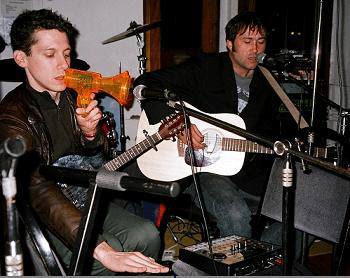
Had we set out a little earlier in the summer, and during the day, it would have been picnics and beer all round by now. As the red and gold lights of a jolly riverside pub bob past like a luminous Johnny Walker bottle, it’s clear that any actual weirdness will need to be handled by the bands. Crammed onto chairs on the makeshift band stage wedged into the top deck, Datapuddle do what they can. Alex Vald (who once played filthy guitar for Dream City Film Club) cradles an electric mandolin across his chest like a sulking cat. When not distractedly plucking and strumming at it as if he were plucking a chicken, his hands dart restlessly towards a litter of electronic gizmos on a table: a virtual theremin, a cheap sequencer, a plastic voice-changer and other bits of toy-box guts. Stephen Huddle plays sketchy acoustic guitar and pushes broken murmurs and mumbles of song up into Alex’s cobwebs of sound.

Datapuddle at The Cox Cruise

Datapuddle at The Cox Cruise

What ultimately emerges is a lo-fi cat’s-cradle of strung-together and slightly strung-out elements. Tidal dub; debris and dusty notes swept out of an Irish-American bar; bits of memory and reaction scattered like dandruff – all glued by static electricity and misfiring synapse energy to the guitar strings of a long-fried singer-songwriter. “Here’s a little sea shanty,” says Stephen brightly. A water-blip of electronics merges with a Lloyd Cole chug of guitar, rocking it on its rhythmic base. Alex buzzes a harmonica into an overlapping backwards loop, transforming it into a reversed melodica.

On the next song, trip-hop snare-drum smoke merges with psychedelic space whisper like the first skunked-out collision between Portishead and Hawkwind. Alex’s mandolin maintains a relentless, disappearing clang like a freight train bell, while Stephen mutters like Tom Waits ruffled from deep sleep. Peril – another shaggy-dog shanty written especially for tonight – namechecks the Severn amidst its steam-train chunter of knocks, old-school electro breaks, and harmonica rasps. “Don’t buy the brown acid,” Stephen sings, channelling up the confusion of a different party as ours sways cheerfully along the river.

Datapuddle come to a purring end with lashings of electric theremin wibble and a lengthy musical chew on a genuine melodica which has surfaced from their box of battered goodies. Watching them was like watching someone scrabble a shack together out of estuary trash and flotsam. In its way, it was just as raw and triumphant.

Paddy McCarthy & Michael J. Sheehy at The Cox Cruise.

Paddy McCarthy & Michael J. Sheehy at The Cox Cruise.

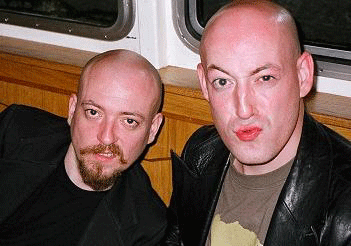
While the upstairs audience return to conversation and shore-spotting, Michael J. Sheehy and Paddy McCarthy are down below decks mopping up the leftovers (along with any beer that’s available). Cuddling a pair of honey-blonde acoustic guitars, the brothers from St Silas Intercession (and, previously, Dream City Film Club) have wedged themselves into a corner to hammer out rough’n’ready London-Irish punk blues as brutal as paving stones and hard-luck sneers. Eventually they’re joined by a wandering harmonica player and by a growing crowd of boozy party stragglers. Before too long, the corner turns into an enthusiastic trash-music shebeen (staggered over the changeover times between the acts upstairs) during which everyone’s treated to rattling, spat-out’n’spattered takes of the songs from the debut St Silas EP, starting with the vicious roar of You Don’t Live Here Anymore.

St Silas Intercession’s music is a London echo of the brutally direct and bluesy garage noise still spilling out of Detroit (and all of the little Detroits that have sprung up in the wake of Jack White or The Dirtbombs). Venomous as a dirty flick-knife and as blunt as masonry nails, it’s some way down the evolutionary tree from the corrupted sophistication of Sheehy’s recent songwriter albums, or even from the trawling sleaze of his old work with Dream City Film Club. Obviously the man himself couldn’t give a shit about all that: judging by the twinkle in his eyes and in Paddy’s, as they face each other off over sprawling riffs and hollers, they’ve rarely been happier with their music than now.

Paddy McCarthy at The Cox Cruise.

Paddy McCarthy at The Cox Cruise.

The brute-blues meanness of Get My Share has a good hard whiskey sting to it; as does the defiance of Caravan Rock (“me and my kids and their mum, / living in a caravan, moving on, moving on…”). A lacerating spurt through All About The Money sets people bobbing, scrambling and bouncing as well as a seven-and-a-half foot deck ceiling will allow. But as Paddy’s permanent goofy cartoon grin indicates, the St Silas brothers never take themselves too seriously. “It’s always about the money!” Michael protests, through a cheap megaphone. His voice suddenly jumps tracks from Louisiana bawl back through his London grit to an ‘EastEnders’ stage-Cockney. “You sla-a-a-g!”

Back upstairs, a dirty blonde in a cute plush cap is hammering a comradely nail into Mr Sheehy’s coffin. “Michael slags me off in his songs, and I slag him off in my songs,” explains Charlie Beddoes. Then she bowls us the rapaciously scornful putdowns of Vitriolic Alcoholic which kerb-kicks a snarling addict with a series of offhanded verbal wallops, culminating in “do I look like I give a toss? / It’s not my problem, not my loss.” It’s good to have friends.

The determined, diminutive Charlie is both the figurehead and the core of the shifting cult-of-personality that calls itself Charlie Says. Tonight, they’re three boot-babes and a moll-boy. Backed up by sidekick Ben Fisher’s car-crash guitar and by Lian and Kim Warmington’s ice-diva backing vocals and cool basilisk stares, Charlie plucks a remarkably articulate bass, sings like a breezeblock with lipstick and thuds out middle-weight girlpunk. Not short of charisma, Charlie holds the audience in the palm of her hand. The trouble is, she then rolls them around as if she doesn’t quite know what to do with them.

There’s a big difference between true punk and mere punk-ertainment, and Charlie Says wander a bit too close to the latter end of the scale. While Charlie’s former background in hip-hop art-rockers Rub Ultra is promising, discovering that both she and Ben are recent refugees from the touring band of tech-rocker Martin Grech pokes some suspicious holes in their lo-fi rebel stance. It just makes their music seem a little contrived. Not that the songs always help: It’s All About The Music is just another me-and-my guitar anthem, and Hey Leadfinger, Why You Gotta Keep Putting Me Down? is a foray into garage-blues which is far less interesting than its title is.

What pulls the band up out of fun-punk poseur-world are Charlie’s bright flickers of blunt humour and determination. The girlpower swagger of Venus Envy suddenly flings out “if the balls are in our court, then at least we have some,” while This Is Not My Story claims “whichever way it lands, my heart will keep on beating.” Little gems of lead-pipe wit and guts like this are what will make Charlie Says special; not desperate attempts to hitch onto whichever punk or garage soul flits past next. For the rest of the evening, I see Charlie perched here and there around the boat – beaming with life, always as if on the verge of delivering another breezy wisecrack. Let’s have more of that.

For all their efforts, Charlie Says don’t make me want to riot. Ghosting do… but I’d be rioting on their behalf. Five more minutes of hearing boozy party blabber drown out their beautiful, beautiful songs and I’d be flinging bottles around myself. Ghosting are heartbreakingly soft – as vulnerable and resilient as fresh grass bending underfoot. Unlike any other band this evening, they create little pockets of pure songcraft which you need to crane your head into to find out what’s going on.

Upfront, Dan Pierce picks out gentle acoustic guitar arpeggios which ride up into the atmosphere like thermals, and lets his voice follow suit. In the corner, wedged into a little cage of half-drumkit, laptop and miniature keyboard, George Moorey handles the rest. Intent and anxious-looking, he peers at his screen like a nervy microbiologist watching a virus proliferate. In fact, he’s just making sure that the sounds arrive on time – making tiny triggering adjustments to a mouse, reaching out one hand to roll off a gentle peal of Blue Nile piano, or swivelling to make precise soft taps on cymbal and snare with the single drumstick he holds in his other hand. It’s like watching someone play a one-man-band suit and conduct an orchestra at the same time. Yet even more impressive than this deft and diffident juggling act are the way Ghosting’s songs pool in the atmosphere – gradually, quietly filling up the space.

Dan’s big genial frame contains a songwriter’s spirit of rare and seductive delicacy. Faced with a chattering crowd, he simply shifts his guitar in his hands and sings soft, warm and open… and slowly the chatter drains away as the spell begins to work. Gently, Ghosting explore topics spanning all the way from frayed love songs (Your Love Don’t Make Sense) through thoughtful disillusion all the way to ending up being fingered as a murder suspect (Someone At The Door). Hopefully not as a natural progression – but if it was, you’d suspect that they’d’ve illustrated even that story with colossal and convincing sensitivity.

By the time Ghosting are midway through the exquisite, naked plea of I Want You To See Me, the crowd is hushed and half of them are hooked. Dan’s flexible and heartfelt singing – mostly a feather on tremulous breath, but rising to a swoony peak of intensity – sometimes recalls Mike Scott or Robert Forster at their very softest. In a fey, English, breathy way, he even has flashes of the fluttering abandonment of a Van Morrison or an Aaron Neville. Like them, he’s singing songs of real people grasping out at the intangible – unsure of what to believe on Anything That Might Be True, or “waiting for the one thing which really might have been some help,” on Good Year, only to wait in vain. Intangible desires, tangible heartaches. They’ll probably rise like damp rather than rockets, but I suspect that within a few years Ghosting will be very important to a lot of people.

Having put the whole cruise together in the first place, Earnest Cox get a well-deserved heroes’ welcome once they arrive onstage. They respond with perhaps their most energetic and assured set to date. It’s the third or fourth time I’ve caught the Cox, over a time when I’ve watched their sturdy intelligence getting to grips with lacing together their multiple influences. It’s taken a while for their mixture of old Memphis R’n’B, ’60s lad-rock, ’80s indie textures and prowling street poetry to gel.

Tonight it does with a vengeance. Hello Stranger sweeps out of the gate with a swagger of rogue testosterone coupled with a smart and beady eye, as Cox singer La Windo immediately takes on the audience with his particular blend of strut and twice-burned wariness. Perhaps it’s recent honeymoon rejuvenations or perhaps it’s the side effects of squabbling over their current recordings, but Earnest Cox are smouldering tonight. Still looking like a disparate houseful of mature students (the band’s a bewildering range of types from motherly to mysterious, from rogue to stockbroker) they continue to draw on what’s in them already rather than trying to squeeze themselves into an image.

The rhythm section used to be little more than agreeably white’n’slightly-funky: now it’s moving towards a lubricious slippery groove, with bass player/occasional MC Simon abandoning cheese and cheeriness to join drummer Shane in seriously flexing the pocket. Nicola parachutes in flights of piano, springs of Booker T. Hammond organ or splurges of synth when she needs to, while Marc buries himself in the middle of the band, cooking up lightly-textured mats of funky guitar texture to fly blurs across the gaps.

Up front, where you’d expect to find a preening Rod Stewart lookalike, La continues to prowl like a Gloucester merging of Shaun Ryder and Lou Reed, delivering his narratives of edgy small-town life like the most restless man in the pub and shaking his percussion as if testing the heft of a throwing knife. He looks pretty handy: yet the Cox don’t exactly trade on casual violence, even when La hurls out scathing fighting talk on You’re Not Fit To Lick (The Shit From My Shoes).

Rather, they seize on restlessness in general, whether it’s randiness, boredom, the unease as your parents age towards death, or the bumps in love’s road. There’s swagger, vengeance and one-upmanship aplenty in songs like Two Can Play At That Game, Baby and Scratching The Same Old Itch: yet in spite of this Earnest Cox’s songs are about survival if they’re about anything. No More Happy Endings treads the ashes of hopes and securities with the dogged, battered trudge of someone who’s had the knocks, has sagged, but won’t go down yet.

The Cox’s musical cockiness almost makes them part of that line of lad’s bands dipping in and out of pubs, taverns and speakeasys (and finally Royal Command performances). Yet the way the bruises on the songs never entirely fade (and the way that La quietly retreats into himself, gaze distracted, mid-song) hints at a band who’ve accepted, even embraced, the dragging baggage of personal history rather than saturating themselves in adolescent posing. Marc’s refusal to play the role of the strutting guitar stud (keeping his back almost entirely turned to La and the audience as he brews up his noises) confirms it and heightens the internal dignity beyond the Cox’s miscellaneous looks.

Perhaps it’s this mixture of getting by, getting on and getting on with it even within limited horizons that makes Earnest Cox local heroes on the Gloucester scene. The familiar tastes of that stew of pop ingredients they serve it up with, plus their band’s anti-glorious English universality and their bumpy everyman charisma should win them friends around the country, whether or not they bring their boat with them.

As the Cox set hits its climax, we look up and find ourselves back in the Gloucester lock. Hometime, Charlie.

Datapuddle online:
Homepage TwitterMySpace Bandcamp LastFM

Michael J. Sheehy online:
Facebook MySpace LastFM

Miraculous Mule (what Sheehy/McCarthy/St Silas Intercession did next) online:
Homepage Facebook Twitter MySpace Soundcloud LastFM

Charlie Says online:
Homepage

Ghosting online:
Homepage MySpace Bandcamp

Earnest Cox online:
MySpace

MV King Arthur online:
Homepage

March 2004 – album reviews – Edwige’s ‘Rise and Sing’ (“while she’s not yet citing chapter and verse, the sacred aspect is clearer now”)

22 Mar

Edwige: 'Rise And Sing'

Edwige: ‘Rise And Sing’

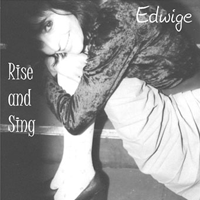
Having made her initial mark with a couple of quirky, tricky-to-pigeonhole folk-pop albums, Edwige has made one on which she intends to celebrate “God’s beautiful gift of singing.” This could mean a lot of things. Perhaps she’s taking that unorthodox, archly beautiful voice of hers on an exploration of experimental a-capella songs, or a pure set of vocal rounds. Perhaps she’s made an album of devotional folk; or an unexpected gospel record.

As it happens, none of these are exactly the case. Edwige’s embrace of the joy of singing may be heartfelt, but it’s also comfortable. The key tone of ‘Rise and Sing’ is relaxation, and of Edwige’s assurance in her own work and her own methods. In many respects, it remains a familiar Edwige album. Many familiar tastes certainly remain intact. She still favours upfront lyrical messages, and continues to steer a course placing her somewhere between cabaret entertainer (especially on the oompah-pop of Bad Hair Day) and announcing angel.

She’s also continuing to develop her tendencies towards baroque pop arrangements. I Just Can’t Resist That Love is given lift by a suspended chorus of trilling voices and sunny passages of oboe; Into View is threaded with reeds, harpsichord, and tuba; while a harp adds sparkle to the simple, open love song After The Rain. The perky swing of New Mexico – with its elasticated guitars and psychedelic pedal-steel keyboards in tow – shows another side of her tastes, this time a dash of country music for the road.

The most surprising aspect of ‘Rise And Sing’ is a new affection for noisy guitar pop. Edwige’s latest producer (former Homer/Robyn Hitchcock sideman Andrew Claridge) sploshes some crashing electric guitars around several songs here, beefing up the acoustic strumming with touches of indie-pop, swamp-rock and grunge. The unplugged directness of previous Edwige albums, with their ornate bursts of cuteness and their denser musical surprises, sounded as if they’d come from odd-shaped rooms in an apartment piled high with spiritual books and knick-knacks. This album suggests that Edwige has recently knocked through a wall or two, and built a nice scruffy garage to play in. Her voice, as ever, is peppered with odd pitch-swoops, vibrato and declamatory theatrical inflections, and is still French-accented even after years of living in London. It’s an odd match for this bristly rock clanging – yet she thrives on the cruder energy that the extra noise provides.

With her perpetual good humour intact, Edwige uses the extra force to help her to drive home a few righteous stilettos. Straddling a catchy swaggering hook on Ears On Fire, she takes dry pot-shots at questionable cults with unreliable gurus – “I heard he was unfaithful to his wife, / I promptly took his words, and boiled them with my rice.” On Elegy For You, she skewers another bad-news, would-be Mephistopheles, decorating her lines with layered falsetto shimmers of vocalese while using the main lyric to sketch his cunning in song – “You’re so good at enchanting – / you lure with hopes and dreams / held through your spindly fingers, / and have them crushed like a crumply paper ball.” She also draws on this energy on Time For The Glorious: switching between midvoice and falsetto, rising serenely over the fuzzy rock backing to declaim “the leaf wouldn’t be but for the tree, / the wave wouldn’t roll but for the sea, / your heart wouldn’t be / but for a love much greater than one can ever conceive.”

Ah, yes. There are God-songs on ‘Rise and Sing’. Previously Edwige has only alluded to her personal, devotional brand of Christianity through cryptic clues, but now she’s beginning to become more direct. While she’s not yet citing chapter and verse, or names, the sacred aspect is clearer now, and this in turn reveals the true nature of many of her previous songs. As for the new ones, I Just Can’t Resist That Love pulls off the old soul-music trick of blurring across the boundaries of love song and devotional hymn. Opting for generosity rather than hectoring, Edwige’s revealed evangelism takes a variety of forms over a broad range of experience and musical method.

We get our gospel song after all – I May Have, in which Edwige testifies doubts and faith over a soft bed of electric chapel organ and little electric guitar agreements. Behind the pretty arrangement, Into View reveals itself as a waltzing tale of a Damascene conversion. For the jazz-tinged acoustica of Tea Light Sympathy Edwige turns teacher, with a gentle (but stern) offer to share her path. On Fusion, she becomes an ecstatic celebrant, kicking off a startling, delirious cocktail of techno pulse, hard-rocking fuzzpunk and hoedown. Choppy cello and guitars meet up with a stomping dance-floor beat and speaker-trashing bassline, and are in turn covered in festoons of Edwige as she chants, lets rip again with the vocalese and sends up fireworks of singing.

The thing about devotion, though, is that it involves letting go. Edwige is such a determined performer – so enthralled with the message, the observations, the little dialogues of life – that little of this (bar the rampaging delight of Fusion) rips through into the ecstatic. The message is always already decided, never discovered, and so the sense of actual revelation is lost. That’s a shame – for believer and unbeliever alike, observing or sharing a revelation of faith is often a fuse for crucial sympathy, and on her songs Edwige seems to miss out on this transformatory moment.

There’s one significant exception, in which Edwige’s wayward journey takes her up into a place she’s never visited before in song. Do I is that music-of-the-moment that’s missing elsewhere. An unexpected (and welcome) bit of psychedelic noise-folk, it’s set on Nico organ drones and on a cloudy screech of guitars so overdriven that they sound like English brass bands scattered by gales. The lyric is the simplest of declarations – no angles, no patter, just a naked, assured statement of devotion. “Do I come? – I do. / Will I follow? – I will. / In the light or darkness, pray for strength, / ah my love, … / Give me the warmth of your love. / Safe with you forever, ever, ever, ever.” Stepping up from the chapel drone, rising above this massing, crashing confusion of tangled feedback, Edwige is making her leap of faith for us; all cabaret cuteness falling away.

It’s the kind of inspiring moment which that unearthly voice was made for. I wish she’d do more like this.

Edwige: ‘Keep The Change’
Quasar Music, EDW3CD
CD album
Released: 2004

Buy it from:
Quasar Music or CD Baby.

Edwige online:
Homepage YouTube

March 2004 – live reviews – Mondriaan Kwartet @ Fuse Leeds 04 festival (performing John Zorn/Toek Numan/John de Simone/Richard Ayres) @ The Venue, Leeds College of Music, Quarry Hill, Leeds, UK, 4th March (“brimming over with the enjoyment of physical and audience challenge”)

12 Mar

We’re all consenting adults tonight, in for an evening of potential torment at the hands of four extremely accomplished Dutch experts. As we wait, we’re eyeing an ominous device. Rearing up from the floor, it initially resembles a homemade shower cabinet, adapted to work as an electrocution chamber.

Any second thoughts?

The towering gizmo is the Octachord. It’s a nine-foot sound-sculpture (to be precise, an electrophonic harp) doing double duty as accompaniment for Mondriaan Kwartet –  but that’s for later. Right now, its main role is to focus our attention. Eight metal extrusions like park-fence railings (actually tubes holding the Octachord’s strings and movable bridges) jut up from a chipboard sound-box, sitting on a set of squat castors. Hugged by a tracery of control wires and delicate devices, the tubes ascend to a cross-brace like an oversized hash sign.

Like many sound-sculptures, the Formica surfaces of the Octachord and its festoonings of light-industrial debris give it a frail, domesticated Heath Robinson structural logic, offsetting its intimations of menace and tortured electricity. You could imagine it sitting in the corner of your spare room, exchanging polite machine-conversation with the boiler. But you wouldn’t want to imagine it roaming the house in the dead of night: looming towards the bedroom door, exuding fat blue sparks…

I was mentioning torment? That’ll be courtesy of John Zorn. For as long as he’s been blowing frenetically over jazz and hardcore art-rock, this viciously intelligent post-modern saxophone maven has doubled as a modern classical composer. His waspish chamber music dominates the Mondriaan’s repertoire tonight – and when I say “torment”, I mean it literally.

By Zorn’s own admission, the splintered suite music of ‘The Dead Man’ is a detailed representation of a sadomasochism session in progress. Violins, viola and cello conjure the impact of blows and the rests of anticipation; the distortion of twists and cruel stretches; the shocks and the sensuality. If this sounds like sensationalism or game-playing, then bear in mind that Zorn apparently practices what he’s preaching here. If he’s setting up as an ambassador for the joys of S&M he makes a compelling job of it, by writing music that’s as eerily seductive as it is violent.

As for the performers, Mondriaan Kwartet are a New Music string quartet par excellence – an effortless collective embodiment of Dutch cool and elegance – but they’re clearly brimming over with the enjoyment of physical and audience challenge. They dive passionately into Zorn’s music with its hornet squeals; its sudden pops of ordnance; its super-pianissimo glass-pane skitterings of bow on strings. The Dead Man itself sounds like nothing so much as music for duelling crabs – perilous music, with its structure continually threatened by tensile collapse. The concerted classical discipline and harmonies are beset by savage scrapes, and by drifting descending tones and atmospheres that alter the air like eerie lighting effects. When they’re not slithering their bows over the strings, the players rattle them against the fingerboards; or swat at the air with them, making muted whip swooshes. Over the top of her viola, Annette Bergman’s eyes flick from colleague to colleague for cues. On the execution of a particularly tricky Zornism, a broad grin flashes across her face – guileless, yet mischievous.

Setting Zorn for a while, the Mondriaan move to ‘Stringtones for String Quartet’ by Dutch composer Toek Numan. Reflecting his work in dance theatre and film soundtracks, Numan’s piece is presented in highly visual terms – performed in near-darkness accompanied by film projections, a rotor of light passing across gelid red tiles and flickering and fractionating into restless patterns. The music itself is a shudder of anticipation, broken by staccato plucks before it’s allowed to go far in sustaining itself: a drone undermined by quick strikes and harmonies, eroding backbone even as they provide an intriguing sour extension. Revealed in parallel, Numan’s work embodies and illustrates a dividing line between continuity and the disturbances arising in its wake.Throughout, its value seems to lie in the challenge of balance which it sets its players.

There’s a problem with this at first, as it seems that (beyond the admiration we can offer to the Mondriaan’s brinksmanship and precision) there’s little for us to grip out here in the audience. But then there are the flashes of small reward. A shared line of falling/rising harmonic keen from the violins. There’s a brief, bright glimpse of harmony as the Mondriaan power through a sudden and unexpected mosaic of notes (like The Kronos Quartet on full Manhattan throttle), only for it to disappear just as rapidly. These moments materialize more and more frequently as the piece progresses and finally ‘Stringtones…’ is revealed for what it is : a modernist’s veil dance – thoroughly orchestrated, but with its component parts almost always left entirely masked, or extracted and scattered across its length.

Throughout all of this, the Octachord broods onstage like a threatening science fiction prop. Appropriately, it’s finally brought into play for John de Simone‘s ‘Deus ex Machina’ – a compositional nod to the primal thrills of science fiction B-movies, in which the Octachord plays the Alien Menace to the string quartet’s Earthlings. At the Octachord’s controls, its creator Robert Pravda gets to play the obligatory mad scientist, but only up to a point. Unshaven, and sporting long warrior’s hair, he provides an air both of frizzy chaos and of gentle politeness. This sets off the Mondriaan’s collective neatness and precision before a single note is played.

The Mondriaan go to work around Pravda in a sawn-up staccato, one violin off on a gull-flight glissando above the dense, intense, angrily compressed structure. As bows swoop up and down to precise point on instrument necks, Pravda totes a seven-foot button-studded control stick with an air of mild trepidation. Finally, cued in by a two-note violin ostinato, the Octachord activates with a brutal transformer hum before swelling out to a factory bray like a clutch of singing drill-bits. Under Pravda’s gaze, flashing green lights crawl up and down the rods like slow abseilers, riding the bridges as they set the pitch. The sound is terrific – vast, oppressive and urgent harmonic waves.

Unfortunately, it’s immediately a fatal distraction from the quartet music. This vanishes into indifference as the Octachord rides balefully along within its own entirely separate space. Given a long solo passage, with many of its dancing lights alight, it renders us a wonderful unearthly noise like a glass harmonica being ravished by ravenous microscopic metal worms. Watching it chunter along like a psychedelic cathedral clock (or a captivating ‘Doctor Who’ relic), we forget all about the strings, and the composer.

With ‘Deus Ex Machina’ over and the interval in progress, I sidle up to the Octachord (alongside other nosy audients) and sneak a peek at Pravda’s copy of the score. Our explosive giggles prove that curiosity has finally cracked up the cat. The instructions from de Simone are simply to turn the Octachord on, to let the Mondriaan phase in with the string drones and come to a halt; and to then “do your thing for 2-3 minutes, or until audience is bored…” It’s a good joke. Still, it’s not enough to make up for the feeling that a marvellous sound-sculpture roar has been wasted –  that it’s been bolted onto a halfway-interesting chunk of aggressive minimalism in a cavalier and casual fashion, only for both to fall flat. Yoked together, to death.

Another new work – the two-part ‘No.38 for String Quartet’ by Cornish composer Richard Ayres – begins with bouzouki-style picking. Armed with plectra, the Mondriaan members claw gently at the strings of cello, viola and violin for Part 1. Jan Erik van Regteren Altena’s first violin, is the exception: ejecting a thin strand of stressed melody, hurtling helplessly off the side of the instrument. Part 2 has the full quartet engaged in a hopping dance full of skidding harmonics. Dispatched with zest and vigour, it sounds like children’s skipping songs being enticed into a motorcycle formation, and then run violently off the road. Later on, other vivacious dances are sliced and diced in Ayres’ conceptual grinder. It seems that John Zorn doesn’t claim the monopoly on cheerful sadism.

However, Zorn does claim composer’s laurels for the evening, as the Mondriaan close the concert with his ‘Cat O Nine Tails’ – a masterfully disruptive witty soundtrack to an imaginary cartoon. Ripe with cunning flirtations with chaos – and peppered with a wealth of Americana – it offers the Mondriaan another opportunity to stretch out and relish. Scourging turbulence and shimmers cross over with jaws and saws; fragments of hoedown reels start up and are swallowed by silence, jump-cut with passages of rich serenity or sly threat. Inside its parade of styles and suggestions, Eduard van Regteren Altena gets to quote jazz bass on his cello, and Zorn also throws in a brief shuffled history of the fiddle’s musical journey across Europe and America via kletzmer, Appalachia and Hollywood. Certainly, there are gimmicks a-plenty – but here, as in cartoons, the architecture of gag and message combine, part of a bigger picture.

Mondriaan Kwartet online:
Homepage

John Zorn online:
Homepage MySpace LastFM

Toek Numan online:
Homepage Homepage - blog LastFM

John de Simone online:
MySpace

Richard Ayres online:
Homepage MySpace

Robert Pravda & the Octachord  online:
Homepage Facebook and also this article.

The Venue (Leeds College of Music) online:
Homepage

July 2003 – album reviews – Show-Yen’s ‘Show-Yen’ (“the precision roar of a squad of slick hand-tooled motorcycles”)

30 Jul

An instrumental power trio from Kyoto, Show-Yen attempt a twenty-first century take on complex fusion rock. Balancing earnestly between early ’90s metal heroics and formal ideas drawn from ’70s art-rock and the stiffer end of jazz-rock, Yasuhiro Nishio and his bandmates encounter mixed results in trying to reconcile them. Yasuhiro, the bandleader, leans towards ersatz Joe Satriani guitar skills and facility in his own melodic, theatrical playing. The band as a whole cup the juggernaut blues-metal legacy of Cream in one hand and embrace the stern compressed minimalism of King Crimson’s ‘Red’ with the other, with digressions into classical guitar and Hendrixian sustain. All accomplished; all, still, a little too over-familiar.

In too many respects the album ends up as a classic rock guitarist’s solo project in all but name, with all of the posturing highs and lows of its kind. Drummer Masanobu Tonomura is a cheerful accompanist, and Hiroaki Fujii provides solid fretless bass, often erupting into the kind of chorused slithering which suggests he’s plotting an escape into full-blown jazz-fusion. Yet neither do more than underpin Yasuhiro’s music. The album sinks, swims, but more often flounders over the guitarist’s wavering levels of inspiration and originality.

This is a shame, as Yasuhiro is a fluent and accomplished musician. When he’s on form, he’s several cuts above the clumsy cut’n’paste standards of neo-prog: his blending of sources is smooth and instinctive. Several core Show-Yen pieces will press the buttons of staunch classic rockers. Much of the album offers the precision roar of a squad of slick hand-tooled motorcycles, but some of the other tones and textures involved suggest that someone’s slipped a little acid and a handful of smart-pills into the petrol tank. On the cruising riff of Network Broken, the entire band sounds groovy and assured, with Yasuhiro even inspired to add a little disruption via Frippish yells of burning guitar. Reallusion’s chugging, businesslike metal riff is cut with haughty descending decorations of Crimsonic phrasing; there are breaks for classical arpeggios; and Yasuhiro pulls off a neat compositional trick of cross-cutting into full-blown Gary Moore blues descends crammed with articulate wah-wah wails.

Yet on the other hand pieces like Move Up or the flashy, jolly Ran sound like little more than ambling, melodic instrumental metal cast-offs. Parade, with its neo-classical tones and cute clarion fanfare, might aim to unite Rush flourishes and latterday math-rock precision: the final result sounds more like a listless chew through the pops-orchestra end of classical rock. While Yasuhiro can readily summon a breezy classical-rock style for these moments (not far off what the perpetually underrated Kevin Peek aimed for with Sky) this sits badly with the hard-rock bristle elsewhere.

Attempts at carrying off something weightier – via the five-part piece Asels – results in sixteen minutes of strolling through some over-familiar galleries. In predictable succession Show-Yen offer up an electro-classical guitar study, some Curved Air toccata-rock (with uninspired rhythm parts slogging under distorted lead guitar breaks and flanged bass responses) and a mid-paced trudge through Crimsonic metal. The final destination is a kind of Hoagy Carmichael dinner-jazz, highlighting melodic bass lines and clean, sleepy guitar. Part-way through, Yasuhiro tosses in a solo slice of twirling, gut-strung hammer-ons (echoing Van Halen’s Spanish Fly). The ultimate result is that of a bitty, end-of-term music showcase: not the seamless gelling of unlikely elements that marks the best prog.

Show-Yen’s problem is that whenever they aim for committed musical context, they always end up in a historical echo-chamber. Bouncing around inside prog-fusion consensus, they’re voluble and skilled in their instrumental focus; yet those stylistic limitations they work within so earnestly also render them voiceless. Tellingly, the band pass this debut album off as some kind of conceptual work, yet refuse to provide story, background or even a suggested listening order. They claim that listeners can create their own sequence and story, then immediately contradict themselves by stating that instrumental music renders any narrative composition irrelevant.

A sense of pointless backtracking, of feet being fallen over and ideas imploding under the weight of inverted rock pretensions, is overwhelming. If it is all an oblique joke, it’s particularly annoying given that Show-Yen can obviously think and do more. When they let their inner hairy beast break through the schooling and the canonical salutes – and when they properly churn (rather than simply milk) their technical skills – everything works better.

Driving jazz inflections and visible thinking are all on display in Fu-Ga with its appealing back-and-forth march of mirrored chords. On Ominous Footsteps II, Show-Yen take a tip from the flattened fifth. Their dark flashy rock explorations now not just a showcase for technique but the generator of a pleasing structural puzzle: it’s built on short menacing low-register pulses, from which Hiroaki’s bass guitar gradually escapes as the piece progresses. Lucifer’s Child shows them grabbing their mid-’70s Crimson fetish whole-heartedly, but letting it fire them up. Yasuhiro leads in and out with endpieces of complex Frippish picking (hitting a feverishly cramped pitch), but ultimately slams the band headlong into a crushing, sticky stoner wah-wah riff over which his car-bumping lead phrases crash down. This is where the band really starts to work – where the method meets the moment.

Show-Yen, then. Deserving of being taken seriously, so long as they start taking themselves seriously. How often do you get to say that about a rock band and genuinely mean it?

Show-Yen’:’Show-Yen’
Musea, FGBG 4406.AR
CD/download album
Released: 22nd July 2003

Buy it from:
Musea.

Show-Yen:
Homepage MySpace LastFM

July 2003 – album reviews – Edwige’s ‘You Show Them the Moon and They Look At Your Finger’ reissue (“opera singer, cat purr, wise seductress, vocal trapeze”)

27 Jul

Edwige: 'You Show Them The Moon And They Look At Your Finger'

Edwige: ‘You Show Them The Moon And They Look At Your Finger’

I seem to remember that that title is a Chinese proverb about fools missing the point: presumably this is a warning that Edwige is pointing to somewhere interesting, and that if you pay too much attention to the way she does it then you’ll miss the why. Certainly you can get sidetracked by trying to pigeonhole her music. Like any city-smart pigeon, it struggles and flits away from capture.

So what is this? It’s folky, but with at least one eye trained above the treetops. It’s French but it isn’t (despite the accent and the chanson/cabaret flutter, Edwige is London-based and Anglophone, aligned to the world in general, and open to angels). It’s poppy, but salted with the ascerbic willpower of a woman who’s lived long enough to have her own individual way of doing things. And while she’ll welcome fellow travellers, she’s confident enough not to be too worried about whether you go along with it or not. I think I like that.

It brings back a memory, too. When I was about fourteen, one of the key albums for my raging, hormonal inner life was Kate Bush’s ‘Never For Ever’. I used to have an odd relationship with that record. I’d play it all the time, never sure whether I actually wanted to or not. I remember it felt like a wayward friend on a perpetual mood swing: it was poised on a wobbly adolescent axis of feyness, promise and wisdom, and put me through bouts of frustration and love. How could one album zoom so unpredictably between cutesy kiddie fairy tales and vaginal vamping, between stardust fantasy and nuke-generation fears, vengefulness and nurture? And how could it tangle them all up in such a wayward, compelling way, but still make me want to smack the naivety out of it? No wonder I eventually ended up shoving it in the cupboard and heading for the more straightforward push and bump of indie-pop to soundtrack my later teens.

Many years of The Smiths, The Fall and My Bloody Valentine later, ‘You Show Them The Moon…’ reminds me of that early shamanic Kate Bush girl-pop. It’s not just because those arch, slanting vocals constantly recall ‘Never For Ever’s Coffee Homeground; or because I Am A Temple, from its Nile guitar twang to its waft of desert synth and the aerial-bending vocals, is a ringer for the storybook mystique Bush brought into play on Egypt. OK, Edwige’s music doesn’t carry the same weight of sensual bewitchment. It betrays its budget origins via keyboards that sometimes dip into tweeness and rinky-dink; and by a no-frills recording that sonically cramps her cosmic-tinged imaginings, cramming the cornucopia into a garden shed. But ‘You Show Them The Moon…’ does show the same fascination with the free-flowing mind that’s one of hippydom’s more useful legacies, and it can carry its eccentricity convincingly as well.

A lot of this is to do with Edwige’s voice: a wonderful, peculiar, obliquely beautiful thing. It curves itself round the tones of opera singer, cat purr, wise seductress, vocal trapeze… all with glass-etching clarity and weird ricochets. It’s like a combination of Liz Fraser from Cocteau Twins and a French Eddi Reader without the gawkiness or the broadsheet approval. Actually, don’t stop there: look towards the Strange And Flamboyant Women In Pop section. In spite of the two-dimensional production, Edwige also pulls off the trick of sounding a bit like Bjork’s long-lost boho auntie. She doesn’t possess Bjork’s genius spark of child-vision, or her way with a contemporary sound (it’s French cafe culture round here, not club culture: you’ll find no beats, samples or Trickies). But she does have that same bungee-elastic vocal yaw – admittedly delivered with Edith Piaf’s brand of declamation, and with the sort of melodies and poised guitar strums that go with ten-foot silk scarfs swirled round swan-necks.

The songs themselves fizz just on the right side of easy listening. They’re frequently soft and fluffy, but with deceptive bends. Each is a moment, polished and expansively lit, in a life that’s become a quest in which there’s no goal but an understanding – an ordinary life illuminated by extraordinary lights. Downtrodden and downbeat on No Shape For Love, Edwige can be revived enough to put on a spiritual throb of benediction for Be Blessed. She’ll caress you with a dedication of warm, supportive love on Serve You Well. She’ll also slap you down with a moment’s notice, scolding and instructing in slightly fractured English. “If I open up my heart, it’s not to please your fantasy… / You think you are my king, you’re just a slave of your own enemy.”

Throughout the album, Edwige slings assorted moods and styles around herself like hula-hoops, keeping a core of determination but remaining free-floating. She will go all Jane Siberry and produce fluffy-edged clouds of electric guitar for The Dearest – a fragile love song where the unselfconscious fairytale imagery teases out a winning pathos. If pushed, she’ll become flamboyant, defiant and unreachable, as she is on I Am A Temple (“don’t you dare pry into my life!”). Yet she’s happy – on If You Were The One – to suddenly ditch the eerie and mystical to trill away on the kind of cosy tap-dancing tearoom jazz that you’d have thought long-lost on 1950s lounge records, or to toss out a dash of Celtic sounds with ‘The Omen’ (Clannad harps and tricky jig-in-a-box/jump-into-the-sea rhythms).

Back in 1999, the original version of this album was also noisier. Edwige occasionally dabbled in a kind of accidental techno, or flew in some famished rock guitars to add roar. For this 2003 reissue, she’s ditched these particular quirks and re-recorded a couple of songs as acoustic versions. Something’s lost when Tune Up All Your Violins has its bull-in-a-china-shop clatter removed, but Edwige, strumming away solo and singing forcefully, still uses it to plunge through cosmic arcana like a costumed hero on her own cryptic spiritual mission. They Won’t Make Me Nervous is shorn of its crashing electric guitars and bendy orchestral fogs of synth, but keeps everything else, including the super-soaring choruses on which Edwige zips and kinks like a skidding comet.

The two songs at each end of the album unfurl Edwige’s searching musical and spiritual ambitions to the full, the instruments coming alive out of their budget politeness and warming the air. To Discover lounges in rich, luxurious music – lazy acoustic guitars, damask curtains of synth – but Edwige’s voice cuts through the slumber like a little silver knife. In the middle of comfort (“thinking love is here forever to remain… / and life has no more to offer than what you already knew”) there are breakdowns and hard lessons ahead: “you still have to discover.” And the climatic grandeur of Stillness suggests that she’s reached some sort of peace, looking back over the terrain of the life-quest with a sympathetic eye.

“You need to be loved, and you need to be told, but there’s no reassurance… / You feed yourself with books and beliefs / and stick on your windshield / pictures and maps / so you won’t see your direction… / And try to get peace rearranging confusion… / Still looking for Eden, El Dorado, still looking for a search / when in the stillness…is home.”

Then The Voice shoots up to ecstatic heights, hits the stars, ignites them in a wave of flame, and sees out the album with an ascending, aspirant note. Edwige is smiling and pirouetting somewhere on the pavement where Parisian cafe music (accordions and sparklers) meets the sussed cosmic chick (tarot, tai-chi and her own flat). Someone get her a decent producer and the space to fling a few more scarves around, and she’ll take us off to a brighter night, where a giant moon is untroubled by idiots pointing and where cats somersault over the chimney pots.

Edwige: ‘You Show Them The Moon And They Look At Your Finger’
Quasar Music, EDW1CD/KCA (634479459061)
CD/cassette/download album
Released: 2003 (originally released 1996)

Buy it from:
Quasar Music or CD Baby.

Edwige online:
Homepage YouTube

March 2003 – live reviews – North Sea Radio Orchestra @ St Clement Eastcheap, City of London, England, 15th March (“a polished Victorian never-never land of intricate miniatures and toymaker’s details”)

18 Mar

Once you’ve found it (tucked away in the cramped, confusing whorls of buildings and alleyways near the Monument) the diminutive Christopher Wren church of St Clement Eastcheap is like an old-fashioned kid’s treasure-box, hidden in a chest-of-drawers. Small but perfectly-formed (and bearing the decorous marks of its mid-Victorian refurbishment), it perches pertly between two well-known architectural schools – “enchanting” and “cute”. Tidy pillars spring up hopefully at the sides of its nave. That creamy yellow tint in the immaculate plasterwork of the walls sets off the lovingly-worn mahogany of choir stalls, pews and the massive pulpit. It’s tiny enough for a smallish art-rock audience to squeeze into and feel cosy: and there’s a nursery-rhyme connection too, if you know your oranges and your lemons.

Really, the North Sea Radio Orchestra couldn’t have picked a more appropriate venue. For the music of this retrofitted, romantic-progressive chamber ensemble, St Clements fits like a glove. It shares those hints of modestly-mingled English eras of scaled-down splendour, the atmosphere of nostalgic time travel and aan affectionate polish of traditional heritage. Once you’re inside, both of them also tempt you to blissfully engulf yourself in a luxurious dream of old England – open fields, spinneys, bright stars, sunlight and green thoughts – while all around you the ruthlessness, frenetic urban pace and concrete encroachment looms and sprawls. This may all be an imaginary, selective stance. On a superficial level, you could also get suspicious of well-spoken contemporary white musicians in London warding off angst by cooking up a hand-crafted pre-industrial daydream. But this does the NSRO a disservice. You could accuse them of forcing their innocence – and maybe yours as well – but whatever else they’re doing here is done entirely without malice.

Twenty people settle onstage and get a grip on their violas, cellos, trombones, bass clarinets or whatever. Familiar London art-rock faces abound. Conductor-composer Craig Fortnam and the ensemble’s soprano singer Sharron Saddington used to bob up and down on the fringes of the Cardiacs scene, first in the psychedelic tea-party of William D. Drake’s short-lived Lake Of Puppies and then in the bumptiously charming folk-pronk of The Shrubbies. James Larcombe (Stars In Battledress’ elegantly-tailored smoothie of a keyboard player) is soberly fingering a chamber organ. His brother and bandmate Richard is boosting the numbers in the eight-strong choir, right next to the wild Persian afro of onetime Monsoon Bassoon-er (and current Cardiac) Kavus Torabi. Out in the audience, the aforementioned Mr Drake sits next to Tim Smith, his old friend and former boss in Cardiacs. Across from them, there are various Foes and Ursas and Sidi Bou Saids. There’s a sense of occasion. We get a beautifully designed arts-and-crafts-styled programme to take home. It’s a long way from Camden pub gigs.

This isn’t solely because of the surroundings. North Sea Radio Orchestra might carry their assorted historical splinters of psychedelic rock, folk, and even punk along with them, but they are unabashedly classical in intent. Even the twistiest and most abrasive of the art-rockers in the lineup are sporting the sober concentration of churchgoers, and Sharron has traded her former outfit of cosy specs and jumpers (though not her artlessly warm smile) for a modest diva gown. Craig, his back turned, conscientiously conducts the ensemble. When he sits aside to strum a little polite guitar, he has to crane his neck round anxiously, making sure that the music is still running smoothly.

He needn’t worry. Despite the shades of complex tonality which inform the NSRO’s compositions (Frank Zappa, Benjamin Britten and Tim Smith have all left their mark on Craig’s inspiration), the music flows readily. Sometimes it’s a simple organ drone as a base for Dan Hewson’s trombone expositions. At the other end of the measure, there’s the rollicking Occasional Tables: a dancing interplay between clarinets with a gloriously drunken, attention-switching Frank Zappa/Henry Cow approach. With its mediaeval echoes, and an additional infusion of the peculiar darkness of post-Morton Feldman Californian conservatoire music, it’s given an edge by the astringent, atonal vibraphone shiver (and by Craig’s strict, almost military turn on bongos).

Intriguing as these are, it’s the NSRO’s orchestration of poems which connect deepest with the audience. Mostly these are Tennyson settings (with a sprinkling of Thomas Hardy and other contemporaries) but even Daniel Dundas Maitland’s modern Sonnet looks back to ornate Victoriana. So does Craig’s music, swirling its Early Music and contemporary classical influences together to meet halfway in a polished Victorian never-never land of intricate miniatures and toymaker’s details. Sharron’s vocals – sometimes piping, sometimes emoting in keen, theatrical wails – make for exquisitely brittle sugar-sculpture shapes, while rivulets of strings and woodwind launch themselves from the melody.

The heavenly sway of Move Eastward Happy Earth sets Sharron’s winsome soprano against the lazy, streaming clarinet of Nick Hayes and against Ben Davies’ slow waltz of trimmed-down piano. The choir (with a hearty, clever enthusiasm that reminds me of nothing so much as Gentle Giant) leaps in for stepped, skipping choruses and glorious vocal resolutions. For The Flower, drifts of strings slip from the vocal line and weave busily like something out of Schubert’s Trout Quintet. Onstage, everyone who isn’t smiling looks happily dazed, as if drunk on the sunny harmonies.

And so it continues, with parts of the NSRO dropping in and out to suit the music. For Thumb Piano, Craig trims it down to a revolving arpeggio of guitar harmonics in trio with the blues-tinged fluting of Hayes’ sweet’n’wild clarinet and Katja Mervola’s pizzicato viola. Harry Escott provides a cello improvisation, impressively-voiced chordal melodies sliding on top of a slithering bass drone. James Larcombe sketches out a collage of beady, kaleidoscopic chord progressions in his studious organ solo. The chorus, for their part, sing lustily in a London melting-pot of diverse accents. For the canon setting of Yeats’ He Wishes For The Cloths Of Heaven, the whole orchestra sings its way through Craig’s pop-folk melodies.

When the whole ensemble is running at full strength, St Clement brightens with music. Shelley’s Skylark, in particular, is profoundly ambitious – semi-connected cello lines swing like foghorns, thick Michael Byron-ish string parts disgorge dominant melodies, and the chorus is a rich blur of voices, pumping resolution into Hardy’s words. But best of all is a generous Fortnam orchestration of a piece by his former bandleader William D. Drake – a setting of William Johnson Cory’s Mimnermus In Church. With Richard Larcombe stepping out from the chorus to duet with Sharron, and the North Sea Radio Orchestra performing at its fullest stretch, the results are captivating. The voices of Sharron and Richard move around each other in dusty, reedy, yearning harmonies (he floating up to countertenor) while strings, piano, clarinets and brass open out like a delicate night-bloomer, fragrantly illustrating Cory’s salute to flawed and transient life in the face of a perfect yet chilly heaven. “All beauteous things for which we live by laws of time and space decay. / But O, the very reason why I clasp them is because they die.”

Yes, in pop culture terms it is music for an ivory tower, or for a detached oasis where you can secrete yourself away from the world. Only a mile or two to the west, I’m sure that electric guitars are roaring out rock, garage clubs are spinning off beats and bling, and someone’s delivering tonight’s definitive urban hymn. But emerging into the City of London – all higgledy-piggledy with glass skyscrapers, Renaissance guildhalls and mediaeval street names, a ragbag of congealed history in parallels – I couldn’t care less.

Like the best musicians, North Sea Radio Orchestra tap into timeless things (beauty, transient joys, the shift of seasons). But like the stubbornest, they also know the colours and shades of the times which they’ll want to employ, finding a way to make them mean something whenever and wherever they’re played. And though an antique church and a Victorian altar cloth made a beautiful frame tonight, this music – at its peak – would’ve sounded good even if the whole ensemble had been balanced atop a Docklands trash-heap.

North Sea Radio Orchestra online:
Homepage Facebook MySpace

St Clement Eastcheap online:
Homepage

February 2003 – live reviews – House of Stairs label launch concert (evening 2) featuring William D. Drake, Cheval de Frise, Stars in Battledress and Miss Helsinki @ The Arts Cafe, Toynbee Hall, Aldgate, London; plus Delicate AWOL @ 93 Feet East, Shoreditch, London, both 17th February 2003 (“East End might mean left-field tonight…”)

19 Feb

Less than a week ago, the House of Stairs label put on their Camden launch gig at the Underworld: Max Tundra DJ-ed, filling the gaps with a spicy and witty mix of art-rock, prank techno and pop buzz. But tonight we’re out east in the pizza, pine and paintings environment of the Arts Café for the second, “quiet” gig – and Richard Larcombe is de-facto man-on-the-muzak, even as he bustles about setting up for his turns in two of tonight’s bands. Eerie shapes and twists of music waft through the busy air: the chatter at the bar is underscored by the filtering eeriness of Messiaen and the swooping rattling studio gulps of Boulez. East End might mean left-field tonight.

Miss Helsinki, bless them, display more pop bones in their body. Popping up from the wreck of the much-lamented Monsoon Bassoon, they feature both of the Bassoon’s singing guitarists (Dan Chudley and Kavus Torabi) plus the increasingly ubiquitous Larcombe on bass and harmonies. But they’ve lost both a drummer and Kavus’s keyboard-playing brother Bobak in the last month: and so it’s a stripped-down-and-unplugged Helsinki trio playing for us tonight, both aided and hindered by a backing tape. It’s only their third live appearance.

Frustratingly, they’re still lolling like a tall layer cake whipped out of the oven too soon. There’s something to be said for a bit of engaging pop roughness; and for Torabi’s endearing habit of boggling like Tom Baker at the end of a tricky lick. But although Miss Helsinki’s ambitions are clear, they’re still struggling to reach them. They have a tough act to follow, of course. One of the few bands to unite the approval of both London proggies and the NME, The Monsoon Bassoon wrapped a broad spectrum of ingredients (including Naked City, King Crimson and Shudder to Think) into their explosive, racing psychedelic rock.

Though Miss Helsinki retain some of those flavours, they’ve pastoralised them: the bursts of unusual chording and rampant arpeggiating are still there, but the thrashing intensity has been replaced by a sunny warmth and they’ve obviously settled on Andy Partridge as their guardian angel. But Helsinki music is a good deal more complex and demanding than XTC’s, straining the abilities of Chudley and Torabi’s affable, unvirtuosic boy-next-door voices as they hop over the cheerfully convoluted melodies like tap-dancing cats on a hot tin roof.

Despite this – and despite the fluffed notes and stumbles over the over-detailed backing tapes – ‘I Felt Your Arms Around Me’ is a bright little gem of spiky-haired art-pop, powered by the same giddy celebration of the best Monsoon Bassoon songs. Kavus (air-punching and doing triumphant kicks from his guitar stool) obviously knows it. ‘Surf’s Up’ – featuring a repeated chant of “silhouettes you know from fire” – takes them to places last touched by the psychedelic folk-science of Gastr del Sol; and the romping cowboy-pop of ‘Rodeo’ (“the world seems drunk, with a stetson in place”) ensures that they finish on a note of charm and enthusiasm. Miss Helsinki are a long way from filling the Bassoon’s busy shoes, but the signs are good.

With Miss Helsinki, Richard Larcombe is a deft, understated bass player. With his own band Defeat the Young – backed up by brother James – he steps up to become a witty, elegant frontman with tales of social absurdity and romantic scrapes. But tonight, for Stars in Battledress (an equal-partnership duo of both Larcombe brothers), he takes a step sideways. Up onstage, he cuts a quieter, more sober figure than he does with Defeat the Young. His sophisticated social-jester persona is mostly absent. His ready wit is intact, but here it’s diffused – more musing in its nature, leaning on subtle insinuations and surreal impressions rather than crackling wordplay. It’s also tinted with a peculiar, guarded English melancholy, and there’s an unsettling sense of loss and submission behind Richard’s refined and aristocratic drawl. “Blessed are all with vision unswerving. / Don’t watch me weep – go back to sleep…”

On Richard’s guitar – round about where people usually paste their dude-rock logos or political slogans – there’s a beautifully executed painting of a mallard duck, apparently snipped from a spotter’s guide. It’s appropriate. Stars in Battledress’ drifting tapestries of songscape take place in a watery never-land England of ponds and rivers and thin blue children, posh academies and school gymnasiums, the rituals of government offices and the embarrassments of public speaking; Cambridge water-meadows distorted by a lysergic autumnal haze. Someone in the audience mutters that Stars in Battledress are the best argument he’s ever witnessed against a public school education. I think he’s failing to press past the immaculate antique sheen of their surface. Theirs is a ghostly watercolour world of ruefully suppressed emotions with a tidal tendency to seep back up. Part Evelyn Waugh, part Syd Barrett and part Sea Nymphs.

James – strumming and fondling snowfall arpeggios from his piano and contributing apple-bright harmonies – provides most of Stars in Battledress’ colours, picking up on his brother’s words and extending them outwards in rippling classically-inspired musical inventions. Richard plays some understated, skeletal guitar and trundles a harmonium through the queasy distress signal of ‘Haunted Hotel’, but mostly he stays out at the front, clasping the mike stand like a sad, dapper figurehead. There’s a break from this in the roaring-’40s guitar-waltz of ‘Hollywood Says So’, as Richard delves hilariously into ludicrous showbiz gaudiness (“drive fast cars, play guitars, win prizes / – girls in every port, in all five sizes”) but ends up spat out in a wad of comic bitterness. (“I’ve been over-directed, I’ve been cut in one take. / I’m a dated two-reeler that no-one will make.”) Their cryptic finale – the hummed, valedictory ‘Women from the Ministry’ – hovers in the mind like the flicker of antique cinema light, images of lost houses, withered photographs.

Cheval de Frise are… plain remarkable. Bare to the waist and sporting Trotsky glasses, Vincent Beysselance studies his drumkit with a jazz warrior’s eye, his lean expression and sculpted moustachios lending him the air of a razor-sharp beatnik. Guitarist Thomas Bonvalent looks as if the Taliban have booted him out for excessive zeal. Sporting an enormous bushy chest-length beard, battered clothes and an expression of sincerely crazed intensity, he’s twitching visibly even before he plays a note. His nylon-string acoustic guitar has been modified – or de-modified, with both the sound-hole and the pre-amp controls crudely and defiantly smothered with duct tape. As he plays, biting on a pick, his face seethes beneath his beard.

“Pastoral acoustic mathcore” was what someone wrote on the Cheval de Frise packet. Ah ha, ha, ha – I don’t think so. Pastoral acoustic mathcore would be very nice – perhaps a Guitar Craft picking exercise, pared down by post-punk minimalism and softened by visions of green fields. Are Cheval de Frise like that? No. For the first seven minutes or so, Cheval de Frise seem absolutely demented. After that – and once the broken seizures of drumming and the intricate splatterwork of guitar has had time to get to work on your brain and your reflexes – you start to understand. Although your body will make the connection before your mind does.

Right from the off, Bonvalent’s playing is disturbingly wild; slamming down obsessively on a single note or isolated interval, or spasming music up, down or across the neck of the guitar. Beysselance’s drumming is a boiling whirl of ideas and instincts, acted out with a brinksman’s forcefulness, with enough breakneck substance both to keep the duo’s momentum and to craze it with brilliant stress fractures. People cram to the edge of the Arts Café’s tiny stage, swaying like a wheatfield in a whirlwind, and yelping approval.

Behind the apparent free-scene chaos, Cheval de Frise have serious intentions. The drums have their melodies as well as their upheavals, and although Bonvalent’s open-mouthed drooling visage suggests a man in terminal acid psychosis, he frequently rips into hyperspeed, hypertonal spirals of intense picking which John McLaughlin would be proud of. Every now and again, in the midst of a free section, the two Friseurs exchange a quick cue-ing glance and then slam into perfect alignment, calling a rigorous Zappa-style composed music module up out of memory. Bonvalent’s playing might often parallels the spewing, disjointed clicking noises of the post-Derek Bailey improv school, but the musician he’s really closest to is the iconoclastic lo-fi jazz rebel Billy Jenkins. Deliberately or not, Cheval de Frise ‘s music is a hyperactive flamencoid strain of Jenkins’ “spass” approach – a slew of intense musicality in which ugly sounds, wrong notes, anti-technique and smash-ups in timing and phrasing are as part of the great spontaneous inspiration as skill, structure, complex ambition or the beautiful moment.

It is, also, an intensely devotional music, as burningly thrilling as Nusrat Fateh Ali Khan’s qu’waali shriek, a gospel choir tearing the roof off the sucker, or the closer-to-God whirling of a Sufi dervish. Bonvalent’s physical abandonment (at points close to ecstatic convulsions) is religious in its intensity. As pieces skid to a halt, he bobs his head thankfully to the audience, smiling and almost moved to tears. If it’s like that onstage, it’s not that much less intense down here. Being up close to music this inspirationally driven raises the hairs on the back of the neck. When Cheval de Frise finally peel off their instruments and stumble into the crowd, the feel of the audience unclipping themselves from their joyful tenterhooks is like a dam bursting.

I don’t envy William D. Drake – a onetime Cardiac songwriter with a joyous genteel-gone-berserk keyboard style – for having to follow that. But I’m going to have to leave him to it, as I’m double-booked for gigs this evening; and so I have to slip out of the Arts Café to stride the Spitalfields half-mile or so over to 93 Feet East, to see Delicate AWOL on a rare London visit. I’ll just have to promise to catch up with the Drakey magic next time he plays… I will, really…

93 Feet East turns out to be an over-pleased-with-itself Brick Lane bar, milking the wobbly momentum of trendy Shoreditch Twattery while it still lasts. It also has the rudest security staff I’ve ever met. Not five minutes after the music stops, they’re in your face; all but digging their chins into your shoulders, dangling heavy barrier chains in one hand with the bored and arrogant stance of animal stockmen, yelling at you to move out. Regular punters must really want to come back to this place.

It’s a sorry way to end an evening, especially after Delicate AWOL have been exercising their luminous charm on you. Walking in on the band mid-flow, the first thing I see is Caroline Ross joyfully bouncing tiny beaters off the keys of her little glockenspiel. Its fairy tingles resound in the air as the rest of the band keep up a stiff-swung groove behind her. Delicate AWOL have been drawing connections between Latinate ’70s fusion and limpid Tortoise-school indie art-rock for a few years now. These days – extended from a guitar-rock indie four-piece to a more ambitious sextet featuring Ben Page’s swishing textural synths, Jo Wright’s Chet Baker-ish trumpet commentary and Ross’ own multi-instrumental enthusiasm – they’re in a much better position to cook up their jazzified stew.

Inevitably, the enchantingly gamine Ross is the focus, smiling beatifically from beneath her shaggy russet bob and swapping between percussion, flute and thoughtful slide guitar. There’s also her soft spring-thaw of a voice: a gentle but commanding stroke to soothe the ruffling from the craggier guitar of husband Jim Version and the dogged Can-ish rhythm-section circling of Michael Donelly and Tom Page. Rising above the hum and the wind-rattle of ‘That Terminal’s Down’, brushing against the reedy melancholia of a melodica, drawling through a sleepy-lidded chant of “your breath goes slow”, she’s hypnotic, bringing a hint of Scottish lullaby into Delicate AWOL’s sleepy mix. Alongside the Pram-like tinkles and kitchen-table craftsmanship, the woozy instrumental Americana of ‘The China-Green Prairie Tribunal’, the southern-border dance-steps of ‘Broken Window in a Mexican Bank’ and the doughnut-bulging space-groove they hop into for ‘The Rolling Year’.

One of Delicate AWOL’s greatest strengths is their ability to wander open-armed between these varied inspirations without ever inducing the suspicion that they’re simply trying to fill their basket with crowd-pleasing nuggets. Their intelligence is of the gentle kind – simply enjoying their explorations rather than ticking them off on a list and practising their traveller’s poses afterwards. Surprising, this takes them further than a ruthless musical ambition would – as does the way they flit disarmingly between other-worldliness and neighbourly charm, most evident in Version’s professorial enthusiasm and Ross’ affectionate, amused handling of fans and hecklers alike.

Even in the grubby concrete shell of an average indie-circuit venue, Delicate AWOL can get a campfire atmosphere going. A rewarding thing on a cold February night, especially with the impatient rattle of a chain behind you. If I ended up being treated like cattle, at least I got to spend half-an-hour home on the range beforehand.

Cheval de Frise online:
Homepage, Facebook, Soundcloud, online store, Last.fm, Apple Music, YouTube, Deezer, Spotify, Amazon Music

Stars in Battledress online:
Homepage, Facebook, Twitter, MySpace, Soundcloud, Bandcamp, Last.fm, Apple Music, YouTube, Deezer, Tidal, Spotify, Amazon Music

Miss Helsinki online:
(2022 update – no links available. See Kavus Torabi and Daniel Chudley Le Corre)

Delicate AWOL online:
MySpace,Last.fm, YouTube, Spotify, Amazon Music, Wikipedia entry

House of Stairs online:
(2022 update – there are no longer any web pages for the House of Stairs label, although there is a discogs.com page)

February 2003 – live reviews – House of Stairs label launch concert (evening 1) featuring Nøught, Foe and Defeat the Young, The Underworld, Camden Town, London, 12th February 2003 (“the Underworld fills with familiar London pronk and math-rock faces”)

13 Feb

Well-worn jokes about “first steps” line up at my door, to be kicked aside. Let’s not goof about. As the House of Stairs label throws its musical launch party, the Underworld fills with familiar London pronk and math-rock faces, fans and musicians grinning at each other as if it was the first day of a school trip. The still-friendly fragments of The Monsoon Bassoon, the occasional Cardiac, plus those particular paying punters who materialise like the genie of the lamp at the faintest hint of a twitchy rhythm or a whole-tone scale blasted out of a loud guitar.

For once, the records being played between the bands nudge and tickle the audience’s mind rather than simply provide aural cud to chew in the interval. When you’re lucky enough to have avant-prog, lo-fi techno wunderkind Max Tundra on hand to do your DJ-ing for you, you get more than the usual jukebox package – Peter Gabriel songs mingle with prank cut-ups of Tony Blair speeches, hilarious jungle-electronica renditions of ’80s pop hits, and ear-opening art-rock oddities whipped from rare vinyl. Priceless from any perspective.

Defeat the Young are the most literate – or literary – members of the House of Stairs stable by a country mile. They’re also the most demanding listen. Richard Larcombe‘s wit is complex and arch; his melodies are crenellated and mediaevalesque, pumped out of harmoniums, sharp-fingered guitars and hurdy-gurdies. Also, while there’s a distinctly proggy kink to his music (like Kevin Ayers cuddling up with Gentle Giant or William D. Drake), he’s drawn more to Havelock Ellis and Groucho Marx than to Tolkien or Carlos Castenada. Thank God for that. A faux-Edwardian English Zappa with highbrow kinks might not be to everyone’s taste. But it’s infinitely better than being subjected to another charlatan wrapped in suspect mysticism and stale denim.

Like a skilful card-trick, Larcombe’s wicked sense of humour also works best up close. In the cavernous rock cellar of The Underworld, he seems out of place – squinting against dim lighting in a venue more accustomed to thrash-metal and ska-punk than to his own rampantly sophisticated English stylings. I always seem to come up with flower metaphors whenever I try reviewing Defeat the Young. Tonight, the phrase is “hothouse flowers”. With two nouveau-metal bands roaring up from behind them, I’m worrying over whether the rarified and sophisticated humour in DTY’s music will wilt in this blunter setting. But they try hard, displaying a determined refusal to compromise. A long, scene-setting introduction (involving virtually the entire plot of The Marx Brothers’ ‘Duck Soup’) sprinkles conceptual theatrics back into the agenda, while (at the other end of preciousness) Jodie Scott’s feedback-heavy guitar adds some belligerent beef to the sound.

Still, it’s not until ‘Nothing from Something’ that things really get moving, as Larcombe gets to grips with his maze-y rake’s progress, bringing some deceptively drawling wit to bear. By ‘Natural Cash’ he’s in ebullient form, punching the air while his feet cycle his pedal harmonium and his lime-tinted vocal quicksteps adroitly through the tricky pitches. Propelled by his perverse and wayward imagination, he guides us through a risque world of sepia photos, elegant penmanship, social theorising and sexual quirks, all couched in a shower of beautiful golden language. Tonight wasn’t really quite his night, but Richard Larcombe is undoubtedly a major talent. He’s already way out there in that field where the erudite spectre of Oscar Wilde grabs the twisty bones of art-rock for a feverish waltz (and for a good snog, if it’s lucky).

The gap between Defeat the Young and the harder-rocking shapes of the rest of the evening should have been bridged by the violent, mordantly comical dada-metal of Lapsus Linguae, but for reasons unknown, they’ve had to stay in Glasgow. The evil smirks and the transmogrified Iron Maiden t-shirts remain north of the border tonight, to infest the queasy nightmares of pub-rockers who’d rather be dreaming of Joe Elliott. So it’s straight on to Foe – whose drummer Paul Westwood hardly gets a break from his turn on the drums and hammer dulcimer for Defeat the Young before he’s clambering back behind the kit for his main band.

If a change really is as good as a rest, he doesn’t need the break – the light percussive touch he uses for Defeat the Young has no place in Foe. Pop-eyed, Westwood lashes his way through this set like an escaped convict desperately hurdling fences. Jason Carty and Crawford Blair thread the gaps in his drumming with rapid intricacies of guitar and bass – a constantly shifting and jerking formation, pouncing in multiple directions. They’re not so much a power trio as a pared-down swarm. One part Don Caballero, one part double-duo King Crimson, and one part higher mathematics, Foe’s music sounds as if it’s been threshed out in cold areas of the brain until it finally lost its temper and exploded. Yet – Westwood’s controlled, wide-eyed intensity aside – Foe themselves are calm, observing their music and keeping it ticking busily until the time comes to dive in with all six feet for a burst of sudden violence.

Sounds familiar? Consciously or otherwise, the all-instrumental Foe parallel the current Crimson’s cerebral-metal approach, apart from refusing to sweeten it with the occasional pop tune. Blair’s grinding bass is as brutal and pitiless as a giant clock ticking, but also carries their complex whole-tone melodies up and down the scale and across the contorting tempi. Carty’s metallic creative/disruptive guitar acts as dissector and illustrator – raiding the harmony and timing of each piece and asking the tricky questions before rocking out into triumphant predatory riffs, pulling the whole band into line with it. Sometimes Foe hurtle like speed-metal Rock in Opposition; sometimes they spend a couple of seconds pinging and pulsing like free-jazzers; sometimes they slam into unyielding hardcore for a few bars.

“How do I play this again?”, yells a mock-baffled Carty, during a break in the action. He’s chuckling – he does remember it, but it’d be easy to get lost in the wanton folds and traps of this music. It’s a real lark’s tongue-twister; more Cuneiform than uniform. In spite of that, there’s a woman dancing in the front row. Incredibly, she’s performing a delighted bump and grind to Foe’s music – her pelvis and body twirls and undulates in perfect time to their constantly altering rhythms. So much for this being brain-only music.

She turns out to be the girlfriend of Nøught‘s drummer. Which explains a lot. Nøught themselves emerge onstage shadowed by conflicting reputations. They’re not actually a House of Stairs band at the moment, but they could be so easily. For evolutionary rockers, grumbling hopefully over their CD players, Nøught are a beacon band – assimilating the instrumental ideas of King Crimson, John McLaughlin and R.I.O., then marrying them to the urgency and directness of punk, grunge and hardcore. But their constant line-up and instrumentation changes (perhaps driven by James Sedwards’ need to bring a variety of tools and voices to his music) have tended to scupper the band and dip it into inactivity rather then renew its energy. Today’s Nøught are a conventional rock power trio plus keyboards, dispending with the second guitarists or Theremins of past live outings. They could be an octet with triangles, euphoniums and bagpipes next week and it wouldn’t surprise me too much. I’d just be happy so long as they kept playing, and stopped disappearing.

Sedwards himself is surrounded by guitars. Two of them are impeccably-finished Les Pauls mounted on flat racks, their strings prepared with objects and blocks (as if John Cage had infiltrated Yes ‘ road crew.) But his guitar of choice is the trashy, rhomboid Fender Jaguar: a Kurt Cobain favourite. It tells you a lot about his approach. Yes, Nøught do like to make a lot of noise. Sedwards’ reticent, un-rocking look (like a young Rowan Atkinson) belie his talents as a fierce, assertive guitarist. And then some. Nøught’s music leaps out of his guitar in a series of bucketing, challenging jumps: a boggling harmonic steeplechase, leaving few notes untouched. Imagine quickfire origami, performed with steel sheets, and you get some idea of how Nøught work.

Their raciness also brings to mind King Crimson’s ‘Red’ gone mutant mariachi. There’s constructive dissonance a-plenty – Sedwards revels in throwing flamboyant, startling chords into his majestic grand designs, catching us off guard. On record, Sedwards revels in the use of choppy strings and blazing big-band brass, and though there’s nothing of that here, there’s been a renaissance in the keyboards department. That muscular undercurrent of organ (triumphant chords supporting the widening paths of guitar and wiry, driven bass) brings an unexpected rhythm’n’blues feel back to the music. Touches of Hendrix or Muddy Waters roots to blend in with the Fripp roars, the John McLaughlin jumps and the Sonic Youth smashes, bringing a different grittiness to Nøught’s aggressive playing. The band has never sounded so human, so assured – and it’s a good balance to those industrial moments when Sedwards assaults his flat-mounted guitars with drumsticks or runs the screams of whirling power-drill chucks through the pickups. Whatever else Nøught’s downtime has provided, it’s brought them a sense of roots and placement that was so lacking in the wall-of-noise incarnation that rattled the walls of venues a year or so ago.

This is an undersung gig, to be sure – a half-full (though comfortable) Underworld suggests that half of the art-rock community in London haven’t even heard about the concert – but there’s a definite sense of homecoming heroes to this one. Good foundations for a strong new house of deserving players, I hope.

Nøught online:
Homepage, Facebook, MySpace, Soundcloud, Last.fm, Apple Music, YouTube, Deezer, Qobuz, Tidal, Spotify, Amazon Music

Foe online:
MySpace, Bandcamp, Last.fm, Amazon Music

Defeat the Young online:
(2022 update – no links available. See Lost Crowns.)

Max Tundra online:
Homepage, Facebook, Twitter, Soundcloud, Instagram, Mixcloud, Bandcamp, Last.fm, Apple Music, YouTube, Deezer, Tidal, Spotify, Amazon Music

House of Stairs online:
(2022 update – there are no longer any web pages for the House of Stairs label, although there is a discogs.com page)

December 2002 – EP reviews – North Sea Radio Orchestra’s ‘North Sea Radio Orchestra’ demo EP (“the bluffness and friendly beauty of English music – all clotted cream and cider”)

5 Dec

North Sea Radio Orchestra: 'North Sea Radio Orchestra' demo EP

North Sea Radio Orchestra: ‘North Sea Radio Orchestra’ demo EP

Though it isn’t a patch on their ornately gilded live performances, there’s still much on the North Sea Radio Orchestra’s debut recording to give you an idea of their fledgling fragility and freshness.

Making strikingly pretty voyages into English chamber music, the NSRO are a vehicle for the Frank-Zappa-meets-Benjamin-Britten compositions of the former Shrubbies/Lake Of Puppies guitarist Craig Fortnam. They feature a cross section of classical musicians and serious moonlighters from latter-day London art-rock bands like Cardiacs and Stars In Battledress; and they mingle a palpable innocence of intent with a taste for engagingly convoluted melodic decoration. All this plus eminent Victorian poetry too. At this rate, Craig will wake up one day to find out that the National Trust has staked him out.

He could use some backup, to tell the truth. This time, budget constraints mean that the NSRO’s flexible little company of clarinets, piano, violin, organ, cello and harmonium (plus Craig’s own nylon-strung electric guitar) gets squeezed into a recording vessel too small to give them justice. It’s a measure of the music’s innate charm that it transcends these cramped conditions, aided in part by the loving assistance of head Cardiac Tim Smith at the console.

Music For Two Clarinets And Piano, in particular, strides out in delicious pulsating ripples as it evolves from a folky plainness to an increasingly brinksman-like disconnection. The clarinets hang off the frame of the music like stunt-riders, chuckling and babbling cheerfully at each other, held up by bubbling piano. The keyboard trio of Nest Of Tables also overcomes the plinking tones of the necessarily-synthesized vibraphone and harp to embark on a long, waltzing journey over a stack of tricky chords: leaning on the piano, the benevolent spectres of Tim Smith and Kerry Minnear nod approval in the background like a pair of proud godfathers. Organ Miniature No. 1 (written and delivered by Stars In Battledress’ James Larcombe) manages to find a convincing meeting point for relaxed Messiaen, strict chapel and the better-groomed end of Zappa.

For many it’ll be the three Alfred Lord Tennyson settings which encapsulate the heart of the North Sea Radio Orchestra’s appeal. Featuring the soprano vocals of Sharron Saddington (Craig’s longtime musical and romantic partner), they’re as tart and sweet as freshly pressed apple juice. Somehow they manage to dress the poems up in artful, beautifully-arranged chamber flounces and frills without swamping them in too much chintz. It’s a fine line, which the NSRO tread by matching Tennyson’s blend of mellifluous personal introspection and cosmological scenery with similarly perfumed and illuminated music. Soft but increasingly detailed puffs of chamber organ gently rock Sharron’s summertime lament on The Lintwhite, from where it’s cradled in its bed of harmonium. Perhaps it’s no coincidence that Craig chooses to orchestrate The Flower (a fable of beauty, nurture and prejudice which conceals a sharp judgmental barb) with a muted brass arrangement reminiscent of another sharp musical fabulist, Kurt Weill.

The crowning glory is Move Eastward Happy Earth, where Sharron sings a hymnal wedding waltz over joyfully welling piano. Refusing to sing in either classical bel canto or pure pop, Sharron comes up with her own tones in a full sweep of approaches between urchin, candyfloss and diva: here, she carols in a kind of beautifully-mannered choirboy ecstasy. She’s backed up by an exuberant miniature chamber choir who sweep between yo-ho-ho-ing madrigal accompaniment and full-throated burst festive celebration via a set of boldly harmonised canons. It’s a little trek through the bluffness and friendly beauty of English music – all clotted cream and cider.

Perhaps that last idea is as fancifully romantic of me as is Tennyson’s own image of the spinning planet, racing him on towards his marriage day. Or perhaps underneath it all I’m being as phoney as John Major, last decade, waxing corny about a vintage Albion of cycling spinsters and cricket whites on the village green. Dreams of English innocence and cleanliness can end up trailing their roots through some pretty murky places unless you’re careful. Nonetheless, for three-and-a-half minutes North Sea Radio Orchestra could restore your faith in its well-meaningness – all without a trace of embarrassment, or recourse to snobbery. They earn their right to their genuine dreamy innocence, and (for all of their blatant nostalgia) to their sincerity too.

Shoebox recording or not, here’s a little piece of wood-panelled chamber magic for you.

North Sea Radio Orchestra: ‘North Sea Radio Orchestra’ demo EP
North Sea Radio Orchestra (no catalogue number or barcode)
CD-only EP
Released: late November 2002

Buy it from:
(Updated, 2016) Best obtained second-hand – although it’s as rare as hen’s teeth.

North Sea Radio Orchestra online:
Homepage Facebook MySpace

December 2002 – album reviews – Various Artists: ‘House of Stairs Volume 1: Useless in Bed’ compilation (“happily balanced on the rougher brinks and fringes”)

4 Dec

Various Artists: 'House of Stairs Vol. 1 - Useless in Bed'

Various Artists: ‘House of Stairs Vol. 1 – Useless in Bed’

Placing yourself on faultlines, rather than easily marketable turf, brings risks but inspiration – ask a San Franciscan. That the three London art-rock bands who originally set up the House of Stairs label (The Monsoon Bassoon, Geiger Counter, and Ursa) have all now split or mutated into something else is perhaps proof of both.

Regardless, ‘Useless In Bed’ – the first House of Stairs release – is a declaration of brotherhood. Compiling the work of musicians dwelling on various faultlines (though still mostly centred on London art-rock, it also takes in music from Chicago, Atlanta and Bordeaux), it both defines the edges of prog, jazz, art-rock, hardcore, electronica, folk, improv and noise rock, or encourages people to spill across them.

 
Hard-rocking math-proggers Foe – sprung from the wreckage of Geiger Counter – offer the most urgent track. ‘Triangulator’ is full of furious refracting guitar lines over Crawford Blair’s piano-growl of bass. For six minutes it swings, chops, drops down trapdoors, executes perverse King Crimson leaps between mordantly grim chords, and savages minor keys like The 5uu’s on far too much coffee. Geiger Counter’s posthumous statement is ‘Drink Your Milk’ – less obviously wired than ‘Triangulator’, it still carves up its grunge-y math riffs with heavy enthusiasm, embracing sweeter interludes of short-lived luminous peace as it does so. Nouveau Metal is spreading…

The Monsoon Bassoon‘s own posthumous offering is a explosive and complicated song from when their mingling of Henry Cow and gamelan-Crimson art-rock ran full tilt into their love of American alt.rockers like Shudder To Think. The psychedelic squeal of guitars on ‘Stag’ marches from plateau to jagged plateau in a skirl of trippy flute and meshing riffs, held together by the band’s tight discipline.

 
These days various Bassooners have regrouped in Miss Helsinki, who deliver a sparkling piece of progressive pop called ‘I Felt Your Arms Around Me’. Less surreal than most Bassoon confections, it’s still an acid-flavoured love song whose rattling good XTC jangle and tootling clarinets don’t stop it hurtling delightedly into a complex, storm-tossed middle section in which they see just how much you can rock the train without slinging it off the rails.

 
If you’d prefer to stick with the Bassoon’s skronkier legacy, Chicago’s Sweep the Leg Johnny are still juggling that torch. With the superb ‘Only in a Rerun’, they’re obviously on a roll – it’s a rich mixture of harsh Schizoid Man tones and flamboyant jazz-metal attack from the raw husky wail of Steve Sostak’s alto sax and Chris Daly’s bloodthirsty roar of guitar, tossing Sostak’s airy vocal like a bull tossing a skinny matador. Slewing between dEUS busyness and violent post-Slint minimalism, this is a rough bareback ride to put a wicked smile on your face.

 
Manic Glaswegian pranksters Lapsus Linguae provide ‘Olestra (There’s Only One Drinking Fountain in Heaven)’. A stab of theatrical art-metal somewhere between Faith No More and Beck (with a Resident eyeballing it from the director’s chair) it has all you need to storm the castle of pomp. There’s a man called Penelope Collegefriend singing in a rampant bellow like a punk Freddie Mercury; there’s an inexplicable strings break and a rolling piano line continually chopped off with guillotine precision; there are namechecks for Hermann Hesse and Charlton Heston, and choicely bizarre lyrics like “More I eat, the hungrier I feel – / I lick menus, ignore the meals.”

 
Holding up the genteel-er proggie end are the whimsical and witty projects of the Larcombe brothers. With ‘Sand (Blowing About)’, Stars in Battledress provide a beautiful dance of fluent piano and autoharp: but beyond the divertimento prettiness, James Larcombe leads the duo through eddies of suggestive Debussyan chords.

Richard Larcombe goes on to turn in a conceptual tease on Defeat the Young‘s wonderful ‘I’m Ruining Something’ – an absurdist essay on the corruptions of power which blends Gentle Giant with Lewis Carroll and Stravinsky. Larcombe greets his ensemble of actors, trombone, and full-blown operatic chorus as a lounge-lizard lord of misrule, sighing a manifesto of playful destruction in his arch, refined tones. “I’m recognised as your one sovereign Lord Protector / Trust me – I’ve learned of your country by tape and slide projector. / Each day I’ll go out of my way to spoil, deface and tarnish, / like he who ruins carpentry by swapping glue for varnish.” Oboe, piano and hammer dulcimer float in a dreamy arrangement like an August haze. Apparently there’s a whole album’s worth of this story in the Larcombe shed – ‘The Golden Spike’ – and it’s only one of their dastardly plans.

Both of House Of Stairs’ lo-fi electronica boffins seem to grab inspiration from bargain-bucket electrical goods. Desmotabs create an appealing Stylophone fanfare buzz on ‘Gaseous Exchange at the Alveoli’, let their drum machine go nuts and assault a heart monitor, and squiggle some demented Mini-Moog solos before the entire track melts like a Dali model. Max Tundra (the Frank Zappa of the techno world) continues his marvellous and bizarre mission to fuse hardcore dance music with prog rock. ‘Life in a Lift Shaft’ equals Desmotabs buzz-for-buzz while festooning tough and hilariously uptight Tundra beats with jittery robot piano and fat sub-bass from the tar-pits. Alarm-clocks fly past on tiny wings trying to take bites out of the zany, sunny tune.

The free-er bands – as usual – have a harder time. Gnarly bass-and-drums duo Guapo can be the missing link between ‘Red’ and Ruins when they want to be. However, their grinding ‘Pharoah’ – despite Dave Smith’s excellent Brufordian snarework – is mostly as subtle as a flying breezeblock. Dragging large chunks of pyramid across the desert and insisting that you appreciate each tortuous step, they occasionally snap, shoot off the flywheel and go ape with some fearsome tattoo riffs. Hardcore acoustic fusioneers Cheval de Frise hop up and down with impatience on ‘Chiendents’, banging their heads against their own lo-fi envelope, manically coiling up tighter and tighter acoustic guitar scrabbles against the tussling drums. Compression to destruction, breaking out in wild slashes.

 
And finally there’s the hardcore department, with the recently defunct Ursa demonstrating why they’ll be a sad loss to the British heavy scene. Avoiding hardcore’s usual fixed, deafening riffage and reductive howling, ‘The Blooding’ begins with a studied ponderousness and heaviness which gives way to an inspiring controlled demolition. Galloping punked-up Iron Maiden guitar runs charge under giant toppling riffs, the band dodging falling masonry via nifty turn-on-a-dime spins while losing none of their brute power. American Heritage, likewise, execute proggie timeswitches with rapid and brutal thrash flair, their sound a bleak, bare cliff of thick guitar noise. It’s anyone’s guess as to why they’ve called their track ‘Phil Collins’ – it’s an unlikely tribute, whether it’s aimed square at the Genesis drumstool or at the white-soul crowdpleaser.

 
Anyhow… here’s a house of many doors, happily balanced on the rougher brinks and fringes and demonstrating the breadth of personalities camped out in even one small part of today’s art-rock community. Admirable.

Various Artists: ‘House of Stairs Volume 1: Useless in Bed’
House of Stairs, HOS001 (5030094077829)
CD-only compilation album
Released: 2nd December 2002
Get it from:
(2020 update) best obtained second-hand
 

November 2002 – album reviews – Blue Apple Boy (with Tiny Wood)’s ‘Salient’ (“a fistful of hallucinated tabloid pages”)

6 Nov

Blue Apple Boy: 'Salient'

Blue Apple Boy: ‘Salient’

Change your name: it doesn’t always change your problems. Take Sleepy People, for example, who hauled their lively kaleidoscopic music around an unrewarding British indie circuit (and through a dozen fragile lineups) for a decade. In 2000 they relaunched as Blue Apple Boy, yet retained their perennial instability. Within a year, bandleader Paul Hope was stalled back home in Newcastle minus a singer and half of his musicians.

Sometimes, though, you can take advantage of the problems. At the same time, Britpop anti-hero Tiny Wood (the former frontman for indie-glam stars Ultrasound) was also back in Newcastle, his former band smeared across London as a smouldering Icarus-heap of terminal wreckage and recriminations. Before all that, back in the mid-’90s, Tiny had been the original Sleepy People singer: now he and Paul had common wounds to lick, common sympathies, some comforting nostalgia. Perhaps they even shared, and enjoyed, some affinity-building stubbornness. A mutually beneficial team-up must have seemed so logical…

All of which leads us to the Blue Apple Boy debut album, ‘Salient’ – effectively, a Sleepy People reunion, with the additional expectations of an Ultrasound sequel looming over it. Even before a note is heard, this album struggles with the conflicting yanks of cult-pop demands. Blue Apple Boy make as much hay as possible from Tiny’s cult-hero status, but risk a spurning from aggressively heartbroken Ultrasound fans (who might just crucify a hero who won’t do what they want of him). In practice, ‘Salient’ makes the most of these pressures and contradictions. It’s not quite what’s expected, yet it’s firmly familiar and keeps its own defiant identity to the end.

As with Sleepy People, the songwriting remains predominantly under Paul Hope’s control, and it’s his particular psychedelic quirks that dominate the record. All Systems Fail and Who’s That Calling are typical of this: cute and melodic, in-your-face playful; and leaping off in odd, sometimes vexing, directions as they caper and strive for your attention. Peculiar stories are flourished at you like a fistful of hallucinated tabloid pages. Riffling through assorted newspapers, Paul tracked down real-life accounts of sleepwalkers, bridge-fallers and other unfortunates: re-filtered through the Hope song prism, these tales suggest a tilted world in which people constantly stray off into the margins, crumpled and bizarre.

Whatever other changes the band have gone through, their free-romping jolliness remains intact. They retain their twitchy rhythms, their chugging power-pop guitar lines and their fairy-dust spangles of keyboard, (this time, provided by Vietgrove’s Norman Fay). Paul’s wife Rachel Theresa is still on hand to add her twirling cascades of flute and bubbling analogue synthesizer. In the space of a single song, Blue Apple Boy are likely to traverse space-rock, ska, post-punk and light entertainment. They’ll mix up, with equal affection, the memories of Magazine and The Monochrome Set with those of dusty archive clips of ‘Children’s Hour’; or fuse the nervous thresh of Cardiacs with the sitcom jingles of Ronnie Hazlehurst.

The band’s tinges of eerie head-spinning sound and fairytale absurdity – all very English – also nod to Syd Barrett or, more often, Gong. Despite Tiny’s top billing and Paul’s songwriting dominance, there’s occasionally a communal Gong-family feel to the album, and on three tracks, Tiny is absent altogether. It’s Rachel who provides the spun-sugar lead vocals to The Moon Is Hungry’s Gurdijieffian bossa-nova; and to the hokey-cokey, carousel-prog of Leave The Mud For The Worms. On Apples And Pears (a brief whimsical interlude of psychedelic innocence and nursery babble) Paul and Rachel’s children provide chatter and giggles.

Yet at the heart of the album is the return of Tiny – who has never seemed more at home anywhere than he does here. While Ultrasound had their moments of true connection and emotion, they were ultimately victims of their own grandiose quest for scale and significance: at their worst, they’d belly-flop into grotesque navel-gazing parodies of arena-rock. ‘Salient’ proves that Tiny’s brooding outsider tendencies and flinty tones turn out to be better in smaller environments, posting beady jabs of art-rock from halfway up the pole.

In addition, Tiny displays a knack for adding sardonic, solemn depth to even the most whimsical ideas. Carefully souring Paul Hope’s sonic candy, he highlights the dirt and scrapes lurking behind the playfulness. If Rachel has always been Paul’s most loyal musical foil, Tiny’s always been the one to add grit to his fancies.

For instance, a song about the disorientation and horror of retirement homes (Sunshine Valley Paradise Club) has almost too much musical gamesmanship going on. There are bundles of instruments falling out of the cupboard; there’s a spooky careen of a verse leading into a chorus like a ’70s sitcom theme wrestling with Iggy Pop, then tumbling down the stairs. To cap it off, there’s a dirty great plume of polluted guitar noise from Richard Green (another ex-Ultrasounder and former Sleepy Person, passing through with a psychedelic razz). Yet it’s Tiny, teetering between dignity and hysteria, who reaches through all of this romping and draws out the song’s humanity; the failing dignity of the elderly narrator, the chintz and decorum which rubs shoulders with the sinister.

At other times, Tiny shoves his way through a song like the bastard bare-knuckled offspring of Howard Devoto and the young Peter Gabriel. On Hanghar, Blue Apple Boy deliver a dogged psychedelic pelt along the reality faultline. While a bossa-nova flute-and-birdsong break sweetens the pill for a moment, Paul’s choppy blunt-razor-punk guitar and Tiny’s snarling slides across the melodies make it flit edgily between freedom and menace, vision and insanity. “Seeing the door that’s carelessly open, sliding like a shadow you move… / Light as a feather you’re sailing / while they’re nailing your face to the floor.”

Across the album, Tiny proves to have many more strings to his bow. He lends a junk-Sinatra majesty to the moonstruck marine gloom of Every Wave is Higher on the Beach, with its midnight compulsions and harbour lights: while its cryptic lyric is actually about spawning turtles led astray and into peril by human encroachments on their world, Tiny makes it sound like the return of a disorientated prodigal son. On the sinister sleepwalking fantasia of Dead Man Walking, he snarls over the spasming riffs like a resentful marionette. When he’s simply interpreting a song, though, he adds no more than implications, fine though they are. When he’s given a hand in the songwriting – adding layered lyrics to Hope’s musical inventiveness – he focuses the whole band onto something more pointed.

On the two occasions when this happens, Blue Apple Boy rise above their eccentricities to blaze out two Tiny-scaled anthems for the lost and sidelined (“Born from hope to homelessness, I think / Life is just a kitchen sink…”) As theatrical as anything Ultrasound offered, they recapture that band’s zest in spitting from the outside. These two songs also see Tiny fully focused – a surreal, self-appointed martyr; a champion of car-crash lives at the sharp end of a brutal universe. One of them, Cold War, is even explicitly billed as a follow-up to Ultrasound’s blisteringly romantic Stay Young. It sounds like the evil twin of a Christmas single – stately, but apocalyptic. Tiny struggles though a blasting, suffocating winter-of-the-soul: as people die in the snow around him, distant heartless bells tinkle.

The other song, Jump Start, has already had a few trips around the block. Previously (with different lyrics and frontman) it was a jittering, paedophile-panic single called Freak. Transformed by Tiny, it becomes a cavalcading anthem of blockages, resurgences and blown chances. “The golden door, / it shuts in your face and you’re always poor.” As melodies veer and crash around him, Tiny delivers a sardonic twist on the ageing underground spirit – “Citizen Smith went to heaven, and everyone else drove to Brighton / Cleaner, greener, newer – and I’m frightened…” Maybe it’s a portrait of the Ultrasound collapse; maybe it’s just Tiny voicing a sudden sense of the cold wind that suddenly blows around ageing romantics and freezes the Byron out of them.

Either way, it encapsulates the way this late, reconciling album works. There are bumps in the dream. If handed a nasty twist in the tale, sing it out with your own twist.

Blue Apple Boy (with Tiny Wood): ‘Salient’
Soma Sound, SOMASOUND002
CD album
Released: 28th October 2002

Buy it from:
Best obtained second-hand.

Blue Apple Boy online:
Last FM YouTube
Sleepy People online:
Facebook Bandcamp Last FM YouTube Amazon Music
 

October 2002 – EP reviews – Galitza’s ‘Laugh Like a Horse’ (“a sweet and sometimes raucous noise”)

27 Oct

Galitza: 'Laugh Like A Horse'

Galitza: ‘Laugh Like A Horse’

Galitza make a sweet and sometimes raucous noise. A Leeds alliance of self-styled “evil pop-bitch” Emma Bob III (formerly of Chest) with most of the mortal remains of sharp-witted popsters Landspeed Loungers, they’ve combined as a pop trifle of guitar chunks, lemony organ and various voices, laced with something heady and mischievous. Sometimes they sound like a Sarah Records band, but if so they’re one that decided to ditch emotional fragility for being naughty and happy, for adopting really stupid nicknames (Dr Strikto, anyone?), and for storming pubs and cheating at cocktail-drinking competitions. They’re also a Siamese twin act fronted by a husband and wife (Stevie and Emma) who only occasionally pull the Sonny and Cher trick; and only with a sly quirk, at that.

The two sides of Galitza share certain reflexes (the touch of rumbling funk in the basement, the attractive tangle of tangy guitars), but alternate faces. When it’s Stevie’s turn at the biggest mic, Galitza are sharp-tinged indie pop with a post-Loungers taste for sardonic wit. Empty Hands races and jangles along like a perkier Furniture, putting the boot into self-serving mediocrity (“a year or two, to and fro, nothing new – / you’re just passing through / and just OK”) and to bogus management (“now they talk, now you’re in, now you’re hot. / Tomorrow comes – they forgot.”) When a bucketing chorus arrives, yelling “you wouldn’t know what to do – you wouldn’t know if it jumped up and bit you,” you realise that you could wrap this up and post it to the next train company that makes you late, the next board member to fuck you around in the office… in fact any timeserver who blows out their duties.

Closer to home (and despite the meaty guitars), You Must Be The Devil could almost be The Beautiful South – rich and delicate male and female falsettos, and a song with a broken glass in one hand. Fingernails pry apart the more welcome, teasing tortures of love… you know, the kind remembered with a twisted pleasure once it’s all dried up. “There was a time you had me hooked, you had me hooked all helplessly. / You’d reel me in, then cast me out – lucky me.” Covering Jackie Lee’s dreamy White Horses, Galitza pull it off with a mixture of mischief and affection. Emma’s inclinations to succumb to the melody’s rich sway are continually undercut by Stevie’s blissfully distorted harmony vocals.

When Emma takes the full lead, Galitza are seduced into rich and subtle melodrama – frustrated love songs, well aware of their unhealthy obsessions yet determined to ride them through. Or, unable to escape them, to cherish them instead. “You’re right, you know you are; but it still feels wrong,” Emma sings on the plaintive Stalker (in which her voice lolls luxuriantly like a stoned jazz diva across the melody and the mosaic of guitars). “It’s a stupid streak, these fits of pique, / but it’s mine, this hopeless desire – / I confide, I feel like a liar.”

For Rattle In Me, she’s much more direct. A Massive Attack-styled lust-blues, with a seismic throb of Bristol bass and a swelling thorn-bush of rising guitar mass, it’s swarming with torch tension and growing anger. “You put this rattle in me; you pull me to you: then it’s ‘just-good-friends’,” Emma murmurs, a warning vibrating just beyond her controlled cool. Add another thoroughly compelling Leeds band to the list.

Galitza: ‘Laugh Like A Horse’
Wrath Records, WRATHCD05
CD/download-only EP
Released: October 2002

Buy it from:
Bandcamp, CD from Wrath Records; download from iTunes.

Galitza online:
Bandcamp, Last.fm

September 2002 – album reviews – Steve Lawson’s ‘Lessons Learned from an Aged Feline Pt. 1’ album, 2002 (“a serious experimental musician as well as a family-friendly melody man”)

18 Sep

Steve Lawson: 'Lessons Learned From An Aged Feline - Pt 1'

Steve Lawson: ‘Lessons Learned From An Aged Feline – Part 1’

Dedicating an entire album to a cat sounds unforgivably twee, but Steve Lawson really couldn’t care less. He’s probably immune to any such embarrassment, having long fostered an image as The Cuddly Solo Bass Player (This included a stint braving potentially fatal scorn from Level 42 fans, when he played some unmanly support slots to their heroes while wearing angora coats, glitterball T-shirts and heterosexual nail varnish. If he isn’t immune to embarrassment, at least he can claim that that’s something Paul Simonon never had the balls to do.) There’s also solidity to his gesture: the cat in question is Steve’s old and ailing Abyssinian, and Steve himself is a firm believer in the lessons gained from loving our companions (pets included) and learning to accept their ageing and their eventual deaths.

Originally ‘Lessons Learned From An Ancient Feline Pt 1’ was a free companion release for the second Steve Lawson album – ‘Not Dancing For Chicken‘. As such, it’s inevitably less ordered. At the crudest summary, it’s an outtakes-plus kind of release compiling the bits of the ‘…Chicken’ sessions which didn’t fit comfortably onto the main album. Even so it gives a surprisingly effective rough’n’ready look at Lawson’s prolific and wide-ranging talent. The lover of pretty tunes who’s also a serious gear-hound and sound-mangler; the electronic texture looper who’ll groove like Gilberto. The distorted beat-science meddler with a thoroughly un-ironic taste for playing Fly Me To The Moon straight with no chaser or spoiler.

On the easy side, there are a couple of bits of Lawson the Latin lover. The opening One Hip Cat is a twangy Brazilian-style guitar study, allowing him to display some accomplished jazzy chops inside its lazy summery breeziness. There’s a hint of what’s to come via in the shape of the occasional odd drones undercutting the music; drifting in like the suspicion of sharky shadows deep below blue lagoon water. Here Endeth The Lesson is one of Steve’s loop-assisted live collaborations with himself – a duet between a slow Latin rhythm bass with a pillowy tone and a solo fretless bass carrying the tune. The latter (high and tenor-y) sings off into the dusk with an impeccable spacey melodicism, ultimately sliding away into a sleeper’s fade.

Either of these two pieces could have fitted into a summer jazz festival of samba and ice cream, and they’d also have matched those glitterball T-shirts. Two neighbouring pieces definitely couldn’t. Cute names notwithstanding, both Framulous Jam and Evil Harv’s Evil Empire are discombobulated systems music. Like everything else on the album, they’re generated solely by Steve’s bass guitar and effects rack in real time. Unlike the easy-on-the-ear pieces, they sound thoroughly electronic and abstracted.

Evil Harv’s Evil Empire arrays fast and atonal binary-on-off hums, mingling them with suspension-bridge twangs and plucks and snips. Interrupt silences and backward sounds are stewed into the brew, before all is ultimately rendered into a backdrop for some of Lawson’s roaming, unbounded glissandi. In Framulous Jam, harmonic chime-chords are worried gently by electronic interrupts, setting up interesting conflicts between hanging sustain and random blip-jitters. Both could sidle into those earnest meets in obscure juice bars, haunted by men from ‘The Wire’ intent on watching other men frown over gurgling laptops.

Ultimately, the album’s centrepiece is the saccharin-titled but sonically stretching two-parter Sleep Eat Snuggle Repeat. In the first part, angelic traces of sustained E-bow bass – thrillingly vocal – move between foggy front of cold and warm textures, exchanging almost imperceptibly. In echoing caverns beyond, pings ring like stressed piano notes, clocks tick, water drops, wah-pedals disgorge diffuse gushes of sound, and bubble-motors pulse and spurt. Part two builds on the preceding one. A float of sounds and traces are punctuated, now and again, by a giant organ-like roar as the digital stops are eased out. It’s pure abstract indulgence, but mightily effective. It sounds like the dreams of a flea on a whale.

The big joke is that behind the twee titles lurks Steve’s most bizarre album yet, and one which stakes his most effective claim to being a serious experimental musician as well as a family-friendly melody man. What was the most important lesson which Steve Lawson learned from his cat? Why, to move when you least expect it…

Steve Lawson: ‘Lessons Learned From An Aged Feline Pt 1’
Pillow Mountain Records/Bandcamp, PMR 0013(B) (no barcode)
CD-R/download album
Released: 2nd September 2002

Buy it from:
Bandcamp, download only. The original release was a CD-R included with early orders of ‘Not Dancing For Chicken’: some copies may be in circulation second-hand.

Steve Lawson online:
Homepage Facebook Twitter Bandcamp Soundcloud

September 2002 – album reviews – Resindust’s ‘Resindust’ (“scattered art rock, post-rock, guru-guitar serenity and air-sculpture”)

14 Sep

Resindust: 'Resindust'

Resindust: ‘Resindust’

Let’s imagine that somewhere within British art-music, there’s a recovery zone, and that that’s where we find the two Resindust blokes trying to help each other out. On the one hand, there’s Lewis Gill – part of the North-West English avant-garde via guitar improv with The Psychiatric Challenge, full-on death-drone noisescaping with Sebastian, and rolling about in the electronica toybox with Vivahead. And on the other hand, there’s Tony Harn – the dedicated solo instrumental craftsman, happily out-of-step with time and trends. Usually, Tony purveys appealing guitar heroics blending jazz-fusion, ’70s rock beef and ’80s echo-box chitter somewhere between Durutti Column, Brian May and John Scofield.

Shape-shifter, meet Trusty.

Now… let’s say that perhaps Trusty’s seeking a way to become less clever and mannered. And perhaps Shape-shifter is experimenting with how to be less sprawling and bizarre. And let’s also consider that while most new projects are intended to be springboards, Resindust might well be intended as a set of emergency dampers. But that’s far too glib. Rather than chaperoning or circumscribing each other, the Resindusters thrive on creative, positive dilution. Ignoring the arm-wrestling of most jazz-rock and avant-garde stand-up fights, they melt into each other’s music at each meeting.

Thriving on the opposing poles of their drives and talents, they make the most of previous chemistry (having briefly played fusion-rock together in Lifebox) and of the interesting DIY sonic and instrumental layers they use to augment their odd-couple guitar work. Vocal hums, artlessly sweet woodwind, veering masses of low-key electronica, wind-chimes and flapping hoods of bass combine in a melange of scattered art rock, post-rock, guru-guitar serenity and air-sculpture. Recalling Fred Frith, Mike Oldfield, This Heat and AR Kane in equal parts, ‘Resindust’ contains some of the most thought-provoking music that either Tony or Lewis have produced to date.

For the guitar-led pieces, they opt for a disciplined approach: collective cycles of electric counterpoint, urged gently towards the panoramic. In Wireweave, Lewis’ earnest neurotic parts intersect Tony’s majestically burnished clockwork patterns in a cat’s-cradle of multiple guitar lines: but Tony also delivers a fat Queen-gone-space-rock solo, nudging through the delicacy like a gold-plated airship. When Tony’s in the driving seat, the duo incline towards ornate and looping structures with a definite prog taste. Suzanna weaves precisely-etched pastoral guitars into repeating, mellifluous Fabergé glitter. On Resindust itself, dogged multi-tracked guitars burrow up out of the same kind of minimalist shards and sketches as Bark Psychosis’ Pendulum Man. As these mesh together in a slow, precise pile-up, Tony’s bowed guitar and fretless bass offer bleak and slanting commentary amidst the hovering ambient string talk.

Lewis generally plays rogue element to Tony’s jewelled approach. He lets the guitars hang everywhere – polluting the atmospherics and hovering around their miasmic impressions of mosquitoes, sirens and beast growls. On Vorpmix, his slow-brewed sleet of industrial noise sharpens Tony’s beefy moans and scrapes of guitar ambience. The baleful, semi-ambient Critical is a trapdoor-land of sour and haunting guitar swells, with bent and wind-blown chords dropping from above like sheets of corroded tinfoil, scattering over the crematorium organ and thirsty windchimes. Yet it’s Lewis’ naïve murmurs of song-vapour which anchor Suzanna to earth, and for the softness of ‘Cotlife’ his guitars tease out tiny, waltzing, bluesy curlicues (beautifully judged and deliciously expressive; trimmed back to the size of comforting ghosts).

 
But although graceful or abused guitars dominate Resindust’s music, there’s no drop in interest when they’re laid aside in favour of Lewis and Tony’s remaining noisemakers. Windscream sets itself down in draughty chills of ambient keyboard and lamenting, clay-fluting recorder notes. A lone fretless bass mouths like a shipwrecked plesiosaur while vocal keens and burrs, chings and echoes chew gently at what remains of the structure. And for Artism, Lewis’ looped and layered a-cappella vocals wobble precariously over collapsing dub drum-spasms. Multiple descending harmonies skip down over nasal, throbbing madrigal jollity. Lapping slices of conversation toss words onto the shoreline beyond: phrases like “jigsaw puzzle” wash up from the background, and for a moment you wonder what it’d be like if Alan Bennett had ever muscled in on a Henry Cow chorale.

‘Resindust’ is an album of solace and reconciliation. It’s not just because of the gentle beauty and bewitching chaos that peek through its music from time to time, but because of the affectionate wit in the way it reconciles studied, precise musicality with the chance factors and absurdity of raw art instincts… all without so much as a stepped-on toe. Harn and Gill never really needed to use each other as a cure. They just needed that mutual hand-up to where they could bridge the nagging gaps together.

Resindust: ‘Resindust’
Resindust (no catalogue number or barcode)
CD-only album
Released: 2002

Buy it from:
Very rare – best obtained second-hand.

Tony Harn online:
Facebook MySpace YouTube

Lewis Gill online:
Homepage MySpace

August 2002 – live reviews – Prong + Needleye + Foe @ The Underworld, London, 22nd August 2002 (“pin-sharp vintage thrash, bridge-girder hardcore tunes and even a couple of sandpaper-throated singalongs”)

24 Aug

Watching from a sparsely attended moshpit, it strikes me that Foe are an uncommonly serene rock band, especially for a metalfest like this one. It’s partly the demeanour. Stage right, Jason Carty with guitar, looking like a slightly-built Viking who’s opted for books and meditation instead of battleaxe. Stage left, the looming ox-powerful figure of bassist Crawford Blair, with the blank, heavy-lidded poise of the expert craftsman at work on his five-hundredth perfect replica. Only Paul Westwood – lashing at the drums with pop-eyed concentration – seems to have read the metal-frenzy rulebook, expressing enough frantic urgency to cover for all of his bandmates’ apparent dispassion.

To be fair, it’s a dispassion that’s illusory. Foe care profoundly about what they do, sending long clean jags of rippling twelve-tone math-metal out into the air. Each Foe piece seems to have been built out of a spasming DNA helix, infallibly convulsing and tearing off in a new direction every fifteen seconds. Time signatures and pitches leap about like fleas. In half a minute alone, King Crimson, Naked City, Henry Cow and Dillinger Escape Plan appear in the music, tip a hat, and disappear again. The overall impression, though, is of the passionate serenity (that word again) and protracted seriousness of a Frank Zappa guitar solo, mapped out on graph paper and rearranged for post-punk power-metal trio. Crawford reluctantly delivers comments between songs, as if his arm’s being lightly twisted by an offstage manager. One song’s apparently called Pick On God for a Good Laugh.

Dolled up to the nines, the London metal crowd line the Underground’s upper terrace and look on. Black clothing which creaks; carefully-selected offensive t-shirts. Cleavage and translucence for the girls, studs and sculptured hair for almost everyone; black-and-white goth paint here and there. Puzzled looks almost everywhere, as Foe continue their intricate, tone-carving wranglings. All of the metal regalia, though, is outshone by a single Foe fan in a homemade melange of furry lite-pastel artificial fabrics, a choker made of luminous toys, trousers made from railwaymen’s safety vests, and (the crowning glory) a Hello Kitty rucksack. It’s as boldly twisted as any of Foe’s shape-shattering melodies. A couple of new converts scuttle into the moshpit, as the numbers click into place and joyful grins break across faces. It’s tough getting this kind of rocket science across to an audience.. but there are always more free agents to pick up.

Click. Next.

“All right, fuckers, we’re Needleye!” bawls a hefty bloke with mascara, a shoulder-length sweep of black Silkience hair and a mysteriously off-white jutting broom of Catweazle beard. Unlike Foe, Needleye have no intention of letting the music do all the talking. Four stretched-out men do their best to look roof-scrapingly tall while decked out in swarms of tattoos, PVC, scalplocks, leather and the kind of satanic Pharoah beards you suspect they’ve swiped from Slayer’s make-up cupboard. Plus there’s one wraith-thin possible-ladyboy in black-metal corset, pancake and black lippy, scowling down at a stack of technology while jabbing and tweaking it with the sadistic, nipping fingers of a bully at a girl’s school.

The boxes respond with a counter-barrage of ripping samples, clamorous plane-crash textures, and Uzi drumbeats. There’s no actual drummer. Drummers just aren’t lean and scary enough any more. There are some green “alien” lights, though. And some angular guitars that have to be played with a convulsive whole-body flick, like grain bending in the wind while in the throes of an epileptic fit.

The music? Fear Factory-style cyber-thrash, if you hadn’t guessed already. Head Needler Duncan Wilkinson vomits up phlegm-wads of incomprehensible words from his pancreas, presumably before Cannibal Corpse can go in after them with their nice new bonesaw. Two guitarists make noises like sheet-metal presses on nasty speed, while a space station goes berserk in the background. There is much lunging up and down.

The next half-hour is filled by relentless music that hogs the air like a swarm of flies. As yet another identical piece lifts off from the stage and barrel-rolls over the bouncing audience, I suddenly realise what’s been nagging me about the unvarying tempos, the constant machine-gun beat spray, the static web of guitar thunder. Those frozen and unyielding dynamics, the way nothing whatsoever changes throughout Needleye’s set… For all of the tortured rage and costume drama being acted out in the electro-terrorism onstage, this is actually about reassurance. This is ambient music for headbangers.

(At some point during Needleye’s ranting, I get introduced to a woman who makes sculptures of toilets out of chocolate. Somehow this makes sense. It’s that kind of an evening.)

After the theatrics, watching returning metal veterans Prong is almost like watching B.B. King. Actually, that’s not too far off. Underneath their muscular, knowing thrash assault is more healthy hot space than you’d expect. I keep having R’n’B flashbacks: like Aerosmith before them, Prong have a healthy sprinkling of the other black music to them. There’s swing and swagger behind their raucous noise (more than a few moments are closer to Cameo than to Metallica), which leaves some healthy breathing room in the music between their crushing riffs.

And compared to Needleye’s painstaking obsession with image, this band pay no more than basic-black, sufficiently shaggy attention to the metal uniform. With sixteen years of changes behind him, singer/guitarist Tommy Victor is the only remaining original Prong member: and with the band’s links to darker musicians like Killing Joke and Swans now consigned to the past (guitarist Monte Pittman’s most recent gig was with Madonna), they’re able to bathe a little more in mainstream American metal. If it rocks, don’t glitz it.

If there’s a little more compromise to Prong’s music than there was back in the days when they were thrash-metal spearheads, it’s a compromise made entirely with their fans and no-one else. As the atmosphere of the now-packed Underworld begins to build up to New-Year’s-Party level, Tommy makes no attempt to conceal how much he’s enjoying himself. He’s the first man I’ve ever seen deliver those crypt-rattling hardcore/death metal vocals with a broad grin (instead of gurning in agony as if undergoing brutal rectal surgery), and he revels in bringing his Cockneyfied punk singing-accent back to its hometown.

Sweeping through a long set that draws on pin-sharp vintage thrash, bridge-girder hardcore tunes and even a couple of sandpaper-throated singalongs, Prong are as comfortable as they are tight. A band with enough history, and enough of a grasp of history, to relax into the flow and enjoy their snug place in the pulse of tradition. There’s more than one route to serenity.

Prong online:
Homepage Facebook Twitter MySpace Soundcloud Bandcamp Last FM Apple Music YouTube Deezer Google Play Spotify Tidal Instagram Amazon Music

Needleye online:
Homepage MySpace Soundcloud Last FM Spotify

Foe online:
Facebook MySpace Bandcamp Last FM Amazon Music
 

July 2002 – album reviews – Steve Lawson’s ‘Not Dancing for Chicken’ (“a nifty bantamweight with a remarkable ear for timbral decoration”)

14 Jul

Steve Lawson: 'Not Dancing For Chicken'

Steve Lawson: ‘Not Dancing For Chicken’

Steve Lawson’s second solo album shows that he’s taking assured strides in all directions. His relaxed, informal debut (2000’s ‘And Nothing But The Bass‘) was a generous concoction of looped and jazzy bass guitars, vivid electronic textures and welling ambiences. It showed what could happen when benevolent prettiness intermeshes with a generous pinch of sound-warping avant-garde tendencies.

Lawson’s latest solo efforts display a more kaleidoscopic approach while losing none of that endearing friendliness. “Not dancing for chicken” is a war-cry – something to do with buckets of junk food, the waning star of MC Hammer and the fight between commercialism and art. To be honest, Lawson can sit that specific war out. He can mash up sound with the best of them (as he’s done with the French improvisers Franck Vigroux and Jerome Curry), but the warrior/guru moves of the dedicated avant-gardener aren’t really his style. Instead of responding to sickly market pap with ferocious spills of obvious disruption, he marries simple, memorable rivulets of melody to a broad field of sonic treatments. In doing so, he creates music which rather than turning its back and raging will instead sail right in under the commercial radar to tickle people’s senses. If that makes him an armchair revolutionary, at least he’s the kind who offers you the armchair first.

To define this better, one could quote one of his own song titles: Lawson believes in “the virtue of the small.” Sticking to a single-take, bass-guitar-only rule (and pursuing his experiments with sound processors, EBow sustainers and loop technology), he continues to hit the elusive target of making music-for-everyone. Centred on a deft, tuneful and jazzy core, his music avoids the predictable calisthenics of fusion and the stolid members-club beefiness of mainstream jazz and post-bop. Instead, he’s a nifty bantamweight with a remarkable ear for timbral decoration, and an obvious love for his listeners.

No More Us And Them displays this perfectly, showing Lawson at his very best. Cascading curtains of gorgeous submarine texture tumble in waves over particularly poignant fretless bass figures and a questioning melody which hovers marvellously between mourning and hope. By way of contrast, MMFSOG offers a goofy Hawaiian celebration. Lawson squeezes out a typewriter rattle of tabla-styled slap groove before anointing it with layer upon layer of mischievously camouflaged bass sounds. Most notable is the giddy, slippery steel guitar impression, roller-blading precariously across the verses; but there are also cicada choruses, stunt-plane zips of backwards melodies and blankets of Warp-styled electronica burble on offer. Eventually Lawson cheerfully runs the song into the swamp and leaves it there to marinade, taking up more mutant funk on Channel Surfing in which a stupefied, robotic slap line chunters merrily under a pale, ringing line of tumbledown chord arches. Various queasy jazz riffs and funky wriggles squeeze past it as best they may.

Although Lawson delights in cooking up this kind of loop stew, ‘Not Dancing For Chicken’ doesn’t reject tradition. On Regretting The Rainbow (the most complex piece on offer) he employs his six-string contrabass to blend elements of jazz guitar smoothies Martin Taylor and Joe Pass in a luscious and breezy study, steered subtly towards some difficult questions via an intrusion of quizzical harmony. Danny And Mo lets Lawson’s fretless bass and EBow gently sing the praises of underrated British bass heroes: a nice counterbalance to the endless musical tributes to Jaco Pastorius tumbling from other bass players.

A couple of pieces (the relaxed Brazilian lilt of Amo Amatis Amare and the stumble-blues of Tom Waits For No Man) are one-man-band opportunities to fool around with some familiar forms, to Lawsonify them, and to take advantage of some truly appalling puns. Two ballads – Need You Now and Jimmy James – showcase Lawson’s humble-yet-richly-romantic solo tone, as well as his flair for understated counterpoint via a couple of artfully poised loops. The latter (a valediction to a lost friend) moves away from simple Windham Hill prettiness thanks to the eerie fingertip-on-glass textures that circulate behind its warm, sleepy fretless melody.

The stranger music sends Lawson into a different area again. Exit Sandman is a lurking mood piece, a sour work-song riff wafting up into vaporous blue-grey wails of E-bow. No Such Thing As An Evil Face is a ghostly African death-song. The amnesiac Ubuntu is a similar set of waves reaching the beach, Lawson’s backing loops providing tinkling tabla tones and prinking noises like cooling shrapnel.

The finale, Highway 1, brings all of Lawson’s work together. The rich, free-ranging travellers melody sits on gently swinging cradles of clicks, pops and ghost notes and on shimmering shells of chords. It’s carried in turn by a sweet, blues-y wah-tone like a swamp foghorn, then a shimmering ripple of backwards basses, then a sky-borne E-bow wail which flutters like a giant and beautiful moth. Lawson conjures up heat-hazes and mirage-doubles of parts and melody out of his loops pedals, and will-o-the-wisps dance counterpoint but never obscure the relaxed momentum of the tune as it heads onwards to a permanent perfect sunset and fades out; still travelling as hopefully as the smiling man on the bass.

Steve Lawson: ‘Not Dancing For Chicken’
Pillow Mountain Records/Bandcamp, PMR 0013 (no barcode)
CD/download album
Released: 1st July 2002

Buy it from:
Bandcamp

Steve Lawson online:
Homepage Facebook Twitter Bandcamp Soundcloud

June 2002 – EP reviews – David Hurn’s ‘No Love’ (“a shadowed smile”)

24 Jun

David Hurn: 'No Love'

David Hurn: ‘No Love’

The stained bedsitter velvet has been slung out of the window. One of David Hurn’s hands has grabbed a palmful of chicken grease; the other’s holding that classic rock’n’roll cigarette he’s just taken a big drag on. A blue train runs through his music now, threading into the lyrics and sounds of No Love (smoke-puffs, whistles and all), carrying honky-tonk piano and a bucketing Scotty Moore guitar along with it. And David’s voice, which once murmured behind doors and into fringes, now croons with that peculiar blend of pain and relief which you hear in the voices of those who’ve cast away a beloved burden. He sounds positively frisky for someone who’s fallen off the love-boat.

But then, there’s often relief in shucking a responsibility which you knew you never had the stomach for. “A child’s morning prayer couldn’t save my soul / or deliver you the miracle that I know you’re waiting for. / Oh, where is the good in anything, / when there’s no love in your heart any more?” This is less David Hurn Unplugged than David Hurn Unshaven – as if he’s woken up to find that much in the world still sucks, but has met the day with a wry grimace and is simply getting on with it, having learned the protective value of the shrug. Even when delivering a line like “the little piece of hope that I had – well, it just turned bad, / and it’s hiding in my flesh but it’s never coming back”, his lugubrious voice has a shadowed smile to it that it’s never possessed before: even a hint of flirtation.

Despite the soakings of Americana, ‘No Love’ is a change from David’s previous leanings towards the moodiness of American Music Club and Ryan Adams. As is his Elvis tribute in covering ‘Is It So Strange’ – faithful to every nuance of slapback, shake’n’tremble and deep-fried ham, it’s full-fat Presley rendered with unconditional love, rather than the cartoon camp that usually strangles that Memphis hiccup. But the familiar Hurn sadcore isn’t far away: the gorgeous alternative “slow version” of ‘No Love’ (drowning in Low murmur and narcotic steel guitar) could’ve sat proudly on AMC’s ‘Engine’ or ‘United Kingdom’.

David Hurn: ‘No Love (slow version)’

Both ‘Books Etc.’ and ‘Ballad for a Lost Cause’ – the latter recorded live at Moriarty’s, with police sirens howling past and bleeding through the walls – are quiet acoustic-driven breaths fogging the cold mirror of hope, struggling with self-determination (“I don’t need to know if anything’s above me, watching me cry my tears. / Don’t need a light showing me my fears,”) and delivering harsh truths (“the lesson is hard only if you’re stupid /and didn’t know what you threw away, / or what you could have saved…”). ‘Ballad for a Lost Cause’ in particular – with its Nick Drake mixture of deceptively soft textures and oblique, meditative lyrics – sees David keeping a firm grip on his lonesome songwriter laurels as he picks apart another story from a mishandled life. “Failure to the end, you didn’t know how to win favours from impossible dreams. / So you should hold something back, but you’ll never see…”

He hasn’t thrown away the key to his bedsit yet, whatever the pull of that train-whistle.

David Hurn: ‘No Love’
Fire Records, PUFF 003
CD/download EP
Released: 24th June 2002

Buy it from:
Fire Records or Bandcamp (CD only).

David Hurn online:
Homepage Facebook MySpace Bandcamp

CONCERT REVIEW – The Bochmann Quartet (performing Keith Burstein’s ‘String Quartet No. 1 – ‘Dance Of Death/Dream Of Love’) @ Highgate Literary & Scientific Institution, Highgate, London, UK, sometime in 2002 (“rich, dissenting harmonies… the discolorations of love”)

28 Apr

Outside it’s a dark and rainy night in Highgate. Random and forceful, the wind lashes a miserable drizzle against the Highgate Lit and Sci’s bright white rational walls and skylighted roof. Sometimes, nature just cues you in.

Initially it seems perverse for the Bochmann Quartet to sandwich Keith Burstein’s new composition between two gems of classical string assurance (Mozart’s Quartet In G, K387 and Beethoven’s Quartet In F Opus 18 No. 1). As a latterday composer, surely Burstein’s work belongs with the moderns… whoever they are in these days of “post”s and “quasi”s.

But maybe not. Burstein’s “post-atonal” compositions are far from the deconstructed chance/hazard/subjective strategy of the varied Cage and Stockhausen traditions, from the shocking trills and tangles of Peter Maxwell Davies and Harrison Birtwistle (one British compositional generation up) or even from the complex, angry clash of his near-contemporary Mark-Anthony Turnage. Also, his passionate defense of a renewed respect for traditional tonality suggests he’s spinning back towards the arms of classical music, where the breadth of human emotion can be represented in harmonious, resolvable tone colours; and where every piece contains all the pointers to a final flourish, a final satisfying closure of emotion before the dignified applause.

Well… not quite. The actual separation is made explicit by the Bochmanns’ assured navigation of Mozart’s enlightened equations beforehand, and by their stately walkthrough of Beethoven’s forest moods afterwards: each of them eminently satisfying. It’s not just the qualities of musicianship from all four players – committed and graceful throughout. It’s the way that those familiar pieces, rich in harmony and involvement, leave a pure satisfaction in their wake. In the face of jagged modernist upheaval and playful post-modernist scatter, our educated, structured culture still prizes its rationality: the patterns of classical music run through this, reassuring us that whatever emotions we go through, all will pass to resolution. Of all compositions, string quartets (as Bochmann cellist Peter Adams reminds us) were once considered the pinnacle of composed music – that which implies an ideal for living, for feeling.

Burstein’s String Quartet No. 1 (which sports, with an antique and near-mediaeval directness, the subtitle of “Dance Of Death/Dream Of Love”) reflects this particular ideal and its associated duty far more than does the dissonance and overt chaos of modernity and post-modernity. Yet as a composer Burstein remains too honest to simply copy the balance of classical music’s ideals. Marked by different times (when ideals are less easy to envisage, let alone achieve) this string quartet is rooted in an earlier Burstein composition – ‘This Year’s Midnight”, a choral meditation on the Holocaust. It draws on the bitter nourishment of bereavement; and of the splintered confusion when the rudder of faith snaps and incomprehensible chaos seems to have moved in for good. Contained in a shell of formal behaviour and formal tonality, it illustrates disturbance with diffident, insinuating elegance.

Movement 1 (Farewell) builds out of gently interleaving, swelling tonal planes – each instrument alternating through slow arcs of intensity, circulating restlessly. An elegy, for certain, but one in which decorum and dissension mix like the conflicting undercurrents of grief at a death. Complex emotions are hauled up skittering into the open; a disagreeing family protesting mutely and piecemeal at the funeral speeches, their disagreement only in betrayed by the shifting of tense shoulders and the blur of lips. Similar in its morbid beauty to the disturbed vigil-music of Billy Strayhorn’s Blood Count, Farewell is tolled to silence by Adams’ tense cello before Burstein conjures an aspirant, wounded passage with a translucent John Taverner frugality. Launched achingly upwards, it’s kept airborne by the Bochmann Quartet’s gritted bowing: both composition and performance feeling like the heroic efforts of straining birds’ wings.

As a counterweight – a celebration of ongoing lives and commitments in the face of loss – Movement 2 (Paradiso) is a wedding dedication. Filled with serenity, lofted on a bluesy cello arpeggio, its aspirational qualities are still shaded by rich, dissenting harmonies. Here, Burstein seems to have captured the discolorations of love. He illustrates its small perversities, the need for steering, the impossibility of a pure love in a troubled world, but the sheer necessity of striving towards it.

Keith Burstein: ‘String Quartet No. 1 (Dance Of Death/Dream Of Love’) – 2nd movement: ‘Paradiso’ (performed by The Bochmann Quartet)

The third movement, Animato Nervosa, seems to show the alternative – or what happens if loss and fear are allowed to overshadow life. Distracted and lonely, it suggests a neurotic correctness forever threatened by worry. The vivid spectre of collapse tugs constantly at its order and structure, the disturbance led by Adams’ increasingly aggressive cello lines. More brittle than the preceding movements, it’s also more obvious in its violence. The title is as much medical as musical – the dissension hovering in Farewell is ingrained here. It’s more personal, more destructive in the fierce shying of the melodies; and it’s here that the Bochmann Quartet show a darker mettle in the broken, conflicting string lines. As Adams delivers a final growling, twisted stab, there’s a tense pause; then Helen Roberts replies – and seals the movement – with a vicious snap of viola strings.

The fourth and final movement (Totentanz/Liebestraum) sees Burstein draw more sharply on the Jewish music in his background and on the collective bereavement which informed The Year’s Midnight. The nervous jazzy energy and cartoonish structures of Kletzmer folk music simultaneously energize the piece and seem to set it up for wreckage. In the rush of the dance, Michael Bochmann and Mark Messenger deliver bold violin strokes which grow gradually more and more frantic, almost leaping backwards onto each other’s toes. All is suddenly cut off, leaving all four musicians rocking precariously on the brink of a void. From here, the Quartet seem to be picking up pieces of music and attempting fearfully to rethread them on a sobre spine of cello. At last, love’s dream melody arrives – but as comforting as it is, it’s also shot through with trauma (not least by the return of the tolling cello from the first movement).

Burstein’s work is more tuneful and more polite than much of what we’re accustomed to from today’s abrasive, bullishly challenging concert-hall premieres. But in its mannered English way, it’s just as confrontational about the fears that beset us.

The Bochmann Quartet (Michael Bochmann) online:
Homepage

Keith Burstein online:
Homepage

Highgate Literary & Scientific Institution online:
Homepage Facebook Twitter

March 2002 – album reviews – Ovahead’s ‘Sound Venture’ (“more comfortable in their new terrain of eclectic groove and friendly soundclashes than they are with guitar rock”)

18 Mar

Ovahead: 'Sound Venture'

Ovahead: ‘Sound Venture’

Deprived of their singer Chris Joyce (apparently drawn away by some cryptic act of God), Norwich genre-malcontents Ovahead have rethought their music since “A Perfect View of Everybody Else”. The mixed flavours of their follow-up suggest that perhaps they’re enjoying the process more than the conclusions.

A good third of ‘Sound Venture’ suggests that, rather than replacing Joyce outright, Ovahead are sidling away from the constrictive demands of indie songwriting in order to tackle the other options offered by their taste for eclectic musicianship. Although keyboard player Mark Jennings now contributes have-a-go (albeit uninspiringly mumbled) vocals, it’s rarely with the conviction of a committed singer. And although half the songs are still thick with guitars, ‘Sound Venture’ eventually owes more to the layered pop sound-building of music like mid-period Beastie Boys or Disco Inferno as it does to guitar-whacking moments from Ovahead’s Norfolk contemporaries like Magoo (although the latter’s Owen Taylor presided over the album mix).

There’s not much bad news for trad-indie fans, who’ll be appeased by the chunks of the album which fall back on reliable indie-pub staples. Ovahead can still churn out the wind-tunnel rock of ‘Timely Strike’, the acoustic dreampop mumble of ‘Comfy’ (decidedly more woolly jumper than crystal cathedral) or the scruffy Creation Records psychedelia of ‘The Sky is Lowering’, and they can still sing through a scuffed lens of memory about clouds and summer days, companionship and unspoken change. They can also grease up for the Hawkwind biker-art grind of ‘dy/dx’; which cops some disturbed moods from the ghost of Slint, jiggling in disoriented fashion between math-rock and faith-rock on top of its urgent, pummelling single-note riff.

But given the choice between lazy psychedelic mutterings like “the little boy with golden hair turned out to be the enemy” on one hand, or Ovahead’s friend/occasional sound provider Claire S. caught on voicemail enthusing “I blasted a bit of steel – now that is a wicked noise!” on the other, I’m more tempted to go for the one which sounds Powerbook instead of by-the-book. And I suspect that the band share the same temptations, given that even the most predictable of their “new Ovahead” excursions (the pleasant, rustically organic rare-groove-trip-hop of ‘Palmist on Bronco’, complete with well-aged cinema organ and sweet cascades of Bittersweet Symphony string pomp) seems far fresher than anything they’ve cooked up for ‘Sound Venture’ with two guitars in a room.

Ovahead are, if anything, more comfortable in their new terrain of eclectic groove and friendly soundclashes than they are with guitar rock. Quiet yet animated snatches of studio chat swim in the mix, apparently fascinated with instruction manuals and the drop-in/drop-out possibilities of DJ culture. ‘Me and My Headphones’ has them embracing the world of laptop-pop, cranking some rich moodies and techno leanings out of their technology like a shyer Super Furry Animals, with some sweet naive strums of acoustic guitar frisking along in its wake.

On ‘Ill Descent’, they’ve discovered how to feed their psychedelic leanings through a squash of mix’n’match processes. Another would-be trip hop groove blends with a sampleadelic intro of blurred, folded brass straight from Jon Hassell’s Fourth World. A booming twist of noise (either extreme guitar or a massively-amplified turntable scratch) haunts the background like a malformed Moebius strip or like ice scoring the Titanic’s hull; while swimming incursions of out-of-phase clocks and double-speed jungle loops tease and stretch at Ovahead’s portrayal of time.

Some of this is pulled back with them whenever the tides of their motivation return them to guitar rock. The powerfully atmospheric ‘Shadow of the Sun’ might owe a few conceptual dues to New Order for its verses, Husker Du for its choruses, and Mogwai for its ferocious gloom. But the fluttering soprano and G-funk whine are all Ovahead, as is the way all these ingredients pull together to feed the bad-acid intensity (“I wanna pay you back for all I couldn’t say. / The simple facts so hard to explain / a momentary lapse in a chemist’s brain.”).

‘Analogue vs. Digital’ is steeped from title to root in their new awareness of dance manoeuvres, but deliberately undercut, its uneasy and drunken guitar distortion and queasy unbalanced funk somehow lending it a powerful homesickness. “These instruments fight because they can’t decide” puzzles Mark as the band for a moment resemble Bark Psychosis arm-wrestling Ray Manzarek, though the Numan-esque analogue synths buzzing over the blue beats at the end sign the song off in a strangely perky and faux-confident manner.

Decisiveness – between tracks at least – isn’t the best quality of ‘Sound Venture’. But the widening loop of Ovahead’s thinking certainly is.

Ovahead: ‘Sound Venture’
Fire Records, FIRECD075 (8 092361 007523)
CD-only album
Released:
18th March 2002
Get it from: (2020 update) Best obtained second-hand, or streamed via Spotify.
Ovahead online:
YouTube Spotify Amazon Music
Additional notes: (2020 update) Ovahead’s Mark Jennings is now half of Broads.

January 2002 – EP reviews – The Scaramanga Six’s ‘The Continuing Saga of The Scaramanga Six’ (“full walking-heart-attack mode”)

27 Jan

The Scaramanga Six: 'The Continuing Saga of The Scaramanga Six'

The Scaramanga Six: ‘The Continuing Saga of The Scaramanga Six’

“Horsepower – horseplay!” As The Scaramanga Six plunge down into Pressure Cage with a ferocious blurt of punched-out amplifiers, they show they’ve evolved into a much more direct band than the psychedelic gangland chroniclers they’ve been before. Now less haunted by intimations – and more stirred by actual events – their Birthday Party/Six By Seven dirty-rock assault is more bloodshot eyes than shifty gazes.

Pressure Cage, in particular, is a blazing reaction to all manner of stress – fantastically blunt and brutal. In a mottled fury, Paul Morricone seethes against ram-raiders, bad business deals and the nine-to-five in full walking-heart-attack mode, as the guitars vent gallons of spleen in a whirl of booze-induced bludgeoning. “I love being a suit-and-tie, / my face is red and I’m gonna die. / Don’t force me or you’ll tip the scales – / I’m just a workhorse in your pressure cage.”

 
The frightening violence of small men oozes across this EP: Scaramanga territory, for sure. While Pressure Cage’s narrator restricts his own petty tyrannies to domestic violence and to intimidating waitresses, the protagonist of Big in a Small Town haunts the scenes of past humilations and (to a backing clang of pulsating guitars and death-metal screeches) ferments savage bile as fuel. “This was a schoolyard: / the boys, they used to play hard. / I swore revenge at the things they would do – / I’d make them eat the shit from my shoes!”. He may or may not be the hard-nut and big-shot he claims to be (“round these parts, know my voice – / know my roles, know my Royce!”) but he’s obviously bonded himself to his hometown with vicious sentiment – “ring me up and I’ll show you round…/ This is the place I was born – / I swore I would take it, I swore I’d do more,” – and with a kind of predatory benevolence (“they are good people, / I know they’re grateful.”)


But Scaramanga songs are ultimately less about power than they are about damage. Steve Morricone delivers The Stupidest Man in the World in hollow, flinty, brittle tones (like Nick Cave with a punctured lung) while drums, guitars and whining Moog fold up melodramatically around him like a collapsing shack. “His path is paved with such bitter regrets / as he ponders on the sweet lips, all the work he did neglect… / You kids, with your hearts so young and so free, / take some advice from this broken man you see.”

 
The stunning Singer of Songs staggers from the horror of burnout and loss, and of seeing your own swollen hands break what’s precious. “I don’t know my strength – did I brush you away / when all I wanted to was keep you in place?” laments Paul over seasick organ. Still there’s that helpless clutching after vindication, after control (“I’m the singer, the singer of songs / I can’t help but speak the truth and do no wrong,”) even though the song ends in a roar of sirens, churning guitars and a confessional howl of “I can’t help myself… I mean it…”

 
And as for the hope of breaking old habits… well, resignation drenches the final song alongside the weary old cinema organ. “Is there a chapter where the man loses heart?” Paul ponders aloud. “Is this the beginning of a new avenue? / Will your replacement just repeat after you?” Having broken the scabs on the psychic wounds of the dark Yorkshire streets their songs inhabit, The Scaramanga Six don’t bring any balm. What they do bring, though, is a devastating observation of the cycles of violence and desperation that breed there. This band gets ever more powerful, ever more essential.

 
The Scaramanga Six: ‘The Continuing Saga of The Scaramanga Six’
Wrath Records, WRATHCD02 (Barcode)
CD-only EP
Released:
January 2002
Get it from: (2020 update) buy CD from The Scaramanga Six Shop; download from Google Play; stream via Deezer, Apple Music or Spotify
The Scaramanga Six online:
Homepage Facebook Twitter MySpace Soundcloud Bandcamp Last FM Apple Music YouTube Vimeo Deezer Google Play Spotify Amazon Music
 

January 2002 – album reviews – Steve Lawson/Jez Carr’s ‘Conversations’ album, 2002 (“easy, generous grace”)

14 Jan

Steve Lawson/Jez Carr: 'Conversations'

Steve Lawson/Jez Carr: ‘Conversations’

Talk’s cheap, and so am I… at least, when writing intros. I was going to pursue the “conversation” theme by squeezing in comments of my own about eavesdropping on musicians, or about the Troggs tape, or the language of notes. Then I put all of my smart-arse lines down, and just listened.

There are some records about which it’s difficult to say anything. Much. They crop up when you want to get expansive and to show off: and then you find that you just can’t use them as launch-pads for spectacular rants about the state of music, or the permeability of the soul. They bob beyond clutching fingertips and wagging tongue, deflecting the last-ditch wafts of hype with which you try to lassoo them. They’re critic-killers. And the funniest thing is that you love them for it – for the best reasons (nothing to do with clenched teeth, uptight craftsmanship or sweating in front of paying audiences). ‘Conversations’ is one of those records. Go and buy it. Feel good.

Alternatively, accept that I’ve got to try to explain it anyway: so please humour me for seven hundred more words or so…

Basics, then. ‘Conversations’ is a set of immediate, improvised duets between two British musicians – Steve Lawson (fretless bass guitar, loops) and Jez Carr (piano, small antelope statuettes) – from one of the tasteful/tuneful intersections of jazz and the avant-garde underground. Two sprawling self-penned essays on the CD sleeve reveal a cheerfully anti-heroic approach to improv and to music in general. Lawson and Carr name-check Schoenberg and Yehudi Menuhin, note that “people think that free means ‘out’, when free just means free”, but steer clear of portentousness. Oft-revived improv traits – stoniness, pomposity, randomness, irritating mysticism – are ignored in favour of an earnest, open approach.

The music reflects this. Clean and quietly inspired, it resounds through comfortable air, sharing subtle humour. It makes you think of a friendly hand on your shoulder; not a scuffle in an alley, or six days at the foot of a grouchy guru. If it sent postcards home, they’d be of green hills in ECM-land, or soft-focus shots of Bill Evans’ study. A few pictures of Carla Bley and Steve Swallow’s backyard might be in there too: but from the quiet time, somewhen in late spring, a lull in the heavy blowing season. This sounds pretty, and it is. Ultimately ‘Conversations’ is soft-edged, as relaxed as winding English rivers. It never works up a head of steam when a delicate flow will do instead.

Despite Carr’s Romantic leanings (he owes as much to Chopin as to Evans or Dollar Brand), he doesn’t waste notes, or drown the music in florid chords: and although ‘Conversations’ is built on slick musical technology, it’s not hijacked by it. Lawson (usually a solo performer, with a warped melodic looper’s approach) has all of his digital gizmos and luscious overlaid textures to hand; but he never once swamps Carr with them. For his part, Carr draws as much warmth from a digital piano as others could from a concert grand or from a well-worn-in jazz-club upright (covered in cigarette burns, whisky spills and four-generations-worth of jazzmen’s fingerprints).

Each piece is double-titled, reflecting each players’ viewpoint. Although Carr’s serious-sounding Migration manages to also be Lawson’s flippant Whateverwhatever, the duo maintain remarkable accord as they play. As Lawson and Carr settle readily into light-footed slow-motion melodies or feathery grooves, rich smudges of bass tone or rapt curving anchors of sound are left revolving in the loop pedal waiting for counterpoint with quick, relaxed piano touches. There are plenty of opportunities for hearing the expansive, delicately embracing tones of Lawson’s solo melodies: but for most of the record he provides a low-volume dub menagerie of playful but expressive noises. These sit alongside Carr’s crisp, ever-fresh improvising like an inspired combination of Percy Jones and a New Age Squarepusher.

On Sweet’N’Spiky/Shades Of Creation, Carr outlines ideas of rapt melodic phrases over Lawson’s bedrock riff, leaving our imaginations to fill in the gaps. At his leisure, Lawson fills in gaps we hadn’t actually thought of – via distant scrunches, data streams, balloon pings, gargling clicks and spinbacks, all sitting in the pockets of the tune. Walking rhythms interplay for Whateverwhatever/Migration: Carr’s brittle and determined piano mileposts the journey while Lawson offers squeaky wheels, footsteps and theremin wobbles of bass loop. For 1, 2, 3, 4…/Broken Lead, the bassist offers a fragmentary free-funk undertow, further softened by layers of unorthodox spindly chords and gurgling harmonics as Carr provides bright spins of softly-fingered notes.

Destination Unknown @ Point Of Departure/Drifting Dreaming makes the most of a grand vista of musical space, but does it by filling up as little of the view as possible. Carr plants brave speckles of light on unseen crags while a variety of subtle Lawson noises low like distant cattle, or write backward circles in fizzing firefly textures. Signing off with Closing Statement/At First Sight, Carr opens up into ringing blue ripples of controlled delight. Lawson builds up from E-Bowed foghorning soundscapes, progressing to wah-wobbled groove pulses and shimmering echoed treble tremors. Two-thirds of the way in, the music finally slides gracefully into a straightforward duet. Lawson’s yawning fretless notes cradle an ever-sleepier Carr – though unusual tinges of chording promise colourful dreams. It’s a beautiful closer to an album on which nothing has got in the way of the music. Neither embarrassment, nor aggression, nor flash.

What is truly remarkable about ‘Conversations’ is its easy, generous grace: unobscured by its gadgets, the skills of its players, even the hints implicit in genre and background. Waylaid by catches and self-consciousness, few records of “open” music are truly open. This is one that is.

Steve Lawson/Jez Carr: ‘Conversations’
Pillow Mountain Records/Bandcamp, PMR 0012 (no barcode)
CD/download album
Released: 1st January 2002

Buy it from:
Download from Jez Carr’s Bandcamp page; CD best looked for second-hand.

Steve Lawson online:
Homepage Facebook Twitter Bandcamp Soundcloud

Jez Carr online:
Homepage Facebook Twitter MySpace Bandcamp Last FM

September 2001 – EP reviews – centrozoon’s ‘The Divine Beast’ (“a kind of relay race across trance territory, whipping up a tautly disciplined psychedelic frenzy”)

27 Sep

centrozoon: 'The Divine Beast'

centrozoon: ‘The Divine Beast’

There are some musicians who claim to consider themselves aerials, with their feet lightly arched off the ground and their heads inclined into some kind of ether, through which they conduct the music and songs which are looking for a means to get to earth. Robert Fripp is one of these claimants, but whether his occasional disciples centrozoon think the same way is questionable.

centrozoon’s touch-guitarist Markus Reuter is a graduate of Fripp’s school of Guitar Craft, and previously played with the Craft-inspired Europa String Choir, but an enquiring look at the Centrozoon website reveals little in the way of earnest, wintry Frippian mystique (though much in the way of dry German humour). If centrozoon (of whom the other half is synth-and-beats man Bernhard Wöstheinrich) are channelling music, it’s of a much more liberating and less clotted variety than Fripp has been downloading into King Crimson over the past few years.

There’s certainly a latter-day Crimsonic element to their work – the rich swathes of Soundscapes-style ambient tone colour, the wild electronic percussion, and the brassy or droning sounds that Markus employs while soloing on his Warr Guitar. But there’s less of the tightness that makes and sometimes mars King Crimson’s music; and a more thoroughly integrated use of the clubland elements of trance, techno and garage that have recently been informing Crimsonic offshoots like BPM&M and ProjeKCts Three and X.


Thúsgg (Skinny and Crazed Mix) possesses that analogue-synth gastric twist that regularly seeps up into club music. Bernhard launches a rapid, broken-beat squirt-funk-and-dripping-water cave ambience, through which Markus flies big wheeling paths of Frippian improvisation in unearthly arpeggios. But barely halfway through, most of the beats quietly fall away: Markus’s chilly howl of overdriven Warr briefly rises, saxophone-like, into free-time jazz questioning, before both centrozooners dissolve into a duet of shifting ambient lambency.


The sixteen-minute extract from ‘The Cult of: Bibiboo’ shows an even broader example of centrozoon’s fusion of club culture and evolutionary rock textures. The duo engage in a kind of relay race across trance territory, whipping up a tautly disciplined psychedelic frenzy. It flowers from auroral ambience through thunder-drum percussion and what sounds like nods to the ‘X-Files’ theme, to warm and constellatory ambient drifts, cut by flares of harmonised Warr and quizzical harmonies.

Five-and-a-half minutes in, it’s become a glittering chillout zone covered in singing glassy loops. By nine minutes, Markus’s weaving Soundscapes are rubbing up against clipped artillery shell boom-beats, and by eleven minutes he’s razoring the starry sky with saw-toothed shapes and snarls. By the thirteen-minute marker Bernhard’s thundering distorted beats have forced Markus back into the angelic role, and they finally coast onto a home stretch of firework bangs and prismatic orchestration.

Tagging all this rich invention as “Fripp on Ecstasy” seems cheap, but it’ll do for now as we start to tune in to the powerful, thrilling hybrid music centrozoon have to offer.

centrozoon: ‘The Divine Beast’
self-released, CZCD01 (no barcode)
CD-only EP
Released:
September 2001
Get it from: download from Bandcamp or Amazon Music
centrozoon online:
Homepage Facebook Twitter MySpace Bandcamp Last FM YouTube Vimeo Google Play Pandora Spotify Amazon Music
 

SWOONAGE

Swoon. /swo͞on/ A verb. To be emotionally affected by someone or something that one admires; become ecstatic. Here are some people and things that make me swoon. #swoon #swoonage

Post-Punk Monk

Searching for divinity in records from '78-'85 or so…

theartyassassin

...wandering through music...

Get In Her Ears

Promoting and Supporting Women in Music

Die or D.I.Y.?

...wandering through music...

Music Aficionado
Quality articles about the golden age of music

THE ACTIVE LISTENER

...wandering through music...

Planet Hugill

...wandering through music...

Listening to Ladies

...wandering through music...

ATTN:Magazine

Not from concentrate.

Xposed Club

improvised/experimental/music

The Quietus

...wandering through music...

I Quite Like Gigs

Music Reviews, music thoughts and musical wonderings

furia log

...wandering through music...

The Recoup

SINCE 2013: Books and books and books and books and occasionally other things

A jumped-up pantry boy

To say the least, oh truly disappointed

PROOF POSITIVE

A new semi-regular gig in London

Gapplegate Classical-Modern Music Review

...wandering through music...

When The Horn Blows

...wandering through music...

:::::::::::: Ekho :::::::::::: Women in Sonic Art

Celebrating the Work of Women within Sonic Art: an expanding archive promoting equality in the sonic field

Ned Raggett Ponders It All

Just another WordPress.com weblog

FLIPSIDE REVIEWS

...wandering through music...

Headphone Commute

honest words on honest music

The One-Liner Miner

...wandering through music...

Yeah I Know It Sucks

an absurdist review blog

Obat Kanker Payudara Ginseng RH 2

...wandering through music...

poplifer.wordpress.com/

Waiting for the gift of sound and vision

Good Music Speaks

A music blog written by Rich Brown

Do The Math

...wandering through music...

Archived Music Press

Scans from the Melody Maker and N.M.E. circa 1987-1996

The World's Worst Records

...wandering through music...

Soundscapes

...wandering through music...

OLD SCHOOL RECORD REVIEW

Where You Are Always Wrong

FRIDAY NIGHT BOYS

...wandering through music...

Fragile or Possibly Extinct

Life Outside the Womb

a closer listen

a home for instrumental and experimental music

...wandering through music...

Life Just Bounces

...wandering through music...

Lucid Culture

JAZZ, CLASSICAL MUSIC AND THE ARTS IN NEW YORK CITY

Aquarium Drunkard

...wandering through music...

eyesplinters

Just another WordPress.com site

NewFrontEars

...wandering through music...

FormerConformer

Striving for Difference