A self-styled “pretty young Belgian band” with a penchant for wearing carnival heads, Kabul Golf Club aren’t quite your standard hardcore punk outfit. It’s not just the occasional headgear – even on their debut EP, they butt against the limitations of the form, just as any free-thinking punk should, but not enough do. With Shellac in their lineage of long term influences (and with Lightning Bolt and Blood Brothers in the more recent set) we should expect no less.
Admittedly, they’re not reinventing everything. Singer Floky is still restricted to three degrees of the same top-of-the-lungs hardcore screech. To give him credit, he does manage to inject a little more character into it than most: mastering a tinge of despairing vertigo or the horrified yell of a man falling off the sun. But in many respects his voice is just another rhythmic instrument, its verbal interjections of frustration, resistance and bellowing introspection functioning like an additional cymbal hit or another blind-corner snarl of snaggy bass. The rhythm section of Mattes and Sweeckhoorn pin down the rest of the hardcore content – the jumps and sallies of rhythm, the brutal flying bricks of riffage.
This leaves Floky and the band’s other guitarist, Jeandana, free to charge into a wallowing thresh of disjointed, expressive guitars. It’s here that Kabul Golf Club excel, flinging around a series of wails, roars and hardware noises reminiscent of a lusty scuffle between Hendrix and Tom Morello (or between Sonic Youth and Adrian Belew). While bass and drums hold the band together, the guitars stretch it like taffy, and it’s this that provides the interest. Over the machine-gun riff and buzz-bass of Bits of Freedom they squeal and nose into places they shouldn’t go, shaking the song ever more feverishly as the pace becomes more and more frenetic.
Fast Moving Consumer Goods is a King Crimson-ish march along an atonal scale, minimal in conception, maximal in juddering aggression. Occasionally a Floky vocal becomes intelligible – “just let it go… rats on a sinking ship… wasteground… love has left, love has left.” Beyond his jerky codes the whole story is in the guitars as they scream and fold, balanced precariously on the jouncing riff like surfers in an earthquake. Floky may screech “no sense of urgency” in Minus 45; but everything in the song belies this, from the precision bounce of the ever-changing, ever-dodging rhythms to the warping screeches of the instrumental lines. Somewhere in the middle there’s even a robotic burst of Autotune, before the final collapse into chaos: a grumbling sagging bass drone, plus jingles and swerves of broken-down guitar. Even after the song’s tumbled off its own pulse to lie twisted and sprawled on the ground, an inventive fury continues to twitch the corpse.
If anything, the music gets even more frantic as the EP progresses. 5 Minutes 2 Midnight sprains its own time count, loses itself in a grinding, spasming bounce and inflammatory sprays of noise. By the time we arrive at Demon Days, it’s as if the guitars are sprawling in sheer resistance: Jeandana and Floky yank them violently off-pitch to hit the mood. The resulting trapped riff screams across the soundfield like a gutted tin can, wrapped around the ear.
Assuming that you can take noise rock, ‘Le Bal Du Rat Mort’ is full of rewarding, jagged surprises, and becomes more and more intriguing every time you replay it.
Kabul Golf Club: ‘Le Bal Du Rat Mort’ Uproar for Veneration, UVF007 (5419999105439)
CD/download EP
Released: 10th February 2012
If you want to keep doom in your pop, you need a trade-off. For every reverberating song of blasted hopes, naked disaster and dramatic plummets into death, there must be a moment when the naked emotion cuts loose: beyond taste, beyond the little voice of reason and logic, and straight into the sweet spot. It’s the same emotional pornography that you’ll find in an overcooked opera, and it works like a charm. If you’re writing deep in the vein of Southern Gothic (in itself, a kind of blue-collar grand opera), this can be the only trick which makes that long black coat billow like it should.
For Never, this point comes about halfway in. Up until then, Kev Craig has been riding a majestic groundswell of piano, bass and anticipatory gushes of cymbal. He’s been singing, obliquely, of love’s fears; of chances lost under blushes, of words becoming “wingless birds.” The guitars and drums have been biding their time, creeping in and out, hinting at heart-crashes.
Now, as all but the piano slips away, here comes the payoff – an invisible gusher, with only Kev’s voice here to ride it. What, up until now, has been a fruity Johnny Cash-cum-Nick Cave impression summons up an even deeper Americana accent, rears high and (as Kev’s lover takes his hand) joyfully bursts its banks: “You told me this truth – / that lovers, unafraid, should open up their graves / and just jump in…”
It’s a tremendous spit in the face of futility; twisting off the sting of death while accepting that it will, one day, be back for its dues. The celebratory boom of instruments that follows could be Arcade Fire or the Waterboys. The blanketing, poisoned romanticism recalls Australia’s great lost desolation band, The Triffids. The weight – ultimately, the whole towering and fruity triumph – is all Last Harbour’s. From here on, the rest of the song is a view down the mountain, but no less grand for that.
There’s more hand-holding on The Heath. This time Kev is sunk deep in a fug of baritone foreboding, with a lone chamber organ looming through the murk to keep him company. There’s a pallid sun, and a gunshot. All else is blurs of detail: coldness, a sense of struggling and drowning, a need for escape. Sometimes the game tilts the other way. Sometimes the view just doesn’t come clear. Sometimes the long black coat just hangs – just like that, just fine.
Last Harbour: ‘Never’ Little Red Rabbit Records, LRR030 CD/download single released: 30th January 2012
“There are no constants, / even if we want them.” Perhaps it’s the shift of moving around, splitting apart. Chicago chamber pop duo T & The Wonder are Chicago-based no longer. Now based on separate sides of the States (singer Tavis Balkin is on the West Coast, multi-instrumentalist Patrick McCormack in Vermont) they remain a duo by an effort of will, affinity and determination. Sometimes long-distance relationships do work out…
I digress. Perhaps it’s the shift of moving around, splitting apart, but this post-move single (recorded in snatched December sessions around other practical commitments) sees T & The Wonder swapping between hope and despondency as if soberly walking a coin over their knuckles. The live drums and strings which they used to use might have been surrendered to budgeting and lack of opportunity (swapped for synthetic equivalents); but their bookish, light-touch ascerbity remains. Corsage is, in more ways than one, a withering bouquet of sympathy. Over ticking guitar, and a trapped tinkle of piano Tavis addresses a woman’s disappointment as she ages – lonely, stifled and perpetually stranded. “Is the corsage dried out? / the one that was packed away / with the empathetic gestures / and the tired old clichés?”
As to where Tavis himself stands, that’s not so clear. Sometimes he’s attuned to the pain of the woman he’s addressing – “Does the future disturb you / now that all you have left is the sound / of a lot of empty talking / and the legs that keep walking?” At other times, a growing frustration renders him cruel. “Can you depend on people, or are you just a misanthrope? / When all your lost love makes it impossible to cope,” he sings, softly, like wet leaves massing up heartlessly in the driveway. “You are a shell of a person, / a portrait of depression.” Patrick’s surge of guitar solo – a fuzzy taillight – pulls up a little swirl of blackening anger; but it hangs in the air, as if unsure of whom to fall on.
It sometimes feels as if Tavis’ own involvement in the story can be called into question. Is that a hint of guilt in his ashy, passive whisper, as if he himself might take some blame for this disaffection? “You write me, I call you, / what more can I say?” he murmurs, a little lamely. “These goddamn words only fill space.” He waxes and wanes, cold and kind, over the course of the song, without ever settling anywhere. Maybe it’s difficult to leave the scene of the accident. Maybe he doesn’t want to. Old debts, never paid? Old wishes that never resolved, but still ache on a chilly day?
The b-side, Vespa, flips the situation here – youth yearnings rather than fading middle-age, and this time it’s Tavis sitting in the role of the person about to slide down the lip of disappointment. The song itself sounds gently rapturous, both motorik and rain-dappled: a blurry cushioned wobble of electric piano, a plastic drum splat and a subliminal driving pulse. Just for the moment the daydream is blooming and Tavis can bask in it. “If I had a Vespa I would drive up to your house, / and I could kiss you on the cheek, / and we’d then hang out for the weekend – / but I don’t.” The road throws up its first little jolt, but Tavis is already smothering himself in the romance. “I can feel your hands, your hands around my waist / Your hair, your hair – it’s all across your face.”
You could get caught up in the fervent dreaminess, until you realise how evasive it is. “We could talk about how I had / changed my life direction / and just moved out of the city to a / place where things are pretty. / I don’t know…” Then you notice that as American road-movie songs go, it’s a pretty soft-edged one. Patrick’s fey touches of fluting synth and Kraftwerk buzzes: mimsy soft drinks; staying well under the speed limit. It’s not that Vespa lacks grand passion. It’s just that it’s been filtered down and compacted, firing up that diffident teetering hope with quiet fire and aching to make it real. “Living in the moment we would forge a life together – / and we’d send our loved ones letters, / every day a little better than before.” But the letdown is coming a little closer all the time, and that haunts the song. Weaving through the chorus is a second, nagging vocal line. “When I think it’s not a possibility / I want to leave, I want to leave.” Then you start wondering whether it’s less of a grand passion, and more of a grand, shy, unspoken crush. An entire world bubble-blown from a single fancy.
Two songs of apartness. Two men divided by most of a continent; linked by an ongoing sympathy, writing subtle bruised-petal songs about how the world often lacks such mutual feeling. There’s probably something more to draw out of that, but I’m not going to try. I have the feeling that if I try to describe it any more it will burst, softly, under my fingers.
T & The Wonder: ‘Corsage’
T & The Wonder (no catalogue number or barcode)
Download-only single
Released: 28th January 2012
Ever-conscientious, Noise Research’s Ian Simpson goes out of his way to admit the traditional approach of this album-length EP, with its use of tape-loop and musique-concrete methods. It’s not a confession that matters. Plenty of atmosphere musicians draw on those techniques; just as plenty draw on the traditions of 1970s kosmische music and Germanic space-drones, or nod to the eerie smudge-cascades of spectralism.
It’s a rarer achievement to not only conjure up those astronomical Krautrock noises (and those visions of spaceships with sports-car contours) but also to recreate the feeling of otherness impinging on your comfortable, oblivious life; of gigantic impersonal forces tapping on the outside of the bubble. Each of the four pieces on ‘Space Stones’ sends me spinning back to my eight-year-old self, and the sense of awe that I felt each time I saw the silhouette of the antique Zeiss projector that squatted, like a giant querulous bug, at the heart of the old London Planetarium.
With all but one piece being over nine minutes in length, each has plenty of time to unfold as an event in sound. Simultaneous chilliness and warmth pervade Cosmic Stones, in which a ringing organ overtone sits serenely under chilly breathlike rushes of a galactic string section. Over time (and almost at whim) the home pitch slides mercurially into a new position, a new anchor for thinking at the heart of a gradually expanding pool of reverb. Sun Stones sounds like the solar wind made audible: deep tenor flute-edge sounds bending and straining themselves around invisible objects, with an open-pipe high tenor drone loudening behind them.
A single organ cluster-tone sits suspended in place for Earth Stones – a bullet-time slice of instrumental captured and magnified from the middle of a stabbed, jarring chord. Around this, overtones change with geological slowness. Buried inside them, intimations of voices and trumpets come and go, as if the sounds and those who eavesdrop on them are in parallel times – unmatched, and unmatching.
Most suggestive is Space Stones itself, in which Noise Research’s sounds imply a slow, relentless poisoning at a molecular level. Aluminium oscillations dominate the sound, like radiation wavefronts hitting the metal skin of a space capsule. In the background, single-chord clusters roll like a muted brass-band section; by a third of the way through they’ve faded, giving way to slow swells of barely-there unease. By then, the pulsed sounds are echoing more rapidly, penetrating the capsule and bouncing off the inside. Two-thirds of the way in we’re looking at a dead scene: sonic suggestions of bars of unheeded light rotate eerily and unheeded across cabin space as the music drifts onwards. All that’s left is the paralysed fascination as we float on.
Noise Research: ‘Space Stones’ EP Electronic Musik, EM162 Free download-only EP Released: 2nd January 2012
Though Elephant’s Amelia and Christian actually hail from semi-rural English idylls (Pontefract and Stroud), their band is a London band and behaves like one. Rather, it presents itself in the way many pop bands made in London by incomers tend to. There’s something a little guarded about Elephant’s music – detailed and consuming notes from the inner life versus a chilly, self-constructed poise. It’s difficult to see which side is winning. It’s interesting seeing how the war is contained.
Two previous singles, ‘Ants’ and ‘Allured’, have dabbled in pop-reggae and R’n’B respectively, merging these with Amelia’s dazed and distorted lyricism and Christian’s avant-garde dream-pop trickery. With ‘Assembly’, Elephant now seem to be moving into more mainstream territories – more Anglo or European, certainly a little whiter. Think of a tranquillized Yazoo strained through 1960s West Coast pop; and then through the submarine guitar rills of Cocteau Twins, Slowdive or My Bloody Valentine. Think of a poppier yet more introspective Broadcast.
Think, also, of slow-paced black and white movies in which no-one seems to do much. While most synth-pop blazes outwards, Elephant’s blanched-out songs (offhanded in manner but carefully constructed) are always on the verge of collapsing inwards. Smooth swatches of organ, pulses of vintage keyboard and a solid sense of classic pop songwriting provide their work with an anchorage. But even when the synth trills and frills are at their liveliest, Elephant are increasingly trading in infinite shades of grey – monochrome filigree, slanted shadows, deadened responses. Amelia’s hopeless, surrendered sigh should be the band’s weak point, flattening Elephant’s pop soar into a graceful, endless nose-dive. In practise, those last drops of romance which cling to her resignation render the songs that much more intriguing.
Within the songs, the band’s brains are ticking away even when they sound as if they’re dazed by cough-mixture hangovers. Under its icy shrouding, Assembly pop-bops and puppy-bounces like The Teardrop Explodes; but still takes its medication straight to a frozen heart, anatomizing and dissecting the impact of closeness gone wrong. “It’s like a disease,” complains Amelia. “Think too hard, the brain goes cold.” While she’s dishing out a few sharp survival tips amongst the scalloped echoes and fairy-dust twinkles – “don’t dwell on who won’t dwell over you” – most of the song is convalescence and consolidation. “I have a mind,” she muses, pulling herself in. “The rest is numb, just a skeleton.”
The deeper into the EP you go, the further Elephant conceal outright emotion under festoons of Cocteau Twins guitar, blood-pulse synth and studied blankness. This is happening even as the lines they deliver lean more and more towards the romantic. Even the desert island setting of Shipwrecked doesn’t cut the chill. Amelia wanders through blurs of physicality (“shuffle, ricochet on the ground”), then fails to connect (“don’t try to confuse me again, / you speak so slow, sand falls on my head”) and finally all but gives up (“What’s the point of time? It dissolves in the sea. / If you sail with the tide, will you shipwreck back to me?”) While Christian’s sounds trail and spiral onwards, Amelia chases a half-stunned chorus – “that’s where my heart, the rest of my heart is” – as if grasping after a pair of slow-moving balloons.
The imperious blast of keyboards at the start of Hopeless herald an out-and-out dizzy love song. It’s part classic ’60s girl-group, part hi-NRG synth-pop. In its way – in Elephant’s particular way – it’s even quite triumphant. Elephant’s way, though, usually involves some kind of collapse. Amelia spins through the middle of the song, twirling like a stray leaf, sounding happy to be blown around by feeling. “Hopeless I know, I sway to and fro – / I can’t hide from you.”
But by the end of the EP, Elephant are hiding out. At Twilight is a step back to their earlier, artier work: from its swallowed-up chorused vocals and witch-queen intro, to its deathly pace and dreamy lyrics about a “circus moon”, it’s also deep trip-hop collapsing into Gothwave. A bass pulse lags and limps outside of the funereal beat: Amelia stares at her hands and murmurs “I need to leave, but I don’t know how,” as a foam of feedback gradually fills up the space. Inner life boiling over? Perhaps. Elephant play a teasing game with their songwriting tensions. It makes us keep listening.
Elephant: ‘Assembly’ Memphis Industries, MI0200CD/D CD/download EP released: 14th November 2011
It’s a bit like coming home. My first venture out into gigworld for a while, and I’m walking into a rough-looking rock pub out on the elbow of Tufnell Park. Not so many years ago, the Unicorn was a genuine trouble dive in the industrial frownage north of Kings Cross – just a spit away from the troubled estates around Caledonian Park. Reinventing itself as a part-time heavy metal venue a few years ago turned out to be its salvation. Now it’s been turned around to become a friendly local. The only blood’n’guts making an appearance is on the death-metal flyers by the door.
Today The Unicorn is packed out with a warm crowd of allsorts-people whom you could never easily pin down as a clear scene. Arcane T-shirts stretch around comfy bodies; hairstyles range from metallic red to casually balding, The people here are as likely to be agricultural workers or car-hire operators as hipsters or metalheads, and they’re almost as likely to have flown in from Italy or Poland as have driven or walked in from Worcester or Camden Town. In between acts, the PA spits out recordings as diverse and potentially divisive as John Adams, The Melvins, King Crimson or early ’90s agit-samplers Disco Inferno. Nobody seems in the least bit disorientated, nor do they pester the DJ for Kasabian. In any stylistic sense, confusion reigns. In an emotional sense there’s the warm, scruffy feeling of a tribe who coalesce only occasionally, but always feel very much at home when they do so.
I’ve been here before. This is the Cardiacs flavour. Although Cardiacs as a band are now several years gone-to-ground, as a culture their rampaging jigsaw of unorthodox sensibilities and connections survives – even thrives – through a network of enthusiasts and musical heirs. Uber-fan and hitchhiking hero Adrian Bell is bouncing around the Unicorn swapping stories, spilling his beer and enthusiastically flogging his Cardiacs book. Snooker star-turned-prog champion Steve Davis is here, proving once again that his enthusiasm stretches much further than simply supporting ’70s legends over at the Queen Elizabeth Hall. That silver-tongued James-Bond figure also doing the rounds (plugging a dedicated Cardiacs disco at “battle volume” for next January) turns out to be Dominic Luckman: he’s evidently taken plenty of lessons in suave since his gurning, flour-covered years behind the Cardiacs drumkit. Other former Cardiacs will be performing in various permutations throughout the day: although to be honest this is less to do with tributes or fan-service than it is to do with the tendency of certain musicalities to continue beyond the brand name.
The whole kit and caboodle of Roast Fest itself has been put together by Kavus Torabi. Recently a Cardiac (and before that, in The Monsoon Bassoon) he’s currently heading up both his own band – Knifeworld – and the Believers Roast label that’s hosting the event. This also means that he’s today’s overburdened one-man juggling act. When I first catch sight of him, he’s boggle-eyed with worry, stapling a merchandise board together and hoping that everything will stay together. A self-styled (or self-slandered) psychedelic flake, Kavus seems to half-expect chaos round the corner and for all of this to come tumbling down around his ears. As ever, he’s doing himself down. While he’s relatively new to the full weight of carrying a cottage industry (let alone two, plus the bottled randomness of a mini-festival), his instincts are true and his audience sound. This feels as if it’s going to go well.
It also starts quietly as Craig Fortnam makes his first appearance of the day in Arch Garrison, a solo project which has a tendency to flit between one man-band and acoustic trio. On this occasion it’s a duo, with Craig joined by James Larcombe (today’s man-of-many-bands) on a variety of reedy little keyboards. Initially their sound is ornate and a little introverted, with James drawing angular pipelines of awkward tune across the artful spinning cogs and involved strums of Craig’s acoustic guitar. Together they build up a succession of gangling, summery blueprints; intricate and skeletal folk-baroque miniatures which scroll across time and pitch like attenuated Heath Robinson gizmos.
Some of the wedding-cake decorativeness of Craig’s main project (the retrofitted chamber ensemble North Sea Radio Orchestra) is present and correct, as is a taste of the baroque side of Michael Nyman. Yet Arch Garrison is less formal than either of these, and although seemingly delicate and fey to the point of flimsiness, the music is actually underlaid by an assured, precise musicality. Craig’s acoustic guitar-playing, in particular, is tremendously strong: part Renaissance lutenist, part gutsy Nick Drake fingerpickery, and part atomic clock. Sometimes he also sings – in an easy and distracted murmur, as if daydreaming in his front room.
In spite of this air of detachment (and with the help of an audience that’s warm and receptive from the start), musicians and crowd move closer together as the set progresses, and as the songs take on life from their elegantly quilled and tapestried beginnings and shamble out into the room. Arch Garrison’s music clambers off the Unicorn’s shabby stage like a hung-over peacock emerging from a cardboard box – bedraggled but with flashes of finery. Wreathed in compassion and energetic flourishes, a sweet-natured, gently chiding call to art and arms called Six Feet Under Yeah comes across especially well. Borderline precious they may be, but by the end of the set this band’s earned the kind of affection you’d give to a battered family heirloom.
I’ve heard plenty of loop musicians in my time. Once you’ve seen one they’re like gateway drugs to hundreds of others. (I’m sorry – I’ve battled my addiction for years, but it keeps coming back…) Most of them are sit-down sound brewers: reserved in aspect, slowly adding detail to their patterns, absorbed in their banks of effects pedals.
Matt Stevens cooking up a loopstorm, RoastFest 2011 (photo by Ashley Jones @ Chaos Engineers)
Matt Stevens isn’t like that. A hulking figure – wild of hair and beard and with the imposing build of a rugby forward – he’s also afire with nervous energy, hailing his audience with a delighted sportsman’s roar. As regards potential gear-fiddling, he looks more likely to hurl himself onto his pedals and roll across the stage, wrestling with lashing cables and flying components, rather than indulge in prissy fondling. In the event, he settles for stabbing owlishly at his pedalboard as he hacks into his set with furious enthusiasm, attacking a battered acoustic guitar with the energy of a born-again busker.
Even if Matt is an extroverted bear in a loopers’ community of aloofness, he’s still obliged to spend some onstage time engrossed in loop-science. This he does both with earnestness and the air of a smouldering volcano. Bashing aggressively-strummed chords into the loop in order to build up his layered compositions, he crams in his extra details later, subverting his acoustic noises with wah-wah or strange compressions which bring out new instrumental parts like falls of slate or torn hunks of burnished copper. Throughout, a powerful rhythmic momentum is key (whether it’s expressed via out-and-out rockiness, a stuttered systemic pulse or a slither of percussive noise) as is Matt’s total involvement in what he’s doing. If he couldn’t squeeze the next loop idea out, you feel that he’d burst. His joy when things fall into place is palpable.
That said, Matt’s seasoned enough not to dissolve into petulance when things don’t go right. There’s not an error that can’t be turned into an opportunity, not a glitch that can’t be an excuse for a new bit of fun. Even when a string snaps with a whip-like crack, its echoed ghost is built so assertively into Matt’s wall of sound that the piece would ultimately have been less without it. Plenty of loopers reference the more academic touchstones of the genre – Shaeffer and Stockhausen, Fripp and Eno. Matt Stevens has some of that too, but he most definitely grabs us by the scruff of our collective neck to drag us back to the roughneck folk days of John Martyn and his rattling Echoplex (now there was a man who knew something about chance and hazard…) And as he tears us off a Moebius strip, we love him for it.
Fighting an unsympathetic sound mix, Stars in Battledress aren’t having it easy. Of course, life isn’t generally easy for massively over-educated brothers who form art-rock duos, mix up rolling minimalism with genteel English folk and a jigsaw of elaborate lyrical conceits, and then act as if they’ve teleported in from a 1930s gentleman’s club.
If Stars in Battledress were, in fact, playing all of these factors up for laughs (as if they were some kind of parody lounge act), they might be quids-in for a while. The problem is that while they’re flushed with a vein of dense and playful humour, they’re also entirely sincere. Almost everything that makes them remarkable – even wonderful – also makes them hard to sell in England. It’s probably one of the reasons why their gigs are rare these days.They’re willfully out of time; hothouse blooms in a climate that doesn’t favour greenhouses. Even the reviews they inspire turn artful and drip sepia.
The precision brotherhood: Stars In Battledress, RoastFest 2011 (photo by Ashley Jones @ Chaos Engineers)
As ever, Richard Larcombe cuts an intriguing figure – a pocket-sized handsome devil, part scholarly fop, part English pop eccentric (as if the two have never been known to overlap). Occasionally, you feel that his air of genteel amusement will slip away and he’ll suddenly go for your neck. Until then, he plays master-of-ceremonies with mixed breeziness and nerves, darting his head like a kestrel, picking fastidiously at his big jazzman’s guitar. His wicked grin and arched eyebrow seep into his vocal tone – a well-spoken tenor, moving between rich warm folk-drone and spooked falsetto. Smiling kindly behind his keyboard, James Larcombe is the obliging laid-back Swann to his brother’s sardonic Flanders: playing fluidly, bringing the solidity to support Richard’s genial spikiness.
With the audience on their side despite the sound flutters, Stars In Battledress treat us to a five-song set, forging a path through shellac-scented easy listening, deep English folk music and Canterbury-esque whimsy, all laced together with strands of Chicago art-rock, cycling piano lines and a dab or two of prog-rock glue. On spec, this sounds like a pile-up. In fact, every song is carefully thought through: lovingly hand-crafted and loaded with the kind of shrewd, floridly verbose lyrical wit that plays a circling game with its listeners. A blowsy chunk of psychedelic antiquarianism, Come Write Me Down references both copperplate and the Copper Family. If Morrissey had been forcibly cut-and-pasted into an Ealing comedy, he’d probably have riposted with something like Fluent English (in which Richard spirals defiantly through levels and levels of social awkwardness, a passive-aggressive cad-seeking missile).
More touchingly, Richard dedicates the brand-new Matchless Bride to his own wife (clambering over and dismissing both Cleopatra and Helen of Troy en route) and behind the dry theatrical wit, the Larcombes occasionally demonstrate a more elusive side. Pinocchio Falls In Love takes Disney and pulls it somewhere towards Syd Barrett in chapel, losing itself in hypnotic circles. The roaring distorted guitar fanfare of Remind Me Of The Thames Or Else, meanwhile, reminds us that this is a band that listens to Battles and Voivod as eagerly as it does to Northumbrian bagpipe reels.
Though it’s been nearly thirty years since Mark Cawthra was a Cardiac, you could still describe him as the band’s second severed head. In early lineups he’d hop around between keyboards, drums and singing, egging Tim Smith on to greater and greater heights of manic invention. These days, he’s still multi-instrumental, but the jibber and twitch of the early years has been replaced by something more relaxed and thoughtful.
Mark Cawthra of Redbus Noface plays a wry and mournful chord, RoastFest 2011 (photo by Ashley Jones @ Chaos Engineers)
On record, Mark’s Redbus Noface project stretches slightly askew of classic English mainstream pop, ending up like a slightly more psychedelic Chris Difford. Live (with a pickup band of assorted Cardiacs and other friends) Redbus Noface are considerably chunkier. They present a drenched crash of solid rock musicianship, run through with a soft vein of melancholy – and, on this occasion, substantial technical hitches. Mark, fronting the band on guitar, deals with his setbacks with patience; which is something that could also be said for the majestically glum music.
It’s not that the band are miserable, per se. It’s more that they’re operating under a glimmering halo of resignation; of acceptance, of carrying on. Hard to put your finger on, though if you’re carrying a few more years it becomes easier. Compared to the jumping-jack of the Cardiacs years, the current Mark is soberer, but if the energy is reduced, the wisdom is broader. The Redbus cover of an early Cardiacs song, Let Alone My Plastic Doll, takes the stubborn heels-dug-in-tone of the original and fills it with grime, sand and saturated weight. In the process, it makes it weightier, more substantial. Mark Cawthra is not what he was. He’s more – and it’s neither show nor tell. It’s feel.
Usually Thumpermonkey can rely on various supports. On record, it’s the studio playground in which Michael Woodman can shore up his ambitious musical constructions with assorted sound trickery. Out live (and minus the gracings of harmonies, samplers, mandolins or keyboards) it’s at least helpful to have a bass player to pin down the foundations of their brooding new-prog grind. (Think Killing Joke meets Van Der Graaf Generator meets Tool, and then get frustrated at how poorly that captures their music’s sly muscularity and brainpower.)
Tonight they have neither of these things. Instead, Thumpermonkey are appearing as a two-guitarred power trio with the basslines covered by octave pedals and a Rush-like determination to dance their way over the personnel gaps by sheer skill and musical ingenuity. Fortunately Michael and his main foil, Rael Jones, have this in spades. They also have a batch of complex, restless songs which roar out from the stage: a slowly swirling mass of ever-altering metallic riffs in shades of grunge-baroque, hardcore punk and ermine cape, all staked into shape by Ben Wren’s needle-sharp drumming and topped off by Michael’s rich baronial voice.
Thumpermonkey get mean, RoastFest 2011 (photo by Ashley Jones @ Chaos Engineers)
The latter’s a sound which demands attention. Scorning both sterile heavy-metal strutting or the self-righteous monotone screech of hardcore (though he can roar and scream with the best of them) Michael unleashes a vocal ever bit as striking and expressive as his Escher-knot of instrumental patterns. As he and Rael crash and chisel out the guitar lines, Michael treats us to a series of hard-rock soliloquies: heady declamation, musings, ominous mutters and runaway wails adding the muscle to his intricate lyrics.
In turn, this fits neatly into the undulating, stuttering landscape of Thumpermonkey’s music. Even when the band’s stripped down, the music thrives – catching at your ears, presenting tantalising gaps of rhythm and tension. Thumpermonkey know that if there are enough good ingredients in the stew, then there’s no such thing as overcooking. They may have always been a band with too many ideas, but they’ve become brilliant at blending and poising them all. They also visibly enjoy their arch humour, a witty blend of pastiches from cyberpunk to Gothic melodrama to art cinema oddity.
It’s got to be said that as metallers (even of the brainiac kind), they don’t quite look or act the part. Few obvious tattoos are in evidence; and they could shed their roles as easily as their T-shirts. Rael – part bespectacled boffin, part spindly golden eagle – prowls the stage with the barely-suppressed excitement of a toddler at Christmas, while Michael – even in full yell – has the cuddly softness of a plush-doll Paul McCartney, complete with smile and shaggy moptop. Look them in the eye, though, and see the twinkling confidence of men with total self-belief and the humour to enjoy it all the way to the end of the set and home. Ultimately it’s the music which sets Thumpermonkey’s ranking, and on every bit of evidence here, that’s pretty high.
William D. Drake comes complete with a throng of “So-Called Friends”, including the Larcombe brothers, Mark Cawthra (back behind the drumkit) and the Trudy’s Jon Bastable on bass. With singer Dug Parker and clarinetist Nicola Baigent also squeezed in, there are almost too many people to fit onstage. Richard Larcombe has to comically mountaineer his way back and forth between songs, a guitar swivelling around his body like a slapstick plank – you’d almost expect a Spike Jones soundtrack of thwacks, boings and yelps.
Such is the geniality onstage, however, that any clouts from a straying instrument would be taken in good heart. Squeezed they might be, but the seven-piece band do some sprawling justice to the clutch of Drakesongs on offer tonight. Each of them spring gently open when played, an overstuffed old trunk full of homemade melodies and worn-down reeds. Another onetime Cardiac, Bill Drake used to exude jollity and warmth around a chubby smile even when he was slathered in smeary slap and rolling out a convulsed fugal organ line. Two decades on, the freak trappings have long since washed off but the warmth has blossomed.
William D. Drake (and the Larcombes throwing shapes), RoastFest 2011 (photo by Ashley Jones @ Chaos Engineers)
Upfront at his piano, Bill’s like the avuncular monk in charge of the brewery. For a while, the November evening turns to a leaf-strewn end-of-summer afternoon as he sings in his split, woody voice – a kind of innocence in itself, straining heartily against its natural restrictions to break out into a flattened earnest roar or into a conversational softness. His songs thrive on ripples of piano and clarinet, on the hoppity bounce of half-forgotten novelty records; on hushed moments of old English reverie. It’s as if they’ve sprung up from a snowed-in village, put together by a group of people enjoying the warmth of companionship. One of the newer songs – Homesweet Homestead Hideaway – travels sedately from happy plonk to sea music, and from chamber music to music hall, all in a single unrolling skein.
The So-Called Friends nearly overwhelm the stage: Knifeworld transcend it. Tonight, they’re the only band that really do. Maybe it’s because they’re Kavus’ own band, briefly releasing him from organiser’s headaches, letting him take up his white Gretsch guitar and fire off a little compositional lightning. At any rate, Knifeworld take their set at full-tilt, as if they’re playing on excited tiptoe prior to leaping through the ceiling. Even the sonic missteps or rough patches don’t slow them down – any occasional keyboard plunk or fluffed vocal note is scooped up and along to fuel their energy.
In more than one respect, the band bristle. Grown to a six-piece (and swallowing up a couple of Chrome Hoof members along the way), they now have electric pianos and bassoons poking out of them like crazy hairpins. Kavus’ veering and breathless songs need no less these days. Crammed with escapologist riffs, abrupt time-changes and flagrant decorations, they’re like manically accelerated conversations complete with excited table-bangings. They’re also like mashed-up city traffic – dozens of different ideas like wandering cars, edging into narrow streets, getting squeezed into a bigger and more diverse picture, but somehow managing to manoeuvre and thrive.
Knifeworld roar into action, RoastFest 2011 (photo by Ashley Jones @ Chaos Engineers)
Up at the front Kavus’ gruff and friendly bark of voice mingles with that of his vocal foil Mel Woods. They sing with a chatty roughness which almost, but not quite, disarms the furious musical mechanisms churning away behind them: part prog, part Rock-In-Opposition, part surreal shanty. Chloe Herrington’s steely bassoon playing is the newest Knifeworld ingredient, as tart as molasses and threading a new dark vein through the songs, most of which are newer work, including the benign lurches of In A Foreign Way and the chittering pump-riffage of Pilot Her.
The best comes last. Fully warmed up, Knifeworld lock in a few more gears, summon up a few more notches of the power and launch into The Prime Of Our Decline, a piece so new that it’s still glistening. It rampages past our ears and through our brains in a blizzard of lights and joy. It’s a streaking Mediterranean storm of flamencoid prog pulse and haul song, flashing out memories of John McLaughlin, Yes and Fred Frith (each at the peak of their communicative powers), but it also sustains along its entire length, the heart-racing punch of a top pop hook. I feel my jaw drop. For five minutes, the entire band seem to be leaning into an ecstatic curve; or levitating an inch above the Unicorn’s scruffy stage carpet. It’s not often that I see a band suddenly move up a level, right in front of me. It takes my breath away when it actually happens.
It does strike me that, were most of these bands American, they’d be getting proper respect. All credit to them for coming together to light up this obscure little corner of North London, but they’re still running along in a distant neglected parallel, some way out of the club of the British musicians who are properly celebrated, who are held up as the exemplars of what we ought to be doing as a musical nation. Some of them have been at it for years in one form or another, and to see their clear talent unrewarded is hard.
It’s something to do with a pop aesthetic worn down to a neurotic sliver, I suppose. An idea is always easier to sell if it’s been pre-formed and pre-warmed; and not only does the emphasis on the shape of the British pop song often end up as a straitjacket, British musical jingoism has a flipside of fawning insecurity. From a British perspective, it often seems as if it’s only Americans who are allowed to experiment, to embrace their own whimsy to the hilt, to draw in something less urban and less in cahoots with fashion; and in Britain it’s only American musicians who are allowed to be celebrated for this. The Roastfest roster – profoundly British, without a pop art flag in sight – flip a cheerful collective finger at this notion.
Still, I have to admit that coping with Roastfest’s rich stew of acts in relentless succession does eventually take it out of you. I’m flagging by the time Sanguine Hum arrive onstage. Not too long ago, they were called The Joff Winks Band, and they used to lie to people. Travelling under a classic-pop flag to mislead people, they played beautifully, wrote intricate Canterbury-mellow prog-rock songs while pretending not to, and made the kind of tasteful support-band ripples you’d expect if you spent your time opening for people like Joseph Arthur and Regina Spektor.
Prog of a more delicate stripe… Joff Winks of Sanguine Hum, RoastFest 2011 (photo by Ashley Jones @ Chaos Engineers)
In parallel, Joff and his bandmates also had alter-egos. They explored a lighthearted, Anglicised post-rock as Antique Seeking Nuns, and pegged out some spacey textural music as Nunbient. Maybe proving themselves in these fields has given them the confidence of finally making themselves over as an overt prog band. Hurray for that.
During the course of their set I drift around the pub, a little dazed by standing and by keeping myself fuelled on bar snacks. Consequently Sanguine Hum’s airy prog blend – in which Rhodes-propelled Camel mellowness blends with occasional Zappa seizures – doesn’t grab enough of my wandering attention. By the end of the evening my impression of the band is hazy, and my notes too vague to be of much use. Sanguine Hum seem cleaner and more polite than anyone else on offer – they’ve kept the classic ’70s pop sheen, for certain – and I have to nod to both Matt Baber’s bright, dazzling keyboard touch and Joff’s sweet-natured frontman work. The rest of what they are will have to wait until we next cross paths. Sorry, Joff. Not your fault. I just wasn’t quite up to it this time.
The evening ends with a big, scrappy folk noise. Admirals Hard don’t pretend to be anything other than what they are – émigré Plymouth art-rockers gone acoustic (plus a few London friends), indulging hometown roots with a string of traditional sea-shanties. The affable Andy Carne fronts this busman’s holiday, but both of the Larcombe brothers are back onstage too, along with chunks of The Monsoon Bassoon (Dan Chudley on bass and fur cap, while Kavus, letting his hair down at the end of the night, jangles a mandolin). Onetime Foe drummer Paul Westwood plays harmonium and hammered dulcimer; Tungg! singer Becky Jacobs joins in too.
In fact, everyone sings – not just the whole band (with the affable Carne performing as much as an MC as lead vocalist) but the audience. While Admirals Hard have been known to fling in shipworm-friendly covers of Cardiacs and Iron Maiden (their take on Stranger In A Strange Land is surprisingly convincing as well as funny), these aren’t needed tonight. At the end of a day of invention, the trad songs cheerfully mop up. An international audience of music obsessives let down hair and inhibitions, drink the last of the bar dry and sing along to All For Me Grog, Eddystone Light and Thou Hast Drunk Well Man; the roaming Janners and honorary Janners onstage let their accents broaden, strum out a sound like a skinny Pogues and imagine a rolling deck. With the bar drunk dry, that’s probably not too much of a stretch by now.
Finally we disperse into the November night, trailing bright scraps of music as we go. I head for Archway, humming something complicated, or something simple. Something warm. Something welcome.
Buy a memento:
Various Artists: ‘The Central Element’ (compilation album with one track from each Roastfest band) – available from Genepool.
Holy shit. Yes. Why reform without true purpose, and how much better when you’ve grasped it? In the wake of a riot-torn English August (and twelve years after imploding into a cloud of soiled tinsel) Ultrasound burst back into life, their idiot-savant knack of transmuting outsider vanity and navel-gazing into shared Britpop anthems now regenerated with a vengeance.
If they’re still harking back to the ’70s with their punk-raw attack, their epic classic-rock scale and their dirty storms of psychedelic sleet, that’s fine. It’s not as if the worst parts of the 1970s aren’t already washing back to us: the flailing economy, the strikes, the embezzlements and resentments. Rudely uncoupled from the lives we expected, shoved back to childish helplessness, punch-drunk with the rage simmering under our good behaviour… perhaps we need some growling mongrel ’70s spirit to grab onto.
It seems appropriate that it should come from these guys; the tangle of scraggy-looking oddballs who, back in 1998, briefly seemed to be stumbling into the role of people’s band – flaws, delusions and all. Back then their hulking singer Tiny broke all of the rules for being a pop frontman (too old, too weird and unpretty, too gloriously fat). Yet he played both Peter Pan and Pied Piper to a slice of teenaged music fans, who found inspiration in the way he stood stubbornly in the heart and guts of his long-past adolescence and sang out its fear and wonder. Then the band imploded and died in a welter of recriminations, self-indulgence and selfishness; and as their collective corpse bounced chin-first down every hard concrete step they’d climbed up, we watched them crash from inspiration to sorry memory, from joke to obscurity to lonely pub quiz question.
Several pop generations on, they’ve picked themselves up, casually blinked away a decade, and returned in full flush with a double single concentrating everything that made them great in the first place. Welfare State (vulgar, inspirational, coming in like The Who carpet-bombing ‘The X-Factor’) is a rallying call for Tiny’s army of “filthy, fly-blown fools.” It’s also a celebration of the band’s return to action and a two-fingered statement of dole-culture entitlement. It resonates eerily with the grand smash-and-grab which blighted the English summer of 2011, especially when a burglar alarm bleeds into the psychedelic stew midway though.
Don’t expect consistency – only a few breaths away from eulogizing heroic working mums, Tiny can exult “we’ve never done a day’s work in our lives” as the band cook up a flaring riff behind him. But as they rage at suppression and disappointment, and as the song turns into a sweeping cavalcade of outcast celebration (“We are the greasy unwashed scum, we are the paupers on the run”) it’s hard not to be carried along.
It makes more sense set against its parallel flipside, the Dennis Potter-inspired anthem Sovereign: here, Ultrasound expose a mucky vegetable heart in a soup of soiled aspiration and strayed Catholic imagery. In comparison to Welfare State’s foolhardy confidence, it starts in shit and sins and only gradually grows roses. Initially stars, notes and shame all melt downwards out of a vast gloomy sky while Tiny pleads for hope – “All this mess and grime and snail-slime / makes life…” By the climax (with volatile bassist Vanessa Best adding her magnificent soul howl, and the sky lit up with blazing guitars), it’s somehow turned into the Ascent of Man: transfigured out of guilt into an invigorating, painful rush of honesty.
There’s still no sign that Ultrasound have grown up – that, I suspect, would be missing the point – but their desire to simply grow, like a gnarled defiant tree, has never been stronger.
ULTRASOUND: ‘Welfare State/Sovereign’
Label Fandango, ULTRA001t
7-inch vinyl/download single
Released: 29th August 2011
Firstly: three years after Kavus Torabi’s old employers Cardiacs were forced to drop their torch (leaving their compulsive, convulsive music scattered on the ground), he finally seems to have acknowledged that he’s the person to pick it up what remains and to run on with it. Secondly: the transformation of Kavus’ Knifeworld project into a full band with fresh blood and new sounds (Craig Fortnam’s burnished-copper basslines, Chloe Herington’s fierce battery of reeds, Emmett Elvin’s assured way with harpsichord and Rhodes) give it some of the sturdy anchors it’s lacked and has hankered for. And thirdly: if a boy grows up near the sea, you can take him away from it but he’ll wash back in on his own tide.
Possibly inspired by Kavus’s native Plymouth, ‘Dear Lord, No Deal’ has turned out decidedly maritime. Oceanic and naval metaphors wash gently through it and open it up with watery fingers. At the very least, Kavus is pushing the boat out. While Knifeworld’s previous single ‘Pissed Up on Brake Fluid’ was a catchy straight-ahead rock belter (belying the band’s complex and wandering spirit) their follow-up EP places an expansive musical imagination upfront.
Pilot Her is the opener: an unreliably cheerful tugboat jolting along as triple-jointed power pop (both nicking from and nodding to Cardiacs, via the choppy beat-slipping riff from Too Many Irons in the Fire). As the band judder out the chorus, Kavus plays fretful figurehead. “Plans that give themselves away,” he muses. “All of the things she did for me… she’s all I hear, she’s all I see.” Lyrically it’s something more than boy-meets-girl, something less than happy-ever-after. Musically, it could be some kind of corps anthem (when the band aren’t spasming away at thrash-metal in the breaks) until a squad of sway-backed woodwinds amble past in a completely different rhythm.
Elsewhere, Dear Lord No Deal itself is lost somewhere in the hull, tinkering around and looking out for a hatchway. A raw acoustic strum, clambering over ever-changing Zappa-esque strata of rhythm or mood, it bumps into harpsichord and tootling organ as it goes. Its queasy narrative avoids looking too closely at anything, perhaps for good reason, as shapeless guilts, confusing awakenings and dawn-flits are all seeping into the picture. “I got a bad feeling about last week and now it’s time to split the scene – / I kept my part of the bargain, kept myself unseen.”
Furthest out there is HMS Washout, in which Knifeworld reveal just how far they’ve cut loose. Foreboding, despair, elation, and vivid whisper-to-wallop dynamics unfold over fourteen rich minutes of compelling maritime mindscape. Little is explicit, though the song hints at a landscape of betrayal and abandonment (“Touch them, the bridges that can’t take the load… it always seems like it’s someone you know…”). Much of it is cryptic, including the gently washing centre section in which a thick-tongued Kavus, becalmed like the Ancient Mariner, whispers murmurs of disillusion (“Cut loose and with scurvy, / crew sent me seaworthy / and all that I could say / was ‘Saw their arms away’…”) only to be answered by an eerie choir of drowned sailors.
Throughout, the music breathes and turns like a treacherous sea. Sometimes it’s an ominous ambient lull full of waterline clunks and creaking timbers; sometimes a fragmented shanty; sometimes a blaze of unhinged trumpet-mouthpiece riffle and thunderous drum pummel (part Mahavishnu spray, part Pharoah’s Dance burnt up in a rush of St Elmo’s Fire). Laden with psychedelic paranoia and stranded at a midpoint of grief, the song finally bursts out into a defiant apotheosis. A looping math-rock guitar reels; violins, saxes and woodwind at full joyous stomp; and the song’s own troubled lyrics snatched back up again, this time as a battle cry.
It might be lonely out there, but they’ve dragged up exultation with their very fingernails. From some angles, it’s all much like a post-punk re-imagining of A Plague of Lighthouse Keepers; the sea-bound, expressionistic Van der Graff Generator nightmare epic of isolation, regret and madness. While Knifeworld ultimately offer something less explicit (and maybe, more accepting), they’re tapping into the same wild ambition. Torch grabbed. Hurtle on.
Knifeworld: ‘Dear Lord, No Deal’ Believer’s Roast, BR004
CD/download EP
Released: 4th July 2011
Buy it from: (updated, May 2015) Original EP now deleted: all tracks are now available on the compilation album ‘Home Of The Newly Departed’.
Even by the standards of beatless ambient electronica, the work made by Andrew Heath and Felix Jay under the name of Aqueous specializes in being elusive. Their serene, virtually weightless debut album often gave the impression that it was hiding behind itself as it flowed gently out of your speakers: a slender, slightly icy haze of suggestion.
In this 1997 team-up with a longtime Aqueous hero, the Krautrock synth-alchemist Hans-Joachim Roedelius (formerly of Cluster, and to whose Aquarello project Jay had contributed earlier in the decade) their music took on a different kind of transparency. It became easier to follow: even eager to help you along. Reissued by Roedelius fourteen years later, ‘Meeting The Magus’ remains an album on which a varnish of mysticism cracks to reveal a quiet understated joy.
Admittedly, at first glance the album can send out a cloying message of cloistered, monastic posing. There’s a four-part Aqueous/Roedelius collaboration of “Lessons”, with titles like To Renounce and To Remember. But beyond the holy smokescreen set up by Heath and Jay (via the buzzing chanting intro tones of This Waiting Earth) lies a clearly enjoyable session. It seems that the two British synthesists came to their inspirational German counterpart more for warmth and common purpose than for instruction. It’s worth remembering that even monks, as they move around the cloisters, meet and smile – and brew things up. The original sleeve sported a profundity of meditative sky colours. The reissue humanizes the package by substituting a photo of a sculpted head with soft lines, blind sockets and terracotta-pink tone. It has the look of an amused, enigmatic toe.
While on Aqueous recordings the roles of Jay and Heath tend to blur together, the Lessons see them more clearly defined. While Roedelius plays more heavyweight digital piano and sample-rendered tones via his Kurzweil rig, Jay offers analogue sounds on older synths; plus a direct, electro-mechanical edge in the shape of Rhodes piano. Heath mediates (and meditates) in the middle with both analogue and digital keyboards, providing the reclusive structures for his collaborators to build on. It’s Jay’s decorations of Rhodes notes which silver the solemn analogue tolling on First Lesson; and which add skeletal, hopeful chords to the monastic walls of atmosphere on Second Lesson and to the ringing glass textures on Fourth.
Roedelius comes more into his own by Third Lesson, laying swathes of amnesiac melody under Jay and Heath’s electronic abstractions. On Fourth Lesson, he lets tunes drip lightly from a harp-string setting. Throughout the Lessons the sound is reverent but revelatory, and turns playfully rebellious on Magister Interludi, which provides a playtime piece. Heath chinks and jingles while Roedelius wallops away at his keyboard drum-pads, and Jay cheerfully flails a one-note piano as if he’d trapped his finger in the strings. If the Lessons are ambient plainsong, then this is ambient garage rocking.
Although he doesn’t play any further part on the remainder of the album, Roedelius’ influence is written all over the rest of the pieces. Heath and Jay make up for his absence by imbuing tracks like Easter Sunday and Vergissmeinnicht with a new, more direct warmth and romanticism than they would have chosen previously. There’s a sense of Roedelius (even in absentia) adding zest and fresh melodic curves to the sounds, like a twist of flavour melting out of an ice-cube.
In general, attempting to get a grip on this music is still like trying to pick up water with a salad fork. But whereas most journeys to gurus or sacred mountains can mean development at the expense of the honesty and flaws which render us human, ‘Meeting the Magus’ shows that this particular journey left Heath and Jay’s Aqueous work a little thawed – and with greater humanity.
Heath/Jay/Roedelius: ‘Meeting The Magus’
Roedelius Musik, ROEDM001 (9120047330425)
Download-only album
Released: 24th March 2011 (album originally released 19th May 1997)
With hundreds of releases in the bag already, it’s difficult to even summarise the dark-ambient work of Playing With Nuns (alias D.I.Y. Argentine noiseworker Ariel Chapuis), let alone sort it through item by item. However, a few things are apparent for ‘Wave Equation’. One is that (by the usual Playing With Nuns standards) it presents a gentler face. The titles of the recording and of the individual songs are more reflective than usual: the elegant mathematical graph-shot on the cover art is devoid of the forthright challenge of other releases, No huge and tilting cranes, no feral cartoons. No naked women wrapped up in hazard tape.
By the bullish, confrontational standards of some avant-noise artists this might be taken as signs of a cop-out; or at least a digression into mathematical navel-gazing. That’s not the case. To my ears, this recording’s sound world is one of giganticism – everyday objects ramped up to a stunning blur of over-scaled, colliding sound. At particular points, it’s borderline unbearable (which Chapuis would probably take as a sober compliment). It might not have you fretting over dysfunctional anger, but it might make you too scared to catch the bus.
On the other hand, there’s little here in the way of avant-garde theatrics. Everything is matter-of-fact. There’s no attempt to make an obvious wall of aural assault, or to engage in shock tactics for the sake of it. Chapuis simply lets his noises off the leash, and lets them take their course.
In Advertising For Lizards, plunderphonics are writ large against a dirty-celestial skirl of feedback. Scraps of conversation are distorted and giganticised into enormous blurred wind instruments and furniture drags. These roll and scrape, as if being pulled along the inside of a vast balloon, while Chapuis cunningly pans them around the sound-field.
I Let You Tools is a little more traditionally concrète, making a clear play of sampling construction devices, power drills and saws. It also deliberately deforms samples of other noises (including voices) into sounding like power tools before it collages everything that it’s found. The final result is a sandwich of technological interactions: almost a cartoon. A set of cheery telephone pulse-codes are sandwiched into it, trapped between a barrage of tool noises on one side and a rumbling wall of power-electronics on the other. The latter sails up to loom large and demanding, like an particularly needy cruise liner.
On Sequences of Lost Children, the clearest sound is two alternating organ notes. The dominant sound, however, is microphone-fry; sizzling and crackling around the clunk of struck pipework and the playful vocal grumbles of synthesizer. Throughout, there’s the crunch of an abused pickup, crushed and buffeted underwater. Unpleasant aural suggestions swim into place – a polluted zone for drownings, filled with ominous and suspicious objects. It’s immersive, threatening, possibly death-haunted. Perversely, all of this busy sonic activity inflates it with an uncomfortable life-force.
Initially, Wave Equation itself offers the closest thing to a let-up. A loop of pleased-with-itself electronic hum, waver-pulse and munching static chews the cud. For about a minute, it’s joined by a radio voice of crunched, compressed Spanish. This relative calm doesn’t last. After one-and-a-half minutes, the idiot noise arrives – an inflated shrieking grind which bounces and rolls over the static, over the percolating electronics, over everything.
Nine-and-a-half minutes long, the spectacularly queasy Decline & Fall is the album centrepiece. It sounds like dynamic travel sickness – a soundscape of hugely magnified stomach flutters, aircraft propellers and groaning feedback. Meanwhile, something is continually crashing and bouncing along the ground, ploughing up colossal waves and furrows of static. Imagine a fly’s-ear perspective of a Zeppelin crash… yet even that doesn’t communicate the terrifying, carefree attitude to the sound.
That’s the key to the unease in this record. Picture a world run out of control and shrunk down to the clatter of a battered and juddering gearbox; and picture ourselves, in turn, shrunk down to ant-scale and trapped inside it. There’s the feel that the grinding forces and crunch of object (in particular, Decline & Fall’s perpetually prolonged ongoing crash) is just business as usual – a humdrum and relentless process of clumsy mechanical brutality while machines plough and scrape their way between destinations and across targets, indifferent to the rattled and fragile animals within and around them. Whatever happens, happens. If it’s brutal, that’s simply the nature of things. It’s like that power-lathe which doesn’t mean to deafen you, but which certainly will deafen you if you sit next to it. It’s nothing personal.
Playing With Nuns: ‘Wave Equation’ Kopp Netlabel, KOPP.17
Download-only mini-album (free)
Released: 6th March 2011
The Chewers thrust their faces, suddenly, out of the forest. They notice your startled expression, but they just cross their eyes at you. They’re not here to entertain you, let alone impress you. They’re sniffing around music, a couple of junk dogs, seeing what they can make of it. There will be bumps and boings: there will be scraps of sudden, enthusiastic remembering. There will be sudden interjections. There will be rather a lot of hammering.
The Chewers are Travis Caffrey and Michael Sadler, a pair of self-confessed West Virginian freaks. Most of what they do involves rudimentary guitar lines which complain like old suspension springs; drums thumped with a bastardized ritual technique; frowning stump-handed bass playing which is too big for the room but too inert to leave it. They sing, after a fashion – usually in a menacing deadpan creak, sometimes in a gruff lobotomized roar. Melodies are torn off, like unwanted paint: they strip everything down to a trapped and surly chug, then filter it through the sound of collapse. Sometimes they leave an electric organ broiling in the corner, add a layer of picked-out piano, or torment a fiddle with skeleton plucks or sawing skids.
These are the kind of tunes that could make a musician forget how to play. Their goofy, deadpan primitivism sounds like drunken mechanics banging rocks together in a Flintstones cartoon; or a couple of bears who’ve set upon and eaten a guy in a one-man-band outfit, then start fumbling at the crumpled instruments to try and get that interesting noise back. We’ve been here before, of course, with The Residents – and a musky, oppressive Residents reek hangs all over The Chewers’ faux-artless art music. At a root level, both bands work with the same kind of sub-technique – deliberately clumsy, deliberately short-sighted, attempting to sneak up on an idiot-savant approach from behind.
Much of The Chewers’ debut album ‘Every Drop Disorganized’ seems to follows a freak-show blueprint. Stirring a greasy canful of satire and nihilism, Travis and Michael are self-confessed cartographers of tiny personal hells. While what can be discerned of their settings, characters and stylings are unmistakeably American, they’re often fairly timeless. They present stark three-line drawings of insanities and self-inflicted rages, or of situations slewing into enmity or a crude revenge. Their Americana is absurd and brutal, part Faulkner and part ‘Gummo’ – the kind of storyscape in which thick-set dungaree’d inbreds drag their own coffins around on leg-chains and where frowning men, preoccupied with guzzling and paranoia, squat guard outside collapsing shacks, broken-down trailers and mouldering gambrel houses.
In fact (as with The Residents), what The Chewers do behind their Muppet voices and smeary, tarry-black humour is less elaborate and even more savage. With American Gothic, there’s some state of aspiration to fall from and some perverse pleasure in the decay. The Chewers, though, deal with lives apparently blunted by ignorance, obsession, violence and inertia from the start. You’re a brute; or a chump; or the target of someone else’s shills and exploitations – and you’re stuck with it. The misanthropic ranting of Human Scum is couched in brown-dwarf rock-and-roll, compressed to a broken stumble of sour fuzz guitar, splattered twang and thunder-drum. “Get your slime out of this house,” one Chewer growls on Get Out Of Town, while half a blues riff tussles with fragments of Dobro slide. “You left many things behind. / None of them was a friend.”
The Chewers clearly enjoy their grim and guttural journey. During breaks in dragging around those hope-coffins, they indulge in short instrumentals, deliberate guitar bungles and instinctual blobs of pick-up-and-play sound-art. The Scooby Doo caveman vocals and berimbau twanging on Who Ra makes that Residents debt even more explicit (it could easily sit alongside the faked rituals and pop-culture gags on ‘Eskimo’). Don’t Go In The Tent offers three minutes of machine pulse, bat-wing bellows-chords and drill-whistles. The Day The Circus Came To Town fools around with Autotune-whooping, kazoos and fiddle scrawls. The Chewers bring an exultation to this part of the work, delighting in the clash of noises.
Much of the music thumbs its nose at American aspiration while revelling in American orneriness and the palpable debris of American life. This makes absolute sense – the other key Chewers influences are those utterly American musicians and songwriters who stick like bones in the throat of their culture. The three Swamp Drag pieces bear the stamp (or stomp) of Tom Waits hobo-music pieces with their wounded marching drum, their dinosaur gronks and busted-suspension riffage, their broken-off stub of tune and the lost, frothing narrator winding his way inwards. Butterknife – with its deadpan sprechstimme and its indistinct, twisting story of marital discontent, murder and kitchen utensils – owes plenty to Frank Zappa .
Two other songs have a fairly explicit Captain Beefheart tang. The evangelism parody of Savior Pill crumbles like ripe old cheese as it lurches along on jazz cymbals and gnarled-up blues: although the lyrics, using the language of oldtime radio hucksters, are more Zappa. “Shouldn’t you have some relief? Call to see if you qualify… / Legs are restless, souls in strife. / Side effects include everlasting life. / Call in ten minutes and you’ll see the light. / Benefits are many, side effects are few – we’ll even throw in a Second Coming.” Beyond its guitar boings and grits-pan clunks, Fire on the Hill stumbles into trek poetry, painting the simple beauty of the outdoors in disconnected swipes and flashes while entwining it with the occult. “Trouble is following me through the long grass… / Voices beside me as I sit near the flames – the horses make noises, they drop through the dark… / Laughing is loud, / the crickets are chirping. / The sky is a dome.”
On the whole, though, Chewers songs are populated by fuck-ups. Convicts stuff their faces; some people fall down wells (where they wait, somewhat indifferently, for rescue), while others wander permanently off the trail. Damaged men sit alone in rooms, propelled into puzzling hallucinations by ringing telephones. The ambitious aren’t spared either. With the grinding punk-slurry riff and monotone delivery of Hollywood Car, Travis and Michael caustically lay waste to dreams of celebrity, reducing them to empty greed. “Rotten soul don’t get old… / Pledge yourself like all the others. / Step over your mom – skin is glossy like a magazine cover… / Smile through your teeth and ignore the poor. / You got your foot in the door. / You’ve had fifteen and you want some more… / Hollywood isn’t a workplace rat-race – / it’s a high-speed chase. / Cut off your nose to spite your face.”
Perhaps where all of this fails a little is in the way The Chewers allow their absurdism thicken into cynicism. Never really presenting their blundering song-characters as anything other than grim entertainment or easy meat, they don’t leave them the option of dignity. There’s rarely any of punk’s indignation; and not even much of Zappa’s frustrated disdain. On Specimen, they play a crude kazoo-laden cha-cha-cha and deliver a one-way story about a man becoming a test animal in a destructive medical experiment. On the strummed, limping lollop of Charlie Chum, they show even less sympathy for their hapless protagonist. “You should have seen this coming” they grunt, as they drawing a muddled, menacing picture of a man who first deceives and then overreaches himself; who “chews his words like cows chew cud… / believes every word he speaks.” Falling foul of the predators, he eventually pays the price – “Charlie Chum has got two hands – / one swats flies, one deals cards. / Deck is cut, game draws blood, / sharks tear Charlie Chum apart.” Travis and Michael, at least, seem to think he had it coming. Despite the murky flourishes, this never rises above the level of chump cartoon, and that’s a shame.
But perhaps I’m being unfair. Even at the very least ,the album’s cartoon-noir tone is enjoyable once you’ve attuned yourself to its sinister creep; and one track – an acapella ode to the joy of pancakes – offers some relief. As The Chewers sing, hiccup, belch and gargle their way through a gamut of American musical trademarks (a blues-grind, some close-harmony doo-wop, a prison song, a Spike Jones fusillade of comedy noises) they also recite a series of cheerfully dumb Bubba-isms in a thoughtful Jimmy Dean drawl. “Life without pancakes is hell on earth, / and I don’t mind my massive girth… / The only difference between beast and man / is – an animal can’t make a cake in a pan… / When they find me bloated in the gutter, / they can cover my coffin in syrup and butter.”
Though they top it off with a particularly dopey and violent twist (“The only way I’ll have my fill / is when they make one good enough to kill,”) it’s somehow an affectionate moment: one in which they embrace their all-American idiot as well as laugh at him. At The Chewers’ jokiest moment it all comes together – the stubbornness and rebelliousness that’s as much a part of Americana as is romance or beauty; the love of homemade noise and of squeezing music out from the pips; the thick’n’tasty bozo parade.
The Chewers: ‘Every Drop Disorganized’
The Chewers (self-released, no catalogue number or barcode)
Download-only album
Released: 6th February 2011
The Strzebonsky Noizescene: ‘I Think We’re On To Something’
Like Death From Above 1979 and Lightning Bolt before them, Belgian punk duo The Strzebonsky Noizescene are guitarless. Throughout most of their debut EP, hollering drummer Bert Jacobs plays his kit straight off the fuzzed-up scrunch of Stijn Preuveneers’ bass guitar, and nothing else. Influences aside, perhaps they like each other well enough not to bother with bandmates; perhaps they prefer the uncluttered guttural bounce of four fat strings and a drumkit.
On some of the tracks, it doesn’t make much difference. Often the Noizescene just play like a standard punk rock trio stretching out to cover a night when the guitarist never turned up. Stijn’s chorused tone is broad, fuzzy and high-toned enough to carry the songs alone – played straight and medium-paced, The Zetea Letters easily carries the buzzing irritation and sour-chew urgency of mainstream punk. Similarly, Keep On Dreaming and You Might Think You Know Me cover many of the usual punk sentiments and moves, fanning out across a variety of styles from the straight-ahead pound-away to the side-to-side flail and choppy one-word-at-a-time yelp.
Though their Death From Above 1979 influences hang heavy, sometimes the Noizescene’s boyish shout and growl recalls the flinching swagger of the guitarless, multi-bassed British trio Monkey Boy. On There Is No Plan B, a zigzagging wall of brown sound skates forwards in alternate rushes and swung jitters while Bert takes aim at a despondent quitter: “Holding your head, you’re as good as dead… / just stay in your heaven of misery.” What the Noizescene can also bring to the table is a little of the hot-space awareness of a band that sometimes remembers that it’s a rhythm section, and one which doesn’t have to hold the time down for anyone except themselves. Street-chanting punk vocals aside, Bert and Stijn are more outrightly musical than many of their peers and they sometimes allow themselves to spread out into more interesting sounds. When it’s not covering an abrasive stamp of riff, the bass occasionally swells up and deforms as if it’s been wrapped and smeared around a giant church bell.
In spite of this, the Noizescene need extra elements to really pick up the music, which becomes more interesting when they have something or someone to play against. In Cult Of Personality, their sparring partner’s the bristling ghost of Richard Nixon. The band plays against and around a defensive snippet of the beleaguered President facing a convention of newspaper editors just as Watergate was unzipping and unravelling him. “In all of my years of public life, I have never profited, never profited from public service,” grits Tricky Dicky. “I welcome this kind of examination, people have got to know whether or not their President is a crook. Well, I am not a crook. I have earned everything I have got.” Meanwhile, The Strzebonsky Noizescene work away noisily like a squad of intrusive builders, wobbling the scenery and spoiling the shot. Mockingly, they sing back at him – “Let me build you a cult of personality – / you will love me, nothing to doubt here… / The point is to listen and don’t ask why / all the worst is missing.”
While neither Bert nor Stijn own up to playing them, the addition of hooting, squirting cheap-synthesizer parts open up the Strzebonsky noise even further. On When The Curtain Falls their conventional slam-along of fuzz bass and chuffing drums is draped in minimal post-punk keyboard padding and then overtaken by a cheeky bombastic keyboard line which wraps around it like a brightly coloured cable round a pipe, while the band run junk mail snippets through a speech synthesizer. In the final track – The Strzebonsky Ravescene – the band go enthusiastically dance-punk, remixing themselves into a stew of driven chemical beats and a host of wasp-like analogue synths. For a band pushing at the form, it sounds like the way forward.
The Strzebonsky Noizescene: ‘I Think We’re On To Something’
The Strzebonsky Noizescene (self-released – no catalogue number or barcode)
Download-only EP
Released: 4th February 2011
I wasn’t sure whether I’d be getting some straightforward nature music, or an EP celebrating stocky gay men in the Appalachians. A part of me is a little disappointed that it wasn’t the latter.
Bears In America are elusive and oblique enough to be called just about anything – but the name fits. They sound like large, vague furry things; as if they’re moving past in secret, just out of eyeshot, grazing on the debris left behind towns and people. You hear their rustles and mumbles; you turn around; but they’re too difficult to spot clearly unless they want to be seen. They make small, gentle noises; generally much smaller and gentler than they are.
Matt Gasda (previously of Electioneers) and Daniel Emmett Creahan (instigator of various quixotic tape-music labels such as Prison Art and O, Morning) make up the band. They’re based in Syracuse, New York: a university town which, once upon a time, was a swamp. It sounds as if Matt and Daniel spend quite a lot of time dreaming about what it was like back in the Syracuse swamp days, and whether some of that time still soaks into today. The three tracks on here (allegedly recorded in basements and closets, and possibly while half-asleep) even feel waterlogged. While the songs themselves are light – barely sticking to the eardrum – the instruments are heavy; from the rumbling, staggering piano to the guitar which sounds like the wet, wind-spun spokes of an abandoned bicycle, half-buried in the mud.
At times, it’s like listening to an ancient, rural version of No Wave or a Steve Reich process chant – its back turned, its hat pulled down over its eyes, caught up by the waterline and engrossed in an endless pulse which it’s found and has tuned into. Wrapped in repetition, Rain King rumbles like a prayer, Matt singing “Put your trust in the rain king, / who’s going to move the mountain?” in a piping murmur while dark thunderheads of piano notes build up in the background. The Beta Band used to tap into sketched sounds and feelings like these back at the beginning, when they were still a well-kept secret. Bears in America sing and play as if they always want to remain that kind of secret, piping in music from a ghostly, gentler country.
Ratsbones spreads out the minimalism over six minutes. There’s a limping, leaning piano fragment; a drape of organ texture; a set of delicate vocal canons. Later on, there’s the sound of oyster-shells crunching. Melting together reticence, frail reedy singing and hypnotic structure, this is part Robert Wyatt reverie, part mournful Gavin Bryars ritual. The incantations themselves begin as no more than shack-mutterings (“Rat bone, the windows of the night”) but build to soft earnest cries (“The soul is leading me out, bleeding me out… / to the lamp-light, to the lamp-light and the soul…”) All feeling, no clarity. Clearer that way.
For Slipstream, Bears In America get up out of their huddle and turn around. You can almost hear them crack a gentle smile as they deliver a shimmering fragment of folk song based around a hushed and ebbing guitar figure, a jingle of ornament, a blanket of blurred marimbas bobbing like light-flecks on the skin of a river. It’s also a love-song of sorts, Matt singing “You are the lovely oak tree’s daughter / I’m just the lonely secret water” while immensely quiet passing sounds ruffle the air around him. At at one point the guitar starts to toy with a harder Velvet Underground pulse but the song is too liquid, too giving, to retain that kind of edge. It reaches one reedy arm back towards Nick Drake and River Man. The other stretches forwards towards something more forthrightly psychedelic, wrapped in echoes and various backwardnesses.
The song ends with a hooded country-folk flourish. So too does the EP, amid a soft cloud of hoots and murmurs as the band amble away. They vanish into the wilderness again in a rustle of battered hats and lowered eyes, as if they’d never been here. It’s not clear whether we’ll ever see them again. More than a little magical.
Bears In America: ‘Bear Tracks’ EP
Bears In America, no catalogue number
download-only EP
Released: 20th January 2011
Thinking drummers are to be treasured. Not just the sparky virtuosi cast up by jazz and progressive rock – clear and plain equals to anyone whom they share a stage with. Nor even just those examples of drummer-plus such as Levon Helm or Gary Husband, for whom drumming is just a part of their all-round musicianship, and hence nourishes (and is nourished by) everything else they strum, press, blow or sing.
Here and now, I’m talking about the drummers who get so involved with the idea of pure sound in itself that they down sticks (in some cases permanently), and sail away to pursue it. Mick Harris, for example, who quit Napalm Death and thrash metal in order to explore deep industrial noise and beatless drones with Scorn and Lull. Drummers’ projects in this vein don’t seem to have the half-hearted taint of similar work by guitarists or keyboard players. Maybe the physical immediacy of drumming, from big bangs to stroked whispers, breed a special restraint and particular listening skills – a sensitivity to how air moves and responds to touch.
Within Houston’s underground music scene, Lance Higdon is best known for driving various math rock, improvisation, noisecore and psychedelic projects via superb kit-work. With Soaring on Their Pinions, his musical imagination moves him away from the drums – though probably not permanently. As Harris did in his ‘Murder Ballads’ collaboration with Martyn Bates, Higdon has turned to reworking traditional folk and liturgical songs via beatless ambient electronics. Where his method differs is that his electronics are, in effect, inaudible. Unlike the dark, low wind-noise of Harris’ machines, Higdon’s can only be detected by the imprints and embossing which they leave in other sounds. Specifically, he’s sifting and sampling the unaccompanied singing voices of women, getting deep into the grain in search of textures and fragments which he can then build back to the song. In some ways, it’s a nod back to the 1950s and the electro-acoustic methods of musique concrete, but it has a particular purity. No other sound sources – just the singing and what can be teased out of it.
At the heart of this debut single is the first of his guests-cum-raw-material – Atlantan mezzo-soprano Whitney Drury. She sings the Advent hymn ‘O Come, O Come, Emmanuel’. The original Latin title is kept, but the sung words are English. Drury’s delivery is sung straight and beautifully, with a lone candle-flame clarity. It’s also thoroughly American, with a creamy Southern curve to her “r”s. and “o”s. Is that relevant? Perhaps – if you consider that Soaring on Their Pinions is about layering, and that even before Higdon begins his own work on this particular song he is dealing with a long tradition of accretion.
As a song, ‘O Come, O Come, Emmanuel’ can look back over a thousand years of travel: from Hebrew and Latin antiphon through Franciscan hymn to the muscular piety of Victorian Anglicans. Anyone taking it on is joining a lengthy queue of interpretations. A Christian favourite, the song has almost become a cliché, with everyone getting in on the act: robed Episcopalians, clean-shaven New Agers with check shirts and acoustic guitars, even Whitney Houston (who gospelled up a version with Take 6 in 2003). It’s hardly less popular to secular ears, sparking (or surviving) multiple interpretations even recently (by Enya, North Sea Radio Orchestra and even metalcore heroes August Burns Red).
Perhaps mindful of this, Higdon’s treatment doesn’t make any attempt to dig into or smooth over tradition. Instead he rediscovers the song from the base level of Drury’s vocal. The latter may start off clean and polished and contemporary (like air-conditioning and throat-care capsules). Yet as Higdon shaves, clones and reattaches fragments from it, he shapes and reveals something more ancient: something which could have wafted from a lonely hermit’s cell. He buoys the vocal up on cellular flutters of transposed echo – first arresting it, later turning it into a kind of slipped, arrested madrigal. He enshrines it in a subtle crypt of reverb. He steals and multiplies Drury’s sibilants, feeding them back past her in fuzzy air-serpents of susurration. Later on, distorted shreds of voice, crushed beyond recognition, waft through the song like smuts: while higher shreds tap out a shattered, stuttering Morse.
Yet ultimately Higdon’s a gatherer, not a harrower – respecting the song and the singer even as he refracts it. Such is the serene melodic beauty of the original that it’s easy to miss that it’s actually a desperate prayer for deliverance: a call for a Messiah to revitalise law, to destroy tyranny and captivity, to open up Heaven. In other words, it’s a spiritual protest song… or just a spiritual. Higdon’s treatment returns it to that level, while rendering it vulnerable to collapse or corruption. His sound-sculpting surrounds that beauty with loneliness, threat and uncertainty (via loop hazard and eeriness) while retaining its core of beleaguered faith.
Soaring on Their Pinions (featuring Whitney Drury): ‘Veni, Veni, Emmanuel’
self-released (no catalogue number or barcode)
Download-only single
Released: 20th December 2010
Various Artists: ‘Leader Of The Starry Skies – A Tribute To Tim Smith – Songbook 1’
Listen. They’re singing at his bedside.
In June 2008, en route back from a My Bloody Valentine concert, the world fell in for Tim Smith. A sudden heart attack (and in immediate cruel succession, a pair of devastating strokes) failed to kill him, but only just. Now he’s in long-term recuperation, condemned to that long wait in the margins. With his damaged body now his enemy, his brain’s left to flick over the days until something – anything – gets better and his luck turns. This is a sad story. Even sadder, given that many similar stories must shuffle out of hospitals every month.
There’s an extra layer of pain here in that for over four decades Tim Smith was a dedicated, compulsive fount and facilitator of music. As the singer, composer and main player of some of the most eerily intense, unique and cryptic songs ever recorded, he sat at an unmapped musical crossroads where apparently incompatible musics met. In turn, his songs were hymnal, punky and part-classical; shot through with crashing guitars, keyboard trills and mediaeval reeds; festooned with swings and changes. They were sometimes choral, or full of martial pomp or playground squabble. They were sometimes ghostly. They were a damned ecstatic racket, or a parched and meditative whisper. With what’s now become a brutal irony they also frequently fluttered, quizzically, across the distinctions of life and death; sometimes seeing little separation between the two states, sometimes hovering somewhere in between; sometimes seeing as much meaning in the wingbeat of a stray insect as in the scrambling for human significance.
Tim’s rich and puzzled perspective on life and the weave of the world travelled out to a fervent cult following via a sprouting tree of projects – the quaking mind-mash rock of Cardiacs; the psychedelic folk of Sea Nymphs, the tumbledown explorations of Oceanland World or Spratleys Japs. In addition (and belying the manic, infantile mood-swings of his onstage persona) the man was generous of himself. Via sound production, video art or simple encouragement, his influence and peculiar energy spread from feisty indie rock bands right across to New Music performers and bedroom-studio zealots. It spread far wider than his nominally marginal status would suggest. For all of this, Smith never received adequate reward or overground recognition for these years of effort – another sting in the situation (though, having always been a stubborn goat, he’s probably dismissed it).
Yet if he’s been slender of pocket, he’s proved to be rich in love. His praises may not have been sung by the loudest of voices, but they are sung by a scrappy and vigorous mongrel choir, scattered around the houses. The Smith influence haunts cramped edit suites and backwater studios. It lingers in the scuffed shells of old ballrooms, and in the intimate acoustics of a handful of cramped Wren churches in London: it’s soaked into the battered ash-and-beer-stained sound desks of rock pubs. Most particularly, it lives in the memories of thirty years of backroom gigs where people baffled at, laughed at and finally yelled along with the giddy psychological pantomime of a Cardiacs concert; and where they lost their self-consciousness and finally stumbled away with their armour discarded.
And now, all silenced?
No.
In many cases, these same people who yelled and sang from the audience (or, onstage, from beside Tim) would go on to form bands which demonstrated that three chords and a crude truth was far too blunt a brush with which to paint a picture of the world. All of this outgoing wave of energy comes rolling back with a vengeance on ‘Leader Of The Starry Skies’. Put together by Bic Hayes (best known for galactic guitar in Levitation and Dark Star, but in his time a Cardiac) and Jo Spratley (Tim’s former foil in Spratleys Japs), it’s an album of Smith cover versions in which every penny of profit going back to raise money for Tim’s care. In effect, it’s swept up many of those people who sang along with Tim Smith over the years (all grown up now, and numbering characters as diverse as The Magic Numbers, Julianne Regan and Max Tundra) and brought them back for visiting hours.
And they sang outside his window, and they sang in the corridors; and from the ponds and rivers, from the windows of tower blocks and from lonely cottages…
Given Tim Smith’s own eclecticism, it’s hardly surprising that ‘Leader Of The Starry Skies’ is one of the most diverse tribute albums imaginable. Despite the familial feel, the musical treatments on here vary enormously. Lost broadcasts, festooned in unsettling noise, rub up against stately electric folk. Psychedelic grunge balances out colourful playschool techno. Unaccompanied Early Music recreations drift one way, while centipedal Rock-in-Opposition shapes charge off in another. None of this would work if Tim’s songs – seemingly so resistant – didn’t readily adapt. Anyone can get around the shape of a Neil Young song, a Paul McCartney song or even a Morrissey song for a tribute: but these rampant compositions with their peculiar twists are of a different, wilder order. However, every contributor has managed to embrace not only the unorthodox Smith way with a Jacob’s Ladder tumble of chords but also his dense lyrical babble, which grafts nonsense onto insight and the ancient onto the baby-raw. Everyone involved has striven to gently (or vigorously) tease the songs out of cult corner and bring them to light.
Take, for instance, what The Magic Numbers have done with A Little Man and a House. This anguished Cardiacs ode to the 9-to-5 misfit has never seemed quite so universal, slowly pulling out from one man’s chafing frustration for a panoramic view of a worldful of human cogs. (“And there’s voices inside me, they’re screaming and telling me ‘that’s the way we all go.’ / There’s thousands of people just like me all over, but that’s the way we all go.”) The original’s pained South London squawk and huffing machinery noises are replaced by Romeo Stodart’s soft American lilt, while massed weeping clouds of piano and drums summon up an exhausted twilight in the Monday suburbs. Likewise, when Steven Wilson (stepping out of Porcupine Tree for a moment) sighs his way through a marvelously intuitive and wounded solo version of Stoneage Dinosaurs, he takes Tim’s hazy memories of childhood fairgrounds and incipient loss and makes them glisten like rain on a car mirror while sounding like the saddest thing in the world. Even with Wilson’s own formidable reputation behind him, this is immediately one of the finest things he’s ever done – an eerie ripple through innocence; a sudden, stricken look of grief flitting for a moment across a child’s face.
Three of the covers have added poignancy from being connected to ends, to new beginnings, or to particular paybacks. When Oceansize abruptly split up at the peak of their powers, their final word as a band turned out to be Fear (this album’s loving cover of an obscure Spratleys Japs track). Rather than their usual muscular and careening psychedelic brain-metal, they render this song as a soft-hued exit, a fuzzed-up tangle of fairy lights which wanders hopefully down pathways as they gently peter out. Conversely, glammy Britpop anti-heroes Ultrasound set an acrimonious decade-old split behind them and reformed especially to record for this project. Their whirling clockwork version of the Cardiacs anthem Big Ship is all boxed-in and wide-eyed. It bobs along like a toy theatre while the band fire off first pain (“the tool, the tool, forever falling down / planes against the grain of the wood / for the box, for my soul / and my aching heart,”) and ultimately burst into the kind of incoherent, hymnal inclusiveness which was always a Cardiacs trademark – “All of the noise / takes me to the outside where there’s all /creations, joining in / celebrating happiness and joy; /all around the world, / on land and in the sea.” It seems to have worked for them – they sound truly renewed.
Some of Tim Smith’s songs have a strangely mediaeval tone or texture to them, and some have a twist of eerie folk music. These attract different interpretations. Foundling was once a particularly bereft and fragile Cardiacs moment: an orphaned, seasick love-song trawled up onto the beach. Accompanied by elegant touches of piano and guitar, the genteel art-rockers Stars in Battledress transform it into a heartfelt, change-ringing English bell-round. North Sea Radio Orchestra travel even further down this particular line – their bright tinkling chamber music sweeps up the hammering rock parade of March and turns it into a sprightly, blossoming cortege. Packing the tune with bells, bassoon and string quartet, they dab it with minimalism and a flourishing Purcell verve: Sharron Fortnam’s frank and childlike soprano clambers over the darker lyrics and spins them round the maypole.
Deeper into folk, Katherine Blake (of Mediaeval Baebes) and Julianne Regan (the shape-shifting frontwoman for All About Eve and Mice) each take an eerie acoustic Sea Nymphs fragment and rework it on their own. Julianne’s version of the children’s dam-building song Shaping the River adds rattling tambourine, drowsy slide guitar and a warm murmur of voice: it’s as if the faded lines of the song had washed up like a dead leaf at her feet, ready to be reconstructed at folk club. (“Pile some sticks and pile some mud and some sand. / Leave the ends wide, / three against the side, / plug the heart of flow.”) Katherine’s narcotic a-cappella version of Up in Annie’s Room might have shown up at the same concert. A world away from the pealing cathedral organ of the original, it slips away into empty space in between its gusts of eerie deadened harmonizing and Tim’s sleepy, suggestive cats-cradle of words (“Fleets catch your hair on fire. / The fleet’s all lit up – flags, flame on fire…”)
Max Tundra, in contrast, sounds very much alive and fizzing. His pranktronica version of the brutal Will Bleed Amen re-invents it as delightfully warm and loopy Zappa-tinted techno. Its abrupt air-pocketed melody opens out like a sped-up clown car: when a convoluted cone of lyrics punches his voice up and sticks it helpless to the ceiling, former Monsooon Bassoon-er Sarah Measures is on hand to provide a cool clear vocal balance, as well as to build a little open cage of woodwind at the heart of the rush. It’s a terrific reinvention, but perhaps not the album’s oddest turnaround. That would be courtesy of Rose Kemp and Rarg – one a striving indie-rock singer and blood-heir to the Steeleye Span legacy, the other the laptop-abusing keyboard player with Smokehand. Rose is a Cardiacs interpreter with previous form: this time she’s fronting a forbidding glitch-electronica version of Wind And Rains Is Cold with all of the cute reggae bounce and innocence pummeled out of it. While Rarg flattens and moves the scenery around in baleful planes, Rose delivers the nursery-rhyme lyric with a mixture of English folk stridency and icy Germanic hauteur, uncorking its elliptical menace as she does – “Now you remember, children, how blessed are the pure in heart – / want me to take ’em up and wash ’em good?… / Hide your hair, it’s waving all lazy and soft, / like meadow grass under the flood.”
While most of the musicians on ‘Leader…’ could cite Tim Smith as an influence, Andy Partridge was a influence on Tim himself, way back in his XTC days. Three-and-a-half decades later he repays the appreciation by guesting on the dusky autumnal spin which The Milk & Honey Band‘s Robert White gives to a Sea Nymphs song, Lilly White’s Party. Redolent with regret (for more innocent times, before a fall), it covers its eyes and turns away from the shadows falling across the hillside. Partridge’s deep backing vocals add an extra thrum of sympathy: “Let’s not reinvent the wheel, let’s not open that can of worms, / Let’s not say what we did, and play by ear. / Back to square one…”
The backbone of ‘Leader Of The Starry Skies’ however, comes from the contributions of former Cardiacs players reconnecting with the family songbook. As with any family over time, they’re scattered. One of the earliest members, Pete Tagg, now drums for The Trudy, who take the bucketing psychedelic charge of Day is Gone and offer a more down-to-earth spin on it for the indie disco, keeping that heady chromatic slide of chorus but adding a suspiciously blues-rock guitar solo and Melissa Jo Heathcote’s honeyed vocals. One of the more recent Cardiacs additions, Kavus Torabi, brings his band Knifeworld to the party. He hauls a particularly involved and proggy Cardiacs epic – The Stench of Honey – back through a 1970s Henry Cow filter of humpbacked rhythms, woodwind honks, baby squeaks and rattletrap percussion. Double-strength art rock, it could have been a precious step too far. Instead, it’s triumphant, its skeletal circular chamber music salad-tossed by stomping bursts and twitches of joy.
Onetime Cardiacs keyboard player William D. Drake offers a gentler, kinder tribute, taking the shanty-rhythms of Savour and spinning them out into soft Edwardiana with harmonium, ukulele and a gently bobbing piano finale. Drake’s predecessor Mark Cawthra brings an eerie sense of pain to his own cover version: back in the earliest days, he was Tim Smith’s main foil, playing lively keyboards and drums as well as sharing the bumper-car vocals. Now he sounds like the head mourner, taking on the heavy tread of Let Alone My Plastic Doll and sousing it with Vanilla Fudge-slow organ, doubled guitar solos and sigh-to-wail vocals. The twitchy, baby-logic lyrics are slowly overwhelmed by an undercurrent of grief, but the kind of grief that can only come from a older, wiser man.
Under his Mikrokosmos alias, Bic Hayes takes on Cardiacs’ biggest near-hit (Is This The Life) and subjects it to startling psychedelic noise-storms and industrial drum twirling. In the process, he shakes out and enhances its original pathos. Blown splay-limbed into a corner by a tornado of white noise, plug-in spatters and buzzing malfunctions, Bic’s voice is nasal, lost and forlorn. It sings of split and rootless identity against a wall of forbidding harmonium: “Looking so hard for a cause, and it don’t care what it is; / and never really ever seeing eye to eye / though it doesn’t really mind. / Perhaps that’s why / it never really saw.” Although Jo Spratley coos reassurance under ululations of alto feedback, Bic still ends up cowering like a damaged crane-fly under showers of distorted harpsichords and Gothic synths. Bewitchingly damaged.
The last word goes to The Scaramanga Six, the swaggering Yorkshire theatricalists who were the main beneficiaries of Smith production work before the accident. By their usual meaty standards, the Six’s take on The Alphabet Business Concern (Cardiacs’ tongue-in-cheek corporate anthem, packed to the gunwales with flowery salutes) initially seems cowed, as if flattened by dismay and sympathy at Tim’s misfortune. But it doesn’t end there. Starting tremulous and hushed, with nothing but the embers of faith to keep it up, it builds gradually from tentative acoustic guitars and hiding vocals up through a gradual build of electric instruments, feeding in and gaining strength: “and now the night of weeping shall be / the morn of song…” Over the course of the anthem the Six go from crumpled to straightened to proud cheat-beating life. By the end, the recording can hardly contain their vigorous Peter Hammill bellows, as they sweep out in a grand procession with rolling guitars, pianos and extended Cardiacs choirs. It’s a stirring, defiant finale to an album that’s done everything it could to blow away the ghosts of helplessness and to charge up not just an armful of Smith songs but, in its way, a vivid sense of Smith. He might have taken a bad, bad fall; but the humming and rustling vitality of the music, the way that it’s become a spray of vivid lively tendrils reaching far and wide, is an enormous reassurance.
Listen. He’s alive. He’s alive.
Various Artists: ‘Leader Of The Starry Skies – A Tribute To Tim Smith – Songbook 1’ Believer’s Roast, BR003 (5060243820372)
CD/vinyl/download album
Released: 13th December 2010
As you might have expected if you’d already heard his ‘Spinning the Compass’ album, Tom Slatter’s ‘Seven Curses’ plays as if plucked straight from an Edwardian hardback or for an early Hammer horror short. It all rarely rises above tale-telling folk dynamics, but Tom’s voice creaks with hammy foreboding, while the music is draped with spooky death-strings and apprehensive guitar cadences.
His patronising English explorer (for which read “tomb-robber”) gets punished when he walks straight into a crossfire of malignant defensive spells, rendering him a disaster magnet spilling misfortune and death onto people around. It’s the other ‘Get Carter’. Tom sort of plays it straight, but fireside-storyteller straight, more than willing to bug his eyes and make spooky gestures of voice and arm if it helps the tale roll along. In the end, it’s a fragment of weird-camp, its plot unresolved, its narrator muttering evasively about a “compulsion” which might be his determination to tough it out or a coded admission of responsibilities for the series of mysterious deaths which are beginning to blot his passage through life.
‘Lines in the Dirt’, on the flipside, shuffles its sorcerous signifiers like Tarot cards. “Geoglyphs and pyramids, / the voices of the aliens. / Mashing up the holy root. / The feathers sprouting from your skin, / shaping babies’ skulls.” Again, there are witchy metal bands out there who’d play this straight, lurking by bookcases and growling out of the depths of their trench coats, drawing sigils with one hand and, with the other, fingering mysterious objects deep in their pockets. Tom, by comparison, sings it almost like a lounge song, despite the encroaching minor-key darkness of his chord voicings. A coda of droning, low-heat psychedelic guitars and Moog-y squeals restores some mystique, but it still feels as if Tom’s teasing us by flapping a book cover at us. Both songs feel like preludes, not quite satisfying in themselves: dainty bait to pull us into a full Slatter show with all of the invisible strings, stage-winks and poltergeist cupboard-flutters.
Zoo Kid has a similar home-made feel to his music, although on the evidence of ‘A Lizard State’, he favours boudoir soul rather than cosy weird-fic. As with the Slatterisms above, you can see mechanisms and levers being exposed within the songs, but in Zoo Kid’s case it seems to be because he can’t help those songs from starting to fall apart. ‘A Lizard State’ starts off like a soul record with a strong splash of doo-wop, but very quickly begins to warp. Literally. The rhythm guitar licks are off-kilter; the bass popping like yeast-bubbles from a dodgy batch. It’s increasingly unclear what’s coming from futzed samples and turntables and what’s coming from crooked live instruments.
Zoo Kid himself seems to be trying to embark on an Isaac Hayes-ian, blues-shaded song-rap about love and frustrations, but keeps baring fangs and throwing moodies, continually sabotaging himself with bursts of bitter insults and hip hop disses. As the song wobbles along, the feeling grows of being both pissed and pissed off while huddled up in the corner of some lounge club, losing control of the playlist. I’m guessing that what we’ve got here is a carefully-orchestrated live car-crash – lo-fi and saboteur-minded, ramshackle but clever, with Zoo thumbing his nose at conventional storytelling songcraft while embracing chaotic moods and sour, jittery emotional stews. I want to hear more of these messes.
Madvillain: ‘Papermill’
Combining the densely threaded raps of MF Doom with the broad sonic curiosity and production suss of Madlibz, hip hop groundbreakers Madvillain have been pretty quiet since their dazzling 2004 debut: various remixes and placeholders have kept things humming on a protracted low rumble while the two members pursue separate paths. Abrupt and deliberately inconclusive, a sudden slap out of nowhere, ‘Papermill’ breaks up the silence and moves things along.
Jerking loudly into life with no warning, as if woken with a cattle prod, it seems to be pretending that there’s been no hiatus, no interim questions. A deep-funk scat-and-guitar loop stolen from an obscure German band wobbles like a stack of pancakes. Doom freestyles over it in a blizzard of surreal sentence fragments, bits of loopy hustler aggrandisement scattering across flashes of lucidity and poet boasts – “stirred not shaken, / absurd verbs since word to hot bacon. / Wrote this rhyme on standard sandpaper, / worked out the plan and plot for grand caper.” There seems to be an underlying theme of conning the curious, and of baiting chaos in order to keep sharp. “Any bent ‘cept, idle threats all irrelevant. / Get your man’s wallet, tell him “found it”, and sell him it… / Forest Gump chumps get clumps of nuttin’ for nuttin’ / Tourist, show ’em where the shore is where the shark’s at. / Hold up, spark that, park rat… / Hand in the jar, got stuck, took it.”
There’s a Koranic quote near the end which translates as “you have your religion, while I have mine”. In true MC style, Doom’s positioning himself as being better, but it seems just as important that he’s different; building himself a portable compound of words and schemes, all too oblique to let himself be pinned down by anyone. There’s no attempt to build anything with clarity. You get a peek into the moment and that’s it, sucker. You’ll just have to wait until the next time that they swing over. Six more years? Perhaps, if you’re lucky.
Tom Slatter: ‘Seven Curses/Lines in the Dirt’ self-released (no catalogue number or barcode) Download/streaming single Released: 23rd May 2010
Get/stream it from: (2022 update) Currently unavailable; might be reissued at some point as part of Tom Slatter’s Immoral Supporters club content.
Zoo Kid: ‘A Lizard State’ self-released (no catalogue number or barcode) Download/streaming single Released: 23rd May 2010
Get/stream it from: (2022 update) Soundcloud, YouTube. Original download single was later made available on Zoo Kid’s ‘U.F.O.W.A.V.E.’ album. Currently reissued on the Kid Krule album ‘6 Feet Below the Moon’, streamable/downloadable from Apple Music, Deezer, Tidal, Spotify and Amazon Music.
Madvillain: ‘Papermill’ [adult swim](no catalogue number or barcode) Download/streaming single Released: 26th May 2010
Get/stream it from: (2022 update) Original download no longer available; still streamable via YouTube. Track was briefly available on the download-only Various Artists compilation ‘Adult Swim Singles Program’.
History can catch at things and mess them around. Take the theremin – a serious instrument, reduced to a circus trick, with a story that reads like a map of twentieth-century aspirations and follies. Early days were heady: born from Russian security research, Léon Theremin’s electronic instrument was quickly diverted to more high-minded classical music uses: mostly summoning up the sounds of the ethereal spheres for mystically-minded intellectuals. Now? The gimmick tray. Its “woo-woo” glissandi are used to evoke gimcrack spookiness, or as a quick and flashy shorthand for psychedelic derangement.
Worse – on half of those occasions when you’re assured that you’re actually hearing a theremin (Good Vibrations, the original ‘Star Trek’ theme, early Portishead) what you’re actually hearing is a forgery. Based on motion detectors and on hands that aren’t allowed to touch anything, the genuine instrument is tougher to play than a greased fiddle. Hence (for those who want a quick route to the theremin sound without the sweat, physicality and sheer involvement of playing one) the slew of knock-off devices and plug-ins available for faking the flitter.
It’s all a little sad. Despite the efforts of a distinguished handful of composers (not least Shostakovich and Miklós Rózsa) the theremin passed quickly from being the sound-of-the-future to becoming a sonic trinket and a source of freaky icing – all via pop culture, counterfeitery and the Cold War. You could scarcely blame Léon Theremin if he were spinning in his grave (sounding a heavenly wavering burble of rage as he did so). Hearing a theremin played in a way that’s even slightly close to the original intent is something of a rarity these days. While he’s not exactly a purist, Cihan Gülbudak (better known as Meczûp) clearly takes his own theremin seriously enough to steer it back to roots-level.
On ‘Hanging From The Purgatory’s Pendulum’, Meczûp’s theremin is accompanied only by its own looped signals, and sometimes by a gauzy, delicate brushing of fuzz-noise shrouding the pure tone in a gentle, finely-milled distortion. Mostly, though, Meczûp suspends the instrument in wide space, sending its sliding, sustained tones out as a majestic keen. His control is exemplary, mastering the air-shaping swoops and pinches necessary to pull away from plain electronic tone and towards intimations of strings, pipes and carefully torn air. Where a little more flex is required there’s a whammy-pedal available, heaving the pitches up and down in tidal zooms, and giving the music the apocalyptic boom of a Messaien organ-blast.
Besides the skill of Meczûp’s fingertips, the other key ingredient in his work is locale. Based in Istanbul, he sits at the historic conceptual crossroads of East and West. Seemingly setting aside contemporary blendings of globalization and cyberculture, his music taps into older frictions and fertilizations. There’s an old-fashioned sense of discovery here. Geographies slide across each other and voices strain to mingle, from the earnestly mangled English of the song titles to the cross-sifting of the musical impulses. Throughout the album, echoes of the classical European yearn-to-order meet intimations of Eastern devotional. Despite Meczûp’s classic theremin technique his musical lines don’t have the chilly ethereality of the original approach. They sound more like ney flutes, duduks or zurnas – Middle Eastern wind instruments with their own connection to Sufi, shamanism and oral histories; to the angelic and diabolic aspects of spiritual experience; or the difficult memories of the region’s blood-mottled sway between the heights of civilization and the depths of brutality and pain. There are notes of beauty and agony here, calling up more than a few old ghosts.
Meczûp: ‘Hanging From The Purgatory’s Pendulum’ (previous cover)
At its most basic, Meczûp’s music sounds predominantly Eastern (the brief Arabic piping of Shadow: A Parable) but the musical crossings-over are far more interesting. Beneath the long whining melodies that cap and guide A Tale For Lancinant Screws, a kind of slender and abbreviated suggestion of Renaissance counterpoint emerges. It’s less an outright structure than a kind of haunting, like the image of a face flattened out across an endless carpet. A similar device haunts The Ribald Genie, ghosting underneath a lonely melody which gradually alters from pure keen to distorted scream and finally to a melancholy sarangi moan. For the brief but wide-ranging Garoun A, more of these suggestions blur into whalesong glissandi: a succession of theremin voices from teetering soprano to slithering sub-bass chase each other before tailing off into echoes.
Meczûp’s sharp appreciation of lines of beauty dominates the record, although at points this is deliberately overstretch to the point of breakdown. On Puriest Morning of All Times, baroque intimation destroys its own bounds: a vaulting lead melody (first soprano, then alto) strides downwards into echo-space before more parts build into a looping, uneasy fugue. As it moves on, the theremin sound begins to rip and degrade, eventually becoming a mass of gargling sharp-edged rattles like a rockslide or a Geiger counter. Blossoming in Cemetery sits between Bach liturgy and Armenian lament, maintaining an ache and yearn for six minutes before the theremin’s translucent cloak of distortion cracks and dissolves, and the melody starts to reiterate as a scabrous insect buzz.
In spite of his austere tendencies, Meczûp allows a little fantasy into the mix for a couple of pieces, drawing on and transforming pinches of popular culture. The first of these is Kwaidan, rooted in Japanese ghost tales via Lafcadio Hearn and cinema. Relinquishing the counterpoint which informs the rest of the record, it brings out more of the Eastern melodies while walls of looped theremin churn in the background, fluttering and stuttering on a grand scale.
The second is The Bridge of Khazad-dûm – an etiolated isolationist drone which becomes perhaps the most powerful work on an album already full of grand-scale intimations. It takes its inspiration from Tolkien: specifically, that chasm-spanning subterranean stone bridge which (at a key point in ‘Lord of the Rings’) becomes a locus for death, despair and ruin. Meczûp interprets another aspect, capturing something of Tolkien usually drowned under torrents of merchandising: his valedictory quality, the way his stories shuffle and re-deal the racked old bones of history, romance and inevitable decay for one final mournful hurrah. Meczûp’s vision of the bridge is of an ancient, significant place deserted. Plangent teary layers of theremin fuse together, cold spaces emerge in the music, and entwined senses of antiquity and abandonment are caught in broad view.
In fact, this sense of stricken grandeur applies equally to the rest of the album. Meczûp’s eerie, assertive picking-over and teasing-out of elements within of his music feels like a week spent immersed in history. It has the same tasting of triumphs and fleeting beauty; the same dawning feeling that one somehow fits into something so much broader and complicated. Through it all, the theremin rises triumphant. Survival and vindication.
Meczûp: ‘Hanging From The Purgatory’s Pendulum’ BFW Recordings, BFW038 (no barcode)
Download-only album
Released: 1st March 2010
They have a history with at least one Californian prog-rock band in it; yet Evolutia’s Stephen Cameron and Andrew Barnhart work better with a strong pop injection. Popping up a couple of years ago with the ‘After All These Years’ EP, Evolutia’s brisk multi-instrumental dazzle (along with Stephen and Andrew’s tag-team singing) quickly impressed. Now they’re revealing – in flashes – greater breadth and songwriting solidity beneath that glossy surface.
Of course, you do have to deal with the Muse factor first. Initially, those occasional neo-classical flourishes, the impassioned diva vocals and Stephen’s dual role on piano and guitar feel pretty familiar. Evolutia’s music is very much in Muse’s terrain of borderline-hysterical prog-pop. In fact, they’re hovering in almost the precise same spot that Matt Bellamy and co. did about a decade previously.
Yet while Muse increasingly inflate themselves into a Paganini stunt show of inhuman proportions (and arguably always dealt more in effect than humanity), Evolutia maintain heart and a human scale. Songs like My Element are clearly pomp-rock angst epics – Stephen and Andrew bawling “I fall apart without you” as instruments somersault around them – but they’re recognisably about people, rather than being exercises in style. Every explosive caper of Stephen’s piano, every upfront sprun-ng-g-g of Andrew’s supple prog-funk bass playing (and on this occasion, Mitch Holmes’ crisp and flexing drumwork) is there to underpin a human experience; whether this is ageing (“with faces that weathered / we stood up tall ’til the end”), the corrosions of ignorance, or simple fear.
That said, they certainly don’t stint on the dramatics – and their talent for sounding like a four- or five-piece band rather than an augmented duo certainly helps. With a tight and vicious vocal from Andrew, Half Awake provides the kind of semi-operatic sturm-und-drang rarely offered since the days of ‘Queen II’. Over jagged, emotional Beethoven piano, Andrew sneers out flashes of punk life (“brought up in a home of no-can-do, / what’s to learn in a prison but a vice or two?”) with a mixture of disgruntled rage and sympathy as he slips in and out of character. He weaves a history of resentment and slippage between one disaster and another, one violent situation and another; down and down the spiral, while a growling bass synth mutters like a cornered dog.
With Stephen temporarily abandoning his piano for some trashy but laser-guided guitar playing, We Used to Sleep starts life as a glam-punk anthem. It’s soon underlaid by prog convulsions – spasms of bass; distorted roars of texture; quick flashes of djent-styled metal riffage, like violently shunting trains. These toss the bucketing, arena-sized tune around on their knotty shoulders while Stephen sings of lost innocence, abandonment and faith: “If you find yourself lying in wait, or tasting their bait / just don’t go losing your hope yet.” This is lighter-waving rock heroism for sure – and cut by the yard – but it’s played with an invigorating power. For a few moments, flushed with Evolutia’s determined romance, you believe.
Fear’s Falls’ title track, meanwhile, is a real pocket epic. Driven by flowing expressive piano dancing over sparring drums and saw-edged walls of bass, it crams far more into its relative sparse lyric and its five-and-a-half minute running time than you’d expect, while Stephen delivers his most heartfelt and hopeful vocal of the whole EP. As the band travel, they reveal tightly-packed musical pockets en route: little cells transforming the spaces inside the tune from within, mirroring the night journey from fear to reassurance. “We shed this weight like it was our skin – / the ones we love are lost again, / and hope is becoming my closest friend… / Truth is changing what we want. / Fear melts away when we see / there’s nothing in the dark save you, save me.”
As Fear’s Fall winds down, there’s a cute little instrumental diversion into pseudo-reggae. Perhaps it’s there to show that after all of the emoting and instrumental flagrancy, Evolutia have a sense of humour. It’s unnecessary. They’ve got something better: in spite of all of their flashy arena-rock drama, they retain heart throughout. Maybe once they get past the more blatant Muse-ry, more people will notice this.
Evolutia: ‘Fear’s Fall’ Bandcamp
Download-only EP
Released: 11th January 2010
On his own, Matt Stevens is a contemporary guitar virtuoso and solo looper. Buzzing and rebounding (in the space he’s carved out somewhere between Graham Coxon, John Martyn and Robert Fripp), he shreds his way through dramatic, heavily rhythmic acoustic improvs and echo-pedal tickling. He’s not generally the kind of person who needs to beef himself up as part of a trio – for players of his kind, they’re often restrictive – but for The Fierce & The Dead he does just that, accepting those restrictions along with anything else that comes along.
For their first statement (and for nearly nineteen minutes) Stevens, Kev Feazey and Stuart Marshall pour out a continuous stream of low-key improvised space-rock – all pared down to a sparse math-rock or post-rock aesthetic, but peering backward to earlier times when it was OK to showboat a little more. The general feel is of musicians keeping a careful foot in both camps while trying to surreptitiously rub their ankles together and fray a few escape tunnels. For instance, Matt’s impressive guitar skills are still present, but slowed down and judicious. They make themselves felt in a shimmying ring against the strings; in curled and rising fragments of blues like scraps of burning paper; or in retrenchments of tempestuous noise leashed back to a distant roar.
The rhythm section, meanwhile, provides the bulk of the band’s math-rocking. Kev’s grumbling, economical bass sits close up against Stuart’s discreet, spacious drum patterns. Avoiding outright grooves in favour of careful pulses, they soften the mathematical edges, leave rhythms as suggestions. Left free to explore, Matt plays against the mechanisms. His own melodies, textures and double-backs add the human element – questioning, pushing back, and wandering loosely into various styles from minimal clanging to careful soloing to low-key jazz chording.
Over those nineteen minutes, the band takes a long lowering drive through close-linked moods. Sometimes they’re meditating, sometimes decorating; sometimes they’re passing into drones of steel-wool guitar, synthesizer-scour or glowering bass-pedal. It’s part indie-rock jam-band; and part David Gilmour cruise, filtered through Slint. It’s also by no means complete. This is just a dip in the water, a thoughtful flexing of instruments. It noodles along thoughtfully, slyly upturning post-rock aims along the way, implying and wheedling that there’s room for a old-school guitar-slinging power-trio in that strict church of ego-melt and anti-rock-posturing. Some purists are probably going to consider that reactionary treason, or at least a backward step too far. I suspect that with the prog-fanciers who’ve always migrated into post-rock zones, this is a battle well lost long ago.
Yet there are hints that The Fierce & The Dead may have more to offer than being a cautious Groundhogs for post-rock brainiacs. For example, there’s Stuart’s digression into breakbeat crunch at the halfway point, or the unsettling final minute: a coda of skirling and looping up the scale via feedback, microtones and cheap electronics, ending with an abrupt slam into silence. I’m guessing that they’re not intending to stay on cruise control forever: Part 1 is, after all, just the start of any story… But more proof and less scribbling next time, please.
The Fierce & The Dead: ‘Part 1’ EP
The Fierce & The Dead (no catalogue number or barcode)
Download-only EP
Released: 3rd January 2010
Orders Of The British Empire wear some pretty evident, pretty well-known influences upfront. These North London bandmates are avowed disciples of Mogwai, of Pelican and of Oceansize – and it shows.
While OBE are members of the broad church of instrumental post-rockers, they operate at the brutal, crunchy, masculine end of the genre. In other words, the one which relies on a bristly bromance between hardcore punk, hurricane-textured shoegazery and epic heavy metal, all reconfigured for sensitive guys with tattoos. It’s the side of post-rock which brings most of the previously-despised rock muscle roaring back in; and which (while abhorring and deleting the spotlit solos and preening, cocksure singing) is rammed full of guitars which fret, bulge and wail like a man who’s undergoing an apocalyptic religious conversion but who’s also reduced to frantic speechless hand-gestures to explain just how he feels.
There’s certainly enough of the hallmarks of this art-brute school of sound. There are the melancholy guitar arpeggios which cloudburst into sleet-storms of frantically scrubbed strings and distortion sprays. There are the hush-to-shriek dynamics and the clear evidence that everyone involved can play like a demon, but have had to carefully weave and duck their skills past the frowns of the punk police (or perhaps their own vestiges of punk embarrassment). There are the Godspeed You Black Emperor digressions into dry-boned countrified vistas, suggesting poisoned prairies under oil-smeared skies. There’s the sneaking feeling that this kind of music should just bite the bullet and call itself “psychedelic metal”, if that didn’t throw up unfortunate thoughts of a saucer-eyed Ozzy Osbourne chanting and dribbling blood down his kaftan.
So – not terribly original at root, and building heavily on what’s gone before. Yet what saves OBE (and then some) is that their hearts are as upfront as their debts. To a man, they’re bulge-eyed romantic ear-splitters, about to pop a vein in the service of expression. Their decision not to include a singer means that all of that passion feeds magnificently into their churning hands. The guitars bypass the pitfall into neurotic stiffness which often plagues post-rock: instead, they play with the suppleness and flex of tormented blues. The drums pace and clamour at the back like a fierce and loving sergeant – not just keeping time, but chivvying each of the other instruments.
Admittedly, the other payback is that their music is stadium-sized, and dazzled by its own overwhelming importance. The wordless songs march under fierce manifestos (Rebuild With Gunpowder), namecheck mythical serpents and Earth-hammering asteroids (Apophis Reigns) and cast up, without a hint of self-consciousness, questions for everyday existential heroes (What Would You Do). Even so, OBE have delivered up a striking, accomplished opening statement – especially as, rather than being a squad of pierce-festooned hardcore athletes with scalp-locks, they turn out to be a bashful-looking crew of soft-lipped boy-men.
There’s much to savour on ‘Rebuild’. Partly, it’s the sonic excitement, with the fluttering intro thrums and emotional math-riffing of Rebuild With Gunpowder; or the gushes of deep, disgruntled pink noise which swell under the increasingly frantic What Would You Do, like the breath of a sleeping giant. The multi-part Apophis Reigns boasts a spectacularly emotive flow of Western desert chords and ear-scouring guitar boil; the lapping lake-music of Roundabouts offers comparative simplicity and a clear view into the band’s romanticism, bypassing the epic storminess.
All things said, it’s refreshing when a band who, on first count, seem so derivative can in fact be so transformative – and so soon. Swerving aside from simple tribute, OBE rapidly become flushed with their own life and their own fascinations.
Orders Of The British Empire: ‘Rebuild’ EP
Big Cartel/Bandcamp
CD/download EP
Released: 1st January 2010
Matthieu Jacquot – a Parisian classical guitarist and lutenist – is not yet an established name. On the basic of this EP he’s not only worth a listen, but worth some serious consideration.
‘Plucked String Instrument Recital’ may have been recorded, primarily, as a pitch for performance work. However, its unromantic (and borderline deconstructed) name and its discreet pushes at performance form reveals not just a skilled player but a thoughtful, analytical performer. Four different repertoire pieces, each by a different composer and arranged in chronological order (two Baroque, two on the cusp of Romanticism and modernism) allow Matthieu not to demonstrate his instrumental mastery of various eras, but also to investigate or imply connections between them.
The first of these, John Dowland’s Preludium (for Renaissance lute but performed here on archlute), is played straight. As a solo lutenist, Matthieu is graceful and expressive, but he’s also played blues, and some of that elastic stretch of time and expression seems to have made it into his classical playing style too, mingling with his sense of rubato. Tackling a second and subsequent Baroque piece (Gaspar Sanz’s Folias, one of the first iterations of one of the most lasting chord progressions of classical music), Matthieu swaps his archlute for classical guitar. Recorded a little more intimately – close enough to hear Matthieu’s breathing – it balances folky earnestness and a strong unhurried classical technique, with fine switches between fingerpicking and rasgueado strums,
It’s during the second half that things stay beautiful, but become a little more interesting. Take – as Matthieu has – Erik Satie’s Gymnopédie #1. Initially composed as a rebellion against Romanticism, it’s been transformed over the years (partially due to the curse of its pretty tune) into a mild-mannered and amiable carthorse. Innumerable interpretations bob across relaxation records. There are pop – or pop-tinged – covers by Sky, Blood Sweat & Tears and Gary Numan. It’s even become a concert apéritif for performances of the Romantic works it was supposed to be kicking against. Matthieu’s own version is ambivalent, but refreshing.
Classical guitar arrangements of the Gymnopédie are commonplace, but Matthieu has avoided standardisation by scoring it as a subtly overdubbed quartet version for himself – a bassline played on one guitar, melody on another, two more to handle the arcs of arpeggio and a second pass at the melody in deft harmonics. He also has no fear of stressing the incipient awkwardness which hovers behind the precise rhythms. In this version, you can hear the work of playing involved, without that taking anything away from his skill. In other hands, the additional swells of overdubbed gong he’s added would be a joke: a superficial New Age attempt to link Satie’s elegant economy of notes to a spurious Oriental tranquility. To be honest, Matthieu may have had a similar idea. However, he uses the gong as part of the ensemble: a piece of punctuation linked to the structuring of the music, a marker of key points. Instead of scenery, it links process and rituals: the musician’s shaping of phrases, the precise physical routines of Asian exercise and centering.
The last piece is the most ambitious. Le Gibet is the second of three demanding narrative pieces Maurice Ravel wrote as a suite for solo piano and called ‘Gaspard de la nuit’. In its original form, it’s bookended by two demanding and vigorous pieces of musical storytelling (both supernaturally themed, both cascading with notes and rhythms. By comparison, Le Gibet is a slice of static narrative, more of an illustration in music, complete with implications. The original scene, as set out by Ravel, is a desert view, a distant gallows in centre view, an equally distant city with the sound of a tolling bell rising from over the walls (the latter carried by an ominous pedal point ostinato).
Matthieu has arranged this as a duet between two guitars, making the most of both the music and the interplay between loss and gain due to the shift in instrumentation. Certainly, something is lost – the effects of the soft felt and pedal dynamics of the piano (so vital in adding the different colours, timbres and volume shifts of Romantic music) can’t be replicated on guitar, and some details fade. Instead, Matthieu’s approach dessicates the music into an additional desert toughness. The creaks of string noise and of shifting posture, the dry attack of the guitars and Matthieu’s plentiful use of harmonics – all of this takes away Ravel’s detailed coloration and turns his narrative into a sharp, leathery etching; a musical concentrate of the scene. It’s like someone reshooting a film along less forgiving, more minimal lines; or curing Ravel’s desert fantasy down to biltong.
Throughout, Matthieu draws implicit connections via his playing style; his sparse economy drawing a line between Satie’s proto-minimalism, Downland’s perfect miniature, the precise structure of the Folias and the concentration of his own arrangement of Ravel. Among the plucking, some enquiring tweaks.
Matthieu Jacquot: ‘Plucked String Instrument Recital’
Matthieu Jacquot (self-released)
Download-only EP
Released: 21st August 2009
Knifeworld: ‘Buried Alone (Tales of Crushing Defeat)’
Barely two tracks in, and (against a backdrop of spidery chords and distant whistling bird-noise) you can hear Kavus Torabi sigh “way to go – a scream fanfares the notion / that fortune and art don’t make good bedfellows.” He ought to know. Since the early 1990s, he’s fought plenty of tough uphill battles in order to fuel strange, intoxicating and awkward music: eight years of startling psychedelic math-rock with The Monsoon Bassoon and six of dogged multi-jointed expressionism with Cardiacs (plus digressions into latterday Zeuhl, madrigal, folk and chamber rock).
You could have forgiven Kavus if he’d played safe on this first, pseudonymous solo album. As one of those people who knows just how ecstatic and luminous music can become if you have the determination to push and ride it all the way, he’s also learned the hard way about how ambition and application don’t necessarily open the ears of the public – or stop the wheels coming off your band in a shower of sparks. Then again, musicians of his omnivorous and kaleidoscopic nature will never be truly happy rolling around the same well-trodden streets as everyone else.
True to past Torabi form, ‘Buried Alone…’ is a dense and complicated thicket of an album, infested with a riot of ideas: an explosion of technicolour shagginess to set against a rank of forward-sweep Britrock haircuts. Anyone who remember the cyclic romps and the full-tilt joyful roar of The Monsoon Bassoon will find some recognizable DNA in here. Yet if that former band was bottled lightning, then Knifeworld is a far more scattered beast. Standard rock instrumentation clusters, interlocks and spins apart in a glorious swirl of noise: an additional palette of clarinets, toy xylophones, violins and santoors adds wood, spit and rattle to proceedings. Crowded and impossibly animated (with multiple styles rubbing up against each other), the album sounds as if Kavus has ripped off the top of his head and let a decade’s worth of listening and imagination just spill out. Yet everything finds its own step in the dance.
Singled Out for Battery exemplifies the intricate wildness on offer, as shivering walls of electric distortion set off a dancing chorus and fairy-ring reels on recorder, guitar and piano. Hollered psychedelic tabloid headlines cartwheel through the verses and everything builds to the kind of exultant boiling guitar solo that suggests King Crimson and Hendrix dancing together around a ‘Wicker Man’ maypole. Large swathes of the album resemble an unstoppable pile-up in Toytown. Propulsive alt.rock riffery worthy of Pixies, Buzzcocks or Shudder to Think is sandwiched by bursts of staccato chamber music or thorny-backed melodic wanderings reminiscent of Henry Cow. Spindly Syd Barrett mumblings sprawl into unresolved mantras, while multi-angled web-work phrases on acoustic guitar are mown down by breaks of crushing thrash-metal.
In one corner, soft voices lilt mysteriously across a barren heathscape; ecstatic and sinister. In another, a dayglo Latin chant flirts with crunching power riffs, hammer dulcimers and fluting see-saw Mellotron before tangling with a crash’n’burn burst of Nancarrow player-piano. In the middle of it all there’s even a delirious single, Pissed Up On Brake Fluid. Horn-heavy and stuffed full of chart-pleasing hookery, it rampages happily towards indie rock radio entirely on its own terms. It’s about a deal with the devil going embarrassingly wrong; or it’s about failing to beat your own devil; or it’s about pranging your car as a metaphor for life. Kavus fires it straight through the center of the record, like a jaguar through a hoop. It soars past – waving the same catchy, compulsive freak flag as The Monsoon Bassoon’s Wise Guy – and then it’s gone, leaving fiery paw-prints on the swarming musical landscapes which surround it.
Despite all of this wildness and waywardness, you can’t simply write the album off as pure self-indulgence. Although Kavus shuffles all of his elements with the free inspiration, impulsiveness and rough edges of a true experimentalist, he also has the structural suss of a prog-rocker to back it up. His wrestling scatter of ingredients ultimately fall into patterns that make sense, however eccentric. On The Wretched Fathoms, jazzy woodwind slashes force themselves onto a lurching tune and drag on the beat like grappling-hooks. Open childlike melodies are mounted atop Corpses Feuding Underground: but underneath it’s restlessly shucking its way through shifting ground and moods, fitting in rockabilly guitar grumbles and brass parps as it does so.
As you might have guessed by now, ‘Buried Alone…’ isn’t an easy listen. Nor, despite the ambition and diversity of its strong medicine, is it all that it could be. Towards the end the album bellies out into a string of uneasy warped dirges which don’t quite match the inventiveness of earlier tracks. Yet this is also the most genuinely psychedelic rock album in ages, and one of the very few psychedelic albums which genuinely deserve the title. Rather than losing himself in noodling out aural wallpaper for stoners, Torabi offers up a succession of yawing mind-flickers which weave between thought, dream and reality as much as they do between styles.
The battered, urban feel of the album – suggesting stretches of blasted fox-ridden scrub ground between Hackney tower blocks, untended bomb-sites and smog-smeared children’s playgrounds – only adds to this. In the gaps between (and within) songs, ominous sounds filter through: the caw of a raven, leaking water, booms of collapse, and distant sirens from hunting police cars. Then there are the lyrics: on first hearing, an obscure word salad sung in earnest, artless tones by Torabi and guest singer Mel Woods (from Sidi Bou Said). Picking deeper into them – past the twirl and bounce of the music and the witty, tongue-in-cheek dips into outright bafflegab – and you find the corpse in the bathtub, a raw web of terrors and regrets rising to the surface.
That hammy album title isn’t just there for a joke. Across the record, there are seeded references to “broken hands”, friends who “hide real agendas in the sidings”, or the terrible phone call that tells you “there’s been an accident.” Corpses Feuding Underground jitters over the fragility of relationships, with unresolved threats looming from both above and below ground, from both the living and the dead. Kavus frets about the return of claustrophobic “clammy horror”, mutters “I’ve buffer-zoned my friends, shut the family out” and wonders aloud “is it vibrations what make us tick over, / or is shrugging doubt, death pulling hard at your cuff?” On No More Dying, over a panicked rotisserie of New York minimalism (computerized piano edge and pulsing Philip Glass clarinets) he wails “all my friends, one by one, sever their correspondence.” The same energy that fires up the album has its flipside in the paranoia which shakes things to pieces. On the swaybacked Severed Of Horsehoof, an exhausted Mel seems almost to have given up. “Just go to sleep,” she sighs, resignedly. “I wish I could…”
Throughout ‘Buried Alone…’, there seems to be a recurrence of the same “be-he-alive-or-be-he-dead” uncertainty that’s also soaked its way, from the beginning, through the work of Cardiacs. A visceral confusion, which ends up rendering Knifeworld’s patchwork of song more vital. Perhaps it’s due to a conviction that whatever life there is – with all of its nightmares, random churnings and visits from the dark side – it is (or has been) precious. “Oh, we dazzled when we were alive” muse Kavus and Mel together on Torch. On the final champing swirl of Me To The Future Of You, Knifeworld’s vision of Armageddon is suffused with acceptance and love. “When oceans earn the right to dry up / and stars have fallen earthward by the score. / Ah the end reeks of familiar, of ever after me to you… / Lips and lids are closing, it’s alright.”
It’s peace, of a kind: an admission and demonstration that our peculiar battles do have meaning in the end.
Knifeworld: ‘Buried Alone: Tales of Crushing Defeat’ Believer’s Roast, BRR 002 (5060078526074)
CD/download album
Released: 17th August 2009
“I gotta tell you / It muddies up my karma when I fuck up in this way…”
Debut singles are usually about intent. Here, Knifeworld go for a superb collision of inflated guilt, speeding offences and comedy rock’n’roll Satanism. By some distance, it’s the straightest song from their enthrallingly convoluted debut album. By all other standards it’s a belting rock driver, simultaneously pulling off the trick of being compulsive, tremendously hooky, touching and hysterically funny.
For those of us with long enough memories, it’s a reminder that the man behind Knifeworld – Kavus Torabi – was also the main guy behind The Monsoon Bassoon’s single Wise Guy, a blazing spool of full-tilt psychedelic origami which briefly ran rampant at the tail end of Britpop. Gonzo title aside, Pissed Up on Brake Fluid isn’t quite as outrageous, but the same giddy energy and power is there in the decorative breakneck riffing, skidding vocal trails and horn explosions.
Buried somewhere in here is the old blues story of a guilty man running away and signing a horrible deal with the Devil down at the crossroads. This gives Kavus the opportunity to rip the piss out of various diabolical/death-metal cliches (“I got a hit from the chalice, / I got a church burning lust”) and disaster-ridden motoring puns abound for our anti-hero. Harried by burning tyres, missing brakes and hellish pile-ups as his deal unravels, he’s already damned by his own conscience. As the metal begins to hurtle he’s still beating himself up over his original let-downs and break-ups.
Never mind the big horny feller – we build our own Hell. At least the zestful flavours of clap-along rockabilly and Black Francis looning which infest this song suggest that the journey itself is quite a kick. And that’s even before you hear the elated shriek which pops up at the height of the comic despair.
It certainly couldn’t be much further from the beautiful B-side. Like an eerie dream on a submarine, Happy Half-life, Dear Friends swims skeletally into view out of shadows of guitar parts. Clinks, depth-charge booms and backwards bass-piano stomps wash and ebb around in the mix. Over a swaying ladder of guitar and toy keyboards, Kavus and co-singer Mel Woods deliver a hovering duet.
It’s never quite clear what they’re singing about, locked as they are into distant intercom vocals. With words like “winter”, “crippled infantry” and “deceit” bleeding through, it can’t be good. Still, as the song builds to a strangely lulling peak filled with a cloud of hornlike guitar sustain, it could almost be possible to forget the approaching peril… even while gazing at that beautiful (and very solid) wall hurtling straight towards you.
Knifeworld: ‘Pissed Up On Brakefluid’ Believer’s Roast, BRR 001
7-inch/download single
Released: 13th July 2009
Previously half of the obscure “post-apocalyptic quasi-acoustic indie-folk” duo Comrade Robot, Tom Slatter now marches off on his own, cogs a-whirring, with a short debut solo album mixing the macabre, the jolly and the poignant… all in the manner of a brainy kid’s puppet show. In part, the latter is down to the theatrical delivery: Tom’s ringmaster-next-door vocals, simultaneously declamatory and humble. In part, it’s due to the Cabaret Mechanical nature of the music itself – the lo-fi clack of programmed drums, the keyboards which are rarely far from stiff calliope posturing; the George Stephenson rattle of (mostly) acoustic guitar and piano; the steam-whistle synths. But a lot of it, frankly, is the robot-men.
Yes; lyrically, at least, ‘Spinning the Compass’ is a steampunk album: Victorian in tone, and riddled with altered, augmented characters who click and wheeze with gears, lenses, bellows and casements. Given the plumminess and the ambitions in the music, “steamprog” might be a better tag. The lone instrumental here pitches hooty synth against classical sounding guitarpeggios marching rapidly across a strange chord progression, disruptive but fluid.
What do you do with Tom Slatter: a man who leans towards the musical and lyrical complications of a Roy Harper, a Thomas Dolby or a Peter Hammill, but who also runs his scenarios like a cardboard pop-up theatre; and who could put a warm grin on the face of the ghost of Jim Henson? You settle back in your comfy chair and you listen to him, that’s what you do. You enjoy the jiggling figures. You laugh along with the stage whispers.
Regarding Tom’s song romps, the aforementioned Hammill is the easiest comparison to make. More specifically, the deliberately boyish songs Hammill (with fellow Van Der Graaf Generator alumnus Judge Smith) wrote about Vikings and airships on ‘Fool’s Mate’, with their whiff of yellowing comics pages and pulp ink. As with the more baroque Hammill moments, there’s a deliberate antiquity to this music. Tom, too, seems to love machines and dashing adventures, and the neurotic pomp of Empire. More accurately, as a storyteller he enjoys the twists and kinks and predicaments into which they place people. He’s got an interest in the way that the ponderous, increasingly amoral gravity of such things – of such seductive opportunities – warps both a person’s culture and their choices; even their ability, beyond a certain point, to choose at all.
Not all of ‘Spinning the Compass’ digs that deep. Some of it is simple, geeky fun. Aspects of Comrade Robot’s gleeful pulpiness remain in ‘Gaslight’, a triumphantly romantic love song which turns out to be set in a world plunged into eternal darkness – “even if they got on their knees and prayed for the dawn to come, / if they screamed to the heavens the night would never end / and you’d stay there beside me in the chill glow of the night.” A few other songs are straightforwardly robust Gothic nightmares, most obviously ‘Bad Dream’ with its flourishing Cardiacs-y guitar lines; and also the hammering ‘Lines Overheard at a Seance’ which builds its atmosphere of creepy weird-fiction madness while edging around the indescribable specifics. (“On a cold cold night I saw something evil – / turned the red, red walls a deep shade of grey, / and I’m not breaking down.”)
Throughout the album, Tom switches from hat to hat, playing individual characters in quirky situations or struggling, knowingly or otherwise, with their own moral choices and compromises. The balloon-riding Victorian hunter in the parlour-jazzy ‘Home’, for instance, lives a privileged, gun-toting ‘Boys’ Own’ life as one of the “kings of the great game, on top of the sky”, but he yearns to escape his macho, beast-slaughtering environment and reunite with his sweetheart. This, however, is a rare example of a ‘Spinning the Compass’ character choosing human-scaled love or humility over some form of devious power, or a hideous longevity. Most of Tom’s protagonists are sinking into (or already condemning themselves to) something far more horrible, whether they recognise it or not; and the further they commit themselves, the worse it gets.
For example, the triumphantly augmented Dickensian cyborg who narrates ‘Ingenious Devices’ is an oblivious monster; sardonic, and horribly selfish. As he watches lovers and family perish of old age, he himself revels in the engineering that keeps him alive (“My heart beats by pendulum. / I’ve filled grave with cogs and wheels, / so there’s no room.”) Ultimately his triumph resides in a post-human callousness, a reptilian dismissal – “I’ve seen them, with cracking skin, / greying hair, yellow teeth / and haunted eyes. / I’ll not be one of them. / I’ll fill my lungs with oil and steam /and never die.” In ‘I Still Smile’, Tom takes machine-man uncanniness to greater heights as (over a ghostly, stately, scintillating instrumental part) he plays the role of someone’s automated love-puppet, its memories and motivations mere shallow simulacrums of emotions and responsibilities – “My arms are always here / to make you feel complete / My face is fixed in a permanent grin / My latex skin never frowns / You bought me, to make you feel complete / And I’ll always be here. / Even when you’re crying, I still smile. /And your last touch of real skin hurt too much. / But I have all the time you need / My love never dies.”
As Tom warns elsewhere, though, “roses in the chains, / burning a pilot light / isn’t carrying a flame.” Even as early as the opening track, he’s flying the cautionary flags about how the mechanistic life dehumanises us all. “This mechanism, it’s driving us apart. / It shines a prism on the kind of love we share. / This mechanism is making passion spoil / It tastes of something, the cloying tang of wine and oil. /Our love relies on clockwork, / the careful use of gears and wheel – / this mechanism, it isn’t how we feel.” On a surface level, he’s playing that old trope of how horrible it is to become a Cyberman, or to be hijacked by the Maschinenmensch from ‘Metropolis’. On another, less geeky level, he’s singing about harbouring the wrong kind of awareness – analytics and risk assessments killing your spontaneity; cultivated programming replacing reactions, your arousals and your sympathies. Willingly importing programs into your mind can be as bad as literally forcing machinery into your flesh.
In the concluding song – the album’s title track – Tom addresses this while also ending up with the narrator’s role which is perhaps closest to himself. ‘Spinning the Compass’ is also his proggiest cut: ominous, wandering across assorted minor keys, and showing off his compositional strengths during a protracted acoustic guitar passage. The words, however, are what gives it its true core. Abandoning the previous metaphors of iron lungs and mannequin features, Tom sings about disintegrating crosswords and uncontrolled acceleration, about a gradual deterioration of sense and coherent structure.
At the end of the album, he’s placing himself as the human being now pinned (helplessly, and to his own horror) in the centre of an unbalanced and out-of-scale world, conned and gaslit into relinquishing his own corner of control within it. “Changing the rules while I was looking away, / five paths in the same dial. / Like living in a world of your own / all the time shrinking till all the roads meet. / White lines dashing past at speed / And up is left, east is west and no-one cares… / Like living in a mind not your own, / thinking thoughts you don’t understand… Do you get the feeling we’re running out time? / Have you heard the rumours of war planes in the skies? / With this spinning the end is surely nigh?” Apprehensive and pessimistic as it is, it’s a reaffirmation of the heart amongst the wheels, a shout out from the rose enmeshed in the chains.
Tom Slatter: ‘Spinning the Compass’ self-released (no catalogue number or barcode) Download-only album Released: 1st May 2009 Get/stream it from: (2022 update) Currently available as remastered 2016 edition with two extra tracks – stream/download from Bandcamp, Apple Music, Deezer and Spotify
John P. Hastings with New Century Players & Ensemble 303: ‘Chamber Music’
As well as being a composer, John P. Hastings is a curator. Actually… no. Separating the two terms suggest that there’s a gap between them: some kind of change in philosophy or mental state. It’s true that when he’s not composing, Hastings involves himself in arranging and hosting music events and sonic installations in his adopted home of Brooklyn, New York (via the ‘Sound Series’ at Presents Gallery) as well as co-running ‘The Experimental Music Yearbook’. However, it seems clear that these other activities might not involve much of a conceptual shift. I’ll come back to this later.
Starting off in Washington and Virginia, Hastings was at one time a late-’90s college rocker, playing guitar and writing songs for the post-grunge band Utris. After that he moved his base to CalArts and moved his musical allegiance – with a vengeance – to New Music via avant-garde process work and sonic art. While Utris occasionally dabbled in hard-rocking drones, Hastings’ subsequent music (be it orchestral, laptop-based or both) has quietly and methodically embraced many of the scientific components of late-twentieth-century conservatoire culture. His work sometimes shades carefully and soberly into the post-modern (via technology, found sound, chance methods and a fascination for the minutiae of microtones and the harmonic series) but his primary commitment has been to formalism and to music which establishes, as he defines it, “a logical and rationally satisfying whole.” His early chamber music pieces are rooted at the sternest end of late modernism, asserting a profound minimalism and blending it with clear process-based choices.
This debut collection reflects this position in all of its stark rectitude and detachment. All three of the minimal yet sonorous pieces here were performed either by the New Century Players (CalArts’ ensemble of “emerging musical language” musicians) or by Ensemble 303 (the experimental music group co-led by Hastings and Casey Thomas Anderson). Similarly, they were recorded in guarded heart-zones of the Californian avant-garde – two pieces in Roy O. Disney Hall at CalArts, and one in The Wulf gallery in downtown Los Angeles. These rooms seem to enclose and encourage the music in its deliberately slender and depthless form; its impassiveness; its focus on insidious pared-down number structures beneath the apparent form and textures. The musical notes themselves are explicitly passive components in a sparse mathematical schema, although this doesn’t stop them from often being beautiful.
Hastings makes his allegiance to science and mathematics plain from the off: the large-ensemble piece ‘telluric currents’ (performed by the New Century Players) is named after subterranean electric fields. Less scientifically, Hastings also describes in terms somewhere between angels’ trumpets and astro-metaphysics – “the music of the spheres, sounded with a low B-flat.” Translated, this means a single-note composition, though Hastings also states that it’s actually “one note, two curves.” The latter would appear to mean a gradual rise in pitch and an arc across the differing ranges of orchestral instruments. As for the former, every component note of the piece is a B-flat: precise timbre, octave and duration vary, but the pitch class doesn’t. The result is a kind of a chameleonic sound-curtain made up of nothing but octave variations on the same note.
In the opening moments, a low string drone is gradually joined by a low brass drone: after a minute and a half, the mid-range strings are backing up the low ones. Soon afterwards, the first of a set of horn soundings begin, adding to an enveloping hum. With no more than a single stacked set of octave intervals available to him, Hastings induces a surprisingly full sound, overlaying different instruments in different timbres and within different octaves to cover a broader spectrum of sound. The New Century Players seamlessly slot in replacement instruments as others fall out. It’s a little like a Risset scale trick reversed: instead of producing a continuous cyclic illusion of rising, the process camouflages a genuine rise. Those final sustained high B-flats (carried on stratospheric harmonics once all lower-pitched instruments have fallen away) come almost as a surprise. While this renders ‘telluric currents’ as more of an acoustic demonstration than a composition, Hastings’ arrangement of pitches and the ensemble’s dedication ensure that the listener walks away feeling that they’ve received much more musical information than they have.
‘Sonic Spiral’ (recorded by Ensemble 303 at the Wulf) is billed as “music and math in direct correlation” and as “a sound equivalent of the Fibonacci series.” It’s not the first time that the latter has been employed in structuring music. Building up from a start-point of zero and one, successive Fibonacci numbers sum the previous two, resulting in rapid and increasing jumps in magnitude as the sequence progresses. Spirals based on a linear and increasing Fibonacci sequence closely resemble “perfect” spirals based on the golden ratio, tying them in with idealised human architecture. Their appeal in guiding a compositional approach is obvious – allegedly, Bartók used them to compute part of the structure for ‘Music For Strings, Percussion And Celesta’.
Hastings’ own seventeen-minute Fibonacci piece is written for 11 unspecified tunable instruments. On the Wulf recording, I think I can hear low brass, standard and bass clarinets, violin and viola, saxophone… but what I predominantly hear is sustain, and the long harmonics which it allows to play against each other. Hasting winds the piece up with a little silver key of mathematics and simply lets it unfurl. Over seventeen minutes, the development is glacially slow. More accurately, it’s indifferent to human priorities of time and gratification; obeying rules of harmonic motion or aggrandisement set by the Fibonacci sequence.
Sitting on its locked tonal centre, the piece seems static, a softly growing hum within a gentle dynamic range. It’s actually an ever-growing and increasingly complex chord, moving subliminally up a spectrum of pitch into which new notes are eased and out of which silvery harmonic whistles sprout according to acoustic interference. Around eight minutes and forty-five seconds a lone violin seems to emerge from the stack, dipping over its own sustain and briefly leading the ensemble. It’s an illusion: the instrumentation is less dense at that point, revealing the mechanical workings of one briefly exposed instrument. The tiny dips and recoveries in pitch between continuous bowstrokes, the human flutter and inevitable tiny flaws of the working player, seem momentarily to impose a new idea on the piece: but the grand plan has always been dictated by the numbers. Just as the piece was wound up, so it winds back down.
Unlike the other two pieces, ‘desertum’ lacks a stated mathematical context. Instead, following Hastings’ habit of bringing in arcane or mythological references, it’s touted as “the dark shadow of an Earthly paradise.” Apparently performances of ‘desertum’ can be between fourteen and twenty-one minutes long. Perhaps I’ve missed some obscure rule-of-seven which Hastings hasn’t mentioned. This particular recording is eighteen minutes and twenty-two seconds long – or one thousand, one hundred and two seconds. Neither of which fit the sevens. Maybe maths isn’t dictating the process this time, although I suspect that its hidden rational hand still guides the way: perhaps the clues are elsewhere.
Despite the instrumental billing – brass quintet and percussion quartet – the main instrumentation on ‘desertum’ is an uncredited sub-bass tone. Pure, continuous and borderline subliminal, it runs throughout at a single unchanging pitch. Too textureless for an actual drone, it acts as a flattened-out level ground for the other instruments to perch on: utterly unyielding, it renders everything they do impermanent. Periodically, the brass instruments engage in a kind of minimal fanfare, each playing a single elongated note as part of a staggered, overlapping arpeggio.
The resulting sound resembles a diagonal chord, changing component notes slightly on each widely-spaced repetition. The hierarchy of pitches changes too, sometimes with the higher notes sounding first, sometimes the lower or midrange. They stack up like wobbling columns of stones, or like the same ruins viewed from different angles. During the lengthy pauses between these chord-piles, assorted percussion winds quietly across that monotone floor – wary rattlesnakes sneaking past. There may well be a long game of determined structure here: a slow-motion play through a specialised harmonic sequence played out at an inhumanly attenuated, Morton Feldman-esque pace. Perhaps, without the score, I lack the patience or the ear to determine it.
Instead (listening with more abstract, literary ears) what I hear in ‘desertum’ is a generalised sense of place – a parched and uncaring environment in which any human scratch or sculpting remains solitary and ignored, however vividly it stands up against the dry horizon. Hastings’ chords stand unrewarded and unresolved, isolated between ground and sky. Any message or change which they might carry is reduced to a molecular level. Wherever the idea of an earthly paradise fits in is an open guess. Perhaps the brass instrumentation was chosen for its association with angels, and the broken contortions of chords and desolate lack of movement imply the failure of Eden and the bitter aridity of Exodus. Perhaps Hastings’ rationalism discourages too much of a literary or Biblical interpretation, and ‘desertum’ is simply an existential communication about us – placed in hostile and impartial landscapes, struggling against the odds to make our lives and establish our significance.
Rooms and spaces which encourage. Landscapes that reject… All right, these are classic pathetic fallacies of the kind which Hastings’ more rational side might reject. But on the other hand, I think that this more emotive idea of placings, of placement, does have a relevance. Bar the utterly aleatoric or the free improvisers, almost all working composers ensure that each note and harmony used has a place in the scheme. The utter minimalism provided by these works (with their mathematical maps, their formal constraints, their refusal to allow any kind of horizontal development other than that permitted for duration and equation) works differently.
In these pieces, Hastings comes across less as a composer and more as a kind of… curator of notes. Rather than putting those notes to work, he maps them, provides them with a decreed academic location, gives them their single fixed point in his sonic display and keeps them safe there. He can and will demonstrate where they come from and how they fit in, but it’s as if his artistic work as curator of events has overlapped and merged with his compositional creativity to the extent that it’s now difficult to tell them apart. Similarly (and with the possible exception of the stonily suggestive ‘desertum’) its hard to imagine these three pieces existing and living outside the shelter of the Wulf, the Disney Hall or their equivalent art-labs dotted around the world. It’s where music like this is safe: is understood and identified; ultimately, is pinned down.
To be honest, sometimes it’s as much about the chamber as it is about the music.
John P. Hastings with New Century Players & Ensemble 303: ‘Chamber Music’ Bandcamp
Download-only album
Released: 21st April 2009
Swoon. /swo͞on/ A verb. To be emotionally affected by someone or something that one admires; become ecstatic. Here are some people and things that make me swoon. #swoon #swoonage




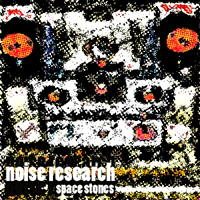



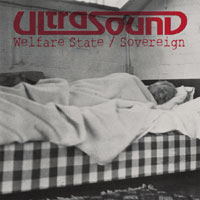
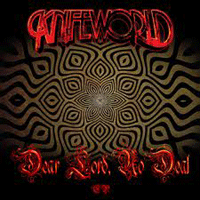
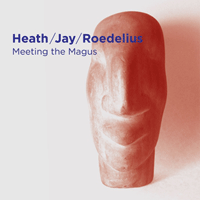

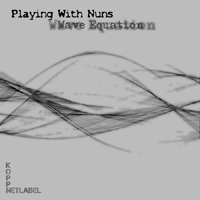





 Misfit City