March 2013 – album reviews – The JazzFakers’ ‘Here is Now’ (“accumulates itself out of loose particles of imagination; like a rogue dust-bunny”)

27 Mar
The JazzFakers: 'Here Is Now'

The JazzFakers: ‘Here Is Now’

I guess that any full-on free improvising band that makes it through to their third album must have become something of a fixture. Rolling and roiling within the Brooklyn branch of the New York improv scene, The JazzFakers probably also qualify via assorted free-music spillages (Brooklyn’s Experimental Music Meet-Ups, the Experi-MENTAL Festival) since their 2008 inception. Their humming, grappling music still suggests nothing particularly fixed.

Two of the four ‘Fakers, David Tamura and Robert L. Pepper, are certainly well-established promiscuous players and upsetters. Lynchpins of the Brooklyn multimedia collective PAS, they’ve placed themselves firmly into a matrix of oppositional noise, construction and deconstruction. All of their multi-instrumental noise-cramming in The JazzFakers has been nourished by multiple collaborations with a long train of musicians (soundtrack layerist Philippe Pettit, improv veterans Kidd Jordan and Charles K. Noyes, the spontaneous composers Ron Anderson and Grady Gerbracht). The other two ‘Fakers are maybe less ubiquitous – and less space-filling – but they certainly bring their own vitality. The anxious rubbery bass lines of Raphael Zwyer add a restless, nervy sproing. Drummer Steve Orbach has turned up bright and eager to the sessions, his sticks a-quiver like bug antennae, ready to prod and feel their way into the music.

The album name, ‘Here Is Now’ suggests fresh, bright immediacy – improvisation without worry. The individual track names (a set of successive anagrams, all worked out from the album title) suggest playfulness and an enjoyment of structure games. The dirty kerb, torn binbags and scattered garbage – tied-off shirts, food fragments – of the cover shot tell a different story, and a more truthful one. JazzFakers are about debris and disparity, not consonance. There’s little about them that suggests structure apart from the swarming, disturbing liveliness of their intent.

Instead, their music accumulates itself out of loose particles of imagination; like a rogue dust-bunny. Or, more accurately, like a gigantic hairball – something rolling restlessly around the band members’ Brooklyn rooms and lofts, accreting a body from discarded bits of living and usefulness. Any given JazzFakers piece is a cannibal mass, crammed with china plate-shards, snapped pencils, and the sparking remnants of semi-dismantled technology; given extra lift by rolled-in springy fibres and by jazz-honk air-pockets. Runaway guitars, violins and reeds tussle with sundry distortions and tangled-up masses of electronic blips, and with a collection of synth voices which range from the raw to the deliberately corny.

While David Tamura is responsible for plenty of overdriven splintery electric guitar lines (rolling around furiously on the floors of the compositions, like injured scorpions), he’s also the band’s saxophone player. Unusually, this also means he’s often the band’s main link to more conventional structures. Certainly it’s him that provides the powdery, blues-rich tenor melody that boards the loose-boned march of Oh Rise New, adding a recognizable jazz voice to the restless buzz-keyboard swirls and mosquito-drill guitar, the rambling bass tune and the childlike organ which hangs and fidgets on a single disruptive chord. On Horse Wine, it’s his smartly turned-out tenor sax that moves in to converse calmly with Robert’s chorused violin saws and Raphael’s panicky bass, trembling and muttering on the upper harmonics. Steve’s subtle drumming adds some calming authority to the occasion, a taste of West African skintalk to offset the balloon-scraping sense of fear elsewhere.

On the other hand, David’s not to be relied on to provide anchors and grip all the time. Weise Horn, rising out of a wobble of shortwave synth whines, sees him let rip on free tenor: Robert responds with scrapescapes of violin, Raphael with a bass performance like a surprised bear. More than any other on the album, the piece becomes a free blow, but one struggling with a sense of being trapped. Led by David’s frantically wiggling sax, it’s claustrophobic, filled with screeches and frantic prison drumming in background sounding like someone drumming up a riot on a cooking-oil can.

There’s more free-sax contortions on Her Woe Sin (this time on alto) while a trepidatious, intense organ harmonic squeezes the band into a single trapped pitch cluster. Here, it feels as if they’re all being forced out through the neck of a bottle. As they reach a peak of compression, the piece becomes a revolving oscillation of guitar rub and smudged noises; trapped on a machine wheel, while Steve keeps a slow walking drum time at the rear.

Like David’s easy slips into conversational sax, that walking rhythm is another old-school jazz touch that comes rising up to reassure us through various JazzFakers confusions. There’s a brief, loose touch of it at the end of Nowhere Is – David and Steve bobbing along together in a moment of drums and sax companionship. Earlier it’s been a game of tack-blows, with Raphael’s rubber-mallet bass rebounding off curving chunks of organ, water-bottle tocks and flits of synth. As this moves into a more abrasive grind of free noise, David’s bluesy touch on sax makes a return, holding the band together with a stitch of melody. Ever-so-slightly wild, it sits in with the pugnacious racket like an old guy bantering with youths, laughing as his own wiles are tickled by their random energy.

Whine Rose reminds us that New York (like other cosmopolitan homes of music) isn’t just full of its own stylings, but also winds immigrant memories into its fabric. This piece sounds like an impression of the docks in Istanbul. Robert’s violin lines toy with a flaring, challenging Turkish-trumpet attack. Raphael’s bass strings scrape and creak like cargo cables: Steve drums like a longshoreman slinging and bumping crates across a quay. Every so often a long scraping drone in a reverberant arch will overwhelm the chatter and noise, push through the dirt and air-flashes from the band’s electronics and come in to rest, like a giant ship harbouring. At the end another jazz walk falls into place, free and swaggering, but trying to get back into comradely step. For a moment, the ‘Fakers sound like a cluster of dockers going off-shift, strutting out of the yard in search of a bar and perhaps a bit of trouble to bond the team together.

But while hints of jazz tradition, diasporan memory and other bits of cultural consonance may surface briefly through the matted fabric of their musical hairball, the JazzFakers are always predominantly about shredding sound – grabbing and shaking it into rag and rampage. Bar a brief breather in the middle (an interlude of silence, broken by gentle koto plucks), Where’s Ion gathers up raw hanks of sound to stretch and shear. Morse-blipping electronics and flinders of keyboard fight their way through a seesawing murky gale of playing. Robert’s abrasive, distorted violin wrenches back and forth, overdriven to the point where its melody fissures and cracks; time pulled and flexed too far out of shape to cling to. The second part entirely and willingly overwhelms itself: a shitstorm onslaught of scribbling guitar and a mass of excited electronic buzzing and whooping meets Steve’s drums and percussion head on, as they rattle like an upended ship’s galley.

The cheerful Whee Irons has its share of noisy Tamura guitar tangles and collapsing Pepper electronics, but also seems to be toying with broken bits of 1980s pop (trying on the hairstyles and waving around some of the sonic tropes). A bouncing, pulsing vocoder patch promises some kind of hook before becoming just something to squish and pulp against a jittering music box. Raphael (briefly in the spotlight) visits the upending, cunning-stunt territory of Tony Levin or Mick Karn. His bass jolts out high squeets, tap-and-hold skids, talkative burbles; on one occasion, a game-changing downward slide before slipping comfortably back into freestyle wandering for the second stretch. More elements tossed hopefully into the mix include some double-speed Zappa saxophone rushes and some corny, choral angel-voice keyboard, mocking at the huffing, bellowing drums and the drilling lead guitar.

At the end, with the twelve minutes of Hero We Sin, the band don’t so much tie up the record as relax the tangles. While free, it’s less furious. There’s less jostling and more listening, from the fake sci-fi theremin intro (echoing over lightly-struck and watchful cymbals) to the final saxophone-argues-with-egg-slicer fadeout. Along the way, the quartet shuffles a handful of musical cards: the edge-stalking Miles Davis fusion of 1971 (both invoked and undermined by little stings of toy piano); the undulant glissando guitar-wave of Syd Barrett; even a hint of the Sugar Plum Fairy. Clearer solos emerge. An aggressively awake guitar (swelling large over grinding distorted drum crunches like rusty clockwork being forcibly wound); cloudy, floating high toms and cymbals over a gastric electronic splatter; a vibraphone over a phased electronic phase buzz, deep pitches, sanding noises and high birdlike twitters, which in turn give way to a cradling bulk-photocopier slide and clunk.

Towards the close, while electronic percussion boils and rattles like popcorn at the side, Robert’s scratch violin is caught in debate with David’s saxophone – the one complaining and cramping, the other remonstrating and stretching. The work’s ending. Time for sense. Time to flex the remaining knots out.

The JazzFakers: ‘Here Is Now’
Alrealon Musique, ALRN043
CD/download album
Released: 25th March 2013

Get it from:
Bandcamp.

Artist online:
Facebook MySpace Soundcloud

REVIEW – Liam Singer: ‘Stranger I Know’ single, 2013 (“sings in a tone of wonder – and of determination”)

26 Mar
Liam Singer: 'Stranger I Know'

Liam Singer: ‘Stranger I Know’

What a wonderful mind for composition Liam Singer has. Four albums into his career, he’s coming up with ever-more-detailed songs which only fit the pop label due to their presentation and singability. In all other respects, he’s a classical songwriter, building a song from cellar to roof, all parts in parallel: a detailed patterner with each idea serving the larger one.

A very small number of songwriters take the trouble to think like this. Brian Wilson and Prince, obviously. Jeff Lynne, Sufjan Stephens and Stephen Merritt, perhaps. Tim Smith, definitely – the interplay of vocal parts on Stranger I Know particularly recalls Smith’s pastoral work with Sea Nymphs or the more delicate moments on Cardiacs records as worked out with William D. Drake (another comparison that can be thrown into the circle). At work in his current hideaway in Queens, Liam Singer belongs to this world of the total song-composers: the ones for whom genre barriers are predominantly bubbles of resistance, and for whom form and content are inseparable.

Stranger I Know sounds like many things. Its links to American minimalism are clear in its collection of elegant cycles (from oompah bass to arching cello; shakers and flute; a mathematical glockenspiel climb) as they move against each other, interplaying in uplifting counter-rhythms. Beyond that, Liam’s omnivorous musical diet is made clear in the breadth of arrangement and intonation, stretching from romantic piano to staccato gamelan pot-clunk. Each instrument comes sheathed in its own immediate mood and pace, hanging onto its place in the dance by a skilful fingertip: just enough to snag a little tension and independence; just enough to flirt.

Shadowed and overflown (as ever) by the spectral caroling of soprano voices, Liam sings in a tone of wonder – and of determination. It’s all a little archaic: a spiritual love ballad with swaying time, an elusive subject and a courtly seriousness which ultimately fails to mask its fervour. “Stranger I know / thy face / from a dream. / All night I’ve yearned to hear that song. / – Once, it sang me.” There are hints of transformation and liberation here – “What was / before me / is now / behind me. / Strings fall / off of / a body,” – but devotion and freedom end up so closely wound together that there’s nothing between them. Liam finally stands set loose on the verge of… something. It’s unclear, it’s unsure, it could even be an end; but it’s welcomed, and while Liam’s left some things behind, he’s not alone. “Saw God’s / features – they / can keep ’em all. / There is no / voice to follow / now. / And as the / noise / takes over, you / just hold your / breath, I’ll hold / mine too.”

Stranger I Know is also a little exercise in time-travel, working a gentle auger down through several generations of American tune and peeping through the hole. Liam’s previous songs have been beautifully arranged, evoking a classical ambience. This one – balancing a subtle, minimal complexity with fleeting kisses at its reference points – ups the game. In its shifting and its overlaying, you can hear migration at work. A little dose of romantic Europe dapples a line of American mountains: the breathless chorus (its rhythm offset from the dreamy verse) steps in like an old-country village dance setting up against the pistons and presses of a little factory in the hills. Behind the tinkling delicacy, that bass drum which comes in for the bridge hint at a barn-dance stomp: Shaker Loops to hometown hoedown.

All of this activity is encapsulated within less than three minutes. In, out, open. A little wonder.

Liam Singer: ‘Stranger I Know’
Hidden Shoal Recordings (no catalogue number or barcode)
Download-only single
Released: 6th March 2013

Get it from:
Free download from Hidden Shoal Recordings or Bandcamp

Liam Singer online:
Homepage MySpace Bandcamp

March 2013 – album reviews – Felipe Otondo’s ‘Tutuguri’ (“sound moulded by careful hands”)

26 Mar
Felipe Otondo: 'Tutuguri'

Felipe Otondo: ‘Tutuguri’

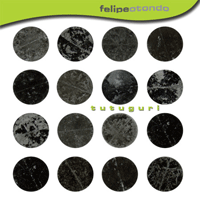
Having pursued his studies from his native Chile to Denmark and then to the UK (he currently teaches at the University of Lancaster), electro-acoustic musician Felipe Otondo has already made himself a world traveler. The cosmopolitan sourcing of his music ensures that he travels even further afield, even while sitting at his computer. The four pieces on his debut album ‘Tutuguri’ draw on concepts, patterns, sounds and language from India, Java and Mexico as well as from European and American sound-labs.

This reminds me that, like bats, human beings use sound to find where we are. We often remain unaware of this, or even dismiss it. In cities, for example, we tend to think in terms of filtering out the extraneous noise – the rumbling press of traffic, the too-close babble of our neighbours on public transport or through the thin walls of apartment blocks; the persistent layering of unwanted music as ambient features for shopping or working. In spite of this, we’ll still use sounds to judge our way and to establish our place in a shifting world. Recurring sounds in the subway tell us that the service is regular, or when we need to change direction. Changing accents in voices and even birdsong rachet our subliminal paranoia up or down. Subtle switches in the quality of sound moving through the air tell us about weather, and about the places we move through. Some newly-blind people even report developing an echo-location sense, measuring the presence of oncoming pedestrians, lamp-posts and corners by the minute changes in echo and sound positioning.

Most importantly, we associate the places we know with an arrangement of sound. Wind will be shaped around a building in a particular way, the patterns of dialogue and intonation spoken in and around particular shops and café. Traffic lights and contraflows generate their own rhythms and exchanges. Blindfolded, I’d still be able to recognise the back-street where I currently live from its specific sound patterns: cars nudging the speed-bumps with a particular speed and duration, the toss and bend of the trees in the wind paths, the pitches of children’s voices in the school half-way along, the frequency of slow buses creeping to the nearby bus garage. These recognitions surprise us, often in ways which we don’t even consider until the connections occur to us.

To me (being less of a traveler than many) Felipe’s sound sources are more exotic, initially implying spatial journeys or international visits. The complex and beautifully-packaged CD sleeve for ‘Tutuguri’ enhances this, opening up like an origami flower (or like the jaws of a concealed alligator). The four intent and deceptively challenging pieces within the album are designed to shuffle the consciousness rather than soothe it. They divert the listener along other paths: associative, temporal, historical; hallucinatory or sacramental. When Felipe cites them as being “meditative”, he doesn’t mean relaxing, or lazy. Listening care is required. At a distance – at a point of detachment or reduction to background – Felipe’s pieces will sound like a fluttery wallpaper of treated sound effects. Up close, turned up, or simply heard on headphones, the craft is evident: Felipe’s years studying spatial sound and timbral perception have been well spent. He’ll set you down in the middle of a set of beautifully recorded instruments or noises – or as an offset, slightly distanced observer – and then gradually alter that sound-world in increments, or in sudden dartings.

The oldest piece on offer here, Ciguri, takes Native Mexican bell and gong sounds and cuts them loose from root time. This isn’t as straightforwardly surgical, or as uninvolved, as it might read. Felipe is open about the inspiration he’s drawn from the Mexican peyote ceremony (and from Antonin Artaud’s writings on it). In particular, he’s interested in the time-distortion effect experienced when ingesting mescaline (which he recreates here via digital editing). On the way, he also explores inharmonicity – the additional non-harmonic tones created within a sound, via variations in the source material’s state of rigidity and elasticity. Strictly speaking, this is a physical exploration, but if you’re talking ritual – if you’re talking metaphysics – the same idea might be extended to the participants in the ceremony. As in any sacrament, each of their experiences will be shaped by their willingness, and by how their own histories and attitudes impact on how their brain works and how their world is conceived.

On Ciguri, Felipe doesn’t make matters quite that explicit, but he does his very best to remind us of how subjective an experience this can be. Sound-wise, he places us in the heart of a slow heat of hanging metals, and we listen (over nine minutes) as they alter. During this time, different parts of the surrounding structure take turns to transmute while others remain still. Gently struck tones blur from a simple ping to a fluttering hummingbird drill: the substance of the metals themselves seem to move restlessly between solid resonant bronze, a whispering foil, or a mere shining hiss of elements. The reasons behind this may be all in the math, but it doesn’t feel that way. As the numbers race through their patterns, the world around us changes and we’re hypnotized by what feels like the universe breathing.

Another piece, Irama, draws directly on Javanese gamelan orchestra music (using manipulated recordings of the Sekar Petak ensemble at the University of York). Irama’s title comes from a flexible gamelan term – one that can be used to define the time between two notes, or the time between two actions; or the rhythmic relationships between parts of the composition; or tempo in general. Drawing all of these meanings together under one conceptual net suggests a substantial and integral connection between all of them, much as each of the Indonesian gongs, flutes, pots and zithers in a specific gamelan orchestra is honed and tuned to fit only with instruments from the same orchestra. Of course, digital electro-acoustic processing means that any relationship between notes, pitches or rhythms which didn’t already exist can be first conceived and then molded into shape: and Felipe flexes and reshapes the gamelan sounds according to his own design.

Irama’s gong sounds range from the familiar bronze boom to the kind of light dry patterings and tight-hide raps which you’d expect to hear bounding from frame drums. Over a particularly deep gong sound, a metallophone texture is stretched into a soft drone: when the broader percussion section returns, it’s joined by soft struck pings and an oceanic flutter. At crucial points, particular gong chimes cut through to suggest changes of intent and mood. Apart from these, all of the sounds which lope through Irama reinforce themselves, subtly adding to an arrangement which becomes denser and denser, shifting to a jazzier pulses before (nearly four minutes in) rising to flood-rate and then dispelling into nothing. A second section begins – sterilized pings and rings, more German laboratory than Javanese ritual. Drilling echoes are buried inside it, ringing edge-tones place themselves above it. At six minutes, the frame-drums return; at seven, the pulse has multiplied again to the point of flooding; at eight, softened rings are the dominant sound as the piece diminishes into calmness. As with Ciguri, there seems to be more than the mathematics at work here; but beyond the calculations, all of Irama could itself be an illustration of time as human experience – its repetitions, its bewildering multiplicity of voices; its moments of collective intensity and its sudden rapid lulls.

 
As a listener, attempting to put narratives (however clumsy) onto more elusive or abstract pieces of music is a common strategy. Thankfully, the mixed instrumental/vocal piece Teocalli already comes with a narrative. It’s based on ‘The Night Face Up’, a short story by the Argentine writer Julio Cortázar, whose surreal-modernist approach (creatively disrupting his plots and chances of resolution via a shifting, subjective consciousness and by the restless straw-shuffling of jazz) is well suited to the cut/paste/reshuffle of Felipe’s compositional tools.

The original tale is about an injured, hospitalized motorcyclist: delirious, and dreaming that he’s a man hunted by the ancient Aztecs and targeted for sacrifice. Location and context come adrift in the dreamer’s mind, but are carefully deployed by the writer – here, Felipe steps carefully into the latter role, guiding his strips and layers of sound into place. Hunters’ drums roll in the background, sometimes scooping up in an enormous glottal curl of extreme echo, swooped by fierce panning and sound-fielding. At times, they run backwards, creating great ominous bowls of sound-space. In a recurring cut-up, a little choir of men sing what sounds like a Mexican popular tune. This moves in and out of Teocalli like a radio which can’t stay fixed on the station, just as the injured man in the story can’t stay fixed within his own time or his own experience. Watchful silences bead within the piece, within the drum-slides; filled with tiny arrested hangs of reverberation.

Through these silences (but also often in the midst of great surging wrenches of drums, as they wrestle for our attention) women’s voices speak. Zapotec women, from a pre-Spanish civilization that lives alongside and intertwined with modern Mexico. They converse and chat, presumably about ordinary human matters – these are interview snippets, not field recordings. But as these women are separated from listeners like us by their language (and by our own crude knowledge, and cruder guesses, about their culture), they innocently become part of the sinister hallucinatory sound environment which Felipe creates. As drums sweep and skirl around our heads, so too does a whole jungle of suggestions – brief clusters of crickets, digitally squeezed and timeslid; bird calls, as of hunters hidden in the undergrowth. When one of the women speaks again, her unconcerned and easy voice is shaded into callousness. When, at one point, she suddenly laughs, easy and confident, the dense paranoia and wilderness swirling around her conspires to render her cruel.

There’s no final outcome to Teocalli – no cathartic slaughter, no rescue. Eventually Felipe’s piece just blows away into the shadows, like the memory of ugly wings pressed around you. The fever dream is over. With the passing sweat those eerie vicious terrors go with them. The deep-rooted fear (part-humble, part-racist) of an ancient, incipient otherness. The fear of comfort and security crumpling and allowing the past to pluck you away; a raw, helpless morsel.

 
In its way, the final ‘Tutuguri’ piece – Sarnath – is as ritualistic as the others, yet it doesn’t rely so much on recreating states of mind. Instead, it attempts to sculpt suggestions of place, history and connections. It’s based on Francis Booth’s Indian location recordings of places associated with the story of the Buddah (and is named after the deer park in which Buddhist Dharma was first taught). In a sense, Sarnath is both site-specific and displaced, bringing the noises of Buddah-touched locations to wherever its soundfiles are played. Concert venue. Boom box. Perhaps even a trekker’s smartphone, being carried on a pilgrimage of its own.

As Felipe switches between recordings (clicking up one-by-one the sonic capturess of different geographical stops on the Buddah journey), Sarnath itself seems to be moving from place to place in search of something. Literally, a footprint? Literally, an echo? Felipe toys with the field recordings: folding them on themselves, stretching them over time. A bell might sound, swell hugely, then drop away. Chants may be heard. On a half-distant road, a procession of ecstatically banging drums may wind its way to a shrine. Behind these, birds and animals twitter. Away from the devotions, there are the soft chips and scrapes of human work being carried on regardless. Here, Felipe’s notes most obviously cite the intense, subtle states of mind connected with meditation: here, with whispers of Buddha making their presence felt, it’s a traditional part of the tale. Here, too, are the tiny sounds to focus meditation; the small sonic flakes of the natural world around which attention can be wound.

 
‘Tutuguri’ is four pieces; four stories. None of them conclusive; and despite the sleevenotes and the substantial clues, at least part of the stories I’ve recounted here have been dreamed up by me. The solo listener – the sound moulded by careful hands around my ears, yes; some of the intimations perhaps patted into place. But in other cases this music is just process doing what process does: forming channels for their own sake, numbers making shapes and illusions as part of the pattern comes into view, and only part of that’s actually recognized. Much of the purely technical side of Felipe Otondo’s music escapes me: instead, I experience much of it as the psychological backwash, like the vapour trails after the plane has passed. Still, if I’m creating my own ideas for what Felipe’s music might entail or might intimate, there’s clearly enough extra substance there for me to build on. That’s what humans do: we use sound to find out where we are. Finding places we know: judging our way through what’s being presented to us; sometimes, the recognitions surprise us.

Working blind, but guided by sound, I travel too.

Felipe Otondo: ‘Tutuguri’
Sargasso Records, SCD28070 (5065001338700)
CD/download album
Released: 25th March 2013

Get it from:
Sargasso Records (CD) or Amazon (download).

Felipe Otondo online:
Homepage Soundcloud LastFM

REVIEW – What?!: ‘Tikka Masala’ single, 2012 (“a sweet-natured hall-of-mirrors groove”)

19 Mar
What?!: 'Tikka Masala' single

What?!: ‘Tikka Masala’ single

Sometimes you can come across simple treasures hiding in the backroom. Dutch guitarist Niels Bakx, Sicilian drummer Raphael Lanthaler and Tyrolean bass player Agostino Collura are part of that under-appreciated swirl of humble, talented international musicians who fly in, settle down and quietly underpin bands in London, as in many big cities. People like these plug away behind the people with the big ideas and the knack for fronting. They’re the ones who finesse the roughness, who add the musical depth and the polish which brings shine and sophistication to performance. And sometimes, they secretly bring more.

Individually, each of these three have clearly got the chops and the temperament to keep themselves in demand with songwriters (Agostino plays with Anna Waldmann’s band The Cry Baby, Niels and Raphael back Charlotte Eriksson in The Glass Child), embedded in soul collectives (Agostino’s work with Retrospective For Love) and driving mixed groove-band (Raphael’s Snail Trail). Together, though, Niels, Raphael and Agostino are something else.

As What?!, they’re an assured and formidable unit; an airy, confident groove-trio audibly revelling in their flexibility and their knack for carefully-sprung timing. On spec, there’s nothing particularly unusual in what they do. Enough years spent plugging away at sessions and keeping punters happy with funk, soul, jazz and reggae tunes have made them experts in warm, sunny, foot-moving musicality: but it’s what’s beyond the blueprint that’s interesting.

Their debut single Tikka Masala (named, consciously or not, after a meal made up on the spot to keep British customers happy) is a sweet-natured hall-of-mirrors groove, light and slinky. There’s reggae in it, thanks to Raphael’s displaced bass drum taps, his tight-tuned tom rattles and Niel’s skinny-supple rhythm guitar. There’s funk in the warm spaces between strokes and beats. There’s jazz in everything, from the little golden runs of licks to the turnarounds to the feel that the rhythms are to be flung from hand to hand, danced over, teased and tag-teamed around. There are subtle refractions, interruptions of rhythm and key, that make you think briefly of progressive rock at its least bombastic and most aware. There are also flares of hard rock when all three musicians line up under a suddenly roaring guitar and suddenly start jabbing together ahead of the beat.

What’s really special about it is their complete control over the music. Their discipline is absolute but relaxed, with the feel that at any time they could shift rhythm, speed, genre back and forth in a moment, and yet not drop a single thing along the way. There are no self-conscious cut-ups in What?!’s music – no need to deconstruct. Why should there be when they’re masters of structure? – so much that if you flipped Tikka Masala around and spun it backwards it would keep every bit of its symmetry and bounce. For a demonstration of this, play the bonus track Alasam Akkit as that’s exactly what that is – a backwards-play of the A-side which sounds almost as good as the forwards version. A backwards-play which you can still dance to. Remarkable.

Exactly what this leads to, I’m not sure. Perhaps the outcome is that What?! set themselves up as a twenty-first century Sly and Robbie-plus-one. Perhaps they remain a supremely-accomplished hobby band, something which the trio engage in when they’re not otherwise employed keeping other people happy. Or do they push ahead as self-sufficient instrumentalists, seeing how far they can push, stretch and double-feint their masterful musicality? The only thing I can be sure of is that, whenever they do get together, all ways – for those moments – are open; and it’s tremendously refreshing.

What?!: ‘Tikka Masala’
What?! (self-released) (no catalogue number or barcode)
Download-only single
Released: 11th October 2012

Get it from:
Bandcamp.

What?! online:
FacebookTwitter Bandcamp SoundcloudYouTube

March 2013 – EP reviews – Henry Fool: ‘The Free Henry Fool Download EP’ (“picking carefully through detailed instrumental weaves”)

19 Mar
Henry Fool: 'The Free Henry Fool Download EP'

Henry Fool: ‘The Free Henry Fool Download EP’

Something old, something new, something borrowed, something blue; and all in one package. Henry Fool (resurgent with the ‘Men Singing‘ album after over a decade of woodshedding) are offering a free look at what they do and what they’ve done. A four-minute edit of a rolling juggernaut from the new album; an exclusive, keyboard-led instrumental; two tracks lifted from the band’s 2001 debut album.

While the older tracks (touted via their expansive Steven Wilson mix) might pull in some attention, Henry Fool offer plenty on their own account. Like a number of their contemporaries (such as Sanguine Hum, with whom they currently share drummer Andrew Booker) the band pick carefully through the detailed instrumental weaves of progressive rock left behind by the likes of Soft Machine and Genesis during the early ’70s. Admittedly, they’ve also got the odd thing in common with the sometimes inspired, sometimes benighted neo-proggers of the 1980s. Keyboard whiz Stephen Bennett was one; while guitar puzzler and sometime singer Tim Bowness (better known for no-man) had his own mid-’80s brush with the genre via a bellowing one-night stand with Hertfordshire pompsters Gothique. However, the Fool’s music is churned and tinted by connections and cross-talk with jazz, Brian Eno, Cambridge, avant-garde texture loops and post-rock, making it a subtler and more diverse stew.

For the most part Henry Fool are reappraising that old-school prog fabric, re-cutting it via thinking shaped by four more decades of musical developments, step-backs and parallels. At no point does it feel that they’re simply replicating the old vintage – still less watering it down. It’s more as if they’re inhabiting it; as if they’d moved into an old house, given the interiors a fresh coat of paint, and are now at the stage where they’re hanging bright new pictures and squinting at them, trying to see if they fit with the lines of the beams. Plucked from ‘Men Singing’, the four-minute edit of Everyone In Sweden (trimmed down from its original fourteen) keeps much of its vigour and its cunning ancestry: slow-motion Soft Machine keyboard cascades married to the rapid aggressive wobble of a 1976 Genesis groove, layered with scribbling synth lines which scurry over the structure like a gang of weasels. While clipped, wrangling guitars (part-post-punk, part-post-rock) hack against the smoothness, the edit brings out aspects less evident in the long version – the chippy funk in Peter Chilvers’ fretless bass, or the ghost-train lean of the chords.

As you might expect from the punning title, the Bennett-led A Canterbury Scene (exclusive to the EP) reveals more Soft Machine elements. Centred around the brittle tones of electric piano – wah-ed and echoed in the style of late ’60s Miles Davis bands – it gradually shifts to more Egg-like territories collided with grand Yes string parts. Lurking in the shadows of pomp, it edges its way around the outside, never setting a foot in the brasher spotlight. Written in a dicey 25/8, Poppy Q (its counterpart from those 2001 tracks) is a careful pick-through of electric piano, like a tiptoe through a prog minefield. One minimal keyboard figure arches over odd chords and a faux-Mellotron counterpoint, before the whole band step up into a stately twitching rhythm, keyboards interplaying with a bass part which pulls its shape from the original piano line.

Heartattack (also from the 2001 album) is the only track on which Tim Bowness unleashes his whispered, impeccably English spring-water croon. It’s also the song that best shows how Henry Fool differ from the standard prog approaches. While so many bands in the genre expand everything from ballad to suite into a mass of crammed lyrics and grand significance, Tim opts for a quick peep-show look into a life more ordinary, with a jolt of inner panic. “Stone-in-love and lost again, / you’re walking through the fields. / Summer fresh, your life’s a mess, / you’re wearing down your heels. / Don’t look back, / you’ll have a heart attack.” Thirty-five syllables of narrative, and that’s it. The rest is your own guess, to be worked out against a backdrop of clover-burst keyboard chords, discreet-but-urgent guitar peals and clenching rhythms. Prog balladry from the leanest side, in which the musical scenery is as much the story as the words are, but in which the delicacy asserts a refusal to hammer home the meaning.

Henry Fool: ‘The Free Henry Fool Download EP’
Burning Shed (no catalogue number or barcode)
Download-only EP
Released: 8th March 2013

Get it from:
Free download from Burning Shed

Henry Fool online:
Homepage Facebook

Album reviews – Darkroom: ‘Fallout 2’ & ‘Fallout 3’ albums, 2002 (“a game of reverse-chicken… impressive and utter liquefaction”)

18 Mar

Darkroom: 'Fallout 2'

Darkroom: ‘Fallout 2’

The second part in Darkroom’s ‘Fallout’ trilogy ( a set of interwoven concert travelogues) sees the unorthodox dark-ambient trio shrink to fit circumstances: recorded over the course of four gigs in Cambridge between spring 2000 and spring 2001, ‘Fallout 2’ records their first period of work as a duo. With singer Tim Bowness temporarily absent from the group, the five lengthy live tracks see Darkroom’s sound now built up entirely from Andrew Ostler’s infinitely malleable, polluted volume of electronic sounds and Michael Bearpark’s massed, heaven-and-hell loop guitars.

Subtracting the singer should have meant removing the human face from Darkroom’s activities. It should have forced their music – which was already suffused with hanging menace, dense atmospherics and chaotic leanings – further down the road to alienation. In fact, the opposite is true. Minus those fragmentary Bowness sighs, whispers and melodic wails, Darkroom do relinquish part of their edge of romance and distress. But they also dispense with the intimations of human disintegration, morbidity and panic which Tim’s beautifully tortured vocal tones brought to the project.

In his absence, Darkroom is able to relax and experiment with a two-way balance instead of the three-way teeter they’d thrived on previously. Os and Michael sit back and play off each other – not in unison, but in a dialogue of occasional crossings and of deceptive, mock-disengaged responses. As with ‘Fallout One‘, the two-man Darkroom continue to embrace instinctive wandering noise-stews rather than art-rock discipline.

For this album, at least, these are gentler brews: one even begins with a serene duet of heaven-scented loop guitar and a windblown squiggle of pink noise, rather than the warning tones of before. Released from some of his duties as textural foil to Tim, it’s Michael who now gives the music its anchors: cyclic calling phrases, humming confections of layered Frippertronic-like loops, space-echoed licks, sometimes a sound like someone wrenching their way out of a giant metal tank. Os – as usual – takes responsible for most of the layers of sonic detail and for the most drastic directional shifts within Darkroom’s ever-restless improvisations.

Os’ increasing plunderphonic tendencies (linking and threading pieces with snippets of international radio conversation, Cambridge choristers or muezzin calls) prove that behind his responsibilities for the main body of Darkroom’s sound, he’s also the joker in the pack, dialling up effects and textures from a vast trick-bag of electronic sounds which he then sloshes across the speakers and leaves to evolve. His rhythms, too, betray a sense of cool, amused mischief. He’ll stitch in trails of techno beats, or hijack a piece five-and-a-half minutes in with jazzy cymbals and toms drenched in flapping dub treatments. He’ll even drop in the occasional comedy drum-wallop to accompany some blooping synth sounds he appears to have stolen off a kiddy-ride in a shopping center. Inscrutable humour aside, Os also assembles a remarkable variety of more solid elements to flesh out Darkroom’s randomness: imposing psychedelic cadences, static veils and suggestive electrophonic shapes.

Though Michael Bearpark’s playing still owes a debt to Robert Fripp (via his “Bearatronics” loops and his occasional digressions into trumpet-guitar), he’s far less formally-minded. While you could also draw parallels to the mangled roots sounds used by David Torn, Michael is a far more reticent, distant and watchful guitarist: less flamboyant, but similarly eclectic. Across the album, he comes up with the kind of junkyard guitar that Marc Ribot would be proud of; or treats us to yanks and scrabbles of twanging guitar in the vein of Henry Kaiser or Fred Frith. He unwinds collapsing, Spanish-guitar-style electric rolls; or feeds in the Bill Frisell-influenced ghost-country minimalism that he’s increasingly stamped onto Darkroom music. Os responds with gusty, gauzy swirls of noise, or busies himself chopping up the sound even as Michael enriches it.

It’s co-operation of a kind, I suppose. Sometimes the Bearpark/Os interplay is gloriously subtle. More often, they’re engaged in a game of reverse-chicken in which they seem to be seeing just how far they can wander from each other’s playing before Darkroom collapses, adding a kind of free-jazz risk to the elements of illbience, Krautrock and musique concrete that already flourish in the group’s sound. Darkroom’s apparent abstract shapelessness (more accurately their indifference to, and boredom with, the monotonous formality of much electronic music) seems to put a lot of people off. However, their loosely-knit and liberated music still has few rivals or peers in electronica.

Darkroom: 'Fallout 3'

Darkroom: ‘Fallout 3’

Tim Bowness returns for ‘Fallout 3’ which at first listen sounds as if it could be pegged as the kinder, gentler Darkroom. This seems an unlikely label. Nonetheless, the album initially seems something of a let-up from Darkroom’s unsettling dark-ambient explorations.

As the group’s main studio-flexer, Os exerts most of the active control over the emerging music. On this occasion, he does this by taking more of those Darkroom live recordings and drastically remixing them. Drawn from two of the mid-2000 Cambridge gigs which initiated ‘Fallout 2’ (plus four other gigs between 1999 and 2000 in Cambridge and London), ‘Fallout 3’ is tagged as “a celebration of the art of post-production” and compresses their rich, chaotic improvised sprawl into a thickening wall of noise. This is Darkroom as jelly, rather than their usual coils of prismatic vapour. In the process, it displays a side of the group which might appeal better to ambient-music aficionados and art/noise acolytes (those who’ve so far proved immune to, or unconscious of, Darkroom’s brooding wide-open power).

The art-rock richness of Tim’s keening, beautiful-agony vocal was previously something of a scene-stealer – especially when it reached heights of drama which recalled Peter Hammill at full tilt. This time it drifts faintly through the mix like a displaced ghost. Half-obscured, half-dreamy, its physical presence fades to a livid imprint. As for the industrial-melodic textures of Michael’s guitars (and his layered MiniDisc manipulations), these have sunk even deeper than before into the fabric of Darkroom sounds, as have most of the drum loops. The most audible Darkroom instrumentation to be heard on ‘Fallout 3’ is the humble studio fader and the reverb unit, teasing their way through the music and rebuilding detail.

Turned right down, ‘Fallout 3’ sounds like the smooth-peanut-butter option compared to the crunchier varieties of ‘Fallout One’ and ‘Fallout 2′. Turned up, though, the music piles upwards inexorably; like a thick fluid shot through with veins of displaced voices. Sometimes these voices belong to Tim, processed almost beyond recognition to become muttering crowds or alien choirboys. Sometimes they’re radio voices stroked out of the ether by Os’ continuing casual interest in plunderphonics. Those little instrumental dialogues and monologues that used to weave through Darkroom pieces have been melted down too. Everything played becomes food to feed this new amorphous monster.

The result is that, more than ever, Darkroom’s music has the amnesiac, dissolving qualities of oceans. Powerful and ever-massing, and strangely indifferent to the repercussions of its nature. The sound itself, for what it’s worth, is closer to dry land if perhaps not stable ground. That continuously-rumbling, near-geological depth of soundfield and the thick “angry-earth” quality to the sound brings this reinvented Darkroom closer to the relentless, tectonic grind of Robert Hampson’s dark-ambient process music in Main. Like Main’s, the pieces on ‘Fallout 3’ are much of a muchness. All are slightly differing curves on a line mostly heading in one direction, arcing beyond post-rock to the land of out-rock. There’s far less of the more identifiable tendencies of the past – nowhere near as much of that Fripp-&-Eno-swimming-in-Lee-Perry’s-galactic-fishtank feel. The always diffuse identities of the Darkroom players are now barely there at all. The music has turned them inside out.

Consequently this is seventy-five minutes of impressive and utter liquefaction that’s still– identifiably – Darkroom, and which also enables them to thumb an invisible nose at past accusations of formlessness. Even when their musical substance is reduced to something as intangible as this, Darkroom’s baleful and beautiful intent remains intact: a long way beyond the easy trance to which most electronic acts are finally reduced. Darkroom’s vision is still inexplicable and alien. It’s also still undeniable.

Neither kinder nor gentler, then. Just even more seductively suffocating and inscrutable.

Darkroom: ‘Fallout 2’ & ‘Fallout 3’
Burning Shed (no catalogue numbers or barcodes)
CD-R/download albums
Released: 01 January 2002 (‘Fallout 2’) & 1st February 2002 (‘Fallout 3’)

Get them from:
Burning Shed (‘Fallout 2‘, ‘Fallout 3‘) or Bandcamp (‘Fallout 2‘, ‘Fallout 3‘)

Darkroom online:
Homepage Facebook Twitter MySpace BandcampLastFM

Digressions: What pi sounds like

16 Mar

Now isn’t this lovely – Michael John Blake, of the Quebec Antique project, delivers this sweet piece of music for Pi Day. This is a couple of days old, so many of you may have seen it, but well, here we are in ‘Misfit City’ and we’re no strangers to the idea of something arriving a bit late. So… a musical extrapolation of pi for a growing ensemble of piano, glockenspiel, accordion, autoharp, ukelele and more. I don’t know whether Michael had some idea in advance of how his number to notes-and-chords conversion would sound, but I like the result. Thanks to mixolydianblog for bringing it to my attention.

March 2013 – album reviews – Henry Fool’s ‘Men Singing’ (“the friendly grapple between wide-eyed fluency and beady, quizzical interference”)

13 Mar
Henry Fool: 'Men Singing'

Henry Fool: ‘Men Singing’

Perhaps it’s his own fault for perpetually playing the faded-lily crooner, the songwriter victim of ever-blasted hopes, the sigher in lonely cafes. At any rate, Tim Bowness doesn’t get nearly enough credit for his mischievous sense of humour. For instance: in his understated and perfectly burnished way, he’s one of the most stylish and distinctive vocalists in British rock, whether he’s refining and wrangling art-pop with Steven Wilson in no-man or lending his silky melancholy tenor to assorted projects from OSI to centrozoon, Rajna to White Willow. Yet for the whole of this second Henry Fool record – for which the involvement of him and his voice might have been the biggest selling points – he shuts up altogether and plays guitar instead. Inevitably, the album’s called ‘Men Singing’.

Tim also contributes the track titles – enigmatic, silly, sometimes both simultaneously – and, I’m guessing, the sleevenotes. In the latter, his Henry Fool partner-in-chief Stephen Bennett is credited with impressions of Miles Davis and Terry Riley, but also with an impression of Mavis Riley from ‘Coronation Street’. It’s an intriguing glance into their working relationship. Presumably, this means Tim gets to be Rita Tanner. Not inconceivable. Following a phase of relatively sober hairstyles, he is looking more bouffant these days.

Of course, Henry Fool have a history of not quite doing what’s expected of them. While they’re nominally a progressive rock band, you might better describe them as highly-accomplished prog fans on a weekend trip to their influences, who get bored with the direct route and carry out chance diversions to their other interests as they go. Their 2001 debut album certainly drew echoes and ripples from Soft Machine, from mid-’70s Genesis or Pink Floyd, or the more ruminative moments of King Crimson. Yet there were post-punk spikes in the road, stopping the music from becoming grand and flowery; and stubborn, counter-intuitive post-rock kinks (reminiscent of Slint, Fridge or Tortoise) that reigned in or derailed the pastoral draperies.

In addition, rather than grand drama or ill-advised theories-of-everything, Tim’s songwriting (sparse and bloodsqueezed, honed for understatement) offered flashes of human fragility, thumbnail sketches of love and loneliness, and brief twilight peeks into inconclusive lives. It made for an uneasy listen, and maybe the prog world as a while wasn’t ready for a band more Raymond Carver than William Gibson or Siddharta. Henry Fool made a couple of slightly disjointed festival appearances and then went to sleep for a decade under a haystack of perfectionism, studio wrangling and sundry distractions.

Cue, much later, this re-emergence – in which the entire band sounds utterly invigorated. There might be no words this time, (and the music’s smooth flow belies its long gestation) but the intent is clear.

As of the moment, Henry Fool’s a seven-piece collective: part-time players and guest players (many from the no-man orbit) fluttering in and out of place to pulse out fluent streams of music, like happy quasars. Most of the original collaborators are back – multi-instrumental Eno collaborator Peter Chilvers returns on fretless bass, Cambridge jazz veteran Myke Clifford provides reeds and woodwind, and Michael Bearpark continues to commit a variety of guitar solos and interferences from skittering textural glissandi to raw, probing melodies. Of the newer recruits, Andrew Booker (from the no-man live band and, more recently, Sanguine Hum) draws, drives and hauls the drum patterns. The latest player to be pulled into the talent pool is I Monster’s Jarrod Gosling, who brings further prog- and post-rock ingredients along with him as well as sounds from the world of organic electronica – mixing, Mellotrons, a touch of Moog bass and a tinkling glockenspiel.

Most of the out-and-out proggery still comes courtesy of Stephen Bennett, whose keyboard skills and theatrical instincts (thanks to some solid neo-prog history via his 1980s band LaHost) adds most of the harmony and decoration to the project. The Tim Bowness stamp on the project is in the ideas and the overall compass. Never an instrumental virtuoso himself, he leaves the spotlight to others and provides the music’s spine rather than its face – sitting in the background, he rolls out a variety of low-key but crucial guitar lines. These generate the music’s understated art-rock elements of challenge and upset; and it’s still the friendly grapple between Stephen’s wide-eyed fluency and Tim’s beady, quizzical interference that brings the music to life.

The four lengthy, semi-improvised tracks on ‘Men Singing’ manage to be steeped in English prog and psychedelic reference points without becoming waterlogged by any of them. Even the guest appearance of a genuine ’70s art-rock guest star – Phil Manzanera, invited in to channel Quiet Sun on two tracks – fails to upset the balance. Instead, he slots smoothly into the work, engaging in an equal-terms quadrille of unorthodox lead and rhythmic noises with Michael Bearpark. It’s due to the band’s thinking patterns. Rather than going for an unfolding narrative or for linear doodling, Henry Fool works as a kind of coasting, vertical jam; with layer upon layer of subtle music thoughts playing out and exploring over their rolling instrumentals. Throughout, Peter Chilvers restrains himself to spare, crunching, authoritative rumbles and wahs on bass, like a giant turning over in bed – pinning and shaping each long measure with the minimum of showmanship.

The fourteen minutes of Everyone In Sweden are those which most strongly suggest mid-’70s British jazz-rock, carried as they are on upfront and ever-fluid Booker drumming, and woven through by high-buzzing analogue synths. At points it could sound like Soft Machine taking a crack at Los Endos, although a variety of knotty guitar approaches from Manzanera, Bearpark and Bowness and the airy punch of Myke Clifford’s soprano sax spin the music through further territories and changes. At half the length, Man Singing sounds like a lost jam between Miles Davis and the journeying Pink Floyd of ‘Ummagumma’ – elusive funk with bursts of Herbie Mann-ish flute from Myke Clifford, irritated-elephant interjections from Manzanera, and juicy elusive funk-slurs and pings from Chilvers. Bowness, meanwhile, hovers on a tremulous Bark Psychosis guitar; glimpsed occasionally through gaps in the rest of the music, and keeping the questions raised.

The lumbering two-note fuzz bass anchoring and stippling My Favourite Zombie Dream suggests something less gracious. On this one the band plays cruder even as it holds and manipulates tension. Toms bob uneasily, synthesizers string out warped buzzes and trumpeting tonal tumbles. A backdrop of Mellotron gauzes, crash-spring guitar and wrenched organ tones add further disruptive edges. Increasing layers of Stephen Bennett parts pay tribute to a variety of keyboard players from prog to Krautrock – all simultaneously.

Thirteen-and-a-half minutes of Chic Hippo round everything off. This one’s a game of two halves. The first is a leisurely, arena-friendly stroll – the boom-bat drums and the pecking bass, the brace of real violins (courtesy of Steve Bingham) flying alongside the pop-up musings of the Mellotron. There are trumpet lines, moving in jabbing boxer shuffles; and melting electric piano dreams. There are flown-in swerves of parachute-collapse guitar distortion, or bulges like the revving of temperamental guitars. For the second half, a steamy mid-tempo pulse decorated with stern doubled saxophone honks and Wurlitzer piano arpeggios picks everything else up and runs with it. Guitars hang off the sides of the tune, peeling in strips: Bowness offers serene minor arpeggios, Bearpark a scything fuzzed slide line.

Yet while the album is drenched in detail and in finely-worked passing salutes to the creative hum of the early ’70s, that’s not what’s important about it. What matters is the lifting and the liberation; those layers of floated space stacked up above the rhythms and the tickalongs, and the way in which they’re filled. Henry Fool’s biggest achievement is the way in which they’ve freed themselves. It could be a decade of clever editing – something given back from those years of doubt and wrangling – but that doesn’t explain the spirit of fluency here.

While the band have kept some of that beady edge and economy which set them apart on their original arrival, every second of this album is packed with the kind of music that seems to have arrived without agenda or awkwardness. In between the shifts in tone, the mood colourings and the instrumental dialogs, Henry Fool have found a way to travel in a state of easy grace. From the opening cymbal twists to the final harmonious thin-out, every single sound on here (collectively hovering in position like an immaculate air display) feels like the sound of a musician playing through their instruments in the right voice for the right moment… and that’s a rare achievement anywhere. For nearly forty sustained minutes, everyone’s attuned; all in chorus.

Men singing. What do you know? – perhaps it wasn’t a joke after all.

Henry Fool: ‘Men Singing’
KScope Music, KSCOPE244 / 802644824420 or KSCOPE836 / 802644583617
CD/vinyl/download album
Released: 11th March 2013

Buy it from:
Burning Shed

Henry Fool online:
Homepage Facebook Twitter

REVIEW – Qwestions: ‘Humble Pie’ single, 2013 (“cowering and defiant; brave and fucked-up and lucid”)

14 Feb

Qwestions: 'Humble Pie'

Qwestions: ‘Humble Pie’

“I’m dry-heaving, saying these words with meaning,” gasps Qwestions. Gut feeling. It’s supposed to be at the heart of hip-hop: but in a music of masks, demands and fly-posted signifiers it often gets pasted over.

Too much. There’s too much to represent – too much history and geography to be spat up like fireworks, too many links and hand-holds to be acknowledged, too many objects to count. No wonder that so many rappers rapidly run down and put up the same touchy, predictable façade. No wonder that they turn into mobile billboards flattened of meaning, riding in identical limousines – overwhelmed; turned into nothing but front; still scared of the moment when everything will be kicked out from under them.

As for Chicago MC Qwestions, his desperate, dazzling raps suggest that he couldn’t fall into this two-dimensional lie even if he wanted to. At 23, standing tall and shaking, he’s a man who flinches from masks and who lives on the outside of his skin: tears, confusion, grand-and-ground-standing and all. He’s everything that hip-hop ought to be in its honesty. Here, perched on a clenching, reluctant beat and hunched underneath Mario Anthony’s chilly stratospheric washes of synth (as cold as a 4am January on the South Side) Qwestions is both cowering and defiant; brave and fucked-up and lucid. It’s said that rappers have to grow up fast. Qwestions reminds us that growing up is actually a constant, painful process.

Humble Pie sounds like a man hitting concrete, but knowing that he has no choice but to get up and run on. While Qwestions kicks off with what sounds like a typical brag (“I am the greatest rapper alive – / am I wasting my time / eating this humble pie with a plastic fork and no knife?”), the rap quickly and deftly folds in on itself. It becomes both critique and confession of Qwestions’ life and work, of the compromises which he has to make both as artist and man. Even the mocking drawl of the chorus spins between multiple and revealing mirrors: a boast of being a cut above, a wry acceptance of holding back, of pretense and the wrestle with ego. “You know, you know, you know, / they won’t love you when you know, / you too dope, too dope, too dope, / so I play my role… / I know it’s moving slow.” Even the pay-off line could be aimed as much at himself as at a foe onstage – “Make sure you eat some humble pie before the show.”

Many of the images in Humble Pie revolve around guts, and around the value and terrors of food: the nutrition of work, the unpalatability of being conscious enough to let the world intrude. In his dedication to honesty, Qwestions dares to sometimes be repulsive; dares to be outright with matters of weakness, helplessness and terror . “Vomit all in my kitchen sink – / the nausea gets critical when I start to think,” he moans at one point. “I let my mind drift then my stomach flips. / I guess it is a curse when you born with gifts.” Later, he shoulders his offstage burdens with a mixture of courage and gripe – “The scene changes, but it’s the same script, / I’m trying to be a good father… / I sacrifice all my happiness for a couple of dollars and some pocket lint.”

Elsewhere he’s stepping up aggressively, unsure whether to ball his fists or spread his hands, but stripping his self-assertion to the bones of desperation in a bid to be understood. “Remember life in the hood – why the fuck you think I’m so cocky? / Why you think I try so hard? / Why you think you can stop me?” Even here – and after all of the moans, acidic spits and fear-belches – it’s hard not to like Qwestions. But then, a rapper who shares so much about the human condition is to be treasured.

You just hope that he’s going to make it through. Sometimes he sighs, half-broken even as he delivers: “Am I wasting my time / investing in all my dreams with no moments to recline?… / I just want to lay up, / sleep and never get up.” Meanwhile a nagging, sneering voice slips through the verses; a spiteful ghost flitting in and out of the gaps in the tower blocks. A voice from the back of his head, overturning his brags and hollowing out his talent as fast as he assert it.. “Your little crude knife… / You’ll never eat.” The guts of belief are laid bare: there’s everything to defend, everything to play for.

Qwestions: ‘Humble Pie’
Ingenious Dreams Media Group (no catalogue number or barcode)
Download-only single
Released: 2nd January 2013

Buy it from:
Soundcloud

Qwestions online:
Homepage Facebook Twitter YouTube

February 2013 – mini-album reviews – Lee Fletcher’s ‘The Cracks Within: FiWT Remixes’ (“unstitched, re-embroidered, re-folded”)

9 Feb
Lee Fletcher: 'The Cracks Within: FiWT Remixes'

Lee Fletcher: ‘The Cracks Within: FiWT Remixes’

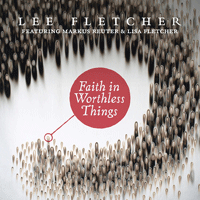
‘Faith In Worthless Things’ was one of 2012’s surprise pleasures. Lee Fletcher’s debut album was the late-blossoming distillation of years of work as engineer and confidant to assorted art-rock musicians, and of even more years absorbing influences and refining them in a budding songwriter’s heart.

What emerged was a sleek, assured and finely-honed planned-patchwork of an album. It pulled in sounds from touch guitars, Uillean pipes, crunchy rhythm loops, ukeleles, powdered trumpets and silky synthesizers; it mused on betrayals, work, bewitchment and people in general; and it drew on a wide but surprising coherent blend of string-quartet chamber pop, soul and trip hop, 1970s Scott Walker, King Crimson-flavoured progressive rock, electronica and Anglo-folk.

While Lee’s firm and expansive vision gave the album both shape and finish, it was also very much a group effort, achieved hand in hand with his singer wife Lisa plus the chameleonic touch guitarist/soundscaper Markus Reuter and a small battalion of interested musicians from around the world. This short album of follow-up remixes keeps that spirit, with a couple of returning collaborators and new reinventors let loose on the tracks.

Only two songs from ‘Faith In Worthless Things’ make it to this particular phase. There’s the title track – originally a humble state-of-the-world address sung by Lisa but dispatched by Lee, people-watching at the railway station in his Devon hometown, and sampling a picture of humanity from its wandering fragments on an ordinary morning. There’s also The Inner Voice, in which Lisa soars on a rich carpet of soul-inspired smoothness; delicately and beadily picking apart matters of confidence and collaboration, while unhitching – scuffed, but quietly determined – from a dragging entanglement. The latter was the album’s obvious single, so it’s interesting to see three different remixers work three different shades of pop out of it.

Of these, Brazilian proggers-turned-clubbers Worldengine offer perhaps the most satisfying reinvention – a slink-and-roll electronica take full of whispering creep, voice fuzz and closed-eye pulse beats. The smooth soul of the original is pared back in favour of odd, gently challenging chording and textures: as if Lisa’s vocal line has been gently unwound from its original branch and wrapped carefully around a new one. Imagine what might happen if David Torn had as much pop clout as Madonna does, and you’ll have some idea of where Worldengine take this.

Two other remixers take The Inner Voice further out, but perhaps with less originality. The mix from German DJ Ingo Vogelmann battles and switches restlessly between its whispering electronic-ambient chamber intro, heavily synthesized cyberpop and a naked acoustic strum. The onetime 4hero cohort Branwen Somatik offers a similarly morphing dance switchback – initially a slightly dubby hip-hop take with an eerie twist, then a transformation to minimally-sheathed soul-pop, finally melting away in a dubby whisper of liquefying beats.

There are no fewer than six versions of Faith In Worthless Things, including a return for Ingo Vogelmann who offers a mix replete with Orb/Jean Michel Jarre-flavoured electronica (strong on the breezy minimalism, and dappled with bits of dub and techno). Adrian Benavides has honed himself an industrial pop version full of collapsing sheet metal and drill bits. Fabio Trentini provides an ambient pop take with an art-pop tweak – part Japan (if the ‘Gentlemen Take Polaroids’ era took precedence) and part Crafty Guitarist. Lee’s words and Lisa’s sweet-but-stately vocals sit, unfazed, in these new cradles.

Having said that, this particular song is less suited to being strapped into dance, and other approaches are preferable. Under his Hollowcreature alias, David Picking seems to realise this; he keeps and highlights the train-swish from the intro, brings Lee’s own warm and pleasant guide vocals to the forefront for half of the time, and comes up with a subtly dubby version of the song’s English pastoral feel. The latter quality is something which Tim Motzer appears to have picked up on too, as he moves Faith In Worthless Things into a more British progressive rock area. This he does via a number of changes – jazz vibraphone, the ghost of a hard-rock riff and eventually a build up into a Pink Floyd blaze replete with Gilmourian guitar. It seems obvious, but there’s some clever sleight-of-hand here: Lisa is metamorphosed cunningly by the new arrangement into a leathered-up rock goddess, all without a change to her vocal part.

Tobias Reber, on the other hand, manages to be both daring and successful in his own mix, taking an unexpected creative risk and pulling it off. He contributes the best of the remixes on offer, as well as the most original. His reconstructive take on the songs sees it unstitched and re-embroidered, re-folded. The song is re-imagined over an uneasy sea-roll of structure. New chording, constructed from the components of the original piece, produces a striking new perspective; a different place from which Lee, through Lisa, can watch the world and see its unsettling currents ripple past and under him.

Each remix, though, gently unbuttons ‘Faith In Worthless Things’ again and reminds us of that collaborative feeling which suffused it. The rolling and friction between Lee’s ideas and where his accomplished collaborators took them – a journey in motion.

Lee Fletcher: ‘The Cracks Within: FiWT Remixes’
Unsung Records (no catalogue number or barcode)
Download-only mini-album
Released: 5th February 2013

Get it from:
Bandcamp

Lee Fletcher online:
Homepage Facebook TwitterBandcamp

January 2013 – album reviews – Érick d’Orion’s ‘Koursk’ (“a kind of philosophical haunting”)

29 Jan

Érick d'Orion: ‘Koursk’

Érick d’Orion: ‘Koursk’

What becomes evident while listening to ‘Koursk’ is the kernel of oblique, detached anger which beads at its heart. The abrasive vigour of noise music – its refusal to comply to melody, to conventional narratives and aesthetics of order, even to most standards of beauty – can give it a predictable free pass into total self-indulgence. It’s good to hear something in this musical vein which hints at a moral core, at least for a while.

Recorded over a five-year period, Érick d’Orion’s baleful album mingles a stern, clinical brutality with unexpected gaps for breathing. A veteran of avant-garde noisemaking since the mid-’90s (via Napalm Jazz, morceaux_de_machines and entanglements with Otomo Yoshihide, Evan Parker and the like) Érick has based the core of his album on “the fatality of a place, or concept.” In effect, he’s created a kind of philosophical haunting.

Erick’s ground-zero meme is Koursk, out of which he plots and illustrates two fateful iterations. For those who don’t know their eastern European history, Koursk (or Kursk) is an ancient, iron-rich city and region of mid-Russia. During World War II, it saw the biggest and bloodiest tank battle in history, sprawling over a month’s duration as the Red Army ground itself to Pyrrhic shards and mince against the Wehrmacht. Under the spades of the defending Russians, the Kursk hills were gouged by thousands of miles of trenches and tank-crippling ditches, while Soviet air-raids pelted the Panzer supply lines. The Soviets triumphed and the Germans were halted, but at the cost of enormous losses of Russian men and machines – all thrown relentlessly into the meat-grinder by Marshal Zhukov and his colleagues in order to defend the motherland.

Fifty-seven years later (and nine years post-Soviet, in 2000) a second Koursk hit the worldwide news – a flagship Russian Federation nuclear submarine, named after the original grim victory. Following explosions in its torpedo chamber, the ‘Koursk’ plunged helplessly to the bottom of the sea. While the crew’s relatives panicked, the Russian authorities rejected international rescue assistance (on the grounds of military secrecy), covered up the disaster, bungled four successive days of rescue attempts and finally accepted help too late. Everyone on board the submarine was long dead by then. Initially, the Russian Admiralty claimed that the crew of the ‘Koursk’ had all perished within minutes of the disaster. It emerged later that many of them had stayed alive and conscious long enough to see the air run out and the water rush in, and that some of them had even had time to write farewell notes for their loved ones. The cause of the explosion was finally traced to a faulty, antiquated torpedo, retained for budget reasons. No one was ever punished or prosecuted – instead, the government spent most of its efforts on condemning the Russian media for negative coverage of the disaster.

Far away from these painful events, it’s easy to moon vacuously about the curse of Koursk, or to make similarly dimwitted puns. It’s also easy to discern a more accurate pattern – a coincidental collage of Russian bloody-mindedness, or of that contradictory mixture of material ruthlessness, fatalism and (in its conspicuous burn-up of lives and resources) jaw-dropping pseudo-potlatch that often characterised Stalinism and Warsaw Pact history. However much personal tragedy was involved, Zhukov and his comrades considered those thousands of burnt-out tanks and crisped bodies littered over the hills of Koursk Oblast in the summer of 1943 to be the necessary dues to be paid for protecting the nation. Given the attritional nature of Hitler and Stalin’s struggle for Russia, perhaps the generals had a point; even if the sheer scale of the death and appalls us in more parsimonious, less blindly patriotic days. It’s less easy to defend the fate of the submarine – first wrecked by institutional incompetence, then clumsily (and unsuccessfully) sacrificed to the public image of Putin’s Russian Federation.


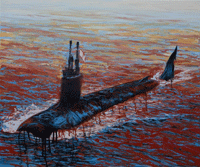
With all of that considered, Erick doesn’t deliver explicit or directly moral judgements on either event nor on any continuum which they might share. Instead (bar that striking cover image of a half-submerged submarine in a welter of blood-streaked water), the details are in the sounds he shapes. Becquerels, for example, is a humming shroud: bassy drones hiccupping, a persistent drizzle of midrange noise. The noise drips and dribbles in, backed by distant grinds and rumbles, circular mechanical gnaws. There are implications here of badly-tuned mechanisms, of radiation slopping into compartments where it doesn’t belong. Chop-ins of explosive industrial drumkit noise become venting spurts; the engine-sounds periodically burst out in short-lived, ominous overruns. The last section is a beautiful warble, smashed into by bursting cogs. There’s no joy in the viciousness on display. There’s just a sense of carelessness being observed and documented, as Erick etches an acidic sonic portrait of breakdown which crowds out and overwhelms personal space, erasing people.

If Becquerels is a bitter salute to the submarine, the nine-plus minutes of Kursk Assault presumably pays tribute to the battle. A square wave tank growl, throbbing its way over random rises and dips and flats, becomes a wash of indiscrimate information leveled out to a crammed, rumpled buzz. Barely distinguishable behind this (in effect, crushed and obscured by the charging machinery) is a folk tune on droning pipes, possibly a Russian volynka. Throughout, scattered vocal syllables are chopped in like broken radio conversation. At the end, a tight cycle of looped pipes and data grind stutters round and round, like something trapped on a wheel.

As with Bequerels, there seems to be a moral edge to the noises here. It’s nothing to do with structured condemnation, nor with redemption. Instead Erick offers a baleful account in sound of the misery of people forced into combat, inside machines that they can’t trust to keep them safe, relying on other people who will let them down or spend them like poker chips. There’s an undercurrent of cramped and sweaty fear in these tones – men crammed into claustrophobic cockpits, waiting for the shells to burst through; men trapped in a crippled steel bottle, fathoms down, listening to the hull shear and the water gush in. The blattering sound also cocks a bitter snook at parade ground pomp. Here, war (and the Cold War) is just an impersonal, perilous sludge.

 
However, having registered his abstracted judgements, Erick retreats from his implicit moralism to explore different implications. The glitchy thud and staccato arpeggios of Steam And Speed suggest techno, as if Érick was building an impressionist, impasto sketch of a nightclub out of a mulchy bucket of cast-off industrial noises. The namesake being nodded to in the eleven-minute György is presumably György Ligeti, as vocal organum pitches move around behind radio whines and whoops and pell-mell machinery clashes, with disruptive cuts in the piece marked by static spits. After five minutes Érick folds a small choir into the mix, a sampled motet: after that, a man’s voice singing soft and deep and casual. The Ligeti references sift in as the piece moves on – the violent pitch shifts applied to the choir, mimicking Ligeti’s own unsettling choral runs: the deep-buried cosmic skitters buried deep in the mix in the final minutes, beneath the deep and pitchless drone.


Two remaining tracks reference a pair of lurid and controversial art-house films, both of which engaged in studies of morality and nihilism; but if Erick was intending to carry the studies over he’s done so in forms too obscure to plumb. The brief interlude of Man Bites Dog – a flat drone, a squeal and squiggle of static, a hint of hyper-compressed conversation – is straightforward but cryptic (or possibly encrypted). The ugly sibilant shiver of Bad Lieutenant – the album’s longest piece – is a dirty judder of mosquito hiss, behind which slow passes of electrophonica swell like slowed vox-humana organ stops slowed. A gentle pink noise churn runs through the piece, implying slow floods and propellers revolving; there’s a passage of steam-sound, tinny distorted vocal murmurs and dub echoes; an unsettling sweep of what sounds like electrified mice scrabbling and twittering. Later, birdsong echoes over a propeller churn like a shipwreck survivor’s memory – ordnance bangs and mechanical scurf play us out.


The last of this could be a recapitulatory visit to the ‘Koursk’s watery grave, or it might not. Bad Lieutenant has spawned a number of remixes that fail to illuminate a moral dimension: ignoring the context, they simply play with the noises. Martin Tétreault’s mix trims the piece down to a three-minute commodity , gaming it with a tattoo beat of drum-static. Of the two bonus remixes on the download version, Nicholas Bernier’s ten-minute effort retains more of the length but screebles everything with a silvery download skitter and needling, proggy synth cascades like a vintage Galaxians invasion. Robin Fox’s shorter five-minute mix concentrates on adding the missing rhythmatic elements: there’s a faint hip-hop influence in the thudding bass drum and the cut-up bursts of dynamic sound which feed its cat-walking impetus.

What these latter tracks and their reinventions don’t offer are any human conclusions. For a while, listening to this album opened up a window (a questioning and undermining of brute and impersonal power, itself expressed in brute power) which ultimately closed too soon. The noise artistry is impeccable, but I’m left feeling pulled up short: drawn in by a buzzing lasso to ponder a message which fades away too early under the racket.

Érick d’Orion: ‘Koursk’
Érick d’Orion (self-released, DOR 2013, no barcode)
Download-only album
Released: 21st January 2013

Get it from:
Bandcamp

Érick d’Orion online:
Homepage Facebook MySpace Bandcamp Last FM

REVIEW – Apricot Rail: ‘Basket Press’ single, 2013 (“a five-minute garland”)

22 Jan
Apricot Rail: 'Basket Press'

Apricot Rail: ‘Basket Press’

Damn, but latter-day post-rock bands can be dour. Something renders so many of them dry, or scrunched up into a kind of passive-aggressive melodrama. Too many of them belong to the post-Mogwai/Explosions In The Sky faction – increasingly hackneyed building blocks of minimal, stilted guitar arpeggios, building to a fuzzed-up tumble of noise via a gradual crescendo. I’ve heard it too often now. It’s like watching the same slow-motion fireworks every night – every time, the same chilly histrionics.

Perth sextet Apricot Rail, trailing this new single for their second album ‘Quarrels’, manage to avoid that disappointment. As ever, they bring some of the original post-rock enchantment back as well as plenty of enchantment of their own. Admittedly, on a first hearing Basket Press is more conventionally post-rocky than their previous outing (2011’s ‘Surry Hills’ EP, in which whirring warmth and a sun-dappled shuffling of approaches gave their music the vivid craft of a beautiful set of handmade holiday postcards). The band have even returned to those pluck/build/fuzz/hallucinate ingredients I’ve just been savaging, and there’s less of the generous instrument-swapping that’s freshened their approach in the past.

In spite of this, Apricot Rail manage to avoid drabness and predictability. Basket Press is a five-minute garland of distinct and graceful stages. Part summery harvest-time music, part rippling classical suite, part affectionate conversation, it’s bound together with a palpable friendliness. First there’s a lone guitar sketching out slow American-folk arpeggios with a touch of echo (the chords, save for one crucial falling note, reworking the floating Pink Floyd melancholia of Us And Them). Then, as woodwind player Mayuka airs a fuzzy flute trail of sustained notes, there are three. Guitarists Ambrose, Jack and Justin strum, curl and gently chisel out firmer chords over a cosy fuss of drums, as if they were rounding off a carved scroll. From this, a move to that on-the-one post-rock downstrum – then, as two guitars mix a light picking of melody with pinging counter harmonics, Mayuka’s flute wakes into a twining, rising counterpoint. Bass and drums move in via a low dotting – a patter, and a dialogue.

All along, the feeling is of a mutual binding, of teamwork, all six musicians facing inwards to share the exchange. The music slips through phases like breathing, like the momentum of thoughts; like assured working hands shifting their grip on a gardening hoe. A rare and understated joy wells through it, passing hints. In many respects, all of this is moving to a similar pulse as that mid-’70s sweep of world-folk and chamber-jazz melanged into being by Paul McCandless, Ralph Towner and their colleagues in Oregon. As the lowest-pitched guitar stirs a new folkier rhythm into the band circle, Mayuka responds with sweet McCandless-esque clarinet curves. Upping the ante, a detailed guitar study – a Mediterranean sparkle – works its way in over rising supportive drums. Another guitar, sitting in the mid-register, embroiders sweet minimal rosettes of lazy cycling notes.

Eventually the band builds through a mass of roaring pedalwork and noise into the kind of land-sliding, sleeting mass of guitar-descend which we’re used to as that conclusive Mogwai-tradition flourish. This time, though: it’s been prepared for. Rather than the expected ragged glory of a ruined Sysiphus-bound downwards into gravity’s clutches, it’s a payoff – a burst of energy from what the musicians have put into the song and stored there.

For the curious – a basket press is a wine-making device, one used for over a thousand years. I can see the connection. Harvest arrives.

Apricot Rail: ‘Basket Press’
Hidden Shoals Recordings (no catalogue number or barcode)
Download-only single
Released: 10th January 2013

Buy it from:
Bandcamp

Apricot Rail online:
Homepage Facebook MySpace Bandcamp LastFM

REVIEW – Darkroom: ‘Fallout One’ album, 2001 (“like a small corpse flattened onto a moving tyre”)

13 Jan
Darkroom: 'Fallout One'

Darkroom: ‘Fallout One’

Maybe it’s due to simply not being on the right label (they’re homed neither at Warp Records nor at Rephlex, nor at any of the other established electronica houses who provide a credible passport to attention). Maybe it’s the frustration of continually bouncing, disregarded and unloved, off the defense radar at ‘The Wire’. Maybe it’s simply the usual difficulties regarding working on and playing an abstract, thickly electronic music with even fewer anchors than most of the buzzing, bleeping efforts in that particular field.

Whatever it is, while the mightily amorphous Darkroom should have been a serious avant-garde cult act by now. Instead, they’ve been in retreat since their initial late ‘90s rising and since those times when they brought their galactic rumble-and-wail to some of the artier club-nights around London. It’s dispiriting – but at least this has been a strategic retreat rather than slinking off, defeated, to lick their wounded diodes.

Darkroom remain active, particularly in their native Cambridge. They still haunt basements, galleries and art-house cinemas whenever they can, recording hours and hours of live material. They’re still more or less unknown: but they’ve been making the most of this anonymity. At least it allows them to continue to explore their own unsettling take on ambient music, unencumbered by the demands of the more familiar electronica clubs or by any micro-cultures other than their own. The ‘Fallout’ trilogy (of which this is the first installment) is the result.

These recordings present an unadulterated Darkroom, live and in the raw – a sound of boiling sea-stuff, of natural chaos, of expansively stewing noise. They’ve abandoned the song experiments and the more disciplined, streamlined aspects of their previous album ‘Seethrough‘ in order to embrace more of the chaotic, massy, polytextural wanderings that they touched on in their ‘Daylight’ debut. Each of the tracks on ‘Fallout One’ is functionally numbered: One to Seven. None are graced with any more of a name, nor indeed any more clues of any kind. There are no sine-wave surfing references, no snippets of French or intimations of disturbance, no jokes (unless you count the press release name-checking both Photek and Satan). There aren’t even any nods to the collective’s old Samuel Beckett fetish.

Darkroom don’t guide anymore. They drift remotely through their music with a mixture of utter authority and confusing haphazardness, stirring ideas in and spinning them out. You can’t place yourself with this music: you can only live with it. Any associations which you care to make are now entirely your own.

‘Fallout One’ also emphasizes an increasing musical dominance by Andrew Ostler, the keyboard-and-programming corner of the Darkroom triangle. Freshly returned from his solo project Carbon Boy, Os brings back plenty – he adds a glut of shortwave radio voices; he disrupts Darkroom’s light-footed beats and breaks them up into free-jazz stumbles. His relentless mutations of dense electronics regularly distort and destroy any settled landscapes that the group might have settled on. Lurking in the background, Michael Bearpark concentrates on turning his guitar into a slow-hand blur of inscrutable forbidding noise. When he’s not doing that he’s building up a succession of aquamarine loops, sounding like a coldly psychotic take on Michael Brook.

By comparison, singer Tim Bowness seems more displaced than ever. Already abstract, whenever his vocals appear now they take the form of shocked, drowning, incoherent whoops and keens, half-submerged in the swirl of choking ambience and psychedelic space echo which his collaborators are cooking up. As ever, the effect is similar to the contorted vocal tapestries of Tim Buckley’s ‘Starsailor’. This time, though, Bowness sounds as if he’s gradually being sucked down a black hole, protesting all the way. It’s a far cry from the measured, beautifully-finished art-pop tones and diction of his day-job in no-man. Still, he seems to thrive on the chance to unleash this kind of utterly unguarded noise.

Caught as live as this, Darkroom’s music is more disorientating and disturbing than it’s ever been before on album. Though always too lushly endowed with timbre and detail to be unrelentingly hostile, it offers little in the way of chill-out calm or methodical reassurance. Even the gentler tracks such as Three or Four regularly see Darkroom’s more pastoral landscapes bent out of shape. A desperate, looping Bowness mantra of “say” will be overcome by data squirts and snippets of Gregorian chant; a hum of guitar will be scratched over by a violently juddering, reedy electronic screech; clicking needles will have a strange banana-boat yodel stretched across them.

Throughout, Os’ sculpting of the sounds induces sonic meltdown. Hiccups of sounds, whale song, a mutilated loop of geothermal Mellotron or a dignified broadcaster’s voice will all be sucked up, shredded and blown out, or brought round and round like a small corpse flattened onto a moving tyre. In their collision of the beautiful, the horror-inducing and the plain distorted, Darkroom offer nothing easy. ‘Fallout One’ is music for dissolving cities – a cool-headed, unconditional embracing of confusion.

Darkroom: ‘Fallout One’
Burning Shed (no catalogue number or barcode)
CD-R/download album
Released: 01 January 2001

Buy it from:
Burning Shed or Bandcamp.

Darkroom online:
Homepage Facebook Twitter MySpace BandcampLastFM

December 2012 – EP reviews – Toby Hay: ‘Guitar I (The Stairwell Sessions)’ (“a sense of placement and location”)

17 Dec
Toby Hay: 'Guitar I (The Stairwell Sessions)' EP

Toby Hay: ‘Guitar I (The Stairwell Sessions)’ EP

In a faithless world (in my own faithless world, anyway) one of the few things that can substitute for a religious experience is finding a place where sound can be transfigured. This could be as simple as a random encounter with a naturally-shaped space that has a whisper, or as calculated as deliberately finding somewhere in a newer concrete structure where the right note in a scale suddenly booms like amplified doo-wop. It might explain why there’s a primal pleasure about singing in the shower – that embrace of the feeling that you’re in the right location for the ritual of sound to run its course.

Toby Hay (the brother of Tomorrow We Sail’s Tim Hay) made full use of this feeling when recording this debut EP of acoustic guitar. It helped that Tim’s own stairwell, at home in Leeds, provided the ideal sound. One evening – while Tim, all ears, manned the console – Toby sat down on the stairs and recorded then and there. Still only 21, his guitar technique is already fully formed and his playing strikingly visual (it’s hardly surprising to find that he also works as a filmmaker). That sense of placement and location stretches further than his choice of where to sit down and hear the natural reverb, and into the fabric of his music.

The inspirations are immediately recognisable. A fingerstyle player, Toby’s music is firmly in the ornate British folk-baroque approach, continuing a line begun by Davy Graham, Bert Jansch and Martin Carthy in the ’60s and continued, over the years, by players including Michael Hedges and Martin Simpson. The EP aligns Toby’s own compositions alongside his variations on and extrapolations of standards, to the point where only the familiarity of a tune separates them.

For Variations On O’Carolans’ Dream, Toby immerses himself in the world of Irish baroque harp music, reworked through the guitar. While here he’s following in the footsteps of the likes of Duck Baker, his performance is confident, revelling in the guitar sonorities which add spice to the transposition. His thumbwork in the bass is strong – especially in the second section, where he chops toothily into the bassline – and the riffling harp-like flourishes which he brings to his fingerwork offer something back to the original. By the third section, the baroque structures have melded seamlessly with an Indian-inflected pulsealong.

As you might have guessed from the title, And We’ll Take A Cup Of Kindness Yet is Toby’s extrapolation of Auld Lang Syne. In some respects it’s the most straightforward piece on the EP, travelling from a sleepy, breezy statement of the original melody before running away into double-time. From its start as a song of sitting down, drinking and remembering, it’s transmuted into a fast-flowing travelling piece, heavy on the double-stopping and the thumbing of bass notes, before slowing again into a classical inspired study which doesn’t so much recapitulate the original tune as revive it.

Of the three Hay originals, Platform 16 is another travelling song. Its intro bounces and rings out on high harmonics: as the music wheels onwards, Toby’s sliding, percussive attack on the notes as they’re made out is so sharp that it sounds like pickwork. Night Terror Blues is another demonstration of quiet excellence. Winding up out of hushed beginnings, it becomes a strong-stepping baroque blues. Stabbing in the treble, there’s a slithering in the bass range – like a slipping foot on the run.

The remaining original – Where The River’s All Rain And Roses – takes its title from Jack Kerouac. More explicitly, it comes from a dusktime description of swishing across the Mississippi river on the bridge at Port Allen, Louisiana in “a misty pinpoint darkness.” Kerouac’s original passage is an undulant swirl of description – a journey through foglight and dropping evening captured in smudged yellows and purples, in the swings of a sharply curving drive. Yet Toby’s own piece has none of the arresting jazz stimulus which one might expect from a Kerouac tribute. Nor does it try to recapture that American freeway motion; of driving through the astonishing scenery and through the liberty of the rolling roads into revelation.

Instead, Toby seems to be taking his cue not from the motion or the self-absorption, but from Kerouac’s descriptions of what he passes through en route – the textures of the mists, the way he hails the Mississippi as “a washed clod in the rainy night… a dissolving, a riding of the tide down the eternal waterbed, a contribution to brown foams, a voyaging past endless vales and trees and levees…” For once, the music hovers rather than drives. Over a billowing airblown shruti box drone (the EP’s lone overdub), Toby picks out an elegant Gymnopedie-via-Ralph Towner progression, its melody carried in the bass and midrange. Stepping back and forth, it maintains its chords via high, clipped double-stopping. When a new sequence emerges midway and, chord by chord, rides up to a sparse and ecstatic point of grace, it does so with the same pointillistic pacing. Droplets in the fog, light snagged in vapour, or moments of eternity seen through movement – whatever this brings to the mind, it captures a position in time and in space that’s mystifying. For a moment, just like that moment when the sound in the stairwell deepens to a subtle boom.

Toby Hay: ‘Guitar I (the stairwell sessions)’
Toby Hay (self-released, no catalogue number or barcode)
CD/download EP
Released: 13th December 2012

Buy it from:
Bandcamp

Toby Hay online:
Homepage Facebook Twitter Bandcamp YouTube

Similar:
Mark Mulholland & Craig Ward: “Waiting For The Storm”

November 2012 – EP reviews – One Thousand Lucky Cranes’ ‘One Thousand Lucky Cranes’ (“restful hiccups”)

28 Nov
One Thousand Lucky Cranes: 'One Thousand Lucky Cranes' EP

One Thousand Lucky Cranes: ‘One Thousand Lucky Cranes’ EP

From Tennessee to the heart of the mountains of central Japan is a long way. I’m not sure what’s brought Ben Bryant from one to the other, but his debut offering as One Thousand Lucky Cranes shows the stretch. While these four tunes are nominally in the box for downtempo chillout electronica (with a side helping of glitch), they’re also attenuated, deconstructed tunes. Untitled agglutinations. Restful hiccups. A feeling that’s a little like that moment when, relaxing on a beach somewhere, you’re momentarily jolted into realising just how far from home you are.

Despite the tumbling data-flop of its intro (and the corrupting glitch atmospherics which score creases and interruptions into its texture), No.1 quickly reveals itself as deconstructed soul. More specifically, a Philly-inspired slow jam; from the lustrous breath-sighs to the jazzy climbs, to those Air-style analogue doodles with their pitch-bending vocalisé effect. Everything in it has that cushioned lushness and summertime daydream feel to it, with electric piano pads stroked and lovingly distorted into tiled, fuzzed chillout chimes. Notes and sounds have a fallaway feel to them, as Ben toys with wavering queasy pitching or leaves us in expectation. Japanese trinket tinkles worm their way into the mix: toys wearing down their batteries on the console.

There’s a little bit of soul in No.2, though only the slightest taste. One of Ben’s sounds is sourced from the sweetest electric organ sounds, but sliced off the top of the frequencies and rendered from gospel hints into an artful saccharin. Most of the other sounds are flickered by processing – treble-sharpened melody gurgles, a sweet baby-tone climb glimpsed through a strobing blur of reverb. Even the drum sounds (despite keeping a thread of industrial funk running throughout) are inverted and upended, imploded beats and cymbal hits trapped in a thicket.

On No.3, glitched beats are dropped into the music like someone dropping random glass beads into a Geiger counter. A slow phased sweep of synth pads (like the luminous cloud-roll Prophet-noise of the late ‘70s), offers something slightly meditative and slightly irritated, cross-legged but glaring sideways. Layers of glitched percussion twists and carpet-bomb bass distortions are folded into the mix. If you’ve still kept hold of that beachy simile from above, imagine the same, but with little smoke-shells bursting in mid-air above the mellow golden sands.

No.4 rises out of a sea of finely sifted white noise, revealing an ominous minor-key structure behind it. There’s something here that’s similar to the sweetly-sung anxieties of Horace Andy at work with Massive Attack on ‘Mezzanine’: a hint of ghost-town industry, of grand soul with the security sucked out of it… perhaps an echo of Detroit despair imprinted on in the architecture. Rather than Andy’s sensual suede-creak of a voice, though, the vocal here is an accelerated burble, part-housefly and part child-babble, stretching and meandering around the slow-stepping arches of fuzzy melody. Glitch-taps and dubstep activity fire about in the percussion, data-screeches kick some cold sparks off the chords. Throughout, the white noise comes through in hose-spurts; or tide-smacks, pushing its way through the buildings – a dream of the first drops of the flood. As with all of the tracks on this EP, the sense of solidity, dislocation and imminent upset come bundled close together, blurred over like a multiple exposure.

One Thousand Lucky Cranes: ‘One Thousand Lucky Cranes’
One Thousand Lucky Cranes (self-released, no catalogue number or barcode)
Vinyl/download EP
Released: 26th November 2012

Get it from:
Nimbit Music, Bandcamp.

One Thousand Lucky Cranes online:
Facebook Twitter Soundcloud Tumblr Bandcamp

November 2012 – mini-album reviews – Sterbus’ ‘Smash the Sun Alight’ (“like a prog-dusted bumblebee”)

20 Nov
Sterbus: ‘Smash The Sun Alight’

Sterbus: ‘Smash The Sun Alight’

After six years of making off-kilter indie rock, Sterbus seems ready to make the jump from cult to cute. His previous albums and EPs have shuffled between serious tunes, determined explorations and playful jokes. ‘Smash The Sun Alight’ concentrates firmly on his most accessible side – fuzzy, funny-angled guitar pop launched into a chunky meander through the air, like a prog-dusted bumblebee.

If these seven songs and instrumentals had a colour, it would be orange-gold – blurry and amiable. Sterbus injects sunshine and smog from his native Rome straight into the heart of his rampant, time-travelling pop. One of his feet might be jammed happily into a big bucket of prog and psychedelia; the other’s rooted deeply in power pop and eclectic 1990s indie, with driving earworm-bursts of chorus. In his twists of tunefulness and humour and his love of scruffy noise, you can see traces of Blur, Small Faces and XTC (or, looking further west, Weezer, Steve Malkmus and Guided By Voices). Sterbus also has an ear for those drowsy, medicated-modal melodies that served Nirvana so well; and the dogged musical extravagance of Cardiacs infests his work like a glittering spiral, turning every tune into a hopeful steeplechase of extra chords and whole-tone hops.

It’s hardly straightforward; yet somehow Sterbus doesn’t overdo it and lose you along the way. It’s rare to hear so much bounding complexity tied up so neatly into buzzing firecrackers of song. The saturated bounce of Gay Cruise is typical of what’s on offer, kitting out a tuneful, sludgy Dinosaur Jr. fuzz-growl with some dissonant King Crimson pitches before hammering in a break of piled-up chords to grab us by the ear and take us mountaineering. The eccentric Welsh popster Curig Pongle is along for the ride, playing organ like a swerving Mini: the song also sideswipes a random Andy Partridge sample in which the great man is gurning on about Arthur Askey.

As for Sterbus’ lyrics, they’re a vegetable stew of soft little fragments. The occasional clear phrase bubbles up out of the gentle mumble and hum – uneasy (“troubles in the pool / making me cold”), tender (“My dear baby, what can I do? / You make me feel like I’ve been over-ruled,”) or whimsical (“Unboyfriendable girlies show no love”). Occasionally a skewed aphoristic image surfaces, like something cast up by a young Peter Blegvad (“Birds and second wives, / trying to be polite.”). Much of the time, though, the stew remains a stew, the language dissolved into flavours rather than shapes.

In some songs, such as the ukele-driven A Sigh of Relief, it’s not so much English as an impression of English; just as Sterbus’ breezy mouth-trombone solo and music-hall-McCartney bassline is a sepia impression of holidays in fading seaside resorts. Maybe he knows that songs of life, love and feeling can work just as well as gauzy murmurs. Perhaps it’s just a chewing-over of words to blend into an earnest, reassuring blur – a swirl of cream to smooth the mongrel clamberings of the music.

Oh well, perhaps innocence can be complicated too. That’s why those Irish fiddle parts are there to usher in Otorinolaringoiatria, unless they’re there to soothe us after the tongue-twister (and to stop us wondering why the only distinct word in the song is “sauerkraut”). That’s why You Can’t Be Sirius is tied up like a Sunday roast – its laddering chords held together by tight power-pop drumming, lashing those goosed leaps of organ into position, securing those shivering tremolo-blocks and speaker-fizzes of guitar.

That’s also why Wooden Spheres + Heartquakes plays its pass-the-parcel game. A pelting punk-pop three-chord wonder abruptly switches to Curtis Mayfield funk with sunny popcore punk choruses; then, after changing gear for the tiniest of organ solos, ends up jammed and droning like a stuck tide of Scandinavian prog. Similar in its out-and-out playfulness is The Amazing Frozen Yogurt: setting power chords against breezy mellowness, it sounds like a summery merge of Caravan and The Wildhearts. Lonnie Shetter’s sheets-of-sound sax scribble is flown in for a jolt, offsetting that mid-song switch into Zappa kitsch complete with vibraphone. Sterbus flutters around both parody and self-parody here, but his freshness steers him clear.

The near-seven minutes of Flatworms (Eggs Of Joy) tie together not just Sterbus’ musical agility and bevy of influences, but also his sense of connection. Away from the sung sections, it owes something to the severe angles of King Crimson’s Red; yet it’s also the most Cardiacs-styled piece on offer: a self-confessed attempt to write a sequel to that band’s Dirty Boy (which Sterbus has already covered) and its massive parade of chords. Sterbus’ drowsy vocals soften the cavalcade; the brief flashes of conga draw a little nourishing groove into it. While the lyrics are as obscure as anything else in this clutch of songs, they get the message of impermanence and humbling across. “Running away – far from heaven, / diggin’ the grave, the sun. / Crying away – all your glory; / useless and vain, in time.” It might be an oblique gesture of fellow feeling towards Tim Smith, Cardiacs stricken leader. Certainly, the song’s payoff line casts aside any artifice in favour of the purest sympathy ( “I see you, / I feel you. /You heal me. / Uncomplicated ways.”) and brings the inclusive generosity at the heart of Sterbus’ music to a natural home.

Nothing to be afraid of. Sun’s out. Come and warm yourself.

Sterbus: ‘Smash The Sun Alight’
Sterbus (no catalogue number or barcode)
Download-only mini-album
Released: 16th November 2012

Get it from:
Bandcamp.

Sterbus online:
Facebook MySpace Bandcamp Last FM YouTube

November 2012 – album reviews – Cthulhu Detonator’s ‘Infernal Machines’ (“beneath the razor squeals and data blurts, there’s a lot of composed thought going on”)

9 Nov
Cthulhu Detonator: 'Infernal Machines'

Cthulhu Detonator: ‘Infernal Machines’

Over in the pleasant and temperate Canadian climes of Victoria, Eric Hogg sometimes strolls the streets and sometimes makes noise. Perhaps he dreams of being under dental sedation, indulging himself in some grand and streaky nightmares of colour-bleed and sound-warp. A salubrious environment isn’t necessarily a bar to a sinister imagination.

Then again, while it’s certainly unsettling, is the shivering noise music Eric produces as Cthulhu Detonator necessarily sinister? And what are nightmares, anyway, if they’re not creativity fracking its way simultaneously through the subconscious and the known in search of new fuel? I’m guessing that whenever Eric does go walking, he’s chewing over everything he’s heard both recently and years ago, waiting for something to engage fully with the teeth in his brain.

The choice of project name mixes demolition tech with H.P. Lovecraft. This is worth remembering. At its fringes, genre music is increasingly morphing into cheerfully-tailored geek accessory, so this could have been superficial fantasy horror-noise – vat bubbles, flailing tentacles, steampunk sound effects and a comic-book feel. Actually, Cthulhu Detonator’s music springs from the well-corroded, confrontational gully worn by power electronics, making the most of sonic distressage and sample-flaying. However, Eric gives a wide berth to the more regressive, narcissistic elements of power electronics (the psychopathic posturing, the violent fixations and the taste for hate-politics, the desire to transgress and incur repulsion). He takes the noise, not the rage. He doesn’t turn over bodies, just sounds. Beneath the razor squeals and data blurts, there’s a lot of composed thought going on.

Just to finally lay those Lovecraft associations to rest – besides the name, the only other Lovecraft link here is one single piece, At The Mountains Of Madness. This is also a tenuous link at best: Eric makes no obvious attempts to reconstruct the narrative of the horror story whose title he’s borrowed, just using the latter as a springboard for scene setting. As on the rest of the album, he sets up an instrumental language and then corrupting it into something else via intensive sound processing. For At The Mountains Of Madness, it’s a simple-as-possible drum solo, mostly concerted, mostly stumbling hits. Drums and struck metal percussives are crushed and milled; the former crudely distorted, the latter phased into smears. A determinedly uncooperative beat gives way to a rabble-rousing tom whack broken up by jittered glassy echoes and crazed, triggered reverb. It has the contradictory feel of a wall of noise that’s made mostly of gaps, with the sharp attack of drum hits setting up anticipation of the scrunching decay that follows. Soundfields pop violently in and out of hearing: sometimes you can hear a click track bleeding through, providing something to rebel against.

Infernal Machine is part hellish, but almost conversational. Drawing on a source which sounds much like a squealing guitar on maximum tube scream, Eric chops it into whoops and squeaks by some jackhammering processing which swings in a pendulum arc across the soundfield smudging and seducing the sounds as it goes. Halfway in the electrophonic squeals are replaced by a gracefully screaming choir (courtesy of a multi-tracked guest, Fairen Berchard), which echoes down a long tunnel. Cross the Static Ocean resembles an elderly printer grind, looped and sealed up in a bobbing storm of hurtling white noise. Eric gets the most out of it – sweeping across its frequencies, digging out hisses and tenor grinds, cutting and pasting around the soundfield, making it strangely beautiful. (There’s also an abstract humour at play here – one moment even sounds like a freight train doing the Charleston while no-one is looking.)

As so often with noise music, what often makes a Cthulhu Detonator piece involving is where you can see the process of its developing impurity – whether you’re looking for the sound sources or the corrupted concepts. Some pieces sound close to classical music. While it’s not entirely clear where its gently blaring, tottering source sounds came from, Transmit.Disintegrate ends up sounding like a baroque trumpet chorale filtered and echoed through a roaring stonework gullet, gently billowing and swirling as it goes on its journey. Blinding White Light starts its life as a dramatic sequence of interminably held organ chords; as if Eric’s raiding stock Hammer Horror music for battles with the Devil. He runs this piece of Gothic corn through the harrow-blades of distortion until it melts into a sirening phase of shuddering pink-misting noise: you can feel the higher pitches being squashed flat onto the bass, like tissue onto iron. Towards the end it’s simply shifting between two simple but uncomfortably-matched chords; a jammed apocalypse.

Somewhere, the party is also being crashed by dance music. Initially, Rise Automatons has something in common with fluttering dubstep. You might consider beats to be crucial for this, but they’re missing. However, here are the swooping bassiness, the teasing rewinds, the timestretch; and Eric’s overdriven scribbling sounds like turntable scratches. But it doesn’t last: the structure collapses and is crumpled into a confusion of vengefully buzzing flies and feedback whoops. At one point, a dead TV whistle sneaks underneath the violent editing and panning.

Chrome Leviathan – bizarrely – appears to be based on a deep-funk lick, although it’s one that’s being carried on a gnarled data burst and surrounded by crash processing and the occasional clatter of glass fragments. It certainly owes something to the old Hank Shocklee noise-as-rhythm riff idea – playing with two hip-hop accented riffs before it’s done – although the exaggerated panning at the end is pure noise disruption. The party continues on Lava Box , where a catchy clapping pulse rhythm is applied to an indeterminate, squelched buzz. There’s a clear head-bobbing intent here, as rhythmic parts bop along inside the squish with an unselfconscious physicality that could as easily be slamming hip-hop or heavy metal. Eventually all of the mashed noise is left to bubble by itself – the rhythms, ultimately, don’t become a tyranny.

Two further pieces reassert the subtler powers of ambient noise and sound-pictures. On Womb, the main constituent ingredient is a discreet drive-along hum – like a small car on a lonely mountain road, but amplified up to the level of landscape. In the mid-ground, slow enveloping organ chords appear, so large and yet so quiet that they’re all but out of the image. All you can hear are the small details on their sky-covering surfaces – the sound-curve of their undersides and their strangely comforting overtones. Radio voices, none of them distinguishable, sprinkle this cloudy arch. There’s a dirty serenity to it all, an intimation of clear air and solitude, lightly misted with the pollution of noise and incursion.

Atom Thresher – the last track on the album, and in many respects the most industrial – heads back to smaller scenes and more claustrophobic concepts. Deep flapping interference spatters static around a bowl-shaped drone: a third sound layer adds a klaxoning extensor buzz; a fourth, the sound of machinery clanking and extracting. Whatever’s being milled out here is invisible; but the working sound eventually falls out into Geiger counter pops, and at the very end a short decisive silence.

After this series of journeys and pictures, the question of the inspirational process remains – the disjunction between comfortable surroundings and an output of rough-textured noise. Maybe the keynote of making this kind of music in a pleasant climate (rather than in a crappy recession town full of blocked-off hopes and angry knuckleheads) is that it’s simply less pressured, less draining, more fun; and that this in turn shapes the music. Certainly, as industrial music goes, Cthulhu Detonator doesn’t appear to be aimed helplessly into a corner and buzzing with rage; nor does Eric shut down his human responses and slip into a bleak hover-mode. Instead he shapes the rags, bones and hanks of his sources into something which is, if not necessarily hopeful, at least alive and active; and involved with itself.

Cthulhu Detonator: ‘Infernal Machines’
Cthulhu Detonator (no catalogue number or barcode)
Download-only album
Released: 2nd November 2012

Buy it from:
Bandcamp

Cthulhu Detonator online:
Soundcloud Bandcamp

October 2012 – album reviews – Jorge Arana Trio’s ‘Mapache’ (“a lean, strutting pirouette along a jagged line”)

28 Oct
Jorge Arana Trio: 'Mapache'

Jorge Arana Trio: ‘Mapache’

Until fairly recently, Jorge Arana played guitar and hit keys in Pixel Panda; a precocious, musically omnivorous bunch of Kansas City skronk-punkers. Local heroes, hotly-tipped for the best part of a decade, they quietly called it a day in 2011 but wasted little time in moving on. Jorge’s bass-playing brother Luis stepped up a commercial notch via rising alt.rockers Beautiful Bodies, while other former Pandas can be found mingling psychedelia and hip-hop in Spidermums. As for Jorge, he’s pulled in the final Pandas drummer, Josh Enyart, added bass guitarist Jason Nash to make up a brotherhood of “J”s and stepped over into jazz. Someone in the band had to do it. This is Kansas City, after all – they’ve been shipping jazzmen out and up the river for nearly a century.

Punk roots or not, the Jorge Arana Trio’s serious jazz intent stretches beyond leaving behind quirky band names. Not that this apparent sobriety is absolute. Their debut album title, ‘Mapache’, is Spanish for raccoon, suggesting that the Trio see themselves as determined and adaptable omnivores, thriving on trash where necessary, and prepared to spread mischief around the suburbs if they have to. Some of the immigrant-son, take-no-prisoners fierceness of Pixel Panda has made its way into the new band. The glam racket might have disappeared, but not the stop-start emphasis or the punky crunch. Lester Bangs would have been proud of them.

That said, despite the band’s fierce electric energy there’s less outright skronk here than you might have expected. In fact, there’s less than there was in the Pandas. Instead, the Trio lead a lean, strutting pirouette along a jagged line between lean discipline and a scrawl of energised chaos. If there’s any self-indulgence here, it’s the kind you’d find in freerunning; a rebellious athletic liveliness, bodies pitted against the push-back from concrete mass and city obstacles.

There’s also something of the static, wound-up aura of the very early jazz-fusion bands, huddling among the fragments of busted rules as the ’70s arrived. Free like knife-fighters, trying to save their energies and moments for the right move at the right time but seething with excitement over the open field of opportunities. This latter is mainly in terms of musical tension. Skilled as the Trio are, they retain (for the most part) a clipped-back tyro technique closer to bullish avant-rock playing than to the broader subtler dynamic of jazz. However, their taste for driving syncopations and their bodily hunger for explosions of rhythm make it plain where their musical hearts lie now. Occasional bursts of wordless vocalising – combative, gladiatorial, almost like gang chants – break up or complement the instrumentals. Most of their pieces are short, interrupted, to the point – a quick flare of ideas followed by a watchful silence.

The places which the Trio explore are generally shaped by Jorge’s choice of instrument. Working with Jason’s cement-mixer bass churn and Joshua’s vigorous, spattering drumming, he alternates between electric guitar and electric piano (occasionally swapping mid-tune). Those pieces driven by his hardened, stony chimes of electric piano are more staccato, more turreted. On Bitter Era, Jason devises a ferocious distracted wrap of bass around Jorge – in broken unisons, the Trio thrash out a harsh and excited tattoo around the keyboard clunk. In contrast, I’m An Omnivore could almost be lounge jazz, tootling along happily even as all three musicians wrong-foot us. Each follows a slightly different rhythm, de-synchronising with each other and buckling the sidewalk under the strut.

When the compositions are driven by Jorge’s snaggled-up guitar, the trio work in a looser style: more elasticity, more smudging. Ether gradually whittles a brain-damaged marching riff out of Jorge’s demented squiggles. Peanut Butter works around a tight loop-and-discharge impetus, finally tottering into a wounded wind-down, bleeding off its abandoned velocity as if it were dumping fuel. Thieves Among Us sounds like the aftermath of a car chase. Stuttering away, the band could be clambering out of a canyon, away from the burning wreck of a car, to the accompaniment of headache pulses, dissonant auto-spring sounds and abrupt scrabbles as dazed opponents grab at their feet.

Some of the best moments come when Jorge is juggling instruments. Short & Evil, for example, in which he begins by spotting out ringing, sullen shapes on piano while the bass prowls: later, he’ll rub in crashing cascades of guitar like dislocated banjo-frails. Similarly, Baptize Your Dinner (by some distance the softest song on the record) begins as a passing, minimal sketch on piano, a pail of air and autumnal chordings. Purring like a forest, the drums work around this and transform it to a tolling crescendo, as Jorge steps back in with dabbing slides of tongue-like guitar.

Josh Enyart’s contribution to the Trio shouldn’t be undervalued. While his bandmates’ repertoire of rumble, scramble and tone-slur provide plenty of vocabulary, it’s his drums that give the Trio the fullness of its jazz spirit. He paces the brushes around his snare; adds brief powerful steam-hisses of concerted cymbal; hides polyrhythms in air-pockets for when they’ll be needed, and keeps one hand on the clutch for those quick surges of collective intensity. On Death Mask, he even leads the band: while the bass circles in locked math-rock arpeggios, and the guitar wanders off to dab at colouring chords, Josh’s drums talk in an insistent, assertive jazz language, eventually pulling the other instruments along with them.

Echoes of earlier bands flit distractedly through the music. There are hints of Prime Time and Naked City (in the blaring spirit, at least) while on Nightly Stroll, it’s the junior John McLaughlin of ‘Extrapolation’ (thanks to the dense fierceness of Jorge’s splinter-rough guitar chording and the rock-tattoo drumming, while Jason’s bass slithers after the guitar in search of unisons to stamp down on). Confrontation! briefly offers something of the discomfiting volcanic grooves of the electric Miles Davis band, when Chick Corea ring-modulated his Rhodes piano into dissonant smudges. For Snake In The Grass or Catching Bullets With Your Teeth, it’s the Teutonic jazz-rock of Magma as the trio roar out harsh choral parts over the swinging shifts and over the stuck, angry riffs of the instruments.

In the end, though, the Jorge Arana Trio are very much themselves: tightly wound but loose enough to splatter, viewing their hometown’s jazz through punkish eyes and casting a cartoon mottling across it.

Jorge Arana Trio: ‘Mapache’
Jorge Arana Trio (self-released, no catalogue number or barcode)
Cassette/download album
Released: 26th October 2012

Buy it from:
Bandcamp

Jorge Arana Trio online:
Homepage Facebook Bandcamp Soundcloud

REVIEW – Dutch Uncles: ‘Fester’ single, 2012 (“a butter-toffee in a world of cheap smokes”)

26 Oct

Dutch Uncles: 'Fester'

Dutch Uncles: ‘Fester’


That’s a repulsive title for a single. Then again, Dutch Uncles have always been something of an irritant. I mean that in a good way, as it happens. Some of my favourite bands are irritants. Too many bands just want to be stimulants – crude and obvious, they roar in with a snort and a thump, hammering hard on the most obvious buttons. After a while, you just need more and more of it to elicit even a small buzz, and you end up bored and bloated.

An irritant, on the other hand – that does its job of stirring up a reaction in a different way. You can’t ignore it. It focuses the attention, often by making you aware of sensitivities that you didn’t even know you had. Dutch Uncles have always been happy to spike the necessary nerve and keep feeding a pulse into it. If you’re familiar with those dancing, sidestepping cycles of guitar riff which festooned and hiccuped all over their earlier singles (Fragrant, The Ink, Face In) then Fester will sound halfway familiar. If you persuaded Steve Reich to write around eleven Disco Phases, then stacked them up on top of each other, you’d have the basic bones already. It rotates like a carousel full of drunk mathematicians, with Duncan Wallis’ warm alto hoot (still a butter-toffee in a world of cheap smokes) muttering and musing atop the pile.

What’s new for Dutch Uncles is a delightful infusion of art-rock colourings – that bass guitar which thunks like a piano; that bony clink of marimba hook; the guitar which blows and bloozes like a sleepy horn solo. There’s a delicious feeling of confusion and clothes-swapping wrapped into the song: it’s reminiscent of early Roxy Music and their upsetting of texture, of the otherworldly kink of Associates. With Duncan’s tone of repressed and airy hysteria, there’s also got something of the closeted wildness of Sparks (albeit in one of their mellower moods). Dutch Uncles have that nervy theatrical cleverness to them, as if they’re delicately stepping along a rail with ideas dropping out of their pockets and with tell-tales twitching at the corners of their eyes.

I mentioned a song, didn’t I? It’s built into the jittery mosaic of instruments; and it’s a protest, of sorts. “There’s a time to hide everything – the way that you are; where you’ve been. / And the feeling I’ve tried to fight, / pieces I’m left in inside.” In a genteel way, Duncan’s pissed off; chanting “takes me to the bone” as he swats, distractedly, at a lingering pain. Fractured syntax dribbling in his wake, he argues his position and tells his story like a hungover man struggling with a jigsaw. “And the times you cry at everything / for reasons we don’t mean anything. / And the times I hide behind a smile / that says you were right, you were always right.” By the end of his efforts, he’s trying to strip-mine his way into sense by plunging headlong into tongue-twisters (“The worst is hardly, hardly known, / I trust the worst is hard to know. / The worst is hardly, hardly known, / I know the worst is hard to know,”) as the band pound delicately around him. Irritation confuses, scatters against structure: but few things are better at making you feel.

Dutch Uncles: ‘Fester’
Memphis Industries, MI0250D/MI0250S
vinyl 7″/download single
released: 20th September (download) & 12th November (vinyl) 2012

Buy it from:
Memphis Industries (vinyl); Dutch Uncles homepage
or Memphis Industries news page (download)

Dutch Uncles online:
Homepage Facebook Twitter MySpace

October 2012 – EP reviews – Leah Banks’s ‘Sincerely’ (“devotion makes us vulnerable”)

18 Oct

Leah Banks: 'Sincerely'

Leah Banks: ‘Sincerely’

Someone you love. Just the thought of them gives you a little catch, right there, under the chest; like a hard kiss or a light blow, reminding you that even when it’s going right, love is never entirely safe.

Devotion makes us vulnerable. You’re never more than a moment from the topple or the stumble, from the interrupted step to the full-force sprawl. That’s what Leah Banks’ songs are like. They don’t need much amplification beyond their feather-soft country-folk shapes and the superb, subtle brush-drum work that stokes them (more like the breath and sinews of a jazz master than the shed-whack of honky-tonk). They’ve got their own transporting power, their own risk, wrapped up in the hush.

Riverside, the first song on Leah’s ’Sincerely’ EP, has the panting pitch of the Song of Solomon. A coil of eroticism rises up like a sacrament via a thudflutter rush of muted acoustic guitar, heartbeat bass and swimming cello. The words are breathless and obsessive – “I can’t wait to see you, to look upon your face / I’ll dive into your adoring eyes and hang on every word you say. / And I can’t wait to feel you, to be held in your arms – / one hand resting on the small of my back, and the other round my neck.”

Leah’s delivery is a tense urgent moan, stretching and bending phrases, pushing against the metre as if it were clothes that suddenly felt too hot and too tight. There’s a touch of Sinead O’Connor in her fervour as she rides the buried complexities of female desire, poised between a caress and a snap, between devotion and greedy hunger. “Lover, please hurry, / I’m not sure how long I’ll last, / waiting here by the riverside, / my breath is wasted on the wind and waves, / when it should be dwelling in a kiss… / I’ll press into your chest as the wind blows my dress / and steal warmth from your presence.” Towards the end, there’s a little lacuna of drop-away. The song vanishes for a second, then gusts back into place. “The water is rushing, and without you here / I think I might fall in,” Leah warns. There’s been a change in the climate. Ignore it at your own risk.

That hint of the Song of Solomon lingers in the mind: while Leah’s own spiritual beliefs are never stated, all three of the songs on ‘Sincerely’ could have a religious cast. The grit and carnality in them don’t have to be a barrier. If we’re following this line of thought, consider the steamy metaphor in the ecstacy of Saint Theresa, or, closer to now, Al Green singing “Belle – oh, it’s you I want, but it’s Him I need.” The blend of the holy and the earthbound-but-urgent is no new thing – it’s what lets gospel tug at the hearts of secular people, and what lends that numinous shiver to country, to blues and indeed to anything which reaches out of the mess in the hope of finding something higher. Leah herself is telling without telling, although ambiguous clues flicker through the songs.

In contrast to the feverish pulse of longing in Riverside, The Only One is a confessional. “I wish I could stop my eyes from wandering / and keep my mind from its hungering,” Leah sings, in a regretful insomniac sigh. “Listen, the struggle makes me weak – / now I can hardly stand on my feet.” A tattoo of snare and acoustic guitar sets the reflective pace, while a mandolin (and an occasional brush of banjo) draws slow, colourful paper hoops around the chorus. At the kernel, the song might be about keeping faith, and the sometime bitterness of submitting to it: “How long will I drink from this cup? / Maybe I should just give up, / give up trying to fight it out, / give up trying to live without doubt.”

At one point Leah craves to return to a time “before our hearts were involved”, suggesting a lovers wrangle; yet throughout the song’s soft bourbon haze she leaves the surface meaning blurred. It could be about straying from religious devotion; it could just be a lonely kitchen-table song as Leah tries to scrape herself up off the floor one wretched and heart-sore night. There’s reproach in here, and somewhere there’s a reckoning to be had; but it’s never quite clear who’s to blame, or even if she’s blaming anyone. “And how does it feel to be the only one standing? / and how does it feel to be the only one left?” she sings, with a touch of asperity, before settling on a conclusion which weaves not through what’s happened, but through what’s going to happen next. “Lets go back to the beginning, / bring it back to the start. / I won’t do it again now – / this time I’ll do it right.”

Blame is easier to pin down in the final song on ‘Sincerely’: its title track. Carried along on a light and rolling road-pulse of guitar (which, along with the restless jazzy jabs of vocal, echoes Joni Mitchell’s reflective road-burned floats on ‘Hejira’), Leah holds her own hands up in admission. “I know I said I would, but what if I can’t?” she asks. “Sometimes I say things without even thinking, / sometimes I jump the gun.” In flight from somewhere, in flight to something, honesty is being pressed out of her with every roll of the wheels; although she doesn’t claim to have cured her failings. In her apology, there’s a blunt statement of self-knowledge. “There’s a sinking in my heart, / I know that I have failed you. / I just didn’t see it coming / and you never warned me, / so, / well, I could say I’m sorry, and I would be sincere. / I could try harder next time, but I would still be here.”

Even with guilt admitted and delivered, and even hoping to be saved and forgiven by love, there’s still grit in Leah; enough for her to throw her own challenge out into the confession. Once again, the lines blur in the song – lover, saviour, self. “I know that you love me – so where are you now? she “Make yourself known – / no, make yourself heard.” Perhaps she’s hoping, like Jacob, to encounter her angel on the road and to wrestle some meaning out of him. I suspect that she won’t settle for less. A woman of heart and mind, by any measure.

Leah Banks: ‘Sincerely’
Inus Records (no catalogue or barcode)
Download-only EP
Released: 16th October 2012

Get it from:
Noisetrade

Leah Banks (Leah Freeman) online:
Homepage Homepage Facebook Tumblr

October 2012 – album reviews – Lee Fletcher’s ‘Faith in Worthless Things’ (“rich and delicate”)

7 Oct
Lee Fletcher: 'Faith In Worthless Things'

Lee Fletcher: ‘Faith In Worthless Things’

And he came out from behind the console, and he spread out his dreams.

If you know Lee Fletcher already, it’s probably only in passing: maybe for the handful of mannered electro-pop tracks he and his wife Lisa have put out over the past decade as [halo]. More likely, you’ll know him for his extensive work as producer/engineer with centrozoon, Markus Reuter and with assorted King Crimson spin-offs including Tuner and Stick Men: well-established as a producer and engineer out at the more technical end of art-rock, you’d expect his own current music to be stark, or detached, or both.

It’s not just the question of his choice of colleague: it’s more that people in his position are generally there to get a job done, massaging and harassing slack musicians or their work into proper performance. If they’re of the more creative ilk, they might get to tweak their charges’ output into more original shapes. If they get around to putting out albums, these are likely to be back-to-basics vanity projects or all-star galleries of guest singers and studio flair – bought by fans for the tricks and the rarities, but then left to gather dust. Generally speaking, producers’ own records aren’t supposed to be romantic, aren’t supposed to be involved. Most especially, they’re not supposed to be revealing.

Lee Fletcher clearly has other ideas, and he won’t be doing quite what you expect of him.

Starting with the surface and working in… ‘Faith In Worthless Things’ certainly has the striking richness of sound you’d expect from someone of Lee’s experience. Live strings, wind instruments and solo cameos merge seamlessly with his own intricate programming and panoramic instrumentation in a fine blend of console wizardry and warm acoustic work. Rich and delicate arrangements encompass stirring contributions by guest players from right across the musical spectrum. Among others making their marks, the album boasts broad strokes and fine detail from art-rock guitarists Tim Motzer and Robert Fripp, jazz drift (from trumpeter Luca Calabrese, double bass player Oliver Klemp and drummer Matthias Macht), and sky-curve pedal steel playing from B. J. Cole. Equally memorable moments come when Uillean pipes (courtesy of Baka Beyond’s Alan Burton) and, to particular moving effect, Jacqueline Kershaw’s French horn are woven subtly into the mix, set against sonic glitch and pillowy atmospherics.

If any of this orchestrated, cross-disciplinary lushness suggests other precedents to you, you’re right. Anyone familiar with David Sylvian’s electro-acoustic songscapes in the 1980s (or who subsequently took on the likes of Jane Siberry, Caroline Lavelle or no-man, whose violinist Steve Bingham plays a prominent role here) will recognise the wellsprings and traditions from which ‘Faith In Worthless Things’ draws. Miracles On Trees (a nimble quiltwork canon of touch-guitar, pipes and vocal harmonies suggesting Kate Bush fronting King Crimson) brings in additional strands of clean New Age-y folktronica, while more neurotic, Crimsonic arpeggios are stitched through A Life On Loan. Elsewhere, you’ll find fleeting, delicately organised touches from industrial electronica and dancehall reggae (as if bled in from a wobbling radio dial) and ingredients from Lee’s recent forays into torch song (via David Lynch’s protégée Christa Bell).  There’s certainly a strong debt to Scott Walker’s luxuriant orchestral pop work, made explicit via an enthusiastically dreamy cover of Long About Now.

However, much of the sonic recipe is Lee’s own spin on things – a developing and broadening sonic signature which began to unveil itself earlier in the year on GRICE’s Fletcher-produced  ‘Propeller’ (which featured many of the same players and a similar production ethos). ‘Faith In Worthless Things’ is also shaped by two featured players in particular – historically, the other two beats of Lee’s musical heart. On touch guitar, Markus Reuter adds a broad catalogue of supporting instrumental parts: textured or clean, rhythmic or melodic, banked-up or solo. While integral to the album’s fabric, his playing  also fades skilfully out of the foreground – although he’s constantly present, it’s as if he’s seen only in brief flashes, running through the trees, keeping pace with the sound. Meanwhile, Lisa Fletcher takes centre-stage (as she did with [halo]) to provide almost all of the album’s vocals as well as acting as Lee’s muse and interpreter. She sings even the most painstaking lyric with the cool, classical, adult sensuality of a pop diva who might at any moment slide off her long black concert dress and walk, naked and magnificent, out into the sea.

In spite of all of this sterling support, if you drill down through the music (past all of the tasteful production stylings, the guest players and the ornamentation) you’ll find a songwriter’s album underneath. While his physical voice is present only as a few murmured harmonies-cum-guide vocals dropped across a handful of tracks, Lee Fletcher’s songwriting voice entirely dominates the album. It even has its own particular hallmarks – a sophisticated way with compositional patterns which takes as much from chanson and European music as it does from Anglo-American pop; plus a yen for long, looping melodic journeys across an extended succession of chords. Lyrically he follows the earnest, philosophical musings of prog song-poets such as Peter Hammill; immersing himself in concepts or thoughts and writing his way through them with shades of classic verse, occasionally knocking frictional sparks against the constraints of the surrounding pop music.

There’s an interesting pull-and-push between this ever-so-slightly awkward lyrical grain and Lisa’s glossy-smooth vocals, just enough of a catch and grind to put a polish on the one and a depth on the other. When both Fletchers team up as writers on The Inner Voice, there’s an extra lift, bringing in the kind of hi-concept soul soar you’d have expected from Minnie Riperton or Commodores, or indeed from Janelle Monáe (if the latter’s leant over from a soul background to look into art-pop, the Fletchers seem to be leaning the other way.) The cruising, creamy melody hides some sharp barbs : the song’s partly an elegant kiss-off to a past lover or collaborator, partly a “won’t-get-fooled-again” statement of intent and new faith and intent. “You did me a great favour, in a melancholic way,” sings Lisa, in cool and assured tones. “The lesson learned and actioned for today / is to listen to the inner voice and serve that impulse well./ Have courage in conviction, break the shell.” Gracious in retreat, but along the way a polite yet lethal line of stilettos are being inserted into a turned and oblivious back (like some kind of vengeful acupuncture).

While Lee’s other lyrical concerns occasionally stretch to brooding worksong (“marching up the hill all day, fetching pails of water for the crown / Until the playtime whistle sounds, and blows your hallowed dreams away”) and wide-eyed nature worship (“the seasons are aligning/ Shedding Mother Nature’s silver skin /bringing balance to the timing”) he’s at his best when he’s drifting into the hazy realm of the personal. Part of this touches on the mutability and contradictions of love – its ability, in any given moment, to contain frailty and fears alongside strength, devotion and enrapturement. On The Number, he and collaborator SiRenée set up a picture of the start of intimacy as a phone call into the unknown: “Hello, you’ve reached the number of my secret voice / And though I asked you not to call / Your instinct made the choice… / I knew you’d call, I knew you’d love me… Stranger on the line, I’ve known you always.” Dusted by Luca Calabrese’s  sprays of muted Jon Hassell-ish trumpet, SiRenée sings the words in a misty bank of close and teasing harmonies – an enigmatic telephone nymph, she spins a spell of reflected longing as if at any moment she could either become flesh or simply vanish.

At the other end of the scale, where love is sealed and secure (with spouse, friends, family or perhaps all together), there is Life’s A Long Time Short; a Markus Reuter co-write in which an encroaching chill of the knowledge of ageing and death begins to gnaw at that security. “Our time is fleeting – / a love so true is truly painful. / A hurt that’s so divine – / at once the symptom and remedy.” Against a mournful ominous French horn line and a decaying fall of twinkling, dying Reuter touch-guitar chords, the song gradually passes from innocence (“there is no end, all time descends – / the trick is not to care”) to a warning (“there is an end. / Make all amends”) while Lisa sings with a subtle and breathless sense of disquiet, like a flickering ghost. All along, Lee watches with a poignantly shifting mixture of love, devotion and horror. Caught up within the current of time, all he can do is celebrate and confirm the life and value he shares in the now, while watching the inevitable washing-away and mourning coming closer and closer: “And as you grow, /  I watch in rhapsody / the miracle you are…/Inside I’m screaming.” 

On other occasions, Lee looks further outside, though it’s not always a comfort. Peering at the rapacious dazzle of television and pop media on Is It Me (Or Is It You?) he gets burned for his pains, then frets and growls out a proggy sermon about the callousness of the wider world: “Such a passion for freedom and brutality… / we pillage the living, ever seeking, kiss and telling morality / besieging all senses with apathy.” It’s the album’s title track that provides him with the still point which he needs. Out at the railway station café from dawn till dusk, notepad in hand, he’s watching the universe go about its business. Rails lead away to both possibility and obscurity; travellers move from place to place, passing through crowds while wrapping themselves in solitude; and Lee is “dreaming of the perfect future /  tall on tales, and short on truth.”

Here, out in the flow, he plays observer to small, everyday aggravations and hints at family disappointments spawning both small aches and broken-up little personal worlds: “children crying, mothers braying / Fathers absent once again.” Here, too, he finds his sympathy renewed, his understanding broadened: “all at one with situation – / Circumstance breeds condemnation / of our fellow man.” Encompassed by the lives and voyages of others,  surrounded by the signs and signifiers of both possibility and stagnation, he comes to a quiet acceptance of human fallibility and connection – “we’re bound by time, though here alone – / many rivers run as one. / Faith to heal the cracks within, / praying for life’s worthless things.” A small and modest epiphany, it’s the heart of the album and the song that binds everything together – including Lee’s divided impulses as skilled producer, exploring songwriter and man with a heart. Affection and anger, dislocation and commonality, families and strangers, nature and the grind, all linked under a lovingly gilded arch of strings, soft voices and soundscapes.

Lee Fletcher: ‘Faith In Worthless Things’
Unsung Records, UR019CD (4260139121021)
CD/download album
Released: 1st October 2012

Buy it from:
Bandcamp

Lee Fletcher online:
Homepage Facebook TwitterBandcamp

October 2012 – EP reviews – Alex’s Hand’s ‘Madame Psychosis’ (“art-rockers deliberately braining themselves with a tin tray”)

5 Oct
Alex's Hand: 'Madame Psychosis' EP

Alex’s Hand: ‘Madame Psychosis’ EP

As they totter and lurch through the four songs on their debut EP, Alex’s Hand are almost pure Halloween. It’s not just their affinity for macabre subjects, but their larger-than-life, cartoonish demeanour. They don’t just bring weird to the table – they slap it down on top, like an oversized pair of dirty boots, and then stare you out until you say something about it.

Underneath their gurning and silly pseudonyms there’s some fine musicianship – you’d expect no less from Seattle art-rockers who revere Zappa, The Melvins and The Residents. Yet the band’s prime fuel is atavistic spasms of prehistoric zombie jazz; trainwreck rock-and-roll; jarring faux-boondocks punk. They sound like a wrecked stovepipe hat, or an outgrown tuxedo with the elbows worn shiny: or like a quick rimshot played off the jutting, grimy wrist of a backwoods murderer. The tensions between their darkness, their outright goonery and their twists of clever, carny campery give them their particular flavour. Often, Alex’s Hand come across like a leering, anarchic ‘Muppet Show’ parody of Nick Cave: telling tales of blood and chaos, crawling on all fours, but winking hard as they do so.

As the band roll their parodic, chaotic, travelling-show style along, geek bones sometimes gleam through. On Laura (a spooky, corny ‘Twin Peaks’ tribute) they jog and jerk through a whistle-stop tour of the show’s soap-noir tropes (“stop-light flashing on and off – / ‘there’s a darkness in the woods!’ / A town with so many secrets – / what lies beyond?”). A double-jointed ‘South Park’ scratchalong full of silly voices and 1950s slapback, it chucks the lush narcotic memories of Angelo Badalamenti’s soundtracking unceremoniously out of the side door in favour of a more pointed strangeness. Feedback scrunches around the drum-clatter. Horn-playing guitarist Slurrp blurts out wrecked soul riffs with mottled old bloodstains dried onto the edges. Meanwhile, frontman Doctor Shark stumbles through the song like a disturbed conscience. When he isn’t looning along with the melodrama he’s pulling curtains off the rail, moaning with a barely-tranquillized despair as the tune plays tug-of-war between rock’n’roll perkiness and a wandering moping tonality (all lynchpinned by Slurrp’s startling, randomised guitar solo).

Similarly, the two-and-a-half crash-punk minutes of Robot ply a drunken line between cartwheel, pratfall and purposeful brain damage. Trapped in a tiny shack, the band charge their foreshortened Jesus Lizard riffs back and forth like sore-headed bears. Smacking into walls and roaring out resentful scatterbrained lyrics, they never get further than a ball of confusion. Eventually they crouch and sulk in the middle, smouldering like a burning trashcan and emitting a bastardized King Crimson growl of muttering bass and smeared, squealing guitar.

On the surface this is awkward lunkheadery, but the frustration and dismay is deliberate, self-inflicted – and clearly staged. Imagine an art-rock trio deliberately braining themselves with a tin tray to keep their audience happy. Whether this is all about avoiding straightforward expressiveness or whether Alex’s Hand are on some kind of echt-Brecht trip… that’s less clear. The theatricality certainly allows them to skim some pretty sordid areas, while hiding their sharper songwriting brains in their shoes.

With Stalker, Shark and co. rewrite a ugly tale of abduction and sex-murder as a lachrymose tragedy… but from the murderer’s corner. Drummer Tub skitters away on skeleton percussion; a campfire guitar limps through the chords. While his bass yawps away like cardboard thunder on a travelling-show wagon, Shark blurts out his words like a strangulated Nick Cave. The melody is sweet, lovelorn and memorable, but the jet-black humour is borderline repulsive – “stabbed alone in a room / Crying out, no-one hears you. / You look so lost and afeared – / to him, it’s been a really good year.” Yet a sombre, Lynchian aura of romance hangs over the song. During that moment before the horrible twist, everything seems so much more vivid and alive. “Exit the car, but you look back / and see those trees in the cul-de-sac, / and feel safe on those tracks – / but love has come for you…” The song doesn’t survive its own story either. Disturbing scraping noises and a brief twisted guest guitar solo (from Step Daddy’s Ben Reece) build to a sudden crushing derailment as the dream of love and death violently collapses.

Jaunty and gloomy, Reception picks over homelier horrors – a mire of despondency and addictions – but with Steve Barnes’s beautiful ripples of piano and organ soothing the murk, it’s also the band’s finest hour. With its spectrally pulsing bass and its nighthawk atmosphere, the song comes across like a wrecked and blasted take on Morphine. “Hauling yourself from the reception, / blame it all on depression,” moans Shark, still mooching around mournfully in a shabby coat with his hair in a Robert Smith tousle, clutching a suspicious bottle. “Carted off and then forgotten. / The others refuse that we have a problem. / Drink up – / drugs, self medicate…/ small twist of fate.” A superbly mock-melodramatic, fall-down-drunk guitar solo follows, as if someone had slurred out its name. This is one of those songs that realise that defeat doesn’t usually just drop to rock-bottom and fizzle out, but bumps along on a plateau halfway there, fuelled mostly by bathos. “Like a snail trying to build a home, / the roots don’t last and they end up all alone…” There’s more to Alex’s Hand than big boots, geek jokes and horse-laughs.

Alex’s Hand: ‘Madame Psychosis’ EP
Alex’s Hand (self-released), (no catalogue number)
CD/download EP
Released: 1st October 2012

Buy it from:
CD Baby, iTunes or Bandcamp

Alex’s Hand online:
Facebook Twitter Bandcamp LastFM

REVIEW – Atona: ‘Disabling The NHS’ single, 2012 (“talk about rude health”)

1 Oct
Atona: 'Disabling The NHS'

Atona: ‘Disabling The NHS’

First MC NxtGen’s Andrew Lansley Rap, and now this – the oncoming carve-up of the NHS is certainly pulling the British protest song out of its ghetto. Talk about rude health…

Everyone in Britain needs healthcare, but who is healthcare for? Is it for the people who need it in order to stay alive, mobile or relatively sane on a day to day basis? Or is it for private concerns who use it as an avenue for extending business plans and for pulling in another income stream – and who are now circling the choice plum of public healthcare? Keith Lindsay-Cameron (a.k.a. “Keith Ordinary Guy”, retired youth worker turned protest-letter writer) has needed healthcare more than most. By his own admission, Keith has had a long-term struggle with mental health issues. His are of that particular kind which leave you eminently sane, but also painfully shorn of the thicker skin required to make headway in an increasingly brutal and predatory society.

This sensitivity might have driven the superbly dignified orator’s vitriol of Keith’s “A Letter a Day to Number 10” campaign (a one-sided public correspondence with David Cameron, holding him and his government to account for the increasing wreck of social support). It’s also left him profoundly grateful to a National Health Service for keeping him intact when his own problems were just too much. While few of us in Britain actively share Keith’s dogged social commitment and sharp sense of a general justice – and fewer still either share or are brave enough to admit to sharing his medical difficulties), most of us have various reason to thank the NHS (regardless of snarl-ups and corner-cutting) in its rickety benevolence. Certainly few issues seem as good for pulling us together and waking us up a little.

Hence Atona, a rapid coalescing of musicians, poets and general protesters around Keith’s ire-tipped missives. Disabling The NHS is their first salvo, a blend of tried-and-tested agit-prop methods slung out into the world for free. There’s a list of government ministers recited over a Gothic toll; a stolen-and-pasted-in sample of one of Cameron’s egregious, deceptive pronouncements on the NHS; a drive into plank-battering punk accusations and warnings – and at the heart of it, Keith himself reading his own cool and scathing denunciations (a stern people’s judge with a soft West Country accent).

With its gruff bang-and-shout, the anvil drumbeat, the framings of text and the clear love of plunderphonic razzing, this is all very much in the spirit of Crass, albeit pulled into the gentler, politer mainstream. Not a bad thing at all. After all, Keith doesn’t just channel crusty old memories of affronted people writing to the Times. He also channels those of seventeenth-century pamphleteers, who (much as Crass did) strived to nail down moral and workable verities for the future while the world turned upside-down around them. In any age, some people have got to work to keep the rest of us awake, and to keep twitching the clothes away from the naked emperors and pirates.

Atona: ‘Disabling The NHS’
Atona (self-released)
Download-only single
Released: 1st October 2012

Buy it from:
Free download from Soundcloud.

Atona online:
Facebook Sooundcloud

Keith Ordinary Guy online:
Homepage Facebook Twitter Youtube

REVIEW – Elephant: ‘Golden’ single, 2012 (“playing in the sunshine”)

8 Sep
Elephant: 'Golden'

Elephant: ‘Golden’

Hmm. It’s only taken Elephant a year and a half to journey from being walkers in the gloaming (singing out their queasy, dissolved surrealism) to playing in the sunshine. There were some clues on their previous EP, ‘Assembly‘, which embraced mainstream pop while twirling mournfully like a mascara-ed panda; yet this is a firm step outwards from the obsessive feel of their early singles. Or is it?

Whether it’s Amelia Rivas’ French ancestry coming through, or just a shared and surfacing taste for classy Europop, Golden sees Elephant strip away their cavernous post-punk layers of dream-pop guitars and blood-throb synths in favour of gently bobbing acoustic strums, shimmering organ string pads, a touch of swing and bell-like keyboard smears. Actually, come to think of it, they’ve been here before on Actors, the surprising B-side to their second single Allured. This is altogether more sedate, though – a leisurely boat trip as compared to Actors’ chic bike ride, or perhaps a gentle merry-go-round bump’n’whirl. Compared to the hallucinatory greyness of their earlier work, it’s full-colour. French-tinged pop, for certain: an antique kind, filtered through Goffin and King and through Elephant’s subtle and invisible technical skills.

The link to what’s come before remains Amelia’s voice (still mournful and carrying a dry-eyed narcotic timbre, whatever she’s singing about) and her baffling way with a lyric, in which she dabs loosely associated words and phrases into a line like painted highlights and hopes that you’ll focus on her own scattered picture. With this kind of tune – this lightness, this air of sated contentment – I’m assuming that Golden is a love song. It certainly starts as intimate (“speaking in codes to you / in a drowned-out room. / Chandelier shelters us – / only space for two,”) but a chorus that gives equal weight to the words “escapade” and “hate” suggests something a little more complex.

Certainly by the second verse – “gazing from this altitude, / trapeze transforms to new. / The old was there all along. / Telescope straight to you,” – we’re in lyrical warpspace. Though Elephant have never sounded so cosy, so lovewrapped on the outside, the usual hallucinations are bleeding up from the inside. By the third verse, the summertime and the sunlight are taking on a shadow-etched ‘Twin Peaks’ hue – “The trees they whisper too, / as I glare from a bird’s eye view. / The grass entwines my feet and hands – / they hold me like you do.”

If you look at something too closely, cracks appear, and that’s true both when looking at songs and looking at love. Love and rage: the cuddle that ebbs away into a stifle… I’m backing off. Today I was promised sunshine, and a dank draught from the basement wasn’t part of the plan.

Perhaps if I don’t look too hard, I’ll be able to glide along on the surface, hold hands and enjoy the golden light. Perhaps it will all be OK. Will it?

Elephant: ‘Golden’
Elephant (self-released)
Download-only single
Released: 6th June 2012

Buy it from:
Soundcloud

Elephant online:

Facebook Twitter MySpace Tumblr Bandcamp

REVIEW – Preludes: ‘The Moth’ & ‘The Swan’ EPs, 2011 & 2012 (“the shadow of a melody”)

6 Sep
Preludes: 'The Moth'

Preludes: ‘The Moth’

There’s the shadow of a melody in the house, floating in the dusty air. It’s coming from just around the corner, or maybe from up by the crumbling moulding.

Preludes is Matt Gasda (the sotto-voce poet who did most of the singing and keyboards in the ghostly riverbank psychedelics Bears in America) and his sister Emily. The Bears were a group so reticent and self-involved that listening to them was like spying on a set of old footprints, long-abandoned and filling with water. Some Preludes songs began life as Bears pieces before falling into this new form and flavour, so you can expect something of a family resemblance. Yet in their hypnotic and looping way, with their camp-fire canons and travelling-man guitars, Bears in America fitted (just) into the Americana bracket. In contrast, Preludes looks wistfully eastward, back towards Europe.

More specifically, Preludes capture a lost and fading atmosphere of East Coast grandeur: one which jealously guards its Old World connections, its cultural loftiness, its yellowing old money in a deadened and dreamy grip. While Matt may have relocated to New York City and settled in Brooklyn, Preludes seems to have set its heart further uptown. These songs emerge like a sigh haunting a shabby brownstone mansion on the Upper East Side, clinging to the scuffed books in its neglected library, or fluttering with a swirl of yellow leaves in its deep walled garden. It’s not that these are wordy songs of privilege; instead, they’re leisurely blurs of decaying luxury, drunk on elevated sensation and cut right back to free-drifting images of moons, flowers, loss and water, their stories dissolved. An encroaching darkness hovers around them, like time and chemistry eroding sepia photographs. At the same time, there’s a rapturous quality to the music: the thrill of the last gasp, the final pirouette of memory.

‘The Moth’ EP, and its title track in particular, set up the Preludes recipe from the start – pianos (drowned in a flat and musty reverb), blurry-edged keyboard layers (in this case, a wavering swoon of fake strings), and a faint and faded rag of vocal yearning after something it can’t quite describe, catching on whatever surrounds the moment. There’s a touch of Goth in the mix, and more than a suspicion of Nico or Anthony Hegarty; but the obliqueness and the gauzy obscurity are all Matt’s. Moonstruck, he murmurs soft, semi-operatic vocals in the backgrounds, muttering about cicadas and strange, longing transformations. Halfway along, a cheap drum machine begins to tap out a stately dance rhythm and Matt steps up to a new level of obscure, gently-impassioned reverie. (“And we’ll walk along the opening geraniums… /The light of the moon. / Open your milk-white eyes… We will never grow so old.”) It doesn’t mean so much when you pin it down. Just a handful of fleeting images, lighter than anything. Open your hand and let it drift on this sigh of breath, however, and it flushes gently with life.

It’s Emily Gasda who sings the out-of-focus waltz of The Moon And The Bonfires – sings in a small and distracted way over a softened skirl of goth keyboards; a spiralling distant dream of a barrel organ melody. Here’s more obscurity (nightswimming and natural lights; the sense of a particular, autumnal time of year). Here’s more plucking at floating, flowery images (“The violets of memory are growing in the water… / It’s like a debt you share…”) She sounds like a more peaceful version of Cranes’ Alison Shaw. The Goth tambourine and the bass drum thud behind her sound like a lull in a noisy evening. Perhaps these songs are some kind of refuge.

As goosefeather-soft as the rest, the last song – Nightlight Child – begins as a ghostly lullaby. A muffled drum and music box playout becomes a throb while Matt and Emily sing together, and for a while they’re Victorian in their magic and ruffles, their willingness to slip away into dream logic and wordplay and into ornamental fantasy. “Like water drawn from the well – moon drawn like a fish. / Nightlight child, it’s all right. / Nightlight child come to life / and from the shell alight. /A starry, starry night.” Gradually the lullaby play fades seamlessly into surreal and transforming fable: images turn macabre (moth eyes, floods rising from the throat to drown) and innocence and horror overlap. Unwinding ourselves from this particular gauze is less easy.

Preludes: 'The Swan'

Preludes: ‘The Swan’

Five-and-a-half months later (swimming back into view with a second EP, ‘The Swan’) Preludes are just as enclosed and enrapt in their consumptive old-world decay. “Snow falls in Central Park, / and for a day your fever drops,” sings Emily on a song which also coos “love is so cold” and reminisces – with a quiet, absorbed bliss – about kissing frozen hands. There’s never a suggestion that there’s any danger involved here, or a direct flicker of death. That particular disquiet just seeps into the gap that’s left for it.

In general the themes of sleep, death, illness and wasting-dream simply blush gently through the EP’s songs, each of them thinning the walls between experiences. The strangest of these is the title track, wrought with a chilly expressionism and drifting symbols. “I love the sorrow of your voice / and the wreckage of the old days” Matt muses, beneath a cloudy Blue Nile synth pad (a mirage of traffic in the evening sky) and a funerary piano line (a shard of dusty porcelain from a lost urn). Death and revival blur together (“you’re enclosed in the petals / made of snow, / born up into the clouds like ash”) in a way that’s as much phoenix as swan. “I’ll wait by the river / for the ice to tear itself up,” promises Matt, as the ritual works its way to conclusion. “Your blood will germinate the spring.” Over a minute of silence at the end of the song eases the point home.

On Sleepy Eye’d (backed by an enthusiastic music-box twinkle and lambent synth), Emily enjoys a much more innocent dream – “We’ll tear up the feathers of the stars / and make our bedding on the moon… / Take my hand, we’ll go skating on the glass, / catch fireflies with our hands.” For a while, Preludes sound as if they’ve slipped into ‘Little Nemo in Slumberland‘ and the air of rapt surrender lightens a little.

It’s only on The Well that brother and sister find out what happens when they write and sing together. Here, Emily sounds eerily like Mama Cass (moving almost imperceptibly from her previous ghostly solipsism to a kind of centred passion) while Matt murmurs an ashy, barely-there harmony. Somewhere in there is an ancient Scottish air, missing its drone but making do with a broken-limbed piano line and rising string-synth bleeds. “And the love you held in your hands like a bird / is waking up again.” sings Emily, cupping revival in her voice. “I will go down to the well / draw up water in my hands. / Tell all, all the dead / the world is now beautiful – / stop the clocks and open the windows. / We can’t understand.”

By the end of the song, it seems as if those strange arrested Preludes atmospheres might finally be breaking down, offering release. “Now I feel time as it flows / like the melting snow.” sings Emily. Somewhere out of earshot a gate is opening, a clock starting, a breath deepening.

Preludes: ‘The Moth’ & ‘The Swan’
Preludes (self-released)
Download-only EPs
Released: 21st August 2011 (‘The Moth’) & 8th February 2012 (‘The Swan’)

Get them from:
Bandcamp – ‘The Moth’; ‘The Swan’

Preludes online:

Bandcamp

SWOONAGE

Swoon. /swo͞on/ A verb. To be emotionally affected by someone or something that one admires; become ecstatic. Here are some people and things that make me swoon. #swoon #swoonage

Post-Punk Monk

Searching for divinity in records from '78-'85 or so…

theartyassassin

...wandering through music...

Get In Her Ears

Promoting and Supporting Women in Music

Die or D.I.Y.?

...wandering through music...

Music Aficionado

Quality articles about the golden age of music

THE ACTIVE LISTENER

...wandering through music...

Planet Hugill

...wandering through music...

Listening to Ladies

...wandering through music...

ATTN:Magazine

Not from concentrate.

Xposed Club

improvised/experimental/music

The Quietus

...wandering through music...

I Quite Like Gigs

Music Reviews, music thoughts and musical wonderings

furia log

...wandering through music...

The Recoup

SINCE 2013: Books and books and books and books and occasionally other things

A jumped-up pantry boy

To say the least, oh truly disappointed

PROOF POSITIVE

A new semi-regular gig in London

Gapplegate Classical-Modern Music Review

...wandering through music...

When The Horn Blows

...wandering through music...

:::::::::::: Ekho :::::::::::: Women in Sonic Art

Celebrating the Work of Women within Sonic Art: an expanding archive promoting equality in the sonic field

Ned Raggett Ponders It All

Just another WordPress.com weblog

FLIPSIDE REVIEWS

...wandering through music...

Headphone Commute

honest words on honest music

The One-Liner Miner

...wandering through music...

Yeah I Know It Sucks

an absurdist review blog

Obat Kanker Payudara Ginseng RH 2

...wandering through music...

poplifer.wordpress.com/

Waiting for the gift of sound and vision

Good Music Speaks

A music blog written by Rich Brown

Do The Math

...wandering through music...

Archived Music Press

Scans from the Melody Maker and N.M.E. circa 1987-1996

The World's Worst Records

...wandering through music...

Soundscapes

...wandering through music...

OLD SCHOOL RECORD REVIEW

Where You Are Always Wrong

FRIDAY NIGHT BOYS

...wandering through music...

Fragile or Possibly Extinct

Life Outside the Womb

a closer listen

a home for instrumental and experimental music

...wandering through music...

Life Just Bounces

...wandering through music...

Lucid Culture

JAZZ, CLASSICAL MUSIC AND THE ARTS IN NEW YORK CITY

Aquarium Drunkard

...wandering through music...

eyesplinters

Just another WordPress.com site

NewFrontEars

...wandering through music...

FormerConformer

Striving for Difference