Archive | singer-songwriter RSS feed for this section

June 2015 – upcoming London gigs – The Orchestra Pit’s “Scaledown #110” on Friday

24 Jun

If you’re in central London, there’ll be assorted noises in Fitzrovia this Friday evening… and so, over to the Orchestra Pit’s blurb-roll…

Gagarin + Hamilton Yarns + Gold Vox + Lisa Jayne + Bobby Barry + Bad Moth @ The Orchestra Pit‘s “ Scaledown #110” (The King & Queen, 1 Foley Street, London, W1W 6DL, UK, Friday 26th June 2015, 7.00pm – free)

Mrs June Sunshine rises and climbs majestically up the wooden staircase, gliding along the corridor until Mrs June Sunshine rests and shines her golden spotlight in the scaledown room. She shines upon each scaledown invited artist in no particular order:

Gagarin – also known for his work with Ludus, Nico, John Cale and Pere Ubu, but best loved around these parts for being one half of both Roshi (featuring Pars Radio and Low Bias), and the whole of Gagarin; Graham ‘Dids’ Dowdall is a masterful musician, whose latest album ‘AOTICP’ continues to mine and define “that sonic interface when nature comes back into the city”.

Hamilton Yarns come from Brighton and they create beautifully hand-crafted musical packages on their own hark! recordings imprint. They are Hamilton Yarns, and we are delighted to welcome them back after a five year absence.

Gold Vox are an elegant exciting recorder duo. Close undulating harmonies, mediaeval, modern, trilling and thrilling. Be blown into another dimension.

Lisa Jayne is a poet, artist, life model and one half of Map 71 (the words/drums + noise combo).

Mr Bobby Barry shall be performing compositions from his book of prose ‘Music In Text‘.

Bad Moth – be prepared to be tickled and highly amused by this eccentric accordion/violin duo who make a most welcome return to scaledown heights.

It’s free – just turn up.

June 2015 – upcoming London gigs on 26th June – Bing Selfish & The Windsors/Andrew Ford/élan/Ragmatic play Club Integral @ The Others; The Many Few/Purple Implosion/Halcyon Days play the Dublin Castle

20 Jun

Usually I’ve got pin-sharp memories of where and when I saw a band play. The one occasion when I saw The Kenny Process Team is an exception. I’ve got next to nothing. A scruffy black cube of a room somewhere, with guitar leads and primary-colours gaffa on the floor; a small-kit drummer ticking away with a pair of bisected sticks. A guitarist and bass player sit on amplifiers or boxes, playing with the whiskery, matter-of-fact precision of master joiners shaping their umpteenth wooden cabinet. A second guitarist stands off to one side, with a flowing sheaf of dreadlocks. The lone black guy in an otherwise white quartet, he almost looks as if he’s been teleported in from a reggae backline but his eyes, wary and committed, tell a different story. Clearly engrossed in the music, he plays blunt, abbreviated questioning lines against the rolling machinery of his bandmates; their mixture of Fifties-twang and conversational Fred Frith art-rock arpeggios, of lean spare proggy lines a-tilt on the wave tube.

As regards the rest of it, I remember nothing. Not the stairs up or down to the venue, nor where it was. “Somewhere in London” is the best I can do. Otherwise, this little memory exists in a cell of its own – a room floating in a void, a space that existed purely as a setting for the music. I certainly wasn’t drunk, nor under the influence of anything stronger than a semiquaver. I may well have been slightly hypnotised by the Team’s cramped fluidity, the crystallising complexities jagging up from simple bases. Bar a single, rare record, the band themselves have sometimes seemed to have vanished down a black hole. Even the web only offers the smallest scraps on them. While I only encountered them once, they apparently played together for eighteen years. Perpetually on the sidelines? Deliberate masters of self-effacement, only really coalescing for gigs?

Seeing a different iteration of The Kenny Process Team pop up around a decade later for a Club Integral gig, therefore, is quite surprising, although everyone concerned has probably been hiding in plain sight. I guess that they won’t have been the invisible band to everyone (and, in particular, not the more knowledgeable people who are likely to make up a Club Integral audience) – but if, like me, you remember the Team as an oblique one-night encounter which snagged in your memory, here’s an opportunity to catch up.

Blurb follows…

Club Integral presents “A Thousand Butterfly Skeletons” featuring Bing Selfish & The Windsors, élan, Andrew Ford and Ragmatic (The Others, 6-8 Manor Road, Stoke Newington, London, N16 5SA, UK, Friday 26th June, 8.00 pm – price £5.00/£3.00 concession)

In an exciting one-off performance, fabled DIY pioneer and visionary misanthrope Bing Selfish is joined by micro-lounge minimalist rock quartet The Windsors. From the early eighties Bing Selfish has followed his own unique path, assisted on the journey by a plethora of maverick musicians from Jim Whelton, Rob Storey, through to Bill Gilonis and Chris Cornetto. Drawing from the well of European avant-garde sensibility, from the Symbolists to the Situationists, coupled with relentless punning and sardonic rhyming, Bing has built his own parallel world, defiantly in opposition to 21st century neo-conservative capitalism, and mainstream musical consurism. Many magazines, records, radio shows and films later he still stands upon the stage, and he’s still seriously pissed off. Chris Cutler has described him as “a phenomenon in the galaxy of songsters today” while ‘The Wire’ has hailed him as “an intuitively sharp lyricist with few peers.” More pungently, Options USA has imagined his character as “a self-pitying drunk, a self-loathing homosexual, a bitter poli-sci professor, or all of the above.”

The Windsors rose from the ashes of the legendary Kenny Process Team, described by Eugene Chadbourne as “forward-looking electric guitar music with a rock base, (stylistically) somewhere between the precision control of surf rock groups such as the Ventures and the almost classical compositions Captain Beefheart.” The new group (Simon King – guitar, Tom Murrow – drums, Matthew Armstrong – bass, and Phil Bartai – keyboards) play intricate, driving instrumentals composed by Kevin Plummer with the band. This is a one-off chance to hear them apply their genius for deftness, intricacy and dynamic arrangement to the anarchic poesy of Bing’s song catalogue.

élan is the kosmische muzik side-project of Dave Tucker (The Fall, London Improvisers Orchestra, Charm School) and friends. He is joined by Matt Chiltern (Spork) on bass, and Ed Lush (Test Dept. Spork) on drums and percussion. Expect krautrock.

Ragamatic is Reiner Heidhorn, a sitar-and-electronics musician from Weilheim in Germany. The music is a result of Reiner’s many years studying classical Hindustani music whilst simultaneously making electronic music. With an emphasis on ragas from northern India, played in the style of master sitar player Vilyat Khan, Reiner locates the natural meeting point between Indian classical music and contemporary electronics.”
Projections by Rudapinka, aka Inga Tillere.

Andrew Ford is also playing – details to be circulated later.

More information on the concert and on other Club Integral events is here.

If you’d prefer something a little more straightahead, then another option is to catch The Many Few playing on the same night, promising to “edify and exultate your earballs and eyedrums with our own original guitar-drum-and-vocal shenanigans… on an optimistically lovely Friday Juneful night coming soon, in the company of assorted fellow groovesters.”

(Headliners t.b.c.) + Purple Implosion + The Many Few + Halcyon Days (Bugbear @ The Dublin Castle, 94 Parkway, NW1 7AN, London, UK, Friday 26th June, 7.30pm – £7.00/£5.00)

I covered some early Many Few demos some years ago, offering assorted comments and insults on their witty, slightly wonky songcraft which the band still seems to remember with affection. As for other descriptions, Bugbear settles for “kitchen-sink lo-fi indie-pop with female/male harmonies and vocal sharings over some Smiths meets McCarthy C86 type backing. Some interesting twists and turns. A bit of The Monochrome Set, something of Yeah Yeah No and stuff like that.” (The Bugbears go on to quote a bit of the ‘Misfit City’ review a bit later on – or, rather, misquote it. It’s a bittersweet world, writing about indie-pop.)

Also on the bill are Halcyon Days (“hooky electro-pop with a nod to 80’s pop but with an electro interface more akin to New Order off-shoot Electronica”) and Purple Implosion (“another great band mixing spiky post-punking punk-funk with counter-cultural garage-birthed rock’n’roll featuring out-there frontman antics.. but always pretty damn danceable.”) In addition, there’s also an unconfirmed headline act. Probably Kate Bush again, or perhaps The Sonic Jewels. You’ll just have to go along and hope, I suppose.

More information here and tickets here.

June 2015 – upcoming London gigs – Daylight Music this weekend (with Field Harmonics, Component#4, Benjamin Thomas Holton, Seamajesty)

18 Jun

Another week and another free/pay-what-you-want Daylight Music event in London, to flesh out your Saturday.

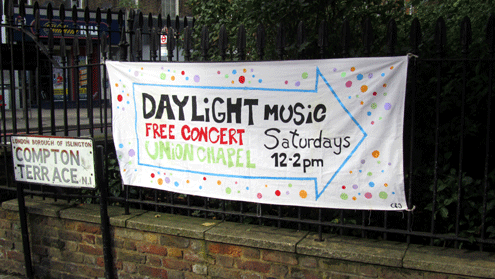
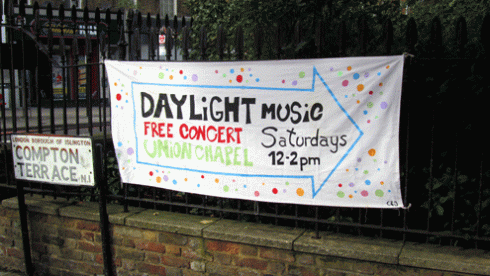
Daylight Music 194: Field Harmonics + Component#4 + Benjamin Thomas Holton, with Seamajesty (Union Chapel, Compton Terrace, Islington, London, N1 2UN – Saturday 20th June, 12pm to 2pm) 

The second label showcase of the season, this time for Staffordshire-based Wayside and Woodland Recordings, bringing Field Harmonics, Benjamin Thomas Holton and Component#4 to the Union Chapel’s stage.

Following 2013’s critically acclaimed debut album ‘Walls’, Midlands electropop favourites Field Harmonics spring into 2015 with an even more accomplished and confident sound and vision, bolstered by the addition of new frontwoman Bryony Williams. Eighteen-year-old multi-instrumentalist Williams joins musician/producer Rob Glover (of ambient pastoralists epic45) for Phase II of Field Harmonics, bringing with her an assured swagger far beyond her years and an iconic vocal style that perfectly complements Glover’s crisp production.

Benjamin Thomas Holton has been creating and releasing music for nearly 20 years, whether as part of ambient pastoralists epic45, with the folk tinged song and sound experiments of My Autumn Empire or under various other shadowy pseudonyms. For this exclusive solo performance, Benjamin will be performing stripped down versions of songs from the forthcoming My Autumn Empire album ‘Dreams Of Death And Other Favourites’, as well as a handful of songs from previous releases.

Component#4 is Mike Rowley. Born and raised in the postindustrial, post-Thatcher remnants of the Black Country, Rowley’s music draws on the decaying factories, vandalized bus shelters and litter-strewn canals which formed the landscape of his childhood. Live, Rowley is joined by Andy Langford on drums and will perform versions of tracks from the 12″ EP ‘Barbed Wire Sunday’ and the recently released Component#4 debut album ‘Into Memory’.

The afternoon will also feature short laptop-based sets by Seamajesty (a.k.a. James Yates) using material he has recently built up under the project of ‘Tea and Biscuits’. Previously the drummer for such bands as The Pattern Theory and epic45, or session percussionist for German metal bands WFAHM or The Ocean, James’ current work as an engineer has helped him home in on certain directions he knew he wanted to pursue. To this end he built a studio in his garage, and started experimenting, recording to analog wherever possible and using several car-boot-found reel-to-reel and cassette tape machines to shape the recordings, adding a much loved lo-fi grit.

Free entry, but donations are (as ever) encouraged.

As an additional bonus, since this is an early afternoon event it still leaves you free to go to that inaugural Baltic Music Society concert in the evening. Not that I’m putting pressure on you…

June 2015 – upcoming London gigs – Jim Lampi plays in Balham tonight, Putney at the end of the month

15 Jun

A quick note, since this is at very short notice. Jim Lampi, singer-songwriter and arguably the world’s best Chapman Stick player, is surfacing for two rare gigs in London this month… one of them tonight. Jim Lampi The Chapman Stick is often known as a technician’s instrument – studied polyphony, smooth jazz, fingertapping extravaganzas. While Jim’s more than capable of all that there’s also a rootsy joy to his musicality, born from curiosity, a subtle musical restlessness and a diverse if low-key career. He’s played with people as diverse as Michael Manring, Courtney Pine and in particular the late John Martyn, for whom he was an occasional bandmember. The latter looms large in Jim’s own recent songwriting, which is full of dreamy slurs and elastic timing and sung in a weathered voice that’s part Martyn and part Leon Redbone. Watching him play, even in short bursts, is a joyous experience.

Live @ The Bedford, The Bedford, 77 Bedford Hill, Balham, SW12 9HD – Monday 15th June – 8.00pm, free event.

Jim plays at the resident singer-songwriter night, alongside three other singer-songwriters: Brendan Cleary, Josh McCartney and Robert Kennedy – full details here.

The Half Moon, 93 Lower Richmond Road, Putney, London, SW15 1EU, UK, Monday 29th June – 8.00pm, £8.00-£10.00.

Jim plays a support slot for the acclaimed John Martyn tribute band The Glorious Fools. More details here, and get tickets here.

June 2015 – some videos – Tim Bowness, William D. Drake, Thumpermonkey

2 Jun

A few videos to pass the time.

Firstly, here’s the newest video from Tim Bowness, promoting the lead single from next month’s ‘Stupid Things That Mean The World’ album. The Great Electric Teenage Dream features a cut’n’paste scratch effort built up from fragments from the Prelinger archive.

While I’m limbering up for a big William D. Drake catchup (reviews of this month’s ‘Revere Reach’ album and its predecessor ‘The Rising Of The Lights’), here’s the uproarious Chaos Engineers video from the former’s lead single. ‘Distant Buzzing’ features appearances, on- or off-video, from assorted Drake associates – the Larcombe Brothers (from Stars In Battledress), Dug Parker (from North Sea Radio Orchestra), Stuffy Gilchrist and many others…including a certain sordid, waxy tyrant from the 1980s. And a donkey.

Finally, do you ever hear anyone complaining bitterly that all of the artistry has gone out of rock vocals? If so, play them this video of Thumpermonkey‘s Woody recording voicework for the band’s upcoming album, and watch a grin breaking like sunrise across their face. (I don’t cover Thumpermonkey enough in this blog. That’s going to change.)

June 2015 – upcoming gigs – Sink and Alabaster DePlume on brief English tour this week

1 Jun

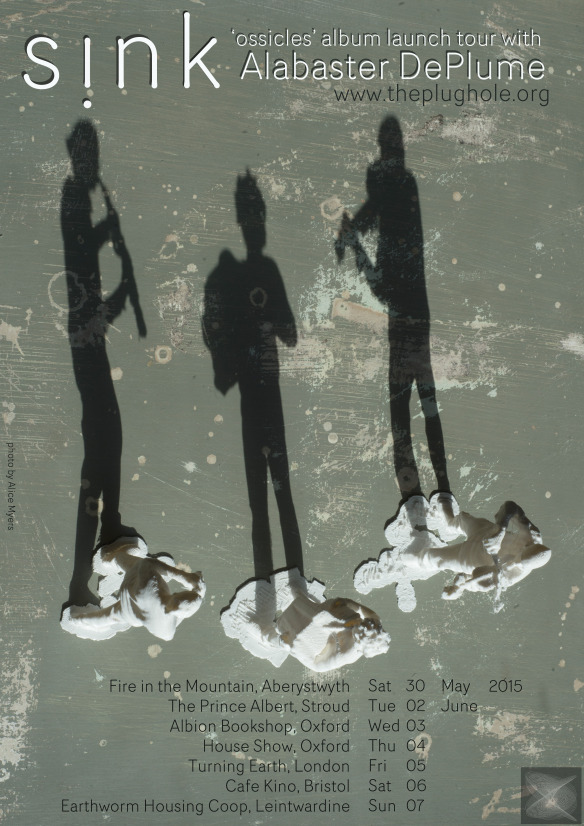
This just in from all-round Mancunian multi-media bloke (poet, songwriter, saxophonist, theatre-and-film collaborator) Alabaster DePlume. He’s on a tour of off-the-beaten track venues in the south of England this week with experimental Edinburgh improvisers SiNK, having started off in Aberystywyth over the weekend (sorry, I heard about that gig too late). It’s not entirely clear what they’re doing, but it’s safe to assume that there’ll be a spirit of discovery.

About SiNK, Alabaster says:

The tour celebrates their new album, ‘Ossicles’… Last time I played with them they created a ‘sound mirror’ – a bass drum on its side filled with water, with a speaker underneath. They played their music through the speaker and projected a light onto the water which was reflected onto the ceiling, where it displayed the geometrical shapes created by the sounds. They then played in response to the shapes (and each other) which changed in response to their playing.

event-20150601sinkalabaster

Tour dates:

The Prince Albert, Rodborough Hill, Stroud, Gloucestershire, GL5 3SS, Tuesday 2nd June, 8.00 pm – free event.

The Albion Beatnik Bookshop, 34 Walton Street, Oxford, OX2 6AA, Wednesday 3rd June, 7.30pm – tickets £8.00 (£5.00 concessions);

Nest Collective @ Turning Earth Ceramics Studio, Railway Arches 361-362, Whiston Road, London, E2 8BW, Friday 5th June, 8.30 pm – tickets £8.00 to £10.00 from here.

Café Kino, 108 Stokes Croft, Bristol, BS1 3RU, Saturday 6th June, 8.00 pm – tickets £6.00.

Earthworm Housing Co-Op, Wheatstone House, High Street, Leintwardine, Craven Arms, Shropshire, SY7 0LH, Sunday 6th June, 7.30 pm – free event.

Sounds intriguing…

June 2015 – upcoming London gigs – A Formal Horse & Ham Legion; Olga Stezhko; The Spiders of Destiny play Frank Zappa; a Bowie Night in Soho

29 May

Here’s some quick info on upcoming gigs in early June which I’ve heard about – all of them in London.

Over the last couple of years, Westminster Kingsway College has established itself as one of the capital’s finest homes for quirky art-rock – by which I don’t mean student hobby bands thrown together for campness or for ironic prankery, but a rich, complex, committed electric music spanning the range between gutter-punk and flouncing prog via metal, jazz, folk, avant-gardening and anything else which gets melted down into the stew. Here’s one of those gigs that proves the point.

A Formal Horse, 2015

A Formal Horse + Ham Legion (Westminster Kingsway College, 211 Gray’s Inn Road, London, WC1X 8RA, Tuesday 2nd June, 6.30pm)

A Formal Horse is a new progressive rock quartet based in Southampton. Although the band’s sound is difficult to pinpoint, their dense instrumental passages are reminiscent of King Crimson and Mahavishnu Orchestra, whilst Francesca Lewis’ lead vocals evoke the whimsical surrealism of the 1970s’ Canterbury scene. Wonky melodies and serene vocals over a brutal sound – their music keeps you on your toes. However, A Formal Horse go beyond simply regurgitating the music of their predecessors. With influences as diverse as Bartók and Bon Iver, the band prove that there is still much territory to be explored in the field of British progressive rock.

In June 2014, the band released their debut EP, which was recorded by Rob Aubrey (IQ, Transatlantic). They went on to perform at London’s Resonance Weekend alongside Bigelf and Änglagård, and were described by Prog Magazine as a “festival highpoint”. Since, they have shared stages with Knifeworld and Lifesigns, cementing their position at the forefront of the British progressive scene.

Ham Legion spent 2014 honing their sound and developing a storming live show. You can expect a collision of beaming up beat power pop, grinding metal outbursts, dramatic changes of mood, sudden passages of twistingly epic prog then moments of restrained delivery and somber reflection. They are striking out in 2015 with the release of their debut album towards the end of the year.

Tickets available here – £6.00/£5.00

Olga Stezkho: 'Eta Carinae'

Olga Stezkho: ‘Eta Carinae’

Olga Stezhko (the far-thinking Belarusian classical pianist whose ‘Eta Carina’ album impressed me so much last year) has two London concerts coming up in the first fortnight of the month. The second’s likely to be an all-access crowd-pleaser. Given its charity fundraiser status, I’m not sure whether the first is likely to feature or indulge any of Olga’s intriguing conceptual preoccupations with Scriabin, Busoni, cosmology and early twentieth century consciousness, but even if it isn’t it’s a great opportunity to see a fine musician at work in a grand location.

Olga Stezhko charity piano recital in aid of Friends of the Belarusian Children’s Hospice (St Pancras Parish Church, Euston, London NW1 2BA, Thursday 4th June, 1:15pm – 2:00pm)

Programme not revealed – free admission, donations requested.

EC4 Music in aid of The Prince’s Trust (Barbican Hall, Tuesday 9th June, 7:30pm – 9:30pm)

The choir and orchestra of London-based EC4 Music return for their seventh fundraising concert in aid of The Prince’s Trust with a stirring selection of music from both sides of the Atlantic.

Programme:

Leonard Bernstein – Overture from ‘Candide’
Aaron Copland – Appalachian Spring
George Gershwin – Rhapsody in Blue
Vaughan Williams – Serenade to Music
Leonard Bernstein – Chichester Psalms
Eric Whitacre – Water Night
Hubert Parry – Blest Pair of Sirens

Performers:

EC4 Music Choir and Orchestra
Tim Crosley – conductor
Olga Stezhko – piano
Claire Seaton – soprano
Roderick Morris – countertenor
Thomas Herford – tenor
Adam Green – baritone

Tickets available here – prices from £10.00 – £35.00 plus booking fee.

Some of London’s most active art-rockers are brewing up a free Zappa homage in Croydon at around the same time. Details below:

event-20150606spidersplayza
The Spiders of Destiny play Frank Zappa (The Oval Tavern, 131 Oval Road, Croydon, CR0 6BR, Saturday 6th June, 8:30pm)

Great googly moogly! On June 6th, nine-piece tribute band Spiders Of Destiny come to The Oval Tavern to play a marathon set of music by the late, great Frank Zappa. Featuring world class performers with a sense of humour from notable prog/alternative bands such as: Knifeworld, Perhaps Contraption, Pigshackle, Medieval Baebes, The Display Team, Hot Head Show, Poino, Spiritwo, First, A Sweet Niche and more. So polish up your zircon-encrusted tweezers, trim your poodle, learn the mudshark dance and join us as we propagate the conceptual continuity instigated by one of the masters of modern music.

More info here – this gig is FREE ENTRY but there will be a donations jug doing the rounds during the intermission.

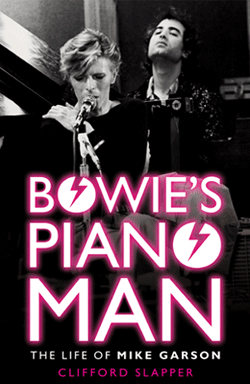
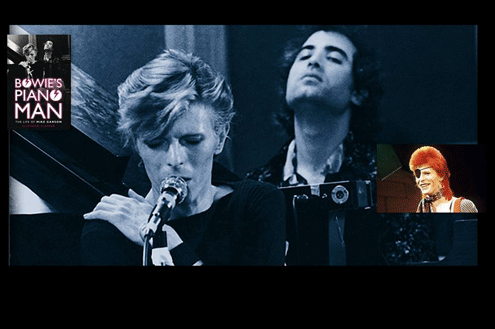
book-bowiespianomanAnyone with an interest in David Bowie, rock history, cabaret, electropop and all of the other things that get swept up into Bowie’s art should head to Soho on Thursday 11th June for A Bowie Night at Gerry’s Club, at which pianist and writer Clifford Slapper launches his book ‘Bowie’s Piano Man: The Life of Mike Garson‘ (which also has its own Facebook page).

As well as readings and signings there will be performances of Bowie songs from avowed fans Danie Cox (from “flock-rockers” The Featherz), Ray Burmiston (of ’80s heroes Passion Puppets), club siren Katherine Ellis (Freemasons, Ruff Driverz, Bimbo Jones etc.) and acoustic singer Jorge Vadio. There’ll also be a performance from a longtime ‘Misfit City’ favourite – London balladeer, Brel translator and onetime ‘Pirate Jenny’s’ host Des de Moor, who’ll presumably be singing his Bowie-gone-chanson interpretations from his ‘Darkness and Disgrace’ show. (I’m particularly pleased to see that Des is back onstage. It’s been a long time.)

More on the book below, and more on Gerry’s Club here.

“It is pointless to talk about his ability as a pianist. He is exceptional. However, there are very, very few musicians, let alone pianists, who naturally understand the movement and free thinking necessary to hurl themselves into experimental or traditional areas of music, sometimes, ironically, at the same time. Mike does this with such enthusiasm that it makes my heart glad just to be in the same room with him.” – David Bowie

Mike Garson has played piano on sixteen David Bowie albums, including Aladdin Sane, with his celebrated piano solo on its title track, Diamond Dogs, Young Americans, 1. Outside and Reality. He has also played live with Bowie on countless tours and shows, and remains his most long-standing and frequent band member.

For some time Clifford Slapper has been working very closely with Garson to write a book which explores the life of this extraordinary and eccentric modern musician. It documents in detail how as a pianist he was catapulted overnight from the obscure world of New York’s avant-garde jazz scene to a close and long connection with Bowie. In addition, Garson is recognised as a classical virtuoso, a jazz master and one of the world’s greatest exponents of improvisation. He has also recorded and performed live with other rock legends such as the Smashing Pumpkins and Nine Inch Nails. All of this is covered by this first ever biography of Mike Garson.

Its starting point was several days of in-depth and frank conversation with Garson himself, and covers a wide range of themes which will be of interest to all Bowie fans, but also to anyone with a passion for music, social history or the process of creative inspiration. Input has also come from many interviews with those who have worked with him over the years, including Earl Slick, Trent Reznor, Sterling Campbell, Reeves Gabrels, Dave Liebman and many others.

event-20150611bowienight

July 2014 – through the feed – ‘The World of Robert Wyatt’ tribute concert in Lyons tonight (and hopes for a UK followup)

12 Jul

The World of Robert Wyatt

The World of Robert Wyatt

If you’re free tonight – and are in France in the vicinity of Lyons – here’s something for you which I wish that I’d known about earlier. Les Nuits de Fourvière (a seven-decade old French arts festival currently running its sixty-eighth programme) is presenting ‘The World of Robert Wyatt‘ tonight, featuring a full tribute performance of Wyatt’s 1974 classic ‘Rock Bottom’. Also on the menu is a selection of other Wyatt classics such as Moon in June, Shipbuilding and O Caroline.

Wyatt himself won’t be performing – instead, the honours will be done by a group of musicians led by Craig Fortnam (of North Sea Radio Orchestra, and whose second album as Arch Garrison I’m currently striving to finish a review of). Apparently some iteration of North Sea Orchestra will be the backbone of the ensemble – sadly minus lead singer Sharron Fortnam, but including Craig and William D. Drake amongst others. The ranks will be swelled by several outstanding French musicians – pianist Pascal Comelade and singers Silvain Vanot and Élise Caron (the latter of Groupe de Recherche et d’Improvisation Musicale and Orchestre National de Jazz. In addition, John Greaves (Wyatt’s longstanding Canterbury scene friend and collaborator, who played on his 1975 album ‘Ruth Is Stranger Than Richard’ as well as alongside him in one of the varied lineups of Henry Cow) will be contributing.

From the programme:

“Thank you for bringing a breath of fresh air to my music. To hear it played by other musicians makes me feel like a grandfather. It’s now leading a life of its own – but we, the grandparents, we also see ourselves in it somehow. It’s a wonderful feeling.” These were the words of Robert Wyatt when he welcomed the idea of creating a show around his work at Fourvière. Showing great modesty, these words shouldn’t minimize his essential contribution to the history of pop music. Because in his collaborative projects (Soft Machine, Matching Mole and more) as well as in his solo career, the Englishman is indeed a model: hasn’t he been a source of inspiration for personalities as well-known as Elvis Costello, Alain Bashung, Mark Hollis (Talk Talk), Björk and PJ Harvey? Fed on classical music and bebop songs as much as songs by Ray Charles and Burt Bacharach, Wyatt was swept by a never-ending desire to escape – perhaps this was reinforced by the accident that nailed him to a wheelchair for life in 1973. An eternal wanderer, he struts his imagination and his high-pitched voice, playing with the barriers between pop, jazz, Latin sounds and electronic music. An art of fugue brought to its poetic peak in the album Rock Bottom (1974), a “song of love and curiosity” intended for his wife and muse Alfie: here, as others put boats into bottles, Robert Wyatt has managed to fit an entire world, his personal world, into his songs. The fortieth anniversary of the release of this unparalleled album is the perfect opportunity to celebrate its maker.”

Hopefully there’ll be enough life in the tribute to float it over the channel to Britain in the near future. In a year when Henry Cow are reuniting for concerts in London and Huddersfield (to pay tribute to their late former member and comrade Lindsay Cooper), the time is ripe for more reflowerings from various Canterbury buds. Surely there’s a slot at the Purcell Room, The Ballroom, even Conway Hall if they’re feeling more modest and left-leaning… Suggestions are welcome (although they’re better off going to Craig Fortnam or to anyone who can help him fund it).

Meanwhile, if anyone out there can make it to the concert, please do tell us what it was like. Comments below…

Robert Wyatt online:
Homepage Facebook MySpace Last FM

Craig Fortnam/North Sea Radio Orchestra online:
Homepage Facebook MySpace

Les Nuits de Fourvière Festival online:
Homepage Facebook Twitter

June 2014 – through the feed – Sufjan Stevens reissues ‘Enjoy Your Rabbit’ with various goodie options

26 Jun

Sufjan Stevens: 'Enjoy Your Rabbit'

Sufjan Stevens: ‘Enjoy Your Rabbit’

Assuming that you’ve not heard about this yet (I still have the sneaking suspicion that the majority of my readers are ahead of me as regards news)…

…that prolific, poly-instrumental singer-songwriter/critical darling Sufjan Stevens is reissuing one of his earliest and oddest albums. Originally released by Asthmatic Kitty back in 2001, ‘Enjoy Your Rabbit’ was reissued a couple of days ago (June 24th) on limited-edition deluxe vinyl and as a download.

On initial hearing, ‘Enjoy Your Rabbit’ doesn’t sound much like the work with which Sufjan later made his name. Despite the man’s reputation for assured eclectism, it seems out-of-place and unexpected – very different from the concept albums in which he codified his life and thoughts into the hopes, dreams and terrains of American states; or from his baroque-ified folk-Americana (in which you were as likely to hear a cor anglais as a banjo or harmonium); or from his combining of original film and symphony music for ‘The BQE’; or even his battery of Christmas albums.

Recorded during Sufjan’s first stint in New York, it’s almost entirely electronic – a fizzing post-modern cut-up built from digital work station noises, samples and tweaks of live sounds (including stray guitars, organs, the brassy lather of Tom Eaton’s trumpet and prelingual vocals from Liz Janes and Sufjan himself). There’s a running theme via the Chinese zodiac and its twelve-year cycle, each year of which lends its name to a track (Year Of The Dragon, Year Of The Rat and so on), although Sufjan muddies the waters with two extra pieces – the title track and The Year Of Our Lord. (Given his professed Christianity, the latter is as likely to be sincere as it is to be a tongue-in-cheek gag: given the nature of the album, it’s probably both.)

Over to his label, Asthmatic Kitty, for a fuller explanation (as Asthmatic Kitty appears to have a staff of two, one of whom is Sufjan, you can be pretty sure that this is a definitive statement):

“Departing from the singer-songwriter format of his first Asthmatic Kitty album, ‘A Sun Came’, this collection of fourteen colourful instrumental compositions combines Sufjan’s noted gift for melody with electronic sounds to create an unusually playful and human – not to mention humane – electronic experience. First released in 2001 on CD, 2014 — the Year of the Horse — brings the original recording back as a double-LP set, the first disc clear and the other left to fortune. And no one can foresee who will receive one of two very special boxes of fortune cookies, containing fortunes penned especially for this occasion by Sufjan himself.

‘Enjoy Your Rabbit’ is the most underrated and overlooked album in Sufjan’s discography. It contains in capsule form what he would later unpack into more palatable music. There are flashes of ‘Michigan’ and ‘Illinois’ in Year Of Our Lord, Year Of The Ox and Year Of The Dog, and shadows of ‘Age Of Adz’ in the darkest moments of Year Of The Boar, Year Of The Snake or Year Of The Dragon. ‘Enjoy Your Rabbit’ is a harbinger. A precursor. A wink in the eye before the slight. You should have listened in the first place. We’ll forgive you though, because when an album is only available in wasteful jewel-case CD, how cool can it be? Jewel-cases are so 1998. But now that it’s in multi-colored limited-edition gimmick-ridden vinyl, you have no excuse. ‘Enjoy Your Rabbit’, which Sufjan wrote and recorded in the innocence of a pre-9/11 2001, is Sufjan’s best work because it is Sufjan at his least self-aware.

In an alternate reality, Sufjan never made ‘Michigan’ or ‘Seven Swans’ or ‘Illinois’; he kept making electronic freakout albums like ‘Enjoy Your Rabbit’ in obscurity, until perhaps he just gave up and stayed in graphic design and some pitying barely-afloat label re-released ‘Enjoy Your Rabbit’ and sold a few dozen copies to a few scattered part-time record store employees. But here we are in this reality, where ‘Michigan’ is slated for an energy drink commercial, ‘Illinois’ is a backdrop to a pensive montage in a kickstarted blockbuster movie, and ‘Enjoy Your Rabbit’ is relegated to a drunken purchase at Amazon.com.

Here at Asthmatic Kitty, where we often ignore reality as it’s presented, ‘Enjoy Your Rabbit’ is one of our most played records. We find ourselves in the small company of ballet choreographers, quartets, and occasional internet reviewers, but there should be more of us. So, as if we were in that alternate universe where “Sufjan” is more likely the name of a ‘Game of Thrones’ character than an indie star, we hope you’ll give this record a chance now that it’s available as vinyl. It is just as genius as anything Sufjan has released since. Everything’s been downhill since.”

To my own cranky ears, ‘Enjoy Your Rabbit’ is a fascinating, skillful blip in Sufjan’s career – a rare chance to see his singular talent from a specific angle. It’s a little similar to your first encounter with Frank Zappa’s cascading Synclavier cut-ups if all you’d previously heard was his catalogue of hairy, horse-laugh rock cabaret numbers about groupie misdemeanours and middle-America caught napping and dribbling. Another comparison is Adrian Belew’s 1986 one-off ‘Desire Caught By The Tail‘ – a snarling, abstract career swerve from a musician who’d previously satisfied his avant-garde leaning by blowing spacey textures and barnyard/traffic sound effects through art-rock songs, but was now sitting down with a crude guitar synth (plus a jumble of pedals and assorted things to hit with a stick) in order to create uncompromising Picasso-Hendrix shapes at heavy-metal volume. Did someone say ‘Metal Machine Music’? Not quite, although there are moments of crushing noise on ‘Enjoy Your Rabbit’ which recall Lou Reed’s own Marmite effort.

One thing which can be said for certain is that ‘Enjoy Your Rabbit’ is a breathtakingly playful record which nonetheless exhibits Sufjan’s extraordinary breadth of influences and compositional skills. If you listen closely, his subsequent ways of building a song are all already present and correct. Though they’re sheathed and blurred within the blip-glitching video-Pong noises, Tibetan bells and drunken brass band textures of Year Of The Monkey, they’re definitely there: it’s a song, voiced with all the oddness of a Charles Ives let loose on a sampler.

Speaking of Zappa, some prime bogus pomp shows up on Year Of The Snake and Year Of The Boar. Amongst the larking bass-harmonium reed drone and the razzing fizz of Sufjan’s electronics, some weighty blimpery waddles and patters. I could have sworn that Year Of The Boar even quotes ‘The Phantom Of The Opera’ at one point. Sufjan’s certainly not slow to drop in a ‘Mission Impossible’ quote on the album’s title track, which is otherwise the odd song out – an angular, dissonant line of Rock-In-Opposition guitar fuzz joined by a cavalcade of pushy racket and chiptune burble.

As for the Chinese component, it’s not clear whether this is a gimmick (like Sufjan’s subsequent tall tales of a “50 States” concept project) or another little metajoke which he’s balled up and sent sailing over our heads. Scattered sparingly across the record, Mannar Wong adds some genuine spoken Chinese. In and around certain pieces, trilled Chinese melodies bump up against European string quartet tunes or (as on Year of the Tiger) flute around cabaret vocalese and bells over thudding shadow-tones. But at least as much is drawn through and worked in from other sources: Sufjan’s first years in the thick of New York’s cosmopolitanism must have been a greedy feast for his ears. Steam-organ and No Wave whomp, carefully orchestrated, collide with early-Genesis prog flourishes. Sewer-pulsations meet Bontempi organs and sample-heavy vocal murmurs, folded into Latin pop melodies. Silvery Krautrock turns into dinky, glitch-mauled castle music on Year Of The Rat. For Year of the Sheep, Sufjan turns the music into a battle between pulp and celestial. Against the birth-of-the-world vocalise which he and Liz Janes knit together, animal sounds yawp and rampage – angry pregnant elephants, excited pterodactyls.

Rat

The thirteen-minute Year Of The Horse – the piece on which Sufjan could really have come unstuck – instead shows him in full control: sustaining and mutating schools of ideas at greater length, like a post-techno Mike Oldfield. Despite its mongrel elements and its sense of hazard sources, over the course of its journey (minimalist piano figure in trio with vibrating mechanical sounds and out-of-focus kettledrums; panpipe-riffles marshalling around industrial squashing-tones; a finale of glitched/phased/near-atonal signal twitches), it’s not so dissimilar to those carefully-structured stretches of ‘Tubular Bells’ or ‘Ommadawn’ back in the 1970s. Not that Sufjan would necessarily agree: his time at New York’s New School (which he was attending while he wrote this album) would have exposed him to any number of inspirations from chance heroes to masters of structure. What’s clear is that under the capering and restless sonics, great swathes of ‘Enjoy Your Rabbit’ display Sufjan’s bedrock talent and the solidity of his musical placings. It’s a cliché that a single work by one artist can hold as many ideas as another artist’s entire career, but this is one of those cases where the old saw is true. I’ve heard plenty of electrophonic records eking out a single concept or a sparse few, albeit successfully. ‘Enjoy Your Rabbit’ makes most of them sound like lazy sketches.

You should judge for yourselves, though – this wasn’t supposed to be a review. You can get your copy of the album from Asthmatic Kitty or Bandcamp (both fixed-price vinyl or download) or from Noisetrade (pay-what-you-like download-only). For the possibility of fortune cookies, I’m guessing that you should pester Asthmatic Kitty directly. If you want the additional option of ordering a vinyl twosome of ‘Enjoy Your Rabbit’ and Osso String Quartet’s ‘Run Rabbit Run’ as a thirty-dollar special offer… well, that’s another thing to talk to Asthmatic Kitty about.

Sufjan Stevens online:
Homepage Facebook Twitter Soundcloud Tumblr Bandcamp Last FM

May 2014 – through the feed – Tim Bowness/Stars In Battledress pre-orders

9 May

News on two long-awaited second albums, both now available for pre-order.

(Brief rant first. Up until now ‘Misfit City’ has avoided reproducing or paraphrasing current news releases, apart from the odd crowdfunding mention. Too many music blogs are rolling shills, just throwing out links and one or two lines of PR blurb – fine if you only want a quick squirt of info, but I prefer to provide something to read and reflect on. Now I’m relaxing my stance: partly because release schedules are moving too fast for me to keep up with them properly, and also because ‘Misfit City’ readers probably appreciate the opportunity to pursue a few things on their own. Hence this first “through the feed” post, passing on and personalising info on promising upcoming releases or events which I’ve heard about. This will flesh out the City’s posting schedules and also allow me to indulge myself as pure enthusiast, minus the more sober and serious responsibilities that come with in-depth reviewing. Having unbent myself a little, I’ve found I’m enjoying it. Wheedling rant over. Now…)

Tim Bowness: 'Abandoned Dancehall Dreams'

Tim Bowness: ‘Abandoned Dancehall Dreams’

On 23rd June, Tim Bowness releases ‘Abandoned Dancehall Dreams’ on Inside Out Music. I know I wasn’t alone in hoping for Tim to release a new no-man album this year, but thanks to bandmate Steven Wilson’s ongoing commitments to his own solo career, we get this as an alternative: a might-have-been no-man album reworked as a Bowness solo effort. The album features contributions from the no-man live band (including Darkroom‘s Mike Bearpark and Henry Fool‘s Stephen Bennett) plus a scatter of interesting guest players (King Crimson’s Pat Mastelotto, Porcupine Tree’s Colin Edwin, Anna Phoebe from Trans-Siberian Orchestra, composer/string arranger Andrew Keeling).

Those who’ll still miss the presence of Steven Wilson can console themselves by the fact that he’s done the album mix, but it’s always worth pointing out that no-man is an equal partnership for a very good reason – and that Tim’s work outside no-man during the band’s lengthy absences over the past decade has flowered into much broader areas and accomplishments. For ‘Abandoned Dancehall Dreams’, expect plenty of violins, choirs, an edgy croon and some immediate art-rock songs which should effortlessly combine the wracked, the sleek and a very English blend of wryness and longing. One song, The Warm-Up Man Forever, was premiered as a highlight of the no-man tour back in 2012.

A download version comes later, but as regards the solid options the usual Burning Shed boutique format options apply for the pre-order. For turntable worshippers, there’s not only a vinyl version but also a very limited white vinyl edition, both of which come with a free CD version. For musical completists and sleeve-note fans, the double CD version comes with alternate/outtake versions plus remixes by Richard Barbieri, UXB and Grasscut, as well as a nice fat 16-page essay booklet (of the kind I used to write, once upon a time). Sweet. Some live dates follow in July, featuring members of the erstwhile Bowness band, the no-man live band, and Henry Fool (all of whom appear to have morphed together into an overlapping art-rock amoeba). Loop-guitar thresher Matt Stevens and silky Italian art-rockers Nosound appear as support at some dates.

Stars In Battledress: 'In Droplet Form'

Stars In Battledress: ‘In Droplet Form’

The week before that, on June 16th, sibling duo James and Richard Larcombe – a.k.a Stars In Battledress – release their own second album ‘In Droplet Form’ on Believers Roast. Their debut album was one of 2003’s hidden, intricate gems – a marvellous multi-levelled faux-antique toybox of sepia-ed wit, sophisticated arrangements, sly poetry and clambering harmony. Fans of Neil Hannon, Robert Wyatt, Stephen Merritt and Cyril Tawney should all have had a field day with it, but for a variety of reasons, it remained hidden. (I’m sure that my own wretched inability to complete a review at the time didn’t help…)

Since then Stars In Battledress have only reappeared sporadically, although the brothers have kept busy both separately and together. Both have worked as ensemble members of North Sea Radio Orchestra and of William D. Drake & Friends: James has played keyboards in Arch Garrison and Zag & The Coloured Beads; Richard has kept himself busy with his Sparkysongs project for children, no less of a challenge than keeping cranky art-rock fans happy. Yet absolutely nothing else that the Larcombes do can top the particular magic they cook up when they’re together and completely in control of their own songs.

With an eleven year gap between albums, some of these songs have been around for quite a while. The romping wit of Hollywood Says So, the rambling melodic spikes of Fluent English (an oblique essay on rebellion, Empire, personal misplacement and embarrassment) and the haunting cadences of The Women From The Ministry – all of these were highlights of Battledress sets back in the early Noughties, so it’s lovely to finally have them arriving in recorded form. If you want some idea of what Stars In Battledress are like live, here’s a review of them at Roastfest in 2011. As a taster for the new album, here’s their video for the opening track A Winning Decree (directed by Ashley Jones of Chaos Engineers).

‘In Droplet Form’ is a CD-only release for now, and can be pre-ordered here, with a London album launch (also featuring Arch Garrison and Prescott) downstairs at the Roundhouse on April 13th.

Also in June, the Laura Moody debut album should be appearing. I’m really looking forward to that one too.

Tim Bowness online:
Homepage Facebook Twitter Soundcloud Last FM YouTube Vimeo

Stars In Battledress online:
Homepage Facebook Twitter MySpace Bandcamp LastFM

April 2014 – through the feed – another crowdfunding campaign (Laura Moody’s debut album)

15 Apr

Another crowdfunding request arrived in one of my inboxes yesterday (I have multiple identities and secret lives, but there’s no escape from news). This one was from Laura Moody, whom regular and assiduous ‘Misfit City’ readers might remember from her low-key guest appearance at the Liam Singer/Foxout!!! gig which I reviewed in summer 2013.

As well as being a superb cellist (with fistfuls of classical and extended techniques) Laura’s also an extremely good singer-songwriter responsible for a self-titled three-track EP released back in 2009 and which I really ought to review sometime. It showed her sweeping her multi-textured cello playing and her stunt-kite vocals into the service of some extraordinary songs. Complicated, tuneful and wood-noisy, they quivered with a thoroughly female complexity dealing mostly with the passage through womanhood (brains tussling with sexuality, daughterly angst, the farcical behaviour of older men) and brimming with an exuberant, theatrical wit. Here’s what ‘The Irish Times‘ said about Laura some time ago:

“…for enjoyable astonishment, nothing quite beats the singer-cellist Laura Moody. She plays lyrically; then as if it was a box for sound effects. She sings her own almost-pop songs, gurgles, hoots, wails, taps her throat with the bow. Yet it’s all seamless, as if she, the cello and the music are a single organism.”

I can second that, and here’s some more evidence.

While I’m dragging my feet about reviewing that EP properly, you can listen to it here. Meanwhile, there’s a follow-up coming soon, and here is Laura’s crowdfunding request:

“Dear Friends,

Well, it seems spring has sprung in more ways than one for me and I have really exciting developments to report! My debut album is very very nearly finished and I have a launch date for your diaries – 26th June this year at Wiltons Music Hall! I can’t wait to welcome you all there for what I think is going to be a magical evening at the most beautiful venue in London. But before I can do any of that I’m afraid I need to ask for your help…

I have launched a crowdfunding campaign on indiegogo to help me raise the money I need for the final stages of production and release. I really hope you’ll take a look at the video, the rewards on offer and consider getting involved. I am going to be releasing on my own label – the newly christened Surbiton Lagoon Records – but what this campaign really means is that you wonderful people will essentially be becoming my record label, the force that makes getting my music out into the world possible.

Some of you might have noticed on Facebook or Twitter that I rather nervously launched the campaign late on Friday afternoon. I figured that not much would happen until this week when I would have a chance to contact all of you properly about it. However… things kind of went a bit bananas with people pitching in to get me to 10% of my target by the end of the day and 30% by the end of the weekend. I am completely stunned and deeply moved by the enthusiasm and generosity everyone has shown. If you have already contributed to the campaign I really must thank you so, so much.

Thank you again for your time, support, encouragement and patience with getting this album out. It’s so close now and I’ll be keeping you updated as to how this all goes.

More soon

Laura xx

PS I will be supporting my friends Dollyman at the Hackney Attic in London this Friday. If you’re free please do come along for some songs and a drink to celebrate a great first week for my campaign!”

While I know Laura, I don’t know Dollyman, but for what it’s worth ‘Time Out’ described them as “fractious Mingus-informed punky jazz quartet offers broken themes full of menace and mischief. Possibly what Tom Waits’ band might sound like after he’s popped out for a smoke,” – all of which sounds promising.

Laura Moody online:
Homepage Facebook Twitter MySpace

January 2014 – EP reviews – Bailey Cremeans: ‘Celestial City’ (“a broken-hearted altar-boy, drowning his sorrows in stolen communion wine”)

10 Jan
Bailey Cremeans: 'Celestial City' EP

Bailey Cremeans: ‘Celestial City’ EP

Here’s what I hold against the all-conquering Coldplay – they write, and perform, the inflated ghosts of songs.

This is not, in itself, a problem. Songs don’t necessarily need clarity – nor do they need to sit foursquare on solid points, like well-built houses. Sometimes all they need to be are eerie, moaning rags blown by on the wind; or they could be dream-pop memory-blurs, a murmur of what might be or might have been felt. Yet with Coldplay you get the worst of both worlds (a thunderous arena-sized vagueness, a song which is all brightly-smudged outsides) and it means that when I draw comparisons between Bailey Cremeans and Coldplay, it sounds as if I’m setting him up.

Much like Chris Martin, the young Missourian’s a piano balladeer at heart. Despite the occasional damascene synth wash or passing organ-cloud, he keeps coming back to the sound of black wood, ivory keys and felt hammers on strings; everything pared back to a soft, lonely, reverberant toll. His rich, slurred high-tenor voice makes him sound like a broken-hearted altar-boy, drowning his sorrows in stolen communion wine. It can sing and shade a lyric all the way down from a heartfelt question into a dissolving liquid texture. It suggests that, like the Coldplay boys, he’s copped a listen to dream-pop’s narcotic meld of boy/girl, solid/disintegrating – but unlike Coldplay, Bailey never lets a song run away into outright vapour. These songs have body – they use the heft and strength of the piano. Sometimes they slump against its laquered wood, desperate and bereft, gripping for dear life. Sometimes they bloom out of it, their faith absolute – “you, my stars, my sun. / You, my lover, the one.”

Five songs. Five songs of the kind of reflective, raw-boned feeling that’s increasingly anathema to today’s meticulous pop. Tides is the kind of grief-stricken torch song I’d’ve cried myself empty over when I was seventeen: a slowly burning sailing ship carried on gliding multi-tracked harmonies, as Bailey struggles to hold his fractured memories and dignity together in song. “The tides rushed in. / Your hands were on my skin. / If you had told me then I wouldn’t have believed it… / Was just a sad, confused boy. / And you got what you wanted from me – / and now I’m free.”

Bailey himself is still only in his teens. It’s tempting to hype him as a ghostly, spontaneous child-man, bleeding himself out on every passing thorn – something self-spun out of a faded diva gown, who creeps quietly into abandoned theatres to carol over the wreck of a concert grand. Unfortunately, too many bits of truth get in the way. Theres’ the bright and bubbly Bailey whom you can track down on Facebook; those Lana Del Rey and Ellie Goulding covers on his Soundcloud page; the stint playing keyboards for an American Idol contestant… It’s hard to project lonesome Gothic fantasies onto someone when he networks so cheerfully. You end up wondering how the little bastard has the right to sound this sad – or to sound as if he knows so much – whenever he starts to sing his own songs, putting all of the high-school smiles aside and becoming the naked soul who calls on the stars themselves for comfort. “Orion, this air is wearing thin / and I’m more afraid than I’ve ever been. / Won’t you save me? / Won’t we burn bright? / Orion, I’m losing this fight – / promise I won’t be alone tonight.”

And then you don’t question – you’re just glad that he does sound that way. Great pop music’s just perverse like that.

Well, if you’re looking for songs of preening, there’s always Rufus Wainwright: and, while you’re at it, forget Coldplay. Bailey’s songs have more in common with that skeletal, devastatingly sad album of piano crooners which Paul Buchanan salvaged from the wreck of The Blue Nile a couple of years ago. You could throw in some other names, credible or otherwise – the Christine McVie of Songbird; the early, pre-glitz Elton John at his most open; a freshly-bereaved Francis Dunnery overlapping crafted pop and primal howl on ‘Man’. These are men and women who bring a helpless and beautiful tone to those songs when they sing them, as if the emotion is being flooded out of them in an soft and unending surge. Bailey sings lines like “face to face / This story is ending, we’re free in our hearts. / Wounds are mending, we’re never apart / No tears in your eyes, my love. / No tears in your eyes, my love,” with the same blend of heart-torn sorrow and fervent faith; each turned in on the other.

It’s not often that you get to hear someone who can sing into the core of simple words like this the way that Bailey does: illuminating them but making them bleed, putting flesh onto the old lines and making them ache again. He deserves huge success. I just hope that, if he gets it, it doesn’t hollow him out.

Bailey Cremeans: ‘Celestial City’
Bailey Cremeans (self released, no catalogue numer or barcode)
Download-only EP
Released: 6th January 2014

Get it from:

Free or name-your-price at Bandcamp, Freemp3fan.com or Soundcloud

Bailey Cremeans online:
Facebook Twitter Soundcloud Bandcamp

REVIEW – Ian Crause: ‘The Song Of Phaethon’ & ‘Suns May Rise’ singles, 2012 & 2013 (“sample-punk turned foley-bard”)

30 Oct

Ian Crause: 'The Song Of Phaethon'

Ian Crause: ‘The Song Of Phaethon’

“Well, I know, I know the story – / the fall of the sun and the vengeance of glory revoked. / So well, I know how the seas turned to dust, / and how the known earth choked. / So well, I know, I know the ending: / the carriage from its zenith bending, / a comet slung through ashen skies / and burst against the banks.”

Cinematic. Epic. These are words which have been whored out far too often, especially when it comes to describing and defining music. Froth and PR corrode their meanings, reducing them to fancy synonyms for nothing more than crude scale, and we forget that other qualities are wrapped into them. These words shouldn’t just be cheap and glittery tags for charlatans – the kind who steep their tunes in giant vats of reverb, or who substitute eye-watering grandiosity for sincerity. There are more crucial meanings. There’s storytelling, and the churn of history. There’s the play of images, the triggering of senses. Eventually, there should be some kind of understanding.

Ian Crause knows all of this. Back in the 1990s – when he was barely out of his teens, and the driving force behind the startling expressionist pop band Disco Inferno – he was struggling with it himself. Even then, though, he wasn’t stumbling to understand: he was striving to perfect. Disco Inferno had come from limited beginnings but grown fast. Originally a dour post-punk power trio, they’d seized the opportunities presented by technology and imagination and transformed themselves into a whole-world window. Hot-wiring their way into the disruptions and illuminations of found-sound and musique concrète, they plugged guitar, bass and drums into digital samplers and grew themselves an ever-expanding sheath of noises: a startling collage of jarring sound effects, layered into composition and twisted into context.

Disco Inferno’s swarm of noise was never there simply to overwhelm. Instead, it refracted and illuminated the poignant dissatisfied pop songwriting which stood, steadfast, at the band’s core. They were doggedly political, but owed nothing to dogma. Caught within ominous social currents and inside treacherous personal eddies, their songs bore witness to cruelties, both intended and impersonal. Those tearing rivulets of sound-montage were flashes of further illumination, put there to side-swipe and snag the attention, and to up-end complacency. The fragments of birdsong and clattering glassware; the careful punctuation of trains and screams and distant firework-pops; the sound of feet jogging grimly away through a numbing snowfall – all of it bore witness to the swerving cacophony of the world, smearing past our ears and battering our psyche, carrying its deeper meanings and significances into us via a pummeling swirl.

At the heart of this unsettling barrage were Ian’s lyrics, which were wise, stark and bleak beyond his years. He sang about the crumbling of vulnerable individuals; about the fraying of the social contract and distortion of social forces. He sang about the stifling, stunting pressures callously imposed from above. He sang about all of this in a still, small, stubborn voice which sounded like the next-to-last exhalation; as if he was a few crucial steps and dogged heel-digs away from giving up and bleeding out. He sounded brave, bitter and doomed – snarling his scorn at the boot-tread even as it rolled over him. For a while, it was a self-fulfilling prophecy. Bands who refuse to comfort us (or refuse to stroke our sundry petty vanities) rarely get rewarded, and Disco Inferno were no exception – the strains of dealing with commercial indifference and inner despair finally tore them to bits in 1997. A couple of barely-noticed Ian Crause solo EPs hiccupped out in the band’s wake over the next few years, and then he too seemed to drop out of the story.

In fact, he’d only dropped out of the cheaper kind of mythology. That’s the one in which ducking out of music becomes death or disappearance by another name. His own story – the real story – moved on regardless. There were years of growing up and grim jobs to come, and years of being chewed over by the same callous forces he once sang about. In amongst the drudgery, there were other factors. There was fatherhood, and family. Surprisingly (for a lyricist already so accomplished and intelligent) Ian made his first adult engagement with literacy. Curiosity, plus a determination to pursue the roots of song and storytelling, led him to the themes and voices of classical literature. His developing interest in the telling parallels with contemporary society kept him immersed in it. Crucially, Ian discovered the works of Ovid – Roman epic poet and exile – via dedicated translations by Ted Hughes and David R. Slavitt.

Like Ovid, Ian would eventually become an exile himself (a self-determined one, abandoning Britain for Bolivia) and enter into a new swell of creativity. Via his ‘Metamorphoses’, Ovid eventually inspired The Song Of Phaethon – Ian Crause’s formal return to music, transformed and developed. It might not be the first new note he’s delivered after eleven years of radio silence. That would be More Earthly Concerns, which welled out via Mixcloud and blogclick in March 2012, and which I’ll talk about elsewhere. But (as Ian begins to dole out his work, in handfuls, onto Bandcamp) The Song Of Phaethon is the first of Ian’s songs to be let out into the marketplace. It’s also probably more crucial in understanding his evolution since his Disco Inferno days.

The protagonist, Phaethon, is and was one of those half-divine children who pepper Greek mythology – he’s the bastard of the sun god Apollo Helios, a malcontent boy strutting up to his sun-father’s palace to claim his ancestry and birthright before he has the wisdom to use it. Greeted, given the acknowledgment he craves, and granted the gift of driving the sun’s chariot for a day, Phaethon is warned of the terrible risks involved. Swallowed up by his grand moment, and too conceited to listen, he takes all of his opportunities to their ruinous conclusions. Losing control of the chariot, he transforms a triumphal fly-past into a joyride and then into a catastrophe. Before the high god Zeus restores order by striking him down, Phaethon scorches a gigantic swathe across the world and casts the seasons into chaos.

Like most figures woven into the complex psychological map of Greek myth, Phaethon still has his role to play. He’s a metaphor for arrogance and a sense of entitlement; he also stands for the destructive potential which both of these follies possess. It’s deep literary currency, and maybe not the first thing which you’d think of as a match for the Crause songcrafting method – so direct and personal in Disco Inferno days. Yet Ian’s battering splay of noises and disaffection opens itself up readily to the mythology, which sinks in grain-for-grain. Explosive futurism meets stern and ancient legend, and both are renewed.

Some of Disco Inferno’s post-punk grit remains at the spine of the music (listen to those dogged dot-trails of frowning bass, or to the occasional flares of wire-wool guitar), but the song falls far away from rock into something older. Myths lend themselves to being channeled into new courses by any means available – Phaethon, for instance, worked his way into a Patricia Barber jazz epic six years previously. Ian rises to his own challenge superbly. In any worthwhile sense, what he comes up for The Song Of Phaethon is a new take on a bardic chant. Its melody is minimal and hypnotic; its rhythms walking, changing pulses constantly driven by the restless words. With vivid artistic appetite, Ian also mines the story’s depths for any resonances which he can transmogrify and feed into his own samples-as-narrative approach.

In this he’s served well – the mythic structure and detail inspire and transform his lyrics, which in turn take on the layered build of classical imagery. Various whispers of fateful moira and foreshadowing rise up to nourish the sounds. From early on, Phaethon’s life is marked by the celestial – right down to the transformation of his familiar landscapes by the passage of the sun and moon each day, continual reminders of his thwarted birthright. Ian reflects this in the woven detail of the narrative: “Every day their shadows ran / down Asia like a lyre, strumming / past his village, swinging down at perihelion / to touch upon his mother’s house / then over dark and quiet woods – / their distant hawks and watching deer / oblivious in bending shade – / descending into seacloud mist, / and down towards the gull-cloud cliffs / to pour their jewels and precious metals / out along the sea.”

Just as he did with Disco Inferno, Ian juxtaposes sound effects with the lyrics to create telling sonic scenery. Though he generally wields these with the skills of a master ironist, he slam them into place with forthright punk brutality whenever he needs to. Throughout, the Greek horns and lyres are a pointed racket: ritual blares, ancient continuo lines. Signatures of antiquity and origin stand solid against the thrumming synths and Ian’s tidal electrophonic swirl of throbbing samples. In prophetic flashes, the clip-clop of horse’s hooves and the slam of violent collisions clatter and blur in and out of the mix, while Phaethon’s more innocent youth is illustrated by the clank of herd bells and goats. In time, his dogged journey through Asia and towards Apollo is dappled and smeared by a souksworth of Asian instruments and chatter, careering past the listener in a flickering travelogue: “Levantine cities raised themselves, then hazed away in dreams of sand, where sand subsumes / the earth itself and still ahead his path led on. But falling always out of reach, the rising sun. / Into the dawn, alone he walked.”).

The effect is of a kind of illuminated text – a cinematic compression of time and location into a vivid illustrative story. That story remains paramount: even while we, as listeners, are being drawn inside those blood-in-the-head thunders and are surrounded by a glorious noise, as if we’ve been trapped under the encircling lip of a vast bronze bell. Beyond the story, though, other dimensions to the tale are coming into play. The song is also a loose parable of another gatecrashing of grand power. “He knew, he knew – / his place was beyond.”

Superimposed – a ghostly transparency – over Phaethon’s story is the tale of Tony Blair’s entry into the Second Gulf War. As this emerges through the song, it’s clear that Ian sees this as another disastrous snatch at high significance and public destiny. Something which flew high and upwards towards glory, only to destroy any achievement of its own, wreaking havoc on the ground and people below. Cunningly, occasional Blairisms are woven both into the narrative and into Phaethon’s thoughts and speech. At one point, he even blathers, Blair-like, “look, you know,” before sliding into advocate pomp and hubristic heroics. For a moment, the pleading voices of the two men overlap within Ian’s narration, making a contradictory cats-cradle out of public morality, power-grabs and a preening Promethean sense of mission. “It was not just God but also man / who clearly needs some representing – / A case I’ll take for free… / Evidentially it takes / a half-divinity to raise / the flag of man aloft for man…”

It follows – with a harsh and unforgiving logic – that the noises of modern warfare should persistently break through the song’s tapestry of ancient sounds. As Ian goes beyond everyday sound effects and begins to violently splice present-day horrors into the textures of the mythical plot and signifiers, the song is slashed up into a jittery palimpsest. Almost from the start, those bleating goats on the ancient Greek hillsides are blindsided by gunshots and by the crash of heavy munitions. With booms, crunches and clatters the shattered, warped shards of twenty-first century concrete and metal scrape and shoulder their own way into the past.

Even specific events from the myth draw across, from recent times, their own crooked parallels. The bursting, clattering crowd-sound of Phaethon’s entry into Apollo’s hall is lifted and twisted from the peak of Blair’s 2003 address to the US Congress. It becomes a Dionysiac smear of fanatical applause and whistles: something turned into a nightmare puppet show, or a rainstorm ripped horribly out of kilter. At the coda, Phaethon is poised unwitting on the brink of disaster. The ascension of the Sun’s chariot merges, indistinguishably, into the noise of a jet fighter launch. Backed by the white-hot screech of the afterburners, the lyrics weave both tales, both times and a set of terrible implications – “the steeds were armed: a blinding shock; / a ferrous scream; a rubber stamp; / and up,” – into final, irrevocable process.

By anyone’s standard, The Song Of Phaethon is a major achievement – a jump-up into fiercely intelligent, confident high art, it stakes new claims and transfigures old ground. It even manages to both stay true to and transcend the moral and political commitments Ian held with Disco Inferno. And yet… it raises a tremulous question of what might have happened to the other side of Ian Crause. Between the immersion in classical tradition (and the dense time-folding focus of the samplers) what’s left of the fervent young New Order fan who always saw himself as fronting a pop band? What, in other words, became of Crause the unlikely pop singer?

Ian Crause: 'Suns May Rise'

Ian Crause: ‘Suns May Rise’

For the answer, look to Suns May Rise, released three months after The Song Of Phaethon. Ian’s mining of Greek mythology is still in place (as are his detailed tapestries of sound-effect) but they’re now wrapped around an out-and-out pop song and a lustrous, dancing melody that Bernard Sumner would give his eye-teeth for. Those Greek lyres and zithers are back, as are the layers of sound effects (sea-spray and thunderous surf crash billow through Suns May Rise from start to finish); but they’re bolstered by massed stadium synth and guttering pop guitar; by angelic powder-puffs of fake-choir; and by warbling rococo flourishes of electronics. Even Ian’s voice – usually so dry, and pointed – is flushed with the balmy blue of a Mediterranean summer. Scritti Politti and Cocteau Twins, each at their flounciest, could find common ground with this song’s feverish, chattering opulence. So, come to that, could latterday Marillion.

I suspect that all of this ’80 ornamentation is deliberate. After all, it skips hand-in-hand with other ’80s excesses, and that’s not too far from where Ian’s caustic, righteous attention is focused. Beneath this gleeful and gorgeous bluster, he’s unraveling a story from the Odyssey: a warning bell for avaricious times. As the story has it, Odysseus (while returning from the Trojan Wars) visited the generous Keeper of the Winds, who gave him a bag of sea-gales to ensure that the sails of his ships would be filled and his voyage home would be swift. En route, Odysseus slept; and his friends sneaked up to rifle the bag, in search of treasure which they were sure he’d hidden from them. All they succeeded in doing was to unleash the winds, which blew the ships hither and yon and – eventually – blew them back to where they had started. Reckless avarice, bringing down calamity, provides the keystone of the song. “There will always be some fool / to pull the strings apart. /And suns may set and moons may wax, / and moons may wane and suns may rise – / the gold within his eyes will weigh / Man down a stumbling fool.”

When Ian starts singing about this, though, it’s from the point of view of that corrupted, consensual chorus of friends – the “brothers bound in bronze.” Their coy, self-congratulatory rapaciousness soak his tones like a stain on the teeth. Flushed and greedy with loot already, all they can see is the chance to grab some more. From his own place at the reins of the narrative, Ian reveals their mythic echo in today’s freebooting boy-club of bankers and stockbrokers. Men of unfettered appetite goad each other on. People who simply don’t know when to stop – and who wouldn’t want to even after being handed a sobering, sickening lesson – would still pick perilous holes in opportunity. “You had enjoyed a peace of sorts / The winds had been re-tamed and so / of course the bag was bursting fat: / It fell to men to see to that. / Again so sure the bag would hold / either wine or gold, / Necessity appeared, demanding ‘Open this’.”

It’s here (with a careering inflative screech on “bursting fat”) that Ian himself deliberately unleashes the hidden forces within Suns May Rise, to overwhelm it. From here on in, sounds rise and cyclone – seaspray, radio chatter and winnowing churns of air; a lash of strained rope which morphs from background effect to edgy kick-drum. Amongst all of this the thread of pop song holds fast, stretched taut over an ever-burgeoning epic. In a parading weave of rapid soundbites, assorted newscasters and pundits and politicians roll past in a potted history of the last generation of monetarism. At its tail-end, George W. Bush (waving through a banker’s rescue programme of the kind he’d never have brooked for any other group of people) chokes, gargles and drowns amongst the becalmed wreckage of Odysseus’ ships. Throughout, that teasing pop melody ensures that we’ll remember what happened this time around.

So… the forces eventually sink the meddlers, but there always seem to be more of the latter. Ian conjures up further mythic winds, more specters bringing in ruin from the other far-flung breeding grounds of a destructive capitalist carnival. “Through solids, countries, paper bonds; / The world again reveals itself / in entrails; in open wounds. / The priests and seers shed tears of glee / and privately amuse on how / it still can be that after so long… / there will always be some chance / to pull the threads apart.” Again, the bones of legend rear up inside the flesh of current affairs. Again, this unlikely sample-punk turned foley-bard turns up to show us where those bones are poking through – his words a layered and subtle scourge; even an education. For Ian Crause, it’s been a long and often stony road from transformative teenage angst to his current role of reveal-and-illuminate, but it’s also been a journey of integrity and hard-won vision. The results are even a story in themselves.

Ian Crause: ‘The Song Of Phaethon’ & ‘Suns May Rise’
Ian Crause (self-released, no catalogue number or barcode)
Download-only singles
Released: 20th November 2012 (‘The Song of Phaethon’), 18th February 2013 (‘Suns May Rise’)

Buy it from:
‘The Song Of Phaethon’ – Bandcamp (the original version reviewed here has now been replaced by this mini-album)
‘Suns May Rise’ – Bandcamp (the single version reviewed here has now been replaced by this version from ‘The Vertical Axis’ album)

Ian Crause online:
Facebook Bandcamp LastFm

September 2013 – live reviews – autumn light, part 1: Daylight Music presents Directorsound/Candythief/Jack Hayter @ Union Chapel, Islington, London, 28th September 2013 (“decency, enthusiasm, a place to gather and music’s qualities of balm and binding”)

30 Sep

This way in...

This way in…

In some respects, when you’re chasing music, being broke is easy. Almost everyone sympathises with it (not least the musicians themselves). A bigger challenge is to keep up with both music and a young family: neglect either, and you feel sick at heart. Chances fly past and it sometimes seems as if, whatever you do, someone’s going to get disappointed.

My own, fairly recent family is typical in this. Getting us all together behind one piece of music, at one time, can be tricky. Regular readers will already know that I like music in all its forms – from scream to coo; from four-square pop craftsmanship to impulsive tangle-ups; from stroke to slap, from massed strings to static. In the face of this indiscriminate barrage, my wife prefers her music to be more ordered and comfortable. (We did enjoy a freak one-off bonding over some Belgian avant-jazz six years ago – marriage always has its surprises). As for Oscar, at two-and-a-half years old he hasn’t settled on absolute likes yet; but as he hones his toddler free-improv skills and makes up scrambled songs about the Gruffalo, making musical noises with any convenient object (or watching other people do it) fascinates him.

Well, if you’re broke, you track down free gigs – as for the other challenge, go looking for something family-friendly. Hiding in plain sight in the middle of north London, Daylight Music offers both, hosting fortnightly pay-what-you-like triple bills beneath the piling, bounding Victorian-Gothic rooftops of Union Chapel. Persuading Clare and Oscar to go is easy. It’s a single bus ride away; it’s in the early afternoon; it’s mostly acoustic. Apparently, there’s cake. I think that’s the clincher. We go.

Inside, we find something like a church fête. The merchandise stall nuzzles up against Christian Aid posters; and yes, there’s cake – people volunteer to bake and bring it in. Beneath the Chapel’s bold and cavernous octagon of elevated brickwork, a gentle, meandering throng of people criss-cross the aisles like drowsy autumn bees, settling gradually into the wooden pews. Children’s faces are dotted around the audience – happy or distracted toddlers, anxious infants who’ll be smiling at the thumps and arpeggios later. During breaks in performance, a strikingly tall and kind-looking lady called Caitlin cat-steps over to the grand pipe organ and plays us a weave of half-melted pop hits and memory-songs. Despite the Chapel’s imposing scale, this is all remarkably cosy.

In recent years, unfriendly rumbles have rattled round the woodwork of the more family-friendly, acousti-folky end of music. Certain commentators have been drawing ominous conclusions about a resurgent conservatism, the rejection of multiculturalism and the stealthy rehabilitation of a rigid and stratified Britain strapped into place by ersatz traditions. It’s an uneasy picture, not least because the distaste drives so many things before it – farmer’s markets, bespoke festivals, the parodification and commodification of working-class folk culture, even the innocuous folk-rock of Mumford & Sons are all rolled up into a looming kipple-spectre of incipient English fascism. You could imagine the same questionable bile being aimed at Daylight Music – at the grand church setting, the tea-and-cakes, the shortage of outright punk and smoke, the Mothercare cups, even the efforts to make people comfortable.

Look a little more closely, and the cheap shots are belied. There’s a faint fray of urbanism to Daylight Music and to the Chapel – a slight scuffing and engriming in the Victorian iron and woodwork; a dash of non-conformism (both with and without the capitals) to the gathering and its setting. There are glimpses of more lived-in faces punctuating the young professionals, yummy mummies and cultured grandparents (hard-bitten elderly hippies, tattooed ex-bruisers; that nervy look which struggling musicians get, two decades into lean times). There’s that mingling of quiet anxiety with generosity which hangs around the trestle-table food counter, raising money for the homeless. Indeed, there’s even something of the trade union fund-raiser to Daylight Music.You sling your voluntary contribution into a plastic bucket at the door; you’re smiled at; you feel like part of something bigger and more inclusive, and a little more generous.

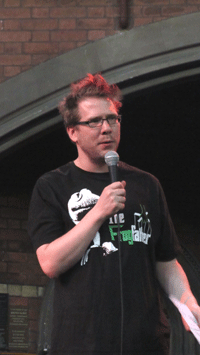
Daylight Music's Ben Eshmade - making us an offer we won't refuse.

Daylight Music’s Ben Eshmade – making us an offer we won’t refuse.

Although plenty of people are involved, Daylight Music is primarily another outcropping of enthusiasm from Ben Eshmade: broadcaster, promoter, occasional French horn blower and the man behind Arctic Circle, Chiller Cabinet and other warm-spirited musical things with cold names. Ambling onstage to introduce acts and deliver Daylight parish notices, Ben’s the gentler kind of presiding presence. Despite his amiable, bumbling manner (part distracted curate, part Sunday scholar and part walk-leader) it’s clear that there’s expertise and resolve hidden beneath those layers of fuzz and softness. I suspect that he knows everything that’s ticking over throughout the afternoon. Ever so slightly, there’s a sense that Daylight Music are holding off the darkness of ignorance in a matter-of-fact way and with the simplest of tools – decency, enthusiasm, a place to gather and music’s qualities of balm and binding. If London was flattened by meteorites or missiles tomorrow, you get the impression that Ben and the rest of the Daylighters would be dusting themselves down and going around afterwards – knocking at the fragments of doors; rigging tarpaulins and mending guitars; ensuring that everyone was given a flapjack while we put society back together.
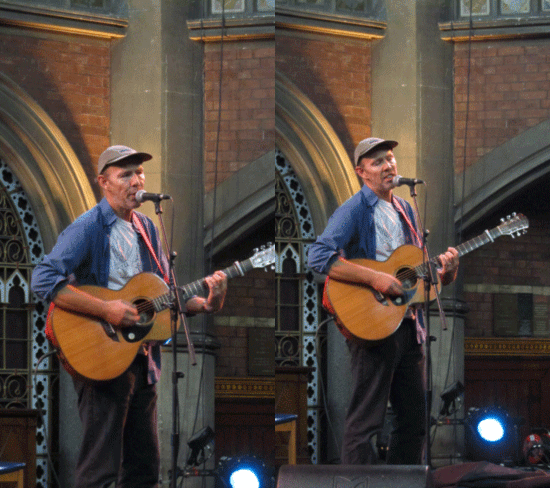
Jack Hayter, at work.

Jack Hayter, at work.

Today’s first act seems as if he’s already been through a little war or two. Looking like a man carved out of driftwood (and dwarfed by the Chapel’s glowing rose window) a slightly battered Jack Hayter is suffering, though not on our account. He’s got toothache, and he might have managed to give himself organophosphate poisoning this week from accidentally squirting dog-flea killer in his eye. He’s taking it well, though: downbeat afflictions and mishaps seem to suit him. Later on, he’ll be singing “I’ve got teeth like tombstones, skin like clay – / well, it could be the scurvy, but anyway.. / The symptoms will fade if you come around / tomorrow – well, I was thinking, I’ll impress you somehow…”

Despite twelve years of on/off solo work (plus bandwork with Spongefinger and Dollboy) Jack seems perpetually fated to be known from his Jack-of-all-trades period with Hefner – when he was Darren Hayman’s handy sidekick, the have-a-go guy playing pedal steel and anything else which the others couldn’t manage. Watching him up there by himself with just his acoustic guitar (and a voice that’s not so much husky as husk), I can’t think of him as anything else but his own man. Both he and his songs are of a part: stubbed and illuminated by poverty and handiwork, scraped down to the bumpy grain and crafted to the true.

His Devon-gone-Estuary accent rattling against his throat, he sings movingly – even elegaically – about the come-and-go of Margate seafront, capturing in fingernail sketches hints of dereliction, the sweep of world currents, and the ongoing business of life: “Seahorse eggs, bladder wrack, / starfish in the sand, / and the Balkan girls on the West Beach with their prams.” With wryness and fellow feeling, he sings about being short of money (“it just sits in my wallet / rehearsing its final goodbye…/ Every letter that hits the welcome mat / is a fancy shade of brown,”) and shifts seamlessly between the metaphysical and the bare-boned personal. (“Trust is just belief without evidence. / Faith is a river that leads to the light. / So I’ll write songs… / so we can sleep better tonight.”)
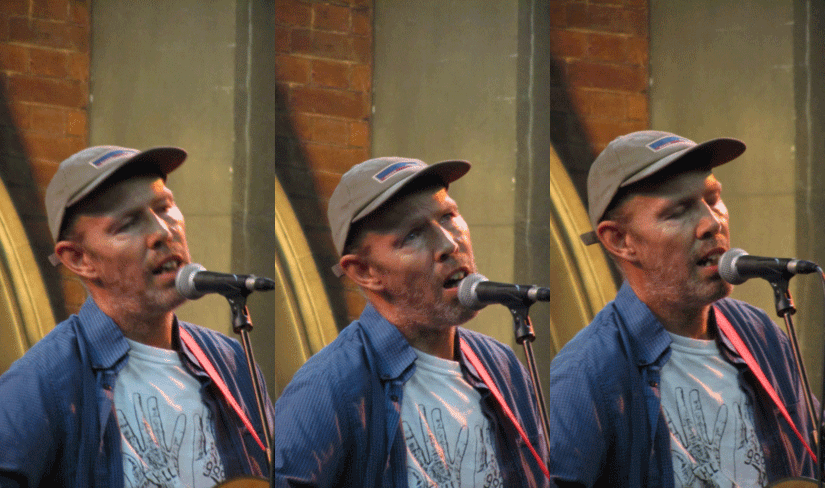
Jack Hayter - songs of tall ships, peeling paint, old aircraft and weathered people.

Jack Hayter – songs of tall ships, peeling paint, old aircraft and weathered people.

While there’s a soft centre to his songs, Jack’s a long way from that breed of walking-pullover songwriters who fluff up the average acoustic night. I mentioned driftwood earlier, but perhaps weathered garden sheds are better comparisons: those unintentional brittle monuments to ordinary men’s lives and their fumbled, uncompleted dreams. Gaps and splinters in the planking; fugs of memories of hard work and shaping, of small private failings and imaginary wickedness.

There are snags in these songs. In one rippled, helpless brooding on love and mistakes Jack casts wildering, dissonant chords in amongst the slash and finger-picking. He passionately rasps fragments of revealing (“your freckled arms wrapped around to drag me under or set me free… / She puts her trust in lucky charms… / Every time we go to pieces, every time we go to war,”) with his bleached, crumpled vocals making them sound like damaged photographs held fearfully at fingertips, their significance lingering even as their colours and clarity parch.

Where Jack truly comes into his own, though, is when he blends these roughened surfaces and threadbare textures with a broader scope: the hauntings of memory, perhaps, or a drunken fantasy. I Stole The Cutty Sark is the latter, a boozy-dream-come-lover’s-bet in which Jack’s decrepit old soak of a narrator imagines commandeering the famous old Greenwich clipper and sailing it (topgallants filled with drunkard’s breath) across south London parkland and streets to serenade his girl at Lee (“I bet she’d sleep with a man who’s got a tall ship…”). It snatches romance from the brink of the ludicrous – even restores a little dignity and life to its own shipwrecked subject.
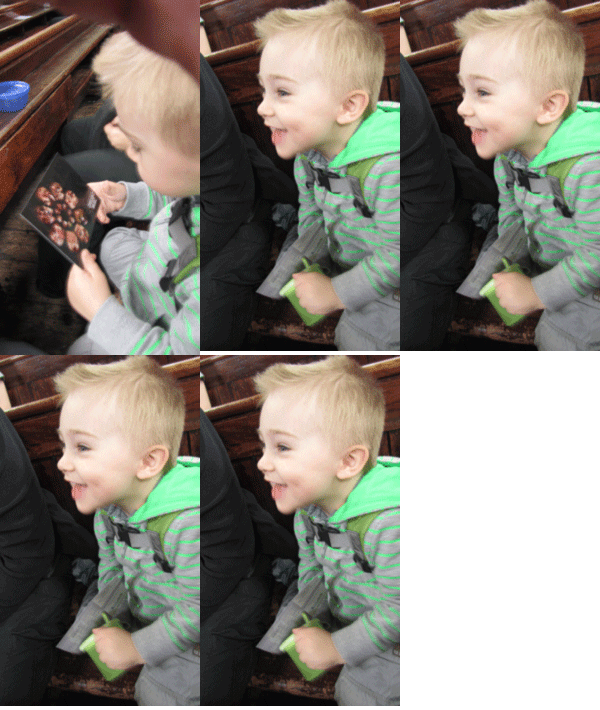
'Misfit City' Jr. at play - Oscar enjoys the show.

‘Misfit City’ Jr. at play – Oscar enjoys the show.

Another antique vessel – this time a plane – haunts The Shackleton: a post-war sub-hunter haunting the north-eastern coast in the 1960s, droning overhead while lonely Cold War teenagers pursue the wrong people, go through pregnancy scares and flinch from dreams of the mushroom cloud. From these elements, and from two tales of shredded correspondence in sorry little boxes, Jack spins out an aching kitchen-sink ballad of how people repeat their mistakes, neglect their cues, fail to be protected; in the end, how they come to miss what they feared and learn (too late) to love what they once only took for granted. He calls all of this time-travel. Oscar, too young to understand any of it, is still fascinated by the plaintive bony man onstage with his exhausted face and his air of dessicated kindness; the songs lolling from his guitar.

A few things about Candythief take me back to that wrangle which I mentioned earlier – the one about the politics of folk music. Superficially, they seem worlds (and perhaps a property band or two) away from Jack Hayter. As driving force and songwriter, Diana de Cabarrus has learned to be flexible while leading a Lego-flexible band lineup which clicks and pops available members into place as and when possible. This afternoon they’re a duo – Diana fronting on lipstick-red guitar, with Jason Dickinson’s vigorous fiddle playing and vocal harmonies adding some friendly sinew to her songs.
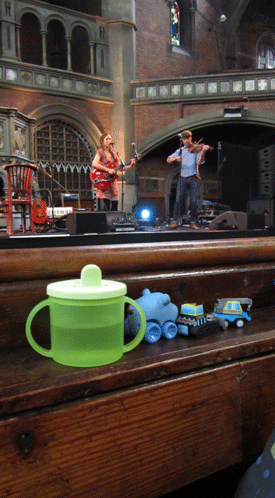
Part of a Daylight Music experience - baby cups, toys, Victorian woodwork, and Candythief in the background.

Part of a Daylight Music experience – baby cups, toys, Victorian woodwork, and Candythief in the background.

There’s nothing wrong with Candythief’s craft – it’s their cleanliness that jolts a little, after Jack’s scuff and scrape. Diana’s taste for adding a little crunch to her guitar is offset by her occasional dashes of loopage – choir-lady codas, little ziggurats of arpeggios – while Jason’s all-around virtuosity is further buffered by his beaming, ready-to-please showmanship. Their cheerful confidence extends to each other and to the audience; they deliver updates and clear intros at every opportunity, they’re nicely turned-out… They could hardly be more iconic of the modern, middle-class, tech’ed-up professional folkie if they tried.

Still, it’s churlish to snap at them for their impeccable diction, or for the fresh-faced, well-brushed aspect which they bring to their music and manner – after all, no-one snaps at Kate Rusby for making the effort. A songwriter’s voice finds itself while working through all manner of factors – family, shoes, regions, songs caught up from records or by ear, the day-jobs cadged on and survived, the places traveled and the things seen in passing. Diana’s own background (taking in a desert childhood and links with King Creosote and lo-fi Fence Records folk) suggests that there’s more to her than the assured, well-groomed perpetual-debutante which she presents as. Listening past the image doesn’t necessarily reveal all of this, but it does reveal a songwriter of thoughtfulness and impact behind the cool tones and bright sounds.
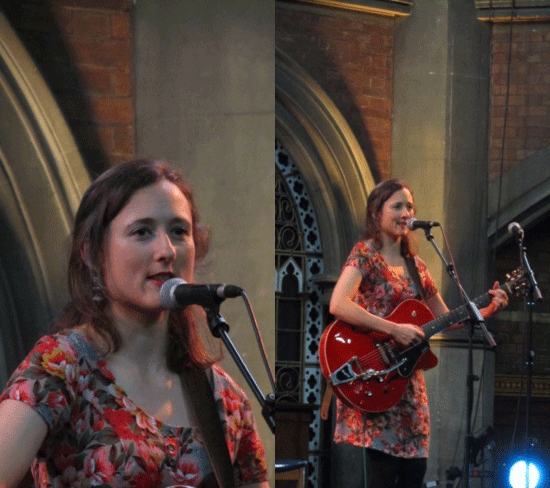
Candythief-in-chief - Diana de Cabarrus

Candythief-in-chief – Diana de Cabarrus

Not just that, but Diana proves to have a taste for mournful reflection which parallels those scrappier, plangent Hayter regrets. Her songs are windows onto other lives, onto which her own feelings overlap to etch away the politeness with a soft, stubborn acid. Many of the subjects are other women; such as the young girl at the centre of one particular time-blurred song, in which you can’t be sure whether Diana is looking at a daughter or niece, at a stranger, or at herself. Whoever it is, Diana appears to be both looking towards future journeys and looking back on them from that future, her responses a mixture of concern, solidarity and trepidation. (“Your face was so smooth – / you had no idea.”)

In the sleeve-plucking Time In The Tin Diana protests at how everyday lives are pecked away and blurred by the waste and distraction of marketing: “Please don’t spend the hours staring at the distant shrines in shopping malls, / the speechless saints in magazines and city walls… /With our minds thus occupied / we didn’t see our hands get tied… / Who dares tell you good enough / means buying into all this stuff / while the thoughts inside your head / are dismissed, remain unsaid?” As with the best political songs, the polemic is tempered by the personal, reflecting “summer was discovery – now the slightest wind chills me, / and I’ve set nothing aside. / I’ve only scattered thoughts to hide / from quicker clock face hands, from rain that turns it all to sand. / A bit more life is in the can: with hands outstretched we try to cram / every last taste and scent and breath / that rings of life, but every pledge / holds its promise and the line / towards home is hard to find.”
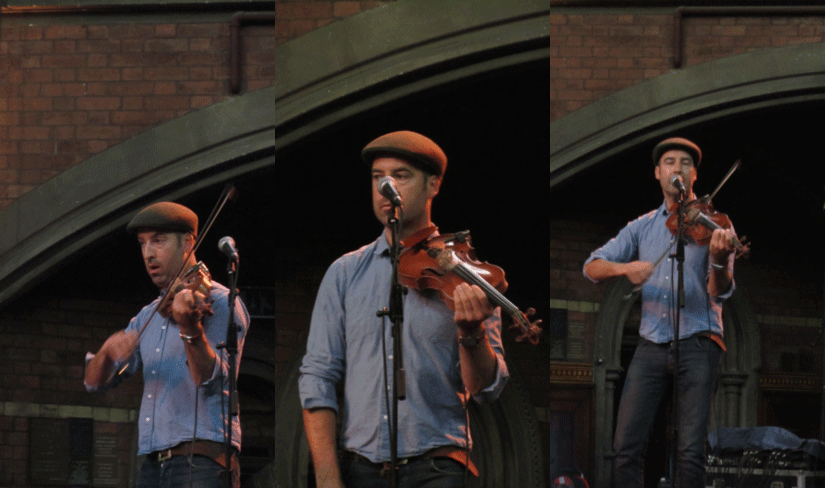
Jason Dickinson (Candythief's fiddler).

Jason Dickinson (Candythief’s fiddler).

Also buried beneath that clean surface and Diana’s own still, bright-eyed presence (like a guitar-toting reedbird) is Candythief’s taste for the cunning disarrangements of psychedelia and of folk – the flicks in the beat, the wrong-footing rhythms which inspire thought and dance together. Several Candythief songs skip between multiple paces, stirring up the barbs and challenges in the narratives. “We thought we were walking, making our own path… /You can’t close your grip ‘cos your hands are cold… / You ate up the insults, described them as fate. / Rattling the cage, / rewriting the same page – / footprints on your skin / where the robbers all crept in.”

They end – joyfully – on a new single, The Starting Gun, which takes this practically to prog levels. Leaping from a scrum of guitar and violin up to a stepped and spiky arrangement, it’s a stirring wake-up shout. “Your heart’s a roaring furnace underneath the evening news, / a mighty engine longing for the chance to be the fuse… / Draw the curtain back, join what was once apart, / scrape the grease from your beating heart. / We are bullets of pure light unraveling in time / through damage, loss, theft; the darkest of each other’s crimes.” Jason and Diana end on a confident crash, grinning at each other – clean sparks.
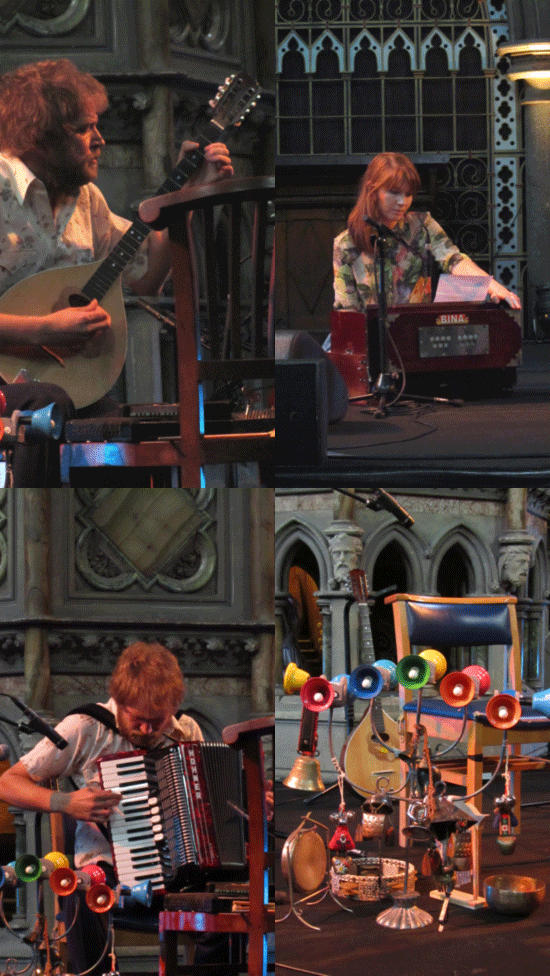
The soft armoury - Directorsound in action.

The soft armoury – Directorsound in action.

It takes a while for Directorsound‘s pool of mostly acoustic instruments to be assembled onstage. A nylon-strung guitar and a bouzouki, an autoharp and an accordion, a Tibetan singing bowl; dangling hammers, sticks and strikeables; sundry pedals; a miniature gong the breadth of a hand. Most vividly, there’s a compact and jutting array of hand-bells painted in bright toy-like colours, pointing outwards like clown-car klaxons. Apparently, this last item is a belldalabra.

If you’re still determined to think about things politically, there are a few options. Should we be expecting an admirable, inclusive world-music approach, or just the spoilt, self-indulgent tourism of an inveterate instrument collector? Is all of this wood, brass and hollow space about a love of open sound, or is it simple acoustic puritanism? I have to admit that I’m musing on something completely different – Daylight Music’s family atmosphere and the band name mingle lazily into a daydream of Thomas the Tank Engine, the Fat Controller hiding himself away from squabbling trains in order to piece together steampunk tunes in his bedroom. (Of course, it turns out that someone’s already beaten me to this…)

Idle speculation is rendered moot by the ambling arrival of Directorsound himself, Nick Palmer. Far from being any kind of poser – or any kind of prover – he’s a sweet skinny haystack of a man for whom any hints of ego or preciousness dissolve into the air with his music. He communicates with us via friendly mutters and the occasional warm, shy peer-out from between tousled fringe and beard. From the off, he engrosses himself in the business of stroking sound out of bells and strings and drum-skins, beginning with a ruminative solo on Spanish guitar but soon progressing to a smooth shuttling between instruments (an assured, hands-on craftsman, moving between tools).

Accompanying Nick on his explorations are two ghostly, gentle-faced women: one on harmonium, one on flute. Standing on either side of him, like handmaidens or like muses, they mingle an air of the slightly worn with one of peaceful contentment. Neither of them speak: instead, both softly watch Nick as they play, possibly picking up cues, most of which are invisible if they exist at all. While it’s Nick who initiates most of the patterns and melodies (and who rides swap-shot on the reliable single-instrument drones and figures his companions provide), no-one onstage appears to be in absolute charge. Instead, music happens as a mutual pass-around, shifting its focus equably between woodwind, soundbox, reed-buzz, string and chime. Three pieces along, Nick is picking up his piano accordion, playing his own take on a café reel and punctuating it with horn-honks and stomps of foot-tambourine, until the trio are summoning up strolling, bobbing images of fairground and French sidewalk.
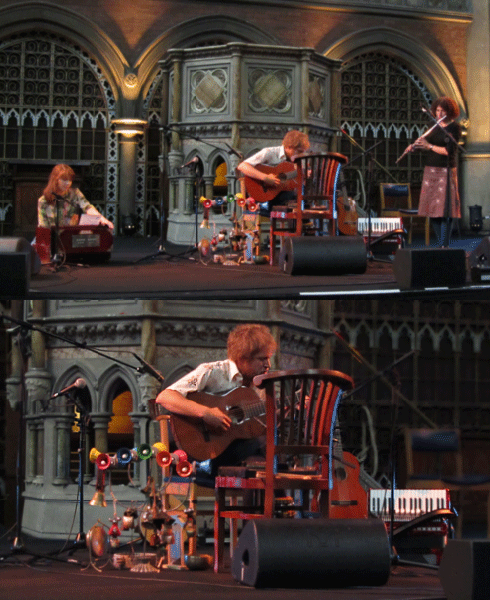
Directorsound spread out...

Directorsound spread out…

The belldalabra (which has been sitting tantalisingly in plain sight throughout the set) finally comes to the fore on the fourth piece. “It even sounds good when you move it,” Nick chuckles in passing, bringing it in closer even as he’s strapping on a pair of leg-bells. What follows is a stirring, flurrying one-man duet. Nick’s autoharp lies flat on a chair, his beaters ringing softly off its strings when they’re not rapping and fluttering across the belldalabra in exquisite slithers and chimes, a full flow of musical counterpoint from harmonium and flute turning the ringing into glints on the tide. In time, Nick sets the beaters aside in favour of the bouzouki; but his strumming hand still makes regular, hawk-talon lunges back at the autoharp as the piece blossoms into a Celto-Grecian tapestry of stamps and zings. When it’s going at full tilt, Nick is racking belldalabra, tambourine, leg-bells, gong and even a set of box-hinges in a continuous weaving sweep.

If this prolonged and frequently ecstatic dream-folk reminds me of anything in particular, it’s The Incredible String Band, though that’s a tenuous connection at best. Nick’s sunlit tunefulness and his enthusiasm for quilting diverse and divergent instruments into the mix certainly recalls the ISB’s “grab-anything” psychedelic enthusiasm. Yet he has no pretensions towards following their wildly cluttered and creative songcraft, nor any interest in emulating their engaging cracked-crow vocals. Directorsound’s music stays all-instrumental, and comparatively edgeless. Rather than being the product of quirky scattershot individualism, it’s both evasive and welcoming. Nick and his fellow players seem content to summon up broad, bright, impressionistic blurs of scene and culture (a ripple across a wheatfield, a Mistral gust, or holiday memories of a drift of indigenous evening music winding down a warm street) rather than dig into their roots or to challenge them.
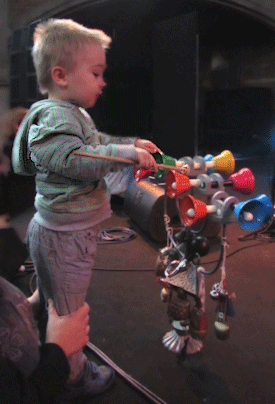
Oscar explores the belldalabra.

Oscar explores the belldalabra.

In spite of this, Directorsound remain honest – and, frankly, loveable. Simultaneously introverted and inclusive, the music absorbs musical ideas and feelings like a sponge, but breathes them all back out without a hint of selfishness or self-consciousness. The other Incredible String Band component that’s missing is the alpha-male jockeying for position which both fired up and benighted the latter group. With Nick as the lone (and unchallenged) Directorsound member in the studio, the project was never going to be anyone’s wrestling ground, but even with this in mind, the courtesy, the mutual kindness and the shy, unassuming generosity of the band is palpable from the moment they set foot onstage to the moment that they finally wander off, instruments in hand, into the Chapel’s shadows.

Before that, while Directorsound are still packing up. I bring Oscar up for a closer look at the instruments. Those previously silent women are now happily animated, smiling broadly, chatting to people from the stage. With an open smile, Nick shoves the belldalabra and a beater over towards us. Encouraged, Oscar taps out some ringing notes of his own, briefly making himself part of the band and part of the afternoon. It’s very much a Daylight Music moment.

(To be continued. We went back again two weeks later..)
Someday all 'Misfit City' reviews will be written like this.

Someday all ‘Misfit City’ reviews will be written like this.

Jack Hayter online:
Homepage Facebook Twitter Bandcamp

Candythief online:
Homepage Facebook MySpace Bandcamp

Directorsound online:
Facebook MySpace Bandcamp

Daylight Music online:
Homepage Facebook Twitter Soundcloud

June 2013 – live reviews – Liam Singer/Foxout!/Sealionwoman (with Laura Moody) @ The Dentist (33 Chatsworth Road), Homerton, London, 26th June 2013 (“a gig in a bottle”)

30 Jun

As I get off the bus in Clapton, the midsummer evening sun is giving the neighbourhood a lingering kiss. It brushes across the Clapton Portico (a bewildered, disinherited classical remnant, grafted onto a school at the end of an abbreviated road), takes away its sadness and helps it in its lonely loom. It limns the shopfronts of convenience stores and barbers and closed-down shops, and perks them up. It lends soft glows and sends little licks of shadow chasing around the stonework of the Round Chapel, and it brings out the last sleepy cheeps of the day from the local sparrows as I head down Glenarm Road towards Homerton.
Waiting for someone to sing..

Waiting for someone to sing..

Thirteen years ago – when I was living a lengthy stone’s-throw to the west, over in Stoke Newington – this part of east London was a soured inner suburb with a brooding, bullet-ridden reputation. The length of Clapton Road was tagged as Murder Mile – an edgy and angry place beset by resentments, drive-by shootings and unprovoked beatings. Flickers of anger sometimes still plague it. Almost two years ago, the second night of the 2011 London riots kicked off just a few minutes walk from here: a churn of flames, looting and outright war between police and estate kids. Barely a block away in Clarence Road, Pauline Pearce delivered the impassioned harangue which would establish her as a Hackney heroine. Now though, all is peaceful: and it gives me the chance to reflect that, as with people, the hair-raising reputations of many places come only from their occasional spasms.
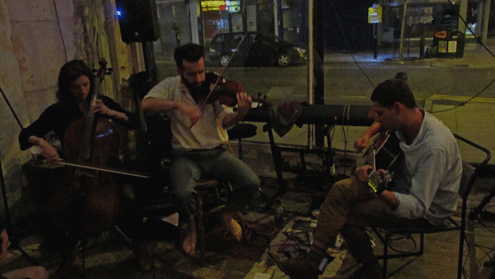
The biggest fuck-you I get tonight comes from a house painted in a shocking purple and gesturing out from an otherwise cream-and-beige Victorian terrace, like some kind of bolshy architectural remix. As I’ve come to know in recent years, this part of London is a place where a very diverse set of people get on with living: it’s also the kind of area where people get out of doors not to go hunting but to break that pesky London reserve and meet their neighbours. Pubs become sitting rooms; sitting rooms and armchairs spill onto streets – another embedded global village. While people are a little thin on the ground tonight, this late-June evening (just beginning to show the mottlings of dusk) is suffused with an easy warmth. Later in the evening, Liam Singer will chuckle from behind his keyboard and gift the neighbourhood with a more welcome tag than it’s had in years. “It’s like Brooklyn, but if everyone was really friendly.”

Lampshading.

Lampshading.

Sitting on the border of Clapton and Homerton, The Dentist is nothing if not hopeful. A former drop-in surgery a little north of the hospital, it’s a genial wreck of a building. Crumbled, scarified and grime-smeared, it stands like a worn, chewed tooth in a shopping parade halfway between old London main drag and international souk. An enterprising guy called Phil calls the upstairs home, while using the downstairs for pop-up gigs, shoestring theatre, and scratch-and-strike art gallery exhibits. The back garden is full of splintered wood and earth hummocks, plus a makeshift tabletop bar. The wine is rolled up from the cellar via a scary ravine. The whole place thrums with friendliness.

Inside, crowded into the front room and sharing its atmosphere of ravage and reclaim, we’re part of a show. In a place this small, within breathing or patting range of the musicians, it’s hard not to feel that way. Behind the players, the curving plate-glass façade of the old shopfront runs across and around: over their shoulders, we look out at the street life. It looks right back at us, sometimes with suspicious flicks of the eyes (a man in a shalwar kameez, hurrying past to the makeshift mosque next door), sometimes with a bemused acceptance (a local geezer ambling along to the chippy) and sometimes with outright delight (younger locals on a stroll, pointing and celebrating on their way to and from the Hackney bars further into town).

Sealionwoman - Tye and Kitty as the daylight fades.

Sealionwoman – Tye and Kitty as the daylight fades.

To them, this must look like a gig in a bottle – the audience in full view, the musicians upfront but backs turned, the music bleeding out in faint enticing vapours. Speaking of which… cue musicians.

Tye McGivern slumps over a double bass, plucking, bowing and sometimes wrenching his notes: a man with strong, thoughtful butchers hands and the face of a weary rabbi. To his right, Kitty Whitelaw sways barefoot – grubby toes, blue nails, a jazz pulse, a little black dress and a feel for the taut sinews of a song. There’s no-one else. About five years ago Tye and Kitty were two-thirds of Kitty & The Drowning Bag, were a lot noisier, and had a drummer. For the couple of years that they’ve been Sealionwoman they’ve been drummer-less and bring their own extra noise in their pockets.

Sealionwoman deal in blurred versions of jazz and torch, and they’re perfectly suited to the smear of dusk that’s coming on as they begin to play. As influences, they’ll cite the crepuscular – Nick Cave and Morphine – but also cite the vivid, iconoclastic enactments and reinterpretations of jazz songs as carried off by Mina Agossi. There’s something in that. While they deal with plenty of old jazz standards – passed from hand to hand, worn smooth like wooden heirlooms – Sealionwoman share a trace of that Agossi rebellion against jazz performance manners and form, preferring to draw out song essence and perhaps a thread of history along with it.

Sealionwoman - Kitty Whitelaw possesses another standard.

Sealionwoman – Kitty Whitelaw possesses another standard.

However, what I’m hearing is something which shades Peggy Lee with Patti Smith. It’s partially that everything they do sounds a little bit like Fever – songs carried entirely and by necessity on the honk, creak and slide of Tye’s bass and the teasing dance-around of Kitty’s voice. It’s partly the lazily assured flutter of Kitty’s demeanour, and the way that it can quickly shift and escalate to an incantatory yell.

What they do has little to do with straightforward theatrics, and still less to do with diva drama. In his hands and on her lips, the songs turn as wayward as blown smoke: dip in and out of ritual; become stretched-out, yammering versions of themselves; go from breezy cool to swimming, waking dream. Sometimes Tye leans over to prod at a laptop or a fuzz pedal, furring up those woody bass notes to turn them into air-horns, or a sweep across concrete. Sometimes he drums with a pair of brushes on boxes and chairs. At other times his hands drum vigorously on the wood of the bass, booming out ritual and conversation, a vigorous and physical lover teetering on the border of tenderness and violence. Kitty sways, stands on tiptoe; brushes against the songs as if stretching for a passing kiss. Her voice folds around the melody line and uses it as a jumping off point, springing into the air, hanging, returning. Every so often a familiar tune and lyric slides through the circling murk. I spot Night And Day.

Mostly, though, it’s all about mood. Strangely blissful, narcoleptic – although by the end of the set and the dip of the late sunset they’ve risen in a slow heat, culminating in a Dionysiac frenzy of bass-drumming and banshee wails. It’s probably enough to put the wind up the Muslim congregation next door, praying their way through Asr. If they’re as Hackneyfied as everyone else around here, though, they’ll just shrug it off.

Foxout! 's Daniel Merrill, bowing against the dusk.

Foxout! ‘s Daniel Merrill, bowing against the dusk.

The gloaming has well and truly arrived as Foxout! settle down and begin. Perched opposite each other on a couple of stools, Daniel Merrill and Jeremy Young hunch over a network of effects pedals and rummage through what looks like a box of yellowed prehistoric teeth: these they mouth and mumble, blowing into a microphone to build up a warm, rambling noisescape of notes, feedback and harmonic buzz before they even pick up an instrument.

In fact, the teeth are reed tubes gutted from an old harmonium. Foxout! enjoy rejigging bits and pieces of antique musicality, and they’re extraordinarily good at it. Some more history might be useful, before we go any further. Essex-raised but with feet made for journeying, Daniel is the fiddler in Dead Rat Orchestra. Despite his youthful looks, he already has a decade of improvised folk music behind him, plus tours all over the globe (some of which were in the company of Godspeed You! Black Emperor (from whom he may have filched Foxout!’s abrupt exclamation mark). Another young veteran, Jeremy’s from Brooklyn music – he once played bleakly beautiful post-Godspeed chamber music with [the] slowest runner [in all the world] and limpid post-rock atmospherics with Sontag Shogun before moving on to solo experimental tonescapes and spoken word as szilárd. Both men wander; both men curate the work of others. Both men mingle.

Foxout! - Jeremy Young.

Foxout! – Jeremy Young.

Right now, both men are studying here in London. As their orbits have converged, Foxout! has emerged – immersed in the tributaries of Celtic folk but flowing through some crafty filters as it contributes to the journey. Certainly the prime stamp and weft of the music is Celtic – reels and pibrochs; plangent, sad melodies. Yet it’s Celtic music folded back over itself, cross-cut with experimental sounds and processing, and by strands of improvisation from elsewhere.

Daniel is one of those musicians who looks extraordinarily sad while he plays. Concentration renders his long, bearded face into a subtle mask of tragedy until you expect lock-gates to burst and for three hundred years of folk laments to come pouring out of him. His fiddle is the main melodic phrasing voice, with Jeremy’s acoustic guitar serving as a taut, bounding dodging rhythm source. Jeremy himself is constantly watchful and supportive, his eyes fixed on Daniel, holding up his partner’s passionate forays.

Speaker.

Speaker.

What emerges is remarkable, not least for the way in which it shape-shifts between different disciplines, experiments and sound-art tricks with neither seam nor strain. At times Foxout! broil with a heated minimalism or take on a grain of compulsive, systematic Futurist patterning. At others, a flexing bough or current of history catches at them and pulls them back to direct expression. One piece is a sensitive plucked-and-bowed air-ballad played (for half its length), over the sound of a draining straw, but with neither bathos nor disruption. Strips of noise sometimes bluster through the wood and strings, like another conversation passing through. Another gorgeous ballad tune sounds as if it could have be minted yesterday, simultaneously fresh and ancient. In the latter, there’s a moment of perfect meshing as Daniel and Jeremy briefly sweep into lockstep, rolling out a near-telepathic unison of notes before dancing away from each other again.

Night begins to settle in properly. Shades of indigo, of dulled London brick and of gaudy shop-front neon sift in through the window. The Dentist’s front room starts to take on something of the air of an Irish lock-in – nothing rowdy, but with the same sense of deep involvement in the music. As Daniel announces “a new ditty”, a couple of guests step up. Usually, Laura Moody’s a mischievous classical renegade or an acrobatic singer-songwriter when she’s not a fizzing cocktail of both. Right now, though, she and her cello are demure and thoughtful – the sober and quiet accompanist providing deep, cloudy strings while Liam Singer (just a few minutes away from his headlining set), sits in to sing.

Foxout! - strings against the dying light.

Foxout! – strings against the dying light.

The song all four share with us in semi-darkness- which may or may not be called As The Wind Turns Away – is a perfect closer. Sombre and gripping, there may not be too much too it (certainly Liam’s softly yearning tenor seem to be making much with fragmentary, cycling sentences) but they make a virtue of that.The song builds softly and inexorably with the dying of the light: a folky threnody for something a little out of focus, something over your shoulder, waiting to be picked up on. Listening to Foxout! gives you the dreamy and welcome impression that if you didn’t have roots before, you’re growing some now.

Liam Singer - songs against the sirens.

Liam Singer – songs against the sirens.

Sat behind a borrowed piano, and minus the sophisticated ornamentations that colour his chamber pop and detailed modern-classical minatures on record (those strings, mandolins and marimbas; those sundry twists and shifts of sound), Liam Singer runs his own set on a shoestring, and runs it well. As the delicate instrumental fantasia of On Earth A Wandering Stranger Was I Born unspools itself, it’s tenebrous but increasingly shot with hopeful illumination. While Liam performs, police cars occasionally sail up Chatworth Road in search of trouble, passing behind him in a quick welter of blue-and-red lights and siren-wail. They rock his soft resilient bubble of song, but don’t burst it.

Easygoing and enthusiastic in person, Liam ripples his own depths when he sits down to sing. Even when stripped down to piano-and-voice, his songs grow their own bosky Edenic atmosphere, filling out his excursions into classical minimalism with deeper shadings. I’ve noticed, previously, how he dips into American antiquity and draws it up up like well-water. His high, open tenor brings freshness and a glow of innocence, but older things lie in wait in the shade to snatch that away. At times, Liam’s like a young scholar running assured, fascinated fingers over the scuffed and scraped covers of ancient leather-bound books; but when the mood deepens and takes him, he sings like the man who’s been spat back out of the faery mound – fully aware and alive, but displaced, crucially out-of-joint with his times.

Still life at The Dentist - mixing desk, lollipops and scarification.

Still life at The Dentist – mixing desk, lollipops and scarification.

This is not just down to the tinge of Edwardian parlour song within Liam’s work, nor yet the occasional antiquarian “thou” or “thee” in his lyrics. There’s a mildly febrile quality to his songwriting, a flicker of Blakeian hallucination to add to the forays into classical piano and the Tennyson tint of mediaeval inflections. His song world is notable for its permeability – the mythic or the supernatural soak through into it, adding piquancy to his sharply edged portraits of involvement and solitude. On The Brief Encounter, Liam can bump into swarms of gentle slacker ghosts, massing there to comfort him as he heads up the coastal road. In the middle of Oh Endless Storm he can cite a rock-chained Andromeda, looming spectrally above him and disdaining rescue as he veers towards a break-up.

Liam immerses himself in the story-swirls, homing in on the core as he sings, “Love is a wind, rips through our hearts, that takes control / We long for a language to lose ourselves, / or for a way to let go.” Later on – as his piano notes spiral in a stately, panicking dance on One Breath Out – he’ll clutch after disappearing chances. “Never could I know as each one passed, / that the last would be the last… / Just one breath out and the world grows colder; / fight the war, but not the soldier. / And one hand moves to protect the other now – / but we’re falling anyhow.” Yet none of this is mawkish or precious – in between songs, Liam is relaxed, gently self-mocking and friendly. Two songs played with Laura Moody on cello (a snatched opportunity before she catches the train back to West London) become affectionate tickles and tussles, ranging from childlike warmth to a rousing gamelan jig.

Liam Singer

Liam Singer

Even his solo piano miniatures, potentially an excuse for indulgence, carefully balance their romantic invention with a pucker of thoughtful modesty. The Dance of Cupid and Psyche pays subtle passing visits to Chopin, Satie and Air On The G-String, flushing its economy with a dash of vigour. On Hannah’s Dance (a lone flash from his decade-old debut, ‘The Empty Heart Of The Chameleon’) Liam displays a Tori Amos drive and fluidity but rounds it off within a single minute. The sweet cascading single, Stranger I Know, slips out of its crafty Shaker-gamelan arrangement and breathes easier, now less of a revelation than a relaxed celebration: “suckers, speeches, they can keep ’em all.”

In one week’s time, Liam’s new album – ‘Arc Iris‘ – is released, yet already he’s moving on from it. Half of the set is songs so new that they’re not on any record, and at least one of them – Three Songs – is fresh out of the notebook. “I’ll fuck it up tastefully,” promises Liam, shuffling his sheet music into place.

What emerges suggests that the drift away from Liam’s earlier experimentalism into fully-fledged romance (as promised by much of ‘Arc Iris’) is accelerating. Here is a beautiful but unnerving love-song, holding strong on the edge of wreck; swimming with gas-masks and cruelty and an unsettling Saint Sebastian gasp. “Someday I’ll see you sideways, / your pretty words are opening like arrows in the middle of my chest / ’til petals fall from my mouth / and I, I gasp for air / ‘cos something inside is pressurized… / When you feel it, you will know / that I was not crazy when I had to let it go.” Running through the words are hints of fairytale transmogrifications; always restlessness. Liam’s heading east after this concert, travelling over to play more gigs in France and Belgium. In another new song, with a vocal line like a perilous descent down crags and scree, he muses “from one skin to another we slide endlessly.” Perhaps he’d like to keep wandering on, heading to the edge of the world.

Ceiling.

Ceiling.

Sitting beside the mixing desk is a jar of lollipops. By now, the contents are making the rounds among the audience and consequently Liam’s playing is being punctuated by furtive, respectful cellophane rustles, which he takes in good heart. Someone else is passing around a copy of ‘Paradise Lost’, which seems more appropriate, as the prowling monsters name-checked back in Oh Endless Storm are resurfacing in Love Me Today (“”There are dark things in the earth / soon they’ll be twisted / up for air /… as the ground gives way.”) Maybe I’m a being little suggestible, but it seems to me that there are also shadings of the twenty-first century ghosts which haunt Liam’s adopted hometown of New York. For over a decade the city’s romantic signifiers, once brash and confident, have been haunted by the shock of sudden and brutal dissolution. While Liam’s not one for hammer-blow songcraft, much of what he sings enfolds an onset of loss, from the counting to (ominously) the banking aircraft. “In the shadow of the moon, as our planes spin away / You know my eyes may tell you lies, but love me today.”

Under the cheerful coloured bulbs strung across The Dentist’s battered ceiling, he offers us a last dance. This’ll be to Unhand Me (You Horrid Thing), from ‘Arc Iris’, a brief, deliciously rueful song which sketches out the mixture of hope, awkward embarrassment and careful blundering steps that make up an ordinary, flakey relationship – prickles and all. “They’re playing our favourite song, the one that makes us both dance for a dare / ’til our feet turn to air / and our hands come apart, / as the guitar solo starts. / And that is the part / that breaks my heart.” It’s a different, generous note to end on, for a gig that’s felt like a cosy but inspiring house party. As I say my goodbyes and slip out of The Dentist, it looks as if the party will be going on for a while longer. Not only sound carries. Warmth does, too.

Sealionwoman online:
Facebook Soundcloud Tumblr YouTube

Foxout! online:
Homepage Soundcloud

Liam Singer online:
Homepage MySpace Bandcamp

Laura Moody online:
Homepage Facebook Twitter MySpace

The Dentist (33 Chatsworth Road) online:
Facebook

REVIEW – Kiran Leonard: ‘Dear Lincoln’ single, 2013 (“a joyride through the Day of the Dead”)

18 May

Kiran Leonard: 'Dear Lincoln'

Kiran Leonard: ‘Dear Lincoln’

Now here’s something.

Kiran Leonard’s already an established teenage wunderkind – a bedroom-industry frenzy act who’s rapidly gummed together a string of homemade albums and slung them out, via Soundcloud and Bandcamp, to a surprised and unsuspecting world. When he’s not doing that, he’s charging round his family’s Oldham house waving a caiman head, or shooting his own scratch videos on a budget of tuppence. He plays most of the instruments he needs, wrestling tunes out of pianos, drums and guitars; ukuleles, laptops, screwdrivers and radiators. While his music’s just about ramshackle -raw enough to avoid trouble with the indie-rock police, his ambitions and application have leaned closer to prog and to a grandiose psychedelia. In 2012, for instance, he cooked up a rambling, apocalyptic single about the Mayan doomsday prophecy. It topped out at around 24 minutes long and tied together the wilder bits of ‘Cloud Atlas’ and the paranoid, grinding Pink Floyd of 1977.

It’ll still be three years before Kiran turns twenty. I could wonder what he’s going to do when he grows up, but I almost hope that he doesn’t.

Dear Lincoln is something different for Kiran – much lighter and more immediate. Traveling backwards as he goes forwards, Kiran seems to have suddenly discovered pop in all of its concise hooks, blind momentum and smart throwaway logic. Actually, he’s rediscovered it – Dear Lincoln was written some time ago, while he was a ripe 14 – but now seems to be the perfect time to unveil it. Its a bust-out. It sounds like a joyride through the Day of the Dead. Kiran, hammering away at a tack piano and squawking like a glammed-up crow, drives the gauges into the red and embraces Bolan swagger, a swaying Robyn Hitchcock playfulness, some of the wild euphoria of Guillemots and even a needling tinge of Kevin Coyne. Earlier in 2013, there was the ‘Oakland Highball’ EP, which showed that he was getting interested in snappier, noisier forms. Dear Lincoln nails it. If we could work out what he was singing, it’d even be singalong.

What’s it about? God knows. The words are a babbling wodge of mondegreens-in-waiting about suit-crevices and moonlight, thrown out at us as Kiran carries out his lyrical handbrake turns. “Murderous plain,” he protests, in passing, but it certainly isn’t. Not unless he’s talking about death again. The song could be about gunned-down Presidents, it could just be about missing the family cat, but one thing Dear Lincoln does do is blur the lines between the living and the dead – a rollicking Halloween dance, or a resurrection day stomp. Even that long-croaked, ranting old herald of the Übermensch, Friedrich Nietzche, has a ghostly cameo; prowling the English parishes as a witness before succumbing to anxiety, melting away and vanishing. In the chopped froth of the lyrics, Kiran playfully juggles around ideas of resurrection, rousing, and where he’ll be standing when it all comes to pass; but constantly swats away any navel-gazing with onomatopoeic streams of Little Richard-isms. “Praying for the bodies to assemble and wake… / Come back today, bou-la-ray / oh, ta-hoo-lay.”

Don’t get the idea that this is all a casual throw-together. Anyone keeping half an eye on how Kiran thinks will know that he’s meticulous; that he worries like crazy about getting things right. But Dear Lincoln’s explosive delivery – its immediacy, its ability to swing round the story without stopping to count the words – suggest that he’s finally able to harness his particular genius and to let it live in the moment. This is by no means the first we’ve seen of Kiran Leonard, but it feels like the start of him.

Kiran Leonard: ‘Dear Lincoln’
Hand of Glory Records (catalogue number & barcode t.b.c.)
Vinyl/streamed single
Released: 16th May 2013 (streamed), 2nd September 2013 (vinyl)

Get it from:
Hand of Glory store (vinyl), or Soundcloud (stream)

Kiran Leonard online:
Homepage Facebook Soundcloud Bandcamp Last FM YouTube

REVIEW – Liam Singer: ‘Stranger I Know’ single, 2013 (“sings in a tone of wonder – and of determination”)

26 Mar
Liam Singer: 'Stranger I Know'

Liam Singer: ‘Stranger I Know’

What a wonderful mind for composition Liam Singer has. Four albums into his career, he’s coming up with ever-more-detailed songs which only fit the pop label due to their presentation and singability. In all other respects, he’s a classical songwriter, building a song from cellar to roof, all parts in parallel: a detailed patterner with each idea serving the larger one.

A very small number of songwriters take the trouble to think like this. Brian Wilson and Prince, obviously. Jeff Lynne, Sufjan Stephens and Stephen Merritt, perhaps. Tim Smith, definitely – the interplay of vocal parts on Stranger I Know particularly recalls Smith’s pastoral work with Sea Nymphs or the more delicate moments on Cardiacs records as worked out with William D. Drake (another comparison that can be thrown into the circle). At work in his current hideaway in Queens, Liam Singer belongs to this world of the total song-composers: the ones for whom genre barriers are predominantly bubbles of resistance, and for whom form and content are inseparable.

Stranger I Know sounds like many things. Its links to American minimalism are clear in its collection of elegant cycles (from oompah bass to arching cello; shakers and flute; a mathematical glockenspiel climb) as they move against each other, interplaying in uplifting counter-rhythms. Beyond that, Liam’s omnivorous musical diet is made clear in the breadth of arrangement and intonation, stretching from romantic piano to staccato gamelan pot-clunk. Each instrument comes sheathed in its own immediate mood and pace, hanging onto its place in the dance by a skilful fingertip: just enough to snag a little tension and independence; just enough to flirt.

Shadowed and overflown (as ever) by the spectral caroling of soprano voices, Liam sings in a tone of wonder – and of determination. It’s all a little archaic: a spiritual love ballad with swaying time, an elusive subject and a courtly seriousness which ultimately fails to mask its fervour. “Stranger I know / thy face / from a dream. / All night I’ve yearned to hear that song. / – Once, it sang me.” There are hints of transformation and liberation here – “What was / before me / is now / behind me. / Strings fall / off of / a body,” – but devotion and freedom end up so closely wound together that there’s nothing between them. Liam finally stands set loose on the verge of… something. It’s unclear, it’s unsure, it could even be an end; but it’s welcomed, and while Liam’s left some things behind, he’s not alone. “Saw God’s / features – they / can keep ’em all. / There is no / voice to follow / now. / And as the / noise / takes over, you / just hold your / breath, I’ll hold / mine too.”

Stranger I Know is also a little exercise in time-travel, working a gentle auger down through several generations of American tune and peeping through the hole. Liam’s previous songs have been beautifully arranged, evoking a classical ambience. This one – balancing a subtle, minimal complexity with fleeting kisses at its reference points – ups the game. In its shifting and its overlaying, you can hear migration at work. A little dose of romantic Europe dapples a line of American mountains: the breathless chorus (its rhythm offset from the dreamy verse) steps in like an old-country village dance setting up against the pistons and presses of a little factory in the hills. Behind the tinkling delicacy, that bass drum which comes in for the bridge hint at a barn-dance stomp: Shaker Loops to hometown hoedown.

All of this activity is encapsulated within less than three minutes. In, out, open. A little wonder.

Liam Singer: ‘Stranger I Know’
Hidden Shoal Recordings (no catalogue number or barcode)
Download-only single
Released: 6th March 2013

Get it from:
Free download from Hidden Shoal Recordings or Bandcamp

Liam Singer online:
Homepage MySpace Bandcamp

February 2013 – mini-album reviews – Lee Fletcher’s ‘The Cracks Within: FiWT Remixes’ (“unstitched, re-embroidered, re-folded”)

9 Feb
Lee Fletcher: 'The Cracks Within: FiWT Remixes'

Lee Fletcher: ‘The Cracks Within: FiWT Remixes’

‘Faith In Worthless Things’ was one of 2012’s surprise pleasures. Lee Fletcher’s debut album was the late-blossoming distillation of years of work as engineer and confidant to assorted art-rock musicians, and of even more years absorbing influences and refining them in a budding songwriter’s heart.

What emerged was a sleek, assured and finely-honed planned-patchwork of an album. It pulled in sounds from touch guitars, Uillean pipes, crunchy rhythm loops, ukeleles, powdered trumpets and silky synthesizers; it mused on betrayals, work, bewitchment and people in general; and it drew on a wide but surprising coherent blend of string-quartet chamber pop, soul and trip hop, 1970s Scott Walker, King Crimson-flavoured progressive rock, electronica and Anglo-folk.

While Lee’s firm and expansive vision gave the album both shape and finish, it was also very much a group effort, achieved hand in hand with his singer wife Lisa plus the chameleonic touch guitarist/soundscaper Markus Reuter and a small battalion of interested musicians from around the world. This short album of follow-up remixes keeps that spirit, with a couple of returning collaborators and new reinventors let loose on the tracks.

Only two songs from ‘Faith In Worthless Things’ make it to this particular phase. There’s the title track – originally a humble state-of-the-world address sung by Lisa but dispatched by Lee, people-watching at the railway station in his Devon hometown, and sampling a picture of humanity from its wandering fragments on an ordinary morning. There’s also The Inner Voice, in which Lisa soars on a rich carpet of soul-inspired smoothness; delicately and beadily picking apart matters of confidence and collaboration, while unhitching – scuffed, but quietly determined – from a dragging entanglement. The latter was the album’s obvious single, so it’s interesting to see three different remixers work three different shades of pop out of it.

Of these, Brazilian proggers-turned-clubbers Worldengine offer perhaps the most satisfying reinvention – a slink-and-roll electronica take full of whispering creep, voice fuzz and closed-eye pulse beats. The smooth soul of the original is pared back in favour of odd, gently challenging chording and textures: as if Lisa’s vocal line has been gently unwound from its original branch and wrapped carefully around a new one. Imagine what might happen if David Torn had as much pop clout as Madonna does, and you’ll have some idea of where Worldengine take this.

Two other remixers take The Inner Voice further out, but perhaps with less originality. The mix from German DJ Ingo Vogelmann battles and switches restlessly between its whispering electronic-ambient chamber intro, heavily synthesized cyberpop and a naked acoustic strum. The onetime 4hero cohort Branwen Somatik offers a similarly morphing dance switchback – initially a slightly dubby hip-hop take with an eerie twist, then a transformation to minimally-sheathed soul-pop, finally melting away in a dubby whisper of liquefying beats.

There are no fewer than six versions of Faith In Worthless Things, including a return for Ingo Vogelmann who offers a mix replete with Orb/Jean Michel Jarre-flavoured electronica (strong on the breezy minimalism, and dappled with bits of dub and techno). Adrian Benavides has honed himself an industrial pop version full of collapsing sheet metal and drill bits. Fabio Trentini provides an ambient pop take with an art-pop tweak – part Japan (if the ‘Gentlemen Take Polaroids’ era took precedence) and part Crafty Guitarist. Lee’s words and Lisa’s sweet-but-stately vocals sit, unfazed, in these new cradles.

Having said that, this particular song is less suited to being strapped into dance, and other approaches are preferable. Under his Hollowcreature alias, David Picking seems to realise this; he keeps and highlights the train-swish from the intro, brings Lee’s own warm and pleasant guide vocals to the forefront for half of the time, and comes up with a subtly dubby version of the song’s English pastoral feel. The latter quality is something which Tim Motzer appears to have picked up on too, as he moves Faith In Worthless Things into a more British progressive rock area. This he does via a number of changes – jazz vibraphone, the ghost of a hard-rock riff and eventually a build up into a Pink Floyd blaze replete with Gilmourian guitar. It seems obvious, but there’s some clever sleight-of-hand here: Lisa is metamorphosed cunningly by the new arrangement into a leathered-up rock goddess, all without a change to her vocal part.

Tobias Reber, on the other hand, manages to be both daring and successful in his own mix, taking an unexpected creative risk and pulling it off. He contributes the best of the remixes on offer, as well as the most original. His reconstructive take on the songs sees it unstitched and re-embroidered, re-folded. The song is re-imagined over an uneasy sea-roll of structure. New chording, constructed from the components of the original piece, produces a striking new perspective; a different place from which Lee, through Lisa, can watch the world and see its unsettling currents ripple past and under him.

Each remix, though, gently unbuttons ‘Faith In Worthless Things’ again and reminds us of that collaborative feeling which suffused it. The rolling and friction between Lee’s ideas and where his accomplished collaborators took them – a journey in motion.

Lee Fletcher: ‘The Cracks Within: FiWT Remixes’
Unsung Records (no catalogue number or barcode)
Download-only mini-album
Released: 5th February 2013

Get it from:
Bandcamp

Lee Fletcher online:
Homepage Facebook TwitterBandcamp

October 2012 – EP reviews – Leah Banks’s ‘Sincerely’ (“devotion makes us vulnerable”)

18 Oct

Leah Banks: 'Sincerely'

Leah Banks: ‘Sincerely’

Someone you love. Just the thought of them gives you a little catch, right there, under the chest; like a hard kiss or a light blow, reminding you that even when it’s going right, love is never entirely safe.

Devotion makes us vulnerable. You’re never more than a moment from the topple or the stumble, from the interrupted step to the full-force sprawl. That’s what Leah Banks’ songs are like. They don’t need much amplification beyond their feather-soft country-folk shapes and the superb, subtle brush-drum work that stokes them (more like the breath and sinews of a jazz master than the shed-whack of honky-tonk). They’ve got their own transporting power, their own risk, wrapped up in the hush.

Riverside, the first song on Leah’s ’Sincerely’ EP, has the panting pitch of the Song of Solomon. A coil of eroticism rises up like a sacrament via a thudflutter rush of muted acoustic guitar, heartbeat bass and swimming cello. The words are breathless and obsessive – “I can’t wait to see you, to look upon your face / I’ll dive into your adoring eyes and hang on every word you say. / And I can’t wait to feel you, to be held in your arms – / one hand resting on the small of my back, and the other round my neck.”

Leah’s delivery is a tense urgent moan, stretching and bending phrases, pushing against the metre as if it were clothes that suddenly felt too hot and too tight. There’s a touch of Sinead O’Connor in her fervour as she rides the buried complexities of female desire, poised between a caress and a snap, between devotion and greedy hunger. “Lover, please hurry, / I’m not sure how long I’ll last, / waiting here by the riverside, / my breath is wasted on the wind and waves, / when it should be dwelling in a kiss… / I’ll press into your chest as the wind blows my dress / and steal warmth from your presence.” Towards the end, there’s a little lacuna of drop-away. The song vanishes for a second, then gusts back into place. “The water is rushing, and without you here / I think I might fall in,” Leah warns. There’s been a change in the climate. Ignore it at your own risk.

That hint of the Song of Solomon lingers in the mind: while Leah’s own spiritual beliefs are never stated, all three of the songs on ‘Sincerely’ could have a religious cast. The grit and carnality in them don’t have to be a barrier. If we’re following this line of thought, consider the steamy metaphor in the ecstacy of Saint Theresa, or, closer to now, Al Green singing “Belle – oh, it’s you I want, but it’s Him I need.” The blend of the holy and the earthbound-but-urgent is no new thing – it’s what lets gospel tug at the hearts of secular people, and what lends that numinous shiver to country, to blues and indeed to anything which reaches out of the mess in the hope of finding something higher. Leah herself is telling without telling, although ambiguous clues flicker through the songs.

In contrast to the feverish pulse of longing in Riverside, The Only One is a confessional. “I wish I could stop my eyes from wandering / and keep my mind from its hungering,” Leah sings, in a regretful insomniac sigh. “Listen, the struggle makes me weak – / now I can hardly stand on my feet.” A tattoo of snare and acoustic guitar sets the reflective pace, while a mandolin (and an occasional brush of banjo) draws slow, colourful paper hoops around the chorus. At the kernel, the song might be about keeping faith, and the sometime bitterness of submitting to it: “How long will I drink from this cup? / Maybe I should just give up, / give up trying to fight it out, / give up trying to live without doubt.”

At one point Leah craves to return to a time “before our hearts were involved”, suggesting a lovers wrangle; yet throughout the song’s soft bourbon haze she leaves the surface meaning blurred. It could be about straying from religious devotion; it could just be a lonely kitchen-table song as Leah tries to scrape herself up off the floor one wretched and heart-sore night. There’s reproach in here, and somewhere there’s a reckoning to be had; but it’s never quite clear who’s to blame, or even if she’s blaming anyone. “And how does it feel to be the only one standing? / and how does it feel to be the only one left?” she sings, with a touch of asperity, before settling on a conclusion which weaves not through what’s happened, but through what’s going to happen next. “Lets go back to the beginning, / bring it back to the start. / I won’t do it again now – / this time I’ll do it right.”

Blame is easier to pin down in the final song on ‘Sincerely’: its title track. Carried along on a light and rolling road-pulse of guitar (which, along with the restless jazzy jabs of vocal, echoes Joni Mitchell’s reflective road-burned floats on ‘Hejira’), Leah holds her own hands up in admission. “I know I said I would, but what if I can’t?” she asks. “Sometimes I say things without even thinking, / sometimes I jump the gun.” In flight from somewhere, in flight to something, honesty is being pressed out of her with every roll of the wheels; although she doesn’t claim to have cured her failings. In her apology, there’s a blunt statement of self-knowledge. “There’s a sinking in my heart, / I know that I have failed you. / I just didn’t see it coming / and you never warned me, / so, / well, I could say I’m sorry, and I would be sincere. / I could try harder next time, but I would still be here.”

Even with guilt admitted and delivered, and even hoping to be saved and forgiven by love, there’s still grit in Leah; enough for her to throw her own challenge out into the confession. Once again, the lines blur in the song – lover, saviour, self. “I know that you love me – so where are you now? she “Make yourself known – / no, make yourself heard.” Perhaps she’s hoping, like Jacob, to encounter her angel on the road and to wrestle some meaning out of him. I suspect that she won’t settle for less. A woman of heart and mind, by any measure.

Leah Banks: ‘Sincerely’
Inus Records (no catalogue or barcode)
Download-only EP
Released: 16th October 2012

Get it from:
Noisetrade

Leah Banks (Leah Freeman) online:
Homepage Homepage Facebook Tumblr

October 2012 – album reviews – Lee Fletcher’s ‘Faith in Worthless Things’ (“rich and delicate”)

7 Oct
Lee Fletcher: 'Faith In Worthless Things'

Lee Fletcher: ‘Faith In Worthless Things’

And he came out from behind the console, and he spread out his dreams.

If you know Lee Fletcher already, it’s probably only in passing: maybe for the handful of mannered electro-pop tracks he and his wife Lisa have put out over the past decade as [halo]. More likely, you’ll know him for his extensive work as producer/engineer with centrozoon, Markus Reuter and with assorted King Crimson spin-offs including Tuner and Stick Men: well-established as a producer and engineer out at the more technical end of art-rock, you’d expect his own current music to be stark, or detached, or both.

It’s not just the question of his choice of colleague: it’s more that people in his position are generally there to get a job done, massaging and harassing slack musicians or their work into proper performance. If they’re of the more creative ilk, they might get to tweak their charges’ output into more original shapes. If they get around to putting out albums, these are likely to be back-to-basics vanity projects or all-star galleries of guest singers and studio flair – bought by fans for the tricks and the rarities, but then left to gather dust. Generally speaking, producers’ own records aren’t supposed to be romantic, aren’t supposed to be involved. Most especially, they’re not supposed to be revealing.

Lee Fletcher clearly has other ideas, and he won’t be doing quite what you expect of him.

Starting with the surface and working in… ‘Faith In Worthless Things’ certainly has the striking richness of sound you’d expect from someone of Lee’s experience. Live strings, wind instruments and solo cameos merge seamlessly with his own intricate programming and panoramic instrumentation in a fine blend of console wizardry and warm acoustic work. Rich and delicate arrangements encompass stirring contributions by guest players from right across the musical spectrum. Among others making their marks, the album boasts broad strokes and fine detail from art-rock guitarists Tim Motzer and Robert Fripp, jazz drift (from trumpeter Luca Calabrese, double bass player Oliver Klemp and drummer Matthias Macht), and sky-curve pedal steel playing from B. J. Cole. Equally memorable moments come when Uillean pipes (courtesy of Baka Beyond’s Alan Burton) and, to particular moving effect, Jacqueline Kershaw’s French horn are woven subtly into the mix, set against sonic glitch and pillowy atmospherics.

If any of this orchestrated, cross-disciplinary lushness suggests other precedents to you, you’re right. Anyone familiar with David Sylvian’s electro-acoustic songscapes in the 1980s (or who subsequently took on the likes of Jane Siberry, Caroline Lavelle or no-man, whose violinist Steve Bingham plays a prominent role here) will recognise the wellsprings and traditions from which ‘Faith In Worthless Things’ draws. Miracles On Trees (a nimble quiltwork canon of touch-guitar, pipes and vocal harmonies suggesting Kate Bush fronting King Crimson) brings in additional strands of clean New Age-y folktronica, while more neurotic, Crimsonic arpeggios are stitched through A Life On Loan. Elsewhere, you’ll find fleeting, delicately organised touches from industrial electronica and dancehall reggae (as if bled in from a wobbling radio dial) and ingredients from Lee’s recent forays into torch song (via David Lynch’s protégée Christa Bell).  There’s certainly a strong debt to Scott Walker’s luxuriant orchestral pop work, made explicit via an enthusiastically dreamy cover of Long About Now.

However, much of the sonic recipe is Lee’s own spin on things – a developing and broadening sonic signature which began to unveil itself earlier in the year on GRICE’s Fletcher-produced  ‘Propeller’ (which featured many of the same players and a similar production ethos). ‘Faith In Worthless Things’ is also shaped by two featured players in particular – historically, the other two beats of Lee’s musical heart. On touch guitar, Markus Reuter adds a broad catalogue of supporting instrumental parts: textured or clean, rhythmic or melodic, banked-up or solo. While integral to the album’s fabric, his playing  also fades skilfully out of the foreground – although he’s constantly present, it’s as if he’s seen only in brief flashes, running through the trees, keeping pace with the sound. Meanwhile, Lisa Fletcher takes centre-stage (as she did with [halo]) to provide almost all of the album’s vocals as well as acting as Lee’s muse and interpreter. She sings even the most painstaking lyric with the cool, classical, adult sensuality of a pop diva who might at any moment slide off her long black concert dress and walk, naked and magnificent, out into the sea.

In spite of all of this sterling support, if you drill down through the music (past all of the tasteful production stylings, the guest players and the ornamentation) you’ll find a songwriter’s album underneath. While his physical voice is present only as a few murmured harmonies-cum-guide vocals dropped across a handful of tracks, Lee Fletcher’s songwriting voice entirely dominates the album. It even has its own particular hallmarks – a sophisticated way with compositional patterns which takes as much from chanson and European music as it does from Anglo-American pop; plus a yen for long, looping melodic journeys across an extended succession of chords. Lyrically he follows the earnest, philosophical musings of prog song-poets such as Peter Hammill; immersing himself in concepts or thoughts and writing his way through them with shades of classic verse, occasionally knocking frictional sparks against the constraints of the surrounding pop music.

There’s an interesting pull-and-push between this ever-so-slightly awkward lyrical grain and Lisa’s glossy-smooth vocals, just enough of a catch and grind to put a polish on the one and a depth on the other. When both Fletchers team up as writers on The Inner Voice, there’s an extra lift, bringing in the kind of hi-concept soul soar you’d have expected from Minnie Riperton or Commodores, or indeed from Janelle Monáe (if the latter’s leant over from a soul background to look into art-pop, the Fletchers seem to be leaning the other way.) The cruising, creamy melody hides some sharp barbs : the song’s partly an elegant kiss-off to a past lover or collaborator, partly a “won’t-get-fooled-again” statement of intent and new faith and intent. “You did me a great favour, in a melancholic way,” sings Lisa, in cool and assured tones. “The lesson learned and actioned for today / is to listen to the inner voice and serve that impulse well./ Have courage in conviction, break the shell.” Gracious in retreat, but along the way a polite yet lethal line of stilettos are being inserted into a turned and oblivious back (like some kind of vengeful acupuncture).

While Lee’s other lyrical concerns occasionally stretch to brooding worksong (“marching up the hill all day, fetching pails of water for the crown / Until the playtime whistle sounds, and blows your hallowed dreams away”) and wide-eyed nature worship (“the seasons are aligning/ Shedding Mother Nature’s silver skin /bringing balance to the timing”) he’s at his best when he’s drifting into the hazy realm of the personal. Part of this touches on the mutability and contradictions of love – its ability, in any given moment, to contain frailty and fears alongside strength, devotion and enrapturement. On The Number, he and collaborator SiRenée set up a picture of the start of intimacy as a phone call into the unknown: “Hello, you’ve reached the number of my secret voice / And though I asked you not to call / Your instinct made the choice… / I knew you’d call, I knew you’d love me… Stranger on the line, I’ve known you always.” Dusted by Luca Calabrese’s  sprays of muted Jon Hassell-ish trumpet, SiRenée sings the words in a misty bank of close and teasing harmonies – an enigmatic telephone nymph, she spins a spell of reflected longing as if at any moment she could either become flesh or simply vanish.

At the other end of the scale, where love is sealed and secure (with spouse, friends, family or perhaps all together), there is Life’s A Long Time Short; a Markus Reuter co-write in which an encroaching chill of the knowledge of ageing and death begins to gnaw at that security. “Our time is fleeting – / a love so true is truly painful. / A hurt that’s so divine – / at once the symptom and remedy.” Against a mournful ominous French horn line and a decaying fall of twinkling, dying Reuter touch-guitar chords, the song gradually passes from innocence (“there is no end, all time descends – / the trick is not to care”) to a warning (“there is an end. / Make all amends”) while Lisa sings with a subtle and breathless sense of disquiet, like a flickering ghost. All along, Lee watches with a poignantly shifting mixture of love, devotion and horror. Caught up within the current of time, all he can do is celebrate and confirm the life and value he shares in the now, while watching the inevitable washing-away and mourning coming closer and closer: “And as you grow, /  I watch in rhapsody / the miracle you are…/Inside I’m screaming.” 

On other occasions, Lee looks further outside, though it’s not always a comfort. Peering at the rapacious dazzle of television and pop media on Is It Me (Or Is It You?) he gets burned for his pains, then frets and growls out a proggy sermon about the callousness of the wider world: “Such a passion for freedom and brutality… / we pillage the living, ever seeking, kiss and telling morality / besieging all senses with apathy.” It’s the album’s title track that provides him with the still point which he needs. Out at the railway station café from dawn till dusk, notepad in hand, he’s watching the universe go about its business. Rails lead away to both possibility and obscurity; travellers move from place to place, passing through crowds while wrapping themselves in solitude; and Lee is “dreaming of the perfect future /  tall on tales, and short on truth.”

Here, out in the flow, he plays observer to small, everyday aggravations and hints at family disappointments spawning both small aches and broken-up little personal worlds: “children crying, mothers braying / Fathers absent once again.” Here, too, he finds his sympathy renewed, his understanding broadened: “all at one with situation – / Circumstance breeds condemnation / of our fellow man.” Encompassed by the lives and voyages of others,  surrounded by the signs and signifiers of both possibility and stagnation, he comes to a quiet acceptance of human fallibility and connection – “we’re bound by time, though here alone – / many rivers run as one. / Faith to heal the cracks within, / praying for life’s worthless things.” A small and modest epiphany, it’s the heart of the album and the song that binds everything together – including Lee’s divided impulses as skilled producer, exploring songwriter and man with a heart. Affection and anger, dislocation and commonality, families and strangers, nature and the grind, all linked under a lovingly gilded arch of strings, soft voices and soundscapes.

Lee Fletcher: ‘Faith In Worthless Things’
Unsung Records, UR019CD (4260139121021)
CD/download album
Released: 1st October 2012

Buy it from:
Bandcamp

Lee Fletcher online:
Homepage Facebook TwitterBandcamp

September 2012 – album reviews – Mark Mulholland & Craig Ward’s ‘Waiting For The Storm’ (“tin roofs, heat and restlessness”)

5 Sep

Mark Mulholland & Craig Ward: 'Waiting For The Storm'

Mark Mulholland & Craig Ward: ‘Waiting For The Storm’


Two guitars, two hushed voices, a looming double bass and a room that moves. That’s all that’s needed.

Mark Mulholland and Craig Ward go way back. In the 1980s, both were ungrizzled Scottish freshmen; teenaged guitarists coming up through roots music gigs in Glasgow and Edinburgh. Their paths have intersected many a time since then, while both clocked up the years and the experience – Mark with a brace of projects including the Berlin Americana band Two Dollar Bash, Craig most famously with dEUS (and spinoffs like The Love Substitutes), While this fuller collaboration was mooted in 2007, it wasn’t recorded until 2010 and 2011, and then went unreleased for a further year. In the meantime the intent hasn’t gone stale. If anything, it’s aged like a good whisky. This album might have been a while in coming, but it’s happily unstuck from the demands of time – just like any long friendship of the kind where a phone call and a kept date in a bar wipes away the years of separation.

Mark and Craig are upfront about their intentions. They’re reviving that strand of British “folk baroque” as played solo in the ’60s by Davy Graham and Bert Jansch, developed by John Renbourn and Danny Thompson in Pentangle, and performed in a shroud of mystique and withdrawal by Nick Drake. ‘Waiting For The Storm’ utterly recaptures that Witchseason glimmer – timeless, intimate and immediate, with the air listening in and the feeling that the songs are at the forefront of a push of story and message.

As guitarists and as singers, Craig and Mark are perfectly matched. Acoustic fingerpicking styles knit together in a generous skein of give-and-take, with each man providing varied electric textures as and where needed. Their quiet, rough-finished voices blur and separate in sighed harmonies, tinged with weariness, a little foreboding and some scarred-knuckle gentleness. Between them, Hannes d’Hoine plays double bass as if it were a straining mast, conjuring up deep thrums, solid gutsy plucking and ghostly bowed atmospherics. It’s very much a three-cornered exchange – almost telepathic in the players’ instinct to play just what is needed and no more.

As for the roots of the record, they drift – and no wonder. Though Mark and Craig are Scottish by origin, they’re wanderers by nature. The stoic discomfort blues of A Strange Place traces lightly over the angst of this lifestyle; the menacing weightlessness of its temporary, torn-up settlings. “Anyone entering this place they might say, / a strange place in which we belong…/ It’s a strange place we do run to, / a strange place to which we do run.” The slithering folk riffs and Simon & Garfunkel harmonies of Something On The Breeze raise up something more of home, via a Lowlands song of roaming and departure. (“Blowing through the open door that I have just walked through, / blowing me along to something new… / Looking forward to looking back on the things I’ve left behind, / somewhere a little further down the line.”)

Under even the dreamier-sounding songs, there’s a Scottish feel of hard lines: an undercurrent of poverty and menace dealt with stoically (“I see the cops on every corner, / people waiting ready to run. / Blue lights flashing out a warning – / someone’ll get hurt before the morning comes.”) Yet most of the underpinnings of the record come from one particular location: Mark’s current home of Port-au-Prince, in Haiti. Throughout ‘Waiting For The Storm’, Haiti breathes itself steamily into the mood and the music – mountains and stagnant creeks; tin roofs, heat and restlessness. There’s an occult foreboding here too, perhaps brought in by the business of living under the threat of capricious flooding, of drumming rain, or of violent passions swelling out of control. The answers flicker through the songs, half-seen, or viewed full in the face for an uneasy moment.

Some of it’s more relaxed; simply sketches and shadings of place and time. The winding sea currents of All The Doors Are Open (with Hannes’ grasping bass anchoring the surges of meter) invoke summer-struck stupor and an urge for motion. “All the doors are open, cars go past outside. / Won’t you take me with you, take me for a ride?… / I gulp down the icy water, drowning in the heat. / Hills lean over the hazy sea, wheels turning to the beat.” The instrumental Black Sail travels in a wave-roll and a dark minor key, telling a wordless story: moods shift weather-wise like bands of sunset and lowering clouds, the accelerations and slowings of the guitars tracked point-by-point by Hanne’s bowed bass.

With the title track, however, more threatening moods gather. “See the vinyl spinning its strange pattern in my head / and I can’t help thinking about something somebody said…” Like a brooding canvas, Waiting For The Storm uses the old expressionist motif of threatening weather to illustrate roils in the spirit, but leaves us hanging and expectant. “The sky is getting darker and the glass begins to fall. / The flicker of the candle’s throwing shadows on the wall… / Siren in the distance, the evening air is cool. / The bottle’s almost empty and the ashtray’s nearly full. / Waiting for a moment when it all begins to spin – / voices in the darkness, waiting for the storm to begin.”

Although the Haitian setting offers ravaged scenery and wild elements aplenty, Mark and Craig are ultimately too subtle just to use it as an exotic stage. In their lean words, they imply that most of the trouble a nomad might find in places like these might actually have been brought along in his own baggage. Secret Places, certainly, is caught up in its own space – one of obsessive passion, affirming “there’s no after, no before, /each time we pass through this door. / Nothing matters anymore – / each moment burns more fiercely than the last.”

Haiti gets to speak for itself as well. Amid arco bass rumbles and a stew of electric guitar atmospherics and acoustic webbing, Les Belles Promesses sees Mark, Craig and Hanne take a step back so that Haitian laureate Frankétienne can take centre stage. Working in smouldering wreathes of text from his own ‘Voix Marassa’, the old man recites and declaims in an impassioned, mesmeric French Creole like a voudoun Baudelaire, calling out razors and toadstones, sickness and fire, rocks and struck matches. “L’acidite de l’ombre… l’obsession des long voyage impermanences au bout du sexe, la passion du danger dans le sang, la fascination de riske… au-dessus du desastre.” Even at its height it remains honest, clear about the swings of raw fraught instinct.

So it is that the remaining two songs are left to their own devices. Icy Shivers comes from the armpit of a bad night – a circling lick; scribbling, edgy double bass harmonics; and moonlight-drop electric guitar, both ominous and omen-ous. “Things that crawl and things that bite / my thoughts as black as the sky tonight – / oh, it’s a long, long time until the dawn… / Dead of night the city sleeps – / waters still, a bargain deep.” Elsewhere, in Watching You Sleep, the devils are scratching away at a hard-won peace. Mark sings, as soft as anything, the pillow talk of a devoted lover – “you, your head lying on my shoulder, hear you breathing soft and clear. / I don’t care about tomorrow just as long as you are here,” – but hints at darker things abandoned in order to find and keep this haven. Even if they’re not stalking after him, there’s still a haunting. “I put the key in my pocket / and walked away from what came before. / A tune was running through my head / a song I can’t remember anymore. / I heard the sounds that go round the valley / hints of something far behind. / Something I wasn’t aware of losing / now I keep on trying to find.”

As other people’s violence stirs in the street, Mark’s narrator feels the pull of it and with a quiet, heartbreaking determination he asserts his love over rage. “I don’t want to go and get in a fight / I just want to stay with you tonight… / Don’t want to make nobody cry, / I just want to watch you where you lie.” The words are simple or even banal on the surface. The sentiments behind them, as sung, are subtly devastating. A reedy fuzz of electric guitar solo, one of the only ones on the record, seals the deal with hulking, sweating fingers.

There is an eventual respite from this darkness. Full of chuckling mandolins, The Six O’Clock Whistle is a jaunty folk instrumental with a hint of a reel (plus a nod and a wink to the childhood innocence of ‘Chigley‘). Sitting at the end of the record, it lifts the pressing atmosphere of the rest of the songs, drawing you away from the mesmeric night of memories, fancies, booze and shadows. Still, it’s the latter that remains with you: a baroque spell of sketchy lines, disquiet and stirred emotions, with some lines flapping free and others coiled too tight. A magical listen.

Mark Mulholland & Craig Ward: ‘Waiting For The Storm’
Cannery Row Records, CRR 1217(826863121627)
Jezus Factory Records JF034 (826863121627)
CD/download album
Released: 3rd September 2012

Buy it from:
Cannery Row Records (CD only), Jezus Factory Records (CD only) or Bandcamp (download only).

Mark Mulholland & Craig Ward online:
Facebook Bandcamp

Mark Mulholland online:
Homepage Facebook MySpace Bandcamp

Craig Ward online:
MySpace Last FM

T & The Wonder: ‘Corsage’ single (“a withering bouquet of sympathy”)

5 Feb
T & The Wonder: 'Corsage'

T & The Wonder: ‘Corsage’

“There are no constants, / even if we want them.” Perhaps it’s the shift of moving around, splitting apart. Chicago chamber pop duo T & The Wonder are Chicago-based no longer. Now based on separate sides of the States (singer Tavis Balkin is on the West Coast, multi-instrumentalist Patrick McCormack in Vermont) they remain a duo by an effort of will, affinity and determination. Sometimes long-distance relationships do work out…

I digress. Perhaps it’s the shift of moving around, splitting apart, but this post-move single (recorded in snatched December sessions around other practical commitments) sees T & The Wonder swapping between hope and despondency as if soberly walking a coin over their knuckles. The live drums and strings which they used to use might have been surrendered to budgeting and lack of opportunity (swapped for synthetic equivalents); but their bookish, light-touch ascerbity remains. Corsage is, in more ways than one, a withering bouquet of sympathy. Over ticking guitar, and a trapped tinkle of piano Tavis addresses a woman’s disappointment as she ages – lonely, stifled and perpetually stranded. “Is the corsage dried out? / the one that was packed away / with the empathetic gestures / and the tired old clichés?”

As to where Tavis himself stands, that’s not so clear. Sometimes he’s attuned to the pain of the woman he’s addressing – “Does the future disturb you / now that all you have left is the sound / of a lot of empty talking / and the legs that keep walking?” At other times, a growing frustration renders him cruel. “Can you depend on people, or are you just a misanthrope? / When all your lost love makes it impossible to cope,” he sings, softly, like wet leaves massing up heartlessly in the driveway. “You are a shell of a person, / a portrait of depression.” Patrick’s surge of guitar solo – a fuzzy taillight – pulls up a little swirl of blackening anger; but it hangs in the air, as if unsure of whom to fall on.

It sometimes feels as if Tavis’ own involvement in the story can be called into question. Is that a hint of guilt in his ashy, passive whisper, as if he himself might take some blame for this disaffection? “You write me, I call you, / what more can I say?” he murmurs, a little lamely. “These goddamn words only fill space.” He waxes and wanes, cold and kind, over the course of the song, without ever settling anywhere. Maybe it’s difficult to leave the scene of the accident. Maybe he doesn’t want to. Old debts, never paid? Old wishes that never resolved, but still ache on a chilly day?

The b-side, Vespa, flips the situation here – youth yearnings rather than fading middle-age, and this time it’s Tavis sitting in the role of the person about to slide down the lip of disappointment. The song itself sounds gently rapturous, both motorik and rain-dappled: a blurry cushioned wobble of electric piano, a plastic drum splat and a subliminal driving pulse. Just for the moment the daydream is blooming and Tavis can bask in it. “If I had a Vespa I would drive up to your house, / and I could kiss you on the cheek, / and we’d then hang out for the weekend – / but I don’t.” The road throws up its first little jolt, but Tavis is already smothering himself in the romance. “I can feel your hands, your hands around my waist / Your hair, your hair – it’s all across your face.”

You could get caught up in the fervent dreaminess, until you realise how evasive it is. “We could talk about how I had / changed my life direction / and just moved out of the city to a / place where things are pretty. / I don’t know…” Then you notice that as American road-movie songs go, it’s a pretty soft-edged one. Patrick’s fey touches of fluting synth and Kraftwerk buzzes: mimsy soft drinks; staying well under the speed limit. It’s not that Vespa lacks grand passion. It’s just that it’s been filtered down and compacted, firing up that diffident teetering hope with quiet fire and aching to make it real. “Living in the moment we would forge a life together – / and we’d send our loved ones letters, / every day a little better than before.” But the letdown is coming a little closer all the time, and that haunts the song. Weaving through the chorus is a second, nagging vocal line. “When I think it’s not a possibility / I want to leave, I want to leave.” Then you start wondering whether it’s less of a grand passion, and more of a grand, shy, unspoken crush. An entire world bubble-blown from a single fancy.

Two songs of apartness. Two men divided by most of a continent; linked by an ongoing sympathy, writing subtle bruised-petal songs about how the world often lacks such mutual feeling. There’s probably something more to draw out of that, but I’m not going to try. I have the feeling that if I try to describe it any more it will burst, softly, under my fingers.

T & The Wonder: ‘Corsage’
T & The Wonder (no catalogue number or barcode)
Download-only single
Released: 28th January 2012

Buy it from:
Bandcamp

T & The Wonder online:
Homepage Facebook Twitter Bandcamp Last FM iTunes

May 2010 – single & track reviews – Tom Slatter’s ‘Seven Curses/Lines in the Dirt’; Zoo Kid’s ‘A Lizard State’; Madvillain’s ‘Papermill’

26 May
Tom Slatter: 'Seven Curses/Lines in the Dirt'
Tom Slatter: ‘Seven Curses/Lines in the Dirt’

As you might have expected if you’d already heard his ‘Spinning the Compass’ album, Tom Slatter’s ‘Seven Curses’ plays as if plucked straight from an Edwardian hardback or for an early Hammer horror short. It all rarely rises above tale-telling folk dynamics, but Tom’s voice creaks with hammy foreboding, while the music is draped with spooky death-strings and apprehensive guitar cadences.

His patronising English explorer (for which read “tomb-robber”) gets punished when he walks straight into a crossfire of malignant defensive spells, rendering him a disaster magnet spilling misfortune and death onto people around. It’s the other ‘Get Carter’. Tom sort of plays it straight, but fireside-storyteller straight, more than willing to bug his eyes and make spooky gestures of voice and arm if it helps the tale roll along. In the end, it’s a fragment of weird-camp, its plot unresolved, its narrator muttering evasively about a “compulsion” which might be his determination to tough it out or a coded admission of responsibilities for the series of mysterious deaths which are beginning to blot his passage through life.

‘Lines in the Dirt’, on the flipside, shuffles its sorcerous signifiers like Tarot cards. “Geoglyphs and pyramids, / the voices of the aliens. / Mashing up the holy root. / The feathers sprouting from your skin, / shaping babies’ skulls.” Again, there are witchy metal bands out there who’d play this straight, lurking by bookcases and growling out of the depths of their trench coats, drawing sigils with one hand and, with the other, fingering mysterious objects deep in their pockets. Tom, by comparison, sings it almost like a lounge song, despite the encroaching minor-key darkness of his chord voicings. A coda of droning, low-heat psychedelic guitars and Moog-y squeals restores some mystique, but it still feels as if Tom’s teasing us by flapping a book cover at us. Both songs feel like preludes, not quite satisfying in themselves: dainty bait to pull us into a full Slatter show with all of the invisible strings, stage-winks and poltergeist cupboard-flutters.

Zoo Kid has a similar home-made feel to his music, although on the evidence of ‘A Lizard State’, he favours boudoir soul rather than cosy weird-fic. As with the Slatterisms above, you can see mechanisms and levers being exposed within the songs, but in Zoo Kid’s case it seems to be because he can’t help those songs from starting to fall apart. ‘A Lizard State’ starts off like a soul record with a strong splash of doo-wop, but very quickly begins to warp. Literally. The rhythm guitar licks are off-kilter; the bass popping like yeast-bubbles from a dodgy batch. It’s increasingly unclear what’s coming from futzed samples and turntables and what’s coming from crooked live instruments.

Zoo Kid himself seems to be trying to embark on an Isaac Hayes-ian, blues-shaded song-rap about love and frustrations, but keeps baring fangs and throwing moodies, continually sabotaging himself with bursts of bitter insults and hip hop disses. As the song wobbles along, the feeling grows of being both pissed and pissed off while huddled up in the corner of some lounge club, losing control of the playlist. I’m guessing that what we’ve got here is a carefully-orchestrated live car-crash – lo-fi and saboteur-minded, ramshackle but clever, with Zoo thumbing his nose at conventional storytelling songcraft while embracing chaotic moods and sour, jittery emotional stews. I want to hear more of these messes.

Madvillain: 'Papermill'
Madvillain: ‘Papermill’

Combining the densely threaded raps of MF Doom with the broad sonic curiosity and production suss of Madlibz, hip hop groundbreakers Madvillain have been pretty quiet since their dazzling 2004 debut: various remixes and placeholders have kept things humming on a protracted low rumble while the two members pursue separate paths. Abrupt and deliberately inconclusive, a sudden slap out of nowhere, ‘Papermill’ breaks up the silence and moves things along.

Jerking loudly into life with no warning, as if woken with a cattle prod, it seems to be pretending that there’s been no hiatus, no interim questions. A deep-funk scat-and-guitar loop stolen from an obscure German band wobbles like a stack of pancakes. Doom freestyles over it in a blizzard of surreal sentence fragments, bits of loopy hustler aggrandisement scattering across flashes of lucidity and poet boasts – “stirred not shaken, / absurd verbs since word to hot bacon. / Wrote this rhyme on standard sandpaper, / worked out the plan and plot for grand caper.” There seems to be an underlying theme of conning the curious, and of baiting chaos in order to keep sharp. “Any bent ‘cept, idle threats all irrelevant. / Get your man’s wallet, tell him “found it”, and sell him it… / Forest Gump chumps get clumps of nuttin’ for nuttin’ / Tourist, show ’em where the shore is where the shark’s at. / Hold up, spark that, park rat… / Hand in the jar, got stuck, took it.”

There’s a Koranic quote near the end which translates as “you have your religion, while I have mine”. In true MC style, Doom’s positioning himself as being better, but it seems just as important that he’s different; building himself a portable compound of words and schemes, all too oblique to let himself be pinned down by anyone. There’s no attempt to build anything with clarity. You get a peek into the moment and that’s it, sucker. You’ll just have to wait until the next time that they swing over. Six more years? Perhaps, if you’re lucky.

Tom Slatter: ‘Seven Curses/Lines in the Dirt’
self-released (no catalogue number or barcode)
Download/streaming single
Released:
23rd May 2010

Get/stream it from:
(2022 update) Currently unavailable; might be reissued at some point as part of Tom Slatter’s Immoral Supporters club content.

Tom Slatter online:
Homepage, Facebook, Twitter, Soundcloud, Instagram, Bandcamp, Last.fm, Apple Music, YouTube, Vimeo, Deezer, Spotify, Amazon Music

Zoo Kid: ‘A Lizard State’
self-released (no catalogue number or barcode)
Download/streaming single
Released:
23rd May 2010

Get/stream it from:
(2022 update) Soundcloud, YouTube. Original download single was later made available on Zoo Kid’s ‘U.F.O.W.A.V.E.’ album. Currently reissued on the Kid Krule album ‘6 Feet Below the Moon’, streamable/downloadable from Apple Music, Deezer, Tidal, Spotify and Amazon Music.

Zoo Kid (King Krule) online:
Homepage, Facebook, Twitter, Soundcloud, Instagram, online store, Bandcamp, Last.fm, Apple Music, YouTube, Deezer, Tidal, Spotify, Amazon Music 

Madvillain: ‘Papermill’
[adult swim] (no catalogue number or barcode)
Download/streaming single
Released:
26th May 2010

Get/stream it from:
(2022 update) Original download no longer available; still streamable via YouTube. Track was briefly available on the download-only Various Artists compilation ‘Adult Swim Singles Program’.

Madvillain online:
Homepage, Soundcloud, online store, Bandcamp, Last.fm, Apple Music, YouTube, Deezer, Tidal, Spotify, Amazon Music

May 2009 – album reviews – Tom Slatter’s ‘Spinning the Compass’ (“…the heart amongst the wheels…”)

1 May
Tom Slatter: 'Spinning the Compass'
Tom Slatter: ‘Spinning the Compass’

Previously half of the obscure “post-apocalyptic quasi-acoustic indie-folk” duo Comrade Robot, Tom Slatter now marches off on his own, cogs a-whirring, with a short debut solo album mixing the macabre, the jolly and the poignant… all in the manner of a brainy kid’s puppet show. In part, the latter is down to the theatrical delivery: Tom’s ringmaster-next-door vocals, simultaneously declamatory and humble. In part, it’s due to the Cabaret Mechanical nature of the music itself – the lo-fi clack of programmed drums, the keyboards which are rarely far from stiff calliope posturing; the George Stephenson rattle of (mostly) acoustic guitar and piano; the steam-whistle synths. But a lot of it, frankly, is the robot-men.

Yes; lyrically, at least, ‘Spinning the Compass’ is a steampunk album: Victorian in tone, and riddled with altered, augmented characters who click and wheeze with gears, lenses, bellows and casements. Given the plumminess and the ambitions in the music, “steamprog” might be a better tag. The lone instrumental here pitches hooty synth against classical sounding guitarpeggios marching rapidly across a strange chord progression, disruptive but fluid.

What do you do with Tom Slatter: a man who leans towards the musical and lyrical complications of a Roy Harper, a Thomas Dolby or a Peter Hammill, but who also runs his scenarios like a cardboard pop-up theatre; and who could put a warm grin on the face of the ghost of Jim Henson? You settle back in your comfy chair and you listen to him, that’s what you do. You enjoy the jiggling figures. You laugh along with the stage whispers.

Regarding Tom’s song romps, the aforementioned Hammill is the easiest comparison to make. More specifically, the deliberately boyish songs Hammill (with fellow Van Der Graaf Generator alumnus Judge Smith) wrote about Vikings and airships on ‘Fool’s Mate’, with their whiff of yellowing comics pages and pulp ink. As with the more baroque Hammill moments, there’s a deliberate antiquity to this music. Tom, too, seems to love machines and dashing adventures, and the neurotic pomp of Empire. More accurately, as a storyteller he enjoys the twists and kinks and predicaments into which they place people. He’s got an interest in the way that the ponderous, increasingly amoral gravity of such things – of such seductive opportunities – warps both a person’s culture and their choices; even their ability, beyond a certain point, to choose at all.

Not all of ‘Spinning the Compass’ digs that deep. Some of it is simple, geeky fun. Aspects of Comrade Robot’s gleeful pulpiness remain in ‘Gaslight’, a triumphantly romantic love song which turns out to be set in a world plunged into eternal darkness – “even if they got on their knees and prayed for the dawn to come, / if they screamed to the heavens the night would never end / and you’d stay there beside me in the chill glow of the night.” A few other songs are straightforwardly robust Gothic nightmares, most obviously ‘Bad Dream’ with its flourishing Cardiacs-y guitar lines; and also the hammering ‘Lines Overheard at a Seance’ which builds its atmosphere of creepy weird-fiction madness while edging around the indescribable specifics. (“On a cold cold night I saw something evil – / turned the red, red walls a deep shade of grey, / and I’m not breaking down.”)

Throughout the album, Tom switches from hat to hat, playing individual characters in quirky situations or struggling, knowingly or otherwise, with their own moral choices and compromises. The balloon-riding Victorian hunter in the parlour-jazzy ‘Home’, for instance, lives a privileged, gun-toting ‘Boys’ Own’ life as one of the “kings of the great game, on top of the sky”, but he yearns to escape his macho, beast-slaughtering environment and reunite with his sweetheart. This, however, is a rare example of a ‘Spinning the Compass’ character choosing human-scaled love or humility over some form of devious power, or a hideous longevity. Most of Tom’s protagonists are sinking into (or already condemning themselves to) something far more horrible, whether they recognise it or not; and the further they commit themselves, the worse it gets.

For example, the triumphantly augmented Dickensian cyborg who narrates ‘Ingenious Devices’ is an oblivious monster; sardonic, and horribly selfish. As he watches lovers and family perish of old age, he himself revels in the engineering that keeps him alive (“My heart beats by pendulum. / I’ve filled grave with cogs and wheels, / so there’s no room.”) Ultimately his triumph resides in a post-human callousness, a reptilian dismissal – “I’ve seen them, with cracking skin, / greying hair, yellow teeth / and haunted eyes. / I’ll not be one of them. / I’ll fill my lungs with oil and steam /and never die.” In ‘I Still Smile’, Tom takes machine-man uncanniness to greater heights as (over a ghostly, stately, scintillating instrumental part) he plays the role of someone’s automated love-puppet, its memories and motivations mere shallow simulacrums of emotions and responsibilities – “My arms are always here / to make you feel complete / My face is fixed in a permanent grin / My latex skin never frowns / You bought me, to make you feel complete / And I’ll always be here. / Even when you’re crying, I still smile. /And your last touch of real skin hurt too much. / But I have all the time you need / My love never dies.”

As Tom warns elsewhere, though, “roses in the chains, / burning a pilot light / isn’t carrying a flame.” Even as early as the opening track, he’s flying the cautionary flags about how the mechanistic life dehumanises us all. “This mechanism, it’s driving us apart. / It shines a prism on the kind of love we share. / This mechanism is making passion spoil / It tastes of something, the cloying tang of wine and oil. /Our love relies on clockwork, / the careful use of gears and wheel – / this mechanism, it isn’t how we feel.” On a surface level, he’s playing that old trope of how horrible it is to become a Cyberman, or to be hijacked by the Maschinenmensch from ‘Metropolis’. On another, less geeky level, he’s singing about harbouring the wrong kind of awareness – analytics and risk assessments killing your spontaneity; cultivated programming replacing reactions, your arousals and your sympathies. Willingly importing programs into your mind can be as bad as literally forcing machinery into your flesh.

In the concluding song – the album’s title track – Tom addresses this while also ending up with the narrator’s role which is perhaps closest to himself. ‘Spinning the Compass’ is also his proggiest cut: ominous, wandering across assorted minor keys, and showing off his compositional strengths during a protracted acoustic guitar passage. The words, however, are what gives it its true core. Abandoning the previous metaphors of iron lungs and mannequin features, Tom sings about disintegrating crosswords and uncontrolled acceleration, about a gradual deterioration of sense and coherent structure.

At the end of the album, he’s placing himself as the human being now pinned (helplessly, and to his own horror) in the centre of an unbalanced and out-of-scale world, conned and gaslit into relinquishing his own corner of control within it. “Changing the rules while I was looking away, / five paths in the same dial. / Like living in a world of your own / all the time shrinking till all the roads meet. / White lines dashing past at speed / And up is left, east is west and no-one cares… / Like living in a mind not your own, / thinking thoughts you don’t understand… Do you get the feeling we’re running out time? / Have you heard the rumours of war planes in the skies? / With this spinning the end is surely nigh?” Apprehensive and pessimistic as it is, it’s a reaffirmation of the heart amongst the wheels, a shout out from the rose enmeshed in the chains.

Tom Slatter: ‘Spinning the Compass’
self-released (no catalogue number or barcode)
Download-only album
Released:
1st May 2009
Get/stream it from:
(2022 update) Currently available as remastered 2016 edition with two extra tracks – stream/download from Bandcamp, Apple Music, Deezer and Spotify 

Tom Slatter online:
Homepage, Facebook, Twitter, Soundcloud, Instagram, Bandcamp, Last.fm, Apple Music, YouTube, Vimeo, Deezer, Spotify, Amazon Music   

June 2004 – live reviews – The Cox Cruise @ MV King Arthur, floating along the River Severn, Gloucestershire, early summer 2004 (featuring Earnest Cox, Ghosting, Charlie Says, Michael J. Sheehy & Paddy McCarthy of St Silas Intercession, Datapuddle) (“a self-propelled music bash”)

30 Jun

All we can see outside in the dark are moving, ghostly fronds – foliage bleached by the passing light spilling from our boat, nodding in the gusting winds above the lap of water. We’re on the river at night. We can’t see where we’re going, and we’ve entrusted our safety to a group of people with the seedy, ingratiating collective name of Earnest Cox. Things look bleak.

“It’s ‘Nam, man!” some joker screams suddenly. “Charlie’s out there, and he don’t surf! We’re all gonna die, man!”

He’s greeted by laughter. It’s all far, far too English for any of that: those nodding leaves we’re passing are in quiet Gloucestershire, and the River Severn isn’t winding us towards the heart of darkness… not unless Bristol’s having a really bad Saturday night. The double-decker boat we’re riding – the MV King Arthur – has been hired from the National Waterways Museum, and in under four hours we’ll have looped back to its safe berth in Gloucester. On the way, we’ll be enjoying a self-propelled music bash featuring the aforementioned Coxers and a little circle of related bands from Gloucester and London. There’s even a raffle. Cosy.

Had we set out a little earlier in the summer, and during the day, it would have been picnics and beer all round by now. As the red and gold lights of a jolly riverside pub bob past like a luminous Johnny Walker bottle, it’s clear that any actual weirdness will need to be handled by the bands. Crammed onto chairs on the makeshift band stage wedged into the top deck, Datapuddle do what they can. Alex Vald (who once played filthy guitar for Dream City Film Club) cradles an electric mandolin across his chest like a sulking cat. When not distractedly plucking and strumming at it as if he were plucking a chicken, his hands dart restlessly towards a litter of electronic gizmos on a table: a virtual theremin, a cheap sequencer, a plastic voice-changer and other bits of toy-box guts. Stephen Huddle plays sketchy acoustic guitar and pushes broken murmurs and mumbles of song up into Alex’s cobwebs of sound.

Datapuddle at The Cox Cruise

Datapuddle at The Cox Cruise

What ultimately emerges is a lo-fi cat’s-cradle of strung-together and slightly strung-out elements. Tidal dub; debris and dusty notes swept out of an Irish-American bar; bits of memory and reaction scattered like dandruff – all glued by static electricity and misfiring synapse energy to the guitar strings of a long-fried singer-songwriter. “Here’s a little sea shanty,” says Stephen brightly. A water-blip of electronics merges with a Lloyd Cole chug of guitar, rocking it on its rhythmic base. Alex buzzes a harmonica into an overlapping backwards loop, transforming it into a reversed melodica.

On the next song, trip-hop snare-drum smoke merges with psychedelic space whisper like the first skunked-out collision between Portishead and Hawkwind. Alex’s mandolin maintains a relentless, disappearing clang like a freight train bell, while Stephen mutters like Tom Waits ruffled from deep sleep. Peril – another shaggy-dog shanty written especially for tonight – namechecks the Severn amidst its steam-train chunter of knocks, old-school electro breaks, and harmonica rasps. “Don’t buy the brown acid,” Stephen sings, channelling up the confusion of a different party as ours sways cheerfully along the river.

Datapuddle come to a purring end with lashings of electric theremin wibble and a lengthy musical chew on a genuine melodica which has surfaced from their box of battered goodies. Watching them was like watching someone scrabble a shack together out of estuary trash and flotsam. In its way, it was just as raw and triumphant.

Paddy McCarthy & Michael J. Sheehy at The Cox Cruise.

Paddy McCarthy & Michael J. Sheehy at The Cox Cruise.

While the upstairs audience return to conversation and shore-spotting, Michael J. Sheehy and Paddy McCarthy are down below decks mopping up the leftovers (along with any beer that’s available). Cuddling a pair of honey-blonde acoustic guitars, the brothers from St Silas Intercession (and, previously, Dream City Film Club) have wedged themselves into a corner to hammer out rough’n’ready London-Irish punk blues as brutal as paving stones and hard-luck sneers. Eventually they’re joined by a wandering harmonica player and by a growing crowd of boozy party stragglers. Before too long, the corner turns into an enthusiastic trash-music shebeen (staggered over the changeover times between the acts upstairs) during which everyone’s treated to rattling, spat-out’n’spattered takes of the songs from the debut St Silas EP, starting with the vicious roar of You Don’t Live Here Anymore.

St Silas Intercession’s music is a London echo of the brutally direct and bluesy garage noise still spilling out of Detroit (and all of the little Detroits that have sprung up in the wake of Jack White or The Dirtbombs). Venomous as a dirty flick-knife and as blunt as masonry nails, it’s some way down the evolutionary tree from the corrupted sophistication of Sheehy’s recent songwriter albums, or even from the trawling sleaze of his old work with Dream City Film Club. Obviously the man himself couldn’t give a shit about all that: judging by the twinkle in his eyes and in Paddy’s, as they face each other off over sprawling riffs and hollers, they’ve rarely been happier with their music than now.

Paddy McCarthy at The Cox Cruise.

Paddy McCarthy at The Cox Cruise.

The brute-blues meanness of Get My Share has a good hard whiskey sting to it; as does the defiance of Caravan Rock (“me and my kids and their mum, / living in a caravan, moving on, moving on…”). A lacerating spurt through All About The Money sets people bobbing, scrambling and bouncing as well as a seven-and-a-half foot deck ceiling will allow. But as Paddy’s permanent goofy cartoon grin indicates, the St Silas brothers never take themselves too seriously. “It’s always about the money!” Michael protests, through a cheap megaphone. His voice suddenly jumps tracks from Louisiana bawl back through his London grit to an ‘EastEnders’ stage-Cockney. “You sla-a-a-g!”

Back upstairs, a dirty blonde in a cute plush cap is hammering a comradely nail into Mr Sheehy’s coffin. “Michael slags me off in his songs, and I slag him off in my songs,” explains Charlie Beddoes. Then she bowls us the rapaciously scornful putdowns of Vitriolic Alcoholic which kerb-kicks a snarling addict with a series of offhanded verbal wallops, culminating in “do I look like I give a toss? / It’s not my problem, not my loss.” It’s good to have friends.

The determined, diminutive Charlie is both the figurehead and the core of the shifting cult-of-personality that calls itself Charlie Says. Tonight, they’re three boot-babes and a moll-boy. Backed up by sidekick Ben Fisher’s car-crash guitar and by Lian and Kim Warmington’s ice-diva backing vocals and cool basilisk stares, Charlie plucks a remarkably articulate bass, sings like a breezeblock with lipstick and thuds out middle-weight girlpunk. Not short of charisma, Charlie holds the audience in the palm of her hand. The trouble is, she then rolls them around as if she doesn’t quite know what to do with them.

There’s a big difference between true punk and mere punk-ertainment, and Charlie Says wander a bit too close to the latter end of the scale. While Charlie’s former background in hip-hop art-rockers Rub Ultra is promising, discovering that both she and Ben are recent refugees from the touring band of tech-rocker Martin Grech pokes some suspicious holes in their lo-fi rebel stance. It just makes their music seem a little contrived. Not that the songs always help: It’s All About The Music is just another me-and-my guitar anthem, and Hey Leadfinger, Why You Gotta Keep Putting Me Down? is a foray into garage-blues which is far less interesting than its title is.

What pulls the band up out of fun-punk poseur-world are Charlie’s bright flickers of blunt humour and determination. The girlpower swagger of Venus Envy suddenly flings out “if the balls are in our court, then at least we have some,” while This Is Not My Story claims “whichever way it lands, my heart will keep on beating.” Little gems of lead-pipe wit and guts like this are what will make Charlie Says special; not desperate attempts to hitch onto whichever punk or garage soul flits past next. For the rest of the evening, I see Charlie perched here and there around the boat – beaming with life, always as if on the verge of delivering another breezy wisecrack. Let’s have more of that.

For all their efforts, Charlie Says don’t make me want to riot. Ghosting do… but I’d be rioting on their behalf. Five more minutes of hearing boozy party blabber drown out their beautiful, beautiful songs and I’d be flinging bottles around myself. Ghosting are heartbreakingly soft – as vulnerable and resilient as fresh grass bending underfoot. Unlike any other band this evening, they create little pockets of pure songcraft which you need to crane your head into to find out what’s going on.

Upfront, Dan Pierce picks out gentle acoustic guitar arpeggios which ride up into the atmosphere like thermals, and lets his voice follow suit. In the corner, wedged into a little cage of half-drumkit, laptop and miniature keyboard, George Moorey handles the rest. Intent and anxious-looking, he peers at his screen like a nervy microbiologist watching a virus proliferate. In fact, he’s just making sure that the sounds arrive on time – making tiny triggering adjustments to a mouse, reaching out one hand to roll off a gentle peal of Blue Nile piano, or swivelling to make precise soft taps on cymbal and snare with the single drumstick he holds in his other hand. It’s like watching someone play a one-man-band suit and conduct an orchestra at the same time. Yet even more impressive than this deft and diffident juggling act are the way Ghosting’s songs pool in the atmosphere – gradually, quietly filling up the space.

Dan’s big genial frame contains a songwriter’s spirit of rare and seductive delicacy. Faced with a chattering crowd, he simply shifts his guitar in his hands and sings soft, warm and open… and slowly the chatter drains away as the spell begins to work. Gently, Ghosting explore topics spanning all the way from frayed love songs (Your Love Don’t Make Sense) through thoughtful disillusion all the way to ending up being fingered as a murder suspect (Someone At The Door). Hopefully not as a natural progression – but if it was, you’d suspect that they’d’ve illustrated even that story with colossal and convincing sensitivity.

By the time Ghosting are midway through the exquisite, naked plea of I Want You To See Me, the crowd is hushed and half of them are hooked. Dan’s flexible and heartfelt singing – mostly a feather on tremulous breath, but rising to a swoony peak of intensity – sometimes recalls Mike Scott or Robert Forster at their very softest. In a fey, English, breathy way, he even has flashes of the fluttering abandonment of a Van Morrison or an Aaron Neville. Like them, he’s singing songs of real people grasping out at the intangible – unsure of what to believe on Anything That Might Be True, or “waiting for the one thing which really might have been some help,” on Good Year, only to wait in vain. Intangible desires, tangible heartaches. They’ll probably rise like damp rather than rockets, but I suspect that within a few years Ghosting will be very important to a lot of people.

Having put the whole cruise together in the first place, Earnest Cox get a well-deserved heroes’ welcome once they arrive onstage. They respond with perhaps their most energetic and assured set to date. It’s the third or fourth time I’ve caught the Cox, over a time when I’ve watched their sturdy intelligence getting to grips with lacing together their multiple influences. It’s taken a while for their mixture of old Memphis R’n’B, ’60s lad-rock, ’80s indie textures and prowling street poetry to gel.

Tonight it does with a vengeance. Hello Stranger sweeps out of the gate with a swagger of rogue testosterone coupled with a smart and beady eye, as Cox singer La Windo immediately takes on the audience with his particular blend of strut and twice-burned wariness. Perhaps it’s recent honeymoon rejuvenations or perhaps it’s the side effects of squabbling over their current recordings, but Earnest Cox are smouldering tonight. Still looking like a disparate houseful of mature students (the band’s a bewildering range of types from motherly to mysterious, from rogue to stockbroker) they continue to draw on what’s in them already rather than trying to squeeze themselves into an image.

The rhythm section used to be little more than agreeably white’n’slightly-funky: now it’s moving towards a lubricious slippery groove, with bass player/occasional MC Simon abandoning cheese and cheeriness to join drummer Shane in seriously flexing the pocket. Nicola parachutes in flights of piano, springs of Booker T. Hammond organ or splurges of synth when she needs to, while Marc buries himself in the middle of the band, cooking up lightly-textured mats of funky guitar texture to fly blurs across the gaps.

Up front, where you’d expect to find a preening Rod Stewart lookalike, La continues to prowl like a Gloucester merging of Shaun Ryder and Lou Reed, delivering his narratives of edgy small-town life like the most restless man in the pub and shaking his percussion as if testing the heft of a throwing knife. He looks pretty handy: yet the Cox don’t exactly trade on casual violence, even when La hurls out scathing fighting talk on You’re Not Fit To Lick (The Shit From My Shoes).

Rather, they seize on restlessness in general, whether it’s randiness, boredom, the unease as your parents age towards death, or the bumps in love’s road. There’s swagger, vengeance and one-upmanship aplenty in songs like Two Can Play At That Game, Baby and Scratching The Same Old Itch: yet in spite of this Earnest Cox’s songs are about survival if they’re about anything. No More Happy Endings treads the ashes of hopes and securities with the dogged, battered trudge of someone who’s had the knocks, has sagged, but won’t go down yet.

The Cox’s musical cockiness almost makes them part of that line of lad’s bands dipping in and out of pubs, taverns and speakeasys (and finally Royal Command performances). Yet the way the bruises on the songs never entirely fade (and the way that La quietly retreats into himself, gaze distracted, mid-song) hints at a band who’ve accepted, even embraced, the dragging baggage of personal history rather than saturating themselves in adolescent posing. Marc’s refusal to play the role of the strutting guitar stud (keeping his back almost entirely turned to La and the audience as he brews up his noises) confirms it and heightens the internal dignity beyond the Cox’s miscellaneous looks.

Perhaps it’s this mixture of getting by, getting on and getting on with it even within limited horizons that makes Earnest Cox local heroes on the Gloucester scene. The familiar tastes of that stew of pop ingredients they serve it up with, plus their band’s anti-glorious English universality and their bumpy everyman charisma should win them friends around the country, whether or not they bring their boat with them.

As the Cox set hits its climax, we look up and find ourselves back in the Gloucester lock. Hometime, Charlie.

Datapuddle online:
Homepage TwitterMySpace Bandcamp LastFM

Michael J. Sheehy online:
Facebook MySpace LastFM

Miraculous Mule (what Sheehy/McCarthy/St Silas Intercession did next) online:
Homepage Facebook Twitter MySpace Soundcloud LastFM

Charlie Says online:
Homepage

Ghosting online:
Homepage MySpace Bandcamp

Earnest Cox online:
MySpace

MV King Arthur online:
Homepage

SWOONAGE

Swoon. /swo͞on/ A verb. To be emotionally affected by someone or something that one admires; become ecstatic. Here are some people and things that make me swoon. #swoon #swoonage

Post-Punk Monk

Searching for divinity in records from '78-'85 or so…

theartyassassin

...wandering through music...

Get In Her Ears

Promoting and Supporting Women in Music

Die or D.I.Y.?

...wandering through music...

Music Aficionado

Quality articles about the golden age of music

THE ACTIVE LISTENER

...wandering through music...

Planet Hugill

...wandering through music...

Listening to Ladies

...wandering through music...

ATTN:Magazine

Not from concentrate.

Xposed Club

improvised/experimental/music

The Quietus

...wandering through music...

I Quite Like Gigs

Music Reviews, music thoughts and musical wonderings

furia log

...wandering through music...

The Recoup

SINCE 2013: Books and books and books and books and occasionally other things

A jumped-up pantry boy

To say the least, oh truly disappointed

PROOF POSITIVE

A new semi-regular gig in London

Gapplegate Classical-Modern Music Review

...wandering through music...

When The Horn Blows

...wandering through music...

:::::::::::: Ekho :::::::::::: Women in Sonic Art

Celebrating the Work of Women within Sonic Art: an expanding archive promoting equality in the sonic field

Ned Raggett Ponders It All

Just another WordPress.com weblog

FLIPSIDE REVIEWS

...wandering through music...

Headphone Commute

honest words on honest music

The One-Liner Miner

...wandering through music...

Yeah I Know It Sucks

an absurdist review blog

Obat Kanker Payudara Ginseng RH 2

...wandering through music...

poplifer.wordpress.com/

Waiting for the gift of sound and vision

Good Music Speaks

A music blog written by Rich Brown

Do The Math

...wandering through music...

Archived Music Press

Scans from the Melody Maker and N.M.E. circa 1987-1996

The World's Worst Records

...wandering through music...

Soundscapes

...wandering through music...

OLD SCHOOL RECORD REVIEW

Where You Are Always Wrong

FRIDAY NIGHT BOYS

...wandering through music...

Fragile or Possibly Extinct

Life Outside the Womb

a closer listen

a home for instrumental and experimental music

...wandering through music...

Life Just Bounces

...wandering through music...

Lucid Culture

JAZZ, CLASSICAL MUSIC AND THE ARTS IN NEW YORK CITY

Aquarium Drunkard

...wandering through music...

eyesplinters

Just another WordPress.com site

NewFrontEars

...wandering through music...

FormerConformer

Striving for Difference