News on two long-awaited second albums, both now available for pre-order.
(Brief rant first. Up until now ‘Misfit City’ has avoided reproducing or paraphrasing current news releases, apart from the odd crowdfunding mention. Too many music blogs are rolling shills, just throwing out links and one or two lines of PR blurb – fine if you only want a quick squirt of info, but I prefer to provide something to read and reflect on. Now I’m relaxing my stance: partly because release schedules are moving too fast for me to keep up with them properly, and also because ‘Misfit City’ readers probably appreciate the opportunity to pursue a few things on their own. Hence this first “through the feed” post, passing on and personalising info on promising upcoming releases or events which I’ve heard about. This will flesh out the City’s posting schedules and also allow me to indulge myself as pure enthusiast, minus the more sober and serious responsibilities that come with in-depth reviewing. Having unbent myself a little, I’ve found I’m enjoying it. Wheedling rant over. Now…)
Tim Bowness: ‘Abandoned Dancehall Dreams’
On 23rd June, Tim Bowness releases ‘Abandoned Dancehall Dreams’ on Inside Out Music. I know I wasn’t alone in hoping for Tim to release a new no-man album this year, but thanks to bandmate Steven Wilson’s ongoing commitments to his own solo career, we get this as an alternative: a might-have-been no-man album reworked as a Bowness solo effort. The album features contributions from the no-man live band (including Darkroom‘s Mike Bearpark and Henry Fool‘s Stephen Bennett) plus a scatter of interesting guest players (King Crimson’s Pat Mastelotto, Porcupine Tree’s Colin Edwin, Anna Phoebe from Trans-Siberian Orchestra, composer/string arranger Andrew Keeling).
Those who’ll still miss the presence of Steven Wilson can console themselves by the fact that he’s done the album mix, but it’s always worth pointing out that no-man is an equal partnership for a very good reason – and that Tim’s work outside no-man during the band’s lengthy absences over the past decade has flowered into much broader areas and accomplishments. For ‘Abandoned Dancehall Dreams’, expect plenty of violins, choirs, an edgy croon and some immediate art-rock songs which should effortlessly combine the wracked, the sleek and a very English blend of wryness and longing. One song, The Warm-Up Man Forever, was premiered as a highlight of the no-man tour back in 2012.
A download version comes later, but as regards the solid options the usual Burning Shed boutique format options apply for the pre-order. For turntable worshippers, there’s not only a vinyl version but also a very limited white vinyl edition, both of which come with a free CD version. For musical completists and sleeve-note fans, the double CD version comes with alternate/outtake versions plus remixes by Richard Barbieri, UXB and Grasscut, as well as a nice fat 16-page essay booklet (of the kind I used to write, once upon a time). Sweet. Some live dates follow in July, featuring members of the erstwhile Bowness band, the no-man live band, and Henry Fool (all of whom appear to have morphed together into an overlapping art-rock amoeba). Loop-guitar thresher Matt Stevens and silky Italian art-rockers Nosound appear as support at some dates.
Stars In Battledress: ‘In Droplet Form’
The week before that, on June 16th, sibling duo James and Richard Larcombe – a.k.a Stars In Battledress – release their own second album ‘In Droplet Form’ on Believers Roast. Their debut album was one of 2003’s hidden, intricate gems – a marvellous multi-levelled faux-antique toybox of sepia-ed wit, sophisticated arrangements, sly poetry and clambering harmony. Fans of Neil Hannon, Robert Wyatt, Stephen Merritt and Cyril Tawney should all have had a field day with it, but for a variety of reasons, it remained hidden. (I’m sure that my own wretched inability to complete a review at the time didn’t help…)
Since then Stars In Battledress have only reappeared sporadically, although the brothers have kept busy both separately and together. Both have worked as ensemble members of North Sea Radio Orchestra and of William D. Drake & Friends: James has played keyboards in Arch Garrison and Zag & The Coloured Beads; Richard has kept himself busy with his Sparkysongs project for children, no less of a challenge than keeping cranky art-rock fans happy. Yet absolutely nothing else that the Larcombes do can top the particular magic they cook up when they’re together and completely in control of their own songs.
With an eleven year gap between albums, some of these songs have been around for quite a while. The romping wit of Hollywood Says So, the rambling melodic spikes of Fluent English (an oblique essay on rebellion, Empire, personal misplacement and embarrassment) and the haunting cadences of The Women From The Ministry – all of these were highlights of Battledress sets back in the early Noughties, so it’s lovely to finally have them arriving in recorded form. If you want some idea of what Stars In Battledress are like live, here’s a review of them at Roastfest in 2011. As a taster for the new album, here’s their video for the opening track A Winning Decree (directed by Ashley Jones of Chaos Engineers).
‘In Droplet Form’ is a CD-only release for now, and can be pre-ordered here, with a London album launch (also featuring Arch Garrison and Prescott) downstairs at the Roundhouse on April 13th.
Also in June, the Laura Moody debut album should be appearing. I’m really looking forward to that one too.
So what’s it to be, then? Stubborn elbows or secret soft centre? For Knifeworld, as ever, it’s both and neither. Kavus Torabi runs on this kind of contradiction. It’s what enables (or maybe forces) him to roll out singles like this – the kind which always seem to promise him the attention he deserves but never quite get him enough. Generally his songs teeter like dazed cats trying to scramble over the fence dividing open fields of sunny pop from that intricately entangled tesseract-space of what Kavus calls “funny music” (and which the rest of us drain our adjective-and-hyphen stores over, vainly trying to pin down a workable term).
‘Don’t Land On Me’ finally kicks down the fence. In its swirl and pounces, in its tiny bluffs and blind corners, in each acoustic guitar rope-trick and each Halloween feint of Emmett Elvin’s keyboards, it brings in the usual juicy psychedelic Knifeworld kinks. I suspect that Kavus can’t look at a nice fresh acid blotter without seeing a potential origami crocodile in there, waiting to be made. Yet this time, for every formidable bit of bassoon-pretzeling that Kavus offers up to the memory of his beloved Henry Cow there are two shots of pop. For every bit of elastic Shudder To Think limbo-dancing, there’s a flash of Marc Bolan coltishly tossing his curls and foot-stomping with Led Zeppelin.
Having unexpectedly ballooned into an octet (with a three-line battery of reeds and saxophones), Knifeworld are starting to sound bizarrely like a 1970s soul revue, albeit one that’s lurching out of line. ‘Don’t Land On Me’ has gilded harmony stabs and sugar-wraps of acoustic guitar; it has gratuitous campy explosions; it has stirring gospel-mama “yeahhh!”s from Chantal Brown (bringing a Loa or two from Vōdūn). Most surprisingly, it seems to have gobbled up that swashbuckling vamp from Live And Let Die, hiccupped it out again and gotten away with it – regularly, the band throw their hip intricacies to the wind and just romp up and down a ladder of soft-rock pizazz. Threaded through all of this sturdy bravado, though, is sadness and fear – a hollowing of the heart.
Half of the lyrics are Kavus’ usual ribbons of third-eye babble: tales of dying suns and mysterious cities of the mind, as much bragging as illumination. Yet all of a sudden he’ll turn out a belter: “In that treacherous slippery no-man’s land / between bolt-upright and dead-to-the-world in sleep, / I was dreaming that you were in my arms. / Dreams will only give promises they cannot keep.” Later on he’s hiding behind his own tune, chanting “falling down, unravelling”, and it’s up to his vocal foil Mel Woods to step up and deliver the drop – “Broken, unfound, there is only one thing I find – / we ran aground, and I wouldn’t make up my mind. / Hide it behind your hands, my eyes no longer see / Heavens above, stars explode, but don’t land on me.”
Kramies: ‘The Wooden Heart’
As the band charge off into the vamp again, they sound as if they’re dancing at the end-of-the-world party in mirror-strewn top hats: I’m guessing that Kavus will be trying not to meet the gaze of any of his own reflections. Kramies Windt, meanwhile, will be standing several good paces away, waving goodbye to everything with full acceptance.
While Knifeworld fret about doom and ward it off with their showbiz, Kramies gets by on faith. Not for him Knifeworld’s tussle of John Barry and John Adams, nor their trick-cycling. With Todd Tobias keeping a gentle producer’s eye on things, ‘The Wooden Heart’ rolls along on that familiar drowsy acoustic-guitar trudge that’s served forty years of green-tinted psychedelia from Camel to Mercury Rev to Porcupine Tree. A spectral moonlit fungus of vaporous keyboards grow on and around everything: a high-altitude electric wash of sparks, smoothness and textural drag spreads out at telescope height, snowploughing the Milky Way. As for the song, it’s less involved and intricate than much of the material which Kramies has sung up for us since his 2008 emergence. A dream-pop caroller with a lucid organic twist to his songs, he once came across as a mellower Paddy McAloon with a hint of pixie. Now he’s closer to visionary Neil Young territory, the point where American folk-song blurs without a jolt into slumbering subconscious. He’s singing softly and with understanding beyond his sleepy burr, like a wise newborn already dusted from the road.
This is a love song, of a different kind. Kramies is pulling up memories: treasuring them, but also acknowledging how memory and memorabilia gently cheat and distort the truths which they’re set up to hold onto – “Forged from the photograph when the tides they rode you down; / smudged from the perfect lens, so I brought you back to ground.” Despite the dreamy, distant atmospheres Kramies isn’t dwelling on someone gone. He’s celebrating someone never lost, someone coming into clearer focus as present merges with memory: “We fell in love with wind, sun and movies, / no need to stay. / Countdowns and journeys, conversations, fell through our day.”
In the middle, the song holds its breath for half a moment, then rises into a blissful dream-pop threshing; a massed quilt of hammering Slowdive-ian guitars joyfully plunging down onto each beat. “Spill out the haven, throw my maths chart away, ‘cos you’re the one,” Kramies sings, in an exultant sigh. “Throw my maps, a castaway.” It’s rare to find dream-pop that resolves with such assured optimism, in which you can sense experience shifting into its proper place. While Kavus and Knifeworld constantly quest for resolution – and spin some dazzling pirouettes along the way – Kramies seems to have mastered the talent of simply breathing it into shape.
Knifeworld: ‘Don’t Land On Me’ Believer’s Roast (no catalogue number or barcode)
Download-only single
Released: 9th September 2013
Kramies: ‘The Wooden Heart’ single
Hidden Shoals Recordings (no catalogue number or barcode)
Download-only single
Released: 5th September 2013
Ironically, we often record cover versions to find out – or to show – who we are.
Markus Reuter, for instance, would prefer it if other people could stop telling him who he is. Too many of them are telling him that he’s obliged to be the twenty-first century’s Robert Fripp. They can’t get past his Frippic virtuosity on touch guitar, his past as a Fripp student, or his work with the man’s former King Crimson colleagues (in Stick Men and Tuner). They can’t even get over the fact that these days he plays all of the Fripp parts in the Crimson ProjeKCt…
Ah. Well, all right, but Markus’ vivid success in the sprawling latterday Crimson family shouldn’t have to box in a musician as stubbornly wide-ranging as he is. Yet it does, even though you don’t have to scratch him too deeply to discover that he’s not as enFrippened as he seems. When it comes to willful and wayward yet methodical 1970s virtuosi, Mike Oldfield is kernelled deeper in Markus’ heart than Fripp is. Hence this unexpected and open-armed cover of a long-forgotten Oldfield song, recorded by Markus in cahoots with long-term collaborators Lee and Lisa Fletcher, and demonstrating that Markus deals with more musical colours than just ‘Red’ ones.
A few sketchy parallels can be drawn here. When Oldfield released the original Islands single (back in 1987, towards the uglier end of his Virgin Records contract), he wasn’t entirely sure who he was. Though he’d made his name via intricate, acclaimed confections of multi-instrumental experimental rock, spatial Celtic folk and classical minimalism, by the mid-’80s Virgin had talked him into writing hit-and-miss pop songs dressed up with fat blobs of Fairlight, gated reverb and arena grease. The ‘Islands’ album floundered to cover both poles – a side of lengthy neoclassical fare (heavily spiced with chants, electric flourishes and whirring jazz flute) counterweighted a side of echoing pomp-rock (with straining guest singers and drums like torpid cannons). Even back then, this didn’t age well, despite spawning a vapid video album in which Bonnie Tyler and Kevin Ayers (in ‘Miami Vice’ regalia and power-frosted hairdos) sang and jostled their way through pastel-misted virtual realities and through corny CGI blizzards of New Age totems, ducking flying Tutankhamuns as they went.
At that point Mike Oldfield was pretty lost. Though he’d only stick the situation out for one more album (before rebelling and revitalizing himself via the inspired slice-and-dice music of ‘Amarok’) in 1987 he seemed beached. Islands – the song – ended up a little lost as well. Uniting strands of John Donne, Celtic Big Music and Dream Academy oboe, it could have triumphed over the crash of reverb: with its lyric of loneliness unclenching it could have become one of the decade’s all-join-hands power ballads. It even had Bonnie Tyler singing it, all sandpaper and yodels. What actually happened is that it floated round the middle of various European charts for a while and then sank.
In contrast to the lacquered, divided and ultimately stranded figure that Oldfield cut in the late ’80s, Lee Fletcher comes to Islands knowing himself and knowing what he’s doing. After a decade of quiet self-apprenticeship and networking, the Fletcher sound has blossomed into a rich pool of talented instrumentalists and instrumentation – digital blips to rattling jazz, frosty-fanged art-rock guitars to keening folk and glowing chamber music, choreographed with a mixture of precise delicacy and expansive flair. His auteur-producer take on Islands doesn’t just restore the song’s appeal. As a string quartet jumps from scratchy shellac recording to full live presence alongside uillean pipes and whistle – and as Markus rides happily at the centre of the song, his touch guitar chords and slithers fanning out like a nerve map – it restores the song’s lost Oldfield-ness. This could be as much rebuke as tribute. Either way, there’s the feel of setting things right as well as respecting the source.
There’s a little of the undulant Saharan patter of a Peter Gabriel song (reinforced by Tony Levin’s prowling spring of a bass part). There’s the spirit of an Irish pub session, too (Alan Burton’s pipework recalls other Oldfield moments, such as the haunted morning chills of ‘Ommadawn’ or Paddy Moloney’s warmer dip-ins on ‘Five Miles Out’ and ‘Amarok’). Finally, there’s the third side of the Fletcher|Fletcher|Reuter team – Lisa Fletcher. Compared to Lee or to Markus, it’s less clear whether she knows who she is, musically. More to the point, it’s not even clear whether she thinks its important. She’s the only member of the F|F|R trio who’s got form for actual impersonation (if you don’t believe me, check out her startling Sinead O’Connor impression from an old series of ‘Stars In Their Eyes’) and for now, she’s keeping up that sensuous and welcoming vocal persona with which she helmed Lee’s ‘Faith In Worthless Things‘ last year – a flushed, de-gushed and beautifully controlled Kate Bush mezzo which slips supple invisible fingers round the lyrics, caresses them, and passes on by.
It’s a low-key take compared to Bonnie’s hearts-and-guts original. What matters, though, is that it works: a vocal and a sentiment that’s a welling rather than a sobbing, and far better at catching the quickening thaw that’s being voiced in Oldfield’s lyrics. Beyond the beautiful sound, Lisa remains something of an enigma as a singer and as an adept interpreter – still playing a game of veils in which flashes of other singers, other sentiments distract our curiosity, and behind which she’s drawing out other people’s words and launching them with the subtlest of spins. It makes me wonder what she’ll sound like when she’s singing her own songs. For now, she’s transformed Islands into a shimmering welcome rather than an emotive wrack, and has kept her own mystery as she does it. No easy trick.
Fletcher|Fletcher|Reuter: ‘Islands’
Unsung Records (no catalogue number or barcode)
Download-only single
Released: 10th June 2013
Something old, something new, something borrowed, something blue; and all in one package. Henry Fool (resurgent with the ‘Men Singing‘ album after over a decade of woodshedding) are offering a free look at what they do and what they’ve done. A four-minute edit of a rolling juggernaut from the new album; an exclusive, keyboard-led instrumental; two tracks lifted from the band’s 2001 debut album.
While the older tracks (touted via their expansive Steven Wilson mix) might pull in some attention, Henry Fool offer plenty on their own account. Like a number of their contemporaries (such as Sanguine Hum, with whom they currently share drummer Andrew Booker) the band pick carefully through the detailed instrumental weaves of progressive rock left behind by the likes of Soft Machine and Genesis during the early ’70s. Admittedly, they’ve also got the odd thing in common with the sometimes inspired, sometimes benighted neo-proggers of the 1980s. Keyboard whiz Stephen Bennett was one; while guitar puzzler and sometime singer Tim Bowness (better known for no-man) had his own mid-’80s brush with the genre via a bellowing one-night stand with Hertfordshire pompsters Gothique. However, the Fool’s music is churned and tinted by connections and cross-talk with jazz, Brian Eno, Cambridge, avant-garde texture loops and post-rock, making it a subtler and more diverse stew.
For the most part Henry Fool are reappraising that old-school prog fabric, re-cutting it via thinking shaped by four more decades of musical developments, step-backs and parallels. At no point does it feel that they’re simply replicating the old vintage – still less watering it down. It’s more as if they’re inhabiting it; as if they’d moved into an old house, given the interiors a fresh coat of paint, and are now at the stage where they’re hanging bright new pictures and squinting at them, trying to see if they fit with the lines of the beams. Plucked from ‘Men Singing’, the four-minute edit of Everyone In Sweden (trimmed down from its original fourteen) keeps much of its vigour and its cunning ancestry: slow-motion Soft Machine keyboard cascades married to the rapid aggressive wobble of a 1976 Genesis groove, layered with scribbling synth lines which scurry over the structure like a gang of weasels. While clipped, wrangling guitars (part-post-punk, part-post-rock) hack against the smoothness, the edit brings out aspects less evident in the long version – the chippy funk in Peter Chilvers’ fretless bass, or the ghost-train lean of the chords.
As you might expect from the punning title, the Bennett-led A Canterbury Scene (exclusive to the EP) reveals more Soft Machine elements. Centred around the brittle tones of electric piano – wah-ed and echoed in the style of late ’60s Miles Davis bands – it gradually shifts to more Egg-like territories collided with grand Yes string parts. Lurking in the shadows of pomp, it edges its way around the outside, never setting a foot in the brasher spotlight. Written in a dicey 25/8, Poppy Q (its counterpart from those 2001 tracks) is a careful pick-through of electric piano, like a tiptoe through a prog minefield. One minimal keyboard figure arches over odd chords and a faux-Mellotron counterpoint, before the whole band step up into a stately twitching rhythm, keyboards interplaying with a bass part which pulls its shape from the original piano line.
Heartattack (also from the 2001 album) is the only track on which Tim Bowness unleashes his whispered, impeccably English spring-water croon. It’s also the song that best shows how Henry Fool differ from the standard prog approaches. While so many bands in the genre expand everything from ballad to suite into a mass of crammed lyrics and grand significance, Tim opts for a quick peep-show look into a life more ordinary, with a jolt of inner panic. “Stone-in-love and lost again, / you’re walking through the fields. / Summer fresh, your life’s a mess, / you’re wearing down your heels. / Don’t look back, / you’ll have a heart attack.” Thirty-five syllables of narrative, and that’s it. The rest is your own guess, to be worked out against a backdrop of clover-burst keyboard chords, discreet-but-urgent guitar peals and clenching rhythms. Prog balladry from the leanest side, in which the musical scenery is as much the story as the words are, but in which the delicacy asserts a refusal to hammer home the meaning.
Henry Fool: ‘The Free Henry Fool Download EP’
Burning Shed (no catalogue number or barcode)
Download-only EP
Released: 8th March 2013
Perhaps it’s his own fault for perpetually playing the faded-lily crooner, the songwriter victim of ever-blasted hopes, the sigher in lonely cafes. At any rate, Tim Bowness doesn’t get nearly enough credit for his mischievous sense of humour. For instance: in his understated and perfectly burnished way, he’s one of the most stylish and distinctive vocalists in British rock, whether he’s refining and wrangling art-pop with Steven Wilson in no-man or lending his silky melancholy tenor to assorted projects from OSI to centrozoon, Rajna to White Willow. Yet for the whole of this second Henry Fool record – for which the involvement of him and his voice might have been the biggest selling points – he shuts up altogether and plays guitar instead. Inevitably, the album’s called ‘Men Singing’.
Tim also contributes the track titles – enigmatic, silly, sometimes both simultaneously – and, I’m guessing, the sleevenotes. In the latter, his Henry Fool partner-in-chief Stephen Bennett is credited with impressions of Miles Davis and Terry Riley, but also with an impression of Mavis Riley from ‘Coronation Street’. It’s an intriguing glance into their working relationship. Presumably, this means Tim gets to be Rita Tanner. Not inconceivable. Following a phase of relatively sober hairstyles, he is looking more bouffant these days.
Of course, Henry Fool have a history of not quite doing what’s expected of them. While they’re nominally a progressive rock band, you might better describe them as highly-accomplished prog fans on a weekend trip to their influences, who get bored with the direct route and carry out chance diversions to their other interests as they go. Their 2001 debut album certainly drew echoes and ripples from Soft Machine, from mid-’70s Genesis or Pink Floyd, or the more ruminative moments of King Crimson. Yet there were post-punk spikes in the road, stopping the music from becoming grand and flowery; and stubborn, counter-intuitive post-rock kinks (reminiscent of Slint, Fridge or Tortoise) that reigned in or derailed the pastoral draperies.
In addition, rather than grand drama or ill-advised theories-of-everything, Tim’s songwriting (sparse and bloodsqueezed, honed for understatement) offered flashes of human fragility, thumbnail sketches of love and loneliness, and brief twilight peeks into inconclusive lives. It made for an uneasy listen, and maybe the prog world as a while wasn’t ready for a band more Raymond Carver than William Gibson or Siddharta. Henry Fool made a couple of slightly disjointed festival appearances and then went to sleep for a decade under a haystack of perfectionism, studio wrangling and sundry distractions.
Cue, much later, this re-emergence – in which the entire band sounds utterly invigorated. There might be no words this time, (and the music’s smooth flow belies its long gestation) but the intent is clear.
As of the moment, Henry Fool’s a seven-piece collective: part-time players and guest players (many from the no-man orbit) fluttering in and out of place to pulse out fluent streams of music, like happy quasars. Most of the original collaborators are back – multi-instrumental Eno collaborator Peter Chilvers returns on fretless bass, Cambridge jazz veteran Myke Clifford provides reeds and woodwind, and Michael Bearpark continues to commit a variety of guitar solos and interferences from skittering textural glissandi to raw, probing melodies. Of the newer recruits, Andrew Booker (from the no-man live band and, more recently, Sanguine Hum) draws, drives and hauls the drum patterns. The latest player to be pulled into the talent pool is I Monster’s Jarrod Gosling, who brings further prog- and post-rock ingredients along with him as well as sounds from the world of organic electronica – mixing, Mellotrons, a touch of Moog bass and a tinkling glockenspiel.
Most of the out-and-out proggery still comes courtesy of Stephen Bennett, whose keyboard skills and theatrical instincts (thanks to some solid neo-prog history via his 1980s band LaHost) adds most of the harmony and decoration to the project. The Tim Bowness stamp on the project is in the ideas and the overall compass. Never an instrumental virtuoso himself, he leaves the spotlight to others and provides the music’s spine rather than its face – sitting in the background, he rolls out a variety of low-key but crucial guitar lines. These generate the music’s understated art-rock elements of challenge and upset; and it’s still the friendly grapple between Stephen’s wide-eyed fluency and Tim’s beady, quizzical interference that brings the music to life.
The four lengthy, semi-improvised tracks on ‘Men Singing’ manage to be steeped in English prog and psychedelic reference points without becoming waterlogged by any of them. Even the guest appearance of a genuine ’70s art-rock guest star – Phil Manzanera, invited in to channel Quiet Sun on two tracks – fails to upset the balance. Instead, he slots smoothly into the work, engaging in an equal-terms quadrille of unorthodox lead and rhythmic noises with Michael Bearpark. It’s due to the band’s thinking patterns. Rather than going for an unfolding narrative or for linear doodling, Henry Fool works as a kind of coasting, vertical jam; with layer upon layer of subtle music thoughts playing out and exploring over their rolling instrumentals. Throughout, Peter Chilvers restrains himself to spare, crunching, authoritative rumbles and wahs on bass, like a giant turning over in bed – pinning and shaping each long measure with the minimum of showmanship.
The fourteen minutes of Everyone In Sweden are those which most strongly suggest mid-’70s British jazz-rock, carried as they are on upfront and ever-fluid Booker drumming, and woven through by high-buzzing analogue synths. At points it could sound like Soft Machine taking a crack at Los Endos, although a variety of knotty guitar approaches from Manzanera, Bearpark and Bowness and the airy punch of Myke Clifford’s soprano sax spin the music through further territories and changes. At half the length, Man Singing sounds like a lost jam between Miles Davis and the journeying Pink Floyd of ‘Ummagumma’ – elusive funk with bursts of Herbie Mann-ish flute from Myke Clifford, irritated-elephant interjections from Manzanera, and juicy elusive funk-slurs and pings from Chilvers. Bowness, meanwhile, hovers on a tremulous Bark Psychosis guitar; glimpsed occasionally through gaps in the rest of the music, and keeping the questions raised.
The lumbering two-note fuzz bass anchoring and stippling My Favourite Zombie Dream suggests something less gracious. On this one the band plays cruder even as it holds and manipulates tension. Toms bob uneasily, synthesizers string out warped buzzes and trumpeting tonal tumbles. A backdrop of Mellotron gauzes, crash-spring guitar and wrenched organ tones add further disruptive edges. Increasing layers of Stephen Bennett parts pay tribute to a variety of keyboard players from prog to Krautrock – all simultaneously.
Thirteen-and-a-half minutes of Chic Hippo round everything off. This one’s a game of two halves. The first is a leisurely, arena-friendly stroll – the boom-bat drums and the pecking bass, the brace of real violins (courtesy of Steve Bingham) flying alongside the pop-up musings of the Mellotron. There are trumpet lines, moving in jabbing boxer shuffles; and melting electric piano dreams. There are flown-in swerves of parachute-collapse guitar distortion, or bulges like the revving of temperamental guitars. For the second half, a steamy mid-tempo pulse decorated with stern doubled saxophone honks and Wurlitzer piano arpeggios picks everything else up and runs with it. Guitars hang off the sides of the tune, peeling in strips: Bowness offers serene minor arpeggios, Bearpark a scything fuzzed slide line.
Yet while the album is drenched in detail and in finely-worked passing salutes to the creative hum of the early ’70s, that’s not what’s important about it. What matters is the lifting and the liberation; those layers of floated space stacked up above the rhythms and the tickalongs, and the way in which they’re filled. Henry Fool’s biggest achievement is the way in which they’ve freed themselves. It could be a decade of clever editing – something given back from those years of doubt and wrangling – but that doesn’t explain the spirit of fluency here.
While the band have kept some of that beady edge and economy which set them apart on their original arrival, every second of this album is packed with the kind of music that seems to have arrived without agenda or awkwardness. In between the shifts in tone, the mood colourings and the instrumental dialogs, Henry Fool have found a way to travel in a state of easy grace. From the opening cymbal twists to the final harmonious thin-out, every single sound on here (collectively hovering in position like an immaculate air display) feels like the sound of a musician playing through their instruments in the right voice for the right moment… and that’s a rare achievement anywhere. For nearly forty sustained minutes, everyone’s attuned; all in chorus.
Men singing. What do you know? – perhaps it wasn’t a joke after all.
Henry Fool: ‘Men Singing’
KScope Music, KSCOPE244 / 802644824420 or KSCOPE836 / 802644583617
CD/vinyl/download album
Released: 11th March 2013
‘Faith In Worthless Things’ was one of 2012’s surprise pleasures. Lee Fletcher’s debut album was the late-blossoming distillation of years of work as engineer and confidant to assorted art-rock musicians, and of even more years absorbing influences and refining them in a budding songwriter’s heart.
What emerged was a sleek, assured and finely-honed planned-patchwork of an album. It pulled in sounds from touch guitars, Uillean pipes, crunchy rhythm loops, ukeleles, powdered trumpets and silky synthesizers; it mused on betrayals, work, bewitchment and people in general; and it drew on a wide but surprising coherent blend of string-quartet chamber pop, soul and trip hop, 1970s Scott Walker, King Crimson-flavoured progressive rock, electronica and Anglo-folk.
While Lee’s firm and expansive vision gave the album both shape and finish, it was also very much a group effort, achieved hand in hand with his singer wife Lisa plus the chameleonic touch guitarist/soundscaper Markus Reuter and a small battalion of interested musicians from around the world. This short album of follow-up remixes keeps that spirit, with a couple of returning collaborators and new reinventors let loose on the tracks.
Only two songs from ‘Faith In Worthless Things’ make it to this particular phase. There’s the title track – originally a humble state-of-the-world address sung by Lisa but dispatched by Lee, people-watching at the railway station in his Devon hometown, and sampling a picture of humanity from its wandering fragments on an ordinary morning. There’s also The Inner Voice, in which Lisa soars on a rich carpet of soul-inspired smoothness; delicately and beadily picking apart matters of confidence and collaboration, while unhitching – scuffed, but quietly determined – from a dragging entanglement. The latter was the album’s obvious single, so it’s interesting to see three different remixers work three different shades of pop out of it.
Of these, Brazilian proggers-turned-clubbers Worldengine offer perhaps the most satisfying reinvention – a slink-and-roll electronica take full of whispering creep, voice fuzz and closed-eye pulse beats. The smooth soul of the original is pared back in favour of odd, gently challenging chording and textures: as if Lisa’s vocal line has been gently unwound from its original branch and wrapped carefully around a new one. Imagine what might happen if David Torn had as much pop clout as Madonna does, and you’ll have some idea of where Worldengine take this.
Two other remixers take The Inner Voice further out, but perhaps with less originality. The mix from German DJ Ingo Vogelmann battles and switches restlessly between its whispering electronic-ambient chamber intro, heavily synthesized cyberpop and a naked acoustic strum. The onetime 4hero cohort Branwen Somatik offers a similarly morphing dance switchback – initially a slightly dubby hip-hop take with an eerie twist, then a transformation to minimally-sheathed soul-pop, finally melting away in a dubby whisper of liquefying beats.
There are no fewer than six versions of Faith In Worthless Things, including a return for Ingo Vogelmann who offers a mix replete with Orb/Jean Michel Jarre-flavoured electronica (strong on the breezy minimalism, and dappled with bits of dub and techno). Adrian Benavides has honed himself an industrial pop version full of collapsing sheet metal and drill bits. Fabio Trentini provides an ambient pop take with an art-pop tweak – part Japan (if the ‘Gentlemen Take Polaroids’ era took precedence) and part Crafty Guitarist. Lee’s words and Lisa’s sweet-but-stately vocals sit, unfazed, in these new cradles.
Having said that, this particular song is less suited to being strapped into dance, and other approaches are preferable. Under his Hollowcreature alias, David Picking seems to realise this; he keeps and highlights the train-swish from the intro, brings Lee’s own warm and pleasant guide vocals to the forefront for half of the time, and comes up with a subtly dubby version of the song’s English pastoral feel. The latter quality is something which Tim Motzer appears to have picked up on too, as he moves Faith In Worthless Things into a more British progressive rock area. This he does via a number of changes – jazz vibraphone, the ghost of a hard-rock riff and eventually a build up into a Pink Floyd blaze replete with Gilmourian guitar. It seems obvious, but there’s some clever sleight-of-hand here: Lisa is metamorphosed cunningly by the new arrangement into a leathered-up rock goddess, all without a change to her vocal part.
Tobias Reber, on the other hand, manages to be both daring and successful in his own mix, taking an unexpected creative risk and pulling it off. He contributes the best of the remixes on offer, as well as the most original. His reconstructive take on the songs sees it unstitched and re-embroidered, re-folded. The song is re-imagined over an uneasy sea-roll of structure. New chording, constructed from the components of the original piece, produces a striking new perspective; a different place from which Lee, through Lisa, can watch the world and see its unsettling currents ripple past and under him.
Each remix, though, gently unbuttons ‘Faith In Worthless Things’ again and reminds us of that collaborative feeling which suffused it. The rolling and friction between Lee’s ideas and where his accomplished collaborators took them – a journey in motion.
Lee Fletcher: ‘The Cracks Within: FiWT Remixes’
Unsung Records (no catalogue number or barcode)
Download-only mini-album
Released: 5th February 2013
After six years of making off-kilter indie rock, Sterbus seems ready to make the jump from cult to cute. His previous albums and EPs have shuffled between serious tunes, determined explorations and playful jokes. ‘Smash The Sun Alight’ concentrates firmly on his most accessible side – fuzzy, funny-angled guitar pop launched into a chunky meander through the air, like a prog-dusted bumblebee.
If these seven songs and instrumentals had a colour, it would be orange-gold – blurry and amiable. Sterbus injects sunshine and smog from his native Rome straight into the heart of his rampant, time-travelling pop. One of his feet might be jammed happily into a big bucket of prog and psychedelia; the other’s rooted deeply in power pop and eclectic 1990s indie, with driving earworm-bursts of chorus. In his twists of tunefulness and humour and his love of scruffy noise, you can see traces of Blur, Small Faces and XTC (or, looking further west, Weezer, Steve Malkmus and Guided By Voices). Sterbus also has an ear for those drowsy, medicated-modal melodies that served Nirvana so well; and the dogged musical extravagance of Cardiacs infests his work like a glittering spiral, turning every tune into a hopeful steeplechase of extra chords and whole-tone hops.
It’s hardly straightforward; yet somehow Sterbus doesn’t overdo it and lose you along the way. It’s rare to hear so much bounding complexity tied up so neatly into buzzing firecrackers of song. The saturated bounce of Gay Cruise is typical of what’s on offer, kitting out a tuneful, sludgy Dinosaur Jr. fuzz-growl with some dissonant King Crimson pitches before hammering in a break of piled-up chords to grab us by the ear and take us mountaineering. The eccentric Welsh popster Curig Pongle is along for the ride, playing organ like a swerving Mini: the song also sideswipes a random Andy Partridge sample in which the great man is gurning on about Arthur Askey.
As for Sterbus’ lyrics, they’re a vegetable stew of soft little fragments. The occasional clear phrase bubbles up out of the gentle mumble and hum – uneasy (“troubles in the pool / making me cold”), tender (“My dear baby, what can I do? / You make me feel like I’ve been over-ruled,”) or whimsical (“Unboyfriendable girlies show no love”). Occasionally a skewed aphoristic image surfaces, like something cast up by a young Peter Blegvad (“Birds and second wives, / trying to be polite.”). Much of the time, though, the stew remains a stew, the language dissolved into flavours rather than shapes.
In some songs, such as the ukele-driven A Sigh of Relief, it’s not so much English as an impression of English; just as Sterbus’ breezy mouth-trombone solo and music-hall-McCartney bassline is a sepia impression of holidays in fading seaside resorts. Maybe he knows that songs of life, love and feeling can work just as well as gauzy murmurs. Perhaps it’s just a chewing-over of words to blend into an earnest, reassuring blur – a swirl of cream to smooth the mongrel clamberings of the music.
Oh well, perhaps innocence can be complicated too. That’s why those Irish fiddle parts are there to usher in Otorinolaringoiatria, unless they’re there to soothe us after the tongue-twister (and to stop us wondering why the only distinct word in the song is “sauerkraut”). That’s why You Can’t Be Sirius is tied up like a Sunday roast – its laddering chords held together by tight power-pop drumming, lashing those goosed leaps of organ into position, securing those shivering tremolo-blocks and speaker-fizzes of guitar.
That’s also why Wooden Spheres + Heartquakes plays its pass-the-parcel game. A pelting punk-pop three-chord wonder abruptly switches to Curtis Mayfield funk with sunny popcore punk choruses; then, after changing gear for the tiniest of organ solos, ends up jammed and droning like a stuck tide of Scandinavian prog. Similar in its out-and-out playfulness is The Amazing Frozen Yogurt: setting power chords against breezy mellowness, it sounds like a summery merge of Caravan and The Wildhearts. Lonnie Shetter’s sheets-of-sound sax scribble is flown in for a jolt, offsetting that mid-song switch into Zappa kitsch complete with vibraphone. Sterbus flutters around both parody and self-parody here, but his freshness steers him clear.
The near-seven minutes of Flatworms (Eggs Of Joy) tie together not just Sterbus’ musical agility and bevy of influences, but also his sense of connection. Away from the sung sections, it owes something to the severe angles of King Crimson’s Red; yet it’s also the most Cardiacs-styled piece on offer: a self-confessed attempt to write a sequel to that band’s Dirty Boy (which Sterbus has already covered) and its massive parade of chords. Sterbus’ drowsy vocals soften the cavalcade; the brief flashes of conga draw a little nourishing groove into it. While the lyrics are as obscure as anything else in this clutch of songs, they get the message of impermanence and humbling across. “Running away – far from heaven, / diggin’ the grave, the sun. / Crying away – all your glory; / useless and vain, in time.” It might be an oblique gesture of fellow feeling towards Tim Smith, Cardiacs stricken leader. Certainly, the song’s payoff line casts aside any artifice in favour of the purest sympathy ( “I see you, / I feel you. /You heal me. / Uncomplicated ways.”) and brings the inclusive generosity at the heart of Sterbus’ music to a natural home.
Nothing to be afraid of. Sun’s out. Come and warm yourself.
Sterbus: ‘Smash The Sun Alight’
Sterbus (no catalogue number or barcode)
Download-only mini-album
Released: 16th November 2012
And he came out from behind the console, and he spread out his dreams.
If you know Lee Fletcher already, it’s probably only in passing: maybe for the handful of mannered electro-pop tracks he and his wife Lisa have put out over the past decade as [halo]. More likely, you’ll know him for his extensive work as producer/engineer with centrozoon, Markus Reuter and with assorted King Crimson spin-offs including Tuner and Stick Men: well-established as a producer and engineer out at the more technical end of art-rock, you’d expect his own current music to be stark, or detached, or both.
It’s not just the question of his choice of colleague: it’s more that people in his position are generally there to get a job done, massaging and harassing slack musicians or their work into proper performance. If they’re of the more creative ilk, they might get to tweak their charges’ output into more original shapes. If they get around to putting out albums, these are likely to be back-to-basics vanity projects or all-star galleries of guest singers and studio flair – bought by fans for the tricks and the rarities, but then left to gather dust. Generally speaking, producers’ own records aren’t supposed to be romantic, aren’t supposed to be involved. Most especially, they’re not supposed to be revealing.
Lee Fletcher clearly has other ideas, and he won’t be doing quite what you expect of him.
Starting with the surface and working in… ‘Faith In Worthless Things’ certainly has the striking richness of sound you’d expect from someone of Lee’s experience. Live strings, wind instruments and solo cameos merge seamlessly with his own intricate programming and panoramic instrumentation in a fine blend of console wizardry and warm acoustic work. Rich and delicate arrangements encompass stirring contributions by guest players from right across the musical spectrum. Among others making their marks, the album boasts broad strokes and fine detail from art-rock guitarists Tim Motzer and Robert Fripp, jazz drift (from trumpeter Luca Calabrese, double bass player Oliver Klemp and drummer Matthias Macht), and sky-curve pedal steel playing from B. J. Cole. Equally memorable moments come when Uillean pipes (courtesy of Baka Beyond’s Alan Burton) and, to particular moving effect, Jacqueline Kershaw’s French horn are woven subtly into the mix, set against sonic glitch and pillowy atmospherics.
If any of this orchestrated, cross-disciplinary lushness suggests other precedents to you, you’re right. Anyone familiar with David Sylvian’s electro-acoustic songscapes in the 1980s (or who subsequently took on the likes of Jane Siberry, Caroline Lavelle or no-man, whose violinist Steve Bingham plays a prominent role here) will recognise the wellsprings and traditions from which ‘Faith In Worthless Things’ draws. Miracles On Trees (a nimble quiltwork canon of touch-guitar, pipes and vocal harmonies suggesting Kate Bush fronting King Crimson) brings in additional strands of clean New Age-y folktronica, while more neurotic, Crimsonic arpeggios are stitched through A Life On Loan. Elsewhere, you’ll find fleeting, delicately organised touches from industrial electronica and dancehall reggae (as if bled in from a wobbling radio dial) and ingredients from Lee’s recent forays into torch song (via David Lynch’s protégée Christa Bell). There’s certainly a strong debt to Scott Walker’s luxuriant orchestral pop work, made explicit via an enthusiastically dreamy cover of Long About Now.
However, much of the sonic recipe is Lee’s own spin on things – a developing and broadening sonic signature which began to unveil itself earlier in the year on GRICE’s Fletcher-produced ‘Propeller’ (which featured many of the same players and a similar production ethos). ‘Faith In Worthless Things’ is also shaped by two featured players in particular – historically, the other two beats of Lee’s musical heart. On touch guitar, Markus Reuter adds a broad catalogue of supporting instrumental parts: textured or clean, rhythmic or melodic, banked-up or solo. While integral to the album’s fabric, his playing also fades skilfully out of the foreground – although he’s constantly present, it’s as if he’s seen only in brief flashes, running through the trees, keeping pace with the sound. Meanwhile, Lisa Fletcher takes centre-stage (as she did with [halo]) to provide almost all of the album’s vocals as well as acting as Lee’s muse and interpreter. She sings even the most painstaking lyric with the cool, classical, adult sensuality of a pop diva who might at any moment slide off her long black concert dress and walk, naked and magnificent, out into the sea.
In spite of all of this sterling support, if you drill down through the music (past all of the tasteful production stylings, the guest players and the ornamentation) you’ll find a songwriter’s album underneath. While his physical voice is present only as a few murmured harmonies-cum-guide vocals dropped across a handful of tracks, Lee Fletcher’s songwriting voice entirely dominates the album. It even has its own particular hallmarks – a sophisticated way with compositional patterns which takes as much from chanson and European music as it does from Anglo-American pop; plus a yen for long, looping melodic journeys across an extended succession of chords. Lyrically he follows the earnest, philosophical musings of prog song-poets such as Peter Hammill; immersing himself in concepts or thoughts and writing his way through them with shades of classic verse, occasionally knocking frictional sparks against the constraints of the surrounding pop music.
There’s an interesting pull-and-push between this ever-so-slightly awkward lyrical grain and Lisa’s glossy-smooth vocals, just enough of a catch and grind to put a polish on the one and a depth on the other. When both Fletchers team up as writers on The Inner Voice, there’s an extra lift, bringing in the kind of hi-concept soul soar you’d have expected from Minnie Riperton or Commodores, or indeed from Janelle Monáe (if the latter’s leant over from a soul background to look into art-pop, the Fletchers seem to be leaning the other way.) The cruising, creamy melody hides some sharp barbs : the song’s partly an elegant kiss-off to a past lover or collaborator, partly a “won’t-get-fooled-again” statement of intent and new faith and intent. “You did me a great favour, in a melancholic way,” sings Lisa, in cool and assured tones. “The lesson learned and actioned for today / is to listen to the inner voice and serve that impulse well./ Have courage in conviction, break the shell.” Gracious in retreat, but along the way a polite yet lethal line of stilettos are being inserted into a turned and oblivious back (like some kind of vengeful acupuncture).
While Lee’s other lyrical concerns occasionally stretch to brooding worksong (“marching up the hill all day, fetching pails of water for the crown / Until the playtime whistle sounds, and blows your hallowed dreams away”) and wide-eyed nature worship (“the seasons are aligning/ Shedding Mother Nature’s silver skin /bringing balance to the timing”) he’s at his best when he’s drifting into the hazy realm of the personal. Part of this touches on the mutability and contradictions of love – its ability, in any given moment, to contain frailty and fears alongside strength, devotion and enrapturement. On The Number, he and collaborator SiRenée set up a picture of the start of intimacy as a phone call into the unknown: “Hello, you’ve reached the number of my secret voice / And though I asked you not to call / Your instinct made the choice… / I knew you’d call, I knew you’d love me… Stranger on the line, I’ve known you always.” Dusted by Luca Calabrese’s sprays of muted Jon Hassell-ish trumpet, SiRenée sings the words in a misty bank of close and teasing harmonies – an enigmatic telephone nymph, she spins a spell of reflected longing as if at any moment she could either become flesh or simply vanish.
At the other end of the scale, where love is sealed and secure (with spouse, friends, family or perhaps all together), there is Life’s A Long Time Short; a Markus Reuter co-write in which an encroaching chill of the knowledge of ageing and death begins to gnaw at that security. “Our time is fleeting – / a love so true is truly painful. / A hurt that’s so divine – / at once the symptom and remedy.” Against a mournful ominous French horn line and a decaying fall of twinkling, dying Reuter touch-guitar chords, the song gradually passes from innocence (“there is no end, all time descends – / the trick is not to care”) to a warning (“there is an end. / Make all amends”) while Lisa sings with a subtle and breathless sense of disquiet, like a flickering ghost. All along, Lee watches with a poignantly shifting mixture of love, devotion and horror. Caught up within the current of time, all he can do is celebrate and confirm the life and value he shares in the now, while watching the inevitable washing-away and mourning coming closer and closer: “And as you grow, / I watch in rhapsody / the miracle you are…/Inside I’m screaming.”
On other occasions, Lee looks further outside, though it’s not always a comfort. Peering at the rapacious dazzle of television and pop media on Is It Me (Or Is It You?) he gets burned for his pains, then frets and growls out a proggy sermon about the callousness of the wider world: “Such a passion for freedom and brutality… / we pillage the living, ever seeking, kiss and telling morality / besieging all senses with apathy.” It’s the album’s title track that provides him with the still point which he needs. Out at the railway station café from dawn till dusk, notepad in hand, he’s watching the universe go about its business. Rails lead away to both possibility and obscurity; travellers move from place to place, passing through crowds while wrapping themselves in solitude; and Lee is “dreaming of the perfect future / tall on tales, and short on truth.”
Here, out in the flow, he plays observer to small, everyday aggravations and hints at family disappointments spawning both small aches and broken-up little personal worlds: “children crying, mothers braying / Fathers absent once again.” Here, too, he finds his sympathy renewed, his understanding broadened: “all at one with situation – / Circumstance breeds condemnation / of our fellow man.” Encompassed by the lives and voyages of others, surrounded by the signs and signifiers of both possibility and stagnation, he comes to a quiet acceptance of human fallibility and connection – “we’re bound by time, though here alone – / many rivers run as one. / Faith to heal the cracks within, / praying for life’s worthless things.” A small and modest epiphany, it’s the heart of the album and the song that binds everything together – including Lee’s divided impulses as skilled producer, exploring songwriter and man with a heart. Affection and anger, dislocation and commonality, families and strangers, nature and the grind, all linked under a lovingly gilded arch of strings, soft voices and soundscapes.
Lee Fletcher: ‘Faith In Worthless Things’
Unsung Records, UR019CD (4260139121021)
CD/download album
Released: 1st October 2012
Although they’re young enough to be touching down for a 2012 debut, what Tonochrome ultimately resemble are a gaggle of 1970s rockers: ones who’ve been lucky enough to see the future only to then forget three-quarters of it, but who are doing their best to catch up regardless.
A scattered glut of pop knowledge and ambition is their fuel. From the central framework of Andres Razzini’s guitar and buttery soft-soul-inspired vocals, they hang a succession of overlapping musical approaches. Each of these is played with vigour while it’s in place, but is tossed aside as soon as a song’s over, or even before. The wardrobe in Tonochrome’s memory palace must be bursting – every visit there would be a swan dive into the mental equivalent of a mass of silks, jeans, capes and feather boas. This layering of ideas and styles (and the band’s restlessness as regards taking a final form) ensures that Tonochrome fit right in with the swarm of post-progressive rock bands that are currently rising to attention: but while they do share a member with Knifeworld, they have little in common with that band’s tumultuous and knotty psychedelia. Similarly, they’re not a band who wear their diversity like a fuck-you T-shirt. In spite of their restlessness, they never play with grate-and-chop disruptiveness.
Instead, they’re a much smoother proposition, like a slightly proggier Tears For Fears. Not in terms of Orzabal and co’s melodramatically distressed New Wave beginnings; Tonochrome are more in tune with the confident, eclectomaniac soul-pop version which came later. It’s the flair, or the flare; the way that Tonochrome (all of whom play beautifully and bring plenty of ideas to the party) can flickeringly recall both Bolan and the Buckleys, blur into a Beatles singalong by way of both Genesis and Alexander O’Neal, or take flight over a pulse of Spanish-flavoured funk. Whatever’s going on with that wardrobe, there’s also a feeling of curtains sweeping up and away and down; theatrically introducing new ideas, new burnishings.
Theatre – that’s appropriate. At root, Tonochrome’s songs are about performance and the battle with fear, that way that “time moves on, / slaps in the face.” Andres sings about launching, about halting, about taking or surrendering control: Let It Begin is a personal call to arms and activity, shuffling a lyric full of shows and races, walls and spectators, push-buttons and puppet-strings. Musically, it’s the ’70s as seen though the ’80s. Andres and Charlie Cawood chop out a hairy chug of hard-rock guitars, Steve Holmes’ kinked synth lines find common ground between P-Funk and Marillion, and Andres enjoys a luxuriant soul-man sprawl across the choruses. A soul song realised with prog methods, it settles into a lively stew of pop. Mike Elliott plunks his bass like a funky cello and sings along: someone else plays water percussion. From the clapalong riff that adds wiggle to the rhythms, to the squishy breakdown in the middle and the carnival-drumming finish, there’s enough on here to front a parade.
It’s a fine and confident opening; but that nagging sense of unease remains, however many musical layers the band run through their busy fingers. Eerie swerving Ebow lines cry whalesong trails through Waiting To Be Unveiled (a leaner, gliding cousin to the long-lost bewitchment of Levitation’s Even When Your Eyes Are Open). This time, Andres sings quietly and with trepidation: “The unknown may be terrifying, but it’s got such a pretty face. / No one can predict the future, / but I’ve got an ace…” The payoff, however, is pure heart-on-sleeve ’80s pop, vocals melting and caroling around a resolution: “I will abdicate my kingdom / for a chance to see the world.”
Starts And Ends sees Andres stripped of his band’s protection. Alone and shivering, he creates a haunting drape of melody with a lonely echoing electric guitar, a slow-falling ladder of jazzy chords and a rattlesnake breath of percussion. He sings of self-reliance (“on this road I’ve known / those who wait for signs and cues. / Trudging on, stones in their shoes… / By the side of the road / let go of heavy loads – / all you need is here,”) but the wound in his voice belies it. Throughout the EP, he works around the paradoxes of hope and fear. Necessary spurs, or killers of initiative? Blinding deceivers, or inspirations?
Andres is still puzzling it out over the Buckleyesque minor-key figures on Gods and Demons, wrestling with conflicting directions even as crunchy Jefferson Airplane choruses and slithering Spanish rhythms kick in alongside a fax-machine witter of noise guitar. On Punctuation Marks, he protests “I’m half-way and see no starting line” over a zip-and-dodge acoustic guitar as the rest of the band pass a swirl of r’n’b, prog-synth and shimmer-pop ideas through a storm of psychedelic noise. These doubts fit into Tonochrome’s world like their own teeth; like all of the varied influences the band’s spread of members weave into their tight and poppy rope of songcraft; just as this EP could be the harbinger of a solid career of eclectic rock if Tonochrome hold it together, or an early omen for a set of promising solo careers if they don’t. We may doubt, we’ll certainly hope. We’ll see.
Tonochrome: ‘Tonochrome’
Andres Razzini/Daniel Imaña, AR001 (610370590232)
CD/download EP
Released: 31st July 2012
Beyond their knack for epic, florid rock melodramas, Muse-style (as heard on their 2010 EP ‘Fear’s Fall‘), there’s more to Evolutia than attempting to hone a journey into the heart of arena-rock. On the surface, Andrew Barnhart and Stephen Cameron are clean-cut multi-instrumental prog boys, verging on AOR. Underneath… not so much. Their love of dynamics, electronic fuzz and dubstep; their occasional digressions into piano-and-laptop sketchpaddery; the suspicion that some of their more outré and full-blooded vocal moments are more cabaret than rock club… all of these things make Evolutia a more interesting proposition.
In the run-up to a long-delayed debut album, they’ve popped out – within a single week – two syncopated new songs owing more to Ben Folds or to prime-period Stevie Wonder than to the shriller rock noises of Muse, Mew or Queen. Staunch prog fans may smell a rat – personally, I smell flowering. It sounds as if Evolutia have learned to please themselves, rather than just expectation; and in the process have upped their game a few notches. Hooray to that.
Out of the two, it’s Objects Aside – with its fancy footwork and vein of darkness – that bears the resemblance to Ben Folds. Stephen jags and dominates with a syncopated, flouncing curl of piano lick. Andrew tack-hammers it with a bass guitar line that’s part Rush, part snap-funk. Both of them fence around the rhythm; occasionally, they haul in guest drummer Zach Branff, gang up on the rhythm altogether, pin it against the ropes and pummel it with Uzi beats. Kneading furiously on a bass synth,Andrew half-sighs, half-growls the lyrics. “We take what we get, climb to the top of it / Throwing objects aside to the left and the right / ‘Til we see the light.”
I’m not sure whether all of this is about greed or about looking for something better than toys’n’favours. It fits both. There’s a tangle of frustrated persuasion working its way through the song, too (“It’s useless, I won’t give up – you’ll come around.”) Later on, Andrew and Stephen share the singing on an aspirational bridge, assuring us that “this darkness will never come, you’ll see that we’ll rest in peace. / Your heart’s buried in secrets that you’ll uncover eventually.” Briefly, the lighters come out. Mostly, though, this is about dancing aggressively, up on your toes, on unfriendly ground.
Evolutia: ‘Secret’s Safe’
I made the mistake of listening to Secret’s Safe on headphones in the dark. Within the first forty seconds I jumped up, thinking that I was being burgled. This song has the best creaky-door sample since Thriller – unexpected, sliding mockingly through your head, ending in a sly lock-snick. It sits edgily against what’s otherwise a bouncy, funky shuffle, a latter-day Higher Ground. It renders it suspicious, as if someone was rifling your mind while you danced.
It’s certainly a ridiculously danceable song. Andrew’s laddering virtuosic bass-guitar riff skips and spirals around a pulsing tower of synth bass, while Stephen’s crunched-up electric piano stabs and bounces underneath. It’s also Stephen singing, in his clarion tenor, about trust and exchange. “You got something that you’re hiding; you’ve gotta make me believe. / Showed you mine now show me yours – / stolen whispers are the key.”
Actually, trust doesn’t come into it. This is all about coercion and manipulation, and it grows ever more slightly mocking as it swings onward. Stephen shifts in and out of character, between wheedler and withholder – “Promise not to tell / There’s nothing like a little pressure / You know I’ve kept it well / Lips are sealed forever.” While sometimes the song delves into the pressures of keeping things unspoken (“trying to get back the beats your heart skipped”) the payoff is power. “Your secret’s safe with me,” Stephen sings, before adding, in an aside “(She’s got nowhere to go.)” Stealth breaking-and-entering.
Another summer with Knifeworld: another EP with everything on it. If Kavus Torabi was a builder, rather than being head Knifeworlder, he wouldn’t simply build houses. He’d build deliciously awkward crenellated wonders, with Escher staircases and extra rooms poking out into the street two floors up.
As it is, Knifeworld songs never sound as if they started with an earnest bloke strumming away on a stool. Instead, they tend to sound like a gang of scruffy tattooed pixies, busily hauling down a fairy castle and squabbling over the work-shanties. The final outcome tends to be an almighty and skilful art-rock mashup, with horns and bassoons poking out of it every which-way and strangely kinking, spiraling spines of rhythm and harmony locking it all together. You could never accuse Knifeworld of being parsimonious with their music. That said, the amount of musicality which the band can squeeze into their songs is only one of the factors at work.
It’s almost a shame to digress from the sheer fun at play here, from the helter-skelter confection of Knifeworld’s riffs and melodies and the visual humour they’re now bringing to their video work. But it’s important to realize that across its three songs the ‘Clairvoyant Fortnight’ EP actually deals with some pretty serious matters – faith, grounding, mistakes and the business of building a life. All of this might be filtered through eccentric and kaleidoscopic wordplay; but whether expressed via the galactic prog visions of The Prime Of Our Decline, the magic’n’showbiz gabble of the title track or the dancing grumbles of In A Foreign Way, these songs are about spinning something solid out of flim-flam, and gaining the right perspectives.
Under its festoons of decoration and past the hither-and-yon dash of its scurrying melody, Clairvoyant Fortnight itself shows that Knifeworld can compress their strategic wildness into something approaching a catchy single – albeit on their own unusual terms. Half of the time the song sounds like an amalgam of various tasty and tuneful things that shouldn’t fit together but do – XTC, Motown, The Flaming Lips, a dash of 1950s finger-clicking and a brief twist of rapping. The rest of the time, it sounds like an Edwardian fairground carousel trying to slam-dance. Meanwhile, the lyrics are peppered with all manner of mystical, supernatural and hippy tropes. “Well, I’m in a relapse – everyone looks like I did when I was sixteen, yeah?” snipes Kavus, name-checking third eyes, second sight and Ouija boards alongside prophets and scripture.
Grousing and arguing as he sings, Kavus is torn between scepticism and credulity throughout. While he’s clearly implying that there’s little difference between cheap, narrow parlour magic and other forms of belief, he also recognizes the gravitational pull of the supernatural and the way that so many people use it to blot out or cure boredom, uncertainty and terror. In fact, he’s wrangled all of this into an oblique love song, embracing challenge, partnership and natural change as a better way out. “I never felt like giving up before,” he admits, towards the end. “You wrecked my life, but you gave me more… I dig your voodoo and I dig your vibe – I really think that we could make it.” He seems to be suggesting that as much as you choose your own poison, perhaps you choose your own magic too.
There’s plenty to be said about The Prime Of Our Decline. Most simply, it’s unabashed nu-prog done right, from its flamenco beginnings and sea-shanty lilt to the Zappa-meets-Yes riffage, the jumping glockenspiels and the dancing Gong-honkery when it gets up to speed. I could wax lyrical about the slippery percussion allsorts and the stellar rattle of Khyam Allami’s Brufordian snare drum; or about the cheeky burst near the end when the band briefly channels multiple ’70s prog bands in rapid slice-and-dice succession. Throughout its seven-and-a-half minutes, the song also keeps its streamlined shape – as slick as any pop hit you’d care to mention, its tricks with meter and texture cunningly sheathed within a hurtling, bell-swiping, sing-along whole.
Yet this too is a song about footholds; about grasping (and grasping at) your place in the universe. Knifeworld have a knack of dissecting difficult feelings via swirling psychedelic sleight-of-hand – this time, astronomical. Even as Mel and Kavus yammer about black holes and passing stars, their sunny-sounding chants are shot through with evocations of hubris (“we could foresee the day / when nature would bend to our will”), lonely voids, being cast adrift and self-disgust (“orbits and revolutions of the heart / have changed me into something I hate.”) They might be playing at being starchildren, but they’re still weighed down by dark matter.
Somewhere between these two songs there’s In A Foreign Way, a stately chamber-pop jig wobbling under sideswipes at its metre and batterings at the foundations. As the band hack and bounce, the melody doggedly maintains its rhythm, like an Irish matron under attack from a gang of larky Newton’s cradles. Appropriate: underneath the avant-rock fun (including the brief injection of a slice of Henry Cow) this is a song about the frayings and fixes of middle-age.
Kavus frets and kvetches as things unravel around him, old bungles come back to plague him and the familiar becomes blurred. As he does his best to perform running repairs, a chant circles his head – “Where you up to, where you up to, where you up to?” to which the resigned reply is “halfway…” It’d be grim if it weren’t for the zing of the music – stippled with tuned marching-band percussion and the clatter of brains happily at work. That’s Knifeworld for you, though – few bands make it so evident that the sheer joy of music can always salvage something from the darkness.
Knifeworld: ‘Clairvoyant Fortnight’ Believer’s Roast, BR008
CD/download EP
Released: 11th June 2012
Buy it from: (updated, May 2015) Original EP now deleted: all tracks are now available on the compilation album ‘Home Of The Newly Departed’.
So they’re trying on some sparkle, now? The last time I heard Matt Steven’s improv-rock trio they were lurking and cruising somewhere in the loose territory between bluesy prog, smoky space music and easygoing math-rock. They were promising, but they weren’t upsetting much: their initial statement was more of a drawl than a grand pronouncement. However, having shambled forward and established themselves, The Fierce & The Dead are getting down to more serious play. Ideas that were only hinted at last time, down in the small details, now wriggle forward.
For starters, 10×10 itself scrunches up and throws away the idea that this band is just Matt Stevens and pals. Bass player Kev Feazey, a solemn support musician on the band’s opening shot, steps up and all-but-leads the band on their second. His slithering springy bass line, full of New Wave funk, recalls both turn-of-the-’80s Talking Heads and long-lost London math/surf rockers Kenny Process Team: gentle arty neurosis, pinned to a love of groove. A spluttering, stuttering synth break adds a raw danceable edge.
Meanwhile, Matt is quietly at work all over the background – catching a surf of noise in the distance, opening out the landscape beyond with torch-beams of sustain guitar. Some looping, arpeggiating guitars dragged along after the bassline draw their drive from a long-gone, edgier New York: skitchers grabbing velocity from a speeding car, or Robert Fripp’s cyclic proto-‘Discipline’ Manhattan patterns. There’s even a dash of rave dynamics as a delicate, dewdrop-fine piano break spins us around for a look at the dawn. In the cloud of “post”-widget names that swarm around art-rock music these days, pick “post-glum”.
The second track, Foreign Languages is even livelier. A blues-rock grind on bass over mechanical drums; spankingly sharp fingerpicked guitar and a bubbling, ground-shimmying feel of dub.An old ‘Galaxian’ game in the corner of the studio seems to have joined in too, adding zips and lassoos of gurgling analogue sparkle. There’s a tremendous sense of free play – old familiar elements reshuffled and re-zested, and looked at afresh. Since ‘Part 1’, The Fierce and the Dead have recharged their time machine, and now skip merrily between the dreamy psychedelia of the ’70s and the boggling pluralism of the post-punk ’80s with ease and a yen for reinvention. Where next?
The Fierce & The Dead: ’10×10′ Bandcamp
Download-only single
Released: 4th April 2011
Testing to destruction. For some, this isn’t a harsh and necessary process, but a judicious way of life. For the floating, ever-mutating alliance of centrozoon (magisterial touch-guitarist Markus Reuter and synth-bumping/pad-thumping lateral thinker Bernard Wöstheinrich) it seems to be a shrug of nature. Either that, or a compulsion. As centrozoon add to their body of work over the years, they’ve studiously avoided clinging to previous methods. Instead, they function as a kind of art-rock Laputa – hovering briefly over various musical terrains, dropping down tendrils to slurp up flavours and approaches. Despite their bone-dry sense of humour, they’ve always remained a little detached and aloof.
At the same time, centrozoon are driven hard by cryptic fascinations of their own, including their vigorous collision of schooled technical approaches and wild, derailing instinct. Their music has always been bipolar and simultaneous. Crude synth presets are embedded into beautifully-fashioned electric textures; ravening, artful touch-guitar solos play off the blunt wallop of electric whack-pads. En route, centrozoon have explored majestic dark-ambient drift music, ridden the clattering back of gabba techno (while flaying it to within a microtonal inch of its life) and spent time as rhapsodic prog-inspired melody men. In the early 2000s, they borrowed the lissom voice and hooded lyrics of Tim Bowness (on furlough from No-Man) to slide smoothly into a song-driven world of art-pop. Equally smoothly, Markus and Bernhard subsequently hit the eject button in order to reform as an introverted chamber electronics duo. Every time centrozoon go public, they’re different. Every time they seem to settle on a final format, they discreetly blow it up and start again.
Ultimately, centrozoon navigate their increasingly risky game of de-build and re-build by trimming back everything that they’d otherwise need to defend. They explode their identities as musicians to become a diffuse spray of wandering cells. They reduce themselves, once again, to enigmatic minds on the prowl; and now they’ve delivered the most abstract and challenging record of their career.
Emerging after a period of diversion, scatter and relative silence, ‘Boner’ suggests that it’s becoming increasingly pointless to define centrozoon‘s work as a clear interplay of individuals. Instead, their work has become a kind of willing entanglement into which each man – somehow – disappears at full volume. Suitably, the contributions of the band’s current third man Tobias Reber are mostly sonic collage (drastic laptop sound-mangling, heavily processed field recordings, occasional blurts of absurdist lo-fi vocal). With both Markus and Bernhard now enthusiastically jumbling up their own sounds, the band creates an intense and murky improvised electrophonic soup – extreme, exaggerately processed and roaming balefully across unstable tonal centres. It’s both utterly fragmentary and utterly involved. If anything, those interim years spent on other projects have only added to the creative centrozoon seethe, bringing the musicians and sounds closer together.
Where ‘Boner’ stands in the wider scheme of music isn’t clear. Not jazz – there’s no swing here, few melodic rushes or pursuits of harmony, no acknowledgement of pop moves. Not ambient as such – despite the atmospheric swishes of sustained texture, there’s little solid order and continuance, and precious little commitment to minimalism. Something in the drive and stance of the music links it to the far fringes of experimental rock. If so, it’s clinging on by a fingernail.
These new, uncomfortable compositions hang in the air like spasming irises or like nested Venetian blinds: multi-layered, periodically flexing open and shut to reveal new textures and patterns. Ever restless, centrozoon shuffle each and every one of these layers, flying in further sound-fields in the blink of an eye. A dribble of coffee-maker noise jump-cuts to a rumble of bass strings. A radiophonic pot-swoop is overwhelmed by a ringing metallic chord or an imperative percussion thump. In the arrhythmic wander of La Waltz of Kirk, hints of Zawinul tropicalia well through the gaps. On Cervus, ominous and dissonant passages in a classical-minor form recur first as vaporous synth pads, then as overdriven bassy touch-guitar lines.
You could try to cite assorted chaotic improvisers, plunderphonic artists and mixing-desk contrarians as close cousins to this music. However, what remains clearest (most evidently on the rumbles, quick body-blows and Mellotron hangings of Knock Outs) is centrozoon‘s familial relationship with King Crimson. More particularly, with that band’s most left-field improvisations – the atonal busyness of the ProjeKCts; the poly-everything lurch and creak of the ’90s Double Trio (spattering pulped MIDI all over the stage on ‘THRaKaTTak’) and the spidery skitter of ‘Starless and Bible Black’. The post-modern stomp of Markus’ work with another Crimson spin-off – Tuner – is also present. Both Tuner and ‘Boner’ share a hypnotic mixture of harshness and disorientation; an over-arching, out-of-focus beauty; and a grate-and-chop, channel-surfing mixture of signals to pour into your ears. Like Crimson, centrozoon also possess a rigid skeleton of stateliness which glides serenely through even their most chaotic improvised scrambles.
While attempting to make sense of this scattered map, it’s equally important to point out that centrozoon are also exploding the idea of what a commercial music album ought to be. Generally, such things are self-contained musical statements – linked to a point in time, a specific intent and a clearly-defined sales package. In making ‘Boner’, the band embraced as many constructive (and deconstructive) possibilities of chance, reinterpretation and creative dissension as they could. Hundreds of initial hours of free trio improvisation were cut and pasted into new compositions; then a third layer of process was added via two outside remixers, each of whom independently cloned and mixed down the finished sessions.
The result is two twinned but different takes on the final album, with different mixes and track sequences (the Marziano Fontana version emphasising those dramatic cuts and layering, the Adrian Benavides mix more spacious, smooth and chilly). Additionally, centrozoon sell ‘Boner’ in a bewildering variety of packages (via its “Bonestarter” campaign), with diverse extras plugging into the deal like bonus phone apps. Options now include one or both album versions; further choices of formats and downloads; signatures; custom clothing; original artwork; even personal access via one-to-one conversations or touch-guitar lessons.
It’s not that these moves, in themselves, are new. Alternate mixes and reinventions are commonplace, and compositions via mixing desk and improv have been around at least since Zappa. Jane Siberry has offered special-purchase deals with souvenirs and judicious personal access for years. What is new is centrozoon‘s audacity in coupling all of this to such a demanding, avant-garde musical package.
Even without the bonuses, ‘Boner’ may prove to be an incomprehensible palimpsest for many listeners – a palette of capriciously shifting noises and sonic pounces. For others, these same qualities will be a selling point. With colossal chutzpah and confidence – and a disregard of risk – centrozoon are selling the album with all of the confidence of arena rockers touting a singalong blockbuster. Bold, yes – and also pretty funny.
But ultimately, buying one of these bonus-laden ‘Boner’ arrays is rather more significant than buying a box-set edition of a rock album. Those who go for the full-deal set of clothing, decoration and tuition won’t just be grabbing nick-nacks, but buying into a whole centrozoon artistic method: effectively, into a way of life. As a consumer, how can you be sure that you truly own and understand the bewilderments of ‘Boner’ unless you have the Grand Deal with all of the trappings and the chance to press flesh with its creators? Alternatively: if you just own your preferred single recording of ‘Boner’, have you identified its core source, and swept aside all of those commercial refractions; all of those fetish fruits to sweeten the pill?
All of this casts up more questions than answers… as does the album itself. Those who don’t want to embrace the whole Bonestarter frenzy (and ultimately, even those who do) will ultimately find that their involvement will boil down to whether or not they find ‘Boner’s relentlessly abstract, unaccommodating music worth the investment.
Cautiously, I’d say that it is… although I’d add the warning that this music will never be quite what you expect it to be, or what you try to force it to be. Material of this nature is tough to understand, as such – you need to intuit instead, working your way into it. As you’ve seen, ‘Boner’ has already spun over a thousand analytical words out of me as I try to get to grips with its multiple paths and detonated form. Yet my primary reaction to the album is visceral and instinctive.
Beyond the chopped-up structures and the modular marketing, I’m listening to a trio persistently and inexorably falling into the realms of utter abstraction, only to pull themselves back out by their fierce musicality as players and editors. What I’m hearing through the hundreds of shifts and swaps is their determination to plot a course through this humming chaos. The cautious and catlike way in which they place their feet, while otherwise convulsing their music so utterly. The manner in which they orbit and flirt with musical collapse, like a capsule orbiting a threatening black hole.
It’s these things that I remember, past the sing-song AutoTuned rants in Bright Meowing and Smoked Info Monster; past the pocket-calculator seizures of Weak Spelling; even past the jigsaw-puzzle Bonestarter sale of mixed music, time and trophies. It’s this determination that links those fleeting glimpses – around jump-cut corners – of fingers hammering down on strings, keys and mouse buttons before vanishing into the edit.
centrozoon: ‘Boner’ Unsung Records,
CD/download album (plus assorted packages)
Released: 9th May 2012
This profusion of rock power duos – it must be viral. Surgically-reduced, punked-down, jazzed-up, math-rocking or swampy… they seem to be filling plenty of gaps. Pick one of them out, and it’s usually a drum-and-guitar pairing minus the bass, or otherwise a guitarless bass-and-drum coupling. What’s triggering this? The window-rattling scrunch championed by Death From Above 1979? The teasing-twosome model set up years ago by The White Stripes? Basic economics? The old Robert Fripp idea of smaller, mobile, more intelligent units, which in more austere times may exert more of a pull?
Anyway…
Komatu fit – very loosely and fiercely – the last of these options. A drums-and-guitar duo of Finnish rock improvisers, they’ve set themselves up to be as expansive as possible. They seem to use their lack of a bass guitar as a kind of invisible fulcrum: an absence which they can both pull away from and can curve back to compensate for. Having a bass would just pin them down, render them linear; when what they actually want to do is stretch themselves over every possible angle of orbit. In the absence of those root notes – those stolid map-pins of rhythms and root – both and neither of the two musician strive to offer something else, containing their wildness only by a teasing instinct for where the brinksmanship stops.
Komatsu are also unsentimental about naming their music. Most of the time, number placements will do instead, and you can bring your own interpretations to the party. Neither of the duo themselves are inclined to give away much in the way of meaning. The music itself, however, is anything but dispassionate. Even on those occasions when it turns mathematical, the numbers swarm like killer bees, waiting to plunge into brief resolutions and then dance away again.
Unusually, much of the time the lead instrument is Jussi Miettola’s drumkit. Hinting at and ducking around rhythms more often than simply holding them, his distinctive playing is busy, expansive and never less than exciting. It’s almost – but not quite – free jazz. It’s heavy on the sonic possibilities of the top kit with its dryness and its imperative rattle, sometimes bursting into vigorous splatters of bass drum and cymbal; coursing easily between Art Blakey, thrash metal and points in between.
Guitarist Juha-Pekka Linna plunges his guitar into a mass of loops, mechanisms and pulverizing crystallised distortion. The results run a broad gamut between a taut dry rattle (like spasming rockabilly) and a screeching cyclonic blizzard of rotating noise. In spite of this whipped-to-chaos approach, it’s often him who ends up holding Komatsu’s pieces in shape. His loops become binders – circumscribing the duo’s wilder flights, defining their narrow tones and furiously tight patterns.
On the Intro, fractured jazz chords on guitar wrestle with snare-scrabbling free drumming; an initial spideriness which is gradually bolstered and transformed by smudges of trippy, expectant backwards guitar. This in turn suddenly inflates and hunches up in a blur of warm overwhelming fuzz into jubilant, wing-whirring psychedelic noise. As Komatsu move directly on into First, it’s all swapped for a fold-over of psychedelic guitar echo; chattering in the teeth of an imagined gale, billowing itself out of shape. An expert roaming roll around Jussi’s toms adds another dimension of tension.
As Jussi and Juha-Pekka work away at the piece, it escalates into a panning tornado-swirl of layered guitars and rattling drums, brittle and yet overwhelming in its pent-up force. You imagine a man swinging rocks round and round in a bucket, waiting for that instinctive moment when he can open his grip and let everything fly. This never quite arrives, but Komatsu’s cats-cradle of skittering percussion, controlled screech and speeding draglines keeps you hanging in anticipation until that imaginary gale finally, rapidly, falters and dies.
For Second, Komatsu tone down the surge. A West African-inspired walking rhythm, played out on guttural post-punk guitar, tramps on against increasingly furious stick-and-tom rattles burst from the drums: Jussi’s decisive and pointed breaks make a one-sided musical conversation. There’s nearly two-and-a-half minutes of this dynamic sparseness, and then the faintest whisper of sound creeps in and gradually rears up in a veil-sweep of celestial noise guitar. As this grows and billows to hang above the tune, like a grand valance or a deathly Mellotron chord, the mood grows grimmer. Inexorably, the African stroll is overwhelmed by ever-increasing bass smudges. That Mellotronic chord eventually drives the music towards a waiting cliff. They have a certain taste for threat, then.
While much of hard improvisation sounds like a wrestling match (with cascades and grapples of angry notes) Komatsu’s version is more like a stalking, or an illustration of danger. Places once safe begin to flood. Confusing shadows blight the landscape. Situations turn uncomfortable.
Nothing For Money (the only Komatsu song with a name) broods like a dark Western, Juha-Pekka initially restricting himself to giant Morricone-esque guitar pluckings over Jussi’s uncharacteristically miserly, mathematical pick-out of drum parts. A second Jussi, jazzier and looser, plays against himself in the background, filtering dustily through a radio speaker like a memory of easier times. This, too, is gradually overwhelmed. The guitar begins to shucks out backward swells again. The drumming becomes more counterpointed, more belligerent.
With its uncomfortable, weirdly perpendicular funk-clank full of disassociated fragments (drum points, spacebar chinks), Third sounds like hip-hop might have sounded had it been invented and played by Can. It has an alienating quality: a kind of stern party music, pushing you into painful shapes. Juha-Pekka’s main guitar part is squashed flatter than wallpaper. Another of his lines drags a jangling siren motif up and down. With this spiraling in the foreground, a distant heavy-metal grind (colossal, but given quietness by distance) moves into place, by which time the drum parts have turned metallic too. The finale is an unexpected drop-away into fifteen gurgling seconds of distress call.
Fourth is split into two different and distinct parts. The first part draws on avant-garde ideas from contemporary classical ideas – vicious thunks of the lowest possible piano notes; groans and distracted orchestral growls from the guitar processes. These in turn are bled into chance noises: an airy temple-bell dings and chimes, and there’s the clear close-up sound of someone rolling coins or ball bearings around the studio. Some reflective menace is added by baleful post-rock guitar tinges and ear-filling fog-banks of sub-bass.
Suddenly, Jussi explodes into the second part with a tight lash of cymbals and a stream of West Coast power-punk drumming. There’s a scourge of rapid-strum guitar, at thrash-metal intensity, but without the rhythmic restlessness. Bar by bar, it rises up the chromatic scale while subliminal keyboard figures sketch moving arpeggios behind it, before the whole thing finally hits a crash-barrier of static.
On the final track (which, with typical Komatsu insouciance, is just called Last) the boys let their hair down. A skating buzz of static synthesizer serves as a continuo; Juha-Pekka’s wet and warbling science-guitar figures provide something like a melody. Halfway through, the emphasis shifts and the music morphs woozily elsewhere. The synth buzz become a deep bass drone; the guitar patterns become drips in the background, while the melodic role is taken by whooping varispeed notes.
From brood to fun-ride, sometimes two is all you need. There’s certainly not much missing from this fierce bout of inventiveness.
Komatsu: ‘Komatsu’
Komatsu (self released, no catalogue number or barcode)
CD/download album
Released: 24th April 2012
All rock bands potentially contain storms. Oceansize were one of the few who genuinely sounded as if they did. For twelve years and four albums, the Manchester quintet careened along just at the underside of a breakthrough. They crafted a complex, roaring and passionate music, which took no prisoners but captured plenty of imagination. While they were around, they barrelled the psychedelic back into heavy metal, the dirt back into prog and the starscapes back into grunge. Perhaps it’s not such a surprise that in 2011 they finally (violently, and without explanation) blew themselves out – like a blazing oil-rig, suddenly snuffed.
Maybe we shouldn’t shed too many tears for Oceansize, even though it was a shame to lose them. Sometimes a situation just comes to an end. Sometimes all of that volatile fuel just runs out, and you’re left with dead, falling machinery. Everyone involved has maintained a taut, wounded silence since the split: but now there’s British Theatre, made up of two former Oceansizers: Richard “Gambler” Ingrams and the band’s battered cherub of a frontman, Mike Vennart. Once wrapped inside a romantic name that made you think of heavy mechanisms or naked storms, they’re now hiding behind a monicker that spins off only confusing signals. A rarified, slightly stuffy textbook? A drawing-room comedy? Kitchen-sink bitterness?
More important is what the music contains, and what the changes have churned up. There are strong strands joining British Theatre’s music to what came before with Oceansize. There’s the crooning bawl of Mike’s voice, for one – a perpetually skinned innocence rising to a pitch of blasted, despairing resistance. Having a tormented side comes as standard for the children of grunge: and British Theatre have carried Oceansize’s moody habits along with them. There’s also the flexible guitars (a mass of tones and liquescent washes) and the interest in long, shape-shifting song structures and their connection to expressiveness. The EP’s closing instrumental – Little Death #3 (6th Gen Degrade) – isn’t far off the wordless romantic-industrial pieces which used to complete Oceansize EPs: winding like a bashed-up river though the remains of a factory district. If Manchester were ever pummelled into the ground, this is what the aftermath might sound like – the sound swallowed up in a cocoon, gentle noises of sifting rubble and Mike’s crumpled guitar nosing in on the breeze, delivering misshapen bluesy asides.
What’s changed is working method. Even before Oceansize fissioned, Gambler had been making a separate name for himself as a solo keyboard player and electronica artist. With Mike now also an enthusiastic convert (both men play “everything” in the new band), British Theatre take on a far more electronic approach, abandoning the metallic live-band contortions of Oceansize to take tips from laptop culture and dubstep, pasting and transparentizing layers of shaped instrumentation and sound effects, plunging deeper into the post-rock melt.
ID Parade On Ice sets up what’s different now. Overlapping electronic polyrhythms, twinkling synth patterns, ghostly floating twinkles of piano flown in from distant rooms. Draughty guitar hums smudge into ominous yellow-wallpaper textures. Lopsided creaking sounds stalk through the music (part untended door, part straining hull) as do bony typewriter clacks and clinks of wire: the harp-trembling of guitar harmonics recall John Fahey. The brutal disaffection of the song, however, is pure Oceansize; as is Mike’s yearning scar of vocal and the bursting choruses.
This may be a fresh start but some old pains linger, whether Mike’s still licking wounds from the split, acting out a teeth-baring Vennart snarl at paymasters or even taking a swipe at the controlling appetite of an audience: “Sit down, be the tormenter – make all of us dance / to songs cynical in tone… / Insist this is a cold magisterial charade, / a pornographic paid display… / Well, I’m glad to fake it for our sake.” Certainly the dark undercurrent of violence, desperation and disgust that seeped through Oceansize songs is still present, as Mike mutters “our engine’s thriving on ketamine and mogadon, / cut ear to ear, cut ear to ear. / Our engine’s thriving on violence and bleeding tongues – / let’s bite away, let’s bite our way out,” while riding a winding snare of melody across a landscape of shifting keyboard smears and stretched beats.
While with Oceansize, Mike and Gambler often seemed to be merging the beefiness of Pearl Jam with the ambitious structures and songwriting of new-prog. With British Theatre, they’re as likely to sound like a grunged-up Talk Talk with pattering dance-loops and restless, frowning tattoos. Gold Bruise, a broodingly lovely ballad with ghostly siren sustain, mouthpiece buzz and Rhodes piano touches floating above a subtle dubstep pulse, shows how far they’ve travelled. It echoes the weightless cocooned take on urban melancholia which Bark Psychosis mined in the mid-’90s for ‘Hex’; but the lovely folk melody threading through it (sung by Mike in a heartbreaking murmur) recalls something far older.
So does the subject matter – archetypal flaming youth and violent life, wound down to its fatal conclusion, only seen and mourned from the outside. Mike’s sung words, spacey and elusive, wreath the story in flashes and outcrops, transforming grit into mythology: “The boy that shot the bullet, decked in yellow gold; / pulled out of the river, angel’s hair for rope.” Despite the beautiful flares of lyrical colour, there’s little doubt that this is a mourning: in fact, for all of Mike’s gentle flow, a stricken raging against a waste and a path gone desperately wrong. “All the stranger’s battle cries / are back to front, wrong to right. / Nothing cradles you through all your crimes…. / You should be calling time / and bursting bubbles / but after all this time you couldn’t care less.” This is an aching, stirring return: the staging and the muscle have changed, but there are still deep storms here.
British Theatre: ‘EP’ Bandcamp
Download-only EP
Released: 25th February 2012
This certainly is compelling… but why is it so compelling?
Ever since 2009 and their ‘Callsigns’ EP, North Atlantic Oscillation have been ploughing up a reputation as the new thing in rock, the sound of the future. Here, it seems that what they offer isn’t all that new, once you capture and dissect it. That engulfing hedge of pins-and-needles guitar noise – great writhing blocks of it surrounding and overwhelming the vocal, like windings of toxic insect-ridden gauze – harks back to the psychedelic revival of the late ’80s and the shoegazing bands who sprang up out of a plain of distortion, disorientation and nauseous bliss. That rambunctious bang of snare drum and tom (pimp-rolling forcefully through the music like a garbage man turned one-man-marching band) is ultimately drawn from Bonham and ‘Kashmir’. Sam Healy’s voice, pale and waving above the monstrous swell of sound from his guitars, always on the verge of drowning in it… again, that’s psychedelia returning on a comet-swing, tied to Syd Barrett on Astronomy Domine, Kevin Shields on You Made Me Realise, or Wayne Coyne on most things.
For all that, Savage With Barometer is pretty marvellous. It’s certainly full-bodied: the attention to detail from Healy and cohorts’ is streets ahead of most of their predecessors and contemporaries. It’s got a pell-mell momentum, albeit via an inexorable slow motion rather than a tremendous rush. But why does it sound new, and how does it carry that shock of emergence along with it?
I think there are two answers here. One is a matter of architecture. Beyond those towering gnarls of scratch-and-howl, the melody that’s clasped by the all-but-buried vocals refuses to be reduced to a simple narcotic mumble. Instead it’s flat-out aspirational. It builds up and out and up again: a precarious scaffolding of pitches, clinging to a hope of reaching somewhere above the roar. Even when it dips or lowers, this is merely a kind of dogged feint – a way around an obstacle. A few people have cut out similar pathways and hauled us along it with them (Brian Wilson and Tim Smith, to name but two) but North Atlantic Oscillation bring their own spooked wonder and weight.
The second answer is to do with ritual, and with belief. Healy has gone on record as saying that his band is, in effect, less post-rock than post-faith. They create music for a world in which established religion has fallen away, leaving a yawning vacuum. Into this, a confusion of signals and noise roars in a torrent, and new rituals form.
Savage With Barometer is, in fact, a trucker’s anthem. Yes, you read that right. It’s also a bitter psalm, a work-song… a portrait of how thinking can be formed by tasks. Take away the plastic Jesus on the dashboard. Substitute a dread which is now invested in the readings of forecasts, and of gauges, and on the turn of storms both physical and fiscal. Now imagine a loose squadron of men caught up in it together, and listen to those high wind-blown words again. “I want fair weather, so I will pray to Mercury / Alone and in lockstep… / We need cargo, / we need news from wretched outposts. / Show us, we can’t see.”
You can rise up and kill your first god – maybe someone else will kill him for you, whether you want them to or not. You’re actually no freer in the brave new material world into which you emerge. You’re still at the mercy of forces beyond your power to wrestle with; still walking under somebody’s bloated shadow, begging them to grant you some kind of harvest, or to provide those answers you need in order to shape and save your fumbling life. For a trucker, orders and benedictions come over the airwaves from the depot. Supply-and-demand carves necessary shapes onto their wanderings. A brief tick or plummet on a financial graph can spark a schism, spilling lives and plans and blasted hopes in its wake.
In turn, a working man’s grumble – speed-addled and resentful, stupefied by an imposed servitude – turns into a plaint, a prayer and a resentful surrender. “I want fair weather, I want white pills. / One-state anthill / – the great operation brings us all under your thumb.” Compressed by work, by the noise of labour piling up, it becomes a new and bitter creed. Perhaps what we’re talking about here isn’t the shock of the new, but of the exposed. Emerging from beneath the bellies of the old gods, we find the new vistas surprisingly familiar, if not worse. Fooled again?
North Atlantic Oscillation: ‘Savage With Barometer’
K-Scope/Bandcamp (no cat. number or barcode)
Download-only promo single
released 15 February 2012
It’s a bit like coming home. My first venture out into gigworld for a while, and I’m walking into a rough-looking rock pub out on the elbow of Tufnell Park. Not so many years ago, the Unicorn was a genuine trouble dive in the industrial frownage north of Kings Cross – just a spit away from the troubled estates around Caledonian Park. Reinventing itself as a part-time heavy metal venue a few years ago turned out to be its salvation. Now it’s been turned around to become a friendly local. The only blood’n’guts making an appearance is on the death-metal flyers by the door.
Today The Unicorn is packed out with a warm crowd of allsorts-people whom you could never easily pin down as a clear scene. Arcane T-shirts stretch around comfy bodies; hairstyles range from metallic red to casually balding, The people here are as likely to be agricultural workers or car-hire operators as hipsters or metalheads, and they’re almost as likely to have flown in from Italy or Poland as have driven or walked in from Worcester or Camden Town. In between acts, the PA spits out recordings as diverse and potentially divisive as John Adams, The Melvins, King Crimson or early ’90s agit-samplers Disco Inferno. Nobody seems in the least bit disorientated, nor do they pester the DJ for Kasabian. In any stylistic sense, confusion reigns. In an emotional sense there’s the warm, scruffy feeling of a tribe who coalesce only occasionally, but always feel very much at home when they do so.
I’ve been here before. This is the Cardiacs flavour. Although Cardiacs as a band are now several years gone-to-ground, as a culture their rampaging jigsaw of unorthodox sensibilities and connections survives – even thrives – through a network of enthusiasts and musical heirs. Uber-fan and hitchhiking hero Adrian Bell is bouncing around the Unicorn swapping stories, spilling his beer and enthusiastically flogging his Cardiacs book. Snooker star-turned-prog champion Steve Davis is here, proving once again that his enthusiasm stretches much further than simply supporting ’70s legends over at the Queen Elizabeth Hall. That silver-tongued James-Bond figure also doing the rounds (plugging a dedicated Cardiacs disco at “battle volume” for next January) turns out to be Dominic Luckman: he’s evidently taken plenty of lessons in suave since his gurning, flour-covered years behind the Cardiacs drumkit. Other former Cardiacs will be performing in various permutations throughout the day: although to be honest this is less to do with tributes or fan-service than it is to do with the tendency of certain musicalities to continue beyond the brand name.
The whole kit and caboodle of Roast Fest itself has been put together by Kavus Torabi. Recently a Cardiac (and before that, in The Monsoon Bassoon) he’s currently heading up both his own band – Knifeworld – and the Believers Roast label that’s hosting the event. This also means that he’s today’s overburdened one-man juggling act. When I first catch sight of him, he’s boggle-eyed with worry, stapling a merchandise board together and hoping that everything will stay together. A self-styled (or self-slandered) psychedelic flake, Kavus seems to half-expect chaos round the corner and for all of this to come tumbling down around his ears. As ever, he’s doing himself down. While he’s relatively new to the full weight of carrying a cottage industry (let alone two, plus the bottled randomness of a mini-festival), his instincts are true and his audience sound. This feels as if it’s going to go well.
It also starts quietly as Craig Fortnam makes his first appearance of the day in Arch Garrison, a solo project which has a tendency to flit between one man-band and acoustic trio. On this occasion it’s a duo, with Craig joined by James Larcombe (today’s man-of-many-bands) on a variety of reedy little keyboards. Initially their sound is ornate and a little introverted, with James drawing angular pipelines of awkward tune across the artful spinning cogs and involved strums of Craig’s acoustic guitar. Together they build up a succession of gangling, summery blueprints; intricate and skeletal folk-baroque miniatures which scroll across time and pitch like attenuated Heath Robinson gizmos.
Some of the wedding-cake decorativeness of Craig’s main project (the retrofitted chamber ensemble North Sea Radio Orchestra) is present and correct, as is a taste of the baroque side of Michael Nyman. Yet Arch Garrison is less formal than either of these, and although seemingly delicate and fey to the point of flimsiness, the music is actually underlaid by an assured, precise musicality. Craig’s acoustic guitar-playing, in particular, is tremendously strong: part Renaissance lutenist, part gutsy Nick Drake fingerpickery, and part atomic clock. Sometimes he also sings – in an easy and distracted murmur, as if daydreaming in his front room.
In spite of this air of detachment (and with the help of an audience that’s warm and receptive from the start), musicians and crowd move closer together as the set progresses, and as the songs take on life from their elegantly quilled and tapestried beginnings and shamble out into the room. Arch Garrison’s music clambers off the Unicorn’s shabby stage like a hung-over peacock emerging from a cardboard box – bedraggled but with flashes of finery. Wreathed in compassion and energetic flourishes, a sweet-natured, gently chiding call to art and arms called Six Feet Under Yeah comes across especially well. Borderline precious they may be, but by the end of the set this band’s earned the kind of affection you’d give to a battered family heirloom.
I’ve heard plenty of loop musicians in my time. Once you’ve seen one they’re like gateway drugs to hundreds of others. (I’m sorry – I’ve battled my addiction for years, but it keeps coming back…) Most of them are sit-down sound brewers: reserved in aspect, slowly adding detail to their patterns, absorbed in their banks of effects pedals.
Matt Stevens cooking up a loopstorm, RoastFest 2011 (photo by Ashley Jones @ Chaos Engineers)
Matt Stevens isn’t like that. A hulking figure – wild of hair and beard and with the imposing build of a rugby forward – he’s also afire with nervous energy, hailing his audience with a delighted sportsman’s roar. As regards potential gear-fiddling, he looks more likely to hurl himself onto his pedals and roll across the stage, wrestling with lashing cables and flying components, rather than indulge in prissy fondling. In the event, he settles for stabbing owlishly at his pedalboard as he hacks into his set with furious enthusiasm, attacking a battered acoustic guitar with the energy of a born-again busker.
Even if Matt is an extroverted bear in a loopers’ community of aloofness, he’s still obliged to spend some onstage time engrossed in loop-science. This he does both with earnestness and the air of a smouldering volcano. Bashing aggressively-strummed chords into the loop in order to build up his layered compositions, he crams in his extra details later, subverting his acoustic noises with wah-wah or strange compressions which bring out new instrumental parts like falls of slate or torn hunks of burnished copper. Throughout, a powerful rhythmic momentum is key (whether it’s expressed via out-and-out rockiness, a stuttered systemic pulse or a slither of percussive noise) as is Matt’s total involvement in what he’s doing. If he couldn’t squeeze the next loop idea out, you feel that he’d burst. His joy when things fall into place is palpable.
That said, Matt’s seasoned enough not to dissolve into petulance when things don’t go right. There’s not an error that can’t be turned into an opportunity, not a glitch that can’t be an excuse for a new bit of fun. Even when a string snaps with a whip-like crack, its echoed ghost is built so assertively into Matt’s wall of sound that the piece would ultimately have been less without it. Plenty of loopers reference the more academic touchstones of the genre – Shaeffer and Stockhausen, Fripp and Eno. Matt Stevens has some of that too, but he most definitely grabs us by the scruff of our collective neck to drag us back to the roughneck folk days of John Martyn and his rattling Echoplex (now there was a man who knew something about chance and hazard…) And as he tears us off a Moebius strip, we love him for it.
Fighting an unsympathetic sound mix, Stars in Battledress aren’t having it easy. Of course, life isn’t generally easy for massively over-educated brothers who form art-rock duos, mix up rolling minimalism with genteel English folk and a jigsaw of elaborate lyrical conceits, and then act as if they’ve teleported in from a 1930s gentleman’s club.
If Stars in Battledress were, in fact, playing all of these factors up for laughs (as if they were some kind of parody lounge act), they might be quids-in for a while. The problem is that while they’re flushed with a vein of dense and playful humour, they’re also entirely sincere. Almost everything that makes them remarkable – even wonderful – also makes them hard to sell in England. It’s probably one of the reasons why their gigs are rare these days.They’re willfully out of time; hothouse blooms in a climate that doesn’t favour greenhouses. Even the reviews they inspire turn artful and drip sepia.
The precision brotherhood: Stars In Battledress, RoastFest 2011 (photo by Ashley Jones @ Chaos Engineers)
As ever, Richard Larcombe cuts an intriguing figure – a pocket-sized handsome devil, part scholarly fop, part English pop eccentric (as if the two have never been known to overlap). Occasionally, you feel that his air of genteel amusement will slip away and he’ll suddenly go for your neck. Until then, he plays master-of-ceremonies with mixed breeziness and nerves, darting his head like a kestrel, picking fastidiously at his big jazzman’s guitar. His wicked grin and arched eyebrow seep into his vocal tone – a well-spoken tenor, moving between rich warm folk-drone and spooked falsetto. Smiling kindly behind his keyboard, James Larcombe is the obliging laid-back Swann to his brother’s sardonic Flanders: playing fluidly, bringing the solidity to support Richard’s genial spikiness.
With the audience on their side despite the sound flutters, Stars In Battledress treat us to a five-song set, forging a path through shellac-scented easy listening, deep English folk music and Canterbury-esque whimsy, all laced together with strands of Chicago art-rock, cycling piano lines and a dab or two of prog-rock glue. On spec, this sounds like a pile-up. In fact, every song is carefully thought through: lovingly hand-crafted and loaded with the kind of shrewd, floridly verbose lyrical wit that plays a circling game with its listeners. A blowsy chunk of psychedelic antiquarianism, Come Write Me Down references both copperplate and the Copper Family. If Morrissey had been forcibly cut-and-pasted into an Ealing comedy, he’d probably have riposted with something like Fluent English (in which Richard spirals defiantly through levels and levels of social awkwardness, a passive-aggressive cad-seeking missile).
More touchingly, Richard dedicates the brand-new Matchless Bride to his own wife (clambering over and dismissing both Cleopatra and Helen of Troy en route) and behind the dry theatrical wit, the Larcombes occasionally demonstrate a more elusive side. Pinocchio Falls In Love takes Disney and pulls it somewhere towards Syd Barrett in chapel, losing itself in hypnotic circles. The roaring distorted guitar fanfare of Remind Me Of The Thames Or Else, meanwhile, reminds us that this is a band that listens to Battles and Voivod as eagerly as it does to Northumbrian bagpipe reels.
Though it’s been nearly thirty years since Mark Cawthra was a Cardiac, you could still describe him as the band’s second severed head. In early lineups he’d hop around between keyboards, drums and singing, egging Tim Smith on to greater and greater heights of manic invention. These days, he’s still multi-instrumental, but the jibber and twitch of the early years has been replaced by something more relaxed and thoughtful.
Mark Cawthra of Redbus Noface plays a wry and mournful chord, RoastFest 2011 (photo by Ashley Jones @ Chaos Engineers)
On record, Mark’s Redbus Noface project stretches slightly askew of classic English mainstream pop, ending up like a slightly more psychedelic Chris Difford. Live (with a pickup band of assorted Cardiacs and other friends) Redbus Noface are considerably chunkier. They present a drenched crash of solid rock musicianship, run through with a soft vein of melancholy – and, on this occasion, substantial technical hitches. Mark, fronting the band on guitar, deals with his setbacks with patience; which is something that could also be said for the majestically glum music.
It’s not that the band are miserable, per se. It’s more that they’re operating under a glimmering halo of resignation; of acceptance, of carrying on. Hard to put your finger on, though if you’re carrying a few more years it becomes easier. Compared to the jumping-jack of the Cardiacs years, the current Mark is soberer, but if the energy is reduced, the wisdom is broader. The Redbus cover of an early Cardiacs song, Let Alone My Plastic Doll, takes the stubborn heels-dug-in-tone of the original and fills it with grime, sand and saturated weight. In the process, it makes it weightier, more substantial. Mark Cawthra is not what he was. He’s more – and it’s neither show nor tell. It’s feel.
Usually Thumpermonkey can rely on various supports. On record, it’s the studio playground in which Michael Woodman can shore up his ambitious musical constructions with assorted sound trickery. Out live (and minus the gracings of harmonies, samplers, mandolins or keyboards) it’s at least helpful to have a bass player to pin down the foundations of their brooding new-prog grind. (Think Killing Joke meets Van Der Graaf Generator meets Tool, and then get frustrated at how poorly that captures their music’s sly muscularity and brainpower.)
Tonight they have neither of these things. Instead, Thumpermonkey are appearing as a two-guitarred power trio with the basslines covered by octave pedals and a Rush-like determination to dance their way over the personnel gaps by sheer skill and musical ingenuity. Fortunately Michael and his main foil, Rael Jones, have this in spades. They also have a batch of complex, restless songs which roar out from the stage: a slowly swirling mass of ever-altering metallic riffs in shades of grunge-baroque, hardcore punk and ermine cape, all staked into shape by Ben Wren’s needle-sharp drumming and topped off by Michael’s rich baronial voice.
Thumpermonkey get mean, RoastFest 2011 (photo by Ashley Jones @ Chaos Engineers)
The latter’s a sound which demands attention. Scorning both sterile heavy-metal strutting or the self-righteous monotone screech of hardcore (though he can roar and scream with the best of them) Michael unleashes a vocal ever bit as striking and expressive as his Escher-knot of instrumental patterns. As he and Rael crash and chisel out the guitar lines, Michael treats us to a series of hard-rock soliloquies: heady declamation, musings, ominous mutters and runaway wails adding the muscle to his intricate lyrics.
In turn, this fits neatly into the undulating, stuttering landscape of Thumpermonkey’s music. Even when the band’s stripped down, the music thrives – catching at your ears, presenting tantalising gaps of rhythm and tension. Thumpermonkey know that if there are enough good ingredients in the stew, then there’s no such thing as overcooking. They may have always been a band with too many ideas, but they’ve become brilliant at blending and poising them all. They also visibly enjoy their arch humour, a witty blend of pastiches from cyberpunk to Gothic melodrama to art cinema oddity.
It’s got to be said that as metallers (even of the brainiac kind), they don’t quite look or act the part. Few obvious tattoos are in evidence; and they could shed their roles as easily as their T-shirts. Rael – part bespectacled boffin, part spindly golden eagle – prowls the stage with the barely-suppressed excitement of a toddler at Christmas, while Michael – even in full yell – has the cuddly softness of a plush-doll Paul McCartney, complete with smile and shaggy moptop. Look them in the eye, though, and see the twinkling confidence of men with total self-belief and the humour to enjoy it all the way to the end of the set and home. Ultimately it’s the music which sets Thumpermonkey’s ranking, and on every bit of evidence here, that’s pretty high.
William D. Drake comes complete with a throng of “So-Called Friends”, including the Larcombe brothers, Mark Cawthra (back behind the drumkit) and the Trudy’s Jon Bastable on bass. With singer Dug Parker and clarinetist Nicola Baigent also squeezed in, there are almost too many people to fit onstage. Richard Larcombe has to comically mountaineer his way back and forth between songs, a guitar swivelling around his body like a slapstick plank – you’d almost expect a Spike Jones soundtrack of thwacks, boings and yelps.
Such is the geniality onstage, however, that any clouts from a straying instrument would be taken in good heart. Squeezed they might be, but the seven-piece band do some sprawling justice to the clutch of Drakesongs on offer tonight. Each of them spring gently open when played, an overstuffed old trunk full of homemade melodies and worn-down reeds. Another onetime Cardiac, Bill Drake used to exude jollity and warmth around a chubby smile even when he was slathered in smeary slap and rolling out a convulsed fugal organ line. Two decades on, the freak trappings have long since washed off but the warmth has blossomed.
William D. Drake (and the Larcombes throwing shapes), RoastFest 2011 (photo by Ashley Jones @ Chaos Engineers)
Upfront at his piano, Bill’s like the avuncular monk in charge of the brewery. For a while, the November evening turns to a leaf-strewn end-of-summer afternoon as he sings in his split, woody voice – a kind of innocence in itself, straining heartily against its natural restrictions to break out into a flattened earnest roar or into a conversational softness. His songs thrive on ripples of piano and clarinet, on the hoppity bounce of half-forgotten novelty records; on hushed moments of old English reverie. It’s as if they’ve sprung up from a snowed-in village, put together by a group of people enjoying the warmth of companionship. One of the newer songs – Homesweet Homestead Hideaway – travels sedately from happy plonk to sea music, and from chamber music to music hall, all in a single unrolling skein.
The So-Called Friends nearly overwhelm the stage: Knifeworld transcend it. Tonight, they’re the only band that really do. Maybe it’s because they’re Kavus’ own band, briefly releasing him from organiser’s headaches, letting him take up his white Gretsch guitar and fire off a little compositional lightning. At any rate, Knifeworld take their set at full-tilt, as if they’re playing on excited tiptoe prior to leaping through the ceiling. Even the sonic missteps or rough patches don’t slow them down – any occasional keyboard plunk or fluffed vocal note is scooped up and along to fuel their energy.
In more than one respect, the band bristle. Grown to a six-piece (and swallowing up a couple of Chrome Hoof members along the way), they now have electric pianos and bassoons poking out of them like crazy hairpins. Kavus’ veering and breathless songs need no less these days. Crammed with escapologist riffs, abrupt time-changes and flagrant decorations, they’re like manically accelerated conversations complete with excited table-bangings. They’re also like mashed-up city traffic – dozens of different ideas like wandering cars, edging into narrow streets, getting squeezed into a bigger and more diverse picture, but somehow managing to manoeuvre and thrive.
Knifeworld roar into action, RoastFest 2011 (photo by Ashley Jones @ Chaos Engineers)
Up at the front Kavus’ gruff and friendly bark of voice mingles with that of his vocal foil Mel Woods. They sing with a chatty roughness which almost, but not quite, disarms the furious musical mechanisms churning away behind them: part prog, part Rock-In-Opposition, part surreal shanty. Chloe Herrington’s steely bassoon playing is the newest Knifeworld ingredient, as tart as molasses and threading a new dark vein through the songs, most of which are newer work, including the benign lurches of In A Foreign Way and the chittering pump-riffage of Pilot Her.
The best comes last. Fully warmed up, Knifeworld lock in a few more gears, summon up a few more notches of the power and launch into The Prime Of Our Decline, a piece so new that it’s still glistening. It rampages past our ears and through our brains in a blizzard of lights and joy. It’s a streaking Mediterranean storm of flamencoid prog pulse and haul song, flashing out memories of John McLaughlin, Yes and Fred Frith (each at the peak of their communicative powers), but it also sustains along its entire length, the heart-racing punch of a top pop hook. I feel my jaw drop. For five minutes, the entire band seem to be leaning into an ecstatic curve; or levitating an inch above the Unicorn’s scruffy stage carpet. It’s not often that I see a band suddenly move up a level, right in front of me. It takes my breath away when it actually happens.
It does strike me that, were most of these bands American, they’d be getting proper respect. All credit to them for coming together to light up this obscure little corner of North London, but they’re still running along in a distant neglected parallel, some way out of the club of the British musicians who are properly celebrated, who are held up as the exemplars of what we ought to be doing as a musical nation. Some of them have been at it for years in one form or another, and to see their clear talent unrewarded is hard.
It’s something to do with a pop aesthetic worn down to a neurotic sliver, I suppose. An idea is always easier to sell if it’s been pre-formed and pre-warmed; and not only does the emphasis on the shape of the British pop song often end up as a straitjacket, British musical jingoism has a flipside of fawning insecurity. From a British perspective, it often seems as if it’s only Americans who are allowed to experiment, to embrace their own whimsy to the hilt, to draw in something less urban and less in cahoots with fashion; and in Britain it’s only American musicians who are allowed to be celebrated for this. The Roastfest roster – profoundly British, without a pop art flag in sight – flip a cheerful collective finger at this notion.
Still, I have to admit that coping with Roastfest’s rich stew of acts in relentless succession does eventually take it out of you. I’m flagging by the time Sanguine Hum arrive onstage. Not too long ago, they were called The Joff Winks Band, and they used to lie to people. Travelling under a classic-pop flag to mislead people, they played beautifully, wrote intricate Canterbury-mellow prog-rock songs while pretending not to, and made the kind of tasteful support-band ripples you’d expect if you spent your time opening for people like Joseph Arthur and Regina Spektor.
Prog of a more delicate stripe… Joff Winks of Sanguine Hum, RoastFest 2011 (photo by Ashley Jones @ Chaos Engineers)
In parallel, Joff and his bandmates also had alter-egos. They explored a lighthearted, Anglicised post-rock as Antique Seeking Nuns, and pegged out some spacey textural music as Nunbient. Maybe proving themselves in these fields has given them the confidence of finally making themselves over as an overt prog band. Hurray for that.
During the course of their set I drift around the pub, a little dazed by standing and by keeping myself fuelled on bar snacks. Consequently Sanguine Hum’s airy prog blend – in which Rhodes-propelled Camel mellowness blends with occasional Zappa seizures – doesn’t grab enough of my wandering attention. By the end of the evening my impression of the band is hazy, and my notes too vague to be of much use. Sanguine Hum seem cleaner and more polite than anyone else on offer – they’ve kept the classic ’70s pop sheen, for certain – and I have to nod to both Matt Baber’s bright, dazzling keyboard touch and Joff’s sweet-natured frontman work. The rest of what they are will have to wait until we next cross paths. Sorry, Joff. Not your fault. I just wasn’t quite up to it this time.
The evening ends with a big, scrappy folk noise. Admirals Hard don’t pretend to be anything other than what they are – émigré Plymouth art-rockers gone acoustic (plus a few London friends), indulging hometown roots with a string of traditional sea-shanties. The affable Andy Carne fronts this busman’s holiday, but both of the Larcombe brothers are back onstage too, along with chunks of The Monsoon Bassoon (Dan Chudley on bass and fur cap, while Kavus, letting his hair down at the end of the night, jangles a mandolin). Onetime Foe drummer Paul Westwood plays harmonium and hammered dulcimer; Tungg! singer Becky Jacobs joins in too.
In fact, everyone sings – not just the whole band (with the affable Carne performing as much as an MC as lead vocalist) but the audience. While Admirals Hard have been known to fling in shipworm-friendly covers of Cardiacs and Iron Maiden (their take on Stranger In A Strange Land is surprisingly convincing as well as funny), these aren’t needed tonight. At the end of a day of invention, the trad songs cheerfully mop up. An international audience of music obsessives let down hair and inhibitions, drink the last of the bar dry and sing along to All For Me Grog, Eddystone Light and Thou Hast Drunk Well Man; the roaming Janners and honorary Janners onstage let their accents broaden, strum out a sound like a skinny Pogues and imagine a rolling deck. With the bar drunk dry, that’s probably not too much of a stretch by now.
Finally we disperse into the November night, trailing bright scraps of music as we go. I head for Archway, humming something complicated, or something simple. Something warm. Something welcome.
Buy a memento:
Various Artists: ‘The Central Element’ (compilation album with one track from each Roastfest band) – available from Genepool.
Holy shit. Yes. Why reform without true purpose, and how much better when you’ve grasped it? In the wake of a riot-torn English August (and twelve years after imploding into a cloud of soiled tinsel) Ultrasound burst back into life, their idiot-savant knack of transmuting outsider vanity and navel-gazing into shared Britpop anthems now regenerated with a vengeance.
If they’re still harking back to the ’70s with their punk-raw attack, their epic classic-rock scale and their dirty storms of psychedelic sleet, that’s fine. It’s not as if the worst parts of the 1970s aren’t already washing back to us: the flailing economy, the strikes, the embezzlements and resentments. Rudely uncoupled from the lives we expected, shoved back to childish helplessness, punch-drunk with the rage simmering under our good behaviour… perhaps we need some growling mongrel ’70s spirit to grab onto.
It seems appropriate that it should come from these guys; the tangle of scraggy-looking oddballs who, back in 1998, briefly seemed to be stumbling into the role of people’s band – flaws, delusions and all. Back then their hulking singer Tiny broke all of the rules for being a pop frontman (too old, too weird and unpretty, too gloriously fat). Yet he played both Peter Pan and Pied Piper to a slice of teenaged music fans, who found inspiration in the way he stood stubbornly in the heart and guts of his long-past adolescence and sang out its fear and wonder. Then the band imploded and died in a welter of recriminations, self-indulgence and selfishness; and as their collective corpse bounced chin-first down every hard concrete step they’d climbed up, we watched them crash from inspiration to sorry memory, from joke to obscurity to lonely pub quiz question.
Several pop generations on, they’ve picked themselves up, casually blinked away a decade, and returned in full flush with a double single concentrating everything that made them great in the first place. Welfare State (vulgar, inspirational, coming in like The Who carpet-bombing ‘The X-Factor’) is a rallying call for Tiny’s army of “filthy, fly-blown fools.” It’s also a celebration of the band’s return to action and a two-fingered statement of dole-culture entitlement. It resonates eerily with the grand smash-and-grab which blighted the English summer of 2011, especially when a burglar alarm bleeds into the psychedelic stew midway though.
Don’t expect consistency – only a few breaths away from eulogizing heroic working mums, Tiny can exult “we’ve never done a day’s work in our lives” as the band cook up a flaring riff behind him. But as they rage at suppression and disappointment, and as the song turns into a sweeping cavalcade of outcast celebration (“We are the greasy unwashed scum, we are the paupers on the run”) it’s hard not to be carried along.
It makes more sense set against its parallel flipside, the Dennis Potter-inspired anthem Sovereign: here, Ultrasound expose a mucky vegetable heart in a soup of soiled aspiration and strayed Catholic imagery. In comparison to Welfare State’s foolhardy confidence, it starts in shit and sins and only gradually grows roses. Initially stars, notes and shame all melt downwards out of a vast gloomy sky while Tiny pleads for hope – “All this mess and grime and snail-slime / makes life…” By the climax (with volatile bassist Vanessa Best adding her magnificent soul howl, and the sky lit up with blazing guitars), it’s somehow turned into the Ascent of Man: transfigured out of guilt into an invigorating, painful rush of honesty.
There’s still no sign that Ultrasound have grown up – that, I suspect, would be missing the point – but their desire to simply grow, like a gnarled defiant tree, has never been stronger.
ULTRASOUND: ‘Welfare State/Sovereign’
Label Fandango, ULTRA001t
7-inch vinyl/download single
Released: 29th August 2011
Firstly: three years after Kavus Torabi’s old employers Cardiacs were forced to drop their torch (leaving their compulsive, convulsive music scattered on the ground), he finally seems to have acknowledged that he’s the person to pick it up what remains and to run on with it. Secondly: the transformation of Kavus’ Knifeworld project into a full band with fresh blood and new sounds (Craig Fortnam’s burnished-copper basslines, Chloe Herington’s fierce battery of reeds, Emmett Elvin’s assured way with harpsichord and Rhodes) give it some of the sturdy anchors it’s lacked and has hankered for. And thirdly: if a boy grows up near the sea, you can take him away from it but he’ll wash back in on his own tide.
Possibly inspired by Kavus’s native Plymouth, ‘Dear Lord, No Deal’ has turned out decidedly maritime. Oceanic and naval metaphors wash gently through it and open it up with watery fingers. At the very least, Kavus is pushing the boat out. While Knifeworld’s previous single ‘Pissed Up on Brake Fluid’ was a catchy straight-ahead rock belter (belying the band’s complex and wandering spirit) their follow-up EP places an expansive musical imagination upfront.
Pilot Her is the opener: an unreliably cheerful tugboat jolting along as triple-jointed power pop (both nicking from and nodding to Cardiacs, via the choppy beat-slipping riff from Too Many Irons in the Fire). As the band judder out the chorus, Kavus plays fretful figurehead. “Plans that give themselves away,” he muses. “All of the things she did for me… she’s all I hear, she’s all I see.” Lyrically it’s something more than boy-meets-girl, something less than happy-ever-after. Musically, it could be some kind of corps anthem (when the band aren’t spasming away at thrash-metal in the breaks) until a squad of sway-backed woodwinds amble past in a completely different rhythm.
Elsewhere, Dear Lord No Deal itself is lost somewhere in the hull, tinkering around and looking out for a hatchway. A raw acoustic strum, clambering over ever-changing Zappa-esque strata of rhythm or mood, it bumps into harpsichord and tootling organ as it goes. Its queasy narrative avoids looking too closely at anything, perhaps for good reason, as shapeless guilts, confusing awakenings and dawn-flits are all seeping into the picture. “I got a bad feeling about last week and now it’s time to split the scene – / I kept my part of the bargain, kept myself unseen.”
Furthest out there is HMS Washout, in which Knifeworld reveal just how far they’ve cut loose. Foreboding, despair, elation, and vivid whisper-to-wallop dynamics unfold over fourteen rich minutes of compelling maritime mindscape. Little is explicit, though the song hints at a landscape of betrayal and abandonment (“Touch them, the bridges that can’t take the load… it always seems like it’s someone you know…”). Much of it is cryptic, including the gently washing centre section in which a thick-tongued Kavus, becalmed like the Ancient Mariner, whispers murmurs of disillusion (“Cut loose and with scurvy, / crew sent me seaworthy / and all that I could say / was ‘Saw their arms away’…”) only to be answered by an eerie choir of drowned sailors.
Throughout, the music breathes and turns like a treacherous sea. Sometimes it’s an ominous ambient lull full of waterline clunks and creaking timbers; sometimes a fragmented shanty; sometimes a blaze of unhinged trumpet-mouthpiece riffle and thunderous drum pummel (part Mahavishnu spray, part Pharoah’s Dance burnt up in a rush of St Elmo’s Fire). Laden with psychedelic paranoia and stranded at a midpoint of grief, the song finally bursts out into a defiant apotheosis. A looping math-rock guitar reels; violins, saxes and woodwind at full joyous stomp; and the song’s own troubled lyrics snatched back up again, this time as a battle cry.
It might be lonely out there, but they’ve dragged up exultation with their very fingernails. From some angles, it’s all much like a post-punk re-imagining of A Plague of Lighthouse Keepers; the sea-bound, expressionistic Van der Graff Generator nightmare epic of isolation, regret and madness. While Knifeworld ultimately offer something less explicit (and maybe, more accepting), they’re tapping into the same wild ambition. Torch grabbed. Hurtle on.
Knifeworld: ‘Dear Lord, No Deal’ Believer’s Roast, BR004
CD/download EP
Released: 4th July 2011
Buy it from: (updated, May 2015) Original EP now deleted: all tracks are now available on the compilation album ‘Home Of The Newly Departed’.
Various Artists: ‘Leader Of The Starry Skies – A Tribute To Tim Smith – Songbook 1’
Listen. They’re singing at his bedside.
In June 2008, en route back from a My Bloody Valentine concert, the world fell in for Tim Smith. A sudden heart attack (and in immediate cruel succession, a pair of devastating strokes) failed to kill him, but only just. Now he’s in long-term recuperation, condemned to that long wait in the margins. With his damaged body now his enemy, his brain’s left to flick over the days until something – anything – gets better and his luck turns. This is a sad story. Even sadder, given that many similar stories must shuffle out of hospitals every month.
There’s an extra layer of pain here in that for over four decades Tim Smith was a dedicated, compulsive fount and facilitator of music. As the singer, composer and main player of some of the most eerily intense, unique and cryptic songs ever recorded, he sat at an unmapped musical crossroads where apparently incompatible musics met. In turn, his songs were hymnal, punky and part-classical; shot through with crashing guitars, keyboard trills and mediaeval reeds; festooned with swings and changes. They were sometimes choral, or full of martial pomp or playground squabble. They were sometimes ghostly. They were a damned ecstatic racket, or a parched and meditative whisper. With what’s now become a brutal irony they also frequently fluttered, quizzically, across the distinctions of life and death; sometimes seeing little separation between the two states, sometimes hovering somewhere in between; sometimes seeing as much meaning in the wingbeat of a stray insect as in the scrambling for human significance.
Tim’s rich and puzzled perspective on life and the weave of the world travelled out to a fervent cult following via a sprouting tree of projects – the quaking mind-mash rock of Cardiacs; the psychedelic folk of Sea Nymphs, the tumbledown explorations of Oceanland World or Spratleys Japs. In addition (and belying the manic, infantile mood-swings of his onstage persona) the man was generous of himself. Via sound production, video art or simple encouragement, his influence and peculiar energy spread from feisty indie rock bands right across to New Music performers and bedroom-studio zealots. It spread far wider than his nominally marginal status would suggest. For all of this, Smith never received adequate reward or overground recognition for these years of effort – another sting in the situation (though, having always been a stubborn goat, he’s probably dismissed it).
Yet if he’s been slender of pocket, he’s proved to be rich in love. His praises may not have been sung by the loudest of voices, but they are sung by a scrappy and vigorous mongrel choir, scattered around the houses. The Smith influence haunts cramped edit suites and backwater studios. It lingers in the scuffed shells of old ballrooms, and in the intimate acoustics of a handful of cramped Wren churches in London: it’s soaked into the battered ash-and-beer-stained sound desks of rock pubs. Most particularly, it lives in the memories of thirty years of backroom gigs where people baffled at, laughed at and finally yelled along with the giddy psychological pantomime of a Cardiacs concert; and where they lost their self-consciousness and finally stumbled away with their armour discarded.
And now, all silenced?
No.
In many cases, these same people who yelled and sang from the audience (or, onstage, from beside Tim) would go on to form bands which demonstrated that three chords and a crude truth was far too blunt a brush with which to paint a picture of the world. All of this outgoing wave of energy comes rolling back with a vengeance on ‘Leader Of The Starry Skies’. Put together by Bic Hayes (best known for galactic guitar in Levitation and Dark Star, but in his time a Cardiac) and Jo Spratley (Tim’s former foil in Spratleys Japs), it’s an album of Smith cover versions in which every penny of profit going back to raise money for Tim’s care. In effect, it’s swept up many of those people who sang along with Tim Smith over the years (all grown up now, and numbering characters as diverse as The Magic Numbers, Julianne Regan and Max Tundra) and brought them back for visiting hours.
And they sang outside his window, and they sang in the corridors; and from the ponds and rivers, from the windows of tower blocks and from lonely cottages…
Given Tim Smith’s own eclecticism, it’s hardly surprising that ‘Leader Of The Starry Skies’ is one of the most diverse tribute albums imaginable. Despite the familial feel, the musical treatments on here vary enormously. Lost broadcasts, festooned in unsettling noise, rub up against stately electric folk. Psychedelic grunge balances out colourful playschool techno. Unaccompanied Early Music recreations drift one way, while centipedal Rock-in-Opposition shapes charge off in another. None of this would work if Tim’s songs – seemingly so resistant – didn’t readily adapt. Anyone can get around the shape of a Neil Young song, a Paul McCartney song or even a Morrissey song for a tribute: but these rampant compositions with their peculiar twists are of a different, wilder order. However, every contributor has managed to embrace not only the unorthodox Smith way with a Jacob’s Ladder tumble of chords but also his dense lyrical babble, which grafts nonsense onto insight and the ancient onto the baby-raw. Everyone involved has striven to gently (or vigorously) tease the songs out of cult corner and bring them to light.
Take, for instance, what The Magic Numbers have done with A Little Man and a House. This anguished Cardiacs ode to the 9-to-5 misfit has never seemed quite so universal, slowly pulling out from one man’s chafing frustration for a panoramic view of a worldful of human cogs. (“And there’s voices inside me, they’re screaming and telling me ‘that’s the way we all go.’ / There’s thousands of people just like me all over, but that’s the way we all go.”) The original’s pained South London squawk and huffing machinery noises are replaced by Romeo Stodart’s soft American lilt, while massed weeping clouds of piano and drums summon up an exhausted twilight in the Monday suburbs. Likewise, when Steven Wilson (stepping out of Porcupine Tree for a moment) sighs his way through a marvelously intuitive and wounded solo version of Stoneage Dinosaurs, he takes Tim’s hazy memories of childhood fairgrounds and incipient loss and makes them glisten like rain on a car mirror while sounding like the saddest thing in the world. Even with Wilson’s own formidable reputation behind him, this is immediately one of the finest things he’s ever done – an eerie ripple through innocence; a sudden, stricken look of grief flitting for a moment across a child’s face.
Three of the covers have added poignancy from being connected to ends, to new beginnings, or to particular paybacks. When Oceansize abruptly split up at the peak of their powers, their final word as a band turned out to be Fear (this album’s loving cover of an obscure Spratleys Japs track). Rather than their usual muscular and careening psychedelic brain-metal, they render this song as a soft-hued exit, a fuzzed-up tangle of fairy lights which wanders hopefully down pathways as they gently peter out. Conversely, glammy Britpop anti-heroes Ultrasound set an acrimonious decade-old split behind them and reformed especially to record for this project. Their whirling clockwork version of the Cardiacs anthem Big Ship is all boxed-in and wide-eyed. It bobs along like a toy theatre while the band fire off first pain (“the tool, the tool, forever falling down / planes against the grain of the wood / for the box, for my soul / and my aching heart,”) and ultimately burst into the kind of incoherent, hymnal inclusiveness which was always a Cardiacs trademark – “All of the noise / takes me to the outside where there’s all /creations, joining in / celebrating happiness and joy; /all around the world, / on land and in the sea.” It seems to have worked for them – they sound truly renewed.
Some of Tim Smith’s songs have a strangely mediaeval tone or texture to them, and some have a twist of eerie folk music. These attract different interpretations. Foundling was once a particularly bereft and fragile Cardiacs moment: an orphaned, seasick love-song trawled up onto the beach. Accompanied by elegant touches of piano and guitar, the genteel art-rockers Stars in Battledress transform it into a heartfelt, change-ringing English bell-round. North Sea Radio Orchestra travel even further down this particular line – their bright tinkling chamber music sweeps up the hammering rock parade of March and turns it into a sprightly, blossoming cortege. Packing the tune with bells, bassoon and string quartet, they dab it with minimalism and a flourishing Purcell verve: Sharron Fortnam’s frank and childlike soprano clambers over the darker lyrics and spins them round the maypole.
Deeper into folk, Katherine Blake (of Mediaeval Baebes) and Julianne Regan (the shape-shifting frontwoman for All About Eve and Mice) each take an eerie acoustic Sea Nymphs fragment and rework it on their own. Julianne’s version of the children’s dam-building song Shaping the River adds rattling tambourine, drowsy slide guitar and a warm murmur of voice: it’s as if the faded lines of the song had washed up like a dead leaf at her feet, ready to be reconstructed at folk club. (“Pile some sticks and pile some mud and some sand. / Leave the ends wide, / three against the side, / plug the heart of flow.”) Katherine’s narcotic a-cappella version of Up in Annie’s Room might have shown up at the same concert. A world away from the pealing cathedral organ of the original, it slips away into empty space in between its gusts of eerie deadened harmonizing and Tim’s sleepy, suggestive cats-cradle of words (“Fleets catch your hair on fire. / The fleet’s all lit up – flags, flame on fire…”)
Max Tundra, in contrast, sounds very much alive and fizzing. His pranktronica version of the brutal Will Bleed Amen re-invents it as delightfully warm and loopy Zappa-tinted techno. Its abrupt air-pocketed melody opens out like a sped-up clown car: when a convoluted cone of lyrics punches his voice up and sticks it helpless to the ceiling, former Monsooon Bassoon-er Sarah Measures is on hand to provide a cool clear vocal balance, as well as to build a little open cage of woodwind at the heart of the rush. It’s a terrific reinvention, but perhaps not the album’s oddest turnaround. That would be courtesy of Rose Kemp and Rarg – one a striving indie-rock singer and blood-heir to the Steeleye Span legacy, the other the laptop-abusing keyboard player with Smokehand. Rose is a Cardiacs interpreter with previous form: this time she’s fronting a forbidding glitch-electronica version of Wind And Rains Is Cold with all of the cute reggae bounce and innocence pummeled out of it. While Rarg flattens and moves the scenery around in baleful planes, Rose delivers the nursery-rhyme lyric with a mixture of English folk stridency and icy Germanic hauteur, uncorking its elliptical menace as she does – “Now you remember, children, how blessed are the pure in heart – / want me to take ’em up and wash ’em good?… / Hide your hair, it’s waving all lazy and soft, / like meadow grass under the flood.”
While most of the musicians on ‘Leader…’ could cite Tim Smith as an influence, Andy Partridge was a influence on Tim himself, way back in his XTC days. Three-and-a-half decades later he repays the appreciation by guesting on the dusky autumnal spin which The Milk & Honey Band‘s Robert White gives to a Sea Nymphs song, Lilly White’s Party. Redolent with regret (for more innocent times, before a fall), it covers its eyes and turns away from the shadows falling across the hillside. Partridge’s deep backing vocals add an extra thrum of sympathy: “Let’s not reinvent the wheel, let’s not open that can of worms, / Let’s not say what we did, and play by ear. / Back to square one…”
The backbone of ‘Leader Of The Starry Skies’ however, comes from the contributions of former Cardiacs players reconnecting with the family songbook. As with any family over time, they’re scattered. One of the earliest members, Pete Tagg, now drums for The Trudy, who take the bucketing psychedelic charge of Day is Gone and offer a more down-to-earth spin on it for the indie disco, keeping that heady chromatic slide of chorus but adding a suspiciously blues-rock guitar solo and Melissa Jo Heathcote’s honeyed vocals. One of the more recent Cardiacs additions, Kavus Torabi, brings his band Knifeworld to the party. He hauls a particularly involved and proggy Cardiacs epic – The Stench of Honey – back through a 1970s Henry Cow filter of humpbacked rhythms, woodwind honks, baby squeaks and rattletrap percussion. Double-strength art rock, it could have been a precious step too far. Instead, it’s triumphant, its skeletal circular chamber music salad-tossed by stomping bursts and twitches of joy.
Onetime Cardiacs keyboard player William D. Drake offers a gentler, kinder tribute, taking the shanty-rhythms of Savour and spinning them out into soft Edwardiana with harmonium, ukulele and a gently bobbing piano finale. Drake’s predecessor Mark Cawthra brings an eerie sense of pain to his own cover version: back in the earliest days, he was Tim Smith’s main foil, playing lively keyboards and drums as well as sharing the bumper-car vocals. Now he sounds like the head mourner, taking on the heavy tread of Let Alone My Plastic Doll and sousing it with Vanilla Fudge-slow organ, doubled guitar solos and sigh-to-wail vocals. The twitchy, baby-logic lyrics are slowly overwhelmed by an undercurrent of grief, but the kind of grief that can only come from a older, wiser man.
Under his Mikrokosmos alias, Bic Hayes takes on Cardiacs’ biggest near-hit (Is This The Life) and subjects it to startling psychedelic noise-storms and industrial drum twirling. In the process, he shakes out and enhances its original pathos. Blown splay-limbed into a corner by a tornado of white noise, plug-in spatters and buzzing malfunctions, Bic’s voice is nasal, lost and forlorn. It sings of split and rootless identity against a wall of forbidding harmonium: “Looking so hard for a cause, and it don’t care what it is; / and never really ever seeing eye to eye / though it doesn’t really mind. / Perhaps that’s why / it never really saw.” Although Jo Spratley coos reassurance under ululations of alto feedback, Bic still ends up cowering like a damaged crane-fly under showers of distorted harpsichords and Gothic synths. Bewitchingly damaged.
The last word goes to The Scaramanga Six, the swaggering Yorkshire theatricalists who were the main beneficiaries of Smith production work before the accident. By their usual meaty standards, the Six’s take on The Alphabet Business Concern (Cardiacs’ tongue-in-cheek corporate anthem, packed to the gunwales with flowery salutes) initially seems cowed, as if flattened by dismay and sympathy at Tim’s misfortune. But it doesn’t end there. Starting tremulous and hushed, with nothing but the embers of faith to keep it up, it builds gradually from tentative acoustic guitars and hiding vocals up through a gradual build of electric instruments, feeding in and gaining strength: “and now the night of weeping shall be / the morn of song…” Over the course of the anthem the Six go from crumpled to straightened to proud cheat-beating life. By the end, the recording can hardly contain their vigorous Peter Hammill bellows, as they sweep out in a grand procession with rolling guitars, pianos and extended Cardiacs choirs. It’s a stirring, defiant finale to an album that’s done everything it could to blow away the ghosts of helplessness and to charge up not just an armful of Smith songs but, in its way, a vivid sense of Smith. He might have taken a bad, bad fall; but the humming and rustling vitality of the music, the way that it’s become a spray of vivid lively tendrils reaching far and wide, is an enormous reassurance.
Listen. He’s alive. He’s alive.
Various Artists: ‘Leader Of The Starry Skies – A Tribute To Tim Smith – Songbook 1’ Believer’s Roast, BR003 (5060243820372)
CD/vinyl/download album
Released: 13th December 2010
As you might have expected if you’d already heard his ‘Spinning the Compass’ album, Tom Slatter’s ‘Seven Curses’ plays as if plucked straight from an Edwardian hardback or for an early Hammer horror short. It all rarely rises above tale-telling folk dynamics, but Tom’s voice creaks with hammy foreboding, while the music is draped with spooky death-strings and apprehensive guitar cadences.
His patronising English explorer (for which read “tomb-robber”) gets punished when he walks straight into a crossfire of malignant defensive spells, rendering him a disaster magnet spilling misfortune and death onto people around. It’s the other ‘Get Carter’. Tom sort of plays it straight, but fireside-storyteller straight, more than willing to bug his eyes and make spooky gestures of voice and arm if it helps the tale roll along. In the end, it’s a fragment of weird-camp, its plot unresolved, its narrator muttering evasively about a “compulsion” which might be his determination to tough it out or a coded admission of responsibilities for the series of mysterious deaths which are beginning to blot his passage through life.
‘Lines in the Dirt’, on the flipside, shuffles its sorcerous signifiers like Tarot cards. “Geoglyphs and pyramids, / the voices of the aliens. / Mashing up the holy root. / The feathers sprouting from your skin, / shaping babies’ skulls.” Again, there are witchy metal bands out there who’d play this straight, lurking by bookcases and growling out of the depths of their trench coats, drawing sigils with one hand and, with the other, fingering mysterious objects deep in their pockets. Tom, by comparison, sings it almost like a lounge song, despite the encroaching minor-key darkness of his chord voicings. A coda of droning, low-heat psychedelic guitars and Moog-y squeals restores some mystique, but it still feels as if Tom’s teasing us by flapping a book cover at us. Both songs feel like preludes, not quite satisfying in themselves: dainty bait to pull us into a full Slatter show with all of the invisible strings, stage-winks and poltergeist cupboard-flutters.
Zoo Kid has a similar home-made feel to his music, although on the evidence of ‘A Lizard State’, he favours boudoir soul rather than cosy weird-fic. As with the Slatterisms above, you can see mechanisms and levers being exposed within the songs, but in Zoo Kid’s case it seems to be because he can’t help those songs from starting to fall apart. ‘A Lizard State’ starts off like a soul record with a strong splash of doo-wop, but very quickly begins to warp. Literally. The rhythm guitar licks are off-kilter; the bass popping like yeast-bubbles from a dodgy batch. It’s increasingly unclear what’s coming from futzed samples and turntables and what’s coming from crooked live instruments.
Zoo Kid himself seems to be trying to embark on an Isaac Hayes-ian, blues-shaded song-rap about love and frustrations, but keeps baring fangs and throwing moodies, continually sabotaging himself with bursts of bitter insults and hip hop disses. As the song wobbles along, the feeling grows of being both pissed and pissed off while huddled up in the corner of some lounge club, losing control of the playlist. I’m guessing that what we’ve got here is a carefully-orchestrated live car-crash – lo-fi and saboteur-minded, ramshackle but clever, with Zoo thumbing his nose at conventional storytelling songcraft while embracing chaotic moods and sour, jittery emotional stews. I want to hear more of these messes.
Madvillain: ‘Papermill’
Combining the densely threaded raps of MF Doom with the broad sonic curiosity and production suss of Madlibz, hip hop groundbreakers Madvillain have been pretty quiet since their dazzling 2004 debut: various remixes and placeholders have kept things humming on a protracted low rumble while the two members pursue separate paths. Abrupt and deliberately inconclusive, a sudden slap out of nowhere, ‘Papermill’ breaks up the silence and moves things along.
Jerking loudly into life with no warning, as if woken with a cattle prod, it seems to be pretending that there’s been no hiatus, no interim questions. A deep-funk scat-and-guitar loop stolen from an obscure German band wobbles like a stack of pancakes. Doom freestyles over it in a blizzard of surreal sentence fragments, bits of loopy hustler aggrandisement scattering across flashes of lucidity and poet boasts – “stirred not shaken, / absurd verbs since word to hot bacon. / Wrote this rhyme on standard sandpaper, / worked out the plan and plot for grand caper.” There seems to be an underlying theme of conning the curious, and of baiting chaos in order to keep sharp. “Any bent ‘cept, idle threats all irrelevant. / Get your man’s wallet, tell him “found it”, and sell him it… / Forest Gump chumps get clumps of nuttin’ for nuttin’ / Tourist, show ’em where the shore is where the shark’s at. / Hold up, spark that, park rat… / Hand in the jar, got stuck, took it.”
There’s a Koranic quote near the end which translates as “you have your religion, while I have mine”. In true MC style, Doom’s positioning himself as being better, but it seems just as important that he’s different; building himself a portable compound of words and schemes, all too oblique to let himself be pinned down by anyone. There’s no attempt to build anything with clarity. You get a peek into the moment and that’s it, sucker. You’ll just have to wait until the next time that they swing over. Six more years? Perhaps, if you’re lucky.
Tom Slatter: ‘Seven Curses/Lines in the Dirt’ self-released (no catalogue number or barcode) Download/streaming single Released: 23rd May 2010
Get/stream it from: (2022 update) Currently unavailable; might be reissued at some point as part of Tom Slatter’s Immoral Supporters club content.
Zoo Kid: ‘A Lizard State’ self-released (no catalogue number or barcode) Download/streaming single Released: 23rd May 2010
Get/stream it from: (2022 update) Soundcloud, YouTube. Original download single was later made available on Zoo Kid’s ‘U.F.O.W.A.V.E.’ album. Currently reissued on the Kid Krule album ‘6 Feet Below the Moon’, streamable/downloadable from Apple Music, Deezer, Tidal, Spotify and Amazon Music.
Madvillain: ‘Papermill’ [adult swim](no catalogue number or barcode) Download/streaming single Released: 26th May 2010
Get/stream it from: (2022 update) Original download no longer available; still streamable via YouTube. Track was briefly available on the download-only Various Artists compilation ‘Adult Swim Singles Program’.
They have a history with at least one Californian prog-rock band in it; yet Evolutia’s Stephen Cameron and Andrew Barnhart work better with a strong pop injection. Popping up a couple of years ago with the ‘After All These Years’ EP, Evolutia’s brisk multi-instrumental dazzle (along with Stephen and Andrew’s tag-team singing) quickly impressed. Now they’re revealing – in flashes – greater breadth and songwriting solidity beneath that glossy surface.
Of course, you do have to deal with the Muse factor first. Initially, those occasional neo-classical flourishes, the impassioned diva vocals and Stephen’s dual role on piano and guitar feel pretty familiar. Evolutia’s music is very much in Muse’s terrain of borderline-hysterical prog-pop. In fact, they’re hovering in almost the precise same spot that Matt Bellamy and co. did about a decade previously.
Yet while Muse increasingly inflate themselves into a Paganini stunt show of inhuman proportions (and arguably always dealt more in effect than humanity), Evolutia maintain heart and a human scale. Songs like My Element are clearly pomp-rock angst epics – Stephen and Andrew bawling “I fall apart without you” as instruments somersault around them – but they’re recognisably about people, rather than being exercises in style. Every explosive caper of Stephen’s piano, every upfront sprun-ng-g-g of Andrew’s supple prog-funk bass playing (and on this occasion, Mitch Holmes’ crisp and flexing drumwork) is there to underpin a human experience; whether this is ageing (“with faces that weathered / we stood up tall ’til the end”), the corrosions of ignorance, or simple fear.
That said, they certainly don’t stint on the dramatics – and their talent for sounding like a four- or five-piece band rather than an augmented duo certainly helps. With a tight and vicious vocal from Andrew, Half Awake provides the kind of semi-operatic sturm-und-drang rarely offered since the days of ‘Queen II’. Over jagged, emotional Beethoven piano, Andrew sneers out flashes of punk life (“brought up in a home of no-can-do, / what’s to learn in a prison but a vice or two?”) with a mixture of disgruntled rage and sympathy as he slips in and out of character. He weaves a history of resentment and slippage between one disaster and another, one violent situation and another; down and down the spiral, while a growling bass synth mutters like a cornered dog.
With Stephen temporarily abandoning his piano for some trashy but laser-guided guitar playing, We Used to Sleep starts life as a glam-punk anthem. It’s soon underlaid by prog convulsions – spasms of bass; distorted roars of texture; quick flashes of djent-styled metal riffage, like violently shunting trains. These toss the bucketing, arena-sized tune around on their knotty shoulders while Stephen sings of lost innocence, abandonment and faith: “If you find yourself lying in wait, or tasting their bait / just don’t go losing your hope yet.” This is lighter-waving rock heroism for sure – and cut by the yard – but it’s played with an invigorating power. For a few moments, flushed with Evolutia’s determined romance, you believe.
Fear’s Falls’ title track, meanwhile, is a real pocket epic. Driven by flowing expressive piano dancing over sparring drums and saw-edged walls of bass, it crams far more into its relative sparse lyric and its five-and-a-half minute running time than you’d expect, while Stephen delivers his most heartfelt and hopeful vocal of the whole EP. As the band travel, they reveal tightly-packed musical pockets en route: little cells transforming the spaces inside the tune from within, mirroring the night journey from fear to reassurance. “We shed this weight like it was our skin – / the ones we love are lost again, / and hope is becoming my closest friend… / Truth is changing what we want. / Fear melts away when we see / there’s nothing in the dark save you, save me.”
As Fear’s Fall winds down, there’s a cute little instrumental diversion into pseudo-reggae. Perhaps it’s there to show that after all of the emoting and instrumental flagrancy, Evolutia have a sense of humour. It’s unnecessary. They’ve got something better: in spite of all of their flashy arena-rock drama, they retain heart throughout. Maybe once they get past the more blatant Muse-ry, more people will notice this.
Evolutia: ‘Fear’s Fall’ Bandcamp
Download-only EP
Released: 11th January 2010
On his own, Matt Stevens is a contemporary guitar virtuoso and solo looper. Buzzing and rebounding (in the space he’s carved out somewhere between Graham Coxon, John Martyn and Robert Fripp), he shreds his way through dramatic, heavily rhythmic acoustic improvs and echo-pedal tickling. He’s not generally the kind of person who needs to beef himself up as part of a trio – for players of his kind, they’re often restrictive – but for The Fierce & The Dead he does just that, accepting those restrictions along with anything else that comes along.
For their first statement (and for nearly nineteen minutes) Stevens, Kev Feazey and Stuart Marshall pour out a continuous stream of low-key improvised space-rock – all pared down to a sparse math-rock or post-rock aesthetic, but peering backward to earlier times when it was OK to showboat a little more. The general feel is of musicians keeping a careful foot in both camps while trying to surreptitiously rub their ankles together and fray a few escape tunnels. For instance, Matt’s impressive guitar skills are still present, but slowed down and judicious. They make themselves felt in a shimmying ring against the strings; in curled and rising fragments of blues like scraps of burning paper; or in retrenchments of tempestuous noise leashed back to a distant roar.
The rhythm section, meanwhile, provides the bulk of the band’s math-rocking. Kev’s grumbling, economical bass sits close up against Stuart’s discreet, spacious drum patterns. Avoiding outright grooves in favour of careful pulses, they soften the mathematical edges, leave rhythms as suggestions. Left free to explore, Matt plays against the mechanisms. His own melodies, textures and double-backs add the human element – questioning, pushing back, and wandering loosely into various styles from minimal clanging to careful soloing to low-key jazz chording.
Over those nineteen minutes, the band takes a long lowering drive through close-linked moods. Sometimes they’re meditating, sometimes decorating; sometimes they’re passing into drones of steel-wool guitar, synthesizer-scour or glowering bass-pedal. It’s part indie-rock jam-band; and part David Gilmour cruise, filtered through Slint. It’s also by no means complete. This is just a dip in the water, a thoughtful flexing of instruments. It noodles along thoughtfully, slyly upturning post-rock aims along the way, implying and wheedling that there’s room for a old-school guitar-slinging power-trio in that strict church of ego-melt and anti-rock-posturing. Some purists are probably going to consider that reactionary treason, or at least a backward step too far. I suspect that with the prog-fanciers who’ve always migrated into post-rock zones, this is a battle well lost long ago.
Yet there are hints that The Fierce & The Dead may have more to offer than being a cautious Groundhogs for post-rock brainiacs. For example, there’s Stuart’s digression into breakbeat crunch at the halfway point, or the unsettling final minute: a coda of skirling and looping up the scale via feedback, microtones and cheap electronics, ending with an abrupt slam into silence. I’m guessing that they’re not intending to stay on cruise control forever: Part 1 is, after all, just the start of any story… But more proof and less scribbling next time, please.
The Fierce & The Dead: ‘Part 1’ EP
The Fierce & The Dead (no catalogue number or barcode)
Download-only EP
Released: 3rd January 2010
Orders Of The British Empire wear some pretty evident, pretty well-known influences upfront. These North London bandmates are avowed disciples of Mogwai, of Pelican and of Oceansize – and it shows.
While OBE are members of the broad church of instrumental post-rockers, they operate at the brutal, crunchy, masculine end of the genre. In other words, the one which relies on a bristly bromance between hardcore punk, hurricane-textured shoegazery and epic heavy metal, all reconfigured for sensitive guys with tattoos. It’s the side of post-rock which brings most of the previously-despised rock muscle roaring back in; and which (while abhorring and deleting the spotlit solos and preening, cocksure singing) is rammed full of guitars which fret, bulge and wail like a man who’s undergoing an apocalyptic religious conversion but who’s also reduced to frantic speechless hand-gestures to explain just how he feels.
There’s certainly enough of the hallmarks of this art-brute school of sound. There are the melancholy guitar arpeggios which cloudburst into sleet-storms of frantically scrubbed strings and distortion sprays. There are the hush-to-shriek dynamics and the clear evidence that everyone involved can play like a demon, but have had to carefully weave and duck their skills past the frowns of the punk police (or perhaps their own vestiges of punk embarrassment). There are the Godspeed You Black Emperor digressions into dry-boned countrified vistas, suggesting poisoned prairies under oil-smeared skies. There’s the sneaking feeling that this kind of music should just bite the bullet and call itself “psychedelic metal”, if that didn’t throw up unfortunate thoughts of a saucer-eyed Ozzy Osbourne chanting and dribbling blood down his kaftan.
So – not terribly original at root, and building heavily on what’s gone before. Yet what saves OBE (and then some) is that their hearts are as upfront as their debts. To a man, they’re bulge-eyed romantic ear-splitters, about to pop a vein in the service of expression. Their decision not to include a singer means that all of that passion feeds magnificently into their churning hands. The guitars bypass the pitfall into neurotic stiffness which often plagues post-rock: instead, they play with the suppleness and flex of tormented blues. The drums pace and clamour at the back like a fierce and loving sergeant – not just keeping time, but chivvying each of the other instruments.
Admittedly, the other payback is that their music is stadium-sized, and dazzled by its own overwhelming importance. The wordless songs march under fierce manifestos (Rebuild With Gunpowder), namecheck mythical serpents and Earth-hammering asteroids (Apophis Reigns) and cast up, without a hint of self-consciousness, questions for everyday existential heroes (What Would You Do). Even so, OBE have delivered up a striking, accomplished opening statement – especially as, rather than being a squad of pierce-festooned hardcore athletes with scalp-locks, they turn out to be a bashful-looking crew of soft-lipped boy-men.
There’s much to savour on ‘Rebuild’. Partly, it’s the sonic excitement, with the fluttering intro thrums and emotional math-riffing of Rebuild With Gunpowder; or the gushes of deep, disgruntled pink noise which swell under the increasingly frantic What Would You Do, like the breath of a sleeping giant. The multi-part Apophis Reigns boasts a spectacularly emotive flow of Western desert chords and ear-scouring guitar boil; the lapping lake-music of Roundabouts offers comparative simplicity and a clear view into the band’s romanticism, bypassing the epic storminess.
All things said, it’s refreshing when a band who, on first count, seem so derivative can in fact be so transformative – and so soon. Swerving aside from simple tribute, OBE rapidly become flushed with their own life and their own fascinations.
Orders Of The British Empire: ‘Rebuild’ EP
Big Cartel/Bandcamp
CD/download EP
Released: 1st January 2010
Knifeworld: ‘Buried Alone (Tales of Crushing Defeat)’
Barely two tracks in, and (against a backdrop of spidery chords and distant whistling bird-noise) you can hear Kavus Torabi sigh “way to go – a scream fanfares the notion / that fortune and art don’t make good bedfellows.” He ought to know. Since the early 1990s, he’s fought plenty of tough uphill battles in order to fuel strange, intoxicating and awkward music: eight years of startling psychedelic math-rock with The Monsoon Bassoon and six of dogged multi-jointed expressionism with Cardiacs (plus digressions into latterday Zeuhl, madrigal, folk and chamber rock).
You could have forgiven Kavus if he’d played safe on this first, pseudonymous solo album. As one of those people who knows just how ecstatic and luminous music can become if you have the determination to push and ride it all the way, he’s also learned the hard way about how ambition and application don’t necessarily open the ears of the public – or stop the wheels coming off your band in a shower of sparks. Then again, musicians of his omnivorous and kaleidoscopic nature will never be truly happy rolling around the same well-trodden streets as everyone else.
True to past Torabi form, ‘Buried Alone…’ is a dense and complicated thicket of an album, infested with a riot of ideas: an explosion of technicolour shagginess to set against a rank of forward-sweep Britrock haircuts. Anyone who remember the cyclic romps and the full-tilt joyful roar of The Monsoon Bassoon will find some recognizable DNA in here. Yet if that former band was bottled lightning, then Knifeworld is a far more scattered beast. Standard rock instrumentation clusters, interlocks and spins apart in a glorious swirl of noise: an additional palette of clarinets, toy xylophones, violins and santoors adds wood, spit and rattle to proceedings. Crowded and impossibly animated (with multiple styles rubbing up against each other), the album sounds as if Kavus has ripped off the top of his head and let a decade’s worth of listening and imagination just spill out. Yet everything finds its own step in the dance.
Singled Out for Battery exemplifies the intricate wildness on offer, as shivering walls of electric distortion set off a dancing chorus and fairy-ring reels on recorder, guitar and piano. Hollered psychedelic tabloid headlines cartwheel through the verses and everything builds to the kind of exultant boiling guitar solo that suggests King Crimson and Hendrix dancing together around a ‘Wicker Man’ maypole. Large swathes of the album resemble an unstoppable pile-up in Toytown. Propulsive alt.rock riffery worthy of Pixies, Buzzcocks or Shudder to Think is sandwiched by bursts of staccato chamber music or thorny-backed melodic wanderings reminiscent of Henry Cow. Spindly Syd Barrett mumblings sprawl into unresolved mantras, while multi-angled web-work phrases on acoustic guitar are mown down by breaks of crushing thrash-metal.
In one corner, soft voices lilt mysteriously across a barren heathscape; ecstatic and sinister. In another, a dayglo Latin chant flirts with crunching power riffs, hammer dulcimers and fluting see-saw Mellotron before tangling with a crash’n’burn burst of Nancarrow player-piano. In the middle of it all there’s even a delirious single, Pissed Up On Brake Fluid. Horn-heavy and stuffed full of chart-pleasing hookery, it rampages happily towards indie rock radio entirely on its own terms. It’s about a deal with the devil going embarrassingly wrong; or it’s about failing to beat your own devil; or it’s about pranging your car as a metaphor for life. Kavus fires it straight through the center of the record, like a jaguar through a hoop. It soars past – waving the same catchy, compulsive freak flag as The Monsoon Bassoon’s Wise Guy – and then it’s gone, leaving fiery paw-prints on the swarming musical landscapes which surround it.
Despite all of this wildness and waywardness, you can’t simply write the album off as pure self-indulgence. Although Kavus shuffles all of his elements with the free inspiration, impulsiveness and rough edges of a true experimentalist, he also has the structural suss of a prog-rocker to back it up. His wrestling scatter of ingredients ultimately fall into patterns that make sense, however eccentric. On The Wretched Fathoms, jazzy woodwind slashes force themselves onto a lurching tune and drag on the beat like grappling-hooks. Open childlike melodies are mounted atop Corpses Feuding Underground: but underneath it’s restlessly shucking its way through shifting ground and moods, fitting in rockabilly guitar grumbles and brass parps as it does so.
As you might have guessed by now, ‘Buried Alone…’ isn’t an easy listen. Nor, despite the ambition and diversity of its strong medicine, is it all that it could be. Towards the end the album bellies out into a string of uneasy warped dirges which don’t quite match the inventiveness of earlier tracks. Yet this is also the most genuinely psychedelic rock album in ages, and one of the very few psychedelic albums which genuinely deserve the title. Rather than losing himself in noodling out aural wallpaper for stoners, Torabi offers up a succession of yawing mind-flickers which weave between thought, dream and reality as much as they do between styles.
The battered, urban feel of the album – suggesting stretches of blasted fox-ridden scrub ground between Hackney tower blocks, untended bomb-sites and smog-smeared children’s playgrounds – only adds to this. In the gaps between (and within) songs, ominous sounds filter through: the caw of a raven, leaking water, booms of collapse, and distant sirens from hunting police cars. Then there are the lyrics: on first hearing, an obscure word salad sung in earnest, artless tones by Torabi and guest singer Mel Woods (from Sidi Bou Said). Picking deeper into them – past the twirl and bounce of the music and the witty, tongue-in-cheek dips into outright bafflegab – and you find the corpse in the bathtub, a raw web of terrors and regrets rising to the surface.
That hammy album title isn’t just there for a joke. Across the record, there are seeded references to “broken hands”, friends who “hide real agendas in the sidings”, or the terrible phone call that tells you “there’s been an accident.” Corpses Feuding Underground jitters over the fragility of relationships, with unresolved threats looming from both above and below ground, from both the living and the dead. Kavus frets about the return of claustrophobic “clammy horror”, mutters “I’ve buffer-zoned my friends, shut the family out” and wonders aloud “is it vibrations what make us tick over, / or is shrugging doubt, death pulling hard at your cuff?” On No More Dying, over a panicked rotisserie of New York minimalism (computerized piano edge and pulsing Philip Glass clarinets) he wails “all my friends, one by one, sever their correspondence.” The same energy that fires up the album has its flipside in the paranoia which shakes things to pieces. On the swaybacked Severed Of Horsehoof, an exhausted Mel seems almost to have given up. “Just go to sleep,” she sighs, resignedly. “I wish I could…”
Throughout ‘Buried Alone…’, there seems to be a recurrence of the same “be-he-alive-or-be-he-dead” uncertainty that’s also soaked its way, from the beginning, through the work of Cardiacs. A visceral confusion, which ends up rendering Knifeworld’s patchwork of song more vital. Perhaps it’s due to a conviction that whatever life there is – with all of its nightmares, random churnings and visits from the dark side – it is (or has been) precious. “Oh, we dazzled when we were alive” muse Kavus and Mel together on Torch. On the final champing swirl of Me To The Future Of You, Knifeworld’s vision of Armageddon is suffused with acceptance and love. “When oceans earn the right to dry up / and stars have fallen earthward by the score. / Ah the end reeks of familiar, of ever after me to you… / Lips and lids are closing, it’s alright.”
It’s peace, of a kind: an admission and demonstration that our peculiar battles do have meaning in the end.
Knifeworld: ‘Buried Alone: Tales of Crushing Defeat’ Believer’s Roast, BRR 002 (5060078526074)
CD/download album
Released: 17th August 2009
Swoon. /swo͞on/ A verb. To be emotionally affected by someone or something that one admires; become ecstatic. Here are some people and things that make me swoon. #swoon #swoonage







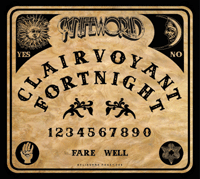






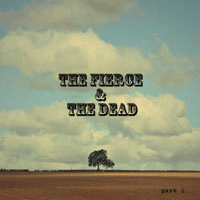


 Misfit City