Daylight Music presents:
Daylight Music 220: Benni Hemm Hemm + The Second Hand Marching Band + Jilk Union Chapel, Compton Terrace, Islington, London, N1 2UN, England
Saturday 19th March 2016, 12.00pm – free/pay-what-you-like event (recommended donation – £5.00) – more information
“This is the first of many epic celebrations for Arctic Circle’s 10th Anniversary; Benni Hemm Hemm are even coming all the way from Iceland to join the party!
Benni Hemm Hemm is the band of Benedikt H. Hermannsson, who writes the band´s songs and produces their recordings. The band is an organism that is hard to explain. Its members are in total around three hundred: at shows, the size of the band is usually somewhere from three to forty, deploying guitar, choral vocals, glockenspiel and a broad potential range of chamber instrumentation depending on who’s available. Their songs are variously described by ‘Pitchfork’ as “wispy, ruminative strums with brass, strings, and fiercely emotive rhythms… lullabies that age well – and go out with a predictable, usually affecting bang.”
“Sprawling anywhere between fifteen and twenty-two people, and led by accordionist/tenor horn player Pete Liddle, Glaswegian untraditional folk band The Second Hand Marching Band aim to create something that can’t be created by just four or five people – a mixture of cacophony and beauty, dancing and stillness. They play their music on a variety of brass, woodwind, accordion, guitar and drums; draw on dance, indie pop, post-rock, chanson, Balkan and Scottish music, and love home recording and ensemble madness. They don’t often play south of the border, so this is a good chance for Londoners to catch them in action.
“Expect an afternoon of collaboration and joy, as Benni Hemm Hemm and The Second Hand Marching Band join forces to perform pieces from their recent joint album ‘Faults’. The seeds of the record came from when Benni and Pete first met in 2007, at one of the first SHMB performances. Pete, Ross, Rich and Fraser from SHMB subsequently started playing in Benni Hemm Hemm, and at the same time Pete and Benni recorded some songs together as a collaboration between the two projects. Eventually, nine songs were produced in Edinburgh, Glasgow, Fife, Cumbernauld and Reykjavik – a long project stretching over seven years, eight hundred miles, sixteen instruments and eight singers. The album is a totally self-funded, DIY, self-recorded, self-produced, self-assembled production. This is no mean feat for a normal band, but try it with seventeen people in two countries!
“In support, Bristolian folktronicists Jilk fuse a bewildering collage of home-found sounds with the ambient soundscapes of washy synths, insect-like clicks & cuts, and huge gorgeous waves of all encompassing experimental noise. Deploying violins, guitars, trombone, strings, flutes, multiple drums and vibraphone in addition to the samplers and electronics, they also describe themselves as “glitch-and-paste electronic ambience with balls” and “the sound of jelly babies in tin wellington boots at an Arctic rave”.”
“Composer and cellist Jo Quail writes and performs instrumental music. Her sound is courageous and demands the intense emotional investment of the listener, while remaining wholly accessible to fans of all backgrounds. The inspiration for Jo’s music is drawn from a wide spectrum of influences. Music itself is an obvious touchstone, the compositional aspects of Bach, Debussy, Arvo Pärt, Zoltán Kodály, John Tavener and Bartók sit beside her love of Whitesnake, Jane’s Addiction and Nine Inch Nails to name but a few. At this concert, she’ll be launching her new album ‘Five Incantations’, which she’ll perform in full along with a selection of her previous work.
Composer and performer Poppy Ackroyd , originally from London, is currently based in Brighton. Classically trained on violin and piano, she works by manipulating and multi-tracking sounds from just these two instruments so creating deeply affecting instrumental music. Her widely acclaimed debut album ‘Escapement’ was released in December 2012; a DVD called ‘Escapement Visualised’, featuring stunning bespoke visuals by Lumen for each track on the album, was released in September 2014. ‘Feathers’, her second album, was released in November 2014, and builds on the concept behind her debut – this time, the tracks also feature other keyboard and string instruments. Through the nature of the older instruments Poppy uses there is an intimacy to her work, while field recordings add to the cinematic and atmospheric quality of the music. Yet in a live context the sonic qualities of the performance space itself become another instrument to be manipulated and woven into the performance.”
When I was growing up in north London, Crouch End was the “next village over”. It was the place where I went to primary school and first heard song by Neil Young, Steve Winwood and The Kinks (strummed out and sung in assemblies alongside battling hymns from the civil rights movement) and where I began sharpening my hunger for musical knowledge on the rich ranks of vinyl LPs in Hornsey Library. Over the years, I’ve continued to associate the neighbourhood with music – other people’s memories of old art-rock and punk gigs at the Hornsey College of Art; the star traffic through the Church Studio at the bottom of Crouch Hill (owned in turn by Eurythmics and Paul Epsworth), where you might find Erasure or Sisters of Mercy catching a mid-session coffee in the local café; and the Gareth Malone wet-dream of the Crouch End Festival Chorus, a local choir with a national reputation.
That said, Crouch End’s day-to-day music scene has always struck me as lacking. There have been exceptions to the rule – the steady reservoir of blues and roots playing at the Kalamazoo Club; the string of house concerts that Jenni Roditi ran at her loft between 2002 and 2009; more recently, a flowering of rootsy events at the Earl Haig Hall. But generally speaking, Crouch End has always seemed to me to export or traffick in music rather than play it, becoming an increasingly upmarket and bijou neighbourhood where shoppers vastly outnumber giggers; easily eclipsed by the musicality of other London neighbourhoods like Camden Town, Dalston, Shoreditch, even Tooting.
Well, more fool me. It turns out that I’ve regularly been overlooking and missing The End – an annual, musically expansive Crouch End festival that turns all of my gloomy observations about the neighbourhood’s gig shortcomings to dust – at least, for two weeks. As my penance, here’s the first half of an overview of everyone playing at this year’s festival, which starts tomorrow (all ticket details are to be found via the info links or at the festival website).
The festival kicks off with a concert navigating the blurry margins of folk and lo-fi alternative rock, with headliners good enough to warrant a post all of their own. The crepuscular but lovely Lowpineshave been racking up an unending stream of plaudits for their Anglo-Americana atmospherics, which recall old phonographs playing whispered, heartspilling songs in dusty basements, laced with judicious drums, intricate campfire fingerpicking and stargazing whistles of feedback like psychedelic pedal steel lines. Support comes from Oliver Girdler’s one-man lo-fi project Forced Random (which drifts ghostlike from instrument to instrument and from one slow soft-edged song to another) and from Reykjavík folk-rock trio Ylja (initially based around female harmonies and lap-style slide guitar but expanding into a broader palette that encompasses and recalls not just Fairport Convention, early Clannad and Pentangle but also the glowing starfield details of Sigur Rós and 1972 Pink Floyd).
* * * * * * * *
The Fierce & The Dead + a.P.A.t.T + Markers (Downstairs @ The Kings Head,2 Crouch End Hill, Crouch End, London, N8 8AA, UK, Friday 13th November 2015, 7.00pm) – £8.80 – information
The first of several events at The Kings Head hosts assorted sprigs from the thornier of British art-rock. Headlining are prog-punk quartetThe Fierce & The Dead (no strangers to this blog) who bring the rumbling immediacy of their quick-flaring complicated avant-garage instrumentals to the valley for the evening. In support, hazmat-suited Liverpudlian performance art troupe a.P.A.t.T, play “progressive pop that owes as much to Kurt Schwitters and the Chapman Brothers as it does to ABBA and Zappa”, drawing on a shifting tag-team of ‘Pool talent and bring strong flavours of the absurd, the deceptive and the cunning to whatever they do.
Opening the evening, Markers reunites two old friends from the omnivorous ferment of the 1990s London math rock scene – Jodie Cox (Ursa, Narrows, Exes, Rohame and Earth) and Jason Carty (Geiger Counter, Foe, Art Of Burning Water) as two electric guitarists without a singer, a rhythm section, any other instruments or much in the way of signal processing. Expect carefully poised, bare-branching instrumentals somewhere between Slintian maths, precise Fripp and Summers interplay, and the minimum-lines/maximum-impact approach of a Japanese ink painting or minimalist film.
* * * * * * * *
Kate Jackson & The Wrong Moves + Oh800 + YLJA (The Crypt Studio,145a Crouch Hill, Crouch End, London, N8 9QH, UK, Friday 13th November 2015, 9.30pm) – £8.50 – information
Kate Jackson (the former Long Blondes singer (and sometime British Electric Foundation/Heaven 17 collaborator) brings her current band The Wrong Moves to The End. She’ll be playing music from the upcoming “mysterious” album she’s been writing and recording with Bernard Butler over the past six years (though from what I’ve heard of it it’s more assured than mysterious – a muscular, classic pop rock mix with Kate’s big vocals and Bernard’s bright, sometimes startling guitar work).
Also on the bill are Oh800, a currently secretive new supergroup featuring Eoin “Oh Ruin” O’Ruainigh plus members of The Duke Spirit and F.U.R.S. The project is still enough under wraps not to have any tracks available to share, so you’ll just have to guess what they sound like, though it’s possible that the old Oh Ruin ingredients of blues, campfire tunes, Irish folk and fingerpicking will get a look-in. In addition, Ylja will be playing their second support slot of the festival, following the previous day’s appearance with Longpines.
* * * * * * *
Joseph & Maia + Charlotte Carpenter + Annalie Wilson + Storme (Rileys The Ice Cream Café, 32 The Broadway, Crouch End, London, N8 9SU, UK, Friday 13th November 2015, 7.00pm) – £5.50 – information
An intimate gig of classic pop styles in one of Crouch End’s favourite drop-in cafes. New Zealand duo Joseph & Maia headline, playing songs from their debut album ‘Sorrento’ (a record which shows both their indebtedness to American songbook player-writers both old and new – Buckingham and Nicks, Ryan Adams, Paul Simon, Patsy Cline, Noah Gundersen – and their absolute assurance in working the same seams). Armed with a deeper and more ambiguous folk-blues approach, Northamptonshire-born Charlotte Carpenter sings songs of doubt and connection, softly, but with great emotional power held in check (like a surge pushing at a levee).
Rounding out the bill, acoustic festival favourite and all-round performer Annalie Wilson brings straight-ahead conversational, coffee-house songs on piano and guitar: while concert opener Storme (a Swedish singer-songwriter who’s come over to London to develop her songs, reversing the usual trend) is bold and dramatic enough to be a headliner, since her heavy-weather synth-pop aims for the same stadium-friendly altitudes as Florence + The Machine, Chvrches or even the more crowdpleasing moments of Björk .
* * * * * * * *
Becky Arundel + Nora Grefstad + Kloak (Kiss The Sky,18-20 Park Road, Crouch End, London, N8 8TD, UK, Saturday 14th November 2015, 3.00pm) – free
The first of the Saturday gigs is a celebration of young female songwriters. Becky Arundel writes and delivers muscled, determined folk-rock in the Melissa Etheridge vein, moving from unplugged strum to bursting electric explosions. Norwegian singer Nora Grefstad , who generally trades as Noraslittleworld, slides her path midway between Elkie Brooks and Beth Gibbons (offering slightly wonky, jazzy trip-hopped pop or full-diva piano balladry – in each case with a hint of smeared-lipstick, morning-after feeling). While there seem to be plenty of people contributing toKloak, in essence they’re two sassy-wise white girls – Georgia Meek and Gabrielle Mallett – putting together R&B-tinged electropop with a strong flavour of Eartha Kitt (those bent notes and divan stretches; that conversational yawp in the voice).
* * * * * * *
Cortes + Bea Munro + Orfan (ThisIsWIRED @ Rileys The Ice Cream Café, 32 The Broadway, Crouch End, London, N8 9SU, UK, Saturday 14th November 2015, 7.00pm) – £7.70 – information
Showcase night ThisIsWIRED (which, since its initiation in Shoreditch seven years ago has incubated the early budding careers of musicians including Ellie Goulding, Raleigh Ritchie and Michael Kiwanuka) rolls up to a Crouch End ice cream parlour for a north London jaunt. Tonight’s players include crisp power-poppers Cortes and belting 22-year-old ‘60s-rock-siren revivalist Bea Munro; but for my money the likely star in the pack is gig opener Orfan, who uses his multi-instrumental skills to hone captivating yearning songs which touch bases with such odd-bedfellow influences as Nico, Prince and Boo Hewerdine.
In keeping with The End’s origins, peripatetic roots night Before The Gold Rush curate an outright folk & Americana evening. A truly enchanting set looks likely from Farrago, the psychedelic folk vehicle for the lucid, highly literate work of London songwriter Ian Bennett – vivid short stories couched in rich, longing arrangements and with colourful, falling poetic imagery. There’ll be a third appearance by Ylja, perhaps opening up to their lusher dream-folk tendencies. With flavours of honky-tonk and Grand Ol’ Opry, rising festival favourite Frida Wallin brings us the End’s most straightforward country music set to date. (She’s actually Swedish. Don’t let on or anything…)
* * * * * * *
The Battles of Winter + Metro Verlaine + MOSES (The Crypt Studio,145a Crouch Hill, Crouch End, London, N8 9QH, UK, Saturday 14th November 2015, 7.30pm) – £5.50 – information
While Before The Gold Rush keeps the Americana and folk covered for the evening, the people at the Crypt hold down the indie and punk rock side of things. The Battles Of Winter embrace a driving post-punk indie sound compared to Echo & The Bunnymen, Interpol and The Doors. French “pop sauvage” trio Metro Verlaine are noisy electric romanticists inspired by the rush of Patti Smith/Richard Hell punk and the latterday spark of The Kills, as well as drawing on the original poète maudit fury of their namesake. The evening is opened by guttural punky rock’n’roll noise from M O S E S, who draw a London parallel to Wolf Mother and The Subways.
* * * * * * * *
The Wave Pictures + The Oreilles + Victor Lovlorne + Beverly + Pony & Trap + Nadine Khouri + Kindling + Annie Rew Shaw + Ryder Havdale + Kloak + Aphty Khea + Hudson Scott + Esther Joy Lane + others tbc (Hornsey Town Hall Arts Centre, The Broadway, N8 9JJ, London, UK, Saturday 14th November 2015, 7.00pm) – £16.50 – information
The big one. For this concert, at least thirteen performers will be taking up temporary residence in the battered but still beautiful Art Deco rooms of the former Town Hall, running quick-changeover mini-sets in the Supper Room, Committee Room and Council Chambers. Like a spontaneous party, the actual participants and their playing order seem to be in constant flux – as I quickly put this post together, the following seems to be the current setup.
Two bands are down from Yorkshire – The Wave Pictures (rattling Byrds-and-Motown garage-indie from Wymeswold) and teenaged Halifax trio The Orielles (a surf pop band from a landlocked town, teetering on the balance of their love of Riot Grrrl and the la-la-la). From America, buzz-pop Brooklyneers Beverly can’t quite make up their minds over whether to stick with Slowdive or Lush or to hit the accelerator pedal towards Surfin’ USA; pellmell Massachusetts indie-punks Kindling provide some rocket-powered shoegaze pop of their own. From Canada via Berlin, Ryder Havdale of The Mohawk Lodge might or might not come good on his promise to salt the lonesome indie-country rock of his main band with some Berlin-inspired electronics.
Several performers bring in captivating moods and stories. The blend of murmur, smouldering torch and cool eyed-vision in the work of Lebanese-British songcrafter Nadine Khouri has drawn comparisons with Patti Smith, PJ Harvey and Mazzy Star. Athenian-in-London singer Aphty Khea (a.k.a. MantRah) deals in self-produced slow-drag abstract soul and hip hop ideas; Texan gospel choir escapee and human love-wreck Victor Lovlorne in unsettling lo-fi basement ballads in a Will Oldham, Sparklehorse, Beefheart or Redbone vein. Piano singer Annie Rew Shaw mingles Christine McVie melodicism and wit with an eerie ghost-haunted songwriting style.
Of the rest, Kloak make a repeat appearance (this time unplugged) following their slot at Kiss The Sky earlier in the afternoon; Pony & Trap mix crisp girl-about-town rhythm-box funk with buzzy post-punk guitar hooks); and Oxford electropop diva Esther Joy Lane puts in an appearance, as does the elusive and underplugged Hudson Scott (at the moment, just a name on a wobbling list…)
* * * * * * * *
Emma Pollock + Ylja (Earl Haig Hall, 18 Elder Avenue, Crouch End, London, N8 9TH, UK, Sunday 15th November 2015, 8.00pm) – £8.50 – information
The last gig of the week features Scottish alternative rock heroine and onetime Delgados songwriter Emma Pollock, now three records into a solo career as well as being branched out into poly-genre supergroups (The Burns Unit) and socially-minded collective projects (The Fruit Tree Foundation), with her varied collaborations stretching well beyond her bright indie-pop beginnings to involve folk music, theatre work and string quartets. If you’re good, she might play you some songs from her upcoming album ‘In Search Of Harperfield’. Ylja, who by now are starting to look like the End’s house band, will play their fourth and final support slot of the festival at this gig.
* * * * * * * *
That’s all for this week, but I’ll try to put together a rundown of next week’s End gigs over the weekend…
I got this through my feed this week – a Beach Boys cover done as Korean doo-wop.
This is The Barberettes, who’ve been singing together for three years and are in town next week, making their London debut. It’s also an audio visual flyer, of sorts, for this year’s London K-Music Festival. Presented by Serious (in association with the Korean Cultural Institute) this is a celebration of Korean music from “dynamic and energy-filled contemporary bands to eloquent and dignified traditional music” spread across some of the capital’s best venues during the course of September. Full details are below. (From here on down, it’s all press release.)
SU:M‘s name (pronounced “soom”) translates as “breath” and it expresses the physical connection of these two women to the music they create – sometimes a soft sigh, sometimes a cry, sometimes a silent holding of breath. Jungmin Seo plays the gayageum (a massive twenty-five-string zither) and Jiha Park plays wind instruments including the saenghwang (imagine the subtlest mouth organ, with seventeen bamboo pipes). They are an astonishing experience live – they’ve played Womex Cardiff and were seen at WOMAD last year. This opening concert of the K-Music festival of Korean music is their first London concert.
The evening will begin with a short solo set by Arthur Jeffes, leader of Penguin Cafe, who will play music by himself and his father Simon Jeffes inspired by their travels in Asia – and it will end with a short collaboration between Arthur and SU:M. Tickets available here.
The Barberettes (The Forge, 3-7 Delancey Street, Camden Town, London, NW1 7NL, UK, Friday 4th & Saturday 5th September 2015, 8:00PM) – £16.00
Formed for fun in 2012, The Barberettes are a spectacular vocal harmony trio, a timeslip girl group who turn classics of the ‘50s and ‘60s inside out as well as creating their own theatrical music with their close harmony covers and cute costumes. Singing doo-wop in Korean and English, they made their first album last year (in a retro homage to their inspirations, they called it The Barberettes Vol 1). This year they’ve already stormed SXSW in Texas and the K-Pop Night Out concert at Midem in Cannes – and now they’re bringing their unique style to the UK for the very first time. Tickets available here.
In England, we know a bit about Korean art music and hold some preconceptions about K-Pop – but we don’t know much about Korean rock music, and that’s where Seoul’s finest, No Brain, have built a huge following, playing over three thousand gigs across Korea in the last 15 years. Powered by raw vocals (Bull is the lead singer), razor guitars (Vovo plays guitar), sharp suits (Bogle plays bass) and a drummer called Dolly, they’ve won lots of Korean Music Awards, but never played London before. They’re playing an early set – support hits at 7.30, they play at 8.30pm. This is a standing show – tickets available here.
Jambinai are the next thrilling instalment in the tale of new Korean music. They sculpt sound in a way that’s drawn comparisons to Mogwai, Explosions In The Sky, Sonic Youth and the crystalline power of Sigur Ros – but they draw deep on Korean traditions. It’s not just a stage full of amazing instruments – Korean fiddles, massive zithers blended with glorious lyrical guitars – but also a conscious sense of using the tradition to create something thrillingly new. They’ve been seen at Womad and Glastonbury, but this is their first London show – catch them as Jambinai step out onto a world stage. Tickets available here.
There’s a theatrical strand to a lot of Korean music and, for more than twenty years, Noreum Machi have been creating a thrilling spectacle from virtuosic percussion, shamanic vocals and acrobatic dance. Powered by gongs, Samul Nori drums and wind instruments, they work within the framework of Korean traditional performance, with a commitment to communicate their music to audiences worldwide. Tickets available here.
The Pansori Night: Sang-il Nam + Aeri Park + ‘Poppin’ Hyunjoon + Bae Reon + Kye-youl Jun + Ji-sun Choi (Cadogan Hall, 5 Sloane Terrace, Belgravia, London, SW1X 9DQ, UK, Wednesday 23rd September 2015, 7:30pm) – free ticketed event
The Pansori Night will bring together six talented performers for an evening of music, dance and song with a contemporary twist. Pansori is a form of vocal story-telling that reaches back centuries — the stories sung are often comic, with a Chaucerian comedy to them, but they are also more than just bawdiness, and can be romantic, sad and emotional to boot.
Rising Pansori talent Sang-il Nam will be joined by Aeri Park, one of Korea’s leading female pansori performers. Aeri Park will also perform with ‘Poppin’ Hyunjoon, who takes breakdance moves and blends them with traditional rhythms. Our three stars will also be joined by Bae Reon, playing the ajaeng – a seven-stringed instrument, percussionist Kye-youl Jun accompanying the pansori with the janggu (Korean drum) and traditional dancer Ji-sun Choi. This event is free but ticketed. Click here for more information.
Korean National Gugak Centre (Lilian Baylis Studio @ Sadler’s Wells, Rosebery Avenue, London, EC1R 4TN, UK, Wednesday 30th September 2015, 7:30pm) – £15 + booking fee
The Korean National Gugak Centre is one of the great arts companies of Korea, and this performance concentrates on Sanjo – that’s a style of instrumental music accompanied by a drum and sometimes by dancers, starting slowly and gathering speed, with a structure that allows for virtuosic improvisation. This evening shows off some of the great traditional instruments of Korean traditional music such as the geomungo (large zither), daegeum (transverse flute) and haegeum (Korean fiddle). This is the last date on the group’s European tour, and provides a fitting conclusion to the K-Music Festival. More information here.
Tickets for all events can also be obtained from Serious.
More quick London gig news – art rock, post-rock, electronica, and a dash of classic New York downtown.
Rumour Cubes + Dresda + kontakte @ The Facemelter (The Black Heart, 2-3 Greenland Place, Camden, London, NW1 0AP, UK, Friday 7th August, 7.30pm – £8.00/£6.00)
Sumptuous instrumental and electronic post-rock from ex-Glastonbury and ArcTanGent Festival performers, plus a UK debut.
Post-rock veterans Rumour Cubes have been spreading tentacles of ambient, soaring soundscapes across the globe, catching people’s attention with their classical and electronic nuances, attention to the finest details and unassuming political statements embedded in their writing. Their work with poets and film-makers has allowed them to create a multi-media experience and has propelled them to performances at Glastonbury, ArcTanGent and a support slot for Sólstafir; while their albums ‘The Narrow State’ (2012) and ‘Appearances Of Collections’ (2014) received wide critical acclaim.
Celebrating their tenth anniversary this year, Dresda hail from Genova, Italy, and will be driving over to make their UK debut. Their music is intricate, dense and introspective yet gloriously cinematic. They have several well-received releases under their belts, including soundtracks for critically acclaimed Italian independent movie ‘The Krolevsky Case’, and the short movie ‘La lingua del disordine’. In 2009, they were featured on the Italian DVD edition of the Canadian documentary ‘RIP! A remix manifesto’, distributed by Feltrinelli Real Cinema nationwide.
Conceived in 2005 from a string of old 4-track demos and further realized via a labyrinth of digital workstations and computer software, kontakte blend organic instrumentation within an electronic and hypnotic framework of programmed beats and pulsing synths. Pooling influences such as Godspeed You! Black Emperor, Mogwai together with Brian Eno, krautrock and shogaze sounds, this duo manages to perfectly blend shimmering electronics and ethereal melodies. They have too many releases to name and have been remixed by many visionaries including Tim Holmes of Death In Vegas, Chris Olley of Six By Seven and Russell. M. Harmon.
There might also be tickets remaining for the performance of Arthur Russell’s Instrumentals early in the following week. This is a repeat visit of a show that’s been on and off the road at various points around the world since 2012 and which last visited London via Cecil Sharp House earlier this year… so if you missed it before, now’s your chance.
Visions presents: Arthur Russell’s Instrumentals, directed by Peter Gordon @ Visions Festival (Oval Space, 29-32 The Oval London, Bethnal Green, London, E2 9DT, UK, Monday 10th August, 7.30pm – £21.50 plus booking fee)
For those of you who don’t know about Arthur Russell’s turbulent, productive (and sadly curtailed) life, he was a vigorous participant within the downtown New York music scene between the mid-1970s and early 1990s. Having studied as an avant-garde cellist and composer, he rebelled into Manhattan nightlife, vigorous cross-fertilization and event curation. Russell rubbed up against Fluxus, disco, avant-garde theatre, New Wave and no-wave, making the most of the breadth of the prolonged New York creative ferment of the times, feeding his assorted roots and collisions into music of his own.
During the last decade of his life Russell wrote and performed voice-and-cello songs – predominantly solo but employing loops, echo and sundry effects. In these, he synthesized all that he’d learned into what were perhaps his most personal and accessible works. These are probably what he’s best known for now, thanks to the more prominent releases of albums such as ‘World Of Echo’ and ‘Another Thought’, but they’re only one aspect of his work
A notorious perfectionist reknowned for agonised work gestations (and who left hundreds of pieces uncompleted at his death) Russell nonetheless completed what was, at the time a remarkably bold, broad and modern array of work from orchestral pieces and theatre music to forays into electro-pop and dance music under project names including Dinosaur (for ‘Kiss Me Again’) and Loose Joints (‘Tell You Today’). Today this kind of equivalence and eclecticism is more commonplace in the orchestral or ensemble work of composers such as John Zorn, Django Bates, Anna Meredith or Tansy Davies. In the 1970s, though, Russell was a pioneer, notoriously shocking the staider elements of his avant-garde classical audience with ‘24-24 Music’ (a contemporary classical piece equating the pulses and disciplines of New York minimalism with those of disco music).
Coming from the zone of Russell’s talent which drew most on his contemporary classical roots, ‘Instrumentals’ is an example of his chamber music, Dating from the late ‘70s, it was initially conceived as a forty-eight hour piece, its duration far exceeding even the infamously massy protracted works of Morton Feldman. Versions of the work were performed over the years, and a selection of excerpts appeared on a Disques du Crepuscule release in the mid-‘80s.
The piece as it stands owes much to Russell’s friend Peter Gordon, a fellow eclectician from the 1970s downtown scene and Russell’s bandmate in The Flying Hearts and Gordon’s own ongoing Love Of Life Orchestra. Gordon worked closely on the original performed version, assisting on keyboards, arrangement and notation. Two decades after Russell’s death in 1992, Gordon brought a new version of ‘Instrumentals’ back to The Kitchen (Russell’s old home venue in Manhattan. Following the initial sold-out performance in March 2012, Gordon has periodically revived and toured the new arrangement. The performance at Oval Space will feature several members of Russell’s original ensemble, and will also feature photographs by Yuko Nonomura which were projected during the original 1975/78 Manhattan performances of ‘Instrumentals’.
Multi-disciplinary New York trio Sontag Shogun (including Jeremy Young, whom I reviewed playing live in London last year as Foxout!’s guitarist) sent me some news about the recent release of their debut album ‘Tale’. Ostensibly post-rockers, Sontag Shogun don’t conform much to the genre’s more insular tendencies, being made up of three restless multi-media artists moving from craft to craft and from continent to continent. Jeremy, for instance, also co-runs the band’s not-just-a-record-label Palaver Press, which unifies sound publication with assorted texts and fine-art bookbinding.
‘Tale’ was recorded in carefully-hoarded scraps created around the world while Jeremy (sound sources and contact miking) was studying in London, Jesse Perlstein (laptop, tweaked voice and kleptomaniac microphone) was traveling in Korea, and Ian Temple (the grand piano) was back at home in Brooklyn. Field recordings were gleaned from diverse adventures including “a trek through a Columbian jungle, a piano tuner testing the ivory at the Southbank Centre and a South Korean traditional singer hitting a buk (or leather folk drum).” Back in New York, the results were looped, layered and mixed with planned performance (both final takes and rehearsal scrapings) to create a tender collage and a trans-genre which Sontag Shogun call “lullanoise”.
For a taste of what this sounds like, here’s the simple and beautiful but implicatory video for one of the album’s piano-led tracks, The Musk Ox (directed by Isabel Nao):
and here’s a video of Sontag Shogun performing another album track, Let The Flies In, live in France in 2013:
‘Tale’ is available as either CD and download and can be ordered from here.
“Well, I know, I know the story – / the fall of the sun and the vengeance of glory revoked. / So well, I know how the seas turned to dust, / and how the known earth choked. / So well, I know, I know the ending: / the carriage from its zenith bending, / a comet slung through ashen skies / and burst against the banks.”
Cinematic. Epic. These are words which have been whored out far too often, especially when it comes to describing and defining music. Froth and PR corrode their meanings, reducing them to fancy synonyms for nothing more than crude scale, and we forget that other qualities are wrapped into them. These words shouldn’t just be cheap and glittery tags for charlatans – the kind who steep their tunes in giant vats of reverb, or who substitute eye-watering grandiosity for sincerity. There are more crucial meanings. There’s storytelling, and the churn of history. There’s the play of images, the triggering of senses. Eventually, there should be some kind of understanding.
Ian Crause knows all of this. Back in the 1990s – when he was barely out of his teens, and the driving force behind the startling expressionist pop band Disco Inferno – he was struggling with it himself. Even then, though, he wasn’t stumbling to understand: he was striving to perfect. Disco Inferno had come from limited beginnings but grown fast. Originally a dour post-punk power trio, they’d seized the opportunities presented by technology and imagination and transformed themselves into a whole-world window. Hot-wiring their way into the disruptions and illuminations of found-sound and musique concrète, they plugged guitar, bass and drums into digital samplers and grew themselves an ever-expanding sheath of noises: a startling collage of jarring sound effects, layered into composition and twisted into context.
Disco Inferno’s swarm of noise was never there simply to overwhelm. Instead, it refracted and illuminated the poignant dissatisfied pop songwriting which stood, steadfast, at the band’s core. They were doggedly political, but owed nothing to dogma. Caught within ominous social currents and inside treacherous personal eddies, their songs bore witness to cruelties, both intended and impersonal. Those tearing rivulets of sound-montage were flashes of further illumination, put there to side-swipe and snag the attention, and to up-end complacency. The fragments of birdsong and clattering glassware; the careful punctuation of trains and screams and distant firework-pops; the sound of feet jogging grimly away through a numbing snowfall – all of it bore witness to the swerving cacophony of the world, smearing past our ears and battering our psyche, carrying its deeper meanings and significances into us via a pummeling swirl.
At the heart of this unsettling barrage were Ian’s lyrics, which were wise, stark and bleak beyond his years. He sang about the crumbling of vulnerable individuals; about the fraying of the social contract and distortion of social forces. He sang about the stifling, stunting pressures callously imposed from above. He sang about all of this in a still, small, stubborn voice which sounded like the next-to-last exhalation; as if he was a few crucial steps and dogged heel-digs away from giving up and bleeding out. He sounded brave, bitter and doomed – snarling his scorn at the boot-tread even as it rolled over him. For a while, it was a self-fulfilling prophecy. Bands who refuse to comfort us (or refuse to stroke our sundry petty vanities) rarely get rewarded, and Disco Inferno were no exception – the strains of dealing with commercial indifference and inner despair finally tore them to bits in 1997. A couple of barely-noticed Ian Crause solo EPs hiccupped out in the band’s wake over the next few years, and then he too seemed to drop out of the story.
In fact, he’d only dropped out of the cheaper kind of mythology. That’s the one in which ducking out of music becomes death or disappearance by another name. His own story – the real story – moved on regardless. There were years of growing up and grim jobs to come, and years of being chewed over by the same callous forces he once sang about. In amongst the drudgery, there were other factors. There was fatherhood, and family. Surprisingly (for a lyricist already so accomplished and intelligent) Ian made his first adult engagement with literacy. Curiosity, plus a determination to pursue the roots of song and storytelling, led him to the themes and voices of classical literature. His developing interest in the telling parallels with contemporary society kept him immersed in it. Crucially, Ian discovered the works of Ovid – Roman epic poet and exile – via dedicated translations by Ted Hughes and David R. Slavitt.
Like Ovid, Ian would eventually become an exile himself (a self-determined one, abandoning Britain for Bolivia) and enter into a new swell of creativity. Via his ‘Metamorphoses’, Ovid eventually inspired The Song Of Phaethon – Ian Crause’s formal return to music, transformed and developed. It might not be the first new note he’s delivered after eleven years of radio silence. That would be More Earthly Concerns, which welled out via Mixcloud and blogclick in March 2012, and which I’ll talk about elsewhere. But (as Ian begins to dole out his work, in handfuls, onto Bandcamp) The Song Of Phaethon is the first of Ian’s songs to be let out into the marketplace. It’s also probably more crucial in understanding his evolution since his Disco Inferno days.
The protagonist, Phaethon, is and was one of those half-divine children who pepper Greek mythology – he’s the bastard of the sun god Apollo Helios, a malcontent boy strutting up to his sun-father’s palace to claim his ancestry and birthright before he has the wisdom to use it. Greeted, given the acknowledgment he craves, and granted the gift of driving the sun’s chariot for a day, Phaethon is warned of the terrible risks involved. Swallowed up by his grand moment, and too conceited to listen, he takes all of his opportunities to their ruinous conclusions. Losing control of the chariot, he transforms a triumphal fly-past into a joyride and then into a catastrophe. Before the high god Zeus restores order by striking him down, Phaethon scorches a gigantic swathe across the world and casts the seasons into chaos.
Like most figures woven into the complex psychological map of Greek myth, Phaethon still has his role to play. He’s a metaphor for arrogance and a sense of entitlement; he also stands for the destructive potential which both of these follies possess. It’s deep literary currency, and maybe not the first thing which you’d think of as a match for the Crause songcrafting method – so direct and personal in Disco Inferno days. Yet Ian’s battering splay of noises and disaffection opens itself up readily to the mythology, which sinks in grain-for-grain. Explosive futurism meets stern and ancient legend, and both are renewed.
Some of Disco Inferno’s post-punk grit remains at the spine of the music (listen to those dogged dot-trails of frowning bass, or to the occasional flares of wire-wool guitar), but the song falls far away from rock into something older. Myths lend themselves to being channeled into new courses by any means available – Phaethon, for instance, worked his way into a Patricia Barber jazz epic six years previously. Ian rises to his own challenge superbly. In any worthwhile sense, what he comes up for The Song Of Phaethon is a new take on a bardic chant. Its melody is minimal and hypnotic; its rhythms walking, changing pulses constantly driven by the restless words. With vivid artistic appetite, Ian also mines the story’s depths for any resonances which he can transmogrify and feed into his own samples-as-narrative approach.
In this he’s served well – the mythic structure and detail inspire and transform his lyrics, which in turn take on the layered build of classical imagery. Various whispers of fateful moira and foreshadowing rise up to nourish the sounds. From early on, Phaethon’s life is marked by the celestial – right down to the transformation of his familiar landscapes by the passage of the sun and moon each day, continual reminders of his thwarted birthright. Ian reflects this in the woven detail of the narrative: “Every day their shadows ran / down Asia like a lyre, strumming / past his village, swinging down at perihelion / to touch upon his mother’s house / then over dark and quiet woods – / their distant hawks and watching deer / oblivious in bending shade – / descending into seacloud mist, / and down towards the gull-cloud cliffs / to pour their jewels and precious metals / out along the sea.”
Just as he did with Disco Inferno, Ian juxtaposes sound effects with the lyrics to create telling sonic scenery. Though he generally wields these with the skills of a master ironist, he slam them into place with forthright punk brutality whenever he needs to. Throughout, the Greek horns and lyres are a pointed racket: ritual blares, ancient continuo lines. Signatures of antiquity and origin stand solid against the thrumming synths and Ian’s tidal electrophonic swirl of throbbing samples. In prophetic flashes, the clip-clop of horse’s hooves and the slam of violent collisions clatter and blur in and out of the mix, while Phaethon’s more innocent youth is illustrated by the clank of herd bells and goats. In time, his dogged journey through Asia and towards Apollo is dappled and smeared by a souksworth of Asian instruments and chatter, careering past the listener in a flickering travelogue: “Levantine cities raised themselves, then hazed away in dreams of sand, where sand subsumes / the earth itself and still ahead his path led on. But falling always out of reach, the rising sun. / Into the dawn, alone he walked.”).
The effect is of a kind of illuminated text – a cinematic compression of time and location into a vivid illustrative story. That story remains paramount: even while we, as listeners, are being drawn inside those blood-in-the-head thunders and are surrounded by a glorious noise, as if we’ve been trapped under the encircling lip of a vast bronze bell. Beyond the story, though, other dimensions to the tale are coming into play. The song is also a loose parable of another gatecrashing of grand power. “He knew, he knew – / his place was beyond.”
Superimposed – a ghostly transparency – over Phaethon’s story is the tale of Tony Blair’s entry into the Second Gulf War. As this emerges through the song, it’s clear that Ian sees this as another disastrous snatch at high significance and public destiny. Something which flew high and upwards towards glory, only to destroy any achievement of its own, wreaking havoc on the ground and people below. Cunningly, occasional Blairisms are woven both into the narrative and into Phaethon’s thoughts and speech. At one point, he even blathers, Blair-like, “look, you know,” before sliding into advocate pomp and hubristic heroics. For a moment, the pleading voices of the two men overlap within Ian’s narration, making a contradictory cats-cradle out of public morality, power-grabs and a preening Promethean sense of mission. “It was not just God but also man / who clearly needs some representing – / A case I’ll take for free… / Evidentially it takes / a half-divinity to raise / the flag of man aloft for man…”
It follows – with a harsh and unforgiving logic – that the noises of modern warfare should persistently break through the song’s tapestry of ancient sounds. As Ian goes beyond everyday sound effects and begins to violently splice present-day horrors into the textures of the mythical plot and signifiers, the song is slashed up into a jittery palimpsest. Almost from the start, those bleating goats on the ancient Greek hillsides are blindsided by gunshots and by the crash of heavy munitions. With booms, crunches and clatters the shattered, warped shards of twenty-first century concrete and metal scrape and shoulder their own way into the past.
Even specific events from the myth draw across, from recent times, their own crooked parallels. The bursting, clattering crowd-sound of Phaethon’s entry into Apollo’s hall is lifted and twisted from the peak of Blair’s 2003 address to the US Congress. It becomes a Dionysiac smear of fanatical applause and whistles: something turned into a nightmare puppet show, or a rainstorm ripped horribly out of kilter. At the coda, Phaethon is poised unwitting on the brink of disaster. The ascension of the Sun’s chariot merges, indistinguishably, into the noise of a jet fighter launch. Backed by the white-hot screech of the afterburners, the lyrics weave both tales, both times and a set of terrible implications – “the steeds were armed: a blinding shock; / a ferrous scream; a rubber stamp; / and up,” – into final, irrevocable process.
By anyone’s standard, The Song Of Phaethon is a major achievement – a jump-up into fiercely intelligent, confident high art, it stakes new claims and transfigures old ground. It even manages to both stay true to and transcend the moral and political commitments Ian held with Disco Inferno. And yet… it raises a tremulous question of what might have happened to the other side of Ian Crause. Between the immersion in classical tradition (and the dense time-folding focus of the samplers) what’s left of the fervent young New Order fan who always saw himself as fronting a pop band? What, in other words, became of Crause the unlikely pop singer?
Ian Crause: ‘Suns May Rise’
For the answer, look to Suns May Rise, released three months after The Song Of Phaethon. Ian’s mining of Greek mythology is still in place (as are his detailed tapestries of sound-effect) but they’re now wrapped around an out-and-out pop song and a lustrous, dancing melody that Bernard Sumner would give his eye-teeth for. Those Greek lyres and zithers are back, as are the layers of sound effects (sea-spray and thunderous surf crash billow through Suns May Rise from start to finish); but they’re bolstered by massed stadium synth and guttering pop guitar; by angelic powder-puffs of fake-choir; and by warbling rococo flourishes of electronics. Even Ian’s voice – usually so dry, and pointed – is flushed with the balmy blue of a Mediterranean summer. Scritti Politti and Cocteau Twins, each at their flounciest, could find common ground with this song’s feverish, chattering opulence. So, come to that, could latterday Marillion.
I suspect that all of this ’80 ornamentation is deliberate. After all, it skips hand-in-hand with other ’80s excesses, and that’s not too far from where Ian’s caustic, righteous attention is focused. Beneath this gleeful and gorgeous bluster, he’s unraveling a story from the Odyssey: a warning bell for avaricious times. As the story has it, Odysseus (while returning from the Trojan Wars) visited the generous Keeper of the Winds, who gave him a bag of sea-gales to ensure that the sails of his ships would be filled and his voyage home would be swift. En route, Odysseus slept; and his friends sneaked up to rifle the bag, in search of treasure which they were sure he’d hidden from them. All they succeeded in doing was to unleash the winds, which blew the ships hither and yon and – eventually – blew them back to where they had started. Reckless avarice, bringing down calamity, provides the keystone of the song. “There will always be some fool / to pull the strings apart. /And suns may set and moons may wax, / and moons may wane and suns may rise – / the gold within his eyes will weigh / Man down a stumbling fool.”
When Ian starts singing about this, though, it’s from the point of view of that corrupted, consensual chorus of friends – the “brothers bound in bronze.” Their coy, self-congratulatory rapaciousness soak his tones like a stain on the teeth. Flushed and greedy with loot already, all they can see is the chance to grab some more. From his own place at the reins of the narrative, Ian reveals their mythic echo in today’s freebooting boy-club of bankers and stockbrokers. Men of unfettered appetite goad each other on. People who simply don’t know when to stop – and who wouldn’t want to even after being handed a sobering, sickening lesson – would still pick perilous holes in opportunity. “You had enjoyed a peace of sorts / The winds had been re-tamed and so / of course the bag was bursting fat: / It fell to men to see to that. / Again so sure the bag would hold / either wine or gold, / Necessity appeared, demanding ‘Open this’.”
It’s here (with a careering inflative screech on “bursting fat”) that Ian himself deliberately unleashes the hidden forces within Suns May Rise, to overwhelm it. From here on in, sounds rise and cyclone – seaspray, radio chatter and winnowing churns of air; a lash of strained rope which morphs from background effect to edgy kick-drum. Amongst all of this the thread of pop song holds fast, stretched taut over an ever-burgeoning epic. In a parading weave of rapid soundbites, assorted newscasters and pundits and politicians roll past in a potted history of the last generation of monetarism. At its tail-end, George W. Bush (waving through a banker’s rescue programme of the kind he’d never have brooked for any other group of people) chokes, gargles and drowns amongst the becalmed wreckage of Odysseus’ ships. Throughout, that teasing pop melody ensures that we’ll remember what happened this time around.
So… the forces eventually sink the meddlers, but there always seem to be more of the latter. Ian conjures up further mythic winds, more specters bringing in ruin from the other far-flung breeding grounds of a destructive capitalist carnival. “Through solids, countries, paper bonds; / The world again reveals itself / in entrails; in open wounds. / The priests and seers shed tears of glee / and privately amuse on how / it still can be that after so long… / there will always be some chance / to pull the threads apart.” Again, the bones of legend rear up inside the flesh of current affairs. Again, this unlikely sample-punk turned foley-bard turns up to show us where those bones are poking through – his words a layered and subtle scourge; even an education. For Ian Crause, it’s been a long and often stony road from transformative teenage angst to his current role of reveal-and-illuminate, but it’s also been a journey of integrity and hard-won vision. The results are even a story in themselves.
Ian Crause: ‘The Song Of Phaethon’ & ‘Suns May Rise’
Ian Crause (self-released, no catalogue number or barcode)
Download-only singles
Released: 20th November 2012 (‘The Song of Phaethon’), 18th February 2013 (‘Suns May Rise’)
Buy it from:
‘The Song Of Phaethon’ – Bandcamp(the original version reviewed here has now been replaced by this mini-album)
‘Suns May Rise’ – Bandcamp(the single version reviewed here has now been replaced by this version from ‘The Vertical Axis’ album)
As I get off the bus in Clapton, the midsummer evening sun is giving the neighbourhood a lingering kiss. It brushes across the Clapton Portico (a bewildered, disinherited classical remnant, grafted onto a school at the end of an abbreviated road), takes away its sadness and helps it in its lonely loom. It limns the shopfronts of convenience stores and barbers and closed-down shops, and perks them up. It lends soft glows and sends little licks of shadow chasing around the stonework of the Round Chapel, and it brings out the last sleepy cheeps of the day from the local sparrows as I head down Glenarm Road towards Homerton.
Waiting for someone to sing..
Thirteen years ago – when I was living a lengthy stone’s-throw to the west, over in Stoke Newington – this part of east London was a soured inner suburb with a brooding, bullet-ridden reputation. The length of Clapton Road was tagged as Murder Mile – an edgy and angry place beset by resentments, drive-by shootings and unprovoked beatings. Flickers of anger sometimes still plague it. Almost two years ago, the second night of the 2011 London riots kicked off just a few minutes walk from here: a churn of flames, looting and outright war between police and estate kids. Barely a block away in Clarence Road, Pauline Pearce delivered the impassioned harangue which would establish her as a Hackney heroine. Now though, all is peaceful: and it gives me the chance to reflect that, as with people, the hair-raising reputations of many places come only from their occasional spasms.
The biggest fuck-you I get tonight comes from a house painted in a shocking purple and gesturing out from an otherwise cream-and-beige Victorian terrace, like some kind of bolshy architectural remix. As I’ve come to know in recent years, this part of London is a place where a very diverse set of people get on with living: it’s also the kind of area where people get out of doors not to go hunting but to break that pesky London reserve and meet their neighbours. Pubs become sitting rooms; sitting rooms and armchairs spill onto streets – another embedded global village. While people are a little thin on the ground tonight, this late-June evening (just beginning to show the mottlings of dusk) is suffused with an easy warmth. Later in the evening, Liam Singer will chuckle from behind his keyboard and gift the neighbourhood with a more welcome tag than it’s had in years. “It’s like Brooklyn, but if everyone was really friendly.”
Lampshading.
Sitting on the border of Clapton and Homerton, The Dentist is nothing if not hopeful. A former drop-in surgery a little north of the hospital, it’s a genial wreck of a building. Crumbled, scarified and grime-smeared, it stands like a worn, chewed tooth in a shopping parade halfway between old London main drag and international souk. An enterprising guy called Phil calls the upstairs home, while using the downstairs for pop-up gigs, shoestring theatre, and scratch-and-strike art gallery exhibits. The back garden is full of splintered wood and earth hummocks, plus a makeshift tabletop bar. The wine is rolled up from the cellar via a scary ravine. The whole place thrums with friendliness.
Inside, crowded into the front room and sharing its atmosphere of ravage and reclaim, we’re part of a show. In a place this small, within breathing or patting range of the musicians, it’s hard not to feel that way. Behind the players, the curving plate-glass façade of the old shopfront runs across and around: over their shoulders, we look out at the street life. It looks right back at us, sometimes with suspicious flicks of the eyes (a man in a shalwar kameez, hurrying past to the makeshift mosque next door), sometimes with a bemused acceptance (a local geezer ambling along to the chippy) and sometimes with outright delight (younger locals on a stroll, pointing and celebrating on their way to and from the Hackney bars further into town).
Sealionwoman – Tye and Kitty as the daylight fades.
To them, this must look like a gig in a bottle – the audience in full view, the musicians upfront but backs turned, the music bleeding out in faint enticing vapours. Speaking of which… cue musicians.
Tye McGivern slumps over a double bass, plucking, bowing and sometimes wrenching his notes: a man with strong, thoughtful butchers hands and the face of a weary rabbi. To his right, Kitty Whitelaw sways barefoot – grubby toes, blue nails, a jazz pulse, a little black dress and a feel for the taut sinews of a song. There’s no-one else. About five years ago Tye and Kitty were two-thirds of Kitty & The Drowning Bag, were a lot noisier, and had a drummer. For the couple of years that they’ve been Sealionwoman they’ve been drummer-less and bring their own extra noise in their pockets.
Sealionwoman deal in blurred versions of jazz and torch, and they’re perfectly suited to the smear of dusk that’s coming on as they begin to play. As influences, they’ll cite the crepuscular – Nick Cave and Morphine – but also cite the vivid, iconoclastic enactments and reinterpretations of jazz songs as carried off by Mina Agossi. There’s something in that. While they deal with plenty of old jazz standards – passed from hand to hand, worn smooth like wooden heirlooms – Sealionwoman share a trace of that Agossi rebellion against jazz performance manners and form, preferring to draw out song essence and perhaps a thread of history along with it.
Sealionwoman – Kitty Whitelaw possesses another standard.
However, what I’m hearing is something which shades Peggy Lee with Patti Smith. It’s partially that everything they do sounds a little bit like Fever – songs carried entirely and by necessity on the honk, creak and slide of Tye’s bass and the teasing dance-around of Kitty’s voice. It’s partly the lazily assured flutter of Kitty’s demeanour, and the way that it can quickly shift and escalate to an incantatory yell.
What they do has little to do with straightforward theatrics, and still less to do with diva drama. In his hands and on her lips, the songs turn as wayward as blown smoke: dip in and out of ritual; become stretched-out, yammering versions of themselves; go from breezy cool to swimming, waking dream. Sometimes Tye leans over to prod at a laptop or a fuzz pedal, furring up those woody bass notes to turn them into air-horns, or a sweep across concrete. Sometimes he drums with a pair of brushes on boxes and chairs. At other times his hands drum vigorously on the wood of the bass, booming out ritual and conversation, a vigorous and physical lover teetering on the border of tenderness and violence. Kitty sways, stands on tiptoe; brushes against the songs as if stretching for a passing kiss. Her voice folds around the melody line and uses it as a jumping off point, springing into the air, hanging, returning. Every so often a familiar tune and lyric slides through the circling murk. I spot Night And Day.
Mostly, though, it’s all about mood. Strangely blissful, narcoleptic – although by the end of the set and the dip of the late sunset they’ve risen in a slow heat, culminating in a Dionysiac frenzy of bass-drumming and banshee wails. It’s probably enough to put the wind up the Muslim congregation next door, praying their way through Asr. If they’re as Hackneyfied as everyone else around here, though, they’ll just shrug it off.
Foxout! ‘s Daniel Merrill, bowing against the dusk.
The gloaming has well and truly arrived as Foxout! settle down and begin. Perched opposite each other on a couple of stools, Daniel Merrill and Jeremy Young hunch over a network of effects pedals and rummage through what looks like a box of yellowed prehistoric teeth: these they mouth and mumble, blowing into a microphone to build up a warm, rambling noisescape of notes, feedback and harmonic buzz before they even pick up an instrument.
In fact, the teeth are reed tubes gutted from an old harmonium. Foxout! enjoy rejigging bits and pieces of antique musicality, and they’re extraordinarily good at it. Some more history might be useful, before we go any further. Essex-raised but with feet made for journeying, Daniel is the fiddler in Dead Rat Orchestra. Despite his youthful looks, he already has a decade of improvised folk music behind him, plus tours all over the globe (some of which were in the company of Godspeed You! Black Emperor (from whom he may have filched Foxout!’s abrupt exclamation mark). Another young veteran, Jeremy’s from Brooklyn music – he once played bleakly beautiful post-Godspeed chamber music with [the] slowest runner [in all the world] and limpid post-rock atmospherics with Sontag Shogun before moving on to solo experimental tonescapes and spoken word as szilárd. Both men wander; both men curate the work of others. Both men mingle.
Foxout! – Jeremy Young.
Right now, both men are studying here in London. As their orbits have converged, Foxout! has emerged – immersed in the tributaries of Celtic folk but flowing through some crafty filters as it contributes to the journey. Certainly the prime stamp and weft of the music is Celtic – reels and pibrochs; plangent, sad melodies. Yet it’s Celtic music folded back over itself, cross-cut with experimental sounds and processing, and by strands of improvisation from elsewhere.
Daniel is one of those musicians who looks extraordinarily sad while he plays. Concentration renders his long, bearded face into a subtle mask of tragedy until you expect lock-gates to burst and for three hundred years of folk laments to come pouring out of him. His fiddle is the main melodic phrasing voice, with Jeremy’s acoustic guitar serving as a taut, bounding dodging rhythm source. Jeremy himself is constantly watchful and supportive, his eyes fixed on Daniel, holding up his partner’s passionate forays.
Speaker.
What emerges is remarkable, not least for the way in which it shape-shifts between different disciplines, experiments and sound-art tricks with neither seam nor strain. At times Foxout! broil with a heated minimalism or take on a grain of compulsive, systematic Futurist patterning. At others, a flexing bough or current of history catches at them and pulls them back to direct expression. One piece is a sensitive plucked-and-bowed air-ballad played (for half its length), over the sound of a draining straw, but with neither bathos nor disruption. Strips of noise sometimes bluster through the wood and strings, like another conversation passing through. Another gorgeous ballad tune sounds as if it could have be minted yesterday, simultaneously fresh and ancient. In the latter, there’s a moment of perfect meshing as Daniel and Jeremy briefly sweep into lockstep, rolling out a near-telepathic unison of notes before dancing away from each other again.
Night begins to settle in properly. Shades of indigo, of dulled London brick and of gaudy shop-front neon sift in through the window. The Dentist’s front room starts to take on something of the air of an Irish lock-in – nothing rowdy, but with the same sense of deep involvement in the music. As Daniel announces “a new ditty”, a couple of guests step up. Usually, Laura Moody’s a mischievous classical renegade or an acrobatic singer-songwriter when she’s not a fizzing cocktail of both. Right now, though, she and her cello are demure and thoughtful – the sober and quiet accompanist providing deep, cloudy strings while Liam Singer (just a few minutes away from his headlining set), sits in to sing.
Foxout! – strings against the dying light.
The song all four share with us in semi-darkness- which may or may not be called As The Wind Turns Away – is a perfect closer. Sombre and gripping, there may not be too much too it (certainly Liam’s softly yearning tenor seem to be making much with fragmentary, cycling sentences) but they make a virtue of that.The song builds softly and inexorably with the dying of the light: a folky threnody for something a little out of focus, something over your shoulder, waiting to be picked up on. Listening to Foxout! gives you the dreamy and welcome impression that if you didn’t have roots before, you’re growing some now.
Liam Singer – songs against the sirens.
Sat behind a borrowed piano, and minus the sophisticated ornamentations that colour his chamber pop and detailed modern-classical minatures on record (those strings, mandolins and marimbas; those sundry twists and shifts of sound), Liam Singer runs his own set on a shoestring, and runs it well. As the delicate instrumental fantasia of On Earth A Wandering Stranger Was I Born unspools itself, it’s tenebrous but increasingly shot with hopeful illumination. While Liam performs, police cars occasionally sail up Chatworth Road in search of trouble, passing behind him in a quick welter of blue-and-red lights and siren-wail. They rock his soft resilient bubble of song, but don’t burst it.
Easygoing and enthusiastic in person, Liam ripples his own depths when he sits down to sing. Even when stripped down to piano-and-voice, his songs grow their own bosky Edenic atmosphere, filling out his excursions into classical minimalism with deeper shadings. I’ve noticed, previously, how he dips into American antiquity and draws it up up like well-water. His high, open tenor brings freshness and a glow of innocence, but older things lie in wait in the shade to snatch that away. At times, Liam’s like a young scholar running assured, fascinated fingers over the scuffed and scraped covers of ancient leather-bound books; but when the mood deepens and takes him, he sings like the man who’s been spat back out of the faery mound – fully aware and alive, but displaced, crucially out-of-joint with his times.
Still life at The Dentist – mixing desk, lollipops and scarification.
This is not just down to the tinge of Edwardian parlour song within Liam’s work, nor yet the occasional antiquarian “thou” or “thee” in his lyrics. There’s a mildly febrile quality to his songwriting, a flicker of Blakeian hallucination to add to the forays into classical piano and the Tennyson tint of mediaeval inflections. His song world is notable for its permeability – the mythic or the supernatural soak through into it, adding piquancy to his sharply edged portraits of involvement and solitude. On The Brief Encounter, Liam can bump into swarms of gentle slacker ghosts, massing there to comfort him as he heads up the coastal road. In the middle of Oh Endless Storm he can cite a rock-chained Andromeda, looming spectrally above him and disdaining rescue as he veers towards a break-up.
Liam immerses himself in the story-swirls, homing in on the core as he sings, “Love is a wind, rips through our hearts, that takes control / We long for a language to lose ourselves, / or for a way to let go.” Later on – as his piano notes spiral in a stately, panicking dance on One Breath Out – he’ll clutch after disappearing chances. “Never could I know as each one passed, / that the last would be the last… / Just one breath out and the world grows colder; / fight the war, but not the soldier. / And one hand moves to protect the other now – / but we’re falling anyhow.” Yet none of this is mawkish or precious – in between songs, Liam is relaxed, gently self-mocking and friendly. Two songs played with Laura Moody on cello (a snatched opportunity before she catches the train back to West London) become affectionate tickles and tussles, ranging from childlike warmth to a rousing gamelan jig.
Liam Singer
Even his solo piano miniatures, potentially an excuse for indulgence, carefully balance their romantic invention with a pucker of thoughtful modesty. The Dance of Cupid and Psyche pays subtle passing visits to Chopin, Satie and Air On The G-String, flushing its economy with a dash of vigour. On Hannah’s Dance (a lone flash from his decade-old debut, ‘The Empty Heart Of The Chameleon’) Liam displays a Tori Amos drive and fluidity but rounds it off within a single minute. The sweet cascading single, Stranger I Know, slips out of its crafty Shaker-gamelan arrangement and breathes easier, now less of a revelation than a relaxed celebration: “suckers, speeches, they can keep ’em all.”
In one week’s time, Liam’s new album – ‘Arc Iris‘ – is released, yet already he’s moving on from it. Half of the set is songs so new that they’re not on any record, and at least one of them – Three Songs – is fresh out of the notebook. “I’ll fuck it up tastefully,” promises Liam, shuffling his sheet music into place.
What emerges suggests that the drift away from Liam’s earlier experimentalism into fully-fledged romance (as promised by much of ‘Arc Iris’) is accelerating. Here is a beautiful but unnerving love-song, holding strong on the edge of wreck; swimming with gas-masks and cruelty and an unsettling Saint Sebastian gasp. “Someday I’ll see you sideways, / your pretty words are opening like arrows in the middle of my chest / ’til petals fall from my mouth / and I, I gasp for air / ‘cos something inside is pressurized… / When you feel it, you will know / that I was not crazy when I had to let it go.” Running through the words are hints of fairytale transmogrifications; always restlessness. Liam’s heading east after this concert, travelling over to play more gigs in France and Belgium. In another new song, with a vocal line like a perilous descent down crags and scree, he muses “from one skin to another we slide endlessly.” Perhaps he’d like to keep wandering on, heading to the edge of the world.
Ceiling.
Sitting beside the mixing desk is a jar of lollipops. By now, the contents are making the rounds among the audience and consequently Liam’s playing is being punctuated by furtive, respectful cellophane rustles, which he takes in good heart. Someone else is passing around a copy of ‘Paradise Lost’, which seems more appropriate, as the prowling monsters name-checked back in Oh Endless Storm are resurfacing in Love Me Today (“”There are dark things in the earth / soon they’ll be twisted / up for air /… as the ground gives way.”) Maybe I’m a being little suggestible, but it seems to me that there are also shadings of the twenty-first century ghosts which haunt Liam’s adopted hometown of New York. For over a decade the city’s romantic signifiers, once brash and confident, have been haunted by the shock of sudden and brutal dissolution. While Liam’s not one for hammer-blow songcraft, much of what he sings enfolds an onset of loss, from the counting to (ominously) the banking aircraft. “In the shadow of the moon, as our planes spin away / You know my eyes may tell you lies, but love me today.”
Under the cheerful coloured bulbs strung across The Dentist’s battered ceiling, he offers us a last dance. This’ll be to Unhand Me (You Horrid Thing), from ‘Arc Iris’, a brief, deliciously rueful song which sketches out the mixture of hope, awkward embarrassment and careful blundering steps that make up an ordinary, flakey relationship – prickles and all. “They’re playing our favourite song, the one that makes us both dance for a dare / ’til our feet turn to air / and our hands come apart, / as the guitar solo starts. / And that is the part / that breaks my heart.” It’s a different, generous note to end on, for a gig that’s felt like a cosy but inspiring house party. As I say my goodbyes and slip out of The Dentist, it looks as if the party will be going on for a while longer. Not only sound carries. Warmth does, too.
Something old, something new, something borrowed, something blue; and all in one package. Henry Fool (resurgent with the ‘Men Singing‘ album after over a decade of woodshedding) are offering a free look at what they do and what they’ve done. A four-minute edit of a rolling juggernaut from the new album; an exclusive, keyboard-led instrumental; two tracks lifted from the band’s 2001 debut album.
While the older tracks (touted via their expansive Steven Wilson mix) might pull in some attention, Henry Fool offer plenty on their own account. Like a number of their contemporaries (such as Sanguine Hum, with whom they currently share drummer Andrew Booker) the band pick carefully through the detailed instrumental weaves of progressive rock left behind by the likes of Soft Machine and Genesis during the early ’70s. Admittedly, they’ve also got the odd thing in common with the sometimes inspired, sometimes benighted neo-proggers of the 1980s. Keyboard whiz Stephen Bennett was one; while guitar puzzler and sometime singer Tim Bowness (better known for no-man) had his own mid-’80s brush with the genre via a bellowing one-night stand with Hertfordshire pompsters Gothique. However, the Fool’s music is churned and tinted by connections and cross-talk with jazz, Brian Eno, Cambridge, avant-garde texture loops and post-rock, making it a subtler and more diverse stew.
For the most part Henry Fool are reappraising that old-school prog fabric, re-cutting it via thinking shaped by four more decades of musical developments, step-backs and parallels. At no point does it feel that they’re simply replicating the old vintage – still less watering it down. It’s more as if they’re inhabiting it; as if they’d moved into an old house, given the interiors a fresh coat of paint, and are now at the stage where they’re hanging bright new pictures and squinting at them, trying to see if they fit with the lines of the beams. Plucked from ‘Men Singing’, the four-minute edit of Everyone In Sweden (trimmed down from its original fourteen) keeps much of its vigour and its cunning ancestry: slow-motion Soft Machine keyboard cascades married to the rapid aggressive wobble of a 1976 Genesis groove, layered with scribbling synth lines which scurry over the structure like a gang of weasels. While clipped, wrangling guitars (part-post-punk, part-post-rock) hack against the smoothness, the edit brings out aspects less evident in the long version – the chippy funk in Peter Chilvers’ fretless bass, or the ghost-train lean of the chords.
As you might expect from the punning title, the Bennett-led A Canterbury Scene (exclusive to the EP) reveals more Soft Machine elements. Centred around the brittle tones of electric piano – wah-ed and echoed in the style of late ’60s Miles Davis bands – it gradually shifts to more Egg-like territories collided with grand Yes string parts. Lurking in the shadows of pomp, it edges its way around the outside, never setting a foot in the brasher spotlight. Written in a dicey 25/8, Poppy Q (its counterpart from those 2001 tracks) is a careful pick-through of electric piano, like a tiptoe through a prog minefield. One minimal keyboard figure arches over odd chords and a faux-Mellotron counterpoint, before the whole band step up into a stately twitching rhythm, keyboards interplaying with a bass part which pulls its shape from the original piano line.
Heartattack (also from the 2001 album) is the only track on which Tim Bowness unleashes his whispered, impeccably English spring-water croon. It’s also the song that best shows how Henry Fool differ from the standard prog approaches. While so many bands in the genre expand everything from ballad to suite into a mass of crammed lyrics and grand significance, Tim opts for a quick peep-show look into a life more ordinary, with a jolt of inner panic. “Stone-in-love and lost again, / you’re walking through the fields. / Summer fresh, your life’s a mess, / you’re wearing down your heels. / Don’t look back, / you’ll have a heart attack.” Thirty-five syllables of narrative, and that’s it. The rest is your own guess, to be worked out against a backdrop of clover-burst keyboard chords, discreet-but-urgent guitar peals and clenching rhythms. Prog balladry from the leanest side, in which the musical scenery is as much the story as the words are, but in which the delicacy asserts a refusal to hammer home the meaning.
Henry Fool: ‘The Free Henry Fool Download EP’
Burning Shed (no catalogue number or barcode)
Download-only EP
Released: 8th March 2013
Perhaps it’s his own fault for perpetually playing the faded-lily crooner, the songwriter victim of ever-blasted hopes, the sigher in lonely cafes. At any rate, Tim Bowness doesn’t get nearly enough credit for his mischievous sense of humour. For instance: in his understated and perfectly burnished way, he’s one of the most stylish and distinctive vocalists in British rock, whether he’s refining and wrangling art-pop with Steven Wilson in no-man or lending his silky melancholy tenor to assorted projects from OSI to centrozoon, Rajna to White Willow. Yet for the whole of this second Henry Fool record – for which the involvement of him and his voice might have been the biggest selling points – he shuts up altogether and plays guitar instead. Inevitably, the album’s called ‘Men Singing’.
Tim also contributes the track titles – enigmatic, silly, sometimes both simultaneously – and, I’m guessing, the sleevenotes. In the latter, his Henry Fool partner-in-chief Stephen Bennett is credited with impressions of Miles Davis and Terry Riley, but also with an impression of Mavis Riley from ‘Coronation Street’. It’s an intriguing glance into their working relationship. Presumably, this means Tim gets to be Rita Tanner. Not inconceivable. Following a phase of relatively sober hairstyles, he is looking more bouffant these days.
Of course, Henry Fool have a history of not quite doing what’s expected of them. While they’re nominally a progressive rock band, you might better describe them as highly-accomplished prog fans on a weekend trip to their influences, who get bored with the direct route and carry out chance diversions to their other interests as they go. Their 2001 debut album certainly drew echoes and ripples from Soft Machine, from mid-’70s Genesis or Pink Floyd, or the more ruminative moments of King Crimson. Yet there were post-punk spikes in the road, stopping the music from becoming grand and flowery; and stubborn, counter-intuitive post-rock kinks (reminiscent of Slint, Fridge or Tortoise) that reigned in or derailed the pastoral draperies.
In addition, rather than grand drama or ill-advised theories-of-everything, Tim’s songwriting (sparse and bloodsqueezed, honed for understatement) offered flashes of human fragility, thumbnail sketches of love and loneliness, and brief twilight peeks into inconclusive lives. It made for an uneasy listen, and maybe the prog world as a while wasn’t ready for a band more Raymond Carver than William Gibson or Siddharta. Henry Fool made a couple of slightly disjointed festival appearances and then went to sleep for a decade under a haystack of perfectionism, studio wrangling and sundry distractions.
Cue, much later, this re-emergence – in which the entire band sounds utterly invigorated. There might be no words this time, (and the music’s smooth flow belies its long gestation) but the intent is clear.
As of the moment, Henry Fool’s a seven-piece collective: part-time players and guest players (many from the no-man orbit) fluttering in and out of place to pulse out fluent streams of music, like happy quasars. Most of the original collaborators are back – multi-instrumental Eno collaborator Peter Chilvers returns on fretless bass, Cambridge jazz veteran Myke Clifford provides reeds and woodwind, and Michael Bearpark continues to commit a variety of guitar solos and interferences from skittering textural glissandi to raw, probing melodies. Of the newer recruits, Andrew Booker (from the no-man live band and, more recently, Sanguine Hum) draws, drives and hauls the drum patterns. The latest player to be pulled into the talent pool is I Monster’s Jarrod Gosling, who brings further prog- and post-rock ingredients along with him as well as sounds from the world of organic electronica – mixing, Mellotrons, a touch of Moog bass and a tinkling glockenspiel.
Most of the out-and-out proggery still comes courtesy of Stephen Bennett, whose keyboard skills and theatrical instincts (thanks to some solid neo-prog history via his 1980s band LaHost) adds most of the harmony and decoration to the project. The Tim Bowness stamp on the project is in the ideas and the overall compass. Never an instrumental virtuoso himself, he leaves the spotlight to others and provides the music’s spine rather than its face – sitting in the background, he rolls out a variety of low-key but crucial guitar lines. These generate the music’s understated art-rock elements of challenge and upset; and it’s still the friendly grapple between Stephen’s wide-eyed fluency and Tim’s beady, quizzical interference that brings the music to life.
The four lengthy, semi-improvised tracks on ‘Men Singing’ manage to be steeped in English prog and psychedelic reference points without becoming waterlogged by any of them. Even the guest appearance of a genuine ’70s art-rock guest star – Phil Manzanera, invited in to channel Quiet Sun on two tracks – fails to upset the balance. Instead, he slots smoothly into the work, engaging in an equal-terms quadrille of unorthodox lead and rhythmic noises with Michael Bearpark. It’s due to the band’s thinking patterns. Rather than going for an unfolding narrative or for linear doodling, Henry Fool works as a kind of coasting, vertical jam; with layer upon layer of subtle music thoughts playing out and exploring over their rolling instrumentals. Throughout, Peter Chilvers restrains himself to spare, crunching, authoritative rumbles and wahs on bass, like a giant turning over in bed – pinning and shaping each long measure with the minimum of showmanship.
The fourteen minutes of Everyone In Sweden are those which most strongly suggest mid-’70s British jazz-rock, carried as they are on upfront and ever-fluid Booker drumming, and woven through by high-buzzing analogue synths. At points it could sound like Soft Machine taking a crack at Los Endos, although a variety of knotty guitar approaches from Manzanera, Bearpark and Bowness and the airy punch of Myke Clifford’s soprano sax spin the music through further territories and changes. At half the length, Man Singing sounds like a lost jam between Miles Davis and the journeying Pink Floyd of ‘Ummagumma’ – elusive funk with bursts of Herbie Mann-ish flute from Myke Clifford, irritated-elephant interjections from Manzanera, and juicy elusive funk-slurs and pings from Chilvers. Bowness, meanwhile, hovers on a tremulous Bark Psychosis guitar; glimpsed occasionally through gaps in the rest of the music, and keeping the questions raised.
The lumbering two-note fuzz bass anchoring and stippling My Favourite Zombie Dream suggests something less gracious. On this one the band plays cruder even as it holds and manipulates tension. Toms bob uneasily, synthesizers string out warped buzzes and trumpeting tonal tumbles. A backdrop of Mellotron gauzes, crash-spring guitar and wrenched organ tones add further disruptive edges. Increasing layers of Stephen Bennett parts pay tribute to a variety of keyboard players from prog to Krautrock – all simultaneously.
Thirteen-and-a-half minutes of Chic Hippo round everything off. This one’s a game of two halves. The first is a leisurely, arena-friendly stroll – the boom-bat drums and the pecking bass, the brace of real violins (courtesy of Steve Bingham) flying alongside the pop-up musings of the Mellotron. There are trumpet lines, moving in jabbing boxer shuffles; and melting electric piano dreams. There are flown-in swerves of parachute-collapse guitar distortion, or bulges like the revving of temperamental guitars. For the second half, a steamy mid-tempo pulse decorated with stern doubled saxophone honks and Wurlitzer piano arpeggios picks everything else up and runs with it. Guitars hang off the sides of the tune, peeling in strips: Bowness offers serene minor arpeggios, Bearpark a scything fuzzed slide line.
Yet while the album is drenched in detail and in finely-worked passing salutes to the creative hum of the early ’70s, that’s not what’s important about it. What matters is the lifting and the liberation; those layers of floated space stacked up above the rhythms and the tickalongs, and the way in which they’re filled. Henry Fool’s biggest achievement is the way in which they’ve freed themselves. It could be a decade of clever editing – something given back from those years of doubt and wrangling – but that doesn’t explain the spirit of fluency here.
While the band have kept some of that beady edge and economy which set them apart on their original arrival, every second of this album is packed with the kind of music that seems to have arrived without agenda or awkwardness. In between the shifts in tone, the mood colourings and the instrumental dialogs, Henry Fool have found a way to travel in a state of easy grace. From the opening cymbal twists to the final harmonious thin-out, every single sound on here (collectively hovering in position like an immaculate air display) feels like the sound of a musician playing through their instruments in the right voice for the right moment… and that’s a rare achievement anywhere. For nearly forty sustained minutes, everyone’s attuned; all in chorus.
Men singing. What do you know? – perhaps it wasn’t a joke after all.
Henry Fool: ‘Men Singing’
KScope Music, KSCOPE244 / 802644824420 or KSCOPE836 / 802644583617
CD/vinyl/download album
Released: 11th March 2013
Damn, but latter-day post-rock bands can be dour. Something renders so many of them dry, or scrunched up into a kind of passive-aggressive melodrama. Too many of them belong to the post-Mogwai/Explosions In The Sky faction – increasingly hackneyed building blocks of minimal, stilted guitar arpeggios, building to a fuzzed-up tumble of noise via a gradual crescendo. I’ve heard it too often now. It’s like watching the same slow-motion fireworks every night – every time, the same chilly histrionics.
Perth sextet Apricot Rail, trailing this new single for their second album ‘Quarrels’, manage to avoid that disappointment. As ever, they bring some of the original post-rock enchantment back as well as plenty of enchantment of their own. Admittedly, on a first hearing Basket Press is more conventionally post-rocky than their previous outing (2011’s ‘Surry Hills’ EP, in which whirring warmth and a sun-dappled shuffling of approaches gave their music the vivid craft of a beautiful set of handmade holiday postcards). The band have even returned to those pluck/build/fuzz/hallucinate ingredients I’ve just been savaging, and there’s less of the generous instrument-swapping that’s freshened their approach in the past.
In spite of this, Apricot Rail manage to avoid drabness and predictability. Basket Press is a five-minute garland of distinct and graceful stages. Part summery harvest-time music, part rippling classical suite, part affectionate conversation, it’s bound together with a palpable friendliness. First there’s a lone guitar sketching out slow American-folk arpeggios with a touch of echo (the chords, save for one crucial falling note, reworking the floating Pink Floyd melancholia of Us And Them). Then, as woodwind player Mayuka airs a fuzzy flute trail of sustained notes, there are three. Guitarists Ambrose, Jack and Justin strum, curl and gently chisel out firmer chords over a cosy fuss of drums, as if they were rounding off a carved scroll. From this, a move to that on-the-one post-rock downstrum – then, as two guitars mix a light picking of melody with pinging counter harmonics, Mayuka’s flute wakes into a twining, rising counterpoint. Bass and drums move in via a low dotting – a patter, and a dialogue.
All along, the feeling is of a mutual binding, of teamwork, all six musicians facing inwards to share the exchange. The music slips through phases like breathing, like the momentum of thoughts; like assured working hands shifting their grip on a gardening hoe. A rare and understated joy wells through it, passing hints. In many respects, all of this is moving to a similar pulse as that mid-’70s sweep of world-folk and chamber-jazz melanged into being by Paul McCandless, Ralph Towner and their colleagues in Oregon. As the lowest-pitched guitar stirs a new folkier rhythm into the band circle, Mayuka responds with sweet McCandless-esque clarinet curves. Upping the ante, a detailed guitar study – a Mediterranean sparkle – works its way in over rising supportive drums. Another guitar, sitting in the mid-register, embroiders sweet minimal rosettes of lazy cycling notes.
Eventually the band builds through a mass of roaring pedalwork and noise into the kind of land-sliding, sleeting mass of guitar-descend which we’re used to as that conclusive Mogwai-tradition flourish. This time, though: it’s been prepared for. Rather than the expected ragged glory of a ruined Sysiphus-bound downwards into gravity’s clutches, it’s a payoff – a burst of energy from what the musicians have put into the song and stored there.
For the curious – a basket press is a wine-making device, one used for over a thousand years. I can see the connection. Harvest arrives.
Apricot Rail: ‘Basket Press’ Hidden Shoals Recordings (no catalogue number or barcode)
Download-only single
Released: 10th January 2013
This profusion of rock power duos – it must be viral. Surgically-reduced, punked-down, jazzed-up, math-rocking or swampy… they seem to be filling plenty of gaps. Pick one of them out, and it’s usually a drum-and-guitar pairing minus the bass, or otherwise a guitarless bass-and-drum coupling. What’s triggering this? The window-rattling scrunch championed by Death From Above 1979? The teasing-twosome model set up years ago by The White Stripes? Basic economics? The old Robert Fripp idea of smaller, mobile, more intelligent units, which in more austere times may exert more of a pull?
Anyway…
Komatu fit – very loosely and fiercely – the last of these options. A drums-and-guitar duo of Finnish rock improvisers, they’ve set themselves up to be as expansive as possible. They seem to use their lack of a bass guitar as a kind of invisible fulcrum: an absence which they can both pull away from and can curve back to compensate for. Having a bass would just pin them down, render them linear; when what they actually want to do is stretch themselves over every possible angle of orbit. In the absence of those root notes – those stolid map-pins of rhythms and root – both and neither of the two musician strive to offer something else, containing their wildness only by a teasing instinct for where the brinksmanship stops.
Komatsu are also unsentimental about naming their music. Most of the time, number placements will do instead, and you can bring your own interpretations to the party. Neither of the duo themselves are inclined to give away much in the way of meaning. The music itself, however, is anything but dispassionate. Even on those occasions when it turns mathematical, the numbers swarm like killer bees, waiting to plunge into brief resolutions and then dance away again.
Unusually, much of the time the lead instrument is Jussi Miettola’s drumkit. Hinting at and ducking around rhythms more often than simply holding them, his distinctive playing is busy, expansive and never less than exciting. It’s almost – but not quite – free jazz. It’s heavy on the sonic possibilities of the top kit with its dryness and its imperative rattle, sometimes bursting into vigorous splatters of bass drum and cymbal; coursing easily between Art Blakey, thrash metal and points in between.
Guitarist Juha-Pekka Linna plunges his guitar into a mass of loops, mechanisms and pulverizing crystallised distortion. The results run a broad gamut between a taut dry rattle (like spasming rockabilly) and a screeching cyclonic blizzard of rotating noise. In spite of this whipped-to-chaos approach, it’s often him who ends up holding Komatsu’s pieces in shape. His loops become binders – circumscribing the duo’s wilder flights, defining their narrow tones and furiously tight patterns.
On the Intro, fractured jazz chords on guitar wrestle with snare-scrabbling free drumming; an initial spideriness which is gradually bolstered and transformed by smudges of trippy, expectant backwards guitar. This in turn suddenly inflates and hunches up in a blur of warm overwhelming fuzz into jubilant, wing-whirring psychedelic noise. As Komatsu move directly on into First, it’s all swapped for a fold-over of psychedelic guitar echo; chattering in the teeth of an imagined gale, billowing itself out of shape. An expert roaming roll around Jussi’s toms adds another dimension of tension.
As Jussi and Juha-Pekka work away at the piece, it escalates into a panning tornado-swirl of layered guitars and rattling drums, brittle and yet overwhelming in its pent-up force. You imagine a man swinging rocks round and round in a bucket, waiting for that instinctive moment when he can open his grip and let everything fly. This never quite arrives, but Komatsu’s cats-cradle of skittering percussion, controlled screech and speeding draglines keeps you hanging in anticipation until that imaginary gale finally, rapidly, falters and dies.
For Second, Komatsu tone down the surge. A West African-inspired walking rhythm, played out on guttural post-punk guitar, tramps on against increasingly furious stick-and-tom rattles burst from the drums: Jussi’s decisive and pointed breaks make a one-sided musical conversation. There’s nearly two-and-a-half minutes of this dynamic sparseness, and then the faintest whisper of sound creeps in and gradually rears up in a veil-sweep of celestial noise guitar. As this grows and billows to hang above the tune, like a grand valance or a deathly Mellotron chord, the mood grows grimmer. Inexorably, the African stroll is overwhelmed by ever-increasing bass smudges. That Mellotronic chord eventually drives the music towards a waiting cliff. They have a certain taste for threat, then.
While much of hard improvisation sounds like a wrestling match (with cascades and grapples of angry notes) Komatsu’s version is more like a stalking, or an illustration of danger. Places once safe begin to flood. Confusing shadows blight the landscape. Situations turn uncomfortable.
Nothing For Money (the only Komatsu song with a name) broods like a dark Western, Juha-Pekka initially restricting himself to giant Morricone-esque guitar pluckings over Jussi’s uncharacteristically miserly, mathematical pick-out of drum parts. A second Jussi, jazzier and looser, plays against himself in the background, filtering dustily through a radio speaker like a memory of easier times. This, too, is gradually overwhelmed. The guitar begins to shucks out backward swells again. The drumming becomes more counterpointed, more belligerent.
With its uncomfortable, weirdly perpendicular funk-clank full of disassociated fragments (drum points, spacebar chinks), Third sounds like hip-hop might have sounded had it been invented and played by Can. It has an alienating quality: a kind of stern party music, pushing you into painful shapes. Juha-Pekka’s main guitar part is squashed flatter than wallpaper. Another of his lines drags a jangling siren motif up and down. With this spiraling in the foreground, a distant heavy-metal grind (colossal, but given quietness by distance) moves into place, by which time the drum parts have turned metallic too. The finale is an unexpected drop-away into fifteen gurgling seconds of distress call.
Fourth is split into two different and distinct parts. The first part draws on avant-garde ideas from contemporary classical ideas – vicious thunks of the lowest possible piano notes; groans and distracted orchestral growls from the guitar processes. These in turn are bled into chance noises: an airy temple-bell dings and chimes, and there’s the clear close-up sound of someone rolling coins or ball bearings around the studio. Some reflective menace is added by baleful post-rock guitar tinges and ear-filling fog-banks of sub-bass.
Suddenly, Jussi explodes into the second part with a tight lash of cymbals and a stream of West Coast power-punk drumming. There’s a scourge of rapid-strum guitar, at thrash-metal intensity, but without the rhythmic restlessness. Bar by bar, it rises up the chromatic scale while subliminal keyboard figures sketch moving arpeggios behind it, before the whole thing finally hits a crash-barrier of static.
On the final track (which, with typical Komatsu insouciance, is just called Last) the boys let their hair down. A skating buzz of static synthesizer serves as a continuo; Juha-Pekka’s wet and warbling science-guitar figures provide something like a melody. Halfway through, the emphasis shifts and the music morphs woozily elsewhere. The synth buzz become a deep bass drone; the guitar patterns become drips in the background, while the melodic role is taken by whooping varispeed notes.
From brood to fun-ride, sometimes two is all you need. There’s certainly not much missing from this fierce bout of inventiveness.
Komatsu: ‘Komatsu’
Komatsu (self released, no catalogue number or barcode)
CD/download album
Released: 24th April 2012
All rock bands potentially contain storms. Oceansize were one of the few who genuinely sounded as if they did. For twelve years and four albums, the Manchester quintet careened along just at the underside of a breakthrough. They crafted a complex, roaring and passionate music, which took no prisoners but captured plenty of imagination. While they were around, they barrelled the psychedelic back into heavy metal, the dirt back into prog and the starscapes back into grunge. Perhaps it’s not such a surprise that in 2011 they finally (violently, and without explanation) blew themselves out – like a blazing oil-rig, suddenly snuffed.
Maybe we shouldn’t shed too many tears for Oceansize, even though it was a shame to lose them. Sometimes a situation just comes to an end. Sometimes all of that volatile fuel just runs out, and you’re left with dead, falling machinery. Everyone involved has maintained a taut, wounded silence since the split: but now there’s British Theatre, made up of two former Oceansizers: Richard “Gambler” Ingrams and the band’s battered cherub of a frontman, Mike Vennart. Once wrapped inside a romantic name that made you think of heavy mechanisms or naked storms, they’re now hiding behind a monicker that spins off only confusing signals. A rarified, slightly stuffy textbook? A drawing-room comedy? Kitchen-sink bitterness?
More important is what the music contains, and what the changes have churned up. There are strong strands joining British Theatre’s music to what came before with Oceansize. There’s the crooning bawl of Mike’s voice, for one – a perpetually skinned innocence rising to a pitch of blasted, despairing resistance. Having a tormented side comes as standard for the children of grunge: and British Theatre have carried Oceansize’s moody habits along with them. There’s also the flexible guitars (a mass of tones and liquescent washes) and the interest in long, shape-shifting song structures and their connection to expressiveness. The EP’s closing instrumental – Little Death #3 (6th Gen Degrade) – isn’t far off the wordless romantic-industrial pieces which used to complete Oceansize EPs: winding like a bashed-up river though the remains of a factory district. If Manchester were ever pummelled into the ground, this is what the aftermath might sound like – the sound swallowed up in a cocoon, gentle noises of sifting rubble and Mike’s crumpled guitar nosing in on the breeze, delivering misshapen bluesy asides.
What’s changed is working method. Even before Oceansize fissioned, Gambler had been making a separate name for himself as a solo keyboard player and electronica artist. With Mike now also an enthusiastic convert (both men play “everything” in the new band), British Theatre take on a far more electronic approach, abandoning the metallic live-band contortions of Oceansize to take tips from laptop culture and dubstep, pasting and transparentizing layers of shaped instrumentation and sound effects, plunging deeper into the post-rock melt.
ID Parade On Ice sets up what’s different now. Overlapping electronic polyrhythms, twinkling synth patterns, ghostly floating twinkles of piano flown in from distant rooms. Draughty guitar hums smudge into ominous yellow-wallpaper textures. Lopsided creaking sounds stalk through the music (part untended door, part straining hull) as do bony typewriter clacks and clinks of wire: the harp-trembling of guitar harmonics recall John Fahey. The brutal disaffection of the song, however, is pure Oceansize; as is Mike’s yearning scar of vocal and the bursting choruses.
This may be a fresh start but some old pains linger, whether Mike’s still licking wounds from the split, acting out a teeth-baring Vennart snarl at paymasters or even taking a swipe at the controlling appetite of an audience: “Sit down, be the tormenter – make all of us dance / to songs cynical in tone… / Insist this is a cold magisterial charade, / a pornographic paid display… / Well, I’m glad to fake it for our sake.” Certainly the dark undercurrent of violence, desperation and disgust that seeped through Oceansize songs is still present, as Mike mutters “our engine’s thriving on ketamine and mogadon, / cut ear to ear, cut ear to ear. / Our engine’s thriving on violence and bleeding tongues – / let’s bite away, let’s bite our way out,” while riding a winding snare of melody across a landscape of shifting keyboard smears and stretched beats.
While with Oceansize, Mike and Gambler often seemed to be merging the beefiness of Pearl Jam with the ambitious structures and songwriting of new-prog. With British Theatre, they’re as likely to sound like a grunged-up Talk Talk with pattering dance-loops and restless, frowning tattoos. Gold Bruise, a broodingly lovely ballad with ghostly siren sustain, mouthpiece buzz and Rhodes piano touches floating above a subtle dubstep pulse, shows how far they’ve travelled. It echoes the weightless cocooned take on urban melancholia which Bark Psychosis mined in the mid-’90s for ‘Hex’; but the lovely folk melody threading through it (sung by Mike in a heartbreaking murmur) recalls something far older.
So does the subject matter – archetypal flaming youth and violent life, wound down to its fatal conclusion, only seen and mourned from the outside. Mike’s sung words, spacey and elusive, wreath the story in flashes and outcrops, transforming grit into mythology: “The boy that shot the bullet, decked in yellow gold; / pulled out of the river, angel’s hair for rope.” Despite the beautiful flares of lyrical colour, there’s little doubt that this is a mourning: in fact, for all of Mike’s gentle flow, a stricken raging against a waste and a path gone desperately wrong. “All the stranger’s battle cries / are back to front, wrong to right. / Nothing cradles you through all your crimes…. / You should be calling time / and bursting bubbles / but after all this time you couldn’t care less.” This is an aching, stirring return: the staging and the muscle have changed, but there are still deep storms here.
British Theatre: ‘EP’ Bandcamp
Download-only EP
Released: 25th February 2012
Orders Of The British Empire wear some pretty evident, pretty well-known influences upfront. These North London bandmates are avowed disciples of Mogwai, of Pelican and of Oceansize – and it shows.
While OBE are members of the broad church of instrumental post-rockers, they operate at the brutal, crunchy, masculine end of the genre. In other words, the one which relies on a bristly bromance between hardcore punk, hurricane-textured shoegazery and epic heavy metal, all reconfigured for sensitive guys with tattoos. It’s the side of post-rock which brings most of the previously-despised rock muscle roaring back in; and which (while abhorring and deleting the spotlit solos and preening, cocksure singing) is rammed full of guitars which fret, bulge and wail like a man who’s undergoing an apocalyptic religious conversion but who’s also reduced to frantic speechless hand-gestures to explain just how he feels.
There’s certainly enough of the hallmarks of this art-brute school of sound. There are the melancholy guitar arpeggios which cloudburst into sleet-storms of frantically scrubbed strings and distortion sprays. There are the hush-to-shriek dynamics and the clear evidence that everyone involved can play like a demon, but have had to carefully weave and duck their skills past the frowns of the punk police (or perhaps their own vestiges of punk embarrassment). There are the Godspeed You Black Emperor digressions into dry-boned countrified vistas, suggesting poisoned prairies under oil-smeared skies. There’s the sneaking feeling that this kind of music should just bite the bullet and call itself “psychedelic metal”, if that didn’t throw up unfortunate thoughts of a saucer-eyed Ozzy Osbourne chanting and dribbling blood down his kaftan.
So – not terribly original at root, and building heavily on what’s gone before. Yet what saves OBE (and then some) is that their hearts are as upfront as their debts. To a man, they’re bulge-eyed romantic ear-splitters, about to pop a vein in the service of expression. Their decision not to include a singer means that all of that passion feeds magnificently into their churning hands. The guitars bypass the pitfall into neurotic stiffness which often plagues post-rock: instead, they play with the suppleness and flex of tormented blues. The drums pace and clamour at the back like a fierce and loving sergeant – not just keeping time, but chivvying each of the other instruments.
Admittedly, the other payback is that their music is stadium-sized, and dazzled by its own overwhelming importance. The wordless songs march under fierce manifestos (Rebuild With Gunpowder), namecheck mythical serpents and Earth-hammering asteroids (Apophis Reigns) and cast up, without a hint of self-consciousness, questions for everyday existential heroes (What Would You Do). Even so, OBE have delivered up a striking, accomplished opening statement – especially as, rather than being a squad of pierce-festooned hardcore athletes with scalp-locks, they turn out to be a bashful-looking crew of soft-lipped boy-men.
There’s much to savour on ‘Rebuild’. Partly, it’s the sonic excitement, with the fluttering intro thrums and emotional math-riffing of Rebuild With Gunpowder; or the gushes of deep, disgruntled pink noise which swell under the increasingly frantic What Would You Do, like the breath of a sleeping giant. The multi-part Apophis Reigns boasts a spectacularly emotive flow of Western desert chords and ear-scouring guitar boil; the lapping lake-music of Roundabouts offers comparative simplicity and a clear view into the band’s romanticism, bypassing the epic storminess.
All things said, it’s refreshing when a band who, on first count, seem so derivative can in fact be so transformative – and so soon. Swerving aside from simple tribute, OBE rapidly become flushed with their own life and their own fascinations.
Orders Of The British Empire: ‘Rebuild’ EP
Big Cartel/Bandcamp
CD/download EP
Released: 1st January 2010
If Grizzlybearunderwear’s terrible name (which might be an old ‘Simpsons’ joke) gets you thinking of a manic yodeling band of gabblers with wacky shorts and tricky fingers, then your reaction needs a rethink. On the other hand, if their music really is the “apocalyptic pop music” which they claim it to be, then that term needs a rethink too. There’ll be no sheets of fire, no torn T-shirts; no glamorous wailing and fucking in the streets while rolling in the torn shreds of the Situationist manifesto. Instead, life as we know it will end in radioactive studio silt and aching bones: and if this is pop music, then the future apocalypse won’t be about dancing and verse-chorus-verse (or even verse-chorus-explosion, verse-weird bit-recap). It’ll be about toil, twisted smiles and arms flailed grimly at faraway silhouettes atop burnt-off hills.
This is cause for cheerfulness if you’re of a certain cast of mind – a lover of Pieter Brueghel the Younger’s cheery hellbound sitcoms, for example, or someone who sees ‘The Seventh Seal’ as an average day at the office. Maybe also if you were the kind of person seduced during the ’80s and ’90s by 4AD’s handful of backwards-future visionaries, soused in reverb and electronic gumbo but somehow touching on something stirringly ancient… even if they’d injected bastardised hip-hop into the mixture. Grizzlybearunderwear (Leipzig-based, led by the enigmatic KGSi) would’ve fitted in perfectly with that crowd. A decade or so further on at the century’s turn – with post-rockers rooting back into that world of blurs, dirt, noise and strangely captivating obscurities – they’ve got a chance to make a whole new set of friends.
So… eleven mostly-instrumental tracks, combed in from the band’s previous run of EPs. Some of this are a little too familiar-sounding. My Esoteric Friends sounds like Dif Juz deciding whether to dig themselves out of a swamp or wallow sensuously in the warm sludge; and if Germany had hosted a Cocteau Twins concert in the middle of a swamp, the bootleg would have sounded like Again, Dangerous Visions (romantic, rusted post-punk bass, fussing drum machine and guest singer Hirshie’s lightly sonorous warning tones, close to that chin-down, guarded alto which Liz Fraser used in more plaintive Cocteaus songs). But the way in which the phased guitar yields to free-form space whispers and to an unhitched scramble of psychedelic organ points the way towards Grizzlybearunderwear’s wilder, woollier intentions.
As KGSi and co. delve deeper, the album proves that they’re not short of ideas for interesting meetings of instruments and noise. Physalia takes a rocky journey from distant cave-drums and tremolo guitars to exhausted sludge-metal riffs and queasy, fingers-at-the-brink harmonium chording. The two-minute Spacer tumbles out of gothic guts like one of Vincent Ward’s lost sound cues from ‘The Navigator’: dragging, muddy-toil rhythms and a lamenting guitar which flaps overhead like a ragged banner. A suffocating sky-duvet of wah-noise cups itself She Drove To The Sea which (with its chain-clanking Slint guitars, Bardo Pond moodies and tinnitus grumble over the top) comes across like one of the more restless new-millennial post-rock bands (perhaps a more despondent Delicate AWOL). Ushuaia strips the detail further back only to add even more noise guitars, suffocatingly entwined, with gushing tidal waters surging relentlessly over the top with a hammering beauty. The gothic bells and sombre Rothko bass clanging of Parthian Shot, clunking bravely in its subterranean echo, mask a swirl of voice being squeezed out of existence in a tempest of rushing noise.
Broader thinking, filtering in dance music, is revealed on Snapdragon (Eniwetok Remix). A squelching bass pulse and a rapidly fluttering trance-techno riff are poised over the everyday, comforting sounds of a shopping mall: you can hear parents and children swarming distractedly through the aisles, as if to set us up for a braver, happier new world of clean architecture and Saturday shopping: suddenly, an abrupt countdown slams the music into driving industrial rock mode, extinguishing the shoppers. When we next hear voices they’re quietly discussing the effects of atomic explosions and the penetrative power of radioactive particles.
It’s revealing that the latter is being talked about in the matter-of-fact tones of Midwestern news broadcasts, and that KGSi’s industrial attack was merely grim and tough rather than decisively devastating. The 4AD bands cowered under the global threat of one overwhelming nuclear apocalypse. The Grizzlies are of a time when the average person’s at risk from a smaller hell – maybe one small package of explosive discontent, stashed in a city bin under a pile of greasy McDonald’s wrappers and waiting coldly for rush hour. Snapdragon’s lack of hysteria suggests that KGSi has accepted these everyday atrocities. His tongue-in-cheek claim of playing “electric chair controls” seems to be an acknowledgement of the casual trappings of horror the world now contains so openly.
Grizzlybearunderwear’s work with dialogue adds to their explorations, although they’re rarely explicit. Patrol These Borders retains the time-honoured spangly guitars (embroidered with the hiccuping spatter of treated toms) but blends in a long chunk of bitter dialogue from ‘The Maltese Falcon’ – the voices of Bogart and Bacall, strained by disappointment and guilt. An assured, untrustworthy telephone voice on Beaver Female Seminary (providing guidelines to “the True Way” in the tones of a used-car salesman) is flattened by heated, weary steam-press thuds and growling Banshees guitars.
Hell Are Other Real People (which samples Jim Jarmusch’s ‘Dead Man’) nods its way along on a scarcely-there-at-all dance thud, while deep, surprisingly vocal guitars hum to each other. Sometimes it’s like a more diffuse, message-less take on Godspeed You Black Emperor. All around crickets are warbling, cars draw up stealthily, a campfire burns, and voices mutter to each other. We’re somewhere in the American West, and they’re talking of stalking and concealment, of victimisation, of the decay of living bodies. The story never clarifies; but the feeling lingers: sinister places and hungry lives constantly poised for flight.
Beneath their guitars and samples, Grizzlybearunderwear certainly have an ear for the messages contained in sound and in the emotional underwash of voices. I might wish they had as good an ear for band names but, given what else they can achieve, I can forgive that lack.
Get it from:
Best obtained secondhand, although some Grizzlybearunderwear tracks are downloadable for free from Edaphon and there’s an album page here.
For almost fourteen years now, Cindytalk have been forging a lonely path through the ever-changing styles of modern music. Despite the soft pink flush of their name, Cindytalk’s music has always been so out-there, so much a music of violent extremes, that they have (more or less by default – how much could you change when you touch both ends of the spectrum?) stayed the same – no bad thing – while refining their sound on each album.
Gordon Sharp, the mainstay of Cindytalk’s many line-ups, is perhaps best known as the voice of three haunting tracks on the first album by 4AD art-collective This Mortal Coil, which also spawned Elizabeth Fraser’s honey-drenched version of Tim Buckley’s Song To The Siren in 1983. Yet 4AD-ethereal was never really Sharp’s bag. Cindytalk operate in the same dark areas that Michael Gira and Swans did before they transformed into doom-laden acoustic hippies (no more titles like Raping A Slave, then, Michael? cheers, love!), or The Birthday Party before Nick Cave mellowed out into Satan’s crooner.
They’ve wilfully, awkwardly, pursued music of extremes. Their first album, ‘Camouflage Heart’, must rank somewhere alongside Lou Reed’s ‘Metal Machine Music’ for sheer unlistenable music for (dis)pleasure, that has to be owned simply to piss people off. And the mammoth ‘In This World’ was a double album of contradictions – one record of near-industrial rock with razor-sharp guitar sounds (varying between tooth- extraction by electric power drill or sheet-metal white noise), and one record of near-ambient instrumentals and songs, mostly played on very soft piano like Erik Satie on Mogadon.
But it’s been a long time since any new Cindytalk material; perhaps because of artistic reclusiveness, perhaps through being a true cult act. Having already had a protracted recording between 1990 and 1992, this album took a further two years to emerge on a record label in 1994. A lone concert aside, we’ve heard nothing from them since (that’s what y-o-u think.. – ED.). Hence this five-years-after-the-event review: cults can always do with getting bigger while they wait for the resurrection.
So, ‘Wappinschaw’; one of 1994’s most intense, perverse and unusual lost albums…
It opens deceptively simply, with an a-capella reworking of Ewan MacColl’s The First Time Ever I Saw Your Face, reflecting Gordon Sharp’s interest in folk idioms (especially his own native Scots). He’s singing solo, without echo or reverb, up close, right there in your darkened room. His voice – one of the most expressive at conveying rage, pain, fear – displays power here yet, somehow, also insecurity. A Song Of Changes is leaden-paced at first, but David Ros’ guitars are more blurry and hazed than previous industrial strength Cindytalk noise. Suddenly the guitars hit an almost bright riff around which Sharp fluctuates and soars. A song of changes, indeed – light is breaking into Cindytalk’s dark world: “Within the heart of everything, there is you…”
It doesn’t last, though. Return To Pain (hah!) lurches in on a mix of barely-scrubbed electric and slide guitars, creating an empty and menacing atmosphere as Sharp emotes through wordless high vocals. It’s nightmare swamp music, midnight in the Mississippi plains accompanied by the scariest of companions, before the tension explodes into a barrage of noise. Drums, shotgun guitars, and Sharp wailing that “everybody is Christ.” Y-e-e-es; whatever you say, Gordon.
Whichever expectations are set for them, Cindytalk trump them on this record. Wheesht is introduced by a tape of Alisdair Gray reading an extract from his mammoth Scottish psycho-epic ‘Lanark’: a story of a young boy dreaming about what lies beyond the clouds. Recorded over the sound of a ticking clock and a ghostly musical box, this exercise in unsettling atmospherics chills the spine and sets us up for Wheesht itself: a brutally short, non- musical violent collage of bass drones, sonic interferences, sampled voices, blood-curdling screams and other genuinely unnerving sounds.
To the looping, echoed scrapings of a low-tuned violin, Snowkiss restores some sense of calm with more of Cindytalk’s music for winter nights – Gordon’s vocals imploding out of their rage into delicate lines and wordless harmonies sung over the gentlest of chiming, raindrop pianos. The lyrics of Disappear evoke a painfully trapped life: “You’re in heaven now, / Inside your head. / No thoughts of flight, / Your wings are clipped…”, while a strongly martial beat provides the tracks only propulsion as guitars and sampled interference compete with each other in a swirling eddy of sound. The lively, echoing trumpet on Traumlose Nacht, mingled with delicate piano and evocative waves of rolling drums, provide some relief and a different sonic vocabulary – it sounds like incidental music for the dark magic and oppressive heat of ‘Angel Heart’.
The final track, Hush, starts as an guitar-and-solo-vocal acoustic lament (back to the folk singing of the opening track) but then gives way to influential voices from the heavens (including samples of Orson Welles and Joseph Beuys) before everything fades to leave a long passage of bagpipe music that is, after the tumult of Cindytalk in action, strangely beguiling and soothing… but wait. After a long pause, a final hidden track, Muster. An incendiary, veritably Napalm-Death’s- worth battery of hideous thrash-noise, over which Sharp’s passionate ragged voice issues forth evocations to notable spirits: “The Wappinschaw is an invocation of the spirits of Shiva: Rise, William Wallace, rise! Rise, Arthur Rimbaud, rise!” He goes on to summon the spirits of Pasolini, Sitting Bull, Che Guevara and Ho Chi Minh, amongst others. So unearthly does Sharp sound, so compelling, that I have no doubt that the spirits responded. Quite the most disturbing sound heard on CD for some time.
I wouldn’t like to hazard too close a guess at what kind of emotional traumas Gordon Sharp purges from himself to make this music; all razor blades, blizzards and crow feathers. It’s enough to say that, after fourteen years on the extremes, Cindytalk demand your rapt attention, your horrified fascination…
For once, I’ve arrived on time… and Notre Dame Hall is so empty that I reckon I’m going to be outnumbered by the bands. Above me, a glitterball spins very, very slowly. Off to stage-right, a slide is projected onto the wall back-to-front. Smoke drifts across from the other side of the stage, as if one of the boxes of gear has quietly caught fire. Horace Andy plays over the sound system. I’ve never noticed that squirmy edge to the sweetness of his voice; or how well it suits embarrassment.
No. It doesn’t go on like that. In fact, and independently of tonight’s acts, it ends up as one of the friendliest concerts I’ve been to in ages. But that first half-hour – of me as the lone non-label person in the house – gives me an idea of the risk which labels like Satellite take on whenever they put a night like this together. If you’re a mainstream label with a nice little crop of pushable guitar pop bands, and you want to hire out some dedicated pub for a concert party: well, fine, you’re probably onto a winner. If, alternatively, you’re a small label best known for fringe electronica such as Fridge, Rothko, and Add N To X (one of whom is DJ-ing tonight) and you’re hiring this big cinematic ballroom… then you must be trying not to sneak nervous, sidelong glances into the looming face of failure.
When I befriend Pete, the Satellite house photographer, he tells me that as soon as tonight is finished they’re taking the whole thing – lock, stock and barrel – over to Paris, to repeat the concert. Within the day. Gluttons for punishment. Or people who believe in what they have to offer.
* * * * * * * *
What they offer (or unleash) first is Heavy Q, whom I know from a single truly bizarre piece of experimental vinyl. He/she/it/they?… He. One Japanese guy, Lee Young Sin, in a glitterscaled wrestlers mask, hunched over a pair of samplers as if preparing to split them in half by sheer willpower (one of them, appropriately, is labelled “Quasimidi”). We’ll see him later as part of Lucha Libre, the other members of whom are tracing his every move with Handycams.
What he’s up to right now is squeezing out slice’n’dice anti-dance music as the hall begins to fill up; a scary dead-funk cyborg strop interspersed with cut-ups of Japanese telly chatter and cheering. At one point a sampled announcer burbles a bit of plain English – “breaking the earth for us tonight” – with the cheesy enthusiasm of someone who knows the next bit of hype which they can stick in their arm will be along in another few minutes. That same hysterically enthusiastic announcer will be weaving in and out of Lee’s music like a persistent hiccup; a glassy, untrustable ringmaster to his sonic circus.
Heavy Q’s second piece is a randomised assault of backbreaking drum sounds; drum’n’bass minus the calming balance of the bass. His third is a children’s chant, slapped up against a deathly brutal industrial tom rattle. As he moves over to rummage on his table of electronic debris, the sound runs on without him, mutating into Bollywood singsong, strangled by tortured electronics. By the end of it, Lee has turned himself into a vast, vulgar techno-god statue on top of the table. Arching back and moaning a deep thick bass vocal into his microphone, he’s almost at one with his sampler. He drinks from a sparkle ray-gun; he adjusts his electronics like he’s tying his shoelaces. Throwing a sarcastic cock-rock pose, he waves a theremin aerial around at phallus height.
Is this the answer to the problem of the personality void in electronica? Living up to the gigantic sonics by taking onto yourself the aspects of a monster movie?
* * * * * * * *
Talking of the personality void… things are working out contrary to expectations. At any given unpretentious, good-time indie gig, I’ll be out in the cold, a blip on the doorlist among self-satisfied strangers. Here, on a night that ought to smack of exclusive club, a night which you’d expect to exclude, I’m making ceaseless cheerful conversation. Buoyed by camaraderie, I and my new friends agree that, in contrast to Heavy Q’s theatrics, Karamasov have the slightly bored, stiff look of too many art-scene bands.
Perhaps it’s that old cliche of Teutonic cool: half of the band is genuinely German (guitarist/cellist Johannes von Weizsacker and stately blonde percussionist Berit Immig), while the London half (bassist Harry Rambaut and synth player Adam Stewart) aren’t exactly Essex ravers. Certainly their music’s lodged in European post-rock cool rather than Pacific rim commercial frenzy, their set opener wheeling along on Harry’s sproingy pre-jazz bass, Jonathan’s phased guitar scrub, and a lonely, farting-Dalek riff on Moogbass. They look at each other as if they’re setting up lab equipment; or preparing John Cage’s piano, like good little acolytes. Their second piece is something from the chillier end of Stereolab‘s science school, albeit with a few sniffs of quiet humanity appended. Echo-slapping cello effects, and skinny Moog squirts something like Philly soul strings, sketched and autopsied. The cello scrapes like a worn wheel; Berit’s oddly heavy-metal drumming is rookie-tense, but snaps tight regardless. On the beady-eyed Roadsnack, she switches to spiky organ against Jonathan’s piano-ping guitar.
Out on the floor, meanwhile, we’re waiting for them to enjoy themselves. I know, I know; there’s a certain credibility to that kind of icily unmoved, Euro-scientific music creation. But… Karamasov come across so much better when they drop it, hang out, and just play. It’s probably not intentional, but Uneven Surface sounds something like Genesis’ Watcher Of The Skies filtered through Faust. Hmmm. ‘The Wire’ would have a fit; but the bass stabs and drum riffs are received with joy by the Satellite audience. Happy Hour ain’t the Housemartins (which would’ve been interesting, come to think of it), but sounds more like Neu! reinventing lounge music, as Berit tinkles out melodies on the vibraphone. Most welcome of all is a piece I didn’t catch the name of, in which the increasingly impressive Berit sings in a detached Nico murmur (not unlike Elizabeth K.’s interjections for Eyeless In Gaza) over a tune not unlike a relaxed cross between Levitation and A.R. Kane (with a bit of the brisk arty hoppiness of a warmer German band, F.S.K).
During the next interval, the DJ plays Egg and Soft Machine rather than some fearsome tranche of blunt improv. A definite feeling of thaw is in the air.
* * * * * * * *
Yossarian turns out to be both a band (two keyboardists out of a ’50s B-movie and a drummer) and a bald mad-scientist character, looking not unlike Alan McGee. This is Tim London – Yossarian’s prime human body. In a previous life, he was the slightly warped pop brains behind Soho (if you remember the Smiths-sampling ‘Hippychick’, not that there was much else).
These days he’s wrapping his cortex round far artier pop shapes. One piece – all drones, cymballine drums and organ – sounds like Mark Hollis knitting together Labradford and Spiritualized; a chorus of “I will call, and you will come” and an unexpected blaze of harmonica. Other pieces sound like late ‘60s Scott Walker sitting down hard on late ‘80s Pet Shop Boys, and others…
Vocoders, yet! Those pained machine voices are back, along with Air-style pretty melodies served with an avant-garde hiss and a cheesy Bontempi beat under the flagrant detail. What is this nut trying to morph into and sell to us now? E.L.P.? The Glitter Band? By the time I’ve decided that it’s a sort of electronica ‘Parklife’ with car-crash keyboards, he’s exploring bleak Bowie ‘Low’-ies and hitching them up onto Prodigy-style wall-of-fire beatoramas like an erupting Las Vegas volcano.
All of a sudden, I see Tim London revealed as electronic art’s own John Shuttleworth, and relax a bit. It’s an impression carried in his archness, in his taste for a classically creaky lounge-pop tune, his self- conscious anti-cool (“I’ve never played in that time signature before”, he drawls), his total deadpan approach to the ridiculous or to any intimations of hubris, and most of all in the way that, having thrown electronics at us all evening, he encores by – get this – playing the spoons. Respect is due. My old man’s a Cyberman an’ all that.
* * * * * * * *
Osakan noisefreak-fusioneers Lucha Libre have bigger hats than anyone else. They also have bigger presence, taking the stage like EMF used to do. They possess a double-brass frontline – one capering trombonist leader (Teruhiko Heima) in a Kiss ‘Destroyer’ T-shirt; one surreally dignified sax player (Akifumi Minamimoto). There’s also a transplanted heavy metal core in the shape of Takashi Sakuma, a sampler-wielding guitarist with long tartan shorts, a serious Van Halen fixation, and one of those hilariously literal Japanese sweatshirts. This one reads “Pretty Tough Sport”. Finally, they have a digital heart on frantic overdrive – everyone except drummer Jun Tsutusui seems to be doubling on synth.
By their seventh number their bassist (Lee Young Sin, back in a different guise) is walking on his hands and playing the synth with his head amidst a hurricane of Coltrane-meets-Black-Sabbath saxophone. Before that, we’ve been privy to a Donington’s-worth of heavy-metal axe abuse; a swelter of industrial goofing and salsa horns; and a stage act best described as The Young Gods meet ‘Rugrats’. We’ve also, as a responsible audience, totally turned around received notions about arty label nights by absolutely loving it to bits and yelling for more, as the twit from ‘Melody Maker’ shakes his head and frets about missing ‘Friends’. Lucha Libre continue their delightful murder of cool regardless.
Now they sound like ships coming into a drunken docking on Mars – big trombone blurts, the rattle and squiggle of electronic timepieces, and phenomenal yowls and divebombs from the metal kid. Now they’re on a big, spacious, tricky funk beat: Akifumi an oasis of reedy calm as a funky harpsichord riff pops up from keyboardist Soichi Murota and the band head into the slabby, tottering, Theremin-ized jazz-funk of the ‘We Have No Our Groove’ single. Next, they pull out in order to plait Led Zeppelin into the ‘Mission Impossible’ theme.
By the encore, Teruhiko is hammering out a torn tom tattoo on a commandeered chunk of Jun’s drumkit. Stuck horn drones giggle at him; the sax thrashes – squalling and wailing – in a cauldron of frenzied bop, and Takahashi fires Heavy Q’s abandoned raygun into his guitar pickups. It’s like seeing a particularly extrovert software virus trash your screen, in blazes of grinning colour. As they settle into a long final lope, razzing trombone carrying the melody over the clipped sax and Durutti guitar picking, the air inexplicably fills with a powdery scent of flowers. This is some sort of Lucha Libre Japanese magic, I guess: the sort of thing which that passionately confused nation throws up so well.
* * * * * * * *
With a massive wall of dry-ice fog and a sound like Satan belching (it’s some sort of conch, in fact), Sand prepare to close the evening. A massive mound of frizzy dreadlocks hoves into view and starts growling Andean death-metal at us. Crops wither within a three-mile radius.
This thing is – to stretch the Trades Description Act a little – Sand’s singer. Whether it’s possible to declare a force of nature part of your band is a matter for Sand and their lawyers. They used to be called Germ, which is an understatement and a half. They should have been Epidemic. To put Sand into perspective, they are something of a return to normality after Lucha Libre’s mad playground display, even if they do both feature upfront trombone. Sand are also, by far, the most assured band on tonight – elastic harmonic bass from John Edwards, the precise touches on Rowan Oliver’s looping drums, the wash of ravishing electro-gale off Tim Wright’s keyboards: a bit like Rain Tree Crow with a trombone, but only if they’d been fronted by David Sylvian’s monster-from-the-Id. This is something which the Sonic Youth-style drumsticked drone guitar and the ‘Bitches Brew’ mute on Hilary Jeffery’s trombone only accentuates.
The monster on vocals – whose name is, apparently, George – evidently knows harmonic overtone chanting. His reverberating rasp blends in with the trombone’s blare, the slipping geological sample and the Bruford threes which Rowan is now shooting off the top of his kit. The mike slips deeper into that mane of dreads. From the unseen mouth the Devil pukes noise, sprawling and rolling: echoes of Diamanda Galas, balled’n’bassed up, or of Magma. If many of the smooth dream-rock tones of Sand suggest a vigorous muscle-flexing tone-up, that voice feels like being rolled hard in the gravel afterwards. Among other things, Sand offer a crushing world-music for the ever-so-slightly masochistic.
“You can dance to the next one,” comments band spokesman Hilary, draining the spit from his trombone as John brings on a double bass to play… well, some salsa from hell; the guitar and keyboard filling up the spaces in the music with an inspired patina of drone-trash. As another Sand piece forms (a reedy melodica, skullclick percussion, a lost wail from Mr Mountain as the band traverses a flat, disturning plain of atonal movement) you wonder whether this band would ever really make you want to dance. Why should you want them to, when instead you can suffer the perverse enjoyment of feeling Sand twitch the crust of the earth from under your feet?
* * * * * * * *
I don’t care. The liberating, socialising force of dance was the one aspect of electronic music that was ignored tonight; possibly because it was redundant. In between writing my notes I’ve filled my ears, had a doughnut, leafed through vinyl stalls, and spent an evening in the belly of the art-beast, chatting away to some of the nicest people I’ve met in ten years of making up gig numbers.
I finally let my tired eyelids swell, and turn my weary ankles homewards. Satellite are packing up, engrimed with cigarette smoke and fired up on the warmth of the evening, making ready to ship it all across the Channel to the City of Light.
This time, I don’t fear for them.
Sand online:
Lucha Libre online:
Yossarian online:
Karamazov online:
Heavy Q Connection online:
Satellite Records online:
(2018 update – after twenty years, it’s no surprise that most of those bands and projects have long since ended. Post-2001, Satellite Records was mostly reabsorbed into its ongoing parent label, Soul Jazz; and the Satellite, Yossarian, Lucha Libre and Heavy Q links above connect only to discographies. Yossarian’s Tim London (a.k.a. Tim Brinkhurst) now works as a film-maker, as a music lecturer at the British & Irish Modern Music Institute in Birmingham, and as producer, most notably with Young Fathers. The members of Karamazov are still friends and collaborators, working together in various combinations in The Chap and Omo. Sand also continues in various forms and names, generally helmed by Tim Wright and Hilary Jeffery. It’s unclear what’s become of the members of Lucha Libre, although saxophonist Akifumi Minamimoto did also put some time in with “jazz/R.I.O. progsters” Djamra. Meanwhile, Notre Dame Hall ended four decades of musical history covering beat pop to punk to avant-gardery in 2001, when it became first the Venue theatre and then the Leicester Square Theatre.
Oh – and sorry about the lack of pictures. When I got friendly with Satellite’s photographer, it clearly didn’t include me blagging post-concert photos out of him.)
Mogwai: ‘No Education=No Future (Fuck the Curfew)’ EP
Mogwai – Glasgow’s “young team” of guitar noise-puppies – are just drawing out of their teens, but they’re already two-and-a-half albums old, and tour veterans. The name’s appropriate – in the sleeve photos they may look a little cute and fresh-faced to an twenty-seven-year-old codger like me, but if ‘No Education…’ is any indication, they do change into something far scarier at night. (They beat Hanson’s burbling Ewoks, anyway).
The punch-card stabs of guitar are pure Slint, but whereas Slint would lay muttered, emotional stories over their six-stringed dots and dashes, Mogwai are vocal-free and rely on pure, bullish emotion as walloped out by plectrum and drumstick. The explicit political rage of the EP’s title isn’t spat out in teen-punk slogan songs, nor in Prodigy chants. It’s carried in the rushing up against the front of the beat: it’s in their surges against the decay of sound. It’s in the faith (which they share with Sonic Youth and My Bloody Valentine) in big dirty noise over a mediocre world. The politics are in the sound.
Perhaps it’s because of the sparse, distant, classical-in-rebellion melodies from Luke Sutherland’s guesting violin, but Xmas Steps carries an odd resemblance to King Crimson‘s Larks Tongues In Aspic. It emerges from a soft interlocking hush of irregular rolls of bass and barely-there guitars (similar to the tension-gatherings of Bark Psychosis) then rises – nerves preparing for the clench – to a building, slashing crescendo and an eventual scrubbing, screeching roar of amp-shredding overdrive and machine-gun spurts of snare, before unclenching its fists and subsiding down into peace again, calmed by the mothering voice of the violin. It nods to Neu!’s jerky rhythms of robot-thrash as much as to Slint or Crimson, but, crucially, it’s warmer than any of them. You can hear the exact moment when strummed guitars, under growing pressure, begin to rebel and distort. Towards the end there’s a papery bang of noise; perhaps an amp blowing up from suppressed rage and cutting across the quiet wind-down.
After Xmas Steps the other two tracks seem like little brothers, but maintain the interest. Rollerball’s a sort of classical Krautrock etude. Soft guitar figures, sub-audible tinkles of piano off on the fringes, rough points of drum decoration: the final sound is of the lads downing instruments and strolling out of the studio, and it’s as much a part of the piece as any of the notes were. Small Children in the Background lays its sleepy guitar glints over a glassy fuzz-trail. It rises, almost orchestral, to an emotional peak, then cuts out to small and precious ensemble playing as sensitive as an eyelash. Whispers of voice lap back and forth at the front of the mix.
Without words, without direct vocals, without even an individual signature to each player, Mogwai’s music is oddly impersonal… but still, somehow, powerfully emotional. As they glower out from behind their clanking guitars, they might place themselves among the Glasgow arties, but in fact they’re in another place altogether. They’ll hate me for mentioning the “prog” word, but – in the best sense – it’s there in the music already. They’re already far closer to the intensely shaped, angular expressionism of Rothko, Henry Cow or The Monsoon Bassoon than they are to The Delgados’ Velvet Undergound impressions or to Bis’ synthesised pogo-sticking.
At the moment, they’ve got all the dynamics, all the expressive intensity they need – all they need now is the technique, and they’ll break through to that level their music is yearning towards. Expect great things from them by the time they hit twenty-five. ‘Til then, the least we can do is to lift the curfew on them.
Mogwai: ‘No Education=No Future (Fuck the Curfew)’ Chemikal Underground Ltd., CHEM026CD (5 020667 342652)
CD-only EP
Released: 29th June 1998 Get it from:(2020 update) Original EP best obtained second-hand; download available from Chemikal Underground Mogwai online:
Last year’s self-titled, scheme-solidifying Labradford album saw the Virginian post-rock doyens – as I put it at the time, playing “perfect pop for Prozac people” via “desert guitars drifting into the night.” As I also said, we seemed all set for a slide into Death Valley, Oops. Except we didn’t end up there after all.
Somewhere on the road along the way, Labradford seem to have pulled in at this little deserted Tex-Mex place called ‘Mi Media Naranja’, where they’ve ambled into the cobwebbed bar, dusted off some country band’s abandoned instruments and decided to record another album, just so that the year’s release schedules won’t forget them in a hurry. And suddenly classic rock seems to be on the agenda. Tunes are heard. Mark Nelson’s picked up a slide guitar, Carter Brown adds electric pianos to his armoury, two string players are brought in. To keep up that arty enigmatic quality, songs are given one- or two-letter titles (a strategy only topped by The Aphex Twin’s use of calx symbols a few years ago) to remove any hint of presupposition on our part. And we’re rolling.
And… it’s not the Allman Brothers (well, do surprise me). But this time, although the funereal pace remains a Labradford constant, the music mostly sounds like Ennio Morricone revamping Pink Floyd’s ‘Obscured By Clouds’, under Michael Nyman’s instructions. S being the perfect example – melancholy Pacific twang-guitar, chilly organ, sobre violas in a Rachel’s manner, and the definitive Labradford touch of a coldly beautiful and crystalline short-wave radio whine (off on the edge of hearing and pinking the edge of the ears, insinuating indifferent, mindless, slightly dysfunctional technology into the sound of the human players). Tinny-edged strings duet with a piquant, ever-so-slightly discoordinated accordion, EQ-ed up for subtle discomfort.
If ‘Mi Media Naranja’ could be summed up in one phrase, it’d be “the sound of dust with blues”: inertia melding with the memory of sadness. Spiritualized might be a handy comparison. But then, so’s Fleetwood Mac’s Albatross – that same tragically sad yet detached Peter Green-style slide guitar shows up on G, as a milk-bottle jingle melds with tinkly Gameboy morse-code squirts, lonely and insulated footsteps scuff in the background, and a Spanish guitar plays like a mantric harp. Nelson’s voice (when it makes an appearance) sounds like it’s travelling through half a mile of cupboard fluff. C is more like Angelo Badalamenti under heavy sedation: an excursion of subterranean Rhodes piano, prayer-bell clinking, and papery flutter.
Compared to the unquiet dreamscapes of ‘Labradford’ , there’s something almost domestic about ‘Mi Media Naranja’: something like the drowse of an abandoned family home during a pollen-y summer. A tinny spinning-top rattle rolls hollowly through I’s midground above watery organ and tides of static, as narcotic sleigh bells nod against four-note guitar. There are distant kiddie voices and sterile, fragile electric strings on WR; and guitar dust-bunnies on V, set against the reverberant pulse of a metal bowl while Nelson whispers a trickle of unsurety through the comforting lap of sound. “Too many give… / These insights will see right through your plans. / At the mouth of the highway tunnel, the decision waits for your next command… / Secret candles still can burn: / is it deep enough? / did you make it deep enough?” In the near-hush, Brown’s piano sketches in what remains of the still air.
P finally closes the sojourn with a dose of Harold Budd meets Hank B. Marvin. Low, sweet Rhodes and three- note piano-note, sustained, furry, quivering organ drones in a shimmery haze, with the dislocated thrummmm of bass against the slow rise of a second organ. You start listening to the album in an abandoned bar. You end it back among the coma patients, in the suffocatingly pure-white sheets of a hospital bed.
Compared to the beautiful frozen grimness of ‘97’s eponymous album, Labradford’s work on ‘Mi Media Naranja’ is a pretty fuzzy, lazy business. But, after a while, it becomes something that makes just as much introverted emotional sense as its predecessor. With these two albums Labradford have floated forwards, pinned between miraculous, lucidly speechless visions… and being lost in the cradle of their own inner fog.
(review by Col Ainsley)
Labradford: ‘Mi Media Naranja’ Mute Liberation Technologies/Blast First Records, BFFP 144CD (5 016027 611445)
CD/download album
Released: 19th November 1997
Get it from: (2018 update) CD best obtained second-hand, or download from Bandcamp.
Cut‑ups are wonderful things. TV samples. Answering machines. Category‑defying noises. Harsh vocals. Scattershot free associations. Beautiful vocals. Hazy guitars. Clattering electro‑rhythms. A sense of the surreal. A sense of the melodic. Glorious eclecticism. The perfect post‑modern pop group.
Hallelujah! R.O.C. are back.
And against the odds, too. The debut album of this transatlantic trio (Fred Browning, Karen Sheridan and Patrick Nicholson, with roots in American, Ireland and Britain) welded pop music with a wilfully obscure grab‑bag of eclectic styles. Spookily emerging out of nowhere, it was critically hailed as the pinnacle of the ’90s zeitgeist, but the record‑buying public remained resolutely silent. Yet, here are R.O.C. ‑ back! ‑ on a new major record label deal (Good on you, Virgin, I take back everything I’ve ever said about the majors… well, almost…)
Dada opens the album with a statement of intent akin to the surreal art movement of the same name. Grasshoppers and various indecipherable speech samples give way to pounding, discordant and (very definitely) tuneless harsh electronica, accompanied by sinister laughter. Jeez, they’re such awkward people that you almost get the feeling that this is the spirit of ROC laughing at you for not understanding it, not getting it. Not very welcoming, either musically or emotionally. Thus, not for nothing does the oh‑so‑English conversation (too formal, too well‑accented to call rap) of the next track (Dis)Count Us In begin with the question “Are you still with me?” before Fred Browning relates a tale of watching a woman across a crowded room, to a backing of post‑modern electro‑pop.
All change. Mountain is R.O.C. as a slightly less comatose Mazzy Star performing to acoustic guitar and warm This Mortal Coil‑style atmospherics. Karen’s lyrics detail her observations ‑ highly emotional but somehow dispassionate ‑ of someone whose life has no direction and is spinning out of their control ‑ “Here we go again, / You’re going to take another rollercoaster ride through hell” ‑ in a beautifully recorded wash of womb‑like electronics.
Cheryl is a pop Suicide for the ’90s, an almost cheesy pop melody set to gleaming pulsating electronics and interludes of demolition percussion. Karen sings (Cheryl’s?) lyrics of a big fuck‑off to a man (antiquated sexist attitudes, thinks he’s God’s gift) and states her own terms for independence; “If it’s all the same / I think I’ll move on up… / I’m gonna get myself some dedication.”
Ever Since Yesterday starts as an acoustic‑guitar based lament to the departure of Fred Browning’s lover before all manner of randomly‑emitting Disco Inferno‑ish sampledelia and phased electronica makes its presence felt, distorting the whole sonic collage and moving it out into the realms of post‑rock. Instead of fading out, it collapses in on itself as the tape mangles. Gorgeous.
25 Reasons To Leave Me features Browning returning to his husky Shaun Ryder vocal style, set to a loping laid‑back musical backing not unlike a more uptight Happy Mondays; whilst K.C is a dry disconcerting, upfront recording, led by a simple and affecting sequence of organ chords, later joined by a soloing trumpet and brass accompanying a vocal of more third‑person observation from Sheridan. It’s no criticism to say that this track resembles late‑night bedsit pop at its best. Kind of a meeting between Prefab Sprout and The Cure, if you will.
Cold Chill Just Lately details the crossed wires, cross‑currents, accusations and arguments of a relationship break‑up. This rather harrowing subject is carried by the track’s broken, exhausted vocals. He’s not happy, but there is a certain black humour typical of R.O.C.: “But I guess it’s just a fucked‑up world we’re living in, / and you know it couldn’t get much worse. / But then it turns you over and fucks you in the ass… / She only cares about herself / She never cared about me.” Such bile is performed to an incongruous accompaniment of smoothly enveloping, ebbing waves of sound, a lurching rhythm, and throbbing strings adding a chamber‑pop element.
The final track, Ocean And England, opens with the sound of thunder and rain, and a bare strummed guitar‑‑the poignant musical lead is then swapped to a ringing electric piano and harpsichord before a huge sampled orchestra swoons in. Like many bravely experimental acts, ROC always remember that, sometimes, all one needs is a song and an affecting melody. “Ocean And England” is just that, and even includes a lovelorn lyric: “Hey you, / the ocean and England are so far away. / Won’t you consider coming home / to be with me again?”
Ultimately, though, this album lacks a little of the debut album’s magical Wonderland atmosphere ‑ swapping the feeling that anything could happen within the space of the next track for the feeling that yes, plenty will happen, but it will be more regimented and organised. Yet how many bands would have the sense of vision to travel, in one album, from the surreal and experimental to pure pop and simple emotion?
R.O.C. Still utterly beguiling.
R.O.C.: ‘Virgin’ Virgin Records, CDV 2829 (7 24384 29472 4)
CD-only album
Released: 8th September 1997
Get it from: (2018 update) quite a rare release these days, best obtained second-hand.
Oh, it’s good to find a record company with a sense of humour! A couple of years after Bark Psychosis disappear in a puff of defeated resignation at never having pushed their unique and challenging musical vision sufficiently to the public, 3rd Stone release the second compilation of singles, B‑sides and versions from a band who only ever released one album. ‘Game Over’ contains a substantial amount of material that appeared on ‘Independency’ (a previous collection of early tracks) and offers merely two rare pieces ‑ one a dispensable, Robbie The Robot‑style cover of Wire’s Three Girl Rhumba ‑ thus fleecing the decidedly underground (i.e., small) fanbase that is utterly devoted to the band’s memory.
But seeing as it is the miraculous Bark Psychosis, and any memorial is welcome… rant over.
During their brief career, Bark Psychosis elicited some comparison with Talk Talk. The latter, having begun as a semi‑manufactured New Romantic band, increasingly became wilfully experimental and their music sounded as if it was becoming more and more harrowing and emotionally exhausting to produce. The difference is… Bark Psychosis’ music started out sounding as if it was an emotional and intellectual purge that was driving its players to collapse. Not being star names, the rumoured tales of exhaustion, near‑nervous breakdowns, walk‑outs and splits that accompanied the recording of their only album, ‘Hex’, remain, perhaps thankfully, little known. Truly, this was sadly meant to be a band that shone brightly but burned out quickly.
Significantly, then, this compilation opens with virtually the only Bark Psychosis material that followed ‘Hex’ ‑ the single Blue. As a final milestone, not to mention headstone, it is unsatisfactory. An exercise in New Order balladry, gleaming electronics and Hooky‑style guitar in place, the only traces of BP’s supreme weirdness and atmosphere exist in the overwhelming blasts of data‑noise/DJ scratching in the breaks between verses. But it does provide a great opportunity to read between the lines. Was this an attempt to get airplay? A last sigh of exhausted resignation? An attempt to lighten the mood of a band in its death throes? A pointer towards Graham Sutton’s new drum’n’bass persona of Boymerang? Wonderfully cynical speculation, but who knows? Blue is poignant, but nothing more.
Apart from an unsatisfying, muted live take of Pendulum Man ‑ which, instead of burning ominously like the album version, appears to have been recorded under a thick layer of cotton wool ‑ A Street Scene is the only track on ‘Game Over’ to have been taken from ‘Hex’. As such, echoing that album’s minimal‑jazz late‑night Talk Talk feel, it doesn’t really fit here: otherwise, it’s as remarkable a mood‑song as ever. The heavy motoring bass drives the track through dark, deserted streets, as brass and oboe reflect the rushing orange blurs of streetlamps overhead. The romance of the city, in music ‑ it’s an urban thing, you understand.
What ‘Game Over’ arguably does well, from the viewpoint of a Bark Psychosis novice, is introduce crude “types” into the wide range of their material. I Know is one of their rare, perfect acoustic numbers that always succeed in standing on the edge of falling apart. Even with the aching whalesong that drifts in and out of the echoes of voice and acoustic guitar, this is perfect walking‑home‑through‑the‑city‑at‑4:30‑a.m. music. Graham Sutton even gives a tired little sigh at the end. Aaah. Sob.
On the more ethereal side of things, Bloodrush is a slow‑burning, hesitant track, like a school of luminous deep‑sea jellyfish heading for home. Every time the translucent guitar or Sutton’s hushed multi‑tracked voice finally breathe life into aching melodies, all of the elements evaporate into the air again, too overcome and exhausted to continue. Finally the band find it within themselves to build an impossibly lovely, tearstruck flicker of melody, with shimmering waves of percussion as a mournful lyric repeats: “You never stop, never learn…”
BP were also a very rhythmic bunch, but they toyed with the beat and weaved in and out of it. Manman, though, is the most metronomic it gets. Deep vocals, pulsating electronics, sturm‑und‑drang guitars. A little (whisper it) Goth‑like. An urban nightmare ‑ a midnight ride on an out‑of‑control tube train…
It’s Murder City out there. Where did all the haze and hush go? To show how adaptable they could be, the beast of BP unleash a nine‑minute thrash with minimalist pauses. The unhuman thing is how precise it is. Unlike thrash, it is almost emotionless (no criticism) and glacial. Every moment of guitar clang, distortion and drum thud seems mathematically programmed ‑ in this sense, the closest comparison is the precision rock of the similarly late, lamented God Machine. Murder City is rage and frustration, but utterly and terrifyingly controlled. (We can, therefore, forgive the fact that the track ends with something quite close to a drum solo).
However, Scum is the masterpiece, as well as the major occasion on which Bark Psychosis finally managed to bring forth superlatives from the music press, not least at the audacity of releasing a twenty‑one minute single featuring four distinct “movements” (this was 1992, before post‑rock and the return of experimentation. Before Tortoise’s Djed. Just think about that). The first few minutes rely on minimal atmospherics. Silence plays the lead instrument. Then a simple, welling guitar chord. A distinctly loose, jazzy drum pattern. Sutton’s hushed vocal. You feel relaxed, familiar with the surroundings. But then a disturbing, incredible drone grows, mingling with a thousand voices all talking at once. You are almost physically pushed away from the centre of the music. Stop. The reassuring anchor of the original music returns. Then it all happens again. Drone. Voices. Drone. Voices. Sound upon Sound upon Sound. Help.
That’s just the first thirteen minutes. The last eight offer a relatively relaxing atmosphere. Thanks.
We have to be honest, I suppose. What boundaries remained for Bark Psychosis to break? If we find BP’s music so emotionally overwhelming to listen to ‑ no, scrap that, to take part in ‑ can we really expect them to have gone on pushing ever further? My cruel reply is “yes” ‑ there’s no‑one else following their lead.
Game Over. Game? You call that a game?
(review by Vaughan Simons)
Bark Psychosis: ‘Game Over’ 3rd Stone Ltd., STONE 031CD (5 023693 003122)
CD-only compilation album
Released: 26th May 1997
Get it from: (updated 2018)Adasam, or second-hand.
With two albums already behind them, it’s time to stop lumping Labradford in with Tortoise as the only two notable examples of American post-rock. Post-rock is an uncomfortable catch-all that can’t really adequately describe a spectrum that takes in the noisy Trans Am at one end and the classical minimalism of Rachel’s at the other. And where Tortoise approach from an obviously jazzy direction, Labradford’s methods are ice-cold developments on ambience that now seem to be reaching a creative peak.
When a known band suddenly gives, say, their third album the name of the band (the way one would usually do for a debut), you can generally guess that they’re making a pointed statement of identity and distancing themselves from much of what went before. And – appropriately – ‘Labradford’ is Labradford’s most fulfilling statement so far; showing a fully-developed band consolidating the intriguing (but ultimately frustrating and insubstantial) thumbnail sketches they provided on ‘Prazision’ and ‘A Stable Reference’.
Experiments like the deep sub-frequency bass – straight out of acid house – dropping into the chilling ambience of The Cipher or the dissonant tones that break up the background of Lake Speed are perhaps signs of ears being opened to electronica; although this also leads to a loss of the band’s shared interest in the ancient music and religious plainsong which influenced their earlier albums. And which kept me listening past the point where I’d gotten infuriated by their sheer collegiate lethargy, the way they sounded like something made by people who only got out of bed to turn their Neu! record over.
That spectral and distinctly European quality is missing from this year’s model to be replaced by more obviously technologically produced atmospherics, and better production has separated out the sounds from the claustrophobia of ‘A Stable Reference’. The addition of rhythms, albeit perfunctory and not necessarily conventional drum sounds, makes a big difference to the progress of the pieces. Where previously Labradford songs started, hung in stasis in a foggy air and then disappeared, there is now a definite propulsion, a moving forward. Reassuringly, though, we’re not talking 120 bpm…
For a group dealing in mainly instrumental ambient atmospheres, it comes as something of a joy to come across titles that, for once, bear some relation to the sounds being heard. The first track really does sound like a Phantom Channel Crossing – the most nightmarish vision imaginable of a midnight journey in a tin hulk of a ferry. The engines, the chains, the metallic resonances, the emptiness – all there. Maybe I’m imagining things. Painting my own picture for the sounds I’m hearing.
But if that’s not what Labradford’s all about, then there’s no point. This is a gallery of sound, rather than music. And yes, Midrange really does appear to exist all in that spectrum. It’s claustrophobic. While Mark Nelson’s voice mouths more of his usual indecipherable profundities over the group’s ghostly atmospherics, it is noticeable that more light is seeping into the sonic palette – distant violins and, most distinct from the usual swirling morass, a subtly tapped-out rhythm. It still ends with the growing unease of that Labradford noise, however – the closest description being the amplified sound of air ventilation.
Lake Speed is underpinned by a metronomic, surprisingly insistent bass drum rhythm, like a niggling thought tapping constantly on the wall of your brain. “Like a clock / In pieces / On the floor / I try to fix it fast / So I don’t lose too much time” – and as the clock ticks, all manner of worryingly gentle alarms go off in the background. It gives the impression of a David Lynch piece that is seeking to add to your feelings of paranoia. Aural massage never sounded so nerve-wracking. One of the track’s twisted and elongated effects sounds like a man giving vent to a low, painful scream. It’s buried deep in the mix… but it’s there. How appropriate.
Scenic Recovery retains much of the sound and atmosphere of Lake Speed. But still the thoughts keep churning away inside. The tap-tap-tapping rhythm has altered slightly – suddenly it’s the regular but ineffectual pulse of a coma patient. As the mire of sound envelops you, and tension hangs in the air, a solitary violin carries a melody through the ether. Pico is one of Labradford’s “songs”; rather than just shifting atmospheres. Almost hymnal in its simplicity – a sequence of heartbreaking chords, a melody that is played by a friendly alien on a space-age tin whistle, a barely-there whisper of a vocal and another minimalist, almost endearingly clumsy rhythm. The pace is processional, almost holy.
Oh God, how does one describe The Cipher? It is just there. It exists, like sounds exist even in the most silent of nights. Look, this is the sound of digital and analogue air rustling chains. Ghostly. Calming. It is all of these things. But mostly, it just is.
Battered, the closer, is almost eventful. Delicately balanced on a hesitant mandolin-like guitar, a brightly melodic riff, and with a beep providing the rhythm – coma patients again, nurse – it hits a Cocteaus-like bliss-out at the end. Perfect pop for Prozac people.
The last notes we hear are desert guitars drifting into the night. Death Valley, here we come…
(review by Col Ainsley)
Labradford: ‘Labradford’ Mute Liberation Technologies/Blast First Records, BFFP 136CD (5 016027 611360)
CD/download album
Released: 12th November 1996
Get it from: (2018 update) CD best obtained second-hand, or download from Bandcamp.
Even as a small chunk of mid-’90s London rediscovered how to swing and posed for Time Magazine, life carried on as usual for most of the rest of us. The weeks of quiet desperation, the litter in the corners, the urges and the grinds that don’t match up. While the Britpop scene whooped it up in the happening neighbourhoods, Moonshake were sitting up late with whitened knuckles in rented high-rise rooms, or prowling the mean streets spitting out stories.
Moonshake’s intensely visual songwriting and soundcraft always seemed born of hard-boiled cinematic overload. On 1994’s stunning ‘The Sound Your Eyes Can Follow’, lead ‘Shake Dave Callahan rubbed the unsparing urban soul-mining of The The up against The Young Gods’ overpowering walls of sampled sound, and beat both of them for sheer grit and presence. Determinedly guitar-free, taking their cornered-rat savagery from Callahan’s paint-stripping sneer and Raymond Dickaty’s ferocious arsenal of treated saxes and flutes, Moonshake’s harrowing street-literature songs were heavily sample-textured: but they travelled light and fast, drawing on tooth-rattling, uptight, Can-inflected dub grooves. They were twenty-first-century urban blues, as tough and unyielding as steel wire. Most importantly, sound was everywhere: cramming into the ears, surrounding the head with a blurred, terrifying out-of-scale world.
For some, the methodology of post-rock has served as an excuse to get lost, to unshackle yourself from precision, swallow your own guitar, womb yourself up in universal sonic tissue and drop out of language altogether. For Moonshake, it goes the other way. Callahan’s bitter, precise, dramatic language – shading his harsh sorties into hard-times lives with a poetic flair reminiscent of a punk Dickens, or of Brecht and Weill – is central. It’s just that rock instrumentation is too imprecise, too blunt to do it justice. Post-rock possibilities, and the overwhelming landscapes regurgitated by samplers is the only sensible framework for the way this band captures the world. Moonshake songs are like ghost trains – whistling and rattling across the room on forbidding, chilling loops of warped and mangled sampled sound, whirling you through a clatter of noise; dropping you into the thick of things; fucking with your sense of placement and angles, and thrusting gritty reality into your face.
‘Dirty And Divine’ is – at first hearing, anyway – more modest in its scope than ‘The Sound Your Eyes Can Follow’, That album lunged out of the speakers and went for your throat, both the epic stinking script and score for a vast, hideous film about the downside of the London experience. In comparison, ‘Dirty And Divine’ is more Mike Leigh to its predecessor’s Terry Gilliam. The ram-raided orchestra samples are pared back in favour of metallic whooshes and industrial-sump bubbling; Dickaty’s been given a free rein to mutate himself into an ensemble of mangled brass and breath. Centrally, Callahan’s songwriting emphasis has narrowed down. The clank and snap of Cranes sets the agenda, capturing the ebb and flow of a locked-down, clock-watching workforce in widescreen: “the builders are earning their daily bread / and they make sure they eat it every day at one o’clock… / The housewife’s dreams evaporate / as her husband’s nightshift ends at eight.”
Yet ‘Dirty And Divine’ also provides the backdrop for rebellions against the timeclock and the grind. Most of the album homes in on the stories of individuals. Where previous songs were a pageant of strain, entrapment and stagnation (a whore and her regulars, a protracted divorce) this record deals with what happens when frustration breaks out and escalates into quests for further, greater stimulation. The chance-addict of Gambler’s Blues gropes for a chance to be empowered, to face a challenge he can respect (“sometimes I pluck order out of the form – / I slack for a moment, the moment is gone”) but pays the price anyway: “I’m a gambler, and sometimes I lose, / but the kick’s in the playing, not paying the dues. / Always an offer I cannot refuse, / always a time-bomb I cannot defuse.”
In Exotic Siren Song, a young man hits the wide world for a perilous life of opium-dens, brothels and high stakes, keeping company with gun-runners and fraudsters, dodging pirates and police. Initially rejoicing at the chance to live by his wits, he ends up jaded, complaining “nothing now is really new.” The adrenalin-hooked petty crook on Up For Anything lives by his instincts and his appetites – “I’ll balance on the balcony, twenty-one floors high, / swinging from the vapour trails, ropes in the sky… / I can’t count the conquests and I can’t tell the time.” The buzz is still strong enough for him to dismiss the damage that will come, when “in ten year’s time I’ll be the boy with the mashed potato body. / All this champagne living on beer money, / out among the bumper-car people who never say sorry.” His counterpart, the elusive criminal in House On Fire (think Nine Inch Nails meets ‘Badlands’) has perfected the art of living on the edge. His wife may break under police questioning, his invisibility may evaporate and the law pounce on him, but he’s already working on plans for manipulating his fellow jailbirds.
He’s the exception – in most songs the downslide is never far away. Throughout the album, speed and appetite are portrayed as a drive that becomes a monkey on the back. Yet while it lasts it’s a hell of a ride. Another of Callahan’s savage stress-head characters snarls: “You’re too open, and you’re too easy. / When I’m out, I do as I damn well pleasey… / The only light I need sweeps through the window… / Keeping a monster comes in handy. / Hard candy…” To stop and think in this rolling, callous world is to invite despair.
To do him credit, Callahan unflinchingly represents this as well, offering up a couple of his most intimate songs. The make-or-break musings of Nothing But Time ponder the next step (“now I come to a fork in the road”) and weigh up possibilities: “Shall I cause some destruction that none shall understand, / undyke my finger and flood the whole land?… / I let you go and then you come back. / Shall I pick at your nature until you react?” Ultimately, plans are left perpetually hanging in weary, lonely resignation (“I’ve got my own design for something quite grand… / You can appreciate even if you don’t understand,”) all wrapped in rolling Arabian horns and the gonging sound of empty vessels.
Too late. The Taboo (swathed in flugelhorn and rippling harpstrings) surfaces at the end of the album: the last moment of awful drunken clarity before the final fall. It’s a lament for the loss of honesty – for the lost ability to be vulnerable and unveil the tender truth of yourself. Cards should be on the table, but no-one will make the move. “If I were to be really careful, / and take pride in everything I do, / I would show you what ‘really’ is – / and I can’t, ‘cos it’s taboo.” The seasick backing music swirls: vision flattens. The loved one recedes across the table, behind a wall of well- worn gambling chips and smeared shot-glasses. “If I were to show you how I feel, / would you call me blue? / If we could reach out and touch each other? / But we can’t, ‘cos it’s taboo.” Almost touching, but out of sight. House wins.
This album is a brutally compassionate mausoleum to burnout, made from raw words and cracked sinews. Lay those dusty dreams to rest.
They were going to change the world with their world‑weary lyrics, noisy guitars and random artillery of samples.
As the USA brings us an ever more inventive and experimental range of post‑rock bands, it is sobering to reflect that, whether you like that all‑embracing genre‑heading or not, the UK could not sustain such a futuristic leap in pop music for long. Disco Inferno, Bark Psychosis, Seefeel, Insides and their ilk were just a temporary blip in the inexorable rise of ’60s revivalism.
Disco Inferno, in particular, had the cruellest of brief careers. Picked up and lauded by the likes of ‘The Wire’ and ‘Mixing It’, and used as a constant token of their superior musical taste by ‘NME’ and ‘Melody Maker’ journalists (a secret for them to keep and drop into reviews as an esoteric influence) Disco Inferno didn’t stand a chance of taking their unique vision to where they wanted it to be: the pop world.
This album nearly became the great “lost” work ‑ curtailed by the demise of the band, publishing difficulties made it uncertain if ‘Technicolour’ would ever see the light of day. Finally released months later, it stands as a poignant, if a touch unsatisfactory, monument to a band who did a most remarkable thing. Whilst producing truly “experimental” music, they didn’t forget the need for (well, it’s almost heresy to some chin‑stroking musical aesthetes) emotionally‑involving lyrics and a damn good melody.
So, for a sampladelic band, the opening two tracks scare the sheep with noisy guitar abandon. The title track, blasts in with a none‑more‑guitar‑and‑distortion start, but the unique invention soon creeps in ‑ a shuddering rhythm supplied by car horns, dog barks, shouts and breaking glass. A collision between The Art Of Noise and the glycerine melodies of The Lightning Seeds, with an end result comparable to late‑’80s Wire. Things Move Fast lives up to the title, and is a delirious noise‑guitar and beat‑fuelled rush through modern society. It ends with a sample of rapturous crowd noise. Truly, these guys lived in hope ’til the last.
I’m Still In Love reasserts DI’s passionate belief that a tender love song and futuristic sound could be combined: Ian Crause devoting himself to someone as they seal themselves away from the harsh iniquities of the world outside, with fireworks exploding and crackling during the exhilarating noise‑upon‑noise of the chorus. Lovely.
Sleight Of Hand is another hymn to the jaded view of the world as seen through Crause’s eyes ‑ “and once you see the sleight of hand / it’s never the same. / Once you see the cards are marked / it’s all in the game.” It’s the adult version of realising Santa Claus is actually your father dressed up in a red coat and cotton wool, pissed on cheap sherry. We’ve all been there. The feather cushion is provided by the swirling, tumbling harps, heavenly harmonies and chiming synth‑drums ‑ straight out of the ’70s ‑ in the chorus.
Don’t You Know is a sample sequel to Footprints In Snow from the band’s stunning 1994 album, ‘DI Go Pop’. This tine the rhythm is provided by the sound of heels on pavement, surrounded by the ethereal and enveloping electronica that features on so many of DI’s utterly entrancing slower tracks ‑ it really is best described by the contradictory term “acoustic sampledelia”. It’s a truly indefinable sound that I have only heard once before: in the unforgettable work of AR Kane in the late ’80s, another band who sounded like they were piecing together from the music and sound elements of a nuclear event. That is the spirit of Disco Inferno.
It’s A Kid’s World was the “big” single. That’s irony, by the way. It’s based on that Lust For Life drum intro. Kids’ TV themes ‑ ‘Doctor Who’, ‘Playschool’ ‑ are plundered for samples. There are even self‑referential samples from earlier DI tracks. It’s a veritable junkshop of found sounds. By any other standards, a triumph. By Ian Crause’s standards, this sounds like an attempt to produce what people expect post‑modern sampledelia to sound like ‑ knowingly ironic, dischordant brain music for ‘Wire’ readers and other musical eggheads.
But it lacks the tangible human emotions of most of the group’s material, unlike When The Story Breaks, which is perhaps the closest DI get to pop music for the twenty‑second century. The clattering synthetic drum breaks, harsh electronic ambience and (of all things) a sequence played on a touch‑tone telephone shows that some attention had undoubtedly been paid to the ten‑fledgling sound of drum’n’bass but applied to their melodic song‑based outlook.
Similarly, Can’t See Through It is almost a Blue Nile sound for the ’90s, a beautifully hushed marriage of natural acoustics and electronics. But more than anything, it is a song that sounds broken and exhausted. The lyrics state Crause’s dilemma at Disco Inferno’s situation: utter belief in the musical path they are following (“nothing can touch us / ‘cos everything in us / is digital cold”), but clear frustration that they’re not getting their vision across (“I can’t see through it / There’s no way back / I can’t get home…”).
It’s a lyrical concern that is developed in the final track. Devastating emotion soaked into its words, Over And Over is by far the most simply-recorded track Disco Inferno ever did ‑ just Crause’s voice, a guitar and a haunting drone in the background (more acoustic sampledelia…) It’s pure assumption, but it sounds like it was performed solo, after the split. The lyrics are undeniably concerned with the band’s demise ‑ “So many plans, so little time, / I can’t shake the feeling I’ve watched it all back from the end / Every missed chance and mistake / I hear when we’re playing / Forever in my head.” The man obviously lived for this project. It’s our loss that we didn’t sign up to it in droves.
I, for one, sincerely hope that Ian Crause and Disco Inferno soon find that they can’t bear not to present their music to the world, whether in a reformed group or a new set‑up (rumours abound of a new Crause band called Floorshow…). Perhaps the musical environment will be right this time ‑ more open minds, more adventurous listeners. Well, you live in hope. But it would be a tragedy for Disco Inferno to enter the files of Great Lost Hopes populated by Furniture, Kevin Rowlands, Bark Psychosis and… insert your own choice here.
Ian Crause’s last words on Over And Over are “it’s always, it’s always the same. / It’s never the way that you dream, / it’s never complete…” Disco Inferno, RIP.
(review by Vaughan Simons)
Disco Inferno: ‘Technicolour’
Rough Trade Records, R4102 (5022781204106)
CD‑only album
Released: 22nd July 1996
Get it from:(updated 2018) pick up the reissue (on vinyl and CD) from One Little Indian.
Oops. I’ve come to what I thought was a serious, arty gig to find exotic scarves hanging from the ceiling and a little green-nylon Christmas tree sitting in the corner. What with this, the candle-lit tables and the cheerful little greetings flyers under said tree, I get the feeling that I’ve crashed someone else’s Christmas party.
This particular party’s being thrown by violinist-turned-singer-songwriter Anna Palm, known for a journey that started with busking in Covent Garden and Chelsea and went on to a stint with acoustic punk-folkers Nyah Fearties, a handful of albums and singles on One Little Indian, and support contributions to a variety of artists from Yes‘ Steve Howe to New Wave synth poet Anne Clark, ascerbic dream-pop realists Kitchens of Distinction and avant-Goth experimentalist Danielle Dax. It’s an interesting resume. Well, I hate to bad-mouth my hostess, and maybe it’s unfair to judge an artist from an event coming across very much as a fun gig, but I’m decidedly underwhelmed. Despite an indie all-star band (with various members of The Farm, Loop Guru and Kitchens of Distinction taking time out to back her up) she fails to shine.
It’s not as if she doesn’t try: a Violet Elizabeth figure in a frilly little-girl party dress, she’s as full of explosive energy as a pan of popping corn, exhorting people onto the floor to dance, singing with verve (if not always great pitch) and sawing acrobatically at her violin. But the band is under-rehearsed and scrappy, falling apart much too often. Anna’s songs, too, lack individuality and the delivery to make them memorable. A shame, as when she sets bow to strings some spirited and slyly lovable playing emerges.
Anna’s obviously a good player, but as far as being a singer-songwriter goes she still doesn’t seem to know what to do with herself. File under “needs work” and leave it at that for now. However, the mess does yield up one unexpected delight – a dance-groove version of Kites, compelling and grin-inducing, with Anna’s riotous violin scurrying over an early-’90s style baggy beat and the whole thing carrying a strong hint of I Will Survive. A novelty, perhaps, but it’s good to see Simon Dupree’s old hippy hit hopping onto a modern groove and feeling right at home. These particular Kites really fly. I wonder if the Shulman brothers (who notoriously hated their early Dupree-ism despite its success) might ease up and grin and bop along if they were here to hear this.
The real reason why I’m here is a duo called Mandalay, hiding further down the bill: it’s the new project by multi-instrumentalist and electronica aceSaul Freeman, who used to perform a similar role as half of the band Thieves alongside stratospheric singer David McAlmont. Thieves are long (and acrimoniously) split now, with what would have been their debut album a little uncomfortably repackaged as the stunning McAlmont debut (and if you haven’t heard that, you missed one of the most vitally progressive pop records of 1994).
Now Saul is quietly rematerializing, in partnership with singer Nicola Hitchcock, to reclaim some of his lost thunder. But although it shares the glittering crystalline texture of Thieves’ songs, Mandalay’s music is nowhere near as easy. As with Thieves, Cocteau Twins should be mentioned (especially when listening to the effects-swallowed guitars of Enough Love); so too should the frozen sadness of Portishead (especially on the chilly trilling of Enough Love). but Mandalay is more involved and intricate than either. These are multi-dimensional songs, Nicola’s frail but enthralling vocal melodies elevated from the ground on staggeringly complex musical architecture courtesy of interlocking blurry sequencers, obsessively repeating samples and eerie guitar treatments. Saul stands impassively amongst his host of computers and effects racks, gazing absently down at his guitar and its network of pedals. Every now and again he’ll tap and flick at the strings and a second later a whole web of music will swell from the speakers.
Mandalay’s style – stately, kaleidoscopic and coolly hallucinatory – is best exemplified by the silvery net of sampled vocals, the stabbing kick drum and the harmonica-skank guitar of More Than Venus: Nicola’s whispering Bush-y enunciation gives the perky melody an awkward, appealing sensuality. Walk By the Sea rumbles by on an ominous 3/4 riff, double-looped spiral claustrophobia and panic-pitch piano plinking. The Waiting gives full reign to Saul’s subtle space-age guitar work: cunningly-placed “brang”s and attenuated bell-notes amongst the fabric of a languorous techno-warble.
There’s plenty of pop in this (and, despite the duo’s clear and ineluctable whiteness of manner as well as appearance, more than a helping of trip-hop) but Mandalay are also decidedly post-rock. They’re part of the astonishing movement which also includes Moonshake, Laika and the late-lamented Disco Inferno, and which junks the conventional hierarchies of rock instrumentation in favour of the uncanny textures of digital sampling and electronic ensemble processing. This might not sound appealing to the traditionalists out there, but believe me, Mandalay are much more than noodling experimentalists. Try to think of their songs as angst-under-amber, refracted into confusing multiples by an unearthly light. Unsettling but beautiful pop for an uncertain info-saturated future. You want progression? It’s happening here.
Anna Palm online:
Mandalay online:
Additional notes:(2020 update) Anna Palm now lives and occasionally performs in Stroud. Mandalay recorded two albums for V2 Music before splitting in 2002: both Nicola Hitchcock and Saul Freeman have continued intermittent solo careers.
Swoon. /swo͞on/ A verb. To be emotionally affected by someone or something that one admires; become ecstatic. Here are some people and things that make me swoon. #swoon #swoonage


 “Composer and cellist Jo Quail writes and performs instrumental music. Her sound is courageous and demands the intense emotional investment of the listener, while remaining wholly accessible to fans of all backgrounds. The inspiration for Jo’s music is drawn from a wide spectrum of influences. Music itself is an obvious touchstone, the compositional aspects of Bach, Debussy, Arvo Pärt, Zoltán Kodály, John Tavener and Bartók sit beside her love of Whitesnake, Jane’s Addiction and Nine Inch Nails to name but a few. At this concert, she’ll be launching her new album ‘Five Incantations’, which she’ll perform in full along with a selection of her previous work.




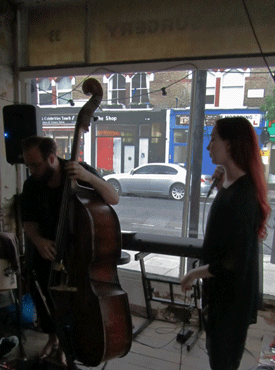

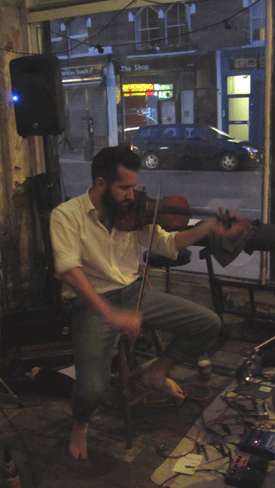
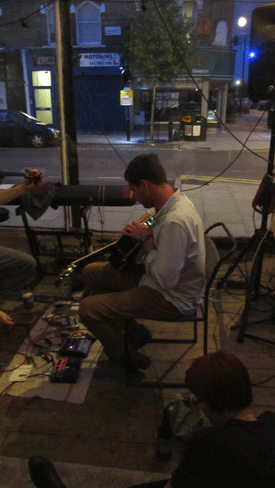
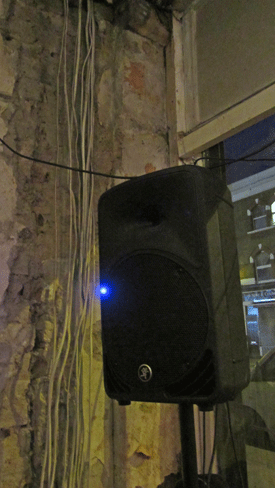
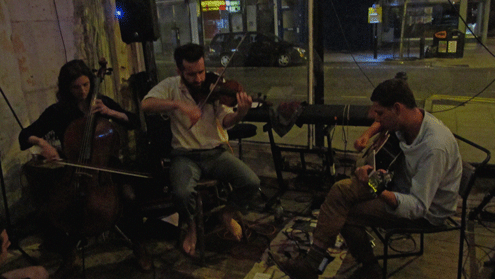
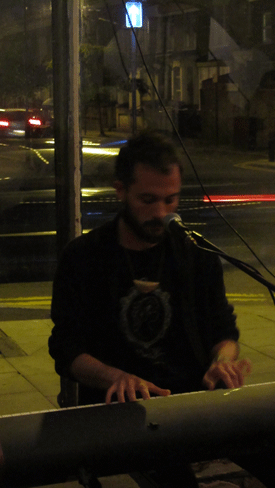
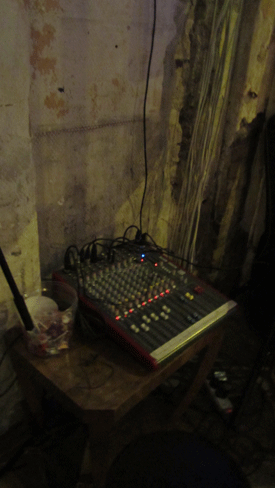



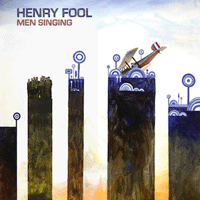




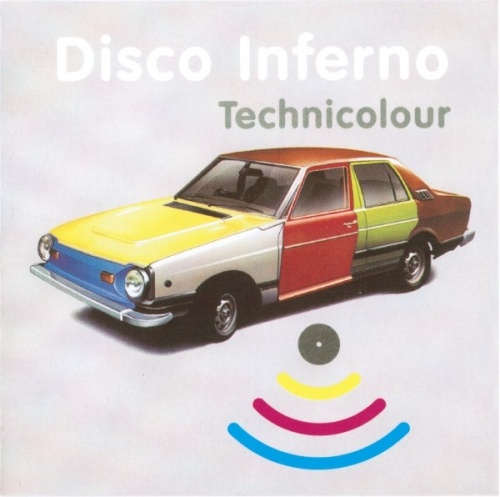
 Misfit City