Although they’re young enough to be touching down for a 2012 debut, what Tonochrome ultimately resemble are a gaggle of 1970s rockers: ones who’ve been lucky enough to see the future only to then forget three-quarters of it, but who are doing their best to catch up regardless.
A scattered glut of pop knowledge and ambition is their fuel. From the central framework of Andres Razzini’s guitar and buttery soft-soul-inspired vocals, they hang a succession of overlapping musical approaches. Each of these is played with vigour while it’s in place, but is tossed aside as soon as a song’s over, or even before. The wardrobe in Tonochrome’s memory palace must be bursting – every visit there would be a swan dive into the mental equivalent of a mass of silks, jeans, capes and feather boas. This layering of ideas and styles (and the band’s restlessness as regards taking a final form) ensures that Tonochrome fit right in with the swarm of post-progressive rock bands that are currently rising to attention: but while they do share a member with Knifeworld, they have little in common with that band’s tumultuous and knotty psychedelia. Similarly, they’re not a band who wear their diversity like a fuck-you T-shirt. In spite of their restlessness, they never play with grate-and-chop disruptiveness.
Instead, they’re a much smoother proposition, like a slightly proggier Tears For Fears. Not in terms of Orzabal and co’s melodramatically distressed New Wave beginnings; Tonochrome are more in tune with the confident, eclectomaniac soul-pop version which came later. It’s the flair, or the flare; the way that Tonochrome (all of whom play beautifully and bring plenty of ideas to the party) can flickeringly recall both Bolan and the Buckleys, blur into a Beatles singalong by way of both Genesis and Alexander O’Neal, or take flight over a pulse of Spanish-flavoured funk. Whatever’s going on with that wardrobe, there’s also a feeling of curtains sweeping up and away and down; theatrically introducing new ideas, new burnishings.
Theatre – that’s appropriate. At root, Tonochrome’s songs are about performance and the battle with fear, that way that “time moves on, / slaps in the face.” Andres sings about launching, about halting, about taking or surrendering control: Let It Begin is a personal call to arms and activity, shuffling a lyric full of shows and races, walls and spectators, push-buttons and puppet-strings. Musically, it’s the ’70s as seen though the ’80s. Andres and Charlie Cawood chop out a hairy chug of hard-rock guitars, Steve Holmes’ kinked synth lines find common ground between P-Funk and Marillion, and Andres enjoys a luxuriant soul-man sprawl across the choruses. A soul song realised with prog methods, it settles into a lively stew of pop. Mike Elliott plunks his bass like a funky cello and sings along: someone else plays water percussion. From the clapalong riff that adds wiggle to the rhythms, to the squishy breakdown in the middle and the carnival-drumming finish, there’s enough on here to front a parade.
It’s a fine and confident opening; but that nagging sense of unease remains, however many musical layers the band run through their busy fingers. Eerie swerving Ebow lines cry whalesong trails through Waiting To Be Unveiled (a leaner, gliding cousin to the long-lost bewitchment of Levitation’s Even When Your Eyes Are Open). This time, Andres sings quietly and with trepidation: “The unknown may be terrifying, but it’s got such a pretty face. / No one can predict the future, / but I’ve got an ace…” The payoff, however, is pure heart-on-sleeve ’80s pop, vocals melting and caroling around a resolution: “I will abdicate my kingdom / for a chance to see the world.”
Starts And Ends sees Andres stripped of his band’s protection. Alone and shivering, he creates a haunting drape of melody with a lonely echoing electric guitar, a slow-falling ladder of jazzy chords and a rattlesnake breath of percussion. He sings of self-reliance (“on this road I’ve known / those who wait for signs and cues. / Trudging on, stones in their shoes… / By the side of the road / let go of heavy loads – / all you need is here,”) but the wound in his voice belies it. Throughout the EP, he works around the paradoxes of hope and fear. Necessary spurs, or killers of initiative? Blinding deceivers, or inspirations?
Andres is still puzzling it out over the Buckleyesque minor-key figures on Gods and Demons, wrestling with conflicting directions even as crunchy Jefferson Airplane choruses and slithering Spanish rhythms kick in alongside a fax-machine witter of noise guitar. On Punctuation Marks, he protests “I’m half-way and see no starting line” over a zip-and-dodge acoustic guitar as the rest of the band pass a swirl of r’n’b, prog-synth and shimmer-pop ideas through a storm of psychedelic noise. These doubts fit into Tonochrome’s world like their own teeth; like all of the varied influences the band’s spread of members weave into their tight and poppy rope of songcraft; just as this EP could be the harbinger of a solid career of eclectic rock if Tonochrome hold it together, or an early omen for a set of promising solo careers if they don’t. We may doubt, we’ll certainly hope. We’ll see.
Tonochrome: ‘Tonochrome’
Andres Razzini/Daniel Imaña, AR001 (610370590232)
CD/download EP
Released: 31st July 2012
Cceruleann’s previous, provocatively-titled pop single – ‘Fucking Wind‘ – seemed to be playing games with us. The soft, romantic sound versus that crude title. That sugary innocence, prancing onwards; oblivious to a silent looming hammer of anger. When I heard it, I thought it was supposed to be listened to from outside – that it was about the fury we sometimes feel towards the complacent and self-centred. It was as if the song had built a gun to point, teasingly, at its own head.
Hearts Stop doesn’t play the same shifting cards; but there’s still an odd, artful twist to Cceruleann’s songcraft, which means that anything even slightly unusual about them becomes loaded with significance. The fact that babydoll-voiced singer Marilyn and instrumentalist Elliot are siblings; that they live half a globe apart in Denver and in London; that together they’re writing these peculiar, minimal and contradictory electro-pop songs with their pretty little coatings… All of it adds to the uneasy allure.
This time, the artwork is a swarming beehive. Marching on an incongruous, thunderous hip-hop drumbeat and tuneful electropop bleeps, Hearts Stop is built around a slim haiku of lyric which Marilyn chants against a skein of wineglass warbles: “We can fly forever, / but we will fall when our hearts stop. / The fall will break us.” During the breakdowns, her multi-tracked voice twines coyly around itself, as new blips and patters worm their way into the skein. A distorted female laugh bubbles up in the mix, and stays there. A sampler dices and hiccups out the song title (two-and-a-half syllables of the haiku).
It’s as simple as that. And maybe it is as simple as that. Maybe there’s no more decoding to be done, and the bees are only wrapped around the single for effect. Maybe Cceruleann have just written another synth-pop anthem about love, broken hearts and death in the overblown way it’s supposed to go, so that we can keep singing songs about it.
Unless, perhaps, Cceruleann aren’t singing about love and heartbreak at all. Perhaps they’re actually making a point about work and obsession; about how we’re driven on by what we believe we ought to do, whether it’s grinding our lives to dust in a thankless job or slowly crushing ourselves to exhaustion against people and causes which simply don’t love us back. In this light, the song shifts into something different and more ambivalent – a sweet-sounding lemming-march, a chant for the worker bees who strive until they stumble and end and are swept aside for the next ones. Perhaps I’m imagining it. If so, it’s only because I don’t ever quite trust Cceruleann to play straight.
The effect is similar to one of those pocket mandalas you pick up at weekend markets. Do you know the ones I mean? Those little spheres of interwoven articulated wires which, under simple pressure, reform to flat discs; or extrude themselves out and around to form new, near-identical spheres with tiny spatial differences.
In such a way, Delicate AWOL have turned themselves inside out – the old shape inverting and realigning within itself. The blunt, metallic math-rock dots and points remain, as do the little axe-blows of guitar and the keen, floating intelligence. But the hard-bitten, streetwise urban perspectives they displayed on ‘Random Blinking Lights‘ have been flexed away, replaced by a blunted pastel sleepiness. Their music used to fit the sullen sludge of London’s clogged traffic arteries. Now it sounds as if it’s drifting through an endlessly attenuated suburban daybreak: through sleeping ranks of tidy little white subdivision houses, stretched out along the fringes of some anonymous American town.
None of the above is a slag-off. Yes, Delicate AWOL have retired their striking Throwing Muses-versus-Laika qualities of nerve, and have replaced them with the oddly narcotic soulfulness and dusty whispering you’d expect from Low or Cowboy Junkies. No, this is not a bad move. It’s allowed their minds to work in a different way, letting their thoughts seep out instead of being propelled out onto tape.
Warm, intimate, laden with clinging morning torpor, Hurray For Sugar lilts and tilts like a girl on a lazy swing; Caroline’s voice stroking your floppy ears, a lone glockenspiel tingling out a little scatter of light. “Arise, you’re waking – hurray for sugar. / Aware, a little – hurray for coffee… / beside your body, catherine wheels spin.” And even if the guitars have a clotted sleep-dirt feel to them, this is still a song about vision; or about the moments of utterly unguarded perception which adhere to the sticky margin between sleeping and fully waking. “I breathe in, I open the curtains. / I look outside at my neighbours, / behind their fences… such radiant faces.” A lovely piece of work, shambling like a sated and drowsy lover.
Having reabsorbed their 40 Shades Of Black instrumental alter-ego, Delicate AWOL express it again in Camford Heights: which sounds like a sort of Sonic Youth picnic for the close of a West English summer, the sun slanting away down the back of a sky like a rumpled sofa. Blunted, slurred jazz chords and round, resounding Manchester bass carry the tune, completed with casual drop-in visits from all kinds of other fellow travellers: Mogwai all stoned and finger-mumbling a cryptic chant off their massed steel strings, a young Adrian Belew in noise-haze mode, Frank Zappa adding a dirty air-sculpture like a colophon of smog. Before it’s over, Delicate AWOL have passed through a bewitching slew of guitar sounds: passing train bells, crashing wires, the music of pylons in the wind. From wan, sweet daybreak to dusty, sun-stupored dusk, they’ve got it all covered.
Delicate AWOL: ‘Hurray For Sugar’
day Release Records Ltd., DR106 (no barcode)
Vinyl-only single
Released: 2000
Buy it from:
Long-deleted – try to find this second-hand.
Beyond their knack for epic, florid rock melodramas, Muse-style (as heard on their 2010 EP ‘Fear’s Fall‘), there’s more to Evolutia than attempting to hone a journey into the heart of arena-rock. On the surface, Andrew Barnhart and Stephen Cameron are clean-cut multi-instrumental prog boys, verging on AOR. Underneath… not so much. Their love of dynamics, electronic fuzz and dubstep; their occasional digressions into piano-and-laptop sketchpaddery; the suspicion that some of their more outré and full-blooded vocal moments are more cabaret than rock club… all of these things make Evolutia a more interesting proposition.
In the run-up to a long-delayed debut album, they’ve popped out – within a single week – two syncopated new songs owing more to Ben Folds or to prime-period Stevie Wonder than to the shriller rock noises of Muse, Mew or Queen. Staunch prog fans may smell a rat – personally, I smell flowering. It sounds as if Evolutia have learned to please themselves, rather than just expectation; and in the process have upped their game a few notches. Hooray to that.
Out of the two, it’s Objects Aside – with its fancy footwork and vein of darkness – that bears the resemblance to Ben Folds. Stephen jags and dominates with a syncopated, flouncing curl of piano lick. Andrew tack-hammers it with a bass guitar line that’s part Rush, part snap-funk. Both of them fence around the rhythm; occasionally, they haul in guest drummer Zach Branff, gang up on the rhythm altogether, pin it against the ropes and pummel it with Uzi beats. Kneading furiously on a bass synth,Andrew half-sighs, half-growls the lyrics. “We take what we get, climb to the top of it / Throwing objects aside to the left and the right / ‘Til we see the light.”
I’m not sure whether all of this is about greed or about looking for something better than toys’n’favours. It fits both. There’s a tangle of frustrated persuasion working its way through the song, too (“It’s useless, I won’t give up – you’ll come around.”) Later on, Andrew and Stephen share the singing on an aspirational bridge, assuring us that “this darkness will never come, you’ll see that we’ll rest in peace. / Your heart’s buried in secrets that you’ll uncover eventually.” Briefly, the lighters come out. Mostly, though, this is about dancing aggressively, up on your toes, on unfriendly ground.
Evolutia: ‘Secret’s Safe’
I made the mistake of listening to Secret’s Safe on headphones in the dark. Within the first forty seconds I jumped up, thinking that I was being burgled. This song has the best creaky-door sample since Thriller – unexpected, sliding mockingly through your head, ending in a sly lock-snick. It sits edgily against what’s otherwise a bouncy, funky shuffle, a latter-day Higher Ground. It renders it suspicious, as if someone was rifling your mind while you danced.
It’s certainly a ridiculously danceable song. Andrew’s laddering virtuosic bass-guitar riff skips and spirals around a pulsing tower of synth bass, while Stephen’s crunched-up electric piano stabs and bounces underneath. It’s also Stephen singing, in his clarion tenor, about trust and exchange. “You got something that you’re hiding; you’ve gotta make me believe. / Showed you mine now show me yours – / stolen whispers are the key.”
Actually, trust doesn’t come into it. This is all about coercion and manipulation, and it grows ever more slightly mocking as it swings onward. Stephen shifts in and out of character, between wheedler and withholder – “Promise not to tell / There’s nothing like a little pressure / You know I’ve kept it well / Lips are sealed forever.” While sometimes the song delves into the pressures of keeping things unspoken (“trying to get back the beats your heart skipped”) the payoff is power. “Your secret’s safe with me,” Stephen sings, before adding, in an aside “(She’s got nowhere to go.)” Stealth breaking-and-entering.
Another summer with Knifeworld: another EP with everything on it. If Kavus Torabi was a builder, rather than being head Knifeworlder, he wouldn’t simply build houses. He’d build deliciously awkward crenellated wonders, with Escher staircases and extra rooms poking out into the street two floors up.
As it is, Knifeworld songs never sound as if they started with an earnest bloke strumming away on a stool. Instead, they tend to sound like a gang of scruffy tattooed pixies, busily hauling down a fairy castle and squabbling over the work-shanties. The final outcome tends to be an almighty and skilful art-rock mashup, with horns and bassoons poking out of it every which-way and strangely kinking, spiraling spines of rhythm and harmony locking it all together. You could never accuse Knifeworld of being parsimonious with their music. That said, the amount of musicality which the band can squeeze into their songs is only one of the factors at work.
It’s almost a shame to digress from the sheer fun at play here, from the helter-skelter confection of Knifeworld’s riffs and melodies and the visual humour they’re now bringing to their video work. But it’s important to realize that across its three songs the ‘Clairvoyant Fortnight’ EP actually deals with some pretty serious matters – faith, grounding, mistakes and the business of building a life. All of this might be filtered through eccentric and kaleidoscopic wordplay; but whether expressed via the galactic prog visions of The Prime Of Our Decline, the magic’n’showbiz gabble of the title track or the dancing grumbles of In A Foreign Way, these songs are about spinning something solid out of flim-flam, and gaining the right perspectives.
Under its festoons of decoration and past the hither-and-yon dash of its scurrying melody, Clairvoyant Fortnight itself shows that Knifeworld can compress their strategic wildness into something approaching a catchy single – albeit on their own unusual terms. Half of the time the song sounds like an amalgam of various tasty and tuneful things that shouldn’t fit together but do – XTC, Motown, The Flaming Lips, a dash of 1950s finger-clicking and a brief twist of rapping. The rest of the time, it sounds like an Edwardian fairground carousel trying to slam-dance. Meanwhile, the lyrics are peppered with all manner of mystical, supernatural and hippy tropes. “Well, I’m in a relapse – everyone looks like I did when I was sixteen, yeah?” snipes Kavus, name-checking third eyes, second sight and Ouija boards alongside prophets and scripture.
Grousing and arguing as he sings, Kavus is torn between scepticism and credulity throughout. While he’s clearly implying that there’s little difference between cheap, narrow parlour magic and other forms of belief, he also recognizes the gravitational pull of the supernatural and the way that so many people use it to blot out or cure boredom, uncertainty and terror. In fact, he’s wrangled all of this into an oblique love song, embracing challenge, partnership and natural change as a better way out. “I never felt like giving up before,” he admits, towards the end. “You wrecked my life, but you gave me more… I dig your voodoo and I dig your vibe – I really think that we could make it.” He seems to be suggesting that as much as you choose your own poison, perhaps you choose your own magic too.
There’s plenty to be said about The Prime Of Our Decline. Most simply, it’s unabashed nu-prog done right, from its flamenco beginnings and sea-shanty lilt to the Zappa-meets-Yes riffage, the jumping glockenspiels and the dancing Gong-honkery when it gets up to speed. I could wax lyrical about the slippery percussion allsorts and the stellar rattle of Khyam Allami’s Brufordian snare drum; or about the cheeky burst near the end when the band briefly channels multiple ’70s prog bands in rapid slice-and-dice succession. Throughout its seven-and-a-half minutes, the song also keeps its streamlined shape – as slick as any pop hit you’d care to mention, its tricks with meter and texture cunningly sheathed within a hurtling, bell-swiping, sing-along whole.
Yet this too is a song about footholds; about grasping (and grasping at) your place in the universe. Knifeworld have a knack of dissecting difficult feelings via swirling psychedelic sleight-of-hand – this time, astronomical. Even as Mel and Kavus yammer about black holes and passing stars, their sunny-sounding chants are shot through with evocations of hubris (“we could foresee the day / when nature would bend to our will”), lonely voids, being cast adrift and self-disgust (“orbits and revolutions of the heart / have changed me into something I hate.”) They might be playing at being starchildren, but they’re still weighed down by dark matter.
Somewhere between these two songs there’s In A Foreign Way, a stately chamber-pop jig wobbling under sideswipes at its metre and batterings at the foundations. As the band hack and bounce, the melody doggedly maintains its rhythm, like an Irish matron under attack from a gang of larky Newton’s cradles. Appropriate: underneath the avant-rock fun (including the brief injection of a slice of Henry Cow) this is a song about the frayings and fixes of middle-age.
Kavus frets and kvetches as things unravel around him, old bungles come back to plague him and the familiar becomes blurred. As he does his best to perform running repairs, a chant circles his head – “Where you up to, where you up to, where you up to?” to which the resigned reply is “halfway…” It’d be grim if it weren’t for the zing of the music – stippled with tuned marching-band percussion and the clatter of brains happily at work. That’s Knifeworld for you, though – few bands make it so evident that the sheer joy of music can always salvage something from the darkness.
Knifeworld: ‘Clairvoyant Fortnight’ Believer’s Roast, BR008
CD/download EP
Released: 11th June 2012
Buy it from: (updated, May 2015) Original EP now deleted: all tracks are now available on the compilation album ‘Home Of The Newly Departed’.
So they’re trying on some sparkle, now? The last time I heard Matt Steven’s improv-rock trio they were lurking and cruising somewhere in the loose territory between bluesy prog, smoky space music and easygoing math-rock. They were promising, but they weren’t upsetting much: their initial statement was more of a drawl than a grand pronouncement. However, having shambled forward and established themselves, The Fierce & The Dead are getting down to more serious play. Ideas that were only hinted at last time, down in the small details, now wriggle forward.
For starters, 10×10 itself scrunches up and throws away the idea that this band is just Matt Stevens and pals. Bass player Kev Feazey, a solemn support musician on the band’s opening shot, steps up and all-but-leads the band on their second. His slithering springy bass line, full of New Wave funk, recalls both turn-of-the-’80s Talking Heads and long-lost London math/surf rockers Kenny Process Team: gentle arty neurosis, pinned to a love of groove. A spluttering, stuttering synth break adds a raw danceable edge.
Meanwhile, Matt is quietly at work all over the background – catching a surf of noise in the distance, opening out the landscape beyond with torch-beams of sustain guitar. Some looping, arpeggiating guitars dragged along after the bassline draw their drive from a long-gone, edgier New York: skitchers grabbing velocity from a speeding car, or Robert Fripp’s cyclic proto-‘Discipline’ Manhattan patterns. There’s even a dash of rave dynamics as a delicate, dewdrop-fine piano break spins us around for a look at the dawn. In the cloud of “post”-widget names that swarm around art-rock music these days, pick “post-glum”.
The second track, Foreign Languages is even livelier. A blues-rock grind on bass over mechanical drums; spankingly sharp fingerpicked guitar and a bubbling, ground-shimmying feel of dub.An old ‘Galaxian’ game in the corner of the studio seems to have joined in too, adding zips and lassoos of gurgling analogue sparkle. There’s a tremendous sense of free play – old familiar elements reshuffled and re-zested, and looked at afresh. Since ‘Part 1’, The Fierce and the Dead have recharged their time machine, and now skip merrily between the dreamy psychedelia of the ’70s and the boggling pluralism of the post-punk ’80s with ease and a yen for reinvention. Where next?
The Fierce & The Dead: ’10×10′ Bandcamp
Download-only single
Released: 4th April 2011
In love and on the road: it should be sweet. Instead, you’re continually waiting to be wrong-footed.
First, there’s the music – electronic dream-pop of a multiple-nostalgic kind. The tune is balmy. The blipping synth lines, the crude keyboard beats, the hiccuping voice cut-ups are all from ’80s sample pop. That dazed, wet-gossamer female vocal and the smudge of stretched-out organ goo (swirling from speaker to speaker), draws inspiration from shoegazery and similar blissful-nauseous mid-’90s psychedelia. The puffed hints of melodica and the yawns of bass swim in from first-generation post-punk; or perhaps I’ve just been drawn into the dream, and am imagining them.
Then there’s the song itself. A girl in a car, savouring the moment, coos the simplest, most sugary lover’s line. “It’s OK, baby, don’t worry / ‘cos we’re driving with the summer breeze in my face.” That’s it. There are four more words in the entire lyric, one of which is “ethereal.”
Finally, lurking around the corner like a mugger-in-waiting, there’s that blunt instrument of a title. It’s already plastered all over the cover art. You keep expecting it to come down hard and smash the reverie. Or, alternatively, for everything to turn metaphysical and carnal as the gale hits, the cuteness ends, the car pulls over and everyone starts rutting in the back seat.
For something so light and fluffy on the surface, Cceruleann’s debut single throws up plenty of confusion. Even more subtext gets plastered in when you discover that the band are a brother-and-sister duo (instrumentalist Elliot, singer Marilyn). If I were you, I’d do my best to ignore that for now. In some ways, that’s easy to carry out: though moving together in musical step, Elliott and Marilyn sound as if they’re musing in different worlds. Along the way, some of Marilyn’s words are caught up and shredded, then tossed like happy litter in the wake of the tune. As for that title, it never arrives in the song. The f-bomb remains undetonated. Have they scammed us? Did they just get sick of their own song and punish it with a sarcastic name?
Or perhaps we’re looking in the wrong place. Maybe the real story is about the other person who’s out on that drive – perhaps listening to this endless burble of contentment and seething, their knuckles clenched white on the wheel or wrapped tight around the knees, wondering once again why it’s so impossible to see how another person sees, to feel their feelings, comprehend their tastes… even to understand how you can get through a single day of being with them anymore. Maybe the romance of the playful summer wind is lost along with that. As it teases and strokes at cheekbones, perhaps on the other side of the car it’s whipping petulantly at a cowlick; and while fringe blows aggressively into eyes, and as love heads into the sour spot for good, perhaps something vile is being muttered into that uncaring breeze.
“Oh, hello, / I’m a never-ever-let-it-show – / But I know that you know. / Maybe I should let it, let it show…”
On past evidence Elephant have a knack for drawing us in while admitting to little. Their debut single mingled dream-pop with reggae and industrial chill, and cold electronics with fairy-tale flashes. They ride on a solid understanding of black pop, yet constantly swerve away from it into Euro-cool whiteness. They readily confuse, and they excel in oblique feelings – perhaps they can’t help it. Amelia’s blank singing, their aloof and obscure post-punk textures, their taste for quick-cut lyrics and surreal, visual word-imagery… while their work so far is memorable, all of it’s a conundrum. Yet for a moment, on this second single, everything is clearer.
With only the subtlest indie-pop bleachings and dream-pop shadings, Allured is an R’n’B piano ballad: plain and simple. There’s the deep, minimal support of bass. There’s the gaps, space and swat of a heavy-lidded slow sex-beat; the sparse flick of tambourine like a shimmying skirt-fringe. Essentially it’s a slow jam that’s strayed out of the dance club in its heels and skintights, taken a wrong turning past the taxi rank, and been painlessly swallowed by Elephant’s dreamy way of doing things. In the video we watch as voyeurs as Amelia and Christian languidly nuzzle and smooch each other – lengthily, and uninterruptedly. Either they’re answering that “are-they-aren’t-they?” question that’s hung around Elephant since the beginning, or they’re very committed to the world of this particular song.
Whether Elephant have simply been infected by R’n’B’s outright and intoxicated sexuality, or whether they’ve swallowed it deliberately, is open to question. I suspect the latter. Few areas of twenty-first century pop haven’t rolled over and submitted to R’n’B’s sweaty vigour and its gobby, blinged-up sex’n’suss’n’opportunity confidence. While some diehard indie-poppers might still scream and scrub it off; or cling to older schools of soul, Elephant see a good thing and slurp it up, embracing and engulfing it in their turn. So here they are, reaching out greedily into the wide-open mainstream while happily sunk in obsession, drunk with sensuality.
Only the lyrics retain that peculiar Elephantine distortion. Amelia rolls the words around on her tongue, dabbing them with glottal stops and her own strange short-circuiting shifts of accent or syntax, whether wriggling into a tangled lick of coyness, circling orgasm (“our own anatomy, so I find the path – my brain / it carousels instantly, drives me to insane,”) or swimming in a stupor of surrendered identity (“I dreamt he’d written me… He took me away, crossed me away from the crowd…”) By rights, this clotted wordplay should cripple the song. Instead it lolls sexily across the beat, as if on the brink of falling out of bed.
Then the B-side – Actors – throws us right off the scent. Same old Elephant; entirely different set of clothes. Rather than the wallow of bass and beats, here are acoustic guitars on the strum, a skinny ice-rink organ, and a dose of fast-paced pop soufflé which chuffs around its drum track like a toy steam train. It’s a tune for people in mini-dresses to run around Paris to, or chase summer bicycles through Spanish Harlem. Once again, Amelia’s dazed delivery and tangled string of lyrics ensure that it keeps the Elephant stamp.
It’s anyone’s guess as to what she’s singing about this time – “hop around aimlessly, simply surrender to time. /Animations out past under the feet, imitating a shadow spine.” Somehow the words fall into place as she sings of paying the rent “with a monogram eye” or murmurs about “the highest apple in the tree.” Perhaps, like many of the best and sexiest club hook-ups, it’s just a happy accident.
Elephant: ‘Allured/Actors’ Memphis Industries, MI0193S/D vinyl 7″/download single released: 18th July 2011
The Many Few don’t exactly do precision. One guitarist slops acoustic rhythms around like a drunken waiter losing control of a tray. The other doodles away cheerfully, or hiccups free-improv dribbles in a corner. Sometimes both of them land in the same song. Meanwhile, two singers are jostling together: Johnnynorms (he of the small, dry voice) and Melissa Wyatt (who aims for creamy breathiness and theatrical intimacy but ends up kittenish and blowsy). The drummer pins everything together, but worries and wobbles over anything more complex than a mid-paced chuff-along. The bass guitar stumbles vaguely after the other instruments, distracted by a nearby jazz gig.
Unless they’re deliberately deconstructing their pop, or unless they record only while cheerfully drunk (both of which are possible), The Many Few are a thorough fucking shambles, and I think they know it. Do you think I’m going to bury them for it? Hardly. That tumbledown, lopsided indie-pop stagger is integral to their approach and charm. You can toss in those usual Syd Barrett and Captain Beefheart comparisons (you know, the ones applied to almost any wayward indie band who ramble outside the beat a little) but The Many Few are far too friendly and floppy for that. In their cheery, ramshackle way, they sound more like ’90s nouveau-skifflers Zuno Men… if the latter had been stuck in a house-share with a teenaged Kate Bush and spent most of their time half-cut.
You could easily imagine them all sprawled over a tatty sofa – arguing over the washing-up, loving each other and picking over the usual daily scams of living together. You can imagine them hurrying off, at any opportunity, to the local pub for the kind of lock-in which ends in howls of laughter and wrestlings over a battered old board game. I wouldn’t want to be the one to try getting them organized. It would only spoil it. This scraggy comfort must have been all over the making of this enjoyable batch of songs, which they call “armchair surrealisms” and I’d call animated scrawls, as cosily misshapen as candle stubs.
On the irresistible Catching, Johnnynorms repeatedly starts off on a story, only for Melissa to barge in and take it over. As all of the stories are about naïve men making comically doomed attempts to win over smarter women, this is only appropriate. Wonky high-life guitar ambles around like a cheery woodpecker as Melissa teases “I’m sorry but she had a child when she was young / and she’s not catching that from you”, before announcing her intent of fleecing some other poor bloke for all he’s got.
The upbeat Sweep and Swipe (part genial commuter-belt revolt, part kid’s TV song) bumbles through work, procrastination and rebellion in a very British jumble. There’s a sense of urgent feelings swaddled up and hidden under a brittle, chirpy exterior: something which this song shares with another, Typical British Weather (itself tipsy, woozy and smiling a crooked smile in the rain). It’s left to the messy, chunky power-punk of Meet my Clone to sideline the shambling and the evasions via dirty guitar, a tight irritated momentum and the band’s most ingenious idea. Johnnynorms and Melissa wrangle over the doppelganger relationships of people grown close in appearance and habit, but not feelings: “Eye to eye you’d think we were the same. / But it’s me that feels all the guilt, and rage, and love, and shame.”
Past the 18th Town is entirely different. A haunting acoustic dirge touching (in the briefest of sketches) on transient people, it follows them as they move from rented room to rented room. As old roots fade and new roots become stunted, they lose their ability to recognize and return love. Tingles of guitar harmonics tickle the nerves while the band capture a world of disengagement in simple, telling lines like “send the letters on, / send them back unknown.” It suggests that the ghost of a cold and lonely wind, blowing under that gap in the door, sometimes haunts The Many Few’s sprawling house party.
The Many Few: assorted Soundcloud demos Soundcloud (no catalogue numbers)
Free download tracks
Released: various dates in 2011
Band named after large thing actually sounds small. Single named after tiny things suggests that small-sounding band (named after large thing) could go massive. Sometimes I love pop’s ridiculous anti-logic.
Elephant are two. Christian Pinchbeck coaxes noises out of computers and wrangles chittering textures from guitars. Amelia Rivas plays old sounds on modern keyboards while swimming and sighing distractedly through the middle, avoiding eye contact. It’s synth-pop, allegedly, but it’s also nothing quite so obvious. Amelia and Christian may or may not be a couple, but that’s not clear either. With Elephant, not much is.
Ants is Elephant’s debut single, and it spends its three minutes cunningly, surprisingly persuading various things that shouldn’t work together to cosy up and make something which does work. A gentle reggae bounce, a dribble of whiter-than-anything psychedelic guitar direct from Cocteau Twins; a roughed-up reedy synth figure like a bass accordion with hiccups. As for what the song might be about, it’s somewhere between love-gone-wrong and epilepsy; like David Lynch reimagined as lovers rock. “I’m tired and I’m bruised for you,” Amelia murmurs, moping elegantly across the backbeat. “The war that I fought made my body contort… I’m down in the black, and I’m blue.”
When we talk of indie-pop being sickly, we usually mean that it lacks power. Here, sickliness is power. Unease and disease blend together, reality is erased by symptoms, and experience is somehow amplified by the giddiness and blank alarm. Throughout, there are references to buckling knees; to floating and amnesia and jump-offs; to falling to the ground or into song. Even the chorus avoids clarity in favour of hallucinatory warp (“Ants now scurry on the floor, / I just can’t remember before,”) with all perspective thrown right out-of-whack. Yet Elephant snatch a victory from these flashes of confusion and disaster, sheathing them into a subtle, catchy, play-it-again heartbeat of song; a cool, black-and-white flicker of distress call.
While Ants cloaks strangeness under bits of spooky washed-out reggae ballad, its flipside Wolf Cry goes for out-and-out surrealism in a stream of Bunuel electro-punk. Amelia sings of seasons, seafarers and parted lovers. Deeper into the song, she jinks these acid-folk fairytales into blurred dreams of power struggles, throwing out images of hunky aristocrats or “militants on the roof.” Everything hangs together – precariously – over Christian’s alienated instrumental bonework: a flat backdrop of flat echoing skitters, deep red bassquakes, ghostly chords and spray-can snare hits. As the song riffles balefully through its repertoire of cinematic flashes, impressions build and cut (“the ticking of a clock, jumps to interior,”) or flirt, archly, around games of obscurity (“we all wear a mask to a fellow passer-by.”)
Ultimately, Wolf Cry comes apart in the fingers if you squeeze too hard (the strange syntax, the dodging of plot, their mingling of seduction and avoidance) in much the same way that the story of Ants comes to us half-melted. Elephant have a knack for this kind of anti-logical play, squeezing into the gaps in the story. Besides, they’ve already demonstrated that they’re masters at magicking something coherent out of disorientated fragments – not least via a fine mournful tune or two. Evasive or not, they’re very much in the room. I suspect that I’m going to go on talking about them.
Elephant: ‘Ants’ Memphis Industries, MI0172S vinyl 7″/download single released: 17th January 2011
Testing to destruction. For some, this isn’t a harsh and necessary process, but a judicious way of life. For the floating, ever-mutating alliance of centrozoon (magisterial touch-guitarist Markus Reuter and synth-bumping/pad-thumping lateral thinker Bernard Wöstheinrich) it seems to be a shrug of nature. Either that, or a compulsion. As centrozoon add to their body of work over the years, they’ve studiously avoided clinging to previous methods. Instead, they function as a kind of art-rock Laputa – hovering briefly over various musical terrains, dropping down tendrils to slurp up flavours and approaches. Despite their bone-dry sense of humour, they’ve always remained a little detached and aloof.
At the same time, centrozoon are driven hard by cryptic fascinations of their own, including their vigorous collision of schooled technical approaches and wild, derailing instinct. Their music has always been bipolar and simultaneous. Crude synth presets are embedded into beautifully-fashioned electric textures; ravening, artful touch-guitar solos play off the blunt wallop of electric whack-pads. En route, centrozoon have explored majestic dark-ambient drift music, ridden the clattering back of gabba techno (while flaying it to within a microtonal inch of its life) and spent time as rhapsodic prog-inspired melody men. In the early 2000s, they borrowed the lissom voice and hooded lyrics of Tim Bowness (on furlough from No-Man) to slide smoothly into a song-driven world of art-pop. Equally smoothly, Markus and Bernhard subsequently hit the eject button in order to reform as an introverted chamber electronics duo. Every time centrozoon go public, they’re different. Every time they seem to settle on a final format, they discreetly blow it up and start again.
Ultimately, centrozoon navigate their increasingly risky game of de-build and re-build by trimming back everything that they’d otherwise need to defend. They explode their identities as musicians to become a diffuse spray of wandering cells. They reduce themselves, once again, to enigmatic minds on the prowl; and now they’ve delivered the most abstract and challenging record of their career.
Emerging after a period of diversion, scatter and relative silence, ‘Boner’ suggests that it’s becoming increasingly pointless to define centrozoon‘s work as a clear interplay of individuals. Instead, their work has become a kind of willing entanglement into which each man – somehow – disappears at full volume. Suitably, the contributions of the band’s current third man Tobias Reber are mostly sonic collage (drastic laptop sound-mangling, heavily processed field recordings, occasional blurts of absurdist lo-fi vocal). With both Markus and Bernhard now enthusiastically jumbling up their own sounds, the band creates an intense and murky improvised electrophonic soup – extreme, exaggerately processed and roaming balefully across unstable tonal centres. It’s both utterly fragmentary and utterly involved. If anything, those interim years spent on other projects have only added to the creative centrozoon seethe, bringing the musicians and sounds closer together.
Where ‘Boner’ stands in the wider scheme of music isn’t clear. Not jazz – there’s no swing here, few melodic rushes or pursuits of harmony, no acknowledgement of pop moves. Not ambient as such – despite the atmospheric swishes of sustained texture, there’s little solid order and continuance, and precious little commitment to minimalism. Something in the drive and stance of the music links it to the far fringes of experimental rock. If so, it’s clinging on by a fingernail.
These new, uncomfortable compositions hang in the air like spasming irises or like nested Venetian blinds: multi-layered, periodically flexing open and shut to reveal new textures and patterns. Ever restless, centrozoon shuffle each and every one of these layers, flying in further sound-fields in the blink of an eye. A dribble of coffee-maker noise jump-cuts to a rumble of bass strings. A radiophonic pot-swoop is overwhelmed by a ringing metallic chord or an imperative percussion thump. In the arrhythmic wander of La Waltz of Kirk, hints of Zawinul tropicalia well through the gaps. On Cervus, ominous and dissonant passages in a classical-minor form recur first as vaporous synth pads, then as overdriven bassy touch-guitar lines.
You could try to cite assorted chaotic improvisers, plunderphonic artists and mixing-desk contrarians as close cousins to this music. However, what remains clearest (most evidently on the rumbles, quick body-blows and Mellotron hangings of Knock Outs) is centrozoon‘s familial relationship with King Crimson. More particularly, with that band’s most left-field improvisations – the atonal busyness of the ProjeKCts; the poly-everything lurch and creak of the ’90s Double Trio (spattering pulped MIDI all over the stage on ‘THRaKaTTak’) and the spidery skitter of ‘Starless and Bible Black’. The post-modern stomp of Markus’ work with another Crimson spin-off – Tuner – is also present. Both Tuner and ‘Boner’ share a hypnotic mixture of harshness and disorientation; an over-arching, out-of-focus beauty; and a grate-and-chop, channel-surfing mixture of signals to pour into your ears. Like Crimson, centrozoon also possess a rigid skeleton of stateliness which glides serenely through even their most chaotic improvised scrambles.
While attempting to make sense of this scattered map, it’s equally important to point out that centrozoon are also exploding the idea of what a commercial music album ought to be. Generally, such things are self-contained musical statements – linked to a point in time, a specific intent and a clearly-defined sales package. In making ‘Boner’, the band embraced as many constructive (and deconstructive) possibilities of chance, reinterpretation and creative dissension as they could. Hundreds of initial hours of free trio improvisation were cut and pasted into new compositions; then a third layer of process was added via two outside remixers, each of whom independently cloned and mixed down the finished sessions.
The result is two twinned but different takes on the final album, with different mixes and track sequences (the Marziano Fontana version emphasising those dramatic cuts and layering, the Adrian Benavides mix more spacious, smooth and chilly). Additionally, centrozoon sell ‘Boner’ in a bewildering variety of packages (via its “Bonestarter” campaign), with diverse extras plugging into the deal like bonus phone apps. Options now include one or both album versions; further choices of formats and downloads; signatures; custom clothing; original artwork; even personal access via one-to-one conversations or touch-guitar lessons.
It’s not that these moves, in themselves, are new. Alternate mixes and reinventions are commonplace, and compositions via mixing desk and improv have been around at least since Zappa. Jane Siberry has offered special-purchase deals with souvenirs and judicious personal access for years. What is new is centrozoon‘s audacity in coupling all of this to such a demanding, avant-garde musical package.
Even without the bonuses, ‘Boner’ may prove to be an incomprehensible palimpsest for many listeners – a palette of capriciously shifting noises and sonic pounces. For others, these same qualities will be a selling point. With colossal chutzpah and confidence – and a disregard of risk – centrozoon are selling the album with all of the confidence of arena rockers touting a singalong blockbuster. Bold, yes – and also pretty funny.
But ultimately, buying one of these bonus-laden ‘Boner’ arrays is rather more significant than buying a box-set edition of a rock album. Those who go for the full-deal set of clothing, decoration and tuition won’t just be grabbing nick-nacks, but buying into a whole centrozoon artistic method: effectively, into a way of life. As a consumer, how can you be sure that you truly own and understand the bewilderments of ‘Boner’ unless you have the Grand Deal with all of the trappings and the chance to press flesh with its creators? Alternatively: if you just own your preferred single recording of ‘Boner’, have you identified its core source, and swept aside all of those commercial refractions; all of those fetish fruits to sweeten the pill?
All of this casts up more questions than answers… as does the album itself. Those who don’t want to embrace the whole Bonestarter frenzy (and ultimately, even those who do) will ultimately find that their involvement will boil down to whether or not they find ‘Boner’s relentlessly abstract, unaccommodating music worth the investment.
Cautiously, I’d say that it is… although I’d add the warning that this music will never be quite what you expect it to be, or what you try to force it to be. Material of this nature is tough to understand, as such – you need to intuit instead, working your way into it. As you’ve seen, ‘Boner’ has already spun over a thousand analytical words out of me as I try to get to grips with its multiple paths and detonated form. Yet my primary reaction to the album is visceral and instinctive.
Beyond the chopped-up structures and the modular marketing, I’m listening to a trio persistently and inexorably falling into the realms of utter abstraction, only to pull themselves back out by their fierce musicality as players and editors. What I’m hearing through the hundreds of shifts and swaps is their determination to plot a course through this humming chaos. The cautious and catlike way in which they place their feet, while otherwise convulsing their music so utterly. The manner in which they orbit and flirt with musical collapse, like a capsule orbiting a threatening black hole.
It’s these things that I remember, past the sing-song AutoTuned rants in Bright Meowing and Smoked Info Monster; past the pocket-calculator seizures of Weak Spelling; even past the jigsaw-puzzle Bonestarter sale of mixed music, time and trophies. It’s this determination that links those fleeting glimpses – around jump-cut corners – of fingers hammering down on strings, keys and mouse buttons before vanishing into the edit.
centrozoon: ‘Boner’ Unsung Records,
CD/download album (plus assorted packages)
Released: 9th May 2012
Your past is a different country. Wander into the wrong part of it and you might get socked on the back of the head: yes, you may have been there before, but you can’t do things in the same way now. At the same time, you’ll find that you’re already changed by having been there in the first place, so you can’t do those things in the same way anyway. Meilyr Jones knows about all this – now – and he’s keen to tell you about it.
Compared to some of the music Meilyr and his band have put out previously – exciting indie pop with an experimental edge rumpling up the sound – Mates is fairly straightforward. In common with many other Welsh pop bands, Race Horses have that Cymric reputation for lateral thinking squatting on their shoulders; but they wear it lightly. Instead of opening up a window through which you can peer into their world, they come lolloping over to meet yours, trailing the odd strange decoration or kooky wristband to colour things up a little.
Mates does start off as exotic process. The title, chanted, is an offbeat factory loop over which the song is assembled: a marimba plinks throughout, stolen from the school music room in order to scatter musical cherries on top. The muscle of the song itself is something of a hiccupping cha-cha-cha, led by the bass. The melody and words, though, make up a cheerful self-deprecating Britpop boysprawl, all big feet and perky singalong tune. It’s a song about being dumped – knocked sideways and woebegone – but it refuses to just lie down and die. The same clever boyishness has kept classic Madness songs fresh since the ’80s (though Race Horses sound as much like a decade-stretching handshake between the Bowies of ‘Scary Monsters’ and ‘Hunky Dory’, even down to the music-hall quirks).
As for where Race Horses find themselves at the moment, it’s in that freefalling zone between “us” and “you and me”, where laws of belief are tumbled over and even geography gets overwritten with new, painful memories. “All the times I used to doubt it / but now I find I’m lost without it” complains Meilyr, groping after a love that’s evaporated and left him staggering. This could be chapter one of a Casanova’s progress, as he seems to have found the first sniff of something he’s suddenly found himself hooked on. For now, he’s still fumbling in disbelief around the ache. “Your words, cold and heavy, / echo down the walls of the place we used to go, / when we were mates.” I know what he means – for me, a particular park in Crouch End is haunted even in bright sunshine, and I still can’t see a shooting star without feeling a twinge.
Still, despite the complaints, Meilyr seems to have already wrapped up the experience into a little eight-syllable summary which he can hold up like a snowglobe – “It cuts, it soothes. / It comes, it’s you,” – and the bouncing plink of the tune sounds more happy than despondent. Perhaps it’s the indomitable bungee-rope of young testosterone. Perhaps Meilyr’s just singing in the sure knowledge that Mates could be one of those songs which make a lot of capering indie pop kids happy during the summer of 2012. Hey ho, the twisted power of love gone splat. Ouch.
Race Horses: ‘Mates’ Stolen Recordings (no catalogue number or barcode)
Download-only single
Released: 9th May 2012
Buy it from: Download free from Race Horses Facebook page.
Out at the helm of Glowing House, Steve Varney is raw, ruffled, hollering and sounds born to run. This is just as well. Trouble is hot on his tail. “I don’t think there is a gauge that will save me – / somehow they overpower gunpowder, like it’s easy…”
The head-up single for the second Glowing House album, Taming Lions is all about the incipient, savage disaster that’s just about to crash down on Steve’s head. The band’s fall-apart folky acoustic noise catches the feeling perfectly. They sound like the kind of band which survives credit crunches, small nuclear wars and the collapse of most of the functional parts of civilization. You can see yawing flashes of light straight through the gaps in the barefoot, wind-tossed rhythms.
Besides the cluck and clunk of Steve’s banjo, the song’s a superb stomping wobble of school piano, Salvation Army brass, foggy rasps of accordion and dirty cello, and someone beating time on a tumbledown shack with a handful of big sticks. (I checked back on this – it’s actually a third of the band playing on church pews. Talk about muscular Christianity…) At the top of his carrying, celebratory bruise of a voice, Steve’s making it quite clear that he’s stuck in a rigged and increasingly dangerous game. “They gave me a ten-minute head start, and they started counting. / I need a top-notch hiding spot I can hide out in. / Don’t be fooled they’ll give you space in the chase for a reason – / they wait for the perfect minute to stop the healing.”
Off he hurtles; firing a cartoon blunderbuss for cover, and to no great effect. They keep coming. As the song bounces on, there are more than a few suggestions that what Steve’s actually fleeing are his own demons, bouncing after him like a tin can tied to his ankle. Not much hope in escaping that way. But the sheer vigor of the band – of the song itself – suggests that they’re people who thrive on this kind of peril and the energy it kicks up. This is enormous fun. Keeping one step ahead of disaster rarely sounded so lively.
Glowing House: ‘Taming Lions’
Bandcamp
download-only single
released: 8th May 2012
This profusion of rock power duos – it must be viral. Surgically-reduced, punked-down, jazzed-up, math-rocking or swampy… they seem to be filling plenty of gaps. Pick one of them out, and it’s usually a drum-and-guitar pairing minus the bass, or otherwise a guitarless bass-and-drum coupling. What’s triggering this? The window-rattling scrunch championed by Death From Above 1979? The teasing-twosome model set up years ago by The White Stripes? Basic economics? The old Robert Fripp idea of smaller, mobile, more intelligent units, which in more austere times may exert more of a pull?
Anyway…
Komatu fit – very loosely and fiercely – the last of these options. A drums-and-guitar duo of Finnish rock improvisers, they’ve set themselves up to be as expansive as possible. They seem to use their lack of a bass guitar as a kind of invisible fulcrum: an absence which they can both pull away from and can curve back to compensate for. Having a bass would just pin them down, render them linear; when what they actually want to do is stretch themselves over every possible angle of orbit. In the absence of those root notes – those stolid map-pins of rhythms and root – both and neither of the two musician strive to offer something else, containing their wildness only by a teasing instinct for where the brinksmanship stops.
Komatsu are also unsentimental about naming their music. Most of the time, number placements will do instead, and you can bring your own interpretations to the party. Neither of the duo themselves are inclined to give away much in the way of meaning. The music itself, however, is anything but dispassionate. Even on those occasions when it turns mathematical, the numbers swarm like killer bees, waiting to plunge into brief resolutions and then dance away again.
Unusually, much of the time the lead instrument is Jussi Miettola’s drumkit. Hinting at and ducking around rhythms more often than simply holding them, his distinctive playing is busy, expansive and never less than exciting. It’s almost – but not quite – free jazz. It’s heavy on the sonic possibilities of the top kit with its dryness and its imperative rattle, sometimes bursting into vigorous splatters of bass drum and cymbal; coursing easily between Art Blakey, thrash metal and points in between.
Guitarist Juha-Pekka Linna plunges his guitar into a mass of loops, mechanisms and pulverizing crystallised distortion. The results run a broad gamut between a taut dry rattle (like spasming rockabilly) and a screeching cyclonic blizzard of rotating noise. In spite of this whipped-to-chaos approach, it’s often him who ends up holding Komatsu’s pieces in shape. His loops become binders – circumscribing the duo’s wilder flights, defining their narrow tones and furiously tight patterns.
On the Intro, fractured jazz chords on guitar wrestle with snare-scrabbling free drumming; an initial spideriness which is gradually bolstered and transformed by smudges of trippy, expectant backwards guitar. This in turn suddenly inflates and hunches up in a blur of warm overwhelming fuzz into jubilant, wing-whirring psychedelic noise. As Komatsu move directly on into First, it’s all swapped for a fold-over of psychedelic guitar echo; chattering in the teeth of an imagined gale, billowing itself out of shape. An expert roaming roll around Jussi’s toms adds another dimension of tension.
As Jussi and Juha-Pekka work away at the piece, it escalates into a panning tornado-swirl of layered guitars and rattling drums, brittle and yet overwhelming in its pent-up force. You imagine a man swinging rocks round and round in a bucket, waiting for that instinctive moment when he can open his grip and let everything fly. This never quite arrives, but Komatsu’s cats-cradle of skittering percussion, controlled screech and speeding draglines keeps you hanging in anticipation until that imaginary gale finally, rapidly, falters and dies.
For Second, Komatsu tone down the surge. A West African-inspired walking rhythm, played out on guttural post-punk guitar, tramps on against increasingly furious stick-and-tom rattles burst from the drums: Jussi’s decisive and pointed breaks make a one-sided musical conversation. There’s nearly two-and-a-half minutes of this dynamic sparseness, and then the faintest whisper of sound creeps in and gradually rears up in a veil-sweep of celestial noise guitar. As this grows and billows to hang above the tune, like a grand valance or a deathly Mellotron chord, the mood grows grimmer. Inexorably, the African stroll is overwhelmed by ever-increasing bass smudges. That Mellotronic chord eventually drives the music towards a waiting cliff. They have a certain taste for threat, then.
While much of hard improvisation sounds like a wrestling match (with cascades and grapples of angry notes) Komatsu’s version is more like a stalking, or an illustration of danger. Places once safe begin to flood. Confusing shadows blight the landscape. Situations turn uncomfortable.
Nothing For Money (the only Komatsu song with a name) broods like a dark Western, Juha-Pekka initially restricting himself to giant Morricone-esque guitar pluckings over Jussi’s uncharacteristically miserly, mathematical pick-out of drum parts. A second Jussi, jazzier and looser, plays against himself in the background, filtering dustily through a radio speaker like a memory of easier times. This, too, is gradually overwhelmed. The guitar begins to shucks out backward swells again. The drumming becomes more counterpointed, more belligerent.
With its uncomfortable, weirdly perpendicular funk-clank full of disassociated fragments (drum points, spacebar chinks), Third sounds like hip-hop might have sounded had it been invented and played by Can. It has an alienating quality: a kind of stern party music, pushing you into painful shapes. Juha-Pekka’s main guitar part is squashed flatter than wallpaper. Another of his lines drags a jangling siren motif up and down. With this spiraling in the foreground, a distant heavy-metal grind (colossal, but given quietness by distance) moves into place, by which time the drum parts have turned metallic too. The finale is an unexpected drop-away into fifteen gurgling seconds of distress call.
Fourth is split into two different and distinct parts. The first part draws on avant-garde ideas from contemporary classical ideas – vicious thunks of the lowest possible piano notes; groans and distracted orchestral growls from the guitar processes. These in turn are bled into chance noises: an airy temple-bell dings and chimes, and there’s the clear close-up sound of someone rolling coins or ball bearings around the studio. Some reflective menace is added by baleful post-rock guitar tinges and ear-filling fog-banks of sub-bass.
Suddenly, Jussi explodes into the second part with a tight lash of cymbals and a stream of West Coast power-punk drumming. There’s a scourge of rapid-strum guitar, at thrash-metal intensity, but without the rhythmic restlessness. Bar by bar, it rises up the chromatic scale while subliminal keyboard figures sketch moving arpeggios behind it, before the whole thing finally hits a crash-barrier of static.
On the final track (which, with typical Komatsu insouciance, is just called Last) the boys let their hair down. A skating buzz of static synthesizer serves as a continuo; Juha-Pekka’s wet and warbling science-guitar figures provide something like a melody. Halfway through, the emphasis shifts and the music morphs woozily elsewhere. The synth buzz become a deep bass drone; the guitar patterns become drips in the background, while the melodic role is taken by whooping varispeed notes.
From brood to fun-ride, sometimes two is all you need. There’s certainly not much missing from this fierce bout of inventiveness.
Komatsu: ‘Komatsu’
Komatsu (self released, no catalogue number or barcode)
CD/download album
Released: 24th April 2012
Be wary of barristas, especially in airy little cafés in quiet back-streets. They feed you your coffee, they bring you your cake and cookies – in return, you ignore them and any of their own dreams. While you’re unwinding with the brew, relaxing or kvetching, gossiping or confessing, they’re stuck there with the crunch of the grinder, at a loose end. On quiet days, you’re probably the entertainment. If they happen to be writers of some kind, one day one of your stories might come bubbling back up.
As it happens, two members of StillWife still put in time as coffee-shucking barristas back in the band’s Melbourne hometown. Have any washed-up conversations washed up into their songs? I’m just saying. Or is it the coffee talking?…
There’s little that’s caffeinated about StillWife’s debut EP. Apart from those moments when one of the guitarists drives in a power-chord, a pointed solo or a burst of white noise (generally with the reluctance of a man drilling a necessary hole in the porch) it’s primarily about detailed acoustic fingerpicking and sleepy man-and-woman harmonies. There’s a soft, dusty touch of country music here. There’s something of Grandpappy in those guileless dollops of antique synth tone, like bubbles in the sun. There’s a little of Low in the semi-hush, as if they’d recorded it all on a distant Australian veranda. The drums are played by someone who’s so good, so subtle and egoless, he becomes the invisible springs that hold in place the band’s buoyant way with disillusionment.
Of the two primary singers, Dylan has the stoic country clarity of a youthful Willie Nelson while Moat’s she-panther tones capture the langourous, wounded and incurably passionate feel of both Stevie Nicks and Briana Corrigan. As for the songs, they’re about awkwardnesses and aches rather than grand passions. Their stock-in-trade is the ambiguities you don’t grow out of; the kind that make you mumble (as StillWife do in Olympia) “I know it’s wrong but I can’t bring myself to say I’m sorry. / You’re all I want, but I can’t say that I’m not feeling worried.” Both Moat and Dylan sound as if they’re in love with the slow, subtly adult pains that they sing about. Each of their voices comes twined around with the murmuring sounds of various bandmates singing along: as close as lovers, and sounding like straying echoes.
The EP’s centrepiece, Out To Sea, begins life as a duet of unraveling and entwining love and goes somewhere more apocalyptic. Moat sings cryptically about fire, about names and letting go, while from the second verse, Dylan’s muttering a grim counterpoint – “searching for the meaning in closing fires – / I’m calling on awful writers – / I’m taking pleasure in my own undoing.” As the song winds on, Moat launches meaningful non-sequiturs to wash up on the beach (“The youngest child, it don’t feel right, / it never will – he’s lost his light,”) while Dylan circles in despair (“and there is no me and there is no you; / and if there is no us, then there is no love; / and if there is no love then there’s nothing that’s true.”) The longer it continues, the more hallucinatory it becomes: even as they sing of separation, the two singers drift closer together. By the end, they’re not so much duetting as singing different parts of the same mind, chanting out “it’s in the way that winter’s coming around; / it’s in the snow-like stain, blood on the ground; / it’s in the wave descending, pulling me out to sea…”
Olympia – simpler – could just be about being too shy to ask someone out, its hotel setting a place of missed connections and missed handshakes. Or it could be about a failure of nerve in general – not having the pluck or energy to ask for what you want, even if it’s just a question of knocking on a door and speaking. In comparison, Haven’t You Heard is fairly lightweight: but perhaps its whimsy and gentler touch is needed to counterbalance the deeper aches elsewhere. Slung in a hammock of wry country picking, Dylan muses on unthinking aggression and ambition (“When I was a kid I had a lot to prove, / I was young and angry, with an overactive muse”), and touches – ever-so-lightly – on human cruelty. When not singing about warning off unwary aliens, he gently salutes the time when he finally “opened up my eyes and saw the view. / Saw the world for what it was – unfolding and askew.” A wonky electric solo ambles in like a sheepish grin. A second one opens out into a concluding cobweb of pulsating guitar noise, like a countrified version of Heroes.
With its Bo Diddley beats and stutters, its sudden embrace of dirty noise and its chopped-up minimal lyrics, So Sued turns StillWife’s usual working methods on their heads. Yet it still ties in with the band’s exploration of heartbreaks and awkwardnesses. A barbed kiss-off from girl-left-behind to boy-off-to-find-himself, it’s sung by Moat in a sardonic hiccup like a raised eyebrow. “You’re going solo, into the night… / You’re going solo / so get it right.” she jabs, before mocking with a chorus of “On the road, uh-huh; / on the road, ah-hah; / on the road, eh-heh… / We get it.” It’s bitter honey, powering on into pileups of screeching guitar as Moat wails – blue and biting – like a sarcastic banshee.
Creatures, though, might be the key to it all – the kind of beautifully wracked, subtle-heartbreak song that any lovelorn person needs to hear at least once. Licked around by misty synthesizers like weeping foghorns, it offers more of a Blue Nile approach to heartbreak – an intangible moment or event which nonetheless means everything, stretched in time as it soaks into the soul. Across a room, a soft-singing Dylan watches his lover dance; and at that moment realizes that it’s over, that what they’ve had has somehow been lost. “Through the crowd I see your face – content and undirected gaze. / Barefooted you begin to sway; I dance under the twilight’s haze, / and though it hurts I hold my tongue – some things can never be undone.”
Exactly what’s gone wrong, or what’s happened, is never revealed. An unthinking betrayal; or maybe simply the moment when common cause slips away, leaving just two separate bodies moving in an ever-growing space. There’s a tremendously sad dignity to this song, but that’s not all. A desperate hope-against-hope breaks through in a final pleading chorus: a sudden flare of forgiveness stretched out like a shaking hand – “Tell me you make mistakes – mistakes can always be unmade. / Tell me I’ve faith and I will pray – / just don’t leave me here this way…”
Utter quality. More of this, please.
StillWife: ‘StillWife EP’, 2012 Bandcamp
Download-only EP
Released: 8th March 2012
Punk helps you cut loose from your roots. Where you land is your own business. Take lo-fi riser Vex Ruffin, who turns his back on the Californian sunshine of his Chino Hills hometown and dreams himself over the Atlantic to Blighty, to a soggy Stockport or a drizzled Haywards Heath. Once there, he’ll while away the time throwing some deliberately awkward shapes and kicking the bleached ghost of Martin Hannett round a multi-storey car-park.
Back in his real home, Vex is fertile soil with a growing reputation – a onetime Cure fan with a parallel taste for Ruff Riders hip-hop, an anti-technique approach to guitar, and a wide-open yen for discovery and striking scratch-video. Potentially, it’s an interesting combination for creative confusion; especially as he doesn’t appear to be the fringe-dwelling white geek you’d expect, but a bandana-rocking American Asian with a penchant for moody or macabre photocalls (ruling alone on a bench with an intimidating glower, or playing shot-to-death up against a wall). Despite the gangster trimmings, Vex is also an artistic loner, playing with anyone but following no-one, and vocally eschewing scenes.
Strange then, that ‘Eulogy’ should so precisely capture the dank anti-achievement atmosphere of a single scene; English post-punk from the dying days of the 1970s. It’s all there – the rat-scuttle drum-machine sounds and tin-tube vocals; the primitive synth-blipping (from early Mute singles); the street-sweeping snarl-up of half-buried guitar. Even the jittery sheathes of reverb and echo, recalling Hannett’s work with the Invisible Girls and John Cooper Clarke.
Distant and detached, Vex’s voice funnels into the mix as if it’s been blown in with the leaves. The baleful alienation feels like Public Image Ltd. – on Eulogy itself, Vex even declares “I don’t wanna be seen, and isolate myself with your scene… I don’t want it” in a gruff Jah Wobble growl. But Vex simultaneously goes both further and not so far, archly clipping his thoughts and lyrics down to a bare, bored minimum. On Perfect Congestion he just chants “I don’t want to hear it, I don’t want to hear it.” Even the drumbox blip and cheap synth tang of Secret Weapon (with its hopeful refrain of “You’ll stand, you’ll see”, halfway to a classic cyber-single) sounds like a marching call bleached down nearly to nothing; like five-year-old graffiti traces.
It’s a freebie EP, so perhaps it’s best not to expect the cream. Yet this is bland coming from someone who recently made his name with postcard singles and fired up his restlessness with I’m Creative. OK, the sounds were similar, but this time Vex succumbs to a drizzling disaffection. In Tunnel Vision, Vex toys with a tale of inspiration (“it was late afternoon when I felt the brilliance, and it was truly original,”) but delivers it in a robotic monotone, ending up in a blind-alley moan over a slew of guitar fuzz. For Space Out , he flaunts his Cure fandom in a shambles of punk psychedelia and stair-tumbling drum loops, intoning “I can barely breathe, I need to clear my head, I need to get inspired” in a Peter Sellers joke voice.
I suspect that he’s taking the piss on a grand scale (why call anything ‘Eulogy’ when you sound so fucking bored with it all?) but the joke’s a pretty thin one. There’s something in the tone of this which suggests a smart guy deliberately turning his back. While this leaves a disappointing taste, it’s not quite enough to justify me returning the favour and turning my own: Vex has more in him, but it’s time to start taking some risks.
Vex Ruffin: ‘Eulogy’ EP Stone’s Throw Recordings (no cat. number) Free download EP Released: 9th March 2012
It really tickles me to see how Retribution Gospel Choir works, and how Alan Sparhawk is making up for his years of restraint. Although they’re a couple of albums into their existence now, it still seems hilarious that Low’s soft-singing frontman is also strutting around – hips aswagger – in a high-powered denim’n’leather rock trio, to which he’s also recruited all of the rest of Low bar Mimi Parker. Even his other sideline (reinventing the blues with Black Eyed Snakes) wasn’t so funny purely on spec. It does make a good joke: but close examination also reveals that it also makes perfect sense.
On the surface (and just by the sound of their crunching riffs, cowbells and stadium-size drumming) RGC is eternal boy-man stuff. Bollock-crushingly tight jeans, the roar of hot-rod chrome, huge dollops of garage grease. Underneath, though, there’s a series of smash-and-grab raids on assorted archetypes, delivered by Alan and co. with relish. It also turns out that RGC takes Low’s logic of song minimalism, and their gift for the simple telling phrase, and transferred it wholesale to 1970s hard rock. The songs on this EP just punch past two or three minutes each, and seem shorter: they deliver their message, then snap out the light. As for those archetypes, they could hardly be more American – rock music, family, (obliquely Christian) faith and revolution – and, in their way, more conservative. Yet even within a couple of minutes or a couple of lines, Alan’s both turning over and living their contradictions. The setting’s gloriously dumb; the thinking is less so. If Bad Company had written haikus…
On Feel It, Superior, Alan plunges into temptation, risk, delight and inspiration over a Motown-savouring rock thump – handclaps and chopped-off chunks of guitar, a chassis of Hammond organ. Conflating the Beatles with the Fall of Man (“I remember the day / we fell for the apple…”) says everything about America’s protracted, near-religious teenage love affair with rock: all of the sin, all of the potential for growth. Throughout the EP, rock-gospel shout-outs demands that we “shake up the stage”, “drop in the echo”, or “turn it up / and ring the speaker like a bell”. At the same time, Alan bats around seeds of revelation and despair. The Stone (Revolution) asserts “The stone buried deep within the earth, / it doesn’t know, it doesn’t know it’s own worth”: elsewhere, Alan confesses “deep in my heart I feel your pain / I know the dark, / I know the darkness like a shame.”
The butch, confident sound might be ‘70s but the mindset is more ‘60s. Values in question, reactions in spate. Alan seems happy to straddle this. I’m A Man is full of masculine exhortations, muscle-flexing riffs, hero drumming and assurances that “I understand.” Yet it’s the briefest song on offer and, after the initial rush, quickly falls silent: a clumsy, sheepish giant. Maharisha slings both ire and sympathy at errant teens sleepwalking in search of belief. Over an assured and chunky stomp, (part-Cars, part-All Right Now) Alan casts himself as scolding parent: “You said you’d be right back, / you nearly gave me a heart attack!” Even when curling his lip at the attractions of dodgy philosophies (“The Maharisha is blind, you’re… wasting your time”) he still dredges up some rough kindness (“You’ve got to figure it out, it’s like you’ve got the amnesia”).
If it wasn’t for his lifetime of committed Mormonism, I could have sworn he was telling off his own wandering teenage self and ruffling its hair at the same time. Maybe he is. Despite all of the muscle and fervency, this band readily understands and accepts human weakness.
Retribution Gospel Choir: ‘The Revolution’ EP Sub Pop Records, SP993 7” vinyl/download EP Released: 29th February 2012
All rock bands potentially contain storms. Oceansize were one of the few who genuinely sounded as if they did. For twelve years and four albums, the Manchester quintet careened along just at the underside of a breakthrough. They crafted a complex, roaring and passionate music, which took no prisoners but captured plenty of imagination. While they were around, they barrelled the psychedelic back into heavy metal, the dirt back into prog and the starscapes back into grunge. Perhaps it’s not such a surprise that in 2011 they finally (violently, and without explanation) blew themselves out – like a blazing oil-rig, suddenly snuffed.
Maybe we shouldn’t shed too many tears for Oceansize, even though it was a shame to lose them. Sometimes a situation just comes to an end. Sometimes all of that volatile fuel just runs out, and you’re left with dead, falling machinery. Everyone involved has maintained a taut, wounded silence since the split: but now there’s British Theatre, made up of two former Oceansizers: Richard “Gambler” Ingrams and the band’s battered cherub of a frontman, Mike Vennart. Once wrapped inside a romantic name that made you think of heavy mechanisms or naked storms, they’re now hiding behind a monicker that spins off only confusing signals. A rarified, slightly stuffy textbook? A drawing-room comedy? Kitchen-sink bitterness?
More important is what the music contains, and what the changes have churned up. There are strong strands joining British Theatre’s music to what came before with Oceansize. There’s the crooning bawl of Mike’s voice, for one – a perpetually skinned innocence rising to a pitch of blasted, despairing resistance. Having a tormented side comes as standard for the children of grunge: and British Theatre have carried Oceansize’s moody habits along with them. There’s also the flexible guitars (a mass of tones and liquescent washes) and the interest in long, shape-shifting song structures and their connection to expressiveness. The EP’s closing instrumental – Little Death #3 (6th Gen Degrade) – isn’t far off the wordless romantic-industrial pieces which used to complete Oceansize EPs: winding like a bashed-up river though the remains of a factory district. If Manchester were ever pummelled into the ground, this is what the aftermath might sound like – the sound swallowed up in a cocoon, gentle noises of sifting rubble and Mike’s crumpled guitar nosing in on the breeze, delivering misshapen bluesy asides.
What’s changed is working method. Even before Oceansize fissioned, Gambler had been making a separate name for himself as a solo keyboard player and electronica artist. With Mike now also an enthusiastic convert (both men play “everything” in the new band), British Theatre take on a far more electronic approach, abandoning the metallic live-band contortions of Oceansize to take tips from laptop culture and dubstep, pasting and transparentizing layers of shaped instrumentation and sound effects, plunging deeper into the post-rock melt.
ID Parade On Ice sets up what’s different now. Overlapping electronic polyrhythms, twinkling synth patterns, ghostly floating twinkles of piano flown in from distant rooms. Draughty guitar hums smudge into ominous yellow-wallpaper textures. Lopsided creaking sounds stalk through the music (part untended door, part straining hull) as do bony typewriter clacks and clinks of wire: the harp-trembling of guitar harmonics recall John Fahey. The brutal disaffection of the song, however, is pure Oceansize; as is Mike’s yearning scar of vocal and the bursting choruses.
This may be a fresh start but some old pains linger, whether Mike’s still licking wounds from the split, acting out a teeth-baring Vennart snarl at paymasters or even taking a swipe at the controlling appetite of an audience: “Sit down, be the tormenter – make all of us dance / to songs cynical in tone… / Insist this is a cold magisterial charade, / a pornographic paid display… / Well, I’m glad to fake it for our sake.” Certainly the dark undercurrent of violence, desperation and disgust that seeped through Oceansize songs is still present, as Mike mutters “our engine’s thriving on ketamine and mogadon, / cut ear to ear, cut ear to ear. / Our engine’s thriving on violence and bleeding tongues – / let’s bite away, let’s bite our way out,” while riding a winding snare of melody across a landscape of shifting keyboard smears and stretched beats.
While with Oceansize, Mike and Gambler often seemed to be merging the beefiness of Pearl Jam with the ambitious structures and songwriting of new-prog. With British Theatre, they’re as likely to sound like a grunged-up Talk Talk with pattering dance-loops and restless, frowning tattoos. Gold Bruise, a broodingly lovely ballad with ghostly siren sustain, mouthpiece buzz and Rhodes piano touches floating above a subtle dubstep pulse, shows how far they’ve travelled. It echoes the weightless cocooned take on urban melancholia which Bark Psychosis mined in the mid-’90s for ‘Hex’; but the lovely folk melody threading through it (sung by Mike in a heartbreaking murmur) recalls something far older.
So does the subject matter – archetypal flaming youth and violent life, wound down to its fatal conclusion, only seen and mourned from the outside. Mike’s sung words, spacey and elusive, wreath the story in flashes and outcrops, transforming grit into mythology: “The boy that shot the bullet, decked in yellow gold; / pulled out of the river, angel’s hair for rope.” Despite the beautiful flares of lyrical colour, there’s little doubt that this is a mourning: in fact, for all of Mike’s gentle flow, a stricken raging against a waste and a path gone desperately wrong. “All the stranger’s battle cries / are back to front, wrong to right. / Nothing cradles you through all your crimes…. / You should be calling time / and bursting bubbles / but after all this time you couldn’t care less.” This is an aching, stirring return: the staging and the muscle have changed, but there are still deep storms here.
British Theatre: ‘EP’ Bandcamp
Download-only EP
Released: 25th February 2012
This certainly is compelling… but why is it so compelling?
Ever since 2009 and their ‘Callsigns’ EP, North Atlantic Oscillation have been ploughing up a reputation as the new thing in rock, the sound of the future. Here, it seems that what they offer isn’t all that new, once you capture and dissect it. That engulfing hedge of pins-and-needles guitar noise – great writhing blocks of it surrounding and overwhelming the vocal, like windings of toxic insect-ridden gauze – harks back to the psychedelic revival of the late ’80s and the shoegazing bands who sprang up out of a plain of distortion, disorientation and nauseous bliss. That rambunctious bang of snare drum and tom (pimp-rolling forcefully through the music like a garbage man turned one-man-marching band) is ultimately drawn from Bonham and ‘Kashmir’. Sam Healy’s voice, pale and waving above the monstrous swell of sound from his guitars, always on the verge of drowning in it… again, that’s psychedelia returning on a comet-swing, tied to Syd Barrett on Astronomy Domine, Kevin Shields on You Made Me Realise, or Wayne Coyne on most things.
For all that, Savage With Barometer is pretty marvellous. It’s certainly full-bodied: the attention to detail from Healy and cohorts’ is streets ahead of most of their predecessors and contemporaries. It’s got a pell-mell momentum, albeit via an inexorable slow motion rather than a tremendous rush. But why does it sound new, and how does it carry that shock of emergence along with it?
I think there are two answers here. One is a matter of architecture. Beyond those towering gnarls of scratch-and-howl, the melody that’s clasped by the all-but-buried vocals refuses to be reduced to a simple narcotic mumble. Instead it’s flat-out aspirational. It builds up and out and up again: a precarious scaffolding of pitches, clinging to a hope of reaching somewhere above the roar. Even when it dips or lowers, this is merely a kind of dogged feint – a way around an obstacle. A few people have cut out similar pathways and hauled us along it with them (Brian Wilson and Tim Smith, to name but two) but North Atlantic Oscillation bring their own spooked wonder and weight.
The second answer is to do with ritual, and with belief. Healy has gone on record as saying that his band is, in effect, less post-rock than post-faith. They create music for a world in which established religion has fallen away, leaving a yawning vacuum. Into this, a confusion of signals and noise roars in a torrent, and new rituals form.
Savage With Barometer is, in fact, a trucker’s anthem. Yes, you read that right. It’s also a bitter psalm, a work-song… a portrait of how thinking can be formed by tasks. Take away the plastic Jesus on the dashboard. Substitute a dread which is now invested in the readings of forecasts, and of gauges, and on the turn of storms both physical and fiscal. Now imagine a loose squadron of men caught up in it together, and listen to those high wind-blown words again. “I want fair weather, so I will pray to Mercury / Alone and in lockstep… / We need cargo, / we need news from wretched outposts. / Show us, we can’t see.”
You can rise up and kill your first god – maybe someone else will kill him for you, whether you want them to or not. You’re actually no freer in the brave new material world into which you emerge. You’re still at the mercy of forces beyond your power to wrestle with; still walking under somebody’s bloated shadow, begging them to grant you some kind of harvest, or to provide those answers you need in order to shape and save your fumbling life. For a trucker, orders and benedictions come over the airwaves from the depot. Supply-and-demand carves necessary shapes onto their wanderings. A brief tick or plummet on a financial graph can spark a schism, spilling lives and plans and blasted hopes in its wake.
In turn, a working man’s grumble – speed-addled and resentful, stupefied by an imposed servitude – turns into a plaint, a prayer and a resentful surrender. “I want fair weather, I want white pills. / One-state anthill / – the great operation brings us all under your thumb.” Compressed by work, by the noise of labour piling up, it becomes a new and bitter creed. Perhaps what we’re talking about here isn’t the shock of the new, but of the exposed. Emerging from beneath the bellies of the old gods, we find the new vistas surprisingly familiar, if not worse. Fooled again?
North Atlantic Oscillation: ‘Savage With Barometer’
K-Scope/Bandcamp (no cat. number or barcode)
Download-only promo single
released 15 February 2012
A self-styled “pretty young Belgian band” with a penchant for wearing carnival heads, Kabul Golf Club aren’t quite your standard hardcore punk outfit. It’s not just the occasional headgear – even on their debut EP, they butt against the limitations of the form, just as any free-thinking punk should, but not enough do. With Shellac in their lineage of long term influences (and with Lightning Bolt and Blood Brothers in the more recent set) we should expect no less.
Admittedly, they’re not reinventing everything. Singer Floky is still restricted to three degrees of the same top-of-the-lungs hardcore screech. To give him credit, he does manage to inject a little more character into it than most: mastering a tinge of despairing vertigo or the horrified yell of a man falling off the sun. But in many respects his voice is just another rhythmic instrument, its verbal interjections of frustration, resistance and bellowing introspection functioning like an additional cymbal hit or another blind-corner snarl of snaggy bass. The rhythm section of Mattes and Sweeckhoorn pin down the rest of the hardcore content – the jumps and sallies of rhythm, the brutal flying bricks of riffage.
This leaves Floky and the band’s other guitarist, Jeandana, free to charge into a wallowing thresh of disjointed, expressive guitars. It’s here that Kabul Golf Club excel, flinging around a series of wails, roars and hardware noises reminiscent of a lusty scuffle between Hendrix and Tom Morello (or between Sonic Youth and Adrian Belew). While bass and drums hold the band together, the guitars stretch it like taffy, and it’s this that provides the interest. Over the machine-gun riff and buzz-bass of Bits of Freedom they squeal and nose into places they shouldn’t go, shaking the song ever more feverishly as the pace becomes more and more frenetic.
Fast Moving Consumer Goods is a King Crimson-ish march along an atonal scale, minimal in conception, maximal in juddering aggression. Occasionally a Floky vocal becomes intelligible – “just let it go… rats on a sinking ship… wasteground… love has left, love has left.” Beyond his jerky codes the whole story is in the guitars as they scream and fold, balanced precariously on the jouncing riff like surfers in an earthquake. Floky may screech “no sense of urgency” in Minus 45; but everything in the song belies this, from the precision bounce of the ever-changing, ever-dodging rhythms to the warping screeches of the instrumental lines. Somewhere in the middle there’s even a robotic burst of Autotune, before the final collapse into chaos: a grumbling sagging bass drone, plus jingles and swerves of broken-down guitar. Even after the song’s tumbled off its own pulse to lie twisted and sprawled on the ground, an inventive fury continues to twitch the corpse.
If anything, the music gets even more frantic as the EP progresses. 5 Minutes 2 Midnight sprains its own time count, loses itself in a grinding, spasming bounce and inflammatory sprays of noise. By the time we arrive at Demon Days, it’s as if the guitars are sprawling in sheer resistance: Jeandana and Floky yank them violently off-pitch to hit the mood. The resulting trapped riff screams across the soundfield like a gutted tin can, wrapped around the ear.
Assuming that you can take noise rock, ‘Le Bal Du Rat Mort’ is full of rewarding, jagged surprises, and becomes more and more intriguing every time you replay it.
Kabul Golf Club: ‘Le Bal Du Rat Mort’ Uproar for Veneration, UVF007 (5419999105439)
CD/download EP
Released: 10th February 2012
If you want to keep doom in your pop, you need a trade-off. For every reverberating song of blasted hopes, naked disaster and dramatic plummets into death, there must be a moment when the naked emotion cuts loose: beyond taste, beyond the little voice of reason and logic, and straight into the sweet spot. It’s the same emotional pornography that you’ll find in an overcooked opera, and it works like a charm. If you’re writing deep in the vein of Southern Gothic (in itself, a kind of blue-collar grand opera), this can be the only trick which makes that long black coat billow like it should.
For Never, this point comes about halfway in. Up until then, Kev Craig has been riding a majestic groundswell of piano, bass and anticipatory gushes of cymbal. He’s been singing, obliquely, of love’s fears; of chances lost under blushes, of words becoming “wingless birds.” The guitars and drums have been biding their time, creeping in and out, hinting at heart-crashes.
Now, as all but the piano slips away, here comes the payoff – an invisible gusher, with only Kev’s voice here to ride it. What, up until now, has been a fruity Johnny Cash-cum-Nick Cave impression summons up an even deeper Americana accent, rears high and (as Kev’s lover takes his hand) joyfully bursts its banks: “You told me this truth – / that lovers, unafraid, should open up their graves / and just jump in…”
It’s a tremendous spit in the face of futility; twisting off the sting of death while accepting that it will, one day, be back for its dues. The celebratory boom of instruments that follows could be Arcade Fire or the Waterboys. The blanketing, poisoned romanticism recalls Australia’s great lost desolation band, The Triffids. The weight – ultimately, the whole towering and fruity triumph – is all Last Harbour’s. From here on, the rest of the song is a view down the mountain, but no less grand for that.
There’s more hand-holding on The Heath. This time Kev is sunk deep in a fug of baritone foreboding, with a lone chamber organ looming through the murk to keep him company. There’s a pallid sun, and a gunshot. All else is blurs of detail: coldness, a sense of struggling and drowning, a need for escape. Sometimes the game tilts the other way. Sometimes the view just doesn’t come clear. Sometimes the long black coat just hangs – just like that, just fine.
Last Harbour: ‘Never’ Little Red Rabbit Records, LRR030 CD/download single released: 30th January 2012
“There are no constants, / even if we want them.” Perhaps it’s the shift of moving around, splitting apart. Chicago chamber pop duo T & The Wonder are Chicago-based no longer. Now based on separate sides of the States (singer Tavis Balkin is on the West Coast, multi-instrumentalist Patrick McCormack in Vermont) they remain a duo by an effort of will, affinity and determination. Sometimes long-distance relationships do work out…
I digress. Perhaps it’s the shift of moving around, splitting apart, but this post-move single (recorded in snatched December sessions around other practical commitments) sees T & The Wonder swapping between hope and despondency as if soberly walking a coin over their knuckles. The live drums and strings which they used to use might have been surrendered to budgeting and lack of opportunity (swapped for synthetic equivalents); but their bookish, light-touch ascerbity remains. Corsage is, in more ways than one, a withering bouquet of sympathy. Over ticking guitar, and a trapped tinkle of piano Tavis addresses a woman’s disappointment as she ages – lonely, stifled and perpetually stranded. “Is the corsage dried out? / the one that was packed away / with the empathetic gestures / and the tired old clichés?”
As to where Tavis himself stands, that’s not so clear. Sometimes he’s attuned to the pain of the woman he’s addressing – “Does the future disturb you / now that all you have left is the sound / of a lot of empty talking / and the legs that keep walking?” At other times, a growing frustration renders him cruel. “Can you depend on people, or are you just a misanthrope? / When all your lost love makes it impossible to cope,” he sings, softly, like wet leaves massing up heartlessly in the driveway. “You are a shell of a person, / a portrait of depression.” Patrick’s surge of guitar solo – a fuzzy taillight – pulls up a little swirl of blackening anger; but it hangs in the air, as if unsure of whom to fall on.
It sometimes feels as if Tavis’ own involvement in the story can be called into question. Is that a hint of guilt in his ashy, passive whisper, as if he himself might take some blame for this disaffection? “You write me, I call you, / what more can I say?” he murmurs, a little lamely. “These goddamn words only fill space.” He waxes and wanes, cold and kind, over the course of the song, without ever settling anywhere. Maybe it’s difficult to leave the scene of the accident. Maybe he doesn’t want to. Old debts, never paid? Old wishes that never resolved, but still ache on a chilly day?
The b-side, Vespa, flips the situation here – youth yearnings rather than fading middle-age, and this time it’s Tavis sitting in the role of the person about to slide down the lip of disappointment. The song itself sounds gently rapturous, both motorik and rain-dappled: a blurry cushioned wobble of electric piano, a plastic drum splat and a subliminal driving pulse. Just for the moment the daydream is blooming and Tavis can bask in it. “If I had a Vespa I would drive up to your house, / and I could kiss you on the cheek, / and we’d then hang out for the weekend – / but I don’t.” The road throws up its first little jolt, but Tavis is already smothering himself in the romance. “I can feel your hands, your hands around my waist / Your hair, your hair – it’s all across your face.”
You could get caught up in the fervent dreaminess, until you realise how evasive it is. “We could talk about how I had / changed my life direction / and just moved out of the city to a / place where things are pretty. / I don’t know…” Then you notice that as American road-movie songs go, it’s a pretty soft-edged one. Patrick’s fey touches of fluting synth and Kraftwerk buzzes: mimsy soft drinks; staying well under the speed limit. It’s not that Vespa lacks grand passion. It’s just that it’s been filtered down and compacted, firing up that diffident teetering hope with quiet fire and aching to make it real. “Living in the moment we would forge a life together – / and we’d send our loved ones letters, / every day a little better than before.” But the letdown is coming a little closer all the time, and that haunts the song. Weaving through the chorus is a second, nagging vocal line. “When I think it’s not a possibility / I want to leave, I want to leave.” Then you start wondering whether it’s less of a grand passion, and more of a grand, shy, unspoken crush. An entire world bubble-blown from a single fancy.
Two songs of apartness. Two men divided by most of a continent; linked by an ongoing sympathy, writing subtle bruised-petal songs about how the world often lacks such mutual feeling. There’s probably something more to draw out of that, but I’m not going to try. I have the feeling that if I try to describe it any more it will burst, softly, under my fingers.
T & The Wonder: ‘Corsage’
T & The Wonder (no catalogue number or barcode)
Download-only single
Released: 28th January 2012
Though Elephant’s Amelia and Christian actually hail from semi-rural English idylls (Pontefract and Stroud), their band is a London band and behaves like one. Rather, it presents itself in the way many pop bands made in London by incomers tend to. There’s something a little guarded about Elephant’s music – detailed and consuming notes from the inner life versus a chilly, self-constructed poise. It’s difficult to see which side is winning. It’s interesting seeing how the war is contained.
Two previous singles, ‘Ants’ and ‘Allured’, have dabbled in pop-reggae and R’n’B respectively, merging these with Amelia’s dazed and distorted lyricism and Christian’s avant-garde dream-pop trickery. With ‘Assembly’, Elephant now seem to be moving into more mainstream territories – more Anglo or European, certainly a little whiter. Think of a tranquillized Yazoo strained through 1960s West Coast pop; and then through the submarine guitar rills of Cocteau Twins, Slowdive or My Bloody Valentine. Think of a poppier yet more introspective Broadcast.
Think, also, of slow-paced black and white movies in which no-one seems to do much. While most synth-pop blazes outwards, Elephant’s blanched-out songs (offhanded in manner but carefully constructed) are always on the verge of collapsing inwards. Smooth swatches of organ, pulses of vintage keyboard and a solid sense of classic pop songwriting provide their work with an anchorage. But even when the synth trills and frills are at their liveliest, Elephant are increasingly trading in infinite shades of grey – monochrome filigree, slanted shadows, deadened responses. Amelia’s hopeless, surrendered sigh should be the band’s weak point, flattening Elephant’s pop soar into a graceful, endless nose-dive. In practise, those last drops of romance which cling to her resignation render the songs that much more intriguing.
Within the songs, the band’s brains are ticking away even when they sound as if they’re dazed by cough-mixture hangovers. Under its icy shrouding, Assembly pop-bops and puppy-bounces like The Teardrop Explodes; but still takes its medication straight to a frozen heart, anatomizing and dissecting the impact of closeness gone wrong. “It’s like a disease,” complains Amelia. “Think too hard, the brain goes cold.” While she’s dishing out a few sharp survival tips amongst the scalloped echoes and fairy-dust twinkles – “don’t dwell on who won’t dwell over you” – most of the song is convalescence and consolidation. “I have a mind,” she muses, pulling herself in. “The rest is numb, just a skeleton.”
The deeper into the EP you go, the further Elephant conceal outright emotion under festoons of Cocteau Twins guitar, blood-pulse synth and studied blankness. This is happening even as the lines they deliver lean more and more towards the romantic. Even the desert island setting of Shipwrecked doesn’t cut the chill. Amelia wanders through blurs of physicality (“shuffle, ricochet on the ground”), then fails to connect (“don’t try to confuse me again, / you speak so slow, sand falls on my head”) and finally all but gives up (“What’s the point of time? It dissolves in the sea. / If you sail with the tide, will you shipwreck back to me?”) While Christian’s sounds trail and spiral onwards, Amelia chases a half-stunned chorus – “that’s where my heart, the rest of my heart is” – as if grasping after a pair of slow-moving balloons.
The imperious blast of keyboards at the start of Hopeless herald an out-and-out dizzy love song. It’s part classic ’60s girl-group, part hi-NRG synth-pop. In its way – in Elephant’s particular way – it’s even quite triumphant. Elephant’s way, though, usually involves some kind of collapse. Amelia spins through the middle of the song, twirling like a stray leaf, sounding happy to be blown around by feeling. “Hopeless I know, I sway to and fro – / I can’t hide from you.”
But by the end of the EP, Elephant are hiding out. At Twilight is a step back to their earlier, artier work: from its swallowed-up chorused vocals and witch-queen intro, to its deathly pace and dreamy lyrics about a “circus moon”, it’s also deep trip-hop collapsing into Gothwave. A bass pulse lags and limps outside of the funereal beat: Amelia stares at her hands and murmurs “I need to leave, but I don’t know how,” as a foam of feedback gradually fills up the space. Inner life boiling over? Perhaps. Elephant play a teasing game with their songwriting tensions. It makes us keep listening.
Elephant: ‘Assembly’ Memphis Industries, MI0200CD/D CD/download EP released: 14th November 2011
It’s a bit like coming home. My first venture out into gigworld for a while, and I’m walking into a rough-looking rock pub out on the elbow of Tufnell Park. Not so many years ago, the Unicorn was a genuine trouble dive in the industrial frownage north of Kings Cross – just a spit away from the troubled estates around Caledonian Park. Reinventing itself as a part-time heavy metal venue a few years ago turned out to be its salvation. Now it’s been turned around to become a friendly local. The only blood’n’guts making an appearance is on the death-metal flyers by the door.
Today The Unicorn is packed out with a warm crowd of allsorts-people whom you could never easily pin down as a clear scene. Arcane T-shirts stretch around comfy bodies; hairstyles range from metallic red to casually balding, The people here are as likely to be agricultural workers or car-hire operators as hipsters or metalheads, and they’re almost as likely to have flown in from Italy or Poland as have driven or walked in from Worcester or Camden Town. In between acts, the PA spits out recordings as diverse and potentially divisive as John Adams, The Melvins, King Crimson or early ’90s agit-samplers Disco Inferno. Nobody seems in the least bit disorientated, nor do they pester the DJ for Kasabian. In any stylistic sense, confusion reigns. In an emotional sense there’s the warm, scruffy feeling of a tribe who coalesce only occasionally, but always feel very much at home when they do so.
I’ve been here before. This is the Cardiacs flavour. Although Cardiacs as a band are now several years gone-to-ground, as a culture their rampaging jigsaw of unorthodox sensibilities and connections survives – even thrives – through a network of enthusiasts and musical heirs. Uber-fan and hitchhiking hero Adrian Bell is bouncing around the Unicorn swapping stories, spilling his beer and enthusiastically flogging his Cardiacs book. Snooker star-turned-prog champion Steve Davis is here, proving once again that his enthusiasm stretches much further than simply supporting ’70s legends over at the Queen Elizabeth Hall. That silver-tongued James-Bond figure also doing the rounds (plugging a dedicated Cardiacs disco at “battle volume” for next January) turns out to be Dominic Luckman: he’s evidently taken plenty of lessons in suave since his gurning, flour-covered years behind the Cardiacs drumkit. Other former Cardiacs will be performing in various permutations throughout the day: although to be honest this is less to do with tributes or fan-service than it is to do with the tendency of certain musicalities to continue beyond the brand name.
The whole kit and caboodle of Roast Fest itself has been put together by Kavus Torabi. Recently a Cardiac (and before that, in The Monsoon Bassoon) he’s currently heading up both his own band – Knifeworld – and the Believers Roast label that’s hosting the event. This also means that he’s today’s overburdened one-man juggling act. When I first catch sight of him, he’s boggle-eyed with worry, stapling a merchandise board together and hoping that everything will stay together. A self-styled (or self-slandered) psychedelic flake, Kavus seems to half-expect chaos round the corner and for all of this to come tumbling down around his ears. As ever, he’s doing himself down. While he’s relatively new to the full weight of carrying a cottage industry (let alone two, plus the bottled randomness of a mini-festival), his instincts are true and his audience sound. This feels as if it’s going to go well.
It also starts quietly as Craig Fortnam makes his first appearance of the day in Arch Garrison, a solo project which has a tendency to flit between one man-band and acoustic trio. On this occasion it’s a duo, with Craig joined by James Larcombe (today’s man-of-many-bands) on a variety of reedy little keyboards. Initially their sound is ornate and a little introverted, with James drawing angular pipelines of awkward tune across the artful spinning cogs and involved strums of Craig’s acoustic guitar. Together they build up a succession of gangling, summery blueprints; intricate and skeletal folk-baroque miniatures which scroll across time and pitch like attenuated Heath Robinson gizmos.
Some of the wedding-cake decorativeness of Craig’s main project (the retrofitted chamber ensemble North Sea Radio Orchestra) is present and correct, as is a taste of the baroque side of Michael Nyman. Yet Arch Garrison is less formal than either of these, and although seemingly delicate and fey to the point of flimsiness, the music is actually underlaid by an assured, precise musicality. Craig’s acoustic guitar-playing, in particular, is tremendously strong: part Renaissance lutenist, part gutsy Nick Drake fingerpickery, and part atomic clock. Sometimes he also sings – in an easy and distracted murmur, as if daydreaming in his front room.
In spite of this air of detachment (and with the help of an audience that’s warm and receptive from the start), musicians and crowd move closer together as the set progresses, and as the songs take on life from their elegantly quilled and tapestried beginnings and shamble out into the room. Arch Garrison’s music clambers off the Unicorn’s shabby stage like a hung-over peacock emerging from a cardboard box – bedraggled but with flashes of finery. Wreathed in compassion and energetic flourishes, a sweet-natured, gently chiding call to art and arms called Six Feet Under Yeah comes across especially well. Borderline precious they may be, but by the end of the set this band’s earned the kind of affection you’d give to a battered family heirloom.
I’ve heard plenty of loop musicians in my time. Once you’ve seen one they’re like gateway drugs to hundreds of others. (I’m sorry – I’ve battled my addiction for years, but it keeps coming back…) Most of them are sit-down sound brewers: reserved in aspect, slowly adding detail to their patterns, absorbed in their banks of effects pedals.
Matt Stevens cooking up a loopstorm, RoastFest 2011 (photo by Ashley Jones @ Chaos Engineers)
Matt Stevens isn’t like that. A hulking figure – wild of hair and beard and with the imposing build of a rugby forward – he’s also afire with nervous energy, hailing his audience with a delighted sportsman’s roar. As regards potential gear-fiddling, he looks more likely to hurl himself onto his pedals and roll across the stage, wrestling with lashing cables and flying components, rather than indulge in prissy fondling. In the event, he settles for stabbing owlishly at his pedalboard as he hacks into his set with furious enthusiasm, attacking a battered acoustic guitar with the energy of a born-again busker.
Even if Matt is an extroverted bear in a loopers’ community of aloofness, he’s still obliged to spend some onstage time engrossed in loop-science. This he does both with earnestness and the air of a smouldering volcano. Bashing aggressively-strummed chords into the loop in order to build up his layered compositions, he crams in his extra details later, subverting his acoustic noises with wah-wah or strange compressions which bring out new instrumental parts like falls of slate or torn hunks of burnished copper. Throughout, a powerful rhythmic momentum is key (whether it’s expressed via out-and-out rockiness, a stuttered systemic pulse or a slither of percussive noise) as is Matt’s total involvement in what he’s doing. If he couldn’t squeeze the next loop idea out, you feel that he’d burst. His joy when things fall into place is palpable.
That said, Matt’s seasoned enough not to dissolve into petulance when things don’t go right. There’s not an error that can’t be turned into an opportunity, not a glitch that can’t be an excuse for a new bit of fun. Even when a string snaps with a whip-like crack, its echoed ghost is built so assertively into Matt’s wall of sound that the piece would ultimately have been less without it. Plenty of loopers reference the more academic touchstones of the genre – Shaeffer and Stockhausen, Fripp and Eno. Matt Stevens has some of that too, but he most definitely grabs us by the scruff of our collective neck to drag us back to the roughneck folk days of John Martyn and his rattling Echoplex (now there was a man who knew something about chance and hazard…) And as he tears us off a Moebius strip, we love him for it.
Fighting an unsympathetic sound mix, Stars in Battledress aren’t having it easy. Of course, life isn’t generally easy for massively over-educated brothers who form art-rock duos, mix up rolling minimalism with genteel English folk and a jigsaw of elaborate lyrical conceits, and then act as if they’ve teleported in from a 1930s gentleman’s club.
If Stars in Battledress were, in fact, playing all of these factors up for laughs (as if they were some kind of parody lounge act), they might be quids-in for a while. The problem is that while they’re flushed with a vein of dense and playful humour, they’re also entirely sincere. Almost everything that makes them remarkable – even wonderful – also makes them hard to sell in England. It’s probably one of the reasons why their gigs are rare these days.They’re willfully out of time; hothouse blooms in a climate that doesn’t favour greenhouses. Even the reviews they inspire turn artful and drip sepia.
The precision brotherhood: Stars In Battledress, RoastFest 2011 (photo by Ashley Jones @ Chaos Engineers)
As ever, Richard Larcombe cuts an intriguing figure – a pocket-sized handsome devil, part scholarly fop, part English pop eccentric (as if the two have never been known to overlap). Occasionally, you feel that his air of genteel amusement will slip away and he’ll suddenly go for your neck. Until then, he plays master-of-ceremonies with mixed breeziness and nerves, darting his head like a kestrel, picking fastidiously at his big jazzman’s guitar. His wicked grin and arched eyebrow seep into his vocal tone – a well-spoken tenor, moving between rich warm folk-drone and spooked falsetto. Smiling kindly behind his keyboard, James Larcombe is the obliging laid-back Swann to his brother’s sardonic Flanders: playing fluidly, bringing the solidity to support Richard’s genial spikiness.
With the audience on their side despite the sound flutters, Stars In Battledress treat us to a five-song set, forging a path through shellac-scented easy listening, deep English folk music and Canterbury-esque whimsy, all laced together with strands of Chicago art-rock, cycling piano lines and a dab or two of prog-rock glue. On spec, this sounds like a pile-up. In fact, every song is carefully thought through: lovingly hand-crafted and loaded with the kind of shrewd, floridly verbose lyrical wit that plays a circling game with its listeners. A blowsy chunk of psychedelic antiquarianism, Come Write Me Down references both copperplate and the Copper Family. If Morrissey had been forcibly cut-and-pasted into an Ealing comedy, he’d probably have riposted with something like Fluent English (in which Richard spirals defiantly through levels and levels of social awkwardness, a passive-aggressive cad-seeking missile).
More touchingly, Richard dedicates the brand-new Matchless Bride to his own wife (clambering over and dismissing both Cleopatra and Helen of Troy en route) and behind the dry theatrical wit, the Larcombes occasionally demonstrate a more elusive side. Pinocchio Falls In Love takes Disney and pulls it somewhere towards Syd Barrett in chapel, losing itself in hypnotic circles. The roaring distorted guitar fanfare of Remind Me Of The Thames Or Else, meanwhile, reminds us that this is a band that listens to Battles and Voivod as eagerly as it does to Northumbrian bagpipe reels.
Though it’s been nearly thirty years since Mark Cawthra was a Cardiac, you could still describe him as the band’s second severed head. In early lineups he’d hop around between keyboards, drums and singing, egging Tim Smith on to greater and greater heights of manic invention. These days, he’s still multi-instrumental, but the jibber and twitch of the early years has been replaced by something more relaxed and thoughtful.
Mark Cawthra of Redbus Noface plays a wry and mournful chord, RoastFest 2011 (photo by Ashley Jones @ Chaos Engineers)
On record, Mark’s Redbus Noface project stretches slightly askew of classic English mainstream pop, ending up like a slightly more psychedelic Chris Difford. Live (with a pickup band of assorted Cardiacs and other friends) Redbus Noface are considerably chunkier. They present a drenched crash of solid rock musicianship, run through with a soft vein of melancholy – and, on this occasion, substantial technical hitches. Mark, fronting the band on guitar, deals with his setbacks with patience; which is something that could also be said for the majestically glum music.
It’s not that the band are miserable, per se. It’s more that they’re operating under a glimmering halo of resignation; of acceptance, of carrying on. Hard to put your finger on, though if you’re carrying a few more years it becomes easier. Compared to the jumping-jack of the Cardiacs years, the current Mark is soberer, but if the energy is reduced, the wisdom is broader. The Redbus cover of an early Cardiacs song, Let Alone My Plastic Doll, takes the stubborn heels-dug-in-tone of the original and fills it with grime, sand and saturated weight. In the process, it makes it weightier, more substantial. Mark Cawthra is not what he was. He’s more – and it’s neither show nor tell. It’s feel.
Usually Thumpermonkey can rely on various supports. On record, it’s the studio playground in which Michael Woodman can shore up his ambitious musical constructions with assorted sound trickery. Out live (and minus the gracings of harmonies, samplers, mandolins or keyboards) it’s at least helpful to have a bass player to pin down the foundations of their brooding new-prog grind. (Think Killing Joke meets Van Der Graaf Generator meets Tool, and then get frustrated at how poorly that captures their music’s sly muscularity and brainpower.)
Tonight they have neither of these things. Instead, Thumpermonkey are appearing as a two-guitarred power trio with the basslines covered by octave pedals and a Rush-like determination to dance their way over the personnel gaps by sheer skill and musical ingenuity. Fortunately Michael and his main foil, Rael Jones, have this in spades. They also have a batch of complex, restless songs which roar out from the stage: a slowly swirling mass of ever-altering metallic riffs in shades of grunge-baroque, hardcore punk and ermine cape, all staked into shape by Ben Wren’s needle-sharp drumming and topped off by Michael’s rich baronial voice.
Thumpermonkey get mean, RoastFest 2011 (photo by Ashley Jones @ Chaos Engineers)
The latter’s a sound which demands attention. Scorning both sterile heavy-metal strutting or the self-righteous monotone screech of hardcore (though he can roar and scream with the best of them) Michael unleashes a vocal ever bit as striking and expressive as his Escher-knot of instrumental patterns. As he and Rael crash and chisel out the guitar lines, Michael treats us to a series of hard-rock soliloquies: heady declamation, musings, ominous mutters and runaway wails adding the muscle to his intricate lyrics.
In turn, this fits neatly into the undulating, stuttering landscape of Thumpermonkey’s music. Even when the band’s stripped down, the music thrives – catching at your ears, presenting tantalising gaps of rhythm and tension. Thumpermonkey know that if there are enough good ingredients in the stew, then there’s no such thing as overcooking. They may have always been a band with too many ideas, but they’ve become brilliant at blending and poising them all. They also visibly enjoy their arch humour, a witty blend of pastiches from cyberpunk to Gothic melodrama to art cinema oddity.
It’s got to be said that as metallers (even of the brainiac kind), they don’t quite look or act the part. Few obvious tattoos are in evidence; and they could shed their roles as easily as their T-shirts. Rael – part bespectacled boffin, part spindly golden eagle – prowls the stage with the barely-suppressed excitement of a toddler at Christmas, while Michael – even in full yell – has the cuddly softness of a plush-doll Paul McCartney, complete with smile and shaggy moptop. Look them in the eye, though, and see the twinkling confidence of men with total self-belief and the humour to enjoy it all the way to the end of the set and home. Ultimately it’s the music which sets Thumpermonkey’s ranking, and on every bit of evidence here, that’s pretty high.
William D. Drake comes complete with a throng of “So-Called Friends”, including the Larcombe brothers, Mark Cawthra (back behind the drumkit) and the Trudy’s Jon Bastable on bass. With singer Dug Parker and clarinetist Nicola Baigent also squeezed in, there are almost too many people to fit onstage. Richard Larcombe has to comically mountaineer his way back and forth between songs, a guitar swivelling around his body like a slapstick plank – you’d almost expect a Spike Jones soundtrack of thwacks, boings and yelps.
Such is the geniality onstage, however, that any clouts from a straying instrument would be taken in good heart. Squeezed they might be, but the seven-piece band do some sprawling justice to the clutch of Drakesongs on offer tonight. Each of them spring gently open when played, an overstuffed old trunk full of homemade melodies and worn-down reeds. Another onetime Cardiac, Bill Drake used to exude jollity and warmth around a chubby smile even when he was slathered in smeary slap and rolling out a convulsed fugal organ line. Two decades on, the freak trappings have long since washed off but the warmth has blossomed.
William D. Drake (and the Larcombes throwing shapes), RoastFest 2011 (photo by Ashley Jones @ Chaos Engineers)
Upfront at his piano, Bill’s like the avuncular monk in charge of the brewery. For a while, the November evening turns to a leaf-strewn end-of-summer afternoon as he sings in his split, woody voice – a kind of innocence in itself, straining heartily against its natural restrictions to break out into a flattened earnest roar or into a conversational softness. His songs thrive on ripples of piano and clarinet, on the hoppity bounce of half-forgotten novelty records; on hushed moments of old English reverie. It’s as if they’ve sprung up from a snowed-in village, put together by a group of people enjoying the warmth of companionship. One of the newer songs – Homesweet Homestead Hideaway – travels sedately from happy plonk to sea music, and from chamber music to music hall, all in a single unrolling skein.
The So-Called Friends nearly overwhelm the stage: Knifeworld transcend it. Tonight, they’re the only band that really do. Maybe it’s because they’re Kavus’ own band, briefly releasing him from organiser’s headaches, letting him take up his white Gretsch guitar and fire off a little compositional lightning. At any rate, Knifeworld take their set at full-tilt, as if they’re playing on excited tiptoe prior to leaping through the ceiling. Even the sonic missteps or rough patches don’t slow them down – any occasional keyboard plunk or fluffed vocal note is scooped up and along to fuel their energy.
In more than one respect, the band bristle. Grown to a six-piece (and swallowing up a couple of Chrome Hoof members along the way), they now have electric pianos and bassoons poking out of them like crazy hairpins. Kavus’ veering and breathless songs need no less these days. Crammed with escapologist riffs, abrupt time-changes and flagrant decorations, they’re like manically accelerated conversations complete with excited table-bangings. They’re also like mashed-up city traffic – dozens of different ideas like wandering cars, edging into narrow streets, getting squeezed into a bigger and more diverse picture, but somehow managing to manoeuvre and thrive.
Knifeworld roar into action, RoastFest 2011 (photo by Ashley Jones @ Chaos Engineers)
Up at the front Kavus’ gruff and friendly bark of voice mingles with that of his vocal foil Mel Woods. They sing with a chatty roughness which almost, but not quite, disarms the furious musical mechanisms churning away behind them: part prog, part Rock-In-Opposition, part surreal shanty. Chloe Herrington’s steely bassoon playing is the newest Knifeworld ingredient, as tart as molasses and threading a new dark vein through the songs, most of which are newer work, including the benign lurches of In A Foreign Way and the chittering pump-riffage of Pilot Her.
The best comes last. Fully warmed up, Knifeworld lock in a few more gears, summon up a few more notches of the power and launch into The Prime Of Our Decline, a piece so new that it’s still glistening. It rampages past our ears and through our brains in a blizzard of lights and joy. It’s a streaking Mediterranean storm of flamencoid prog pulse and haul song, flashing out memories of John McLaughlin, Yes and Fred Frith (each at the peak of their communicative powers), but it also sustains along its entire length, the heart-racing punch of a top pop hook. I feel my jaw drop. For five minutes, the entire band seem to be leaning into an ecstatic curve; or levitating an inch above the Unicorn’s scruffy stage carpet. It’s not often that I see a band suddenly move up a level, right in front of me. It takes my breath away when it actually happens.
It does strike me that, were most of these bands American, they’d be getting proper respect. All credit to them for coming together to light up this obscure little corner of North London, but they’re still running along in a distant neglected parallel, some way out of the club of the British musicians who are properly celebrated, who are held up as the exemplars of what we ought to be doing as a musical nation. Some of them have been at it for years in one form or another, and to see their clear talent unrewarded is hard.
It’s something to do with a pop aesthetic worn down to a neurotic sliver, I suppose. An idea is always easier to sell if it’s been pre-formed and pre-warmed; and not only does the emphasis on the shape of the British pop song often end up as a straitjacket, British musical jingoism has a flipside of fawning insecurity. From a British perspective, it often seems as if it’s only Americans who are allowed to experiment, to embrace their own whimsy to the hilt, to draw in something less urban and less in cahoots with fashion; and in Britain it’s only American musicians who are allowed to be celebrated for this. The Roastfest roster – profoundly British, without a pop art flag in sight – flip a cheerful collective finger at this notion.
Still, I have to admit that coping with Roastfest’s rich stew of acts in relentless succession does eventually take it out of you. I’m flagging by the time Sanguine Hum arrive onstage. Not too long ago, they were called The Joff Winks Band, and they used to lie to people. Travelling under a classic-pop flag to mislead people, they played beautifully, wrote intricate Canterbury-mellow prog-rock songs while pretending not to, and made the kind of tasteful support-band ripples you’d expect if you spent your time opening for people like Joseph Arthur and Regina Spektor.
Prog of a more delicate stripe… Joff Winks of Sanguine Hum, RoastFest 2011 (photo by Ashley Jones @ Chaos Engineers)
In parallel, Joff and his bandmates also had alter-egos. They explored a lighthearted, Anglicised post-rock as Antique Seeking Nuns, and pegged out some spacey textural music as Nunbient. Maybe proving themselves in these fields has given them the confidence of finally making themselves over as an overt prog band. Hurray for that.
During the course of their set I drift around the pub, a little dazed by standing and by keeping myself fuelled on bar snacks. Consequently Sanguine Hum’s airy prog blend – in which Rhodes-propelled Camel mellowness blends with occasional Zappa seizures – doesn’t grab enough of my wandering attention. By the end of the evening my impression of the band is hazy, and my notes too vague to be of much use. Sanguine Hum seem cleaner and more polite than anyone else on offer – they’ve kept the classic ’70s pop sheen, for certain – and I have to nod to both Matt Baber’s bright, dazzling keyboard touch and Joff’s sweet-natured frontman work. The rest of what they are will have to wait until we next cross paths. Sorry, Joff. Not your fault. I just wasn’t quite up to it this time.
The evening ends with a big, scrappy folk noise. Admirals Hard don’t pretend to be anything other than what they are – émigré Plymouth art-rockers gone acoustic (plus a few London friends), indulging hometown roots with a string of traditional sea-shanties. The affable Andy Carne fronts this busman’s holiday, but both of the Larcombe brothers are back onstage too, along with chunks of The Monsoon Bassoon (Dan Chudley on bass and fur cap, while Kavus, letting his hair down at the end of the night, jangles a mandolin). Onetime Foe drummer Paul Westwood plays harmonium and hammered dulcimer; Tungg! singer Becky Jacobs joins in too.
In fact, everyone sings – not just the whole band (with the affable Carne performing as much as an MC as lead vocalist) but the audience. While Admirals Hard have been known to fling in shipworm-friendly covers of Cardiacs and Iron Maiden (their take on Stranger In A Strange Land is surprisingly convincing as well as funny), these aren’t needed tonight. At the end of a day of invention, the trad songs cheerfully mop up. An international audience of music obsessives let down hair and inhibitions, drink the last of the bar dry and sing along to All For Me Grog, Eddystone Light and Thou Hast Drunk Well Man; the roaming Janners and honorary Janners onstage let their accents broaden, strum out a sound like a skinny Pogues and imagine a rolling deck. With the bar drunk dry, that’s probably not too much of a stretch by now.
Finally we disperse into the November night, trailing bright scraps of music as we go. I head for Archway, humming something complicated, or something simple. Something warm. Something welcome.
Buy a memento:
Various Artists: ‘The Central Element’ (compilation album with one track from each Roastfest band) – available from Genepool.
Holy shit. Yes. Why reform without true purpose, and how much better when you’ve grasped it? In the wake of a riot-torn English August (and twelve years after imploding into a cloud of soiled tinsel) Ultrasound burst back into life, their idiot-savant knack of transmuting outsider vanity and navel-gazing into shared Britpop anthems now regenerated with a vengeance.
If they’re still harking back to the ’70s with their punk-raw attack, their epic classic-rock scale and their dirty storms of psychedelic sleet, that’s fine. It’s not as if the worst parts of the 1970s aren’t already washing back to us: the flailing economy, the strikes, the embezzlements and resentments. Rudely uncoupled from the lives we expected, shoved back to childish helplessness, punch-drunk with the rage simmering under our good behaviour… perhaps we need some growling mongrel ’70s spirit to grab onto.
It seems appropriate that it should come from these guys; the tangle of scraggy-looking oddballs who, back in 1998, briefly seemed to be stumbling into the role of people’s band – flaws, delusions and all. Back then their hulking singer Tiny broke all of the rules for being a pop frontman (too old, too weird and unpretty, too gloriously fat). Yet he played both Peter Pan and Pied Piper to a slice of teenaged music fans, who found inspiration in the way he stood stubbornly in the heart and guts of his long-past adolescence and sang out its fear and wonder. Then the band imploded and died in a welter of recriminations, self-indulgence and selfishness; and as their collective corpse bounced chin-first down every hard concrete step they’d climbed up, we watched them crash from inspiration to sorry memory, from joke to obscurity to lonely pub quiz question.
Several pop generations on, they’ve picked themselves up, casually blinked away a decade, and returned in full flush with a double single concentrating everything that made them great in the first place. Welfare State (vulgar, inspirational, coming in like The Who carpet-bombing ‘The X-Factor’) is a rallying call for Tiny’s army of “filthy, fly-blown fools.” It’s also a celebration of the band’s return to action and a two-fingered statement of dole-culture entitlement. It resonates eerily with the grand smash-and-grab which blighted the English summer of 2011, especially when a burglar alarm bleeds into the psychedelic stew midway though.
Don’t expect consistency – only a few breaths away from eulogizing heroic working mums, Tiny can exult “we’ve never done a day’s work in our lives” as the band cook up a flaring riff behind him. But as they rage at suppression and disappointment, and as the song turns into a sweeping cavalcade of outcast celebration (“We are the greasy unwashed scum, we are the paupers on the run”) it’s hard not to be carried along.
It makes more sense set against its parallel flipside, the Dennis Potter-inspired anthem Sovereign: here, Ultrasound expose a mucky vegetable heart in a soup of soiled aspiration and strayed Catholic imagery. In comparison to Welfare State’s foolhardy confidence, it starts in shit and sins and only gradually grows roses. Initially stars, notes and shame all melt downwards out of a vast gloomy sky while Tiny pleads for hope – “All this mess and grime and snail-slime / makes life…” By the climax (with volatile bassist Vanessa Best adding her magnificent soul howl, and the sky lit up with blazing guitars), it’s somehow turned into the Ascent of Man: transfigured out of guilt into an invigorating, painful rush of honesty.
There’s still no sign that Ultrasound have grown up – that, I suspect, would be missing the point – but their desire to simply grow, like a gnarled defiant tree, has never been stronger.
ULTRASOUND: ‘Welfare State/Sovereign’
Label Fandango, ULTRA001t
7-inch vinyl/download single
Released: 29th August 2011
Swoon. /swo͞on/ A verb. To be emotionally affected by someone or something that one admires; become ecstatic. Here are some people and things that make me swoon. #swoon #swoonage



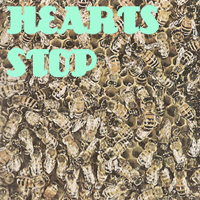




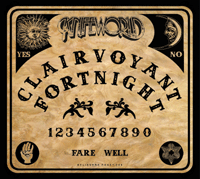




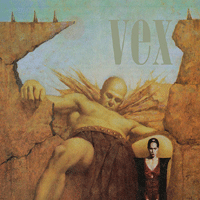
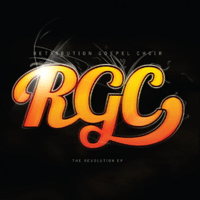






 Misfit City