My part of London’s being gradually gentrified. I’m noting the warning signs – the launderettes being replaced by redundant fresh-fruit emporiums, estate agents proliferating even as the street drinkers melt away; the rough-and-ready Irish pub that’s suddenly been boarded up and now waits to became a sandwich outlet. Even the looming black tower block which dominates the district and which once housed the capital’s most brutal social security offices (leading to it being roundly cursed in song by New Model Army) is being stripped down to white bone and built up into luxury homes, yesterday’s painful memories now smothered under today’s property bubble.
Waiting for the next rent rise – the one which might well bump me out of the neighbourhood in search of new roots – I guess that I can console myself with what seems to be a coincidental side effect. The neighbourhood’s also hosting more interesting gigs, with an influx of art rock, post-progressive and psychedelic evenings nudging aside the garage bands. If this is gentrification, I can at least live with that side of it: Tim Bowness playing down the road at the end of the month, and fresh bursts of tone-colour lighting up Tufnell Park junction on a regular basis. Which leads me to the following…
LITE + Knifeworld + Axes (Pink Mist @ The Dome, 2a Dartmouth Park Hill, Tufnell Park, London, NW5 1HL UK, Wednesday 19th August 2015, 7.00pm) – £12.00
On August 19th Tokyo instrumental math heroes LITE return to London for a special one-off show at The Dome. A mainstay in the Japanese charts and something of an institution in their homeland, LITE released ‘Approaches 4‘ – six new live recordings including a new track called Balloon – for free download on May 19th. They’ll be joined by shape-shifting psych impresarios Knifeworld. Led by former Monsoon Bassoon/Cardiacs man Kavus Torabi, the London based octet have been hailed by everyone from ‘The Guardian’ to ‘Rock Sound’ to ‘The Line Of Best Fit’ to ‘Drowned In Sound’ and back again. And then there’s Axes, who in ‘Glory’ released one of the best math rock records of the last ten years. All three bands are on the same bill, for £12, which is pretty damned amazing.
Please note that there are age restrictions on this gig – there’s a lower age limit of fourteen, and under-sixteens must be accompanied by an adult, so trainee adolescent psychonauts should take note (or take a fake ID). Up-to-date information on the gig is available here, while tickets are available here.
(UPDATE – whoops. I only posted this twelve hours ago, and suddenly the whole gig has been transferred to The Lexington instead – up-to-date and ongoing details here – though hopefully not because some moneyed flashmob’s now opening a craft brewery on the site of the luckless Dome…)
More British psychedelic/post-progressive rock is out on the road at the same time, since former Oceansize and current British Theatre frontman Mike Vennart (also known for putting extra guitar flail into the live lineup of Biffy Clyro) is playing a couple of warm-up gigs for his appearance at the ArcTanGent Festival with music from his solo album ‘The Demon Joke’. ArcTangent has nearly sold out now (though you might still be able to grab one of the last tickets if you head over to the website now) but I’m plugging the other gigs now for the benefit of anyone within running distance.
The Vennart live band features two other former Oceansizers (Richard “Gambler” Ingram and Steve DuRose) plus drummer Denzel Pearson. Support comes, variously, from Mike and Gambler themselves (as British Theatre, who’ve just released their first new music in three years – a free download single called ‘Cross The Swords‘ which I’ll be reviewing shortly), Colchester alt.rock songwriter Christie Isaac and assorted last-minute Leicestrians (ask the promoter).
Vennart + British Theatre + guests (Robot Needs Home @ Firebug Bar, 25 Millstone Lane, Leicester, UK, Wednesday 19th August 2015 – 7:00pm) £10 – info and tickets here.
Vennart + Christie Isaac (Colchester Arts Centre, Church Street, Colchester, Essex, CO1 1NF, UK, Thursday 20th August 2015 – 7.30pm) £11 – info and tickets here.
You could also set aside some time in the autumn to catch Vennart’s week-long British tour in November, apparently the last of their gigs for some time (after this, Mike and Gambler will immerse themselves in recording a full album as British Theatre). Knifeworld will return as support on this tour, with the third act on the bill being Mancunian “turbo-prog” duo Cleft who encourage you to think of them as “a machine that compresses fourteen minute songs down to three minutes.”
Bodega Social Club, 23 Pelham Street, Nottingham. NG1 2ED, UK, Monday 23rd November 2015
Bush Hall, 310 Uxbridge Rd, London, W12 7LJ, UK, Tuesday 24th November 2015
The Deaf Institute, 135 Grosvenor Street, Manchester, M1 7HE, Wednesday 25th November 2015
King Tut’s, 272a St Vincent St, Glasgow G2 5RL, UK, Thursday 26th November 2015
The Hop, 19 Bank Street, Wakefield, West Yorkshire WF1 1EH, UK, Friday 27th November 2015
A couple of tastes of Knifeworld and Cleft follow. If I’m going to be fiddling while Rome burns, I can’t imagine better company.
More quick London gig news – art rock, post-rock, electronica, and a dash of classic New York downtown.
Rumour Cubes + Dresda + kontakte @ The Facemelter (The Black Heart, 2-3 Greenland Place, Camden, London, NW1 0AP, UK, Friday 7th August, 7.30pm – £8.00/£6.00)
Sumptuous instrumental and electronic post-rock from ex-Glastonbury and ArcTanGent Festival performers, plus a UK debut.
Post-rock veterans Rumour Cubes have been spreading tentacles of ambient, soaring soundscapes across the globe, catching people’s attention with their classical and electronic nuances, attention to the finest details and unassuming political statements embedded in their writing. Their work with poets and film-makers has allowed them to create a multi-media experience and has propelled them to performances at Glastonbury, ArcTanGent and a support slot for Sólstafir; while their albums ‘The Narrow State’ (2012) and ‘Appearances Of Collections’ (2014) received wide critical acclaim.
Celebrating their tenth anniversary this year, Dresda hail from Genova, Italy, and will be driving over to make their UK debut. Their music is intricate, dense and introspective yet gloriously cinematic. They have several well-received releases under their belts, including soundtracks for critically acclaimed Italian independent movie ‘The Krolevsky Case’, and the short movie ‘La lingua del disordine’. In 2009, they were featured on the Italian DVD edition of the Canadian documentary ‘RIP! A remix manifesto’, distributed by Feltrinelli Real Cinema nationwide.
Conceived in 2005 from a string of old 4-track demos and further realized via a labyrinth of digital workstations and computer software, kontakte blend organic instrumentation within an electronic and hypnotic framework of programmed beats and pulsing synths. Pooling influences such as Godspeed You! Black Emperor, Mogwai together with Brian Eno, krautrock and shogaze sounds, this duo manages to perfectly blend shimmering electronics and ethereal melodies. They have too many releases to name and have been remixed by many visionaries including Tim Holmes of Death In Vegas, Chris Olley of Six By Seven and Russell. M. Harmon.
There might also be tickets remaining for the performance of Arthur Russell’s Instrumentals early in the following week. This is a repeat visit of a show that’s been on and off the road at various points around the world since 2012 and which last visited London via Cecil Sharp House earlier this year… so if you missed it before, now’s your chance.
Visions presents: Arthur Russell’s Instrumentals, directed by Peter Gordon @ Visions Festival (Oval Space, 29-32 The Oval London, Bethnal Green, London, E2 9DT, UK, Monday 10th August, 7.30pm – £21.50 plus booking fee)
For those of you who don’t know about Arthur Russell’s turbulent, productive (and sadly curtailed) life, he was a vigorous participant within the downtown New York music scene between the mid-1970s and early 1990s. Having studied as an avant-garde cellist and composer, he rebelled into Manhattan nightlife, vigorous cross-fertilization and event curation. Russell rubbed up against Fluxus, disco, avant-garde theatre, New Wave and no-wave, making the most of the breadth of the prolonged New York creative ferment of the times, feeding his assorted roots and collisions into music of his own.
During the last decade of his life Russell wrote and performed voice-and-cello songs – predominantly solo but employing loops, echo and sundry effects. In these, he synthesized all that he’d learned into what were perhaps his most personal and accessible works. These are probably what he’s best known for now, thanks to the more prominent releases of albums such as ‘World Of Echo’ and ‘Another Thought’, but they’re only one aspect of his work
A notorious perfectionist reknowned for agonised work gestations (and who left hundreds of pieces uncompleted at his death) Russell nonetheless completed what was, at the time a remarkably bold, broad and modern array of work from orchestral pieces and theatre music to forays into electro-pop and dance music under project names including Dinosaur (for ‘Kiss Me Again’) and Loose Joints (‘Tell You Today’). Today this kind of equivalence and eclecticism is more commonplace in the orchestral or ensemble work of composers such as John Zorn, Django Bates, Anna Meredith or Tansy Davies. In the 1970s, though, Russell was a pioneer, notoriously shocking the staider elements of his avant-garde classical audience with ‘24-24 Music’ (a contemporary classical piece equating the pulses and disciplines of New York minimalism with those of disco music).
Coming from the zone of Russell’s talent which drew most on his contemporary classical roots, ‘Instrumentals’ is an example of his chamber music, Dating from the late ‘70s, it was initially conceived as a forty-eight hour piece, its duration far exceeding even the infamously massy protracted works of Morton Feldman. Versions of the work were performed over the years, and a selection of excerpts appeared on a Disques du Crepuscule release in the mid-‘80s.
The piece as it stands owes much to Russell’s friend Peter Gordon, a fellow eclectician from the 1970s downtown scene and Russell’s bandmate in The Flying Hearts and Gordon’s own ongoing Love Of Life Orchestra. Gordon worked closely on the original performed version, assisting on keyboards, arrangement and notation. Two decades after Russell’s death in 1992, Gordon brought a new version of ‘Instrumentals’ back to The Kitchen (Russell’s old home venue in Manhattan. Following the initial sold-out performance in March 2012, Gordon has periodically revived and toured the new arrangement. The performance at Oval Space will feature several members of Russell’s original ensemble, and will also feature photographs by Yuko Nonomura which were projected during the original 1975/78 Manhattan performances of ‘Instrumentals’.
Next week sees the first gig (for some time) for one of the most interesting of current British rock bands; some high-gloss cabaret; and the start of a psychedelic pop roadshow travelling around the UK. Read on…
Thumpermonkey don’t get as much attention as they deserve. It’s possible that this is because they don’t seem to take things seriously, addressing almost everything with a skewed and multi-levelled sense of cryptic grand-baroque geek humour. Just to illustrate this – a current work-in-progress Thumpermonkey song is “something which we’re calling Giraffes, which includes some vague narrative about doing a conga during an asteroid-based extinction-level event.” One of their older albums is called ‘Chap With The Wings, Five Rounds Rapid’ – a wry kill-the-monsters line filched from ‘Doctor Who”s laconic and unflappable Brigadier. In the same spirit as that reference, I’d suggest that while they are serious about what they do, they’re not necessarily serious about the way they do it – like many of my favourite things.
If what I’ve written so far leads you to expect strained, fey, sub-Zappa wackiness, then think again. Both in the flesh and on record, Thumpermonkey are a brooding and atmospheric proposition – seriously musical, travelling from blitzingly heavy quasi-metal riffs to spidery post-rock, from threshing post-hardcore to theatrical mane-tossing prog at a moment’s notice while Michael Woodman’s grand edgy vocals and complex multi-levelled lyrics ride on top like an arcane mahout with an arched eyebrow. They’ve been called “a sustained victory for intuitive cross-pollination” by ‘Prog’ magazine and every gig they play confirms this particular accolade. Here they are playing 419 (a song which at first appears to be one of their more delicate offerings, revealing its intensities later).
The other two bands on the bill are less well known to me, but aren’t short of blurb:
The Earls Of Mars are probably the most original thing you’ll hear all year. At their heart, the band are a ’70s-influenced rock band bringing together jazz, prog, space rock, doom and blues and forming it into a barking mad noise that you’ll either get or you won’t. If you don’t get it then close the door on your way out of the spaceship, as those of us who want to stay are off on a fantastical journey to who-knows-where, with The Earls Of Mars steering the ship. Enjoy the trip, ladies and gentlemen, as it’s going to be a fun ride.
Ham Legion‘s noisy lo-fi pop is punctuated with proggy outbursts, psychedelic breakdowns and passages of cod-metal joy. Tangy and tart guitar, egg noddle bass lines and light crispy drums are smothered in gooey boy/girl harmonies. Eat in or take away. For fans of Cardiacs, Deerhoof, They Might Be Giants, Split Enz, Heavy Vegetable.
Judge for yourselves – here are the videos for the Earls’ ‘Astronomer Pig’ single from last year, followed by some footage of a Ham Legion gig in Brighton a couple of years ago. As for tickets, they’re available here.
* * * * *
The day after the Thumpermonkey gig, Holly Penfield plays one of her biggest gigs of the year…
Holly Penfield sings Judy Garland, The Hippodrome Casino, Cranbourn Street, Leicester Square, London, WC2H 7JH, UK, Friday 31st July 2015, 8.00pm) – £15.00 and upwards
Following a triumphant debut last year, Holly returns to the London Hippodrome, singing the songs of the legendary Judy Garland in her own inimitable style. Holly will be joined by her musical director Sam Watts and his magnificent seven-piece band. An unmissable evening for Holly and Judy fans alike, set in the glorious Matcham Room, located inside the Hippodrome Casino – formerly known as The Talk Of The Town, this is the venue of legends and home to Judy’s final London concerts.
Longer-term readers will know that I got to know Holly years ago via her own original ‘Fragile Human Monster Show‘ and the ‘Parts Of My Privacy’ album (which I wrote about ages ago – that review’s due a revamp and remount, I think). Both of those, though original songwriter pop, had their own theatrical and psychodynamic aspects which pointed towards Holly’s current work in vivid cabaret (and, latterly, as half of swing revivalists The Cricklewood Cats). As for Holly’s interpretations, she can and does cover cute showbiz camp and heart-tugging pathos within the same performance – you can see a couple of examples below.
Up-to-date information on the Judy concert is here and here, while tickets are available here. A mischievous part of me fancies swapping the audience from Holly’s show with the one from the Thumpermonkey/Earls/Ham Legion gig, and vice versa. I suspect that they all might enjoy it more than they’d expect to…
* * * * *
On the same night that Thumpermonkey and co. play, The Luck Of Eden Hall are over from Chicago to play the first of two London gigs, launching a Kickstarter-funded UK tour which will take them to a wide array of venues and mini-festivals around England, Scotland and Wales, accompanied by a shifting cast of local psych heroes, left-field blues artists and quirky alt.pop shoegazers.
As for the headliners, you can expect clear-voiced, well-made classic pop beset by sudden gusts of psychedelic blizzarding. The Luck Of Eden Hall remind me of the drawn-out trucker-and-motorist tussle in ‘Duel’ – they come across like a more sombre Neil Finn or Andy Sturmer being stalked, dogged and sideswiped by Hawkwind, Ride or ‘Saucerful’-era Pink Floyd. Here’s a little evidence:
This weekend you could choose some unorthodox transplanted Americana, or some equally unorthodox English nooks and crannies. Or (as long as you were somewhere around London or Brighton) you could feasibly enjoy both of them, given that you’ve got more than twenty-four hours to cover the fifty miles between the options. (It’s bright. It’s hot. Enjoy the weekend out. Go on…)
First, the Saturday show in London…
Daylight Music 196: Piney Gir + Rodney Branigan + Player Piano, with Gemma Champ (Union Chapel, Compton Terrace, Islington, London, N1 2UN – Saturday 4th July, 12pm to 2pm)
Blurb follows…
July brings an American Independence day special to Daylight Music.
Piney Gir hails from the American Midwest, home of wide-open plains with sunflowers that go on as far as the Earth curves. The “you’re not in Kansas anymore” jokes never wear thin, because Piney embraces her heritage bringing it with her to the UK, where she’s lived in London for over a decade now (yes, she does have a sparkly red shoe collection and yes, she wears a lot of gingham). She is celebrating the recent launch of her sixth album ‘mR hYDE’S wILD rIDE’, released on Damaged Goods Records on June 8th.
Texan guitar virtuoso Rodney Branigan is a multi-intrumentalist who learned to play in Austin, perform in Los Angeles, craft songs in Nashville and put it all together in London. His current album ‘Sketches.’ (written on the road in China, India, Europe, the US and the UK) reflects this diversity, combining laid-back blues and acoustic folk with undertones of rock, flamenco, classical, bluegrass and jazz. His lyrics have an abundance of imaginative substance to them that eclipse many of his songwriting peers. With vocals compared to Jeff Buckley and playing compared to Rodrigo Y Gabriela, the album has been written, arranged and recorded around his renowned ambidextrous live performance.
Player Piano is the musical vessel of Jeremy Radway, a refugee from Indianapolis, USA (home of Kurt Vonnegut, Jr., after whose first published book the group was named). On his previous EP ‘Into The Dark’ (released on the Fife-based Fence Records label), there was a mix of rich strings and glam-pop pomp, inspiring the ‘Sunday Times’ to write “evoking solo-Lennon string arrangements, the unfettered creativity of early Bowie and the Walker Brothers, and the vocal plangency of Chris Martin and Rufus Wainwright, it tugs at the heartstrings and ensnares you with the scope of its ambition.” Radway continues to explore new sounds and forms, trading strings for synths and moving in a more upbeat progressive direction, still staying grounded in melody and harmony. He’ll be releasing his new album ‘Radio Love’ this summer on State51 Records (home to gUiLLeMoTs and Psapp),
In between, Gemma Champ will play melodies jammed full of stars and stripes; and yes, there will be cookies!
Free entry, but donations are (as ever) encouraged.
********
On Sunday, down in Brighton, there’s this…
William D. Drake/Crayola Lectern/Heavy Lamb (Komedia Studio Bar, 44-47 Gardner Street, Brighton, BN1 1UN, UK, Sunday 5th July 2015, 7.30pm – £7.00)
Bill Drake (the onetime Cardiacs keyboard player turned baroque-solo singer-songwriter) celebrates the mid-June release of his new album ‘Revere Reach’ with what promises to be a typically joyous concert, unfolding new/old sounding original songs both complex and sweet, rampant keyboarding, hurdy-gurdys and assorted friends. A couple of examples are below.
In support is Crayola Lectern – Chris Anderson’s songwriting project which sweeps from solemn cellar melancholia to a flickering psychedelic noon via piano, trumpet and shimmering electronics. See these…
Also playing support are Heavy Lamb, a self-styled “loud demented pop” band. See below for a demo track and for a video of them playing a joyfully received Spratleys Japs cover at the Alphabet Business Convention earlier this year.
Shiver, The Fierce And The Dead, Alex’s Hand @ The Facemelter (The Black Heart, 2-3 Greenland Place, Camden, London, NW1 0AP, UK, Friday 3rd July, 7.30pm – £8.00/£6.00)
A night of insane math rock, prog, jazzcore and experimental riffs from some of Europe’s finest.
Shiver are the latest group from Acoustic Ladyland and TrioVD guitarist and producer Chris Sharkey. The trio have been challenging audiences perceptions of music for just over a year, sitting as comfortably at EFG London Jazz Festival as they have when headlining the PX3 stage at ArcTanGent Festival. Stretching the span of instrumentation and the imagination, this trio flits between solid, head-nodding riffs, ambient spaces and frantic electronic cacophony. Tonight they will be playing new material from their recently released third album.
The Fierce & The Dead are a hugely respected and critically acclaimed noisy pronk four-piece from London. Their precise musicianship and schizophrenic, immensely complex, yet catchy music has earned them headline slots all over the UK. Featuring internationally renowned guitarist, loop artist, blogger and all-round independent music guru Matt Stevens, TFATD have shared the stage with bands including PHILM, Knifeworld, Thumpermonkey, Anathema, Cleft and Lost in the Riots. Tonight they will premiere unheard material from their upcoming EP.
Formed in Seattle a few short years ago, experimental four-piece Alex’s Hand subsequently relocated to Berlin and have been wreaking havoc on Europe’s DIY noise, post-punk and garage ever since. They’ve shared the stage with MoRkObOt, which must have been a bizarre evening. As at home on stage as they are playing avant garde installations (such as 24 hour festival Avant Garden) in a punk squat in Berlin, this will be their first venture to the UK.
I should put in a particular word for Alex’s Hand here, having watched them grow and sprawl over the past few years along a meandering but inspiring path from arch art-pop parodists to noisy song-brawlers and most recently to a kind of spontaneous noise-prog ensemble. There are a few ‘Misfit City’ reviews of their earlier material – one for ‘Madame Psychosis‘ and one for ‘This Cat Is A Genius‘. Although I’ve not covered Shiver yet, I do also have reviews of early Fierce & The Dead material (here and here), as well as a look at the band’s Matt Stevens playing a solo slot.
******
If you’d rather spend a free evening with Uncle Frank, The Spiders of Destiny are playing another London gig of Zappa music on the same day. As ever, expect some of London’s most accomplished art-rockers to work their way back and forth through the Zappa catalogue. The Deptford venue they’re playing this time has plenty of history, whether under its current name, its old monicker of The Oxford Arms or any other title it’s enjoyed over several hundred years. If you don’t spot Frank’s ghost leaning on the sound desk and having an appreciative smoke, you could try looking out for the ghosts of Dire Straits or Christopher Marlowe instead… Up-to-date details here or here, with two-as-yet unnamed bands to be added to the bill.
The Spiders of Destiny (The Birds Nest, 32 Deptford Church Street, London, SE8 4RZ, Friday 3rd July 2015 – 7.30pm, free)
********
Looking further ahead, Tim Bowness is out on a very brief tour in August, playing a handful of dates in England and Poland to promote his imminent album ‘Stupid Things That Mean The World’ as mentioned last month. His band features his usual cohorts of Andrew Booker (drums – also of Sanguine Hum), Michael Bearpark (guitar – Darkroom, Henry Fool), Stephen Bennett (keyboards – Henry Fool) and the more recent recruit Colin Edwin (bass guitar – Porcupine Tree).
The Lousiana, Wapping Road, Bathurst Terrace, Bristol, BS1 6UA, UK, Tuesday 25th August, 7.00pm – tickets here and here.
The Boston Music Room, 178 Junction Road, London, N19 5QQ, UK, Wednesday 26th August, 7.00pm – £17.00 – tickets here and here.
Ino Rock Festival, Theatre Letni, Inoclaw, Poland, Saturday 29th August – 35.94 euros – tickets here (other acts at the festival are Fish, Motorpsycho, State Urge and Millenium).
Playing support at the Bristol and London gigs will be Improvizone, the flexible live-ambient improvising collective led by Bowness band drummer Andrew Booker. The rest of the Improvizone lineup looks as if it will be drawn from the current Bowness band (Michael Bearpark is a frequent Improvizoner) so perhaps you should expect the same band playing in two very different configurations. Up-to-date news will be here.
*****
Levitation: ‘Meanwhile Gardens’ (2015 issue)
Another follow-up from last month – there’s now a release date from Flashback Records for the lost Levitation album ‘Meanwhile Gardens’. Mark Burgess of Flashback posted the following on the Facebook fan page for the band’s lost recordings yesterday:
There is at last a provisional release date for ‘Meanwhile Gardens’. 23rd October 2015! Pre-orders will be available in due course from the Bandcamp site and elsewhere. The album is now with the pressing plant, but the lead time on the vinyl is long (pressing plants are straining under the pressure of so much vinyl at the moment, hence the provisional nature of the release date). You should all give yourselves a pat on the back and raise a toast to this group because without this page it might never have happened. Thank you all for your enthusiastic support!
If you’re in central London, there’ll be assorted noises in Fitzrovia this Friday evening… and so, over to the Orchestra Pit’s blurb-roll…
Gagarin + Hamilton Yarns + Gold Vox + Lisa Jayne + Bobby Barry + Bad Moth @ The Orchestra Pit‘s “ Scaledown #110” (The King & Queen, 1 Foley Street, London, W1W 6DL, UK, Friday 26th June 2015, 7.00pm – free)
Mrs June Sunshine rises and climbs majestically up the wooden staircase, gliding along the corridor until Mrs June Sunshine rests and shines her golden spotlight in the scaledown room. She shines upon each scaledown invited artist in no particular order:
Gagarin – also known for his work with Ludus, Nico, John Cale and Pere Ubu, but best loved around these parts for being one half of both Roshi (featuring Pars Radio and Low Bias), and the whole of Gagarin; Graham ‘Dids’ Dowdall is a masterful musician, whose latest album ‘AOTICP’ continues to mine and define “that sonic interface when nature comes back into the city”.
Hamilton Yarns come from Brighton and they create beautifully hand-crafted musical packages on their own hark! recordings imprint. They are Hamilton Yarns, and we are delighted to welcome them back after a five year absence.
Gold Vox are an elegant exciting recorder duo. Close undulating harmonies, mediaeval, modern, trilling and thrilling. Be blown into another dimension.
Lisa Jayne is a poet, artist, life model and one half of Map 71 (the words/drums + noise combo).
Usually I’ve got pin-sharp memories of where and when I saw a band play. The one occasion when I saw The Kenny Process Team is an exception. I’ve got next to nothing. A scruffy black cube of a room somewhere, with guitar leads and primary-colours gaffa on the floor; a small-kit drummer ticking away with a pair of bisected sticks. A guitarist and bass player sit on amplifiers or boxes, playing with the whiskery, matter-of-fact precision of master joiners shaping their umpteenth wooden cabinet. A second guitarist stands off to one side, with a flowing sheaf of dreadlocks. The lone black guy in an otherwise white quartet, he almost looks as if he’s been teleported in from a reggae backline but his eyes, wary and committed, tell a different story. Clearly engrossed in the music, he plays blunt, abbreviated questioning lines against the rolling machinery of his bandmates; their mixture of Fifties-twang and conversational Fred Frith art-rock arpeggios, of lean spare proggy lines a-tilt on the wave tube.
As regards the rest of it, I remember nothing. Not the stairs up or down to the venue, nor where it was. “Somewhere in London” is the best I can do. Otherwise, this little memory exists in a cell of its own – a room floating in a void, a space that existed purely as a setting for the music. I certainly wasn’t drunk, nor under the influence of anything stronger than a semiquaver. I may well have been slightly hypnotised by the Team’s cramped fluidity, the crystallising complexities jagging up from simple bases. Bar a single, rare record, the band themselves have sometimes seemed to have vanished down a black hole. Even the web only offers the smallest scraps on them. While I only encountered them once, they apparently played together for eighteen years. Perpetually on the sidelines? Deliberate masters of self-effacement, only really coalescing for gigs?
Seeing a different iteration of The Kenny Process Team pop up around a decade later for a Club Integral gig, therefore, is quite surprising, although everyone concerned has probably been hiding in plain sight. I guess that they won’t have been the invisible band to everyone (and, in particular, not the more knowledgeable people who are likely to make up a Club Integral audience) – but if, like me, you remember the Team as an oblique one-night encounter which snagged in your memory, here’s an opportunity to catch up.
Blurb follows…
Club Integral presents “A Thousand Butterfly Skeletons” featuring Bing Selfish & The Windsors, élan, Andrew Ford and Ragmatic (The Others, 6-8 Manor Road, Stoke Newington, London, N16 5SA, UK, Friday 26th June, 8.00 pm – price £5.00/£3.00 concession)
In an exciting one-off performance, fabled DIY pioneer and visionary misanthrope Bing Selfish is joined by micro-lounge minimalist rock quartet The Windsors. From the early eighties Bing Selfish has followed his own unique path, assisted on the journey by a plethora of maverick musicians from Jim Whelton, Rob Storey, through to Bill Gilonis and Chris Cornetto. Drawing from the well of European avant-garde sensibility, from the Symbolists to the Situationists, coupled with relentless punning and sardonic rhyming, Bing has built his own parallel world, defiantly in opposition to 21st century neo-conservative capitalism, and mainstream musical consurism. Many magazines, records, radio shows and films later he still stands upon the stage, and he’s still seriously pissed off. Chris Cutler has described him as “a phenomenon in the galaxy of songsters today” while ‘The Wire’ has hailed him as “an intuitively sharp lyricist with few peers.” More pungently, Options USA has imagined his character as “a self-pitying drunk, a self-loathing homosexual, a bitter poli-sci professor, or all of the above.”
The Windsors rose from the ashes of the legendary Kenny Process Team, described by Eugene Chadbourne as “forward-looking electric guitar music with a rock base, (stylistically) somewhere between the precision control of surf rock groups such as the Ventures and the almost classical compositions Captain Beefheart.” The new group (Simon King – guitar, Tom Murrow – drums, Matthew Armstrong – bass, and Phil Bartai – keyboards) play intricate, driving instrumentals composed by Kevin Plummer with the band. This is a one-off chance to hear them apply their genius for deftness, intricacy and dynamic arrangement to the anarchic poesy of Bing’s song catalogue.
élan is the kosmische muzik side-project of Dave Tucker (The Fall, London Improvisers Orchestra, Charm School) and friends. He is joined by Matt Chiltern (Spork) on bass, and Ed Lush (Test Dept. Spork) on drums and percussion. Expect krautrock.
Ragamatic is Reiner Heidhorn, a sitar-and-electronics musician from Weilheim in Germany. The music is a result of Reiner’s many years studying classical Hindustani music whilst simultaneously making electronic music. With an emphasis on ragas from northern India, played in the style of master sitar player Vilyat Khan, Reiner locates the natural meeting point between Indian classical music and contemporary electronics.”
Projections by Rudapinka, aka Inga Tillere.
Andrew Ford is also playing – details to be circulated later.
More information on the concert and on other Club Integral events is here.
If you’d prefer something a little more straightahead, then another option is to catch The Many Few playing on the same night, promising to “edify and exultate your earballs and eyedrums with our own original guitar-drum-and-vocal shenanigans… on an optimistically lovely Friday Juneful night coming soon, in the company of assorted fellow groovesters.”
(Headliners t.b.c.) + Purple Implosion + The Many Few + Halcyon Days (Bugbear @ The Dublin Castle, 94 Parkway, NW1 7AN, London, UK, Friday 26th June, 7.30pm – £7.00/£5.00)
I covered some early Many Few demos some years ago, offering assorted comments and insults on their witty, slightly wonky songcraft which the band still seems to remember with affection. As for other descriptions, Bugbear settles for “kitchen-sink lo-fi indie-pop with female/male harmonies and vocal sharings over some Smiths meets McCarthy C86 type backing. Some interesting twists and turns. A bit of The Monochrome Set, something of Yeah Yeah No and stuff like that.” (The Bugbears go on to quote a bit of the ‘Misfit City’ review a bit later on – or, rather, misquote it. It’s a bittersweet world, writing about indie-pop.)
Also on the bill are Halcyon Days (“hooky electro-pop with a nod to 80’s pop but with an electro interface more akin to New Order off-shoot Electronica”) and Purple Implosion (“another great band mixing spiky post-punking punk-funk with counter-cultural garage-birthed rock’n’roll featuring out-there frontman antics.. but always pretty damn danceable.”) In addition, there’s also an unconfirmed headline act. Probably Kate Bush again, or perhaps The Sonic Jewels. You’ll just have to go along and hope, I suppose.
If I was a Brightonian, I suspect that I’d be spending quite a lot of evenings at the Hope & Ruin. Not only does it host some of the town’s most interesting gigs, its interior décor – patched together in a pack-rat/caddis-fly jumble of enthusiasm – makes it feel like the vessel of some spacegoing carny out of ‘Firefly’ or ‘Doctor Who’.
I’m guessing that most people who’ve read the post title will already know all about these – since cult art, Brighton and a gossip grapevine make a happy mash – but two upcoming Hope & Ruin gigs have caught my attention. One features two leading lights of the original Krautrock/kosmische/German experimental rock scene (something else that’s become as Brightonian as the Pavilion). The other one sees the return of one of Britain’s more interesting wrangle-rock rackets from the 1990s: on this occasion, backed up by a more than worthy heir from the current decade. Both are stops on longer UK tours – I’ll include details on those as well.
Jaki Liebezeit & Hans Joachim Irmler @ The Hope & Ruin, 11-12 Queens Road, Brighton, BN1 3WA, UK, Thursday 17th June (doors 8.00pm)
The former Can drummer Jaki Liebezeit is one of the great beat stylists of experimental rock. Described as “a master of the pause and the stop”, he plays cutting, lean and propulsive rhythms from a small kit: alongside Neu!’s Klaus Dinger, he pioneered the mechanistic motorik beat which you’ll hear behind half a hundred nouveau-Krautrock bands. Hans Joachim Irmler () has had various multi-instrumental and production role in and around Faust over the years, but predominantly plays organ (a highly customisable transistor model which he built himself over forty years ago) and boxes-of-tricks (having created or co-created most of Faust’s unusual noise processors). Longstanding collaborators, Irmler and Liebezeit released the ‘FLUT’ album in 2014 featuring a “hypnotic maelstrom” of organ and drum improvisations. I’ve not reviewed it, but the ever-reliable ‘Quietus’ did – and it’s this vein of music which they’ll be performing.
More details here – although if you’re a fan, all of this will be old news and you’ll already have your tickets. If the Krautrock galaxy is still relatively new and obscure to you – and you’re within grabbing distance of Brighton – this sounds like the perfect opportunity to immerse yourself in the cult. (If recent rumblings about Liebezeit’s retirement are true, it might also be one of your last opportunities to taste the original flavour). If you’re not in Brighton, note that there are also tour dates in London, Fife and Glasgow (beginning on Friday) as listed below:
Sunday 14th June 2015 – Platform, The Bridge, 1000 Westerhouse Road, Glasgow, G34 9JW, UK – details here.
Tuesday 16th June – Cafe OTO, 18-22 Ashwin Street, Dalston, London E8 3DL, UK – details here.
Prolapse + Slum Of Legs @ The Hope & Ruin, 11-12 Queens Road, Brighton, BN1 3WA, UK, Tuesday 23rd June (doors 8.00pm)
Art-punks who emerged in the 1990s, Prolapse came up with a much more assured and individual take on the form than most, apparently by accident. The dual vocal frontline of Linda Steelyard and Mick Derrick (the former singing and the latter ranting,) often came across as disruptive theatre, a performance partnership which veered dramatically between combative duologues, utter disjunction or play-fights. Meanwhile the band behind them pegged brutally away on Krautrockian/Fall-esque rhythms, riffs and noises, like a Dada Hummvee worn down to its wheel-rims. The members have tended to claim that it all happened spontaneously and in general was a muckaround, but this was a band that was smart enough to work out when not to think – if you dug deep enough into them you found Master’s degrees, archaeologists, ceramicists and future journalists.
In 1999, after three albums and enough touring to wear them down, Prolapse very sensibly split up just before the point when it all became too frustrating. This year, having been enticed back from various locations and interesting jobs by Mogwai (who’ve invited them to play support at the latter’s 20th anniversary shows) they’ve opted to play a six-date UK tour, for which the other remaining dates are:
Friday 19th June – The Maze, 257 Mansfield Road, City Centre, Nottingham, NG1 3FT, UK, 19th June (supported by Grey Hairs and Hot Shorts) – buy tickets here.
Monday 22nd June – Colchester Arts Centre, Church Street, Colchester, C01 1NF, UK (no support) – buy tickets here.
Playing support at the Brighton gig are Slum of Legs – an inspirational, instrument-swapping, all-female travelling brainstorm of a band. Although they have roots in Raincoats-style post-punk and Riot Grrl (and more than a few similarities to the spontaneous inventiveness of Prolapse) Slum Of Legs have a particular approach to lyric writing which is all their own – intricate, irreverent, literate and broad-ranging. So even if the musical style doesn’t altogether appeal to you, go for the sake of the words and see what else falls into place. (Again, I’m late to the table for this one, so I’ll refer you to this spray of enthusiasm from ‘Collapse Board’, which sets out a view of the Slum Of Legs stall in a way that’s far better, and probably far closer to their pulse, than I could right now.) More info on the gig is here.
This just in from all-round Mancunian multi-media bloke (poet, songwriter, saxophonist, theatre-and-film collaborator) Alabaster DePlume. He’s on a tour of off-the-beaten track venues in the south of England this week with experimental Edinburgh improvisers SiNK, having started off in Aberystywyth over the weekend (sorry, I heard about that gig too late). It’s not entirely clear what they’re doing, but it’s safe to assume that there’ll be a spirit of discovery.
About SiNK, Alabaster says:
The tour celebrates their new album, ‘Ossicles’… Last time I played with them they created a ‘sound mirror’ – a bass drum on its side filled with water, with a speaker underneath. They played their music through the speaker and projected a light onto the water which was reflected onto the ceiling, where it displayed the geometrical shapes created by the sounds. They then played in response to the shapes (and each other) which changed in response to their playing.
Tour dates:
The Prince Albert, Rodborough Hill, Stroud, Gloucestershire, GL5 3SS, Tuesday 2nd June, 8.00 pm – free event.
Some more early June gig previews for London – these would have been in the previous post if I’d picked up on them earlier.
Firstly, a Facemelter promotion (from the experimental rock/post-hardcore wing of the Chaos Theory organisation whose jazz gigs I’ve also enjoyed)…
Alright The Captain + Iran Iran + Porshyne @ The Facemelter (The Black Heart, 2-3 Greenland Place, Camden, London, NW1 0AP, Friday 5th June , 7.30pm
Three heroes of math rock, alternative and post-rock travel from different corners of the UK to unite and form this amazing lineup.
Derby-based trio Alright The Captain masterfully combine virtuosic instrumentalism with unabashed musical experimentation and have effortlessly established themselves as a sonic force to be reckoned with, thanks to their increasingly inimitable, uniquely imaginative brand of math-rock. Their sprawling and varied career has seen them sharing stages with post-rock luminaries including Mono, toe, 65daysofstatic, Pelican, Tera Melos, ASIWYFA, Maybeshewill, Adebisi Shank (RIP), This Will Destroy You, ZU and many more. Their new album ‘Contact Fix’ (which ‘Musical Mathematics’ describes as “div(ing) in and out of math rock, prog and post rock – but, at its heart, it’s different”) has gone down a storm.
Iran Iran are another supremely talented bunch of musicians who stunned and impressed all who saw them at ArcTanGent last year. With insanely complex rhythms and thunderously heavy riffs, the four-piece from Bristol have evolved since their excellent first EP ‘Crystal Math’ and are packing a punch. They’ve played with Future Of The Left, Cleft, Alright The Captain, This Town Needs Guns, You Slut!, Alpha Male Tea Party, Death Pedals and many others. Fans of complex musical wizardry or heavy riffs will love their new EP ‘Milk Time For Spiders’.
Brightoners Porshyne dance between ambient intervals and melodic vocals to intensely intricate, fantastically crunchy prog rock riffs. With just a few single releases and a session filmed by Small Pond Recordings, they already sold out their first headline show in Brighton. This is your chance to catch the band before their career takes off.
More info here and here, and tickets here (£5.00 advance, £7.00 on the door).
At the end of the same week, Georgina Brett’s Tuesdays Post event returns to Stoke Newington with another evening of ambient/progressive live music, including ‘Misfit City’ favourites Darkroom…
Minny Pops/Spaceheads/Darkroom/Georgina Brett & Hems @ Tuesdays Post, (The Others, 6 Manor Rd, London, N16 5SA, Friday 7th June, 7.00pm)
Formed by vocalist/band leader Wally van Middendorp in Amsterdam in 1978, Dutch electro pioneers Minny Pops took their name from a primitive Korg drum machine. The band released several singles and a debut album, Drastic Measures, Drastic Movement, on independent Dutch label Plurex before joining the legendary Manchester label Factory Records in 1980 (which resulted in them being produced by Martin Hannett, touring with both Joy Division and New Order, and becoming the first Dutch group to record a Peel Session). Singles including Dolphin’s Spurt, Secret Story and Time were followed by the acclaimed album ‘Sparks In A Dark Room’ in 1982. The band released two further albums (‘Poste Restante’ and ‘Fourth Floor’) before splitting in 1985. In 2012, the band reunited for a series of gigs in the UK, the Netherlands and Belgium and recorded a 7-inch single for Tim Burgess’ O Genesis label. After a pause to draw breath, 2014 has seen Minny Pops performing live once again.
Spaceheads are a cosmic duo of trumpet electronics and drums. Formed in 1990, they have developed a blend of electronics and sunshine fanfares over the course of ten albums, three EPs and much touring across Europe and the USA. Andy Diagram (also of James) plays trumpet with a mobile phone stuck to the top with a fish slice and Richard Harrison plays drums with big bendy metal sheets stuck to the top. They create live looped layers of brass driven by flurries of free flowing funky drums. Andy and Richard have achieved an intuition of what each is about to do next which makes their semi-improvised gigs a joy to behold. They release their first studio album in ten years – ‘A Short Ride On The Arrow of Time’ – this Autumn.
Darkroom – the UK-based duo of Michael Bearpark (guitars) and Andrew Ostler (synths)- expertly ride the line between luscious, old-school progressive rock and modern ambient electronics. At times reminiscent of early Tangerine Dream with hints of Fripp and Eno, they create clouds of sequenced synths, chewy grooves, and looped phrases to support a variety of acoustic and electric guitar melodies that twist and turn in surprising, occasionally aggressive, ways.
Hems Aka Henrique Matias will be playing live with Georgina Brett. Henrique is a multi-talented composer, programmer and DJ. He specialises in Multimedia programming (from internet things to Max/MSP and similars), although not all his live music and performances sounds like computer music (sometimes he takes his drum machines and crazy things out of the house). Georgina Brett’s music is created using her voice and effects pedals, creating instant choirs of sound, often in an hypnotic style. The point of this music is not only to captivate with extraordinary timing and melodic style but also to help the listener to relax in our ever-increasingly fast world.
Interactive visuals and multimedia projections are by Hanzo and Rucksack Cinema.
More information here – tickets £7.00 on the door.
By all accounts The Forge (in Camden Town) has spent the last few years becoming one of north London’s most interesting small venues for mixed music. I’ve yet to go there and see for myself: but in its full June calendar (also featuring funk, jazz, classical and Cuban music as well as assorted poetry) the following four concerts caught my interest:
Notus Winds & Eliza McCarthy (Wednesday 3nd June, 7.30pm)
Part of the classical monthly series Wednesdays at The Forge, this time featuring award-winning chamber ensemble Notus Winds and solo pianist Eliza McCarthy with a program of contemporary compositions (more information here). Tickets £10.00 to £12.00.
Programme:
Harrison Birtwistle – 5 Distances
György Ligeti – Ten Pieces
Arvo Pärt – Quintettino
Anders Hillborg – Six Pieces for Wind Quintet
Fenella Humphreys: Bach to the Future Part 1 (Tuesday 9th June, 7.30pm)
The first of three concerts presented by violinist Fenella Humphreys, featuring commissions of six new works by six of Britain’s leading composers to accompany Bach’s glorious 6 Sonatas and Partitas for unaccompanied violin. This first concert includes new works by Cheryl Frances-Hoad and Gordon Crosse alongside extraordinary music by Bach, Scott, Westhoff, Hindemith. Tickets £10.00 to £12.00.
Programme:
Cyril Scott – Bumble-Bees (1928)
Johann Paul von Westhoff – Suite no. 5 in D minor (1682)
Gordon Crosse – Orkney Dreaming (2014)
Fritz Kreisler – Recitativo and Scherzo-Caprice op. 6 (1911)
Paul Hindemith – Sonata op. 31 no. 2 ‘Es ist so schönes Wetter draussen’ (1924)
Johann Sebastian Bach – Partita no. 3 in E major BWV 1006 (c. 1720)
Cheryl Frances-Hoad – Suite no. 1 (2014)
Eugene Ysaye – 2nd Sonata op. 27 (1923)
Reciprocity: a new work by Daniel Patrick Cohen (Wednesday 10th June, 7.00pm)
Reciprocity is a 28 minute work for voice, taped narration, eight celli, piano, and percussion. The piece was composed by Daniel Patrick Cohen from six poems by the late Darya Farha, a Canadian poet, therapist, filmmaker and clothing designer. Darya was an extraordinary woman whose sharp intelligence, dry wit, distaste for orthodoxies and boundless empathy fuelled restless journey through her unfinished life. Darya died of breast cancer in 2011 when she was 46, and Reciprocity was commissioned by her sister Juliana Farha, who lives in London. Reciprocity is not about cancer, however. Instead, its human and universal themes of joy, pleasure, fear and anger, along with its intriguing instrumentation are sure to engage a broad audience. You can read more on the project here, and here. Tickets £6.00.
She’Koyokh & Veda Slovena Bulgarian Choir (Thursday 11th June, 8.00pm)
In a unique collaboration, She’Koyokh & Veda Slovena Bulgarian Choir combine the fiery panache of klezmer and Balkan music with the timeless beauty of Bulgarian voices, weaving Jewish, Turkish and Balkan music into the rich tapestry of the Bulgarian choral tradition. Read She’Koyokh’s piece on their Veda Slovena collaboration here. Tickets £10.00 to £12.00.
(All events taking place at The Forge, 3-7 Delancey Street, London, NW1 7NL)
Here’s some quick info on upcoming gigs in early June which I’ve heard about – all of them in London.
Over the last couple of years, Westminster Kingsway College has established itself as one of the capital’s finest homes for quirky art-rock – by which I don’t mean student hobby bands thrown together for campness or for ironic prankery, but a rich, complex, committed electric music spanning the range between gutter-punk and flouncing prog via metal, jazz, folk, avant-gardening and anything else which gets melted down into the stew. Here’s one of those gigs that proves the point.
A Formal Horse + Ham Legion (Westminster Kingsway College, 211 Gray’s Inn Road, London, WC1X 8RA, Tuesday 2nd June, 6.30pm)
A Formal Horse is a new progressive rock quartet based in Southampton. Although the band’s sound is difficult to pinpoint, their dense instrumental passages are reminiscent of King Crimson and Mahavishnu Orchestra, whilst Francesca Lewis’ lead vocals evoke the whimsical surrealism of the 1970s’ Canterbury scene. Wonky melodies and serene vocals over a brutal sound – their music keeps you on your toes. However, A Formal Horse go beyond simply regurgitating the music of their predecessors. With influences as diverse as Bartók and Bon Iver, the band prove that there is still much territory to be explored in the field of British progressive rock.
In June 2014, the band released their debut EP, which was recorded by Rob Aubrey (IQ, Transatlantic). They went on to perform at London’s Resonance Weekend alongside Bigelf and Änglagård, and were described by Prog Magazine as a “festival highpoint”. Since, they have shared stages with Knifeworld and Lifesigns, cementing their position at the forefront of the British progressive scene.
Ham Legion spent 2014 honing their sound and developing a storming live show. You can expect a collision of beaming up beat power pop, grinding metal outbursts, dramatic changes of mood, sudden passages of twistingly epic prog then moments of restrained delivery and somber reflection. They are striking out in 2015 with the release of their debut album towards the end of the year.
Olga Stezhko (the far-thinking Belarusian classical pianist whose ‘Eta Carina’ album impressed me so much last year) has two London concerts coming up in the first fortnight of the month. The second’s likely to be an all-access crowd-pleaser. Given its charity fundraiser status, I’m not sure whether the first is likely to feature or indulge any of Olga’s intriguing conceptual preoccupations with Scriabin, Busoni, cosmology and early twentieth century consciousness, but even if it isn’t it’s a great opportunity to see a fine musician at work in a grand location.
Programme not revealed – free admission, donations requested.
EC4 Music in aid of The Prince’s Trust (Barbican Hall, Tuesday 9th June, 7:30pm – 9:30pm)
The choir and orchestra of London-based EC4 Music return for their seventh fundraising concert in aid of The Prince’s Trust with a stirring selection of music from both sides of the Atlantic.
Programme:
Leonard Bernstein – Overture from ‘Candide’
Aaron Copland – Appalachian Spring
George Gershwin – Rhapsody in Blue
Vaughan Williams – Serenade to Music
Leonard Bernstein – Chichester Psalms
Eric Whitacre – Water Night
Hubert Parry – Blest Pair of Sirens
Performers:
EC4 Music Choir and Orchestra
Tim Crosley – conductor
Olga Stezhko – piano
Claire Seaton – soprano
Roderick Morris – countertenor
Thomas Herford – tenor
Adam Green – baritone
Tickets available here – prices from £10.00 – £35.00 plus booking fee.
Some of London’s most active art-rockers are brewing up a free Zappa homage in Croydon at around the same time. Details below:
The Spiders of Destiny play Frank Zappa (The Oval Tavern, 131 Oval Road, Croydon, CR0 6BR, Saturday 6th June, 8:30pm)
Great googly moogly! On June 6th, nine-piece tribute band Spiders Of Destiny come to The Oval Tavern to play a marathon set of music by the late, great Frank Zappa. Featuring world class performers with a sense of humour from notable prog/alternative bands such as: Knifeworld, Perhaps Contraption, Pigshackle, Medieval Baebes, The Display Team, Hot Head Show, Poino, Spiritwo, First, A Sweet Niche and more. So polish up your zircon-encrusted tweezers, trim your poodle, learn the mudshark dance and join us as we propagate the conceptual continuity instigated by one of the masters of modern music.
More info here – this gig is FREE ENTRY but there will be a donations jug doing the rounds during the intermission.
Anyone with an interest in David Bowie, rock history, cabaret, electropop and all of the other things that get swept up into Bowie’s art should head to Soho on Thursday 11th June for A Bowie Night at Gerry’s Club, at which pianist and writer Clifford Slapper launches his book ‘Bowie’s Piano Man: The Life of Mike Garson‘ (which also has its own Facebook page).
As well as readings and signings there will be performances of Bowie songs from avowed fans Danie Cox (from “flock-rockers” The Featherz), Ray Burmiston (of ’80s heroes Passion Puppets), club siren Katherine Ellis (Freemasons, Ruff Driverz, Bimbo Jones etc.) and acoustic singer Jorge Vadio. There’ll also be a performance from a longtime ‘Misfit City’ favourite – London balladeer, Brel translator and onetime ‘Pirate Jenny’s’ host Des de Moor, who’ll presumably be singing his Bowie-gone-chanson interpretations from his ‘Darkness and Disgrace’ show. (I’m particularly pleased to see that Des is back onstage. It’s been a long time.)
More on the book below, and more on Gerry’s Club here.
“It is pointless to talk about his ability as a pianist. He is exceptional. However, there are very, very few musicians, let alone pianists, who naturally understand the movement and free thinking necessary to hurl themselves into experimental or traditional areas of music, sometimes, ironically, at the same time. Mike does this with such enthusiasm that it makes my heart glad just to be in the same room with him.” – David Bowie
Mike Garson has played piano on sixteen David Bowie albums, including Aladdin Sane, with his celebrated piano solo on its title track, Diamond Dogs, Young Americans, 1. Outside and Reality. He has also played live with Bowie on countless tours and shows, and remains his most long-standing and frequent band member.
For some time Clifford Slapper has been working very closely with Garson to write a book which explores the life of this extraordinary and eccentric modern musician. It documents in detail how as a pianist he was catapulted overnight from the obscure world of New York’s avant-garde jazz scene to a close and long connection with Bowie. In addition, Garson is recognised as a classical virtuoso, a jazz master and one of the world’s greatest exponents of improvisation. He has also recorded and performed live with other rock legends such as the Smashing Pumpkins and Nine Inch Nails. All of this is covered by this first ever biography of Mike Garson.
Its starting point was several days of in-depth and frank conversation with Garson himself, and covers a wide range of themes which will be of interest to all Bowie fans, but also to anyone with a passion for music, social history or the process of creative inspiration. Input has also come from many interviews with those who have worked with him over the years, including Earl Slick, Trent Reznor, Sterling Campbell, Reeves Gabrels, Dave Liebman and many others.
Just because I’m likely to be stuck indoors for the next fortnight doesn’t mean that you have to be. Some interesting gigs are coming up in – mostly in London, I’m afraid – but just in case any of you are London-based, here are some ideas to see you through until June.
First of all, there are two free Daylight Music events over the weekend. Running eclectic free gigs that span from cosy to experimental, and from classical to folk to noise-pop, Daylight Music have been a Misfit City favourite for a long time. See here for reviews of previous events in September and October 2013 and in January 2014; and see below for details on the upcoming concerts…
Join us for a weekend of music with artist travelling from Los Angeles, Wales and Spain to dazzle you. And while you’re reading this, have a listen to a special mix by Ex-Easter Island Head.
Daylight Music 190: Winter Villains + Poppy Ackroyd + Jon DeRosa (Union Chapel – Saturday 23rd May, midday to 2pm)
The new Spring Season kicks off with a name to watch; Poppy Ackroyd is a classically trained pianist and violinist who weaves delicate, atmosphere music by manipulating and multi-tracking sounds from just those two instruments. On the same week, you can hear Cardiff’s Winter Villains and their intricate chamber pop music (the duo were nominated for the Welsh Music Prize in 2013) and Jon DeRosa from the USA, whose new album ‘Black Halo’ is out via Rocket Girl on 25 May. Hannah Lawrence plays some usual and some unusual melodies on the Henry Willis organ in between this week. Full details here.
Colleen with Ex-Easter Island Head (LSO St Luke’s – Sunday 24th May 7.30pm)
A double bill of musicians renowned for manipulating your expectations as much as they do their instruments; creating hypnotic minimalist music from simple arrays of strings, percussion and even just vocals. Colleen mixes acoustic instruments with electronic sampling techniques to create rhythmic, lyrical folk-pop songs. Her new album Captain of None will focus on a melodic repertoire, with fast-paced tracks rooted by prominent bass lines and her instruments of choice, the treble viola da gamba and her voice. Liverpool-based Ex-Easter Island Head turn the electric guitar on its head, to compose physical, droning soundscapes.
Next up, on Bank Holiday Monday there’s an afternoon-and-evening free concert in Bethnal Green, promoted by unplugged specialists Smile Acoustic (who are new to me, but seem very welcoming). Far too many different acts to summarize quickly – although I do recognise Matt Finucane, who first came to my attention doing anti-pop with Empty Vessels years ago and who’s now matured (though he probably wouldn’t use the word) into a sinister songwriter and a horror/science fiction writer. Read on…
SmileAcoustic: Tasting Menu Bank Holiday Special (Rich Mix – Monday 25th May, 4pm onwards)
Smile Acoustic has been making many friends, and all our friends seem to make great music… so we thought it high time for a get together. An extra long weekend requires extra entertainment after all! So we present a feast of flavours, in our first ever Tasting Menu. Full information here.
Yes we’re cramming in a ridiculous amount of talent into an additional late afternoon show, as well as our usual evening gig. An incredible array of original songsters will be gracing the stage, with a line up that takes us all the way from banjo to beatbox. Free entry as ever, as is the cake. See you there!
On Friday 29th May, in west London, UK Music for Nepal are putting on a classical music benefit aiming to raise ten thousand pounds for the victims of the earthquake. It’s mostly performances of Romantic and Baroque work (by Chopin, Rachmaninoff, Brahms, Bach, Liszt and Fauré), but with a few outbreaks of early twentieth century modernism via some Scriabin pieces, plus a world premiere of a new piano work by composer Keith Burstein (a onetime Romantic Futurist and still an ongoing champion of latterday tonal music – see here for a long-ago review of his first String Quartet). It’s also got a striking array of performance talent – see below…
Gala Concert for Nepal (St Barnabas Church, Ealing, London, Friday 29th May, 7.30pm)
Programme:
Johann Sebastian Bach – Chorale Prelude “Nun Komm die Heiden Heiland” BMV 659
Frédéric Chopin – Polonaise-fantaisie in A flat major, Op.61
Gabriel Fauré – Sicilienne, Op.78
Gabriel Fauré – Élégie, Op.24
Aleksandr Scriabin – Etude in D# minor Op.8 No12
Aleksandr Scriabin – Nocturne for Left Hand
Sergei Rachmaninov – Cello Sonata in G minor, Op.19
Franz Liszt – Consolations, S.172
Sergei Rachmaninov – Prelude in G minor Op. 23 No. 5
Johannes Brahms – Variations on a theme by Paganini (Book 1)
(and a world premiere by composer Keith Burstein)
Tickets available here – prices from £20.00 to £50.00.
Also on Friday 29th May there’s the latest London gig by Knifeworld, part of a five-date English tour also taking in Manchester, York, Bristol and Brighton (as mentioned a few posts back). Expect an evening of explosive, tuneful and corrugated art rock played with the vigour of a soul revue and the complexities of a ’70s prog band. For the York gig, they’re supported by motorik rockers Muttley Crew and for the London gig by bounding art-rockers Barringtone (ex-Clor) and Cesarians. The Brighton gig is a Tim Smith benefit gig at which they’re supported by prog-poppers Ham Legion, the mysterious M U M M Y (a brand new project by Cardiacs affiliates Jo Spratley and Bic Hayes) and self-styled bitter and twisted songwriter Stephen Evens (who says of himself that “the songs are beautiful and the words are horrible. I don’t know why you don’t think that’s a good thing…”).
Finally, on Saturday 30th May at 8pm there’s what’s billed as “a night of fun and frolics” at the Wanstead Tap (a craft beer shop in Forest Gate which doubles – or quadruples – as café, bar and performance space). The main attraction is John Ellis (the former Peter Hammill, Stranglers and Peter Gabriel guitarist whom ‘Misfit City’ last encountered via his ‘Sly Guitar‘ album). John’s solo gigs are rare, but he’s something of a master of post-punk art-rock guitar, so well worth seeing. Also on the bill are “post-punk electronic balladeers” Cult With No Name and Kamelia Ivanova (who’s either highly mysterious or needs to fix his or her Facebook page). See below for the flyer.
I’m not sure whether I’ll be covering as much garage rock this year as I did last year. I find that a little of it goes a long way without generating much to write about, unless you start reviewing the audience or pulling in some other contextual hobby-horses. That said, I do like what Baba Yaga’s Hut do, and part of what they do includes this noisy sweatbox of a show coming up at the weekend:
Baba Yaga’s Hut presents:
Pigs Pigs Pigs Pigs Pigs Pigs Pigs + Luminous Bodies + Casual Sect + Girl Sweat The Victoria, 451 Queensbridge Road, Hackney, London, E8 3AS, England
Saturday February 6th 2016, 8.00pm – more information
Heavy-motorik Tynesiders Pigs Pigs Pigs Pigs Pigs Pigs Pigs are pretty brutal. That psychotic iteration-stutter of a name gives it all away before you even get to the music. I dropped a few chromosomes just by listening to them. Imagine the tangled ball-web of a lurking cellar spider: imagine Hawkwind being carjacked halfway down Ladbroke Grove, the steering wheel dragged out of Dave Brock’s hands. Expect a dystopian thrum of attenuated gutter grooves, early Ubu synth sousings and righteously pissed-off howls from singer Matt Baty, plus tossing, turning rhythm and cymbal work from the band’s drummer Ewan MacKenzie, who adds a powerful synaptic crackle to the whole business. Here’s twelve-and-a-half minutes of them…
https://vimeo.com/122271442
Regarding the support bands… Luminous Bodies lurched up from the underground back in December, when they were seen supporting Rocket from the Tombs in London. For those of you who don’t remember that particular occasion, they’re a noise-rock supergroup, a gang of self-proclaimed knuckle-draggers pounded together like clumps of dirty wet clay, sharing players with bands including Ikara Colt, Part Chimp and Terminal Cheesecake. Casual Sect began knocking out their ratchety noisepunk (part conspiracy paranoia, part wink-to-camera) across a set of demos and gigs last year. Girl Sweat is less familiar to me: a one-man show of soiled electro-pop exotica and psychedelic fringe from Stockton-on-Tees, where the smog chews at the fake leather in the pub furnishings.
* * * * * * * *
More gig news shortly – Teeth Of The Sea, an evening of Bad Elephant Music, and much more (including plenty of folk-baroque guitar).
Late last week I heard that Florent “Floky” Pevee, the singer and guitarist with the post-hardcore punk band Kabul Golf Club (and bass player for The Rott Childs) has died. Damn. That jolts… He was 22 years old, a little over half my own age.
Floky – in his element. (photo source unknown)
Floky died in the Flanders town of Hasselt, where he lived and where he studied and played music. According to this report he’d attended a party on the night of November 28th and was making his way home, on his own, during the dawn hours of November 29th. At some time between 5am and 6am, Floky was seen on the ring road, lying prone in the bus lane. It’s not clear whether he’d passed out while crossing the road, or whether he’d been knocked unconscious by an earlier collision with a vehicle. For a while, Floky’s battered luck held (two successive motorists managed to swerve around him) but at around 6am, his body was struck and crushed by a bus. He died on the spot shortly afterwards.
What a waste. What a terrible waste.
On Tuesday this week Floky was buried in Tongeren, his mother’s town. Mourned by his family and girlfriend, he’s also survived by the musicians who played with him and the habitues of Flanders punk scene who worked with him, loved him and screamed along with him, all of whom are thunderstruck at his loss. Kabul Golf Club have stated that the band died with him, and the surviving members have asked everyone who wrote about KGC (including myself) to post up the band’s Demon Days video as a tribute and farewell. Here it is – a blitzing Floky-fuelled chunk of energy, with the man himself at full yell.
There should be more to celebrating him than that… but I can’t provide the account which I’m sure Floky deserves. Nor can I claim the right to raise his memorial. My own contact with him was fleeting. We lived in different countries; we ran with different packs; we were separated by a generation. Truth be told, we never actually met or spoke. Everything that passed between us is contained in and reduced to the sound of one blindingly good Kabul Golf Club EP, which I reviewed last year. (If any of you wants a free copy of that, the band will send you one in memory of Floky while stocks last – just email them with your postal address.)
Isn’t that often the way, though? Much of the music that suddenly and unexpectedly inspires us comes from strangers, or leaks around doors. It used to ambush us in record stores (when those were still common). Now it sideswipes us on podcasts when we were listening out for something else; or arrives unexpectedly into our dropboxes with a cheery tag and a picture of elsewhere.
Although I do cover punk in ‘Misfit City’ sometimes, I can’t claim to be a natural punk fan. I like the impetus, I like the D.I.Y. aesthetic, I appreciate the politics, but I often find the music itself reductive; something I’m happier to read about than to experience. Floky’s work with KGC was different – a screaming, shattered honeycomb of roaring, gibbering guitars; a voice which stayed in that push-up, top-of-the-throat realm of hardcore bellowing but which had its own extra tones and colours (as I put it back then “a tinge of despairing vertigo… the horrified yell of a man falling off the sun.”) More to the point, the music woke me up again to the punch and promise brewing in punk rock: the qualities I’d always wanted to find and for which I was so often disappointed.
To this day, that Kabul Golf Club review is one of the most-read posts in ‘Misfit City’. I suspect that this is mostly to do with the regard in which Floky and KGC were held. They were starters; they were obscure; they had all the makings of something special. I wrote about them with guarded enthusiasm which had turned to genuine enthusiasm by the end of the review. I was looking forward to seeing what they’d come up with next. I’m surprised by how saddened I am that I’ll never get to hear it.
Much separates me from Floky and his life, but at least we’re linked by that brief spasm of electricity and enthusiasm. I’ve tried and failed to come up with anything really profound in this post, so instead, this week, I’ll pop an eardrum or two listening to his music. Here’s my own favourite burst of KGC – it’s Minus 45, a rattling pounce of vigour and dread and guitars which revel at being jammed through the mangle.
I just wanted to say that this is how, in my own small way, I’ll remember Floky. If we’ve got to let go of someone like him, let’s do it the right way – let’s call up his peak, let him crest it and let him fly. And any time when we want to set him flying again, we can pick up the disc, or cue the file, and the peak will still be there.
“Well, I know, I know the story – / the fall of the sun and the vengeance of glory revoked. / So well, I know how the seas turned to dust, / and how the known earth choked. / So well, I know, I know the ending: / the carriage from its zenith bending, / a comet slung through ashen skies / and burst against the banks.”
Cinematic. Epic. These are words which have been whored out far too often, especially when it comes to describing and defining music. Froth and PR corrode their meanings, reducing them to fancy synonyms for nothing more than crude scale, and we forget that other qualities are wrapped into them. These words shouldn’t just be cheap and glittery tags for charlatans – the kind who steep their tunes in giant vats of reverb, or who substitute eye-watering grandiosity for sincerity. There are more crucial meanings. There’s storytelling, and the churn of history. There’s the play of images, the triggering of senses. Eventually, there should be some kind of understanding.
Ian Crause knows all of this. Back in the 1990s – when he was barely out of his teens, and the driving force behind the startling expressionist pop band Disco Inferno – he was struggling with it himself. Even then, though, he wasn’t stumbling to understand: he was striving to perfect. Disco Inferno had come from limited beginnings but grown fast. Originally a dour post-punk power trio, they’d seized the opportunities presented by technology and imagination and transformed themselves into a whole-world window. Hot-wiring their way into the disruptions and illuminations of found-sound and musique concrète, they plugged guitar, bass and drums into digital samplers and grew themselves an ever-expanding sheath of noises: a startling collage of jarring sound effects, layered into composition and twisted into context.
Disco Inferno’s swarm of noise was never there simply to overwhelm. Instead, it refracted and illuminated the poignant dissatisfied pop songwriting which stood, steadfast, at the band’s core. They were doggedly political, but owed nothing to dogma. Caught within ominous social currents and inside treacherous personal eddies, their songs bore witness to cruelties, both intended and impersonal. Those tearing rivulets of sound-montage were flashes of further illumination, put there to side-swipe and snag the attention, and to up-end complacency. The fragments of birdsong and clattering glassware; the careful punctuation of trains and screams and distant firework-pops; the sound of feet jogging grimly away through a numbing snowfall – all of it bore witness to the swerving cacophony of the world, smearing past our ears and battering our psyche, carrying its deeper meanings and significances into us via a pummeling swirl.
At the heart of this unsettling barrage were Ian’s lyrics, which were wise, stark and bleak beyond his years. He sang about the crumbling of vulnerable individuals; about the fraying of the social contract and distortion of social forces. He sang about the stifling, stunting pressures callously imposed from above. He sang about all of this in a still, small, stubborn voice which sounded like the next-to-last exhalation; as if he was a few crucial steps and dogged heel-digs away from giving up and bleeding out. He sounded brave, bitter and doomed – snarling his scorn at the boot-tread even as it rolled over him. For a while, it was a self-fulfilling prophecy. Bands who refuse to comfort us (or refuse to stroke our sundry petty vanities) rarely get rewarded, and Disco Inferno were no exception – the strains of dealing with commercial indifference and inner despair finally tore them to bits in 1997. A couple of barely-noticed Ian Crause solo EPs hiccupped out in the band’s wake over the next few years, and then he too seemed to drop out of the story.
In fact, he’d only dropped out of the cheaper kind of mythology. That’s the one in which ducking out of music becomes death or disappearance by another name. His own story – the real story – moved on regardless. There were years of growing up and grim jobs to come, and years of being chewed over by the same callous forces he once sang about. In amongst the drudgery, there were other factors. There was fatherhood, and family. Surprisingly (for a lyricist already so accomplished and intelligent) Ian made his first adult engagement with literacy. Curiosity, plus a determination to pursue the roots of song and storytelling, led him to the themes and voices of classical literature. His developing interest in the telling parallels with contemporary society kept him immersed in it. Crucially, Ian discovered the works of Ovid – Roman epic poet and exile – via dedicated translations by Ted Hughes and David R. Slavitt.
Like Ovid, Ian would eventually become an exile himself (a self-determined one, abandoning Britain for Bolivia) and enter into a new swell of creativity. Via his ‘Metamorphoses’, Ovid eventually inspired The Song Of Phaethon – Ian Crause’s formal return to music, transformed and developed. It might not be the first new note he’s delivered after eleven years of radio silence. That would be More Earthly Concerns, which welled out via Mixcloud and blogclick in March 2012, and which I’ll talk about elsewhere. But (as Ian begins to dole out his work, in handfuls, onto Bandcamp) The Song Of Phaethon is the first of Ian’s songs to be let out into the marketplace. It’s also probably more crucial in understanding his evolution since his Disco Inferno days.
The protagonist, Phaethon, is and was one of those half-divine children who pepper Greek mythology – he’s the bastard of the sun god Apollo Helios, a malcontent boy strutting up to his sun-father’s palace to claim his ancestry and birthright before he has the wisdom to use it. Greeted, given the acknowledgment he craves, and granted the gift of driving the sun’s chariot for a day, Phaethon is warned of the terrible risks involved. Swallowed up by his grand moment, and too conceited to listen, he takes all of his opportunities to their ruinous conclusions. Losing control of the chariot, he transforms a triumphal fly-past into a joyride and then into a catastrophe. Before the high god Zeus restores order by striking him down, Phaethon scorches a gigantic swathe across the world and casts the seasons into chaos.
Like most figures woven into the complex psychological map of Greek myth, Phaethon still has his role to play. He’s a metaphor for arrogance and a sense of entitlement; he also stands for the destructive potential which both of these follies possess. It’s deep literary currency, and maybe not the first thing which you’d think of as a match for the Crause songcrafting method – so direct and personal in Disco Inferno days. Yet Ian’s battering splay of noises and disaffection opens itself up readily to the mythology, which sinks in grain-for-grain. Explosive futurism meets stern and ancient legend, and both are renewed.
Some of Disco Inferno’s post-punk grit remains at the spine of the music (listen to those dogged dot-trails of frowning bass, or to the occasional flares of wire-wool guitar), but the song falls far away from rock into something older. Myths lend themselves to being channeled into new courses by any means available – Phaethon, for instance, worked his way into a Patricia Barber jazz epic six years previously. Ian rises to his own challenge superbly. In any worthwhile sense, what he comes up for The Song Of Phaethon is a new take on a bardic chant. Its melody is minimal and hypnotic; its rhythms walking, changing pulses constantly driven by the restless words. With vivid artistic appetite, Ian also mines the story’s depths for any resonances which he can transmogrify and feed into his own samples-as-narrative approach.
In this he’s served well – the mythic structure and detail inspire and transform his lyrics, which in turn take on the layered build of classical imagery. Various whispers of fateful moira and foreshadowing rise up to nourish the sounds. From early on, Phaethon’s life is marked by the celestial – right down to the transformation of his familiar landscapes by the passage of the sun and moon each day, continual reminders of his thwarted birthright. Ian reflects this in the woven detail of the narrative: “Every day their shadows ran / down Asia like a lyre, strumming / past his village, swinging down at perihelion / to touch upon his mother’s house / then over dark and quiet woods – / their distant hawks and watching deer / oblivious in bending shade – / descending into seacloud mist, / and down towards the gull-cloud cliffs / to pour their jewels and precious metals / out along the sea.”
Just as he did with Disco Inferno, Ian juxtaposes sound effects with the lyrics to create telling sonic scenery. Though he generally wields these with the skills of a master ironist, he slam them into place with forthright punk brutality whenever he needs to. Throughout, the Greek horns and lyres are a pointed racket: ritual blares, ancient continuo lines. Signatures of antiquity and origin stand solid against the thrumming synths and Ian’s tidal electrophonic swirl of throbbing samples. In prophetic flashes, the clip-clop of horse’s hooves and the slam of violent collisions clatter and blur in and out of the mix, while Phaethon’s more innocent youth is illustrated by the clank of herd bells and goats. In time, his dogged journey through Asia and towards Apollo is dappled and smeared by a souksworth of Asian instruments and chatter, careering past the listener in a flickering travelogue: “Levantine cities raised themselves, then hazed away in dreams of sand, where sand subsumes / the earth itself and still ahead his path led on. But falling always out of reach, the rising sun. / Into the dawn, alone he walked.”).
The effect is of a kind of illuminated text – a cinematic compression of time and location into a vivid illustrative story. That story remains paramount: even while we, as listeners, are being drawn inside those blood-in-the-head thunders and are surrounded by a glorious noise, as if we’ve been trapped under the encircling lip of a vast bronze bell. Beyond the story, though, other dimensions to the tale are coming into play. The song is also a loose parable of another gatecrashing of grand power. “He knew, he knew – / his place was beyond.”
Superimposed – a ghostly transparency – over Phaethon’s story is the tale of Tony Blair’s entry into the Second Gulf War. As this emerges through the song, it’s clear that Ian sees this as another disastrous snatch at high significance and public destiny. Something which flew high and upwards towards glory, only to destroy any achievement of its own, wreaking havoc on the ground and people below. Cunningly, occasional Blairisms are woven both into the narrative and into Phaethon’s thoughts and speech. At one point, he even blathers, Blair-like, “look, you know,” before sliding into advocate pomp and hubristic heroics. For a moment, the pleading voices of the two men overlap within Ian’s narration, making a contradictory cats-cradle out of public morality, power-grabs and a preening Promethean sense of mission. “It was not just God but also man / who clearly needs some representing – / A case I’ll take for free… / Evidentially it takes / a half-divinity to raise / the flag of man aloft for man…”
It follows – with a harsh and unforgiving logic – that the noises of modern warfare should persistently break through the song’s tapestry of ancient sounds. As Ian goes beyond everyday sound effects and begins to violently splice present-day horrors into the textures of the mythical plot and signifiers, the song is slashed up into a jittery palimpsest. Almost from the start, those bleating goats on the ancient Greek hillsides are blindsided by gunshots and by the crash of heavy munitions. With booms, crunches and clatters the shattered, warped shards of twenty-first century concrete and metal scrape and shoulder their own way into the past.
Even specific events from the myth draw across, from recent times, their own crooked parallels. The bursting, clattering crowd-sound of Phaethon’s entry into Apollo’s hall is lifted and twisted from the peak of Blair’s 2003 address to the US Congress. It becomes a Dionysiac smear of fanatical applause and whistles: something turned into a nightmare puppet show, or a rainstorm ripped horribly out of kilter. At the coda, Phaethon is poised unwitting on the brink of disaster. The ascension of the Sun’s chariot merges, indistinguishably, into the noise of a jet fighter launch. Backed by the white-hot screech of the afterburners, the lyrics weave both tales, both times and a set of terrible implications – “the steeds were armed: a blinding shock; / a ferrous scream; a rubber stamp; / and up,” – into final, irrevocable process.
By anyone’s standard, The Song Of Phaethon is a major achievement – a jump-up into fiercely intelligent, confident high art, it stakes new claims and transfigures old ground. It even manages to both stay true to and transcend the moral and political commitments Ian held with Disco Inferno. And yet… it raises a tremulous question of what might have happened to the other side of Ian Crause. Between the immersion in classical tradition (and the dense time-folding focus of the samplers) what’s left of the fervent young New Order fan who always saw himself as fronting a pop band? What, in other words, became of Crause the unlikely pop singer?
Ian Crause: ‘Suns May Rise’
For the answer, look to Suns May Rise, released three months after The Song Of Phaethon. Ian’s mining of Greek mythology is still in place (as are his detailed tapestries of sound-effect) but they’re now wrapped around an out-and-out pop song and a lustrous, dancing melody that Bernard Sumner would give his eye-teeth for. Those Greek lyres and zithers are back, as are the layers of sound effects (sea-spray and thunderous surf crash billow through Suns May Rise from start to finish); but they’re bolstered by massed stadium synth and guttering pop guitar; by angelic powder-puffs of fake-choir; and by warbling rococo flourishes of electronics. Even Ian’s voice – usually so dry, and pointed – is flushed with the balmy blue of a Mediterranean summer. Scritti Politti and Cocteau Twins, each at their flounciest, could find common ground with this song’s feverish, chattering opulence. So, come to that, could latterday Marillion.
I suspect that all of this ’80 ornamentation is deliberate. After all, it skips hand-in-hand with other ’80s excesses, and that’s not too far from where Ian’s caustic, righteous attention is focused. Beneath this gleeful and gorgeous bluster, he’s unraveling a story from the Odyssey: a warning bell for avaricious times. As the story has it, Odysseus (while returning from the Trojan Wars) visited the generous Keeper of the Winds, who gave him a bag of sea-gales to ensure that the sails of his ships would be filled and his voyage home would be swift. En route, Odysseus slept; and his friends sneaked up to rifle the bag, in search of treasure which they were sure he’d hidden from them. All they succeeded in doing was to unleash the winds, which blew the ships hither and yon and – eventually – blew them back to where they had started. Reckless avarice, bringing down calamity, provides the keystone of the song. “There will always be some fool / to pull the strings apart. /And suns may set and moons may wax, / and moons may wane and suns may rise – / the gold within his eyes will weigh / Man down a stumbling fool.”
When Ian starts singing about this, though, it’s from the point of view of that corrupted, consensual chorus of friends – the “brothers bound in bronze.” Their coy, self-congratulatory rapaciousness soak his tones like a stain on the teeth. Flushed and greedy with loot already, all they can see is the chance to grab some more. From his own place at the reins of the narrative, Ian reveals their mythic echo in today’s freebooting boy-club of bankers and stockbrokers. Men of unfettered appetite goad each other on. People who simply don’t know when to stop – and who wouldn’t want to even after being handed a sobering, sickening lesson – would still pick perilous holes in opportunity. “You had enjoyed a peace of sorts / The winds had been re-tamed and so / of course the bag was bursting fat: / It fell to men to see to that. / Again so sure the bag would hold / either wine or gold, / Necessity appeared, demanding ‘Open this’.”
It’s here (with a careering inflative screech on “bursting fat”) that Ian himself deliberately unleashes the hidden forces within Suns May Rise, to overwhelm it. From here on in, sounds rise and cyclone – seaspray, radio chatter and winnowing churns of air; a lash of strained rope which morphs from background effect to edgy kick-drum. Amongst all of this the thread of pop song holds fast, stretched taut over an ever-burgeoning epic. In a parading weave of rapid soundbites, assorted newscasters and pundits and politicians roll past in a potted history of the last generation of monetarism. At its tail-end, George W. Bush (waving through a banker’s rescue programme of the kind he’d never have brooked for any other group of people) chokes, gargles and drowns amongst the becalmed wreckage of Odysseus’ ships. Throughout, that teasing pop melody ensures that we’ll remember what happened this time around.
So… the forces eventually sink the meddlers, but there always seem to be more of the latter. Ian conjures up further mythic winds, more specters bringing in ruin from the other far-flung breeding grounds of a destructive capitalist carnival. “Through solids, countries, paper bonds; / The world again reveals itself / in entrails; in open wounds. / The priests and seers shed tears of glee / and privately amuse on how / it still can be that after so long… / there will always be some chance / to pull the threads apart.” Again, the bones of legend rear up inside the flesh of current affairs. Again, this unlikely sample-punk turned foley-bard turns up to show us where those bones are poking through – his words a layered and subtle scourge; even an education. For Ian Crause, it’s been a long and often stony road from transformative teenage angst to his current role of reveal-and-illuminate, but it’s also been a journey of integrity and hard-won vision. The results are even a story in themselves.
Ian Crause: ‘The Song Of Phaethon’ & ‘Suns May Rise’
Ian Crause (self-released, no catalogue number or barcode)
Download-only singles
Released: 20th November 2012 (‘The Song of Phaethon’), 18th February 2013 (‘Suns May Rise’)
Buy it from:
‘The Song Of Phaethon’ – Bandcamp(the original version reviewed here has now been replaced by this mini-album)
‘Suns May Rise’ – Bandcamp(the single version reviewed here has now been replaced by this version from ‘The Vertical Axis’ album)
Walking into the Luxe, I feel even shabbier than usual. I fear those spotless white napkins and wooden counters; I look sidelong at the pricey menu; I sidle off to the side door as soon as possible. Like most of the rest of Spitalfields, this place has gone upmarket and left me behind. Until about a decade ago, it was the Spitz – another restaurant, another bar, another venue. Much loved, and more boho-genteel: I’d come here for electronica, for rock of the post- and mathy variety, and for the occasional off-centre songwriter.
Occasionally I’d come for jazz – something which, as a language, still sits oddly in London’s mouth. It’s not that the city spurns jazz – enough London musicians, venues and festivals give the lie to that. But I feel that sometime it seems a little deracinated here, even in a town where more recent arrivals like reggae and salsa now seem like part of tradition. Supper jazz might be healthy, foyer spaces still welcoming, but outside of grants or outright corporate sponsorship, it’s mostly a tribute to the tenacity and dedication of London’s jazzers that the music keeps its personal, inventive foothold here. The old Spitz was a place which welcomed jazz in plenty of its diverse strands and split-tongued digressions. When you were at a Spitz jazz event, you could feel the music striving, feel its life; and when all of that ended London jazz was diminished.
This picture’s a little too gloomy. There were – and are – other venues, and for those who still want it, the displaced spirit of the Spitz lives on elsewhere as a jazz collective. But it’s heartening that Chaos Theory Promotions (that mobile feast of wide-spanning musical interest, springing from place to place across London) seem to be paying a little homage to old times when they drop their Jazz Market night into the Luxe. Some things stay changed, sadly. I’ve not been here in years, but in Spitz days the music owned the top floor (and a Shoreditch panorama, such as it was). Now it’s down in the basement bar, sharing with the comedy and competing with the toilets: sidelined. Never mind. The Chaos brokers themselves are brimful of enthusiasm, and three jazz trios have come to chat.
If jazz is a language, What?! keep it as handfuls of sentences plunged into a deep baggy pocket, mixed up with anything else they’ve found during the week. Everything in the pocket is regularly hauled up for inspection, to be chucked and scattered casually across a table, just to see how it will fall. The boys certainly aren’t purists, although their taste for locating comfortable licks and riffs in whichever genre they’re toying with does keep you guessing as to how much of what they do is serious. In keeping with this, they’re acting as class clowns tonight. In fetching scarlet dressing-gown and shades, his white-man dreads spilling from a Rasta cap, guitarist Niels Bakx is part-Trustafarian and part-trannie. Bass guitarist Ago Collura, his back turned to the audience, is Reverse Man – a white mask strapped to the back of his head beneath his Tyrolean stovepipe hat, a collar and tie sprouting from the nape of his neck. Having apparently lost a bet, sparky drummer Raphael Lanthaler performs stripped to the waist and down to his underpants (though he’s been allowed to keep his hatful of bright rainbow-dyed feathers as well as his delighted grin).
On record, What?! strut and step like a cool-jazz function band about to be warmed-up and overcome by a sly sense of mischief. Both of their recent singles make a showing tonight – the Brubeck reggae of Tikka Masala (now with extra curlicues from Ago’s bass and curves of wah on the rhythm guitar); a spiked-up, rockier version of Schwaffelen, passing a swaying cats-cradle of jazz and ska touches over and over the tune. This kind of music is what they’re most at home with. It’s not, however, what they’re most drawn to doing. What?! like to stray – prancing into diced-up, chequered rock patterns dominated by the thwack of Raphael’s tom; laying out a sun-stroked Caribbean hiccup for a minute; or suddenly picking up and pelting through some driving motorbike music. Still very young (at an age where anything and everything can be hysterically funny), and still drunk on the musical options that surround them as busy session players and broad listeners, What?! can certainly groove: but they won’t settle.
It’s unclear how many of the band’s disruptions, false halts and oblique quotes are written rather than improvised, but their sense of fun constantly overpowers their artfulness, and every so often their humour dips towards novelty territory. When they slip into a quick strum through Happy Birthday for a friend, it’s warm but a touch too crowd-pleasing. I doubt that What?! wouldn’t care if anyone told them that. An easy-going and sociable band, they’ve invited buddies up to play and clearly thrive on it.
Like a dayglo Tom Waits in his checkered-tablecloth bowler and green tints, the jazz-prankster Moo Clef sits in for a couple of songs. One he plays straight, blowing a fiesta trumpet over a reggae section, fluent and cool-fired. For the other, he adds various sung, rapped and chanted interjections that he tweaks and filters into cartoon oddities via effects pedals. At one point, a chipmunk-voiced cover of Smells Like Teen Spirit takes over, the band smoothly slipping into light-touch Nirvana riffage. The joke wobbles somewhere between Battles and Zappa: disarming romp, or sarcastic cheese. (Or lounge act. Ha.)
It’s a different story when Yasmyn Hendrix and her flower-child headscarf step up to front the trio for Stay With Me. Usually she’s found in unlikely venues, crafting herself castles out of her own vocal loops. Here she plays it straight and soulful, her light but bluesy vocals lounging and skittering over What?!’s skein of tango-funk and Come Together dub-shimmer. For a while, the band sit back and enjoy playing as accompanists. For a while, they stay rooted. They’re good at it. Those quick-cut style shifts and the metafoolery are just part of their choices, not their only option.
Still, in between clear individual pieces the band improvise loosely, and as much with genre as with anything else. They’ll roll out a strolling lunar echo (Raphael sighing and gusting on the drums with near-silent brushstrokes while Niels caresses out wide chords), or crawl through a fragmented, broken-backed jazz ballad that they’ve deconstructed to the point of disintegration. Once they spit out a talking-blues bossa (with Niels on vivid slide guitar), only to refit it midway and produce a tumbling complex skeleton of arpeggiated notes, traveling from Elmore James to Gilberto to Robert Fripp’s League of Gentlemen in a matter of minutes. Towards the end, they throw in a grunge-rock climb complete with punk screaming. Raphael (tonight’s head joker) continually tosses in triggers: false stops and starts, or stalking who-blinks-first contests with Ago.
Again, how much of this is quick coin whipped out of a trick-bag is unclear. What is clear is What?!’s breadth of reference, be it a midsection of shoegazing-summer guitar-echo, a little reggae chip or a mass-less bridging passage of math-rock brewing like a disappearing wreath of mercury fumes. Sometimes their work is a puzzle; sometimes it’s cut-and-shunt. Sometimes, though, it seems as if they’ve scattered themselves out a bit too far, becoming a set of waggling jazz-hands where they should be a breathing, scatting jazz lung. They could do with a little time to breathe in and rethink, maybe.
On first sighting, Macchina del Tempo are raw-boned, hard-faced men. They look like the kind of band that shows up at remote and friendless small-town gigs, purely to prey on other bands. You could imagine them cornering some other, more hapless group in order to swipe and swig their beer in front of them, shake them down for their gig money and then steal their van, all without cracking those stony expressions.
Stocky guitarist Walter Fazio, glowering above his inverted Slayer goatee, looks particularly fearsome, purposeful and frowning – the kind of man who’d grunt one word and unleash hell. Then you see him play. As he smiles, broad and unguarded, while one of his liquid runs of notes hits the spot, then you understand what Macchina del Tempo are really about. Jazz Market regulars, this fusion trio made common cause a few years ago. Two Brits and an Italian, forged in and scarred by the grim working heat of innumerable cover bands, they made a leap to somewhere they could flower.
Macchina del Tempo heading towards fusion temperature (photo by Magda Wrzeszcz @ http://magdawrzeszcz.com)
What Macchina del Tempo provide tonight is a strong contrast to What?!’s permanent state of playful. Effortlessly inventive but tightly-drilled, they roll out four long and muscular pieces of driving jazz-rock ,each with a gritty core which suggests that there might be something to that initial hard-man appearance. If you’re imagining the kind of shrill sterile tech-wank that afflicted jazz-fusion when it gulped down the wrong bits of synthpop and heavy metal at the end of the ‘70s, think again – and think further back. There’s certainly plenty of rock in here, but from the organic end, in which sweat and texture add body and warmth as well as disrupting any shop-fresh sheen.
Certainly Macchina are as much Motorhead as they are Mahavishnu or Metheny (and, given the choice, they appear to be more Rush than Yellowjackets). One of their offerings blends a long-throw fusion funk with creamy jazz metal, a tight seethe of musicality with a laddering, gibbon swing to it. Another starts as a swinging Jimmy Page-meets-Sonny Sharrock hydra – tremendously fluent, ribbed with dissonant slashes but full of tight prog-rock pounces of unison guitar and bass, with a strong rumbling taste of Ace Of Spades (and a final united scurry like La Villa Strangiato).
However, Walter’s persistently inventive guitar playing ensures that the band’s music never boils dry. There might be a bit of Hendrix in his floating horn-wail of lead line, continually playing a push, stroke’n’stretch game with its envelope. There’s probably a pinch of Allan Holdsworth ripple, some dirty Mike Stern blues or Foley McCrearey whumph, an occasional trilling coil of fretboard tapping… whatever there is, it’s subsumed into Walter’s own voice. For the forty minutes he’s onstage, he’s playing almost continually and never once puts a foot wrong. For the full set, he wraps you in the ins and outs of his conversation, his pauses for thought, his gently brooding reflections, frowns and unspoken implications. Guitarists this compelling and fertile are rare – and they’re a pleasure to encounter.
Macchina del Tempo – Jamie McKenzie nails a scale (photo by Magda Wrzeszcz @ http://magdawrzeszcz.com)
From the start, it’s also been clear that Macchina have an utter mastery of the flexible groove. While drummer Mick Claridge can certainly swing, it’s only part of his vocabulary as the band drive and chivvy through their smooth shifts of time and tempo. On bass guitar, Jamie McKenzie plays neither the great soloist nor the staid, conservative backliner. Instead he firmly unzips the chords in all their glory, then fingers his way around and across the scales in a continous springy roam. A dextrous fretted fingerstylist, he knows where every note needs to go. His playing creates a webbing of involved, swung-baroque bass-line, over which Walter’s guitar can flicker like a sly chameleon whenever it needs to. Mick subtly supports the arc; swirls under it, drums cruising and lifting like a river-rise.
A prolix music blogger lurks in the shadows… (photo by Magda Wrzeszcz @ http://magdawrzeszcz.com)
They’re certainly making an impact – around me, bodies rapidly lose their reluctance, peeling up from the Luxe’s dark faux-leather sofas to sway and wave to the Macchina percolations. A third piece, though it starts with a crabby rock sidle strangely similar to You Really Got Me, soon turns into electric-chicken jazz funk. Mick slides greasy rhythms from hand to hand even as he pins the piece to the floor, a human nail-gun. For the last in their foursome of amplified groove, the band’s funk turns a little Mahavishnu: full of tensing stops, bullish balance and hot scraps sliding unregarding from that smouldering guitar. Even now, deep into their set, the three Macchina men seem transformed by their playing. Seeing those tough faces softened and gentled into something resembling reverence – it does the heart good.
What?! have the playful end of things covered tonight. Macchina del Tempo have so convincingly laid claim to solidity and substance that they’d be tough to follow with something similar. It falls to A Sweet Niche, then, to stagger splay-armed along the edge; to rake their nails down the rough wall of art and shout the appropriate odds.
Ben Handysides drums with dainty motions but powerful strikes. He looks like a handsome public-school rugger star who’s thinking about becoming a poet; he can play jazz, folk, progressive rock, kletzmer and sundry permutations of all of those and more. This makes him a shoo-in for A Sweet Niche when they play live. While they’ve already got an established drummer for composing and recording, he lives, rather disobligingly, far off in Cornwall (where he can presumably maintain the freshness required for their studio sessions). Everyone else in the band besides Ben seems to have intense sidelines in film, or theatre, or the spiky world of contemporary classical. Perhaps this explains the open-marriage, flyaway feel of the band; and why Ben currently seems like a blond bridge linking the two remaining poles of A Sweet Niche together.
A Sweet Niche – Oliver Sellwood’s baritone lecture (photo by Magda Wrzeszcz @ http://magdawrzeszcz.com)
One of these two poles is Oliver Sellwood, on baritone sax. He’s a fluid rippling player (with plenty of bassy skronk in him whenever he needs it) and he’s as well turned out as his playing: neat haircut, neat glasses, unflappable demeanour. He can blow like a demon, but he delivers these storms coolly and professorial, as if chatting from a podium. The other pole is on the other side of Ben and looks as if he’ll rattle himself to bits at any moment. In his agony-scarlet sweat top, Keir Cooper is spindly and driven; bristle-bearded, and playing a guitar as if someone will nail him to it at set’s end. Everything about him screams “art lifer”. He’s the filmmaker. He probably sleeps once or twice every five years, if someone else talks him into it.
A Sweet Niche cast off with a clutch of snaking instrumental wiggles. Oliver’s baritone sax tattoo soon settles into a blaring drone, around which Ben casts up a ticking construction set before the band blaze up into distortion. Keir is clearly going to be the splinter in the jam – his face crumples into walnut creases as he drives shattered howls out of his guitar. Ben looks loose in comparison, his drumsticks dangling like plucked lilies. Oliver disregards them both, ripping off a sax solo as if he was wrenching a seam from a jacket: it’s a little Arabian in tone, a reproving and arrogant ripple of grace above the chaos, of which there’s plenty more to come.
A Sweet Niche – Keir Cooper, about to bounce off another wall (photo by Magda Wrzeszcz @ http://magdawrzeszcz.com)
Their second salvo, Eye Music II is crash noise from the off. Their third begins as a kind of minimalist ska, then becomes Yaketty-Yak re-imagined for math-rockers. After Ben delivers a burst of horse-clopping rimshots, they break for another swirl of Arabian saxophone, heavy on the romance, before heading back towards the ska armed with hammer-swipes of noise. To top it off, the coda is a lullaby pop tune.
As a band – or, perhaps, as a spasm – A Sweet Niche seem to crouch somewhere between John Zorn (in his more impish Naked City moods) and the wracked, Maoist judders of English free jazz. Moments where a passage of brittle swing mutates into a kind of thrash samba could be put down to dark humour, but it’s difficult to calculate the shape of the band’s intent when a cheerful passage of saxophone sleaze is overtaken by screeching guitar alarm and then a taut, distant game of musical tag as Keir and Oliver dot each other with single notes and with silence.
It’s tricky to pin down whether what they do is political, or disruptive for its own sake, or just a natural expression of brain hiccups; or whether all of these options are equally valued or dismissed. Besides their wary body language – which could be a deceptive feint anyway – they give little away personally. There are no arcane jokes at the microphone, and few wacky titles (although the choppy ta-ta-ta and carousel echos of Bananagirl inspire even more confusion, as if Bagpuss had joined Slayer).
A Sweet Niche – Keir Cooper plays another agonizing chord (photo by Magda Wrzeszcz @ http://magdawrzeszcz.com)
Ultimately A Sweet Niche’s aim seems to be to blow their education out of their minds, like a bolus of brain-snot. Chunks of structure regularly whiz past our ears (Oliver, in particular, has a knack for hurling fervent and compressed musical dialogue) while Keir is ceaseless in shaking off his thoughts as an urgent, committed racket. At one point, following a particularly intense bit of guitar wringing, he blinks with astonishment. For a few seconds, he looks relieved, with a surprised smile and the hint of shy laughter fluttering round his chops, and a “where did that come from?” shrug lifting his arms. As they head towards the end of their set, though, their disruptive peace-destroying turns into a dotted bounce. Bit by bit, they’re turning to a dance even if at the next song they’ll be trying to squash us against the wall with ripped slices of metallic thrash-hop.
They end with a thunderous, purging blast through Duodecimal. Then, bizarrely, they’re back for an encore, augmented by Chloe Herington (the unflappable reedswoman from Chrome Hoof, VALVE and Knifeworld) who suddenly pops up to moonlight and to add a new factor to the band’s unruly chemistry. There’s plenty of muttering, subtle stares and subliminal eyebrow gestures before they get started. It’s unclear whether they’re cueing each other, playing chicken or attempting some kind of disguised wink-murder.
A Sweet Niche with a pensive Chloe Herington (photo by Magda Wrzeszcz @ http://magdawrzeszcz.com)
Just as I’m losing interest, they reel out a tremendous length of jazz-thrash-turned-sludge-metal. Her alto sax hovering, Chloe stays silent for most of it before jerking into place right at the pell-mell coda. She blows ten or fifteen seconds of twisting Coltrane overblowing over the roar, and then everything crashes to a halt. The night’s over, and so is A Sweet Niche’s psychological shell game. The strains and strange focusses slough away like last month’s bandages: with the instruments down, they’re suddenly warm with each other.
Chloe Herington waits for a cue which only she knows about (photo by Magda Wrzeszcz @ http://magdawrzeszcz.com)
Ten minutes later, sleepy and stumbling, I’m making my way south-west of Spitalfields and I’m ever so slightly lost. Trying to find the tube, I’m wandering past the cluster of City skyscrapers by Bishopsgate – pushy assertions, half-formed nubbins and works-in-progress, garlanded by lights: and the finished statements, shoved heavenwards. Appropriate really.
Around my midnight bleariness (and as I’m passing the arrested concrete stump of the Pinnacle building, humiliated and frozen by market forces) I’m thinking dimly about language again, about tunes and stutters and babels and temporary silences. I don’t come to a conclusion, but as the last echoes of the gig swirl away in my mind I’m feeling glad that this part of town’s got some of its more unusual dialogues back.
Something old, something new, something borrowed, something blue; and all in one package. Henry Fool (resurgent with the ‘Men Singing‘ album after over a decade of woodshedding) are offering a free look at what they do and what they’ve done. A four-minute edit of a rolling juggernaut from the new album; an exclusive, keyboard-led instrumental; two tracks lifted from the band’s 2001 debut album.
While the older tracks (touted via their expansive Steven Wilson mix) might pull in some attention, Henry Fool offer plenty on their own account. Like a number of their contemporaries (such as Sanguine Hum, with whom they currently share drummer Andrew Booker) the band pick carefully through the detailed instrumental weaves of progressive rock left behind by the likes of Soft Machine and Genesis during the early ’70s. Admittedly, they’ve also got the odd thing in common with the sometimes inspired, sometimes benighted neo-proggers of the 1980s. Keyboard whiz Stephen Bennett was one; while guitar puzzler and sometime singer Tim Bowness (better known for no-man) had his own mid-’80s brush with the genre via a bellowing one-night stand with Hertfordshire pompsters Gothique. However, the Fool’s music is churned and tinted by connections and cross-talk with jazz, Brian Eno, Cambridge, avant-garde texture loops and post-rock, making it a subtler and more diverse stew.
For the most part Henry Fool are reappraising that old-school prog fabric, re-cutting it via thinking shaped by four more decades of musical developments, step-backs and parallels. At no point does it feel that they’re simply replicating the old vintage – still less watering it down. It’s more as if they’re inhabiting it; as if they’d moved into an old house, given the interiors a fresh coat of paint, and are now at the stage where they’re hanging bright new pictures and squinting at them, trying to see if they fit with the lines of the beams. Plucked from ‘Men Singing’, the four-minute edit of Everyone In Sweden (trimmed down from its original fourteen) keeps much of its vigour and its cunning ancestry: slow-motion Soft Machine keyboard cascades married to the rapid aggressive wobble of a 1976 Genesis groove, layered with scribbling synth lines which scurry over the structure like a gang of weasels. While clipped, wrangling guitars (part-post-punk, part-post-rock) hack against the smoothness, the edit brings out aspects less evident in the long version – the chippy funk in Peter Chilvers’ fretless bass, or the ghost-train lean of the chords.
As you might expect from the punning title, the Bennett-led A Canterbury Scene (exclusive to the EP) reveals more Soft Machine elements. Centred around the brittle tones of electric piano – wah-ed and echoed in the style of late ’60s Miles Davis bands – it gradually shifts to more Egg-like territories collided with grand Yes string parts. Lurking in the shadows of pomp, it edges its way around the outside, never setting a foot in the brasher spotlight. Written in a dicey 25/8, Poppy Q (its counterpart from those 2001 tracks) is a careful pick-through of electric piano, like a tiptoe through a prog minefield. One minimal keyboard figure arches over odd chords and a faux-Mellotron counterpoint, before the whole band step up into a stately twitching rhythm, keyboards interplaying with a bass part which pulls its shape from the original piano line.
Heartattack (also from the 2001 album) is the only track on which Tim Bowness unleashes his whispered, impeccably English spring-water croon. It’s also the song that best shows how Henry Fool differ from the standard prog approaches. While so many bands in the genre expand everything from ballad to suite into a mass of crammed lyrics and grand significance, Tim opts for a quick peep-show look into a life more ordinary, with a jolt of inner panic. “Stone-in-love and lost again, / you’re walking through the fields. / Summer fresh, your life’s a mess, / you’re wearing down your heels. / Don’t look back, / you’ll have a heart attack.” Thirty-five syllables of narrative, and that’s it. The rest is your own guess, to be worked out against a backdrop of clover-burst keyboard chords, discreet-but-urgent guitar peals and clenching rhythms. Prog balladry from the leanest side, in which the musical scenery is as much the story as the words are, but in which the delicacy asserts a refusal to hammer home the meaning.
Henry Fool: ‘The Free Henry Fool Download EP’
Burning Shed (no catalogue number or barcode)
Download-only EP
Released: 8th March 2013
Perhaps it’s his own fault for perpetually playing the faded-lily crooner, the songwriter victim of ever-blasted hopes, the sigher in lonely cafes. At any rate, Tim Bowness doesn’t get nearly enough credit for his mischievous sense of humour. For instance: in his understated and perfectly burnished way, he’s one of the most stylish and distinctive vocalists in British rock, whether he’s refining and wrangling art-pop with Steven Wilson in no-man or lending his silky melancholy tenor to assorted projects from OSI to centrozoon, Rajna to White Willow. Yet for the whole of this second Henry Fool record – for which the involvement of him and his voice might have been the biggest selling points – he shuts up altogether and plays guitar instead. Inevitably, the album’s called ‘Men Singing’.
Tim also contributes the track titles – enigmatic, silly, sometimes both simultaneously – and, I’m guessing, the sleevenotes. In the latter, his Henry Fool partner-in-chief Stephen Bennett is credited with impressions of Miles Davis and Terry Riley, but also with an impression of Mavis Riley from ‘Coronation Street’. It’s an intriguing glance into their working relationship. Presumably, this means Tim gets to be Rita Tanner. Not inconceivable. Following a phase of relatively sober hairstyles, he is looking more bouffant these days.
Of course, Henry Fool have a history of not quite doing what’s expected of them. While they’re nominally a progressive rock band, you might better describe them as highly-accomplished prog fans on a weekend trip to their influences, who get bored with the direct route and carry out chance diversions to their other interests as they go. Their 2001 debut album certainly drew echoes and ripples from Soft Machine, from mid-’70s Genesis or Pink Floyd, or the more ruminative moments of King Crimson. Yet there were post-punk spikes in the road, stopping the music from becoming grand and flowery; and stubborn, counter-intuitive post-rock kinks (reminiscent of Slint, Fridge or Tortoise) that reigned in or derailed the pastoral draperies.
In addition, rather than grand drama or ill-advised theories-of-everything, Tim’s songwriting (sparse and bloodsqueezed, honed for understatement) offered flashes of human fragility, thumbnail sketches of love and loneliness, and brief twilight peeks into inconclusive lives. It made for an uneasy listen, and maybe the prog world as a while wasn’t ready for a band more Raymond Carver than William Gibson or Siddharta. Henry Fool made a couple of slightly disjointed festival appearances and then went to sleep for a decade under a haystack of perfectionism, studio wrangling and sundry distractions.
Cue, much later, this re-emergence – in which the entire band sounds utterly invigorated. There might be no words this time, (and the music’s smooth flow belies its long gestation) but the intent is clear.
As of the moment, Henry Fool’s a seven-piece collective: part-time players and guest players (many from the no-man orbit) fluttering in and out of place to pulse out fluent streams of music, like happy quasars. Most of the original collaborators are back – multi-instrumental Eno collaborator Peter Chilvers returns on fretless bass, Cambridge jazz veteran Myke Clifford provides reeds and woodwind, and Michael Bearpark continues to commit a variety of guitar solos and interferences from skittering textural glissandi to raw, probing melodies. Of the newer recruits, Andrew Booker (from the no-man live band and, more recently, Sanguine Hum) draws, drives and hauls the drum patterns. The latest player to be pulled into the talent pool is I Monster’s Jarrod Gosling, who brings further prog- and post-rock ingredients along with him as well as sounds from the world of organic electronica – mixing, Mellotrons, a touch of Moog bass and a tinkling glockenspiel.
Most of the out-and-out proggery still comes courtesy of Stephen Bennett, whose keyboard skills and theatrical instincts (thanks to some solid neo-prog history via his 1980s band LaHost) adds most of the harmony and decoration to the project. The Tim Bowness stamp on the project is in the ideas and the overall compass. Never an instrumental virtuoso himself, he leaves the spotlight to others and provides the music’s spine rather than its face – sitting in the background, he rolls out a variety of low-key but crucial guitar lines. These generate the music’s understated art-rock elements of challenge and upset; and it’s still the friendly grapple between Stephen’s wide-eyed fluency and Tim’s beady, quizzical interference that brings the music to life.
The four lengthy, semi-improvised tracks on ‘Men Singing’ manage to be steeped in English prog and psychedelic reference points without becoming waterlogged by any of them. Even the guest appearance of a genuine ’70s art-rock guest star – Phil Manzanera, invited in to channel Quiet Sun on two tracks – fails to upset the balance. Instead, he slots smoothly into the work, engaging in an equal-terms quadrille of unorthodox lead and rhythmic noises with Michael Bearpark. It’s due to the band’s thinking patterns. Rather than going for an unfolding narrative or for linear doodling, Henry Fool works as a kind of coasting, vertical jam; with layer upon layer of subtle music thoughts playing out and exploring over their rolling instrumentals. Throughout, Peter Chilvers restrains himself to spare, crunching, authoritative rumbles and wahs on bass, like a giant turning over in bed – pinning and shaping each long measure with the minimum of showmanship.
The fourteen minutes of Everyone In Sweden are those which most strongly suggest mid-’70s British jazz-rock, carried as they are on upfront and ever-fluid Booker drumming, and woven through by high-buzzing analogue synths. At points it could sound like Soft Machine taking a crack at Los Endos, although a variety of knotty guitar approaches from Manzanera, Bearpark and Bowness and the airy punch of Myke Clifford’s soprano sax spin the music through further territories and changes. At half the length, Man Singing sounds like a lost jam between Miles Davis and the journeying Pink Floyd of ‘Ummagumma’ – elusive funk with bursts of Herbie Mann-ish flute from Myke Clifford, irritated-elephant interjections from Manzanera, and juicy elusive funk-slurs and pings from Chilvers. Bowness, meanwhile, hovers on a tremulous Bark Psychosis guitar; glimpsed occasionally through gaps in the rest of the music, and keeping the questions raised.
The lumbering two-note fuzz bass anchoring and stippling My Favourite Zombie Dream suggests something less gracious. On this one the band plays cruder even as it holds and manipulates tension. Toms bob uneasily, synthesizers string out warped buzzes and trumpeting tonal tumbles. A backdrop of Mellotron gauzes, crash-spring guitar and wrenched organ tones add further disruptive edges. Increasing layers of Stephen Bennett parts pay tribute to a variety of keyboard players from prog to Krautrock – all simultaneously.
Thirteen-and-a-half minutes of Chic Hippo round everything off. This one’s a game of two halves. The first is a leisurely, arena-friendly stroll – the boom-bat drums and the pecking bass, the brace of real violins (courtesy of Steve Bingham) flying alongside the pop-up musings of the Mellotron. There are trumpet lines, moving in jabbing boxer shuffles; and melting electric piano dreams. There are flown-in swerves of parachute-collapse guitar distortion, or bulges like the revving of temperamental guitars. For the second half, a steamy mid-tempo pulse decorated with stern doubled saxophone honks and Wurlitzer piano arpeggios picks everything else up and runs with it. Guitars hang off the sides of the tune, peeling in strips: Bowness offers serene minor arpeggios, Bearpark a scything fuzzed slide line.
Yet while the album is drenched in detail and in finely-worked passing salutes to the creative hum of the early ’70s, that’s not what’s important about it. What matters is the lifting and the liberation; those layers of floated space stacked up above the rhythms and the tickalongs, and the way in which they’re filled. Henry Fool’s biggest achievement is the way in which they’ve freed themselves. It could be a decade of clever editing – something given back from those years of doubt and wrangling – but that doesn’t explain the spirit of fluency here.
While the band have kept some of that beady edge and economy which set them apart on their original arrival, every second of this album is packed with the kind of music that seems to have arrived without agenda or awkwardness. In between the shifts in tone, the mood colourings and the instrumental dialogs, Henry Fool have found a way to travel in a state of easy grace. From the opening cymbal twists to the final harmonious thin-out, every single sound on here (collectively hovering in position like an immaculate air display) feels like the sound of a musician playing through their instruments in the right voice for the right moment… and that’s a rare achievement anywhere. For nearly forty sustained minutes, everyone’s attuned; all in chorus.
Men singing. What do you know? – perhaps it wasn’t a joke after all.
Henry Fool: ‘Men Singing’
KScope Music, KSCOPE244 / 802644824420 or KSCOPE836 / 802644583617
CD/vinyl/download album
Released: 11th March 2013
Until fairly recently, Jorge Arana played guitar and hit keys in Pixel Panda; a precocious, musically omnivorous bunch of Kansas City skronk-punkers. Local heroes, hotly-tipped for the best part of a decade, they quietly called it a day in 2011 but wasted little time in moving on. Jorge’s bass-playing brother Luis stepped up a commercial notch via rising alt.rockers Beautiful Bodies, while other former Pandas can be found mingling psychedelia and hip-hop in Spidermums. As for Jorge, he’s pulled in the final Pandas drummer, Josh Enyart, added bass guitarist Jason Nash to make up a brotherhood of “J”s and stepped over into jazz. Someone in the band had to do it. This is Kansas City, after all – they’ve been shipping jazzmen out and up the river for nearly a century.
Punk roots or not, the Jorge Arana Trio’s serious jazz intent stretches beyond leaving behind quirky band names. Not that this apparent sobriety is absolute. Their debut album title, ‘Mapache’, is Spanish for raccoon, suggesting that the Trio see themselves as determined and adaptable omnivores, thriving on trash where necessary, and prepared to spread mischief around the suburbs if they have to. Some of the immigrant-son, take-no-prisoners fierceness of Pixel Panda has made its way into the new band. The glam racket might have disappeared, but not the stop-start emphasis or the punky crunch. Lester Bangs would have been proud of them.
That said, despite the band’s fierce electric energy there’s less outright skronk here than you might have expected. In fact, there’s less than there was in the Pandas. Instead, the Trio lead a lean, strutting pirouette along a jagged line between lean discipline and a scrawl of energised chaos. If there’s any self-indulgence here, it’s the kind you’d find in freerunning; a rebellious athletic liveliness, bodies pitted against the push-back from concrete mass and city obstacles.
There’s also something of the static, wound-up aura of the very early jazz-fusion bands, huddling among the fragments of busted rules as the ’70s arrived. Free like knife-fighters, trying to save their energies and moments for the right move at the right time but seething with excitement over the open field of opportunities. This latter is mainly in terms of musical tension. Skilled as the Trio are, they retain (for the most part) a clipped-back tyro technique closer to bullish avant-rock playing than to the broader subtler dynamic of jazz. However, their taste for driving syncopations and their bodily hunger for explosions of rhythm make it plain where their musical hearts lie now. Occasional bursts of wordless vocalising – combative, gladiatorial, almost like gang chants – break up or complement the instrumentals. Most of their pieces are short, interrupted, to the point – a quick flare of ideas followed by a watchful silence.
The places which the Trio explore are generally shaped by Jorge’s choice of instrument. Working with Jason’s cement-mixer bass churn and Joshua’s vigorous, spattering drumming, he alternates between electric guitar and electric piano (occasionally swapping mid-tune). Those pieces driven by his hardened, stony chimes of electric piano are more staccato, more turreted. On Bitter Era, Jason devises a ferocious distracted wrap of bass around Jorge – in broken unisons, the Trio thrash out a harsh and excited tattoo around the keyboard clunk. In contrast, I’m An Omnivore could almost be lounge jazz, tootling along happily even as all three musicians wrong-foot us. Each follows a slightly different rhythm, de-synchronising with each other and buckling the sidewalk under the strut.
When the compositions are driven by Jorge’s snaggled-up guitar, the trio work in a looser style: more elasticity, more smudging. Ether gradually whittles a brain-damaged marching riff out of Jorge’s demented squiggles. Peanut Butter works around a tight loop-and-discharge impetus, finally tottering into a wounded wind-down, bleeding off its abandoned velocity as if it were dumping fuel. Thieves Among Us sounds like the aftermath of a car chase. Stuttering away, the band could be clambering out of a canyon, away from the burning wreck of a car, to the accompaniment of headache pulses, dissonant auto-spring sounds and abrupt scrabbles as dazed opponents grab at their feet.
Some of the best moments come when Jorge is juggling instruments. Short & Evil, for example, in which he begins by spotting out ringing, sullen shapes on piano while the bass prowls: later, he’ll rub in crashing cascades of guitar like dislocated banjo-frails. Similarly, Baptize Your Dinner (by some distance the softest song on the record) begins as a passing, minimal sketch on piano, a pail of air and autumnal chordings. Purring like a forest, the drums work around this and transform it to a tolling crescendo, as Jorge steps back in with dabbing slides of tongue-like guitar.
Josh Enyart’s contribution to the Trio shouldn’t be undervalued. While his bandmates’ repertoire of rumble, scramble and tone-slur provide plenty of vocabulary, it’s his drums that give the Trio the fullness of its jazz spirit. He paces the brushes around his snare; adds brief powerful steam-hisses of concerted cymbal; hides polyrhythms in air-pockets for when they’ll be needed, and keeps one hand on the clutch for those quick surges of collective intensity. On Death Mask, he even leads the band: while the bass circles in locked math-rock arpeggios, and the guitar wanders off to dab at colouring chords, Josh’s drums talk in an insistent, assertive jazz language, eventually pulling the other instruments along with them.
Echoes of earlier bands flit distractedly through the music. There are hints of Prime Time and Naked City (in the blaring spirit, at least) while on Nightly Stroll, it’s the junior John McLaughlin of ‘Extrapolation’ (thanks to the dense fierceness of Jorge’s splinter-rough guitar chording and the rock-tattoo drumming, while Jason’s bass slithers after the guitar in search of unisons to stamp down on). Confrontation! briefly offers something of the discomfiting volcanic grooves of the electric Miles Davis band, when Chick Corea ring-modulated his Rhodes piano into dissonant smudges. For Snake In The Grass or Catching Bullets With Your Teeth, it’s the Teutonic jazz-rock of Magma as the trio roar out harsh choral parts over the swinging shifts and over the stuck, angry riffs of the instruments.
In the end, though, the Jorge Arana Trio are very much themselves: tightly wound but loose enough to splatter, viewing their hometown’s jazz through punkish eyes and casting a cartoon mottling across it.
Jorge Arana Trio: ‘Mapache’
Jorge Arana Trio (self-released, no catalogue number or barcode)
Cassette/download album
Released: 26th October 2012
The effect is similar to one of those pocket mandalas you pick up at weekend markets. Do you know the ones I mean? Those little spheres of interwoven articulated wires which, under simple pressure, reform to flat discs; or extrude themselves out and around to form new, near-identical spheres with tiny spatial differences.
In such a way, Delicate AWOL have turned themselves inside out – the old shape inverting and realigning within itself. The blunt, metallic math-rock dots and points remain, as do the little axe-blows of guitar and the keen, floating intelligence. But the hard-bitten, streetwise urban perspectives they displayed on ‘Random Blinking Lights‘ have been flexed away, replaced by a blunted pastel sleepiness. Their music used to fit the sullen sludge of London’s clogged traffic arteries. Now it sounds as if it’s drifting through an endlessly attenuated suburban daybreak: through sleeping ranks of tidy little white subdivision houses, stretched out along the fringes of some anonymous American town.
None of the above is a slag-off. Yes, Delicate AWOL have retired their striking Throwing Muses-versus-Laika qualities of nerve, and have replaced them with the oddly narcotic soulfulness and dusty whispering you’d expect from Low or Cowboy Junkies. No, this is not a bad move. It’s allowed their minds to work in a different way, letting their thoughts seep out instead of being propelled out onto tape.
Warm, intimate, laden with clinging morning torpor, Hurray For Sugar lilts and tilts like a girl on a lazy swing; Caroline’s voice stroking your floppy ears, a lone glockenspiel tingling out a little scatter of light. “Arise, you’re waking – hurray for sugar. / Aware, a little – hurray for coffee… / beside your body, catherine wheels spin.” And even if the guitars have a clotted sleep-dirt feel to them, this is still a song about vision; or about the moments of utterly unguarded perception which adhere to the sticky margin between sleeping and fully waking. “I breathe in, I open the curtains. / I look outside at my neighbours, / behind their fences… such radiant faces.” A lovely piece of work, shambling like a sated and drowsy lover.
Having reabsorbed their 40 Shades Of Black instrumental alter-ego, Delicate AWOL express it again in Camford Heights: which sounds like a sort of Sonic Youth picnic for the close of a West English summer, the sun slanting away down the back of a sky like a rumpled sofa. Blunted, slurred jazz chords and round, resounding Manchester bass carry the tune, completed with casual drop-in visits from all kinds of other fellow travellers: Mogwai all stoned and finger-mumbling a cryptic chant off their massed steel strings, a young Adrian Belew in noise-haze mode, Frank Zappa adding a dirty air-sculpture like a colophon of smog. Before it’s over, Delicate AWOL have passed through a bewitching slew of guitar sounds: passing train bells, crashing wires, the music of pylons in the wind. From wan, sweet daybreak to dusty, sun-stupored dusk, they’ve got it all covered.
Delicate AWOL: ‘Hurray For Sugar’
day Release Records Ltd., DR106 (no barcode)
Vinyl-only single
Released: 2000
Buy it from:
Long-deleted – try to find this second-hand.
Testing to destruction. For some, this isn’t a harsh and necessary process, but a judicious way of life. For the floating, ever-mutating alliance of centrozoon (magisterial touch-guitarist Markus Reuter and synth-bumping/pad-thumping lateral thinker Bernard Wöstheinrich) it seems to be a shrug of nature. Either that, or a compulsion. As centrozoon add to their body of work over the years, they’ve studiously avoided clinging to previous methods. Instead, they function as a kind of art-rock Laputa – hovering briefly over various musical terrains, dropping down tendrils to slurp up flavours and approaches. Despite their bone-dry sense of humour, they’ve always remained a little detached and aloof.
At the same time, centrozoon are driven hard by cryptic fascinations of their own, including their vigorous collision of schooled technical approaches and wild, derailing instinct. Their music has always been bipolar and simultaneous. Crude synth presets are embedded into beautifully-fashioned electric textures; ravening, artful touch-guitar solos play off the blunt wallop of electric whack-pads. En route, centrozoon have explored majestic dark-ambient drift music, ridden the clattering back of gabba techno (while flaying it to within a microtonal inch of its life) and spent time as rhapsodic prog-inspired melody men. In the early 2000s, they borrowed the lissom voice and hooded lyrics of Tim Bowness (on furlough from No-Man) to slide smoothly into a song-driven world of art-pop. Equally smoothly, Markus and Bernhard subsequently hit the eject button in order to reform as an introverted chamber electronics duo. Every time centrozoon go public, they’re different. Every time they seem to settle on a final format, they discreetly blow it up and start again.
Ultimately, centrozoon navigate their increasingly risky game of de-build and re-build by trimming back everything that they’d otherwise need to defend. They explode their identities as musicians to become a diffuse spray of wandering cells. They reduce themselves, once again, to enigmatic minds on the prowl; and now they’ve delivered the most abstract and challenging record of their career.
Emerging after a period of diversion, scatter and relative silence, ‘Boner’ suggests that it’s becoming increasingly pointless to define centrozoon‘s work as a clear interplay of individuals. Instead, their work has become a kind of willing entanglement into which each man – somehow – disappears at full volume. Suitably, the contributions of the band’s current third man Tobias Reber are mostly sonic collage (drastic laptop sound-mangling, heavily processed field recordings, occasional blurts of absurdist lo-fi vocal). With both Markus and Bernhard now enthusiastically jumbling up their own sounds, the band creates an intense and murky improvised electrophonic soup – extreme, exaggerately processed and roaming balefully across unstable tonal centres. It’s both utterly fragmentary and utterly involved. If anything, those interim years spent on other projects have only added to the creative centrozoon seethe, bringing the musicians and sounds closer together.
Where ‘Boner’ stands in the wider scheme of music isn’t clear. Not jazz – there’s no swing here, few melodic rushes or pursuits of harmony, no acknowledgement of pop moves. Not ambient as such – despite the atmospheric swishes of sustained texture, there’s little solid order and continuance, and precious little commitment to minimalism. Something in the drive and stance of the music links it to the far fringes of experimental rock. If so, it’s clinging on by a fingernail.
These new, uncomfortable compositions hang in the air like spasming irises or like nested Venetian blinds: multi-layered, periodically flexing open and shut to reveal new textures and patterns. Ever restless, centrozoon shuffle each and every one of these layers, flying in further sound-fields in the blink of an eye. A dribble of coffee-maker noise jump-cuts to a rumble of bass strings. A radiophonic pot-swoop is overwhelmed by a ringing metallic chord or an imperative percussion thump. In the arrhythmic wander of La Waltz of Kirk, hints of Zawinul tropicalia well through the gaps. On Cervus, ominous and dissonant passages in a classical-minor form recur first as vaporous synth pads, then as overdriven bassy touch-guitar lines.
You could try to cite assorted chaotic improvisers, plunderphonic artists and mixing-desk contrarians as close cousins to this music. However, what remains clearest (most evidently on the rumbles, quick body-blows and Mellotron hangings of Knock Outs) is centrozoon‘s familial relationship with King Crimson. More particularly, with that band’s most left-field improvisations – the atonal busyness of the ProjeKCts; the poly-everything lurch and creak of the ’90s Double Trio (spattering pulped MIDI all over the stage on ‘THRaKaTTak’) and the spidery skitter of ‘Starless and Bible Black’. The post-modern stomp of Markus’ work with another Crimson spin-off – Tuner – is also present. Both Tuner and ‘Boner’ share a hypnotic mixture of harshness and disorientation; an over-arching, out-of-focus beauty; and a grate-and-chop, channel-surfing mixture of signals to pour into your ears. Like Crimson, centrozoon also possess a rigid skeleton of stateliness which glides serenely through even their most chaotic improvised scrambles.
While attempting to make sense of this scattered map, it’s equally important to point out that centrozoon are also exploding the idea of what a commercial music album ought to be. Generally, such things are self-contained musical statements – linked to a point in time, a specific intent and a clearly-defined sales package. In making ‘Boner’, the band embraced as many constructive (and deconstructive) possibilities of chance, reinterpretation and creative dissension as they could. Hundreds of initial hours of free trio improvisation were cut and pasted into new compositions; then a third layer of process was added via two outside remixers, each of whom independently cloned and mixed down the finished sessions.
The result is two twinned but different takes on the final album, with different mixes and track sequences (the Marziano Fontana version emphasising those dramatic cuts and layering, the Adrian Benavides mix more spacious, smooth and chilly). Additionally, centrozoon sell ‘Boner’ in a bewildering variety of packages (via its “Bonestarter” campaign), with diverse extras plugging into the deal like bonus phone apps. Options now include one or both album versions; further choices of formats and downloads; signatures; custom clothing; original artwork; even personal access via one-to-one conversations or touch-guitar lessons.
It’s not that these moves, in themselves, are new. Alternate mixes and reinventions are commonplace, and compositions via mixing desk and improv have been around at least since Zappa. Jane Siberry has offered special-purchase deals with souvenirs and judicious personal access for years. What is new is centrozoon‘s audacity in coupling all of this to such a demanding, avant-garde musical package.
Even without the bonuses, ‘Boner’ may prove to be an incomprehensible palimpsest for many listeners – a palette of capriciously shifting noises and sonic pounces. For others, these same qualities will be a selling point. With colossal chutzpah and confidence – and a disregard of risk – centrozoon are selling the album with all of the confidence of arena rockers touting a singalong blockbuster. Bold, yes – and also pretty funny.
But ultimately, buying one of these bonus-laden ‘Boner’ arrays is rather more significant than buying a box-set edition of a rock album. Those who go for the full-deal set of clothing, decoration and tuition won’t just be grabbing nick-nacks, but buying into a whole centrozoon artistic method: effectively, into a way of life. As a consumer, how can you be sure that you truly own and understand the bewilderments of ‘Boner’ unless you have the Grand Deal with all of the trappings and the chance to press flesh with its creators? Alternatively: if you just own your preferred single recording of ‘Boner’, have you identified its core source, and swept aside all of those commercial refractions; all of those fetish fruits to sweeten the pill?
All of this casts up more questions than answers… as does the album itself. Those who don’t want to embrace the whole Bonestarter frenzy (and ultimately, even those who do) will ultimately find that their involvement will boil down to whether or not they find ‘Boner’s relentlessly abstract, unaccommodating music worth the investment.
Cautiously, I’d say that it is… although I’d add the warning that this music will never be quite what you expect it to be, or what you try to force it to be. Material of this nature is tough to understand, as such – you need to intuit instead, working your way into it. As you’ve seen, ‘Boner’ has already spun over a thousand analytical words out of me as I try to get to grips with its multiple paths and detonated form. Yet my primary reaction to the album is visceral and instinctive.
Beyond the chopped-up structures and the modular marketing, I’m listening to a trio persistently and inexorably falling into the realms of utter abstraction, only to pull themselves back out by their fierce musicality as players and editors. What I’m hearing through the hundreds of shifts and swaps is their determination to plot a course through this humming chaos. The cautious and catlike way in which they place their feet, while otherwise convulsing their music so utterly. The manner in which they orbit and flirt with musical collapse, like a capsule orbiting a threatening black hole.
It’s these things that I remember, past the sing-song AutoTuned rants in Bright Meowing and Smoked Info Monster; past the pocket-calculator seizures of Weak Spelling; even past the jigsaw-puzzle Bonestarter sale of mixed music, time and trophies. It’s this determination that links those fleeting glimpses – around jump-cut corners – of fingers hammering down on strings, keys and mouse buttons before vanishing into the edit.
centrozoon: ‘Boner’ Unsung Records,
CD/download album (plus assorted packages)
Released: 9th May 2012
This profusion of rock power duos – it must be viral. Surgically-reduced, punked-down, jazzed-up, math-rocking or swampy… they seem to be filling plenty of gaps. Pick one of them out, and it’s usually a drum-and-guitar pairing minus the bass, or otherwise a guitarless bass-and-drum coupling. What’s triggering this? The window-rattling scrunch championed by Death From Above 1979? The teasing-twosome model set up years ago by The White Stripes? Basic economics? The old Robert Fripp idea of smaller, mobile, more intelligent units, which in more austere times may exert more of a pull?
Anyway…
Komatu fit – very loosely and fiercely – the last of these options. A drums-and-guitar duo of Finnish rock improvisers, they’ve set themselves up to be as expansive as possible. They seem to use their lack of a bass guitar as a kind of invisible fulcrum: an absence which they can both pull away from and can curve back to compensate for. Having a bass would just pin them down, render them linear; when what they actually want to do is stretch themselves over every possible angle of orbit. In the absence of those root notes – those stolid map-pins of rhythms and root – both and neither of the two musician strive to offer something else, containing their wildness only by a teasing instinct for where the brinksmanship stops.
Komatsu are also unsentimental about naming their music. Most of the time, number placements will do instead, and you can bring your own interpretations to the party. Neither of the duo themselves are inclined to give away much in the way of meaning. The music itself, however, is anything but dispassionate. Even on those occasions when it turns mathematical, the numbers swarm like killer bees, waiting to plunge into brief resolutions and then dance away again.
Unusually, much of the time the lead instrument is Jussi Miettola’s drumkit. Hinting at and ducking around rhythms more often than simply holding them, his distinctive playing is busy, expansive and never less than exciting. It’s almost – but not quite – free jazz. It’s heavy on the sonic possibilities of the top kit with its dryness and its imperative rattle, sometimes bursting into vigorous splatters of bass drum and cymbal; coursing easily between Art Blakey, thrash metal and points in between.
Guitarist Juha-Pekka Linna plunges his guitar into a mass of loops, mechanisms and pulverizing crystallised distortion. The results run a broad gamut between a taut dry rattle (like spasming rockabilly) and a screeching cyclonic blizzard of rotating noise. In spite of this whipped-to-chaos approach, it’s often him who ends up holding Komatsu’s pieces in shape. His loops become binders – circumscribing the duo’s wilder flights, defining their narrow tones and furiously tight patterns.
On the Intro, fractured jazz chords on guitar wrestle with snare-scrabbling free drumming; an initial spideriness which is gradually bolstered and transformed by smudges of trippy, expectant backwards guitar. This in turn suddenly inflates and hunches up in a blur of warm overwhelming fuzz into jubilant, wing-whirring psychedelic noise. As Komatsu move directly on into First, it’s all swapped for a fold-over of psychedelic guitar echo; chattering in the teeth of an imagined gale, billowing itself out of shape. An expert roaming roll around Jussi’s toms adds another dimension of tension.
As Jussi and Juha-Pekka work away at the piece, it escalates into a panning tornado-swirl of layered guitars and rattling drums, brittle and yet overwhelming in its pent-up force. You imagine a man swinging rocks round and round in a bucket, waiting for that instinctive moment when he can open his grip and let everything fly. This never quite arrives, but Komatsu’s cats-cradle of skittering percussion, controlled screech and speeding draglines keeps you hanging in anticipation until that imaginary gale finally, rapidly, falters and dies.
For Second, Komatsu tone down the surge. A West African-inspired walking rhythm, played out on guttural post-punk guitar, tramps on against increasingly furious stick-and-tom rattles burst from the drums: Jussi’s decisive and pointed breaks make a one-sided musical conversation. There’s nearly two-and-a-half minutes of this dynamic sparseness, and then the faintest whisper of sound creeps in and gradually rears up in a veil-sweep of celestial noise guitar. As this grows and billows to hang above the tune, like a grand valance or a deathly Mellotron chord, the mood grows grimmer. Inexorably, the African stroll is overwhelmed by ever-increasing bass smudges. That Mellotronic chord eventually drives the music towards a waiting cliff. They have a certain taste for threat, then.
While much of hard improvisation sounds like a wrestling match (with cascades and grapples of angry notes) Komatsu’s version is more like a stalking, or an illustration of danger. Places once safe begin to flood. Confusing shadows blight the landscape. Situations turn uncomfortable.
Nothing For Money (the only Komatsu song with a name) broods like a dark Western, Juha-Pekka initially restricting himself to giant Morricone-esque guitar pluckings over Jussi’s uncharacteristically miserly, mathematical pick-out of drum parts. A second Jussi, jazzier and looser, plays against himself in the background, filtering dustily through a radio speaker like a memory of easier times. This, too, is gradually overwhelmed. The guitar begins to shucks out backward swells again. The drumming becomes more counterpointed, more belligerent.
With its uncomfortable, weirdly perpendicular funk-clank full of disassociated fragments (drum points, spacebar chinks), Third sounds like hip-hop might have sounded had it been invented and played by Can. It has an alienating quality: a kind of stern party music, pushing you into painful shapes. Juha-Pekka’s main guitar part is squashed flatter than wallpaper. Another of his lines drags a jangling siren motif up and down. With this spiraling in the foreground, a distant heavy-metal grind (colossal, but given quietness by distance) moves into place, by which time the drum parts have turned metallic too. The finale is an unexpected drop-away into fifteen gurgling seconds of distress call.
Fourth is split into two different and distinct parts. The first part draws on avant-garde ideas from contemporary classical ideas – vicious thunks of the lowest possible piano notes; groans and distracted orchestral growls from the guitar processes. These in turn are bled into chance noises: an airy temple-bell dings and chimes, and there’s the clear close-up sound of someone rolling coins or ball bearings around the studio. Some reflective menace is added by baleful post-rock guitar tinges and ear-filling fog-banks of sub-bass.
Suddenly, Jussi explodes into the second part with a tight lash of cymbals and a stream of West Coast power-punk drumming. There’s a scourge of rapid-strum guitar, at thrash-metal intensity, but without the rhythmic restlessness. Bar by bar, it rises up the chromatic scale while subliminal keyboard figures sketch moving arpeggios behind it, before the whole thing finally hits a crash-barrier of static.
On the final track (which, with typical Komatsu insouciance, is just called Last) the boys let their hair down. A skating buzz of static synthesizer serves as a continuo; Juha-Pekka’s wet and warbling science-guitar figures provide something like a melody. Halfway through, the emphasis shifts and the music morphs woozily elsewhere. The synth buzz become a deep bass drone; the guitar patterns become drips in the background, while the melodic role is taken by whooping varispeed notes.
From brood to fun-ride, sometimes two is all you need. There’s certainly not much missing from this fierce bout of inventiveness.
Komatsu: ‘Komatsu’
Komatsu (self released, no catalogue number or barcode)
CD/download album
Released: 24th April 2012
This certainly is compelling… but why is it so compelling?
Ever since 2009 and their ‘Callsigns’ EP, North Atlantic Oscillation have been ploughing up a reputation as the new thing in rock, the sound of the future. Here, it seems that what they offer isn’t all that new, once you capture and dissect it. That engulfing hedge of pins-and-needles guitar noise – great writhing blocks of it surrounding and overwhelming the vocal, like windings of toxic insect-ridden gauze – harks back to the psychedelic revival of the late ’80s and the shoegazing bands who sprang up out of a plain of distortion, disorientation and nauseous bliss. That rambunctious bang of snare drum and tom (pimp-rolling forcefully through the music like a garbage man turned one-man-marching band) is ultimately drawn from Bonham and ‘Kashmir’. Sam Healy’s voice, pale and waving above the monstrous swell of sound from his guitars, always on the verge of drowning in it… again, that’s psychedelia returning on a comet-swing, tied to Syd Barrett on Astronomy Domine, Kevin Shields on You Made Me Realise, or Wayne Coyne on most things.
For all that, Savage With Barometer is pretty marvellous. It’s certainly full-bodied: the attention to detail from Healy and cohorts’ is streets ahead of most of their predecessors and contemporaries. It’s got a pell-mell momentum, albeit via an inexorable slow motion rather than a tremendous rush. But why does it sound new, and how does it carry that shock of emergence along with it?
I think there are two answers here. One is a matter of architecture. Beyond those towering gnarls of scratch-and-howl, the melody that’s clasped by the all-but-buried vocals refuses to be reduced to a simple narcotic mumble. Instead it’s flat-out aspirational. It builds up and out and up again: a precarious scaffolding of pitches, clinging to a hope of reaching somewhere above the roar. Even when it dips or lowers, this is merely a kind of dogged feint – a way around an obstacle. A few people have cut out similar pathways and hauled us along it with them (Brian Wilson and Tim Smith, to name but two) but North Atlantic Oscillation bring their own spooked wonder and weight.
The second answer is to do with ritual, and with belief. Healy has gone on record as saying that his band is, in effect, less post-rock than post-faith. They create music for a world in which established religion has fallen away, leaving a yawning vacuum. Into this, a confusion of signals and noise roars in a torrent, and new rituals form.
Savage With Barometer is, in fact, a trucker’s anthem. Yes, you read that right. It’s also a bitter psalm, a work-song… a portrait of how thinking can be formed by tasks. Take away the plastic Jesus on the dashboard. Substitute a dread which is now invested in the readings of forecasts, and of gauges, and on the turn of storms both physical and fiscal. Now imagine a loose squadron of men caught up in it together, and listen to those high wind-blown words again. “I want fair weather, so I will pray to Mercury / Alone and in lockstep… / We need cargo, / we need news from wretched outposts. / Show us, we can’t see.”
You can rise up and kill your first god – maybe someone else will kill him for you, whether you want them to or not. You’re actually no freer in the brave new material world into which you emerge. You’re still at the mercy of forces beyond your power to wrestle with; still walking under somebody’s bloated shadow, begging them to grant you some kind of harvest, or to provide those answers you need in order to shape and save your fumbling life. For a trucker, orders and benedictions come over the airwaves from the depot. Supply-and-demand carves necessary shapes onto their wanderings. A brief tick or plummet on a financial graph can spark a schism, spilling lives and plans and blasted hopes in its wake.
In turn, a working man’s grumble – speed-addled and resentful, stupefied by an imposed servitude – turns into a plaint, a prayer and a resentful surrender. “I want fair weather, I want white pills. / One-state anthill / – the great operation brings us all under your thumb.” Compressed by work, by the noise of labour piling up, it becomes a new and bitter creed. Perhaps what we’re talking about here isn’t the shock of the new, but of the exposed. Emerging from beneath the bellies of the old gods, we find the new vistas surprisingly familiar, if not worse. Fooled again?
North Atlantic Oscillation: ‘Savage With Barometer’
K-Scope/Bandcamp (no cat. number or barcode)
Download-only promo single
released 15 February 2012
A self-styled “pretty young Belgian band” with a penchant for wearing carnival heads, Kabul Golf Club aren’t quite your standard hardcore punk outfit. It’s not just the occasional headgear – even on their debut EP, they butt against the limitations of the form, just as any free-thinking punk should, but not enough do. With Shellac in their lineage of long term influences (and with Lightning Bolt and Blood Brothers in the more recent set) we should expect no less.
Admittedly, they’re not reinventing everything. Singer Floky is still restricted to three degrees of the same top-of-the-lungs hardcore screech. To give him credit, he does manage to inject a little more character into it than most: mastering a tinge of despairing vertigo or the horrified yell of a man falling off the sun. But in many respects his voice is just another rhythmic instrument, its verbal interjections of frustration, resistance and bellowing introspection functioning like an additional cymbal hit or another blind-corner snarl of snaggy bass. The rhythm section of Mattes and Sweeckhoorn pin down the rest of the hardcore content – the jumps and sallies of rhythm, the brutal flying bricks of riffage.
This leaves Floky and the band’s other guitarist, Jeandana, free to charge into a wallowing thresh of disjointed, expressive guitars. It’s here that Kabul Golf Club excel, flinging around a series of wails, roars and hardware noises reminiscent of a lusty scuffle between Hendrix and Tom Morello (or between Sonic Youth and Adrian Belew). While bass and drums hold the band together, the guitars stretch it like taffy, and it’s this that provides the interest. Over the machine-gun riff and buzz-bass of Bits of Freedom they squeal and nose into places they shouldn’t go, shaking the song ever more feverishly as the pace becomes more and more frenetic.
Fast Moving Consumer Goods is a King Crimson-ish march along an atonal scale, minimal in conception, maximal in juddering aggression. Occasionally a Floky vocal becomes intelligible – “just let it go… rats on a sinking ship… wasteground… love has left, love has left.” Beyond his jerky codes the whole story is in the guitars as they scream and fold, balanced precariously on the jouncing riff like surfers in an earthquake. Floky may screech “no sense of urgency” in Minus 45; but everything in the song belies this, from the precision bounce of the ever-changing, ever-dodging rhythms to the warping screeches of the instrumental lines. Somewhere in the middle there’s even a robotic burst of Autotune, before the final collapse into chaos: a grumbling sagging bass drone, plus jingles and swerves of broken-down guitar. Even after the song’s tumbled off its own pulse to lie twisted and sprawled on the ground, an inventive fury continues to twitch the corpse.
If anything, the music gets even more frantic as the EP progresses. 5 Minutes 2 Midnight sprains its own time count, loses itself in a grinding, spasming bounce and inflammatory sprays of noise. By the time we arrive at Demon Days, it’s as if the guitars are sprawling in sheer resistance: Jeandana and Floky yank them violently off-pitch to hit the mood. The resulting trapped riff screams across the soundfield like a gutted tin can, wrapped around the ear.
Assuming that you can take noise rock, ‘Le Bal Du Rat Mort’ is full of rewarding, jagged surprises, and becomes more and more intriguing every time you replay it.
Kabul Golf Club: ‘Le Bal Du Rat Mort’ Uproar for Veneration, UVF007 (5419999105439)
CD/download EP
Released: 10th February 2012
The Chewers thrust their faces, suddenly, out of the forest. They notice your startled expression, but they just cross their eyes at you. They’re not here to entertain you, let alone impress you. They’re sniffing around music, a couple of junk dogs, seeing what they can make of it. There will be bumps and boings: there will be scraps of sudden, enthusiastic remembering. There will be sudden interjections. There will be rather a lot of hammering.
The Chewers are Travis Caffrey and Michael Sadler, a pair of self-confessed West Virginian freaks. Most of what they do involves rudimentary guitar lines which complain like old suspension springs; drums thumped with a bastardized ritual technique; frowning stump-handed bass playing which is too big for the room but too inert to leave it. They sing, after a fashion – usually in a menacing deadpan creak, sometimes in a gruff lobotomized roar. Melodies are torn off, like unwanted paint: they strip everything down to a trapped and surly chug, then filter it through the sound of collapse. Sometimes they leave an electric organ broiling in the corner, add a layer of picked-out piano, or torment a fiddle with skeleton plucks or sawing skids.
These are the kind of tunes that could make a musician forget how to play. Their goofy, deadpan primitivism sounds like drunken mechanics banging rocks together in a Flintstones cartoon; or a couple of bears who’ve set upon and eaten a guy in a one-man-band outfit, then start fumbling at the crumpled instruments to try and get that interesting noise back. We’ve been here before, of course, with The Residents – and a musky, oppressive Residents reek hangs all over The Chewers’ faux-artless art music. At a root level, both bands work with the same kind of sub-technique – deliberately clumsy, deliberately short-sighted, attempting to sneak up on an idiot-savant approach from behind.
Much of The Chewers’ debut album ‘Every Drop Disorganized’ seems to follows a freak-show blueprint. Stirring a greasy canful of satire and nihilism, Travis and Michael are self-confessed cartographers of tiny personal hells. While what can be discerned of their settings, characters and stylings are unmistakeably American, they’re often fairly timeless. They present stark three-line drawings of insanities and self-inflicted rages, or of situations slewing into enmity or a crude revenge. Their Americana is absurd and brutal, part Faulkner and part ‘Gummo’ – the kind of storyscape in which thick-set dungaree’d inbreds drag their own coffins around on leg-chains and where frowning men, preoccupied with guzzling and paranoia, squat guard outside collapsing shacks, broken-down trailers and mouldering gambrel houses.
In fact (as with The Residents), what The Chewers do behind their Muppet voices and smeary, tarry-black humour is less elaborate and even more savage. With American Gothic, there’s some state of aspiration to fall from and some perverse pleasure in the decay. The Chewers, though, deal with lives apparently blunted by ignorance, obsession, violence and inertia from the start. You’re a brute; or a chump; or the target of someone else’s shills and exploitations – and you’re stuck with it. The misanthropic ranting of Human Scum is couched in brown-dwarf rock-and-roll, compressed to a broken stumble of sour fuzz guitar, splattered twang and thunder-drum. “Get your slime out of this house,” one Chewer growls on Get Out Of Town, while half a blues riff tussles with fragments of Dobro slide. “You left many things behind. / None of them was a friend.”
The Chewers clearly enjoy their grim and guttural journey. During breaks in dragging around those hope-coffins, they indulge in short instrumentals, deliberate guitar bungles and instinctual blobs of pick-up-and-play sound-art. The Scooby Doo caveman vocals and berimbau twanging on Who Ra makes that Residents debt even more explicit (it could easily sit alongside the faked rituals and pop-culture gags on ‘Eskimo’). Don’t Go In The Tent offers three minutes of machine pulse, bat-wing bellows-chords and drill-whistles. The Day The Circus Came To Town fools around with Autotune-whooping, kazoos and fiddle scrawls. The Chewers bring an exultation to this part of the work, delighting in the clash of noises.
Much of the music thumbs its nose at American aspiration while revelling in American orneriness and the palpable debris of American life. This makes absolute sense – the other key Chewers influences are those utterly American musicians and songwriters who stick like bones in the throat of their culture. The three Swamp Drag pieces bear the stamp (or stomp) of Tom Waits hobo-music pieces with their wounded marching drum, their dinosaur gronks and busted-suspension riffage, their broken-off stub of tune and the lost, frothing narrator winding his way inwards. Butterknife – with its deadpan sprechstimme and its indistinct, twisting story of marital discontent, murder and kitchen utensils – owes plenty to Frank Zappa .
Two other songs have a fairly explicit Captain Beefheart tang. The evangelism parody of Savior Pill crumbles like ripe old cheese as it lurches along on jazz cymbals and gnarled-up blues: although the lyrics, using the language of oldtime radio hucksters, are more Zappa. “Shouldn’t you have some relief? Call to see if you qualify… / Legs are restless, souls in strife. / Side effects include everlasting life. / Call in ten minutes and you’ll see the light. / Benefits are many, side effects are few – we’ll even throw in a Second Coming.” Beyond its guitar boings and grits-pan clunks, Fire on the Hill stumbles into trek poetry, painting the simple beauty of the outdoors in disconnected swipes and flashes while entwining it with the occult. “Trouble is following me through the long grass… / Voices beside me as I sit near the flames – the horses make noises, they drop through the dark… / Laughing is loud, / the crickets are chirping. / The sky is a dome.”
On the whole, though, Chewers songs are populated by fuck-ups. Convicts stuff their faces; some people fall down wells (where they wait, somewhat indifferently, for rescue), while others wander permanently off the trail. Damaged men sit alone in rooms, propelled into puzzling hallucinations by ringing telephones. The ambitious aren’t spared either. With the grinding punk-slurry riff and monotone delivery of Hollywood Car, Travis and Michael caustically lay waste to dreams of celebrity, reducing them to empty greed. “Rotten soul don’t get old… / Pledge yourself like all the others. / Step over your mom – skin is glossy like a magazine cover… / Smile through your teeth and ignore the poor. / You got your foot in the door. / You’ve had fifteen and you want some more… / Hollywood isn’t a workplace rat-race – / it’s a high-speed chase. / Cut off your nose to spite your face.”
Perhaps where all of this fails a little is in the way The Chewers allow their absurdism thicken into cynicism. Never really presenting their blundering song-characters as anything other than grim entertainment or easy meat, they don’t leave them the option of dignity. There’s rarely any of punk’s indignation; and not even much of Zappa’s frustrated disdain. On Specimen, they play a crude kazoo-laden cha-cha-cha and deliver a one-way story about a man becoming a test animal in a destructive medical experiment. On the strummed, limping lollop of Charlie Chum, they show even less sympathy for their hapless protagonist. “You should have seen this coming” they grunt, as they drawing a muddled, menacing picture of a man who first deceives and then overreaches himself; who “chews his words like cows chew cud… / believes every word he speaks.” Falling foul of the predators, he eventually pays the price – “Charlie Chum has got two hands – / one swats flies, one deals cards. / Deck is cut, game draws blood, / sharks tear Charlie Chum apart.” Travis and Michael, at least, seem to think he had it coming. Despite the murky flourishes, this never rises above the level of chump cartoon, and that’s a shame.
But perhaps I’m being unfair. Even at the very least ,the album’s cartoon-noir tone is enjoyable once you’ve attuned yourself to its sinister creep; and one track – an acapella ode to the joy of pancakes – offers some relief. As The Chewers sing, hiccup, belch and gargle their way through a gamut of American musical trademarks (a blues-grind, some close-harmony doo-wop, a prison song, a Spike Jones fusillade of comedy noises) they also recite a series of cheerfully dumb Bubba-isms in a thoughtful Jimmy Dean drawl. “Life without pancakes is hell on earth, / and I don’t mind my massive girth… / The only difference between beast and man / is – an animal can’t make a cake in a pan… / When they find me bloated in the gutter, / they can cover my coffin in syrup and butter.”
Though they top it off with a particularly dopey and violent twist (“The only way I’ll have my fill / is when they make one good enough to kill,”) it’s somehow an affectionate moment: one in which they embrace their all-American idiot as well as laugh at him. At The Chewers’ jokiest moment it all comes together – the stubbornness and rebelliousness that’s as much a part of Americana as is romance or beauty; the love of homemade noise and of squeezing music out from the pips; the thick’n’tasty bozo parade.
The Chewers: ‘Every Drop Disorganized’
The Chewers (self-released, no catalogue number or barcode)
Download-only album
Released: 6th February 2011
Swoon. /swo͞on/ A verb. To be emotionally affected by someone or something that one admires; become ecstatic. Here are some people and things that make me swoon. #swoon #swoonage

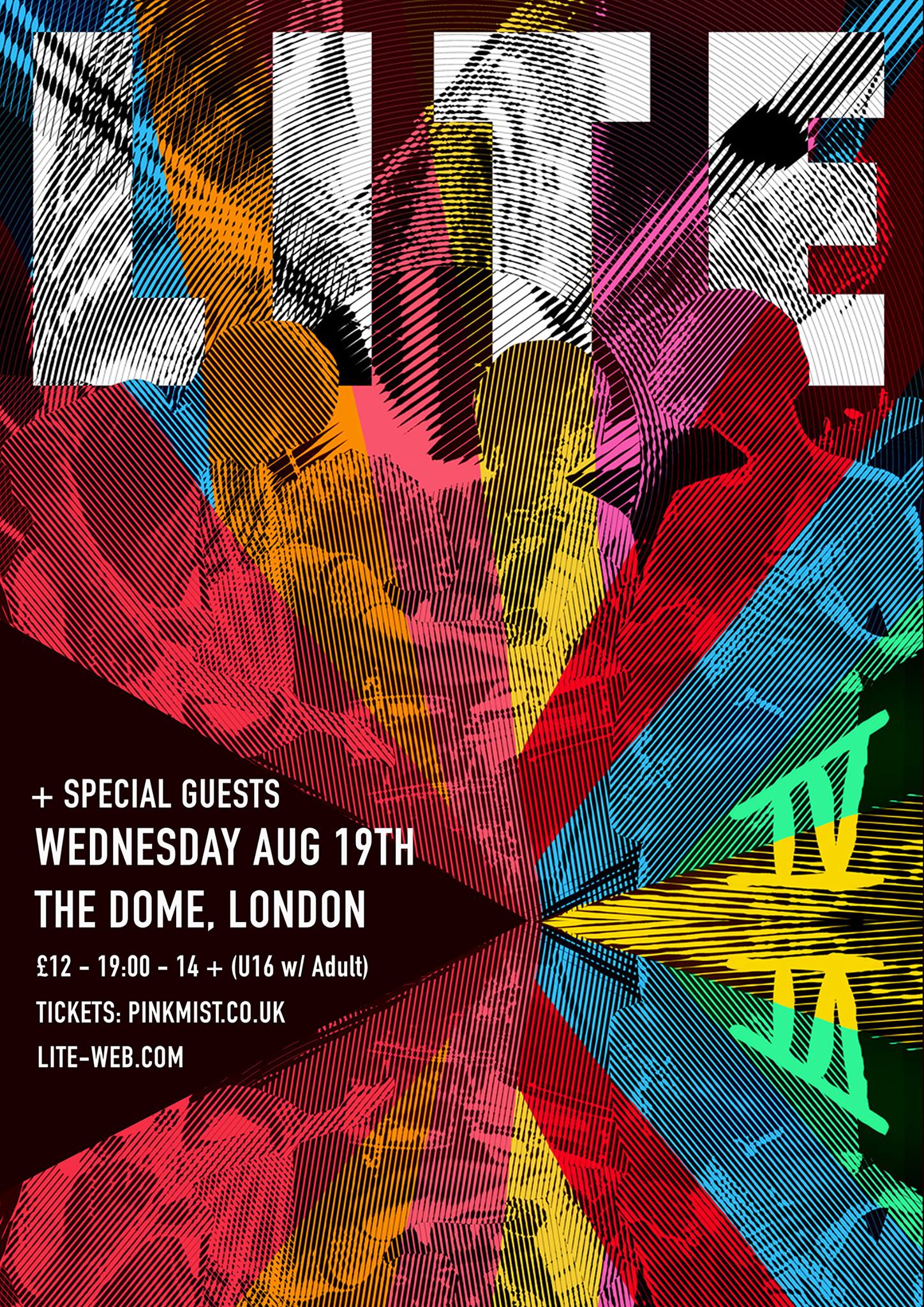


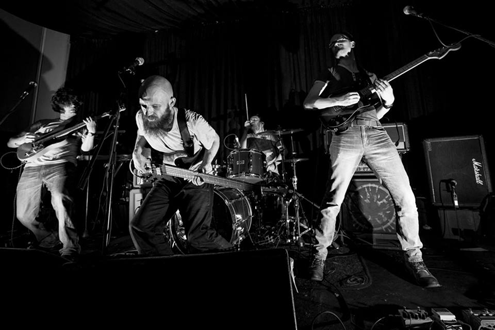
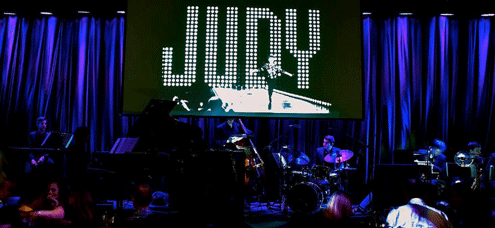
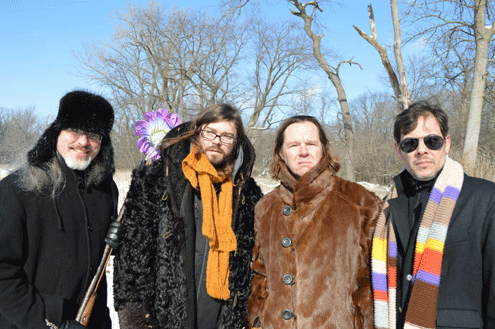
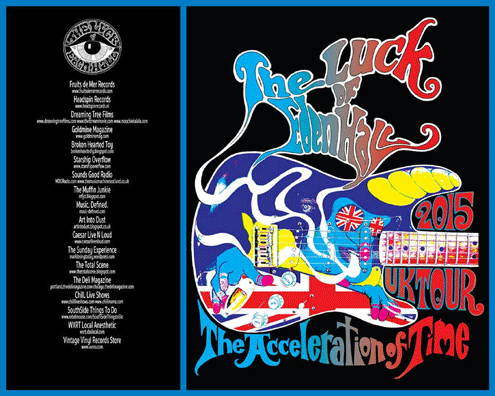

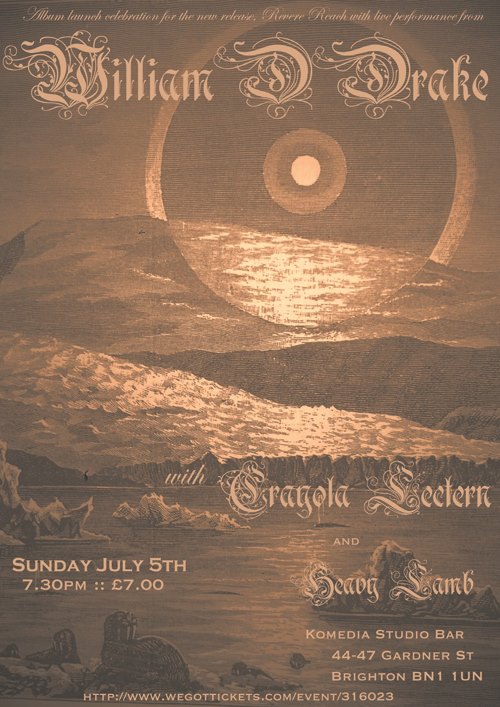

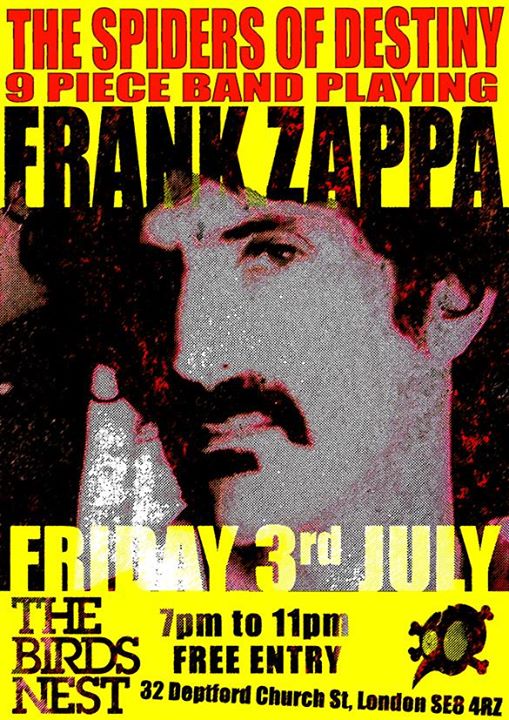
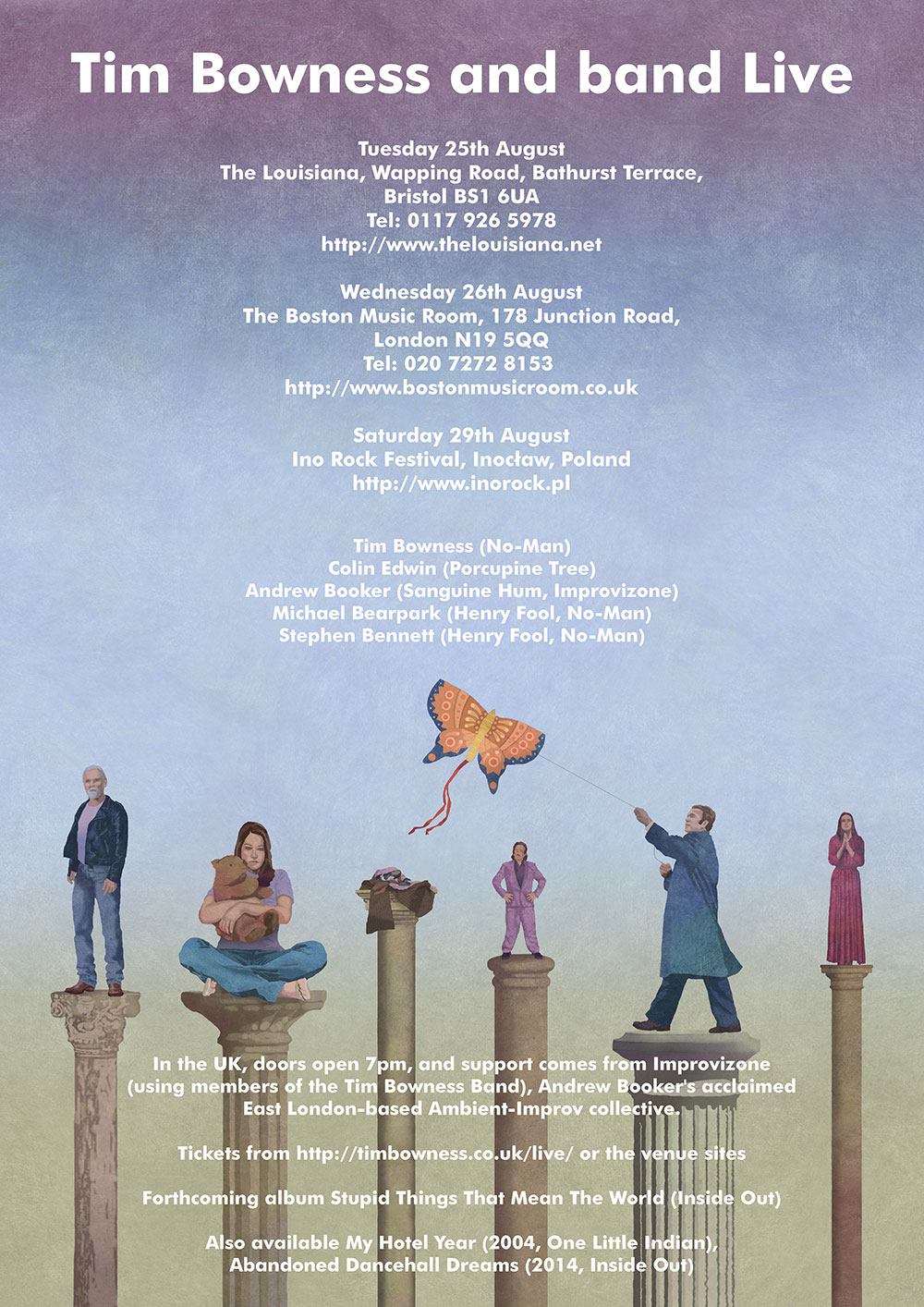


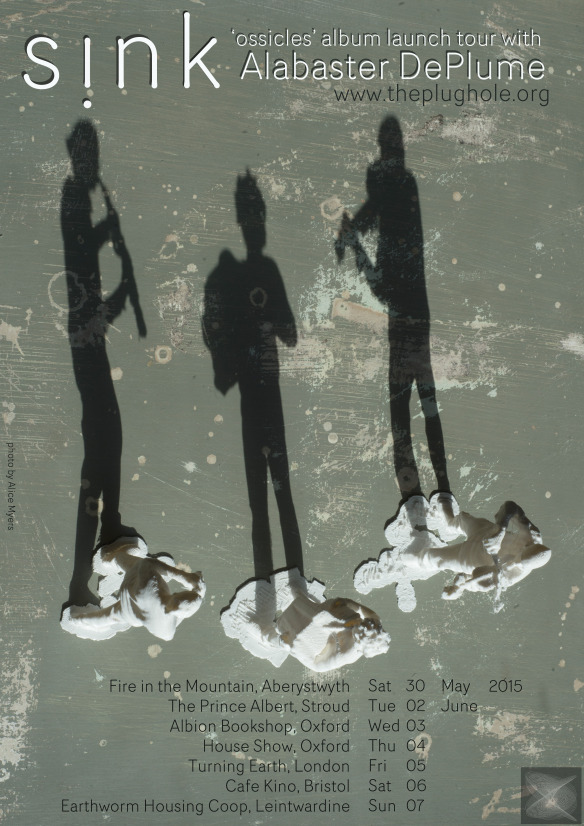
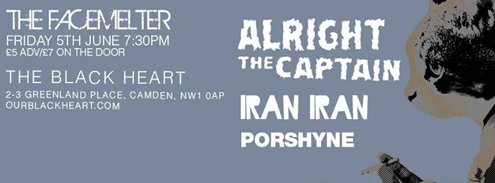
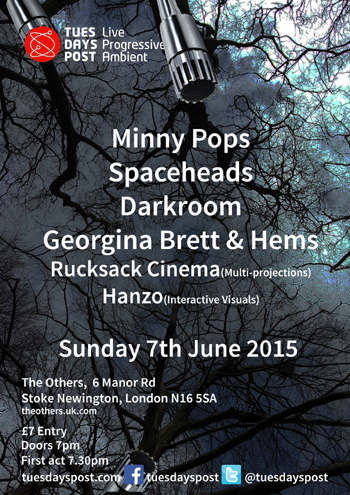
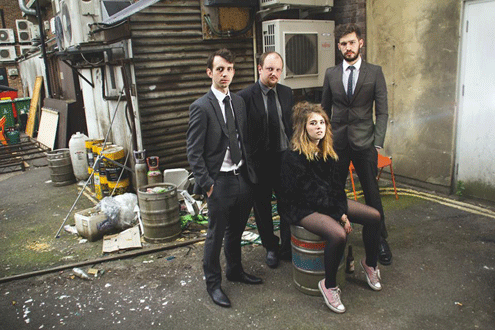

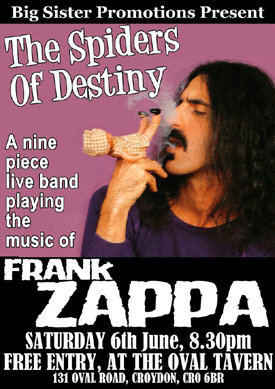
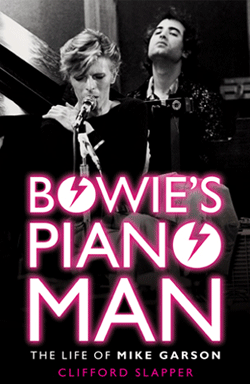
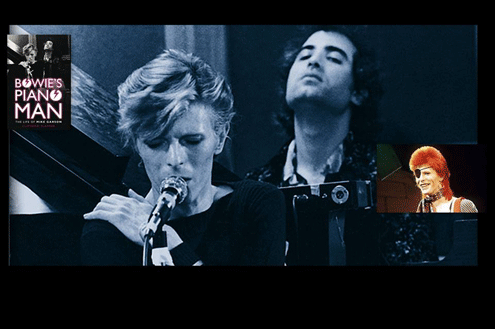

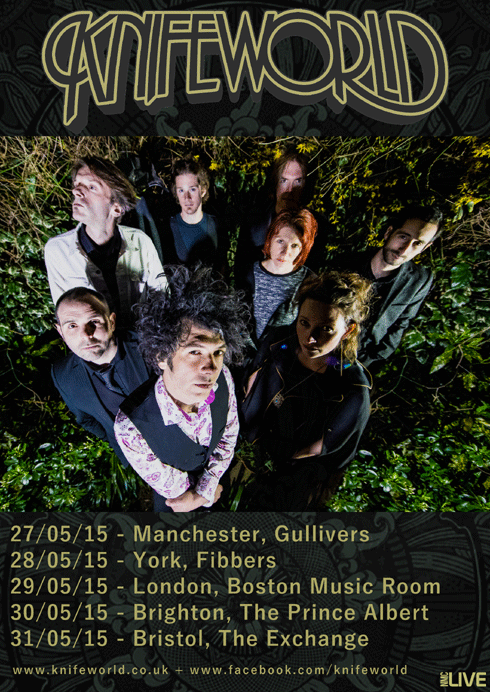
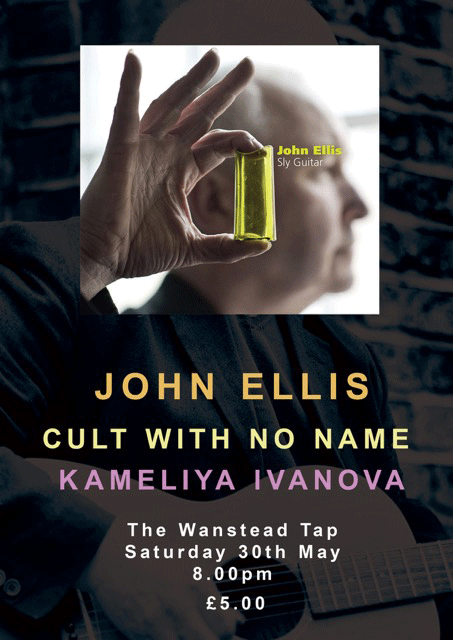



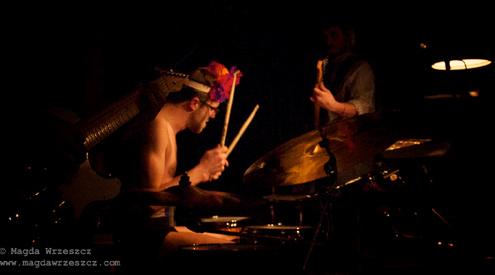




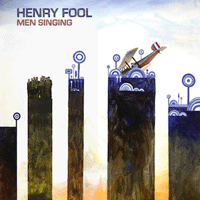


 Misfit City