Although there are still some September gigs to flag up, here’s advance notice of four interesting concerts in early October for those of you who are interested in the amorphous terrain between jazz, balladry, art pop and ambient electronica. (Just straight press release stuff – the analysis will have to wait for another time, although I’ve also stuck a few review links in where I’ve covered these musicians before…)
Two of the world’s leading solo bass guitarists together on one stage.
Crossing musical boundaries and blowing listeners’ minds for over thirty years, Jonas Hellborg is one of the great innovators of the bass guitar. From the pyrotechnic flamboyance of his early solo electric albums, to his unique exploration of the richness and depth of the acoustic bass guitar, Jonas has changed the way people think about – and play – the bass. Whether as a solo artist, or collaborating with many of the most respected names in music, from John McLaughlin to PiL, Ginger Baker to Shawn Lane, Jonas’ signature sound and uncompromising creative philosophy have produced an unparalleled body of work, mostly on his own Bardo label. Lauded by press and public alike, this is a rare opportunity to hear Jonas up close in the UK.
Steve Lawson is one of the most celebrated solo bassists in British music history – early in his career, he opened for Level 42 on their first Greatest Hits comeback tour, placing his unique take on melodic looping-based live performance in front of tens of thousands of bass aficionados. Fifteen years of regular gigging across the UK, Europe and the US have solidified his place as a leading exponent of solo bass. Steve’s sound-world borrows liberally from electronica, jazz, pop, rock, ambient and experimental music, to form a sonic fingerprint as compelling as it is unique. Following on from two years of wide-ranging collaboration, playing alongside musicians as diverse as Reeves Gabrels and Beardyman, Andy Gangadeen and Divinity, (and with the imminent release of his twelfth and thirteenth all-solo albums – on the same day!) Steve is back with fresh explorations pushing the notion of what the bass can be in the twenty-first century. (Here are a couple of ‘Misfit City’ reviews of earlier Steve Lawson records for those who’ve not read/heard them -‘Not Dancing For Chicken‘ and ‘Conversations‘).
Full dates, details and links:
Tower of Song, 107 Pershore Rd South, Cotteridge, Birmingham, B30 3EL, UK, Sunday 4th October 2015 – £10.00, tickets here.
The Vortex Jazz Bar, 11 Gillett Street, Dalston, London, N16 8AZ, UK, Monday 5th October 2015 – price t.b.c. – contact venue for tickets.
Left Bank Leeds, The former St Margaret of Antioch Church, Cardigan Road, Hyde Park, Leeds, LS6 1LJ, UK, Tuesday 6th October 2015 – £10.00, tickets here.
* * * * * * * *
Tim Bowness/Peter Chilvers/David Rhodes/Theo Travis (Chapter in association with Burning Shed @ Chapter, Market Road, Canton, Cardiff, Wales, CF5 1QE, UK, Saturday 3rd October 2015, 7.00pm) – £15.00
A unique combination of atmospheric music and songs performed by the following four British art-pop, jazz and textural music mainstays:
Tim Bowness is vocalist/co-writer with the band no-man, a long-running collaboration with Steven Wilson. He has also worked with Richard Barbieri (Porcupine Tree, Japan), Peter Hammill, Judy Dyble (ex-Fairport Convention), Roxy Music’s Phil Manzanera and others. He has released three solo albums – ‘My Hotel Year’ (2004), ‘Abandoned Dancehall Dreams’ (2014) and ‘Stupid Things That Mean The World‘ (2015).
Peter Chilvers is a frequent collaborator with Brian Eno (including co-creating the hugely successful app Bloom), Underworld’s Karl Hyde and Tim Bowness, Chilvers has become known for his innovative work with generative apps and imaginative use of electronic textures. (Here’s a review of ‘Thin Air‘, an album Peter did with Michael Bearpark many years ago).
David Rhodes is one of the world’s most respected and inventive guitarists, having worked extensively with Peter Gabriel as well as with Kate Bush, Talk Talk, Scott Walker, Japan, New Order, Paul McCartney and Blancmange, amongst many others. David has also released two solo albums (2010’s ‘Bittersweet’ and 2014’s ‘The David Rhodes Band’) and was a founding member of the influential post-punk band Random Hold.
Saxophonist and flautist Theo Travis (making his Chapter return after performing with the cinematic/musical crossover project Cipher) has an international reputation as one of the stars of the contemporary UK jazz scene. Travis has more recently emerged as a key figure in the progressive and art rock sphere, working with David Gilmour, Robert Fripp, David Sylvian, Porcupine Tree, Steven Wilson, Bill Nelson, Gong, Soft Machine Legacy, Bill Bruford, Harold Budd and more. He has recently released his ninth solo album ‘Transgression’ (and here’s a review of an earlier one).
The evening is presented by Burning Shed, the online label and store founded by Bowness and Chilvers with Pete Morgan that has become a global specialist in progressive, ambient/electronica and art rock music. As well as releasing works on its own imprint, amongst others, Burning Shed hosts the official online stores for Panegyric (King Crimson, Yes), Ape (Andy Partridge, XTC, The Milk & Honey Band), Jethro Tull, Kscope (Porcupine Tree, Sweet Billy Pilgrim), Thomas Dolby, All Saints (Brian Eno), Medium Productions (Jansen, Barbieri and Karn), Gentle Giant and Roxy Music’s Phil Manzanera. The label has recently expanded into book publishing, and at this concert musician and author Anthony Reynolds (perhaps best known as the former frontman of Jack) will be signing copies of his Burning Shed Publishing book, ‘Japan – A Foreign Place (The Biography 1974-1984)’.
More information here, and tickets available here.
Here’s the second of two previews for the first week of September, this one covering the weekend which has just arrived. Four gigs on Saturday (from post-classical to garage rock, from Afrobeat and kosmiche-influenced art pop to Canterbury-inspired lo-fi, from witty post-prog to Southern rock) and a chamber jazz gig on Sunday.
* * * * * * * *
After ten years of putting on post-classical club nights in east London, some way outside the heart of the British classical establishment, the Nonclassical organisation gets to play in the centre – a festival role, a high-profile corporate sponsorship, ads on the Tube and all. Come and judge whether they’re changing the game or being absorbed (beneficially or otherwise) into the belly of the beast. Whichever way this is going, the concert itself looks fascinating.
Nonclassical Club Night (Deloitte Ignite Festival @ Paul Hamlyn Hall, Royal Opera House, Covent Garden, London, WC2E 9DD, UK, Saturday 5th September 2015, 8.00pm) – £10.00
Nonclassical label leader Gabriel Prokofiev (a polystylist composer with a background in electroacoustic work whose works include a Concerto for Turntables & Orchestra, an “orchestral remix” of Beethoven’s Ninth and production work on hip hop, grime, and electro records) will be performing at the event, as will five-string-electric-cellist/composer/technologist Peter Gregson (whose adventures in sound include film soundtracking, multiple premieres of newly composed work plus three albums of original compositions, and a “data sonification” of Twitter).
Also performing will be the amplified prepared-piano artist Klavikon (a.k.a. Leon Michener, who uses various pickups, real time analogue processing and playing-mechanism inventions including a robot dog to fuse aleatoric ideas from Stockhausen and Cage with electronic dancefloor work including “cascading batteries of percussion, sub-basses and abstract soundscapes”); the “post-a-cappella” group Juice Vocal Ensemble (whose voicework encompasses everything from classical sources to hip hop, Irish folk, close-harmony vocal jazz and the experimental approaches of Meredith Monk and of Björk’s ‘Medúlla’), and Gabriel’s DJ collaborator Mr Switch.
There will also be a collaboration between classical soprano Sarah Dacey and the “Tendons” music theatre project initiated earlier this year by Holly Lowe and Nwando Ebizie. Based around harp, spoken word, performance art and electronics while mingling repertoire work with improvisation, this draws on and expands two modern classical pieces (Salvatore Sciarrino’s ‘L’addio a Trachis’ and John Cage’s ‘Dream’) plus the ‘Siciliano’ from Bach’s ‘Sonata in E flat’ and was premiered in June at the Nonclassical Downtown Loft Concert at The Russet in Shacklewell – one of the label’s ongoing attempts to encourage a London equivalent of the New York loft-music scene of the ‘70s and ‘80s.
* * * * * * * *
If you prefer to have your brain tickled by other means, Group Therapy are presenting what they call a night of “good ol’-fashioned noise rock” down at an east London art-rock stronghold.
Trojan Horse + Thumpermonkey + Godzilla Black (Group Therapy@ The Sebright Arms,33-35 Coate Street, London, E2 9AG, United Kingdom, Saturday 5th September 2015, 8.00pm) Entry £7 otd £5.50 advance
What this actually seems to be is a night mixing a sharp-minded self-aware take on post-progressive rock and a rollicking contemporary version of what my local library used to call “popular instrumental”, and would stick in a rack alongside James Last and The Shadows (from which, long ago, in the early days of my musical education, I’d pull out the likes of Mike Oldfield, Sky and Vangelis’ ‘Heaven and Hell’, and later the raging electric jazz raga of David Torn’s ‘Cloud About Mercury‘ – ten years later, I’d might been using it to catch the Deodato lounge revival). But if my comment makes the gig sound as if it’s in any way mild or lounge-friendly or mild, think again. This is very much a rock evening and it’s explicitly clear that this night’s crop of bands have soaked up Boredoms, Swans, Big Black, Sonic Youth and The Melvins alongside any Genesis or King Crimson which they might have imbibed. It’s just that it’s refreshing to be able to go along to one of those gigs, with that label, and not encounter yet another bunch of predictable art-punks posing with their distortion pedals and their feedback zones while reheating old daydreams about free jazz and No Wave…
I’m bitching. I don’t like doing that. Let’s have a look at the bands on the bill.
Manchester’s Trojan Horse are post-prog omnivores with tuneful hearts and a refreshing lack of shame. While their records pillage, digest and absorb a wide diet from Pink Floyd to James Brown to The Kinks to the 13th Floor Elevators, they also use their appetites to build their own muscle and identity – one through which they filter a broad, contemplative awareness of British and Mancunian history and how it soaks through into the lives of present-day people (although you don’t need to analyse that in order to enjoy one of their rambunctious gigs).
Simultaneously theatrical and punk-lean, Thumpermonkey can stake a claim to being one of the smartest British bands this side of Everything Everything (with whom they share a geeky brainiac quality driven home by vigorous, tuneful force). Couched in a crunching but colourful hard-rock vein with big pinches of post-hardcore and prog, their dramatic convoluted stalk-and-punch compositions are playful but melodious and rewarding. You can bang your head to a Thumpermonkey song, but you can also think to it. In Michael Woodman (a man like a knowing fusion of Peter Hammill, Nick Cave and Peter Blegvad) they’ve also got a frontman who’s one of the best singers and cleverest current lyricists in rock, delivering allusive and elusive barrages of sly wordplay in a resonant rock-operatic voice.
Finally, the big, bold, brazen sound of Godzilla Black lands precisely midway between No Wave and pin-sharp easy-listening film themes, or between James Black and the John Barry Seven, with rollicking drums, tight stunt brass (and yes, all right, distortion and computer sleet). They also play at a blistering, speaker-pummelling volume, so maybe there’s something in that noise rock description).
Headlining, Nottingham’s Canteloupe offer an omnivorous mix of pop, Krautrock, Afrobeat and disco. London’s Barringtone (featuring former Clor frontman Barry Dobbin) continue to pursue their motoric English art pop in the wake of the ‘Fever Head’ single. From Bradford, Gurglez blend what their neighbours Jumbo Records call “the power of prog, the drama of opera and the AOR grooves of the 70’s… poetic moments à la Terry Durham and free-jazz à la Nice” and “(turn) them on their head with a kind of left of field madness that Zappa would be proud of” (which, to these ears. also makes them sound more than a little like Sleepy People…) There should also be one more act to be added, which you can find out about in due course with the other gig information here and here.
* * * * * * * *
If you’d prefer something a little looser (or, as a clincher, something that was free to get into) for Saturday night, there’s this literally free-for-all concert taking place in the middle of Hackney and hosted by Sound Events Solutions, who have also provided the summary…
The Little Things + Alkatraz + Picturebox + Marianne Hyatt + Pit Ponies (Sound Events Solutions @ Bohemia Hackney, Unit 2, Bohemia Place, Mare Street, Hackney, London, E8 1DU, United Kingdom, Saturday 5th September 2015, 7.45pm) – free
With The Little Things it’s funk, and then it’s 70s New York new wave alt-rock, and then it’s pop, but it’s all seamless and it’s funky and cool as fuck – an uncanny indie-ish dance party band that just never suck no matter how much they flirt with mass appeal.
Alkatraz provide the psychotic reactions and spontaneous psychedelic combustions of trippin’ psychedelic garage rock.
Picturebox (centred around home-recordist Robert Halcrow) are leading lights (and probably the main constituents) of Canterbury Lo-Fi, a new clandestine pop movement encapsulating all the charm but none of the noodling of the legendary old Canterbury Scene. When Halcrow sings a song like Ruth Bakes A Cake, he is neither being ironic nor twee nor coquettishly kitchen-sink. There is a light-hearted, profoundly uncynical love for humanity running through his lyrics that can sometimes remind you of the way Syd Barrett used to sing about the lost idea of simple kindness. Special things don’t always hit you over the head with a mallet, and neither will Picturebox. But you just never know, sometimes a movement can start with an instrumental named in allusion to a little hi-fi shop next to a supermarket car-park in Canterbury, some heartfelt tributes to pop stars, and lots of tea and cake.
Frontwoman of (variously) Dragstripper, Temple of Sound, Anarchistwood and Country Dirt, MarianneHyatt is a London-based deep southern songstress from Austin Texas. She’s equal parts Patsy Cline, Janis Joplin and Jim Morrison, has sung with The Frogs at ATP, with Bill Callahan at Meltdown Festival and played a late-night pickup in Richard Linklater’s ‘Slacker’. She writes and plays platonic lovesongs to sexworkers, country reggae odes to schizophrenic madames and protest tunes to natural disasters… a walking triumph of lost causes and no-longer living legends.
Pit Ponies are renegades from Naughties rockney/post-punk/knees-up beer boys Corporal Machine & The Bombers, fusing ‘90s indie with pissed pub fights and ‘70s pub-rock. (In spite of this preamble, they’ll actually be playing an acoustic set.)
After all of this, on Sunday, there’s jazz via the return of the LUME evenings via the Vortex. Blurb for the first evening is below.
Mark Pringle’s A Moveable Feast & Rebecca Nash (LUME @ The Vortex Jazz Club, 11 Gillett Square, Dalston, London, N16 8AZ, UK, Sunday 6th September 2015, 7.30pm – £10.00
A Moveable Feast is a group led by jazz pianist Mark Pringle (a Peter Whittingham Award winner for the year 2015, following in the footsteps of previous recipients Gwilym Simcock, Trish Clowes and Elliot Galvin). Heavily inspired by time spent studying in Paris in 2013, the music draws on multiple cultural influences, containing themes of nature, wildlife, literature, the chaos of cities, the lives of people who inhabit them, woodland creatures and strange beasts… This autumn sees the group undertaking a national tour to promote the release of their album, ‘A Moveable Feast’, on Stoney Lane Records.
Featuring a twelvetet line up of strings, horns and rhythm section, the group explore Mark’s music with great freedom of approach, resulting in music that is eclectic, adventurous and highly unique. The band are Mark Pringle (piano), Percy Pursglove (trumpet), Chris Young (alto saxophone), Dan Searjeant (tenor and alto saxophones, flute), Alicia Gardener-Trejo (bass clarinet, baritone saxophone, alto flute), Ben Lee (electric guitar), James Banner (double bass) and Euan Palmer (drums), plus a string quartet of Christine Cornwell, Sarah Farmer, Megan Jowett and Lucy French.
Rebecca Nash‘s music, written with the intention of creating a new cohesive sound, blends together all the things she loves about music. Most important is a sense of purpose, identity and beauty. It is inspired by many musical influences which primarily include jazz musicians such as Pat Metheny and Wayne Shorter but also other styles too, such as electronica and folk music. Rebecca’s own style, rooted in the contemporary jazz genre, blends acoustic and electronic elements with strong melodies, underpinned by dense harmonies and unusual grooves with the aim of creating one overall soundscape.
This latest project is Rebecca’s first as a bandleader, and all of the music performed is original material from her forthcoming album, due to be recorded later this year. Tonight she leads a small group with herself on piano, Percy Pursglove on trumpet, Matt Fisher on drums, and Chris Mapp on bass guitar.
More information on the event is here, with tickets available here.
There’s a wealth of new gigs coming up in London in the first week of September – here’s the first of a couple of whistle-stop preview for some of the ones which caught my interest. I’ve missed Monday and Tuesday. Starting with some relative softness on Wednesday…
Ralegh Long + The Left Outsides (Parallel Lines @ St Pancras Old Church, Pancras Road, Kings Cross, London, NW1 1UL, UK, Wednesday 2nd September 2015, 7.30pm) – £8.25
A piano balladeer with soft rich baroque pop tendencies, Ralegh Long’s been compared to Alex Chilton, Todd Rundgren, Laura Nyro and Nick Drake… and not without cause. His debut album ‘Hoverance’ was released earlier this year, and at this concert he’ll be joined not only by his usual band but by the strings, horns and whatnot of A Little Orchestra. In support, there’s the acid-folk duo The Left Outsides, affiliated to both The Eighteenth Day Of May and Of Arrowe Hill. To find out what both acts sound like, see below.
* * * * * * * *
On Thursday, things are louder…
Guapo + Hirvikolari (The Quietus @ The Lexington, 96-98 Pentonville Road, London, N1 9JB, UK, Thursday 3rd September 2015, 7.00pm) £8.00
Over a twenty-year career experimental rockers Guapo have explored their own open-ended, constantly-altering takes on noise/jazz/psychedelic rock, Magma-esque Zeuhl and Rock In Opposition (via several roiling and transformative line-up changes attracting, turn by turn, some of the most talented London players). The latest version of the band – perennial Guapo drummer Dave Smith, guitarist Kavus Torabi and keyboard player Emmett Elvin (both also of Knifeworld) and new bass guitarist Sam Warren (also of Thumpermonkey, more of whom tomorrow) – will be launching and performing an extended version of their new album ‘Obscure Knowledge’. On this occasion Guapo will be augmented to a quartet by guest woodwind player Michael York.
Playing support are trumpet-and-modular-synth duo Hirvikolari, a spinoff project from psychedelic rockers Teeth Of The Sea featuring Sam Barton and Mike Bourne. They were recently hailed by Luke Turner (of event promoters/multi-media…. ‘The Quietus’) as “a gorgeous, transportive wander across a luminous veldt, taking in grubby techno and hinting at Coil’s ‘Musick To Play In The Dark’ via a tripping colliery band, falling down an unguarded shaft after being led astray by Jon Hassell.”
Up-to-date gig information is here, and some soundclips are below – also courtesy of ‘The Quietus’ is the Hirvikolari set recording, taken from their summer appearance at the Raw Power festival in Tufnell Park earlier this year.
* * * * * * * *
On Friday, Facemelter are presenting a triple-feature heavy evening in Camden, while progressive rock veterans Curved Air are playing a special gig in Fulham.
Tacoma Narrows Bridge Disaster + Opensight + Sumer, (The Facemelter @ The Black Heart, 2-3 Greenland Place, Camden, London, NW1 0AP, United Kingdom, Friday 4th September, 7.30pm) – £6.00 advance, £8.00 on the door
Tacoma Narrows Bridge Disaster are a brilliant atmospheric post-metal band who’ve risen early in the UK’s underground scene and with an audience spanning the edges of metal, prog and post-rock. Now back with the original lineup that won them their international audience (and fresh from performing at ArcTanGent) they launch their third album ‘Wires/Dream\Wires’, three years after releasing the hugely acclaimed ‘Exegesis’. Originally from Colombia,Opensight are an ambitious band fusing metal with the vintage, grainy feel of 70s prog. Their launch of their new EP ‘Ulterior Motives’ will appeal to fans of all genres. Gig openers Sumer are a self-styled post-prog band with interesting riffs, soaring vocal melodies and catchy hooks. They have risen with seemingly unstoppable force and with every reason, as anyone who attended the packed launch of their album ‘The Animal You Are’ last September will remember.
All of the above is a slightly-tweaked Facemelter summary: some album tasters are below, and tickets are available here.
Curved Air (Under The Bridge, Stamford Bridge, Fulham Road, Chelsea, London, SW6 1HS, UK, 4th September 2015, 7.00pm) – £18.00
Though they’re best known for a single classic rock radio staple – Back Street Luv, which might suggest to the casual listener that they were briefly a British Jefferson Airplane – Curved Air began life as a genuinely innovative band. While the presence and tone of singer Sonja Kristina (the band’s only constant member) has always tied the band in with folk music and the rock siren tradition, founder members and key composers Darryl Way and Francis Monkman were classically-trained enthusiasts of psychedelia and the ecstatic minimalism of Terry Riley – hence the cascading Hendrix-and-microtones violin roar of Vivaldi on the band’s first album ‘Air Conditioning’.
Despite a remarkable start, differences of opinion, susceptibility to fluctuating musical styles and plain bad luck meant that Curved Air subsequently staggered from lineup to lineup and from image to image. With Way slipping in and out of the band over the years, and Monkman a relatively early casualty of disagreements (though a frequent if brief returnee), many the original ideas were lost in transit. Nonetheless, versions of the band have existed on and off ever since, with Curved Air currently anchored by Kristina, original drummer Florian Pilkington-Miksa and guitarist Kirby Gregory (from the second main lineup).
For this particular gig, Darryl Way will be making an appearance on violin and the band will – for the first time ever – be playing early masterpiece ‘Air Conditioning’ in its entirety, although they’ve also promised to perform from their entire repertoire up until the present day. The concert will be recorded and filmed for a commemorative DVD release. Tickets available here.
* * * * * * * *
Tomorrow, more on Saturday’s stretch of gigs, from garage bands to chamber jazz to art-pop to post-classical…
Here’s a quick signal booster (or, perhaps more accurately, noise booster) for the debut Mutations festival coming up in Brighton at the end of November. (The press release just came in from Stereo Sanctity today). Note that tickets go on sale in the middle of this week, and that there’s only a thousand tickets. I’ve just seen a Facebook counter suggesting that 330 people have already committed themselves to tickets. Move fast.
Mutations is a new multi-venue inner city festival in Brighton, England, born out of last years acclaimed DRILL:BRIGHTON. With Wire’s touring project moving onto the next urban sonic assault, co-curators One Inch Badge decided the time was right for a forward thinking, annual, artist-lead festival that would be static to Brighton on the last weekend of November
Spanning two days and nights on the 28th and 29th November with an incredibly intimate capacity of just 1,000, Mutations is a music-lover’s event. Alongside the music you can also expect pop-up record fairs, poster art exhibitions, photography and more.
Mutations is a creative mass of genre hybrids and expression, delivering some of the most inspiring, creative and interesting music the world has to offer; a host of other national and international acts including genuinely alternative rock, aggressive noise, experimental house, singer-songwriters, doom metal, electronica, drone, experimental folk and various other experimental sounds.
Prescott – as beautiful as the chance meeting on a dissecting-table of a sewing-machine and an umbrella…
Prescott + A Sweet Niche + V A L V E (The Harrison, 28 Harrison Street, Kings Cross, London, WC1H 8JF, UK, Wednesday 26th August, 7.00pm) – £5.00
Prescott are a percolating musical alliance between Kev Hopper (who once played elasticated bass guitar for Stump and went on to participate in offbeat experimental projects from laptop improv to pocket pop), veteran avant-indie/improvising drummer Frank Byng (of Crackle, Snorkel and the Slowfoot label) and polymath keyboard player Rhodri Marsden, whose curiosity, industry and dry wit has drawn him through a patchwork career of interesting music (including The Keatons, Zuno Men, The Free French, Gag and Scritti Politti) and deft, wry journalism on everything from drum machines to dating disasters.
According to the Harrison’s blurb, the band deliver “a curious mix of the melodic and discordant with syncopated funky, skewed beats and lopsided, sometimes jabbing riffs that emerge from a complex web of musical interactions and expand or contract like sections of a stuck record.” The band themselves talk about “jabbing heteroclite riffs, circular rhythmic patterns, vibrating harmonic clashes, irregular note intervals, all contrasted with pockets of beautiful melody” and their trick of “microriffing” – repeating the same tiny melodic segment for “as long as they can hold their nerve” (out of a sense of persistence, a zest for irritancy or a desire to pay homage to loop culture) .
I’ll add that while these descriptions make Prescott sound like a set of ticks on a battered art-music bingo card, they’re actually one of the most entertaining and even danceable bands I’ve seen in recent years; pumping out a surprisingly melodious batch of hiccups, peculiar grooves and inventive colours, and sometimes seeming to plug into a monstrous late-Miles Davis synth-fusion groove (entirely by mistake).
I’ve written about A Sweet Niche before, having encountered them a few years ago when they were roaring the roof of a cellar off in Spitalfields. Between them, guitarist Keir Cooper, baritone saxophonist Oliver Sellwood and drummer Tim Doyle have an intimidating list of project credits. In this band, however, they make a brinksman’s racket of free-form punk-jazz, bringing in whatever else they’ve learned from excursions into rock, theatre work and the thornier ends of contemporary classical.
Making the most of their disparate backgrounds (Oliver is a qualified musical academian, Keir more of a non-institutional outsider, newer boy Tim somewhere in between) they’ll attack their musical ideas at full blurt and with plenty of noise, like angry men stripping the wreck of a ca. They’ll toss disparate fragments up into the air and rant about them, but then sideswipe expectations with a run at a cute theme. Last time I described them as “if Bagpuss had joined Slayer”, and they seemed to like it. See what you think.
V A L V E is the solo project of Chlöe Herington – reedswoman, experimenter and Magma/Zappa/Peter Maxwell Davies fan. She’s best known for blowing taut, assertive bassoon and saxophone parts in Knifeworld and Chrome Hoof, but has also worked with lo-fi art-rockers Jowe Head & The Demi Monde and elusive psycho-lounge band Made By Monsters, as well as a clutch of contemporary classical projects. V A L V E places the bassoon to centre stage, surrounded by Chlöe’s clusters of technology and (when required) selected guests. At the Harrison, the project will be appearing in “its first non-gallery show ever”, which might either involve letting it off the leash or playing a little more safe. (Come and find out.)
Dotted around Chlöe’s other band commitments, V A L V E releases have been sparse so far – odd fits and starts on Soundcloud or YouTube plus a couple of Bandcamp tracks. Here are a few tasters, including the soundtrack to a dinosaur battle, something which Chlöe developed from a piece of music found in a skip, and a more sombre contemporary classical effort.
Up-to-date gig information available here and here. (Or, if none of this really floats your boat and you’d prefer some lustrous art-rock croon, here’s one last linking plug for the Tim Bowness/Improvizone gig at the Boston Music Room on the same night.)
* * * * * * * *
On the Saturday, it’s time to welcome back Daylight Music, who are starting up a new series of free midday gigs (and are still writing their own promo blurb, which makes things a little easier for me).
Daylight Music 198: Pete Astor + TEYR + The Left Outsides (Union Chapel, Compton Terrace, Islington, London, N1 2UN, UK – Saturday 29th August, 12pm to 2pm)
Ex-leader of The Loft, The Weather Prophets and numerous other esteemed acts, Pete Astor creates timeless chamber-pop, brimming with wry lyrical insight and haunting melodic hooks. Now recording for Fortuna POP!, he has his first full length album for four years ready for release. This has been made with Ultimate Painting, Veronica Falls and Proper Ornaments main man James Hoare along with Pam Berry (Black Tambourine, Withered Hand) on vocals, Alison Cotton (The Left Outsides) on viola, Jack Hayter (Hefner) on pedal steel and guitar, Emma Winston on synth bass (Darren Hayman’s Long Parliament, Owl & Mouse) and Susan Milanovic (Feathers) on drums. The recent single, ‘Mr Music’ has been very warmly received with Astor and band recording sessions for Marc Riley and headlining the Church stage at this years’ Indie Tracks festival among many other recent live outings. For the Daylight Music show Astor will be joined onstage by James, Pam, Alison, Jack, Emma and Susan making a seven-piece group playing Astor’s songs, old and new, for an edifying and nutritious lunchtime performance.
Forged amongst the hustle and bustle of North London’s folk scene, TEYR (“3” in the Cornish language) are a trio of formidable musicians who showcase the many sounds of the British Isles. With roots running from Ireland to Wales to Cornwall, James Gavin (guitar and fiddle), Dominic Henderson (uilleann pipes and whistles) and Tommie Black-Roff (accordion), the players thrive on close interplay and pushing the possibilities of acoustic music. Having met on the traditional music scene through late night sessions, each performer holds an intuitive sense of folk music, evident in their deft arrangements and compositions. The trio draws influence from neo-folk groups such as Lau, Kan and Lúnasa, whilst harnessing an innovative combination of strings, reeds and voices. With this distinct mix, TEYR strike an enigmatic path through the current folk wave.
The Left Outsides are Mark Nicholas and Alison Cotton, a London-based husband and wife duo whose atmospheric, hypnotic songs echo Nico’s icy European folk, pastoral psychedelia and chilly English fields at dawn. Their second album ‘The Shape Of Things To Come’ has just received a welcome and much-praised vinyl release on Dawn Bird Records and an album of new material is currently being recorded. The duo have played across the UK, France, Germany and in the USA; and have recorded radio sessions for Stuart Maconie’s Freakzone, Tom Robinson’s show on BBC6 Music, Pete Paphides show for Soho Radio and Tom Cox’s radio show.
As ever, Daylight Music is free, although you’ll have to pay for your tea and cake, and further donations are encouraged. Full up-to-date information is available here.
More quick London gig news – art rock, post-rock, electronica, and a dash of classic New York downtown.
Rumour Cubes + Dresda + kontakte @ The Facemelter (The Black Heart, 2-3 Greenland Place, Camden, London, NW1 0AP, UK, Friday 7th August, 7.30pm – £8.00/£6.00)
Sumptuous instrumental and electronic post-rock from ex-Glastonbury and ArcTanGent Festival performers, plus a UK debut.
Post-rock veterans Rumour Cubes have been spreading tentacles of ambient, soaring soundscapes across the globe, catching people’s attention with their classical and electronic nuances, attention to the finest details and unassuming political statements embedded in their writing. Their work with poets and film-makers has allowed them to create a multi-media experience and has propelled them to performances at Glastonbury, ArcTanGent and a support slot for Sólstafir; while their albums ‘The Narrow State’ (2012) and ‘Appearances Of Collections’ (2014) received wide critical acclaim.
Celebrating their tenth anniversary this year, Dresda hail from Genova, Italy, and will be driving over to make their UK debut. Their music is intricate, dense and introspective yet gloriously cinematic. They have several well-received releases under their belts, including soundtracks for critically acclaimed Italian independent movie ‘The Krolevsky Case’, and the short movie ‘La lingua del disordine’. In 2009, they were featured on the Italian DVD edition of the Canadian documentary ‘RIP! A remix manifesto’, distributed by Feltrinelli Real Cinema nationwide.
Conceived in 2005 from a string of old 4-track demos and further realized via a labyrinth of digital workstations and computer software, kontakte blend organic instrumentation within an electronic and hypnotic framework of programmed beats and pulsing synths. Pooling influences such as Godspeed You! Black Emperor, Mogwai together with Brian Eno, krautrock and shogaze sounds, this duo manages to perfectly blend shimmering electronics and ethereal melodies. They have too many releases to name and have been remixed by many visionaries including Tim Holmes of Death In Vegas, Chris Olley of Six By Seven and Russell. M. Harmon.
There might also be tickets remaining for the performance of Arthur Russell’s Instrumentals early in the following week. This is a repeat visit of a show that’s been on and off the road at various points around the world since 2012 and which last visited London via Cecil Sharp House earlier this year… so if you missed it before, now’s your chance.
Visions presents: Arthur Russell’s Instrumentals, directed by Peter Gordon @ Visions Festival (Oval Space, 29-32 The Oval London, Bethnal Green, London, E2 9DT, UK, Monday 10th August, 7.30pm – £21.50 plus booking fee)
For those of you who don’t know about Arthur Russell’s turbulent, productive (and sadly curtailed) life, he was a vigorous participant within the downtown New York music scene between the mid-1970s and early 1990s. Having studied as an avant-garde cellist and composer, he rebelled into Manhattan nightlife, vigorous cross-fertilization and event curation. Russell rubbed up against Fluxus, disco, avant-garde theatre, New Wave and no-wave, making the most of the breadth of the prolonged New York creative ferment of the times, feeding his assorted roots and collisions into music of his own.
During the last decade of his life Russell wrote and performed voice-and-cello songs – predominantly solo but employing loops, echo and sundry effects. In these, he synthesized all that he’d learned into what were perhaps his most personal and accessible works. These are probably what he’s best known for now, thanks to the more prominent releases of albums such as ‘World Of Echo’ and ‘Another Thought’, but they’re only one aspect of his work
A notorious perfectionist reknowned for agonised work gestations (and who left hundreds of pieces uncompleted at his death) Russell nonetheless completed what was, at the time a remarkably bold, broad and modern array of work from orchestral pieces and theatre music to forays into electro-pop and dance music under project names including Dinosaur (for ‘Kiss Me Again’) and Loose Joints (‘Tell You Today’). Today this kind of equivalence and eclecticism is more commonplace in the orchestral or ensemble work of composers such as John Zorn, Django Bates, Anna Meredith or Tansy Davies. In the 1970s, though, Russell was a pioneer, notoriously shocking the staider elements of his avant-garde classical audience with ‘24-24 Music’ (a contemporary classical piece equating the pulses and disciplines of New York minimalism with those of disco music).
Coming from the zone of Russell’s talent which drew most on his contemporary classical roots, ‘Instrumentals’ is an example of his chamber music, Dating from the late ‘70s, it was initially conceived as a forty-eight hour piece, its duration far exceeding even the infamously massy protracted works of Morton Feldman. Versions of the work were performed over the years, and a selection of excerpts appeared on a Disques du Crepuscule release in the mid-‘80s.
The piece as it stands owes much to Russell’s friend Peter Gordon, a fellow eclectician from the 1970s downtown scene and Russell’s bandmate in The Flying Hearts and Gordon’s own ongoing Love Of Life Orchestra. Gordon worked closely on the original performed version, assisting on keyboards, arrangement and notation. Two decades after Russell’s death in 1992, Gordon brought a new version of ‘Instrumentals’ back to The Kitchen (Russell’s old home venue in Manhattan. Following the initial sold-out performance in March 2012, Gordon has periodically revived and toured the new arrangement. The performance at Oval Space will feature several members of Russell’s original ensemble, and will also feature photographs by Yuko Nonomura which were projected during the original 1975/78 Manhattan performances of ‘Instrumentals’.
Next week sees the first gig (for some time) for one of the most interesting of current British rock bands; some high-gloss cabaret; and the start of a psychedelic pop roadshow travelling around the UK. Read on…
Thumpermonkey don’t get as much attention as they deserve. It’s possible that this is because they don’t seem to take things seriously, addressing almost everything with a skewed and multi-levelled sense of cryptic grand-baroque geek humour. Just to illustrate this – a current work-in-progress Thumpermonkey song is “something which we’re calling Giraffes, which includes some vague narrative about doing a conga during an asteroid-based extinction-level event.” One of their older albums is called ‘Chap With The Wings, Five Rounds Rapid’ – a wry kill-the-monsters line filched from ‘Doctor Who”s laconic and unflappable Brigadier. In the same spirit as that reference, I’d suggest that while they are serious about what they do, they’re not necessarily serious about the way they do it – like many of my favourite things.
If what I’ve written so far leads you to expect strained, fey, sub-Zappa wackiness, then think again. Both in the flesh and on record, Thumpermonkey are a brooding and atmospheric proposition – seriously musical, travelling from blitzingly heavy quasi-metal riffs to spidery post-rock, from threshing post-hardcore to theatrical mane-tossing prog at a moment’s notice while Michael Woodman’s grand edgy vocals and complex multi-levelled lyrics ride on top like an arcane mahout with an arched eyebrow. They’ve been called “a sustained victory for intuitive cross-pollination” by ‘Prog’ magazine and every gig they play confirms this particular accolade. Here they are playing 419 (a song which at first appears to be one of their more delicate offerings, revealing its intensities later).
The other two bands on the bill are less well known to me, but aren’t short of blurb:
The Earls Of Mars are probably the most original thing you’ll hear all year. At their heart, the band are a ’70s-influenced rock band bringing together jazz, prog, space rock, doom and blues and forming it into a barking mad noise that you’ll either get or you won’t. If you don’t get it then close the door on your way out of the spaceship, as those of us who want to stay are off on a fantastical journey to who-knows-where, with The Earls Of Mars steering the ship. Enjoy the trip, ladies and gentlemen, as it’s going to be a fun ride.
Ham Legion‘s noisy lo-fi pop is punctuated with proggy outbursts, psychedelic breakdowns and passages of cod-metal joy. Tangy and tart guitar, egg noddle bass lines and light crispy drums are smothered in gooey boy/girl harmonies. Eat in or take away. For fans of Cardiacs, Deerhoof, They Might Be Giants, Split Enz, Heavy Vegetable.
Judge for yourselves – here are the videos for the Earls’ ‘Astronomer Pig’ single from last year, followed by some footage of a Ham Legion gig in Brighton a couple of years ago. As for tickets, they’re available here.
* * * * *
The day after the Thumpermonkey gig, Holly Penfield plays one of her biggest gigs of the year…
Holly Penfield sings Judy Garland, The Hippodrome Casino, Cranbourn Street, Leicester Square, London, WC2H 7JH, UK, Friday 31st July 2015, 8.00pm) – £15.00 and upwards
Following a triumphant debut last year, Holly returns to the London Hippodrome, singing the songs of the legendary Judy Garland in her own inimitable style. Holly will be joined by her musical director Sam Watts and his magnificent seven-piece band. An unmissable evening for Holly and Judy fans alike, set in the glorious Matcham Room, located inside the Hippodrome Casino – formerly known as The Talk Of The Town, this is the venue of legends and home to Judy’s final London concerts.
Longer-term readers will know that I got to know Holly years ago via her own original ‘Fragile Human Monster Show‘ and the ‘Parts Of My Privacy’ album (which I wrote about ages ago – that review’s due a revamp and remount, I think). Both of those, though original songwriter pop, had their own theatrical and psychodynamic aspects which pointed towards Holly’s current work in vivid cabaret (and, latterly, as half of swing revivalists The Cricklewood Cats). As for Holly’s interpretations, she can and does cover cute showbiz camp and heart-tugging pathos within the same performance – you can see a couple of examples below.
Up-to-date information on the Judy concert is here and here, while tickets are available here. A mischievous part of me fancies swapping the audience from Holly’s show with the one from the Thumpermonkey/Earls/Ham Legion gig, and vice versa. I suspect that they all might enjoy it more than they’d expect to…
* * * * *
On the same night that Thumpermonkey and co. play, The Luck Of Eden Hall are over from Chicago to play the first of two London gigs, launching a Kickstarter-funded UK tour which will take them to a wide array of venues and mini-festivals around England, Scotland and Wales, accompanied by a shifting cast of local psych heroes, left-field blues artists and quirky alt.pop shoegazers.
As for the headliners, you can expect clear-voiced, well-made classic pop beset by sudden gusts of psychedelic blizzarding. The Luck Of Eden Hall remind me of the drawn-out trucker-and-motorist tussle in ‘Duel’ – they come across like a more sombre Neil Finn or Andy Sturmer being stalked, dogged and sideswiped by Hawkwind, Ride or ‘Saucerful’-era Pink Floyd. Here’s a little evidence:
If your musical instincts include any crate-digging, hoarding or hunter-gathering aspects, you could try checking out the Independent Label Market this Saturday, 11th July, at Old Spitalfields Market in east London. I got my own heads-up about this via The Carvery, who say:
We will be representing a strong and eclectic mix of labels we work with… There will be a limited amount of stock hand picked by each label at a reduced price for one day only. Expect releases and limited edition items from Sofrito, Tropical Discotheque, Matsuli Music, Numero Group, Five Easy Pieces, Names You Can Trust, Bastard Jazz, Paradise Bangkok, Rhythm Section, High Focus, Faux Discx Records, ALTER, NICE UP! Records and Reggae Roast.
No, I know none of these labels. Expect many others, plus other mastering companies and record manufacturers, to be there on the day selling independent-label music at bargain prices. For anyone who attends, the event is likely to be an education in itself. It starts at 11am, goes through until 6 in the evening.
Later on, but not very far away, there’s this…
Tom Slatter + jh (The Chapel, St Margaret’s House, Old Ford Road, London, E2 9PL, UK, Saturday 11th July, 7.30 pm)– free
Disarmingly, Tom describes his work as “the sort of music you’d get if Genesis started writing songs with Nick Cave after watching too much ‘Doctor Who'”, while one of his occasional collaborators, Jordan Brown of airy London prog-poppers The Rube Goldberg Machine, calls him “a sci-fi storyteller with a penchant for odd time signatures and soundscapes.” Both descriptions ring true but fail to pinpoint the cheerfully pulpy weird-fiction exuberance of Tom’s work as a one-man band. He’s a man not just happily out of his time, but making a virtue of it – a latter-day Victorian street-theatre barker with a guitar promising tales of mystery, imagination, ‘orrible murders and bloody great waving tentacles.
This gig’s an acoustic show, with Tom mostly playing versions of songs from his recent ‘Fit The Fourth‘ album (out on Bad Elephant Music last month). Part of me hopes that he’ll take his taste for Victoriana a step further and rig himself up like a phoney spiritualist – little bits of prestidigitation, a tambourine between the knees, plus additional instruments and sound effects triggered by fishing line attached to thighs and elbows. We probably won’t get all of that, but what we will get is a performer who’s blissfully committed to the inherent fun and theatricality of his material. Something to treasure. Here he is at play in the video for his recent single, ‘Some Of The Creatures Have Broken The Locks On The Door To Lab 558’ (for better or worse, the title says it all), plus another video taken from an acoustic show he did amidst the wheels, pistons and cams of the London Museum of Water & Steam down at Kew Bridge.
Playing support is Tom’s fellow Bad Elephanteer jh in a similar acoustic slot, promoting his ‘Morning Sun‘ compilation and the upcoming Bad Elephant release of his back catalogue. With the soul of a confessional busker but the expansive sound-draping instincts of an electric-Eden acid rocker, jh (on record, at least) is the missing link between Joe Strummer and Roy Harper with a touch of prog pastoral thrown in. Live and unplugged, he’s likely to be wirier and relying on his narratives to hold your attention. Personally, I warm to a man who can write an eighteen-minute Anglo-prog epic (complete with Michael Caine references and conversational swearing) and call it ‘Making Tea Is Freedom’.
Up-to-date info on the concert should be here, while tickets can be reserved here (as I post, there are twenty-nine left).
On the following Tuesday, William D. Drake follows up last Sunday’s launch gig in Brighton for his new ‘Revere’s Reach’ album with a second launch gig in London. I’ve been putting up plenty of posts about his exuberant music and its clever, affecting mash-up of folk, rock and classical; its beguiling nonsense, its striking beauty and its deceptive humanity. Expect a few more of those shortly. Support comes from a rare appearance from Stars In Battledress (the Larcombe brothers’ cryptic, witty psychedelic folk duo – read an account of them onstage here) and the mysterious Steven Evens, about whom I know nothing (update – ah, it’s a new incarnation of Stuffy Gilchrist!). Current event info is here, tickets are here, and the basic info plus a brace of videos are below.
William D. Drake + Stars In Battledress + Stephen Evens (The Lexington, 96-98 Pentonville Road, N1 9JB, London, UK, Tuesday 14th July, 7.30 pm)– £11.00
UPDATE, JULY 13th – sadly, the William D. Drake gig has had to be postponed due to bereavement. I’ll repost about it once it’s been rescheduled.
This weekend you could choose some unorthodox transplanted Americana, or some equally unorthodox English nooks and crannies. Or (as long as you were somewhere around London or Brighton) you could feasibly enjoy both of them, given that you’ve got more than twenty-four hours to cover the fifty miles between the options. (It’s bright. It’s hot. Enjoy the weekend out. Go on…)
First, the Saturday show in London…
Daylight Music 196: Piney Gir + Rodney Branigan + Player Piano, with Gemma Champ (Union Chapel, Compton Terrace, Islington, London, N1 2UN – Saturday 4th July, 12pm to 2pm)
Blurb follows…
July brings an American Independence day special to Daylight Music.
Piney Gir hails from the American Midwest, home of wide-open plains with sunflowers that go on as far as the Earth curves. The “you’re not in Kansas anymore” jokes never wear thin, because Piney embraces her heritage bringing it with her to the UK, where she’s lived in London for over a decade now (yes, she does have a sparkly red shoe collection and yes, she wears a lot of gingham). She is celebrating the recent launch of her sixth album ‘mR hYDE’S wILD rIDE’, released on Damaged Goods Records on June 8th.
Texan guitar virtuoso Rodney Branigan is a multi-intrumentalist who learned to play in Austin, perform in Los Angeles, craft songs in Nashville and put it all together in London. His current album ‘Sketches.’ (written on the road in China, India, Europe, the US and the UK) reflects this diversity, combining laid-back blues and acoustic folk with undertones of rock, flamenco, classical, bluegrass and jazz. His lyrics have an abundance of imaginative substance to them that eclipse many of his songwriting peers. With vocals compared to Jeff Buckley and playing compared to Rodrigo Y Gabriela, the album has been written, arranged and recorded around his renowned ambidextrous live performance.
Player Piano is the musical vessel of Jeremy Radway, a refugee from Indianapolis, USA (home of Kurt Vonnegut, Jr., after whose first published book the group was named). On his previous EP ‘Into The Dark’ (released on the Fife-based Fence Records label), there was a mix of rich strings and glam-pop pomp, inspiring the ‘Sunday Times’ to write “evoking solo-Lennon string arrangements, the unfettered creativity of early Bowie and the Walker Brothers, and the vocal plangency of Chris Martin and Rufus Wainwright, it tugs at the heartstrings and ensnares you with the scope of its ambition.” Radway continues to explore new sounds and forms, trading strings for synths and moving in a more upbeat progressive direction, still staying grounded in melody and harmony. He’ll be releasing his new album ‘Radio Love’ this summer on State51 Records (home to gUiLLeMoTs and Psapp),
In between, Gemma Champ will play melodies jammed full of stars and stripes; and yes, there will be cookies!
Free entry, but donations are (as ever) encouraged.
********
On Sunday, down in Brighton, there’s this…
William D. Drake/Crayola Lectern/Heavy Lamb (Komedia Studio Bar, 44-47 Gardner Street, Brighton, BN1 1UN, UK, Sunday 5th July 2015, 7.30pm – £7.00)
Bill Drake (the onetime Cardiacs keyboard player turned baroque-solo singer-songwriter) celebrates the mid-June release of his new album ‘Revere Reach’ with what promises to be a typically joyous concert, unfolding new/old sounding original songs both complex and sweet, rampant keyboarding, hurdy-gurdys and assorted friends. A couple of examples are below.
In support is Crayola Lectern – Chris Anderson’s songwriting project which sweeps from solemn cellar melancholia to a flickering psychedelic noon via piano, trumpet and shimmering electronics. See these…
Also playing support are Heavy Lamb, a self-styled “loud demented pop” band. See below for a demo track and for a video of them playing a joyfully received Spratleys Japs cover at the Alphabet Business Convention earlier this year.
Shiver, The Fierce And The Dead, Alex’s Hand @ The Facemelter (The Black Heart, 2-3 Greenland Place, Camden, London, NW1 0AP, UK, Friday 3rd July, 7.30pm – £8.00/£6.00)
A night of insane math rock, prog, jazzcore and experimental riffs from some of Europe’s finest.
Shiver are the latest group from Acoustic Ladyland and TrioVD guitarist and producer Chris Sharkey. The trio have been challenging audiences perceptions of music for just over a year, sitting as comfortably at EFG London Jazz Festival as they have when headlining the PX3 stage at ArcTanGent Festival. Stretching the span of instrumentation and the imagination, this trio flits between solid, head-nodding riffs, ambient spaces and frantic electronic cacophony. Tonight they will be playing new material from their recently released third album.
The Fierce & The Dead are a hugely respected and critically acclaimed noisy pronk four-piece from London. Their precise musicianship and schizophrenic, immensely complex, yet catchy music has earned them headline slots all over the UK. Featuring internationally renowned guitarist, loop artist, blogger and all-round independent music guru Matt Stevens, TFATD have shared the stage with bands including PHILM, Knifeworld, Thumpermonkey, Anathema, Cleft and Lost in the Riots. Tonight they will premiere unheard material from their upcoming EP.
Formed in Seattle a few short years ago, experimental four-piece Alex’s Hand subsequently relocated to Berlin and have been wreaking havoc on Europe’s DIY noise, post-punk and garage ever since. They’ve shared the stage with MoRkObOt, which must have been a bizarre evening. As at home on stage as they are playing avant garde installations (such as 24 hour festival Avant Garden) in a punk squat in Berlin, this will be their first venture to the UK.
I should put in a particular word for Alex’s Hand here, having watched them grow and sprawl over the past few years along a meandering but inspiring path from arch art-pop parodists to noisy song-brawlers and most recently to a kind of spontaneous noise-prog ensemble. There are a few ‘Misfit City’ reviews of their earlier material – one for ‘Madame Psychosis‘ and one for ‘This Cat Is A Genius‘. Although I’ve not covered Shiver yet, I do also have reviews of early Fierce & The Dead material (here and here), as well as a look at the band’s Matt Stevens playing a solo slot.
******
If you’d rather spend a free evening with Uncle Frank, The Spiders of Destiny are playing another London gig of Zappa music on the same day. As ever, expect some of London’s most accomplished art-rockers to work their way back and forth through the Zappa catalogue. The Deptford venue they’re playing this time has plenty of history, whether under its current name, its old monicker of The Oxford Arms or any other title it’s enjoyed over several hundred years. If you don’t spot Frank’s ghost leaning on the sound desk and having an appreciative smoke, you could try looking out for the ghosts of Dire Straits or Christopher Marlowe instead… Up-to-date details here or here, with two-as-yet unnamed bands to be added to the bill.
The Spiders of Destiny (The Birds Nest, 32 Deptford Church Street, London, SE8 4RZ, Friday 3rd July 2015 – 7.30pm, free)
********
Looking further ahead, Tim Bowness is out on a very brief tour in August, playing a handful of dates in England and Poland to promote his imminent album ‘Stupid Things That Mean The World’ as mentioned last month. His band features his usual cohorts of Andrew Booker (drums – also of Sanguine Hum), Michael Bearpark (guitar – Darkroom, Henry Fool), Stephen Bennett (keyboards – Henry Fool) and the more recent recruit Colin Edwin (bass guitar – Porcupine Tree).
The Lousiana, Wapping Road, Bathurst Terrace, Bristol, BS1 6UA, UK, Tuesday 25th August, 7.00pm – tickets here and here.
The Boston Music Room, 178 Junction Road, London, N19 5QQ, UK, Wednesday 26th August, 7.00pm – £17.00 – tickets here and here.
Ino Rock Festival, Theatre Letni, Inoclaw, Poland, Saturday 29th August – 35.94 euros – tickets here (other acts at the festival are Fish, Motorpsycho, State Urge and Millenium).
Playing support at the Bristol and London gigs will be Improvizone, the flexible live-ambient improvising collective led by Bowness band drummer Andrew Booker. The rest of the Improvizone lineup looks as if it will be drawn from the current Bowness band (Michael Bearpark is a frequent Improvizoner) so perhaps you should expect the same band playing in two very different configurations. Up-to-date news will be here.
*****
Levitation: ‘Meanwhile Gardens’ (2015 issue)
Another follow-up from last month – there’s now a release date from Flashback Records for the lost Levitation album ‘Meanwhile Gardens’. Mark Burgess of Flashback posted the following on the Facebook fan page for the band’s lost recordings yesterday:
There is at last a provisional release date for ‘Meanwhile Gardens’. 23rd October 2015! Pre-orders will be available in due course from the Bandcamp site and elsewhere. The album is now with the pressing plant, but the lead time on the vinyl is long (pressing plants are straining under the pressure of so much vinyl at the moment, hence the provisional nature of the release date). You should all give yourselves a pat on the back and raise a toast to this group because without this page it might never have happened. Thank you all for your enthusiastic support!
Usually I’ve got pin-sharp memories of where and when I saw a band play. The one occasion when I saw The Kenny Process Team is an exception. I’ve got next to nothing. A scruffy black cube of a room somewhere, with guitar leads and primary-colours gaffa on the floor; a small-kit drummer ticking away with a pair of bisected sticks. A guitarist and bass player sit on amplifiers or boxes, playing with the whiskery, matter-of-fact precision of master joiners shaping their umpteenth wooden cabinet. A second guitarist stands off to one side, with a flowing sheaf of dreadlocks. The lone black guy in an otherwise white quartet, he almost looks as if he’s been teleported in from a reggae backline but his eyes, wary and committed, tell a different story. Clearly engrossed in the music, he plays blunt, abbreviated questioning lines against the rolling machinery of his bandmates; their mixture of Fifties-twang and conversational Fred Frith art-rock arpeggios, of lean spare proggy lines a-tilt on the wave tube.
As regards the rest of it, I remember nothing. Not the stairs up or down to the venue, nor where it was. “Somewhere in London” is the best I can do. Otherwise, this little memory exists in a cell of its own – a room floating in a void, a space that existed purely as a setting for the music. I certainly wasn’t drunk, nor under the influence of anything stronger than a semiquaver. I may well have been slightly hypnotised by the Team’s cramped fluidity, the crystallising complexities jagging up from simple bases. Bar a single, rare record, the band themselves have sometimes seemed to have vanished down a black hole. Even the web only offers the smallest scraps on them. While I only encountered them once, they apparently played together for eighteen years. Perpetually on the sidelines? Deliberate masters of self-effacement, only really coalescing for gigs?
Seeing a different iteration of The Kenny Process Team pop up around a decade later for a Club Integral gig, therefore, is quite surprising, although everyone concerned has probably been hiding in plain sight. I guess that they won’t have been the invisible band to everyone (and, in particular, not the more knowledgeable people who are likely to make up a Club Integral audience) – but if, like me, you remember the Team as an oblique one-night encounter which snagged in your memory, here’s an opportunity to catch up.
Blurb follows…
Club Integral presents “A Thousand Butterfly Skeletons” featuring Bing Selfish & The Windsors, élan, Andrew Ford and Ragmatic (The Others, 6-8 Manor Road, Stoke Newington, London, N16 5SA, UK, Friday 26th June, 8.00 pm – price £5.00/£3.00 concession)
In an exciting one-off performance, fabled DIY pioneer and visionary misanthrope Bing Selfish is joined by micro-lounge minimalist rock quartet The Windsors. From the early eighties Bing Selfish has followed his own unique path, assisted on the journey by a plethora of maverick musicians from Jim Whelton, Rob Storey, through to Bill Gilonis and Chris Cornetto. Drawing from the well of European avant-garde sensibility, from the Symbolists to the Situationists, coupled with relentless punning and sardonic rhyming, Bing has built his own parallel world, defiantly in opposition to 21st century neo-conservative capitalism, and mainstream musical consurism. Many magazines, records, radio shows and films later he still stands upon the stage, and he’s still seriously pissed off. Chris Cutler has described him as “a phenomenon in the galaxy of songsters today” while ‘The Wire’ has hailed him as “an intuitively sharp lyricist with few peers.” More pungently, Options USA has imagined his character as “a self-pitying drunk, a self-loathing homosexual, a bitter poli-sci professor, or all of the above.”
The Windsors rose from the ashes of the legendary Kenny Process Team, described by Eugene Chadbourne as “forward-looking electric guitar music with a rock base, (stylistically) somewhere between the precision control of surf rock groups such as the Ventures and the almost classical compositions Captain Beefheart.” The new group (Simon King – guitar, Tom Murrow – drums, Matthew Armstrong – bass, and Phil Bartai – keyboards) play intricate, driving instrumentals composed by Kevin Plummer with the band. This is a one-off chance to hear them apply their genius for deftness, intricacy and dynamic arrangement to the anarchic poesy of Bing’s song catalogue.
élan is the kosmische muzik side-project of Dave Tucker (The Fall, London Improvisers Orchestra, Charm School) and friends. He is joined by Matt Chiltern (Spork) on bass, and Ed Lush (Test Dept. Spork) on drums and percussion. Expect krautrock.
Ragamatic is Reiner Heidhorn, a sitar-and-electronics musician from Weilheim in Germany. The music is a result of Reiner’s many years studying classical Hindustani music whilst simultaneously making electronic music. With an emphasis on ragas from northern India, played in the style of master sitar player Vilyat Khan, Reiner locates the natural meeting point between Indian classical music and contemporary electronics.”
Projections by Rudapinka, aka Inga Tillere.
Andrew Ford is also playing – details to be circulated later.
More information on the concert and on other Club Integral events is here.
If you’d prefer something a little more straightahead, then another option is to catch The Many Few playing on the same night, promising to “edify and exultate your earballs and eyedrums with our own original guitar-drum-and-vocal shenanigans… on an optimistically lovely Friday Juneful night coming soon, in the company of assorted fellow groovesters.”
(Headliners t.b.c.) + Purple Implosion + The Many Few + Halcyon Days (Bugbear @ The Dublin Castle, 94 Parkway, NW1 7AN, London, UK, Friday 26th June, 7.30pm – £7.00/£5.00)
I covered some early Many Few demos some years ago, offering assorted comments and insults on their witty, slightly wonky songcraft which the band still seems to remember with affection. As for other descriptions, Bugbear settles for “kitchen-sink lo-fi indie-pop with female/male harmonies and vocal sharings over some Smiths meets McCarthy C86 type backing. Some interesting twists and turns. A bit of The Monochrome Set, something of Yeah Yeah No and stuff like that.” (The Bugbears go on to quote a bit of the ‘Misfit City’ review a bit later on – or, rather, misquote it. It’s a bittersweet world, writing about indie-pop.)
Also on the bill are Halcyon Days (“hooky electro-pop with a nod to 80’s pop but with an electro interface more akin to New Order off-shoot Electronica”) and Purple Implosion (“another great band mixing spiky post-punking punk-funk with counter-cultural garage-birthed rock’n’roll featuring out-there frontman antics.. but always pretty damn danceable.”) In addition, there’s also an unconfirmed headline act. Probably Kate Bush again, or perhaps The Sonic Jewels. You’ll just have to go along and hope, I suppose.
If I was a Brightonian, I suspect that I’d be spending quite a lot of evenings at the Hope & Ruin. Not only does it host some of the town’s most interesting gigs, its interior décor – patched together in a pack-rat/caddis-fly jumble of enthusiasm – makes it feel like the vessel of some spacegoing carny out of ‘Firefly’ or ‘Doctor Who’.
I’m guessing that most people who’ve read the post title will already know all about these – since cult art, Brighton and a gossip grapevine make a happy mash – but two upcoming Hope & Ruin gigs have caught my attention. One features two leading lights of the original Krautrock/kosmische/German experimental rock scene (something else that’s become as Brightonian as the Pavilion). The other one sees the return of one of Britain’s more interesting wrangle-rock rackets from the 1990s: on this occasion, backed up by a more than worthy heir from the current decade. Both are stops on longer UK tours – I’ll include details on those as well.
Jaki Liebezeit & Hans Joachim Irmler @ The Hope & Ruin, 11-12 Queens Road, Brighton, BN1 3WA, UK, Thursday 17th June (doors 8.00pm)
The former Can drummer Jaki Liebezeit is one of the great beat stylists of experimental rock. Described as “a master of the pause and the stop”, he plays cutting, lean and propulsive rhythms from a small kit: alongside Neu!’s Klaus Dinger, he pioneered the mechanistic motorik beat which you’ll hear behind half a hundred nouveau-Krautrock bands. Hans Joachim Irmler () has had various multi-instrumental and production role in and around Faust over the years, but predominantly plays organ (a highly customisable transistor model which he built himself over forty years ago) and boxes-of-tricks (having created or co-created most of Faust’s unusual noise processors). Longstanding collaborators, Irmler and Liebezeit released the ‘FLUT’ album in 2014 featuring a “hypnotic maelstrom” of organ and drum improvisations. I’ve not reviewed it, but the ever-reliable ‘Quietus’ did – and it’s this vein of music which they’ll be performing.
More details here – although if you’re a fan, all of this will be old news and you’ll already have your tickets. If the Krautrock galaxy is still relatively new and obscure to you – and you’re within grabbing distance of Brighton – this sounds like the perfect opportunity to immerse yourself in the cult. (If recent rumblings about Liebezeit’s retirement are true, it might also be one of your last opportunities to taste the original flavour). If you’re not in Brighton, note that there are also tour dates in London, Fife and Glasgow (beginning on Friday) as listed below:
Sunday 14th June 2015 – Platform, The Bridge, 1000 Westerhouse Road, Glasgow, G34 9JW, UK – details here.
Tuesday 16th June – Cafe OTO, 18-22 Ashwin Street, Dalston, London E8 3DL, UK – details here.
Prolapse + Slum Of Legs @ The Hope & Ruin, 11-12 Queens Road, Brighton, BN1 3WA, UK, Tuesday 23rd June (doors 8.00pm)
Art-punks who emerged in the 1990s, Prolapse came up with a much more assured and individual take on the form than most, apparently by accident. The dual vocal frontline of Linda Steelyard and Mick Derrick (the former singing and the latter ranting,) often came across as disruptive theatre, a performance partnership which veered dramatically between combative duologues, utter disjunction or play-fights. Meanwhile the band behind them pegged brutally away on Krautrockian/Fall-esque rhythms, riffs and noises, like a Dada Hummvee worn down to its wheel-rims. The members have tended to claim that it all happened spontaneously and in general was a muckaround, but this was a band that was smart enough to work out when not to think – if you dug deep enough into them you found Master’s degrees, archaeologists, ceramicists and future journalists.
In 1999, after three albums and enough touring to wear them down, Prolapse very sensibly split up just before the point when it all became too frustrating. This year, having been enticed back from various locations and interesting jobs by Mogwai (who’ve invited them to play support at the latter’s 20th anniversary shows) they’ve opted to play a six-date UK tour, for which the other remaining dates are:
Friday 19th June – The Maze, 257 Mansfield Road, City Centre, Nottingham, NG1 3FT, UK, 19th June (supported by Grey Hairs and Hot Shorts) – buy tickets here.
Monday 22nd June – Colchester Arts Centre, Church Street, Colchester, C01 1NF, UK (no support) – buy tickets here.
Playing support at the Brighton gig are Slum of Legs – an inspirational, instrument-swapping, all-female travelling brainstorm of a band. Although they have roots in Raincoats-style post-punk and Riot Grrl (and more than a few similarities to the spontaneous inventiveness of Prolapse) Slum Of Legs have a particular approach to lyric writing which is all their own – intricate, irreverent, literate and broad-ranging. So even if the musical style doesn’t altogether appeal to you, go for the sake of the words and see what else falls into place. (Again, I’m late to the table for this one, so I’ll refer you to this spray of enthusiasm from ‘Collapse Board’, which sets out a view of the Slum Of Legs stall in a way that’s far better, and probably far closer to their pulse, than I could right now.) More info on the gig is here.
Firstly, here’s the newest video from Tim Bowness, promoting the lead single from next month’s ‘Stupid Things That Mean The World’ album. The Great Electric Teenage Dream features a cut’n’paste scratch effort built up from fragments from the Prelinger archive.
While I’m limbering up for a big William D. Drake catchup (reviews of this month’s ‘Revere Reach’ album and its predecessor ‘The Rising Of The Lights’), here’s the uproarious Chaos Engineers video from the former’s lead single. ‘Distant Buzzing’ features appearances, on- or off-video, from assorted Drake associates – the Larcombe Brothers (from Stars In Battledress), Dug Parker (from North Sea Radio Orchestra), Stuffy Gilchrist and many others…including a certain sordid, waxy tyrant from the 1980s. And a donkey.
Finally, do you ever hear anyone complaining bitterly that all of the artistry has gone out of rock vocals? If so, play them this video of Thumpermonkey‘s Woody recording voicework for the band’s upcoming album, and watch a grin breaking like sunrise across their face. (I don’t cover Thumpermonkey enough in this blog. That’s going to change.)
Some more early June gig previews for London – these would have been in the previous post if I’d picked up on them earlier.
Firstly, a Facemelter promotion (from the experimental rock/post-hardcore wing of the Chaos Theory organisation whose jazz gigs I’ve also enjoyed)…
Alright The Captain + Iran Iran + Porshyne @ The Facemelter (The Black Heart, 2-3 Greenland Place, Camden, London, NW1 0AP, Friday 5th June , 7.30pm
Three heroes of math rock, alternative and post-rock travel from different corners of the UK to unite and form this amazing lineup.
Derby-based trio Alright The Captain masterfully combine virtuosic instrumentalism with unabashed musical experimentation and have effortlessly established themselves as a sonic force to be reckoned with, thanks to their increasingly inimitable, uniquely imaginative brand of math-rock. Their sprawling and varied career has seen them sharing stages with post-rock luminaries including Mono, toe, 65daysofstatic, Pelican, Tera Melos, ASIWYFA, Maybeshewill, Adebisi Shank (RIP), This Will Destroy You, ZU and many more. Their new album ‘Contact Fix’ (which ‘Musical Mathematics’ describes as “div(ing) in and out of math rock, prog and post rock – but, at its heart, it’s different”) has gone down a storm.
Iran Iran are another supremely talented bunch of musicians who stunned and impressed all who saw them at ArcTanGent last year. With insanely complex rhythms and thunderously heavy riffs, the four-piece from Bristol have evolved since their excellent first EP ‘Crystal Math’ and are packing a punch. They’ve played with Future Of The Left, Cleft, Alright The Captain, This Town Needs Guns, You Slut!, Alpha Male Tea Party, Death Pedals and many others. Fans of complex musical wizardry or heavy riffs will love their new EP ‘Milk Time For Spiders’.
Brightoners Porshyne dance between ambient intervals and melodic vocals to intensely intricate, fantastically crunchy prog rock riffs. With just a few single releases and a session filmed by Small Pond Recordings, they already sold out their first headline show in Brighton. This is your chance to catch the band before their career takes off.
More info here and here, and tickets here (£5.00 advance, £7.00 on the door).
At the end of the same week, Georgina Brett’s Tuesdays Post event returns to Stoke Newington with another evening of ambient/progressive live music, including ‘Misfit City’ favourites Darkroom…
Minny Pops/Spaceheads/Darkroom/Georgina Brett & Hems @ Tuesdays Post, (The Others, 6 Manor Rd, London, N16 5SA, Friday 7th June, 7.00pm)
Formed by vocalist/band leader Wally van Middendorp in Amsterdam in 1978, Dutch electro pioneers Minny Pops took their name from a primitive Korg drum machine. The band released several singles and a debut album, Drastic Measures, Drastic Movement, on independent Dutch label Plurex before joining the legendary Manchester label Factory Records in 1980 (which resulted in them being produced by Martin Hannett, touring with both Joy Division and New Order, and becoming the first Dutch group to record a Peel Session). Singles including Dolphin’s Spurt, Secret Story and Time were followed by the acclaimed album ‘Sparks In A Dark Room’ in 1982. The band released two further albums (‘Poste Restante’ and ‘Fourth Floor’) before splitting in 1985. In 2012, the band reunited for a series of gigs in the UK, the Netherlands and Belgium and recorded a 7-inch single for Tim Burgess’ O Genesis label. After a pause to draw breath, 2014 has seen Minny Pops performing live once again.
Spaceheads are a cosmic duo of trumpet electronics and drums. Formed in 1990, they have developed a blend of electronics and sunshine fanfares over the course of ten albums, three EPs and much touring across Europe and the USA. Andy Diagram (also of James) plays trumpet with a mobile phone stuck to the top with a fish slice and Richard Harrison plays drums with big bendy metal sheets stuck to the top. They create live looped layers of brass driven by flurries of free flowing funky drums. Andy and Richard have achieved an intuition of what each is about to do next which makes their semi-improvised gigs a joy to behold. They release their first studio album in ten years – ‘A Short Ride On The Arrow of Time’ – this Autumn.
Darkroom – the UK-based duo of Michael Bearpark (guitars) and Andrew Ostler (synths)- expertly ride the line between luscious, old-school progressive rock and modern ambient electronics. At times reminiscent of early Tangerine Dream with hints of Fripp and Eno, they create clouds of sequenced synths, chewy grooves, and looped phrases to support a variety of acoustic and electric guitar melodies that twist and turn in surprising, occasionally aggressive, ways.
Hems Aka Henrique Matias will be playing live with Georgina Brett. Henrique is a multi-talented composer, programmer and DJ. He specialises in Multimedia programming (from internet things to Max/MSP and similars), although not all his live music and performances sounds like computer music (sometimes he takes his drum machines and crazy things out of the house). Georgina Brett’s music is created using her voice and effects pedals, creating instant choirs of sound, often in an hypnotic style. The point of this music is not only to captivate with extraordinary timing and melodic style but also to help the listener to relax in our ever-increasingly fast world.
Interactive visuals and multimedia projections are by Hanzo and Rucksack Cinema.
More information here – tickets £7.00 on the door.
By all accounts The Forge (in Camden Town) has spent the last few years becoming one of north London’s most interesting small venues for mixed music. I’ve yet to go there and see for myself: but in its full June calendar (also featuring funk, jazz, classical and Cuban music as well as assorted poetry) the following four concerts caught my interest:
Notus Winds & Eliza McCarthy (Wednesday 3nd June, 7.30pm)
Part of the classical monthly series Wednesdays at The Forge, this time featuring award-winning chamber ensemble Notus Winds and solo pianist Eliza McCarthy with a program of contemporary compositions (more information here). Tickets £10.00 to £12.00.
Programme:
Harrison Birtwistle – 5 Distances
György Ligeti – Ten Pieces
Arvo Pärt – Quintettino
Anders Hillborg – Six Pieces for Wind Quintet
Fenella Humphreys: Bach to the Future Part 1 (Tuesday 9th June, 7.30pm)
The first of three concerts presented by violinist Fenella Humphreys, featuring commissions of six new works by six of Britain’s leading composers to accompany Bach’s glorious 6 Sonatas and Partitas for unaccompanied violin. This first concert includes new works by Cheryl Frances-Hoad and Gordon Crosse alongside extraordinary music by Bach, Scott, Westhoff, Hindemith. Tickets £10.00 to £12.00.
Programme:
Cyril Scott – Bumble-Bees (1928)
Johann Paul von Westhoff – Suite no. 5 in D minor (1682)
Gordon Crosse – Orkney Dreaming (2014)
Fritz Kreisler – Recitativo and Scherzo-Caprice op. 6 (1911)
Paul Hindemith – Sonata op. 31 no. 2 ‘Es ist so schönes Wetter draussen’ (1924)
Johann Sebastian Bach – Partita no. 3 in E major BWV 1006 (c. 1720)
Cheryl Frances-Hoad – Suite no. 1 (2014)
Eugene Ysaye – 2nd Sonata op. 27 (1923)
Reciprocity: a new work by Daniel Patrick Cohen (Wednesday 10th June, 7.00pm)
Reciprocity is a 28 minute work for voice, taped narration, eight celli, piano, and percussion. The piece was composed by Daniel Patrick Cohen from six poems by the late Darya Farha, a Canadian poet, therapist, filmmaker and clothing designer. Darya was an extraordinary woman whose sharp intelligence, dry wit, distaste for orthodoxies and boundless empathy fuelled restless journey through her unfinished life. Darya died of breast cancer in 2011 when she was 46, and Reciprocity was commissioned by her sister Juliana Farha, who lives in London. Reciprocity is not about cancer, however. Instead, its human and universal themes of joy, pleasure, fear and anger, along with its intriguing instrumentation are sure to engage a broad audience. You can read more on the project here, and here. Tickets £6.00.
She’Koyokh & Veda Slovena Bulgarian Choir (Thursday 11th June, 8.00pm)
In a unique collaboration, She’Koyokh & Veda Slovena Bulgarian Choir combine the fiery panache of klezmer and Balkan music with the timeless beauty of Bulgarian voices, weaving Jewish, Turkish and Balkan music into the rich tapestry of the Bulgarian choral tradition. Read She’Koyokh’s piece on their Veda Slovena collaboration here. Tickets £10.00 to £12.00.
(All events taking place at The Forge, 3-7 Delancey Street, London, NW1 7NL)
Here’s some quick info on upcoming gigs in early June which I’ve heard about – all of them in London.
Over the last couple of years, Westminster Kingsway College has established itself as one of the capital’s finest homes for quirky art-rock – by which I don’t mean student hobby bands thrown together for campness or for ironic prankery, but a rich, complex, committed electric music spanning the range between gutter-punk and flouncing prog via metal, jazz, folk, avant-gardening and anything else which gets melted down into the stew. Here’s one of those gigs that proves the point.
A Formal Horse + Ham Legion (Westminster Kingsway College, 211 Gray’s Inn Road, London, WC1X 8RA, Tuesday 2nd June, 6.30pm)
A Formal Horse is a new progressive rock quartet based in Southampton. Although the band’s sound is difficult to pinpoint, their dense instrumental passages are reminiscent of King Crimson and Mahavishnu Orchestra, whilst Francesca Lewis’ lead vocals evoke the whimsical surrealism of the 1970s’ Canterbury scene. Wonky melodies and serene vocals over a brutal sound – their music keeps you on your toes. However, A Formal Horse go beyond simply regurgitating the music of their predecessors. With influences as diverse as Bartók and Bon Iver, the band prove that there is still much territory to be explored in the field of British progressive rock.
In June 2014, the band released their debut EP, which was recorded by Rob Aubrey (IQ, Transatlantic). They went on to perform at London’s Resonance Weekend alongside Bigelf and Änglagård, and were described by Prog Magazine as a “festival highpoint”. Since, they have shared stages with Knifeworld and Lifesigns, cementing their position at the forefront of the British progressive scene.
Ham Legion spent 2014 honing their sound and developing a storming live show. You can expect a collision of beaming up beat power pop, grinding metal outbursts, dramatic changes of mood, sudden passages of twistingly epic prog then moments of restrained delivery and somber reflection. They are striking out in 2015 with the release of their debut album towards the end of the year.
Olga Stezhko (the far-thinking Belarusian classical pianist whose ‘Eta Carina’ album impressed me so much last year) has two London concerts coming up in the first fortnight of the month. The second’s likely to be an all-access crowd-pleaser. Given its charity fundraiser status, I’m not sure whether the first is likely to feature or indulge any of Olga’s intriguing conceptual preoccupations with Scriabin, Busoni, cosmology and early twentieth century consciousness, but even if it isn’t it’s a great opportunity to see a fine musician at work in a grand location.
Programme not revealed – free admission, donations requested.
EC4 Music in aid of The Prince’s Trust (Barbican Hall, Tuesday 9th June, 7:30pm – 9:30pm)
The choir and orchestra of London-based EC4 Music return for their seventh fundraising concert in aid of The Prince’s Trust with a stirring selection of music from both sides of the Atlantic.
Programme:
Leonard Bernstein – Overture from ‘Candide’
Aaron Copland – Appalachian Spring
George Gershwin – Rhapsody in Blue
Vaughan Williams – Serenade to Music
Leonard Bernstein – Chichester Psalms
Eric Whitacre – Water Night
Hubert Parry – Blest Pair of Sirens
Performers:
EC4 Music Choir and Orchestra
Tim Crosley – conductor
Olga Stezhko – piano
Claire Seaton – soprano
Roderick Morris – countertenor
Thomas Herford – tenor
Adam Green – baritone
Tickets available here – prices from £10.00 – £35.00 plus booking fee.
Some of London’s most active art-rockers are brewing up a free Zappa homage in Croydon at around the same time. Details below:
The Spiders of Destiny play Frank Zappa (The Oval Tavern, 131 Oval Road, Croydon, CR0 6BR, Saturday 6th June, 8:30pm)
Great googly moogly! On June 6th, nine-piece tribute band Spiders Of Destiny come to The Oval Tavern to play a marathon set of music by the late, great Frank Zappa. Featuring world class performers with a sense of humour from notable prog/alternative bands such as: Knifeworld, Perhaps Contraption, Pigshackle, Medieval Baebes, The Display Team, Hot Head Show, Poino, Spiritwo, First, A Sweet Niche and more. So polish up your zircon-encrusted tweezers, trim your poodle, learn the mudshark dance and join us as we propagate the conceptual continuity instigated by one of the masters of modern music.
More info here – this gig is FREE ENTRY but there will be a donations jug doing the rounds during the intermission.
Anyone with an interest in David Bowie, rock history, cabaret, electropop and all of the other things that get swept up into Bowie’s art should head to Soho on Thursday 11th June for A Bowie Night at Gerry’s Club, at which pianist and writer Clifford Slapper launches his book ‘Bowie’s Piano Man: The Life of Mike Garson‘ (which also has its own Facebook page).
As well as readings and signings there will be performances of Bowie songs from avowed fans Danie Cox (from “flock-rockers” The Featherz), Ray Burmiston (of ’80s heroes Passion Puppets), club siren Katherine Ellis (Freemasons, Ruff Driverz, Bimbo Jones etc.) and acoustic singer Jorge Vadio. There’ll also be a performance from a longtime ‘Misfit City’ favourite – London balladeer, Brel translator and onetime ‘Pirate Jenny’s’ host Des de Moor, who’ll presumably be singing his Bowie-gone-chanson interpretations from his ‘Darkness and Disgrace’ show. (I’m particularly pleased to see that Des is back onstage. It’s been a long time.)
More on the book below, and more on Gerry’s Club here.
“It is pointless to talk about his ability as a pianist. He is exceptional. However, there are very, very few musicians, let alone pianists, who naturally understand the movement and free thinking necessary to hurl themselves into experimental or traditional areas of music, sometimes, ironically, at the same time. Mike does this with such enthusiasm that it makes my heart glad just to be in the same room with him.” – David Bowie
Mike Garson has played piano on sixteen David Bowie albums, including Aladdin Sane, with his celebrated piano solo on its title track, Diamond Dogs, Young Americans, 1. Outside and Reality. He has also played live with Bowie on countless tours and shows, and remains his most long-standing and frequent band member.
For some time Clifford Slapper has been working very closely with Garson to write a book which explores the life of this extraordinary and eccentric modern musician. It documents in detail how as a pianist he was catapulted overnight from the obscure world of New York’s avant-garde jazz scene to a close and long connection with Bowie. In addition, Garson is recognised as a classical virtuoso, a jazz master and one of the world’s greatest exponents of improvisation. He has also recorded and performed live with other rock legends such as the Smashing Pumpkins and Nine Inch Nails. All of this is covered by this first ever biography of Mike Garson.
Its starting point was several days of in-depth and frank conversation with Garson himself, and covers a wide range of themes which will be of interest to all Bowie fans, but also to anyone with a passion for music, social history or the process of creative inspiration. Input has also come from many interviews with those who have worked with him over the years, including Earl Slick, Trent Reznor, Sterling Campbell, Reeves Gabrels, Dave Liebman and many others.
Just because I’m likely to be stuck indoors for the next fortnight doesn’t mean that you have to be. Some interesting gigs are coming up in – mostly in London, I’m afraid – but just in case any of you are London-based, here are some ideas to see you through until June.
First of all, there are two free Daylight Music events over the weekend. Running eclectic free gigs that span from cosy to experimental, and from classical to folk to noise-pop, Daylight Music have been a Misfit City favourite for a long time. See here for reviews of previous events in September and October 2013 and in January 2014; and see below for details on the upcoming concerts…
Join us for a weekend of music with artist travelling from Los Angeles, Wales and Spain to dazzle you. And while you’re reading this, have a listen to a special mix by Ex-Easter Island Head.
Daylight Music 190: Winter Villains + Poppy Ackroyd + Jon DeRosa (Union Chapel – Saturday 23rd May, midday to 2pm)
The new Spring Season kicks off with a name to watch; Poppy Ackroyd is a classically trained pianist and violinist who weaves delicate, atmosphere music by manipulating and multi-tracking sounds from just those two instruments. On the same week, you can hear Cardiff’s Winter Villains and their intricate chamber pop music (the duo were nominated for the Welsh Music Prize in 2013) and Jon DeRosa from the USA, whose new album ‘Black Halo’ is out via Rocket Girl on 25 May. Hannah Lawrence plays some usual and some unusual melodies on the Henry Willis organ in between this week. Full details here.
Colleen with Ex-Easter Island Head (LSO St Luke’s – Sunday 24th May 7.30pm)
A double bill of musicians renowned for manipulating your expectations as much as they do their instruments; creating hypnotic minimalist music from simple arrays of strings, percussion and even just vocals. Colleen mixes acoustic instruments with electronic sampling techniques to create rhythmic, lyrical folk-pop songs. Her new album Captain of None will focus on a melodic repertoire, with fast-paced tracks rooted by prominent bass lines and her instruments of choice, the treble viola da gamba and her voice. Liverpool-based Ex-Easter Island Head turn the electric guitar on its head, to compose physical, droning soundscapes.
Next up, on Bank Holiday Monday there’s an afternoon-and-evening free concert in Bethnal Green, promoted by unplugged specialists Smile Acoustic (who are new to me, but seem very welcoming). Far too many different acts to summarize quickly – although I do recognise Matt Finucane, who first came to my attention doing anti-pop with Empty Vessels years ago and who’s now matured (though he probably wouldn’t use the word) into a sinister songwriter and a horror/science fiction writer. Read on…
SmileAcoustic: Tasting Menu Bank Holiday Special (Rich Mix – Monday 25th May, 4pm onwards)
Smile Acoustic has been making many friends, and all our friends seem to make great music… so we thought it high time for a get together. An extra long weekend requires extra entertainment after all! So we present a feast of flavours, in our first ever Tasting Menu. Full information here.
Yes we’re cramming in a ridiculous amount of talent into an additional late afternoon show, as well as our usual evening gig. An incredible array of original songsters will be gracing the stage, with a line up that takes us all the way from banjo to beatbox. Free entry as ever, as is the cake. See you there!
On Friday 29th May, in west London, UK Music for Nepal are putting on a classical music benefit aiming to raise ten thousand pounds for the victims of the earthquake. It’s mostly performances of Romantic and Baroque work (by Chopin, Rachmaninoff, Brahms, Bach, Liszt and Fauré), but with a few outbreaks of early twentieth century modernism via some Scriabin pieces, plus a world premiere of a new piano work by composer Keith Burstein (a onetime Romantic Futurist and still an ongoing champion of latterday tonal music – see here for a long-ago review of his first String Quartet). It’s also got a striking array of performance talent – see below…
Gala Concert for Nepal (St Barnabas Church, Ealing, London, Friday 29th May, 7.30pm)
Programme:
Johann Sebastian Bach – Chorale Prelude “Nun Komm die Heiden Heiland” BMV 659
Frédéric Chopin – Polonaise-fantaisie in A flat major, Op.61
Gabriel Fauré – Sicilienne, Op.78
Gabriel Fauré – Élégie, Op.24
Aleksandr Scriabin – Etude in D# minor Op.8 No12
Aleksandr Scriabin – Nocturne for Left Hand
Sergei Rachmaninov – Cello Sonata in G minor, Op.19
Franz Liszt – Consolations, S.172
Sergei Rachmaninov – Prelude in G minor Op. 23 No. 5
Johannes Brahms – Variations on a theme by Paganini (Book 1)
(and a world premiere by composer Keith Burstein)
Tickets available here – prices from £20.00 to £50.00.
Also on Friday 29th May there’s the latest London gig by Knifeworld, part of a five-date English tour also taking in Manchester, York, Bristol and Brighton (as mentioned a few posts back). Expect an evening of explosive, tuneful and corrugated art rock played with the vigour of a soul revue and the complexities of a ’70s prog band. For the York gig, they’re supported by motorik rockers Muttley Crew and for the London gig by bounding art-rockers Barringtone (ex-Clor) and Cesarians. The Brighton gig is a Tim Smith benefit gig at which they’re supported by prog-poppers Ham Legion, the mysterious M U M M Y (a brand new project by Cardiacs affiliates Jo Spratley and Bic Hayes) and self-styled bitter and twisted songwriter Stephen Evens (who says of himself that “the songs are beautiful and the words are horrible. I don’t know why you don’t think that’s a good thing…”).
Finally, on Saturday 30th May at 8pm there’s what’s billed as “a night of fun and frolics” at the Wanstead Tap (a craft beer shop in Forest Gate which doubles – or quadruples – as café, bar and performance space). The main attraction is John Ellis (the former Peter Hammill, Stranglers and Peter Gabriel guitarist whom ‘Misfit City’ last encountered via his ‘Sly Guitar‘ album). John’s solo gigs are rare, but he’s something of a master of post-punk art-rock guitar, so well worth seeing. Also on the bill are “post-punk electronic balladeers” Cult With No Name and Kamelia Ivanova (who’s either highly mysterious or needs to fix his or her Facebook page). See below for the flyer.
I can tell I’ve not kept my eye on the ball – nothing makes a person feel less alert than suddenly finding that three of his favourite musical projects (plus one new recent favourite and one older interest) are suddenly pouncing out new releases and. I step out for a moment, for another writing project, and someone moves all of the furniture around.
The Duke Of Norfolk: ‘A Revolutionary Waltz’
So… let’s start with news of fresh work from The Duke of Norfolk, a.k.a transplanted Oklahoman folkie Adam Howard, now resident in Edinburgh. He’s currently offering a free single – A Revolutionary Waltz – in part-promotion, commenting “I am launching a Kickstarter project in two weeks to fund the making of a live video EP, and would like to give you this recording in the meantime. It’s just a wee sonic experiment, but I hope you enjoy it!”
If you’re wondering whether there’s a Scottish Nationalist tie-in here, given recent political events in Britain, Adam’s adopted hometown, and that beautifully sympathetic and country-tinged setting of Robbie Burns’ Ae Fond Kiss on which he duets with Neighbour, think otherwise. In fact, this song is a darker cousin to An Evening Waltz (from his 2013 album ‘Le Monde Tourne Toujours’): a foreboding meditation on the inexorable turn of fate’s wheel, tying together three histories of power, betrayal and fall. Despite its timeless trad-folk lyric, Adam’s busking roots (and the lusciously acoustic sound of much of his other material) it’s also a rough-and-ready take on digital folk, either demo-rough or intended to display Adam’s other roots in sound design. A clipped electrophonic waltz picks its way across a murky psychedelic smudge and a droning feedback pibroch: its characters sea-waltz to the grim, dry beat of a hand drum and a scattering of cowrie-shell percussion. It’s well worth a listen. As for progress on the Duke Of Norfolk video Kickstarter campaign, it’s probably best to keep tabs on his Facebook page.
Cardiacs: ‘Guns’
Following the success of their double vinyl LP reissue of 1995’s ‘Sing To God‘ album, Cardiacs are doing the same with its 1999 follow-up, ‘Guns’. While it’s not the magnificent sprawler that ‘Sing To God’ is, ‘Guns’ offers a more concise take on the pepper-sharp 1990s Cardiacs quartet that featured Bob Leith and gonzo guitarist Jon Poole alongside the band-brothers core of Tim and Jim Smith. As Cardiacs albums go it’s an even brasher beast than usual, hiding its gnarly depths under brass-balled upfront confidence and strong seasonings of glam-bang, pell-mell punk, whirring Krautrock, and jags of heavy metal looning.
‘Guns’ is also one of the most obscure Cardiacs works. Drummer Bob joined Tim on lyric duties, helping to turn the album’s words into a dense hedge-witch thicket of allusion and play, in which typically naked Cardiacs preoccupations (dirt, wartime, suspicion, indeterminate life and death) are tied up into an almost impenetrable web, driven along by the music’s eight-legged gallop. The fact that Tim and Bob were slipping in random borrowings from ‘English As She Is Spoke‘, a notoriously bungled Victorian phrasebook with its own wonky and unintentional poetry, only added to the tangle.
You can pre-order the ‘Guns’ reissue here for end-of-June shipping. It’s a single vinyl record, with no extra thrills or treats, but does come with the promise of beautiful packaging and pressing. You can expect to hear news on more Cardiacs reissues over the next few years. The current plan is to reissue the band’s whole back catalogue on vinyl after years of exile (predominantly spent huddled exclusively on iTunes).
Meanwhile, see below for a taste of ‘Guns’ magnificent oddness. Here’s the grinding drive of Spell With A Shell (which encompasses the lives of pets, the terror and wonder of transformation, and the cruelty, loneliness and confused loyalties of childhood). Here’s a collision of outsider folk and reggae in Wind And Rains Is Cold (via a fan video of clips from ‘Night Of The Hunter’, from which Cardiacs frequently filch scraps of lyric). Finally, here’s the scavenged, scratchy prog of Junior Is A Jitterbug with its prolonged and celebrated unravelling coda.
Cardiacs: ‘Day Is Gone’
For those without turntables, there’s been a relatively recent CD reissue of Cardiacs’ 1991 EP ‘Day Is Gone’ – which I somehow managed to miss when it was first announced – and which includes the original three B-sides (No Bright Side, Ideal and concert favourite Joining The Plankton). This is from the pre-‘Sing To God’ lineup: another quartet but with Dominic Luckman on drums and, ostensibly, Bic Hayes on second guitar (prior to his explosive stints in Levitation and Dark Star, and to his current position etching dark psychedelic guitar shadings in ZOFFF).
Actually, since this was a time of shuffle and change in the band it’s unclear as to whether Bic or Jon Poole is providing the extra galactic bangs and shimmerings on the EP. However, for Day Is Gone itself the attention should be on Tim Smith’s grand bottle-rocket of a solo, capping what’s both one of Cardiacs’ most autumnal songs and one of their most headrushing cosmic efforts – a bout of November skygazing gone bright and vivid. See below for the original video in all of its low-budget saucer-eyed glory, and pick up the CD here.
Cardiacs: ‘Heaven Born And Ever Bright’
Note also that a couple of other early-‘90s Cardiacs recordings have made it back on CD in the past six months. ‘Heaven Born And Ever Bright’ (the parent album for Day Is Gone) shows Cardiacs at their brightest and bashing-est, but hiding a wounded heart. ‘All That Glitters Is A Mares Nest’ – the recording of a raucous 1990 septet concert at the Salisbury Arts Centre – was both the last hurrah of the 1980s lineup (with carousel keyboards, saxophone and half-a-scrapyard’s-worth of percussion rig) and, for my money, is also one of the greatest live rock recordings ever made. See if you agree.
Cardiacs: ‘All That Glitters Is A Mares Nest’ (2014 reissue)
‘Mares Nest’ also made a welcome resurfacing on DVD a couple of years ago – see below for a typically quaking example of the band in action. It’s also worth repeating that all of the profits from the recording sales continue to go towards palliative care and physical therapy for Tim Smith, who’s still engaged in the slow painful recovery from his crippling stroke of 2008.
Knifeworld: ‘Home Of The Newly Departed’
Meanwhile, Knifeworld – who feature an ex-Cardiac and, while being very much their own eclectic and tuneful proposition, carry a certain continuation of the Cardiacs spirit along with them – have collated early, interim and now-unavailable tracks onto a full-length album, ‘Home Of The Newly Departed’. The seven tracks (dating from between 2009 and 2012) bridge the space between their ‘Buried Alone: Tales of Crushing Defeat’ debut and last year’s tour-de-force ‘The Unravelling’.
If you want to read my thoughts on the original releases, visit the original ‘Misfit City’ reviews of the ‘Dear Lord, No Deal’ and ‘Clairvoyant Fortnight’ EPs from which six of the tracks are taken. (I’ve just had a look back myself and discovered that I’ve previously described them as a band who could drag up exultation with their very fingernails, as starchildren weighed down by dark matter, as possessing “a knack of dissecting difficult feelings via swirling psychedelic sleight-of-hand” and as “an almighty and skilful art-rock mashup, with horns and bassoons poking out of it every which-way and strangely kinking, spiraling spines of rhythm and harmony locking it all together.” I must have been pretty excitable, on each occasion.)
Alternatively, have a look at the videos below. Also, if you’re in England during the end of May, the band (in full eight-person glory) are out on a short tour featuring the debut of new music.
Tim Bowness: ‘Stupid Things That Mean The World’
With his erstwhile/ongoing no-man bandmate Steven Wilson going from strength to strength as a solo act, Tim Bowness also continues to concentrate on work under his own name – sleek, melancholy art-pop with a very English restraint, fired with a desperate passion and shaded with subtleties and regrets. His third album, ‘Stupid Things That Mean The World’, is due for release on July 17th; barely a year after his last effort ‘Abandoned Dancehall Dreams’ (one of my own favourite records of 2014).
If it ain’t broke, don’t fix it. ‘Stupid Things That Mean The World’ features the ‘Abandoned…’ core band of Tim plus his usual cohorts Michael Bearpark, Stephen Bennett, and Andrew Booker, and on spec sounds as if it’ll be a smooth progression and development from the previous album. It also features guest showings from three generations of art rock (Phil Manzanera and Peter Hammill; David Rhodes and Pat Mastelotto; Colin Edwin, Bruce Soord, Anna Phoebe and Rhys Marsh) and string arrangements by art-rock-friendly composer Andrew Keeling.
Expect a typically Burning Shed-ish range of format options: the double CD mediabook edition (with companion disc of alternate mixes and demos including an unreleased no-man demo from 1994), and LP versions in either black vinyl or transparent vinyl (CDs included with each). Pre-ordering gets you a downloadable FLAC version of the 5.1 mix, plus the usual cute postcard. Sorry – I have no early tasters for ‘Stupid Things…’, but here’s a taste of one of the slower, lusher tracks from ‘Abandoned Dancehall Dreams’ for the benefit of anyone who missed it last year.
Earlier on, while discussing Cardiacs, I briefly mentioned Bic Hayes and his time in Levitation. For those of you who are unfamiliar with them – or who weren’t around in early ’90s Britain to witness their brief, Roman candle of a run – they were a band who eagerly fused together an enormous sound, leashing and running with a frenzied and energized take on psychedelic rock, driving post-punk noise and earnest, distressed chanting from their singer, the former House of Love guitar star Terry Bickers. Sadly, they’ve become best known as the springboard by which Terry catapulted himself first into frontmanhood, then into the uncharted and finally (via some tortured decisions and unfortunate outbursts) into the obscure.
In truth, Levitation were an equal conspiracy of five. As well as Terry and Bic, there was Robert White (a baby-faced free-festival veteran and secret-weapon multi-instrumentalist, who’d later lead The Milk & Honey Band), an undersung alt.rock bass hero called Laurence O’Keefe and David Francolini, an astounding and slightly demonic drummer who could run the gamut from pattering rain to pneumatic drill in a single roll round his kit (and who, within Levitation, had the perfect opportunity to do so). Fuelled equally by inspiration, drugs and sheer hard work, they strived for three intense years while living on the outside of their skins, and briefly came close to making some very unfashionable sounds current again.
While they were certainly a “head” band – hippy punks who joined floating threads of British counter-culture, spontaneity and resistance together – it’s vital to remember that Levitation were never your average festival band. They were never complacent, never entitled. More Yippie than trustafarian, they seemed (Bickers, in particular) to be desperately chasing revelations just over the rim of the horizon. Their ethos and experience was best summed up – or, more accurately, caught in a passing flare – in a lyric from their song Against Nature ), with Terry choking out “there is an answer, but I’ve yet to find out where” over a raging foam of guitars. Fingers (and not a few minds) got scorched along the way. In May 1993, it culminated in Terry’s wracked, brutal self-ejection from the band – in a spurt of slogans and despair – during a concert at the Tufnell Park Dome, just a short walk from Misfit City’s current home.
There have been some reconcilations since then (not least Bic, David and Laurence reuniting in the wonderful but equally short-lived Dark Star five years afterwards) but there have been no reunion, and no-one has ever seemed to want to go back. However, on Monday this week – Record Store Day 2015 – the Flashback label released the first Levitation music for twenty years – ‘Never Odd Or Even’, a vinyl-only EP containing three tracks from the band’s lost 1992 album ‘Meanwhile Gardens’ (these being Never Odd Or Even, Greymouth and Life Going Faster). More information is here, although if you want to pick up one of the five hundred copies you’d better find your nearest participating British record store here: they might have some left. (There’s an earlier version of the title track below, in perhaps a rawer form.)
I’ve described ‘Meanwhile Gardens’ as a lost album, which isn’t strictly true. Although the record was recorded prior to Terry’s explosive departure, there was life after Bickers, For just over a year, singer Steve Ludwin took on the frontman role; during this time the band took it upon themselves to partially re-work the album with Ludwin’s vocals rolled out firmly over Terry’s. The resulting version of ‘Meanwhile Gardens’ was only released briefly in Australia. Following the split of the Ludwin lineup and the final end of the band, it’s always been regarded (rightly or wrongly) as something of a bastard appendix to the Bickers-era albums.
The happier news is that, following up ‘Never Odd Or Even’, Flashback are about to give ‘Meanwhile Gardens’ its own new lease of life with the active collaboration of the original lineup (including Terry Bickers). The album’s original vocals have been restored, the songs polished to satisfaction and a final tracklisting agreed upon. Although former album tracks Graymouth and Life Going Faster have been ceded to the ‘Never Odd…’ EP, the 2015 version of ‘Meanwhile Gardens’ keeps four of the tracks familiar from the Ludwin version (Food For Powder, Gardens Overflowing, Even When Your Eyes Are Open and the vaulting soar of King of Mice) and adds five songs previously only available via bootlegs (Bodiless, Imagine The Sharks, Evergreen, I Believe, Burrows and Sacred Lover). Apparently, it’ll be out sometime in “summer 2015” as a single CD and limited-edition double LP, each coming with gatefold sleeve and new artwork by original Levitation cover artist Cally.
It’s probably best to keep track of progress on the ‘Meanwhile Gardens’ release here; but meanwhile here’s the Bickers version of Even When Your Eyes Are Open (the last single the band released before he quit) and a bootleg-sourced version of the startling post-psychedelic stretchout Burrows – just to whet the appetite.
I’m not sure whether I’ll be covering as much garage rock this year as I did last year. I find that a little of it goes a long way without generating much to write about, unless you start reviewing the audience or pulling in some other contextual hobby-horses. That said, I do like what Baba Yaga’s Hut do, and part of what they do includes this noisy sweatbox of a show coming up at the weekend:
Baba Yaga’s Hut presents:
Pigs Pigs Pigs Pigs Pigs Pigs Pigs + Luminous Bodies + Casual Sect + Girl Sweat The Victoria, 451 Queensbridge Road, Hackney, London, E8 3AS, England
Saturday February 6th 2016, 8.00pm – more information
Heavy-motorik Tynesiders Pigs Pigs Pigs Pigs Pigs Pigs Pigs are pretty brutal. That psychotic iteration-stutter of a name gives it all away before you even get to the music. I dropped a few chromosomes just by listening to them. Imagine the tangled ball-web of a lurking cellar spider: imagine Hawkwind being carjacked halfway down Ladbroke Grove, the steering wheel dragged out of Dave Brock’s hands. Expect a dystopian thrum of attenuated gutter grooves, early Ubu synth sousings and righteously pissed-off howls from singer Matt Baty, plus tossing, turning rhythm and cymbal work from the band’s drummer Ewan MacKenzie, who adds a powerful synaptic crackle to the whole business. Here’s twelve-and-a-half minutes of them…
https://vimeo.com/122271442
Regarding the support bands… Luminous Bodies lurched up from the underground back in December, when they were seen supporting Rocket from the Tombs in London. For those of you who don’t remember that particular occasion, they’re a noise-rock supergroup, a gang of self-proclaimed knuckle-draggers pounded together like clumps of dirty wet clay, sharing players with bands including Ikara Colt, Part Chimp and Terminal Cheesecake. Casual Sect began knocking out their ratchety noisepunk (part conspiracy paranoia, part wink-to-camera) across a set of demos and gigs last year. Girl Sweat is less familiar to me: a one-man show of soiled electro-pop exotica and psychedelic fringe from Stockton-on-Tees, where the smog chews at the fake leather in the pub furnishings.
* * * * * * * *
More gig news shortly – Teeth Of The Sea, an evening of Bad Elephant Music, and much more (including plenty of folk-baroque guitar).
News on two long-awaited second albums, both now available for pre-order.
(Brief rant first. Up until now ‘Misfit City’ has avoided reproducing or paraphrasing current news releases, apart from the odd crowdfunding mention. Too many music blogs are rolling shills, just throwing out links and one or two lines of PR blurb – fine if you only want a quick squirt of info, but I prefer to provide something to read and reflect on. Now I’m relaxing my stance: partly because release schedules are moving too fast for me to keep up with them properly, and also because ‘Misfit City’ readers probably appreciate the opportunity to pursue a few things on their own. Hence this first “through the feed” post, passing on and personalising info on promising upcoming releases or events which I’ve heard about. This will flesh out the City’s posting schedules and also allow me to indulge myself as pure enthusiast, minus the more sober and serious responsibilities that come with in-depth reviewing. Having unbent myself a little, I’ve found I’m enjoying it. Wheedling rant over. Now…)
Tim Bowness: ‘Abandoned Dancehall Dreams’
On 23rd June, Tim Bowness releases ‘Abandoned Dancehall Dreams’ on Inside Out Music. I know I wasn’t alone in hoping for Tim to release a new no-man album this year, but thanks to bandmate Steven Wilson’s ongoing commitments to his own solo career, we get this as an alternative: a might-have-been no-man album reworked as a Bowness solo effort. The album features contributions from the no-man live band (including Darkroom‘s Mike Bearpark and Henry Fool‘s Stephen Bennett) plus a scatter of interesting guest players (King Crimson’s Pat Mastelotto, Porcupine Tree’s Colin Edwin, Anna Phoebe from Trans-Siberian Orchestra, composer/string arranger Andrew Keeling).
Those who’ll still miss the presence of Steven Wilson can console themselves by the fact that he’s done the album mix, but it’s always worth pointing out that no-man is an equal partnership for a very good reason – and that Tim’s work outside no-man during the band’s lengthy absences over the past decade has flowered into much broader areas and accomplishments. For ‘Abandoned Dancehall Dreams’, expect plenty of violins, choirs, an edgy croon and some immediate art-rock songs which should effortlessly combine the wracked, the sleek and a very English blend of wryness and longing. One song, The Warm-Up Man Forever, was premiered as a highlight of the no-man tour back in 2012.
A download version comes later, but as regards the solid options the usual Burning Shed boutique format options apply for the pre-order. For turntable worshippers, there’s not only a vinyl version but also a very limited white vinyl edition, both of which come with a free CD version. For musical completists and sleeve-note fans, the double CD version comes with alternate/outtake versions plus remixes by Richard Barbieri, UXB and Grasscut, as well as a nice fat 16-page essay booklet (of the kind I used to write, once upon a time). Sweet. Some live dates follow in July, featuring members of the erstwhile Bowness band, the no-man live band, and Henry Fool (all of whom appear to have morphed together into an overlapping art-rock amoeba). Loop-guitar thresher Matt Stevens and silky Italian art-rockers Nosound appear as support at some dates.
Stars In Battledress: ‘In Droplet Form’
The week before that, on June 16th, sibling duo James and Richard Larcombe – a.k.a Stars In Battledress – release their own second album ‘In Droplet Form’ on Believers Roast. Their debut album was one of 2003’s hidden, intricate gems – a marvellous multi-levelled faux-antique toybox of sepia-ed wit, sophisticated arrangements, sly poetry and clambering harmony. Fans of Neil Hannon, Robert Wyatt, Stephen Merritt and Cyril Tawney should all have had a field day with it, but for a variety of reasons, it remained hidden. (I’m sure that my own wretched inability to complete a review at the time didn’t help…)
Since then Stars In Battledress have only reappeared sporadically, although the brothers have kept busy both separately and together. Both have worked as ensemble members of North Sea Radio Orchestra and of William D. Drake & Friends: James has played keyboards in Arch Garrison and Zag & The Coloured Beads; Richard has kept himself busy with his Sparkysongs project for children, no less of a challenge than keeping cranky art-rock fans happy. Yet absolutely nothing else that the Larcombes do can top the particular magic they cook up when they’re together and completely in control of their own songs.
With an eleven year gap between albums, some of these songs have been around for quite a while. The romping wit of Hollywood Says So, the rambling melodic spikes of Fluent English (an oblique essay on rebellion, Empire, personal misplacement and embarrassment) and the haunting cadences of The Women From The Ministry – all of these were highlights of Battledress sets back in the early Noughties, so it’s lovely to finally have them arriving in recorded form. If you want some idea of what Stars In Battledress are like live, here’s a review of them at Roastfest in 2011. As a taster for the new album, here’s their video for the opening track A Winning Decree (directed by Ashley Jones of Chaos Engineers).
‘In Droplet Form’ is a CD-only release for now, and can be pre-ordered here, with a London album launch (also featuring Arch Garrison and Prescott) downstairs at the Roundhouse on April 13th.
Also in June, the Laura Moody debut album should be appearing. I’m really looking forward to that one too.
Ironically, we often record cover versions to find out – or to show – who we are.
Markus Reuter, for instance, would prefer it if other people could stop telling him who he is. Too many of them are telling him that he’s obliged to be the twenty-first century’s Robert Fripp. They can’t get past his Frippic virtuosity on touch guitar, his past as a Fripp student, or his work with the man’s former King Crimson colleagues (in Stick Men and Tuner). They can’t even get over the fact that these days he plays all of the Fripp parts in the Crimson ProjeKCt…
Ah. Well, all right, but Markus’ vivid success in the sprawling latterday Crimson family shouldn’t have to box in a musician as stubbornly wide-ranging as he is. Yet it does, even though you don’t have to scratch him too deeply to discover that he’s not as enFrippened as he seems. When it comes to willful and wayward yet methodical 1970s virtuosi, Mike Oldfield is kernelled deeper in Markus’ heart than Fripp is. Hence this unexpected and open-armed cover of a long-forgotten Oldfield song, recorded by Markus in cahoots with long-term collaborators Lee and Lisa Fletcher, and demonstrating that Markus deals with more musical colours than just ‘Red’ ones.
A few sketchy parallels can be drawn here. When Oldfield released the original Islands single (back in 1987, towards the uglier end of his Virgin Records contract), he wasn’t entirely sure who he was. Though he’d made his name via intricate, acclaimed confections of multi-instrumental experimental rock, spatial Celtic folk and classical minimalism, by the mid-’80s Virgin had talked him into writing hit-and-miss pop songs dressed up with fat blobs of Fairlight, gated reverb and arena grease. The ‘Islands’ album floundered to cover both poles – a side of lengthy neoclassical fare (heavily spiced with chants, electric flourishes and whirring jazz flute) counterweighted a side of echoing pomp-rock (with straining guest singers and drums like torpid cannons). Even back then, this didn’t age well, despite spawning a vapid video album in which Bonnie Tyler and Kevin Ayers (in ‘Miami Vice’ regalia and power-frosted hairdos) sang and jostled their way through pastel-misted virtual realities and through corny CGI blizzards of New Age totems, ducking flying Tutankhamuns as they went.
At that point Mike Oldfield was pretty lost. Though he’d only stick the situation out for one more album (before rebelling and revitalizing himself via the inspired slice-and-dice music of ‘Amarok’) in 1987 he seemed beached. Islands – the song – ended up a little lost as well. Uniting strands of John Donne, Celtic Big Music and Dream Academy oboe, it could have triumphed over the crash of reverb: with its lyric of loneliness unclenching it could have become one of the decade’s all-join-hands power ballads. It even had Bonnie Tyler singing it, all sandpaper and yodels. What actually happened is that it floated round the middle of various European charts for a while and then sank.
In contrast to the lacquered, divided and ultimately stranded figure that Oldfield cut in the late ’80s, Lee Fletcher comes to Islands knowing himself and knowing what he’s doing. After a decade of quiet self-apprenticeship and networking, the Fletcher sound has blossomed into a rich pool of talented instrumentalists and instrumentation – digital blips to rattling jazz, frosty-fanged art-rock guitars to keening folk and glowing chamber music, choreographed with a mixture of precise delicacy and expansive flair. His auteur-producer take on Islands doesn’t just restore the song’s appeal. As a string quartet jumps from scratchy shellac recording to full live presence alongside uillean pipes and whistle – and as Markus rides happily at the centre of the song, his touch guitar chords and slithers fanning out like a nerve map – it restores the song’s lost Oldfield-ness. This could be as much rebuke as tribute. Either way, there’s the feel of setting things right as well as respecting the source.
There’s a little of the undulant Saharan patter of a Peter Gabriel song (reinforced by Tony Levin’s prowling spring of a bass part). There’s the spirit of an Irish pub session, too (Alan Burton’s pipework recalls other Oldfield moments, such as the haunted morning chills of ‘Ommadawn’ or Paddy Moloney’s warmer dip-ins on ‘Five Miles Out’ and ‘Amarok’). Finally, there’s the third side of the Fletcher|Fletcher|Reuter team – Lisa Fletcher. Compared to Lee or to Markus, it’s less clear whether she knows who she is, musically. More to the point, it’s not even clear whether she thinks its important. She’s the only member of the F|F|R trio who’s got form for actual impersonation (if you don’t believe me, check out her startling Sinead O’Connor impression from an old series of ‘Stars In Their Eyes’) and for now, she’s keeping up that sensuous and welcoming vocal persona with which she helmed Lee’s ‘Faith In Worthless Things‘ last year – a flushed, de-gushed and beautifully controlled Kate Bush mezzo which slips supple invisible fingers round the lyrics, caresses them, and passes on by.
It’s a low-key take compared to Bonnie’s hearts-and-guts original. What matters, though, is that it works: a vocal and a sentiment that’s a welling rather than a sobbing, and far better at catching the quickening thaw that’s being voiced in Oldfield’s lyrics. Beyond the beautiful sound, Lisa remains something of an enigma as a singer and as an adept interpreter – still playing a game of veils in which flashes of other singers, other sentiments distract our curiosity, and behind which she’s drawing out other people’s words and launching them with the subtlest of spins. It makes me wonder what she’ll sound like when she’s singing her own songs. For now, she’s transformed Islands into a shimmering welcome rather than an emotive wrack, and has kept her own mystery as she does it. No easy trick.
Fletcher|Fletcher|Reuter: ‘Islands’
Unsung Records (no catalogue number or barcode)
Download-only single
Released: 10th June 2013
A skilled and flexible working guitarist since the early 1970s (travelling through punk, post-punk, pub rock, rhythm-and-blues and progressive rock in no particular order), John Ellis has never curdled as a musician. What he’s avoided doing up to now is making a player’s album. Generally he’s been content to tweak a song’s architecture as a team member (in The Vibrators and the mark two Stranglers) or as a flexible, innovative sideman (delivering fanged electric churn for Peters Hammill and Gabriel, or airship noises and roaring-Twenties fanfares for Judge Smith). Even when left to his own devices, he’s stayed away from guitar heroics – often, away from the guitar itself. He’s fermented semi-ambient hubbub for art galleries, filtered Victorian Japonisms through electronica, and taken strides into multimedia, but left the protracted strutting and soloing alone.
On ‘Sly Guitar’, however he returns to (and lays into) his main instrument with a sharp-clawed and swaggering stylishness. It’s the kind of performance that suggests he’s ripped the tail-fin off a 1950s Cadillac and carved a new guitar from it. Things are different this time. In some respects, the key to appreciating ‘Sly Guitar’ is knowing about John’s participation in a 2007 art prank, when he helped to fake a lost Hendrix rendition of the Welsh national anthem. While this particular stunt got his playing onto ‘Newsnight‘ – and was originally a joke about co-opting celebrities into random causes – viewed from here, it’s as much about the puckish and gleeful enjoyment which John gets out of playing guitar. Aspects of Ellis wit might show up on the records he’s worked on (qv. the intuitive bite of those Hammill albums, his thoughtful tricks with Smith, or the raw horse-laughs in his own rare solo songs), but a sense of liberated fun doesn’t always make it across. On ‘Sly Guitar’ it does.
I said “player’s album” – I’m also suggesting that this is the record on which John Ellis finally lets it all hang out. That’s a little misleading. Discreetly virtuosic yet always understated, John’s technique is marked out by the lean, sharp economy he’s learned from years of punk and art-rock. There are also plenty of examples of his taste for bouncing around inside delay units, and for the blocky synthwork and drum loops explored on 2008’s ‘Map of Limbo’. The music’s also liberally slathered with John’s beloved EBow sustainer, transforming notes into assorted hoots and stuttering violin chugs, or pulling them out into taffee-lengths.
These in turn blend in with ideas from all over the place. Fun notwithstanding, John’s art-school training consistently underlies his current approach (one track, with all irony intact, is called I Remember Futurism). He picks up odds-and-ends from the fashions and fads he’s seen pass by and reinterprets them with a playful magpie interest. The results blend an edgy and brittle flair with fastidious design, offset with a mischievous, practical form of musical adapt-and-reclaim.
Many of the tunes on ‘Sly Guitar’ have much in common with old pop-instrumental albums. There are tinges of Joe Meek and of perky surf-guitar capsules from the ’60s; and of those meticulous prog-tinged jingles from the ’70s. But this is just part of an overall collage effect which plucks inspiration from Hendrix, Hank Marvin and John Williams, from Robert Fripp and John Martyn; even from the likes of Fred Frith and Henry Kaiser. It also suggests that over the years John has copped a listen to everything from ‘No Pussyfooting’ and ‘Temple Head’ to On-U Sound and Moby. At the least, he’s caught their echoes as they’ve seeped through airwaves or were circulated alongside technology.
Certainly John’s thinking hard about latterday pop and accessibility; insistent club beats and nods to old crowd-pleasers drive much of the album. Pieces like Levitation and the eleven-minute title track sit on funk grooves with sleek flicks of rhythm guitar and curved, humming chromium lead lines. Snappily and space-ily rendered, the latter are recorded close enough to hear the speaker cones jumping and flattening while wellings of EBow sustain stack up behind like a pile of moonlit clouds. In the chop’n’chat of Farud Gets Electricity, John mixes a Latin loop and a dash of Stray Cats rockabilly into the recipe. Futuro’s leisurely boom-bat, wood-clack beat and clipped industrial framing recall a slimline version of Tackhead’s industrial hip-hop. Making the most of the album’s pop-up digital production sheen, it’s fleshed out by jawharp synth boings and fake horn stabs; its smoulder-point guitar lines hanging in the middle distance like burning ropes.
The beats may be familiar, but the tweaked and ruffled electrophonic timbres which John uses to build up the tunes are less so. Pedalo is as rhythmic as anything else on the record (gliding atop a cavernous trip-hop loop and cracking dub snare) but its body is made up of a mongrel set of slotted-in guitar voices – fanfare tones of firefly and conch; power-growls of distorted fuzz; a pitch-shifted shrill of parade melody teetering on top. All of these come together in spite of themselves, an ill-matched platoon who’ve learned to march in step. Under a skywriting blast of EBow sustain, I Remember Futurism interweaves a rippling set of arpeggios, passing them between a calm sky-blue organ and a guitar which sounds like a harp made of iron girders.
Embedded deep in the mix of the latter are the tinkling, caught-up accents of Brazilian cymbals and bells, and other pieces probe even deeper into worldbeat. Walking in the footsteps of Jon Hassell’s Fourth World Music, and of Transglobal Underground, John brews up vividly staged polycultural blends in which the frowning lines between ethnology and fraudulence, sympathy and exploitation might perhaps blur into irrelevance. His cyborg guitar tones counterpoint the eerie ornamented leaps of the Middle Eastern music he sources, undercutting its spiritual passion with impressionist sound-builds recalling insect swarms, oppressive heat, or the spine-crawling sense of secret surveillance. Hollowing out a Nile processional (on Don’t Be Misled By Your Eyes), he repacks it with drilling mosquito sounds, duetting Arabian slide lines and choral synths. The leisurely Levantine trip-hop of Flies elevates a souk-call vocal sample like a dreamy kite, but then subtly pollutes it with hovering swarms of static guitar buzz.
These last are much like the withering drones employed by Robert Fripp on ‘Exposure’ back in 1979, painting threatening sonic portraits of decaying industrial landscapes. You could only speculate as to whether John’s applying these same ominous atmospherics to the torn cities of the Arab spring; the idea hangs heavy. Initially The Bowl Maker of Lhasa (framed by temple bells and further baleful Frippish insect buzzes and pitch-collapses) sounds as if it’s going to do something similarly politicized for Tibet. However, it rapidly returns to clear hip-hop and funk sources – the sleek dancing duel between stinging clean guitar and EBow whistle, the playful way it lifts and reshapes a sly quote from ‘Freddie’s Dead’ in the middle of its drum-machine swing. While there are a few left-field touches (such as a timbral shift which refracts the familiar street beats into something with a twist of copper and stained glass), perhaps it’s better just to enjoy the imaginative, enthusiastic sound-painting; and not to over-freight the pieces with too much extra meaning.
The remaining tracks, though, bypass the club beats for a deeper exploration of John’s textural art-rock side. The brief roundabout of Echoplexing presents a bone-and-wood clatter of choppily-strummed flamenco guitar: echoing off to the sides of the soundfield, it joins stinging treble guitar lines and zipping insect sounds, stitched together by a child-chant organ part. The loop-and-splay Infanta shows John at his purest both as player and as music processor. Dialling up a sparkling silvery electric guitar tone, he begins the tune with Spanish classical inflections nestled in a sharp snappy reverb before abruptly leaving them to pulse and circle inside a loop-hang while he gets on with other business. He goes on to juggle a section of Hendrix jinks and transfigured rock’n’roll quotes; a countrified oud tone; elegant touches of shading, slurring and EBow elisions; a razor buzz bouncing in the background.
Elsewhere, March Of The Kitchen Taps floats a cluster of hovering, uneasy guitar parts (floats, wails and squeals) against swishing electronics like ventilation fan-blades, and against massed samples of metallic taps and bangs which flutter, slice and nail the pulse down. Cue jokes about everything-and-the-kitchen-sink: Crow On A Dying Dog eggs these on further, blending even more twiddling kitchen metals with a bagful of plastic electronics – bass twangs, burbling random-pitched vocalise, synthesized big-band swing and blaring horn-guitar parts. As a flight of sampled rooks flap past, it sounds like a weird and wilful collision between suitcase synth-pop and bleak mediaeval soundtracks.
It’s these particular pieces, in fact, that seal both the fate and triumph of ‘Sly Guitar’. Forks and taps aside, it is a kitchen-sink album: one which flea-jumps enthusiastically between slick beats and toy noises, easy funk and experimental chop-suey, clippable music and idiosyncratic personal sketches. John may have finally turned in his “player’s” album, but even this far along in the game he refuses to play it straight. Dipping in and out of formalism and fooling around, coursing around plug-ins and unravellings, he’s turned in an album which celebrates and fans out his plurality as a musician. Having mastered a humble, low-key chameleonic wilfulness – in which the appropriate art and the immediate idea directly shapes the method – he’s let it become part of him, even when he’s flexing free.
John Ellis: ‘Sly Guitar’
Chanoyu Records, CHA002
CD/download album
Released: 6th May 2013
‘Faith In Worthless Things’ was one of 2012’s surprise pleasures. Lee Fletcher’s debut album was the late-blossoming distillation of years of work as engineer and confidant to assorted art-rock musicians, and of even more years absorbing influences and refining them in a budding songwriter’s heart.
What emerged was a sleek, assured and finely-honed planned-patchwork of an album. It pulled in sounds from touch guitars, Uillean pipes, crunchy rhythm loops, ukeleles, powdered trumpets and silky synthesizers; it mused on betrayals, work, bewitchment and people in general; and it drew on a wide but surprising coherent blend of string-quartet chamber pop, soul and trip hop, 1970s Scott Walker, King Crimson-flavoured progressive rock, electronica and Anglo-folk.
While Lee’s firm and expansive vision gave the album both shape and finish, it was also very much a group effort, achieved hand in hand with his singer wife Lisa plus the chameleonic touch guitarist/soundscaper Markus Reuter and a small battalion of interested musicians from around the world. This short album of follow-up remixes keeps that spirit, with a couple of returning collaborators and new reinventors let loose on the tracks.
Only two songs from ‘Faith In Worthless Things’ make it to this particular phase. There’s the title track – originally a humble state-of-the-world address sung by Lisa but dispatched by Lee, people-watching at the railway station in his Devon hometown, and sampling a picture of humanity from its wandering fragments on an ordinary morning. There’s also The Inner Voice, in which Lisa soars on a rich carpet of soul-inspired smoothness; delicately and beadily picking apart matters of confidence and collaboration, while unhitching – scuffed, but quietly determined – from a dragging entanglement. The latter was the album’s obvious single, so it’s interesting to see three different remixers work three different shades of pop out of it.
Of these, Brazilian proggers-turned-clubbers Worldengine offer perhaps the most satisfying reinvention – a slink-and-roll electronica take full of whispering creep, voice fuzz and closed-eye pulse beats. The smooth soul of the original is pared back in favour of odd, gently challenging chording and textures: as if Lisa’s vocal line has been gently unwound from its original branch and wrapped carefully around a new one. Imagine what might happen if David Torn had as much pop clout as Madonna does, and you’ll have some idea of where Worldengine take this.
Two other remixers take The Inner Voice further out, but perhaps with less originality. The mix from German DJ Ingo Vogelmann battles and switches restlessly between its whispering electronic-ambient chamber intro, heavily synthesized cyberpop and a naked acoustic strum. The onetime 4hero cohort Branwen Somatik offers a similarly morphing dance switchback – initially a slightly dubby hip-hop take with an eerie twist, then a transformation to minimally-sheathed soul-pop, finally melting away in a dubby whisper of liquefying beats.
There are no fewer than six versions of Faith In Worthless Things, including a return for Ingo Vogelmann who offers a mix replete with Orb/Jean Michel Jarre-flavoured electronica (strong on the breezy minimalism, and dappled with bits of dub and techno). Adrian Benavides has honed himself an industrial pop version full of collapsing sheet metal and drill bits. Fabio Trentini provides an ambient pop take with an art-pop tweak – part Japan (if the ‘Gentlemen Take Polaroids’ era took precedence) and part Crafty Guitarist. Lee’s words and Lisa’s sweet-but-stately vocals sit, unfazed, in these new cradles.
Having said that, this particular song is less suited to being strapped into dance, and other approaches are preferable. Under his Hollowcreature alias, David Picking seems to realise this; he keeps and highlights the train-swish from the intro, brings Lee’s own warm and pleasant guide vocals to the forefront for half of the time, and comes up with a subtly dubby version of the song’s English pastoral feel. The latter quality is something which Tim Motzer appears to have picked up on too, as he moves Faith In Worthless Things into a more British progressive rock area. This he does via a number of changes – jazz vibraphone, the ghost of a hard-rock riff and eventually a build up into a Pink Floyd blaze replete with Gilmourian guitar. It seems obvious, but there’s some clever sleight-of-hand here: Lisa is metamorphosed cunningly by the new arrangement into a leathered-up rock goddess, all without a change to her vocal part.
Tobias Reber, on the other hand, manages to be both daring and successful in his own mix, taking an unexpected creative risk and pulling it off. He contributes the best of the remixes on offer, as well as the most original. His reconstructive take on the songs sees it unstitched and re-embroidered, re-folded. The song is re-imagined over an uneasy sea-roll of structure. New chording, constructed from the components of the original piece, produces a striking new perspective; a different place from which Lee, through Lisa, can watch the world and see its unsettling currents ripple past and under him.
Each remix, though, gently unbuttons ‘Faith In Worthless Things’ again and reminds us of that collaborative feeling which suffused it. The rolling and friction between Lee’s ideas and where his accomplished collaborators took them – a journey in motion.
Lee Fletcher: ‘The Cracks Within: FiWT Remixes’
Unsung Records (no catalogue number or barcode)
Download-only mini-album
Released: 5th February 2013
And he came out from behind the console, and he spread out his dreams.
If you know Lee Fletcher already, it’s probably only in passing: maybe for the handful of mannered electro-pop tracks he and his wife Lisa have put out over the past decade as [halo]. More likely, you’ll know him for his extensive work as producer/engineer with centrozoon, Markus Reuter and with assorted King Crimson spin-offs including Tuner and Stick Men: well-established as a producer and engineer out at the more technical end of art-rock, you’d expect his own current music to be stark, or detached, or both.
It’s not just the question of his choice of colleague: it’s more that people in his position are generally there to get a job done, massaging and harassing slack musicians or their work into proper performance. If they’re of the more creative ilk, they might get to tweak their charges’ output into more original shapes. If they get around to putting out albums, these are likely to be back-to-basics vanity projects or all-star galleries of guest singers and studio flair – bought by fans for the tricks and the rarities, but then left to gather dust. Generally speaking, producers’ own records aren’t supposed to be romantic, aren’t supposed to be involved. Most especially, they’re not supposed to be revealing.
Lee Fletcher clearly has other ideas, and he won’t be doing quite what you expect of him.
Starting with the surface and working in… ‘Faith In Worthless Things’ certainly has the striking richness of sound you’d expect from someone of Lee’s experience. Live strings, wind instruments and solo cameos merge seamlessly with his own intricate programming and panoramic instrumentation in a fine blend of console wizardry and warm acoustic work. Rich and delicate arrangements encompass stirring contributions by guest players from right across the musical spectrum. Among others making their marks, the album boasts broad strokes and fine detail from art-rock guitarists Tim Motzer and Robert Fripp, jazz drift (from trumpeter Luca Calabrese, double bass player Oliver Klemp and drummer Matthias Macht), and sky-curve pedal steel playing from B. J. Cole. Equally memorable moments come when Uillean pipes (courtesy of Baka Beyond’s Alan Burton) and, to particular moving effect, Jacqueline Kershaw’s French horn are woven subtly into the mix, set against sonic glitch and pillowy atmospherics.
If any of this orchestrated, cross-disciplinary lushness suggests other precedents to you, you’re right. Anyone familiar with David Sylvian’s electro-acoustic songscapes in the 1980s (or who subsequently took on the likes of Jane Siberry, Caroline Lavelle or no-man, whose violinist Steve Bingham plays a prominent role here) will recognise the wellsprings and traditions from which ‘Faith In Worthless Things’ draws. Miracles On Trees (a nimble quiltwork canon of touch-guitar, pipes and vocal harmonies suggesting Kate Bush fronting King Crimson) brings in additional strands of clean New Age-y folktronica, while more neurotic, Crimsonic arpeggios are stitched through A Life On Loan. Elsewhere, you’ll find fleeting, delicately organised touches from industrial electronica and dancehall reggae (as if bled in from a wobbling radio dial) and ingredients from Lee’s recent forays into torch song (via David Lynch’s protégée Christa Bell). There’s certainly a strong debt to Scott Walker’s luxuriant orchestral pop work, made explicit via an enthusiastically dreamy cover of Long About Now.
However, much of the sonic recipe is Lee’s own spin on things – a developing and broadening sonic signature which began to unveil itself earlier in the year on GRICE’s Fletcher-produced ‘Propeller’ (which featured many of the same players and a similar production ethos). ‘Faith In Worthless Things’ is also shaped by two featured players in particular – historically, the other two beats of Lee’s musical heart. On touch guitar, Markus Reuter adds a broad catalogue of supporting instrumental parts: textured or clean, rhythmic or melodic, banked-up or solo. While integral to the album’s fabric, his playing also fades skilfully out of the foreground – although he’s constantly present, it’s as if he’s seen only in brief flashes, running through the trees, keeping pace with the sound. Meanwhile, Lisa Fletcher takes centre-stage (as she did with [halo]) to provide almost all of the album’s vocals as well as acting as Lee’s muse and interpreter. She sings even the most painstaking lyric with the cool, classical, adult sensuality of a pop diva who might at any moment slide off her long black concert dress and walk, naked and magnificent, out into the sea.
In spite of all of this sterling support, if you drill down through the music (past all of the tasteful production stylings, the guest players and the ornamentation) you’ll find a songwriter’s album underneath. While his physical voice is present only as a few murmured harmonies-cum-guide vocals dropped across a handful of tracks, Lee Fletcher’s songwriting voice entirely dominates the album. It even has its own particular hallmarks – a sophisticated way with compositional patterns which takes as much from chanson and European music as it does from Anglo-American pop; plus a yen for long, looping melodic journeys across an extended succession of chords. Lyrically he follows the earnest, philosophical musings of prog song-poets such as Peter Hammill; immersing himself in concepts or thoughts and writing his way through them with shades of classic verse, occasionally knocking frictional sparks against the constraints of the surrounding pop music.
There’s an interesting pull-and-push between this ever-so-slightly awkward lyrical grain and Lisa’s glossy-smooth vocals, just enough of a catch and grind to put a polish on the one and a depth on the other. When both Fletchers team up as writers on The Inner Voice, there’s an extra lift, bringing in the kind of hi-concept soul soar you’d have expected from Minnie Riperton or Commodores, or indeed from Janelle Monáe (if the latter’s leant over from a soul background to look into art-pop, the Fletchers seem to be leaning the other way.) The cruising, creamy melody hides some sharp barbs : the song’s partly an elegant kiss-off to a past lover or collaborator, partly a “won’t-get-fooled-again” statement of intent and new faith and intent. “You did me a great favour, in a melancholic way,” sings Lisa, in cool and assured tones. “The lesson learned and actioned for today / is to listen to the inner voice and serve that impulse well./ Have courage in conviction, break the shell.” Gracious in retreat, but along the way a polite yet lethal line of stilettos are being inserted into a turned and oblivious back (like some kind of vengeful acupuncture).
While Lee’s other lyrical concerns occasionally stretch to brooding worksong (“marching up the hill all day, fetching pails of water for the crown / Until the playtime whistle sounds, and blows your hallowed dreams away”) and wide-eyed nature worship (“the seasons are aligning/ Shedding Mother Nature’s silver skin /bringing balance to the timing”) he’s at his best when he’s drifting into the hazy realm of the personal. Part of this touches on the mutability and contradictions of love – its ability, in any given moment, to contain frailty and fears alongside strength, devotion and enrapturement. On The Number, he and collaborator SiRenée set up a picture of the start of intimacy as a phone call into the unknown: “Hello, you’ve reached the number of my secret voice / And though I asked you not to call / Your instinct made the choice… / I knew you’d call, I knew you’d love me… Stranger on the line, I’ve known you always.” Dusted by Luca Calabrese’s sprays of muted Jon Hassell-ish trumpet, SiRenée sings the words in a misty bank of close and teasing harmonies – an enigmatic telephone nymph, she spins a spell of reflected longing as if at any moment she could either become flesh or simply vanish.
At the other end of the scale, where love is sealed and secure (with spouse, friends, family or perhaps all together), there is Life’s A Long Time Short; a Markus Reuter co-write in which an encroaching chill of the knowledge of ageing and death begins to gnaw at that security. “Our time is fleeting – / a love so true is truly painful. / A hurt that’s so divine – / at once the symptom and remedy.” Against a mournful ominous French horn line and a decaying fall of twinkling, dying Reuter touch-guitar chords, the song gradually passes from innocence (“there is no end, all time descends – / the trick is not to care”) to a warning (“there is an end. / Make all amends”) while Lisa sings with a subtle and breathless sense of disquiet, like a flickering ghost. All along, Lee watches with a poignantly shifting mixture of love, devotion and horror. Caught up within the current of time, all he can do is celebrate and confirm the life and value he shares in the now, while watching the inevitable washing-away and mourning coming closer and closer: “And as you grow, / I watch in rhapsody / the miracle you are…/Inside I’m screaming.”
On other occasions, Lee looks further outside, though it’s not always a comfort. Peering at the rapacious dazzle of television and pop media on Is It Me (Or Is It You?) he gets burned for his pains, then frets and growls out a proggy sermon about the callousness of the wider world: “Such a passion for freedom and brutality… / we pillage the living, ever seeking, kiss and telling morality / besieging all senses with apathy.” It’s the album’s title track that provides him with the still point which he needs. Out at the railway station café from dawn till dusk, notepad in hand, he’s watching the universe go about its business. Rails lead away to both possibility and obscurity; travellers move from place to place, passing through crowds while wrapping themselves in solitude; and Lee is “dreaming of the perfect future / tall on tales, and short on truth.”
Here, out in the flow, he plays observer to small, everyday aggravations and hints at family disappointments spawning both small aches and broken-up little personal worlds: “children crying, mothers braying / Fathers absent once again.” Here, too, he finds his sympathy renewed, his understanding broadened: “all at one with situation – / Circumstance breeds condemnation / of our fellow man.” Encompassed by the lives and voyages of others, surrounded by the signs and signifiers of both possibility and stagnation, he comes to a quiet acceptance of human fallibility and connection – “we’re bound by time, though here alone – / many rivers run as one. / Faith to heal the cracks within, / praying for life’s worthless things.” A small and modest epiphany, it’s the heart of the album and the song that binds everything together – including Lee’s divided impulses as skilled producer, exploring songwriter and man with a heart. Affection and anger, dislocation and commonality, families and strangers, nature and the grind, all linked under a lovingly gilded arch of strings, soft voices and soundscapes.
Lee Fletcher: ‘Faith In Worthless Things’
Unsung Records, UR019CD (4260139121021)
CD/download album
Released: 1st October 2012
As they totter and lurch through the four songs on their debut EP, Alex’s Hand are almost pure Halloween. It’s not just their affinity for macabre subjects, but their larger-than-life, cartoonish demeanour. They don’t just bring weird to the table – they slap it down on top, like an oversized pair of dirty boots, and then stare you out until you say something about it.
Underneath their gurning and silly pseudonyms there’s some fine musicianship – you’d expect no less from Seattle art-rockers who revere Zappa, The Melvins and The Residents. Yet the band’s prime fuel is atavistic spasms of prehistoric zombie jazz; trainwreck rock-and-roll; jarring faux-boondocks punk. They sound like a wrecked stovepipe hat, or an outgrown tuxedo with the elbows worn shiny: or like a quick rimshot played off the jutting, grimy wrist of a backwoods murderer. The tensions between their darkness, their outright goonery and their twists of clever, carny campery give them their particular flavour. Often, Alex’s Hand come across like a leering, anarchic ‘Muppet Show’ parody of Nick Cave: telling tales of blood and chaos, crawling on all fours, but winking hard as they do so.
As the band roll their parodic, chaotic, travelling-show style along, geek bones sometimes gleam through. On Laura (a spooky, corny ‘Twin Peaks’ tribute) they jog and jerk through a whistle-stop tour of the show’s soap-noir tropes (“stop-light flashing on and off – / ‘there’s a darkness in the woods!’ / A town with so many secrets – / what lies beyond?”). A double-jointed ‘South Park’ scratchalong full of silly voices and 1950s slapback, it chucks the lush narcotic memories of Angelo Badalamenti’s soundtracking unceremoniously out of the side door in favour of a more pointed strangeness. Feedback scrunches around the drum-clatter. Horn-playing guitarist Slurrp blurts out wrecked soul riffs with mottled old bloodstains dried onto the edges. Meanwhile, frontman Doctor Shark stumbles through the song like a disturbed conscience. When he isn’t looning along with the melodrama he’s pulling curtains off the rail, moaning with a barely-tranquillized despair as the tune plays tug-of-war between rock’n’roll perkiness and a wandering moping tonality (all lynchpinned by Slurrp’s startling, randomised guitar solo).
Similarly, the two-and-a-half crash-punk minutes of Robot ply a drunken line between cartwheel, pratfall and purposeful brain damage. Trapped in a tiny shack, the band charge their foreshortened Jesus Lizard riffs back and forth like sore-headed bears. Smacking into walls and roaring out resentful scatterbrained lyrics, they never get further than a ball of confusion. Eventually they crouch and sulk in the middle, smouldering like a burning trashcan and emitting a bastardized King Crimson growl of muttering bass and smeared, squealing guitar.
On the surface this is awkward lunkheadery, but the frustration and dismay is deliberate, self-inflicted – and clearly staged. Imagine an art-rock trio deliberately braining themselves with a tin tray to keep their audience happy. Whether this is all about avoiding straightforward expressiveness or whether Alex’s Hand are on some kind of echt-Brecht trip… that’s less clear. The theatricality certainly allows them to skim some pretty sordid areas, while hiding their sharper songwriting brains in their shoes.
With Stalker, Shark and co. rewrite a ugly tale of abduction and sex-murder as a lachrymose tragedy… but from the murderer’s corner. Drummer Tub skitters away on skeleton percussion; a campfire guitar limps through the chords. While his bass yawps away like cardboard thunder on a travelling-show wagon, Shark blurts out his words like a strangulated Nick Cave. The melody is sweet, lovelorn and memorable, but the jet-black humour is borderline repulsive – “stabbed alone in a room / Crying out, no-one hears you. / You look so lost and afeared – / to him, it’s been a really good year.” Yet a sombre, Lynchian aura of romance hangs over the song. During that moment before the horrible twist, everything seems so much more vivid and alive. “Exit the car, but you look back / and see those trees in the cul-de-sac, / and feel safe on those tracks – / but love has come for you…” The song doesn’t survive its own story either. Disturbing scraping noises and a brief twisted guest guitar solo (from Step Daddy’s Ben Reece) build to a sudden crushing derailment as the dream of love and death violently collapses.
Jaunty and gloomy, Reception picks over homelier horrors – a mire of despondency and addictions – but with Steve Barnes’s beautiful ripples of piano and organ soothing the murk, it’s also the band’s finest hour. With its spectrally pulsing bass and its nighthawk atmosphere, the song comes across like a wrecked and blasted take on Morphine. “Hauling yourself from the reception, / blame it all on depression,” moans Shark, still mooching around mournfully in a shabby coat with his hair in a Robert Smith tousle, clutching a suspicious bottle. “Carted off and then forgotten. / The others refuse that we have a problem. / Drink up – / drugs, self medicate…/ small twist of fate.” A superbly mock-melodramatic, fall-down-drunk guitar solo follows, as if someone had slurred out its name. This is one of those songs that realise that defeat doesn’t usually just drop to rock-bottom and fizzle out, but bumps along on a plateau halfway there, fuelled mostly by bathos. “Like a snail trying to build a home, / the roots don’t last and they end up all alone…” There’s more to Alex’s Hand than big boots, geek jokes and horse-laughs.
Alex’s Hand: ‘Madame Psychosis’ EP
Alex’s Hand (self-released), (no catalogue number)
CD/download EP
Released: 1st October 2012
Previously half of the obscure “post-apocalyptic quasi-acoustic indie-folk” duo Comrade Robot, Tom Slatter now marches off on his own, cogs a-whirring, with a short debut solo album mixing the macabre, the jolly and the poignant… all in the manner of a brainy kid’s puppet show. In part, the latter is down to the theatrical delivery: Tom’s ringmaster-next-door vocals, simultaneously declamatory and humble. In part, it’s due to the Cabaret Mechanical nature of the music itself – the lo-fi clack of programmed drums, the keyboards which are rarely far from stiff calliope posturing; the George Stephenson rattle of (mostly) acoustic guitar and piano; the steam-whistle synths. But a lot of it, frankly, is the robot-men.
Yes; lyrically, at least, ‘Spinning the Compass’ is a steampunk album: Victorian in tone, and riddled with altered, augmented characters who click and wheeze with gears, lenses, bellows and casements. Given the plumminess and the ambitions in the music, “steamprog” might be a better tag. The lone instrumental here pitches hooty synth against classical sounding guitarpeggios marching rapidly across a strange chord progression, disruptive but fluid.
What do you do with Tom Slatter: a man who leans towards the musical and lyrical complications of a Roy Harper, a Thomas Dolby or a Peter Hammill, but who also runs his scenarios like a cardboard pop-up theatre; and who could put a warm grin on the face of the ghost of Jim Henson? You settle back in your comfy chair and you listen to him, that’s what you do. You enjoy the jiggling figures. You laugh along with the stage whispers.
Regarding Tom’s song romps, the aforementioned Hammill is the easiest comparison to make. More specifically, the deliberately boyish songs Hammill (with fellow Van Der Graaf Generator alumnus Judge Smith) wrote about Vikings and airships on ‘Fool’s Mate’, with their whiff of yellowing comics pages and pulp ink. As with the more baroque Hammill moments, there’s a deliberate antiquity to this music. Tom, too, seems to love machines and dashing adventures, and the neurotic pomp of Empire. More accurately, as a storyteller he enjoys the twists and kinks and predicaments into which they place people. He’s got an interest in the way that the ponderous, increasingly amoral gravity of such things – of such seductive opportunities – warps both a person’s culture and their choices; even their ability, beyond a certain point, to choose at all.
Not all of ‘Spinning the Compass’ digs that deep. Some of it is simple, geeky fun. Aspects of Comrade Robot’s gleeful pulpiness remain in ‘Gaslight’, a triumphantly romantic love song which turns out to be set in a world plunged into eternal darkness – “even if they got on their knees and prayed for the dawn to come, / if they screamed to the heavens the night would never end / and you’d stay there beside me in the chill glow of the night.” A few other songs are straightforwardly robust Gothic nightmares, most obviously ‘Bad Dream’ with its flourishing Cardiacs-y guitar lines; and also the hammering ‘Lines Overheard at a Seance’ which builds its atmosphere of creepy weird-fiction madness while edging around the indescribable specifics. (“On a cold cold night I saw something evil – / turned the red, red walls a deep shade of grey, / and I’m not breaking down.”)
Throughout the album, Tom switches from hat to hat, playing individual characters in quirky situations or struggling, knowingly or otherwise, with their own moral choices and compromises. The balloon-riding Victorian hunter in the parlour-jazzy ‘Home’, for instance, lives a privileged, gun-toting ‘Boys’ Own’ life as one of the “kings of the great game, on top of the sky”, but he yearns to escape his macho, beast-slaughtering environment and reunite with his sweetheart. This, however, is a rare example of a ‘Spinning the Compass’ character choosing human-scaled love or humility over some form of devious power, or a hideous longevity. Most of Tom’s protagonists are sinking into (or already condemning themselves to) something far more horrible, whether they recognise it or not; and the further they commit themselves, the worse it gets.
For example, the triumphantly augmented Dickensian cyborg who narrates ‘Ingenious Devices’ is an oblivious monster; sardonic, and horribly selfish. As he watches lovers and family perish of old age, he himself revels in the engineering that keeps him alive (“My heart beats by pendulum. / I’ve filled grave with cogs and wheels, / so there’s no room.”) Ultimately his triumph resides in a post-human callousness, a reptilian dismissal – “I’ve seen them, with cracking skin, / greying hair, yellow teeth / and haunted eyes. / I’ll not be one of them. / I’ll fill my lungs with oil and steam /and never die.” In ‘I Still Smile’, Tom takes machine-man uncanniness to greater heights as (over a ghostly, stately, scintillating instrumental part) he plays the role of someone’s automated love-puppet, its memories and motivations mere shallow simulacrums of emotions and responsibilities – “My arms are always here / to make you feel complete / My face is fixed in a permanent grin / My latex skin never frowns / You bought me, to make you feel complete / And I’ll always be here. / Even when you’re crying, I still smile. /And your last touch of real skin hurt too much. / But I have all the time you need / My love never dies.”
As Tom warns elsewhere, though, “roses in the chains, / burning a pilot light / isn’t carrying a flame.” Even as early as the opening track, he’s flying the cautionary flags about how the mechanistic life dehumanises us all. “This mechanism, it’s driving us apart. / It shines a prism on the kind of love we share. / This mechanism is making passion spoil / It tastes of something, the cloying tang of wine and oil. /Our love relies on clockwork, / the careful use of gears and wheel – / this mechanism, it isn’t how we feel.” On a surface level, he’s playing that old trope of how horrible it is to become a Cyberman, or to be hijacked by the Maschinenmensch from ‘Metropolis’. On another, less geeky level, he’s singing about harbouring the wrong kind of awareness – analytics and risk assessments killing your spontaneity; cultivated programming replacing reactions, your arousals and your sympathies. Willingly importing programs into your mind can be as bad as literally forcing machinery into your flesh.
In the concluding song – the album’s title track – Tom addresses this while also ending up with the narrator’s role which is perhaps closest to himself. ‘Spinning the Compass’ is also his proggiest cut: ominous, wandering across assorted minor keys, and showing off his compositional strengths during a protracted acoustic guitar passage. The words, however, are what gives it its true core. Abandoning the previous metaphors of iron lungs and mannequin features, Tom sings about disintegrating crosswords and uncontrolled acceleration, about a gradual deterioration of sense and coherent structure.
At the end of the album, he’s placing himself as the human being now pinned (helplessly, and to his own horror) in the centre of an unbalanced and out-of-scale world, conned and gaslit into relinquishing his own corner of control within it. “Changing the rules while I was looking away, / five paths in the same dial. / Like living in a world of your own / all the time shrinking till all the roads meet. / White lines dashing past at speed / And up is left, east is west and no-one cares… / Like living in a mind not your own, / thinking thoughts you don’t understand… Do you get the feeling we’re running out time? / Have you heard the rumours of war planes in the skies? / With this spinning the end is surely nigh?” Apprehensive and pessimistic as it is, it’s a reaffirmation of the heart amongst the wheels, a shout out from the rose enmeshed in the chains.
Tom Slatter: ‘Spinning the Compass’ self-released (no catalogue number or barcode) Download-only album Released: 1st May 2009 Get/stream it from: (2022 update) Currently available as remastered 2016 edition with two extra tracks – stream/download from Bandcamp, Apple Music, Deezer and Spotify
Swoon. /swo͞on/ A verb. To be emotionally affected by someone or something that one admires; become ecstatic. Here are some people and things that make me swoon. #swoon #swoonage


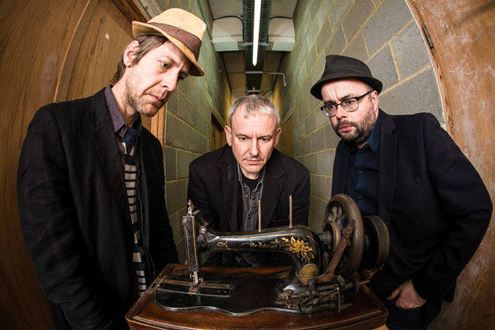
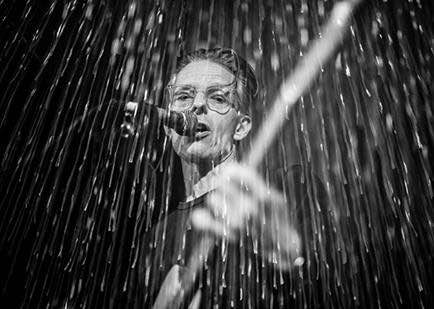


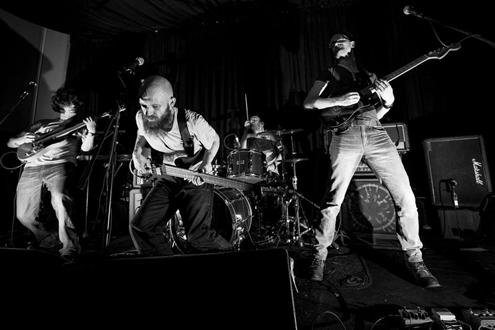
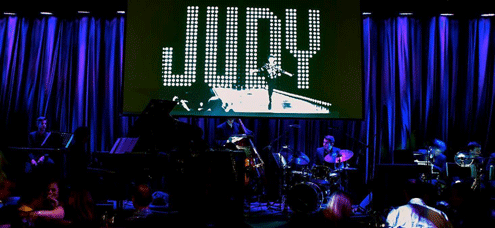
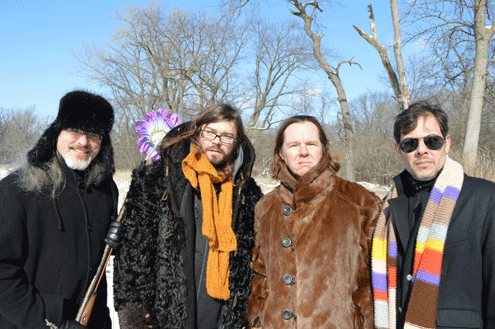
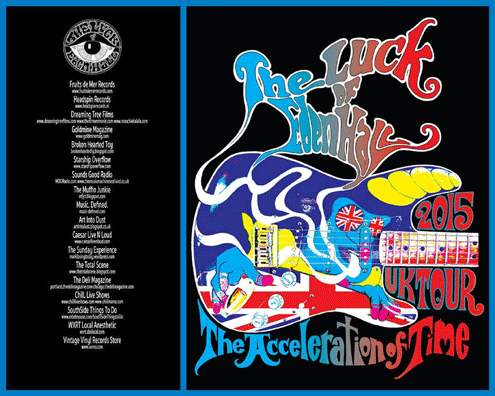
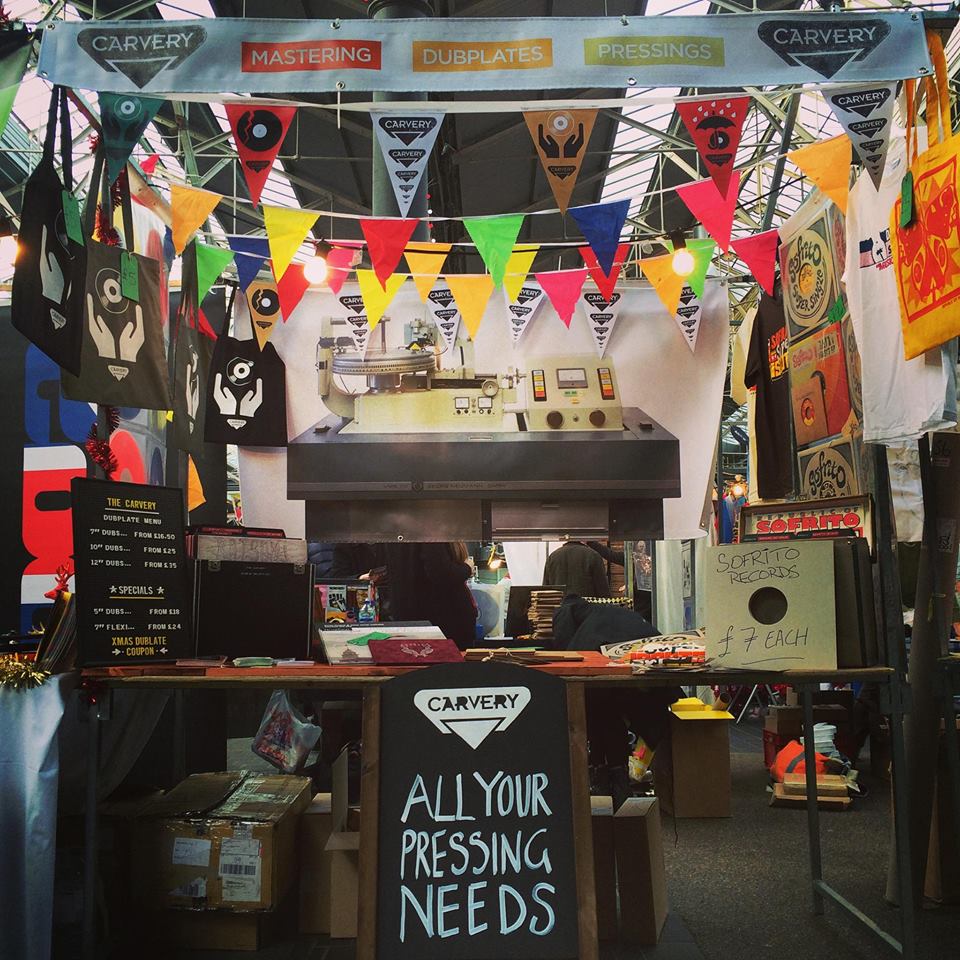
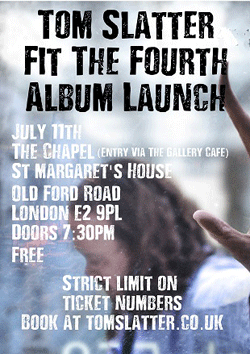

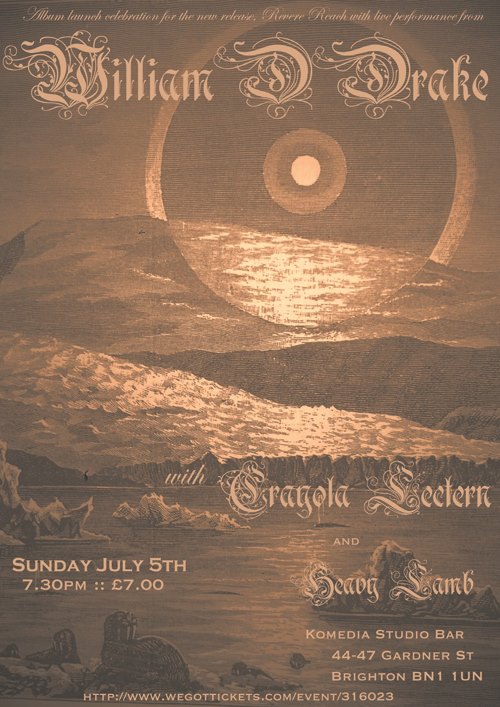

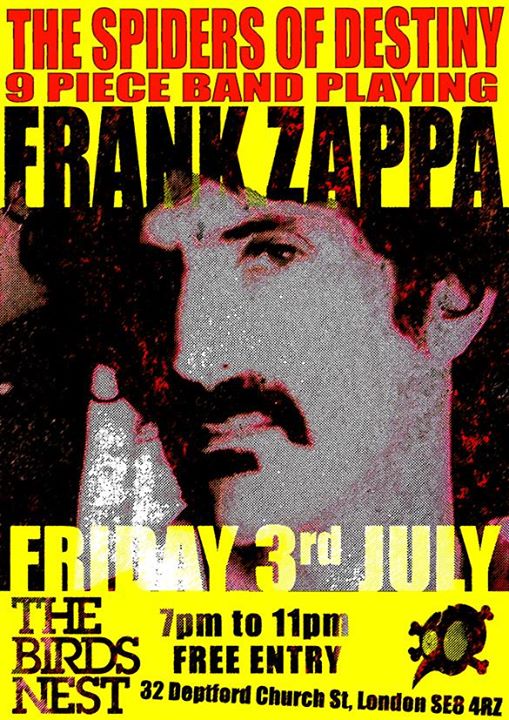
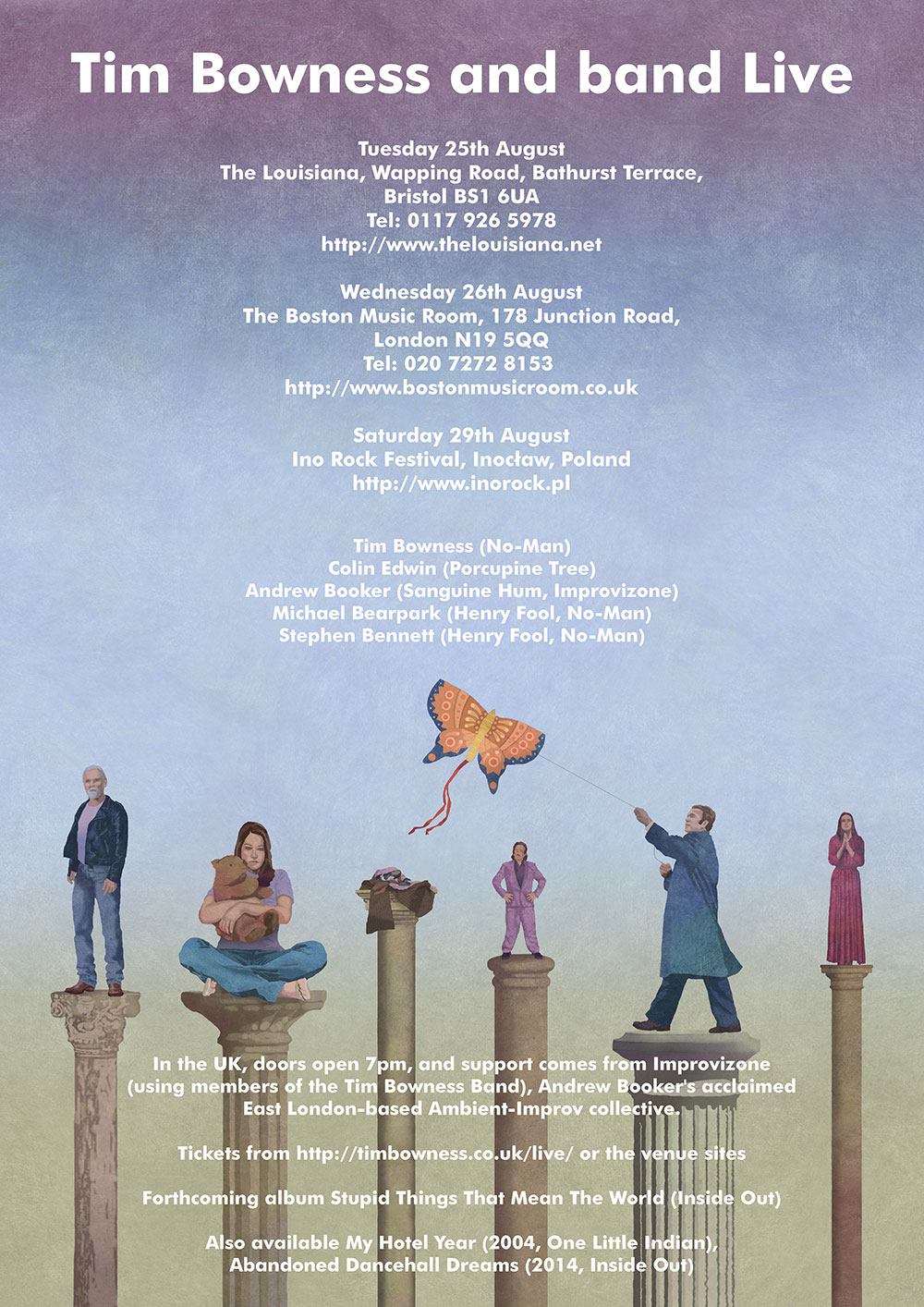

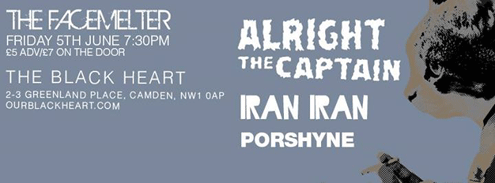
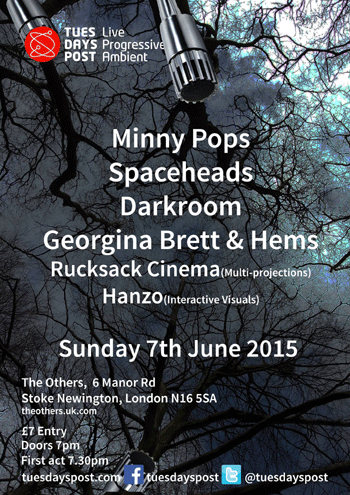

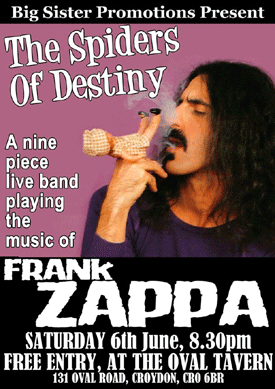

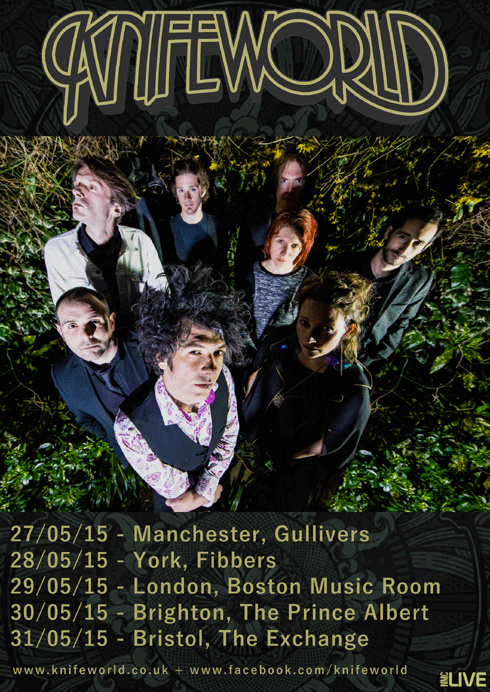
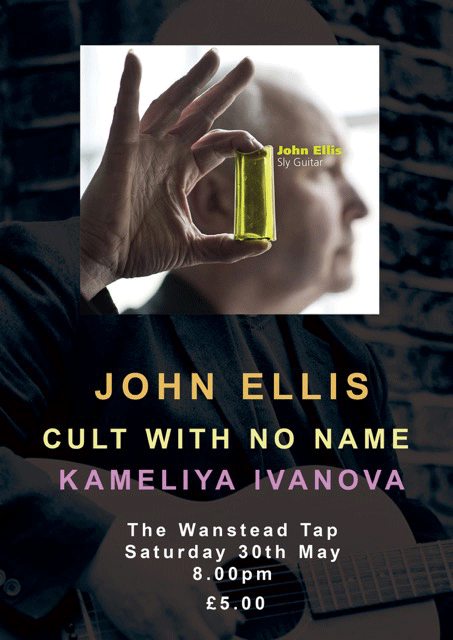




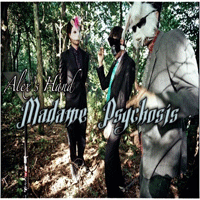
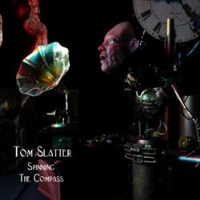
 Misfit City