This week sees the start of a short British tour featuring two of the most inventive and self-propelled women in alternative rock.
Of the two, headliner Carina Round is inevitably the best known. A self-starter at seventeen, she’d made her first album by 2001 when she was twenty-two. The subsequent fifteen years have seen her carve out her own space as a persistently creative stylistic reinventor in a way that’s somewhere between Beck and Madonna, but with a gutsier and murkier undertow than either. Her songs often explore dark flashes of mind and temperament alongside wrenching declarations of desire and entanglement, which in turn have led to assorted comparisons to PJ Harvey which might have done as much harm as good.
In truth, Carina is her own woman, guiding each transformation and collaboration, and shopping from producer to producer in search of the right noise and effect for each stage. Her profile and image haven’t exactly been hurt by her additional work in recent years – helping Tool’s Maynard James Keenan to write and tour his raunchy electro-rock project Puscifer project, and exploring alt.country with the Early Winters supergroup. Five albums and various EPs into her own work has given her enough of a hoard of her own material to spread out in this year’s ‘Deranged to Divine’ compilation: touring and promoting it gives her and us the opportunity to take stock and chew it all over.
Many of the same inspirations which drive Carina also seem to drive Laura Kidd, the woman behind She Makes War. There’s a similar determination to explore and to control her work, a similar attraction to dark and brooding material with a driving alt.rock motor. If anything, Laura’s determination runs faster and harder – gaining even more control over her work by her continued cottage-industry approach (mastering as many instruments as she can in order to make the music, self-releasing her albums, directing her own videos) and gaining the admiration of the likes of Belly’s Tanya Donnelly and Levellers’ Mark Chadwick (both of whom show up on her latest record, ‘Direction Of Travel’) as well as Portishead/Radiohead drummer Clive Deamer. But I’m not trying to set these tourmates up against each other: it’s enough to be able to celebrate this solid and worthwhile pairing, and to catch what looks like a powerful no-apologies show.
Tour dates:
The Globe, 125 Albany Road, Cardiff, CF24 3NS, Wales, Wednesday 3rd August 2016, 7.30pm – information
The Hare & Hounds, 106 High Street, Kings Heath, Birmingham, B14 7JZ, England, Thursday 4th August 2016, 7.30pm – information
The Lexington, 96-98 Pentonville Road, Islington, London, N1 9JB, England, Friday 5th August 2016, 7:30 pm – information
The Louisiana, Wapping Road, Bathurst Terrace, Bristol, BS1 6UA, England, Monday 9th August 2016, 7.30pm – information
The Craufurd Arms, 59 Stratford Road, Wolverton, Milton Keynes MK12 5LT, England, Tuesday 10th August 2016, 7.30pm – information
The Green Door Store, 2-4 Trafalgar Arches, Lower Goods Yard, Brighton Train Station, Brighton BN1 4FQ, England, Wednesday 11th August 2016, 7.30pm – information
* * * * * * * *
In London, the Borderless concert series at Battersea Arts Centre continues with sadcore kings Money. In a few short years, this band have become the darlings of Britain’s wasted, romantic, beautiful people… or at least of people who wallow in fourth-generation Rimbaud and Bukowski paperbacks and flirt with the transgressive but well-worn glamours of wastrel addiction. That said, they’ve calmed down since their grand beginnings in Manchester, when they were bards of any given counterculture. Back then they were a tense four-man alliance, staging gigs which moved from celestial installations to caged cells and with Jamie Lee, their hard-drinking human-hangnail of a frontman, regularly stripping naked (as he also did on the sleeve art for their debut single – his arms straining to raise a rifle above his head, his penis spilling below, like a demented hillbilly patriarch in a final fit).
If this makes Money sound like another round of trash-kings, I’m giving you the wrong impression. Although their songs do stumble along the hinterlands of addiction and self-harm, and are frequently soaked by loss and squalor, they’re neither a straight confessional band nor a dirty-laundry act. Even when their songs toy with penny-dreadful Burroughs names such as A Cocaine Christmas And An Alcoholic’s New Year, much of the squalor is happening offstage. As both life-liver and songwriter, Jamie’s very much in the Mark Eitzel mode – a man steeped in art and literacy and perverse to a fault; too bright, skeptical and doubting to ever find a comfortable compromise. He’s simultaneously consumed by self-deprecation but blazing with bullish talent and the ruthless desire to perfect and broadcast his art. The nakedness (mostly retired by now) is simply a flag of intent, a signifier of honesty.
A Money song is usually a mixture of the skeletal and the uncontainable, couched in warm and surprisingly delicate musicality. While the band’s second album, ‘Suicide Songs’, has added extra trappings – choral parts, string sections, Indian dilruba drones – usually there’s just a starveling, swaying acoustic guitar strum or a paper-thin, stumbling piano part allied to Jamie’s edge-of-the-ladder voice: raw and gawkily romantic, explosively frail. What’s remained consistent is the band’s alcoholic lucidity and welling, rumpled romanticism.
I’ve mentioned Eitzel and Burroughs, but there are also echoes of Jacques Brel, of the declamatory cries of Mike Scott with the early Waterboys; of Daniel Johnston’s fall-apart songs; of Anthony Reynolds’ bohemian booze bleakness or Fyfe Dangerfield’s crane-fly sprawl. Also somewhere in the mix are Irish balladry (whether via pure routes or Shane McGowan’s backstreets), the post-Cure Gothic romance of Arcade Fire; of The Blue Nile’s blend of crooner romance with hints at terrible emotional damage. Like the latter’s Paul Buchanan, Jamie sometimes seems to be trying to sing songs of love and faith against an encroaching, dissolving darkness. Unlike Buchanan, he doesn’t deliberately wring through the inadequate rags of pop clichés, desperate to squeeze out the juice of real inarticulate feelings; instead he sifts through detailed layers of metaphor, memory and bleak reality to create a fragmented composite of how life is in the dark corners which he frequents.
The Borderless gig features “special guests” who, a few days before the event, still haven’t been formally confirmed. It’s tempting to think that Money will fill this ominous gap by trawling up some terrifying fellow spirits at the last minute, via chance encounters at a random pub…. but let’s wait and see.
GOAT Music and Battersea Arts Centre present:
Borderless: Money + tbc Battersea Arts Centre, Lavender Hill, Battersea, London, SW11 5TN, England
Wednesday 3rd August 2016, 8.00pm – information
…And in the middle of the week it’s about dream pop, folk music and the margin in between…
* * * * * * * *
Our Friends Eclectic presents:
A.R. Kane + Plastic Flowers The Good Ship, 289 Kilburn High Road, Kilburn, London, NW6 7JR, England
Wednesday 13th June 2016, 8.00pm – information
This Wednesday, resurrected dream pop pioneers A.R. Kane play one of only two small, indoors British gigs while they ride the wave of worldwide summer festivals. This little London show is the guaranteed best opportunity to see them for the foreseeable future, especially if you missed their Manchester gig at the Soup Kitchen back in May (an event which, I’ll admit, I myself was too disorganised to even flag up) and especially since ’Kane leader Rudy Tambala has been enthusiastic about his preference for “a small crowd loving it, getting it” (as opposed to a fieldful of musical floating voters).
The original A.R.Kane were many things before those things became more commonplace – Afropean art-culture swaggerers, dissolvers of rock and pop’s hierarchical structures, sound-melters in whom dancefloor politics met punk threshing, electronic upsetters who played equally with roots and the bewilderingly synthetic. Rudy formed the band in 1986 with his childhood friend Alex Ayuli – two east London black kids with family roots in west or south-east Africa; a pair of eclectic clubgoers and self-confessed cocky chancers with broad listening habits, enough gab to make their brainwaves sound seductive (notably, Alex’s day job was in advertising), and a post-post-punk whim for running with ideas rather than technique. The idea of A.R. Kane was conceived as a backfiring party boast that Rudy and Alex felt obliged to follow up. Citing Cocteau Twins, the Velvet Underground, Miles Davis and Joni Mitchell as a range of influences might have been a handful of arty clichés then – it would certainly become so later. For two men who approached music as something envisaged rather than something played, however, it was a recipe for building a project from the ground up.
A.R. Kane’s work is often cited as pop reinvention. In fact, it’s more of a sprawl of jouissance – anti-formalism, a dab of abstract expressionism, and a joy in capturing moments on the fly. All of this should have been in the air when (early on in the journey) they joined forces with experimental dance duo Colourbox for the M|A|R|R|S sessions, leading to a number one hit via the British house classic ‘Pump Up The Volume’. As it happened, an experience that should have felt like a triumph of creative opportunity ended up as a bruising, short-lived encounter with hit factory frenzy, mutual intransigence and a blizzard of copyright litigation. These days Rudy dismisses ‘Pump Up The Volume’ as straight cultural theft from black and gay American club culture, but keeps a soft spot for the flipside – ‘Anitina’ (a confection of careening, planing guitar feedback and joyous narcotic pop vocal over hammering Colourbox industrial drums).
It’s this track that exemplifies ‘Kanework, rather than the pulsing plunderphonics of ‘Pump Up The Volume’. When Rudy and Alex played pop, it sounded like toy music or a process of on-the-spot discoveries. Nurtured along the way by the production suss of Cocteau Twin Robin Guthrie and Gentle Giant’s Ray Shulman (with the latter’s post-prog bass often adding a subtle touch of spine and structure to the core cavortings), A.R. Kane seemed to achieve their aims by recreating music from around its edges rather than heading up through the centre. Paradoxically, they deracinated while remembering exactly where the roots were grounded, as if rock music was a complicated hairstyle which they were ripping the pins out of, sending them rattling onto the floor.
Sometimes they’d sound like what would happen if someone had had the gall to strip all of the blues out of Hendrix’s ‘Third Stone From The Sun’, leaving just the cosmic frizz, fragmentary whippling stringwork and mind-opening vocal fragments; like a disembodied, chromatically-dappled sci-fi Afro. Ecstatic hollers might chase sleepy narratives over chamber strings. Gnarly Guthrie-esque guitar noise, hell-gate heartbooms and refracting-knife feedback would bob around dashes of funk and house (which Alex and Rudy were onto long before the Madchester boom). From Jamaica, they gleaned dub-echo bursts of clipped piano or high snare. From American psychedelia, they drew jelly-baby lyrics that bobbed around dancing synth basslines (as if ‘60s acid casualties were making healing pilgrimages to New York electro clubs). From the underground currents of their hometown, they took their conceptual irreverence, their underlying cheek and their mix-and-match mercantilism. (It’s also where they gained their hard-knocks guile and ingenuity, that second-or third generation immigrant pluck that Western city racism forces back onto even the smartest of its homeboys).
Despite all of this sonic ensorcelment, on the early albums you could (if you wanted to) cock your head, peek underneath the noise and find a couple of guys who could barely play or sing; who were keeping it all afloat via acts of will, wit and weather. Most of the time, you’d wink back at them, then return to the bliss and forget the slender mechanisms holding it together. However, by the time of their sun-kissed swansong album, ‘New Clear Child’, A.R. Kane had skilled up and drifted towards a more coherent pop music. Apparently inspired by Alex’s move to California, the later songs meandered up to both Love and Talk Talk via West Coast funk, with daisy petals matted into their nappy hair. As was only appropriate for a band driven by an elusive and amorphous ingenuity, the more A.R. Kane solidified, the more they dissolved. Alex went solo; Rudy teamed up with his sister Maggie (an occasional ‘Kane backing singer) in Sufi and for twenty-odd years, that was that.
As is often the case, the band were finally tempted back into action via the nostalgia engine which fuels pop festivals. Last year Rudy was coaxed into weaving A.R. Kane back into existence, although he had to do it without his erstwhile partner (apparently busy with his own perspective on dream pop, Alex Ayuli opted to sit this one out). 2015’s ambitious Alex-free septet has now been trimmed to the core trio of Rudy and Maggie Tambala plus new cohort Andy Taylor; a mess of three guitars, three voices, computers and synths. While they originally billed themselves as “#A.R.Kane”, with Rudy optimistically explaining that “should Alex come out-to-play, we can easily drop the ‘#’..”, they’ve subsequently dropped the hashtag anyway, along with the distinctions and (it seems) the hope that Ayuli’s “said no, gave no reasons” refusal wouldn’t be permanent.
The flipside of this disappointment is that the band’s new lease of life has inspired and toughened them into a more committed playing unit fired up by contact with both fans and heirs. Back in the ‘80s, few bands used A.R. Kane’s methodology and thinking. Nowadays you could pull together a huge, snaking, intercontinental conga line of the fuckers. One of them’s playing at the Good Ship alongside Rudy and co. – Plastic Flowers, the London-based dream pop project of Thessaloniki-born George Samaras, whose grand skeletal lushness (bare-bones drumbox echo, threaded vocal and towering ripcurls of melodic guitar noise) is an almost pure mainlining of the ‘Kane lineage.
Now a revitalized Rudy is talking, with giddy enthusiasm, about future recordings and about the new material he apparently brought to the Soup Kitchen gig the other month. (I’ve checked for reviews of that, but found nothing unless it’s been reduced to telegrammatic burbles on Facebook – being off-‘book at the moment, I wouldn’t know). We’ll have to see how his intentions pan out. With planned American coastal tours cancelled (due to date and commitment clashes rather than lack of interest), there are still a couple of showings at the Siren and Half Die festivals in Italy later in the month; and then back home for On Blackheath in September. After that, the future’s both blank and open – which, in a way, is where A.R. Kane came in in the first place.
* * * * * * * *
If vindicated dream pop discombobulation doesn’t float your boat for Wednesday, then perhaps you’d prefer a free event at Battersea’s delightful acoustic playground on the same night…
Jausmė (with Nicole Collarbone) + Sian Magill The Magic Garden, 231 Battersea Park Road, Battersea, London, SW11 4LG, England
Wednesday 13th July 2016, 9:00 pm – free event – information
Transplanted Lithuanian singer-songwriter Jausmė – Vilnius-born, but Milton-Keynes-based – will be performing a set of her own material accompanying herself on the kanklės (a twenty-nine string Lithuanian zither with a sparkling sound) and aided by Liverpudlian cross-disciplinary cellist Nicole Collarbone (whose myriad projects and collaborations include the Neil Campbell Collective and folk ensemble Sonnenberg).
Jausmė describes her work as “urban etherealism”. Translated, this seems to mean a half-invented, half-archaeological folk music (like a less grandiose, less Gothic, closer-to-the-source Dead Can Dance), and one in which the focus is shifted thirteen hundred miles northwest to the Baltic states; it also means that Jausmė listens to, and can slip into, the work of sub-bass, garage and techno producers. On this occasion, though, it’s all wood and no electronics, and the roots are northern. For evidence of what Jausmė and Nicole can do together (and of Jausmė’s skills on her own), see below.
In support is another no-less-impressive Milton Keynesian, Sian Magill, who honed her subtly immersive, highly literary folk songs at venues both there and at Oxford, where she studied English Literature at degree level. If the latter suggests someone whose work’s likely to wear its intelligence as clever English hauteur, think again. Sian’s songs draw on more distant traditions, coming across as a more Irish-toned echo of the dense, individual American song-tales of someone like Dayna Kurtz, although she sounds less likely to venture to bars on the wrong side of the tracks, or to lean quite so much into the urban blues. Instead, Sian makes her own way into a story through a quiet and continuous flow of detailed observation and consideration, atop a busy, depth-inducing weave of fingerpicked guitar (see below).
* * * * * * * *
Appalachian 100: Cecil Sharp House Choir (with Alice Cade + Pete Cooper + Ed Hicks) Cecil Sharp House, 2 Regent’s Park Road, London, NW1 7AY, England
Thursday 14th July 2016, 7.30pm – information
If you missed the Cecil Sharp Choir at the Union Chapel last Saturday (singing songs for a Daylight Music marine afternoon), they’re back on home turf at Cecil Sharp House for another show on Thursday. This time, they’re celebrating the centenary of musicologist Sharp’s first folk-song-collecting visit to the Appalachian Mountains of America, a region replete with influences from sixteenth-century England and from the tough feuding culture of the Scottish Borders, as well as (at least in the Ozark region) a great line in dirty stories.
I don’t know whether any cheerful smut is going to be reeled out at the concert (in song or in asides), but the choir are promising “a selection of glorious a capella harmony arrangements of traditional songs, including some collected in the Mountains”, in new arrangements by leader Sally Davies. Three special guests will be adding to the show- flatfoot dancer Alice Cade, fiddle master Pete Cooper and multi-instrumentalist Ed Hicks (banjo, fiddle, guitar, mandolin, Anglo concertina and voice).
Some more imminent shows, mostly of slightly skewed varieties of pop.
* * * * * * * *
Arctic Circle presents:
Daylight Music 226: Boy and a Balloon + Russell Swallow + Jack Hayter Union Chapel, Compton Terrace, Islington, London, N1 2UN, England
Saturday 4th June 2016, 12.00pm – free/pay-what-you-like event (suggested donation: £5.00) – more information
Subtitled “Inside/Out”, this particular Daylight Music session is a showcase for some of the long-running concert series’ regulars. As they put it:
“Under the moniker Boy And A Balloon, Alex Hall is a Hampshire born singer-songwriter. A London busker, and once a session guitar player (touring extensively for Motown legends Martha Reeves & The Vandellas) he now creates skewed indie music – reviving songwriting styles from the glory days, and fusing it with contemporary and chamber acoustic instruments.
“Dismantling the idea of cleanness, Alex accompanies his delicate vocals on his mainstay guitar (a bashed up three-quarter-size nylon-string version played through a StreetCube amplifier) to create glitchy and humanly imperfect timbre. Merged with a simplistic songwriting style to underpin and iron the creases out of the music, Boy And A Balloon attempts to create a new brand of idiosyncratic pop songs. It is a true and purposeful statement and philosophy that songwriting will shine through roughness. Taking major influence from musical icons from all his troubadour heroes of the ’40’s right up to the ’70s, Boy And A Balloon is about the innocent and inevitable loss of something human, precious and innocent – so apparent in today’s fast paced and overwhelming technological world.
“Calling on the classic grooves of James Bay, the storytelling of Tracey Chapman, and the gorgeous ambience of Howling, Russell Swallow‘s sound is brooding, confessional, indie. His songs and stories are driven by sensual imagery & sticky melodies, powered by rich tenor vocals, synths and driven guitars.
“Previously of the mighty Hefner (as well as Spongefinger and Dollboy), multi-instrumentalist Jack Hayter‘s beautiful, heartbroken music is full of folk-tinged dissonant woe. He’s a self-styled ‘singer and writer of no-tune showtunes’ and a ‘rotten-gutted, scorched-throated pedal steel machine’: a unique songwriter given time and freedom to blur the lines between the trad. folk of his influences and the London anxieties of his past with dirty fuzz, biting wit and of course, ‘the universal language of a drunkard’.”
(Jack usually appears at Daylight Music on acoustic guitar and voice: elsewhere on this blog there’s a detailed review of one such occasion.)
* * * * * * * *
When they emerged in London about five years ago, Weird Dreams perpetuated the well-worn image and substance of a literary indie band in a classic four-man mould. They jangled their guitars; they drew on ‘60s-tinted Beach Boys and girl-group inspired pop; then, citing a fascination with the underbelly cinema of David Lynch, they subverted that pop with dark and bitter lyrics about loss, misunderstanding and cruelties. To seal the deal, it emerged that they’d first been formed after a chance conversation in a retro clothes shop. Their debut album, ‘Choreography’, seemed tailor-made to appeal to the Edwyn Collins, Smiths and Belle & Sebastian fans. After that, it all seems to have gone wrong, though possibly wrong in the right kind of way. Dark hints at a four years of “loss, derealisation and the constructing of a new identity” suggests that the band hit multiple meltdowns.
Whatever happened, it’s seen the Weird Dreams base shifted from north-east London to Paris, left singer and songwriter Doran Edwards as the only remaining member, and altered the band’s sound from concise, short-story guitar power pop into something looser and more textured; more in keeping with their name; more electronic, decidedly psychedelic and definitely hypnagogic. Though you can still hear the skeletal outline of their previous musical identity, Weird Dreams’ current way of working cites unsettling photojournalism and avant-garde electronic composing as influences – alongside the grand synthtronic filmscapes of Ryuichi Sakamoto and the DIY radiophonic pop mistings of Broadcast. It sometimes sounds as if Doran might have kept in touch with his inner Lynch, but also turned up a little heat under his inner Splet.
Doran’s new approach also allows him to unhook from pithy storytelling and dip into a questing, introverted fantasy. One of the new songs, Calm, explores autogenic therapy – or to put it another way, the consciously-willed emptying-out of stress, body part by body part, suggesting a simultaneous emptying out of soul and identity, even as the music itself travels through phases of mood-shift from disassociation to rapture and rhythm. Another song, Heaven’s Hounds, revisits memories of 1980s synth pop and wraps them in a swathe of trickling dream pop guitar arpeggios and sampler gusts (the results echoing both the narcosis swoon of My Bloody Valentine and the unearthed-technology-meets-folk-reinventions of Eyeless In Gaza).
Performing as a Doran-fronted five-piece, the reinvented band are playing the following venues this month:
The Castle Hotel, 66 Oldham Street, Manchester, M4 1LE, England, Wednesday 8th June 2016, 7.30pm – information
Rough Trade East, 91 Brick Lane, Spitalfields, London, E1 6QL, England, Friday 10th June 2016, 6.30pm (instore) – information
* * * * * * * *
Tricity Vogue (photo by James Millar)
If you’d prefer something a little more vivid and straightforward to fill your week, or just someone with dirtier jokes – in fact, if you happen to be in London and fancy a homburg-hatted cross between the dear-departed Victoria Wood and the still-very-much-in-yer-face Amanda Palmer, with a couple of twists of Lorraine Bowen and Marie Lloyd – then you could check out Tricity Vogue instead. The ukulele-toting queen of “thinking women’s burlesque cabaret” (and part-time tongue-in-cheek gender warrior) has an upcoming bar residency at London’s Wilton Music Hall which coincides or clashes with the Weird Dreams tour. You can expect her to deliver her own blues or jazz-inflected numbers about vampires or drunken penguins, list-songs about lady pirates and paeans to espresso coffee (which, naturally, accelerate into a distracted frenzy); and she’s a dab hand at nicking and recycling tunes (turning My Favourite Things into My Drag Queen Wet Dream’, or repurposing the ‘Doctor Who’ theme for a song about mundane parallel universes).
Tricity’s take on music hall proves that it’s an art form which, like Wilton’s itself, might need a careful patch-up, brush-up and infusion of new talent occasionally, but which doesn’t need that much refurbishment and alteration to remain fun. Plus, while she’s more than happy to deliver some snags along with the fluff. Alongside the kitschy daftness and double-entendres there are surprising delicate songs about lost origami, a sense of humour which ranges from cute to gallows (sometimes hitting both ends simultaneously, as in Pet Assassinator) and a set of ribald, pointed memoirs from an chequered love-life.
Wilton’s Music Hall presents:
Tricity Vogue
Cocktail Bar @ Wilton’s Music Hall, 1 Graces Alley, Whitechapel, London, E1 8JB, England
Tuesday 7th June to Friday 10th June, 9.00pm – more information
Three more London shows for the upcoming weekend. If regular readers are finding it all too predictable to find Baba Yaga and Daylight Music shows listed in these posts, I’d have to agree with you that those guys aren’t the only game in town – it’s just that both of them run a persistently strong game.
Daylight Music information first…
* * * * * * * *
Daylight Music presents:
Daylight Music 221: Haiku Salut + Poppy Ackroyd + Gavin Greenaway + Angus MacRae + Oliver Cherer Union Chapel, Compton Terrace, Islington, London, N1 2UN, England
Saturday 26th March 2016, 12.00pm – free/pay-what-you-like event (suggested donation: £5.00) – more information
“For the last event in their current season, Daylight Music is delighted to join in the celebrations for this year’s Piano Day – with piano highlights and delights including lots of artists playing on a baby grand on the Union Chapel stage – in a concert kindly supported by UK publishers Manners McDade.”
Born in Belgrade, Serbia, but resident in Paris for many years, Ivan Ilić is best known for his solo performances of French classical piano music (in particular an acclaimed and controversial 2008 recording of Debussy’s 24 Préludes and a recording of Leopold Godowsky’s left-hand Studies on Chopin’s Études) He also performs music by contemporary composers including Morton Feldman (the subject of his next recording), John Metcalf, Keeril Makan and Dmitri Tymoczko.
Haiku Salut – the Derbyshire-based dream pop/post-folk/neo-everything trio (influenced equally by the evocative film soundtracks of Yann Tiersen and Benoît Charest, the genre-melting electronica of early Múm, and the impressionistic writing of Haruki Murakami) will be setting aside their multi-instrumental skills to play a short piano trio set.
Fresh from her support slot to Jo Quail last week, Poppy Ackroyd will be performing several of her own post-classical piano originals; perhaps making use of field recordings, but certainly incorporating the specific sonic qualities of the Union Chapel space into the performance.
Gavin Greenaway (whose work as composer and conductor covers an extensive variety of film scores, Paul McCartney’s oratorio ‘Ecce Cor Meum’, the 2012 Thames Diamond Jubilee Pageant and assorted theme park and sporting events) previews his “immediately engaging, unashamedly melodic and deeply personal” solo piano album ‘Il Falco Bianco’ on Tenuto Records, which takes in alternating flavours of post-minimalism, concert-hall majesty, jazz and prepared piano (with eighty-eight table tennis balls).
Angus MacRae (who has composed for and in conjuction with filmmakers, choreographers, theatre pieces, animations and photography exhibitions) performs pieces from his piano repertoire which “blend melancholic melodies with minimalist structures and rich, atmospheric electronics”.
In between the acts, Oliver Cherer – a.k.a. ambient isolationist-turned-pagan folkscaper Dollboy – will explore the inside of the piano.
* * * * * * * *
Details on the Baba Yaga’s Huts shows in a moment…
A few months ago, I briefly covered folk/classical/pop fusion night Whispers & Hurricanes (the latest arm of the Chaos Theory Promotions mini-empire) and they’re back this week.
Raf & O + ArHai + Lucy Claire + guests (Whispers & Hurricanes @ The Sebright Arms, 33-35 Coate Street, Bethnal Green London, E2 9AG, UK, Friday November 20th 2015, 7:30pm) – £6.00 – information – tickets
After a wonderful launch in September, our newest night is back with inspired musicians who fuse traditional sounds with groundbreaking techniques in an evening of mesmeric triphop, folktronica, avant pop and contemporary classical electronics. Fans of Portishead, Bowie, Lamb, Bjork and Eric Satie will enjoy.
Raf & O are a duo from south-east London who are garnering widespread acclaim in the UK and Europe, creating a buzz via exciting performances of their uniquely detailed avant-pop and its vortex of live electronics, acoustic instruments and fragile, magnetic, strange lullabies. After supporting artists such as Faust and Little Annie Bandez, they were special guests in Richard Strange’s production for William S. Burroughs’ centenary at Queen Elizabeth Hall, and recently composed for the theatre play ‘That Woman’s Voice’ (a tribute to Jean Cocteau). Raf and O’s second album ‘Time Machine’ was named as one of ‘FACT Magazine’s Top 10 albums of 2014, with their “avant-bizarre” interpretation of David Bowie’s Lady Grinning Soul pricking the ear of Bowie’s pianist, Mike Garson (who praised their minimalist approach) and leading to appearances at two Memory Of A Free Festival concerts (re-stagings of the legendary Beckenham Free Festival organised by David Bowie and The Beckenham Arts Lab back in 1969). Tonight we’ll hear them perform music from their first two albums, as well as unheard music from their upcoming third album.
ArHai is an electronic Balkan folk duo, consisting of Serbian-born composer and singer Jovana Backovic and British multi-instrumentalist Adrian Lever. Their music is a fusion of electronic music and folk with medieval influences from both the Gaelic and Balkan traditions. Underlined with breathtaking visuals, Arhai breathes new life into the sounds of the Bulgarian 8-string tambura lute and hammered dulcimer (played by Adrian), blending them with Jovana’s ethereal vocals and electronic production. Their previous album ‘Eastern Roads’ is a must have. Tonight’s show celebrates the launch of their new website and the upcoming release of their single.
We also welcome back the brilliant composer Lucy Claire, who launched her beautiful ‘Collaborations’ EP with us last year. A soundscape artist and a contemporary classical composer with influences from the likes of Satie, Peter Broderick and Björk, Lucy composes music with a very organic heart to it and in a style so unique and diverse that it has resulted in her performing to classical, electronic, acoustic and post-rock audiences, as well as live performances on BBC London’s breakfast show and BBC6 Music. Her sound initially seems soft and ambient, but reveals a defiant spirit and gentle force breaking its way through. This evening we will see her perform new collaborative works with some special guests, some of whom you may know already.
* * * * * * * *
It’s always nice to hail a new music night, especially one that’s only a short stroll from your own front door. In the Archway cutting, just up the road from the current Misfit City HQ, Songs from the Cellar have begun to fill a café basement with sound: next week it’s an investigation of antique popular songs, but this week it’s guitar instrumentals…
Guitar Journey Duet (Songs from fhe Cellar @ Zelas Cafe, 216 Archway Road, London, N6 5AX, UK, Friday 20th November 2015, 8.00pm) – £8.00 – information – tickets on the door
Guitar Journey Duet is a team-up between two leading London cross-disciplinary guitarists – British player Jonny Phillips (a member of Oriole and F-ire Collective) and Sardinian-born Giorgio Serci (whose twenty years of recordings, collaborations and performance has included work with Antonio Forcione, Eduardo Niebla, Denys Baptiste and Shirley Bassey).
Between them Jonny and Giorgio cover jazz, classical, flamenco, samba, art rock, British folk and African jazz. They might be off to play Verdi at the Albert Hall barely a week after this concert, but what they get up to in this small Highgate basement might well be something completely different. The only clue as to what they’re playing is that they’re favouring Spanish guitars tonight, as they are in the video below.
* * * * * * * *
The last gig I’m listing for the week is another Daylight Music effort, bridging the acoustic and the electronic, the pastoral and the urban.
Daylight Music 207 – 20 Years Of Lo Recordings: Grasscut + Astronauts + Lilith Ai (Union Chapel, Saturday 21st November 2015, 12.00pm–2.00pm) – free (£3.50 donation suggested) – information
Renowned for quality esoteric music, Shoreditch’s Lo Recordings has released music by Thurston Moore, Four Tet, Aphex Twin and others. Now the label is celebrating its 20th birthday with a special showcase at Daylight Music featuring label artists Grasscut, Astronauts and Lilith Ai.
Many accolades have been heaped on Grasscut, the teaming of Andrew Phillips (voice, keyboards, guitar) and Marcus O’Dair (keyboards, double bass) in a wide-thinking Brighton-based duo which encompasses electronica, classical minimalism and multi-media, and which draws inspiration from landscapes and history. Andrew, who writes and produces all Grasscut music, is also known for his soundtrack work for HBO, BBC Films and Channel 4: he has been nominated for an Emmy and shortlisted for an Ivor Novello. Marcus (who manages the band in addition to his instrumental contributions) also occupies himself with journalism for the Guardian and Financial, lecturing in Popular Music at Middlesex University and work as a broadcaster in particular on Stuart Maconie’s ‘Freakzone’: he is also the author of ‘Different Every Time: The Authorised Biography Of Robert Wyatt’. At this concert Grasscut will be playing music from their new album (and first for Lo Recordings), ‘Everyone Was A Bird’.
Astronauts is the solo project from Dan Carney (formerly of Dark Captain). Described by Sputnik Music as “often bleak and highly contemplative indie-folk”, according to Facebook, the project is mainly in the business of creating “ham-fisted bleep-folk neoliberal takedowns”. As with Grasscut, Dan’s interests and influences extend beyond making music: he is a qualified developmental psychologist with an interest in short-term memory development and in Williams and Down’s syndromes.
Lilith Ai is a new signing to Lo Recordings. A member of the Fight Like a Girl collective, she performs poignant tales of modern city living. Drawing from blues, folk and acoustic R’n’B, and dusted by subtle electronic shades and beats, Lilith’s songs show urban life through a clear lens which does not hesitate to reveal her own dark life experience.
I’ve not got quite as many gigs to cover this time, but bear in mind that The End Festival is still happily raging in Crouch End this week (if it were a standalone concert, The End’s Feast of St Cecilia weird-folk afternoon would be taking pride of place here), as is the London Jazz Festival. As I’m also a little more squeezed for time than usual this week, there’ll be less personal reflection and much more press-release in the coverage of the gigs in this post. Sorry about that. I’ll opinionate a little more next time.
* * * * * * * *
First up, a Baba Yaga mid-week gig: the debut British show for Josefin Öhrn, who’s rapidly becoming a darling of the urban psychedelic crowd. With her band The Liberation, she creates a beautifully spacious, light touch sound: some Krautrock motorik, enough rock’n’roll minimalism to slip smoothly into the sweet spot between hypnotic and monotonous, a strident skullbone rattle-and-drone where it’s needed, and a repertoire of subtle sonic finessing (shimmer, backwards reverb, rises, rainbow tone curves, all of the ingredients precisely and skilfully placed). To cap it, there’s Josefin’s voice – as perfectly-judged as the rest of the instrumentation and as cool as a drink of iced milk on a parched day, floating in the ever-present thought-space between the band’s chassis and roof.
In an era in which “psychedelia” can often mean merely a grab-bag of influences from which wah-wah pedals and two-note riffs are dispensed as signifiers and signposts into a realm of easy accessibility as opposed to gateways to another dimension, it can be a rarity to come across a band who are genuinely fixated on creating alternate realities for the listener. Yet this is exactly how Stockholm’s Josefin Öhrn + The Liberation view their incandescent art, and it’s this sensibility that’s led to the kaleidoscopic splendour of their debut full-length for Rocket Recordings, ‘Horse Dance’. “It’s a continuum that flows beyond here and now, and psychedelic music seems to be a really powerful way to unveil those deeper oceans of being that are our true home,” reflects Josefin, who forms half the core of the band with Fredrik Joelson. The last twelve months have seem a dramatic rise to prominence for The Liberation (who take their band name from the Tibetan Book Of The Dead) with their EP ‘Diamond Waves’ leading to shows in their homeland with Goat and Les Big Byrd, a nomination for a Swedish Grammy as best newcomer, and rapturously received appearances at festivals like Roskilde.
These adventures have set the stage for a spectacular movement into the unknown from their earlier work. ‘Horse Dance’ is a razor-sharp collection of ditties that marry dreamlike radiance with hypnotic rhythmic drive, set alight by a prismatic experimental glow. It inhabits a realm in which a propulsive ’60s-tinged pop song like ‘Sunny Afternoon’ can be elevated skyward with krautrock-tinged repetition, dub echo and analogue curlicues alike, and one in which a Broadcast-style mantra like You Have Arrived can tap into a psychic lineage that stretches all the way from The United States Of America to Portishead’s ‘Third’. Yet whilst ghosts of the like of Laika, Cat’s Eyes and The Creatures may lurk in the darker recesses of these songs, this is a band paying no homage to bygone glories.
The Liberation cite a myriad influences in both their philosophical stance and their aesthetic, from 12th century iconoclasts like Milarepa to 20th century sonic voyagers like Catherine Ribeiro, and from Kandinsky’s abstract expressions of synaesthesia to the avant-jazz of Moondog. Yet at all times their transcendental extrapolations are married to icy and enticing melodic flourishes, making for a revitalising clash between the chic and the transcendental, and a sound as biting as it is beatific. “I definitely think that the human need for altered states – to see oneself from a bigger perspective – is a deep fundamental need,” Josefin elaborates. “We’ve been deprived of access to our full nature by a restrictive system where altered states may be the ultimate taboo.” With ‘Horse Dance’, Josefin Öhrn + The Liberation step into a world where all such restrictions and taboos are null and void, and this journey is already proving quite the spectacle to behold.
Dunes
Support comes from all-female rock trio The Wharves (whose resonant clear-voiced indie sound, with a stack of folk-pop harmony and a sheen of blurred fluidity, sometimes sounds like a raindrop on the verge of collapsing) and from Mr. Silla (the solo project from former múm member Sigurlaug Gísladóttir, who’s joined live by guitarist Tyler Ludwick of Princess Music). There will also be DJ-ing from Daun of Swedish space-rockers Flowers Must Die.
* * * * * * * *
To be honest, I’m expecting half of the committed freaks in town to be at this next gig; and to have bought their tickets months ago…
The Magic Band (Under the Bridge, Stamford Bridge, Fulham Road, Fulham, London, SW6 1HS, UK, Friday 20th November 2015, 7.00pm) – £20.70 – information here and here – tickets
After a sold out Under The Bridge gig in 2013, The Magic Band are back! Sharing the vision of celebrating the music of the late Don Van Vliet – aka Captain Beefheart – the band re-visits the classic Beefheart tunes with renewed fervour.Fans of the Captain won’t, wouldn’t and couldn’t miss this! Avant-garde blues at its finest and most rambunctious!
Speaking for myself, the enjoyment of Beefheart’s particular, perverse genius is always marred by the appalling stories of how he maltreated his colleagues. In many respects the man’s life was in tune with mischievous American folk-hero mythology. Those stories of microphone-busting vocals and of teaching his musicians all of their skills from scratch fit happily into the grand tradition of the American liar, the itinerant teller of tall tales and outright whoppers. Still, as the years have gone by, and as the other stories have bled through (about Beefheart’s take-the-money-and-lie attitude, his theft of credit for all of his players’ skills and work, and especially the brutally entitled sadism and psychological warfare meted out to his musical serfs as the band wrung out the tunes) the shine and mystique has well and truly worn off the man. What’s left, as ever, is the music: that tangle of bloodshot rolling blare and skew-whiff insight, the stubborn blues limp and the wrong-angle harmony attacks, the unorthodox barbed hooks that have kept generations of musicians and listeners transfixed.
With the Captain himself dead and gone for five years, reduced to a baleful honk of memory in a speaker, it’s been down to those who played alongside him in the various Magic Bands – and who, in the long run, finally survived him – to regularly blow on the embers and revive the noise. Since the Magic Band’s first reformation in 2006, some of the original members have, for various reasons passed out of the lineup again (first Robert Williams and Gary Lucas; most recently, Denny Walley) but the group still features singer and multi-instrumentalist John “Drumbo” French and bass player Mark “Rockette Morton” Boston. For this gig they’re joined by their current roster of sympatico recruits: guitarist Eric Klerks, drummer Andrew Niven and the newest recruit, Walley’s replacement Max Kutner (a multi-instrumentalist known for his work with Mike Keneally and Oingo Boingo and with Zappa tributeers Grandmothers of Invention, as well as his own projects such as Evil Genius and The Royal US).
By all accounts, in spite of time and circumstance whittling away at the roster of original players, the band retains their magic (judge for yourselves from the clip below). For me what clinches it is that at least some of the right guys are finally being paid, both in cash on the nail and in the credit they’ve damn well earned.
(All right – I did find time and room for some opinionating…)
* * * * * * * *
On Friday (and on the following Monday), Annette Peacock – a great undersung pioneer of various strains of songwriting, jazz experiments and electronics, as well as being an anticipator of many of the intriguing trends in female-led art music of today – is playing a couple of shows at Café Oto.
“We’re very excited to host the first OTO appearance – and first show in London for quite some time – from visionary composer and songwriter, Annette Peacock. Always ahead of her time, Peacock has influenced a huge array or genres whilst never letting herself be pinned down by one, resulting in a music that is as captivating as it is unique. This should be very special indeed.” – Café Oto press release
“Annette Peacock’s wondrous, immersive trailblaze across recorded music’s rich history has marveled the likes of David Bowie, Brian Eno and one-time collaborator Salvador Dalí. Peacock once jokingly told The Quietus she has been fighting her way back to reality ever since taking LSD at Timothy Leary’s Millbrook estate in the early 1960s. Her plunge into otherworldly sonic wellsprings made her one of the first artists to synthesize her own vocals, pioneering the realms of minimalism, free jazz, rap, classical music and psychedelic funk along the way. After Robert Moog gifted Peacock one of his elusive prototype-synthesizers, she started implementing the makeshift device into her already individualistic, free-form lingo of songwriting and composing. To hear music skip so radically across exotic new touchstones, who needs reality, right?” – ‘Le Guess Who’
“Annette Peacock is a stone cold original – an innovator, an outlier, authentically sui generis.” – John Doran, ‘The Quietus’
“Nothing prepares you for the howl of her searingly high notes spiralling up out of spooky organ chords and soul-brass riffs.” – John Fordham, ‘The Guardian’
“A pioneer of rap, live electronic music and synth-pop, Annette Peacock’s achievements are monumental.” – ‘Scarufi’
When I was growing up in north London, Crouch End was the “next village over”. It was the place where I went to primary school and first heard song by Neil Young, Steve Winwood and The Kinks (strummed out and sung in assemblies alongside battling hymns from the civil rights movement) and where I began sharpening my hunger for musical knowledge on the rich ranks of vinyl LPs in Hornsey Library. Over the years, I’ve continued to associate the neighbourhood with music – other people’s memories of old art-rock and punk gigs at the Hornsey College of Art; the star traffic through the Church Studio at the bottom of Crouch Hill (owned in turn by Eurythmics and Paul Epsworth), where you might find Erasure or Sisters of Mercy catching a mid-session coffee in the local café; and the Gareth Malone wet-dream of the Crouch End Festival Chorus, a local choir with a national reputation.
That said, Crouch End’s day-to-day music scene has always struck me as lacking. There have been exceptions to the rule – the steady reservoir of blues and roots playing at the Kalamazoo Club; the string of house concerts that Jenni Roditi ran at her loft between 2002 and 2009; more recently, a flowering of rootsy events at the Earl Haig Hall. But generally speaking, Crouch End has always seemed to me to export or traffick in music rather than play it, becoming an increasingly upmarket and bijou neighbourhood where shoppers vastly outnumber giggers; easily eclipsed by the musicality of other London neighbourhoods like Camden Town, Dalston, Shoreditch, even Tooting.
Well, more fool me. It turns out that I’ve regularly been overlooking and missing The End – an annual, musically expansive Crouch End festival that turns all of my gloomy observations about the neighbourhood’s gig shortcomings to dust – at least, for two weeks. As my penance, here’s the first half of an overview of everyone playing at this year’s festival, which starts tomorrow (all ticket details are to be found via the info links or at the festival website).
The festival kicks off with a concert navigating the blurry margins of folk and lo-fi alternative rock, with headliners good enough to warrant a post all of their own. The crepuscular but lovely Lowpineshave been racking up an unending stream of plaudits for their Anglo-Americana atmospherics, which recall old phonographs playing whispered, heartspilling songs in dusty basements, laced with judicious drums, intricate campfire fingerpicking and stargazing whistles of feedback like psychedelic pedal steel lines. Support comes from Oliver Girdler’s one-man lo-fi project Forced Random (which drifts ghostlike from instrument to instrument and from one slow soft-edged song to another) and from Reykjavík folk-rock trio Ylja (initially based around female harmonies and lap-style slide guitar but expanding into a broader palette that encompasses and recalls not just Fairport Convention, early Clannad and Pentangle but also the glowing starfield details of Sigur Rós and 1972 Pink Floyd).
* * * * * * * *
The Fierce & The Dead + a.P.A.t.T + Markers (Downstairs @ The Kings Head,2 Crouch End Hill, Crouch End, London, N8 8AA, UK, Friday 13th November 2015, 7.00pm) – £8.80 – information
The first of several events at The Kings Head hosts assorted sprigs from the thornier of British art-rock. Headlining are prog-punk quartetThe Fierce & The Dead (no strangers to this blog) who bring the rumbling immediacy of their quick-flaring complicated avant-garage instrumentals to the valley for the evening. In support, hazmat-suited Liverpudlian performance art troupe a.P.A.t.T, play “progressive pop that owes as much to Kurt Schwitters and the Chapman Brothers as it does to ABBA and Zappa”, drawing on a shifting tag-team of ‘Pool talent and bring strong flavours of the absurd, the deceptive and the cunning to whatever they do.
Opening the evening, Markers reunites two old friends from the omnivorous ferment of the 1990s London math rock scene – Jodie Cox (Ursa, Narrows, Exes, Rohame and Earth) and Jason Carty (Geiger Counter, Foe, Art Of Burning Water) as two electric guitarists without a singer, a rhythm section, any other instruments or much in the way of signal processing. Expect carefully poised, bare-branching instrumentals somewhere between Slintian maths, precise Fripp and Summers interplay, and the minimum-lines/maximum-impact approach of a Japanese ink painting or minimalist film.
* * * * * * * *
Kate Jackson & The Wrong Moves + Oh800 + YLJA (The Crypt Studio,145a Crouch Hill, Crouch End, London, N8 9QH, UK, Friday 13th November 2015, 9.30pm) – £8.50 – information
Kate Jackson (the former Long Blondes singer (and sometime British Electric Foundation/Heaven 17 collaborator) brings her current band The Wrong Moves to The End. She’ll be playing music from the upcoming “mysterious” album she’s been writing and recording with Bernard Butler over the past six years (though from what I’ve heard of it it’s more assured than mysterious – a muscular, classic pop rock mix with Kate’s big vocals and Bernard’s bright, sometimes startling guitar work).
Also on the bill are Oh800, a currently secretive new supergroup featuring Eoin “Oh Ruin” O’Ruainigh plus members of The Duke Spirit and F.U.R.S. The project is still enough under wraps not to have any tracks available to share, so you’ll just have to guess what they sound like, though it’s possible that the old Oh Ruin ingredients of blues, campfire tunes, Irish folk and fingerpicking will get a look-in. In addition, Ylja will be playing their second support slot of the festival, following the previous day’s appearance with Longpines.
* * * * * * *
Joseph & Maia + Charlotte Carpenter + Annalie Wilson + Storme (Rileys The Ice Cream Café, 32 The Broadway, Crouch End, London, N8 9SU, UK, Friday 13th November 2015, 7.00pm) – £5.50 – information
An intimate gig of classic pop styles in one of Crouch End’s favourite drop-in cafes. New Zealand duo Joseph & Maia headline, playing songs from their debut album ‘Sorrento’ (a record which shows both their indebtedness to American songbook player-writers both old and new – Buckingham and Nicks, Ryan Adams, Paul Simon, Patsy Cline, Noah Gundersen – and their absolute assurance in working the same seams). Armed with a deeper and more ambiguous folk-blues approach, Northamptonshire-born Charlotte Carpenter sings songs of doubt and connection, softly, but with great emotional power held in check (like a surge pushing at a levee).
Rounding out the bill, acoustic festival favourite and all-round performer Annalie Wilson brings straight-ahead conversational, coffee-house songs on piano and guitar: while concert opener Storme (a Swedish singer-songwriter who’s come over to London to develop her songs, reversing the usual trend) is bold and dramatic enough to be a headliner, since her heavy-weather synth-pop aims for the same stadium-friendly altitudes as Florence + The Machine, Chvrches or even the more crowdpleasing moments of Björk .
* * * * * * * *
Becky Arundel + Nora Grefstad + Kloak (Kiss The Sky,18-20 Park Road, Crouch End, London, N8 8TD, UK, Saturday 14th November 2015, 3.00pm) – free
The first of the Saturday gigs is a celebration of young female songwriters. Becky Arundel writes and delivers muscled, determined folk-rock in the Melissa Etheridge vein, moving from unplugged strum to bursting electric explosions. Norwegian singer Nora Grefstad , who generally trades as Noraslittleworld, slides her path midway between Elkie Brooks and Beth Gibbons (offering slightly wonky, jazzy trip-hopped pop or full-diva piano balladry – in each case with a hint of smeared-lipstick, morning-after feeling). While there seem to be plenty of people contributing toKloak, in essence they’re two sassy-wise white girls – Georgia Meek and Gabrielle Mallett – putting together R&B-tinged electropop with a strong flavour of Eartha Kitt (those bent notes and divan stretches; that conversational yawp in the voice).
* * * * * * *
Cortes + Bea Munro + Orfan (ThisIsWIRED @ Rileys The Ice Cream Café, 32 The Broadway, Crouch End, London, N8 9SU, UK, Saturday 14th November 2015, 7.00pm) – £7.70 – information
Showcase night ThisIsWIRED (which, since its initiation in Shoreditch seven years ago has incubated the early budding careers of musicians including Ellie Goulding, Raleigh Ritchie and Michael Kiwanuka) rolls up to a Crouch End ice cream parlour for a north London jaunt. Tonight’s players include crisp power-poppers Cortes and belting 22-year-old ‘60s-rock-siren revivalist Bea Munro; but for my money the likely star in the pack is gig opener Orfan, who uses his multi-instrumental skills to hone captivating yearning songs which touch bases with such odd-bedfellow influences as Nico, Prince and Boo Hewerdine.
In keeping with The End’s origins, peripatetic roots night Before The Gold Rush curate an outright folk & Americana evening. A truly enchanting set looks likely from Farrago, the psychedelic folk vehicle for the lucid, highly literate work of London songwriter Ian Bennett – vivid short stories couched in rich, longing arrangements and with colourful, falling poetic imagery. There’ll be a third appearance by Ylja, perhaps opening up to their lusher dream-folk tendencies. With flavours of honky-tonk and Grand Ol’ Opry, rising festival favourite Frida Wallin brings us the End’s most straightforward country music set to date. (She’s actually Swedish. Don’t let on or anything…)
* * * * * * *
The Battles of Winter + Metro Verlaine + MOSES (The Crypt Studio,145a Crouch Hill, Crouch End, London, N8 9QH, UK, Saturday 14th November 2015, 7.30pm) – £5.50 – information
While Before The Gold Rush keeps the Americana and folk covered for the evening, the people at the Crypt hold down the indie and punk rock side of things. The Battles Of Winter embrace a driving post-punk indie sound compared to Echo & The Bunnymen, Interpol and The Doors. French “pop sauvage” trio Metro Verlaine are noisy electric romanticists inspired by the rush of Patti Smith/Richard Hell punk and the latterday spark of The Kills, as well as drawing on the original poète maudit fury of their namesake. The evening is opened by guttural punky rock’n’roll noise from M O S E S, who draw a London parallel to Wolf Mother and The Subways.
* * * * * * * *
The Wave Pictures + The Oreilles + Victor Lovlorne + Beverly + Pony & Trap + Nadine Khouri + Kindling + Annie Rew Shaw + Ryder Havdale + Kloak + Aphty Khea + Hudson Scott + Esther Joy Lane + others tbc (Hornsey Town Hall Arts Centre, The Broadway, N8 9JJ, London, UK, Saturday 14th November 2015, 7.00pm) – £16.50 – information
The big one. For this concert, at least thirteen performers will be taking up temporary residence in the battered but still beautiful Art Deco rooms of the former Town Hall, running quick-changeover mini-sets in the Supper Room, Committee Room and Council Chambers. Like a spontaneous party, the actual participants and their playing order seem to be in constant flux – as I quickly put this post together, the following seems to be the current setup.
Two bands are down from Yorkshire – The Wave Pictures (rattling Byrds-and-Motown garage-indie from Wymeswold) and teenaged Halifax trio The Orielles (a surf pop band from a landlocked town, teetering on the balance of their love of Riot Grrrl and the la-la-la). From America, buzz-pop Brooklyneers Beverly can’t quite make up their minds over whether to stick with Slowdive or Lush or to hit the accelerator pedal towards Surfin’ USA; pellmell Massachusetts indie-punks Kindling provide some rocket-powered shoegaze pop of their own. From Canada via Berlin, Ryder Havdale of The Mohawk Lodge might or might not come good on his promise to salt the lonesome indie-country rock of his main band with some Berlin-inspired electronics.
Several performers bring in captivating moods and stories. The blend of murmur, smouldering torch and cool eyed-vision in the work of Lebanese-British songcrafter Nadine Khouri has drawn comparisons with Patti Smith, PJ Harvey and Mazzy Star. Athenian-in-London singer Aphty Khea (a.k.a. MantRah) deals in self-produced slow-drag abstract soul and hip hop ideas; Texan gospel choir escapee and human love-wreck Victor Lovlorne in unsettling lo-fi basement ballads in a Will Oldham, Sparklehorse, Beefheart or Redbone vein. Piano singer Annie Rew Shaw mingles Christine McVie melodicism and wit with an eerie ghost-haunted songwriting style.
Of the rest, Kloak make a repeat appearance (this time unplugged) following their slot at Kiss The Sky earlier in the afternoon; Pony & Trap mix crisp girl-about-town rhythm-box funk with buzzy post-punk guitar hooks); and Oxford electropop diva Esther Joy Lane puts in an appearance, as does the elusive and underplugged Hudson Scott (at the moment, just a name on a wobbling list…)
* * * * * * * *
Emma Pollock + Ylja (Earl Haig Hall, 18 Elder Avenue, Crouch End, London, N8 9TH, UK, Sunday 15th November 2015, 8.00pm) – £8.50 – information
The last gig of the week features Scottish alternative rock heroine and onetime Delgados songwriter Emma Pollock, now three records into a solo career as well as being branched out into poly-genre supergroups (The Burns Unit) and socially-minded collective projects (The Fruit Tree Foundation), with her varied collaborations stretching well beyond her bright indie-pop beginnings to involve folk music, theatre work and string quartets. If you’re good, she might play you some songs from her upcoming album ‘In Search Of Harperfield’. Ylja, who by now are starting to look like the End’s house band, will play their fourth and final support slot of the festival at this gig.
* * * * * * * *
That’s all for this week, but I’ll try to put together a rundown of next week’s End gigs over the weekend…
On the 12th November, Baba Yaga’s Hut are presenting a double event in London: simultaneous gigs in the east and the south, each blending rock and electronica in different ways and at different intensities.
Tropic of Cancer + Shift Work + Telefon Tel Aviv (DJ) (Baba Yaga’s Hut @ Corsica Studios, 4-5 Elephant Road, London, SE17 1LB, UK, Thursday 12th November 2015, 8.00pm) – £10.00 – information – tickets
Gauzy, morbid-romantic LA dream pop project Tropic of Cancer (comprising murmurer and instrumentalist Camella Lobo plus collaborators) return to London for another set of blurred lyrics and slow-burner Gothic psychedelic-tinged tunes. Expect lapping echoes, grey-draped music and a numbed atmosphere with concealed drama: self-confessed romantic and “hyperbolic dramatist” Camella admits that the driving concept behind most of her songs is “a love so supernatural it lasts beyond death, but also a love that is sometimes not strong enough to conquer human weakness in the living.”
The live Tropic of Cancer band now includes Joshua Eustis of Telefon Tel Aviv (and also Sons of Magdalene, Puscifer and the Nine Inch Nails tour band) who’ll apparently be playing a DJ set under his TTA moniker. Further support comes from London dance-electronica minimalists Shift Work.
Teeth of the Sea + Anonymous Bash (Baba Yaga’s Hut @ The Brewhouse, London Fields Brewery, 369-370 Helmsley Place, South Hackney, London, E8 3SB, UK, Thursday 12th November 2015, 8.00pm) – £9.00 – information – tickets
At this gig, the increasingly acclaimed Teeth of the Sea launch their fourth album – the subtly-titled ‘Highly Deadly Black Tarantula’.
The London band’s assured and stormy concoction of spacey psychedelic guitar rock dramatics, heavily-processed Fourth World trumpet, counter-culture festival techno, electronica and drone music – plus their assured-to-arrogant stage presence and mastery of performance – has been winning them a wide range of fans from across the board. The clips below should give you an idea of what to expect both on record and onstage.
Support comes from Anonymous Bash, featuring veteran experimental drummer Charles Hayward (of This Heat, Camberwell Now, Massacre and the myriad collaborations of Accidents + Emergencies). Based on the music springing from last year’s four-week Hayward residency at Salford’s Islington Mill (during which Charles collaborated with over twenty musicians from the Manchester regions), the project features a taut, dubby experimental sound centred around the sonic marriage of his own percussion, melodica and vocals with shifting, abrasive rock aspects brought in by his collaborators. The Salford-based Gnod ensemble (a mixture of kosmiche and cult-spoofery) played a substantial role in the Anonymous Bash album, and join Charles in the ongoing live line-up.
Increasingly a ‘Misfit City’ regular, the Belarusian classical pianist Olga Stezhko (whose superb technique is equalled by her audacious, densely intellectual approach to programming her repertoire) chalks up two landmark concerts at two British classical music institutions this week as she makes her debut at both the Wigmore Hall and the Bridgewater Hall. To each venue, Olga is bringing her ‘Lucid Dreams’ programme – a selection of pieces exploring ideas of childhood and children’s music.
Olga comments “this programme is deeply personal to me. It is a conscious attempt to rediscover those things that were central to the development of my musical identity. Inevitably this can appear to be a sort of light musical psychoanalysis, but as I recall my childhood I remember vividly being surrounded by magic, with all its signs and symbols, which greatly affected how I felt towards the world around me at the time. To some extent, I have never lost touch with my younger self thanks to my extensive teaching work with children. Their distinctive personalities are an endless source for artistic inspiration; I wish therefore to dedicate my concert to those boys and girls.
“The narrative of the programme reflects the development of our perception of reality during different stages of life. It moves from the magical realism of a child’s worldview in the first half (Toys & Dances) to the broader metaphysical questions we all face at some point in life in the second part (Images & Visions).”
Sergei Prokofiev – Old Grandmother’s Tales Op. 31
Sofia Gubaidulina – Musical Toys
Dmitri Shostakovich – Three Fantastic Dances Op. 5
Claude Debussy – Suite Bergamasque: Menuet
Lev Abeliovich – Tarantella
Aleksandr Skriabin – Deux Danses Op. 73
Part Two: Images & Visions
Claude Debussy – Images, Series 1
Aleksandr Skriabin – Cinq préludes Op. 74
Claude Debussy – Images, Series 2
Aleksandr Skriabin – Vers la flamme, poème Op. 72
Sergei Prokofiev – Old Grandmother’s Tales Op. 31
Sofia Gubaidulina – Musical Toys
Claude Debussy – Images, Series 1
Aleksandr Skriabin – Vers la flamme, poème Op. 72
(Note that the Manchester concert features a much shorter version of the ‘Lucid Dreams’ programme.)
Throughout the programme, Olga explores the further deeper brought up in her music choices, investigating Debussy’s complex psyche and relationship with his daughter, the cognitive differences between children and adults (including the former’s belief, often shared with adult musicians, that they shape the world by thought and action), her own childhood impulses as a pre-teen musician, and the roles of parent figures in successive generations of composers. She also challenges the subordinate role that children’s music seems forced to play, arguing “what is the definition of children’s music anyway? I believe when these works emerge as an innermost urge from a mature master, it epitomizes their most sincere and unpretentious artistic output.
“Such music as Gubaidulina’s Musical Toys (part of my future recording project ‘Toys & Tales’) or, for example, Debussy’s Children’s Corner (to be included into my next all-Debussy album) is as rich with imagery, colour, trepidation, emotion and symbolism as any symphonic masterpiece. Moreover, it is perhaps the most accurate musical description of any composer and their inner worlds. Both performers and listeners can relate to this kind of music precisely because there is something universal about it as we all were children once, authentic and genuine in our relationship with the world.”
Olga’s full thoughts behind ‘Lucid Dreams’ (from which the above notes and quotes are taken) can be found here, and are well worth reading.
* * * * * * *
On the Saturday there’s another Daylight Music – a typically involved crossover gig of post-rock, soundtrack classical and communal musical spirit. Details and promo blurb below…
The wonderful Haiku Salut are best described as an instrumental dream-pop-post-folk-neo-everything trio from the Derbyshire Dales, and their talent for combining joyous folk, intricate electronica and spellbinding neo-classical has seen them compared to everyone from Beirut and múm to Sigur Ros and Aphex Twin. Their second album ‘Etch And Etch Deep’ has received acclaim from ‘Uncut’ (who called it “both warmly familiar and completely, fearlessly new”) and ‘Popmatters’ (“vividly coloured sonic canvas”), while ‘The Line Of Best Fit’ described the opening track and recent single, Bleak And Beautiful (All Things), as “uniquely stunning… isn’t afraid to tear up the rulebook and begin fresh.”
Formed in 2013, Camden Voices is a choir of thirty passionate singers, instrumentalists and teachers, as well as those working outside of the music world. Rehearsing weekly in the heart of Camden Town, they aim for high musical standards whilst keeping a friendly and fun sense of community at our heart. With groove and harmony as their foundation, they develop new approaches to ensemble singing; using new arranging talent, they dust off neglected gems from the worlds of jazz, soul, gospel, and a cappella with a vibrant contemporary twist.
You can also hear the elegant, beautiful music of Emilie Levienaise-Farrouch, an award-winning French pianist/composer currently living in London. Spanning film score, bespoke composition and art installations, her work is connected by both its high quality and evocative, meticulous craft – a common sensibility of elegant, instinctual composition. In 2015, she created a sound-walk for London’s Queen Elizabeth Olympic Park, and her debut album ‘Like Water Through The Sand’ is set for a November release on FatCat’s post-classical imprint 130701.
* * * * * * *
If ‘ve got a moment over the next few days, I’ll post up something on the London Jazz Festival and on The End – failing that, more November gig news to follow.
Some more concert dates for the current week. If you’re thinking that these have a definite female slant to them, you’re right. I’m indulging my latent X as well as stretching my perspective.
Holly Herndon expanded A/V show (featuring Mat Dryhurst and Colin Self)+ Jam City + Claire Tolan (Barbican & Rockfeedback present Illuminations @ Oval Space,29-32 The Oval, Bethnal Green, London, E2 9DT, UK, Wednesday 4th November 2015, 7:30pm) – £15.00
Having already made a showing at Liverpool and Bristol during October, peripatetic techno-pop/IDM composer Holly Herndon brings her expanded show to London. This is a full multi-media experience including the usual music, visuals and dance elements but with an interactive component that goes far beyond Holly’s onstage collaborations with programmer/life partner Mat Dryhurst and with interpretative dancer/additional singer Colin Self. In particular, Mat’s adaptive and conceptual SAGA software reaches out beyond the stage to work – consensually – with the audience members’ own browser histories and Facebook content; mixing it all into the visuals (and, potentially, the sounds) as a communal mashup, both representational and communicatory.
Intriguing as this factor is, it’s an adjunct to Holly’s music; which remains the core material of the show. Continually glitched, tweaked and deconstructed, her compositions are a cool, complex, thoughtful and exhilarating mixture. They’re informed by post-classical forms, dance techno, and anthemic synth pop; they utilize experimental textures and broad vocal stylings (from standard singing to semi-voluntary sounds) and they bury philosophical queries deep within their tunes. Holly’s soundwork is as immersive as her stagings, full of implied questions and reflections regarding our access to and immersion in technology and how this affects the way in which we think and express ourselves, leaving comet-trails of information, interaction and yearnings.
All of these additional subtexts and pointers are there if you want them, but Holly is first and foremost a communicating musician, and her pieces are as melodious and accessible as they are multi-layered. Drawing on her ongoing music studies (doctorate level at Stanford) , her time as a precocious and enquiring teenager steeped in the heat and fun of the Berlin club scene, and her work with everything from choirs to customised laptop software, they sometimes sound like particularly complicated pop songs, stuttering their way through myriad changes of attention and focus. Sometimes they sound like accelerated dream-state dances; sometimes like madrigals sung during earthquakes (see Unequal, below). At other times, they’re like the chatter of path-switching in a circuit; or like carefully-directed cultural channel-surfings which quick-step deftly back and forth across a breadth of urban art and experience (from grand opera house to downloads in cramped bedsits). Brain food which encourages you to wander.
Also on the bill are Jam City and Claire Tolan, both of whom share Holly’s interest in interactions and in the results of our being embedded within a dense informational culture, although each has their own way of approaching the situation.
Jam City is the alias of dance-electronica producer and deconstructionist Jack Latham. Though Jack’s background in fashion and “corporate espionage” sounds almost too good to be true, as if it’s been dream-tailored for counter-cultural media discussions and for high-end elitist posing, he doesn’t use it that way. As a musician, he’s evolved from collaging various dubstep tropes towards using his work to develop and express questioning, outright political critiques of neoliberal capitalism (such as the Unhappy single, which explores the dulled angst of online porn consumers while juxtaposing it with riot footage). In the process, Jack’s also developed as a performer – backgrounding the laptops and the passive role of the standard electronica performer in order to retake the stage as guitarist and singer, and delivering a new phase of material described as sounding like “a Prince record constructed from cold, chunky industrial sounds”.
Claire Tolan is an artist, programmer, sampler, writer and soundscaper specializing in autonomous sensory meridian r – a psychological process in which carefully-arranged sound and speech – usually a blend of themed, targeted whispers and quiet diegetic noises (scratches, scuffs, intimate room sounds) – triggers euphoric physical and mental reactions in the listener. With sharp wit, Claire links all of this to new developments in programming and acoustic surveillance technologies, exploring the question of how it might be applied: from simple mood enhancements and healing systems through to neurolinguistics and perception and to the potential manipulation and control of people. Her recent Holly Herndon collaboration Lonely At The Top (see below) might give some clues as to her concert performance. A cosseting monologue, coffee-pot dribbles and the close-up noises of small rooms are interspersed with the rubs and slaps of massage, fingernails ticking on keyboards and screens, and increasingly intimate sounds of hand and mouth: the language, desires and end results of relaxation tapes, executive relief, socially-reinforced senses of entitlement and prostitution blend and overlap to sardonic, disturbing effect.
Information and tickets for the concert are here while the Facebook event page is here. At the end of the month, Holly will also be appearing at All Tomorrow’s Parties at Prestatyn.
* * * * * * * *
There are some similarities between Holly Herndon and Laura Moody – not least an overlap with classical music and a sense of being on the outcrops of songcraft, delving up malleable truths and questions. Yet whereas Holly’s a post-classical theoretician (reconciling her education with her human instincts, and with life outside the college bubble) and works primarily on computer, Laura comes from older and more familiar traditions, and is almost exclusively an acoustic performer. Possessing outstanding talent both as a singer and as a cellist – and able to cover both fields simultaneously, as well as beatboxing and cello-drumming – she pounces into her own music with the terrifying, exhilarating technical skills of a top-drawer classical soloist.
Laura’s songwriting instinct, meanwhile, seem to come from multiple directions at once. Tense twentieth-century string figures (from her earlier years playing avant-garde pieces with the Meredith Monk Ensemble, and her current work with the Elysian Quartet); ancient, eerie folk airs; expressionist opera; P.J. Harvey’s cleaver intensity; the clever, idiosyncratic and individual art pop of a Kate Bush, a Tom Waits or a Bjork. Everything that she delivers sounds immediate, whether it’s the savagely equivocal hormonal take-down of an older man on Creeping Alopecia, the raindrop attenuations of Call This Time Love, or the stormy dissections of love-gone-wrong and betrayal on Turn Away and We Are Waiting.
The live gigs are enthralling wonders: supple switchings between Laura’s own welcoming personality and the performance persona which handles the songs, blurring the line of physicality which separates woman and cello. She’s out on a brief tour now, playing outside London for a few events. Go see for yourselves.
Laura Moody:
The Four Bars, 15 Castle Street, Cardiff, CF10 1BS Wales, UK, Friday 6th November 2015, 8.30pm) – £5.50 –information – tickets
99 Mary Street, Hawk Works, 99 Mary Street, Sheffield, England, UK, Saturday 7th November 2015, 7.30pm) – £4.00-£6.00 – information – tickets
* * * * * * * *
For many female pop musicians, an increasingly outright or explicit public sexuality is both a marketing point and the prime hook. To an extent, this is also true of Jenny Hval. Many people will have initially heard about her thanks to what seemed to be a head-turningly saucy lyric:“I arrived in town with an electric toothbrush pressed against my clitoris.” Curious (and possibly a little numbed by Rihanna, plus memories of lubricious Prince party-funk), many of us will have followed this expecting a licentious slow jam, only to find something very different – the opening line of a mirror-calm songscape of hovering bells, limpid murmurs and breathed-on acoustic guitars which dealt with the secret worlds of strangers within cities and, in particular, their self-reliance.
A polymath whose methods blur as artfully as her perspectives, Jenny doesn’t write songs so much as drop carefully-charged texts and pointers, and then explore and adorn these recitatives with chantlike melodies and poised minimal instrumental textures, pulling them apart and working in and out of the word-rhythms. Her guitars, keyboards and samplers (as well as her heavy-lashed, light-tongued vocals) work like soft-edged sculpting tools. Her lyrics are the lines of resistance.
For both new listeners and previous converts, sexuality remains a prime Hval hook. It’s what we expect to hear from her, although we’ve quickly learnt to appreciate that she turns the expected approaches on their heads and back-to-front. She revels in the unfixed: in the course of a single song, lovers will pass fluidly from mysterious passion to friendship to absence, and between gender, ages, species or state. Even when singing of cupping her own cunt (while cupping the blunt, unadorned and troublesome word itself, delivered throughout her songbook without a hint of shame, taboo or aggression and with a succinct matter-of-fact poise) she’ll let the action lead her somewhere that doesn’t fit the usual expectations and commodities – appreciating its centrality at her body’s core; being inspired to cup in turn a lover’s “soft dick… accepting restlessness, accepting no direction, accepting this fearful wanting that isn’t desire… can we just lie here being?”; or imagining a world of peaceful masturbators (“a million bedrooms with hands softly lulling… without telling anyone, a million ships come alone out on the calmest seas”) while asking, with a sense of disquiet “are we loving ourselves now? Are we mothering ourselves?”
Also running through Jenny’s work (whether entwined with or separate from the sexual themes), are ambiguous accounts of bodily disintegration. Opening her second album ‘Innocence Is Kinky’ with an account of watching online porn, she moves from commodified enervation into an eerie and exultant dream of escape, relinquishing her own body and its passive needs, and finally symbolically destroying the eyes with which she consumes the images. Yet this song and its sisters aren’t quite nightmares. Sometimes they’re triumphs – disassociative fantasies of freedom in which the wrack and ruin seem to be the natural rites of passage of a cool mind walking free, unconcerned, its passions become processes.
Jenny’s writing casts a wide net – violent upsets echoing classic French surrealism; deep-running strands of myth both classical and original (from the “Oslo Oedipus” of Innocence Is Kinky to the dark, quasi-pagan tree-figure in Amphibious, Androgynous that stands as lover, doppelganger and the next phase of self); and musings on the ambiguous trap of language (“the tongue is upon for the restless /An indecipherable alphabet / Each word an island less… And we speak in tongues from part to parts, broke all to parts / From invisible state, to invisible state…”). Most recently, on her latest album ‘Apocalypse, Girl’ the political subtexts have broken cover to become direct challenges (“You say I’m free now, that battle is over, / and feminism is over and socialism’s over. / Yeah, I say, I can consume what I want now..”). So too have preoccupations with ageing and survival (in the breathless narrative of Heaven, surrounded by loops and fractures of cemeteries and childhood choirs, Jenny wrestles with the pull of memory and the drag of mortality) and a increasingly solid approach to identity. “What is it to take care of yourself? Getting paid? Getting laid? Getting married? Getting pregnant? Fighting for visibility in your market? Realizing your potential? Being healthy, being clean, not making a fool of yourself, not hurting yourself? Shaving in all the right places?”
All of the above – the obliqueness and the rapier hits – makes listening to Jenny’s records akin to haunting her apartment at 2am (or some similar time when manners and manneredness come unstuck and the shapes of other truths come walking). I’ve not been fortunate enough to see what her music is like live – though I know that past concert showings have seen her play bolstered with guests or simply alone, surrounded by laptops, devices and ideas. On the five quick dates of her current UK tour, you’ll be able to see for yourselves.
On the Glasgow, Manchester and Bristol dates, Jenny will be joined by her on-off tourmate Briana Marela, a singer-songwriter from the Pacific North-West who’s currently working a string of European tour dates in support of her second album ‘All Around Us’. As you might expect from something recorded in Iceland and co-produced with Sigur Rós associate Alex Somers, ‘All Around Us’ is ghosted and garnished with touches of Hopelandic enchantment (with beautiful smeared, paper-thin sounds intruding on the edge of the mix, like lost amnesiac ghosts or distant pipes), but it’s very much Briana’s inspiration – a luminous, thoughtful work blending layered melodic sample-patches and banking her petal-delicate vocals into choirs and a capella counterpoint.
Though Briana cites Björk, Laura Veirs, Vashti Bunyan and Meredith Monk as influences (she has something in common with Laura Moody, then), I can also hear the same kind of all-round sound-mastery that’s on display and working away in the songs of Imogen Heap; deep-level sonic exploration and sound curation tied to the urge to tell you a story and sing you a straight earworm. In the album’s lead single Surrender I can even hear something of the pure pop of ABBA, while the midnight lushness of the follow-up, Dani, recalls a Julee Cruise ‘Twin Peaks’ ballad.
Though Briana’s voice is soft, it’s never wispy – never insubstantial. If there’s a hint of girl-next-door to what she does, she’s the quiet, observant girl full of thoughts, going her own way but ready to let you walk alongside. Like Jenny, though less explicitly, she explores possibilities of intimacy. Her songs hover carefully on the borderline between selfhood and loneliness, a delicate staking out of possible togetherness, subtly resisting the pressures to put out or submit, to be deformed by needs and expectations (“What does love mean in this day and age? / To me it’s a moment where we resonate at two frequencies close in phase… / It’s not a competition / Everyone has music within them.” ). Meanwhile, the perfectly-pitched American-visionary tone of the album (its hallucinatory fairy-tale sonics, leaflike piano falls and misty country swells) suggests that there’s common ground between Briana’s dream pop and the ostensibly cleaner work of breakthrough CCM-pop singers like Lexi Elisha, which in turn suggests that there’ll be a lot of people who’ll end up liking this.
* * * * * * * *
In between dates with Jenny Hval, Briana Marela will also be joining the bill at another Illuminations concert in London, this one a stew of assorted flavours which also includes the battered Americana of Lift To Experience frontman Josh T. Pearsonand the skewed Tyneside noise-troubadour work of Richard Dawson.
Probably because of the female orientation of this particular post, I’ve got to admit that I’m more intrigued by the youngest act on the bill, and the only other female one. It’s difficult to work out just how tongue-in-cheek the “psychedelic rag-doll sludge-pop” duo Let’s Eat Grandma are, assuming that they’re joking at all. Eyes down, singing from beneath and behind tumbling pre-Raphaelite locks, and tucked into stolen Stevie Nicks dresses, Rosa and Jenny rummage with various instruments like toybox-divers and play songs as if it’s only occurred to them to do so. Two Norwich teenagers who’ve known each other since childhood, they’ve sustained, into near adulthood, that mysterious blankness of two little girls who are ignoring your interruptions to their game. The songs themselves are tangled musical fairy stories, or (as with ‘Eat Shiitake Mushrooms Into Chocolate Sludge Cake’) extended wooden-legged instrumental mantras owing more to Faust or Beefheart: spontaneous-seeming, utterly absorbed in themselves. The band feels like a musical chrysalis twitching what might become an astounding breadth of wing. It’s all to discover.
While I’m not particularly happy with the fact that time and concentration opportunities are mainly restricting me to posting up gig news at present, there are side benefits. One of these is to go on virtual tours of my own, finding out (via tour schedules) where music is still happening in this time of chopped budgets and closed venues. If I’m covering musicians who play in out of the way places, or out-of-the-way venues, I get to find out even more – drawing myself out of my London-centric knowledge or a focus on big-gig places. I get to discover pubs, restaurants or found spaces in which people are still fanning musical sparks or maintaining a tradition instead of just selling up for luxury flats. I find this heartening.
Theo Travis
Theo Travis has just announced an English tour for his Double Talk quartet, promoting their new album ‘Transgression’. Over the past decade, Theo’s made a name for himself as a musician who slips particularly easily and unfussily between genres. While he’s become the go-to saxophonist for British progressive and psychedelic rock and legacy fusion as well as for assorted ambient projects, he’s also achieved this without denting his impressive if understated jazz credentials. Double Talk – Theo on saxophones/flutes/ambitronics loops, plus Mike Outram (guitar), Pete Whittaker (Hammond organ) and Nic France (drums) – puts him together with three similarly flexible, fuss-free musicians.
Between them, the four can collectively boast involvement with some heavy-duty transatlantic jazz names (Nucleus, Loose Tubes, Tim Garland, Norma Winstone, Herbie Mann, John Etheridge, Slim Gaillard, Martin Speake), but also some serious engagements with rock (David Gilmour, Steven Wilson, The Wonder Stuff, Catherine Wheel), soul and dance (Bill Withers, Working Week), loop work with Robert Fripp and Steve Lawson, drum-and-bass with Photek, contemporary classical with Harvey Brough, and excursions into country and kids’ music. Having straddling all of these approaches via the application of talent and open-mindedness (and, crucially, a lack of preciousness), all four bring the same qualities and the lessons learned to Double Talk’s music – an airy English merge of fast-moving quizzical tunes, omnivorous jazz vocabulary and breezy humour bouncing on a solid chassis, but with the ability to move purposefully into open meditational territory and to stop and smell the fresh air whenever necessary.
The new tour starts on Saturday and crops up hither-and-yon until January next year – and here are the dates:
Jazzlive @ The Crypt, St. Giles Church, Camberwell Church Street, Camberwell, London, SE5 8JB, UK – Saturday 26th September 2015
The Eagle Tavern, 24 High Street, Rochester, Kent, ME1 1JT, UK (afternoon performance at 1.00pm) – Sunday 4th October 2015
Arts Depot, 5 Nether Street, North Finchley, London, N12 0GA, UK – Saturday 30th January 2016
* * * * * * * *
Closer to home for me, there’s the opportunity to discover a new set of promoters and their club nights. On this occasion it’s Baba Yaga’s Hut, who’ve been ferreting away for years on the fringes of some of the (once) cheaper, artier and edgier London districts without me hearing about them before. I think I’ll be mentioning them again, as their mashed-up roster of latterday hard-psychedelia, noise bands, alternative pop and assorted fence-vaulters certainly interest me. For now, here’s just one of their upcoming gigs, which is happening this coming Tuesday:
Death & Vanilla + Lust + T.Edwards (DJ) (Baba Yaga’s Hut @ Corsica Studios, 4-5 Elephant Road, London, SE17 1LB, UK, Tuesday 29th September 2015, 7.30pm) – £9.00/£10.00
Swedish dream-poppers Death & Vanilla have moved some way away from the psychedelic lounge-pop of their debut releases (in which they had a similar sepia-sampler sound to ’90s British post-rockers such as Broadcast and Pram, or even the cunning rush of Laika). These days they’re a tad more musically pointed and direct – positioning themselves straight in front of you, catching your eye and flipping open little musical doors as if they were some kind of musical advent calendar. In some respects, they sound like a more relaxed version of The United States Of America, the late ’60s experimentalists (part distracted folk carnival, part avant-garde tape effects) who arguably grandfathered and grandmothered the likes of Broadcast in the first place, albeit a little more smoothed out and hazy. They themselves offer “hands in the dark” and “Kraut-lullabies” as other labels which we can use. Check out a couple of their more recent songs below.
In support are multinational London-based quintet Lust, who’ve evidently looked back to those mid-’90s dream pop ideals of girl-group coos and quilted waves of balmlike guitar noise and decided, perhaps, to try to do it all better. With a sixty/forty girl/boy split, the instrumentation shared across genders, and Anna Haara Kristoferson, Moa Papillon and Andrea Muller singing in a creamy and hypnagogic triple-blend as they play, you can indulge happy memories of Lush (just one consonant shift away), Slowdive and My Bloody Valentine. You can also note that Lust seem a little cannier and calculated than Kevin Shields, Emma Anderson and co – not contrived as such, but perhaps a little more on-the-ball as regards their sense of pop music. The rills of ‘Loveless’ might never be far away, but neither is the songwriting suss of ‘Rumours’ and the directness of The Shirelles… or the option to go all gloriously New Romantic in a video. Take a look and a listen…
One “T. Edwards” is listed as playing as DJ for the night – I suppose that there’s a reasonable chance that this is man-of-all-seasons-and-many-instruments Terry Edwards, but you’ll have to find this out by yourselves.
Tickets available here, while up-to-date information is here.
Coming up – October events. It’s damn well snowballing…
Prescott – as beautiful as the chance meeting on a dissecting-table of a sewing-machine and an umbrella…
Prescott + A Sweet Niche + V A L V E (The Harrison, 28 Harrison Street, Kings Cross, London, WC1H 8JF, UK, Wednesday 26th August, 7.00pm) – £5.00
Prescott are a percolating musical alliance between Kev Hopper (who once played elasticated bass guitar for Stump and went on to participate in offbeat experimental projects from laptop improv to pocket pop), veteran avant-indie/improvising drummer Frank Byng (of Crackle, Snorkel and the Slowfoot label) and polymath keyboard player Rhodri Marsden, whose curiosity, industry and dry wit has drawn him through a patchwork career of interesting music (including The Keatons, Zuno Men, The Free French, Gag and Scritti Politti) and deft, wry journalism on everything from drum machines to dating disasters.
According to the Harrison’s blurb, the band deliver “a curious mix of the melodic and discordant with syncopated funky, skewed beats and lopsided, sometimes jabbing riffs that emerge from a complex web of musical interactions and expand or contract like sections of a stuck record.” The band themselves talk about “jabbing heteroclite riffs, circular rhythmic patterns, vibrating harmonic clashes, irregular note intervals, all contrasted with pockets of beautiful melody” and their trick of “microriffing” – repeating the same tiny melodic segment for “as long as they can hold their nerve” (out of a sense of persistence, a zest for irritancy or a desire to pay homage to loop culture) .
I’ll add that while these descriptions make Prescott sound like a set of ticks on a battered art-music bingo card, they’re actually one of the most entertaining and even danceable bands I’ve seen in recent years; pumping out a surprisingly melodious batch of hiccups, peculiar grooves and inventive colours, and sometimes seeming to plug into a monstrous late-Miles Davis synth-fusion groove (entirely by mistake).
I’ve written about A Sweet Niche before, having encountered them a few years ago when they were roaring the roof of a cellar off in Spitalfields. Between them, guitarist Keir Cooper, baritone saxophonist Oliver Sellwood and drummer Tim Doyle have an intimidating list of project credits. In this band, however, they make a brinksman’s racket of free-form punk-jazz, bringing in whatever else they’ve learned from excursions into rock, theatre work and the thornier ends of contemporary classical.
Making the most of their disparate backgrounds (Oliver is a qualified musical academian, Keir more of a non-institutional outsider, newer boy Tim somewhere in between) they’ll attack their musical ideas at full blurt and with plenty of noise, like angry men stripping the wreck of a ca. They’ll toss disparate fragments up into the air and rant about them, but then sideswipe expectations with a run at a cute theme. Last time I described them as “if Bagpuss had joined Slayer”, and they seemed to like it. See what you think.
V A L V E is the solo project of Chlöe Herington – reedswoman, experimenter and Magma/Zappa/Peter Maxwell Davies fan. She’s best known for blowing taut, assertive bassoon and saxophone parts in Knifeworld and Chrome Hoof, but has also worked with lo-fi art-rockers Jowe Head & The Demi Monde and elusive psycho-lounge band Made By Monsters, as well as a clutch of contemporary classical projects. V A L V E places the bassoon to centre stage, surrounded by Chlöe’s clusters of technology and (when required) selected guests. At the Harrison, the project will be appearing in “its first non-gallery show ever”, which might either involve letting it off the leash or playing a little more safe. (Come and find out.)
Dotted around Chlöe’s other band commitments, V A L V E releases have been sparse so far – odd fits and starts on Soundcloud or YouTube plus a couple of Bandcamp tracks. Here are a few tasters, including the soundtrack to a dinosaur battle, something which Chlöe developed from a piece of music found in a skip, and a more sombre contemporary classical effort.
Up-to-date gig information available here and here. (Or, if none of this really floats your boat and you’d prefer some lustrous art-rock croon, here’s one last linking plug for the Tim Bowness/Improvizone gig at the Boston Music Room on the same night.)
* * * * * * * *
On the Saturday, it’s time to welcome back Daylight Music, who are starting up a new series of free midday gigs (and are still writing their own promo blurb, which makes things a little easier for me).
Daylight Music 198: Pete Astor + TEYR + The Left Outsides (Union Chapel, Compton Terrace, Islington, London, N1 2UN, UK – Saturday 29th August, 12pm to 2pm)
Ex-leader of The Loft, The Weather Prophets and numerous other esteemed acts, Pete Astor creates timeless chamber-pop, brimming with wry lyrical insight and haunting melodic hooks. Now recording for Fortuna POP!, he has his first full length album for four years ready for release. This has been made with Ultimate Painting, Veronica Falls and Proper Ornaments main man James Hoare along with Pam Berry (Black Tambourine, Withered Hand) on vocals, Alison Cotton (The Left Outsides) on viola, Jack Hayter (Hefner) on pedal steel and guitar, Emma Winston on synth bass (Darren Hayman’s Long Parliament, Owl & Mouse) and Susan Milanovic (Feathers) on drums. The recent single, ‘Mr Music’ has been very warmly received with Astor and band recording sessions for Marc Riley and headlining the Church stage at this years’ Indie Tracks festival among many other recent live outings. For the Daylight Music show Astor will be joined onstage by James, Pam, Alison, Jack, Emma and Susan making a seven-piece group playing Astor’s songs, old and new, for an edifying and nutritious lunchtime performance.
Forged amongst the hustle and bustle of North London’s folk scene, TEYR (“3” in the Cornish language) are a trio of formidable musicians who showcase the many sounds of the British Isles. With roots running from Ireland to Wales to Cornwall, James Gavin (guitar and fiddle), Dominic Henderson (uilleann pipes and whistles) and Tommie Black-Roff (accordion), the players thrive on close interplay and pushing the possibilities of acoustic music. Having met on the traditional music scene through late night sessions, each performer holds an intuitive sense of folk music, evident in their deft arrangements and compositions. The trio draws influence from neo-folk groups such as Lau, Kan and Lúnasa, whilst harnessing an innovative combination of strings, reeds and voices. With this distinct mix, TEYR strike an enigmatic path through the current folk wave.
The Left Outsides are Mark Nicholas and Alison Cotton, a London-based husband and wife duo whose atmospheric, hypnotic songs echo Nico’s icy European folk, pastoral psychedelia and chilly English fields at dawn. Their second album ‘The Shape Of Things To Come’ has just received a welcome and much-praised vinyl release on Dawn Bird Records and an album of new material is currently being recorded. The duo have played across the UK, France, Germany and in the USA; and have recorded radio sessions for Stuart Maconie’s Freakzone, Tom Robinson’s show on BBC6 Music, Pete Paphides show for Soho Radio and Tom Cox’s radio show.
As ever, Daylight Music is free, although you’ll have to pay for your tea and cake, and further donations are encouraged. Full up-to-date information is available here.
More quick London gig news – art rock, post-rock, electronica, and a dash of classic New York downtown.
Rumour Cubes + Dresda + kontakte @ The Facemelter (The Black Heart, 2-3 Greenland Place, Camden, London, NW1 0AP, UK, Friday 7th August, 7.30pm – £8.00/£6.00)
Sumptuous instrumental and electronic post-rock from ex-Glastonbury and ArcTanGent Festival performers, plus a UK debut.
Post-rock veterans Rumour Cubes have been spreading tentacles of ambient, soaring soundscapes across the globe, catching people’s attention with their classical and electronic nuances, attention to the finest details and unassuming political statements embedded in their writing. Their work with poets and film-makers has allowed them to create a multi-media experience and has propelled them to performances at Glastonbury, ArcTanGent and a support slot for Sólstafir; while their albums ‘The Narrow State’ (2012) and ‘Appearances Of Collections’ (2014) received wide critical acclaim.
Celebrating their tenth anniversary this year, Dresda hail from Genova, Italy, and will be driving over to make their UK debut. Their music is intricate, dense and introspective yet gloriously cinematic. They have several well-received releases under their belts, including soundtracks for critically acclaimed Italian independent movie ‘The Krolevsky Case’, and the short movie ‘La lingua del disordine’. In 2009, they were featured on the Italian DVD edition of the Canadian documentary ‘RIP! A remix manifesto’, distributed by Feltrinelli Real Cinema nationwide.
Conceived in 2005 from a string of old 4-track demos and further realized via a labyrinth of digital workstations and computer software, kontakte blend organic instrumentation within an electronic and hypnotic framework of programmed beats and pulsing synths. Pooling influences such as Godspeed You! Black Emperor, Mogwai together with Brian Eno, krautrock and shogaze sounds, this duo manages to perfectly blend shimmering electronics and ethereal melodies. They have too many releases to name and have been remixed by many visionaries including Tim Holmes of Death In Vegas, Chris Olley of Six By Seven and Russell. M. Harmon.
There might also be tickets remaining for the performance of Arthur Russell’s Instrumentals early in the following week. This is a repeat visit of a show that’s been on and off the road at various points around the world since 2012 and which last visited London via Cecil Sharp House earlier this year… so if you missed it before, now’s your chance.
Visions presents: Arthur Russell’s Instrumentals, directed by Peter Gordon @ Visions Festival (Oval Space, 29-32 The Oval London, Bethnal Green, London, E2 9DT, UK, Monday 10th August, 7.30pm – £21.50 plus booking fee)
For those of you who don’t know about Arthur Russell’s turbulent, productive (and sadly curtailed) life, he was a vigorous participant within the downtown New York music scene between the mid-1970s and early 1990s. Having studied as an avant-garde cellist and composer, he rebelled into Manhattan nightlife, vigorous cross-fertilization and event curation. Russell rubbed up against Fluxus, disco, avant-garde theatre, New Wave and no-wave, making the most of the breadth of the prolonged New York creative ferment of the times, feeding his assorted roots and collisions into music of his own.
During the last decade of his life Russell wrote and performed voice-and-cello songs – predominantly solo but employing loops, echo and sundry effects. In these, he synthesized all that he’d learned into what were perhaps his most personal and accessible works. These are probably what he’s best known for now, thanks to the more prominent releases of albums such as ‘World Of Echo’ and ‘Another Thought’, but they’re only one aspect of his work
A notorious perfectionist reknowned for agonised work gestations (and who left hundreds of pieces uncompleted at his death) Russell nonetheless completed what was, at the time a remarkably bold, broad and modern array of work from orchestral pieces and theatre music to forays into electro-pop and dance music under project names including Dinosaur (for ‘Kiss Me Again’) and Loose Joints (‘Tell You Today’). Today this kind of equivalence and eclecticism is more commonplace in the orchestral or ensemble work of composers such as John Zorn, Django Bates, Anna Meredith or Tansy Davies. In the 1970s, though, Russell was a pioneer, notoriously shocking the staider elements of his avant-garde classical audience with ‘24-24 Music’ (a contemporary classical piece equating the pulses and disciplines of New York minimalism with those of disco music).
Coming from the zone of Russell’s talent which drew most on his contemporary classical roots, ‘Instrumentals’ is an example of his chamber music, Dating from the late ‘70s, it was initially conceived as a forty-eight hour piece, its duration far exceeding even the infamously massy protracted works of Morton Feldman. Versions of the work were performed over the years, and a selection of excerpts appeared on a Disques du Crepuscule release in the mid-‘80s.
The piece as it stands owes much to Russell’s friend Peter Gordon, a fellow eclectician from the 1970s downtown scene and Russell’s bandmate in The Flying Hearts and Gordon’s own ongoing Love Of Life Orchestra. Gordon worked closely on the original performed version, assisting on keyboards, arrangement and notation. Two decades after Russell’s death in 1992, Gordon brought a new version of ‘Instrumentals’ back to The Kitchen (Russell’s old home venue in Manhattan. Following the initial sold-out performance in March 2012, Gordon has periodically revived and toured the new arrangement. The performance at Oval Space will feature several members of Russell’s original ensemble, and will also feature photographs by Yuko Nonomura which were projected during the original 1975/78 Manhattan performances of ‘Instrumentals’.
Daylight Music 195: Lucy Claire & Imogen Bland + HART + Thomas Stone, with Laish (Union Chapel, Compton Terrace, Islington, London, N1 2UN – Saturday 27th June, 12pm to 2pm)
A Daylight Music exclusive, with the premier performance of musician Lucy Claire and dancer/choreographer Imogen Bland’s ‘Moon/Yew‘. The pair present a stark and beautiful music-and-movement exploration of Sylvia Plath’s ‘The Moon and the Yew Tree’. The music is a mix of classical ambience, field recordings and glitchy electronics. An ethereal atmospheric sound, warm and comforting yet strange and haunting with choreography telling a tale of isolation, ritualistic acts and unclear paths ahead. It’s the first time that Daylight has welcomed a dancer to the stage, making this an even more special occasion.*
HART is the ethereal shoe-gazing dream-pop/folk project of singer/songwriter Daniel Pattison. His debut EP is out in May 2015 and features string arrangements from the acclaimed American composer Nico Muhly.
Thomas Stone creates his immersive music using contrabassoon, samplers and activated percussion, exploring themes of ritual and presence while blurring the boundaries of electronic and acoustic sound production. An enforced simplicity runs throughout the compositions – long tones underpinning slowly evolving motifs punctuated by cyclic rhythms, and gentle dissonances breaking to moments of fragile beauty.
In between the main performances this week will be shorter ones from Daniel Green, a.k.a. Laish. A member of Brighton-based acoustic revivalists The Willkommen Collective, he’s made a name for himself as a writer and deliverer of captivating stories in song: on this occasion, however, he’ll be treating us to improvised guitar sets.
* Actually, it’s not the first time – they had a flamenco dancer onstage last year with Ida y Vuelta. It says a lot about just how much happens at Daylight Music that they can actually forget things like that while writing their own blurb.
******
In spite of fairly frequent visits to Daylight Music, so far I’ve not made it down the road to visit the affiliated Hangover Lounge (part distant cousin, part slightly-more-rumpled neighbour). If they’re going to put on more free bills like the one on this Sunday, I’ll have to make more of an effort.
David Callahan + The Left Outsides (The Hangover Lounge @ The Lexington, 96-98 Pentonville Road, London, N1 9JB, Sunday 28th June 2015, 3.00pm – free)
David Callahan is best known as the frontman – or co-frontman – of two bands. The first of these, The Wolfhounds, was a mid-’80s post-punk band associated (for good or ill) with NME’s infamous C86 cassette to which they contributed alongside The Wedding Present, a young Primal Scream, The Pastels and others. While C86 set up and juxtaposed what were to become British indie archetypes (on the one side a parochial pop of jangling guitars and under-achievement, on the other an abrasive noisiness and surreal tendencies), The Wolfhounds were always a cut above, aided by a jagged garage-noisy way with a melody and their broader conceptual focus, plus David’ smart pointed way with a lyric and his arresting vocal (a precise, razoring punk sneer a few shades away from bitter blues – imagine a less theatrical Matt Johnson, if that helps). ‘If You Know What I Mean’ has described them as “the Stooges tempered by Big Star poetics” – read some more about that here.
Much of this carried over into David’s next project, Moonshake: one of a number of diverse but loosely-affiliated East London post-rock and indietronica bands (also including Stereolab, Disco Inferno, Bark Psychosis and A.R. Kane) who, for a few years, vigorously stripped out and rebooted pop and rock forms with experimental techniques. For the first few Moonshake albums (an exciting mangle of dub bass, guitar-noise and sample barrages owing equal amounts to hip hop and musique concrete), David worked in an exciting, two-headed arrangement with an equally distinctive singer-songwriter, Margaret Fiedler. When this ended in acrimony (and after Margaret wheeled away with half of the band to form Laika), David led Moonshake on his own for two further albums, adopting an increasingly cinematic and introspective approach (I’ve got a review of the last one here).
Since reuniting with a reinvigorated Wolfhounds in 2005 (a belated reunion album, ‘Middle Aged Freaks’, arrived nine years later), David has reverted to a more guitar-based sound but continued to write and record, with his broad and trenchant perspective intact. This Sunday’s solo appearance looks as if it’s going to be a rare acoustic set from him – featuring “all-new songs, sometimes in funny tunings” – but as he recently dug out his old Moonshake sampler for work with Manyfingers, he might surprise us with something a little more torrential and noisy.
I know less about the opening act, The Left Outsides, so the following is stolen straight from their Facebook page:
The Left Outsides are Mark Nicholas and Alison Cotton, a duo from Walthamstow, London who have been playing together since the winter of 2003. Both are former members of The Eighteenth Day of May and Mark is a former member of acid expressionists Of Arrowe Hill. Alison’s considerable viola skills have been put to good use in numerous bands including Saloon and Mathew Sawyer & The Ghosts. Their debut EP ‘Leaving The Frozen Butterflies Behind’ was released on the I Wish I Was Unpopular label in January 2006 and their album (titled ‘And Colours In Between’) was released in May 2007 on Transistor Records. A live album titled ‘Live At The Drop Out’ was self-released in January 2008. A 7″ single ‘The Third Light’ was released on the Hi-Beat Records label in July 2008. The Left Outsides are currently awaiting the release of their most recent album.
Up-to-date information on the Hangover Lounge gig is here.
Shortly after I posted news on voicelooper Georgina Brett’s Tuesdays Post concert on Sunday (which, incidentally, will be the last one for a while) she got in touch with news of two more gigs she’s playing tomorrow and on Saturday, so here’s the information on those (more or less in her own words).
Chant Live! featuring Dave Barbarossa/Youth/Georgina Brett/Regina Martin/Dan Morrell/Jon Moss/Tom Nettlemouth/Jamie Grashion & very special guests, (Unit 5, Mirage Centre, First Way, Wembley, London, HA9 0J, Friday 5th June, 7.30pm)
The return of the legendary open source band! A showcase gig in a hidden private club venue in Wembley, ten minutes walk from Wembley Park tube – a bit of magic brought to the perimeter of the stadium itself. On stage will be myself, Dave Barbarossa (Adam & the Ants, Bow, Wow, Wow), Youth (Killing Joke, The Orb), Jon Moss (Culture Club) and Cosmic Trigger(Jamie Grashion and Tom Nettlemouth). There’s also pre gig talks about all things cosmic, the fractal universe and drumming with Gina Martin and the Queenswood Drummers. Great club sound system. An adventure!! Two drum kits, two bass guitars, djembe drum circle. Give voice, give hands, be the band: bring a drum or a shaker, percussion, chants, on-the-fly recordings, loops, mixes, mashes. Free event – for more info, call Guy on 07947 061257.
Silencio Sessions, 6th June 2015
Silencio presents ‘Surfing On Sine Waves’ featuring Georgina Brett/Cos Chapman/James Conway/Tom Fox (LP Cafe, 173 The Parade, Watford, Hertfordshire WD17, Saturday 6th June, 6.30pm)
A night of looping, experimental and electronic improvised music. As well as me there’s:
Cos Chapman, former oceanographer turned solo improvised electronics performer and member of both I Am Meat and Rude Mechanicals (there will be a fascinating video of how he creates his instruments from recycled materials).
James Conway, a Brighton based musician usually seen with electronic outfit Not These Tones: this time it’s an eclectic solo show on mixer, sampler and synth duties. No two performances by James are the same; it’s method in the moment, thrill in the risk.
Tom Fox, an experimental instrument builder who focuses on using reclaimed materials to create new and unique sounds and textures from common items, and will be presenting a film on his methods.
Also just in, news on this weekend’s Daylight Music event…
Daylight Music 191: School of Noise + Sarah Angliss + Astra Forward (Union Chapel, Compton Terrace, Islington, London, N1 2UN – Saturday 6th June, 12pm to 2pm)
School of Noise are a collective of artists who run workshops for children, enabling them to make their own weird and wonderful instruments and experiment with sound art. They’re appearing live on stage for the first time performing their own pieces of experimental and electronic music. The group, made up of children ages 7-13, met at the School of Noise workshops where they explored a variety of approaches to creating, sculpting and listening to sound. The project, started by London musician Dan Mayfield, has been influenced by the works of Brian Dennis who ran the Shoreditch Experimental Music School in the late 1960’s.
Sarah Angliss is an award winning composer and performer whose music reflects her fascination with European folklore, faded variety acts and long-forgotten machines. Sarah is known for her highly unusual stage set which mixes theremin, saw and ancient instruments with the ensemble of musical robots she’s designed and built to work with her on stage.
Astra Forward is a Brighton based singer-songwriter and multi-instrumentalist. A raw vocal talent, she combines acapella, synth organ drones, ethereal harmonies and alternate guitar tunings into her performances. As a singer and keyboardist in The Robot Heart and Diagrams, Astra has toured throughout Europe and the U.K, supporting the likes of Gomez, Ben Ottewell, Athlete and St. Vincent. At this concert, she will play a solo set of her intricate and beautifully vulnerable electronica.
Alex Hall/Elephant returns to create an improvised guitar soundscape in between acts this week.
Free entry, but donations are (as ever) encouraged.
Even while he’s working on bright young Los Angeles neo-soul with Idesia, or dipping into African fusion pop with Izinde, bass playing producer Daniel Oldham carries around a pocketful of other projects. When he’s nurturing his dance svengali side, he’s danny0, with a debut single pursuing a darker, more twisted side… or so he says. It’s co-written and sung (with poise and operatic smoulder) by Anna Delaria of Anna & The Static, who – like Daniel – seems to be looking for the diva-frowns and broody depths that her day band doesn’t seem to offer.
It’s almost a pity that ‘Fire’ is so cute – a slinky haunch of electronic R’n’B hanging from a fingersnap and great stomping blocks of fuzzy synthesizer. There are probably too many songs with that particular title (a magnet for posturing and duff lyrics). True to form, some of the words here wobble as Daniel and Anna toy with images of flames, menace and insouciance, some of which slip through their fingers. Anna, however, never loses her step. Strutting and ducking through the keyboard slams, she sells the song like a haughty Liza Minnelli.
Daniel’s production seals the deal. He seems eager to confess a debt to Rich Costey and Kimbra, but in truth this is his own beast, full of glowing slithering detail, ghost-orchestra arabesques and some subtle rug-pulling. Like the massive pixellated orange explosions in old video games, two-dimensional blossoms of blurred expansive sound belly out in great fan-dancing puffs, covering up a few shortcoming as they go. ‘Fire’ isn’t perfect, but as Anna rides it around the dance floor on its fat hairy tentacles, trailing a veil of flickering embers, you could easily forget that it isn’t.
* * * *
I finished with a sex rap last time, and I’m picking up with another one now, although the rich fantastical swirl which Appalachian crew Hypenkrünk indulge on ‘Clitmatist’ lies far over the mountains from Ardamus’ down-to-earth D.C.-based romantic farces. Forty years in, one of the joys of hip hop’s current universality is that anyone can wallow in its rich sea of roleplay. In this case, stocky thirtysomething white guys from Tennessee who look like pro wrestlers get to pose as love gods. “Keeping it real” was always a wobbly concept for hip-hop: let’s just go with the dance of masks for a moment.
We’ve had dirty South for a while. This is mountain-man smut, with a swirl of German oscillators. For much of the ‘Clitmatist’ video, rapper Realtree (pallid stony-faced expression, magician’s robe, and whiskers that are part kung-fu-villain and part backwoods outlaw) lovingly serenades an only-just-offscreen vulva. He’s armed with ouija board, hypnotist’s watch, and a lubriciously loaded tongue. Explicit promises roll off the latter in a drench of hip hop wordplay (“Stow that hidden treasure packed away upon a shelf / You could never reach it – I think that I can help… / I would have brought some flowers but I’m here to smell yours,”) and down-home Southern innuendo. The words crawl over a billowing duvet of mongrelised electronica: some whining G-funk synth, Hawkwind gizmo dabbles and an undulating mattress of Berlin School sequencer. A discreet psychedelic guitar glints and swells as part of the ensemble. While nobody’s looking it sneaks out a sitar impression, as if furnishing a ‘70s-themed shag-pad.
In between glimpses of Realtree’s cartoon crib, stoned shots of trees claw the sky. A second Hypenkrünker shows up as a Charon figure. As fat, bald and impassive as a Turkish masseur in a peep-show (and poling his punt down a misty vagina-pink Styx), he’s a living “man-in-the-boat” gag who, at one point, shares a raunchy topless man-massage with Realtree. The Hypenkrünk PR promises essay on duality, alternate worlds, evolved consciousness and animal nature, and the lyrics drop references to stargazing and meditating as well as mystic rides; but right now our potential guru (when not rhyming “Kundalini” with “bikini”) seems more concerned with urging his date to “spread it like a flying squirrel.”
OK, you’re probably snorting your drink out of your nose by now. All of this is a joke, at least on one level. The players are moonshiners and moonlighters, coming in from assorted east Tennessee electronica, prog and psychedelic projects as well as from hip hop; while both in and out of the video, there’s a tinge of good-natured, low-budget, storytelling porn (tacky costumes, audience complicity, and all). But even as they rip the piss out of slutty-Romeo raps, whacking-material traditions and cosmic posturing in sound and vision alike, (“I am the saviour / of your l-l-labia – / I’m gonna see you on your worst behaviour, freaky neighbour,”) there’s an authentic tang to both Hypenkrünk’s trippy vapours and their juicier ends. As a self-styled master of sex Realtree’s clearly devoted to the task – from end to end, the song’s entirely and exclusively about serving female pleasure – and as musicians Hypenkrünk sink themselves deeply, devotedly into every genre they love and pillage. Filthy, sweaty, trippy, and even tender… at least, this time round.
* * * *
Conversely, it’s the last time around for Derbyshire alt.pop brothers Low Low Low La La La Love Love Love, but on their final single they’re speaking up for the bemused and frightened beast in people. Initially, ‘Burrow’ comes across like The Walker Brothers heard through a static storm, or like Phil Spector hauling My Bloody Valentine back into the ‘60s. Drums boom like warehouse crates, tubular bells are smacked: a cavernous crooning blur of backing vocals rides the swagger and swells like a sailor’s choir, while guitars shrug off a gluey sonic trail and a slow low-tide lick of quiet frying noise. Kelly Dyson’s vocals are nasal and poppy, while the words they’re singing are pitched between nightmare and compassion – “The weight of fears above the burrow, / of teeth and fur and blood / I clear my throat at a circle of sky / from the back of the hole I dug.”
It’s a singalong rabbit siege; a fatalistic, cowering gnash back at life’s terrors, a last burst of resistance before fate takes shape and takes hold. (“Maybe I’ll bolt out into the snare / from the back of the hole I dug. / And feel the cold metal wire tear / at the fur and skin and sinew around my throat.”) You can’t help thinking that the latterday Scott Walker, looking back over his own post-crooner gnarls of cruelties and complications, would tip his baseball cap in approval at the Low Low efforts, as well as the way they interweave animal behaviour and human anxieties. “I’ll lay and watch the long migrations / and envy the southward bound formations. /All the world performs the same motions / as I choke and wretch and spit and curse at my complications.” After the recording sessions were over, one of the Dysons immediately quit the band and Derbyshire, and lit out for London. Presumably he ducked the snare. Let’s hope he escapes the city predators.
The B-side, ‘Stop Spinning the Birdcage’ drops the fuzz drapes and the timpani booms for a brace of acoustic guitars and syrupy West Coast harmonies. Until banjo, bass and noisy lead guitar (all squeak and corrosion) work their way in (gradually sickening and splintering the song into disorientation) it sounds like an unplugged Byrds on the cusp of psychedelia, with the voices keeping their candy throughout. From the start, though, sunny, stoned-love-song intentions are hijacked by morbid distractions – “butterflies all around her eyes / I wonder when she makes up her eyes / if she draws blood?” – and its lazy and blissful carnality ends up hopelessly confused (“My eyes are carnivores / I’m thinking which bit of her face I should have first. / Little mouth or little nose? / I wonder, should I kiss it / or should I eat it whole?”).
Yet there’s no malice, no self-conscious weirdness to it: While a songwriter like Momus would have had a detailed and literate field day with this kind of polymorphous perversity, the Dysons are content to leave it as a passing blip. A sprained acid hiccup on a day for canoodling, a momentary surfacing of something more animal. A good, ever-so-slightly provocative note to go out on.
danny0: ‘Fire’ (featuring Anna Dellaria)
danny0 (no catalogue number or barcode)
Stream-only single (released 27th January 2015)
Hypenkrünk: ‘Clitmatist’
El Deth Recordings (no catalogue number or barcode)
Stream-only single (released 28th January 2015)
Low Low Low La La La Love Love Love: ‘Burrow’
Audio Antihero/Other Electricities (no catalogue number or barcode)
Download-only pay-what-you-like single (released 26th January 2015)
Get them from:
danny0: ‘Fire’ (featuring Anna Dellaria) – stream-only via Soundcloud.
Hypenkrünk: ‘Clitmatist’ – stream from Bandcamp or YouTube, or download from Bandcamp, iTunes or Amazon as part of ‘Lords of Rap, Volume 1: Just Da Tip’ album.
Low Low Low La La La Love Love Love: ‘Burrow’ – Bandcamp.
There are no peculiar moments (or quivering perspectives) with Grayhound O.C.D., despite their goofy name. They play straight modern rock throughout: the U2 root-note pulse in the bass, the sugar-frosted piano picking its way lightly through the chords, the choral synths. The guitars have that caressing thresh we know from Coldplay – gauze-wrapped shoegaze thunder, honed down from trance-inducer to aural duvet. Frontman Gray calls his girlfriend a “shining star” and – in the video – loiters theatrically at the tops of castles and by the side of lakes, staring meaningfully at imaginary horizons like a Thor-bearded Bono-in-waiting. He seems oblivious to the fact that the weather has seriously let him down (staying resolutely nice and clear when it could have had the decency to whip up a quick squall or dramatic cloud) or that maybe there’s another tour party waiting to squeeze past on the battlements.
In other words, everything’s in place but the actual drama, underlining how contrived and calculated the band are. I’m happy to let bands off their own contrivances, if there’s some wit involved. I’m less inclined to do the same for a band apparently poised to snatch up any tour or festival gaps left by touring Anglophone acts. Yet for three minutes they almost have me. Maybe Gray wins his day pass simply because it makes a change to hear an inflated arena-rock package with a soft-sung German accent rather than a simpering high-volume falsetto. Maybe it’s the superb, sensual production that buffs everything up to the glossy, summer-storm sheen of mid-‘80s Simple Minds (a sound I’ve always loved, even when the mighty winds curdle to warmed-over gassiness). Perhaps its the simple pleasure to be had by hearing assured musicians hit their mark and keep the rhythm bounding – a perpetual mid-air freeze-frame.
I also suspect that none of my skepticism is going to stop boys from Hamburg to Vienna snogging their girlfriends to this one from now till early summer. They’ll probably also be breaking up and making up to the B-side, Alone – its dark-toned modal guitar figure offering a bit more of the meat and sours. Still, it’s not long before Gray is pledging to plunge into deepest seas and climb highest mountains. Pass, pal.
* * * *
Even on her singles, Ellen Sunde (a.k.a. Sea Change) doesn’t showboat or swagger. Instead, she deliquesces. The blooping bedroom-pop of ‘Squares’ is both epic and introverted – a small constellation of freezing glows and vapours and the impatient blat of cheap drum programmes, with her small, sighing sob of a voice nestled at the heart of it, a warm breath on ice slurs.
In some respects Ellen resembles her fellow Norwegian, Anja Garbarek, working within a modest, birdlike sound and a haunted sketchbook, grappling with ghostly nervy ideas. In other respects, she’s whittled down the ideas of Kate Bush’s jarring, demonic ‘Get Out Of My House’ from primal screams to a flinching dodge. You could call it dream pop if it wasn’t so wide awake and bug-eyed. Far from heavy-lidded narcosis, this is dream-sharpened wakefulness and sometimes it hurts.
‘Squares’ is neurotic, fearful and ultimately brave. At times it sounds like an existential crisis wrapped in fairy lights (“just go inside, oh just go inside me / There’s no-one here”), but it’s mostly a crisis of confidence (“If I go there with you I will not be safe / All that lives inside me, all that you can see./ If you knew what I was – a frozen me, / what grows inside me – / then you’d let it go.”) Batting aside help, Ellen’s her own haunted house, her own jailor. Also, it seems, she’s her own salvation, instinctive and unpredictable, ready to burst shackles and flee without plans. “So don’t look back, don’t look back. / Out of this place, out of this house – / ‘cos if I don’t go there, / oh then my feet run, my feet will bring me there / My feet will run all they can.”
Trying to grasp at the song seems to melt it – it won’t keep a solid shape, it won’t provide a firm conclusion. Is this about self-hatred or about fervid, elusive independence? Resolving one’s own terrors, or bolting from them by panic and chance? “Save yourself first,” advises Ellen, towards the end of the song. She could be addressing a loved one, or herself: it could be nobility, or a covert brush-off. Sea Change offers transformation of circumstance and state, but also a fluttering ambiguity. Nothing is mapped out. I’m alarmed. I’m fascinated.
* * * *
Sex raps are integral to hip hop: another part of that expressing-yourself-over-a-beat ethos, and a good way to keep a live and restless audience onside. Unless you’ve got a broad sense of humour, they can be touchy areas – too louche, or (at their worst) channels for power-posturing, misogyny and spite. Happily, Ardamus might bitch a bit – and might even settle a few minor scores on the side – but he doesn’t really hold grudges. ‘At Least I Got Laid’ could have been so damn nasty – a wheedler’s boast. Instead, it’s a shrug and a counting-of-blessings from a late-30s Washington rapper, thumbing through his temporary dating and mating memories for a piece that’s not so much bump-and-grind as bump-and-fall-off-the-couch.
Most of the endearing low-budget video (earthily-mimed rom-com looking like it’s been shot on the flickering, selective colour stock of memory) actually takes place on a couch, but what we see isn’t really love action. It’s the bits in between. The getting-to-know you exercises, the different books and the telling eye-rolls. The separate laptop and TV watching; the bumbling between what two different people want. The sulks and the missed tell-tales; the irritating or opportunistic friends. Eventually and inevitably, it’s the get-outs, fall-outs or peter-outs. (Heh. No pun intended). Yes, it’s a bloke’s record and a man’s-eye view. There’s annoyance and relief (“the divorce and the wedding would have been shotgun”; “if you want headaches then, shit, you can have her”) and Ardamus does delivers a superb low blow in the battle of the sexes when he complains about how “a tampon now becomes puppet strings.”
Still, it seems that Ardamus’ concerns aren’t about who stays on top, but how things are played out (“you can’t play games like that / and not expect to get called on it”). Rather than being coldly profane, he’s endearingly filthy – there’s some marriage-proposal wordplay which is well worth a spin or two. (Hint: it’s all about going down. And exactly where you put the ring. Veil optional.) When he’s not going for double-takes and horse-laughs, he’s also pretty good at pinpointing the sorry farce of how things go wrong (“the small talk that you want to step over: / pushed away at the table – you a leftover,”) and the mutual clinging (“getting mouldy, make-believe it / you need each other, so now trade diseases.”) He knows how two can screw up. The summery light of Soulful’s production textures – bass Rhodes figures and wobbly wipes of soul voice samples, like a cuddlier Wu-Tang sprawling back on a picnic rug – draws out any venom. Whatever had been said and done – if you’d been Ardamus’ girlfriend, I think at least he’d shake your hand at the end of it.
Grayhound O.C.D.: “And I Love You”
Khb Music/Timezone Records (no catalogue number or barcode)
CD/download single (released 16th January 2015)
Sea Changes: ‘Squares’
Sea Changes (no catalogue number or barcode)
Stream-only single (released 20th??? January 2015)
Ardamus: ‘At Least I Got Laid’
Ardamus (no barcode or catalogue number)
Stream-only single (released 13th January 2015)
Get them from:
Grayhound O.C.D.: ‘And I Love You’ – iTunes or Amazon.
Sea Change: ‘Squares’ – stream-only via Soundcloud.
Here’s what I hold against the all-conquering Coldplay – they write, and perform, the inflated ghosts of songs.
This is not, in itself, a problem. Songs don’t necessarily need clarity – nor do they need to sit foursquare on solid points, like well-built houses. Sometimes all they need to be are eerie, moaning rags blown by on the wind; or they could be dream-pop memory-blurs, a murmur of what might be or might have been felt. Yet with Coldplay you get the worst of both worlds (a thunderous arena-sized vagueness, a song which is all brightly-smudged outsides) and it means that when I draw comparisons between Bailey Cremeans and Coldplay, it sounds as if I’m setting him up.
Much like Chris Martin, the young Missourian’s a piano balladeer at heart. Despite the occasional damascene synth wash or passing organ-cloud, he keeps coming back to the sound of black wood, ivory keys and felt hammers on strings; everything pared back to a soft, lonely, reverberant toll. His rich, slurred high-tenor voice makes him sound like a broken-hearted altar-boy, drowning his sorrows in stolen communion wine. It can sing and shade a lyric all the way down from a heartfelt question into a dissolving liquid texture. It suggests that, like the Coldplay boys, he’s copped a listen to dream-pop’s narcotic meld of boy/girl, solid/disintegrating – but unlike Coldplay, Bailey never lets a song run away into outright vapour. These songs have body – they use the heft and strength of the piano. Sometimes they slump against its laquered wood, desperate and bereft, gripping for dear life. Sometimes they bloom out of it, their faith absolute – “you, my stars, my sun. / You, my lover, the one.”
Five songs. Five songs of the kind of reflective, raw-boned feeling that’s increasingly anathema to today’s meticulous pop. Tides is the kind of grief-stricken torch song I’d’ve cried myself empty over when I was seventeen: a slowly burning sailing ship carried on gliding multi-tracked harmonies, as Bailey struggles to hold his fractured memories and dignity together in song. “The tides rushed in. / Your hands were on my skin. / If you had told me then I wouldn’t have believed it… / Was just a sad, confused boy. / And you got what you wanted from me – / and now I’m free.”
Bailey himself is still only in his teens. It’s tempting to hype him as a ghostly, spontaneous child-man, bleeding himself out on every passing thorn – something self-spun out of a faded diva gown, who creeps quietly into abandoned theatres to carol over the wreck of a concert grand. Unfortunately, too many bits of truth get in the way. Theres’ the bright and bubbly Bailey whom you can track down on Facebook; those Lana Del Rey and Ellie Goulding covers on his Soundcloud page; the stint playing keyboards for an American Idol contestant… It’s hard to project lonesome Gothic fantasies onto someone when he networks so cheerfully. You end up wondering how the little bastard has the right to sound this sad – or to sound as if he knows so much – whenever he starts to sing his own songs, putting all of the high-school smiles aside and becoming the naked soul who calls on the stars themselves for comfort. “Orion, this air is wearing thin / and I’m more afraid than I’ve ever been. / Won’t you save me? / Won’t we burn bright? / Orion, I’m losing this fight – / promise I won’t be alone tonight.”
And then you don’t question – you’re just glad that he does sound that way. Great pop music’s just perverse like that.
Well, if you’re looking for songs of preening, there’s always Rufus Wainwright: and, while you’re at it, forget Coldplay. Bailey’s songs have more in common with that skeletal, devastatingly sad album of piano crooners which Paul Buchanan salvaged from the wreck of The Blue Nile a couple of years ago. You could throw in some other names, credible or otherwise – the Christine McVie of Songbird; the early, pre-glitz Elton John at his most open; a freshly-bereaved Francis Dunnery overlapping crafted pop and primal howl on ‘Man’. These are men and women who bring a helpless and beautiful tone to those songs when they sing them, as if the emotion is being flooded out of them in an soft and unending surge. Bailey sings lines like “face to face / This story is ending, we’re free in our hearts. / Wounds are mending, we’re never apart / No tears in your eyes, my love. / No tears in your eyes, my love,” with the same blend of heart-torn sorrow and fervent faith; each turned in on the other.
It’s not often that you get to hear someone who can sing into the core of simple words like this the way that Bailey does: illuminating them but making them bleed, putting flesh onto the old lines and making them ache again. He deserves huge success. I just hope that, if he gets it, it doesn’t hollow him out.
Bailey Cremeans: ‘Celestial City’ Bailey Cremeans (self released, no catalogue numer or barcode) Download-only EP Released: 6th January 2014
Ironically, we often record cover versions to find out – or to show – who we are.
Markus Reuter, for instance, would prefer it if other people could stop telling him who he is. Too many of them are telling him that he’s obliged to be the twenty-first century’s Robert Fripp. They can’t get past his Frippic virtuosity on touch guitar, his past as a Fripp student, or his work with the man’s former King Crimson colleagues (in Stick Men and Tuner). They can’t even get over the fact that these days he plays all of the Fripp parts in the Crimson ProjeKCt…
Ah. Well, all right, but Markus’ vivid success in the sprawling latterday Crimson family shouldn’t have to box in a musician as stubbornly wide-ranging as he is. Yet it does, even though you don’t have to scratch him too deeply to discover that he’s not as enFrippened as he seems. When it comes to willful and wayward yet methodical 1970s virtuosi, Mike Oldfield is kernelled deeper in Markus’ heart than Fripp is. Hence this unexpected and open-armed cover of a long-forgotten Oldfield song, recorded by Markus in cahoots with long-term collaborators Lee and Lisa Fletcher, and demonstrating that Markus deals with more musical colours than just ‘Red’ ones.
A few sketchy parallels can be drawn here. When Oldfield released the original Islands single (back in 1987, towards the uglier end of his Virgin Records contract), he wasn’t entirely sure who he was. Though he’d made his name via intricate, acclaimed confections of multi-instrumental experimental rock, spatial Celtic folk and classical minimalism, by the mid-’80s Virgin had talked him into writing hit-and-miss pop songs dressed up with fat blobs of Fairlight, gated reverb and arena grease. The ‘Islands’ album floundered to cover both poles – a side of lengthy neoclassical fare (heavily spiced with chants, electric flourishes and whirring jazz flute) counterweighted a side of echoing pomp-rock (with straining guest singers and drums like torpid cannons). Even back then, this didn’t age well, despite spawning a vapid video album in which Bonnie Tyler and Kevin Ayers (in ‘Miami Vice’ regalia and power-frosted hairdos) sang and jostled their way through pastel-misted virtual realities and through corny CGI blizzards of New Age totems, ducking flying Tutankhamuns as they went.
At that point Mike Oldfield was pretty lost. Though he’d only stick the situation out for one more album (before rebelling and revitalizing himself via the inspired slice-and-dice music of ‘Amarok’) in 1987 he seemed beached. Islands – the song – ended up a little lost as well. Uniting strands of John Donne, Celtic Big Music and Dream Academy oboe, it could have triumphed over the crash of reverb: with its lyric of loneliness unclenching it could have become one of the decade’s all-join-hands power ballads. It even had Bonnie Tyler singing it, all sandpaper and yodels. What actually happened is that it floated round the middle of various European charts for a while and then sank.
In contrast to the lacquered, divided and ultimately stranded figure that Oldfield cut in the late ’80s, Lee Fletcher comes to Islands knowing himself and knowing what he’s doing. After a decade of quiet self-apprenticeship and networking, the Fletcher sound has blossomed into a rich pool of talented instrumentalists and instrumentation – digital blips to rattling jazz, frosty-fanged art-rock guitars to keening folk and glowing chamber music, choreographed with a mixture of precise delicacy and expansive flair. His auteur-producer take on Islands doesn’t just restore the song’s appeal. As a string quartet jumps from scratchy shellac recording to full live presence alongside uillean pipes and whistle – and as Markus rides happily at the centre of the song, his touch guitar chords and slithers fanning out like a nerve map – it restores the song’s lost Oldfield-ness. This could be as much rebuke as tribute. Either way, there’s the feel of setting things right as well as respecting the source.
There’s a little of the undulant Saharan patter of a Peter Gabriel song (reinforced by Tony Levin’s prowling spring of a bass part). There’s the spirit of an Irish pub session, too (Alan Burton’s pipework recalls other Oldfield moments, such as the haunted morning chills of ‘Ommadawn’ or Paddy Moloney’s warmer dip-ins on ‘Five Miles Out’ and ‘Amarok’). Finally, there’s the third side of the Fletcher|Fletcher|Reuter team – Lisa Fletcher. Compared to Lee or to Markus, it’s less clear whether she knows who she is, musically. More to the point, it’s not even clear whether she thinks its important. She’s the only member of the F|F|R trio who’s got form for actual impersonation (if you don’t believe me, check out her startling Sinead O’Connor impression from an old series of ‘Stars In Their Eyes’) and for now, she’s keeping up that sensuous and welcoming vocal persona with which she helmed Lee’s ‘Faith In Worthless Things‘ last year – a flushed, de-gushed and beautifully controlled Kate Bush mezzo which slips supple invisible fingers round the lyrics, caresses them, and passes on by.
It’s a low-key take compared to Bonnie’s hearts-and-guts original. What matters, though, is that it works: a vocal and a sentiment that’s a welling rather than a sobbing, and far better at catching the quickening thaw that’s being voiced in Oldfield’s lyrics. Beyond the beautiful sound, Lisa remains something of an enigma as a singer and as an adept interpreter – still playing a game of veils in which flashes of other singers, other sentiments distract our curiosity, and behind which she’s drawing out other people’s words and launching them with the subtlest of spins. It makes me wonder what she’ll sound like when she’s singing her own songs. For now, she’s transformed Islands into a shimmering welcome rather than an emotive wrack, and has kept her own mystery as she does it. No easy trick.
Fletcher|Fletcher|Reuter: ‘Islands’
Unsung Records (no catalogue number or barcode)
Download-only single
Released: 10th June 2013
‘Faith In Worthless Things’ was one of 2012’s surprise pleasures. Lee Fletcher’s debut album was the late-blossoming distillation of years of work as engineer and confidant to assorted art-rock musicians, and of even more years absorbing influences and refining them in a budding songwriter’s heart.
What emerged was a sleek, assured and finely-honed planned-patchwork of an album. It pulled in sounds from touch guitars, Uillean pipes, crunchy rhythm loops, ukeleles, powdered trumpets and silky synthesizers; it mused on betrayals, work, bewitchment and people in general; and it drew on a wide but surprising coherent blend of string-quartet chamber pop, soul and trip hop, 1970s Scott Walker, King Crimson-flavoured progressive rock, electronica and Anglo-folk.
While Lee’s firm and expansive vision gave the album both shape and finish, it was also very much a group effort, achieved hand in hand with his singer wife Lisa plus the chameleonic touch guitarist/soundscaper Markus Reuter and a small battalion of interested musicians from around the world. This short album of follow-up remixes keeps that spirit, with a couple of returning collaborators and new reinventors let loose on the tracks.
Only two songs from ‘Faith In Worthless Things’ make it to this particular phase. There’s the title track – originally a humble state-of-the-world address sung by Lisa but dispatched by Lee, people-watching at the railway station in his Devon hometown, and sampling a picture of humanity from its wandering fragments on an ordinary morning. There’s also The Inner Voice, in which Lisa soars on a rich carpet of soul-inspired smoothness; delicately and beadily picking apart matters of confidence and collaboration, while unhitching – scuffed, but quietly determined – from a dragging entanglement. The latter was the album’s obvious single, so it’s interesting to see three different remixers work three different shades of pop out of it.
Of these, Brazilian proggers-turned-clubbers Worldengine offer perhaps the most satisfying reinvention – a slink-and-roll electronica take full of whispering creep, voice fuzz and closed-eye pulse beats. The smooth soul of the original is pared back in favour of odd, gently challenging chording and textures: as if Lisa’s vocal line has been gently unwound from its original branch and wrapped carefully around a new one. Imagine what might happen if David Torn had as much pop clout as Madonna does, and you’ll have some idea of where Worldengine take this.
Two other remixers take The Inner Voice further out, but perhaps with less originality. The mix from German DJ Ingo Vogelmann battles and switches restlessly between its whispering electronic-ambient chamber intro, heavily synthesized cyberpop and a naked acoustic strum. The onetime 4hero cohort Branwen Somatik offers a similarly morphing dance switchback – initially a slightly dubby hip-hop take with an eerie twist, then a transformation to minimally-sheathed soul-pop, finally melting away in a dubby whisper of liquefying beats.
There are no fewer than six versions of Faith In Worthless Things, including a return for Ingo Vogelmann who offers a mix replete with Orb/Jean Michel Jarre-flavoured electronica (strong on the breezy minimalism, and dappled with bits of dub and techno). Adrian Benavides has honed himself an industrial pop version full of collapsing sheet metal and drill bits. Fabio Trentini provides an ambient pop take with an art-pop tweak – part Japan (if the ‘Gentlemen Take Polaroids’ era took precedence) and part Crafty Guitarist. Lee’s words and Lisa’s sweet-but-stately vocals sit, unfazed, in these new cradles.
Having said that, this particular song is less suited to being strapped into dance, and other approaches are preferable. Under his Hollowcreature alias, David Picking seems to realise this; he keeps and highlights the train-swish from the intro, brings Lee’s own warm and pleasant guide vocals to the forefront for half of the time, and comes up with a subtly dubby version of the song’s English pastoral feel. The latter quality is something which Tim Motzer appears to have picked up on too, as he moves Faith In Worthless Things into a more British progressive rock area. This he does via a number of changes – jazz vibraphone, the ghost of a hard-rock riff and eventually a build up into a Pink Floyd blaze replete with Gilmourian guitar. It seems obvious, but there’s some clever sleight-of-hand here: Lisa is metamorphosed cunningly by the new arrangement into a leathered-up rock goddess, all without a change to her vocal part.
Tobias Reber, on the other hand, manages to be both daring and successful in his own mix, taking an unexpected creative risk and pulling it off. He contributes the best of the remixes on offer, as well as the most original. His reconstructive take on the songs sees it unstitched and re-embroidered, re-folded. The song is re-imagined over an uneasy sea-roll of structure. New chording, constructed from the components of the original piece, produces a striking new perspective; a different place from which Lee, through Lisa, can watch the world and see its unsettling currents ripple past and under him.
Each remix, though, gently unbuttons ‘Faith In Worthless Things’ again and reminds us of that collaborative feeling which suffused it. The rolling and friction between Lee’s ideas and where his accomplished collaborators took them – a journey in motion.
Lee Fletcher: ‘The Cracks Within: FiWT Remixes’
Unsung Records (no catalogue number or barcode)
Download-only mini-album
Released: 5th February 2013
Damn, but latter-day post-rock bands can be dour. Something renders so many of them dry, or scrunched up into a kind of passive-aggressive melodrama. Too many of them belong to the post-Mogwai/Explosions In The Sky faction – increasingly hackneyed building blocks of minimal, stilted guitar arpeggios, building to a fuzzed-up tumble of noise via a gradual crescendo. I’ve heard it too often now. It’s like watching the same slow-motion fireworks every night – every time, the same chilly histrionics.
Perth sextet Apricot Rail, trailing this new single for their second album ‘Quarrels’, manage to avoid that disappointment. As ever, they bring some of the original post-rock enchantment back as well as plenty of enchantment of their own. Admittedly, on a first hearing Basket Press is more conventionally post-rocky than their previous outing (2011’s ‘Surry Hills’ EP, in which whirring warmth and a sun-dappled shuffling of approaches gave their music the vivid craft of a beautiful set of handmade holiday postcards). The band have even returned to those pluck/build/fuzz/hallucinate ingredients I’ve just been savaging, and there’s less of the generous instrument-swapping that’s freshened their approach in the past.
In spite of this, Apricot Rail manage to avoid drabness and predictability. Basket Press is a five-minute garland of distinct and graceful stages. Part summery harvest-time music, part rippling classical suite, part affectionate conversation, it’s bound together with a palpable friendliness. First there’s a lone guitar sketching out slow American-folk arpeggios with a touch of echo (the chords, save for one crucial falling note, reworking the floating Pink Floyd melancholia of Us And Them). Then, as woodwind player Mayuka airs a fuzzy flute trail of sustained notes, there are three. Guitarists Ambrose, Jack and Justin strum, curl and gently chisel out firmer chords over a cosy fuss of drums, as if they were rounding off a carved scroll. From this, a move to that on-the-one post-rock downstrum – then, as two guitars mix a light picking of melody with pinging counter harmonics, Mayuka’s flute wakes into a twining, rising counterpoint. Bass and drums move in via a low dotting – a patter, and a dialogue.
All along, the feeling is of a mutual binding, of teamwork, all six musicians facing inwards to share the exchange. The music slips through phases like breathing, like the momentum of thoughts; like assured working hands shifting their grip on a gardening hoe. A rare and understated joy wells through it, passing hints. In many respects, all of this is moving to a similar pulse as that mid-’70s sweep of world-folk and chamber-jazz melanged into being by Paul McCandless, Ralph Towner and their colleagues in Oregon. As the lowest-pitched guitar stirs a new folkier rhythm into the band circle, Mayuka responds with sweet McCandless-esque clarinet curves. Upping the ante, a detailed guitar study – a Mediterranean sparkle – works its way in over rising supportive drums. Another guitar, sitting in the mid-register, embroiders sweet minimal rosettes of lazy cycling notes.
Eventually the band builds through a mass of roaring pedalwork and noise into the kind of land-sliding, sleeting mass of guitar-descend which we’re used to as that conclusive Mogwai-tradition flourish. This time, though: it’s been prepared for. Rather than the expected ragged glory of a ruined Sysiphus-bound downwards into gravity’s clutches, it’s a payoff – a burst of energy from what the musicians have put into the song and stored there.
For the curious – a basket press is a wine-making device, one used for over a thousand years. I can see the connection. Harvest arrives.
Apricot Rail: ‘Basket Press’ Hidden Shoals Recordings (no catalogue number or barcode)
Download-only single
Released: 10th January 2013
And he came out from behind the console, and he spread out his dreams.
If you know Lee Fletcher already, it’s probably only in passing: maybe for the handful of mannered electro-pop tracks he and his wife Lisa have put out over the past decade as [halo]. More likely, you’ll know him for his extensive work as producer/engineer with centrozoon, Markus Reuter and with assorted King Crimson spin-offs including Tuner and Stick Men: well-established as a producer and engineer out at the more technical end of art-rock, you’d expect his own current music to be stark, or detached, or both.
It’s not just the question of his choice of colleague: it’s more that people in his position are generally there to get a job done, massaging and harassing slack musicians or their work into proper performance. If they’re of the more creative ilk, they might get to tweak their charges’ output into more original shapes. If they get around to putting out albums, these are likely to be back-to-basics vanity projects or all-star galleries of guest singers and studio flair – bought by fans for the tricks and the rarities, but then left to gather dust. Generally speaking, producers’ own records aren’t supposed to be romantic, aren’t supposed to be involved. Most especially, they’re not supposed to be revealing.
Lee Fletcher clearly has other ideas, and he won’t be doing quite what you expect of him.
Starting with the surface and working in… ‘Faith In Worthless Things’ certainly has the striking richness of sound you’d expect from someone of Lee’s experience. Live strings, wind instruments and solo cameos merge seamlessly with his own intricate programming and panoramic instrumentation in a fine blend of console wizardry and warm acoustic work. Rich and delicate arrangements encompass stirring contributions by guest players from right across the musical spectrum. Among others making their marks, the album boasts broad strokes and fine detail from art-rock guitarists Tim Motzer and Robert Fripp, jazz drift (from trumpeter Luca Calabrese, double bass player Oliver Klemp and drummer Matthias Macht), and sky-curve pedal steel playing from B. J. Cole. Equally memorable moments come when Uillean pipes (courtesy of Baka Beyond’s Alan Burton) and, to particular moving effect, Jacqueline Kershaw’s French horn are woven subtly into the mix, set against sonic glitch and pillowy atmospherics.
If any of this orchestrated, cross-disciplinary lushness suggests other precedents to you, you’re right. Anyone familiar with David Sylvian’s electro-acoustic songscapes in the 1980s (or who subsequently took on the likes of Jane Siberry, Caroline Lavelle or no-man, whose violinist Steve Bingham plays a prominent role here) will recognise the wellsprings and traditions from which ‘Faith In Worthless Things’ draws. Miracles On Trees (a nimble quiltwork canon of touch-guitar, pipes and vocal harmonies suggesting Kate Bush fronting King Crimson) brings in additional strands of clean New Age-y folktronica, while more neurotic, Crimsonic arpeggios are stitched through A Life On Loan. Elsewhere, you’ll find fleeting, delicately organised touches from industrial electronica and dancehall reggae (as if bled in from a wobbling radio dial) and ingredients from Lee’s recent forays into torch song (via David Lynch’s protégée Christa Bell). There’s certainly a strong debt to Scott Walker’s luxuriant orchestral pop work, made explicit via an enthusiastically dreamy cover of Long About Now.
However, much of the sonic recipe is Lee’s own spin on things – a developing and broadening sonic signature which began to unveil itself earlier in the year on GRICE’s Fletcher-produced ‘Propeller’ (which featured many of the same players and a similar production ethos). ‘Faith In Worthless Things’ is also shaped by two featured players in particular – historically, the other two beats of Lee’s musical heart. On touch guitar, Markus Reuter adds a broad catalogue of supporting instrumental parts: textured or clean, rhythmic or melodic, banked-up or solo. While integral to the album’s fabric, his playing also fades skilfully out of the foreground – although he’s constantly present, it’s as if he’s seen only in brief flashes, running through the trees, keeping pace with the sound. Meanwhile, Lisa Fletcher takes centre-stage (as she did with [halo]) to provide almost all of the album’s vocals as well as acting as Lee’s muse and interpreter. She sings even the most painstaking lyric with the cool, classical, adult sensuality of a pop diva who might at any moment slide off her long black concert dress and walk, naked and magnificent, out into the sea.
In spite of all of this sterling support, if you drill down through the music (past all of the tasteful production stylings, the guest players and the ornamentation) you’ll find a songwriter’s album underneath. While his physical voice is present only as a few murmured harmonies-cum-guide vocals dropped across a handful of tracks, Lee Fletcher’s songwriting voice entirely dominates the album. It even has its own particular hallmarks – a sophisticated way with compositional patterns which takes as much from chanson and European music as it does from Anglo-American pop; plus a yen for long, looping melodic journeys across an extended succession of chords. Lyrically he follows the earnest, philosophical musings of prog song-poets such as Peter Hammill; immersing himself in concepts or thoughts and writing his way through them with shades of classic verse, occasionally knocking frictional sparks against the constraints of the surrounding pop music.
There’s an interesting pull-and-push between this ever-so-slightly awkward lyrical grain and Lisa’s glossy-smooth vocals, just enough of a catch and grind to put a polish on the one and a depth on the other. When both Fletchers team up as writers on The Inner Voice, there’s an extra lift, bringing in the kind of hi-concept soul soar you’d have expected from Minnie Riperton or Commodores, or indeed from Janelle Monáe (if the latter’s leant over from a soul background to look into art-pop, the Fletchers seem to be leaning the other way.) The cruising, creamy melody hides some sharp barbs : the song’s partly an elegant kiss-off to a past lover or collaborator, partly a “won’t-get-fooled-again” statement of intent and new faith and intent. “You did me a great favour, in a melancholic way,” sings Lisa, in cool and assured tones. “The lesson learned and actioned for today / is to listen to the inner voice and serve that impulse well./ Have courage in conviction, break the shell.” Gracious in retreat, but along the way a polite yet lethal line of stilettos are being inserted into a turned and oblivious back (like some kind of vengeful acupuncture).
While Lee’s other lyrical concerns occasionally stretch to brooding worksong (“marching up the hill all day, fetching pails of water for the crown / Until the playtime whistle sounds, and blows your hallowed dreams away”) and wide-eyed nature worship (“the seasons are aligning/ Shedding Mother Nature’s silver skin /bringing balance to the timing”) he’s at his best when he’s drifting into the hazy realm of the personal. Part of this touches on the mutability and contradictions of love – its ability, in any given moment, to contain frailty and fears alongside strength, devotion and enrapturement. On The Number, he and collaborator SiRenée set up a picture of the start of intimacy as a phone call into the unknown: “Hello, you’ve reached the number of my secret voice / And though I asked you not to call / Your instinct made the choice… / I knew you’d call, I knew you’d love me… Stranger on the line, I’ve known you always.” Dusted by Luca Calabrese’s sprays of muted Jon Hassell-ish trumpet, SiRenée sings the words in a misty bank of close and teasing harmonies – an enigmatic telephone nymph, she spins a spell of reflected longing as if at any moment she could either become flesh or simply vanish.
At the other end of the scale, where love is sealed and secure (with spouse, friends, family or perhaps all together), there is Life’s A Long Time Short; a Markus Reuter co-write in which an encroaching chill of the knowledge of ageing and death begins to gnaw at that security. “Our time is fleeting – / a love so true is truly painful. / A hurt that’s so divine – / at once the symptom and remedy.” Against a mournful ominous French horn line and a decaying fall of twinkling, dying Reuter touch-guitar chords, the song gradually passes from innocence (“there is no end, all time descends – / the trick is not to care”) to a warning (“there is an end. / Make all amends”) while Lisa sings with a subtle and breathless sense of disquiet, like a flickering ghost. All along, Lee watches with a poignantly shifting mixture of love, devotion and horror. Caught up within the current of time, all he can do is celebrate and confirm the life and value he shares in the now, while watching the inevitable washing-away and mourning coming closer and closer: “And as you grow, / I watch in rhapsody / the miracle you are…/Inside I’m screaming.”
On other occasions, Lee looks further outside, though it’s not always a comfort. Peering at the rapacious dazzle of television and pop media on Is It Me (Or Is It You?) he gets burned for his pains, then frets and growls out a proggy sermon about the callousness of the wider world: “Such a passion for freedom and brutality… / we pillage the living, ever seeking, kiss and telling morality / besieging all senses with apathy.” It’s the album’s title track that provides him with the still point which he needs. Out at the railway station café from dawn till dusk, notepad in hand, he’s watching the universe go about its business. Rails lead away to both possibility and obscurity; travellers move from place to place, passing through crowds while wrapping themselves in solitude; and Lee is “dreaming of the perfect future / tall on tales, and short on truth.”
Here, out in the flow, he plays observer to small, everyday aggravations and hints at family disappointments spawning both small aches and broken-up little personal worlds: “children crying, mothers braying / Fathers absent once again.” Here, too, he finds his sympathy renewed, his understanding broadened: “all at one with situation – / Circumstance breeds condemnation / of our fellow man.” Encompassed by the lives and voyages of others, surrounded by the signs and signifiers of both possibility and stagnation, he comes to a quiet acceptance of human fallibility and connection – “we’re bound by time, though here alone – / many rivers run as one. / Faith to heal the cracks within, / praying for life’s worthless things.” A small and modest epiphany, it’s the heart of the album and the song that binds everything together – including Lee’s divided impulses as skilled producer, exploring songwriter and man with a heart. Affection and anger, dislocation and commonality, families and strangers, nature and the grind, all linked under a lovingly gilded arch of strings, soft voices and soundscapes.
Lee Fletcher: ‘Faith In Worthless Things’
Unsung Records, UR019CD (4260139121021)
CD/download album
Released: 1st October 2012
Hmm. It’s only taken Elephant a year and a half to journey from being walkers in the gloaming (singing out their queasy, dissolved surrealism) to playing in the sunshine. There were some clues on their previous EP, ‘Assembly‘, which embraced mainstream pop while twirling mournfully like a mascara-ed panda; yet this is a firm step outwards from the obsessive feel of their early singles. Or is it?
Whether it’s Amelia Rivas’ French ancestry coming through, or just a shared and surfacing taste for classy Europop, Golden sees Elephant strip away their cavernous post-punk layers of dream-pop guitars and blood-throb synths in favour of gently bobbing acoustic strums, shimmering organ string pads, a touch of swing and bell-like keyboard smears. Actually, come to think of it, they’ve been here before on Actors, the surprising B-side to their second single Allured. This is altogether more sedate, though – a leisurely boat trip as compared to Actors’ chic bike ride, or perhaps a gentle merry-go-round bump’n’whirl. Compared to the hallucinatory greyness of their earlier work, it’s full-colour. French-tinged pop, for certain: an antique kind, filtered through Goffin and King and through Elephant’s subtle and invisible technical skills.
The link to what’s come before remains Amelia’s voice (still mournful and carrying a dry-eyed narcotic timbre, whatever she’s singing about) and her baffling way with a lyric, in which she dabs loosely associated words and phrases into a line like painted highlights and hopes that you’ll focus on her own scattered picture. With this kind of tune – this lightness, this air of sated contentment – I’m assuming that Golden is a love song. It certainly starts as intimate (“speaking in codes to you / in a drowned-out room. / Chandelier shelters us – / only space for two,”) but a chorus that gives equal weight to the words “escapade” and “hate” suggests something a little more complex.
Certainly by the second verse – “gazing from this altitude, / trapeze transforms to new. / The old was there all along. / Telescope straight to you,” – we’re in lyrical warpspace. Though Elephant have never sounded so cosy, so lovewrapped on the outside, the usual hallucinations are bleeding up from the inside. By the third verse, the summertime and the sunlight are taking on a shadow-etched ‘Twin Peaks’ hue – “The trees they whisper too, / as I glare from a bird’s eye view. / The grass entwines my feet and hands – / they hold me like you do.”
If you look at something too closely, cracks appear, and that’s true both when looking at songs and looking at love. Love and rage: the cuddle that ebbs away into a stifle… I’m backing off. Today I was promised sunshine, and a dank draught from the basement wasn’t part of the plan.
Perhaps if I don’t look too hard, I’ll be able to glide along on the surface, hold hands and enjoy the golden light. Perhaps it will all be OK. Will it?
Elephant: ‘Golden’
Elephant (self-released)
Download-only single
Released: 6th June 2012
There’s the shadow of a melody in the house, floating in the dusty air. It’s coming from just around the corner, or maybe from up by the crumbling moulding.
Preludes is Matt Gasda (the sotto-voce poet who did most of the singing and keyboards in the ghostly riverbank psychedelics Bears in America) and his sister Emily. The Bears were a group so reticent and self-involved that listening to them was like spying on a set of old footprints, long-abandoned and filling with water. Some Preludes songs began life as Bears pieces before falling into this new form and flavour, so you can expect something of a family resemblance. Yet in their hypnotic and looping way, with their camp-fire canons and travelling-man guitars, Bears in America fitted (just) into the Americana bracket. In contrast, Preludes looks wistfully eastward, back towards Europe.
More specifically, Preludes capture a lost and fading atmosphere of East Coast grandeur: one which jealously guards its Old World connections, its cultural loftiness, its yellowing old money in a deadened and dreamy grip. While Matt may have relocated to New York City and settled in Brooklyn, Preludes seems to have set its heart further uptown. These songs emerge like a sigh haunting a shabby brownstone mansion on the Upper East Side, clinging to the scuffed books in its neglected library, or fluttering with a swirl of yellow leaves in its deep walled garden. It’s not that these are wordy songs of privilege; instead, they’re leisurely blurs of decaying luxury, drunk on elevated sensation and cut right back to free-drifting images of moons, flowers, loss and water, their stories dissolved. An encroaching darkness hovers around them, like time and chemistry eroding sepia photographs. At the same time, there’s a rapturous quality to the music: the thrill of the last gasp, the final pirouette of memory.
‘The Moth’ EP, and its title track in particular, set up the Preludes recipe from the start – pianos (drowned in a flat and musty reverb), blurry-edged keyboard layers (in this case, a wavering swoon of fake strings), and a faint and faded rag of vocal yearning after something it can’t quite describe, catching on whatever surrounds the moment. There’s a touch of Goth in the mix, and more than a suspicion of Nico or Anthony Hegarty; but the obliqueness and the gauzy obscurity are all Matt’s. Moonstruck, he murmurs soft, semi-operatic vocals in the backgrounds, muttering about cicadas and strange, longing transformations. Halfway along, a cheap drum machine begins to tap out a stately dance rhythm and Matt steps up to a new level of obscure, gently-impassioned reverie. (“And we’ll walk along the opening geraniums… /The light of the moon. / Open your milk-white eyes… We will never grow so old.”) It doesn’t mean so much when you pin it down. Just a handful of fleeting images, lighter than anything. Open your hand and let it drift on this sigh of breath, however, and it flushes gently with life.
It’s Emily Gasda who sings the out-of-focus waltz of The Moon And The Bonfires – sings in a small and distracted way over a softened skirl of goth keyboards; a spiralling distant dream of a barrel organ melody. Here’s more obscurity (nightswimming and natural lights; the sense of a particular, autumnal time of year). Here’s more plucking at floating, flowery images (“The violets of memory are growing in the water… / It’s like a debt you share…”) She sounds like a more peaceful version of Cranes’ Alison Shaw. The Goth tambourine and the bass drum thud behind her sound like a lull in a noisy evening. Perhaps these songs are some kind of refuge.
As goosefeather-soft as the rest, the last song – Nightlight Child – begins as a ghostly lullaby. A muffled drum and music box playout becomes a throb while Matt and Emily sing together, and for a while they’re Victorian in their magic and ruffles, their willingness to slip away into dream logic and wordplay and into ornamental fantasy. “Like water drawn from the well – moon drawn like a fish. / Nightlight child, it’s all right. / Nightlight child come to life / and from the shell alight. /A starry, starry night.” Gradually the lullaby play fades seamlessly into surreal and transforming fable: images turn macabre (moth eyes, floods rising from the throat to drown) and innocence and horror overlap. Unwinding ourselves from this particular gauze is less easy.
Preludes: ‘The Swan’
Five-and-a-half months later (swimming back into view with a second EP, ‘The Swan’) Preludes are just as enclosed and enrapt in their consumptive old-world decay. “Snow falls in Central Park, / and for a day your fever drops,” sings Emily on a song which also coos “love is so cold” and reminisces – with a quiet, absorbed bliss – about kissing frozen hands. There’s never a suggestion that there’s any danger involved here, or a direct flicker of death. That particular disquiet just seeps into the gap that’s left for it.
In general the themes of sleep, death, illness and wasting-dream simply blush gently through the EP’s songs, each of them thinning the walls between experiences. The strangest of these is the title track, wrought with a chilly expressionism and drifting symbols. “I love the sorrow of your voice / and the wreckage of the old days” Matt muses, beneath a cloudy Blue Nile synth pad (a mirage of traffic in the evening sky) and a funerary piano line (a shard of dusty porcelain from a lost urn). Death and revival blur together (“you’re enclosed in the petals / made of snow, / born up into the clouds like ash”) in a way that’s as much phoenix as swan. “I’ll wait by the river / for the ice to tear itself up,” promises Matt, as the ritual works its way to conclusion. “Your blood will germinate the spring.” Over a minute of silence at the end of the song eases the point home.
On Sleepy Eye’d (backed by an enthusiastic music-box twinkle and lambent synth), Emily enjoys a much more innocent dream – “We’ll tear up the feathers of the stars / and make our bedding on the moon… / Take my hand, we’ll go skating on the glass, / catch fireflies with our hands.” For a while, Preludes sound as if they’ve slipped into ‘Little Nemo in Slumberland‘ and the air of rapt surrender lightens a little.
It’s only on The Well that brother and sister find out what happens when they write and sing together. Here, Emily sounds eerily like Mama Cass (moving almost imperceptibly from her previous ghostly solipsism to a kind of centred passion) while Matt murmurs an ashy, barely-there harmony. Somewhere in there is an ancient Scottish air, missing its drone but making do with a broken-limbed piano line and rising string-synth bleeds. “And the love you held in your hands like a bird / is waking up again.” sings Emily, cupping revival in her voice. “I will go down to the well / draw up water in my hands. / Tell all, all the dead / the world is now beautiful – / stop the clocks and open the windows. / We can’t understand.”
By the end of the song, it seems as if those strange arrested Preludes atmospheres might finally be breaking down, offering release. “Now I feel time as it flows / like the melting snow.” sings Emily. Somewhere out of earshot a gate is opening, a clock starting, a breath deepening.
Cceruleann’s previous, provocatively-titled pop single – ‘Fucking Wind‘ – seemed to be playing games with us. The soft, romantic sound versus that crude title. That sugary innocence, prancing onwards; oblivious to a silent looming hammer of anger. When I heard it, I thought it was supposed to be listened to from outside – that it was about the fury we sometimes feel towards the complacent and self-centred. It was as if the song had built a gun to point, teasingly, at its own head.
Hearts Stop doesn’t play the same shifting cards; but there’s still an odd, artful twist to Cceruleann’s songcraft, which means that anything even slightly unusual about them becomes loaded with significance. The fact that babydoll-voiced singer Marilyn and instrumentalist Elliot are siblings; that they live half a globe apart in Denver and in London; that together they’re writing these peculiar, minimal and contradictory electro-pop songs with their pretty little coatings… All of it adds to the uneasy allure.
This time, the artwork is a swarming beehive. Marching on an incongruous, thunderous hip-hop drumbeat and tuneful electropop bleeps, Hearts Stop is built around a slim haiku of lyric which Marilyn chants against a skein of wineglass warbles: “We can fly forever, / but we will fall when our hearts stop. / The fall will break us.” During the breakdowns, her multi-tracked voice twines coyly around itself, as new blips and patters worm their way into the skein. A distorted female laugh bubbles up in the mix, and stays there. A sampler dices and hiccups out the song title (two-and-a-half syllables of the haiku).
It’s as simple as that. And maybe it is as simple as that. Maybe there’s no more decoding to be done, and the bees are only wrapped around the single for effect. Maybe Cceruleann have just written another synth-pop anthem about love, broken hearts and death in the overblown way it’s supposed to go, so that we can keep singing songs about it.
Unless, perhaps, Cceruleann aren’t singing about love and heartbreak at all. Perhaps they’re actually making a point about work and obsession; about how we’re driven on by what we believe we ought to do, whether it’s grinding our lives to dust in a thankless job or slowly crushing ourselves to exhaustion against people and causes which simply don’t love us back. In this light, the song shifts into something different and more ambivalent – a sweet-sounding lemming-march, a chant for the worker bees who strive until they stumble and end and are swept aside for the next ones. Perhaps I’m imagining it. If so, it’s only because I don’t ever quite trust Cceruleann to play straight.
Swoon. /swo͞on/ A verb. To be emotionally affected by someone or something that one admires; become ecstatic. Here are some people and things that make me swoon. #swoon #swoonage

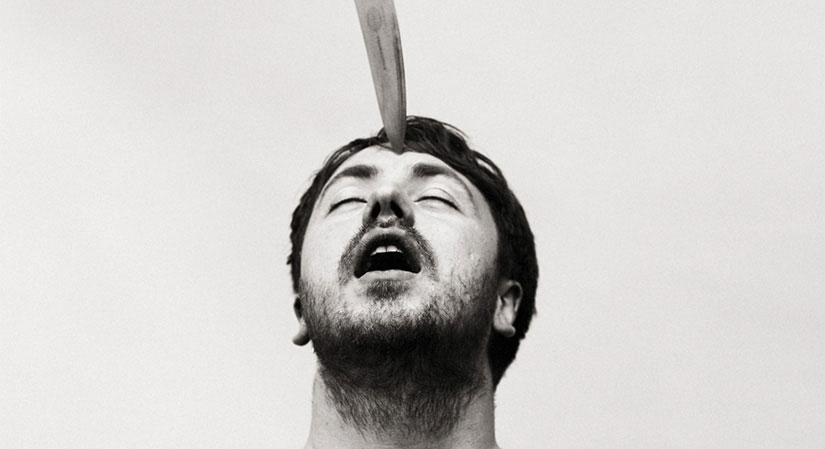
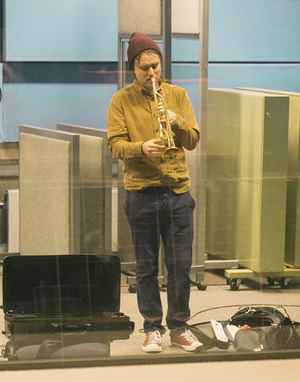
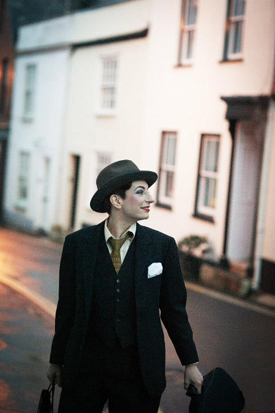


 Tropic of Cancer + Shift Work + Telefon Tel Aviv (DJ) (


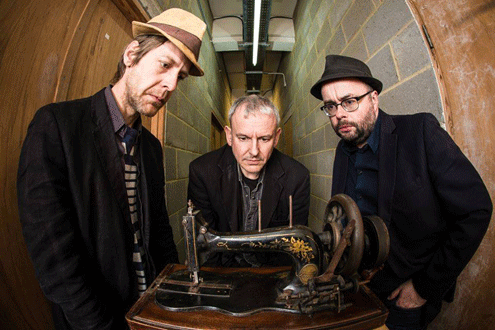
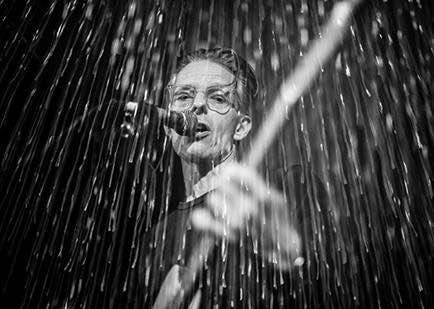


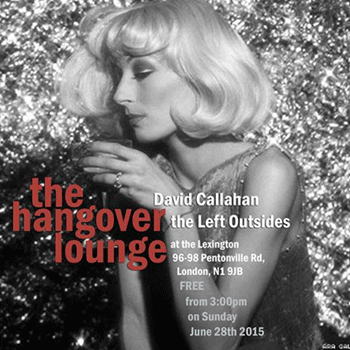






 Misfit City