Archive | single & track reviews RSS feed for this section

REVIEW – Dead Hippie Squadron: ‘Chilling Spree’ single, 2014 (“thumbing his nose at the chillout stations”)

24 May

Dead Hippie Squadron: 'Chilling Spree'

Dead Hippie Squadron: ‘Chilling Spree’

Skittering through electronic dance music like a grinning cartoon centipede, Julian Michal Zembrowski (a.k.a. Dead Hippie Squadron) has remained tongue-in-cheek so far. He’s dabbled with pranky plunderphonics (as in the George Bush Jr.-baiting Skull And Bones). He’s teased and celebrated dance culture’s mongrelised New Age aesthetics via tracks like Dubsteppenwolf and Interstellar Transhuman Psyche (and via 2013’s ‘Black Magic’ album, a skimming sample-heavy techno grimoire). Most of his artwork consists of spooky, crudely-Photoshopped snapshots of his dog; or of himself posing next to pet-food displays, wearing a kitten mask.

However much he pisses about with themes and imagery, his music has been seriously solid: a more successful mongrelisation. No matter how flighty or parodic their names might be, DHS tracks are filled with cunning, tickling complexity and multiple levels. Power-dive pitch-shifts, plenty of real instrumentation (including throaty ping-bass and glitched-up piano studies), an argumentative bricolage of vocal samples and Julian’s own mumbling lo-fi intrusions. Spliced references abound – a Club Dog take on the Bomb Squad, silly Zappa voices, minglings of Art Of Noise mischief with Meat Beat Manifesto drive, spooked ambient drift and IDM clatter.

Though it’s a good deal breezier than what’s gone before, Chilling Spree is as much of a witty DHS mash-up as ever. I’m guessing that Julian had his radio on and was both cocking his ear to and thumbing his nose at the chillout stations when this one rolled off his mind. Downtempo and smoothly textured, it shimmers around on ever-so-slightly theatrical accordion musings (like an airy Joe Zawinul jazz track at a long-ago summer festival) before rising up to a silvery, tinselly synth-pop crest. The drums sound mostly Lebanese: those jazzy, ahead-of-the-beat Stewart Copeland rattles, the furry rills. Humming in the background, Joe makes his best approximations of a Bollywood chorus.

A lot of those little citizen-of-the-world, coffee shop boxes seem to be being ticked… but the boxes are collapsing under the pen-strokes. That occasional blurting stutter of bass drum stupidity is straight out of electro; the tunefulness is cunningly crumpled. Meanwhile, we’re hearing part of an argument in the next apartment. “I want you to get mad,” burbles a man’s voice – aggressive in a slightly fruity way, and convinced of its own righteousness. “All I know is that first you’ve got to get mad.” Someone’s not really getting along with the chillout programme – there will be splintered knick-knacks soon. Over in his corner, Julian takes a long cool sip of a dark-amber drink with a complicated name and a couple of ditzy umbrellas, and treats himself to a long, low chuckle.

Dead Hippie Squadron: ‘Chilling Spree’
Dead Hippie Squadron (self-released, no catalogue number or barcode)
Download-only single
Released: 30th April 2014

Get it from:
Free download from Soundcloud

Dead Hippie Squadron online:
Homepage Facebook MySpace Soundcloud Bandcamp YouTube

REVIEW – Ian Crause: ‘The Song Of Phaethon’ & ‘Suns May Rise’ singles, 2012 & 2013 (“sample-punk turned foley-bard”)

30 Oct

Ian Crause: 'The Song Of Phaethon'

Ian Crause: ‘The Song Of Phaethon’

“Well, I know, I know the story – / the fall of the sun and the vengeance of glory revoked. / So well, I know how the seas turned to dust, / and how the known earth choked. / So well, I know, I know the ending: / the carriage from its zenith bending, / a comet slung through ashen skies / and burst against the banks.”

Cinematic. Epic. These are words which have been whored out far too often, especially when it comes to describing and defining music. Froth and PR corrode their meanings, reducing them to fancy synonyms for nothing more than crude scale, and we forget that other qualities are wrapped into them. These words shouldn’t just be cheap and glittery tags for charlatans – the kind who steep their tunes in giant vats of reverb, or who substitute eye-watering grandiosity for sincerity. There are more crucial meanings. There’s storytelling, and the churn of history. There’s the play of images, the triggering of senses. Eventually, there should be some kind of understanding.

Ian Crause knows all of this. Back in the 1990s – when he was barely out of his teens, and the driving force behind the startling expressionist pop band Disco Inferno – he was struggling with it himself. Even then, though, he wasn’t stumbling to understand: he was striving to perfect. Disco Inferno had come from limited beginnings but grown fast. Originally a dour post-punk power trio, they’d seized the opportunities presented by technology and imagination and transformed themselves into a whole-world window. Hot-wiring their way into the disruptions and illuminations of found-sound and musique concrète, they plugged guitar, bass and drums into digital samplers and grew themselves an ever-expanding sheath of noises: a startling collage of jarring sound effects, layered into composition and twisted into context.

Disco Inferno’s swarm of noise was never there simply to overwhelm. Instead, it refracted and illuminated the poignant dissatisfied pop songwriting which stood, steadfast, at the band’s core. They were doggedly political, but owed nothing to dogma. Caught within ominous social currents and inside treacherous personal eddies, their songs bore witness to cruelties, both intended and impersonal. Those tearing rivulets of sound-montage were flashes of further illumination, put there to side-swipe and snag the attention, and to up-end complacency. The fragments of birdsong and clattering glassware; the careful punctuation of trains and screams and distant firework-pops; the sound of feet jogging grimly away through a numbing snowfall – all of it bore witness to the swerving cacophony of the world, smearing past our ears and battering our psyche, carrying its deeper meanings and significances into us via a pummeling swirl.

At the heart of this unsettling barrage were Ian’s lyrics, which were wise, stark and bleak beyond his years. He sang about the crumbling of vulnerable individuals; about the fraying of the social contract and distortion of social forces. He sang about the stifling, stunting pressures callously imposed from above. He sang about all of this in a still, small, stubborn voice which sounded like the next-to-last exhalation; as if he was a few crucial steps and dogged heel-digs away from giving up and bleeding out. He sounded brave, bitter and doomed – snarling his scorn at the boot-tread even as it rolled over him. For a while, it was a self-fulfilling prophecy. Bands who refuse to comfort us (or refuse to stroke our sundry petty vanities) rarely get rewarded, and Disco Inferno were no exception – the strains of dealing with commercial indifference and inner despair finally tore them to bits in 1997. A couple of barely-noticed Ian Crause solo EPs hiccupped out in the band’s wake over the next few years, and then he too seemed to drop out of the story.

In fact, he’d only dropped out of the cheaper kind of mythology. That’s the one in which ducking out of music becomes death or disappearance by another name. His own story – the real story – moved on regardless. There were years of growing up and grim jobs to come, and years of being chewed over by the same callous forces he once sang about. In amongst the drudgery, there were other factors. There was fatherhood, and family. Surprisingly (for a lyricist already so accomplished and intelligent) Ian made his first adult engagement with literacy. Curiosity, plus a determination to pursue the roots of song and storytelling, led him to the themes and voices of classical literature. His developing interest in the telling parallels with contemporary society kept him immersed in it. Crucially, Ian discovered the works of Ovid – Roman epic poet and exile – via dedicated translations by Ted Hughes and David R. Slavitt.

Like Ovid, Ian would eventually become an exile himself (a self-determined one, abandoning Britain for Bolivia) and enter into a new swell of creativity. Via his ‘Metamorphoses’, Ovid eventually inspired The Song Of Phaethon – Ian Crause’s formal return to music, transformed and developed. It might not be the first new note he’s delivered after eleven years of radio silence. That would be More Earthly Concerns, which welled out via Mixcloud and blogclick in March 2012, and which I’ll talk about elsewhere. But (as Ian begins to dole out his work, in handfuls, onto Bandcamp) The Song Of Phaethon is the first of Ian’s songs to be let out into the marketplace. It’s also probably more crucial in understanding his evolution since his Disco Inferno days.

The protagonist, Phaethon, is and was one of those half-divine children who pepper Greek mythology – he’s the bastard of the sun god Apollo Helios, a malcontent boy strutting up to his sun-father’s palace to claim his ancestry and birthright before he has the wisdom to use it. Greeted, given the acknowledgment he craves, and granted the gift of driving the sun’s chariot for a day, Phaethon is warned of the terrible risks involved. Swallowed up by his grand moment, and too conceited to listen, he takes all of his opportunities to their ruinous conclusions. Losing control of the chariot, he transforms a triumphal fly-past into a joyride and then into a catastrophe. Before the high god Zeus restores order by striking him down, Phaethon scorches a gigantic swathe across the world and casts the seasons into chaos.

Like most figures woven into the complex psychological map of Greek myth, Phaethon still has his role to play. He’s a metaphor for arrogance and a sense of entitlement; he also stands for the destructive potential which both of these follies possess. It’s deep literary currency, and maybe not the first thing which you’d think of as a match for the Crause songcrafting method – so direct and personal in Disco Inferno days. Yet Ian’s battering splay of noises and disaffection opens itself up readily to the mythology, which sinks in grain-for-grain. Explosive futurism meets stern and ancient legend, and both are renewed.

Some of Disco Inferno’s post-punk grit remains at the spine of the music (listen to those dogged dot-trails of frowning bass, or to the occasional flares of wire-wool guitar), but the song falls far away from rock into something older. Myths lend themselves to being channeled into new courses by any means available – Phaethon, for instance, worked his way into a Patricia Barber jazz epic six years previously. Ian rises to his own challenge superbly. In any worthwhile sense, what he comes up for The Song Of Phaethon is a new take on a bardic chant. Its melody is minimal and hypnotic; its rhythms walking, changing pulses constantly driven by the restless words. With vivid artistic appetite, Ian also mines the story’s depths for any resonances which he can transmogrify and feed into his own samples-as-narrative approach.

In this he’s served well – the mythic structure and detail inspire and transform his lyrics, which in turn take on the layered build of classical imagery. Various whispers of fateful moira and foreshadowing rise up to nourish the sounds. From early on, Phaethon’s life is marked by the celestial – right down to the transformation of his familiar landscapes by the passage of the sun and moon each day, continual reminders of his thwarted birthright. Ian reflects this in the woven detail of the narrative: “Every day their shadows ran / down Asia like a lyre, strumming / past his village, swinging down at perihelion / to touch upon his mother’s house / then over dark and quiet woods – / their distant hawks and watching deer / oblivious in bending shade – / descending into seacloud mist, / and down towards the gull-cloud cliffs / to pour their jewels and precious metals / out along the sea.”

Just as he did with Disco Inferno, Ian juxtaposes sound effects with the lyrics to create telling sonic scenery. Though he generally wields these with the skills of a master ironist, he slam them into place with forthright punk brutality whenever he needs to. Throughout, the Greek horns and lyres are a pointed racket: ritual blares, ancient continuo lines. Signatures of antiquity and origin stand solid against the thrumming synths and Ian’s tidal electrophonic swirl of throbbing samples. In prophetic flashes, the clip-clop of horse’s hooves and the slam of violent collisions clatter and blur in and out of the mix, while Phaethon’s more innocent youth is illustrated by the clank of herd bells and goats. In time, his dogged journey through Asia and towards Apollo is dappled and smeared by a souksworth of Asian instruments and chatter, careering past the listener in a flickering travelogue: “Levantine cities raised themselves, then hazed away in dreams of sand, where sand subsumes / the earth itself and still ahead his path led on. But falling always out of reach, the rising sun. / Into the dawn, alone he walked.”).

The effect is of a kind of illuminated text – a cinematic compression of time and location into a vivid illustrative story. That story remains paramount: even while we, as listeners, are being drawn inside those blood-in-the-head thunders and are surrounded by a glorious noise, as if we’ve been trapped under the encircling lip of a vast bronze bell. Beyond the story, though, other dimensions to the tale are coming into play. The song is also a loose parable of another gatecrashing of grand power. “He knew, he knew – / his place was beyond.”

Superimposed – a ghostly transparency – over Phaethon’s story is the tale of Tony Blair’s entry into the Second Gulf War. As this emerges through the song, it’s clear that Ian sees this as another disastrous snatch at high significance and public destiny. Something which flew high and upwards towards glory, only to destroy any achievement of its own, wreaking havoc on the ground and people below. Cunningly, occasional Blairisms are woven both into the narrative and into Phaethon’s thoughts and speech. At one point, he even blathers, Blair-like, “look, you know,” before sliding into advocate pomp and hubristic heroics. For a moment, the pleading voices of the two men overlap within Ian’s narration, making a contradictory cats-cradle out of public morality, power-grabs and a preening Promethean sense of mission. “It was not just God but also man / who clearly needs some representing – / A case I’ll take for free… / Evidentially it takes / a half-divinity to raise / the flag of man aloft for man…”

It follows – with a harsh and unforgiving logic – that the noises of modern warfare should persistently break through the song’s tapestry of ancient sounds. As Ian goes beyond everyday sound effects and begins to violently splice present-day horrors into the textures of the mythical plot and signifiers, the song is slashed up into a jittery palimpsest. Almost from the start, those bleating goats on the ancient Greek hillsides are blindsided by gunshots and by the crash of heavy munitions. With booms, crunches and clatters the shattered, warped shards of twenty-first century concrete and metal scrape and shoulder their own way into the past.

Even specific events from the myth draw across, from recent times, their own crooked parallels. The bursting, clattering crowd-sound of Phaethon’s entry into Apollo’s hall is lifted and twisted from the peak of Blair’s 2003 address to the US Congress. It becomes a Dionysiac smear of fanatical applause and whistles: something turned into a nightmare puppet show, or a rainstorm ripped horribly out of kilter. At the coda, Phaethon is poised unwitting on the brink of disaster. The ascension of the Sun’s chariot merges, indistinguishably, into the noise of a jet fighter launch. Backed by the white-hot screech of the afterburners, the lyrics weave both tales, both times and a set of terrible implications – “the steeds were armed: a blinding shock; / a ferrous scream; a rubber stamp; / and up,” – into final, irrevocable process.

By anyone’s standard, The Song Of Phaethon is a major achievement – a jump-up into fiercely intelligent, confident high art, it stakes new claims and transfigures old ground. It even manages to both stay true to and transcend the moral and political commitments Ian held with Disco Inferno. And yet… it raises a tremulous question of what might have happened to the other side of Ian Crause. Between the immersion in classical tradition (and the dense time-folding focus of the samplers) what’s left of the fervent young New Order fan who always saw himself as fronting a pop band? What, in other words, became of Crause the unlikely pop singer?
Ian Crause: 'Suns May Rise'

Ian Crause: ‘Suns May Rise’

For the answer, look to Suns May Rise, released three months after The Song Of Phaethon. Ian’s mining of Greek mythology is still in place (as are his detailed tapestries of sound-effect) but they’re now wrapped around an out-and-out pop song and a lustrous, dancing melody that Bernard Sumner would give his eye-teeth for. Those Greek lyres and zithers are back, as are the layers of sound effects (sea-spray and thunderous surf crash billow through Suns May Rise from start to finish); but they’re bolstered by massed stadium synth and guttering pop guitar; by angelic powder-puffs of fake-choir; and by warbling rococo flourishes of electronics. Even Ian’s voice – usually so dry, and pointed – is flushed with the balmy blue of a Mediterranean summer. Scritti Politti and Cocteau Twins, each at their flounciest, could find common ground with this song’s feverish, chattering opulence. So, come to that, could latterday Marillion.

I suspect that all of this ’80 ornamentation is deliberate. After all, it skips hand-in-hand with other ’80s excesses, and that’s not too far from where Ian’s caustic, righteous attention is focused. Beneath this gleeful and gorgeous bluster, he’s unraveling a story from the Odyssey: a warning bell for avaricious times. As the story has it, Odysseus (while returning from the Trojan Wars) visited the generous Keeper of the Winds, who gave him a bag of sea-gales to ensure that the sails of his ships would be filled and his voyage home would be swift. En route, Odysseus slept; and his friends sneaked up to rifle the bag, in search of treasure which they were sure he’d hidden from them. All they succeeded in doing was to unleash the winds, which blew the ships hither and yon and – eventually – blew them back to where they had started. Reckless avarice, bringing down calamity, provides the keystone of the song. “There will always be some fool / to pull the strings apart. /And suns may set and moons may wax, / and moons may wane and suns may rise – / the gold within his eyes will weigh / Man down a stumbling fool.”

When Ian starts singing about this, though, it’s from the point of view of that corrupted, consensual chorus of friends – the “brothers bound in bronze.” Their coy, self-congratulatory rapaciousness soak his tones like a stain on the teeth. Flushed and greedy with loot already, all they can see is the chance to grab some more. From his own place at the reins of the narrative, Ian reveals their mythic echo in today’s freebooting boy-club of bankers and stockbrokers. Men of unfettered appetite goad each other on. People who simply don’t know when to stop – and who wouldn’t want to even after being handed a sobering, sickening lesson – would still pick perilous holes in opportunity. “You had enjoyed a peace of sorts / The winds had been re-tamed and so / of course the bag was bursting fat: / It fell to men to see to that. / Again so sure the bag would hold / either wine or gold, / Necessity appeared, demanding ‘Open this’.”

It’s here (with a careering inflative screech on “bursting fat”) that Ian himself deliberately unleashes the hidden forces within Suns May Rise, to overwhelm it. From here on in, sounds rise and cyclone – seaspray, radio chatter and winnowing churns of air; a lash of strained rope which morphs from background effect to edgy kick-drum. Amongst all of this the thread of pop song holds fast, stretched taut over an ever-burgeoning epic. In a parading weave of rapid soundbites, assorted newscasters and pundits and politicians roll past in a potted history of the last generation of monetarism. At its tail-end, George W. Bush (waving through a banker’s rescue programme of the kind he’d never have brooked for any other group of people) chokes, gargles and drowns amongst the becalmed wreckage of Odysseus’ ships. Throughout, that teasing pop melody ensures that we’ll remember what happened this time around.

So… the forces eventually sink the meddlers, but there always seem to be more of the latter. Ian conjures up further mythic winds, more specters bringing in ruin from the other far-flung breeding grounds of a destructive capitalist carnival. “Through solids, countries, paper bonds; / The world again reveals itself / in entrails; in open wounds. / The priests and seers shed tears of glee / and privately amuse on how / it still can be that after so long… / there will always be some chance / to pull the threads apart.” Again, the bones of legend rear up inside the flesh of current affairs. Again, this unlikely sample-punk turned foley-bard turns up to show us where those bones are poking through – his words a layered and subtle scourge; even an education. For Ian Crause, it’s been a long and often stony road from transformative teenage angst to his current role of reveal-and-illuminate, but it’s also been a journey of integrity and hard-won vision. The results are even a story in themselves.

Ian Crause: ‘The Song Of Phaethon’ & ‘Suns May Rise’
Ian Crause (self-released, no catalogue number or barcode)
Download-only singles
Released: 20th November 2012 (‘The Song of Phaethon’), 18th February 2013 (‘Suns May Rise’)

Buy it from:
‘The Song Of Phaethon’ – Bandcamp (the original version reviewed here has now been replaced by this mini-album)
‘Suns May Rise’ – Bandcamp (the single version reviewed here has now been replaced by this version from ‘The Vertical Axis’ album)

Ian Crause online:
Facebook Bandcamp LastFm

REVIEW – Knifeworld: ‘Don’t Land On Me’ single & Kramies: ‘The Wooden Heart’ single, both 2013 (“dancing at the end-of-the-world party”)

2 Oct

Knifeworld: 'Don't Land On Me'

Knifeworld: ‘Don’t Land On Me’

So what’s it to be, then? Stubborn elbows or secret soft centre? For Knifeworld, as ever, it’s both and neither. Kavus Torabi runs on this kind of contradiction. It’s what enables (or maybe forces) him to roll out singles like this – the kind which always seem to promise him the attention he deserves but never quite get him enough. Generally his songs teeter like dazed cats trying to scramble over the fence dividing open fields of sunny pop from that intricately entangled tesseract-space of what Kavus calls “funny music” (and which the rest of us drain our adjective-and-hyphen stores over, vainly trying to pin down a workable term).

‘Don’t Land On Me’ finally kicks down the fence. In its swirl and pounces, in its tiny bluffs and blind corners, in each acoustic guitar rope-trick and each Halloween feint of Emmett Elvin’s keyboards, it brings in the usual juicy psychedelic Knifeworld kinks. I suspect that Kavus can’t look at a nice fresh acid blotter without seeing a potential origami crocodile in there, waiting to be made. Yet this time, for every formidable bit of bassoon-pretzeling that Kavus offers up to the memory of his beloved Henry Cow there are two shots of pop. For every bit of elastic Shudder To Think limbo-dancing, there’s a flash of Marc Bolan coltishly tossing his curls and foot-stomping with Led Zeppelin.

Having unexpectedly ballooned into an octet (with a three-line battery of reeds and saxophones), Knifeworld are starting to sound bizarrely like a 1970s soul revue, albeit one that’s lurching out of line. ‘Don’t Land On Me’ has gilded harmony stabs and sugar-wraps of acoustic guitar; it has gratuitous campy explosions; it has stirring gospel-mama “yeahhh!”s from Chantal Brown (bringing a Loa or two from Vōdūn). Most surprisingly, it seems to have gobbled up that swashbuckling vamp from Live And Let Die, hiccupped it out again and gotten away with it – regularly, the band throw their hip intricacies to the wind and just romp up and down a ladder of soft-rock pizazz. Threaded through all of this sturdy bravado, though, is sadness and fear – a hollowing of the heart.

Half of the lyrics are Kavus’ usual ribbons of third-eye babble: tales of dying suns and mysterious cities of the mind, as much bragging as illumination. Yet all of a sudden he’ll turn out a belter: “In that treacherous slippery no-man’s land / between bolt-upright and dead-to-the-world in sleep, / I was dreaming that you were in my arms. / Dreams will only give promises they cannot keep.” Later on he’s hiding behind his own tune, chanting “falling down, unravelling”, and it’s up to his vocal foil Mel Woods to step up and deliver the drop – “Broken, unfound, there is only one thing I find – / we ran aground, and I wouldn’t make up my mind. / Hide it behind your hands, my eyes no longer see / Heavens above, stars explode, but don’t land on me.”

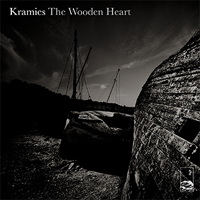
Kramies: 'The Wooden Heart'

Kramies: ‘The Wooden Heart’

As the band charge off into the vamp again, they sound as if they’re dancing at the end-of-the-world party in mirror-strewn top hats: I’m guessing that Kavus will be trying not to meet the gaze of any of his own reflections. Kramies Windt, meanwhile, will be standing several good paces away, waving goodbye to everything with full acceptance.

While Knifeworld fret about doom and ward it off with their showbiz, Kramies gets by on faith. Not for him Knifeworld’s tussle of John Barry and John Adams, nor their trick-cycling. With Todd Tobias keeping a gentle producer’s eye on things, ‘The Wooden Heart’ rolls along on that familiar drowsy acoustic-guitar trudge that’s served forty years of green-tinted psychedelia from Camel to Mercury Rev to Porcupine Tree. A spectral moonlit fungus of vaporous keyboards grow on and around everything: a high-altitude electric wash of sparks, smoothness and textural drag spreads out at telescope height, snowploughing the Milky Way. As for the song, it’s less involved and intricate than much of the material which Kramies has sung up for us since his 2008 emergence. A dream-pop caroller with a lucid organic twist to his songs, he once came across as a mellower Paddy McAloon with a hint of pixie. Now he’s closer to visionary Neil Young territory, the point where American folk-song blurs without a jolt into slumbering subconscious. He’s singing softly and with understanding beyond his sleepy burr, like a wise newborn already dusted from the road.

This is a love song, of a different kind. Kramies is pulling up memories: treasuring them, but also acknowledging how memory and memorabilia gently cheat and distort the truths which they’re set up to hold onto – “Forged from the photograph when the tides they rode you down; / smudged from the perfect lens, so I brought you back to ground.” Despite the dreamy, distant atmospheres Kramies isn’t dwelling on someone gone. He’s celebrating someone never lost, someone coming into clearer focus as present merges with memory: “We fell in love with wind, sun and movies, / no need to stay. / Countdowns and journeys, conversations, fell through our day.”

In the middle, the song holds its breath for half a moment, then rises into a blissful dream-pop threshing; a massed quilt of hammering Slowdive-ian guitars joyfully plunging down onto each beat. “Spill out the haven, throw my maths chart away, ‘cos you’re the one,” Kramies sings, in an exultant sigh. “Throw my maps, a castaway.” It’s rare to find dream-pop that resolves with such assured optimism, in which you can sense experience shifting into its proper place. While Kavus and Knifeworld constantly quest for resolution – and spin some dazzling pirouettes along the way – Kramies seems to have mastered the talent of simply breathing it into shape.

Knifeworld: ‘Don’t Land On Me’
Believer’s Roast (no catalogue number or barcode)
Download-only single
Released: 9th September 2013

Kramies: ‘The Wooden Heart’ single
Hidden Shoals Recordings (no catalogue number or barcode)
Download-only single
Released: 5th September 2013

Get them from:
Knifeworld: ‘Don’t Land On Me’ – Bandcamp
Kramies: ‘The Wooden Heart’ – Hidden Shoals online store

Knifeworld online:
Homepage Facebook Twitter MySpace Bandcamp

Kramies online:
Homepage Facebook Twitter MySpace

REVIEW – Fletcher|Fletcher|Reuter: ‘Islands’ single, 2013 (“setting things right as well as respecting the source”)

11 Jun

Fletcher/Fletcher/Reuter: 'Islands'

Fletcher|Fletcher|Reuter: ‘Islands’

Ironically, we often record cover versions to find out – or to show – who we are.

Markus Reuter, for instance, would prefer it if other people could stop telling him who he is. Too many of them are telling him that he’s obliged to be the twenty-first century’s Robert Fripp. They can’t get past his Frippic virtuosity on touch guitar, his past as a Fripp student, or his work with the man’s former King Crimson colleagues (in Stick Men and Tuner). They can’t even get over the fact that these days he plays all of the Fripp parts in the Crimson ProjeKCt…

Ah. Well, all right, but Markus’ vivid success in the sprawling latterday Crimson family shouldn’t have to box in a musician as stubbornly wide-ranging as he is. Yet it does, even though you don’t have to scratch him too deeply to discover that he’s not as enFrippened as he seems. When it comes to willful and wayward yet methodical 1970s virtuosi, Mike Oldfield is kernelled deeper in Markus’ heart than Fripp is. Hence this unexpected and open-armed cover of a long-forgotten Oldfield song, recorded by Markus in cahoots with long-term collaborators Lee and Lisa Fletcher, and demonstrating that Markus deals with more musical colours than just ‘Red’ ones.

A few sketchy parallels can be drawn here. When Oldfield released the original Islands single (back in 1987, towards the uglier end of his Virgin Records contract), he wasn’t entirely sure who he was. Though he’d made his name via intricate, acclaimed confections of multi-instrumental experimental rock, spatial Celtic folk and classical minimalism, by the mid-’80s Virgin had talked him into writing hit-and-miss pop songs dressed up with fat blobs of Fairlight, gated reverb and arena grease. The ‘Islands’ album floundered to cover both poles – a side of lengthy neoclassical fare (heavily spiced with chants, electric flourishes and whirring jazz flute) counterweighted a side of echoing pomp-rock (with straining guest singers and drums like torpid cannons). Even back then, this didn’t age well, despite spawning a vapid video album in which Bonnie Tyler and Kevin Ayers (in ‘Miami Vice’ regalia and power-frosted hairdos) sang and jostled their way through pastel-misted virtual realities and through corny CGI blizzards of New Age totems, ducking flying Tutankhamuns as they went.

At that point Mike Oldfield was pretty lost. Though he’d only stick the situation out for one more album (before rebelling and revitalizing himself via the inspired slice-and-dice music of ‘Amarok’) in 1987 he seemed beached. Islands – the song – ended up a little lost as well. Uniting strands of John Donne, Celtic Big Music and Dream Academy oboe, it could have triumphed over the crash of reverb: with its lyric of loneliness unclenching it could have become one of the decade’s all-join-hands power ballads. It even had Bonnie Tyler singing it, all sandpaper and yodels. What actually happened is that it floated round the middle of various European charts for a while and then sank.

In contrast to the lacquered, divided and ultimately stranded figure that Oldfield cut in the late ’80s, Lee Fletcher comes to Islands knowing himself and knowing what he’s doing. After a decade of quiet self-apprenticeship and networking, the Fletcher sound has blossomed into a rich pool of talented instrumentalists and instrumentation – digital blips to rattling jazz, frosty-fanged art-rock guitars to keening folk and glowing chamber music, choreographed with a mixture of precise delicacy and expansive flair. His auteur-producer take on Islands doesn’t just restore the song’s appeal. As a string quartet jumps from scratchy shellac recording to full live presence alongside uillean pipes and whistle – and as Markus rides happily at the centre of the song, his touch guitar chords and slithers fanning out like a nerve map – it restores the song’s lost Oldfield-ness. This could be as much rebuke as tribute. Either way, there’s the feel of setting things right as well as respecting the source.

There’s a little of the undulant Saharan patter of a Peter Gabriel song (reinforced by Tony Levin’s prowling spring of a bass part). There’s the spirit of an Irish pub session, too (Alan Burton’s pipework recalls other Oldfield moments, such as the haunted morning chills of ‘Ommadawn’ or Paddy Moloney’s warmer dip-ins on ‘Five Miles Out’ and ‘Amarok’). Finally, there’s the third side of the Fletcher|Fletcher|Reuter team – Lisa Fletcher. Compared to Lee or to Markus, it’s less clear whether she knows who she is, musically. More to the point, it’s not even clear whether she thinks its important. She’s the only member of the F|F|R trio who’s got form for actual impersonation (if you don’t believe me, check out her startling Sinead O’Connor impression from an old series of ‘Stars In Their Eyes’) and for now, she’s keeping up that sensuous and welcoming vocal persona with which she helmed Lee’s ‘Faith In Worthless Things‘ last year – a flushed, de-gushed and beautifully controlled Kate Bush mezzo which slips supple invisible fingers round the lyrics, caresses them, and passes on by.

It’s a low-key take compared to Bonnie’s hearts-and-guts original. What matters, though, is that it works: a vocal and a sentiment that’s a welling rather than a sobbing, and far better at catching the quickening thaw that’s being voiced in Oldfield’s lyrics. Beyond the beautiful sound, Lisa remains something of an enigma as a singer and as an adept interpreter – still playing a game of veils in which flashes of other singers, other sentiments distract our curiosity, and behind which she’s drawing out other people’s words and launching them with the subtlest of spins. It makes me wonder what she’ll sound like when she’s singing her own songs. For now, she’s transformed Islands into a shimmering welcome rather than an emotive wrack, and has kept her own mystery as she does it. No easy trick.

Fletcher|Fletcher|Reuter: ‘Islands’
Unsung Records (no catalogue number or barcode)
Download-only single
Released: 10th June 2013

Get it from:
Bandcamp

Fletcher|Fletcher|Reuter online:
Bandcamp

Lee Fletcher online:
Homepage Facebook Twitter Soundcloud Bandcamp

Lisa Fletcher online:
Facebook

Markus Reuter online:
Homepage Facebook Twitter MySpace Soundcloud Bandcamp Last FM YouTube

REVIEW – Kiran Leonard: ‘Dear Lincoln’ single, 2013 (“a joyride through the Day of the Dead”)

18 May

Kiran Leonard: 'Dear Lincoln'

Kiran Leonard: ‘Dear Lincoln’

Now here’s something.

Kiran Leonard’s already an established teenage wunderkind – a bedroom-industry frenzy act who’s rapidly gummed together a string of homemade albums and slung them out, via Soundcloud and Bandcamp, to a surprised and unsuspecting world. When he’s not doing that, he’s charging round his family’s Oldham house waving a caiman head, or shooting his own scratch videos on a budget of tuppence. He plays most of the instruments he needs, wrestling tunes out of pianos, drums and guitars; ukuleles, laptops, screwdrivers and radiators. While his music’s just about ramshackle -raw enough to avoid trouble with the indie-rock police, his ambitions and application have leaned closer to prog and to a grandiose psychedelia. In 2012, for instance, he cooked up a rambling, apocalyptic single about the Mayan doomsday prophecy. It topped out at around 24 minutes long and tied together the wilder bits of ‘Cloud Atlas’ and the paranoid, grinding Pink Floyd of 1977.

It’ll still be three years before Kiran turns twenty. I could wonder what he’s going to do when he grows up, but I almost hope that he doesn’t.

Dear Lincoln is something different for Kiran – much lighter and more immediate. Traveling backwards as he goes forwards, Kiran seems to have suddenly discovered pop in all of its concise hooks, blind momentum and smart throwaway logic. Actually, he’s rediscovered it – Dear Lincoln was written some time ago, while he was a ripe 14 – but now seems to be the perfect time to unveil it. Its a bust-out. It sounds like a joyride through the Day of the Dead. Kiran, hammering away at a tack piano and squawking like a glammed-up crow, drives the gauges into the red and embraces Bolan swagger, a swaying Robyn Hitchcock playfulness, some of the wild euphoria of Guillemots and even a needling tinge of Kevin Coyne. Earlier in 2013, there was the ‘Oakland Highball’ EP, which showed that he was getting interested in snappier, noisier forms. Dear Lincoln nails it. If we could work out what he was singing, it’d even be singalong.

What’s it about? God knows. The words are a babbling wodge of mondegreens-in-waiting about suit-crevices and moonlight, thrown out at us as Kiran carries out his lyrical handbrake turns. “Murderous plain,” he protests, in passing, but it certainly isn’t. Not unless he’s talking about death again. The song could be about gunned-down Presidents, it could just be about missing the family cat, but one thing Dear Lincoln does do is blur the lines between the living and the dead – a rollicking Halloween dance, or a resurrection day stomp. Even that long-croaked, ranting old herald of the Übermensch, Friedrich Nietzche, has a ghostly cameo; prowling the English parishes as a witness before succumbing to anxiety, melting away and vanishing. In the chopped froth of the lyrics, Kiran playfully juggles around ideas of resurrection, rousing, and where he’ll be standing when it all comes to pass; but constantly swats away any navel-gazing with onomatopoeic streams of Little Richard-isms. “Praying for the bodies to assemble and wake… / Come back today, bou-la-ray / oh, ta-hoo-lay.”

Don’t get the idea that this is all a casual throw-together. Anyone keeping half an eye on how Kiran thinks will know that he’s meticulous; that he worries like crazy about getting things right. But Dear Lincoln’s explosive delivery – its immediacy, its ability to swing round the story without stopping to count the words – suggest that he’s finally able to harness his particular genius and to let it live in the moment. This is by no means the first we’ve seen of Kiran Leonard, but it feels like the start of him.

Kiran Leonard: ‘Dear Lincoln’
Hand of Glory Records (catalogue number & barcode t.b.c.)
Vinyl/streamed single
Released: 16th May 2013 (streamed), 2nd September 2013 (vinyl)

Get it from:
Hand of Glory store (vinyl), or Soundcloud (stream)

Kiran Leonard online:
Homepage Facebook Soundcloud Bandcamp Last FM YouTube

REVIEW – What?!: ‘Schwaffelen’ single, 2013 (“it’s still not clear when they’re going to stop fencing and start carving”)

9 May
What?!: 'Schwaffelen'

What?!: ‘Schwaffelen’

All right, they suckered me. I thought that What?! were starting a gimmick tradition of rolling out cute singles named after foodstuffs. A natural suspicion – their debut single had the crowd-pleasing title of Tikka Masala. Actually, it turns out that “schwaffelen” is Dutch slang, and refers to a man repeatedly bouncing his semi-erect penis off assorted objects (ranging from someone else’s cheekbone to the side of the Taj Mahal). Handy phrase – consider me educated. I’ve been saved some embarrassment the next time I’m snacking in Amsterdam, but have been left with a delightful image of waffles-and-cream that I now need to bleach from my mind. Thanks for that.

What?! remain the kind of supple instrumental trio that gives slick a good name – guitar, bass guitar, drums and a thorough versing in everything out there which grooves. They also own a not-so-secret knowledge of plenty of things which don’t groove but which do lurk, puzzle over things and then jump out at you. But they’ve yet to really show their other teeth: those rougher, odder inspirations they claim to get from Zappa, Dub Trio and Mr Bungle. So far, they’ve been more about delicate sunlit jazzy chords and walks, clean deft swing, and plenty of space. You get the feeling that they could do anything with their material – as soon as they wanted to – and that they’re fencing with expectations. It’s just that it’s still not clear when they’re going to stop fencing and start carving.

As much as you might want them to get nastier, Schwaffelen doesn’t show What?! chucking away any of their finesse in favour of skronk or sludge. If they’re stepping towards a spikier direction, they’re starting subtle – taking some sour art-rock patterns and passing them back and forth through the smooth-jazz filter. As with Tikka Masala, there’s a hint of Take 5 in the gently precise stops and feints as a bossa nova is displaced and reshuffled into math-rock spikes. But the truth is that, in spite of the cock-bouncing title, What?! keep their all-things-to-all-men decorum throughout – even when hitting the distortion pedals.

If you’re hoping for some upheaval – something like the obsessive rhythmic knotting of Battles, say, or the disruptive slice-and-dice of Naked City – you’re in the wrong place. Schwaffelen’s flexing sections do include a flawless switch into driving rock as guitarist Niels Bakx starts blasting away and Agostino Collura’s nimble bass drops its funky slither and locks down into root-note pummeling. But this is more an exercise in clever distraction. Even as Raphael Lanthaler drums along at motorway-punk velocity, the whole band are keeping an eye on the little loping twists of the original rhythm: as it ghosts on underneath, they’ll lock seamlessly back into it whenever they choose. Even the texture phase (in which Niels seems to be channeling the sparse echo-spangled touch of Andy Summers) adds some extra breadth but no questioning depth or disruption.

Perhaps it doesn’t matter – whatever else they might or might not do, What?! remain supremely elegant puzzlers. But it still feels as if there’s much more to them. The Key Ness remix of Schwaffelen is barely half the length of the original, but during its stay it chops, rewinds and pans the original riffs around a gastric roller-coaster of sub-bass and boiling P-Funk synth. Along the way, it twirls past Alice Coltrane harp cascades, brief bursts of classical soul orchestras, wind-tossed shouts from hip-hop MCs and gutsy flowerings of Spanish guitar. It sounds more like what must go on in the trio’s heads – what they must listen to on iPods, gulp down from session to session, or coast by on the bus.

One last thing, going back to the original track… As it snaps to a halt and telescopes away, with a quick twist-and-growl, those push-pulling rhythms leave you in a state of expectation. There’s a moment of hover. Then there’s several messy, prolonged seconds of the most horrendous splurging musical spoff-noise you can imagine. Maybe it’s a surprise, a pancaked blast-beat hurled out by Raphael to be crushed flat in the mix. Whatever it is, it’s a Zappa-style kiss-off. Perhaps I’ve been unfair to What?!. They did finally deliver that dirty splatter.

What?!: ‘Schwaffelen’
What?! (self-released) (no catalogue number or barcode)
Download-only single
Released: 1st April 2013

Get it from:
Bandcamp.

What?! online:
FacebookTwitter Bandcamp SoundcloudYouTube

REVIEW – Robert White: ‘Everything Is Free’ video single, 2013 (“blown up with a wondrous inner light”)

12 Apr

“Everything is free now, / that’s what they say. / Everything I ever done, / gonna give it away.”

Innocence blisters. Sometimes you have to take it – and yourself – away for a while, to cradle it and let it heal.

In spite of over thirty years in the songwriting business (he started young, with anything that he could get his hands on), Robert White still has that quality of innocence. If he’s got scars, he bears them calmly and with acceptance, but he must have suffered some psychic sunburn along the way. There were those early ’80s swirls around no-budget London psychedelia, keeping up a fit of giggles and avoiding becoming a casualty. Then there was the bristling musical tensions of Levitation, continually blowing their own heat-shield and ending up as five men biting each others ankles. Finally, there was the pearly, patchy career of his own Milk & Honey Band.

It’s not as if the Milks were the only people in the last couple of decades who smoked and breathed that Beatles mix of singalong wit, music hall parp and peacock splendor (Karl Wallinger and Roland Orzabal, to name but two, made a decent fist of it). But for my money, if you want that luminous Lennon/McCartney glow picked up and rolled out like a quilt, then Bob’s yer avuncular. He and the Milks should have been treasured by everyone. You; your granny; ‘Mojo’ Man; that painfully hip little boy down the road who secretly yearns for pure pop and papers his bedroom wall with old Byrds and Teenage Fanclub sleeves. Instead, you probably never got to hear them. Shame. And for three years, Bob has been hiding up and keeping quiet: skulking in Fulking, on the South Downs chalkhills. Those gifts which he used to apply to music, he’s been spending on photography instead – pictures of local landscapes blown up with a wondrous inner light; an illumination rendering sweeping Sussex hillsides alive with warm energies.

Here, though, is Bob alone; drawn back to instruments, woodshedding again. Now he’s pulling the dustcloth off a beautiful brand new Gillian Welch cover for us to have a listen to. Welch seems to be something of a go-to girl for art-rockers; at least, for those of them who are thirsty for a wellspring of country without the taste of cattle and spurs (see also A Marble Calm’s glorious Frisell-meets-Eno roll through I Dream A Highway) and Bob’s version honours her original simplicity. He could have festooned it in harmonies and ringing guitars, but instead it’s mostly just him, a light-as-moonbeams piano, and the kind of reverb that turns slapback into caress. Everything else there has blossomed onto the song like dew. There are touches of synth cello, a glockenspiel or two; maybe a celesta towards the end. As things travel onwards, water-drop swells of backward sound are delicately varnished onto the keystrokes.

That’s the sound: now listen to the song, and the singer. Bob’s voice is lower than it was, perhaps tempered with a couple of hairline cracks of resignation, as he slips inside Welch’s words and makes them his own. The business bruises; the thoughts of escape, and of dignity – “I can get a tip jar, gas up the car, / try to make a little change down at the bar. / Or I can get a straight job – I’ve done it before. / Never minded working hard, it’s who I’m working for.” Disaffection, though, doesn’t entirely clog up the world. The compulsion of songs is sometimes sung about as if it were a curse: here, it’s more about music coming regardless. It’s hard not to feel that Bob’s singing for himself when he murmurs out lines of guarded, flowing creation (“every day I wake up humming a song / but I don’t need to run around, I just stay home,”) and, finally, resolution. (“I’m going to do it anyway / even if it doesn’t pay.”) I think he’s back. Please don’t miss him this time, will you?

Robert White: ‘Everything Is Free’
Robert White (no catalogue number or barcode)
Video-only single
Released: 13th February 2013

Get it from:
Currently only viewable as video – no wider release announced yet. Video by Nick Power @ iseetigers.

Robert White online:
Homepage Facebook

REVIEW – Liam Singer: ‘Stranger I Know’ single, 2013 (“sings in a tone of wonder – and of determination”)

26 Mar
Liam Singer: 'Stranger I Know'

Liam Singer: ‘Stranger I Know’

What a wonderful mind for composition Liam Singer has. Four albums into his career, he’s coming up with ever-more-detailed songs which only fit the pop label due to their presentation and singability. In all other respects, he’s a classical songwriter, building a song from cellar to roof, all parts in parallel: a detailed patterner with each idea serving the larger one.

A very small number of songwriters take the trouble to think like this. Brian Wilson and Prince, obviously. Jeff Lynne, Sufjan Stephens and Stephen Merritt, perhaps. Tim Smith, definitely – the interplay of vocal parts on Stranger I Know particularly recalls Smith’s pastoral work with Sea Nymphs or the more delicate moments on Cardiacs records as worked out with William D. Drake (another comparison that can be thrown into the circle). At work in his current hideaway in Queens, Liam Singer belongs to this world of the total song-composers: the ones for whom genre barriers are predominantly bubbles of resistance, and for whom form and content are inseparable.

Stranger I Know sounds like many things. Its links to American minimalism are clear in its collection of elegant cycles (from oompah bass to arching cello; shakers and flute; a mathematical glockenspiel climb) as they move against each other, interplaying in uplifting counter-rhythms. Beyond that, Liam’s omnivorous musical diet is made clear in the breadth of arrangement and intonation, stretching from romantic piano to staccato gamelan pot-clunk. Each instrument comes sheathed in its own immediate mood and pace, hanging onto its place in the dance by a skilful fingertip: just enough to snag a little tension and independence; just enough to flirt.

Shadowed and overflown (as ever) by the spectral caroling of soprano voices, Liam sings in a tone of wonder – and of determination. It’s all a little archaic: a spiritual love ballad with swaying time, an elusive subject and a courtly seriousness which ultimately fails to mask its fervour. “Stranger I know / thy face / from a dream. / All night I’ve yearned to hear that song. / – Once, it sang me.” There are hints of transformation and liberation here – “What was / before me / is now / behind me. / Strings fall / off of / a body,” – but devotion and freedom end up so closely wound together that there’s nothing between them. Liam finally stands set loose on the verge of… something. It’s unclear, it’s unsure, it could even be an end; but it’s welcomed, and while Liam’s left some things behind, he’s not alone. “Saw God’s / features – they / can keep ’em all. / There is no / voice to follow / now. / And as the / noise / takes over, you / just hold your / breath, I’ll hold / mine too.”

Stranger I Know is also a little exercise in time-travel, working a gentle auger down through several generations of American tune and peeping through the hole. Liam’s previous songs have been beautifully arranged, evoking a classical ambience. This one – balancing a subtle, minimal complexity with fleeting kisses at its reference points – ups the game. In its shifting and its overlaying, you can hear migration at work. A little dose of romantic Europe dapples a line of American mountains: the breathless chorus (its rhythm offset from the dreamy verse) steps in like an old-country village dance setting up against the pistons and presses of a little factory in the hills. Behind the tinkling delicacy, that bass drum which comes in for the bridge hint at a barn-dance stomp: Shaker Loops to hometown hoedown.

All of this activity is encapsulated within less than three minutes. In, out, open. A little wonder.

Liam Singer: ‘Stranger I Know’
Hidden Shoal Recordings (no catalogue number or barcode)
Download-only single
Released: 6th March 2013

Get it from:
Free download from Hidden Shoal Recordings or Bandcamp

Liam Singer online:
Homepage MySpace Bandcamp

REVIEW – What?!: ‘Tikka Masala’ single, 2012 (“a sweet-natured hall-of-mirrors groove”)

19 Mar
What?!: 'Tikka Masala' single

What?!: ‘Tikka Masala’ single

Sometimes you can come across simple treasures hiding in the backroom. Dutch guitarist Niels Bakx, Sicilian drummer Raphael Lanthaler and Tyrolean bass player Agostino Collura are part of that under-appreciated swirl of humble, talented international musicians who fly in, settle down and quietly underpin bands in London, as in many big cities. People like these plug away behind the people with the big ideas and the knack for fronting. They’re the ones who finesse the roughness, who add the musical depth and the polish which brings shine and sophistication to performance. And sometimes, they secretly bring more.

Individually, each of these three have clearly got the chops and the temperament to keep themselves in demand with songwriters (Agostino plays with Anna Waldmann’s band The Cry Baby, Niels and Raphael back Charlotte Eriksson in The Glass Child), embedded in soul collectives (Agostino’s work with Retrospective For Love) and driving mixed groove-band (Raphael’s Snail Trail). Together, though, Niels, Raphael and Agostino are something else.

As What?!, they’re an assured and formidable unit; an airy, confident groove-trio audibly revelling in their flexibility and their knack for carefully-sprung timing. On spec, there’s nothing particularly unusual in what they do. Enough years spent plugging away at sessions and keeping punters happy with funk, soul, jazz and reggae tunes have made them experts in warm, sunny, foot-moving musicality: but it’s what’s beyond the blueprint that’s interesting.

Their debut single Tikka Masala (named, consciously or not, after a meal made up on the spot to keep British customers happy) is a sweet-natured hall-of-mirrors groove, light and slinky. There’s reggae in it, thanks to Raphael’s displaced bass drum taps, his tight-tuned tom rattles and Niel’s skinny-supple rhythm guitar. There’s funk in the warm spaces between strokes and beats. There’s jazz in everything, from the little golden runs of licks to the turnarounds to the feel that the rhythms are to be flung from hand to hand, danced over, teased and tag-teamed around. There are subtle refractions, interruptions of rhythm and key, that make you think briefly of progressive rock at its least bombastic and most aware. There are also flares of hard rock when all three musicians line up under a suddenly roaring guitar and suddenly start jabbing together ahead of the beat.

What’s really special about it is their complete control over the music. Their discipline is absolute but relaxed, with the feel that at any time they could shift rhythm, speed, genre back and forth in a moment, and yet not drop a single thing along the way. There are no self-conscious cut-ups in What?!’s music – no need to deconstruct. Why should there be when they’re masters of structure? – so much that if you flipped Tikka Masala around and spun it backwards it would keep every bit of its symmetry and bounce. For a demonstration of this, play the bonus track Alasam Akkit as that’s exactly what that is – a backwards-play of the A-side which sounds almost as good as the forwards version. A backwards-play which you can still dance to. Remarkable.

Exactly what this leads to, I’m not sure. Perhaps the outcome is that What?! set themselves up as a twenty-first century Sly and Robbie-plus-one. Perhaps they remain a supremely-accomplished hobby band, something which the trio engage in when they’re not otherwise employed keeping other people happy. Or do they push ahead as self-sufficient instrumentalists, seeing how far they can push, stretch and double-feint their masterful musicality? The only thing I can be sure of is that, whenever they do get together, all ways – for those moments – are open; and it’s tremendously refreshing.

What?!: ‘Tikka Masala’
What?! (self-released) (no catalogue number or barcode)
Download-only single
Released: 11th October 2012

Get it from:
Bandcamp.

What?! online:
FacebookTwitter Bandcamp SoundcloudYouTube

REVIEW – Qwestions: ‘Humble Pie’ single, 2013 (“cowering and defiant; brave and fucked-up and lucid”)

14 Feb

Qwestions: 'Humble Pie'

Qwestions: ‘Humble Pie’

“I’m dry-heaving, saying these words with meaning,” gasps Qwestions. Gut feeling. It’s supposed to be at the heart of hip-hop: but in a music of masks, demands and fly-posted signifiers it often gets pasted over.

Too much. There’s too much to represent – too much history and geography to be spat up like fireworks, too many links and hand-holds to be acknowledged, too many objects to count. No wonder that so many rappers rapidly run down and put up the same touchy, predictable façade. No wonder that they turn into mobile billboards flattened of meaning, riding in identical limousines – overwhelmed; turned into nothing but front; still scared of the moment when everything will be kicked out from under them.

As for Chicago MC Qwestions, his desperate, dazzling raps suggest that he couldn’t fall into this two-dimensional lie even if he wanted to. At 23, standing tall and shaking, he’s a man who flinches from masks and who lives on the outside of his skin: tears, confusion, grand-and-ground-standing and all. He’s everything that hip-hop ought to be in its honesty. Here, perched on a clenching, reluctant beat and hunched underneath Mario Anthony’s chilly stratospheric washes of synth (as cold as a 4am January on the South Side) Qwestions is both cowering and defiant; brave and fucked-up and lucid. It’s said that rappers have to grow up fast. Qwestions reminds us that growing up is actually a constant, painful process.

Humble Pie sounds like a man hitting concrete, but knowing that he has no choice but to get up and run on. While Qwestions kicks off with what sounds like a typical brag (“I am the greatest rapper alive – / am I wasting my time / eating this humble pie with a plastic fork and no knife?”), the rap quickly and deftly folds in on itself. It becomes both critique and confession of Qwestions’ life and work, of the compromises which he has to make both as artist and man. Even the mocking drawl of the chorus spins between multiple and revealing mirrors: a boast of being a cut above, a wry acceptance of holding back, of pretense and the wrestle with ego. “You know, you know, you know, / they won’t love you when you know, / you too dope, too dope, too dope, / so I play my role… / I know it’s moving slow.” Even the pay-off line could be aimed as much at himself as at a foe onstage – “Make sure you eat some humble pie before the show.”

Many of the images in Humble Pie revolve around guts, and around the value and terrors of food: the nutrition of work, the unpalatability of being conscious enough to let the world intrude. In his dedication to honesty, Qwestions dares to sometimes be repulsive; dares to be outright with matters of weakness, helplessness and terror . “Vomit all in my kitchen sink – / the nausea gets critical when I start to think,” he moans at one point. “I let my mind drift then my stomach flips. / I guess it is a curse when you born with gifts.” Later, he shoulders his offstage burdens with a mixture of courage and gripe – “The scene changes, but it’s the same script, / I’m trying to be a good father… / I sacrifice all my happiness for a couple of dollars and some pocket lint.”

Elsewhere he’s stepping up aggressively, unsure whether to ball his fists or spread his hands, but stripping his self-assertion to the bones of desperation in a bid to be understood. “Remember life in the hood – why the fuck you think I’m so cocky? / Why you think I try so hard? / Why you think you can stop me?” Even here – and after all of the moans, acidic spits and fear-belches – it’s hard not to like Qwestions. But then, a rapper who shares so much about the human condition is to be treasured.

You just hope that he’s going to make it through. Sometimes he sighs, half-broken even as he delivers: “Am I wasting my time / investing in all my dreams with no moments to recline?… / I just want to lay up, / sleep and never get up.” Meanwhile a nagging, sneering voice slips through the verses; a spiteful ghost flitting in and out of the gaps in the tower blocks. A voice from the back of his head, overturning his brags and hollowing out his talent as fast as he assert it.. “Your little crude knife… / You’ll never eat.” The guts of belief are laid bare: there’s everything to defend, everything to play for.

Qwestions: ‘Humble Pie’
Ingenious Dreams Media Group (no catalogue number or barcode)
Download-only single
Released: 2nd January 2013

Buy it from:
Soundcloud

Qwestions online:
Homepage Facebook Twitter YouTube

REVIEW – Apricot Rail: ‘Basket Press’ single, 2013 (“a five-minute garland”)

22 Jan
Apricot Rail: 'Basket Press'

Apricot Rail: ‘Basket Press’

Damn, but latter-day post-rock bands can be dour. Something renders so many of them dry, or scrunched up into a kind of passive-aggressive melodrama. Too many of them belong to the post-Mogwai/Explosions In The Sky faction – increasingly hackneyed building blocks of minimal, stilted guitar arpeggios, building to a fuzzed-up tumble of noise via a gradual crescendo. I’ve heard it too often now. It’s like watching the same slow-motion fireworks every night – every time, the same chilly histrionics.

Perth sextet Apricot Rail, trailing this new single for their second album ‘Quarrels’, manage to avoid that disappointment. As ever, they bring some of the original post-rock enchantment back as well as plenty of enchantment of their own. Admittedly, on a first hearing Basket Press is more conventionally post-rocky than their previous outing (2011’s ‘Surry Hills’ EP, in which whirring warmth and a sun-dappled shuffling of approaches gave their music the vivid craft of a beautiful set of handmade holiday postcards). The band have even returned to those pluck/build/fuzz/hallucinate ingredients I’ve just been savaging, and there’s less of the generous instrument-swapping that’s freshened their approach in the past.

In spite of this, Apricot Rail manage to avoid drabness and predictability. Basket Press is a five-minute garland of distinct and graceful stages. Part summery harvest-time music, part rippling classical suite, part affectionate conversation, it’s bound together with a palpable friendliness. First there’s a lone guitar sketching out slow American-folk arpeggios with a touch of echo (the chords, save for one crucial falling note, reworking the floating Pink Floyd melancholia of Us And Them). Then, as woodwind player Mayuka airs a fuzzy flute trail of sustained notes, there are three. Guitarists Ambrose, Jack and Justin strum, curl and gently chisel out firmer chords over a cosy fuss of drums, as if they were rounding off a carved scroll. From this, a move to that on-the-one post-rock downstrum – then, as two guitars mix a light picking of melody with pinging counter harmonics, Mayuka’s flute wakes into a twining, rising counterpoint. Bass and drums move in via a low dotting – a patter, and a dialogue.

All along, the feeling is of a mutual binding, of teamwork, all six musicians facing inwards to share the exchange. The music slips through phases like breathing, like the momentum of thoughts; like assured working hands shifting their grip on a gardening hoe. A rare and understated joy wells through it, passing hints. In many respects, all of this is moving to a similar pulse as that mid-’70s sweep of world-folk and chamber-jazz melanged into being by Paul McCandless, Ralph Towner and their colleagues in Oregon. As the lowest-pitched guitar stirs a new folkier rhythm into the band circle, Mayuka responds with sweet McCandless-esque clarinet curves. Upping the ante, a detailed guitar study – a Mediterranean sparkle – works its way in over rising supportive drums. Another guitar, sitting in the mid-register, embroiders sweet minimal rosettes of lazy cycling notes.

Eventually the band builds through a mass of roaring pedalwork and noise into the kind of land-sliding, sleeting mass of guitar-descend which we’re used to as that conclusive Mogwai-tradition flourish. This time, though: it’s been prepared for. Rather than the expected ragged glory of a ruined Sysiphus-bound downwards into gravity’s clutches, it’s a payoff – a burst of energy from what the musicians have put into the song and stored there.

For the curious – a basket press is a wine-making device, one used for over a thousand years. I can see the connection. Harvest arrives.

Apricot Rail: ‘Basket Press’
Hidden Shoals Recordings (no catalogue number or barcode)
Download-only single
Released: 10th January 2013

Buy it from:
Bandcamp

Apricot Rail online:
Homepage Facebook MySpace Bandcamp LastFM

REVIEW – Dutch Uncles: ‘Fester’ single, 2012 (“a butter-toffee in a world of cheap smokes”)

26 Oct

Dutch Uncles: 'Fester'

Dutch Uncles: ‘Fester’


That’s a repulsive title for a single. Then again, Dutch Uncles have always been something of an irritant. I mean that in a good way, as it happens. Some of my favourite bands are irritants. Too many bands just want to be stimulants – crude and obvious, they roar in with a snort and a thump, hammering hard on the most obvious buttons. After a while, you just need more and more of it to elicit even a small buzz, and you end up bored and bloated.

An irritant, on the other hand – that does its job of stirring up a reaction in a different way. You can’t ignore it. It focuses the attention, often by making you aware of sensitivities that you didn’t even know you had. Dutch Uncles have always been happy to spike the necessary nerve and keep feeding a pulse into it. If you’re familiar with those dancing, sidestepping cycles of guitar riff which festooned and hiccuped all over their earlier singles (Fragrant, The Ink, Face In) then Fester will sound halfway familiar. If you persuaded Steve Reich to write around eleven Disco Phases, then stacked them up on top of each other, you’d have the basic bones already. It rotates like a carousel full of drunk mathematicians, with Duncan Wallis’ warm alto hoot (still a butter-toffee in a world of cheap smokes) muttering and musing atop the pile.

What’s new for Dutch Uncles is a delightful infusion of art-rock colourings – that bass guitar which thunks like a piano; that bony clink of marimba hook; the guitar which blows and bloozes like a sleepy horn solo. There’s a delicious feeling of confusion and clothes-swapping wrapped into the song: it’s reminiscent of early Roxy Music and their upsetting of texture, of the otherworldly kink of Associates. With Duncan’s tone of repressed and airy hysteria, there’s also got something of the closeted wildness of Sparks (albeit in one of their mellower moods). Dutch Uncles have that nervy theatrical cleverness to them, as if they’re delicately stepping along a rail with ideas dropping out of their pockets and with tell-tales twitching at the corners of their eyes.

I mentioned a song, didn’t I? It’s built into the jittery mosaic of instruments; and it’s a protest, of sorts. “There’s a time to hide everything – the way that you are; where you’ve been. / And the feeling I’ve tried to fight, / pieces I’m left in inside.” In a genteel way, Duncan’s pissed off; chanting “takes me to the bone” as he swats, distractedly, at a lingering pain. Fractured syntax dribbling in his wake, he argues his position and tells his story like a hungover man struggling with a jigsaw. “And the times you cry at everything / for reasons we don’t mean anything. / And the times I hide behind a smile / that says you were right, you were always right.” By the end of his efforts, he’s trying to strip-mine his way into sense by plunging headlong into tongue-twisters (“The worst is hardly, hardly known, / I trust the worst is hard to know. / The worst is hardly, hardly known, / I know the worst is hard to know,”) as the band pound delicately around him. Irritation confuses, scatters against structure: but few things are better at making you feel.

Dutch Uncles: ‘Fester’
Memphis Industries, MI0250D/MI0250S
vinyl 7″/download single
released: 20th September (download) & 12th November (vinyl) 2012

Buy it from:
Memphis Industries (vinyl); Dutch Uncles homepage
or Memphis Industries news page (download)

Dutch Uncles online:
Homepage Facebook Twitter MySpace

REVIEW – Atona: ‘Disabling The NHS’ single, 2012 (“talk about rude health”)

1 Oct
Atona: 'Disabling The NHS'

Atona: ‘Disabling The NHS’

First MC NxtGen’s Andrew Lansley Rap, and now this – the oncoming carve-up of the NHS is certainly pulling the British protest song out of its ghetto. Talk about rude health…

Everyone in Britain needs healthcare, but who is healthcare for? Is it for the people who need it in order to stay alive, mobile or relatively sane on a day to day basis? Or is it for private concerns who use it as an avenue for extending business plans and for pulling in another income stream – and who are now circling the choice plum of public healthcare? Keith Lindsay-Cameron (a.k.a. “Keith Ordinary Guy”, retired youth worker turned protest-letter writer) has needed healthcare more than most. By his own admission, Keith has had a long-term struggle with mental health issues. His are of that particular kind which leave you eminently sane, but also painfully shorn of the thicker skin required to make headway in an increasingly brutal and predatory society.

This sensitivity might have driven the superbly dignified orator’s vitriol of Keith’s “A Letter a Day to Number 10” campaign (a one-sided public correspondence with David Cameron, holding him and his government to account for the increasing wreck of social support). It’s also left him profoundly grateful to a National Health Service for keeping him intact when his own problems were just too much. While few of us in Britain actively share Keith’s dogged social commitment and sharp sense of a general justice – and fewer still either share or are brave enough to admit to sharing his medical difficulties), most of us have various reason to thank the NHS (regardless of snarl-ups and corner-cutting) in its rickety benevolence. Certainly few issues seem as good for pulling us together and waking us up a little.

Hence Atona, a rapid coalescing of musicians, poets and general protesters around Keith’s ire-tipped missives. Disabling The NHS is their first salvo, a blend of tried-and-tested agit-prop methods slung out into the world for free. There’s a list of government ministers recited over a Gothic toll; a stolen-and-pasted-in sample of one of Cameron’s egregious, deceptive pronouncements on the NHS; a drive into plank-battering punk accusations and warnings – and at the heart of it, Keith himself reading his own cool and scathing denunciations (a stern people’s judge with a soft West Country accent).

With its gruff bang-and-shout, the anvil drumbeat, the framings of text and the clear love of plunderphonic razzing, this is all very much in the spirit of Crass, albeit pulled into the gentler, politer mainstream. Not a bad thing at all. After all, Keith doesn’t just channel crusty old memories of affronted people writing to the Times. He also channels those of seventeenth-century pamphleteers, who (much as Crass did) strived to nail down moral and workable verities for the future while the world turned upside-down around them. In any age, some people have got to work to keep the rest of us awake, and to keep twitching the clothes away from the naked emperors and pirates.

Atona: ‘Disabling The NHS’
Atona (self-released)
Download-only single
Released: 1st October 2012

Buy it from:
Free download from Soundcloud.

Atona online:
Facebook Sooundcloud

Keith Ordinary Guy online:
Homepage Facebook Twitter Youtube

REVIEW – Elephant: ‘Golden’ single, 2012 (“playing in the sunshine”)

8 Sep
Elephant: 'Golden'

Elephant: ‘Golden’

Hmm. It’s only taken Elephant a year and a half to journey from being walkers in the gloaming (singing out their queasy, dissolved surrealism) to playing in the sunshine. There were some clues on their previous EP, ‘Assembly‘, which embraced mainstream pop while twirling mournfully like a mascara-ed panda; yet this is a firm step outwards from the obsessive feel of their early singles. Or is it?

Whether it’s Amelia Rivas’ French ancestry coming through, or just a shared and surfacing taste for classy Europop, Golden sees Elephant strip away their cavernous post-punk layers of dream-pop guitars and blood-throb synths in favour of gently bobbing acoustic strums, shimmering organ string pads, a touch of swing and bell-like keyboard smears. Actually, come to think of it, they’ve been here before on Actors, the surprising B-side to their second single Allured. This is altogether more sedate, though – a leisurely boat trip as compared to Actors’ chic bike ride, or perhaps a gentle merry-go-round bump’n’whirl. Compared to the hallucinatory greyness of their earlier work, it’s full-colour. French-tinged pop, for certain: an antique kind, filtered through Goffin and King and through Elephant’s subtle and invisible technical skills.

The link to what’s come before remains Amelia’s voice (still mournful and carrying a dry-eyed narcotic timbre, whatever she’s singing about) and her baffling way with a lyric, in which she dabs loosely associated words and phrases into a line like painted highlights and hopes that you’ll focus on her own scattered picture. With this kind of tune – this lightness, this air of sated contentment – I’m assuming that Golden is a love song. It certainly starts as intimate (“speaking in codes to you / in a drowned-out room. / Chandelier shelters us – / only space for two,”) but a chorus that gives equal weight to the words “escapade” and “hate” suggests something a little more complex.

Certainly by the second verse – “gazing from this altitude, / trapeze transforms to new. / The old was there all along. / Telescope straight to you,” – we’re in lyrical warpspace. Though Elephant have never sounded so cosy, so lovewrapped on the outside, the usual hallucinations are bleeding up from the inside. By the third verse, the summertime and the sunlight are taking on a shadow-etched ‘Twin Peaks’ hue – “The trees they whisper too, / as I glare from a bird’s eye view. / The grass entwines my feet and hands – / they hold me like you do.”

If you look at something too closely, cracks appear, and that’s true both when looking at songs and looking at love. Love and rage: the cuddle that ebbs away into a stifle… I’m backing off. Today I was promised sunshine, and a dank draught from the basement wasn’t part of the plan.

Perhaps if I don’t look too hard, I’ll be able to glide along on the surface, hold hands and enjoy the golden light. Perhaps it will all be OK. Will it?

Elephant: ‘Golden’
Elephant (self-released)
Download-only single
Released: 6th June 2012

Buy it from:
Soundcloud

Elephant online:
Facebook Twitter MySpace Tumblr Bandcamp

REVIEW – Cceruleann: ‘Hearts Stop’ single, 2012 (“uneasy allure”)

30 Jul

Cceruleann: 'Hearts Stop'

Cceruleann: ‘Hearts Stop’

Cceruleann’s previous, provocatively-titled pop single – ‘Fucking Wind‘ – seemed to be playing games with us. The soft, romantic sound versus that crude title. That sugary innocence, prancing onwards; oblivious to a silent looming hammer of anger. When I heard it, I thought it was supposed to be listened to from outside – that it was about the fury we sometimes feel towards the complacent and self-centred. It was as if the song had built a gun to point, teasingly, at its own head.

Hearts Stop doesn’t play the same shifting cards; but there’s still an odd, artful twist to Cceruleann’s songcraft, which means that anything even slightly unusual about them becomes loaded with significance. The fact that babydoll-voiced singer Marilyn and instrumentalist Elliot are siblings; that they live half a globe apart in Denver and in London; that together they’re writing these peculiar, minimal and contradictory electro-pop songs with their pretty little coatings… All of it adds to the uneasy allure.

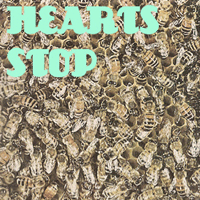
This time, the artwork is a swarming beehive. Marching on an incongruous, thunderous hip-hop drumbeat and tuneful electropop bleeps, Hearts Stop is built around a slim haiku of lyric which Marilyn chants against a skein of wineglass warbles: “We can fly forever, / but we will fall when our hearts stop. / The fall will break us.” During the breakdowns, her multi-tracked voice twines coyly around itself, as new blips and patters worm their way into the skein. A distorted female laugh bubbles up in the mix, and stays there. A sampler dices and hiccups out the song title (two-and-a-half syllables of the haiku).

It’s as simple as that. And maybe it is as simple as that. Maybe there’s no more decoding to be done, and the bees are only wrapped around the single for effect. Maybe Cceruleann have just written another synth-pop anthem about love, broken hearts and death in the overblown way it’s supposed to go, so that we can keep singing songs about it.

Unless, perhaps, Cceruleann aren’t singing about love and heartbreak at all. Perhaps they’re actually making a point about work and obsession; about how we’re driven on by what we believe we ought to do, whether it’s grinding our lives to dust in a thankless job or slowly crushing ourselves to exhaustion against people and causes which simply don’t love us back. In this light, the song shifts into something different and more ambivalent – a sweet-sounding lemming-march, a chant for the worker bees who strive until they stumble and end and are swept aside for the next ones. Perhaps I’m imagining it. If so, it’s only because I don’t ever quite trust Cceruleann to play straight.

Cceruleann: ‘Hearts Stop’
Holy Underground Recordings/Bandcamp
Download-only single
Released: 10th July 2012

Buy it from:
Bandcamp

Cceruleann online:
Facebook Twitter Soundcloud Bandcamp

REVIEW – Delicate AWOL: ‘Hurray For Sugar’ single, 2000 (“lilts and tilts like a girl on a lazy swing”)

29 Jul

Delicate AWOL: 'Hurray For Sugar'

Delicate AWOL: ‘Hurray For Sugar’

The effect is similar to one of those pocket mandalas you pick up at weekend markets. Do you know the ones I mean? Those little spheres of interwoven articulated wires which, under simple pressure, reform to flat discs; or extrude themselves out and around to form new, near-identical spheres with tiny spatial differences.

In such a way, Delicate AWOL have turned themselves inside out – the old shape inverting and realigning within itself. The blunt, metallic math-rock dots and points remain, as do the little axe-blows of guitar and the keen, floating intelligence. But the hard-bitten, streetwise urban perspectives they displayed on ‘Random Blinking Lights‘ have been flexed away, replaced by a blunted pastel sleepiness. Their music used to fit the sullen sludge of London’s clogged traffic arteries. Now it sounds as if it’s drifting through an endlessly attenuated suburban daybreak: through sleeping ranks of tidy little white subdivision houses, stretched out along the fringes of some anonymous American town.

None of the above is a slag-off. Yes, Delicate AWOL have retired their striking Throwing Muses-versus-Laika qualities of nerve, and have replaced them with the oddly narcotic soulfulness and dusty whispering you’d expect from Low or Cowboy Junkies. No, this is not a bad move. It’s allowed their minds to work in a different way, letting their thoughts seep out instead of being propelled out onto tape.

Warm, intimate, laden with clinging morning torpor, Hurray For Sugar lilts and tilts like a girl on a lazy swing; Caroline’s voice stroking your floppy ears, a lone glockenspiel tingling out a little scatter of light. “Arise, you’re waking – hurray for sugar. / Aware, a little – hurray for coffee… / beside your body, catherine wheels spin.” And even if the guitars have a clotted sleep-dirt feel to them, this is still a song about vision; or about the moments of utterly unguarded perception which adhere to the sticky margin between sleeping and fully waking. “I breathe in, I open the curtains. / I look outside at my neighbours, / behind their fences… such radiant faces.” A lovely piece of work, shambling like a sated and drowsy lover.

Having reabsorbed their 40 Shades Of Black instrumental alter-ego, Delicate AWOL express it again in Camford Heights: which sounds like a sort of Sonic Youth picnic for the close of a West English summer, the sun slanting away down the back of a sky like a rumpled sofa. Blunted, slurred jazz chords and round, resounding Manchester bass carry the tune, completed with casual drop-in visits from all kinds of other fellow travellers: Mogwai all stoned and finger-mumbling a cryptic chant off their massed steel strings, a young Adrian Belew in noise-haze mode, Frank Zappa adding a dirty air-sculpture like a colophon of smog. Before it’s over, Delicate AWOL have passed through a bewitching slew of guitar sounds: passing train bells, crashing wires, the music of pylons in the wind. From wan, sweet daybreak to dusty, sun-stupored dusk, they’ve got it all covered.

Delicate AWOL: ‘Hurray For Sugar’
day Release Records Ltd., DR106 (no barcode)
Vinyl-only single
Released: 2000

Buy it from:
Long-deleted – try to find this second-hand.

Delicate AWOL online:
MySpace

REVIEW – Evolutia: ‘Objects Aside’ and ‘Secret’s Safe’ singles, 2012 (“a more interesting proposition”)

16 Jul

Evolutia: 'Objects Aside'

Evolutia: ‘Objects Aside’

Beyond their knack for epic, florid rock melodramas, Muse-style (as heard on their 2010 EP ‘Fear’s Fall‘), there’s more to Evolutia than attempting to hone a journey into the heart of arena-rock. On the surface, Andrew Barnhart and Stephen Cameron are clean-cut multi-instrumental prog boys, verging on AOR. Underneath… not so much. Their love of dynamics, electronic fuzz and dubstep; their occasional digressions into piano-and-laptop sketchpaddery; the suspicion that some of their more outré and full-blooded vocal moments are more cabaret than rock club… all of these things make Evolutia a more interesting proposition.

In the run-up to a long-delayed debut album, they’ve popped out – within a single week – two syncopated new songs owing more to Ben Folds or to prime-period Stevie Wonder than to the shriller rock noises of Muse, Mew or Queen. Staunch prog fans may smell a rat – personally, I smell flowering. It sounds as if Evolutia have learned to please themselves, rather than just expectation; and in the process have upped their game a few notches. Hooray to that.

Out of the two, it’s Objects Aside – with its fancy footwork and vein of darkness – that bears the resemblance to Ben Folds. Stephen jags and dominates with a syncopated, flouncing curl of piano lick. Andrew tack-hammers it with a bass guitar line that’s part Rush, part snap-funk. Both of them fence around the rhythm; occasionally, they haul in guest drummer Zach Branff, gang up on the rhythm altogether, pin it against the ropes and pummel it with Uzi beats. Kneading furiously on a bass synth,Andrew half-sighs, half-growls the lyrics. “We take what we get, climb to the top of it / Throwing objects aside to the left and the right / ‘Til we see the light.”

I’m not sure whether all of this is about greed or about looking for something better than toys’n’favours. It fits both. There’s a tangle of frustrated persuasion working its way through the song, too (“It’s useless, I won’t give up – you’ll come around.”) Later on, Andrew and Stephen share the singing on an aspirational bridge, assuring us that “this darkness will never come, you’ll see that we’ll rest in peace. / Your heart’s buried in secrets that you’ll uncover eventually.” Briefly, the lighters come out. Mostly, though, this is about dancing aggressively, up on your toes, on unfriendly ground.

Evolutia: 'Secret's Safe'

Evolutia: ‘Secret’s Safe’

I made the mistake of listening to Secret’s Safe on headphones in the dark. Within the first forty seconds I jumped up, thinking that I was being burgled. This song has the best creaky-door sample since Thriller – unexpected, sliding mockingly through your head, ending in a sly lock-snick. It sits edgily against what’s otherwise a bouncy, funky shuffle, a latter-day Higher Ground. It renders it suspicious, as if someone was rifling your mind while you danced.

It’s certainly a ridiculously danceable song. Andrew’s laddering virtuosic bass-guitar riff skips and spirals around a pulsing tower of synth bass, while Stephen’s crunched-up electric piano stabs and bounces underneath. It’s also Stephen singing, in his clarion tenor, about trust and exchange. “You got something that you’re hiding; you’ve gotta make me believe. / Showed you mine now show me yours – / stolen whispers are the key.”

Actually, trust doesn’t come into it. This is all about coercion and manipulation, and it grows ever more slightly mocking as it swings onward. Stephen shifts in and out of character, between wheedler and withholder – “Promise not to tell / There’s nothing like a little pressure / You know I’ve kept it well / Lips are sealed forever.” While sometimes the song delves into the pressures of keeping things unspoken (“trying to get back the beats your heart skipped”) the payoff is power. “Your secret’s safe with me,” Stephen sings, before adding, in an aside “(She’s got nowhere to go.)” Stealth breaking-and-entering.

Evolutia: ‘Objects Aside’ & ‘Secrets Safe’
Bandcamp
Download-only singles
Released: 5th & 9th April 2012 (respectively)

Buy them from:
BandcampObjects Aside and Secret’s Safe. Both songs will be available on Evolutia’s debut album ‘Arm Yourself’.

Evolutia online:
Homepage Facebook Twitter Bandcamp YouTube

Joe De Vita: ‘Ancestral Language’ single (“takes the lead while staying back”)

30 Jun

Still in his early thirties, Joe De Vita’s musical passport is worn and battered, with plenty of stamps and double-backs on it. Previously, this was nothing unusual for a jazz musician, but these days many of them seem to travel smoothly from college to first hire, and then band by band through the swing machine.

Joe’s route-map suggests a more uneven history: checking into and dropping out of music schools across America; mysterious flits from assorted cities; travels through various non-jazz settings (singer-songwriter backup gigs, grindcore bands) en route. Whether he’s releasing music as Shuttlecock or under his own name, Joe’s recordings tend to find him all alone with his guitars, his Casio keyboards and his electronic sound-kit. Is this down to a reluctance to settle into a long-term slot, or perhaps deeper trouble? Time was when this kind of thing was a hallmark of particularly creative jazz musicians: but as Joe’s happy to make the most of it in his own bio, embracing a misfit jazz-punk status, it could just as easily be spin. (Although any musician who’s irreverent enough to release consecutive albums called ‘Reflect’ and ‘Punk Rock Abs’ is worth checking out).

Ancestral Language – a promo single from Joe’s third album ‘Evolution’ – isn’t providing an answer. In itself, it’s pretty accessible – it looks back around forty years to the impressionistic, anticipatory grooves of the late ’60s and early ’70s when Miles Davis, Teo Macero and Weather Report were pushing aside bebop and cool jazz in order to open out a kind of multicultural cosmic funk. Kicking off with a twang of berimbau, it layers up: the patter and slap of frame drums and shakers, the sidelong clunk of a jazz bass, holding its anchor-and-push carefully in reserve; the glint and jags of electric keyboard, restlessly shifting its grip and shifting the chords. If there’s a real band in here, then Joe’s less of the uncomfortable lone gunman than he suggests. If there isn’t, and it’s all software trickery, then at least he has a knack for knowing where all the parts ought to go – at the very least, there’s a full live feel here.

From initial swells of wall-hanging chords, Joe’s guitar eventually takes the lead while staying back. Lurking deep in the mix, distant and bluesy, it has that saxophone-in-a-subway sound: not subdued, but a little cagey. As the tune moves on, more punctuation is worked into the structure – tonks of ever-steadier electric piano, keystroke clinks looped as a digital-age percussion touch. Two-thirds of the way in, Joe begins to wrench gently at his own melodic line, with a promise of further squalls in the evening, but (teasingly) Ancestral Language fades out before we can get that far. A passing curlicue, sprayed onto the wall. Promising.

Joe De Vita: ‘Ancestral Language’
Daddy Tank Records (no catalogue number or barcode)
Download-only single
Released: 25th June 2012

Buy it from:
Free download from Soundcloud. The parent album ‘Evolution’ is available from Daddy Tank Records (CD, limited edition of 100) or Amazon (download)

Joe De Vita online:
Homepage Facebook Soundcloud iTunes

REVIEW: The Fierce & The Dead: ‘10×10’ single, 2011 (“post-glum”)

12 Jun
The Fierce & The Dead: '10x10'

The Fierce & The Dead: ’10×10′

So they’re trying on some sparkle, now? The last time I heard Matt Steven’s improv-rock trio they were lurking and cruising somewhere in the loose territory between bluesy prog, smoky space music and easygoing math-rock. They were promising, but they weren’t upsetting much: their initial statement was more of a drawl than a grand pronouncement. However, having shambled forward and established themselves, The Fierce & The Dead are getting down to more serious play. Ideas that were only hinted at last time, down in the small details, now wriggle forward.

For starters, 10×10 itself scrunches up and throws away the idea that this band is just Matt Stevens and pals. Bass player Kev Feazey, a solemn support musician on the band’s opening shot, steps up and all-but-leads the band on their second. His slithering springy bass line, full of New Wave funk, recalls both turn-of-the-’80s Talking Heads and long-lost London math/surf rockers Kenny Process Team: gentle arty neurosis, pinned to a love of groove. A spluttering, stuttering synth break adds a raw danceable edge.

Meanwhile, Matt is quietly at work all over the background – catching a surf of noise in the distance, opening out the landscape beyond with torch-beams of sustain guitar. Some looping, arpeggiating guitars dragged along after the bassline draw their drive from a long-gone, edgier New York: skitchers grabbing velocity from a speeding car, or Robert Fripp’s cyclic proto-‘Discipline’ Manhattan patterns. There’s even a dash of rave dynamics as a delicate, dewdrop-fine piano break spins us around for a look at the dawn. In the cloud of “post”-widget names that swarm around art-rock music these days, pick “post-glum”.

The second track, Foreign Languages is even livelier. A blues-rock grind on bass over mechanical drums; spankingly sharp fingerpicked guitar and a bubbling, ground-shimmying feel of dub.An old ‘Galaxian’ game in the corner of the studio seems to have joined in too, adding zips and lassoos of gurgling analogue sparkle. There’s a tremendous sense of free play – old familiar elements reshuffled and re-zested, and looked at afresh. Since ‘Part 1’, The Fierce and the Dead have recharged their time machine, and now skip merrily between the dreamy psychedelia of the ’70s and the boggling pluralism of the post-punk ’80s with ease and a yen for reinvention. Where next?

The Fierce & The Dead: ’10×10′
Bandcamp
Download-only single
Released: 4th April 2011

Buy it from:
Bandcamp

The Fierce & The Dead online:
Homepage Facebook Twitter MySpace Bandcamp Soundcloud

REVIEW – Cceruleann: ‘Fucking Wind’ single, 2012 (“waiting to be wrong-footed”)

6 Jun
Cceruleann: 'Fucking Wind'

Cceruleann: ‘Fucking Wind’

In love and on the road: it should be sweet. Instead, you’re continually waiting to be wrong-footed.

First, there’s the music – electronic dream-pop of a multiple-nostalgic kind. The tune is balmy. The blipping synth lines, the crude keyboard beats, the hiccuping voice cut-ups are all from ’80s sample pop. That dazed, wet-gossamer female vocal and the smudge of stretched-out organ goo (swirling from speaker to speaker), draws inspiration from shoegazery and similar blissful-nauseous mid-’90s psychedelia. The puffed hints of melodica and the yawns of bass swim in from first-generation post-punk; or perhaps I’ve just been drawn into the dream, and am imagining them.

Then there’s the song itself. A girl in a car, savouring the moment, coos the simplest, most sugary lover’s line. “It’s OK, baby, don’t worry / ‘cos we’re driving with the summer breeze in my face.” That’s it. There are four more words in the entire lyric, one of which is “ethereal.”

Finally, lurking around the corner like a mugger-in-waiting, there’s that blunt instrument of a title. It’s already plastered all over the cover art. You keep expecting it to come down hard and smash the reverie. Or, alternatively, for everything to turn metaphysical and carnal as the gale hits, the cuteness ends, the car pulls over and everyone starts rutting in the back seat.

For something so light and fluffy on the surface, Cceruleann’s debut single throws up plenty of confusion. Even more subtext gets plastered in when you discover that the band are a brother-and-sister duo (instrumentalist Elliot, singer Marilyn). If I were you, I’d do my best to ignore that for now. In some ways, that’s easy to carry out: though moving together in musical step, Elliott and Marilyn sound as if they’re musing in different worlds. Along the way, some of Marilyn’s words are caught up and shredded, then tossed like happy litter in the wake of the tune. As for that title, it never arrives in the song. The f-bomb remains undetonated. Have they scammed us? Did they just get sick of their own song and punish it with a sarcastic name?

Or perhaps we’re looking in the wrong place. Maybe the real story is about the other person who’s out on that drive – perhaps listening to this endless burble of contentment and seething, their knuckles clenched white on the wheel or wrapped tight around the knees, wondering once again why it’s so impossible to see how another person sees, to feel their feelings, comprehend their tastes… even to understand how you can get through a single day of being with them anymore. Maybe the romance of the playful summer wind is lost along with that. As it teases and strokes at cheekbones, perhaps on the other side of the car it’s whipping petulantly at a cowlick; and while fringe blows aggressively into eyes, and as love heads into the sour spot for good, perhaps something vile is being muttered into that uncaring breeze.

Cceruleann: ‘Fucking Wind’
Holy Underground Recordings/Bandcamp
Download-only single
released 14 May 2012

Buy it from:
Bandcamp

Cceruleann online:
Facebook Twitter Soundcloud Bandcamp

REVIEW – Elephant: ‘Allured/Actors’ single, 2011 (“a slow jam that’s strayed”)

6 Jun
Elephant: 'Allured/Actors'

Elephant: ‘Allured/Actors’

“Oh, hello, / I’m a never-ever-let-it-show – / But I know that you know. / Maybe I should let it, let it show…”

On past evidence Elephant have a knack for drawing us in while admitting to little. Their debut single mingled dream-pop with reggae and industrial chill, and cold electronics with fairy-tale flashes. They ride on a solid understanding of black pop, yet constantly swerve away from it into Euro-cool whiteness. They readily confuse, and they excel in oblique feelings – perhaps they can’t help it. Amelia’s blank singing, their aloof and obscure post-punk textures, their taste for quick-cut lyrics and surreal, visual word-imagery… while their work so far is memorable, all of it’s a conundrum. Yet for a moment, on this second single, everything is clearer.

With only the subtlest indie-pop bleachings and dream-pop shadings, Allured is an R’n’B piano ballad: plain and simple. There’s the deep, minimal support of bass. There’s the gaps, space and swat of a heavy-lidded slow sex-beat; the sparse flick of tambourine like a shimmying skirt-fringe. Essentially it’s a slow jam that’s strayed out of the dance club in its heels and skintights, taken a wrong turning past the taxi rank, and been painlessly swallowed by Elephant’s dreamy way of doing things. In the video we watch as voyeurs as Amelia and Christian languidly nuzzle and smooch each other – lengthily, and uninterruptedly. Either they’re answering that “are-they-aren’t-they?” question that’s hung around Elephant since the beginning, or they’re very committed to the world of this particular song.

Whether Elephant have simply been infected by R’n’B’s outright and intoxicated sexuality, or whether they’ve swallowed it deliberately, is open to question. I suspect the latter. Few areas of twenty-first century pop haven’t rolled over and submitted to R’n’B’s sweaty vigour and its gobby, blinged-up sex’n’suss’n’opportunity confidence. While some diehard indie-poppers might still scream and scrub it off; or cling to older schools of soul, Elephant see a good thing and slurp it up, embracing and engulfing it in their turn. So here they are, reaching out greedily into the wide-open mainstream while happily sunk in obsession, drunk with sensuality.

Only the lyrics retain that peculiar Elephantine distortion. Amelia rolls the words around on her tongue, dabbing them with glottal stops and her own strange short-circuiting shifts of accent or syntax, whether wriggling into a tangled lick of coyness, circling orgasm (“our own anatomy, so I find the path – my brain / it carousels instantly, drives me to insane,”) or swimming in a stupor of surrendered identity (“I dreamt he’d written me… He took me away, crossed me away from the crowd…”) By rights, this clotted wordplay should cripple the song. Instead it lolls sexily across the beat, as if on the brink of falling out of bed.

Then the B-side – Actors – throws us right off the scent. Same old Elephant; entirely different set of clothes. Rather than the wallow of bass and beats, here are acoustic guitars on the strum, a skinny ice-rink organ, and a dose of fast-paced pop soufflé which chuffs around its drum track like a toy steam train. It’s a tune for people in mini-dresses to run around Paris to, or chase summer bicycles through Spanish Harlem. Once again, Amelia’s dazed delivery and tangled string of lyrics ensure that it keeps the Elephant stamp.

It’s anyone’s guess as to what she’s singing about this time – “hop around aimlessly, simply surrender to time. /Animations out past under the feet, imitating a shadow spine.” Somehow the words fall into place as she sings of paying the rent “with a monogram eye” or murmurs about “the highest apple in the tree.” Perhaps, like many of the best and sexiest club hook-ups, it’s just a happy accident.

Elephant: ‘Allured/Actors’
Memphis Industries, MI0193S/D
vinyl 7″/download single
released: 18th July 2011

Buy it from:
Memphis Industries.

Elephant online:
Facebook Twitter MySpace Tumblr Bandcamp

REVIEW – Elephant: ‘Ants’ single, 2011 (“somewhere between love-gone-wrong and epilepsy”)

30 May
Elephant: 'Ants/Wolf Cry'

Elephant: ‘Ants/Wolf Cry’

Band named after large thing actually sounds small. Single named after tiny things suggests that small-sounding band (named after large thing) could go massive. Sometimes I love pop’s ridiculous anti-logic.

Elephant are two. Christian Pinchbeck coaxes noises out of computers and wrangles chittering textures from guitars. Amelia Rivas plays old sounds on modern keyboards while swimming and sighing distractedly through the middle, avoiding eye contact. It’s synth-pop, allegedly, but it’s also nothing quite so obvious. Amelia and Christian may or may not be a couple, but that’s not clear either. With Elephant, not much is.

Ants is Elephant’s debut single, and it spends its three minutes cunningly, surprisingly persuading various things that shouldn’t work together to cosy up and make something which does work. A gentle reggae bounce, a dribble of whiter-than-anything psychedelic guitar direct from Cocteau Twins; a roughed-up reedy synth figure like a bass accordion with hiccups. As for what the song might be about, it’s somewhere between love-gone-wrong and epilepsy; like David Lynch reimagined as lovers rock. “I’m tired and I’m bruised for you,” Amelia murmurs, moping elegantly across the backbeat. “The war that I fought made my body contort… I’m down in the black, and I’m blue.”

When we talk of indie-pop being sickly, we usually mean that it lacks power. Here, sickliness is power. Unease and disease blend together, reality is erased by symptoms, and experience is somehow amplified by the giddiness and blank alarm. Throughout, there are references to buckling knees; to floating and amnesia and jump-offs; to falling to the ground or into song. Even the chorus avoids clarity in favour of hallucinatory warp (“Ants now scurry on the floor, / I just can’t remember before,”) with all perspective thrown right out-of-whack. Yet Elephant snatch a victory from these flashes of confusion and disaster, sheathing them into a subtle, catchy, play-it-again heartbeat of song; a cool, black-and-white flicker of distress call.

While Ants cloaks strangeness under bits of spooky washed-out reggae ballad, its flipside Wolf Cry goes for out-and-out surrealism in a stream of Bunuel electro-punk. Amelia sings of seasons, seafarers and parted lovers. Deeper into the song, she jinks these acid-folk fairytales into blurred dreams of power struggles, throwing out images of hunky aristocrats or “militants on the roof.” Everything hangs together – precariously – over Christian’s alienated instrumental bonework: a flat backdrop of flat echoing skitters, deep red bassquakes, ghostly chords and spray-can snare hits. As the song riffles balefully through its repertoire of cinematic flashes, impressions build and cut (“the ticking of a clock, jumps to interior,”) or flirt, archly, around games of obscurity (“we all wear a mask to a fellow passer-by.”)

Ultimately, Wolf Cry comes apart in the fingers if you squeeze too hard (the strange syntax, the dodging of plot, their mingling of seduction and avoidance) in much the same way that the story of Ants comes to us half-melted. Elephant have a knack for this kind of anti-logical play, squeezing into the gaps in the story. Besides, they’ve already demonstrated that they’re masters at magicking something coherent out of disorientated fragments – not least via a fine mournful tune or two. Evasive or not, they’re very much in the room. I suspect that I’m going to go on talking about them.

Elephant: ‘Ants’
Memphis Industries, MI0172S
vinyl 7″/download single
released: 17th January 2011

Get it from:
Memphis Industries.

Elephant online:
Facebook Twitter MySpace Tumblr Bandcamp

Race Horses: ‘Mates’ single (“self-deprecating boysprawl, all big feet and perky singalong tune”)

12 May
Race Horses: 'Mates'

Race Horses: ‘Mates’

Your past is a different country. Wander into the wrong part of it and you might get socked on the back of the head: yes, you may have been there before, but you can’t do things in the same way now. At the same time, you’ll find that you’re already changed by having been there in the first place, so you can’t do those things in the same way anyway. Meilyr Jones knows about all this – now – and he’s keen to tell you about it.

Compared to some of the music Meilyr and his band have put out previously – exciting indie pop with an experimental edge rumpling up the sound – Mates is fairly straightforward. In common with many other Welsh pop bands, Race Horses have that Cymric reputation for lateral thinking squatting on their shoulders; but they wear it lightly. Instead of opening up a window through which you can peer into their world, they come lolloping over to meet yours, trailing the odd strange decoration or kooky wristband to colour things up a little.

Mates does start off as exotic process. The title, chanted, is an offbeat factory loop over which the song is assembled: a marimba plinks throughout, stolen from the school music room in order to scatter musical cherries on top. The muscle of the song itself is something of a hiccupping cha-cha-cha, led by the bass. The melody and words, though, make up a cheerful self-deprecating Britpop boysprawl, all big feet and perky singalong tune. It’s a song about being dumped – knocked sideways and woebegone – but it refuses to just lie down and die. The same clever boyishness has kept classic Madness songs fresh since the ’80s (though Race Horses sound as much like a decade-stretching handshake between the Bowies of ‘Scary Monsters’ and ‘Hunky Dory’, even down to the music-hall quirks).

As for where Race Horses find themselves at the moment, it’s in that freefalling zone between “us” and “you and me”, where laws of belief are tumbled over and even geography gets overwritten with new, painful memories. “All the times I used to doubt it / but now I find I’m lost without it” complains Meilyr, groping after a love that’s evaporated and left him staggering. This could be chapter one of a Casanova’s progress, as he seems to have found the first sniff of something he’s suddenly found himself hooked on. For now, he’s still fumbling in disbelief around the ache. “Your words, cold and heavy, / echo down the walls of the place we used to go, / when we were mates.” I know what he means – for me, a particular park in Crouch End is haunted even in bright sunshine, and I still can’t see a shooting star without feeling a twinge.

Still, despite the complaints, Meilyr seems to have already wrapped up the experience into a little eight-syllable summary which he can hold up like a snowglobe – “It cuts, it soothes. / It comes, it’s you,” – and the bouncing plink of the tune sounds more happy than despondent. Perhaps it’s the indomitable bungee-rope of young testosterone. Perhaps Meilyr’s just singing in the sure knowledge that Mates could be one of those songs which make a lot of capering indie pop kids happy during the summer of 2012. Hey ho, the twisted power of love gone splat. Ouch.

Race Horses: ‘Mates’
Stolen Recordings (no catalogue number or barcode)
Download-only single
Released: 9th May 2012

Buy it from:
Download free from Race Horses Facebook page.

Race Horses online:
Homepage Facebook Twitter MySpace

Glowing House: ‘Taming Lions’ single (“beating time on a tumbledown shack”)

12 May

Out at the helm of Glowing House, Steve Varney is raw, ruffled, hollering and sounds born to run. This is just as well. Trouble is hot on his tail. “I don’t think there is a gauge that will save me – / somehow they overpower gunpowder, like it’s easy…”

The head-up single for the second Glowing House album, Taming Lions is all about the incipient, savage disaster that’s just about to crash down on Steve’s head. The band’s fall-apart folky acoustic noise catches the feeling perfectly. They sound like the kind of band which survives credit crunches, small nuclear wars and the collapse of most of the functional parts of civilization. You can see yawing flashes of light straight through the gaps in the barefoot, wind-tossed rhythms.

Besides the cluck and clunk of Steve’s banjo, the song’s a superb stomping wobble of school piano, Salvation Army brass, foggy rasps of accordion and dirty cello, and someone beating time on a tumbledown shack with a handful of big sticks. (I checked back on this – it’s actually a third of the band playing on church pews. Talk about muscular Christianity…) At the top of his carrying, celebratory bruise of a voice, Steve’s making it quite clear that he’s stuck in a rigged and increasingly dangerous game. “They gave me a ten-minute head start, and they started counting. / I need a top-notch hiding spot I can hide out in. / Don’t be fooled they’ll give you space in the chase for a reason – / they wait for the perfect minute to stop the healing.”

Off he hurtles; firing a cartoon blunderbuss for cover, and to no great effect. They keep coming. As the song bounces on, there are more than a few suggestions that what Steve’s actually fleeing are his own demons, bouncing after him like a tin can tied to his ankle. Not much hope in escaping that way. But the sheer vigor of the band – of the song itself – suggests that they’re people who thrive on this kind of peril and the energy it kicks up. This is enormous fun. Keeping one step ahead of disaster rarely sounded so lively.

Glowing House: ‘Taming Lions’
Bandcamp
download-only single
released: 8th May 2012

Get it from:
Free download from Bandcamp

Glowing House online:

Homepage Facebook Twitter Soundcloud Bandcamp

North Atlantic Oscillation: ‘Savage With Barometer’ promo single (“new rituals form”)

18 Feb

This certainly is compelling… but why is it so compelling?

Ever since 2009 and their ‘Callsigns’ EP, North Atlantic Oscillation have been ploughing up a reputation as the new thing in rock, the sound of the future. Here, it seems that what they offer isn’t all that new, once you capture and dissect it. That engulfing hedge of pins-and-needles guitar noise – great writhing blocks of it surrounding and overwhelming the vocal, like windings of toxic insect-ridden gauze – harks back to the psychedelic revival of the late ’80s and the shoegazing bands who sprang up out of a plain of distortion, disorientation and nauseous bliss. That rambunctious bang of snare drum and tom (pimp-rolling forcefully through the music like a garbage man turned one-man-marching band) is ultimately drawn from Bonham and ‘Kashmir’. Sam Healy’s voice, pale and waving above the monstrous swell of sound from his guitars, always on the verge of drowning in it… again, that’s psychedelia returning on a comet-swing, tied to Syd Barrett on Astronomy Domine, Kevin Shields on You Made Me Realise, or Wayne Coyne on most things.

For all that, Savage With Barometer is pretty marvellous. It’s certainly full-bodied: the attention to detail from Healy and cohorts’ is streets ahead of most of their predecessors and contemporaries. It’s got a pell-mell momentum, albeit via an inexorable slow motion rather than a tremendous rush. But why does it sound new, and how does it carry that shock of emergence along with it?

I think there are two answers here. One is a matter of architecture. Beyond those towering gnarls of scratch-and-howl, the melody that’s clasped by the all-but-buried vocals refuses to be reduced to a simple narcotic mumble. Instead it’s flat-out aspirational. It builds up and out and up again: a precarious scaffolding of pitches, clinging to a hope of reaching somewhere above the roar. Even when it dips or lowers, this is merely a kind of dogged feint – a way around an obstacle. A few people have cut out similar pathways and hauled us along it with them (Brian Wilson and Tim Smith, to name but two) but North Atlantic Oscillation bring their own spooked wonder and weight.

The second answer is to do with ritual, and with belief. Healy has gone on record as saying that his band is, in effect, less post-rock than post-faith. They create music for a world in which established religion has fallen away, leaving a yawning vacuum. Into this, a confusion of signals and noise roars in a torrent, and new rituals form.

Savage With Barometer is, in fact, a trucker’s anthem. Yes, you read that right. It’s also a bitter psalm, a work-song… a portrait of how thinking can be formed by tasks. Take away the plastic Jesus on the dashboard. Substitute a dread which is now invested in the readings of forecasts, and of gauges, and on the turn of storms both physical and fiscal. Now imagine a loose squadron of men caught up in it together, and listen to those high wind-blown words again. “I want fair weather, so I will pray to Mercury / Alone and in lockstep… / We need cargo, / we need news from wretched outposts. / Show us, we can’t see.”

You can rise up and kill your first god – maybe someone else will kill him for you, whether you want them to or not. You’re actually no freer in the brave new material world into which you emerge. You’re still at the mercy of forces beyond your power to wrestle with; still walking under somebody’s bloated shadow, begging them to grant you some kind of harvest, or to provide those answers you need in order to shape and save your fumbling life. For a trucker, orders and benedictions come over the airwaves from the depot. Supply-and-demand carves necessary shapes onto their wanderings. A brief tick or plummet on a financial graph can spark a schism, spilling lives and plans and blasted hopes in its wake.

In turn, a working man’s grumble – speed-addled and resentful, stupefied by an imposed servitude – turns into a plaint, a prayer and a resentful surrender. “I want fair weather, I want white pills. / One-state anthill / – the great operation brings us all under your thumb.” Compressed by work, by the noise of labour piling up, it becomes a new and bitter creed. Perhaps what we’re talking about here isn’t the shock of the new, but of the exposed. Emerging from beneath the bellies of the old gods, we find the new vistas surprisingly familiar, if not worse. Fooled again?

North Atlantic Oscillation: ‘Savage With Barometer’
K-Scope/Bandcamp (no cat. number or barcode)
Download-only promo single
released 15 February 2012

Buy it from:
Bandcamp

North Atlantic Oscillation online:
Homepage Facebook Twitter Bandcamp

SWOONAGE

Swoon. /swo͞on/ A verb. To be emotionally affected by someone or something that one admires; become ecstatic. Here are some people and things that make me swoon. #swoon #swoonage

Post-Punk Monk

Searching for divinity in records from '78-'85 or so…

theartyassassin

...wandering through music...

Get In Her Ears

Promoting and Supporting Women in Music

Die or D.I.Y.?

...wandering through music...

Music Aficionado

Quality articles about the golden age of music

THE ACTIVE LISTENER

...wandering through music...

Planet Hugill

...wandering through music...

Listening to Ladies

...wandering through music...

ATTN:Magazine

Not from concentrate.

Xposed Club

improvised/experimental/music

The Quietus

...wandering through music...

I Quite Like Gigs

Music Reviews, music thoughts and musical wonderings

furia log

...wandering through music...

The Recoup

SINCE 2013: Books and books and books and books and occasionally other things

A jumped-up pantry boy

To say the least, oh truly disappointed

PROOF POSITIVE

A new semi-regular gig in London

Gapplegate Classical-Modern Music Review

...wandering through music...

When The Horn Blows

...wandering through music...

:::::::::::: Ekho :::::::::::: Women in Sonic Art

Celebrating the Work of Women within Sonic Art: an expanding archive promoting equality in the sonic field

Ned Raggett Ponders It All

Just another WordPress.com weblog

FLIPSIDE REVIEWS

...wandering through music...

Headphone Commute

honest words on honest music

The One-Liner Miner

...wandering through music...

Yeah I Know It Sucks

an absurdist review blog

Obat Kanker Payudara Ginseng RH 2

...wandering through music...

poplifer.wordpress.com/

Waiting for the gift of sound and vision

Good Music Speaks

A music blog written by Rich Brown

Do The Math

...wandering through music...

Archived Music Press

Scans from the Melody Maker and N.M.E. circa 1987-1996

The World's Worst Records

...wandering through music...

Soundscapes

...wandering through music...

OLD SCHOOL RECORD REVIEW

Where You Are Always Wrong

FRIDAY NIGHT BOYS

...wandering through music...

Fragile or Possibly Extinct

Life Outside the Womb

a closer listen

a home for instrumental and experimental music

Bird is the Worm

New Jazz: We Search. We Recommend. You Listen.

...wandering through music...

Life Just Bounces

...wandering through music...

Lucid Culture

JAZZ, CLASSICAL MUSIC AND THE ARTS IN NEW YORK CITY

Aquarium Drunkard

...wandering through music...

eyesplinters

Just another WordPress.com site

NewFrontEars

...wandering through music...

FormerConformer

Striving for Difference