With hundreds of releases in the bag already, it’s difficult to even summarise the dark-ambient work of Playing With Nuns (alias D.I.Y. Argentine noiseworker Ariel Chapuis), let alone sort it through item by item. However, a few things are apparent for ‘Wave Equation’. One is that (by the usual Playing With Nuns standards) it presents a gentler face. The titles of the recording and of the individual songs are more reflective than usual: the elegant mathematical graph-shot on the cover art is devoid of the forthright challenge of other releases, No huge and tilting cranes, no feral cartoons. No naked women wrapped up in hazard tape.
By the bullish, confrontational standards of some avant-noise artists this might be taken as signs of a cop-out; or at least a digression into mathematical navel-gazing. That’s not the case. To my ears, this recording’s sound world is one of giganticism – everyday objects ramped up to a stunning blur of over-scaled, colliding sound. At particular points, it’s borderline unbearable (which Chapuis would probably take as a sober compliment). It might not have you fretting over dysfunctional anger, but it might make you too scared to catch the bus.
On the other hand, there’s little here in the way of avant-garde theatrics. Everything is matter-of-fact. There’s no attempt to make an obvious wall of aural assault, or to engage in shock tactics for the sake of it. Chapuis simply lets his noises off the leash, and lets them take their course.
In Advertising For Lizards, plunderphonics are writ large against a dirty-celestial skirl of feedback. Scraps of conversation are distorted and giganticised into enormous blurred wind instruments and furniture drags. These roll and scrape, as if being pulled along the inside of a vast balloon, while Chapuis cunningly pans them around the sound-field.
I Let You Tools is a little more traditionally concrète, making a clear play of sampling construction devices, power drills and saws. It also deliberately deforms samples of other noises (including voices) into sounding like power tools before it collages everything that it’s found. The final result is a sandwich of technological interactions: almost a cartoon. A set of cheery telephone pulse-codes are sandwiched into it, trapped between a barrage of tool noises on one side and a rumbling wall of power-electronics on the other. The latter sails up to loom large and demanding, like an particularly needy cruise liner.
On Sequences of Lost Children, the clearest sound is two alternating organ notes. The dominant sound, however, is microphone-fry; sizzling and crackling around the clunk of struck pipework and the playful vocal grumbles of synthesizer. Throughout, there’s the crunch of an abused pickup, crushed and buffeted underwater. Unpleasant aural suggestions swim into place – a polluted zone for drownings, filled with ominous and suspicious objects. It’s immersive, threatening, possibly death-haunted. Perversely, all of this busy sonic activity inflates it with an uncomfortable life-force.
Initially, Wave Equation itself offers the closest thing to a let-up. A loop of pleased-with-itself electronic hum, waver-pulse and munching static chews the cud. For about a minute, it’s joined by a radio voice of crunched, compressed Spanish. This relative calm doesn’t last. After one-and-a-half minutes, the idiot noise arrives – an inflated shrieking grind which bounces and rolls over the static, over the percolating electronics, over everything.
Nine-and-a-half minutes long, the spectacularly queasy Decline & Fall is the album centrepiece. It sounds like dynamic travel sickness – a soundscape of hugely magnified stomach flutters, aircraft propellers and groaning feedback. Meanwhile, something is continually crashing and bouncing along the ground, ploughing up colossal waves and furrows of static. Imagine a fly’s-ear perspective of a Zeppelin crash… yet even that doesn’t communicate the terrifying, carefree attitude to the sound.
That’s the key to the unease in this record. Picture a world run out of control and shrunk down to the clatter of a battered and juddering gearbox; and picture ourselves, in turn, shrunk down to ant-scale and trapped inside it. There’s the feel that the grinding forces and crunch of object (in particular, Decline & Fall’s perpetually prolonged ongoing crash) is just business as usual – a humdrum and relentless process of clumsy mechanical brutality while machines plough and scrape their way between destinations and across targets, indifferent to the rattled and fragile animals within and around them. Whatever happens, happens. If it’s brutal, that’s simply the nature of things. It’s like that power-lathe which doesn’t mean to deafen you, but which certainly will deafen you if you sit next to it. It’s nothing personal.
Playing With Nuns: ‘Wave Equation’ Kopp Netlabel, KOPP.17
Download-only mini-album (free)
Released: 6th March 2011
The Chewers thrust their faces, suddenly, out of the forest. They notice your startled expression, but they just cross their eyes at you. They’re not here to entertain you, let alone impress you. They’re sniffing around music, a couple of junk dogs, seeing what they can make of it. There will be bumps and boings: there will be scraps of sudden, enthusiastic remembering. There will be sudden interjections. There will be rather a lot of hammering.
The Chewers are Travis Caffrey and Michael Sadler, a pair of self-confessed West Virginian freaks. Most of what they do involves rudimentary guitar lines which complain like old suspension springs; drums thumped with a bastardized ritual technique; frowning stump-handed bass playing which is too big for the room but too inert to leave it. They sing, after a fashion – usually in a menacing deadpan creak, sometimes in a gruff lobotomized roar. Melodies are torn off, like unwanted paint: they strip everything down to a trapped and surly chug, then filter it through the sound of collapse. Sometimes they leave an electric organ broiling in the corner, add a layer of picked-out piano, or torment a fiddle with skeleton plucks or sawing skids.
These are the kind of tunes that could make a musician forget how to play. Their goofy, deadpan primitivism sounds like drunken mechanics banging rocks together in a Flintstones cartoon; or a couple of bears who’ve set upon and eaten a guy in a one-man-band outfit, then start fumbling at the crumpled instruments to try and get that interesting noise back. We’ve been here before, of course, with The Residents – and a musky, oppressive Residents reek hangs all over The Chewers’ faux-artless art music. At a root level, both bands work with the same kind of sub-technique – deliberately clumsy, deliberately short-sighted, attempting to sneak up on an idiot-savant approach from behind.
Much of The Chewers’ debut album ‘Every Drop Disorganized’ seems to follows a freak-show blueprint. Stirring a greasy canful of satire and nihilism, Travis and Michael are self-confessed cartographers of tiny personal hells. While what can be discerned of their settings, characters and stylings are unmistakeably American, they’re often fairly timeless. They present stark three-line drawings of insanities and self-inflicted rages, or of situations slewing into enmity or a crude revenge. Their Americana is absurd and brutal, part Faulkner and part ‘Gummo’ – the kind of storyscape in which thick-set dungaree’d inbreds drag their own coffins around on leg-chains and where frowning men, preoccupied with guzzling and paranoia, squat guard outside collapsing shacks, broken-down trailers and mouldering gambrel houses.
In fact (as with The Residents), what The Chewers do behind their Muppet voices and smeary, tarry-black humour is less elaborate and even more savage. With American Gothic, there’s some state of aspiration to fall from and some perverse pleasure in the decay. The Chewers, though, deal with lives apparently blunted by ignorance, obsession, violence and inertia from the start. You’re a brute; or a chump; or the target of someone else’s shills and exploitations – and you’re stuck with it. The misanthropic ranting of Human Scum is couched in brown-dwarf rock-and-roll, compressed to a broken stumble of sour fuzz guitar, splattered twang and thunder-drum. “Get your slime out of this house,” one Chewer growls on Get Out Of Town, while half a blues riff tussles with fragments of Dobro slide. “You left many things behind. / None of them was a friend.”
The Chewers clearly enjoy their grim and guttural journey. During breaks in dragging around those hope-coffins, they indulge in short instrumentals, deliberate guitar bungles and instinctual blobs of pick-up-and-play sound-art. The Scooby Doo caveman vocals and berimbau twanging on Who Ra makes that Residents debt even more explicit (it could easily sit alongside the faked rituals and pop-culture gags on ‘Eskimo’). Don’t Go In The Tent offers three minutes of machine pulse, bat-wing bellows-chords and drill-whistles. The Day The Circus Came To Town fools around with Autotune-whooping, kazoos and fiddle scrawls. The Chewers bring an exultation to this part of the work, delighting in the clash of noises.
Much of the music thumbs its nose at American aspiration while revelling in American orneriness and the palpable debris of American life. This makes absolute sense – the other key Chewers influences are those utterly American musicians and songwriters who stick like bones in the throat of their culture. The three Swamp Drag pieces bear the stamp (or stomp) of Tom Waits hobo-music pieces with their wounded marching drum, their dinosaur gronks and busted-suspension riffage, their broken-off stub of tune and the lost, frothing narrator winding his way inwards. Butterknife – with its deadpan sprechstimme and its indistinct, twisting story of marital discontent, murder and kitchen utensils – owes plenty to Frank Zappa .
Two other songs have a fairly explicit Captain Beefheart tang. The evangelism parody of Savior Pill crumbles like ripe old cheese as it lurches along on jazz cymbals and gnarled-up blues: although the lyrics, using the language of oldtime radio hucksters, are more Zappa. “Shouldn’t you have some relief? Call to see if you qualify… / Legs are restless, souls in strife. / Side effects include everlasting life. / Call in ten minutes and you’ll see the light. / Benefits are many, side effects are few – we’ll even throw in a Second Coming.” Beyond its guitar boings and grits-pan clunks, Fire on the Hill stumbles into trek poetry, painting the simple beauty of the outdoors in disconnected swipes and flashes while entwining it with the occult. “Trouble is following me through the long grass… / Voices beside me as I sit near the flames – the horses make noises, they drop through the dark… / Laughing is loud, / the crickets are chirping. / The sky is a dome.”
On the whole, though, Chewers songs are populated by fuck-ups. Convicts stuff their faces; some people fall down wells (where they wait, somewhat indifferently, for rescue), while others wander permanently off the trail. Damaged men sit alone in rooms, propelled into puzzling hallucinations by ringing telephones. The ambitious aren’t spared either. With the grinding punk-slurry riff and monotone delivery of Hollywood Car, Travis and Michael caustically lay waste to dreams of celebrity, reducing them to empty greed. “Rotten soul don’t get old… / Pledge yourself like all the others. / Step over your mom – skin is glossy like a magazine cover… / Smile through your teeth and ignore the poor. / You got your foot in the door. / You’ve had fifteen and you want some more… / Hollywood isn’t a workplace rat-race – / it’s a high-speed chase. / Cut off your nose to spite your face.”
Perhaps where all of this fails a little is in the way The Chewers allow their absurdism thicken into cynicism. Never really presenting their blundering song-characters as anything other than grim entertainment or easy meat, they don’t leave them the option of dignity. There’s rarely any of punk’s indignation; and not even much of Zappa’s frustrated disdain. On Specimen, they play a crude kazoo-laden cha-cha-cha and deliver a one-way story about a man becoming a test animal in a destructive medical experiment. On the strummed, limping lollop of Charlie Chum, they show even less sympathy for their hapless protagonist. “You should have seen this coming” they grunt, as they drawing a muddled, menacing picture of a man who first deceives and then overreaches himself; who “chews his words like cows chew cud… / believes every word he speaks.” Falling foul of the predators, he eventually pays the price – “Charlie Chum has got two hands – / one swats flies, one deals cards. / Deck is cut, game draws blood, / sharks tear Charlie Chum apart.” Travis and Michael, at least, seem to think he had it coming. Despite the murky flourishes, this never rises above the level of chump cartoon, and that’s a shame.
But perhaps I’m being unfair. Even at the very least ,the album’s cartoon-noir tone is enjoyable once you’ve attuned yourself to its sinister creep; and one track – an acapella ode to the joy of pancakes – offers some relief. As The Chewers sing, hiccup, belch and gargle their way through a gamut of American musical trademarks (a blues-grind, some close-harmony doo-wop, a prison song, a Spike Jones fusillade of comedy noises) they also recite a series of cheerfully dumb Bubba-isms in a thoughtful Jimmy Dean drawl. “Life without pancakes is hell on earth, / and I don’t mind my massive girth… / The only difference between beast and man / is – an animal can’t make a cake in a pan… / When they find me bloated in the gutter, / they can cover my coffin in syrup and butter.”
Though they top it off with a particularly dopey and violent twist (“The only way I’ll have my fill / is when they make one good enough to kill,”) it’s somehow an affectionate moment: one in which they embrace their all-American idiot as well as laugh at him. At The Chewers’ jokiest moment it all comes together – the stubbornness and rebelliousness that’s as much a part of Americana as is romance or beauty; the love of homemade noise and of squeezing music out from the pips; the thick’n’tasty bozo parade.
The Chewers: ‘Every Drop Disorganized’
The Chewers (self-released, no catalogue number or barcode)
Download-only album
Released: 6th February 2011
Various Artists: ‘Leader Of The Starry Skies – A Tribute To Tim Smith – Songbook 1’
Listen. They’re singing at his bedside.
In June 2008, en route back from a My Bloody Valentine concert, the world fell in for Tim Smith. A sudden heart attack (and in immediate cruel succession, a pair of devastating strokes) failed to kill him, but only just. Now he’s in long-term recuperation, condemned to that long wait in the margins. With his damaged body now his enemy, his brain’s left to flick over the days until something – anything – gets better and his luck turns. This is a sad story. Even sadder, given that many similar stories must shuffle out of hospitals every month.
There’s an extra layer of pain here in that for over four decades Tim Smith was a dedicated, compulsive fount and facilitator of music. As the singer, composer and main player of some of the most eerily intense, unique and cryptic songs ever recorded, he sat at an unmapped musical crossroads where apparently incompatible musics met. In turn, his songs were hymnal, punky and part-classical; shot through with crashing guitars, keyboard trills and mediaeval reeds; festooned with swings and changes. They were sometimes choral, or full of martial pomp or playground squabble. They were sometimes ghostly. They were a damned ecstatic racket, or a parched and meditative whisper. With what’s now become a brutal irony they also frequently fluttered, quizzically, across the distinctions of life and death; sometimes seeing little separation between the two states, sometimes hovering somewhere in between; sometimes seeing as much meaning in the wingbeat of a stray insect as in the scrambling for human significance.
Tim’s rich and puzzled perspective on life and the weave of the world travelled out to a fervent cult following via a sprouting tree of projects – the quaking mind-mash rock of Cardiacs; the psychedelic folk of Sea Nymphs, the tumbledown explorations of Oceanland World or Spratleys Japs. In addition (and belying the manic, infantile mood-swings of his onstage persona) the man was generous of himself. Via sound production, video art or simple encouragement, his influence and peculiar energy spread from feisty indie rock bands right across to New Music performers and bedroom-studio zealots. It spread far wider than his nominally marginal status would suggest. For all of this, Smith never received adequate reward or overground recognition for these years of effort – another sting in the situation (though, having always been a stubborn goat, he’s probably dismissed it).
Yet if he’s been slender of pocket, he’s proved to be rich in love. His praises may not have been sung by the loudest of voices, but they are sung by a scrappy and vigorous mongrel choir, scattered around the houses. The Smith influence haunts cramped edit suites and backwater studios. It lingers in the scuffed shells of old ballrooms, and in the intimate acoustics of a handful of cramped Wren churches in London: it’s soaked into the battered ash-and-beer-stained sound desks of rock pubs. Most particularly, it lives in the memories of thirty years of backroom gigs where people baffled at, laughed at and finally yelled along with the giddy psychological pantomime of a Cardiacs concert; and where they lost their self-consciousness and finally stumbled away with their armour discarded.
And now, all silenced?
No.
In many cases, these same people who yelled and sang from the audience (or, onstage, from beside Tim) would go on to form bands which demonstrated that three chords and a crude truth was far too blunt a brush with which to paint a picture of the world. All of this outgoing wave of energy comes rolling back with a vengeance on ‘Leader Of The Starry Skies’. Put together by Bic Hayes (best known for galactic guitar in Levitation and Dark Star, but in his time a Cardiac) and Jo Spratley (Tim’s former foil in Spratleys Japs), it’s an album of Smith cover versions in which every penny of profit going back to raise money for Tim’s care. In effect, it’s swept up many of those people who sang along with Tim Smith over the years (all grown up now, and numbering characters as diverse as The Magic Numbers, Julianne Regan and Max Tundra) and brought them back for visiting hours.
And they sang outside his window, and they sang in the corridors; and from the ponds and rivers, from the windows of tower blocks and from lonely cottages…
Given Tim Smith’s own eclecticism, it’s hardly surprising that ‘Leader Of The Starry Skies’ is one of the most diverse tribute albums imaginable. Despite the familial feel, the musical treatments on here vary enormously. Lost broadcasts, festooned in unsettling noise, rub up against stately electric folk. Psychedelic grunge balances out colourful playschool techno. Unaccompanied Early Music recreations drift one way, while centipedal Rock-in-Opposition shapes charge off in another. None of this would work if Tim’s songs – seemingly so resistant – didn’t readily adapt. Anyone can get around the shape of a Neil Young song, a Paul McCartney song or even a Morrissey song for a tribute: but these rampant compositions with their peculiar twists are of a different, wilder order. However, every contributor has managed to embrace not only the unorthodox Smith way with a Jacob’s Ladder tumble of chords but also his dense lyrical babble, which grafts nonsense onto insight and the ancient onto the baby-raw. Everyone involved has striven to gently (or vigorously) tease the songs out of cult corner and bring them to light.
Take, for instance, what The Magic Numbers have done with A Little Man and a House. This anguished Cardiacs ode to the 9-to-5 misfit has never seemed quite so universal, slowly pulling out from one man’s chafing frustration for a panoramic view of a worldful of human cogs. (“And there’s voices inside me, they’re screaming and telling me ‘that’s the way we all go.’ / There’s thousands of people just like me all over, but that’s the way we all go.”) The original’s pained South London squawk and huffing machinery noises are replaced by Romeo Stodart’s soft American lilt, while massed weeping clouds of piano and drums summon up an exhausted twilight in the Monday suburbs. Likewise, when Steven Wilson (stepping out of Porcupine Tree for a moment) sighs his way through a marvelously intuitive and wounded solo version of Stoneage Dinosaurs, he takes Tim’s hazy memories of childhood fairgrounds and incipient loss and makes them glisten like rain on a car mirror while sounding like the saddest thing in the world. Even with Wilson’s own formidable reputation behind him, this is immediately one of the finest things he’s ever done – an eerie ripple through innocence; a sudden, stricken look of grief flitting for a moment across a child’s face.
Three of the covers have added poignancy from being connected to ends, to new beginnings, or to particular paybacks. When Oceansize abruptly split up at the peak of their powers, their final word as a band turned out to be Fear (this album’s loving cover of an obscure Spratleys Japs track). Rather than their usual muscular and careening psychedelic brain-metal, they render this song as a soft-hued exit, a fuzzed-up tangle of fairy lights which wanders hopefully down pathways as they gently peter out. Conversely, glammy Britpop anti-heroes Ultrasound set an acrimonious decade-old split behind them and reformed especially to record for this project. Their whirling clockwork version of the Cardiacs anthem Big Ship is all boxed-in and wide-eyed. It bobs along like a toy theatre while the band fire off first pain (“the tool, the tool, forever falling down / planes against the grain of the wood / for the box, for my soul / and my aching heart,”) and ultimately burst into the kind of incoherent, hymnal inclusiveness which was always a Cardiacs trademark – “All of the noise / takes me to the outside where there’s all /creations, joining in / celebrating happiness and joy; /all around the world, / on land and in the sea.” It seems to have worked for them – they sound truly renewed.
Some of Tim Smith’s songs have a strangely mediaeval tone or texture to them, and some have a twist of eerie folk music. These attract different interpretations. Foundling was once a particularly bereft and fragile Cardiacs moment: an orphaned, seasick love-song trawled up onto the beach. Accompanied by elegant touches of piano and guitar, the genteel art-rockers Stars in Battledress transform it into a heartfelt, change-ringing English bell-round. North Sea Radio Orchestra travel even further down this particular line – their bright tinkling chamber music sweeps up the hammering rock parade of March and turns it into a sprightly, blossoming cortege. Packing the tune with bells, bassoon and string quartet, they dab it with minimalism and a flourishing Purcell verve: Sharron Fortnam’s frank and childlike soprano clambers over the darker lyrics and spins them round the maypole.
Deeper into folk, Katherine Blake (of Mediaeval Baebes) and Julianne Regan (the shape-shifting frontwoman for All About Eve and Mice) each take an eerie acoustic Sea Nymphs fragment and rework it on their own. Julianne’s version of the children’s dam-building song Shaping the River adds rattling tambourine, drowsy slide guitar and a warm murmur of voice: it’s as if the faded lines of the song had washed up like a dead leaf at her feet, ready to be reconstructed at folk club. (“Pile some sticks and pile some mud and some sand. / Leave the ends wide, / three against the side, / plug the heart of flow.”) Katherine’s narcotic a-cappella version of Up in Annie’s Room might have shown up at the same concert. A world away from the pealing cathedral organ of the original, it slips away into empty space in between its gusts of eerie deadened harmonizing and Tim’s sleepy, suggestive cats-cradle of words (“Fleets catch your hair on fire. / The fleet’s all lit up – flags, flame on fire…”)
Max Tundra, in contrast, sounds very much alive and fizzing. His pranktronica version of the brutal Will Bleed Amen re-invents it as delightfully warm and loopy Zappa-tinted techno. Its abrupt air-pocketed melody opens out like a sped-up clown car: when a convoluted cone of lyrics punches his voice up and sticks it helpless to the ceiling, former Monsooon Bassoon-er Sarah Measures is on hand to provide a cool clear vocal balance, as well as to build a little open cage of woodwind at the heart of the rush. It’s a terrific reinvention, but perhaps not the album’s oddest turnaround. That would be courtesy of Rose Kemp and Rarg – one a striving indie-rock singer and blood-heir to the Steeleye Span legacy, the other the laptop-abusing keyboard player with Smokehand. Rose is a Cardiacs interpreter with previous form: this time she’s fronting a forbidding glitch-electronica version of Wind And Rains Is Cold with all of the cute reggae bounce and innocence pummeled out of it. While Rarg flattens and moves the scenery around in baleful planes, Rose delivers the nursery-rhyme lyric with a mixture of English folk stridency and icy Germanic hauteur, uncorking its elliptical menace as she does – “Now you remember, children, how blessed are the pure in heart – / want me to take ’em up and wash ’em good?… / Hide your hair, it’s waving all lazy and soft, / like meadow grass under the flood.”
While most of the musicians on ‘Leader…’ could cite Tim Smith as an influence, Andy Partridge was a influence on Tim himself, way back in his XTC days. Three-and-a-half decades later he repays the appreciation by guesting on the dusky autumnal spin which The Milk & Honey Band‘s Robert White gives to a Sea Nymphs song, Lilly White’s Party. Redolent with regret (for more innocent times, before a fall), it covers its eyes and turns away from the shadows falling across the hillside. Partridge’s deep backing vocals add an extra thrum of sympathy: “Let’s not reinvent the wheel, let’s not open that can of worms, / Let’s not say what we did, and play by ear. / Back to square one…”
The backbone of ‘Leader Of The Starry Skies’ however, comes from the contributions of former Cardiacs players reconnecting with the family songbook. As with any family over time, they’re scattered. One of the earliest members, Pete Tagg, now drums for The Trudy, who take the bucketing psychedelic charge of Day is Gone and offer a more down-to-earth spin on it for the indie disco, keeping that heady chromatic slide of chorus but adding a suspiciously blues-rock guitar solo and Melissa Jo Heathcote’s honeyed vocals. One of the more recent Cardiacs additions, Kavus Torabi, brings his band Knifeworld to the party. He hauls a particularly involved and proggy Cardiacs epic – The Stench of Honey – back through a 1970s Henry Cow filter of humpbacked rhythms, woodwind honks, baby squeaks and rattletrap percussion. Double-strength art rock, it could have been a precious step too far. Instead, it’s triumphant, its skeletal circular chamber music salad-tossed by stomping bursts and twitches of joy.
Onetime Cardiacs keyboard player William D. Drake offers a gentler, kinder tribute, taking the shanty-rhythms of Savour and spinning them out into soft Edwardiana with harmonium, ukulele and a gently bobbing piano finale. Drake’s predecessor Mark Cawthra brings an eerie sense of pain to his own cover version: back in the earliest days, he was Tim Smith’s main foil, playing lively keyboards and drums as well as sharing the bumper-car vocals. Now he sounds like the head mourner, taking on the heavy tread of Let Alone My Plastic Doll and sousing it with Vanilla Fudge-slow organ, doubled guitar solos and sigh-to-wail vocals. The twitchy, baby-logic lyrics are slowly overwhelmed by an undercurrent of grief, but the kind of grief that can only come from a older, wiser man.
Under his Mikrokosmos alias, Bic Hayes takes on Cardiacs’ biggest near-hit (Is This The Life) and subjects it to startling psychedelic noise-storms and industrial drum twirling. In the process, he shakes out and enhances its original pathos. Blown splay-limbed into a corner by a tornado of white noise, plug-in spatters and buzzing malfunctions, Bic’s voice is nasal, lost and forlorn. It sings of split and rootless identity against a wall of forbidding harmonium: “Looking so hard for a cause, and it don’t care what it is; / and never really ever seeing eye to eye / though it doesn’t really mind. / Perhaps that’s why / it never really saw.” Although Jo Spratley coos reassurance under ululations of alto feedback, Bic still ends up cowering like a damaged crane-fly under showers of distorted harpsichords and Gothic synths. Bewitchingly damaged.
The last word goes to The Scaramanga Six, the swaggering Yorkshire theatricalists who were the main beneficiaries of Smith production work before the accident. By their usual meaty standards, the Six’s take on The Alphabet Business Concern (Cardiacs’ tongue-in-cheek corporate anthem, packed to the gunwales with flowery salutes) initially seems cowed, as if flattened by dismay and sympathy at Tim’s misfortune. But it doesn’t end there. Starting tremulous and hushed, with nothing but the embers of faith to keep it up, it builds gradually from tentative acoustic guitars and hiding vocals up through a gradual build of electric instruments, feeding in and gaining strength: “and now the night of weeping shall be / the morn of song…” Over the course of the anthem the Six go from crumpled to straightened to proud cheat-beating life. By the end, the recording can hardly contain their vigorous Peter Hammill bellows, as they sweep out in a grand procession with rolling guitars, pianos and extended Cardiacs choirs. It’s a stirring, defiant finale to an album that’s done everything it could to blow away the ghosts of helplessness and to charge up not just an armful of Smith songs but, in its way, a vivid sense of Smith. He might have taken a bad, bad fall; but the humming and rustling vitality of the music, the way that it’s become a spray of vivid lively tendrils reaching far and wide, is an enormous reassurance.
Listen. He’s alive. He’s alive.
Various Artists: ‘Leader Of The Starry Skies – A Tribute To Tim Smith – Songbook 1’ Believer’s Roast, BR003 (5060243820372)
CD/vinyl/download album
Released: 13th December 2010
History can catch at things and mess them around. Take the theremin – a serious instrument, reduced to a circus trick, with a story that reads like a map of twentieth-century aspirations and follies. Early days were heady: born from Russian security research, Léon Theremin’s electronic instrument was quickly diverted to more high-minded classical music uses: mostly summoning up the sounds of the ethereal spheres for mystically-minded intellectuals. Now? The gimmick tray. Its “woo-woo” glissandi are used to evoke gimcrack spookiness, or as a quick and flashy shorthand for psychedelic derangement.
Worse – on half of those occasions when you’re assured that you’re actually hearing a theremin (Good Vibrations, the original ‘Star Trek’ theme, early Portishead) what you’re actually hearing is a forgery. Based on motion detectors and on hands that aren’t allowed to touch anything, the genuine instrument is tougher to play than a greased fiddle. Hence (for those who want a quick route to the theremin sound without the sweat, physicality and sheer involvement of playing one) the slew of knock-off devices and plug-ins available for faking the flitter.
It’s all a little sad. Despite the efforts of a distinguished handful of composers (not least Shostakovich and Miklós Rózsa) the theremin passed quickly from being the sound-of-the-future to becoming a sonic trinket and a source of freaky icing – all via pop culture, counterfeitery and the Cold War. You could scarcely blame Léon Theremin if he were spinning in his grave (sounding a heavenly wavering burble of rage as he did so). Hearing a theremin played in a way that’s even slightly close to the original intent is something of a rarity these days. While he’s not exactly a purist, Cihan Gülbudak (better known as Meczûp) clearly takes his own theremin seriously enough to steer it back to roots-level.
On ‘Hanging From The Purgatory’s Pendulum’, Meczûp’s theremin is accompanied only by its own looped signals, and sometimes by a gauzy, delicate brushing of fuzz-noise shrouding the pure tone in a gentle, finely-milled distortion. Mostly, though, Meczûp suspends the instrument in wide space, sending its sliding, sustained tones out as a majestic keen. His control is exemplary, mastering the air-shaping swoops and pinches necessary to pull away from plain electronic tone and towards intimations of strings, pipes and carefully torn air. Where a little more flex is required there’s a whammy-pedal available, heaving the pitches up and down in tidal zooms, and giving the music the apocalyptic boom of a Messaien organ-blast.
Besides the skill of Meczûp’s fingertips, the other key ingredient in his work is locale. Based in Istanbul, he sits at the historic conceptual crossroads of East and West. Seemingly setting aside contemporary blendings of globalization and cyberculture, his music taps into older frictions and fertilizations. There’s an old-fashioned sense of discovery here. Geographies slide across each other and voices strain to mingle, from the earnestly mangled English of the song titles to the cross-sifting of the musical impulses. Throughout the album, echoes of the classical European yearn-to-order meet intimations of Eastern devotional. Despite Meczûp’s classic theremin technique his musical lines don’t have the chilly ethereality of the original approach. They sound more like ney flutes, duduks or zurnas – Middle Eastern wind instruments with their own connection to Sufi, shamanism and oral histories; to the angelic and diabolic aspects of spiritual experience; or the difficult memories of the region’s blood-mottled sway between the heights of civilization and the depths of brutality and pain. There are notes of beauty and agony here, calling up more than a few old ghosts.
Meczûp: ‘Hanging From The Purgatory’s Pendulum’ (previous cover)
At its most basic, Meczûp’s music sounds predominantly Eastern (the brief Arabic piping of Shadow: A Parable) but the musical crossings-over are far more interesting. Beneath the long whining melodies that cap and guide A Tale For Lancinant Screws, a kind of slender and abbreviated suggestion of Renaissance counterpoint emerges. It’s less an outright structure than a kind of haunting, like the image of a face flattened out across an endless carpet. A similar device haunts The Ribald Genie, ghosting underneath a lonely melody which gradually alters from pure keen to distorted scream and finally to a melancholy sarangi moan. For the brief but wide-ranging Garoun A, more of these suggestions blur into whalesong glissandi: a succession of theremin voices from teetering soprano to slithering sub-bass chase each other before tailing off into echoes.
Meczûp’s sharp appreciation of lines of beauty dominates the record, although at points this is deliberately overstretch to the point of breakdown. On Puriest Morning of All Times, baroque intimation destroys its own bounds: a vaulting lead melody (first soprano, then alto) strides downwards into echo-space before more parts build into a looping, uneasy fugue. As it moves on, the theremin sound begins to rip and degrade, eventually becoming a mass of gargling sharp-edged rattles like a rockslide or a Geiger counter. Blossoming in Cemetery sits between Bach liturgy and Armenian lament, maintaining an ache and yearn for six minutes before the theremin’s translucent cloak of distortion cracks and dissolves, and the melody starts to reiterate as a scabrous insect buzz.
In spite of his austere tendencies, Meczûp allows a little fantasy into the mix for a couple of pieces, drawing on and transforming pinches of popular culture. The first of these is Kwaidan, rooted in Japanese ghost tales via Lafcadio Hearn and cinema. Relinquishing the counterpoint which informs the rest of the record, it brings out more of the Eastern melodies while walls of looped theremin churn in the background, fluttering and stuttering on a grand scale.
The second is The Bridge of Khazad-dûm – an etiolated isolationist drone which becomes perhaps the most powerful work on an album already full of grand-scale intimations. It takes its inspiration from Tolkien: specifically, that chasm-spanning subterranean stone bridge which (at a key point in ‘Lord of the Rings’) becomes a locus for death, despair and ruin. Meczûp interprets another aspect, capturing something of Tolkien usually drowned under torrents of merchandising: his valedictory quality, the way his stories shuffle and re-deal the racked old bones of history, romance and inevitable decay for one final mournful hurrah. Meczûp’s vision of the bridge is of an ancient, significant place deserted. Plangent teary layers of theremin fuse together, cold spaces emerge in the music, and entwined senses of antiquity and abandonment are caught in broad view.
In fact, this sense of stricken grandeur applies equally to the rest of the album. Meczûp’s eerie, assertive picking-over and teasing-out of elements within of his music feels like a week spent immersed in history. It has the same tasting of triumphs and fleeting beauty; the same dawning feeling that one somehow fits into something so much broader and complicated. Through it all, the theremin rises triumphant. Survival and vindication.
Meczûp: ‘Hanging From The Purgatory’s Pendulum’ BFW Recordings, BFW038 (no barcode)
Download-only album
Released: 1st March 2010
Knifeworld: ‘Buried Alone (Tales of Crushing Defeat)’
Barely two tracks in, and (against a backdrop of spidery chords and distant whistling bird-noise) you can hear Kavus Torabi sigh “way to go – a scream fanfares the notion / that fortune and art don’t make good bedfellows.” He ought to know. Since the early 1990s, he’s fought plenty of tough uphill battles in order to fuel strange, intoxicating and awkward music: eight years of startling psychedelic math-rock with The Monsoon Bassoon and six of dogged multi-jointed expressionism with Cardiacs (plus digressions into latterday Zeuhl, madrigal, folk and chamber rock).
You could have forgiven Kavus if he’d played safe on this first, pseudonymous solo album. As one of those people who knows just how ecstatic and luminous music can become if you have the determination to push and ride it all the way, he’s also learned the hard way about how ambition and application don’t necessarily open the ears of the public – or stop the wheels coming off your band in a shower of sparks. Then again, musicians of his omnivorous and kaleidoscopic nature will never be truly happy rolling around the same well-trodden streets as everyone else.
True to past Torabi form, ‘Buried Alone…’ is a dense and complicated thicket of an album, infested with a riot of ideas: an explosion of technicolour shagginess to set against a rank of forward-sweep Britrock haircuts. Anyone who remember the cyclic romps and the full-tilt joyful roar of The Monsoon Bassoon will find some recognizable DNA in here. Yet if that former band was bottled lightning, then Knifeworld is a far more scattered beast. Standard rock instrumentation clusters, interlocks and spins apart in a glorious swirl of noise: an additional palette of clarinets, toy xylophones, violins and santoors adds wood, spit and rattle to proceedings. Crowded and impossibly animated (with multiple styles rubbing up against each other), the album sounds as if Kavus has ripped off the top of his head and let a decade’s worth of listening and imagination just spill out. Yet everything finds its own step in the dance.
Singled Out for Battery exemplifies the intricate wildness on offer, as shivering walls of electric distortion set off a dancing chorus and fairy-ring reels on recorder, guitar and piano. Hollered psychedelic tabloid headlines cartwheel through the verses and everything builds to the kind of exultant boiling guitar solo that suggests King Crimson and Hendrix dancing together around a ‘Wicker Man’ maypole. Large swathes of the album resemble an unstoppable pile-up in Toytown. Propulsive alt.rock riffery worthy of Pixies, Buzzcocks or Shudder to Think is sandwiched by bursts of staccato chamber music or thorny-backed melodic wanderings reminiscent of Henry Cow. Spindly Syd Barrett mumblings sprawl into unresolved mantras, while multi-angled web-work phrases on acoustic guitar are mown down by breaks of crushing thrash-metal.
In one corner, soft voices lilt mysteriously across a barren heathscape; ecstatic and sinister. In another, a dayglo Latin chant flirts with crunching power riffs, hammer dulcimers and fluting see-saw Mellotron before tangling with a crash’n’burn burst of Nancarrow player-piano. In the middle of it all there’s even a delirious single, Pissed Up On Brake Fluid. Horn-heavy and stuffed full of chart-pleasing hookery, it rampages happily towards indie rock radio entirely on its own terms. It’s about a deal with the devil going embarrassingly wrong; or it’s about failing to beat your own devil; or it’s about pranging your car as a metaphor for life. Kavus fires it straight through the center of the record, like a jaguar through a hoop. It soars past – waving the same catchy, compulsive freak flag as The Monsoon Bassoon’s Wise Guy – and then it’s gone, leaving fiery paw-prints on the swarming musical landscapes which surround it.
Despite all of this wildness and waywardness, you can’t simply write the album off as pure self-indulgence. Although Kavus shuffles all of his elements with the free inspiration, impulsiveness and rough edges of a true experimentalist, he also has the structural suss of a prog-rocker to back it up. His wrestling scatter of ingredients ultimately fall into patterns that make sense, however eccentric. On The Wretched Fathoms, jazzy woodwind slashes force themselves onto a lurching tune and drag on the beat like grappling-hooks. Open childlike melodies are mounted atop Corpses Feuding Underground: but underneath it’s restlessly shucking its way through shifting ground and moods, fitting in rockabilly guitar grumbles and brass parps as it does so.
As you might have guessed by now, ‘Buried Alone…’ isn’t an easy listen. Nor, despite the ambition and diversity of its strong medicine, is it all that it could be. Towards the end the album bellies out into a string of uneasy warped dirges which don’t quite match the inventiveness of earlier tracks. Yet this is also the most genuinely psychedelic rock album in ages, and one of the very few psychedelic albums which genuinely deserve the title. Rather than losing himself in noodling out aural wallpaper for stoners, Torabi offers up a succession of yawing mind-flickers which weave between thought, dream and reality as much as they do between styles.
The battered, urban feel of the album – suggesting stretches of blasted fox-ridden scrub ground between Hackney tower blocks, untended bomb-sites and smog-smeared children’s playgrounds – only adds to this. In the gaps between (and within) songs, ominous sounds filter through: the caw of a raven, leaking water, booms of collapse, and distant sirens from hunting police cars. Then there are the lyrics: on first hearing, an obscure word salad sung in earnest, artless tones by Torabi and guest singer Mel Woods (from Sidi Bou Said). Picking deeper into them – past the twirl and bounce of the music and the witty, tongue-in-cheek dips into outright bafflegab – and you find the corpse in the bathtub, a raw web of terrors and regrets rising to the surface.
That hammy album title isn’t just there for a joke. Across the record, there are seeded references to “broken hands”, friends who “hide real agendas in the sidings”, or the terrible phone call that tells you “there’s been an accident.” Corpses Feuding Underground jitters over the fragility of relationships, with unresolved threats looming from both above and below ground, from both the living and the dead. Kavus frets about the return of claustrophobic “clammy horror”, mutters “I’ve buffer-zoned my friends, shut the family out” and wonders aloud “is it vibrations what make us tick over, / or is shrugging doubt, death pulling hard at your cuff?” On No More Dying, over a panicked rotisserie of New York minimalism (computerized piano edge and pulsing Philip Glass clarinets) he wails “all my friends, one by one, sever their correspondence.” The same energy that fires up the album has its flipside in the paranoia which shakes things to pieces. On the swaybacked Severed Of Horsehoof, an exhausted Mel seems almost to have given up. “Just go to sleep,” she sighs, resignedly. “I wish I could…”
Throughout ‘Buried Alone…’, there seems to be a recurrence of the same “be-he-alive-or-be-he-dead” uncertainty that’s also soaked its way, from the beginning, through the work of Cardiacs. A visceral confusion, which ends up rendering Knifeworld’s patchwork of song more vital. Perhaps it’s due to a conviction that whatever life there is – with all of its nightmares, random churnings and visits from the dark side – it is (or has been) precious. “Oh, we dazzled when we were alive” muse Kavus and Mel together on Torch. On the final champing swirl of Me To The Future Of You, Knifeworld’s vision of Armageddon is suffused with acceptance and love. “When oceans earn the right to dry up / and stars have fallen earthward by the score. / Ah the end reeks of familiar, of ever after me to you… / Lips and lids are closing, it’s alright.”
It’s peace, of a kind: an admission and demonstration that our peculiar battles do have meaning in the end.
Knifeworld: ‘Buried Alone: Tales of Crushing Defeat’ Believer’s Roast, BRR 002 (5060078526074)
CD/download album
Released: 17th August 2009
Previously half of the obscure “post-apocalyptic quasi-acoustic indie-folk” duo Comrade Robot, Tom Slatter now marches off on his own, cogs a-whirring, with a short debut solo album mixing the macabre, the jolly and the poignant… all in the manner of a brainy kid’s puppet show. In part, the latter is down to the theatrical delivery: Tom’s ringmaster-next-door vocals, simultaneously declamatory and humble. In part, it’s due to the Cabaret Mechanical nature of the music itself – the lo-fi clack of programmed drums, the keyboards which are rarely far from stiff calliope posturing; the George Stephenson rattle of (mostly) acoustic guitar and piano; the steam-whistle synths. But a lot of it, frankly, is the robot-men.
Yes; lyrically, at least, ‘Spinning the Compass’ is a steampunk album: Victorian in tone, and riddled with altered, augmented characters who click and wheeze with gears, lenses, bellows and casements. Given the plumminess and the ambitions in the music, “steamprog” might be a better tag. The lone instrumental here pitches hooty synth against classical sounding guitarpeggios marching rapidly across a strange chord progression, disruptive but fluid.
What do you do with Tom Slatter: a man who leans towards the musical and lyrical complications of a Roy Harper, a Thomas Dolby or a Peter Hammill, but who also runs his scenarios like a cardboard pop-up theatre; and who could put a warm grin on the face of the ghost of Jim Henson? You settle back in your comfy chair and you listen to him, that’s what you do. You enjoy the jiggling figures. You laugh along with the stage whispers.
Regarding Tom’s song romps, the aforementioned Hammill is the easiest comparison to make. More specifically, the deliberately boyish songs Hammill (with fellow Van Der Graaf Generator alumnus Judge Smith) wrote about Vikings and airships on ‘Fool’s Mate’, with their whiff of yellowing comics pages and pulp ink. As with the more baroque Hammill moments, there’s a deliberate antiquity to this music. Tom, too, seems to love machines and dashing adventures, and the neurotic pomp of Empire. More accurately, as a storyteller he enjoys the twists and kinks and predicaments into which they place people. He’s got an interest in the way that the ponderous, increasingly amoral gravity of such things – of such seductive opportunities – warps both a person’s culture and their choices; even their ability, beyond a certain point, to choose at all.
Not all of ‘Spinning the Compass’ digs that deep. Some of it is simple, geeky fun. Aspects of Comrade Robot’s gleeful pulpiness remain in ‘Gaslight’, a triumphantly romantic love song which turns out to be set in a world plunged into eternal darkness – “even if they got on their knees and prayed for the dawn to come, / if they screamed to the heavens the night would never end / and you’d stay there beside me in the chill glow of the night.” A few other songs are straightforwardly robust Gothic nightmares, most obviously ‘Bad Dream’ with its flourishing Cardiacs-y guitar lines; and also the hammering ‘Lines Overheard at a Seance’ which builds its atmosphere of creepy weird-fiction madness while edging around the indescribable specifics. (“On a cold cold night I saw something evil – / turned the red, red walls a deep shade of grey, / and I’m not breaking down.”)
Throughout the album, Tom switches from hat to hat, playing individual characters in quirky situations or struggling, knowingly or otherwise, with their own moral choices and compromises. The balloon-riding Victorian hunter in the parlour-jazzy ‘Home’, for instance, lives a privileged, gun-toting ‘Boys’ Own’ life as one of the “kings of the great game, on top of the sky”, but he yearns to escape his macho, beast-slaughtering environment and reunite with his sweetheart. This, however, is a rare example of a ‘Spinning the Compass’ character choosing human-scaled love or humility over some form of devious power, or a hideous longevity. Most of Tom’s protagonists are sinking into (or already condemning themselves to) something far more horrible, whether they recognise it or not; and the further they commit themselves, the worse it gets.
For example, the triumphantly augmented Dickensian cyborg who narrates ‘Ingenious Devices’ is an oblivious monster; sardonic, and horribly selfish. As he watches lovers and family perish of old age, he himself revels in the engineering that keeps him alive (“My heart beats by pendulum. / I’ve filled grave with cogs and wheels, / so there’s no room.”) Ultimately his triumph resides in a post-human callousness, a reptilian dismissal – “I’ve seen them, with cracking skin, / greying hair, yellow teeth / and haunted eyes. / I’ll not be one of them. / I’ll fill my lungs with oil and steam /and never die.” In ‘I Still Smile’, Tom takes machine-man uncanniness to greater heights as (over a ghostly, stately, scintillating instrumental part) he plays the role of someone’s automated love-puppet, its memories and motivations mere shallow simulacrums of emotions and responsibilities – “My arms are always here / to make you feel complete / My face is fixed in a permanent grin / My latex skin never frowns / You bought me, to make you feel complete / And I’ll always be here. / Even when you’re crying, I still smile. /And your last touch of real skin hurt too much. / But I have all the time you need / My love never dies.”
As Tom warns elsewhere, though, “roses in the chains, / burning a pilot light / isn’t carrying a flame.” Even as early as the opening track, he’s flying the cautionary flags about how the mechanistic life dehumanises us all. “This mechanism, it’s driving us apart. / It shines a prism on the kind of love we share. / This mechanism is making passion spoil / It tastes of something, the cloying tang of wine and oil. /Our love relies on clockwork, / the careful use of gears and wheel – / this mechanism, it isn’t how we feel.” On a surface level, he’s playing that old trope of how horrible it is to become a Cyberman, or to be hijacked by the Maschinenmensch from ‘Metropolis’. On another, less geeky level, he’s singing about harbouring the wrong kind of awareness – analytics and risk assessments killing your spontaneity; cultivated programming replacing reactions, your arousals and your sympathies. Willingly importing programs into your mind can be as bad as literally forcing machinery into your flesh.
In the concluding song – the album’s title track – Tom addresses this while also ending up with the narrator’s role which is perhaps closest to himself. ‘Spinning the Compass’ is also his proggiest cut: ominous, wandering across assorted minor keys, and showing off his compositional strengths during a protracted acoustic guitar passage. The words, however, are what gives it its true core. Abandoning the previous metaphors of iron lungs and mannequin features, Tom sings about disintegrating crosswords and uncontrolled acceleration, about a gradual deterioration of sense and coherent structure.
At the end of the album, he’s placing himself as the human being now pinned (helplessly, and to his own horror) in the centre of an unbalanced and out-of-scale world, conned and gaslit into relinquishing his own corner of control within it. “Changing the rules while I was looking away, / five paths in the same dial. / Like living in a world of your own / all the time shrinking till all the roads meet. / White lines dashing past at speed / And up is left, east is west and no-one cares… / Like living in a mind not your own, / thinking thoughts you don’t understand… Do you get the feeling we’re running out time? / Have you heard the rumours of war planes in the skies? / With this spinning the end is surely nigh?” Apprehensive and pessimistic as it is, it’s a reaffirmation of the heart amongst the wheels, a shout out from the rose enmeshed in the chains.
Tom Slatter: ‘Spinning the Compass’ self-released (no catalogue number or barcode) Download-only album Released: 1st May 2009 Get/stream it from: (2022 update) Currently available as remastered 2016 edition with two extra tracks – stream/download from Bandcamp, Apple Music, Deezer and Spotify
John P. Hastings with New Century Players & Ensemble 303: ‘Chamber Music’
As well as being a composer, John P. Hastings is a curator. Actually… no. Separating the two terms suggest that there’s a gap between them: some kind of change in philosophy or mental state. It’s true that when he’s not composing, Hastings involves himself in arranging and hosting music events and sonic installations in his adopted home of Brooklyn, New York (via the ‘Sound Series’ at Presents Gallery) as well as co-running ‘The Experimental Music Yearbook’. However, it seems clear that these other activities might not involve much of a conceptual shift. I’ll come back to this later.
Starting off in Washington and Virginia, Hastings was at one time a late-’90s college rocker, playing guitar and writing songs for the post-grunge band Utris. After that he moved his base to CalArts and moved his musical allegiance – with a vengeance – to New Music via avant-garde process work and sonic art. While Utris occasionally dabbled in hard-rocking drones, Hastings’ subsequent music (be it orchestral, laptop-based or both) has quietly and methodically embraced many of the scientific components of late-twentieth-century conservatoire culture. His work sometimes shades carefully and soberly into the post-modern (via technology, found sound, chance methods and a fascination for the minutiae of microtones and the harmonic series) but his primary commitment has been to formalism and to music which establishes, as he defines it, “a logical and rationally satisfying whole.” His early chamber music pieces are rooted at the sternest end of late modernism, asserting a profound minimalism and blending it with clear process-based choices.
This debut collection reflects this position in all of its stark rectitude and detachment. All three of the minimal yet sonorous pieces here were performed either by the New Century Players (CalArts’ ensemble of “emerging musical language” musicians) or by Ensemble 303 (the experimental music group co-led by Hastings and Casey Thomas Anderson). Similarly, they were recorded in guarded heart-zones of the Californian avant-garde – two pieces in Roy O. Disney Hall at CalArts, and one in The Wulf gallery in downtown Los Angeles. These rooms seem to enclose and encourage the music in its deliberately slender and depthless form; its impassiveness; its focus on insidious pared-down number structures beneath the apparent form and textures. The musical notes themselves are explicitly passive components in a sparse mathematical schema, although this doesn’t stop them from often being beautiful.
Hastings makes his allegiance to science and mathematics plain from the off: the large-ensemble piece ‘telluric currents’ (performed by the New Century Players) is named after subterranean electric fields. Less scientifically, Hastings also describes in terms somewhere between angels’ trumpets and astro-metaphysics – “the music of the spheres, sounded with a low B-flat.” Translated, this means a single-note composition, though Hastings also states that it’s actually “one note, two curves.” The latter would appear to mean a gradual rise in pitch and an arc across the differing ranges of orchestral instruments. As for the former, every component note of the piece is a B-flat: precise timbre, octave and duration vary, but the pitch class doesn’t. The result is a kind of a chameleonic sound-curtain made up of nothing but octave variations on the same note.
In the opening moments, a low string drone is gradually joined by a low brass drone: after a minute and a half, the mid-range strings are backing up the low ones. Soon afterwards, the first of a set of horn soundings begin, adding to an enveloping hum. With no more than a single stacked set of octave intervals available to him, Hastings induces a surprisingly full sound, overlaying different instruments in different timbres and within different octaves to cover a broader spectrum of sound. The New Century Players seamlessly slot in replacement instruments as others fall out. It’s a little like a Risset scale trick reversed: instead of producing a continuous cyclic illusion of rising, the process camouflages a genuine rise. Those final sustained high B-flats (carried on stratospheric harmonics once all lower-pitched instruments have fallen away) come almost as a surprise. While this renders ‘telluric currents’ as more of an acoustic demonstration than a composition, Hastings’ arrangement of pitches and the ensemble’s dedication ensure that the listener walks away feeling that they’ve received much more musical information than they have.
‘Sonic Spiral’ (recorded by Ensemble 303 at the Wulf) is billed as “music and math in direct correlation” and as “a sound equivalent of the Fibonacci series.” It’s not the first time that the latter has been employed in structuring music. Building up from a start-point of zero and one, successive Fibonacci numbers sum the previous two, resulting in rapid and increasing jumps in magnitude as the sequence progresses. Spirals based on a linear and increasing Fibonacci sequence closely resemble “perfect” spirals based on the golden ratio, tying them in with idealised human architecture. Their appeal in guiding a compositional approach is obvious – allegedly, Bartók used them to compute part of the structure for ‘Music For Strings, Percussion And Celesta’.
Hastings’ own seventeen-minute Fibonacci piece is written for 11 unspecified tunable instruments. On the Wulf recording, I think I can hear low brass, standard and bass clarinets, violin and viola, saxophone… but what I predominantly hear is sustain, and the long harmonics which it allows to play against each other. Hasting winds the piece up with a little silver key of mathematics and simply lets it unfurl. Over seventeen minutes, the development is glacially slow. More accurately, it’s indifferent to human priorities of time and gratification; obeying rules of harmonic motion or aggrandisement set by the Fibonacci sequence.
Sitting on its locked tonal centre, the piece seems static, a softly growing hum within a gentle dynamic range. It’s actually an ever-growing and increasingly complex chord, moving subliminally up a spectrum of pitch into which new notes are eased and out of which silvery harmonic whistles sprout according to acoustic interference. Around eight minutes and forty-five seconds a lone violin seems to emerge from the stack, dipping over its own sustain and briefly leading the ensemble. It’s an illusion: the instrumentation is less dense at that point, revealing the mechanical workings of one briefly exposed instrument. The tiny dips and recoveries in pitch between continuous bowstrokes, the human flutter and inevitable tiny flaws of the working player, seem momentarily to impose a new idea on the piece: but the grand plan has always been dictated by the numbers. Just as the piece was wound up, so it winds back down.
Unlike the other two pieces, ‘desertum’ lacks a stated mathematical context. Instead, following Hastings’ habit of bringing in arcane or mythological references, it’s touted as “the dark shadow of an Earthly paradise.” Apparently performances of ‘desertum’ can be between fourteen and twenty-one minutes long. Perhaps I’ve missed some obscure rule-of-seven which Hastings hasn’t mentioned. This particular recording is eighteen minutes and twenty-two seconds long – or one thousand, one hundred and two seconds. Neither of which fit the sevens. Maybe maths isn’t dictating the process this time, although I suspect that its hidden rational hand still guides the way: perhaps the clues are elsewhere.
Despite the instrumental billing – brass quintet and percussion quartet – the main instrumentation on ‘desertum’ is an uncredited sub-bass tone. Pure, continuous and borderline subliminal, it runs throughout at a single unchanging pitch. Too textureless for an actual drone, it acts as a flattened-out level ground for the other instruments to perch on: utterly unyielding, it renders everything they do impermanent. Periodically, the brass instruments engage in a kind of minimal fanfare, each playing a single elongated note as part of a staggered, overlapping arpeggio.
The resulting sound resembles a diagonal chord, changing component notes slightly on each widely-spaced repetition. The hierarchy of pitches changes too, sometimes with the higher notes sounding first, sometimes the lower or midrange. They stack up like wobbling columns of stones, or like the same ruins viewed from different angles. During the lengthy pauses between these chord-piles, assorted percussion winds quietly across that monotone floor – wary rattlesnakes sneaking past. There may well be a long game of determined structure here: a slow-motion play through a specialised harmonic sequence played out at an inhumanly attenuated, Morton Feldman-esque pace. Perhaps, without the score, I lack the patience or the ear to determine it.
Instead (listening with more abstract, literary ears) what I hear in ‘desertum’ is a generalised sense of place – a parched and uncaring environment in which any human scratch or sculpting remains solitary and ignored, however vividly it stands up against the dry horizon. Hastings’ chords stand unrewarded and unresolved, isolated between ground and sky. Any message or change which they might carry is reduced to a molecular level. Wherever the idea of an earthly paradise fits in is an open guess. Perhaps the brass instrumentation was chosen for its association with angels, and the broken contortions of chords and desolate lack of movement imply the failure of Eden and the bitter aridity of Exodus. Perhaps Hastings’ rationalism discourages too much of a literary or Biblical interpretation, and ‘desertum’ is simply an existential communication about us – placed in hostile and impartial landscapes, struggling against the odds to make our lives and establish our significance.
Rooms and spaces which encourage. Landscapes that reject… All right, these are classic pathetic fallacies of the kind which Hastings’ more rational side might reject. But on the other hand, I think that this more emotive idea of placings, of placement, does have a relevance. Bar the utterly aleatoric or the free improvisers, almost all working composers ensure that each note and harmony used has a place in the scheme. The utter minimalism provided by these works (with their mathematical maps, their formal constraints, their refusal to allow any kind of horizontal development other than that permitted for duration and equation) works differently.
In these pieces, Hastings comes across less as a composer and more as a kind of… curator of notes. Rather than putting those notes to work, he maps them, provides them with a decreed academic location, gives them their single fixed point in his sonic display and keeps them safe there. He can and will demonstrate where they come from and how they fit in, but it’s as if his artistic work as curator of events has overlapped and merged with his compositional creativity to the extent that it’s now difficult to tell them apart. Similarly (and with the possible exception of the stonily suggestive ‘desertum’) its hard to imagine these three pieces existing and living outside the shelter of the Wulf, the Disney Hall or their equivalent art-labs dotted around the world. It’s where music like this is safe: is understood and identified; ultimately, is pinned down.
To be honest, sometimes it’s as much about the chamber as it is about the music.
John P. Hastings with New Century Players & Ensemble 303: ‘Chamber Music’ Bandcamp
Download-only album
Released: 21st April 2009
Perhaps the passage of time forces a shape on what used to be abstract, giving it some meaning. Perhaps Darkroom just got tired of toying with slow nebulae and with clouds of diffused adrenalin and panic. At any rate, the Cambridge dark-ambient duo (now based around Hertfordshire) are changing. Their first full-release album since 2002’s ‘Fallout 3‘ sees them producing a very different music from the leashed chaos of their first decade. Those looming, passive-aggressive electronic thunderheads and those forbidding razor-smears of guitar are easing into a sweeter mood.
There’s also the question of how that passage of time works the same effect on people as it does on bands. In many respects, watching Darkroom evolve has been like watching – in extreme slow motion – the unknotting of a glower. Whatever the image, there’s always more to electronica artists than their boxfuls of clicks and drones or their “take-it-or-leave-it” detachment from their completed music, for which the finely-honed details of a recording (rather than the performance within) is the ultimate statement. For Darkroom, perhaps this is closer to the surface than most. The group has rarely, if ever, been sought out for interview, but anyone who’s taken the trouble to talk to them has encountered soft-spoken yet determined men keeping a tremendous exploratory brainpower in reserve. While no-man singer Tim Bowness was part of Darkroom (howling wordless imprecations and grand voice fragments, a guttering horror-struck Lucifer tumbling through a churn of collapsing stars) much of this emphasis fell on him. With Tim long-since melted out of the picture, any such curiosity has to move in on the remaining Darkroom pair and what they might be bringing in.
It becomes more interesting, for example, that synth lynchpin Os programs (as Expert Sleepers) innovative sound modules and methods for other musicians to pursue, and cooks up lighting effects for video gaming at the point where it bleeds into video art; or that guitar-broiler Michael Bearpark’s sinewy textural playing is a flipside to his day-job in cutting-edge computational chemistry. While this kind of hard science hasn’t obviously dictated the form of Darkroom (generally they’ve surrendered to the unknown rather than tried to map it) it does seems that ideas of coloration, reaction, chemical excitement and chiaroscuro are built into the group at a deep and evolving level.
When I originally reviewed ‘Fallout 3’, I toyed with the idea of a kinder, gentler Darkroom, in which the pressured frowns and disorientations of their earlier music relinquished its forbidding edge. Here, this comes to pass. While they’re not exactly rolling over to have their bellies tickled, Darkroom have, in their way, mellowed. A decade into their work, they’ve stopped overwhelming us with gigantic, impenetrable sonic proofs and begun welcoming us with musicality. Though star-stuff is still implied, and they’ve kept much of their cosmic scale and atmospherics, they’ve switched off most of their former barrage of hostile radiation. What comes through now are blushes and bobs of warmth, a new appreciation of carefully worked detail. With Michael’s recent embrace of acoustic guitars (and the deployment of drummer Andrew Booker as a new group foil) we also get the sound of physical velocity, friction and fingerprints; of hands on sticks, gut and wood as well as electronic triggers. Where they once engaged in perpetual fall, now they roam.
Their 1999 album ‘Seethrough‘ (an unexpected collection of songs recorded while Tim Bowness was still on board and tugging them back towards his own musical heartland) originally seemed like a blip in Darkroom’s career. Listening to the camouflaged melodies and song structures sliding past in ‘Some Of These Numbers…’ suggests that with or without Tim some seeds might have been planted them for later emergence. Bar the vertiginous, unsettling loll of Insecure Digital (a teetering reminder of Darkroom’s roots in echoing noise and psychedelic dub) the music here sounds as if it comes from the heart and not from the more obscure sets of glands. Mercury Shuffle, in particular, rides on a soft and subtle ballad-chord sequence, inspiring rippled melodics. Booker, in his most prominent moment on the record, provides a subtle shuffle from which to launch Os’ rhapsodic faux-CS-80 synth buzz and Michael’s batwing-rises of screech-guitar. Beyond the drowsy interplay, the backgrounds show Darkroom at their gentlest: a riffling submarine twang, or space-rock-tinged Americana with a touch of Bill Frisell (and, perhaps more than a couple of echoes of Red River Valley).
While Darkroom have generally been open about their enjoyment of 1970s prog and fusion, and of 1980s pop (as well as the 1990s electronica boom which they both sprang from and dodged) it’s becoming more evident in the sounds they choose and the structures they etch. Album opener The Valley of Ten Thousand Smokes revisits some aspect of the group’s original brutal beauty – a brow-furrowed mumble of baleful sound, its hooded swamp-dragon guitar tones move foggily over a bass-drum thud that’s part hip-hop and part dream-course, as if some of the trancier elements of Pink Floyd’s Echoes were cheek-to-cheeking with the Aphex Twin. Yet it’s also more structured than they’d have allowed themselves before: more painstakingly orchestrated. Treated guitar parts flash over the lip of the tune’s leading edge like a handful of blades, sounding in the deep like Wagner horns or mingling Delta slide with digital interrupts.
A whole rackful of ideas are bound into the album’s title track, which travels from electronics fluttering around elegant classical-styled guitar harmonics via a subtly slowhanded Bearpark melody and bouncing Eurotrance suggestions from Os. These in turn thin out into a post-rock brew of expressive but hidden guitar and a succession of themes, each beautifully suggestive but barely touched upon. They’re like the points of a mathematical iceberg, nudged and smoothed by equally brief musical salutes (an aerial Fripp burn, a little Talking Heads funk) and, towards the end, the crash and hiss of sea-breakers.
While they’re shyly opening out this fan-spread of influences, Darkroom also reveal a new skill: that of touching on and drawing on the times and tones which inspire them without ever getting stuck to them. My Sunsets Are All One-Sided simultaneously revisits the rootless, reborn feel of very early jazz-fusion (before the pulls of groove and tradition dragged it back to something more predictable) and the creeping 1950s curiosity of the European avant-garde. Here’s a gentle Stockhausen toy-chime, eventually discovering its own little medley of small tunes. Here’s a lighthouse-revolve of guitar swells. Here’s a move, by degrees, from Zawinul to Hammer; to a point where a ‘Miami Vice’ bass-synth pulse and subtle Booker cymbalwork grounds Michael’s leaf-fall guitar work, and a shuffling batter of electronic funk is shadowed by the jingle of a roller toy.
Cuddling up with the light celestial touches of ’70s chamber-soul while filtering them through carefully-reserved 1990s arrangements, No Candy No Can Do also hints at the diaphanous mid-’80s tundrascapes on Cocteau Twins’ ‘Victorialand’. Twinkly flechettes of electric piano, slow spins of programmed glitter-dust and a watery Booker shuffle provide the shape, with a countrified psychedelic guitar patrolling the hazy horizon. Hints of dub, apparently played on a toy organ, even makes links to the frayed and contemplative Birmingham exotica of Pram.
The key to Darkroom’s transformation is in Michael’s work on acoustic nylon and steel-string guitars, which bring him down from his cruising altitudes and up from his witches-brew textural bubbling and leave him bare-armed at Darkroom’s forefront. On Two Is Ambient, he’s hooking out a Spanish guitar clang, looping against his own electric drones, warbles and wah-wah cycles and against Booker’s industrial snare and tight cymbals. The latter pulls in yet another layered Bearpark, this one exploring a stepping probing bass sound (begun on the low nylon strings, fretbuzz and all, and ending up somewhere in cavernous double bass territory). Os seems to be both manipulating these sounds with one hand and pushing again them with the other: presumably it’s him who’s responsible for the final chromatic crash and pink noise weirdout. Similarly, it’s Os who throws up the gelid synth-wobble, string-section cycles and speed-oscillation pranks in Chalk Is Organised Dust – a necessary wildcard foil to the loping, snapping drums (part Bill Bruford and part Can) and the snatches of blues, classical double-stops and jazz-bass ostinato which Michael’s now feeding into the tune (as if for ten years he’s been a hostage virtuoso, now finally set free of his leg-irons and running off in a kind of fluid hobble).
Turtles All The Way Down concludes the album on a dry joke. The title’s from Stephen Hawking, via any number of sources. It covers infinite regression (handy for loopers), desperate mythologizing and arguments stretched thin. The music itself is fired off from on the abstract coil of a steel-strung guitar lick in which jazz, blues, minimalism and an awkward all-ways dash combine in a way which would’ve raised a sour grin from John Fahey. This quickly moves into a gnarly munching electric drone, ghostly post-rock keyboards and spacious drum clatter. It’s a last-minute hollowing out of what’s gone before, the sounds and atmospherics recalling the anxious small-hours cruises of Bark Psychosis (sliding past the red lights at 3am, somewhere close to home but never in a stranger place).
It’s as if Darkroom have suddenly stopped, shaken awake, and reminded themselves not to let us settle into too much comfort. Much of the music on ‘Some Of These Numbers Mean Something’ may have dropped out of the previous interstellar char-and-chill in order to embrace a more human-scaled and earthbound warmth. Darkroom aren’t forgetting that the inhuman extremes are still there, waiting indifferently just outside the envelope.
Darkroom: ‘Some Of These Numbers Mean Something’
Burning Shed, BSHED 0408 (5060164400059)
CD/download album
Released: 3rd October 2008
Disciplines become traps: beautiful sounds become honey-traps. This can be more obvious along certain musical paths than others. Two particularly susceptible paths are ambient-synth playing and the underground swell of Robert Fripp’s Guitar Craft. The former can drift towards being a proliferating mass of lonely cells; each of them seeking an individual voice but often, obliviously, stuck in identical textures, wallowing in parallel. The latter follows a rigorous playing method and lifestyle which borders on benevolent culthood. While this banishes the shapeless flab which often devils ambient music, it can err in the other direction. At its best, the Craft births and burnishes exceptional players: at its worst, it produces musicians who devote themselves to obsessively burnishing a constant reiteration of stern, generic Fripp stylings.
When touch-guitarist Markus Reuter (an accomplished Crafty, and part of the Crafty-dominated Europa String Choir) encountered former Subsonic Experience electronics-coaxer Bernhard Wöstheinrich and formed centrozoon, the team-up had conceptual and practical lineage from both the Crafty discipline and the ambient flood. On top of that, by the time they released their debut album ‘Blast’ in 2000, there wasn’t anything especially unusual in what (on paper) they offered – an alliance of mutant fretboard work and left-field synth-noise, stretched and softened into a minimal ambience. In chasing that direction, centrozoon were following a path which had been trodden since the mid-’70s and the days of… well, Fripp & Eno.
Their peculiar triumph (which is clear even eight years later, with this expanded reissue) was that ‘Blast’ escaped all of the expected pitfalls and mudbanks. It’s not that Markus and Bernhard simply brazened it all out; nor did they overwhelm their listeners by assuming wracked and exaggerated musical personalities. Instead, they opted to simply get out of the way. With minimal shepherding, they let the music fall inwards of its own accord. This sounds like abandoning responsibility, but it’s not. Ultimately, and with the right kind of awareness and attitude, it’s a very effective way of letting the music take its own shape.
On a superficial listen, ‘Blast’ isn’t an obvious leap into the unknown; nor is it immediately shocking, then or now. Each of the four pieces on the original release could conceivably see the same use as other ambient experiments – a gloss for cosmic afternoons; sonic wrappings for art installations; chemical soundtracks for intellectual stoners on introverted afternoons. As for immediate originality, let’s say that Fripp fans enthralled by the oceanic, ambient-improvised textures of Soundscaping will find plenty of pleasure here. In particular, the widening ice-vapour agglomerations of Markus’ Warr Guitar textures in Empire are an immediate homecoming. As they stretch near-subliminal fingers out into the void, they’re subtly transformed by Bernhard’s lullaby synth-pulse; moving from austerity into something like the hopeful whistling of a small boy in the rain, safe in a shapeless optimism.
Transformation is a key process here. Markus’ extreme processing and honing of his Warr Guitar touch-playing into textural drifts and folds, all sounds of strings and fingers worn away; Bernhard’s unschooled musical impulses becoming constructive. Most significantly, their effect upon each other – formalist liberated by upsetter, randomiser cradled by knower.
Markus might dominate Empire – however passively – but it’s Bernhard (the part-time abstract painter) who leads the more baleful Sign. Here, the low buzzes and wah-swells of synth gradually open up into a mournful piece of grand European ambience. For Crafty guitarists and King Crimson fans alike, this is the most Frippertronical piece on the album. That said, Markus eschews any of those intensely compressed Frippish emotions in his playing. Instead, his touch-guitar yields little more than a distant, echoing subway-tunnel ambience. It pulls the listening ear after it, as if co-opting it into the pursuit of an invisible stranger who’s only just out of reach; or a far-off footfall which must be caught up with.
Even this early in their career, it’s the ability to trigger that kind of unsettling mood and engagement in the listener that set centrozoon apart, and eased them out of those Crafty/ambient straitjackets. Their eerie approach to layered tonality may have had its similarities to the Fripp approach, but it’s been taken a few steps further along. Blank and unsettling, it feels like a kind of purposeful decay, a deliberate whittling-away of what underpins expectations and security: hollowing it out only slightly, just enough to make a change that’s sensed. As a listener, you venture out onto it, but the sound of the settling structure disturbs you.
In many respects, time has left ‘Blast’ strangely untouched, and for all the right reasons. The Fripp & Eno analogy still holds, not so much over sound and mood, but over how Markus’ discipline and rigorous self-schooling and Bernhard’s iconoclastic instincts meet and envelop each other. Even at this stage, they’re astonishingly well integrated. It’s difficult to look at their work looking for cracks in the method. Unified and unruffled, it stares back at you, and it’s you that blinks first.
More self-conscious (or perverse) than the other tracks on the record, the hooded, atmospheric Sense cops a few tricks directly from 1980s art-pop. Sparse lines and pared-down chords of electric piano recall the pairing of Richard Barbieri and David Sylvian. A upfront electro-pulse (OMD meets ’90s techno) is carved up into a jazz shimmy, while Bernhard’s bloopy electronic punctuation sounds like nothing so much as a Simmons drum set catching the cheesy hiccups. All of these are eventually upended when Markus sets aside his Invisible Man approach in favour of a growing grind of slow-motion garage-static. In parallel, Bernhard’s underlay of sound gradually becomes more and more unstable and less and less comforting; eventually it hones itself into a subtly disturbing sheath of noise.
On the original ‘Blast’, Sense was the disruptive moment. Power – a held-back track from the album sessions, now restored to the reissue – demonstrates that it wasn’t as much of a one-off as it seemed. Post-‘Blast’, centrozoon would begin several years of thorough engagement with dance music (actually, a kind of wilful grappling) which would flower in 2003 with the thumping techno-prog drive of their ‘Cult Of: Bibiboo’ album. Three years earlier, Power anticipates this and delivers an early take. Its rocking knock of rhythm and Bernhard’s dirty twangs of synth are a shift towards the dance-floor, away from icy dreams. Markus’ misty blurs of Warr playing are more direct and sharpened than they are elsewhere on the album, roaming purposefully behind the electronics like a searching headlight. The musical layers climb eerily, growing into an alarming constellation of eyes as Bernhard works in a march-rhythm built from a racheting percussion pulse. Nine minutes along, the beat courses away and the music planes on into ambience and a slow fade of atonal spirals.
Placed at the end of the reissue, Power supplants the title track of ‘Blast’ as its grand finale. Drawing attention to the band’s drive onwards to its dance phase makes some historic sense, but it also displace the album’s original emotional core. After the disruptions of Sense, Blast doesn’t immediately seem disturbing. For a long time it remains as beautifully eerie but conventional textural ambience. It hovers around the same close, elongated and barely-there notes like steam in a cathedral aisle, coiling itself backwards in the winking lights from the synths.
Over seventeen minutes Markus and Bernhard gradually, imperceptibly marshal the potential of horrific awe that’s within the music until it’s staring you in the face. Its intensity is subliminal, its aghast tone somehow removed from imminent peril. The horror here is backwards-looking, specifically European and instinctive, reeking of a darker history without ever clarifying what that is. This could be just soundtracking; but if so centrozoon have found silent films of overwhelming cataclysm to channel the music for. At a pinch, it could be cathedral music – if so, the building’s traumatised ghosts have crept out for a whirling pageant of blood and fire. It could be a troubled, unanswerable requiem; if so, this one’s for a calamity that’s overtaken even God, even memory. There’s something about it that emphasises the absence of words, of the shapes that make sense. It’s less the blast, and more the invisible and unexpected shockwave – like a glimpse over the shoulder at the terrible beauty of impelled destruction.
In the coming years, centrozoon would prove themselves far more mercurial and direct than the music on ‘Blast’ suggests. Compared to the hammering pulse of ‘…Bibiboo’ or the leaping, detailed art-pop of ‘Never Trust The Way You Are’, ‘Blast’ now sounds like hidden music, or perhaps hiding music: Bernhard and Markus remote almost to the point of vanishing, keeping their skills on a low bleed. Even here, though, there’s a determined stamp that set them apart from the noodlers and set them on course – but that’s not all. There’s still something special about ‘Blast’ and its ability to etch such hauntings out of such hushed musicality.
centrozoon: ‘Blast’ Unsung Records/Inner Knot Records, UR004CD (4260139120307)
CD/download album reissue
Released: 9th May 2008 (originally released 2000)
Having made her initial mark with a couple of quirky, tricky-to-pigeonhole folk-pop albums, Edwige has made one on which she intends to celebrate “God’s beautiful gift of singing.” This could mean a lot of things. Perhaps she’s taking that unorthodox, archly beautiful voice of hers on an exploration of experimental a-capella songs, or a pure set of vocal rounds. Perhaps she’s made an album of devotional folk; or an unexpected gospel record.
As it happens, none of these are exactly the case. Edwige’s embrace of the joy of singing may be heartfelt, but it’s also comfortable. The key tone of ‘Rise and Sing’ is relaxation, and of Edwige’s assurance in her own work and her own methods. In many respects, it remains a familiar Edwige album. Many familiar tastes certainly remain intact. She still favours upfront lyrical messages, and continues to steer a course placing her somewhere between cabaret entertainer (especially on the oompah-pop of Bad Hair Day) and announcing angel.
She’s also continuing to develop her tendencies towards baroque pop arrangements. I Just Can’t Resist That Love is given lift by a suspended chorus of trilling voices and sunny passages of oboe; Into View is threaded with reeds, harpsichord, and tuba; while a harp adds sparkle to the simple, open love song After The Rain. The perky swing of New Mexico – with its elasticated guitars and psychedelic pedal-steel keyboards in tow – shows another side of her tastes, this time a dash of country music for the road.
The most surprising aspect of ‘Rise And Sing’ is a new affection for noisy guitar pop. Edwige’s latest producer (former Homer/Robyn Hitchcock sideman Andrew Claridge) sploshes some crashing electric guitars around several songs here, beefing up the acoustic strumming with touches of indie-pop, swamp-rock and grunge. The unplugged directness of previous Edwige albums, with their ornate bursts of cuteness and their denser musical surprises, sounded as if they’d come from odd-shaped rooms in an apartment piled high with spiritual books and knick-knacks. This album suggests that Edwige has recently knocked through a wall or two, and built a nice scruffy garage to play in. Her voice, as ever, is peppered with odd pitch-swoops, vibrato and declamatory theatrical inflections, and is still French-accented even after years of living in London. It’s an odd match for this bristly rock clanging – yet she thrives on the cruder energy that the extra noise provides.
With her perpetual good humour intact, Edwige uses the extra force to help her to drive home a few righteous stilettos. Straddling a catchy swaggering hook on Ears On Fire, she takes dry pot-shots at questionable cults with unreliable gurus – “I heard he was unfaithful to his wife, / I promptly took his words, and boiled them with my rice.” On Elegy For You, she skewers another bad-news, would-be Mephistopheles, decorating her lines with layered falsetto shimmers of vocalese while using the main lyric to sketch his cunning in song – “You’re so good at enchanting – / you lure with hopes and dreams / held through your spindly fingers, / and have them crushed like a crumply paper ball.” She also draws on this energy on Time For The Glorious: switching between midvoice and falsetto, rising serenely over the fuzzy rock backing to declaim “the leaf wouldn’t be but for the tree, / the wave wouldn’t roll but for the sea, / your heart wouldn’t be / but for a love much greater than one can ever conceive.”
Ah, yes. There are God-songs on ‘Rise and Sing’. Previously Edwige has only alluded to her personal, devotional brand of Christianity through cryptic clues, but now she’s beginning to become more direct. While she’s not yet citing chapter and verse, or names, the sacred aspect is clearer now, and this in turn reveals the true nature of many of her previous songs. As for the new ones, I Just Can’t Resist That Love pulls off the old soul-music trick of blurring across the boundaries of love song and devotional hymn. Opting for generosity rather than hectoring, Edwige’s revealed evangelism takes a variety of forms over a broad range of experience and musical method.
We get our gospel song after all – I May Have, in which Edwige testifies doubts and faith over a soft bed of electric chapel organ and little electric guitar agreements. Behind the pretty arrangement, Into View reveals itself as a waltzing tale of a Damascene conversion. For the jazz-tinged acoustica of Tea Light Sympathy Edwige turns teacher, with a gentle (but stern) offer to share her path. On Fusion, she becomes an ecstatic celebrant, kicking off a startling, delirious cocktail of techno pulse, hard-rocking fuzzpunk and hoedown. Choppy cello and guitars meet up with a stomping dance-floor beat and speaker-trashing bassline, and are in turn covered in festoons of Edwige as she chants, lets rip again with the vocalese and sends up fireworks of singing.
The thing about devotion, though, is that it involves letting go. Edwige is such a determined performer – so enthralled with the message, the observations, the little dialogues of life – that little of this (bar the rampaging delight of Fusion) rips through into the ecstatic. The message is always already decided, never discovered, and so the sense of actual revelation is lost. That’s a shame – for believer and unbeliever alike, observing or sharing a revelation of faith is often a fuse for crucial sympathy, and on her songs Edwige seems to miss out on this transformatory moment.
There’s one significant exception, in which Edwige’s wayward journey takes her up into a place she’s never visited before in song. Do I is that music-of-the-moment that’s missing elsewhere. An unexpected (and welcome) bit of psychedelic noise-folk, it’s set on Nico organ drones and on a cloudy screech of guitars so overdriven that they sound like English brass bands scattered by gales. The lyric is the simplest of declarations – no angles, no patter, just a naked, assured statement of devotion. “Do I come? – I do. / Will I follow? – I will. / In the light or darkness, pray for strength, / ah my love, … / Give me the warmth of your love. / Safe with you forever, ever, ever, ever.” Stepping up from the chapel drone, rising above this massing, crashing confusion of tangled feedback, Edwige is making her leap of faith for us; all cabaret cuteness falling away.
It’s the kind of inspiring moment which that unearthly voice was made for. I wish she’d do more like this.
Edwige: ‘Keep The Change’
Quasar Music, EDW3CD
CD album
Released: 2004
An instrumental power trio from Kyoto, Show-Yen attempt a twenty-first century take on complex fusion rock. Balancing earnestly between early ’90s metal heroics and formal ideas drawn from ’70s art-rock and the stiffer end of jazz-rock, Yasuhiro Nishio and his bandmates encounter mixed results in trying to reconcile them. Yasuhiro, the bandleader, leans towards ersatz Joe Satriani guitar skills and facility in his own melodic, theatrical playing. The band as a whole cup the juggernaut blues-metal legacy of Cream in one hand and embrace the stern compressed minimalism of King Crimson’s ‘Red’ with the other, with digressions into classical guitar and Hendrixian sustain. All accomplished; all, still, a little too over-familiar.
In too many respects the album ends up as a classic rock guitarist’s solo project in all but name, with all of the posturing highs and lows of its kind. Drummer Masanobu Tonomura is a cheerful accompanist, and Hiroaki Fujii provides solid fretless bass, often erupting into the kind of chorused slithering which suggests he’s plotting an escape into full-blown jazz-fusion. Yet neither do more than underpin Yasuhiro’s music. The album sinks, swims, but more often flounders over the guitarist’s wavering levels of inspiration and originality.
This is a shame, as Yasuhiro is a fluent and accomplished musician. When he’s on form, he’s several cuts above the clumsy cut’n’paste standards of neo-prog: his blending of sources is smooth and instinctive. Several core Show-Yen pieces will press the buttons of staunch classic rockers. Much of the album offers the precision roar of a squad of slick hand-tooled motorcycles, but some of the other tones and textures involved suggest that someone’s slipped a little acid and a handful of smart-pills into the petrol tank. On the cruising riff of Network Broken, the entire band sounds groovy and assured, with Yasuhiro even inspired to add a little disruption via Frippish yells of burning guitar. Reallusion’s chugging, businesslike metal riff is cut with haughty descending decorations of Crimsonic phrasing; there are breaks for classical arpeggios; and Yasuhiro pulls off a neat compositional trick of cross-cutting into full-blown Gary Moore blues descends crammed with articulate wah-wah wails.
Yet on the other hand pieces like Move Up or the flashy, jolly Ran sound like little more than ambling, melodic instrumental metal cast-offs. Parade, with its neo-classical tones and cute clarion fanfare, might aim to unite Rush flourishes and latterday math-rock precision: the final result sounds more like a listless chew through the pops-orchestra end of classical rock. While Yasuhiro can readily summon a breezy classical-rock style for these moments (not far off what the perpetually underrated Kevin Peek aimed for with Sky) this sits badly with the hard-rock bristle elsewhere.
Attempts at carrying off something weightier – via the five-part piece Asels – results in sixteen minutes of strolling through some over-familiar galleries. In predictable succession Show-Yen offer up an electro-classical guitar study, some Curved Air toccata-rock (with uninspired rhythm parts slogging under distorted lead guitar breaks and flanged bass responses) and a mid-paced trudge through Crimsonic metal. The final destination is a kind of Hoagy Carmichael dinner-jazz, highlighting melodic bass lines and clean, sleepy guitar. Part-way through, Yasuhiro tosses in a solo slice of twirling, gut-strung hammer-ons (echoing Van Halen’s Spanish Fly). The ultimate result is that of a bitty, end-of-term music showcase: not the seamless gelling of unlikely elements that marks the best prog.
Show-Yen’s problem is that whenever they aim for committed musical context, they always end up in a historical echo-chamber. Bouncing around inside prog-fusion consensus, they’re voluble and skilled in their instrumental focus; yet those stylistic limitations they work within so earnestly also render them voiceless. Tellingly, the band pass this debut album off as some kind of conceptual work, yet refuse to provide story, background or even a suggested listening order. They claim that listeners can create their own sequence and story, then immediately contradict themselves by stating that instrumental music renders any narrative composition irrelevant.
A sense of pointless backtracking, of feet being fallen over and ideas imploding under the weight of inverted rock pretensions, is overwhelming. If it is all an oblique joke, it’s particularly annoying given that Show-Yen can obviously think and do more. When they let their inner hairy beast break through the schooling and the canonical salutes – and when they properly churn (rather than simply milk) their technical skills – everything works better.
Driving jazz inflections and visible thinking are all on display in Fu-Ga with its appealing back-and-forth march of mirrored chords. On Ominous Footsteps II, Show-Yen take a tip from the flattened fifth. Their dark flashy rock explorations now not just a showcase for technique but the generator of a pleasing structural puzzle: it’s built on short menacing low-register pulses, from which Hiroaki’s bass guitar gradually escapes as the piece progresses. Lucifer’s Child shows them grabbing their mid-’70s Crimson fetish whole-heartedly, but letting it fire them up. Yasuhiro leads in and out with endpieces of complex Frippish picking (hitting a feverishly cramped pitch), but ultimately slams the band headlong into a crushing, sticky stoner wah-wah riff over which his car-bumping lead phrases crash down. This is where the band really starts to work – where the method meets the moment.
Show-Yen, then. Deserving of being taken seriously, so long as they start taking themselves seriously. How often do you get to say that about a rock band and genuinely mean it?
Show-Yen’:’Show-Yen’ Musea, FGBG 4406.AR
CD/download album
Released: 22nd July 2003
Edwige: ‘You Show Them The Moon And They Look At Your Finger’
I seem to remember that that title is a Chinese proverb about fools missing the point: presumably this is a warning that Edwige is pointing to somewhere interesting, and that if you pay too much attention to the way she does it then you’ll miss the why. Certainly you can get sidetracked by trying to pigeonhole her music. Like any city-smart pigeon, it struggles and flits away from capture.
So what is this? It’s folky, but with at least one eye trained above the treetops. It’s French but it isn’t (despite the accent and the chanson/cabaret flutter, Edwige is London-based and Anglophone, aligned to the world in general, and open to angels). It’s poppy, but salted with the ascerbic willpower of a woman who’s lived long enough to have her own individual way of doing things. And while she’ll welcome fellow travellers, she’s confident enough not to be too worried about whether you go along with it or not. I think I like that.
It brings back a memory, too. When I was about fourteen, one of the key albums for my raging, hormonal inner life was Kate Bush’s ‘Never For Ever’. I used to have an odd relationship with that record. I’d play it all the time, never sure whether I actually wanted to or not. I remember it felt like a wayward friend on a perpetual mood swing: it was poised on a wobbly adolescent axis of feyness, promise and wisdom, and put me through bouts of frustration and love. How could one album zoom so unpredictably between cutesy kiddie fairy tales and vaginal vamping, between stardust fantasy and nuke-generation fears, vengefulness and nurture? And how could it tangle them all up in such a wayward, compelling way, but still make me want to smack the naivety out of it? No wonder I eventually ended up shoving it in the cupboard and heading for the more straightforward push and bump of indie-pop to soundtrack my later teens.
Many years of The Smiths, The Fall and My Bloody Valentine later, ‘You Show Them The Moon…’ reminds me of that early shamanic Kate Bush girl-pop. It’s not just because those arch, slanting vocals constantly recall ‘Never For Ever’s Coffee Homeground; or because I Am A Temple, from its Nile guitar twang to its waft of desert synth and the aerial-bending vocals, is a ringer for the storybook mystique Bush brought into play on Egypt. OK, Edwige’s music doesn’t carry the same weight of sensual bewitchment. It betrays its budget origins via keyboards that sometimes dip into tweeness and rinky-dink; and by a no-frills recording that sonically cramps her cosmic-tinged imaginings, cramming the cornucopia into a garden shed. But ‘You Show Them The Moon…’ does show the same fascination with the free-flowing mind that’s one of hippydom’s more useful legacies, and it can carry its eccentricity convincingly as well.
A lot of this is to do with Edwige’s voice: a wonderful, peculiar, obliquely beautiful thing. It curves itself round the tones of opera singer, cat purr, wise seductress, vocal trapeze… all with glass-etching clarity and weird ricochets. It’s like a combination of Liz Fraser from Cocteau Twins and a French Eddi Reader without the gawkiness or the broadsheet approval. Actually, don’t stop there: look towards the Strange And Flamboyant Women In Pop section. In spite of the two-dimensional production, Edwige also pulls off the trick of sounding a bit like Bjork’s long-lost boho auntie. She doesn’t possess Bjork’s genius spark of child-vision, or her way with a contemporary sound (it’s French cafe culture round here, not club culture: you’ll find no beats, samples or Trickies). But she does have that same bungee-elastic vocal yaw – admittedly delivered with Edith Piaf’s brand of declamation, and with the sort of melodies and poised guitar strums that go with ten-foot silk scarfs swirled round swan-necks.
The songs themselves fizz just on the right side of easy listening. They’re frequently soft and fluffy, but with deceptive bends. Each is a moment, polished and expansively lit, in a life that’s become a quest in which there’s no goal but an understanding – an ordinary life illuminated by extraordinary lights. Downtrodden and downbeat on No Shape For Love, Edwige can be revived enough to put on a spiritual throb of benediction for Be Blessed. She’ll caress you with a dedication of warm, supportive love on Serve You Well. She’ll also slap you down with a moment’s notice, scolding and instructing in slightly fractured English. “If I open up my heart, it’s not to please your fantasy… / You think you are my king, you’re just a slave of your own enemy.”
Throughout the album, Edwige slings assorted moods and styles around herself like hula-hoops, keeping a core of determination but remaining free-floating. She will go all Jane Siberry and produce fluffy-edged clouds of electric guitar for The Dearest – a fragile love song where the unselfconscious fairytale imagery teases out a winning pathos. If pushed, she’ll become flamboyant, defiant and unreachable, as she is on I Am A Temple (“don’t you dare pry into my life!”). Yet she’s happy – on If You Were The One – to suddenly ditch the eerie and mystical to trill away on the kind of cosy tap-dancing tearoom jazz that you’d have thought long-lost on 1950s lounge records, or to toss out a dash of Celtic sounds with ‘The Omen’ (Clannad harps and tricky jig-in-a-box/jump-into-the-sea rhythms).
Back in 1999, the original version of this album was also noisier. Edwige occasionally dabbled in a kind of accidental techno, or flew in some famished rock guitars to add roar. For this 2003 reissue, she’s ditched these particular quirks and re-recorded a couple of songs as acoustic versions. Something’s lost when Tune Up All Your Violins has its bull-in-a-china-shop clatter removed, but Edwige, strumming away solo and singing forcefully, still uses it to plunge through cosmic arcana like a costumed hero on her own cryptic spiritual mission. They Won’t Make Me Nervous is shorn of its crashing electric guitars and bendy orchestral fogs of synth, but keeps everything else, including the super-soaring choruses on which Edwige zips and kinks like a skidding comet.
The two songs at each end of the album unfurl Edwige’s searching musical and spiritual ambitions to the full, the instruments coming alive out of their budget politeness and warming the air. To Discover lounges in rich, luxurious music – lazy acoustic guitars, damask curtains of synth – but Edwige’s voice cuts through the slumber like a little silver knife. In the middle of comfort (“thinking love is here forever to remain… / and life has no more to offer than what you already knew”) there are breakdowns and hard lessons ahead: “you still have to discover.” And the climatic grandeur of Stillness suggests that she’s reached some sort of peace, looking back over the terrain of the life-quest with a sympathetic eye.
“You need to be loved, and you need to be told, but there’s no reassurance… / You feed yourself with books and beliefs / and stick on your windshield / pictures and maps / so you won’t see your direction… / And try to get peace rearranging confusion… / Still looking for Eden, El Dorado, still looking for a search / when in the stillness…is home.”
Then The Voice shoots up to ecstatic heights, hits the stars, ignites them in a wave of flame, and sees out the album with an ascending, aspirant note. Edwige is smiling and pirouetting somewhere on the pavement where Parisian cafe music (accordions and sparklers) meets the sussed cosmic chick (tarot, tai-chi and her own flat). Someone get her a decent producer and the space to fling a few more scarves around, and she’ll take us off to a brighter night, where a giant moon is untroubled by idiots pointing and where cats somersault over the chimney pots.
Edwige: ‘You Show Them The Moon And They Look At Your Finger’
Quasar Music, EDW1CD/KCA (634479459061)
CD/cassette/download album
Released: 2003 (originally released 1996)
Various Artists: ‘House of Stairs Vol. 1 – Useless in Bed’
Placing yourself on faultlines, rather than easily marketable turf, brings risks but inspiration – ask a San Franciscan. That the three London art-rock bands who originally set up the House of Stairs label (The Monsoon Bassoon, Geiger Counter, and Ursa) have all now split or mutated into something else is perhaps proof of both.
Regardless, ‘Useless In Bed’ – the first House of Stairs release – is a declaration of brotherhood. Compiling the work of musicians dwelling on various faultlines (though still mostly centred on London art-rock, it also takes in music from Chicago, Atlanta and Bordeaux), it both defines the edges of prog, jazz, art-rock, hardcore, electronica, folk, improv and noise rock, or encourages people to spill across them.
Hard-rocking math-proggers Foe – sprung from the wreckage of Geiger Counter – offer the most urgent track. ‘Triangulator’ is full of furious refracting guitar lines over Crawford Blair’s piano-growl of bass. For six minutes it swings, chops, drops down trapdoors, executes perverse King Crimson leaps between mordantly grim chords, and savages minor keys like The 5uu’s on far too much coffee. Geiger Counter’s posthumous statement is ‘Drink Your Milk’ – less obviously wired than ‘Triangulator’, it still carves up its grunge-y math riffs with heavy enthusiasm, embracing sweeter interludes of short-lived luminous peace as it does so. Nouveau Metal is spreading…
The Monsoon Bassoon‘s own posthumous offering is a explosive and complicated song from when their mingling of Henry Cow and gamelan-Crimson art-rock ran full tilt into their love of American alt.rockers like Shudder To Think. The psychedelic squeal of guitars on ‘Stag’ marches from plateau to jagged plateau in a skirl of trippy flute and meshing riffs, held together by the band’s tight discipline.
These days various Bassooners have regrouped in Miss Helsinki, who deliver a sparkling piece of progressive pop called ‘I Felt Your Arms Around Me’. Less surreal than most Bassoon confections, it’s still an acid-flavoured love song whose rattling good XTC jangle and tootling clarinets don’t stop it hurtling delightedly into a complex, storm-tossed middle section in which they see just how much you can rock the train without slinging it off the rails.
If you’d prefer to stick with the Bassoon’s skronkier legacy, Chicago’s Sweep the Leg Johnny are still juggling that torch. With the superb ‘Only in a Rerun’, they’re obviously on a roll – it’s a rich mixture of harsh Schizoid Man tones and flamboyant jazz-metal attack from the raw husky wail of Steve Sostak’s alto sax and Chris Daly’s bloodthirsty roar of guitar, tossing Sostak’s airy vocal like a bull tossing a skinny matador. Slewing between dEUS busyness and violent post-Slint minimalism, this is a rough bareback ride to put a wicked smile on your face.
Manic Glaswegian pranksters Lapsus Linguae provide ‘Olestra (There’s Only One Drinking Fountain in Heaven)’. A stab of theatrical art-metal somewhere between Faith No More and Beck (with a Resident eyeballing it from the director’s chair) it has all you need to storm the castle of pomp. There’s a man called Penelope Collegefriend singing in a rampant bellow like a punk Freddie Mercury; there’s an inexplicable strings break and a rolling piano line continually chopped off with guillotine precision; there are namechecks for Hermann Hesse and Charlton Heston, and choicely bizarre lyrics like “More I eat, the hungrier I feel – / I lick menus, ignore the meals.”
Holding up the genteel-er proggie end are the whimsical and witty projects of the Larcombe brothers. With ‘Sand (Blowing About)’, Stars in Battledress provide a beautiful dance of fluent piano and autoharp: but beyond the divertimento prettiness, James Larcombe leads the duo through eddies of suggestive Debussyan chords.
Richard Larcombe goes on to turn in a conceptual tease on Defeat the Young‘s wonderful ‘I’m Ruining Something’ – an absurdist essay on the corruptions of power which blends Gentle Giant with Lewis Carroll and Stravinsky. Larcombe greets his ensemble of actors, trombone, and full-blown operatic chorus as a lounge-lizard lord of misrule, sighing a manifesto of playful destruction in his arch, refined tones. “I’m recognised as your one sovereign Lord Protector / Trust me – I’ve learned of your country by tape and slide projector. / Each day I’ll go out of my way to spoil, deface and tarnish, / like he who ruins carpentry by swapping glue for varnish.” Oboe, piano and hammer dulcimer float in a dreamy arrangement like an August haze. Apparently there’s a whole album’s worth of this story in the Larcombe shed – ‘The Golden Spike’ – and it’s only one of their dastardly plans.
Both of House Of Stairs’ lo-fi electronica boffins seem to grab inspiration from bargain-bucket electrical goods. Desmotabs create an appealing Stylophone fanfare buzz on ‘Gaseous Exchange at the Alveoli’, let their drum machine go nuts and assault a heart monitor, and squiggle some demented Mini-Moog solos before the entire track melts like a Dali model. Max Tundra (the Frank Zappa of the techno world) continues his marvellous and bizarre mission to fuse hardcore dance music with prog rock. ‘Life in a Lift Shaft’ equals Desmotabs buzz-for-buzz while festooning tough and hilariously uptight Tundra beats with jittery robot piano and fat sub-bass from the tar-pits. Alarm-clocks fly past on tiny wings trying to take bites out of the zany, sunny tune.
The free-er bands – as usual – have a harder time. Gnarly bass-and-drums duo Guapo can be the missing link between ‘Red’ and Ruins when they want to be. However, their grinding ‘Pharoah’ – despite Dave Smith’s excellent Brufordian snarework – is mostly as subtle as a flying breezeblock. Dragging large chunks of pyramid across the desert and insisting that you appreciate each tortuous step, they occasionally snap, shoot off the flywheel and go ape with some fearsome tattoo riffs. Hardcore acoustic fusioneers Cheval de Frise hop up and down with impatience on ‘Chiendents’, banging their heads against their own lo-fi envelope, manically coiling up tighter and tighter acoustic guitar scrabbles against the tussling drums. Compression to destruction, breaking out in wild slashes.
And finally there’s the hardcore department, with the recently defunct Ursa demonstrating why they’ll be a sad loss to the British heavy scene. Avoiding hardcore’s usual fixed, deafening riffage and reductive howling, ‘The Blooding’ begins with a studied ponderousness and heaviness which gives way to an inspiring controlled demolition. Galloping punked-up Iron Maiden guitar runs charge under giant toppling riffs, the band dodging falling masonry via nifty turn-on-a-dime spins while losing none of their brute power. American Heritage, likewise, execute proggie timeswitches with rapid and brutal thrash flair, their sound a bleak, bare cliff of thick guitar noise. It’s anyone’s guess as to why they’ve called their track ‘Phil Collins’ – it’s an unlikely tribute, whether it’s aimed square at the Genesis drumstool or at the white-soul crowdpleaser.
Anyhow… here’s a house of many doors, happily balanced on the rougher brinks and fringes and demonstrating the breadth of personalities camped out in even one small part of today’s art-rock community. Admirable.
Various Artists: ‘House of Stairs Volume 1: Useless in Bed’
House of Stairs, HOS001 (5030094077829)
CD-only compilation album
Released: 2nd December 2002
Get it from: (2020 update) best obtained second-hand
Change your name: it doesn’t always change your problems. Take Sleepy People, for example, who hauled their lively kaleidoscopic music around an unrewarding British indie circuit (and through a dozen fragile lineups) for a decade. In 2000 they relaunched as Blue Apple Boy, yet retained their perennial instability. Within a year, bandleader Paul Hope was stalled back home in Newcastle minus a singer and half of his musicians.
Sometimes, though, you can take advantage of the problems. At the same time, Britpop anti-hero Tiny Wood (the former frontman for indie-glam stars Ultrasound) was also back in Newcastle, his former band smeared across London as a smouldering Icarus-heap of terminal wreckage and recriminations. Before all that, back in the mid-’90s, Tiny had been the original Sleepy People singer: now he and Paul had common wounds to lick, common sympathies, some comforting nostalgia. Perhaps they even shared, and enjoyed, some affinity-building stubbornness. A mutually beneficial team-up must have seemed so logical…
All of which leads us to the Blue Apple Boy debut album, ‘Salient’ – effectively, a Sleepy People reunion, with the additional expectations of an Ultrasound sequel looming over it. Even before a note is heard, this album struggles with the conflicting yanks of cult-pop demands. Blue Apple Boy make as much hay as possible from Tiny’s cult-hero status, but risk a spurning from aggressively heartbroken Ultrasound fans (who might just crucify a hero who won’t do what they want of him). In practice, ‘Salient’ makes the most of these pressures and contradictions. It’s not quite what’s expected, yet it’s firmly familiar and keeps its own defiant identity to the end.
As with Sleepy People, the songwriting remains predominantly under Paul Hope’s control, and it’s his particular psychedelic quirks that dominate the record. All Systems Fail and Who’s That Calling are typical of this: cute and melodic, in-your-face playful; and leaping off in odd, sometimes vexing, directions as they caper and strive for your attention. Peculiar stories are flourished at you like a fistful of hallucinated tabloid pages. Riffling through assorted newspapers, Paul tracked down real-life accounts of sleepwalkers, bridge-fallers and other unfortunates: re-filtered through the Hope song prism, these tales suggest a tilted world in which people constantly stray off into the margins, crumpled and bizarre.
Whatever other changes the band have gone through, their free-romping jolliness remains intact. They retain their twitchy rhythms, their chugging power-pop guitar lines and their fairy-dust spangles of keyboard, (this time, provided by Vietgrove’s Norman Fay). Paul’s wife Rachel Theresa is still on hand to add her twirling cascades of flute and bubbling analogue synthesizer. In the space of a single song, Blue Apple Boy are likely to traverse space-rock, ska, post-punk and light entertainment. They’ll mix up, with equal affection, the memories of Magazine and The Monochrome Set with those of dusty archive clips of ‘Children’s Hour’; or fuse the nervous thresh of Cardiacs with the sitcom jingles of Ronnie Hazlehurst.
The band’s tinges of eerie head-spinning sound and fairytale absurdity – all very English – also nod to Syd Barrett or, more often, Gong. Despite Tiny’s top billing and Paul’s songwriting dominance, there’s occasionally a communal Gong-family feel to the album, and on three tracks, Tiny is absent altogether. It’s Rachel who provides the spun-sugar lead vocals to The Moon Is Hungry’s Gurdijieffian bossa-nova; and to the hokey-cokey, carousel-prog of Leave The Mud For The Worms. On Apples And Pears (a brief whimsical interlude of psychedelic innocence and nursery babble) Paul and Rachel’s children provide chatter and giggles.
Yet at the heart of the album is the return of Tiny – who has never seemed more at home anywhere than he does here. While Ultrasound had their moments of true connection and emotion, they were ultimately victims of their own grandiose quest for scale and significance: at their worst, they’d belly-flop into grotesque navel-gazing parodies of arena-rock. ‘Salient’ proves that Tiny’s brooding outsider tendencies and flinty tones turn out to be better in smaller environments, posting beady jabs of art-rock from halfway up the pole.
In addition, Tiny displays a knack for adding sardonic, solemn depth to even the most whimsical ideas. Carefully souring Paul Hope’s sonic candy, he highlights the dirt and scrapes lurking behind the playfulness. If Rachel has always been Paul’s most loyal musical foil, Tiny’s always been the one to add grit to his fancies.
For instance, a song about the disorientation and horror of retirement homes (Sunshine Valley Paradise Club) has almost too much musical gamesmanship going on. There are bundles of instruments falling out of the cupboard; there’s a spooky careen of a verse leading into a chorus like a ’70s sitcom theme wrestling with Iggy Pop, then tumbling down the stairs. To cap it off, there’s a dirty great plume of polluted guitar noise from Richard Green (another ex-Ultrasounder and former Sleepy Person, passing through with a psychedelic razz). Yet it’s Tiny, teetering between dignity and hysteria, who reaches through all of this romping and draws out the song’s humanity; the failing dignity of the elderly narrator, the chintz and decorum which rubs shoulders with the sinister.
At other times, Tiny shoves his way through a song like the bastard bare-knuckled offspring of Howard Devoto and the young Peter Gabriel. On Hanghar, Blue Apple Boy deliver a dogged psychedelic pelt along the reality faultline. While a bossa-nova flute-and-birdsong break sweetens the pill for a moment, Paul’s choppy blunt-razor-punk guitar and Tiny’s snarling slides across the melodies make it flit edgily between freedom and menace, vision and insanity. “Seeing the door that’s carelessly open, sliding like a shadow you move… / Light as a feather you’re sailing / while they’re nailing your face to the floor.”
Across the album, Tiny proves to have many more strings to his bow. He lends a junk-Sinatra majesty to the moonstruck marine gloom of Every Wave is Higher on the Beach, with its midnight compulsions and harbour lights: while its cryptic lyric is actually about spawning turtles led astray and into peril by human encroachments on their world, Tiny makes it sound like the return of a disorientated prodigal son. On the sinister sleepwalking fantasia of Dead Man Walking, he snarls over the spasming riffs like a resentful marionette. When he’s simply interpreting a song, though, he adds no more than implications, fine though they are. When he’s given a hand in the songwriting – adding layered lyrics to Hope’s musical inventiveness – he focuses the whole band onto something more pointed.
On the two occasions when this happens, Blue Apple Boy rise above their eccentricities to blaze out two Tiny-scaled anthems for the lost and sidelined (“Born from hope to homelessness, I think / Life is just a kitchen sink…”) As theatrical as anything Ultrasound offered, they recapture that band’s zest in spitting from the outside. These two songs also see Tiny fully focused – a surreal, self-appointed martyr; a champion of car-crash lives at the sharp end of a brutal universe. One of them, Cold War, is even explicitly billed as a follow-up to Ultrasound’s blisteringly romantic Stay Young. It sounds like the evil twin of a Christmas single – stately, but apocalyptic. Tiny struggles though a blasting, suffocating winter-of-the-soul: as people die in the snow around him, distant heartless bells tinkle.
The other song, Jump Start, has already had a few trips around the block. Previously (with different lyrics and frontman) it was a jittering, paedophile-panic single called Freak. Transformed by Tiny, it becomes a cavalcading anthem of blockages, resurgences and blown chances. “The golden door, / it shuts in your face and you’re always poor.” As melodies veer and crash around him, Tiny delivers a sardonic twist on the ageing underground spirit – “Citizen Smith went to heaven, and everyone else drove to Brighton / Cleaner, greener, newer – and I’m frightened…” Maybe it’s a portrait of the Ultrasound collapse; maybe it’s just Tiny voicing a sudden sense of the cold wind that suddenly blows around ageing romantics and freezes the Byron out of them.
Either way, it encapsulates the way this late, reconciling album works. There are bumps in the dream. If handed a nasty twist in the tale, sing it out with your own twist.
Blue Apple Boy (with Tiny Wood): ‘Salient’
Soma Sound, SOMASOUND002
CD album
Released: 28th October 2002
Steve Lawson: ‘Lessons Learned From An Aged Feline – Part 1’
Dedicating an entire album to a cat sounds unforgivably twee, but Steve Lawson really couldn’t care less. He’s probably immune to any such embarrassment, having long fostered an image as The Cuddly Solo Bass Player (This included a stint braving potentially fatal scorn from Level 42 fans, when he played some unmanly support slots to their heroes while wearing angora coats, glitterball T-shirts and heterosexual nail varnish. If he isn’t immune to embarrassment, at least he can claim that that’s something Paul Simonon never had the balls to do.) There’s also solidity to his gesture: the cat in question is Steve’s old and ailing Abyssinian, and Steve himself is a firm believer in the lessons gained from loving our companions (pets included) and learning to accept their ageing and their eventual deaths.
Originally ‘Lessons Learned From An Ancient Feline Pt 1’ was a free companion release for the second Steve Lawson album – ‘Not Dancing For Chicken‘. As such, it’s inevitably less ordered. At the crudest summary, it’s an outtakes-plus kind of release compiling the bits of the ‘…Chicken’ sessions which didn’t fit comfortably onto the main album. Even so it gives a surprisingly effective rough’n’ready look at Lawson’s prolific and wide-ranging talent. The lover of pretty tunes who’s also a serious gear-hound and sound-mangler; the electronic texture looper who’ll groove like Gilberto. The distorted beat-science meddler with a thoroughly un-ironic taste for playing Fly Me To The Moon straight with no chaser or spoiler.
On the easy side, there are a couple of bits of Lawson the Latin lover. The opening One Hip Cat is a twangy Brazilian-style guitar study, allowing him to display some accomplished jazzy chops inside its lazy summery breeziness. There’s a hint of what’s to come via in the shape of the occasional odd drones undercutting the music; drifting in like the suspicion of sharky shadows deep below blue lagoon water. Here Endeth The Lesson is one of Steve’s loop-assisted live collaborations with himself – a duet between a slow Latin rhythm bass with a pillowy tone and a solo fretless bass carrying the tune. The latter (high and tenor-y) sings off into the dusk with an impeccable spacey melodicism, ultimately sliding away into a sleeper’s fade.
Either of these two pieces could have fitted into a summer jazz festival of samba and ice cream, and they’d also have matched those glitterball T-shirts. Two neighbouring pieces definitely couldn’t. Cute names notwithstanding, both Framulous Jam and Evil Harv’s Evil Empire are discombobulated systems music. Like everything else on the album, they’re generated solely by Steve’s bass guitar and effects rack in real time. Unlike the easy-on-the-ear pieces, they sound thoroughly electronic and abstracted.
Evil Harv’s Evil Empire arrays fast and atonal binary-on-off hums, mingling them with suspension-bridge twangs and plucks and snips. Interrupt silences and backward sounds are stewed into the brew, before all is ultimately rendered into a backdrop for some of Lawson’s roaming, unbounded glissandi. In Framulous Jam, harmonic chime-chords are worried gently by electronic interrupts, setting up interesting conflicts between hanging sustain and random blip-jitters. Both could sidle into those earnest meets in obscure juice bars, haunted by men from ‘The Wire’ intent on watching other men frown over gurgling laptops.
Ultimately, the album’s centrepiece is the saccharin-titled but sonically stretching two-parter Sleep Eat Snuggle Repeat. In the first part, angelic traces of sustained E-bow bass – thrillingly vocal – move between foggy front of cold and warm textures, exchanging almost imperceptibly. In echoing caverns beyond, pings ring like stressed piano notes, clocks tick, water drops, wah-pedals disgorge diffuse gushes of sound, and bubble-motors pulse and spurt. Part two builds on the preceding one. A float of sounds and traces are punctuated, now and again, by a giant organ-like roar as the digital stops are eased out. It’s pure abstract indulgence, but mightily effective. It sounds like the dreams of a flea on a whale.
The big joke is that behind the twee titles lurks Steve’s most bizarre album yet, and one which stakes his most effective claim to being a serious experimental musician as well as a family-friendly melody man. What was the most important lesson which Steve Lawson learned from his cat? Why, to move when you least expect it…
Steve Lawson: ‘Lessons Learned From An Aged Feline Pt 1’
Pillow Mountain Records/Bandcamp, PMR 0013(B) (no barcode)
CD-R/download album
Released: 2nd September 2002
Buy it from: Bandcamp, download only. The original release was a CD-R included with early orders of ‘Not Dancing For Chicken’: some copies may be in circulation second-hand.
Let’s imagine that somewhere within British art-music, there’s a recovery zone, and that that’s where we find the two Resindust blokes trying to help each other out. On the one hand, there’s Lewis Gill – part of the North-West English avant-garde via guitar improv with The Psychiatric Challenge, full-on death-drone noisescaping with Sebastian, and rolling about in the electronica toybox with Vivahead. And on the other hand, there’s Tony Harn – the dedicated solo instrumental craftsman, happily out-of-step with time and trends. Usually, Tony purveys appealing guitar heroics blending jazz-fusion, ’70s rock beef and ’80s echo-box chitter somewhere between Durutti Column, Brian May and John Scofield.
Shape-shifter, meet Trusty.
Now… let’s say that perhaps Trusty’s seeking a way to become less clever and mannered. And perhaps Shape-shifter is experimenting with how to be less sprawling and bizarre. And let’s also consider that while most new projects are intended to be springboards, Resindust might well be intended as a set of emergency dampers. But that’s far too glib. Rather than chaperoning or circumscribing each other, the Resindusters thrive on creative, positive dilution. Ignoring the arm-wrestling of most jazz-rock and avant-garde stand-up fights, they melt into each other’s music at each meeting.
Thriving on the opposing poles of their drives and talents, they make the most of previous chemistry (having briefly played fusion-rock together in Lifebox) and of the interesting DIY sonic and instrumental layers they use to augment their odd-couple guitar work. Vocal hums, artlessly sweet woodwind, veering masses of low-key electronica, wind-chimes and flapping hoods of bass combine in a melange of scattered art rock, post-rock, guru-guitar serenity and air-sculpture. Recalling Fred Frith, Mike Oldfield, This Heat and AR Kane in equal parts, ‘Resindust’ contains some of the most thought-provoking music that either Tony or Lewis have produced to date.
For the guitar-led pieces, they opt for a disciplined approach: collective cycles of electric counterpoint, urged gently towards the panoramic. In Wireweave, Lewis’ earnest neurotic parts intersect Tony’s majestically burnished clockwork patterns in a cat’s-cradle of multiple guitar lines: but Tony also delivers a fat Queen-gone-space-rock solo, nudging through the delicacy like a gold-plated airship. When Tony’s in the driving seat, the duo incline towards ornate and looping structures with a definite prog taste. Suzanna weaves precisely-etched pastoral guitars into repeating, mellifluous Fabergé glitter. On Resindust itself, dogged multi-tracked guitars burrow up out of the same kind of minimalist shards and sketches as Bark Psychosis’ Pendulum Man. As these mesh together in a slow, precise pile-up, Tony’s bowed guitar and fretless bass offer bleak and slanting commentary amidst the hovering ambient string talk.
Lewis generally plays rogue element to Tony’s jewelled approach. He lets the guitars hang everywhere – polluting the atmospherics and hovering around their miasmic impressions of mosquitoes, sirens and beast growls. On Vorpmix, his slow-brewed sleet of industrial noise sharpens Tony’s beefy moans and scrapes of guitar ambience. The baleful, semi-ambient Critical is a trapdoor-land of sour and haunting guitar swells, with bent and wind-blown chords dropping from above like sheets of corroded tinfoil, scattering over the crematorium organ and thirsty windchimes. Yet it’s Lewis’ naïve murmurs of song-vapour which anchor Suzanna to earth, and for the softness of ‘Cotlife’ his guitars tease out tiny, waltzing, bluesy curlicues (beautifully judged and deliciously expressive; trimmed back to the size of comforting ghosts).
But although graceful or abused guitars dominate Resindust’s music, there’s no drop in interest when they’re laid aside in favour of Lewis and Tony’s remaining noisemakers. Windscream sets itself down in draughty chills of ambient keyboard and lamenting, clay-fluting recorder notes. A lone fretless bass mouths like a shipwrecked plesiosaur while vocal keens and burrs, chings and echoes chew gently at what remains of the structure. And for Artism, Lewis’ looped and layered a-cappella vocals wobble precariously over collapsing dub drum-spasms. Multiple descending harmonies skip down over nasal, throbbing madrigal jollity. Lapping slices of conversation toss words onto the shoreline beyond: phrases like “jigsaw puzzle” wash up from the background, and for a moment you wonder what it’d be like if Alan Bennett had ever muscled in on a Henry Cow chorale.
‘Resindust’ is an album of solace and reconciliation. It’s not just because of the gentle beauty and bewitching chaos that peek through its music from time to time, but because of the affectionate wit in the way it reconciles studied, precise musicality with the chance factors and absurdity of raw art instincts… all without so much as a stepped-on toe. Harn and Gill never really needed to use each other as a cure. They just needed that mutual hand-up to where they could bridge the nagging gaps together.
Resindust: ‘Resindust’
Resindust (no catalogue number or barcode)
CD-only album
Released: 2002
Buy it from:
Very rare – best obtained second-hand.
Steve Lawson’s second solo album shows that he’s taking assured strides in all directions. His relaxed, informal debut (2000’s ‘And Nothing But The Bass‘) was a generous concoction of looped and jazzy bass guitars, vivid electronic textures and welling ambiences. It showed what could happen when benevolent prettiness intermeshes with a generous pinch of sound-warping avant-garde tendencies.
Lawson’s latest solo efforts display a more kaleidoscopic approach while losing none of that endearing friendliness. “Not dancing for chicken” is a war-cry – something to do with buckets of junk food, the waning star of MC Hammer and the fight between commercialism and art. To be honest, Lawson can sit that specific war out. He can mash up sound with the best of them (as he’s done with the French improvisers Franck Vigroux and Jerome Curry), but the warrior/guru moves of the dedicated avant-gardener aren’t really his style. Instead of responding to sickly market pap with ferocious spills of obvious disruption, he marries simple, memorable rivulets of melody to a broad field of sonic treatments. In doing so, he creates music which rather than turning its back and raging will instead sail right in under the commercial radar to tickle people’s senses. If that makes him an armchair revolutionary, at least he’s the kind who offers you the armchair first.
To define this better, one could quote one of his own song titles: Lawson believes in “the virtue of the small.” Sticking to a single-take, bass-guitar-only rule (and pursuing his experiments with sound processors, EBow sustainers and loop technology), he continues to hit the elusive target of making music-for-everyone. Centred on a deft, tuneful and jazzy core, his music avoids the predictable calisthenics of fusion and the stolid members-club beefiness of mainstream jazz and post-bop. Instead, he’s a nifty bantamweight with a remarkable ear for timbral decoration, and an obvious love for his listeners.
No More Us And Them displays this perfectly, showing Lawson at his very best. Cascading curtains of gorgeous submarine texture tumble in waves over particularly poignant fretless bass figures and a questioning melody which hovers marvellously between mourning and hope. By way of contrast, MMFSOG offers a goofy Hawaiian celebration. Lawson squeezes out a typewriter rattle of tabla-styled slap groove before anointing it with layer upon layer of mischievously camouflaged bass sounds. Most notable is the giddy, slippery steel guitar impression, roller-blading precariously across the verses; but there are also cicada choruses, stunt-plane zips of backwards melodies and blankets of Warp-styled electronica burble on offer. Eventually Lawson cheerfully runs the song into the swamp and leaves it there to marinade, taking up more mutant funk on Channel Surfing in which a stupefied, robotic slap line chunters merrily under a pale, ringing line of tumbledown chord arches. Various queasy jazz riffs and funky wriggles squeeze past it as best they may.
Although Lawson delights in cooking up this kind of loop stew, ‘Not Dancing For Chicken’ doesn’t reject tradition. On Regretting The Rainbow (the most complex piece on offer) he employs his six-string contrabass to blend elements of jazz guitar smoothies Martin Taylor and Joe Pass in a luscious and breezy study, steered subtly towards some difficult questions via an intrusion of quizzical harmony. Danny And Mo lets Lawson’s fretless bass and EBow gently sing the praises of underrated British bass heroes: a nice counterbalance to the endless musical tributes to Jaco Pastorius tumbling from other bass players.
A couple of pieces (the relaxed Brazilian lilt of Amo Amatis Amare and the stumble-blues of Tom Waits For No Man) are one-man-band opportunities to fool around with some familiar forms, to Lawsonify them, and to take advantage of some truly appalling puns. Two ballads – Need You Now and Jimmy James – showcase Lawson’s humble-yet-richly-romantic solo tone, as well as his flair for understated counterpoint via a couple of artfully poised loops. The latter (a valediction to a lost friend) moves away from simple Windham Hill prettiness thanks to the eerie fingertip-on-glass textures that circulate behind its warm, sleepy fretless melody.
The stranger music sends Lawson into a different area again. Exit Sandman is a lurking mood piece, a sour work-song riff wafting up into vaporous blue-grey wails of E-bow. No Such Thing As An Evil Face is a ghostly African death-song. The amnesiac Ubuntu is a similar set of waves reaching the beach, Lawson’s backing loops providing tinkling tabla tones and prinking noises like cooling shrapnel.
The finale, Highway 1, brings all of Lawson’s work together. The rich, free-ranging travellers melody sits on gently swinging cradles of clicks, pops and ghost notes and on shimmering shells of chords. It’s carried in turn by a sweet, blues-y wah-tone like a swamp foghorn, then a shimmering ripple of backwards basses, then a sky-borne E-bow wail which flutters like a giant and beautiful moth. Lawson conjures up heat-hazes and mirage-doubles of parts and melody out of his loops pedals, and will-o-the-wisps dance counterpoint but never obscure the relaxed momentum of the tune as it heads onwards to a permanent perfect sunset and fades out; still travelling as hopefully as the smiling man on the bass.
Steve Lawson: ‘Not Dancing For Chicken’
Pillow Mountain Records/Bandcamp, PMR 0013 (no barcode)
CD/download album
Released: 1st July 2002
Deprived of their singer Chris Joyce (apparently drawn away by some cryptic act of God), Norwich genre-malcontents Ovahead have rethought their music since “A Perfect View of Everybody Else”. The mixed flavours of their follow-up suggest that perhaps they’re enjoying the process more than the conclusions.
A good third of ‘Sound Venture’ suggests that, rather than replacing Joyce outright, Ovahead are sidling away from the constrictive demands of indie songwriting in order to tackle the other options offered by their taste for eclectic musicianship. Although keyboard player Mark Jennings now contributes have-a-go (albeit uninspiringly mumbled) vocals, it’s rarely with the conviction of a committed singer. And although half the songs are still thick with guitars, ‘Sound Venture’ eventually owes more to the layered pop sound-building of music like mid-period Beastie Boys or Disco Inferno as it does to guitar-whacking moments from Ovahead’s Norfolk contemporaries like Magoo (although the latter’s Owen Taylor presided over the album mix).
There’s not much bad news for trad-indie fans, who’ll be appeased by the chunks of the album which fall back on reliable indie-pub staples. Ovahead can still churn out the wind-tunnel rock of ‘Timely Strike’, the acoustic dreampop mumble of ‘Comfy’ (decidedly more woolly jumper than crystal cathedral) or the scruffy Creation Records psychedelia of ‘The Sky is Lowering’, and they can still sing through a scuffed lens of memory about clouds and summer days, companionship and unspoken change. They can also grease up for the Hawkwind biker-art grind of ‘dy/dx’; which cops some disturbed moods from the ghost of Slint, jiggling in disoriented fashion between math-rock and faith-rock on top of its urgent, pummelling single-note riff.
But given the choice between lazy psychedelic mutterings like “the little boy with golden hair turned out to be the enemy” on one hand, or Ovahead’s friend/occasional sound provider Claire S. caught on voicemail enthusing “I blasted a bit of steel – now that is a wicked noise!” on the other, I’m more tempted to go for the one which sounds Powerbook instead of by-the-book. And I suspect that the band share the same temptations, given that even the most predictable of their “new Ovahead” excursions (the pleasant, rustically organic rare-groove-trip-hop of ‘Palmist on Bronco’, complete with well-aged cinema organ and sweet cascades of Bittersweet Symphony string pomp) seems far fresher than anything they’ve cooked up for ‘Sound Venture’ with two guitars in a room.
Ovahead are, if anything, more comfortable in their new terrain of eclectic groove and friendly soundclashes than they are with guitar rock. Quiet yet animated snatches of studio chat swim in the mix, apparently fascinated with instruction manuals and the drop-in/drop-out possibilities of DJ culture. ‘Me and My Headphones’ has them embracing the world of laptop-pop, cranking some rich moodies and techno leanings out of their technology like a shyer Super Furry Animals, with some sweet naive strums of acoustic guitar frisking along in its wake.
On ‘Ill Descent’, they’ve discovered how to feed their psychedelic leanings through a squash of mix’n’match processes. Another would-be trip hop groove blends with a sampleadelic intro of blurred, folded brass straight from Jon Hassell’s Fourth World. A booming twist of noise (either extreme guitar or a massively-amplified turntable scratch) haunts the background like a malformed Moebius strip or like ice scoring the Titanic’s hull; while swimming incursions of out-of-phase clocks and double-speed jungle loops tease and stretch at Ovahead’s portrayal of time.
Some of this is pulled back with them whenever the tides of their motivation return them to guitar rock. The powerfully atmospheric ‘Shadow of the Sun’ might owe a few conceptual dues to New Order for its verses, Husker Du for its choruses, and Mogwai for its ferocious gloom. But the fluttering soprano and G-funk whine are all Ovahead, as is the way all these ingredients pull together to feed the bad-acid intensity (“I wanna pay you back for all I couldn’t say. / The simple facts so hard to explain / a momentary lapse in a chemist’s brain.”).
‘Analogue vs. Digital’ is steeped from title to root in their new awareness of dance manoeuvres, but deliberately undercut, its uneasy and drunken guitar distortion and queasy unbalanced funk somehow lending it a powerful homesickness. “These instruments fight because they can’t decide” puzzles Mark as the band for a moment resemble Bark Psychosis arm-wrestling Ray Manzarek, though the Numan-esque analogue synths buzzing over the blue beats at the end sign the song off in a strangely perky and faux-confident manner.
Decisiveness – between tracks at least – isn’t the best quality of ‘Sound Venture’. But the widening loop of Ovahead’s thinking certainly is.
Ovahead: ‘Sound Venture’ Fire Records, FIRECD075 (8 092361 007523)
CD-only album
Released: 18th March 2002 Get it from:(2020 update) Best obtained second-hand, or streamed via Spotify. Ovahead online: Additional notes:(2020 update) Ovahead’s Mark Jennings is now half of Broads.
Talk’s cheap, and so am I… at least, when writing intros. I was going to pursue the “conversation” theme by squeezing in comments of my own about eavesdropping on musicians, or about the Troggs tape, or the language of notes. Then I put all of my smart-arse lines down, and just listened.
There are some records about which it’s difficult to say anything. Much. They crop up when you want to get expansive and to show off: and then you find that you just can’t use them as launch-pads for spectacular rants about the state of music, or the permeability of the soul. They bob beyond clutching fingertips and wagging tongue, deflecting the last-ditch wafts of hype with which you try to lassoo them. They’re critic-killers. And the funniest thing is that you love them for it – for the best reasons (nothing to do with clenched teeth, uptight craftsmanship or sweating in front of paying audiences). ‘Conversations’ is one of those records. Go and buy it. Feel good.
Alternatively, accept that I’ve got to try to explain it anyway: so please humour me for seven hundred more words or so…
Basics, then. ‘Conversations’ is a set of immediate, improvised duets between two British musicians – Steve Lawson (fretless bass guitar, loops) and Jez Carr (piano, small antelope statuettes) – from one of the tasteful/tuneful intersections of jazz and the avant-garde underground. Two sprawling self-penned essays on the CD sleeve reveal a cheerfully anti-heroic approach to improv and to music in general. Lawson and Carr name-check Schoenberg and Yehudi Menuhin, note that “people think that free means ‘out’, when free just means free”, but steer clear of portentousness. Oft-revived improv traits – stoniness, pomposity, randomness, irritating mysticism – are ignored in favour of an earnest, open approach.
The music reflects this. Clean and quietly inspired, it resounds through comfortable air, sharing subtle humour. It makes you think of a friendly hand on your shoulder; not a scuffle in an alley, or six days at the foot of a grouchy guru. If it sent postcards home, they’d be of green hills in ECM-land, or soft-focus shots of Bill Evans’ study. A few pictures of Carla Bley and Steve Swallow’s backyard might be in there too: but from the quiet time, somewhen in late spring, a lull in the heavy blowing season. This sounds pretty, and it is. Ultimately ‘Conversations’ is soft-edged, as relaxed as winding English rivers. It never works up a head of steam when a delicate flow will do instead.
Despite Carr’s Romantic leanings (he owes as much to Chopin as to Evans or Dollar Brand), he doesn’t waste notes, or drown the music in florid chords: and although ‘Conversations’ is built on slick musical technology, it’s not hijacked by it. Lawson (usually a solo performer, with a warped melodic looper’s approach) has all of his digital gizmos and luscious overlaid textures to hand; but he never once swamps Carr with them. For his part, Carr draws as much warmth from a digital piano as others could from a concert grand or from a well-worn-in jazz-club upright (covered in cigarette burns, whisky spills and four-generations-worth of jazzmen’s fingerprints).
Each piece is double-titled, reflecting each players’ viewpoint. Although Carr’s serious-sounding Migration manages to also be Lawson’s flippant Whateverwhatever, the duo maintain remarkable accord as they play. As Lawson and Carr settle readily into light-footed slow-motion melodies or feathery grooves, rich smudges of bass tone or rapt curving anchors of sound are left revolving in the loop pedal waiting for counterpoint with quick, relaxed piano touches. There are plenty of opportunities for hearing the expansive, delicately embracing tones of Lawson’s solo melodies: but for most of the record he provides a low-volume dub menagerie of playful but expressive noises. These sit alongside Carr’s crisp, ever-fresh improvising like an inspired combination of Percy Jones and a New Age Squarepusher.
On Sweet’N’Spiky/Shades Of Creation, Carr outlines ideas of rapt melodic phrases over Lawson’s bedrock riff, leaving our imaginations to fill in the gaps. At his leisure, Lawson fills in gaps we hadn’t actually thought of – via distant scrunches, data streams, balloon pings, gargling clicks and spinbacks, all sitting in the pockets of the tune. Walking rhythms interplay for Whateverwhatever/Migration: Carr’s brittle and determined piano mileposts the journey while Lawson offers squeaky wheels, footsteps and theremin wobbles of bass loop. For 1, 2, 3, 4…/Broken Lead, the bassist offers a fragmentary free-funk undertow, further softened by layers of unorthodox spindly chords and gurgling harmonics as Carr provides bright spins of softly-fingered notes.
Destination Unknown @ Point Of Departure/Drifting Dreaming makes the most of a grand vista of musical space, but does it by filling up as little of the view as possible. Carr plants brave speckles of light on unseen crags while a variety of subtle Lawson noises low like distant cattle, or write backward circles in fizzing firefly textures. Signing off with Closing Statement/At First Sight, Carr opens up into ringing blue ripples of controlled delight. Lawson builds up from E-Bowed foghorning soundscapes, progressing to wah-wobbled groove pulses and shimmering echoed treble tremors. Two-thirds of the way in, the music finally slides gracefully into a straightforward duet. Lawson’s yawning fretless notes cradle an ever-sleepier Carr – though unusual tinges of chording promise colourful dreams. It’s a beautiful closer to an album on which nothing has got in the way of the music. Neither embarrassment, nor aggression, nor flash.
What is truly remarkable about ‘Conversations’ is its easy, generous grace: unobscured by its gadgets, the skills of its players, even the hints implicit in genre and background. Waylaid by catches and self-consciousness, few records of “open” music are truly open. This is one that is.
Steve Lawson/Jez Carr: ‘Conversations’
Pillow Mountain Records/Bandcamp, PMR 0012 (no barcode)
CD/download album
Released: 1st January 2002
Having followed a series of assured, wide-spanning loops passing through jazz, art-rock, prog, ambient electronics and Gong’s fertile psychedelic universe, perhaps it’s time for Theo Travis to come home. Or, perhaps, to build a home.
One of Britain’s finest (yet least precious) saxophonists, Travis has paid tribute to the post-bop traditions of Coltrane and Tyner, blown full improv and racing fusion, played balladeer and pop romanticist, and breathed frost over ambient darkness. ‘Heart Of The Sun’ summarises this breadth on a single album, unifying itself around his compositional variety and the flexible determination of his playing voice. It’s remarkable for the humility and warmth of its approach – partly from Steven Wilson’s beautifully atmospheric mixing (an object lesson in letting jazz studio performances breathe as naturally as live gigs), but more significantly from Travis’ uncomplicated attitude towards allowing music to happen.
A sometimes-unguarded, sometimes-studious musician – who gives his all either way – Travis is also someone who doesn’t need to throw a leader’s weight around. Subtly poised and authoritative, he stands back from the obvious limelight throughout ‘Heart Of The Sun’, allowing his guests (in particular, pearly-toned trumpet veteran Palle Mikkelborg) to illuminate the music, and then gracefully reflecting that light back himself. Grinding no axes, ‘Heart Of The Sun’ sits itself down at the accessible end of jazz, with Travis discreetly polishing his musical breadth to a smooth evanescent ‘Kind Of Blue’ consistency.
His standard quartet members – David Gordon on piano and organ, Andy Hamill on double bass and Marc Parnell on drums – are the album’s backbone (with occasional rhythm section substitutions from Stefan Weeke and Björn Lücker). Theo’s partnerships with these players allow him to exercise some more straightahead jazz moves, via a tenor sax tone blending the polished New York bite of Michael Brecker and Dave Liebman with the earthier strengths of British bluesman Dick Heckstall-Smith: as demonstrated on the velvet-smokey blues of All I Know. On the other hand, the standard crew also raise the stakes on Fast Life, in which Andy Hammill makes the most of his experiences backing contemporary drum’n’bass luminaries like 4 Hero and LTJ Bukem. It’s a nimble, daring demonstration of how clubland’s drum’n’bass beatscapes are both nourished by jazz and able to feed back into it. Hammill, Parnell and Gordon slip and slide through a succession of sleek, exciting, ever-morphing junglist pulses, like Red Snapper in black ties. Travis and Mikkelborg travel cheek to cheek over these flexing surges, quoting mischievously from mariachi and Mission Impossible, Mikkelborg occasionally rinsing the beats in a wash of wah-wah’ed electric trumpet.
It’s also the standard quartet who are behind the very different approach of Northern Lights – texturally, a close cousin to Travis’ dark-ambient work as half of the electronica duo Cipher. His soprano sax (making its only appearance) stands poised in a lonely, bowed-head intro, redolent with melancholia, over Eno-esque dark-water atmospherics. Mikkelborg responds with a silvery, fantastically tender muted melody – comforting and passionate – that comes and goes like caught breaths and compassionate advice above the carpet of Gordon’s Hammond organ, slowly warming and soothing that initial exposed chill.
The quartet – this time augmented by Mystics guitarist Mark Wood, a companion from Travis’ nights in the improv lab – turn in a relaxed yet magnificent performance on Barking Dogs And Caravans. A musical picture of childhood holidays and British holiday camps, it provides Travis’ best melodic solo of the album. But with its friendly air of disarmed tongue-in-cheek pomp, the barrel-organ Hammond figures and Wood’s Frisell-ish lacing of bell-like guitar, it’s also an opportunity for Travis to explore the more unselfconsciously affectionate corners of the British jazz impulse. Here, you can hear the same mingling of warm, pubby matey-ness and superbly expressive playing as found in the Loose Tubes school of Django Bates and Iain Ballamy: particularly when Travis cuts loose with some celebratory, laughing tenor wails.
Elsewhere, British improv-scene tendencies get a look in on That Old Smile: initially a deceptive, straight sounding blues strut driven by Parnell’s haughty cymbal. Wood – using a solid-yet-limber blowtorching tone – moves outward from a supporting position via a series of iridescent bubbles of sound, allying themselves with Gordon’s increasingly shardlike organ, The piece’s impatiently accelerating choruses (and its nods to the excitability of prog) moves to a point where the playing melts, with a dropping silence, into a heated atonal Bitches Brew jam. Inflamed by hissing cymbal work, Wood’s Sonny Sharrock-ish car-crusher guitar explorations utterly displace the saxophone as the heart of an aggressive whirl of mutinous invention.
More extra-curricular activities are represented by Gong guru Daevid Allen. His infamous glissando guitar (a gentle, thrilling shiver of sound, like sheets of luminous rain stroked by fingers of wind) adds an unearthly, spine-prickling element to offset the familiarity in the album’s lone cover – Van Heusen and Burke’s Here’s That Rainy Day. The returning Mikkelborg (on serenely confident flugelhorn) and Travis (in luxuriant, purring ballad mode) handle the traditional melodics, while the subtle icicle colorations of Gordon’s piano and Björn Lücker’s steady click of rimshot mingle with Allen’s eerie distortions of the atmosphere.
More outright subversion of tradition comes with the surreal Last Flight From Twinwood – an impressionistic, pulse-free, last-days-of-Glenn-Miller tribute in which a spectral big-band sound is provided care of multi-tracked Travis flutes and the one-man clarinet ensemble of Stewart Curtis (moonlighting from Kletzmer Groove). Mikkelborg’s delicately wah-ed electric trumpet haunts the music’s open spaces; Travis’ sometimes anguished tenor cuts across them. But the trump card comes in the unrepentant, disincorporated screech and spring-noise of Mark Wood’s distant guitar, a harbinger of failing aircraft machinery…
The sixteen-minute trail of Bass Rock is a final piece of Travis landscape portraiture, tracing a fluent and understated post-bop slide. Its freedom is defined by Stefan Weeke’s beautifully-timed, gliding elisions on double bass and the casually intent whisper of Lücker’s brush-drumming. And also by its cessations into near-silence but for oscillating ambient loops. Here, Gordon’s flickering touches of piano are sometimes the only foil to Travis’ sax – liberated now from discretion or restraint, to cry with a kind of baffled joy into the night. An open-ended homecoming.
Theo Travis: ‘Heart Of The Sun’ 33 Jazz Records, 33JAZZ063 (5020883330631)
CD/download album
Released: 3rd September 2001
Little has changed in Tony Harn’s approach, but the Warrington fusion-rock guitarist has never sounded happier. His lyrical, tightly-controlled hard-rock drive is still set off against tumbling, multi-faceted art-rock arpeggios, plus enquiring shapes and vocalised textures drawn in from the world of modern jazz guitar. But the lightness of touch on ‘Moving Moons’ – and its renewed breadth of expression – makes it his most assured work to date.
This third album seems to be about simply enjoying the flow. Its gently sparkling mood is that of a well-pleased man, leaning sensually into his work. As ever, Harn (playing or programming all the instruments) blends his music without cynicism or self-consciousness about his comfortable sound. The bright, guileless weave of cyclic minimalism, gleaming Factory Records economy and judiciously-employed jazz-prog flamboyance retains Harn in a small, well-kept territory of his own.
You can trace a Pat Metheny legacy in some of those friendly guitar percolations, and that of Vini Reilly in the glittering, spindly-but-intricate echo-box patterns. But the overdriven keens of his lead lines have the affable, comfy edge of a ’70s geezer rocker – good-natured, puppy-rough and serenely blissful. At root, ‘Headstart’ is a Satriani-style rocker, growling from the pit of its sulky, dirty wah-rhythm and attempting to swagger. Yet Harn focuses and soothes it, opening the music outwards and festooning it with reflective pointillistic arpeggios; finally leading it towards inclusiveness and away from posturing.
Compared to the pastoral English flavour of Harn’s previous album ‘Lifebox‘, ‘Moving Moons’ is built on a summery Mediterranean warmth – hot nights of brilliant stars, or energising washes of daylight and bright stucco walls. Although Harn sometimes lets his airy keyboards dominate (especially on the pocket-funk throb of Pulsecode, synth riffs chuckling like contented babies), the pervading sound of the album is acoustic, or near-acoustic. Despite of the squadron of stratospheric rock wails and the sheath of Andy Summers textural swells, what really informs Jackal is Spanish guitar, all tangy attack and tremolo. Anger And Empathy provides a dynamic demonstration of Harn’s experimental side – a slow-motion volcano-burst of bent whammy-bar swells, scrapes and tortured violin-bow noises, all fed through outer-space distortions and echoes. But this too flows forward into another Spanish-styled guitar progression, clean and sweet: and ‘Safe Again’ is full of perky acoustic strumming as Harn takes flight, deliciously chasing his own echo.
Although this strays closer to driving music for the Algarve than it does to Paco Peña, Harn invariably saves the day with his ear for tunes, his knack for beautifully refracted arrangements, or his mastery of unabashed constructive naivety. The marriage of technology and innocence – a rare quality in guitarists – is Harn’s ace card, and a surprisingly effective one.
Moving Moons itself is a fragrant nightscape – tootling synths kissing up to arpeggio guitar and the sound of floats bobbing in reflective water. Sweet meteor trails of guitar-wail arc across the air for a rendezvous with moving cross-rhythms; and more spare, sweet paths of feedback show up on the deliciously lazy study of Standing In The Doorway To Your World. Here, they play over the gently assured structures built up by Harn’s synths and organs, or ease breathlessly across a classical-minimal duo of Reilly-esque clean guitars. Lake Song has Harn orchestrating a duet of twinkling post-punk guitar and hooting ’70s overdrive, the drumbox teased by reggae-tinted bass beneath those double-stopped minimalist patterns.
Generally avoiding the temptation to rampage incessantly across his fretboard, Harn’s drawn instead towards finding and sitting on pretty patterns. Sometimes this gets dangerously close to cuteness – the breezy Bubbleburst, for example, like a chance meeting between Alphonso Johnson and Brian May in the kids’ end of the jazz-rock pool. User One (Moon Two) also lives in the bright-eyed zone, bouncing its swirly jangle of notes against the night sky, keeping them up and moving via its pumping, lightly-whipped funk bass-line.
As a counterweight, Harn addresses his jazz leanings more substantially in a couple of loose fusion ballads. Time For Answers merges swing rhythms, prog assertions and a Django Reinhardt gypsy wriggle, leading them all through to a celebratory duet of guitar and tootling synth. Sixlowdown aims at the jazz pocket through the gaps of another reggae-styled bassline: a bubbling, tripping sway like a mid-’80s Miles Davis ballad, emphasized by the growl of bluesy distortion Harn employs for terse comments from the sidelines, flexing a few John McLaughlin sensibilities.
‘Moving Moons’ sometimes seems a little becalmed within its coasting motions – a touch too happy in its light’n’easy beauty – but with such lovely scenery to glide through, it’s little wonder that Harn’s opting to cruise easily. Ultimately, this time he’s offering beautiful liquid-gold guitar with its shoes kicked off, and whether you choose to join him on the sundeck is your own affair. But he couldn’t be any more welcoming if he tried.
Tony Harn: ‘Moving Moons’
Tony Harn, THCD2 (no barcode)
CD-only album
Released: 2001
Often it’s as simple as this – for true treasure, let go of the precious.
Michael Jon Fink (operating within New Music but sidestepping much of its systematic, lab-dulled pretensions) proves it on this album of close-up and subtle music, aided by remarkably sympathetic collaborators – textural guitarist Rick Cox, percussionist Dan Morris, Bryan Pezzone on piano and celesta, and bass clarinetist Marty Walker. There’s something of Gavin Bryars’ evanescent emotional skill to Fink’s music; something of the soft spatial blur of the Evanses (both Bill and Gil); but little of the chart-plotting dryness of a composer after cleverness points. Although Fink’s composing seems to be romantic at heart, he’s well aware of what modernism lets him draw by implication. ‘I Hear It In The Rain’ has feeling in plenty, but doesn’t lay out its secrets that easily.
During Five Pieces For Piano, Bryan Pezzone’s soft playing presses oh-so-gently on our ears. Fink’s music emerges from Pezzone’s piano so delicately that it hardly disturbs the air, as silent as night-travelling stealth ships, yet it sets reactions moving. The musical voicings are widely spaced, just dissonant enough for a shadow of doubt. The melodies are simple – songs from a sleepy child on the road – and it’s Pezzone’s exquisite touch on both keys and pedals that brings out Fink’s intentions.
The sparse sketch of Passing sounds like Debussy, but also like worksong. Its tentative descending melodies touch down in firm but unsettled chords – displaced, jazz-shadowed. Constrained by its skeletal melodic discipline, Mode uses space instead to ask its wordless questions, which remain unanswered by the rising minor-key bass arpeggio of Fragment and the two-note treble alternation which rings on and on – absently, a long-ignored alarm that’s forgotten both urgency and reason and instead beats out its worn, relaxing ritual. For Echo, two cycles of elegantly picked-out notes overlap each other, engaging not like machine parts but like two people caught unwittingly in a loose parallel. The fifth and final piece, Epitaph, draws the harmony together. The sustained, rising rumble of each decaying bass note holds the attention, while a melody in the mid-range takes up the implications of a death song.
This is not about feelings being directly manipulated. Fink’s music induces them, drawing into the gaps and implications between the notes. A lot of it is timing: the attuned sensibilities of a performer and a composer both inspired by the subtle, near-telepathic interreactions of small-group jazz. More of the slender, yet involving, same can be found within Two Preludes For Piano. The first of these, Image, keeps that same poise between amnesia and raptness as the Five Pieces do, tiny details slipping past the pared-back structure of Fink’s notes. The second, Wordless, heads further into the tundra of forgetfulness: the tenor- and soprano-range parts thoughtful and reassuring, but set just far enough apart from each other for disturbance, fading unresolved into the deep evening.
When Fink and Pezzone leave the piano’s subtle, powerful dynamism, they favour the celesta – an instrument which demands (and produces) an exquisite clarity, but with soap-bubble fragility. While the instrument is chillier and less robust than the timbrally similar Rhodes piano (the jazzer’s usual choice for the otherworldly), Fink turns this into a virtue. Initially, For Celesta seems as physically ephemeral as a frost-painting – bright points glimmering on a window – but grows by degrees as Pezzone brings out the full resonance of the instrument’s range. A beautifully sleepy melody grows, reflection by reflection. It’s precise, yet weighted oddly by its slow ebb and return of acceleration; and by the sudden unexpected welling-up of emotional and physical volume midway through, before returning to its soft contemplation.
Elsewhere, Fink’s moods are less compressed and matter-of-fact titles are left behind for more poetic names. On Living To Be Hunted By The Moon (which could be a nod to Gurdijieff’s mythology of soul-eating moons, or to even older fears) Fink builds a landscape of powerful but distant sampler drones. These slant across the sky like angled, endless, featureless walls, each one eerily bisecting the former with a disquieting geometry. Underneath this beautiful and subtly oppressive canopy the marvellously expressive Marty Walker purrs and throbs all-but-subliminal lines on his bass clarinet. It comes across as a supernatural play of light represented in sound, but once again Fink’s near-narcotic sense of subtle disassociation comes into play. His soundscapes hover overhead like a deferred threat, or like a beautiful, cruel and thoughtless god – something to be crept past; something of predatory attentions, carefully evaded.
No such emotional deferral happens on the album’s title track, which is also it’s haunting and lovely finale. Everything that has been promised (or hidden) elsewhere on the album settles home like final snow, or final tears. Where all else has been sparse and minimal, I Hear It In The Rain is luxuriant and gently cathartic. Dreamily slow, founded on Fink’s pedal-point of bass guitar and the gentle rocking motion of his bell-like keyboards, it’s shot through with fluttering orchestra-sized samples of tremulous cellos, blending with the soft rushes of Morris’ gongs and bell trees. Rick Cox’s electric guitars (teased into hallucinatory smears by sponge or glass implements) buoy up the spectral and blissfully desolate melodies, dissolving the emotional suspense in one long resolution; dissolving you too and easing you out through your opening window up into another warm and solitary Los Angeles night.
Words aplenty… I could go on and on to you about the restraint and wisdom in Michael Jon Fink’s work, but what gets me every time is its sheer and honest beauty. There’s a disciplined mind at work here: it’s also one which is in touch with such universality of feelings that praising his deft economy and musical grammar seems reductive. I could pin him down further for you, but what matters might be beyond by reach – though, even as I finish this, it’s come filtering through the air to reach back to me again. Simple. Special. Indispensable.
Michael Jon Fink: ‘I Hear It In The Rain’ Cold Blue Music, CB0004 (800413000426)
CD/download album
Released: 18th June 2001
Buy it from: Cold Blue Music (CD) – various downloads available from Amazon and similar.
Of course, no American musicians ever bear grudges about the demand for fake country bands to fill America’s bars. Nor about the rules of economics and averages, which mean that most professional rock or jazz musicians have to spend a significant part of their career biting their lips while propelling a Formica hoe-down tune towards a beer-splattered dance floor.
William Maxwell’s composition, Bass-ically Country, has nothing to do with this. Nope. It must be a coincidence: the way he keeps pulling his multi-tracked bass guitar out from the cage of those diddly riffs and hilariously plodding walking-blues lines and firing it up into more interesting concepts (a snappy little Stanley Clarke line; a crashing feedback-drenched heavy-metal solo; a dawnlit ambient moment) only to have it yanked back into line and back into the walk.
For about four tongue-in-cheek minutes, you’re getting a portrait of Dreamy Bassist with Ideas locked in combat with Insensitive Band, losing most of the battles but not giving up on the war. Maxwell (generally found playing bass for pan-European/Celtic proggies Tempest) has obviously been there and done that, and is able to laugh at it. Inevitably, Bass-ically Country brings back memories of the late-’80s bass showman Stuart Hamm and his rollicking banjo-slap pisstakes. Some of the aforementioned Dreamy Bassist’s little lines are quite silly, after all, though the naiveté is charming.
In reality, Maxwell’s a much more thoughtful musician than this jokey sketch of bassline frustration suggests. As for dreaming… Well, while the sonic ambitions of his ‘Cardinal Points’ album are sometimes held back by budget (and by too much reliance on predictable synth presets), they’re still very much audible. Deploying his armoury of four-, five-, six- and eight-stringed basses (and backing himself up with some cosy keyboards and percussion), William sets out to explore a typically Western American breadth of music. Melodic electric jazz, New Age, funk-rock, Celtic and light prog influences all gel together. Even the dreaded country music is welcomed into the stew.
Though Maxwell shares Hamm’s taste for transposing classical music onto electric bass, he has a far greater understanding of his source material. His version of Scarlatti’s Sonata In D – baroque harpsichord music arranged for a choir of multi-tracked basses – is particularly impressive. It demonstrates a real understanding of both Scarlatti’s ecstatic mathematics and of that fussy enthusiasm that’s part of the harpsichord sound; while cunningly adding a smidgen of American swing (straight out of Chet Atkins’ Classical Gas). The gently blossoming study of Sweet Dreams (drawing on his early classical guitar training) sees Maxwell pluck a six-string bass with a delicacy and poise John Williams would admire.
Still, technique is a secondary matter on ‘Cardinal Points’. Despite Maxwell’s dexterity, he isn’t offering us a player’s album. He’s as happy when playing a child’s melody or chord wash on synth as he is executing twiddly turnarounds on bass. His true interest is in composition and arranging – his basses are dragooned into illustrating his musical ideas, not flying along on top of them. Rather than pursuing The Great Solo, he spends his time on constructing latticeworks of harmonic chimes, or on an agreeable rumble of conversing fretless and fretted instruments.
The Gold Rush is one of the only moments where Maxwell gives in to any boy-racer super-soloist desires. Fortunately, he does this with jollity instead of arrogance; building himself a piece of music full of skipping strums and curvy chromed planes of distorted EBow sustain, which bounces like an off-road vehicle. Rich Bradley injects a shot of serious jazz, providing a burst of antsy soprano sax (Dave Liebman style) to explode over Maxwell’s heavy popcorn slap. More frequently, ‘Cardinal Points’ sits happily in that comfortably idealised pastoral-prog idiom inspired by bands like Happy The Man or Montreux. Although Carol From An Irish Cabin (its watercolour synths dampening a politely romantic fretless bass) is a step too far towards Windham Hill wallpaper, both The Big Bird and Early Morning Rising follow the path more fruitfully; working in folk melodies and pinches of fuzzy overdriven jazz-fusion to their relaxed, innocent arrangements.
It’s sweet, but not as interesting as the experiments in sparseness, space and counterpoint elsewhere. On Not Tonight I Have A Headache, delicate layers of bass harmonics, thumb pianos and gongs inter-balance each other in a chime of mechanisms; while more basses brew up a blurred but rather beautiful dialogue of growls and stoned-cat noises to rise up behind it. Every Time takes the same kind of chiming bell effects and applies it to a gentrified jazz ballad (with an elastically expressive fretless melody to the fore).
Best of all, there’s the stately (and ever-so-slightly-psychedelic) jazz-rock march of Cardinal Points itself, demonstrating just how much Maxwell prioritizes composing and realizing music over spotlight hogging. Few bass soloists would share their best piece with another top-drawer bassist, let alone two (Harmony Grisman’s sidekick Tami Pallington and the increasingly legendary Michael Manring). Even fewer would make the piece dependent on the subtle collective interaction of all three musicians, rather than on lick-trading.
But that’s exactly what happens here. Pallington builds a silvery canopy of deftly clanging harmonics over Maxwell’s rich twilight orchestration, clarinet-style EBow lines and trick-stepping rhythm. Manring’s own response to Maxwell’s musical hospitality is to turn out one of his finest ever signature melodies – a musing solo slithering luxuriously around the fretboard like a stretching cat in a sunbeam, extending notes into passionate vapour trails via his own EBow. A generous response, it’s one of the high points of a generous album.
William Maxwell: ‘Cardinal Points’
Maxtrix (no catalogue number or barcode)
CD-R only album
Released: 2001
Buy it from:
Best obtained second-hand, or enquire via William Maxwell homepage.
Blowing thick darkness, cheery reed-chatter and diva moans with equal facility, Marty Walker has earned himself a New Music name as a leading light in bass clarinet. Over eighty pieces by diverse composers have been written specifically for his particular gifts, and he’s effectively the in-house reedsman for many of the “California school” cadre of composers. For ‘Dancing On Water’ – his first release under his own name on Cold Blue Music – the California school returns the favours. Works from five of its members – the blissful voice-music of Daniel Lentz, the plotted-out ellipses of Michael Byron, Jim Fox’s expansive impressionism, Michael Jon Fink’s lonely, romantic grace-of-few-words and Peter Garland’s percussion-slanted Native American leanings – all juxtapose in different ways with different aspects of Marty’s interpretative approach.
On several of these pieces, Marty gets to stow away his bass clarinet (along with all of its invites to the New Music party) and bring his B-flat clarinet out from under its cousin’s shadow. The close-up duets of Peter Garland’s two-part Dancing On Water sets Walker down next to William Winant and David Johnson’s four-handed marimba. The music neatly folds Mexican folk melodies into minimalist discipline: the marimba clinks with sharp solemnity, both childlike and gamelan-esque. It’s a wily dance of toys, slicing the simple cadences up with unpredictable yet precise spaces. While the clarinet traces similar curves up through the arpeggios, Marty invests it with warmth plus infinitesmal bluesy slides and fades from small-group jazz: a wink in the midst of discipline. Moonlight is the meditation afterwards – a tremolo marimba twinkling like water underneath a much sleepier, dreamier clarinet, Marty coaxing utter expressiveness out of Garland’s clipped material.
On Daniel Lentz’s efflorescent Song(s) Of The Sirens, Marty’s ten overdubbed clarinets are matched by ten overdubbed pianos (played by Bryan Pezzone, another Cold Blue loyalist). But rather than being slaved to a rigid percussive regimentation, all twenty instruments are worked into Lentz’s familiar fascination with overlaid, overlapping vocal fragments. A sensuous undulation of slightly disfocussed pitches are linked by Pezzone’s summery, waterfalling spirals of virtuoso piano; a squadron of tiny icicles falling on the ear.
Amy Knoles’ sighing, narcotised voice (doppelgangered and folded into blurry harmonies and elisions, stacked like sated bodies) provides the siren’s role. This reaches us as a meandering stream of single spoken words – “lips”, “let”, “love”, “air”, “sweet”; “to”, “our”, “listen”, “touch”, “voices”, “you” – all of which are lifted and displaced from their sentences, suggesting an erotic, subliminal hypnosis. As digital manipulation slowly brings the intent into focus, full sentences and melodies coalesce from the haze. Marty’s role here, though, is simply as one (or ten) of the ensemble dreamers, voicing Lenz’s drowsy vision via the clarinet’s sleepy yawning tones. By the time of the stirring, ecstatic finale of piano rolls rumbling out of the trance, he’s not even there anymore.
In the end, it remains the bass clarinet that provides the best bridge between Marty Walker and the composers who seek him out. It’s on that instrument that his expressiveness achieves its most fascinating levels. Certainly it’s fascinated Michael Byron, whose composition Elegant Detours has the most obsessive interest in Marty’s abilities. Byron, however, seems more interested in Marty Walker as a performance mechanism rather than as an emoter. Trapped inside an implied run up a three-octave whole-tone scale, Elegant Detours scurries in super-compressed bursts to explore the possible patterns available. A workout of bass clarinet extremes (from tiny puffs of air to sweeps across its whole range) it ends in lung-bustingly sustained wails knifing the attention to the wall, almost physically painful to listen to. Marty rises superbly to the technical challenge, but it’s frantically clinical. The music seems to feast on itself; like competitive weightlifting, or like laying bets on the frantic mice attempting to escape from a lab maze.
Using far fewer games of structure, Jim Fox demonstrates that he understands the empathy in Marty’s playing. Fox usually works with quiet, beautifully ominous nightscapes and slow-creeping tonalities, and his piece – Among Simple Shadows – is no exception. Trumpeter Wadada Leo Smith blows a transparent and hushed last-post of a tune, which Marty shadows like the last hum resonating from the throat of a gospel bass. Bryan Pezzone’s piano flaps weightlessly in the wind, and casts anxious repeating clots of melody after the mingled brass and woodwind as they move through a dark-blue spectrum of emotions from quiet grief to undefinable hope.
Of all the composers, Rick Cox might have the most fellow feeling for Marty Walker. After all, throughout On Tuesday that’s his own contra-alto clarinet playing in counterpoint to Marty’s bass model. This chokingly slow four-movement duet has more than a tinge of swamp-blues to it – like the last notes restlessly clinging onto the grass tussocks after the funeral procession is long gone and the coffin rests in its mausoleum, floating above the bayou. With both instruments burring and smearing towards the bottom of their ranges, there’s a sense of exhaustion. As with much to do with the blues, there’s also a feeling of unfinished business.
David Johnson (on vibraphone this time) returns to help Marty tackle Michael Jon Fink’s micro-concerto As Is Thought/Aurora. This time, they make a trio with orchestral harpist Susan Allen. A tense set of precise unison arpeggios, venturing warily out into space, are connected and soothed by Marty, whose jazz-inflected way with the shaping of his bridging phrases counters the music-box abruptness of the other instruments. As the piece’s initial trepidation melts, like the dissolution of fear, Allen’s harp comes more to the fore. Each instrument softens, progressively handing the others a tiny cadence of notes to repeat – a canon which clambers on like hands swapping grip-space on a rope, continuing to move outwards.
Overall, ‘Dancing On Water’ reaffirms Marty Walker’s excellence as an interpretative musician, providing a set of multiple masques – or masks – for him to excel in. Still, I’m left uncomfortably whetted and slightly unsatisfied. His generous illumination of the music of others draws me into hankering after other aspects of his musicality – the creator, the improviser; the Marty Walker who’s drawn on his own music to provide that illumination. Hints of this are dotted all over ‘Dancing On Water’ in every cunningly bent note, in every hint of intelligence drawn from outside – even in the times when he steps back into the ensemble, upstaged on his own record.
There’s power in a name. Perhaps Marty Walker’s name, and his musical identity, has become too powerful to let him play second fiddle on his recordings. ‘Dancing On Water’ certainly showcases his talents, but in comparison to other Cold Blue albums – each firmly stamped with a composer’s identity – it feels like a picture of a man grown just a bit too big to comfortably wear other people’s handed-over suits in his own house.
Marty Walker: ‘Dancing On Water’
Cold Blue Music, CB0005 (800413000525)
CD-only album
Released: 5th June 2001
Renewing his Cold Blue Music label for the millennium, Californian composer Jim Fox has set himself up as its figurehead, although not in a triumphal manner. Pomp and flamboyance wouldn’t sit well with Cold Blue’s explorations in New Music, and this first new release out of the Cold Blue bag doesn’t need to grab attention, anyway. The two Fox compositions on this album (slow-moving, implicatory, atmospheric and deliciously disturbing) surround you instead, like floodwater in the night.
With distractedly moving electronic traces making up the bulk of the music, ‘The Copy of the Drawing’ is rooted in chopped, diced and rearranged texts from letters sent to Mount Wilson Observatory between 1915 and 1955 while Los Angeles swelled from backwater to metropolis. These fragments are recited by Janyce Collins in an ice-queen whisper. Her cold lips brush your ear with a beautifully cool eroticism, its detachment only increasing its power. Often phrases are followed by glassy, ratcheting harmonic sound: as if a telescope, smoothly rotating on gimbals, is trying to take a fix on the target the words imply.
Slithering passes of moth-soft electronics slide around the words as if they’re unimportant, part of the ambient backchat in any place of science. Occasionally almost-vocal smudges of transparent noise ring up in (and fall away from) the foreground: although in some respects there is no foreground, just a slow sub-zero swirl of ambient hints, briefly smeared, like time-exposure photographs. Scrapes and subliminal swarms, jump-starting drifting thoughts in the narration; quick-drowning sounds like disturbances in ice-water or the imprints of decaying viola counterpoint and dying Gregorian chant.
Allegedly, ‘The Copy of the Drawing’ is non-dramatic. But Fox’s placement of these words, the stop/start fragments and interrupted clauses (“a jumbled mess – enough to give you an idea”) suggest otherwise. The phenomena of observed and notated science are often invoked with the reverence with which scientists replace religious awe, but sometimes as a kind of anchor (“light is always the same – water is H2O…”) against the misgivings whispered in brief passes elsewhere. “Self-deficient – diffused self – applied phenomena – name – danger lies in the abstract…” Before long we’ve heard statements of meticulous preparations (“I have put it in three different envelopes – airproof, fireproof, waterproof”) and chilly accounts of emotional hallucinations. “I still heard talking – I have heard babies crying and screaming – like in a photo – babies can hear me writing this – the pictures can talk to me – they’re not lonely – and it won’t stop…”
Explicit disturbance is rare, and Collins’ voice remains uniformly glacial whatever the content of her script. Nonetheless, anxiety and revelation are blended throughout, with the prismatic narrative musing on thoughts such as “No-one may ever have the same knowledge – everything running up and in and out.” Certainly there’s disintegration here – a loss of assurance, causality dissolving into “a possibility – there was such a thing – invisibility… before that – all history – it doesn’t seem possible… / it’s closer if you draw a line – on that line – all depends.” At one point, Collins recites a list which explicitly fails to reduce events, phenomena and states of existence to anything tidy. “Stuff – factors – motion – the perpendicularity – the process – the parts of things – the female principles of nature – etcetera – quite incomprehensible due to its invisibility – something that is true – close by – far…”
Covertly, Fox seems to be attempting to reconcile the cosmological with the personal. Collins’ narration of astronomers’ notes seem to take on revealingly intimate suggestions (“thousands of small pushes a second – inertia is very great”) and equates the paths of cosmic debris with those of people (“one of the incoming pieces of matter – there may be more – they may travel together…”) Maybe it’s a reflection of the gravity of cities like Los Angeles – pulling in immigrants, the lost and wandering, accreting mass as it does so. Maybe it’s an idea about scientists allowing the unsettling parallels of poetry and metaphor to sneak into their notebooks and resound in those working lives which they’ve obediently sealed away from personal concerns. This is observatory music, for certain. But the question of exactly what is being observed here is an open question. It’s one which ultimately leaves you without an answer; although perhaps it does leave you with a cold, indifferently sensuous kiss.
With ‘Last Things’ itself, the sky is lowering. An ominous drop, as Fox conjures up not so much a drone of bass synth as a faraway envelope of it (massed over our heads like apocalyptic cloud) and then rings us round with a distant thunderous fence of bass-register piano, rumbling tectonically and eerily, like the harbinger of the great Californian earthquake. Trapped between stooping sky and unquiet ground, we bear witness to a passionate, wordless pieta in which the dominant instrumental voice (Marty Walker‘s brilliantly tortuous bass clarinet) sounds famished, and as oppressed as we are by the press of sound. Walker’s control is remarkable – he travels between delicate, near-inaudible quivers of notes; great wide splits of sound that crack with emotion; and magnificent mournful coyote calls, summoning up visions of friendless desert vistas.
Relief, of a sort, comes from Chas Smith‘s pedal steel guitar. Almost choral in its breadth, it’s the one truly calming element in Fox’s musical painting. It’s a Pacific palliative which voices itself as distant balm to Walker’s painful questioning, or as a glimmer of light on the crack of the horizon. At around the eight-and-a-half minute mark, sounds like distant foghorns appear in the murk to add their own skein of warning and disquiet. More ethereal, less hungry, but hardly less of a disturbing portent are the rubbing glass rods on Rick Cox‘s treated guitar, hanging dying trails of luminescence in the middle distance.
When ‘Last Things’ fades out, the hope of things resolved has given way to a kind of acceptance. We’ve come to terms with the fearsome displacement and anxiety in Fox’s California soundscapes to such a degree that we’ve probably failed to notice that he’s finally resolved the music with a chordal and dynamic shift so subtle as to almost escape notice – like life settling itself in, a warm beast, around the jags, harshnesses and daily warnings of a threatening environment.
Jim Fox: ‘Last Things’ Cold Blue Music, CB0001 (800413000129)
CD/download album
Released: 19th March 2001
Buy it from: Cold Blue Music (CD) – various downloads available from Amazon and similar.
Swoon. /swo͞on/ A verb. To be emotionally affected by someone or something that one admires; become ecstatic. Here are some people and things that make me swoon. #swoon #swoonage

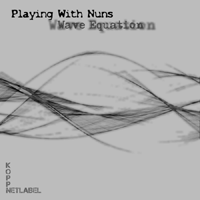




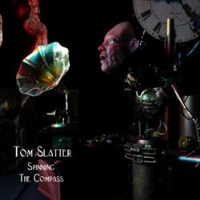


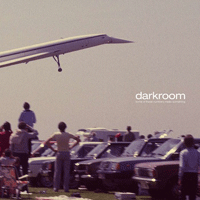


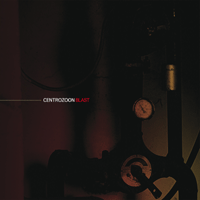








 Misfit City