On the 12th November, Baba Yaga’s Hut are presenting a double event in London: simultaneous gigs in the east and the south, each blending rock and electronica in different ways and at different intensities.
Tropic of Cancer + Shift Work + Telefon Tel Aviv (DJ) (Baba Yaga’s Hut @ Corsica Studios, 4-5 Elephant Road, London, SE17 1LB, UK, Thursday 12th November 2015, 8.00pm) – £10.00 – information – tickets
Gauzy, morbid-romantic LA dream pop project Tropic of Cancer (comprising murmurer and instrumentalist Camella Lobo plus collaborators) return to London for another set of blurred lyrics and slow-burner Gothic psychedelic-tinged tunes. Expect lapping echoes, grey-draped music and a numbed atmosphere with concealed drama: self-confessed romantic and “hyperbolic dramatist” Camella admits that the driving concept behind most of her songs is “a love so supernatural it lasts beyond death, but also a love that is sometimes not strong enough to conquer human weakness in the living.”
The live Tropic of Cancer band now includes Joshua Eustis of Telefon Tel Aviv (and also Sons of Magdalene, Puscifer and the Nine Inch Nails tour band) who’ll apparently be playing a DJ set under his TTA moniker. Further support comes from London dance-electronica minimalists Shift Work.
Teeth of the Sea + Anonymous Bash (Baba Yaga’s Hut @ The Brewhouse, London Fields Brewery, 369-370 Helmsley Place, South Hackney, London, E8 3SB, UK, Thursday 12th November 2015, 8.00pm) – £9.00 – information – tickets
At this gig, the increasingly acclaimed Teeth of the Sea launch their fourth album – the subtly-titled ‘Highly Deadly Black Tarantula’.
The London band’s assured and stormy concoction of spacey psychedelic guitar rock dramatics, heavily-processed Fourth World trumpet, counter-culture festival techno, electronica and drone music – plus their assured-to-arrogant stage presence and mastery of performance – has been winning them a wide range of fans from across the board. The clips below should give you an idea of what to expect both on record and onstage.
Support comes from Anonymous Bash, featuring veteran experimental drummer Charles Hayward (of This Heat, Camberwell Now, Massacre and the myriad collaborations of Accidents + Emergencies). Based on the music springing from last year’s four-week Hayward residency at Salford’s Islington Mill (during which Charles collaborated with over twenty musicians from the Manchester regions), the project features a taut, dubby experimental sound centred around the sonic marriage of his own percussion, melodica and vocals with shifting, abrasive rock aspects brought in by his collaborators. The Salford-based Gnod ensemble (a mixture of kosmiche and cult-spoofery) played a substantial role in the Anonymous Bash album, and join Charles in the ongoing live line-up.
Increasingly a ‘Misfit City’ regular, the Belarusian classical pianist Olga Stezhko (whose superb technique is equalled by her audacious, densely intellectual approach to programming her repertoire) chalks up two landmark concerts at two British classical music institutions this week as she makes her debut at both the Wigmore Hall and the Bridgewater Hall. To each venue, Olga is bringing her ‘Lucid Dreams’ programme – a selection of pieces exploring ideas of childhood and children’s music.
Olga comments “this programme is deeply personal to me. It is a conscious attempt to rediscover those things that were central to the development of my musical identity. Inevitably this can appear to be a sort of light musical psychoanalysis, but as I recall my childhood I remember vividly being surrounded by magic, with all its signs and symbols, which greatly affected how I felt towards the world around me at the time. To some extent, I have never lost touch with my younger self thanks to my extensive teaching work with children. Their distinctive personalities are an endless source for artistic inspiration; I wish therefore to dedicate my concert to those boys and girls.
“The narrative of the programme reflects the development of our perception of reality during different stages of life. It moves from the magical realism of a child’s worldview in the first half (Toys & Dances) to the broader metaphysical questions we all face at some point in life in the second part (Images & Visions).”
Sergei Prokofiev – Old Grandmother’s Tales Op. 31
Sofia Gubaidulina – Musical Toys
Dmitri Shostakovich – Three Fantastic Dances Op. 5
Claude Debussy – Suite Bergamasque: Menuet
Lev Abeliovich – Tarantella
Aleksandr Skriabin – Deux Danses Op. 73
Part Two: Images & Visions
Claude Debussy – Images, Series 1
Aleksandr Skriabin – Cinq préludes Op. 74
Claude Debussy – Images, Series 2
Aleksandr Skriabin – Vers la flamme, poème Op. 72
Sergei Prokofiev – Old Grandmother’s Tales Op. 31
Sofia Gubaidulina – Musical Toys
Claude Debussy – Images, Series 1
Aleksandr Skriabin – Vers la flamme, poème Op. 72
(Note that the Manchester concert features a much shorter version of the ‘Lucid Dreams’ programme.)
Throughout the programme, Olga explores the further deeper brought up in her music choices, investigating Debussy’s complex psyche and relationship with his daughter, the cognitive differences between children and adults (including the former’s belief, often shared with adult musicians, that they shape the world by thought and action), her own childhood impulses as a pre-teen musician, and the roles of parent figures in successive generations of composers. She also challenges the subordinate role that children’s music seems forced to play, arguing “what is the definition of children’s music anyway? I believe when these works emerge as an innermost urge from a mature master, it epitomizes their most sincere and unpretentious artistic output.
“Such music as Gubaidulina’s Musical Toys (part of my future recording project ‘Toys & Tales’) or, for example, Debussy’s Children’s Corner (to be included into my next all-Debussy album) is as rich with imagery, colour, trepidation, emotion and symbolism as any symphonic masterpiece. Moreover, it is perhaps the most accurate musical description of any composer and their inner worlds. Both performers and listeners can relate to this kind of music precisely because there is something universal about it as we all were children once, authentic and genuine in our relationship with the world.”
Olga’s full thoughts behind ‘Lucid Dreams’ (from which the above notes and quotes are taken) can be found here, and are well worth reading.
* * * * * * *
On the Saturday there’s another Daylight Music – a typically involved crossover gig of post-rock, soundtrack classical and communal musical spirit. Details and promo blurb below…
The wonderful Haiku Salut are best described as an instrumental dream-pop-post-folk-neo-everything trio from the Derbyshire Dales, and their talent for combining joyous folk, intricate electronica and spellbinding neo-classical has seen them compared to everyone from Beirut and múm to Sigur Ros and Aphex Twin. Their second album ‘Etch And Etch Deep’ has received acclaim from ‘Uncut’ (who called it “both warmly familiar and completely, fearlessly new”) and ‘Popmatters’ (“vividly coloured sonic canvas”), while ‘The Line Of Best Fit’ described the opening track and recent single, Bleak And Beautiful (All Things), as “uniquely stunning… isn’t afraid to tear up the rulebook and begin fresh.”
Formed in 2013, Camden Voices is a choir of thirty passionate singers, instrumentalists and teachers, as well as those working outside of the music world. Rehearsing weekly in the heart of Camden Town, they aim for high musical standards whilst keeping a friendly and fun sense of community at our heart. With groove and harmony as their foundation, they develop new approaches to ensemble singing; using new arranging talent, they dust off neglected gems from the worlds of jazz, soul, gospel, and a cappella with a vibrant contemporary twist.
You can also hear the elegant, beautiful music of Emilie Levienaise-Farrouch, an award-winning French pianist/composer currently living in London. Spanning film score, bespoke composition and art installations, her work is connected by both its high quality and evocative, meticulous craft – a common sensibility of elegant, instinctual composition. In 2015, she created a sound-walk for London’s Queen Elizabeth Olympic Park, and her debut album ‘Like Water Through The Sand’ is set for a November release on FatCat’s post-classical imprint 130701.
* * * * * * *
If ‘ve got a moment over the next few days, I’ll post up something on the London Jazz Festival and on The End – failing that, more November gig news to follow.
Some more concert dates for the current week. If you’re thinking that these have a definite female slant to them, you’re right. I’m indulging my latent X as well as stretching my perspective.
Holly Herndon expanded A/V show (featuring Mat Dryhurst and Colin Self)+ Jam City + Claire Tolan (Barbican & Rockfeedback present Illuminations @ Oval Space,29-32 The Oval, Bethnal Green, London, E2 9DT, UK, Wednesday 4th November 2015, 7:30pm) – £15.00
Having already made a showing at Liverpool and Bristol during October, peripatetic techno-pop/IDM composer Holly Herndon brings her expanded show to London. This is a full multi-media experience including the usual music, visuals and dance elements but with an interactive component that goes far beyond Holly’s onstage collaborations with programmer/life partner Mat Dryhurst and with interpretative dancer/additional singer Colin Self. In particular, Mat’s adaptive and conceptual SAGA software reaches out beyond the stage to work – consensually – with the audience members’ own browser histories and Facebook content; mixing it all into the visuals (and, potentially, the sounds) as a communal mashup, both representational and communicatory.
Intriguing as this factor is, it’s an adjunct to Holly’s music; which remains the core material of the show. Continually glitched, tweaked and deconstructed, her compositions are a cool, complex, thoughtful and exhilarating mixture. They’re informed by post-classical forms, dance techno, and anthemic synth pop; they utilize experimental textures and broad vocal stylings (from standard singing to semi-voluntary sounds) and they bury philosophical queries deep within their tunes. Holly’s soundwork is as immersive as her stagings, full of implied questions and reflections regarding our access to and immersion in technology and how this affects the way in which we think and express ourselves, leaving comet-trails of information, interaction and yearnings.
All of these additional subtexts and pointers are there if you want them, but Holly is first and foremost a communicating musician, and her pieces are as melodious and accessible as they are multi-layered. Drawing on her ongoing music studies (doctorate level at Stanford) , her time as a precocious and enquiring teenager steeped in the heat and fun of the Berlin club scene, and her work with everything from choirs to customised laptop software, they sometimes sound like particularly complicated pop songs, stuttering their way through myriad changes of attention and focus. Sometimes they sound like accelerated dream-state dances; sometimes like madrigals sung during earthquakes (see Unequal, below). At other times, they’re like the chatter of path-switching in a circuit; or like carefully-directed cultural channel-surfings which quick-step deftly back and forth across a breadth of urban art and experience (from grand opera house to downloads in cramped bedsits). Brain food which encourages you to wander.
Also on the bill are Jam City and Claire Tolan, both of whom share Holly’s interest in interactions and in the results of our being embedded within a dense informational culture, although each has their own way of approaching the situation.
Jam City is the alias of dance-electronica producer and deconstructionist Jack Latham. Though Jack’s background in fashion and “corporate espionage” sounds almost too good to be true, as if it’s been dream-tailored for counter-cultural media discussions and for high-end elitist posing, he doesn’t use it that way. As a musician, he’s evolved from collaging various dubstep tropes towards using his work to develop and express questioning, outright political critiques of neoliberal capitalism (such as the Unhappy single, which explores the dulled angst of online porn consumers while juxtaposing it with riot footage). In the process, Jack’s also developed as a performer – backgrounding the laptops and the passive role of the standard electronica performer in order to retake the stage as guitarist and singer, and delivering a new phase of material described as sounding like “a Prince record constructed from cold, chunky industrial sounds”.
Claire Tolan is an artist, programmer, sampler, writer and soundscaper specializing in autonomous sensory meridian r – a psychological process in which carefully-arranged sound and speech – usually a blend of themed, targeted whispers and quiet diegetic noises (scratches, scuffs, intimate room sounds) – triggers euphoric physical and mental reactions in the listener. With sharp wit, Claire links all of this to new developments in programming and acoustic surveillance technologies, exploring the question of how it might be applied: from simple mood enhancements and healing systems through to neurolinguistics and perception and to the potential manipulation and control of people. Her recent Holly Herndon collaboration Lonely At The Top (see below) might give some clues as to her concert performance. A cosseting monologue, coffee-pot dribbles and the close-up noises of small rooms are interspersed with the rubs and slaps of massage, fingernails ticking on keyboards and screens, and increasingly intimate sounds of hand and mouth: the language, desires and end results of relaxation tapes, executive relief, socially-reinforced senses of entitlement and prostitution blend and overlap to sardonic, disturbing effect.
Information and tickets for the concert are here while the Facebook event page is here. At the end of the month, Holly will also be appearing at All Tomorrow’s Parties at Prestatyn.
* * * * * * * *
There are some similarities between Holly Herndon and Laura Moody – not least an overlap with classical music and a sense of being on the outcrops of songcraft, delving up malleable truths and questions. Yet whereas Holly’s a post-classical theoretician (reconciling her education with her human instincts, and with life outside the college bubble) and works primarily on computer, Laura comes from older and more familiar traditions, and is almost exclusively an acoustic performer. Possessing outstanding talent both as a singer and as a cellist – and able to cover both fields simultaneously, as well as beatboxing and cello-drumming – she pounces into her own music with the terrifying, exhilarating technical skills of a top-drawer classical soloist.
Laura’s songwriting instinct, meanwhile, seem to come from multiple directions at once. Tense twentieth-century string figures (from her earlier years playing avant-garde pieces with the Meredith Monk Ensemble, and her current work with the Elysian Quartet); ancient, eerie folk airs; expressionist opera; P.J. Harvey’s cleaver intensity; the clever, idiosyncratic and individual art pop of a Kate Bush, a Tom Waits or a Bjork. Everything that she delivers sounds immediate, whether it’s the savagely equivocal hormonal take-down of an older man on Creeping Alopecia, the raindrop attenuations of Call This Time Love, or the stormy dissections of love-gone-wrong and betrayal on Turn Away and We Are Waiting.
The live gigs are enthralling wonders: supple switchings between Laura’s own welcoming personality and the performance persona which handles the songs, blurring the line of physicality which separates woman and cello. She’s out on a brief tour now, playing outside London for a few events. Go see for yourselves.
Laura Moody:
The Four Bars, 15 Castle Street, Cardiff, CF10 1BS Wales, UK, Friday 6th November 2015, 8.30pm) – £5.50 –information – tickets
99 Mary Street, Hawk Works, 99 Mary Street, Sheffield, England, UK, Saturday 7th November 2015, 7.30pm) – £4.00-£6.00 – information – tickets
* * * * * * * *
For many female pop musicians, an increasingly outright or explicit public sexuality is both a marketing point and the prime hook. To an extent, this is also true of Jenny Hval. Many people will have initially heard about her thanks to what seemed to be a head-turningly saucy lyric:“I arrived in town with an electric toothbrush pressed against my clitoris.” Curious (and possibly a little numbed by Rihanna, plus memories of lubricious Prince party-funk), many of us will have followed this expecting a licentious slow jam, only to find something very different – the opening line of a mirror-calm songscape of hovering bells, limpid murmurs and breathed-on acoustic guitars which dealt with the secret worlds of strangers within cities and, in particular, their self-reliance.
A polymath whose methods blur as artfully as her perspectives, Jenny doesn’t write songs so much as drop carefully-charged texts and pointers, and then explore and adorn these recitatives with chantlike melodies and poised minimal instrumental textures, pulling them apart and working in and out of the word-rhythms. Her guitars, keyboards and samplers (as well as her heavy-lashed, light-tongued vocals) work like soft-edged sculpting tools. Her lyrics are the lines of resistance.
For both new listeners and previous converts, sexuality remains a prime Hval hook. It’s what we expect to hear from her, although we’ve quickly learnt to appreciate that she turns the expected approaches on their heads and back-to-front. She revels in the unfixed: in the course of a single song, lovers will pass fluidly from mysterious passion to friendship to absence, and between gender, ages, species or state. Even when singing of cupping her own cunt (while cupping the blunt, unadorned and troublesome word itself, delivered throughout her songbook without a hint of shame, taboo or aggression and with a succinct matter-of-fact poise) she’ll let the action lead her somewhere that doesn’t fit the usual expectations and commodities – appreciating its centrality at her body’s core; being inspired to cup in turn a lover’s “soft dick… accepting restlessness, accepting no direction, accepting this fearful wanting that isn’t desire… can we just lie here being?”; or imagining a world of peaceful masturbators (“a million bedrooms with hands softly lulling… without telling anyone, a million ships come alone out on the calmest seas”) while asking, with a sense of disquiet “are we loving ourselves now? Are we mothering ourselves?”
Also running through Jenny’s work (whether entwined with or separate from the sexual themes), are ambiguous accounts of bodily disintegration. Opening her second album ‘Innocence Is Kinky’ with an account of watching online porn, she moves from commodified enervation into an eerie and exultant dream of escape, relinquishing her own body and its passive needs, and finally symbolically destroying the eyes with which she consumes the images. Yet this song and its sisters aren’t quite nightmares. Sometimes they’re triumphs – disassociative fantasies of freedom in which the wrack and ruin seem to be the natural rites of passage of a cool mind walking free, unconcerned, its passions become processes.
Jenny’s writing casts a wide net – violent upsets echoing classic French surrealism; deep-running strands of myth both classical and original (from the “Oslo Oedipus” of Innocence Is Kinky to the dark, quasi-pagan tree-figure in Amphibious, Androgynous that stands as lover, doppelganger and the next phase of self); and musings on the ambiguous trap of language (“the tongue is upon for the restless /An indecipherable alphabet / Each word an island less… And we speak in tongues from part to parts, broke all to parts / From invisible state, to invisible state…”). Most recently, on her latest album ‘Apocalypse, Girl’ the political subtexts have broken cover to become direct challenges (“You say I’m free now, that battle is over, / and feminism is over and socialism’s over. / Yeah, I say, I can consume what I want now..”). So too have preoccupations with ageing and survival (in the breathless narrative of Heaven, surrounded by loops and fractures of cemeteries and childhood choirs, Jenny wrestles with the pull of memory and the drag of mortality) and a increasingly solid approach to identity. “What is it to take care of yourself? Getting paid? Getting laid? Getting married? Getting pregnant? Fighting for visibility in your market? Realizing your potential? Being healthy, being clean, not making a fool of yourself, not hurting yourself? Shaving in all the right places?”
All of the above – the obliqueness and the rapier hits – makes listening to Jenny’s records akin to haunting her apartment at 2am (or some similar time when manners and manneredness come unstuck and the shapes of other truths come walking). I’ve not been fortunate enough to see what her music is like live – though I know that past concert showings have seen her play bolstered with guests or simply alone, surrounded by laptops, devices and ideas. On the five quick dates of her current UK tour, you’ll be able to see for yourselves.
On the Glasgow, Manchester and Bristol dates, Jenny will be joined by her on-off tourmate Briana Marela, a singer-songwriter from the Pacific North-West who’s currently working a string of European tour dates in support of her second album ‘All Around Us’. As you might expect from something recorded in Iceland and co-produced with Sigur Rós associate Alex Somers, ‘All Around Us’ is ghosted and garnished with touches of Hopelandic enchantment (with beautiful smeared, paper-thin sounds intruding on the edge of the mix, like lost amnesiac ghosts or distant pipes), but it’s very much Briana’s inspiration – a luminous, thoughtful work blending layered melodic sample-patches and banking her petal-delicate vocals into choirs and a capella counterpoint.
Though Briana cites Björk, Laura Veirs, Vashti Bunyan and Meredith Monk as influences (she has something in common with Laura Moody, then), I can also hear the same kind of all-round sound-mastery that’s on display and working away in the songs of Imogen Heap; deep-level sonic exploration and sound curation tied to the urge to tell you a story and sing you a straight earworm. In the album’s lead single Surrender I can even hear something of the pure pop of ABBA, while the midnight lushness of the follow-up, Dani, recalls a Julee Cruise ‘Twin Peaks’ ballad.
Though Briana’s voice is soft, it’s never wispy – never insubstantial. If there’s a hint of girl-next-door to what she does, she’s the quiet, observant girl full of thoughts, going her own way but ready to let you walk alongside. Like Jenny, though less explicitly, she explores possibilities of intimacy. Her songs hover carefully on the borderline between selfhood and loneliness, a delicate staking out of possible togetherness, subtly resisting the pressures to put out or submit, to be deformed by needs and expectations (“What does love mean in this day and age? / To me it’s a moment where we resonate at two frequencies close in phase… / It’s not a competition / Everyone has music within them.” ). Meanwhile, the perfectly-pitched American-visionary tone of the album (its hallucinatory fairy-tale sonics, leaflike piano falls and misty country swells) suggests that there’s common ground between Briana’s dream pop and the ostensibly cleaner work of breakthrough CCM-pop singers like Lexi Elisha, which in turn suggests that there’ll be a lot of people who’ll end up liking this.
* * * * * * * *
In between dates with Jenny Hval, Briana Marela will also be joining the bill at another Illuminations concert in London, this one a stew of assorted flavours which also includes the battered Americana of Lift To Experience frontman Josh T. Pearsonand the skewed Tyneside noise-troubadour work of Richard Dawson.
Probably because of the female orientation of this particular post, I’ve got to admit that I’m more intrigued by the youngest act on the bill, and the only other female one. It’s difficult to work out just how tongue-in-cheek the “psychedelic rag-doll sludge-pop” duo Let’s Eat Grandma are, assuming that they’re joking at all. Eyes down, singing from beneath and behind tumbling pre-Raphaelite locks, and tucked into stolen Stevie Nicks dresses, Rosa and Jenny rummage with various instruments like toybox-divers and play songs as if it’s only occurred to them to do so. Two Norwich teenagers who’ve known each other since childhood, they’ve sustained, into near adulthood, that mysterious blankness of two little girls who are ignoring your interruptions to their game. The songs themselves are tangled musical fairy stories, or (as with ‘Eat Shiitake Mushrooms Into Chocolate Sludge Cake’) extended wooden-legged instrumental mantras owing more to Faust or Beefheart: spontaneous-seeming, utterly absorbed in themselves. The band feels like a musical chrysalis twitching what might become an astounding breadth of wing. It’s all to discover.
As the opening concert of the South East Asian Festival 2015, there’s a performance at the Forge by My Tricksy Spirit, a new musical project which fuses the shimmering sounds of gendér wayang – Balinese gamelan instruments – with dub, electronic, ambient, trip-hop, and psychedelic rock. The Forge’s writeup is below (tweaked a little by me).
My Tricksy Spirit (The Forge , 3-7 Delancey Street, Camden Town, London, NW1 7NL, UK, Monday 26th October 2015, ) – £10.00
Performed on the bronze-and-bamboo “gendér” metallophones which gives the music its name – and featuring intricate, interlocking melodies played with mallets and damped with the wrists – gendér wayang is a subset of Balinese gamelan music. Involving between two and four players (a small number for a gamelan ensemble) it is used in the island’s Hindu rituals including life-cycle ceremonies, temple festivals, purification rituals and cremations (as well as in the sacred wayang kulit shadow-puppet dramas, based on ancient Indian epics).
The My Tricksy Spirit project was started by Nick Gray, who teaches south-east Asian music at the School of Oriental and African Studies at University of London, and who runs the gendér group that forms the basis of the band. Using Ableton Live, several synths and effects, guitar, bass and drums, the music is played through a mixing desk – much like dub – to create an intense psychedelic journey through sound.
Tonight’s band features Nick Gray (violin and vocal), Paula Friar and Rachel Wilcox (gendérs) and four other musicians: Tomoya Forster of Pumarosa (bass guitar, effects, mixing desk), Julian Vickary of General Skank (synthesizer and effects), Charlie Cawood of Knifeworld (bass guitar, sitar, guitar) and Rob Shipster of Buttress Root Drumming (electronics, drums), who also produced My Tricksy Spirit’s upcoming album.
Support comes from electronica/world-house act Wax Wings and from another of Nick Gray’s SOAS gendér wayang ensembles, Segara Madu (who mostly play repertoire pieces from the Balinese village of Sukawati, as taught by the late I Wayan Loceng). More information and gig tickets are here, with the Facebook event page here.
* * * * * * * *
Arguably, there’s not been enough pop or R&B in here recently. Let’s set that straight.
Kill J + Loveless + Maasai (Ja Ja Ja @ The Lexington, 96-98 Pentonville Road, Islington, London, N1 9JB, UK, Thursday 29th October 2015,) – £5.00/£7.00
Straight from the publicity:
Founded in 2009, Ja Ja Ja is the definitive Nordic website and club night celebrating the very best new music emerging from Sweden, Finland, Iceland, Norway and Denmark. Each month at London’s The Lexington, Ja Ja Ja hand-picks the finest emerging talent from the Nordic countries, making sure that only the best music is filtered through to your ears.
KIll J (a.k.a. Julie Aagaard) has been turning heads the past two years with her signature blend of dark experimental pop. A devastating one-two-punch with debut singles Phoenix and Bullet set the blogosphere buzzing, also catching the keen eye of ‘The Guardian’, ‘Indie ‘, ‘Stereogum’, ‘Pigeons and Planes’ and landing airplay on BBC Radio 1 and BBC Radio 6music. Deliciously diverse, the sugary sweet Cold Stone revealed a more innocent and naive side of KIll J, whilst Propaganda burst forth as “a bombastic, fangs-bared snarl at sexism” (‘Stereogum’). There’s more to come too, with an EP promised this fall.
Prominent identities in their own right, Eirik Tillerli and Filip Kollsete teamed up late 2013 to form Norwegian beat crooners Loveless. Following back-to-back remixes, debut single How To Love You was instantly added to national radio. Clocking in excess of 500K streams last year, their music has picked up attention from blogs, magazines and DJs all over the world; also landing them on some of the biggest festivals in Norway, not to mention their own club night in Oslo, Klubb Loveless (where guests include Artful/Artful Dodger and NVOY). New single They Don’t Know was recently hailed Record of the Week on BBC Radio 1xtra, serving the first taste of upcoming project ‘Relationships’.
Maasai is a Stockholm-based duo consisting of Dominique Teymouri and Zackarias Ekelund. Together they create soulful sound landscapes with a cinematic touch and lyrical depths. The pair broke on to the scene with debut single Memories, pulling inspiration from varied and abstract constructs – places, people, surroundings and everywhere in between. Follow-up tracks The Healer and Forgive Me have since held a captive audience; also hinting to the fearless, fragile and all-the-while dreamy atmosphere inhabited by MAASAI’s upcoming debut album – set for release later this year.
Resident DJs Project Fresh Socks are along for the ride in October; having also spun up a storm at Ja Ja Ja’s first club night of the season last week at The Lexington with CHINAH (Denmark), The Fjords (Norway) and Axel Flovent (Iceland).
Up to date information for this particular Ja Ja Ja night is here and tickets are here.
* * * * * * * *
Flapping-in-the-wind time… here’s what looks like a very interesting gig, but the colourful cloud of information around it keeps changing shape. Here we go..
Subterfuge presents Samhain Special/Labiatory New Year’s Eve Party with Rude Mechanicals + NiMBUL + Bad Suburban Nightmare + We Are A Communist + Jane Ruby + Milky Sugar (Subterfuge @ The Others, 6-8 Manor Road, Stoke Newington, London, N16 5SA, UK, Friday 30th October 2015, 7.00pm) – £3.00 to £6.00 and upwards
Run by arch, arty but heartful prank-rockers anarchistwood (whose own ingredients span post-punk cantatas, skeletal lo-fi garage pop, silly voices and quickfire sampler collages), this is the last Subterfuge club night of the year (hence the split between a Halloween/Samhain night and a New Year’s Eve shindig) and promises a fabulous musical sprawl – a right old grab-bag of this and that, in the best way. anarchistwood themselves are playing, though at the moment it’s unclear whether or not they’re teaming up with dysfunctional Chatham polymath and Stuckist art brute Sexton Ming (as the anti-supergroup called Nimbul), or playing as themselves. I guess that whichever way it goes you could expect a roughly equal mix of distracted behaviour, political protest, self-absorbed memory jigsaws and détournements with echoes of Beefheart, Crass, The Raincoats and the high point of a Pride parade. But that’s all it is – a guess.
Compared to Earth and Neil Young at their most dogged and noisy, Dan Hrekow – a.k.a Bad Suburban Nightmare – plays “impossibly slow and melancholic” grunge-drone instrumentals on a minimal setup of distorted guitar and pedals. In violent contrast, Rude Mechanicals play party music for paranoid schizophrenics, fronted by the peroxide-beehive rantings of Miss Roberts (who looks like a doubled-back-drag-queen version of Patsy Stone, and speak-sings like a collision between Dagmar Krause and Holly Penfield), Their songs are rattling hallucinatory-jam sandwiches about sinister neighbours, stand-up arguments and alien mice on the Tube, mixing jazz, punk and cabaret together in equal measures and played with both needle-sharp precision and full glamour oomph.
Of the rest, We Are A Communist provide “trashy guitar-laden sci-fi surf music, with stylophones to boot – a must for Man or Astroman? fans”; onetime Naked Ruby frontwoman (and current Deptford Beach Babes member) Jane Ruby turns up to sing her solo mixture of torch, garage rock’n’roll, flamenco and blues songs with twists of Spanish & Arabic flavours; and Milky Sugar performs “punk go go”… but that’s where I run out of information.
I’ve no actual idea about the order in which everyone’s going on, as the various info and flyers seem to contradict each other: either that or the whole event is morphing too fast for me to keep up with it. Presumably they’re working to some functional anarchist or I Ching method to establish it, or you just turn up and see what happens. Perhaps that’s what they’re doing. Either/and/or DJ Sugarlump SS, DJ KG Lumphead and MC Sadogasm provide some extra noises, punkvertery & Kodek provide visuals, and they’ve got a proactive but generous door price policy – three quid if you’re unwaged, four quid if you’re a student with an NUS card, and six quid if you’re neither but have shown enough commitment to arrive before 9pm. After that, they charge more. More information is here; keep track of developments as best you can on Facebook here; and there’s the usual array of tasters below.
Pausing only to remind you that the last week of October includes two of the Pierre Bensusan acoustic gigs at the Half Moon in Putney (which I mentioned in the previous post), here come the last of my selected London gigs for the month, and the first for the start of November. As ever, it’s just a small sampling of what’s on in town, but it’s what’s caught my attention.
* * * * * * * *
Bitchin’ Bajas + Tomaga + Demian Castellanos (Baba Yaga’s Hut & Hands in the Dark @ Cafe Oto, 18-22 Ashwin Street, Dalston, London, E8 3DL, UK, Monday 26th October 2015, 8.00pm) – £9.00
I’ve heard Chicago trio Bitchin’ Bajas described as “psychedelic easy listening” – presumably by someone who insists on being shouted at in conversation. Despite that swaggering faux-dumb name (the one that makes them sound as if they play manic Tejano to be drowned out by fist-fighting oil workers) they’re more ‘Bitches Brew’ than cathouse. They spin out protracted rhapsodic instrumentals drawing on a variety of introspective, mindful influences and parallels, looking back to the hallowed bucolic trance of Harmonia and Cluster, the ecstatic modular pulses of Terry Riley, the breezy but depthless Pacific cool of West Coast jazz, and perhaps the dissolving pastoralism of Talk Talk. Though they’re multi-instrumentalists, they wear their skills lightly, working wind instruments and mallet percussion into their mists of keyboard and workhorse organ and their landscape of lively rolling, rilling glissandi and drone chords. Sometimes overlapping into ambient electronica, they’re never quite dilute enough to fit into it: even at their most vaporous and transparent, they’re the smoke that never quite fades, the tang that holds your attention. As the clip below shows, they’re perhaps a little too diffuse to work at an open air festival: embraced by the Oto space, they should do just fine.
Synth/sounds looper Tom Relleen and drummer Valentina Magaletti keep in step – just about – as Tomaga, an impressionistic improvising duo drawing on drone music, free jazz and modular synth work hanging off the edge of rock. Simple oscillating melodies percolate loosely over a syncopated jazz lope with hanging coffee-can taps and rattles and shortwave radio whines; sometimes a synth organ hangs by itself, burbling, while the percussion sways and alarms like an approaching freight train. It’s music of preoccupation, with brief flashes of bright sunlight through the pressing focus.
Best known as the figure behind London psychedelic/kosmische projects The Orichalc Phase and The Oscillation, Cornish-born loop guitarist Demian Castellanos steps out under his own name for his most personal work so far. Like Fred Frith or G.P. Hall, Demian’s had a history of playing guitar with implements – paper, cutlery or whatever else came to hand – and feeding the sounds through volume swells and sundry pedals: like Hall, he’s also possessed of a nature-inspired, painterly view of music. For this current work, he’s going back to his formative years of woodshedding as a cottage-bound teenager at the isolated southernmost tip of the British coast; creating rich, portentous and melodious sound layers drawing on early-‘90s shoegaze, on raga and drone, and on echoing, guttering British, Indian, American and German psychedelic influences.
More gig info is here, and tickets are available here.
* * * * * * * *
On the first day of November, there’s a double bill of Japanese heaviness at Corsica Studios.
Zeni Geva (or Zeni Gaiva, depending on how you translate the phonetics – conceptually, it translates as “money violence”) have been around since 1987. Led by guitarist/singer/noise-chopper KK Null, and currently backed up solely by drummer Tatsuya Yoshida to make a quake-strength power duo, they have initial links to legendary noise-Dadaists The Boredoms (and even the venue-destroying pre-Boredoms chaos act Hanatarash, which featured Mitsuru Tabata, until relatively recently Zeni Geva’s second guitarist). You’d expect them to have an abrasive side, and you’d be right. Their default musical setting is one of boiling, barking aggression, with tight and furious knots of threshing machine guitar; their records have savage, sadistic titles like ‘Total Castration’ and ‘Desire For Agony’; their progressive hardcore approach takes assorted forms hostage (aside from the obvious, there’s math and noise rock, psychedelia and death metal in the tangle) and makes them jump like puppets.
And yet, in spite of this, there’s a world of difference between Zeni Geva and your average long-lived heavy-thunderfuck band. It’s mostly in the way they use calm – little, perfectly-formed lacunae of space in between the blurs and blows, bringing their bursts of frenzy into focus (Steve Albini is both fan and sometime collaborator, and you can see why). It’s a terrible cliché to compare Japanese musicians to martial artists, but in this case there’s some substance to it. The brutality is sheer craft rather than an end in itself, every movement seems considered and purely executed; and live, in between each flurry of songblows and each ugly song name, they seem enormously humble, friendly and pleased to be there.
Acid Mothers Temple have taken twenty years to set themselves up as a revered psychedelic institution, but it seems as if they’ve been doing it for much longer, such is leader Makoto Kawabata’s talent for back-engineering himself into the culture. Part of this is down to the way he and his cohorts have mastered the ingredients, including the tearing metallic squalls, mellow blues tracery and starry smears of Hendrixian guitar, the whispering lapping Gong synths, the Pink Floyd mantra riffs and Zappa-esque air sculpture solos, and the zoned-out post-James Brown grooves (with the addition of Japanese chanting and noise-squalls). Much of the rest of it is to do with AMT’s open, overlapping community approach. Their musical impetus has utilised multiple faces and names, from their own simpler reconfigurations (the heavier trippier playing of Acid Mothers Temple & the Cosmic Inferno, the Sabbath-y sludge of Acid Mothers Temple & Space Paranoid) to the friendly absorption or co-opting of contemporaries (Acid Mothers Temple SWR, with Ruins, and Acid Mothers Afrirampo) and of heroes from the original psychedelic generation (the team-up with Daevid Allen and Gilli Smyth as Acid Mothers Gong, and with Mani Neumeier as Acid Mothers Guru Guru). If old heroes are unavailable or disinclined to pool resources, AMT have simply shrugged and continued anyway (such as when they took up hurdy-gurdys and acid folk and briefly became Acid Mothers Temple & the Incredible Strange Band).
If this makes Kawabata and co sound like slick chancers (and even if AMT album titles like ‘Starless and Bible Black Sabbath’ do suggest both avid, nerdy fandom and piss-taking on a Julian Cope level), I’m selling them short. Acid Mothers Temple might be a brand as much as an ethos, but that hasn‘t stopped their project and record-releasing ethics being continually dedicated to possibilities and continuance,rather than simply banking a following (or colonizing someone else’s). Their communal origins may have been two decades behind those of their inspiration but were hardly any less sincere; and their exploration of less obvious musical areas en route (including opera, Terry Riley minimalism, Nepalese folk and southern European Occitan culture) have led them into interesting places and opened further doors to anyone following them.
First and foremost, anyone who’s seen AMT play will vouch to their talent of both mastering their sources and creating music which lives, thrills and involves in the moment. This week’s London concert features the more space-rock inclined Acid Mothers Temple & the Melting Paraiso U.F.O. lineup – probably the easiest entry point to an increasingly rewarding musical world. See below for a full-length concert clip of the band in action.
More gig info is here, and tickets are available here.
* * * * * * * *
Also on the Sunday, it’s time for the monthly LUME gig: more jazz in Dalston…
Tom Taylor/Rob Luft and Cath Roberts/Seth Bennett/Andrew Lisle (LUME @ The Vortex Jazz Club, 11 Gillett Square, Dalston, London, N16 8JH, UK, Sunday 1st November 2015, 7.30pm) – £10.00
For our November Vortex gig, we welcome a duo and a trio to the stage, for a night of improvised music.
Tonight sees the first meeting of a new improvising trio featuring LUME’s co-director Cath Roberts (baritone saxophone), Seth Bennett (double bass) and Andrew Lisle (drums). Andrew is known for being one of the drummers in heavyweight Leeds anarcho-sextet Shatner’s Bassoon, and as a prolific improviser working with a multitude of musicians on the free scene (Colin Webster, Alex Ward, Daniel Thompson, Tom Wheatley and more). Seth leads his own ensembles Nut Club and En Bas Quartet, as well as being involved in many other projects across musical styles including Fragments Trio, Metamorphic and The Horse Loom. He and Cath play together as a duo, as well as in Word of Moth and Cath’s quintet Sloth Racket. In addition to this and her LUME work, Cath also leads Quadraceratops (a septet) and has a duo with guitarist Anton Hunter, Ripsaw Catfish.
The new duo featuring Tom Taylor and Rob Luft is a recent collaboration borne out of a mutual love of improvised music. The music draws attention to the many common features of the two instruments, and mixes high-intensity improvisation with more tender and reflective textures.
A former award-winning classical piano graduate at the Royal Northern College of Music in Manchester, Tom is now a rising British jazz star, having transferred to London in 2009 to pursue a Masters in jazz piano at Trinity College of Music (studying with Simon Purcell, Liam Noble and Nick Weldon). Since then he’s played the main jazz festivals in Manchester and London and Kongsberg Jazz Festival in Norway. He’s a member of the Jack Davies Big Band and of Southbound (both of whom have recorded for V&V Records) and also plays in the collaborative electro-acoustic trio duck-rabbit with saxophonist Joe Wright and double bass player James Opstad. Rob began his career as a jazz guitarist in Sevenoaks, where he took lessons from Mike Outram and turned professional at 15. He has been a mainstay of the National Youth Jazz Orchestra for many years, having been its guitarist since 2010 and having played in the associated NYJO Nonet. He currently co-leads the band Organism and plays with various groups on the London jazz circuit; including positions with Nigel Hitchcock, Gareth Lockrane and the Callum Au Big Band.
Another week and another free/pay-what-you-want Daylight Music event in London, to flesh out your Saturday.
Daylight Music 194: Field Harmonics + Component#4 + Benjamin Thomas Holton, with Seamajesty (Union Chapel, Compton Terrace, Islington, London, N1 2UN – Saturday 20th June, 12pm to 2pm)
The second label showcase of the season, this time for Staffordshire-based Wayside and Woodland Recordings, bringing Field Harmonics, Benjamin Thomas Holton and Component#4 to the Union Chapel’s stage.
Following 2013’s critically acclaimed debut album ‘Walls’, Midlands electropop favourites Field Harmonics spring into 2015 with an even more accomplished and confident sound and vision, bolstered by the addition of new frontwoman Bryony Williams. Eighteen-year-old multi-instrumentalist Williams joins musician/producer Rob Glover (of ambient pastoralists epic45) for Phase II of Field Harmonics, bringing with her an assured swagger far beyond her years and an iconic vocal style that perfectly complements Glover’s crisp production.
Benjamin Thomas Holton has been creating and releasing music for nearly 20 years, whether as part of ambient pastoralists epic45, with the folk tinged song and sound experiments of My Autumn Empire or under various other shadowy pseudonyms. For this exclusive solo performance, Benjamin will be performing stripped down versions of songs from the forthcoming My Autumn Empire album ‘Dreams Of Death And Other Favourites’, as well as a handful of songs from previous releases.
Component#4 is Mike Rowley. Born and raised in the postindustrial, post-Thatcher remnants of the Black Country, Rowley’s music draws on the decaying factories, vandalized bus shelters and litter-strewn canals which formed the landscape of his childhood. Live, Rowley is joined by Andy Langford on drums and will perform versions of tracks from the 12″ EP ‘Barbed Wire Sunday’ and the recently released Component#4 debut album ‘Into Memory’.
The afternoon will also feature short laptop-based sets by Seamajesty (a.k.a. James Yates) using material he has recently built up under the project of ‘Tea and Biscuits’. Previously the drummer for such bands as The Pattern Theory and epic45, or session percussionist for German metal bands WFAHM or The Ocean, James’ current work as an engineer has helped him home in on certain directions he knew he wanted to pursue. To this end he built a studio in his garage, and started experimenting, recording to analog wherever possible and using several car-boot-found reel-to-reel and cassette tape machines to shape the recordings, adding a much loved lo-fi grit.
Free entry, but donations are (as ever) encouraged.
As an additional bonus, since this is an early afternoon event it still leaves you free to go to that inaugural Baltic Music Society concert in the evening. Not that I’m putting pressure on you…
Shortly after I posted news on voicelooper Georgina Brett’s Tuesdays Post concert on Sunday (which, incidentally, will be the last one for a while) she got in touch with news of two more gigs she’s playing tomorrow and on Saturday, so here’s the information on those (more or less in her own words).
Chant Live! featuring Dave Barbarossa/Youth/Georgina Brett/Regina Martin/Dan Morrell/Jon Moss/Tom Nettlemouth/Jamie Grashion & very special guests, (Unit 5, Mirage Centre, First Way, Wembley, London, HA9 0J, Friday 5th June, 7.30pm)
The return of the legendary open source band! A showcase gig in a hidden private club venue in Wembley, ten minutes walk from Wembley Park tube – a bit of magic brought to the perimeter of the stadium itself. On stage will be myself, Dave Barbarossa (Adam & the Ants, Bow, Wow, Wow), Youth (Killing Joke, The Orb), Jon Moss (Culture Club) and Cosmic Trigger(Jamie Grashion and Tom Nettlemouth). There’s also pre gig talks about all things cosmic, the fractal universe and drumming with Gina Martin and the Queenswood Drummers. Great club sound system. An adventure!! Two drum kits, two bass guitars, djembe drum circle. Give voice, give hands, be the band: bring a drum or a shaker, percussion, chants, on-the-fly recordings, loops, mixes, mashes. Free event – for more info, call Guy on 07947 061257.
Silencio Sessions, 6th June 2015
Silencio presents ‘Surfing On Sine Waves’ featuring Georgina Brett/Cos Chapman/James Conway/Tom Fox (LP Cafe, 173 The Parade, Watford, Hertfordshire WD17, Saturday 6th June, 6.30pm)
A night of looping, experimental and electronic improvised music. As well as me there’s:
Cos Chapman, former oceanographer turned solo improvised electronics performer and member of both I Am Meat and Rude Mechanicals (there will be a fascinating video of how he creates his instruments from recycled materials).
James Conway, a Brighton based musician usually seen with electronic outfit Not These Tones: this time it’s an eclectic solo show on mixer, sampler and synth duties. No two performances by James are the same; it’s method in the moment, thrill in the risk.
Tom Fox, an experimental instrument builder who focuses on using reclaimed materials to create new and unique sounds and textures from common items, and will be presenting a film on his methods.
Also just in, news on this weekend’s Daylight Music event…
Daylight Music 191: School of Noise + Sarah Angliss + Astra Forward (Union Chapel, Compton Terrace, Islington, London, N1 2UN – Saturday 6th June, 12pm to 2pm)
School of Noise are a collective of artists who run workshops for children, enabling them to make their own weird and wonderful instruments and experiment with sound art. They’re appearing live on stage for the first time performing their own pieces of experimental and electronic music. The group, made up of children ages 7-13, met at the School of Noise workshops where they explored a variety of approaches to creating, sculpting and listening to sound. The project, started by London musician Dan Mayfield, has been influenced by the works of Brian Dennis who ran the Shoreditch Experimental Music School in the late 1960’s.
Sarah Angliss is an award winning composer and performer whose music reflects her fascination with European folklore, faded variety acts and long-forgotten machines. Sarah is known for her highly unusual stage set which mixes theremin, saw and ancient instruments with the ensemble of musical robots she’s designed and built to work with her on stage.
Astra Forward is a Brighton based singer-songwriter and multi-instrumentalist. A raw vocal talent, she combines acapella, synth organ drones, ethereal harmonies and alternate guitar tunings into her performances. As a singer and keyboardist in The Robot Heart and Diagrams, Astra has toured throughout Europe and the U.K, supporting the likes of Gomez, Ben Ottewell, Athlete and St. Vincent. At this concert, she will play a solo set of her intricate and beautifully vulnerable electronica.
Alex Hall/Elephant returns to create an improvised guitar soundscape in between acts this week.
Free entry, but donations are (as ever) encouraged.
Even while he’s working on bright young Los Angeles neo-soul with Idesia, or dipping into African fusion pop with Izinde, bass playing producer Daniel Oldham carries around a pocketful of other projects. When he’s nurturing his dance svengali side, he’s danny0, with a debut single pursuing a darker, more twisted side… or so he says. It’s co-written and sung (with poise and operatic smoulder) by Anna Delaria of Anna & The Static, who – like Daniel – seems to be looking for the diva-frowns and broody depths that her day band doesn’t seem to offer.
It’s almost a pity that ‘Fire’ is so cute – a slinky haunch of electronic R’n’B hanging from a fingersnap and great stomping blocks of fuzzy synthesizer. There are probably too many songs with that particular title (a magnet for posturing and duff lyrics). True to form, some of the words here wobble as Daniel and Anna toy with images of flames, menace and insouciance, some of which slip through their fingers. Anna, however, never loses her step. Strutting and ducking through the keyboard slams, she sells the song like a haughty Liza Minnelli.
Daniel’s production seals the deal. He seems eager to confess a debt to Rich Costey and Kimbra, but in truth this is his own beast, full of glowing slithering detail, ghost-orchestra arabesques and some subtle rug-pulling. Like the massive pixellated orange explosions in old video games, two-dimensional blossoms of blurred expansive sound belly out in great fan-dancing puffs, covering up a few shortcoming as they go. ‘Fire’ isn’t perfect, but as Anna rides it around the dance floor on its fat hairy tentacles, trailing a veil of flickering embers, you could easily forget that it isn’t.
* * * *
I finished with a sex rap last time, and I’m picking up with another one now, although the rich fantastical swirl which Appalachian crew Hypenkrünk indulge on ‘Clitmatist’ lies far over the mountains from Ardamus’ down-to-earth D.C.-based romantic farces. Forty years in, one of the joys of hip hop’s current universality is that anyone can wallow in its rich sea of roleplay. In this case, stocky thirtysomething white guys from Tennessee who look like pro wrestlers get to pose as love gods. “Keeping it real” was always a wobbly concept for hip-hop: let’s just go with the dance of masks for a moment.
We’ve had dirty South for a while. This is mountain-man smut, with a swirl of German oscillators. For much of the ‘Clitmatist’ video, rapper Realtree (pallid stony-faced expression, magician’s robe, and whiskers that are part kung-fu-villain and part backwoods outlaw) lovingly serenades an only-just-offscreen vulva. He’s armed with ouija board, hypnotist’s watch, and a lubriciously loaded tongue. Explicit promises roll off the latter in a drench of hip hop wordplay (“Stow that hidden treasure packed away upon a shelf / You could never reach it – I think that I can help… / I would have brought some flowers but I’m here to smell yours,”) and down-home Southern innuendo. The words crawl over a billowing duvet of mongrelised electronica: some whining G-funk synth, Hawkwind gizmo dabbles and an undulating mattress of Berlin School sequencer. A discreet psychedelic guitar glints and swells as part of the ensemble. While nobody’s looking it sneaks out a sitar impression, as if furnishing a ‘70s-themed shag-pad.
In between glimpses of Realtree’s cartoon crib, stoned shots of trees claw the sky. A second Hypenkrünker shows up as a Charon figure. As fat, bald and impassive as a Turkish masseur in a peep-show (and poling his punt down a misty vagina-pink Styx), he’s a living “man-in-the-boat” gag who, at one point, shares a raunchy topless man-massage with Realtree. The Hypenkrünk PR promises essay on duality, alternate worlds, evolved consciousness and animal nature, and the lyrics drop references to stargazing and meditating as well as mystic rides; but right now our potential guru (when not rhyming “Kundalini” with “bikini”) seems more concerned with urging his date to “spread it like a flying squirrel.”
OK, you’re probably snorting your drink out of your nose by now. All of this is a joke, at least on one level. The players are moonshiners and moonlighters, coming in from assorted east Tennessee electronica, prog and psychedelic projects as well as from hip hop; while both in and out of the video, there’s a tinge of good-natured, low-budget, storytelling porn (tacky costumes, audience complicity, and all). But even as they rip the piss out of slutty-Romeo raps, whacking-material traditions and cosmic posturing in sound and vision alike, (“I am the saviour / of your l-l-labia – / I’m gonna see you on your worst behaviour, freaky neighbour,”) there’s an authentic tang to both Hypenkrünk’s trippy vapours and their juicier ends. As a self-styled master of sex Realtree’s clearly devoted to the task – from end to end, the song’s entirely and exclusively about serving female pleasure – and as musicians Hypenkrünk sink themselves deeply, devotedly into every genre they love and pillage. Filthy, sweaty, trippy, and even tender… at least, this time round.
* * * *
Conversely, it’s the last time around for Derbyshire alt.pop brothers Low Low Low La La La Love Love Love, but on their final single they’re speaking up for the bemused and frightened beast in people. Initially, ‘Burrow’ comes across like The Walker Brothers heard through a static storm, or like Phil Spector hauling My Bloody Valentine back into the ‘60s. Drums boom like warehouse crates, tubular bells are smacked: a cavernous crooning blur of backing vocals rides the swagger and swells like a sailor’s choir, while guitars shrug off a gluey sonic trail and a slow low-tide lick of quiet frying noise. Kelly Dyson’s vocals are nasal and poppy, while the words they’re singing are pitched between nightmare and compassion – “The weight of fears above the burrow, / of teeth and fur and blood / I clear my throat at a circle of sky / from the back of the hole I dug.”
It’s a singalong rabbit siege; a fatalistic, cowering gnash back at life’s terrors, a last burst of resistance before fate takes shape and takes hold. (“Maybe I’ll bolt out into the snare / from the back of the hole I dug. / And feel the cold metal wire tear / at the fur and skin and sinew around my throat.”) You can’t help thinking that the latterday Scott Walker, looking back over his own post-crooner gnarls of cruelties and complications, would tip his baseball cap in approval at the Low Low efforts, as well as the way they interweave animal behaviour and human anxieties. “I’ll lay and watch the long migrations / and envy the southward bound formations. /All the world performs the same motions / as I choke and wretch and spit and curse at my complications.” After the recording sessions were over, one of the Dysons immediately quit the band and Derbyshire, and lit out for London. Presumably he ducked the snare. Let’s hope he escapes the city predators.
The B-side, ‘Stop Spinning the Birdcage’ drops the fuzz drapes and the timpani booms for a brace of acoustic guitars and syrupy West Coast harmonies. Until banjo, bass and noisy lead guitar (all squeak and corrosion) work their way in (gradually sickening and splintering the song into disorientation) it sounds like an unplugged Byrds on the cusp of psychedelia, with the voices keeping their candy throughout. From the start, though, sunny, stoned-love-song intentions are hijacked by morbid distractions – “butterflies all around her eyes / I wonder when she makes up her eyes / if she draws blood?” – and its lazy and blissful carnality ends up hopelessly confused (“My eyes are carnivores / I’m thinking which bit of her face I should have first. / Little mouth or little nose? / I wonder, should I kiss it / or should I eat it whole?”).
Yet there’s no malice, no self-conscious weirdness to it: While a songwriter like Momus would have had a detailed and literate field day with this kind of polymorphous perversity, the Dysons are content to leave it as a passing blip. A sprained acid hiccup on a day for canoodling, a momentary surfacing of something more animal. A good, ever-so-slightly provocative note to go out on.
danny0: ‘Fire’ (featuring Anna Dellaria)
danny0 (no catalogue number or barcode)
Stream-only single (released 27th January 2015)
Hypenkrünk: ‘Clitmatist’
El Deth Recordings (no catalogue number or barcode)
Stream-only single (released 28th January 2015)
Low Low Low La La La Love Love Love: ‘Burrow’
Audio Antihero/Other Electricities (no catalogue number or barcode)
Download-only pay-what-you-like single (released 26th January 2015)
Get them from:
danny0: ‘Fire’ (featuring Anna Dellaria) – stream-only via Soundcloud.
Hypenkrünk: ‘Clitmatist’ – stream from Bandcamp or YouTube, or download from Bandcamp, iTunes or Amazon as part of ‘Lords of Rap, Volume 1: Just Da Tip’ album.
Low Low Low La La La Love Love Love: ‘Burrow’ – Bandcamp.
There are no peculiar moments (or quivering perspectives) with Grayhound O.C.D., despite their goofy name. They play straight modern rock throughout: the U2 root-note pulse in the bass, the sugar-frosted piano picking its way lightly through the chords, the choral synths. The guitars have that caressing thresh we know from Coldplay – gauze-wrapped shoegaze thunder, honed down from trance-inducer to aural duvet. Frontman Gray calls his girlfriend a “shining star” and – in the video – loiters theatrically at the tops of castles and by the side of lakes, staring meaningfully at imaginary horizons like a Thor-bearded Bono-in-waiting. He seems oblivious to the fact that the weather has seriously let him down (staying resolutely nice and clear when it could have had the decency to whip up a quick squall or dramatic cloud) or that maybe there’s another tour party waiting to squeeze past on the battlements.
In other words, everything’s in place but the actual drama, underlining how contrived and calculated the band are. I’m happy to let bands off their own contrivances, if there’s some wit involved. I’m less inclined to do the same for a band apparently poised to snatch up any tour or festival gaps left by touring Anglophone acts. Yet for three minutes they almost have me. Maybe Gray wins his day pass simply because it makes a change to hear an inflated arena-rock package with a soft-sung German accent rather than a simpering high-volume falsetto. Maybe it’s the superb, sensual production that buffs everything up to the glossy, summer-storm sheen of mid-‘80s Simple Minds (a sound I’ve always loved, even when the mighty winds curdle to warmed-over gassiness). Perhaps its the simple pleasure to be had by hearing assured musicians hit their mark and keep the rhythm bounding – a perpetual mid-air freeze-frame.
I also suspect that none of my skepticism is going to stop boys from Hamburg to Vienna snogging their girlfriends to this one from now till early summer. They’ll probably also be breaking up and making up to the B-side, Alone – its dark-toned modal guitar figure offering a bit more of the meat and sours. Still, it’s not long before Gray is pledging to plunge into deepest seas and climb highest mountains. Pass, pal.
* * * *
Even on her singles, Ellen Sunde (a.k.a. Sea Change) doesn’t showboat or swagger. Instead, she deliquesces. The blooping bedroom-pop of ‘Squares’ is both epic and introverted – a small constellation of freezing glows and vapours and the impatient blat of cheap drum programmes, with her small, sighing sob of a voice nestled at the heart of it, a warm breath on ice slurs.
In some respects Ellen resembles her fellow Norwegian, Anja Garbarek, working within a modest, birdlike sound and a haunted sketchbook, grappling with ghostly nervy ideas. In other respects, she’s whittled down the ideas of Kate Bush’s jarring, demonic ‘Get Out Of My House’ from primal screams to a flinching dodge. You could call it dream pop if it wasn’t so wide awake and bug-eyed. Far from heavy-lidded narcosis, this is dream-sharpened wakefulness and sometimes it hurts.
‘Squares’ is neurotic, fearful and ultimately brave. At times it sounds like an existential crisis wrapped in fairy lights (“just go inside, oh just go inside me / There’s no-one here”), but it’s mostly a crisis of confidence (“If I go there with you I will not be safe / All that lives inside me, all that you can see./ If you knew what I was – a frozen me, / what grows inside me – / then you’d let it go.”) Batting aside help, Ellen’s her own haunted house, her own jailor. Also, it seems, she’s her own salvation, instinctive and unpredictable, ready to burst shackles and flee without plans. “So don’t look back, don’t look back. / Out of this place, out of this house – / ‘cos if I don’t go there, / oh then my feet run, my feet will bring me there / My feet will run all they can.”
Trying to grasp at the song seems to melt it – it won’t keep a solid shape, it won’t provide a firm conclusion. Is this about self-hatred or about fervid, elusive independence? Resolving one’s own terrors, or bolting from them by panic and chance? “Save yourself first,” advises Ellen, towards the end of the song. She could be addressing a loved one, or herself: it could be nobility, or a covert brush-off. Sea Change offers transformation of circumstance and state, but also a fluttering ambiguity. Nothing is mapped out. I’m alarmed. I’m fascinated.
* * * *
Sex raps are integral to hip hop: another part of that expressing-yourself-over-a-beat ethos, and a good way to keep a live and restless audience onside. Unless you’ve got a broad sense of humour, they can be touchy areas – too louche, or (at their worst) channels for power-posturing, misogyny and spite. Happily, Ardamus might bitch a bit – and might even settle a few minor scores on the side – but he doesn’t really hold grudges. ‘At Least I Got Laid’ could have been so damn nasty – a wheedler’s boast. Instead, it’s a shrug and a counting-of-blessings from a late-30s Washington rapper, thumbing through his temporary dating and mating memories for a piece that’s not so much bump-and-grind as bump-and-fall-off-the-couch.
Most of the endearing low-budget video (earthily-mimed rom-com looking like it’s been shot on the flickering, selective colour stock of memory) actually takes place on a couch, but what we see isn’t really love action. It’s the bits in between. The getting-to-know you exercises, the different books and the telling eye-rolls. The separate laptop and TV watching; the bumbling between what two different people want. The sulks and the missed tell-tales; the irritating or opportunistic friends. Eventually and inevitably, it’s the get-outs, fall-outs or peter-outs. (Heh. No pun intended). Yes, it’s a bloke’s record and a man’s-eye view. There’s annoyance and relief (“the divorce and the wedding would have been shotgun”; “if you want headaches then, shit, you can have her”) and Ardamus does delivers a superb low blow in the battle of the sexes when he complains about how “a tampon now becomes puppet strings.”
Still, it seems that Ardamus’ concerns aren’t about who stays on top, but how things are played out (“you can’t play games like that / and not expect to get called on it”). Rather than being coldly profane, he’s endearingly filthy – there’s some marriage-proposal wordplay which is well worth a spin or two. (Hint: it’s all about going down. And exactly where you put the ring. Veil optional.) When he’s not going for double-takes and horse-laughs, he’s also pretty good at pinpointing the sorry farce of how things go wrong (“the small talk that you want to step over: / pushed away at the table – you a leftover,”) and the mutual clinging (“getting mouldy, make-believe it / you need each other, so now trade diseases.”) He knows how two can screw up. The summery light of Soulful’s production textures – bass Rhodes figures and wobbly wipes of soul voice samples, like a cuddlier Wu-Tang sprawling back on a picnic rug – draws out any venom. Whatever had been said and done – if you’d been Ardamus’ girlfriend, I think at least he’d shake your hand at the end of it.
Grayhound O.C.D.: “And I Love You”
Khb Music/Timezone Records (no catalogue number or barcode)
CD/download single (released 16th January 2015)
Sea Changes: ‘Squares’
Sea Changes (no catalogue number or barcode)
Stream-only single (released 20th??? January 2015)
Ardamus: ‘At Least I Got Laid’
Ardamus (no barcode or catalogue number)
Stream-only single (released 13th January 2015)
Get them from:
Grayhound O.C.D.: ‘And I Love You’ – iTunes or Amazon.
Sea Change: ‘Squares’ – stream-only via Soundcloud.
I don’t know much about The Four Disorders, and that’s how they seem to like it. A brief heads-up email arrived about them the other day, but lyrical hints and a single downcast, distracted photo don’t tell me much more than that they’re probably based in Hackney, that they’re a boy/girl duo (Mi-Shan and Joe), and that they’re not big on eye contact.
There are just two Soundcloud demo tracks so far, both demos. Not quite a secret, not quite a single. There’s a contradictory whiff of reclusive hipster to this (not necessarily a bad thing – I dip into hipsterworld sometimes, and it’s a guilty relief to find someone there who hates self-promotion). What I can glean about The Four Disorders, therefore, comes mostly from their sound, which somehow manages to be both dark and breezy.
Rhythms are closures : minimal drum machine clacks and markers, enough to pump the songs along up-tempo but otherwise just nails holding the box together. Sidelining (or suppressing) the sparse and begrudged clusters of starved, spangly guitar, Mi-Shan offers greyed-out nighthawk pads of budget string-synth. Moods are made or broken on Joe’s upfront bass guitar, which looks and sounds almost as big as he is, whether it’s trudging down the beat with a dour plectrum-hammer or traveling on a supple, pianistic twist of growling melody. Allowing for home-studio roughness, they end up somewhere between Sisters of Mercy (circa the clenched and hooded cynic-rumble of ‘Floodland’) and the brighter, more forgiving dance-pop of Saint Etienne (sprinkling reappropriated, refiltered tints of classic pop sounds over washed-out London suburbs).
Whenever Joe opens his mouth, however, it suddenly turns a bit teenaged-Neil-Tennant. He sings with a similar small-voiced and beady tone – brittle and nasal, watchful and dry. Like Tennant, Joe also wears heartache and reflection as if they were part of the same, wrong jacket; tight and a little irksome. On Cat Lady he sighs, with a hint of exasperation, “I could love you if you drop this nonsense.” Over glum keyboard chords and a chilly, thudding bassline (and with a hint of cocaine weariness), he outlines the stagnant mind games which keep score but eventually lead to nil. “You think you know it all, you think you’ve got my life worked out, you think you see right through me, / but you don’t know me and I don’t want to show you. / You think you’ve got me in a corner, you think you’ve outmanoeuvred me – / but I show you only half the truth / and it cuts me out, it cuts me out…”
With excruciating – and accurate – teenage gawkiness, the song flickers between states and stances. It travels rapidly from poised bleakness (“you think you’re only using me to satisfy you when you need it / I wish that’s all you wanted from me, but I can feel the pain inside you”) to the unwanted sympathy, sincerity and pathos of the schoolyard underdog scratching for love. (“You’re smarter and more popular than me – / it’s true, but I just wish that you could believe it too / and put yourself at ease.”) In its dance of masks and blushes, it feels like a mash-up of Brett Easton Ellis and ‘Waterloo Road’.
That awkwardness, that inability to maintain a fixed pose, seems deliberate: a conscious, complicit songwriter’s choice. On Hell And Hackney, Joe takes on the insubstantiality and self-indulgence of his peers, but even while taking it to task with verbal barbs and jabs, he brings in the rueful tone of the implicated. “Aimlessly we drift, like a frivolous emotion, or a dream that fades into the day / Further round the bend, delirium advances; / we bite the hand that tries to save… / We’re still pretending there’s another life, / parallel and far away.” There’s more fizz to this one, too: counterpointing her blocky keyboards, Mi-Shan fires out digi-gastric hi-NRG gurgles, bell-tones and sub-bass quirks over Joe’s rolling bassline.
Joe, meanwhile, lunges into the malaise to root out the muck, distraction, and confusion. “We’re only alive when we drop out of skies, wash away the compromise, / we’ve nowhere to hide, nothing left inside, forgotten what we’re trying to find… /Sad to say, we wash away the day, / destroying our time. / Cast away, sleepless we lay, /wasting our pride.” As he breaks his own cool surface, skidding vigorously between scold and clarion call, you can almost forgive him for skidding for hideously out-of-tune; especially when he tears a window in the torpid clouds towards the end. “Yes, I know how miserable it seems, / laying blame and thinking of those long-forgotten dreams; / but I hope someday we wake up, laughing at the mire we’ve left behind, / to find it’s not too late.”
Dour tones and duff notes notwithstanding, this has promise: at the very least, I like the idea of a more Gothic spin on Pet Shop Boys. Even if Joe and Mi-Shan still won’t look me in the eye…
The Four Disorders: ‘Cat Lady/Hell And Hackney’
The Four Disorders (self-released, no catalogue number or barcode)
Stream-only demo tracks
Released: 10th April 2014
“Well, I know, I know the story – / the fall of the sun and the vengeance of glory revoked. / So well, I know how the seas turned to dust, / and how the known earth choked. / So well, I know, I know the ending: / the carriage from its zenith bending, / a comet slung through ashen skies / and burst against the banks.”
Cinematic. Epic. These are words which have been whored out far too often, especially when it comes to describing and defining music. Froth and PR corrode their meanings, reducing them to fancy synonyms for nothing more than crude scale, and we forget that other qualities are wrapped into them. These words shouldn’t just be cheap and glittery tags for charlatans – the kind who steep their tunes in giant vats of reverb, or who substitute eye-watering grandiosity for sincerity. There are more crucial meanings. There’s storytelling, and the churn of history. There’s the play of images, the triggering of senses. Eventually, there should be some kind of understanding.
Ian Crause knows all of this. Back in the 1990s – when he was barely out of his teens, and the driving force behind the startling expressionist pop band Disco Inferno – he was struggling with it himself. Even then, though, he wasn’t stumbling to understand: he was striving to perfect. Disco Inferno had come from limited beginnings but grown fast. Originally a dour post-punk power trio, they’d seized the opportunities presented by technology and imagination and transformed themselves into a whole-world window. Hot-wiring their way into the disruptions and illuminations of found-sound and musique concrète, they plugged guitar, bass and drums into digital samplers and grew themselves an ever-expanding sheath of noises: a startling collage of jarring sound effects, layered into composition and twisted into context.
Disco Inferno’s swarm of noise was never there simply to overwhelm. Instead, it refracted and illuminated the poignant dissatisfied pop songwriting which stood, steadfast, at the band’s core. They were doggedly political, but owed nothing to dogma. Caught within ominous social currents and inside treacherous personal eddies, their songs bore witness to cruelties, both intended and impersonal. Those tearing rivulets of sound-montage were flashes of further illumination, put there to side-swipe and snag the attention, and to up-end complacency. The fragments of birdsong and clattering glassware; the careful punctuation of trains and screams and distant firework-pops; the sound of feet jogging grimly away through a numbing snowfall – all of it bore witness to the swerving cacophony of the world, smearing past our ears and battering our psyche, carrying its deeper meanings and significances into us via a pummeling swirl.
At the heart of this unsettling barrage were Ian’s lyrics, which were wise, stark and bleak beyond his years. He sang about the crumbling of vulnerable individuals; about the fraying of the social contract and distortion of social forces. He sang about the stifling, stunting pressures callously imposed from above. He sang about all of this in a still, small, stubborn voice which sounded like the next-to-last exhalation; as if he was a few crucial steps and dogged heel-digs away from giving up and bleeding out. He sounded brave, bitter and doomed – snarling his scorn at the boot-tread even as it rolled over him. For a while, it was a self-fulfilling prophecy. Bands who refuse to comfort us (or refuse to stroke our sundry petty vanities) rarely get rewarded, and Disco Inferno were no exception – the strains of dealing with commercial indifference and inner despair finally tore them to bits in 1997. A couple of barely-noticed Ian Crause solo EPs hiccupped out in the band’s wake over the next few years, and then he too seemed to drop out of the story.
In fact, he’d only dropped out of the cheaper kind of mythology. That’s the one in which ducking out of music becomes death or disappearance by another name. His own story – the real story – moved on regardless. There were years of growing up and grim jobs to come, and years of being chewed over by the same callous forces he once sang about. In amongst the drudgery, there were other factors. There was fatherhood, and family. Surprisingly (for a lyricist already so accomplished and intelligent) Ian made his first adult engagement with literacy. Curiosity, plus a determination to pursue the roots of song and storytelling, led him to the themes and voices of classical literature. His developing interest in the telling parallels with contemporary society kept him immersed in it. Crucially, Ian discovered the works of Ovid – Roman epic poet and exile – via dedicated translations by Ted Hughes and David R. Slavitt.
Like Ovid, Ian would eventually become an exile himself (a self-determined one, abandoning Britain for Bolivia) and enter into a new swell of creativity. Via his ‘Metamorphoses’, Ovid eventually inspired The Song Of Phaethon – Ian Crause’s formal return to music, transformed and developed. It might not be the first new note he’s delivered after eleven years of radio silence. That would be More Earthly Concerns, which welled out via Mixcloud and blogclick in March 2012, and which I’ll talk about elsewhere. But (as Ian begins to dole out his work, in handfuls, onto Bandcamp) The Song Of Phaethon is the first of Ian’s songs to be let out into the marketplace. It’s also probably more crucial in understanding his evolution since his Disco Inferno days.
The protagonist, Phaethon, is and was one of those half-divine children who pepper Greek mythology – he’s the bastard of the sun god Apollo Helios, a malcontent boy strutting up to his sun-father’s palace to claim his ancestry and birthright before he has the wisdom to use it. Greeted, given the acknowledgment he craves, and granted the gift of driving the sun’s chariot for a day, Phaethon is warned of the terrible risks involved. Swallowed up by his grand moment, and too conceited to listen, he takes all of his opportunities to their ruinous conclusions. Losing control of the chariot, he transforms a triumphal fly-past into a joyride and then into a catastrophe. Before the high god Zeus restores order by striking him down, Phaethon scorches a gigantic swathe across the world and casts the seasons into chaos.
Like most figures woven into the complex psychological map of Greek myth, Phaethon still has his role to play. He’s a metaphor for arrogance and a sense of entitlement; he also stands for the destructive potential which both of these follies possess. It’s deep literary currency, and maybe not the first thing which you’d think of as a match for the Crause songcrafting method – so direct and personal in Disco Inferno days. Yet Ian’s battering splay of noises and disaffection opens itself up readily to the mythology, which sinks in grain-for-grain. Explosive futurism meets stern and ancient legend, and both are renewed.
Some of Disco Inferno’s post-punk grit remains at the spine of the music (listen to those dogged dot-trails of frowning bass, or to the occasional flares of wire-wool guitar), but the song falls far away from rock into something older. Myths lend themselves to being channeled into new courses by any means available – Phaethon, for instance, worked his way into a Patricia Barber jazz epic six years previously. Ian rises to his own challenge superbly. In any worthwhile sense, what he comes up for The Song Of Phaethon is a new take on a bardic chant. Its melody is minimal and hypnotic; its rhythms walking, changing pulses constantly driven by the restless words. With vivid artistic appetite, Ian also mines the story’s depths for any resonances which he can transmogrify and feed into his own samples-as-narrative approach.
In this he’s served well – the mythic structure and detail inspire and transform his lyrics, which in turn take on the layered build of classical imagery. Various whispers of fateful moira and foreshadowing rise up to nourish the sounds. From early on, Phaethon’s life is marked by the celestial – right down to the transformation of his familiar landscapes by the passage of the sun and moon each day, continual reminders of his thwarted birthright. Ian reflects this in the woven detail of the narrative: “Every day their shadows ran / down Asia like a lyre, strumming / past his village, swinging down at perihelion / to touch upon his mother’s house / then over dark and quiet woods – / their distant hawks and watching deer / oblivious in bending shade – / descending into seacloud mist, / and down towards the gull-cloud cliffs / to pour their jewels and precious metals / out along the sea.”
Just as he did with Disco Inferno, Ian juxtaposes sound effects with the lyrics to create telling sonic scenery. Though he generally wields these with the skills of a master ironist, he slam them into place with forthright punk brutality whenever he needs to. Throughout, the Greek horns and lyres are a pointed racket: ritual blares, ancient continuo lines. Signatures of antiquity and origin stand solid against the thrumming synths and Ian’s tidal electrophonic swirl of throbbing samples. In prophetic flashes, the clip-clop of horse’s hooves and the slam of violent collisions clatter and blur in and out of the mix, while Phaethon’s more innocent youth is illustrated by the clank of herd bells and goats. In time, his dogged journey through Asia and towards Apollo is dappled and smeared by a souksworth of Asian instruments and chatter, careering past the listener in a flickering travelogue: “Levantine cities raised themselves, then hazed away in dreams of sand, where sand subsumes / the earth itself and still ahead his path led on. But falling always out of reach, the rising sun. / Into the dawn, alone he walked.”).
The effect is of a kind of illuminated text – a cinematic compression of time and location into a vivid illustrative story. That story remains paramount: even while we, as listeners, are being drawn inside those blood-in-the-head thunders and are surrounded by a glorious noise, as if we’ve been trapped under the encircling lip of a vast bronze bell. Beyond the story, though, other dimensions to the tale are coming into play. The song is also a loose parable of another gatecrashing of grand power. “He knew, he knew – / his place was beyond.”
Superimposed – a ghostly transparency – over Phaethon’s story is the tale of Tony Blair’s entry into the Second Gulf War. As this emerges through the song, it’s clear that Ian sees this as another disastrous snatch at high significance and public destiny. Something which flew high and upwards towards glory, only to destroy any achievement of its own, wreaking havoc on the ground and people below. Cunningly, occasional Blairisms are woven both into the narrative and into Phaethon’s thoughts and speech. At one point, he even blathers, Blair-like, “look, you know,” before sliding into advocate pomp and hubristic heroics. For a moment, the pleading voices of the two men overlap within Ian’s narration, making a contradictory cats-cradle out of public morality, power-grabs and a preening Promethean sense of mission. “It was not just God but also man / who clearly needs some representing – / A case I’ll take for free… / Evidentially it takes / a half-divinity to raise / the flag of man aloft for man…”
It follows – with a harsh and unforgiving logic – that the noises of modern warfare should persistently break through the song’s tapestry of ancient sounds. As Ian goes beyond everyday sound effects and begins to violently splice present-day horrors into the textures of the mythical plot and signifiers, the song is slashed up into a jittery palimpsest. Almost from the start, those bleating goats on the ancient Greek hillsides are blindsided by gunshots and by the crash of heavy munitions. With booms, crunches and clatters the shattered, warped shards of twenty-first century concrete and metal scrape and shoulder their own way into the past.
Even specific events from the myth draw across, from recent times, their own crooked parallels. The bursting, clattering crowd-sound of Phaethon’s entry into Apollo’s hall is lifted and twisted from the peak of Blair’s 2003 address to the US Congress. It becomes a Dionysiac smear of fanatical applause and whistles: something turned into a nightmare puppet show, or a rainstorm ripped horribly out of kilter. At the coda, Phaethon is poised unwitting on the brink of disaster. The ascension of the Sun’s chariot merges, indistinguishably, into the noise of a jet fighter launch. Backed by the white-hot screech of the afterburners, the lyrics weave both tales, both times and a set of terrible implications – “the steeds were armed: a blinding shock; / a ferrous scream; a rubber stamp; / and up,” – into final, irrevocable process.
By anyone’s standard, The Song Of Phaethon is a major achievement – a jump-up into fiercely intelligent, confident high art, it stakes new claims and transfigures old ground. It even manages to both stay true to and transcend the moral and political commitments Ian held with Disco Inferno. And yet… it raises a tremulous question of what might have happened to the other side of Ian Crause. Between the immersion in classical tradition (and the dense time-folding focus of the samplers) what’s left of the fervent young New Order fan who always saw himself as fronting a pop band? What, in other words, became of Crause the unlikely pop singer?
Ian Crause: ‘Suns May Rise’
For the answer, look to Suns May Rise, released three months after The Song Of Phaethon. Ian’s mining of Greek mythology is still in place (as are his detailed tapestries of sound-effect) but they’re now wrapped around an out-and-out pop song and a lustrous, dancing melody that Bernard Sumner would give his eye-teeth for. Those Greek lyres and zithers are back, as are the layers of sound effects (sea-spray and thunderous surf crash billow through Suns May Rise from start to finish); but they’re bolstered by massed stadium synth and guttering pop guitar; by angelic powder-puffs of fake-choir; and by warbling rococo flourishes of electronics. Even Ian’s voice – usually so dry, and pointed – is flushed with the balmy blue of a Mediterranean summer. Scritti Politti and Cocteau Twins, each at their flounciest, could find common ground with this song’s feverish, chattering opulence. So, come to that, could latterday Marillion.
I suspect that all of this ’80 ornamentation is deliberate. After all, it skips hand-in-hand with other ’80s excesses, and that’s not too far from where Ian’s caustic, righteous attention is focused. Beneath this gleeful and gorgeous bluster, he’s unraveling a story from the Odyssey: a warning bell for avaricious times. As the story has it, Odysseus (while returning from the Trojan Wars) visited the generous Keeper of the Winds, who gave him a bag of sea-gales to ensure that the sails of his ships would be filled and his voyage home would be swift. En route, Odysseus slept; and his friends sneaked up to rifle the bag, in search of treasure which they were sure he’d hidden from them. All they succeeded in doing was to unleash the winds, which blew the ships hither and yon and – eventually – blew them back to where they had started. Reckless avarice, bringing down calamity, provides the keystone of the song. “There will always be some fool / to pull the strings apart. /And suns may set and moons may wax, / and moons may wane and suns may rise – / the gold within his eyes will weigh / Man down a stumbling fool.”
When Ian starts singing about this, though, it’s from the point of view of that corrupted, consensual chorus of friends – the “brothers bound in bronze.” Their coy, self-congratulatory rapaciousness soak his tones like a stain on the teeth. Flushed and greedy with loot already, all they can see is the chance to grab some more. From his own place at the reins of the narrative, Ian reveals their mythic echo in today’s freebooting boy-club of bankers and stockbrokers. Men of unfettered appetite goad each other on. People who simply don’t know when to stop – and who wouldn’t want to even after being handed a sobering, sickening lesson – would still pick perilous holes in opportunity. “You had enjoyed a peace of sorts / The winds had been re-tamed and so / of course the bag was bursting fat: / It fell to men to see to that. / Again so sure the bag would hold / either wine or gold, / Necessity appeared, demanding ‘Open this’.”
It’s here (with a careering inflative screech on “bursting fat”) that Ian himself deliberately unleashes the hidden forces within Suns May Rise, to overwhelm it. From here on in, sounds rise and cyclone – seaspray, radio chatter and winnowing churns of air; a lash of strained rope which morphs from background effect to edgy kick-drum. Amongst all of this the thread of pop song holds fast, stretched taut over an ever-burgeoning epic. In a parading weave of rapid soundbites, assorted newscasters and pundits and politicians roll past in a potted history of the last generation of monetarism. At its tail-end, George W. Bush (waving through a banker’s rescue programme of the kind he’d never have brooked for any other group of people) chokes, gargles and drowns amongst the becalmed wreckage of Odysseus’ ships. Throughout, that teasing pop melody ensures that we’ll remember what happened this time around.
So… the forces eventually sink the meddlers, but there always seem to be more of the latter. Ian conjures up further mythic winds, more specters bringing in ruin from the other far-flung breeding grounds of a destructive capitalist carnival. “Through solids, countries, paper bonds; / The world again reveals itself / in entrails; in open wounds. / The priests and seers shed tears of glee / and privately amuse on how / it still can be that after so long… / there will always be some chance / to pull the threads apart.” Again, the bones of legend rear up inside the flesh of current affairs. Again, this unlikely sample-punk turned foley-bard turns up to show us where those bones are poking through – his words a layered and subtle scourge; even an education. For Ian Crause, it’s been a long and often stony road from transformative teenage angst to his current role of reveal-and-illuminate, but it’s also been a journey of integrity and hard-won vision. The results are even a story in themselves.
Ian Crause: ‘The Song Of Phaethon’ & ‘Suns May Rise’
Ian Crause (self-released, no catalogue number or barcode)
Download-only singles
Released: 20th November 2012 (‘The Song of Phaethon’), 18th February 2013 (‘Suns May Rise’)
Buy it from:
‘The Song Of Phaethon’ – Bandcamp(the original version reviewed here has now been replaced by this mini-album)
‘Suns May Rise’ – Bandcamp(the single version reviewed here has now been replaced by this version from ‘The Vertical Axis’ album)
Hmm. It’s only taken Elephant a year and a half to journey from being walkers in the gloaming (singing out their queasy, dissolved surrealism) to playing in the sunshine. There were some clues on their previous EP, ‘Assembly‘, which embraced mainstream pop while twirling mournfully like a mascara-ed panda; yet this is a firm step outwards from the obsessive feel of their early singles. Or is it?
Whether it’s Amelia Rivas’ French ancestry coming through, or just a shared and surfacing taste for classy Europop, Golden sees Elephant strip away their cavernous post-punk layers of dream-pop guitars and blood-throb synths in favour of gently bobbing acoustic strums, shimmering organ string pads, a touch of swing and bell-like keyboard smears. Actually, come to think of it, they’ve been here before on Actors, the surprising B-side to their second single Allured. This is altogether more sedate, though – a leisurely boat trip as compared to Actors’ chic bike ride, or perhaps a gentle merry-go-round bump’n’whirl. Compared to the hallucinatory greyness of their earlier work, it’s full-colour. French-tinged pop, for certain: an antique kind, filtered through Goffin and King and through Elephant’s subtle and invisible technical skills.
The link to what’s come before remains Amelia’s voice (still mournful and carrying a dry-eyed narcotic timbre, whatever she’s singing about) and her baffling way with a lyric, in which she dabs loosely associated words and phrases into a line like painted highlights and hopes that you’ll focus on her own scattered picture. With this kind of tune – this lightness, this air of sated contentment – I’m assuming that Golden is a love song. It certainly starts as intimate (“speaking in codes to you / in a drowned-out room. / Chandelier shelters us – / only space for two,”) but a chorus that gives equal weight to the words “escapade” and “hate” suggests something a little more complex.
Certainly by the second verse – “gazing from this altitude, / trapeze transforms to new. / The old was there all along. / Telescope straight to you,” – we’re in lyrical warpspace. Though Elephant have never sounded so cosy, so lovewrapped on the outside, the usual hallucinations are bleeding up from the inside. By the third verse, the summertime and the sunlight are taking on a shadow-etched ‘Twin Peaks’ hue – “The trees they whisper too, / as I glare from a bird’s eye view. / The grass entwines my feet and hands – / they hold me like you do.”
If you look at something too closely, cracks appear, and that’s true both when looking at songs and looking at love. Love and rage: the cuddle that ebbs away into a stifle… I’m backing off. Today I was promised sunshine, and a dank draught from the basement wasn’t part of the plan.
Perhaps if I don’t look too hard, I’ll be able to glide along on the surface, hold hands and enjoy the golden light. Perhaps it will all be OK. Will it?
Elephant: ‘Golden’
Elephant (self-released)
Download-only single
Released: 6th June 2012
There’s the shadow of a melody in the house, floating in the dusty air. It’s coming from just around the corner, or maybe from up by the crumbling moulding.
Preludes is Matt Gasda (the sotto-voce poet who did most of the singing and keyboards in the ghostly riverbank psychedelics Bears in America) and his sister Emily. The Bears were a group so reticent and self-involved that listening to them was like spying on a set of old footprints, long-abandoned and filling with water. Some Preludes songs began life as Bears pieces before falling into this new form and flavour, so you can expect something of a family resemblance. Yet in their hypnotic and looping way, with their camp-fire canons and travelling-man guitars, Bears in America fitted (just) into the Americana bracket. In contrast, Preludes looks wistfully eastward, back towards Europe.
More specifically, Preludes capture a lost and fading atmosphere of East Coast grandeur: one which jealously guards its Old World connections, its cultural loftiness, its yellowing old money in a deadened and dreamy grip. While Matt may have relocated to New York City and settled in Brooklyn, Preludes seems to have set its heart further uptown. These songs emerge like a sigh haunting a shabby brownstone mansion on the Upper East Side, clinging to the scuffed books in its neglected library, or fluttering with a swirl of yellow leaves in its deep walled garden. It’s not that these are wordy songs of privilege; instead, they’re leisurely blurs of decaying luxury, drunk on elevated sensation and cut right back to free-drifting images of moons, flowers, loss and water, their stories dissolved. An encroaching darkness hovers around them, like time and chemistry eroding sepia photographs. At the same time, there’s a rapturous quality to the music: the thrill of the last gasp, the final pirouette of memory.
‘The Moth’ EP, and its title track in particular, set up the Preludes recipe from the start – pianos (drowned in a flat and musty reverb), blurry-edged keyboard layers (in this case, a wavering swoon of fake strings), and a faint and faded rag of vocal yearning after something it can’t quite describe, catching on whatever surrounds the moment. There’s a touch of Goth in the mix, and more than a suspicion of Nico or Anthony Hegarty; but the obliqueness and the gauzy obscurity are all Matt’s. Moonstruck, he murmurs soft, semi-operatic vocals in the backgrounds, muttering about cicadas and strange, longing transformations. Halfway along, a cheap drum machine begins to tap out a stately dance rhythm and Matt steps up to a new level of obscure, gently-impassioned reverie. (“And we’ll walk along the opening geraniums… /The light of the moon. / Open your milk-white eyes… We will never grow so old.”) It doesn’t mean so much when you pin it down. Just a handful of fleeting images, lighter than anything. Open your hand and let it drift on this sigh of breath, however, and it flushes gently with life.
It’s Emily Gasda who sings the out-of-focus waltz of The Moon And The Bonfires – sings in a small and distracted way over a softened skirl of goth keyboards; a spiralling distant dream of a barrel organ melody. Here’s more obscurity (nightswimming and natural lights; the sense of a particular, autumnal time of year). Here’s more plucking at floating, flowery images (“The violets of memory are growing in the water… / It’s like a debt you share…”) She sounds like a more peaceful version of Cranes’ Alison Shaw. The Goth tambourine and the bass drum thud behind her sound like a lull in a noisy evening. Perhaps these songs are some kind of refuge.
As goosefeather-soft as the rest, the last song – Nightlight Child – begins as a ghostly lullaby. A muffled drum and music box playout becomes a throb while Matt and Emily sing together, and for a while they’re Victorian in their magic and ruffles, their willingness to slip away into dream logic and wordplay and into ornamental fantasy. “Like water drawn from the well – moon drawn like a fish. / Nightlight child, it’s all right. / Nightlight child come to life / and from the shell alight. /A starry, starry night.” Gradually the lullaby play fades seamlessly into surreal and transforming fable: images turn macabre (moth eyes, floods rising from the throat to drown) and innocence and horror overlap. Unwinding ourselves from this particular gauze is less easy.
Preludes: ‘The Swan’
Five-and-a-half months later (swimming back into view with a second EP, ‘The Swan’) Preludes are just as enclosed and enrapt in their consumptive old-world decay. “Snow falls in Central Park, / and for a day your fever drops,” sings Emily on a song which also coos “love is so cold” and reminisces – with a quiet, absorbed bliss – about kissing frozen hands. There’s never a suggestion that there’s any danger involved here, or a direct flicker of death. That particular disquiet just seeps into the gap that’s left for it.
In general the themes of sleep, death, illness and wasting-dream simply blush gently through the EP’s songs, each of them thinning the walls between experiences. The strangest of these is the title track, wrought with a chilly expressionism and drifting symbols. “I love the sorrow of your voice / and the wreckage of the old days” Matt muses, beneath a cloudy Blue Nile synth pad (a mirage of traffic in the evening sky) and a funerary piano line (a shard of dusty porcelain from a lost urn). Death and revival blur together (“you’re enclosed in the petals / made of snow, / born up into the clouds like ash”) in a way that’s as much phoenix as swan. “I’ll wait by the river / for the ice to tear itself up,” promises Matt, as the ritual works its way to conclusion. “Your blood will germinate the spring.” Over a minute of silence at the end of the song eases the point home.
On Sleepy Eye’d (backed by an enthusiastic music-box twinkle and lambent synth), Emily enjoys a much more innocent dream – “We’ll tear up the feathers of the stars / and make our bedding on the moon… / Take my hand, we’ll go skating on the glass, / catch fireflies with our hands.” For a while, Preludes sound as if they’ve slipped into ‘Little Nemo in Slumberland‘ and the air of rapt surrender lightens a little.
It’s only on The Well that brother and sister find out what happens when they write and sing together. Here, Emily sounds eerily like Mama Cass (moving almost imperceptibly from her previous ghostly solipsism to a kind of centred passion) while Matt murmurs an ashy, barely-there harmony. Somewhere in there is an ancient Scottish air, missing its drone but making do with a broken-limbed piano line and rising string-synth bleeds. “And the love you held in your hands like a bird / is waking up again.” sings Emily, cupping revival in her voice. “I will go down to the well / draw up water in my hands. / Tell all, all the dead / the world is now beautiful – / stop the clocks and open the windows. / We can’t understand.”
By the end of the song, it seems as if those strange arrested Preludes atmospheres might finally be breaking down, offering release. “Now I feel time as it flows / like the melting snow.” sings Emily. Somewhere out of earshot a gate is opening, a clock starting, a breath deepening.
Cceruleann’s previous, provocatively-titled pop single – ‘Fucking Wind‘ – seemed to be playing games with us. The soft, romantic sound versus that crude title. That sugary innocence, prancing onwards; oblivious to a silent looming hammer of anger. When I heard it, I thought it was supposed to be listened to from outside – that it was about the fury we sometimes feel towards the complacent and self-centred. It was as if the song had built a gun to point, teasingly, at its own head.
Hearts Stop doesn’t play the same shifting cards; but there’s still an odd, artful twist to Cceruleann’s songcraft, which means that anything even slightly unusual about them becomes loaded with significance. The fact that babydoll-voiced singer Marilyn and instrumentalist Elliot are siblings; that they live half a globe apart in Denver and in London; that together they’re writing these peculiar, minimal and contradictory electro-pop songs with their pretty little coatings… All of it adds to the uneasy allure.
This time, the artwork is a swarming beehive. Marching on an incongruous, thunderous hip-hop drumbeat and tuneful electropop bleeps, Hearts Stop is built around a slim haiku of lyric which Marilyn chants against a skein of wineglass warbles: “We can fly forever, / but we will fall when our hearts stop. / The fall will break us.” During the breakdowns, her multi-tracked voice twines coyly around itself, as new blips and patters worm their way into the skein. A distorted female laugh bubbles up in the mix, and stays there. A sampler dices and hiccups out the song title (two-and-a-half syllables of the haiku).
It’s as simple as that. And maybe it is as simple as that. Maybe there’s no more decoding to be done, and the bees are only wrapped around the single for effect. Maybe Cceruleann have just written another synth-pop anthem about love, broken hearts and death in the overblown way it’s supposed to go, so that we can keep singing songs about it.
Unless, perhaps, Cceruleann aren’t singing about love and heartbreak at all. Perhaps they’re actually making a point about work and obsession; about how we’re driven on by what we believe we ought to do, whether it’s grinding our lives to dust in a thankless job or slowly crushing ourselves to exhaustion against people and causes which simply don’t love us back. In this light, the song shifts into something different and more ambivalent – a sweet-sounding lemming-march, a chant for the worker bees who strive until they stumble and end and are swept aside for the next ones. Perhaps I’m imagining it. If so, it’s only because I don’t ever quite trust Cceruleann to play straight.
“Oh, hello, / I’m a never-ever-let-it-show – / But I know that you know. / Maybe I should let it, let it show…”
On past evidence Elephant have a knack for drawing us in while admitting to little. Their debut single mingled dream-pop with reggae and industrial chill, and cold electronics with fairy-tale flashes. They ride on a solid understanding of black pop, yet constantly swerve away from it into Euro-cool whiteness. They readily confuse, and they excel in oblique feelings – perhaps they can’t help it. Amelia’s blank singing, their aloof and obscure post-punk textures, their taste for quick-cut lyrics and surreal, visual word-imagery… while their work so far is memorable, all of it’s a conundrum. Yet for a moment, on this second single, everything is clearer.
With only the subtlest indie-pop bleachings and dream-pop shadings, Allured is an R’n’B piano ballad: plain and simple. There’s the deep, minimal support of bass. There’s the gaps, space and swat of a heavy-lidded slow sex-beat; the sparse flick of tambourine like a shimmying skirt-fringe. Essentially it’s a slow jam that’s strayed out of the dance club in its heels and skintights, taken a wrong turning past the taxi rank, and been painlessly swallowed by Elephant’s dreamy way of doing things. In the video we watch as voyeurs as Amelia and Christian languidly nuzzle and smooch each other – lengthily, and uninterruptedly. Either they’re answering that “are-they-aren’t-they?” question that’s hung around Elephant since the beginning, or they’re very committed to the world of this particular song.
Whether Elephant have simply been infected by R’n’B’s outright and intoxicated sexuality, or whether they’ve swallowed it deliberately, is open to question. I suspect the latter. Few areas of twenty-first century pop haven’t rolled over and submitted to R’n’B’s sweaty vigour and its gobby, blinged-up sex’n’suss’n’opportunity confidence. While some diehard indie-poppers might still scream and scrub it off; or cling to older schools of soul, Elephant see a good thing and slurp it up, embracing and engulfing it in their turn. So here they are, reaching out greedily into the wide-open mainstream while happily sunk in obsession, drunk with sensuality.
Only the lyrics retain that peculiar Elephantine distortion. Amelia rolls the words around on her tongue, dabbing them with glottal stops and her own strange short-circuiting shifts of accent or syntax, whether wriggling into a tangled lick of coyness, circling orgasm (“our own anatomy, so I find the path – my brain / it carousels instantly, drives me to insane,”) or swimming in a stupor of surrendered identity (“I dreamt he’d written me… He took me away, crossed me away from the crowd…”) By rights, this clotted wordplay should cripple the song. Instead it lolls sexily across the beat, as if on the brink of falling out of bed.
Then the B-side – Actors – throws us right off the scent. Same old Elephant; entirely different set of clothes. Rather than the wallow of bass and beats, here are acoustic guitars on the strum, a skinny ice-rink organ, and a dose of fast-paced pop soufflé which chuffs around its drum track like a toy steam train. It’s a tune for people in mini-dresses to run around Paris to, or chase summer bicycles through Spanish Harlem. Once again, Amelia’s dazed delivery and tangled string of lyrics ensure that it keeps the Elephant stamp.
It’s anyone’s guess as to what she’s singing about this time – “hop around aimlessly, simply surrender to time. /Animations out past under the feet, imitating a shadow spine.” Somehow the words fall into place as she sings of paying the rent “with a monogram eye” or murmurs about “the highest apple in the tree.” Perhaps, like many of the best and sexiest club hook-ups, it’s just a happy accident.
Elephant: ‘Allured/Actors’ Memphis Industries, MI0193S/D vinyl 7″/download single released: 18th July 2011
Band named after large thing actually sounds small. Single named after tiny things suggests that small-sounding band (named after large thing) could go massive. Sometimes I love pop’s ridiculous anti-logic.
Elephant are two. Christian Pinchbeck coaxes noises out of computers and wrangles chittering textures from guitars. Amelia Rivas plays old sounds on modern keyboards while swimming and sighing distractedly through the middle, avoiding eye contact. It’s synth-pop, allegedly, but it’s also nothing quite so obvious. Amelia and Christian may or may not be a couple, but that’s not clear either. With Elephant, not much is.
Ants is Elephant’s debut single, and it spends its three minutes cunningly, surprisingly persuading various things that shouldn’t work together to cosy up and make something which does work. A gentle reggae bounce, a dribble of whiter-than-anything psychedelic guitar direct from Cocteau Twins; a roughed-up reedy synth figure like a bass accordion with hiccups. As for what the song might be about, it’s somewhere between love-gone-wrong and epilepsy; like David Lynch reimagined as lovers rock. “I’m tired and I’m bruised for you,” Amelia murmurs, moping elegantly across the backbeat. “The war that I fought made my body contort… I’m down in the black, and I’m blue.”
When we talk of indie-pop being sickly, we usually mean that it lacks power. Here, sickliness is power. Unease and disease blend together, reality is erased by symptoms, and experience is somehow amplified by the giddiness and blank alarm. Throughout, there are references to buckling knees; to floating and amnesia and jump-offs; to falling to the ground or into song. Even the chorus avoids clarity in favour of hallucinatory warp (“Ants now scurry on the floor, / I just can’t remember before,”) with all perspective thrown right out-of-whack. Yet Elephant snatch a victory from these flashes of confusion and disaster, sheathing them into a subtle, catchy, play-it-again heartbeat of song; a cool, black-and-white flicker of distress call.
While Ants cloaks strangeness under bits of spooky washed-out reggae ballad, its flipside Wolf Cry goes for out-and-out surrealism in a stream of Bunuel electro-punk. Amelia sings of seasons, seafarers and parted lovers. Deeper into the song, she jinks these acid-folk fairytales into blurred dreams of power struggles, throwing out images of hunky aristocrats or “militants on the roof.” Everything hangs together – precariously – over Christian’s alienated instrumental bonework: a flat backdrop of flat echoing skitters, deep red bassquakes, ghostly chords and spray-can snare hits. As the song riffles balefully through its repertoire of cinematic flashes, impressions build and cut (“the ticking of a clock, jumps to interior,”) or flirt, archly, around games of obscurity (“we all wear a mask to a fellow passer-by.”)
Ultimately, Wolf Cry comes apart in the fingers if you squeeze too hard (the strange syntax, the dodging of plot, their mingling of seduction and avoidance) in much the same way that the story of Ants comes to us half-melted. Elephant have a knack for this kind of anti-logical play, squeezing into the gaps in the story. Besides, they’ve already demonstrated that they’re masters at magicking something coherent out of disorientated fragments – not least via a fine mournful tune or two. Evasive or not, they’re very much in the room. I suspect that I’m going to go on talking about them.
Elephant: ‘Ants’ Memphis Industries, MI0172S vinyl 7″/download single released: 17th January 2011
Be wary of barristas, especially in airy little cafés in quiet back-streets. They feed you your coffee, they bring you your cake and cookies – in return, you ignore them and any of their own dreams. While you’re unwinding with the brew, relaxing or kvetching, gossiping or confessing, they’re stuck there with the crunch of the grinder, at a loose end. On quiet days, you’re probably the entertainment. If they happen to be writers of some kind, one day one of your stories might come bubbling back up.
As it happens, two members of StillWife still put in time as coffee-shucking barristas back in the band’s Melbourne hometown. Have any washed-up conversations washed up into their songs? I’m just saying. Or is it the coffee talking?…
There’s little that’s caffeinated about StillWife’s debut EP. Apart from those moments when one of the guitarists drives in a power-chord, a pointed solo or a burst of white noise (generally with the reluctance of a man drilling a necessary hole in the porch) it’s primarily about detailed acoustic fingerpicking and sleepy man-and-woman harmonies. There’s a soft, dusty touch of country music here. There’s something of Grandpappy in those guileless dollops of antique synth tone, like bubbles in the sun. There’s a little of Low in the semi-hush, as if they’d recorded it all on a distant Australian veranda. The drums are played by someone who’s so good, so subtle and egoless, he becomes the invisible springs that hold in place the band’s buoyant way with disillusionment.
Of the two primary singers, Dylan has the stoic country clarity of a youthful Willie Nelson while Moat’s she-panther tones capture the langourous, wounded and incurably passionate feel of both Stevie Nicks and Briana Corrigan. As for the songs, they’re about awkwardnesses and aches rather than grand passions. Their stock-in-trade is the ambiguities you don’t grow out of; the kind that make you mumble (as StillWife do in Olympia) “I know it’s wrong but I can’t bring myself to say I’m sorry. / You’re all I want, but I can’t say that I’m not feeling worried.” Both Moat and Dylan sound as if they’re in love with the slow, subtly adult pains that they sing about. Each of their voices comes twined around with the murmuring sounds of various bandmates singing along: as close as lovers, and sounding like straying echoes.
The EP’s centrepiece, Out To Sea, begins life as a duet of unraveling and entwining love and goes somewhere more apocalyptic. Moat sings cryptically about fire, about names and letting go, while from the second verse, Dylan’s muttering a grim counterpoint – “searching for the meaning in closing fires – / I’m calling on awful writers – / I’m taking pleasure in my own undoing.” As the song winds on, Moat launches meaningful non-sequiturs to wash up on the beach (“The youngest child, it don’t feel right, / it never will – he’s lost his light,”) while Dylan circles in despair (“and there is no me and there is no you; / and if there is no us, then there is no love; / and if there is no love then there’s nothing that’s true.”) The longer it continues, the more hallucinatory it becomes: even as they sing of separation, the two singers drift closer together. By the end, they’re not so much duetting as singing different parts of the same mind, chanting out “it’s in the way that winter’s coming around; / it’s in the snow-like stain, blood on the ground; / it’s in the wave descending, pulling me out to sea…”
Olympia – simpler – could just be about being too shy to ask someone out, its hotel setting a place of missed connections and missed handshakes. Or it could be about a failure of nerve in general – not having the pluck or energy to ask for what you want, even if it’s just a question of knocking on a door and speaking. In comparison, Haven’t You Heard is fairly lightweight: but perhaps its whimsy and gentler touch is needed to counterbalance the deeper aches elsewhere. Slung in a hammock of wry country picking, Dylan muses on unthinking aggression and ambition (“When I was a kid I had a lot to prove, / I was young and angry, with an overactive muse”), and touches – ever-so-lightly – on human cruelty. When not singing about warning off unwary aliens, he gently salutes the time when he finally “opened up my eyes and saw the view. / Saw the world for what it was – unfolding and askew.” A wonky electric solo ambles in like a sheepish grin. A second one opens out into a concluding cobweb of pulsating guitar noise, like a countrified version of Heroes.
With its Bo Diddley beats and stutters, its sudden embrace of dirty noise and its chopped-up minimal lyrics, So Sued turns StillWife’s usual working methods on their heads. Yet it still ties in with the band’s exploration of heartbreaks and awkwardnesses. A barbed kiss-off from girl-left-behind to boy-off-to-find-himself, it’s sung by Moat in a sardonic hiccup like a raised eyebrow. “You’re going solo, into the night… / You’re going solo / so get it right.” she jabs, before mocking with a chorus of “On the road, uh-huh; / on the road, ah-hah; / on the road, eh-heh… / We get it.” It’s bitter honey, powering on into pileups of screeching guitar as Moat wails – blue and biting – like a sarcastic banshee.
Creatures, though, might be the key to it all – the kind of beautifully wracked, subtle-heartbreak song that any lovelorn person needs to hear at least once. Licked around by misty synthesizers like weeping foghorns, it offers more of a Blue Nile approach to heartbreak – an intangible moment or event which nonetheless means everything, stretched in time as it soaks into the soul. Across a room, a soft-singing Dylan watches his lover dance; and at that moment realizes that it’s over, that what they’ve had has somehow been lost. “Through the crowd I see your face – content and undirected gaze. / Barefooted you begin to sway; I dance under the twilight’s haze, / and though it hurts I hold my tongue – some things can never be undone.”
Exactly what’s gone wrong, or what’s happened, is never revealed. An unthinking betrayal; or maybe simply the moment when common cause slips away, leaving just two separate bodies moving in an ever-growing space. There’s a tremendously sad dignity to this song, but that’s not all. A desperate hope-against-hope breaks through in a final pleading chorus: a sudden flare of forgiveness stretched out like a shaking hand – “Tell me you make mistakes – mistakes can always be unmade. / Tell me I’ve faith and I will pray – / just don’t leave me here this way…”
Utter quality. More of this, please.
StillWife: ‘StillWife EP’, 2012 Bandcamp
Download-only EP
Released: 8th March 2012
“There are no constants, / even if we want them.” Perhaps it’s the shift of moving around, splitting apart. Chicago chamber pop duo T & The Wonder are Chicago-based no longer. Now based on separate sides of the States (singer Tavis Balkin is on the West Coast, multi-instrumentalist Patrick McCormack in Vermont) they remain a duo by an effort of will, affinity and determination. Sometimes long-distance relationships do work out…
I digress. Perhaps it’s the shift of moving around, splitting apart, but this post-move single (recorded in snatched December sessions around other practical commitments) sees T & The Wonder swapping between hope and despondency as if soberly walking a coin over their knuckles. The live drums and strings which they used to use might have been surrendered to budgeting and lack of opportunity (swapped for synthetic equivalents); but their bookish, light-touch ascerbity remains. Corsage is, in more ways than one, a withering bouquet of sympathy. Over ticking guitar, and a trapped tinkle of piano Tavis addresses a woman’s disappointment as she ages – lonely, stifled and perpetually stranded. “Is the corsage dried out? / the one that was packed away / with the empathetic gestures / and the tired old clichés?”
As to where Tavis himself stands, that’s not so clear. Sometimes he’s attuned to the pain of the woman he’s addressing – “Does the future disturb you / now that all you have left is the sound / of a lot of empty talking / and the legs that keep walking?” At other times, a growing frustration renders him cruel. “Can you depend on people, or are you just a misanthrope? / When all your lost love makes it impossible to cope,” he sings, softly, like wet leaves massing up heartlessly in the driveway. “You are a shell of a person, / a portrait of depression.” Patrick’s surge of guitar solo – a fuzzy taillight – pulls up a little swirl of blackening anger; but it hangs in the air, as if unsure of whom to fall on.
It sometimes feels as if Tavis’ own involvement in the story can be called into question. Is that a hint of guilt in his ashy, passive whisper, as if he himself might take some blame for this disaffection? “You write me, I call you, / what more can I say?” he murmurs, a little lamely. “These goddamn words only fill space.” He waxes and wanes, cold and kind, over the course of the song, without ever settling anywhere. Maybe it’s difficult to leave the scene of the accident. Maybe he doesn’t want to. Old debts, never paid? Old wishes that never resolved, but still ache on a chilly day?
The b-side, Vespa, flips the situation here – youth yearnings rather than fading middle-age, and this time it’s Tavis sitting in the role of the person about to slide down the lip of disappointment. The song itself sounds gently rapturous, both motorik and rain-dappled: a blurry cushioned wobble of electric piano, a plastic drum splat and a subliminal driving pulse. Just for the moment the daydream is blooming and Tavis can bask in it. “If I had a Vespa I would drive up to your house, / and I could kiss you on the cheek, / and we’d then hang out for the weekend – / but I don’t.” The road throws up its first little jolt, but Tavis is already smothering himself in the romance. “I can feel your hands, your hands around my waist / Your hair, your hair – it’s all across your face.”
You could get caught up in the fervent dreaminess, until you realise how evasive it is. “We could talk about how I had / changed my life direction / and just moved out of the city to a / place where things are pretty. / I don’t know…” Then you notice that as American road-movie songs go, it’s a pretty soft-edged one. Patrick’s fey touches of fluting synth and Kraftwerk buzzes: mimsy soft drinks; staying well under the speed limit. It’s not that Vespa lacks grand passion. It’s just that it’s been filtered down and compacted, firing up that diffident teetering hope with quiet fire and aching to make it real. “Living in the moment we would forge a life together – / and we’d send our loved ones letters, / every day a little better than before.” But the letdown is coming a little closer all the time, and that haunts the song. Weaving through the chorus is a second, nagging vocal line. “When I think it’s not a possibility / I want to leave, I want to leave.” Then you start wondering whether it’s less of a grand passion, and more of a grand, shy, unspoken crush. An entire world bubble-blown from a single fancy.
Two songs of apartness. Two men divided by most of a continent; linked by an ongoing sympathy, writing subtle bruised-petal songs about how the world often lacks such mutual feeling. There’s probably something more to draw out of that, but I’m not going to try. I have the feeling that if I try to describe it any more it will burst, softly, under my fingers.
T & The Wonder: ‘Corsage’
T & The Wonder (no catalogue number or barcode)
Download-only single
Released: 28th January 2012
Though Elephant’s Amelia and Christian actually hail from semi-rural English idylls (Pontefract and Stroud), their band is a London band and behaves like one. Rather, it presents itself in the way many pop bands made in London by incomers tend to. There’s something a little guarded about Elephant’s music – detailed and consuming notes from the inner life versus a chilly, self-constructed poise. It’s difficult to see which side is winning. It’s interesting seeing how the war is contained.
Two previous singles, ‘Ants’ and ‘Allured’, have dabbled in pop-reggae and R’n’B respectively, merging these with Amelia’s dazed and distorted lyricism and Christian’s avant-garde dream-pop trickery. With ‘Assembly’, Elephant now seem to be moving into more mainstream territories – more Anglo or European, certainly a little whiter. Think of a tranquillized Yazoo strained through 1960s West Coast pop; and then through the submarine guitar rills of Cocteau Twins, Slowdive or My Bloody Valentine. Think of a poppier yet more introspective Broadcast.
Think, also, of slow-paced black and white movies in which no-one seems to do much. While most synth-pop blazes outwards, Elephant’s blanched-out songs (offhanded in manner but carefully constructed) are always on the verge of collapsing inwards. Smooth swatches of organ, pulses of vintage keyboard and a solid sense of classic pop songwriting provide their work with an anchorage. But even when the synth trills and frills are at their liveliest, Elephant are increasingly trading in infinite shades of grey – monochrome filigree, slanted shadows, deadened responses. Amelia’s hopeless, surrendered sigh should be the band’s weak point, flattening Elephant’s pop soar into a graceful, endless nose-dive. In practise, those last drops of romance which cling to her resignation render the songs that much more intriguing.
Within the songs, the band’s brains are ticking away even when they sound as if they’re dazed by cough-mixture hangovers. Under its icy shrouding, Assembly pop-bops and puppy-bounces like The Teardrop Explodes; but still takes its medication straight to a frozen heart, anatomizing and dissecting the impact of closeness gone wrong. “It’s like a disease,” complains Amelia. “Think too hard, the brain goes cold.” While she’s dishing out a few sharp survival tips amongst the scalloped echoes and fairy-dust twinkles – “don’t dwell on who won’t dwell over you” – most of the song is convalescence and consolidation. “I have a mind,” she muses, pulling herself in. “The rest is numb, just a skeleton.”
The deeper into the EP you go, the further Elephant conceal outright emotion under festoons of Cocteau Twins guitar, blood-pulse synth and studied blankness. This is happening even as the lines they deliver lean more and more towards the romantic. Even the desert island setting of Shipwrecked doesn’t cut the chill. Amelia wanders through blurs of physicality (“shuffle, ricochet on the ground”), then fails to connect (“don’t try to confuse me again, / you speak so slow, sand falls on my head”) and finally all but gives up (“What’s the point of time? It dissolves in the sea. / If you sail with the tide, will you shipwreck back to me?”) While Christian’s sounds trail and spiral onwards, Amelia chases a half-stunned chorus – “that’s where my heart, the rest of my heart is” – as if grasping after a pair of slow-moving balloons.
The imperious blast of keyboards at the start of Hopeless herald an out-and-out dizzy love song. It’s part classic ’60s girl-group, part hi-NRG synth-pop. In its way – in Elephant’s particular way – it’s even quite triumphant. Elephant’s way, though, usually involves some kind of collapse. Amelia spins through the middle of the song, twirling like a stray leaf, sounding happy to be blown around by feeling. “Hopeless I know, I sway to and fro – / I can’t hide from you.”
But by the end of the EP, Elephant are hiding out. At Twilight is a step back to their earlier, artier work: from its swallowed-up chorused vocals and witch-queen intro, to its deathly pace and dreamy lyrics about a “circus moon”, it’s also deep trip-hop collapsing into Gothwave. A bass pulse lags and limps outside of the funereal beat: Amelia stares at her hands and murmurs “I need to leave, but I don’t know how,” as a foam of feedback gradually fills up the space. Inner life boiling over? Perhaps. Elephant play a teasing game with their songwriting tensions. It makes us keep listening.
Elephant: ‘Assembly’ Memphis Industries, MI0200CD/D CD/download EP released: 14th November 2011
Amusements is a majestic but famished slink across rain-dirty pavements in the gaudy heart of town: redolent of grime and darkness, and with disturbed puddles wavering neon reflections at you. A techno dub-groove catwalks its way from start to finish, toying with all the time in the world: whether the wire-wool guitars are beating themselves against it or whether the sound is being gulped away to reveal the skeletal machinery of bass and beat prowling onwards. A thin but insistent vocal hangs at the heart of it: “I can’t tell you no lies / We’re moving into a new kind of life – / a strange new world, a comfort zone / where nobody has to be alone.”
It’s a lyric which almost sounds as if it ought to be bobbling along on top of a corporate anthem: but which, in this context, sounds as if it’s shadowing the giant corporate hands which can pat you on the head in one pass and scoop away your world with the next. “Why have you sold the future, why have you sold the past?” questions the chorus. “Is it for our amusements, ‘cos nothing is meant to last?” Someone’s standing on the edge of the kerb, swaying on their heels, counting the change they’ve been returned and failing to come up with comforting answers.
If the original Amusements resembles a rocked-up ‘Mezzanine’, the Severance mix (done with “avant-hardist” MEME) flings the drums into echoing relief and carves the groove into a zombie stomp, Garbage-style. Grating peaks of sub-bass and further sandstorms of psychedelic guitar crackle somewhere between Chapterhouse, Suicide and Levitation – sleekness savaged into life by noise and interference. No words, but an implacable, forceful indifference. The deal’s done – it’s time to bring out the heavy lorries.
Slide round the corner, and things are different. The torch song atmosphere of Left Standing implies Goth-cum-trip-hop, but also a take on Billy Mackenzie at his most open. It’s the brittle piano chording, that cavernous sway of arrangement around the lamp-post glow of a solitary microphone; the hints of theatrics and sincerity interlocking fingers and squeezing for luck… or in desperation. That said, it doesn’t follow the Mackenzie trail entirely. There’s an absence of helium operatics and peacock posturing. Instead, the almost-buried voice of Joe (Laughtrack’s mastermind) catches at the same blend of clenched unfunky indignation as Roland Orzabal at his most vulnerable; and even breaks at the same preacherly point.
This time Joe’s not mourning a way of life, but a person: and although the burden of grief is shared, the empty space that’s been punched into his life is obvious. Joe sounds exhausted and angry as he confesses “I really don’t care for very much these days, / but the living is easy in a pointless way. / You left us standing, and now everything is hard to say…” Thankfully there are compensations, new reconcilations, new solidarities to be found in the face of it: “I tell my friends ‘don’t be so scared’… / You left us standing, and that’s something we’ll always share.”
It’s Laughtrack’s unease – their sense of huge forces and emotions moving behind the immediate business of life – that draws you back to them. This is dark, luxuriant pop to tease apart with the fingertips and pry into; something that suggests stories in the same way as the more oblique moments of no-man or Smog. And Laughtrack’s simple but oddly unsettling name (raising questions every time you consider it) suggests a writer intelligent enough to be aware of the frame surrounding whatever he does.
As Laughtrack roll away off into the night, they’re being quietly trailed by gumshoes who are after some more answers.
Laughtrack: “Amusements”
Contrary Public, CONTPUB001 (no barcode)
CD-only single
Released: 2001
The carefree voice sails back: “Too fast to live, but too young to die. / Undertaking, in overdrive.”
Pushuan used to be the model-gorgeous frontman for glam-punks Vago, but apparently all that time he wanted to be a glamorous hybrid of James Hunt and Steve Harley; all gleaming teeth, waggling eyebrows and go-faster stripes. If not, the title track on his debut solo EP is one of the most enjoyable piss-takes I’ve heard in a long time – a perky paean to motoring excess that ought to be on perpetual repeat on Jeremy Clarkson’s Discman.
With the talents of fellow Vago-ist (and onetime Cay member) Ed Sonsino bolstering the music, ‘Va Va Voom!’ has all the bonkers retro thrill of a fat-motored dragster rally: firing pistons every which-way as it wobbles along, and pushing every cheap disco-rocker button in sight with its cheapo drum machine and raunchy guitar. Pushuan adds to the fun by singing half of it like a grease-monkey and the other half in ludicrous, free-associating posh-Biggles rapping – “hot pant, ball-bearing, gasoline, strip-tease, / party here, party there, posh glad rags; / Martini, Pina Baeur, suntan, October flower, / pedal to the metal on booze and fags…” It’s got the same “fuck you, we’re rich” playboy attitude as champagne and charlie served off a hot engine cowling. If it wasn’t so roaringly camp and you weren’t laughing so hard, you’d be firing grenades at it.
Pushuan is, in fact, ‘Absolutely Fabulous’ on wheels and guitars. As much in love with wriggling his way into the in-crowd as he is with reducing the same scene through parody. The wacky agri-punk blast of ‘Cow’ aside (a goodbye kiss to Vago), this well-crammed EP is steeped in gossip-hungry pop and sardonic whispers. Beyond its hilarious analogue-disco gurgle, ‘The Boy with the Best Disco Tits in Town’ (“looking good, and he knows he’s it… / He puts the F.U. back into fun,”) paints a gleeful picture of the heartlessness of tastemakers. “He’s rolling with the homies and he’s got you in sight, / and you’ve got to be fit to keep pace. / But you’ll get nowhere near the sybarites, try as you might, / if he doesn’t like the look of your face.”
In his more rocking guitar-heavy moments, Pushuan picks at the disaffections and discontentments that fester further from the centre. ‘Clothed Coition’ sarcastically breaks down the horrible jaded slither from sex-thrill to sex-chill. “When a blue eye no longer suffices, / when all that comes to mind are a list of vices, / is it something we can use to slide? / Or is your saddle so high you won’t let me ride?” In particular, Pushuan’s advice for the dumped in ‘Specialise’ is fashionista culture par excellence: a “go, girlfriend” moment where the secret weapon turns out to be shoes to kill for. “You want to make him bleat? The answer’s at your feet… / So you lost your stud, went to your best bud, want to drink her blood… / There’s no need to blush: yeah, you’re looking lush. / You can rely upon what you’re standing on… / Taunting like a tart, make a brand new start. / Baby, must be art – when you specialise.”
Maximum bitchy glam magic.
Pushuan: ‘Va Va Voom!’ Bluefire Records, BLU18 (no barcode number)
CD-only EP
Released: April 2001
Get it from:(2022 update) Best obtained second-hand. No download re-release to date.
“Well, you got so down you went to town and bought a brand-new top. / They can take your will to live but not your will to shop. / Try to eat more ‘cos you’re hungry, and less because you’re lonely, / and don’t let that feeling fade away…”
Oxford pop pixies Holy Roman Empire seem cheerful to sell themselves as being crap. Their press-kit is full of reviews slating their appalling clothes, their mimed performances, their (allegedly) pitiful singing and their clunky tape recorders hidden inexpertly under keyboard stands. Yet they don’t half shoot themselves in the foot by coming up with such good songs.
Bloody hell – if this had shown up in 1989 it would have swept all before it. Not every song blends – so successfully – lyrics like a playful junior Morrissey with mock-pomp Carter USM Casio orchestrations and rounds it off with the cruising freeway feel of Chris Isaak’s Wicked Game. Back then this would have been a small Holy Grail for student radio, ghosting through every university bar across the land. Here and now it can only settle for being classic, timeless pop – whatever the clothing.
In case I’ve not made my point yet – Dante’s Inferno is marvellous. It’s one of those rare songs which fey critics, hung-up on the sublime disposability of pop, always whiffle on about. Well aware of the ludicrousness that lies at the heart of obsessive passion – and of the dramatic pretensions of pop music – it still goes at it full-tilt because it knows that that’s all that matters. (As a bonus, I can still believe in the song even as I reel off this kind of posturing shite… that’s high camp for you.)
Holy Roman Empire ‘s Ste Fleming and his two foils sigh as milkily as Prefab Sprout and deftly nail the paradox of all-consuming unrequited love. “You go to the doctor, and the doctor feeds you pills. / You know you need them, but you need the pain they kill. / All because you lost somebody, but never lost the feeling, / and daren’t let that feeling fade away.” Inevitably the other two songs are anticlimactic after this glorious Moulin Rouge gesture. After all, how do you follow up a song which has a ringmaster on the chorus?
Still, Holy Roman Empire can quick-march a long way on what they’ve got. What they’ve got happens to be a batch of cheesy keyboard puffs, an upbeat chirp of melody, a vocal style best compared to a pomp version of Rod, Jane & Freddy, and some of the sharpest lyrics this side of Paddy McAloon’s teenage-fluff drawer. I Bleed Petrol (punctuated by cute car-crash sound effects) could almost be a children’s singalong. Then again, there are lines like “city kids with sicknesses, and flowers placed by roads, / melting polar icecaps and the flooded southern coasts”, suggesting that the trio have made a noose out of a skipping rope and are trotting out in search of a symbolic motorist to lynch.
No Tomorrow is a bizarrely happy-sounding love song about… yes… everything turning out shit in the end. It’s a fiddling-about with goodbye ribbons as the city burns. “I was sort of wishing – yeah, I was kind of hoping, / as the ground got closer, that my parachute would open (but no…) / ‘You have to be strong now: you have to let me go,’ / so it’s off with my head and it’s on with the show.”
You have to reckon that as long as that tinselly backcloth is still there, Ste Fleming will stay happy. Supercheese wins out, then – and mighty tasty it is too.
Holy Roman Empire: ‘Dante’s Inferno’
Bluefire Records, BLU017
CD single
Released: 2001
On last year’s ‘Mathematics’, Dan Black (the voice, face and most of the limbs of The Servant) lifted the lid on a peculiar pop world, fascinated by the chasms between reality and imagination and between formal order and animal madness. ‘Mathematics’ was a dance of numbers, monkeys and peculiar people-watching, jamming in suspicions of murder, deranged Bunuel-ish aristocrats and shopping mall alienation. Unusually, its sonic palette was just as wild as its subject matter. It was as chopped-up and mercurial as it was catchy and danceable, emphasising Dan’s omnivorous sampler as much as his peculiar sneer (thin and venomous, but in its way the wildest and most devil-may-care British pop vocal this side of Billy Mackenzie).
With Chris Burrows now recruited to the project to beef up the guitars, ‘With the Invisible’ hints at being a more conventional follow-up to ‘Mathematics’. In many ways, it is. It’s less extreme, more aligned towards the needs of a guitar band: the sounds are much less wild and varied, with less cunningness required to ensure the gelling of the musical ingredients. Hell, it could almost be Britpop; albeit at the Pulp end as opposed to the Shed Seven end. But I’m not convinced that this means Dan Black has shot his artistic wad. In fact, I’ve a suspicion that where ‘Mathematics’ rattled the cage of the fantastical, ‘With the Invisible’ (right down to the title) documents Dan’s interaction with the everyday – the office jobs, adverts, commuter rushes, conspicuous consumption and car ownership that most of us take on continually and take for granted.
Certainly ‘Biro’ is about sulking in an office, your mind scrabbling desperately for escape either in desk-based sculpture, the limited options of the office party (“wet-look in my hair?”) or violent fantasies – “I just killed my new boss / shut that cock up, with a rock, / non-stop in his face, / and what a smug face.” Inevitably, it concludes “it’s plain to you and it’s plain to me, / there’s nothing for you and there’s nothing for me,” but it has a colourful time getting there.
With that admitted, the next question is how to live under those circumstances, if at all. The brass-pumping ‘Milk Chocolate’ is a rebellion, which finds Dan capering under the motorway next to a blazing bonfire. Systematically, he’s burning all of his possessions from hi-fi to furniture right down to his clothes, trying to shake off the packaging of the modern world. But with “milk chocolate pumping through my heart” the contamination of consumption has already reached to the core of him, leaving him with the logical conclusion of joining his own trash on the fire.
Or not. The bodypopping, Prince-like, bubblegum funk of ‘In a Public Place’ suggests an accommodation, even a brainwave to slake that thirst for stimulation. Art gets made, covertly, in rush-hour. “Among stumbling commuters / I think about each step, / not where I’m trying to get.. / In a limited space, / I try to find a cube for me. / With suble changes of pace, / I move through various densities.” There’s even peace to be found – “watching people move, / they appear to groove / with the invisible.”
For a while, our man seems happy in a formal suit and in step with this world. By the time the White Town-ish synth pop of ‘Driving at Night’ shows up – deliberately tidy – he’s possibly taken it too far. “I try hard to be like I’m in an advert / as we descend upon upon the M1.” Before long, though, The Servant are back to poking holes in the fabric of the world again, trying to expose the workings. In the Jam-versus-hip-hop bust of ‘The Entire Universe’, this happens via rampant, tongue-in-cheek paranoia. “How can I trust my own memory? / Did what I thought I saw before occur?” yammers Dan, almost with relief, as flute shrieks and silvery Indian strings zing off the barking guitars. “How can I trust my own family? / Maybe they’ve lied for years to me.”
By the finale, ‘She Cursed Me’, the music is heading back towards the heady mix of sounds that characterised ‘Mathematics’: ironic tinges mixing with intimate pastiche, music box interludes, bright dreamy shifts of mood and texture with a sharp mind manipulating them. And Dan’s narration has moved well clear of city rules, looking backwards to villagey beginnings, the first stirrings of curiosity (“she cursed me with impatience / and I need to follow clouds,”) and the repercussions of actions (“our conversations by the pond / I wonder if they’re still going on – / swimming on the gluey pool, / around the church and up to the school.”)
The Servant are still marching to their own inner promptings; still bouncing on the shock of impulse. Still the colourful alien probe that’s embedded in the mundane. Keep watching.
The Servant: ‘With the Invisible’
Splinter Recordings, SP003CD (5 038622 102326)
CD-only mini-album
Released: 22nd January 2001 Get it from:(2020 update) CD best obtained second-hand; stream from last.fm. The Servant online: Additional notes:(2020 update) The Servant split up in 2007. Dan Black moved on to a solo career; Trevor Sharpe has played in Deadcuts.
Shot through with aftershocks of abandonment, dispossession, self-doubt and the battle to stay afloat, Rudy Simone’s debut album doesn’t resolve the questions she’s raised before. It doesn’t round off those battleworn displays of uneasy heart from the previous year’s ‘Personal Cloud‘ EP, nor does it offer clear clues about where she’ll be travelling in the future.
Fresh as she sounds, Rudy already has plenty of past. Originally from Buffalo, New York State (where, as Rita Seitz, she sang in various obscure bands during the early 1980s) she turned emotional refugee later in life and crossed the Atlantic to Liverpool, where her own songs emerged amid a landscape of acoustic sessions and nightclub rushes. Most debut albums are a statement, however crude. This one’s a scrambling steeplechase across Rudy’s emotions and her spiritual restlessness. It stays true to the disruptive collisions between the life singing in the head and the life that lurks outside. What ‘To Put The Sun Back In The Sky’ resembles most is an attempt to wrap up Rudy’s fraught baggage in a big, unwieldy brown paper package; to tie it together with guitar strings and beats, to spray it with disco glitter and then set it free somewhere down the Mersey. Drifting seawards, it comes unstuck and reveals itself.
Attempting to cram in all her gushes of inspiration, Rudy ends up with a confusing whole. Seemingly at random, songs appear in alternate acoustic and instrumental alternate versions; there are two takes on the eerie Kill The Cult Of Cool single, and a trancier reworking of Personal Cloud. ‘To Put The Sun Back In The Sky’ ends up as an anxious, fractured goodie-bag, unsure about whether floaty beats are better than strumming, and telling repeated stories in different tones. Don’t expect track-by-track coherence – but do expect plenty of understated feeling, a maverick DIY pop sense in full effect, and some determined songcraft. This album is a necklace-worth of interesting, often touching episodes.
In some respects, Rudy fits in with that rough wave of confessional women emerging in the 1990s via trip-hop and indie rock, including the two Beths (Gibbons and Orton) and Juliana Hatfield. There are some similarities to Jane Siberry; though Rudy is more loosely strung, she shares elliptical, Siberryesque feminine perspectives, blown about by impressions and finding solid little truths in the midst of abstraction. But for my money the artist whom she’s closest to is Lida Husik. Both Rudy and Lida resist committing themselves to any one musical approach or way of looking; both seem suspicious of tradition or sturdy craftsmanship. As with Husik, Rudy’s wispily sweet vocal belies her determination to discover and envision things her own way, learning from time and from chance. Both, too, are peripatetic and intuitive to a fault: they’re both quite prepared to walk into mires of embarrassing self-conscious fluff if that’s where an idea takes them (in Rudy’s case, a misplaced James Brown tribute called Bony Little, giddy and apologetic, in which she bangs on forever about her skinny white ass).
For this album, the club dance elements have triumphed in Rudy’s big bag of sounds – as they did on Husik’s ‘Green Blue Fire’ album four years previously. Techno producer Sheldon Southworth, a.k.a Diffusion, is a vital collaborator for half the album. He’s the Beaumont Hannant to Rudy’s Husik, adding his own club-friendly trance sparkle to hers and replacing guitars with the zing of electronics. For The Secret Sayings Of Jesus, Rudy whispers god-inside Gnostic philosophy, floating it like evangelical thistledown over Diffusion’s bright trance beats and aquatic keyboard textures. Despite her trippy tones, hypnotically soft, the chant is a desperate prayer rather than navel-gazing. It’s a counterpoint to the other songs, which make up a travelogue of delusions to be overcome in oneself or endured from others.
Vanity’s Car perks its way through cheerful Euro-trance and Soft Cell gurgles, but Rudy’s lyrics dwell on how the wrong kind of excitement can lessen a person’s grasp on reality – “amazing how far you’ll go when you lose control – / I’ve got to get out on my feet / and be the things I always wanted to be.” The fallout is clear: “I might be sitting in your living room / but I might as well be in another country,” Rudy protests on Can’t Go There. “You can drive if you wanna, but I prefer to stay on my feet… / ‘cos you’re so blind, you can’t see that it’s right across the street.” Warm swelling synths, glinting funk-wah guitar, and house piano echo that communal gospel glory which Primal Scream tapped on Come Together. Rudy’s own hopes of connection, though, are dissolving.
While Diffusion’s contributions are valuable, there’s no question that Rudy remains convincing on her own. The brief pure-dance diversion of Mentallium hurls rapid drum’n’bass kitfire headlong into chilly trance electronica: to wild things up a little, Rudy mixes twitchy diva calls, jazzy double bass and kettle drums into the instrumental. Out on the other edge of her music, she abandons beats and boxes. A blues-y acoustic guitar version of Vanity’s Car brings its warnings closer to the surface, no longer masked by shiny bodywork. Part pop-plaint, but mostly blues rant, the all-acoustic Water’s Edge sees the banalities of love (“Sometimes I’d like to kill him, / but I always gotta thrill him”) splinter in a glare of rage. Wailing like a cross between PJ Harvey and Etta James, Rudy walks the shoreline, grappling with a moment of agonising choice. Violence is poised within her, ready to strike inwards or outwards, and only the lone conscious voice of the song cries out against it. “Don’t go, you’ll only make your mama cry / Don’t go, you’ll only fuck your baby’s mind.”
As a single, Kill The Cult Of Cool got lost in the no-budget wilds which sank so many others; yet its emotional hop-skip-and-jump was a remarkable coming-together of ideas and instinct. It still is. Broody horror synths, laceworks of folk guitar and a patchwork of voice snippets quilt together into something haunted, defiant and transformative. In keeping with the rest of the album’s repetitions and revisitings, the song gets a double outing (the Derision Mix transforms it into radiophonic electro-funk replete with glitchy scratching and whooshing, frothing Vangelis synth splurge) but it’s the original that really matters. Something of a signature song for Rudy ever since it first showed up on ‘Personal Cloud‘, its cohesive spirit remains clear as its splintered voices ask for compassion, pray for guidance, plant down stubborn feet. “I was the quiet one in school, never made any trouble,” stammers a sampled man; “I don’t care what you say, I’m not crazy,” Rudy adds quietly. It’s full of struggle, though never precisely clear what that struggle is – the claw back to sanity out of the creeping horrors? a defense of alternative thinkers and scapegoats? – yet it’s also affecting in a way in which few things that I hear are.
The spine of the album, though, is the title track and Personal Cloud. The former’s a grieving white-girl rap about a marriage snapped violently in half: here, Rudy sounds as soft-spoken but as wide-awake’n’dreaming as Margaret Fiedler does while puzzling out dreams in Laika. Almost cushioned by the pain, she lets moments of heartbreaking reproach crest over it and into the words: when she murmurs “you say you’re following your heart / I say fear has played a much bigger part”, real agony glints. In a new take on Personal Cloud (remixed by M@2K into radar blips, ambient funk and blue-light electronics) more displaced degrees of mourning are added to Rudy’s grapple with addictions, love and loneliness (“I wrap my lips around a cigarette instead of you…”). Her voice flutters, weightless and bereft: a hydrogen balloon un-anchored by faithless hands.
Maybe ‘To Put The Sun Back In The Sky’ is not the album Rudy Simone’s capable of. It’s more like several different shots at an album: all crowded into the kitchen together, taking anxious and uncomfortable refuge. No clear clues; a spinning signpost; but indications of an effective, if scattered, talent – one worth investing some love in.
Rudy Simone: ‘To Put The Sun Back In The Sky’
Phat Lady Records (no catalogue number or barcode)
CD-R-only album
Released: 2000
Buy it from:
Extremely rare – best found second-hand.
To realise just how good The Servant are, you have to look back a few years and see just how bad they could have been. Back to 1990s Swinging London and the age of the Young British Artists: paint, press and garbage flying everywhere while Damien Hirst, Tracy Emin and co. latched onto the multi-media cow and deliriously milked it for all it was worth. Restaurant tie-ins, TV shows, crappy crazy-golf designs… Anything which took the piss, got attention, built the empire.
British pop – siamese-twinned to art-school anyway – didn’t escape this cross-media surge. A slew of appalling artist/band tie-ins tumbled into the world. Big Bottom, Fat Les (or anything else in which Alex James cosied up to fellow Goldsmiths’ alumni). Various one-of/fuck-offs with conceptual artists barging onstage, messing around or just singing badly in the name of deconstruction or situationism. The original spark for this was Minty, the performance-art-cum-pop band assembled by the late Leigh Bowery – a genius costumier, an infamous artist’s model, an indispensable link between conceptual art and gay clubbing, portraiture and pop trash.
Minty, though, was his one ignominious failure, remaining better known for Nicola Chapman’s transparent dresses (and for Bowery literally shitting on his audience at one fateful concert) than for music or vision. Noisomely cheesy in their calculated obscenity, their attention-grabbing stunts and their sherbety gargling squeak-pop, they left a couple of singles (the childish shock-pop stream of sneering abuse on Useless Man and the paper-thin, bored-with-it-all drone of That’s Nice) which still sometimes pop up in arty DJ sets to remind us all of what was putrid even before it was dead and buried. Two fatal errors doomed Minty. One was their assumption that calling themselves “artists” ensured that art (rather than amplified fads) would come through them; and the other was attempting to plaster conceptual art’s whims onto the surface of pop, like cheap multicoloured cladding.
Servant leader Dan Black – who, like his bandmates Matt Fisher and Trevor Sharpe, was once part of the Minty circus – has obviously learnt from this. With The Servant, Black is smart enough to work from the other way around this time: writing scratchy, catchy songs which actually work, and then twisting their vision from within. Certainly The Servant avoids Minty’s sub-Wildean, cripplingly trashy desire to celebrate the trivial and superficial. Instead of sloppy art-to-pop, ‘Mathematics’ is full of shrewd Bowie’n’Devo-esque pop-to-art. Cleverly constructed songs which nonetheless loll open like burgled cupboards, disarranged and pried into.
It’s constructive criminality, though. Vandalising pop with creative intent, layering it with pop-up samples, buggering about with the implications, enjoying the theatrical interplay of sounds. It’s also the truest British parallel to Beck yet. Dan slithers in and out of sketchy transparent personas; paralleling Beck’s American easiness with his own Home Counties fussiness, Beck’s quirky patchwork of ideas and soul-revue showmanship with a violent jarring of public and private universes and with arch music-hall wit.
Dan himself seems to be constantly hovering, saturnine, above the songs. He’s just that little bit smarter than the music – involved in it but not quite of it. Although his thin nasal sneer of a voice recalls his previous band, this time he’s made sure that his irony has something substantial to grip onto. Teased for his eccentric dancing skills (“an orang-outan body-popping… a monkey who is rocking”), he gleefully makes himself the butt of an old Darwinian joke. “Look darling, it’s our cousins. / Come in and meet the family. / We are eating. / Well, you must join us. / Come on dear, lay another place for the apes and the chimpanzees,” he sings, to the accompaniment of brittle white soul-funk as monkeys cackle feverishly behind him, and broken pianos spin into the breaks.
It’s not just the supercilious servility of the band’s name that’s suspicious. Messing around with perceptions is The Servant’s stock-in-trade. Tuneful and catchy the songs may be, but each one is a mass of elaborately layered confusion in sound and text. Instruments and sounds appear in the wrong places, or squeezed into unusual forms by hip-hop-era sonic tinkering; and airy lyrics are jostled by intrusive sounds. It seems right that Dripping On Your Maths (popper-fuelled disco rhythms mixed up with a particularly wilful string quartet) makes jumpy little attacks on correctness and rationality. “Hunched up poring over graphs – / don’t blink, / just think / of all things and their link,” sings Dan sardonically, like a rebel maths tutor watching his sweating pupil’s tidy equations succumb to chaos. “Is this what you studied for? / A kind of mime, from nought to nine…”
The Servant’s music is a colourful, disturbingly surreal puppet show, in Dan plays the role of head marionette as well as that of chief string- puller. At the same time, he’s violently shaking the scenery with whichever limb is free, in order to reveal the workings of this enclosed world. The masterstroke in this approach is Conversation. It rips off and flips over the infamous Kashmir riff as a starter, but that isn’t all that it flips over. Initially, a kitchen-sink drama (illicit love, a girl making secret trips to a payphone, the delaying of a promised call) promises to develop into a classic little story. Then Dan starts to dismantle it with a cool, sadistic science. “The girl from verse one / Does not exist / Sure, you can feel her hands, but she’s just an idea.”
Toying with both our impatience and that of the luckless, fictional heroine (“Don’t you find the waiting tough / Even when occupied by love / and all that kind of stuff?”), he’s also dropping heavy hints to us that he’s not only the narrator, but the feckless love interest. “The tragedy is that Gary’s me / and it’s 7.40…” When he brazenly admits “If you feel any pain, / well, I’m to blame,” it’s a multiple confession. It’s also a superbly heartless one, with the air of a man pushing models around on a strategy board, or an author invading his own story for reasons of control or revenge. Yet it also pokes hard at our own complicity in the tale, as readers; while helping everything along via a smashing, seductively slithery tune.
More authorial meddling comes free with the supermarket voyeurism of Tangled Up in Headphone Lead. Lazily people-watching from a mall cafe, Dan attempts to divine the personalities of strangers from disconnected clues and cues (rubber marks left by hot shoes, hands running pinlike across tins, peculiar walks). The result’s a distracted, disassociated love song in which the lovers never even meet, and in which affection, confusion and atmospherics become hopelessly intermingled. There’s romantic, summery acoustic guitar, yes; but there’s also alien booms of Scuba breath. Heavenly swells of synth jab jaggedly as Dan’s latest persona meanders from thought to dysfunctional thought: “I wonder how you feel. / I struggle with complex food.” Obviously, he’s a stranger here himself.
The other thrust in ‘Mathematics’ is the creation of artfully sinister images of England. This makes Dan Black the evil quad to the three other recent self-conscious bards of Blighty: Neil Hannon, Richard Larcombe and (the pre-’13’) Damon Albarn. Too Late is an effete-yet-violent English nightmare. It drowses in cello sounds and summery meanders, but it’s also encircled by thunderstorms and by Miranda Sex Garden’s gently menacing backing vocals. “I imported horses from Dubai,” drones the aristocratic narrator. “Like great white sharks, we rode around the local park.. / Like spraying paint we flew across pedestrians…” It’s a decorous rampage with a sticky end; a final fall that’s heralded by a genteel waltz.
If that’s macabre, Walking Through Gardens is positively disturbing. Any song that claims “when my wife died I was happy” (and which talks about a corpse buried in the backyard with the same concern that it shows regarding the installation of a barbeque) is never going to make it onto Our Tune. Blending with echoes of Fred West’s psychotic house-proud callousness and with the pomp of English gardening culture, chaos and horror break through the herbaceous borders. “We’re finally going to get a patio!” announces our hero. Triumphally sweet orchestras and brave trumpet greet the joyful news, but other music is also worming up to meet it: violent surges of drum’n’bass, claustrophobically oppressive bass synths, metallic dripping noises and a meat-mincer of a mix. It’s ‘Ground Force’ versus ‘Blue Velvet’, with Foetus as referee. Guess who’s winning.
Life’s what you make it, and The Servant make it decidedly strange. But it’s been a long time since we’ve had anyone in British pop toying with the paper moons, mining the flutters and lunges of the subconscious, with such wit and danger or with such cunning artfulness.
The Servant: ‘Mathematics’
Splinter Recordings, SP001CD (5 038622 101626)
CD-only mini-album
Released: 24th April 2000 Get it from:(2020 update) CD best obtained second-hand; stream from last.fm. The Servant online: Additional notes:(2020 update) The Servant split up in 2007. Dan Black moved on to a solo career; Trevor Sharpe has played in Deadcuts.
Swoon. /swo͞on/ A verb. To be emotionally affected by someone or something that one admires; become ecstatic. Here are some people and things that make me swoon. #swoon #swoonage

 Tropic of Cancer + Shift Work + Telefon Tel Aviv (DJ) (Baba Yaga’s Hut @ Corsica Studios, 4-5 Elephant Road, London, SE17 1LB, UK, Thursday 12th November 2015, 8.00pm) – £10.00 – information – tickets
 Teeth of the Sea + Anonymous Bash (Baba Yaga’s Hut @ The Brewhouse, London Fields Brewery, 369-370 Helmsley Place, South Hackney, London, E8 3SB, UK, Thursday 12th November 2015, 8.00pm) – £9.00 – information – tickets




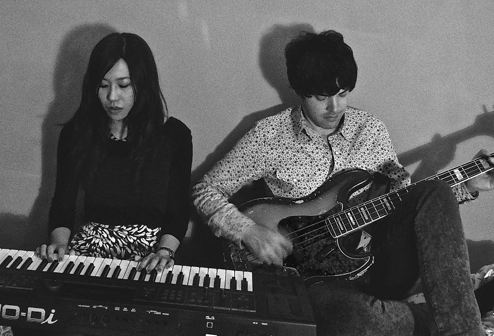












 Misfit City