‘Ghosts At Our Shoulders – The Tradition Unfolds’ featuring Chris Wood + Alasdair Roberts + Kirsty Potts + Stick in the Wheel + Martin Carthy + The Devil’s Interval (Kings Place, 90 York Way, Kings Cross, London, N1 9AG, UK, Thursday 3rd to Saturday 5th December 2015, various times) – various prices (£9.50-£22.50) – information & tickets
“The men have withdrawn and left me alone in a roomful of relics / But they gave me the song, so I carry the song that all men inherit.” – Alasdair Roberts
A series of songwriters and song interpreters inspired by tradition. The rich folk song tradition in these isles is a never-ending well of ideas and sensibilities as well as source material. The traditional canon is often attributed to ‘Anon.’ – a ghost perched on the shoulders of contemporary performers, who carry tradition forward and forge their own paths inspired by that legacy. This series of concerts features some of the most thoughtful and creative interpreters of song, whose unifying focus is the telling of the song. Voices close to the source, acting as a link from the then to the now.
With his work sometimes compared to that of Richard Thompson (though he cites his major influence as ‘Anon.’), Chris Wood is an uncompromising singer, multi-instrumentalist and songwriter whose music reveals his love for the un-official history of the English-speaking peoples, weaving his own contemporary parables into the tradition. His lateral take on the modern world follows an ideological thread from the likes of John Clare and William Blake, and as well as humble hymns and wry observations of the small things in life, his songs have included Hollow Point (a chilling ballad of the shooting of Jean Charles Menezez).
The twenty-year, eleven-album career of Scottish singer-songwriter and guitarist Alasdair Roberts has taken him from the early alt.folk of his Appendix Out project via mingled traditional and self-penned work to his latest, self-titled solo recording, featuring a span of Glaswegian folk talent. He performs songs which are “elliptical and gnomic, direct and personal, romantic and tender” and which have moved from an early economical style (partially inspired by the sparse aesthetic of indie rock) to the complex, esoteric and spiritual work of more recent albums. An enthusiastic and generous collaborator, he’ll be sharing the stage with Kirsty Potts, a singer of traditional Scottish folk for thirty years. Having recorded six albums with the famous folk duo of Alison McMorland (Kirsty’s mother) and Geordie McIntrye, she’s recently released her own long-delayed debut solo album ‘The Seeds of Life’.
Raw and uncompromising London folk quintet Stick in the Wheel record to the sound of sirens and birdsong in their long-rented East End front rooms. Brought up in the thriving culture of working class London and cutting their teeth in its diverse musical landscape, they now bring those influences and attitudes to their traditional music. Across three EPs, multiple festivals and award nominations and the release of their debut album in September this year, their music is as authentic as it comes, capturing a culture that is rapidly disappearing, and is at times brutally honest and grabbing.
Over five decades of a varied career (with Waterson Carthy, Steeleye Span, solo and beyond), Martin Carthy has been one of folk music’s greatest innovators, one of its best loved, most enthusiastic and, at times, most quietly controversial of figures. He’s a ballad singer, a ground-breaking acoustic and electric-guitarist and an authoritative interpreter of newly composed material; always preferring to follow an insatiable musical curiosity rather than cash in on his unrivalled position.
Playing in support of Martin are some of his regular tourmates: recently-reunited vocal group The Devil’s Interval (the teaming of singers Jim Causley, Emily Portman and Lauren McCormick, each of them solo artists in their own right). The group are well-loved for their spell-binding harmonies and passion for captivating story-telling through the medium of traditional song: their three distinctive voices blend beautifully, bringing new life to some of the old jewels of the folk-song canon.
Here’s something for readers in New York who like their art pop. Trevor Wilson of Anawan has been in touch with a welcoming Christmas message as cute, rambling, perky and openhearted as his band is. See below.
Anawan – ‘Having Fun’ show (Briscoe Music Space, 3 Sackett Street, Red Hook, Brooklyn, New York, New York State, USA, Friday 4th and Saturday 5th December 2015, 8.00pm) – $5.00-$15.00 (pay-what-you-want) – information and tickets
“We are doing a huge show on two nights, December 4th and 5th, at our music space in Red Hook, Brooklyn! At the intersection of danger and confidence comes, perhaps, one of the most important reasons for being alive. Sometimes ‘having fun’ is outwardly bold and courageous- motosports – skydiving. Sometimes just going out on a limb and making a joke is the boldest thing you can do in a day- just cracking a smile can take years for some! Love is more bold than any physical challenge- hearts are huge, sometimes mountains, with hiking trails to be lost in, make plans, need more, need less- as my friend Ethan Woods says, “love takes time”. But also, man, love is the funnest thing of all… what’s around the corner? You don’t know!
“The “sound” of fun is loose and electric, sometimes passionate, sometimes flippant. The songs for this very special show include new songs inspired by fun – but don’t expect them to all sound like it… that would be too easy, and what’s the fun in that? In addition to working with my dear historical Anawan members, we’re working with some new folks and doing things in a new way, and that in and of itself is the most palpably fun element of this whole production. It’s going to be a huge ten-piece ensemble playing songs old and new; a rhythm section, string trio, electronics, and the usual Anawan gang. We’ll round the show off with some Anawan standbys as well as a supremely fun song from wa-a-ay back when. I really hope to see you there! I leave NYC at the end of the year to live elsewhere! This is it, guys! Let’s do it! I’m not gonna say it again!
“Tickets are donation based- we won’t turn anyone away- but this will go towards paying the performers and keeping the space warm. Make sure to come by 8.00pm so you do not miss anything. This could make a huge difference in your life! Or it may go on the same as always! See you there!”
Straight into December, then (I’m ignoring the last day of November – it’s done me no favours this year) and before the splurge of upcoming musical Christmas parties, here are some assorted one-off gigs in London. Classical, post-classical and tango nuevo chamber concerts; and a man battering experimental songs out of a piece of beef. That’ll do. Most of these are at the Forge in Camden Town, with one Hackney exception.
* * * * * * * *
The Arensky Chamber Orchestra presents ‘Surround Sound II’ (The Forge, 3-7 Delancey Street, Camden Town, London, NW1 7NL, UK, Tuesday 1st December 2015, 8.00pm) – £12.00 – information & tickets
Since its debut in 2009, The Arensky Chamber Orchestra has established itself as one of London’s most exciting young ensembles, dedicated to revitalising the concert experience with theatrical and brilliant productions of classical music. Led by international prize-winning conductor William Kunhardt, the orchestra’s performances fuse electric performance with lighting design, ‘live’ programme notes delivered from the stage and unusual venue use. The ACO also regularly combine their performances with specially created food and drink menus and commissioned work from other artists, including video DJs, artists, actors and dancers. This will be the Forge’s second immersive ‘in the round’ performance from the Arensky Chamber Orchestra’s brilliant principal players; and on the menu are performances of two of the great string quintets.
Luigi Boccherini’s String Quintet in E major is one of the most famous quintets in the classical repertoire. The timeless melody of its third movement, ‘The Celebrated Minuet’, is woven into popular culture (appearing in ‘The Blues Brothers’ and ‘This is Spinal Tap’ as well as many other contexts). Tonight’s performance is in the original configuration (a conventional string quartet of two violins, viola and cello, plus a second cello as the fifth instrument) but over the years the piece has been rescored for a startling breadth of instruments including organ, mandolin duo, accordion and saxophone.
Franz Schubert’s String Quintet in C was the composer’s last instrumental work (composed during the final weeks of his life) and possibly his greatest accomplishment. It’s most iconic movement is the Adagio – a piece of such sublime tranquility that time seems to stand still throughout. Yet every other movement lives up to this extraordinary standard as well – from the expanse of the opening Allegro to the dazzling scherzo, it is a work of endless invention, radiant and rich sound-worlds and infinite varieties of texture and colour.
* * * * * * * *
The Deco Ensemble (The Forge, 3-7 Delancey Street, Camden Town, London, NW1 7NL, UK, Wednesday 2nd December 2015, 7.30pm) – £10.00 – information & tickets here and here
Established in 2013, The Deco Ensemble performs an eclectic and colourful combination of classical masterpieces, little-known gems and new avant-garde works. Rich in poignant harmonies, bold rhythms and elaborate ornamentations, their exuberant and glamorous repertoire includes works by Gustavo Beytelmann, Yannis Constantinidis, Frédéric Devreese, Ramiro Gallo, Graham Lynch, Astor Piazzolla, Sergei Prokofiev, Maurice Ravel and Anibal Troilo. A quintet of Sabina Rakcheyeva (violin), Bartosz Glowacki (accordion), Ricardo Gosalbo (piano), Rob Luft (electric guitar) and Elena Marigómez (double bass), they also collaborate with many of the world’s most promising and intriguing composers and performers, and write their own arrangements.
The ensemble’s adventurous approach and spirit of fearless exploration has its origins in the music of Piazzolla, re-imagining the Tango Nuevo Quintet which the composer formed during the 1960s in order to lay down the foundations of modern tango writing and to combine classical, jazz and traditional influences. Already the veterans of extensive European touring, Deco Ensemble have performed sellout concerts across Britain and across the breadth of Europe from west to east. Their critically-acclaimed debut album ‘Encuentro’ was released in July 2015.
Programme:
Ramiro Gallo – El último kurdo
Gustavo Beytelmann – Travesía
Astor Piazzolla – Muerte del ángel
Astor Piazzolla – Milonga del ángel
Astor Piazzolla – Tango del diablo
Frédéric Devreese – Passage à 5
Frédéric Devreese – Dream & Tango
Gustavo Beytelmann – Encuentro
Astor Piazzolla – Triunfal
Astor Piazzolla – Oblivion
Ramiro Gallo – Las malenas
* * * * * * * *
Cosmo Sheldrake (Rockfeedback Concerts @ The Forge, 3-7 Delancey Street, Camden Town, London, NW1 7NL, UK, Thursday 3rd December 2015, 7.30pm) – £11.00 – information & tickets
A multi-instrumentalist, an improvising sampler/looper and the crafter of sweet unorthodox earworms, Cosmo Sheldrake has been described as “a relentlessly experimental artist taking organic samples from the world and turning them into dreamy songs.” Certainly his best-known single, ‘Rich’, is a case in point. Its tripping, sunny melodies – apparently moulded from stray chunks of both English folk and contemporary R&B – bob over a rhythm made by tearing meat from a cow carcass.
This kind of experimentation and juxtaposition (the cute tunes and the occasionally slightly-sinister underpinning; the initiation of whimsical but multi-layered musical questions; the rough-and-ready play across a huge musical vocabulary) seems to lie at the heart of what Cosmo does. He’s certainly steeped in music – aside from the wide-spanning instrumentalism (beginning with early days on piano at age four, building upwards and outwards and somehow never stopping), he’s been a founder member of nine-piece polygenre band Gentle Mystics since 2007, and also runs assorted instrumental and beatboxing workshops, plus a choir, in his Brighton hometown. He’s also known for performances in unusual locations including boats, farmyards, laundrettes and public swimming pools; and takes inspiration from the world around him with unfiltered, undifferentiated spontaneity; being as likely to turn out a song about pelicans as he is one about humans.
This week’s show promises to be mostly improvised, intimate and has a pretty small number of tickets, so move fast if you’re interested.
* * * * * * * *
Project Instrumental + Tpongle + Zach Walker + DJ Jesse Bescoby present ‘Built On Bass’ (Hackney Attic, 2170 Mare Street, Hackney, London, E8 1HE, UK, Friday 4th December 2015, 7:30pm) – £6.00 – information here and here – tickets
Project Instrumental bring thrilling performances to unbounded audiences. Bold, imaginative and boundary defying, this virtuosic ensemble strips back the peripherals with their straightforward contemporary approach to create not just concerts, but experiences. For ‘Built On Bass’, they bring together a composer, a sound artist and a visual artist to create a multi-sensory musical environment using sound, electronics and cymatics. Taking a four-hundred year-old form defined by variations against a bass motif, they connect a passacaglia-inspired programme of music written within the last fifty years and create a twenty-first century experience, responding to the written repertoire through live collaborations that explore the physical sensation of sound and auditory-visual interactions.
The world premiere of a commission from composer Robert Fokkens features in an irresistible confluence of timelessness, change, cycles and variance alongside Arvo Pärt’s mesmeric Passacaglia in its version for 2 violins and Dmitri Shostakovich’s powerful Chamber Symphony op.118a. Inspired by and sampling the programmed repertoire, sound artist, producer and DJ Tpongle creates a ‘passacaglia for the present’, weaving a bass thread through the night, culminating in a live electronic set. Zack Walker‘s striking projections will extend the sound experience in space using his live liquid cymatics sculpture, original film content and analog feedback projections to respond to the live musical performance. Ace Hotel Guest DJ Jesse Bescoby rounds the night off with a set exploring the gap between contemporary classical and experimental, independent music. All can be taken with locally produced craft beers and food available to order throughout the evening.
Programme:
Arvo Pärt – Passacaglia
Robert Fokkens – New Commission World Premiere
Dmitri Shostakovich – Chamber Symphony op.118a
Tpongle – Live electronic set
Zach Walker – Live cymatics sculpture
For a glimpse of Zach’s cymatic sculpture work, see below.
* * * * * * * *
Coming up in the next post – Brooklyn art-pop, and a small but significant London folk festival; Over the coming weekend – a man in a top hat sings songs of Victorian-Edwardian never-weres, wild noise in Hackney and Yorkshire, and a couple of spells of jazz… but more on that later.
Some more concert dates for the current week. If you’re thinking that these have a definite female slant to them, you’re right. I’m indulging my latent X as well as stretching my perspective.
Holly Herndon expanded A/V show (featuring Mat Dryhurst and Colin Self)+ Jam City + Claire Tolan (Barbican & Rockfeedback present Illuminations @ Oval Space,29-32 The Oval, Bethnal Green, London, E2 9DT, UK, Wednesday 4th November 2015, 7:30pm) – £15.00
Having already made a showing at Liverpool and Bristol during October, peripatetic techno-pop/IDM composer Holly Herndon brings her expanded show to London. This is a full multi-media experience including the usual music, visuals and dance elements but with an interactive component that goes far beyond Holly’s onstage collaborations with programmer/life partner Mat Dryhurst and with interpretative dancer/additional singer Colin Self. In particular, Mat’s adaptive and conceptual SAGA software reaches out beyond the stage to work – consensually – with the audience members’ own browser histories and Facebook content; mixing it all into the visuals (and, potentially, the sounds) as a communal mashup, both representational and communicatory.
Intriguing as this factor is, it’s an adjunct to Holly’s music; which remains the core material of the show. Continually glitched, tweaked and deconstructed, her compositions are a cool, complex, thoughtful and exhilarating mixture. They’re informed by post-classical forms, dance techno, and anthemic synth pop; they utilize experimental textures and broad vocal stylings (from standard singing to semi-voluntary sounds) and they bury philosophical queries deep within their tunes. Holly’s soundwork is as immersive as her stagings, full of implied questions and reflections regarding our access to and immersion in technology and how this affects the way in which we think and express ourselves, leaving comet-trails of information, interaction and yearnings.
All of these additional subtexts and pointers are there if you want them, but Holly is first and foremost a communicating musician, and her pieces are as melodious and accessible as they are multi-layered. Drawing on her ongoing music studies (doctorate level at Stanford) , her time as a precocious and enquiring teenager steeped in the heat and fun of the Berlin club scene, and her work with everything from choirs to customised laptop software, they sometimes sound like particularly complicated pop songs, stuttering their way through myriad changes of attention and focus. Sometimes they sound like accelerated dream-state dances; sometimes like madrigals sung during earthquakes (see Unequal, below). At other times, they’re like the chatter of path-switching in a circuit; or like carefully-directed cultural channel-surfings which quick-step deftly back and forth across a breadth of urban art and experience (from grand opera house to downloads in cramped bedsits). Brain food which encourages you to wander.
Also on the bill are Jam City and Claire Tolan, both of whom share Holly’s interest in interactions and in the results of our being embedded within a dense informational culture, although each has their own way of approaching the situation.
Jam City is the alias of dance-electronica producer and deconstructionist Jack Latham. Though Jack’s background in fashion and “corporate espionage” sounds almost too good to be true, as if it’s been dream-tailored for counter-cultural media discussions and for high-end elitist posing, he doesn’t use it that way. As a musician, he’s evolved from collaging various dubstep tropes towards using his work to develop and express questioning, outright political critiques of neoliberal capitalism (such as the Unhappy single, which explores the dulled angst of online porn consumers while juxtaposing it with riot footage). In the process, Jack’s also developed as a performer – backgrounding the laptops and the passive role of the standard electronica performer in order to retake the stage as guitarist and singer, and delivering a new phase of material described as sounding like “a Prince record constructed from cold, chunky industrial sounds”.
Claire Tolan is an artist, programmer, sampler, writer and soundscaper specializing in autonomous sensory meridian r – a psychological process in which carefully-arranged sound and speech – usually a blend of themed, targeted whispers and quiet diegetic noises (scratches, scuffs, intimate room sounds) – triggers euphoric physical and mental reactions in the listener. With sharp wit, Claire links all of this to new developments in programming and acoustic surveillance technologies, exploring the question of how it might be applied: from simple mood enhancements and healing systems through to neurolinguistics and perception and to the potential manipulation and control of people. Her recent Holly Herndon collaboration Lonely At The Top (see below) might give some clues as to her concert performance. A cosseting monologue, coffee-pot dribbles and the close-up noises of small rooms are interspersed with the rubs and slaps of massage, fingernails ticking on keyboards and screens, and increasingly intimate sounds of hand and mouth: the language, desires and end results of relaxation tapes, executive relief, socially-reinforced senses of entitlement and prostitution blend and overlap to sardonic, disturbing effect.
Information and tickets for the concert are here while the Facebook event page is here. At the end of the month, Holly will also be appearing at All Tomorrow’s Parties at Prestatyn.
* * * * * * * *
There are some similarities between Holly Herndon and Laura Moody – not least an overlap with classical music and a sense of being on the outcrops of songcraft, delving up malleable truths and questions. Yet whereas Holly’s a post-classical theoretician (reconciling her education with her human instincts, and with life outside the college bubble) and works primarily on computer, Laura comes from older and more familiar traditions, and is almost exclusively an acoustic performer. Possessing outstanding talent both as a singer and as a cellist – and able to cover both fields simultaneously, as well as beatboxing and cello-drumming – she pounces into her own music with the terrifying, exhilarating technical skills of a top-drawer classical soloist.
Laura’s songwriting instinct, meanwhile, seem to come from multiple directions at once. Tense twentieth-century string figures (from her earlier years playing avant-garde pieces with the Meredith Monk Ensemble, and her current work with the Elysian Quartet); ancient, eerie folk airs; expressionist opera; P.J. Harvey’s cleaver intensity; the clever, idiosyncratic and individual art pop of a Kate Bush, a Tom Waits or a Bjork. Everything that she delivers sounds immediate, whether it’s the savagely equivocal hormonal take-down of an older man on Creeping Alopecia, the raindrop attenuations of Call This Time Love, or the stormy dissections of love-gone-wrong and betrayal on Turn Away and We Are Waiting.
The live gigs are enthralling wonders: supple switchings between Laura’s own welcoming personality and the performance persona which handles the songs, blurring the line of physicality which separates woman and cello. She’s out on a brief tour now, playing outside London for a few events. Go see for yourselves.
Laura Moody:
The Four Bars, 15 Castle Street, Cardiff, CF10 1BS Wales, UK, Friday 6th November 2015, 8.30pm) – £5.50 –information – tickets
99 Mary Street, Hawk Works, 99 Mary Street, Sheffield, England, UK, Saturday 7th November 2015, 7.30pm) – £4.00-£6.00 – information – tickets
* * * * * * * *
For many female pop musicians, an increasingly outright or explicit public sexuality is both a marketing point and the prime hook. To an extent, this is also true of Jenny Hval. Many people will have initially heard about her thanks to what seemed to be a head-turningly saucy lyric:“I arrived in town with an electric toothbrush pressed against my clitoris.” Curious (and possibly a little numbed by Rihanna, plus memories of lubricious Prince party-funk), many of us will have followed this expecting a licentious slow jam, only to find something very different – the opening line of a mirror-calm songscape of hovering bells, limpid murmurs and breathed-on acoustic guitars which dealt with the secret worlds of strangers within cities and, in particular, their self-reliance.
A polymath whose methods blur as artfully as her perspectives, Jenny doesn’t write songs so much as drop carefully-charged texts and pointers, and then explore and adorn these recitatives with chantlike melodies and poised minimal instrumental textures, pulling them apart and working in and out of the word-rhythms. Her guitars, keyboards and samplers (as well as her heavy-lashed, light-tongued vocals) work like soft-edged sculpting tools. Her lyrics are the lines of resistance.
For both new listeners and previous converts, sexuality remains a prime Hval hook. It’s what we expect to hear from her, although we’ve quickly learnt to appreciate that she turns the expected approaches on their heads and back-to-front. She revels in the unfixed: in the course of a single song, lovers will pass fluidly from mysterious passion to friendship to absence, and between gender, ages, species or state. Even when singing of cupping her own cunt (while cupping the blunt, unadorned and troublesome word itself, delivered throughout her songbook without a hint of shame, taboo or aggression and with a succinct matter-of-fact poise) she’ll let the action lead her somewhere that doesn’t fit the usual expectations and commodities – appreciating its centrality at her body’s core; being inspired to cup in turn a lover’s “soft dick… accepting restlessness, accepting no direction, accepting this fearful wanting that isn’t desire… can we just lie here being?”; or imagining a world of peaceful masturbators (“a million bedrooms with hands softly lulling… without telling anyone, a million ships come alone out on the calmest seas”) while asking, with a sense of disquiet “are we loving ourselves now? Are we mothering ourselves?”
Also running through Jenny’s work (whether entwined with or separate from the sexual themes), are ambiguous accounts of bodily disintegration. Opening her second album ‘Innocence Is Kinky’ with an account of watching online porn, she moves from commodified enervation into an eerie and exultant dream of escape, relinquishing her own body and its passive needs, and finally symbolically destroying the eyes with which she consumes the images. Yet this song and its sisters aren’t quite nightmares. Sometimes they’re triumphs – disassociative fantasies of freedom in which the wrack and ruin seem to be the natural rites of passage of a cool mind walking free, unconcerned, its passions become processes.
Jenny’s writing casts a wide net – violent upsets echoing classic French surrealism; deep-running strands of myth both classical and original (from the “Oslo Oedipus” of Innocence Is Kinky to the dark, quasi-pagan tree-figure in Amphibious, Androgynous that stands as lover, doppelganger and the next phase of self); and musings on the ambiguous trap of language (“the tongue is upon for the restless /An indecipherable alphabet / Each word an island less… And we speak in tongues from part to parts, broke all to parts / From invisible state, to invisible state…”). Most recently, on her latest album ‘Apocalypse, Girl’ the political subtexts have broken cover to become direct challenges (“You say I’m free now, that battle is over, / and feminism is over and socialism’s over. / Yeah, I say, I can consume what I want now..”). So too have preoccupations with ageing and survival (in the breathless narrative of Heaven, surrounded by loops and fractures of cemeteries and childhood choirs, Jenny wrestles with the pull of memory and the drag of mortality) and a increasingly solid approach to identity. “What is it to take care of yourself? Getting paid? Getting laid? Getting married? Getting pregnant? Fighting for visibility in your market? Realizing your potential? Being healthy, being clean, not making a fool of yourself, not hurting yourself? Shaving in all the right places?”
All of the above – the obliqueness and the rapier hits – makes listening to Jenny’s records akin to haunting her apartment at 2am (or some similar time when manners and manneredness come unstuck and the shapes of other truths come walking). I’ve not been fortunate enough to see what her music is like live – though I know that past concert showings have seen her play bolstered with guests or simply alone, surrounded by laptops, devices and ideas. On the five quick dates of her current UK tour, you’ll be able to see for yourselves.
On the Glasgow, Manchester and Bristol dates, Jenny will be joined by her on-off tourmate Briana Marela, a singer-songwriter from the Pacific North-West who’s currently working a string of European tour dates in support of her second album ‘All Around Us’. As you might expect from something recorded in Iceland and co-produced with Sigur Rós associate Alex Somers, ‘All Around Us’ is ghosted and garnished with touches of Hopelandic enchantment (with beautiful smeared, paper-thin sounds intruding on the edge of the mix, like lost amnesiac ghosts or distant pipes), but it’s very much Briana’s inspiration – a luminous, thoughtful work blending layered melodic sample-patches and banking her petal-delicate vocals into choirs and a capella counterpoint.
Though Briana cites Björk, Laura Veirs, Vashti Bunyan and Meredith Monk as influences (she has something in common with Laura Moody, then), I can also hear the same kind of all-round sound-mastery that’s on display and working away in the songs of Imogen Heap; deep-level sonic exploration and sound curation tied to the urge to tell you a story and sing you a straight earworm. In the album’s lead single Surrender I can even hear something of the pure pop of ABBA, while the midnight lushness of the follow-up, Dani, recalls a Julee Cruise ‘Twin Peaks’ ballad.
Though Briana’s voice is soft, it’s never wispy – never insubstantial. If there’s a hint of girl-next-door to what she does, she’s the quiet, observant girl full of thoughts, going her own way but ready to let you walk alongside. Like Jenny, though less explicitly, she explores possibilities of intimacy. Her songs hover carefully on the borderline between selfhood and loneliness, a delicate staking out of possible togetherness, subtly resisting the pressures to put out or submit, to be deformed by needs and expectations (“What does love mean in this day and age? / To me it’s a moment where we resonate at two frequencies close in phase… / It’s not a competition / Everyone has music within them.” ). Meanwhile, the perfectly-pitched American-visionary tone of the album (its hallucinatory fairy-tale sonics, leaflike piano falls and misty country swells) suggests that there’s common ground between Briana’s dream pop and the ostensibly cleaner work of breakthrough CCM-pop singers like Lexi Elisha, which in turn suggests that there’ll be a lot of people who’ll end up liking this.
* * * * * * * *
In between dates with Jenny Hval, Briana Marela will also be joining the bill at another Illuminations concert in London, this one a stew of assorted flavours which also includes the battered Americana of Lift To Experience frontman Josh T. Pearsonand the skewed Tyneside noise-troubadour work of Richard Dawson.
Probably because of the female orientation of this particular post, I’ve got to admit that I’m more intrigued by the youngest act on the bill, and the only other female one. It’s difficult to work out just how tongue-in-cheek the “psychedelic rag-doll sludge-pop” duo Let’s Eat Grandma are, assuming that they’re joking at all. Eyes down, singing from beneath and behind tumbling pre-Raphaelite locks, and tucked into stolen Stevie Nicks dresses, Rosa and Jenny rummage with various instruments like toybox-divers and play songs as if it’s only occurred to them to do so. Two Norwich teenagers who’ve known each other since childhood, they’ve sustained, into near adulthood, that mysterious blankness of two little girls who are ignoring your interruptions to their game. The songs themselves are tangled musical fairy stories, or (as with ‘Eat Shiitake Mushrooms Into Chocolate Sludge Cake’) extended wooden-legged instrumental mantras owing more to Faust or Beefheart: spontaneous-seeming, utterly absorbed in themselves. The band feels like a musical chrysalis twitching what might become an astounding breadth of wing. It’s all to discover.
Here’s a quick signal booster (or, perhaps more accurately, noise booster) for the debut Mutations festival coming up in Brighton at the end of November. (The press release just came in from Stereo Sanctity today). Note that tickets go on sale in the middle of this week, and that there’s only a thousand tickets. I’ve just seen a Facebook counter suggesting that 330 people have already committed themselves to tickets. Move fast.
Mutations is a new multi-venue inner city festival in Brighton, England, born out of last years acclaimed DRILL:BRIGHTON. With Wire’s touring project moving onto the next urban sonic assault, co-curators One Inch Badge decided the time was right for a forward thinking, annual, artist-lead festival that would be static to Brighton on the last weekend of November
Spanning two days and nights on the 28th and 29th November with an incredibly intimate capacity of just 1,000, Mutations is a music-lover’s event. Alongside the music you can also expect pop-up record fairs, poster art exhibitions, photography and more.
Mutations is a creative mass of genre hybrids and expression, delivering some of the most inspiring, creative and interesting music the world has to offer; a host of other national and international acts including genuinely alternative rock, aggressive noise, experimental house, singer-songwriters, doom metal, electronica, drone, experimental folk and various other experimental sounds.
Here’s some quick info on upcoming gigs in early June which I’ve heard about – all of them in London.
Over the last couple of years, Westminster Kingsway College has established itself as one of the capital’s finest homes for quirky art-rock – by which I don’t mean student hobby bands thrown together for campness or for ironic prankery, but a rich, complex, committed electric music spanning the range between gutter-punk and flouncing prog via metal, jazz, folk, avant-gardening and anything else which gets melted down into the stew. Here’s one of those gigs that proves the point.
A Formal Horse + Ham Legion (Westminster Kingsway College, 211 Gray’s Inn Road, London, WC1X 8RA, Tuesday 2nd June, 6.30pm)
A Formal Horse is a new progressive rock quartet based in Southampton. Although the band’s sound is difficult to pinpoint, their dense instrumental passages are reminiscent of King Crimson and Mahavishnu Orchestra, whilst Francesca Lewis’ lead vocals evoke the whimsical surrealism of the 1970s’ Canterbury scene. Wonky melodies and serene vocals over a brutal sound – their music keeps you on your toes. However, A Formal Horse go beyond simply regurgitating the music of their predecessors. With influences as diverse as Bartók and Bon Iver, the band prove that there is still much territory to be explored in the field of British progressive rock.
In June 2014, the band released their debut EP, which was recorded by Rob Aubrey (IQ, Transatlantic). They went on to perform at London’s Resonance Weekend alongside Bigelf and Änglagård, and were described by Prog Magazine as a “festival highpoint”. Since, they have shared stages with Knifeworld and Lifesigns, cementing their position at the forefront of the British progressive scene.
Ham Legion spent 2014 honing their sound and developing a storming live show. You can expect a collision of beaming up beat power pop, grinding metal outbursts, dramatic changes of mood, sudden passages of twistingly epic prog then moments of restrained delivery and somber reflection. They are striking out in 2015 with the release of their debut album towards the end of the year.
Olga Stezhko (the far-thinking Belarusian classical pianist whose ‘Eta Carina’ album impressed me so much last year) has two London concerts coming up in the first fortnight of the month. The second’s likely to be an all-access crowd-pleaser. Given its charity fundraiser status, I’m not sure whether the first is likely to feature or indulge any of Olga’s intriguing conceptual preoccupations with Scriabin, Busoni, cosmology and early twentieth century consciousness, but even if it isn’t it’s a great opportunity to see a fine musician at work in a grand location.
Programme not revealed – free admission, donations requested.
EC4 Music in aid of The Prince’s Trust (Barbican Hall, Tuesday 9th June, 7:30pm – 9:30pm)
The choir and orchestra of London-based EC4 Music return for their seventh fundraising concert in aid of The Prince’s Trust with a stirring selection of music from both sides of the Atlantic.
Programme:
Leonard Bernstein – Overture from ‘Candide’
Aaron Copland – Appalachian Spring
George Gershwin – Rhapsody in Blue
Vaughan Williams – Serenade to Music
Leonard Bernstein – Chichester Psalms
Eric Whitacre – Water Night
Hubert Parry – Blest Pair of Sirens
Performers:
EC4 Music Choir and Orchestra
Tim Crosley – conductor
Olga Stezhko – piano
Claire Seaton – soprano
Roderick Morris – countertenor
Thomas Herford – tenor
Adam Green – baritone
Tickets available here – prices from £10.00 – £35.00 plus booking fee.
Some of London’s most active art-rockers are brewing up a free Zappa homage in Croydon at around the same time. Details below:
The Spiders of Destiny play Frank Zappa (The Oval Tavern, 131 Oval Road, Croydon, CR0 6BR, Saturday 6th June, 8:30pm)
Great googly moogly! On June 6th, nine-piece tribute band Spiders Of Destiny come to The Oval Tavern to play a marathon set of music by the late, great Frank Zappa. Featuring world class performers with a sense of humour from notable prog/alternative bands such as: Knifeworld, Perhaps Contraption, Pigshackle, Medieval Baebes, The Display Team, Hot Head Show, Poino, Spiritwo, First, A Sweet Niche and more. So polish up your zircon-encrusted tweezers, trim your poodle, learn the mudshark dance and join us as we propagate the conceptual continuity instigated by one of the masters of modern music.
More info here – this gig is FREE ENTRY but there will be a donations jug doing the rounds during the intermission.
Anyone with an interest in David Bowie, rock history, cabaret, electropop and all of the other things that get swept up into Bowie’s art should head to Soho on Thursday 11th June for A Bowie Night at Gerry’s Club, at which pianist and writer Clifford Slapper launches his book ‘Bowie’s Piano Man: The Life of Mike Garson‘ (which also has its own Facebook page).
As well as readings and signings there will be performances of Bowie songs from avowed fans Danie Cox (from “flock-rockers” The Featherz), Ray Burmiston (of ’80s heroes Passion Puppets), club siren Katherine Ellis (Freemasons, Ruff Driverz, Bimbo Jones etc.) and acoustic singer Jorge Vadio. There’ll also be a performance from a longtime ‘Misfit City’ favourite – London balladeer, Brel translator and onetime ‘Pirate Jenny’s’ host Des de Moor, who’ll presumably be singing his Bowie-gone-chanson interpretations from his ‘Darkness and Disgrace’ show. (I’m particularly pleased to see that Des is back onstage. It’s been a long time.)
More on the book below, and more on Gerry’s Club here.
“It is pointless to talk about his ability as a pianist. He is exceptional. However, there are very, very few musicians, let alone pianists, who naturally understand the movement and free thinking necessary to hurl themselves into experimental or traditional areas of music, sometimes, ironically, at the same time. Mike does this with such enthusiasm that it makes my heart glad just to be in the same room with him.” – David Bowie
Mike Garson has played piano on sixteen David Bowie albums, including Aladdin Sane, with his celebrated piano solo on its title track, Diamond Dogs, Young Americans, 1. Outside and Reality. He has also played live with Bowie on countless tours and shows, and remains his most long-standing and frequent band member.
For some time Clifford Slapper has been working very closely with Garson to write a book which explores the life of this extraordinary and eccentric modern musician. It documents in detail how as a pianist he was catapulted overnight from the obscure world of New York’s avant-garde jazz scene to a close and long connection with Bowie. In addition, Garson is recognised as a classical virtuoso, a jazz master and one of the world’s greatest exponents of improvisation. He has also recorded and performed live with other rock legends such as the Smashing Pumpkins and Nine Inch Nails. All of this is covered by this first ever biography of Mike Garson.
Its starting point was several days of in-depth and frank conversation with Garson himself, and covers a wide range of themes which will be of interest to all Bowie fans, but also to anyone with a passion for music, social history or the process of creative inspiration. Input has also come from many interviews with those who have worked with him over the years, including Earl Slick, Trent Reznor, Sterling Campbell, Reeves Gabrels, Dave Liebman and many others.
Despite the underlying wildness of her songwriting, Marika Hackman appreciates and makes use of the power of restraint. Previous songs such as Bath Is Black and Itchy Teeth have revealed a compelling songwriter with a cool fascination for messy play, for psychological dirt and guilt and the wracked physicality of the uneasy soul. That she doesn’t scream these things out adds to her power. Her cool, polished folk tones deliver her surreal, slithering insights and her deft, subtle analyses with the same thoughtful poise, whether she’s chiding or sharing, empathizing or emphasizing.
Underneath the spooky Latinesque folktronica groove of ‘Animal Fear’ (full of Shankar-ish string wails and spaghetti western gunshots) a menstrual werewolf subtext is swirling. Part ‘Ginger Snaps’ and part ‘Being Human’, it embraces blood and feminity, bandages, and the helpless stink of male terror. “I’ve been weeping silent like a wound. / Would you stitch me up or let the blood soak through, / watching my world turn from white to blue?” She sings as if she might be dying; she sings as if to a lover or a brother; but she’s never really pleading, never wholly dependent. She sits inside her transforming body and watches the changes come; watches the fumblings of her companion with the same half-resigned curiosity. “Look into my eyes and convince us both that I’ll last through the night; / I could land on my feet if I tried. / I’ve never jumped a chasm so wide / and made it to the opposite side. / Even now as we’re standing here, / I can see the doubt in your eyes, / I can smell the animal fear.”
The song is a tender, chiding mixture of vulnerability and disappointment, but its observations are shot through with self-awareness. “I was not a heavenly child,” admits Marika, “savage, with a temperament wild.” As the song travels through the changes, it blends into acceptance, a new understanding bleeding through in flashes (“oh, my body trembling… / and teeth… / I won’t bite.. / Sweet too soon, treacherous night.”) We don’t get to find out how this ends, but even as Marika (now more initiate than invalid) murmurs “she calls my name” you’re left with her finely-honed sense of self. Under the fur and nipples, under the wracking pain, an image emerges of a woman who may wander but will never be truly lost.
* * * *
Tanya Tagaq – a Canadian Inuit throat singer – also seems to have some empathy with this kind of lycanthropic humanity. She’s recently delivered a forthright cover of Pixies’ ‘Caribou’ like a tundra bolero with violins and horns, picking up on its occult hints and dreams of a changed, more animal life outside the city and slinging it back with an Inuit twist and the bloody-minded wit of a hard-bitten outdoorswoman. Tanya first came to broader attention a decade ago (thanks to her four-song turn on Björk’s ‘Medúlla’), and has continued to work her way into Western musical awareness via work with the Kronos Quartet and Mike Patton. This kind of collaborator choice suggests a determination to broaden and involve her music rather than dilute it. With last year’s award-winning Canadian success for her ‘Animism’ album, she’s pitched to continue making breakthroughs on her own terms.
‘Uja’ confirms this. A trailer single for a broader overseas release of ‘Animism’, it has something in common with previous deeply-involved folktronic endeavours such as or Foxout! and Mouth Music. It might mate and merge with electronic beats in longstanding worldbeat fashion, but rather than pandering to easy tastes it’s a stirring textural affair, deliberately pitched between ritual and pounding. It feels like an Arctic club night with all of the technology freezing round the edges and only kept functional by fierce body-warmth.
Log-clock ticks, harsh electronic reverb, and a ragged fabric of synth-noise and incisive drumming make up a base and a blanket. Over, under and around this Tanya works in multiple layers of percussive hum-grunts, drawls, gasps, seal barks and harmonic growls. Occasional shamanic interjections in Inuit (sliding in over the top like a wake-up call filtering through sleep) might be terse warnings, defiant fuck-you statements or camouflaged jokes at the expense of Anglo monolinguals. With Tanya being an assertively political artists and performer, they could be any or all. If I’m the butt of the joke, though, I can take it this time. ‘Uja’ made the blood jump in my feet and in my temples.
* * * *
London/Angeleno good-time band Swim Mountain retrofits, but in an easier, breezier way. They cover Beyoncé’s ‘Love On Top’ like someone flirting under a blanket, musical lines and instrumental parts wriggling under the surface like coy, excited limbs. As he showed on the debut Swim Mountain EP last autumn, head Swimmer Tom Skyrme is very good at disguising fairly limitd resources under a swelling, lucid-dream production style. He claims to have put this one together on a whim, belatedly falling in love with the song’s bravura modulations and ‘80s-inspired peppiness.
Personally, the Beyoncé diva-juggernaut leaves me cold. Despite her well-honed skills and precision vocals, much of what I see is branded, sub-Madonna acquisition and media powder-puffing (if she is the twenty-first century Madonna, we’ve all gone beige) so it’s interesting to hear the song outside her wind-tunnel of glamour. Tom’s lightly buttered, lysergic popcorn-soul take makes no attempt to match the ceiling-bumping, helium balloon assertiveness of the original. The pace is agreeable ‘70s midtempo; the wah-guitar plays peekaboo; the boinking bass comes sheathed in a tight reverb. The phaser button adds a gentle, sexy yawn; Tom’s warm nasal drawl (just on the likeable side of bland) dawdles amiably on the swooping paths Beyoncé cut, making no attempt to match her commanding calisthenics. A cloudy puff of keyboards fills the gaps, like a lazy pink smoke-bomb.
Previous Swim Mountain stylings have mostly recalled the stoned, sleeting Byrds guitar of ‘Five Miles High’: this one sounds like what Arnold Layne might have become if Syd Barrett had drunk deep on Memphis soul before he rolled another one, or like a more nappy-headed tie-dyed version of the Clarke/Duke Project. It’s all a little throwaway (despite the unexpected ending, which scrambles down an unexpected dip and clunks like a plastic lyre) but it’s lovingly crafted throwaway; a sugar basket which takes less time to eat than it does to admire. Plus I do like the way that Tom’s mix rolls out individual delicate moments for our attention, as if his faders were the sliding drawers in a jeweller’s desk.
Marika Hackman: ‘Animal Fear’
Dirty Hit Records (no barcode or catalogue number)
Download-only single (released 9th January 2015)
Tanya Tagaq: ‘Uja’
Six Shooter Records (no barcode or catalogue number
Stream-only single (released 6th January 2015)
Swim Mountain: ‘Love On Top’
Swim Mountain (no barcode or catalogue number)
Stream-only single (released 7th January 2015)
Both as year and as song, ‘2015’ is another fitful emergence for Enfield polymath Glen Byford – poet, photographer, digital trinketer, small-time maker and on-off DJ. In the past, he’s put out his original music (anxious water-tank electronica, skinny-wistful glitch tunes, poppy plunderphonics and disillusioned spoken-word bedsit blurts) under the cover names of Hunchbakk or Giles Babel. As of this year, all projects seem to have merged under the Babel label and shrunk down to their most skeletal: or perhaps that’s just how it feels under a January hangover.
Peeling off and discarding his usual quilt of samples, the perpetually uncomfortable Glen distractedly slung this one together on an iPad app while reading and watching television – as if he was working behind his own back and didn’t want to catch himself at it. It’s downbeat, clipped and telegrammatic – budget-tronica pows and zips; a knocking and near-undanceable beat; minimal decoration. Rather than opting for best hopes and public drive, he chooses to sit back and take the poison pill – “Another new year, and another January of good intentions. / Another January of new perceptions, misconceptions that things could change.”
The music, though, seems to disagree – glitching and flipping into a rumble of double-time, or shoving the voice to the back of the drawer like an unwanted sock. Meanwhile, Glen fidgets between hope and cynicism (“This year will be my year – / yeah, just like last year, / and just like every year,”)and represents that year with a brief collage of Playstation chip music, pings and trills, mutters, and incongrous hip hop samples of block party shouts and cheering crowds (“we have a party, right?… I tell you what we do…” Uncertain inspirations reign. Glen pads, tentative and barefoot, around his room.
* * * *
Shot of Hornets: ‘Elvis is Dead?’
In the time that Glen would take to roll over twice and go back to sleep, Shot of Hornets would have squeezed five quick changes into a song. Apparently not much older than 2014’s Christmas wrapping-paper, this band’s blocky, power-oozing pounce-and-trap tones suggests a much longer-established band: they mingle math-metal’s block-feints with hot funk spaces, thrash riffs with anthemic grunge righteousness, but never entirely pin themselves to anything. When he’s not bursting into hardcore screams, the soulful wreck of singing drummer Conor Celahane’s vocals are reminiscent of gospel-tinged hard-rock heroes King’s X (as are the clotted, meaty guitar wails of his brother Dan), but there’s just as much of Megadeth’s grand irritation in the stew as well.
Elvis is Dead? is a shape-changing dust-off about nothing more specific than uncertainty, vague disappointment and finding the pieces to pick up. The King himself only shows up in a desultory moan about Spotify (so I’m guessing that there’s something being said about the commodification and shrinkage of cultural heroes here), but generally the song sees the band gathering together their compass-bearings and firing off the odd sarcastic broadside. “So here we are now, / no better and no worse off, / in the same world as everyone else,” notes Conor, going on to confess “I have a number of doubts.”
The music is sinewy and jumpy beneath the roaring guitar, and every couple of minutes, there’s a change – a glide of softer melody, a shift into death growls, a barrage of bouncing swipes and screams. “The first prize for gift of the gab / goes straight to you / how d’you feel about that?” Conor yells before the song turns anthemic, finding both the funk and its final feet. (“Turning my back on ignorance, turning my back on selfish people, turning my back on ignorance and lies.”) In a final riff-bout, the rhythm hurtles and rebounds like an evil-minded squash ball. Promising. Let’s see what they do when their concentration settles.
* * * *
Even compared to the other prog juggernauts of the ’70s, King Crimson aren’t given much credit for contributing to the classic songbook. Given the various song-gems lurking in their back catalogue, this is unfair. It probably owes more to Robert Fripp’s unfortunate (and somewhat unfair) reputation as a lofty demon headmaster, verbally withering casual listeners from his lectern before immolating them with sprays of burning guitar sludge – an image which does his Bowie collaborations no harm, but which drags his main band down like a concrete overcoat. The fact remains that outside of slavish interpretations from neo-prog bands, as far as Crimson cover versions go there’s been little more than a speckling.
In the past few years, though, this has changed significantly. In 2011, The Unthanks transformed Crimson’s Starless into a haunting Northumbrian chorale. The year before, Symbolyc One ripped 21st Century Schizoid Man to ominous ribbons and recombined them for Kanye West’s ‘Power’. A year before that, Maynard James Keenan of Tool snarled his way through a pure Schizoid Man cover for The Human Experimente (It was impressive, in an art-metal way, although personally I’m keener on Johnny G’s lo-fi delta-blues version from 1982).
I Talk to the Wind, however, is probably the closest King Crimson has to a standard. A ghostly, semi-existential folk song from their first album, it’s already attracted several reinterpretations. Italian new-wavers Violet Eves did a respectfully mournful and elegant cover in 1985; Camper Van Beethoven and Eugene Chadbourne tore up a hilarious country-punk version in 1987. Probably the most famous version is Opus III’s techno-house take from 1992 (complete with New Romantic Gilliam-cum-Dali fantasy video, mashing up ‘Dune’, ‘Logopolis’ and ‘The Man Who Fell to Earth’ as Kirsty Hawkshaw’s androgynous glam-waif stalks, slinks and smoulders her way around a desert lodge).
For their own version, Heylel have chosen to recapture some of the original Crimson’s sumptuousness. Serving as a coda to the Red Giant sequence on the epic prog/folk/metal of their ‘Nebulae’ album, their take on I Talk To The Wind is solemn and sealed. The ceremonial pace, the full-scale orchestral tremble, the fathoms of shoegaze-guitar shudder and the solemn, Gilmourian guitar solo render it inter-generationally grand: touching on the string-swoons of Craig Armstrong or Sinatra’s orchestras, the stadium turbulence of ‘The Wall’ and the mournful psychedelic drones of Spiritualized or Slowdive. The video suggests that they’re heading up the live sessions in the Black Lodge from ‘Twin Peaks’.
Yet the original song is a small, lonesome beast – lyrical flute, a gentle fug of guitar, a pre-ELP Greg Lake singing the melancholy words with a vulnerable humility that he’d never show again. Heylel singer Ana Batista keeps this in mind. Her vocal might be full of assured, implicit soul-pop power, but she’s never tempted to let rip, never loses sight of that original restraint: and, restored to a waking dream, the song’s allowed to settle over us once again.
Giles Babel: ‘2015’
Hunchbakk (no catalogue number or barcode)
Download-only single (released 1st January 2015)
Shot of Hornets: ‘Elvis is Dead’
Shot of Hornets (no catalogue number or barcode)
Download-only single (released 1st January 2015)
Heylel: ‘I Talk To The Wind’
Heylel (no catalogue number or barcode)
Download/streaming single (released 7th January 2015)
Get them from:
Giles Babel: ‘2015’ – Bandcamp (pay-what-you-want)
Shot of Hornets: ‘Elvis is Dead’ – Bandcamp (pay-what-you-want)
Heylel: ‘I Talk To The Wind’ – Bandcamp or iTunes (as part of ‘Nebulae’ album)
Ironically, we often record cover versions to find out – or to show – who we are.
Markus Reuter, for instance, would prefer it if other people could stop telling him who he is. Too many of them are telling him that he’s obliged to be the twenty-first century’s Robert Fripp. They can’t get past his Frippic virtuosity on touch guitar, his past as a Fripp student, or his work with the man’s former King Crimson colleagues (in Stick Men and Tuner). They can’t even get over the fact that these days he plays all of the Fripp parts in the Crimson ProjeKCt…
Ah. Well, all right, but Markus’ vivid success in the sprawling latterday Crimson family shouldn’t have to box in a musician as stubbornly wide-ranging as he is. Yet it does, even though you don’t have to scratch him too deeply to discover that he’s not as enFrippened as he seems. When it comes to willful and wayward yet methodical 1970s virtuosi, Mike Oldfield is kernelled deeper in Markus’ heart than Fripp is. Hence this unexpected and open-armed cover of a long-forgotten Oldfield song, recorded by Markus in cahoots with long-term collaborators Lee and Lisa Fletcher, and demonstrating that Markus deals with more musical colours than just ‘Red’ ones.
A few sketchy parallels can be drawn here. When Oldfield released the original Islands single (back in 1987, towards the uglier end of his Virgin Records contract), he wasn’t entirely sure who he was. Though he’d made his name via intricate, acclaimed confections of multi-instrumental experimental rock, spatial Celtic folk and classical minimalism, by the mid-’80s Virgin had talked him into writing hit-and-miss pop songs dressed up with fat blobs of Fairlight, gated reverb and arena grease. The ‘Islands’ album floundered to cover both poles – a side of lengthy neoclassical fare (heavily spiced with chants, electric flourishes and whirring jazz flute) counterweighted a side of echoing pomp-rock (with straining guest singers and drums like torpid cannons). Even back then, this didn’t age well, despite spawning a vapid video album in which Bonnie Tyler and Kevin Ayers (in ‘Miami Vice’ regalia and power-frosted hairdos) sang and jostled their way through pastel-misted virtual realities and through corny CGI blizzards of New Age totems, ducking flying Tutankhamuns as they went.
At that point Mike Oldfield was pretty lost. Though he’d only stick the situation out for one more album (before rebelling and revitalizing himself via the inspired slice-and-dice music of ‘Amarok’) in 1987 he seemed beached. Islands – the song – ended up a little lost as well. Uniting strands of John Donne, Celtic Big Music and Dream Academy oboe, it could have triumphed over the crash of reverb: with its lyric of loneliness unclenching it could have become one of the decade’s all-join-hands power ballads. It even had Bonnie Tyler singing it, all sandpaper and yodels. What actually happened is that it floated round the middle of various European charts for a while and then sank.
In contrast to the lacquered, divided and ultimately stranded figure that Oldfield cut in the late ’80s, Lee Fletcher comes to Islands knowing himself and knowing what he’s doing. After a decade of quiet self-apprenticeship and networking, the Fletcher sound has blossomed into a rich pool of talented instrumentalists and instrumentation – digital blips to rattling jazz, frosty-fanged art-rock guitars to keening folk and glowing chamber music, choreographed with a mixture of precise delicacy and expansive flair. His auteur-producer take on Islands doesn’t just restore the song’s appeal. As a string quartet jumps from scratchy shellac recording to full live presence alongside uillean pipes and whistle – and as Markus rides happily at the centre of the song, his touch guitar chords and slithers fanning out like a nerve map – it restores the song’s lost Oldfield-ness. This could be as much rebuke as tribute. Either way, there’s the feel of setting things right as well as respecting the source.
There’s a little of the undulant Saharan patter of a Peter Gabriel song (reinforced by Tony Levin’s prowling spring of a bass part). There’s the spirit of an Irish pub session, too (Alan Burton’s pipework recalls other Oldfield moments, such as the haunted morning chills of ‘Ommadawn’ or Paddy Moloney’s warmer dip-ins on ‘Five Miles Out’ and ‘Amarok’). Finally, there’s the third side of the Fletcher|Fletcher|Reuter team – Lisa Fletcher. Compared to Lee or to Markus, it’s less clear whether she knows who she is, musically. More to the point, it’s not even clear whether she thinks its important. She’s the only member of the F|F|R trio who’s got form for actual impersonation (if you don’t believe me, check out her startling Sinead O’Connor impression from an old series of ‘Stars In Their Eyes’) and for now, she’s keeping up that sensuous and welcoming vocal persona with which she helmed Lee’s ‘Faith In Worthless Things‘ last year – a flushed, de-gushed and beautifully controlled Kate Bush mezzo which slips supple invisible fingers round the lyrics, caresses them, and passes on by.
It’s a low-key take compared to Bonnie’s hearts-and-guts original. What matters, though, is that it works: a vocal and a sentiment that’s a welling rather than a sobbing, and far better at catching the quickening thaw that’s being voiced in Oldfield’s lyrics. Beyond the beautiful sound, Lisa remains something of an enigma as a singer and as an adept interpreter – still playing a game of veils in which flashes of other singers, other sentiments distract our curiosity, and behind which she’s drawing out other people’s words and launching them with the subtlest of spins. It makes me wonder what she’ll sound like when she’s singing her own songs. For now, she’s transformed Islands into a shimmering welcome rather than an emotive wrack, and has kept her own mystery as she does it. No easy trick.
Fletcher|Fletcher|Reuter: ‘Islands’
Unsung Records (no catalogue number or barcode)
Download-only single
Released: 10th June 2013
‘Faith In Worthless Things’ was one of 2012’s surprise pleasures. Lee Fletcher’s debut album was the late-blossoming distillation of years of work as engineer and confidant to assorted art-rock musicians, and of even more years absorbing influences and refining them in a budding songwriter’s heart.
What emerged was a sleek, assured and finely-honed planned-patchwork of an album. It pulled in sounds from touch guitars, Uillean pipes, crunchy rhythm loops, ukeleles, powdered trumpets and silky synthesizers; it mused on betrayals, work, bewitchment and people in general; and it drew on a wide but surprising coherent blend of string-quartet chamber pop, soul and trip hop, 1970s Scott Walker, King Crimson-flavoured progressive rock, electronica and Anglo-folk.
While Lee’s firm and expansive vision gave the album both shape and finish, it was also very much a group effort, achieved hand in hand with his singer wife Lisa plus the chameleonic touch guitarist/soundscaper Markus Reuter and a small battalion of interested musicians from around the world. This short album of follow-up remixes keeps that spirit, with a couple of returning collaborators and new reinventors let loose on the tracks.
Only two songs from ‘Faith In Worthless Things’ make it to this particular phase. There’s the title track – originally a humble state-of-the-world address sung by Lisa but dispatched by Lee, people-watching at the railway station in his Devon hometown, and sampling a picture of humanity from its wandering fragments on an ordinary morning. There’s also The Inner Voice, in which Lisa soars on a rich carpet of soul-inspired smoothness; delicately and beadily picking apart matters of confidence and collaboration, while unhitching – scuffed, but quietly determined – from a dragging entanglement. The latter was the album’s obvious single, so it’s interesting to see three different remixers work three different shades of pop out of it.
Of these, Brazilian proggers-turned-clubbers Worldengine offer perhaps the most satisfying reinvention – a slink-and-roll electronica take full of whispering creep, voice fuzz and closed-eye pulse beats. The smooth soul of the original is pared back in favour of odd, gently challenging chording and textures: as if Lisa’s vocal line has been gently unwound from its original branch and wrapped carefully around a new one. Imagine what might happen if David Torn had as much pop clout as Madonna does, and you’ll have some idea of where Worldengine take this.
Two other remixers take The Inner Voice further out, but perhaps with less originality. The mix from German DJ Ingo Vogelmann battles and switches restlessly between its whispering electronic-ambient chamber intro, heavily synthesized cyberpop and a naked acoustic strum. The onetime 4hero cohort Branwen Somatik offers a similarly morphing dance switchback – initially a slightly dubby hip-hop take with an eerie twist, then a transformation to minimally-sheathed soul-pop, finally melting away in a dubby whisper of liquefying beats.
There are no fewer than six versions of Faith In Worthless Things, including a return for Ingo Vogelmann who offers a mix replete with Orb/Jean Michel Jarre-flavoured electronica (strong on the breezy minimalism, and dappled with bits of dub and techno). Adrian Benavides has honed himself an industrial pop version full of collapsing sheet metal and drill bits. Fabio Trentini provides an ambient pop take with an art-pop tweak – part Japan (if the ‘Gentlemen Take Polaroids’ era took precedence) and part Crafty Guitarist. Lee’s words and Lisa’s sweet-but-stately vocals sit, unfazed, in these new cradles.
Having said that, this particular song is less suited to being strapped into dance, and other approaches are preferable. Under his Hollowcreature alias, David Picking seems to realise this; he keeps and highlights the train-swish from the intro, brings Lee’s own warm and pleasant guide vocals to the forefront for half of the time, and comes up with a subtly dubby version of the song’s English pastoral feel. The latter quality is something which Tim Motzer appears to have picked up on too, as he moves Faith In Worthless Things into a more British progressive rock area. This he does via a number of changes – jazz vibraphone, the ghost of a hard-rock riff and eventually a build up into a Pink Floyd blaze replete with Gilmourian guitar. It seems obvious, but there’s some clever sleight-of-hand here: Lisa is metamorphosed cunningly by the new arrangement into a leathered-up rock goddess, all without a change to her vocal part.
Tobias Reber, on the other hand, manages to be both daring and successful in his own mix, taking an unexpected creative risk and pulling it off. He contributes the best of the remixes on offer, as well as the most original. His reconstructive take on the songs sees it unstitched and re-embroidered, re-folded. The song is re-imagined over an uneasy sea-roll of structure. New chording, constructed from the components of the original piece, produces a striking new perspective; a different place from which Lee, through Lisa, can watch the world and see its unsettling currents ripple past and under him.
Each remix, though, gently unbuttons ‘Faith In Worthless Things’ again and reminds us of that collaborative feeling which suffused it. The rolling and friction between Lee’s ideas and where his accomplished collaborators took them – a journey in motion.
Lee Fletcher: ‘The Cracks Within: FiWT Remixes’
Unsung Records (no catalogue number or barcode)
Download-only mini-album
Released: 5th February 2013
And he came out from behind the console, and he spread out his dreams.
If you know Lee Fletcher already, it’s probably only in passing: maybe for the handful of mannered electro-pop tracks he and his wife Lisa have put out over the past decade as [halo]. More likely, you’ll know him for his extensive work as producer/engineer with centrozoon, Markus Reuter and with assorted King Crimson spin-offs including Tuner and Stick Men: well-established as a producer and engineer out at the more technical end of art-rock, you’d expect his own current music to be stark, or detached, or both.
It’s not just the question of his choice of colleague: it’s more that people in his position are generally there to get a job done, massaging and harassing slack musicians or their work into proper performance. If they’re of the more creative ilk, they might get to tweak their charges’ output into more original shapes. If they get around to putting out albums, these are likely to be back-to-basics vanity projects or all-star galleries of guest singers and studio flair – bought by fans for the tricks and the rarities, but then left to gather dust. Generally speaking, producers’ own records aren’t supposed to be romantic, aren’t supposed to be involved. Most especially, they’re not supposed to be revealing.
Lee Fletcher clearly has other ideas, and he won’t be doing quite what you expect of him.
Starting with the surface and working in… ‘Faith In Worthless Things’ certainly has the striking richness of sound you’d expect from someone of Lee’s experience. Live strings, wind instruments and solo cameos merge seamlessly with his own intricate programming and panoramic instrumentation in a fine blend of console wizardry and warm acoustic work. Rich and delicate arrangements encompass stirring contributions by guest players from right across the musical spectrum. Among others making their marks, the album boasts broad strokes and fine detail from art-rock guitarists Tim Motzer and Robert Fripp, jazz drift (from trumpeter Luca Calabrese, double bass player Oliver Klemp and drummer Matthias Macht), and sky-curve pedal steel playing from B. J. Cole. Equally memorable moments come when Uillean pipes (courtesy of Baka Beyond’s Alan Burton) and, to particular moving effect, Jacqueline Kershaw’s French horn are woven subtly into the mix, set against sonic glitch and pillowy atmospherics.
If any of this orchestrated, cross-disciplinary lushness suggests other precedents to you, you’re right. Anyone familiar with David Sylvian’s electro-acoustic songscapes in the 1980s (or who subsequently took on the likes of Jane Siberry, Caroline Lavelle or no-man, whose violinist Steve Bingham plays a prominent role here) will recognise the wellsprings and traditions from which ‘Faith In Worthless Things’ draws. Miracles On Trees (a nimble quiltwork canon of touch-guitar, pipes and vocal harmonies suggesting Kate Bush fronting King Crimson) brings in additional strands of clean New Age-y folktronica, while more neurotic, Crimsonic arpeggios are stitched through A Life On Loan. Elsewhere, you’ll find fleeting, delicately organised touches from industrial electronica and dancehall reggae (as if bled in from a wobbling radio dial) and ingredients from Lee’s recent forays into torch song (via David Lynch’s protégée Christa Bell). There’s certainly a strong debt to Scott Walker’s luxuriant orchestral pop work, made explicit via an enthusiastically dreamy cover of Long About Now.
However, much of the sonic recipe is Lee’s own spin on things – a developing and broadening sonic signature which began to unveil itself earlier in the year on GRICE’s Fletcher-produced ‘Propeller’ (which featured many of the same players and a similar production ethos). ‘Faith In Worthless Things’ is also shaped by two featured players in particular – historically, the other two beats of Lee’s musical heart. On touch guitar, Markus Reuter adds a broad catalogue of supporting instrumental parts: textured or clean, rhythmic or melodic, banked-up or solo. While integral to the album’s fabric, his playing also fades skilfully out of the foreground – although he’s constantly present, it’s as if he’s seen only in brief flashes, running through the trees, keeping pace with the sound. Meanwhile, Lisa Fletcher takes centre-stage (as she did with [halo]) to provide almost all of the album’s vocals as well as acting as Lee’s muse and interpreter. She sings even the most painstaking lyric with the cool, classical, adult sensuality of a pop diva who might at any moment slide off her long black concert dress and walk, naked and magnificent, out into the sea.
In spite of all of this sterling support, if you drill down through the music (past all of the tasteful production stylings, the guest players and the ornamentation) you’ll find a songwriter’s album underneath. While his physical voice is present only as a few murmured harmonies-cum-guide vocals dropped across a handful of tracks, Lee Fletcher’s songwriting voice entirely dominates the album. It even has its own particular hallmarks – a sophisticated way with compositional patterns which takes as much from chanson and European music as it does from Anglo-American pop; plus a yen for long, looping melodic journeys across an extended succession of chords. Lyrically he follows the earnest, philosophical musings of prog song-poets such as Peter Hammill; immersing himself in concepts or thoughts and writing his way through them with shades of classic verse, occasionally knocking frictional sparks against the constraints of the surrounding pop music.
There’s an interesting pull-and-push between this ever-so-slightly awkward lyrical grain and Lisa’s glossy-smooth vocals, just enough of a catch and grind to put a polish on the one and a depth on the other. When both Fletchers team up as writers on The Inner Voice, there’s an extra lift, bringing in the kind of hi-concept soul soar you’d have expected from Minnie Riperton or Commodores, or indeed from Janelle Monáe (if the latter’s leant over from a soul background to look into art-pop, the Fletchers seem to be leaning the other way.) The cruising, creamy melody hides some sharp barbs : the song’s partly an elegant kiss-off to a past lover or collaborator, partly a “won’t-get-fooled-again” statement of intent and new faith and intent. “You did me a great favour, in a melancholic way,” sings Lisa, in cool and assured tones. “The lesson learned and actioned for today / is to listen to the inner voice and serve that impulse well./ Have courage in conviction, break the shell.” Gracious in retreat, but along the way a polite yet lethal line of stilettos are being inserted into a turned and oblivious back (like some kind of vengeful acupuncture).
While Lee’s other lyrical concerns occasionally stretch to brooding worksong (“marching up the hill all day, fetching pails of water for the crown / Until the playtime whistle sounds, and blows your hallowed dreams away”) and wide-eyed nature worship (“the seasons are aligning/ Shedding Mother Nature’s silver skin /bringing balance to the timing”) he’s at his best when he’s drifting into the hazy realm of the personal. Part of this touches on the mutability and contradictions of love – its ability, in any given moment, to contain frailty and fears alongside strength, devotion and enrapturement. On The Number, he and collaborator SiRenée set up a picture of the start of intimacy as a phone call into the unknown: “Hello, you’ve reached the number of my secret voice / And though I asked you not to call / Your instinct made the choice… / I knew you’d call, I knew you’d love me… Stranger on the line, I’ve known you always.” Dusted by Luca Calabrese’s sprays of muted Jon Hassell-ish trumpet, SiRenée sings the words in a misty bank of close and teasing harmonies – an enigmatic telephone nymph, she spins a spell of reflected longing as if at any moment she could either become flesh or simply vanish.
At the other end of the scale, where love is sealed and secure (with spouse, friends, family or perhaps all together), there is Life’s A Long Time Short; a Markus Reuter co-write in which an encroaching chill of the knowledge of ageing and death begins to gnaw at that security. “Our time is fleeting – / a love so true is truly painful. / A hurt that’s so divine – / at once the symptom and remedy.” Against a mournful ominous French horn line and a decaying fall of twinkling, dying Reuter touch-guitar chords, the song gradually passes from innocence (“there is no end, all time descends – / the trick is not to care”) to a warning (“there is an end. / Make all amends”) while Lisa sings with a subtle and breathless sense of disquiet, like a flickering ghost. All along, Lee watches with a poignantly shifting mixture of love, devotion and horror. Caught up within the current of time, all he can do is celebrate and confirm the life and value he shares in the now, while watching the inevitable washing-away and mourning coming closer and closer: “And as you grow, / I watch in rhapsody / the miracle you are…/Inside I’m screaming.”
On other occasions, Lee looks further outside, though it’s not always a comfort. Peering at the rapacious dazzle of television and pop media on Is It Me (Or Is It You?) he gets burned for his pains, then frets and growls out a proggy sermon about the callousness of the wider world: “Such a passion for freedom and brutality… / we pillage the living, ever seeking, kiss and telling morality / besieging all senses with apathy.” It’s the album’s title track that provides him with the still point which he needs. Out at the railway station café from dawn till dusk, notepad in hand, he’s watching the universe go about its business. Rails lead away to both possibility and obscurity; travellers move from place to place, passing through crowds while wrapping themselves in solitude; and Lee is “dreaming of the perfect future / tall on tales, and short on truth.”
Here, out in the flow, he plays observer to small, everyday aggravations and hints at family disappointments spawning both small aches and broken-up little personal worlds: “children crying, mothers braying / Fathers absent once again.” Here, too, he finds his sympathy renewed, his understanding broadened: “all at one with situation – / Circumstance breeds condemnation / of our fellow man.” Encompassed by the lives and voyages of others, surrounded by the signs and signifiers of both possibility and stagnation, he comes to a quiet acceptance of human fallibility and connection – “we’re bound by time, though here alone – / many rivers run as one. / Faith to heal the cracks within, / praying for life’s worthless things.” A small and modest epiphany, it’s the heart of the album and the song that binds everything together – including Lee’s divided impulses as skilled producer, exploring songwriter and man with a heart. Affection and anger, dislocation and commonality, families and strangers, nature and the grind, all linked under a lovingly gilded arch of strings, soft voices and soundscapes.
Lee Fletcher: ‘Faith In Worthless Things’
Unsung Records, UR019CD (4260139121021)
CD/download album
Released: 1st October 2012
You could say that The Monsoon Bassoon are like three train-tracks converging on a single set of points. Going full-tilt on the first is a savage, grinning, tuneful thing from that edgy end of indie-rock that spawned Pixies or Shudder To Think – one eye a gimlet, the other a Catherine wheel. Riding the second, there’s a rigorous interlocking mechanism poised like a mantis: its lifeblood a nerve-pumping mix of math-rock mesh and prog rock verve. Careening along the third track is a thrashing shotgun wedding of baroque black metal and head-fuck psychedelia, steam spurting out of every joint. High speed. Impact imminent. This could be messy.
In fact, it ends up as something wonderful. Where there should’ve been mangled smoking fragments strewn across the neighbourhood, an ornate and brand-new beast is racing ahead. Gleaming gears whirling, showering fat sparks – taking on the stodgy, mulchy, rotted-down state of guitar rock and carving an intricate furrow through it, smashing exuberantly through fences en route. Ten tracks of delirious celebratory intricacies, and explosive rock detonations, ‘I Dig Your Voodoo’ rejoices unashamed in the sheer excitement of motion. If you could fix it so that a tropical rainstorm blasted through a double reed, you’d probably end up with this kind of melodious shrapnel.
The very thought of latterday psychedelic rock can prompt a checklist: druggy sonic syrup, honeybee harmonies, static songs, ad-infinitum wobbly jamming… Forget that. Instead, and for starters, imagine a roller-coasting XTC arguing their way down the corkscrew. Imagine Gorky’s Zygotic Mynci if they’d been shorn of their Brian Wilson fixation, off their heads on chaos theory and frantically shagging a stapling machine. In The Monsoon Bassoon two duelling slashing guitars, a fat-geared-but-light-footed rhythm section and three urchin-meets-starchild singers (Sarah Measures, Dan Chudley and Kavus Torabi) fractalise their songs into manic battling melodies. There are pop hooks aplenty, generally on the verge of turning into egg-whisks and grappling irons: there’s an alphabet soup of puzzling riffs, quirks and blissful deranged woodwind. If the band are clearly enthralled by their own avid craftmanship, they’re also firing up their gloriously twisted tunes with gritty, testifying zeal, running the shoe-leather off the soul-punk poseurs.
Even so, managing to bag an NME Single of the Week with each of their three singles so far must have been as vividly strange for the Bassooners as their songs are to everyone else. At a time when artier British tastemakers generally save their praise for musicians across the Atlantic – Flaming Lips and Pavement, Jim O’Rourke, Godspeed, Dave Pajo and his ever-unwinding adventures – left-field rockers over here are rarely given many sniffs of approval. While there are some exceptions, the Bassoon doesn’t fit the gaps in the sorter. They lack the 1960s classic-pop castellations of the aforementioned Gorky’s, or Super Furry Animals; nor do they have the latter’s comfortable indie pounding and canny dilution of experimental juices: nor do they ever resort to those sullen, reductive punk-gang posturings with which Mogwai feel they need to justify their own rugged sound-paintings. Operating right off the critical and commercial radar, driven by a stubborn and guileless enthusiasm, the Monsoon Bassoon give off the impression of a band mounting an unexpected coup which is as much of a surprise to them as it is to everyone else.
That said, a shortage of ambition – or of sheer bloody cheek – is the last thing that this band need to worry about. With joyous, inspirational disregard for their own dignity, The Monsoon Bassoon blow the lid off the whole shebang in a well-overdue explosion – and the last that I heard, it was still heading skywards. When ‘The King of Evil’ kicks in at Mach 3 (with its interweaving jitterbug melodies and Sarah purring her foxy way along the switch-backing melody) and when it closes in a welter of rough’n’ready choral excitement, giant celebratory chords and the sound of Kavus and Dan’s guitars utterly losing it, screaming in delight… you can hear liberation. This is rock music flowering into shape without the usual restrictions on decreed shape, or on fashion manifesto; and it’s all the better for it, yelling “fuck you, get out of my way!” while in the same breath flashing a brilliant grin and adding “but you can come too.”
There are left-field forebears to spot, for sure. Beyond the Naked City reed-punk and the manic gearshifting, there’s a chainmail of intent and disciplined guitar patterns (equal parts Television and Henry Cow) while their zeal for distressed chords and textures would do Sonic Youth proud. Blue Junction – in which meticulous chamber-minimalism suddenly explodes into New Wave thrash – anchors them to Steve Reich, as does their ‘Magic Roundabout’ way with a circling riff. Sometimes the band resemble a younger, more hyperactive King Crimson (those revolving guitars, Sarah’s daredevil flutes and reeds, the way the music booms back and forth between celestial minimalism and bellowing, screaming blasts of red-hot air) yet they have more of a sense of sheer fun and active dynamism. The lunatic shadow of Cardiacs walks alongside them too – unsurprisingly, as it’s Tim Smith’s jaggedy production that’s trimming off any of the album’s residual cuteness, feathering the guitars with a swarming shiver, and turning the music into a multi-coloured paintbomb blowing up in a garage.
But The Monsoon Bassoon are very much their own people – sporting their irrepressible pop edge; spin-drying their surreal, prismatic lyrics into motion-blurs; bouncing melodies off a riot-ballet of pummelling rhythms. The band’s collective readiness to go from ragged pop coo to thrash to heavy prog to freak-noise – all at the flick of a wrist – ensures that nothing has time to go stale. They could be strafing and racing, relentlessly hammering a metallic riff to death until it haemorrhages rainbows, as they do on The Constrictor and Commando. Or (as on ‘Soda Pop and Ash’) they could be fattening a snakey wisp of wistful melody on those knotty guitars and skewering your attention through your third eye. Or – as on the fragmentary, wonder-struck ‘Volcano’ – they could be sliding off the edge of the world, pupils dilated, as a lone glissando guitar scribbles hazy colour across the sky. Whichever way they go, a brainstorm of invention is guaranteed to hit you in the ears at just the right moment, spinning the music into a fascinating new course.
‘Wise Guy’ was the first of their singles to wear a bizarre groove in London indie-radio playlists and has lost none of its ability to set your head dancing. Six minutes of choppy pop (as if they’d collided the best bits of ‘Red’, ‘Fear of Music’, ‘Living in the Past’ and ‘Paranoid Android’ to audaciously tuneful effect), it periodically explodes like axe-heads coming through hotel-room doors, twirls pirouettes, and leaps up to a trumpeting, triumphant, speaker-melting fanfare. Kavus, Dan and Sarah babble about uncut diamonds and flashbulbs and gravity gone bored; about digging (perhaps into trouble, probably into revelation), and about “three silver sixes” (which might be about dice, and might be about something more occult). Both wild and meticulous, the music races away into a game of pouncing, quick swap grooves and joshing body-slams. Through the flashes, the song’s actual meaning is more elusive, more felt than voiced; it flirts around you and threads its way into your instincts, dancing on giddy splinters as it does.
Yet in spite of the tangled, giddy innocence their enthusiasm suggests, there’s more to the Monsoon Bassoon than just adrenalin art or an agreeably scrambled psychedelic circus. As their leaf-storm of lyrics tumbles by, it leaves scratches of faith, fear, things seen from the corners of eyes and in the corners of souls. Flashes of purgatory, intimations of danger – “lovely tornado, / who is such a fucking laugh, / turns up on my turf… Like glass I may crack. / Unlike glass I’ll not be replaced.” The menace lurking in the places where a glittering chord can’t hurl illumination. It’s all of a piece with the band’s fizzing, open spirit of inquiry: it’s the other side of the receiver. Their journey offers fractured glimpses of disturbing places – a kaleidoscopic stream of raw life-jolts, bad comedowns, metaphysical jitters and naked feelings all fusing together.
It takes guts and risk to walk the Bassoon’s kind of wayward line, to let yourself be carried along in the impulses of creating this music’s headlong rush. Towards the end of the gloriously-titled Fuck You Fuck Your Telescope, there’s a panicked, repeating wail of “wake up teetering everyday.” On Blue Junction the music bursts from serenity into pulsing frenzy as soon as Kavus blurts “he was out of the country and down on his luck / when you came out laughing and I came unstuck.” Among the chopping riffs and lofting spirals of ‘Best of Badluck 97’, Kavus is seething and licking wounds. “I broke my neck to kiss her / The year this mother went up to 11. / Saddle-sore and still there’s more… / No sword of iron ever struck such blows. / Such a swarm of death, self-centred I… / Inside I’m six foot deep.” Shortly afterwards, the whole group carols “and I can’t catch up, / and I can’t wake up, / and I won’t grow up, / and I can’t stand up” as if their collective backs are against the wall, and all that they can do is sing the threat away: a harmony of defiance.
The forbidding tones of ‘In the Iceman’s Back Garden’ (slow, pagan, cathedralline), closes the album like a shower of luminous earth hitting a coffin lid. It’s the sort of epic you’d expect from a band stuck into their fourth album, grown-up, newly spiritual and eager to wrestle with the indifferent savagery of the universe. A world away from the vivacious peekaboo of ‘Wise Guy’, it’s no less impressive. If the former was a firework display, ‘…Iceman’ is the glow on the lip of a volcano, showing that The Monsoon Bassoon are just as effective when rooted to the planet and letting something dark and troubling seep through them to the surface. It starts off as dark embers, slowly fanned and building up to destroying flame: an enormous iron clang, then a foreboding clarinet, intoning over the top of a massive, bells-of-doom guitar lattice that’s enough to send most of the Goth bands of the world running home to mother. And this time there’s an almost religious terror in the vocals – a fierce song commemorating the end of something as it has been known before, and tinged with fear as to what will happen next.
The voices and lyrics are murky, mysterious, entranced. Faces, dirt, hair, stars, cries and eyes creep out of the word-darkness – little clues. In one of the few clear moments, they’re keening “He won’t dare…” There are a few moments of tumbling vocals, slashing guitars and urgent reeds during which the whole thing seems to whirl: then the guitars flail and the clarinet screams as a fierce, beautiful, terrible light pours down from above. A final, desperately beautiful chant, then they beat our hearts to death with a riff the size of the sky before bursting into a stream of starry feedback that sweeps all before it. If the apocalypse is going to be this beautiful, roll on Doomsday.
Stubborn, ludicrous, gloriously eccentric; ‘I Dig Your Voodoo’ is all these things: but it’s also one of the bravest, most exciting British rock albums of its time… by a long twisty neck. Jumping the tracks with style and a vengeance.
The Monsoon Bassoon: ‘I Dig Your Voodoo’
Weird Neighbourhood Records, WNRS4 (5 024545 078428)
CD-only album
Released: 7th June 1999 Buy it from: Best obtained second-hand. (Note, April 2013 – Believers Roast plan to reissue this along with the rest of the Monsoon Bassoon catalogue at some point in the next few years.) The Monsoon Bassoon online:
Cut‑ups are wonderful things. TV samples. Answering machines. Category‑defying noises. Harsh vocals. Scattershot free associations. Beautiful vocals. Hazy guitars. Clattering electro‑rhythms. A sense of the surreal. A sense of the melodic. Glorious eclecticism. The perfect post‑modern pop group.
Hallelujah! R.O.C. are back.
And against the odds, too. The debut album of this transatlantic trio (Fred Browning, Karen Sheridan and Patrick Nicholson, with roots in American, Ireland and Britain) welded pop music with a wilfully obscure grab‑bag of eclectic styles. Spookily emerging out of nowhere, it was critically hailed as the pinnacle of the ’90s zeitgeist, but the record‑buying public remained resolutely silent. Yet, here are R.O.C. ‑ back! ‑ on a new major record label deal (Good on you, Virgin, I take back everything I’ve ever said about the majors… well, almost…)
Dada opens the album with a statement of intent akin to the surreal art movement of the same name. Grasshoppers and various indecipherable speech samples give way to pounding, discordant and (very definitely) tuneless harsh electronica, accompanied by sinister laughter. Jeez, they’re such awkward people that you almost get the feeling that this is the spirit of ROC laughing at you for not understanding it, not getting it. Not very welcoming, either musically or emotionally. Thus, not for nothing does the oh‑so‑English conversation (too formal, too well‑accented to call rap) of the next track (Dis)Count Us In begin with the question “Are you still with me?” before Fred Browning relates a tale of watching a woman across a crowded room, to a backing of post‑modern electro‑pop.
All change. Mountain is R.O.C. as a slightly less comatose Mazzy Star performing to acoustic guitar and warm This Mortal Coil‑style atmospherics. Karen’s lyrics detail her observations ‑ highly emotional but somehow dispassionate ‑ of someone whose life has no direction and is spinning out of their control ‑ “Here we go again, / You’re going to take another rollercoaster ride through hell” ‑ in a beautifully recorded wash of womb‑like electronics.
Cheryl is a pop Suicide for the ’90s, an almost cheesy pop melody set to gleaming pulsating electronics and interludes of demolition percussion. Karen sings (Cheryl’s?) lyrics of a big fuck‑off to a man (antiquated sexist attitudes, thinks he’s God’s gift) and states her own terms for independence; “If it’s all the same / I think I’ll move on up… / I’m gonna get myself some dedication.”
Ever Since Yesterday starts as an acoustic‑guitar based lament to the departure of Fred Browning’s lover before all manner of randomly‑emitting Disco Inferno‑ish sampledelia and phased electronica makes its presence felt, distorting the whole sonic collage and moving it out into the realms of post‑rock. Instead of fading out, it collapses in on itself as the tape mangles. Gorgeous.
25 Reasons To Leave Me features Browning returning to his husky Shaun Ryder vocal style, set to a loping laid‑back musical backing not unlike a more uptight Happy Mondays; whilst K.C is a dry disconcerting, upfront recording, led by a simple and affecting sequence of organ chords, later joined by a soloing trumpet and brass accompanying a vocal of more third‑person observation from Sheridan. It’s no criticism to say that this track resembles late‑night bedsit pop at its best. Kind of a meeting between Prefab Sprout and The Cure, if you will.
Cold Chill Just Lately details the crossed wires, cross‑currents, accusations and arguments of a relationship break‑up. This rather harrowing subject is carried by the track’s broken, exhausted vocals. He’s not happy, but there is a certain black humour typical of R.O.C.: “But I guess it’s just a fucked‑up world we’re living in, / and you know it couldn’t get much worse. / But then it turns you over and fucks you in the ass… / She only cares about herself / She never cared about me.” Such bile is performed to an incongruous accompaniment of smoothly enveloping, ebbing waves of sound, a lurching rhythm, and throbbing strings adding a chamber‑pop element.
The final track, Ocean And England, opens with the sound of thunder and rain, and a bare strummed guitar‑‑the poignant musical lead is then swapped to a ringing electric piano and harpsichord before a huge sampled orchestra swoons in. Like many bravely experimental acts, ROC always remember that, sometimes, all one needs is a song and an affecting melody. “Ocean And England” is just that, and even includes a lovelorn lyric: “Hey you, / the ocean and England are so far away. / Won’t you consider coming home / to be with me again?”
Ultimately, though, this album lacks a little of the debut album’s magical Wonderland atmosphere ‑ swapping the feeling that anything could happen within the space of the next track for the feeling that yes, plenty will happen, but it will be more regimented and organised. Yet how many bands would have the sense of vision to travel, in one album, from the surreal and experimental to pure pop and simple emotion?
R.O.C. Still utterly beguiling.
R.O.C.: ‘Virgin’ Virgin Records, CDV 2829 (7 24384 29472 4)
CD-only album
Released: 8th September 1997
Get it from: (2018 update) quite a rare release these days, best obtained second-hand.
Eyeless In Gaza: ‘All Under The Leaves, The Leaves Of Life’
Still undimmed after years of following a winding path from visionary post-punk to surreal pop, and through to a beautiful breed of semi-ambient outsider-folk, Eyeless In Gaza continue to blossom in their triumphant 1990s renaissance. They’re also as restless as ever – following soon after their ‘Bitter Apples‘ album (with its sustained autumnal mood) ‘All Under The Leaves, The Leaves Of Life’ rings the sonic changes track by track.
Indeed, Eyeless seem as happy to draw on their post-punk past as they are to explore the ghostly folk that’s left an impressive stamp on their recent music. Monstrous Joy opens the album and… God help us, it’s 1981 again! Joy Division bass rumbles, spindly single-note synths, buzzingly active electronic drums. Yet despite the timewarp, this is no Xerox copy of those years. Instrumentally, it’s a skilfully layered slice of pop atmospherics: lyrically, emotions are conveyed much more directly. Gone are the allusions to nature, but the atmosphere holds a definite frost in the air – “here is a sorrow that owns me, here is a sorrow that speaks.”
Struck Like Jacob Marley (despite the Dickensian title, a highly contemporary standout) does nothing to ease the chill. Led by rumbling bass guitar and defiantly noisy and distorted electric guitar, the lyrics are upfront advice to a friend consumed by cynicism – “it’s almost as though you have no positive view / and the old warmth is going, even though you don’t wish it to.” Hard words.
Meanwhile, the sonic adventures just keep on coming. Fracture Track is a mesmerising and bloody assault on the Eyeless sound. A violently struck, hypnotic rhythm guitar riff is blasted on all sides by discordant drones and buzzes: there are no drums, yet it sounds huge, and Martyn Bates pushes out a harsh-edged, ferocious vocal. “Blasted and blinded to chaos… / riding an animal hatred… / forcing such a numb and wasting path for you to blithely tread.” The violent and nihilistic imagery only adds towards making this the darkest, most fearsome track Eyeless In Gaza have ever recorded.
The traditional Leaves Of Life, as arranged by Eyeless, sounds like a less wasted Flying Saucer Attack turned on their heads. The vocals and spartan folk acoustics take place up close, whilst the unsettling ambience – provided mainly by startlingly severe treatment and distortion of electric guitars and other electrical interferences – scares the life out of you in the background. Gothic folk at its best. And trip-hop? Well, OK, nearly. Answer Song And Dance definitely possesses a dark, nervous trip-hop undercarriage, with a slow, menacing beat, cool electronic sheen and Martyn’s vocals relayed through digital effects and compression: more experiments in new sound are going on here.
Three Ships, another arrangement of a traditional piece, is perhaps the most reassuringly familiar Eyeless In Gaza track here, comprising a solo vocal over Peter Becker’s long churchy organ notes (“all the black keys”, as they once called it). Even here, though, the second part of the track becomes subject to the unsettling aural sculptures of pervasive otherworldly drones, sonic interferences and sinister electronic pulses. It sounds like a late 90’s version of one of the frankly peculiar little improvised instrumentals that have littered Eyeless B-sides and rarities in the past: but, satisfyingly, it’s an example of technology finally catching up with the duo’s ambitious musical vision, so that they can finally express their experimental sides to the full.
It’s tempting to see this album as the second side of the coin flipped by ‘Bitter Apples’ last year. If the former was the familiar world of acoustic alchemy, natural imagery and the avant-folk song, then ‘All Under The Leaves…’ sees Eyeless In Gaza striking out for new challenges: testing their own musical limits, and casting off the gauze of allusion and allegory to put forward sometimes difficult lyrical statements directly. And while, on ‘Bitter Apples’, vibrant colours were all around and there was a last gasp of summer’s warmth, ‘…Leaves…’ is winter-cold. Challenging, but ultimately beautiful when viewed in the harshest of frosts.
Since unexpectedly bursting back into life in 1993, Eyeless In Gaza have been immensely prolific. But as their continuing string of albums in the comeback sequence show, quality has remained high: and Bates and Becker’s desire to move forward and experiment – while retaining Eyeless’ essential character – remains intact and proud.
(review by Vaughan Simons)
Eyeless In Gaza: ‘All Under The Leaves, The Leaves Of Life’ Ambivalent Scale Recording, A‑SCALE 021 (5 021958 463025)
CD‑only album
Released: 19th July 1996
Get it from: (2018 update) original CD and 2009 Cherry Red Records reissue best obtained second-hand.
After seventeen years on the wildest, furthest reaches of contemporary music, Eyeless In Gaza’s time may finally have come. With the British music scene proclaiming itself as boundary-free, cross-pollination of styles is the name of the game. Experimentation is the byword. Ears are open to new sounds.
Eyeless, of course, have been doing it for ages – from industrial electronics through early-80’s sparse electronic punk, bedsit acoustic folk, a stab at a big pop sound and experiments with mechanistic ambience. Then a seven-year abeyance followed by a shock return with the modern dance-pop of ‘Fabulous Library’ and by ‘Saw You In Reminding Pictures’ (an album of improvised, cinematic, ambient songs and atmospheres). Yet all, thanks to Martyn Bates’ distinctive, expressive voice and Peter Becker’s endlessly inventive musical collages, recognisably Eyeless In Gaza.
Much of Europe has been in on their greatness for years. Now that they have returned it is time that Britain listened in; particularly as, since Eyeless reformed, their career has been no nostalgic re-run of past styles, but a body of work that has engaged with the best of them in the camp marked “pre-millennial boundary-breaking zeitgeist experimentation”. Or something.
Following the head-expanding soundscape world of ‘Saw You In Reminding Pictures’, ‘Bitter Apples’ comes announced as a return to song structures and a live folk feel (acoustic guitars, bass, drums). The matured Eyeless In Gaza are now reinventing the brand of avant-folk song first heard on their Drumming The Beating Heart album over a decade ago. Lyrics such as those on Bushes And Briars immediately announce the folk influence – “through bushes and through briars / I lately made my way / all for to hear the young birds sing / and the lambs to skip and play.”
But any hint of preciousness about such a style is dispelled by the ghostly a-capella treatment of Bates’ voice, treated with vocal effects that make him sound like a possessed changeling, wrapped in his own tingling harmonies. Martyn Bates’ voice is unique – expressive in hushing to a sense of menace, or delicate and weary, or surging with the power to hit the rafters. He occasionally retains a slight rasp, an edge, to his voice from the first punk-inflected vocals of early Eyeless. A comparison? Impossible.
Year Dot demonstrates how Eyeless In Gaza can produce powerfully rhythmic, surging music from the basis of harsh acoustic riffs, Martyn letting his voice roam over the melodies with unfettered power. But technology is not anathema to such natural surroundings, though – the track closes in a sharp crescendo of electronic interference. Contemporary experimentation mixes it further with avant-folk on Jump To Glory Jane – zither passages are built upon bursts of white noise, klaxons, and improvised wordless vocal harmonies as just another instrument in the delicate construction. It’s a perfect demonstration of the duo’s implicit feel for building such atmospheres, and sets the tone for much of the rest of the album.
Perhaps the central track, though, is To Listen Across The Sands: powerful and urgent, built upon a crashing electronic drum pattern remorselessly pushing the rhythm forward and echoing the lyrical theme of listening to “all the mad, crashing waves.” The song would seem to be an allegory for a journey through a stormy life – “listen across the sands / to the waves drifting where you stand / and all their voices swallowing your life.” A theme that is returned to, lyrically and musically, on the title track. To an up-tempo soundtrack of syncopated guitar and percussion (plus a star appearance from a keyboard relic in Peter Becker’s armoury of sounds – the Wasp), nature’s imagery is once again summoned to describe the unpleasant aspects of life we sometimes have to wade through. “Such a bitter harvest, such a windfall falling that I can’t move… / all that I taste wastes me away – all that I’m succoured by and living on… / bitter apples…”
This is an autumnal album in the most inspiring way – new invigorating cooler winds provoking the falling leaves and scudding clouds. And Eyeless in Gaza are long-overdue for rediscovery, yet still ripe. Pluck.
(review by Vaughan Simons)
Eyeless In Gaza: ‘Bitter Apples’ Ambivalent Scale Recording, A‑SCALE 020 (5021958453026)
CD‑only album
Released: autumn 1995
Get it from: (2018 update) original CD best obtained second-hand. There was a 2011 reissue on Hand/Eye Records which might be easier to find.
Holly Penfield, delayed by technical problems, is not having a great night. For those who haven’t previously seen the Diva of Dysfunction, this is maybe not an ideal introduction to her unnerving songbook of emotional explorations, cramped as it is into a shortened set-time opening for Shriekback.
Nonetheless, as she sings out her heart and wrings the notes out of her synth, her quality shines through as she leans on the more conventional songs of her standard set – the vulnerable unwindings of ‘Parts of My Privacy’; the clarion-blast of ‘Calling All Hearts’; the stormy tribute to city derelicts in ‘Over the Edge’. The long frozen yearn of ‘Stay with Me’ is as potent as over; the climactic anthem and disintegration of Misfit still jolting and captivating. Tonight she may seem only a few degrees different from most mainstream songwriting women; but they’re important degrees.
Shriekback may be familiar to those of you who’ve followed the career of XTC. Lubricious singer and frontman Barry Andrews was once part of that band, although now (shaven-headed and muscular in black singlet and leather trousers) he looks more like an escapee from Right Said Fred. Watchers of the ’80s alternative scene might also remember the band as being artily plastic white funkers – during the time when Dave Allen and Carl Marsh made up a fierce creative triumvirate alongside Andrews – but they’ve changed quite a bit since then. Thronging the stage like a post-civilisation white road tribe from ‘Mad Max’ or Circus Archaos (and always seeming to be twice as numerous as they actually are) Shriekback still play what could be described as funk, but it’s a mutated progressive variant: still madly danceable but bursting with wild and intriguing approaches.
The instrumentation has something to do with it. A vast array of percussion instruments played by the entire band, like a mongrelised salsa troupe, include – in addition to the standard kit, congas and bongos – giant mutant tambourines, Arabian dumbeks, Irish bodhrans, cymbal-clappers and what looks like an array of motor springs on a huge chunk of wood. Guitarist Lu Edmonds has dumped his six-string in favour of a couple of electrified Turkish instruments – the cümbüs (apparent bastard child of a banjo and a twelve-string guitar) and the saz (like a bouzouki with moveable frets) – chopping and rolling out subtly different parts. The bassist loops and taps on a full-toned fretless. Courtesy of Mark Raudva, didgeridoo and mandolin both make appearances during the evening. Barry himself plays accordion as if he’s wrestling with a giant python, and somehow manages to extract an eerie sound for a wired-up tree root.
Funky it may be, but “get down y’all” is not on the agenda. Shriekback are progressive funk barbarians with a cunning primitivist edge, as happy with a sort of savage pagan sea shanty or primal drum throb as with a Prince-ly groove. Stately, it isn’t. The wild percussive stomp that opens proceedings is as far from po-faced art seriousness as you can get, and they possess the super-greasy compulsive rhythms of the dirty end of prime funk. Their sheer enjoyment and eclectiveness in the ingredients they brew into their music marks them down as yet another oddball manifestation of the progressive spirit…. and who said barbarians had to be dumb? There’s a roiling intelligence in evidence throughout their set. Barry Andrews has always played the hooligan-intellectual card really well, and he’s not stopping now.
Shriekback follow a different and ever-so-slightly alien logic in the way that they look at the world. You can see this in the list of “un”-things in ‘Un-Sound’ (“unacceptable, unreliable, unheard”) or in the semiotic question/percussion barrage of ‘Signs’, in which traffic signs, car logos and football graffiti are all part of one great rush of urban information which you need to understand and to decode for survival. All of it comes to the fore on the didgeridoo-led nightmare parable ‘Captain Cook Said’, in which Barry narrates the story of Cook’s omen-ridden first meeting with indigenous Australians back in the eighteenth century and of the destructive force of the civilisation which he trailed behind him – “we’re here to transmit the virus called the future…” Some XTC cleverness emerges, too, in the wryly cynical ‘Pond Life’ and in the hard rhythm’n’blues/country-inspired wallop ‘Seething’, with its fierce accordion.
All of this plus the fact that you can dance to this band without having to leave your brain at home. On all counts, Shriekback deliver. If you occasionally need to let the smart barbarian out of yourself, there are few better bands available to help you do it.
Swoon. /swo͞on/ A verb. To be emotionally affected by someone or something that one admires; become ecstatic. Here are some people and things that make me swoon. #swoon #swoonage




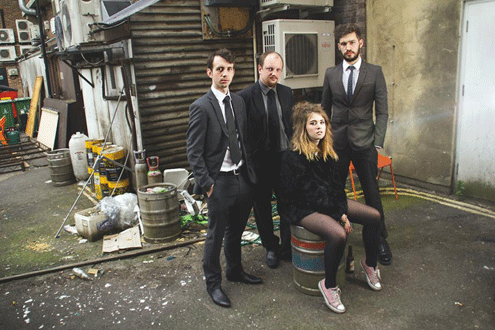


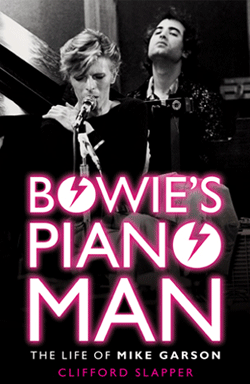
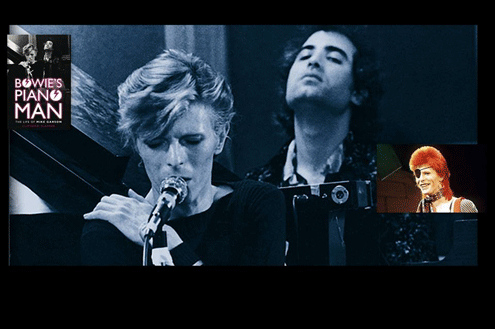




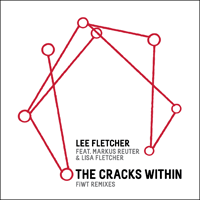
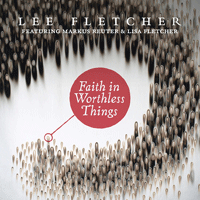





 Misfit City