Archive | alternative pop RSS feed for this section

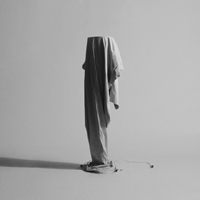
REVIEW – Elephant: ‘Allured/Actors’ single, 2011 (“a slow jam that’s strayed”)

6 Jun
Elephant: 'Allured/Actors'

Elephant: ‘Allured/Actors’

“Oh, hello, / I’m a never-ever-let-it-show – / But I know that you know. / Maybe I should let it, let it show…”

On past evidence Elephant have a knack for drawing us in while admitting to little. Their debut single mingled dream-pop with reggae and industrial chill, and cold electronics with fairy-tale flashes. They ride on a solid understanding of black pop, yet constantly swerve away from it into Euro-cool whiteness. They readily confuse, and they excel in oblique feelings – perhaps they can’t help it. Amelia’s blank singing, their aloof and obscure post-punk textures, their taste for quick-cut lyrics and surreal, visual word-imagery… while their work so far is memorable, all of it’s a conundrum. Yet for a moment, on this second single, everything is clearer.

With only the subtlest indie-pop bleachings and dream-pop shadings, Allured is an R’n’B piano ballad: plain and simple. There’s the deep, minimal support of bass. There’s the gaps, space and swat of a heavy-lidded slow sex-beat; the sparse flick of tambourine like a shimmying skirt-fringe. Essentially it’s a slow jam that’s strayed out of the dance club in its heels and skintights, taken a wrong turning past the taxi rank, and been painlessly swallowed by Elephant’s dreamy way of doing things. In the video we watch as voyeurs as Amelia and Christian languidly nuzzle and smooch each other – lengthily, and uninterruptedly. Either they’re answering that “are-they-aren’t-they?” question that’s hung around Elephant since the beginning, or they’re very committed to the world of this particular song.

Whether Elephant have simply been infected by R’n’B’s outright and intoxicated sexuality, or whether they’ve swallowed it deliberately, is open to question. I suspect the latter. Few areas of twenty-first century pop haven’t rolled over and submitted to R’n’B’s sweaty vigour and its gobby, blinged-up sex’n’suss’n’opportunity confidence. While some diehard indie-poppers might still scream and scrub it off; or cling to older schools of soul, Elephant see a good thing and slurp it up, embracing and engulfing it in their turn. So here they are, reaching out greedily into the wide-open mainstream while happily sunk in obsession, drunk with sensuality.

Only the lyrics retain that peculiar Elephantine distortion. Amelia rolls the words around on her tongue, dabbing them with glottal stops and her own strange short-circuiting shifts of accent or syntax, whether wriggling into a tangled lick of coyness, circling orgasm (“our own anatomy, so I find the path – my brain / it carousels instantly, drives me to insane,”) or swimming in a stupor of surrendered identity (“I dreamt he’d written me… He took me away, crossed me away from the crowd…”) By rights, this clotted wordplay should cripple the song. Instead it lolls sexily across the beat, as if on the brink of falling out of bed.

Then the B-side – Actors – throws us right off the scent. Same old Elephant; entirely different set of clothes. Rather than the wallow of bass and beats, here are acoustic guitars on the strum, a skinny ice-rink organ, and a dose of fast-paced pop soufflé which chuffs around its drum track like a toy steam train. It’s a tune for people in mini-dresses to run around Paris to, or chase summer bicycles through Spanish Harlem. Once again, Amelia’s dazed delivery and tangled string of lyrics ensure that it keeps the Elephant stamp.

It’s anyone’s guess as to what she’s singing about this time – “hop around aimlessly, simply surrender to time. /Animations out past under the feet, imitating a shadow spine.” Somehow the words fall into place as she sings of paying the rent “with a monogram eye” or murmurs about “the highest apple in the tree.” Perhaps, like many of the best and sexiest club hook-ups, it’s just a happy accident.

Elephant: ‘Allured/Actors’
Memphis Industries, MI0193S/D
vinyl 7″/download single
released: 18th July 2011

Buy it from:
Memphis Industries.

Elephant online:
Facebook Twitter MySpace Tumblr Bandcamp

June 2012 – demo reviews – The Many Few’s assorted Soundcloud demos (“as cosily misshapen as candle stubs”)

1 Jun

The Many Few don’t exactly do precision. One guitarist slops acoustic rhythms around like a drunken waiter losing control of a tray. The other doodles away cheerfully, or hiccups free-improv dribbles in a corner. Sometimes both of them land in the same song. Meanwhile, two singers are jostling together: Johnnynorms (he of the small, dry voice) and Melissa Wyatt (who aims for creamy breathiness and theatrical intimacy but ends up kittenish and blowsy). The drummer pins everything together, but worries and wobbles over anything more complex than a mid-paced chuff-along. The bass guitar stumbles vaguely after the other instruments, distracted by a nearby jazz gig.

Unless they’re deliberately deconstructing their pop, or unless they record only while cheerfully drunk (both of which are possible), The Many Few are a thorough fucking shambles, and I think they know it. Do you think I’m going to bury them for it? Hardly. That tumbledown, lopsided indie-pop stagger is integral to their approach and charm. You can toss in those usual Syd Barrett and Captain Beefheart comparisons (you know, the ones applied to almost any wayward indie band who ramble outside the beat a little) but The Many Few are far too friendly and floppy for that. In their cheery, ramshackle way, they sound more like ’90s nouveau-skifflers Zuno Men… if the latter had been stuck in a house-share with a teenaged Kate Bush and spent most of their time half-cut.

You could easily imagine them all sprawled over a tatty sofa – arguing over the washing-up, loving each other and picking over the usual daily scams of living together. You can imagine them hurrying off, at any opportunity, to the local pub for the kind of lock-in which ends in howls of laughter and wrestlings over a battered old board game.  I wouldn’t want to be the one to try getting them organized. It would only spoil it. This scraggy comfort must have been all over the making of this enjoyable batch of songs, which they call “armchair surrealisms” and I’d call animated scrawls, as cosily misshapen as candle stubs.

On the irresistible Catching, Johnnynorms repeatedly starts off on a story, only for Melissa to barge in and take it over. As all of the stories are about naïve men making comically doomed attempts to win over smarter women, this is only appropriate. Wonky high-life guitar ambles around like a cheery woodpecker as Melissa teases “I’m sorry but she had a child when she was young / and she’s not catching that from you”, before announcing her intent of fleecing some other poor bloke for all he’s got.

The upbeat Sweep and Swipe (part genial commuter-belt revolt, part kid’s TV song) bumbles through work, procrastination and rebellion in a very British jumble. There’s a sense of urgent feelings swaddled up and hidden under a brittle, chirpy exterior: something which this song shares with another, Typical British Weather (itself tipsy, woozy and smiling a crooked smile in the rain). It’s left to the messy, chunky power-punk of Meet my Clone to sideline the shambling and the evasions via dirty guitar, a tight irritated momentum and the band’s most ingenious idea. Johnnynorms and Melissa wrangle over the doppelganger relationships of people grown close in appearance and habit, but not feelings: “Eye to eye you’d think we were the same. / But it’s me that feels all the guilt, and rage, and love, and shame.”

Past the 18th Town is entirely different. A haunting acoustic dirge touching (in the briefest of sketches) on transient people, it follows them as they move from rented room to rented room. As old roots fade and new roots become stunted, they lose their ability to recognize and return love. Tingles of guitar harmonics tickle the nerves while the band capture a world of disengagement in simple, telling lines like “send the letters on, / send them back unknown.” It suggests that the ghost of a cold and lonely wind, blowing under that gap in the door, sometimes haunts The Many Few’s sprawling house party.

The Many Few: assorted Soundcloud demos
Soundcloud (no catalogue numbers)
Free download tracks
Released: various dates in 2011

Get it from:
Free download from Soundcloud

The Many Few online:
HomepageMySpace Soundcloud

REVIEW – Elephant: ‘Ants’ single, 2011 (“somewhere between love-gone-wrong and epilepsy”)

30 May
Elephant: 'Ants/Wolf Cry'

Elephant: ‘Ants/Wolf Cry’

Band named after large thing actually sounds small. Single named after tiny things suggests that small-sounding band (named after large thing) could go massive. Sometimes I love pop’s ridiculous anti-logic.

Elephant are two. Christian Pinchbeck coaxes noises out of computers and wrangles chittering textures from guitars. Amelia Rivas plays old sounds on modern keyboards while swimming and sighing distractedly through the middle, avoiding eye contact. It’s synth-pop, allegedly, but it’s also nothing quite so obvious. Amelia and Christian may or may not be a couple, but that’s not clear either. With Elephant, not much is.

Ants is Elephant’s debut single, and it spends its three minutes cunningly, surprisingly persuading various things that shouldn’t work together to cosy up and make something which does work. A gentle reggae bounce, a dribble of whiter-than-anything psychedelic guitar direct from Cocteau Twins; a roughed-up reedy synth figure like a bass accordion with hiccups. As for what the song might be about, it’s somewhere between love-gone-wrong and epilepsy; like David Lynch reimagined as lovers rock. “I’m tired and I’m bruised for you,” Amelia murmurs, moping elegantly across the backbeat. “The war that I fought made my body contort… I’m down in the black, and I’m blue.”

When we talk of indie-pop being sickly, we usually mean that it lacks power. Here, sickliness is power. Unease and disease blend together, reality is erased by symptoms, and experience is somehow amplified by the giddiness and blank alarm. Throughout, there are references to buckling knees; to floating and amnesia and jump-offs; to falling to the ground or into song. Even the chorus avoids clarity in favour of hallucinatory warp (“Ants now scurry on the floor, / I just can’t remember before,”) with all perspective thrown right out-of-whack. Yet Elephant snatch a victory from these flashes of confusion and disaster, sheathing them into a subtle, catchy, play-it-again heartbeat of song; a cool, black-and-white flicker of distress call.

While Ants cloaks strangeness under bits of spooky washed-out reggae ballad, its flipside Wolf Cry goes for out-and-out surrealism in a stream of Bunuel electro-punk. Amelia sings of seasons, seafarers and parted lovers. Deeper into the song, she jinks these acid-folk fairytales into blurred dreams of power struggles, throwing out images of hunky aristocrats or “militants on the roof.” Everything hangs together – precariously – over Christian’s alienated instrumental bonework: a flat backdrop of flat echoing skitters, deep red bassquakes, ghostly chords and spray-can snare hits. As the song riffles balefully through its repertoire of cinematic flashes, impressions build and cut (“the ticking of a clock, jumps to interior,”) or flirt, archly, around games of obscurity (“we all wear a mask to a fellow passer-by.”)

Ultimately, Wolf Cry comes apart in the fingers if you squeeze too hard (the strange syntax, the dodging of plot, their mingling of seduction and avoidance) in much the same way that the story of Ants comes to us half-melted. Elephant have a knack for this kind of anti-logical play, squeezing into the gaps in the story. Besides, they’ve already demonstrated that they’re masters at magicking something coherent out of disorientated fragments – not least via a fine mournful tune or two. Evasive or not, they’re very much in the room. I suspect that I’m going to go on talking about them.

Elephant: ‘Ants’
Memphis Industries, MI0172S
vinyl 7″/download single
released: 17th January 2011

Get it from:
Memphis Industries.

Elephant online:
Facebook Twitter MySpace Tumblr Bandcamp

Race Horses: ‘Mates’ single (“self-deprecating boysprawl, all big feet and perky singalong tune”)

12 May
Race Horses: 'Mates'

Race Horses: ‘Mates’

Your past is a different country. Wander into the wrong part of it and you might get socked on the back of the head: yes, you may have been there before, but you can’t do things in the same way now. At the same time, you’ll find that you’re already changed by having been there in the first place, so you can’t do those things in the same way anyway. Meilyr Jones knows about all this – now – and he’s keen to tell you about it.

Compared to some of the music Meilyr and his band have put out previously – exciting indie pop with an experimental edge rumpling up the sound – Mates is fairly straightforward. In common with many other Welsh pop bands, Race Horses have that Cymric reputation for lateral thinking squatting on their shoulders; but they wear it lightly. Instead of opening up a window through which you can peer into their world, they come lolloping over to meet yours, trailing the odd strange decoration or kooky wristband to colour things up a little.

Mates does start off as exotic process. The title, chanted, is an offbeat factory loop over which the song is assembled: a marimba plinks throughout, stolen from the school music room in order to scatter musical cherries on top. The muscle of the song itself is something of a hiccupping cha-cha-cha, led by the bass. The melody and words, though, make up a cheerful self-deprecating Britpop boysprawl, all big feet and perky singalong tune. It’s a song about being dumped – knocked sideways and woebegone – but it refuses to just lie down and die. The same clever boyishness has kept classic Madness songs fresh since the ’80s (though Race Horses sound as much like a decade-stretching handshake between the Bowies of ‘Scary Monsters’ and ‘Hunky Dory’, even down to the music-hall quirks).

As for where Race Horses find themselves at the moment, it’s in that freefalling zone between “us” and “you and me”, where laws of belief are tumbled over and even geography gets overwritten with new, painful memories. “All the times I used to doubt it / but now I find I’m lost without it” complains Meilyr, groping after a love that’s evaporated and left him staggering. This could be chapter one of a Casanova’s progress, as he seems to have found the first sniff of something he’s suddenly found himself hooked on. For now, he’s still fumbling in disbelief around the ache. “Your words, cold and heavy, / echo down the walls of the place we used to go, / when we were mates.” I know what he means – for me, a particular park in Crouch End is haunted even in bright sunshine, and I still can’t see a shooting star without feeling a twinge.

Still, despite the complaints, Meilyr seems to have already wrapped up the experience into a little eight-syllable summary which he can hold up like a snowglobe – “It cuts, it soothes. / It comes, it’s you,” – and the bouncing plink of the tune sounds more happy than despondent. Perhaps it’s the indomitable bungee-rope of young testosterone. Perhaps Meilyr’s just singing in the sure knowledge that Mates could be one of those songs which make a lot of capering indie pop kids happy during the summer of 2012. Hey ho, the twisted power of love gone splat. Ouch.

Race Horses: ‘Mates’
Stolen Recordings (no catalogue number or barcode)
Download-only single
Released: 9th May 2012

Buy it from:
Download free from Race Horses Facebook page.

Race Horses online:
Homepage Facebook Twitter MySpace

March 2012 – EP reviews – StillWife’s ‘StillWife EP’ (“in love with the slow, subtly adult pains that they sing about”)

16 Mar
StillWife: 'StillWife' EP

StillWife: ‘StillWife’ EP

Be wary of barristas, especially in airy little cafés in quiet back-streets. They feed you your coffee, they bring you your cake and cookies – in return, you ignore them and any of their own dreams. While you’re unwinding with the brew, relaxing or kvetching, gossiping or confessing, they’re stuck there with the crunch of the grinder, at a loose end. On quiet days, you’re probably the entertainment. If they happen to be writers of some kind, one day one of your stories might come bubbling back up.

As it happens, two members of StillWife still put in time as coffee-shucking barristas back in the band’s Melbourne hometown. Have any washed-up conversations washed up into their songs? I’m just saying. Or is it the coffee talking?…

There’s little that’s caffeinated about StillWife’s debut EP. Apart from those moments when one of the guitarists drives in a power-chord, a pointed solo or a burst of white noise (generally with the reluctance of a man drilling a necessary hole in the porch) it’s primarily about detailed acoustic fingerpicking and sleepy man-and-woman harmonies. There’s a soft, dusty touch of country music here. There’s something of Grandpappy in those guileless dollops of antique synth tone, like bubbles in the sun. There’s a little of Low in the semi-hush, as if they’d recorded it all on a distant Australian veranda. The drums are played by someone who’s so good, so subtle and egoless, he becomes the invisible springs that hold in place the band’s buoyant way with disillusionment.


Of the two primary singers, Dylan has the stoic country clarity of a youthful Willie Nelson while Moat’s she-panther tones capture the langourous, wounded and incurably passionate feel of both Stevie Nicks and Briana Corrigan. As for the songs, they’re about awkwardnesses and aches rather than grand passions. Their stock-in-trade is the ambiguities you don’t grow out of; the kind that make you mumble (as StillWife do in Olympia) “I know it’s wrong but I can’t bring myself to say I’m sorry. / You’re all I want, but I can’t say that I’m not feeling worried.” Both Moat and Dylan sound as if they’re in love with the slow, subtly adult pains that they sing about. Each of their voices comes twined around with the murmuring sounds of various bandmates singing along: as close as lovers, and sounding like straying echoes.

 
The EP’s centrepiece, Out To Sea, begins life as a duet of unraveling and entwining love and goes somewhere more apocalyptic. Moat sings cryptically about fire, about names and letting go, while from the second verse, Dylan’s muttering a grim counterpoint – “searching for the meaning in closing fires – / I’m calling on awful writers – / I’m taking pleasure in my own undoing.” As the song winds on, Moat launches meaningful non-sequiturs to wash up on the beach (“The youngest child, it don’t feel right, / it never will – he’s lost his light,”) while Dylan circles in despair (“and there is no me and there is no you; / and if there is no us, then there is no love; / and if there is no love then there’s nothing that’s true.”) The longer it continues, the more hallucinatory it becomes: even as they sing of separation, the two singers drift closer together. By the end, they’re not so much duetting as singing different parts of the same mind, chanting out “it’s in the way that winter’s coming around; / it’s in the snow-like stain, blood on the ground; / it’s in the wave descending, pulling me out to sea…”


Olympia – simpler – could just be about being too shy to ask someone out, its hotel setting a place of missed connections and missed handshakes. Or it could be about a failure of nerve in general – not having the pluck or energy to ask for what you want, even if it’s just a question of knocking on a door and speaking. In comparison, Haven’t You Heard is fairly lightweight: but perhaps its whimsy and gentler touch is needed to counterbalance the deeper aches elsewhere. Slung in a hammock of wry country picking, Dylan muses on unthinking aggression and ambition (“When I was a kid I had a lot to prove, / I was young and angry, with an overactive muse”), and touches – ever-so-lightly – on human cruelty. When not singing about warning off unwary aliens, he gently salutes the time when he finally “opened up my eyes and saw the view. / Saw the world for what it was – unfolding and askew.” A wonky electric solo ambles in like a sheepish grin. A second one opens out into a concluding cobweb of pulsating guitar noise, like a countrified version of Heroes.


With its Bo Diddley beats and stutters, its sudden embrace of dirty noise and its chopped-up minimal lyrics, So Sued turns StillWife’s usual working methods on their heads. Yet it still ties in with the band’s exploration of heartbreaks and awkwardnesses. A barbed kiss-off from girl-left-behind to boy-off-to-find-himself, it’s sung by Moat in a sardonic hiccup like a raised eyebrow. “You’re going solo, into the night… / You’re going solo / so get it right.” she jabs, before mocking with a chorus of “On the road, uh-huh; / on the road, ah-hah; / on the road, eh-heh… / We get it.” It’s bitter honey, powering on into pileups of screeching guitar as Moat wails – blue and biting – like a sarcastic banshee.

Creatures, though, might be the key to it all – the kind of beautifully wracked, subtle-heartbreak song that any lovelorn person needs to hear at least once. Licked around by misty synthesizers like weeping foghorns, it offers more of a Blue Nile approach to heartbreak – an intangible moment or event which nonetheless means everything, stretched in time as it soaks into the soul. Across a room, a soft-singing Dylan watches his lover dance; and at that moment realizes that it’s over, that what they’ve had has somehow been lost. “Through the crowd I see your face – content and undirected gaze. / Barefooted you begin to sway; I dance under the twilight’s haze, / and though it hurts I hold my tongue – some things can never be undone.”


Exactly what’s gone wrong, or what’s happened, is never revealed. An unthinking betrayal; or maybe simply the moment when common cause slips away, leaving just two separate bodies moving in an ever-growing space. There’s a tremendously sad dignity to this song, but that’s not all. A desperate hope-against-hope breaks through in a final pleading chorus: a sudden flare of forgiveness stretched out like a shaking hand – “Tell me you make mistakes – mistakes can always be unmade. / Tell me I’ve faith and I will pray – / just don’t leave me here this way…”

Utter quality. More of this, please.

StillWife: ‘StillWife EP’, 2012
Bandcamp
Download-only EP
Released: 8th March 2012

Buy it from:
Bandcamp

StillWife online:
Homepage Facebook Twitter Bandcamp

T & The Wonder: ‘Corsage’ single (“a withering bouquet of sympathy”)

5 Feb
T & The Wonder: 'Corsage'

T & The Wonder: ‘Corsage’

“There are no constants, / even if we want them.” Perhaps it’s the shift of moving around, splitting apart. Chicago chamber pop duo T & The Wonder are Chicago-based no longer. Now based on separate sides of the States (singer Tavis Balkin is on the West Coast, multi-instrumentalist Patrick McCormack in Vermont) they remain a duo by an effort of will, affinity and determination. Sometimes long-distance relationships do work out…

I digress. Perhaps it’s the shift of moving around, splitting apart, but this post-move single (recorded in snatched December sessions around other practical commitments) sees T & The Wonder swapping between hope and despondency as if soberly walking a coin over their knuckles. The live drums and strings which they used to use might have been surrendered to budgeting and lack of opportunity (swapped for synthetic equivalents); but their bookish, light-touch ascerbity remains. Corsage is, in more ways than one, a withering bouquet of sympathy. Over ticking guitar, and a trapped tinkle of piano Tavis addresses a woman’s disappointment as she ages – lonely, stifled and perpetually stranded. “Is the corsage dried out? / the one that was packed away / with the empathetic gestures / and the tired old clichés?”

As to where Tavis himself stands, that’s not so clear. Sometimes he’s attuned to the pain of the woman he’s addressing – “Does the future disturb you / now that all you have left is the sound / of a lot of empty talking / and the legs that keep walking?” At other times, a growing frustration renders him cruel. “Can you depend on people, or are you just a misanthrope? / When all your lost love makes it impossible to cope,” he sings, softly, like wet leaves massing up heartlessly in the driveway. “You are a shell of a person, / a portrait of depression.” Patrick’s surge of guitar solo – a fuzzy taillight – pulls up a little swirl of blackening anger; but it hangs in the air, as if unsure of whom to fall on.

It sometimes feels as if Tavis’ own involvement in the story can be called into question. Is that a hint of guilt in his ashy, passive whisper, as if he himself might take some blame for this disaffection? “You write me, I call you, / what more can I say?” he murmurs, a little lamely. “These goddamn words only fill space.” He waxes and wanes, cold and kind, over the course of the song, without ever settling anywhere. Maybe it’s difficult to leave the scene of the accident. Maybe he doesn’t want to. Old debts, never paid? Old wishes that never resolved, but still ache on a chilly day?

The b-side, Vespa, flips the situation here – youth yearnings rather than fading middle-age, and this time it’s Tavis sitting in the role of the person about to slide down the lip of disappointment. The song itself sounds gently rapturous, both motorik and rain-dappled: a blurry cushioned wobble of electric piano, a plastic drum splat and a subliminal driving pulse. Just for the moment the daydream is blooming and Tavis can bask in it. “If I had a Vespa I would drive up to your house, / and I could kiss you on the cheek, / and we’d then hang out for the weekend – / but I don’t.” The road throws up its first little jolt, but Tavis is already smothering himself in the romance. “I can feel your hands, your hands around my waist / Your hair, your hair – it’s all across your face.”

You could get caught up in the fervent dreaminess, until you realise how evasive it is. “We could talk about how I had / changed my life direction / and just moved out of the city to a / place where things are pretty. / I don’t know…” Then you notice that as American road-movie songs go, it’s a pretty soft-edged one. Patrick’s fey touches of fluting synth and Kraftwerk buzzes: mimsy soft drinks; staying well under the speed limit. It’s not that Vespa lacks grand passion. It’s just that it’s been filtered down and compacted, firing up that diffident teetering hope with quiet fire and aching to make it real. “Living in the moment we would forge a life together – / and we’d send our loved ones letters, / every day a little better than before.” But the letdown is coming a little closer all the time, and that haunts the song. Weaving through the chorus is a second, nagging vocal line. “When I think it’s not a possibility / I want to leave, I want to leave.” Then you start wondering whether it’s less of a grand passion, and more of a grand, shy, unspoken crush. An entire world bubble-blown from a single fancy.

Two songs of apartness. Two men divided by most of a continent; linked by an ongoing sympathy, writing subtle bruised-petal songs about how the world often lacks such mutual feeling. There’s probably something more to draw out of that, but I’m not going to try. I have the feeling that if I try to describe it any more it will burst, softly, under my fingers.

T & The Wonder: ‘Corsage’
T & The Wonder (no catalogue number or barcode)
Download-only single
Released: 28th January 2012

Buy it from:
Bandcamp

T & The Wonder online:
Homepage Facebook Twitter Bandcamp Last FM iTunes

November 2011 – EP reviews – Elephant’s ‘Assembly’ (“how the war is contained”)

20 Nov
Elephant: 'Assembly'

Elephant: ‘Assembly’

Though Elephant’s Amelia and Christian actually hail from semi-rural English idylls (Pontefract and Stroud), their band is a London band and behaves like one. Rather, it presents itself in the way many pop bands made in London by incomers tend to. There’s something a little guarded about Elephant’s music – detailed and consuming notes from the inner life versus a chilly, self-constructed poise. It’s difficult to see which side is winning. It’s interesting seeing how the war is contained.

Two previous singles, ‘Ants’ and ‘Allured’, have dabbled in pop-reggae and R’n’B respectively, merging these with Amelia’s dazed and distorted lyricism and Christian’s avant-garde dream-pop trickery. With ‘Assembly’, Elephant now seem to be moving into more mainstream territories – more Anglo or European, certainly a little whiter. Think of a tranquillized Yazoo strained through 1960s West Coast pop; and then through the submarine guitar rills of Cocteau Twins, Slowdive or My Bloody Valentine. Think of a poppier yet more introspective Broadcast.

Think, also, of slow-paced black and white movies in which no-one seems to do much. While most synth-pop blazes outwards, Elephant’s blanched-out songs (offhanded in manner but carefully constructed) are always on the verge of collapsing inwards. Smooth swatches of organ, pulses of vintage keyboard and a solid sense of classic pop songwriting provide their work with an anchorage. But even when the synth trills and frills are at their liveliest, Elephant are increasingly trading in infinite shades of grey – monochrome filigree, slanted shadows, deadened responses. Amelia’s hopeless, surrendered sigh should be the band’s weak point, flattening Elephant’s pop soar into a graceful, endless nose-dive. In practise, those last drops of romance which cling to her resignation render the songs that much more intriguing.

Within the songs, the band’s brains are ticking away even when they sound as if they’re dazed by cough-mixture hangovers. Under its icy shrouding, Assembly pop-bops and puppy-bounces like The Teardrop Explodes; but still takes its medication straight to a frozen heart, anatomizing and dissecting the impact of closeness gone wrong. “It’s like a disease,” complains Amelia. “Think too hard, the brain goes cold.” While she’s dishing out a few sharp survival tips amongst the scalloped echoes and fairy-dust twinkles – “don’t dwell on who won’t dwell over you” – most of the song is convalescence and consolidation. “I have a mind,” she muses, pulling herself in. “The rest is numb, just a skeleton.”

The deeper into the EP you go, the further Elephant conceal outright emotion under festoons of Cocteau Twins guitar, blood-pulse synth and studied blankness. This is happening even as the lines they deliver lean more and more towards the romantic. Even the desert island setting of Shipwrecked doesn’t cut the chill. Amelia wanders through blurs of physicality (“shuffle, ricochet on the ground”), then fails to connect (“don’t try to confuse me again, / you speak so slow, sand falls on my head”) and finally all but gives up (“What’s the point of time? It dissolves in the sea. / If you sail with the tide, will you shipwreck back to me?”) While Christian’s sounds trail and spiral onwards, Amelia chases a half-stunned chorus – “that’s where my heart, the rest of my heart is” – as if grasping after a pair of slow-moving balloons.

The imperious blast of keyboards at the start of Hopeless herald an out-and-out dizzy love song. It’s part classic ’60s girl-group, part hi-NRG synth-pop. In its way – in Elephant’s particular way – it’s even quite triumphant. Elephant’s way, though, usually involves some kind of collapse. Amelia spins through the middle of the song, twirling like a stray leaf, sounding happy to be blown around by feeling. “Hopeless I know, I sway to and fro – / I can’t hide from you.”

But by the end of the EP, Elephant are hiding out. At Twilight is a step back to their earlier, artier work: from its swallowed-up chorused vocals and witch-queen intro, to its deathly pace and dreamy lyrics about a “circus moon”, it’s also deep trip-hop collapsing into Gothwave. A bass pulse lags and limps outside of the funereal beat: Amelia stares at her hands and murmurs “I need to leave, but I don’t know how,” as a foam of feedback gradually fills up the space. Inner life boiling over? Perhaps. Elephant play a teasing game with their songwriting tensions. It makes us keep listening.

Elephant: ‘Assembly’
Memphis Industries, MI0200CD/D
CD/download EP
released: 14th November 2011

Get/stream it from:

(2022 update) CD EP best obtained second-hand; download/stream from Deezer, Tidal & Spotify; the tracks ‘Assembly’ and ‘Shipwrecked’ also appear on the ‘Sky Swimming’ album available from Memphis Industries, Bandcamp, Apple Music, Spotify & Amazon Music; Elephant online:
Facebook, Twitter, MySpace, Soundcloud, Bandcamp, Last.fm, Apple Music, Deezer, Tidal, Spotify, Amazon Music 

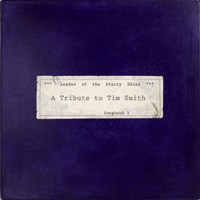
December 2010 – album reviews – Various Artists ‘Leader of the Starry Skies – A Tribute to Tim Smith – Songbook 1’ (“an unmapped musical crossroads… one of the most diverse tribute albums imaginable”)

20 Dec

Various Artists: 'Leader Of The Starry Skies – A Tribute To Tim Smith – Songbook 1'

Various Artists: ‘Leader Of The Starry Skies – A Tribute To Tim Smith – Songbook 1’

Listen. They’re singing at his bedside.

In June 2008, en route back from a My Bloody Valentine concert, the world fell in for Tim Smith. A sudden heart attack (and in immediate cruel succession, a pair of devastating strokes) failed to kill him, but only just. Now he’s in long-term recuperation, condemned to that long wait in the margins. With his damaged body now his enemy, his brain’s left to flick over the days until something – anything – gets better and his luck turns. This is a sad story. Even sadder, given that many similar stories must shuffle out of hospitals every month.

There’s an extra layer of pain here in that for over four decades Tim Smith was a dedicated, compulsive fount and facilitator of music. As the singer, composer and main player of some of the most eerily intense, unique and cryptic songs ever recorded, he sat at an unmapped musical crossroads where apparently incompatible musics met. In turn, his songs were hymnal, punky and part-classical; shot through with crashing guitars, keyboard trills and mediaeval reeds; festooned with swings and changes. They were sometimes choral, or full of martial pomp or playground squabble. They were sometimes ghostly. They were a damned ecstatic racket, or a parched and meditative whisper. With what’s now become a brutal irony they also frequently fluttered, quizzically, across the distinctions of life and death; sometimes seeing little separation between the two states, sometimes hovering somewhere in between; sometimes seeing as much meaning in the wingbeat of a stray insect as in the scrambling for human significance.

Tim’s rich and puzzled perspective on life and the weave of the world travelled out to a fervent cult following via a sprouting tree of projects – the quaking mind-mash rock of Cardiacs; the psychedelic folk of Sea Nymphs, the tumbledown explorations of Oceanland World or Spratleys Japs. In addition (and belying the manic, infantile mood-swings of his onstage persona) the man was generous of himself. Via sound production, video art or simple encouragement, his influence and peculiar energy spread from feisty indie rock bands right across to New Music performers and bedroom-studio zealots. It spread far wider than his nominally marginal status would suggest. For all of this, Smith never received adequate reward or overground recognition for these years of effort – another sting in the situation (though, having always been a stubborn goat, he’s probably dismissed it).

Yet if he’s been slender of pocket, he’s proved to be rich in love. His praises may not have been sung by the loudest of voices, but they are sung by a scrappy and vigorous mongrel choir, scattered around the houses. The Smith influence haunts cramped edit suites and backwater studios. It lingers in the scuffed shells of old ballrooms, and in the intimate acoustics of a handful of cramped Wren churches in London: it’s soaked into the battered ash-and-beer-stained sound desks of rock pubs. Most particularly, it lives in the memories of thirty years of backroom gigs where people baffled at, laughed at and finally yelled along with the giddy psychological pantomime of a Cardiacs concert; and where they lost their self-consciousness and finally stumbled away with their armour discarded.

And now, all silenced?

No.

In many cases, these same people who yelled and sang from the audience (or, onstage, from beside Tim) would go on to form bands which demonstrated that three chords and a crude truth was far too blunt a brush with which to paint a picture of the world. All of this outgoing wave of energy comes rolling back with a vengeance on ‘Leader Of The Starry Skies’. Put together by Bic Hayes (best known for galactic guitar in Levitation and Dark Star, but in his time a Cardiac) and Jo Spratley (Tim’s former foil in Spratleys Japs), it’s an album of Smith cover versions in which every penny of profit going back to raise money for Tim’s care. In effect, it’s swept up many of those people who sang along with Tim Smith over the years (all grown up now, and numbering characters as diverse as The Magic Numbers, Julianne Regan and Max Tundra) and brought them back for visiting hours.

And they sang outside his window, and they sang in the corridors; and from the ponds and rivers, from the windows of tower blocks and from lonely cottages…

Given Tim Smith’s own eclecticism, it’s hardly surprising that ‘Leader Of The Starry Skies’ is one of the most diverse tribute albums imaginable. Despite the familial feel, the musical treatments on here vary enormously. Lost broadcasts, festooned in unsettling noise, rub up against stately electric folk. Psychedelic grunge balances out colourful playschool techno. Unaccompanied Early Music recreations drift one way, while centipedal Rock-in-Opposition shapes charge off in another. None of this would work if Tim’s songs – seemingly so resistant – didn’t readily adapt. Anyone can get around the shape of a Neil Young song, a Paul McCartney song or even a Morrissey song for a tribute: but these rampant compositions with their peculiar twists are of a different, wilder order. However, every contributor has managed to embrace not only the unorthodox Smith way with a Jacob’s Ladder tumble of chords but also his dense lyrical babble, which grafts nonsense onto insight and the ancient onto the baby-raw. Everyone involved has striven to gently (or vigorously) tease the songs out of cult corner and bring them to light.

Take, for instance, what The Magic Numbers have done with A Little Man and a House. This anguished Cardiacs ode to the 9-to-5 misfit has never seemed quite so universal, slowly pulling out from one man’s chafing frustration for a panoramic view of a worldful of human cogs. (“And there’s voices inside me, they’re screaming and telling me ‘that’s the way we all go.’ / There’s thousands of people just like me all over, but that’s the way we all go.”) The original’s pained South London squawk and huffing machinery noises are replaced by Romeo Stodart’s soft American lilt, while massed weeping clouds of piano and drums summon up an exhausted twilight in the Monday suburbs. Likewise, when Steven Wilson (stepping out of Porcupine Tree for a moment) sighs his way through a marvelously intuitive and wounded solo version of Stoneage Dinosaurs, he takes Tim’s hazy memories of childhood fairgrounds and incipient loss and makes them glisten like rain on a car mirror while sounding like the saddest thing in the world. Even with Wilson’s own formidable reputation behind him, this is immediately one of the finest things he’s ever done – an eerie ripple through innocence; a sudden, stricken look of grief flitting for a moment across a child’s face.

Three of the covers have added poignancy from being connected to ends, to new beginnings, or to particular paybacks. When Oceansize abruptly split up at the peak of their powers, their final word as a band turned out to be Fear (this album’s loving cover of an obscure Spratleys Japs track). Rather than their usual muscular and careening psychedelic brain-metal, they render this song as a soft-hued exit, a fuzzed-up tangle of fairy lights which wanders hopefully down pathways as they gently peter out. Conversely, glammy Britpop anti-heroes Ultrasound set an acrimonious decade-old split behind them and reformed especially to record for this project. Their whirling clockwork version of the Cardiacs anthem Big Ship is all boxed-in and wide-eyed. It bobs along like a toy theatre while the band fire off first pain (“the tool, the tool, forever falling down / planes against the grain of the wood / for the box, for my soul / and my aching heart,”) and ultimately burst into the kind of incoherent, hymnal inclusiveness which was always a Cardiacs trademark – “All of the noise / takes me to the outside where there’s all /creations, joining in / celebrating happiness and joy; /all around the world, / on land and in the sea.” It seems to have worked for them – they sound truly renewed.

Some of Tim Smith’s songs have a strangely mediaeval tone or texture to them, and some have a twist of eerie folk music. These attract different interpretations. Foundling was once a particularly bereft and fragile Cardiacs moment: an orphaned, seasick love-song trawled up onto the beach. Accompanied by elegant touches of piano and guitar, the genteel art-rockers Stars in Battledress transform it into a heartfelt, change-ringing English bell-round. North Sea Radio Orchestra travel even further down this particular line – their bright tinkling chamber music sweeps up the hammering rock parade of March and turns it into a sprightly, blossoming cortege. Packing the tune with bells, bassoon and string quartet, they dab it with minimalism and a flourishing Purcell verve: Sharron Fortnam’s frank and childlike soprano clambers over the darker lyrics and spins them round the maypole.

Deeper into folk, Katherine Blake (of Mediaeval Baebes) and Julianne Regan (the shape-shifting frontwoman for All About Eve and Mice) each take an eerie acoustic Sea Nymphs fragment and rework it on their own. Julianne’s version of the children’s dam-building song Shaping the River adds rattling tambourine, drowsy slide guitar and a warm murmur of voice: it’s as if the faded lines of the song had washed up like a dead leaf at her feet, ready to be reconstructed at folk club. (“Pile some sticks and pile some mud and some sand. / Leave the ends wide, / three against the side, / plug the heart of flow.”) Katherine’s narcotic a-cappella version of Up in Annie’s Room might have shown up at the same concert. A world away from the pealing cathedral organ of the original, it slips away into empty space in between its gusts of eerie deadened harmonizing and Tim’s sleepy, suggestive cats-cradle of words (“Fleets catch your hair on fire. / The fleet’s all lit up – flags, flame on fire…”)

Max Tundra, in contrast, sounds very much alive and fizzing. His pranktronica version of the brutal Will Bleed Amen re-invents it as delightfully warm and loopy Zappa-tinted techno. Its abrupt air-pocketed melody opens out like a sped-up clown car: when a convoluted cone of lyrics punches his voice up and sticks it helpless to the ceiling, former Monsooon Bassoon-er Sarah Measures is on hand to provide a cool clear vocal balance, as well as to build a little open cage of woodwind at the heart of the rush. It’s a terrific reinvention, but perhaps not the album’s oddest turnaround. That would be courtesy of Rose Kemp and Rarg – one a striving indie-rock singer and blood-heir to the Steeleye Span legacy, the other the laptop-abusing keyboard player with Smokehand. Rose is a Cardiacs interpreter with previous form: this time she’s fronting a forbidding glitch-electronica version of Wind And Rains Is Cold with all of the cute reggae bounce and innocence pummeled out of it. While Rarg flattens and moves the scenery around in baleful planes, Rose delivers the nursery-rhyme lyric with a mixture of English folk stridency and icy Germanic hauteur, uncorking its elliptical menace as she does – “Now you remember, children, how blessed are the pure in heart – / want me to take ’em up and wash ’em good?… / Hide your hair, it’s waving all lazy and soft, / like meadow grass under the flood.”

While most of the musicians on ‘Leader…’ could cite Tim Smith as an influence, Andy Partridge was a influence on Tim himself, way back in his XTC days. Three-and-a-half decades later he repays the appreciation by guesting on the dusky autumnal spin which The Milk & Honey Band‘s Robert White gives to a Sea Nymphs song, Lilly White’s Party. Redolent with regret (for more innocent times, before a fall), it covers its eyes and turns away from the shadows falling across the hillside. Partridge’s deep backing vocals add an extra thrum of sympathy: “Let’s not reinvent the wheel, let’s not open that can of worms, / Let’s not say what we did, and play by ear. / Back to square one…”

The backbone of ‘Leader Of The Starry Skies’ however, comes from the contributions of former Cardiacs players reconnecting with the family songbook. As with any family over time, they’re scattered. One of the earliest members, Pete Tagg, now drums for The Trudy, who take the bucketing psychedelic charge of Day is Gone and offer a more down-to-earth spin on it for the indie disco, keeping that heady chromatic slide of chorus but adding a suspiciously blues-rock guitar solo and Melissa Jo Heathcote’s honeyed vocals. One of the more recent Cardiacs additions, Kavus Torabi, brings his band Knifeworld to the party. He hauls a particularly involved and proggy Cardiacs epic – The Stench of Honey – back through a 1970s Henry Cow filter of humpbacked rhythms, woodwind honks, baby squeaks and rattletrap percussion. Double-strength art rock, it could have been a precious step too far. Instead, it’s triumphant, its skeletal circular chamber music salad-tossed by stomping bursts and twitches of joy.

Onetime Cardiacs keyboard player William D. Drake offers a gentler, kinder tribute, taking the shanty-rhythms of Savour and spinning them out into soft Edwardiana with harmonium, ukulele and a gently bobbing piano finale. Drake’s predecessor Mark Cawthra brings an eerie sense of pain to his own cover version: back in the earliest days, he was Tim Smith’s main foil, playing lively keyboards and drums as well as sharing the bumper-car vocals. Now he sounds like the head mourner, taking on the heavy tread of Let Alone My Plastic Doll and sousing it with Vanilla Fudge-slow organ, doubled guitar solos and sigh-to-wail vocals. The twitchy, baby-logic lyrics are slowly overwhelmed by an undercurrent of grief, but the kind of grief that can only come from a older, wiser man.

Under his Mikrokosmos alias, Bic Hayes takes on Cardiacs’ biggest near-hit (Is This The Life) and subjects it to startling psychedelic noise-storms and industrial drum twirling. In the process, he shakes out and enhances its original pathos. Blown splay-limbed into a corner by a tornado of white noise, plug-in spatters and buzzing malfunctions, Bic’s voice is nasal, lost and forlorn. It sings of split and rootless identity against a wall of forbidding harmonium: “Looking so hard for a cause, and it don’t care what it is; / and never really ever seeing eye to eye / though it doesn’t really mind. / Perhaps that’s why / it never really saw.” Although Jo Spratley coos reassurance under ululations of alto feedback, Bic still ends up cowering like a damaged crane-fly under showers of distorted harpsichords and Gothic synths. Bewitchingly damaged.

The last word goes to The Scaramanga Six, the swaggering Yorkshire theatricalists who were the main beneficiaries of Smith production work before the accident. By their usual meaty standards, the Six’s take on The Alphabet Business Concern (Cardiacs’ tongue-in-cheek corporate anthem, packed to the gunwales with flowery salutes) initially seems cowed, as if flattened by dismay and sympathy at Tim’s misfortune. But it doesn’t end there. Starting tremulous and hushed, with nothing but the embers of faith to keep it up, it builds gradually from tentative acoustic guitars and hiding vocals up through a gradual build of electric instruments, feeding in and gaining strength: “and now the night of weeping shall be / the morn of song…” Over the course of the anthem the Six go from crumpled to straightened to proud cheat-beating life. By the end, the recording can hardly contain their vigorous Peter Hammill bellows, as they sweep out in a grand procession with rolling guitars, pianos and extended Cardiacs choirs. It’s a stirring, defiant finale to an album that’s done everything it could to blow away the ghosts of helplessness and to charge up not just an armful of Smith songs but, in its way, a vivid sense of Smith. He might have taken a bad, bad fall; but the humming and rustling vitality of the music, the way that it’s become a spray of vivid lively tendrils reaching far and wide, is an enormous reassurance.

Listen. He’s alive. He’s alive.

Various Artists: ‘Leader Of The Starry Skies – A Tribute To Tim Smith – Songbook 1’
Believer’s Roast, BR003 (5060243820372)
CD/vinyl/download album
Released: 13th December 2010

Buy it from:
Genepool (CD) or iTunes (download)

Tim Smith online:
Facebook

‘Leader Of The Starry Skies – A Tribute To Tim Smith – Songbook 1’ online:
Homepage Facebook

January 2010 – EP reviews – Evolutia’s ‘Fear’s Fall’ (“they certainly don’t stint on the dramatics”)

17 Jan

Evolutia: 'Fear's Fall'

Evolutia: ‘Fear’s Fall’

They have a history with at least one Californian prog-rock band in it; yet Evolutia’s Stephen Cameron and Andrew Barnhart work better with a strong pop injection. Popping up a couple of years ago with the ‘After All These Years’ EP, Evolutia’s brisk multi-instrumental dazzle (along with Stephen and Andrew’s tag-team singing) quickly impressed. Now they’re revealing – in flashes – greater breadth and songwriting solidity beneath that glossy surface.

Of course, you do have to deal with the Muse factor first. Initially, those occasional neo-classical flourishes, the impassioned diva vocals and Stephen’s dual role on piano and guitar feel pretty familiar. Evolutia’s music is very much in Muse’s terrain of borderline-hysterical prog-pop. In fact, they’re hovering in almost the precise same spot that Matt Bellamy and co. did about a decade previously.

Yet while Muse increasingly inflate themselves into a Paganini stunt show of inhuman proportions (and arguably always dealt more in effect than humanity), Evolutia maintain heart and a human scale. Songs like My Element are clearly pomp-rock angst epics – Stephen and Andrew bawling “I fall apart without you” as instruments somersault around them – but they’re recognisably about people, rather than being exercises in style. Every explosive caper of Stephen’s piano, every upfront sprun-ng-g-g of Andrew’s supple prog-funk bass playing (and on this occasion, Mitch Holmes’ crisp and flexing drumwork) is there to underpin a human experience; whether this is ageing (“with faces that weathered / we stood up tall ’til the end”), the corrosions of ignorance, or simple fear.

That said, they certainly don’t stint on the dramatics – and their talent for sounding like a four- or five-piece band rather than an augmented duo certainly helps. With a tight and vicious vocal from Andrew, Half Awake provides the kind of semi-operatic sturm-und-drang rarely offered since the days of ‘Queen II’. Over jagged, emotional Beethoven piano, Andrew sneers out flashes of punk life (“brought up in a home of no-can-do, / what’s to learn in a prison but a vice or two?”) with a mixture of disgruntled rage and sympathy as he slips in and out of character. He weaves a history of resentment and slippage between one disaster and another, one violent situation and another; down and down the spiral, while a growling bass synth mutters like a cornered dog.

With Stephen temporarily abandoning his piano for some trashy but laser-guided guitar playing, We Used to Sleep starts life as a glam-punk anthem. It’s soon underlaid by prog convulsions – spasms of bass; distorted roars of texture; quick flashes of djent-styled metal riffage, like violently shunting trains. These toss the bucketing, arena-sized tune around on their knotty shoulders while Stephen sings of lost innocence, abandonment and faith: “If you find yourself lying in wait, or tasting their bait / just don’t go losing your hope yet.” This is lighter-waving rock heroism for sure – and cut by the yard – but it’s played with an invigorating power. For a few moments, flushed with Evolutia’s determined romance, you believe.

Fear’s Falls’ title track, meanwhile, is a real pocket epic. Driven by flowing expressive piano dancing over sparring drums and saw-edged walls of bass, it crams far more into its relative sparse lyric and its five-and-a-half minute running time than you’d expect, while Stephen delivers his most heartfelt and hopeful vocal of the whole EP. As the band travel, they reveal tightly-packed musical pockets en route: little cells transforming the spaces inside the tune from within, mirroring the night journey from fear to reassurance. “We shed this weight like it was our skin – / the ones we love are lost again, / and hope is becoming my closest friend… / Truth is changing what we want. / Fear melts away when we see / there’s nothing in the dark save you, save me.”

As Fear’s Fall winds down, there’s a cute little instrumental diversion into pseudo-reggae. Perhaps it’s there to show that after all of the emoting and instrumental flagrancy, Evolutia have a sense of humour. It’s unnecessary. They’ve got something better: in spite of all of their flashy arena-rock drama, they retain heart throughout. Maybe once they get past the more blatant Muse-ry, more people will notice this.

Evolutia: ‘Fear’s Fall’
Bandcamp
Download-only EP
Released: 11th January 2010

Buy it from:
Bandcamp

Evolutia online:
Homepage Facebook Twitter Bandcamp YouTube

June 2004 – live reviews – The Cox Cruise @ MV King Arthur, floating along the River Severn, Gloucestershire, early summer 2004 (featuring Earnest Cox, Ghosting, Charlie Says, Michael J. Sheehy & Paddy McCarthy of St Silas Intercession, Datapuddle) (“a self-propelled music bash”)

30 Jun

All we can see outside in the dark are moving, ghostly fronds – foliage bleached by the passing light spilling from our boat, nodding in the gusting winds above the lap of water. We’re on the river at night. We can’t see where we’re going, and we’ve entrusted our safety to a group of people with the seedy, ingratiating collective name of Earnest Cox. Things look bleak.

“It’s ‘Nam, man!” some joker screams suddenly. “Charlie’s out there, and he don’t surf! We’re all gonna die, man!”

He’s greeted by laughter. It’s all far, far too English for any of that: those nodding leaves we’re passing are in quiet Gloucestershire, and the River Severn isn’t winding us towards the heart of darkness… not unless Bristol’s having a really bad Saturday night. The double-decker boat we’re riding – the MV King Arthur – has been hired from the National Waterways Museum, and in under four hours we’ll have looped back to its safe berth in Gloucester. On the way, we’ll be enjoying a self-propelled music bash featuring the aforementioned Coxers and a little circle of related bands from Gloucester and London. There’s even a raffle. Cosy.

Had we set out a little earlier in the summer, and during the day, it would have been picnics and beer all round by now. As the red and gold lights of a jolly riverside pub bob past like a luminous Johnny Walker bottle, it’s clear that any actual weirdness will need to be handled by the bands. Crammed onto chairs on the makeshift band stage wedged into the top deck, Datapuddle do what they can. Alex Vald (who once played filthy guitar for Dream City Film Club) cradles an electric mandolin across his chest like a sulking cat. When not distractedly plucking and strumming at it as if he were plucking a chicken, his hands dart restlessly towards a litter of electronic gizmos on a table: a virtual theremin, a cheap sequencer, a plastic voice-changer and other bits of toy-box guts. Stephen Huddle plays sketchy acoustic guitar and pushes broken murmurs and mumbles of song up into Alex’s cobwebs of sound.
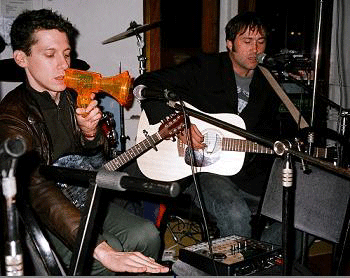
Datapuddle at The Cox Cruise

Datapuddle at The Cox Cruise

What ultimately emerges is a lo-fi cat’s-cradle of strung-together and slightly strung-out elements. Tidal dub; debris and dusty notes swept out of an Irish-American bar; bits of memory and reaction scattered like dandruff – all glued by static electricity and misfiring synapse energy to the guitar strings of a long-fried singer-songwriter. “Here’s a little sea shanty,” says Stephen brightly. A water-blip of electronics merges with a Lloyd Cole chug of guitar, rocking it on its rhythmic base. Alex buzzes a harmonica into an overlapping backwards loop, transforming it into a reversed melodica.

On the next song, trip-hop snare-drum smoke merges with psychedelic space whisper like the first skunked-out collision between Portishead and Hawkwind. Alex’s mandolin maintains a relentless, disappearing clang like a freight train bell, while Stephen mutters like Tom Waits ruffled from deep sleep. Peril – another shaggy-dog shanty written especially for tonight – namechecks the Severn amidst its steam-train chunter of knocks, old-school electro breaks, and harmonica rasps. “Don’t buy the brown acid,” Stephen sings, channelling up the confusion of a different party as ours sways cheerfully along the river.

Datapuddle come to a purring end with lashings of electric theremin wibble and a lengthy musical chew on a genuine melodica which has surfaced from their box of battered goodies. Watching them was like watching someone scrabble a shack together out of estuary trash and flotsam. In its way, it was just as raw and triumphant.

Paddy McCarthy & Michael J. Sheehy at The Cox Cruise.

Paddy McCarthy & Michael J. Sheehy at The Cox Cruise.

While the upstairs audience return to conversation and shore-spotting, Michael J. Sheehy and Paddy McCarthy are down below decks mopping up the leftovers (along with any beer that’s available). Cuddling a pair of honey-blonde acoustic guitars, the brothers from St Silas Intercession (and, previously, Dream City Film Club) have wedged themselves into a corner to hammer out rough’n’ready London-Irish punk blues as brutal as paving stones and hard-luck sneers. Eventually they’re joined by a wandering harmonica player and by a growing crowd of boozy party stragglers. Before too long, the corner turns into an enthusiastic trash-music shebeen (staggered over the changeover times between the acts upstairs) during which everyone’s treated to rattling, spat-out’n’spattered takes of the songs from the debut St Silas EP, starting with the vicious roar of You Don’t Live Here Anymore.

St Silas Intercession’s music is a London echo of the brutally direct and bluesy garage noise still spilling out of Detroit (and all of the little Detroits that have sprung up in the wake of Jack White or The Dirtbombs). Venomous as a dirty flick-knife and as blunt as masonry nails, it’s some way down the evolutionary tree from the corrupted sophistication of Sheehy’s recent songwriter albums, or even from the trawling sleaze of his old work with Dream City Film Club. Obviously the man himself couldn’t give a shit about all that: judging by the twinkle in his eyes and in Paddy’s, as they face each other off over sprawling riffs and hollers, they’ve rarely been happier with their music than now.

Paddy McCarthy at The Cox Cruise.

Paddy McCarthy at The Cox Cruise.

The brute-blues meanness of Get My Share has a good hard whiskey sting to it; as does the defiance of Caravan Rock (“me and my kids and their mum, / living in a caravan, moving on, moving on…”). A lacerating spurt through All About The Money sets people bobbing, scrambling and bouncing as well as a seven-and-a-half foot deck ceiling will allow. But as Paddy’s permanent goofy cartoon grin indicates, the St Silas brothers never take themselves too seriously. “It’s always about the money!” Michael protests, through a cheap megaphone. His voice suddenly jumps tracks from Louisiana bawl back through his London grit to an ‘EastEnders’ stage-Cockney. “You sla-a-a-g!”

Back upstairs, a dirty blonde in a cute plush cap is hammering a comradely nail into Mr Sheehy’s coffin. “Michael slags me off in his songs, and I slag him off in my songs,” explains Charlie Beddoes. Then she bowls us the rapaciously scornful putdowns of Vitriolic Alcoholic which kerb-kicks a snarling addict with a series of offhanded verbal wallops, culminating in “do I look like I give a toss? / It’s not my problem, not my loss.” It’s good to have friends.

The determined, diminutive Charlie is both the figurehead and the core of the shifting cult-of-personality that calls itself Charlie Says. Tonight, they’re three boot-babes and a moll-boy. Backed up by sidekick Ben Fisher’s car-crash guitar and by Lian and Kim Warmington’s ice-diva backing vocals and cool basilisk stares, Charlie plucks a remarkably articulate bass, sings like a breezeblock with lipstick and thuds out middle-weight girlpunk. Not short of charisma, Charlie holds the audience in the palm of her hand. The trouble is, she then rolls them around as if she doesn’t quite know what to do with them.

There’s a big difference between true punk and mere punk-ertainment, and Charlie Says wander a bit too close to the latter end of the scale. While Charlie’s former background in hip-hop art-rockers Rub Ultra is promising, discovering that both she and Ben are recent refugees from the touring band of tech-rocker Martin Grech pokes some suspicious holes in their lo-fi rebel stance. It just makes their music seem a little contrived. Not that the songs always help: It’s All About The Music is just another me-and-my guitar anthem, and Hey Leadfinger, Why You Gotta Keep Putting Me Down? is a foray into garage-blues which is far less interesting than its title is.

What pulls the band up out of fun-punk poseur-world are Charlie’s bright flickers of blunt humour and determination. The girlpower swagger of Venus Envy suddenly flings out “if the balls are in our court, then at least we have some,” while This Is Not My Story claims “whichever way it lands, my heart will keep on beating.” Little gems of lead-pipe wit and guts like this are what will make Charlie Says special; not desperate attempts to hitch onto whichever punk or garage soul flits past next. For the rest of the evening, I see Charlie perched here and there around the boat – beaming with life, always as if on the verge of delivering another breezy wisecrack. Let’s have more of that.

For all their efforts, Charlie Says don’t make me want to riot. Ghosting do… but I’d be rioting on their behalf. Five more minutes of hearing boozy party blabber drown out their beautiful, beautiful songs and I’d be flinging bottles around myself. Ghosting are heartbreakingly soft – as vulnerable and resilient as fresh grass bending underfoot. Unlike any other band this evening, they create little pockets of pure songcraft which you need to crane your head into to find out what’s going on.

Upfront, Dan Pierce picks out gentle acoustic guitar arpeggios which ride up into the atmosphere like thermals, and lets his voice follow suit. In the corner, wedged into a little cage of half-drumkit, laptop and miniature keyboard, George Moorey handles the rest. Intent and anxious-looking, he peers at his screen like a nervy microbiologist watching a virus proliferate. In fact, he’s just making sure that the sounds arrive on time – making tiny triggering adjustments to a mouse, reaching out one hand to roll off a gentle peal of Blue Nile piano, or swivelling to make precise soft taps on cymbal and snare with the single drumstick he holds in his other hand. It’s like watching someone play a one-man-band suit and conduct an orchestra at the same time. Yet even more impressive than this deft and diffident juggling act are the way Ghosting’s songs pool in the atmosphere – gradually, quietly filling up the space.

Dan’s big genial frame contains a songwriter’s spirit of rare and seductive delicacy. Faced with a chattering crowd, he simply shifts his guitar in his hands and sings soft, warm and open… and slowly the chatter drains away as the spell begins to work. Gently, Ghosting explore topics spanning all the way from frayed love songs (Your Love Don’t Make Sense) through thoughtful disillusion all the way to ending up being fingered as a murder suspect (Someone At The Door). Hopefully not as a natural progression – but if it was, you’d suspect that they’d’ve illustrated even that story with colossal and convincing sensitivity.

By the time Ghosting are midway through the exquisite, naked plea of I Want You To See Me, the crowd is hushed and half of them are hooked. Dan’s flexible and heartfelt singing – mostly a feather on tremulous breath, but rising to a swoony peak of intensity – sometimes recalls Mike Scott or Robert Forster at their very softest. In a fey, English, breathy way, he even has flashes of the fluttering abandonment of a Van Morrison or an Aaron Neville. Like them, he’s singing songs of real people grasping out at the intangible – unsure of what to believe on Anything That Might Be True, or “waiting for the one thing which really might have been some help,” on Good Year, only to wait in vain. Intangible desires, tangible heartaches. They’ll probably rise like damp rather than rockets, but I suspect that within a few years Ghosting will be very important to a lot of people.

Having put the whole cruise together in the first place, Earnest Cox get a well-deserved heroes’ welcome once they arrive onstage. They respond with perhaps their most energetic and assured set to date. It’s the third or fourth time I’ve caught the Cox, over a time when I’ve watched their sturdy intelligence getting to grips with lacing together their multiple influences. It’s taken a while for their mixture of old Memphis R’n’B, ’60s lad-rock, ’80s indie textures and prowling street poetry to gel.

Tonight it does with a vengeance. Hello Stranger sweeps out of the gate with a swagger of rogue testosterone coupled with a smart and beady eye, as Cox singer La Windo immediately takes on the audience with his particular blend of strut and twice-burned wariness. Perhaps it’s recent honeymoon rejuvenations or perhaps it’s the side effects of squabbling over their current recordings, but Earnest Cox are smouldering tonight. Still looking like a disparate houseful of mature students (the band’s a bewildering range of types from motherly to mysterious, from rogue to stockbroker) they continue to draw on what’s in them already rather than trying to squeeze themselves into an image.

The rhythm section used to be little more than agreeably white’n’slightly-funky: now it’s moving towards a lubricious slippery groove, with bass player/occasional MC Simon abandoning cheese and cheeriness to join drummer Shane in seriously flexing the pocket. Nicola parachutes in flights of piano, springs of Booker T. Hammond organ or splurges of synth when she needs to, while Marc buries himself in the middle of the band, cooking up lightly-textured mats of funky guitar texture to fly blurs across the gaps.

Up front, where you’d expect to find a preening Rod Stewart lookalike, La continues to prowl like a Gloucester merging of Shaun Ryder and Lou Reed, delivering his narratives of edgy small-town life like the most restless man in the pub and shaking his percussion as if testing the heft of a throwing knife. He looks pretty handy: yet the Cox don’t exactly trade on casual violence, even when La hurls out scathing fighting talk on You’re Not Fit To Lick (The Shit From My Shoes).

Rather, they seize on restlessness in general, whether it’s randiness, boredom, the unease as your parents age towards death, or the bumps in love’s road. There’s swagger, vengeance and one-upmanship aplenty in songs like Two Can Play At That Game, Baby and Scratching The Same Old Itch: yet in spite of this Earnest Cox’s songs are about survival if they’re about anything. No More Happy Endings treads the ashes of hopes and securities with the dogged, battered trudge of someone who’s had the knocks, has sagged, but won’t go down yet.

The Cox’s musical cockiness almost makes them part of that line of lad’s bands dipping in and out of pubs, taverns and speakeasys (and finally Royal Command performances). Yet the way the bruises on the songs never entirely fade (and the way that La quietly retreats into himself, gaze distracted, mid-song) hints at a band who’ve accepted, even embraced, the dragging baggage of personal history rather than saturating themselves in adolescent posing. Marc’s refusal to play the role of the strutting guitar stud (keeping his back almost entirely turned to La and the audience as he brews up his noises) confirms it and heightens the internal dignity beyond the Cox’s miscellaneous looks.

Perhaps it’s this mixture of getting by, getting on and getting on with it even within limited horizons that makes Earnest Cox local heroes on the Gloucester scene. The familiar tastes of that stew of pop ingredients they serve it up with, plus their band’s anti-glorious English universality and their bumpy everyman charisma should win them friends around the country, whether or not they bring their boat with them.

As the Cox set hits its climax, we look up and find ourselves back in the Gloucester lock. Hometime, Charlie.

Datapuddle online:
Homepage TwitterMySpace Bandcamp LastFM

Michael J. Sheehy online:
Facebook MySpace LastFM

Miraculous Mule (what Sheehy/McCarthy/St Silas Intercession did next) online:
Homepage Facebook Twitter MySpace Soundcloud LastFM

Charlie Says online:
Homepage

Ghosting online:
Homepage MySpace Bandcamp

Earnest Cox online:
MySpace

MV King Arthur online:
Homepage

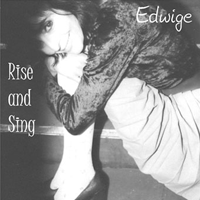
March 2004 – album reviews – Edwige’s ‘Rise and Sing’ (“while she’s not yet citing chapter and verse, the sacred aspect is clearer now”)

22 Mar

Edwige: 'Rise And Sing'

Edwige: ‘Rise And Sing’

Having made her initial mark with a couple of quirky, tricky-to-pigeonhole folk-pop albums, Edwige has made one on which she intends to celebrate “God’s beautiful gift of singing.” This could mean a lot of things. Perhaps she’s taking that unorthodox, archly beautiful voice of hers on an exploration of experimental a-capella songs, or a pure set of vocal rounds. Perhaps she’s made an album of devotional folk; or an unexpected gospel record.

As it happens, none of these are exactly the case. Edwige’s embrace of the joy of singing may be heartfelt, but it’s also comfortable. The key tone of ‘Rise and Sing’ is relaxation, and of Edwige’s assurance in her own work and her own methods. In many respects, it remains a familiar Edwige album. Many familiar tastes certainly remain intact. She still favours upfront lyrical messages, and continues to steer a course placing her somewhere between cabaret entertainer (especially on the oompah-pop of Bad Hair Day) and announcing angel.

She’s also continuing to develop her tendencies towards baroque pop arrangements. I Just Can’t Resist That Love is given lift by a suspended chorus of trilling voices and sunny passages of oboe; Into View is threaded with reeds, harpsichord, and tuba; while a harp adds sparkle to the simple, open love song After The Rain. The perky swing of New Mexico – with its elasticated guitars and psychedelic pedal-steel keyboards in tow – shows another side of her tastes, this time a dash of country music for the road.

The most surprising aspect of ‘Rise And Sing’ is a new affection for noisy guitar pop. Edwige’s latest producer (former Homer/Robyn Hitchcock sideman Andrew Claridge) sploshes some crashing electric guitars around several songs here, beefing up the acoustic strumming with touches of indie-pop, swamp-rock and grunge. The unplugged directness of previous Edwige albums, with their ornate bursts of cuteness and their denser musical surprises, sounded as if they’d come from odd-shaped rooms in an apartment piled high with spiritual books and knick-knacks. This album suggests that Edwige has recently knocked through a wall or two, and built a nice scruffy garage to play in. Her voice, as ever, is peppered with odd pitch-swoops, vibrato and declamatory theatrical inflections, and is still French-accented even after years of living in London. It’s an odd match for this bristly rock clanging – yet she thrives on the cruder energy that the extra noise provides.

With her perpetual good humour intact, Edwige uses the extra force to help her to drive home a few righteous stilettos. Straddling a catchy swaggering hook on Ears On Fire, she takes dry pot-shots at questionable cults with unreliable gurus – “I heard he was unfaithful to his wife, / I promptly took his words, and boiled them with my rice.” On Elegy For You, she skewers another bad-news, would-be Mephistopheles, decorating her lines with layered falsetto shimmers of vocalese while using the main lyric to sketch his cunning in song – “You’re so good at enchanting – / you lure with hopes and dreams / held through your spindly fingers, / and have them crushed like a crumply paper ball.” She also draws on this energy on Time For The Glorious: switching between midvoice and falsetto, rising serenely over the fuzzy rock backing to declaim “the leaf wouldn’t be but for the tree, / the wave wouldn’t roll but for the sea, / your heart wouldn’t be / but for a love much greater than one can ever conceive.”
Ah, yes. There are God-songs on ‘Rise and Sing’. Previously Edwige has only alluded to her personal, devotional brand of Christianity through cryptic clues, but now she’s beginning to become more direct. While she’s not yet citing chapter and verse, or names, the sacred aspect is clearer now, and this in turn reveals the true nature of many of her previous songs. As for the new ones, I Just Can’t Resist That Love pulls off the old soul-music trick of blurring across the boundaries of love song and devotional hymn. Opting for generosity rather than hectoring, Edwige’s revealed evangelism takes a variety of forms over a broad range of experience and musical method.

We get our gospel song after all – I May Have, in which Edwige testifies doubts and faith over a soft bed of electric chapel organ and little electric guitar agreements. Behind the pretty arrangement, Into View reveals itself as a waltzing tale of a Damascene conversion. For the jazz-tinged acoustica of Tea Light Sympathy Edwige turns teacher, with a gentle (but stern) offer to share her path. On Fusion, she becomes an ecstatic celebrant, kicking off a startling, delirious cocktail of techno pulse, hard-rocking fuzzpunk and hoedown. Choppy cello and guitars meet up with a stomping dance-floor beat and speaker-trashing bassline, and are in turn covered in festoons of Edwige as she chants, lets rip again with the vocalese and sends up fireworks of singing.

The thing about devotion, though, is that it involves letting go. Edwige is such a determined performer – so enthralled with the message, the observations, the little dialogues of life – that little of this (bar the rampaging delight of Fusion) rips through into the ecstatic. The message is always already decided, never discovered, and so the sense of actual revelation is lost. That’s a shame – for believer and unbeliever alike, observing or sharing a revelation of faith is often a fuse for crucial sympathy, and on her songs Edwige seems to miss out on this transformatory moment.

There’s one significant exception, in which Edwige’s wayward journey takes her up into a place she’s never visited before in song. Do I is that music-of-the-moment that’s missing elsewhere. An unexpected (and welcome) bit of psychedelic noise-folk, it’s set on Nico organ drones and on a cloudy screech of guitars so overdriven that they sound like English brass bands scattered by gales. The lyric is the simplest of declarations – no angles, no patter, just a naked, assured statement of devotion. “Do I come? – I do. / Will I follow? – I will. / In the light or darkness, pray for strength, / ah my love, … / Give me the warmth of your love. / Safe with you forever, ever, ever, ever.” Stepping up from the chapel drone, rising above this massing, crashing confusion of tangled feedback, Edwige is making her leap of faith for us; all cabaret cuteness falling away.

It’s the kind of inspiring moment which that unearthly voice was made for. I wish she’d do more like this.

Edwige: ‘Keep The Change’
Quasar Music, EDW3CD
CD album
Released: 2004

Buy it from:
Quasar Music or CD Baby.

Edwige online:
Homepage YouTube

July 2003 – album reviews – Edwige’s ‘You Show Them the Moon and They Look At Your Finger’ reissue (“opera singer, cat purr, wise seductress, vocal trapeze”)

27 Jul

Edwige: 'You Show Them The Moon And They Look At Your Finger'

Edwige: ‘You Show Them The Moon And They Look At Your Finger’

I seem to remember that that title is a Chinese proverb about fools missing the point: presumably this is a warning that Edwige is pointing to somewhere interesting, and that if you pay too much attention to the way she does it then you’ll miss the why. Certainly you can get sidetracked by trying to pigeonhole her music. Like any city-smart pigeon, it struggles and flits away from capture.

So what is this? It’s folky, but with at least one eye trained above the treetops. It’s French but it isn’t (despite the accent and the chanson/cabaret flutter, Edwige is London-based and Anglophone, aligned to the world in general, and open to angels). It’s poppy, but salted with the ascerbic willpower of a woman who’s lived long enough to have her own individual way of doing things. And while she’ll welcome fellow travellers, she’s confident enough not to be too worried about whether you go along with it or not. I think I like that.

It brings back a memory, too. When I was about fourteen, one of the key albums for my raging, hormonal inner life was Kate Bush’s ‘Never For Ever’. I used to have an odd relationship with that record. I’d play it all the time, never sure whether I actually wanted to or not. I remember it felt like a wayward friend on a perpetual mood swing: it was poised on a wobbly adolescent axis of feyness, promise and wisdom, and put me through bouts of frustration and love. How could one album zoom so unpredictably between cutesy kiddie fairy tales and vaginal vamping, between stardust fantasy and nuke-generation fears, vengefulness and nurture? And how could it tangle them all up in such a wayward, compelling way, but still make me want to smack the naivety out of it? No wonder I eventually ended up shoving it in the cupboard and heading for the more straightforward push and bump of indie-pop to soundtrack my later teens.

Many years of The Smiths, The Fall and My Bloody Valentine later, ‘You Show Them The Moon…’ reminds me of that early shamanic Kate Bush girl-pop. It’s not just because those arch, slanting vocals constantly recall ‘Never For Ever’s Coffee Homeground; or because I Am A Temple, from its Nile guitar twang to its waft of desert synth and the aerial-bending vocals, is a ringer for the storybook mystique Bush brought into play on Egypt. OK, Edwige’s music doesn’t carry the same weight of sensual bewitchment. It betrays its budget origins via keyboards that sometimes dip into tweeness and rinky-dink; and by a no-frills recording that sonically cramps her cosmic-tinged imaginings, cramming the cornucopia into a garden shed. But ‘You Show Them The Moon…’ does show the same fascination with the free-flowing mind that’s one of hippydom’s more useful legacies, and it can carry its eccentricity convincingly as well.

A lot of this is to do with Edwige’s voice: a wonderful, peculiar, obliquely beautiful thing. It curves itself round the tones of opera singer, cat purr, wise seductress, vocal trapeze… all with glass-etching clarity and weird ricochets. It’s like a combination of Liz Fraser from Cocteau Twins and a French Eddi Reader without the gawkiness or the broadsheet approval. Actually, don’t stop there: look towards the Strange And Flamboyant Women In Pop section. In spite of the two-dimensional production, Edwige also pulls off the trick of sounding a bit like Bjork’s long-lost boho auntie. She doesn’t possess Bjork’s genius spark of child-vision, or her way with a contemporary sound (it’s French cafe culture round here, not club culture: you’ll find no beats, samples or Trickies). But she does have that same bungee-elastic vocal yaw – admittedly delivered with Edith Piaf’s brand of declamation, and with the sort of melodies and poised guitar strums that go with ten-foot silk scarfs swirled round swan-necks.

The songs themselves fizz just on the right side of easy listening. They’re frequently soft and fluffy, but with deceptive bends. Each is a moment, polished and expansively lit, in a life that’s become a quest in which there’s no goal but an understanding – an ordinary life illuminated by extraordinary lights. Downtrodden and downbeat on No Shape For Love, Edwige can be revived enough to put on a spiritual throb of benediction for Be Blessed. She’ll caress you with a dedication of warm, supportive love on Serve You Well. She’ll also slap you down with a moment’s notice, scolding and instructing in slightly fractured English. “If I open up my heart, it’s not to please your fantasy… / You think you are my king, you’re just a slave of your own enemy.”

Throughout the album, Edwige slings assorted moods and styles around herself like hula-hoops, keeping a core of determination but remaining free-floating. She will go all Jane Siberry and produce fluffy-edged clouds of electric guitar for The Dearest – a fragile love song where the unselfconscious fairytale imagery teases out a winning pathos. If pushed, she’ll become flamboyant, defiant and unreachable, as she is on I Am A Temple (“don’t you dare pry into my life!”). Yet she’s happy – on If You Were The One – to suddenly ditch the eerie and mystical to trill away on the kind of cosy tap-dancing tearoom jazz that you’d have thought long-lost on 1950s lounge records, or to toss out a dash of Celtic sounds with ‘The Omen’ (Clannad harps and tricky jig-in-a-box/jump-into-the-sea rhythms).

Back in 1999, the original version of this album was also noisier. Edwige occasionally dabbled in a kind of accidental techno, or flew in some famished rock guitars to add roar. For this 2003 reissue, she’s ditched these particular quirks and re-recorded a couple of songs as acoustic versions. Something’s lost when Tune Up All Your Violins has its bull-in-a-china-shop clatter removed, but Edwige, strumming away solo and singing forcefully, still uses it to plunge through cosmic arcana like a costumed hero on her own cryptic spiritual mission. They Won’t Make Me Nervous is shorn of its crashing electric guitars and bendy orchestral fogs of synth, but keeps everything else, including the super-soaring choruses on which Edwige zips and kinks like a skidding comet.

The two songs at each end of the album unfurl Edwige’s searching musical and spiritual ambitions to the full, the instruments coming alive out of their budget politeness and warming the air. To Discover lounges in rich, luxurious music – lazy acoustic guitars, damask curtains of synth – but Edwige’s voice cuts through the slumber like a little silver knife. In the middle of comfort (“thinking love is here forever to remain… / and life has no more to offer than what you already knew”) there are breakdowns and hard lessons ahead: “you still have to discover.” And the climatic grandeur of Stillness suggests that she’s reached some sort of peace, looking back over the terrain of the life-quest with a sympathetic eye.

“You need to be loved, and you need to be told, but there’s no reassurance… / You feed yourself with books and beliefs / and stick on your windshield / pictures and maps / so you won’t see your direction… / And try to get peace rearranging confusion… / Still looking for Eden, El Dorado, still looking for a search / when in the stillness…is home.”

Then The Voice shoots up to ecstatic heights, hits the stars, ignites them in a wave of flame, and sees out the album with an ascending, aspirant note. Edwige is smiling and pirouetting somewhere on the pavement where Parisian cafe music (accordions and sparklers) meets the sussed cosmic chick (tarot, tai-chi and her own flat). Someone get her a decent producer and the space to fling a few more scarves around, and she’ll take us off to a brighter night, where a giant moon is untroubled by idiots pointing and where cats somersault over the chimney pots.

Edwige: ‘You Show Them The Moon And They Look At Your Finger’
Quasar Music, EDW1CD/KCA (634479459061)
CD/cassette/download album
Released: 2003 (originally released 1996)

Buy it from:
Quasar Music or CD Baby.

Edwige online:
Homepage YouTube

October 2002 – EP reviews – Galitza’s ‘Laugh Like a Horse’ (“a sweet and sometimes raucous noise”)

27 Oct

Galitza: 'Laugh Like A Horse'

Galitza: ‘Laugh Like A Horse’

Galitza make a sweet and sometimes raucous noise. A Leeds alliance of self-styled “evil pop-bitch” Emma Bob III (formerly of Chest) with most of the mortal remains of sharp-witted popsters Landspeed Loungers, they’ve combined as a pop trifle of guitar chunks, lemony organ and various voices, laced with something heady and mischievous. Sometimes they sound like a Sarah Records band, but if so they’re one that decided to ditch emotional fragility for being naughty and happy, for adopting really stupid nicknames (Dr Strikto, anyone?), and for storming pubs and cheating at cocktail-drinking competitions. They’re also a Siamese twin act fronted by a husband and wife (Stevie and Emma) who only occasionally pull the Sonny and Cher trick; and only with a sly quirk, at that.

The two sides of Galitza share certain reflexes (the touch of rumbling funk in the basement, the attractive tangle of tangy guitars), but alternate faces. When it’s Stevie’s turn at the biggest mic, Galitza are sharp-tinged indie pop with a post-Loungers taste for sardonic wit. Empty Hands races and jangles along like a perkier Furniture, putting the boot into self-serving mediocrity (“a year or two, to and fro, nothing new – / you’re just passing through / and just OK”) and to bogus management (“now they talk, now you’re in, now you’re hot. / Tomorrow comes – they forgot.”) When a bucketing chorus arrives, yelling “you wouldn’t know what to do – you wouldn’t know if it jumped up and bit you,” you realise that you could wrap this up and post it to the next train company that makes you late, the next board member to fuck you around in the office… in fact any timeserver who blows out their duties.

Closer to home (and despite the meaty guitars), You Must Be The Devil could almost be The Beautiful South – rich and delicate male and female falsettos, and a song with a broken glass in one hand. Fingernails pry apart the more welcome, teasing tortures of love… you know, the kind remembered with a twisted pleasure once it’s all dried up. “There was a time you had me hooked, you had me hooked all helplessly. / You’d reel me in, then cast me out – lucky me.” Covering Jackie Lee’s dreamy White Horses, Galitza pull it off with a mixture of mischief and affection. Emma’s inclinations to succumb to the melody’s rich sway are continually undercut by Stevie’s blissfully distorted harmony vocals.

When Emma takes the full lead, Galitza are seduced into rich and subtle melodrama – frustrated love songs, well aware of their unhealthy obsessions yet determined to ride them through. Or, unable to escape them, to cherish them instead. “You’re right, you know you are; but it still feels wrong,” Emma sings on the plaintive Stalker (in which her voice lolls luxuriantly like a stoned jazz diva across the melody and the mosaic of guitars). “It’s a stupid streak, these fits of pique, / but it’s mine, this hopeless desire – / I confide, I feel like a liar.”

For Rattle In Me, she’s much more direct. A Massive Attack-styled lust-blues, with a seismic throb of Bristol bass and a swelling thorn-bush of rising guitar mass, it’s swarming with torch tension and growing anger. “You put this rattle in me; you pull me to you: then it’s ‘just-good-friends’,” Emma murmurs, a warning vibrating just beyond her controlled cool. Add another thoroughly compelling Leeds band to the list.

Galitza: ‘Laugh Like A Horse’
Wrath Records, WRATHCD05
CD/download-only EP
Released: October 2002

Buy it from:
Bandcamp, CD from Wrath Records; download from iTunes.

Galitza online:
Bandcamp, Last.fm

REVIEW – Laughtrack: ‘Amusements’ single, 2001 (“counting the change and failing to come up with comforting answers”)

12 Aug

Laughtrack: 'Amusements'

Laughtrack: ‘Amusements’

Amusements is a majestic but famished slink across rain-dirty pavements in the gaudy heart of town: redolent of grime and darkness, and with disturbed puddles wavering neon reflections at you. A techno dub-groove catwalks its way from start to finish, toying with all the time in the world: whether the wire-wool guitars are beating themselves against it or whether the sound is being gulped away to reveal the skeletal machinery of bass and beat prowling onwards. A thin but insistent vocal hangs at the heart of it: “I can’t tell you no lies / We’re moving into a new kind of life – / a strange new world, a comfort zone / where nobody has to be alone.”

It’s a lyric which almost sounds as if it ought to be bobbling along on top of a corporate anthem: but which, in this context, sounds as if it’s shadowing the giant corporate hands which can pat you on the head in one pass and scoop away your world with the next. “Why have you sold the future, why have you sold the past?” questions the chorus. “Is it for our amusements, ‘cos nothing is meant to last?” Someone’s standing on the edge of the kerb, swaying on their heels, counting the change they’ve been returned and failing to come up with comforting answers.

If the original Amusements resembles a rocked-up ‘Mezzanine’, the Severance mix (done with “avant-hardist” MEME) flings the drums into echoing relief and carves the groove into a zombie stomp, Garbage-style. Grating peaks of sub-bass and further sandstorms of psychedelic guitar crackle somewhere between Chapterhouse, Suicide and Levitation – sleekness savaged into life by noise and interference. No words, but an implacable, forceful indifference. The deal’s done – it’s time to bring out the heavy lorries.

Slide round the corner, and things are different. The torch song atmosphere of Left Standing implies Goth-cum-trip-hop, but also a take on Billy Mackenzie at his most open. It’s the brittle piano chording, that cavernous sway of arrangement around the lamp-post glow of a solitary microphone; the hints of theatrics and sincerity interlocking fingers and squeezing for luck… or in desperation. That said, it doesn’t follow the Mackenzie trail entirely. There’s an absence of helium operatics and peacock posturing. Instead, the almost-buried voice of Joe (Laughtrack’s mastermind) catches at the same blend of clenched unfunky indignation as Roland Orzabal at his most vulnerable; and even breaks at the same preacherly point.

This time Joe’s not mourning a way of life, but a person: and although the burden of grief is shared, the empty space that’s been punched into his life is obvious. Joe sounds exhausted and angry as he confesses “I really don’t care for very much these days, / but the living is easy in a pointless way. / You left us standing, and now everything is hard to say…” Thankfully there are compensations, new reconcilations, new solidarities to be found in the face of it: “I tell my friends ‘don’t be so scared’… / You left us standing, and that’s something we’ll always share.”

It’s Laughtrack’s unease – their sense of huge forces and emotions moving behind the immediate business of life – that draws you back to them. This is dark, luxuriant pop to tease apart with the fingertips and pry into; something that suggests stories in the same way as the more oblique moments of no-man or Smog. And Laughtrack’s simple but oddly unsettling name (raising questions every time you consider it) suggests a writer intelligent enough to be aware of the frame surrounding whatever he does.

As Laughtrack roll away off into the night, they’re being quietly trailed by gumshoes who are after some more answers.

Laughtrack: “Amusements”
Contrary Public, CONTPUB001 (no barcode)
CD-only single
Released: 2001

Buy it from:
Best looked for second-hand.

Laughtrack online:
MySpace

REVIEW – Holy Roman Empire: ‘Dante’s Inferno’ single, 2001 (“a glorious Moulin Rouge gesture”)

27 Apr

Holy Roman Empire: 'Dante's Inferno'

Holy Roman Empire: ‘Dante’s Inferno’

“Well, you got so down you went to town and bought a brand-new top. / They can take your will to live but not your will to shop. / Try to eat more ‘cos you’re hungry, and less because you’re lonely, / and don’t let that feeling fade away…”

Oxford pop pixies Holy Roman Empire seem cheerful to sell themselves as being crap. Their press-kit is full of reviews slating their appalling clothes, their mimed performances, their (allegedly) pitiful singing and their clunky tape recorders hidden inexpertly under keyboard stands. Yet they don’t half shoot themselves in the foot by coming up with such good songs.

Bloody hell – if this had shown up in 1989 it would have swept all before it. Not every song blends – so successfully – lyrics like a playful junior Morrissey with mock-pomp Carter USM Casio orchestrations and rounds it off with the cruising freeway feel of Chris Isaak’s Wicked Game. Back then this would have been a small Holy Grail for student radio, ghosting through every university bar across the land. Here and now it can only settle for being classic, timeless pop – whatever the clothing.

In case I’ve not made my point yet – Dante’s Inferno is marvellous. It’s one of those rare songs which fey critics, hung-up on the sublime disposability of pop, always whiffle on about. Well aware of the ludicrousness that lies at the heart of obsessive passion – and of the dramatic pretensions of pop music – it still goes at it full-tilt because it knows that that’s all that matters. (As a bonus, I can still believe in the song even as I reel off this kind of posturing shite… that’s high camp for you.)

Holy Roman Empire ‘s Ste Fleming and his two foils sigh as milkily as Prefab Sprout and deftly nail the paradox of all-consuming unrequited love. “You go to the doctor, and the doctor feeds you pills. / You know you need them, but you need the pain they kill. / All because you lost somebody, but never lost the feeling, / and daren’t let that feeling fade away.” Inevitably the other two songs are anticlimactic after this glorious Moulin Rouge gesture. After all, how do you follow up a song which has a ringmaster on the chorus?

Still, Holy Roman Empire can quick-march a long way on what they’ve got. What they’ve got happens to be a batch of cheesy keyboard puffs, an upbeat chirp of melody, a vocal style best compared to a pomp version of Rod, Jane & Freddy, and some of the sharpest lyrics this side of Paddy McAloon’s teenage-fluff drawer. I Bleed Petrol (punctuated by cute car-crash sound effects) could almost be a children’s singalong. Then again, there are lines like “city kids with sicknesses, and flowers placed by roads, / melting polar icecaps and the flooded southern coasts”, suggesting that the trio have made a noose out of a skipping rope and are trotting out in search of a symbolic motorist to lynch.

No Tomorrow is a bizarrely happy-sounding love song about… yes… everything turning out shit in the end. It’s a fiddling-about with goodbye ribbons as the city burns. “I was sort of wishing – yeah, I was kind of hoping, / as the ground got closer, that my parachute would open (but no…) / ‘You have to be strong now: you have to let me go,’ / so it’s off with my head and it’s on with the show.”

You have to reckon that as long as that tinselly backcloth is still there, Ste Fleming will stay happy. Supercheese wins out, then – and mighty tasty it is too.

Holy Roman Empire: ‘Dante’s Inferno’
Bluefire Records, BLU017
CD single
Released: 2001

Get it from:
Best obtained second-hand.

Artist online:
MySpace

December 2000 – album reviews – Picture Center’s ‘The Wonders of God’s Heaven and Earth’ (“the sound an illusion makes as it leaves the body”)

1 Dec

Picture Center: 'The Wonders Of God's Heaven And Earth'

Picture Center: ‘The Wonders Of God’s Heaven And Earth’

A beautifully understated fatalism hangs, both heavy and light, over the music on Picture Center’s first album. It reminds me of the last time I was – God knows why – wandering on one of the muddy pebble beaches along the Thames Estuary, heart carried like a windsock, fumbled at by a half-hearted drizzle; and when I saw a lonely seagull poised like a pinned crucifixion in the air, almost motionless. Every now and again there was a single convulsion of wings, but the bird always seemed on the brink of a slow, agonised slide down the bank of the air. I remember thinking that it must have been moving forwards once, but something had paralysed it in the middle of a wing-beat…


The words “together” and “forever” haunt ‘The Wonders Of God’s Heaven And Earth’. Persistently returning – sometimes as statements of peeling faith, sometimes as a grim acknowledgement of being stuck. Sometimes a question, hopeful or semi-resigned; the gamble of a last lottery card; the last sarcastic murmur which is the sound an illusion makes as it leaves the body. Another word that returns is “whatever” – breathed out as a throwaway, or embraced with no complaint beyond a drop in the volume and a withdrawal into the kind of shrug that says “here’s as uncertain as anywhere.”

This is familiar. Picture Center have a connection with the late lamented Field Mice… well, more of a fumbled kissing connection, really (they shared some people once, but not any more). Consequently, they’re part of that downbeat English indie bloodline that winds through Sarah Records and its Shinkansen successor – the one that carries the heart-lorn and introverted folk music from the lonely post-war estates – while the countrified, Celtified melancholia of songs like Useless ties in with the romantic resignation of Belle & Sebastian or The Blue Nile.


So, as you’d expect, the pace is wistfully dragging, almost funereal. Girls’ and boys’ voices whisper, tears are long-dry but faces stay crooked. The guitars sigh out the emotions, a mist of greyed-out pearls hanging in the atmosphere. A particular poignant English gloom prevails – wan air; not enough daylight saving; and little towns that aren’t so much sleepy as catatonic on tranquilisers, smack and inertia (“around in circles, but nothing comes of it”). The washed-out-but-beautiful album cover could be a stony beach, or a hill of puffy blossoms… oh, or the soggy styrofoam’n’plastic debris left behind in the fields after the festival closes. Distilling an unusual beauty from such unpromising ingredients is Picture Center’s particular talent.

You can think of psychedelia as colourful, but there’s another strand of it that’s a billion shades of grey and merely half of a painful, ghostly heartbeat away from reality. And that’s where Picture Center live; acknowledging it in their gliding, spectral cover of West Coast Pop Art Experimental Band’s Smell Of Incense. It’s heightened by the other elements they allow to soak into the mix – the occasional country curve of a lonely guitar, the fretful Sigur Ros falsetto and drum-machine bubble on Dreams, the pressed-out Julee Cruise sigh of Forever. The tired glimmers of Cocteau Twins moondust or the hinted imprint of hip-hop’s loops and scratchy gusts behind the music-box delicacy in Never. You know they’ve been there – that place where sorrow floats, suspended in its own little bubble while reality freezes your face into something that’s calm but drained…


Ten pictures of fading dreams, drawn-out disappearances, fateful accomodations (“without my darkness your star wouldn’t shine / You need me like I need you…”) and stories of nothing-going-on, in which despair and beauty still manage to sit hand-in-hand on the same worn-down furniture, and achieve a kind of peace together.

Picture Center: ‘The Wonders Of God’s Heaven And Earth’
North American Recordings, 5 030820 012704
CD album
Released: 27th November 2000

Buy it from:
Best looked for second-hand.

Picture Center online:
MySpace Last FM

August 2000 – album reviews – Rudy Simone’s ‘To Put the Sun Back in the Sky’ (“shot through with aftershocks of abandonment, dispossession, self-doubt and the battle to stay afloat”)

19 Aug

record-rudysimone-putthesun

Shot through with aftershocks of abandonment, dispossession, self-doubt and the battle to stay afloat, Rudy Simone’s debut album doesn’t resolve the questions she’s raised before. It doesn’t round off those battleworn displays of uneasy heart from the previous year’s ‘Personal Cloud‘ EP, nor does it offer clear clues about where she’ll be travelling in the future.

Fresh as she sounds, Rudy already has plenty of past. Originally from Buffalo, New York State (where, as Rita Seitz, she sang in various obscure bands during the early 1980s) she turned emotional refugee later in life and crossed the Atlantic to Liverpool, where her own songs emerged amid a landscape of acoustic sessions and nightclub rushes. Most debut albums are a statement, however crude. This one’s a scrambling steeplechase across Rudy’s emotions and her spiritual restlessness. It stays true to the disruptive collisions between the life singing in the head and the life that lurks outside. What ‘To Put The Sun Back In The Sky’ resembles most is an attempt to wrap up Rudy’s fraught baggage in a big, unwieldy brown paper package; to tie it together with guitar strings and beats, to spray it with disco glitter and then set it free somewhere down the Mersey. Drifting seawards, it comes unstuck and reveals itself.

Attempting to cram in all her gushes of inspiration, Rudy ends up with a confusing whole. Seemingly at random, songs appear in alternate acoustic and instrumental alternate versions; there are two takes on the eerie Kill The Cult Of Cool single, and a trancier reworking of Personal Cloud. ‘To Put The Sun Back In The Sky’ ends up as an anxious, fractured goodie-bag, unsure about whether floaty beats are better than strumming, and telling repeated stories in different tones. Don’t expect track-by-track coherence – but do expect plenty of understated feeling, a maverick DIY pop sense in full effect, and some determined songcraft. This album is a necklace-worth of interesting, often touching episodes.

In some respects, Rudy fits in with that rough wave of confessional women emerging in the 1990s via trip-hop and indie rock, including the two Beths (Gibbons and Orton) and Juliana Hatfield. There are some similarities to Jane Siberry; though Rudy is more loosely strung, she shares elliptical, Siberryesque feminine perspectives, blown about by impressions and finding solid little truths in the midst of abstraction. But for my money the artist whom she’s closest to is Lida Husik. Both Rudy and Lida resist committing themselves to any one musical approach or way of looking; both seem suspicious of tradition or sturdy craftsmanship. As with Husik, Rudy’s wispily sweet vocal belies her determination to discover and envision things her own way, learning from time and from chance. Both, too, are peripatetic and intuitive to a fault: they’re both quite prepared to walk into mires of embarrassing self-conscious fluff if that’s where an idea takes them (in Rudy’s case, a misplaced James Brown tribute called Bony Little, giddy and apologetic, in which she bangs on forever about her skinny white ass).

For this album, the club dance elements have triumphed in Rudy’s big bag of sounds – as they did on Husik’s ‘Green Blue Fire’ album four years previously. Techno producer Sheldon Southworth, a.k.a Diffusion, is a vital collaborator for half the album. He’s the Beaumont Hannant to Rudy’s Husik, adding his own club-friendly trance sparkle to hers and replacing guitars with the zing of electronics. For The Secret Sayings Of Jesus, Rudy whispers god-inside Gnostic philosophy, floating it like evangelical thistledown over Diffusion’s bright trance beats and aquatic keyboard textures. Despite her trippy tones, hypnotically soft, the chant is a desperate prayer rather than navel-gazing. It’s a counterpoint to the other songs, which make up a travelogue of delusions to be overcome in oneself or endured from others.

Vanity’s Car perks its way through cheerful Euro-trance and Soft Cell gurgles, but Rudy’s lyrics dwell on how the wrong kind of excitement can lessen a person’s grasp on reality – “amazing how far you’ll go when you lose control – / I’ve got to get out on my feet / and be the things I always wanted to be.” The fallout is clear: “I might be sitting in your living room / but I might as well be in another country,” Rudy protests on Can’t Go There. “You can drive if you wanna, but I prefer to stay on my feet… / ‘cos you’re so blind, you can’t see that it’s right across the street.” Warm swelling synths, glinting funk-wah guitar, and house piano echo that communal gospel glory which Primal Scream tapped on Come Together. Rudy’s own hopes of connection, though, are dissolving.

While Diffusion’s contributions are valuable, there’s no question that Rudy remains convincing on her own. The brief pure-dance diversion of Mentallium hurls rapid drum’n’bass kitfire headlong into chilly trance electronica: to wild things up a little, Rudy mixes twitchy diva calls, jazzy double bass and kettle drums into the instrumental. Out on the other edge of her music, she abandons beats and boxes. A blues-y acoustic guitar version of Vanity’s Car brings its warnings closer to the surface, no longer masked by shiny bodywork. Part pop-plaint, but mostly blues rant, the all-acoustic Water’s Edge sees the banalities of love (“Sometimes I’d like to kill him, / but I always gotta thrill him”) splinter in a glare of rage. Wailing like a cross between PJ Harvey and Etta James, Rudy walks the shoreline, grappling with a moment of agonising choice. Violence is poised within her, ready to strike inwards or outwards, and only the lone conscious voice of the song cries out against it. “Don’t go, you’ll only make your mama cry / Don’t go, you’ll only fuck your baby’s mind.”

As a single, Kill The Cult Of Cool got lost in the no-budget wilds which sank so many others; yet its emotional hop-skip-and-jump was a remarkable coming-together of ideas and instinct. It still is. Broody horror synths, laceworks of folk guitar and a patchwork of voice snippets quilt together into something haunted, defiant and transformative. In keeping with the rest of the album’s repetitions and revisitings, the song gets a double outing (the Derision Mix transforms it into radiophonic electro-funk replete with glitchy scratching and whooshing, frothing Vangelis synth splurge) but it’s the original that really matters. Something of a signature song for Rudy ever since it first showed up on ‘Personal Cloud‘, its cohesive spirit remains clear as its splintered voices ask for compassion, pray for guidance, plant down stubborn feet. “I was the quiet one in school, never made any trouble,” stammers a sampled man; “I don’t care what you say, I’m not crazy,” Rudy adds quietly. It’s full of struggle, though never precisely clear what that struggle is – the claw back to sanity out of the creeping horrors? a defense of alternative thinkers and scapegoats? – yet it’s also affecting in a way in which few things that I hear are.

The spine of the album, though, is the title track and Personal Cloud. The former’s a grieving white-girl rap about a marriage snapped violently in half: here, Rudy sounds as soft-spoken but as wide-awake’n’dreaming as Margaret Fiedler does while puzzling out dreams in Laika. Almost cushioned by the pain, she lets moments of heartbreaking reproach crest over it and into the words: when she murmurs “you say you’re following your heart / I say fear has played a much bigger part”, real agony glints. In a new take on Personal Cloud (remixed by M@2K into radar blips, ambient funk and blue-light electronics) more displaced degrees of mourning are added to Rudy’s grapple with addictions, love and loneliness (“I wrap my lips around a cigarette instead of you…”). Her voice flutters, weightless and bereft: a hydrogen balloon un-anchored by faithless hands.

Maybe ‘To Put The Sun Back In The Sky’ is not the album Rudy Simone’s capable of. It’s more like several different shots at an album: all crowded into the kitchen together, taking anxious and uncomfortable refuge. No clear clues; a spinning signpost; but indications of an effective, if scattered, talent – one worth investing some love in.

Rudy Simone: ‘To Put The Sun Back In The Sky’
Phat Lady Records (no catalogue number or barcode)
CD-R-only album
Released: 2000

Buy it from:
Extremely rare – best found second-hand.

Rudy Simone online:
Homepage Facebook Twitter Bandcamp Last FM YouTube

October 1999 – album reviews – Sneaker Pimps’ ‘Splinter’ (“half in love with the idea of beautiful corpses and wanton failures”)

29 Oct

Sneaker Pimps: 'Splinter'

Sneaker Pimps: ‘Splinter’

Smack.

Its presence ghosts off this record like chill off the sea. The more you listen, the more obvious it gets; the more appropriate it seems. Twelve songs about different levels of letdown – alienation and betrayal; shortfall and disgust, “high fives and corporate anthems” – but always, always possessing an ability to be lifted above it; to float in a strange and tragic euphoria in which pain and torment are overwhelmed. A rush of transcendent languorous bliss while the mind hovers above, intact and unmarked.

Even if Sneaker Pimps weren’t so candid about backstage recreation (or didn’t drop lyrical hints like “my aim’s so weak that I’d fail to get into my arm”), you can’t escape the fact that their second album is a heroin album par excellence. Admittedly, a smarter and more professional brand of smack music – no William Burroughs squalor, no Needle Park lowlife. The spike goes in beside a penthouse window, lying on a sleek leather couch; no dust on the floor. But then, as a pop group, Sneaker Pimps always seemed far too smart for the daytime shows and MTV gladhandings.

Well, some of them did. I saw an Sneaker Pimps interview in which Kelli Dayton – their original Goth pixie-ette singer – sat flirting and babbling on a sofa, flanked by Chris Corner and Liam Howe. When not answering their own questions, with a cool intelligence, they observed her with the bored and slightly amazed looks of gentleman experts faced with a posturing child. The hapless Kelli isn’t part of Sneaker Pimps any more. She’s been dropped out – as if via hidden trapdoor – or simply excised.

For ‘Splinter’, Chris Corner glides forward like Dracula to take over the mic. His slackly sensual looks (young Johnny Thunders and Ronnie Wood, with a wild crow’s nest of dyed-black hair) lounge all over the artwork of ‘Splinter’, much as his lisping, artfully-forlorn whisper floats ahead of the music’s tide. Perhaps it’s just extra clarity – with Kelli no longer an oblivious mouthpiece – but ‘Splinter’ feels like cresting a roller-coaster. A swelling build of dawning clarity, darker- toned, which sets you up for the plunge.

‘Splinter’ is also the most seductive pop record I’ve heard in a long time. Not coy winks or overblown soul-boy mating calls, not even on the acid-coated, Suede-stinging-Cameo-to-death stamp of ‘Ten to Twenty’. This is a more abstract seduction, the lure of rich fabric, sweet smoke or smouldering looks. It’s born not just from the unveiling of secrets but from Liam Howe’s shockingly opulent backdrop. Creamy, orchestrated synths and samplers traced with beautifully disturbing sound. Pianos echo, fretful in the cavernous dark. ‘Omen’ choirs or wailing-wall chants lunge out at Chris, trying to lassoo him. Small slivers of Oriental melody glitter in the fabric, and beyond the luscious trip-hop grooves eerie Bernard Hermann strings are trembling, bursting, warning. Female singers, disturbingly blank, shadow Chris’ pinched tones.

The whole album’s in a state of sensual motion, like restless waters or billowing tapestries. As for mood and motif, it’s always ominous – always half in love with the idea of beautiful corpses and wanton failures; with sultry sicknesses and the bloody romance of despair. Kelli or no Kelli, there’s always been a Goth undercurrent to Sneaker Pimps (and not just because the industrial-tinged, reverberant rock of Superbug also has a distinct tang of The Mission). When Chris sings “strike me down, give me everything you’ve got. / Strike me down, I’ll be everything I’m not,” on ‘Lightning Field’, he sounds bright-eyed, waiting for the lash.

On ‘Half Life’, accompanied by the liquid, trembling swirl of pianos and ghost orchestras, Chris muses at the syringe or at the lover he’s failing with – “half life wastes before it goes – / it’s funny how your bee-sting touch never leaves me whole. / It’s not enough to stay here, almost trying. / You kept your last laugh, watch this dying.” On the magnificently disdainful, disgusted ‘Low Five’ he delicately spits back corporate language and schmooze-talk with savage grace – “Kite-marked for true low standards / where more wants all and no less. / Just change with no real progress… / I’m a low five downsize no-one else. / Do you love yourself?”

Bad relationships. With the biz, with the needle or with girlfriends – all three bleed together in Sneaker Pimps’ crafted disaffection. Only on ‘Cute Sushi Lunches’ does this seem brattish, as Chris sneers “nineteen steps out from under your feet. / Can’t eat, won’t eat… / Hate like a child hates his hair cut,” and the instruments obstruct each other, stubbornly refusing to gel… but not quite enough to derail the song.

It’s a suspect confessional, a cunning blind to absorb attack while Sneaker Pimps slip the rest of the album past your resistance. The worm-turning cruelty of ‘Curl’, popping with funk under its lustrous ballad verses, stung by zithers and pulsating psychedelic grind – “I curl to break consent… / and I curl now to help me find you out.” And the little thrusts and revelations like “never compromise – you’re just always weak”; “it takes too much to please me – / attached but no real feeling,”; and (most killingly) “failure was on me, / but your ideals bore me.” All of it wrapped in that dark and dreamy music.

Beyond the sensual overkill – that luxuriant death-by-soundtrack – the rich nightlife sounds are sometimes folded away in favour of small rooms dominated by Chris’ spider-legged acoustic guitar. ‘Flowers and Silence’ is the most explicit trip to the shooting gallery. Skeletal slow jazz waltzing among the radar blips somewhere between Scott Walker and John Lydon, moth-wing vibrations of synth, and a dry-mouthed Chris murmuring “she’s nowhere, she mainlines, / helps me out – now I can speak… / So nothing’s free. / Ghost-drunk, out of reach.”

Behind the dogged strum and distant alarms of ‘Destroying Angel’, strings slither down – blood trickling across a window – while Chris turns in the most sinister performance on the record. “The stones beneath the water that you walk on to be taller, / the hands you stuck together ‘cos you prayed you’d wait forever,”, he whispers, picking apart a dying affair full of desperate power games and scams, and ruthlessly stripping it away from himself, right down to the tattoos (“the words beneath my skin / the ink that you put in, / destroying all the things you left around.”). There’s torch music on ‘Empathy Low’ – as well as a rich sleazy purr of double bass – but if so it’s torch reduced to clammy ashes, as Chris stares into the recesses of his soul and finds them disturbingly bare. “Proves herself to be closer, / but not me forever, not me… / My memory’s so / empathy low.”

And there’s ‘Splinter’ itself, the guitar zinging and slapping while things prowl in the shadows – growling, creaking double bass, moaning and scraping; boiling, ghostly noises from Liam Howe’s black boxes. Then there’s Chris, flint-eyed and flint- voiced – “Does it take the fireworks to make you look in wonder? / Would you give reaction to the cause I’m under? / So coloured by you, but your monkey messed it up – / surrounded by you, your monkey’s long-while had enough.” If David Sylvian had stayed in London, corrupted by the smoke and cynicism, he might have ended up this sleekly poisonous: enveloped in beautiful, cultured ambient sound and existential melancholy, but honing a small silvery sleeve-dagger for the right moment.

The final song – ‘Wife by Two Thousand’ – could be a subway busk, with one of Chris’ faceless women singing back at him from further down the tunnel. A draught sucks at it, pulling Liam’s subliminal buzzes and celesta clinks away into the oblivious sounds of a crowd. While Chris strings phrases from ‘I Can Sing a Rainbow’ into the chorus (as if trying to get back to childhood assurance), the song’s an attempted seduction, in spite of everything that’s gone before. Chris is playing the vulnerable card this time, with a cynical, pleading desperation. “Never so complete, just failing on its feet… / I think that I need working on, so work on me / I feel that nothing’s getting though, so get to me.”

But the last we hear of him is a nonchalant nothing-can- hurt-me whistle. He’s disappearing into the city with his bag of secrets closed up again, leaving you to make your guesses. The kind of doomed, fascinating bastard whom your eyes still follow, and whom your hands reach out to in spite of yourself. Damn.

Trust a junkie? Never. But they can be as compelling as their habits.

Sneaker Pimps: ‘Splinter’
Clean Up Records Ltd., CUP 040CD (5029271004024)
CD/download album
Released: 29th October 1999

Buy it from:
Available from most sources.

Sneaker Pimps online:
Homepage FacebookMySpace Last FM

October 1999 – album reviews – Des de Moor’s ‘Water of Europe’ (“a cherubic smart bomb of chanson”)

1 Oct

Des de Moor: 'Water Of Europe'

Des de Moor: ‘Water Of Europe’

Like a cherubic smart bomb, Des de Moor has popped up whenever London needs a sniff of wicked European song. In his time, he’s helmed the Pirate Jenny’s cabaret club, fought for chanson and acidic cabaret old and new, or made a public case for tying together songwriters as diverse as Boris Vian, Georges Brassens, Martin Jacques of The Tigerlillies, David Bowie and The Magnetic Fields maestro of puckish gloom, Stephen Merritt.

When Des can fit in an album of his own, it’s recorded in bursts of enthusiasm in between all these other burst of enthusiasm. As with everything else he does, it bears the stamp of that sweep of songcraft and resistance he’s devoted himself to, as he elbows his way into his own niche and into the history of chanson. When “fuck you, I won’t do what you tell me” has become our most famous protest lyric, and our concept of resistance-in-song is measured by the PC-baiting and broody solipsism of Eminem, Marilyn Manson or Wu-Tang Clan, it’s good to hear a dash of genuinely sharp social writing – even if it comes couched in a musical language nearly a century old (which in turn suggests that we might have been missing a lot since we cut those particular stylings out of the popular consciousness).

‘Water Of Europe’ must’ve been recorded for tuppence, and sometimes sounds as if it was lashed together with parcel string. No Dagmar Krause big-budget political cabaret job this, all respectably outrageous and state-concert-hall friendly. It’s sealed and sold on the vigorous punky pocket-orchestra enthusiasm of the players – bumped guitars, cellos, pianos, snapping percussion, Daniel “Boum!” Teper’s accordion.

Des’ voice is the common key – a florid, unusual mixture of madrigal tenor and soapbox preacher; or a grown-up, apostate choirboy in the political thick of a pub argument. It sits at the heart of the de Moor way of working, and is as pugnacious and theatrical as his barbed lyrics. Each word is bitten into shape and flung out with flair. Although most of his music could’ve easily have strolled straight out of the 1930s (Des might have drawn on punk’s assertive spirit of questioning, but he clearly finds more verve and expressiveness in a mix of jazz, folk and cafe singalong), his lyrics are less time-locked. They dig into the dirt and humanity of yesterday, today and tomorrow, exploring themes of exploitation and injustice, politics and deception, war and its wounds, gay life and its hauntings.

Des de Moor: ‘Dirty Pictures’ (preview)

Skidding and acerbic, the punchy accordion tango of Dirty Pictures tears into public figures embroiled in the noisy scams of censorship and social decency, taking forthright aim at their implicit hypocrisy, their encroaching voyeurism and their lust for personal exhibition (“You’ve seen the camera, it’s seen you… / you’ve wanked in front of mirrors too.”) With a sarcastic zest, Des savages the double standard of class and education – “Let middle classes get their kicks: / subtitled sex in foreign flicks / can’t cause infection. / The masses, couch potatoes all, / whose dishes sprout from every wall: / they need protection.” He also spotlights broader horrors for which there’s less willpower for banning (“Pot-bellied children / rooting in rubbish / as food mountains rot; / The obscene, often-seen, / ultimate snuff scene / between have and have-not.”)

Des de Moor: ‘Heart Of A Heartless World’ (preview)

On a more mythological scale, Heart Of A Heartless World (which sounds something like a state-of-the-world take on Fairytale Of New York) takes on the compromised cultures of colonialism, famine relief and the points where they intertwine. Retelling a sweep of human history as a journey from a lost African paradise into a famine filled by suspicious prophets and priests (“vultures that pick at the corpse of the poor”), Des suggests that the journey has bequeathed us a present-day of false hearts, superstition and moralistic humbug where “priests and prime ministers pray for our sins / and mystics on telly guess lottery wins.”

Des de Moor: ‘Margins’ (preview)

Des’ words spit and crackle even when – Germanically – they cluster, fight and split the envelope of the tune. The magnificent Margins (just waspish accordion, Des in marvellously stroppy voice and the bitter backdrop of the Bosnian conflict) jumps out at you, laying waste to the complicity of media and state interests in the parceling-up and selective suppressions of a world in conflict. “Believe what you hear and believe what you’re willing: / a severed head here, and there a mass killing. / We’ll print it provided / it’s clearly one-sided / and something is left to the margins, / at the bottom of the page in the margins.” In this song, little escapes the de Moor tonguelashing – not the journalists who “roam far and wide collecting tales of atrocities / from regular soldiers and mercenaries” and not the conferences that re-order things, ratifying the mess the way the biggest powers want it. Certainly not the scapegoating stories that thrive “so long as they’re hearsay, undated, / uncorroborated / and blame the right side… / We’ve forgot the Ustashe and found the new Nazis / in Belgrade this time.”

A debt to the history of chanson and folk is paid via a handful of gutsy covers and interpretations. Terry Callier’s Ordinary Joe is one, boasting gloriously hooded trombone from Dave Keech and a guarded, evasive street philosophy – “Down here on the ground, / when you find folks are giving you the runaround, / keep your game uptight / – and if you must, just take your secrets underground.” A rough’n’ready, guitar’n’free-verse declamation of Brecht and Eisler’s To Those Born After (An Die Nachtboren) is another, exploring the crummier details of toiling in the revolution. “I ate my dinners between the battles, / I lay down to sleep among the murderers, / I didn’t care for much for love / and for nature’s beauties I had little patience… / Oh we, who wished to lay for the foundations for peace and friendliness, / could never be friendly ourselves… / In the future, when no longer / do human beings still treat themselves as animals, / look back on us with indulgence.”

Des de Moor: ‘To Those Born After’ (preview)

Most impressively, a new translation of Jacques Brel’s My Father Said polishes Des’ claim to be the best English-speaking Brel interpreter – in either sense of the word. The song explicitly links Britain and Europe: a legend of kinship, of severance by high North winds and high water (both brought to musical life by Kev Hopper’s magnificent solo on musical saw), and of humanity blown before the rough and beautiful forces of nature. “The earth was rent / between Zeebrugge and the cliffs of Kent: / and London’s left cut loose and free, / with the Bruges headland taunting the sea. / And London’s left to forever be / a suburb of Bruges, lost in the sea.”

Des de Moor: ‘My Father Said’ (preview)

My Father Said stands as a counterweight to Des’ own Water Of Europe itself – another exploration of kinship. Here, Des places himself on a fantastical odyssey of his own, sending his thoughts out from Britain and around Europe. He finds first an island, and then a continent, locked in a common defensiveness and an ugly sense of purity. Each exploits “the Other” but denies them harbourage – “If they desire a water of Europe / it is the cold grey sea that divides. / Or the deep and inviolable water / taking and making sides.” Against this he calls on the forces and floods of history, hoping for the day when “truth decontaminates water supplies”, and “the fracturing chains of the workers of Europe / have strangled the boy with his thumb in the dijk.” Whips snap, castanets rattle, accordions and guitars throw punches. There’s going to be a party out there when the storm breaks.

Des de Moor: ‘Water Of Europe’ (preview)

Some of Des’ gestures aren’t carried nearly so well. However musical he is, he’s a man of words first and foremost, and this can mean that in his forthright sincerity the songs scramble across an imbalance of text and melody, like a flapping banner dragged by the wind. In the squabbling, tricky surveillance satire of Big Sister, for instance, his voice drowns in his densely-packed lyric: “More cameras than Hollywood, more tape than Scotch, / more logs than Canada, much more to watch… /I am your friend in the fight against crime. / Won’t you be safe when I’m there all the time – / minding your kitchen and minding your bed, / and, for extra security, / minding your head?”

Des de Moor: ‘Big Sister’

The Fairground Attraction swing of Grandmother Was A Hero, with its perceptive picture of human flaws, also should have been better as a standalone song. Over-pressured by words, it lacks smoothness and poise. Yet if you can accept that Des’ prime aim is to get his tales across, it has a lot to offer. Weighing up his monstrous grandmother’s peacetime behaviour, Des offsets it against her tireless protection and concealment of refugee Jews during wartime. “She didn’t have much wit or grace, / nor brains in large amounts. / But Grandmother was a human / and being human counts.” In telling her story, in a voice and lyric that build, ebb and resurge through a complex knot of anger, admiration and pity, Des finally arrives at solidarity, and presents his memorial:

“Just think how it must have been / as a hausfrau in poor Holland when the Wehrmacht goose-stepped in / With a husband that you hate, but there is nothing you can do: / It’s an emergency situation, and your man’s your comrade too. / In that fearful hunger winter when all your two kids have to eat / is potato peelings, pea pods and the snow from off the street – / and they’re handing out the yellow stars that one by one blink out, / and you know you have to help them, and there is no time for doubt. / Until the Gestapo knock on your door, and you find yourself alone / and in the settled dust you’re just a German widow / far from home.”

Des de Moor: ‘Grandmother Was A Hero’

Elsewhere, a loose trilogy about workers in London merges a realist’s acceptance with the strong protest of an angry survivor. In Avocado, Des examines the gritty detail of the kitchen worker’s desperate struggle between hopes and exhaustion – memories crumpled in the heat and hubbub, but not yet devoid of the sting of style. In doing so, he etches a picture of life of triumphs and traps. “Choose a plump, ripe avocado, just like on your first exam / at a college back in Glasgow. Stop the memories if you can. / Take that plump, ripe avocado, slice it with the sharpest knife, / Smile and summon your bravado: it’s a cold, raw kind of life.”

Des de Moor: ‘Avocado’

In Joey’s Dreams, Des delivers a rock song turned back into seething left-wing folk ballad, the story of a gentle working bloke who’s gradually ground into resentment by hard times and defeat – “a beast that’s pacing in a pen / at the edge of a feast for rather richer men.” He goes on to trace how resentment leads to poison, and frustration to an ugly fall, shading it into a larger picture of a caste crushed down from honour into malevolence. “Joey’s cramped contractor’s terms, / that force his crawl among the worms, / create a breeding ground for germs: / opinions that the world confirms… The clots of rot clog up each bend, / the queues for casualty don’t end. / You can’t believe in your MP – now Joey’s voting BNP.”

Des de Moor: ‘Joey’s Dreams’ (preview)

Beyond these small fierce sketches, there’s the fractured battlement of Sleaze City. Des takes an uneasy stroll through his beloved south-east London, past strangled docks and thriving bailiffs, sniffing and frowning at the muggy wind of corruption shrouding Westminster even as homeless beggars huddle in sleeping bags, a stone’s throw away over in the Strand. Throughout, a sweep of history – compromise, an age-old London scrabble and a sense of loss – provides depth. “At Surrey Quays, saluting the seas / sets flags bobbing. Along the shores ex-stevedores / watch gulls mobbing… /The last leaking hulks have long furled their sheets / at Woodpecker, Evelyn, Crossfields and Pepys…. / There’s whole careers / in chasing arrears, still shivers / though shirts are soaking. / Sleaze City’s choking / in the ozone.”

Des de Moor: ‘Sleaze City’ (preview)

For more personal struggles, there’s Sharp Contradictions and Last Orders Please. On the former, Julia Doyle’s double bass and David Harrod’s needling piano pick out itchy broken harmonies like the stab of toothache. Des anatomises the terrifying wonder of a fall into love, like an attacking scalpel or virus winding to the very centre of a person. “Alive and kicking, awake, aware / with a billion lights that sparkle and flare / in the brain above. / But put in the knife and start to twist – / the lizard hisses and lashes a fist. / The world goes runny when you get pissed. / And then there’s love.” Surreal spiraling rhymes paint the upheaval, with a dark coda of sombre feeling – “And it is the time I spend sinking / that sharpens and tempers my thinking. / And it is this feeling you give / that reminds me just how much I live.”

Des de Moor:’Sharp Contradictions’ (preview)

In contrast, Last Orders Please is a death song of the kind you get only in cabaret, filled with defiance and fear. It’s also the only outright gay song which Des has allowed himself for the record; overshadowed by the horrific harvest of AIDS, the hollowing, slithering sense of time passing too fast and too hard, and of youth becoming a strange, sinister and heartless territory. “Now I’m older, Death is a young man, not the skull-faced spook from ‘The Seventh Seal’ / but a bronze Adonis with eyes as blank / as a half-filled diary’s empty pages.”

Des de Moor: ‘Last Orders Please’

Yet although the song starts in a rumble of melodrama, it bursts into a fiery salsa – “At close of day, there’s burning rages / for a hundred loose ends, / for the lovers and friends, / for the wind into which we were pissing / when we never knew what we were missing, / for the might-have-been, could-have-been, never-was life we’ve been living.” Des has the energy – and more – to spit out a last rallying call for the scared and threatened: “We’ve nothing to lose in the trying. / If life is a bitch unless you’re fucking rich, / no wonder we’re frightened of dying.”

The bloodstream of folk music also harbours germs of resistance. Des de Moor’s very much part of that particular flow, provocatively pumping heart and all.

Des de Moor: ‘Water Of Europe’
Irregular Records, IRR038 (5036265000078)
CD-only album
Released: 22nd September 1999

Buy it from:
Irregular Records (or Amazon).

Des de Moor online:
HomepageFacebookTwitterMySpaceLast FM

September 1999 – album reviews – Edwige’s ‘Keep the Change’ (“nebulous, pine-forest cleanliness”)

30 Sep

Edwige: 'Keep The Change'

Edwige: ‘Keep The Change’

Edwige is a true original and determined with it, outspoken in her contemplative pantheism and in reaching towards the divine spirit that binds her universe together. It’s difficult to pin her down to any songwriter school – even within the eccentric fringes of spiritual folk, French chamber-chanson and psychedelic New Age she seems to incline to, she’s an odd customer and obviously wants it no other way.

You’ll either love or hate her unorthodox and uneasily captivating voice as it zooms and dodges (like a brilliantly coloured, elusive dragonfly) over her baroque and mystical songs. It’s more unpredictable now than ever – zigzagging through melodies, it’s never quite where you expect it to be. She’ll carol, coo, stick you with a sharp note. She’ll shiver herself into blocks of eerie harmonies flickering between celestial and dischordant. She’ll double back on herself, frustrate you, salve you; and finally dissolve into a lovely swarm of voice-clouds.

The voice remains the same, but the music has moved on since her jaunty, budget-recorded debut album. Faithful keyboardist Joe Evans is still on board, but admitting Alexander Zuchrow (guitarist, engineer and, most crucially, arranger) to the heart of the music means that Edwige’s songs have been framed and fleshed out in richer textures. Harpsichord and dream-pad sounds replace the previous tinny synth presets. Gentle bluesy guitars add new body; cellos, Appalachian fiddles and soft saxophones peep out of the corners. ‘Keep The Change’ possesses the nebulous, pine-forest cleanliness of Narada Records, or of Windham Hill folk.

If the first album was postcards from Edwige’s imagination, ‘Keep The Change’ brings you a breath of countryside as well as further maps of her spiritual landscape. Edwige’s themes of continuance and connection, of inner illumination and the dispelling of fear, sit in leaf-green settings. A puff of baby-Clannad folk in Water; tinkling Vivaldi pop for Reflection. The lyrics (and the rootsier atmospheres) are permeated by rain-mists and mermaids, wind and light. Via perky fiddles and banjo, the gracious Joy Song (both a letdown and a thank-you to a luckless admirer) threads country and Irish airs around Edwige’s serenity. The bizarre falsetto-waltz melody of No Two Ways bobs balloon-like over strings and harpsichord (which could’ve come from ‘Five Leaves Left’) and a clink of lounge vibraphone (which definitely didn’t).

Sometimes Edwige brushes up against the exquisite. On the contemplative ethereal anthem, Something Deep she mixes her “everywhere god” faith with a touch of Duke Ellington gospel shapes plus lemon-flavoured jazz cello. On He Only Knows (over yielding beds of keyboards, clarinets, luscious classical guitar ripples and soprano sax) she sings of journeying – “an arm coming from nowhere / far away has taken him. / Now he changes his road again,” – and then sets the seal on it with her own signature swim of voices. On I’m Out she sings of passing through peril to attain faith. A tapestry of Enya-esque chanting and the urgent wire-tang of a Jantsch-y folk guitar finally dissolves down into another magnificently luscious voicescape, though it basks a little too contentedly in the warmth of fuzzy piano and sax along the way.

Equally, sometimes she misses the mark. Her tendency to overbalance into tweeness is one thing (the popcorn cafe-jazz of Leave Your Mind At The Gate being the worst offender). It’s worse when the same determination that stretches Edwige’s songs towards dizzy heights sometimes leads her to stretch them out of shape. Eager to illustrate, she pushes too hard, letting her lyrics crowd out the melody and garble the song. At such times, she bustles against the delicate arrangements instead of nestling in them. For example, amongst the chirruping violins and Spanish guitars of So They Say, her message of opting for instinct (over demands for hard facts, or superstitions) is smothered by the tangled, forced and fussy words.

It’s all far better when Edwige relinquishes the strict and portentous hippy lectures and just lets her songs breathe; when she stops banging against aspirational truths and taps into the grace she sings about. This happens on Wherever It Is (a sparkling ballad of devotion) and on Light Energy Love, where a sweet, open melody (reminiscent of Bryan Maclean’s gossamer hums on Love’s ‘Forever Changes’) merges with a champagne tingle of fiddles, guitars and harmoniums and with Zuchrow’s gently gurgling psychedelic streams. It’s in songs like this that her determination pays off and her quest progresses.

On the final song, Something Deep, she sings with an equal measure of frustration, patience and commitment. “You keep plugging your ears so you won’t hear my song… / Something deep inside of me knows / I still sing for you.” Going down fighting, or transcending closed minds? The little soul warrior with the effervescing voice isn’t going to give up.

Edwige: ‘Keep The Change’
Quasar Music, EDW2CD (634479464935)
CD/download/cassette album
Released: 1999

Buy it from:
Quasar Music or CD Baby.

Edwige online:
Homepage YouTube

May 1999 – mini-album reviews – Rudy Simone’s ‘Personal Cloud’ (“contradictory shards and half-formed knots of feeling”)

14 May

Rudy Simone: 'Personal Cloud'

Rudy Simone: ‘Personal Cloud’

“I wrap my lips around a cigarette / instead of you,” mourns Rudy Simone on the title track of ‘Personal Cloud’. Her voice pipes and teeters on a precipice of reproach. It’s gently, perpetually, pulled back by beautiful harp-like guitars and throaty bass synth. Here’s a lullaby for the betrayed, somewhere between the sweet hyper-conscious dissolve of a Jane Siberry ballad and a Rose Royce disco symphony. Clasping heartbreak to itself, like an addict in recovery, and gently rocking to soothe; while allowing all of the contradictory shards and half-formed knots of feeling to swim free for a moment, a float of voices and words knocking against each other.

“I thought I was drowning, it was only rain./ Thought I felt fire, it was only smoke. / Never leave me… / Oh, will this world take you from me? / I tried, I tried to leave it alone…”

‘Personal Cloud’ is all about this kind of mixed, eddying feeling. Intensities and unravellings. Throwing vitriol and clinging to loyalty. The need to stab the same person you might be begging to pick you up off the floor two hours later. And if it wavers dramatically – both in its musicality and in its consistency – that’s only in keeping with what it’s about, as Rudy explores her emotional devastation using various forms of music. Club elements invade baggily-hanging acoustic confessionals. Wobbly jazz singing gatecrashes trance-dance. Free association yanks a tune bloodily from its roots. Throughout, moods swing like road-signs in a gale, confusing direction.

 “I swear sometimes I wish an alien will take you from this planet / then I turn around, y’know, / I never meant it,” frets Rudy on Velvet, an all-over-the place straggle of guitar, cello and drums where jealousy, need and pride disrupt each other. At one moment, she’s showing the lover her boot and the door  (“Go on out / take your place and find the one who does it all for you,”). At the next, she’s turned the full blowtorch of greedy sexuality onto him to melt him back down again (“It don’t fit into your plans to be so selfish / when all that velvet is waiting for your kiss…”).

Puppet strings yank themselves; kissing lips bruise on gritted teeth. A foot slides, caressing, up a lover’s calf. The same foot turns and hammers a heel, hard, into his instep.

This kind of tense no-man’s land is a stressful place to be. Sometimes there’s a wordless protest, as expressed in Galactica – cosmic trance-techno, where the lonely cry of a star-burned keening synth is cheered up by a flamboyant crash of bells and bucked up by a roguish, tarry bubble of club bassline. Alternatively, Stronger Than You Know meanders along on its skinny guitar and string synths, changing its shape, like a girl dancing drunkenly across treacherous ground, knowing where to put her feet but lurching dangerously close to disaster. It seems fey, but only because it’s discovered a different kind of resistance, dissolving again to escape damage – “Oh, you’re kicking light, / you’re punching air.”

The militaristic Bjork-ish beat of Glimmer Of Hope, the tension of guitar and listing punchdrunk voice, belies its positivity – “I see a glimmer of hope in the clouds / and it’s all I need to see my way out of this.”  On Feel Like I Belong, the club electronics bang and bubble under one of Rudy’s sweetest bluesiest sighs, and bloody experience is weighed up – “memories can drown if you let them – / just because you can it doesn’t mean that you should.” Only the drunken brooding of surly fuzz-guitar suggests there’s something wrong behind this particular attempt at finding peace.

record-rudysimone-ktcocFar more satisfying (in terms of comfort, anyway) is the spooky guitar and spiralling trip-hop of the haunted single Kill The Cult Of Cool – remarkable in any context, particularly moving here, it sounds like a night’s spiritual battle committed to tape. On the single cover Rudy, visibly haunted, stared down fear out of a circle of tall, slender flames, and the song’s occult, speaking-in-tongues feel is still immediate. Over Gothic movie keyboards, Rudy delivers a Buffy-esque putdown in a cool, girl-with-a-mission voice – “I’ve got nothing but derision for your apocalyptic vision. / Anti-amorous, not glamorous. / Time to kill the cult of cool,” – before rolling off into a weird, syncopated mixture of American indie, sampledelia and trip-hop in which everything seems to slide gracefully in and out of time. Ruminative, sandpapery hip-hop beats do the slippery shuffle-and-collapse in the basement. Frail raga-trance vocal melodies drape themselves in irregular folds over the roof. White noise, static radio fizz and heart-monitor bleeps struggle in and out of the mix: a dreamy staircase of guitars (including a spaghetti-Western dobro) twangs at the heart of the chorus.

The rest is a weave of lost-girl chant and coos, a multiplicity of voices flipping backwards and forwards, a narcotic nuzzle towards solace. “Help up, I shall bless,” keens one line. “Ooh yes, honour – there’s no-one there…” murmurs another. Rudy duels weightlessly with other wounded voices (“I was the quiet one in school, never made any trouble…”) and absentee gods before declaring with quiet assurance, “I don’t care what you say, I’m not crazy.” The fact that this happens at the beginning of ‘Personal Cloud’ – and not as a tidy resolution at the end – suggests that this isn’t the first time she’s had to take up arms against her own crowded inner sea of troubles.

Uneven, unsettling, and mixing awkward un-coordination with gliding grace, ‘Personal Cloud’ reveals the wayward talent of a potential cult heroine – unafraid to grasp at the chaos and trash of the battered heart.

Rudy Simone: ‘Personal Cloud’
Phat Lady Records (no catalogue number or barcode)
CD-R-only mini-album
Released: 1999

Buy it from:
Extremely rare – best found second-hand.

Rudy Simone online:
Homepage Facebook Twitter Bandcamp Last FM YouTube

February 1999 – album reviews – Sebadoh’s ‘The Sebadoh’ (“their greatest strength (is) their talent for presenting us with soft-bodied, delicate songs of couplehood and everyday agony”)

22 Feb

Sebadoh: 'The Sebadoh'

Sebadoh: ‘The Sebadoh’

Among the awkward indie sods, few come with more of a reputation than long-serving Sebadoh. Lo-fi with a vengeance, prone to self-destruction and fucking up at festivals whenever they’ve got a hope of TV exposure. Painstakingly democratic instrument-swapping anti-stars, given to blasting themselves and their beloved audience with wilful destructive sarcasm to sabotage the climb. Glued to the underground as fervently as a cult-wedded couple, and rumoured to take umbrage at the slightest suggestion that they’ve taken a chart-friendly direction. And still A Success, with main Sebah-dude Lou Barlow scoring (bing!) a massive chart hit as Folk Implosion and the band recently joining him there with Flame, the single that heralded this new album.

“Herald” being the right word. All over the presskit, all over the media, you’ll find people trumpeting about the rebirth of Sebadoh. They’re using samples! They did ‘Top Of the Pops’! They sacked their old drummer because – wait for it – he wasn’t playing well enough (so much for punk values). They’ve gotten a serious case of polished songs, where once they only had Lou Barlow shambling knee-deep through uncut gems. They’re the underground gone overground (what? again? what’s new?). And you think “OK, cult-hero indie sloggers go for the cash, get in good producer and just become slightly better at what they do”, and you brace yourself for college rock.

But the big surprise is that ‘The Sebadoh’ is really much better than that. Never mind Flame. That was never much more than a Motown sample grafted onto a serviceable indie-Stones bash: Satisfaction with a topping of contemporary irony. Fine as far as it goes for student disco fodder, but nothing magical. It’s the rest of the album that makes you sit up and take notice. Thank God: the anointed indie underground isn’t all Silverchair and Jon Spencer’s Sluice Incursion. Barlow, Jason Loewenstein and new boy Russ Pollard do have good songs, and they didn’t have to bland down or muckrake to prove it.

They might kick off the album with a mighty feedback buzz for reassurance, but hiding behind dodgy sound is a mug’s game: Sebadoh have been in this game long enough to learn how to ride the gremlins. Their recipe randomly spices up the rough-honed American indie ingredients adding bits of Stax, a smidgin or two of classic British guitar pop, a helping of grunge stubble, occasional flinty piano and backroom electronics, a pinch of (hey!) classic rock, some barbed twists of good old middle-class revolt, and the odd joke.

And they still play like horny fifteen-year-olds. The slithery lo-fi synths, wild “whoop whoop” backing vocals and pronky guitar racket of It’s All You is like Supergrass on extra monkey glands; even if, at the core, it’s Lou fretting about love again. Pissed off because he can’t get her off his mind while she’s away; pissed off because he’s found something special that cuts him off from everything else. You can’t win in Sebadoh land.

Which is odd, given Sebadoh’s particular gifts; their greatest strength being their talent for presenting us with soft-bodied, delicate songs of couplehood and everyday agony, providing honesty without preciousness. Like Tree’s exquisite, subtly psychedelic sweetness, tapping into the same folk vein REM drank from for ‘Out of Time’: a lightfooted dance of acoustic guitars and lapping textures, gardening representing couplehood, and talk of earth and growing things that never makes you think “hippy”.

The heart-breaking Love is Stronger is another orchards-worth of tremulous guitars and murmuring noises, as Lou pleads “please give me back my life / if you plan to let this die” while trying to brave it out: “I said I don’t mind, when I do – ‘cos I’d do anything for you, / and watch us waste away, if you smile – / and if we lose it all in style.” The final, hardest irony is the song’s gloriously optimistic title; when Lou’s discovery is that the only thing love overpowers is his ability to deal with the truth and the falling apart of things.

Between the soft bits, there’s still enough fuzz’n’grime on ‘The Sebadoh’ to satisfy that have-a-go-indie fetish. Sebadoh can probably do this in their sleep now, though it’s to their credit that when they do chuck up a hairball of noise it’s uncontrived. Drag Down fits the bill nicely – dirty big riff pieces, sloppy tunings, wayward vocals lurching into hardcore screeches when the tension jacks up a notch, and foaming-mouthed jaded-boyfriend words. Or Bird in the Hand’s yells, berserk-spin-dryer feedback noises and noisy crashing; or Nick of Time with its disconnected drumming fitting onto the song like a back-to-front coat.

The mopey cave of sullen pop noise in So Long is the only thing that sounds like it made it on as a lazy bet. Skip it for the horror-movie insults in Decide’s wracked, speedhappy swat of psychedelic garage: “love, hate; expression of your dead weight… / You give faith to deadly snakes… / I made a mistake, trusting you with what I make.” Or for the highpoints of Sebadoh’s slap-happier side: Cuban’s smashed, smudged crash into salsa – worthy of dEUS – and the hangdog Sugar gripe of Sorry. The latter’s impatient and unrepentant anti-hero is at least honest enough to admit that, for him, American manners are no more than cheap lubrication (“working for a sex life, climbing a mountain – and I think I’m losing my grip. / Once I’m falling (and I think I’m falling), there’s no getting back on it”) and humiliating embarrassment: “when my face makes that sorry shape, I know what I am but I lost my grace… / I want you to know that the more that I say it, the less it means in the end…”

Certainly part of Sebadoh involves spitting back some of the pieties of the America they’re living in. Not punk shock tactics, but an espousal of the inner revolution – maybe half-hearted, half-cocked, but at least a halfway step. On one song Lou advises “you’re threatened by this little town. / So lock your door, and break free.” The angry edge of Colourblind (another kickback to the Stones, but this time to their psychotic end-of-the-’60s buzz) has him seething at the turn things have taken, sampled crunches of protest songs rolling under his guitar: “black and white and beautiful – why’d they make it ugly? / Crackers in their camouflage, headed for the hills… / Wish we were colourblind, we could heal ourselves. / Wish I was invisible – I’d sink into myself.”

Sebadoh might be cradled in the heart of the nation of success; yet they’re holding hands, in resigned solidarity, with its deadbeats and disaffected. It takes Thrive – with its bristly guitars like sardonic eyelids – to fully express Sebadoh’s touchy, ungracious honesty. Their acceptance of failings (“pick a habit you can trust, we all need the reassurance”), and their knowledge that living with the partial failure of life isn’t such a disaster. “Back when I was young and clever and traced a pattern in the world / I thought I’d get my shit together – now I know I never could… / But we still thrive.” Indeed, knowing that that’s increasingly the way we live. And that we no longer have to justify it.

All together now: follow the Lou in one last comfortable bird-flip as we supplant our parents in those scruffy armchairs. “We’re too old to apologise” Awkward buggers rule.

Sebadoh: ‘The Sebadoh’
Domino Recording Co. Ltd , WIGCD 57 (5034202005728) / WIGLP 57 (5034202005711)
CD/vinyl album
Released:
22nd February 1999
Get it from: Domino Recordings store, Amazon Music or Google Play; stream via Soundcloud, Deezer, Apple Music or Spotify
Sebadoh online:
Homepage Facebook Twitter MySpace Soundcloud Bandcamp Bandcamp Last FM Apple Music YouTube Vimeo Deezer Google Play Pandora Spotify Tidal Instagram Amazon Music

October 1998 – live reviews – ‘The Sound Of Satellite’ (featuring Sand, Lucha Libre, Yossarian, Karamazov, Heavy Q) @ Notre Dame Hall, London, Friday 9th October (“The Young Gods meet ‘Rugrats’…”)

13 Oct

This time, I’ve done it.

For once, I’ve arrived on time… and Notre Dame Hall is so empty that I reckon I’m going to be outnumbered by the bands. Above me, a glitterball spins very, very slowly. Off to stage-right, a slide is projected onto the wall back-to-front. Smoke drifts across from the other side of the stage, as if one of the boxes of gear has quietly caught fire. Horace Andy plays over the sound system. I’ve never noticed that squirmy edge to the sweetness of his voice; or how well it suits embarrassment.

No. It doesn’t go on like that. In fact, and independently of tonight’s acts, it ends up as one of the friendliest concerts I’ve been to in ages. But that first half-hour – of me as the lone non-label person in the house – gives me an idea of the risk which labels like Satellite take on whenever they put a night like this together. If you’re a mainstream label with a nice little crop of pushable guitar pop bands, and you want to hire out some dedicated pub for a concert party: well, fine, you’re probably onto a winner. If, alternatively, you’re a small label best known for fringe electronica such as Fridge, Rothko, and Add N To X (one of whom is DJ-ing tonight) and you’re hiring this big cinematic ballroom… then you must be trying not to sneak nervous, sidelong glances into the looming face of failure.

When I befriend Pete, the Satellite house photographer, he tells me that as soon as tonight is finished they’re taking the whole thing – lock, stock and barrel – over to Paris, to repeat the concert. Within the day. Gluttons for punishment. Or people who believe in what they have to offer.

* * * * * * * *

What they offer (or unleash) first is Heavy Q, whom I know from a single truly bizarre piece of experimental vinyl. He/she/it/they?… He. One Japanese guy, Lee Young Sin, in a glitterscaled wrestlers mask, hunched over a pair of samplers as if preparing to split them in half by sheer willpower (one of them, appropriately, is labelled “Quasimidi”). We’ll see him later as part of Lucha Libre, the other members of whom are tracing his every move with Handycams.

What he’s up to right now is squeezing out slice’n’dice anti-dance music as the hall begins to fill up; a scary dead-funk cyborg strop interspersed with cut-ups of Japanese telly chatter and cheering. At one point a sampled announcer burbles a bit of plain English – “breaking the earth for us tonight” – with the cheesy enthusiasm of someone who knows the next bit of hype which they can stick in their arm will be along in another few minutes. That same hysterically enthusiastic announcer will be weaving in and out of Lee’s music like a persistent hiccup; a glassy, untrustable ringmaster to his sonic circus.

Heavy Q’s second piece is a randomised assault of backbreaking drum sounds; drum’n’bass minus the calming balance of the bass. His third is a children’s chant, slapped up against a deathly brutal industrial tom rattle. As he moves over to rummage on his table of electronic debris, the sound runs on without him, mutating into Bollywood singsong, strangled by tortured electronics. By the end of it, Lee has turned himself into a vast, vulgar techno-god statue on top of the table. Arching back and moaning a deep thick bass vocal into his microphone, he’s almost at one with his sampler. He drinks from a sparkle ray-gun; he adjusts his electronics like he’s tying his shoelaces. Throwing a sarcastic cock-rock pose, he waves a theremin aerial around at phallus height.

Is this the answer to the problem of the personality void in electronica? Living up to the gigantic sonics by taking onto yourself the aspects of a monster movie?

* * * * * * * *

Talking of the personality void… things are working out contrary to expectations. At any given unpretentious, good-time indie gig, I’ll be out in the cold, a blip on the doorlist among self-satisfied strangers. Here, on a night that ought to smack of exclusive club, a night which you’d expect to exclude, I’m making ceaseless cheerful conversation. Buoyed by camaraderie, I and my new friends agree that, in contrast to Heavy Q’s theatrics, Karamasov have the slightly bored, stiff look of too many art-scene bands.

Perhaps it’s that old cliche of Teutonic cool: half of the band is genuinely German (guitarist/cellist Johannes von Weizsacker and stately blonde percussionist Berit Immig), while the London half (bassist Harry Rambaut and synth player Adam Stewart) aren’t exactly Essex ravers. Certainly their music’s lodged in European post-rock cool rather than Pacific rim commercial frenzy, their set opener wheeling along on Harry’s sproingy pre-jazz bass, Jonathan’s phased guitar scrub, and a lonely, farting-Dalek riff on Moogbass. They look at each other as if they’re setting up lab equipment; or preparing John Cage’s piano, like good little acolytes. Their second piece is something from the chillier end of Stereolab‘s science school, albeit with a few sniffs of quiet humanity appended. Echo-slapping cello effects, and skinny Moog squirts something like Philly soul strings, sketched and autopsied. The cello scrapes like a worn wheel; Berit’s oddly heavy-metal drumming is rookie-tense, but snaps tight regardless. On the beady-eyed Roadsnack, she switches to spiky organ against Jonathan’s piano-ping guitar.

Out on the floor, meanwhile, we’re waiting for them to enjoy themselves. I know, I know; there’s a certain credibility to that kind of icily unmoved, Euro-scientific music creation. But… Karamasov come across so much better when they drop it, hang out, and just play. It’s probably not intentional, but Uneven Surface sounds something like Genesis’ Watcher Of The Skies filtered through Faust. Hmmm. ‘The Wire’ would have a fit; but the bass stabs and drum riffs are received with joy by the Satellite audience. Happy Hour ain’t the Housemartins (which would’ve been interesting, come to think of it), but sounds more like Neu! reinventing lounge music, as Berit tinkles out melodies on the vibraphone. Most welcome of all is a piece I didn’t catch the name of, in which the increasingly impressive Berit sings in a detached Nico murmur (not unlike Elizabeth K.’s interjections for Eyeless In Gaza) over a tune not unlike a relaxed cross between Levitation and A.R. Kane (with a bit of the brisk arty hoppiness of a warmer German band, F.S.K).

During the next interval, the DJ plays Egg and Soft Machine rather than some fearsome tranche of blunt improv. A definite feeling of thaw is in the air.

* * * * * * * *

Yossarian turns out to be both a band (two keyboardists out of a ’50s B-movie and a drummer) and a bald mad-scientist character, looking not unlike Alan McGee. This is Tim London – Yossarian’s prime human body. In a previous life, he was the slightly warped pop brains behind Soho (if you remember the Smiths-sampling ‘Hippychick’, not that there was much else).
These days he’s wrapping his cortex round far artier pop shapes. One piece – all drones, cymballine drums and organ – sounds like Mark Hollis knitting together Labradford and Spiritualized; a chorus of “I will call, and you will come” and an unexpected blaze of harmonica. Other pieces sound like late ‘60s Scott Walker sitting down hard on late ‘80s Pet Shop Boys, and others…

Vocoders, yet! Those pained machine voices are back, along with Air-style pretty melodies served with an avant-garde hiss and a cheesy Bontempi beat under the flagrant detail. What is this nut trying to morph into and sell to us now? E.L.P.? The Glitter Band? By the time I’ve decided that it’s a sort of electronica ‘Parklife’ with car-crash keyboards, he’s exploring bleak Bowie ‘Low’-ies and hitching them up onto Prodigy-style wall-of-fire beatoramas like an erupting Las Vegas volcano.

All of a sudden, I see Tim London revealed as electronic art’s own John Shuttleworth, and relax a bit. It’s an impression carried in his archness, in his taste for a classically creaky lounge-pop tune, his self- conscious anti-cool (“I’ve never played in that time signature before”, he drawls), his total deadpan approach to the ridiculous or to any intimations of hubris, and most of all in the way that, having thrown electronics at us all evening, he encores by – get this – playing the spoons. Respect is due. My old man’s a Cyberman an’ all that.

* * * * * * * *

Osakan noisefreak-fusioneers Lucha Libre have bigger hats than anyone else. They also have bigger presence, taking the stage like EMF used to do. They possess a double-brass frontline – one capering trombonist leader (Teruhiko Heima) in a Kiss ‘Destroyer’ T-shirt; one surreally dignified sax player (Akifumi Minamimoto). There’s also a transplanted heavy metal core in the shape of Takashi Sakuma, a sampler-wielding guitarist with long tartan shorts, a serious Van Halen fixation, and one of those hilariously literal Japanese sweatshirts. This one reads “Pretty Tough Sport”. Finally, they have a digital heart on frantic overdrive – everyone except drummer Jun Tsutusui seems to be doubling on synth.

By their seventh number their bassist (Lee Young Sin, back in a different guise) is walking on his hands and playing the synth with his head amidst a hurricane of Coltrane-meets-Black-Sabbath saxophone. Before that, we’ve been privy to a Donington’s-worth of heavy-metal axe abuse; a swelter of industrial goofing and salsa horns; and a stage act best described as The Young Gods meet ‘Rugrats’. We’ve also, as a responsible audience, totally turned around received notions about arty label nights by absolutely loving it to bits and yelling for more, as the twit from ‘Melody Maker’ shakes his head and frets about missing ‘Friends’. Lucha Libre continue their delightful murder of cool regardless.

Now they sound like ships coming into a drunken docking on Mars – big trombone blurts, the rattle and squiggle of electronic timepieces, and phenomenal yowls and divebombs from the metal kid. Now they’re on a big, spacious, tricky funk beat: Akifumi an oasis of reedy calm as a funky harpsichord riff pops up from keyboardist Soichi Murota and the band head into the slabby, tottering, Theremin-ized jazz-funk of the ‘We Have No Our Groove’ single. Next, they pull out in order to plait Led Zeppelin into the ‘Mission Impossible’ theme.

By the encore, Teruhiko is hammering out a torn tom tattoo on a commandeered chunk of Jun’s drumkit. Stuck horn drones giggle at him; the sax thrashes – squalling and wailing – in a cauldron of frenzied bop, and Takahashi fires Heavy Q’s abandoned raygun into his guitar pickups. It’s like seeing a particularly extrovert software virus trash your screen, in blazes of grinning colour. As they settle into a long final lope, razzing trombone carrying the melody over the clipped sax and Durutti guitar picking, the air inexplicably fills with a powdery scent of flowers. This is some sort of Lucha Libre Japanese magic, I guess: the sort of thing which that passionately confused nation throws up so well.

* * * * * * * *

With a massive wall of dry-ice fog and a sound like Satan belching (it’s some sort of conch, in fact), Sand prepare to close the evening. A massive mound of frizzy dreadlocks hoves into view and starts growling Andean death-metal at us. Crops wither within a three-mile radius.

This thing is – to stretch the Trades Description Act a little – Sand’s singer. Whether it’s possible to declare a force of nature part of your band is a matter for Sand and their lawyers. They used to be called Germ, which is an understatement and a half. They should have been Epidemic. To put Sand into perspective, they are something of a return to normality after Lucha Libre’s mad playground display, even if they do both feature upfront trombone. Sand are also, by far, the most assured band on tonight – elastic harmonic bass from John Edwards, the precise touches on Rowan Oliver’s looping drums, the wash of ravishing electro-gale off Tim Wright’s keyboards: a bit like Rain Tree Crow with a trombone, but only if they’d been fronted by David Sylvian’s monster-from-the-Id. This is something which the Sonic Youth-style drumsticked drone guitar and the ‘Bitches Brew’ mute on Hilary Jeffery’s trombone only accentuates.

The monster on vocals – whose name is, apparently, George – evidently knows harmonic overtone chanting. His reverberating rasp blends in with the trombone’s blare, the slipping geological sample and the Bruford threes which Rowan is now shooting off the top of his kit. The mike slips deeper into that mane of dreads. From the unseen mouth the Devil pukes noise, sprawling and rolling: echoes of Diamanda Galas, balled’n’bassed up, or of Magma. If many of the smooth dream-rock tones of Sand suggest a vigorous muscle-flexing tone-up, that voice feels like being rolled hard in the gravel afterwards. Among other things, Sand offer a crushing world-music for the ever-so-slightly masochistic.

“You can dance to the next one,” comments band spokesman Hilary, draining the spit from his trombone as John brings on a double bass to play… well, some salsa from hell; the guitar and keyboard filling up the spaces in the music with an inspired patina of drone-trash. As another Sand piece forms (a reedy melodica, skullclick percussion, a lost wail from Mr Mountain as the band traverses a flat, disturning plain of atonal movement) you wonder whether this band would ever really make you want to dance. Why should you want them to, when instead you can suffer the perverse enjoyment of feeling Sand twitch the crust of the earth from under your feet?

* * * * * * * *

I don’t care. The liberating, socialising force of dance was the one aspect of electronic music that was ignored tonight; possibly because it was redundant. In between writing my notes I’ve filled my ears, had a doughnut, leafed through vinyl stalls, and spent an evening in the belly of the art-beast, chatting away to some of the nicest people I’ve met in ten years of making up gig numbers.

I finally let my tired eyelids swell, and turn my weary ankles homewards. Satellite are packing up, engrimed with cigarette smoke and fired up on the warmth of the evening, making ready to ship it all across the Channel to the City of Light.

This time, I don’t fear for them.

Sand online:
Homepage

Lucha Libre online:
Homepage

Yossarian online:
Homepage

Karamazov online:
Homepage

Heavy Q Connection online:
Homepage

Satellite Records online:
Homepage

(2018 update – after twenty years, it’s no surprise that most of those bands and projects have long since ended. Post-2001, Satellite Records was mostly reabsorbed into its ongoing parent label, Soul Jazz; and the Satellite, Yossarian, Lucha Libre and Heavy Q links above connect only to discographies. Yossarian’s Tim London (a.k.a. Tim Brinkhurst) now works as a film-maker, as a music lecturer at the British & Irish Modern Music Institute in Birmingham, and as producer, most notably with Young Fathers. The members of Karamazov are still friends and collaborators, working together in various combinations in The Chap and Omo. Sand also continues in various forms and names, generally helmed by Tim Wright and Hilary Jeffery. It’s unclear what’s become of the members of Lucha Libre, although saxophonist Akifumi Minamimoto did also put some time in with “jazz/R.I.O. progsters” Djamra. Meanwhile, Notre Dame Hall ended four decades of musical history covering beat pop to punk to avant-gardery in 2001, when it became first the Venue theatre and then the Leicester Square Theatre.

Oh – and sorry about the lack of pictures. When I got friendly with Satellite’s photographer, it clearly didn’t include me blagging post-concert photos out of him.)

August 1998 – EP reviews – No-Man’s ‘Carolina Skeletons’ (“loaded with meaning, swollen thick with suppressed tears”)

29 Aug

They claim it as “a totally new approach” for the band, but thankfully, this time they’re wrong. After the diverse experimentation of the ‘Wild Opera’ and ‘Dry Cleaning Ray’ albums, it’s more of a look back to their roots in the deceptively simple, poignant flush of ambiguous romance. No-Man are going home. And as they do, this falls – as if from a worn-out pocket – into our hands.

Carolina Skeletons could just be the finest single No-Man have ever released. A rhythm track like a weary hubcap rolling its way home; Steve Wilson’s lovelorn, restrained piano and sleepy, teary guitar touches. A simple, unchanging dynamic evoking both a state of grace and a state of stagnation. A set of chords that fall, question and resolve – heartbreakingly – around Tim Bowness’ quietly yearning vocal. A distant almost inaudible organ, hovering like a night scent. And a short glimpse of a few moments of a trapped life.

It’s a snapshot of a lonely woman paralysed by inertia, watching as time “strips the tinsel from her hair” and the mingled forces of gravity and grief tug her down. It has the same sketch-like quality of American Music Club or The Blue Nile – a few lines loaded with meaning, swollen thick with the suppressed tears – and breathes out, with its eyes closed, the same ineffably bruised air as Mark Hollis’ melancholy reveries. You get a feeling that for its solitary anti-heroine, Cowboy Kate, time is slowing but history has already halted.

So much for the lead track. But the whole EP shivers with an underlying, understated tension; the sort of slight ache that nags and means that at best only a flawed and brittle peace is possible. Caught up in the acoustic guitar webbing of Something Falls, Tim’s words are entangled and shivering in the anticipation of a shock to come: “You’re far too near it to feel it… / You’re far too near it to fear it…”

In Close Your Eyes (a swoonier, more grace-inspired take on their old Desert Heart epic) Mellotron strings hover near or retreat over rolling slot-drums: elegant stalkers on the uppers of their nerves. Twinkles and illuminations come and go like soft offshore lights – halfway through a guitar screams alone in the middle distance. Caressed, Tim sings a beatific, burnished chorus while the verses hint at love, violence and dependency: “His hands were hard, your face was soft. / He kissed your heavy head – and then you lost your strength…” It ends on a poised and prolonged outbreath, with Tim wailing passionately into the void up ahead: “You break, you swim alone, like a child…”

To close – a reverberant, distant, Budd-like reprise of the Carolina piano line in all of its beautiful worn-down dignity. The dust blows forward and the dust blows back. Sometimes all there is to do is to carry on, face set to the wind and tears stroked back towards where you’ve come from. Beautiful.

No-Man: ‘Carolina Skeletons’
3rd Stone Ltd., STONE037CD (5023693003757)
CD-only EP
Released: August 1998

Get it from: (2022 update) Original CD EP best obtained second-hand. The title track (and a different version of ‘Close Your Eyes’) ended up on No-Man’s ‘Returning Jesus’ album in 2001: all of the EP tracks were reissued on the triple-vinyl release of ‘Returning Jesus (The Complete Sessions)’ in 2006.

No-Man online:
Homepage, Facebook, Twitter, Soundcloud, Last.fm, YouTube, Instagram, online store, Apple Music, Deezer, Spotify, Amazon Music

September 1997 – album reviews – R.O.C.’s ‘Virgin’ (“from the surreal and experimental to pure pop and simple emotion”)

8 Sep

R.O.C.: 'Virgin'

R.O.C.: ‘Virgin’

Cut‑ups are wonderful things. TV samples. Answering machines. Category‑defying noises. Harsh vocals. Scattershot free associations. Beautiful vocals. Hazy guitars. Clattering electro‑rhythms. A sense of the surreal. A sense of the melodic. Glorious eclecticism. The perfect post‑modern pop group.

Hallelujah! R.O.C. are back.

And against the odds, too. The debut album of this transatlantic trio (Fred Browning, Karen Sheridan and Patrick Nicholson, with roots in American, Ireland and Britain) welded pop music with a wilfully obscure grab‑bag of eclectic styles. Spookily emerging out of nowhere, it was critically hailed as the pinnacle of the ’90s zeitgeist, but the record‑buying public remained resolutely silent. Yet, here are R.O.C. ‑ back! ‑ on a new major record label deal (Good on you, Virgin, I take back everything I’ve ever said about the majors… well, almost…)

Dada opens the album with a statement of intent akin to the surreal art movement of the same name. Grasshoppers and various indecipherable speech samples give way to pounding, discordant and (very definitely) tuneless harsh electronica, accompanied by sinister laughter. Jeez, they’re such awkward people that you almost get the feeling that this is the spirit of ROC laughing at you for not understanding it, not getting it. Not very welcoming, either musically or emotionally. Thus, not for nothing does the oh‑so‑English conversation (too formal, too well‑accented to call rap) of the next track (Dis)Count Us In begin with the question “Are you still with me?” before Fred Browning relates a tale of watching a woman across a crowded room, to a backing of post‑modern electro‑pop.


All change. Mountain is R.O.C. as a slightly less comatose Mazzy Star performing to acoustic guitar and warm This Mortal Coil‑style atmospherics. Karen’s lyrics detail her observations ‑ highly emotional but somehow dispassionate ‑ of someone whose life has no direction and is spinning out of their control ‑ “Here we go again, / You’re going to take another rollercoaster ride through hell” ‑ in a beautifully recorded wash of womb‑like electronics.

Cheryl is a pop Suicide for the ’90s, an almost cheesy pop melody set to gleaming pulsating electronics and interludes of demolition percussion. Karen sings (Cheryl’s?) lyrics of a big fuck‑off to a man (antiquated sexist attitudes, thinks he’s God’s gift) and states her own terms for independence; “If it’s all the same / I think I’ll move on up… / I’m gonna get myself some dedication.”

Ever Since Yesterday starts as an acoustic‑guitar based lament to the departure of Fred Browning’s lover before all manner of randomly‑emitting Disco Inferno‑ish sampledelia and phased electronica makes its presence felt, distorting the whole sonic collage and moving it out into the realms of post‑rock. Instead of fading out, it collapses in on itself as the tape mangles. Gorgeous.

25 Reasons To Leave Me features Browning returning to his husky Shaun Ryder vocal style, set to a loping laid‑back musical backing not unlike a more uptight Happy Mondays; whilst K.C is a dry disconcerting, upfront recording, led by a simple and affecting sequence of organ chords, later joined by a soloing trumpet and brass accompanying a vocal of more third‑person observation from Sheridan. It’s no criticism to say that this track resembles late‑night bedsit pop at its best. Kind of a meeting between Prefab Sprout and The Cure, if you will.

Cold Chill Just Lately details the crossed wires, cross‑currents, accusations and arguments of a relationship break‑up. This rather harrowing subject is carried by the track’s broken, exhausted vocals. He’s not happy, but there is a certain black humour typical of R.O.C.: “But I guess it’s just a fucked‑up world we’re living in, / and you know it couldn’t get much worse. / But then it turns you over and fucks you in the ass… / She only cares about herself / She never cared about me.” Such bile is performed to an incongruous accompaniment of smoothly enveloping, ebbing waves of sound, a lurching rhythm, and throbbing strings adding a chamber‑pop element.

The final track, Ocean And England, opens with the sound of thunder and rain, and a bare strummed guitar‑‑the poignant musical lead is then swapped to a ringing electric piano and harpsichord before a huge sampled orchestra swoons in. Like many bravely experimental acts, ROC always remember that, sometimes, all one needs is a song and an affecting melody. “Ocean And England” is just that, and even includes a lovelorn lyric: “Hey you, / the ocean and England are so far away. / Won’t you consider coming home / to be with me again?”

Ultimately, though, this album lacks a little of the debut album’s magical Wonderland atmosphere ‑ swapping the feeling that anything could happen within the space of the next track for the feeling that yes, plenty will happen, but it will be more regimented and organised. Yet how many bands would have the sense of vision to travel, in one album, from the surreal and experimental to pure pop and simple emotion?

R.O.C. Still utterly beguiling.

R.O.C.: ‘Virgin’
Virgin Records, CDV 2829 (7 24384 29472 4)
CD-only album
Released: 8th September 1997

Get it from:
(2018 update) quite a rare release these days, best obtained second-hand.

R.O.C. online:
Homepage Facebook