Archive | alternative pop RSS feed for this section

September 2015 – upcoming London gigs – experimental pop in Brixton on the 9th, folk and darkwave in Bethnal Green on the 11th, a Daylight Music melange and a Tim Smith garage-fizz fundraiser on the 19th

9 Sep

More upcoming September gigs, from tomorrow through to Saturday 19th

a.P.A.t.T. + Tom O.C. Wilson Ensemble + 4tRECk + Some of My Best Friends (The Windmill, 22 Blenheim Gardens, Brixton, London, SW2 5BZ, UK, Thursday 9th September 2015, 8.00pm) – £6.00/£7.00

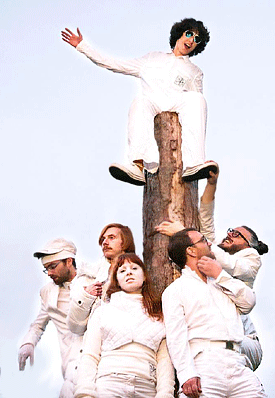
a.P.A.t.T. , 2015

a.P.A.t.T. , 2015

A Brixton evening of skewed and experimental pop, shading off into other directions including R’n’B, improvised instrumentals and assorted prankery. (Age restriction – 18 years minimum)

The a.P.A.t.T. of today take a skilled yet cheeky approach to playing progressive pop that owes as much to Kurt Schwitters and the Chapman Brothers as it does to ABBA and Zappa. In touring new album ‘Fun With Music’, a.P.A.t.T. have condensed their vision-quest into forty-five minutes of hooky, style-busting live band material, evading capture at every turn. This is the band that swaps instruments live mid-track and has even run its own small country for an evening: it’s a restless and relentless take on 21st century music and performance through a lens of knowing, winking, quintessentially British humour.

The Tom O.C Wilson Ensemble offers forward thinking pop music that combines classic songwriting values with boundless musical curiosity. Wilson describes himself as “a composer and performer driven by the desire to create music that doesn’t exist but should”, and his work (ranging from experimental pop albums to concert pieces for amateur orchestras) has won praise from Field Music, Michael Finnissy and Devendra Banhart among others.

The USSB of Hamburg-based Some Of My Best Friends is a Unit of Science, Socialism and Booty. Some Of My Best Friends use tunes and words. Some Of My Best Friends don’t approve of unnecessary effort. Some Of My Best Friends never travel with more than one case. Think psycho dub, garage soul, trap, and Karl Marx’s booty in sequin overalls.

In existence for years and years, Sam Callow’s 4tRECk project makes music based around spontaneous improvisation, chance, using various instruments (piano, guitar, violin, accordion, home-made stringed instruments, percussion, voice) the “wrong” way, ideas, and detailed composition. The results are broad, with a melancholic side.

More info here, and tickets here.

* * * * * * * *

Friday 11th sees the launch of a “new regular night, bringing you new sounds and non-traditional world music, folk, contemporary classical, trip hop and downtempo music. We start with some truly breathtaking bands…” This kind of blarney could be an attempt to heat up some very thin and bland material indeed, but the people behind Whispers & Hurricanes are Chaos Theory, who already sweat bullets to bring interesting jazz, post-prog, metal and post-hardcore into and out of London, so I think we can trust them. Here’s the bill:

Whispers & Hurricanes, 11th September 2015Mishaped Pearls + Seventh Harmonic + TEYR (Whispers & Hurricanes @ The Sebright Arms,, Friday 11th September 2015, 7.30pm) – £6.00/£8.00

Seven-piece band Mishaped Pearls are at the forefront of a very exciting new wave of UK folk. Their adventurous song combination of the ancient and the new finds an echo in their musical make up – banjo, saz baglama, bodhran, violin and mandolin mix with acoustic guitar, keyboards, electric bass and drums, all led by the mezzo-soprano voice of Manuela Schuette. Their music’s roots in tradition expand into progressive folk and rock, eastern modal music and shows elements of contemporary classical influence. Their most recent album ‘Thamesis’ has received outstanding reviews across the media.

Consisting of multi-instrumentalist and composer Caroline Jago and drummer Lesley Malone (both also of Sol Invictus) plus singing violinist Éilish McCracken, Seventh Harmonic are a neoclassical darkwave ensemble creating sensual euphoric epics that draw on a great diversity of influences. The music blends an intoxicating kaleidoscope of rhythmic intensity and soaring vocals with ethno-symphonic overtures, defying categorisation yet always beating with a dark romantic heart.

Forged amongst the hustle and bustle of North London’s folk scene, TEYR (“3” in the Cornish language) are a trio of formidable musicians who showcase the many sounds of the British Isles. With roots running from Ireland to Wales to Cornwall, James Gavin (guitar and fiddle), Dominic Henderson (uilleann pipes and whistles) and Tommie Black-Roff (accordion), the players thrive on close interplay and pushing the possibilities of acoustic music. Having met on the traditional music scene through late night sessions, each performer holds an intuitive sense of folk music, evident in their deft arrangements and compositions. The trio draws influence from neo-folk groups such as Lau, Kan and Lúnasa, whilst harnessing an innovative combination of strings, reeds and voices. With this distinct mix, TEYR strike an enigmatic path through the current folk wave.

Tickets from here – note that this is another 18-and-over event.

* * * * * * * *

Admittedly the following is late rather than early September, but if you look forward to Saturday 19th you can anticipate spending from noon until early afternoon admiring architecture to a soundtrack of chamber classical, contemporary folk and experimental pop, and then head into the fringes of south-west London for something a little scruffier and garage-friendly.

In conjunction with the Open House London Weekend (which takes in their home venue of the Union Chapel as well as a wealth of other fantastic London architecture – check it out), Daylight Music are doing a special double-length all-ages Saturday session. Details below…

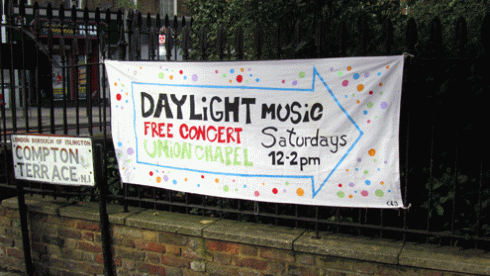
Daylight Music 199

Daylight Music 199: Sean O’Hagan, Ellie Lovegrove/Illumina, Pip Mountjoy + Elephant (Union Chapel, Compton Terrace, Islington, London, N1 2UN, UK – Saturday 19th September 2015, 10.00am-2.00pm) – free entry, suggested donation £3.50

Sean O’Hagan is a legend of the indie scene, initially from his work in Microdisney and latterly from his time in The High Llamas who have been following their own lights for the past eighteen years, making records and essentially occupying their own genre in doing so. Their music is timeless; elements of retro and modern share the space, creating a unique time and place that is outside the lines of history as we experience it. Today Sean will be providing a solo performance.

Consisting of Ellie Lovegrove (trumpets) and Richard Moore (church organ), classical chamber music duo Illumina were formed in 2012 for a bespoke private recital and enjoy performing a wide variety of music, including works by Handel, Bach, Purcell, Stanley, Elgar, Damase, Takemitzu, and Eben.

Up-and-coming singer-songwriter Pip Mountjoy has been championed by BBC Introducing. She has toured the UK extensively, supporting the likes of Ryan Adams, John Smith, Slow Club, playing festivals such as Glastonbury, Isle of Wight and Cambridge Folk, and leaving audiences “simultaneously entertained, depressed, amused, bemused and delighted.”

Elephant is an intriguing creature hand reared by Lymington-based Alex Hall. Armed with a laptop and a modest collection of instruments, he set forth in piecing together and recording a collection of material inspired by his love of experimental indie, ’60s surf pop and more contemporary lo-fi electronic music. This is the result.

Approximate timings:

  • 10.00am Doors
  • 10.30am Elephant
  • 11.30am Illumina
  • 12.30pm Pip Mountgrove
  • 1.30pm Sean O’Hagan

In between, there are musical interludes by unsigned indie-folk duo Swallow & The Wolf (about whom there’s an ever-growing buzz) and by Jack Hayter (the multi-instrumentalist perhaps best known for work with Darren Hayman and Hefner, and on this occasion providing pedal steel improvisations similar to his Dollboy work plus “the odd jazz standard” though his solo performances of his own engagingly battered folk songs are also well worth seeing).

More information on the concert is here https://www.facebook.com/events/446360282212545/

In the evening, in Kingston-upon-Thames, there’s a benefit gig: another in the ongoing series of support fundraisers for the cruelly-stricken Tim Smith of Cardiacs. Even if Cardiacs in the raw, uncompromising original isn’t quite your thing, if you’ve got any interest in slightly complicated, roughened pop and garage-band grit, go along anyway. These are among the warmest of gigs…

From The Pond, 19th September 2015

From The Pond: a benefit for Tim Smith featuring Redbus Noface + 7shades + Sterbus + t.b.c. (The Fighting Cocks, 56 Old London Road, Kingston-upon-Thames, London, KT2 6QA, UK, Saturday 19th September 2015, 7.00pm) – £10.00

“A multi-faceted psychedelic pop-punk benefit gig… four extraordinary bands (all Cardiacs-y), beautiful and exclusive merchandise… every penny raised goes to Tim.”

Redbus Noface is the band project from latterday recording engineer and long-ago Cardiac Mark Cawthra. The first Redbus Noface album, ‘#1 If It Fights The Hammer, It Will Fight The Knife’, was released in 2011 and represents many years of Cawthra songwriting and musical ideas – a sturdy, beautifully crafted art-pop gem in the tradition of assorted English mavericks such as XTC.

Led by Neil Spragg, 7shades are a musical project which “pays tribute to the music of Tim Smith and Cardiacs – but with all original music” – a sometimes-nine-piece band delivering vigorously convoluted pop and blurts of punky, proggy, psychedelic noise, all equipped with a fantastical and humorous edge and no fear of either looking or sounding ridiculous.

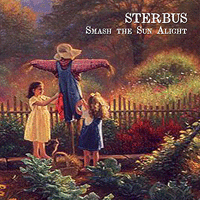
Sterbus is from Rome, but his musical heart is in the shaggier, dreamier end of 1990s Britpop and American indie rock (Blur and Cardiacs, Elliott Smith and Nirvana, Supergrass and Pavement) and also delves happily into prime prog (with King Crimson, Zappa, Porcupine Tree and the fuzzier rockier chunks of the Canterbury scene). Self-releasing – and working mainly solo – he’s mixed this menu into a series of albums of warm double-jointed oddpop. Returning to the Fighting Cocks for his second Smith benefit gig, he’s performing in duet with his regular band foil Dominique D’Avanzo (him on guitar, her on clarinet, recorder and mouth harp, and both of them singing) for what he describes as “something very Sea Nymph-y and full of chords that Tim would love.”

Sadly, one of the scheduled bands has had to pull out… but if you’re still interested in the garage-rocker sounds of The Spencers (who “make noises. Loud noises. Noises that make you all happy and sad and angry… and sometimes, all at the same time” via a grime of guitars, low-budget organs and rock-siren vocals, plus distinctly Cardiacs twists of wandering harmonies and attention-deficit mood‘n’pace changes) here’s a taste of them anyway.

The event will be compered by writer and comedian Robin Ince (he of ‘The Infinite Monkey Cage‘) who’s apparently “bringing a friend. And may be doing a little music.” There will also be visuals by South Coast animator Cyriak Harris, whose hilarious, playful and slightly disturbing videos have been a YouTube staple ever since he delivered a monster-movie ‘EastEnders’ tribute to the BBC nearly a decade ago…

Ongoing news regarding From The Pond (including any last-minute substitutes for The Spencers) is here and tickets are here.

More September gigs shortly, plus a look at October and further on.

November 2015 – upcoming gigs – Mutations Festival in Brighton, 28th & 29th November 2015

24 Aug

Here’s a quick signal booster (or, perhaps more accurately, noise booster) for the debut Mutations festival coming up in Brighton at the end of November. (The press release just came in from Stereo Sanctity today). Note that tickets go on sale in the middle of this week, and that there’s only a thousand tickets. I’ve just seen a Facebook counter suggesting that 330 people have already committed themselves to tickets. Move fast.

Mutations 2015 banner

Mutations is a new multi-venue inner city festival in Brighton, England, born out of last years acclaimed DRILL:BRIGHTON. With Wire’s touring project moving onto the next urban sonic assault, co-curators One Inch Badge decided the time was right for a forward thinking, annual, artist-lead festival that would be static to Brighton on the last weekend of November

Spanning two days and nights on the 28th and 29th November with an incredibly intimate capacity of just 1,000, Mutations is a music-lover’s event. Alongside the music you can also expect pop-up record fairs, poster art exhibitions, photography and more.

Mutations is a creative mass of genre hybrids and expression, delivering some of the most inspiring, creative and interesting music the world has to offer; a host of other national and international acts including genuinely alternative rock, aggressive noise, experimental house, singer-songwriters, doom metal, electronica, drone, experimental folk and various other experimental sounds.

Acts confirmed so far are Lightning Bolt, METZ, John Talabot, Josh T. Pearson, Tourist, OM, Chelsea Wolfe, Willis Earl Beal, Ought, Jane Weaver, Natalie Prass, BRNS, Kagoule, Vision Fortune, Blaenavon, All Tvvins, Lowly, Plastic Mermaids, Chastity, Mount Bank, Abi Wade, Sea Bastard, Blacklisters, Foreign Skin and Nature Channel.

Mutations festival, Brighton, 2015Venues will include Concorde 2, All Saint’s Church, The Arch, The Old Market, The Haunt, Patterns, Sticky Mike’s Frog Bar, Green Door Store, The Prince Albert, The Hope And Ruin and The Bee’s Mouth, with more to be confirmed.

Pre-sale launches this Wednesday 26th August at 9.00am (exclusively via See Tickets) with general sale following on Friday 28th August at 9.00am.

Mutations Festival online:
Homepage Facebook Twitter

August 2015 – upcoming London gigs – Prescott, A Sweet Niche and V A L V E @ The Harrison, August 26th; the welcome return of Daylight Music (with Pete Astor, TEYR and The Left Outsides), August 29th

22 Aug

Coming to a Kings Cross cellar next week…

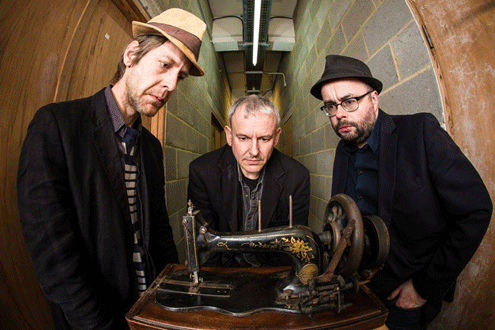
Prescott - as beautiful as the chance meeting on a dissecting-table of a sewing-machine and an umbrella...

Prescott – as beautiful as the chance meeting on a dissecting-table of a sewing-machine and an umbrella…

Prescott + A Sweet Niche + V A L V E (The Harrison, 28 Harrison Street, Kings Cross, London, WC1H 8JF, UK, Wednesday 26th August, 7.00pm) – £5.00

Prescott are a percolating musical alliance between Kev Hopper (who once played elasticated bass guitar for Stump and went on to participate in offbeat experimental projects from laptop improv to pocket pop), veteran avant-indie/improvising drummer Frank Byng (of Crackle, Snorkel and the Slowfoot label) and polymath keyboard player Rhodri Marsden, whose curiosity, industry and dry wit has drawn him through a patchwork career of interesting music (including The Keatons, Zuno Men, The Free French, Gag and Scritti Politti) and deft, wry journalism on everything from drum machines to dating disasters.

According to the Harrison’s blurb, the band deliver “a curious mix of the melodic and discordant with syncopated funky, skewed beats and lopsided, sometimes jabbing riffs that emerge from a complex web of musical interactions and expand or contract like sections of a stuck record.” The band themselves talk about “jabbing heteroclite riffs, circular rhythmic patterns, vibrating harmonic clashes, irregular note intervals, all contrasted with pockets of beautiful melody” and their trick of “microriffing” – repeating the same tiny melodic segment for “as long as they can hold their nerve” (out of a sense of persistence, a zest for irritancy or a desire to pay homage to loop culture) .

I’ll add that while these descriptions make Prescott sound like a set of ticks on a battered art-music bingo card, they’re actually one of the most entertaining and even danceable bands I’ve seen in recent years; pumping out a surprisingly melodious batch of hiccups, peculiar grooves and inventive colours, and sometimes seeming to plug into a monstrous late-Miles Davis synth-fusion groove (entirely by mistake).

I’ve written about A Sweet Niche before, having encountered them a few years ago when they were roaring the roof of a cellar off in Spitalfields. Between them, guitarist Keir Cooper, baritone saxophonist Oliver Sellwood and drummer Tim Doyle have an intimidating list of project credits. In this band, however, they make a brinksman’s racket of free-form punk-jazz, bringing in whatever else they’ve learned from excursions into rock, theatre work and the thornier ends of contemporary classical.

Making the most of their disparate backgrounds (Oliver is a qualified musical academian, Keir more of a non-institutional outsider, newer boy Tim somewhere in between) they’ll attack their musical ideas at full blurt and with plenty of noise, like angry men stripping the wreck of a ca. They’ll toss disparate fragments up into the air and rant about them, but then sideswipe expectations with a run at a cute theme. Last time I described them as “if Bagpuss had joined Slayer”, and they seemed to like it. See what you think.

https://vimeo.com/103617646

V A L V E is the solo project of Chlöe Herington – reedswoman, experimenter and Magma/Zappa/Peter Maxwell Davies fan. She’s best known for blowing taut, assertive bassoon and saxophone parts in Knifeworld and Chrome Hoof, but has also worked with lo-fi art-rockers Jowe Head & The Demi Monde and elusive psycho-lounge band Made By Monsters, as well as a clutch of contemporary classical projects. V A L V E places the bassoon to centre stage, surrounded by Chlöe’s clusters of technology and (when required) selected guests. At the Harrison, the project will be appearing in “its first non-gallery show ever”, which might either involve letting it off the leash or playing a little more safe. (Come and find out.)

Dotted around Chlöe’s other band commitments, V A L V E releases have been sparse so far – odd fits and starts on Soundcloud or YouTube plus a couple of Bandcamp tracks. Here are a few tasters, including the soundtrack to a dinosaur battle, something which Chlöe developed from a piece of music found in a skip, and a more sombre contemporary classical effort.

Up-to-date gig information available here and here. (Or, if none of this really floats your boat and you’d prefer some lustrous art-rock croon, here’s one last linking plug for the Tim Bowness/Improvizone gig at the Boston Music Room on the same night.)

* * * * * * * *

On the Saturday, it’s time to welcome back Daylight Music, who are starting up a new series of free midday gigs (and are still writing their own promo blurb, which makes things a little easier for me).

Daylight Music 198 - Pete Astor + TEYR + The Left Outsides
Daylight Music 198: Pete Astor + TEYR + The Left Outsides (Union Chapel, Compton Terrace, Islington, London, N1 2UN, UK – Saturday 29th August, 12pm to 2pm)

Ex-leader of The Loft, The Weather Prophets and numerous other esteemed acts, Pete Astor creates timeless chamber-pop, brimming with wry lyrical insight and haunting melodic hooks. Now recording for Fortuna POP!, he has his first full length album for four years ready for release. This has been made with Ultimate Painting, Veronica Falls and Proper Ornaments main man James Hoare along with Pam Berry (Black Tambourine, Withered Hand) on vocals, Alison Cotton (The Left Outsides) on viola, Jack Hayter (Hefner) on pedal steel and guitar, Emma Winston on synth bass (Darren Hayman’s Long Parliament, Owl & Mouse) and Susan Milanovic (Feathers) on drums. The recent single, ‘Mr Music’ has been very warmly received with Astor and band recording sessions for Marc Riley and headlining the Church stage at this years’ Indie Tracks festival among many other recent live outings. For the Daylight Music show Astor will be joined onstage by James, Pam, Alison, Jack, Emma and Susan making a seven-piece group playing Astor’s songs, old and new, for an edifying and nutritious lunchtime performance.

Forged amongst the hustle and bustle of North London’s folk scene, TEYR (“3” in the Cornish language) are a trio of formidable musicians who showcase the many sounds of the British Isles. With roots running from Ireland to Wales to Cornwall, James Gavin (guitar and fiddle), Dominic Henderson (uilleann pipes and whistles) and Tommie Black-Roff (accordion), the players thrive on close interplay and pushing the possibilities of acoustic music. Having met on the traditional music scene through late night sessions, each performer holds an intuitive sense of folk music, evident in their deft arrangements and compositions. The trio draws influence from neo-folk groups such as Lau, Kan and Lúnasa, whilst harnessing an innovative combination of strings, reeds and voices. With this distinct mix, TEYR strike an enigmatic path through the current folk wave.

The Left Outsides are Mark Nicholas and Alison Cotton, a London-based husband and wife duo whose atmospheric, hypnotic songs echo Nico’s icy European folk, pastoral psychedelia and chilly English fields at dawn. Their second album ‘The Shape Of Things To Come’ has just received a welcome and much-praised vinyl release on Dawn Bird Records and an album of new material is currently being recorded. The duo have played across the UK, France, Germany and in the USA; and have recorded radio sessions for Stuart Maconie’s Freakzone, Tom Robinson’s show on BBC6 Music, Pete Paphides show for Soho Radio and Tom Cox’s radio show.

As ever, Daylight Music is free, although you’ll have to pay for your tea and cake, and further donations are encouraged. Full up-to-date information is available here.

August 2015 – tonight in Brooklyn – Michael Chinworth & The Rudder Group perform Trevor Wilson (with Will Stratton and Jonah Parzen-Johnson)

21 Aug

I’m sorry that this is another last-minute posting, but if you’re reading this in or around New York, there might be some tickets left for this concert.

Michael Chinworth, 2015

Michael Chinworth & The Rudder Band + Will Stratton + Jonah Parzen-Johnson (Union Hall, 702 Union Street, Brooklyn, New York, NY, USA, Friday August 21st 2015, 7.30pm) – $10.00

Part of the generation from the liberal arts Bennington College which also fostered Trevor Wilson (Anawan, Vocal Ensemble), Tavo Carbone (Horse’s Mouth) and J.J. Beck, Michael Chinworth maintains that group’s indifference to musical boundaries, keeping up a New York tradition of playing (like latterday Arthur Russells) across genres. Exploring his Bandcamp page throws up assorted experiments in cut’n’paste electro-acoustic collages and vocalese plus assorted various college-classical chamber pieces in various contemporary Romantic, minimalist or post-Ligeti forms. On this occasion, he’s following his well-established alternative pop side, performing his own lustrously tuneful take on a Trevor Wilson song cycle – 2013’s ‘Rudder Songs’ – which he’s due to release on album the following day.

‘Rudder Songs’ is in keeping with much of Trevor’s work – simultaneously vague and pointed, obscure and lovely, and often subtly provocative. While never being so obvious as to make a straightforward point, it suggests a unsettled fluidity of sexual identity and choices of vision; providing off-kilter, stream-of-consciousness hymns to unorthodox friendships and the possibilities of city life that nonetheless wilfully and regularly flees to open countryside or the solitary road life. Familiar elements from folk, torch song, soul jazz and psychedelia float alongside each other, recombining at odd intoxicated angles; or explode from straightforward beginnings into thought patterns too complicated for a simple frame to contain.

If you want to compare the Chinworth versions to the Wilson originals (sung and recorded solo at Meredith Monk’s piano, no less) you can find the latter above. Michael’s smooth, Wurlitzer-tickled blue-eyed soul approach might initially seem miles away from Trevor’s wayward and uninhibited performances and whisper-to-caterwaul vocalising (in some respects, it’s like Frank Ocean covering Kevin Coyne or John Cale at their most frothing). Still, if you’re familiar with Michael’s work on Trevor’s songs elsewhere, both the link and the sympathy are clearly intact; and it’s clear that their work together in Anawan (in which both Michael’s voice and Wurlitzer play a key role) paves a way towards Michael’s slant on the Rudder material. Check out his performance in the video for Anawan’s ‘Breaded Me’, below, and then compare it to his versions of a pair of Rudder Songs underneath (one exploring an unusual fissile threesome, the other obliquely fishing in a friend’s thoughts).

In addition to Michael the Rudder Band lineup includes guitar visionary Ben Seretan and fellow Benningtonians J.J. Beck and Matt Scott, plus Trevor Wilson himself on additional keyboards. Re the collaboration, Trevor comments “In many more ways than one, this is a repeat of a much-admired album from 1970, ‘Nilsson Sings Newman’. Harry Nilsson, inspired by the odd, rude composition style of Randy Newman, wanted to take the songs and re-imagine them with his signature vocal layering and general studio beautifying. These two songwriters, equal but so different in their contribution to musical history, united to create this album together without ego, without agenda. (Maybe. I hope.) As I will do (at the concert), Newman plays and sings on Nilsson’s adaptation of his own songs… with another bandleader.

“I think everyone should have the opportunity to do this with their form of expression. Not to get too 3rd-grade-after-school-assignment-y, but seriously, try it out. Ask one of your contemporaries, friends, colleagues if you can ‘cover’ their thing, and have them sit in the passenger seat somewhere during the process. Or the other way around. You’ll both learn a thousand things. Michael has a rare gift of seeing music on its own terms- terms that don’t exist within human realities- and he has certainly shown me things about my compositions that has changed my whole process. The band is sounding great, and I am so happy to be a part of it.”

There are two support acts. Folk songwriter Will Stratton will be playing songs drawn from his five full-length albums; while Jonah Parzen-Johnson (frequently seen as part of New York afrobeat ensemble Zongo Junction) will be bringing his lo-fi music for solo circular-breathing saxophone and analogue synthesizer, described as follows – “Imagine the raw energy of an Appalachian Folk choir, tempered by a lofi, minimal aesthetic inspired by the music of Bill Callahan… (Jonah) has meticulously constructed a world of warm memories remembered in a cold present, as he melds the evocative nature of folk music with the chilling power of experimentalism.” Judge for yourselves at the gig, or via the previews below.


Up-to-date information and tickets for the gig are available here – and if you can’t make it, you can view in on video stream here.

August/September 2015 – an American summer/fall tour for The Collection and Lowland Hum

20 Aug
the Collection tune up...

the Collection tune up…

Today the Collection begin a two-month American tour. Veering mostly around the South, the Midwest, the West Coast and the Pacific North-Western states, it takes in (bar a mid-tour rendezvous with the Viper Room in Los Angeles) the kind of intimate, audience-engaging venues I’d love to discover on an American road trip of my own – assorted music bars, small theatres, coffee shops. This is in keeping with the band’s stated ethos – based in Greensboro, North Carolina, the Collection describe themselves less as a band and more of “a community of artists, nurses, farmers, students, and everyone in between doing life together.” According to bandleader David Wimbish, “we don’t want fans, we want family. It’s incredible to us that people would even listen to our music, and it’s so much more important for us to connect with those people than to figure out how to get fans.”

The second Collection album, ‘Ars Moriendi’, was released last summer but only crossed my ears recently via a brief and now-expired Noisetrade offer (you can still go there and pick up a free sampler if you want to). I love discovering inspiring records by accident, and ‘Ars Moriendi’ is one of the more emotionally commanding works I’ve heard for a good while. Swelling up from a core of seven people to as many as twenty-five on record, the Collection dip into rock, folk, gospel, barndance, bluegrass, soul and mariachi. Adding banjo, brass, strings, reeds, autoharps, and didgeridoos to the usual pianos, guitar and drums results in a heady grand-medicine-show of a sound.

This in itself isn’t new. There are plenty of expansive Americana folk-rock ensembles peppered with diverse instrumentation; and (either by coincidence, intent or just common feeling) the Collection echo strains of music which we’ve already heard via The Polyphonic Spree, Arcade Fire, Sufjan Stevens and Guillemots; not to mention The Band and Mercury Rev, or the reedy, distracted, keening tones David shares with Damien Rice. What gives them the Collection their particular edge is the driving verve and commitment with which they play. Despite their hollering utopian tendencies of their singalongs they’re unconcerned with party robes or cute, culty psychedelic trappings. Instead, their music is imbued with communitarian impulses and a fumbling, ever-hopeful sense of personal connections.

Integral to this is the band’s Christianity. Almost every one of David Wimbish’s songs is studded and seeded with Biblical allusions and resonances, yet he’s never rendered complacent and conformist by his faith. Rather, he’s caught up in it – a tender-hearted radical questioning and examining his beliefs, challenging his own conscience and the orthodoxy, compelled to decry the church’s seams of bigotry and exceptionalism whenever he stumbles over them. At the same time, David is clearly fascinated by the church’s central mystery of life renewed, setting it (with some pain and trepidation) against the deaths of friends and family that cut grief-lines into his songs and filter both darkness and weight into the Collection’s music. Like me, you don’t have to actually be a believer to be moved by David’s explorations and exhortations as he travels from exuberance to despair, from buoyant encouragement to audible tear-swallowing. After all, the best Christian music is always a little wracked and cracked: something in which their faith reveals people to themselves, and perhaps a little more of their humanity to others.


On this tour, the Collection will be accompanied by two of their Greensboro compatriots – husband-and-wife duo Daniel and Lauren Goans, a.k.a. Lowland Hum. Fond of the intimacy of house concerts, they ought to make a good foil and complement to the Collection’s inclusive spirit. Hopefully Daniel and Lauren will get the chance to carry out their usual immersive, synaesthesic gig experience – staging and dressing the playing environment with props and essential oil burners, passing out hand-bound lyric books to their audience, and generally eliding the boundaries between the many ways a person can experience a concert.

Lowland Hum get immersed (photo by Griffin Hart Davis)

Lowland Hum get immersed (photo by Griffin Hart Davis)

Even if not, there’s still the music from their eponymous debut album (released in April this year) to consider. ‘Lowland Hum’ is an enthrallingly American art-pop record in which country-duo harmonies and Atlantic folk guitar intertwines with multi-instrumental Portishead/Mandalay trip hop, and in which songs flick unsettlingly between sports arena scale and backyard porch intimacy in the space of a breath. Lyrical preoccupations (fragmented but lucid) span ageing, the shifting internal perspective of growing and growth, or suburban disassociations; or cover the life of Toulouse-Lautrec in ten short scattered lines.

Sharing voices, instrumentation and production between them, Lauren and Dan sometimes seem to phase in and out of each other (as on Rolling And Rolling, a touching first-person meditation on a boy’s budding adolescence on which both singers take turns to voice his slipping thoughts). Similarly, they move through genres like purposeful ghosts. A song like Jack Of Hearts (a study of the dangers of power and charisma) can begin as a country cautionary, fray into psychedelic folk, clatters its sticks into complications and end up as a layered ambient march.

 
On a couple of dates the Collection and Lowland Hum will be joined by other performers. In Birmingham, Alabama, they’ll be playing with folk-rock trio War Jacket (who describe themselves as both warm and haunted, like their hometown); in San Francisco by Gothic-tinged chamber-pop crooner (and Stephen Merritt collaborator) Jon DeRosa; and in Greely, Colorado by both the Denver art-and-music collective Giants & Pilgrims and the outlaw-country cowpunker Matt Davis.


Full tour dates below:

  • Ashland Coffee and Tea, 100 North Railroad Avenue, Ashland, Virginia, USA, Thursday 20th August 2015
  • Twisted Branch Tea Bazaar, 414 E Main St, Charlottesville, Virginia, USA, Friday 21st August 2015
  • Hanesbrands Theater @ Milton Rhodes Centre for the Arts, 251 Spruce Street North, Winston-Salem, North Carolina, USA, Saturday 22nd August 2015
  • Local 506, 506 West Franklin St, Chapel Hill, North Carolina, USA, Sunday 23rd August 2015
  • The Pour House, 1977 Maybank Highway, Charleston, South Carolina, USA, Monday 24th August 2015
  • The Camp House, 832 Georgia Avenue, Chattanooga, Tennessee, USA, Wednesday 26th August 2015
  • Eddie’s Attic, 515 North McDonough Street, Decatur, Georgia, USA, Thursday 27th August 2015
  • The Nick, 2514 10th Avenue South, Birmingham, Alabama, USA,
    Friday 28th August 2015
    (supported by War Jacket)
  • The Beatnik, 615 Toulouse Street, New Orleans, Louisiana, USA, Saturday 29th August 2015
  • Common Grounds, 1123 South 8th Street, Waco, Texas, USA, Sunday 30th August 2015
  • (House Show), 407 Mignon Lane, Houston, Texas, USA, Monday 31st August 2015 (ticketed – apply via link)
  • Mohawk, 912 Red River Street, Austin, Texas, USA, Wednesday 2nd September 2015
  • The Viper Room, 8852 West Sunset Boulevard, West Hollywood, Los Angeles, California, USA, Sunday 6th September 2015
  • Hotel Utah, 500 4th Street, San Francisco, California, USA, Wednesday 9th September 2015 (supported by Jon DeRosa)
  • Fremont Abbey, 4272 Fremont Avenue North, Seattle, Washington, USA, Friday 11th September 2015
  • Kelly’s Olympian, 426 SW Washington Street, Portland, Oregon, USA, Sunday 13th September 2015
  • Old Nick’s Pub , 211 Washington Street, Eugene, Oregon, USA, Tuesday 15th September 2015
  • Reef, 105 South 6th Street, Boise, Idaho, USA, Thursday 17th September 2015
  • The Dawg Pound, 3550 South State Street, Salt Lake City, Utah, USA, Saturday 19th September 2015
  • Moxi Theatre, 802 9th Street, Greeley, Colorado, USA, Monday 21st September 2015 (supported by Giants & Pilgrims, Matt Davis)
  • Downtown Artery, 252 Linden Street, Fort Collins, Colorado, USA, Tuesday 22nd September 2015
  • Hi-Dive, 7 South Broadway, Denver, Colorado, USA, Wednesday 23rd September 2015
  • The Tank Room, 1813 Grand Boulevard, Kansas City, Missouri, USA, Thursday 24th September 2015

Woven in and out of this tour, Lowland Hum will be playing some separate headlining dates of their own (shared, on one North Carolinan occasion, by church-and-country songwriter Josiah Early).

  • Horizon Records, 2-A West Stone Avenue, Greenville, South Carolina, USA, Tuesday 25th August 2015
  • Westmont College, 955 La Paz Road, Santa Barbara, California, Saturday 5th September 2015
  • Old Orchard Church, 640 Amelia Avenue, Webster Groves, St Louis, Missouri, USA, Saturday 26th September 2015
  • The Grey Eagle, 185 Clingman Avenue, Asheville, North Carolina, USA, Sunday 25th October 2015 (supported by Josiah Early)


The Collection/Lowland Hum, summer/fall US tour 2015


July/August 2015 – upcoming gigs – Thumpermonkey/The Earls Of Mars/Ham Legion in London; Holly Penfield’s Judy Garland show hits the Hippodrome; The Luck Of Eden Hall tour the UK

25 Jul

Next week sees the first gig (for some time) for one of the most interesting of current British rock bands; some high-gloss cabaret; and the start of a psychedelic pop roadshow travelling around the UK. Read on…

Thumpermonkey @ The Islington, 30th July 2015

Thumpermonkey + The Earls Of Mars + Ham Legion (Guided Missile Special People Club, The Islington, 1 Tolpuddle Street, N1 0XT, London, UK, Thursday 30th July, 8.00pm) – £7.00/£6.00

Thumpermonkey don’t get as much attention as they deserve. It’s possible that this is because they don’t seem to take things seriously, addressing almost everything with a skewed and multi-levelled sense of cryptic grand-baroque geek humour. Just to illustrate this – a current work-in-progress Thumpermonkey song is “something which we’re calling Giraffes, which includes some vague narrative about doing a conga during an asteroid-based extinction-level event.” One of their older albums is called ‘Chap With The Wings, Five Rounds Rapid’ – a wry kill-the-monsters line filched from ‘Doctor Who”s laconic and unflappable Brigadier. In the same spirit as that reference, I’d suggest that while they are serious about what they do, they’re not necessarily serious about the way they do it – like many of my favourite things.

If what I’ve written so far leads you to expect strained, fey, sub-Zappa wackiness, then think again. Both in the flesh and on record, Thumpermonkey are a brooding and atmospheric proposition – seriously musical, travelling from blitzingly heavy quasi-metal riffs to spidery post-rock, from threshing post-hardcore to theatrical mane-tossing prog at a moment’s notice while Michael Woodman’s grand edgy vocals and complex multi-levelled lyrics ride on top like an arcane mahout with an arched eyebrow. They’ve been called “a sustained victory for intuitive cross-pollination” by ‘Prog’ magazine and every gig they play confirms this particular accolade. Here they are playing 419 (a song which at first appears to be one of their more delicate offerings, revealing its intensities later).

The other two bands on the bill are less well known to me, but aren’t short of blurb:

The Earls Of Mars are probably the most original thing you’ll hear all year. At their heart, the band are a ’70s-influenced rock band bringing together jazz, prog, space rock, doom and blues and forming it into a barking mad noise that you’ll either get or you won’t. If you don’t get it then close the door on your way out of the spaceship, as those of us who want to stay are off on a fantastical journey to who-knows-where, with The Earls Of Mars steering the ship. Enjoy the trip, ladies and gentlemen, as it’s going to be a fun ride.

Ham Legion‘s noisy lo-fi pop is punctuated with proggy outbursts, psychedelic breakdowns and passages of cod-metal joy. Tangy and tart guitar, egg noddle bass lines and light crispy drums are smothered in gooey boy/girl harmonies. Eat in or take away. For fans of Cardiacs, Deerhoof, They Might Be Giants, Split Enz, Heavy Vegetable.

Judge for yourselves – here are the videos for the Earls’ ‘Astronomer Pig’ single from last year, followed by some footage of a Ham Legion gig in Brighton a couple of years ago. As for tickets, they’re available here.


* * * * *

The day after the Thumpermonkey gig, Holly Penfield plays one of her biggest gigs of the year…

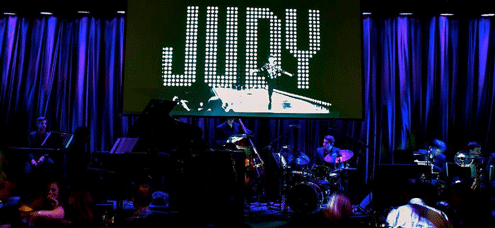
Holly Penfield as Judy Garland

Holly Penfield sings Judy Garland, The Hippodrome Casino, Cranbourn Street, Leicester Square, London, WC2H 7JH, UK, Friday 31st July 2015, 8.00pm) – £15.00 and upwards

Following a triumphant debut last year, Holly returns to the London Hippodrome, singing the songs of the legendary Judy Garland in her own inimitable style. Holly will be joined by her musical director Sam Watts and his magnificent seven-piece band. An unmissable evening for Holly and Judy fans alike, set in the glorious Matcham Room, located inside the Hippodrome Casino – formerly known as The Talk Of The Town, this is the venue of legends and home to Judy’s final London concerts.

Longer-term readers will know that I got to know Holly years ago via her own original ‘Fragile Human Monster Show‘ and the ‘Parts Of My Privacy’ album (which I wrote about ages ago – that review’s due a revamp and remount, I think). Both of those, though original songwriter pop, had their own theatrical and psychodynamic aspects which pointed towards Holly’s current work in vivid cabaret (and, latterly, as half of swing revivalists The Cricklewood Cats). As for Holly’s interpretations, she can and does cover cute showbiz camp and heart-tugging pathos within the same performance – you can see a couple of examples below.

Up-to-date information on the Judy concert is here and here, while tickets are available here. A mischievous part of me fancies swapping the audience from Holly’s show with the one from the Thumpermonkey/Earls/Ham Legion gig, and vice versa. I suspect that they all might enjoy it more than they’d expect to…

* * * * *

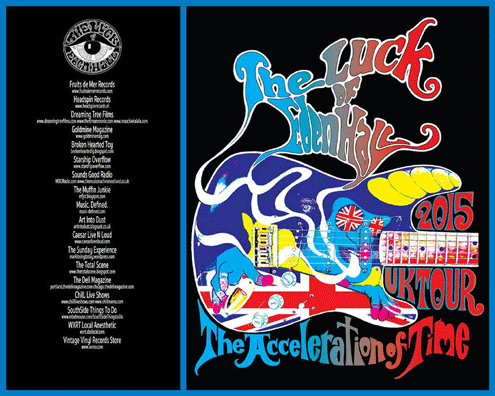
The Luck Of Eden Hall, 2015

On the same night that Thumpermonkey and co. play, The Luck Of Eden Hall are over from Chicago to play the first of two London gigs, launching a Kickstarter-funded UK tour which will take them to a wide array of venues and mini-festivals around England, Scotland and Wales, accompanied by a shifting cast of local psych heroes, left-field blues artists and quirky alt.pop shoegazers.

As for the headliners, you can expect clear-voiced, well-made classic pop beset by sudden gusts of psychedelic blizzarding. The Luck Of Eden Hall remind me of the drawn-out trucker-and-motorist tussle in ‘Duel’ – they come across like a more sombre Neil Finn or Andy Sturmer being stalked, dogged and sideswiped by Hawkwind, Ride or ‘Saucerful’-era Pink Floyd. Here’s a little evidence:


Full tour dates below:

The Luck Of Eden Hall UK tour


July 2015 – upcoming weekend gigs – Daylight Music in London on Saturday (Piney Gir/Rodney Branigan/Player Piano with Gemma Champ); William D. Drake/Crayola Lectern/Heavy Lamb in Brighton on Sunday

1 Jul

This weekend you could choose some unorthodox transplanted Americana, or some equally unorthodox English nooks and crannies. Or (as long as you were somewhere around London or Brighton) you could feasibly enjoy both of them, given that you’ve got more than twenty-four hours to cover the fifty miles between the options. (It’s bright. It’s hot. Enjoy the weekend out. Go on…)

First, the Saturday show in London…

Daylight Music, July 4th 2015

Daylight Music 196: Piney Gir + Rodney Branigan + Player Piano, with Gemma Champ (Union Chapel, Compton Terrace, Islington, London, N1 2UN – Saturday 4th July, 12pm to 2pm)

Blurb follows…

July brings an American Independence day special to Daylight Music.

Piney Gir hails from the American Midwest, home of wide-open plains with sunflowers that go on as far as the Earth curves. The “you’re not in Kansas anymore” jokes never wear thin, because Piney embraces her heritage bringing it with her to the UK, where she’s lived in London for over a decade now (yes, she does have a sparkly red shoe collection and yes, she wears a lot of gingham). She is celebrating the recent launch of her sixth album ‘mR hYDE’S wILD rIDE’, released on Damaged Goods Records on June 8th.

Texan guitar virtuoso Rodney Branigan is a multi-intrumentalist who learned to play in Austin, perform in Los Angeles, craft songs in Nashville and put it all together in London. His current album ‘Sketches.’ (written on the road in China, India, Europe, the US and the UK) reflects this diversity, combining laid-back blues and acoustic folk with undertones of rock, flamenco, classical, bluegrass and jazz. His lyrics have an abundance of imaginative substance to them that eclipse many of his songwriting peers. With vocals compared to Jeff Buckley and playing compared to Rodrigo Y Gabriela, the album has been written, arranged and recorded around his renowned ambidextrous live performance.

Player Piano is the musical vessel of Jeremy Radway, a refugee from Indianapolis, USA (home of Kurt Vonnegut, Jr., after whose first published book the group was named). On his previous EP ‘Into The Dark’ (released on the Fife-based Fence Records label), there was a mix of rich strings and glam-pop pomp, inspiring the ‘Sunday Times’ to write “evoking solo-Lennon string arrangements, the unfettered creativity of early Bowie and the Walker Brothers, and the vocal plangency of Chris Martin and Rufus Wainwright, it tugs at the heartstrings and ensnares you with the scope of its ambition.” Radway continues to explore new sounds and forms, trading strings for synths and moving in a more upbeat progressive direction, still staying grounded in melody and harmony. He’ll be releasing his new album ‘Radio Love’ this summer on State51 Records (home to gUiLLeMoTs and Psapp),

In between, Gemma Champ will play melodies jammed full of stars and stripes; and yes, there will be cookies!

There’s a Soundcloud preview here.

Free entry, but donations are (as ever) encouraged.

********

On Sunday, down in Brighton, there’s this…

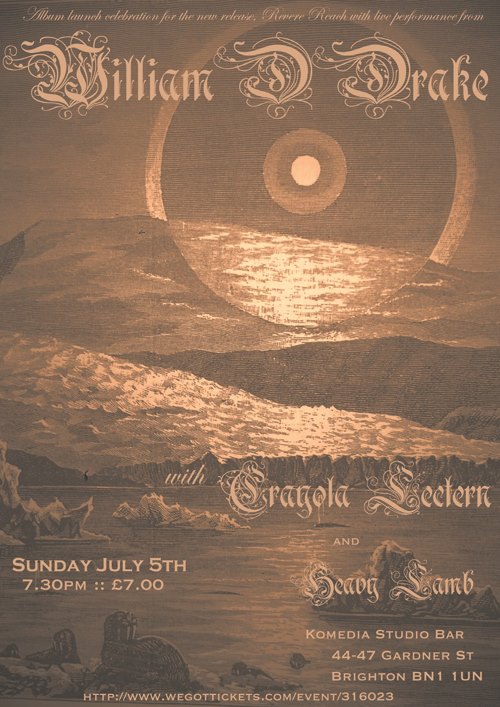
William D. Drake/Crayola Lectern/Ham Legion, Komedia Brighton, July 3rd 2015

William D. Drake/Crayola Lectern/Heavy Lamb (Komedia Studio Bar, 44-47 Gardner Street, Brighton, BN1 1UN, UK, Sunday 5th July 2015, 7.30pm – £7.00)

Bill Drake (the onetime Cardiacs keyboard player turned baroque-solo singer-songwriter) celebrates the mid-June release of his new album ‘Revere Reach’ with what promises to be a typically joyous concert, unfolding new/old sounding original songs both complex and sweet, rampant keyboarding, hurdy-gurdys and assorted friends. A couple of examples are below.

In support is Crayola Lectern – Chris Anderson’s songwriting project which sweeps from solemn cellar melancholia to a flickering psychedelic noon via piano, trumpet and shimmering electronics. See these…

Also playing support are Heavy Lamb, a self-styled “loud demented pop” band. See below for a demo track and for a video of them playing a joyfully received Spratleys Japs cover at the Alphabet Business Convention earlier this year.

Tickets for Drake and co. are available here.

June 2015 – upcoming London gigs on 26th June – Bing Selfish & The Windsors/Andrew Ford/élan/Ragmatic play Club Integral @ The Others; The Many Few/Purple Implosion/Halcyon Days play the Dublin Castle

20 Jun

Usually I’ve got pin-sharp memories of where and when I saw a band play. The one occasion when I saw The Kenny Process Team is an exception. I’ve got next to nothing. A scruffy black cube of a room somewhere, with guitar leads and primary-colours gaffa on the floor; a small-kit drummer ticking away with a pair of bisected sticks. A guitarist and bass player sit on amplifiers or boxes, playing with the whiskery, matter-of-fact precision of master joiners shaping their umpteenth wooden cabinet. A second guitarist stands off to one side, with a flowing sheaf of dreadlocks. The lone black guy in an otherwise white quartet, he almost looks as if he’s been teleported in from a reggae backline but his eyes, wary and committed, tell a different story. Clearly engrossed in the music, he plays blunt, abbreviated questioning lines against the rolling machinery of his bandmates; their mixture of Fifties-twang and conversational Fred Frith art-rock arpeggios, of lean spare proggy lines a-tilt on the wave tube.

As regards the rest of it, I remember nothing. Not the stairs up or down to the venue, nor where it was. “Somewhere in London” is the best I can do. Otherwise, this little memory exists in a cell of its own – a room floating in a void, a space that existed purely as a setting for the music. I certainly wasn’t drunk, nor under the influence of anything stronger than a semiquaver. I may well have been slightly hypnotised by the Team’s cramped fluidity, the crystallising complexities jagging up from simple bases. Bar a single, rare record, the band themselves have sometimes seemed to have vanished down a black hole. Even the web only offers the smallest scraps on them. While I only encountered them once, they apparently played together for eighteen years. Perpetually on the sidelines? Deliberate masters of self-effacement, only really coalescing for gigs?

Seeing a different iteration of The Kenny Process Team pop up around a decade later for a Club Integral gig, therefore, is quite surprising, although everyone concerned has probably been hiding in plain sight. I guess that they won’t have been the invisible band to everyone (and, in particular, not the more knowledgeable people who are likely to make up a Club Integral audience) – but if, like me, you remember the Team as an oblique one-night encounter which snagged in your memory, here’s an opportunity to catch up.

Blurb follows…

Club Integral presents “A Thousand Butterfly Skeletons” featuring Bing Selfish & The Windsors, élan, Andrew Ford and Ragmatic (The Others, 6-8 Manor Road, Stoke Newington, London, N16 5SA, UK, Friday 26th June, 8.00 pm – price £5.00/£3.00 concession)

In an exciting one-off performance, fabled DIY pioneer and visionary misanthrope Bing Selfish is joined by micro-lounge minimalist rock quartet The Windsors. From the early eighties Bing Selfish has followed his own unique path, assisted on the journey by a plethora of maverick musicians from Jim Whelton, Rob Storey, through to Bill Gilonis and Chris Cornetto. Drawing from the well of European avant-garde sensibility, from the Symbolists to the Situationists, coupled with relentless punning and sardonic rhyming, Bing has built his own parallel world, defiantly in opposition to 21st century neo-conservative capitalism, and mainstream musical consurism. Many magazines, records, radio shows and films later he still stands upon the stage, and he’s still seriously pissed off. Chris Cutler has described him as “a phenomenon in the galaxy of songsters today” while ‘The Wire’ has hailed him as “an intuitively sharp lyricist with few peers.” More pungently, Options USA has imagined his character as “a self-pitying drunk, a self-loathing homosexual, a bitter poli-sci professor, or all of the above.”

The Windsors rose from the ashes of the legendary Kenny Process Team, described by Eugene Chadbourne as “forward-looking electric guitar music with a rock base, (stylistically) somewhere between the precision control of surf rock groups such as the Ventures and the almost classical compositions Captain Beefheart.” The new group (Simon King – guitar, Tom Murrow – drums, Matthew Armstrong – bass, and Phil Bartai – keyboards) play intricate, driving instrumentals composed by Kevin Plummer with the band. This is a one-off chance to hear them apply their genius for deftness, intricacy and dynamic arrangement to the anarchic poesy of Bing’s song catalogue.

élan is the kosmische muzik side-project of Dave Tucker (The Fall, London Improvisers Orchestra, Charm School) and friends. He is joined by Matt Chiltern (Spork) on bass, and Ed Lush (Test Dept. Spork) on drums and percussion. Expect krautrock.

Ragamatic is Reiner Heidhorn, a sitar-and-electronics musician from Weilheim in Germany. The music is a result of Reiner’s many years studying classical Hindustani music whilst simultaneously making electronic music. With an emphasis on ragas from northern India, played in the style of master sitar player Vilyat Khan, Reiner locates the natural meeting point between Indian classical music and contemporary electronics.”
Projections by Rudapinka, aka Inga Tillere.

Andrew Ford is also playing – details to be circulated later.

More information on the concert and on other Club Integral events is here.

If you’d prefer something a little more straightahead, then another option is to catch The Many Few playing on the same night, promising to “edify and exultate your earballs and eyedrums with our own original guitar-drum-and-vocal shenanigans… on an optimistically lovely Friday Juneful night coming soon, in the company of assorted fellow groovesters.”

(Headliners t.b.c.) + Purple Implosion + The Many Few + Halcyon Days (Bugbear @ The Dublin Castle, 94 Parkway, NW1 7AN, London, UK, Friday 26th June, 7.30pm – £7.00/£5.00)

I covered some early Many Few demos some years ago, offering assorted comments and insults on their witty, slightly wonky songcraft which the band still seems to remember with affection. As for other descriptions, Bugbear settles for “kitchen-sink lo-fi indie-pop with female/male harmonies and vocal sharings over some Smiths meets McCarthy C86 type backing. Some interesting twists and turns. A bit of The Monochrome Set, something of Yeah Yeah No and stuff like that.” (The Bugbears go on to quote a bit of the ‘Misfit City’ review a bit later on – or, rather, misquote it. It’s a bittersweet world, writing about indie-pop.)

Also on the bill are Halcyon Days (“hooky electro-pop with a nod to 80’s pop but with an electro interface more akin to New Order off-shoot Electronica”) and Purple Implosion (“another great band mixing spiky post-punking punk-funk with counter-cultural garage-birthed rock’n’roll featuring out-there frontman antics.. but always pretty damn danceable.”) In addition, there’s also an unconfirmed headline act. Probably Kate Bush again, or perhaps The Sonic Jewels. You’ll just have to go along and hope, I suppose.

More information here and tickets here.

June 2015 – upcoming London gigs – Daylight Music this weekend (with Field Harmonics, Component#4, Benjamin Thomas Holton, Seamajesty)

18 Jun

Another week and another free/pay-what-you-want Daylight Music event in London, to flesh out your Saturday.

Daylight Music 194: Field Harmonics + Component#4 + Benjamin Thomas Holton, with Seamajesty (Union Chapel, Compton Terrace, Islington, London, N1 2UN – Saturday 20th June, 12pm to 2pm) 

The second label showcase of the season, this time for Staffordshire-based Wayside and Woodland Recordings, bringing Field Harmonics, Benjamin Thomas Holton and Component#4 to the Union Chapel’s stage.

Following 2013’s critically acclaimed debut album ‘Walls’, Midlands electropop favourites Field Harmonics spring into 2015 with an even more accomplished and confident sound and vision, bolstered by the addition of new frontwoman Bryony Williams. Eighteen-year-old multi-instrumentalist Williams joins musician/producer Rob Glover (of ambient pastoralists epic45) for Phase II of Field Harmonics, bringing with her an assured swagger far beyond her years and an iconic vocal style that perfectly complements Glover’s crisp production.

Benjamin Thomas Holton has been creating and releasing music for nearly 20 years, whether as part of ambient pastoralists epic45, with the folk tinged song and sound experiments of My Autumn Empire or under various other shadowy pseudonyms. For this exclusive solo performance, Benjamin will be performing stripped down versions of songs from the forthcoming My Autumn Empire album ‘Dreams Of Death And Other Favourites’, as well as a handful of songs from previous releases.

Component#4 is Mike Rowley. Born and raised in the postindustrial, post-Thatcher remnants of the Black Country, Rowley’s music draws on the decaying factories, vandalized bus shelters and litter-strewn canals which formed the landscape of his childhood. Live, Rowley is joined by Andy Langford on drums and will perform versions of tracks from the 12″ EP ‘Barbed Wire Sunday’ and the recently released Component#4 debut album ‘Into Memory’.

The afternoon will also feature short laptop-based sets by Seamajesty (a.k.a. James Yates) using material he has recently built up under the project of ‘Tea and Biscuits’. Previously the drummer for such bands as The Pattern Theory and epic45, or session percussionist for German metal bands WFAHM or The Ocean, James’ current work as an engineer has helped him home in on certain directions he knew he wanted to pursue. To this end he built a studio in his garage, and started experimenting, recording to analog wherever possible and using several car-boot-found reel-to-reel and cassette tape machines to shape the recordings, adding a much loved lo-fi grit.

Free entry, but donations are (as ever) encouraged.

As an additional bonus, since this is an early afternoon event it still leaves you free to go to that inaugural Baltic Music Society concert in the evening. Not that I’m putting pressure on you…

June 2015 – upcoming London gigs – some options for Thursday night – Birdeatbaby leading the theatrics at the Black Heart; or Jammin’ Society at The Others

16 Jun

A few options for London gig-going this coming Thursday night.

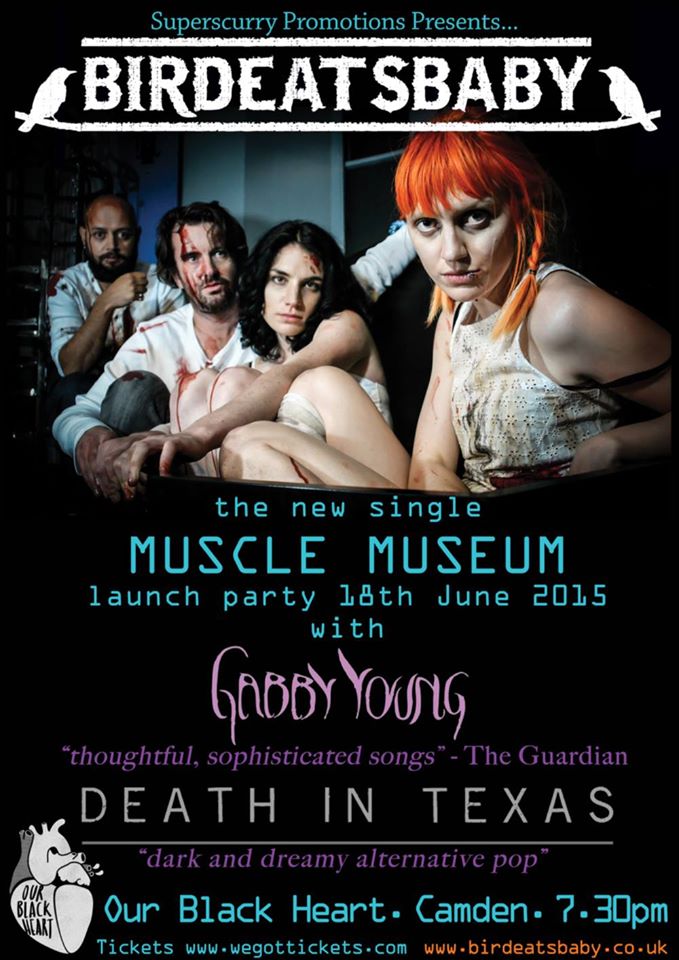
event-20150618birdeatsbaby
Birdeatsbaby + Gabby Young + Death In Texas, (The Black Heart, 2-3 Greenland Place, London NW1 0AP, UK, Thursday 18th June, 8.00pm)

There’s an invasion of Brightonian theatrics (with some honorary Londoners on board) at the Black Heart in Camden as the ambitious orchestral rockers/dark-cabaret pop stars Birdeatsbaby launch their new single – a cover of Muse’s Muscle Museum. The band promise “an unmissable launch party featuring some amazing live musicians, visuals and videos, new costumes and special guests!” Support comes from another showstopper – Gabby Young of Gabby Young & Other Animals fame (described by ‘The Guardian’ as “a gloriously cheerful live performer with an entertaining jumble of styles that match her flamboyant image. She has the power, clarity and precision of an opera diva but also an impressive jazz singer (with) thoughtful, sophisticated songs that continually switch direction,”) – and from the London-based Death In Texas, a dark and dreamy keyboards-and-drums drama-pop duo (whom we’ve encountered before). Tickets available here – priced £8.00. For a potential taste of the evening, have a look at the three videos below.

Alternatively, if you fancy something a little more interactive, there’s this:

The Jammin Society (The Others, 6-8 Manor Road, Stoke Newington, London, N16 5SA, UK, Thursday 18th June, 7.00pm) – free event

This is billed as “an alternative weekly vox, MC, muso, artist, dancer, poet, DJ, performer jam night. Bring your voice, your instrument or just your ears and get involved with the creation/appreciation of a unique sonic soundscape: KAOSS pads, Space Echoes, phasers, creative compression and homemade reverbs all have a role to play! All the gear provided: kit, amps, mics, conga, keys, lights, projectors, decks, dancefloor, bar, comfy sofas…” There’s a different house band providing the core of the music each week – I think that this week it’s Vibe Machine, but the Society season will also feature No Jam, Mana Wax and Playpen Playboys. More details here.

June 2015 – upcoming gigs this weekend – Daylight Music in London (with Jo Mango, The Great Albatross, Circle Meets Dot), Matt Stevens house concert in Rome

11 Jun

Here are the details on this weekend’s Daylight Music event in London…

Daylight Music 193: Jo Mango + The Great Albatross + Circle Meets Dot (Union Chapel, Compton Terrace, Islington, London, N1 2UN – Saturday 13th June, 12pm to 2pm)

Glasgow-based multi-instrumentalist Jo Mango’s second album ‘Murmuration’ was released in 2012 to great acclaim. This wonderfully wistful album combined unique selections from Jo’s eclectic musical instrument collection, with inspiration from her adventures: travelling the world as a member of Vashti Bunyan’s band; her experiences completing a Doctorate in Musicology; her collaborations with David Byrne, Devendra Banhart, Coco Rosie, Teenage Fanclub and Admiral Fallow amongst others.

The Great Albatross is the indie music project of singer/songwriter A. Wesley Chung (formerly of Boris Smile). The project was formed in Glasgow, Scotland in 2011 and consists of an expansive, international list of contributors and collaborators. The project has performed both in the US and UK, including both days of the 2013 Count Your Lucky Stars/Topshelf Records SXSW showcase in Austin, TX. The Great Albatross have performed alongside the likes of Into It. Over It., Admiral Fallow, Miaoux Miaoux, Jo Mango, Owen, Joan of Arc, Empire! Empire! (I was a lonely estate), Joie de Vivre, and Football, Etc.

Sparking with the energy of a brand new meeting of minds, Circle Meets Dot is an emerging collaboration between Wesley Chung of The Great Albatross and Jo Mango. Soaring summer melodies steeped in California sunshine meet cloudy-day Scottish literary lyricism

Ed Dowie will be providing some light bird music in between the acts today/on Saturday. Using his mouth, his keyboard, some Max/MSP twiddlings and a whole host of bird recordings, he hopes to soundtrack the audience’s toilet and coffee breaks, as well as providing a backdrop to some cardboard bird spotting around James Cubitt’s beautiful building. Ed has been making music since the late 1990s, firstly as one third of Parlophone’s Brothers in Sound, then later a solo act under the name Redarthur. After a 5-year hiatus which he spent living in University libraries & music technology labs making strange bleeps, he returned to the music industry to join The Paper Cinema, a puppetry/animation/theatre/music hybrid (that tours both internationally & in Hackney).

Free entry, but donations are (as ever) encouraged.

Or if you’re in Rome, looping guitarist Matt Stevens is playing a house concert in the Batteria Nomentana district in the evening. As it’s a private gig, public information is scarce, but tickets and details are available here. For an earlier account of Matt in action, here’s a live review of his appearance at Roastfest from a few years ago. Matt will be performing again in the UK shortly with The Fierce & The Dead – more details on that soon.

January 2015 – single & track reviews – Marika Hackman’s ‘Animal Fear’; Tanya Tagaq’s ‘Uja’; Swim Mountain’s ‘Love on Top’

9 Jan

Despite the underlying wildness of her songwriting, Marika Hackman appreciates and makes use of the power of restraint. Previous songs such as Bath Is Black and Itchy Teeth have revealed a compelling songwriter with a cool fascination for messy play, for psychological dirt and guilt and the wracked physicality of the uneasy soul. That she doesn’t scream these things out adds to her power. Her cool, polished folk tones deliver her surreal, slithering insights and her deft, subtle analyses with the same thoughtful poise, whether she’s chiding or sharing, empathizing or emphasizing.

Underneath the spooky Latinesque folktronica groove of ‘Animal Fear’ (full of Shankar-ish string wails and spaghetti western gunshots) a menstrual werewolf subtext is swirling. Part ‘Ginger Snaps’ and part ‘Being Human’, it embraces blood and feminity, bandages, and the helpless stink of male terror. “I’ve been weeping silent like a wound. / Would you stitch me up or let the blood soak through, / watching my world turn from white to blue?” She sings as if she might be dying; she sings as if to a lover or a brother; but she’s never really pleading, never wholly dependent. She sits inside her transforming body and watches the changes come; watches the fumblings of her companion with the same half-resigned curiosity. “Look into my eyes and convince us both that I’ll last through the night; / I could land on my feet if I tried. / I’ve never jumped a chasm so wide / and made it to the opposite side. / Even now as we’re standing here, / I can see the doubt in your eyes, / I can smell the animal fear.”

The song is a tender, chiding mixture of vulnerability and disappointment, but its observations are shot through with self-awareness. “I was not a heavenly child,” admits Marika, “savage, with a temperament wild.” As the song travels through the changes, it blends into acceptance, a new understanding bleeding through in flashes (“oh, my body trembling… / and teeth… / I won’t bite.. / Sweet too soon, treacherous night.”) We don’t get to find out how this ends, but even as Marika (now more initiate than invalid) murmurs “she calls my name” you’re left with her finely-honed sense of self. Under the fur and nipples, under the wracking pain, an image emerges of a woman who may wander but will never be truly lost.

* * * *

Tanya Tagaq – a Canadian Inuit throat singer – also seems to have some empathy with this kind of lycanthropic humanity. She’s recently delivered a forthright cover of Pixies’ ‘Caribou’ like a tundra bolero with violins and horns, picking up on its occult hints and dreams of a changed, more animal life outside the city and slinging it back with an Inuit twist and the bloody-minded wit of a hard-bitten outdoorswoman. Tanya first came to broader attention a decade ago (thanks to her four-song turn on Björk’s ‘Medúlla’), and has continued to work her way into Western musical awareness via work with the Kronos Quartet and Mike Patton. This kind of collaborator choice suggests a determination to broaden and involve her music rather than dilute it. With last year’s award-winning Canadian success for her ‘Animism’ album, she’s pitched to continue making breakthroughs on her own terms.

‘Uja’ confirms this. A trailer single for a broader overseas release of ‘Animism’, it has something in common with previous deeply-involved folktronic endeavours such as or Foxout! and Mouth Music. It might mate and merge with electronic beats in longstanding worldbeat fashion, but rather than pandering to easy tastes it’s a stirring textural affair, deliberately pitched between ritual and pounding. It feels like an Arctic club night with all of the technology freezing round the edges and only kept functional by fierce body-warmth.

Log-clock ticks, harsh electronic reverb, and a ragged fabric of synth-noise and incisive drumming make up a base and a blanket. Over, under and around this Tanya works in multiple layers of percussive hum-grunts, drawls, gasps, seal barks and harmonic growls. Occasional shamanic interjections in Inuit (sliding in over the top like a wake-up call filtering through sleep) might be terse warnings, defiant fuck-you statements or camouflaged jokes at the expense of Anglo monolinguals. With Tanya being an assertively political artists and performer, they could be any or all. If I’m the butt of the joke, though, I can take it this time. ‘Uja’ made the blood jump in my feet and in my temples.

* * * *

London/Angeleno good-time band Swim Mountain retrofits, but in an easier, breezier way. They cover Beyoncé’s ‘Love On Top’ like someone flirting under a blanket, musical lines and instrumental parts wriggling under the surface like coy, excited limbs. As he showed on the debut Swim Mountain EP last autumn, head Swimmer Tom Skyrme is very good at disguising fairly limitd resources under a swelling, lucid-dream production style. He claims to have put this one together on a whim, belatedly falling in love with the song’s bravura modulations and ‘80s-inspired peppiness.

Personally, the Beyoncé diva-juggernaut leaves me cold. Despite her well-honed skills and precision vocals, much of what I see is branded, sub-Madonna acquisition and media powder-puffing (if she is the twenty-first century Madonna, we’ve all gone beige) so it’s interesting to hear the song outside her wind-tunnel of glamour. Tom’s lightly buttered, lysergic popcorn-soul take makes no attempt to match the ceiling-bumping, helium balloon assertiveness of the original. The pace is agreeable ‘70s midtempo; the wah-guitar plays peekaboo; the boinking bass comes sheathed in a tight reverb. The phaser button adds a gentle, sexy yawn; Tom’s warm nasal drawl (just on the likeable side of bland) dawdles amiably on the swooping paths Beyoncé cut, making no attempt to match her commanding calisthenics. A cloudy puff of keyboards fills the gaps, like a lazy pink smoke-bomb.

Previous Swim Mountain stylings have mostly recalled the stoned, sleeting Byrds guitar of ‘Five Miles High’: this one sounds like what Arnold Layne might have become if Syd Barrett had drunk deep on Memphis soul before he rolled another one, or like a more nappy-headed tie-dyed version of the Clarke/Duke Project. It’s all a little throwaway (despite the unexpected ending, which scrambles down an unexpected dip and clunks like a plastic lyre) but it’s lovingly crafted throwaway; a sugar basket which takes less time to eat than it does to admire. Plus I do like the way that Tom’s mix rolls out individual delicate moments for our attention, as if his faders were the sliding drawers in a jeweller’s desk.

Marika Hackman: ‘Animal Fear’
Dirty Hit Records (no barcode or catalogue number)
Download-only single (released 9th January 2015)

Tanya Tagaq: ‘Uja’
Six Shooter Records (no barcode or catalogue number
Stream-only single (released 6th January 2015)

Swim Mountain: ‘Love On Top’
Swim Mountain (no barcode or catalogue number)
Stream-only single (released 7th January 2015)

Get them from:

Marika Hackman: ‘Animal Fear’ – Soundcloud stream or iTunes (as part of ‘We Slept At Last’ album)
Tanya Tagaq: ‘Uja’ – Youtube stream; or Six Shooter Records store or iTunes (as part of ‘Animism’ album)

Swim Mountain: ‘Love On Top’ – stream-only at Soundcloud.

Marika Hackman online:
Homepage Facebook Twitter Soundcloud Last FM YouTube

Tanya Tagaq online:
Homepage Facebook Twitter MySpace

Swim Mountain online:
Facebook Twitter Soundcloud

January 2015 – single & track reviews – Giles Babel’s ‘2015’; Shot of Hornets’ ‘Elvis is Dead’; Heylel’s ‘I Talk to the Wind’

7 Jan
Giles Babel: '2015'

Giles Babel: ‘2015’

Happy new year. How’s your irresolution?

Both as year and as song, ‘2015’ is another fitful emergence for Enfield polymath Glen Byford – poet, photographer, digital trinketer, small-time maker and on-off DJ. In the past, he’s put out his original music (anxious water-tank electronica, skinny-wistful glitch tunes, poppy plunderphonics and disillusioned spoken-word bedsit blurts) under the cover names of Hunchbakk or Giles Babel. As of this year, all projects seem to have merged under the Babel label and shrunk down to their most skeletal: or perhaps that’s just how it feels under a January hangover.

Peeling off and discarding his usual quilt of samples, the perpetually uncomfortable Glen distractedly slung this one together on an iPad app while reading and watching television – as if he was working behind his own back and didn’t want to catch himself at it. It’s downbeat, clipped and telegrammatic – budget-tronica pows and zips; a knocking and near-undanceable beat; minimal decoration. Rather than opting for best hopes and public drive, he chooses to sit back and take the poison pill – “Another new year, and another January of good intentions. / Another January of new perceptions, misconceptions that things could change.”

The music, though, seems to disagree – glitching and flipping into a rumble of double-time, or shoving the voice to the back of the drawer like an unwanted sock. Meanwhile, Glen fidgets between hope and cynicism (“This year will be my year – / yeah, just like last year, / and just like every year,”)and represents that year with a brief collage of Playstation chip music, pings and trills, mutters, and incongrous hip hop samples of block party shouts and cheering crowds (“we have a party, right?… I tell you what we do…” Uncertain inspirations reign. Glen pads, tentative and barefoot, around his room.

* * * *

Shot of Hornets: 'Elvis is Dead?'

Shot of Hornets: ‘Elvis is Dead?’

In the time that Glen would take to roll over twice and go back to sleep, Shot of Hornets would have squeezed five quick changes into a song. Apparently not much older than 2014’s Christmas wrapping-paper, this band’s blocky, power-oozing pounce-and-trap tones suggests a much longer-established band: they mingle math-metal’s block-feints with hot funk spaces, thrash riffs with anthemic grunge righteousness, but never entirely pin themselves to anything. When he’s not bursting into hardcore screams, the soulful wreck of singing drummer Conor Celahane’s vocals are reminiscent of gospel-tinged hard-rock heroes King’s X (as are the clotted, meaty guitar wails of his brother Dan), but there’s just as much of Megadeth’s grand irritation in the stew as well.

Elvis is Dead? is a shape-changing dust-off about nothing more specific than uncertainty, vague disappointment and finding the pieces to pick up. The King himself only shows up in a desultory moan about Spotify (so I’m guessing that there’s something being said about the commodification and shrinkage of cultural heroes here), but generally the song sees the band gathering together their compass-bearings and firing off the odd sarcastic broadside. “So here we are now, / no better and no worse off, / in the same world as everyone else,” notes Conor, going on to confess “I have a number of doubts.”

The music is sinewy and jumpy beneath the roaring guitar, and every couple of minutes, there’s a change – a glide of softer melody, a shift into death growls, a barrage of bouncing swipes and screams. “The first prize for gift of the gab / goes straight to you / how d’you feel about that?” Conor yells before the song turns anthemic, finding both the funk and its final feet. (“Turning my back on ignorance, turning my back on selfish people, turning my back on ignorance and lies.”) In a final riff-bout, the rhythm hurtles and rebounds like an evil-minded squash ball. Promising. Let’s see what they do when their concentration settles.

* * * *

Even compared to the other prog juggernauts of the ’70s, King Crimson aren’t given much credit for contributing to the classic songbook. Given the various song-gems lurking in their back catalogue, this is unfair. It probably owes more to Robert Fripp’s unfortunate (and somewhat unfair) reputation as a lofty demon headmaster, verbally withering casual listeners from his lectern before immolating them with sprays of burning guitar sludge – an image which does his Bowie collaborations no harm, but which drags his main band down like a concrete overcoat. The fact remains that outside of slavish interpretations from neo-prog bands, as far as Crimson cover versions go there’s been little more than a speckling.

In the past few years, though, this has changed significantly. In 2011, The Unthanks transformed Crimson’s Starless into a haunting Northumbrian chorale. The year before, Symbolyc One ripped 21st Century Schizoid Man to ominous ribbons and recombined them for Kanye West’s ‘Power’. A year before that, Maynard James Keenan of Tool snarled his way through a pure Schizoid Man cover for The Human Experimente (It was impressive, in an art-metal way, although personally I’m keener on Johnny G’s lo-fi delta-blues version from 1982).

I Talk to the Wind, however, is probably the closest King Crimson has to a standard. A ghostly, semi-existential folk song from their first album, it’s already attracted several reinterpretations. Italian new-wavers Violet Eves did a respectfully mournful and elegant cover in 1985; Camper Van Beethoven and Eugene Chadbourne tore up a hilarious country-punk version in 1987. Probably the most famous version is Opus III’s techno-house take from 1992 (complete with New Romantic Gilliam-cum-Dali fantasy video, mashing up ‘Dune’, ‘Logopolis’ and ‘The Man Who Fell to Earth’ as Kirsty Hawkshaw’s androgynous glam-waif stalks, slinks and smoulders her way around a desert lodge).

For their own version, Heylel have chosen to recapture some of the original Crimson’s sumptuousness. Serving as a coda to the Red Giant sequence on the epic prog/folk/metal of their ‘Nebulae’ album, their take on I Talk To The Wind is solemn and sealed. The ceremonial pace, the full-scale orchestral tremble, the fathoms of shoegaze-guitar shudder and the solemn, Gilmourian guitar solo render it inter-generationally grand: touching on the string-swoons of Craig Armstrong or Sinatra’s orchestras, the stadium turbulence of ‘The Wall’ and the mournful psychedelic drones of Spiritualized or Slowdive. The video suggests that they’re heading up the live sessions in the Black Lodge from ‘Twin Peaks’.

Yet the original song is a small, lonesome beast – lyrical flute, a gentle fug of guitar, a pre-ELP Greg Lake singing the melancholy words with a vulnerable humility that he’d never show again. Heylel singer Ana Batista keeps this in mind. Her vocal might be full of assured, implicit soul-pop power, but she’s never tempted to let rip, never loses sight of that original restraint: and, restored to a waking dream, the song’s allowed to settle over us once again.

Giles Babel: ‘2015’
Hunchbakk (no catalogue number or barcode)
Download-only single (released 1st January 2015)

Shot of Hornets: ‘Elvis is Dead’
Shot of Hornets (no catalogue number or barcode)
Download-only single (released 1st January 2015)

Heylel: ‘I Talk To The Wind’
Heylel (no catalogue number or barcode)
Download/streaming single (released 7th January 2015)

Get them from:
Giles Babel: ‘2015’ – Bandcamp (pay-what-you-want)
Shot of Hornets: ‘Elvis is Dead’ – Bandcamp (pay-what-you-want)
Heylel: ‘I Talk To The Wind’ – Bandcamp or iTunes (as part of ‘Nebulae’ album)

Giles Babel/Hunchbakk online:
Homepage Facebook Twitter MySpace Soundcloud Bandcamp

Shot of Hornets online:
Facebook Bandcamp

Heylel online:
Homepage Facebook Bandcamp YouTube

REVIEW – The Four Disorders: ‘Cat Lady/Hell And Hackney’ demo, 2014 (“both dark and breezy”)

21 May

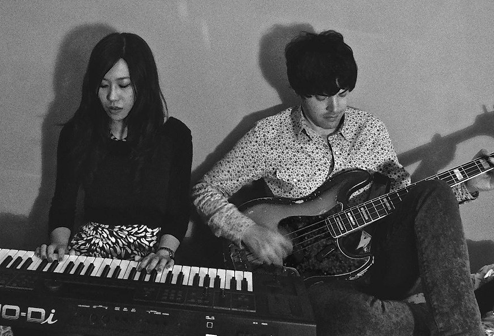
I don’t know much about The Four Disorders, and that’s how they seem to like it. A brief heads-up email arrived about them the other day, but lyrical hints and a single downcast, distracted photo don’t tell me much more than that they’re probably based in Hackney, that they’re a boy/girl duo (Mi-Shan and Joe), and that they’re not big on eye contact.

Mi-Shan and Joe of The Four Disorders (photo © The Four Disorders)

Mi-Shan and Joe of The Four Disorders (photo © The Four Disorders)

There are just two Soundcloud demo tracks so far, both demos. Not quite a secret, not quite a single. There’s a contradictory whiff of reclusive hipster to this (not necessarily a bad thing – I dip into hipsterworld sometimes, and it’s a guilty relief to find someone there who hates self-promotion). What I can glean about The Four Disorders, therefore, comes mostly from their sound, which somehow manages to be both dark and breezy.

Rhythms are closures : minimal drum machine clacks and markers, enough to pump the songs along up-tempo but otherwise just nails holding the box together. Sidelining (or suppressing) the sparse and begrudged clusters of starved, spangly guitar, Mi-Shan offers greyed-out nighthawk pads of budget string-synth. Moods are made or broken on Joe’s upfront bass guitar, which looks and sounds almost as big as he is, whether it’s trudging down the beat with a dour plectrum-hammer or traveling on a supple, pianistic twist of growling melody. Allowing for home-studio roughness, they end up somewhere between Sisters of Mercy (circa the clenched and hooded cynic-rumble of ‘Floodland’) and the brighter, more forgiving dance-pop of Saint Etienne (sprinkling reappropriated, refiltered tints of classic pop sounds over washed-out London suburbs).

Whenever Joe opens his mouth, however, it suddenly turns a bit teenaged-Neil-Tennant. He sings with a similar small-voiced and beady tone – brittle and nasal, watchful and dry. Like Tennant, Joe also wears heartache and reflection as if they were part of the same, wrong jacket; tight and a little irksome. On Cat Lady he sighs, with a hint of exasperation, “I could love you if you drop this nonsense.” Over glum keyboard chords and a chilly, thudding bassline (and with a hint of cocaine weariness), he outlines the stagnant mind games which keep score but eventually lead to nil. “You think you know it all, you think you’ve got my life worked out, you think you see right through me, / but you don’t know me and I don’t want to show you. / You think you’ve got me in a corner, you think you’ve outmanoeuvred me – / but I show you only half the truth / and it cuts me out, it cuts me out…”

With excruciating – and accurate – teenage gawkiness, the song flickers between states and stances. It travels rapidly from poised bleakness (“you think you’re only using me to satisfy you when you need it / I wish that’s all you wanted from me, but I can feel the pain inside you”) to the unwanted sympathy, sincerity and pathos of the schoolyard underdog scratching for love. (“You’re smarter and more popular than me – / it’s true, but I just wish that you could believe it too / and put yourself at ease.”) In its dance of masks and blushes, it feels like a mash-up of Brett Easton Ellis and ‘Waterloo Road’.

That awkwardness, that inability to maintain a fixed pose, seems deliberate: a conscious, complicit songwriter’s choice. On Hell And Hackney, Joe takes on the insubstantiality and self-indulgence of his peers, but even while taking it to task with verbal barbs and jabs, he brings in the rueful tone of the implicated. “Aimlessly we drift, like a frivolous emotion, or a dream that fades into the day / Further round the bend, delirium advances; / we bite the hand that tries to save… / We’re still pretending there’s another life, / parallel and far away.” There’s more fizz to this one, too: counterpointing her blocky keyboards, Mi-Shan fires out digi-gastric hi-NRG gurgles, bell-tones and sub-bass quirks over Joe’s rolling bassline.

Joe, meanwhile, lunges into the malaise to root out the muck, distraction, and confusion. “We’re only alive when we drop out of skies, wash away the compromise, / we’ve nowhere to hide, nothing left inside, forgotten what we’re trying to find… /Sad to say, we wash away the day, / destroying our time. / Cast away, sleepless we lay, /wasting our pride.” As he breaks his own cool surface, skidding vigorously between scold and clarion call, you can almost forgive him for skidding for hideously out-of-tune; especially when he tears a window in the torpid clouds towards the end. “Yes, I know how miserable it seems, / laying blame and thinking of those long-forgotten dreams; / but I hope someday we wake up, laughing at the mire we’ve left behind, / to find it’s not too late.”

Dour tones and duff notes notwithstanding, this has promise: at the very least, I like the idea of a more Gothic spin on Pet Shop Boys. Even if Joe and Mi-Shan still won’t look me in the eye…

The Four Disorders: ‘Cat Lady/Hell And Hackney’
The Four Disorders (self-released, no catalogue number or barcode)
Stream-only demo tracks
Released: 10th April 2014

Get it from:
Stream only on Soundcloud and YouTube.

The Four Disorders online:
Facebook Soundcloud YouTube

REVIEW – Ian Crause: ‘The Song Of Phaethon’ & ‘Suns May Rise’ singles, 2012 & 2013 (“sample-punk turned foley-bard”)

30 Oct

Ian Crause: 'The Song Of Phaethon'

Ian Crause: ‘The Song Of Phaethon’

“Well, I know, I know the story – / the fall of the sun and the vengeance of glory revoked. / So well, I know how the seas turned to dust, / and how the known earth choked. / So well, I know, I know the ending: / the carriage from its zenith bending, / a comet slung through ashen skies / and burst against the banks.”

Cinematic. Epic. These are words which have been whored out far too often, especially when it comes to describing and defining music. Froth and PR corrode their meanings, reducing them to fancy synonyms for nothing more than crude scale, and we forget that other qualities are wrapped into them. These words shouldn’t just be cheap and glittery tags for charlatans – the kind who steep their tunes in giant vats of reverb, or who substitute eye-watering grandiosity for sincerity. There are more crucial meanings. There’s storytelling, and the churn of history. There’s the play of images, the triggering of senses. Eventually, there should be some kind of understanding.

Ian Crause knows all of this. Back in the 1990s – when he was barely out of his teens, and the driving force behind the startling expressionist pop band Disco Inferno – he was struggling with it himself. Even then, though, he wasn’t stumbling to understand: he was striving to perfect. Disco Inferno had come from limited beginnings but grown fast. Originally a dour post-punk power trio, they’d seized the opportunities presented by technology and imagination and transformed themselves into a whole-world window. Hot-wiring their way into the disruptions and illuminations of found-sound and musique concrète, they plugged guitar, bass and drums into digital samplers and grew themselves an ever-expanding sheath of noises: a startling collage of jarring sound effects, layered into composition and twisted into context.

Disco Inferno’s swarm of noise was never there simply to overwhelm. Instead, it refracted and illuminated the poignant dissatisfied pop songwriting which stood, steadfast, at the band’s core. They were doggedly political, but owed nothing to dogma. Caught within ominous social currents and inside treacherous personal eddies, their songs bore witness to cruelties, both intended and impersonal. Those tearing rivulets of sound-montage were flashes of further illumination, put there to side-swipe and snag the attention, and to up-end complacency. The fragments of birdsong and clattering glassware; the careful punctuation of trains and screams and distant firework-pops; the sound of feet jogging grimly away through a numbing snowfall – all of it bore witness to the swerving cacophony of the world, smearing past our ears and battering our psyche, carrying its deeper meanings and significances into us via a pummeling swirl.

At the heart of this unsettling barrage were Ian’s lyrics, which were wise, stark and bleak beyond his years. He sang about the crumbling of vulnerable individuals; about the fraying of the social contract and distortion of social forces. He sang about the stifling, stunting pressures callously imposed from above. He sang about all of this in a still, small, stubborn voice which sounded like the next-to-last exhalation; as if he was a few crucial steps and dogged heel-digs away from giving up and bleeding out. He sounded brave, bitter and doomed – snarling his scorn at the boot-tread even as it rolled over him. For a while, it was a self-fulfilling prophecy. Bands who refuse to comfort us (or refuse to stroke our sundry petty vanities) rarely get rewarded, and Disco Inferno were no exception – the strains of dealing with commercial indifference and inner despair finally tore them to bits in 1997. A couple of barely-noticed Ian Crause solo EPs hiccupped out in the band’s wake over the next few years, and then he too seemed to drop out of the story.

In fact, he’d only dropped out of the cheaper kind of mythology. That’s the one in which ducking out of music becomes death or disappearance by another name. His own story – the real story – moved on regardless. There were years of growing up and grim jobs to come, and years of being chewed over by the same callous forces he once sang about. In amongst the drudgery, there were other factors. There was fatherhood, and family. Surprisingly (for a lyricist already so accomplished and intelligent) Ian made his first adult engagement with literacy. Curiosity, plus a determination to pursue the roots of song and storytelling, led him to the themes and voices of classical literature. His developing interest in the telling parallels with contemporary society kept him immersed in it. Crucially, Ian discovered the works of Ovid – Roman epic poet and exile – via dedicated translations by Ted Hughes and David R. Slavitt.

Like Ovid, Ian would eventually become an exile himself (a self-determined one, abandoning Britain for Bolivia) and enter into a new swell of creativity. Via his ‘Metamorphoses’, Ovid eventually inspired The Song Of Phaethon – Ian Crause’s formal return to music, transformed and developed. It might not be the first new note he’s delivered after eleven years of radio silence. That would be More Earthly Concerns, which welled out via Mixcloud and blogclick in March 2012, and which I’ll talk about elsewhere. But (as Ian begins to dole out his work, in handfuls, onto Bandcamp) The Song Of Phaethon is the first of Ian’s songs to be let out into the marketplace. It’s also probably more crucial in understanding his evolution since his Disco Inferno days.

The protagonist, Phaethon, is and was one of those half-divine children who pepper Greek mythology – he’s the bastard of the sun god Apollo Helios, a malcontent boy strutting up to his sun-father’s palace to claim his ancestry and birthright before he has the wisdom to use it. Greeted, given the acknowledgment he craves, and granted the gift of driving the sun’s chariot for a day, Phaethon is warned of the terrible risks involved. Swallowed up by his grand moment, and too conceited to listen, he takes all of his opportunities to their ruinous conclusions. Losing control of the chariot, he transforms a triumphal fly-past into a joyride and then into a catastrophe. Before the high god Zeus restores order by striking him down, Phaethon scorches a gigantic swathe across the world and casts the seasons into chaos.

Like most figures woven into the complex psychological map of Greek myth, Phaethon still has his role to play. He’s a metaphor for arrogance and a sense of entitlement; he also stands for the destructive potential which both of these follies possess. It’s deep literary currency, and maybe not the first thing which you’d think of as a match for the Crause songcrafting method – so direct and personal in Disco Inferno days. Yet Ian’s battering splay of noises and disaffection opens itself up readily to the mythology, which sinks in grain-for-grain. Explosive futurism meets stern and ancient legend, and both are renewed.

Some of Disco Inferno’s post-punk grit remains at the spine of the music (listen to those dogged dot-trails of frowning bass, or to the occasional flares of wire-wool guitar), but the song falls far away from rock into something older. Myths lend themselves to being channeled into new courses by any means available – Phaethon, for instance, worked his way into a Patricia Barber jazz epic six years previously. Ian rises to his own challenge superbly. In any worthwhile sense, what he comes up for The Song Of Phaethon is a new take on a bardic chant. Its melody is minimal and hypnotic; its rhythms walking, changing pulses constantly driven by the restless words. With vivid artistic appetite, Ian also mines the story’s depths for any resonances which he can transmogrify and feed into his own samples-as-narrative approach.

In this he’s served well – the mythic structure and detail inspire and transform his lyrics, which in turn take on the layered build of classical imagery. Various whispers of fateful moira and foreshadowing rise up to nourish the sounds. From early on, Phaethon’s life is marked by the celestial – right down to the transformation of his familiar landscapes by the passage of the sun and moon each day, continual reminders of his thwarted birthright. Ian reflects this in the woven detail of the narrative: “Every day their shadows ran / down Asia like a lyre, strumming / past his village, swinging down at perihelion / to touch upon his mother’s house / then over dark and quiet woods – / their distant hawks and watching deer / oblivious in bending shade – / descending into seacloud mist, / and down towards the gull-cloud cliffs / to pour their jewels and precious metals / out along the sea.”

Just as he did with Disco Inferno, Ian juxtaposes sound effects with the lyrics to create telling sonic scenery. Though he generally wields these with the skills of a master ironist, he slam them into place with forthright punk brutality whenever he needs to. Throughout, the Greek horns and lyres are a pointed racket: ritual blares, ancient continuo lines. Signatures of antiquity and origin stand solid against the thrumming synths and Ian’s tidal electrophonic swirl of throbbing samples. In prophetic flashes, the clip-clop of horse’s hooves and the slam of violent collisions clatter and blur in and out of the mix, while Phaethon’s more innocent youth is illustrated by the clank of herd bells and goats. In time, his dogged journey through Asia and towards Apollo is dappled and smeared by a souksworth of Asian instruments and chatter, careering past the listener in a flickering travelogue: “Levantine cities raised themselves, then hazed away in dreams of sand, where sand subsumes / the earth itself and still ahead his path led on. But falling always out of reach, the rising sun. / Into the dawn, alone he walked.”).

The effect is of a kind of illuminated text – a cinematic compression of time and location into a vivid illustrative story. That story remains paramount: even while we, as listeners, are being drawn inside those blood-in-the-head thunders and are surrounded by a glorious noise, as if we’ve been trapped under the encircling lip of a vast bronze bell. Beyond the story, though, other dimensions to the tale are coming into play. The song is also a loose parable of another gatecrashing of grand power. “He knew, he knew – / his place was beyond.”

Superimposed – a ghostly transparency – over Phaethon’s story is the tale of Tony Blair’s entry into the Second Gulf War. As this emerges through the song, it’s clear that Ian sees this as another disastrous snatch at high significance and public destiny. Something which flew high and upwards towards glory, only to destroy any achievement of its own, wreaking havoc on the ground and people below. Cunningly, occasional Blairisms are woven both into the narrative and into Phaethon’s thoughts and speech. At one point, he even blathers, Blair-like, “look, you know,” before sliding into advocate pomp and hubristic heroics. For a moment, the pleading voices of the two men overlap within Ian’s narration, making a contradictory cats-cradle out of public morality, power-grabs and a preening Promethean sense of mission. “It was not just God but also man / who clearly needs some representing – / A case I’ll take for free… / Evidentially it takes / a half-divinity to raise / the flag of man aloft for man…”

It follows – with a harsh and unforgiving logic – that the noises of modern warfare should persistently break through the song’s tapestry of ancient sounds. As Ian goes beyond everyday sound effects and begins to violently splice present-day horrors into the textures of the mythical plot and signifiers, the song is slashed up into a jittery palimpsest. Almost from the start, those bleating goats on the ancient Greek hillsides are blindsided by gunshots and by the crash of heavy munitions. With booms, crunches and clatters the shattered, warped shards of twenty-first century concrete and metal scrape and shoulder their own way into the past.

Even specific events from the myth draw across, from recent times, their own crooked parallels. The bursting, clattering crowd-sound of Phaethon’s entry into Apollo’s hall is lifted and twisted from the peak of Blair’s 2003 address to the US Congress. It becomes a Dionysiac smear of fanatical applause and whistles: something turned into a nightmare puppet show, or a rainstorm ripped horribly out of kilter. At the coda, Phaethon is poised unwitting on the brink of disaster. The ascension of the Sun’s chariot merges, indistinguishably, into the noise of a jet fighter launch. Backed by the white-hot screech of the afterburners, the lyrics weave both tales, both times and a set of terrible implications – “the steeds were armed: a blinding shock; / a ferrous scream; a rubber stamp; / and up,” – into final, irrevocable process.

By anyone’s standard, The Song Of Phaethon is a major achievement – a jump-up into fiercely intelligent, confident high art, it stakes new claims and transfigures old ground. It even manages to both stay true to and transcend the moral and political commitments Ian held with Disco Inferno. And yet… it raises a tremulous question of what might have happened to the other side of Ian Crause. Between the immersion in classical tradition (and the dense time-folding focus of the samplers) what’s left of the fervent young New Order fan who always saw himself as fronting a pop band? What, in other words, became of Crause the unlikely pop singer?

Ian Crause: 'Suns May Rise'

Ian Crause: ‘Suns May Rise’

For the answer, look to Suns May Rise, released three months after The Song Of Phaethon. Ian’s mining of Greek mythology is still in place (as are his detailed tapestries of sound-effect) but they’re now wrapped around an out-and-out pop song and a lustrous, dancing melody that Bernard Sumner would give his eye-teeth for. Those Greek lyres and zithers are back, as are the layers of sound effects (sea-spray and thunderous surf crash billow through Suns May Rise from start to finish); but they’re bolstered by massed stadium synth and guttering pop guitar; by angelic powder-puffs of fake-choir; and by warbling rococo flourishes of electronics. Even Ian’s voice – usually so dry, and pointed – is flushed with the balmy blue of a Mediterranean summer. Scritti Politti and Cocteau Twins, each at their flounciest, could find common ground with this song’s feverish, chattering opulence. So, come to that, could latterday Marillion.

I suspect that all of this ’80 ornamentation is deliberate. After all, it skips hand-in-hand with other ’80s excesses, and that’s not too far from where Ian’s caustic, righteous attention is focused. Beneath this gleeful and gorgeous bluster, he’s unraveling a story from the Odyssey: a warning bell for avaricious times. As the story has it, Odysseus (while returning from the Trojan Wars) visited the generous Keeper of the Winds, who gave him a bag of sea-gales to ensure that the sails of his ships would be filled and his voyage home would be swift. En route, Odysseus slept; and his friends sneaked up to rifle the bag, in search of treasure which they were sure he’d hidden from them. All they succeeded in doing was to unleash the winds, which blew the ships hither and yon and – eventually – blew them back to where they had started. Reckless avarice, bringing down calamity, provides the keystone of the song. “There will always be some fool / to pull the strings apart. /And suns may set and moons may wax, / and moons may wane and suns may rise – / the gold within his eyes will weigh / Man down a stumbling fool.”

When Ian starts singing about this, though, it’s from the point of view of that corrupted, consensual chorus of friends – the “brothers bound in bronze.” Their coy, self-congratulatory rapaciousness soak his tones like a stain on the teeth. Flushed and greedy with loot already, all they can see is the chance to grab some more. From his own place at the reins of the narrative, Ian reveals their mythic echo in today’s freebooting boy-club of bankers and stockbrokers. Men of unfettered appetite goad each other on. People who simply don’t know when to stop – and who wouldn’t want to even after being handed a sobering, sickening lesson – would still pick perilous holes in opportunity. “You had enjoyed a peace of sorts / The winds had been re-tamed and so / of course the bag was bursting fat: / It fell to men to see to that. / Again so sure the bag would hold / either wine or gold, / Necessity appeared, demanding ‘Open this’.”

It’s here (with a careering inflative screech on “bursting fat”) that Ian himself deliberately unleashes the hidden forces within Suns May Rise, to overwhelm it. From here on in, sounds rise and cyclone – seaspray, radio chatter and winnowing churns of air; a lash of strained rope which morphs from background effect to edgy kick-drum. Amongst all of this the thread of pop song holds fast, stretched taut over an ever-burgeoning epic. In a parading weave of rapid soundbites, assorted newscasters and pundits and politicians roll past in a potted history of the last generation of monetarism. At its tail-end, George W. Bush (waving through a banker’s rescue programme of the kind he’d never have brooked for any other group of people) chokes, gargles and drowns amongst the becalmed wreckage of Odysseus’ ships. Throughout, that teasing pop melody ensures that we’ll remember what happened this time around.

So… the forces eventually sink the meddlers, but there always seem to be more of the latter. Ian conjures up further mythic winds, more specters bringing in ruin from the other far-flung breeding grounds of a destructive capitalist carnival. “Through solids, countries, paper bonds; / The world again reveals itself / in entrails; in open wounds. / The priests and seers shed tears of glee / and privately amuse on how / it still can be that after so long… / there will always be some chance / to pull the threads apart.” Again, the bones of legend rear up inside the flesh of current affairs. Again, this unlikely sample-punk turned foley-bard turns up to show us where those bones are poking through – his words a layered and subtle scourge; even an education. For Ian Crause, it’s been a long and often stony road from transformative teenage angst to his current role of reveal-and-illuminate, but it’s also been a journey of integrity and hard-won vision. The results are even a story in themselves.

Ian Crause: ‘The Song Of Phaethon’ & ‘Suns May Rise’
Ian Crause (self-released, no catalogue number or barcode)
Download-only singles
Released: 20th November 2012 (‘The Song of Phaethon’), 18th February 2013 (‘Suns May Rise’)

Buy it from:
‘The Song Of Phaethon’ – Bandcamp (the original version reviewed here has now been replaced by this mini-album)
‘Suns May Rise’ – Bandcamp (the single version reviewed here has now been replaced by this version from ‘The Vertical Axis’ album)

Ian Crause online:
Facebook Bandcamp LastFm

September 2013 – live reviews – autumn light, part 1: Daylight Music presents Directorsound/Candythief/Jack Hayter @ Union Chapel, Islington, London, 28th September 2013 (“decency, enthusiasm, a place to gather and music’s qualities of balm and binding”)

30 Sep

This way in...

This way in…

In some respects, when you’re chasing music, being broke is easy. Almost everyone sympathises with it (not least the musicians themselves). A bigger challenge is to keep up with both music and a young family: neglect either, and you feel sick at heart. Chances fly past and it sometimes seems as if, whatever you do, someone’s going to get disappointed.

My own, fairly recent family is typical in this. Getting us all together behind one piece of music, at one time, can be tricky. Regular readers will already know that I like music in all its forms – from scream to coo; from four-square pop craftsmanship to impulsive tangle-ups; from stroke to slap, from massed strings to static. In the face of this indiscriminate barrage, my wife prefers her music to be more ordered and comfortable. (We did enjoy a freak one-off bonding over some Belgian avant-jazz six years ago – marriage always has its surprises). As for Oscar, at two-and-a-half years old he hasn’t settled on absolute likes yet; but as he hones his toddler free-improv skills and makes up scrambled songs about the Gruffalo, making musical noises with any convenient object (or watching other people do it) fascinates him.

Well, if you’re broke, you track down free gigs – as for the other challenge, go looking for something family-friendly. Hiding in plain sight in the middle of north London, Daylight Music offers both, hosting fortnightly pay-what-you-like triple bills beneath the piling, bounding Victorian-Gothic rooftops of Union Chapel. Persuading Clare and Oscar to go is easy. It’s a single bus ride away; it’s in the early afternoon; it’s mostly acoustic. Apparently, there’s cake. I think that’s the clincher. We go.

Inside, we find something like a church fête. The merchandise stall nuzzles up against Christian Aid posters; and yes, there’s cake – people volunteer to bake and bring it in. Beneath the Chapel’s bold and cavernous octagon of elevated brickwork, a gentle, meandering throng of people criss-cross the aisles like drowsy autumn bees, settling gradually into the wooden pews. Children’s faces are dotted around the audience – happy or distracted toddlers, anxious infants who’ll be smiling at the thumps and arpeggios later. During breaks in performance, a strikingly tall and kind-looking lady called Caitlin cat-steps over to the grand pipe organ and plays us a weave of half-melted pop hits and memory-songs. Despite the Chapel’s imposing scale, this is all remarkably cosy.

In recent years, unfriendly rumbles have rattled round the woodwork of the more family-friendly, acousti-folky end of music. Certain commentators have been drawing ominous conclusions about a resurgent conservatism, the rejection of multiculturalism and the stealthy rehabilitation of a rigid and stratified Britain strapped into place by ersatz traditions. It’s an uneasy picture, not least because the distaste drives so many things before it – farmer’s markets, bespoke festivals, the parodification and commodification of working-class folk culture, even the innocuous folk-rock of Mumford & Sons are all rolled up into a looming kipple-spectre of incipient English fascism. You could imagine the same questionable bile being aimed at Daylight Music – at the grand church setting, the tea-and-cakes, the shortage of outright punk and smoke, the Mothercare cups, even the efforts to make people comfortable.

Look a little more closely, and the cheap shots are belied. There’s a faint fray of urbanism to Daylight Music and to the Chapel – a slight scuffing and engriming in the Victorian iron and woodwork; a dash of non-conformism (both with and without the capitals) to the gathering and its setting. There are glimpses of more lived-in faces punctuating the young professionals, yummy mummies and cultured grandparents (hard-bitten elderly hippies, tattooed ex-bruisers; that nervy look which struggling musicians get, two decades into lean times). There’s that mingling of quiet anxiety with generosity which hangs around the trestle-table food counter, raising money for the homeless. Indeed, there’s even something of the trade union fund-raiser to Daylight Music.You sling your voluntary contribution into a plastic bucket at the door; you’re smiled at; you feel like part of something bigger and more inclusive, and a little more generous.

Daylight Music's Ben Eshmade - making us an offer we won't refuse.

Daylight Music’s Ben Eshmade – making us an offer we won’t refuse.

Although plenty of people are involved, Daylight Music is primarily another outcropping of enthusiasm from Ben Eshmade: broadcaster, promoter, occasional French horn blower and the man behind Arctic Circle, Chiller Cabinet and other warm-spirited musical things with cold names. Ambling onstage to introduce acts and deliver Daylight parish notices, Ben’s the gentler kind of presiding presence. Despite his amiable, bumbling manner (part distracted curate, part Sunday scholar and part walk-leader) it’s clear that there’s expertise and resolve hidden beneath those layers of fuzz and softness. I suspect that he knows everything that’s ticking over throughout the afternoon. Ever so slightly, there’s a sense that Daylight Music are holding off the darkness of ignorance in a matter-of-fact way and with the simplest of tools – decency, enthusiasm, a place to gather and music’s qualities of balm and binding. If London was flattened by meteorites or missiles tomorrow, you get the impression that Ben and the rest of the Daylighters would be dusting themselves down and going around afterwards – knocking at the fragments of doors; rigging tarpaulins and mending guitars; ensuring that everyone was given a flapjack while we put society back together.
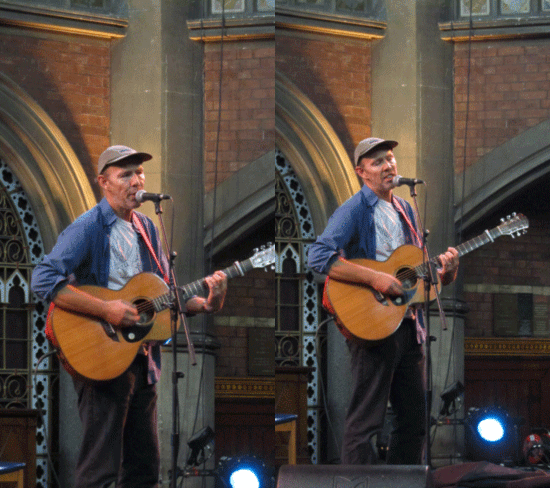
Jack Hayter, at work.

Jack Hayter, at work.

Today’s first act seems as if he’s already been through a little war or two. Looking like a man carved out of driftwood (and dwarfed by the Chapel’s glowing rose window) a slightly battered Jack Hayter is suffering, though not on our account. He’s got toothache, and he might have managed to give himself organophosphate poisoning this week from accidentally squirting dog-flea killer in his eye. He’s taking it well, though: downbeat afflictions and mishaps seem to suit him. Later on, he’ll be singing “I’ve got teeth like tombstones, skin like clay – / well, it could be the scurvy, but anyway.. / The symptoms will fade if you come around / tomorrow – well, I was thinking, I’ll impress you somehow…”

Despite twelve years of on/off solo work (plus bandwork with Spongefinger and Dollboy) Jack seems perpetually fated to be known from his Jack-of-all-trades period with Hefner – when he was Darren Hayman’s handy sidekick, the have-a-go guy playing pedal steel and anything else which the others couldn’t manage. Watching him up there by himself with just his acoustic guitar (and a voice that’s not so much husky as husk), I can’t think of him as anything else but his own man. Both he and his songs are of a part: stubbed and illuminated by poverty and handiwork, scraped down to the bumpy grain and crafted to the true.

His Devon-gone-Estuary accent rattling against his throat, he sings movingly – even elegaically – about the come-and-go of Margate seafront, capturing in fingernail sketches hints of dereliction, the sweep of world currents, and the ongoing business of life: “Seahorse eggs, bladder wrack, / starfish in the sand, / and the Balkan girls on the West Beach with their prams.” With wryness and fellow feeling, he sings about being short of money (“it just sits in my wallet / rehearsing its final goodbye…/ Every letter that hits the welcome mat / is a fancy shade of brown,”) and shifts seamlessly between the metaphysical and the bare-boned personal. (“Trust is just belief without evidence. / Faith is a river that leads to the light. / So I’ll write songs… / so we can sleep better tonight.”)
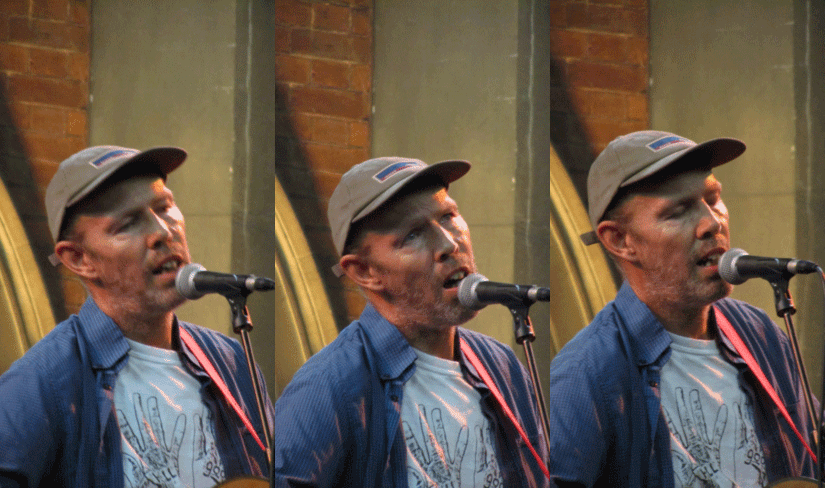
Jack Hayter - songs of tall ships, peeling paint, old aircraft and weathered people.

Jack Hayter – songs of tall ships, peeling paint, old aircraft and weathered people.

While there’s a soft centre to his songs, Jack’s a long way from that breed of walking-pullover songwriters who fluff up the average acoustic night. I mentioned driftwood earlier, but perhaps weathered garden sheds are better comparisons: those unintentional brittle monuments to ordinary men’s lives and their fumbled, uncompleted dreams. Gaps and splinters in the planking; fugs of memories of hard work and shaping, of small private failings and imaginary wickedness.

There are snags in these songs. In one rippled, helpless brooding on love and mistakes Jack casts wildering, dissonant chords in amongst the slash and finger-picking. He passionately rasps fragments of revealing (“your freckled arms wrapped around to drag me under or set me free… / She puts her trust in lucky charms… / Every time we go to pieces, every time we go to war,”) with his bleached, crumpled vocals making them sound like damaged photographs held fearfully at fingertips, their significance lingering even as their colours and clarity parch.

Where Jack truly comes into his own, though, is when he blends these roughened surfaces and threadbare textures with a broader scope: the hauntings of memory, perhaps, or a drunken fantasy. I Stole The Cutty Sark is the latter, a boozy-dream-come-lover’s-bet in which Jack’s decrepit old soak of a narrator imagines commandeering the famous old Greenwich clipper and sailing it (topgallants filled with drunkard’s breath) across south London parkland and streets to serenade his girl at Lee (“I bet she’d sleep with a man who’s got a tall ship…”). It snatches romance from the brink of the ludicrous – even restores a little dignity and life to its own shipwrecked subject.
'Misfit City' Jr. at play - Oscar enjoys the show.

‘Misfit City’ Jr. at play – Oscar enjoys the show.

Another antique vessel – this time a plane – haunts The Shackleton: a post-war sub-hunter haunting the north-eastern coast in the 1960s, droning overhead while lonely Cold War teenagers pursue the wrong people, go through pregnancy scares and flinch from dreams of the mushroom cloud. From these elements, and from two tales of shredded correspondence in sorry little boxes, Jack spins out an aching kitchen-sink ballad of how people repeat their mistakes, neglect their cues, fail to be protected; in the end, how they come to miss what they feared and learn (too late) to love what they once only took for granted. He calls all of this time-travel. Oscar, too young to understand any of it, is still fascinated by the plaintive bony man onstage with his exhausted face and his air of dessicated kindness; the songs lolling from his guitar.

A few things about Candythief take me back to that wrangle which I mentioned earlier – the one about the politics of folk music. Superficially, they seem worlds (and perhaps a property band or two) away from Jack Hayter. As driving force and songwriter, Diana de Cabarrus has learned to be flexible while leading a Lego-flexible band lineup which clicks and pops available members into place as and when possible. This afternoon they’re a duo – Diana fronting on lipstick-red guitar, with Jason Dickinson’s vigorous fiddle playing and vocal harmonies adding some friendly sinew to her songs.
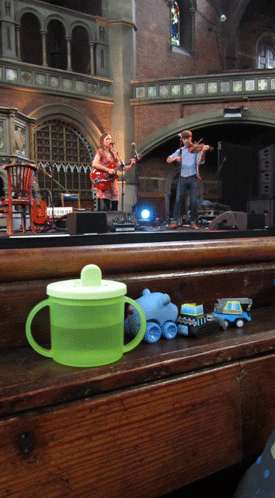
Part of a Daylight Music experience - baby cups, toys, Victorian woodwork, and Candythief in the background.

Part of a Daylight Music experience – baby cups, toys, Victorian woodwork, and Candythief in the background.

There’s nothing wrong with Candythief’s craft – it’s their cleanliness that jolts a little, after Jack’s scuff and scrape. Diana’s taste for adding a little crunch to her guitar is offset by her occasional dashes of loopage – choir-lady codas, little ziggurats of arpeggios – while Jason’s all-around virtuosity is further buffered by his beaming, ready-to-please showmanship. Their cheerful confidence extends to each other and to the audience; they deliver updates and clear intros at every opportunity, they’re nicely turned-out… They could hardly be more iconic of the modern, middle-class, tech’ed-up professional folkie if they tried.

Still, it’s churlish to snap at them for their impeccable diction, or for the fresh-faced, well-brushed aspect which they bring to their music and manner – after all, no-one snaps at Kate Rusby for making the effort. A songwriter’s voice finds itself while working through all manner of factors – family, shoes, regions, songs caught up from records or by ear, the day-jobs cadged on and survived, the places traveled and the things seen in passing. Diana’s own background (taking in a desert childhood and links with King Creosote and lo-fi Fence Records folk) suggests that there’s more to her than the assured, well-groomed perpetual-debutante which she presents as. Listening past the image doesn’t necessarily reveal all of this, but it does reveal a songwriter of thoughtfulness and impact behind the cool tones and bright sounds.
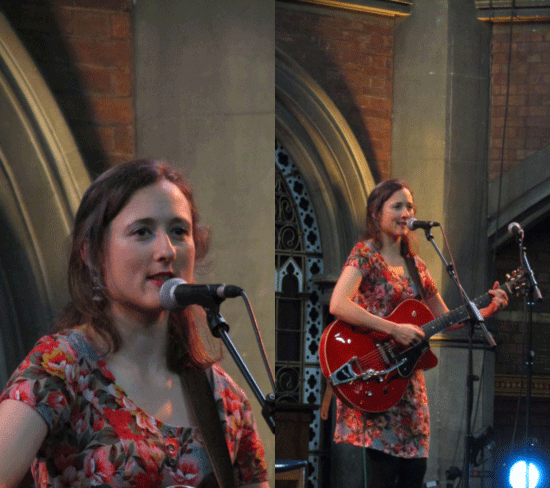
Candythief-in-chief - Diana de Cabarrus

Candythief-in-chief – Diana de Cabarrus

Not just that, but Diana proves to have a taste for mournful reflection which parallels those scrappier, plangent Hayter regrets. Her songs are windows onto other lives, onto which her own feelings overlap to etch away the politeness with a soft, stubborn acid. Many of the subjects are other women; such as the young girl at the centre of one particular time-blurred song, in which you can’t be sure whether Diana is looking at a daughter or niece, at a stranger, or at herself. Whoever it is, Diana appears to be both looking towards future journeys and looking back on them from that future, her responses a mixture of concern, solidarity and trepidation. (“Your face was so smooth – / you had no idea.”)

In the sleeve-plucking Time In The Tin Diana protests at how everyday lives are pecked away and blurred by the waste and distraction of marketing: “Please don’t spend the hours staring at the distant shrines in shopping malls, / the speechless saints in magazines and city walls… /With our minds thus occupied / we didn’t see our hands get tied… / Who dares tell you good enough / means buying into all this stuff / while the thoughts inside your head / are dismissed, remain unsaid?” As with the best political songs, the polemic is tempered by the personal, reflecting “summer was discovery – now the slightest wind chills me, / and I’ve set nothing aside. / I’ve only scattered thoughts to hide / from quicker clock face hands, from rain that turns it all to sand. / A bit more life is in the can: with hands outstretched we try to cram / every last taste and scent and breath / that rings of life, but every pledge / holds its promise and the line / towards home is hard to find.”
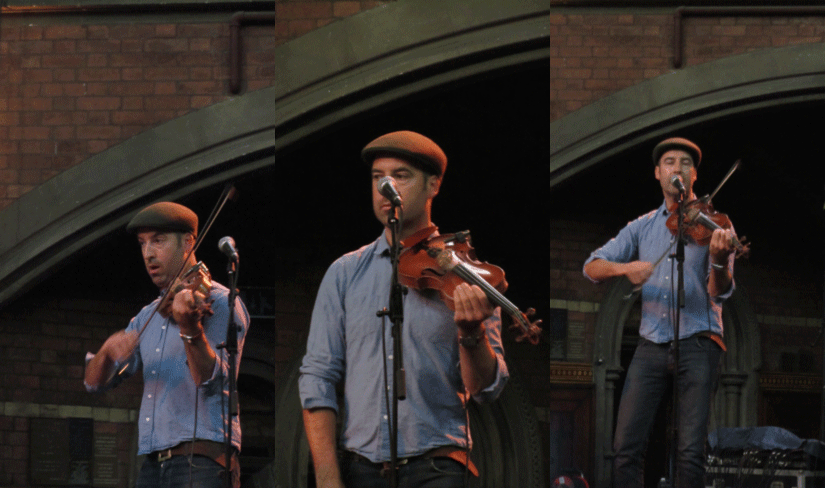
Jason Dickinson (Candythief's fiddler).

Jason Dickinson (Candythief’s fiddler).

Also buried beneath that clean surface and Diana’s own still, bright-eyed presence (like a guitar-toting reedbird) is Candythief’s taste for the cunning disarrangements of psychedelia and of folk – the flicks in the beat, the wrong-footing rhythms which inspire thought and dance together. Several Candythief songs skip between multiple paces, stirring up the barbs and challenges in the narratives. “We thought we were walking, making our own path… /You can’t close your grip ‘cos your hands are cold… / You ate up the insults, described them as fate. / Rattling the cage, / rewriting the same page – / footprints on your skin / where the robbers all crept in.”

They end – joyfully – on a new single, The Starting Gun, which takes this practically to prog levels. Leaping from a scrum of guitar and violin up to a stepped and spiky arrangement, it’s a stirring wake-up shout. “Your heart’s a roaring furnace underneath the evening news, / a mighty engine longing for the chance to be the fuse… / Draw the curtain back, join what was once apart, / scrape the grease from your beating heart. / We are bullets of pure light unraveling in time / through damage, loss, theft; the darkest of each other’s crimes.” Jason and Diana end on a confident crash, grinning at each other – clean sparks.
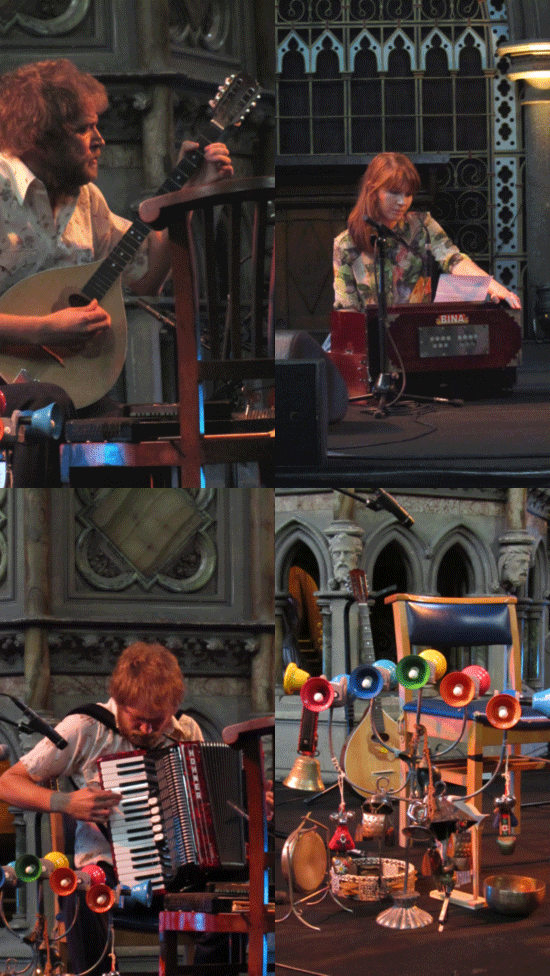
The soft armoury - Directorsound in action.

The soft armoury – Directorsound in action.

It takes a while for Directorsound‘s pool of mostly acoustic instruments to be assembled onstage. A nylon-strung guitar and a bouzouki, an autoharp and an accordion, a Tibetan singing bowl; dangling hammers, sticks and strikeables; sundry pedals; a miniature gong the breadth of a hand. Most vividly, there’s a compact and jutting array of hand-bells painted in bright toy-like colours, pointing outwards like clown-car klaxons. Apparently, this last item is a belldalabra.

If you’re still determined to think about things politically, there are a few options. Should we be expecting an admirable, inclusive world-music approach, or just the spoilt, self-indulgent tourism of an inveterate instrument collector? Is all of this wood, brass and hollow space about a love of open sound, or is it simple acoustic puritanism? I have to admit that I’m musing on something completely different – Daylight Music’s family atmosphere and the band name mingle lazily into a daydream of Thomas the Tank Engine, the Fat Controller hiding himself away from squabbling trains in order to piece together steampunk tunes in his bedroom. (Of course, it turns out that someone’s already beaten me to this…)

Idle speculation is rendered moot by the ambling arrival of Directorsound himself, Nick Palmer. Far from being any kind of poser – or any kind of prover – he’s a sweet skinny haystack of a man for whom any hints of ego or preciousness dissolve into the air with his music. He communicates with us via friendly mutters and the occasional warm, shy peer-out from between tousled fringe and beard. From the off, he engrosses himself in the business of stroking sound out of bells and strings and drum-skins, beginning with a ruminative solo on Spanish guitar but soon progressing to a smooth shuttling between instruments (an assured, hands-on craftsman, moving between tools).

Accompanying Nick on his explorations are two ghostly, gentle-faced women: one on harmonium, one on flute. Standing on either side of him, like handmaidens or like muses, they mingle an air of the slightly worn with one of peaceful contentment. Neither of them speak: instead, both softly watch Nick as they play, possibly picking up cues, most of which are invisible if they exist at all. While it’s Nick who initiates most of the patterns and melodies (and who rides swap-shot on the reliable single-instrument drones and figures his companions provide), no-one onstage appears to be in absolute charge. Instead, music happens as a mutual pass-around, shifting its focus equably between woodwind, soundbox, reed-buzz, string and chime. Three pieces along, Nick is picking up his piano accordion, playing his own take on a café reel and punctuating it with horn-honks and stomps of foot-tambourine, until the trio are summoning up strolling, bobbing images of fairground and French sidewalk.
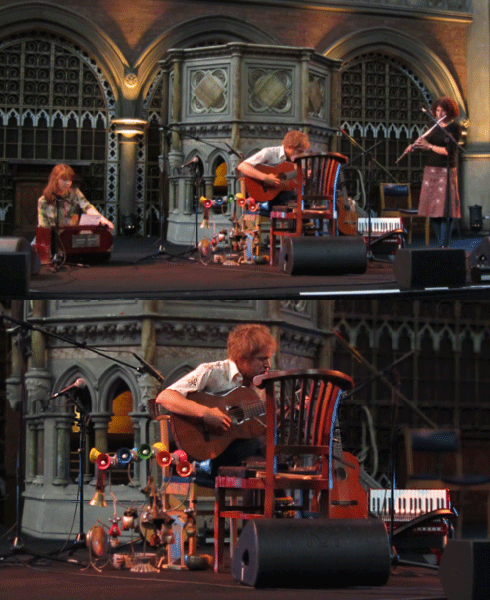
Directorsound spread out...

Directorsound spread out…

The belldalabra (which has been sitting tantalisingly in plain sight throughout the set) finally comes to the fore on the fourth piece. “It even sounds good when you move it,” Nick chuckles in passing, bringing it in closer even as he’s strapping on a pair of leg-bells. What follows is a stirring, flurrying one-man duet. Nick’s autoharp lies flat on a chair, his beaters ringing softly off its strings when they’re not rapping and fluttering across the belldalabra in exquisite slithers and chimes, a full flow of musical counterpoint from harmonium and flute turning the ringing into glints on the tide. In time, Nick sets the beaters aside in favour of the bouzouki; but his strumming hand still makes regular, hawk-talon lunges back at the autoharp as the piece blossoms into a Celto-Grecian tapestry of stamps and zings. When it’s going at full tilt, Nick is racking belldalabra, tambourine, leg-bells, gong and even a set of box-hinges in a continuous weaving sweep.

If this prolonged and frequently ecstatic dream-folk reminds me of anything in particular, it’s The Incredible String Band, though that’s a tenuous connection at best. Nick’s sunlit tunefulness and his enthusiasm for quilting diverse and divergent instruments into the mix certainly recalls the ISB’s “grab-anything” psychedelic enthusiasm. Yet he has no pretensions towards following their wildly cluttered and creative songcraft, nor any interest in emulating their engaging cracked-crow vocals. Directorsound’s music stays all-instrumental, and comparatively edgeless. Rather than being the product of quirky scattershot individualism, it’s both evasive and welcoming. Nick and his fellow players seem content to summon up broad, bright, impressionistic blurs of scene and culture (a ripple across a wheatfield, a Mistral gust, or holiday memories of a drift of indigenous evening music winding down a warm street) rather than dig into their roots or to challenge them.
Oscar explores the belldalabra.

Oscar explores the belldalabra.

In spite of this, Directorsound remain honest – and, frankly, loveable. Simultaneously introverted and inclusive, the music absorbs musical ideas and feelings like a sponge, but breathes them all back out without a hint of selfishness or self-consciousness. The other Incredible String Band component that’s missing is the alpha-male jockeying for position which both fired up and benighted the latter group. With Nick as the lone (and unchallenged) Directorsound member in the studio, the project was never going to be anyone’s wrestling ground, but even with this in mind, the courtesy, the mutual kindness and the shy, unassuming generosity of the band is palpable from the moment they set foot onstage to the moment that they finally wander off, instruments in hand, into the Chapel’s shadows.

Before that, while Directorsound are still packing up. I bring Oscar up for a closer look at the instruments. Those previously silent women are now happily animated, smiling broadly, chatting to people from the stage. With an open smile, Nick shoves the belldalabra and a beater over towards us. Encouraged, Oscar taps out some ringing notes of his own, briefly making himself part of the band and part of the afternoon. It’s very much a Daylight Music moment.

(To be continued. We went back again two weeks later..)
Someday all 'Misfit City' reviews will be written like this.

Someday all ‘Misfit City’ reviews will be written like this.

Jack Hayter online:
Homepage Facebook Twitter Bandcamp

Candythief online:
Homepage Facebook MySpace Bandcamp

Directorsound online:
Facebook MySpace Bandcamp

Daylight Music online:
Homepage Facebook Twitter Soundcloud

REVIEW – Kiran Leonard: ‘Dear Lincoln’ single, 2013 (“a joyride through the Day of the Dead”)

18 May

Kiran Leonard: 'Dear Lincoln'

Kiran Leonard: ‘Dear Lincoln’

Now here’s something.

Kiran Leonard’s already an established teenage wunderkind – a bedroom-industry frenzy act who’s rapidly gummed together a string of homemade albums and slung them out, via Soundcloud and Bandcamp, to a surprised and unsuspecting world. When he’s not doing that, he’s charging round his family’s Oldham house waving a caiman head, or shooting his own scratch videos on a budget of tuppence. He plays most of the instruments he needs, wrestling tunes out of pianos, drums and guitars; ukuleles, laptops, screwdrivers and radiators. While his music’s just about ramshackle -raw enough to avoid trouble with the indie-rock police, his ambitions and application have leaned closer to prog and to a grandiose psychedelia. In 2012, for instance, he cooked up a rambling, apocalyptic single about the Mayan doomsday prophecy. It topped out at around 24 minutes long and tied together the wilder bits of ‘Cloud Atlas’ and the paranoid, grinding Pink Floyd of 1977.

It’ll still be three years before Kiran turns twenty. I could wonder what he’s going to do when he grows up, but I almost hope that he doesn’t.

Dear Lincoln is something different for Kiran – much lighter and more immediate. Traveling backwards as he goes forwards, Kiran seems to have suddenly discovered pop in all of its concise hooks, blind momentum and smart throwaway logic. Actually, he’s rediscovered it – Dear Lincoln was written some time ago, while he was a ripe 14 – but now seems to be the perfect time to unveil it. Its a bust-out. It sounds like a joyride through the Day of the Dead. Kiran, hammering away at a tack piano and squawking like a glammed-up crow, drives the gauges into the red and embraces Bolan swagger, a swaying Robyn Hitchcock playfulness, some of the wild euphoria of Guillemots and even a needling tinge of Kevin Coyne. Earlier in 2013, there was the ‘Oakland Highball’ EP, which showed that he was getting interested in snappier, noisier forms. Dear Lincoln nails it. If we could work out what he was singing, it’d even be singalong.

What’s it about? God knows. The words are a babbling wodge of mondegreens-in-waiting about suit-crevices and moonlight, thrown out at us as Kiran carries out his lyrical handbrake turns. “Murderous plain,” he protests, in passing, but it certainly isn’t. Not unless he’s talking about death again. The song could be about gunned-down Presidents, it could just be about missing the family cat, but one thing Dear Lincoln does do is blur the lines between the living and the dead – a rollicking Halloween dance, or a resurrection day stomp. Even that long-croaked, ranting old herald of the Übermensch, Friedrich Nietzche, has a ghostly cameo; prowling the English parishes as a witness before succumbing to anxiety, melting away and vanishing. In the chopped froth of the lyrics, Kiran playfully juggles around ideas of resurrection, rousing, and where he’ll be standing when it all comes to pass; but constantly swats away any navel-gazing with onomatopoeic streams of Little Richard-isms. “Praying for the bodies to assemble and wake… / Come back today, bou-la-ray / oh, ta-hoo-lay.”

Don’t get the idea that this is all a casual throw-together. Anyone keeping half an eye on how Kiran thinks will know that he’s meticulous; that he worries like crazy about getting things right. But Dear Lincoln’s explosive delivery – its immediacy, its ability to swing round the story without stopping to count the words – suggest that he’s finally able to harness his particular genius and to let it live in the moment. This is by no means the first we’ve seen of Kiran Leonard, but it feels like the start of him.

Kiran Leonard: ‘Dear Lincoln’
Hand of Glory Records (catalogue number & barcode t.b.c.)
Vinyl/streamed single
Released: 16th May 2013 (streamed), 2nd September 2013 (vinyl)

Get it from:
Hand of Glory store (vinyl), or Soundcloud (stream)

Kiran Leonard online:
Homepage Facebook Soundcloud Bandcamp Last FM YouTube

November 2012 – mini-album reviews – Sterbus’ ‘Smash the Sun Alight’ (“like a prog-dusted bumblebee”)

20 Nov
Sterbus: ‘Smash The Sun Alight’

Sterbus: ‘Smash The Sun Alight’

After six years of making off-kilter indie rock, Sterbus seems ready to make the jump from cult to cute. His previous albums and EPs have shuffled between serious tunes, determined explorations and playful jokes. ‘Smash The Sun Alight’ concentrates firmly on his most accessible side – fuzzy, funny-angled guitar pop launched into a chunky meander through the air, like a prog-dusted bumblebee.

If these seven songs and instrumentals had a colour, it would be orange-gold – blurry and amiable. Sterbus injects sunshine and smog from his native Rome straight into the heart of his rampant, time-travelling pop. One of his feet might be jammed happily into a big bucket of prog and psychedelia; the other’s rooted deeply in power pop and eclectic 1990s indie, with driving earworm-bursts of chorus. In his twists of tunefulness and humour and his love of scruffy noise, you can see traces of Blur, Small Faces and XTC (or, looking further west, Weezer, Steve Malkmus and Guided By Voices). Sterbus also has an ear for those drowsy, medicated-modal melodies that served Nirvana so well; and the dogged musical extravagance of Cardiacs infests his work like a glittering spiral, turning every tune into a hopeful steeplechase of extra chords and whole-tone hops.

It’s hardly straightforward; yet somehow Sterbus doesn’t overdo it and lose you along the way. It’s rare to hear so much bounding complexity tied up so neatly into buzzing firecrackers of song. The saturated bounce of Gay Cruise is typical of what’s on offer, kitting out a tuneful, sludgy Dinosaur Jr. fuzz-growl with some dissonant King Crimson pitches before hammering in a break of piled-up chords to grab us by the ear and take us mountaineering. The eccentric Welsh popster Curig Pongle is along for the ride, playing organ like a swerving Mini: the song also sideswipes a random Andy Partridge sample in which the great man is gurning on about Arthur Askey.

As for Sterbus’ lyrics, they’re a vegetable stew of soft little fragments. The occasional clear phrase bubbles up out of the gentle mumble and hum – uneasy (“troubles in the pool / making me cold”), tender (“My dear baby, what can I do? / You make me feel like I’ve been over-ruled,”) or whimsical (“Unboyfriendable girlies show no love”). Occasionally a skewed aphoristic image surfaces, like something cast up by a young Peter Blegvad (“Birds and second wives, / trying to be polite.”). Much of the time, though, the stew remains a stew, the language dissolved into flavours rather than shapes.

In some songs, such as the ukele-driven A Sigh of Relief, it’s not so much English as an impression of English; just as Sterbus’ breezy mouth-trombone solo and music-hall-McCartney bassline is a sepia impression of holidays in fading seaside resorts. Maybe he knows that songs of life, love and feeling can work just as well as gauzy murmurs. Perhaps it’s just a chewing-over of words to blend into an earnest, reassuring blur – a swirl of cream to smooth the mongrel clamberings of the music.

Oh well, perhaps innocence can be complicated too. That’s why those Irish fiddle parts are there to usher in Otorinolaringoiatria, unless they’re there to soothe us after the tongue-twister (and to stop us wondering why the only distinct word in the song is “sauerkraut”). That’s why You Can’t Be Sirius is tied up like a Sunday roast – its laddering chords held together by tight power-pop drumming, lashing those goosed leaps of organ into position, securing those shivering tremolo-blocks and speaker-fizzes of guitar.

That’s also why Wooden Spheres + Heartquakes plays its pass-the-parcel game. A pelting punk-pop three-chord wonder abruptly switches to Curtis Mayfield funk with sunny popcore punk choruses; then, after changing gear for the tiniest of organ solos, ends up jammed and droning like a stuck tide of Scandinavian prog. Similar in its out-and-out playfulness is The Amazing Frozen Yogurt: setting power chords against breezy mellowness, it sounds like a summery merge of Caravan and The Wildhearts. Lonnie Shetter’s sheets-of-sound sax scribble is flown in for a jolt, offsetting that mid-song switch into Zappa kitsch complete with vibraphone. Sterbus flutters around both parody and self-parody here, but his freshness steers him clear.

The near-seven minutes of Flatworms (Eggs Of Joy) tie together not just Sterbus’ musical agility and bevy of influences, but also his sense of connection. Away from the sung sections, it owes something to the severe angles of King Crimson’s Red; yet it’s also the most Cardiacs-styled piece on offer: a self-confessed attempt to write a sequel to that band’s Dirty Boy (which Sterbus has already covered) and its massive parade of chords. Sterbus’ drowsy vocals soften the cavalcade; the brief flashes of conga draw a little nourishing groove into it. While the lyrics are as obscure as anything else in this clutch of songs, they get the message of impermanence and humbling across. “Running away – far from heaven, / diggin’ the grave, the sun. / Crying away – all your glory; / useless and vain, in time.” It might be an oblique gesture of fellow feeling towards Tim Smith, Cardiacs stricken leader. Certainly, the song’s payoff line casts aside any artifice in favour of the purest sympathy ( “I see you, / I feel you. /You heal me. / Uncomplicated ways.”) and brings the inclusive generosity at the heart of Sterbus’ music to a natural home.

Nothing to be afraid of. Sun’s out. Come and warm yourself.

Sterbus: ‘Smash The Sun Alight’
Sterbus (no catalogue number or barcode)
Download-only mini-album
Released: 16th November 2012

Get it from:
Bandcamp.

Sterbus online:
Facebook MySpace Bandcamp Last FM YouTube

REVIEW – Dutch Uncles: ‘Fester’ single, 2012 (“a butter-toffee in a world of cheap smokes”)

26 Oct

Dutch Uncles: 'Fester'

Dutch Uncles: ‘Fester’


That’s a repulsive title for a single. Then again, Dutch Uncles have always been something of an irritant. I mean that in a good way, as it happens. Some of my favourite bands are irritants. Too many bands just want to be stimulants – crude and obvious, they roar in with a snort and a thump, hammering hard on the most obvious buttons. After a while, you just need more and more of it to elicit even a small buzz, and you end up bored and bloated.

An irritant, on the other hand – that does its job of stirring up a reaction in a different way. You can’t ignore it. It focuses the attention, often by making you aware of sensitivities that you didn’t even know you had. Dutch Uncles have always been happy to spike the necessary nerve and keep feeding a pulse into it. If you’re familiar with those dancing, sidestepping cycles of guitar riff which festooned and hiccuped all over their earlier singles (Fragrant, The Ink, Face In) then Fester will sound halfway familiar. If you persuaded Steve Reich to write around eleven Disco Phases, then stacked them up on top of each other, you’d have the basic bones already. It rotates like a carousel full of drunk mathematicians, with Duncan Wallis’ warm alto hoot (still a butter-toffee in a world of cheap smokes) muttering and musing atop the pile.

What’s new for Dutch Uncles is a delightful infusion of art-rock colourings – that bass guitar which thunks like a piano; that bony clink of marimba hook; the guitar which blows and bloozes like a sleepy horn solo. There’s a delicious feeling of confusion and clothes-swapping wrapped into the song: it’s reminiscent of early Roxy Music and their upsetting of texture, of the otherworldly kink of Associates. With Duncan’s tone of repressed and airy hysteria, there’s also got something of the closeted wildness of Sparks (albeit in one of their mellower moods). Dutch Uncles have that nervy theatrical cleverness to them, as if they’re delicately stepping along a rail with ideas dropping out of their pockets and with tell-tales twitching at the corners of their eyes.

I mentioned a song, didn’t I? It’s built into the jittery mosaic of instruments; and it’s a protest, of sorts. “There’s a time to hide everything – the way that you are; where you’ve been. / And the feeling I’ve tried to fight, / pieces I’m left in inside.” In a genteel way, Duncan’s pissed off; chanting “takes me to the bone” as he swats, distractedly, at a lingering pain. Fractured syntax dribbling in his wake, he argues his position and tells his story like a hungover man struggling with a jigsaw. “And the times you cry at everything / for reasons we don’t mean anything. / And the times I hide behind a smile / that says you were right, you were always right.” By the end of his efforts, he’s trying to strip-mine his way into sense by plunging headlong into tongue-twisters (“The worst is hardly, hardly known, / I trust the worst is hard to know. / The worst is hardly, hardly known, / I know the worst is hard to know,”) as the band pound delicately around him. Irritation confuses, scatters against structure: but few things are better at making you feel.

Dutch Uncles: ‘Fester’
Memphis Industries, MI0250D/MI0250S
vinyl 7″/download single
released: 20th September (download) & 12th November (vinyl) 2012

Buy it from:
Memphis Industries (vinyl); Dutch Uncles homepage
or Memphis Industries news page (download)

Dutch Uncles online:
Homepage Facebook Twitter MySpace

REVIEW – Elephant: ‘Golden’ single, 2012 (“playing in the sunshine”)

8 Sep
Elephant: 'Golden'

Elephant: ‘Golden’

Hmm. It’s only taken Elephant a year and a half to journey from being walkers in the gloaming (singing out their queasy, dissolved surrealism) to playing in the sunshine. There were some clues on their previous EP, ‘Assembly‘, which embraced mainstream pop while twirling mournfully like a mascara-ed panda; yet this is a firm step outwards from the obsessive feel of their early singles. Or is it?

Whether it’s Amelia Rivas’ French ancestry coming through, or just a shared and surfacing taste for classy Europop, Golden sees Elephant strip away their cavernous post-punk layers of dream-pop guitars and blood-throb synths in favour of gently bobbing acoustic strums, shimmering organ string pads, a touch of swing and bell-like keyboard smears. Actually, come to think of it, they’ve been here before on Actors, the surprising B-side to their second single Allured. This is altogether more sedate, though – a leisurely boat trip as compared to Actors’ chic bike ride, or perhaps a gentle merry-go-round bump’n’whirl. Compared to the hallucinatory greyness of their earlier work, it’s full-colour. French-tinged pop, for certain: an antique kind, filtered through Goffin and King and through Elephant’s subtle and invisible technical skills.

The link to what’s come before remains Amelia’s voice (still mournful and carrying a dry-eyed narcotic timbre, whatever she’s singing about) and her baffling way with a lyric, in which she dabs loosely associated words and phrases into a line like painted highlights and hopes that you’ll focus on her own scattered picture. With this kind of tune – this lightness, this air of sated contentment – I’m assuming that Golden is a love song. It certainly starts as intimate (“speaking in codes to you / in a drowned-out room. / Chandelier shelters us – / only space for two,”) but a chorus that gives equal weight to the words “escapade” and “hate” suggests something a little more complex.

Certainly by the second verse – “gazing from this altitude, / trapeze transforms to new. / The old was there all along. / Telescope straight to you,” – we’re in lyrical warpspace. Though Elephant have never sounded so cosy, so lovewrapped on the outside, the usual hallucinations are bleeding up from the inside. By the third verse, the summertime and the sunlight are taking on a shadow-etched ‘Twin Peaks’ hue – “The trees they whisper too, / as I glare from a bird’s eye view. / The grass entwines my feet and hands – / they hold me like you do.”

If you look at something too closely, cracks appear, and that’s true both when looking at songs and looking at love. Love and rage: the cuddle that ebbs away into a stifle… I’m backing off. Today I was promised sunshine, and a dank draught from the basement wasn’t part of the plan.

Perhaps if I don’t look too hard, I’ll be able to glide along on the surface, hold hands and enjoy the golden light. Perhaps it will all be OK. Will it?

Elephant: ‘Golden’
Elephant (self-released)
Download-only single
Released: 6th June 2012

Buy it from:
Soundcloud

Elephant online:
Facebook Twitter MySpace Tumblr Bandcamp

REVIEW – Preludes: ‘The Moth’ & ‘The Swan’ EPs, 2011 & 2012 (“the shadow of a melody”)

6 Sep
Preludes: 'The Moth'

Preludes: ‘The Moth’

There’s the shadow of a melody in the house, floating in the dusty air. It’s coming from just around the corner, or maybe from up by the crumbling moulding.

Preludes is Matt Gasda (the sotto-voce poet who did most of the singing and keyboards in the ghostly riverbank psychedelics Bears in America) and his sister Emily. The Bears were a group so reticent and self-involved that listening to them was like spying on a set of old footprints, long-abandoned and filling with water. Some Preludes songs began life as Bears pieces before falling into this new form and flavour, so you can expect something of a family resemblance. Yet in their hypnotic and looping way, with their camp-fire canons and travelling-man guitars, Bears in America fitted (just) into the Americana bracket. In contrast, Preludes looks wistfully eastward, back towards Europe.

More specifically, Preludes capture a lost and fading atmosphere of East Coast grandeur: one which jealously guards its Old World connections, its cultural loftiness, its yellowing old money in a deadened and dreamy grip. While Matt may have relocated to New York City and settled in Brooklyn, Preludes seems to have set its heart further uptown. These songs emerge like a sigh haunting a shabby brownstone mansion on the Upper East Side, clinging to the scuffed books in its neglected library, or fluttering with a swirl of yellow leaves in its deep walled garden. It’s not that these are wordy songs of privilege; instead, they’re leisurely blurs of decaying luxury, drunk on elevated sensation and cut right back to free-drifting images of moons, flowers, loss and water, their stories dissolved. An encroaching darkness hovers around them, like time and chemistry eroding sepia photographs. At the same time, there’s a rapturous quality to the music: the thrill of the last gasp, the final pirouette of memory.

‘The Moth’ EP, and its title track in particular, set up the Preludes recipe from the start – pianos (drowned in a flat and musty reverb), blurry-edged keyboard layers (in this case, a wavering swoon of fake strings), and a faint and faded rag of vocal yearning after something it can’t quite describe, catching on whatever surrounds the moment. There’s a touch of Goth in the mix, and more than a suspicion of Nico or Anthony Hegarty; but the obliqueness and the gauzy obscurity are all Matt’s. Moonstruck, he murmurs soft, semi-operatic vocals in the backgrounds, muttering about cicadas and strange, longing transformations. Halfway along, a cheap drum machine begins to tap out a stately dance rhythm and Matt steps up to a new level of obscure, gently-impassioned reverie. (“And we’ll walk along the opening geraniums… /The light of the moon. / Open your milk-white eyes… We will never grow so old.”) It doesn’t mean so much when you pin it down. Just a handful of fleeting images, lighter than anything. Open your hand and let it drift on this sigh of breath, however, and it flushes gently with life.

It’s Emily Gasda who sings the out-of-focus waltz of The Moon And The Bonfires – sings in a small and distracted way over a softened skirl of goth keyboards; a spiralling distant dream of a barrel organ melody. Here’s more obscurity (nightswimming and natural lights; the sense of a particular, autumnal time of year). Here’s more plucking at floating, flowery images (“The violets of memory are growing in the water… / It’s like a debt you share…”) She sounds like a more peaceful version of Cranes’ Alison Shaw. The Goth tambourine and the bass drum thud behind her sound like a lull in a noisy evening. Perhaps these songs are some kind of refuge.

As goosefeather-soft as the rest, the last song – Nightlight Child – begins as a ghostly lullaby. A muffled drum and music box playout becomes a throb while Matt and Emily sing together, and for a while they’re Victorian in their magic and ruffles, their willingness to slip away into dream logic and wordplay and into ornamental fantasy. “Like water drawn from the well – moon drawn like a fish. / Nightlight child, it’s all right. / Nightlight child come to life / and from the shell alight. /A starry, starry night.” Gradually the lullaby play fades seamlessly into surreal and transforming fable: images turn macabre (moth eyes, floods rising from the throat to drown) and innocence and horror overlap. Unwinding ourselves from this particular gauze is less easy.

Preludes: 'The Swan'

Preludes: ‘The Swan’

Five-and-a-half months later (swimming back into view with a second EP, ‘The Swan’) Preludes are just as enclosed and enrapt in their consumptive old-world decay. “Snow falls in Central Park, / and for a day your fever drops,” sings Emily on a song which also coos “love is so cold” and reminisces – with a quiet, absorbed bliss – about kissing frozen hands. There’s never a suggestion that there’s any danger involved here, or a direct flicker of death. That particular disquiet just seeps into the gap that’s left for it.

In general the themes of sleep, death, illness and wasting-dream simply blush gently through the EP’s songs, each of them thinning the walls between experiences. The strangest of these is the title track, wrought with a chilly expressionism and drifting symbols. “I love the sorrow of your voice / and the wreckage of the old days” Matt muses, beneath a cloudy Blue Nile synth pad (a mirage of traffic in the evening sky) and a funerary piano line (a shard of dusty porcelain from a lost urn). Death and revival blur together (“you’re enclosed in the petals / made of snow, / born up into the clouds like ash”) in a way that’s as much phoenix as swan. “I’ll wait by the river / for the ice to tear itself up,” promises Matt, as the ritual works its way to conclusion. “Your blood will germinate the spring.” Over a minute of silence at the end of the song eases the point home.

On Sleepy Eye’d (backed by an enthusiastic music-box twinkle and lambent synth), Emily enjoys a much more innocent dream – “We’ll tear up the feathers of the stars / and make our bedding on the moon… / Take my hand, we’ll go skating on the glass, / catch fireflies with our hands.” For a while, Preludes sound as if they’ve slipped into ‘Little Nemo in Slumberland‘ and the air of rapt surrender lightens a little.

It’s only on The Well that brother and sister find out what happens when they write and sing together. Here, Emily sounds eerily like Mama Cass (moving almost imperceptibly from her previous ghostly solipsism to a kind of centred passion) while Matt murmurs an ashy, barely-there harmony. Somewhere in there is an ancient Scottish air, missing its drone but making do with a broken-limbed piano line and rising string-synth bleeds. “And the love you held in your hands like a bird / is waking up again.” sings Emily, cupping revival in her voice. “I will go down to the well / draw up water in my hands. / Tell all, all the dead / the world is now beautiful – / stop the clocks and open the windows. / We can’t understand.”

By the end of the song, it seems as if those strange arrested Preludes atmospheres might finally be breaking down, offering release. “Now I feel time as it flows / like the melting snow.” sings Emily. Somewhere out of earshot a gate is opening, a clock starting, a breath deepening.

Preludes: ‘The Moth’ & ‘The Swan’
Preludes (self-released)
Download-only EPs
Released: 21st August 2011 (‘The Moth’) & 8th February 2012 (‘The Swan’)

Get them from:
Bandcamp – ‘The Moth’; ‘The Swan’

Preludes online:
Bandcamp

July 2012 – EP reviews – Tonochrome’s ‘Tonochrome’ (“a swan dive into a mass of silks”)

31 Jul
Tonochrome: 'Tonochrome' EP

Tonochrome: ‘Tonochrome’ EP

Although they’re young enough to be touching down for a 2012 debut, what Tonochrome ultimately resemble are a gaggle of 1970s rockers: ones who’ve been lucky enough to see the future only to then forget three-quarters of it, but who are doing their best to catch up regardless.

A scattered glut of pop knowledge and ambition is their fuel. From the central framework of Andres Razzini’s guitar and buttery soft-soul-inspired vocals, they hang a succession of overlapping musical approaches. Each of these is played with vigour while it’s in place, but is tossed aside as soon as a song’s over, or even before. The wardrobe in Tonochrome’s memory palace must be bursting – every visit there would be a swan dive into the mental equivalent of a mass of silks, jeans, capes and feather boas. This layering of ideas and styles (and the band’s restlessness as regards taking a final form) ensures that Tonochrome fit right in with the swarm of post-progressive rock bands that are currently rising to attention: but while they do share a member with Knifeworld, they have little in common with that band’s tumultuous and knotty psychedelia. Similarly, they’re not a band who wear their diversity like a fuck-you T-shirt. In spite of their restlessness, they never play with grate-and-chop disruptiveness.

Instead, they’re a much smoother proposition, like a slightly proggier Tears For Fears. Not in terms of Orzabal and co’s melodramatically distressed New Wave beginnings; Tonochrome are more in tune with the confident, eclectomaniac soul-pop version which came later. It’s the flair, or the flare; the way that Tonochrome (all of whom play beautifully and bring plenty of ideas to the party) can flickeringly recall both Bolan and the Buckleys, blur into a Beatles singalong by way of both Genesis and Alexander O’Neal, or take flight over a pulse of Spanish-flavoured funk. Whatever’s going on with that wardrobe, there’s also a feeling of curtains sweeping up and away and down; theatrically introducing new ideas, new burnishings.

Theatre – that’s appropriate. At root, Tonochrome’s songs are about performance and the battle with fear, that way that “time moves on, / slaps in the face.” Andres sings about launching, about halting, about taking or surrendering control: Let It Begin is a personal call to arms and activity, shuffling a lyric full of shows and races, walls and spectators, push-buttons and puppet-strings. Musically, it’s the ’70s as seen though the ’80s. Andres and Charlie Cawood chop out a hairy chug of hard-rock guitars, Steve Holmes’ kinked synth lines find common ground between P-Funk and Marillion, and Andres enjoys a luxuriant soul-man sprawl across the choruses. A soul song realised with prog methods, it settles into a lively stew of pop. Mike Elliott plunks his bass like a funky cello and sings along: someone else plays water percussion. From the clapalong riff that adds wiggle to the rhythms, to the squishy breakdown in the middle and the carnival-drumming finish, there’s enough on here to front a parade.

It’s a fine and confident opening; but that nagging sense of unease remains, however many musical layers the band run through their busy fingers. Eerie swerving Ebow lines cry whalesong trails through Waiting To Be Unveiled (a leaner, gliding cousin to the long-lost bewitchment of Levitation’s Even When Your Eyes Are Open). This time, Andres sings quietly and with trepidation: “The unknown may be terrifying, but it’s got such a pretty face. / No one can predict the future, / but I’ve got an ace…” The payoff, however, is pure heart-on-sleeve ’80s pop, vocals melting and caroling around a resolution: “I will abdicate my kingdom / for a chance to see the world.”

Starts And Ends sees Andres stripped of his band’s protection. Alone and shivering, he creates a haunting drape of melody with a lonely echoing electric guitar, a slow-falling ladder of jazzy chords and a rattlesnake breath of percussion. He sings of self-reliance (“on this road I’ve known / those who wait for signs and cues. / Trudging on, stones in their shoes… / By the side of the road / let go of heavy loads – / all you need is here,”) but the wound in his voice belies it. Throughout the EP, he works around the paradoxes of hope and fear. Necessary spurs, or killers of initiative? Blinding deceivers, or inspirations?

Andres is still puzzling it out over the Buckleyesque minor-key figures on Gods and Demons, wrestling with conflicting directions even as crunchy Jefferson Airplane choruses and slithering Spanish rhythms kick in alongside a fax-machine witter of noise guitar. On Punctuation Marks, he protests “I’m half-way and see no starting line” over a zip-and-dodge acoustic guitar as the rest of the band pass a swirl of r’n’b, prog-synth and shimmer-pop ideas through a storm of psychedelic noise. These doubts fit into Tonochrome’s world like their own teeth; like all of the varied influences the band’s spread of members weave into their tight and poppy rope of songcraft; just as this EP could be the harbinger of a solid career of eclectic rock if Tonochrome hold it together, or an early omen for a set of promising solo careers if they don’t. We may doubt, we’ll certainly hope. We’ll see.

Tonochrome: ‘Tonochrome’
Andres Razzini/Daniel Imaña, AR001 (610370590232)
CD/download EP
Released: 31st July 2012

Buy it from:
Bandcamp or Rough Trade.

Tonochrome online:
Homepage FacebookBandcampSoundcloud

REVIEW – Cceruleann: ‘Hearts Stop’ single, 2012 (“uneasy allure”)

30 Jul

Cceruleann: 'Hearts Stop'

Cceruleann: ‘Hearts Stop’

Cceruleann’s previous, provocatively-titled pop single – ‘Fucking Wind‘ – seemed to be playing games with us. The soft, romantic sound versus that crude title. That sugary innocence, prancing onwards; oblivious to a silent looming hammer of anger. When I heard it, I thought it was supposed to be listened to from outside – that it was about the fury we sometimes feel towards the complacent and self-centred. It was as if the song had built a gun to point, teasingly, at its own head.

Hearts Stop doesn’t play the same shifting cards; but there’s still an odd, artful twist to Cceruleann’s songcraft, which means that anything even slightly unusual about them becomes loaded with significance. The fact that babydoll-voiced singer Marilyn and instrumentalist Elliot are siblings; that they live half a globe apart in Denver and in London; that together they’re writing these peculiar, minimal and contradictory electro-pop songs with their pretty little coatings… All of it adds to the uneasy allure.

This time, the artwork is a swarming beehive. Marching on an incongruous, thunderous hip-hop drumbeat and tuneful electropop bleeps, Hearts Stop is built around a slim haiku of lyric which Marilyn chants against a skein of wineglass warbles: “We can fly forever, / but we will fall when our hearts stop. / The fall will break us.” During the breakdowns, her multi-tracked voice twines coyly around itself, as new blips and patters worm their way into the skein. A distorted female laugh bubbles up in the mix, and stays there. A sampler dices and hiccups out the song title (two-and-a-half syllables of the haiku).

It’s as simple as that. And maybe it is as simple as that. Maybe there’s no more decoding to be done, and the bees are only wrapped around the single for effect. Maybe Cceruleann have just written another synth-pop anthem about love, broken hearts and death in the overblown way it’s supposed to go, so that we can keep singing songs about it.

Unless, perhaps, Cceruleann aren’t singing about love and heartbreak at all. Perhaps they’re actually making a point about work and obsession; about how we’re driven on by what we believe we ought to do, whether it’s grinding our lives to dust in a thankless job or slowly crushing ourselves to exhaustion against people and causes which simply don’t love us back. In this light, the song shifts into something different and more ambivalent – a sweet-sounding lemming-march, a chant for the worker bees who strive until they stumble and end and are swept aside for the next ones. Perhaps I’m imagining it. If so, it’s only because I don’t ever quite trust Cceruleann to play straight.

Cceruleann: ‘Hearts Stop’
Holy Underground Recordings/Bandcamp
Download-only single
Released: 10th July 2012

Buy it from:
Bandcamp

Cceruleann online:
Facebook Twitter Soundcloud Bandcamp

REVIEW – Evolutia: ‘Objects Aside’ and ‘Secret’s Safe’ singles, 2012 (“a more interesting proposition”)

16 Jul

Evolutia: 'Objects Aside'

Evolutia: ‘Objects Aside’

Beyond their knack for epic, florid rock melodramas, Muse-style (as heard on their 2010 EP ‘Fear’s Fall‘), there’s more to Evolutia than attempting to hone a journey into the heart of arena-rock. On the surface, Andrew Barnhart and Stephen Cameron are clean-cut multi-instrumental prog boys, verging on AOR. Underneath… not so much. Their love of dynamics, electronic fuzz and dubstep; their occasional digressions into piano-and-laptop sketchpaddery; the suspicion that some of their more outré and full-blooded vocal moments are more cabaret than rock club… all of these things make Evolutia a more interesting proposition.

In the run-up to a long-delayed debut album, they’ve popped out – within a single week – two syncopated new songs owing more to Ben Folds or to prime-period Stevie Wonder than to the shriller rock noises of Muse, Mew or Queen. Staunch prog fans may smell a rat – personally, I smell flowering. It sounds as if Evolutia have learned to please themselves, rather than just expectation; and in the process have upped their game a few notches. Hooray to that.

Out of the two, it’s Objects Aside – with its fancy footwork and vein of darkness – that bears the resemblance to Ben Folds. Stephen jags and dominates with a syncopated, flouncing curl of piano lick. Andrew tack-hammers it with a bass guitar line that’s part Rush, part snap-funk. Both of them fence around the rhythm; occasionally, they haul in guest drummer Zach Branff, gang up on the rhythm altogether, pin it against the ropes and pummel it with Uzi beats. Kneading furiously on a bass synth,Andrew half-sighs, half-growls the lyrics. “We take what we get, climb to the top of it / Throwing objects aside to the left and the right / ‘Til we see the light.”

I’m not sure whether all of this is about greed or about looking for something better than toys’n’favours. It fits both. There’s a tangle of frustrated persuasion working its way through the song, too (“It’s useless, I won’t give up – you’ll come around.”) Later on, Andrew and Stephen share the singing on an aspirational bridge, assuring us that “this darkness will never come, you’ll see that we’ll rest in peace. / Your heart’s buried in secrets that you’ll uncover eventually.” Briefly, the lighters come out. Mostly, though, this is about dancing aggressively, up on your toes, on unfriendly ground.

Evolutia: 'Secret's Safe'

Evolutia: ‘Secret’s Safe’

I made the mistake of listening to Secret’s Safe on headphones in the dark. Within the first forty seconds I jumped up, thinking that I was being burgled. This song has the best creaky-door sample since Thriller – unexpected, sliding mockingly through your head, ending in a sly lock-snick. It sits edgily against what’s otherwise a bouncy, funky shuffle, a latter-day Higher Ground. It renders it suspicious, as if someone was rifling your mind while you danced.

It’s certainly a ridiculously danceable song. Andrew’s laddering virtuosic bass-guitar riff skips and spirals around a pulsing tower of synth bass, while Stephen’s crunched-up electric piano stabs and bounces underneath. It’s also Stephen singing, in his clarion tenor, about trust and exchange. “You got something that you’re hiding; you’ve gotta make me believe. / Showed you mine now show me yours – / stolen whispers are the key.”

Actually, trust doesn’t come into it. This is all about coercion and manipulation, and it grows ever more slightly mocking as it swings onward. Stephen shifts in and out of character, between wheedler and withholder – “Promise not to tell / There’s nothing like a little pressure / You know I’ve kept it well / Lips are sealed forever.” While sometimes the song delves into the pressures of keeping things unspoken (“trying to get back the beats your heart skipped”) the payoff is power. “Your secret’s safe with me,” Stephen sings, before adding, in an aside “(She’s got nowhere to go.)” Stealth breaking-and-entering.

Evolutia: ‘Objects Aside’ & ‘Secrets Safe’
Bandcamp
Download-only singles
Released: 5th & 9th April 2012 (respectively)

Buy them from:
BandcampObjects Aside and Secret’s Safe. Both songs will be available on Evolutia’s debut album ‘Arm Yourself’.

Evolutia online:
Homepage Facebook Twitter Bandcamp YouTube

REVIEW – Cceruleann: ‘Fucking Wind’ single, 2012 (“waiting to be wrong-footed”)

6 Jun
Cceruleann: 'Fucking Wind'

Cceruleann: ‘Fucking Wind’

In love and on the road: it should be sweet. Instead, you’re continually waiting to be wrong-footed.

First, there’s the music – electronic dream-pop of a multiple-nostalgic kind. The tune is balmy. The blipping synth lines, the crude keyboard beats, the hiccuping voice cut-ups are all from ’80s sample pop. That dazed, wet-gossamer female vocal and the smudge of stretched-out organ goo (swirling from speaker to speaker), draws inspiration from shoegazery and similar blissful-nauseous mid-’90s psychedelia. The puffed hints of melodica and the yawns of bass swim in from first-generation post-punk; or perhaps I’ve just been drawn into the dream, and am imagining them.

Then there’s the song itself. A girl in a car, savouring the moment, coos the simplest, most sugary lover’s line. “It’s OK, baby, don’t worry / ‘cos we’re driving with the summer breeze in my face.” That’s it. There are four more words in the entire lyric, one of which is “ethereal.”

Finally, lurking around the corner like a mugger-in-waiting, there’s that blunt instrument of a title. It’s already plastered all over the cover art. You keep expecting it to come down hard and smash the reverie. Or, alternatively, for everything to turn metaphysical and carnal as the gale hits, the cuteness ends, the car pulls over and everyone starts rutting in the back seat.

For something so light and fluffy on the surface, Cceruleann’s debut single throws up plenty of confusion. Even more subtext gets plastered in when you discover that the band are a brother-and-sister duo (instrumentalist Elliot, singer Marilyn). If I were you, I’d do my best to ignore that for now. In some ways, that’s easy to carry out: though moving together in musical step, Elliott and Marilyn sound as if they’re musing in different worlds. Along the way, some of Marilyn’s words are caught up and shredded, then tossed like happy litter in the wake of the tune. As for that title, it never arrives in the song. The f-bomb remains undetonated. Have they scammed us? Did they just get sick of their own song and punish it with a sarcastic name?

Or perhaps we’re looking in the wrong place. Maybe the real story is about the other person who’s out on that drive – perhaps listening to this endless burble of contentment and seething, their knuckles clenched white on the wheel or wrapped tight around the knees, wondering once again why it’s so impossible to see how another person sees, to feel their feelings, comprehend their tastes… even to understand how you can get through a single day of being with them anymore. Maybe the romance of the playful summer wind is lost along with that. As it teases and strokes at cheekbones, perhaps on the other side of the car it’s whipping petulantly at a cowlick; and while fringe blows aggressively into eyes, and as love heads into the sour spot for good, perhaps something vile is being muttered into that uncaring breeze.

Cceruleann: ‘Fucking Wind’
Holy Underground Recordings/Bandcamp
Download-only single
released 14 May 2012

Buy it from:
Bandcamp

Cceruleann online:
Facebook Twitter Soundcloud Bandcamp

SWOONAGE

Swoon. /swo͞on/ A verb. To be emotionally affected by someone or something that one admires; become ecstatic. Here are some people and things that make me swoon. #swoon #swoonage

Post-Punk Monk

Searching for divinity in records from '78-'85 or so…

theartyassassin

...wandering through music...

Get In Her Ears

Promoting and Supporting Women in Music

Die or D.I.Y.?

...wandering through music...

Music Aficionado

Quality articles about the golden age of music

THE ACTIVE LISTENER

...wandering through music...

Planet Hugill

...wandering through music...

Listening to Ladies

...wandering through music...

ATTN:Magazine

Not from concentrate.

Xposed Club

improvised/experimental/music

The Quietus

...wandering through music...

I Quite Like Gigs

Music Reviews, music thoughts and musical wonderings

furia log

...wandering through music...

The Recoup

SINCE 2013: Books and books and books and books and occasionally other things

A jumped-up pantry boy

To say the least, oh truly disappointed

PROOF POSITIVE

A new semi-regular gig in London

Gapplegate Classical-Modern Music Review

...wandering through music...

When The Horn Blows

...wandering through music...

:::::::::::: Ekho :::::::::::: Women in Sonic Art

Celebrating the Work of Women within Sonic Art: an expanding archive promoting equality in the sonic field

Ned Raggett Ponders It All

Just another WordPress.com weblog

FLIPSIDE REVIEWS

...wandering through music...

Headphone Commute

honest words on honest music

The One-Liner Miner

...wandering through music...

Yeah I Know It Sucks

an absurdist review blog

Obat Kanker Payudara Ginseng RH 2

...wandering through music...

poplifer.wordpress.com/

Waiting for the gift of sound and vision

Good Music Speaks

A music blog written by Rich Brown

Do The Math

...wandering through music...

Archived Music Press

Scans from the Melody Maker and N.M.E. circa 1987-1996

The World's Worst Records

...wandering through music...

Soundscapes

...wandering through music...

OLD SCHOOL RECORD REVIEW

Where You Are Always Wrong

FRIDAY NIGHT BOYS

...wandering through music...

Fragile or Possibly Extinct

Life Outside the Womb

a closer listen

a home for instrumental and experimental music

...wandering through music...

Life Just Bounces

...wandering through music...

Lucid Culture

JAZZ, CLASSICAL MUSIC AND THE ARTS IN NEW YORK CITY

Aquarium Drunkard

...wandering through music...

eyesplinters

Just another WordPress.com site

NewFrontEars

...wandering through music...

FormerConformer

Striving for Difference