Archive | New Music RSS feed for this section

September 2002 – album reviews – Steve Lawson’s ‘Lessons Learned from an Aged Feline Pt. 1’ album, 2002 (“a serious experimental musician as well as a family-friendly melody man”)

18 Sep

Steve Lawson: 'Lessons Learned From An Aged Feline - Pt 1'

Steve Lawson: ‘Lessons Learned From An Aged Feline – Part 1’

Dedicating an entire album to a cat sounds unforgivably twee, but Steve Lawson really couldn’t care less. He’s probably immune to any such embarrassment, having long fostered an image as The Cuddly Solo Bass Player (This included a stint braving potentially fatal scorn from Level 42 fans, when he played some unmanly support slots to their heroes while wearing angora coats, glitterball T-shirts and heterosexual nail varnish. If he isn’t immune to embarrassment, at least he can claim that that’s something Paul Simonon never had the balls to do.) There’s also solidity to his gesture: the cat in question is Steve’s old and ailing Abyssinian, and Steve himself is a firm believer in the lessons gained from loving our companions (pets included) and learning to accept their ageing and their eventual deaths.

Originally ‘Lessons Learned From An Ancient Feline Pt 1’ was a free companion release for the second Steve Lawson album – ‘Not Dancing For Chicken‘. As such, it’s inevitably less ordered. At the crudest summary, it’s an outtakes-plus kind of release compiling the bits of the ‘…Chicken’ sessions which didn’t fit comfortably onto the main album. Even so it gives a surprisingly effective rough’n’ready look at Lawson’s prolific and wide-ranging talent. The lover of pretty tunes who’s also a serious gear-hound and sound-mangler; the electronic texture looper who’ll groove like Gilberto. The distorted beat-science meddler with a thoroughly un-ironic taste for playing Fly Me To The Moon straight with no chaser or spoiler.

On the easy side, there are a couple of bits of Lawson the Latin lover. The opening One Hip Cat is a twangy Brazilian-style guitar study, allowing him to display some accomplished jazzy chops inside its lazy summery breeziness. There’s a hint of what’s to come via in the shape of the occasional odd drones undercutting the music; drifting in like the suspicion of sharky shadows deep below blue lagoon water. Here Endeth The Lesson is one of Steve’s loop-assisted live collaborations with himself – a duet between a slow Latin rhythm bass with a pillowy tone and a solo fretless bass carrying the tune. The latter (high and tenor-y) sings off into the dusk with an impeccable spacey melodicism, ultimately sliding away into a sleeper’s fade.

Either of these two pieces could have fitted into a summer jazz festival of samba and ice cream, and they’d also have matched those glitterball T-shirts. Two neighbouring pieces definitely couldn’t. Cute names notwithstanding, both Framulous Jam and Evil Harv’s Evil Empire are discombobulated systems music. Like everything else on the album, they’re generated solely by Steve’s bass guitar and effects rack in real time. Unlike the easy-on-the-ear pieces, they sound thoroughly electronic and abstracted.

Evil Harv’s Evil Empire arrays fast and atonal binary-on-off hums, mingling them with suspension-bridge twangs and plucks and snips. Interrupt silences and backward sounds are stewed into the brew, before all is ultimately rendered into a backdrop for some of Lawson’s roaming, unbounded glissandi. In Framulous Jam, harmonic chime-chords are worried gently by electronic interrupts, setting up interesting conflicts between hanging sustain and random blip-jitters. Both could sidle into those earnest meets in obscure juice bars, haunted by men from ‘The Wire’ intent on watching other men frown over gurgling laptops.

Ultimately, the album’s centrepiece is the saccharin-titled but sonically stretching two-parter Sleep Eat Snuggle Repeat. In the first part, angelic traces of sustained E-bow bass – thrillingly vocal – move between foggy front of cold and warm textures, exchanging almost imperceptibly. In echoing caverns beyond, pings ring like stressed piano notes, clocks tick, water drops, wah-pedals disgorge diffuse gushes of sound, and bubble-motors pulse and spurt. Part two builds on the preceding one. A float of sounds and traces are punctuated, now and again, by a giant organ-like roar as the digital stops are eased out. It’s pure abstract indulgence, but mightily effective. It sounds like the dreams of a flea on a whale.

The big joke is that behind the twee titles lurks Steve’s most bizarre album yet, and one which stakes his most effective claim to being a serious experimental musician as well as a family-friendly melody man. What was the most important lesson which Steve Lawson learned from his cat? Why, to move when you least expect it…

Steve Lawson: ‘Lessons Learned From An Aged Feline Pt 1’
Pillow Mountain Records/Bandcamp, PMR 0013(B) (no barcode)
CD-R/download album
Released: 2nd September 2002

Buy it from:
Bandcamp, download only. The original release was a CD-R included with early orders of ‘Not Dancing For Chicken’: some copies may be in circulation second-hand.

Steve Lawson online:
Homepage Facebook Twitter Bandcamp Soundcloud

July 2002 – album reviews – Steve Lawson’s ‘Not Dancing for Chicken’ (“a nifty bantamweight with a remarkable ear for timbral decoration”)

14 Jul
Steve Lawson: 'Not Dancing For Chicken'

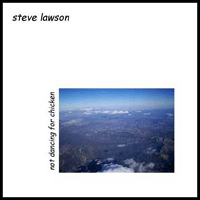
Steve Lawson: ‘Not Dancing For Chicken’

Steve Lawson’s second solo album shows that he’s taking assured strides in all directions. His relaxed, informal debut (2000’s ‘And Nothing But The Bass‘) was a generous concoction of looped and jazzy bass guitars, vivid electronic textures and welling ambiences. It showed what could happen when benevolent prettiness intermeshes with a generous pinch of sound-warping avant-garde tendencies.

Lawson’s latest solo efforts display a more kaleidoscopic approach while losing none of that endearing friendliness. “Not dancing for chicken” is a war-cry – something to do with buckets of junk food, the waning star of MC Hammer and the fight between commercialism and art. To be honest, Lawson can sit that specific war out. He can mash up sound with the best of them (as he’s done with the French improvisers Franck Vigroux and Jerome Curry), but the warrior/guru moves of the dedicated avant-gardener aren’t really his style. Instead of responding to sickly market pap with ferocious spills of obvious disruption, he marries simple, memorable rivulets of melody to a broad field of sonic treatments. In doing so, he creates music which rather than turning its back and raging will instead sail right in under the commercial radar to tickle people’s senses. If that makes him an armchair revolutionary, at least he’s the kind who offers you the armchair first.

To define this better, one could quote one of his own song titles: Lawson believes in “the virtue of the small.” Sticking to a single-take, bass-guitar-only rule (and pursuing his experiments with sound processors, EBow sustainers and loop technology), he continues to hit the elusive target of making music-for-everyone. Centred on a deft, tuneful and jazzy core, his music avoids the predictable calisthenics of fusion and the stolid members-club beefiness of mainstream jazz and post-bop. Instead, he’s a nifty bantamweight with a remarkable ear for timbral decoration, and an obvious love for his listeners.

No More Us And Them displays this perfectly, showing Lawson at his very best. Cascading curtains of gorgeous submarine texture tumble in waves over particularly poignant fretless bass figures and a questioning melody which hovers marvellously between mourning and hope. By way of contrast, MMFSOG offers a goofy Hawaiian celebration. Lawson squeezes out a typewriter rattle of tabla-styled slap groove before anointing it with layer upon layer of mischievously camouflaged bass sounds. Most notable is the giddy, slippery steel guitar impression, roller-blading precariously across the verses; but there are also cicada choruses, stunt-plane zips of backwards melodies and blankets of Warp-styled electronica burble on offer. Eventually Lawson cheerfully runs the song into the swamp and leaves it there to marinade, taking up more mutant funk on Channel Surfing in which a stupefied, robotic slap line chunters merrily under a pale, ringing line of tumbledown chord arches. Various queasy jazz riffs and funky wriggles squeeze past it as best they may.

Although Lawson delights in cooking up this kind of loop stew, ‘Not Dancing For Chicken’ doesn’t reject tradition. On Regretting The Rainbow (the most complex piece on offer) he employs his six-string contrabass to blend elements of jazz guitar smoothies Martin Taylor and Joe Pass in a luscious and breezy study, steered subtly towards some difficult questions via an intrusion of quizzical harmony. Danny And Mo lets Lawson’s fretless bass and EBow gently sing the praises of underrated British bass heroes: a nice counterbalance to the endless musical tributes to Jaco Pastorius tumbling from other bass players.

A couple of pieces (the relaxed Brazilian lilt of Amo Amatis Amare and the stumble-blues of Tom Waits For No Man) are one-man-band opportunities to fool around with some familiar forms, to Lawsonify them, and to take advantage of some truly appalling puns. Two ballads – Need You Now and Jimmy James – showcase Lawson’s humble-yet-richly-romantic solo tone, as well as his flair for understated counterpoint via a couple of artfully poised loops. The latter (a valediction to a lost friend) moves away from simple Windham Hill prettiness thanks to the eerie fingertip-on-glass textures that circulate behind its warm, sleepy fretless melody.

The stranger music sends Lawson into a different area again. Exit Sandman is a lurking mood piece, a sour work-song riff wafting up into vaporous blue-grey wails of E-bow. No Such Thing As An Evil Face is a ghostly African death-song. The amnesiac Ubuntu is a similar set of waves reaching the beach, Lawson’s backing loops providing tinkling tabla tones and prinking noises like cooling shrapnel.

The finale, Highway 1, brings all of Lawson’s work together. The rich, free-ranging travellers melody sits on gently swinging cradles of clicks, pops and ghost notes and on shimmering shells of chords. It’s carried in turn by a sweet, blues-y wah-tone like a swamp foghorn, then a shimmering ripple of backwards basses, then a sky-borne E-bow wail which flutters like a giant and beautiful moth. Lawson conjures up heat-hazes and mirage-doubles of parts and melody out of his loops pedals, and will-o-the-wisps dance counterpoint but never obscure the relaxed momentum of the tune as it heads onwards to a permanent perfect sunset and fades out; still travelling as hopefully as the smiling man on the bass.

Steve Lawson: ‘Not Dancing For Chicken’
Pillow Mountain Records/Bandcamp, PMR 0013 (no barcode)
CD/download album
Released: 1st July 2002

Buy it from:
Bandcamp

Steve Lawson online:
Homepage Facebook Twitter Bandcamp Soundcloud

January 2002 – album reviews – Steve Lawson/Jez Carr’s ‘Conversations’ album, 2002 (“easy, generous grace”)

14 Jan
Steve Lawson/Jez Carr: 'Conversations'

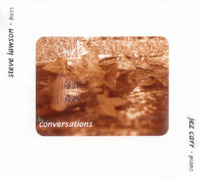
Steve Lawson/Jez Carr: ‘Conversations’

Talk’s cheap, and so am I… at least, when writing intros. I was going to pursue the “conversation” theme by squeezing in comments of my own about eavesdropping on musicians, or about the Troggs tape, or the language of notes. Then I put all of my smart-arse lines down, and just listened.

There are some records about which it’s difficult to say anything. Much. They crop up when you want to get expansive and to show off: and then you find that you just can’t use them as launch-pads for spectacular rants about the state of music, or the permeability of the soul. They bob beyond clutching fingertips and wagging tongue, deflecting the last-ditch wafts of hype with which you try to lassoo them. They’re critic-killers. And the funniest thing is that you love them for it – for the best reasons (nothing to do with clenched teeth, uptight craftsmanship or sweating in front of paying audiences). ‘Conversations’ is one of those records. Go and buy it. Feel good.

Alternatively, accept that I’ve got to try to explain it anyway: so please humour me for seven hundred more words or so…

Basics, then. ‘Conversations’ is a set of immediate, improvised duets between two British musicians – Steve Lawson (fretless bass guitar, loops) and Jez Carr (piano, small antelope statuettes) – from one of the tasteful/tuneful intersections of jazz and the avant-garde underground. Two sprawling self-penned essays on the CD sleeve reveal a cheerfully anti-heroic approach to improv and to music in general. Lawson and Carr name-check Schoenberg and Yehudi Menuhin, note that “people think that free means ‘out’, when free just means free”, but steer clear of portentousness. Oft-revived improv traits – stoniness, pomposity, randomness, irritating mysticism – are ignored in favour of an earnest, open approach.

The music reflects this. Clean and quietly inspired, it resounds through comfortable air, sharing subtle humour. It makes you think of a friendly hand on your shoulder; not a scuffle in an alley, or six days at the foot of a grouchy guru. If it sent postcards home, they’d be of green hills in ECM-land, or soft-focus shots of Bill Evans’ study. A few pictures of Carla Bley and Steve Swallow’s backyard might be in there too: but from the quiet time, somewhen in late spring, a lull in the heavy blowing season. This sounds pretty, and it is. Ultimately ‘Conversations’ is soft-edged, as relaxed as winding English rivers. It never works up a head of steam when a delicate flow will do instead.

Despite Carr’s Romantic leanings (he owes as much to Chopin as to Evans or Dollar Brand), he doesn’t waste notes, or drown the music in florid chords: and although ‘Conversations’ is built on slick musical technology, it’s not hijacked by it. Lawson (usually a solo performer, with a warped melodic looper’s approach) has all of his digital gizmos and luscious overlaid textures to hand; but he never once swamps Carr with them. For his part, Carr draws as much warmth from a digital piano as others could from a concert grand or from a well-worn-in jazz-club upright (covered in cigarette burns, whisky spills and four-generations-worth of jazzmen’s fingerprints).

Each piece is double-titled, reflecting each players’ viewpoint. Although Carr’s serious-sounding Migration manages to also be Lawson’s flippant Whateverwhatever, the duo maintain remarkable accord as they play. As Lawson and Carr settle readily into light-footed slow-motion melodies or feathery grooves, rich smudges of bass tone or rapt curving anchors of sound are left revolving in the loop pedal waiting for counterpoint with quick, relaxed piano touches. There are plenty of opportunities for hearing the expansive, delicately embracing tones of Lawson’s solo melodies: but for most of the record he provides a low-volume dub menagerie of playful but expressive noises. These sit alongside Carr’s crisp, ever-fresh improvising like an inspired combination of Percy Jones and a New Age Squarepusher.

On Sweet’N’Spiky/Shades Of Creation, Carr outlines ideas of rapt melodic phrases over Lawson’s bedrock riff, leaving our imaginations to fill in the gaps. At his leisure, Lawson fills in gaps we hadn’t actually thought of – via distant scrunches, data streams, balloon pings, gargling clicks and spinbacks, all sitting in the pockets of the tune. Walking rhythms interplay for Whateverwhatever/Migration: Carr’s brittle and determined piano mileposts the journey while Lawson offers squeaky wheels, footsteps and theremin wobbles of bass loop. For 1, 2, 3, 4…/Broken Lead, the bassist offers a fragmentary free-funk undertow, further softened by layers of unorthodox spindly chords and gurgling harmonics as Carr provides bright spins of softly-fingered notes.

Destination Unknown @ Point Of Departure/Drifting Dreaming makes the most of a grand vista of musical space, but does it by filling up as little of the view as possible. Carr plants brave speckles of light on unseen crags while a variety of subtle Lawson noises low like distant cattle, or write backward circles in fizzing firefly textures. Signing off with Closing Statement/At First Sight, Carr opens up into ringing blue ripples of controlled delight. Lawson builds up from E-Bowed foghorning soundscapes, progressing to wah-wobbled groove pulses and shimmering echoed treble tremors. Two-thirds of the way in, the music finally slides gracefully into a straightforward duet. Lawson’s yawning fretless notes cradle an ever-sleepier Carr – though unusual tinges of chording promise colourful dreams. It’s a beautiful closer to an album on which nothing has got in the way of the music. Neither embarrassment, nor aggression, nor flash.

What is truly remarkable about ‘Conversations’ is its easy, generous grace: unobscured by its gadgets, the skills of its players, even the hints implicit in genre and background. Waylaid by catches and self-consciousness, few records of “open” music are truly open. This is one that is.

Steve Lawson/Jez Carr: ‘Conversations’
Pillow Mountain Records/Bandcamp, PMR 0012 (no barcode)
CD/download album
Released: 1st January 2002

Buy it from:
Download from Jez Carr’s Bandcamp page; CD best looked for second-hand.

Steve Lawson online:
Homepage Facebook Twitter Bandcamp Soundcloud

Jez Carr online:
Homepage Facebook Twitter MySpace Bandcamp Last FM

June 2001 – album reviews – Marty Walker’s ‘Dancing on Water’ (“a leading light in bass clarinet”)

10 Jun
Marty Walker: 'Dancing On Water'

Marty Walker: ‘Dancing On Water’

Blowing thick darkness, cheery reed-chatter and diva moans with equal facility, Marty Walker has earned himself a New Music name as a leading light in bass clarinet. Over eighty pieces by diverse composers have been written specifically for his particular gifts, and he’s effectively the in-house reedsman for many of the “California school” cadre of composers. For ‘Dancing On Water’ – his first release under his own name on Cold Blue Music – the California school returns the favours. Works from five of its members – the blissful voice-music of Daniel Lentz, the plotted-out ellipses of Michael Byron, Jim Fox’s expansive impressionism, Michael Jon Fink’s lonely, romantic grace-of-few-words and Peter Garland’s percussion-slanted Native American leanings – all juxtapose in different ways with different aspects of Marty’s interpretative approach.

On several of these pieces, Marty gets to stow away his bass clarinet (along with all of its invites to the New Music party) and bring his B-flat clarinet out from under its cousin’s shadow. The close-up duets of Peter Garland’s two-part Dancing On Water sets Walker down next to William Winant and David Johnson’s four-handed marimba. The music neatly folds Mexican folk melodies into minimalist discipline: the marimba clinks with sharp solemnity, both childlike and gamelan-esque. It’s a wily dance of toys, slicing the simple cadences up with unpredictable yet precise spaces. While the clarinet traces similar curves up through the arpeggios, Marty invests it with warmth plus infinitesmal bluesy slides and fades from small-group jazz: a wink in the midst of discipline. Moonlight is the meditation afterwards – a tremolo marimba twinkling like water underneath a much sleepier, dreamier clarinet, Marty coaxing utter expressiveness out of Garland’s clipped material.


On Daniel Lentz’s efflorescent Song(s) Of The Sirens, Marty’s ten overdubbed clarinets are matched by ten overdubbed pianos (played by Bryan Pezzone, another Cold Blue loyalist). But rather than being slaved to a rigid percussive regimentation, all twenty instruments are worked into Lentz’s familiar fascination with overlaid, overlapping vocal fragments. A sensuous undulation of slightly disfocussed pitches are linked by Pezzone’s summery, waterfalling spirals of virtuoso piano; a squadron of tiny icicles falling on the ear.

Amy Knoles’ sighing, narcotised voice (doppelgangered and folded into blurry harmonies and elisions, stacked like sated bodies) provides the siren’s role. This reaches us as a meandering stream of single spoken words – “lips”, “let”, “love”, “air”, “sweet”; “to”, “our”, “listen”, “touch”, “voices”, “you” – all of which are lifted and displaced from their sentences, suggesting an erotic, subliminal hypnosis. As digital manipulation slowly brings the intent into focus, full sentences and melodies coalesce from the haze. Marty’s role here, though, is simply as one (or ten) of the ensemble dreamers, voicing Lenz’s drowsy vision via the clarinet’s sleepy yawning tones. By the time of the stirring, ecstatic finale of piano rolls rumbling out of the trance, he’s not even there anymore.


In the end, it remains the bass clarinet that provides the best bridge between Marty Walker and the composers who seek him out. It’s on that instrument that his expressiveness achieves its most fascinating levels. Certainly it’s fascinated Michael Byron, whose composition Elegant Detours has the most obsessive interest in Marty’s abilities. Byron, however, seems more interested in Marty Walker as a performance mechanism rather than as an emoter. Trapped inside an implied run up a three-octave whole-tone scale, Elegant Detours scurries in super-compressed bursts to explore the possible patterns available. A workout of bass clarinet extremes (from tiny puffs of air to sweeps across its whole range) it ends in lung-bustingly sustained wails knifing the attention to the wall, almost physically painful to listen to. Marty rises superbly to the technical challenge, but it’s frantically clinical. The music seems to feast on itself; like competitive weightlifting, or like laying bets on the frantic mice attempting to escape from a lab maze.


Using far fewer games of structure, Jim Fox demonstrates that he understands the empathy in Marty’s playing. Fox usually works with quiet, beautifully ominous nightscapes and slow-creeping tonalities, and his piece – Among Simple Shadows – is no exception. Trumpeter Wadada Leo Smith blows a transparent and hushed last-post of a tune, which Marty shadows like the last hum resonating from the throat of a gospel bass. Bryan Pezzone’s piano flaps weightlessly in the wind, and casts anxious repeating clots of melody after the mingled brass and woodwind as they move through a dark-blue spectrum of emotions from quiet grief to undefinable hope.


Of all the composers, Rick Cox might have the most fellow feeling for Marty Walker. After all, throughout On Tuesday that’s his own contra-alto clarinet playing in counterpoint to Marty’s bass model. This chokingly slow four-movement duet has more than a tinge of swamp-blues to it – like the last notes restlessly clinging onto the grass tussocks after the funeral procession is long gone and the coffin rests in its mausoleum, floating above the bayou. With both instruments burring and smearing towards the bottom of their ranges, there’s a sense of exhaustion. As with much to do with the blues, there’s also a feeling of unfinished business.


David Johnson (on vibraphone this time) returns to help Marty tackle Michael Jon Fink’s micro-concerto As Is Thought/Aurora. This time, they make a trio with orchestral harpist Susan Allen. A tense set of precise unison arpeggios, venturing warily out into space, are connected and soothed by Marty, whose jazz-inflected way with the shaping of his bridging phrases counters the music-box abruptness of the other instruments. As the piece’s initial trepidation melts, like the dissolution of fear, Allen’s harp comes more to the fore. Each instrument softens, progressively handing the others a tiny cadence of notes to repeat – a canon which clambers on like hands swapping grip-space on a rope, continuing to move outwards.


Overall, ‘Dancing On Water’ reaffirms Marty Walker’s excellence as an interpretative musician, providing a set of multiple masques – or masks – for him to excel in. Still, I’m left uncomfortably whetted and slightly unsatisfied. His generous illumination of the music of others draws me into hankering after other aspects of his musicality – the creator, the improviser; the Marty Walker who’s drawn on his own music to provide that illumination. Hints of this are dotted all over ‘Dancing On Water’ in every cunningly bent note, in every hint of intelligence drawn from outside – even in the times when he steps back into the ensemble, upstaged on his own record.

There’s power in a name. Perhaps Marty Walker’s name, and his musical identity, has become too powerful to let him play second fiddle on his recordings. ‘Dancing On Water’ certainly showcases his talents, but in comparison to other Cold Blue albums – each firmly stamped with a composer’s identity – it feels like a picture of a man grown just a bit too big to comfortably wear other people’s handed-over suits in his own house.

Marty Walker: ‘Dancing On Water’
Cold Blue Music, CB0005 (800413000525)
CD-only album
Released: 5th June 2001

Buy it from:
Cold Blue Music

Marty Walker online:
Homepage

March 2001 – album reviews – Jim Fox’s ‘Last Things’ (“like floodwater in the night”)

19 Mar
Jim Fox: 'Last Things'

Jim Fox: ‘Last Things’

Renewing his Cold Blue Music label for the millennium, Californian composer Jim Fox has set himself up as its figurehead, although not in a triumphal manner. Pomp and flamboyance wouldn’t sit well with Cold Blue’s explorations in New Music, and this first new release out of the Cold Blue bag doesn’t need to grab attention, anyway. The two Fox compositions on this album (slow-moving, implicatory, atmospheric and deliciously disturbing) surround you instead, like floodwater in the night.

With distractedly moving electronic traces making up the bulk of the music, ‘The Copy of the Drawing’ is rooted in chopped, diced and rearranged texts from letters sent to Mount Wilson Observatory between 1915 and 1955 while Los Angeles swelled from backwater to metropolis. These fragments are recited by Janyce Collins in an ice-queen whisper. Her cold lips brush your ear with a beautifully cool eroticism, its detachment only increasing its power. Often phrases are followed by glassy, ratcheting harmonic sound: as if a telescope, smoothly rotating on gimbals, is trying to take a fix on the target the words imply.

Slithering passes of moth-soft electronics slide around the words as if they’re unimportant, part of the ambient backchat in any place of science. Occasionally almost-vocal smudges of transparent noise ring up in (and fall away from) the foreground: although in some respects there is no foreground, just a slow sub-zero swirl of ambient hints, briefly smeared, like time-exposure photographs. Scrapes and subliminal swarms, jump-starting drifting thoughts in the narration; quick-drowning sounds like disturbances in ice-water or the imprints of decaying viola counterpoint and dying Gregorian chant.

Allegedly, ‘The Copy of the Drawing’ is non-dramatic. But Fox’s placement of these words, the stop/start fragments and interrupted clauses (“a jumbled mess – enough to give you an idea”) suggest otherwise. The phenomena of observed and notated science are often invoked with the reverence with which scientists replace religious awe, but sometimes as a kind of anchor (“light is always the same – water is H2O…”) against the misgivings whispered in brief passes elsewhere. “Self-deficient – diffused self – applied phenomena – name – danger lies in the abstract…” Before long we’ve heard statements of meticulous preparations (“I have put it in three different envelopes – airproof, fireproof, waterproof”) and chilly accounts of emotional hallucinations. “I still heard talking – I have heard babies crying and screaming – like in a photo – babies can hear me writing this – the pictures can talk to me – they’re not lonely – and it won’t stop…”

Explicit disturbance is rare, and Collins’ voice remains uniformly glacial whatever the content of her script. Nonetheless, anxiety and revelation are blended throughout, with the prismatic narrative musing on thoughts such as “No-one may ever have the same knowledge – everything running up and in and out.” Certainly there’s disintegration here – a loss of assurance, causality dissolving into “a possibility – there was such a thing – invisibility… before that – all history – it doesn’t seem possible… / it’s closer if you draw a line – on that line – all depends.” At one point, Collins recites a list which explicitly fails to reduce events, phenomena and states of existence to anything tidy. “Stuff – factors – motion – the perpendicularity – the process – the parts of things – the female principles of nature – etcetera – quite incomprehensible due to its invisibility – something that is true – close by – far…”

Covertly, Fox seems to be attempting to reconcile the cosmological with the personal. Collins’ narration of astronomers’ notes seem to take on revealingly intimate suggestions (“thousands of small pushes a second – inertia is very great”) and equates the paths of cosmic debris with those of people (“one of the incoming pieces of matter – there may be more – they may travel together…”) Maybe it’s a reflection of the gravity of cities like Los Angeles – pulling in immigrants, the lost and wandering, accreting mass as it does so. Maybe it’s an idea about scientists allowing the unsettling parallels of poetry and metaphor to sneak into their notebooks and resound in those working lives which they’ve obediently sealed away from personal concerns. This is observatory music, for certain. But the question of exactly what is being observed here is an open question. It’s one which ultimately leaves you without an answer; although perhaps it does leave you with a cold, indifferently sensuous kiss.

With ‘Last Things’ itself, the sky is lowering. An ominous drop, as Fox conjures up not so much a drone of bass synth as a faraway envelope of it (massed over our heads like apocalyptic cloud) and then rings us round with a distant thunderous fence of bass-register piano, rumbling tectonically and eerily, like the harbinger of the great Californian earthquake. Trapped between stooping sky and unquiet ground, we bear witness to a passionate, wordless pieta in which the dominant instrumental voice (Marty Walker‘s brilliantly tortuous bass clarinet) sounds famished, and as oppressed as we are by the press of sound. Walker’s control is remarkable – he travels between delicate, near-inaudible quivers of notes; great wide splits of sound that crack with emotion; and magnificent mournful coyote calls, summoning up visions of friendless desert vistas.

Relief, of a sort, comes from Chas Smith‘s pedal steel guitar. Almost choral in its breadth, it’s the one truly calming element in Fox’s musical painting. It’s a Pacific palliative which voices itself as distant balm to Walker’s painful questioning, or as a glimmer of light on the crack of the horizon. At around the eight-and-a-half minute mark, sounds like distant foghorns appear in the murk to add their own skein of warning and disquiet. More ethereal, less hungry, but hardly less of a disturbing portent are the rubbing glass rods on Rick Cox‘s treated guitar, hanging dying trails of luminescence in the middle distance.

When ‘Last Things’ fades out, the hope of things resolved has given way to a kind of acceptance. We’ve come to terms with the fearsome displacement and anxiety in Fox’s California soundscapes to such a degree that we’ve probably failed to notice that he’s finally resolved the music with a chordal and dynamic shift so subtle as to almost escape notice – like life settling itself in, a warm beast, around the jags, harshnesses and daily warnings of a threatening environment.

Jim Fox: ‘Last Things’
Cold Blue Music, CB0001 (800413000129)
CD/download album
Released: 19th March 2001

Buy it from:
Cold Blue Music (CD) – various downloads available from Amazon and similar.

Jim Fox online:
Homepage

September 2000 – album reviews – Steve Lawson’s ‘And Nothing But the Bass – Live @ the Troubadour’ (“sheer guilelessness”)

10 Sep
Steve Lawson: 'And Nothing But the Bass - Live @ The Troubadour'

Steve Lawson: ‘And Nothing But the Bass – Live @ The Troubadour’

Apparently, this music is what Steve Lawson makes to entertain friends – who make themself known as such simply by showing up to one of his intimate gigs. These could be in London, Lincoln, or Watford; in France or California; or wherever else Lawson and his little bundle of bass guitars, EBow sustainers and looping devices pitch camp for an evening of playing. Having asserted your friendship by wandering in and sitting down, you can smile to yourself about the way his lush, demonstrative instrumental music manages to cross-reference Frippertronics, Pete Seeger, Jaco Pastorius and Joe Satriani (for starters) without them crashing into each other or crowding him off his own playing stool.

You can also smile – with genuine enjoyment – at the sheer guilelessness of his music. The gauche jokiness of the album title is completely accurate. With one exception, this really is all One Man And His Loops live in front of a small, polite and audibly happy audience. But it shouldn’t be dismissed as cutesy novelty, or as circus tricks with effects pedals. That isn’t the half of it. In London, we’re used to anxiety. Self-exposure from tortured musical artists. Cool-by-numbers checklists. Spotlight-grabbing attitude flexers. Obvious-state-of-minders stapling themselves to credible trends, and sinking with them. Hearing Steve Lawson duck all of this (instead, he quietly focusses on the way music connects across generations, and between person and person) is a sweet shock.

On technical terms alone (if not in finger-thrashing stunt display), Lawson respectably holds his end up alongside American stars of the lyrical bass such as Victor Wooten or Michael Manring. But his work showcases not only prodigious playing talent but also a thorough lack of self-consciousness about engaging with his listeners. Maybe it’s from his previous work, playing with the equally guileless and elfin pop veteran Howard Jones. When you hear Lawson duetting with himself on sprightly children’s-song tunes like The Inner Game and The New Country (wrapping joyously squishy melodies around his looped, nodding, double-stopped riffs) you know you’re not hearing someone who’s concerned about his agenda fitting anyone’s T-shirt, or with the solemn rules at jazz school.

All right – perhaps an over-mellow conflation of two lovable old chestnuts (Chopsticks and Blue Moon) on Blue Sticks is a step too far in this direction. All taste and no meat; too close to a musical life that’s one long function room. Lawson dispatches it with impeccable skill – which is all very nice, but a little worrying in terms of complacency. Far better to hear him feeding twanging threads of Celtic-American folk song and bluegrass, Flecktones-style, into The Virtue Of The Small; and to then observe him splitting off to layer on some luxuriously glutinous improvisations (via serenely wandering fretless and classic-metal distortion). Listening carefully, you might spot momentary nods to other bass players – Chris Squire, Steve Swallow, Alphonso Johnson, Stuart Hamm – who’ve let melodies rumble up from the basement.

Of course, you could just put the notebook down and enjoy tunes like Bittersweet, a fretless-bass-and-piano duet owing a little to Pachelbel’s Canon and as much to Weather Report’s A Remark You Made. Jez Carr’s strums of high, cautiously sweet piano haze this one lightly with blue. Perhaps it’s over-aligned with the fastidious, earnestly white end of New Age jazz, but Lawson’s head-bowed cadences are beautifully poised – natural and regretful.

So far, so immaculate… so ‘Bassist Magazine’. What really opens doors are three pieces in which Lawson ventures into process music, chance-and-hazard and ambient music. Thankfully, it’s closer to Fripp Soundscapes and to post-rock than to the freeze-dried fusion on (for example), those slick early albums by John Patitucci.

On Drifting, the original moonlit ostinato foundations and skirling skybound melodies give way to smears of trembling Frippertronical treble passes – like wheelmarks on cloud – and to trance-techno bubble echoes Lawson somehow wrings out of his bass.  The lapping sounds and shimmering harmonic nudges of the gorgeous Pillow Mountain (with its sub-aqua heartbeat) are closer to Mouse On Mars than to any bass guitarring this side of Rothko’s post-rocking odysseys. Here, Lawson EBows strange Chinese string calls out of the beautiful murk. A third piece, Chance, clings on (just) to the right side of disassembly. The sharp attack, or mother-beast rumble, of Lawson’s varied approaches on fretless step in and around the frigidly emotional ECM-inspired bass figure at the heart of it, ghosted with minimal traceries.

It’s with these pieces that we hear Steve Lawson’s audience returning a favour. Moving away from simply bobbing their heads to the happy melodies, they concentrate on  listening instead. And all without the man breaking much of a sweat, either.  For any instrumentalist, this album would be charming. For Steve Lawson, it’s a showcase punched open at one end. His friends are watching him grow – I suggest that you join them.

Steve Lawson: ‘And Nothing But The Bass – Live @ the Troubadour’
Pillow Mountain Records/Bandcamp, PMR 0011 (no barcode)
CD/download album
Released: 28th August 2000

Get it from:
Bandcamp

Steve Lawson online:
Homepage Facebook Twitter Bandcamp Soundcloud

July 1999 – mini-album reviews – Philip Sheppard’s ‘The Glass Cathedral’ (“a whole chamber of cellos swimming off in a new direction”)

7 Jul
Philip Sheppard: 'The Glass Cathedral'

Philip Sheppard: ‘The Glass Cathedral’

Reluctantly, as the music finally dissipates into quiet, I surface for facts – and here they are.

Philip Sheppard is cellist with the Composers’ Ensemble and with The Smith Quartet (a London answer to New Music ensembles like Kronos Quartet). He’s taken on the knotty work of Michael Tippett and Oliver Knussen: his list of close collaborators outside the classical world have included Abdullah Ibrahim and Jeff Buckley. Freed from the demands of repertoire and support roles, his own music for solo cello leads into meditative, overlapping multi-tracked soundscapes.

That’s the definition, the bare bones of it. A modern-classical musician, as composer-performer, looping or patterning processed sounds in the path followed by Terry Riley, Steve Reich and Gavin Bryars, and by Robert Fripp and Brian Eno.

This doesn’t convey how far beyond the plain facts of the process Philip Sheppard gets – how he’s boiled down the structure of classical expression to small and beautiful hints in a sustained electrophonic atmosphere. The captivating and wonderfully played music on ‘The Glass Cathedral’ is close, in its way, to the devotional reachings of Fripp’s ‘A Blessing of Tears’: but it’s more abstract, a music of suggestions and amnesia. Philip manages to suggest vistas of embracing vastness with simple and delicately executed elements gradually mixed into an ever-expanding palette of cello textures, running from a discordant plumbing-scrape to an overwhelming snatch of piercing, striving melody. There are only two pieces on here, both vastly different, both extraordinary.

‘Harrison’s Chronometer’ uses Philip’s electric cello – a custom-built five-string cyborg which readily sinks itself into an evanescent minor-chord drone, gradually resolving and passing through moods; a Mahler trance in multi-track. The name’s taken from the 18th century timepiece designed to revolutionise navigation and safety at sea; providing a fixed, reliable timekeeping process, aiding judgement of distance, mapping and location. Inspired by this, the music sounds like a steady, resolute voyage through half- known climes, as Philip fills the air with the sounds of beasts and uncertainties. String snarls slide and slink away, high harmonics keen and shiver. Low, rumbling deep sea monsters scrape away in the bass registers.

Living but impersonal detail builds up, as gorgeously and inhumanly hostile as a crystal jungle; and into this comes tentative tracings of order. There’s a high pulse; a sawing Greek riff of chorused cellos; snap-and-lock ostinatos in the bass recalling the clipped Mediterranean funk of Mick Karn. A melody materialises in the alto range, cleanly distorted – to the point where it finds a rough perfection – but it tails out. Nothing is resolved; eventually the music fades away into the dark, although its recognisable touches are still isolated within the surrounding chaos. Expressive to the last, they sit like lonely markers; or like humans in a small, fragile boat on brutally indifferent seas that have hardly even begun to yield their perilous secrets.

Compared to ‘Harrison’s Chronometer’, the title track of The Glass Cathedral is sublimely peaceful: though in its own way it’s just as deliquescent, just as much part of that territory where post- classical meets post-rock and where both begin to blend with the subtle dissolutional anarchy that is drift. It’s played on a vintage cello with a history implied rather than certain: a mid- 8th century instrument possessed of a rich verdant tone and traced back to an anonymous London craftsman. Whether its ambiguous story is true or false, I’d like to think it informs the piece, which has hints of more intimate John Taverner compositions but links back to the past via a quote from Monteverdi’s ‘Orfeo’ which coalesces and dissolves throughout the composition.

Here, the music seems to wake itself in sensual, melodic stretches of cello, in exquisite glass-harmonica deviations of sound. It is like drowsing inside a translucent sacred building, allowing a whole day to become a time-exposure. Overdubbed drones and harmonies acting like light beams, branching off at odd angles, allowing the corners of the church to be lit gently and briefly before the source slides off somewhere else. A solo cello establishes itself in centre with a contemplative, yearning changing theme. It gives dominance over to the light angles and the Monteverdi fragment… then, as if shot through a prism, a whole chamber of cellos are swimming off in a new direction, embarking on a related theme, only to dissolve out gently in loosely woven trios.

I’d say more, but I’m already spewing too many abstractions. It’s enough to say that if it’s true that architecture is frozen music, then this is (just as equally) a beautiful, dissolving architecture.

Philip Sheppard: ‘The Glass Cathedral’
Blue Snow, BSNCD1 (no barcode)
CD/download mini-album
Released: 5th July 1999

Get it from:
CD version best obtained second-hand: download available via Bandcamp.

Philip Sheppard online:
Homepage Homepage Twitter Bandcamp

November 1998 – album reviews – Cloud Chamber’s ‘Dark Matter’ (“unsettling beauty with an element of wild and joyous fear”)

20 Nov
Cloud Chamber: 'Dark Matter'

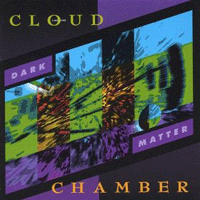
Cloud Chamber: ‘Dark Matter’

A cloud chamber is a device for measuring the existence of the intangible. Physicists use them – mapping out the paths that subatomic particles trace through a vapour, studying nuclear reactions and inferring the presence of other particles. There’s something about that last bit I particularly like: inferring the existence of something. Something you can only detect, or believe in, by seeing how it affects something else.

Cloud Chamber (with the capitals) is an improvising group allowing the convergence of several other exotic particles – these being guitarist Barry Cleveland, space-age bass guitarist Michael Manring, cellist Dan Reiter, percussionist Joe Venegoni and Michael Masley, who coaxes sounds out of a more esoteric set of instruments (panpipes, gobek, gobeon and the cymbalom dulcimer). Having come together as part of the Lodge improv evenings in Oakland, California following stints with employers as diverse as Michael Hedges, the Oakland Symphony Orchestra, Ry Cooder and Garbage (plus exploits in journalism and dance theater), Cloud Chamber’s collective past suggests that what they’re likely to condense together will be suckling blissfully on an inspiration of mind and music, devoid of barriers.

More accurately, outside of barriers. When listening to improvised music you’re all too often shoved back on your arse by the force of several musicians protesting their individuality as forcefully as possible, and playing off each other with all the subtlety of dodgem cars. Cloud Chamber, on the other hand, have nothing to do with ego. The fivesome’s music emerges like the interplay of ocean currents; a process of continual organic movement to which the musicians respond as if they’re no more than implements of a guiding force.

And that’s how it needs to be – the compound music that Cloud Chamber produce is as precarious and demanding as improv demands, but to release the life in that music it’s necessary for the musicians to let it play through them. Manring (a driving and devastatingly gifted bassist, as his solo records and work with Sadhappy testifies) keeps any hero-glitter under a bushel of humility here. He takes a step back, becoming just one of many element in the condensate: no more dominant then Reiter’s troubled, graceful cello or Venegoni’s poised rattlebag. Cleveland lurks in the background with his chameleonic guitar (playing a skeletal pattern of notes, a swarm of bees, a steel-shack sound, or an unknown language). Masley strokes and strikes gorgeously glassy shard-notes out of his cymbalom with his bowhammers and thumb-picks.

Patterns and presences take shape out of nothingness, drift around on the edge of perception, then suddenly and deeply solidify, impressing themselves on you as if they’ve been there for years. Half-familiar fragments of music (bits of Eastern European string quartet, Chinese and Asian music, a riff from King Crimson’s The Talking Drum) reveal themselves with an enigmatic smile while they’re well on the way to becoming something new.

This is also very beautiful music: though it’s a strung-out, unsettling beauty with an element of wild, joyous fear. The exquisite Blue Mass manifests itself like light twisting through a stained-glass prism, anchored on Reiter’s perplexing, precariously emotional cello calls above which the group fashion a soft, high night-sky of singing steel sounds. Radiant Curves is all looping contrails.

On Solar Nexus, singing bass guitar and cello interweave as Masley plucks and bows his cymbalom overhead: Cleveland’s guitar flies in out of left-field over popping, sliding, shadowy bass shapes, and everything ends in glittering, mirror-surfaced screams. As a listener, you become increasingly spooked and enchanted at the presences these sounds suggest. It feels like being stalked by the Easter Island statues in a swirling fog; or like hearing the sudden ring of an unknown voice in the haunted wind that cuts through high-tension wires overhead.

This disquietude doesn’t come from conflict. These musicians don’t battle each other. The thoughtful interview they provide in the booklet, and the watchful grace they exhibit in their interaction, amply proves the opposite. But something in the music that comes out of their alliance seems to suggest a rapt, fearful awe at the size and diversity of the cosmos; and that’s not just in the astronomer’s titles which the pieces sport.

Some music changes the way you see the world, and this is a full hour’s helping. Not so much a Big Music as a small music, something retreating into the details and filaments of unconfirmed suspicions. This could be in the rhythmic imperative of the baleful four-note Pink Floyd-ian riff in The Call, worried at by the rat-scurrying strings, space-gypsy fiddling and Manring’s anxious Jaco-in-retreat fingerwork. Or it could be in the cat’s-cradle of scrapes and rockets on cello, mingling with cymbalom mantras, on Full of Stars. Here, a tangle of miscellaneous alien squawks is surrounded by collapsing glassy percussion, fractured-tree bass noises and Cleveland’s guitar-talk, finally washing up on the shores of Chinese classical music.

The most obvious Cloud Chamber ever get is on the sketchy world-funk of Dithyramb. This is like an exploded version of the fake ethnography crafted by Byrne and Eno on ‘My Life in the Bush of Ghosts’, or by Rain Tree Crow, and passes into a high, stretched-out passage of cello and bass sustain. Travelling alongside, Cleveland’s mounting guitar journeys from sketching out cirrus cloud to lovely Vini Reilly-esque pointwork. But this is a rare moment of innocence and cheer. Much more characteristic is the air-on-a-G-string improv that bedrocks Ursa Minor, setting up tensions between pluck and sustain, between the percussive cello and phased, rapping bass; between the ominous restlessness of free open passages and the querulous, demanding blue notes of the cello solo.

The final (and untitled) experiment leaves no tone resolved – winding cello, seagull distortions and an irregular, antsy wash of noise. You’re left feeling that Cloud Chamber have dismantled the scenery between us and the infinite, leaving us losing track of time, of solidity. Falling through the world. Suddenly turning around to find the whole colossal starry wonder of the universe at your back, and thrilling with a terrible flinch of delight.
Somehow Cloud Chamber are picking up on something that most of us miss: revealing something unseen by reacting to it. Hearing ‘Dark Matter’, you feel as if you’ve been allowed to watch the ambiguous wonder of something changing, and changing decisively – a presence inferred – and that you’ve been allowed to be part of it.

Science, or magic? Doesn’t matter. Live within it.

Cloud Chamber: ‘Dark Matter’
Supersaturated Records, SUPERSATURATED 001
CD/download album
Released: 11th November 1998

Get it from:
CD Baby or iTunes.

Cloud Chamber (Barry Cleveland) online:
Homepage Facebook Twitter MySpace

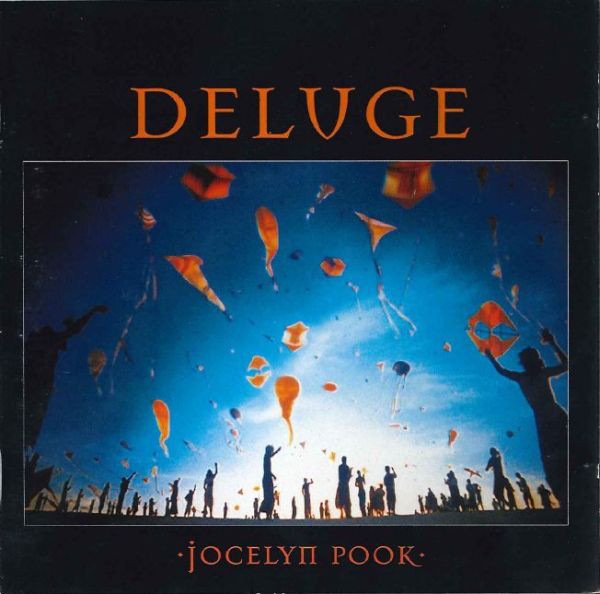
March 1997 – album reviews – Jocelyn Pook’s ‘Deluge’ (“a suite of stunning invention and sheer beauty”)

1 Mar

Jocelyn Pook: 'Deluge'

Jocelyn Pook: ‘Deluge’

The elegant grace of tragedy is often linked with the splat of farce. This album’s major selling point (on some copies of the CD, it’s trumpeted by a sticker ‑ I kid you not) is that it features the music from last year’s TV ads for Orange mobile phones, namely Jocelyn Pook’s setting of “Blow The Wind Southerly” sung by Kathleen Ferrier.

Sigh. It’s sad but true that increasingly weird and wonderful music is getting picked up and co‑opted by advertising agencies for their campaigns. Your average ‘Coronation Street’ ad‑break may currently play to a soundtrack of Michael Nyman, Gavin Bryars, Aphex Twin, U‑Ziq, Cocteau Twins… and Pook. They’re selling their souls for the filthy lucre from red‑braced ad execs. Of course they are: rampant fucking capitalism is bringing us the best that post‑modern music has to offer. It’s art selling out!

But… Mr or Ms Normal Music Fan are going into Our Price and humming this music over the counter to Shop Assistant. Consequently, they’re getting turned on to (at least relatively) experimental music, er, man… And as Jocelyn Pook joins the hideous capitalist gravy train (look, I’m not being cruel: my tongue is in my cheek) from obscurity to the CD racks, the musos among us will smugly tell that Pook is widely known as the leader of the Electra Strings (along with Caroline Lavelle, Sonia Slaney and others), who have no doubt been rushed off their feet in the past couple of years as every British pop act decided they must show their serious side by having at least one strings‑based track in their repertoire (I think we call it “hiring in a touch of class”).

But here ‑ ably backed by the Electras, knife‑edged art‑scene soprano Melanie Pappenheim and a pocketful of exotic musicians and sounds ‑ Jocelyn Pook shows herself as being beyond simply a viola player. She’s a composer of emotion and invention and, in the best traditions of post‑modernism, introduces classical and traditional musics to the brave new world of samples and electronics. OK, so it has to be admitted that Dead Can Dance are an immediate and convenient comparison, but ‘Deluge’ is warmer, more emotional: less monumentally impressive, perhaps, but also nowhere near as harsh and Wagnerian.


The twelve tracks of ‘Deluge’ (germinating from a clutch of “post‑modern hymns” written for a Canadian dance‑theatre project) are best appreciated as one pre‑millennial suite with recurring themes (the emotions drawn from the year 1000, the methodology from 2000). Requiem Aeternam, like many elements of the other tracks, opens the album with solo and multitracked singing of a traditional requiem over one sustained root note. Post‑modern chamber plainsong, in other words, founded upon a sense of inevitability that’s unchanged by the impact of technology.


Technology, in fact, might even be hastening that grand inevitable. Oppenheimer is undoubtedly one of the central parts of ‘Deluge’. It opens with a disturbing sample of Robert Oppenheimer talking (he seems heavy with emotion, a man with the weight of his discovery of nuclear destruction bearing down upon him) surrounded by a foreboding nuclear wind: this merges into the poignant but more hopeful sound of the Jewish call to prayer and a dawn chorus of birds. As the central sung theme from the first track returns with a supporting string section, a haunting, heartbreaking elegy is created.

For Oppenheimer himself, this could be the emotions created by his dread and foresight at what he had created. More powerfully, however, this piece stands as a requiem for a world forever changed by the knowledge of possible nuclear annihilation. A post‑Cold War planet we may now be, but his music took me right back to the nervousness of the mid‑’80s and its accompanying, tangible dread of nuclear war.


Lightening the mood and returning to the music, Blow The Wind (subtitled Pie Jesu) does indeed feature that Orange ad music again. Heard without those connotations, however, this is a brilliant interweaving of samples and live sound, as Kathleen Ferrier’s familiar rendition of the traditional vocal is interspersed with Pappenheim and Pook’s plangent vocal counterpoint, the echoing sounds of children playing, and more soaring strings. As in hip‑hop, the form that originally used sampling to such great effect and historic importance, the sample of Ferrier is used as a basis to build other musical sequences, instrumentation and vocals. It’s humble, beautiful, and ends far too soon.


The lessons in the new technology of music Jocelyn Pook has gained will undoubtedly further influence the writing and performance of her music for her own instrument ‑ strings. The penultimate piece, La Blanche Traversée, appears to be a fairly standard chamber‑piece setting of words by Racine, but more remarkable is the subtle instrumental backing. Pook and the Electra Strings play a slightly off‑rhythm pattern of oscillating notes that, to any DJ or mixer who knows his decks, would be regarded as a loop. I feel that it is safe to assume that the original hip‑hop DJs never had this development in mind when they crafted scratching and looping. ‘Deluge’ is a long way from being electronica, but the ’90s cross‑pollination continues.


While music has broken all the boundaries of genre in the ’90s, the end products have resulted in albums of naked emotion or sonic inventiveness. But rarely both together. ‘Deluge’ is a suite of stunning invention and sheer beauty in its music, but with all the necessary emotion of a requiem for the post‑nuclear age. The wind blows cold, with the sound of ravens on the air, but it tugs your whole life right to the surface of your skin.

Never mind the politics of how you got to hear of Jocelyn Pook or ‘Deluge’. Open your mind to it.

(review by Vaughan Simons)

Jocelyn Pook: ‘Deluge’
Virgin Records, CDVE 933 7243 (7 24384 29632 2)
CD-only album
Released: 24th February 1997

Get it from:
(2018 update) long out-of-print, so best picked up second-hand. Most of the tracks on ‘Deluge’ were remixed and reissued on the ‘Flood’ album in 1999.

Jocelyn Pook online:
Homepage Facebook Twitter MySpace Soundcloud Tumblr Last FM YouTube Vimeo

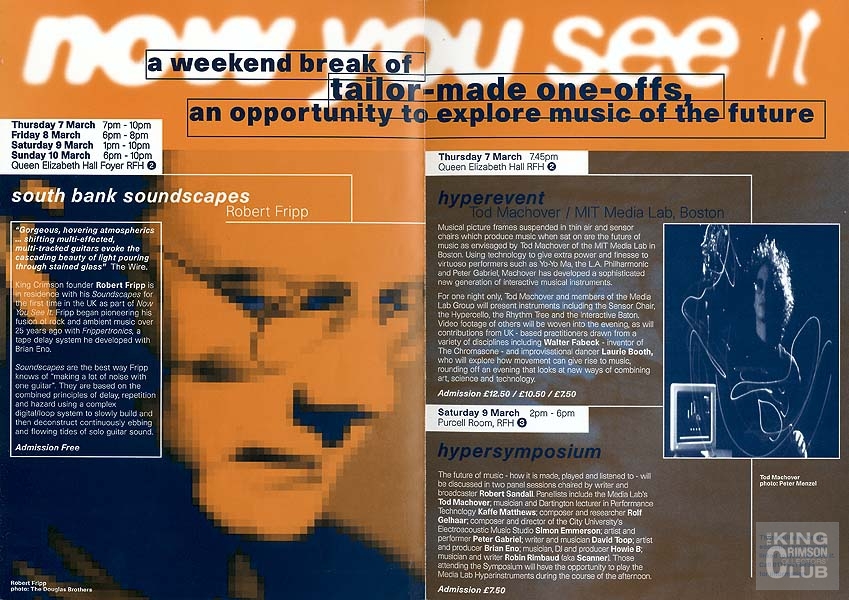
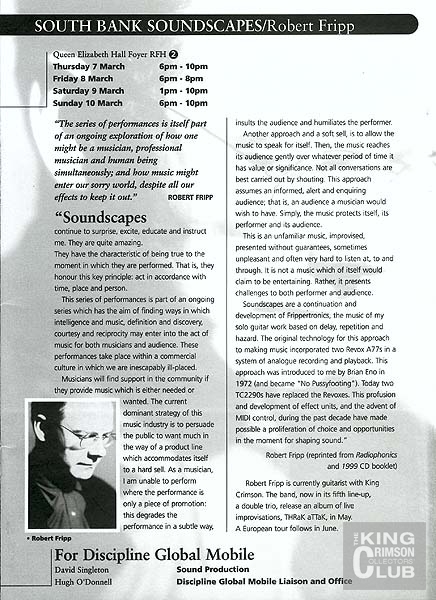
March 1996 – live reviews – Robert Fripp’s South Bank Soundscapes @ Queen Elizabeth Hall foyer, South Bank, London, 10th March (“more challenging abstractions than Fripp’s ever attempted before”)

12 Mar

'Now You See It...':  Robert Fripp Soundscapes, 10th March 1996

‘Now You See It…’: Robert Fripp Soundscapes, 10th March 1996

Tucked against a curving concrete wall, under a sweep of plate-glass windows, there’s the familiar stool with a beautiful rock-fetishist’s dream of a Les Paul guitar, flanked by rack-mounted gizmos like a gaggle of worshipful Artoo Detoos and a flat henge of volume pedals and multi-purpose stomp-boxes. Over to the right, David Singleton sits at the mixing desk, quite the portrait of the calm fixer for the artist’s determined leaps. Arranged in a long staggered curve in front of the opposite wall, lining the long walk between the entrance and the Purcell Room, are at least eight tall speaker cabinets. Occasionally in residence is the sleek, compact form of Wimborne’s most formidable musical son.

These Soundscapes are part of the ‘Now You See It…’ season of contemporary performance art, sharing the building with the Hypermusic Symposium (in which Peter Gabriel, Brian Eno, David Toop and others debate the future of music, and people nervously finger such unorthodox instruments as literally musical chairs and picture frames or the Interactive Baton) while avant-garde dance groups hijack the Purcell Room and stick the audience on the stage, and (less happily) over at the Lyric Theatre in Hammersmith an appallingly pretentious bunch of Euro-thespians do a vandalistic mixed-media Schubert performance.

In these surroundings, Robert Fripp‘s increasingly out-there journeys in solo sound fit in surprisingly well, both physically and intellectually. When a squadron of incredibly young women in bare feet and little black dresses trot busily past (every quarter of an hour, on the dot) to meet their cues in a back-to-front theatre piece next door, it seems inexplicably appropriate. Tonight – Sunday 10th – is the fourth of Fripp’s residencies, a mere four-hour performance compared to the rear-numbing six- and even ten-hour marathons he’s performed earlier in the week. Some people have returned, regardless. Within that length of time, anything could happen: the music that Fripp claims to channel rather than compose could lead him anywhere.

Soundscapes, the successor to the layered sound-loops of Frippertronics, is a major leap forwards, sideways, anyways from its progenitor: the digital technology stores his patterns and transforms his tones to the point where there isn’t a single recognisable Crimsonic guitar sound to be heard all evening. In effect, Fripp and Singleton are playing a wholly new collective instrument, a community of speakers, desk, guitar and digital cyberspace. The end results are a swathe of overlapping, opposing electrophonic voices, sometimes beautiful and sometimes disturbing – polytextural hums; a sound like a seventy-foot high piece of glass being torn like cloth; wailing, spectral swells like American freight trains blowing a blue whistle into a desert of ghosts; aquatic, gem-faceted calls of a Loch Ness Monster; tingling pianistic or xylophonic ringing; squiggling crystal-bat chitters. It emerges as a sound that’s on the brink of being recognisable, somewhere deep down in the soul… but not quite.

As it rolls on, evolving like strata, burying what’s come before like the march of ages, you may find it impossible to concentrate on (four hours is a long time) but it saturates your mind regardless: you’ll sure as hell be thinking differently. While I’m here, I meet somebody who ascribes near-mystical powers to the first Soundscapes album, ‘A Blessing of Tears’ – “any pain you have, any problem, it will heal it…” Even on the basis of what I’m personally experiencing in the music tonight (the rollers, breakers, capricious tides and immense flickering lulls of an alien sea under a midnight-blue sky, occasionally rent by sheets of violet lightning and mile-wide twists in the current… I think I’m in for a night on the ocean wave) I can believe him. This isn’t New Age pretty-stuff.

And so the Soundscapes are installed, piece by lambent unsettling piece, more challenging abstractions than Fripp’s ever attempted before. But most of the people here seem to have missed the point – sitting deferentially in the arc of chairs facing Robert and his little cliffs of winking lights, watching him silently manipulate his gold-top Les Paul or peer into his effects racks, they pay a silent tribute. This isn’t how to do it. When Fripp calls what he does “Soundscapes”, he means it literally. There’s a fifth element in that communal instrumentation: three-dimensional space. Each of the eight speakers arranged in an arc behind the audience is fed by a slightly different sound source. Walking slowly back and forth across the foyer, one passes in and out of phase with the sounds: a different listening angle provides a different piece, an ability and opportunity to concentrate on a different section of the Fripp orchestra. Music to literally explore.

I feel a bit of a fool, though, pacing up and down the floor to curious glances from the audience; it’s not quite the same as hanging around, in gig-approved fashion, with a drink in your hand and lunging up and down gently to your favourite song. Mind you, the rest of the audience are behaving exactly in the way you’d expect at a Fripp-related gig or an art installation. Here are a couple snogging vigorously, French-kissing amidst the unsettling washes of the music; three rows in from the front, a man appears to have passed out, lolling over the back of his chair with his wide-open mouth pointing wetly at the ceiling. Music to intoxicate? Perhaps: it ignores standard musical dimensions in a way that one only otherwise hears in the most deliriously spaced-out Lee Perry dubscapes, although the notoriously drug-free Fripp looks more composed than I’ve even seen him before.
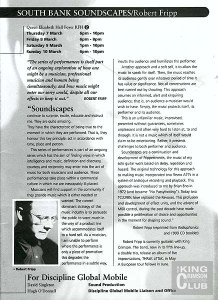
'Now You See It...':  Robert Fripp Soundscapes, 10th March 1996 (programme)

‘Now You See It…’: Robert Fripp Soundscapes, 10th March 1996 (programme)

But then perhaps once the music slips beyond the control of his fretting fingers, flexing feet and console-fondling fingers, it ceases to be his responsibility anyway. The nature of Soundscapes is such that Fripp’s very presence can become little more than a trigger. Turn away at the wrong time and you’ll turn back to find the guitar leaned against the stool and Fripp gone, sipping at a cup of coffee over by the mixing desk as the music wreathes onwards without him, or wandering out through the audience to check a corner of the sound. It’s a little disturbing when, conversing quietly and walking around the circuit of speakers to experience the different sounds, one comes within six inches of Fripp padding lightly in the opposite direction, close enough for you to sense the implacability of his will, pushing at the realms of the possible like a smooth arrowhead.

The element of hazard plays its role too. Sometimes, amongst the layers of harmonic tissue that Fripp is laying down, a mismatch occurs. Or a part decays too soon, or a speaker refuses to cooperate with the vision, and the musical organism is deformed, loses balance, develops cancer. At such times Fripp shrugs in frustration and looks over to Singleton, or out to the audience in the only acknowledgement he ever gives them, lets go of the guitar with palms turned upwards in the universal gesture of helplessness. The music thins out and he begins to build his organism again.

This continues for four hours: time to get several drinks, chat quietly in the background, arrange assignations with other musicians and writers, even formulate whole arguments about what we’re seeing (in other words, make our own contributions to the Soundscape ambience), and still not miss out on the crystallising veils of sound that drift around the foyer, perplexing this evening’s Mozart concertgoers, putting thoughtful expressions on the faces of the cloakroom attendants as it numbs their resistance. At the end, Fripp puts the guitar down, as he’s done so many times before during the evening, and walks slowly away to vanish down the passageway leading to the dressing rooms. The applause that follows his retreating back is sincere, but oddly unfocussed, as if the audience is unsure whether they should be applauding him or the air that’s been buoying up the music and carrying it around like a whispered ritual, I catch the train home, as I usually do; things seem just a touch sharper than normal. Soundscapes don’t so much take you to another world as grant you a shimmering new lens to experience this one through.

Robert Fripp online:
Homepage Facebook Twitter MySpace Soundcloud Bandcamp Last FM Apple Music YouTube Vimeo Deezer Google Play Pandora Spotify Tidal Instagram Amazon Music
 

May 1994 – live reviews – Django Bates’ Delightful Precipice at London Jazz Festival @ The Bloomsbury Theatre, Bloomsbury, London, 17th May 1994 (“behind the whimsy lies the mind of a genius, or a sadist. Probably both.”)

19 May

Time to open your eyes a little wider, ‘cos something strange is stirring in the home counties…

Those of you familiar with Bill Bruford’s Earthworks will be aware of the contribution made by one Django Bates on keyboards, tenor horn and compositional skills. If you’ve done your homework, you’ll also know that he and Earthworks’ brilliant saxophonist Iain Ballamy originally worked together in the anarchic and thoroughly enjoyable Loose Tubes, a jazz big band who sounded like a joyous drunken party in a brass instrument factory.

If you’re really keeping up with Bates’ freewheeling progress, you might also know that he has his own big band in the form of the seventeen-piece Delightful Precipice, featuring Ballamy and several other Loose Tubes-ers such as flautist Eddie Parker, clarinettist Dai Pritchard, saxophonists Julian Arguelles and Steve Buckley… well, a large chunk of the current British jazz scene, when it comes down to it. Certainly half of the musical population of London, clutching various brass and woodwind implements, seems to have ambled amiably onstage along with the flamboyant Bates. While this lot might not have the profiles of the Courtney Pines of this world, they’re probably doing more to extend the boundaries of innovative music. With Earthworks, Bates breaks new ground and moves the landscape around; with Delightful Precipice, he teeters teasingly on a thrilling new brink (as suggested by the title of tonight’s opener, ‘Tightrope’).

It’s certainly brinksmanship of a high order. From the first notes, I’m transfixed by the music Bates and co. are producing: all of you who speak knowledgeably of the complexities of prog bands should lend an ear to Delightful Precipice, and get an earful of Django Bates’ muse. It’s a rich, densely textured experience; this is music so complex and ferociously intelligent that I feel as if it’s forcing entry to my skull. Pressed back in my seat as the music powers on, rushing through my mind like irresistible floodwaters, I’m firstly overwhelmed by the sheer substance of it. Later, as it shows no sign of letting up, I feel my reluctant slow little brain being gently forced into activity; it’s like slowly being woken up, given a massage and a pep talk. This is music so cerebral that it even brings your mind up to speed.

‘Tightrope’ opens the show in slamming clusters of notes like being punched to death by brass, before the band gently finger-snap their way into ‘Armchair March’, a melancholy Bates-y stomp with long peals of English brass band sound (a Loose Tubes trademark). The following ‘Fox Across the Road’ is a menacing, darkly harmonic undulation, sliced up by samples of screeching car brakes, speech, beeps and horn toots, and savaged by Mike Mondesir’s slap-bass breaks.

Bates cuts an eccentric figure onstage – curly-headed, immaculately stylish and handsome, spinning around behind his keyboard or pulling out a hunting horn for a quick blast. His ironic smile, plus the reams of music manuscript spilling over the keyboard and the musing, other-worldly humour of his between-song comments give him the air of some elegantly mad professor, a Lewis Carroll of the jazz scene. He dedicates the handclappy lunacy of ‘Ice is Slippery’ to his sporting heroine, Tonya Harding. ‘The Loneliness of Being Right’ features a lengthy chunk of free-association gibberish (“Bud Freeman Hardy Willis… do not forsake me, oh my Darjeeling tea…”)

But don’t be fooled. Behind the whimsy lies the mind of a genius, or a sadist. Probably both. His music manages to balance both an astounding inventiveness and enough humour to keep us listening to it. There is the considerable problem that a poor sound mix renders his keyboard all but inaudible, but the guy still seems to be everywhere – dancing and conducting his ferociously complicated arrangements, playing behind his back, waltzing through ‘Queen of Puddings’, generally having a good time.

The second half of the show is more accessible than the dense and demanding first, opening with Eddie Parker’s breezy big-band rush ‘Exeter – King of Cities’, a carefree musical evocation of the Devon summer. We also get ‘Glad Afrika’, a revamp of Bates’ Loose Tubes standard ‘Sad Afrika’ translated into “happy stylee” in celebration of the end of apartheid. It’s a glorious burst of happy-sad brass, a cartwheeling piece rolling through chorale to cacophony and ending up in a great soft resolution.

Almost impossible to top; but Bates manages it when he straps on his tenor horn and walks out from behind his keyboard to deliver a reading of Earthworks’ ‘Candles Still Flicker in Romania’s Dark’ which reduces the original to a pale, ineffectual shadow. His horn playing is phenomenal, sputtering and spiralling, clutching at heaven and breaking hearts, devastatingly sad and angry. The band – as previously noted, a sterling group of musicians and no mere wallpaper backing – also excel themselves in their sudden subtlety on the wispy pulses of the chordal background.

For closers we get the hyper-percussive artillery of ‘Martin France at Seven-and-Three-Quarters’ (with the aforementioned drummer going to town on his rig electronics) and the wry musing on disappointment, ‘You Can’t Have Everything’, in which Bates and his horn break up the glumness by invading the audience. Plus, as an encore, there’s another of Bates’ grabs at incorporating different musical forms into his art – this time, it’s the noble English football chant, fused alongside some heavy rock wallop into the raucous ‘Discovering Metal’. I’m treating to the spectacle of the arty Bloomsbury audience gleefully yelling along to “woah-oh, oh oh oh!” like a bunch of benevolent hooligans.

Bates comments, as he shuffles the music for ‘You Can’t Have Everything’, that the fate of the modern British jazzer is to be famous for two weeks and then to be dropped by the record company. “Only joking,” he goes on. “The fact is that there is a British jazz scene, as long as we all make it happen.” Well, Delightful Precipice can provide us with a whole evening’s worth of reasons why we should.; and I’d urge you to become familiar with their arguments. Wit, technique, complexity and another jump forward in the universe of jazz. To think that this is happening in England!

Django Bates online:
Homepage, Facebook, Twitter, MySpace, Bandcamp, Last.fm, Apple Music, YouTube, Vimeo, Deezer, Spotify, Tidal, Amazon Music

The Bloomsbury Theatre online:
Homepage, Facebook, Twitter