Archive | LGBTQIA+ music RSS feed for this section

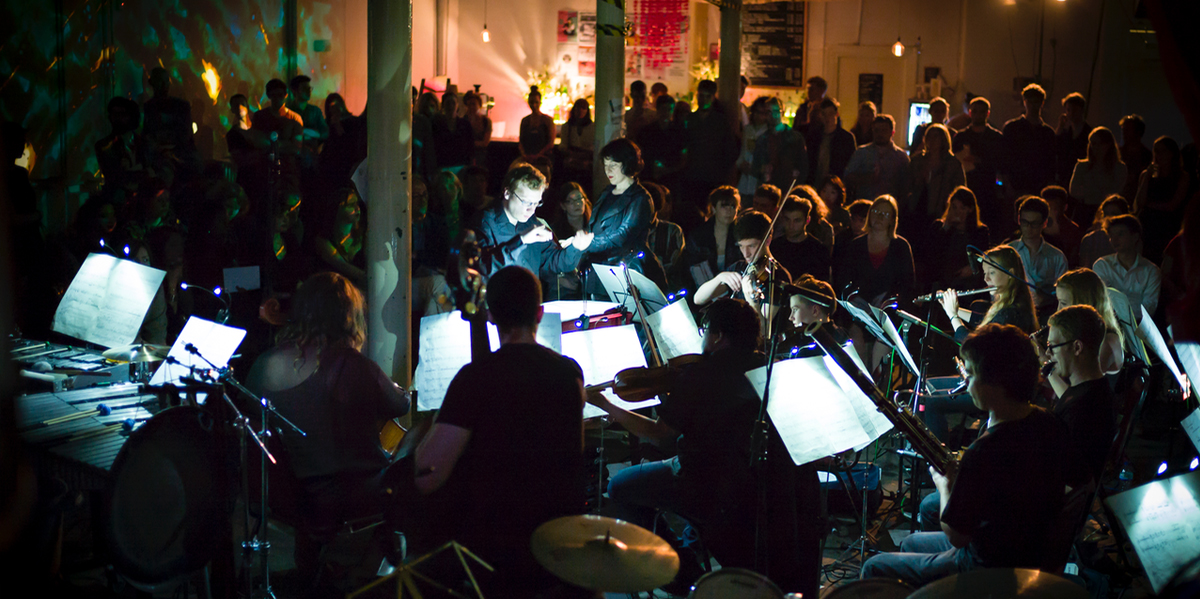
February 2018 – upcoming London experimental gigs – Filthy Lucre’s “night of imagined languages” featuring Claude Vivier, Laurence Osborn, Hildegard of Bingen, Bowie’s Berlin and Byrne’s babble (24th February)

10 Feb

Filthy Lucre, 24th February 2018

Filthy Lucre presents:
Filthy Lucre: “Lingua Inota – A Night of Imagined Languages”
Hackney Showroom @ Hackney Downs Studios, 13-15 Amhurst Terrace, Hackney Downs, London, E8 2BT, England
Saturday 24th February 2018, 7.30pm
– information here, here and here

“Every song in the night uses invented languages to express the things that real words can’t touch… The divinity of nonsense has served, like music, to say the unsayable. Whether associated with religious ecstasy or utopian projects, these utterances are inscrutable yet intimate.”

For a while now, freewheeling concert/club night/collective Filthy Lucre (run by composer Joe Bates, clarinettist Anthony Friend and composer/conductor William Cole) have been putting together events “tied together by artistic concepts, such as cultic rituals and urban sprawl.” I’ve not caught up with them before now, but this event’s an ideal opportunity to get a feel for how they think.

Incorporating chamber choir and synthesisers, the Filthy Lucre ensemble will be performing ‘Glaubst du an die Unsterblichkeit der Seele? (Do You Believe In The Immortality Of The Soul?)’ the final, morbidly romantic langue inventée work from renegade Canadian composer Claude Vivier (infamously found in manuscript form on his desk in the aftermath of his murder, which it seemed to predict in its envisioning of a narrator stabbed in the heart by a potential lover). Also in place on the bill will be an exploration of the original lingua ignota of visionary theologian, polymath and composer Hildegard of Bingen (she of the hallucinatory Christian visions and the remarkable command of twelfth century experience from its musicality to its medicine, its theological orientations to the outer fringes of its philosophy).

In addition, Filthy Lucre will be tackling the “nonsense” of the David Bowie/Brian Eno collaboration ‘Warszawa‘ (born from Bowie’s blind phonetic transcriptions of Polish folk song) and the “electric babble” of Talking Heads. I guess they could mean the band’s pulsing Afrodelic loft-music setting of Hugo Ball’s ‘Gadji beri bimba’ (from ‘Fear Of Music’) but it could extend to any of David Byrne’s chopped songtexts – in particular, those on 1980’s haunted, free-form-sermonizing ‘Remain In Light’ and its funk’n’free-association follow-up ‘Speaking In Tongues’ (which could also have lent its name to the event).

There will also be new music by Laurence Osborn (‘ELITE’, scored for tenor, keyboard, two synthesizers and tape), art by Georgia Hicks (inspired by the illustrated manuscripts of Hildegard’s visions, which depict reality as a wheel) and a Hildegard-themed film by Paul Vernon. Various musical arrangements come courtesy of event coordinator Joe Bates himself, and from Emma-Jean Thackray.

Some examples of what’s on offer or what might be propelling the thoughts behind it can be found below…

 
(Update – 19th February 2018 – have just been able to share the Paul Vernon Hildegard trailer too. Looks as if music by Xenakis and Cocteau Twins has been added to the brew…)


February 2018 – upcoming London gigs (folk, jazz, soul, and eclectic acoustica) – Ian Beetlestone & the Drowning Rats (10th February); Matsudisho and Alice Phelps (18th February); plus Tell Tale Tusk (12th February), Alice Zawadski’s cello-heavy Valentine Show (14th February) and Kabantu’s album launch (8th February)

5 Feb

Even more than the Magic Garden (as covered a few posts back), Camden’s Green Note serves as a London folk-boutique par excellence. Most evenings, its small café space wedges in the cream of roots acts, the care they take over choice, presentation and atmosphere often justifying the priceyness of an evening out. You get what you pay for.

Here are a few things on offer there during early February:

* * * * * * * *

Ian Beetlestone & The Drowning Rats, 10th February 2018

Ian Beetlestone & The Drowning Rats
The Basement Bar @ The Green Note, 106 Parkway, Camden Town, London, NW1 7AN, England ·
Saturday 10th February 2018, 8:00pm
– information here, here and here

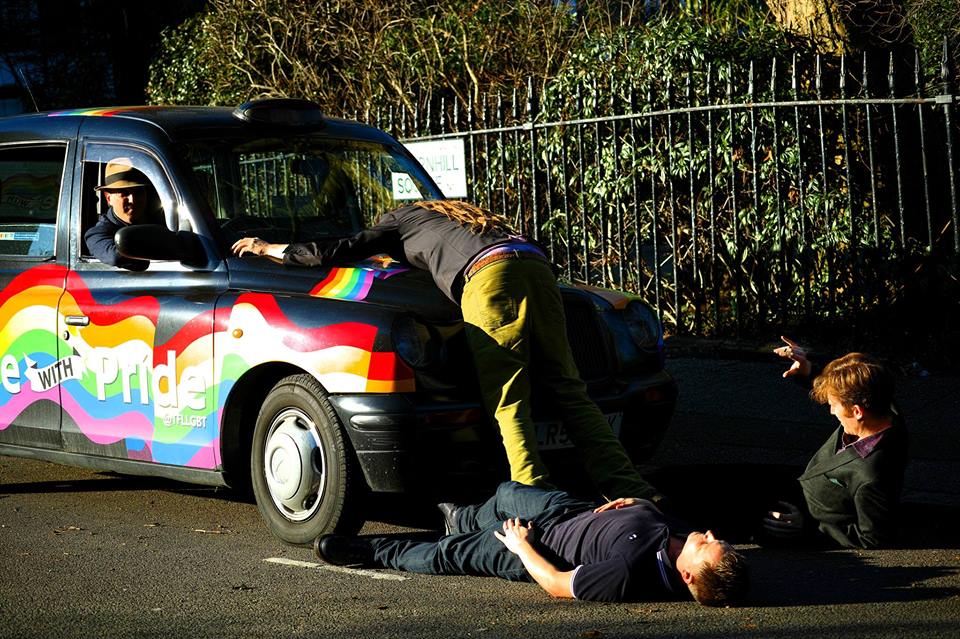
Plenty of charming elements and conversational topics converge in Ian Beetlestone. He’s a Yorkshireman-turned-Londoner, a pop and chanson connoisseur, a gay man and a cabbie. Several of these come together in his lively, engaging cabbie’s blog; even more of them combine in the fact that for the last couple of years Ian’s driven the capital’s first (and, to date, only) rainbow-coloured taxi (for what it’s worth, it’s becoming a much-loved city ornament both inside and outside of Pride, and he gets more stick from fellow cabbies over the Transport for London logo than he does for the LGBT+ associations).

As for the musicality, that flourishes in his all-singing acoustic trio The Drowning Rats, who offer “(a) unique combination of ratty jazz, drowned pop, magic, mystery, darkness and light to the capricious twin deities of love and song with ever pleading, hopeful eyes.” Having started up in Leeds about a decade and a half ago (and survived a subsequent re-potting in London), they’ve been the players of regular gigs in Soho (until recently, at the Blue Posts) and their home turf of Kings Cross (at the Star of Kings) as well as the Green Note.

 
With Ian’s florid piano backed by Dom Coles’ drumkit and Tom Fry’s double bass (and with occasional visitations from beery horns and assorted vocal foils), they deliver songs bursting with melody, harmony and joie de vivre; nodding to Brel and barrelhouse, Tom Waits and Paul Weller, Nina Simone and the Shangri-Las; suffused with wry reflection, wit and camaraderie. Ian rolls them out in a joyful soul growl – honey, gravel, fur and phlegm, with the hint of a romantic tenor under the wear and tear. It’s a little Tom Waits, but it’s rather more Dr John (if instead of immersing himself in the Big Easy, he’d taken a ship up the Thames estuary to found a bayoux in a London canal basin).

If you’re specifically after queerness, you’ll find it in the subtle and rosy sexual glow which illuminates many of the songs like fireside warmth, and also in the elastic inclusive community etched out in hints and amongst the broader scope of Ian’s songwriting. Inclusivity’s the word, in fact: there’s little details and easter eggs sown throughout the songs if you want to pick them up and decode them, but in general it’s all woven together with subtlety and open-heartedness. You can walk through their door and enjoy epic magic-realist power ballads about the A40, jaunts around the concerns, compromises and evasions of friendships, sly ballads which put the boot into Soho gentrification, and cheerfully apocalyptic accounts of mornings-after… all without worrying that you need to belong to any particular club. Although, in the extremely cosy confines of the Green Note’s basement bar, you’ll soon feel as if you do belong to one.

 
* * * * * * * *

Matshidiso + Alice Phelps
The Green Note, 106 Parkway, Camden Town, London, NW1 7AN, England
Sunday 18th February 2018, 8:30pm
– information here, here and here

Matshidiso, 2017
I’m not sure just how hard you have to work, just how much you have to do, blossom and branch out before you burst the “secret” side of “well-kept secret” wide open. I would have thought that Matshidiso would have reached that point a long time ago.

Music flows through pretty much everything she lives and does, stemming from the cosmopolitan stew of her upbringing (a native Londoner with Jamaican and Sotho heritage, a classical piano trainee with a parallel love of soul, hip-hop and the cream of 1970s singer-songwriters) and blossoming into her realisation of herself as do-it-all artist – on-call pianist and singer, producer/writer/arranger for herself and for others. Sometimes a band leader, always a constant communicator, Matshidiso has led creative workshops; run song sessions across the internet from her own front room and played venues from the Southbank Centre to South Africa. All this and she’s also a qualified and multilingual international human rights barrister (with experience fighting sex trafficking rings in Ethiopia); a spokesperson for activism around positive African and female identity; a visiting music therapist at the Royal Marsden; a rehabilitating coach and encourager for young male offenders at various prisons; and a onetime relief worker in Haiti.

All of which would be gems on anyone’s resume (and which suggests someone who’s already learned and given back more than most of us will in an entire lifetime) but as a musician, the final proof has to be in the songs Matshidiso sings. Traditional they might be, but she’s learnt well from the craft of forebears such as Roberta Flack, Laura Nyro and Lauryn Hill, creating harmonically rich keyboard-driven work drawing from songwriter soul, gospel and pop through which she roams with self-awareness and generous interest in other people’s efforts and struggles.

 
Maybe Matshidiso’s relatively low profile is because of the fact that, despite being the best part of a decade into her career, she’s yet to record a debut album, or even that many releases. There’s been a smattering of very occasional singles; there’s been a 2012 EP of nursery rhymes reconfigured for adults (an idea that fits neatly into of what ‘The Guardian’s called her whimsical yet solicitous approach, and one that’s far more successful than its spec would suggest). In many artists this would seem to be a flaw – a shortage of the hunger, the self-assertion, the pushy pride which is needed to succeed.

I’d suggest the opposite – that Matshidiso’s artistic presence is one that’s absolutely caught up in the moment, too much so to have prioritised lumping her output down into artefacts or commodities. Her work is live, whether it’s in the concerts in which she improvises made-up-on-the-spot stories from the personal accounts of audience members, or the connection she makes with prisoners, the lost, the under-represented as part of work which goes beyond being an entertainer and engages itself with re-weaving music (with all of its connecting and healing qualities) back into the fabric of everyday life.


Opening the show is Leeds-based singer-songwriter and multi-instrumentalist Alice Phelps (who, with her full band, was delighting Daylight Music earlier in the weekend). Harpist, guitarist, pianist, violinist and rich grainy singer, Alice spins blues into folk, Irish, Chinese and otherworldly elements to create original songs and a full-bodied chamber pop. On this occasion, she’s on her own; but she’ll be back at the Green Note next month with a full ensemble of strings, harp and choir. For now, enjoy her songs in their simpler format.


* * * * * * * *

A few more familiar faces are showing up at the Green Note at around the same time. On 12th February, contemporary female folk ensemble Tell Tale Tusk, who work “spellbinding (and award-winning) vocal harmonies…around melodious instrumentals to reimagine folktales old and give light to folktales new” bring their harmonies and humour back to Camden Town for an evening of old and new songs. On 14th February, Alice Zawadzki – whose name has been scattered around these pages for her voice and/or violin work alone or with Sefiroth, Jamie Safir and others – presents a Valentine’s Day Special of known and unknown songs, covers and originals (assisted by dual cello improvisers Alice Purton and Shirley Smart). Or – if you fancy a different venue and a different blend of polycultural acoustica – then on 8th February Manchester world quintet Kabantu are launching their debut album down at Rich Mix in Shoreditch. Plentiful…


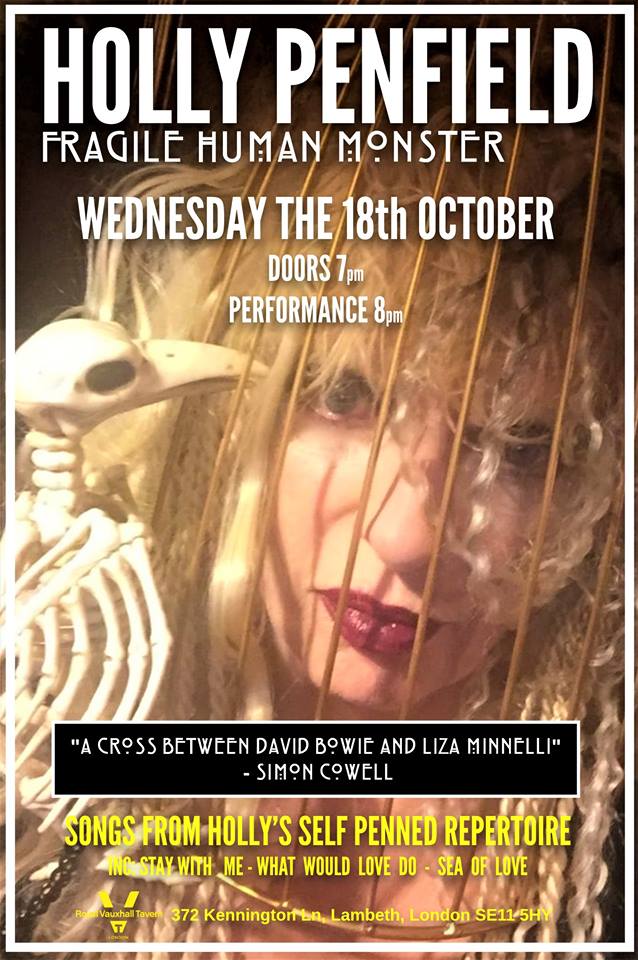
February/March 2018 – Minute Taker mini-tour of England with Runes (2nd, 3rd, 10th, 17th February); Holly Penfield’s rescheduled Fragile Human Monster dates in London (23rd February, 23rd March); Joss Cope and Emily Jones in Worthing (2nd February)

26 Jan

 
Ben McGarvey, better known as ambient-torch-y folktronicist Minute Taker is heading out on a brief February tour taking in a brace of Saturdays, a Friday and four of the country’s more impressive churches. It’s in support of his new mini-album ‘Reconstruction‘ which he claims reflects “the search for new improved ways of rebuilding yourself when your world has been blown apart.”

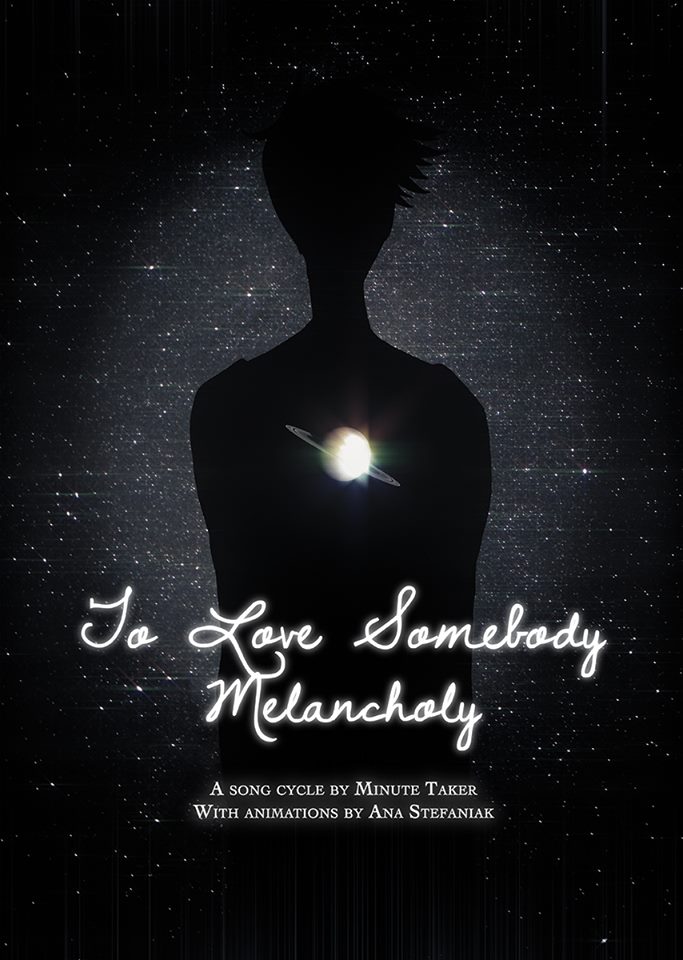
Ben’s last pair of tours were more directly theatrical multi-media affairs, fleshing out the doppelganger/ghost story of ‘To Love Somebody Melancholy’ with tie-in animations, strings and extra guitars. This time, it’s just him – piano, looped harmonies, distorted Eastern-influenced percussion parts, glockenspiel and synths. In addition to the slow dream-jazz-styled songs from ‘Reconstruction’, he’ll be playing rearranged songs from ‘To Love Somebody Melancholy’ and his previous albums ‘Too Busy Framing’ and ‘Last Things’, plus some rethought-out cover versions from his various influences. Expect an atmosphere of drawn-out, deliciously lovelorn confessions and self-realisations set to luscious, trembling tunes, each with a core of silver-wire determination.


Also along for the ride is Greek-turned-Mancunian singer-songwriter Harry Selevos, a.ka. Runes, who has two albums of dreamy cherubic pop behind him – 2015’s ‘Orphic’ and the 2017 OP3 collaboration ‘AWSS’, sublimating his classical piano training via Asian-influenced vocals, a near-ambient synth pulse and a blissful energy (ending up somewhere between Jimmy Somerville and Mark Hollis).

 
Dates:

Prior to the tour, Ben will be performing a couple of live-streamed concerts from home via his Facebook page on Sunday 28th January. The first, at 7.30pm, is a general one with a Q&A session; it will be followed by a bonus session for his Secret Facebook Group covering the ‘Secret Songs’ album series in which he explores cover versions and reinventions.

* * * * * * * *

Live At Zedel/Crazy Coqs presents:
Holly Penfield: ‘Fragile Human Monster’
Brasserie Zédel, 20 Sherwood Street, Soho, London W1F 7ED, England
Friday 23rd February & Friday 23rd March 2018, 9.15pm
– information here and here

The last Minute Taker tour, in October last year, coincided with Holly Penfield scheduling time out from her ongoing reign as jazz-cabaret queen and camp icon in order to return to the ‘Fragile Human Monster’ show she’d spun into a strange and shamanic synth-pop cult-of-the-broken during the early ‘90s. Back in October – and earlier – I wrote about how the old show had a “compelling and bizarre Californian theatrical edge which variously sat in your lap and purred, wailed over your head, broke down in front of you, or made you feel less alone – always in the same set” and about how “being a member of Holly’s audience meant being enticed into shedding those cloaks of cynicism and reserve we use to insulate ourselves, and opening your heart up to the rawest kind of sympathy and honesty. The show became a part of us, as much as we were a part of it, the church of the misfits she embraced. We dropped our guard, she sang: a voice for our odd angles and our visceral fears… If you led with your sense of cool, or your cynicism, there was no chance. But at full tilt, it was unmatchable.”

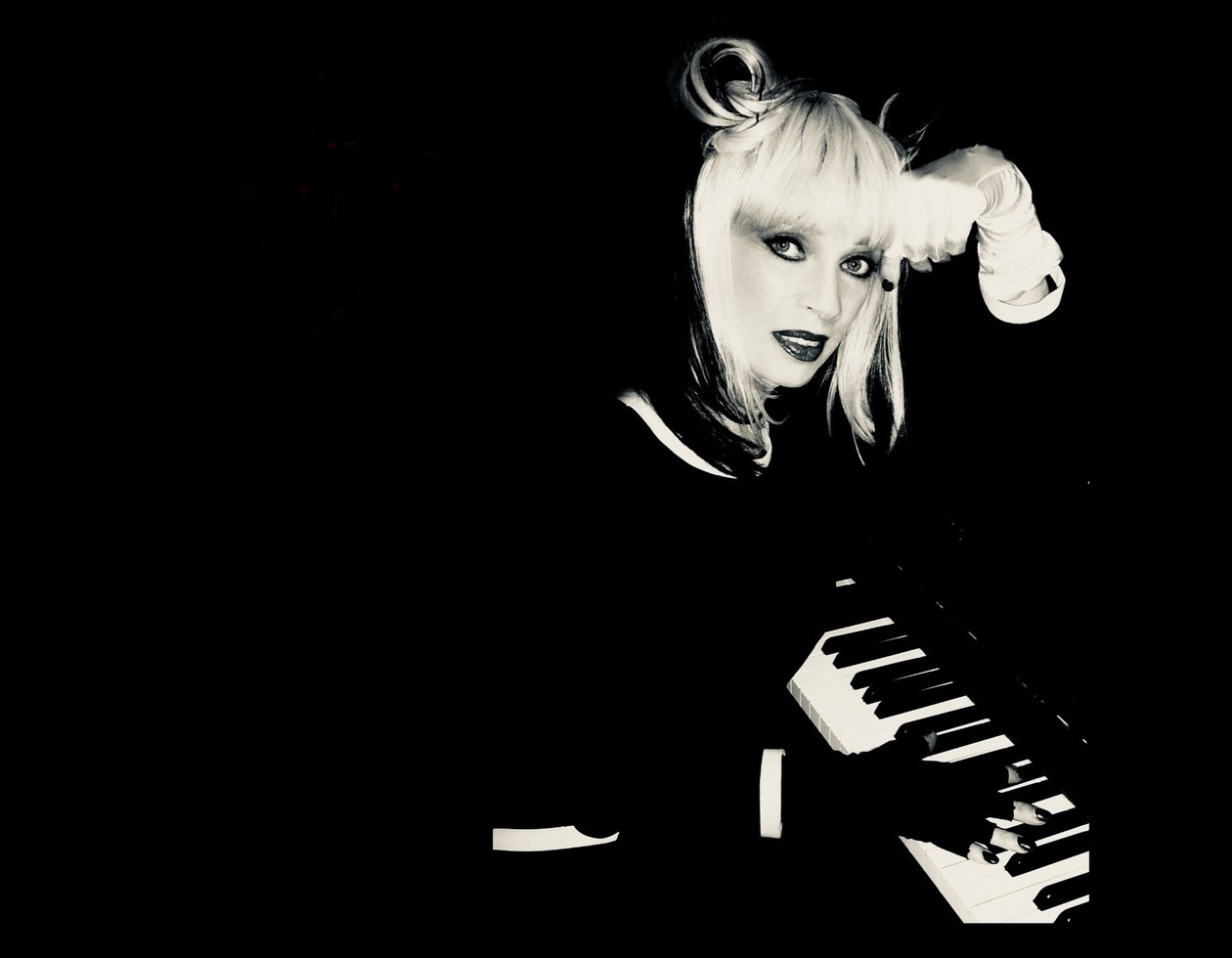
Holly Penfield, 23rd February & 23rd March 2018Both ‘Fragile Human Monster’ and its related ‘Parts Of My Privacy’ album had been a second-stage reaction to Holly’s previous career as a blow-dried Los Angeles rock starlet (during which, in classic fashion, she’d been sidelined, ground up and spat out by the dream machine). Both had starred Holly alone but for the saxophone and suss of her partner and husband Ian Ritchie and for the evocative night-time sound of her Kurzweil sampler-keyboard. Over these, she spilled her self-composed, gloriously-sung narratives and metaphorical fantasias of collapse, vulnerability, madness and healing like an obsessive, loving, slightly deranged blurring-together of Laurie Anderson, Jane Siberry and Pat Benatar; framed by a stage set of trinkets and keepsakes which assumed the magical associations of a voodoo shrine – or, as I put it previously, “a travelogue of places been, of people touched and gifts given and received.”

It was the kind of gig into which, whether performer or audience member, you had to throw your whole self… and in turn it eventually flamed out, eventually making way for Holly’s camper (yet straighter) third stage as a knowingly decadent flaunt-it-all singer-performer of jazz and torch standards, commanding top-notch acoustic bands. It’s that latter stage that finally made her name – yet some of the willing therapeutic madness of FHM has always been present in those slinks through Fever and I Wanna Be Evil, the wigs and costume changes, the brassy fragility and the phenomenal voice. (Back in California, Holly had shared a voice coach with Barbra Streisand, Frank Sinatra and Sammy Davis Junior. It showed.)

It wasn’t clear what was impelling Holly to bring the old show back; nor whether she was resurrecting the synths and sequencers and ditching the jazz quartet and feather boas. In any case, it was promptly derailed by her surprise leather-clad showing on ‘The X-Factor’ in full-on kook mode, teasing Simon Cowell with a riding crop during the auditions phase. She did get a market-friendly Cowell soundbite out of that – “a cross between David Bowie and Liza Minnelli” – to go with her Tim Rice citation (“more than one fine diva – she’s a whole host of them, and they all look wonderful and sound sensational”) but it also meant that the planned Vauxhall Tavern FHM shows got showbizzed, and abruptly morphed into the familiar jazz cabaret albeit with a Halloween tinge. Escape velocity lost and an opportunity missed, even if some of the FHM songs still got stirred into the mix.

Now she’s rescheduled the Monster for a couple of dates at the swish London Zedel eaterie: a luxuriant art-deco cabaret capsule. Again, not much about how she’s going to do it, or how much habit and setting is going to shape instrumentation and presentation, but I’m hoping that after last year’s false alarm this will be the real deal, and that whatever twenty years away have added to the show’s energies will add to the spice. Sadly, there’s nothing directly from the Monster on Youtube – and nothing of ‘Parts of My Privacy’ – so instead I’ll have to whet appetites one of the more Monsterous moments from the cabaret show, an excellent new number Holly posted up the other year (like a Bowie torch song for the American dream), and an FHM ballad in its original glossy LA-pop ’80s garb before Holly pared it back to an art-pop synth shimmer.

 
* * * * * * * *

Musica Lumini presents:
Joss Cope + Emily Jones
The Cellar Arts Club, (basement of) 70 Marine Parade, Worthing, West Sussex, BN11 3QB, England
Friday 2nd February 2018, 7.30pm
– information here

Joss Cope + Emily Jones, 2nd February 2018It’s always nice to hear about a new venue, pushing back against the swelling tides of blandness and land-banking; and Worthing’s Cellar Arts Club must be a godsend for the more inquisitive characters who live in Brighton’s smaller, sleepier cousin town. I say “new”, but in fact it’s been in existence for nearly a year – a small, sprightly co-op effort providing music, poetry, stand-up, discussion and small-scale theatre and film showings. This February, it celebrates a small coup in pulling in both Joss Cope and Emily Jones for a concert.

Any discussions of Joss inevitably involve invoking (and then quelling) the shadow of his big brother – Julian Cope, the ‘80s psych-pop chart star and holy fool who spent the next three decades evolving into a garage-rock pagan shaman, a looming Archdrude and more recently a heathen-folk Biker of Ragnarok. So here I go… While there are a few shared traits (a sibling similarity in tone, including the Midlands yawp that occasionally cuts through their middle-class diction; their West Coast way with a melody; their tendency to move from proclaimer to informal intimate in a heartbeat by slipping a conversational twist into a driving lyric) they more often sound like two boys who heard the same records but went away having heard and learned different things. For all of his anarchic ways, whenever Cope the Elder yomps off on his Odinist trip, dooms Christianity or tries to brain-bugger you into enlightenment with 12-strings and Mellotrons, he always seems anxious to please, impose and impress; to garner attention from (and for) his assorted upendings and derailments. More outrightly affable, Joss may have come along on some of Julian’s musical trips, but his own are more relaxed and chatty, drawn from the confidence of one who takes more pleasure in the deft shapework of being a craftsman than in being a noisy prophet of the heath.

 
Ever since his emergence thirty-odd years ago (with short-lived bands such as Freight Train Something Pretty Beautiful and United States Of Mind), Joss has brought Cope-ular bounce and chattiness to the acid wistfulness and garage grooves. Since then, apart from a longer stint with counter-pop collective deXter Bentley, it’s been mostly innumerable multi-instrumental pick-up collaborations between Brighton and London (from Sergeant Buzfuz to Crayola Lectern). However, with last year’s ‘Unrequited Lullabies’ (recorded in Joss’ part-time home of Helsinki with a set of amenable Finnish musicians including Veli-Pekka Oinonen of the Leningrad Cowboys) he’s unveiled an album where his own voice comes clear to the surface. A luscious living-room tranche of psych-pop with a sharp wit; dappled with dextrous pop guitars, carousel prog, fake horns and laps of Mellotron, it also shows that there’s more than enough in Joss’ songwriting to ensure that it’s worth listening to him even if he just rocks up alone with an acoustic guitar. With a delivery not too far off the drowsy cut-glass musings of Guy Chadwick (and travelling through similar musical territories to or the Robyn Hitchcock or The Monochrome Set, although he’s less frivolous than either), he provides deceptive sunny reflections on our currently souring culture with its intolerance, its blame-shifting and the growing poisoning of discourse (“fell voices charm the crowd and there’s a bill for everything / Heard the claim that destiny was waiting in the wings… / Gotta get out of this cauldron before it starts to boil / there’s the frog and the kettle, pour on toxic oil”). At the same time, he’s got a healthy disregard for the idea of singer as preacher – admitting, in Cloudless Skies, that “the truth is understated, there’s no reality to be debated, / but no-one wants to hear that in a song.”

So far, the singer-songwriter work of Truronian hinterland-folkie Emily Jones (daughter of cult sixties folk singer and instrument inventor Al Ashworth-Jones) has rambled across two albums and a collection of Bandcamp oddments. In these pages, she’s mostly shown up in connection with the regular support slots she’s played backing up the Spratleys Japs revival. Opening for Joss should provide a bit more of a window for getting across her own particular songview, which layers ancient drone-lays and Sandy Denny musings with latterday and merges ancient folk tropes with latterday horrorfolk tales and strands of modern rurality, in particular the mystical fraying of reality that comes with too much time alone in a remote cottage. Picking at her songbook reveals the makings of an intriguing psych-folk visionary, with stories of strange transformations, blurrings and exchanges (from her recasting of traditional selkie tales to the peculiar trash-moth creature that flits through Hermegant And Maladine to her musings on the supernatural interplay of housework, psychic memories and ghost-hopes in Pieces Of People).


October 2017 – upcoming English gigs – Holly Penfield chops and changes in London (18th October); Minute Taker’s multimedia love-and-ghosts story ‘To Love Somebody Melancholy’ in Glasgow, London & Brighton (15th, 21st, 22nd October); Cardiacs’ ‘Marenest’ fundraiser showing in Bristol with The Scaramanga Six (21st October); and something on Paul Diello

7 Oct

Holly Penfield presents:
‘Holly Penfield – Spooky Little Girl’
The Royal Vauxhall Tavern, 372 Kennington Lane, Vauxhall, London, SE11 5HY, England
Wednesday 18th October 2017, 8.00pm
– information here

Holly Penfield: 'Fragile Human Monster', 18th October 2017For a while, there, I was spun back. Twentysomething years ago, I was a regular at Holly Penfield‘s ‘Fragile Human Monster Show’ (having first caught her performance on a random Edinburgh night back in 1992). Ostensibly based around sleek ’80s synth’n’sequencer pop, her shows had a number of twists. More like ’70s songwriter confessionals, they stirred yearning jazz and blues strands back into a genre which had mostly eschewed them. Based around Holly, her Kurzweil keyboard and a saxophonist (usually her husband Ian Ritchie, who’s had a hand in everything from Scouse artniks Deaf School to the Roger Waters band and the ‘Lonely Planet’ theme), they also had a compelling and bizarre Californian theatrical edge which variously sat in your lap and purred, wailed over your head, broke down in front of you, or made you feel less alone – always in the same set.

If you can dig up Holly’s long-lost debut album ‘Full Grown Child‘ – a brash early ‘80s Chinnichap production – you’ll hear an Innuendo-strewn, pop-belting cross between Suzi Quatro, a bleach-blond Rizzo, ABBA and full-on coke-blizzard-era Stevie Nicks. ‘Fragile Human Monster’ was the fallout from all that: an onstage realisation of Holly’s independent followup ‘Parts Of My Privacy’, in which she and Ian went back to her bluesier and torchier San Francisco roots, merged it with Ian’s techno-pop skills and teased out a series of passionate, cracked paeans (plus jarring digressions into performance art) about fear, instability and how the lost rebuild their lives and make their way. Tremendously tuneful but at odds to the music biz, the ‘Fragile Human Monster Show’ was that rare thing: outsider music with genuine craft and skill. It was also pretty queer and culty, drawing a diverse squadron of waifs and strays of all stripes (including me) to Holly’s home venue on the Kilburn High Road. Eventually it wore Holly out: putting it to rest, but still hanging onto her stubborn kookiness, she applied her remarkable voice and stage presence to a new career as a jazz cabaret diva. She’s made, I think, just one revisitation to Monster territory since (which you can read about here).

Holly Penfield: 'Spooky Little Girl', 18th October 2017Late this summer, though, Holly announced that she was bringing the old show back for an evening in October, though she wasn’t clear about how she’d be doing it: perhaps reworked for the acoustic jazz band she’s used for the last couple of decades, or perhaps with her going it alone (with the Kurzweil and sequencers brought out of mothballs and will go it alone). At any rate, I thought I’d be going along – possibly in search of my own confused, similarly theatrical mid-twenties self, perhaps to see if I got along with him a little better.

However, everything was upended in early September following Holly’s jolting appearance in the auditions for ‘The X-Factor’. Ubercamp, leather-clad and singing Meredith Brooks’ Bitch, she went full-on nightclub and came on to Simon Cowell like a kinky Weimar nightmare with a riding crop. Inspired by the experience (and not a little miffed at the mocking edit that made it to TV) Holly’s now claiming that “the evil jazz cabaret performer in (me) has clawed its way to the surface”, and has morphed the October show into an upbeat Halloween “Spooky Little Girl” special (billed as “cabaret classics, spooktacular rocking favourites and self-penned songs as only our Diva can deliver them”).

I can’t help thinking that an opportunity’s been lost (or steamrollered) but I might show up anyway. She’s still promising to pepper all of the knowing cornballery with old FHM songs; several existing set standbys (such as Stay With Me, seen below in a torch-jazz arrangement from 2009) originated in the old show, and a new-ish piano/vocal song Confessions (posted up online a year ago) suggests a creative leaning back towards the old days of torch and bearing witness. Regardless of any of that, there’s still the voice; there’s still the onstage magnetism. Should be some sort of a blast.

 
* * * * * * * * *

Minute Taker: 'To Love Somebody Melancholy' (live show)Also during the midmonth, acclaimed LBTQ folktronicist Minute Taker (aka Ben McGarvey) takes his multimedia show ‘To Love Somebody Melancholy’ out on tour in England and Scotland. I missed the news about his summer tour (which spiralled out from his homebase of Manchester, taking in Oldham, Chorlton and the Didsbury Art Festival plus a trans-Pennine appearance at Hebden Bridge) but managed to catch the news about his autumn followups in Glasgow, Brighton and London (including an appearance at the seventeenth century “actor’s church”, St Pauls in Covent Garden). Here’s the story:

“Singer-songwriter Minute Taker and BFI award-winning animation artist Ana Stefaniak have created a haunting, modern fable told through projected film and an epic live band performance of Minute Taker’s upcoming album… Expect to be immersed in a dark and magical world of strange animated characters and piano songs brimming with ethereal harmonies, fizzing synthesisers and orchestral twists.

“In ancient Greek philosophy Aristotle first popularised the notion that artists, poets and writers were of a melancholic disposition. In the middle ages melancholics were thought to be possessed by demons if they could not be “cured” of their depressive tendencies. Set on a desolate seashore, ‘To Love Somebody Melancholy’ explores the notion of the archetypal artist as he journeys through the euphoric highs and the self-destructive lows of his creative cycles. A new romantic relationship brings the artist the contentment he craves but it soon becomes apparent that there’s something else lurking in the shadows; a ghostly, shapeshifting third entity whose form is entirely dependent upon the artist’s current mindset. Sometimes a saviour, a source of inspiration and hope, sometimes a savage, ruthlessly determined on driving his lover away.”

 
Ben comments “one of my biggest influences when creating ‘To Love Somebody Melancholy’ was Kate Bush’s masterpiece ‘The Ninth Wave’. Such a wonderfully magical, otherworldly and at times frightening journey into the unknown. I never tire of going on this adventure with her. Come join our own dark adventure, inspired by Kate’s.”

Dates:

  • Websters Theatre, 416 Great Western Road, Woodlands, Glasgow, G4 9HZ, Scotland, Sunday 15th October 2017, 8.00pm – information here and here
  • St Paul’s Church, 29 Bedford St, Covent Garden, London, WC2E 9ED, London, England, Saturday 21st October 2017, 7.30pm – information here and here
  • Latest Music Bar, 14-17 Manchester Street, Brighton, BN2 1TF, England, Sunday 22nd October 2017, 7.30pm (with Paul Diello) – information here

Additional support comes in Brighton comes from the award-winning “pop/folk/fabulous” singer-songwriter Paul Diello, who recently wowed the Brighton Fringe Festival with a sold out run of five-star-review shows and who promises “a special set of songs” for the occasion. Citing Madonna, Bowie, Kate Bush and Anohni as inspirations, Paul is an increasingly powerful artistic presence in the LGBT underground, operating in the febrile interface between cabaret, chart pop, queerness and visual staging (in particular, via video). Provocative and insidious, with an ear for the brazen tunes of ‘80s synthpop, Paul reminds me of a tougher Marc Almond – albeit with the sturdy physique of a dockside bouncer – while his songs are sharp confections of fists, flowers and standing your ground.

 
* * * * * * * *

Kate Bush seems to have become a recurring presence in this thread. Perhaps I’m alone in this, but I’ve always drawn a vague connecting line between ‘The Ninth Wave’ and Cardiacs’ 1989 album ‘On Land And In The Sea’.

Despite their common south London roots and the bare three years between them, there doesn’t initially seem to be much linking Bush’s silky-petalled Fairlight-driven art pop with the shrill, switchbacking, horns-and-artpunk firepower of Cardiacs, let alone their urchin squawks versus her sensual coo (though I’d have loved to have heard them cover each other). Dipping beneath the surface, however, reveals plenty to unite the two work. There’s the common and commonly transmogrified debt to English prog (in the structural ambition, the little flourishes of grandeur, and the enthusiastic mining of everything from twinkling tunes to violent psychedelic riffs, looming synth orchestration to jigs and jittering dreamscapes). There’s the common immersive marine motif – even when the sea’s banished from the foreground, it’s always present to embrace, propel, threaten or dissolve the bobbing characters within the songs. And although ‘The Ninth Wave’ centres pretty clearly on the near-death experience and night journey of a single castaway, while ‘On Land…’ zig-zags crazily over suburbs, shorelines, skies and inlets while weaving through multiple blurred perspectives (from the individual to that of a kind of profoundly skewed post-war national consciousness) in both works a half-sleeping, half-waking British mythology gets forked up and worked over anew, with a relentless filmic curiosity.


‘On Land And In The Sea’ provided most of the songs played in Cardiacs’ 1990 concert film ‘Marenest’, which brings its own chaotic theatrics to a fundraiser showing in Bristol. Live support comes from brutally grand, macabre Yorkshire rockers The Scaramanga Six, bringing a punchy live set based in part on their new crowdfunded ‘Chaotica’ album.

If ‘On Land…’ really was intended as some kind of concept album, it hid the fact under a typically Cardiacs welter of invention and disinformation. In contrast, ‘Chaotica’ wears its conceptual heart on a stained sleeve – the Scaramangas have been pretty open about its roots in “an abstract story roughly hewn from a concept of a dystopian island society. A place where everything has fallen into ruin, yet people still seem to have the same preoccupation with the trivial crap they had before. The population trudge through a chaotic existence on top of each other with absolutely no hope of a better life. Society is reduced to its base behaviour yet people still crave superficial fixes. The human condition carries on regardless. There is no outcome, no lessons to be learned. Familiar?” ‘Chaotica’ might not quite be a Brexit ‘Quadrophenia’, but it’s clearly leaning that way.


As is generally the rule with Cardiacs-related events these days, all profits on the day (including bonus donations by bucket or booking-stage gifting) are going to fund the care of Cardiacs’ driving force Tim Smith as he continues to battle against the aftermath of heart attacks and stroke. Note that the venue is quite hard to find, hidden as it is away behind the rubbish bins in a nondescript Bristol car park. Some Cardiacs fans would claim that this is only appropriate.

‘Maresnest’: Tim Smith Benefit with The Scaramanga Six
Cube Microplex, Dove Street South (off top-left of King Square), Kingsdown, Bristol, BS2 8JD, England
Saturday 21st October 2017, 7.00pm
information
 

June 2017 – upcoming English gigs – the return of Pram with the immersive ‘Under the Blossom That Hangs On The Bough’ event in Birmingham (June 3rd); Zarjaz Baby and Jon Slade/Night of the Comet in London (June 3rd); Arthur Russell’s ‘Calling Out Of Context’ revisited in London (June 7th)

23 May

Some shows and events to start June off. In Birmingham, experimental dream pop/post rock band Pram (one of the most original and charming groups ever to work in either genre) have resurfaced and are taking over an Edgbaston park for a very different kind of performance. Back in London there are opportunities to catch up with Zarjaz Baby (one of the wilder characters from the original wave of British post-punk) an acoustic set from Jon Slade (who’s navigated his way through a heap of scenes from art-punk to Riot Grrl to a thousand indie DJ nights); and a recreation of the cello/pop songs of Arthur Russell, one of the darlings of the 1980s New York loft music scene.

* * * * * * * *

Pram: 'Under The Blossom That Hangs On The Bough', 3rd June 2017

for-Wards, MAC Birmingham and Pram present:
Pram: ‘Under the Blossom That Hangs On The Bough’
Martineau Gardens, 27 Priory Road, Edgbaston, Birmingham, B5 7UG, England
Saturday 3rd June 2017, 4:30pm
– free event – information here, here and here

“Composers and sonic artists Pram have been exploring south Birmingham with the help of local community groups to uncover the sounds of the locality. The results are both familiar and surprising.

“Let Pram take you on a journey through the city, a sound trail through the four wards of Birmingham’s Edgbaston district. Hear the world from the perspective of a bee as it flutters and forages. The snuffles of a tiny baby become the snores of a lion, the gurgle of a stream a mighty cataract. Come along and follow the woodland trail, bring a picnic and settle down for a performance inspired by the sound of the city as you’ve never heard it before.

“Set in the magical surroundings of Martineau Gardens, ‘Under the Blossom that Hangs on the Bough’ is an installation and performance by Pram, celebrating the sounds of Edgbaston. It will take place at Martineau Gardens on the afternoon of Saturday 3rd June, concluding at 6.30pm with a Pram performance inspired by sound recordings made in the wards of Quinton, Harborne, Edgbaston and Bartley Green. Free admission if you register at Eventbrite…”

This isn’t quite the same Pram that charmed us and subverted pop for a surprisingly long stint in the ’90s and noughties across a string of albums which included ‘Dark Island’ and ‘Sargasso Sea’ and a sound that seemed to be part child’s murmur, part clinking post-kosmische stroll and part friendly haunted house. Most obviously, singer and lyricist Rosie Cuckston (she who used to mount her keyboard on an ironing board at concerts) is absent, having moved on into academia and a more direct form of the social activism which the band’s eclectic inclusiveness and tendency to take philosophical side roads only hinted. That said, the rest of the band’s original creative core (multi-instrumentalists Matt Eaton, Sam Owen and Max Simpson) are all present, having spent the interim years of Pram downtime working with wonky loops as Two Dogs, creating film and theatre sound and making sonic art out of books with the Sound Book Project.

This also isn’t the first time that the post-Rosie Pram’s reappeared. Earlier in May they made an appearance at Imaginary Musics in Switzerland, playing a “music for Kopfkino” audio-visual set in a festival dedicated to “cinematic, recomposed and fictional musics”, and it seems as if losing Rosie’s quiet reflective voice and cocooned lyrics has shifted them further over into the areas suggested by Matt’s sound design and by Sam and Max’s live sound art. On-spec, it seems as if they’ve succeeded in becoming a kind of “post-band”, with a foot in their old live work, song-structures and performance coherence, but leaning towards something far more abstract and ego-free. ‘Under the Blossom That Hangs On The Bough’ sounds as if it will be something fascinating to be immersed in – an urban psychedelic afternoon stroll with the family, an aural refraction of Birmingham through leaves, greenery and company.

* * * * * * * *

Zarjaz Baby + Jon Slade, 3rd June 2017

Zarjaz Baby + Jon Slade
The Horse Hospital, The Colonnade, Bloomsbury, London, WC1N 1JD, England
Saturday 3rd June 2017, 7.00pm
information

“An existentialist extravaganza featuring a solo acoustic set from Zarjaz Baby (Freakapuss and former Tronics). Zarjaz will be performing dark atmospheric songs, full of imagery, with jazz, blues, early ’60s beat and pop influences, with live performance artists, in a style not seen since the basement and candles days of Beatniks.

“Also featured on the night is a solo acoustic Love-Rock revival set from Jon Slade/Knight Of The Comet, incorporating songs from his former bands Huggy Bear and Comet Gain, plus a Fire Department number, some Electric Bull re-workings, as well as songs he wrote with Wolfy Jones.

 
“’60s European pop music in between sets, Francoise Hardy, Brigitte Bardot, Gillian Hills. Expect sombre girls dressed in black and boys in Breton shirts.”

For more information contact incoming@freakapuss.com

For more on Zarjaz’s chequered life and career, have a read of this interview he did with ‘The Quietus’ three years ago, featuring accounts of brushes with mental illness, of releasing surreal post-punk songs with titles like Shark Fucks, of arguing with ‘2000AD’ over his stage name, and of having his image ripped off by Sigue Sigue Sputnik.

 
* * * * * * * *

Arthur Russell: 'Calling Out Of Context', 7th June 2017

XOYO Live and Milestones present:
‘Arthur Russell – A Classic Reinterpreted’
XOYO, 32-37 Cowper Street, St Lukes, London, EC2A 4AP, England
Wednesday 7th June 2017, 7.00pm
– information here and here

“It’s been said that “Arthur’s songs were so personal that it seems as though he simply vanished into his music.”

“Twenty-five years after Arthur Russell‘s death, some of the most exciting, forward-thinking faces in music are set to present a unique rendition of Arthur Russell’s timeless album ‘Calling Out Of Context’. A posthumous album that brought together twelve incredible tracks from across two previously unreleased LPs, ‘Calling Out Of Context’ represents Arthur in his prime. Two decades later and the music sounds as contemporary as ever – a huge inspiration for those performing on the night. We’re very excited to hear this new rendition.”

Bringing together elements of electropop, classical minimalism, post-disco, hip hop and singer-songwriter work, the ‘Calling Out Of Context’ songs span twenty years of Arthur’s composing and creative history while he was battling to fuse the parallel New York worlds of dance culture and art music between the late ’70s and the early ’90s – a pioneer of the freewheeling musical eclectism which today we pretty much take for granted. Take a look at this salvaged 1987 interview feature from the ‘Melody Maker’ for more on the topic, featuring reflections from Arthur and others on Indian music, the pulse shared by formal minimalism and New York dance clubs, and the social and cultural challenges of the time regarding blending “high” and “low” cultures.

The band for this London performance consists of Ashley Henry (keyboards), Midori Jaeger (cello), Alica Higgins (vocals), Sam Gardner (drums) and Joe Downard (bass).


May 2017 – upcoming London classical gigs – polygender opera with ‘Binary Optional’ at CPT (May 25th & 26th)

21 May

One of the month’s more interesting London opera events…

'Binary Optional', 25th & 26th May 2017

Oedipa & Lucia Lucas present:
‘Binary Optional’
Camden People’s Theatre, 58-60 Hampstead Road, Euston, London, NW1 2PY, England
Thurday 25th & Friday 26th May 2017, 9.00pm
information

From the press release, spliced with a little more research:

Oedipa collaborates with the extraordinary female baritone Lucia Lucas (Wuppertaler Bühnen, Deutsche Oper, Chicago Opera Theatre) on an evening of song in transition: from masc to femme, classical to queer and oppression to freedom.

“A freelance opera singer based in Germany (who has previously held full-time contracts with the Badisches Staatstheater, Kalsruhe, Theater und Orchester Heidelberg and the Deutsche Oper, Berlin), Lucia Lucas is a strong dramatic baritone specializing in Verdi roles, and has sung roles including Ford in ‘Falstaff’, Iago in ‘Otello’, Escamillo in ‘Carmen’, Le Grand-Prêtre in ‘Samson et Dalilah’, Jochanaan in ‘Salome’, Alberich in ‘Das Rheingold’, Thoas in ‘Iphigenie en Tauride’, Figaro in ‘Le nozze di Figaro’, Leporello and Giovanni in ‘Don Giovanni’, Mephistopheles in ‘Faust’, Don Pizzaro in ‘Fidelio’ and Nick Shadow in ‘The Rake’s Progress’.

“Beyond this, Lucia is one of the small but growing number of transgender woman performing significant operatic roles (a list of singers which includes Breanna Sinclairé and Emily De Salvo, whose own unusual range covers baritone to soprano). As Lucia commented in an interview in ‘Slipped Disc’ a couple of years ago, “I am performing all of the same things. Still singing angry old men on stage, but fringe projects have also started appearing as possibilities”. ‘Binary Optional’ is one such project – singing Bizet, Britten, Wagner, Purcell and Adams, flirting with Sarah Vaughan and ‘Rocky Horror’, Lucia draws on her experience singing classical repertoire across the world to tell her incredible story and celebrate the fluidity and plurality of gender in opera.


“Oedipa is the alter ego of writer/director Finn Beames (who’s dedicated himself to working “against the male perspective”) and a diverse range of varying collaborators. As Oedipa, groups of artists create and produce live performances in theatre, opera and related forms, often with an emphasis on music.

“Based in London and working internationally, Finn won the 2015 Genesis Future Directors Award at the Young Vic for his production of Man: 3 Plays by Tennessee Williams in the Clare theatre. He also holds the 2015 Lina Bo Bardi Fellowship, granted by the British Council for research into the eponymous Brazilian architect and the creation of a piece of theatre. For his own company, bodycorps, he recently directed a sold-out run of a new opera about depression, funded by The Wellcome Trust and ACE. Finn has commissioned further new work for bodycorps, including a musical based on The Sorrows of Young Werther. In 2014 Finn wrote, directed and designed a new music theatre work for the London Sinfonietta with composer Gavin Higgins, which they are currently expanding into a triptych. Finn is a director/librettist on the Jerwood Opera Writing Programme at Aldeburgh Music, and a member of the Young Vic Directors Network and Lincoln Center Theater Directors Lab in New York.”
 

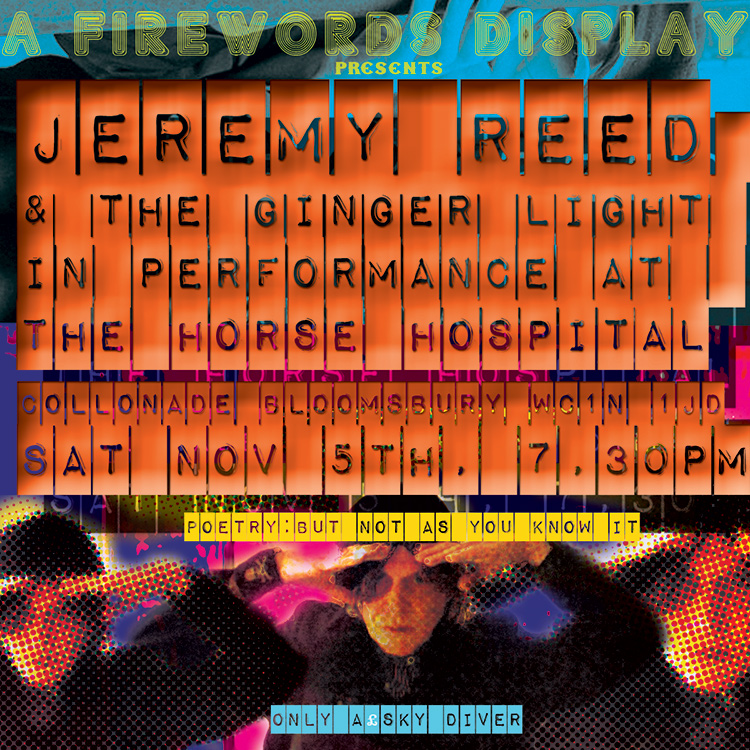
November 2016 – upcoming London gigs – electro-poetryscapes with Jeremy Reed & The Ginger Light at the Horse Hospital (5th)

3 Nov

They might be performing in Bloomsbury , but their heart’s in Soho. You can’t get away from it.

Jeremy Reed & The Ginger Light, 5th November 2016I once started writing a set of time-travelling stories about Soho, and one day I may go back to them. If so, it might be difficult not to write Jeremy Reed into them. Poet locum and unruly novelist, with fifty-odd books behind him, both his work and his person is soused in the atmosphere, possibilities and ramifications of this particularly disobedient district of London. For my lifetime and his, it’s been the haunt of artists, drunks, liars, king-queens, agreeable rascality and disagreeable visionaries. Even in its current state of snarling retreat, slowly losing a civil war against the clammy, sterilizing encroachment of central London gentrification, chain shops and absentee renting, it’s still the part of town where you’re most likely to see an inexplicable marching band or dishevelled unicorn.

A Firewords Display presents:
Jeremy Reed & The Ginger Light
The Horse Hospital, The Colonnade, Bloomsbury, London, WC1N 1JD, England
Saturday 5th November 2016, 7.30pm
information

Dating back to 2012, The Ginger Light is a collaboration between Jeremy and Itchy Ear, a.k.a. Covent Garden loftbird Gerald McGee: an electronic music producer, film buff and keen, self-starting soundtracker who adds spectrally-energised EDM and electronica backings to footage from the likes of brutal nightmare-noir ‘Kiss Me Deadly’, Jean Genet’s steamy men’s-prison reverie ‘Un Chant d’Amour’ and the differently-dreamy 1903 film of ‘Alice In Wonderland’. Working live from a laptop, Gerald complements Jeremy’s word salvos with sound layers too detailed and active to be described as simple backdrops.

Like the poems they lift and wreathe, Gerald’s soundscapes are multilayered time-travel textures: archaeological digs pulling up mongrel music memories from London’s strata of music and broadcast history. Ladbroke grove dub-echoes, Carnaby pop and basement jazz; psychedelic acid-rock distortions from the UFO or Portobello Road. Ominous Throbbing Gristle reverberation and corrosive washes from the old Hackney squats. Floating ghostly sound effects, like snippets of radio drama caught on a forty-year rebound.

As for Jeremy, he plays his own role to the hilt. Blurring confessor and transgressor, impressionist chronicler and flagrant charlatan, he’s a figure of arch and wasted glamour, as if Quentin Crisp had woken up one morning transformed into Jim Morrison. A Soho fixture since the mid-’80s, he’s a onetime protege of Francis Bacon; hailed as the real poetic deal by past literary titans (Seamus Heaney, J.G. Ballard and Edmund White – two of whom compared him to Rimbaud and one to Bowie’s Thomas Newton, the Man Who Fell to Earth) and by living pop-poetry shapers (Bjork, Richard Hell, Pete Docherty).

He delivers his own poems in a voice like London sleet – a heavy-lidded, lead-cadenced drone; lisping and compellingly monotonous, burnished by rich and antiquated RADA tones and by a seething incantatory Peter Hammill flair. In the psychic autopsy of talent’s fragility in ‘Soho Johnny’; you can detect echoes of the Beats and of the exploding perspective of the ‘60s; in his calling-up and collaging of spirits including Derek Jarman and Jack the Ripper, those of cut-up broadsheets and psychogeography; in his accounts of shoplifters and dissidents adrift in the changing junk-raddled backwash of city trade, commerce and exploitation, there are looming narcotic Blakean myths.

A career-long celebrator of the transgressive, ignored and cast-aside, Jeremy’s becoming not only a poet locum for Soho, but something of a genius loci: declaiming the neighbourhood’s crumpled, contemplative, spontaneous amorality like the last pub-bard standing. In consequence, he himself seems to be succumbing to being fixed in time, representing qualities being swept away as Crossrail opportunities and predatory investment force them out. Like the Wood Green soiree happening the previous night, he’s edging towards becoming one of those fragile something to enjoy while you still can. Here he is, rouged and alert, alongside Gerald and delivering a Ginger Light performance earlier this year: keeping the vision breathing.


June 2016 – upcoming gigs – three peeks into Durham’s Empty Shop – As Ondas,Year Of Birds and mystery guests (14th); Heir and Rebekah Fitch (15th); Captain Chaos, Chrissy Barnacle and Mama Lips (20th)

12 Jun

Being a Londoner might well give a person readier access to a wider day-to-day world than someone in a smaller British town (and you can read the same for anyone in a world city anywhere), but it also allows that person to become ignorant in the finer closer details, closed off from the simple knowledge that people in quieter places still come up with, or strive towards, interesting things. Part of what I’m doing with myself this year is actively trying to shed some of those blinkers, looking around outside the slew of London gigs I post about to find out what’s going on elsewhere.

Despite hearing about a longstanding enmity between “town” and “gown” in the city, I hadn’t made the necessary connections between Durham, economic poverty, commercial collapse and underground culture; probably because I’ve only previously swept through the town on the East Coast Main Line en route to Newcastle or Edinburgh, admiring the cathedral and the university castle from the insulation of the viaduct. (Like I told you. Londoner. Just plain ignorant.) If at some point I’d got my complacent arse down to street level and asked around, I might have found out more. Behind the mediaeval heritage prettiness and pleasant prospects there are indeed the same kind of economic problems which worm through the country as a whole and gnaw the north-east in particular. There are businesses failing and boarding up, and people becoming reduced to relying on food banks; there’s a sense of community which might dissolve under hunger and the decay of opportunity and moribundity; there are people whose lives might just peter out into a broke greyness; and none of this can be solved simply by proximity to a couple of World Heritage sites.

This is where the Empty Shop organization have come in during the last decade, making a local attempt to address the problems. They’re non-profit, aiming to make enough money to sustain a lively local arts culture and provide the platform for it to thrive. They also aim to make a thrifty, practical use of existing facilities instead of splurging on showcase showoff developments: their concerts, theatre and film shows, exhibitions and other events are housed in buildings which have fallen silent or empty, thereby ensuring that those places don’t fall into decay or become a town centre like a strip of dead teeth. Their gig calendar, too, is littered with events which raise collections for food banks: benefit shows which don’t sell themselves as such, since benefits don’t have to be special events but can be living, breathing regular exchanges of community resources, part of the fabric of being connected.

I’ve got three of this week’s upcoming Empty House gigs listed below – a punky sandwich with a surprisingly plush pop middle. I’m sure they’ll be the first of many which I’ll be flagging up in the future. For what it’s worth, both of the Equestrian Collective shows (the punkier ones, with perhaps a broader DIY communitarian ethic to suit) are food-bank all-age events.

* * * * * * * *

Equestrian Collective presents:
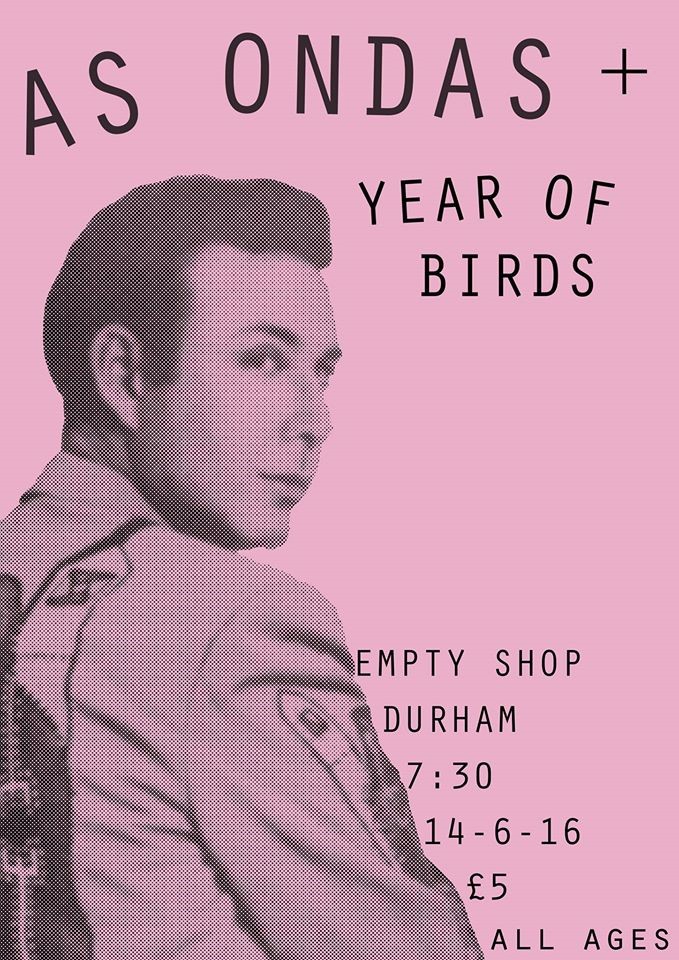
As Ondas + Year Of Birds + t.b.c.
Empty Shop HQ, 35c Framwellgate Bridge, Durham, DH1 4SJ, England
Tuesday 14th June 2016, 7:30 pm
– more information here and here

As Ondas/Year Of Birds, 14th June 2016As Ondas‘ press release is essentially just a mass of pop-culture fibs, which tells me that they don’t take a complicated reputation seriously and that they’ve got one eye on the possibility of jamming themselves into evenings of campery and frills. Buried in the waffle is the phrase “no-wave-surf, trilingual indie band”, which will do, although it doesn’t convey their touch of fun. They’ve got a little lava-lamp shimmy as well as clean punky lines and a surfboard twang; they’re bouncy and lounge-y in the same way that Os Mutantes were, with an elusive, mercurial intelligence in their approach.


Middlesbrough punks Year Of Birds make a few fibbing pop claims of their own (they wrote a third of the songs on Gabrielle’s ‘Rise’… yeah, hmmm…), Instead I can hear bits of West Coast pop, German motorik and a broader psychedelia in their short-order songs. There’s the cyclic two-chord pulse of early Teardrop Explodes for instance (albeit a Teardrops who gave their work a couple of extra spins in a dirty cement mixer) and there’s Syd Barrett – or Robyn Hitchcock – in their precise English diction behind their frontman’s faraway, heavy-lidded baritone and its megaphone distortions. On top of that, they sometimes slip into a discoloured version of that chromium early-Neu! chug and have fluctuating taste for cosmic synth twitters. While none of that makes them Gong-family caperers or dedicated autobahnauts there’s no way that they could hold a bored English punk anomie for more than a few seconds without cracking an eye-twinkle. Their cover of Donna Summers’ I Feel Love (delivered in what’s best described as an ecstatic tannoy monotone) is a small piece of smogged-up Yorkshire wit and Space Dusted joy.


There’s another band on, apparently. There’s no word on who they are. There are rumblings about them having invented fuzzy-felt. If that’s a clue, it belongs to a story or a joke which I’m not in on. Sorry. Show up and see for yourselves.

* * * * * * * *

Heir/Rebecca Fitch, @ Empty Shop, Durham. 15th June 2016

Empty Shop presents:
Heir + Rebekah Fitch
Empty Shop HQ, 35c Framwellgate Bridge, Durham, DH1 4SJ, England
Wednesday 15th June 2016, 7.30 pm
information

How long have Heir been hiding in Leeds, and where did they find a place to hide and do their growing up so secretly? Their debut EP’s only been out since March, their debut single’s barely a year old; but it seems as if they’ve arrived fully matured.

Heir are one of those enviable pure pop bands that covers virtually all bases. Accomplished sophisti-pop recombiners, they’re universal enough to hit Radio 2 playlists, to soundtrack summer picnics and sell bucketloads of records in supermarkets, but they’re still tuneful and dynamic enough to disarm and win over sharper tastes. There’s plenty of quiet-storm emotiveness in those finely-crafted, deceptively simple songs; clever feather-soft steals of space and atmosphere from trip-hop; and there are lessons well-learned from upper-drawer pop-soul, with hints of both Smokey Robinson or Commodores. Best of all are the gorgeous fraternal bursts of bell-like man-harmonies which back up and refract Tom Hammond’s sweet-and-sore lead vocal, right when they’re needed. (Think the Finn Brothers, or Francis Dunnery; but always bring it back to that soul source, of men stretching and basking in the sweet spot between church and itch.)


Sure, enough, the support slots and the BBC Radio plays are already coming their way. Of course, it could all go horribly wrong. Heir might follow a substantial path along the past lines of Elbow (the band whom they most resemble in their gusty Northern blueness) or Deacon Blue. On the other hand we could be seeing them at an early peak before rapid success and co-opting buffs or Barlowises that clear edge and talent; drives it down into frictionless sleekness, into something transient to lube the gaps between acts on ‘The X-Factor’. They might end up putting out no more than a couple of albums before going their separate ways, following many a fine performer in slipping invisibly behind the scenes to write toplines for anonymous r&b stars.

Right now, though, Heir are honed and treasurable. This will be an intimate acoustic show (fine with me, as long as they cheat and keep the Rhodes switched on) and at this point you can still get close enough and persuasive enough to reassure them that they should never swap the joy of singing to people for the staleness of singing to a demographic. Or, if you’re aiming to be a bitter old git, you could go in order to stockpile memories of that time you saw Heir when they still really had it.


Taking the support slot, Rebekah Finch (originally established in Belfast, but developing in Durham) offers her own pop songs. Though she cites Lana Del Rey and Florence + The Machine as influences, both her Hosanna single and various demos suggest a talent that’s both more slippery and more direct, pitched as it is between airy flights of positivity and the quick jabs of doubts and home truths. Well, that often worked pretty well for Stevie Nicks, whose mixture of tenderness and steely force Rebekah seems to be leaning towards; and whose gravel-and-honey tones she sometimes echoes amidst the dabs of soul and gospel. Promising.


* * * * * * * *

Equestrian Collective presents:
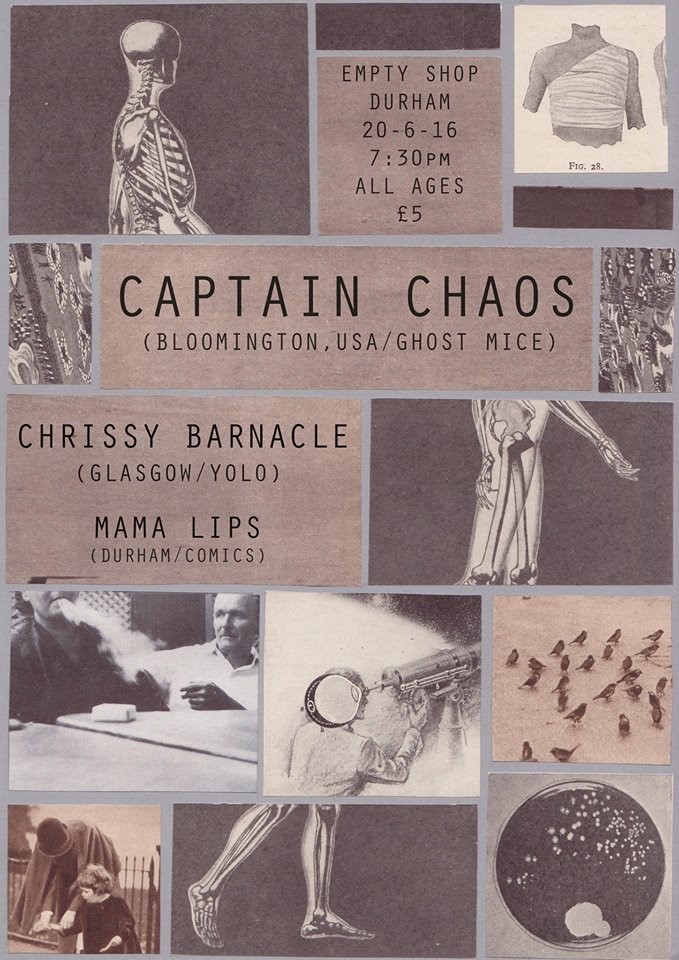
Captain Chaos + Chrissy Barnacle + Mama Lips
Empty Shop HQ, 35c Framwellgate Bridge, Durham, DH1 4SJ, England
Monday 20th June 2016, 7:30 pm
– more information here and here

Captain Chaos/Chrissy Barnacle/Mama Lips, 20th June 2016On the second of the two Equestrian nights, Captain Chaos –a.k.a Plan It X records boss Chris Clavin – headlines. A folk-punk legend, he’s played in more bands than it’s fruitful to list and his particular talent has outlasted all of them.

As he always does, he’s hauled a battered acoustic guitar, a hatful of gawk and a bag of witty, off-kilter songs all the way from his Indiana home and over state lines and seas, to touch down somewhere where he knows he’ll have an audience to share and play with. His songs are shaggy dog tales, or carefully honed stand-up routines in melody and verse with little zingers at the end, or comically gonzoid rearrangements of personal quirks. You’ll laugh at him and with him; you’ll want to buy him bar snacks; you’ll want him to come back.


Glasgow “song weaver” Chrissy Barnacle is still young enough to be showing plenty of influences – in particular Bob Dylan in the propulsive clawhammer fingerpicking and the densely worded lyrical shambles, and early Joanna Newsom in both the efflorescent femininity of her tumbling trains of thought and that yawp in her voice. But give her some more time – starting with some of your own. From what I can hear, she’s still a talent in development; taking a little longer to shake off her first roots, a bud who’s pushing hard to emerge in full.

What’s emerged already, though, already impressive. I just think that there’s going to be a moment in which all of those influences finally come into alignment, something clicks into place and they become integrated rather than transparent. That moment might even be this coming Monday. I guess that I’ll have to keep checking in.


Durham’s own Mama Lips sometimes went under the name of Andrew and mostly writes comics; but she also pens and performs upfront, supportive anti-folk songs for the queer of all kinds and especially the transgendered (as well as for those who empathise with them). Her brand new “Fairy Godmother’ EP is about “surviving in our identities, and our fairy godmothers who take care of us,” and she clearly doesn’t give a fuck about anyone who might sneer at her failure to prioritise bitchiness, snark and irony, since there are more urgent things to concentrate on first. Apparently she has other, raunchier songs in the bag, and if we’re good she’ll teach us about the hanky code. (I was impatient, so I cheated…)


* * * * * * * *

As I said, I’m sure that I’m going to be looking up more Empty House Durham gigs in the future, but there’s enough here already to make me wish that I’d gotten off that train earlier.
 

December 2015 – upcoming gigs, London & elsewhere – the return of Mark Mulholland and Craig Ward in a Scottish village hall; Serafina Steer & Bas Jan at Kings Place; Olga Stezhko in a Staffordshire chapel; and assorted Others cabaret from punk to accordiana with The Bohemianauts and Bad Fractals

6 Dec

The end of the month, and the year, is nigh – so what are we looking forward to this week?

Mulholland, Ward, Sissoko & D'Hoine @ Ford Village Hall, 8th December 2015

Mark Mulholland, Craig Ward, Yacouba Sissoko & Hannes D’Hoine (Ford Village Hall, Ford, Argyll, Scotland, Tuesday 8th December 2015, 7.30pm) – £5.00 minimum – information – tickets on the door

Back in 2012, two wandering Scottish singer-songwriter-guitarists – Mark Mulholland (ex-Two Dollar Bash) and onetime dEUS member Craig Ward – quietly released one of the finest records of the year. A compelling murmur of acoustic guitar folk, ‘Waiting for the Storm’ was soaked in the Scottish and British folk-baroque of Davey Graham, Pentangle and John Martyn but, in its settings of moist heat, tin roofs, typhoons and dark forces, it was also informed by the Haitian setting of Port-au-Prince, Mark’s home for the previous two years. Some of you may remember that I liked it.

With Mark now relocated to Mali and Craig settled in the little Argyll village of Ford, the duo are collaborating on a follow-up (provisionally called ‘The Darkness Between the Leaves’) on which they’ll be joined by Flemish double bass player Hannes D’Hoine – who played the Danny Thompson anchor-cable role on ‘Waiting for the Storm’ – and by Mark’s newest collaborator, the Malian djely and multi-instrumentalist Yacouba Sissoko, a master kora and ngoni player. The quartet have been preparing and recording in a number of different countries, and the end of the Scottish sessions will be marked by a Ford performance both taking place in and raising funds for Ford Village Hall, with prices set on a pay-what-you-like basis starting from five pounds.

In its quiet way this should be one of the gigs of the year, so if you’re in western Scotland and have a free Tuesday evening, consider heading over to Ford (at the south-western end of Loch Awe, north-west of Glasgow, with the nearest substantial town being Kilmartin.) If you miss this one, they’re playing again in Glasgow at 7.00pm on Wednesday 9th; a low-key gig at the Hidden Lane Gallery in Finnieston.

* * * * * * * *

After that – for me – the week doesn’t pick up until a very busy Friday and weekend. Too subjective, probably. Here we go, anyway.

Serafina Steer & Bas Jan (Hall Two @ (Kings Place, 90 York Way, Kings Cross, London, N1 9AG, England, Friday 11th December 2015, 8.00pm) – £9.50-£12.50 – information & tickets

The hitherto independent worlds of contemporary harp music and experimental kraut-pop will collide – or at least bump each other – in this concert of two halves by harpist/songwriter Serafina Steer and her new band Bas Jan.

After a few years of mainly only using the harp for her own writings, Serafina went on a roadtrip around Eastern Europe busking, discovering and rediscovering pieces along the way. The result of this experience will form the first half of the programme, which will feature compositions by Richard Barratt (‘tendril’), Benjamin Britten (‘Suite for Harp’), Stephen Dodgson (‘Fantasy’), Rhodri Davies (‘Aqcua Alta’) and Serafina’s own father Michael Maxwell Steer (‘Grovelly Wood’)

The second half of the show will be a performance by Bas Jan, Serafina’s latest collaborative project in which she plays bass guitar and keyboards and writes minimally arranged songs about the Essex coast, the Anglo-Saxons, sex, part-time work and love; with sound artist Sarah Anderson playing violin and OP1 mini-synthesizer and performance visual artist Jenny Moore playing drums (all three women also sing). Bas Jan’s first gig was to six thousand people at Brixton Academy and since then they have gone on – via support slots for Xylouris White and The Decemberists – to entertain smaller and smaller audiences.


On the same night, one of ‘Misfit City’s favourite classical musicians is spreading her own particular musical gospel up in Staffordshire:

Olga Stezhko (Abbotsholme Arts Society @ Abbotsholme School Chapel, Rocester, Uttoxeter, Staffordshire, ST14 5BS, England, Friday 11th December 2015, 8.00pm)information – limited number of tickets available, phone 01543 263 304 for details

Olga Stezhko, 2015Following up her recent debut performances at both the Wigmore and Bridgewater Halls (at which she performed full or partial versions of her ‘Lucid Dreams‘ assemblage, a programme of music exploring people’s changing perception of reality from childhood through to adulthood), classical pianist and multi-disciplinary thinker Olga Stezhko is bringing her sophisticated, metaphysical perspective and repertoire to the audience at Abbotsholme.

On this occasion, her choice of music is a little more conventional (leaning on well-established favourites by Mozart, Bach and Prokofiev rather then stretching to the Sophia Gubaidulina pieces she was playing last month). However, there’s still room in the programme for work by one of her compositional touchstones, Alexandr Scriabin; and you can be assured that whichever pieces Olga plays will have been carefully thought out and put into context as part of a programme intended to inspire thought and broader conceptual connections as well as straightforward musical enjoyment.

Programme:

Wolfgang Amadeus Mozart – Sonata in B flat major, K.570
Johannes Brahms – Six Pieces, Op.118
Alexandr Scriabin – Two Dances Op.73; Five Preludes Op.74; Vers la flamme Op.72,
John Adams – China Gates
Sergei Prokofiev – Sonata no.4 in C minor, Op.29

* * * * * * * *

Back in London, meanwhile, there’s cabaret afoot, plus breathless press releases.

Bad Fractals vs Bohemianauts @ The Others, 11th December 2015

The Bohemianauts + Bad Fractals (Bohemiocracy @ The Others, 6-8 Manor Road, Stoke Newington, London, N16 5SA, England, Friday 11th December 2015, 8.00pm) – £8.00-£10.00 –  information & tickets here and here

An epic face-off between two amazing, unique and bizarre bands.

Bad Fractals are shaman gangsters shooting bullets of love, tearing their way through acid punk, malevolent music hall and trailer-trash blues in a world gone mad. Join us at the crossroads, in a theatre of the absurd: hear story and song shift with the wild wonder of fractals! Watch psychedelic punks get drunk with clown kings! Glare at artificial angels dancing with deadbeat demons! Gasp as astral travellers gather in galactic taverns!

The Bohemianauts are decadent divas of demi-monde carnivalism, playing weird waltzes, pithy polkas and rollicking rhumbas: they will take you on a theatrical musical journey through strange landscapes with absurd humour, exquisite noise and songs of unrequited dread. Tonight they will unleash their female alter-egos, as they parade in their geezer-bird finery, performing for your pleasure as the rarely-seen Bohemianauts – Drag-ed on Stage. (Trigger warning: Bearded Drag.)

PLUS – Visuals and projections from Jaime Rory Lucy‘s Rucksack Cinema and half-time performance interventions from Oleg the Mystic.

* * * * * * * *

More shortly…

June 2015 – upcoming London gigs – A Formal Horse & Ham Legion; Olga Stezhko; The Spiders of Destiny play Frank Zappa; a Bowie Night in Soho

29 May

Here’s some quick info on upcoming gigs in early June which I’ve heard about – all of them in London.

Over the last couple of years, Westminster Kingsway College has established itself as one of the capital’s finest homes for quirky art-rock – by which I don’t mean student hobby bands thrown together for campness or for ironic prankery, but a rich, complex, committed electric music spanning the range between gutter-punk and flouncing prog via metal, jazz, folk, avant-gardening and anything else which gets melted down into the stew. Here’s one of those gigs that proves the point.

A Formal Horse, 2015

A Formal Horse + Ham Legion (Westminster Kingsway College, 211 Gray’s Inn Road, London, WC1X 8RA, Tuesday 2nd June, 6.30pm)

A Formal Horse is a new progressive rock quartet based in Southampton. Although the band’s sound is difficult to pinpoint, their dense instrumental passages are reminiscent of King Crimson and Mahavishnu Orchestra, whilst Francesca Lewis’ lead vocals evoke the whimsical surrealism of the 1970s’ Canterbury scene. Wonky melodies and serene vocals over a brutal sound – their music keeps you on your toes. However, A Formal Horse go beyond simply regurgitating the music of their predecessors. With influences as diverse as Bartók and Bon Iver, the band prove that there is still much territory to be explored in the field of British progressive rock.

In June 2014, the band released their debut EP, which was recorded by Rob Aubrey (IQ, Transatlantic). They went on to perform at London’s Resonance Weekend alongside Bigelf and Änglagård, and were described by Prog Magazine as a “festival highpoint”. Since, they have shared stages with Knifeworld and Lifesigns, cementing their position at the forefront of the British progressive scene.

Ham Legion spent 2014 honing their sound and developing a storming live show. You can expect a collision of beaming up beat power pop, grinding metal outbursts, dramatic changes of mood, sudden passages of twistingly epic prog then moments of restrained delivery and somber reflection. They are striking out in 2015 with the release of their debut album towards the end of the year.

Tickets available here – £6.00/£5.00

Olga Stezkho: 'Eta Carinae'

Olga Stezkho: ‘Eta Carinae’

Olga Stezhko (the far-thinking Belarusian classical pianist whose ‘Eta Carina’ album impressed me so much last year) has two London concerts coming up in the first fortnight of the month. The second’s likely to be an all-access crowd-pleaser. Given its charity fundraiser status, I’m not sure whether the first is likely to feature or indulge any of Olga’s intriguing conceptual preoccupations with Scriabin, Busoni, cosmology and early twentieth century consciousness, but even if it isn’t it’s a great opportunity to see a fine musician at work in a grand location.

Olga Stezhko charity piano recital in aid of Friends of the Belarusian Children’s Hospice (St Pancras Parish Church, Euston, London NW1 2BA, Thursday 4th June, 1:15pm – 2:00pm)

Programme not revealed – free admission, donations requested.

EC4 Music in aid of The Prince’s Trust (Barbican Hall, Tuesday 9th June, 7:30pm – 9:30pm)

The choir and orchestra of London-based EC4 Music return for their seventh fundraising concert in aid of The Prince’s Trust with a stirring selection of music from both sides of the Atlantic.

Programme:

Leonard Bernstein – Overture from ‘Candide’
Aaron Copland – Appalachian Spring
George Gershwin – Rhapsody in Blue
Vaughan Williams – Serenade to Music
Leonard Bernstein – Chichester Psalms
Eric Whitacre – Water Night
Hubert Parry – Blest Pair of Sirens

Performers:

EC4 Music Choir and Orchestra
Tim Crosley – conductor
Olga Stezhko – piano
Claire Seaton – soprano
Roderick Morris – countertenor
Thomas Herford – tenor
Adam Green – baritone

Tickets available here – prices from £10.00 – £35.00 plus booking fee.

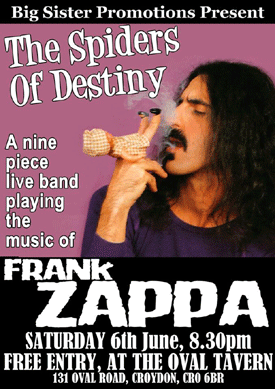
Some of London’s most active art-rockers are brewing up a free Zappa homage in Croydon at around the same time. Details below:

event-20150606spidersplayza
The Spiders of Destiny play Frank Zappa (The Oval Tavern, 131 Oval Road, Croydon, CR0 6BR, Saturday 6th June, 8:30pm)

Great googly moogly! On June 6th, nine-piece tribute band Spiders Of Destiny come to The Oval Tavern to play a marathon set of music by the late, great Frank Zappa. Featuring world class performers with a sense of humour from notable prog/alternative bands such as: Knifeworld, Perhaps Contraption, Pigshackle, Medieval Baebes, The Display Team, Hot Head Show, Poino, Spiritwo, First, A Sweet Niche and more. So polish up your zircon-encrusted tweezers, trim your poodle, learn the mudshark dance and join us as we propagate the conceptual continuity instigated by one of the masters of modern music.

More info here – this gig is FREE ENTRY but there will be a donations jug doing the rounds during the intermission.

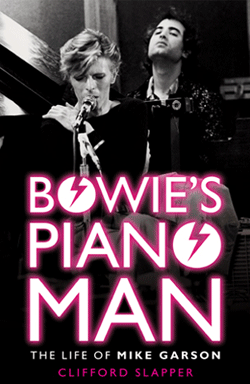
book-bowiespianomanAnyone with an interest in David Bowie, rock history, cabaret, electropop and all of the other things that get swept up into Bowie’s art should head to Soho on Thursday 11th June for A Bowie Night at Gerry’s Club, at which pianist and writer Clifford Slapper launches his book ‘Bowie’s Piano Man: The Life of Mike Garson‘ (which also has its own Facebook page).

As well as readings and signings there will be performances of Bowie songs from avowed fans Danie Cox (from “flock-rockers” The Featherz), Ray Burmiston (of ’80s heroes Passion Puppets), club siren Katherine Ellis (Freemasons, Ruff Driverz, Bimbo Jones etc.) and acoustic singer Jorge Vadio. There’ll also be a performance from a longtime ‘Misfit City’ favourite – London balladeer, Brel translator and onetime ‘Pirate Jenny’s’ host Des de Moor, who’ll presumably be singing his Bowie-gone-chanson interpretations from his ‘Darkness and Disgrace’ show. (I’m particularly pleased to see that Des is back onstage. It’s been a long time.)

More on the book below, and more on Gerry’s Club here.

“It is pointless to talk about his ability as a pianist. He is exceptional. However, there are very, very few musicians, let alone pianists, who naturally understand the movement and free thinking necessary to hurl themselves into experimental or traditional areas of music, sometimes, ironically, at the same time. Mike does this with such enthusiasm that it makes my heart glad just to be in the same room with him.” – David Bowie

Mike Garson has played piano on sixteen David Bowie albums, including Aladdin Sane, with his celebrated piano solo on its title track, Diamond Dogs, Young Americans, 1. Outside and Reality. He has also played live with Bowie on countless tours and shows, and remains his most long-standing and frequent band member.

For some time Clifford Slapper has been working very closely with Garson to write a book which explores the life of this extraordinary and eccentric modern musician. It documents in detail how as a pianist he was catapulted overnight from the obscure world of New York’s avant-garde jazz scene to a close and long connection with Bowie. In addition, Garson is recognised as a classical virtuoso, a jazz master and one of the world’s greatest exponents of improvisation. He has also recorded and performed live with other rock legends such as the Smashing Pumpkins and Nine Inch Nails. All of this is covered by this first ever biography of Mike Garson.

Its starting point was several days of in-depth and frank conversation with Garson himself, and covers a wide range of themes which will be of interest to all Bowie fans, but also to anyone with a passion for music, social history or the process of creative inspiration. Input has also come from many interviews with those who have worked with him over the years, including Earl Slick, Trent Reznor, Sterling Campbell, Reeves Gabrels, Dave Liebman and many others.

event-20150611bowienight

Stumbling through 2014 – a year in flashes and in review (part 2 – the undercurrents)

28 Jan

I’m setting up for 2015 now. Part one of the review of 2014, the musical side, has been written and posted and is being read (if you’ve not seen it yourself, it’s back here). New singles reviews have been drafted and mostly written; blog navigation has been improved (look over to the right and down to see the reworked category and tag clouds); and the thorny matter of scheduling has been addressed. I’m looking into a Soundcloud page as well, for playlists and occasional sound postings. Technically, ‘Misfit City’ should be better this year.

But before that… I’ve got a confession to make.

Recently, I’ve been visualising this blog as a cartoon beachcomber – something gawky and distractable which blends its enthusiasm with pathos. Blundering along the foreshore to see what’s washed up this week, it jams its head into little rockpools to take notes about the small details, and loses track of time. Overhead, the real events roar and rumble in storms which are mostly ignored. Sooner or later, there’s going to be hail; and I’m going to be caught napping.

I’m not talking about me missing coverage on big releases, or failing to ride Twitter trends effectively. Both of these come with the territory of preferring more out-of-the-way artists with less immediate recognition; and also with intermittent blogging around real-life demands of family, work and life outside of music culture. Independent solo bloggers – unless they’ve caught a wave of interest or are particularly good self-marketers – are ultimately small creatures. We’re talented amateurs, in the most positive sense; people whom, if we’re fortunate or persistent, can make our little marks and (as in my case) maybe help a musician to be known and understood and moved a little closer to a potential audience. Small stone markers; pricked-up ears; a little bridge built for people to cross. Those kind of achievements.

What concerns me at the moment is culture-bunker syndrome – when a person hides within a habit of art, closing off the parts of the world which they don’t like (or wish to be disinterested about) by developing an obsessive focus on small creations. This could be external: an account or summary of someone else’s performance or crafted object. It could as easily be internal. Becoming obsessed with one’s own lively, assertive prose or photography, for instance; or with one’s ability to get the word out quickly – to be, for a brief and flashing moment, the medium, as well as simply making use of it. For music writers, some form of this syndrome often becomes habitual and unavoidable. It’s part of the excitement, to the point that you don’t recognise your writing as being a flash-bang which ultimately only explodes inside a very small box.

At the end of the first part of my 2014 review I mentioned that in spite of my initial feelings of having gone through a “shrunken” year, in retrospect 2014 seemed to have had remarkable musical richnesses; also, that the only thing that really seemed to be missing was me. What I meant by that was that however involved with the music I was (and even when I managed to turn out a decent, or even acclaimed, review), I had a parallel feeling of disengagement. None of this was the fault of what I was listening to. None of it related to what eventually emerged and was posted on the blog. Neither did it reflect the many things which I wanted to cover on time but didn’t (or still haven’t).

What it was like… well, imagine that, while you’re working away on a project, there’s something just over your shoulder, not quite peering and not quite looming. Something that’s… there. Perhaps it’s not actually over your shoulder: it’s just that that’s where you expect it to be. The half-recognised key or clue. The bit which you’ve missed. The missing chunks of the puzzle; the provider of the voice which carries the rest of the answer. You feel, sometimes, that you could turn around and take hold of it; slot it in, make a completeness. You don’t really understand what you’ll actually have once you’ve done it. There’s just an itch. An urge to include it.

I concluded, eventually, that there wasn’t actually anything there. What was actually preying on my mind was a gap – something which I myself had allowed to grow, wilfully ducking the significance of why I’d let it happen in the first place. What I was missing was the rest of the world – and the reason why this was important was that the world was violently changing. Plugging my headphones in and looking away, I’d ostentatiously pondered music – going through recordings and concert track-by-track and song by song, meticulously tracing the emotional responses and the drawn-out meanings, and catching and writing down sparks triggered off in me by the listening. Meanwhile, the landscape which I was ignoring was darkening. Almost everyone whom we, as citizens, had put in place or allowed to prosper had at best failed us. At worst, they’d betrayed us or were predating on us.

To many people (including many bloggers and commentators) this is an old, old story, and doesn’t even exist as a dilemma. Protests and counter-action against the iniquities and inequalities of the modern world are already part of their long-standing, lifetime’s battle; and plenty of commentators on music who draw it into their perspective. At the very least, it becomes an integral part of their involvement with the world. In my case, this hadn’t happened for too long, and 2014 was the year when my avoidance of this fact finally cracked.

For me, perhaps, the evasions had been natural and habitual. I tend to feel that hitching music, on principle, to a particular political agenda (and dismissing that which falls outside it (or which fails to fit a particular set of value signifiers) blinkers the vision and creates an urge to provide answers first and then distort the art to fit them. I don’t join political parties for much the same reason that I don’t join churches. For a doubter like myself, the creeds are always too hard to swallow; too often an excuse to comfort and close the mind. There are other reasons. I was too young for the first wave of punk, and too disassociated (also, perhaps, too personally comfortable and accommodating) for the following waves. Also, when I started to explore beyond basic popular music as a teenager I found my way into weird mid-‘70s Vangelis albums, assorted textural boilings, bounding prog epics and post-punk blurrings rather than grinding riffs and blunter challenges. What I mean is that when I dealt with art, generally it didn’t look or sound much like a hammer. In retrospect, perhaps I should have schooled myself in delivering some more telling blows.

I can’t say that I don’t recommend the softer, more textured path which I took; but it was often short on the kind of immediate sociological content that spurs a person into asking certain questions. Having said that, a detailed reading of ‘Misfit City’ will reveal that I’m not exactly apolitical. There’s been coverage of LGBT artists and some outspokenly political musicians such as Ian Crause, Atona and Des de Moor, as well as certain sharper asides in other reviews. That “listening to women” tag which crops up in numerous reviews is also an example of the blog’s political grain – a quiet attempt to redress the male domination and thoughtlessness within the music industry by acknowledging and drawing attention to the women who strive within it as well (be they singers, writers, architects of sound, all three or more).

However, rather than being a good soap-boxer, I’m a good reflector… or an immersionist. Most of the time when I’m engaging with music I choose to gently unzip it and to clamber inside – to experience it through its innards and associations. As an excuse for other disengagements, I don’t know how well this works, but it’s how I’ve tended to operate. The problem is that – in its way – this approach is just as solipsistic or reductive as if I’d tied all of my tastes and my statements to a political stance, and it’s just as reductive. Blinding yourself to the world by hiding away in prettiness (or, indeed, fetishised ugliness) is ultimately not an answer. If you’re not careful, it can become no more significant than slopping some extra gloss onto the decorations.

I should also confess that another reason for my lack of fuller engagement with the world came from the conviction that an over-complex, diverse and dissenting world was impossible to summarise or act upon. Over the weekend, I was reading an interview with the documentary film-maker and audio-visual collagist Adam Curtis which refutes this. Among other things, he comments “I believe that it’s possible to make the world intelligible – however complex and chaotic it is. That is the progressive job of journalism. The other reaction – which is to say, ‘Things are just so complex and unpredictable that you can never make sense of them’ – is, I think, one of the main motors that supports the conservatism of our time.”

Though this statement briskly upends my own comfort zone, I’ve got to agree with Adam. In a national and global environment in which governments, businesses, the powerful and the assertive have rarely seemed so nakedly wicked and corrupt – at least during my own lifetime – my values (and, in many respects, my family) are increasingly threatened, and my stances are changing. Tipping point? Perhaps. All I know is that I feel that keeping silent on these matters leaves a hollow space at the heart of this blog, and that I need to do something about that.

If I am going to head in a more engaged and more political direction, it’s important that I don’t do so under the pretense of heroically filling any yawning gaps in musical and political writing. Even a cursory wander around the blogosphere will reveal the seethe and ferment of existing discourse, all of it surviving quite happily without me. During 2014, many of the hard questions and righteous ragings were already being covered by music-related writers much better suited to the task than I am – among them Neil Kulkarni, Lucy Cage and Taylor Parkes. Alongside the excellent, animated and eclectic criticism which has seen it rise to preeminence in the last few years, The Quietus’ has continued to provide broader reflections on the world. The vigorously argumentative, assertive and punk-spirited ‘Collapse Board’ seeks out debate on just about everything it covers or discovers. Forums blaze everywhere.

Steve Lawson

Steve Lawson

(As an aside, though – it’s debatable that punk culture should always claim the high ground in political and social debate. For several years now, Anil Prasad – the superb ‘Innerviews’ interviewer best known for conversations with prog, jazz and country musicians – has been delivering blistering critiques of the warped and exploitative practices within the record industry, and while he might not have the sheer acid bite of Steve Albini, he’s not that far short of it. Arguably the most continually politicised and socially articulate musician whom I heard from this year was Steve Lawson, best known for family-friendly spacey instrumental loop-jazz and eccentric fashion choices (plus the playful sense of humour that makes him the Ross Noble of virtuoso bass playing). In between releasing three albums, he kept up a stream of online posts and tweets this year which eviscerated inequalities, business hypocrisies both in and out of the music industry, Offline and onstage, wherever appropriate, he’d also put up rather than shut up.

Steve’s role as unlikely advocate (coming from a musical quarter from which few people are expected to have or to express streetfighting social opinions) was also a reminder that this year we lost Charlie Haden, the inspirational jazz bassist – a fearless musical advocate of human rights since the 1960s, and and from a current perspective as square-looking a gent as you could hope to meet. Self-satisfied pop theory be damned. Sometimes style and substance just don’t match up, and the former shouldn’t automatically take pre-eminence.)

End of aside.)

So, where does this leave me? This post could be a blip – just a lumpy expression of personal doubt and responsibility qualms before I pick up the usual threads and carry on as before – or it could be the start of something more involved. 2015 may see a darker blog, or I might simply continue to whistle against the darkness. The outcome partially depends on whether people keep sending me slabs of contextually blank noise music or self-entitled “look-at-me-and-make-me famous” rock gobbets. Speaking for myself, I’d prefer to have something to write about and around, rather than simply write on.

Yet ultimately I’m responsible for carrying out any kind of constructive re-engagement between the world and myself. I suspect that my 2015 is going to be full of missteps and stubbed toes, some of them self-inflicted in public. So it goes. It ought to be worth it. If I’m going to do this, it will have to come from personal effort and personal learning, something which leads towards writing which is more deeply grounded and more expansive than it has been before.

Statement of intent. Let’s see where it goes.

Meanwhile, the ‘Misfit City’ show continues. I’ve got some single reviews to be posted up in the next day or so. I’ve already had some other interesting reviewables come through. Some of them are suggesting questions and ideas which I might like to pursue – not necessarily the questions and ideas which you might expect from reading my musings above, but the kind of questions which at least put a shot of adrenalin into my weary mind and keep me going.

And – to end on a completely self-indulgent note – this is a fantastic-looking piano.
 

The Bogányi piano (photo © Támas Bujnovszky)

The Bogányi piano (photo © Támas Bujnovszky)


July 2000 – EP reviews – The Judas Factor’s ‘Kiss Suicide’ (“a cracked bleed of compassion”)

14 Jul

The Judas Factor: 'Kiss Suicide'

The Judas Factor: ‘Kiss Suicide’

This sticks with me. Unusual. Hardcore punk’s generally a thing of the moment; bringing you alive in the feverish moshpit (or while you’re skulking at the back, trying to listen through to whatever the core of the ‘core is). All that power, that typhoon of ire, just goes through you in a one-dimensional spasm. But under the volume, The Judas Factor (various refugees from Resurrection, Floorpunch, and Indecision) write about souls tender as eyeballs, bared hearts turned to stricken leather, and the struggle for emotional truth within a world drugging and veiling itself into brutal indifference.

 
When Robert Fish – the remarkable split-hearted voice of the band – isn’t roaring his lyrics flat against the ceiling, he murmurs in a cracked bleed of compassion, full of winded pain and the anger that wings across despair. Or he’ll burn up in a cathartic gesture, the distress flare bringing the message home. “Tongue-tied purist, rich in regret, sometimes it’s all I have… / kiss suicide, that look has found life in my eyes… / sad songs never felt so real / tears never felt so good” – although the descending metal storm of Kiss Suicide itself roots Robert’s identity in pure pain, he’s streets ahead of most punk noise-sulkers.

 
He could’ve chosen to stew in self-obsessed frustration. Instead, he’ll take things further, picking over the hope that sets us up (“we all want to be victims of happiness”). Or throwing himself unflinchingly into the loser’s diary of One Fine Day, where the job’s finally done by the bluntest possible tool. “Gun in hand, purpose, clear intentions… / All I ever wanted was control… / Now it’s in my hand… / Never should be, but for one sad second I felt control.” In Safety Net he’s sign-painting, putting up warnings for Bukowski’s camp-followers with the ruefulness of someone who’s been there already. “Human wrecks seem so romantic. / Play out that fall from grace one more time… / all we wanted was to find comfort with each other… / comfort for ourselves.”

 
The rest of The Judas Factor respond with music that fills rooms with rage and loss, led by a thrumming, thunderous bass hanging like a helicopter gunship while guitars paint alarms around it in every shade. And though they can do utterly bone-crushing, heart-wringing power – from the weird grandeur of the mourning thrash that clusters Music Without Person, from foreboding whisper right through to all-too-late nuclear alert – they can still play quiet like a child’s breath. And blend in little glowing samples; little graces of trumpet and heavenly pings swimming up out of nowhere, tiny opalescent Bark Psychosis moments before the mood breaks and jackhammers the heart open again. Even though Robert’s words are torn up in the screaming, clamouring emo-core peaks of anguish, it’s spellbinding.

 
What genuinely makes ‘Kiss Suicide’ a thing of wonder, though, is November 20, 1999, where everything about The Judas Factor falls into perfect place; from the frantic, muted, blizzarding rub of the instruments to Robert’s trembling delivery. A spoken story of lesbian awakening, aching with empathy and foreboding, it takes you (word by passionate word) to the delicious shock at the centre of that long-awaited first love. The one that draws you out of loneliness. And then, standing horrified, we see it forbidden: shattered in a sudden rush of violent bigotry. “You heard their footsteps and you told her to run. You turned around for the fight of your life. You never stood a chance in the world… In our names another life is taken. All because she loved another woman.” Up until then Robert’s kept his compassionate, anguished fury leashed, but finally it lashes out in a woodsplitting scream – “It’s not just words when we speak the same language / It’s not just words when some live life in fear” – as the band roar down like God’s gavel. Indelible force of heart.

 
The Judas Factor: ‘Kiss Suicide’
Revelation Records , REVELATION 92 (098796009222)
CD/vinyl EP
Released:
13th July 2000
Get it from: buy from Revelation Records store or Amazon; download from Google Play; stream via Deezer, Apple Music or Spotify
The Judas Factor online:
Facebook MySpace Last FM Apple Music YouTube Deezer Google Play Spotify Amazon Music
 

October 1999 – album reviews – Des de Moor’s ‘Water of Europe’ (“a cherubic smart bomb of chanson”)

1 Oct
Des de Moor: 'Water Of Europe'

Des de Moor: ‘Water Of Europe’

Like a cherubic smart bomb, Des de Moor has popped up whenever London needs a sniff of wicked European song. In his time, he’s helmed the Pirate Jenny’s cabaret club, fought for chanson and acidic cabaret old and new, or made a public case for tying together songwriters as diverse as Boris Vian, Georges Brassens, Martin Jacques of The Tigerlillies, David Bowie and The Magnetic Fields maestro of puckish gloom, Stephen Merritt.

When Des can fit in an album of his own, it’s recorded in bursts of enthusiasm in between all these other burst of enthusiasm. As with everything else he does, it bears the stamp of that sweep of songcraft and resistance he’s devoted himself to, as he elbows his way into his own niche and into the history of chanson. When “fuck you, I won’t do what you tell me” has become our most famous protest lyric, and our concept of resistance-in-song is measured by the PC-baiting and broody solipsism of Eminem, Marilyn Manson or Wu-Tang Clan, it’s good to hear a dash of genuinely sharp social writing – even if it comes couched in a musical language nearly a century old (which in turn suggests that we might have been missing a lot since we cut those particular stylings out of the popular consciousness).

‘Water Of Europe’ must’ve been recorded for tuppence, and sometimes sounds as if it was lashed together with parcel string. No Dagmar Krause big-budget political cabaret job this, all respectably outrageous and state-concert-hall friendly. It’s sealed and sold on the vigorous punky pocket-orchestra enthusiasm of the players – bumped guitars, cellos, pianos, snapping percussion, Daniel “Boum!” Teper’s accordion.

Des’ voice is the common key – a florid, unusual mixture of madrigal tenor and soapbox preacher; or a grown-up, apostate choirboy in the political thick of a pub argument. It sits at the heart of the de Moor way of working, and is as pugnacious and theatrical as his barbed lyrics. Each word is bitten into shape and flung out with flair. Although most of his music could’ve easily have strolled straight out of the 1930s (Des might have drawn on punk’s assertive spirit of questioning, but he clearly finds more verve and expressiveness in a mix of jazz, folk and cafe singalong), his lyrics are less time-locked. They dig into the dirt and humanity of yesterday, today and tomorrow, exploring themes of exploitation and injustice, politics and deception, war and its wounds, gay life and its hauntings.

Des de Moor: ‘Dirty Pictures’ (preview)

Skidding and acerbic, the punchy accordion tango of Dirty Pictures tears into public figures embroiled in the noisy scams of censorship and social decency, taking forthright aim at their implicit hypocrisy, their encroaching voyeurism and their lust for personal exhibition (“You’ve seen the camera, it’s seen you… / you’ve wanked in front of mirrors too.”) With a sarcastic zest, Des savages the double standard of class and education – “Let middle classes get their kicks: / subtitled sex in foreign flicks / can’t cause infection. / The masses, couch potatoes all, / whose dishes sprout from every wall: / they need protection.” He also spotlights broader horrors for which there’s less willpower for banning (“Pot-bellied children / rooting in rubbish / as food mountains rot; / The obscene, often-seen, / ultimate snuff scene / between have and have-not.”)

Des de Moor: ‘Heart Of A Heartless World’ (preview)

On a more mythological scale, Heart Of A Heartless World (which sounds something like a state-of-the-world take on Fairytale Of New York) takes on the compromised cultures of colonialism, famine relief and the points where they intertwine. Retelling a sweep of human history as a journey from a lost African paradise into a famine filled by suspicious prophets and priests (“vultures that pick at the corpse of the poor”), Des suggests that the journey has bequeathed us a present-day of false hearts, superstition and moralistic humbug where “priests and prime ministers pray for our sins / and mystics on telly guess lottery wins.”

Des de Moor: ‘Margins’ (preview)

Des’ words spit and crackle even when – Germanically – they cluster, fight and split the envelope of the tune. The magnificent Margins (just waspish accordion, Des in marvellously stroppy voice and the bitter backdrop of the Bosnian conflict) jumps out at you, laying waste to the complicity of media and state interests in the parceling-up and selective suppressions of a world in conflict. “Believe what you hear and believe what you’re willing: / a severed head here, and there a mass killing. / We’ll print it provided / it’s clearly one-sided / and something is left to the margins, / at the bottom of the page in the margins.” In this song, little escapes the de Moor tonguelashing – not the journalists who “roam far and wide collecting tales of atrocities / from regular soldiers and mercenaries” and not the conferences that re-order things, ratifying the mess the way the biggest powers want it. Certainly not the scapegoating stories that thrive “so long as they’re hearsay, undated, / uncorroborated / and blame the right side… / We’ve forgot the Ustashe and found the new Nazis / in Belgrade this time.”

A debt to the history of chanson and folk is paid via a handful of gutsy covers and interpretations. Terry Callier’s Ordinary Joe is one, boasting gloriously hooded trombone from Dave Keech and a guarded, evasive street philosophy – “Down here on the ground, / when you find folks are giving you the runaround, / keep your game uptight / – and if you must, just take your secrets underground.” A rough’n’ready, guitar’n’free-verse declamation of Brecht and Eisler’s To Those Born After (An Die Nachtboren) is another, exploring the crummier details of toiling in the revolution. “I ate my dinners between the battles, / I lay down to sleep among the murderers, / I didn’t care for much for love / and for nature’s beauties I had little patience… / Oh we, who wished to lay for the foundations for peace and friendliness, / could never be friendly ourselves… / In the future, when no longer / do human beings still treat themselves as animals, / look back on us with indulgence.”

Des de Moor: ‘To Those Born After’ (preview)

Most impressively, a new translation of Jacques Brel’s My Father Said polishes Des’ claim to be the best English-speaking Brel interpreter – in either sense of the word. The song explicitly links Britain and Europe: a legend of kinship, of severance by high North winds and high water (both brought to musical life by Kev Hopper’s magnificent solo on musical saw), and of humanity blown before the rough and beautiful forces of nature. “The earth was rent / between Zeebrugge and the cliffs of Kent: / and London’s left cut loose and free, / with the Bruges headland taunting the sea. / And London’s left to forever be / a suburb of Bruges, lost in the sea.”

Des de Moor: ‘My Father Said’ (preview)

My Father Said stands as a counterweight to Des’ own Water Of Europe itself – another exploration of kinship. Here, Des places himself on a fantastical odyssey of his own, sending his thoughts out from Britain and around Europe. He finds first an island, and then a continent, locked in a common defensiveness and an ugly sense of purity. Each exploits “the Other” but denies them harbourage – “If they desire a water of Europe / it is the cold grey sea that divides. / Or the deep and inviolable water / taking and making sides.” Against this he calls on the forces and floods of history, hoping for the day when “truth decontaminates water supplies”, and “the fracturing chains of the workers of Europe / have strangled the boy with his thumb in the dijk.” Whips snap, castanets rattle, accordions and guitars throw punches. There’s going to be a party out there when the storm breaks.

Des de Moor: ‘Water Of Europe’ (preview)

Some of Des’ gestures aren’t carried nearly so well. However musical he is, he’s a man of words first and foremost, and this can mean that in his forthright sincerity the songs scramble across an imbalance of text and melody, like a flapping banner dragged by the wind. In the squabbling, tricky surveillance satire of Big Sister, for instance, his voice drowns in his densely-packed lyric: “More cameras than Hollywood, more tape than Scotch, / more logs than Canada, much more to watch… /I am your friend in the fight against crime. / Won’t you be safe when I’m there all the time – / minding your kitchen and minding your bed, / and, for extra security, / minding your head?”

Des de Moor: ‘Big Sister’

The Fairground Attraction swing of Grandmother Was A Hero, with its perceptive picture of human flaws, also should have been better as a standalone song. Over-pressured by words, it lacks smoothness and poise. Yet if you can accept that Des’ prime aim is to get his tales across, it has a lot to offer. Weighing up his monstrous grandmother’s peacetime behaviour, Des offsets it against her tireless protection and concealment of refugee Jews during wartime. “She didn’t have much wit or grace, / nor brains in large amounts. / But Grandmother was a human / and being human counts.” In telling her story, in a voice and lyric that build, ebb and resurge through a complex knot of anger, admiration and pity, Des finally arrives at solidarity, and presents his memorial:

“Just think how it must have been / as a hausfrau in poor Holland when the Wehrmacht goose-stepped in / With a husband that you hate, but there is nothing you can do: / It’s an emergency situation, and your man’s your comrade too. / In that fearful hunger winter when all your two kids have to eat / is potato peelings, pea pods and the snow from off the street – / and they’re handing out the yellow stars that one by one blink out, / and you know you have to help them, and there is no time for doubt. / Until the Gestapo knock on your door, and you find yourself alone / and in the settled dust you’re just a German widow / far from home.”

Des de Moor: ‘Grandmother Was A Hero’

Elsewhere, a loose trilogy about workers in London merges a realist’s acceptance with the strong protest of an angry survivor. In Avocado, Des examines the gritty detail of the kitchen worker’s desperate struggle between hopes and exhaustion – memories crumpled in the heat and hubbub, but not yet devoid of the sting of style. In doing so, he etches a picture of life of triumphs and traps. “Choose a plump, ripe avocado, just like on your first exam / at a college back in Glasgow. Stop the memories if you can. / Take that plump, ripe avocado, slice it with the sharpest knife, / Smile and summon your bravado: it’s a cold, raw kind of life.”

Des de Moor: ‘Avocado’

In Joey’s Dreams, Des delivers a rock song turned back into seething left-wing folk ballad, the story of a gentle working bloke who’s gradually ground into resentment by hard times and defeat – “a beast that’s pacing in a pen / at the edge of a feast for rather richer men.” He goes on to trace how resentment leads to poison, and frustration to an ugly fall, shading it into a larger picture of a caste crushed down from honour into malevolence. “Joey’s cramped contractor’s terms, / that force his crawl among the worms, / create a breeding ground for germs: / opinions that the world confirms… The clots of rot clog up each bend, / the queues for casualty don’t end. / You can’t believe in your MP – now Joey’s voting BNP.”

Des de Moor: ‘Joey’s Dreams’ (preview)

Beyond these small fierce sketches, there’s the fractured battlement of Sleaze City. Des takes an uneasy stroll through his beloved south-east London, past strangled docks and thriving bailiffs, sniffing and frowning at the muggy wind of corruption shrouding Westminster even as homeless beggars huddle in sleeping bags, a stone’s throw away over in the Strand. Throughout, a sweep of history – compromise, an age-old London scrabble and a sense of loss – provides depth. “At Surrey Quays, saluting the seas / sets flags bobbing. Along the shores ex-stevedores / watch gulls mobbing… /The last leaking hulks have long furled their sheets / at Woodpecker, Evelyn, Crossfields and Pepys…. / There’s whole careers / in chasing arrears, still shivers / though shirts are soaking. / Sleaze City’s choking / in the ozone.”

Des de Moor: ‘Sleaze City’ (preview)

For more personal struggles, there’s Sharp Contradictions and Last Orders Please. On the former, Julia Doyle’s double bass and David Harrod’s needling piano pick out itchy broken harmonies like the stab of toothache. Des anatomises the terrifying wonder of a fall into love, like an attacking scalpel or virus winding to the very centre of a person. “Alive and kicking, awake, aware / with a billion lights that sparkle and flare / in the brain above. / But put in the knife and start to twist – / the lizard hisses and lashes a fist. / The world goes runny when you get pissed. / And then there’s love.” Surreal spiraling rhymes paint the upheaval, with a dark coda of sombre feeling – “And it is the time I spend sinking / that sharpens and tempers my thinking. / And it is this feeling you give / that reminds me just how much I live.”

Des de Moor:’Sharp Contradictions’ (preview)

In contrast, Last Orders Please is a death song of the kind you get only in cabaret, filled with defiance and fear. It’s also the only outright gay song which Des has allowed himself for the record; overshadowed by the horrific harvest of AIDS, the hollowing, slithering sense of time passing too fast and too hard, and of youth becoming a strange, sinister and heartless territory. “Now I’m older, Death is a young man, not the skull-faced spook from ‘The Seventh Seal’ / but a bronze Adonis with eyes as blank / as a half-filled diary’s empty pages.”

Des de Moor: ‘Last Orders Please’

Yet although the song starts in a rumble of melodrama, it bursts into a fiery salsa – “At close of day, there’s burning rages / for a hundred loose ends, / for the lovers and friends, / for the wind into which we were pissing / when we never knew what we were missing, / for the might-have-been, could-have-been, never-was life we’ve been living.” Des has the energy – and more – to spit out a last rallying call for the scared and threatened: “We’ve nothing to lose in the trying. / If life is a bitch unless you’re fucking rich, / no wonder we’re frightened of dying.”

The bloodstream of folk music also harbours germs of resistance. Des de Moor’s very much part of that particular flow, provocatively pumping heart and all.

Des de Moor: ‘Water Of Europe’
Irregular Records, IRR038 (5036265000078)
CD-only album
Released: 22nd September 1999

Buy it from:
Irregular Records (or Amazon).

Des de Moor online:
HomepageFacebookTwitterMySpaceLast FM

January 1998 – album reviews – Mark Eitzel’s ‘Caught in a Trap and I Can’t Back Out ‘Cause I Love You Too Much, Baby’ (“its songs, voiced in a spare fatal music pitched between Robert Johnson and Nick Drake, increasingly illustrate a life close to an exhausted edge”

22 Jan

Mark Eitzel: 'Caught in a Trap and I Can't Back Out 'Cause I Love You Too Much, Baby'

Mark Eitzel: ‘Caught in a Trap and I Can’t Back Out ‘Cause I Love You Too Much, Baby’

It’s almost unbelievable to think that Mark Eitzel has left San Francisco. American Music Club’s former frontman seemed umbilically tied to the city where manifest destiny unravels on the edge of the continent, whose battered and crumbling communities of survivors – whores, AIDS victims, blown-out drifters slipping off the Dream – inhabited his heartwracking music, and fleshed out the nagging sense of dislocation and struggle that’s marked his life both in and out of song. But leave it he has, settling in the sharper climes of New York City.

Exchanging the Bay for Times Square seems to have lent his work an East Coast leanness. Now Eitzel’s songs exist in a flat, pressed-out space, far removed from AMC’s rich troubled orchestrations, or even from the jazz’n’torch-toned crooner feel of his ’60 Watt Silver Lining’ solo debut. Sometimes more acid is etched into a song via a bleak, distant bilous buzz or splurge of electric guitar (from former Cramp/Bad Seed Kid Congo Powers – the hollow roar of an empty belly at 4 a.m. A couple of songs are hammered home with bass and drums, courtesy of various Yo La Tengo-ists and Sonic Youth-ers. But most often it’s the man himself alone. Tumbles of bleak, dirty imagery which Eitzel’s cracked, scuffed baritone (sometimes horrified, most often seamed with the scars of painful living) releases over the tangled patterns of the acoustic guitar he fingers as if it were a crown of thorns.

Previously, in the transcendent sadness of AMC songs like Blue & Grey Shirt or Will You Find Me?, this recipe included beautiful compassionate tunes which yearned and reached towards something beyond the earthbound and betrayed. ‘Caught in a Trap…’ (which actually predates ‘West’, Eitzel’s gentler but underwhelming ’97 collaboration with Peter Buck) makes few attempts to sweeten the bitter brilliant pills of Eitzel’s words. Its songs, voiced in a spare fatal music pitched between Robert Johnson and Nick Drake, increasingly illustrate a life close to an exhausted edge.

If it isn’t quite Eitzel’s ‘Pink Moon’, it comes near enough in its cryptic fatalism – though his image of a barfly Santa Claus pursued by wolves on Xmas Lights Spin suggest it might be his Hellhound On My Trail. Eitzel’s surreal yet bitingly direct lyrics spin past in a tattered blur of clown suits, heavy air, butcher’s shops, paralysed snowmen and the inevitable cheerless bars – sort of like Jean-Paul Sartre as a battered folk singer, trapped in a junkshop haunted with the tracings of hopes and dreams.

 
Importantly, though, it’s not a question of self-pity. Are You the Trash addresses a hapless somebody lifted and dumped by a seductive other (“Evil wears a big smile, evil loves your mind, evil gets what it wants, evil leaves you behind…”). Yet it acknowledges our own capacity to play out our victimhood – “Even when he hurts you, well, it all seems okay. / His beauty is always beyond you / and somehow always gets in the way.” Years ago, Eitzel reminded us that “bad habits make our decisions for us.” ‘Caught In A Trap…’ deals with what happens when those habits become a way of life, as they have for the lost souls he’s sketching when he sings “most people want to inhabit their lives like ghosts and drift from room to room, / and brag about what imprisons them, and wait for the sweep of a broom.”

 
This time around, it’s more of a warning. On Auctioneer’s Song your heart can pull skywards like a balloon, but at the price of being as loseable, likely to find all of that lift someone else’s careless hot air, while callous smiling figures prance in to move the world on around you. Whoever’s narrating the drained Bob Mould-ish Cold Light of Day, wrapped up in ice-storm guitar, is frighteningly isolated – lurking in “the darkest part of the trees” or “five fathoms down”, determined not to hurt anybody but in constant fear of discovery. Queen of No One seems to be a portrait of a gay bar filled with scared men unable to find courage even on their own turf, as if frostbite had suddenly scarred and paralysed them at the humid peak of their Mardi Gras.

 
While in the past Eitzel might have railed against these little stagnations, now he’s considering them with a new eye. As prompted on the otherwise exhausted Goodbye: “Seeing eye dog on the end of its leash says ‘how can you live without trust?'” Often the best decision seems to be to close things down with as much grace and acceptance as you can. One song, with a hushed dark finger-picked melody mixing seduction with warning, sees Eitzel left behind, watching his companion travel solo on a collapsing funfair ride and concluding “If I had a gun, I would seal my fate with you… / I would give you your freedom.” Maybe it’s suicide or murder he has in mind, maybe a death pact or an escape, but you know that given the power he’s going to make some decisive gesture, simple and final.

And the need for this becomes heartbreaking in Go Away (the latest in Eitzel’s vein of harrowing songs about his doomed muse Kathleen Burns), during which Eitzel seems to be pushing with both palms and a stricken gaze, trying to tap the strength of his towering love into one last desperate attempt towards freeing his lover into an uncertain redemption: “I know you’ve got a plank to walk, I know you’ve got a kite to fly.” The knowledge that you’re going to have to strip yourself away from someone for whom you can do no more – or whom you simply hinder – is far harder than a simple thwarted love. That’s the place where everything slips out of both your grasp and your tread – as Eitzel sings “my touch just makes you draw / farther and farther / and farther away.” And it’s no wonder that the way he’s howling the title in the chorus finds him stuck on the hard place between searingly selfless compassion and blind, wounded resentment.

 
At least he’s seen a few ways out of the trap. On Atico 18 things have got to the point where cynicism manifests as an aimless couch-potato snake haunting the living room, but even as it grumbles in the corner, it’s lost its power. Eitzel’s already ignoring it: “the only love you’ll ever know is to look beyond the things you know.”

By Sun Smog Seahorse (which also made a showing on last year’s rare-as-hen’s-teeth, fans-only album ‘Lover’s Leap USA‘) he seems to have reached a point of peace. Squinting up throught the fog into a sky that finally seems benign in its indifference; screwed-up eyes and relinquishment, a rope that “ties it up, delivers it home.” It feels like a suicide abandoned – one which has been lost to a day’s acceptance. Redemption in the ability to let go, to blank out of it for long enough.

Mark Eitzel: ‘Caught in a Trap and I Can’t Back Out ‘Cause I Love You Too Much, Baby’
Matador Records Ltd., OLE 179-2 (7 44861 01792 9)
CD/LP album
Released:
20th January 1998
Get it from: on general release.
Mark Eitzel online:
Homepage Facebook Twitter MySpace Soundcloud Bandcamp Last FM Apple Music YouTube Vimeo Deezer Google Play Pandora Spotify Tidal Instagram Amazon Music
 

July 1997 – album reviews – The Geraldine Fibbers’ ‘Butch’ (“a uninhibited maelstrom of ferocious guitars that lash like electrified hair… black humour in spades, but the Fibbers’ brand of fucked-up country keeps the ravaged heartland heartstrings and sour juice intact”)

3 Jul

The Geraldine Fibbers; 'Butch'

The Geraldine Fibbers; ‘Butch’

Various riot-on grrls and drama queens, once they’ve tired of punking up girl-group lisping, like to play with those oh so challenging images of junkies and whores. Well, good luck, kids. Play nicely. But while you try on the roles like they’re attention grabbing prom dresses, Carla Bozulich has genuinely Been There, Done That during her own harrowing past. And she’s brought back a mass of bone-breaking songs with her on her voyage back from the brink. And her band, The Geraldine Fibbers, bring them to life the way a flamethrower brightens up, oh, any social gathering where plenty of flammable frills are clustered together. Wake up time, you pretty things.

Oh yes. See them run for cover.

Whoever’s heard the previous Fibbers album, ‘Lost Somewhere Between the Earth and My Home’, will have an idea of what to expect. Except that ‘Butch’ is to its predecessor what ‘Nevermind’ is to ‘Slippery When Wet’. Maybe it’s the recruitment of new guitarist Nels Cline, or maybe it’s just Carla finally diving full into the fray with both feet; but ‘Butch’ is a uninhibited maelstrom of ferocious guitars that lash like electrified hair, bass that booms like an iceberg smacking up the side of the Titanic, spasms of frenetic voodoo drumming and Jessy Greene’s violin flaying the skin off any ear that’s left unflattened.

Oh, and Carla’s voice. Emmylou Harris channeling Diamanda Galas doesn’t come halfway to this. As sharp and as powerful as a swung shoulderblade, as pointed as a knitting needle driven through the brain. The raw power of someone who’s lived through enough not to give a flying fuck about what anybody else thinks.

 
Of course in Fibberworld the fucks are probably flying. Like fists. Airborne, fast, rolling over; brutal, biting, clawing like rabid eagles. Sex permeates this album like river water in Ophelia’s bridegown, and while there’s a wild exhilaration to it, it’s never far from violence, meted out by Carla herself or by one of the other stark shadowy characters who ripple through her songs like sharks in a blood trail. There’s been nothing like this since that crack of psychic thunder that was the first Throwing Muses album twelve years ago. And if you’ve always missed that original, wantonly possessed Kristin Hersh since she mellowed into first a college rock icon and then an eldritch acoustic housewife, Carla beckons with a sharply bevelled fingernail and a mouthful of mercilessly shredded woman-words.

You think “Muses”, you think “X”; you think “Hole with talent instead of just posturing”; you think “early Velvets on nightmare acid, and with Nico convulsing out of that Teutonic cool for once.” And you also think country music, which soaks the fabric of “Butch” and ferments their Los Angeles punk hearts. But this is no joker’s cowpunk. It’s got black humour in spades, but the Fibbers’ brand of fucked-up country keeps the ravaged heartland heartstrings and sour juice intact.

Folks Like Me’s wooden, honky-tonk four-four has the inevitable slippery lap steel and plaintive weave of fiddle, the queasy bends of guitar and voice. But this is a tale of life off the highways, in the darkest and most twisted woods: Tammy Wynette via ‘Deliverance’ and ‘Angel Heart’. This time, the woman who can’t stand by her man comes of strange and sinister stock (“My heart wants to remain what I’ve become… / There’s no word for this where I come from”) and she knows that the idyll must end before her own blood catches up with her: “Your Lord knows I don’t want to leave here. / I’d like to stay in this little house and provide for you / and if I knew I’d only be risking my own life, / I’d stay until they came and struck me dead, / but I couldn’t stand to see them hurt a hair on your sweet head…”

 
Pet Angel gives us an American Gothic waltz with lyrics infested by wild wood romance and ‘Twins Peaks’ owls: “You cradle my body in sweetness and warmth, and a sweet wind blows through the trees… / The rain cracks the sky like tears of joy… makes mischief in her hair.” Love and death are inextricably combined (“You are my sunshine, I pull the drapes shut tight. / It’s curtains for you, goodbye. / The cat’s in the bag, the bag’s in the river, / the river makes me cry”), and out here, murder’s as natural as prayer: “To you, to you, straight up to you, / into your charitable hands/ Take care of him, Jesus, I know you’ll do what’s best / Lay his wicked soul to rest.”

 
Carla’s worldview is nightmarish, constantly under attack, with even the sun joining in with the warfare – on California Tuffy, she announces “a ball of light comes down / to bite me on the ass, the legs, the breasts / I’m falling from my nest.” And the answer is a swipe back with all the claws out, claiming “Yes I am just a tart, a heart on stilts. / Pick the flower and it will wilt, / to die in bliss, for a greedy lover’s kiss” before stinging back with a flail of electric noise and “you will never get my heart.” Toy Box is brutally, near unbearably graphic, a hall of distorting mirrors and wartime dispatches from the sex trade – “My shell on top of your knotty fist / with a speculum shoved up my cunt after hours… / For one lousy minute she felt like a queen. / I stand her naked at attention. Is this my only skill?”

 
Then there’s the metal hammering of I Killed the Cuckoo, as guitars screech, text goes through the mincer, fate and conflict body-slam in illegible shards. “The clock is dead for once and for all / until the next time I run in with you… / Lay me lower than I prayed for sweety heart… / In the end you crash into a milk truck. / I can see it in the tea leaves: you’re fucked.” In Arrow to My Drunken Eye there’s a flicker of incestuous horror in the warning “don’t be caught with your nightie mussed / and if you are questioned don’t tell them what we’ve discussed.”

 
Maybe it’s for respite from the rage, but scattered through ‘Butch’ are doorways to elsewhere as the band sink the odd claw into the avant-garde. There’s the drowned fairground ghosting of Heliotrope; or the venomous ambient murk enveloping Claudine’s New Orleans lurch, full of knuckly hideous life, like facehuggers trying to clamber out of a gumbo. And there’s a blood pulsing, amyl nitrate cover of Can’s You Doo Right – enough to scare the gloves off Holger Czukay and have aseptic contemporary Krautrock boys bricking it en masse.

https://youtu.be/TkMLiRV3r2

 
However, it’s always Carla’s songs that snatch the attention; and rightly so. Here’s a reckless and merciless imagination at work, exploring the fragility of an ageing drag queen on the title track (“pushin’ thirty five under an answer blanket”) who’s “always a much prettier bird than any old girl bird… / Shades of light green, deep blue and just a touch of rouge / It’s funny how easy it is to lose / And all you’re left with is chaos and a dirty face.” Or diving into chaos with Seven or In 10 as she explodes around the body of a enemy lover, abandoning control and bringing down a foe with her: “I’ve gotta little trick for you. / I can split in two / or in seven / or in ten / little friends on whom I can depend… / We told you not to get inside our head or in our bed. / You wanna own this dish so you can eat it any time you wish… / Not so fast, fucker!”

 
But even as Carla delivers a full on primal punk scream of “you might think I hate you!”, she offers us no straight answers. Well, there aren’t any. Part of the impact of ‘Butch’ is that whatever Carla’s had to go through, she’s now so well adapted to it that you can’t imagine her living away from it. The world’s often built on chaos and violence; Carla’s found out more about that than most; and she’s now too much a part of it to ever escape. But if she’s ambiguously intertwined with the hand that beats, she’s also biting it ’til it bleeds.

 
Roll up the sunroof, mount rocket launchers on the beach buggy and hit Venice Beach with your anger clenched in your fist. Run down any fucker that gets in your way. It’s a sun ripped jungle out there, full of dangerous fruit. California dreaming will never be the same again.

The Geraldine Fibbers: ‘Butch’
Virgin Records America Inc., CDVUS 133 / 7243 8 44629 2 5 (724384462925)
CD-only album
Released:
1st July 1997
Get it from: (2020 update) Best obtained second-hand or streamed.
The Geraldine Fibbers online:
Homepage Facebook Twitter MySpaceBandcamp Last FM YouTube Vimeo Deezer Pandora Spotify Amazon Music
Additional notes: (2020 update) The Geraldine Fibbers split up after ‘Butch’. Carla Bozulich and Nels Cline went on to form Scarnella; more famously, Nels eventually joined Wilco. Carla now has a solo career as well as working with her band Evangelista.
 

May 1997 – album reviews – Mark Eitzel’s ‘Lovers’ Leap USA’ (“contains some of Eitzel’s best songs and some previously unseen directions for his art… a half-baked masterpiece”)

30 May

Mark Eitzel: 'Lover's Leap USA'

Mark Eitzel: ‘Lover’s Leap USA’

Culled and scraped up from Mark Eitzel‘s demo drawer in order to finance touring, ‘Lovers’ Leap USA’ is not exactly the album we’re hoping the former American Music Club frontman will make. In fact, most of it is apparently outtakes from Eitzel’s actual forthcoming album (which rejoices in the catchy, cheery title of ‘Caught in a Trap and I Can’t Back Out ‘Cause I Love You Too Much, Baby‘) plus what sounds like his final San Francisco demos (with AMC’s multi-instrumentalist Bruce Kaphan fleshing out the sound). Not always to Eitzel’s satisfaction, as he’s urged us to skip the first two “really awful” tracks. Well, he’s always been his own best publicist.

In spite of Eitzel’s deprecations and the album’s unpolished, occasionally sullen state (effectively, it’s a scrappy bootleg), ‘Lovers Leap USA’ contains some of Eitzel’s best songs and some previously unseen directions for his art, making it something of a half-baked masterpiece. Some songs – What Good is Love, The Big House, Have No Words – are little more than straight acoustic skeletons, on which Eitzel’s singing is either mesmeric or painfully flat and jumbled. Some (such as Leave Her Alone) sound more like exhausted Arab Strap trudges, with a drawerful of industrial grind muddying the atmosphere. In others, Eitzel drifts off into trip-hop atmospherics – easy- listening string loops, opiated piano touches, giant slow shadowy drums. And on the expansive feel of Lost and Lonely, Eitzel’s whispers sound uncannily like Chris Isaak, floating above the swish of passing cars and birdsong like a dawn haze.

‘Lovers Leap USA’ also shows that Eitzel remains in touch with the majestic tunes that floated or roared through American Music Club’s angst. How Will You Face Yourself in Sleep takes us back to the delicate traceries of fear that graced Gratitude Walks or Laughingstock. Red velvet curtains haunt the lyrics and the sounds of a song set in a hotel full of unspecified performers and travellers, restless “under a thin blanket, ’cause when you’re on the move you don’t need to be warm – / you pull another dark flood over your hidden form.” These people are worn down enough to see the machinery (“you can see through every plot, you know how they end… / Always said you would quit before you got fired. / Now you’re treading water, forgotten and tired…”) and trudge through their roles, only consoled by knowing which strings will pull on them.

Dream in Your Heart, with its dark burning fuzz of angry guitars, could’ve been one of AMC’s more aggressive moments, replete with classic Eitzel runaway metaphors (“the bitterness wears me like a chain, since I’m too Mark Eitzel vain for the Man of Steel I’ve become”) and the choruses which clasp frantically at elusive hopes (“I saw a dream in your heart / for a beauty beyond your eyes”). If people still sung protest songs at the enemy, you’d imagine a phalanx of indignant American feminists roaring Leave Her Alone at Pat Robertson. As it is, here we have a battle-scarred Eitzel limping defiantly across a bloodied drag of guitar and churned-up trash-noise to stick pins into a bigot. “You’re God’s little soldier, making sure his thunderbolts get thrown… / I just want to bang nails in your cross, I want to drive those nails home.” He’s never sung out with such positive pride before – “My sister never got credit for anything; / her life was just a constant second-guessing. / She doesn’t need your holy undressing, / and most of all, she doesn’t need your blessing.”

Two suspicious meditations on fame, The Big House and Nice Nice Nice, might have sprung from the bitter backwash of AMC’s brief encounter with the big time. The first, in cranky acoustic cynicism, strips the glitz from the glittering bubble at the top of the pile (“antique paintings from across the pond, chandeliers and porcelain figurines / an island in the calm of the storm, scattered meaningless shouted words and bored security guards,”), and sees Eitzel as spectator in a backstage zone “as hollow as King Tut’s womb”, munching cheerlessly on bar snacks and watching “this treadmill… moving the river of green, / …freedom slipping through the cracks.” It’s someone else in the spotlight this time, atop a fortress of speaker stacks, kidding himself he’s empowered; but Eitzel’s disgust is the scorn of a man who’s been close enough to get stained himself. “Let ’em weigh you and judge you, let ’em use you as their tool. / You give it away, you fool, you fool, you fool.”

Even more cuttingly, Nice Nice Nice deals with the artistic failure-turned-self-promoter – “This is the wall you broke your head on, / the one you’ve lied about so many times. / And now you’ll display a marvel for the ages, / a masterpiece of grace and design / with a meaning that no-one really finds.” Here mass acceptance comes with the price of knowing “you’re just like them, deep down”, but it’s impossible to know which side the alienated but notoriously anti-precious Eitzel’s really on.

There are some glimpses of a starker personal honesty. The spindly blues of What Good is Love (in which Eitzel’s clacking metronome sounds as if it’s snipping strips from his life) is an agnostic’s sleepless night, dismantling the articles of faith one by one and feeling the emptiness grow. “All my chicken-bone dreams left on a windowsill too long, / so easy to pull them apart… / And if it won’t set us free, and there’s nothing above, / then what good are we, and what good is love?”

Steve I Always Knew is Eitzel’s first open acknowledgement in song of his own bisexuality. But that’s less of a revelation than the way in which he strips himself bare in it. In the upfront world of gay pickups, he’s hard-put to swagger: “I guess all this means we’re going to sleep together – / outside I’m hard as a brick, inside I’m like a feather… / I guess in bed I was kind of a sweet nothing – / and for your money, you could’ve done much better.” Although Eitzel’s the one who’s first dumped, then denied (“You moved to New York to clean up, and came back married to a cop. / And when I saw you on the street, I could tell you didn’t want to stop,”) he ends up the strong one, able to face what his erstwhile lover recognises but can’t deal with. “You said the only way through fear is to give in, / and you were right, you were right.”

 
The most fascinating songs here are the ones where the borders of the problem are lost to view. In Lost and Lonely, Eitzel’s walking from dawn ’til dusk “like the ghost of a man… beyond the blessing of women and the shadow of doubt”, under “cruel summer starlight on a dark street.” The song unravels in murmuring drunken thought, a fumbling of fleeting images (“measure the life in miles forgotten”; “why hold a seance? I know you won’t call”; “who would chain the stars too heavy to walk?”) and a repeating mumble of “thought you were lonely as me.” Towards the end, Eitzel mutters a barely audible “thank you”, like a sleepwalking Fat Elvis.

It’s that particular Elvis who seems to haunt the remaining pieces, which are Eitzel’s hypnotically dissolving forays into trip hop. Like the narcotic but impenetrable lushness of Your Glass Jaw, in which strings, vibes and congas seem to be buoying up a deadweight singer “high in a bright light” who only sloughs off more of those cryptic, disconnected mumbles – “dissolve bright eyes”; “mosquito hunger, the blood of saints.” It might be the collapse of a champion, the same pulverised resistance that Scott Walker evoked on ‘Tilt’.

Pay It Back loops satellite chatter and rumbling gongs around Eitzel’s skinny strums, an irretrievably distant and uncaring brushoff from a frozen heart. “Do I owe you my soul for your heartbeat to inhabit? / Well you can have it… / Buried alive, better off dead. /… Whatever it is I owe you, I’ll pay you back.” And in Lost My Humor, Eitzel returns to double-bass’n’piano torch-song sounds, but submerges them in an obscuring post-rock drone. Likewise, his voice is a half- buried baritone whisper like gutter-trodden velvet, repeating “I lost my humor” as a cynical mantra, trailing it with clinchers from the self-mockingly spiteful (“I was bored to death by your song, and the rest of popular culture”) to the philosophical (“it means I give up any claim to being a voice for tomorrow”), to the cold (“don’t assume that they see you, don’t assume that they like you”) through to post-modern fatalism – “I’m doomed to live without – negotiate your sorrow.”

So far, so Zombie-David Byrne, the Prisoner of Vegas. But what gives this its frightening depth is the way in which, by the end, he’s trying to rouse himself. The chant has become “I lost my spirit”, and he’s casting around trying to make sense of it again “like the mirror I smashed, trying to fit it back together,” and realising what’s been lost: “I lost my spirit – someone put it in your pocket… / I lost my spirit…”

In the end, wherever Mark Eitzel goes, he’s lost. But no-one sends letters from the wilderness like he can.

 
Mark Eitzel: ‘Lovers Leap USA’
self-released, ME 1001 (no barcode)
CD-only album
Released:
May 1997
Get it from: (2004 update) Extremely rare and best obtained second-hand. ‘Lover’s Leap USA’ was sold exclusively by Mark Eitzel himself during his 1997 touring – only 500 copies were made and it has never been reissued.
Mark Eitzel online:
Homepage Facebook Twitter MySpace Soundcloud Bandcamp Last FM Apple Music YouTube Vimeo Deezer Google Play Pandora Spotify Tidal Instagram Amazon Music
 

February 1996 – album reviews – Fruit’s ‘Hark At Her’ (“this bold, brash, noisy, fun, emotional tour‑de‑force”)

2 Feb

Fruit: 'Hark At Her'

Fruit: ‘Hark At Her’

Fruit is Patrick Fitzgerald (and friends). He, for those who care about such things, was the vocalist with the sadly underrated ‑ and sadly no more ‑ Kitchens Of Distinction, a trio of rather serious‑looking young men producing doomily arty, swirling guitar rock. (Digression: while Fruit is a terrific ‑ and more fun ‑ project, the Kitchens shouldn’t have been mercilessly dropped by One Little Indian. So much for the eclectic, egalitarian indies! OLI should get it together ‑ they dumped both No‑Man and Kitchens, unwilling to give them a little leeway to produce their own music. Basically, they now just exist to market Bjork. Idiots.)

So, as Kitchens Of Distinction… er… got out of the kitchen, Patrick set about producing this bold, brash, noisy, fun, emotional tour‑de‑force of (mainly) gay life. From the start, he was working against the prevailing musical current ‑ Fruit’s debut single, an evocation of gay life and death called The Queen Of Old Compton Street (not included here) came out in the same week as Oasis’ Live Forever. Such irony made me laugh until I choked.

Let Patrick educate you. Proceedings open with What Is Fruit?, sounding like one of The Fall’s chuck‑it‑all‑in‑the‑mix takes on crunchy guitar dance‑pop, but with a brighter sensibility from the start. Exotic voices and foreign tongues fly thick and fast with their interjections to that essential question. “Films, actors, addicts, vermin, / Friends, filth ‑ everyone I’ve ever met” ‑ out of the ghetto and all around us ‑ “not forgetting the two coppers in the kitchen.” This is gleeful and exuberant. Hell, the bright pop mix is even down to Pascal Gabriel.

 
Pleasure Yourself continues the fun, with much the same thrilling electric‑guitars‑plus‑electronics backing, as Patrick cheekily suggests: “Take my pleasure seriously / So come on baby and pleasure me / While you pleasure yourself.” Its wonderful directness can’t be avoided, and the same is true of Sally’s Car. To a ‘Diamond Dogs’‑era Bowie glam feel, Patrick remembers: “In Sally’s car we go too far… / lying on the back seat watching the meteors from Mars.” No, if you want subtlety, forget it. Then they drive away ‑ “put the roof down, turn the noise up.” Oh, come on! It’s corny, yes, but whoever your sexual partner, you’ve known that feeling.

 
But hey, if this is all getting too happy for you…

Starring Relationship ‑ featuring yet more dialogue, partly from Lush’s gleeful harpy Miki Berenyi ‑ is Patrick sounding as frankly pissed off as you always wish you could get when, at a party, you’ve got trapped into a corner with some misery of a person sitting on the stairs, bending your ear. “Don’t want to hear about your fucking relationship / The way you feel when he doesn’t think of you… / Just deal with it!” Patrick has got every whinging item of complaint in such talk nailed down and, to a soundtrack of suitably scratchy, edgy guitars, he’s spitting them all back at you ‑ with added bile.

 
The two central tracks of the album are not only the most musically dissimilar, but display the two sides of the gay experience. Prowler features the star‑shooting, to die‑for harmonies of David McAlmont: to a smooth late‑night soundtrack of lush acoustic guitars, husky organ and reedy trumpet, he and Patrick celebrate freedom and the opportunity to practice one’s desires without fear. It’s glorious. Through the music the sound of thunder breaks into the sweaty heat of a summer’s night outdoors. Such freedom is Shangri‑La…

 
The other side of the coin is Leather Jacket. To a Tricky‑ish soundtrack of kettle drums and nervously plucked guitars, Patrick relates an absolutely terrifying tale of gay‑bashing on the street. With increasing terror, he repeats the central line: “I hear the zip of his leather jacket / See the flashing of gun metallic…” The lads want to bash him up to impress their girlfriends, while he desperately prays to be spirited away by clicking his Doc Martened heels three times. Last time now: “I hear the…” Gunshot.

 
But there’s a reprise. Over the returning kettle drums, a certain Paul McGlone narrates his memories of a karate‑kicking and beating from two scum. Paul’s a survivor, though. He’s got the right idea. He wants justice ‑ to identify them in a police station‑‑and simple revenge ‑ the humane solution of a bullet through their heads. What with Lorne Burrell’s lethally camp, RuPaul‑ish delivery of a threat to kick the bully boys into paradise, the message is clear: the survivors are waiting…

 
The final track, Scatter Me, ends with death. Though these funerals of young men, AIDS victims, are now all too common – the same songs are sung, the same careful sideways looks to see who’s noticeably losing weight ‑ the proud defiance is still there: “The dead are so loud / Their monuments are so proud.” As he looks up to heaven and sees all the souls gazing down, Patrick’s naked, almost scarred voice surges with power and defiant strength, over a bare acoustic guitar and water effects.

 
So many voices and so many words, sung and spoken, populate this album that, at times, the music does rather take second place and search for a personality among many differing styles. But what the hell, this is such an amazing walk through relationships and experiences that such a criticism is unimportant for a fun project, a masterful achievement and a life‑defining catalogue of all those highs and lows.

(review by Vaughan Simons)

Fruit: ‘Hark At Her’
One Little Indian Records, TPLP75CD (5 016958 029524)
CD-only album
Released: January 1996

Get it from:
(2018 update) Out-of-print – best obtained second-hand, or downloaded from Bleep.

Fruit (Patrick Fitzgerald/Stephen Hero) online:
Homepage Facebook Twitter Soundcloud Bandcamp Last FM YouTube