Archive | sampledelia RSS feed for this section

June 2015 – upcoming London gigs this weekend – Daylight Music on Saturday (with Lucy Claire & Imogen Bland/HART/Thomas Stone/Laish); Hangover Lounge on Sunday (David Callahan/The Left Outsides)

25 Jun

Two good-looking free gigs from Daylight Music and The Hangover Lounge are happening in London over the weekend. Details below.

Daylight Music 195: Lucy Claire & Imogen Bland + HART + Thomas Stone, with Laish (Union Chapel, Compton Terrace, Islington, London, N1 2UN – Saturday 27th June, 12pm to 2pm) 

A Daylight Music exclusive, with the premier performance of musician Lucy Claire and dancer/choreographer Imogen Bland’s ‘Moon/Yew‘. The pair present a stark and beautiful music-and-movement exploration of Sylvia Plath’s ‘The Moon and the Yew Tree’. The music is a mix of classical ambience, field recordings and glitchy electronics. An ethereal atmospheric sound, warm and comforting yet strange and haunting with choreography telling a tale of isolation, ritualistic acts and unclear paths ahead. It’s the first time that Daylight has welcomed a dancer to the stage, making this an even more special occasion.*

HART is the ethereal shoe-gazing dream-pop/folk project of singer/songwriter Daniel Pattison. His debut EP is out in May 2015 and features string arrangements from the acclaimed American composer Nico Muhly.

Thomas Stone creates his immersive music using contrabassoon, samplers and activated percussion, exploring themes of ritual and presence while blurring the boundaries of electronic and acoustic sound production. An enforced simplicity runs throughout the compositions – long tones underpinning slowly evolving motifs punctuated by cyclic rhythms, and gentle dissonances breaking to moments of fragile beauty.

In between the main performances this week will be shorter ones from Daniel Green, a.k.a. Laish.  A member of Brighton-based acoustic revivalists The Willkommen Collective, he’s made a name for himself as a writer and deliverer of captivating stories in song: on this occasion, however, he’ll be treating us to improvised guitar sets.

There’s a Soundcloud preview here.

Free entry, but donations are (as ever) encouraged.

Up-to-date information on the event is here.

* Actually, it’s not the first time – they had a flamenco dancer onstage last year with Ida y Vuelta. It says a lot about just how much happens at Daylight Music that they can actually forget things like that while writing their own blurb.

******

In spite of fairly frequent visits to Daylight Music, so far I’ve not made it down the road to visit the affiliated Hangover Lounge (part distant cousin, part slightly-more-rumpled neighbour). If they’re going to put on more free bills like the one on this Sunday, I’ll have to make more of an effort.

David Callahan + The Left-Outsides @ The Hangover Lounge, 28th June 2015

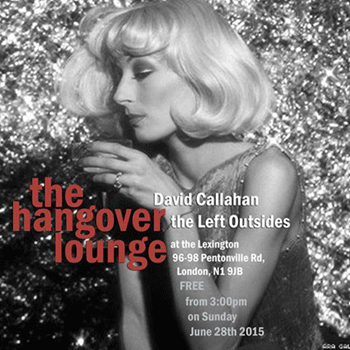
David Callahan + The Left Outsides (The Hangover Lounge @ The Lexington, 96-98 Pentonville Road, London, N1 9JB, Sunday 28th June 2015, 3.00pm – free)

David Callahan is best known as the frontman – or co-frontman – of two bands. The first of these, The Wolfhounds, was a mid-’80s post-punk band associated (for good or ill) with NME’s infamous C86 cassette to which they contributed alongside The Wedding Present, a young Primal Scream, The Pastels and others. While C86 set up and juxtaposed what were to become British indie archetypes (on the one side a parochial pop of jangling guitars and under-achievement, on the other an abrasive noisiness and surreal tendencies), The Wolfhounds were always a cut above, aided by a jagged garage-noisy way with a melody and their broader conceptual focus, plus David’ smart pointed way with a lyric and his arresting vocal (a precise, razoring punk sneer a few shades away from bitter blues – imagine a less theatrical Matt Johnson, if that helps). ‘If You Know What I Mean’ has described them as “the Stooges tempered by Big Star poetics” – read some more about that here.

Much of this carried over into David’s next project, Moonshake: one of a number of diverse but loosely-affiliated East London post-rock and indietronica bands (also including Stereolab, Disco Inferno, Bark Psychosis and A.R. Kane) who, for a few years, vigorously stripped out and rebooted pop and rock forms with experimental techniques. For the first few Moonshake albums (an exciting mangle of dub bass, guitar-noise and sample barrages owing equal amounts to hip hop and musique concrete), David worked in an exciting, two-headed arrangement with an equally distinctive singer-songwriter, Margaret Fiedler. When this ended in acrimony (and after Margaret wheeled away with half of the band to form Laika), David led Moonshake on his own for two further albums, adopting an increasingly cinematic and introspective approach (I’ve got a review of the last one here).

Since reuniting with a reinvigorated Wolfhounds in 2005 (a belated reunion album, ‘Middle Aged Freaks’, arrived nine years later), David has reverted to a more guitar-based sound but continued to write and record, with his broad and trenchant perspective intact. This Sunday’s solo appearance looks as if it’s going to be a rare acoustic set from him – featuring “all-new songs, sometimes in funny tunings” – but as he recently dug out his old Moonshake sampler for work with Manyfingers, he might surprise us with something a little more torrential and noisy.

I know less about the opening act, The Left Outsides, so the following is stolen straight from their Facebook page:

The Left Outsides are Mark Nicholas and Alison Cotton, a duo from Walthamstow, London who have been playing together since the winter of 2003. Both are former members of The Eighteenth Day of May and Mark is a former member of acid expressionists Of Arrowe Hill. Alison’s considerable viola skills have been put to good use in numerous bands including Saloon and Mathew Sawyer & The Ghosts. Their debut EP ‘Leaving The Frozen Butterflies Behind’ was released on the I Wish I Was Unpopular label in January 2006 and their album (titled ‘And Colours In Between’) was released in May 2007 on Transistor Records. A live album titled ‘Live At The Drop Out’ was self-released in January 2008. A 7″ single ‘The Third Light’ was released on the Hi-Beat Records label in July 2008. The Left Outsides are currently awaiting the release of their most recent album.

Up-to-date information on the Hangover Lounge gig is here.

June 2015 – upcoming gigs this weekend – Daylight Music in London (with Jo Mango, The Great Albatross, Circle Meets Dot), Matt Stevens house concert in Rome

11 Jun

Here are the details on this weekend’s Daylight Music event in London…

Daylight Music 193: Jo Mango + The Great Albatross + Circle Meets Dot (Union Chapel, Compton Terrace, Islington, London, N1 2UN – Saturday 13th June, 12pm to 2pm)

Glasgow-based multi-instrumentalist Jo Mango’s second album ‘Murmuration’ was released in 2012 to great acclaim. This wonderfully wistful album combined unique selections from Jo’s eclectic musical instrument collection, with inspiration from her adventures: travelling the world as a member of Vashti Bunyan’s band; her experiences completing a Doctorate in Musicology; her collaborations with David Byrne, Devendra Banhart, Coco Rosie, Teenage Fanclub and Admiral Fallow amongst others.

The Great Albatross is the indie music project of singer/songwriter A. Wesley Chung (formerly of Boris Smile). The project was formed in Glasgow, Scotland in 2011 and consists of an expansive, international list of contributors and collaborators. The project has performed both in the US and UK, including both days of the 2013 Count Your Lucky Stars/Topshelf Records SXSW showcase in Austin, TX. The Great Albatross have performed alongside the likes of Into It. Over It., Admiral Fallow, Miaoux Miaoux, Jo Mango, Owen, Joan of Arc, Empire! Empire! (I was a lonely estate), Joie de Vivre, and Football, Etc.

Sparking with the energy of a brand new meeting of minds, Circle Meets Dot is an emerging collaboration between Wesley Chung of The Great Albatross and Jo Mango. Soaring summer melodies steeped in California sunshine meet cloudy-day Scottish literary lyricism

Ed Dowie will be providing some light bird music in between the acts today/on Saturday. Using his mouth, his keyboard, some Max/MSP twiddlings and a whole host of bird recordings, he hopes to soundtrack the audience’s toilet and coffee breaks, as well as providing a backdrop to some cardboard bird spotting around James Cubitt’s beautiful building. Ed has been making music since the late 1990s, firstly as one third of Parlophone’s Brothers in Sound, then later a solo act under the name Redarthur. After a 5-year hiatus which he spent living in University libraries & music technology labs making strange bleeps, he returned to the music industry to join The Paper Cinema, a puppetry/animation/theatre/music hybrid (that tours both internationally & in Hackney).

Free entry, but donations are (as ever) encouraged.

Or if you’re in Rome, looping guitarist Matt Stevens is playing a house concert in the Batteria Nomentana district in the evening. As it’s a private gig, public information is scarce, but tickets and details are available here. For an earlier account of Matt in action, here’s a live review of his appearance at Roastfest from a few years ago. Matt will be performing again in the UK shortly with The Fierce & The Dead – more details on that soon.

June 2015 – upcoming gigs – two more Darkroom gigs in London – Hubbub @ Wellcome Collection; Listening Club in Peckham

8 Jun

Having only just played at the last-for-now Tuesdays Post concert this past Sunday, loop duo Darkroom are performing at two more London gigs this month, both of them at typically interesting events.

Hubbub @ The Hub, The Wellcome Collection, 183 Euston Road, London NW1 2BE, UK, Thursday 11th June (time t.b.c.)

The Hubbub group (based at the Wellcome Trust) is a project with a brief to explore work, rest and play; past, present and future. The two members of Darkroom will be participating in a closed session, being “wired up and investigated” as part of the research. Details are still a little unclear (although I do know that the work will be live-streamed) so keep an eye on the Darkroom Twitter account. For an early taste of the project, here’s psychologist, writer and Hubbub investigator Charles Fernyhough guesting on a half-hour long Darkroom track, a late-night atmospheric piece recorded in The Hub earlier this year.

And on the upcoming Sunday, there’s this:

Listening Club @ The Peckham Pelican, 92 Peckham Road, London, SE15 5PY, UK – 4.00pm to 9.00pm – free entry

This is an events series in association with St John Sessions ( showcasing new experimental music. In addition to Darkroom, the gig also features sound artists Kostis Kilymis (from Thessaloniki via London), Franz Rosati (from Rome) and Memorial Bench (from London, I think). More chat about this over on Twitter.

June 2015 – upcoming gigs – tomorrow and this weekend in London and Watford – Chant Live! interactive gig; Silencio Sessions presents Surfing On Sinewaves; Daylight Music

4 Jun

Shortly after I posted news on voicelooper Georgina Brett’s Tuesdays Post concert on Sunday (which, incidentally, will be the last one for a while) she got in touch with news of two more gigs she’s playing tomorrow and on Saturday, so here’s the information on those (more or less in her own words).

Chant Live!, 5th June 2015

Chant Live! featuring Dave Barbarossa/Youth/Georgina Brett/Regina Martin/Dan Morrell/Jon Moss/Tom Nettlemouth/Jamie Grashion & very special guests, (Unit 5, Mirage Centre, First Way, Wembley, London, HA9 0J, Friday 5th June, 7.30pm)

The return of the legendary open source band! A showcase gig in a hidden private club venue in Wembley, ten minutes walk from Wembley Park tube – a bit of magic brought to the perimeter of the stadium itself. On stage will be myself, Dave Barbarossa (Adam & the Ants, Bow, Wow, Wow), Youth (Killing Joke, The Orb), Jon Moss (Culture Club) and Cosmic Trigger (Jamie Grashion and Tom Nettlemouth). There’s also pre gig talks about all things cosmic, the fractal universe and drumming with Gina Martin and the Queenswood Drummers. Great club sound system. An adventure!! Two drum kits, two bass guitars, djembe drum circle. Give voice, give hands, be the band: bring a drum or a shaker, percussion, chants, on-the-fly recordings, loops, mixes, mashes. Free event – for more info, call Guy on 07947 061257.

Silencio Sessions, 6th June 2015

Silencio Sessions, 6th June 2015

Silencio presents ‘Surfing On Sine Waves’ featuring Georgina Brett/Cos Chapman/James Conway/Tom Fox (LP Cafe, 173 The Parade, Watford, Hertfordshire WD17, Saturday 6th June, 6.30pm)

A night of looping, experimental and electronic improvised music.  As well as me there’s:

Cos Chapman, former oceanographer turned solo improvised electronics performer and member of both I Am Meat and Rude Mechanicals (there will be a fascinating video of how he creates his instruments from recycled materials).

James Conway, a Brighton based musician usually seen with electronic outfit Not These Tones: this time it’s an eclectic solo show on mixer, sampler and synth duties. No two performances by James are the same; it’s method in the moment, thrill in the risk.

Tom Fox, an experimental instrument builder who focuses on using reclaimed materials to create new and unique sounds and textures from common items, and will be presenting a film on his methods.

More info here – tickets £6.00 on the door.

Also just in, news on this weekend’s Daylight Music event…

Daylight Music 191: School of Noise + Sarah Angliss + Astra Forward (Union Chapel, Compton Terrace, Islington, London, N1 2UN – Saturday 6th June, 12pm to 2pm)

School of Noise are a collective of artists who run workshops for children, enabling them to make their own weird and wonderful instruments and experiment with sound art. They’re appearing live on stage for the first time performing their own pieces of experimental and electronic music. The group, made up of children ages 7-13, met at the School of Noise workshops where they explored a variety of approaches to creating, sculpting and listening to sound. The project, started by London musician Dan Mayfield, has been influenced by the works of Brian Dennis who ran the Shoreditch Experimental Music School in the late 1960’s.

Sarah Angliss is an award winning composer and performer whose music reflects her fascination with European folklore, faded variety acts and long-forgotten machines. Sarah is known for her highly unusual stage set which mixes theremin, saw and ancient instruments with the ensemble of musical robots she’s designed and built to work with her on stage.

Astra Forward is a Brighton based singer-songwriter and multi-instrumentalist. A raw vocal talent, she combines acapella, synth organ drones, ethereal harmonies and alternate guitar tunings into her performances. As a singer and keyboardist in The Robot Heart and Diagrams, Astra has toured throughout Europe and the U.K, supporting the likes of Gomez, Ben Ottewell, Athlete and St. Vincent. At this concert, she will play a solo set of her intricate and beautifully vulnerable electronica.

Alex Hall/Elephant returns to create an improvised guitar soundscape in between acts this week.

Free entry, but donations are (as ever) encouraged.

June 2015 – upcoming London gigs – prog rock/math rock/post-hardcore @ The Facemelter; electro-pop/drum’n’brass/loops/experimental ambience @ Tuesdays Post; eclectic classical/experimental chamber music/kletzmer & Bulgarian voices @ The Forge

31 May

Some more early June gig previews for London – these would have been in the previous post if I’d picked up on them earlier.

Firstly, a Facemelter promotion (from the experimental rock/post-hardcore wing of the Chaos Theory organisation whose jazz gigs I’ve also enjoyed)…

Facemelter, 5th June 2015

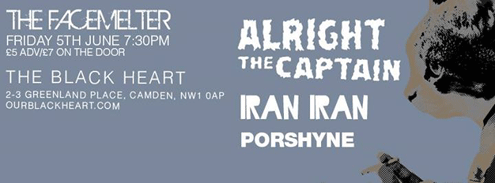
Alright The Captain + Iran Iran + Porshyne @  The Facemelter (The Black Heart, 2-3 Greenland Place, Camden, London, NW1 0AP, Friday 5th June , 7.30pm

Three heroes of math rock, alternative and post-rock travel from different corners of the UK to unite and form this amazing lineup.

Derby-based trio Alright The Captain masterfully combine virtuosic instrumentalism with unabashed musical experimentation and have effortlessly established themselves as a sonic force to be reckoned with, thanks to their increasingly inimitable, uniquely imaginative brand of math-rock. Their sprawling and varied career has seen them sharing stages with post-rock luminaries including Mono, toe, 65daysofstatic, Pelican, Tera Melos, ASIWYFA, Maybeshewill, Adebisi Shank (RIP), This Will Destroy You, ZU and many more. Their new album ‘Contact Fix’ (which ‘Musical Mathematics’ describes as “div(ing)  in and out of math rock, prog and post rock – but, at its heart, it’s different”) has gone down a storm.

Iran Iran are another supremely talented bunch of musicians who stunned and impressed all who saw them at ArcTanGent last year. With insanely complex rhythms and thunderously heavy riffs, the four-piece from Bristol have evolved since their excellent first EP ‘Crystal Math’ and are packing a punch. They’ve played with Future Of The Left, Cleft, Alright The Captain, This Town Needs Guns, You Slut!, Alpha Male Tea Party, Death Pedals and many others. Fans of complex musical wizardry or heavy riffs will love their new EP ‘Milk Time For Spiders’.

Brightoners Porshyne dance between ambient intervals and melodic vocals to intensely intricate, fantastically crunchy  prog rock riffs. With just a few single releases and a session filmed by Small Pond Recordings, they already sold out their first headline show in Brighton. This is your chance to catch the band before their career takes off.

More info here and here, and tickets here (£5.00 advance, £7.00 on the door).

At the end of the same week, Georgina Brett’s Tuesdays Post event returns to Stoke Newington with another evening of ambient/progressive live music, including ‘Misfit City’ favourites Darkroom

event-20150607tuesdayspost

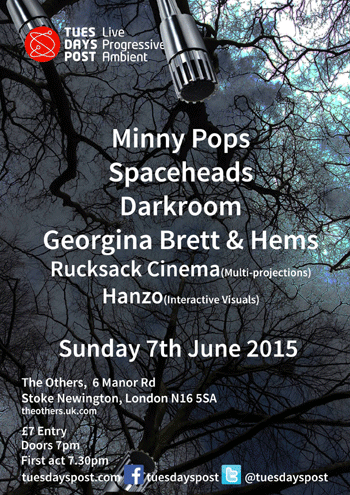
Minny Pops/Spaceheads/Darkroom/Georgina Brett & Hems @ Tuesdays Post, (The Others, 6 Manor Rd, London, N16 5SA, Friday 7th June, 7.00pm)

Formed by vocalist/band leader Wally van Middendorp in Amsterdam in 1978, Dutch electro pioneers Minny Pops took their name from a primitive Korg drum machine. The band released several singles and a debut album, Drastic Measures, Drastic Movement, on independent Dutch label Plurex before joining the legendary Manchester label Factory Records in 1980 (which resulted in them being produced by Martin Hannett, touring with both Joy Division and New Order, and becoming the first Dutch group to record a Peel Session). Singles including Dolphin’s Spurt, Secret Story and Time were followed by the acclaimed album ‘Sparks In A Dark Room’ in 1982. The band released two further albums (‘Poste Restante’ and ‘Fourth Floor’) before splitting in 1985. In 2012, the band reunited for a series of gigs in the UK, the Netherlands and Belgium and recorded a 7-inch single for Tim Burgess’ O Genesis label. After a pause to draw breath, 2014 has seen Minny Pops performing live once again.

Spaceheads are a cosmic duo of trumpet electronics and drums. Formed in 1990, they have developed a blend of electronics and sunshine fanfares over the course of ten albums, three EPs and much touring across Europe and the USA. Andy Diagram (also of James) plays trumpet with a mobile phone stuck to the top with a fish slice and Richard Harrison plays drums with big bendy metal sheets stuck to the top. They create live looped layers of brass driven by flurries of free flowing funky drums. Andy and Richard have achieved an intuition of what each is about to do next which makes their semi-improvised gigs a joy to behold. They release their first studio album in ten years – ‘A Short Ride On The Arrow of Time’ – this Autumn.

Darkroom – the UK-based duo of Michael Bearpark (guitars) and Andrew Ostler (synths)- expertly ride the line between luscious, old-school progressive rock and modern ambient electronics. At times reminiscent of early Tangerine Dream with hints of Fripp and Eno, they create clouds of sequenced synths, chewy grooves, and looped phrases to support a variety of acoustic and electric guitar melodies that twist and turn in surprising, occasionally aggressive, ways.

Hems Aka Henrique Matias will be playing live with Georgina Brett. Henrique is a multi-talented composer, programmer and DJ. He specialises in Multimedia programming (from internet things to Max/MSP and similars), although not all his live music and performances sounds like computer music (sometimes he takes his drum machines and crazy things out of the house). Georgina Brett’s music is created using her voice and effects pedals, creating instant choirs of sound, often in an hypnotic style. The point of this music is not only to captivate with extraordinary timing and melodic style but also to help the listener to relax in our ever-increasingly fast world.

Interactive visuals and multimedia projections are by Hanzo and Rucksack Cinema.

More information here – tickets £7.00 on the door.

By all accounts The Forge (in Camden Town) has spent the last few years becoming one of north London’s most interesting small venues for mixed music. I’ve yet to go there and see for myself: but in its full June calendar (also featuring funk, jazz, classical and Cuban music as well as assorted poetry) the following four concerts caught my interest:

Notus Winds & Eliza McCarthy (Wednesday 3nd June, 7.30pm)

Part of the classical monthly series Wednesdays at The Forge, this time featuring award-winning chamber ensemble Notus Winds and solo pianist Eliza McCarthy with a program of contemporary compositions (more information here). Tickets £10.00 to £12.00.

Programme:

Harrison Birtwistle – 5 Distances
György Ligeti – Ten Pieces
Arvo Pärt – Quintettino
Anders Hillborg – Six Pieces for Wind Quintet

Fenella Humphreys: Bach to the Future Part 1 (Tuesday 9th June, 7.30pm)

The first of three concerts presented by violinist Fenella Humphreys, featuring commissions of six new works by six of Britain’s leading composers to accompany Bach’s glorious 6 Sonatas and Partitas for unaccompanied violin. This first concert includes new works by Cheryl Frances-Hoad and Gordon Crosse alongside extraordinary music by Bach, Scott, Westhoff, Hindemith. Tickets £10.00 to £12.00.

Programme:

Cyril Scott – Bumble-Bees (1928)
Johann Paul von Westhoff – Suite no. 5 in D minor (1682)
Gordon Crosse – Orkney Dreaming (2014)
Fritz Kreisler – Recitativo and Scherzo-Caprice op. 6 (1911)
Paul Hindemith – Sonata op. 31 no. 2 ‘Es ist so schönes Wetter draussen’ (1924)
Johann Sebastian Bach – Partita no. 3 in E major BWV 1006 (c. 1720)
Cheryl Frances-Hoad – Suite no. 1 (2014)
Eugene Ysaye – 2nd Sonata op. 27 (1923)

Reciprocity: a new work by Daniel Patrick Cohen (Wednesday 10th June, 7.00pm)

Reciprocity is a 28 minute work for voice, taped narration, eight celli, piano, and percussion. The piece was composed by Daniel Patrick Cohen from six poems by the late Darya Farha, a Canadian poet, therapist, filmmaker and clothing designer. Darya was an extraordinary woman whose sharp intelligence, dry wit, distaste for orthodoxies and boundless empathy fuelled restless journey through her unfinished life. Darya died of breast cancer in 2011 when she was 46, and Reciprocity was commissioned by her sister Juliana Farha, who lives in London. Reciprocity is not about cancer, however. Instead, its human and universal themes of joy, pleasure, fear and anger, along with its intriguing instrumentation are sure to engage a broad audience. You can read more on the project here, and here. Tickets £6.00.

She’Koyokh & Veda Slovena Bulgarian Choir (Thursday 11th June, 8.00pm)

In a unique collaboration, She’Koyokh & Veda Slovena Bulgarian Choir combine the fiery panache of klezmer and Balkan music with the timeless beauty of Bulgarian voices, weaving Jewish, Turkish and Balkan music into the rich tapestry of the Bulgarian choral tradition. Read She’Koyokh’s piece on their Veda Slovena collaboration here. Tickets £10.00 to £12.00.

(All events taking place at The Forge, 3-7 Delancey Street, London, NW1 7NL)

June 2014 – through the feed – Sufjan Stevens reissues ‘Enjoy Your Rabbit’ with various goodie options

26 Jun

Sufjan Stevens: 'Enjoy Your Rabbit'

Sufjan Stevens: ‘Enjoy Your Rabbit’

Assuming that you’ve not heard about this yet (I still have the sneaking suspicion that the majority of my readers are ahead of me as regards news)…

…that prolific, poly-instrumental singer-songwriter/critical darling Sufjan Stevens is reissuing one of his earliest and oddest albums. Originally released by Asthmatic Kitty back in 2001, ‘Enjoy Your Rabbit’ was reissued a couple of days ago (June 24th) on limited-edition deluxe vinyl and as a download.

On initial hearing, ‘Enjoy Your Rabbit’ doesn’t sound much like the work with which Sufjan later made his name. Despite the man’s reputation for assured eclectism, it seems out-of-place and unexpected – very different from the concept albums in which he codified his life and thoughts into the hopes, dreams and terrains of American states; or from his baroque-ified folk-Americana (in which you were as likely to hear a cor anglais as a banjo or harmonium); or from his combining of original film and symphony music for ‘The BQE’; or even his battery of Christmas albums.

Recorded during Sufjan’s first stint in New York, it’s almost entirely electronic – a fizzing post-modern cut-up built from digital work station noises, samples and tweaks of live sounds (including stray guitars, organs, the brassy lather of Tom Eaton’s trumpet and prelingual vocals from Liz Janes and Sufjan himself). There’s a running theme via the Chinese zodiac and its twelve-year cycle, each year of which lends its name to a track (Year Of The Dragon, Year Of The Rat and so on), although Sufjan muddies the waters with two extra pieces – the title track and The Year Of Our Lord. (Given his professed Christianity, the latter is as likely to be sincere as it is to be a tongue-in-cheek gag: given the nature of the album, it’s probably both.)

Over to his label, Asthmatic Kitty, for a fuller explanation (as Asthmatic Kitty appears to have a staff of two, one of whom is Sufjan, you can be pretty sure that this is a definitive statement):

“Departing from the singer-songwriter format of his first Asthmatic Kitty album, ‘A Sun Came’, this collection of fourteen colourful instrumental compositions combines Sufjan’s noted gift for melody with electronic sounds to create an unusually playful and human – not to mention humane – electronic experience. First released in 2001 on CD, 2014 — the Year of the Horse — brings the original recording back as a double-LP set, the first disc clear and the other left to fortune. And no one can foresee who will receive one of two very special boxes of fortune cookies, containing fortunes penned especially for this occasion by Sufjan himself.

‘Enjoy Your Rabbit’ is the most underrated and overlooked album in Sufjan’s discography. It contains in capsule form what he would later unpack into more palatable music. There are flashes of ‘Michigan’ and ‘Illinois’ in Year Of Our Lord, Year Of The Ox and Year Of The Dog, and shadows of ‘Age Of Adz’ in the darkest moments of Year Of The Boar, Year Of The Snake or Year Of The Dragon. ‘Enjoy Your Rabbit’ is a harbinger. A precursor. A wink in the eye before the slight. You should have listened in the first place. We’ll forgive you though, because when an album is only available in wasteful jewel-case CD, how cool can it be? Jewel-cases are so 1998. But now that it’s in multi-colored limited-edition gimmick-ridden vinyl, you have no excuse. ‘Enjoy Your Rabbit’, which Sufjan wrote and recorded in the innocence of a pre-9/11 2001, is Sufjan’s best work because it is Sufjan at his least self-aware.

In an alternate reality, Sufjan never made ‘Michigan’ or ‘Seven Swans’ or ‘Illinois’; he kept making electronic freakout albums like ‘Enjoy Your Rabbit’ in obscurity, until perhaps he just gave up and stayed in graphic design and some pitying barely-afloat label re-released ‘Enjoy Your Rabbit’ and sold a few dozen copies to a few scattered part-time record store employees. But here we are in this reality, where ‘Michigan’ is slated for an energy drink commercial, ‘Illinois’ is a backdrop to a pensive montage in a kickstarted blockbuster movie, and ‘Enjoy Your Rabbit’ is relegated to a drunken purchase at Amazon.com.

Here at Asthmatic Kitty, where we often ignore reality as it’s presented, ‘Enjoy Your Rabbit’ is one of our most played records. We find ourselves in the small company of ballet choreographers, quartets, and occasional internet reviewers, but there should be more of us. So, as if we were in that alternate universe where “Sufjan” is more likely the name of a ‘Game of Thrones’ character than an indie star, we hope you’ll give this record a chance now that it’s available as vinyl. It is just as genius as anything Sufjan has released since. Everything’s been downhill since.”

To my own cranky ears, ‘Enjoy Your Rabbit’ is a fascinating, skillful blip in Sufjan’s career – a rare chance to see his singular talent from a specific angle. It’s a little similar to your first encounter with Frank Zappa’s cascading Synclavier cut-ups if all you’d previously heard was his catalogue of hairy, horse-laugh rock cabaret numbers about groupie misdemeanours and middle-America caught napping and dribbling. Another comparison is Adrian Belew’s 1986 one-off ‘Desire Caught By The Tail‘ – a snarling, abstract career swerve from a musician who’d previously satisfied his avant-garde leaning by blowing spacey textures and barnyard/traffic sound effects through art-rock songs, but was now sitting down with a crude guitar synth (plus a jumble of pedals and assorted things to hit with a stick) in order to create uncompromising Picasso-Hendrix shapes at heavy-metal volume. Did someone say ‘Metal Machine Music’? Not quite, although there are moments of crushing noise on ‘Enjoy Your Rabbit’ which recall Lou Reed’s own Marmite effort.

One thing which can be said for certain is that ‘Enjoy Your Rabbit’ is a breathtakingly playful record which nonetheless exhibits Sufjan’s extraordinary breadth of influences and compositional skills. If you listen closely, his subsequent ways of building a song are all already present and correct. Though they’re sheathed and blurred within the blip-glitching video-Pong noises, Tibetan bells and drunken brass band textures of Year Of The Monkey, they’re definitely there: it’s a song, voiced with all the oddness of a Charles Ives let loose on a sampler.

Speaking of Zappa, some prime bogus pomp shows up on Year Of The Snake and Year Of The Boar. Amongst the larking bass-harmonium reed drone and the razzing fizz of Sufjan’s electronics, some weighty blimpery waddles and patters. I could have sworn that Year Of The Boar even quotes ‘The Phantom Of The Opera’ at one point. Sufjan’s certainly not slow to drop in a ‘Mission Impossible’ quote on the album’s title track, which is otherwise the odd song out – an angular, dissonant line of Rock-In-Opposition guitar fuzz joined by a cavalcade of pushy racket and chiptune burble.

As for the Chinese component, it’s not clear whether this is a gimmick (like Sufjan’s subsequent tall tales of a “50 States” concept project) or another little metajoke which he’s balled up and sent sailing over our heads. Scattered sparingly across the record, Mannar Wong adds some genuine spoken Chinese. In and around certain pieces, trilled Chinese melodies bump up against European string quartet tunes or (as on Year of the Tiger) flute around cabaret vocalese and bells over thudding shadow-tones. But at least as much is drawn through and worked in from other sources: Sufjan’s first years in the thick of New York’s cosmopolitanism must have been a greedy feast for his ears. Steam-organ and No Wave whomp, carefully orchestrated, collide with early-Genesis prog flourishes. Sewer-pulsations meet Bontempi organs and sample-heavy vocal murmurs, folded into Latin pop melodies. Silvery Krautrock turns into dinky, glitch-mauled castle music on Year Of The Rat. For Year of the Sheep, Sufjan turns the music into a battle between pulp and celestial. Against the birth-of-the-world vocalise which he and Liz Janes knit together, animal sounds yawp and rampage – angry pregnant elephants, excited pterodactyls.

Rat

The thirteen-minute Year Of The Horse – the piece on which Sufjan could really have come unstuck – instead shows him in full control: sustaining and mutating schools of ideas at greater length, like a post-techno Mike Oldfield. Despite its mongrel elements and its sense of hazard sources, over the course of its journey (minimalist piano figure in trio with vibrating mechanical sounds and out-of-focus kettledrums; panpipe-riffles marshalling around industrial squashing-tones; a finale of glitched/phased/near-atonal signal twitches), it’s not so dissimilar to those carefully-structured stretches of ‘Tubular Bells’ or ‘Ommadawn’ back in the 1970s. Not that Sufjan would necessarily agree: his time at New York’s New School (which he was attending while he wrote this album) would have exposed him to any number of inspirations from chance heroes to masters of structure. What’s clear is that under the capering and restless sonics, great swathes of ‘Enjoy Your Rabbit’ display Sufjan’s bedrock talent and the solidity of his musical placings. It’s a cliché that a single work by one artist can hold as many ideas as another artist’s entire career, but this is one of those cases where the old saw is true. I’ve heard plenty of electrophonic records eking out a single concept or a sparse few, albeit successfully. ‘Enjoy Your Rabbit’ makes most of them sound like lazy sketches.

You should judge for yourselves, though – this wasn’t supposed to be a review. You can get your copy of the album from Asthmatic Kitty or Bandcamp (both fixed-price vinyl or download) or from Noisetrade (pay-what-you-like download-only). For the possibility of fortune cookies, I’m guessing that you should pester Asthmatic Kitty directly. If you want the additional option of ordering a vinyl twosome of ‘Enjoy Your Rabbit’ and Osso String Quartet’s ‘Run Rabbit Run’ as a thirty-dollar special offer… well, that’s another thing to talk to Asthmatic Kitty about.

Sufjan Stevens online:
Homepage Facebook Twitter Soundcloud Tumblr Bandcamp Last FM

REVIEW – Dead Hippie Squadron: ‘Chilling Spree’ single, 2014 (“thumbing his nose at the chillout stations”)

24 May

Dead Hippie Squadron: 'Chilling Spree'

Dead Hippie Squadron: ‘Chilling Spree’

Skittering through electronic dance music like a grinning cartoon centipede, Julian Michal Zembrowski (a.k.a. Dead Hippie Squadron) has remained tongue-in-cheek so far. He’s dabbled with pranky plunderphonics (as in the George Bush Jr.-baiting Skull And Bones). He’s teased and celebrated dance culture’s mongrelised New Age aesthetics via tracks like Dubsteppenwolf and Interstellar Transhuman Psyche (and via 2013’s ‘Black Magic’ album, a skimming sample-heavy techno grimoire). Most of his artwork consists of spooky, crudely-Photoshopped snapshots of his dog; or of himself posing next to pet-food displays, wearing a kitten mask.

However much he pisses about with themes and imagery, his music has been seriously solid: a more successful mongrelisation. No matter how flighty or parodic their names might be, DHS tracks are filled with cunning, tickling complexity and multiple levels. Power-dive pitch-shifts, plenty of real instrumentation (including throaty ping-bass and glitched-up piano studies), an argumentative bricolage of vocal samples and Julian’s own mumbling lo-fi intrusions. Spliced references abound – a Club Dog take on the Bomb Squad, silly Zappa voices, minglings of Art Of Noise mischief with Meat Beat Manifesto drive, spooked ambient drift and IDM clatter.

Though it’s a good deal breezier than what’s gone before, Chilling Spree is as much of a witty DHS mash-up as ever. I’m guessing that Julian had his radio on and was both cocking his ear to and thumbing his nose at the chillout stations when this one rolled off his mind. Downtempo and smoothly textured, it shimmers around on ever-so-slightly theatrical accordion musings (like an airy Joe Zawinul jazz track at a long-ago summer festival) before rising up to a silvery, tinselly synth-pop crest. The drums sound mostly Lebanese: those jazzy, ahead-of-the-beat Stewart Copeland rattles, the furry rills. Humming in the background, Joe makes his best approximations of a Bollywood chorus.

A lot of those little citizen-of-the-world, coffee shop boxes seem to be being ticked… but the boxes are collapsing under the pen-strokes. That occasional blurting stutter of bass drum stupidity is straight out of electro; the tunefulness is cunningly crumpled. Meanwhile, we’re hearing part of an argument in the next apartment. “I want you to get mad,” burbles a man’s voice – aggressive in a slightly fruity way, and convinced of its own righteousness. “All I know is that first you’ve got to get mad.” Someone’s not really getting along with the chillout programme – there will be splintered knick-knacks soon. Over in his corner, Julian takes a long cool sip of a dark-amber drink with a complicated name and a couple of ditzy umbrellas, and treats himself to a long, low chuckle.

Dead Hippie Squadron: ‘Chilling Spree’
Dead Hippie Squadron (self-released, no catalogue number or barcode)
Download-only single
Released: 30th April 2014

Get it from:
Free download from Soundcloud

Dead Hippie Squadron online:
Homepage Facebook MySpace Soundcloud Bandcamp YouTube

REVIEW – Ian Crause: ‘The Song Of Phaethon’ & ‘Suns May Rise’ singles, 2012 & 2013 (“sample-punk turned foley-bard”)

30 Oct

Ian Crause: 'The Song Of Phaethon'

Ian Crause: ‘The Song Of Phaethon’

“Well, I know, I know the story – / the fall of the sun and the vengeance of glory revoked. / So well, I know how the seas turned to dust, / and how the known earth choked. / So well, I know, I know the ending: / the carriage from its zenith bending, / a comet slung through ashen skies / and burst against the banks.”

Cinematic. Epic. These are words which have been whored out far too often, especially when it comes to describing and defining music. Froth and PR corrode their meanings, reducing them to fancy synonyms for nothing more than crude scale, and we forget that other qualities are wrapped into them. These words shouldn’t just be cheap and glittery tags for charlatans – the kind who steep their tunes in giant vats of reverb, or who substitute eye-watering grandiosity for sincerity. There are more crucial meanings. There’s storytelling, and the churn of history. There’s the play of images, the triggering of senses. Eventually, there should be some kind of understanding.

Ian Crause knows all of this. Back in the 1990s – when he was barely out of his teens, and the driving force behind the startling expressionist pop band Disco Inferno – he was struggling with it himself. Even then, though, he wasn’t stumbling to understand: he was striving to perfect. Disco Inferno had come from limited beginnings but grown fast. Originally a dour post-punk power trio, they’d seized the opportunities presented by technology and imagination and transformed themselves into a whole-world window. Hot-wiring their way into the disruptions and illuminations of found-sound and musique concrète, they plugged guitar, bass and drums into digital samplers and grew themselves an ever-expanding sheath of noises: a startling collage of jarring sound effects, layered into composition and twisted into context.

Disco Inferno’s swarm of noise was never there simply to overwhelm. Instead, it refracted and illuminated the poignant dissatisfied pop songwriting which stood, steadfast, at the band’s core. They were doggedly political, but owed nothing to dogma. Caught within ominous social currents and inside treacherous personal eddies, their songs bore witness to cruelties, both intended and impersonal. Those tearing rivulets of sound-montage were flashes of further illumination, put there to side-swipe and snag the attention, and to up-end complacency. The fragments of birdsong and clattering glassware; the careful punctuation of trains and screams and distant firework-pops; the sound of feet jogging grimly away through a numbing snowfall – all of it bore witness to the swerving cacophony of the world, smearing past our ears and battering our psyche, carrying its deeper meanings and significances into us via a pummeling swirl.

At the heart of this unsettling barrage were Ian’s lyrics, which were wise, stark and bleak beyond his years. He sang about the crumbling of vulnerable individuals; about the fraying of the social contract and distortion of social forces. He sang about the stifling, stunting pressures callously imposed from above. He sang about all of this in a still, small, stubborn voice which sounded like the next-to-last exhalation; as if he was a few crucial steps and dogged heel-digs away from giving up and bleeding out. He sounded brave, bitter and doomed – snarling his scorn at the boot-tread even as it rolled over him. For a while, it was a self-fulfilling prophecy. Bands who refuse to comfort us (or refuse to stroke our sundry petty vanities) rarely get rewarded, and Disco Inferno were no exception – the strains of dealing with commercial indifference and inner despair finally tore them to bits in 1997. A couple of barely-noticed Ian Crause solo EPs hiccupped out in the band’s wake over the next few years, and then he too seemed to drop out of the story.

In fact, he’d only dropped out of the cheaper kind of mythology. That’s the one in which ducking out of music becomes death or disappearance by another name. His own story – the real story – moved on regardless. There were years of growing up and grim jobs to come, and years of being chewed over by the same callous forces he once sang about. In amongst the drudgery, there were other factors. There was fatherhood, and family. Surprisingly (for a lyricist already so accomplished and intelligent) Ian made his first adult engagement with literacy. Curiosity, plus a determination to pursue the roots of song and storytelling, led him to the themes and voices of classical literature. His developing interest in the telling parallels with contemporary society kept him immersed in it. Crucially, Ian discovered the works of Ovid – Roman epic poet and exile – via dedicated translations by Ted Hughes and David R. Slavitt.

Like Ovid, Ian would eventually become an exile himself (a self-determined one, abandoning Britain for Bolivia) and enter into a new swell of creativity. Via his ‘Metamorphoses’, Ovid eventually inspired The Song Of Phaethon – Ian Crause’s formal return to music, transformed and developed. It might not be the first new note he’s delivered after eleven years of radio silence. That would be More Earthly Concerns, which welled out via Mixcloud and blogclick in March 2012, and which I’ll talk about elsewhere. But (as Ian begins to dole out his work, in handfuls, onto Bandcamp) The Song Of Phaethon is the first of Ian’s songs to be let out into the marketplace. It’s also probably more crucial in understanding his evolution since his Disco Inferno days.

The protagonist, Phaethon, is and was one of those half-divine children who pepper Greek mythology – he’s the bastard of the sun god Apollo Helios, a malcontent boy strutting up to his sun-father’s palace to claim his ancestry and birthright before he has the wisdom to use it. Greeted, given the acknowledgment he craves, and granted the gift of driving the sun’s chariot for a day, Phaethon is warned of the terrible risks involved. Swallowed up by his grand moment, and too conceited to listen, he takes all of his opportunities to their ruinous conclusions. Losing control of the chariot, he transforms a triumphal fly-past into a joyride and then into a catastrophe. Before the high god Zeus restores order by striking him down, Phaethon scorches a gigantic swathe across the world and casts the seasons into chaos.

Like most figures woven into the complex psychological map of Greek myth, Phaethon still has his role to play. He’s a metaphor for arrogance and a sense of entitlement; he also stands for the destructive potential which both of these follies possess. It’s deep literary currency, and maybe not the first thing which you’d think of as a match for the Crause songcrafting method – so direct and personal in Disco Inferno days. Yet Ian’s battering splay of noises and disaffection opens itself up readily to the mythology, which sinks in grain-for-grain. Explosive futurism meets stern and ancient legend, and both are renewed.

Some of Disco Inferno’s post-punk grit remains at the spine of the music (listen to those dogged dot-trails of frowning bass, or to the occasional flares of wire-wool guitar), but the song falls far away from rock into something older. Myths lend themselves to being channeled into new courses by any means available – Phaethon, for instance, worked his way into a Patricia Barber jazz epic six years previously. Ian rises to his own challenge superbly. In any worthwhile sense, what he comes up for The Song Of Phaethon is a new take on a bardic chant. Its melody is minimal and hypnotic; its rhythms walking, changing pulses constantly driven by the restless words. With vivid artistic appetite, Ian also mines the story’s depths for any resonances which he can transmogrify and feed into his own samples-as-narrative approach.

In this he’s served well – the mythic structure and detail inspire and transform his lyrics, which in turn take on the layered build of classical imagery. Various whispers of fateful moira and foreshadowing rise up to nourish the sounds. From early on, Phaethon’s life is marked by the celestial – right down to the transformation of his familiar landscapes by the passage of the sun and moon each day, continual reminders of his thwarted birthright. Ian reflects this in the woven detail of the narrative: “Every day their shadows ran / down Asia like a lyre, strumming / past his village, swinging down at perihelion / to touch upon his mother’s house / then over dark and quiet woods – / their distant hawks and watching deer / oblivious in bending shade – / descending into seacloud mist, / and down towards the gull-cloud cliffs / to pour their jewels and precious metals / out along the sea.”

Just as he did with Disco Inferno, Ian juxtaposes sound effects with the lyrics to create telling sonic scenery. Though he generally wields these with the skills of a master ironist, he slam them into place with forthright punk brutality whenever he needs to. Throughout, the Greek horns and lyres are a pointed racket: ritual blares, ancient continuo lines. Signatures of antiquity and origin stand solid against the thrumming synths and Ian’s tidal electrophonic swirl of throbbing samples. In prophetic flashes, the clip-clop of horse’s hooves and the slam of violent collisions clatter and blur in and out of the mix, while Phaethon’s more innocent youth is illustrated by the clank of herd bells and goats. In time, his dogged journey through Asia and towards Apollo is dappled and smeared by a souksworth of Asian instruments and chatter, careering past the listener in a flickering travelogue: “Levantine cities raised themselves, then hazed away in dreams of sand, where sand subsumes / the earth itself and still ahead his path led on. But falling always out of reach, the rising sun. / Into the dawn, alone he walked.”).

The effect is of a kind of illuminated text – a cinematic compression of time and location into a vivid illustrative story. That story remains paramount: even while we, as listeners, are being drawn inside those blood-in-the-head thunders and are surrounded by a glorious noise, as if we’ve been trapped under the encircling lip of a vast bronze bell. Beyond the story, though, other dimensions to the tale are coming into play. The song is also a loose parable of another gatecrashing of grand power. “He knew, he knew – / his place was beyond.”

Superimposed – a ghostly transparency – over Phaethon’s story is the tale of Tony Blair’s entry into the Second Gulf War. As this emerges through the song, it’s clear that Ian sees this as another disastrous snatch at high significance and public destiny. Something which flew high and upwards towards glory, only to destroy any achievement of its own, wreaking havoc on the ground and people below. Cunningly, occasional Blairisms are woven both into the narrative and into Phaethon’s thoughts and speech. At one point, he even blathers, Blair-like, “look, you know,” before sliding into advocate pomp and hubristic heroics. For a moment, the pleading voices of the two men overlap within Ian’s narration, making a contradictory cats-cradle out of public morality, power-grabs and a preening Promethean sense of mission. “It was not just God but also man / who clearly needs some representing – / A case I’ll take for free… / Evidentially it takes / a half-divinity to raise / the flag of man aloft for man…”

It follows – with a harsh and unforgiving logic – that the noises of modern warfare should persistently break through the song’s tapestry of ancient sounds. As Ian goes beyond everyday sound effects and begins to violently splice present-day horrors into the textures of the mythical plot and signifiers, the song is slashed up into a jittery palimpsest. Almost from the start, those bleating goats on the ancient Greek hillsides are blindsided by gunshots and by the crash of heavy munitions. With booms, crunches and clatters the shattered, warped shards of twenty-first century concrete and metal scrape and shoulder their own way into the past.

Even specific events from the myth draw across, from recent times, their own crooked parallels. The bursting, clattering crowd-sound of Phaethon’s entry into Apollo’s hall is lifted and twisted from the peak of Blair’s 2003 address to the US Congress. It becomes a Dionysiac smear of fanatical applause and whistles: something turned into a nightmare puppet show, or a rainstorm ripped horribly out of kilter. At the coda, Phaethon is poised unwitting on the brink of disaster. The ascension of the Sun’s chariot merges, indistinguishably, into the noise of a jet fighter launch. Backed by the white-hot screech of the afterburners, the lyrics weave both tales, both times and a set of terrible implications – “the steeds were armed: a blinding shock; / a ferrous scream; a rubber stamp; / and up,” – into final, irrevocable process.

By anyone’s standard, The Song Of Phaethon is a major achievement – a jump-up into fiercely intelligent, confident high art, it stakes new claims and transfigures old ground. It even manages to both stay true to and transcend the moral and political commitments Ian held with Disco Inferno. And yet… it raises a tremulous question of what might have happened to the other side of Ian Crause. Between the immersion in classical tradition (and the dense time-folding focus of the samplers) what’s left of the fervent young New Order fan who always saw himself as fronting a pop band? What, in other words, became of Crause the unlikely pop singer?
Ian Crause: 'Suns May Rise'

Ian Crause: ‘Suns May Rise’

For the answer, look to Suns May Rise, released three months after The Song Of Phaethon. Ian’s mining of Greek mythology is still in place (as are his detailed tapestries of sound-effect) but they’re now wrapped around an out-and-out pop song and a lustrous, dancing melody that Bernard Sumner would give his eye-teeth for. Those Greek lyres and zithers are back, as are the layers of sound effects (sea-spray and thunderous surf crash billow through Suns May Rise from start to finish); but they’re bolstered by massed stadium synth and guttering pop guitar; by angelic powder-puffs of fake-choir; and by warbling rococo flourishes of electronics. Even Ian’s voice – usually so dry, and pointed – is flushed with the balmy blue of a Mediterranean summer. Scritti Politti and Cocteau Twins, each at their flounciest, could find common ground with this song’s feverish, chattering opulence. So, come to that, could latterday Marillion.

I suspect that all of this ’80 ornamentation is deliberate. After all, it skips hand-in-hand with other ’80s excesses, and that’s not too far from where Ian’s caustic, righteous attention is focused. Beneath this gleeful and gorgeous bluster, he’s unraveling a story from the Odyssey: a warning bell for avaricious times. As the story has it, Odysseus (while returning from the Trojan Wars) visited the generous Keeper of the Winds, who gave him a bag of sea-gales to ensure that the sails of his ships would be filled and his voyage home would be swift. En route, Odysseus slept; and his friends sneaked up to rifle the bag, in search of treasure which they were sure he’d hidden from them. All they succeeded in doing was to unleash the winds, which blew the ships hither and yon and – eventually – blew them back to where they had started. Reckless avarice, bringing down calamity, provides the keystone of the song. “There will always be some fool / to pull the strings apart. /And suns may set and moons may wax, / and moons may wane and suns may rise – / the gold within his eyes will weigh / Man down a stumbling fool.”

When Ian starts singing about this, though, it’s from the point of view of that corrupted, consensual chorus of friends – the “brothers bound in bronze.” Their coy, self-congratulatory rapaciousness soak his tones like a stain on the teeth. Flushed and greedy with loot already, all they can see is the chance to grab some more. From his own place at the reins of the narrative, Ian reveals their mythic echo in today’s freebooting boy-club of bankers and stockbrokers. Men of unfettered appetite goad each other on. People who simply don’t know when to stop – and who wouldn’t want to even after being handed a sobering, sickening lesson – would still pick perilous holes in opportunity. “You had enjoyed a peace of sorts / The winds had been re-tamed and so / of course the bag was bursting fat: / It fell to men to see to that. / Again so sure the bag would hold / either wine or gold, / Necessity appeared, demanding ‘Open this’.”

It’s here (with a careering inflative screech on “bursting fat”) that Ian himself deliberately unleashes the hidden forces within Suns May Rise, to overwhelm it. From here on in, sounds rise and cyclone – seaspray, radio chatter and winnowing churns of air; a lash of strained rope which morphs from background effect to edgy kick-drum. Amongst all of this the thread of pop song holds fast, stretched taut over an ever-burgeoning epic. In a parading weave of rapid soundbites, assorted newscasters and pundits and politicians roll past in a potted history of the last generation of monetarism. At its tail-end, George W. Bush (waving through a banker’s rescue programme of the kind he’d never have brooked for any other group of people) chokes, gargles and drowns amongst the becalmed wreckage of Odysseus’ ships. Throughout, that teasing pop melody ensures that we’ll remember what happened this time around.

So… the forces eventually sink the meddlers, but there always seem to be more of the latter. Ian conjures up further mythic winds, more specters bringing in ruin from the other far-flung breeding grounds of a destructive capitalist carnival. “Through solids, countries, paper bonds; / The world again reveals itself / in entrails; in open wounds. / The priests and seers shed tears of glee / and privately amuse on how / it still can be that after so long… / there will always be some chance / to pull the threads apart.” Again, the bones of legend rear up inside the flesh of current affairs. Again, this unlikely sample-punk turned foley-bard turns up to show us where those bones are poking through – his words a layered and subtle scourge; even an education. For Ian Crause, it’s been a long and often stony road from transformative teenage angst to his current role of reveal-and-illuminate, but it’s also been a journey of integrity and hard-won vision. The results are even a story in themselves.

Ian Crause: ‘The Song Of Phaethon’ & ‘Suns May Rise’
Ian Crause (self-released, no catalogue number or barcode)
Download-only singles
Released: 20th November 2012 (‘The Song of Phaethon’), 18th February 2013 (‘Suns May Rise’)

Buy it from:
‘The Song Of Phaethon’ – Bandcamp (the original version reviewed here has now been replaced by this mini-album)
‘Suns May Rise’ – Bandcamp (the single version reviewed here has now been replaced by this version from ‘The Vertical Axis’ album)

Ian Crause online:
Facebook Bandcamp LastFm

May 2013 – album reviews – John Ellis’ ‘Sly Guitar’ (“a playful magpie interest”)

8 May

John Ellis: 'Sly Guitar'

John Ellis: ‘Sly Guitar’

A skilled and flexible working guitarist since the early 1970s (travelling through punk, post-punk, pub rock, rhythm-and-blues and progressive rock in no particular order), John Ellis has never curdled as a musician. What he’s avoided doing up to now is making a player’s album. Generally he’s been content to tweak a song’s architecture as a team member (in The Vibrators and the mark two Stranglers) or as a flexible, innovative sideman (delivering fanged electric churn for Peters Hammill and Gabriel, or airship noises and roaring-Twenties fanfares for Judge Smith). Even when left to his own devices, he’s stayed away from guitar heroics – often, away from the guitar itself. He’s fermented semi-ambient hubbub for art galleries, filtered Victorian Japonisms through electronica, and taken strides into multimedia, but left the protracted strutting and soloing alone.

On ‘Sly Guitar’, however he returns to (and lays into) his main instrument with a sharp-clawed and swaggering stylishness. It’s the kind of performance that suggests he’s ripped the tail-fin off a 1950s Cadillac and carved a new guitar from it. Things are different this time. In some respects, the key to appreciating ‘Sly Guitar’ is knowing about John’s participation in a 2007 art prank, when he helped to fake a lost Hendrix rendition of the Welsh national anthem. While this particular stunt got his playing onto ‘Newsnight‘ – and was originally a joke about co-opting celebrities into random causes – viewed from here, it’s as much about the puckish and gleeful enjoyment which John gets out of playing guitar. Aspects of Ellis wit might show up on the records he’s worked on (qv. the intuitive bite of those Hammill albums, his thoughtful tricks with Smith, or the raw horse-laughs in his own rare solo songs), but a sense of liberated fun doesn’t always make it across. On ‘Sly Guitar’ it does.

I said “player’s album” – I’m also suggesting that this is the record on which John Ellis finally lets it all hang out. That’s a little misleading. Discreetly virtuosic yet always understated, John’s technique is marked out by the lean, sharp economy he’s learned from years of punk and art-rock. There are also plenty of examples of his taste for bouncing around inside delay units, and for the blocky synthwork and drum loops explored on 2008’s ‘Map of Limbo’. The music’s also liberally slathered with John’s beloved EBow sustainer, transforming notes into assorted hoots and stuttering violin chugs, or pulling them out into taffee-lengths.

These in turn blend in with ideas from all over the place. Fun notwithstanding, John’s art-school training consistently underlies his current approach (one track, with all irony intact, is called I Remember Futurism). He picks up odds-and-ends from the fashions and fads he’s seen pass by and reinterprets them with a playful magpie interest. The results blend an edgy and brittle flair with fastidious design, offset with a mischievous, practical form of musical adapt-and-reclaim.

Many of the tunes on ‘Sly Guitar’ have much in common with old pop-instrumental albums. There are tinges of Joe Meek and of perky surf-guitar capsules from the ’60s; and of those meticulous prog-tinged jingles from the ’70s. But this is just part of an overall collage effect which plucks inspiration from Hendrix, Hank Marvin and John Williams, from Robert Fripp and John Martyn; even from the likes of Fred Frith and Henry Kaiser. It also suggests that over the years John has copped a listen to everything from ‘No Pussyfooting’ and ‘Temple Head’ to On-U Sound and Moby. At the least, he’s caught their echoes as they’ve seeped through airwaves or were circulated alongside technology.

Certainly John’s thinking hard about latterday pop and accessibility; insistent club beats and nods to old crowd-pleasers drive much of the album. Pieces like Levitation and the eleven-minute title track sit on funk grooves with sleek flicks of rhythm guitar and curved, humming chromium lead lines. Snappily and space-ily rendered, the latter are recorded close enough to hear the speaker cones jumping and flattening while wellings of EBow sustain stack up behind like a pile of moonlit clouds. In the chop’n’chat of Farud Gets Electricity, John mixes a Latin loop and a dash of Stray Cats rockabilly into the recipe. Futuro’s leisurely boom-bat, wood-clack beat and clipped industrial framing recall a slimline version of Tackhead’s industrial hip-hop. Making the most of the album’s pop-up digital production sheen, it’s fleshed out by jawharp synth boings and fake horn stabs; its smoulder-point guitar lines hanging in the middle distance like burning ropes.

The beats may be familiar, but the tweaked and ruffled electrophonic timbres which John uses to build up the tunes are less so. Pedalo is as rhythmic as anything else on the record (gliding atop a cavernous trip-hop loop and cracking dub snare) but its body is made up of a mongrel set of slotted-in guitar voices – fanfare tones of firefly and conch; power-growls of distorted fuzz; a pitch-shifted shrill of parade melody teetering on top. All of these come together in spite of themselves, an ill-matched platoon who’ve learned to march in step. Under a skywriting blast of EBow sustain, I Remember Futurism interweaves a rippling set of arpeggios, passing them between a calm sky-blue organ and a guitar which sounds like a harp made of iron girders.

Embedded deep in the mix of the latter are the tinkling, caught-up accents of Brazilian cymbals and bells, and other pieces probe even deeper into worldbeat. Walking in the footsteps of Jon Hassell’s Fourth World Music, and of Transglobal Underground, John brews up vividly staged polycultural blends in which the frowning lines between ethnology and fraudulence, sympathy and exploitation might perhaps blur into irrelevance. His cyborg guitar tones counterpoint the eerie ornamented leaps of the Middle Eastern music he sources, undercutting its spiritual passion with impressionist sound-builds recalling insect swarms, oppressive heat, or the spine-crawling sense of secret surveillance. Hollowing out a Nile processional (on Don’t Be Misled By Your Eyes), he repacks it with drilling mosquito sounds, duetting Arabian slide lines and choral synths. The leisurely Levantine trip-hop of Flies elevates a souk-call vocal sample like a dreamy kite, but then subtly pollutes it with hovering swarms of static guitar buzz.

These last are much like the withering drones employed by Robert Fripp on ‘Exposure’ back in 1979, painting threatening sonic portraits of decaying industrial landscapes. You could only speculate as to whether John’s applying these same ominous atmospherics to the torn cities of the Arab spring; the idea hangs heavy. Initially The Bowl Maker of Lhasa (framed by temple bells and further baleful Frippish insect buzzes and pitch-collapses) sounds as if it’s going to do something similarly politicized for Tibet. However, it rapidly returns to clear hip-hop and funk sources – the sleek dancing duel between stinging clean guitar and EBow whistle, the playful way it lifts and reshapes a sly quote from ‘Freddie’s Dead’ in the middle of its drum-machine swing. While there are a few left-field touches (such as a timbral shift which refracts the familiar street beats into something with a twist of copper and stained glass), perhaps it’s better just to enjoy the imaginative, enthusiastic sound-painting; and not to over-freight the pieces with too much extra meaning.

The remaining tracks, though, bypass the club beats for a deeper exploration of John’s textural art-rock side. The brief roundabout of Echoplexing presents a bone-and-wood clatter of choppily-strummed flamenco guitar: echoing off to the sides of the soundfield, it joins stinging treble guitar lines and zipping insect sounds, stitched together by a child-chant organ part. The loop-and-splay Infanta shows John at his purest both as player and as music processor. Dialling up a sparkling silvery electric guitar tone, he begins the tune with Spanish classical inflections nestled in a sharp snappy reverb before abruptly leaving them to pulse and circle inside a loop-hang while he gets on with other business. He goes on to juggle a section of Hendrix jinks and transfigured rock’n’roll quotes; a countrified oud tone; elegant touches of shading, slurring and EBow elisions; a razor buzz bouncing in the background.

Elsewhere, March Of The Kitchen Taps floats a cluster of hovering, uneasy guitar parts (floats, wails and squeals) against swishing electronics like ventilation fan-blades, and against massed samples of metallic taps and bangs which flutter, slice and nail the pulse down. Cue jokes about everything-and-the-kitchen-sink: Crow On A Dying Dog eggs these on further, blending even more twiddling kitchen metals with a bagful of plastic electronics – bass twangs, burbling random-pitched vocalise, synthesized big-band swing and blaring horn-guitar parts. As a flight of sampled rooks flap past, it sounds like a weird and wilful collision between suitcase synth-pop and bleak mediaeval soundtracks.

It’s these particular pieces, in fact, that seal both the fate and triumph of ‘Sly Guitar’. Forks and taps aside, it is a kitchen-sink album: one which flea-jumps enthusiastically between slick beats and toy noises, easy funk and experimental chop-suey, clippable music and idiosyncratic personal sketches. John may have finally turned in his “player’s” album, but even this far along in the game he refuses to play it straight. Dipping in and out of formalism and fooling around, coursing around plug-ins and unravellings, he’s turned in an album which celebrates and fans out his plurality as a musician. Having mastered a humble, low-key chameleonic wilfulness – in which the appropriate art and the immediate idea directly shapes the method – he’s let it become part of him, even when he’s flexing free.

John Ellis: ‘Sly Guitar’
Chanoyu Records, CHA002
CD/download album
Released: 6th May 2013

Get it from:
Chanoyu Records.

John Ellis online:
Homepage Facebook Twitter MySpace Soundcloud

March 2013 – album reviews – The JazzFakers’ ‘Here is Now’ (“accumulates itself out of loose particles of imagination; like a rogue dust-bunny”)

27 Mar
The JazzFakers: 'Here Is Now'

The JazzFakers: ‘Here Is Now’

I guess that any full-on free improvising band that makes it through to their third album must have become something of a fixture. Rolling and roiling within the Brooklyn branch of the New York improv scene, The JazzFakers probably also qualify via assorted free-music spillages (Brooklyn’s Experimental Music Meet-Ups, the Experi-MENTAL Festival) since their 2008 inception. Their humming, grappling music still suggests nothing particularly fixed.

Two of the four ‘Fakers, David Tamura and Robert L. Pepper, are certainly well-established promiscuous players and upsetters. Lynchpins of the Brooklyn multimedia collective PAS, they’ve placed themselves firmly into a matrix of oppositional noise, construction and deconstruction. All of their multi-instrumental noise-cramming in The JazzFakers has been nourished by multiple collaborations with a long train of musicians (soundtrack layerist Philippe Pettit, improv veterans Kidd Jordan and Charles K. Noyes, the spontaneous composers Ron Anderson and Grady Gerbracht). The other two ‘Fakers are maybe less ubiquitous – and less space-filling – but they certainly bring their own vitality. The anxious rubbery bass lines of Raphael Zwyer add a restless, nervy sproing. Drummer Steve Orbach has turned up bright and eager to the sessions, his sticks a-quiver like bug antennae, ready to prod and feel their way into the music.

The album name, ‘Here Is Now’ suggests fresh, bright immediacy – improvisation without worry. The individual track names (a set of successive anagrams, all worked out from the album title) suggest playfulness and an enjoyment of structure games. The dirty kerb, torn binbags and scattered garbage – tied-off shirts, food fragments – of the cover shot tell a different story, and a more truthful one. JazzFakers are about debris and disparity, not consonance. There’s little about them that suggests structure apart from the swarming, disturbing liveliness of their intent.

Instead, their music accumulates itself out of loose particles of imagination; like a rogue dust-bunny. Or, more accurately, like a gigantic hairball – something rolling restlessly around the band members’ Brooklyn rooms and lofts, accreting a body from discarded bits of living and usefulness. Any given JazzFakers piece is a cannibal mass, crammed with china plate-shards, snapped pencils, and the sparking remnants of semi-dismantled technology; given extra lift by rolled-in springy fibres and by jazz-honk air-pockets. Runaway guitars, violins and reeds tussle with sundry distortions and tangled-up masses of electronic blips, and with a collection of synth voices which range from the raw to the deliberately corny.

While David Tamura is responsible for plenty of overdriven splintery electric guitar lines (rolling around furiously on the floors of the compositions, like injured scorpions), he’s also the band’s saxophone player. Unusually, this also means he’s often the band’s main link to more conventional structures. Certainly it’s him that provides the powdery, blues-rich tenor melody that boards the loose-boned march of Oh Rise New, adding a recognizable jazz voice to the restless buzz-keyboard swirls and mosquito-drill guitar, the rambling bass tune and the childlike organ which hangs and fidgets on a single disruptive chord. On Horse Wine, it’s his smartly turned-out tenor sax that moves in to converse calmly with Robert’s chorused violin saws and Raphael’s panicky bass, trembling and muttering on the upper harmonics. Steve’s subtle drumming adds some calming authority to the occasion, a taste of West African skintalk to offset the balloon-scraping sense of fear elsewhere.

On the other hand, David’s not to be relied on to provide anchors and grip all the time. Weise Horn, rising out of a wobble of shortwave synth whines, sees him let rip on free tenor: Robert responds with scrapescapes of violin, Raphael with a bass performance like a surprised bear. More than any other on the album, the piece becomes a free blow, but one struggling with a sense of being trapped. Led by David’s frantically wiggling sax, it’s claustrophobic, filled with screeches and frantic prison drumming in background sounding like someone drumming up a riot on a cooking-oil can.

There’s more free-sax contortions on Her Woe Sin (this time on alto) while a trepidatious, intense organ harmonic squeezes the band into a single trapped pitch cluster. Here, it feels as if they’re all being forced out through the neck of a bottle. As they reach a peak of compression, the piece becomes a revolving oscillation of guitar rub and smudged noises; trapped on a machine wheel, while Steve keeps a slow walking drum time at the rear.

Like David’s easy slips into conversational sax, that walking rhythm is another old-school jazz touch that comes rising up to reassure us through various JazzFakers confusions. There’s a brief, loose touch of it at the end of Nowhere Is – David and Steve bobbing along together in a moment of drums and sax companionship. Earlier it’s been a game of tack-blows, with Raphael’s rubber-mallet bass rebounding off curving chunks of organ, water-bottle tocks and flits of synth. As this moves into a more abrasive grind of free noise, David’s bluesy touch on sax makes a return, holding the band together with a stitch of melody. Ever-so-slightly wild, it sits in with the pugnacious racket like an old guy bantering with youths, laughing as his own wiles are tickled by their random energy.

Whine Rose reminds us that New York (like other cosmopolitan homes of music) isn’t just full of its own stylings, but also winds immigrant memories into its fabric. This piece sounds like an impression of the docks in Istanbul. Robert’s violin lines toy with a flaring, challenging Turkish-trumpet attack. Raphael’s bass strings scrape and creak like cargo cables: Steve drums like a longshoreman slinging and bumping crates across a quay. Every so often a long scraping drone in a reverberant arch will overwhelm the chatter and noise, push through the dirt and air-flashes from the band’s electronics and come in to rest, like a giant ship harbouring. At the end another jazz walk falls into place, free and swaggering, but trying to get back into comradely step. For a moment, the ‘Fakers sound like a cluster of dockers going off-shift, strutting out of the yard in search of a bar and perhaps a bit of trouble to bond the team together.

But while hints of jazz tradition, diasporan memory and other bits of cultural consonance may surface briefly through the matted fabric of their musical hairball, the JazzFakers are always predominantly about shredding sound – grabbing and shaking it into rag and rampage. Bar a brief breather in the middle (an interlude of silence, broken by gentle koto plucks), Where’s Ion gathers up raw hanks of sound to stretch and shear. Morse-blipping electronics and flinders of keyboard fight their way through a seesawing murky gale of playing. Robert’s abrasive, distorted violin wrenches back and forth, overdriven to the point where its melody fissures and cracks; time pulled and flexed too far out of shape to cling to. The second part entirely and willingly overwhelms itself: a shitstorm onslaught of scribbling guitar and a mass of excited electronic buzzing and whooping meets Steve’s drums and percussion head on, as they rattle like an upended ship’s galley.

The cheerful Whee Irons has its share of noisy Tamura guitar tangles and collapsing Pepper electronics, but also seems to be toying with broken bits of 1980s pop (trying on the hairstyles and waving around some of the sonic tropes). A bouncing, pulsing vocoder patch promises some kind of hook before becoming just something to squish and pulp against a jittering music box. Raphael (briefly in the spotlight) visits the upending, cunning-stunt territory of Tony Levin or Mick Karn. His bass jolts out high squeets, tap-and-hold skids, talkative burbles; on one occasion, a game-changing downward slide before slipping comfortably back into freestyle wandering for the second stretch. More elements tossed hopefully into the mix include some double-speed Zappa saxophone rushes and some corny, choral angel-voice keyboard, mocking at the huffing, bellowing drums and the drilling lead guitar.

At the end, with the twelve minutes of Hero We Sin, the band don’t so much tie up the record as relax the tangles. While free, it’s less furious. There’s less jostling and more listening, from the fake sci-fi theremin intro (echoing over lightly-struck and watchful cymbals) to the final saxophone-argues-with-egg-slicer fadeout. Along the way, the quartet shuffles a handful of musical cards: the edge-stalking Miles Davis fusion of 1971 (both invoked and undermined by little stings of toy piano); the undulant glissando guitar-wave of Syd Barrett; even a hint of the Sugar Plum Fairy. Clearer solos emerge. An aggressively awake guitar (swelling large over grinding distorted drum crunches like rusty clockwork being forcibly wound); cloudy, floating high toms and cymbals over a gastric electronic splatter; a vibraphone over a phased electronic phase buzz, deep pitches, sanding noises and high birdlike twitters, which in turn give way to a cradling bulk-photocopier slide and clunk.

Towards the close, while electronic percussion boils and rattles like popcorn at the side, Robert’s scratch violin is caught in debate with David’s saxophone – the one complaining and cramping, the other remonstrating and stretching. The work’s ending. Time for sense. Time to flex the remaining knots out.

The JazzFakers: ‘Here Is Now’
Alrealon Musique, ALRN043
CD/download album
Released: 25th March 2013

Get it from:
Bandcamp.

Artist online:
Facebook MySpace Soundcloud

March 2013 – album reviews – Felipe Otondo’s ‘Tutuguri’ (“sound moulded by careful hands”)

26 Mar
Felipe Otondo: 'Tutuguri'

Felipe Otondo: ‘Tutuguri’

Having pursued his studies from his native Chile to Denmark and then to the UK (he currently teaches at the University of Lancaster), electro-acoustic musician Felipe Otondo has already made himself a world traveler. The cosmopolitan sourcing of his music ensures that he travels even further afield, even while sitting at his computer. The four pieces on his debut album ‘Tutuguri’ draw on concepts, patterns, sounds and language from India, Java and Mexico as well as from European and American sound-labs.

This reminds me that, like bats, human beings use sound to find where we are. We often remain unaware of this, or even dismiss it. In cities, for example, we tend to think in terms of filtering out the extraneous noise – the rumbling press of traffic, the too-close babble of our neighbours on public transport or through the thin walls of apartment blocks; the persistent layering of unwanted music as ambient features for shopping or working. In spite of this, we’ll still use sounds to judge our way and to establish our place in a shifting world. Recurring sounds in the subway tell us that the service is regular, or when we need to change direction. Changing accents in voices and even birdsong rachet our subliminal paranoia up or down. Subtle switches in the quality of sound moving through the air tell us about weather, and about the places we move through. Some newly-blind people even report developing an echo-location sense, measuring the presence of oncoming pedestrians, lamp-posts and corners by the minute changes in echo and sound positioning.
Most importantly, we associate the places we know with an arrangement of sound. Wind will be shaped around a building in a particular way, the patterns of dialogue and intonation spoken in and around particular shops and café. Traffic lights and contraflows generate their own rhythms and exchanges. Blindfolded, I’d still be able to recognise the back-street where I currently live from its specific sound patterns: cars nudging the speed-bumps with a particular speed and duration, the toss and bend of the trees in the wind paths, the pitches of children’s voices in the school half-way along, the frequency of slow buses creeping to the nearby bus garage. These recognitions surprise us, often in ways which we don’t even consider until the connections occur to us.

To me (being less of a traveler than many) Felipe’s sound sources are more exotic, initially implying spatial journeys or international visits. The complex and beautifully-packaged CD sleeve for ‘Tutuguri’ enhances this, opening up like an origami flower (or like the jaws of a concealed alligator). The four intent and deceptively challenging pieces within the album are designed to shuffle the consciousness rather than soothe it. They divert the listener along other paths: associative, temporal, historical; hallucinatory or sacramental. When Felipe cites them as being “meditative”, he doesn’t mean relaxing, or lazy. Listening care is required. At a distance – at a point of detachment or reduction to background – Felipe’s pieces will sound like a fluttery wallpaper of treated sound effects. Up close, turned up, or simply heard on headphones, the craft is evident: Felipe’s years studying spatial sound and timbral perception have been well spent. He’ll set you down in the middle of a set of beautifully recorded instruments or noises – or as an offset, slightly distanced observer – and then gradually alter that sound-world in increments, or in sudden dartings.

The oldest piece on offer here, Ciguri, takes Native Mexican bell and gong sounds and cuts them loose from root time. This isn’t as straightforwardly surgical, or as uninvolved, as it might read. Felipe is open about the inspiration he’s drawn from the Mexican peyote ceremony (and from Antonin Artaud’s writings on it). In particular, he’s interested in the time-distortion effect experienced when ingesting mescaline (which he recreates here via digital editing). On the way, he also explores inharmonicity – the additional non-harmonic tones created within a sound, via variations in the source material’s state of rigidity and elasticity. Strictly speaking, this is a physical exploration, but if you’re talking ritual – if you’re talking metaphysics – the same idea might be extended to the participants in the ceremony. As in any sacrament, each of their experiences will be shaped by their willingness, and by how their own histories and attitudes impact on how their brain works and how their world is conceived.

On Ciguri, Felipe doesn’t make matters quite that explicit, but he does his very best to remind us of how subjective an experience this can be. Sound-wise, he places us in the heart of a slow heat of hanging metals, and we listen (over nine minutes) as they alter. During this time, different parts of the surrounding structure take turns to transmute while others remain still. Gently struck tones blur from a simple ping to a fluttering hummingbird drill: the substance of the metals themselves seem to move restlessly between solid resonant bronze, a whispering foil, or a mere shining hiss of elements. The reasons behind this may be all in the math, but it doesn’t feel that way. As the numbers race through their patterns, the world around us changes and we’re hypnotized by what feels like the universe breathing.

Another piece, Irama, draws directly on Javanese gamelan orchestra music (using manipulated recordings of the Sekar Petak ensemble at the University of York). Irama’s title comes from a flexible gamelan term – one that can be used to define the time between two notes, or the time between two actions; or the rhythmic relationships between parts of the composition; or tempo in general. Drawing all of these meanings together under one conceptual net suggests a substantial and integral connection between all of them, much as each of the Indonesian gongs, flutes, pots and zithers in a specific gamelan orchestra is honed and tuned to fit only with instruments from the same orchestra. Of course, digital electro-acoustic processing means that any relationship between notes, pitches or rhythms which didn’t already exist can be first conceived and then molded into shape: and Felipe flexes and reshapes the gamelan sounds according to his own design.

Irama’s gong sounds range from the familiar bronze boom to the kind of light dry patterings and tight-hide raps which you’d expect to hear bounding from frame drums. Over a particularly deep gong sound, a metallophone texture is stretched into a soft drone: when the broader percussion section returns, it’s joined by soft struck pings and an oceanic flutter. At crucial points, particular gong chimes cut through to suggest changes of intent and mood. Apart from these, all of the sounds which lope through Irama reinforce themselves, subtly adding to an arrangement which becomes denser and denser, shifting to a jazzier pulses before (nearly four minutes in) rising to flood-rate and then dispelling into nothing. A second section begins – sterilized pings and rings, more German laboratory than Javanese ritual. Drilling echoes are buried inside it, ringing edge-tones place themselves above it. At six minutes, the frame-drums return; at seven, the pulse has multiplied again to the point of flooding; at eight, softened rings are the dominant sound as the piece diminishes into calmness. As with Ciguri, there seems to be more than the mathematics at work here; but beyond the calculations, all of Irama could itself be an illustration of time as human experience – its repetitions, its bewildering multiplicity of voices; its moments of collective intensity and its sudden rapid lulls.


As a listener, attempting to put narratives (however clumsy) onto more elusive or abstract pieces of music is a common strategy. Thankfully, the mixed instrumental/vocal piece Teocalli already comes with a narrative. It’s based on ‘The Night Face Up’, a short story by the Argentine writer Julio Cortázar, whose surreal-modernist approach (creatively disrupting his plots and chances of resolution via a shifting, subjective consciousness and by the restless straw-shuffling of jazz) is well suited to the cut/paste/reshuffle of Felipe’s compositional tools.

The original tale is about an injured, hospitalized motorcyclist: delirious, and dreaming that he’s a man hunted by the ancient Aztecs and targeted for sacrifice. Location and context come adrift in the dreamer’s mind, but are carefully deployed by the writer – here, Felipe steps carefully into the latter role, guiding his strips and layers of sound into place. Hunters’ drums roll in the background, sometimes scooping up in an enormous glottal curl of extreme echo, swooped by fierce panning and sound-fielding. At times, they run backwards, creating great ominous bowls of sound-space. In a recurring cut-up, a little choir of men sing what sounds like a Mexican popular tune. This moves in and out of Teocalli like a radio which can’t stay fixed on the station, just as the injured man in the story can’t stay fixed within his own time or his own experience. Watchful silences bead within the piece, within the drum-slides; filled with tiny arrested hangs of reverberation.
Through these silences (but also often in the midst of great surging wrenches of drums, as they wrestle for our attention) women’s voices speak. Zapotec women, from a pre-Spanish civilization that lives alongside and intertwined with modern Mexico. They converse and chat, presumably about ordinary human matters – these are interview snippets, not field recordings. But as these women are separated from listeners like us by their language (and by our own crude knowledge, and cruder guesses, about their culture), they innocently become part of the sinister hallucinatory sound environment which Felipe creates. As drums sweep and skirl around our heads, so too does a whole jungle of suggestions – brief clusters of crickets, digitally squeezed and timeslid; bird calls, as of hunters hidden in the undergrowth. When one of the women speaks again, her unconcerned and easy voice is shaded into callousness. When, at one point, she suddenly laughs, easy and confident, the dense paranoia and wilderness swirling around her conspires to render her cruel.

There’s no final outcome to Teocalli – no cathartic slaughter, no rescue. Eventually Felipe’s piece just blows away into the shadows, like the memory of ugly wings pressed around you. The fever dream is over. With the passing sweat those eerie vicious terrors go with them. The deep-rooted fear (part-humble, part-racist) of an ancient, incipient otherness. The fear of comfort and security crumpling and allowing the past to pluck you away; a raw, helpless morsel.


In its way, the final ‘Tutuguri’ piece – Sarnath – is as ritualistic as the others, yet it doesn’t rely so much on recreating states of mind. Instead, it attempts to sculpt suggestions of place, history and connections. It’s based on Francis Booth’s Indian location recordings of places associated with the story of the Buddah (and is named after the deer park in which Buddhist Dharma was first taught). In a sense, Sarnath is both site-specific and displaced, bringing the noises of Buddah-touched locations to wherever its soundfiles are played. Concert venue. Boom box. Perhaps even a trekker’s smartphone, being carried on a pilgrimage of its own.

As Felipe switches between recordings (clicking up one-by-one the sonic capturess of different geographical stops on the Buddah journey), Sarnath itself seems to be moving from place to place in search of something. Literally, a footprint? Literally, an echo? Felipe toys with the field recordings: folding them on themselves, stretching them over time. A bell might sound, swell hugely, then drop away. Chants may be heard. On a half-distant road, a procession of ecstatically banging drums may wind its way to a shrine. Behind these, birds and animals twitter. Away from the devotions, there are the soft chips and scrapes of human work being carried on regardless. Here, Felipe’s notes most obviously cite the intense, subtle states of mind connected with meditation: here, with whispers of Buddha making their presence felt, it’s a traditional part of the tale. Here, too, are the tiny sounds to focus meditation; the small sonic flakes of the natural world around which attention can be wound.


‘Tutuguri’ is four pieces; four stories. None of them conclusive; and despite the sleevenotes and the substantial clues, at least part of the stories I’ve recounted here have been dreamed up by me. The solo listener – the sound moulded by careful hands around my ears, yes; some of the intimations perhaps patted into place. But in other cases this music is just process doing what process does: forming channels for their own sake, numbers making shapes and illusions as part of the pattern comes into view, and only part of that’s actually recognized. Much of the purely technical side of Felipe Otondo’s music escapes me: instead, I experience much of it as the psychological backwash, like the vapour trails after the plane has passed. Still, if I’m creating my own ideas for what Felipe’s music might entail or might intimate, there’s clearly enough extra substance there for me to build on. That’s what humans do: we use sound to find out where we are. Finding places we know: judging our way through what’s being presented to us; sometimes, the recognitions surprise us.

Working blind, but guided by sound, I travel too.

Felipe Otondo: ‘Tutuguri’
Sargasso Records, SCD28070 (5065001338700)
CD/download album
Released: 25th March 2013

Get it from:
Sargasso Records (CD) or Amazon (download).

Felipe Otondo online:
Homepage Soundcloud LastFM

Album reviews – Darkroom: ‘Fallout 2’ & ‘Fallout 3’ albums, 2002 (“a game of reverse-chicken… impressive and utter liquefaction”)

18 Mar

Darkroom: 'Fallout 2'

Darkroom: ‘Fallout 2’

The second part in Darkroom’s ‘Fallout’ trilogy ( a set of interwoven concert travelogues) sees the unorthodox dark-ambient trio shrink to fit circumstances: recorded over the course of four gigs in Cambridge between spring 2000 and spring 2001, ‘Fallout 2’ records their first period of work as a duo. With singer Tim Bowness temporarily absent from the group, the five lengthy live tracks see Darkroom’s sound now built up entirely from Andrew Ostler’s infinitely malleable, polluted volume of electronic sounds and Michael Bearpark’s massed, heaven-and-hell loop guitars.

Subtracting the singer should have meant removing the human face from Darkroom’s activities. It should have forced their music – which was already suffused with hanging menace, dense atmospherics and chaotic leanings – further down the road to alienation. In fact, the opposite is true. Minus those fragmentary Bowness sighs, whispers and melodic wails, Darkroom do relinquish part of their edge of romance and distress. But they also dispense with the intimations of human disintegration, morbidity and panic which Tim’s beautifully tortured vocal tones brought to the project.

In his absence, Darkroom is able to relax and experiment with a two-way balance instead of the three-way teeter they’d thrived on previously. Os and Michael sit back and play off each other – not in unison, but in a dialogue of occasional crossings and of deceptive, mock-disengaged responses. As with ‘Fallout One‘, the two-man Darkroom continue to embrace instinctive wandering noise-stews rather than art-rock discipline.

For this album, at least, these are gentler brews: one even begins with a serene duet of heaven-scented loop guitar and a windblown squiggle of pink noise, rather than the warning tones of before. Released from some of his duties as textural foil to Tim, it’s Michael who now gives the music its anchors: cyclic calling phrases, humming confections of layered Frippertronic-like loops, space-echoed licks, sometimes a sound like someone wrenching their way out of a giant metal tank. Os – as usual – takes responsible for most of the layers of sonic detail and for the most drastic directional shifts within Darkroom’s ever-restless improvisations.

Os’ increasing plunderphonic tendencies (linking and threading pieces with snippets of international radio conversation, Cambridge choristers or muezzin calls) prove that behind his responsibilities for the main body of Darkroom’s sound, he’s also the joker in the pack, dialling up effects and textures from a vast trick-bag of electronic sounds which he then sloshes across the speakers and leaves to evolve. His rhythms, too, betray a sense of cool, amused mischief. He’ll stitch in trails of techno beats, or hijack a piece five-and-a-half minutes in with jazzy cymbals and toms drenched in flapping dub treatments. He’ll even drop in the occasional comedy drum-wallop to accompany some blooping synth sounds he appears to have stolen off a kiddy-ride in a shopping center. Inscrutable humour aside, Os also assembles a remarkable variety of more solid elements to flesh out Darkroom’s randomness: imposing psychedelic cadences, static veils and suggestive electrophonic shapes.

Though Michael Bearpark’s playing still owes a debt to Robert Fripp (via his “Bearatronics” loops and his occasional digressions into trumpet-guitar), he’s far less formally-minded. While you could also draw parallels to the mangled roots sounds used by David Torn, Michael is a far more reticent, distant and watchful guitarist: less flamboyant, but similarly eclectic. Across the album, he comes up with the kind of junkyard guitar that Marc Ribot would be proud of; or treats us to yanks and scrabbles of twanging guitar in the vein of Henry Kaiser or Fred Frith. He unwinds collapsing, Spanish-guitar-style electric rolls; or feeds in the Bill Frisell-influenced ghost-country minimalism that he’s increasingly stamped onto Darkroom music. Os responds with gusty, gauzy swirls of noise, or busies himself chopping up the sound even as Michael enriches it.

It’s co-operation of a kind, I suppose. Sometimes the Bearpark/Os interplay is gloriously subtle. More often, they’re engaged in a game of reverse-chicken in which they seem to be seeing just how far they can wander from each other’s playing before Darkroom collapses, adding a kind of free-jazz risk to the elements of illbience, Krautrock and musique concrete that already flourish in the group’s sound. Darkroom’s apparent abstract shapelessness (more accurately their indifference to, and boredom with, the monotonous formality of much electronic music) seems to put a lot of people off. However, their loosely-knit and liberated music still has few rivals or peers in electronica.

Darkroom: 'Fallout 3'

Darkroom: ‘Fallout 3’

Tim Bowness returns for ‘Fallout 3’ which at first listen sounds as if it could be pegged as the kinder, gentler Darkroom. This seems an unlikely label. Nonetheless, the album initially seems something of a let-up from Darkroom’s unsettling dark-ambient explorations.

As the group’s main studio-flexer, Os exerts most of the active control over the emerging music. On this occasion, he does this by taking more of those Darkroom live recordings and drastically remixing them. Drawn from two of the mid-2000 Cambridge gigs which initiated ‘Fallout 2’ (plus four other gigs between 1999 and 2000 in Cambridge and London), ‘Fallout 3’ is tagged as “a celebration of the art of post-production” and compresses their rich, chaotic improvised sprawl into a thickening wall of noise. This is Darkroom as jelly, rather than their usual coils of prismatic vapour. In the process, it displays a side of the group which might appeal better to ambient-music aficionados and art/noise acolytes (those who’ve so far proved immune to, or unconscious of, Darkroom’s brooding wide-open power).

The art-rock richness of Tim’s keening, beautiful-agony vocal was previously something of a scene-stealer – especially when it reached heights of drama which recalled Peter Hammill at full tilt. This time it drifts faintly through the mix like a displaced ghost. Half-obscured, half-dreamy, its physical presence fades to a livid imprint. As for the industrial-melodic textures of Michael’s guitars (and his layered MiniDisc manipulations), these have sunk even deeper than before into the fabric of Darkroom sounds, as have most of the drum loops. The most audible Darkroom instrumentation to be heard on ‘Fallout 3’ is the humble studio fader and the reverb unit, teasing their way through the music and rebuilding detail.

Turned right down, ‘Fallout 3’ sounds like the smooth-peanut-butter option compared to the crunchier varieties of ‘Fallout One’ and ‘Fallout 2′. Turned up, though, the music piles upwards inexorably; like a thick fluid shot through with veins of displaced voices. Sometimes these voices belong to Tim, processed almost beyond recognition to become muttering crowds or alien choirboys. Sometimes they’re radio voices stroked out of the ether by Os’ continuing casual interest in plunderphonics. Those little instrumental dialogues and monologues that used to weave through Darkroom pieces have been melted down too. Everything played becomes food to feed this new amorphous monster.

The result is that, more than ever, Darkroom’s music has the amnesiac, dissolving qualities of oceans. Powerful and ever-massing, and strangely indifferent to the repercussions of its nature. The sound itself, for what it’s worth, is closer to dry land if perhaps not stable ground. That continuously-rumbling, near-geological depth of soundfield and the thick “angry-earth” quality to the sound brings this reinvented Darkroom closer to the relentless, tectonic grind of Robert Hampson’s dark-ambient process music in Main. Like Main’s, the pieces on ‘Fallout 3’ are much of a muchness. All are slightly differing curves on a line mostly heading in one direction, arcing beyond post-rock to the land of out-rock. There’s far less of the more identifiable tendencies of the past – nowhere near as much of that Fripp-&-Eno-swimming-in-Lee-Perry’s-galactic-fishtank feel. The always diffuse identities of the Darkroom players are now barely there at all. The music has turned them inside out.

Consequently this is seventy-five minutes of impressive and utter liquefaction that’s still– identifiably – Darkroom, and which also enables them to thumb an invisible nose at past accusations of formlessness. Even when their musical substance is reduced to something as intangible as this, Darkroom’s baleful and beautiful intent remains intact: a long way beyond the easy trance to which most electronic acts are finally reduced. Darkroom’s vision is still inexplicable and alien. It’s also still undeniable.

Neither kinder nor gentler, then. Just even more seductively suffocating and inscrutable.

Darkroom: ‘Fallout 2’ & ‘Fallout 3’
Burning Shed (no catalogue numbers or barcodes)
CD-R/download albums
Released: 01 January 2002 (‘Fallout 2’) & 1st February 2002 (‘Fallout 3’)

Get them from:
Burning Shed (‘Fallout 2‘, ‘Fallout 3‘) or Bandcamp (‘Fallout 2‘, ‘Fallout 3‘)

Darkroom online:
Homepage Facebook Twitter MySpace BandcampLastFM

REVIEW – Darkroom: ‘Fallout One’ album, 2001 (“like a small corpse flattened onto a moving tyre”)

13 Jan
Darkroom: 'Fallout One'

Darkroom: ‘Fallout One’

Maybe it’s due to simply not being on the right label (they’re homed neither at Warp Records nor at Rephlex, nor at any of the other established electronica houses who provide a credible passport to attention). Maybe it’s the frustration of continually bouncing, disregarded and unloved, off the defense radar at ‘The Wire’. Maybe it’s simply the usual difficulties regarding working on and playing an abstract, thickly electronic music with even fewer anchors than most of the buzzing, bleeping efforts in that particular field.

Whatever it is, while the mightily amorphous Darkroom should have been a serious avant-garde cult act by now. Instead, they’ve been in retreat since their initial late ‘90s rising and since those times when they brought their galactic rumble-and-wail to some of the artier club-nights around London. It’s dispiriting – but at least this has been a strategic retreat rather than slinking off, defeated, to lick their wounded diodes.

Darkroom remain active, particularly in their native Cambridge. They still haunt basements, galleries and art-house cinemas whenever they can, recording hours and hours of live material. They’re still more or less unknown: but they’ve been making the most of this anonymity. At least it allows them to continue to explore their own unsettling take on ambient music, unencumbered by the demands of the more familiar electronica clubs or by any micro-cultures other than their own. The ‘Fallout’ trilogy (of which this is the first installment) is the result.

These recordings present an unadulterated Darkroom, live and in the raw – a sound of boiling sea-stuff, of natural chaos, of expansively stewing noise. They’ve abandoned the song experiments and the more disciplined, streamlined aspects of their previous album ‘Seethrough‘ in order to embrace more of the chaotic, massy, polytextural wanderings that they touched on in their ‘Daylight’ debut. Each of the tracks on ‘Fallout One’ is functionally numbered: One to Seven. None are graced with any more of a name, nor indeed any more clues of any kind. There are no sine-wave surfing references, no snippets of French or intimations of disturbance, no jokes (unless you count the press release name-checking both Photek and Satan). There aren’t even any nods to the collective’s old Samuel Beckett fetish.

Darkroom don’t guide anymore. They drift remotely through their music with a mixture of utter authority and confusing haphazardness, stirring ideas in and spinning them out. You can’t place yourself with this music: you can only live with it. Any associations which you care to make are now entirely your own.

‘Fallout One’ also emphasizes an increasing musical dominance by Andrew Ostler, the keyboard-and-programming corner of the Darkroom triangle. Freshly returned from his solo project Carbon Boy, Os brings back plenty – he adds a glut of shortwave radio voices; he disrupts Darkroom’s light-footed beats and breaks them up into free-jazz stumbles. His relentless mutations of dense electronics regularly distort and destroy any settled landscapes that the group might have settled on. Lurking in the background, Michael Bearpark concentrates on turning his guitar into a slow-hand blur of inscrutable forbidding noise. When he’s not doing that he’s building up a succession of aquamarine loops, sounding like a coldly psychotic take on Michael Brook.

By comparison, singer Tim Bowness seems more displaced than ever. Already abstract, whenever his vocals appear now they take the form of shocked, drowning, incoherent whoops and keens, half-submerged in the swirl of choking ambience and psychedelic space echo which his collaborators are cooking up. As ever, the effect is similar to the contorted vocal tapestries of Tim Buckley’s ‘Starsailor’. This time, though, Bowness sounds as if he’s gradually being sucked down a black hole, protesting all the way. It’s a far cry from the measured, beautifully-finished art-pop tones and diction of his day-job in no-man. Still, he seems to thrive on the chance to unleash this kind of utterly unguarded noise.

Caught as live as this, Darkroom’s music is more disorientating and disturbing than it’s ever been before on album. Though always too lushly endowed with timbre and detail to be unrelentingly hostile, it offers little in the way of chill-out calm or methodical reassurance. Even the gentler tracks such as Three or Four regularly see Darkroom’s more pastoral landscapes bent out of shape. A desperate, looping Bowness mantra of “say” will be overcome by data squirts and snippets of Gregorian chant; a hum of guitar will be scratched over by a violently juddering, reedy electronic screech; clicking needles will have a strange banana-boat yodel stretched across them.

Throughout, Os’ sculpting of the sounds induces sonic meltdown. Hiccups of sounds, whale song, a mutilated loop of geothermal Mellotron or a dignified broadcaster’s voice will all be sucked up, shredded and blown out, or brought round and round like a small corpse flattened onto a moving tyre. In their collision of the beautiful, the horror-inducing and the plain distorted, Darkroom offer nothing easy. ‘Fallout One’ is music for dissolving cities – a cool-headed, unconditional embracing of confusion.

Darkroom: ‘Fallout One’
Burning Shed (no catalogue number or barcode)
CD-R/download album
Released: 01 January 2001

Buy it from:
Burning Shed or Bandcamp.

Darkroom online:
Homepage Facebook Twitter MySpace BandcampLastFM

May 2012 – album reviews – centrozoon’s ‘Boner’ (“a palette of capriciously shifting noises and sonic pounces”)

16 May

Centrozoon: 'Boner'

Centrozoon: ‘Boner’

Testing to destruction. For some, this isn’t a harsh and necessary process, but a judicious way of life. For the floating, ever-mutating alliance of centrozoon (magisterial touch-guitarist Markus Reuter and synth-bumping/pad-thumping lateral thinker Bernard Wöstheinrich) it seems to be a shrug of nature. Either that, or a compulsion. As centrozoon add to their body of work over the years, they’ve studiously avoided clinging to previous methods. Instead, they function as a kind of art-rock Laputa – hovering briefly over various musical terrains, dropping down tendrils to slurp up flavours and approaches. Despite their bone-dry sense of humour, they’ve always remained a little detached and aloof.

At the same time, centrozoon are driven hard by cryptic fascinations of their own, including their vigorous collision of schooled technical approaches and wild, derailing instinct. Their music has always been bipolar and simultaneous. Crude synth presets are embedded into beautifully-fashioned electric textures; ravening, artful touch-guitar solos play off the blunt wallop of electric whack-pads. En route, centrozoon have explored majestic dark-ambient drift music, ridden the clattering back of gabba techno (while flaying it to within a microtonal inch of its life) and spent time as rhapsodic prog-inspired melody men. In the early 2000s, they borrowed the lissom voice and hooded lyrics of Tim Bowness (on furlough from No-Man) to slide smoothly into a song-driven world of art-pop. Equally smoothly, Markus and Bernhard subsequently hit the eject button in order to reform as an introverted chamber electronics duo. Every time centrozoon go public, they’re different. Every time they seem to settle on a final format, they discreetly blow it up and start again.

Ultimately, centrozoon navigate their increasingly risky game of de-build and re-build by trimming back everything that they’d otherwise need to defend. They explode their identities as musicians to become a diffuse spray of wandering cells. They reduce themselves, once again, to enigmatic minds on the prowl; and now they’ve delivered the most abstract and challenging record of their career.

Emerging after a period of diversion, scatter and relative silence, ‘Boner’ suggests that it’s becoming increasingly pointless to define centrozoon‘s work as a clear interplay of individuals. Instead, their work has become a kind of willing entanglement into which each man – somehow – disappears at full volume. Suitably, the contributions of the band’s current third man Tobias Reber are mostly sonic collage (drastic laptop sound-mangling, heavily processed field recordings, occasional blurts of absurdist lo-fi vocal). With both Markus and Bernhard now enthusiastically jumbling up their own sounds, the band creates an intense and murky improvised electrophonic soup – extreme, exaggerately processed and roaming balefully across unstable tonal centres. It’s both utterly fragmentary and utterly involved. If anything, those interim years spent on other projects have only added to the creative centrozoon seethe, bringing the musicians and sounds closer together.

Where ‘Boner’ stands in the wider scheme of music isn’t clear. Not jazz – there’s no swing here, few melodic rushes or pursuits of harmony, no acknowledgement of pop moves. Not ambient as such – despite the atmospheric swishes of sustained texture, there’s little solid order and continuance, and precious little commitment to minimalism. Something in the drive and stance of the music links it to the far fringes of experimental rock. If so, it’s clinging on by a fingernail.

These new, uncomfortable compositions hang in the air like spasming irises or like nested Venetian blinds: multi-layered, periodically flexing open and shut to reveal new textures and patterns. Ever restless, centrozoon shuffle each and every one of these layers, flying in further sound-fields in the blink of an eye. A dribble of coffee-maker noise jump-cuts to a rumble of bass strings. A radiophonic pot-swoop is overwhelmed by a ringing metallic chord or an imperative percussion thump. In the arrhythmic wander of La Waltz of Kirk, hints of Zawinul tropicalia well through the gaps. On Cervus, ominous and dissonant passages in a classical-minor form recur first as vaporous synth pads, then as overdriven bassy touch-guitar lines.

You could try to cite assorted chaotic improvisers, plunderphonic artists and mixing-desk contrarians as close cousins to this music. However, what remains clearest (most evidently on the rumbles, quick body-blows and Mellotron hangings of Knock Outs) is centrozoon‘s familial relationship with King Crimson. More particularly, with that band’s most left-field improvisations – the atonal busyness of the ProjeKCts; the poly-everything lurch and creak of the ’90s Double Trio (spattering pulped MIDI all over the stage on ‘THRaKaTTak’) and the spidery skitter of ‘Starless and Bible Black’. The post-modern stomp of Markus’ work with another Crimson spin-off – Tuner – is also present. Both Tuner and ‘Boner’ share a hypnotic mixture of harshness and disorientation; an over-arching, out-of-focus beauty; and a grate-and-chop, channel-surfing mixture of signals to pour into your ears. Like Crimson, centrozoon also possess a rigid skeleton of stateliness which glides serenely through even their most chaotic improvised scrambles.

While attempting to make sense of this scattered map, it’s equally important to point out that centrozoon are also exploding the idea of what a commercial music album ought to be. Generally, such things are self-contained musical statements – linked to a point in time, a specific intent and a clearly-defined sales package. In making ‘Boner’, the band embraced as many constructive (and deconstructive) possibilities of chance, reinterpretation and creative dissension as they could. Hundreds of initial hours of free trio improvisation were cut and pasted into new compositions; then a third layer of process was added via two outside remixers, each of whom independently cloned and mixed down the finished sessions.

The result is two twinned but different takes on the final album, with different mixes and track sequences (the Marziano Fontana version emphasising those dramatic cuts and layering, the Adrian Benavides mix more spacious, smooth and chilly). Additionally, centrozoon sell ‘Boner’ in a bewildering variety of packages (via its “Bonestarter” campaign), with diverse extras plugging into the deal like bonus phone apps. Options now include one or both album versions; further choices of formats and downloads; signatures; custom clothing; original artwork; even personal access via one-to-one conversations or touch-guitar lessons.

It’s not that these moves, in themselves, are new. Alternate mixes and reinventions are commonplace, and compositions via mixing desk and improv have been around at least since Zappa. Jane Siberry has offered special-purchase deals with souvenirs and judicious personal access for years. What is new is centrozoon‘s audacity in coupling all of this to such a demanding, avant-garde musical package.

Even without the bonuses, ‘Boner’ may prove to be an incomprehensible palimpsest for many listeners – a palette of capriciously shifting noises and sonic pounces. For others, these same qualities will be a selling point. With colossal chutzpah and confidence – and a disregard of risk – centrozoon are selling the album with all of the confidence of arena rockers touting a singalong blockbuster. Bold, yes – and also pretty funny.

But ultimately, buying one of these bonus-laden ‘Boner’ arrays is rather more significant than buying a box-set edition of a rock album. Those who go for the full-deal set of clothing, decoration and tuition won’t just be grabbing nick-nacks, but buying into a whole centrozoon artistic method: effectively, into a way of life. As a consumer, how can you be sure that you truly own and understand the bewilderments of ‘Boner’ unless you have the Grand Deal with all of the trappings and the chance to press flesh with its creators? Alternatively: if you just own your preferred single recording of ‘Boner’, have you identified its core source, and swept aside all of those commercial refractions; all of those fetish fruits to sweeten the pill?

All of this casts up more questions than answers… as does the album itself. Those who don’t want to embrace the whole Bonestarter frenzy (and ultimately, even those who do) will ultimately find that their involvement will boil down to whether or not they find ‘Boner’s relentlessly abstract, unaccommodating music worth the investment.

Cautiously, I’d say that it is… although I’d add the warning that this music will never be quite what you expect it to be, or what you try to force it to be. Material of this nature is tough to understand, as such – you need to intuit instead, working your way into it. As you’ve seen, ‘Boner’ has already spun over a thousand analytical words out of me as I try to get to grips with its multiple paths and detonated form. Yet my primary reaction to the album is visceral and instinctive.

Beyond the chopped-up structures and the modular marketing, I’m listening to a trio persistently and inexorably falling into the realms of utter abstraction, only to pull themselves back out by their fierce musicality as players and editors. What I’m hearing through the hundreds of shifts and swaps is their determination to plot a course through this humming chaos. The cautious and catlike way in which they place their feet, while otherwise convulsing their music so utterly. The manner in which they orbit and flirt with musical collapse, like a capsule orbiting a threatening black hole.

It’s these things that I remember, past the sing-song AutoTuned rants in Bright Meowing and Smoked Info Monster; past the pocket-calculator seizures of Weak Spelling; even past the jigsaw-puzzle Bonestarter sale of mixed music, time and trophies. It’s this determination that links those fleeting glimpses – around jump-cut corners – of fingers hammering down on strings, keys and mouse buttons before vanishing into the edit.

centrozoon: ‘Boner’
Unsung Records,
CD/download album (plus assorted packages)
Released: 9th May 2012

Buy it from:
Centrozoon directly (includes various Bonestarter packages as mentioned in review), Burning Shed or Bandcamp

centrozoon online:
Homepage Facebook Twitter MySpace Bandcamp Last FM

March 2011 – mini-album reviews – Playing with Nuns’ ‘Wave Equation’ (“a fly’s-ear perspective of a Zeppelin crash”)

15 Mar
Playing With Nuns: 'Wave Equation'

Playing With Nuns: ‘Wave Equation’

With hundreds of releases in the bag already, it’s difficult to even summarise the dark-ambient work of Playing With Nuns (alias D.I.Y. Argentine noiseworker Ariel Chapuis), let alone sort it through item by item. However, a few things are apparent for ‘Wave Equation’. One is that (by the usual Playing With Nuns standards) it presents a gentler face. The titles of the recording and of the individual songs are more reflective than usual: the elegant mathematical graph-shot on the cover art is devoid of the forthright challenge of other releases, No huge and tilting cranes, no feral cartoons. No naked women wrapped up in hazard tape.

By the bullish, confrontational standards of some avant-noise artists this might be taken as signs of a cop-out; or at least a digression into mathematical navel-gazing. That’s not the case. To my ears, this recording’s sound world is one of giganticism – everyday objects ramped up to a stunning blur of over-scaled, colliding sound. At particular points, it’s borderline unbearable (which Chapuis would probably take as a sober compliment). It might not have you fretting over dysfunctional anger, but it might make you too scared to catch the bus.

On the other hand, there’s little here in the way of avant-garde theatrics. Everything is matter-of-fact. There’s no attempt to make an obvious wall of aural assault, or to engage in shock tactics for the sake of it. Chapuis simply lets his noises off the leash, and lets them take their course.

In Advertising For Lizards, plunderphonics are writ large against a dirty-celestial skirl of feedback. Scraps of conversation are distorted and giganticised into enormous blurred wind instruments and furniture drags. These roll and scrape, as if being pulled along the inside of a vast balloon, while Chapuis cunningly pans them around the sound-field.

I Let You Tools is a little more traditionally concrète, making a clear play of sampling construction devices, power drills and saws. It also deliberately deforms samples of other noises (including voices) into sounding like power tools before it collages everything that it’s found. The final result is a sandwich of technological interactions: almost a cartoon. A set of cheery telephone pulse-codes are sandwiched into it, trapped between a barrage of tool noises on one side and a rumbling wall of power-electronics on the other. The latter sails up to loom large and demanding, like an particularly needy cruise liner.

On Sequences of Lost Children, the clearest sound is two alternating organ notes. The dominant sound, however, is microphone-fry; sizzling and crackling around the clunk of struck pipework and the playful vocal grumbles of synthesizer. Throughout, there’s the crunch of an abused pickup, crushed and buffeted underwater. Unpleasant aural suggestions swim into place – a polluted zone for drownings, filled with ominous and suspicious objects. It’s immersive, threatening, possibly death-haunted. Perversely, all of this busy sonic activity inflates it with an uncomfortable life-force.

Initially, Wave Equation itself offers the closest thing to a let-up. A loop of pleased-with-itself electronic hum, waver-pulse and munching static chews the cud. For about a minute, it’s joined by a radio voice of crunched, compressed Spanish. This relative calm doesn’t last. After one-and-a-half minutes, the idiot noise arrives – an inflated shrieking grind which bounces and rolls over the static, over the percolating electronics, over everything.

Nine-and-a-half minutes long, the spectacularly queasy Decline & Fall is the album centrepiece. It sounds like dynamic travel sickness – a soundscape of hugely magnified stomach flutters, aircraft propellers and groaning feedback. Meanwhile, something is continually crashing and bouncing along the ground, ploughing up colossal waves and furrows of static. Imagine a fly’s-ear perspective of a Zeppelin crash… yet even that doesn’t communicate the terrifying, carefree attitude to the sound.

That’s the key to the unease in this record. Picture a world run out of control and shrunk down to the clatter of a battered and juddering gearbox; and picture ourselves, in turn, shrunk down to ant-scale and trapped inside it. There’s the feel that the grinding forces and crunch of object (in particular, Decline & Fall’s perpetually prolonged ongoing crash) is just business as usual – a humdrum and relentless process of clumsy mechanical brutality while machines plough and scrape their way between destinations and across targets, indifferent to the rattled and fragile animals within and around them. Whatever happens, happens. If it’s brutal, that’s simply the nature of things. It’s like that power-lathe which doesn’t mean to deafen you, but which certainly will deafen you if you sit next to it. It’s nothing personal.

Playing With Nuns: ‘Wave Equation’
Kopp Netlabel, KOPP.17
Download-only mini-album (free)
Released: 6th March 2011

Buy it from:
Free download from Kopp Netlabel (rightclick) or Archive.org

Playing With Nuns online:
Homepage Facebook MySpace Soundcloud

December 2010 – album reviews – Various Artists ‘Leader of the Starry Skies – A Tribute to Tim Smith – Songbook 1’ (“an unmapped musical crossroads… one of the most diverse tribute albums imaginable”)

20 Dec
Various Artists: 'Leader Of The Starry Skies – A Tribute To Tim Smith – Songbook 1'

Various Artists: ‘Leader Of The Starry Skies – A Tribute To Tim Smith – Songbook 1’

Listen. They’re singing at his bedside.

In June 2008, en route back from a My Bloody Valentine concert, the world fell in for Tim Smith. A sudden heart attack (and in immediate cruel succession, a pair of devastating strokes) failed to kill him, but only just. Now he’s in long-term recuperation, condemned to that long wait in the margins. With his damaged body now his enemy, his brain’s left to flick over the days until something – anything – gets better and his luck turns. This is a sad story. Even sadder, given that many similar stories must shuffle out of hospitals every month.

There’s an extra layer of pain here in that for over four decades Tim Smith was a dedicated, compulsive fount and facilitator of music. As the singer, composer and main player of some of the most eerily intense, unique and cryptic songs ever recorded, he sat at an unmapped musical crossroads where apparently incompatible musics met. In turn, his songs were hymnal, punky and part-classical; shot through with crashing guitars, keyboard trills and mediaeval reeds; festooned with swings and changes. They were sometimes choral, or full of martial pomp or playground squabble. They were sometimes ghostly. They were a damned ecstatic racket, or a parched and meditative whisper. With what’s now become a brutal irony they also frequently fluttered, quizzically, across the distinctions of life and death; sometimes seeing little separation between the two states, sometimes hovering somewhere in between; sometimes seeing as much meaning in the wingbeat of a stray insect as in the scrambling for human significance.

Tim’s rich and puzzled perspective on life and the weave of the world travelled out to a fervent cult following via a sprouting tree of projects – the quaking mind-mash rock of Cardiacs; the psychedelic folk of Sea Nymphs, the tumbledown explorations of Oceanland World or Spratleys Japs. In addition (and belying the manic, infantile mood-swings of his onstage persona) the man was generous of himself. Via sound production, video art or simple encouragement, his influence and peculiar energy spread from feisty indie rock bands right across to New Music performers and bedroom-studio zealots. It spread far wider than his nominally marginal status would suggest. For all of this, Smith never received adequate reward or overground recognition for these years of effort – another sting in the situation (though, having always been a stubborn goat, he’s probably dismissed it).

Yet if he’s been slender of pocket, he’s proved to be rich in love. His praises may not have been sung by the loudest of voices, but they are sung by a scrappy and vigorous mongrel choir, scattered around the houses. The Smith influence haunts cramped edit suites and backwater studios. It lingers in the scuffed shells of old ballrooms, and in the intimate acoustics of a handful of cramped Wren churches in London: it’s soaked into the battered ash-and-beer-stained sound desks of rock pubs. Most particularly, it lives in the memories of thirty years of backroom gigs where people baffled at, laughed at and finally yelled along with the giddy psychological pantomime of a Cardiacs concert; and where they lost their self-consciousness and finally stumbled away with their armour discarded.

And now, all silenced?

No.

In many cases, these same people who yelled and sang from the audience (or, onstage, from beside Tim) would go on to form bands which demonstrated that three chords and a crude truth was far too blunt a brush with which to paint a picture of the world. All of this outgoing wave of energy comes rolling back with a vengeance on ‘Leader Of The Starry Skies’. Put together by Bic Hayes (best known for galactic guitar in Levitation and Dark Star, but in his time a Cardiac) and Jo Spratley (Tim’s former foil in Spratleys Japs), it’s an album of Smith cover versions in which every penny of profit going back to raise money for Tim’s care. In effect, it’s swept up many of those people who sang along with Tim Smith over the years (all grown up now, and numbering characters as diverse as The Magic Numbers, Julianne Regan and Max Tundra) and brought them back for visiting hours.

And they sang outside his window, and they sang in the corridors; and from the ponds and rivers, from the windows of tower blocks and from lonely cottages…

Given Tim Smith’s own eclecticism, it’s hardly surprising that ‘Leader Of The Starry Skies’ is one of the most diverse tribute albums imaginable. Despite the familial feel, the musical treatments on here vary enormously. Lost broadcasts, festooned in unsettling noise, rub up against stately electric folk. Psychedelic grunge balances out colourful playschool techno. Unaccompanied Early Music recreations drift one way, while centipedal Rock-in-Opposition shapes charge off in another. None of this would work if Tim’s songs – seemingly so resistant – didn’t readily adapt. Anyone can get around the shape of a Neil Young song, a Paul McCartney song or even a Morrissey song for a tribute: but these rampant compositions with their peculiar twists are of a different, wilder order. However, every contributor has managed to embrace not only the unorthodox Smith way with a Jacob’s Ladder tumble of chords but also his dense lyrical babble, which grafts nonsense onto insight and the ancient onto the baby-raw. Everyone involved has striven to gently (or vigorously) tease the songs out of cult corner and bring them to light.

Take, for instance, what The Magic Numbers have done with A Little Man and a House. This anguished Cardiacs ode to the 9-to-5 misfit has never seemed quite so universal, slowly pulling out from one man’s chafing frustration for a panoramic view of a worldful of human cogs. (“And there’s voices inside me, they’re screaming and telling me ‘that’s the way we all go.’ / There’s thousands of people just like me all over, but that’s the way we all go.”) The original’s pained South London squawk and huffing machinery noises are replaced by Romeo Stodart’s soft American lilt, while massed weeping clouds of piano and drums summon up an exhausted twilight in the Monday suburbs. Likewise, when Steven Wilson (stepping out of Porcupine Tree for a moment) sighs his way through a marvelously intuitive and wounded solo version of Stoneage Dinosaurs, he takes Tim’s hazy memories of childhood fairgrounds and incipient loss and makes them glisten like rain on a car mirror while sounding like the saddest thing in the world. Even with Wilson’s own formidable reputation behind him, this is immediately one of the finest things he’s ever done – an eerie ripple through innocence; a sudden, stricken look of grief flitting for a moment across a child’s face.

Three of the covers have added poignancy from being connected to ends, to new beginnings, or to particular paybacks. When Oceansize abruptly split up at the peak of their powers, their final word as a band turned out to be Fear (this album’s loving cover of an obscure Spratleys Japs track). Rather than their usual muscular and careening psychedelic brain-metal, they render this song as a soft-hued exit, a fuzzed-up tangle of fairy lights which wanders hopefully down pathways as they gently peter out. Conversely, glammy Britpop anti-heroes Ultrasound set an acrimonious decade-old split behind them and reformed especially to record for this project. Their whirling clockwork version of the Cardiacs anthem Big Ship is all boxed-in and wide-eyed. It bobs along like a toy theatre while the band fire off first pain (“the tool, the tool, forever falling down / planes against the grain of the wood / for the box, for my soul / and my aching heart,”) and ultimately burst into the kind of incoherent, hymnal inclusiveness which was always a Cardiacs trademark – “All of the noise / takes me to the outside where there’s all /creations, joining in / celebrating happiness and joy; /all around the world, / on land and in the sea.” It seems to have worked for them – they sound truly renewed.

Some of Tim Smith’s songs have a strangely mediaeval tone or texture to them, and some have a twist of eerie folk music. These attract different interpretations. Foundling was once a particularly bereft and fragile Cardiacs moment: an orphaned, seasick love-song trawled up onto the beach. Accompanied by elegant touches of piano and guitar, the genteel art-rockers Stars in Battledress transform it into a heartfelt, change-ringing English bell-round. North Sea Radio Orchestra travel even further down this particular line – their bright tinkling chamber music sweeps up the hammering rock parade of March and turns it into a sprightly, blossoming cortege. Packing the tune with bells, bassoon and string quartet, they dab it with minimalism and a flourishing Purcell verve: Sharron Fortnam’s frank and childlike soprano clambers over the darker lyrics and spins them round the maypole.

Deeper into folk, Katherine Blake (of Mediaeval Baebes) and Julianne Regan (the shape-shifting frontwoman for All About Eve and Mice) each take an eerie acoustic Sea Nymphs fragment and rework it on their own. Julianne’s version of the children’s dam-building song Shaping the River adds rattling tambourine, drowsy slide guitar and a warm murmur of voice: it’s as if the faded lines of the song had washed up like a dead leaf at her feet, ready to be reconstructed at folk club. (“Pile some sticks and pile some mud and some sand. / Leave the ends wide, / three against the side, / plug the heart of flow.”) Katherine’s narcotic a-cappella version of Up in Annie’s Room might have shown up at the same concert. A world away from the pealing cathedral organ of the original, it slips away into empty space in between its gusts of eerie deadened harmonizing and Tim’s sleepy, suggestive cats-cradle of words (“Fleets catch your hair on fire. / The fleet’s all lit up – flags, flame on fire…”)

Max Tundra, in contrast, sounds very much alive and fizzing. His pranktronica version of the brutal Will Bleed Amen re-invents it as delightfully warm and loopy Zappa-tinted techno. Its abrupt air-pocketed melody opens out like a sped-up clown car: when a convoluted cone of lyrics punches his voice up and sticks it helpless to the ceiling, former Monsooon Bassoon-er Sarah Measures is on hand to provide a cool clear vocal balance, as well as to build a little open cage of woodwind at the heart of the rush. It’s a terrific reinvention, but perhaps not the album’s oddest turnaround. That would be courtesy of Rose Kemp and Rarg – one a striving indie-rock singer and blood-heir to the Steeleye Span legacy, the other the laptop-abusing keyboard player with Smokehand. Rose is a Cardiacs interpreter with previous form: this time she’s fronting a forbidding glitch-electronica version of Wind And Rains Is Cold with all of the cute reggae bounce and innocence pummeled out of it. While Rarg flattens and moves the scenery around in baleful planes, Rose delivers the nursery-rhyme lyric with a mixture of English folk stridency and icy Germanic hauteur, uncorking its elliptical menace as she does – “Now you remember, children, how blessed are the pure in heart – / want me to take ’em up and wash ’em good?… / Hide your hair, it’s waving all lazy and soft, / like meadow grass under the flood.”

While most of the musicians on ‘Leader…’ could cite Tim Smith as an influence, Andy Partridge was a influence on Tim himself, way back in his XTC days. Three-and-a-half decades later he repays the appreciation by guesting on the dusky autumnal spin which The Milk & Honey Band‘s Robert White gives to a Sea Nymphs song, Lilly White’s Party. Redolent with regret (for more innocent times, before a fall), it covers its eyes and turns away from the shadows falling across the hillside. Partridge’s deep backing vocals add an extra thrum of sympathy: “Let’s not reinvent the wheel, let’s not open that can of worms, / Let’s not say what we did, and play by ear. / Back to square one…”

The backbone of ‘Leader Of The Starry Skies’ however, comes from the contributions of former Cardiacs players reconnecting with the family songbook. As with any family over time, they’re scattered. One of the earliest members, Pete Tagg, now drums for The Trudy, who take the bucketing psychedelic charge of Day is Gone and offer a more down-to-earth spin on it for the indie disco, keeping that heady chromatic slide of chorus but adding a suspiciously blues-rock guitar solo and Melissa Jo Heathcote’s honeyed vocals. One of the more recent Cardiacs additions, Kavus Torabi, brings his band Knifeworld to the party. He hauls a particularly involved and proggy Cardiacs epic – The Stench of Honey – back through a 1970s Henry Cow filter of humpbacked rhythms, woodwind honks, baby squeaks and rattletrap percussion. Double-strength art rock, it could have been a precious step too far. Instead, it’s triumphant, its skeletal circular chamber music salad-tossed by stomping bursts and twitches of joy.

Onetime Cardiacs keyboard player William D. Drake offers a gentler, kinder tribute, taking the shanty-rhythms of Savour and spinning them out into soft Edwardiana with harmonium, ukulele and a gently bobbing piano finale. Drake’s predecessor Mark Cawthra brings an eerie sense of pain to his own cover version: back in the earliest days, he was Tim Smith’s main foil, playing lively keyboards and drums as well as sharing the bumper-car vocals. Now he sounds like the head mourner, taking on the heavy tread of Let Alone My Plastic Doll and sousing it with Vanilla Fudge-slow organ, doubled guitar solos and sigh-to-wail vocals. The twitchy, baby-logic lyrics are slowly overwhelmed by an undercurrent of grief, but the kind of grief that can only come from a older, wiser man.

Under his Mikrokosmos alias, Bic Hayes takes on Cardiacs’ biggest near-hit (Is This The Life) and subjects it to startling psychedelic noise-storms and industrial drum twirling. In the process, he shakes out and enhances its original pathos. Blown splay-limbed into a corner by a tornado of white noise, plug-in spatters and buzzing malfunctions, Bic’s voice is nasal, lost and forlorn. It sings of split and rootless identity against a wall of forbidding harmonium: “Looking so hard for a cause, and it don’t care what it is; / and never really ever seeing eye to eye / though it doesn’t really mind. / Perhaps that’s why / it never really saw.” Although Jo Spratley coos reassurance under ululations of alto feedback, Bic still ends up cowering like a damaged crane-fly under showers of distorted harpsichords and Gothic synths. Bewitchingly damaged.

The last word goes to The Scaramanga Six, the swaggering Yorkshire theatricalists who were the main beneficiaries of Smith production work before the accident. By their usual meaty standards, the Six’s take on The Alphabet Business Concern (Cardiacs’ tongue-in-cheek corporate anthem, packed to the gunwales with flowery salutes) initially seems cowed, as if flattened by dismay and sympathy at Tim’s misfortune. But it doesn’t end there. Starting tremulous and hushed, with nothing but the embers of faith to keep it up, it builds gradually from tentative acoustic guitars and hiding vocals up through a gradual build of electric instruments, feeding in and gaining strength: “and now the night of weeping shall be / the morn of song…” Over the course of the anthem the Six go from crumpled to straightened to proud cheat-beating life. By the end, the recording can hardly contain their vigorous Peter Hammill bellows, as they sweep out in a grand procession with rolling guitars, pianos and extended Cardiacs choirs. It’s a stirring, defiant finale to an album that’s done everything it could to blow away the ghosts of helplessness and to charge up not just an armful of Smith songs but, in its way, a vivid sense of Smith. He might have taken a bad, bad fall; but the humming and rustling vitality of the music, the way that it’s become a spray of vivid lively tendrils reaching far and wide, is an enormous reassurance.

Listen. He’s alive. He’s alive.

Various Artists: ‘Leader Of The Starry Skies – A Tribute To Tim Smith – Songbook 1’
Believer’s Roast, BR003 (5060243820372)
CD/vinyl/download album
Released: 13th December 2010

Buy it from:
Genepool (CD) or iTunes (download)

Tim Smith online:
Facebook

‘Leader Of The Starry Skies – A Tribute To Tim Smith – Songbook 1’ online:
Homepage Facebook

October 2008 – album reviews – Darkroom’s ‘Some of These Numbers Mean Something’ (“once engaged in perpetual fall, now they roam”)

10 Oct

Darkroom: 'Some Of These Numbers Mean Something'

Darkroom: ‘Some Of These Numbers Mean Something’

Perhaps the passage of time forces a shape on what used to be abstract, giving it some meaning. Perhaps Darkroom just got tired of toying with slow nebulae and with clouds of diffused adrenalin and panic. At any rate, the Cambridge dark-ambient duo (now based around Hertfordshire) are changing. Their first full-release album since 2002’s ‘Fallout 3‘ sees them producing a very different music from the leashed chaos of their first decade. Those looming, passive-aggressive electronic thunderheads and those forbidding razor-smears of guitar are easing into a sweeter mood.

There’s also the question of how that passage of time works the same effect on people as it does on bands. In many respects, watching Darkroom evolve has been like watching – in extreme slow motion – the unknotting of a glower. Whatever the image, there’s always more to electronica artists than their boxfuls of clicks and drones or their “take-it-or-leave-it” detachment from their completed music, for which the finely-honed details of a recording (rather than the performance within) is the ultimate statement. For Darkroom, perhaps this is closer to the surface than most. The group has rarely, if ever, been sought out for interview, but anyone who’s taken the trouble to talk to them has encountered soft-spoken yet determined men keeping a tremendous exploratory brainpower in reserve. While no-man singer Tim Bowness was part of Darkroom (howling wordless imprecations and grand voice fragments, a guttering horror-struck Lucifer tumbling through a churn of collapsing stars) much of this emphasis fell on him. With Tim long-since melted out of the picture, any such curiosity has to move in on the remaining Darkroom pair and what they might be bringing in.

It becomes more interesting, for example, that synth lynchpin Os programs (as Expert Sleepers) innovative sound modules and methods for other musicians to pursue, and cooks up lighting effects for video gaming at the point where it bleeds into video art; or that guitar-broiler Michael Bearpark’s sinewy textural playing is a flipside to his day-job in cutting-edge computational chemistry. While this kind of hard science hasn’t obviously dictated the form of Darkroom (generally they’ve surrendered to the unknown rather than tried to map it) it does seems that ideas of coloration, reaction, chemical excitement and chiaroscuro are built into the group at a deep and evolving level.

When I originally reviewed ‘Fallout 3’, I toyed with the idea of a kinder, gentler Darkroom, in which the pressured frowns and disorientations of their earlier music relinquished its forbidding edge. Here, this comes to pass. While they’re not exactly rolling over to have their bellies tickled, Darkroom have, in their way, mellowed. A decade into their work, they’ve stopped overwhelming us with gigantic, impenetrable sonic proofs and begun welcoming us with musicality. Though star-stuff is still implied, and they’ve kept much of their cosmic scale and atmospherics, they’ve switched off most of their former barrage of hostile radiation. What comes through now are blushes and bobs of warmth, a new appreciation of carefully worked detail. With Michael’s recent embrace of acoustic guitars (and the deployment of drummer Andrew Booker as a new group foil) we also get the sound of physical velocity, friction and fingerprints; of hands on sticks, gut and wood as well as electronic triggers. Where they once engaged in perpetual fall, now they roam.

Their 1999 album ‘Seethrough‘ (an unexpected collection of songs recorded while Tim Bowness was still on board and tugging them back towards his own musical heartland) originally seemed like a blip in Darkroom’s career. Listening to the camouflaged melodies and song structures sliding past in ‘Some Of These Numbers…’ suggests that with or without Tim some seeds might have been planted them for later emergence. Bar the vertiginous, unsettling loll of Insecure Digital (a teetering reminder of Darkroom’s roots in echoing noise and psychedelic dub) the music here sounds as if it comes from the heart and not from the more obscure sets of glands. Mercury Shuffle, in particular, rides on a soft and subtle ballad-chord sequence, inspiring rippled melodics. Booker, in his most prominent moment on the record, provides a subtle shuffle from which to launch Os’ rhapsodic faux-CS-80 synth buzz and Michael’s batwing-rises of screech-guitar. Beyond the drowsy interplay, the backgrounds show Darkroom at their gentlest: a riffling submarine twang, or space-rock-tinged Americana with a touch of Bill Frisell (and, perhaps more than a couple of echoes of Red River Valley).

While Darkroom have generally been open about their enjoyment of 1970s prog and fusion, and of 1980s pop (as well as the 1990s electronica boom which they both sprang from and dodged) it’s becoming more evident in the sounds they choose and the structures they etch. Album opener The Valley of Ten Thousand Smokes revisits some aspect of the group’s original brutal beauty – a brow-furrowed mumble of baleful sound, its hooded swamp-dragon guitar tones move foggily over a bass-drum thud that’s part hip-hop and part dream-course, as if some of the trancier elements of Pink Floyd’s Echoes were cheek-to-cheeking with the Aphex Twin. Yet it’s also more structured than they’d have allowed themselves before: more painstakingly orchestrated. Treated guitar parts flash over the lip of the tune’s leading edge like a handful of blades, sounding in the deep like Wagner horns or mingling Delta slide with digital interrupts.

A whole rackful of ideas are bound into the album’s title track, which travels from electronics fluttering around elegant classical-styled guitar harmonics via a subtly slowhanded Bearpark melody and bouncing Eurotrance suggestions from Os. These in turn thin out into a post-rock brew of expressive but hidden guitar and a succession of themes, each beautifully suggestive but barely touched upon. They’re like the points of a mathematical iceberg, nudged and smoothed by equally brief musical salutes (an aerial Fripp burn, a little Talking Heads funk) and, towards the end, the crash and hiss of sea-breakers.

While they’re shyly opening out this fan-spread of influences, Darkroom also reveal a new skill: that of touching on and drawing on the times and tones which inspire them without ever getting stuck to them. My Sunsets Are All One-Sided simultaneously revisits the rootless, reborn feel of very early jazz-fusion (before the pulls of groove and tradition dragged it back to something more predictable) and the creeping 1950s curiosity of the European avant-garde. Here’s a gentle Stockhausen toy-chime, eventually discovering its own little medley of small tunes. Here’s a lighthouse-revolve of guitar swells. Here’s a move, by degrees, from Zawinul to Hammer; to a point where a ‘Miami Vice’ bass-synth pulse and subtle Booker cymbalwork grounds Michael’s leaf-fall guitar work, and a shuffling batter of electronic funk is shadowed by the jingle of a roller toy.

Cuddling up with the light celestial touches of ’70s chamber-soul while filtering them through carefully-reserved 1990s arrangements, No Candy No Can Do also hints at the diaphanous mid-’80s tundrascapes on Cocteau Twins’ ‘Victorialand’. Twinkly flechettes of electric piano, slow spins of programmed glitter-dust and a watery Booker shuffle provide the shape, with a countrified psychedelic guitar patrolling the hazy horizon. Hints of dub, apparently played on a toy organ, even makes links to the frayed and contemplative Birmingham exotica of Pram.

The key to Darkroom’s transformation is in Michael’s work on acoustic nylon and steel-string guitars, which bring him down from his cruising altitudes and up from his witches-brew textural bubbling and leave him bare-armed at Darkroom’s forefront. On Two Is Ambient, he’s hooking out a Spanish guitar clang, looping against his own electric drones, warbles and wah-wah cycles and against Booker’s industrial snare and tight cymbals. The latter pulls in yet another layered Bearpark, this one exploring a stepping probing bass sound (begun on the low nylon strings, fretbuzz and all, and ending up somewhere in cavernous double bass territory). Os seems to be both manipulating these sounds with one hand and pushing again them with the other: presumably it’s him who’s responsible for the final chromatic crash and pink noise weirdout. Similarly, it’s Os who throws up the gelid synth-wobble, string-section cycles and speed-oscillation pranks in Chalk Is Organised Dust – a necessary wildcard foil to the loping, snapping drums (part Bill Bruford and part Can) and the snatches of blues, classical double-stops and jazz-bass ostinato which Michael’s now feeding into the tune (as if for ten years he’s been a hostage virtuoso, now finally set free of his leg-irons and running off in a kind of fluid hobble).

Turtles All The Way Down concludes the album on a dry joke. The title’s from Stephen Hawking, via any number of sources. It covers infinite regression (handy for loopers), desperate mythologizing and arguments stretched thin. The music itself is fired off from on the abstract coil of a steel-strung guitar lick in which jazz, blues, minimalism and an awkward all-ways dash combine in a way which would’ve raised a sour grin from John Fahey. This quickly moves into a gnarly munching electric drone, ghostly post-rock keyboards and spacious drum clatter. It’s a last-minute hollowing out of what’s gone before, the sounds and atmospherics recalling the anxious small-hours cruises of Bark Psychosis (sliding past the red lights at 3am, somewhere close to home but never in a stranger place).

It’s as if Darkroom have suddenly stopped, shaken awake, and reminded themselves not to let us settle into too much comfort. Much of the music on ‘Some Of These Numbers Mean Something’ may have dropped out of the previous interstellar char-and-chill in order to embrace a more human-scaled and earthbound warmth. Darkroom aren’t forgetting that the inhuman extremes are still there, waiting indifferently just outside the envelope.

Darkroom: ‘Some Of These Numbers Mean Something’
Burning Shed, BSHED 0408 (5060164400059)
CD/download album
Released: 3rd October 2008

Buy it from:
Burning Shed or Bandcamp.

Darkroom online:
Homepage Facebook Twitter MySpace BandcampLastFM

May 2008 – album reviews – centrozoon’s ‘Blast’ (2008 reissue) (“let the music fall inwards”)

10 May
centrozoon: 'Blast' (reissue)

centrozoon: ‘Blast’ (reissue)

Here’s a tale of escape.

Disciplines become traps: beautiful sounds become honey-traps. This can be more obvious along certain musical paths than others. Two particularly susceptible paths are ambient-synth playing and the underground swell of Robert Fripp’s Guitar Craft. The former can drift towards being a proliferating mass of lonely cells; each of them seeking an individual voice but often, obliviously, stuck in identical textures, wallowing in parallel. The latter follows a rigorous playing method and lifestyle which borders on benevolent culthood. While this banishes the shapeless flab which often devils ambient music, it can err in the other direction. At its best, the Craft births and burnishes exceptional players: at its worst, it produces musicians who devote themselves to obsessively burnishing a constant reiteration of stern, generic Fripp stylings.

When touch-guitarist Markus Reuter (an accomplished Crafty, and part of the Crafty-dominated Europa String Choir) encountered former Subsonic Experience electronics-coaxer Bernhard Wöstheinrich and formed centrozoon, the team-up had conceptual and practical lineage from both the Crafty discipline and the ambient flood. On top of that, by the time they released their debut album ‘Blast’ in 2000, there wasn’t anything especially unusual in what (on paper) they offered – an alliance of mutant fretboard work and left-field synth-noise, stretched and softened into a minimal ambience. In chasing that direction, centrozoon were following a path which had been trodden since the mid-’70s and the days of… well, Fripp & Eno.

Their peculiar triumph (which is clear even eight years later, with this expanded reissue) was that ‘Blast’ escaped all of the expected pitfalls and mudbanks. It’s not that Markus and Bernhard simply brazened it all out; nor did they overwhelm their listeners by assuming wracked and exaggerated musical personalities. Instead, they opted to simply get out of the way. With minimal shepherding, they let the music fall inwards of its own accord. This sounds like abandoning responsibility, but it’s not. Ultimately, and with the right kind of awareness and attitude, it’s a very effective way of letting the music take its own shape.

On a superficial listen, ‘Blast’ isn’t an obvious leap into the unknown; nor is it immediately shocking, then or now. Each of the four pieces on the original release could conceivably see the same use as other ambient experiments – a gloss for cosmic afternoons; sonic wrappings for art installations; chemical soundtracks for intellectual stoners on introverted afternoons. As for immediate originality, let’s say that Fripp fans enthralled by the oceanic, ambient-improvised textures of Soundscaping will find plenty of pleasure here. In particular, the widening ice-vapour agglomerations of Markus’ Warr Guitar textures in Empire are an immediate homecoming. As they stretch near-subliminal fingers out into the void, they’re subtly transformed by Bernhard’s lullaby synth-pulse; moving from austerity into something like the hopeful whistling of a small boy in the rain, safe in a shapeless optimism.

Transformation is a key process here. Markus’ extreme processing and honing of his Warr Guitar touch-playing into textural drifts and folds, all sounds of strings and fingers worn away; Bernhard’s unschooled musical impulses becoming constructive. Most significantly, their effect upon each other – formalist liberated by upsetter, randomiser cradled by knower.

Markus might dominate Empire – however passively – but it’s Bernhard (the part-time abstract painter) who leads the more baleful Sign. Here, the low buzzes and wah-swells of synth gradually open up into a mournful piece of grand European ambience. For Crafty guitarists and King Crimson fans alike, this is the most Frippertronical piece on the album. That said, Markus eschews any of those intensely compressed Frippish emotions in his playing. Instead, his touch-guitar yields little more than a distant, echoing subway-tunnel ambience. It pulls the listening ear after it, as if co-opting it into the pursuit of an invisible stranger who’s only just out of reach; or a far-off footfall which must be caught up with.

Even this early in their career, it’s the ability to trigger that kind of unsettling mood and engagement in the listener that set centrozoon apart, and eased them out of those Crafty/ambient straitjackets. Their eerie approach to layered tonality may have had its similarities to the Fripp approach, but it’s been taken a few steps further along. Blank and unsettling, it feels like a kind of purposeful decay, a deliberate whittling-away of what underpins expectations and security: hollowing it out only slightly, just enough to make a change that’s sensed. As a listener, you venture out onto it, but the sound of the settling structure disturbs you.

In many respects, time has left ‘Blast’ strangely untouched, and for all the right reasons. The Fripp & Eno analogy still holds, not so much over sound and mood, but over how Markus’ discipline and rigorous self-schooling and Bernhard’s iconoclastic instincts meet and envelop each other. Even at this stage, they’re astonishingly well integrated. It’s difficult to look at their work looking for cracks in the method. Unified and unruffled, it stares back at you, and it’s you that blinks first.

More self-conscious (or perverse) than the other tracks on the record, the hooded, atmospheric Sense cops a few tricks directly from 1980s art-pop. Sparse lines and pared-down chords of electric piano recall the pairing of Richard Barbieri and David Sylvian. A upfront electro-pulse (OMD meets ’90s techno) is carved up into a jazz shimmy, while Bernhard’s bloopy electronic punctuation sounds like nothing so much as a Simmons drum set catching the cheesy hiccups. All of these are eventually upended when Markus sets aside his Invisible Man approach in favour of a growing grind of slow-motion garage-static. In parallel, Bernhard’s underlay of sound gradually becomes more and more unstable and less and less comforting; eventually it hones itself into a subtly disturbing sheath of noise.

On the original ‘Blast’, Sense was the disruptive moment. Power – a held-back track from the album sessions, now restored to the reissue – demonstrates that it wasn’t as much of a one-off as it seemed. Post-‘Blast’, centrozoon would begin several years of thorough engagement with dance music (actually, a kind of wilful grappling) which would flower in 2003 with the thumping techno-prog drive of their ‘Cult Of: Bibiboo’ album. Three years earlier, Power anticipates this and delivers an early take. Its rocking knock of rhythm and Bernhard’s dirty twangs of synth are a shift towards the dance-floor, away from icy dreams. Markus’ misty blurs of Warr playing are more direct and sharpened than they are elsewhere on the album, roaming purposefully behind the electronics like a searching headlight. The musical layers climb eerily, growing into an alarming constellation of eyes as Bernhard works in a march-rhythm built from a racheting percussion pulse. Nine minutes along, the beat courses away and the music planes on into ambience and a slow fade of atonal spirals.

Placed at the end of the reissue, Power supplants the title track of ‘Blast’ as its grand finale. Drawing attention to the band’s drive onwards to its dance phase makes some historic sense, but it also displace the album’s original emotional core. After the disruptions of Sense, Blast doesn’t immediately seem disturbing. For a long time it remains as beautifully eerie but conventional textural ambience. It hovers around the same close, elongated and barely-there notes like steam in a cathedral aisle, coiling itself backwards in the winking lights from the synths.

Over seventeen minutes Markus and Bernhard gradually, imperceptibly marshal the potential of horrific awe that’s within the music until it’s staring you in the face. Its intensity is subliminal, its aghast tone somehow removed from imminent peril. The horror here is backwards-looking, specifically European and instinctive, reeking of a darker history without ever clarifying what that is. This could be just soundtracking; but if so centrozoon have found silent films of overwhelming cataclysm to channel the music for. At a pinch, it could be cathedral music – if so, the building’s traumatised ghosts have crept out for a whirling pageant of blood and fire. It could be a troubled, unanswerable requiem; if so, this one’s for a calamity that’s overtaken even God, even memory. There’s something about it that emphasises the absence of words, of the shapes that make sense. It’s less the blast, and more the invisible and unexpected shockwave – like a glimpse over the shoulder at the terrible beauty of impelled destruction.

In the coming years, centrozoon would prove themselves far more mercurial and direct than the music on ‘Blast’ suggests. Compared to the hammering pulse of ‘…Bibiboo’ or the leaping, detailed art-pop of ‘Never Trust The Way You Are’, ‘Blast’ now sounds like hidden music, or perhaps hiding music: Bernhard and Markus remote almost to the point of vanishing, keeping their skills on a low bleed. Even here, though, there’s a determined stamp that set them apart from the noodlers and set them on course – but that’s not all. There’s still something special about ‘Blast’ and its ability to etch such hauntings out of such hushed musicality.

centrozoon: ‘Blast’
Unsung Records/Inner Knot Records, UR004CD (4260139120307)
CD/download album reissue
Released: 9th May 2008 (originally released 2000)

  • Followed by: ‘Sun Lounge Debris’.

Get it from:
Iapetus Records or Burning Shed (CD); or Bandcamp (download).

centrozoon online:
Homepage Facebook Twitter MySpace Bandcamp Last FM

March 2002 – album reviews – Ovahead’s ‘Sound Venture’ (“more comfortable in their new terrain of eclectic groove and friendly soundclashes than they are with guitar rock”)

18 Mar
Ovahead: 'Sound Venture'

Ovahead: ‘Sound Venture’

Deprived of their singer Chris Joyce (apparently drawn away by some cryptic act of God), Norwich genre-malcontents Ovahead have rethought their music since “A Perfect View of Everybody Else”. The mixed flavours of their follow-up suggest that perhaps they’re enjoying the process more than the conclusions.

A good third of ‘Sound Venture’ suggests that, rather than replacing Joyce outright, Ovahead are sidling away from the constrictive demands of indie songwriting in order to tackle the other options offered by their taste for eclectic musicianship. Although keyboard player Mark Jennings now contributes have-a-go (albeit uninspiringly mumbled) vocals, it’s rarely with the conviction of a committed singer. And although half the songs are still thick with guitars, ‘Sound Venture’ eventually owes more to the layered pop sound-building of music like mid-period Beastie Boys or Disco Inferno as it does to guitar-whacking moments from Ovahead’s Norfolk contemporaries like Magoo (although the latter’s Owen Taylor presided over the album mix).


There’s not much bad news for trad-indie fans, who’ll be appeased by the chunks of the album which fall back on reliable indie-pub staples. Ovahead can still churn out the wind-tunnel rock of ‘Timely Strike’, the acoustic dreampop mumble of ‘Comfy’ (decidedly more woolly jumper than crystal cathedral) or the scruffy Creation Records psychedelia of ‘The Sky is Lowering’, and they can still sing through a scuffed lens of memory about clouds and summer days, companionship and unspoken change. They can also grease up for the Hawkwind biker-art grind of ‘dy/dx’; which cops some disturbed moods from the ghost of Slint, jiggling in disoriented fashion between math-rock and faith-rock on top of its urgent, pummelling single-note riff.

But given the choice between lazy psychedelic mutterings like “the little boy with golden hair turned out to be the enemy” on one hand, or Ovahead’s friend/occasional sound provider Claire S. caught on voicemail enthusing “I blasted a bit of steel – now that is a wicked noise!” on the other, I’m more tempted to go for the one which sounds Powerbook instead of by-the-book. And I suspect that the band share the same temptations, given that even the most predictable of their “new Ovahead” excursions (the pleasant, rustically organic rare-groove-trip-hop of ‘Palmist on Bronco’, complete with well-aged cinema organ and sweet cascades of Bittersweet Symphony string pomp) seems far fresher than anything they’ve cooked up for ‘Sound Venture’ with two guitars in a room.

Ovahead are, if anything, more comfortable in their new terrain of eclectic groove and friendly soundclashes than they are with guitar rock. Quiet yet animated snatches of studio chat swim in the mix, apparently fascinated with instruction manuals and the drop-in/drop-out possibilities of DJ culture. ‘Me and My Headphones’ has them embracing the world of laptop-pop, cranking some rich moodies and techno leanings out of their technology like a shyer Super Furry Animals, with some sweet naive strums of acoustic guitar frisking along in its wake.

On ‘Ill Descent’, they’ve discovered how to feed their psychedelic leanings through a squash of mix’n’match processes. Another would-be trip hop groove blends with a sampleadelic intro of blurred, folded brass straight from Jon Hassell’s Fourth World. A booming twist of noise (either extreme guitar or a massively-amplified turntable scratch) haunts the background like a malformed Moebius strip or like ice scoring the Titanic’s hull; while swimming incursions of out-of-phase clocks and double-speed jungle loops tease and stretch at Ovahead’s portrayal of time.

Some of this is pulled back with them whenever the tides of their motivation return them to guitar rock. The powerfully atmospheric ‘Shadow of the Sun’ might owe a few conceptual dues to New Order for its verses, Husker Du for its choruses, and Mogwai for its ferocious gloom. But the fluttering soprano and G-funk whine are all Ovahead, as is the way all these ingredients pull together to feed the bad-acid intensity (“I wanna pay you back for all I couldn’t say. / The simple facts so hard to explain / a momentary lapse in a chemist’s brain.”).

‘Analogue vs. Digital’ is steeped from title to root in their new awareness of dance manoeuvres, but deliberately undercut, its uneasy and drunken guitar distortion and queasy unbalanced funk somehow lending it a powerful homesickness. “These instruments fight because they can’t decide” puzzles Mark as the band for a moment resemble Bark Psychosis arm-wrestling Ray Manzarek, though the Numan-esque analogue synths buzzing over the blue beats at the end sign the song off in a strangely perky and faux-confident manner.

Decisiveness – between tracks at least – isn’t the best quality of ‘Sound Venture’. But the widening loop of Ovahead’s thinking certainly is.

Ovahead: ‘Sound Venture’
Fire Records, FIRECD075 (8 092361 007523)
CD-only album
Released:
18th March 2002
Get it from: (2020 update) Best obtained second-hand, or streamed via Spotify.
Ovahead online:
YouTube Spotify Amazon Music
Additional notes: (2020 update) Ovahead’s Mark Jennings is now half of Broads.

February 2001 – album reviews – centrozoon’s ‘Sun Lounge Debris’ (“miscellaneous objects picked up on a bright afternoon”)

21 Feb
centrozoon: 'Sun Lounge Debris'

centrozoon: ‘Sun Lounge Debris’

Interbreeding the subliminal and the upfront, German ambient duo centrozoon first showed up in 2000 with the self-camouflaging, superbly effective ‘Blast‘. Icy and transformative (an album of elusive, subtle yet uncompromising music for a dissolving world), it was a deliberate hollow grail; an eerily crafted emptiness masking or bypassing outright emotion. The occasional fragmentary synth-pop hiccup broke this rule and humanised the duo (like a brief giggle or fart in the meditation), but ‘Blast’ was mostly all hints and invisible statements – a ghost-impression of grandiosity, a sumptuous erasing.

The six tracks of the follow-up, ‘Sun Lounge Debris’ (put out on the quick-release art-rock label Burning Shed rather than, like ‘Blast’, on the more impassively arty DiN) turn out to be the product of a single day’s recording. With ambient groups being what they are, and the rapidly diminishing returns of minimal textures, it’d be fair to expect a series of belated out-takes. Markus Reuter and Bernhard Wöstheinrich could have exposed themselves as blanded-out or hopelessly jumbled: at best re-treading the magnificent, displaced atmospherics of ‘Blast’. Fortunately, centrozoon’s taste and inspiration are very much intact, and they’ve added some healthy lust and humour to the mix.

Admittedly, ‘Sun Lounge Debris’ doesn’t have the quiet and eerie impact of ‘Blast’. The disordered-lifestyle title makes that implicit, whether the centrozooners are suggesting a J.G. Ballard dystopia or simply admitting that they, too, sometimes like to lie around in a mess of crisps, magazines and tanning lotion. The music – disparate and different in its swatch of moods – also indicates that centrozoon aren’t prepared to plough that same impeccable furrow as they did on their debut. In certain respects, ‘Sun Lounge Debris’ resembles a collection of miscellaneous objects picked up on a bright afternoon. However, any randomness is rapidly offset by the connective, collective intelligence which centrozoon exhibit, and by their clear eagerness to develop from their previous wintry and self-absenting perfection and move towards questions and delicate musical quirks.

‘Sun Lounge Debris’ pieces come, roughly speaking, in pairs. Two of the tracks, ‘Tales of Children in Trees’ and ‘Harvest Girls’, reveal depths (or, more accurately, widths) to centrozoon which have previously gone unnoticed. More on those later. The two remaining pairs take inspiration from the texture-based constructions of ‘Blast’ but move the ideas elsewhere.

From the throwaway ironic/pedantic titles, one of these ambient pairs suggests game-playing at work; toying with expectations. ‘This One Will Please You’ could’ve been a ‘Blast’ outtake, were it not for its warmth – it’s a cosmic Mistral, entirely composed of atmosphere, thoroughly sunny and swimmy. The second – the displeaser – is darker, but where ‘Blast’ suggested urban dissolution (chilliness, shapes of buildings yielding to vapour) ‘This One Won’t Please You’ implies some more rural outlines. More forbidding than its brother, it possesses a similar softness: perhaps a musical impression of the darkness hollowed out beneath the forest roof. The sinister side is provided in a sense of waiting for something unknown, something as yet unshaped in the mind’s eye.

Less cohesive – but bolder – than the ‘Please’ tracks, another pair of centrozoon experiments jolts the project into more radical dynamics. ‘In Sable Orbit’ is the most immediately striking of the two. As mushroom clouds of pipe-organ sounds are put through the MIDI wringer, pitches are set afloat in choppy spasms so that they billow in a vast and giddy skyward swell: a scrap of Messaien nightmare trapped in a Zeppelin. ‘Several Chilled Wives’ follows the same approach with a little less alarm. Beyond its lazy, inexorable and monstrous lurches a circular harmony reveals itself, like the boundary of a horizon.

In almost all of these it’s unclear as to which noises are coming off Markus’ heavily processed and looped Warr Guitar and which emanate from the voice-banks of Bernhard ‘s synthesizers. In spite of their very different musical motivations – Bernhard spontaneous and iconoclastic, Markus scholarly and studied – both centrozooners are able to morph together without an evident join, as they did for much of the frosted blend of ‘Blast’. ‘Harvest Girls’ – one of the two serious centrozoon digressions on the album, and the one that gives ‘Sun Lounge Debris’ its explosive, bliss-struck opening – is very different, and shows us what happens when centrozoon let themselves fall open into those two halves.

It’s revealing. While Bernhard blots an immense, swirling, stained-glass flange noise from his keyboard onto the sky, Markus lets rip with a richly melodic overdriven buzz of solo – an ecstatic Robert Fripp whoop. This is the polar opposite to his usual textural playing, with its concealing nature – this is a lusty, ascending and liberated firework spray of rock tensions, as healthy and randy as a summer party. The nasal-toned scurries and wails are closer to the excitement of Vaughan Williams’ ‘Lark Ascending’ or to Joe Satriani’s triumphal histrionics then they are to more expected influences like Fripp or of Trey Gunn, with their devotional dissonance. The joy is unfeigned, but unashamedly synthetic in its plastic textures: you can hear centrozoon revelling in the fact. In response to Markus’ blaze of guileless prog-rock romanticism, Bernhard sends a cheesy synth-pad of concerto strings rebounding off the clouds. Apparently intent on mutilating any of the dodgy presets which he can entice out of his gear, he also offers up an undulating bass synth boom plus a taffy-stretched swathe of electronica which sounds like an evaporating glass harmonica.

‘Harvest Girls’ could be centrozoon trying on the bristly mantle of rock piggery and loving it; but ‘Tales of Children in Trees’ propels them forward into the world of dance. Those smooth swirls of ambience and the synth chuckles could have come from anywhere else in their ambient past and present, but they’re all tossed on a hustle of jazz breakbeats: a thinking pummel, assured and dominant. As an album closer, it suggests that centrozoon are already off their loungers and in fervid motion. If you came by to relax and slob out, you’re already too late. Next chapter engaging…

centrozoon: ‘Sun Lounge Debris’
Iapetus Records/Burning Shed (no catalogue number or barcode)
CD-R/download album
Released: 21st February 2001

  • Preceded by: Blast.
  • Followed by: ‘The Divine Beast’.

Buy it from:
Free download from Iapetus Records or Bandcamp. Originally released by Burning Shed as a CD-R album.

centrozoon online:
Homepage Facebook Twitter MySpace Bandcamp Last FM

October 2000 – album reviews – Grizzlybearunderwear’s ‘Grizzlybearunderwear’ (“faraway silhouettes atop burnt-off hills”)

15 Oct

Grizzlybearunderwear: 'Grizzlybearunderwear'

Grizzlybearunderwear: ‘Grizzlybearunderwear’

If Grizzlybearunderwear’s terrible name (which might be an old ‘Simpsons’ joke) gets you thinking of a manic yodeling band of gabblers with wacky shorts and tricky fingers, then your reaction needs a rethink. On the other hand, if their music really is the “apocalyptic pop music” which they claim it to be, then that term needs a rethink too. There’ll be no sheets of fire, no torn T-shirts; no glamorous wailing and fucking in the streets while rolling in the torn shreds of the Situationist manifesto. Instead, life as we know it will end in radioactive studio silt and aching bones: and if this is pop music, then the future apocalypse won’t be about dancing and verse-chorus-verse (or even verse-chorus-explosion, verse-weird bit-recap). It’ll be about toil, twisted smiles and arms flailed grimly at faraway silhouettes atop burnt-off hills.

This is cause for cheerfulness if you’re of a certain cast of mind – a lover of Pieter Brueghel the Younger’s cheery hellbound sitcoms, for example, or someone who sees ‘The Seventh Seal’ as an average day at the office. Maybe also if you were the kind of person seduced during the ’80s and ’90s by 4AD’s handful of backwards-future visionaries, soused in reverb and electronic gumbo but somehow touching on something stirringly ancient… even if they’d injected bastardised hip-hop into the mixture. Grizzlybearunderwear (Leipzig-based, led by the enigmatic KGSi) would’ve fitted in perfectly with that crowd. A decade or so further on at the century’s turn – with post-rockers rooting back into that world of blurs, dirt, noise and strangely captivating obscurities – they’ve got a chance to make a whole new set of friends.

So… eleven mostly-instrumental tracks, combed in from the band’s previous run of EPs. Some of this are a little too familiar-sounding. My Esoteric Friends sounds like Dif Juz deciding whether to dig themselves out of a swamp or wallow sensuously in the warm sludge; and if Germany had hosted a Cocteau Twins concert in the middle of a swamp, the bootleg would have sounded like Again, Dangerous Visions (romantic, rusted post-punk bass, fussing drum machine and guest singer Hirshie’s lightly sonorous warning tones, close to that chin-down, guarded alto which Liz Fraser used in more plaintive Cocteaus songs). But the way in which the phased guitar yields to free-form space whispers and to an unhitched scramble of psychedelic organ points the way towards Grizzlybearunderwear’s wilder, woollier intentions.

As KGSi and co. delve deeper, the album proves that they’re not short of ideas for interesting meetings of instruments and noise. Physalia takes a rocky journey from distant cave-drums and tremolo guitars to exhausted sludge-metal riffs and queasy, fingers-at-the-brink harmonium chording. The two-minute Spacer tumbles out of gothic guts like one of Vincent Ward’s lost sound cues from ‘The Navigator’: dragging, muddy-toil rhythms and a lamenting guitar which flaps overhead like a ragged banner. A suffocating sky-duvet of wah-noise cups itself She Drove To The Sea which (with its chain-clanking Slint guitars, Bardo Pond moodies and tinnitus grumble over the top) comes across like one of the more restless new-millennial post-rock bands (perhaps a more despondent Delicate AWOL). Ushuaia strips the detail further back only to add even more noise guitars, suffocatingly entwined, with gushing tidal waters surging relentlessly over the top with a hammering beauty. The gothic bells and sombre Rothko bass clanging of Parthian Shot, clunking bravely in its subterranean echo, mask a swirl of voice being squeezed out of existence in a tempest of rushing noise.

Broader thinking, filtering in dance music, is revealed on Snapdragon (Eniwetok Remix). A squelching bass pulse and a rapidly fluttering trance-techno riff are poised over the everyday, comforting sounds of a shopping mall: you can hear parents and children swarming distractedly through the aisles, as if to set us up for a braver, happier new world of clean architecture and Saturday shopping: suddenly, an abrupt countdown slams the music into driving industrial rock mode, extinguishing the shoppers. When we next hear voices they’re quietly discussing the effects of atomic explosions and the penetrative power of radioactive particles.

It’s revealing that the latter is being talked about in the matter-of-fact tones of Midwestern news broadcasts, and that KGSi’s industrial attack was merely grim and tough rather than decisively devastating. The 4AD bands cowered under the global threat of one overwhelming nuclear apocalypse. The Grizzlies are of a time when the average person’s at risk from a smaller hell – maybe one small package of explosive discontent, stashed in a city bin under a pile of greasy McDonald’s wrappers and waiting coldly for rush hour. Snapdragon’s lack of hysteria suggests that KGSi has accepted these everyday atrocities. His tongue-in-cheek claim of playing “electric chair controls” seems to be an acknowledgement of the casual trappings of horror the world now contains so openly.

Grizzlybearunderwear: ‘Beaver Female Seminary’

Grizzlybearunderwear’s work with dialogue adds to their explorations, although they’re rarely explicit. Patrol These Borders retains the time-honoured spangly guitars (embroidered with the hiccuping spatter of treated toms) but blends in a long chunk of bitter dialogue from ‘The Maltese Falcon’ – the voices of Bogart and Bacall, strained by disappointment and guilt. An assured, untrustworthy telephone voice on Beaver Female Seminary (providing guidelines to “the True Way” in the tones of a used-car salesman) is flattened by heated, weary steam-press thuds and growling Banshees guitars.

Hell Are Other Real People (which samples Jim Jarmusch’s ‘Dead Man’) nods its way along on a scarcely-there-at-all dance thud, while deep, surprisingly vocal guitars hum to each other. Sometimes it’s like a more diffuse, message-less take on Godspeed You Black Emperor. All around crickets are warbling, cars draw up stealthily, a campfire burns, and voices mutter to each other. We’re somewhere in the American West, and they’re talking of stalking and concealment, of victimisation, of the decay of living bodies. The story never clarifies; but the feeling lingers: sinister places and hungry lives constantly poised for flight.

Beneath their guitars and samples, Grizzlybearunderwear certainly have an ear for the messages contained in sound and in the emotional underwash of voices. I might wish they had as good an ear for band names but, given what else they can achieve, I can forgive that lack.

Grizzlybearunderwear: ‘Grizzlybearunderwear’
Noiseworks Records/Heliodor Recordings, NW220 / HELIODOR 004 2000 (4032648002203)
CD-only album
Released: 2000

Get it from:
Best obtained secondhand, although some Grizzlybearunderwear tracks are downloadable for free from Edaphon and there’s an album page here.

Grizzlybearunderwear online:
Homepage MySpace

August 2000 – album reviews – Rudy Simone’s ‘To Put the Sun Back in the Sky’ (“shot through with aftershocks of abandonment, dispossession, self-doubt and the battle to stay afloat”)

19 Aug

record-rudysimone-putthesun

Shot through with aftershocks of abandonment, dispossession, self-doubt and the battle to stay afloat, Rudy Simone’s debut album doesn’t resolve the questions she’s raised before. It doesn’t round off those battleworn displays of uneasy heart from the previous year’s ‘Personal Cloud‘ EP, nor does it offer clear clues about where she’ll be travelling in the future.

Fresh as she sounds, Rudy already has plenty of past. Originally from Buffalo, New York State (where, as Rita Seitz, she sang in various obscure bands during the early 1980s) she turned emotional refugee later in life and crossed the Atlantic to Liverpool, where her own songs emerged amid a landscape of acoustic sessions and nightclub rushes. Most debut albums are a statement, however crude. This one’s a scrambling steeplechase across Rudy’s emotions and her spiritual restlessness. It stays true to the disruptive collisions between the life singing in the head and the life that lurks outside. What ‘To Put The Sun Back In The Sky’ resembles most is an attempt to wrap up Rudy’s fraught baggage in a big, unwieldy brown paper package; to tie it together with guitar strings and beats, to spray it with disco glitter and then set it free somewhere down the Mersey. Drifting seawards, it comes unstuck and reveals itself.

Attempting to cram in all her gushes of inspiration, Rudy ends up with a confusing whole. Seemingly at random, songs appear in alternate acoustic and instrumental alternate versions; there are two takes on the eerie Kill The Cult Of Cool single, and a trancier reworking of Personal Cloud. ‘To Put The Sun Back In The Sky’ ends up as an anxious, fractured goodie-bag, unsure about whether floaty beats are better than strumming, and telling repeated stories in different tones. Don’t expect track-by-track coherence – but do expect plenty of understated feeling, a maverick DIY pop sense in full effect, and some determined songcraft. This album is a necklace-worth of interesting, often touching episodes.

In some respects, Rudy fits in with that rough wave of confessional women emerging in the 1990s via trip-hop and indie rock, including the two Beths (Gibbons and Orton) and Juliana Hatfield. There are some similarities to Jane Siberry; though Rudy is more loosely strung, she shares elliptical, Siberryesque feminine perspectives, blown about by impressions and finding solid little truths in the midst of abstraction. But for my money the artist whom she’s closest to is Lida Husik. Both Rudy and Lida resist committing themselves to any one musical approach or way of looking; both seem suspicious of tradition or sturdy craftsmanship. As with Husik, Rudy’s wispily sweet vocal belies her determination to discover and envision things her own way, learning from time and from chance. Both, too, are peripatetic and intuitive to a fault: they’re both quite prepared to walk into mires of embarrassing self-conscious fluff if that’s where an idea takes them (in Rudy’s case, a misplaced James Brown tribute called Bony Little, giddy and apologetic, in which she bangs on forever about her skinny white ass).

For this album, the club dance elements have triumphed in Rudy’s big bag of sounds – as they did on Husik’s ‘Green Blue Fire’ album four years previously. Techno producer Sheldon Southworth, a.k.a Diffusion, is a vital collaborator for half the album. He’s the Beaumont Hannant to Rudy’s Husik, adding his own club-friendly trance sparkle to hers and replacing guitars with the zing of electronics. For The Secret Sayings Of Jesus, Rudy whispers god-inside Gnostic philosophy, floating it like evangelical thistledown over Diffusion’s bright trance beats and aquatic keyboard textures. Despite her trippy tones, hypnotically soft, the chant is a desperate prayer rather than navel-gazing. It’s a counterpoint to the other songs, which make up a travelogue of delusions to be overcome in oneself or endured from others.

Vanity’s Car perks its way through cheerful Euro-trance and Soft Cell gurgles, but Rudy’s lyrics dwell on how the wrong kind of excitement can lessen a person’s grasp on reality – “amazing how far you’ll go when you lose control – / I’ve got to get out on my feet / and be the things I always wanted to be.” The fallout is clear: “I might be sitting in your living room / but I might as well be in another country,” Rudy protests on Can’t Go There. “You can drive if you wanna, but I prefer to stay on my feet… / ‘cos you’re so blind, you can’t see that it’s right across the street.” Warm swelling synths, glinting funk-wah guitar, and house piano echo that communal gospel glory which Primal Scream tapped on Come Together. Rudy’s own hopes of connection, though, are dissolving.

While Diffusion’s contributions are valuable, there’s no question that Rudy remains convincing on her own. The brief pure-dance diversion of Mentallium hurls rapid drum’n’bass kitfire headlong into chilly trance electronica: to wild things up a little, Rudy mixes twitchy diva calls, jazzy double bass and kettle drums into the instrumental. Out on the other edge of her music, she abandons beats and boxes. A blues-y acoustic guitar version of Vanity’s Car brings its warnings closer to the surface, no longer masked by shiny bodywork. Part pop-plaint, but mostly blues rant, the all-acoustic Water’s Edge sees the banalities of love (“Sometimes I’d like to kill him, / but I always gotta thrill him”) splinter in a glare of rage. Wailing like a cross between PJ Harvey and Etta James, Rudy walks the shoreline, grappling with a moment of agonising choice. Violence is poised within her, ready to strike inwards or outwards, and only the lone conscious voice of the song cries out against it. “Don’t go, you’ll only make your mama cry / Don’t go, you’ll only fuck your baby’s mind.”

As a single, Kill The Cult Of Cool got lost in the no-budget wilds which sank so many others; yet its emotional hop-skip-and-jump was a remarkable coming-together of ideas and instinct. It still is. Broody horror synths, laceworks of folk guitar and a patchwork of voice snippets quilt together into something haunted, defiant and transformative. In keeping with the rest of the album’s repetitions and revisitings, the song gets a double outing (the Derision Mix transforms it into radiophonic electro-funk replete with glitchy scratching and whooshing, frothing Vangelis synth splurge) but it’s the original that really matters. Something of a signature song for Rudy ever since it first showed up on ‘Personal Cloud‘, its cohesive spirit remains clear as its splintered voices ask for compassion, pray for guidance, plant down stubborn feet. “I was the quiet one in school, never made any trouble,” stammers a sampled man; “I don’t care what you say, I’m not crazy,” Rudy adds quietly. It’s full of struggle, though never precisely clear what that struggle is – the claw back to sanity out of the creeping horrors? a defense of alternative thinkers and scapegoats? – yet it’s also affecting in a way in which few things that I hear are.

The spine of the album, though, is the title track and Personal Cloud. The former’s a grieving white-girl rap about a marriage snapped violently in half: here, Rudy sounds as soft-spoken but as wide-awake’n’dreaming as Margaret Fiedler does while puzzling out dreams in Laika. Almost cushioned by the pain, she lets moments of heartbreaking reproach crest over it and into the words: when she murmurs “you say you’re following your heart / I say fear has played a much bigger part”, real agony glints. In a new take on Personal Cloud (remixed by M@2K into radar blips, ambient funk and blue-light electronics) more displaced degrees of mourning are added to Rudy’s grapple with addictions, love and loneliness (“I wrap my lips around a cigarette instead of you…”). Her voice flutters, weightless and bereft: a hydrogen balloon un-anchored by faithless hands.

Maybe ‘To Put The Sun Back In The Sky’ is not the album Rudy Simone’s capable of. It’s more like several different shots at an album: all crowded into the kitchen together, taking anxious and uncomfortable refuge. No clear clues; a spinning signpost; but indications of an effective, if scattered, talent – one worth investing some love in.

Rudy Simone: ‘To Put The Sun Back In The Sky’
Phat Lady Records (no catalogue number or barcode)
CD-R-only album
Released: 2000

Buy it from:
Extremely rare – best found second-hand.

Rudy Simone online:
Homepage Facebook Twitter Bandcamp Last FM YouTube

October 1999 – album reviews – Sneaker Pimps’ ‘Splinter’ (“half in love with the idea of beautiful corpses and wanton failures”)

29 Oct
Sneaker Pimps: 'Splinter'

Sneaker Pimps: ‘Splinter’

Smack.

Its presence ghosts off this record like chill off the sea. The more you listen, the more obvious it gets; the more appropriate it seems. Twelve songs about different levels of letdown – alienation and betrayal; shortfall and disgust, “high fives and corporate anthems” – but always, always possessing an ability to be lifted above it; to float in a strange and tragic euphoria in which pain and torment are overwhelmed. A rush of transcendent languorous bliss while the mind hovers above, intact and unmarked.

Even if Sneaker Pimps weren’t so candid about backstage recreation (or didn’t drop lyrical hints like “my aim’s so weak that I’d fail to get into my arm”), you can’t escape the fact that their second album is a heroin album par excellence. Admittedly, a smarter and more professional brand of smack music – no William Burroughs squalor, no Needle Park lowlife. The spike goes in beside a penthouse window, lying on a sleek leather couch; no dust on the floor. But then, as a pop group, Sneaker Pimps always seemed far too smart for the daytime shows and MTV gladhandings.

Well, some of them did. I saw an Sneaker Pimps interview in which Kelli Dayton – their original Goth pixie-ette singer – sat flirting and babbling on a sofa, flanked by Chris Corner and Liam Howe. When not answering their own questions, with a cool intelligence, they observed her with the bored and slightly amazed looks of gentleman experts faced with a posturing child. The hapless Kelli isn’t part of Sneaker Pimps any more. She’s been dropped out – as if via hidden trapdoor – or simply excised.

For ‘Splinter’, Chris Corner glides forward like Dracula to take over the mic. His slackly sensual looks (young Johnny Thunders and Ronnie Wood, with a wild crow’s nest of dyed-black hair) lounge all over the artwork of ‘Splinter’, much as his lisping, artfully-forlorn whisper floats ahead of the music’s tide. Perhaps it’s just extra clarity – with Kelli no longer an oblivious mouthpiece – but ‘Splinter’ feels like cresting a roller-coaster. A swelling build of dawning clarity, darker- toned, which sets you up for the plunge.

‘Splinter’ is also the most seductive pop record I’ve heard in a long time. Not coy winks or overblown soul-boy mating calls, not even on the acid-coated, Suede-stinging-Cameo-to-death stamp of ‘Ten to Twenty’. This is a more abstract seduction, the lure of rich fabric, sweet smoke or smouldering looks. It’s born not just from the unveiling of secrets but from Liam Howe’s shockingly opulent backdrop. Creamy, orchestrated synths and samplers traced with beautifully disturbing sound. Pianos echo, fretful in the cavernous dark. ‘Omen’ choirs or wailing-wall chants lunge out at Chris, trying to lassoo him. Small slivers of Oriental melody glitter in the fabric, and beyond the luscious trip-hop grooves eerie Bernard Hermann strings are trembling, bursting, warning. Female singers, disturbingly blank, shadow Chris’ pinched tones.

The whole album’s in a state of sensual motion, like restless waters or billowing tapestries. As for mood and motif, it’s always ominous – always half in love with the idea of beautiful corpses and wanton failures; with sultry sicknesses and the bloody romance of despair. Kelli or no Kelli, there’s always been a Goth undercurrent to Sneaker Pimps (and not just because the industrial-tinged, reverberant rock of Superbug also has a distinct tang of The Mission). When Chris sings “strike me down, give me everything you’ve got. / Strike me down, I’ll be everything I’m not,” on ‘Lightning Field’, he sounds bright-eyed, waiting for the lash.

On ‘Half Life’, accompanied by the liquid, trembling swirl of pianos and ghost orchestras, Chris muses at the syringe or at the lover he’s failing with – “half life wastes before it goes – / it’s funny how your bee-sting touch never leaves me whole. / It’s not enough to stay here, almost trying. / You kept your last laugh, watch this dying.” On the magnificently disdainful, disgusted ‘Low Five’ he delicately spits back corporate language and schmooze-talk with savage grace – “Kite-marked for true low standards / where more wants all and no less. / Just change with no real progress… / I’m a low five downsize no-one else. / Do you love yourself?”

Bad relationships. With the biz, with the needle or with girlfriends – all three bleed together in Sneaker Pimps’ crafted disaffection. Only on ‘Cute Sushi Lunches’ does this seem brattish, as Chris sneers “nineteen steps out from under your feet. / Can’t eat, won’t eat… / Hate like a child hates his hair cut,” and the instruments obstruct each other, stubbornly refusing to gel… but not quite enough to derail the song.

It’s a suspect confessional, a cunning blind to absorb attack while Sneaker Pimps slip the rest of the album past your resistance. The worm-turning cruelty of ‘Curl’, popping with funk under its lustrous ballad verses, stung by zithers and pulsating psychedelic grind – “I curl to break consent… / and I curl now to help me find you out.” And the little thrusts and revelations like “never compromise – you’re just always weak”; “it takes too much to please me – / attached but no real feeling,”; and (most killingly) “failure was on me, / but your ideals bore me.” All of it wrapped in that dark and dreamy music.

Beyond the sensual overkill – that luxuriant death-by-soundtrack – the rich nightlife sounds are sometimes folded away in favour of small rooms dominated by Chris’ spider-legged acoustic guitar. ‘Flowers and Silence’ is the most explicit trip to the shooting gallery. Skeletal slow jazz waltzing among the radar blips somewhere between Scott Walker and John Lydon, moth-wing vibrations of synth, and a dry-mouthed Chris murmuring “she’s nowhere, she mainlines, / helps me out – now I can speak… / So nothing’s free. / Ghost-drunk, out of reach.”

Behind the dogged strum and distant alarms of ‘Destroying Angel’, strings slither down – blood trickling across a window – while Chris turns in the most sinister performance on the record. “The stones beneath the water that you walk on to be taller, / the hands you stuck together ‘cos you prayed you’d wait forever,”, he whispers, picking apart a dying affair full of desperate power games and scams, and ruthlessly stripping it away from himself, right down to the tattoos (“the words beneath my skin / the ink that you put in, / destroying all the things you left around.”). There’s torch music on ‘Empathy Low’ – as well as a rich sleazy purr of double bass – but if so it’s torch reduced to clammy ashes, as Chris stares into the recesses of his soul and finds them disturbingly bare. “Proves herself to be closer, / but not me forever, not me… / My memory’s so / empathy low.”

And there’s ‘Splinter’ itself, the guitar zinging and slapping while things prowl in the shadows – growling, creaking double bass, moaning and scraping; boiling, ghostly noises from Liam Howe’s black boxes. Then there’s Chris, flint-eyed and flint- voiced – “Does it take the fireworks to make you look in wonder? / Would you give reaction to the cause I’m under? / So coloured by you, but your monkey messed it up – / surrounded by you, your monkey’s long-while had enough.” If David Sylvian had stayed in London, corrupted by the smoke and cynicism, he might have ended up this sleekly poisonous: enveloped in beautiful, cultured ambient sound and existential melancholy, but honing a small silvery sleeve-dagger for the right moment.

The final song – ‘Wife by Two Thousand’ – could be a subway busk, with one of Chris’ faceless women singing back at him from further down the tunnel. A draught sucks at it, pulling Liam’s subliminal buzzes and celesta clinks away into the oblivious sounds of a crowd. While Chris strings phrases from ‘I Can Sing a Rainbow’ into the chorus (as if trying to get back to childhood assurance), the song’s an attempted seduction, in spite of everything that’s gone before. Chris is playing the vulnerable card this time, with a cynical, pleading desperation. “Never so complete, just failing on its feet… / I think that I need working on, so work on me / I feel that nothing’s getting though, so get to me.”

But the last we hear of him is a nonchalant nothing-can- hurt-me whistle. He’s disappearing into the city with his bag of secrets closed up again, leaving you to make your guesses. The kind of doomed, fascinating bastard whom your eyes still follow, and whom your hands reach out to in spite of yourself. Damn.

Trust a junkie? Never. But they can be as compelling as their habits.

Sneaker Pimps: ‘Splinter’
Clean Up Records Ltd., CUP 040CD (5029271004024)
CD/download album
Released: 29th October 1999

Buy it from:
Available from most sources.

Sneaker Pimps online:
Homepage FacebookMySpace Last FM

October 1999 – album reviews – Cipher’s ‘No Ordinary Man’ (“its own burning chill, changing the air around it”)

10 Oct
Cipher: 'No Ordinary Man'

Cipher: ‘No Ordinary Man’

Coldness and the lack of feeling – an odd association to make, if you can remember the feel of a fragment of ice held in the intimacy of your mouth or your hand. Something not lacking but, rather, almost too intense; shocking the flesh so that you can only touch it by degrees. Something that slowly changes as it becomes closer to what you are, and is consumed by the process.

By these standards, as well as by immediate impressions, Cipher’s ‘No Ordinary Man’ is a very cold album – it’s something intimate, but in an unusual way. Unquestionably this is beautiful music, but it’s the kind of music which would play in your mind while you lay immobilized on an Arctic snowbank, watching, with a hypnotized joy, the glow of the Northern Lights even as you slipped deeper and deeper into exposure and a chilly coma. Cipher’s music is unadorned, passive, slow and sparse in resolution (if it ever resolves at all) and it’s quiet: but it also has its own burning chill, changing the air around it. Former Jade Warrior Dave Sturt’s minimal, expressive forays on fretless bass float upfront or squash deep valleys into the music. Theo Travis‘ pale and lovely lines on soprano sax and flute hang like solitary albatrosses, beyond the programmed loops and sounds which both men come up with together.

There’s a lot of Nordic-style ECM clarity and mournfulness here: Jan Garbarek is certainly a constant touchstone for listeners, if not necessarily for the players. The slow, measured bleeding-in of Theo’s psychedelic influences (along with Dave’s leaning towards both electronic ambience and Celtic airs) means that there’s more to Cipher’s music than you could find from simply haunting Garbarek’s footsteps from fjord to fjord. However, these additional elements end up tinting the music rather than colouring it. It retains its own arresting static integrity while remaining entirely open to the outside; so that even when such superbly individual guest texturalists as Steven Wilson and Richard Barbieri are linked to the Cipher core they blend in perfectly, adding another layer of ever-so-slightly disturbing atmosphere.

Cipher’s particular skill is to balance lightly and enigmatically on the cusp between that obvious ECM-flavoured tastefulness and the more psychoactive disturbances of dark electronica. As such they constantly, subtly, put the listener on the wrong foot with a delightful unease. Given that it’s a contemporary soundtrack not just to an early Jack the Ripper film but to one by the young Alfred Hitchcock, The Lodger is appropriately creepy. Theo haunts the upper air past the smokily building, menacing wind patterns: Dave offers glassy, melodic spindles of rotating bass.

A Far Cry deliberately undermines associations. The trapped gaiety of a looped-and-buried fairground calliope contradicts the sad, syncopated stagger of backwards tones that makes up the body of the track and underlays Dave and Theo’s unusually intense, bloodshot calling. Dank electronic drips and shades from Richard Barbieri form the environment of Canyon, beneath the dreamy electronic ripples and the drifts of sax and bass. The foreboding swells of Dusk suggest a disturbance just out of memory range, probed in shifting tones.

It’s the panorama of landscapes, both material and psychological, which predominates. Listening to Bodhidharma, with its little glitters of distant guitar, is like watching vapour ascend slowly out of a crater; while it shares something with Robert Fripp’s diaphanous Soundscapes, it’s also the point where unconnected post-rock bands like Labradford and Bark Psychosis suddenly meet, blink away tears and touch. Desert Song, in contrast, dips more obviously towards New Age. In its flamboyance, it recalls the underrated mystic-Mexicana of Alquimia with its extended slow-motion boom of synth and its garnish of throat-singing samples: however, the passionate tug of Rabbi Gaddy Zerbib’s devotional Hebrew vocals pulls it forcefully back into the real world. White Cloud, Blue Sky sees Theo playing bleakly over disintegrating tones somewhere between disturbed wind-chime and the expansive empty-gallery guitar Bill Frisell uses to paint his pictures of America.

The Waiting, though, is pure dreamscape. A simple shaker and cymbal rhythm is joined by Theo’s moody searching sax gliding in the sky. Dave’s tingling gulp of bass swallows at the ground, and a growing textural bristle of ringing tones and alien electronics builds in some blurry area between birdcall and gauze. Eventually all is submerged in a hallucinatory backwards dissolve.

It’s left to the title track (the straightest piece on the album, and also the finale) to bridge the ever-shifting gap between Cipher’s abstraction and their empathy. Essentially a free-floating blue-haze trio of bass, piano and ravishing alto flute, it hearkens back to a clutch of comparisons: Bill Evans, Miroslav Vitous, the spacey world-jazz of Dizrhythmia and – finally – Rain Tree Crow’s pattering, mysterious finale, Cries And Whispers (enclosed as it is both in sensous brushes of electronic air and a distant-walled cavern echo of Eastern-sounding percussion). Far from ordinary, and far from freeze-dried. Cold fingers can stimulate too.

Cipher: ‘No Ordinary Man’
Voiceprint/Hidden Art (HI-ART 5, 60438845732)
CD/download album
Released: 1st October 1999

Buy it from:
Burning Shed

Cipher online:
Homepage MySpace YouTube

September 1999 – album reviews – John Ellis’ ‘Spic’n’Span’ (“a minor treasury of passing ideas”)

24 Sep
John Ellis: 'Spic'N'Span'

John Ellis: ‘Spic’N’Span’

The lifespans of pop musicians are usually measured in five-year units – generally just one each before they’re inserted into the “where are they now?” file. But for every ten who went into hostelry, college lecturing or millinery, one adapted and carried on the journey as best they could and perhaps saw how their talents and ideas could fit into the next stage.

As guitarist, songwriter and sound-shaper John Ellis is hardly a household name, but his work and adaptability have both been consistent. He’s already discreetly chameleoned his way through three decades of music. A founder member of The Vibrators during the punk era, he went on to play an integral role in the Peter Hammill and Peter Gabriel bands over the cusp of the ’70s and ’80s. Links with Jean-Jacques Burnel eventually led him (along with Paul Roberts) into the post-Hugh-Cornwell Stranglers line-up; he developed an electronica sideline via his digressions into gallery music, There’s even a touch of prog beyond Gabriel and Hammill: John also plays guitar for Judge Smith’s ongoing “song-story” projects.

John’s journeyman credentials are unquestionable, and to each position he’s brought his own supporting voice and particular marks. However, always being the lieutenant means some of your ideas bounce off the boss (or the inflexibility of circumstances) and get stashed away. ‘Spic’N’Span’ corralls together unheard odds’n’sods from John’s curvy journey through music, and consequently it’s a musical scrapbook rather than an album.

A third of the tunes are the kind of thing that many working musicians knock out for TV music library discs – bright jingles and “we’re going somewhere” music, executed on cupboard synth orchestras. The synthetic Euro-funk/perky testcard tunes of Wild Talent and Tune-O-Matic fall into this category; as do the flying-over- mountains melody of Early Riding Daddy, the New Age-y pop march of The Needs Of The Soul and the rather more ambitious baroque-jazz stylings of Running Through The Trees. Still… behind many of these you can hear little pop chicks trying to hatch out of the multi-track demos, hoping to drop into the collective lap of an ’80s boy band, to do that five-year round; and to then cheat death by popping up in a nostalgia DJs record box, taking a ride on a revival. It might not have actually happened, but then the business of selling songs has always been a bit of a lottery.

Another third of ‘Spic’N’Span’ is a set of genuine ’80s pop songs. All of these are produced in the squeaky-clean studio fashion of the time; but all are executed with the restraint, intelligence and puritanical zeal of post-punk. The pin-sharp shimmy of John’s guitar is the linking factor – wailing away on E-bow sustain, sparking off claw-hand finger-picking, or adroitly yanked from note to note.

Three of these songs are sung by Alex Legg – his spooky vocal resemblance to Peter Gabriel shows us how things might have been had Gabriel and Ellis joined forces and run off together into the showy pop territory eventually colonised by Tears For Fears instead. The Space Between Us (a soulful, regretful R’n’B lament of hostility, injustice and enmity) could easily have fitted onto an album like ‘So’. Similarly, Joe Jackson would have been proud to have written the pumping Monopoly (the biting list song of an abusive marriage, a woman’s increasingly desperate attempts to escape it, and the grim consequences). Off on its own, the John Greaves-ish piano song Mumble Jumble (pointing up the Ellis art-school/art-rock background) ponders the confusions and blocks of language.

Two more songs are sung by John himself. Giving Up The Ghost, with its airbrushed console-blues sound and phantom horn section, strives after the authenticity of roots Americana only to arrive as a Eurythmics B-side instead. But the glinty, polished Elevator Man (which sounds more like Steve Harley doing J-pop) works better, capturing the arch giddiness of stardom from a slight but crucial degree of separation. “I went from rags to riches, from riches to rags. / I was an overnight sensation.”

Then there’s a third section: a couple of tunes which seem to be trying for the early ’80s link between electro, hip-hop, and primitive British synth pop. Such is the buzz and piping of Stutter Gun with its earnest, uptight vocal samples and its synaesthesic theme: “it’s beautiful… the colours will flash… the sounds will embrace you.” Jimi Jam studs its gurgling electro with little sampled Hendrix asides – “Hey, what’s happening?… Oh no, I think I’m out of tune.” Discreetly decorated with wobbling wails of clean sustained feedback, it’s so cheerfully plastic when compared to Hendrix’s controlled brinksmanship that it has to be a piss-take.

There are also a couple of genuine, delightful misfit chunks in the stew. The panoramic zither chug of One Way Street walks in step with Trans-Global Underground in its mess of world beats, the spine-shivering harmonies of crowd hums from old Lomax recordings, and the Republic serial dialogue snippets (“All the streets are one way!”; “What better way to commemorate the dead?”). John performs a solo joke on The Best Part Of The Cabbage: woozy slide guitar and sleepy voice shambling out a ramshackle joke-blues on cannibalism. (“Looking at you, I lick my lips…”) The sensuous laziness of the tune offsets the wonderfully appalling humour: “If you ain’t got a fridge yet, there’s not much on a midget – / a mouthful, or two.”

A minor treasury of passing ideas, ‘Spic’N’Span’ will never be more than a curio, but one that remains open and friendly throughout.

John Ellis: ‘Spic’N’Span’
Furious Productions (no catalogue number or barcode)
CD-only album
Released: September 1999

Get it from:
Best obtained second-hand: this was released as a very-limited-edition run of 50 copies, so it’s extremely rare.

John Ellis online:
Homepage Facebook MySpace Soundcloud

SWOONAGE

Swoon. /swo͞on/ A verb. To be emotionally affected by someone or something that one admires; become ecstatic. Here are some people and things that make me swoon. #swoon #swoonage

Post-Punk Monk

Searching for divinity in records from '78-'85 or so…

theartyassassin

...wandering through music...

Get In Her Ears

Promoting and Supporting Women in Music

Die or D.I.Y.?

...wandering through music...

Music Aficionado

Quality articles about the golden age of music

THE ACTIVE LISTENER

...wandering through music...

Planet Hugill

...wandering through music...

Listening to Ladies

...wandering through music...

ATTN:Magazine

Not from concentrate.

Xposed Club

improvised/experimental/music

The Quietus

...wandering through music...

I Quite Like Gigs

Music Reviews, music thoughts and musical wonderings

furia log

...wandering through music...

The Recoup

SINCE 2013: Books and books and books and books and occasionally other things

A jumped-up pantry boy

To say the least, oh truly disappointed

PROOF POSITIVE

A new semi-regular gig in London

Gapplegate Classical-Modern Music Review

...wandering through music...

When The Horn Blows

...wandering through music...

:::::::::::: Ekho :::::::::::: Women in Sonic Art

Celebrating the Work of Women within Sonic Art: an expanding archive promoting equality in the sonic field

Ned Raggett Ponders It All

Just another WordPress.com weblog

FLIPSIDE REVIEWS

...wandering through music...

Headphone Commute

honest words on honest music

The One-Liner Miner

...wandering through music...

Yeah I Know It Sucks

an absurdist review blog

Obat Kanker Payudara Ginseng RH 2

...wandering through music...

poplifer.wordpress.com/

Waiting for the gift of sound and vision

Good Music Speaks

A music blog written by Rich Brown

Do The Math

...wandering through music...

Archived Music Press

Scans from the Melody Maker and N.M.E. circa 1987-1996

The World's Worst Records

...wandering through music...

Soundscapes

...wandering through music...

OLD SCHOOL RECORD REVIEW

Where You Are Always Wrong

FRIDAY NIGHT BOYS

...wandering through music...

Fragile or Possibly Extinct

Life Outside the Womb

a closer listen

a home for instrumental and experimental music

...wandering through music...

Life Just Bounces

...wandering through music...

Lucid Culture

JAZZ, CLASSICAL MUSIC AND THE ARTS IN NEW YORK CITY

Aquarium Drunkard

...wandering through music...

eyesplinters

Just another WordPress.com site

NewFrontEars

...wandering through music...

FormerConformer

Striving for Difference