Archive | plunderphonics RSS feed for this section

April 2016 – upcoming gigs – street-level shamanism and more at the Gnod weekender in London, April 9th & 10th

7 Apr

In some respects Gnod – who are curating, and playing at, an extended gig in London this weekend – are a dubby Salfordian reflection of Godspeed You! Black Emperor. They share certain working methods – a collective, leaderless initiative springing from communal warehouse living; a passionate ethos of anti-establishment, anti-authoritarian feeling expressed in vast, cavernous and primarily instrumental musicscapes; an atmosphere sourced from circulating cultural-economic ghosts of deprivation and stagnation.

As regards the music itself, the parallels shift a little. Though both bands use drones and scattered, marginal snippets of speech, Gnod’s approach is a good deal broader and looser than Godspeed’s blend of classical/minimal string austerity and wind-tunnel punk rage, seeding itself from a variety of persistently underground forms. In the stew are industrial dance music, noise rock and anarchic dub; mystical hippy staples of overtone chanting and psychedelic ritual music (stripped of their frivolous navel-gazing associations and brought back to their mind-opening sources); free jazz; and a swathe of aural art-punk collagery (the latter of which, in Gnod form, recalls apocalyptic Godspeedian end-of-days graffiti, an approving response to Linder Sterling’s sharp visual comments on consumerism, and diary notes from besieged squats and hermit bedsits).

Other information is there if you choose to dig it up. We know that Gnod are from the other Islington – that liminal corner of Salford in the elbow of the River Irwell between the rails, the university and the skeletons of light industry, where the Islington Mill Arts Centre (in which the band live and work) has flourished since the mid-‘90s. We know that multi-instrumentalists and producer-theorists Chris Haslam and Paddy Shine have been in the band from the start: we know that the other two current members happen to be Marlene Ribeiro and Alex Macarte. We know that what seems to be dozens of others (but might be the same six people in a constant shuffle of personae) phase in and out of the band according to need, whim and inspiration; and that these include Manchester improv saxophonist David McLean, journeyman keyboard player John Paul Moran and drummer Chris Morley (once of Welsh experimental rockers Klaus Kinski, now propelling no-wave’d punk-funkers target=”_blank”>Queer’d Science).

We also know that the hybrid steam of subcultural influences and spirit of resistance that boils off from all of these ingredients is winning Gnod awestruck acclaim. ‘The Quietus’ (increasingly the British tastemaker as regards bands negotiating that slippery margin between absolute chthonic obscurity and cultural penetration) has not only sung their praises but been seduced into actually recording with them; while digging into Gnod’s web of ongoing connections and activities shakes up all kinds of other possibilities. The Gnod network of fellowship stretches across Europe and encompasses ever-roving Can singer Damo Suzuki, billowing gonzoid sample-psych from the late ‘80s (revived arsequake veterans Terminal Cheesecake sport former Gnoddist Neil Francis as their current frontman), classic British post-punk (via The Monochrome Set and The Blue Orchids), Louise Woodcock’s multi-media feminist art and a Catalonian psychedelic scene which gives a new meaning to Spanish castle magic (a few years ago, Gnod teamed up with Barcelona’s Black Bombaim as “Black Gnod”).

Having been casting out recordings since 2009, Gnod came up to speed with the beefy-but-spectral ecclesiastic dubgrind of 2011’s ‘INGNODWETRUST’ (following up with 2012’s ‘Science & Industry’, a sort of post-industrial ‘Sketches of Spain’ for trumpet, drones, ironscrape guitar haze and indistinct female declamations). They’re currently best known for 2014’s mammoth 110-minute ‘Infinity Machines’, in which their instincts for mood and social challenge came into focus. For that album, Gnod returned to (scorched) earth and conjured up a classic post-war Mancunian landscape of bones, threat and concrete; marrying a bleak Joy Division grind and deadzone chimes with knell-beating Rhodes piano, distorted boomings like rusting gasholders being beaten into dub drums, and aghast chemtrails of free sax which sounded like black-sailed galleons creeping up the Ship Canal and advancing into the Irwell. Amidst the grindings and slithering drones and the pollutant-smeared sleet, vocal samples of resistance and disquiet gave shape to a dawning and outspoken atmosphere of scepticism; in Breaking The Hex, they finally unleashed an eleventh-hour blast of dub/punk/sax/noise rebellion, while the title track was a harmonium keen over dark sonic bubbles.

While it didn’t wear its manifesto in the shape of a set of placardable lyrics, ‘Infinity Machines’ was a work of Salford shamanism, spitting the city’s ongoing gentrification back into its own face. Since then, Gnod have refused to simply rework it – instead they’ve allowed the feelings that inspired it to lead them naturally into new forms. Last year’s ‘Mirror’ album was written on tour in a slew of traveller’s energy and impacted by destructive mental turbulence within the Gnod circle: inspired in part by rage at government austerity programs which apparently declared war on the poor) propelled the band away from grand studioscapes and into a raw, live feel. It’s more personalised, its anger and alienation borne on pendulous and discombobulated noise-punk anti-grooves. Hands slam onto instruments and slip beats; the music flares into outright rage rather than stern painterly stews. Amidst the overtone vocals and chants, there’s persistent raw yelling; while the soundscapes have shifted towards slowed sirens, and a dragging, coshing pace: a clear early Swans influence.

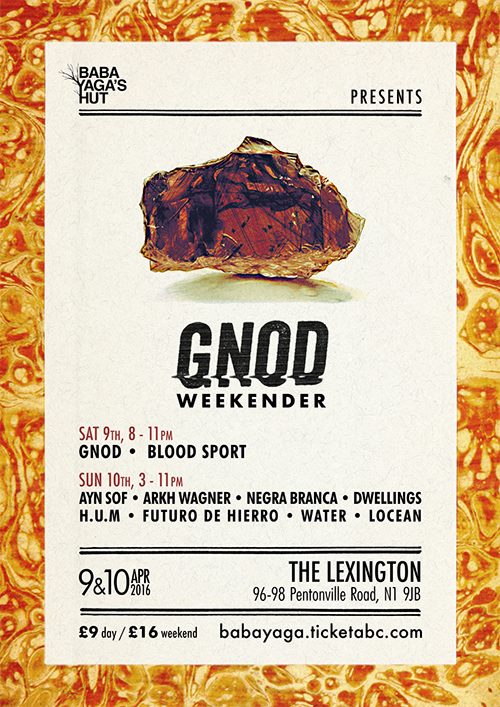
Baba Yaga’s Hut presents:
Gnod Weekender, part 1: Gnod + Blood Sport
The Lexington, 96-98 Pentonville Road, Islington, London, N1 9JB, England
Saturday 9th April 2016, 8.00pm
more informationtickets
Gnod Weekender part 2: Locean + Water + Futuro de Hierro + H.U.M + Dwellings + Negra Branca + Arkh Wagner + Ayn Sof
The Lexington, 96-98 Pentonville Road, Islington, London, N1 9JB, England
Sunday 10th April 2016, 3.00pm to 11.00pm
more informationtickets

Gnod Weekender, 9th-10th April 2016Much of all of the above is going to come together over the course of this weekend, in which Gnod and a host of like-minded friends bring their collective approach to the current homestead of quirky London rock.

Saturday sees a full Gnod performance, supported by Sheffield trio Blood Sport, whose spindly and aggressive style is a ghostly, glassy-toned, black-sun approximation of Afrobeat and soukous. As for what Gnod themselves might be doing, the grind and gnarl of ‘Mirror’ might be their current output but they have a history of changing state and presenting an expectant audience with something unexpected: so be prepared for anything which reflects their history and their potentials (up to and including party blowers, possibly).

Sunday’s afternoon-to-late-night show features Gnod side projects and assorted friends in an eight-hour orgy. Some feature current Gnod members. Paddy Shine’s immersive “tantric vocal loop” project Ayn Sof will be opening the show; Dwellings is founder and bass player Chris Haslam doing hard-beat industrial electronica – dull-thud compulsive flesh beats, like the woody rattle of an early S&M loom, played in tandem with dank gothic synth drones. Negra Branca is a Marlene Ribeiro project, expanding on the “melodic and tonal dreamscapes” which she plays as part of the main band, full of squashy analogue synth shapes and temple-goddess vocals.


In Arkh Wagner, Alex Macarte (one of the more directly mystical Gnod members, if his online talk is anything to go by) teams up with Mark Wagner, a London-based multi-disciplinary artist and cybernetic mysticist, whose working practices are steeped in “cymagick” (a visualization of sound which takes in invisible and occult connections and “the vibratory nature of all things”). Their track Turn Off Your Mind (a narrative backed by a deepening pulse-chime in a confusion of noise surf) is a meditation on staring into the void, and on going too far out.


Mark Wagner’s also taking the stage as one-third of H.U.M. (or “Hypnotic Ultrasonic Magick”), a merging with two similarly shamanic noisemakers from Bristol’s ZamZam Records (these being the enigmatic surnameless H, or “Heloise”, who slipped into Bristol six years ago from a French fine arts background and has since been bewitching audiences with gigs that fall somewhere between installation and ritual and take place in caves, swimming pools and sundry found space, and fellow émigré and ambient droner Uiutna, originally from Switzerland but making her own way in the Bristolian avant-garde). H and Uiutna relocated to France recently but return to England for this event. H.U.M. present themselves as a kind of psychic cross-cultural art coven, citing “alchemical practice, incantation, chanting, drones, ritual drumming, French variété” as both inspiration and activity… although “French variété” is also on the list, so either a showbiz tinge or a sliver of hidden humour has been worked deep into the atmospheres. Here’s a clip of them in action:


Over in Barcelona, multi-instrumentalist, producer and happeneer Víctor Hurtado is the core of a “magic-inspired” scene of ritual psychedelic music. First coming to notice as the man behind acid-assemblage unit Qa’a (a richly detailed stew of lysergic rock and Nurse With Wound noise-and-texture garnishing), he’d soon diversify into a greater spontaneity with Huan (a project which he describes as “animalistic pulsations… almost like a living organism, that is at times sick, dying or excited”). Having collaborated with Jochen Arbeit, Steven Stapleton and more recently with Chris Haslam in the “monolithic, rhythmic, repetitive” Ordre Etern, Victor is bringing his Futuro de Hierro project to London for the Gnod Weekender. His latest musical pathway, it’s an outgrowth of his interest in more extreme and violent forms of electronic dance (such as speedcore and gabba) fused with techno, music concrete and a heightened psychedelic sensibility, featuring “disjointed rhythms” and “destroyed sounds, sonic detritus and live sound manipulation.”


All-female “art-carnage” troupe Water are another part of the Venn diagram which Gnod inhabit. Specifically, they represent the circles which intersect Manchester’s visual arts and multimedia, and the Devi Collective which coalesced around the Mill to commemorate and interpret last year’s William Burroughs centenary. Citing Throbbing Gristle, Wu-Tang Clan’s Rza and “well-witch horror scores” as creative spurs, they’re currently a five piece of multi-media “queen bee” Louise Woodcock, spoken-word poet/noise-guitarist Laura Bolger, visual artists Amy Horgan and Rachel Goodyear, and Emma Thompson (usually encountered as a DIY/punk/experimental gig promoter).

Soundcloud clips reveal something sounding like post-industrial Maenads: eerie threadlike female choruses and Laura’s dub-echo declamations seeping through a freeform background of womb-bass, malfunctioning engine drones, clanks and whistles, piston hisses, machine scrapes and tekiah blasts. The involvement of at least three women from a visual arts background – plus some striking photos – suggests that there’s a spectacle involved. Evidence of lengthy Water performances inspired by Aleister Crowley, by séances and by water rituals suggest that they’re fascinated with rite, summoning and form in a way which spans primordiality, Greek legend and map-fixes on esoterica ranging from Renaissance art to the present day. All of it slips through the fingers if seized on second-hand: it seems as if Water are an experience best soaked up live.


Laura Bolger reappears to add smeared, dreamlike vocals and narrations to the final act on the bill, Locean – another full-on Irwellian music collective in the Gnod and Devi orbit (sharing both Louse Woodcock and sometime Gnod tapesman/ranter Neil Francis). Offering another queasy grinding ride of driving punk-psych, noise improvisations and punk wail, their mantric sound binds The Velvet Underground, Mother Gong, Bauhaus and an abrasive Fall-esque groove in with bass-echo and wheel-rim guitar. As with Gnod and Water, they’re technically minimal but build up to a grand scale with their scratching, multiplying sonic detail: Laura’s words and musings, floating on the sound-wash like scraps of diaries and manifestos, ranges from odd and oblique polemics to numinous childhood memories.


As I post this, tickets are still available. If you’re spending most of your time trapped in London’s gravity well, this might be your best chance for a while to get something of that Islington Mill atmosphere and inspiration, and to beat along with Gnod’s dark-toned, troubled yet committed heart.
 

March 2016 – upcoming gigs – London murk and sarcasm – an industry-baiting evening of 30-second songs by the Pocket Gods and mystery buddies; plus noise rock from Arabrot, Shitwife and Godzilla Black at Corsica Studios

15 Mar

Two London gigs for Thursday…

* * * * * * * *

Pocket Gods @ Zigfrid von Underbelly, 17th March 2016

The Pocket Gods (’30 Second Song Set’) + tbc
Zigfrid von Underbelly, 11 Hoxton Square, Hoxton, London, N1 6NU, England
Thursday 17th March 2016, 7.00pm
– free event – more information

Here’s the chirp – ”London lo-fi indie popsters The Pocket Gods play a free St Patrick’s Day gig in Hoxton, London to promote their groundbreaking album ‘100×30’ – which features one hundred songs, all of which are thirty seconds long and some of which will be featured. Free entry and some great support bands!“

Sweet, isn’t it?

Here’s the rest of the story.

‘100×30’ was released last December. It’s a sharp, timely yet self-mocking broadside aimed at the music industry as a whole, and also at the amorphous greed’n’gratification culture that’s gulping down what remains of it. Masterminding this collection of half-minute jabs are The Pocket Gods – shabby knowing masters of multiple styles, mix’n’matching shreds of chart pop, punk, synth-blurb, soggy psych and outright pisstakes (including Blur, and Dappy from N-Dubz). Sometimes they sound like a back-bedroom Zappa Band operating on cheapjack equipment from a small-town branch of Argos, and sometimes like a more eclectic Half Man Half Biscuit aiming more of their jokes at the towers of power.

Threaded through the whole album is a sense of indignation at the implosion of music as a workable career (“my royalty statement is a thing of wonder, and keeps me in a state of permanent hunger”) and the dismissal of artists who can no longer be counted as fresh and malleable meat. One lyric points out, with sardonic but righteous indignation, “I can write songs about anything, because I’ve lived a little longer”; and there’s quite a bit of moping about the prospect of a future which involves little more than making unwanted music on a laptop. Across the tracks, the subject matter paints a scathing, resolutely unimpressed picture of vulgarity and short-termisms. Songs attack the rent hikes which force music venue closures; lampoon the encroachment of multinational corporate interests into independent business (the entwinement of Orchard and Sony takes a pounding, which – since Orchard is releasing the album – is a particularly fanged move); and pour sarcasm onto side topics like the sorry parade of boss-pleasing reality-TV contestants, the cluelessness of A&R men and the ludicrous table prices at the Brits (apparent sideshows which point towards the bigger problem). The Gods even slag off laptop music and mount a harpsichord-driven assault on the memory of Steve Jobs. So much for the individual being independently empowered by technology.

With the proven flexibility of the Pocket Gods, it’s tempting to assume that the brace of performers elsewhere on the album are just pseudonyms. Not a bit of it. Some – including oddball pop mutterer Michael Panasuk and fuzz-guitar flourisher Brian Heywood – appear to be rogue film, television and library music composers. Two more are former chart stars (Owen Paul and Mungo Jerry’s Ray Dorset, each damn near unrecognisable).Some veer towards cabaret (the semi-genteel, character-vocalled acoustipop of The Low Countries) or sarky contrarian Scottish dolour (Bill Aitken). Others even sound like glossy successes in waiting, including power-popper Katy Thorn, gobby R&B-er Tricey R, immaculate faux-Californian rockers Dead Crow Road, countrified Elvis-alike Osborne Jones, twinkling white-boy hip hoppers Foxgrease and full-bore electropop drama queens Hands Of Industry. The burnished countrified chart-pop of Heywood Moore even sounds as if it could make a killing in the American Bible Belt (sweeping out of the same CCM radio playlists as the likes of Lexi Elisha – not bad for a band that’s actually from Dunstable). None of this seems to stop any of them from joining in. Some of them may be taking a long-delayed, heartfelt chomp at the hand that feeds so grudgingly, or refuses to feed at all; or which they see starving others, from audience to artist, both fiscally and spiritually.

Despite all of this justifiable resentment, it could all turn precious and self-righteous were it not for the jabs of anti-pomposity which the Gods and their friends turn in on themselves (the musician-skewering of ‘Small Town Musos’ and ‘Mac Book Ho’ made me laugh out loud, as did a song about the natural progression from ambitious Radio 1 listener to experienced Radio 2 couch-fogey). There are also the other moments – the flip side to the flipness – in which the half-minute song limit becomes a lesson in how much can be achieved in a short time. John Rowland’s plunderphonics and piano instrumentals; upROAR’s quick echo-laden harp passage, Orb collaborator Another Fine Day’s gorgeous burst of echo-soused kalimba; or when writer and narrator Michael Hingston (who’s already spent two tracks guesting with the Pocket Gods, bidding goodbye to the swelling ranks of closed-down London music venues in a hardbitten wise-barfly drawl) gently blows thirty seconds of tentative, unaccompanied saxophone.

Finally, there’s the persistent realist-absurdist wit of The Pocket Gods themselves – party hosts, project backbone and the only act formally confirmed as performing at the Hoxton gig on Thursday (yes, I was going to get back to that…) Come along to see who else makes it. Meanwhile, you can play through the whole album below; and even buy it (if you feel that that won’t somehow spoil either the joke or the protest).

https://soundcloud.com/thejacula/sets/100×30
 

* * * * * * * *

Baba Yaga’s Hut presents:
Arabrot + Shitwife + Godzilla Black
Corsica Studios, 4-5 Elephant Road, Elephant & Castle, London, SE17 1LB, England
Thursday 17th March 2016, 8.00pm
more information

Arabrot + Shitwife +Godzilla Black @ Baba Yaga's Hut, 17th March 2016Norwegian noise-rockers Arabrot have spent a decade and a half feeding classical, Biblical, existential and surreal tropes through a grand and gothic avant-rock mangle. As you can imagine from this, both their gigs and records have had an immediate raw-lifed, raw-liver feel to them, despite what ‘The Quietus’ describes as the band’s “velveteen grace”. More recently, group leader Kjetil Nernes spent two years recovering from throat cancer, during which he’s fought off and defeated encroaching death not just via hospital treatment and homestay but by hurling himself back into Arabrot recording and touring. Having admitted that the experience was “as close to real physical and psychological hell as you can go”, Kjetil has spun his reactions into Arabrot’s latest album, ‘The Gospel’, which is suffused with spectres of death, illness and his own defiance.

Shitwife have possibly the most discouraging band name in history – an evil grunt of a handle, a surly trucker’s growl of a monicker. We last encountered them in the listings for a Christmas gig, in which they were described as an “astonishingly brutal drums/laptop/electronics juggernaut fusing rave, death metal, noise and post-hardcore.” As far as I know, they’ve had no reason to mess with that formula in the intervening three months. Here’s a clip of them in action at a different gig last September (just a short walk away from ‘Misfit City’ HQ, not that I knew it) plus a more recent video showing laptop/keyscruncher Wayne Adams engaged in a painting session (and looking far sweeter than he ought to, given that his other band’s called Ladyscraper).


As I’ve said before, Godzilla Black seem to have made themselves into London noise-rock favourites while not actually having much to do with noise-rock at all. Most of the latter’s in the brawling muscle which they apply to their John-Barry-writes-for-Ruins-or-King-Crimson tunes; and in the garnish of hiss and fry lying on top of that muscle, adding a pitch and pinch of disintegration to their drums-and-horns pimp-roll. Otherwise what I’m hearing is spy-movie glamour all the way, albeit gone slightly weird: extra panicky descends and clangings, sax stranglebursts and sampler squeals. Brand new single ‘First Class Flesh’ sounds as if its about some kind of disassociative disorder: singer John McKenzie boggling, all glazed and juicy, about body parts but not actually about bodies (ending up neither sexy nor creepy, but away in a skewed and disfocussed branch-off of both).


* * * * * * * *

More March gig previews shortly…
 

December 2015 – last gigs before Christmas, London & elsewhere – Phantom Chips and Matt Loveridge’s MXLX play More News From Nowhere; mix’n’match improvising at The Hat Speaks; and the rest of the London Contemporary Music Festival 2015.

13 Dec

Well, actually this is the first of the next-to-last gigs post of the year (I’ve still got to do the second round of Christmas parties). Apologies for terseness and excessive recycling of press-release blurb, but there’s a lot to pack in both here and elsewhere this month.

About half of these gigs are seriously avant-garde concerts for the London Contemporary Music Festival, with even more of a blizzard of links and odd video clips than usual. I’m also starting with a couple of full-on jazz or electronic improvising gigs.

* * * * * * * *

More News From Nowhere #2

MXLX/Phantom Chips (More News From Nowhere @ The Victoria, 188 Hoe Street, Walthamstow, London, E17 4QH, UK, Wednesday 16th December 2015, 8.00pm) – £5.50-£7.00 – informationtickets

Walthamstow’s newest (and only?) regular night of experimental/noisy/generally interesting music, returns with sets of bracing electronic experimentation from Phantom Chips and MXLX(the amazingly prolific Matt Loveridge, aka Fairhorns, Team Brick, and one third of BEAK>, among others), as well as the MNFN DJs playing ’til late.


* * * * * * * *

The Hat Speaks, 17th December 2015

The Hat Speaks (LUME @ Hundred Years Gallery, 13 Pearson Street, Hoxton, London, E2 8JD, England, Thursday 17th December 2015, 7.30pm) – pay-what-you-want (£5.00 minimum) – information – tickets on the door

For our last gig of 2015 we return to Hundred Years Gallery in Hoxton, for the second edition of our dice-and-hat improvised music night. We held the first one in July to celebrate our second birthday, and it was so much fun we decided to do it again. As before, a nebulous ensemble of UK improvisers will gather to make spontaneous music together. This time the list looks like this:

Alison Blunt (violin, voice, assorted instruments) – Alex Bonney (trumpet) – Dee Byrne (saxophone) – Tim Fairhall (double bass) – Tom Greenhalgh (guitar, voice) – Anton Hunter (guitar) – Andrew Lisle (drums) – Percy Pursglove (trumpet, double bass) – Martin Pyne (percussion) – Tullis Rennie (trombone and possibly field recordings) – Ed Riches (guitar) – Cath Roberts (saxophone) – Tom Ward (saxophone, bass clarinet) – Colin Webster (saxophone) plus a couple more to be confirmed.

Taking inspiration from long-running Manchester night The Noise Upstairs (founded by Anton Hunter and Tullis Rennie, no less), we will put all the players’ names into a hat, throw the dice to determine how many musicians will play, and then draw out the names. The result is lots of mini- sets from often completely new combinations of people! (Some groups from last time have decided to carry on playing together too: Tom Ward and Adam Fairhall are now collaborating on a new quartet for 2016 after their hat encounter in the summer).

Do join us for this last gig of the year – it’s been a blast, so let’s see it off in style! Entry, as usual, is one Bank of England note of your choice.

* * * * * * * *

And to close, here’s that run-down through the remaining London Contemporary Music Festival concerts.

LCMF 2015 - Chris Watson's ‘Okeanos’

LCMF 2015: Chris Watson premiere (London Contemporary Music Festival 2015 @ Ambika P3, University of Westminster, 35 Marylebone Road, London, NW1 5LS, England, Monday 14th December 2015, 7.30pm) – (probably) £11.75 – information – advance tickets sold out: limited tickets available on the door.

We present the world premiere of a monumental new work by sound artist and recordist Chris Watson. Drawing on extensive underwater recordings gathered by the artist from oceans around the world, ‘Okeanos’ – a multi-channel sound installation that will play in complete darkness – celebrates the songs, rhythms and music of the oceanic depths.

LCMF 2015 - To A New Definition Of Opera II

LCMF 2015: ‘To A New Definition Of Opera II ‘ (London Contemporary Music Festival 2015 @ Ambika P3, University of Westminster, 35 Marylebone Road, London, NW1 5LS, England, Tuesday 15th December 2015, 6.30pm) – £11.75 – informationtickets

In an attempt to shift our perception of what opera can do and be, we present a second instalment of ‘To A New Definition of Opera’, in which performance, video art and neglected modernist opera rub shoulders. Alongside a new commission from British performance artist Sue Tompkins, the night will include composer Tim Parkinson’s apocalyptic anti-opera ‘Time With People’ (performed by the University of Huddersfield’s edges ensemble) and Los Angeles-based artist Ryan Trecartin‘s dystopian film ‘CENTER JENNY’.

The centrepiece of the evening will be the UK premiere of Karlheinz Stockhausen’s celebrated ‘Pieta’ from ‘Dienstag aus Licht’, with the voice of Lore Lixenberg and flugelhorn of Marco Blaauw. Interlaced throughout the evening will be an extremely rare performance of excerpts from Ezra Pound’s troubadour opera about medieval ne’er-do-wells, ‘Le Testament de Villon‘, which critic Richard Taruskin called “a modernist triumph.”

Programme:

Ezra Pound – excerpts from ‘Le Testament de Villon’ 1926 version (UK premiere) – performed by Lore Lixenberg (voice), Aisha Orazbayeva (violin), Lucy Railton (cello), Ian Sankey (trombone), Serge Vuille (percussion) Christopher Stark (conductor)
Karlheinz Stockhausen – Pieta from ‘Dienstag aus Licht'(UK premiere) – performed by Marco Blaauw (flugelhorn) and Lore Lixenberg (voice)
Ryan Trecartin – CENTER JENNY
Tim Parkinson – Opus 1, 2, 3 and 4 from ‘Time With People’ – performed by edges ensemble: John Aulich, Mira Benjamin, Jorge Boehringer, Eleanor Cully, Beavan Flanagan, Stephen Harvey, Dorothy Lee, Asher Leverton, David Pocknee and James Woods
Sue Tompkins – Like Sake (world premiere, LCMF commission) – performed by Sue Tompkins

LCMF 2015 - A Martian Sends A Postcard Home

LCMF 2015: ‘A Martian Sends A Postcard Home’ (London Contemporary Music Festival 2015 @ Ambika P3, University of Westminster, 35 Marylebone Road, London, NW1 5LS, England, Wednesday 16th December 2015, 6.30pm) – £11.75 – informationtickets

‘A Martian Sends A Postcard Home’ takes its name from a poem by Craig Raine that sought to re-see the world through bold acts of defamiliarisation. This night celebrates the Martianist turn in music, with an exploration of composers who have made the familiar fresh.

The night will include the European premiere of Norwegian composer Øyvind Torvund‘s lawless chamber work ‘Untitled School/Mud Jam/Campfire Tunes’, performed by the Plus Minus Ensemble, and Andrew Hamilton‘s electrifying ‘music for people who like art’. In ‘Mezcal No. 8’ Swedish composer/performer Hanna Hartman transforms a copse of steel rods and washers into a sounding presence.

We honour two standard bearers of “making strange” in composition: Helmut Lachenmann and Dieter Schnebel. Aisha Orazbayeva performs Lachenmann’s ‘Toccatina’ alongside a recital of Russian poems by Mayakovsky and Yesenin that live and breathe the idea of estrangement or ostranenie. Meanwhile, composer and musician Christian Kesten‎ presents Schnebel’s celebrated ‘Maulwerke’ where vocal technique is pulled apart into its constituent parts, alongside his own ‘Zunge Lösen’ that seeks to stage the tongues of three performers.

Artist Tino Sehgal takes on the body, intellectual property and materiality itself. ‘Instead of allowing some thing to rise up to your face dancing bruce and dan and other things’ is his earliest “livework”. It sees performer Louise Höjer transformed into, in the words of ‘Frieze Magazine’, a “hydraulic android”.

The night ends with a visit from Cairo’s E.E.K. Under the fingers of Islam Chipsy (accompanied by drummers Khaled Mando and Islam Tata), a digital keyboard is wrenched into explosive new sonic territory, articulating the sound of post-Tahrir electro-chaabi.

Programme:

Tino Sehgal – Instead of allowing some thing to rise up to your face dancing bruce and dan and other things – performed by Louise Höjer
Selected poems by Vladimir Mayakovsky and Sergei Yesenin – performed by Aisha Orazbayeva (voice)
Helmut Lachenmann – Toccatina – performed by Aisha Orazbayeva (violin)
Christian Kesten – Zunge Lösen (Releasing the Tongue) – performed by Christian Kesten (voice)
Andrew Hamilton – music for people who like art – performed by Becca Carson (piccolo), Ausiàs Garrigos Mórant (bass clarinet), Ian Sankey (trombone), Sam Wilson (percussion), Jack Ross (electric guitar), Siwan Rhys (piano), Joanne Evans (voice), Eloisa Fleur-Thom (violin), Valerie Albrecht (viola), Oliver Coates (cello), Martin Ludenbach (bass guitar), James Weeks (conductor)
Dieter Schnebel – Maulwerke (2015 solo version) – performed by Christian Kesten
Hanna Hartman – Mezcal No. 8 (UK premiere) – performed by Hanna Hartman
Øyvind Torvund – Untitled School/Mud Jam/Campfire Tunes (European premiere) – performed by Plus Minus Ensemble: Mark Knoop (piano), Roderick Chadwick (piano), Serge Vuille (percussion), Elsa Bradley (percussion
Islam Chipsy & EEK – live set

LCMF 2015 - Requiem for Reality

LCMF 2015: ‘Requiem for Reality’ (London Contemporary Music Festival 2015 @ Ambika P3, University of Westminster, 35 Marylebone Road, London, NW1 5LS, England, Thursday 17th December 2015, 6.30pm) – £11.75 – informationtickets

Some call it post-internet art: others “the New Aesthetic”. Whatever the name, there’s no doubt that the internet has scrambled the way we think, see and listen. Yet if art has placed this new paradigm at its heart, we are only now beginning to distil what it means for musical composition.

One pioneer of musical attempts to understand how things are changing in the digital shadow is Jennifer Walshe. The final night of LCMF 2015 will see the UK premiere of her latest, major one-woman work ‘Total Mountain’. Two further UK premieres arrive from Germany. Berlin-based Neele Hülcker investigates (as does Claire Tolan) the online phenomenon of autonomous sensory meridian response – or ASMR – in her work ‘Copy!’, while Brigitta Muntendorf explores the YouTubed bedroom in ‘Public Privacy No 2’.


https://vimeo.com/140623887

The flight from reality captured by this post-internet music is not new. Serialist trailblazers like Milton Babbitt got there first with works such as ‘Reflections for piano & synthesized tape’. The hyperactive, networked aesthetic of Walshe and others, meanwhile, was foreshadowed by Jacob TV in ‘Grab It! Both are performed tonight.

As an occasional collaborator with London-based collective PC Music, Felicita‘s music is one in which the tropes of pop’s most commercial statements are accelerated, amplified and brought riotously together into a language that, if satirical, is also wildly inventive in its own right.

We conclude and project into the future with the long-awaited UK return of James Ferraro, whose 2011 album ‘Far Side Virtual’ is an essential post-internet text. For his forthcoming release ‘Skid Row’, Ferraro turns his attention to contemporary Los Angeles, a kind of “hyper-America” where violent realities are obsessively mediated and reproduced.

Programme:
Milton Babbitt – Reflections – performed by Mark Knoop (piano) with original tape recording
Jacob TV – Grab It! – performed by Nick Goodwin (electric guitar)
Brigitta Muntendorf – Public Privacy #2 (UK premiere) – performed by Brigitta Muntendorf with Mark Knoop (piano)
Neele Hülcker – Copy! (UK premiere) – performed by Neele Hülcker
Jennifer Walshe – Total Mountain (UK premiere) – performed by Jennifer Walshe
Felicita – live set
James Ferraro – new work

December 2015 – some more musical Christmas parties, London – Memphis Industries’ Lost Christmas (with Dutch Uncles, The Go! Team, Menace Beach, Outfit, NZCA/Lines & slug); Gare Du Nord’s Arrivée/Départ II (a Viennese whirl with Martin Klein, Bon Bon Beast, Hefner escapees and many others)

10 Dec

Carrying on with the London Christmas gig previews – next week, there’s a pair of simultaneous double-evening multi-band events happening within a mile of each other. The first of these is the Memphis Industries shindig – “two nights of festive fun” from one of the smartest small British pop labels at work today, with six bands and a host of present giveaways including limited edition art prints.

Lost Christmas @ Oslo, 14th & 15th December 2015

Lost Christmas – A Memphis Industries Christmas Special with Dutch Uncles, Outfit and NZCA LINES, The Go! Team, Menace Beach and Slug (Oslo, 1A Amhurst Road, Hackney, London, E8 1LL, England, Monday 14th and Tuesday 15th December 2015, 7.00pm) – £16.50 for each night / £30 for both nights – information & ticketsmore information

Monday night kicks things off with three of the label’s bands “art-rocking till they drop”. The striking prog-pop babble of Dutch Uncles headlines; doom-toned Liverpudlian tech-pop band Outfit play the middle set; and (following a brace of high-concept singles over the course of the year) one-man white-pop/R&B hybrid NZCA/Lines opens the show.


Tuesday promises “unparalleled noisy fun, and possibly sailor outfits”. Flipzoid Brighton pop crew The Go! Team headline, their lineup a little different from that of recent years but their magpie polymusical energies still intact. Leeds indie supergroup Menace Beach are in the middle; while reformed noiseniks and north-eastern eclecti-pop upsetters Slug open things up with a live band including Peter and David Brewis of Field Music.


* * * * * * * *

The second of the double-night events is the one run by Gare du Nord Records, a pair of concerts which have an almost familial feel, revolving around certain hub projects (Hefner, Death In Vegas), certain locations (Walthamstow, Canterbury, Vienna), certain other sympathetic labels (Fortuna Pop, Audio Antihero) and a smart, sometimes wordy aesthetic.

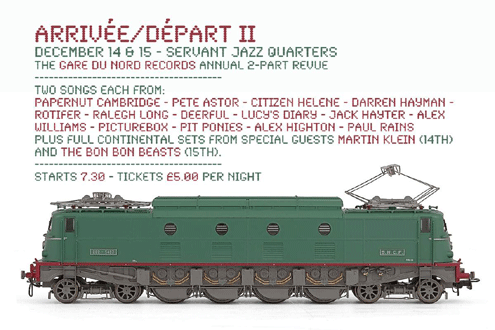
Arrivée/Départ II @ Servant Jazz Quarters, 14th & 15th December 2015

Arrivée/Départ II – Gare Du Nord Records 2-Night Revue (Servant Jazz Quarters, 10A Bradbury Street, Dalston, London, N16 8JN, England, Monday 14th December & Tuesday 15th December 2015, 7.30pm) – £5.00 each night – information – tickets on the door

Both nights are revues – a long main set from each of the two special Austrian guests, bolstered by short mini-sets from the other bands. There’s a lot of personnel crossover. Expect the same faces to keep popping up, reshuffled.

The Monday gig’s main set comes from Martin Klein, the Viennese singer-songwriter whose piano songs albums of and witty, deadpan performances are making him a rising star in Austria and Germany, and whose questioning, sometimes undercut romanticism should translate across further borders. Among the short sets are appearances by two former Hefner members: their frontman and prime creative force Darren Hayman and their multi-instrumentalist Jack Hayter, both now established as significant and highly individual solo songwriters (and while Darren might be the better known of the two, don’t underestimate Jack – I was enchanted by a battered set he played at Union Chapel last year).


Other players on the Monday bill are Cockney surf-punks Pit Ponies, Allo Darlin’ guitarist Paul Rains (taking a solo step-out from his main band’s classic indie-pop styles) and the “prim and improper” antifolk punksters Lucy’s Diary. There are also two acts who specialise in the soft-and-sharp – Cambridge’s Alex Highton (whose folk-, pop- and jazz-smattered songs conceal quick jabs of wit beneath their light and luscious surfaces) and Vienna-via-Canterbury trio Rotifer (creators of pitch-perfect country-tinged indie pop songs, sallies and snarks, and who also serve as a kind of scattered house band since various members play in six of the acts on offer during the night).


The Tuesday gig’s Viennese treat headliner is Bon Bon Beast – two multi-instrumental singer/producers, one of them Austrian (Ernst Tiefenthaler) and the other Swiss (Eloui), filtering their diverse past experiences into a straightforward acoustic jolly. Among the support acts, former Weather Prophets/Ellis Island Sound man Pete Astor continues his low-key live renaissance, and former Death In Vegas guitarist Ian Button brings along one of the various lineups of his psych-dusted pop project Papernut Cambridge. Since many of the people who play in the band are appearing in (or as) other acts during the evening, it’ll have been an easy roundup: Papernut Cambridge backing singer Helene Bradley, for instance, is performing a solo set as Citizen Helene (showcasing the soulful delivery and wistful irony which places her somewhere between Mama Cass and Kirsty MacColl).


Also playing are baroque orchestral pop songwriter Ralegh Long (presumably detached from the small orchestra which tends to follow him around) and Emma Winston’s one-woman Deerful project (miniature synths and brittle stories). Two Kentish acts round out the evening: lo-fi Canterbury pop band Picturebox and Whitstable’s Alex Williams (whose swerving career so far has encompassed indie rock with Fleeting Things, folk music with New Old World and lo-fi outsider clatter-pop with The Psychotic Reaction, as well as the odd ABC cover).


* * * * * * * * *
More Christmas gigs shortly, including some events elsewhere in Britain…

December 2015 – some musical Christmas parties in London – Fire Records (with the Jazz Butcher Quartet); The Glass Child’s online Christmas show; Arctic Circle’s Santas in Space (with Camden Voices, Left with Pictures, Laish and Boy and a Balloon); Baba Yaga’s Hut (with Bad Guys, Melting Hand, Wren)

9 Dec

I’ve been posting mostly shout-outs for gigs this year, so I might just as well submit to becoming Santa’s little shill as regards this month’s sprouting of Christmas/Hannukah/seasonal parties. From the flood on my Facebook account to the rumours and snippets I hear, this is a selection of what’s on for the next week or so (just London this time, though I’ve got some gigs elsewhere ready for the follow-up…)

* * * * * * * *

Fire Records Christmas gig 2015

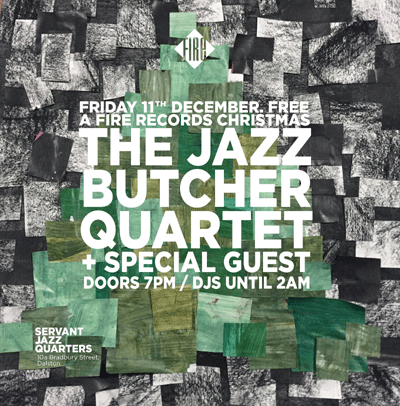
Fire Records Xmas Party with The Jazz Butcher Quartet + very special guest + Fire Records DJs (Servant Jazz Quarters, 10A Bradbury Street, Dalston, London, N16 8JN, England, Friday 11th December 2015, 8.00pm) – free – information here and here

The first of several gigs in this post taking place at the Servant Jazz Quarters amongst the bottles, foxes and curios. Fire Records DJs will be playing from their typically wide-ranging hoard of music, and there’ll be two sets of live music. One guest is as-yet unnamed (it’s a surprise) and the other is the latest iteration of the three working decades of absurdist Northampton-based singer-songwriter Pat Fish as The Jazz Butcher.

The Jazz Butcher Quartet sees Pat take a sideways step away from the cunningly meandering rock’n’strum that he’s generally known for, and tease the ever-present jazziness out of his songs and into full focus via a collaboration with three dedicated jazz musicians The Jazz Butcher – drummer Steve Garofalo, trumpeter Simon Taylor and double bass player Steve New. The Steves and Pat were already old buddies from their time in the Northampton music scene, in particular due to their mutual work with the magnificently strange and wise alternative folk singer Tom Hall. The result’s a refreshed acoustic take on Jazz Butcher staples, wrapping itself round the old and new tunes and the playful wandering lyrics with utter flexibility.

The evening is absolutely free, apart from the drinks, but the Servant Jazz Quarters is a small place – so show up early if you want to be able to get in. Some footage of the JBQ is below.

* * * * * * * *

Swedish singer-songwriter Charlotte Eriksson, a.k.a. The Glass Child is hosting her own Christmas gig online. It sort of fits with her itinerant nature – having left her Gothenburg home at the age of eighteen, she built up both a label and a career while sofa-surfing through London, England and Berlin. You can’t fault the girl for thrift, for ambition and for investigating the art of the possible while living out of a suitcase. Playing a big interactive gig, but from nowhere in particular, certainly suits her style so far.

The Glass Child Christmas StageIt Show (online, Sunday 13th December 2015, 7.00pm CET) – pay-what-you-can – information & tickets

Charlotte’s own message:

Christmas, my children, is not a date. It’s a state of mind. December 13th is the day that Swedes celebrate “Lucia”, which basically means Swedish Christmas songs, gingerbread, tons and tons of candles, mulled wine (Swedish Glögg) and cosiness all around. Basically all of my favourite things!

Lucia is an ancient mythical figure with an abiding role as a bearer of light in the dark Swedish winters. The many Lucia songs all have the same theme: “The night treads heavily around yards and dwellings / In places unreached by sun, the shadows brood. / Into our dark house she comes, bearing lighted candles, / Saint Lucia, Saint Lucia.” All Swedes know the standard Lucia song by heart, and everyone can sing it, in or out of tune. On the morning of Lucia Day, the radio plays some rather more expert renderings, by school choirs or the like. The Lucia celebrations also include ginger snaps and sweet, saffron-flavoured buns (lussekatter) shaped like curled-up cats and with raisin eyes. You eat them with glögg or coffee. (Do you guys understand why this is my favourite Swedish tradition?)

So I thought, what better way to celebrate this little Swedish Lucia day than with you! A cosy acoustic Christmas show with music, candles and maybe my first ever performance of a Swedish song. Like always: some new songs, some old songs, questions, chat and some insights behind my new album that I’m currently working on. Please join me for this evening show and we’ll create a memory worth remembering.

Some examples of Glass Child work so far are below.

* * * * * * * *

I’ve been covering Daylight Music gigs for several years now, but anyone who spends much time around those will know that parent organisation Arctic Circle spreads its activities a lot wider than those Saturday afternoons at Union Chapel – and in this case, a lot higher. Over to them:

'Santas In Space' 2015

Santas in Space’ featuring Camden Voices + Left With Pictures + Laish + boy and a balloon (Arctic Circle @ ArcelorMittal Orbit, 3 Thornton Street, Queen Elizabeth Olympic Park, Stratford, London, E20 2AD, UK, Wednesday 16th December 2015, 6.30pm) – £15.00 – informationtickets

We return to the most spectacular venue in London to bringing our unique brand of Fuzzy Feeling to the 376 feet high platform of the Arcelormittal Orbit. With the sparkling lights of London as a spectacular backdrop, watch as the sculpture becomes an astronomic live music space celebrating the Christmas season! Camden Voices will start the night off with their thirty-strong choir proclaiming yuletide glee followed by a series of the finest fuzziest musicians from our Daylight Music series – from the chamber indie of Left with Pictures to the luscious folk of Laish and the lo-fi pop of Alex Hall’s boy and a balloon. Finish the evening by wrapping your ear around a winter-warming set from DJ Ben Eshmade (Arctic Circle Radio/Chill) with a festive drink or cocktail in hand. Please note this event is for over-18s only.


* * * * * * * *

If that last one seems to be bordering on the twee for you, another ‘Misfit City’ regular event is offering something typically noisier and rucked-up around the edges:

Bad Guys/Melting Hand/Wren @ Baba Yaga's Hut, 16th December 2015

Baba Yaga’s Hut Xmas Bash with Bad Guys, Melting Hand, Wren (Baba Yaga’s Hut @ Corsica Studios, 5 Elephant Lane, Newington, London, SE17 1LB, England, Wednesday 16th December 2015, 7.30pm) – £5.00 – informationtickets

Again, over to them:

Come down to the Baba Yaga’s Hut Xmas party. Three very heavy acts for you, mulled wine. Xmas hats. Getting drunk, the usual. London’s best classic metal band Bad Guys headline; plus the first ever London show for new heavy-psych/improvising jam supergroup Melting Hand (featuring Gordon & Russell of Terminal Cheesecake, Mike Vest of Bong/Drunk in Hell etc etc and Tom Fug of Gum Takes Tooth); and a Baba Yaga’s debut for London post-metal/sludge four piece Wren.


To be continued…

October 2015 – upcoming London gigs – gamelan/dance fusion with My Tricksy Spirit, Wax Wings and Segara Madu; Nordic pop at Ja Ja Ja (Kill J, Loveless and Maasai); anarchistwood’s Samhain/NYE party (with Rude Mechanicals, Jane Ruby and more)

23 Oct

More concerts for the end of October…

* * * * * * * *

As the opening concert of the South East Asian Festival 2015, there’s a performance at the Forge by My Tricksy Spirit, a new musical project which fuses the shimmering sounds of gendér wayang – Balinese gamelan instruments – with dub, electronic, ambient, trip-hop, and psychedelic rock. The Forge’s writeup is below (tweaked a little by me).

My Tricksy Spirit @ The Forge, 28th October 2015

My Tricksy Spirit (The Forge , 3-7 Delancey Street, Camden Town, London, NW1 7NL, UK, Monday 26th October 2015, ) – £10.00 

Performed on the bronze-and-bamboo “gendér” metallophones which gives the music its name – and featuring intricate, interlocking melodies played with mallets and damped with the wrists – gendér wayang is a subset of Balinese gamelan music. Involving between two and four players (a small number for a gamelan ensemble) it is used in the island’s Hindu rituals including life-cycle ceremonies, temple festivals, purification rituals and cremations (as well as in the sacred wayang kulit shadow-puppet dramas, based on ancient Indian epics).

The My Tricksy Spirit project was started by Nick Gray, who teaches south-east Asian music at the School of Oriental and African Studies at University of London, and who runs the gendér group that forms the basis of the band. Using Ableton Live, several synths and effects, guitar, bass and drums, the music is played through a mixing desk – much like dub – to create an intense psychedelic journey through sound.

Tonight’s band features Nick Gray (violin and vocal), Paula Friar and Rachel Wilcox (gendérs) and four other musicians: Tomoya Forster of Pumarosa (bass guitar, effects, mixing desk), Julian Vickary of General Skank (synthesizer and effects), Charlie Cawood of Knifeworld (bass guitar, sitar, guitar) and Rob Shipster of Buttress Root Drumming (electronics, drums), who also produced My Tricksy Spirit’s upcoming album.

Support comes from electronica/world-house act Wax Wings and from another of Nick Gray’s SOAS gendér wayang ensembles, Segara Madu (who mostly play repertoire pieces from the Balinese village of Sukawati, as taught by the late I Wayan Loceng). More information and gig tickets are here, with the Facebook event page here.

* * * * * * * *

Arguably, there’s not been enough pop or R&B in here recently. Let’s set that straight.

Ja Ja Ja, 29th October 2015

Kill J + Loveless + Maasai (Ja Ja Ja @ The Lexington, 96-98 Pentonville Road, Islington, London, N1 9JB, UK, Thursday 29th October 2015,) – £5.00/£7.00

Straight from the publicity:

Founded in 2009, Ja Ja Ja is the definitive Nordic website and club night celebrating the very best new music emerging from Sweden, Finland, Iceland, Norway and Denmark. Each month at London’s The Lexington, Ja Ja Ja hand-picks the finest emerging talent from the Nordic countries, making sure that only the best music is filtered through to your ears.

KIll J (a.k.a. Julie Aagaard) has been turning heads the past two years with her signature blend of dark experimental pop. A devastating one-two-punch with debut singles Phoenix and Bullet set the blogosphere buzzing, also catching the keen eye of ‘The Guardian’, ‘Indie ‘, ‘Stereogum’, ‘Pigeons and Planes’ and landing airplay on BBC Radio 1 and BBC Radio 6music. Deliciously diverse, the sugary sweet Cold Stone revealed a more innocent and naive side of KIll J, whilst Propaganda burst forth as “a bombastic, fangs-bared snarl at sexism” (‘Stereogum’). There’s more to come too, with an EP promised this fall.

Prominent identities in their own right, Eirik Tillerli and Filip Kollsete teamed up late 2013 to form Norwegian beat crooners Loveless. Following back-to-back remixes, debut single How To Love You was instantly added to national radio. Clocking in excess of 500K streams last year, their music has picked up attention from blogs, magazines and DJs all over the world; also landing them on some of the biggest festivals in Norway, not to mention their own club night in Oslo, Klubb Loveless (where guests include Artful/Artful Dodger and NVOY). New single They Don’t Know was recently hailed Record of the Week on BBC Radio 1xtra, serving the first taste of upcoming project ‘Relationships’.

Maasai is a Stockholm-based duo consisting of Dominique Teymouri and Zackarias Ekelund. Together they create soulful sound landscapes with a cinematic touch and lyrical depths. The pair broke on to the scene with debut single Memories, pulling inspiration from varied and abstract constructs – places, people, surroundings and everywhere in between. Follow-up tracks The Healer and Forgive Me have since held a captive audience; also hinting to the fearless, fragile and all-the-while dreamy atmosphere inhabited by MAASAI’s upcoming debut album – set for release later this year.

Resident DJs Project Fresh Socks are along for the ride in October; having also spun up a storm at Ja Ja Ja’s first club night of the season last week at The Lexington with CHINAH (Denmark), The Fjords (Norway) and Axel Flovent (Iceland).

Up to date information for this particular Ja Ja Ja night is here and tickets are here.

* * * * * * * *
Flapping-in-the-wind time… here’s what looks like a very interesting gig, but the colourful cloud of information around it keeps changing shape. Here we go..

Subterfuge presents Samhain Special/Labiatory New Year’s Eve Party with Rude Mechanicals + NiMBUL + Bad Suburban Nightmare + We Are A Communist + Jane Ruby + Milky Sugar (Subterfuge @ The Others, 6-8 Manor Road, Stoke Newington, London, N16 5SA, UK, Friday 30th October 2015, 7.00pm) – £3.00 to £6.00 and upwards

Samhain Subterfuge, 30th October 2015

Run by arch, arty but heartful prank-rockers anarchistwood (whose own ingredients span post-punk cantatas, skeletal lo-fi garage pop, silly voices and quickfire sampler collages), this is the last Subterfuge club night of the year (hence the split between a Halloween/Samhain night and a New Year’s Eve shindig) and promises a fabulous musical sprawl – a right old grab-bag of this and that, in the best way. anarchistwood themselves are playing, though at the moment it’s unclear whether or not they’re teaming up with dysfunctional Chatham polymath and Stuckist art brute Sexton Ming (as the anti-supergroup called Nimbul), or playing as themselves. I guess that whichever way it goes you could expect a roughly equal mix of distracted behaviour, political protest, self-absorbed memory jigsaws and détournements with echoes of Beefheart, Crass, The Raincoats and the high point of a Pride parade. But that’s all it is – a guess.

Compared to Earth and Neil Young at their most dogged and noisy, Dan Hrekow – a.k.a Bad Suburban Nightmare – plays “impossibly slow and melancholic” grunge-drone instrumentals on a minimal setup of distorted guitar and pedals. In violent contrast, Rude Mechanicals play party music for paranoid schizophrenics, fronted by the peroxide-beehive rantings of Miss Roberts (who looks like a doubled-back-drag-queen version of Patsy Stone, and speak-sings like a collision between Dagmar Krause and Holly Penfield), Their songs are rattling hallucinatory-jam sandwiches about sinister neighbours, stand-up arguments and alien mice on the Tube, mixing jazz, punk and cabaret together in equal measures and played with both needle-sharp precision and full glamour oomph.

Of the rest, We Are A Communist provide “trashy guitar-laden sci-fi surf music, with stylophones to boot – a must for Man or Astroman? fans”; onetime Naked Ruby frontwoman (and current Deptford Beach Babes member) Jane Ruby turns up to sing her solo mixture of torch, garage rock’n’roll, flamenco and blues songs with twists of Spanish & Arabic flavours; and Milky Sugar performs “punk go go”… but that’s where I run out of information.

I’ve no actual idea about the order in which everyone’s going on, as the various info and flyers seem to contradict each other: either that or the whole event is morphing too fast for me to keep up with it. Presumably they’re working to some functional anarchist or I Ching method to establish it, or you just turn up and see what happens. Perhaps that’s what they’re doing. Either/and/or DJ Sugarlump SS, DJ KG Lumphead and MC Sadogasm provide some extra noises, punkvertery & Kodek provide visuals, and they’ve got a proactive but generous door price policy – three quid if you’re unwaged, four quid if you’re a student with an NUS card, and six quid if you’re neither but have shown enough commitment to arrive before 9pm. After that, they charge more. More information is here; keep track of developments as best you can on Facebook here; and there’s the usual array of tasters below.

* * * * * * * *

More shortly…

October/November 2015 – upcoming London gigs – intercontinental psych & noise with Baba Yaga (Bitchin’ Bajas, Tomaga and Demian Castellanos, Acid Mothers Temple and Zeni Geva); and more LUME jazz with Tom Taylor/Rob Luft and Cath Roberts/Seth Bennett/Andrew Lisle

23 Oct

Pausing only to remind you that the last week of October includes two of the Pierre Bensusan acoustic gigs at the Half Moon in Putney (which I mentioned in the previous post), here come the last of my selected London gigs for the month, and the first for the start of November. As ever, it’s just a small sampling of what’s on in town, but it’s what’s caught my attention.

* * * * * * * *

Bitchin’ Bajas + Tomaga + Demian Castellanos (Baba Yaga’s Hut & Hands in the Dark @ Cafe Oto, 18-22 Ashwin Street, Dalston, London, E8 3DL, UK, Monday 26th October 2015, 8.00pm) – £9.00

Baba Yaga's Hut, 26th October 2015I’ve heard Chicago trio Bitchin’ Bajas described as “psychedelic easy listening” – presumably by someone who insists on being shouted at in conversation. Despite that swaggering faux-dumb name (the one that makes them sound as if they play manic Tejano to be drowned out by fist-fighting oil workers) they’re more ‘Bitches Brew’ than cathouse. They spin out protracted rhapsodic instrumentals drawing on a variety of introspective, mindful influences and parallels, looking back to the hallowed bucolic trance of Harmonia and Cluster, the ecstatic modular pulses of Terry Riley, the breezy but depthless Pacific cool of West Coast jazz, and perhaps the dissolving pastoralism of Talk Talk. Though they’re multi-instrumentalists, they wear their skills lightly, working wind instruments and mallet percussion into their mists of keyboard and workhorse organ and their landscape of lively rolling, rilling glissandi and drone chords. Sometimes overlapping into ambient electronica, they’re never quite dilute enough to fit into it: even at their most vaporous and transparent, they’re the smoke that never quite fades, the tang that holds your attention. As the clip below shows, they’re perhaps a little too diffuse to work at an open air festival: embraced by the Oto space, they should do just fine.

Synth/sounds looper Tom Relleen and drummer Valentina Magaletti keep in step – just about – as Tomaga, an impressionistic improvising duo drawing on drone music, free jazz and modular synth work hanging off the edge of rock. Simple oscillating melodies percolate loosely over a syncopated jazz lope with hanging coffee-can taps and rattles and shortwave radio whines; sometimes a synth organ hangs by itself, burbling, while the percussion sways and alarms like an approaching freight train. It’s music of preoccupation, with brief flashes of bright sunlight through the pressing focus.

Best known as the figure behind London psychedelic/kosmische projects The Orichalc Phase and The Oscillation, Cornish-born loop guitarist Demian Castellanos steps out under his own name for his most personal work so far. Like Fred Frith or G.P. Hall, Demian’s had a history of playing guitar with implements – paper, cutlery or whatever else came to hand – and feeding the sounds through volume swells and sundry pedals: like Hall, he’s also possessed of a nature-inspired, painterly view of music. For this current work, he’s going back to his formative years of woodshedding as a cottage-bound teenager at the isolated southernmost tip of the British coast; creating rich, portentous and melodious sound layers drawing on early-‘90s shoegaze, on raga and drone, and on echoing, guttering British, Indian, American and German psychedelic influences.


More gig info is here, and tickets are available here.

* * * * * * * *

On the first day of November, there’s a double bill of Japanese heaviness at Corsica Studios.

Acid Mothers Temple & The Melting Paraiso UFO + Zeni Geva (Baba Yaga’s Hut @ Corsica Studios, 4-5 Elephant Road, London, SE17 1LB, UK, Sunday 1st November 2015, 7.30pm) – £14.00

Zeni Geva (or Zeni Gaiva, depending on how you translate the phonetics – conceptually, it translates as “money violence”) have been around since 1987. Led by guitarist/singer/noise-chopper KK Null, and currently backed up solely by drummer Tatsuya Yoshida to make a quake-strength power duo, they have initial links to legendary noise-Dadaists The Boredoms (and even the venue-destroying pre-Boredoms chaos act Hanatarash, which featured Mitsuru Tabata, until relatively recently Zeni Geva’s second guitarist). You’d expect them to have an abrasive side, and you’d be right. Their default musical setting is one of boiling, barking aggression, with tight and furious knots of threshing machine guitar; their records have savage, sadistic titles like ‘Total Castration’ and ‘Desire For Agony’; their progressive hardcore approach takes assorted forms hostage (aside from the obvious, there’s math and noise rock, psychedelia and death metal in the tangle) and makes them jump like puppets.

And yet, in spite of this, there’s a world of difference between Zeni Geva and your average long-lived heavy-thunderfuck band. It’s mostly in the way they use calm – little, perfectly-formed lacunae of space in between the blurs and blows, bringing their bursts of frenzy into focus (Steve Albini is both fan and sometime collaborator, and you can see why). It’s a terrible cliché to compare Japanese musicians to martial artists, but in this case there’s some substance to it. The brutality is sheer craft rather than an end in itself, every movement seems considered and purely executed; and live, in between each flurry of songblows and each ugly song name, they seem enormously humble, friendly and pleased to be there.

Acid Mothers Temple have taken twenty years to set themselves up as a revered psychedelic institution, but it seems as if they’ve been doing it for much longer, such is leader Makoto Kawabata’s talent for back-engineering himself into the culture. Part of this is down to the way he and his cohorts have mastered the ingredients, including the tearing metallic squalls, mellow blues tracery and starry smears of Hendrixian guitar, the whispering lapping Gong synths, the Pink Floyd mantra riffs and Zappa-esque air sculpture solos, and the zoned-out post-James Brown grooves (with the addition of Japanese chanting and noise-squalls). Much of the rest of it is to do with AMT’s open, overlapping community approach. Their musical impetus has utilised multiple faces and names, from their own simpler reconfigurations (the heavier trippier playing of Acid Mothers Temple & the Cosmic Inferno, the Sabbath-y sludge of Acid Mothers Temple & Space Paranoid) to the friendly absorption or co-opting of contemporaries (Acid Mothers Temple SWR, with Ruins, and Acid Mothers Afrirampo) and of heroes from the original psychedelic generation (the team-up with Daevid Allen and Gilli Smyth as Acid Mothers Gong, and with Mani Neumeier as Acid Mothers Guru Guru). If old heroes are unavailable or disinclined to pool resources, AMT have simply shrugged and continued anyway (such as when they took up hurdy-gurdys and acid folk and briefly became Acid Mothers Temple & the Incredible Strange Band).

If this makes Kawabata and co sound like slick chancers (and even if AMT album titles like ‘Starless and Bible Black Sabbath’ do suggest both avid, nerdy fandom and piss-taking on a Julian Cope level), I’m selling them short. Acid Mothers Temple might be a brand as much as an ethos, but that hasn‘t stopped their project and record-releasing ethics being continually dedicated to possibilities and continuance,rather than simply banking a following (or colonizing someone else’s). Their communal origins may have been two decades behind those of their inspiration but were hardly any less sincere; and their exploration of less obvious musical areas en route (including opera, Terry Riley minimalism, Nepalese folk and southern European Occitan culture) have led them into interesting places and opened further doors to anyone following them.

First and foremost, anyone who’s seen AMT play will vouch to their talent of both mastering their sources and creating music which lives, thrills and involves in the moment. This week’s London concert features the more space-rock inclined Acid Mothers Temple & the Melting Paraiso U.F.O. lineup – probably the easiest entry point to an increasingly rewarding musical world. See below for a full-length concert clip of the band in action.

More gig info is here, and tickets are available here.

* * * * * * * *

Also on the Sunday, it’s time for the monthly LUME gig: more jazz in Dalston…

LUME logo

Tom Taylor/Rob Luft and Cath Roberts/Seth Bennett/Andrew Lisle (LUME @ The Vortex Jazz Club, 11 Gillett Square, Dalston, London, N16 8JH, UK, Sunday 1st November 2015, 7.30pm) – £10.00

For our November Vortex gig, we welcome a duo and a trio to the stage, for a night of improvised music.

Tonight sees the first meeting of a new improvising trio featuring LUME’s co-director Cath Roberts (baritone saxophone), Seth Bennett (double bass) and Andrew Lisle (drums). Andrew is known for being one of the drummers in heavyweight Leeds anarcho-sextet Shatner’s Bassoon, and as a prolific improviser working with a multitude of musicians on the free scene (Colin Webster, Alex Ward, Daniel Thompson, Tom Wheatley and more). Seth leads his own ensembles Nut Club and En Bas Quartet, as well as being involved in many other projects across musical styles including Fragments Trio, Metamorphic and The Horse Loom. He and Cath play together as a duo, as well as in Word of Moth and Cath’s quintet Sloth Racket. In addition to this and her LUME work, Cath also leads Quadraceratops (a septet) and has a duo with guitarist Anton Hunter, Ripsaw Catfish.

Seth Bennett, Cath Roberts, Andrew Lisle

The new duo featuring Tom Taylor and Rob Luft is a recent collaboration borne out of a mutual love of improvised music. The music draws attention to the many common features of the two instruments, and mixes high-intensity improvisation with more tender and reflective textures.

A former award-winning classical piano graduate at the Royal Northern College of Music in Manchester, Tom is now a rising British jazz star, having transferred to London in 2009 to pursue a Masters in jazz piano at Trinity College of Music (studying with Simon Purcell, Liam Noble and Nick Weldon). Since then he’s played the main jazz festivals in Manchester and London and Kongsberg Jazz Festival in Norway. He’s a member of the Jack Davies Big Band and of Southbound (both of whom have recorded for V&V Records) and also plays in the collaborative electro-acoustic trio duck-rabbit with saxophonist Joe Wright and double bass player James Opstad. Rob began his career as a jazz guitarist in Sevenoaks, where he took lessons from Mike Outram and turned professional at 15. He has been a mainstay of the National Youth Jazz Orchestra for many years, having been its guitarist since 2010 and having played in the associated NYJO Nonet. He currently co-leads the band Organism and plays with various groups on the London jazz circuit; including positions with Nigel Hitchcock, Gareth Lockrane and the Callum Au Big Band.

Rob Luft, Tom Taylor

More information here, and tickets here.

* * * * * * * *

More imminent gig previews shortly…

July 2013 – EP reviews – Jimmy The Hideous Penguin: ‘Colours’ (“a harbourful of soused and bobbing vinyl”)

7 Jul
Jimmy The Hideous Penguin: 'Colours'

Jimmy The Hideous Penguin: ‘Colours’

With a name like that, you expect an MC with a slew of stories. A brilliant, squat little microphone hassler compensating for his own lack of sleek, straightforward charm with a quacking, manic inventiveness and left-field imagination. You expect one story, at least.

Instead, Jimmy The Hideous Penguin is a turntablist; using that ludicrous name as a billboard to cover the heads-down, ’phones-on business of scratching, filtering and triggering. A member of DJ quartet Vince Mack Mahon (and one of the masterminds behind the Community Skratch turntable initiative) he’s from Galway. Appropriately, ‘Colours’ sounds like a sketch of Galway on a moderately bad day – soggy and drizzled-misted, but still bright and creative – but you can only stretch his hometown associations so far.

Ducking any of Galway’s high-culture Eire-isms (and, to be fair, many of Vince Mack Mahon’s hip-hop inspirations) Jimmy’s music instead listens eastwards towards Rhine-Ruhr electronica, while picking up occasional bits of English scruff on the needle. It also listens downwards (into well-travelled vinyl grooves) and inwards (through a radio dial set to a perpetually-displaced rural 1970s). Its electrophonic wanderings owe a fair bit to Kraftwerk, a little bit to BBC Radiophonics and quite a large bit to those early Jimmy Cauty-era Orb recordings. Adding a raw backbone of analogue synth-steps and thick, flittering drones to his eddies of turntable work, beat loops and found noises, Jimmy works up some interesting slop behind that cartoon billboard. Instead of those MC stories, you get scenery to make stories – an occasionally playful plunderphonic montage; a harbourful of soused and bobbing vinyl; a frown of uneasy concentration.

While there are some visitations from the drum-burrs and rhythmic grapples of drum and bass, dubstep and techno, Jimmy’s music prefers to wander off on its own. Moving along messier roads, it kicks up a little historic debris as it goes. Red, in particular, sounds like flotsam; washing up out of swells and reversals of wadded-up torch songs, old shellac albums part-drowned in the tide. Jimmy moves the music drunkenly around a European receiver, shuffling aural zones. First he’s playing frail electronic trumpets against twanging, nasal staccatos; then he’s manhandling a sneaking strand of funk drum, a hungry worm of double-time rattle accelerating it from within. Then he’s meandering through abandoned dockscapes at the back of a dark wind, and finally ends in a bend of misdirected psychedelic organ.

On much of the EP (in which one piece strays into another in jostling transitions), ’70s fantasy seems to be rubbing up against ’70s slump. When a stray Dalek shows up at the end of Green – grating out “they are approaching” – it sounds both menacing and surly. It even sounds impotent; like a grumpy gate-guard on the inside of a power-station picket line, slouched in its own little pocket of hate and with a tepid thermos of well-stewed tea clamped onto its sucker, watching strikers slouch into position for the start of a day of mutual glaring. The rest of the piece feels similarly boxed-in – a pained, brontosaurine lumber of panel-beating snare drum and warping sub-bass, weighed down by an oppressive dark-ambient echo and drifting off into a carbon-monoxide grind.

On the subject of ‘Doctor Who’, I could have sworn that I heard a far more obscure ’60s Whovian critter show up, too – ECCO, the incomprehensible computer from ‘The Ice Warriors‘ with the infuriating papery stutter which (even in 1967) made it sound like a remix victim. Presumably, Jimmy’s too young to remember this first-hand: if he’s not been crate-digging deeper into the Beeb’s sound library, maybe he’s been digging up and scratching someone else’s memories.

It’s equally likely that Jimmy’s stumbled across a bit of the Galway countryside that is forever 1978, or at least has a damp box of that year’s proggier vinyl dumped there. Quite early on during Blue’s multi-part sprawl, some of the more oceanic swirls from Jean Michel Jarre’s ‘Equinoxe’ waft through the mix. Later on, Jimmy will varispeed a eerie floating snatch of psychedelic folk (reed-boned flutes and acoustic guitar, like a conjunction of Mike Oldfield’s ‘Ommadawn’, Popol Vuh and ‘The Wicker Man’) before trickling a clip of muffled Rakim-esque rap-and-chatter over twinkles of fairytale guitar lifted straight from Yes’ ‘Circus Of Heaven’.

At the start, however, Blue is lo-fi, dodgem-car techno with a bassline like someone clubbing moles with a car door It’ll make a shift into chugging steamtrain funk, some rare old-school DJ scratching (“wicky-wicky” and all) and the sort of downbeat synth stagger that groans “hangover” at you. Wobbling out from the layering, voices sing with so much gauziness that you can’t tell whether they’re Irish or Lebanese. Others mutter wanly and stagger around the kitchen, failing to fry some eggs. From the latter, one glum mumble of “bugger…” turns into a single-word mantra. It travels mournfully round and round the turntable like a dropped glob of peanut butter: part of the soused, engaging sloppiness that gives the EP its own distinctive flavour.

Jimmy The Hideous Penguin: ‘Colours’
CS² Recordings, CS²-009
CD/download EP
Released: 2nd July 2013

Get it from:
CS² Recordings.

Jimmy The Hideous Penguin online:
Homepage Twitter MySpace Soundcloud Tumblr Bandcamp Last FM YouTube

October 1998 – live reviews – ‘The Sound Of Satellite’ (featuring Sand, Lucha Libre, Yossarian, Karamazov, Heavy Q) @ Notre Dame Hall, London, Friday 9th October (“The Young Gods meet ‘Rugrats’…”)

13 Oct

This time, I’ve done it.

For once, I’ve arrived on time… and Notre Dame Hall is so empty that I reckon I’m going to be outnumbered by the bands. Above me, a glitterball spins very, very slowly. Off to stage-right, a slide is projected onto the wall back-to-front. Smoke drifts across from the other side of the stage, as if one of the boxes of gear has quietly caught fire. Horace Andy plays over the sound system. I’ve never noticed that squirmy edge to the sweetness of his voice; or how well it suits embarrassment.

No. It doesn’t go on like that. In fact, and independently of tonight’s acts, it ends up as one of the friendliest concerts I’ve been to in ages. But that first half-hour – of me as the lone non-label person in the house – gives me an idea of the risk which labels like Satellite take on whenever they put a night like this together. If you’re a mainstream label with a nice little crop of pushable guitar pop bands, and you want to hire out some dedicated pub for a concert party: well, fine, you’re probably onto a winner. If, alternatively, you’re a small label best known for fringe electronica such as Fridge, Rothko, and Add N To X (one of whom is DJ-ing tonight) and you’re hiring this big cinematic ballroom… then you must be trying not to sneak nervous, sidelong glances into the looming face of failure.

When I befriend Pete, the Satellite house photographer, he tells me that as soon as tonight is finished they’re taking the whole thing – lock, stock and barrel – over to Paris, to repeat the concert. Within the day. Gluttons for punishment. Or people who believe in what they have to offer.

* * * * * * * *

What they offer (or unleash) first is Heavy Q, whom I know from a single truly bizarre piece of experimental vinyl. He/she/it/they?… He. One Japanese guy, Lee Young Sin, in a glitterscaled wrestlers mask, hunched over a pair of samplers as if preparing to split them in half by sheer willpower (one of them, appropriately, is labelled “Quasimidi”). We’ll see him later as part of Lucha Libre, the other members of whom are tracing his every move with Handycams.

What he’s up to right now is squeezing out slice’n’dice anti-dance music as the hall begins to fill up; a scary dead-funk cyborg strop interspersed with cut-ups of Japanese telly chatter and cheering. At one point a sampled announcer burbles a bit of plain English – “breaking the earth for us tonight” – with the cheesy enthusiasm of someone who knows the next bit of hype which they can stick in their arm will be along in another few minutes. That same hysterically enthusiastic announcer will be weaving in and out of Lee’s music like a persistent hiccup; a glassy, untrustable ringmaster to his sonic circus.

Heavy Q’s second piece is a randomised assault of backbreaking drum sounds; drum’n’bass minus the calming balance of the bass. His third is a children’s chant, slapped up against a deathly brutal industrial tom rattle. As he moves over to rummage on his table of electronic debris, the sound runs on without him, mutating into Bollywood singsong, strangled by tortured electronics. By the end of it, Lee has turned himself into a vast, vulgar techno-god statue on top of the table. Arching back and moaning a deep thick bass vocal into his microphone, he’s almost at one with his sampler. He drinks from a sparkle ray-gun; he adjusts his electronics like he’s tying his shoelaces. Throwing a sarcastic cock-rock pose, he waves a theremin aerial around at phallus height.

Is this the answer to the problem of the personality void in electronica? Living up to the gigantic sonics by taking onto yourself the aspects of a monster movie?

* * * * * * * *

Talking of the personality void… things are working out contrary to expectations. At any given unpretentious, good-time indie gig, I’ll be out in the cold, a blip on the doorlist among self-satisfied strangers. Here, on a night that ought to smack of exclusive club, a night which you’d expect to exclude, I’m making ceaseless cheerful conversation. Buoyed by camaraderie, I and my new friends agree that, in contrast to Heavy Q’s theatrics, Karamasov have the slightly bored, stiff look of too many art-scene bands.

Perhaps it’s that old cliche of Teutonic cool: half of the band is genuinely German (guitarist/cellist Johannes von Weizsacker and stately blonde percussionist Berit Immig), while the London half (bassist Harry Rambaut and synth player Adam Stewart) aren’t exactly Essex ravers. Certainly their music’s lodged in European post-rock cool rather than Pacific rim commercial frenzy, their set opener wheeling along on Harry’s sproingy pre-jazz bass, Jonathan’s phased guitar scrub, and a lonely, farting-Dalek riff on Moogbass. They look at each other as if they’re setting up lab equipment; or preparing John Cage’s piano, like good little acolytes. Their second piece is something from the chillier end of Stereolab‘s science school, albeit with a few sniffs of quiet humanity appended. Echo-slapping cello effects, and skinny Moog squirts something like Philly soul strings, sketched and autopsied. The cello scrapes like a worn wheel; Berit’s oddly heavy-metal drumming is rookie-tense, but snaps tight regardless. On the beady-eyed Roadsnack, she switches to spiky organ against Jonathan’s piano-ping guitar.

Out on the floor, meanwhile, we’re waiting for them to enjoy themselves. I know, I know; there’s a certain credibility to that kind of icily unmoved, Euro-scientific music creation. But… Karamasov come across so much better when they drop it, hang out, and just play. It’s probably not intentional, but Uneven Surface sounds something like Genesis’ Watcher Of The Skies filtered through Faust. Hmmm. ‘The Wire’ would have a fit; but the bass stabs and drum riffs are received with joy by the Satellite audience. Happy Hour ain’t the Housemartins (which would’ve been interesting, come to think of it), but sounds more like Neu! reinventing lounge music, as Berit tinkles out melodies on the vibraphone. Most welcome of all is a piece I didn’t catch the name of, in which the increasingly impressive Berit sings in a detached Nico murmur (not unlike Elizabeth K.’s interjections for Eyeless In Gaza) over a tune not unlike a relaxed cross between Levitation and A.R. Kane (with a bit of the brisk arty hoppiness of a warmer German band, F.S.K).

During the next interval, the DJ plays Egg and Soft Machine rather than some fearsome tranche of blunt improv. A definite feeling of thaw is in the air.

* * * * * * * *

Yossarian turns out to be both a band (two keyboardists out of a ’50s B-movie and a drummer) and a bald mad-scientist character, looking not unlike Alan McGee. This is Tim London – Yossarian’s prime human body. In a previous life, he was the slightly warped pop brains behind Soho (if you remember the Smiths-sampling ‘Hippychick’, not that there was much else).
These days he’s wrapping his cortex round far artier pop shapes. One piece – all drones, cymballine drums and organ – sounds like Mark Hollis knitting together Labradford and Spiritualized; a chorus of “I will call, and you will come” and an unexpected blaze of harmonica. Other pieces sound like late ‘60s Scott Walker sitting down hard on late ‘80s Pet Shop Boys, and others…

Vocoders, yet! Those pained machine voices are back, along with Air-style pretty melodies served with an avant-garde hiss and a cheesy Bontempi beat under the flagrant detail. What is this nut trying to morph into and sell to us now? E.L.P.? The Glitter Band? By the time I’ve decided that it’s a sort of electronica ‘Parklife’ with car-crash keyboards, he’s exploring bleak Bowie ‘Low’-ies and hitching them up onto Prodigy-style wall-of-fire beatoramas like an erupting Las Vegas volcano.

All of a sudden, I see Tim London revealed as electronic art’s own John Shuttleworth, and relax a bit. It’s an impression carried in his archness, in his taste for a classically creaky lounge-pop tune, his self- conscious anti-cool (“I’ve never played in that time signature before”, he drawls), his total deadpan approach to the ridiculous or to any intimations of hubris, and most of all in the way that, having thrown electronics at us all evening, he encores by – get this – playing the spoons. Respect is due. My old man’s a Cyberman an’ all that.

* * * * * * * *

Osakan noisefreak-fusioneers Lucha Libre have bigger hats than anyone else. They also have bigger presence, taking the stage like EMF used to do. They possess a double-brass frontline – one capering trombonist leader (Teruhiko Heima) in a Kiss ‘Destroyer’ T-shirt; one surreally dignified sax player (Akifumi Minamimoto). There’s also a transplanted heavy metal core in the shape of Takashi Sakuma, a sampler-wielding guitarist with long tartan shorts, a serious Van Halen fixation, and one of those hilariously literal Japanese sweatshirts. This one reads “Pretty Tough Sport”. Finally, they have a digital heart on frantic overdrive – everyone except drummer Jun Tsutusui seems to be doubling on synth.

By their seventh number their bassist (Lee Young Sin, back in a different guise) is walking on his hands and playing the synth with his head amidst a hurricane of Coltrane-meets-Black-Sabbath saxophone. Before that, we’ve been privy to a Donington’s-worth of heavy-metal axe abuse; a swelter of industrial goofing and salsa horns; and a stage act best described as The Young Gods meet ‘Rugrats’. We’ve also, as a responsible audience, totally turned around received notions about arty label nights by absolutely loving it to bits and yelling for more, as the twit from ‘Melody Maker’ shakes his head and frets about missing ‘Friends’. Lucha Libre continue their delightful murder of cool regardless.

Now they sound like ships coming into a drunken docking on Mars – big trombone blurts, the rattle and squiggle of electronic timepieces, and phenomenal yowls and divebombs from the metal kid. Now they’re on a big, spacious, tricky funk beat: Akifumi an oasis of reedy calm as a funky harpsichord riff pops up from keyboardist Soichi Murota and the band head into the slabby, tottering, Theremin-ized jazz-funk of the ‘We Have No Our Groove’ single. Next, they pull out in order to plait Led Zeppelin into the ‘Mission Impossible’ theme.

By the encore, Teruhiko is hammering out a torn tom tattoo on a commandeered chunk of Jun’s drumkit. Stuck horn drones giggle at him; the sax thrashes – squalling and wailing – in a cauldron of frenzied bop, and Takahashi fires Heavy Q’s abandoned raygun into his guitar pickups. It’s like seeing a particularly extrovert software virus trash your screen, in blazes of grinning colour. As they settle into a long final lope, razzing trombone carrying the melody over the clipped sax and Durutti guitar picking, the air inexplicably fills with a powdery scent of flowers. This is some sort of Lucha Libre Japanese magic, I guess: the sort of thing which that passionately confused nation throws up so well.

* * * * * * * *

With a massive wall of dry-ice fog and a sound like Satan belching (it’s some sort of conch, in fact), Sand prepare to close the evening. A massive mound of frizzy dreadlocks hoves into view and starts growling Andean death-metal at us. Crops wither within a three-mile radius.

This thing is – to stretch the Trades Description Act a little – Sand’s singer. Whether it’s possible to declare a force of nature part of your band is a matter for Sand and their lawyers. They used to be called Germ, which is an understatement and a half. They should have been Epidemic. To put Sand into perspective, they are something of a return to normality after Lucha Libre’s mad playground display, even if they do both feature upfront trombone. Sand are also, by far, the most assured band on tonight – elastic harmonic bass from John Edwards, the precise touches on Rowan Oliver’s looping drums, the wash of ravishing electro-gale off Tim Wright’s keyboards: a bit like Rain Tree Crow with a trombone, but only if they’d been fronted by David Sylvian’s monster-from-the-Id. This is something which the Sonic Youth-style drumsticked drone guitar and the ‘Bitches Brew’ mute on Hilary Jeffery’s trombone only accentuates.

The monster on vocals – whose name is, apparently, George – evidently knows harmonic overtone chanting. His reverberating rasp blends in with the trombone’s blare, the slipping geological sample and the Bruford threes which Rowan is now shooting off the top of his kit. The mike slips deeper into that mane of dreads. From the unseen mouth the Devil pukes noise, sprawling and rolling: echoes of Diamanda Galas, balled’n’bassed up, or of Magma. If many of the smooth dream-rock tones of Sand suggest a vigorous muscle-flexing tone-up, that voice feels like being rolled hard in the gravel afterwards. Among other things, Sand offer a crushing world-music for the ever-so-slightly masochistic.

“You can dance to the next one,” comments band spokesman Hilary, draining the spit from his trombone as John brings on a double bass to play… well, some salsa from hell; the guitar and keyboard filling up the spaces in the music with an inspired patina of drone-trash. As another Sand piece forms (a reedy melodica, skullclick percussion, a lost wail from Mr Mountain as the band traverses a flat, disturning plain of atonal movement) you wonder whether this band would ever really make you want to dance. Why should you want them to, when instead you can suffer the perverse enjoyment of feeling Sand twitch the crust of the earth from under your feet?

* * * * * * * *

I don’t care. The liberating, socialising force of dance was the one aspect of electronic music that was ignored tonight; possibly because it was redundant. In between writing my notes I’ve filled my ears, had a doughnut, leafed through vinyl stalls, and spent an evening in the belly of the art-beast, chatting away to some of the nicest people I’ve met in ten years of making up gig numbers.

I finally let my tired eyelids swell, and turn my weary ankles homewards. Satellite are packing up, engrimed with cigarette smoke and fired up on the warmth of the evening, making ready to ship it all across the Channel to the City of Light.

This time, I don’t fear for them.

Sand online:
Homepage

Lucha Libre online:
Homepage

Yossarian online:
Homepage

Karamazov online:
Homepage

Heavy Q Connection online:
Homepage

Satellite Records online:
Homepage

(2018 update – after twenty years, it’s no surprise that most of those bands and projects have long since ended. Post-2001, Satellite Records was mostly reabsorbed into its ongoing parent label, Soul Jazz; and the Satellite, Yossarian, Lucha Libre and Heavy Q links above connect only to discographies. Yossarian’s Tim London (a.k.a. Tim Brinkhurst) now works as a film-maker, as a music lecturer at the British & Irish Modern Music Institute in Birmingham, and as producer, most notably with Young Fathers. The members of Karamazov are still friends and collaborators, working together in various combinations in The Chap and Omo. Sand also continues in various forms and names, generally helmed by Tim Wright and Hilary Jeffery. It’s unclear what’s become of the members of Lucha Libre, although saxophonist Akifumi Minamimoto did also put some time in with “jazz/R.I.O. progsters” Djamra. Meanwhile, Notre Dame Hall ended four decades of musical history covering beat pop to punk to avant-gardery in 2001, when it became first the Venue theatre and then the Leicester Square Theatre.

Oh – and sorry about the lack of pictures. When I got friendly with Satellite’s photographer, it clearly didn’t include me blagging post-concert photos out of him.)

April 1998 – album reviews – Bass Communion’s ‘Bass Communion’ (“things flirt round the edges of familiarity”)

29 Apr

Bass Communion: 'Bass Communion' ('Bass Communion I')

Bass Communion: ‘Bass Communion’ (‘Bass Communion I’)

The potential for making noise, making our own personalised sound via brain, limb or breath, has always been with us. In the sampler age – where you can trap any sound in a digital jar and then play musical Darwin with it – the option range has hurtled up several levels in the space of half a generation, and the serious sound addict can now personalise any noise no matter who or what the source.

Which brings us to Bass Communion, the latest brainchild of studio wizard Steven Wilson. As if he weren’t busy enough psych-rocking with Porcupine Tree, cult- popping with No-Man, or working out his Kraut/post-rock urges with The Incredible Expanding Mindfuck. Let’s face it, few people are better qualified as a sound-addict.

Bass Communion (no thumpin’, pumpin’ house-music project, despite the suspicious name) is Wilson’s most direct attempt to date at riding this addiction. It’s also his most cryptic and esoteric, in which he rejects his usual battery of synthesizers in favour of the use of sounds “sampled, looped, transposed, layered, filtered, and processed into infinity” via electronic circuitry and sampler exploration. Wilson permits himself occasional real instruments (such as the skinny, echoing Bark Psychosis-style guitar on Drugged), but they sort of stand off to one side, like nervous uncles at parties. This isn’t really their show. For those who only skim the surface of Steven Wilson via the odd No-Man phuture-pop single, or hear the odd Porkies guitar blowout and maybe damn him as a wannabe Dave Gilmour, Bass Communion will come as a beautifully disorientating shock. This music shares secluded room-space with the work of Aphex Twin, Muslimgauze, Oval or Paul Schutze.

It might be a logical extension of Porcupine Tree’s ambient atmospherics or No-Man’s avant-garde leanings, but it’s also a giant leap of pure faith. There are no tunes, cheesy or otherwise. At all. And no attempts to please – there’s no equivalent to Aphex’s Come to Daddy on ‘Bass Communion’. Melodies, if they happen, seem to evolve almost by accident. Harmony is something that occurs occasionally when patterns coincide, rather than something that’s held to. Things flirt round the edges of familiarity, repeat and loop, but don’t so much hold the attention as massage it. When in doubt, it stays quiet. Actually, it’s always in doubt and always quiet, but never entirely at a loss about where to go. Bass Communion is profoundly experimental, but Wilson’s sharp, pop-attuned ear ensures that at least it never paints itself into a corner.


Shopping, the opener, deflects digital coldness from the off via its crackle and fluff of sampled vinyl noise: quiet, but almost drowning out the amnesiac wafts of melody which float, with disassociated loveliness, off to one side of the listening ear. They come in, they go; a wobbly snatch of Bach jumps out at you, trips over, cuts out. From then on, you’re on your own in Bass Communion’s subtly surreal electronic world.


Orphan Coal sounds like night in an abandoned telephone exchange. A clattering can drum pulses its elliptical way around and around. Echoing blips of voice trail after it – a hiccup in the system – and tones flicker irregularly like monitoring lights, going from ice to feather-stroke in seconds. Sheens of sound arch in ghostly fashion overhead: at peace, but disturbing yours. You almost expect HAL 9000 to be keeping a watchful red eye on it all. In which case the slow flood of Sleep Etc. is the digital limbo after the plugs are pulled and the lobotomy comes down, sending tides of electronic fluid trickling across the speakers, rising and implying a slow suffocation. Leafy rustles and long low scraping whale-like groans overlap deep subterranean booms and lost dizzy ringing sounds. Somewhere back in there there are hints of double basses, Rhodes pianos, and Mexican percussion – it could, conceivably, have started off as Wilson chopping up something like Weather Report and reducing it to sonic pulp for a new recipe. Whatever the source, now it sounds like icebergs having prolonged nightmares.


With all the experimentation going on, it’s almost a shame to admit that it’s the two versions of Drugged – apparently the first parts of an evolving sound series – that hit the spot best. How to define them? As “not-duets”, probably. Collaborations with live musicians that aren’t live, aren’t jams, weren’t composed, yet still sound like immediate and co-operative performances even though they’re manipulated and mutated bits of taped sound sent through Wilson’s cloud chamber. The effect is eerie: you feel that if you lent Steven Wilson your soul, he’d hand it back to you within days polished, cleaned and reconditioned, and with a few welcome surprises in the pockets.


On the first Drugged, Theo Travis‘ plaintive soprano saxophone replicates and proliferates, dozens of birdsinging reeds fluttering and fading over the warm upholstery of reverently pastoral organ chords. His playing is the most directly human and emotive on the record, yet here he sounds as if his personality is being melted down even as he makes his mark. There’s somehow something of the swan-song to what he’s doing, as if he and Wilson were carrying out a voluntary, luxuriant suicide pact.


The second Drugged, featuring the celestial guitar Soundscapes of Robert Fripp, is an especially inspired bit of audio piracy: a close cousin to the similar and marvellous Born Simple from No-Man’s ‘Flowermix’. Seven seconds of Fripp lifted from an old No-Man source tape, then refracted through Wilsonian concepts and gizmos for twenty-five minutes of protracted, blissful imagination. Frippophiles might notice that it equals about any genuine Soundscape they care to name: everyone else will be up with Steve ‘n’ Bob, nuzzling the starry skies.

A deep-down indulgence well worth sharing. Filter me another one, bass-boy.

Bass Communion: ‘Bass Communion’ (‘Bass Communion I’)
3rd Stone Ltd., STONE 036CD (Barcode)
CD-only album
Released:
April 1998
Get it from: (2020 update) Bandcamp, Burning Shed or Amazon
Bass Communion:
Homepage Facebook Twitter MySpace Soundcloud Bandcamp Last FM Apple Music YouTube Deezer Google Play Spotify Instagram Amazon Music

March 1998 – maxi-single reviews – Lo Fidelity Allstars’ ‘Vision Incision’ (“promises to blow our minds wide open, but falls well short of the promise”)

26 Mar

Lo Fidelity Allstars: 'Vision Incision' maxi-single

Lo Fidelity Allstars: ‘Vision Incision’ maxi-single

I had this lot down all wrong at first, I admit it. From the bragging “we’re the greatest” interviews, and the “dance music with real instruments” tag, even the look of the group, I had them down as (god forbid) the new baggy. I was fully prepared to go out and shoot them so I didn’t have to live through the horror that was baggy yet again. But a couple of odd tracks here and there have persuaded me to save my bullets… for now.

Sure, there’s a “real band” sound at the heart of the Lo Fidelity Allstars, but they can manage to make their take on turn‑of‑the‑millennium genre‑defying dance culture a gloriously uplifting thing. Their baggy forerunners (Happy Mondays, Stone Roses) always sounded like they were prevented from gliding to a higher musical plane by having their feet firmly stuck in the field of mud labelled “indie”. The Lo Fi’s, firmly centred on the sampler and decks, don’t have the same problem as they reel off ribbons and streams of sound, rather than chug doggedly away like an old pro dealing with a new fad. But…


Oh, the senseless waste. Vision Incision promises to blow our minds wide open, but falls well short of the promise. Good start, mind. Smooth beats, hedonistic keyboard riff, an infectious soul-diva backing hook, and the matter of the live band sound becomes irrelevant as the track lifts and soars smoothly like the most uplifting house or techno, boasting “As we travel at magnificent speeds around the universe…” At which point the Lo-Fi-s prime weak spot is revealed: Dave The Wrekked Train’s bland Speak’n’Spell vocals. Mashing up randomised texts, as he does on other Lo-Fi-s sonic collisions, they work fine. Faced with actual poetry, they creak like a ground axle. Please, if this is the way he carries on all the time, sack him. He has delusions of being a more hip Mark E. Smith, but ends up just sounding like a London cabbie – a monotone mumble grating over the divine music and pointing up the dreadful rhymes in some of his lyrics.

Perhaps he reckons he’s aiming at the street-level psychedelic lyricism of hip-hoppers like the Wu-Tang Clan: the thing is, those guys sound like they believe the weed-fuelled surreal-o-vision they’re raving about. Dave just sounds embarrassed, as if he’d rather have stayed in his siding and chatted to Thomas The Tank Engine this time around. Consequently, I can’t decide whether this is a successor to Orbital’s Chime for the genre‑busting, cross‑pollinating late ’90s dance scene, or just OMD meeting The Orb in a spot of megalomaniac galactic synthpop. Or, alternatively, the KLF doing Spinal Tap.


The remix is referred to as a “12” mix” ‑ how bloody Eighties. I suspect that, in homage to their record label, this is the Lo‑Fi-s’ attempt at the Big Beat remix. The Late Train has mutated (oh god!) into the slower‑talking brother of The Shamen’s Mr C. for the first part of this extended work‑out. Wisely, they quickly dispense of his services and crank up the heavy beats to provide a real tour de force instrumental for the band. Proving that if you like your beats big and bouncy, then this dissipated bunch can turn their devious minds to that too. The Midfield General Shorter mix is the sparse techno‑electronica version. A mechanistic, simple beat, overlaid by electronic squelches and interferences, as the original track is ripped to shreds and rebuilt, as elements and sequences of the original drift in and out of the mix. Oh, and Train-In-Vain is just a distant, distorted presence, way back in the ether. Wise move, guys.


By this stage, frankly, it’s difficult to tell whether Gringo’s Return To Punk Paste is, in fact, a new track, or yet another radical remix of the original. What it does prove, yet again, is that the Lo‑Fi-s can also turn their hands (deep breath) to a ’90s version of the sounds of early ’80s rap and electro. Skeletal beats and distorted, squelching basslines set the parameters for that unmistakeable sound, aided by some nifty no‑nonsense American speech samples.


Cunning remixes or no, even if feted as the best new band in Britain by ‘Melody Maker’ and handed The Future on a giant silver platter to play with, the Lo Fi’s are still going to bellyflop if they keep expecting that stuff like Vision Incision’s going to justify that reputation. It’s not that they’re talentless rip-off merchants. On the contrary, their sampledelic experimentation – when they’ve taken all the sounds of the world, scrunched them up and run with them – is at least as heart-jumpingly astounding as any other visionary pop cut-ups around, if not more so. Hype or no hype, they can bring the noise with a vengeance. This is a real Quality Street of a band – whatever your favourite tribe in the current cross‑cultural collision, there’s music for you here. And if this is the sort of open‑minded group that all the mess of sounds in the ’90s can produce, then the future is wearing some very cool shades.

But compared to their own mighty One Man’s Fear (the world being slowly and gloriously wrenched to sticky bits by Jim Morrison’s psychotic baby grandchild), this ain’t so much a vision incision as a mere blink. Someone had their eye on nothing more noble than a chart placing when they knocked this lot together. Just cut it out, OK? Show me stars, not hot gas.

(review by Col Ainsley)

Lo Fidelity Allstars: ‘Vision Incision’
Skint Records, SKINT 33CD (5025425503320)
CD/cassette/7- & 12-inch maxi single
Released: 23rd March 1998

Get it from:
(2018 update) best obtained second-hand.

Lo Fidelity Allstars online:
Twitter MySpace Soundcloud Tumblr Bandcamp Last FM

SWOONAGE

Swoon. /swo͞on/ A verb. To be emotionally affected by someone or something that one admires; become ecstatic. Here are some people and things that make me swoon. #swoon #swoonage

Post-Punk Monk

Searching for divinity in records from '78-'85 or so…

theartyassassin

...wandering through music...

Get In Her Ears

Promoting and Supporting Women in Music

Die or D.I.Y.?

...wandering through music...

Music Aficionado

Quality articles about the golden age of music

THE ACTIVE LISTENER

...wandering through music...

Planet Hugill

...wandering through music...

Listening to Ladies

...wandering through music...

ATTN:Magazine

Not from concentrate.

Xposed Club

improvised/experimental/music

The Quietus

...wandering through music...

I Quite Like Gigs

Music Reviews, music thoughts and musical wonderings

furia log

...wandering through music...

The Recoup

SINCE 2013: Books and books and books and books and occasionally other things

A jumped-up pantry boy

To say the least, oh truly disappointed

PROOF POSITIVE

A new semi-regular gig in London

Gapplegate Classical-Modern Music Review

...wandering through music...

When The Horn Blows

...wandering through music...

:::::::::::: Ekho :::::::::::: Women in Sonic Art

Celebrating the Work of Women within Sonic Art: an expanding archive promoting equality in the sonic field

Ned Raggett Ponders It All

Just another WordPress.com weblog

FLIPSIDE REVIEWS

...wandering through music...

Headphone Commute

honest words on honest music

The One-Liner Miner

...wandering through music...

Yeah I Know It Sucks

an absurdist review blog

Obat Kanker Payudara Ginseng RH 2

...wandering through music...

poplifer.wordpress.com/

Waiting for the gift of sound and vision

Good Music Speaks

A music blog written by Rich Brown

Do The Math

...wandering through music...

Archived Music Press

Scans from the Melody Maker and N.M.E. circa 1987-1996

The World's Worst Records

...wandering through music...

Soundscapes

...wandering through music...

OLD SCHOOL RECORD REVIEW

Where You Are Always Wrong

FRIDAY NIGHT BOYS

...wandering through music...

Fragile or Possibly Extinct

Life Outside the Womb

a closer listen

a home for instrumental and experimental music

...wandering through music...

Life Just Bounces

...wandering through music...

Lucid Culture

JAZZ, CLASSICAL MUSIC AND THE ARTS IN NEW YORK CITY

Aquarium Drunkard

...wandering through music...

eyesplinters

Just another WordPress.com site

NewFrontEars

...wandering through music...

FormerConformer

Striving for Difference