Archive | experimental music RSS feed for this section

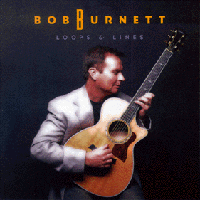
July 1998 – mini-album reviews – Bob Burnett’s ‘Loops & Lines’ (“sample, hold’n’swing”)

13 Jul
Bob Burnett: 'Loops & Lines'

Bob Burnett: ‘Loops & Lines’

Santa Cruz jazzer Bob Burnett is an oddity, someone who’s ostensibly extremely straight but gets there in a puzzling way. He loves his semi-acoustic guitar – keeps it clean, plays it with an economical and modest Wes Montgomery twinkle – but he’ll dab in a few colours on guitar synth and is also very much into what digital sampling offers the modern composer.

This you’d expect in somewhere like New York City – hip-hop saturated, with digital cut-up/jazz crosstalk from the likes of M-Base or Q-Tip. Coming from Bob, it’s a little less of an obvious path – a transplanted New Jersey-ite now residing in roots-band heaven, he’s played with world-beat bands Kosono and Pele Juju for much of the past decade. With ‘Loops And Lines’ Bob’s giving his sample, hold’n’swing ideas their first recorded outing.

At root, these are pretty cosy ideas. Don’t come in expecting a cross between John Scofield and Disco Inferno, nor yet The Young Gods playing Gil Evans. That living-in-California easiness initially makes ‘Loops & Lines’ sound like an Acid Jazz comedown pleaser. But although the six pieces on the mini-album are sweet enough to be lounge-fare, they’re also lush enough for a lock-in. Bob’s music is refreshingly innocent of guile, but that doesn’t mean that it’s without a dash of wit: a quality which is a precious balance within sampler culture.

Together builds on a moment from John McLaughlin’s Peace One, as the guitarist skips spider-fashion across his low strings: joining in, Bob swings tastefully over the top while Rhan Wilson’s bells and assorted metals mist the edges. Igor plays a similar trick with a few phrases and deep string chops from Stravinsky’s ‘Soldier’s Tale’, Bob adding some Hawaiian lines over the top of the thudding march of deep strings and drums. For Out West he affectionately samples some local-band friends (Pipa & The Shapeshifters) to craft a little bit of Portishead spy music – Adrian Utley’s breed of Duane Eddy twang, with the big stoned swats at the drumkit and the sound of rain sifting down in the background.

Most successfully, there’s Home James in which Bob stitches together a dream jam between himself, Jimi Hendrix, Charlie Parker and John Coltrane. Bright and cheerfully funky, it’s close to an Us3 moment. You expect a laid-back rapper to come strolling in at any moment, with rhymes about strolling by Electric Ladyland with a spliff and a sax case. Instead, what you get sounds more like Bob finding all three legends together at the same Harlem party; each in a separate conversation but still meshing, by happy chance, into a common thread and rhythm. The music – and the falls together with a simple eloquence. Trane throws out a sinous four-note tenor wave from Countdown; Bird counters with a acquiescent call from Night In Tunisia. Somewhere in the background Jimi chips in with a reverberant Band Of Gypsies clang. Bob’s sweet and skinny guitar bubbles throughout the whole thing, chatting merrily away on the breaks.

The only things missing are the “yeah!”s and the punctuation of hand-talk. In fact if it weren’t for the tall (and dead) shadows which that all-star trio cast, Home James would almost convince as a genuine studio jam. Surprisingly, it’s a humble piece: Bob never feels like he’s stealing from his three luminaries, nor as if he’s harbouring vain hopes of cutting them in competition. It’s all about making the links, making a might-have-been occasion; being the helpful guy in the middle.

In fact, on ‘Loops & Lines’ it’s not so easy to work out when, exactly, Bob has got his sampler switched on. He has a remarkably subtle touch as a samplist. In contrast to the way, say, Young Gods or Jesus Jones would proudly ride on the back of a blatant parade of loops, he’s more interested in the seamless interweaving of sample and solo, using temporary digital capture to get more musicians and voices flickering in and out of his virtual band. If, via the magic of samping, he can bring the amicable ghosts of the Johns and the Jimis round to his local bar for a few beers and a blow through one of his tunes, he’s happy.

For instance, Decoy might make use of another Coltrane sample, as well as drawing on snippets of American pop TV themes – ‘King Of The Hill’, ‘Teen Angel’ – but there’s no separation between those inserted elements, the light-footed touches of the live rhythm section, and Bob’s mellow-mischievous guitar skips taking centre stage throughout. The reggae-fied ripple of Lower Nile (the disc’s only cover version) brings back a live band, winds soprano sax through North African melodies… and uses no samples whatsover apart from a few jungle chirps and rustles.

In the end, “Loops & Lines’ is an announcement of relaxed intent; short, sweet and discreet. It’s interesting to indulge the thought of Bob Burnett taking it to slightly wilder climes – maybe coming on like Ronnie Jordan playing over found-sound backdrops. But I get the feeling that he’s happier just stretching loops round the barbeque, shooting the breeze with heroes and friends, providing small glows of warmth rather than burning it up with his music.

Bob Burnett: ‘Loops & Lines’
Bob Burnett, 9801 (no barcode)
CD-only mini album
Released: 1998

Get it from:
Bob Burnett.

Bob Burnett online:
Homepage Facebook MySpace Last FM YouTube

April 1998 – album reviews – Bass Communion’s ‘Bass Communion’ (“things flirt round the edges of familiarity”)

29 Apr

Bass Communion: 'Bass Communion' ('Bass Communion I')

Bass Communion: ‘Bass Communion’ (‘Bass Communion I’)

The potential for making noise, making our own personalised sound via brain, limb or breath, has always been with us. In the sampler age – where you can trap any sound in a digital jar and then play musical Darwin with it – the option range has hurtled up several levels in the space of half a generation, and the serious sound addict can now personalise any noise no matter who or what the source.

Which brings us to Bass Communion, the latest brainchild of studio wizard Steven Wilson. As if he weren’t busy enough psych-rocking with Porcupine Tree, cult- popping with No-Man, or working out his Kraut/post-rock urges with The Incredible Expanding Mindfuck. Let’s face it, few people are better qualified as a sound-addict.

Bass Communion (no thumpin’, pumpin’ house-music project, despite the suspicious name) is Wilson’s most direct attempt to date at riding this addiction. It’s also his most cryptic and esoteric, in which he rejects his usual battery of synthesizers in favour of the use of sounds “sampled, looped, transposed, layered, filtered, and processed into infinity” via electronic circuitry and sampler exploration. Wilson permits himself occasional real instruments (such as the skinny, echoing Bark Psychosis-style guitar on Drugged), but they sort of stand off to one side, like nervous uncles at parties. This isn’t really their show. For those who only skim the surface of Steven Wilson via the odd No-Man phuture-pop single, or hear the odd Porkies guitar blowout and maybe damn him as a wannabe Dave Gilmour, Bass Communion will come as a beautifully disorientating shock. This music shares secluded room-space with the work of Aphex Twin, Muslimgauze, Oval or Paul Schutze.

It might be a logical extension of Porcupine Tree’s ambient atmospherics or No-Man’s avant-garde leanings, but it’s also a giant leap of pure faith. There are no tunes, cheesy or otherwise. At all. And no attempts to please – there’s no equivalent to Aphex’s Come to Daddy on ‘Bass Communion’. Melodies, if they happen, seem to evolve almost by accident. Harmony is something that occurs occasionally when patterns coincide, rather than something that’s held to. Things flirt round the edges of familiarity, repeat and loop, but don’t so much hold the attention as massage it. When in doubt, it stays quiet. Actually, it’s always in doubt and always quiet, but never entirely at a loss about where to go. Bass Communion is profoundly experimental, but Wilson’s sharp, pop-attuned ear ensures that at least it never paints itself into a corner.


Shopping, the opener, deflects digital coldness from the off via its crackle and fluff of sampled vinyl noise: quiet, but almost drowning out the amnesiac wafts of melody which float, with disassociated loveliness, off to one side of the listening ear. They come in, they go; a wobbly snatch of Bach jumps out at you, trips over, cuts out. From then on, you’re on your own in Bass Communion’s subtly surreal electronic world.


Orphan Coal sounds like night in an abandoned telephone exchange. A clattering can drum pulses its elliptical way around and around. Echoing blips of voice trail after it – a hiccup in the system – and tones flicker irregularly like monitoring lights, going from ice to feather-stroke in seconds. Sheens of sound arch in ghostly fashion overhead: at peace, but disturbing yours. You almost expect HAL 9000 to be keeping a watchful red eye on it all. In which case the slow flood of Sleep Etc. is the digital limbo after the plugs are pulled and the lobotomy comes down, sending tides of electronic fluid trickling across the speakers, rising and implying a slow suffocation. Leafy rustles and long low scraping whale-like groans overlap deep subterranean booms and lost dizzy ringing sounds. Somewhere back in there there are hints of double basses, Rhodes pianos, and Mexican percussion – it could, conceivably, have started off as Wilson chopping up something like Weather Report and reducing it to sonic pulp for a new recipe. Whatever the source, now it sounds like icebergs having prolonged nightmares.


With all the experimentation going on, it’s almost a shame to admit that it’s the two versions of Drugged – apparently the first parts of an evolving sound series – that hit the spot best. How to define them? As “not-duets”, probably. Collaborations with live musicians that aren’t live, aren’t jams, weren’t composed, yet still sound like immediate and co-operative performances even though they’re manipulated and mutated bits of taped sound sent through Wilson’s cloud chamber. The effect is eerie: you feel that if you lent Steven Wilson your soul, he’d hand it back to you within days polished, cleaned and reconditioned, and with a few welcome surprises in the pockets.


On the first Drugged, Theo Travis‘ plaintive soprano saxophone replicates and proliferates, dozens of birdsinging reeds fluttering and fading over the warm upholstery of reverently pastoral organ chords. His playing is the most directly human and emotive on the record, yet here he sounds as if his personality is being melted down even as he makes his mark. There’s somehow something of the swan-song to what he’s doing, as if he and Wilson were carrying out a voluntary, luxuriant suicide pact.


The second Drugged, featuring the celestial guitar Soundscapes of Robert Fripp, is an especially inspired bit of audio piracy: a close cousin to the similar and marvellous Born Simple from No-Man’s ‘Flowermix’. Seven seconds of Fripp lifted from an old No-Man source tape, then refracted through Wilsonian concepts and gizmos for twenty-five minutes of protracted, blissful imagination. Frippophiles might notice that it equals about any genuine Soundscape they care to name: everyone else will be up with Steve ‘n’ Bob, nuzzling the starry skies.

A deep-down indulgence well worth sharing. Filter me another one, bass-boy.

Bass Communion: ‘Bass Communion’ (‘Bass Communion I’)
3rd Stone Ltd., STONE 036CD (Barcode)
CD-only album
Released:
April 1998
Get it from: (2020 update) Bandcamp, Burning Shed or Amazon
Bass Communion:
Homepage Facebook Twitter MySpace Soundcloud Bandcamp Last FM Apple Music YouTube Deezer Google Play Spotify Instagram Amazon Music

April 1998 – album reviews – G.P. Hall’s ‘Steel Storms & Tender Spirits’ (“grand painterly instincts”)

7 Apr

G.P. Hall: 'Steel Storms & Tender Spirits'

G.P. Hall: ‘Steel Storms & Tender Spirits’

Despite the luminous loveliness of much of his music, the career of style-hopping guitarist G.P. Hall hasn’t been smooth (even by the uneven standards of the experimental music he dips in and out of). Regardless, ‘Steel Storms & Tender Spirits’ shows that he’s still up for taking a gamble.

A trust-risking double-album package, clearly intended to emphasize his dynamic musical dialectic, it also highlights the tension between his experimental side and his taste for romantic melody. There’s one disc of rough treatment (industrial noise-layering, screaming electricity) and one of ear-stroking pastoralism (the natural sound of wood and air, tickled by occasional breaths of spectral electronics). However, with Hall being who he is, the two ideas tend to bleed back together: in some cases, maybe more than was intended.

The ‘Steel Storms’ half of the set features a wealth of Hall’s “industrial sound sculptures”. Layered compositions played on his stock of prepared-and-processed guitars (via plectrum, fingertips, battery fans, velcro and more), they also make cunning use of assorted noise-makers ranging from scavenged autoharps and scrap metal to oven racks and household bricks. Texture is the predominant element in the music, but a surprising tunefulness and dark melodies often penetrate in the form of solemn classical adagios. It’s these which underpin the clattering chains, metallic rasps and harmonics of Industrial Sights, or the billowing clouds of rolling fragmented piano and wrenching distortion in Eye Saw It 2.

There’s an impressive documentary flamboyance at hand, too. When the insistently ringing, collapsing-steel groan-tones of Tsunami blend with both close-up atonal jangles of autoharp and with distant, skinny guitar-string shivers, the visual qualities of Hall’s music are particularly clear. Some of his work here wanders out to a distant edge. Two tracks in particular, Steel Storms and Steel Landscape, are almost wholly abstract – musical testaments to metal fatigue and the disorientating feel of post-industrial spaces. Grumbling, malignant loops and glittering boils of guitar drown in swills of rattling shard-metal and bass-drum booms. The pieces are laced with elephantine bursts of distortion; and with brief, dying surfacings of chemical-corroded blues playing.

Throughout, Hall’s grand painterly instincts tug the sound closer towards beauty – however twisted – than towards flat and impersonal horror. A whole album of such Hall industrialisms would be something to treasure. Unfortunately, ‘Steel Storms’ is continually gate-crashed by other sides of his musical personality. On River Flow, he revives one of his signature approaches: fluent Spanish guitar over detailed rolls of textural soundscaping. It’s as lovely as ever, but it’s misplaced here; and it’s anybody’s guess as to what Gypsy Gathering (a virtually straight piece of flamenco) is doing on the record.

In cases like these, Hall’s distracted eclecticism undermines the original intent of ‘Steel Storms’. Worse comes when that willing, stubborn naivety which lies at the heart of his music (giving it both its emotional strength and its core of idealism) becomes diluted into reproducing other people’s cliches. Since the mid-’90s, Hall has been an enthusiastic miner of his past work, dicing up his out-of-print albums to recombine their contents in new sequences. Often this has worked out well, juxtaposing his newer, tuneful solo tapestries with older, intriguing avant-jazz duets, trios and quartets (often featuring sundry members of Isotope, Gilgamesh or Nucleus). Unfortunately, on this occasion he’s pulled up some dross along with the gems.

Perhaps Hall’s work in library music during the lean years is to blame. He’s too interesting a musician to produce stock blandness (and even his failures have moments of interest) but on a record with a purpose, these lesser scraps should have stayed on the shelf. Yet several ‘Steel Storms’ tracks come from this lifeless batch, splotched with anonymous moves and tinny keyboard presets. No Man’s Land is drab robotic cop-chase stuff, the kind of thing a particularly cheesed-off Mark Knopfler might clunk out at the dull end of a soundtrack contract. The less said about the appalling Barbed Wire Bop (brittle ‘Seinfeld’ plastic-funk with the tones of a dodgy synth-demo) the better.

Happily, other ‘Steel Storms’ approaches are much more successful, toying fruitfully with the tight blare of fiesta horns, or with a kind of impressionistic stadium rock held together with paper-clips. The rainy-night drive of City Signals funnels determined loose-jointed funk elements through cascades of drumming, a marching-call trumpet leading the tune above Hall’s steel-saw guitar chops. On Docklands, an acoustic guitar explores and ranges over washing licks of soundscape; electric guitars swipe between factory-machine screeches and trumpet blasts; an echoing hip-hop beat – blind, gigantic and mechanical – stumbles through the landscape beyond.

Sometimes, everything comes together. Though centered on the aggressive, questioning rawness of an up-close flamenco guitar, B-E-trayed provides a discreet light-industrial twist to its traditional base, dragging its intermittent sheath of noises back into the realm of the personal. Already bouncing off tricky drumbox beats, it heads into more sinister areas when swarming, echoing drones and bitter laughter flicker across the speakers. At one point, Hall yells cathartically into the soundhole of his guitar.

All interesting, but the industrial theme becomes increasingly tenuous over the course of the record, though it does rally at points. Heavily overdriven cutting-blade sounds return for Fiya, in which blurred polluted riffs meet mournfully defiant Latin horns and gut-strung guitar. On Dancing On Cracking Ice the guitar plays a supporting role to mariachi horns (and to Sam Brown’s exploratory world-rock rattle of percussion), as Hall’s chopping slashing echoes and metal-fatigue string groans lead off into a leisurely Latin funk stretch. Funk is also one of the central elements of Battery Charger, colliding with big-band horns and space-rock as Hall’s snappy twang-melodies and jittering string harmonics are bounced through some serious Ash Ra Tempel echo.

While there’s no shortage of ideas and impressiveness on ‘Steel Storms’, as an album it’s a missed opportunity – too bitty, too unstructured, and not quite ruthless enough to do justice to its theme. You can dive in for the more thrilling patches – and hold your nose at the bad points – but at times it’s the wrong kind of bumpy ride. Fortunately, its companion album compensates for the missteps by being an experience of unqualified and perfectly integrated beauty.

Where ‘Steel Storms’ shows Hall straining after too many things at once, ‘Tender Spirits’ showcases a beautifully focused vision. Dominated by his acoustic playing and by the subtler side of his electrophonic treatments (sometimes heightened by softly resonant brass and drums), it sounds as if it was recorded under a great cool bowl of night sky. It also proves that, however much energy he puts into his experimentalism, he remains a superbly expressive guitarist once the trickery is removed. Here, the wise simplicity and romance at the center of his music come into their own, in full.

Judging by many of the pieces here, classical music lost a fine player and interpreter in Hall when he went left-field, not to mention a fine folk-fusion composer. Listen to those Spanish arpeggios (mournfully meditative on Love Lies Bleeding, restless and subtly unresolved on Slipstreams) or to the singing Irish ballad inflections of Patricia O’Leary. Alternatively, enjoy Hall’s subtle reunion with electricity on Shooting Stars, Ember or Dandelion Clocks. The first two are slow astral wheelers, their notes stroked into long, long, beautifully smudged trails and pining crystalline tubes of sound; the last is chuckling child-music, clean notes bubbled through a sparkling halo of echo.

Hall’s more multi-tracked and constructed compositions fit just as seamlessly into the mood. Some are familiar – here’s another outing for the thrumming bowed-bass winter scenery of Miles From No-Where (White Wilderness), a piece which Hall continually revisits. Similarly, there’s a new version of another favourite, Spirit Sky Montana, in which David Ford’s sleepy flugelhorn and Sam Brown’s slow swish of cymbal pull Hall’s stretched-bell guitar layers and church-music structure up to further heights of passionate serenity. A more ambiguous moment is granted on Incandescence, where a baroque six-string bass is smeared into dark and swollen horn sounds, voicing in shifting minor-key planes, searching for a place to settle.

However, it’s the magnificent Lonely Road which shows Hall at his very best. Loose, hanging drapes of luscious sound, distant detonating percussion, his Spanish guitar upfront again with a heart-tugging melody, and a final DIY touch – this time, a lonely and beautifully frail harmonica part. This is music you could live in. There’s a direct, emotional involvement in G.P. Hall’s work that’s rarely found among experimental musicians – probably because in spite of his gizmos and his taste for modernist expression he connects far deeper with the earthy roots of music than with the narrowed, exclusive intellectual demands of music as a science.

Ultimately, the main reason that ‘Tender Spirits’ is stronger than ‘Steel Storms’ is that in spite of Hall’s fascination with the impact of industrialism on our lives and senses, he knows it’s merely a part of our experience of the world: a relatively recent human-scale derangement overlaying much older terrain and themes. The two superb acoustic pieces which open and close ‘Tender Spirits’ could easily predate the factories, machinery and artefacts that inspire his industrial sound sculptures; both being intimately concerned with human survival within the simpler, starker hostilities of nature itself.

For the majestic impressionist-flamenco study of Sandstorm, Hall’s fingers slither out whips of string noise among the sharp and fluttering notes, conjuring up the flying dust. Sea Sorrow (Lament Of Lewis) is at the other end of the scale: a paean to shipwrecked souls in which Spanish guitar technique merges with a plaintive Celtic air. Within it, bitter bereavement struggles with acceptance and an awareness of continuance. Those who live with the sea are sustained by it and robbed by it, and this feeling lives in the music. As visual as anything Hall comes up with via loops and layers and implements, the plangent tones of this naked acoustic piece shape an image of someone alone and bleak on the headland, staring out at the ambiguous and often-merciless ocean which they must ultimately come to terms with.

It’s true that G.P. Hall’s road is, ultimately, a lonely one – sometimes assured, sometimes erratic, always marginalised. Yet it’s always one which he treads with a stubborn faith – wrong steps and slip-ups notwithstanding – and one that makes him all the more unique.

G.P. Hall: ‘Steel Storms & Tender Spirits’
Future Music Records, FMR CD46-V0997 (786497264421)
CD/download double album
Released: 31st March 1998

Get it from:
Future Music Records (CD only) or Bandcamp (download-only, as two separate albums, ‘Steel Storms‘ and ‘Tender Spirits

G.P. Hall online:
Homepage Facebook Twitter MySpace Bandcamp YouTube

March 1998 – maxi-single reviews – Lo Fidelity Allstars’ ‘Vision Incision’ (“promises to blow our minds wide open, but falls well short of the promise”)

26 Mar

Lo Fidelity Allstars: 'Vision Incision' maxi-single

Lo Fidelity Allstars: ‘Vision Incision’ maxi-single

I had this lot down all wrong at first, I admit it. From the bragging “we’re the greatest” interviews, and the “dance music with real instruments” tag, even the look of the group, I had them down as (god forbid) the new baggy. I was fully prepared to go out and shoot them so I didn’t have to live through the horror that was baggy yet again. But a couple of odd tracks here and there have persuaded me to save my bullets… for now.

Sure, there’s a “real band” sound at the heart of the Lo Fidelity Allstars, but they can manage to make their take on turn‑of‑the‑millennium genre‑defying dance culture a gloriously uplifting thing. Their baggy forerunners (Happy Mondays, Stone Roses) always sounded like they were prevented from gliding to a higher musical plane by having their feet firmly stuck in the field of mud labelled “indie”. The Lo Fi’s, firmly centred on the sampler and decks, don’t have the same problem as they reel off ribbons and streams of sound, rather than chug doggedly away like an old pro dealing with a new fad. But…


Oh, the senseless waste. Vision Incision promises to blow our minds wide open, but falls well short of the promise. Good start, mind. Smooth beats, hedonistic keyboard riff, an infectious soul-diva backing hook, and the matter of the live band sound becomes irrelevant as the track lifts and soars smoothly like the most uplifting house or techno, boasting “As we travel at magnificent speeds around the universe…” At which point the Lo-Fi-s prime weak spot is revealed: Dave The Wrekked Train’s bland Speak’n’Spell vocals. Mashing up randomised texts, as he does on other Lo-Fi-s sonic collisions, they work fine. Faced with actual poetry, they creak like a ground axle. Please, if this is the way he carries on all the time, sack him. He has delusions of being a more hip Mark E. Smith, but ends up just sounding like a London cabbie – a monotone mumble grating over the divine music and pointing up the dreadful rhymes in some of his lyrics.

Perhaps he reckons he’s aiming at the street-level psychedelic lyricism of hip-hoppers like the Wu-Tang Clan: the thing is, those guys sound like they believe the weed-fuelled surreal-o-vision they’re raving about. Dave just sounds embarrassed, as if he’d rather have stayed in his siding and chatted to Thomas The Tank Engine this time around. Consequently, I can’t decide whether this is a successor to Orbital’s Chime for the genre‑busting, cross‑pollinating late ’90s dance scene, or just OMD meeting The Orb in a spot of megalomaniac galactic synthpop. Or, alternatively, the KLF doing Spinal Tap.


The remix is referred to as a “12” mix” ‑ how bloody Eighties. I suspect that, in homage to their record label, this is the Lo‑Fi-s’ attempt at the Big Beat remix. The Late Train has mutated (oh god!) into the slower‑talking brother of The Shamen’s Mr C. for the first part of this extended work‑out. Wisely, they quickly dispense of his services and crank up the heavy beats to provide a real tour de force instrumental for the band. Proving that if you like your beats big and bouncy, then this dissipated bunch can turn their devious minds to that too. The Midfield General Shorter mix is the sparse techno‑electronica version. A mechanistic, simple beat, overlaid by electronic squelches and interferences, as the original track is ripped to shreds and rebuilt, as elements and sequences of the original drift in and out of the mix. Oh, and Train-In-Vain is just a distant, distorted presence, way back in the ether. Wise move, guys.


By this stage, frankly, it’s difficult to tell whether Gringo’s Return To Punk Paste is, in fact, a new track, or yet another radical remix of the original. What it does prove, yet again, is that the Lo‑Fi-s can also turn their hands (deep breath) to a ’90s version of the sounds of early ’80s rap and electro. Skeletal beats and distorted, squelching basslines set the parameters for that unmistakeable sound, aided by some nifty no‑nonsense American speech samples.


Cunning remixes or no, even if feted as the best new band in Britain by ‘Melody Maker’ and handed The Future on a giant silver platter to play with, the Lo Fi’s are still going to bellyflop if they keep expecting that stuff like Vision Incision’s going to justify that reputation. It’s not that they’re talentless rip-off merchants. On the contrary, their sampledelic experimentation – when they’ve taken all the sounds of the world, scrunched them up and run with them – is at least as heart-jumpingly astounding as any other visionary pop cut-ups around, if not more so. Hype or no hype, they can bring the noise with a vengeance. This is a real Quality Street of a band – whatever your favourite tribe in the current cross‑cultural collision, there’s music for you here. And if this is the sort of open‑minded group that all the mess of sounds in the ’90s can produce, then the future is wearing some very cool shades.

But compared to their own mighty One Man’s Fear (the world being slowly and gloriously wrenched to sticky bits by Jim Morrison’s psychotic baby grandchild), this ain’t so much a vision incision as a mere blink. Someone had their eye on nothing more noble than a chart placing when they knocked this lot together. Just cut it out, OK? Show me stars, not hot gas.

(review by Col Ainsley)

Lo Fidelity Allstars: ‘Vision Incision’
Skint Records, SKINT 33CD (5025425503320)
CD/cassette/7- & 12-inch maxi single
Released: 23rd March 1998

Get it from:
(2018 update) best obtained second-hand.

Lo Fidelity Allstars online:
Twitter MySpace Soundcloud Tumblr Bandcamp Last FM

November 1997 – album reviews – Labradford’s ‘Mi Media Naranja’ (“the sound of dust with blues”)

22 Nov

Labradford: 'Mi Media Naranja'

Labradford: ‘Mi Media Naranja’

Last year’s self-titled, scheme-solidifying Labradford album saw the Virginian post-rock doyens – as I put it at the time, playing “perfect pop for Prozac people” via “desert guitars drifting into the night.” As I also said, we seemed all set for a slide into Death Valley, Oops. Except we didn’t end up there after all.

Somewhere on the road along the way, Labradford seem to have pulled in at this little deserted Tex-Mex place called ‘Mi Media Naranja’, where they’ve ambled into the cobwebbed bar, dusted off some country band’s abandoned instruments and decided to record another album, just so that the year’s release schedules won’t forget them in a hurry. And suddenly classic rock seems to be on the agenda. Tunes are heard. Mark Nelson’s picked up a slide guitar, Carter Brown adds electric pianos to his armoury, two string players are brought in. To keep up that arty enigmatic quality, songs are given one- or two-letter titles (a strategy only topped by The Aphex Twin’s use of calx symbols a few years ago) to remove any hint of presupposition on our part. And we’re rolling.


And… it’s not the Allman Brothers (well, do surprise me). But this time, although the funereal pace remains a Labradford constant, the music mostly sounds like Ennio Morricone revamping Pink Floyd’s ‘Obscured By Clouds’, under Michael Nyman’s instructions. S being the perfect example – melancholy Pacific twang-guitar, chilly organ, sobre violas in a Rachel’s manner, and the definitive Labradford touch of a coldly beautiful and crystalline short-wave radio whine (off on the edge of hearing and pinking the edge of the ears, insinuating indifferent, mindless, slightly dysfunctional technology into the sound of the human players). Tinny-edged strings duet with a piquant, ever-so-slightly discoordinated accordion, EQ-ed up for subtle discomfort.


If ‘Mi Media Naranja’ could be summed up in one phrase, it’d be “the sound of dust with blues”: inertia melding with the memory of sadness. Spiritualized might be a handy comparison. But then, so’s Fleetwood Mac’s Albatross – that same tragically sad yet detached Peter Green-style slide guitar shows up on G, as a milk-bottle jingle melds with tinkly Gameboy morse-code squirts, lonely and insulated footsteps scuff in the background, and a Spanish guitar plays like a mantric harp. Nelson’s voice (when it makes an appearance) sounds like it’s travelling through half a mile of cupboard fluff. C is more like Angelo Badalamenti under heavy sedation: an excursion of subterranean Rhodes piano, prayer-bell clinking, and papery flutter.


Compared to the unquiet dreamscapes of ‘Labradford’ , there’s something almost domestic about ‘Mi Media Naranja’: something like the drowse of an abandoned family home during a pollen-y summer. A tinny spinning-top rattle rolls hollowly through I’s midground above watery organ and tides of static, as narcotic sleigh bells nod against four-note guitar. There are distant kiddie voices and sterile, fragile electric strings on WR; and guitar dust-bunnies on V, set against the reverberant pulse of a metal bowl while Nelson whispers a trickle of unsurety through the comforting lap of sound. “Too many give… / These insights will see right through your plans. / At the mouth of the highway tunnel, the decision waits for your next command… / Secret candles still can burn: / is it deep enough? / did you make it deep enough?” In the near-hush, Brown’s piano sketches in what remains of the still air.


P finally closes the sojourn with a dose of Harold Budd meets Hank B. Marvin. Low, sweet Rhodes and three- note piano-note, sustained, furry, quivering organ drones in a shimmery haze, with the dislocated thrummmm of bass against the slow rise of a second organ. You start listening to the album in an abandoned bar. You end it back among the coma patients, in the suffocatingly pure-white sheets of a hospital bed.


Compared to the beautiful frozen grimness of ‘97’s eponymous album, Labradford’s work on ‘Mi Media Naranja’ is a pretty fuzzy, lazy business. But, after a while, it becomes something that makes just as much introverted emotional sense as its predecessor. With these two albums Labradford have floated forwards, pinned between miraculous, lucidly speechless visions… and being lost in the cradle of their own inner fog.

(review by Col Ainsley)

Labradford: ‘Mi Media Naranja’
Mute Liberation Technologies/Blast First Records, BFFP 144CD (5 016027 611445)
CD/download album
Released: 19th November 1997

Get it from:
(2018 update) CD best obtained second-hand, or download from Bandcamp.

Labradford online:
Homepage Facebook MySpace Bandcamp Last FM

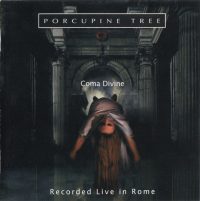
October 1997 – live album reviews – Porcupine Tree’s ‘Coma Divine (“driving performances, captured with crystal clarity… showing what the band can be like when removed from Wilson’s zealous studio-bound quality control”)

20 Oct
Porcupine Tree: 'Coma Divine'

Porcupine Tree: ‘Coma Divine’

In the eleven years that he’s been developing it, Steven Wilson has guided his Porcupine Tree project along a path of sinuous, gentle, considered swerves. We’ve seen it emerge from a clutch of playful one-man bedroom-band attempts to emulate the psychedelic heroism of the Gong/Floyd/Hillage/Can era, and go on to flirt with the wide-eyed double dawn of acid-house and rave while dipping in and out of experimental sonic abstractions. Eventually it established itself as a full-figured four-man contemporary rock group, and today’s band is a much sleeker, more professional thing than its origins suggested. Solid and melodic, rocking effortlessly, drawing on the pellucid visions of psychedelic sound and the soaring space-blues solos of ‘Wish You Were Here’, reweaving them into the starfield sweeps of ’90s rave and trance-techno, and allowing them to blossom out of the heart of spectral English pop and folk dreams.

Wilson has an ambiguous, on-off relationship with progressive rock. One month he’ll be asserting himself as the British prog scene’s lone saviour amongst a swill of sub-Genesis, the next rebranding his work as “modern rock” among the likes of The Verve, Korn or Mansun. Something which belies the simple truth that Porcupine Tree are, in essence, a contemporary prog-rock band. But if so, they’re one which is practising what the scene ought to be practising. They’re leaning to past traditions of impeccable extended musicianship and structural ambition, but eschewing podgy FM blandness and looking instead to contemporary musical motifs, technologies and methodologies.

That said, 1996’s ‘Signify’ was almost too accomplished. Sixty-odd minutes of polished, grooving songs and sleek instrumental blowouts that went down like a little pinch of manna with a worldwide prog audience, but which also ensured the Porkies’ ascendency at the expense (to this reviewer, at least) of their warmth and their mutable possibilities. ‘Coma Divine’ redresses the balance a bit – not just by being a particularly good live album (driving performances, captured with crystal clarity) but by showing what the band can be like when removed from Wilson’s zealous studio-bound quality control. Recorded during the band’s Italian tour in 1997, it captures them in ripping form, tearing through the likes of ravening distorted acid-rocker Not Beautiful Anymore and the stabbing, mathematical Neu!-style thrash of Signify, expounding on the dreamy rock tone-poem of The Sky Moves Sideways, and delivering a poised, hypnotic Radioactive Toy to an ecstatic audience.


Porcupine Tree draw frequent Pink Floyd comparisons, invited by the band’s preference for atmosphere and solid construction over any temptations to proggy twiddles and busyness. And also by the cushioning synthesizers, Wilson’s quiet vocals and his protracted, articulate bluesy guitar leads. When you hear them live, the parallels don’t hold nearly as much water. Floyd have never really rocked out with such intensity as this band, and have always possessed a certain English stolidity which Porcupine Tree avoid (in spite of Wilson’s nonchalant approach to front-man duties). Waiting – previously no more than a Tree-by-numbers single – is reborn here, jauntified by Wilson’s jangling electric twelve-string. And even if The Sleep of No Dreaming strays dangerously near to the despised neo-prog (it’s just a little too close to a half-hearted ‘Dark Side of the Moon’), Wilson’s unusually raw wail on the chorus gives the live version all the authority it needs.


It’s the live freedom offered to other members of the band that makes the most difference. Colin Edwin‘s fretless bass, reliable but uninspired on record, becomes a looming stretchy presence on ‘The Sky Moves Sideways’. When he steps on his mutron pedal, he’s more Bootsy Collins than Roger Waters. Dislocated Day (always one of the Tree’s most thrilling moments) gets a huge boost from his interaction with Chris Maitland‘s hissing cymbals and turbocharged drums, the rhythm section taking the song and running with it. Although it’s keyboardist Richard Barbieri who proves to be the Tree’s ace-in-the-hole when he’s let off the leash. He matches Wilson blast for blast as he wrenches blistering melodies, frayed foaming tones and astonishingly vocal burbles out of his armoury of old analogue synths; or embraces the band in a sea of marble-sheened electronics.

And while Wilson’s guitar takes centre stage, it’s Barbieri’s utter mastery of sonics which gives Porcupine Tree their robe of starlight as – at their most liberated – they swell through the long, trancey second section of Waiting, the mesmerised improvisations that extend Radioactive Toy. Or the highlight of ‘Coma Divine’: a beautifully fluid journey through Moonloop which evolves through honey-warm ambience, glittering astronomical detail, guitar explorations that sleepwalk and levitate, to the final joyous rampage through spacey, ornamental, Ozrics-y riffing at the climax. Splendid.

Porcupine Tree: ‘Coma Divine’
Delerium Records, DELEC CD 067 (5 032966 096723)
CD-only album
Released:
20th October 1997
Get it from: (2020 update) Original CD best obtained second-hand; expanded 2016 double CD edition available from Burning Shed.
Porcupine Tree online:
Homepage Facebook Twitter MySpace Soundcloud Bandcamp Last FM Apple Music YouTube Vimeo Deezer Google Play Pandora Spotify Tidal Instagram Amazon Music

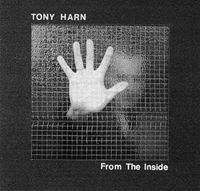
September 1997 – album reviews – Tony Harn’s ‘From the Inside’ (“hard-rock directness with intricate layering”)

18 Sep
Tony Harn: 'From The Inside'

Tony Harn: ‘From The Inside’

Tony Harn used to be in Spacematic, a Warrington duo who – had they survived – might’ve carved out a niche for themselves as music history’s only cross between Morrissey and Jeff Beck. Their 1996 demo was an odd and edgy marriage between Dave Harrison’s bleak bedsit lyrics and mournful vocals and Harn’s fluently melodic guitars (which mingled hard-rock directness with intricate layering). Imagine what their gigs might have been like. Two guys onstage in the throes of song and lost to the world – oblivious to the panicky expressions on the faces of their audience, as the tribal reps for the indie depressives and the rock hogs were forced to eye each other nervously across the clubroom floor, clutching their snakebites and beers for support. Ah, social awkwardness rattles its cage. Fine times. And – if they ever existed – gone times.

Parted from Harrison, Harn spent a year left to his own devices and ‘From The Inside’ is the result – an self-released instrumental guitar album which allows him to explore spaces of playing and composing which Spacematic could never have accommodated. Usually, rock guitar solo records are unparalleled opportunities for musical showing-off. While Harn’s got the necessary technical skill (and enough classic rock in his playing) to go for total guitar-hero blowout, ‘From The Inside’ is remarkably modest, and its musicality is expressed with unusual restraint. For instance, the title track’s Brian May explosion of passionate electric pomp and romance, lasts barely over a minute and fades out in a subdued loop of Vini Reilly arpeggios. Harn’s experiments in five- and seven-time are lilting, accessible and lovingly melodic: his lead lines are concise, memorable and authoritative. Acting as his own support musician, his crisp drum programming and sturdy work on bass and keyboards (as integrated as his guitar playing) lend the album a homely sound.

One of the best things about Harn’s playing is that, for all the skill of his fingers, not one note is superfluous or wasted. He’s more likely to sit comfortably on top of a bold tune than to play stuntman; he knows when to let exploration stop, and when to let silence stand. In a musical zone stuffed with supremely accomplished fret-wankers suffering from fingerboard diarrhoea, that’s a rare and cherishable talent. As far as obvious influences go, the above-mentioned Jeff Beck gets a look in (something in the attack, the indisputably British rock stylings); there’s a little of the ’80s Alex Lifeson in the hard-rock digital jangle; and sweet lyrical solos like Mike Oldfield or even Prince. Harn also has a strong touch of Joe Satriani’s out-and-out lyrical tone and way with a melody (most obviously on the sunny rush of Playsafe and Pseudoseven, or the echoing Room One which recalls Satriani’s Circles).

But what ‘From The Inside’ reminds me of most is the pair of albums Andy Summers and Robert Fripp recorded in the mid-80s – ‘I Advance Masked’ and ‘Bewitched’. Harn’s playing has neither Fripp’s intensity nor his academic sternness. Nor does it have Summers’ taste for textures on the guitar synth. But his fondness for the spangly echoes of the delay pedal, his exuberantly climbing note patterns and ear for counter-arranged, bell-toned rhythm-picking lines comes directly from their legacy. In Turning Time, guitars dodge and somersault cheerfully over the rising drones and evolving multiple rhythms. The cycling riff in Pseudopool recalls Talking Heads and I Zimbra: its long sweet smudge of a solo hearken back to Fripp’s New York years.

‘From The Inside’ does have its flaws, the most obvious one being that it carries the predictable symptoms of a guitarist’s showcase. Some pieces show this more blatantly than others (Beat The Bad, for example – a pretty superfluous bit of guitar-rock reggae style). You could also quibble about some slightly cheesy keyboard tones and parts, which pull some compositions a little too far towards travel-show soundtracks. Yet at least they err on the side of cuteness rather than flabbiness, and are essentially there to support the guitar work. Harn can be forgiven these lapses given that plenty of rock guitar soloists choose sixteen minutes of assorted widdly-widdly as a showcase, while his own offering is a well-worked-out album of tunes and interplaying.

In spite of Harn’s knack for those solid tuneful elements, many of the high points of the album come when he slows down and makes shapes. The eerie scrapings and siren wails which set the scene for the title track, for instance. Or Coloursound, in which ringing slow-swelling chords mingle gorgeously with the whispered sample on the voiceover: “Particularly at night, I have this incredible feeling of intense blackness… I mean, I’ve never experienced such darkness…” It could’ve sat comfortably on David Sylvian’s ‘Gone To Earth’, as could its drowsy vapour-trail of a melody.

I’d really love to hear Tony Harn working in a fuller band situation, or with collaborators who’d really bring out the best in him – but this’ll do for now. One of Britain’s finest undiscovered rock guitarists has left his calling-card, and I’d advise you to get in touch.

Tony Harn: ‘From The Inside’
Tony Harn, THCD1 (no barcode)
CD-only album
Released: 1997

Buy it from:
Limited availability – contact Tony Harn for information.

Tony Harn online:
Facebook MySpace YouTube

September 1997 – album reviews – R.O.C.’s ‘Virgin’ (“from the surreal and experimental to pure pop and simple emotion”)

8 Sep
R.O.C.: 'Virgin'

R.O.C.: ‘Virgin’

Cut‑ups are wonderful things. TV samples. Answering machines. Category‑defying noises. Harsh vocals. Scattershot free associations. Beautiful vocals. Hazy guitars. Clattering electro‑rhythms. A sense of the surreal. A sense of the melodic. Glorious eclecticism. The perfect post‑modern pop group.

Hallelujah! R.O.C. are back.

And against the odds, too. The debut album of this transatlantic trio (Fred Browning, Karen Sheridan and Patrick Nicholson, with roots in American, Ireland and Britain) welded pop music with a wilfully obscure grab‑bag of eclectic styles. Spookily emerging out of nowhere, it was critically hailed as the pinnacle of the ’90s zeitgeist, but the record‑buying public remained resolutely silent. Yet, here are R.O.C. ‑ back! ‑ on a new major record label deal (Good on you, Virgin, I take back everything I’ve ever said about the majors… well, almost…)

Dada opens the album with a statement of intent akin to the surreal art movement of the same name. Grasshoppers and various indecipherable speech samples give way to pounding, discordant and (very definitely) tuneless harsh electronica, accompanied by sinister laughter. Jeez, they’re such awkward people that you almost get the feeling that this is the spirit of ROC laughing at you for not understanding it, not getting it. Not very welcoming, either musically or emotionally. Thus, not for nothing does the oh‑so‑English conversation (too formal, too well‑accented to call rap) of the next track (Dis)Count Us In begin with the question “Are you still with me?” before Fred Browning relates a tale of watching a woman across a crowded room, to a backing of post‑modern electro‑pop.


All change. Mountain is R.O.C. as a slightly less comatose Mazzy Star performing to acoustic guitar and warm This Mortal Coil‑style atmospherics. Karen’s lyrics detail her observations ‑ highly emotional but somehow dispassionate ‑ of someone whose life has no direction and is spinning out of their control ‑ “Here we go again, / You’re going to take another rollercoaster ride through hell” ‑ in a beautifully recorded wash of womb‑like electronics.

Cheryl is a pop Suicide for the ’90s, an almost cheesy pop melody set to gleaming pulsating electronics and interludes of demolition percussion. Karen sings (Cheryl’s?) lyrics of a big fuck‑off to a man (antiquated sexist attitudes, thinks he’s God’s gift) and states her own terms for independence; “If it’s all the same / I think I’ll move on up… / I’m gonna get myself some dedication.”

Ever Since Yesterday starts as an acoustic‑guitar based lament to the departure of Fred Browning’s lover before all manner of randomly‑emitting Disco Inferno‑ish sampledelia and phased electronica makes its presence felt, distorting the whole sonic collage and moving it out into the realms of post‑rock. Instead of fading out, it collapses in on itself as the tape mangles. Gorgeous.

25 Reasons To Leave Me features Browning returning to his husky Shaun Ryder vocal style, set to a loping laid‑back musical backing not unlike a more uptight Happy Mondays; whilst K.C is a dry disconcerting, upfront recording, led by a simple and affecting sequence of organ chords, later joined by a soloing trumpet and brass accompanying a vocal of more third‑person observation from Sheridan. It’s no criticism to say that this track resembles late‑night bedsit pop at its best. Kind of a meeting between Prefab Sprout and The Cure, if you will.

Cold Chill Just Lately details the crossed wires, cross‑currents, accusations and arguments of a relationship break‑up. This rather harrowing subject is carried by the track’s broken, exhausted vocals. He’s not happy, but there is a certain black humour typical of R.O.C.: “But I guess it’s just a fucked‑up world we’re living in, / and you know it couldn’t get much worse. / But then it turns you over and fucks you in the ass… / She only cares about herself / She never cared about me.” Such bile is performed to an incongruous accompaniment of smoothly enveloping, ebbing waves of sound, a lurching rhythm, and throbbing strings adding a chamber‑pop element.

The final track, Ocean And England, opens with the sound of thunder and rain, and a bare strummed guitar‑‑the poignant musical lead is then swapped to a ringing electric piano and harpsichord before a huge sampled orchestra swoons in. Like many bravely experimental acts, ROC always remember that, sometimes, all one needs is a song and an affecting melody. “Ocean And England” is just that, and even includes a lovelorn lyric: “Hey you, / the ocean and England are so far away. / Won’t you consider coming home / to be with me again?”

Ultimately, though, this album lacks a little of the debut album’s magical Wonderland atmosphere ‑ swapping the feeling that anything could happen within the space of the next track for the feeling that yes, plenty will happen, but it will be more regimented and organised. Yet how many bands would have the sense of vision to travel, in one album, from the surreal and experimental to pure pop and simple emotion?

R.O.C. Still utterly beguiling.

R.O.C.: ‘Virgin’
Virgin Records, CDV 2829 (7 24384 29472 4)
CD-only album
Released: 8th September 1997

Get it from:
(2018 update) quite a rare release these days, best obtained second-hand.

R.O.C. online:
Homepage Facebook

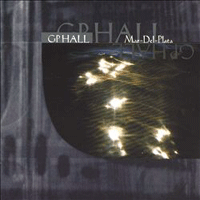
August 1997 – album reviews – G.P. Hall’s ‘Mar-Del-Plata’ (“ranges with restless compassion across a wide field”)

10 Aug
G.P. Hall: 'Mar-Del-Plata'

G.P. Hall: ‘Mar-Del-Plata’

Still clearing out the accumulated tapes of an inexplicably neglected career, Graham Peter Hall is continuing to come up with the goods. He’s been through thirty years of uneasy development on that rocky, unrewarding terrain between the simple sureties of the rock and roots instrumentalist and the often complacent indulgences of the full-on avant-garde blower. Marginalisation and bad luck might have ensured that he’s received little financial reward – nor has he gained the kind of brittle, precious reputation that marks out the darlings of the art-music intelligentsia – but it has resulted in a stock of lovely, emotive music in its own right.

Certainly Hall has managed to remain one of Britain’s most individual and complete guitarists over that time. Mastering a variety of styles from flamenco to rock to folk and blues, he’s also immersed himself in experimentation via technology – multiple speakers and pedal processors; vast, slow delay loops. Additionally, he draws on a repertoire of bizarre playing techniques and plectrum substitutes (involving battery fans, tiny psaltery bows, electric razors, toy cars and velcro, among others) which reflects the reinvention of guitar function explored by Fred Frith or Keith Rowe. With these methods in place, he’s explored sound through the textural suggestions of his “industrial sound sculptures”. Light industry, that is – Hall’s mimicry is closer to handsaws and governor motors rather than, say, Trent Reznor’s car-crushers and stamping presses.

Yet in amongst this, Hall has somehow never lost the ability to embrace expressive tunes; or to weave a handrail of familiarity into his sonic constructions. Perhaps that’s why ‘Wire’ types don’t seem to go for him; why he doesn’t have the kudos that the likes of Rowe, Frith, Eugene Chadbourne or Glenn Branca enjoy. He can get in your face – or wander off the usual path – with the best of them, but it’s generally in order to touch your sympathies. Ironically, in choosing to express his conservative and traditional side as equally important to (and entwined with) his avant-garde side, he’s gone too far for some.

‘Mar-Del-Plata’ is by far the most accessible and diverse of the compiled albums which Hall has been assembling this decade from deleted vinyl and assorted unreleased tapes. It’s a tour across a loose, but affecting, composing and performing imagination which ranges with restless compassion across a wide field. Sometimes you’re listening to a skittering, wilful flamenco performance. Sometimes it sounds like Cocteau Twins doing home improvements in the Mediterranean. Sometimes it’s the sort of individual, humanistic free improv/New Music result which you’d expect from Frith at his more lighthearted and relaxed, or from Simon H. Fell.

But though the record is full of experimentalism, Hall’s sense of melody is at the forefront – and the predominant voice on ‘Mar-Del-Plata’ is his masterfully expressive Spanish guitar playing. This can usually be found angling over long aching stretches of choral electronic humming, plangent violin and eerie ambient sounds called up from the industrial processors. In some ways it’s like a semi-unplugged take on a Robert Fripp Soundscape, in which guitar textures span out into infinity.

At other times, it takes on the simple directness of a folk tune: a dance of sparkling acoustic lights on Ionian Water, or the staccato accented Latin melodies of Mar-Del-Plata itself, underpinned by a geological murmur of bass. On the final hot gusting of Sierra Morena Dust Storm, the gut strings spit and scatter in rich melody, reaching new heights of sinewy passion. Here, Hall also bows some winnowing textures in his electric guitar accompaniment, using serrated steel bars from his box of implements.

Where technology plays a more direct role, Hall’s humanity doesn’t falter or go under. The hymnal swells of billowing electric warmth on Spirit Sky Montana (somewhere between Bill Frisell’s cinematic romance and David Torn’s eccentric string-warps) are the most beautiful and enveloping sound on the record, tapping deeply into church music and Romantic classical composing. The trickle of wind chimes, langorous piano, and enveloping sighs of Humidity Despair provide a gusting, luxurious impression of a sultry night: it’s lush enough to lean right back into.

Some tracks, fleshed out by Hall’s sound-loops and D.I.Y. treatments, are detailed, impressionistic oil-paintings in music and tone. Deep Blue sounds like someone chainsawing up a frozen Alpine lake, its jangling piano chords and thumping bass a mass of irregularities. The smear of bright spring-loaded colourflow on Charmouth Beach rings beautiful alarm bells. The menacing bass growl of Enigmatic is like a cave-bear thumping around in your dreams: squeaks and rattles from fingerboard and autoharp move around in slow disquiet, enclosed by knocking metal.

Plutonium Alert (in which Hall abandons guitar altogether in favour of soprano sax and the ring of auto-harps) treads similar territory to the ominous King Crimson improvisations from the mid-’70s. It goes for an all-out sensory mix of apocalyptic aftertones: angular bell-sounds and aggressive Grappelli violins entangling themselves with a spasmodically awkward funk rhythm. Weirdest (and most satisfying) of all is Fahrenheit 451 – juddering guitar, saw sounds, the shriek of a whistling kettle, and treble scratching all mix like toxic vapours under heavy pressure, pushing your head back against your rising hackles. Horribly enjoyable.

The scattered effects of the attempt to capture all of Hall’s ideas across a single CD does mean that ‘Mar-Del- Plata’ misses out on the cohesion which would render it excellent, but it’s a close-run thing. The centrepiece – a long-form creation called The Estates – pulls all the elements of the album together. A version of a 1975 long-form composition, it blends the chiming, restless clatter of its improv ensemble with Hall’s own quiveringly angry solo acoustic guitar. The brooding theme of The Estates is the crappiness and autocracy of post-war British urban programming. In thrall to modernism without being able to master it, its utopian vision (heartily botched and compromised) laid down a blight on communities, their architecture and their cohesion wrecked by the same tower blocks and support links designed to improve them.

Hall and co. express the disillusion and neurosis which resulted, with pulses of frustration and alienation hurl themselves against the confines of the music. Dulcimers, clarinets, and a huge array of percussion all seethe and pant over twenty-five minutes of desperate musical invocation; all overhung by the forbidding scrapes and alarm-clangs of two adapted metal piano frames (played like harps with assorted chains, wires, and implements). Hall’s panic-stricken guitar playing conjures the nightmare of a new, fatally-flawed sprawl of roads and buildings: swarming locust-like, unchecked and unconsidered, over beloved landscapes.

Incidentally, in the sleevenotes Hall gives a blood’n’guts description of the struggle it took to assemble and perform The Estates. Apparently, some of the manufactured instruments continue to drift through the art world with a life of their own. The piano frames – still counter-invading the architecture – were last seen as part of a “fire sculpture”. Meanwhile, the piece itself has an additional afterlife as a reflection on Hall’s own love/hate relationship with modernism; his own playing and arrangements echoing and championing the sounds of the traditional past even as they break them up in performance and execution.

As a body of work ‘Mar-Del-Plata’ has its faults – yet judged on its parts (and at its undisciplined best), it’s a touching, passionate and diverse album. Throughout, we get the sort of peek at Hall’s open heart (warts, gooey patches and all) which most experimental musicians, hard-wired into intellectual dryness, would never risk expressing.

G.P. Hall: ‘Mar-Del-Plata’
Future Music Records, FMR CD46-V0997 (7 86497 26442 1)
CD-only album
Released: 12 April 1997

Buy it from:
G.P. Hall homepage or Future Music Records

G.P. Hall online:
Homepage Facebook Twitter MySpace Bandcamp YouTube

July 1997 – album reviews – Barry Black’s ‘Tragic Animal Stories’ (“playing off an all-American goofiness against a frowning European sternness”)

29 Jul
Barry Black: 'Tragic Animal Stories'

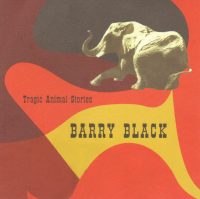
Barry Black: ‘Tragic Animal Stories’

When he’s not fronting the infamously shambolic noise merchants Archers of Loaf, Eric Bachmann is apparently found holed up in the practise rooms at North Carolina School of the Arts claiming he’s actually someone else. If ‘Tragic Animal Stories’ is anything to go by he is, in fact, several other people. But if they all want to call themselves “Barry Black” to save time, that’s fine by me. Hi, Barry. What’s in that box you’re clutching, then?

Originally just a collection of soundboard experiments – the sort of thing that’s invariably going to sprout up if you leave a couple of musicians in a room with a new toy – Barry Black has evolved into an after-hours mess-about-with-intent which has previously been graced by such wilful eccentrics as Ben Folds (another guy who thinks he’s three different people) or the Clodfelter brothers from Geezer Lake. For this second album, though, Eric Bachman’s instrumentation and samples are augmented by the enthusiastic mess of Chris Waibach’s drums and tuned percussion, and by Sebadoh producer Bob Weston’s guitar, trumpet and engineering.


Half of ‘Tragic Animal Stories’ is shambling takes on dark loungecore soundtrack cheese, with the other half a collection of sound-puzzles that seem to have been extracted from the gaps between instruments. Eric’s music leans as precariously like a tumbledown shack – as ramshackle and oddly comforting as the spattered bloops of Morse code keyboard that usher in and wave out the album – and floats in a kind of fluid dusky haze, in which movement in any direction is possible as long as you’re not hung up about how fast you get there.

It doesn’t take long for the cheerful schizophrenia of ‘Tragic Animal Stories’ to make itself felt. The Horrible Truth About Plankton goes from being hypnotic and enwebbed in the suffocating, shuddering dust of an organ straight out of a Czech horror film to being relieved by falling-apart slacker-jazz drums and sweet shambling melodies carried on Waibach’s cheerful vibes, and ends up as easy listening on a slight O.D of random tranquillisers. Chimps sounds like Startled Insects in gigglesome mood: mechanical pings and stringy high life guitar jostling with a cabaret wind band (brass and kazoo) and pushing it into ‘Threepenny Opera’ land, complete with wild skinny tremors of Jamie Muir-style xylophone.


The lovely, brave little tune of Slow Loris Lament clambers out of a shambling toybox orchestration, like a lo-fi Rick Wakeman among the Playpeople. A stylophone plays a fanfare over a radio whine. There are barking noises, ticklish steel drums and a bassoon. Don’t waste any time waiting for a hot guitar solo: Slash couldn’t make the session (and there’s a rumour that they’ve still got Joe Satriani locked up in a cupboard off the control room from the time when they opted to wipe off his lines in favour of a triangle track).


As expected, there’s a definite fuck-around element to all this, but thankfully without that wacky “nothing’s serious” sloppy buffoonery that hangs around many lo-fi groups like the gang joker’s B.O. It sounds as if Eric’s involved in a more serious game of his own, playing off an all-American goofiness against a frowning European sternness, arty soundtrack pretensions against musical jokes, flake against pose.


Duelling Elephants comes out like a darker sketch from ‘Carnival of the Animals’ that refused to take itself too seriously, and made a beeline for a cartoon Munich beerhall, dragging the remains of its menace behind it. The oompah bassline and trembling treble of the piano, mingled with close brass and bassoons has the sadistic comedy of Nickelodeon animation, but it also ripples as ominously as disturbed water. Drowning Spider emerges through an antique shellac crackle: walloped piano like Fats Waller having a nervous breakdown and careening off the edge of the recording reel. Iditarod Sleigh Dogs – a scratched rhythm from detuned banjos and tinkly, twitchy, plonky kiddie piano lines – sounds like Eric composed it with his head on upside-down. Cute.


Even with the playfulness, ‘Tragic Animal Stories’ always has its serious side. On When Sharks Smell Blood, dazed front-crawl piano swims and sways to shore, while rakes of ravenous solo and duo cellos wind around it and a deathly creak (a leaning rocking chair? a wind swing door? a murderer’s step on the verandah?) infiltrates the background. For the big picture, there’s the David Torn spaghetti western of Derelict Vultures, starting life with a harsh guitar scratch and limping Morricone melodies from a splitting, tortured, midrange electric guitar and a filtered swoosh of background, until harsh Russian horns take over the melody and pull it off the badlands onto the steppes.


Tropical Fish Revival sounds like Death approaching a lean-to in a Kingston shantytown. Eric’s mournful, indistinguishable sung words (his only vocal performance on the whole album) flutter above his clang of funereal piano, a shabby, heavy-footed drum loop and a fluting, buzzy keyboard flutter. A shimmer of vibrating steel pan reverbs off into the distance, and the light fades with it.


Snail Trail of Tears closes the album with the lullaby sound of a music-box vibraphone and an overdriven guitar drone melody like a stretchy harmonium. It sounds like Pram or Labradford revamping King Crimson‘s Starless on a heavy summer evening. The bass grumbles like a cello. An out-of-phase air extractor noise adds a layer of feathery sound like a heavenly choir, and then it drops away into those Morse bloops again. Over and out.


Small music from another place. I want to go there.

Barry Black: ‘Tragic Animal Stories’
Alias Records, A122 (0 93716 01222 1)
CD/vinyl album
Released:
29th July 1997
Get it from: Alias Records
Barry Black (Eric Bachmann) online:
Homepage Facebook Twitter Soundcloud Bandcamp Last FM Apple Music YouTube Pandora Spotify Tidal Instagram Amazon Music
 

July 1997 – album reviews – Sadhappy’s ‘Good Day Bad Dream’ (“a contemporary progressive group that’s unafraid to mingle technique, horror, street-smarts and a mordant, lethal wit”)

4 Jul

Sadhappy: 'Good Day Bad Dream'

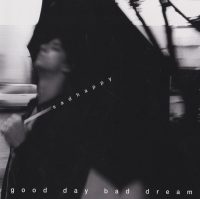
Sadhappy: ‘Good Day Bad Dream’

The voice on the telephone chuckles. “Sure, it all made sense to me. You just burn it out, past the pain. / Sure it’s all toxin: you just work it out of your system.” Somewhere between a Berklee College education, an Olympia punk statement and the world of woodshed ravings you’ll find this – rolling down a quiet highway like a fatal fog-wall.

For their fourth album, the alliance of drummer/sample mangler Evan Schiller and bassist/spoken-word freak Paul Hinklin has convulsed yet again to install a new Sadhappy lineup. Out goes eccentric Critters Buggin/Tuatara sax player Skerik. In comes Michael Manring, ’90s bass guitar genius, for a very different approach to the power trio. Two basses might sound like a recipe for disaster – ‘Jazz Odyssey’ doubled up, or cheesy slap-funk duels. Sadhappy get around this by realising the implicit power in the timbre of the bass guitar: the added resonance, the volcanic rumble it’s impossible to ignore, the sheer booty-shaking body. And they go for it full-bloodedly. In the resulting low-end carnage, saxes and guitars are not missed.


A lot of this is to do with Manring, who’s rivalled only by Tony Levin, Victor Wooten and Doug Wimbish as a contemporary redefiner of bass guitar. Not content with just a jaw-droppingly dextrous technique (whether grooving fingerstyle, slapping, tapping, or picking), he’s as liable to mutate melodies by abrading them with an EBow and/or in-flight retuning. And, as you’d expect, ‘Good Day Bad Dream’ is a treasure box of bass sounds – the levitational noises on Lost in Bass; the chainsaw punk rumble on Maintenance Pissed and Chronic Subsonic Tonic; the multitracked interplay of worming harmonics, chunky strums, and wolf-wails on The Kitchen Sink. But it’s no mere technique-fest.


Yes, for the most part it’s instrumental. And at its most basic (Home Lobotomy Kit, Honeymoon Deathbed) it tugs us through a darker edged and more credible fusion revamp via Hinklin’s brutally precise twanging, growling basslines, Schiller’s clattering, tight as a mantrap drums, and Manring’s distorted, storming, articulate leads. And there’s a strong element of the roaring hybrid of thrash, fusion and left field virtuosics that fuelled Manring’s last album ‘Thonk’, recorded as an attempt to escape his inconvenient reputation as a jazz-leaning New Age muso. But in meeting the streetwise intelligence of Schiller’s drumming and Hinklin’s sardonic New Music/punk’n’sarcasm influences, Manring’s restless and complex musicality has completed its journey away from the New Age racks.


‘Good Day Bad Dream’ emerges from this as an album blending multiple strands of modern electric music with surprising success. It’s an overlapping low end approach of eerie smoggy textures, wrapping up art punk, weird funk, jazz, dark ambience, sampledelia, progressive rock, sound massage, and a dash of psychological sewage. The trio nod to Mingus, the smouldering dark star of modern jazz, with a strutting and dextrous cover of his sarcastic II b.s. With the fifteen minutes of deathly textures and world-swallowing bass oceanics on The Death of Webern, they’ve got that scary isolationist-ambient game sown up too.


Evan Schiller’s light touch throughout ensures that the band are never bogged down. Within The Kitchen Sink’s light-fingered ostinatos, King Crimson riff choirs and E bow calls, his precise percussion approach rings, swooshes, crashes and drops out to leave perilous canyons in the texture of the music. On SBD, he shines with an array of sparse metallic taps and lethally timed buzz-rolls under a lowering cloud of bass, a dark canopy of wails and murmurs through which Manring winds skeletal insect-trails of overdriven bass, twisting and skirling like cyborg bagpipes.
……………………………………..


But the key to Sadhappy’s success in reaching out beyond the fusion ghetto is Paul Hinklin’s acidic humour, which lurks somewhere in the triangle between Tom Waits, Frank Zappa and Bill Hicks. In the recurring, repulsive figure of Oscar (a forty-nine-year-old backwoods Beavis with a voice like a plastics bonfire), he gives Sadhappy their own all-American idiot guide, a lottery sweepstake winner with “money comin’ out of his ass” swaggering over a racket of bellowing grunge-garage art rock riffs. His new rich man’s horizons lead him only as far as the porn racks at the general store, or to the bar; a coarsened American Dreamer content to do nothing more than wallow in his own filth and boast about it (“Yeah, you gotta work for the rest of your life: I own the streets I piss in!”).


On False Information – a sort of post-Laswell take on a ‘Remain in Light’ groove, burrowing through post-rock and hip hop en route – Hinkler offers us a lighter look at the aches and absurdities of the modern human condition. “All the guilt, all the shames, all the blames, / all the payments that you pay for crimes you never even committed, / never even thought of – what’s up with that?”. Schiller’s pin-sharp sample-heavy beats jab and dodge like a lethal flyweight boxer as Hinklin’s sardonic voice chuckles at enlightenment: “You see past everything and you say, this is just me plus garbage. Hell, if I couldn’t see the garbage, then I would be the garbage. Thank God I can tell I’m not the garbage. “‘Scuse me, honey. I have to take myself out to the trash. What is truly me will come back to dinner. It’ll just be me minus garbage.””


Sometimes though, the humour goes darker. In the harsh fable of Hammering Man, the townsfolk turn out to watch the unveiling of a statue: “a testament to the nameless brave, to the unselfish, the holy slaves. The ones who gave their bodies and minds to the army, the ones that gave themselves to the might of the all powerful industrial machine. The ones that had made America strong, the ones that had made America beautiful. The ones that, through no fault of their own, had turned it into a wasteland.” Small wonder that the statue crumbles, toppling to pin the spectators to the earth.


In the brooding dusky groovescape of Oscar Gets Laid, we get to see a younger Oscar, callow and innocent, rubbing up for the first time against the world that’s going to corrupt him. Manring’s mixture of rattling ominous echoes and scritching, coppery industrial harmonics send a shiver down the spine, as Hinklin’s murmured vocals explore paranoia and fascination down the back alleyways of the mean streets – malevolent shadows, and the breath of heroin ghosting out of the skins of hookers. At last: a contemporary progressive group that’s unafraid to mingle technique, horror, street-smarts and a mordant, lethal wit.


It’s also one that’s firmly rooted in the present, soaking up the lessons of grunge, dance, and sampler culture, while still playing the arse off all comers. Even if ‘Good Day Bad Dream’ sometimes strains the limits of its excellence by being just a little too diffuse, too dependent on fusion fallback, Sadhappy move through their music with assurance, imagination, presence and a brutal vigour. And that’s an all too rare combination.

The smile on the face of a charming, constructive killer.

Sadhappy: ‘Good Day Bad Dream’
Periscope Recordings, PERISCOPE RECORDINGS CD04 (7 96873 00042 0)
CD/download album
Released: 2nd July 1997

Get it from: (2020 update) Original CD printed in a run of 1,000 – CD and download best obtained from Bandcamp.
Sadhappy online:
Homepage Bandcamp Last FM YouTube Vimeo
Google Play Spotify Amazon Music
 

May 1997 – album reviews – Mark Eitzel’s ‘Lovers’ Leap USA’ (“contains some of Eitzel’s best songs and some previously unseen directions for his art… a half-baked masterpiece”)

30 May

Mark Eitzel: 'Lover's Leap USA'

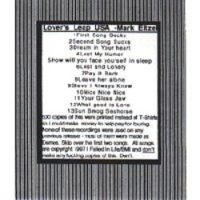
Mark Eitzel: ‘Lover’s Leap USA’

Culled and scraped up from Mark Eitzel‘s demo drawer in order to finance touring, ‘Lovers’ Leap USA’ is not exactly the album we’re hoping the former American Music Club frontman will make. In fact, most of it is apparently outtakes from Eitzel’s actual forthcoming album (which rejoices in the catchy, cheery title of ‘Caught in a Trap and I Can’t Back Out ‘Cause I Love You Too Much, Baby‘) plus what sounds like his final San Francisco demos (with AMC’s multi-instrumentalist Bruce Kaphan fleshing out the sound). Not always to Eitzel’s satisfaction, as he’s urged us to skip the first two “really awful” tracks. Well, he’s always been his own best publicist.

In spite of Eitzel’s deprecations and the album’s unpolished, occasionally sullen state (effectively, it’s a scrappy bootleg), ‘Lovers Leap USA’ contains some of Eitzel’s best songs and some previously unseen directions for his art, making it something of a half-baked masterpiece. Some songs – What Good is Love, The Big House, Have No Words – are little more than straight acoustic skeletons, on which Eitzel’s singing is either mesmeric or painfully flat and jumbled. Some (such as Leave Her Alone) sound more like exhausted Arab Strap trudges, with a drawerful of industrial grind muddying the atmosphere. In others, Eitzel drifts off into trip-hop atmospherics – easy- listening string loops, opiated piano touches, giant slow shadowy drums. And on the expansive feel of Lost and Lonely, Eitzel’s whispers sound uncannily like Chris Isaak, floating above the swish of passing cars and birdsong like a dawn haze.

‘Lovers Leap USA’ also shows that Eitzel remains in touch with the majestic tunes that floated or roared through American Music Club’s angst. How Will You Face Yourself in Sleep takes us back to the delicate traceries of fear that graced Gratitude Walks or Laughingstock. Red velvet curtains haunt the lyrics and the sounds of a song set in a hotel full of unspecified performers and travellers, restless “under a thin blanket, ’cause when you’re on the move you don’t need to be warm – / you pull another dark flood over your hidden form.” These people are worn down enough to see the machinery (“you can see through every plot, you know how they end… / Always said you would quit before you got fired. / Now you’re treading water, forgotten and tired…”) and trudge through their roles, only consoled by knowing which strings will pull on them.

Dream in Your Heart, with its dark burning fuzz of angry guitars, could’ve been one of AMC’s more aggressive moments, replete with classic Eitzel runaway metaphors (“the bitterness wears me like a chain, since I’m too Mark Eitzel vain for the Man of Steel I’ve become”) and the choruses which clasp frantically at elusive hopes (“I saw a dream in your heart / for a beauty beyond your eyes”). If people still sung protest songs at the enemy, you’d imagine a phalanx of indignant American feminists roaring Leave Her Alone at Pat Robertson. As it is, here we have a battle-scarred Eitzel limping defiantly across a bloodied drag of guitar and churned-up trash-noise to stick pins into a bigot. “You’re God’s little soldier, making sure his thunderbolts get thrown… / I just want to bang nails in your cross, I want to drive those nails home.” He’s never sung out with such positive pride before – “My sister never got credit for anything; / her life was just a constant second-guessing. / She doesn’t need your holy undressing, / and most of all, she doesn’t need your blessing.”

Two suspicious meditations on fame, The Big House and Nice Nice Nice, might have sprung from the bitter backwash of AMC’s brief encounter with the big time. The first, in cranky acoustic cynicism, strips the glitz from the glittering bubble at the top of the pile (“antique paintings from across the pond, chandeliers and porcelain figurines / an island in the calm of the storm, scattered meaningless shouted words and bored security guards,”), and sees Eitzel as spectator in a backstage zone “as hollow as King Tut’s womb”, munching cheerlessly on bar snacks and watching “this treadmill… moving the river of green, / …freedom slipping through the cracks.” It’s someone else in the spotlight this time, atop a fortress of speaker stacks, kidding himself he’s empowered; but Eitzel’s disgust is the scorn of a man who’s been close enough to get stained himself. “Let ’em weigh you and judge you, let ’em use you as their tool. / You give it away, you fool, you fool, you fool.”

Even more cuttingly, Nice Nice Nice deals with the artistic failure-turned-self-promoter – “This is the wall you broke your head on, / the one you’ve lied about so many times. / And now you’ll display a marvel for the ages, / a masterpiece of grace and design / with a meaning that no-one really finds.” Here mass acceptance comes with the price of knowing “you’re just like them, deep down”, but it’s impossible to know which side the alienated but notoriously anti-precious Eitzel’s really on.

There are some glimpses of a starker personal honesty. The spindly blues of What Good is Love (in which Eitzel’s clacking metronome sounds as if it’s snipping strips from his life) is an agnostic’s sleepless night, dismantling the articles of faith one by one and feeling the emptiness grow. “All my chicken-bone dreams left on a windowsill too long, / so easy to pull them apart… / And if it won’t set us free, and there’s nothing above, / then what good are we, and what good is love?”

Steve I Always Knew is Eitzel’s first open acknowledgement in song of his own bisexuality. But that’s less of a revelation than the way in which he strips himself bare in it. In the upfront world of gay pickups, he’s hard-put to swagger: “I guess all this means we’re going to sleep together – / outside I’m hard as a brick, inside I’m like a feather… / I guess in bed I was kind of a sweet nothing – / and for your money, you could’ve done much better.” Although Eitzel’s the one who’s first dumped, then denied (“You moved to New York to clean up, and came back married to a cop. / And when I saw you on the street, I could tell you didn’t want to stop,”) he ends up the strong one, able to face what his erstwhile lover recognises but can’t deal with. “You said the only way through fear is to give in, / and you were right, you were right.”


The most fascinating songs here are the ones where the borders of the problem are lost to view. In Lost and Lonely, Eitzel’s walking from dawn ’til dusk “like the ghost of a man… beyond the blessing of women and the shadow of doubt”, under “cruel summer starlight on a dark street.” The song unravels in murmuring drunken thought, a fumbling of fleeting images (“measure the life in miles forgotten”; “why hold a seance? I know you won’t call”; “who would chain the stars too heavy to walk?”) and a repeating mumble of “thought you were lonely as me.” Towards the end, Eitzel mutters a barely audible “thank you”, like a sleepwalking Fat Elvis.

It’s that particular Elvis who seems to haunt the remaining pieces, which are Eitzel’s hypnotically dissolving forays into trip hop. Like the narcotic but impenetrable lushness of Your Glass Jaw, in which strings, vibes and congas seem to be buoying up a deadweight singer “high in a bright light” who only sloughs off more of those cryptic, disconnected mumbles – “dissolve bright eyes”; “mosquito hunger, the blood of saints.” It might be the collapse of a champion, the same pulverised resistance that Scott Walker evoked on ‘Tilt’.

Pay It Back loops satellite chatter and rumbling gongs around Eitzel’s skinny strums, an irretrievably distant and uncaring brushoff from a frozen heart. “Do I owe you my soul for your heartbeat to inhabit? / Well you can have it… / Buried alive, better off dead. /… Whatever it is I owe you, I’ll pay you back.” And in Lost My Humor, Eitzel returns to double-bass’n’piano torch-song sounds, but submerges them in an obscuring post-rock drone. Likewise, his voice is a half- buried baritone whisper like gutter-trodden velvet, repeating “I lost my humor” as a cynical mantra, trailing it with clinchers from the self-mockingly spiteful (“I was bored to death by your song, and the rest of popular culture”) to the philosophical (“it means I give up any claim to being a voice for tomorrow”), to the cold (“don’t assume that they see you, don’t assume that they like you”) through to post-modern fatalism – “I’m doomed to live without – negotiate your sorrow.”

So far, so Zombie-David Byrne, the Prisoner of Vegas. But what gives this its frightening depth is the way in which, by the end, he’s trying to rouse himself. The chant has become “I lost my spirit”, and he’s casting around trying to make sense of it again “like the mirror I smashed, trying to fit it back together,” and realising what’s been lost: “I lost my spirit – someone put it in your pocket… / I lost my spirit…”

In the end, wherever Mark Eitzel goes, he’s lost. But no-one sends letters from the wilderness like he can.


Mark Eitzel: ‘Lovers Leap USA’
self-released, ME 1001 (no barcode)
CD-only album
Released:
May 1997
Get it from: (2004 update) Extremely rare and best obtained second-hand. ‘Lover’s Leap USA’ was sold exclusively by Mark Eitzel himself during his 1997 touring – only 500 copies were made and it has never been reissued.
Mark Eitzel online:
Homepage Facebook Twitter MySpace Soundcloud Bandcamp Last FM Apple Music YouTube Vimeo Deezer Google Play Pandora Spotify Tidal Instagram Amazon Music
 

May 1997 – album reviews – Ragga & The Jack Magic Orchestra’s ‘Ragga & The Jack Magic Orchestra’ (“music for Disney cartoon castles in the sky”)

24 May

Ragga & The Jack Magic Orchestra: 'Ragga & The Jack Magic Orchestra'

Ragga & The Jack Magic Orchestra: ‘Ragga & The Jack Magic Orchestra’

Do I have to do all the usual obvious journalistic crap about Iceland? Do I? Oh, if I must. They eat puffins, or something. They drink tons of cheap alcohol. It’s bloody cold there. It’s dark all winter, light all summer, or something. Magnus Magnússon. Mad elfin pixie Bjork… blah blah blah. Will this do?

Oh, and I have to act surprised that Iceland can produce such great music, and be really patronising about that in particular. Because we British love looking down on small nations, don’t we?

All that gone through, just because two-thirds of Ragga & The Jack Magic Orchestra are Icelandic. Ragga sang You Don’t on Tricky’s ‘Maxinquaye’ album – a track full of filmic strings, soloing flutes and slow shuffling beats -which casts some light on this album. Previously, Ragga and keyboardist Jakob Magnússon were in a successful Icelandic band together; when they ended up in London, Magnússon worked as Icelandic cultural attache while Ragga attended drama school. Later, they formed Ragga & The Jack Magic Orchestra with English sampling wizard Mark Davies from Voices Of Kwahn. With this debut, they bring all these diverse strands of experience together to produce a magical experience. Huge, colourful swathes of sound; music for Disney cartoon castles in the sky.


So – Fairy Godmother opens on a feather-bed of lapping sea, boat-horns, celeste chimes and toybox orchestra that scream “Disney”, before the trip-hop beats are introduced. But the JMO is always very natural, organic-sounding – no harsh electronica scraping here. And Ragga’s voice is a magical thing – Kate Bush in a lower register, with some of Bjork’s expressive stylings. Like Bjork, her lyrics tell strange stories, but she introduces Shot almost matter-of-factly: “I got shot in the head by a man / who had been aiming at me / for many days… / At the moment I got / the paper from my doorstep.” To an almost easy-listening palette of relaxing hues, jazzy woodwind and flutes, she philosophically concludes that “love can hurt…” Well, it would, wouldn’t it?

Daringly, styles keep shifting, track by track: somehow in keeping with the fairy-tale transformations of the lyrics and samples. Passion For Life has a soulful belted-out chorus (Ragga does brazen Broadway as easily as schmaltzy Hollywood), a slow, loping early-hours atmosphere of spooky keyboards and bone-rattles for beats, and brilliantly lifts an evocative passage from Samuel Barber’s ‘Adagio For Strings’ (the music from “Platoon”, if your imagination’s still settled in the cinema after those Disney references). In Where Are They Now? – to surging orchestral strings, keyboard arpeggios and sparse but powerful metallic percussion – Ragga sings a torch-song elegy to the lost children of wars. Even when no lyrics intrude, Ragga’s evocative harmonies over a battalion of drums and stabbing strings are just as emotional.


The mix of folky guitars and flutes, East European violin and pleasantly shuffling beats on Turn It Off remind one of Beth Orton’s marriage of bedsit folk and electronica. Deep Down also has a deceptively simple sound: alternately hushed and passionate vocals over shifting sands of decaying electronics and a barrage of junkshop percussion. It hits a groove and stays there – perfectly. With the fairy-tale assertion that “sometimes I can breathe underwater / Sometimes I can fly around the sky”, Underwater features more Disney-like wonderment: reverberating drones, slippery strings lilting through the melody and expert percussion care of a Steve Jansen/Rain Tree Crow sample fluidly weaving in and around the programmed beats.

Despite its title and distorted electro-beats, Beatbox Controller isn’t some ’90s ode to the DJ/mixer in the manner of Last Night A DJ Saved My Life. The “beatbox” referred to is the heart – “you are my beatbox controller / A telepathic mixer of emotion…” Ragga’s vocals are almost helium-light and, musically, the track sounds like twenty-first century reggae-lite. In an extended coda where he duets with Jacob Magnússon’s improvising keyboards, Mark Davies makes beautiful music out of sampled percussion – this man’s going to be a figure to watch in the world of electronica, to rank alongside DJ Shadow or Howie B.

Indeed, Two Kisses is built on a disconcerting, clattering rhythm track of samples of god-knows-what. Buzzes, radio waves, ghostly fluttering flutes and Eastern pipes are all jammed into the mix. Ragga sings a multi-tracked ethereal chorus and her voice is, at one point, treated to sound – well, er – exactly like a Smurf, to be honest. Weird, peculiar – Laurie Anderson jamming with The Art Of Noise produced by Tricky is about the closest comparison. Close, but nowhere near. So, yes, if weirdness to the point of absurdity overtakes them every so often (Man In The Moon overdoes the lyrics on the wrong side of Kate Bush kooky pop, and the overblown melody reminds one of… Christ! The Thompson Twins!) it’s a price worth paying for the trio’s musical vision.


Music for your fairy-tale nightmares. A perfect accompaniment to drifting away while watching “Fantasia” for the hundredth time, safe in the knowledge that the good witch now works her magic with a sampler.

Touched by the wand of the sorcerer’s apprentice.

(review by Vaughan Simons)

Ragga & The Jack Magic Orchestra: ‘Ragga & The Jack Magic Orchestra’
EMI Records Ltd., CDEMD 1107 (7243 8 56728 2 8)
CD/cassette album
Released: 19th May 1997

Get it from:
(updated 2018) buy original CD second-hand, or get the reissued download from Amazon or iTunes.

Ragga & The Jack Magic Orchestra online:
Soundcloud Last FM

March 1997 – album reviews – Jocelyn Pook’s ‘Deluge’ (“a suite of stunning invention and sheer beauty”)

1 Mar

Jocelyn Pook: 'Deluge'

Jocelyn Pook: ‘Deluge’

The elegant grace of tragedy is often linked with the splat of farce. This album’s major selling point (on some copies of the CD, it’s trumpeted by a sticker ‑ I kid you not) is that it features the music from last year’s TV ads for Orange mobile phones, namely Jocelyn Pook’s setting of “Blow The Wind Southerly” sung by Kathleen Ferrier.

Sigh. It’s sad but true that increasingly weird and wonderful music is getting picked up and co‑opted by advertising agencies for their campaigns. Your average ‘Coronation Street’ ad‑break may currently play to a soundtrack of Michael Nyman, Gavin Bryars, Aphex Twin, U‑Ziq, Cocteau Twins… and Pook. They’re selling their souls for the filthy lucre from red‑braced ad execs. Of course they are: rampant fucking capitalism is bringing us the best that post‑modern music has to offer. It’s art selling out!

But… Mr or Ms Normal Music Fan are going into Our Price and humming this music over the counter to Shop Assistant. Consequently, they’re getting turned on to (at least relatively) experimental music, er, man… And as Jocelyn Pook joins the hideous capitalist gravy train (look, I’m not being cruel: my tongue is in my cheek) from obscurity to the CD racks, the musos among us will smugly tell that Pook is widely known as the leader of the Electra Strings (along with Caroline Lavelle, Sonia Slaney and others), who have no doubt been rushed off their feet in the past couple of years as every British pop act decided they must show their serious side by having at least one strings‑based track in their repertoire (I think we call it “hiring in a touch of class”).

But here ‑ ably backed by the Electras, knife‑edged art‑scene soprano Melanie Pappenheim and a pocketful of exotic musicians and sounds ‑ Jocelyn Pook shows herself as being beyond simply a viola player. She’s a composer of emotion and invention and, in the best traditions of post‑modernism, introduces classical and traditional musics to the brave new world of samples and electronics. OK, so it has to be admitted that Dead Can Dance are an immediate and convenient comparison, but ‘Deluge’ is warmer, more emotional: less monumentally impressive, perhaps, but also nowhere near as harsh and Wagnerian.


The twelve tracks of ‘Deluge’ (germinating from a clutch of “post‑modern hymns” written for a Canadian dance‑theatre project) are best appreciated as one pre‑millennial suite with recurring themes (the emotions drawn from the year 1000, the methodology from 2000). Requiem Aeternam, like many elements of the other tracks, opens the album with solo and multitracked singing of a traditional requiem over one sustained root note. Post‑modern chamber plainsong, in other words, founded upon a sense of inevitability that’s unchanged by the impact of technology.


Technology, in fact, might even be hastening that grand inevitable. Oppenheimer is undoubtedly one of the central parts of ‘Deluge’. It opens with a disturbing sample of Robert Oppenheimer talking (he seems heavy with emotion, a man with the weight of his discovery of nuclear destruction bearing down upon him) surrounded by a foreboding nuclear wind: this merges into the poignant but more hopeful sound of the Jewish call to prayer and a dawn chorus of birds. As the central sung theme from the first track returns with a supporting string section, a haunting, heartbreaking elegy is created.

For Oppenheimer himself, this could be the emotions created by his dread and foresight at what he had created. More powerfully, however, this piece stands as a requiem for a world forever changed by the knowledge of possible nuclear annihilation. A post‑Cold War planet we may now be, but his music took me right back to the nervousness of the mid‑’80s and its accompanying, tangible dread of nuclear war.


Lightening the mood and returning to the music, Blow The Wind (subtitled Pie Jesu) does indeed feature that Orange ad music again. Heard without those connotations, however, this is a brilliant interweaving of samples and live sound, as Kathleen Ferrier’s familiar rendition of the traditional vocal is interspersed with Pappenheim and Pook’s plangent vocal counterpoint, the echoing sounds of children playing, and more soaring strings. As in hip‑hop, the form that originally used sampling to such great effect and historic importance, the sample of Ferrier is used as a basis to build other musical sequences, instrumentation and vocals. It’s humble, beautiful, and ends far too soon.


The lessons in the new technology of music Jocelyn Pook has gained will undoubtedly further influence the writing and performance of her music for her own instrument ‑ strings. The penultimate piece, La Blanche Traversée, appears to be a fairly standard chamber‑piece setting of words by Racine, but more remarkable is the subtle instrumental backing. Pook and the Electra Strings play a slightly off‑rhythm pattern of oscillating notes that, to any DJ or mixer who knows his decks, would be regarded as a loop. I feel that it is safe to assume that the original hip‑hop DJs never had this development in mind when they crafted scratching and looping. ‘Deluge’ is a long way from being electronica, but the ’90s cross‑pollination continues.


While music has broken all the boundaries of genre in the ’90s, the end products have resulted in albums of naked emotion or sonic inventiveness. But rarely both together. ‘Deluge’ is a suite of stunning invention and sheer beauty in its music, but with all the necessary emotion of a requiem for the post‑nuclear age. The wind blows cold, with the sound of ravens on the air, but it tugs your whole life right to the surface of your skin.

Never mind the politics of how you got to hear of Jocelyn Pook or ‘Deluge’. Open your mind to it.

(review by Vaughan Simons)

Jocelyn Pook: ‘Deluge’
Virgin Records, CDVE 933 7243 (7 24384 29632 2)
CD-only album
Released: 24th February 1997

Get it from:
(2018 update) long out-of-print, so best picked up second-hand. Most of the tracks on ‘Deluge’ were remixed and reissued on the ‘Flood’ album in 1999.

Jocelyn Pook online:
Homepage Facebook Twitter MySpace Soundcloud Tumblr Last FM YouTube Vimeo

November 1996 – mini-album reviews – Bunty Chunks’ ‘Brain Ep’ (“violent eccentricity and an atmosphere of coded warning”)

16 Nov
Bunty Chunks: 'Brain Ep'

Bunty Chunks: ‘Brain Ep’

A bizarre, triple-jointed noise, ‘Brain Ep’ is twenty-two minutes worth of sixteen razor-honed two-minute songs. Any band of indie stoners could copy this note for note, slow it down by two-thirds and still end up with enough music for three years of releases. Bunty Chunks slam it all out at once. They’re probably one of the only groups who could deliver you a full concept album using only a split 7-inch with Napalm Death. And the Ep is short for Epilepsy.

So what kind of band would name themselves after a dismembered issue of a long-defunct girl’s comic? Well, theirs is a sound of seriously intense stunt guitar, twitchy hardcore tub-bashing and voice-of-doom Valkyrie vocals from Lisa Bailey. It’s as if Steve Vai (during his Zappa tenure, not his metal stardom) had skidded on the soap during bathtime, crashed through the window dripping and naked as a newborn, and finally fallen splat through next door’s roof, straigh into the middle of a women-only workshop of opera lessons. (Yeah, well, things like that happen to me most weeks…) I could also suggest L7 doing a jigsaw with Wire, Slapp Happy being forced to speak after being shut away and mainlining espresso for a solid month, or a Public Image Ltd. lineup with a Zappa complexity fetish. Otherwise there don’t seem to be many precedents for Bunty Chunks’ music. Which is a shame, because then life would be a lot more interesting than it actually is.

‘Brain Ep’ delivers a fruit salad stunt-punk, where the guitar weaves ridiculously complicated loops as Lisa vomits up hairball blasts of surrealist rhetoric. These in turn are decorated with scattered ad-slogans, one-liners and dismembered moments of sharp poetry. Seemingly taking as much influence from random cartoons and Rorschach blots as from real life, Bunty Chunks lean heavily into a disturbed world of childlike imagination and often topple into ludicrous playroom weirdness. Songs sport titles like Dog Made of Foam, Kojak Ring of Confidence or Fly Away Sausage Boy. Lisa’s lyrics are full of sinister, comical transformations: feet turn into chickens, stirrup pumps hurl abuse, and even Pavarotti reveals a hideous alter-ego. Yet there are stories in there too (embedded in the word-rashes) even if they do seem to have been tied in knots by a Turkish masseur and forced through a shattered kaleidoscope.

Lisa’s unstoppable voice – iron-hard and utterly committed, with a car-alarm urgency – is key to this. Taking what could otherwise be colourful whimsy, she pushes it out sounding like no-nonsense observation. She can navigate the paranoid mutterings and memories of a vagrant (in Hobo) or hurl out chattering expressions of rage at the demands of scrounging friends and partners (in Pay Up Ape). Similarly, she can also handle the put-upon fretting that sizzles in The Cat Tooth; the feverish dreams of mortality and aging in We Grow Up With Bones; and all of the bizarre characters that these songs suggest are marching in and out of her memory and life like a plague of amorphous, opportunistic aliens. (“Years later I would say I realise then, the only thing you can sell and still own… he was not a cripple, but he could pretend to be like no other.”)

While there’s little variety in her arresting, confrontational tone, its sheer conviction nails Bunty Chunks’ apparent flights of fancy down hard to the tarmac, rendering them as gritty as life in a rotting tower block. Despite the hallucinatory feel of the band’s songs, her edge gives them a visionary clarity. Lisa’s simultaneously the person who urgently buttonholes you for attention in the wasteland, and the woman who’s guarding and watching at the door, keeping a hard eye on the inside and the outside. Balanced between violent eccentricity and an atmosphere of coded warning, ‘Brain Ep’ comes across like a lifetime of very tricky parallel-dimension social work, carried out in a city of grotesques.

Considering that they’re the ones who got us into this, Bunty Chunks make pretty good guides to get us through. This in spite of the fact that they’ve junked verse-chorus-verse, and you’d better come in strapped up for a relentless (sometimes irritating) barrage of storm-tossed notes. But it’s worth the visit. At the very least you get to see Lisa and the other ‘Chunks playing with giddy intent: within sight of a million tunes yet never settling on any particular one, with eyes and ears stretched far too wide open to settle for anything as simple as boy-meets-girl. “Brain ep convulsions.” You said it, Lisa. Fits for a queen. So where’s the sixty-minute triple album, then?

Bunty Chunks: ‘Brain Ep’
Noiseburger Records, NB5 (5019148710073)
CD-only mini-album
Released: 1996

Buy it from:
Long deleted – look for this second-hand.

Bunty Chunks online:
LastFM

November 1996 – album reviews – Labradford’s ‘Labradford’ (“aural massage never sounded so nerve-wracking”)

15 Nov

Labradford: 'Labradford'

Labradford: ‘Labradford’

With two albums already behind them, it’s time to stop lumping Labradford in with Tortoise as the only two notable examples of American post-rock. Post-rock is an uncomfortable catch-all that can’t really adequately describe a spectrum that takes in the noisy Trans Am at one end and the classical minimalism of Rachel’s at the other. And where Tortoise approach from an obviously jazzy direction, Labradford’s methods are ice-cold developments on ambience that now seem to be reaching a creative peak.

When a known band suddenly gives, say, their third album the name of the band (the way one would usually do for a debut), you can generally guess that they’re making a pointed statement of identity and distancing themselves from much of what went before. And – appropriately – ‘Labradford’ is Labradford’s most fulfilling statement so far; showing a fully-developed band consolidating the intriguing (but ultimately frustrating and insubstantial) thumbnail sketches they provided on ‘Prazision’ and ‘A Stable Reference’.

Experiments like the deep sub-frequency bass – straight out of acid house – dropping into the chilling ambience of The Cipher or the dissonant tones that break up the background of Lake Speed are perhaps signs of ears being opened to electronica; although this also leads to a loss of the band’s shared interest in the ancient music and religious plainsong which influenced their earlier albums. And which kept me listening past the point where I’d gotten infuriated by their sheer collegiate lethargy, the way they sounded like something made by people who only got out of bed to turn their Neu! record over.

That spectral and distinctly European quality is missing from this year’s model to be replaced by more obviously technologically produced atmospherics, and better production has separated out the sounds from the claustrophobia of ‘A Stable Reference’. The addition of rhythms, albeit perfunctory and not necessarily conventional drum sounds, makes a big difference to the progress of the pieces. Where previously Labradford songs started, hung in stasis in a foggy air and then disappeared, there is now a definite propulsion, a moving forward. Reassuringly, though, we’re not talking 120 bpm…


For a group dealing in mainly instrumental ambient atmospheres, it comes as something of a joy to come across titles that, for once, bear some relation to the sounds being heard. The first track really does sound like a Phantom Channel Crossing – the most nightmarish vision imaginable of a midnight journey in a tin hulk of a ferry. The engines, the chains, the metallic resonances, the emptiness – all there. Maybe I’m imagining things. Painting my own picture for the sounds I’m hearing.

But if that’s not what Labradford’s all about, then there’s no point. This is a gallery of sound, rather than music. And yes, Midrange really does appear to exist all in that spectrum. It’s claustrophobic. While Mark Nelson’s voice mouths more of his usual indecipherable profundities over the group’s ghostly atmospherics, it is noticeable that more light is seeping into the sonic palette – distant violins and, most distinct from the usual swirling morass, a subtly tapped-out rhythm. It still ends with the growing unease of that Labradford noise, however – the closest description being the amplified sound of air ventilation.


Lake Speed is underpinned by a metronomic, surprisingly insistent bass drum rhythm, like a niggling thought tapping constantly on the wall of your brain. “Like a clock / In pieces / On the floor / I try to fix it fast / So I don’t lose too much time” – and as the clock ticks, all manner of worryingly gentle alarms go off in the background. It gives the impression of a David Lynch piece that is seeking to add to your feelings of paranoia. Aural massage never sounded so nerve-wracking. One of the track’s twisted and elongated effects sounds like a man giving vent to a low, painful scream. It’s buried deep in the mix… but it’s there. How appropriate.


Scenic Recovery retains much of the sound and atmosphere of Lake Speed. But still the thoughts keep churning away inside. The tap-tap-tapping rhythm has altered slightly – suddenly it’s the regular but ineffectual pulse of a coma patient. As the mire of sound envelops you, and tension hangs in the air, a solitary violin carries a melody through the ether. Pico is one of Labradford’s “songs”; rather than just shifting atmospheres. Almost hymnal in its simplicity – a sequence of heartbreaking chords, a melody that is played by a friendly alien on a space-age tin whistle, a barely-there whisper of a vocal and another minimalist, almost endearingly clumsy rhythm. The pace is processional, almost holy.


Oh God, how does one describe The Cipher? It is just there. It exists, like sounds exist even in the most silent of nights. Look, this is the sound of digital and analogue air rustling chains. Ghostly. Calming. It is all of these things. But mostly, it just is.


Battered, the closer, is almost eventful. Delicately balanced on a hesitant mandolin-like guitar, a brightly melodic riff, and with a beep providing the rhythm – coma patients again, nurse – it hits a Cocteaus-like bliss-out at the end. Perfect pop for Prozac people.


The last notes we hear are desert guitars drifting into the night. Death Valley, here we come…

(review by Col Ainsley)

Labradford: ‘Labradford’
Mute Liberation Technologies/Blast First Records, BFFP 136CD (5 016027 611360)
CD/download album
Released: 12th November 1996

Get it from:
(2018 update) CD best obtained second-hand, or download from Bandcamp.

Labradford online:
Homepage Facebook MySpace Bandcamp Last FM

October 1996 – album reviews – Moonshake’s ‘Dirty and Divine’ (“like ghost trains – whistling and rattling across the room”)

10 Oct
Moonshake: 'Dirty And Divine'

Moonshake: ‘Dirty And Divine’

Even as a small chunk of mid-’90s London rediscovered how to swing and posed for Time Magazine, life carried on as usual for most of the rest of us. The weeks of quiet desperation, the litter in the corners, the urges and the grinds that don’t match up. While the Britpop scene whooped it up in the happening neighbourhoods, Moonshake were sitting up late with whitened knuckles in rented high-rise rooms, or prowling the mean streets spitting out stories.

Moonshake’s intensely visual songwriting and soundcraft always seemed born of hard-boiled cinematic overload. On 1994’s stunning ‘The Sound Your Eyes Can Follow’, lead ‘Shake Dave Callahan rubbed the unsparing urban soul-mining of The The up against The Young Gods’ overpowering walls of sampled sound, and beat both of them for sheer grit and presence. Determinedly guitar-free, taking their cornered-rat savagery from Callahan’s paint-stripping sneer and Raymond Dickaty’s ferocious arsenal of treated saxes and flutes, Moonshake’s harrowing street-literature songs were heavily sample-textured: but they travelled light and fast, drawing on tooth-rattling, uptight, Can-inflected dub grooves. They were twenty-first-century urban blues, as tough and unyielding as steel wire. Most importantly, sound was everywhere: cramming into the ears, surrounding the head with a blurred, terrifying out-of-scale world.

For some, the methodology of post-rock has served as an excuse to get lost, to unshackle yourself from precision, swallow your own guitar, womb yourself up in universal sonic tissue and drop out of language altogether. For Moonshake, it goes the other way. Callahan’s bitter, precise, dramatic language – shading his harsh sorties into hard-times lives with a poetic flair reminiscent of a punk Dickens, or of Brecht and Weill – is central. It’s just that rock instrumentation is too imprecise, too blunt to do it justice. Post-rock possibilities, and the overwhelming landscapes regurgitated by samplers is the only sensible framework for the way this band captures the world. Moonshake songs are like ghost trains – whistling and rattling across the room on forbidding, chilling loops of warped and mangled sampled sound, whirling you through a clatter of noise; dropping you into the thick of things; fucking with your sense of placement and angles, and thrusting gritty reality into your face.

‘Dirty And Divine’ is – at first hearing, anyway – more modest in its scope than ‘The Sound Your Eyes Can Follow’, That album lunged out of the speakers and went for your throat, both the epic stinking script and score for a vast, hideous film about the downside of the London experience. In comparison, ‘Dirty And Divine’ is more Mike Leigh to its predecessor’s Terry Gilliam. The ram-raided orchestra samples are pared back in favour of metallic whooshes and industrial-sump bubbling; Dickaty’s been given a free rein to mutate himself into an ensemble of mangled brass and breath. Centrally, Callahan’s songwriting emphasis has narrowed down. The clank and snap of Cranes sets the agenda, capturing the ebb and flow of a locked-down, clock-watching workforce in widescreen: “the builders are earning their daily bread / and they make sure they eat it every day at one o’clock… / The housewife’s dreams evaporate / as her husband’s nightshift ends at eight.”

Yet ‘Dirty And Divine’ also provides the backdrop for rebellions against the timeclock and the grind. Most of the album homes in on the stories of individuals. Where previous songs were a pageant of strain, entrapment and stagnation (a whore and her regulars, a protracted divorce) this record deals with what happens when frustration breaks out and escalates into quests for further, greater stimulation. The chance-addict of Gambler’s Blues gropes for a chance to be empowered, to face a challenge he can respect (“sometimes I pluck order out of the form – / I slack for a moment, the moment is gone”) but pays the price anyway: “I’m a gambler, and sometimes I lose, / but the kick’s in the playing, not paying the dues. / Always an offer I cannot refuse, / always a time-bomb I cannot defuse.”

In Exotic Siren Song, a young man hits the wide world for a perilous life of opium-dens, brothels and high stakes, keeping company with gun-runners and fraudsters, dodging pirates and police. Initially rejoicing at the chance to live by his wits, he ends up jaded, complaining “nothing now is really new.” The adrenalin-hooked petty crook on Up For Anything lives by his instincts and his appetites – “I’ll balance on the balcony, twenty-one floors high, / swinging from the vapour trails, ropes in the sky… / I can’t count the conquests and I can’t tell the time.” The buzz is still strong enough for him to dismiss the damage that will come, when “in ten year’s time I’ll be the boy with the mashed potato body. / All this champagne living on beer money, / out among the bumper-car people who never say sorry.” His counterpart, the elusive criminal in House On Fire (think Nine Inch Nails meets ‘Badlands’) has perfected the art of living on the edge. His wife may break under police questioning, his invisibility may evaporate and the law pounce on him, but he’s already working on plans for manipulating his fellow jailbirds.


He’s the exception – in most songs the downslide is never far away. Throughout the album, speed and appetite are portrayed as a drive that becomes a monkey on the back. Yet while it lasts it’s a hell of a ride. Another of Callahan’s savage stress-head characters snarls: “You’re too open, and you’re too easy. / When I’m out, I do as I damn well pleasey… / The only light I need sweeps through the window… / Keeping a monster comes in handy. / Hard candy…” To stop and think in this rolling, callous world is to invite despair.

To do him credit, Callahan unflinchingly represents this as well, offering up a couple of his most intimate songs. The make-or-break musings of Nothing But Time ponder the next step (“now I come to a fork in the road”) and weigh up possibilities: “Shall I cause some destruction that none shall understand, / undyke my finger and flood the whole land?… / I let you go and then you come back. / Shall I pick at your nature until you react?” Ultimately, plans are left perpetually hanging in weary, lonely resignation (“I’ve got my own design for something quite grand… / You can appreciate even if you don’t understand,”) all wrapped in rolling Arabian horns and the gonging sound of empty vessels.

Too late. The Taboo (swathed in flugelhorn and rippling harpstrings) surfaces at the end of the album: the last moment of awful drunken clarity before the final fall. It’s a lament for the loss of honesty – for the lost ability to be vulnerable and unveil the tender truth of yourself. Cards should be on the table, but no-one will make the move. “If I were to be really careful, / and take pride in everything I do, / I would show you what ‘really’ is – / and I can’t, ‘cos it’s taboo.” The seasick backing music swirls: vision flattens. The loved one recedes across the table, behind a wall of well- worn gambling chips and smeared shot-glasses. “If I were to show you how I feel, / would you call me blue? / If we could reach out and touch each other? / But we can’t, ‘cos it’s taboo.” Almost touching, but out of sight. House wins.

This album is a brutally compassionate mausoleum to burnout, made from raw words and cracked sinews. Lay those dusty dreams to rest.

Moonshake: ‘Dirty And Divine’
C/Z Records/World Domination Records, WDOM028CD (5032059002822)
CD-only album
Released: 4th October 1996

Buy it from:
Various suppliers, or second-hand.

Moonshake online:
Facebook MySpace Last FM

September 1996 – album reviews – No-Man’s ‘Wild Opera’ (“fraying the edges of beauty to reveal a poignant discontent”)

11 Sep
No-Man: 'Wild Opera'

No-Man: ‘Wild Opera’

Late hours. Some velvety-dark bar in a city somewhere. Black décor, with sweeps of curved white delineating the spaces between floor and ceiling. Nearly deserted but for the last human fixtures, fixed to their bar stools, sunk in their own little drunken universes. Forefront: an ex-couple in an alcove, locked in mutual antipathy; maybe a month past the sharp, splintering anger of the break-up, yet now attempting to divine the reason why. He’s trying to explain.

“We talked for such a long time / That it seemed to mean a lot. / I was yours, and you were mine…”

Pause, just long enough for him to light a cigarette. The lighter clicks like a cocked pistol. Unyielding eyes meet again.

“Then the feeling stopped.”

No-Man aren’t singing about heaven and sunsets any more. Not that they ever did, exactly. For all of the limpid, luminescent, swooning beauty of past albums, there was always something rather darker going on under there. 1994’s rhapsodic, magnificent ‘Flowermouth’ (graced and expanded by chamber jazz, by majestic Robert Fripp guest solos by and creamy violins) concealed tales of anguished stagnation and defeat, the sharp edges of lovers’ memories, the simple and inescapable pain of being left behind. And No-Man have always chosen to orbit at the point where an absolute beauty intersects with a resonant pain. On ‘Wild Opera’ (their first album for 3rd Stone since the lingering death of their relationship with One Little Indian), these feelings have never been closer to the surface. Here are a procession of characters in extremis glimpsed for a moment through our veils of indifference, illuminated briefly by No Man’s peculiar mixture of compassion and alienation.

They make an odd couple, do the No Man pair. Steven Wilson is the technological wunderkind, crafting all round evolutionary pop wonder with fluent guitars and samples, sensuous beats and expansive sonic backgrounds. Tim Bowness is the baleful and reluctant dark star on the horizon breathing a chilly, beautiful wind of song across the people enmeshed in the gorgeous, sad eyed arches of songs that No Man put together. Between them they’re putting together some of today’s finest art pop, poised somewhere between Tricky, The Blue Nile, Robert Wyatt, Portishead’s ‘Dummy’ crossed with Scott Walker’s alarmingly skewed ‘Tilt’.

With ‘Wild Opera’ you pretty much get the lot. The ghostly, reflective atmospheres and introspection of trip hop. A sound as deep, lonely and full of frightening possibilities as 3a.m on a city backstreet. Jazz noise (pings of death knell Rhodes, hovering cymbals) mixing it up with blasting or whispering rock, and sliding up to sampleadelic dance impetus. Classy yet eloquently, exquisitely understated songwriter pop which never strays into mawkishnessness or worthy stodge. Violent, abrasive industrial dance, as on the bellowing rush of Radiant City or the jagged confusions of Infant Phenomenon. Delayed by a couple of years, in many respects ‘Wild Opera’ is closer to the sleekly disruptive post-rock efforts of Laika, Moonshake or Disco Inferno than it is to the elegantly-mannered theatrical art pop of No-Man’s beginnings or to the luxuriant high-end dance-pop of their One Little Indian years. And with the continued involvement of Fripp plus Richard Barbieri and Mel Collins (frequently via sampler cut-ups), you get the exploratory edge of the best progressive/evolutionary rock.

And all of this is fraying the edges of beauty to reveal a poignant discontent. Though Taste My Dream is a nod to familiar, naked No Man love balladry (a curve of soft tears and piano chords), such simple and direct love is rare on “Wild Opera” compared to its more dangerous flipsides. Pretty Genius is a trip-hop sigh of desire merging with a sense of disaster, its object (“you could lose your little mind, / never knowing what to find… / Don’t hide beneath the covers / don’t sit around…”) as likely to disintegrate as inspire.

To a background of ghostly Badalamenti swing and haunted vibes, Sheeploop sketches a portrait of a calculating, defensive, free floating swinger (“this loving is easy, this loving is free, this loving demands no part of me”), while laying bare the losses sustained with withdrawal from commitments (“you never know how people grow, become a part of something…”). Housewives Hooked On Heroin – the unlikely-titled single – is like a sliver of glass through the heart, a backhanded slap in the face of contentment which few others could pull off (excepting Andrew Eldritch, perhaps). It’s not about drugged out drudges, but millionaires growing listless in their air conditioned capsules; aging artists selling empty platitudes to complicit audiences; and a seething, jaded resentment turning towards perversity.

Rooting around too deeply in this shadowy, suspicious world throws up disturbing questions. Libertine Libretto (imagine Trent Reznor masterminding a jazz rock quartet while Tim’s clenched vocal scatters a string of broken, filmic images in the foreground) spews out a slew of fragmented, desperate Hollywood stories (“Arthur sheds his pheromones in fifteen thousand mobile homes / In the grip of grand emotion, Julia drowns in tanning lotion”). On Sinister Jazz, Tim pounds the streets alone chased by a swarm of disconnected, dysfunctional, fatal memories: “Wendy got it in the throat, Linda died in Alan’s coat, you read it all in Brian’s note… Robert lost the plot in Greece, the Jesus Army stole your niece, but all you ever do is eat.” The past is a foreign country – vivid, shocking, and now impossible to touch (“You’re never going home.”).
On Time Travel in Texas, horror-struck mellotron strings and flutes drift through a desert wind over a bone-scraping dub beat and scourging divebombing guitar. A soprano flutters tattered amnesiac rags of sound: Tim is either murmuring dazed recollections, grubbing thoughts out of the void (“all I can remember, that noise in my ear / and then there was silence / and then there was fear”) or bellowing a terrified lament in the background. You never know exactly what’s going on, but you know something’s coming to the surface, and that it will wreak havoc when it emerges. The last sounds on the track are a wail, a crash of bass piano, a string of hysterical sobs…

If all of this sounds like dead-end miserablism, think again. Like Radiohead, No-Man have a fascination for looking into the void. Like Radiohead, they save us from utter despondency by redemptively beautiful melodies and a passionate, irresistable concern for the state of the human being. In the end, they suggest that any choices leading us to disaster are ours alone, rather than mewling about the burden laid on us by a malicious world. On ‘Wild Opera’, it’s self deception that bites the hardest – as Wilson’s guitars belch and roil acidicly, My Rival Trevor lays bare the vacuum residing in the hometown stud, the masterly lady-fucker whose bedroom assurance is just so much short-term gymnastics as he “bids for beauty unknown, kills the seeds he has sown, always ends up alone.”. On Dry Cleaning Ray (musically, Massive Attack playing catch with a nifty organ sample from Dave Stewart’s Egg), the subject’s a wannabe who hasn’t yet realised that he’s aged into a never was, a working stiff whose dreams have become shopworn routines. “It’s the same old thing / it’s the same old shit. / Thirty years without a hit.”

Notably, No-Man are not above asking themselves similar questions. Once tagged as “conceivably the most important British group since The Smiths”… “Maybe there’s more to life than just writing songs. / Maybe not,” Tim muses on My Revenge On Seattle (which swims along on an exquisite shimmer and strum of acoustic guitar, a sleepy chatter of blushing Reichian keyboard pulse). Steamrollered by the grunge boom of the early ’90s and by brutal record industry politics, their reaction is one of hope: “My revenge on Seattle / I retreat from the battle. / Won’t you stay?”. A response that manages to be dignified, witty and touching all in one, and with a ravishing melody to clinch it.

No fat lady sings. Things change, things continue, some things disappear. Deep into the late hours, No Man continue to shine a captivating light on it all.

No-Man: ‘Wild Opera’
3rd Stone Ltd, STONE 027CD (5023693002729)
CD-only album
Released:
9th September 1996

Get it from: (2020 update) Original album best obtained second-hand or from Burning Shed; ‘Wild Opera’ was reissued as a deluxe expanded edition in 2010, also available from Burning Shed.

No-Man online:
Homepage, Facebook, Twitter, Soundcloud, Last.fm, YouTube, Instagram, online store, Apple Music, Deezer, Spotify, Amazon Music

September 1996 – album reviews – John Greaves/David Cunningham’s ‘Greaves, Cunningham’ reissue (“a muted treasure”)

10 Sep

John Greaves, David Cunningham: 'Greaves, Cunningham'

John Greaves, David Cunningham: ‘Greaves, Cunningham’

Too much information.

I’ll own up to being the occasional sad muso, the sort of person who wants to know which guest musician banged the tambourine on the second (unused) take of The Beatles’ Revolution on June 24, 1968, and what colour trousers they were wearing. (Look, it’s a hypothetical. Don’t send your replies).
It’s refreshing, then, to be recommended an album and know little or nothing about the artist. David Cunningham I am familiar with as the person behind The Flying Lizards, purveyors of bizarre‑sounding kitchen‑sink electronics who had a surprise hit in the ’70s with a version of early Motown hit Money, and has since produced much of Michael Nyman’s work. John Greaves? Search me. My excellent editor will no doubt insert a knowledgeable mini‑biog here. I think John Greaves may have been in some way involved in prog. God help us… (Near enough. He used to be in Henry Cow ‑ an enthralling but demanding gang of ferociously complex Maoist art‑rockers in the ’70s ‑ playing bass on revolutionary stuff that was far too twisty to sing over. Perhaps as a reaction, he’s been a song‑albums man ever since. Prog by default, I guess: the difference isn’t as wide as some would like to imply ‑ ED.).

So I didn’t know what to expect. What I found is a delicate and intensely beautiful curio. Totally motionless. Ice cold. Pure electronics, free of the distortion and sampling that we so associate with the form now, and only occasionally breathed upon by natural sounds. And a voice that sings of emotion but remains, almost intriguingly, detached.

The Mirage is a less than promising opening, though. It almost justifies the accusation that much avant‑garde music is simply nice melodies and good singers ruined by someone working randomly through all the programs on their synth in the background. But one is immediately struck by the voice of John Greaves: somewhere between Dominic Appleton of Breathless (and, more famously, This Mortal Coil) and John Cale ‑ appropriately, Greaves is also a Welsh tenor. The sort of voice, frankly, that is only ever heard in art‑rock. It’s heard to great effect on one of the stand‑out tracks, The Magical Building. A beautiful melody and a peculiarly touching analogy ‑ “Oh darling, it’s all so mysterious / The magical building that is us” ‑ despite its unusually clinical feel. Cunningham’s stark, clean electronic backing evokes further This Mortal Coil comparisons.


One Summer allows about the most human emotion on this album. Regret. The harmonies are all‑too‑real in beautifully surrounding Greaves’ voice as he regrets: “Swimming all around and never getting closer / To the one damn thing you knew we needed most…/ In a way, we never happened / In a way, we were never there / In a way, we were phantoms / In a way, we were fish in air…/ In a way, we didn’t care / And there’s nobody left to tell the tale.” If that doesn’t get you weeping over summer love affairs long gone, you are truly heartless.


In between the longer vocal tracks, there are a number of short ambient pieces. Whilst all retain the icy atmosphere of the album, the vocals elsewhere are so stunning one longs for their return. Nevertheless, the instrumentals are arresting in their own way, several of them sharing similarities with the recent work of Jansen and Barbieri; particularly the final track, The Map Of The Mountains, where marimbas play a softly rhythmic motif over an evolving ambient sequence. The Red Sand is a rhythmic instrumental of pulsating piano, percussion, strange dislocated vocal snatches, parping saxes and clarinet. The Other World ‑ due to its instrumentation in particular ‑ proves to be a more substantial interruption to the flow of the songs. The acoustic guitars and saxophone bring a more laid‑back feel when the steel‑cold otherworldly electronics have just got you entranced. One big flaw, though ‑ the sax player is given far too many solos whilst suffering from avant‑garditis. He doesn’t so much play the tune so much as parp strange caterwauling noises. Cheers, mate ‑ do ruin the atmosphere. Anyway…


The Voice returns. The Inside, penned by Greaves alone, is (apart from a recurring, majestic‑bubblegum hook of “oh, baby, oh”) sung entirely in French. So, no, I have no idea what it’s about: suffice to say that it appears an unwritten rule of art‑rock albums that they must feature a track sung in French. Whatever the content, this is an achingly simple torch song, so standard in its verse‑chorus‑verse‑bridge structure that it emerges as a feat of understatement when the temptation to load on the sounds would have been all too easy. The Same Way, also a Greaves‑penned track, is another song about lost love, finding love, insecurity about love ‑ “You could say I’m way off course / You could say I love you.” Indeed, it ends in the same way it began.

This is an album, a muted treasure, to discover as autumn ends. Music for a midwinter morning ‑ intensely cold, but intensely beautiful.

(review by Vaughan Simons)

John Greaves/David Cunningham: ‘Greaves, Cunningham’
Piano, PIANO 506 (604388401024)
CD-only album reissue
Released: 1996

Get it from:
(2018 update) best obtained second-hand.

John Greaves online:
Homepage Facebook Soundcloud Last FM

David Cunningham online:
Homepage Last FM

August 1996 – album reviews – Aqueous’ ‘Tall Cloudtrees Falling’ (“ambient emotional blackmail”)

24 Aug
Aqueous: 'Tall Cloudtrees Falling'

Aqueous: ‘Tall Cloudtrees Falling’

One thing ambient music is supposed to do is to be passive and let you play the unlistener. That way, you know where you stand. Put on an ambient record, flood yourself with the pastel light or shadow of your choice, lie back and just relax into it like a big cushion of sound waves. There might or might not be some gentle beats involved, you might get the odd trumpet or whale-song, it might be dark or it might be light… Whatever it is, you’ve got control and it’s tailored to one-size-fits-all. No problems. No thinking necessary.

Aqueous: ‘Catching Sight of Land’

At first hearing, Aqueous’ ‘Tall Cloudtrees Falling’ sounds as if it’s going to be one of those archetypal ambient throw-pillows. Listening to Andrew Heath and Felix Jay gently ping and buzz their way through Catching Sight of Land (whole-tone scale digital abstractions; robotic bass blobbing up in gentle ruminant belches) or Under a Heavy Sky’s dewdrops of Rhodes piano and wowing buzzes, you can settle down, open your book, drift off…

Hang about. Brain message, confused. Surely there should be something here to latch on to? The reassuring melody-ette, the heartbeat to the ambient womb? Either someone’s made off with it, or Aqueous have folded it up like origami – all the expected angles in the wrong place. You can’t read the book; there are gaps in the music which your subconscious is forcing you to listen to. Ambient emotional blackmail.

And eventually you have to respond. You put down the book, and you listen to this wandering, gentle collection of electronic shapes. A third of it makes sense. The remainder refuses to stay in your grasp, melting off into the air like an evasive scent. The ice has melted in your drink.

Back to the book. This time, the music creeps up behind you and gently, insistently – maddeningly – tugs at your shoulder. It demands, ever so gently that you listen to it: but as soon as you turn around, it’s gone again. Sub-audible – in the night-breaths of Antarctica as insubstantial, yet as unmistakeably there, as the shape a leaf-laden branch makes in the breeze. In Les Trois Jours D’Ete, capturing the silence of a sun-washed garden… with the eyes drawn up over the top of the wall in expectation of sudden, silent summer events. You shelter in it. It slowly sags and gives way at unexpected angles beneath you: turning you round, dropping you into Sweet Santoor’s zither of icicles and Stylophonic buzzes (amid snatches of disintegrating Satie).

Aqueous: ‘Within This Dream I Awake’

This carpet-slippered game of cat and mouse could go on for ever, while you attempt to either pursue or ignore Aqueous’ essence. You can draw a few comparisons if you like. The mingling, exchanging, misty patterns in Leaving Alexandria in the Cold Light of Dawn mixes Harold Budd’s still-air vistas with the insidious kind of fluting, droning analogue shapes that Vangelis cooked up during his mid-’70s Nemo peak, during quieter moments. The whole album has echoes of Cluster.

But attempting to pin Aqueous music down to absolutes is as futile as trying to pull that unlistening ambient-consumer’s trick on it. Like the various states of water, this music can both give and refuse to give; and it infiltrates the environment it enters, with the insidiousness of transient vapour or with the unyielding fragility of an ice sheath over a pond.

Aqueous: ‘Tall Cloudtrees Falling’
Hermetic Recordings, HERM 2222
CD album
Released: 19th August 1996

Buy it from:
Aqueous homepage store

Aqueous online:
Homepage

August 1996 – album reviews – Disco Inferno’s ‘Technicolour’ (“a poignant, if a touch unsatisfactory, monument to a band who did a most remarkable thing”)

5 Aug

Disco Inferno: 'Technicolour'

Disco Inferno: ‘Technicolour’

They were going to change the world with their world‑weary lyrics, noisy guitars and random artillery of samples.

As the USA brings us an ever more inventive and experimental range of post‑rock bands, it is sobering to reflect that, whether you like that all‑embracing genre‑heading or not, the UK could not sustain such a futuristic leap in pop music for long. Disco Inferno, Bark Psychosis, Seefeel, Insides and their ilk were just a temporary blip in the inexorable rise of ’60s revivalism.

Disco Inferno, in particular, had the cruellest of brief careers. Picked up and lauded by the likes of ‘The Wire’ and ‘Mixing It’, and used as a constant token of their superior musical taste by ‘NME’ and ‘Melody Maker’ journalists (a secret for them to keep and drop into reviews as an esoteric influence) Disco Inferno didn’t stand a chance of taking their unique vision to where they wanted it to be: the pop world.


This album nearly became the great “lost” work ‑ curtailed by the demise of the band, publishing difficulties made it uncertain if ‘Technicolour’ would ever see the light of day. Finally released months later, it stands as a poignant, if a touch unsatisfactory, monument to a band who did a most remarkable thing. Whilst producing truly “experimental” music, they didn’t forget the need for (well, it’s almost heresy to some chin‑stroking musical aesthetes) emotionally‑involving lyrics and a damn good melody.

So, for a sampladelic band, the opening two tracks scare the sheep with noisy guitar abandon. The title track, blasts in with a none‑more‑guitar‑and‑distortion start, but the unique invention soon creeps in ‑ a shuddering rhythm supplied by car horns, dog barks, shouts and breaking glass. A collision between The Art Of Noise and the glycerine melodies of The Lightning Seeds, with an end result comparable to late‑’80s Wire. Things Move Fast lives up to the title, and is a delirious noise‑guitar and beat‑fuelled rush through modern society. It ends with a sample of rapturous crowd noise. Truly, these guys lived in hope ’til the last.


I’m Still In Love reasserts DI’s passionate belief that a tender love song and futuristic sound could be combined: Ian Crause devoting himself to someone as they seal themselves away from the harsh iniquities of the world outside, with fireworks exploding and crackling during the exhilarating noise‑upon‑noise of the chorus. Lovely.

Sleight Of Hand is another hymn to the jaded view of the world as seen through Crause’s eyes ‑ “and once you see the sleight of hand / it’s never the same. / Once you see the cards are marked / it’s all in the game.” It’s the adult version of realising Santa Claus is actually your father dressed up in a red coat and cotton wool, pissed on cheap sherry. We’ve all been there. The feather cushion is provided by the swirling, tumbling harps, heavenly harmonies and chiming synth‑drums ‑ straight out of the ’70s ‑ in the chorus.


Don’t You Know is a sample sequel to Footprints In Snow from the band’s stunning 1994 album, ‘DI Go Pop’. This tine the rhythm is provided by the sound of heels on pavement, surrounded by the ethereal and enveloping electronica that features on so many of DI’s utterly entrancing slower tracks ‑ it really is best described by the contradictory term “acoustic sampledelia”. It’s a truly indefinable sound that I have only heard once before: in the unforgettable work of AR Kane in the late ’80s, another band who sounded like they were piecing together from the music and sound elements of a nuclear event. That is the spirit of Disco Inferno.


It’s A Kid’s World was the “big” single. That’s irony, by the way. It’s based on that Lust For Life drum intro. Kids’ TV themes ‑ ‘Doctor Who’, ‘Playschool’ ‑ are plundered for samples. There are even self‑referential samples from earlier DI tracks. It’s a veritable junkshop of found sounds. By any other standards, a triumph. By Ian Crause’s standards, this sounds like an attempt to produce what people expect post‑modern sampledelia to sound like ‑ knowingly ironic, dischordant brain music for ‘Wire’ readers and other musical eggheads.

But it lacks the tangible human emotions of most of the group’s material, unlike When The Story Breaks, which is perhaps the closest DI get to pop music for the twenty‑second century. The clattering synthetic drum breaks, harsh electronic ambience and (of all things) a sequence played on a touch‑tone telephone shows that some attention had undoubtedly been paid to the ten‑fledgling sound of drum’n’bass but applied to their melodic song‑based outlook.


Similarly, Can’t See Through It is almost a Blue Nile sound for the ’90s, a beautifully hushed marriage of natural acoustics and electronics. But more than anything, it is a song that sounds broken and exhausted. The lyrics state Crause’s dilemma at Disco Inferno’s situation: utter belief in the musical path they are following (“nothing can touch us / ‘cos everything in us / is digital cold”), but clear frustration that they’re not getting their vision across (“I can’t see through it / There’s no way back / I can’t get home…”).


It’s a lyrical concern that is developed in the final track. Devastating emotion soaked into its words, Over And Over is by far the most simply-recorded track Disco Inferno ever did ‑ just Crause’s voice, a guitar and a haunting drone in the background (more acoustic sampledelia…) It’s pure assumption, but it sounds like it was performed solo, after the split. The lyrics are undeniably concerned with the band’s demise ‑ “So many plans, so little time, / I can’t shake the feeling I’ve watched it all back from the end / Every missed chance and mistake / I hear when we’re playing / Forever in my head.” The man obviously lived for this project. It’s our loss that we didn’t sign up to it in droves.

I, for one, sincerely hope that Ian Crause and Disco Inferno soon find that they can’t bear not to present their music to the world, whether in a reformed group or a new set‑up (rumours abound of a new Crause band called Floorshow…). Perhaps the musical environment will be right this time ‑ more open minds, more adventurous listeners. Well, you live in hope. But it would be a tragedy for Disco Inferno to enter the files of Great Lost Hopes populated by Furniture, Kevin Rowlands, Bark Psychosis and… insert your own choice here.


Ian Crause’s last words on Over And Over are “it’s always, it’s always the same. / It’s never the way that you dream, / it’s never complete…” Disco Inferno, RIP.

(review by Vaughan Simons)

Disco Inferno: ‘Technicolour’
Rough Trade Records, R4102 (5022781204106)
CD‑only album
Released: 22nd July 1996

Get it from: (updated 2018) pick up the reissue (on vinyl and CD) from One Little Indian.

Disco Inferno online:
Homepage Facebook MySpace Last FM

July 1996 – album reviews – Eyeless In Gaza’s ‘All Under The Leaves, The Leaves Of Life’ (“rings the sonic changes track by track”)

25 Jul

Eyeless In Gaza: 'All Under The Leaves, The Leaves Of Life'

Eyeless In Gaza: ‘All Under The Leaves, The Leaves Of Life’

Still undimmed after years of following a winding path from visionary post-punk to surreal pop, and through to a beautiful breed of semi-ambient outsider-folk, Eyeless In Gaza continue to blossom in their triumphant 1990s renaissance. They’re also as restless as ever – following soon after their ‘Bitter Apples‘ album (with its sustained autumnal mood) ‘All Under The Leaves, The Leaves Of Life’ rings the sonic changes track by track.

Indeed, Eyeless seem as happy to draw on their post-punk past as they are to explore the ghostly folk that’s left an impressive stamp on their recent music. Monstrous Joy opens the album and… God help us, it’s 1981 again! Joy Division bass rumbles, spindly single-note synths, buzzingly active electronic drums. Yet despite the timewarp, this is no Xerox copy of those years. Instrumentally, it’s a skilfully layered slice of pop atmospherics: lyrically, emotions are conveyed much more directly. Gone are the allusions to nature, but the atmosphere holds a definite frost in the air – “here is a sorrow that owns me, here is a sorrow that speaks.”


Struck Like Jacob Marley (despite the Dickensian title, a highly contemporary standout) does nothing to ease the chill. Led by rumbling bass guitar and defiantly noisy and distorted electric guitar, the lyrics are upfront advice to a friend consumed by cynicism – “it’s almost as though you have no positive view / and the old warmth is going, even though you don’t wish it to.” Hard words.

Meanwhile, the sonic adventures just keep on coming. Fracture Track is a mesmerising and bloody assault on the Eyeless sound. A violently struck, hypnotic rhythm guitar riff is blasted on all sides by discordant drones and buzzes: there are no drums, yet it sounds huge, and Martyn Bates pushes out a harsh-edged, ferocious vocal. “Blasted and blinded to chaos… / riding an animal hatred… / forcing such a numb and wasting path for you to blithely tread.” The violent and nihilistic imagery only adds towards making this the darkest, most fearsome track Eyeless In Gaza have ever recorded.

The traditional Leaves Of Life, as arranged by Eyeless, sounds like a less wasted Flying Saucer Attack turned on their heads. The vocals and spartan folk acoustics take place up close, whilst the unsettling ambience – provided mainly by startlingly severe treatment and distortion of electric guitars and other electrical interferences – scares the life out of you in the background. Gothic folk at its best. And trip-hop? Well, OK, nearly. Answer Song And Dance definitely possesses a dark, nervous trip-hop undercarriage, with a slow, menacing beat, cool electronic sheen and Martyn’s vocals relayed through digital effects and compression: more experiments in new sound are going on here.


Three Ships, another arrangement of a traditional piece, is perhaps the most reassuringly familiar Eyeless In Gaza track here, comprising a solo vocal over Peter Becker’s long churchy organ notes (“all the black keys”, as they once called it). Even here, though, the second part of the track becomes subject to the unsettling aural sculptures of pervasive otherworldly drones, sonic interferences and sinister electronic pulses. It sounds like a late 90’s version of one of the frankly peculiar little improvised instrumentals that have littered Eyeless B-sides and rarities in the past: but, satisfyingly, it’s an example of technology finally catching up with the duo’s ambitious musical vision, so that they can finally express their experimental sides to the full.


It’s tempting to see this album as the second side of the coin flipped by ‘Bitter Apples’ last year. If the former was the familiar world of acoustic alchemy, natural imagery and the avant-folk song, then ‘All Under The Leaves…’ sees Eyeless In Gaza striking out for new challenges: testing their own musical limits, and casting off the gauze of allusion and allegory to put forward sometimes difficult lyrical statements directly. And while, on ‘Bitter Apples’, vibrant colours were all around and there was a last gasp of summer’s warmth, ‘…Leaves…’ is winter-cold. Challenging, but ultimately beautiful when viewed in the harshest of frosts.

Since unexpectedly bursting back into life in 1993, Eyeless In Gaza have been immensely prolific. But as their continuing string of albums in the comeback sequence show, quality has remained high: and Bates and Becker’s desire to move forward and experiment – while retaining Eyeless’ essential character – remains intact and proud.

(review by Vaughan Simons)

Eyeless In Gaza: ‘All Under The Leaves, The Leaves Of Life’
Ambivalent Scale Recording, A‑SCALE 021 (5 021958 463025)
CD‑only album
Released: 19th July 1996

Get it from:
(2018 update) original CD and 2009 Cherry Red Records reissue best obtained second-hand.

Eyeless In Gaza online:
Homepage Facebook MySpace Soundcloud Tumblr Last FM

July 1996 – album reviews – Cradle’s ‘Baba Yaga’ (“infinite shades of smoke rather than supernovae”)

1 Jul
Cradle: 'Baba Yaga'

Cradle: ‘Baba Yaga’

Three years ago, towards the end of an especially fraught Levitation concert, singer/guitarist Terry Bickers finally gave vent to his dissatisfaction, announcing to an astonished audience “oh dear, we’ve really lost it, haven’t we?” He bailed out of the band immediately afterwards, effectively scuppering two years of new progressive explorations, and disappeared to God knows where. Some said hermitages, some said a reclusive existence in Brighton. Rumours began to circulate about name changes, new ways of approaching music, and finally a new band called Cradle, which surfaced with an obscure one-off single called Earth Belly, played with Canterbury-techno act Ultramarine and disappeared again before we’d had time to blink, off to spend two years incubating and recording this debut.

According to Bickers, Cradle is not so much a band as a way of doing things, a loose musical collective of shifting personnel which changes depending on what the music needs. Perhaps this is just his way of saying that, following the tensions of Levitation, he doesn’t want to work within a formal band structure. Although Cradle does centre around Bickers – he’s the only person who plays throughout – you can never quite pin him down as the leader of the other five contributors, the most prominent of whom is singer Caroline Tree. It helps that while most of the music retains a Bickers flavour, it’s entirely the same as before. Compared to the eerie guitar attack of his days in The House of Love, or the head-expanding maximal space-prog of Levitation, Cradle is a definite retreat – music coming from a distant dusk-lit field or a big shadowy attic. There’s still some of the same eerie Bickers guitar textures, there’s still the Levitation fixation on hypnotic minimalist riff cycles and a childlike sense of wonder, but Cradle is introverted, quiet; infinite shades of smoke rather than supernovae.

The songs are slower, more influenced by the threads of Early and mediaeval music, perhaps; the turbulent anxiety of previous years is now leashed. It enables the beauty previously swathed in alarm to emerge. The ethereal Gifts of Unknown Things is the loveliest thing Bickers has ever done – Clannad meets ‘Ummagumma’ in a sort of Gregorian trance-rock, layers of harp-like guitars, the noise of birdsong and a distant helicopter, the swooning voices of Terry and Caroline delicately harmonising and overlapping. Baby Heart is a ravishing, rambling love ballad, relaxed to the point of disjointedness; sleepy Hammonds, piano and woozy acoustic guitars. The Clangers and the Moomins has the same slo-mo aquamarine instrumental grace as Fleetwood Mac’s Albatross or Adrian Belew‘s underwater instrumental Ballet for a Blue Whale. Consequences echoes George Harrison’s Indian-inflected mantra pop, while Immortal goes for jumpier prog rhythms, although its amoeboid atmosphere soon boils them down to a psychedelic jam with Tree hoots and mumbles over the top.

Although a darker sense of damage occasionally rears its head (most obviously on the spooky, funereal Home, where Bickers turns his book on the world and burrows into his own soul), for the most part ‘Baba Yaga’ is meditative, reflective and – in a deserted-city kind of a way – pastoral. A healing record, although as with all healing records it has its undercurrents of pain and wrongness; ambient-ish; sometimes lovely… not mellow.

Still, the album’s got its flaws, and all too often the sticking point is Caroline Tree. She rocks the Cradle boat for half of the record: where other Cradle-ers would pull together, she obstinately pulls away, and those songs with her firm stamp on them tug the group in a none-too-successful alternative direction. The clanging New Wave/psychedelic cross of Second Nature sounds like Elastica gone hippy; while In the Forest may celebrate flower-children running naked in the woods, but Caroline comes across more as Siouxsie Sioux than Sally Oldfield or Melanie. Then there’s Goodnight Eloise’s gooey fantasy of jellyflowers, trees of dreams, gingerbread men and paddling in stardust, set to a cobwebby space-blues chug. The sound of Caroline’s icy, unyielding voice declaiming childlike verses about cloud, trees, bread and peaches over Hammond organs and fizzing Bickers guitars is disorientating in the extreme – you feel as if you’re being set up for a sarcastic sucker punch which never arrives. Black Tea is no more than a slavish imitation of PJ Harvey’s granite-y swamp-blues, down to the last raddled moan.

Despite the hippy lyrics, Tree seems iron-willed and probably thinks that her wilful contrary hold on Cradle steers the project towards diversity; but instead she tends to run it aground, chasing ideas and idols without any genuine understanding of how to achieve her ideas, and scattering laboured spiritual references everywhere to no great effect. Bickers, meanwhile, seems to exude wide-eyed otherworldly mysticism as part of his everyday life. The result is an uneven and misshapen album lurching between churchy minimalist proggiedelia and whichever heroine or bit of aggressive New Agery that Tree’s decided to emulate that week. It has its brilliant moments, but this Cradle is far from balanced yet.

For now, there’s a happy ending. Chloe’s Room, the album’s final sixteen-minute epic, unifies the Tree and Bickers strand and works. Guitars, Mellotrons, organs and drums make a luminous fog around Tree’s gentle whispers – a ghostly two-chord thrum, a dream-mist of psychedelic textures, part Set the Controls for the Heart of the Sun, part The End, and a fair part Lewis Carroll (since they’ve raided his ‘Hunting of the Snark’ as lyrical fuel for the journey. Space-rock me to sleep.

Cradle: ‘Baba Yaga’
Ultimate Records, TOPPCD 042 (5018791600564)
CD/double vinyl album
Released:
1st July 1996
Get it from: (2020 update) Best obtained second-hand.
Cradle (Terry Bickers) online:
Homepage Facebook YouTube
Additional notes: (2020 update) Cradle was a short-lived band and didn’t survive for long. Terry Bickers remains musically active with a variety of projects, most visibly a reformed House of Love, Americana band Montana Rain and an ongoing collaboration with ex-Adorable frontman Pete Fij.

May 1996 – EP reviews – No-Man’s ‘Housewives Hooked on Heroin’ (“turning away from the light to embroil themselves in a polluted twilight”)

30 May
No-Man: 'Housewives Hooked on Heroin' EP

No-Man: ‘Housewives Hooked on Heroin’ EP

Mumsy cover art, titillating tabloid title and five tracks of wilful wrongfooting? For their first new material in two years, No-Man are not relying on the comforts of familiarity. Compared to the ornate, orchestrated silkiness of their first three albums, the No-Man sound of ’96 is much more confrontational. Bigger, noisier, dirtier; a swamp rather than a garden; these aesthetes are turning away from the light to embroil themselves in a polluted twilight.

‘Housewives Hooked on Heroin’ is the baleful first single from the forthcoming ‘Wild Opera‘ album – downbeat, low-key, opening on a bed of twangy guitar and suffocated electric piano chimes like a smog-ridden dawn over Las Vegas. A disaffected gasp of vocal pans over a landscape of weathered, weary icons – ageing pop starts, Howard Hughes – before enormous sour guitars slide in and drag it into a rolling chorus with the deathly beat-driven wallop of Sisters of Mercy. “Not even housewives hooked on heroin / could match my appetite for sin…”

No-Man come on like a flattened, ever-so-slightly Gothic Bowie, full of the empty hunger which you get on those evenings when there’s nothing you want to do, the heat’s pressing down and the light of day is stained by a sodium glow. Fittingly, Scanner’s Housewives Hooked on Methadone remix recasts the song in a fuzzy cloud of radio static, sirens and dusky synths hovering over a dry, frenetic junglist beat. I do miss his usual trademark dialogue samples, though, snatched illicitly from hidden conversations on mobile phones. Perhaps the housewives were on hold that evening.

If you’re already missing the thought of that departed beauty, No-Man do allow a nod to their more recent past with Where I’m Calling From, another fragile, obscure No-Man ballad connecting the stagnation of the earthbound and isolated with the loneliness of the stars. Tingling Robert Fripp Soundscapes meld with a limpid Steven Wilson Stars Die melody and the bitter, uncertain comment of Ian Carr’s reedy trumpet. Tim Bowness sings as if encapsulated in a phone box, wheeling through the outskirts of the Milky Way, making one final disaffected farewell call. “Where I’m calling from, you wouldn’t want to know…/ Where I’m calling from, you wouldn’t want to go.” A dog barks suddenly in the middle of all of this – it’s like the real world trying to get a last foothold in this dangerous reverie.

But that’s about as familiar as it gets. The spidery twitch of Hit the Ceiling (written and recorded, from start to finish, in one hour) hurls the spontaneous risks of current No-Man working strategies straight into our faces. Breakneck rattling drum track, skeletal guitar and the reverberating coloratura of a disembodied diva – Halloween in the attic of the Paris Opera. Urban Disco deepens their dance content with a dystopian shadowy blur of suffocating beats and whispering, glancing lyrical swipes at the self-satisfaction of hedonism, leaving the solipsis of previous No-Man behind in order to flit like a malevolent ghost around the cigarette-ends of the high life.

The ‘Wild Opera’ overture has been played. People seduced by the warm caresses of ‘Flowermouth’ and ‘Heaven Taste’ look set to be in for a rude awakening, but an interesting trip.

No-Man: ‘Housewives Hooked on Heroin’
3rd Stone Ltd, STONE 026CD (5023693002651)
CD-only EP
Released:
28th May 1996

Get it from: (2020 update) Original EP best obtained second-hand or from Burning Shed; Housewives Hooked on Heroin appears on No-Man’s ‘Wild Opera’ album, while Urban Disco reappeared on the ‘Dry Cleaning Ray’ mini-album. All of the EP tracks bar Housewives Hooked on Methadone were included on the 2010 double CD remaster of ‘Wild Opera’.

No-Man online:
Homepage, Facebook, Twitter, Soundcloud, Last.fm, YouTube, Instagram, online store, Apple Music, Deezer, Spotify, Amazon Music

SWOONAGE

Swoon. /swo͞on/ A verb. To be emotionally affected by someone or something that one admires; become ecstatic. Here are some people and things that make me swoon. #swoon #swoonage

Post-Punk Monk

Searching for divinity in records from '78-'85 or so…

theartyassassin

...wandering through music...

Get In Her Ears

Promoting and Supporting Women in Music

Die or D.I.Y.?

...wandering through music...

Music Aficionado

Quality articles about the golden age of music

THE ACTIVE LISTENER

...wandering through music...

Planet Hugill

...wandering through music...

Listening to Ladies

...wandering through music...

ATTN:Magazine

Not from concentrate.

Xposed Club

improvised/experimental/music

The Quietus

...wandering through music...

I Quite Like Gigs

Music Reviews, music thoughts and musical wonderings

furia log

...wandering through music...

The Recoup

SINCE 2013: Books and books and books and books and occasionally other things

A jumped-up pantry boy

To say the least, oh truly disappointed

PROOF POSITIVE

A new semi-regular gig in London

Gapplegate Classical-Modern Music Review

...wandering through music...

When The Horn Blows

...wandering through music...

:::::::::::: Ekho :::::::::::: Women in Sonic Art

Celebrating the Work of Women within Sonic Art: an expanding archive promoting equality in the sonic field

Ned Raggett Ponders It All

Just another WordPress.com weblog

FLIPSIDE REVIEWS

...wandering through music...

Headphone Commute

honest words on honest music

The One-Liner Miner

...wandering through music...

Yeah I Know It Sucks

an absurdist review blog

Obat Kanker Payudara Ginseng RH 2

...wandering through music...

poplifer.wordpress.com/

Waiting for the gift of sound and vision

Good Music Speaks

A music blog written by Rich Brown

Do The Math

...wandering through music...

Archived Music Press

Scans from the Melody Maker and N.M.E. circa 1987-1996

The World's Worst Records

...wandering through music...

Soundscapes

...wandering through music...

OLD SCHOOL RECORD REVIEW

Where You Are Always Wrong

FRIDAY NIGHT BOYS

...wandering through music...

Fragile or Possibly Extinct

Life Outside the Womb

a closer listen

a home for instrumental and experimental music

...wandering through music...

Life Just Bounces

...wandering through music...

Lucid Culture

JAZZ, CLASSICAL MUSIC AND THE ARTS IN NEW YORK CITY

Aquarium Drunkard

...wandering through music...

eyesplinters

Just another WordPress.com site

NewFrontEars

...wandering through music...

FormerConformer

Striving for Difference