Well, actually this is the first of the next-to-last gigs post of the year (I’ve still got to do the second round of Christmas parties). Apologies for terseness and excessive recycling of press-release blurb, but there’s a lot to pack in both here and elsewhere this month.
About half of these gigs are seriously avant-garde concerts for the London Contemporary Music Festival, with even more of a blizzard of links and odd video clips than usual. I’m also starting with a couple of full-on jazz or electronic improvising gigs.
Walthamstow’s newest (and only?) regular night of experimental/noisy/generally interesting music, returns with sets of bracing electronic experimentation from Phantom Chips and MXLX(the amazingly prolific Matt Loveridge, aka Fairhorns, Team Brick, and one third of BEAK>, among others), as well as the MNFN DJs playing ’til late.
* * * * * * * *
The Hat Speaks (LUME @ Hundred Years Gallery, 13 Pearson Street, Hoxton, London, E2 8JD, England, Thursday 17th December 2015, 7.30pm) – pay-what-you-want (£5.00 minimum) – information – tickets on the door
For our last gig of 2015 we return to Hundred Years Gallery in Hoxton, for the second edition of our dice-and-hat improvised music night. We held the first one in July to celebrate our second birthday, and it was so much fun we decided to do it again. As before, a nebulous ensemble of UK improvisers will gather to make spontaneous music together. This time the list looks like this:
Taking inspiration from long-running Manchester night The Noise Upstairs (founded by Anton Hunter and Tullis Rennie, no less), we will put all the players’ names into a hat, throw the dice to determine how many musicians will play, and then draw out the names. The result is lots of mini- sets from often completely new combinations of people! (Some groups from last time have decided to carry on playing together too: Tom Ward and Adam Fairhall are now collaborating on a new quartet for 2016 after their hat encounter in the summer).
Do join us for this last gig of the year – it’s been a blast, so let’s see it off in style! Entry, as usual, is one Bank of England note of your choice.
* * * * * * * *
And to close, here’s that run-down through the remaining London Contemporary Music Festival concerts.
We present the world premiere of a monumental new work by sound artist and recordist Chris Watson. Drawing on extensive underwater recordings gathered by the artist from oceans around the world, ‘Okeanos’ – a multi-channel sound installation that will play in complete darkness – celebrates the songs, rhythms and music of the oceanic depths.
In an attempt to shift our perception of what opera can do and be, we present a second instalment of ‘To A New Definition of Opera’, in which performance, video art and neglected modernist opera rub shoulders. Alongside a new commission from British performance artist Sue Tompkins, the night will include composer Tim Parkinson’s apocalyptic anti-opera ‘Time With People’ (performed by the University of Huddersfield’s edges ensemble) and Los Angeles-based artist Ryan Trecartin‘s dystopian film ‘CENTER JENNY’.
The centrepiece of the evening will be the UK premiere of Karlheinz Stockhausen’s celebrated ‘Pieta’ from ‘Dienstag aus Licht’, with the voice of Lore Lixenberg and flugelhorn of Marco Blaauw. Interlaced throughout the evening will be an extremely rare performance of excerpts from Ezra Pound’s troubadour opera about medieval ne’er-do-wells, ‘Le Testament de Villon‘, which critic Richard Taruskin called “a modernist triumph.”
Programme:
Ezra Pound – excerpts from ‘Le Testament de Villon’ 1926 version (UK premiere) – performed by Lore Lixenberg (voice), Aisha Orazbayeva (violin), Lucy Railton (cello), Ian Sankey (trombone), Serge Vuille (percussion) Christopher Stark (conductor)
Karlheinz Stockhausen – Pieta from ‘Dienstag aus Licht'(UK premiere) – performed by Marco Blaauw (flugelhorn) and Lore Lixenberg (voice)
Ryan Trecartin – CENTER JENNY
Tim Parkinson – Opus 1, 2, 3 and 4 from ‘Time With People’ – performed by edges ensemble: John Aulich, Mira Benjamin, Jorge Boehringer, Eleanor Cully, Beavan Flanagan, Stephen Harvey, Dorothy Lee, Asher Leverton, David Pocknee and James Woods
Sue Tompkins – Like Sake (world premiere, LCMF commission) – performed by Sue Tompkins
‘A Martian Sends A Postcard Home’ takes its name from a poem by Craig Raine that sought to re-see the world through bold acts of defamiliarisation. This night celebrates the Martianist turn in music, with an exploration of composers who have made the familiar fresh.
The night will include the European premiere of Norwegian composer Øyvind Torvund‘s lawless chamber work ‘Untitled School/Mud Jam/Campfire Tunes’, performed by the Plus Minus Ensemble, and Andrew Hamilton‘s electrifying ‘music for people who like art’. In ‘Mezcal No. 8’ Swedish composer/performer Hanna Hartman transforms a copse of steel rods and washers into a sounding presence.
We honour two standard bearers of “making strange” in composition: Helmut Lachenmann and Dieter Schnebel. Aisha Orazbayevaperforms Lachenmann’s ‘Toccatina’ alongside a recital of Russian poems by Mayakovsky and Yesenin that live and breathe the idea of estrangement or ostranenie. Meanwhile, composer and musician Christian Kesten presents Schnebel’s celebrated ‘Maulwerke’ where vocal technique is pulled apart into its constituent parts, alongside his own ‘Zunge Lösen’ that seeks to stage the tongues of three performers.
Artist Tino Sehgal takes on the body, intellectual property and materiality itself. ‘Instead of allowing some thing to rise up to your face dancing bruce and dan and other things’ is his earliest “livework”. It sees performer Louise Höjer transformed into, in the words of ‘Frieze Magazine’, a “hydraulic android”.
The night ends with a visit from Cairo’s E.E.K. Under the fingers of Islam Chipsy (accompanied by drummers Khaled Mando and Islam Tata), a digital keyboard is wrenched into explosive new sonic territory, articulating the sound of post-Tahrir electro-chaabi.
Programme:
Tino Sehgal – Instead of allowing some thing to rise up to your face dancing bruce and dan and other things – performed by Louise Höjer
Selected poems by Vladimir Mayakovsky and Sergei Yesenin – performed by Aisha Orazbayeva (voice)
Helmut Lachenmann – Toccatina – performed by Aisha Orazbayeva (violin)
Christian Kesten – Zunge Lösen (Releasing the Tongue) – performed by Christian Kesten (voice)
Andrew Hamilton – music for people who like art – performed by Becca Carson (piccolo), Ausiàs Garrigos Mórant (bass clarinet), Ian Sankey (trombone), Sam Wilson (percussion), Jack Ross (electric guitar), Siwan Rhys (piano), Joanne Evans (voice), Eloisa Fleur-Thom (violin), Valerie Albrecht (viola), Oliver Coates (cello), Martin Ludenbach (bass guitar), James Weeks (conductor)
Dieter Schnebel – Maulwerke (2015 solo version) – performed by Christian Kesten
Hanna Hartman – Mezcal No. 8 (UK premiere) – performed by Hanna Hartman
Øyvind Torvund – Untitled School/Mud Jam/Campfire Tunes (European premiere) – performed by Plus Minus Ensemble: Mark Knoop (piano), Roderick Chadwick (piano), Serge Vuille (percussion), Elsa Bradley (percussion
Islam Chipsy & EEK – live set
Some call it post-internet art: others “the New Aesthetic”. Whatever the name, there’s no doubt that the internet has scrambled the way we think, see and listen. Yet if art has placed this new paradigm at its heart, we are only now beginning to distil what it means for musical composition.
One pioneer of musical attempts to understand how things are changing in the digital shadow is Jennifer Walshe. The final night of LCMF 2015 will see the UK premiere of her latest, major one-woman work ‘Total Mountain’. Two further UK premieres arrive from Germany. Berlin-based Neele Hülcker investigates (as does Claire Tolan) the online phenomenon of autonomous sensory meridian response – or ASMR – in her work ‘Copy!’, while Brigitta Muntendorf explores the YouTubed bedroom in ‘Public Privacy No 2’.
The flight from reality captured by this post-internet music is not new. Serialist trailblazers like Milton Babbitt got there first with works such as ‘Reflections for piano & synthesized tape’. The hyperactive, networked aesthetic of Walshe and others, meanwhile, was foreshadowed by Jacob TV in ‘Grab It! Both are performed tonight.
As an occasional collaborator with London-based collective PC Music, Felicita‘s music is one in which the tropes of pop’s most commercial statements are accelerated, amplified and brought riotously together into a language that, if satirical, is also wildly inventive in its own right.
We conclude and project into the future with the long-awaited UK return of James Ferraro, whose 2011 album ‘Far Side Virtual’ is an essential post-internet text. For his forthcoming release ‘Skid Row’, Ferraro turns his attention to contemporary Los Angeles, a kind of “hyper-America” where violent realities are obsessively mediated and reproduced.
Programme:
Milton Babbitt – Reflections – performed by Mark Knoop (piano) with original tape recording
Jacob TV – Grab It! – performed by Nick Goodwin (electric guitar)
Brigitta Muntendorf – Public Privacy #2 (UK premiere) – performed by Brigitta Muntendorf with Mark Knoop (piano)
Neele Hülcker – Copy! (UK premiere) – performed by Neele Hülcker
Jennifer Walshe – Total Mountain (UK premiere) – performed by Jennifer Walshe
Felicita – live set
James Ferraro – new work
Friday this week sees the start of the London Contemporary Music Festival, which (as if it were part of a conspiracy theory) is lurking in a giant underground bunker near Baker Street…
London takes centre stage in our opening night, as we celebrate the exploratory fringes of the city’s music scene and the collective imperative that has been a spur to some of the capital’s greatest experiments. The proliferation of collectives among young musician-composers is reflected in new commissions from some of the most adventurous of these musical laboratories. The night will include premieres from Charlie Hope and Jamie Hamilton (a.k.a. Topophobia), Neil Luck (performing with his Squib Box ensemble) and John Wall & Tom Mudd (Utterpsalm and Contingent Events). We hear recent work by composers Edward Henderson (Bastard Assignments), Shelley Parker and the artist duo Claudia Hunte. We welcome an iconic figure and chronicler of London’s musical edgelands, David Toop, and offer a live improvisation from Poulomi Desai (Usurp), who started the Hounslow Arts Co-op at the age of 14.
We also offer a world premiere from artists Richard Wilson and Anne Bean. In the 1980s, Anne, Richard and Paul Burwell formed the legendary Bow Gamelan Ensemble, enthralled by the aural poetry and parallel visions of the Thames. Now, Wilson and Bean enter the territory as W0B. Theirs is a world that cracks and splinters and grinds into being as it races backwards and forwards through friendships of forty years. ‘NALEMAG’ becomes the totemic incarnation of their endless scrabbling around boat-yards, scrap-yards, gas depots, pyrotechnic munitions, voyages on many rivers in countless vessels and a frenzy of carrying, welding, investigating and making across the planet. The trajectory culminates with a landmark new AV performance from south London’s Visionist, whose singular language emerges from the fragmentation of dubstep and grime.
Programme:
David Toop – Many Private Concerts
Anne Bean/Richard Wilson – NALEMAG (world premiere)
Poulomi Desai – Vermillion Sands (world premiere)
Neil Luck – Via Gut (world premiere – LCMF commission)
Jamie Hamilton/Charlie Hope – New work (world premiere)
Edward Henderson – Tape Piece
Claudia Hunte – The Elephant In The Room Is Afraid Of Dying
Shelley Parker – Live set
John Wall – Live set
Tom Mudd – Live set
Visionist – Live set (AV)
* * * * * * * *
The second LCMF night, on Saturday, sees the series take a broad stylistic and historical sweep across twentieth and twenty-first century California (with one digression to Alaska, so it’s not all sun.)
The second night of LCMF 2015 is dedicated to the music of the American West Coast, an exploration of 100 years of musical non-conformism, from the piano insurrections of Henry Cowell to the deep listening of Pauline Oliveros (performing her own music on v-accordion). Oliveros is joined by another founding legend of the pioneering San Francisco Tape Music Center, Morton Subotnick, who presents a solo Buchla set and the UK premiere of a 1960s Tape Center composition with a film by Tony Martin. Another composer associated with the Tape Center was Terry Riley, whose ‘Keyboard Study No. 2’ gets a rare outing.
Alongside this we zig-zag through the experimental landscape, calling on John Cage‘s concussive ‘First Construction (In Metal)’, which premiered in Seattle in 1939, John Luther Adams‘s monumental ‘Among Red Mountains’ and Catherine Lamb‘s subterranean ‘Frames’. We excavate two gems from California’s 1980s computer music scene, Maggi Payne‘s ‘Flights Of Fancy’ and Carl Stone‘s ‘Wall Me Do’. On the fiftieth anniversary of the Watts Uprising we present an extremely rare performance from Otis O’Solomon, whose collective The Watts Prophets emerged from the rubble of that uprising and helped lay the foundations for hip-hop.
Programme:
Henry Cowell – The Banshee (for piano) – performed by Gwenaëlle Rouger
John Cage – First Construction (in Metal) (for percussion ensemble) – performed by PERC’M and Serge Vuille
Morton Subotnick/Tony Martin – PLAY! No. 3 (1965) (UK premiere)
Terry Riley – Keyboard Study No. 2
Maggi Payne – Flights of Fancy
Carl Stone – Wall Me Do
John Luther Adams – Among Red Mountains (for piano) – performed by Gwenaëlle Rouger
Catherine Lamb – Frames for cello & bass recorder (UK premiere) – performed by Anton Lukoszevieze/Lucia Mense
Otis O’Solomon – Selected poems
Pauline Oliveros – Pauline’s Solo (1992)
Morton Subotnick – solo Buchla set
* * * * * * * *
On Sunday, the third LCMF event has a polycultural and temporal feel:
LCMF 2015: ‘Five Ways To Kill Time’(London Contemporary Music Festival 2015 @ Ambika P3, University of Westminster, 35 Marylebone Road, London, NW1 5LS, England,Sunday 13th December 2015, 6.30pm) – £11.75 – information – tickets
Time is stretched, bent and finally dissolved in ‘Five Ways To Kill Time’. Sound artist Ellen Fullman opens the night with a UK premiere of The Watch Reprise, which will be performed on her 50-foot Long String instrument that one writer compared to “standing inside a giant grand piano.” Ethiopian composer, pianist and nun Emahoy Tsegué-Maryam Guèbrou makes her first visit to the UK to perform a selection of her intimate piano miniatures that seem to drift through space. Plus Minus Ensemble, meanwhile, offers up the intricate and disorientating world of Bryn Harrison‘s ‘Repetitions In Extended Time’ (conducted by Mark Knoop and featuring strings, organs, piano, guitar and clarinet). Mixing spoken text and music, theatre maker Tim Etchells (Forced Entertainment) and violinist Aisha Orazbayeva offer a set of fragmentary improvisations in ‘Seeping Through’, a work fresh from a critically acclaimed run at the Edinburgh Fringe. We end with a time-obliterating live set from doom pioneer Stephen O’Malley, whose work within and beyond his seminal group Sunn O))) exists in a kind of transcendent stasis.
Programme:
Emahoy Tsegué-Maryam Guèbrou – selected piano works
Bryn Harrison – Repetitions in Extended Time
Tim Etchells/Aisha Orazbayeva – Seeping Through
Ellen Fullman – The Watch Reprise (world premiere)
Stephen O’Malley – live set
Increasingly, Sunday night in these listings seems to be the night for jazz – or near-jazz. Something accessible’s going on in Crouch End, just down the road from ‘Misfit City’; something spikier’s in preparation at the Vortex over in Dalston; and a thousand miles away in Warsaw, an old favourite’s taking a new step.
In order of proximity, then..
The Chris Laurence Quartet with guest Henry Lowther (Sunday Night Jazz @ The Supper Room, Hornsey Town Hall Arts Centre, The Broadway, Crouch End, London, N8 9JJ, UK, Sunday 6th December 2015, 8.00pm) – £11.00 – information – tickets
For several decades, Chris Laurence has skilfully straddled the worlds of British jazz, British classical and British popular music without compromising his artistry in any of them. He’s played double bass on tracks by Elton John, Sting or David Gilmour and spent many years as principal double bassist with the Academy of St. Martin in the Fields and the London Bach Orchestra; but the prime outlet for his melodic, propulsive playing has always been jazz, whether he’s been working in controlled explosions with free-jazz drummer Tony Oxley or in more measured compositional jazz space with Kenny Wheeler, John Taylor or John Surman.
His own Chris Laurence Quartet has been active since the mid-2000s, with the other three members being vibraphonist Frank Ricotti (a longtime Laurence collaborator and bandleader in his own right, as well as being a British percussion-session legend) and past/present Loose Tubes players John Parricelli (guitar) and Martin France (drums). Their lone album to date – 2007’s ‘New View’ – includes Laurencian takes on compositions by Wheeler, Surman, Taylor, Stan Sulzmann, Joni Mitchell and Andy Laverne. As well as featuring guest appearances from Norma Winstone, it also showcases the interplay of Chris’ vigorous bass playing and the subtle implicatory musicianship of his cohorts.
For this particular concert, Henry Lowther (whose five-decades-plus career of playing has seen him grace work by Mike Westerbrook, Gil Evans, Talk Talk, John Dankworth and many others including various jazz orchestras) will be guesting on trumpet. The Quartet is playing as part of a brief Three Sundays of Inspirational Music season at Hornsey Town Hall, which concludes on the 6th and features various jazz, baroque and classical performances.
Deemer + Survival Skills (LUME @ The Vortex Jazz Club, 11 Gillett Square, Dalston, London, N16 8AZ, UK, Sunday 6th December 2015, 7.30pm) – £11.00 – information – tickets
The next concert’s billed as “a special evening of improvised music with electronics” and hangs onto whatever jazziness it has by its fingertips alone: but if you’re interested in creative spontaneous music, don’t let that put you off in the slightest.
Deemer is the brain-child of Merijn Royaards and Dee Byrne. Deemer started life in 2006 as a weekly improvisation/electronics session in a warehouse in Hackney Wick. The project has since evolved into an installation/performance based electro-acoustic two-piece orchestra, whose aural narratives are created within fluid frameworks that map a trajectory in time, but leave the sonic textures and compositions entirely free and undetermined. Deemer employ, among other things, alto saxophone, analogue electronics, tape, transducer microphones/speakers to instantly compose, activate space, and blur the boundaries between free jazz and sound installation. They are releasing their debut album ‘Interference Patterns’ on Monday 7th December on the new LUME record label, Luminous.
Survival Skills is the solo project of Chris Sharkey (trioVD, Acoustic Ladyland, Shiver). It has no fixed instrumentation but the music is often comprised of various processed layers created in real time by hardware including synths, sequencers, cassette recordings, vocals and guitar – the results have been described as “a lo-fi vision of mangled techno, where beats cluster and stumble in their fight for dominance; a highly intriguing piece of noise art…” (‘Data Transmission‘).
Noise of Wings (Staromiejski Dom Kultury, Rynek Starego Miasta 2, 00-272 Warsaw, Poland, Sunday 6th December 2015, 7.00pm) – 20 zł – information – tickets on the door, one hour before concert
Saxophonist Ray Dickaty has travelled a long way in twenty-odd years – both geographically (Liverpool and London, via assorted world tours, to Warsaw) and musically (British avant/alt-rock with Spiritualized, Moonshake and Gallon Drunk, then the brutal jazzpunk of Solar Fire Trio, and his current work as an improviser). Now embedded deep in experimental jazz (plus a host of projects around the Warszawa Improvisers Orchestra) he’s stepping out as a frontline composer. For Noise Of Wings, Ray twins his tenor sax with that of Maciej Rodakowski, adding avant-garde double bass player Wojtek Traczyk and polygenre drummer Hubert Zemler to form a quartet playing “inside and outside” Ray’s own written pieces.
Though the project’s influences and ingredients come from Terry Riley, Ornette Coleman, “mediaeval darkness”, drone culture and Albert Ayler free-forming, Ray claims that the final results“are not free jazz blowout music; this is a carefully considered sonic palette… It may be considered dark ambient jazz, with a hint of contemporary classical: melodic and yet full of interesting twists and turns… The saxes are pushed to their limits sonically and all the time the volume is kept down.” The project is still too young for me to be able to provide any sonic evidence, but this December gig at Warsaw’s Staromiejski Dom Kultury is being pitched as “a very special concert in a very special sounding room” and will be recorded live for rapid release.
* * * * * * * *
Bringing up that last Warsaw gig reminds me that I’ve been trying to look further afield than London for news on interesting concerts, in attempts to escape the complacent gravity of the capital and my own complacence as a born-and-bred Londoner. The results can be rewarding, and although I don’t want to spend all my time as a gig-advertising service, there’s definitely some satisfaction involved in supporting people’s efforts to foster and promote interesting music away from the biggest cities and media hubs. The flipside, though, is an occasional feeling that I’ve started doing this too late.
Take this Was Ist Das? concert, for instance – the latest effort by an enthusiastic promoter and instigator of rare noise in West Yorkshire, but also the final effort. The story might not have quite such a sad ending – this thing’s coming to an end not due to disillusionment but because of the promoter emigrating – but it’s still a shame to see a gig series wink out of existence in a place where it will be missed. All the more reason to catch this particular concert before the end…
Skullflower + Tor Invocation Band (Was Ist Das? @ Inkfolk @ Machpelah Mill, Station Road, Hebden Bridge, HX7 8AU, UK, Sunday 6th December 2015, 8.00pm) – price t.b.c – information – tickets on the door
The final Was Ist Das? gig before I emigrate to America and there’s only one way to go out….with a bang.
Formed in 1987, Skullflower emerged from the Broken Flag noise scene but with a sound far more guitar-driven than most of their peers. Their intense sonic assaults have been influential on such bands as Bardo Pond and Godflesh. Band leader Matthew Bower has worked with many of the leading lights of the UK underground such as Vibracathedral Orchestra, Richard Youngs, Ramleh and Colin Potter.
Tor Invocation Band is a nebulous, international unit of seasoned improvisers. As given to the light as to the dark, their exploration of space, sound, noise and sacred spaces. The exact line-up is yet to be completely confirmed but if it is what I hear it is… Well, don’t turn up late. It seems like the perfect way to end it all, with our ears ringing!
Further information – this gig’s part of the Inkfolk December gathering, sprawling from 3rd 6th December. I think that the Tor Invocation Band may have something to do with the group of improvising musicians associated with Tor Press (who run various psychedelic.drone.folk.metal.noise Tor Bookings events in Todmorden Unitarian Church a few miles from Hebden Bridge, but I can’t be sure. Meanwhile, Skullflower have the following comment on the whole affair – “On the Sixth of December we will descend on Hebden Bridge to evoke the Dakshini Force and build altars of Set/Guedhe in the Werewolf Universe with that shadow stuff that their bible calls ‘the Darkness of Aegypt’. Driving over the moors to the Calder Valley, I have seen, the world cloaked in mist below me, and only a few plateaus, like islands, left, as if the world were drowned, cleansed.” With the minimum of tweaking, that’s the band’s Christmas card written too.
Glib jokes apart, publicizing this last gig has made me feel both sad and inspired. I’m increasingly feeling that this kind of concert (not in terms of genre, but in terms of hope and pluck – small and hopeful endeavours) is what I should be plugging more. So – best of luck to the mysterious Was Is Das person as he sets up again in America, and an open and obvious invitation to everyone else: if any of you are reading this and trying to run small, committed gigs of interesting music somewhere, please get in touch.
There were too many gigs this week to fit into the last post – go back there for details on assorted chamber music, folk, sample pop and the Anawan gigs in New York (one of which spills over into the weekend). For my usual erratic pick of what’s on over this coming weekend, keep reading.
* * * * * * * *
Daylight Music 209 – James McVinnie, Mara Carlyle, Liam Byrne + HART (Union Chapel, Compton Terrace, Islington, London, N1 2UN, UK,12.00pm) – free (suggested donation £5.00) – information
World famous organist James McVinnie makes the perfect partner for the Union Chapel’s 200-year-old Henry Willis organ. In the spirit of Christmas, James has invited his closest musical chums to share the stage with him: Mara Carlyle, Liam Byrne and HART. Together, they’ll be presenting some of their own music and doing arrangements of hidden gems and forgotten carols.
Organist James McVinnie was Assistant Organist at Westminster Abbey between 2008 and 2011 (playing for both regular and special services as well as directing the Abbey’s world-famous choir) and has held similar positions at St Paul’s and St Albans Cathedral. He appears on numerous recordings of vocal and choral music and, as a continuo player, he has appeared at most European early music festivals. In parallel to this, he is internationally renowned both as a soloist and a collaborator in new music whose boundless approach to music has lead him to collaborations with some of the world’s leading composers and performers. David Lang (winner of the 2008 Pulitzer Prize in music), Martin Creed (winner of the 2001 Turner Prize), Richard Reed Parry (Arcade Fire), Shara Worden (My Brightest Diamond), Pee Wee Ellis, Max de Wardener, Mara Carlyle and Bryce Dessner (The National) have all written works for him. He is a member of Bedroom Community, the Icelandic record label and close-knit collective comprising like-minded, yet diverse musicians from different corners of the globe. ‘Cycles’, his debut release of music written for him by Nico Muhly was released on this label in 2013 to widespread critical acclaim. 2016 will see releases of music for organ by J S Bach and Philip Glass.
Originally from Shropshire and now living in London, Mara Carlyle is a singer-songwriter, an arranger and electronic orchestrator, and a player of both ukelele and musical saw. The child of musical parents (with whom she played in assorted folk projects from childhood) and the product of classical training, she’s also the possessor of an eclectic taste as much enthused by A-Ha and Amerie as by Henry Purcell.Initially known as a guest singer on a succession of Plaid albums between 1997 and 2001, she released her first solo album in 2004. Mara’s own work blends her operatic voice with classical structures, torch jazz and electronic flourishes. In addition to her own original material, she specialises in interpretations and adaptations from the classical, baroque, Romantic and modern-classical canon including works by Handel, Purcell (Dido’s Lament), Robert Schumann (whose Ich Grolle Nicht was the basis of her single I Blame You Not), Walford Davies and Jacques Offenbach. Since 2014 she’s been part of the presenting team on Late Junction. Mara is currently in the process of recording her third album.
Liam Byrne divides his time between playing very old and very new music on the viol. With the firm belief that baroque music can be vibrant and expressive on its own terms, Liam’s solo work regularly explores lesser known corners of the 16th and 17th century repertoire. For several years he was a member of Fretwork, and has also toured and recorded with the Dunedin Consort, The Sixteen, Le Concert d’Astrée, i Fagiolini, Concerto Caledonia, and the viol consorts Phantasm and Concordia, among many others. Liam’s interpretative curiosity has also led him to work increasingly with living composers, and he has had new solo works written for him by Edmund Finnis, Nico Muhly, Valgeir Sigurðsson and others. Beyond the realm of classical music, he has worked with a wide variety of artists including Nils Frahm, Matthew Herbert, Martin Parker and The Hidden Cameras. He has played a significant musical role in the creation of several large-scale operatic works: Damon Albarn’s ‘Dr Dee’, Shara Worden’s ‘You Us We All’ , and Valgeir Sigurðsson’s ‘Wide Slumber’ . In 2015 he will undertake a new project with Belgian ensemble Baroque Orchestration X and Icelandic musician Mugison. Liam plays a 7-string bass viol by John Pringle, a 6-string bass by Marc Soubeyran, and a treble viol by Dietrich Kessler, which is graciously on loan from Marc Soubeyran.
Described as possessing “one of the most noteworthy male voices of the last twenty years,” (‘For Folk’s Sake‘), singer/songwriter Daniel Pattison trades under the project name of HART. Featuring elements of dream-pop, folk, avant-garde psychedelic rock, electronica and contemporary classical songcraft, his debut EP ‘Songs Of The Summer’ (featuring string arrangements from Nico Muhly) was released in October this year).
Playing in-between on this weeks festive edition will be singer songwriter Harry Strange, a singer-songwriter from London currently working on his first EP.
If all of that sounds too genteel, the same evening brings this triple-legend concert of experimental and industrial music heroes (also in a church). Putting this one on is a real point of pride for the organisers, who describe it as “a dream line up for us as we are all very heavily influenced by each of these artists. It will be an amazing show and the last one of 2015 from us.” I’ve just seen that tickets for the concert are selling out even as I post this – so move fast.
Roadmaking equipment onstage, self-invented instruments, performers who refuse to conform even to standard roles of getting onstage and playing…if any or all of this sounds familiar (or even the kind of thing that’s mentioned in ‘Misfit City’ every other week) it’s because Faust set the blueprints at the start of the 1970s, or at least brought them into the world of popular music. An inspiration for innumerable questioning music-makers for over forty years, the band (or, more accurately, the collective event which calls itself Faust) have maintained the same sense of spontaneity, constructive pranking, rude assertion and open-ended possibilities throughout an erratic and frequently interrupted existence.
Initially assembled and pitched (by record producer/journalist-philosopher Uwe Nettelbeck) as a counter-cultural boy band for the lucrative but conservative German record market in 1970 – as if they were a Hamburg take on The Monkees – Faust showed their true avant-garde colours immediately and deliberately. Only a rock band in the very loosest sense of the word (perhaps only their electric instrumentation, amplification, time of emergence and love of rough immediacy really plugs them into the genre), their music has combined free improvisation, garage-band jamming, a pre-punk inspiration-over-technique aesthetic and a distinctly Dada perspective. Stories about perverse, inspired experimentation and behaviour in the face of an increasingly bewildered and irritated music industry have passed into legend: rebellions which seem, for once, to have been essential and genuinely inseparable from the band’s music creation (even from their very existence). Today’s Faust may be mining a tradition rather than breaking new ground, but even as the original members pass through their sixties and into their seventies they retain their commitment to the methodology they unearthed.
To be honest with you, I’ve got only the faintest idea about which of the parallel current incarnations of Faust (each featuring various different original members) is playing in London this coming week, although the evidence is pointing towards a grouping of Zappi W. Diermaier/Jean Herve Péron/Maxime Manac’h/Uwe Bastiansen). The members themselves seem particularly unconcerned: Péron has never much concerned himself with rules and (in an eminently readable interview with ‘The Quietus’) founding organist/noise-marshaller Hans Joachim Irmler from the other main faction has confessed “our idea was that all six original members could be Faust but there should never be two Fausts at the same time. It was an agreement but the version of Faust based around Diermaier, Péron and [Amaury] Cambuzat broke the rules, in a way. It took a little while for me to get used to it but now I think… ‘Why not?!'” If they don’t mind, maybe we shouldn’t either. Increasingly, Faust is of more an idea than a band, per se – or perhaps it’s best to call them a travelling opportunity, an open mind; a self-contained performance space.
For three decades and over fifty releases, sonic collage project and “purveyor of sinister whim to the wretched” Nurse With Wound (predominantly the work of Steven Stapleton) has been drawing directly on nearly every musical genre imaginable, mixing them up via tape loops, samples and whichever methods work to illustrate Stapleton’s curiosity and sense of humour, itself influenced by surrealism, Dada and absurdism (which explains why John Cage, filched easy-listening and snatches of kosmiche could be rubbing shoulders on any given NWW track). The project’s music is also informed by Stapleton’s keen visual and fine-art sensibilities, reflecting his other work as painter and sculptor.
Originally the key figure in transgressive 1980s power electronics band Whitehouse, William Bennett has been exploring “Afro-noise” under the Cut Hands moniker since 2008. The project is heavily inspired by William’s fascination with Haitian vaudou, deploying Central African percussion in radical new ways and generating an intense sound unrivalled in its physical and emotional intensity. In a recent interview with ‘Self Titled‘, William has commented “with Cut Hands, one of the original intents was to try and achieve the same kinds of emotional transformation through polyrhythmic percussion where once words were used… I confess there is a bit of a crazy, beardy New Age composer trying desperately to break free.”
* * * * * * * *
If you’re in Winchester that night, rather than in London, and you fancy a bit of budget-imaginarium fun, I can point you towards this…
Tom Slatter (Heart Of Saturday Night @ The Art Café, 2 De Lunn Buildings, Jewry Street, Winchester, Hampshire, SO23 8SA, UK, Saturday 5th December 2015, 7.30pm) – free (donations encouraged) – information
This is Tom’s last gig of the year (although he’s got a few lined up for both London and Brighton in early 2016) and it’s free entry, though a hat might be passed around at some point for donations – possibly the topper which Tom is famous for wearing while he delivers his Victoriana prog songs.
I might as well requote my quick description of Tom from a few months ago, since he’s cheerfully seized on at least part of it for himself – “Tom describes his work as “the sort of music you’d get if Genesis started writing songs with Nick Cave after watching too much ‘Doctor Who'”, while one of his occasional collaborators, Jordan Brown of airy London prog-poppers The Rube Goldberg Machine, calls him “a sci-fi storyteller with a penchant for odd time signatures and soundscapes.” Both descriptions ring true but fail to pinpoint the cheerfully pulpy weird-fiction exuberance of Tom’s work as a one-man band. He’s a man not just happily out of his time, but making a virtue of it – a latter-day Victorian street-theatre barker with a guitar promising tales of mystery, imagination, ‘orrible murders and bloody great waving tentacles.”
For a second opinion, try this from ‘The Progressive Aspect‘ – “Tom is an engaging singer with a resonant voice and an unorthodox songwriter whose songs push the boundaries of what can be expected from the solo acoustic guitar troubadour, straying into the darkest of corners. There is a strange mind at work here but one that makes for a compelling and fascinating listen.”
Recorded and live tasters below…
* * * * * * * *
Meanwhile, over in Brighton, there’s something for the psychedelic crew:
The Real Music Club is delighted to present an intimate night of highly eclectic music.
Within Inspiral Trio, three current members of Gong explore their harmonious musical synergy. Dave Sturt (bass guitarist and composer) has worked with Gong, Bill Nelson, Steve Hillage, Jade Warrior and Cipher. His solo album ‘Dreams & Absurdities’ will be released on Esoteric Antenna on October 30th. Ian East (sax/woodwinds player and composer) has worked in multiple genres, from Gong to Balkanatics. Ian is currently producing a solo album to be released in 2016. Kavus Torabi (guitarist, singer and composer) has worked with Cardiacs, Gong, Knifeworld, Guapo and Mediavel Baebes – much of his work can be found on his own label, Believers Roast. Solo sets from each man (with Kavus promising some acoustic renditions of tunes from the forthcoming Knifeworld album in his one) will be followed by an improvised set from all three players together. Come and enjoy a tasteful melange of solo and triadic creations from these unique musicians.
The Fibroid Nebulae was formed by Damned/Sumerian Kyngs keyboardist Monty Oxymoron after opening the Real Music Club’s ‘Drones4Daevid’ gig in February 2015. The band consists of Monty (keyboards and vocals), Francesca Burrow (vocals, sax, clarinet and keyboards), Dave Berk (of Jonny Moped) on drums and vocals, Andy Power (Sumerian Kyngs) on bass and the Real Music Club’s own Gregg McKella (Paradise 9/Glissando Guitar Orchestra/Peyote Guru/Gregg & Kev) on synthy bits, vocals, guitar and glissando guitar. The Fibroid Nebulae play offbeat tracks and fuse their own styles and quirks with some lo-fi groove psychedelia, ambient sounds and Krautrock – taking in Soft Machine, Gong, Neu! and Pink Floyd along the way!
‘Ghosts At Our Shoulders – The Tradition Unfolds’ featuring Chris Wood + Alasdair Roberts + Kirsty Potts + Stick in the Wheel + Martin Carthy + The Devil’s Interval (Kings Place, 90 York Way, Kings Cross, London, N1 9AG, UK, Thursday 3rd to Saturday 5th December 2015, various times) – various prices (£9.50-£22.50) – information & tickets
“The men have withdrawn and left me alone in a roomful of relics / But they gave me the song, so I carry the song that all men inherit.” – Alasdair Roberts
A series of songwriters and song interpreters inspired by tradition. The rich folk song tradition in these isles is a never-ending well of ideas and sensibilities as well as source material. The traditional canon is often attributed to ‘Anon.’ – a ghost perched on the shoulders of contemporary performers, who carry tradition forward and forge their own paths inspired by that legacy. This series of concerts features some of the most thoughtful and creative interpreters of song, whose unifying focus is the telling of the song. Voices close to the source, acting as a link from the then to the now.
With his work sometimes compared to that of Richard Thompson (though he cites his major influence as ‘Anon.’), Chris Wood is an uncompromising singer, multi-instrumentalist and songwriter whose music reveals his love for the un-official history of the English-speaking peoples, weaving his own contemporary parables into the tradition. His lateral take on the modern world follows an ideological thread from the likes of John Clare and William Blake, and as well as humble hymns and wry observations of the small things in life, his songs have included Hollow Point (a chilling ballad of the shooting of Jean Charles Menezez).
The twenty-year, eleven-album career of Scottish singer-songwriter and guitarist Alasdair Roberts has taken him from the early alt.folk of his Appendix Out project via mingled traditional and self-penned work to his latest, self-titled solo recording, featuring a span of Glaswegian folk talent. He performs songs which are “elliptical and gnomic, direct and personal, romantic and tender” and which have moved from an early economical style (partially inspired by the sparse aesthetic of indie rock) to the complex, esoteric and spiritual work of more recent albums. An enthusiastic and generous collaborator, he’ll be sharing the stage with Kirsty Potts, a singer of traditional Scottish folk for thirty years. Having recorded six albums with the famous folk duo of Alison McMorland (Kirsty’s mother) and Geordie McIntrye, she’s recently released her own long-delayed debut solo album ‘The Seeds of Life’.
Raw and uncompromising London folk quintet Stick in the Wheel record to the sound of sirens and birdsong in their long-rented East End front rooms. Brought up in the thriving culture of working class London and cutting their teeth in its diverse musical landscape, they now bring those influences and attitudes to their traditional music. Across three EPs, multiple festivals and award nominations and the release of their debut album in September this year, their music is as authentic as it comes, capturing a culture that is rapidly disappearing, and is at times brutally honest and grabbing.
Over five decades of a varied career (with Waterson Carthy, Steeleye Span, solo and beyond), Martin Carthy has been one of folk music’s greatest innovators, one of its best loved, most enthusiastic and, at times, most quietly controversial of figures. He’s a ballad singer, a ground-breaking acoustic and electric-guitarist and an authoritative interpreter of newly composed material; always preferring to follow an insatiable musical curiosity rather than cash in on his unrivalled position.
Playing in support of Martin are some of his regular tourmates: recently-reunited vocal group The Devil’s Interval (the teaming of singers Jim Causley, Emily Portman and Lauren McCormick, each of them solo artists in their own right). The group are well-loved for their spell-binding harmonies and passion for captivating story-telling through the medium of traditional song: their three distinctive voices blend beautifully, bringing new life to some of the old jewels of the folk-song canon.
Here’s something for readers in New York who like their art pop. Trevor Wilson of Anawan has been in touch with a welcoming Christmas message as cute, rambling, perky and openhearted as his band is. See below.
Anawan – ‘Having Fun’ show (Briscoe Music Space, 3 Sackett Street, Red Hook, Brooklyn, New York, New York State, USA, Friday 4th and Saturday 5th December 2015, 8.00pm) – $5.00-$15.00 (pay-what-you-want) – information and tickets
“We are doing a huge show on two nights, December 4th and 5th, at our music space in Red Hook, Brooklyn! At the intersection of danger and confidence comes, perhaps, one of the most important reasons for being alive. Sometimes ‘having fun’ is outwardly bold and courageous- motosports – skydiving. Sometimes just going out on a limb and making a joke is the boldest thing you can do in a day- just cracking a smile can take years for some! Love is more bold than any physical challenge- hearts are huge, sometimes mountains, with hiking trails to be lost in, make plans, need more, need less- as my friend Ethan Woods says, “love takes time”. But also, man, love is the funnest thing of all… what’s around the corner? You don’t know!
“The “sound” of fun is loose and electric, sometimes passionate, sometimes flippant. The songs for this very special show include new songs inspired by fun – but don’t expect them to all sound like it… that would be too easy, and what’s the fun in that? In addition to working with my dear historical Anawan members, we’re working with some new folks and doing things in a new way, and that in and of itself is the most palpably fun element of this whole production. It’s going to be a huge ten-piece ensemble playing songs old and new; a rhythm section, string trio, electronics, and the usual Anawan gang. We’ll round the show off with some Anawan standbys as well as a supremely fun song from wa-a-ay back when. I really hope to see you there! I leave NYC at the end of the year to live elsewhere! This is it, guys! Let’s do it! I’m not gonna say it again!
“Tickets are donation based- we won’t turn anyone away- but this will go towards paying the performers and keeping the space warm. Make sure to come by 8.00pm so you do not miss anything. This could make a huge difference in your life! Or it may go on the same as always! See you there!”
Straight into December, then (I’m ignoring the last day of November – it’s done me no favours this year) and before the splurge of upcoming musical Christmas parties, here are some assorted one-off gigs in London. Classical, post-classical and tango nuevo chamber concerts; and a man battering experimental songs out of a piece of beef. That’ll do. Most of these are at the Forge in Camden Town, with one Hackney exception.
* * * * * * * *
The Arensky Chamber Orchestra presents ‘Surround Sound II’ (The Forge, 3-7 Delancey Street, Camden Town, London, NW1 7NL, UK, Tuesday 1st December 2015, 8.00pm) – £12.00 – information & tickets
Since its debut in 2009, The Arensky Chamber Orchestra has established itself as one of London’s most exciting young ensembles, dedicated to revitalising the concert experience with theatrical and brilliant productions of classical music. Led by international prize-winning conductor William Kunhardt, the orchestra’s performances fuse electric performance with lighting design, ‘live’ programme notes delivered from the stage and unusual venue use. The ACO also regularly combine their performances with specially created food and drink menus and commissioned work from other artists, including video DJs, artists, actors and dancers. This will be the Forge’s second immersive ‘in the round’ performance from the Arensky Chamber Orchestra’s brilliant principal players; and on the menu are performances of two of the great string quintets.
Luigi Boccherini’s String Quintet in E major is one of the most famous quintets in the classical repertoire. The timeless melody of its third movement, ‘The Celebrated Minuet’, is woven into popular culture (appearing in ‘The Blues Brothers’ and ‘This is Spinal Tap’ as well as many other contexts). Tonight’s performance is in the original configuration (a conventional string quartet of two violins, viola and cello, plus a second cello as the fifth instrument) but over the years the piece has been rescored for a startling breadth of instruments including organ, mandolin duo, accordion and saxophone.
Franz Schubert’s String Quintet in C was the composer’s last instrumental work (composed during the final weeks of his life) and possibly his greatest accomplishment. It’s most iconic movement is the Adagio – a piece of such sublime tranquility that time seems to stand still throughout. Yet every other movement lives up to this extraordinary standard as well – from the expanse of the opening Allegro to the dazzling scherzo, it is a work of endless invention, radiant and rich sound-worlds and infinite varieties of texture and colour.
* * * * * * * *
The Deco Ensemble (The Forge, 3-7 Delancey Street, Camden Town, London, NW1 7NL, UK, Wednesday 2nd December 2015, 7.30pm) – £10.00 – information & tickets here and here
Established in 2013, The Deco Ensemble performs an eclectic and colourful combination of classical masterpieces, little-known gems and new avant-garde works. Rich in poignant harmonies, bold rhythms and elaborate ornamentations, their exuberant and glamorous repertoire includes works by Gustavo Beytelmann, Yannis Constantinidis, Frédéric Devreese, Ramiro Gallo, Graham Lynch, Astor Piazzolla, Sergei Prokofiev, Maurice Ravel and Anibal Troilo. A quintet of Sabina Rakcheyeva (violin), Bartosz Glowacki (accordion), Ricardo Gosalbo (piano), Rob Luft (electric guitar) and Elena Marigómez (double bass), they also collaborate with many of the world’s most promising and intriguing composers and performers, and write their own arrangements.
The ensemble’s adventurous approach and spirit of fearless exploration has its origins in the music of Piazzolla, re-imagining the Tango Nuevo Quintet which the composer formed during the 1960s in order to lay down the foundations of modern tango writing and to combine classical, jazz and traditional influences. Already the veterans of extensive European touring, Deco Ensemble have performed sellout concerts across Britain and across the breadth of Europe from west to east. Their critically-acclaimed debut album ‘Encuentro’ was released in July 2015.
Programme:
Ramiro Gallo – El último kurdo
Gustavo Beytelmann – Travesía
Astor Piazzolla – Muerte del ángel
Astor Piazzolla – Milonga del ángel
Astor Piazzolla – Tango del diablo
Frédéric Devreese – Passage à 5
Frédéric Devreese – Dream & Tango
Gustavo Beytelmann – Encuentro
Astor Piazzolla – Triunfal
Astor Piazzolla – Oblivion
Ramiro Gallo – Las malenas
* * * * * * * *
Cosmo Sheldrake (Rockfeedback Concerts @ The Forge, 3-7 Delancey Street, Camden Town, London, NW1 7NL, UK, Thursday 3rd December 2015, 7.30pm) – £11.00 – information & tickets
A multi-instrumentalist, an improvising sampler/looper and the crafter of sweet unorthodox earworms, Cosmo Sheldrake has been described as “a relentlessly experimental artist taking organic samples from the world and turning them into dreamy songs.” Certainly his best-known single, ‘Rich’, is a case in point. Its tripping, sunny melodies – apparently moulded from stray chunks of both English folk and contemporary R&B – bob over a rhythm made by tearing meat from a cow carcass.
This kind of experimentation and juxtaposition (the cute tunes and the occasionally slightly-sinister underpinning; the initiation of whimsical but multi-layered musical questions; the rough-and-ready play across a huge musical vocabulary) seems to lie at the heart of what Cosmo does. He’s certainly steeped in music – aside from the wide-spanning instrumentalism (beginning with early days on piano at age four, building upwards and outwards and somehow never stopping), he’s been a founder member of nine-piece polygenre band Gentle Mystics since 2007, and also runs assorted instrumental and beatboxing workshops, plus a choir, in his Brighton hometown. He’s also known for performances in unusual locations including boats, farmyards, laundrettes and public swimming pools; and takes inspiration from the world around him with unfiltered, undifferentiated spontaneity; being as likely to turn out a song about pelicans as he is one about humans.
This week’s show promises to be mostly improvised, intimate and has a pretty small number of tickets, so move fast if you’re interested.
* * * * * * * *
Project Instrumental + Tpongle + Zach Walker + DJ Jesse Bescoby present ‘Built On Bass’ (Hackney Attic, 2170 Mare Street, Hackney, London, E8 1HE, UK, Friday 4th December 2015, 7:30pm) – £6.00 – information here and here – tickets
Project Instrumental bring thrilling performances to unbounded audiences. Bold, imaginative and boundary defying, this virtuosic ensemble strips back the peripherals with their straightforward contemporary approach to create not just concerts, but experiences. For ‘Built On Bass’, they bring together a composer, a sound artist and a visual artist to create a multi-sensory musical environment using sound, electronics and cymatics. Taking a four-hundred year-old form defined by variations against a bass motif, they connect a passacaglia-inspired programme of music written within the last fifty years and create a twenty-first century experience, responding to the written repertoire through live collaborations that explore the physical sensation of sound and auditory-visual interactions.
The world premiere of a commission from composer Robert Fokkens features in an irresistible confluence of timelessness, change, cycles and variance alongside Arvo Pärt’s mesmeric Passacaglia in its version for 2 violins and Dmitri Shostakovich’s powerful Chamber Symphony op.118a. Inspired by and sampling the programmed repertoire, sound artist, producer and DJ Tpongle creates a ‘passacaglia for the present’, weaving a bass thread through the night, culminating in a live electronic set. Zack Walker‘s striking projections will extend the sound experience in space using his live liquid cymatics sculpture, original film content and analog feedback projections to respond to the live musical performance. Ace Hotel Guest DJ Jesse Bescoby rounds the night off with a set exploring the gap between contemporary classical and experimental, independent music. All can be taken with locally produced craft beers and food available to order throughout the evening.
Programme:
Arvo Pärt – Passacaglia
Robert Fokkens – New Commission World Premiere
Dmitri Shostakovich – Chamber Symphony op.118a
Tpongle – Live electronic set
Zach Walker – Live cymatics sculpture
For a glimpse of Zach’s cymatic sculpture work, see below.
* * * * * * * *
Coming up in the next post – Brooklyn art-pop, and a small but significant London folk festival; Over the coming weekend – a man in a top hat sings songs of Victorian-Edwardian never-weres, wild noise in Hackney and Yorkshire, and a couple of spells of jazz… but more on that later.
As the opening concert of the South East Asian Festival 2015, there’s a performance at the Forge by My Tricksy Spirit, a new musical project which fuses the shimmering sounds of gendér wayang – Balinese gamelan instruments – with dub, electronic, ambient, trip-hop, and psychedelic rock. The Forge’s writeup is below (tweaked a little by me).
My Tricksy Spirit (The Forge , 3-7 Delancey Street, Camden Town, London, NW1 7NL, UK, Monday 26th October 2015, ) – £10.00
Performed on the bronze-and-bamboo “gendér” metallophones which gives the music its name – and featuring intricate, interlocking melodies played with mallets and damped with the wrists – gendér wayang is a subset of Balinese gamelan music. Involving between two and four players (a small number for a gamelan ensemble) it is used in the island’s Hindu rituals including life-cycle ceremonies, temple festivals, purification rituals and cremations (as well as in the sacred wayang kulit shadow-puppet dramas, based on ancient Indian epics).
The My Tricksy Spirit project was started by Nick Gray, who teaches south-east Asian music at the School of Oriental and African Studies at University of London, and who runs the gendér group that forms the basis of the band. Using Ableton Live, several synths and effects, guitar, bass and drums, the music is played through a mixing desk – much like dub – to create an intense psychedelic journey through sound.
Tonight’s band features Nick Gray (violin and vocal), Paula Friar and Rachel Wilcox (gendérs) and four other musicians: Tomoya Forster of Pumarosa (bass guitar, effects, mixing desk), Julian Vickary of General Skank (synthesizer and effects), Charlie Cawood of Knifeworld (bass guitar, sitar, guitar) and Rob Shipster of Buttress Root Drumming (electronics, drums), who also produced My Tricksy Spirit’s upcoming album.
Support comes from electronica/world-house act Wax Wings and from another of Nick Gray’s SOAS gendér wayang ensembles, Segara Madu (who mostly play repertoire pieces from the Balinese village of Sukawati, as taught by the late I Wayan Loceng). More information and gig tickets are here, with the Facebook event page here.
* * * * * * * *
Arguably, there’s not been enough pop or R&B in here recently. Let’s set that straight.
Kill J + Loveless + Maasai (Ja Ja Ja @ The Lexington, 96-98 Pentonville Road, Islington, London, N1 9JB, UK, Thursday 29th October 2015,) – £5.00/£7.00
Straight from the publicity:
Founded in 2009, Ja Ja Ja is the definitive Nordic website and club night celebrating the very best new music emerging from Sweden, Finland, Iceland, Norway and Denmark. Each month at London’s The Lexington, Ja Ja Ja hand-picks the finest emerging talent from the Nordic countries, making sure that only the best music is filtered through to your ears.
KIll J (a.k.a. Julie Aagaard) has been turning heads the past two years with her signature blend of dark experimental pop. A devastating one-two-punch with debut singles Phoenix and Bullet set the blogosphere buzzing, also catching the keen eye of ‘The Guardian’, ‘Indie ‘, ‘Stereogum’, ‘Pigeons and Planes’ and landing airplay on BBC Radio 1 and BBC Radio 6music. Deliciously diverse, the sugary sweet Cold Stone revealed a more innocent and naive side of KIll J, whilst Propaganda burst forth as “a bombastic, fangs-bared snarl at sexism” (‘Stereogum’). There’s more to come too, with an EP promised this fall.
Prominent identities in their own right, Eirik Tillerli and Filip Kollsete teamed up late 2013 to form Norwegian beat crooners Loveless. Following back-to-back remixes, debut single How To Love You was instantly added to national radio. Clocking in excess of 500K streams last year, their music has picked up attention from blogs, magazines and DJs all over the world; also landing them on some of the biggest festivals in Norway, not to mention their own club night in Oslo, Klubb Loveless (where guests include Artful/Artful Dodger and NVOY). New single They Don’t Know was recently hailed Record of the Week on BBC Radio 1xtra, serving the first taste of upcoming project ‘Relationships’.
Maasai is a Stockholm-based duo consisting of Dominique Teymouri and Zackarias Ekelund. Together they create soulful sound landscapes with a cinematic touch and lyrical depths. The pair broke on to the scene with debut single Memories, pulling inspiration from varied and abstract constructs – places, people, surroundings and everywhere in between. Follow-up tracks The Healer and Forgive Me have since held a captive audience; also hinting to the fearless, fragile and all-the-while dreamy atmosphere inhabited by MAASAI’s upcoming debut album – set for release later this year.
Resident DJs Project Fresh Socks are along for the ride in October; having also spun up a storm at Ja Ja Ja’s first club night of the season last week at The Lexington with CHINAH (Denmark), The Fjords (Norway) and Axel Flovent (Iceland).
Up to date information for this particular Ja Ja Ja night is here and tickets are here.
* * * * * * * *
Flapping-in-the-wind time… here’s what looks like a very interesting gig, but the colourful cloud of information around it keeps changing shape. Here we go..
Subterfuge presents Samhain Special/Labiatory New Year’s Eve Party with Rude Mechanicals + NiMBUL + Bad Suburban Nightmare + We Are A Communist + Jane Ruby + Milky Sugar (Subterfuge @ The Others, 6-8 Manor Road, Stoke Newington, London, N16 5SA, UK, Friday 30th October 2015, 7.00pm) – £3.00 to £6.00 and upwards
Run by arch, arty but heartful prank-rockers anarchistwood (whose own ingredients span post-punk cantatas, skeletal lo-fi garage pop, silly voices and quickfire sampler collages), this is the last Subterfuge club night of the year (hence the split between a Halloween/Samhain night and a New Year’s Eve shindig) and promises a fabulous musical sprawl – a right old grab-bag of this and that, in the best way. anarchistwood themselves are playing, though at the moment it’s unclear whether or not they’re teaming up with dysfunctional Chatham polymath and Stuckist art brute Sexton Ming (as the anti-supergroup called Nimbul), or playing as themselves. I guess that whichever way it goes you could expect a roughly equal mix of distracted behaviour, political protest, self-absorbed memory jigsaws and détournements with echoes of Beefheart, Crass, The Raincoats and the high point of a Pride parade. But that’s all it is – a guess.
Compared to Earth and Neil Young at their most dogged and noisy, Dan Hrekow – a.k.a Bad Suburban Nightmare – plays “impossibly slow and melancholic” grunge-drone instrumentals on a minimal setup of distorted guitar and pedals. In violent contrast, Rude Mechanicals play party music for paranoid schizophrenics, fronted by the peroxide-beehive rantings of Miss Roberts (who looks like a doubled-back-drag-queen version of Patsy Stone, and speak-sings like a collision between Dagmar Krause and Holly Penfield), Their songs are rattling hallucinatory-jam sandwiches about sinister neighbours, stand-up arguments and alien mice on the Tube, mixing jazz, punk and cabaret together in equal measures and played with both needle-sharp precision and full glamour oomph.
Of the rest, We Are A Communist provide “trashy guitar-laden sci-fi surf music, with stylophones to boot – a must for Man or Astroman? fans”; onetime Naked Ruby frontwoman (and current Deptford Beach Babes member) Jane Ruby turns up to sing her solo mixture of torch, garage rock’n’roll, flamenco and blues songs with twists of Spanish & Arabic flavours; and Milky Sugar performs “punk go go”… but that’s where I run out of information.
I’ve no actual idea about the order in which everyone’s going on, as the various info and flyers seem to contradict each other: either that or the whole event is morphing too fast for me to keep up with it. Presumably they’re working to some functional anarchist or I Ching method to establish it, or you just turn up and see what happens. Perhaps that’s what they’re doing. Either/and/or DJ Sugarlump SS, DJ KG Lumphead and MC Sadogasm provide some extra noises, punkvertery & Kodek provide visuals, and they’ve got a proactive but generous door price policy – three quid if you’re unwaged, four quid if you’re a student with an NUS card, and six quid if you’re neither but have shown enough commitment to arrive before 9pm. After that, they charge more. More information is here; keep track of developments as best you can on Facebook here; and there’s the usual array of tasters below.
Pausing only to remind you that the last week of October includes two of the Pierre Bensusan acoustic gigs at the Half Moon in Putney (which I mentioned in the previous post), here come the last of my selected London gigs for the month, and the first for the start of November. As ever, it’s just a small sampling of what’s on in town, but it’s what’s caught my attention.
* * * * * * * *
Bitchin’ Bajas + Tomaga + Demian Castellanos (Baba Yaga’s Hut & Hands in the Dark @ Cafe Oto, 18-22 Ashwin Street, Dalston, London, E8 3DL, UK, Monday 26th October 2015, 8.00pm) – £9.00
I’ve heard Chicago trio Bitchin’ Bajas described as “psychedelic easy listening” – presumably by someone who insists on being shouted at in conversation. Despite that swaggering faux-dumb name (the one that makes them sound as if they play manic Tejano to be drowned out by fist-fighting oil workers) they’re more ‘Bitches Brew’ than cathouse. They spin out protracted rhapsodic instrumentals drawing on a variety of introspective, mindful influences and parallels, looking back to the hallowed bucolic trance of Harmonia and Cluster, the ecstatic modular pulses of Terry Riley, the breezy but depthless Pacific cool of West Coast jazz, and perhaps the dissolving pastoralism of Talk Talk. Though they’re multi-instrumentalists, they wear their skills lightly, working wind instruments and mallet percussion into their mists of keyboard and workhorse organ and their landscape of lively rolling, rilling glissandi and drone chords. Sometimes overlapping into ambient electronica, they’re never quite dilute enough to fit into it: even at their most vaporous and transparent, they’re the smoke that never quite fades, the tang that holds your attention. As the clip below shows, they’re perhaps a little too diffuse to work at an open air festival: embraced by the Oto space, they should do just fine.
Synth/sounds looper Tom Relleen and drummer Valentina Magaletti keep in step – just about – as Tomaga, an impressionistic improvising duo drawing on drone music, free jazz and modular synth work hanging off the edge of rock. Simple oscillating melodies percolate loosely over a syncopated jazz lope with hanging coffee-can taps and rattles and shortwave radio whines; sometimes a synth organ hangs by itself, burbling, while the percussion sways and alarms like an approaching freight train. It’s music of preoccupation, with brief flashes of bright sunlight through the pressing focus.
Best known as the figure behind London psychedelic/kosmische projects The Orichalc Phase and The Oscillation, Cornish-born loop guitarist Demian Castellanos steps out under his own name for his most personal work so far. Like Fred Frith or G.P. Hall, Demian’s had a history of playing guitar with implements – paper, cutlery or whatever else came to hand – and feeding the sounds through volume swells and sundry pedals: like Hall, he’s also possessed of a nature-inspired, painterly view of music. For this current work, he’s going back to his formative years of woodshedding as a cottage-bound teenager at the isolated southernmost tip of the British coast; creating rich, portentous and melodious sound layers drawing on early-‘90s shoegaze, on raga and drone, and on echoing, guttering British, Indian, American and German psychedelic influences.
More gig info is here, and tickets are available here.
* * * * * * * *
On the first day of November, there’s a double bill of Japanese heaviness at Corsica Studios.
Zeni Geva (or Zeni Gaiva, depending on how you translate the phonetics – conceptually, it translates as “money violence”) have been around since 1987. Led by guitarist/singer/noise-chopper KK Null, and currently backed up solely by drummer Tatsuya Yoshida to make a quake-strength power duo, they have initial links to legendary noise-Dadaists The Boredoms (and even the venue-destroying pre-Boredoms chaos act Hanatarash, which featured Mitsuru Tabata, until relatively recently Zeni Geva’s second guitarist). You’d expect them to have an abrasive side, and you’d be right. Their default musical setting is one of boiling, barking aggression, with tight and furious knots of threshing machine guitar; their records have savage, sadistic titles like ‘Total Castration’ and ‘Desire For Agony’; their progressive hardcore approach takes assorted forms hostage (aside from the obvious, there’s math and noise rock, psychedelia and death metal in the tangle) and makes them jump like puppets.
And yet, in spite of this, there’s a world of difference between Zeni Geva and your average long-lived heavy-thunderfuck band. It’s mostly in the way they use calm – little, perfectly-formed lacunae of space in between the blurs and blows, bringing their bursts of frenzy into focus (Steve Albini is both fan and sometime collaborator, and you can see why). It’s a terrible cliché to compare Japanese musicians to martial artists, but in this case there’s some substance to it. The brutality is sheer craft rather than an end in itself, every movement seems considered and purely executed; and live, in between each flurry of songblows and each ugly song name, they seem enormously humble, friendly and pleased to be there.
Acid Mothers Temple have taken twenty years to set themselves up as a revered psychedelic institution, but it seems as if they’ve been doing it for much longer, such is leader Makoto Kawabata’s talent for back-engineering himself into the culture. Part of this is down to the way he and his cohorts have mastered the ingredients, including the tearing metallic squalls, mellow blues tracery and starry smears of Hendrixian guitar, the whispering lapping Gong synths, the Pink Floyd mantra riffs and Zappa-esque air sculpture solos, and the zoned-out post-James Brown grooves (with the addition of Japanese chanting and noise-squalls). Much of the rest of it is to do with AMT’s open, overlapping community approach. Their musical impetus has utilised multiple faces and names, from their own simpler reconfigurations (the heavier trippier playing of Acid Mothers Temple & the Cosmic Inferno, the Sabbath-y sludge of Acid Mothers Temple & Space Paranoid) to the friendly absorption or co-opting of contemporaries (Acid Mothers Temple SWR, with Ruins, and Acid Mothers Afrirampo) and of heroes from the original psychedelic generation (the team-up with Daevid Allen and Gilli Smyth as Acid Mothers Gong, and with Mani Neumeier as Acid Mothers Guru Guru). If old heroes are unavailable or disinclined to pool resources, AMT have simply shrugged and continued anyway (such as when they took up hurdy-gurdys and acid folk and briefly became Acid Mothers Temple & the Incredible Strange Band).
If this makes Kawabata and co sound like slick chancers (and even if AMT album titles like ‘Starless and Bible Black Sabbath’ do suggest both avid, nerdy fandom and piss-taking on a Julian Cope level), I’m selling them short. Acid Mothers Temple might be a brand as much as an ethos, but that hasn‘t stopped their project and record-releasing ethics being continually dedicated to possibilities and continuance,rather than simply banking a following (or colonizing someone else’s). Their communal origins may have been two decades behind those of their inspiration but were hardly any less sincere; and their exploration of less obvious musical areas en route (including opera, Terry Riley minimalism, Nepalese folk and southern European Occitan culture) have led them into interesting places and opened further doors to anyone following them.
First and foremost, anyone who’s seen AMT play will vouch to their talent of both mastering their sources and creating music which lives, thrills and involves in the moment. This week’s London concert features the more space-rock inclined Acid Mothers Temple & the Melting Paraiso U.F.O. lineup – probably the easiest entry point to an increasingly rewarding musical world. See below for a full-length concert clip of the band in action.
More gig info is here, and tickets are available here.
* * * * * * * *
Also on the Sunday, it’s time for the monthly LUME gig: more jazz in Dalston…
Tom Taylor/Rob Luft and Cath Roberts/Seth Bennett/Andrew Lisle (LUME @ The Vortex Jazz Club, 11 Gillett Square, Dalston, London, N16 8JH, UK, Sunday 1st November 2015, 7.30pm) – £10.00
For our November Vortex gig, we welcome a duo and a trio to the stage, for a night of improvised music.
Tonight sees the first meeting of a new improvising trio featuring LUME’s co-director Cath Roberts (baritone saxophone), Seth Bennett (double bass) and Andrew Lisle (drums). Andrew is known for being one of the drummers in heavyweight Leeds anarcho-sextet Shatner’s Bassoon, and as a prolific improviser working with a multitude of musicians on the free scene (Colin Webster, Alex Ward, Daniel Thompson, Tom Wheatley and more). Seth leads his own ensembles Nut Club and En Bas Quartet, as well as being involved in many other projects across musical styles including Fragments Trio, Metamorphic and The Horse Loom. He and Cath play together as a duo, as well as in Word of Moth and Cath’s quintet Sloth Racket. In addition to this and her LUME work, Cath also leads Quadraceratops (a septet) and has a duo with guitarist Anton Hunter, Ripsaw Catfish.
The new duo featuring Tom Taylor and Rob Luft is a recent collaboration borne out of a mutual love of improvised music. The music draws attention to the many common features of the two instruments, and mixes high-intensity improvisation with more tender and reflective textures.
A former award-winning classical piano graduate at the Royal Northern College of Music in Manchester, Tom is now a rising British jazz star, having transferred to London in 2009 to pursue a Masters in jazz piano at Trinity College of Music (studying with Simon Purcell, Liam Noble and Nick Weldon). Since then he’s played the main jazz festivals in Manchester and London and Kongsberg Jazz Festival in Norway. He’s a member of the Jack Davies Big Band and of Southbound (both of whom have recorded for V&V Records) and also plays in the collaborative electro-acoustic trio duck-rabbit with saxophonist Joe Wright and double bass player James Opstad. Rob began his career as a jazz guitarist in Sevenoaks, where he took lessons from Mike Outram and turned professional at 15. He has been a mainstay of the National Youth Jazz Orchestra for many years, having been its guitarist since 2010 and having played in the associated NYJO Nonet. He currently co-leads the band Organism and plays with various groups on the London jazz circuit; including positions with Nigel Hitchcock, Gareth Lockrane and the Callum Au Big Band.
A few posts ago, I covered Nonclassical and their various post-classical mashups. I’ve just cottoned on to the fact that they’re back with another one.
Inspired by Martinů (Czech Centre London + Nonclassical @ The Forge , 3-7 Delancey Street, Camden Town, London, NW1 7NL, UK, Wednesday 21st October 2015, 7.30pm) – £10.00/£12.00
‘Inspired by Martinů’ juxtaposes selected parts of the oeuvre of 20th century Czech composer Bohuslav Martinů (whose 125th birth anniversary we’ll celebrate in December this year), with London’s contemporary classical scene as represented by artists around the acclaimed Nonclassical label.
For this concert, Nonclassical founder, composer and DJ Gabriel Prokofiev (on laptop) will be joined onstage by piano virtuoso Lada Valešová, violin wunderkind Tereza Anna Přívratská (of Jubilee Quartet) and vibrant mezzo-soprano Lucie Špičková. They will be carrying out a unique attempt to reimagine Martinů’s most influential chamber pieces by creating real-time improvised soundtracks, avant-garde audiovisual installations and once-in-a-lifetime musical reworks.
Full details on and tickets for the event are here, with the Facebook page here. Nonclassical have been kind enough to point us towards a Martinů cheat sheet. I’ve probably plugged this a little too late for anybody else to enter the Martinů remix competition, but here’s the information on that if you’re interested. Here too is a video clip in which Nonclassical’s Eleanor Ward explaining some of the ideas behind both Nonclassical itself and the remix project.
As a fuller taste of Martinů, here are clips of part of one of his violin sonatas and a live performance of his Fantasie for theremin, oboe, string quartet and piano.
* * * * * * * *
Meanwhile, Daylight Music are setting aside the acoustic rock’n’folk songwriters for a week in order to take one of their occasional forays into contemporary classical fusion. Read on…
The Iskra String Quartet (their name meaning “a spark” – to ignite) is a London-based collaborative group of string players who enjoy making music together regardless of genre. The quartet has had a particularly strong relationship with Icelandic composer Johann Johannsson, whose music they’ve toured extensively across Europe: a particular highlight being a set of performances of Johannsson’s ‘The Miners’ Hymns’ in collaboration with American artist film maker Bill Morrison.
As sometime pop performers, Iskra has worked closely with pianist/composer Olafur Arnalds, with The xx (on the ‘Coexist’ album and on Jamie xx ‘s score for the ‘Tree Of Codes’ ballet) and with Radiohead (creating a string quartet remix of The Reckoner from ‘In Rainbows’) as well as with Vampire Weekend, Sufjan Stevens, Benjamin Francis Leftwich, Katie Melua, Duke Special and My Brightest Diamond. Recently they performed as a trio alongside The Lone Bellow on ‘Later…with Jools Holland’. Within the world of film and theatre soundtracks, Iskra have collaborated with composers Dustin O’Halloran, David Julyan (with whom they performed for the 177th Daylight Music concert in November 2014) and Alex Baranowski (on the twice-BAFTA- nominated film ‘McCullin’ and for Sir Nicholas Hytner’s National Theatre production of ‘Hamlet’ starring Rory Kinnear).
Iskra’s first release was the three-track ‘Discoveries & Inventions’ EP in 2010. Their forthcoming album, ‘Iskra’ (1613 Recordings, October 2015) celebrates their tenth anniversary and features contributions from composers previously linked with the group (Johann Johannsson, Olafur Arnalds, Alex Baranowski, David Julyan) as well as new composer collaborators (Peter Gregson, Luke Anthony, Paul Frith and Isobel Waller-Bridge).
Working as Minotaur Shock, Bristol-based David Edwards first made a name for himself nearly fifteen years ago via albums and EPs of wide-screen pastoral folk-tinged electronica incorporating field recordings and other instances of nature-love (he once released an EP with a title that might have been lifted from a birdwatching manual.) Of his five albums since 2001, the most recent is 2012’s ‘Orchard’ for which he returned to his original record label Melodic following a two-album stint with 4AD. ‘Orchard’ also saw him returning to the use of acoustic instrumentation (strings, flutes, clarinets) in addition to his own electronics, drums and “weedy acoustic guitar”. He has a previous connection with Iskra – his 2008 composition ‘Accelerated Footage At Night’ (originally released on the ‘Amateur Dramatics’ album) was rearranged and performed by the quartet on ‘Discoveries & Inventions’.
As a composer,Isobel Waller-Bridgehas worked primarily in television and theatre and film (she won the Best Composer award at 2014’s Underwire Film Festival for her score for Claire Oakley’s film ‘James’, and has scored multiple plays performed in venues across the UK). Her work spans a wide range from large scale orchestral music to experimental to folk, and has been performed in concert halls across Europe, USA and the UK (sometimes by a mixed ensemble of her own combining acoustic strings with piano, minimal sounds and electronics).
Her ‘Music For Strings‘ album, featuring six symphonic works for large string orchestra (including Untouched By A Storm, during which the orchestra divides into twenty separate string parts), was released in April this year. Isobel has recently been commissioned to write a ten-minute “cosmological” work to score projection-mapping of the story of the universe onto Durham Cathedral as part of the Lumiere Festival in November.
A special additional guest, Angus Macrae, will be playing piano at points during the afternoon. These will be in a similar vein to the pieces found on ‘Awake’, the debut EP released by Angus this year, which featured intimate piano improvisations with a backdrop of spiralling tape delays, distant voices and deep analog synthesisers.
Like Isobel, Angus is a composer-musician best known for his soundtrack and theatre work, having composed for a wide range of productions at venues in London and Edinburgh; for short films including this year’s ‘Interlude’ (winner of the 2015 Sci-Fi London 48 hour film challenge), ‘The Listener’, ‘Way Out’ and the documentary ‘On Guardian Mountain’; and for dance works including Wayne Parsons’ ‘Meeting’ and Tamsin Fitzgerald’s ‘Lucid Grounds’ (the latter in collaboration with Alex Baranowski.) A follow up to ‘Awake’ is currently in development with a planned release in late 2015.
Up-to-date info on this particular Daylight Music afternoon is here.
* * * * * * * *
I first saw Pierre Bensusan many years ago at the Union Chapel. Although he was supporting fellow guitarist Antonio Forcione (who’s a master not only in terms of staggering technique but also in terms of showmanship), he more than held his own against the headliner’s prowess. Bensunan didn’t and doesn’t play with that hand-spinning percussive flash that’s in vogue with many acoustic fingerstyle guitarists, then and now (including Forcione and Jon Gomm, above). He didn’t need to. Instead he offered a deep, communicatory and involved playing style with a depth and complexity all of its own, drawing from his own French-Algerian-Sephardic background and broad listening, interweaving a host of simultaneous techniques from traditional to jazz to neo-acoustic, and spinning out polyphonic melodies as sun-warmed and vivid as a Mediterranean afternoon. He was a pleasure to hear.. and he’s back in London for three dates this coming week.
Pierre Bensusan (The Half Moon, 93 Lower Richmond Rd, Putney, London SW15 1EU, London, UK, Sunday 25th to Tuesday 27th October 2015, 8.00pm) – £10.00/£12.00
Here’s the tour blurb…
The “Mozart of Guitar” is back in the UK. Over the past forty years, fingerstyle acoustic guitar virtuoso Pierre Bensusan has taken his unique blend of world, Celtic, jazz and folk inspired music to all corners of the globe. Winner of the 2014 Independent Music Award in the Live Performance Album category for his triple live album ‘Ecore’ Pierre is recognized as one of the great guitar players of the 21st century. Described as a “genius” by the likes of Jon Gomm and ‘Melody Maker’, immortalised by the tune ‘Bensusan’ written in tribute by the late Michael Hedges, and referenced as an important inspiration to many other great musicians, Pierre Bensusan is a one-of-a-kind artist whose music transcends genre and time.
“How the guitar would want to sound if it could play itself” … in Pierre’s music there is an uninhibited sense of musical freedom and expression, a sense of something both playful and serious, otherworldly yet right here right now. His “manner” of playing defies classification – crossing world, classical, jazz, traditional, folk and more. None can be isolated as simply “world music”, “Celtic”, “Arabic” or “French”; rather, they represent our world in its current state, a world sharing itself, fusing cultures together in ways we have never experienced. Not to be missed!
* * * * * * * *
The final October gig previews are coming up shortly, plus the first November ones…
It’s a good week for acoustic guitar. It’s a good week for interfacing modern classical and electronica; or for catching some Montreal drama from a couple of Arcade Fire alumni. But first of all…
Workin’ Man Noise Unit + Casual Nun + Knifedoutofexistence (Baba Yaga’s Hut @ Birthdays, 33-35 Stoke Newington Road, Dalston, London N16 8BJ Monday 19th October 2015, 7.30pm) – free
Three grimy, wirey helpings of noise rock.
Rolling out of Reading in a skewed spray of Stella lager and caffeine headaches, headlinersWorkin’ Man Noise Unithave been hailed as the closest thing that England will ever come up with as an answer to Rocket From the Tombs. I’d hoped that whoever said that actually meant Peter Laughner’s Pere Ubu-spawning proto-punks (rather than making a Rocket From The Crypt typo) and to be fair, it’s near enough: while much of it is base-level punk/trash-blues rammed ’til it bleeds with blue-collar howling, the band’s nightmarish conviction and their overlaid sweep of jet-engine and sawmill-shear noise guitar is a little Tombs-esque, and pretty impressive.
Credit where it’s due – they’ve impressed noise-shaman Julian Cope enough to get a slot playing at one of his book launches, they’ve turned out a mean Black Sabbath cover EP, and their logo is an incontinent, blind-drunk logger-turned-chainsaw-murderer. Berkshire might not be where you’d usually go to pick up a raw chunk of backwoods ire, but the Unit are looking to change all of that.
Second on the bill, Casual Nun are a more spaced-out alternative to the Unit’s sonic savagery, offer something less straightforwardly brutal and a little more mysterious. The Londoners’ songs are looser-limbed, smudged with an echoing grind, concrete-blues riffs full of muscle-ache, and hallucinating echo-vocals. The result sounds like a kind of psychedelic hard labour: a tripping chain gang wearing to skin and bone. You could imagine men made up entirely of skinny elbow-and-knee joints, all linked together by bruises.
If one-man agony factory Dean Robinson-Saunders – a.k.a. Knifedoutofexistence – doesn’t end up onstage under a horrible, guttering post-supernova bloodlight, then something’s gone wrong. Merging the burnt-out ends of power electronics and sparse slow-motion grindcore to worrying effect, his songs sounds like a man bent under jet-black clouds, shouldering a sledgehammer and a headful of horrors and slowly, painfully demolishing the ruined hovel he’s hiding in. Compelling anti-heroics.
Up-to-date event information is here, and tickets are here – though, just to reiterate, this is a free gig. You can come and damage yourself gratis.
* * * * * * * *
Here’s information on the first of the week’s acoustic guitar gigs:
Jon Gomm & Matt Stevens (The Jazz Café, 5 Parkway, Camden Town, London, NW1 7PG, UK,Wednesday 21st October 2015) – £15.00
Born in Blackpool and now based in Leeds, Jon Gomm is one of Britain’s top percussive-fingerstyle guitarists, creating drum sounds, basslines and twisting melodies all at the same time from a single acoustic guitar. He’s also one of the few such guitarists worldwide who primarily applies those polyphonic skip, tap and slap skills to songwriting rather than to pure instrumental pieces, drawing his inspiration from assorted sources from Robert Johnson to Radiohead.
Born to a family deeply involved in music, Jon grew up in a household where touring musicians lodged on the understanding that Jon would get a guitar lesson out of the arrangement, meaning he received one-to-one instruction from the likes of BB King and Jack Bruce. A player since two and a songwriter since six, Jon’s been releasing records since 2003’s ‘Hypertension’ but is best known for Passionflower, a song which went viral on YouTube three years ago. It’s still a great showcase for what he does, so here it is again:
Though he doesn’t seem to have been formally credited yet, Matt Stevens is playing support. Increasingly a ‘Misfit City’ regular, Matt is a critically acclaimed guitarist and composer from North London. For his solo gigs, he uses a battered acoustic guitar and multiple layered lines of texture and counterpoint achieved via a loop pedal, plus variety of propulsive playing techniques and a fervent omnivorous musical mind steeped in everything from folk music to progressive rock to punk and process music (I wrote about one such performance here). Following three self-released albums (and a number of EPs and live recordings), Matt signed with Esoteric/Cherry Red Records to deliver his fourth album, 2014’s well-received ‘Lucid’ (which featured expanded instrumentation from members of King Crimson, Knifeworld, Chrome Hoof and Frost*).
Matt is also one-quarter of the acclaimed garage/prog/punk collective quartet The Fierce & The Dead, who are now two albums into their career and increasingly gaining attention across a broadening fanbase. Perhaps it’s partially due to this band’s success that Matt has announced that his next few acoustic gigs will be his last for the foreseeable future. In that case, this is the second-to-last gig (the other, in Rotherham, has already sold out) so this is your last chance – for now – to see the original Stevens method live. There’s a taste of it below…
Colin Stetson & Sarah Neufield + Klavikon (Baba Yaga’s Hut @ The Dome, 2A Dartmouth Park Hill, Tufnell Park, London N19 5QQ, UK,Thursday 22nd October 2015, 7.30pm) – £15.00
Catch it while you can – Montreal instrumentalists Colin Stetson and Sarah Neufield are playing what may well be one of their last duo gigs for a while before each returns to solo work. Best known to the general public via their contributions to Arcade Fire (and, to a lesser extent, Bell Orchestre), Colin and Sarah have been collaborating as a separate act for three years; culminating in this year’s ‘Never Were The Way She Was’, an instrumental concept album loosely based on “the life of a girl who ages slow as mountains”.
Eschewing looping and overdubs (though not timbral processing), both their studio recordings and live performances rely on carefully textured and timed interactions between Colin’s saxophones and Sarah’s violin (with assorted clarinets, cornet, French horn, flute and vocalisations also available as part of the palette plus Colin’s repertoire of breath-and-key noise, multiphonics, circular breathing and pitching tricks) If this sounds like familiar free improvisation territory – esoteric squeaks and clacks, mostly of interest to other improvising musicians – believe me, it isn’t. Colin and Sarah’s shared musical sense and composing chemistry is dramatic, tuneful and thoroughly accessible – a quest inside a pair of instrument cases and through a batch of effects pedals, ranging around the world and stewing together a thrilling mixture of elements from Arabic to Australian, Appalachian to Balkan via electricity, wood, cane and weather.
The results have thrilled avant-rock fans, jazz aficionados and more casual listeners alike. Delivered with majestic gusto, conviction and wit, a glittering, brooding spectrum of melodies, timbres and vivid musical associations emerge from the duo’s creative chemistry. Bass and tenor saxophones rendering chopped and screwed club sub-bass, skirling smokewalls and Chicago jazz inventions; the ghosts and progeny of old folk airs called up by bow and string; frowning, intricate dark-toned instrumental builds recalling Godspeed, King Crimson or The Dirty Three; and as an annealing factor, some of that Montreal dusk (ominous, hinting at past or future breakdown, but so fertle for inducing mood and edge). It’s a real pleasure to see two musicians walk shoulder-to-shoulder into the deeps and return with something so right.
Playing in support is Klavikon – Leon Michener’s one-man project which applies higher technology to the Cowell/Cage tradition of prepared-piano, amplifying and treating the signal via various pickups and real time analogue processing, and involving both serious and tongue-in-cheek playing-mechanism inventions which include a robot dog. Aleatoric ideas from Stockhausen and Cage fuse with electronic dancefloor work including “cascading batteries of percussion, sub-basses and abstract soundscapes” – see below.
Up-to-date gig information is here, and tickets are here.
During the middle of next week, there’s a set of new or rare contemporary classical pieces being performed in Camden Town.
Picking Up The Pieces: Darragh Morgan & Mary Dullea (The Forge, 3-7 Delancey Street, Camden Town, London, NW1 7NL, UK, Wednesday 14th October 2015, 7.30pm) – £10.00/£12.00
Here’s what the Forge has to say about it:
Described by BBC Music Magazine as ‘agile, incisive and impassioned’ violinist Darragh Morgan and pianist Mary Dullea are renowned soloists of new music as well as members of The Fidelio Trio, one of the UK’s leading chamber ensembles. ‘Picking up the Pieces’ explores new and recent repertoire, much of it written for this duo, by a diverse selection of composers. Among the program items, Richard Causton’s ‘Seven States of Rain’ (dedicated to Mary and Darragh) won the first ever British Composers’ Award; while Gerald Barry’s ‘Midday’ receives its world premiere alongside other London premieres from Camden Reeves and Benedict Schlepper-Connolly.
Here’s the original premiere recording of Darragh and Mary playing ‘Seven States of Rain’.
Tickets and up-to-date information are here. This concert is being recorded by BBC Radio for future transmission on Hear & Now.
* * * * * * * *
On the Saturday following, there’s a triple bill of Bills at Daylight Music. Now that’s cute, even for them. Here are the words, direct from the top…
Daylight Music 203: William D. Drake + Bill Pritchard + Bill Botting (Union Chapel, Compton Terrace, Islington, London, N1 2UN, UK – Saturday 17th October 2015, 12.00pm-2.00pm) – free entry, suggested donation £5.00
For his fifth solo excursion, former Cardiacs keysmith William D Drake takes us on a serpentine path through the inner regions of ‘Revere Reach’, a part-imagined landscape composed of memory and fantasy. At once heart-felt, hearty and absurd, its heady reveries blend ancient-seeming modal folk melody with an obliquely-slanted rock thrust.
Bill Pritchard is a beloved cult British-born singer/songwriter. You may remember. You may not. He started writing songs for various bands at school but it wasn’t until he spent time in Bordeaux as part of a college degree that his style flourished. He did a weekly show with two friends on the radio station La Vie au Grand Hertz (part of the burgeoning ‘radio libre’ movement) and was introduced to a lot of French artists from Antoine to Taxi Girl. In 2014 Bill released – Trip to the Coast (Tapeste Records). He’s recently resurfaced with a cracking new album, the songs of which are classic Bill Pritchard. Guitar pop, hooky chorus’, melodic ballads and personal everyday lyrics about love, loss, and Stoke-On-Trent.
Our final Bill is Bill Botting – best known as the bass player from Allo Darlin with the encouraging face, or as one half of indie electro wierdos Moustache of Insanity. Bill returned to playing his own music sometime in 2014. What started as a solo act has now grown into a complete band featuring members of Owl and Mouse, Allo Darlin and The Wave Pictures. A 7-inch single out later in the year on the wiaiwya label has a country slant but an indie heart.
Up-to-date info on this particular Daylight Music afternoon is here.
* * * * * * * *
Laura Moody’s captivating cello-and-voice songcraft (which edges along the boundary lines of avant-garde classical, art pop and heart-on-sleeve folk music, while demonstrating a daunting mastery of both vocal and instrument) has been a favourite of mine for a while. On this particular week, she’s performing as part of the Match&Fuse Festival in London on 17th October, which I’d have made more of a noise about had I cottoned on to it earlier. She’ll be following up her London show with a date on 20th October at Leeds College of Music: unfortunately, this concert (which also features a talk) is only for LCM students/staff, but if you happen to be attending the college, grab the chance to go along.
There’ll be more on Laura shortly, as she’s embarking on a brief British tour next month which dovetails quite neatly with some other brief tours I’d like to tie together in a post. Watch this space.
Meanwhile, I might as well provide a quick rundown of the Match&Fuse events. This will be a short and scrappy cut’n’paste’n’link, since I’m honouring my own last-minute pickup (and, to be honest, because I exhausted myself listing out all the details of the Manchester Jazz Festival events earlier in the year).
By the sound of it, though, the festival deserves more attention than I’m providing. Even just on spec, it’s a delightful bursting suitcase of British and European music; much of which consists of various forms of jazz and improvisation, but which also takes in electronica, math rock, accordion-driven Tyrolean folk-rap, vocalese, glam punk, the aforementioned Ms. Moody and what appears to be a huge scratch ensemble closing the events each night. It’s spread over three days including a wild triple event on the Saturday. Tickets are starting to sell out; so if you want to attend, be quick.
Committed to the composers and bands who propel, compel and challenge, Match&Fuse turns it on and ignites the 4th London festival in October. Dissolving barriers between genres and countries, it’s a rare chance to hear a spectrum of sounds from underground European and UK artists. On Saturday 17th October our popular wristband event will give you access to three Dalston venues and about thirteen artists and bands. Strike a match…
The Vortex Jazz Club, 11 Gillett Square, London, N16 8AZ, UK, Thursday 15th October 2015, 7.30pm – £9.90
Midnight – The Eirik Tofte Match&Fuse Orchestra (Europe)
00.30am – Soccer 96 (UK) party – stripped-down, amped-up analogue synth vs. live drum assault
Full details of Match&Fuse London 2015 are here and here, with tickets (including wristbands) available here. There’s also a playlist available – see below.
* * * * * * * *
More October gig previews coming up shortly, plus some more for November…
And October rushes on, with a couple of Baba Yaga’s Hut shows…
Sax Ruins + Richard Pinhas (Baba Yaga’s Hut @ Corsica Studios, 4-5 Elephant Road, London, SE17 1LB, UK, Monday 12th October 2015, 7.30pm) – £11.00
Ruins (in both their original configuration and their various spinoffs) are among the best-known and most influential of Japanese experimental rock bands, with their complex rhythmic ideas and expression stretching across progressive rock, Rock in Opposition, jazz and punk. Founded in 1985, their stretchy, power-flurried drums-and-voice/bass guitar/nothing else approach has been described as “a palace revolt against the established role of the rhythm section” and set the initial format for any number of loud-bastard bass-and-drums duos.
Since 1994 they’ve also run assorted noise-rock and improv collaborations including Ronruins (a romping trio alliance with multi-instrumentalist Ron Anderson) and longstanding hook-ups with Derek Bailey, Kazuhisa Uchihashi and Keiji Haino. Post-2004, Ruins has given way to Ruins-alone: a solo project in both practical and actual terms, with Tatsuya Yoshida (Ruins’ drummer, jabberer, main composer and only consistent member) opting to tour and record solo as a drums-and-tapes act.
Active since 2006, Sax Ruinsis yet another iteration of the Ruins concept – a musical tag team in which Yoshida spars happily with Nagoya-based saxophonist Ryoko Ono of Ryorchestra (an all-round improviser steeped in jazz, rock, funk, rhythm & blues classical and hip hop. Their recordings are “extremely complex with irregular beats, frequent excessive overdubbing, and restructured orchestration. The result sounds like a big band playing progressive jazz hardcore. For live performance of Sax Ruins they make hardcore sound like a huge band by full use of effects, also incorporating improvisation. Their shows unfold as a vehement drama.” For further evidence, see below.
Composer, guitarist and synthesizer player Richard Pinhas has often laboured under the reductive tag of “the French Robert Fripp”. This is unfair to him; he may have begun as an admirer of both Fripp and Brian Eno, but whatever he’s learned from them he took in his own direction. Starting out in the early ‘70s with a Sorbonne philosophy doctorate, a keen interest in speculative science fiction and a brief stint heading the post-Hawkwind psych outfit Schizo, Pinhas went on to lead the second-generation progressive rock band Heldon for four years between 1974 and 1978.
Geographically and conceptually, Heldon sat bang in the ‘70s midpoint between the artier end of British prog, the proggier end of British art-pop and the chilly sequenced robo-mantras of German electronics. Initially inspired by King Crimson, Eno and Tangerine Dream, they also shared both musicians and ideas with Magma, and at times squinted over the Atlantic towards Zappa and Utopia: no passive followers, they always brought their own assertive, inquiring spin to the party. (A late ‘90s revival version of the band brought in the psychedelic punk and techno imperatives of the dance movement).
Since Heldon, Pinhas has pursued an ongoing and diverse solo career. It’s taken in collaborations with Scanner, Peter Frohmader, Merzbow, Råd Kjetil Senza Testa, Wolf Eyes and Pascal Fromade, plus assorted words-and music projects involving speculative writers and philosophers such as Maurice Dantec, Philip K. Dick, Gilles Deleuze, Norman Spinrad and Chloe Delaume (these include the cyberpunk-inspired Schizotrope). When performing solo, Pinhas uses a loops-layers-and-textures guitar approach which parallels (and to some ears, surpasses) the densely processed and layered Soundscapes work of his original inspiration Fripp. I guess it’s most likely that he’ll employ this at Corsica Studios on the 12th (although as Tatsuya Yoshida has been another of Pinhas’ collaborators over the years, perhaps you might expect another spontaneous team-up…)
Up-to-date info on the concert is here, with tickets available here.
* * * * * * * *
On the Saturday evening, Baba Yaga’s Hut is running another gig, much of it apparently based around the noise-and-sludge projects which record at south London’s Dropout Studio in Camberwell. I’ve got to admit that I’m quite ambivalent about the hit-and-miss nature of noise-rock – I suspect that it’s too much of a haven for charlatans, and if I can’t drag out anything interesting to say about the noise they produce bar a slew of reference points, then what am I doing if not reviewing my own boredom? – but I like BYH’s omnivorous, ambitious and sharing attitude as promoters, so I’m happy to boost the signal on this one.
Sex Swing + Early Mammal + Casual Sect (Baba Yaga’s Hut @ The Lexington, 96-98 Pentonville Road, Islington, London, N1 9JB, UK, Saturday 17th October 2015, 8.00pm) – £7.00
Sex Swing are “a drone supergroup” featuring South London noisenik Tim Cedar (one of Dropout Studio’s owner/producers, previously a member of both Ligament and Part Chimp), Dethscalator’s Dan Chandler and Stuart Bell, Jason Stoll (bass player with Liverpool kraut-psych band Mugstar) and skronkophonist Colin Webster. On aural evidence, they inhabit a post-Can, post-Suicide hinterland of hell, spring-echoed and tannoy-vocaled – a sinister quotidian landscape of blank anomie and oppression; a Los Alamos penal colony haunted by uranium ghosts, ancient Morse telegraphs, metal fatigue and the zombie husks of Albert Ayler and Ian Curtis. (Well, that’s certainly someone’s perfect birthday present.)
Described variously as raw power, psych-blues, primitive lysergia and threatening backwoods jams, Early Mammal are another Dropout-affiliated Camberwell band. They’re a stoner rock three-piece who’ve drawn further comparisons not just to latterday stoner crews like White Hills or Uncle Acid & The Deadbeats, or to predictable perennial touchstones like Captain Beefheart and Hawkwind parallels; but also to broody Harvest Records psych (Edgar Broughton and the ‘Obscured by Clouds’ Pink Floyd), Irmin Schmidt and (a rare and welcome cite, this) the grand dramatics of Aphrodite’s Child (the late-‘60s Greek prog band which skirted the 1966 Paris riots and served as an unlikely launch pad for both Vangelis and Demis Roussos).
Past incarnations have seen Early Mammal stir in some “Turkish-flavoured synth”, but the current lineup is a power trio of ex-Elks guitarist Rob Herian and 85bear’s Ben Tat and Ben Davis, adding baritone guitar and drone box to the usual guitar/bass/drums array.
I’m less sure about the south London/Dropout associations as regards Casual Sect, who seem to be north-of-the-river people; but, armed with their own hardcore noise-punk, they’ll either clatter away like wind-up toys or belly-sprawl on great bluffs of surly noise. They seem to love both citing and mocking conspiracy theory, so I’ll let them yell away on their own behalf – see below…
Up-to-date info on this gig is here, and tickets are available from here.
“More accomplished musicians have a loud argument about what ‘jazz’ even is these days,” say Chaos Theory Promotions. Their Jazz Market evenings continue to provide space for such arguments, and here’s another one…
The Geordie Approach + A Sweet Niche (Chaos Theory Promotions present The Jazz Market @ The Sebright Arms, 33-35 Coate Street, London, E2 9AG, UK, Friday 9th October 2015, 8.00pm) – £5.00/£7.00
The Geordie Approach is possibly the oldest secret from three internationally renowned musicians who’ve been working together for over ten years. It features acclaimed Leeds guitarist and producer Chris Sharkey (Acoustic Ladyland/Shiver/TrioVD), and Norwegian musicians Petter Frost Fadnes and Ståle Birkeland, best known for playing sax and bass respectively in Stavanger Kitchen Orchestra. This uncompromising and experimental trio pursues music within loose improvisational structures, adding a surprisingly broad range of flavours to their overall sound world.
The trio has a reputation for adapting and utilizing their performance space in an extremely effective and engaging manner. Birkeland, Frost Fadnes and Sharkey produce musical elements that often are contradictory in shape, moving between melody and noise, ambient grooves and abstract textures. They have performed across Europe, Japan and the UK in churches, art galleries, improvisation clubs, squats, abandoned tobacco houses, jazz festivals, concert halls and flamenco clubs. Each performance is a unique experience.
We hail the return of jazz punk trio A Sweet Niche to The Jazz Market after a seriously impressive performance in 2013. Band composers Keir Cooper and Oliver Sellwood (on guitar and saxophone respectively) explore an aesthetic of intricate rhythms & song-structures within a punchy energetic rock band format.
The nature of their collaboration is unique; Keir is an award-winning non-academy artist and Oliver is an award-winning PhD composer and academic. Despite their two tangential angles of experience, they have a shared musical vocabulary honed over nearly two decades. With new album ‘EJECT’ on the way in 2016 (and the recent addition of Big Beat Manifesto drummer Tim Doyle to the band), it’s high time we pulled these performers out of the murky underworld they reside in.
Tickets are available from here, and up-to-date information is here.
* * * * * * * *
There’s another Baba Yaga’s Hut evening on the same night as the Oto gig, this time concentrating on various noise-rock angles (from the reformatting of classic rock to the restructuring of sound to the straightforward joy of a gibbering hardcore racket.) See below.
Variously from Somerset, Watford and London, six-piece Hey Colossushttps://www.facebook.com/heycolossus have spent a decade gradually becoming alt.rock darlings thanks to their journey through assorted doomy noise rock avenues. Their current recipe involves slowing down and narcotising their alleged classic rock influences (Fleetwood Mac is one of those cited) via psychedelic echo and a certain post-rock dourness. It works well too – much of the time they sound like a guttering Led Zeppelin on strong cough mixture, or feed crunching brass-riff processionals and Stooge-esque whomps through an amber-toned ‘Piper at the Gates of Dawn’ filter.
I suspect that the concept of supergroups doesn’t fit into noise-rock and post-hardcore. Nonetheless, Brighton’sLower Slaughter does sort of fit into that category, uniting people better known for other bands (bass player Barney Wakefield for Shudder Pulps, guitarist Jon Wood for “harsh party music” outfit Fat Bicth, Max Levy for vertiginously nervy singing in King Of Cats) and welding them together into a noisy, queasy-confident, raw-scream whole.
Creating hypnotic drones and grooves via two guitars and tom-centric drumming, Nottingham quartet Kogumaza have their feet in sludge metal and in post-rock; but while the latter’s become an increasing predictable and conservative genre Kogumaza have set out to reclaim some of its earlier, more inventive ideas (such as the lapping sonics of Seefeel) via their fourth member, live sound mixer Mark Spivey, who brings in dub-inspired approaches and old tape-looping techology to further manipulate and displace the band’s sound both live and on record. Fond of collaborations and split releases, they’ve also been known to bring in an unexpected banjo (although they probably won’t tonight).
As ifNecro Deathmort‘s name didn’t tell you enough about them, over an eight year career they’ve released albums called ‘This Beat Is Necrotronic’ and ‘Music Of Bleak Origin’ (although more recent albums have seen a shift towards a less morbid and more science-fictional outlook. Dark electronica festival veterans with a drone, doom and noise approach, the project entangles electronic instrumentalist AJ Cookson (The Montauk Project, Medes, Sol Invicto) with Matthew Rozeik (guitarist from post-metal/post-prog band Astrohenge). Their music rises from gurgling boneyard beats, medical-equipment breakdowns, squishy miasmas and faux-sax drones towards something ruined and regal – a grand deathbed vision.
Sharing Necro Deathmort’s current tour is Berlin-based dubstep/noise/electro fusilladeer DeadFader – memorably described as “chainsaw-step” by Baked Goods Distribution (who went on to rave about how the project coughs up “the most seismic grooves imaginable” and that the music “sinks its teeth into your arm and refuses to let go”). I can’t top that as a description right now – have a listen below and see if you agree with it.
Joining Necro Deathmort and DeadFader for the London date are Cementimental. Everything I can dig up about these guys is a barking blur of ludicrous disinformation: almost the only lucid facts coughed up from their promotional flotsam is that they’re led by a “noisician” called Dr. Age (or Tim Drage, who may or may not have a daytime/surface job in cute Lego animations) and have been doing “harsh noise, circuit-bending, rough music since 2000AD”. The Dr. is supported by a cast of obscure and possibly imaginary characters – a guitarist called Toru, a part-time turntablist, a man called Mrs Columbo (who handles the incoherent screaming), and “additionalists” called Murray the Eel and Sir Concord Discount (the latter’s a “rock goblin”). Maybe this makes Centimental sound like the joke band on the bill, and there’s plenty of humour in what they do (a couple of early tracks were called Too Long and Merzbow It Ain’t, while a more recent one’s called Commendable Amputation of an Excessive Gargoyle), but the fact remains that they’ve been going for nearly half again as long as their gigmates. Draw your own conclusions.
On the Thursday, there’s a Cafe Oto convening of music from Cairo, Bristol and Montreal, running in parallel to events in Egypt and Lebanon and covering a broad variety of influences and outcomes.
Maurice Louca + John Bence + Sam Shalabi (Café Oto, 18-22 Ashwin Street, Dalston, London, E8 3DL, UK, October 8th 2015, 8.00pm) – £12.00/£14.00
Cafe Oto, in collaboration with Thirtythree Thirtythree and Nawa Recordings, bring you the second edition of the five-part event series entitled ‘Labyrinths’ (or ‘Mātāhāt’ in Arabic) and based in London, Cairo and Beirut over October and November.
Maurice Louca is an Egyptian musician and composer born in Cairo where he lives and works. As well as being the co-founder of the bands Bikya, Alif and Dwarves of East Agouza, he lends his sound to numerous projects, composing for theatre, film and contemporary art. Inspired by many influences, from psychedelic to Egyptian shaabi, his second album ‘Benhayyi Al-Baghbaghan (Salute the Parrot)’, released on Nawa Recordings in November 2014, shattered the confines of musical and cultural labelling and was dubbed by many as a game-changer for the region’s bustling independent music scene. Amidst his collaborations and inconspicuous touring across Europe and the Arab world in the last few years, Louca has sought a richer and much more complex sound. ‘Benhayyi Al-Baghbaghan’, the fruit of such intense reinvention and a departure from his first solo album ‘Garraya’, is a work that leaves ample space for fluidity and improvisation, paving the way for unique live renderings.
From a family background rich in classical pedigree and firmly embedded in Bristol’s forward-facing electronic music culture, John Bence has pooled a breadth of influence scarcely credible for a composer only entering his second decade, and now he is starting to put his inspiration into live and recorded motion. As a producer he is already thinking ten steps ahead, often incorporating voice or home recorded percussion into his cyclical technique of scoring, recording, manipulating, re-scoring and re-recording in waves, creating heady, intoxicating ripples of harmony and noise. An obscure snippet of dub-plate drone under a previous moniker was enough for Nicolas Jaar, who instantly approached him about a release on his Other People label. Six months on, ‘Disquiet’ was released – a masterful hybrid of classical and electronic clocking in at a tantalising ten minutes. More, much more, is coming. Mercurial, elusive and of seemingly limitless imagination, John Bence is rising to the surface.
Sam Shalabi is an Egyptian-Canadian composer and improviser living between Montreal, Quebec and Cairo, Egypt. Beginning in punk rock in the late 70s, his work has evolved into a fusion of experimental, modern Arabic music that incorporates traditional Arabic, shaabi, noise, classical, text, free improvisation and jazz. He has released five solo albums (including ‘On Hashish’- a musical mediation on German writer Walter Benjamin; ‘Osama’, an audio collage on Arabophobia in the wake of 9/11; and his most recent ‘Music for Arabs’), five albums with Shalabi Effect (a free improvisation quartet that bridges western psychedelic music and Arabic Maqam scales) and three albums with Land of Kush (an experimental 30-member orchestra for which he composes). He has appeared on over sixty albums and toured Europe, North America and North Africa. Recent projects include the release of the sixth Shalabi Effect album, a duo album with Stefan Christoff, two albums on the Italian label Sagittarius with Beirut, Turkish and Egyptian musicians and a tour in the eastern U.S with Alvarius B (playing solo oud). He is also releasing ‘Isis and Osiris’ (a new composition for oud and electronics) on Nashazphone as well as releasing an album with The Dwarves of East Agouza (a Cairo based trio with Maurice Louca and Alan Bishop) while currently working on his sixth solo album.
Tickets and up-to-date information are here and here.
Just quickly plugging this event, as I unintentionally left it off the early-September preview from Tuesday. While I was initially drawn to it by the musical involvement of textural loop duo )and longtime ‘Misfit City’ favourites) Darkroom, there’s plenty here to interest anyone with curiosity about the workings of the mind. It’s free, although the scheduled talks and some larger activities are ticketed (you’ll need to get tickets for those from the Wellcome Collection on the night, from 6.30pm onwards).
Hubbub Late Spectacular @ The Hub, The Wellcome Collection, 183 Euston Road, London NW1 2BE, UK, Friday 4th September 2015, 7.00pm) – free entry
A night to explore rest… and its opposites. What does “rest” mean to you? Join the Hubbub team to investigate rest and its opposites: from daydreaming and doodling, to fidgeting and lullabies. Catch a talk on the latest discoveries about what your brain’s up to when you’re doing nothing, or experience a live stream of sound from around Heathrow airport. From a documentary about an ape retirement home, to a workshop where you can try out historical relaxation techniques, this is an evening that will transform how you understand rest.
Activities – hear contemporary lullabies and add to a collaborative collection; learn about mapping alertness and environment through self-tracking; experience variations of relaxation and cacophony with a brand new audio piece from radio collective In The Dark; put rest to the test as you investigate some of the methods used by scientists to measure rest and its opposites; join the debate on “what’s wrong with work?”
Talks – “Fantasy and Fiction” with social scientist Felicity Callard and poet James Wilkes; “Free Time and Mindwandering” with psychologists and authors Claudia Hammond and Charles Fernyhough; “Mapping Rest” with neuroscientist Daniel Margulies and anthropologist Josh Berson.
Some comments from Hubbub investigator Charles Ferneyhough (the whole blog post is here):
The research project in Hubbub is investigating topics such the relation between the shifting periodicities of ambient music and the changing rhythms of conscious experience, and how and in what contexts these can have restful and restorative effects. We plan to extend these investigations into studies of neural connectivity in the “resting state”: the dynamic, fearsomely complex and increasingly well-studied patterns of activation shown by a brain that is not performing any specific task. We are employing new methodologies for assessing these nuances of subjective experience (both for audience and performers) in a scientifically rigorous manner, as well as exploring implications for clinical interventions… Darkroom are interrupting a tour promoting their new album ‘The Rest is Noise’ to perform with me in a sequence of three extended sets at the Hubbub Late Spectacular. Come and hear the sounds of improvised ambient music, and get a chance to give your feedback on the psychological and emotional effects of listening to this kind of music.
…plus some from Darkroom themselves:
Darkroom will play three sets, with unpredictably different shades and contrasts. It’s a free event (apart from the drinks) at this spectacular venue, and there’s an opportunity to take part in the experiment, as well as take in other talks and exhibitions on the night, and meet some of the other investigators and our collaborators.
Reposted here is a Soundcloud recording of Darkroom and Charles Fernyhough collaborating on a half-hour long track recorded at The Hub earlier this year.
Here’s a quick signal booster (or, perhaps more accurately, noise booster) for the debut Mutations festival coming up in Brighton at the end of November. (The press release just came in from Stereo Sanctity today). Note that tickets go on sale in the middle of this week, and that there’s only a thousand tickets. I’ve just seen a Facebook counter suggesting that 330 people have already committed themselves to tickets. Move fast.
Mutations is a new multi-venue inner city festival in Brighton, England, born out of last years acclaimed DRILL:BRIGHTON. With Wire’s touring project moving onto the next urban sonic assault, co-curators One Inch Badge decided the time was right for a forward thinking, annual, artist-lead festival that would be static to Brighton on the last weekend of November
Spanning two days and nights on the 28th and 29th November with an incredibly intimate capacity of just 1,000, Mutations is a music-lover’s event. Alongside the music you can also expect pop-up record fairs, poster art exhibitions, photography and more.
Mutations is a creative mass of genre hybrids and expression, delivering some of the most inspiring, creative and interesting music the world has to offer; a host of other national and international acts including genuinely alternative rock, aggressive noise, experimental house, singer-songwriters, doom metal, electronica, drone, experimental folk and various other experimental sounds.
More quick London gig news – art rock, post-rock, electronica, and a dash of classic New York downtown.
Rumour Cubes + Dresda + kontakte @ The Facemelter (The Black Heart, 2-3 Greenland Place, Camden, London, NW1 0AP, UK, Friday 7th August, 7.30pm – £8.00/£6.00)
Sumptuous instrumental and electronic post-rock from ex-Glastonbury and ArcTanGent Festival performers, plus a UK debut.
Post-rock veterans Rumour Cubes have been spreading tentacles of ambient, soaring soundscapes across the globe, catching people’s attention with their classical and electronic nuances, attention to the finest details and unassuming political statements embedded in their writing. Their work with poets and film-makers has allowed them to create a multi-media experience and has propelled them to performances at Glastonbury, ArcTanGent and a support slot for Sólstafir; while their albums ‘The Narrow State’ (2012) and ‘Appearances Of Collections’ (2014) received wide critical acclaim.
Celebrating their tenth anniversary this year, Dresda hail from Genova, Italy, and will be driving over to make their UK debut. Their music is intricate, dense and introspective yet gloriously cinematic. They have several well-received releases under their belts, including soundtracks for critically acclaimed Italian independent movie ‘The Krolevsky Case’, and the short movie ‘La lingua del disordine’. In 2009, they were featured on the Italian DVD edition of the Canadian documentary ‘RIP! A remix manifesto’, distributed by Feltrinelli Real Cinema nationwide.
Conceived in 2005 from a string of old 4-track demos and further realized via a labyrinth of digital workstations and computer software, kontakte blend organic instrumentation within an electronic and hypnotic framework of programmed beats and pulsing synths. Pooling influences such as Godspeed You! Black Emperor, Mogwai together with Brian Eno, krautrock and shogaze sounds, this duo manages to perfectly blend shimmering electronics and ethereal melodies. They have too many releases to name and have been remixed by many visionaries including Tim Holmes of Death In Vegas, Chris Olley of Six By Seven and Russell. M. Harmon.
There might also be tickets remaining for the performance of Arthur Russell’s Instrumentals early in the following week. This is a repeat visit of a show that’s been on and off the road at various points around the world since 2012 and which last visited London via Cecil Sharp House earlier this year… so if you missed it before, now’s your chance.
Visions presents: Arthur Russell’s Instrumentals, directed by Peter Gordon @ Visions Festival (Oval Space, 29-32 The Oval London, Bethnal Green, London, E2 9DT, UK, Monday 10th August, 7.30pm – £21.50 plus booking fee)
For those of you who don’t know about Arthur Russell’s turbulent, productive (and sadly curtailed) life, he was a vigorous participant within the downtown New York music scene between the mid-1970s and early 1990s. Having studied as an avant-garde cellist and composer, he rebelled into Manhattan nightlife, vigorous cross-fertilization and event curation. Russell rubbed up against Fluxus, disco, avant-garde theatre, New Wave and no-wave, making the most of the breadth of the prolonged New York creative ferment of the times, feeding his assorted roots and collisions into music of his own.
During the last decade of his life Russell wrote and performed voice-and-cello songs – predominantly solo but employing loops, echo and sundry effects. In these, he synthesized all that he’d learned into what were perhaps his most personal and accessible works. These are probably what he’s best known for now, thanks to the more prominent releases of albums such as ‘World Of Echo’ and ‘Another Thought’, but they’re only one aspect of his work
A notorious perfectionist reknowned for agonised work gestations (and who left hundreds of pieces uncompleted at his death) Russell nonetheless completed what was, at the time a remarkably bold, broad and modern array of work from orchestral pieces and theatre music to forays into electro-pop and dance music under project names including Dinosaur (for ‘Kiss Me Again’) and Loose Joints (‘Tell You Today’). Today this kind of equivalence and eclecticism is more commonplace in the orchestral or ensemble work of composers such as John Zorn, Django Bates, Anna Meredith or Tansy Davies. In the 1970s, though, Russell was a pioneer, notoriously shocking the staider elements of his avant-garde classical audience with ‘24-24 Music’ (a contemporary classical piece equating the pulses and disciplines of New York minimalism with those of disco music).
Coming from the zone of Russell’s talent which drew most on his contemporary classical roots, ‘Instrumentals’ is an example of his chamber music, Dating from the late ‘70s, it was initially conceived as a forty-eight hour piece, its duration far exceeding even the infamously massy protracted works of Morton Feldman. Versions of the work were performed over the years, and a selection of excerpts appeared on a Disques du Crepuscule release in the mid-‘80s.
The piece as it stands owes much to Russell’s friend Peter Gordon, a fellow eclectician from the 1970s downtown scene and Russell’s bandmate in The Flying Hearts and Gordon’s own ongoing Love Of Life Orchestra. Gordon worked closely on the original performed version, assisting on keyboards, arrangement and notation. Two decades after Russell’s death in 1992, Gordon brought a new version of ‘Instrumentals’ back to The Kitchen (Russell’s old home venue in Manhattan. Following the initial sold-out performance in March 2012, Gordon has periodically revived and toured the new arrangement. The performance at Oval Space will feature several members of Russell’s original ensemble, and will also feature photographs by Yuko Nonomura which were projected during the original 1975/78 Manhattan performances of ‘Instrumentals’.
Having only just played at the last-for-now Tuesdays Post concert this past Sunday, loop duo Darkroom are performing at two more London gigs this month, both of them at typically interesting events.
Hubbub @ The Hub, The Wellcome Collection, 183 Euston Road, London NW1 2BE, UK, Thursday 11th June (time t.b.c.)
The Hubbub group (based at the Wellcome Trust) is a project with a brief to explore work, rest and play; past, present and future. The two members of Darkroom will be participating in a closed session, being “wired up and investigated” as part of the research. Details are still a little unclear (although I do know that the work will be live-streamed) so keep an eye on the Darkroom Twitter account. For an early taste of the project, here’s psychologist, writer and Hubbub investigator Charles Fernyhough guesting on a half-hour long Darkroom track, a late-night atmospheric piece recorded in The Hub earlier this year.
And on the upcoming Sunday, there’s this:
Listening Club @ The Peckham Pelican, 92 Peckham Road, London, SE15 5PY, UK – 4.00pm to 9.00pm – free entry
This is an events series in association with St John Sessions ( showcasing new experimental music. In addition to Darkroom, the gig also features sound artists Kostis Kilymis (from Thessaloniki via London), Franz Rosati (from Rome) and Memorial Bench (from London, I think). More chat about this over on Twitter.
Looking for a little authority? I have as little as anyone.
However, in a year in which I personally failed to keep up with many things – developments, any number of fast-flying cutting edges, review promises – I can still offer a set of personal snapshots. I can’t tell you what was best, in terms of music – but I can tell you what I heard and saw, and how it affected me.
Embarrassingly, few of the recordings and events covered below actually made it into the blog on time as reviews. Many of them haven’t even made it in now. You can expect to see me working proper 2014 reviews into the blog during 2015, adding some belated tassels to the kite’s tail. For now, though, I hope that these retrospective mentions make up for my lack of effectiveness at the time; and there are so many playable tracks and videos embedded down there that it looks like a Tumblr account, or a drunken quilt. Enjoy.
* * * *
So… my 2014 as listener and attender, then…
Time-poor and money-poor in London, with heavy family commitments, I had to watch gig after gig slip by. In many respects the year has been defined by what I didn’t get to see. I missed Prince’s secret gig at the Electric Ballroom; I missed Steven Wilson, St Vincent, the Loose Tubes reunion and The Wolfhounds; I missed Henry Fool, Imogen Heap‘s Reverb, the Crimson ProjeKCt and the London Jazz Festival. I missed that shaky, defiant Henry Cow reunion at the Lyndsey Cooper memorial concert in November. I missed all of the TuesdaysPost gigs and the Drill Festival in Brighton. I missed #TORYCORE’s visceral jazz-doom-metal rage assault on the cruelties of government policy, a short bus ride away at the Camden People’s Theatre. Perhaps mostly painfully, I missed all of Kate Bush‘s ‘Before the Dawn’ shows. I missed the bands that I should have seen, and I probably missed the bands that you caught; and who knows how many classical concerts I didn’t even know about?
When I did have the money for a concert, it was generally one which was off at the sides, but disproportionately rewarding. For instance – in a side room at the glossied-up Roundhouse, sandwiched in between Stars in Battledress and Arch Garrison (more on whom later), I saw Prescott. An unholy and hugely enjoyable alliance of Rhodri Marsden (currently with Scritti Politti, previously everywhere), onetime Stump bassist Kev Hopper and South London experimental drummer Frank Byng, they played a rolling, feinting game of improv-rock handball, like a post-punk take on Miles Davis groove gumbo.
On another evening I hung out underground in Dalston down at the Servant Jazz Quarters, dodging stuffed weasels. Slicked in purple light, I watched cuddly misanthrope Benjamin Shaw lay into Prince George, his girlfriend, his job, himself and most of the world, and then – from out of his cloud of slaggings – give his chuckling audience the doe-eyes to make sure that we still loved him. Also on the bill, Jack Hayter and son whittled us keen, humane songs out of musical driftwood, and the Superman Revenge Squad turned detailed geek-angst into pin-sharp bedsit art.
In October, I had reason to thank the five-quid standing ticket tradition at the Proms. Having joining a shuffling ticket queue that snaked from the Albert Hall past the Royal College of Music and practically to Queen’s Gate, I got into the concert by the skin of my teeth (the very last ticket) in time to see the Leipzig Gewandhaus Orchestra deliver a performance of Beethoven’s Ninth which was so good that it made people in the audience literally scream with joy. Getting to hear Friedrich Cerha’s ‘Paraphrase’ (an eerie and nebulous deconstruction of the Ninth’s opening) as a companion piece was a delightfully sour cherry on the cake.
Out of sheer necessity, most of my journeys out into live music were via free gigs – generally, Ben Eshmade’s Daylight Music concerts at the Union Chapel on Saturday afternoons. This was a lifeline which I often shared with my wife and my three-year-old son Oscar, who continues to make his way into any resulting reviews as companion, unintentional critic and occasional disruptor (You’ll probably be hearing more from, or at least about, Oscar during 2015 – assuming that he gets over his current hatred of live music before I disown him). Yet I shouldn’t complain too much about being stuck with Daylight Music as a default destination. Every one of their gigs featured at least one act which traipsed out of Ben’s address book and won me over.
As a result, I have plenty of Daylight memories. It was a good place to see instrumentalists (such as Dean McPhee and his smoky Yorkshire-via-Morocco loop guitar) and if you wanted to see a harp mixing it with a laptop or a percussionist moving from steel drum to typewriter – but still expected a tune – it was the gig to go to. The Ida Y Vuelta Ensemble offered explosive London flamenco and brought on a live, quick-changing dancer whose heels hammered hell out of a tabletop. The immaculately arty odd-couple duo Bitch ‘n’ Monk came with Yoko Ono’s endorsement, sang soprano, screamed flute, and offered us a melange of Colombian punk-jazz and beatboxing. Cross-cultural, mixed-instrumental families Flux and Digitonal took assorted cinematic, acoustic and electronic elements and blew them up into glowing paper lanterns, or drowned them five enchanted fathoms deep.
Daylight was also a great place for songwriters – Clémence Freschard, keeping a chapelful of fans happy with a still, small, studiously cool performance; Daniel Marcus Clark telling us song-stories, muffing up a third of the verses, corpsing with rue and being warmly forgiven; Rachael Dadd skipping and clapping her band onstage and then capering from instrument to instrument to play her skittery folk. Via a soft-breathing, barely-there chamber-pop vision of strings and tantalisingly unfinished stories, Emily Scott unrolled her introspective vistas and promenades of solitude and reflection, like a James Joyce belle with a ukelele. Johnny Lynch of The Pictish Trail shed his lo-fi blip-boxes and courted us with a chalk-and-cheese mix of stand-up comedy and terrifying folk songs. Anchored by deep Pentangle-esque double bass, the Vespers trio offered three separate songwriter’s takes on the perils of loving.
Louis Barrabas plays Santa…
And there was more… Robert Glover from epic45 turned up with his Field Harmonics side project, drowning pop songs in a bushy welter of chiming electronica. The Middle Ones travelled from separate ends of the country to gush, clang guitar, giggle, squeeze an accordion and deliver smart, unorthodox kitchen-sink songs of commitments, bicycles, romantic flutters and the interweaving of different generations. Franky & The Jacks charmed with smart suits, great barbering and a hot-jazz/Southern balladeer take on rockabilly; and while Crayola Lectern weren’t new to me (their debut album was a humble highlight of 2013), it was here that I first got to hear their waterlogged, beautiful Edwardian-esque melancholy in the flesh for the first time, complete with cornets, whispers and gentle lysergia.
Still, my attendance record was nowhere near perfect. I missed Bird to Beast‘s acid folk, Richard James, the classical triple-whammy of Oliver Coates, James McVinnie and Liam Byrne (complete with viol da gamba), Showman’s Wagon, and I’m sure that my old ‘Misfit City’ mate Vaughan Simons will be disappointed that I missed Louis Barabbas’ Christmas show – although I’ve now seen Louis’ Santa photos, and reckon that Oscar will probably thank me for not dragging him along to that one.
Back in the world of pick-up, plug-in-and-play music, I paid little attention to mainstream releases, but occasionally some things did get through to me. With ‘Unrepentant Geraldines’, Tori Amos left behind much of the heraldic esoterica that’s swarmed in of her work in recent years and turned out her most intimate and engaging collection of songs for ages. Back at the tail end of 1991, she’d made me cry, gasp, yearn and fall over myself when I first heard Silent All These Years: in 2014, she did the same thing with Invisible Boy. Another album which I’d looked forward to inexplicably failed to connect. Usually, Elbow’s Guy Garvey can sing about middle-aged men strolling through Manchester suburbs and make it sound numinous and heartfilling. Fuelled by the foundering of a long-term romance and by Guy’s inspirational sojourn in New York, ‘The Take Off and Landing of Everything’ took Elbow to the top of the British charts. Yet even as Guy sang about the magic of Manhattan, and invited us into dark metaphorical dreams of a coracle-frail love swallowed up in the Atlantic, all I could think about was how flat and grey these grand emotions sounded – and how Elbow’s gift for illustrating the extraordinary wonder of ordinary sights (and driving them up into the hearts and singing voices of arena crowds) seemed to have deserted them.
This was odd, considering the fact that quite a number of the albums which did touch me also mirrored my own greying state and the sometimes unsettling rollout of new perspectives that comes with it. Building workable compromises with age – or simply fucking it all off and being as honest as possible in what’s no longer, in truth, just a young man’s game – clearly had its own dignity, even its own triumphs. With ‘Double Chorus’, Michigan punk-poppers Kenny & The Swordfish delivered a semi-autobiographical record from hard giggers turned to compromised family men. Still holding to their noisy guitars and ska chops (like a two-man fusion of Fishbone and The Clash) they raged against the loss of youth’s freedom, shivered with the chill of fading targets and opportunities, and struck uneasy bargains with the new state of affairs, but never gave up.
A little extra gristle and grizzle also suited The Scaramanga Six and their ‘Scenes of Mild Peril’ DVD. Banged out rough and filmed live in a Brixton studio and in a commandeered Bridlington golf lodge, their cartoon-limned, carefully overblown tales of brooding everyday fury, murderous emotion and self-inflicted bruises were stripped of the elaborate visual wit of the band’s promo videos. Instead, they were gifted with an extra, claustrophobic grain; and as ever, the band kept up their reputation as the other kind of Yorkshire Gothic.
On a similar tip, as well as nursing a reissue of 1987’s ‘Unseen Ripples From a Pebble’ reformed C86 post-punk survivors The Wolfhounds slung out their first new album in twenty-four years called (with a sour, proud prod and a wink) ‘Middle Aged Freaks’. If I’m going to listen to clanging, sneering garage rock, I’m going to listen to some that’s been made by weathered old dogs like these: men with plenty of miles on their clocks, a bloody-minded attention to texture and the world’s complications, and a collective bellyful of acid-dipped wit whether they’re turning out disturbing precises of current day morality, mocking their own deluded shadow-selves (“you’re a tough old tenderised piece of meat / and your sage advice is on repeat… / A line of charlie while the kid’s asleep. / A chopped hog Harley with a baby seat,”) or soothing the frustrations with sympathy and stoicism. (“Sometimes in each life we all must fail – / but those weren’t the words of your father. / And into each life must fall some hail. / You know – like rain, but harder.”) Amongst the harsh punchy guitars, a whisper of samples even recalled front Wolfhound David Callahan’s other old band, Moonshake (another of my ‘90s favourites).
Moving into his fifties and making the best of an enforced band hiatus, no-man singer Tim Bowness pulled together some of the project’s stalled work as well as sundry other personal musings and ideas and come up with ‘Abandoned Dancehall Dreams, an album of brilliantly-lit and beautifully played art-pop spanning muscular to delicate and dealing with personal histories, mid-life stock taking and the choices and chokes which go to form people’s lives. Many of the songs (while not quite Morrissey-esque tirades) had an underlying seethe of north-west English non-conformance and grit: a quality which perhaps had lain a little too softly on his previous work, and which now finally put the lie to the recurring (and unfair) Bowness reputation as a solipsistic crooner. Beyond these more plangent stabs, there was space for moments of peerless spiralling romance and even a spot of Northern classical-fusion collaboration with Andrew Keeling.
‘Abandoned Dancehall Dreams’ also spawned a brace of animated videos, including this one for rattling lead-in track The Warm-Up Man Forever. (For me, it suggests that in later life that skinny little candy-striped computer-graphic guy from Dire Straits’ old Money for Nothing video thickened into an embittered and flat-capped folkie; his polygons bloated, and Pixar never returning his calls. See what you think…)
I might have ignored – or simply missed – the pop music which most people were listening to this year but I found in other places. Bailey Cremeans – a teenaged keyboard balladeer from Missouri – offered me rapturously sad songs on ‘Celestial City’. On ‘Two Magpies’, hyperventilating clink-and-murmur Londoners Quimper burrowed into the toybox and assembled a manic play of fairy-tale shadows, fuzzy-felt and sexual menace. Stretched between America’s East and West Coasts, New York roots-polystylist Mama Crow and Ecuadorian player-producer Daniel Lofredo Rota teamed up as Liminal Digs – arriving with the playful and slightly scary ‘Dragonfly’ EP, which flitted between Latina acoustic acid-folk and electronica with wantonness, a wandering and salty female wit, and an occasional flash of teeth.
Two bands from Brooklyn, in particular, caught and held my enthusiasm. With a song called High Time, from their debut EP, Legs earwormed their way into my affections. It wasn’t that they were particularly new-sounding. That celebratory-sounding disco-pop – packed full of skatting, singable keyboard hooks – was pure ‘80s; part Prince, part Talking Heads, partly smooth Donald Fagen awkwardness (circa ‘The Nightfly’). So too, was their preppy shirt-and-tie look. But their songs were adorably infectious and cleverly layered, with lead singer Tito Ramsey sketching out a picture of a New York party scene raddled by insecurities, uptight resentful dancing, panic attacks, and unstable summer romances eaten away by drug habits.
Elsewhere in the borough, Trevor Wilson maintained his rickety, compelling psych-folk Vocal Ensemble by transforming them into a partnership of equals called Anawan although it was still his startling, deer-nervy songs that propelled them. If the renamed and, slightly repurposed band lost a little of their eerie incantatory fall-apart quality, they made up for it by strengthening their West Coast-inspired harmonies and sun-spattered glint. Imagine Syd Barrett directing The Mamas & The Papas and you’re partway there, though Anawan’s joyous mewl and trip-triggering song swerves are entirely their own.
One strand of music that I particularly enjoyed in 2014 was the sound of women, looping. There was Howlet, illustrating grand and dreamy obsessions on ‘Afraidarck’ by draping cavernous recording space with layered but minimal spider-silk vocal lines and the barest of beats. There was Georgina Brett, working with voice only to improvise spiralling spring-paths of call, response and return or detailed masses of counterpoint on-the-fly. Yasmyn Hendrix pursued the same method to decorate and festoon a capella pop songs, whether she was creating her own or working out a clever, rainy-day cover of Massive Attack’s ‘Teardrop’.
Possibly the most outstanding for me was the spellbinding singer-songwriter-cellist Laura Moody, equally skilled at daredevil string playing and pyrotechnic performance-art vocal. She didn’t actually make use of looping technology; but her meticulous wreathing patterning, embedded minimalism and elastic poise suggested that it had had a strong impact on her anyway. Surprisingly, Laura’s ‘Acrobats’ album (released quietly in November) didn’t go for the same witty, barnstorming élan as her earlier work, condensing and reining in those extraordinary performance skills in favour of elliptical nu-folk songs: innerspatial and introspective, no less compelling.
In Seattle, the remarkable Kye Alfred Hillig pumped out two albums for free (‘Real Snow’ and ‘The Buddhist’), adding to an ever-growing catalogue coursing from genre to genre (this year it was synth-pop, alt.country and bare-bones sadcore). Unlike many of his sloppily prolific contemporaries, all of his work emerged diamond-clear, fully-formed and packed with striking, pungently-emotional songs. A better blogger than me would have been yelling about him all year: I suppose that I’d better be that better blogger in 2015.
On another tack, it was good to see one of 2013’s lesser-known losses (that of promising Belgian art-punk Floky Pevée) commemorated and soothed by the multi-artist album ‘Ceci N’Est Pas Un Disque’. Here, the five songs which Floky recorded with his band Kabul Golf Club were restored and then revisited, turned inside out by eight different bands and a host of different treatments: indie-country, hardcore, electropunk, sludge metal, funk and post-rock. There was humour, but no cheap laughs; there was craft, but no sanctimonious genre purity. Instead, everyone involved did their best to show how far Floky might have gone, and just how much diverse potential already existed in the songs beyond the pummel and screams. It was the best of tombstones.
As has often been the case with ‘Misfit City’, much inspiration came from English psychedelic rock. Not in the shallow, easily-hyped mould of TOY or Temples (with their skinny young limbs, cloaking haircuts and by-the-book cribs of The Stooges, Hawkwind and Can) but in the high-and-low, the sidelines under the radar, the semi-secret pockets. Often, it came from men and women who’d already done several decades of growing-up away from the general public.
With little more than a nylon-strung guitar, a pair of archaic-sounding keyboards and a soft cracked voice, Arch Garrison’s ‘ I Will Be A Pilgrim’ delved into folk-baroque and folkways simultaneously. With equal amounts of airy beauty it unearthed and merged ancient English journey-ritual and personal soul-searching, its warm psychogeographic songcraft leaving the listener with nourished heart and aching feet.
Arch Garrison’s rarely-spotted cousins, Stars in Battledress, also broke cover; emerging under their own name for the first time in over a decade. With ‘In Droplet Form’ they provided an engaging, sometimes sombre record of pre-weathered, fully committed Englishiana, knitted together from the sound of antique wireless songs, bell-rounds, the water-dampened mustiness of old institutions, and eerie garden-shed-drones. Richard Larcombe’s cunning and tragicomic lyrics were the weft in the weave – feinting, bleeding, mystifying, bitingly literate and frequently hilarious.
Descending from the same psychedelic cloud, Knifeworld’s ‘The Unravelling’ delivered flagrant horn-drenched excitements of guitars, tingling Rhodes and double-jointed rock punch, but was also drenched in hauntings and mournings which stayed with you long after the fadeout. One of Knifeworld’s members, Emmett Elvin (already a journeyman for innumerable other projects including Chrome Hoof) went on to build on the triumph of ‘The Unravelling’ with his own audacious ‘Bloody Marvels’ album, in which his own dazzling compositions built monkey-ladders to the stars and back. No less ambitious was Trojan Horse‘s ‘World Turned Upside Down’, in which four musically ravenous young Salfordians baked themselves a gigantic layer-cake of prog, psychedelia, hi-concept funk and Northern rock, laced it with history and hallucinogens, shared it around and then ate the rest, all with noisy gusto and generosity.
If after all that you really and truly just wanted the motorik, you could always opt for the big, bluff, quaking noise of ZOFFF (a late-in-the-year Brightonian supergroup of grizzled sprites and younger heads with assorted Crayola Lectern/Dark Star/Electric Soft Parade connections). And having seen him spend much of the previous year creating an exciting, crabbed and roaring punk-prog with The Fierce & The Dead, it was still good to see that irrepressible loop-strummer Matt Stevens back in the solo saddle with ‘Lucid’, maintaining his upward progress with a set of instrumentals peppered by multiple looped-and-lashed guitars and with guest stars and influences drawing from black metal, prog and jazz. With ‘Curious Yellow’, airy Bristolians Hi Fiction Science delivered a near-perfect Krautrock-blended approximation of West Coast acid rock and English acid folk (not to mention being a big hit with Oscar, who’s dubbed the entire band ‘Ladyhorse’ on the strength of their cover artwork). From Rome, still pegging away at his winning fusion of light-touch prog and fuzzy Britpop, Sterbus offered a little in-between-albums grab-bag in the shape of ‘A Wonderful Distrust’. From Florida, Scott Miller and Anjie Skaya sent over ‘Liquid Days’, a spontaneous song-album of cracked, wonder-struck voice, wandering guitar and Russian violin which (in its own humble, crumpled-loons way) evoked the Incredible String Band, Van Morrison and The Bathers. A compulsive scattershot releaser of albums, Scott reckoned that he was onto something better with this one; and he was right.
Two revenant records from another psychedelic hero loomed in the background. Six years gone from music, and still an invalid, Tim Smith continues to command a tremendous love from the surprising number of musicians who continue to claim him as a key influence. His presence haunted several of my favourite albums of this year; those by Knifeworld and Arch Garrison in particular. Two opportunities to listen back to the fatherlode came with a reissue of ‘Extra Special Oceanland World’ (Tim’s lone, wounded-sounding solo project from the early ‘90s) and with a grand double vinyl reissue of Cardiacs’ multiple-personality magnum opus ‘Sing To God’ (in all of its kaleidoscopic, childish inspiration).
Apart from my encounter with Beethoven and Cerha at the Proms, my dips into classical music were few and far between. However, they were often pretty memorable. They began with Keith Burstein‘s evening at the Lithuanian Embassy on January 29th, at which the stubborn, stalwart neo-tonal iconoclast (veteran of numerous spats with both the musical establishment and the press) played and discussed the new Naxos recording of his ‘Elixir’ symphony and ‘Songs of Love & Solitude’ cycle. Despite ‘Elixir’s initial roots as a lambently romantic London concerto, Keith eventually had to make a long train journey to Lithuania and an appointment with the Kaunus City Symphony Orchestra in order to get the two works performed and recorded in full. He was rewarded for it. The KCSO’s velvety sound brought out fresh depth in the symphony’s lush nerviness (a nostalgic Brahms-in-Vienna majesty undercut and expanded by more contemporary slithering tonal planes and disruptive rhythmic upheavals) and the lingering, opulent reveries of the song-cycle (for the latter, see below). Keith Burstein’s life and work tend to be filled with metaphysical rumblings, whether sought out and attracted. This Lithuanian voyage, too, was suffused with both wonder and shadows as Keith reconnected with his own Baltic Jewish family history while stepping carefully around the last vestigial snags of Stalinism which once engulfed Lithuania, still haunt some of its old guard, and may have added to the darker tones in the recording.
More metaphysics were stirred up in May when Olga Stezhko released her ‘Eta Carinae’ album. The Belarusian pianist’s performance of idiosyncratic early-twentieth-century works by Alexander Scriabin and Ferruccio Busoni wasn’t just a set of vigorous and individual interpretation: it was a philosophical exercise, and a multi-layered education in itself. Olga’s programmatic intent (and her intriguing sleevenote essay) mapped the pieces onto the explosion of knowledge at the time of their composition, from mysticism to astrophysics, from the development of human reason to the first pryings into the heart of the atom.
Another marriage of the scientific and the numinous arrived in June, when Markus Reuter (best known as an art-rocker who makes evanescent experiments on electric touch guitar) asserted his own entry into orchestral composing. ‘Todmorden 513’ (performed by the Colorado Chamber Orchestra) was at root a cycling, shifting, algorhythmic curtain of mathematical haunts and oblique manipulations. Emerging into the concert hall, it transformed into something greater; far more moving and psychologically suggestive than this dry, blackboard summary I’m offering here.
It was also wonderful to see a long-overdue release compiling music by Richard Causton, whose underrated, thoughtful and mercurial composer’s catalogue remains treasurable to a growing number of music directors but still mostly secret to the public. It deserves more. On the NMC release of ‘Millennium Scenes’, some of this imbalance was redressed. The Hallé Orchestra and the Birmingham Contemporary Music Group provided stunning interpretations of selected Causton works – the queasy alarm and anger of the title piece (which offered a stern critique of millennial triumphalism even as it set the cat amongst the party pigeons), the dense vigour of the Chamber Symphony, the nightscapes of Notturno, the suspended fever-dream of The Persistence Of Memory and the bright-flickering septet colourings of Kingfishers Catch Fire. It was an overdue reminder that (especially when set against the sleight-of-hand of much modern classical composition) Richard Causton’s vivid, surprising compositions have both a rare accessibility and a rare integrity.
On an even more personal note as regards classical music… in October I was best man at the Anglo-Irish-Japanese wedding of Michael O’Callaghan and Yukiko Kondo, which sprawled happily across north London between Islington, Holloway and Highgate. On its own, this would have been an ambitious and inclusive event. The reception made it even more of a remarkable occasion, becoming a loose-limbed, semi-spontaneous classical concert (with various incursions from pop, ukulele cabaret and jazz). Assorted guests, most of them members of The Learning Orchestra, stepped up and played – taking turns to deliver assorted solos, duets and trios by composers including Borodin, Elgar, Mozart, Puccini, Fred Godfrey and Swedish traditional sources. It was a welcome jolt – a reminder to me (so often the lone, semi-detached listener) that music is not just something which we purchase, drip-feed into our ears by speaker or bud or sit in front of; but something that lives and lifts in our own hands, a natural expression of community. Part soiree and part shebeen, the evening’s final coda was a nifty and playful French horn solo by Jim Rattigan in which he fused Charlie Parker, Wagner and Miles Davis, with Donna Lee merging into the Siegfried Horn Call.
Jim Rattigan’s own gigs (with variously-sized ensembles) were apparently one of the joys of London jazz life over the past year. Sadly, I played far too little attention to jazz in 2014. I was delighted to hear about the return of Loose Tubes (reconvening to blow up a juicy brass noise for the first time since 1990) but that was yet another one of the gigs I missed. A particular highlight on record was Billy Bottle & The Multiple‘s ‘Unrecorded Beam’ – a sumptuous, slightly Canterbury-flavoured extrapolation from Henry David Thoreau poems which drew on an inspired, solid-yet-shifting ensemble including Kate Westbrook, Mike Outram and Roz Harding (Producer-engineer Lee Fletcher added a stunning extra dimension to the album, weaving and whirling the listener’s perspective into and around the band, as if he’d fitted his microphones to a darting bee). Other than that, my encounters with jazz were fitful. There were downloaded dates with the cinematic torchy musings of Slowly Rolling Camera, and with the bouncing vocalese and spilling piano salad of the Lauren Lee Jazz Project‘s ‘Makebeliever’, but otherwise it was all about old records, or appreciated stolen licks appearing in other genres. I should have done better.
I prefer hip hop when it questions, weaves and converses rather than just constantly retreading a set of brags. With the megalomania and Renaissance man posturings of the main players reaching delirous levels this year (and consequently leaving me cold), my hip hop experience was sidelined. In spite of that, I had my favourites here as well. I enjoyed Ice Cold Sophist; and El-P and Killer Mike’s second album as their continuing Run the Jewels team-up, in which their occasional lyrical brutality was counterbalanced by their quick-shifting skill and invention. Animator and DJ JayMcQ‘s ‘Tales From My Parent’s Spare Bedroom’ was another hit for me: a cheeky turntable mash-up from behind a Philadelphian white-picket fence.
Surprisingly, assorted efforts by Christian rap collective Humble Beast also rode high. Speaking as an atheist (however gentle) if anyone had told me that one of my favourite rap albums of 2014 would be Propaganda’s ‘Crimson Cord’ I’d never have believed them. Still, there it was: a wise, profound, slam-poetic album in which Propaganda’s religious faith never snagged his flow, articulacy or questioning mind but proved to be an integral part of his compassion, positivity, social responsibility and outspokenness. Beautiful Oddity’s lively, omnivorous production style (from shimmering respiring ambience to rock-guitar-edged corner-slams) proved to be the perfect frame.
Overall, however, I didn’t pay enough attention to hip hop. Similarly, although the density and discursive potential of contemporary R&B genuinely appeals to me I heard little that I actually liked this year. As with jazz, I heard a few things bubbling away in assorted underground strata, a world away from perfume-deal hyper-commerciality or from the constipated melismae being squeezed out on TV talent shows… but all those songs were from before 2014. I’m clearly not listening in the right places yet. I must do better this year.
In contrast to shortfalls in my hip hop and R&B listening, I did get to hear and engage with plenty of noise music, ambient material and post-rock. Although I’m not convinced that ‘Misfit City’’s avant-garde credentials are that predominant, I did receive a lot of music submitted from those areas, containing its fair share of gems. From Trondheim, there was the ferocious cosmic mood-rock of SVK’s ‘Avernus’; from Helsinki, the jazz-noise duo-roar of Good Romans’ ‘Open This Door, Never Look Back’. The far-flung Sontag Shogun collective made a virtue of each of its members being footloose on different continents; on ‘Tale’, they offered an aural world trek piecing together field recordings and accompaniments into a collection of pieces which pursued their playful “lullanoise” concept and also offered an essay on listening.
From New York, Sufjan Stevens revisited 2001 and reissued his extraordinarily diverse album of poached’n’tossed electronica, ‘Enjoy Your Rabbit’. Back in Britain, Darkroom steered their flowing, beautifully etiolated landscapes of eerie guitar and airflecking synths into film soundtracking, via ‘Rhombus’.
If you were after purer noise experimentation, you could look to the overwhelming nuclear blatter and power electronics of Cthulhu Detonator ’s ‘Sucking The Blood Of Celestial Bodies’, the fuzz, breath, dazed piano and radiophonic space echoes of Con Rit‘s ‘Drawing Down Of The Moon’. One slice of noisiness which particularly appealed to me was the Herhalen label’s triple-artist cassette ‘Bourgeois Kerb Stomp’, which was split between the bouncing distortions, little mechanisms and samples of Splashy the Blame-Shifter, the torrential drum-machines-and-feedback onslaught of Lenina, and the downbeat Salford dole-life sound-paintings of Ship Canal (one of which was a lo-fi, dirty-Proustian ramble through the artist’s old takeaway food bills).
The enthusiasm and productivity of certain labels was inspiring. The longstanding wing-and-a-prayer avant-gardeners Silber Media were heroically popping out a little gallery of albums every month, of which ‘Absolut Gehör’ (Origami Arktika’s collection of scutter-and-drone Norwegian psych-folk) was a standout. So too was the gigantic ‘QRD – The Guitarists’ four-hour virtual box set, with no less than fifty-five tracks of experimental cross-genre players buzzing, strumming, droning, looping and mashing their instruments, accompanied by nearly two thousand four hundred pages of interview. (Talk about writing the book on something.)
Fluttery Records bombarded me with assorted post-rock promos during the year, including the expansive Anglo-Scandinavian sonic portraiture of Row Boat‘s ‘In Between’ and the mongrelised techno-rock of AL_X’s ‘Shunt’. Hidden Shoal continued to stake their claim to be releasers of some of the broadest, most accessible art-pop and avant-garde recordings. Some of my favorites were Markus Mehr’s ‘Binary Rooms’ (assorted interferences floating over majestic found sound) and Chloë March’s ‘Nights Bright Days’ (an art-pop songwriter cycle with a Eurydice twist).
The label-less and the isolated continued to prove themselves at least as good as the feted and celebrated. From deep in Sussex, Coriaplex offered an ice-dewed trip into space-rock with ‘One Way To Forever’. Perpetually unappreciated outside of certain small arty enclaves in Poland, David Hurn continued to prove himself much more than a London sadcore murmurer. His ‘Museum of You’ EP might not have contained a single syllable of his disillusioned and waspishly compassionate songwriting, but its eerie spacious chamber instrumentals impressed in other ways. Dank with air-driven keyboards, rattles, distant cellos and musique concrete samples, they rumbled like late Talk Talk or Bark Psychosis struck voiceless. Maybe it’s a coincidence that David lives in the East London regions, north of the Thames and east of the Lea, that spawned some of the best British post-rock in the late ‘80s and early ‘90s; or maybe something’s rubbing off.
Another graduate of those particular times and places (former Redbridgian Ian Crause, once the creative force behind Disco Inferno) turned out one of the most outstanding experimental records of the year. Inexplicably snubbed by indie labels and small art endeavours alike, battling indifference and occasional homelessness, he gritted his teeth and completed ‘The Song of Phaethon’. We’d heard an early version of this piece back in 2012, but 2014 saw the whole uncompromising vision flood out as an EP. Like Chloë March, Ian drew on Greek myth, but in a far more immersive way. Using the legend of Apollo’s bastard son (whose sense of entitlement saw him wresting control of the sun-god’s chariot and carelessly scorching the earth before a thunderbolt brought him down) he wove it into a scathing metaphorical critique of neo-liberalism and the Iraq war. His “picturesound” technique melded a trudging bardic chant with a flooding rush of illustrative samples, the biting lyrical fable illustrated and orchestrated by the sound of screaming jets, whinnying horses, munitions, news broadcasts, snatches of other musics from Greece and the Gulf. The artful,vicious coda (Phaethon, lying prone and dying in the wreckage he’d created, still blithely justifying himself) was spiced with samples of Blair bluster. Slap. (Incidentally, right at the end of the year, and just when he seemed to have burnt himself out for a long time, Ian unexpectedly resurfaced with a couple of bright-sounding muttery pop singles, one of them in Spanish…)
* * * *
I seem to have started my look back across the year with a sense of shrunkenness and frustration. Getting to the end of it, I find that even in my own small subjective sliver of 2014 there’s a remarkable richness – and that’s comforting. All things considered, it was a surprisingly good year for music. Frequently, the only thing that really seemed to be missing was me. But more about that next time…
I guess that any full-on free improvising band that makes it through to their third album must have become something of a fixture. Rolling and roiling within the Brooklyn branch of the New York improv scene, The JazzFakers probably also qualify via assorted free-music spillages (Brooklyn’s Experimental Music Meet-Ups, the Experi-MENTAL Festival) since their 2008 inception. Their humming, grappling music still suggests nothing particularly fixed.
Two of the four ‘Fakers, David Tamura and Robert L. Pepper, are certainly well-established promiscuous players and upsetters. Lynchpins of the Brooklyn multimedia collective PAS, they’ve placed themselves firmly into a matrix of oppositional noise, construction and deconstruction. All of their multi-instrumental noise-cramming in The JazzFakers has been nourished by multiple collaborations with a long train of musicians (soundtrack layerist Philippe Pettit, improv veterans Kidd Jordan and Charles K. Noyes, the spontaneous composers Ron Anderson and Grady Gerbracht). The other two ‘Fakers are maybe less ubiquitous – and less space-filling – but they certainly bring their own vitality. The anxious rubbery bass lines of Raphael Zwyer add a restless, nervy sproing. Drummer Steve Orbach has turned up bright and eager to the sessions, his sticks a-quiver like bug antennae, ready to prod and feel their way into the music.
The album name, ‘Here Is Now’ suggests fresh, bright immediacy – improvisation without worry. The individual track names (a set of successive anagrams, all worked out from the album title) suggest playfulness and an enjoyment of structure games. The dirty kerb, torn binbags and scattered garbage – tied-off shirts, food fragments – of the cover shot tell a different story, and a more truthful one. JazzFakers are about debris and disparity, not consonance. There’s little about them that suggests structure apart from the swarming, disturbing liveliness of their intent.
Instead, their music accumulates itself out of loose particles of imagination; like a rogue dust-bunny. Or, more accurately, like a gigantic hairball – something rolling restlessly around the band members’ Brooklyn rooms and lofts, accreting a body from discarded bits of living and usefulness. Any given JazzFakers piece is a cannibal mass, crammed with china plate-shards, snapped pencils, and the sparking remnants of semi-dismantled technology; given extra lift by rolled-in springy fibres and by jazz-honk air-pockets. Runaway guitars, violins and reeds tussle with sundry distortions and tangled-up masses of electronic blips, and with a collection of synth voices which range from the raw to the deliberately corny.
While David Tamura is responsible for plenty of overdriven splintery electric guitar lines (rolling around furiously on the floors of the compositions, like injured scorpions), he’s also the band’s saxophone player. Unusually, this also means he’s often the band’s main link to more conventional structures. Certainly it’s him that provides the powdery, blues-rich tenor melody that boards the loose-boned march of Oh Rise New, adding a recognizable jazz voice to the restless buzz-keyboard swirls and mosquito-drill guitar, the rambling bass tune and the childlike organ which hangs and fidgets on a single disruptive chord. On Horse Wine, it’s his smartly turned-out tenor sax that moves in to converse calmly with Robert’s chorused violin saws and Raphael’s panicky bass, trembling and muttering on the upper harmonics. Steve’s subtle drumming adds some calming authority to the occasion, a taste of West African skintalk to offset the balloon-scraping sense of fear elsewhere.
On the other hand, David’s not to be relied on to provide anchors and grip all the time. Weise Horn, rising out of a wobble of shortwave synth whines, sees him let rip on free tenor: Robert responds with scrapescapes of violin, Raphael with a bass performance like a surprised bear. More than any other on the album, the piece becomes a free blow, but one struggling with a sense of being trapped. Led by David’s frantically wiggling sax, it’s claustrophobic, filled with screeches and frantic prison drumming in background sounding like someone drumming up a riot on a cooking-oil can.
There’s more free-sax contortions on Her Woe Sin (this time on alto) while a trepidatious, intense organ harmonic squeezes the band into a single trapped pitch cluster. Here, it feels as if they’re all being forced out through the neck of a bottle. As they reach a peak of compression, the piece becomes a revolving oscillation of guitar rub and smudged noises; trapped on a machine wheel, while Steve keeps a slow walking drum time at the rear.
Like David’s easy slips into conversational sax, that walking rhythm is another old-school jazz touch that comes rising up to reassure us through various JazzFakers confusions. There’s a brief, loose touch of it at the end of Nowhere Is – David and Steve bobbing along together in a moment of drums and sax companionship. Earlier it’s been a game of tack-blows, with Raphael’s rubber-mallet bass rebounding off curving chunks of organ, water-bottle tocks and flits of synth. As this moves into a more abrasive grind of free noise, David’s bluesy touch on sax makes a return, holding the band together with a stitch of melody. Ever-so-slightly wild, it sits in with the pugnacious racket like an old guy bantering with youths, laughing as his own wiles are tickled by their random energy.
Whine Rose reminds us that New York (like other cosmopolitan homes of music) isn’t just full of its own stylings, but also winds immigrant memories into its fabric. This piece sounds like an impression of the docks in Istanbul. Robert’s violin lines toy with a flaring, challenging Turkish-trumpet attack. Raphael’s bass strings scrape and creak like cargo cables: Steve drums like a longshoreman slinging and bumping crates across a quay. Every so often a long scraping drone in a reverberant arch will overwhelm the chatter and noise, push through the dirt and air-flashes from the band’s electronics and come in to rest, like a giant ship harbouring. At the end another jazz walk falls into place, free and swaggering, but trying to get back into comradely step. For a moment, the ‘Fakers sound like a cluster of dockers going off-shift, strutting out of the yard in search of a bar and perhaps a bit of trouble to bond the team together.
But while hints of jazz tradition, diasporan memory and other bits of cultural consonance may surface briefly through the matted fabric of their musical hairball, the JazzFakers are always predominantly about shredding sound – grabbing and shaking it into rag and rampage. Bar a brief breather in the middle (an interlude of silence, broken by gentle koto plucks), Where’s Ion gathers up raw hanks of sound to stretch and shear. Morse-blipping electronics and flinders of keyboard fight their way through a seesawing murky gale of playing. Robert’s abrasive, distorted violin wrenches back and forth, overdriven to the point where its melody fissures and cracks; time pulled and flexed too far out of shape to cling to. The second part entirely and willingly overwhelms itself: a shitstorm onslaught of scribbling guitar and a mass of excited electronic buzzing and whooping meets Steve’s drums and percussion head on, as they rattle like an upended ship’s galley.
The cheerful Whee Irons has its share of noisy Tamura guitar tangles and collapsing Pepper electronics, but also seems to be toying with broken bits of 1980s pop (trying on the hairstyles and waving around some of the sonic tropes). A bouncing, pulsing vocoder patch promises some kind of hook before becoming just something to squish and pulp against a jittering music box. Raphael (briefly in the spotlight) visits the upending, cunning-stunt territory of Tony Levin or Mick Karn. His bass jolts out high squeets, tap-and-hold skids, talkative burbles; on one occasion, a game-changing downward slide before slipping comfortably back into freestyle wandering for the second stretch. More elements tossed hopefully into the mix include some double-speed Zappa saxophone rushes and some corny, choral angel-voice keyboard, mocking at the huffing, bellowing drums and the drilling lead guitar.
At the end, with the twelve minutes of Hero We Sin, the band don’t so much tie up the record as relax the tangles. While free, it’s less furious. There’s less jostling and more listening, from the fake sci-fi theremin intro (echoing over lightly-struck and watchful cymbals) to the final saxophone-argues-with-egg-slicer fadeout. Along the way, the quartet shuffles a handful of musical cards: the edge-stalking Miles Davis fusion of 1971 (both invoked and undermined by little stings of toy piano); the undulant glissando guitar-wave of Syd Barrett; even a hint of the Sugar Plum Fairy. Clearer solos emerge. An aggressively awake guitar (swelling large over grinding distorted drum crunches like rusty clockwork being forcibly wound); cloudy, floating high toms and cymbals over a gastric electronic splatter; a vibraphone over a phased electronic phase buzz, deep pitches, sanding noises and high birdlike twitters, which in turn give way to a cradling bulk-photocopier slide and clunk.
Towards the close, while electronic percussion boils and rattles like popcorn at the side, Robert’s scratch violin is caught in debate with David’s saxophone – the one complaining and cramping, the other remonstrating and stretching. The work’s ending. Time for sense. Time to flex the remaining knots out.
The JazzFakers: ‘Here Is Now’ Alrealon Musique, ALRN043
CD/download album
Released: 25th March 2013
What becomes evident while listening to ‘Koursk’ is the kernel of oblique, detached anger which beads at its heart. The abrasive vigour of noise music – its refusal to comply to melody, to conventional narratives and aesthetics of order, even to most standards of beauty – can give it a predictable free pass into total self-indulgence. It’s good to hear something in this musical vein which hints at a moral core, at least for a while.
Recorded over a five-year period, Érick d’Orion’s baleful album mingles a stern, clinical brutality with unexpected gaps for breathing. A veteran of avant-garde noisemaking since the mid-’90s (via Napalm Jazz, morceaux_de_machines and entanglements with Otomo Yoshihide, Evan Parker and the like) Érick has based the core of his album on “the fatality of a place, or concept.” In effect, he’s created a kind of philosophical haunting.
Erick’s ground-zero meme is Koursk, out of which he plots and illustrates two fateful iterations. For those who don’t know their eastern European history, Koursk (or Kursk) is an ancient, iron-rich city and region of mid-Russia. During World War II, it saw the biggest and bloodiest tank battle in history, sprawling over a month’s duration as the Red Army ground itself to Pyrrhic shards and mince against the Wehrmacht. Under the spades of the defending Russians, the Kursk hills were gouged by thousands of miles of trenches and tank-crippling ditches, while Soviet air-raids pelted the Panzer supply lines. The Soviets triumphed and the Germans were halted, but at the cost of enormous losses of Russian men and machines – all thrown relentlessly into the meat-grinder by Marshal Zhukov and his colleagues in order to defend the motherland.
Fifty-seven years later (and nine years post-Soviet, in 2000) a second Koursk hit the worldwide news – a flagship Russian Federation nuclear submarine, named after the original grim victory. Following explosions in its torpedo chamber, the ‘Koursk’ plunged helplessly to the bottom of the sea. While the crew’s relatives panicked, the Russian authorities rejected international rescue assistance (on the grounds of military secrecy), covered up the disaster, bungled four successive days of rescue attempts and finally accepted help too late. Everyone on board the submarine was long dead by then. Initially, the Russian Admiralty claimed that the crew of the ‘Koursk’ had all perished within minutes of the disaster. It emerged later that many of them had stayed alive and conscious long enough to see the air run out and the water rush in, and that some of them had even had time to write farewell notes for their loved ones. The cause of the explosion was finally traced to a faulty, antiquated torpedo, retained for budget reasons. No one was ever punished or prosecuted – instead, the government spent most of its efforts on condemning the Russian media for negative coverage of the disaster.
Far away from these painful events, it’s easy to moon vacuously about the curse of Koursk, or to make similarly dimwitted puns. It’s also easy to discern a more accurate pattern – a coincidental collage of Russian bloody-mindedness, or of that contradictory mixture of material ruthlessness, fatalism and (in its conspicuous burn-up of lives and resources) jaw-dropping pseudo-potlatch that often characterised Stalinism and Warsaw Pact history. However much personal tragedy was involved, Zhukov and his comrades considered those thousands of burnt-out tanks and crisped bodies littered over the hills of Koursk Oblast in the summer of 1943 to be the necessary dues to be paid for protecting the nation. Given the attritional nature of Hitler and Stalin’s struggle for Russia, perhaps the generals had a point; even if the sheer scale of the death and appalls us in more parsimonious, less blindly patriotic days. It’s less easy to defend the fate of the submarine – first wrecked by institutional incompetence, then clumsily (and unsuccessfully) sacrificed to the public image of Putin’s Russian Federation.
With all of that considered, Erick doesn’t deliver explicit or directly moral judgements on either event nor on any continuum which they might share. Instead (bar that striking cover image of a half-submerged submarine in a welter of blood-streaked water), the details are in the sounds he shapes. Becquerels, for example, is a humming shroud: bassy drones hiccupping, a persistent drizzle of midrange noise. The noise drips and dribbles in, backed by distant grinds and rumbles, circular mechanical gnaws. There are implications here of badly-tuned mechanisms, of radiation slopping into compartments where it doesn’t belong. Chop-ins of explosive industrial drumkit noise become venting spurts; the engine-sounds periodically burst out in short-lived, ominous overruns. The last section is a beautiful warble, smashed into by bursting cogs. There’s no joy in the viciousness on display. There’s just a sense of carelessness being observed and documented, as Erick etches an acidic sonic portrait of breakdown which crowds out and overwhelms personal space, erasing people.
If Becquerels is a bitter salute to the submarine, the nine-plus minutes of Kursk Assault presumably pays tribute to the battle. A square wave tank growl, throbbing its way over random rises and dips and flats, becomes a wash of indiscrimate information leveled out to a crammed, rumpled buzz. Barely distinguishable behind this (in effect, crushed and obscured by the charging machinery) is a folk tune on droning pipes, possibly a Russian volynka. Throughout, scattered vocal syllables are chopped in like broken radio conversation. At the end, a tight cycle of looped pipes and data grind stutters round and round, like something trapped on a wheel.
As with Bequerels, there seems to be a moral edge to the noises here. It’s nothing to do with structured condemnation, nor with redemption. Instead Erick offers a baleful account in sound of the misery of people forced into combat, inside machines that they can’t trust to keep them safe, relying on other people who will let them down or spend them like poker chips. There’s an undercurrent of cramped and sweaty fear in these tones – men crammed into claustrophobic cockpits, waiting for the shells to burst through; men trapped in a crippled steel bottle, fathoms down, listening to the hull shear and the water gush in. The blattering sound also cocks a bitter snook at parade ground pomp. Here, war (and the Cold War) is just an impersonal, perilous sludge.
However, having registered his abstracted judgements, Erick retreats from his implicit moralism to explore different implications. The glitchy thud and staccato arpeggios of Steam And Speed suggest techno, as if Érick was building an impressionist, impasto sketch of a nightclub out of a mulchy bucket of cast-off industrial noises. The namesake being nodded to in the eleven-minute György is presumably György Ligeti, as vocal organum pitches move around behind radio whines and whoops and pell-mell machinery clashes, with disruptive cuts in the piece marked by static spits. After five minutes Érick folds a small choir into the mix, a sampled motet: after that, a man’s voice singing soft and deep and casual. The Ligeti references sift in as the piece moves on – the violent pitch shifts applied to the choir, mimicking Ligeti’s own unsettling choral runs: the deep-buried cosmic skitters buried deep in the mix in the final minutes, beneath the deep and pitchless drone.
Two remaining tracks reference a pair of lurid and controversial art-house films, both of which engaged in studies of morality and nihilism; but if Erick was intending to carry the studies over he’s done so in forms too obscure to plumb. The brief interlude of Man Bites Dog – a flat drone, a squeal and squiggle of static, a hint of hyper-compressed conversation – is straightforward but cryptic (or possibly encrypted). The ugly sibilant shiver of Bad Lieutenant – the album’s longest piece – is a dirty judder of mosquito hiss, behind which slow passes of electrophonica swell like slowed vox-humana organ stops slowed. A gentle pink noise churn runs through the piece, implying slow floods and propellers revolving; there’s a passage of steam-sound, tinny distorted vocal murmurs and dub echoes; an unsettling sweep of what sounds like electrified mice scrabbling and twittering. Later, birdsong echoes over a propeller churn like a shipwreck survivor’s memory – ordnance bangs and mechanical scurf play us out.
The last of this could be a recapitulatory visit to the ‘Koursk’s watery grave, or it might not. Bad Lieutenant has spawned a number of remixes that fail to illuminate a moral dimension: ignoring the context, they simply play with the noises. Martin Tétreault’s mix trims the piece down to a three-minute commodity , gaming it with a tattoo beat of drum-static. Of the two bonus remixes on the download version, Nicholas Bernier’s ten-minute effort retains more of the length but screebles everything with a silvery download skitter and needling, proggy synth cascades like a vintage Galaxians invasion. Robin Fox’s shorter five-minute mix concentrates on adding the missing rhythmatic elements: there’s a faint hip-hop influence in the thudding bass drum and the cut-up bursts of dynamic sound which feed its cat-walking impetus.
What these latter tracks and their reinventions don’t offer are any human conclusions. For a while, listening to this album opened up a window (a questioning and undermining of brute and impersonal power, itself expressed in brute power) which ultimately closed too soon. The noise artistry is impeccable, but I’m left feeling pulled up short: drawn in by a buzzing lasso to ponder a message which fades away too early under the racket.
Érick d’Orion: ‘Koursk’
Érick d’Orion (self-released, DOR 2013, no barcode)
Download-only album
Released: 21st January 2013
Over in the pleasant and temperate Canadian climes of Victoria, Eric Hogg sometimes strolls the streets and sometimes makes noise. Perhaps he dreams of being under dental sedation, indulging himself in some grand and streaky nightmares of colour-bleed and sound-warp. A salubrious environment isn’t necessarily a bar to a sinister imagination.
Then again, while it’s certainly unsettling, is the shivering noise music Eric produces as Cthulhu Detonator necessarily sinister? And what are nightmares, anyway, if they’re not creativity fracking its way simultaneously through the subconscious and the known in search of new fuel? I’m guessing that whenever Eric does go walking, he’s chewing over everything he’s heard both recently and years ago, waiting for something to engage fully with the teeth in his brain.
The choice of project name mixes demolition tech with H.P. Lovecraft. This is worth remembering. At its fringes, genre music is increasingly morphing into cheerfully-tailored geek accessory, so this could have been superficial fantasy horror-noise – vat bubbles, flailing tentacles, steampunk sound effects and a comic-book feel. Actually, Cthulhu Detonator’s music springs from the well-corroded, confrontational gully worn by power electronics, making the most of sonic distressage and sample-flaying. However, Eric gives a wide berth to the more regressive, narcissistic elements of power electronics (the psychopathic posturing, the violent fixations and the taste for hate-politics, the desire to transgress and incur repulsion). He takes the noise, not the rage. He doesn’t turn over bodies, just sounds. Beneath the razor squeals and data blurts, there’s a lot of composed thought going on.
Just to finally lay those Lovecraft associations to rest – besides the name, the only other Lovecraft link here is one single piece, At The Mountains Of Madness. This is also a tenuous link at best: Eric makes no obvious attempts to reconstruct the narrative of the horror story whose title he’s borrowed, just using the latter as a springboard for scene setting. As on the rest of the album, he sets up an instrumental language and then corrupting it into something else via intensive sound processing. For At The Mountains Of Madness, it’s a simple-as-possible drum solo, mostly concerted, mostly stumbling hits. Drums and struck metal percussives are crushed and milled; the former crudely distorted, the latter phased into smears. A determinedly uncooperative beat gives way to a rabble-rousing tom whack broken up by jittered glassy echoes and crazed, triggered reverb. It has the contradictory feel of a wall of noise that’s made mostly of gaps, with the sharp attack of drum hits setting up anticipation of the scrunching decay that follows. Soundfields pop violently in and out of hearing: sometimes you can hear a click track bleeding through, providing something to rebel against.
Infernal Machine is part hellish, but almost conversational. Drawing on a source which sounds much like a squealing guitar on maximum tube scream, Eric chops it into whoops and squeaks by some jackhammering processing which swings in a pendulum arc across the soundfield smudging and seducing the sounds as it goes. Halfway in the electrophonic squeals are replaced by a gracefully screaming choir (courtesy of a multi-tracked guest, Fairen Berchard), which echoes down a long tunnel. Cross the Static Ocean resembles an elderly printer grind, looped and sealed up in a bobbing storm of hurtling white noise. Eric gets the most out of it – sweeping across its frequencies, digging out hisses and tenor grinds, cutting and pasting around the soundfield, making it strangely beautiful. (There’s also an abstract humour at play here – one moment even sounds like a freight train doing the Charleston while no-one is looking.)
As so often with noise music, what often makes a Cthulhu Detonator piece involving is where you can see the process of its developing impurity – whether you’re looking for the sound sources or the corrupted concepts. Some pieces sound close to classical music. While it’s not entirely clear where its gently blaring, tottering source sounds came from, Transmit.Disintegrate ends up sounding like a baroque trumpet chorale filtered and echoed through a roaring stonework gullet, gently billowing and swirling as it goes on its journey. Blinding White Light starts its life as a dramatic sequence of interminably held organ chords; as if Eric’s raiding stock Hammer Horror music for battles with the Devil. He runs this piece of Gothic corn through the harrow-blades of distortion until it melts into a sirening phase of shuddering pink-misting noise: you can feel the higher pitches being squashed flat onto the bass, like tissue onto iron. Towards the end it’s simply shifting between two simple but uncomfortably-matched chords; a jammed apocalypse.
Somewhere, the party is also being crashed by dance music. Initially, Rise Automatons has something in common with fluttering dubstep. You might consider beats to be crucial for this, but they’re missing. However, here are the swooping bassiness, the teasing rewinds, the timestretch; and Eric’s overdriven scribbling sounds like turntable scratches. But it doesn’t last: the structure collapses and is crumpled into a confusion of vengefully buzzing flies and feedback whoops. At one point, a dead TV whistle sneaks underneath the violent editing and panning.
Chrome Leviathan – bizarrely – appears to be based on a deep-funk lick, although it’s one that’s being carried on a gnarled data burst and surrounded by crash processing and the occasional clatter of glass fragments. It certainly owes something to the old Hank Shocklee noise-as-rhythm riff idea – playing with two hip-hop accented riffs before it’s done – although the exaggerated panning at the end is pure noise disruption. The party continues on Lava Box , where a catchy clapping pulse rhythm is applied to an indeterminate, squelched buzz. There’s a clear head-bobbing intent here, as rhythmic parts bop along inside the squish with an unselfconscious physicality that could as easily be slamming hip-hop or heavy metal. Eventually all of the mashed noise is left to bubble by itself – the rhythms, ultimately, don’t become a tyranny.
Two further pieces reassert the subtler powers of ambient noise and sound-pictures. On Womb, the main constituent ingredient is a discreet drive-along hum – like a small car on a lonely mountain road, but amplified up to the level of landscape. In the mid-ground, slow enveloping organ chords appear, so large and yet so quiet that they’re all but out of the image. All you can hear are the small details on their sky-covering surfaces – the sound-curve of their undersides and their strangely comforting overtones. Radio voices, none of them distinguishable, sprinkle this cloudy arch. There’s a dirty serenity to it all, an intimation of clear air and solitude, lightly misted with the pollution of noise and incursion.
Atom Thresher – the last track on the album, and in many respects the most industrial – heads back to smaller scenes and more claustrophobic concepts. Deep flapping interference spatters static around a bowl-shaped drone: a third sound layer adds a klaxoning extensor buzz; a fourth, the sound of machinery clanking and extracting. Whatever’s being milled out here is invisible; but the working sound eventually falls out into Geiger counter pops, and at the very end a short decisive silence.
After this series of journeys and pictures, the question of the inspirational process remains – the disjunction between comfortable surroundings and an output of rough-textured noise. Maybe the keynote of making this kind of music in a pleasant climate (rather than in a crappy recession town full of blocked-off hopes and angry knuckleheads) is that it’s simply less pressured, less draining, more fun; and that this in turn shapes the music. Certainly, as industrial music goes, Cthulhu Detonator doesn’t appear to be aimed helplessly into a corner and buzzing with rage; nor does Eric shut down his human responses and slip into a bleak hover-mode. Instead he shapes the rags, bones and hanks of his sources into something which is, if not necessarily hopeful, at least alive and active; and involved with itself.
Cthulhu Detonator: ‘Infernal Machines’
Cthulhu Detonator (no catalogue number or barcode)
Download-only album
Released: 2nd November 2012
A self-styled “pretty young Belgian band” with a penchant for wearing carnival heads, Kabul Golf Club aren’t quite your standard hardcore punk outfit. It’s not just the occasional headgear – even on their debut EP, they butt against the limitations of the form, just as any free-thinking punk should, but not enough do. With Shellac in their lineage of long term influences (and with Lightning Bolt and Blood Brothers in the more recent set) we should expect no less.
Admittedly, they’re not reinventing everything. Singer Floky is still restricted to three degrees of the same top-of-the-lungs hardcore screech. To give him credit, he does manage to inject a little more character into it than most: mastering a tinge of despairing vertigo or the horrified yell of a man falling off the sun. But in many respects his voice is just another rhythmic instrument, its verbal interjections of frustration, resistance and bellowing introspection functioning like an additional cymbal hit or another blind-corner snarl of snaggy bass. The rhythm section of Mattes and Sweeckhoorn pin down the rest of the hardcore content – the jumps and sallies of rhythm, the brutal flying bricks of riffage.
This leaves Floky and the band’s other guitarist, Jeandana, free to charge into a wallowing thresh of disjointed, expressive guitars. It’s here that Kabul Golf Club excel, flinging around a series of wails, roars and hardware noises reminiscent of a lusty scuffle between Hendrix and Tom Morello (or between Sonic Youth and Adrian Belew). While bass and drums hold the band together, the guitars stretch it like taffy, and it’s this that provides the interest. Over the machine-gun riff and buzz-bass of Bits of Freedom they squeal and nose into places they shouldn’t go, shaking the song ever more feverishly as the pace becomes more and more frenetic.
Fast Moving Consumer Goods is a King Crimson-ish march along an atonal scale, minimal in conception, maximal in juddering aggression. Occasionally a Floky vocal becomes intelligible – “just let it go… rats on a sinking ship… wasteground… love has left, love has left.” Beyond his jerky codes the whole story is in the guitars as they scream and fold, balanced precariously on the jouncing riff like surfers in an earthquake. Floky may screech “no sense of urgency” in Minus 45; but everything in the song belies this, from the precision bounce of the ever-changing, ever-dodging rhythms to the warping screeches of the instrumental lines. Somewhere in the middle there’s even a robotic burst of Autotune, before the final collapse into chaos: a grumbling sagging bass drone, plus jingles and swerves of broken-down guitar. Even after the song’s tumbled off its own pulse to lie twisted and sprawled on the ground, an inventive fury continues to twitch the corpse.
If anything, the music gets even more frantic as the EP progresses. 5 Minutes 2 Midnight sprains its own time count, loses itself in a grinding, spasming bounce and inflammatory sprays of noise. By the time we arrive at Demon Days, it’s as if the guitars are sprawling in sheer resistance: Jeandana and Floky yank them violently off-pitch to hit the mood. The resulting trapped riff screams across the soundfield like a gutted tin can, wrapped around the ear.
Assuming that you can take noise rock, ‘Le Bal Du Rat Mort’ is full of rewarding, jagged surprises, and becomes more and more intriguing every time you replay it.
Kabul Golf Club: ‘Le Bal Du Rat Mort’ Uproar for Veneration, UVF007 (5419999105439)
CD/download EP
Released: 10th February 2012
With hundreds of releases in the bag already, it’s difficult to even summarise the dark-ambient work of Playing With Nuns (alias D.I.Y. Argentine noiseworker Ariel Chapuis), let alone sort it through item by item. However, a few things are apparent for ‘Wave Equation’. One is that (by the usual Playing With Nuns standards) it presents a gentler face. The titles of the recording and of the individual songs are more reflective than usual: the elegant mathematical graph-shot on the cover art is devoid of the forthright challenge of other releases, No huge and tilting cranes, no feral cartoons. No naked women wrapped up in hazard tape.
By the bullish, confrontational standards of some avant-noise artists this might be taken as signs of a cop-out; or at least a digression into mathematical navel-gazing. That’s not the case. To my ears, this recording’s sound world is one of giganticism – everyday objects ramped up to a stunning blur of over-scaled, colliding sound. At particular points, it’s borderline unbearable (which Chapuis would probably take as a sober compliment). It might not have you fretting over dysfunctional anger, but it might make you too scared to catch the bus.
On the other hand, there’s little here in the way of avant-garde theatrics. Everything is matter-of-fact. There’s no attempt to make an obvious wall of aural assault, or to engage in shock tactics for the sake of it. Chapuis simply lets his noises off the leash, and lets them take their course.
In Advertising For Lizards, plunderphonics are writ large against a dirty-celestial skirl of feedback. Scraps of conversation are distorted and giganticised into enormous blurred wind instruments and furniture drags. These roll and scrape, as if being pulled along the inside of a vast balloon, while Chapuis cunningly pans them around the sound-field.
I Let You Tools is a little more traditionally concrète, making a clear play of sampling construction devices, power drills and saws. It also deliberately deforms samples of other noises (including voices) into sounding like power tools before it collages everything that it’s found. The final result is a sandwich of technological interactions: almost a cartoon. A set of cheery telephone pulse-codes are sandwiched into it, trapped between a barrage of tool noises on one side and a rumbling wall of power-electronics on the other. The latter sails up to loom large and demanding, like an particularly needy cruise liner.
On Sequences of Lost Children, the clearest sound is two alternating organ notes. The dominant sound, however, is microphone-fry; sizzling and crackling around the clunk of struck pipework and the playful vocal grumbles of synthesizer. Throughout, there’s the crunch of an abused pickup, crushed and buffeted underwater. Unpleasant aural suggestions swim into place – a polluted zone for drownings, filled with ominous and suspicious objects. It’s immersive, threatening, possibly death-haunted. Perversely, all of this busy sonic activity inflates it with an uncomfortable life-force.
Initially, Wave Equation itself offers the closest thing to a let-up. A loop of pleased-with-itself electronic hum, waver-pulse and munching static chews the cud. For about a minute, it’s joined by a radio voice of crunched, compressed Spanish. This relative calm doesn’t last. After one-and-a-half minutes, the idiot noise arrives – an inflated shrieking grind which bounces and rolls over the static, over the percolating electronics, over everything.
Nine-and-a-half minutes long, the spectacularly queasy Decline & Fall is the album centrepiece. It sounds like dynamic travel sickness – a soundscape of hugely magnified stomach flutters, aircraft propellers and groaning feedback. Meanwhile, something is continually crashing and bouncing along the ground, ploughing up colossal waves and furrows of static. Imagine a fly’s-ear perspective of a Zeppelin crash… yet even that doesn’t communicate the terrifying, carefree attitude to the sound.
That’s the key to the unease in this record. Picture a world run out of control and shrunk down to the clatter of a battered and juddering gearbox; and picture ourselves, in turn, shrunk down to ant-scale and trapped inside it. There’s the feel that the grinding forces and crunch of object (in particular, Decline & Fall’s perpetually prolonged ongoing crash) is just business as usual – a humdrum and relentless process of clumsy mechanical brutality while machines plough and scrape their way between destinations and across targets, indifferent to the rattled and fragile animals within and around them. Whatever happens, happens. If it’s brutal, that’s simply the nature of things. It’s like that power-lathe which doesn’t mean to deafen you, but which certainly will deafen you if you sit next to it. It’s nothing personal.
Playing With Nuns: ‘Wave Equation’ Kopp Netlabel, KOPP.17
Download-only mini-album (free)
Released: 6th March 2011
If Grizzlybearunderwear’s terrible name (which might be an old ‘Simpsons’ joke) gets you thinking of a manic yodeling band of gabblers with wacky shorts and tricky fingers, then your reaction needs a rethink. On the other hand, if their music really is the “apocalyptic pop music” which they claim it to be, then that term needs a rethink too. There’ll be no sheets of fire, no torn T-shirts; no glamorous wailing and fucking in the streets while rolling in the torn shreds of the Situationist manifesto. Instead, life as we know it will end in radioactive studio silt and aching bones: and if this is pop music, then the future apocalypse won’t be about dancing and verse-chorus-verse (or even verse-chorus-explosion, verse-weird bit-recap). It’ll be about toil, twisted smiles and arms flailed grimly at faraway silhouettes atop burnt-off hills.
This is cause for cheerfulness if you’re of a certain cast of mind – a lover of Pieter Brueghel the Younger’s cheery hellbound sitcoms, for example, or someone who sees ‘The Seventh Seal’ as an average day at the office. Maybe also if you were the kind of person seduced during the ’80s and ’90s by 4AD’s handful of backwards-future visionaries, soused in reverb and electronic gumbo but somehow touching on something stirringly ancient… even if they’d injected bastardised hip-hop into the mixture. Grizzlybearunderwear (Leipzig-based, led by the enigmatic KGSi) would’ve fitted in perfectly with that crowd. A decade or so further on at the century’s turn – with post-rockers rooting back into that world of blurs, dirt, noise and strangely captivating obscurities – they’ve got a chance to make a whole new set of friends.
So… eleven mostly-instrumental tracks, combed in from the band’s previous run of EPs. Some of this are a little too familiar-sounding. My Esoteric Friends sounds like Dif Juz deciding whether to dig themselves out of a swamp or wallow sensuously in the warm sludge; and if Germany had hosted a Cocteau Twins concert in the middle of a swamp, the bootleg would have sounded like Again, Dangerous Visions (romantic, rusted post-punk bass, fussing drum machine and guest singer Hirshie’s lightly sonorous warning tones, close to that chin-down, guarded alto which Liz Fraser used in more plaintive Cocteaus songs). But the way in which the phased guitar yields to free-form space whispers and to an unhitched scramble of psychedelic organ points the way towards Grizzlybearunderwear’s wilder, woollier intentions.
As KGSi and co. delve deeper, the album proves that they’re not short of ideas for interesting meetings of instruments and noise. Physalia takes a rocky journey from distant cave-drums and tremolo guitars to exhausted sludge-metal riffs and queasy, fingers-at-the-brink harmonium chording. The two-minute Spacer tumbles out of gothic guts like one of Vincent Ward’s lost sound cues from ‘The Navigator’: dragging, muddy-toil rhythms and a lamenting guitar which flaps overhead like a ragged banner. A suffocating sky-duvet of wah-noise cups itself She Drove To The Sea which (with its chain-clanking Slint guitars, Bardo Pond moodies and tinnitus grumble over the top) comes across like one of the more restless new-millennial post-rock bands (perhaps a more despondent Delicate AWOL). Ushuaia strips the detail further back only to add even more noise guitars, suffocatingly entwined, with gushing tidal waters surging relentlessly over the top with a hammering beauty. The gothic bells and sombre Rothko bass clanging of Parthian Shot, clunking bravely in its subterranean echo, mask a swirl of voice being squeezed out of existence in a tempest of rushing noise.
Broader thinking, filtering in dance music, is revealed on Snapdragon (Eniwetok Remix). A squelching bass pulse and a rapidly fluttering trance-techno riff are poised over the everyday, comforting sounds of a shopping mall: you can hear parents and children swarming distractedly through the aisles, as if to set us up for a braver, happier new world of clean architecture and Saturday shopping: suddenly, an abrupt countdown slams the music into driving industrial rock mode, extinguishing the shoppers. When we next hear voices they’re quietly discussing the effects of atomic explosions and the penetrative power of radioactive particles.
It’s revealing that the latter is being talked about in the matter-of-fact tones of Midwestern news broadcasts, and that KGSi’s industrial attack was merely grim and tough rather than decisively devastating. The 4AD bands cowered under the global threat of one overwhelming nuclear apocalypse. The Grizzlies are of a time when the average person’s at risk from a smaller hell – maybe one small package of explosive discontent, stashed in a city bin under a pile of greasy McDonald’s wrappers and waiting coldly for rush hour. Snapdragon’s lack of hysteria suggests that KGSi has accepted these everyday atrocities. His tongue-in-cheek claim of playing “electric chair controls” seems to be an acknowledgement of the casual trappings of horror the world now contains so openly.
Grizzlybearunderwear’s work with dialogue adds to their explorations, although they’re rarely explicit. Patrol These Borders retains the time-honoured spangly guitars (embroidered with the hiccuping spatter of treated toms) but blends in a long chunk of bitter dialogue from ‘The Maltese Falcon’ – the voices of Bogart and Bacall, strained by disappointment and guilt. An assured, untrustworthy telephone voice on Beaver Female Seminary (providing guidelines to “the True Way” in the tones of a used-car salesman) is flattened by heated, weary steam-press thuds and growling Banshees guitars.
Hell Are Other Real People (which samples Jim Jarmusch’s ‘Dead Man’) nods its way along on a scarcely-there-at-all dance thud, while deep, surprisingly vocal guitars hum to each other. Sometimes it’s like a more diffuse, message-less take on Godspeed You Black Emperor. All around crickets are warbling, cars draw up stealthily, a campfire burns, and voices mutter to each other. We’re somewhere in the American West, and they’re talking of stalking and concealment, of victimisation, of the decay of living bodies. The story never clarifies; but the feeling lingers: sinister places and hungry lives constantly poised for flight.
Beneath their guitars and samples, Grizzlybearunderwear certainly have an ear for the messages contained in sound and in the emotional underwash of voices. I might wish they had as good an ear for band names but, given what else they can achieve, I can forgive that lack.
Get it from:
Best obtained secondhand, although some Grizzlybearunderwear tracks are downloadable for free from Edaphon and there’s an album page here.
Swoon. /swo͞on/ A verb. To be emotionally affected by someone or something that one admires; become ecstatic. Here are some people and things that make me swoon. #swoon #swoonage




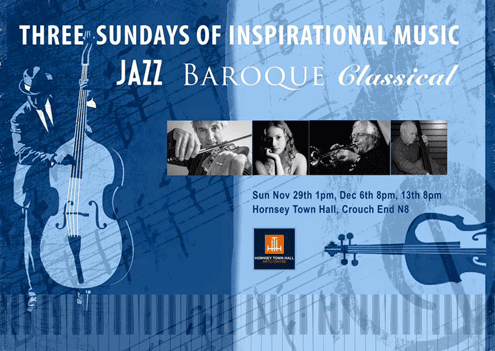


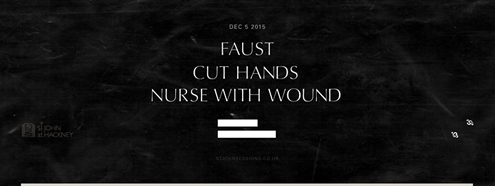








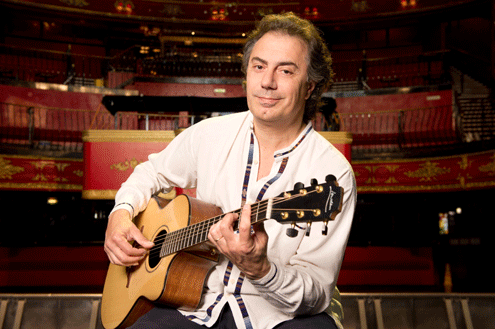

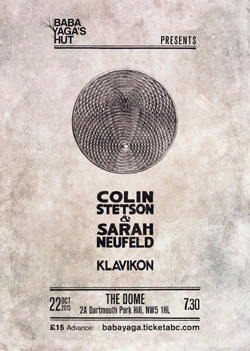









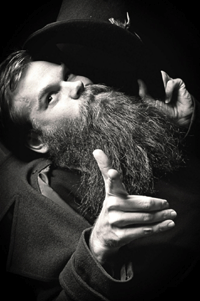


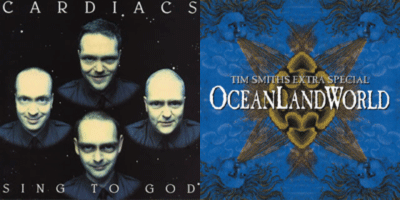
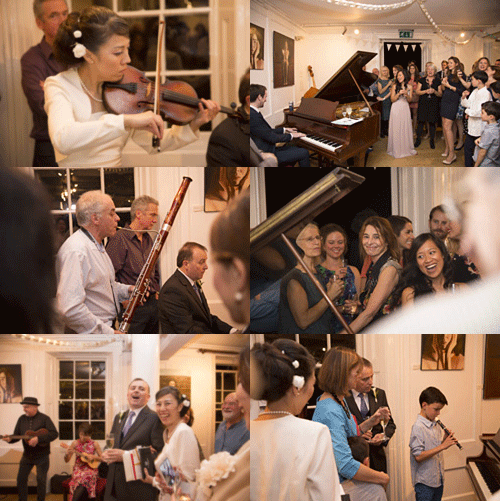
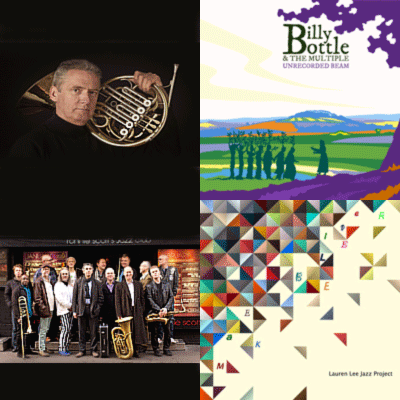






 Misfit City