Archive | musique concrete RSS feed for this section

December 2015 – upcoming gigs, London and elsewhere – some Sunday jazz (Chris Laurence Quartet with Henry Lowther in Crouch End and LUME’s Deemer/Survival Skills show at the Vortex); Ray Dickaty’s Noise Of Wings in Warsaw; and a final Yorkshire shout from Was Is Das? (Skullflower + Tor Invocation Band at Inkfolk in Hebden Bridge)

1 Dec

Increasingly, Sunday night in these listings seems to be the night for jazz – or near-jazz. Something accessible’s going on in Crouch End, just down the road from ‘Misfit City’; something spikier’s in preparation at the Vortex over in Dalston; and a thousand miles away in Warsaw, an old favourite’s taking a new step.

In order of proximity, then..

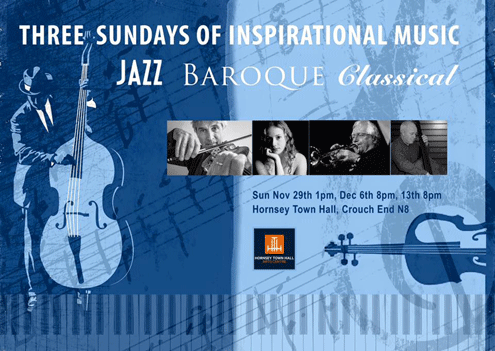
The Chris Laurence Quartet with guest Henry Lowther (Sunday Night Jazz @ The Supper Room, Hornsey Town Hall Arts Centre, The Broadway, Crouch End, London, N8 9JJ, UK, Sunday 6th December 2015, 8.00pm) – £11.00 – informationtickets

Chris Laurence Quintet @ Three Sundays of Inspiration Music, 6th December 2015For several decades, Chris Laurence has skilfully straddled the worlds of British jazz, British classical and British popular music without compromising his artistry in any of them. He’s played double bass on tracks by Elton John, Sting or David Gilmour and spent many years as principal double bassist with the Academy of St. Martin in the Fields and the London Bach Orchestra; but the prime outlet for his melodic, propulsive playing has always been jazz, whether he’s been working in controlled explosions with free-jazz drummer Tony Oxley or in more measured compositional jazz space with Kenny Wheeler, John Taylor or John Surman.

His own Chris Laurence Quartet has been active since the mid-2000s, with the other three members being vibraphonist Frank Ricotti (a longtime Laurence collaborator and bandleader in his own right, as well as being a British percussion-session legend) and past/present Loose Tubes players John Parricelli (guitar) and Martin France (drums). Their lone album to date – 2007’s ‘New View’ – includes Laurencian takes on compositions by Wheeler, Surman, Taylor, Stan Sulzmann, Joni Mitchell and Andy Laverne. As well as featuring guest appearances from Norma Winstone, it also showcases the interplay of Chris’ vigorous bass playing and the subtle implicatory musicianship of his cohorts.

For this particular concert, Henry Lowther (whose five-decades-plus career of playing has seen him grace work by Mike Westerbrook, Gil Evans, Talk Talk, John Dankworth and many others including various jazz orchestras) will be guesting on trumpet. The Quartet is playing as part of a brief Three Sundays of Inspirational Music season at Hornsey Town Hall, which concludes on the 6th and features various jazz, baroque and classical performances.
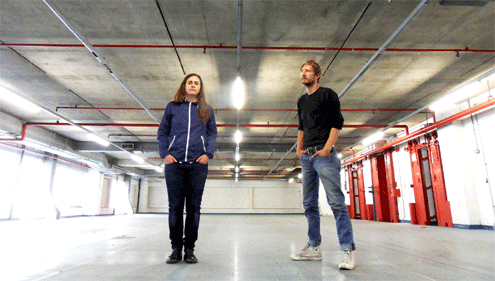
Deemer, 2015

Deemer + Survival Skills (LUME @ The Vortex Jazz Club, 11 Gillett Square, Dalston, London, N16 8AZ, UK, Sunday 6th December 2015, 7.30pm) – £11.00 – informationtickets

The next concert’s billed as “a special evening of improvised music with electronics” and hangs onto whatever jazziness it has by its fingertips alone: but if you’re interested in creative spontaneous music, don’t let that put you off in the slightest.

Deemer is the brain-child of Merijn Royaards and Dee Byrne. Deemer started life in 2006 as a weekly improvisation/electronics session in a warehouse in Hackney Wick. The project has since evolved into an installation/performance based electro-acoustic two-piece orchestra, whose aural narratives are created within fluid frameworks that map a trajectory in time, but leave the sonic textures and compositions entirely free and undetermined. Deemer employ, among other things, alto saxophone, analogue electronics, tape, transducer microphones/speakers to instantly compose, activate space, and blur the boundaries between free jazz and sound installation. They are releasing their debut album ‘Interference Patterns’ on Monday 7th December on the new LUME record label, Luminous.

Chris Sharkey, 2015Survival Skills is the solo project of Chris Sharkey (trioVD, Acoustic Ladyland, Shiver). It has no fixed instrumentation but the music is often comprised of various processed layers created in real time by hardware including synths, sequencers, cassette recordings, vocals and guitar – the results have been described as “a lo-fi vision of mangled techno, where beats cluster and stumble in their fight for dominance; a highly intriguing piece of noise art…” (‘Data Transmission‘).

Noise of Wings (Staromiejski Dom Kultury, Rynek Starego Miasta 2, 00-272 Warsaw, Poland, Sunday 6th December 2015, 7.00pm) – 20 zł – information – tickets on the door, one hour before concert

Noise Of Wings

Saxophonist Ray Dickaty has travelled a long way in twenty-odd years – both geographically (Liverpool and London, via assorted world tours, to Warsaw) and musically (British avant/alt-rock with Spiritualized, Moonshake and Gallon Drunk, then the brutal jazzpunk of Solar Fire Trio, and his current work as an improviser). Now embedded deep in experimental jazz (plus a host of projects around the Warszawa Improvisers Orchestra) he’s stepping out as a frontline composer. For Noise Of Wings, Ray twins his tenor sax with that of Maciej Rodakowski, adding avant-garde double bass player Wojtek Traczyk and polygenre drummer Hubert Zemler to form a quartet playing “inside and outside” Ray’s own written pieces.

Though the project’s influences and ingredients come from Terry Riley, Ornette Coleman, “mediaeval darkness”, drone culture and Albert Ayler free-forming, Ray claims that the final results“are not free jazz blowout music; this is a carefully considered sonic palette… It may be considered dark ambient jazz, with a hint of contemporary classical: melodic and yet full of interesting twists and turns… The saxes are pushed to their limits sonically and all the time the volume is kept down.” The project is still too young for me to be able to provide any sonic evidence, but this December gig at Warsaw’s Staromiejski Dom Kultury is being pitched as “a very special concert in a very special sounding room” and will be recorded live for rapid release.

* * * * * * * *

Bringing up that last Warsaw gig reminds me that I’ve been trying to look further afield than London for news on interesting concerts, in attempts to escape the complacent gravity of the capital and my own complacence as a born-and-bred Londoner. The results can be rewarding, and although I don’t want to spend all my time as a gig-advertising service, there’s definitely some satisfaction involved in supporting people’s efforts to foster and promote interesting music away from the biggest cities and media hubs. The flipside, though, is an occasional feeling that I’ve started doing this too late.

Take this Was Ist Das? concert, for instance – the latest effort by an enthusiastic promoter and instigator of rare noise in West Yorkshire, but also the final effort. The story might not have quite such a sad ending – this thing’s coming to an end not due to disillusionment but because of the promoter emigrating – but it’s still a shame to see a gig series wink out of existence in a place where it will be missed. All the more reason to catch this particular concert before the end…

Skullflower & Tor Invocation Band @ Was Is Das?/Inkfolk, 6th December 2015Skullflower + Tor Invocation Band (Was Ist Das? @ Inkfolk @ Machpelah Mill, Station Road, Hebden Bridge, HX7 8AU, UK, Sunday 6th December 2015, 8.00pm) – price t.b.c – information – tickets on the door

The final Was Ist Das? gig before I emigrate to America and there’s only one way to go out….with a bang.

Formed in 1987, Skullflower emerged from the Broken Flag noise scene but with a sound far more guitar-driven than most of their peers. Their intense sonic assaults have been influential on such bands as Bardo Pond and Godflesh. Band leader Matthew Bower has worked with many of the leading lights of the UK underground such as Vibracathedral Orchestra, Richard Youngs, Ramleh and Colin Potter.

Tor Invocation Band is a nebulous, international unit of seasoned improvisers. As given to the light as to the dark, their exploration of space, sound, noise and sacred spaces. The exact line-up is yet to be completely confirmed but if it is what I hear it is… Well, don’t turn up late. It seems like the perfect way to end it all, with our ears ringing!

Further information – this gig’s part of the Inkfolk December gathering, sprawling from 3rd 6th December. I think that the Tor Invocation Band may have something to do with the group of improvising musicians associated with Tor Press (who run various psychedelic.drone.folk.metal.noise Tor Bookings events in Todmorden Unitarian Church a few miles from Hebden Bridge, but I can’t be sure. Meanwhile, Skullflower have the following comment on the whole affair – “On the Sixth of December we will descend on Hebden Bridge to evoke the Dakshini Force and build altars of Set/Guedhe in the Werewolf Universe with that shadow stuff that their bible calls ‘the Darkness of Aegypt’. Driving over the moors to the Calder Valley, I have seen, the world cloaked in mist below me, and only a few plateaus, like islands, left, as if the world were drowned, cleansed.” With the minimum of tweaking, that’s the band’s Christmas card written too.

Glib jokes apart, publicizing this last gig has made me feel both sad and inspired. I’m increasingly feeling that this kind of concert (not in terms of genre, but in terms of hope and pluck – small and hopeful endeavours) is what I should be plugging more. So – best of luck to the mysterious Was Is Das person as he sets up again in America, and an open and obvious invitation to everyone else: if any of you are reading this and trying to run small, committed gigs of interesting music somewhere, please get in touch.

December 2015 – upcoming gigs, London and elsewhere – classical/folk/songwriter fusion with James McVinnie, Mara Carlyle, Liam Byrne and HART at Daylight Music; an experimental boilup at St Johns Hackney with Faust/Nurse with Wound/Cut Hands; plus Tom Slatter’s steampunk prog acoustica in Winchester, and a Gong spinoff in Brighton (with Dave Sturt, Kavus Torabi & Ian East)

1 Dec

There were too many gigs this week to fit into the last post – go back there for details on assorted chamber music, folk, sample pop and the Anawan gigs in New York (one of which spills over into the weekend). For my usual erratic pick of what’s on over this coming weekend, keep reading.

* * * * * * * *

Daylight Music 209, 5th December 2015

Daylight Music 209 – James McVinnie, Mara Carlyle, Liam Byrne + HART (Union Chapel, Compton Terrace, Islington, London, N1 2UN, UK,12.00pm) – free (suggested donation £5.00) – information

World famous organist James McVinnie makes the perfect partner for the Union Chapel’s 200-year-old Henry Willis organ. In the spirit of Christmas, James has invited his closest musical chums to share the stage with him: Mara Carlyle, Liam Byrne and HART. Together, they’ll be presenting some of their own music and doing arrangements of hidden gems and forgotten carols.

Organist James McVinnie was Assistant Organist at Westminster Abbey between 2008 and 2011 (playing for both regular and special services as well as directing the Abbey’s world-famous choir) and has held similar positions at St Paul’s and St Albans Cathedral. He appears on numerous recordings of vocal and choral music and, as a continuo player, he has appeared at most European early music festivals. In parallel to this, he is internationally renowned both as a soloist and a collaborator in new music whose boundless approach to music has lead him to collaborations with some of the world’s leading composers and performers. David Lang (winner of the 2008 Pulitzer Prize in music), Martin Creed (winner of the 2001 Turner Prize), Richard Reed Parry (Arcade Fire), Shara Worden (My Brightest Diamond), Pee Wee Ellis, Max de Wardener, Mara Carlyle and Bryce Dessner (The National) have all written works for him. He is a member of Bedroom Community, the Icelandic record label and close-knit collective comprising like-minded, yet diverse musicians from different corners of the globe. ‘Cycles’, his debut release of music written for him by Nico Muhly was released on this label in 2013 to widespread critical acclaim. 2016 will see releases of music for organ by J S Bach and Philip Glass.


Originally from Shropshire and now living in London, Mara Carlyle is a singer-songwriter, an arranger and electronic orchestrator, and a player of both ukelele and musical saw. The child of musical parents (with whom she played in assorted folk projects from childhood) and the product of classical training, she’s also the possessor of an eclectic taste as much enthused by A-Ha and Amerie as by Henry Purcell.Initially known as a guest singer on a succession of Plaid albums between 1997 and 2001, she released her first solo album in 2004. Mara’s own work blends her operatic voice with classical structures, torch jazz and electronic flourishes. In addition to her own original material, she specialises in interpretations and adaptations from the classical, baroque, Romantic and modern-classical canon including works by Handel, Purcell (Dido’s Lament), Robert Schumann (whose Ich Grolle Nicht was the basis of her single I Blame You Not), Walford Davies and Jacques Offenbach. Since 2014 she’s been part of the presenting team on Late Junction. Mara is currently in the process of recording her third album.


Liam Byrne divides his time between playing very old and very new music on the viol. With the firm belief that baroque music can be vibrant and expressive on its own terms, Liam’s solo work regularly explores lesser known corners of the 16th and 17th century repertoire. For several years he was a member of Fretwork, and has also toured and recorded with the Dunedin Consort, The Sixteen, Le Concert d’Astrée, i Fagiolini, Concerto Caledonia, and the viol consorts Phantasm and Concordia, among many others. Liam’s interpretative curiosity has also led him to work increasingly with living composers, and he has had new solo works written for him by Edmund Finnis, Nico Muhly, Valgeir Sigurðsson and others. Beyond the realm of classical music, he has worked with a wide variety of artists including Nils Frahm, Matthew Herbert, Martin Parker and The Hidden Cameras. He has played a significant musical role in the creation of several large-scale operatic works: Damon Albarn’s ‘Dr Dee’, Shara Worden’s ‘You Us We All’ , and Valgeir Sigurðsson’s ‘Wide Slumber’ . In 2015 he will undertake a new project with Belgian ensemble Baroque Orchestration X and Icelandic musician Mugison. Liam plays a 7-string bass viol by John Pringle, a 6-string bass by Marc Soubeyran, and a treble viol by Dietrich Kessler, which is graciously on loan from Marc Soubeyran.

Described as possessing “one of the most noteworthy male voices of the last twenty years,” (‘For Folk’s Sake‘), singer/songwriter Daniel Pattison trades under the project name of HART. Featuring elements of dream-pop, folk, avant-garde psychedelic rock, electronica and contemporary classical songcraft, his debut EP ‘Songs Of The Summer’ (featuring string arrangements from Nico Muhly) was released in October this year).

Playing in-between on this weeks festive edition will be singer songwriter Harry Strange, a singer-songwriter from London currently working on his first EP.

http://www.youtube.com/watch?v=bh4QI2necOg

* * * * * * * *

If all of that sounds too genteel, the same evening brings this triple-legend concert of experimental and industrial music heroes (also in a church). Putting this one on is a real point of pride for the organisers, who describe it as “a dream line up for us as we are all very heavily influenced by each of these artists. It will be an amazing show and the last one of 2015 from us.” I’ve just seen that tickets for the concert are selling out even as I post this – so move fast.

Faust/Cut Hands/Nurse With Wound @ St John Sessions, 5th December 2015

Faust/Nurse With Wound/Cut Hands (St John Sessions & Thirtythree Thirtythree @ St John at Hackney Church, Lower Clapton Road, Clapton, London, E5 0PD, UK, Saturday 5th December 2015, 7.30pm) – £18.15 – informationtickets

Roadmaking equipment onstage, self-invented instruments, performers who refuse to conform even to standard roles of getting onstage and playing…if any or all of this sounds familiar (or even the kind of thing that’s mentioned in ‘Misfit City’ every other week) it’s because Faust set the blueprints at the start of the 1970s, or at least brought them into the world of popular music. An inspiration for innumerable questioning music-makers for over forty years, the band (or, more accurately, the collective event which calls itself Faust) have maintained the same sense of spontaneity, constructive pranking, rude assertion and open-ended possibilities throughout an erratic and frequently interrupted existence.

Initially assembled and pitched (by record producer/journalist-philosopher Uwe Nettelbeck) as a counter-cultural boy band for the lucrative but conservative German record market in 1970 – as if they were a Hamburg take on The Monkees – Faust showed their true avant-garde colours immediately and deliberately. Only a rock band in the very loosest sense of the word (perhaps only their electric instrumentation, amplification, time of emergence and love of rough immediacy really plugs them into the genre), their music has combined free improvisation, garage-band jamming, a pre-punk inspiration-over-technique aesthetic and a distinctly Dada perspective. Stories about perverse, inspired experimentation and behaviour in the face of an increasingly bewildered and irritated music industry have passed into legend: rebellions which seem, for once, to have been essential and genuinely inseparable from the band’s music creation (even from their very existence). Today’s Faust may be mining a tradition rather than breaking new ground, but even as the original members pass through their sixties and into their seventies they retain their commitment to the methodology they unearthed.

To be honest with you, I’ve got only the faintest idea about which of the parallel current incarnations of Faust (each featuring various different original members) is playing in London this coming week, although the evidence is pointing towards a grouping of Zappi W. Diermaier/Jean Herve Péron/Maxime Manac’h/Uwe Bastiansen). The members themselves seem particularly unconcerned: Péron has never much concerned himself with rules and (in an eminently readable interview with ‘The Quietus’) founding organist/noise-marshaller Hans Joachim Irmler from the other main faction has confessed “our idea was that all six original members could be Faust but there should never be two Fausts at the same time. It was an agreement but the version of Faust based around Diermaier, Péron and [Amaury] Cambuzat broke the rules, in a way. It took a little while for me to get used to it but now I think… ‘Why not?!'” If they don’t mind, maybe we shouldn’t either. Increasingly, Faust is of more an idea than a band, per se – or perhaps it’s best to call them a travelling opportunity, an open mind; a self-contained performance space.

For three decades and over fifty releases, sonic collage project and “purveyor of sinister whim to the wretched” Nurse With Wound (predominantly the work of Steven Stapleton) has been drawing directly on nearly every musical genre imaginable, mixing them up via tape loops, samples and whichever methods work to illustrate Stapleton’s curiosity and sense of humour, itself influenced by surrealism, Dada and absurdism (which explains why John Cage, filched easy-listening and snatches of kosmiche could be rubbing shoulders on any given NWW track). The project’s music is also informed by Stapleton’s keen visual and fine-art sensibilities, reflecting his other work as painter and sculptor.

Originally the key figure in transgressive 1980s power electronics band Whitehouse, William Bennett has been exploring “Afro-noise” under the Cut Hands moniker since 2008. The project is heavily inspired by William’s fascination with Haitian vaudou, deploying Central African percussion in radical new ways and generating an intense sound unrivalled in its physical and emotional intensity. In a recent interview with ‘Self Titled‘, William has commented “with Cut Hands, one of the original intents was to try and achieve the same kinds of emotional transformation through polyrhythmic percussion where once words were used… I confess there is a bit of a crazy, beardy New Age composer trying desperately to break free.”

* * * * * * * *

If you’re in Winchester that night, rather than in London, and you fancy a bit of budget-imaginarium fun, I can point you towards this…

Tom Slatter (Heart Of Saturday Night @ The Art Café, 2 De Lunn Buildings, Jewry Street, Winchester, Hampshire, SO23 8SA, UK, Saturday 5th December 2015, 7.30pm) – free (donations encouraged) – information

record-tomslatter-ftfThis is Tom’s last gig of the year (although he’s got a few lined up for both London and Brighton in early 2016) and it’s free entry, though a hat might be passed around at some point for donations – possibly the topper which Tom is famous for wearing while he delivers his Victoriana prog songs.

I might as well requote my quick description of Tom from a few months ago, since he’s cheerfully seized on at least part of it for himself – “Tom describes his work as “the sort of music you’d get if Genesis started writing songs with Nick Cave after watching too much ‘Doctor Who'”, while one of his occasional collaborators, Jordan Brown of airy London prog-poppers The Rube Goldberg Machine, calls him “a sci-fi storyteller with a penchant for odd time signatures and soundscapes.” Both descriptions ring true but fail to pinpoint the cheerfully pulpy weird-fiction exuberance of Tom’s work as a one-man band. He’s a man not just happily out of his time, but making a virtue of it – a latter-day Victorian street-theatre barker with a guitar promising tales of mystery, imagination, ‘orrible murders and bloody great waving tentacles.”

For a second opinion, try this from ‘The Progressive Aspect‘ – “Tom is an engaging singer with a resonant voice and an unorthodox songwriter whose songs push the boundaries of what can be expected from the solo acoustic guitar troubadour, straying into the darkest of corners. There is a strange mind at work here but one that makes for a compelling and fascinating listen.”

Recorded and live tasters below…

* * * * * * * *

Meanwhile, over in Brighton, there’s something for the psychedelic crew:

Inspiral Trio & The Fibroid Nebulae @ Real Music Club, Brighton, 5th December 2015

Inspiral Trio + The Fibroid Nebulae (The Real Music Club  @ The Prince Albert, 48 Trafalgar Street, BN1 4ED Brighton, England, Saturday 5th December 2015, 8.00pm) – £8.80-£11.00 – information – tickets

The Real Music Club is delighted to present an intimate night of highly eclectic music.

Within Inspiral Trio, three current members of Gong explore their harmonious musical synergy. Dave Sturt (bass guitarist and composer) has worked with Gong, Bill Nelson, Steve Hillage, Jade Warrior and Cipher. His solo album ‘Dreams & Absurdities’ will be released on Esoteric Antenna on October 30th. Ian East (sax/woodwinds player and composer) has worked in multiple genres, from Gong to Balkanatics. Ian is currently producing a solo album to be released in 2016. Kavus Torabi (guitarist, singer and composer) has worked with Cardiacs, Gong, Knifeworld, Guapo and Mediavel Baebes – much of his work can be found on his own label, Believers Roast. Solo sets from each man (with Kavus promising some acoustic renditions of tunes from the forthcoming Knifeworld album in his one) will be followed by an improvised set from all three players together. Come and enjoy a tasteful melange of solo and triadic creations from these unique musicians.

The Fibroid Nebulae was formed by Damned/Sumerian Kyngs keyboardist Monty Oxymoron after opening the Real Music Club’s ‘Drones4Daevid’ gig in February 2015. The band consists of Monty (keyboards and vocals), Francesca Burrow (vocals, sax, clarinet and keyboards), Dave Berk (of Jonny Moped) on drums and vocals, Andy Power (Sumerian Kyngs) on bass and the Real Music Club’s own Gregg McKella (Paradise 9/Glissando Guitar Orchestra/Peyote Guru/Gregg & Kev) on synthy bits, vocals, guitar and glissando guitar. The Fibroid Nebulae play offbeat tracks and fuse their own styles and quirks with some lo-fi groove psychedelia, ambient sounds and Krautrock – taking in Soft Machine, Gong, Neu! and Pink Floyd along the way!

* * * * * * * *

And there’s more shortly

October 2015 – upcoming London gigs – fringe jazz (The Geordie Approach and A Sweet Niche) and noise-rock (Hey Colossus, Lower Slaughter and Kogumaza)

4 Oct

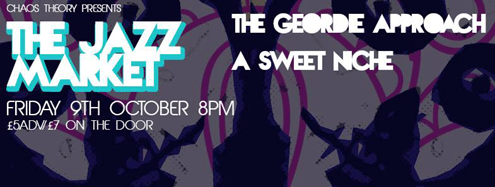
“More accomplished musicians have a loud argument about what ‘jazz’ even is these days,” say Chaos Theory Promotions. Their Jazz Market evenings continue to provide space for such arguments, and here’s another one…

Jazz Market - The Geordie Approach + A Sweet Niche, 9th October 2015

The Geordie Approach + A Sweet Niche (Chaos Theory Promotions present The Jazz Market @ The Sebright Arms, 33-35 Coate Street, London, E2 9AG, UK, Friday 9th October 2015, 8.00pm) – £5.00/£7.00

The Geordie Approach is possibly the oldest secret from three internationally renowned musicians who’ve been working together for over ten years. It features acclaimed Leeds guitarist and producer Chris Sharkey (Acoustic Ladyland/Shiver/TrioVD), and Norwegian musicians Petter Frost Fadnes and Ståle Birkeland, best known for playing sax and bass respectively in Stavanger Kitchen Orchestra. This uncompromising and experimental trio pursues music within loose improvisational structures, adding a surprisingly broad range of flavours to their overall sound world.

The trio has a reputation for adapting and utilizing their performance space in an extremely effective and engaging manner. Birkeland, Frost Fadnes and Sharkey produce musical elements that often are contradictory in shape, moving between melody and noise, ambient grooves and abstract textures. They have performed across Europe, Japan and the UK in churches, art galleries, improvisation clubs, squats, abandoned tobacco houses, jazz festivals, concert halls and flamenco clubs. Each performance is a unique experience.

We hail the return of jazz punk trio A Sweet Niche to The Jazz Market after a seriously impressive performance in 2013. Band composers Keir Cooper and Oliver Sellwood (on guitar and saxophone respectively) explore an aesthetic of intricate rhythms & song-structures within a punchy energetic rock band format.

The nature of their collaboration is unique; Keir is an award-winning non-academy artist and Oliver is an award-winning PhD composer and academic. Despite their two tangential angles of experience, they have a shared musical vocabulary honed over nearly two decades. With new album ‘EJECT’ on the way in 2016 (and the recent addition of Big Beat Manifesto drummer Tim Doyle to the band), it’s high time we pulled these performers out of the murky underworld they reside in.

https://vimeo.com/138210244

Tickets are available from here, and up-to-date information is here.

* * * * * * * *

There’s another Baba Yaga’s Hut evening on the same night as the Oto gig, this time concentrating on various noise-rock angles (from the reformatting of classic rock to the restructuring of sound to the straightforward joy of a gibbering hardcore racket.) See below.

Hey Colossus/Lower Slaughter/Kogumaza @ Baba Yaga's Hut, 9th October 2015Hey Colossus + Lower Slaughter + Kogumaza (Baba Yaga’s Hut @ Electrowerkz, The Islington Metal Works, 7 Torrens Street, Angel, Islington, London, EC1V 1NQ, UK, 9th October 2015, 8.00pm) – £9.00

Variously from Somerset, Watford and London, six-piece Hey Colossus https://www.facebook.com/heycolossus have spent a decade gradually becoming alt.rock darlings thanks to their  journey through assorted doomy noise rock avenues. Their current recipe involves slowing down and narcotising their alleged classic rock influences (Fleetwood Mac is one of those cited) via psychedelic echo and a certain post-rock dourness. It works well too – much of the time they sound like a guttering Led Zeppelin on strong cough mixture, or feed crunching brass-riff processionals and Stooge-esque whomps through an amber-toned ‘Piper at the Gates of Dawn’ filter.

I suspect that the concept of supergroups doesn’t fit into noise-rock and post-hardcore. Nonetheless, Brighton’s Lower Slaughter  does sort of fit into that category, uniting people better known for other bands (bass player Barney Wakefield for Shudder Pulps, guitarist Jon Wood for “harsh party music” outfit Fat Bicth, Max Levy for vertiginously nervy singing in King Of Cats) and welding them together into a noisy, queasy-confident, raw-scream whole.

Creating hypnotic drones and grooves via two guitars and tom-centric drumming, Nottingham quartet Kogumaza have their feet in sludge metal and in post-rock; but while the latter’s become an increasing predictable and conservative genre Kogumaza have set out to reclaim some of its earlier, more inventive ideas (such as the lapping sonics of Seefeel) via their fourth member, live sound mixer Mark Spivey, who brings in dub-inspired approaches and old tape-looping techology to further manipulate and displace the band’s sound both live and on record. Fond of collaborations and split releases, they’ve also been known to bring in an unexpected banjo (although they probably won’t tonight).

Up-to-date info here, tickets here.

* * * * * * * *

More gig news shortly…

October 2015 – upcoming London gigs – electro-industrial at Corsica Studios (Necro Deathmort, DeadFader and Cementimental), and intercontinental at Café Oto (Maurice Louca, John Bence and Sam Shalabi)

4 Oct

More gigs for the coming week…

Firstly, Baba Yaga’s Hut are running an evening at Corsica Studios, which takes in the London date of an electro-industrial tour.

Necro Deathmort/DeadFader/Cementimental @ Baba Yaga's Hut, 5th October 2015Necro Deathmort + Deadfader + Cementimental (Baba Yaga’s Hut @ Corsica Studios, 4-5 Elephant Road, London, SE17 1LB, UK, Monday 5th October 2015, 8.00pm) – £6.00

As if Necro Deathmort‘s name didn’t tell you enough about them, over an eight year career they’ve released albums called ‘This Beat Is Necrotronic’ and ‘Music Of Bleak Origin’ (although more recent albums have seen a shift towards a less morbid and more science-fictional outlook. Dark electronica festival veterans with a drone, doom and noise approach, the project entangles electronic instrumentalist AJ Cookson (The Montauk Project, Medes, Sol Invicto) with Matthew Rozeik (guitarist from post-metal/post-prog band Astrohenge). Their music rises from gurgling boneyard beats, medical-equipment breakdowns, squishy miasmas and faux-sax drones towards something ruined and regal – a grand deathbed vision.

Sharing Necro Deathmort’s current tour is Berlin-based dubstep/noise/electro fusilladeer DeadFader – memorably described as “chainsaw-step” by Baked Goods Distribution (who went on to rave about how the project coughs up “the most seismic grooves imaginable” and that the music “sinks its teeth into your arm and refuses to let go”). I can’t top that as a description right now – have a listen below and see if you agree with it.

Joining Necro Deathmort and DeadFader for the London date are CementimentalEverything I can dig up about these guys is a barking blur of ludicrous disinformation: almost the only lucid facts coughed up from their promotional flotsam is that they’re led by a “noisician” called Dr. Age (or Tim Drage, who may or may not have a daytime/surface job in cute Lego animations) and have been doing “harsh noise, circuit-bending, rough music since 2000AD”. The Dr. is supported by a cast of obscure and possibly imaginary characters – a guitarist called Toru, a part-time turntablist, a man called Mrs Columbo (who handles the incoherent screaming), and “additionalists” called Murray the Eel and Sir Concord Discount (the latter’s a “rock goblin”). Maybe this makes Centimental sound like the joke band on the bill, and there’s plenty of humour in what they do (a couple of early tracks were called Too Long and Merzbow It Ain’t, while a more recent one’s called Commendable Amputation of an Excessive Gargoyle), but the fact remains that they’ve been going for nearly half again as long as their gigmates. Draw your own conclusions.


Up-to-date info here, tickets here.

* * * * * * * *

On the Thursday, there’s a Cafe Oto convening of music from Cairo, Bristol and Montreal, running in parallel to events in Egypt and Lebanon and covering a broad variety of influences and outcomes.

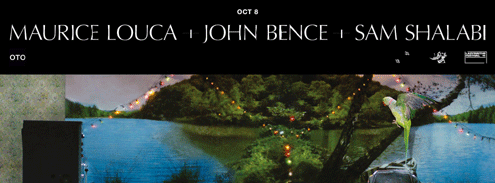
Maurice Louca + John Bence + Sam Shalabi, October 8th 2015

Maurice Louca + John Bence + Sam Shalabi (Café Oto, 18-22 Ashwin Street, Dalston, London, E8 3DL, UK, October 8th 2015, 8.00pm) – £12.00/£14.00

Cafe Oto, in collaboration with Thirtythree Thirtythree   and Nawa Recordings, bring you the second edition of the five-part event series entitled ‘Labyrinths’ (or ‘Mātāhāt’ in Arabic) and based in London, Cairo and Beirut over October and November.

Maurice Louca is an Egyptian musician and composer born in Cairo where he lives and works. As well as being the co-founder of the bands Bikya, Alif and Dwarves of East Agouza, he lends his sound to numerous projects, composing for theatre, film and contemporary art. Inspired by many influences, from psychedelic to Egyptian shaabi, his second album ‘Benhayyi Al-Baghbaghan (Salute the Parrot)’, released on Nawa Recordings in November 2014, shattered the confines of musical and cultural labelling and was dubbed by many as a game-changer for the region’s bustling independent music scene. Amidst his collaborations and inconspicuous touring across Europe and the Arab world in the last few years, Louca has sought a richer and much more complex sound. ‘Benhayyi Al-Baghbaghan’, the fruit of such intense reinvention and a departure from his first solo album ‘Garraya’, is a work that leaves ample space for fluidity and improvisation, paving the way for unique live renderings.

From a family background rich in classical pedigree and firmly embedded in Bristol’s forward-facing electronic music culture, John Bence has pooled a breadth of influence scarcely credible for a composer only entering his second decade, and now he is starting to put his inspiration into live and recorded motion. As a producer he is already thinking ten steps ahead, often incorporating voice or home recorded percussion into his cyclical technique of scoring, recording, manipulating, re-scoring and re-recording in waves, creating heady, intoxicating ripples of harmony and noise. An obscure snippet of dub-plate drone under a previous moniker was enough for Nicolas Jaar, who instantly approached him about a release on his Other People label. Six months on, ‘Disquiet’ was released – a masterful hybrid of classical and electronic clocking in at a tantalising ten minutes. More, much more, is coming. Mercurial, elusive and of seemingly limitless imagination, John Bence is rising to the surface.

Sam Shalabi is an Egyptian-Canadian composer and improviser living between Montreal, Quebec and Cairo, Egypt. Beginning in punk rock in the late 70s, his work has evolved into a fusion of experimental, modern Arabic music that incorporates traditional Arabic, shaabi, noise, classical, text, free improvisation and jazz. He has released five solo albums (including ‘On Hashish’- a musical mediation on German writer Walter Benjamin; ‘Osama’, an audio collage on Arabophobia in the wake of 9/11; and his most recent ‘Music for Arabs’), five albums with Shalabi Effect (a free improvisation quartet that bridges western psychedelic music and Arabic Maqam scales) and three albums with Land of Kush (an experimental 30-member orchestra for which he composes). He has appeared on over sixty albums and toured Europe, North America and North Africa. Recent projects include the release of the sixth Shalabi Effect album, a duo album with Stefan Christoff, two albums on the Italian label Sagittarius with Beirut, Turkish and Egyptian musicians and a tour in the eastern U.S with Alvarius B (playing solo oud). He is also releasing ‘Isis and Osiris’ (a new composition for oud and electronics) on Nashazphone as well as releasing an album with The Dwarves of East Agouza (a Cairo based trio with Maurice Louca and Alan Bishop) while currently working on his sixth solo album.

Tickets and up-to-date information are here and here.

* * * * * * * *

More noise rock and fringe jazz shortly…

September 2015 – upcoming London gigs – Darkroom gently mess with our minds at Hubbub Late Spectacular, Friday 4th September

3 Sep

Just quickly plugging this event, as I unintentionally left it off the early-September preview from Tuesday. While I was initially drawn to it by the musical involvement of textural loop duo )and longtime ‘Misfit City’ favourites) Darkroom, there’s plenty here to interest anyone with curiosity about the workings of the mind. It’s free, although the scheduled talks and some larger activities are ticketed (you’ll need to get tickets for those from the Wellcome Collection on the night, from 6.30pm onwards).


Hubbub Late Spectacular, 4th September 2015

Hubbub Late Spectacular @ The Hub, The Wellcome Collection, 183 Euston Road, London NW1 2BE, UK, Friday 4th September 2015, 7.00pm) – free entry

A night to explore rest… and its opposites. What does “rest” mean to you? Join the Hubbub team to investigate rest and its opposites: from daydreaming and doodling, to fidgeting and lullabies. Catch a talk on the latest discoveries about what your brain’s up to when you’re doing nothing, or experience a live stream of sound from around Heathrow airport. From a documentary about an ape retirement home, to a workshop where you can try out historical relaxation techniques, this is an evening that will transform how you understand rest.

Activities – hear contemporary lullabies and add to a collaborative collection; learn about mapping alertness and environment through self-tracking; experience variations of relaxation and cacophony with a brand new audio piece from radio collective In The Dark; put rest to the test as you investigate some of the methods used by scientists to measure rest and its opposites; join the debate on “what’s wrong with work?”

Talks – “Fantasy and Fiction” with social scientist Felicity Callard and poet James Wilkes; “Free Time and Mindwandering” with psychologists and authors Claudia Hammond and Charles Fernyhough; “Mapping Rest” with neuroscientist Daniel Margulies and anthropologist Josh Berson.

Some comments from Hubbub investigator Charles Ferneyhough (the whole blog post is here):

The research project in Hubbub is investigating topics such the relation between the shifting periodicities of ambient music and the changing rhythms of conscious experience, and how and in what contexts these can have restful and restorative effects. We plan to extend these investigations into studies of neural connectivity in the “resting state”: the dynamic, fearsomely complex and increasingly well-studied patterns of activation shown by a brain that is not performing any specific task. We are employing new methodologies for assessing these nuances of subjective experience (both for audience and performers) in a scientifically rigorous manner, as well as exploring implications for clinical interventions… Darkroom are interrupting a tour promoting their new album ‘The Rest is Noise’ to perform with me in a sequence of three extended sets at the Hubbub Late Spectacular. Come and hear the sounds of improvised ambient music, and get a chance to give your feedback on the psychological and emotional effects of listening to this kind of music.

…plus some from Darkroom themselves:

Darkroom will play three sets, with unpredictably different shades and contrasts. It’s a free event (apart from the drinks) at this spectacular venue, and there’s an opportunity to take part in the experiment, as well as take in other talks and exhibitions on the night, and meet some of the other investigators and our collaborators.

Reposted here is a Soundcloud recording of Darkroom and Charles Fernyhough collaborating on a half-hour long track recorded at The Hub earlier this year.


Full event details are here and here.

June 2015 – upcoming gigs – two more Darkroom gigs in London – Hubbub @ Wellcome Collection; Listening Club in Peckham

8 Jun

Having only just played at the last-for-now Tuesdays Post concert this past Sunday, loop duo Darkroom are performing at two more London gigs this month, both of them at typically interesting events.

Hubbub @ The Hub, The Wellcome Collection, 183 Euston Road, London NW1 2BE, UK, Thursday 11th June (time t.b.c.)

The Hubbub group (based at the Wellcome Trust) is a project with a brief to explore work, rest and play; past, present and future. The two members of Darkroom will be participating in a closed session, being “wired up and investigated” as part of the research. Details are still a little unclear (although I do know that the work will be live-streamed) so keep an eye on the Darkroom Twitter account. For an early taste of the project, here’s psychologist, writer and Hubbub investigator Charles Fernyhough guesting on a half-hour long Darkroom track, a late-night atmospheric piece recorded in The Hub earlier this year.

And on the upcoming Sunday, there’s this:

Listening Club @ The Peckham Pelican, 92 Peckham Road, London, SE15 5PY, UK – 4.00pm to 9.00pm – free entry

This is an events series in association with St John Sessions ( showcasing new experimental music. In addition to Darkroom, the gig also features sound artists Kostis Kilymis (from Thessaloniki via London), Franz Rosati (from Rome) and Memorial Bench (from London, I think). More chat about this over on Twitter.

July 2013 – EP reviews – Jimmy The Hideous Penguin: ‘Colours’ (“a harbourful of soused and bobbing vinyl”)

7 Jul
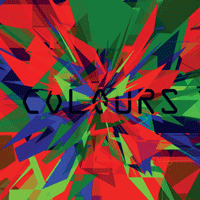
Jimmy The Hideous Penguin: 'Colours'

Jimmy The Hideous Penguin: ‘Colours’

With a name like that, you expect an MC with a slew of stories. A brilliant, squat little microphone hassler compensating for his own lack of sleek, straightforward charm with a quacking, manic inventiveness and left-field imagination. You expect one story, at least.

Instead, Jimmy The Hideous Penguin is a turntablist; using that ludicrous name as a billboard to cover the heads-down, ’phones-on business of scratching, filtering and triggering. A member of DJ quartet Vince Mack Mahon (and one of the masterminds behind the Community Skratch turntable initiative) he’s from Galway. Appropriately, ‘Colours’ sounds like a sketch of Galway on a moderately bad day – soggy and drizzled-misted, but still bright and creative – but you can only stretch his hometown associations so far.

Ducking any of Galway’s high-culture Eire-isms (and, to be fair, many of Vince Mack Mahon’s hip-hop inspirations) Jimmy’s music instead listens eastwards towards Rhine-Ruhr electronica, while picking up occasional bits of English scruff on the needle. It also listens downwards (into well-travelled vinyl grooves) and inwards (through a radio dial set to a perpetually-displaced rural 1970s). Its electrophonic wanderings owe a fair bit to Kraftwerk, a little bit to BBC Radiophonics and quite a large bit to those early Jimmy Cauty-era Orb recordings. Adding a raw backbone of analogue synth-steps and thick, flittering drones to his eddies of turntable work, beat loops and found noises, Jimmy works up some interesting slop behind that cartoon billboard. Instead of those MC stories, you get scenery to make stories – an occasionally playful plunderphonic montage; a harbourful of soused and bobbing vinyl; a frown of uneasy concentration.

While there are some visitations from the drum-burrs and rhythmic grapples of drum and bass, dubstep and techno, Jimmy’s music prefers to wander off on its own. Moving along messier roads, it kicks up a little historic debris as it goes. Red, in particular, sounds like flotsam; washing up out of swells and reversals of wadded-up torch songs, old shellac albums part-drowned in the tide. Jimmy moves the music drunkenly around a European receiver, shuffling aural zones. First he’s playing frail electronic trumpets against twanging, nasal staccatos; then he’s manhandling a sneaking strand of funk drum, a hungry worm of double-time rattle accelerating it from within. Then he’s meandering through abandoned dockscapes at the back of a dark wind, and finally ends in a bend of misdirected psychedelic organ.

On much of the EP (in which one piece strays into another in jostling transitions), ’70s fantasy seems to be rubbing up against ’70s slump. When a stray Dalek shows up at the end of Green – grating out “they are approaching” – it sounds both menacing and surly. It even sounds impotent; like a grumpy gate-guard on the inside of a power-station picket line, slouched in its own little pocket of hate and with a tepid thermos of well-stewed tea clamped onto its sucker, watching strikers slouch into position for the start of a day of mutual glaring. The rest of the piece feels similarly boxed-in – a pained, brontosaurine lumber of panel-beating snare drum and warping sub-bass, weighed down by an oppressive dark-ambient echo and drifting off into a carbon-monoxide grind.

On the subject of ‘Doctor Who’, I could have sworn that I heard a far more obscure ’60s Whovian critter show up, too – ECCO, the incomprehensible computer from ‘The Ice Warriors‘ with the infuriating papery stutter which (even in 1967) made it sound like a remix victim. Presumably, Jimmy’s too young to remember this first-hand: if he’s not been crate-digging deeper into the Beeb’s sound library, maybe he’s been digging up and scratching someone else’s memories.

It’s equally likely that Jimmy’s stumbled across a bit of the Galway countryside that is forever 1978, or at least has a damp box of that year’s proggier vinyl dumped there. Quite early on during Blue’s multi-part sprawl, some of the more oceanic swirls from Jean Michel Jarre’s ‘Equinoxe’ waft through the mix. Later on, Jimmy will varispeed a eerie floating snatch of psychedelic folk (reed-boned flutes and acoustic guitar, like a conjunction of Mike Oldfield’s ‘Ommadawn’, Popol Vuh and ‘The Wicker Man’) before trickling a clip of muffled Rakim-esque rap-and-chatter over twinkles of fairytale guitar lifted straight from Yes’ ‘Circus Of Heaven’.

At the start, however, Blue is lo-fi, dodgem-car techno with a bassline like someone clubbing moles with a car door It’ll make a shift into chugging steamtrain funk, some rare old-school DJ scratching (“wicky-wicky” and all) and the sort of downbeat synth stagger that groans “hangover” at you. Wobbling out from the layering, voices sing with so much gauziness that you can’t tell whether they’re Irish or Lebanese. Others mutter wanly and stagger around the kitchen, failing to fry some eggs. From the latter, one glum mumble of “bugger…” turns into a single-word mantra. It travels mournfully round and round the turntable like a dropped glob of peanut butter: part of the soused, engaging sloppiness that gives the EP its own distinctive flavour.

Jimmy The Hideous Penguin: ‘Colours’
CS² Recordings, CS²-009
CD/download EP
Released: 2nd July 2013

Get it from:
CS² Recordings.

Jimmy The Hideous Penguin online:
Homepage Twitter MySpace Soundcloud Tumblr Bandcamp Last FM YouTube

January 2013 – album reviews – Érick d’Orion’s ‘Koursk’ (“a kind of philosophical haunting”)

29 Jan

Érick d'Orion: ‘Koursk’

Érick d’Orion: ‘Koursk’

What becomes evident while listening to ‘Koursk’ is the kernel of oblique, detached anger which beads at its heart. The abrasive vigour of noise music – its refusal to comply to melody, to conventional narratives and aesthetics of order, even to most standards of beauty – can give it a predictable free pass into total self-indulgence. It’s good to hear something in this musical vein which hints at a moral core, at least for a while.

Recorded over a five-year period, Érick d’Orion’s baleful album mingles a stern, clinical brutality with unexpected gaps for breathing. A veteran of avant-garde noisemaking since the mid-’90s (via Napalm Jazz, morceaux_de_machines and entanglements with Otomo Yoshihide, Evan Parker and the like) Érick has based the core of his album on “the fatality of a place, or concept.” In effect, he’s created a kind of philosophical haunting.

Erick’s ground-zero meme is Koursk, out of which he plots and illustrates two fateful iterations. For those who don’t know their eastern European history, Koursk (or Kursk) is an ancient, iron-rich city and region of mid-Russia. During World War II, it saw the biggest and bloodiest tank battle in history, sprawling over a month’s duration as the Red Army ground itself to Pyrrhic shards and mince against the Wehrmacht. Under the spades of the defending Russians, the Kursk hills were gouged by thousands of miles of trenches and tank-crippling ditches, while Soviet air-raids pelted the Panzer supply lines. The Soviets triumphed and the Germans were halted, but at the cost of enormous losses of Russian men and machines – all thrown relentlessly into the meat-grinder by Marshal Zhukov and his colleagues in order to defend the motherland.

Fifty-seven years later (and nine years post-Soviet, in 2000) a second Koursk hit the worldwide news – a flagship Russian Federation nuclear submarine, named after the original grim victory. Following explosions in its torpedo chamber, the ‘Koursk’ plunged helplessly to the bottom of the sea. While the crew’s relatives panicked, the Russian authorities rejected international rescue assistance (on the grounds of military secrecy), covered up the disaster, bungled four successive days of rescue attempts and finally accepted help too late. Everyone on board the submarine was long dead by then. Initially, the Russian Admiralty claimed that the crew of the ‘Koursk’ had all perished within minutes of the disaster. It emerged later that many of them had stayed alive and conscious long enough to see the air run out and the water rush in, and that some of them had even had time to write farewell notes for their loved ones. The cause of the explosion was finally traced to a faulty, antiquated torpedo, retained for budget reasons. No one was ever punished or prosecuted – instead, the government spent most of its efforts on condemning the Russian media for negative coverage of the disaster.

Far away from these painful events, it’s easy to moon vacuously about the curse of Koursk, or to make similarly dimwitted puns. It’s also easy to discern a more accurate pattern – a coincidental collage of Russian bloody-mindedness, or of that contradictory mixture of material ruthlessness, fatalism and (in its conspicuous burn-up of lives and resources) jaw-dropping pseudo-potlatch that often characterised Stalinism and Warsaw Pact history. However much personal tragedy was involved, Zhukov and his comrades considered those thousands of burnt-out tanks and crisped bodies littered over the hills of Koursk Oblast in the summer of 1943 to be the necessary dues to be paid for protecting the nation. Given the attritional nature of Hitler and Stalin’s struggle for Russia, perhaps the generals had a point; even if the sheer scale of the death and appalls us in more parsimonious, less blindly patriotic days. It’s less easy to defend the fate of the submarine – first wrecked by institutional incompetence, then clumsily (and unsuccessfully) sacrificed to the public image of Putin’s Russian Federation.


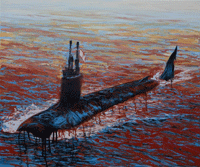
With all of that considered, Erick doesn’t deliver explicit or directly moral judgements on either event nor on any continuum which they might share. Instead (bar that striking cover image of a half-submerged submarine in a welter of blood-streaked water), the details are in the sounds he shapes. Becquerels, for example, is a humming shroud: bassy drones hiccupping, a persistent drizzle of midrange noise. The noise drips and dribbles in, backed by distant grinds and rumbles, circular mechanical gnaws. There are implications here of badly-tuned mechanisms, of radiation slopping into compartments where it doesn’t belong. Chop-ins of explosive industrial drumkit noise become venting spurts; the engine-sounds periodically burst out in short-lived, ominous overruns. The last section is a beautiful warble, smashed into by bursting cogs. There’s no joy in the viciousness on display. There’s just a sense of carelessness being observed and documented, as Erick etches an acidic sonic portrait of breakdown which crowds out and overwhelms personal space, erasing people.

If Becquerels is a bitter salute to the submarine, the nine-plus minutes of Kursk Assault presumably pays tribute to the battle. A square wave tank growl, throbbing its way over random rises and dips and flats, becomes a wash of indiscrimate information leveled out to a crammed, rumpled buzz. Barely distinguishable behind this (in effect, crushed and obscured by the charging machinery) is a folk tune on droning pipes, possibly a Russian volynka. Throughout, scattered vocal syllables are chopped in like broken radio conversation. At the end, a tight cycle of looped pipes and data grind stutters round and round, like something trapped on a wheel.

As with Bequerels, there seems to be a moral edge to the noises here. It’s nothing to do with structured condemnation, nor with redemption. Instead Erick offers a baleful account in sound of the misery of people forced into combat, inside machines that they can’t trust to keep them safe, relying on other people who will let them down or spend them like poker chips. There’s an undercurrent of cramped and sweaty fear in these tones – men crammed into claustrophobic cockpits, waiting for the shells to burst through; men trapped in a crippled steel bottle, fathoms down, listening to the hull shear and the water gush in. The blattering sound also cocks a bitter snook at parade ground pomp. Here, war (and the Cold War) is just an impersonal, perilous sludge.


However, having registered his abstracted judgements, Erick retreats from his implicit moralism to explore different implications. The glitchy thud and staccato arpeggios of Steam And Speed suggest techno, as if Érick was building an impressionist, impasto sketch of a nightclub out of a mulchy bucket of cast-off industrial noises. The namesake being nodded to in the eleven-minute György is presumably György Ligeti, as vocal organum pitches move around behind radio whines and whoops and pell-mell machinery clashes, with disruptive cuts in the piece marked by static spits. After five minutes Érick folds a small choir into the mix, a sampled motet: after that, a man’s voice singing soft and deep and casual. The Ligeti references sift in as the piece moves on – the violent pitch shifts applied to the choir, mimicking Ligeti’s own unsettling choral runs: the deep-buried cosmic skitters buried deep in the mix in the final minutes, beneath the deep and pitchless drone.


Two remaining tracks reference a pair of lurid and controversial art-house films, both of which engaged in studies of morality and nihilism; but if Erick was intending to carry the studies over he’s done so in forms too obscure to plumb. The brief interlude of Man Bites Dog – a flat drone, a squeal and squiggle of static, a hint of hyper-compressed conversation – is straightforward but cryptic (or possibly encrypted). The ugly sibilant shiver of Bad Lieutenant – the album’s longest piece – is a dirty judder of mosquito hiss, behind which slow passes of electrophonica swell like slowed vox-humana organ stops slowed. A gentle pink noise churn runs through the piece, implying slow floods and propellers revolving; there’s a passage of steam-sound, tinny distorted vocal murmurs and dub echoes; an unsettling sweep of what sounds like electrified mice scrabbling and twittering. Later, birdsong echoes over a propeller churn like a shipwreck survivor’s memory – ordnance bangs and mechanical scurf play us out.


The last of this could be a recapitulatory visit to the ‘Koursk’s watery grave, or it might not. Bad Lieutenant has spawned a number of remixes that fail to illuminate a moral dimension: ignoring the context, they simply play with the noises. Martin Tétreault’s mix trims the piece down to a three-minute commodity , gaming it with a tattoo beat of drum-static. Of the two bonus remixes on the download version, Nicholas Bernier’s ten-minute effort retains more of the length but screebles everything with a silvery download skitter and needling, proggy synth cascades like a vintage Galaxians invasion. Robin Fox’s shorter five-minute mix concentrates on adding the missing rhythmatic elements: there’s a faint hip-hop influence in the thudding bass drum and the cut-up bursts of dynamic sound which feed its cat-walking impetus.

What these latter tracks and their reinventions don’t offer are any human conclusions. For a while, listening to this album opened up a window (a questioning and undermining of brute and impersonal power, itself expressed in brute power) which ultimately closed too soon. The noise artistry is impeccable, but I’m left feeling pulled up short: drawn in by a buzzing lasso to ponder a message which fades away too early under the racket.

Érick d’Orion: ‘Koursk’
Érick d’Orion (self-released, DOR 2013, no barcode)
Download-only album
Released: 21st January 2013

Get it from:
Bandcamp

Érick d’Orion online:
Homepage Facebook MySpace Bandcamp Last FM

May 2012 – album reviews – centrozoon’s ‘Boner’ (“a palette of capriciously shifting noises and sonic pounces”)

16 May

Centrozoon: 'Boner'

Centrozoon: ‘Boner’

Testing to destruction. For some, this isn’t a harsh and necessary process, but a judicious way of life. For the floating, ever-mutating alliance of centrozoon (magisterial touch-guitarist Markus Reuter and synth-bumping/pad-thumping lateral thinker Bernard Wöstheinrich) it seems to be a shrug of nature. Either that, or a compulsion. As centrozoon add to their body of work over the years, they’ve studiously avoided clinging to previous methods. Instead, they function as a kind of art-rock Laputa – hovering briefly over various musical terrains, dropping down tendrils to slurp up flavours and approaches. Despite their bone-dry sense of humour, they’ve always remained a little detached and aloof.

At the same time, centrozoon are driven hard by cryptic fascinations of their own, including their vigorous collision of schooled technical approaches and wild, derailing instinct. Their music has always been bipolar and simultaneous. Crude synth presets are embedded into beautifully-fashioned electric textures; ravening, artful touch-guitar solos play off the blunt wallop of electric whack-pads. En route, centrozoon have explored majestic dark-ambient drift music, ridden the clattering back of gabba techno (while flaying it to within a microtonal inch of its life) and spent time as rhapsodic prog-inspired melody men. In the early 2000s, they borrowed the lissom voice and hooded lyrics of Tim Bowness (on furlough from No-Man) to slide smoothly into a song-driven world of art-pop. Equally smoothly, Markus and Bernhard subsequently hit the eject button in order to reform as an introverted chamber electronics duo. Every time centrozoon go public, they’re different. Every time they seem to settle on a final format, they discreetly blow it up and start again.

Ultimately, centrozoon navigate their increasingly risky game of de-build and re-build by trimming back everything that they’d otherwise need to defend. They explode their identities as musicians to become a diffuse spray of wandering cells. They reduce themselves, once again, to enigmatic minds on the prowl; and now they’ve delivered the most abstract and challenging record of their career.

Emerging after a period of diversion, scatter and relative silence, ‘Boner’ suggests that it’s becoming increasingly pointless to define centrozoon‘s work as a clear interplay of individuals. Instead, their work has become a kind of willing entanglement into which each man – somehow – disappears at full volume. Suitably, the contributions of the band’s current third man Tobias Reber are mostly sonic collage (drastic laptop sound-mangling, heavily processed field recordings, occasional blurts of absurdist lo-fi vocal). With both Markus and Bernhard now enthusiastically jumbling up their own sounds, the band creates an intense and murky improvised electrophonic soup – extreme, exaggerately processed and roaming balefully across unstable tonal centres. It’s both utterly fragmentary and utterly involved. If anything, those interim years spent on other projects have only added to the creative centrozoon seethe, bringing the musicians and sounds closer together.

Where ‘Boner’ stands in the wider scheme of music isn’t clear. Not jazz – there’s no swing here, few melodic rushes or pursuits of harmony, no acknowledgement of pop moves. Not ambient as such – despite the atmospheric swishes of sustained texture, there’s little solid order and continuance, and precious little commitment to minimalism. Something in the drive and stance of the music links it to the far fringes of experimental rock. If so, it’s clinging on by a fingernail.

These new, uncomfortable compositions hang in the air like spasming irises or like nested Venetian blinds: multi-layered, periodically flexing open and shut to reveal new textures and patterns. Ever restless, centrozoon shuffle each and every one of these layers, flying in further sound-fields in the blink of an eye. A dribble of coffee-maker noise jump-cuts to a rumble of bass strings. A radiophonic pot-swoop is overwhelmed by a ringing metallic chord or an imperative percussion thump. In the arrhythmic wander of La Waltz of Kirk, hints of Zawinul tropicalia well through the gaps. On Cervus, ominous and dissonant passages in a classical-minor form recur first as vaporous synth pads, then as overdriven bassy touch-guitar lines.

You could try to cite assorted chaotic improvisers, plunderphonic artists and mixing-desk contrarians as close cousins to this music. However, what remains clearest (most evidently on the rumbles, quick body-blows and Mellotron hangings of Knock Outs) is centrozoon‘s familial relationship with King Crimson. More particularly, with that band’s most left-field improvisations – the atonal busyness of the ProjeKCts; the poly-everything lurch and creak of the ’90s Double Trio (spattering pulped MIDI all over the stage on ‘THRaKaTTak’) and the spidery skitter of ‘Starless and Bible Black’. The post-modern stomp of Markus’ work with another Crimson spin-off – Tuner – is also present. Both Tuner and ‘Boner’ share a hypnotic mixture of harshness and disorientation; an over-arching, out-of-focus beauty; and a grate-and-chop, channel-surfing mixture of signals to pour into your ears. Like Crimson, centrozoon also possess a rigid skeleton of stateliness which glides serenely through even their most chaotic improvised scrambles.

While attempting to make sense of this scattered map, it’s equally important to point out that centrozoon are also exploding the idea of what a commercial music album ought to be. Generally, such things are self-contained musical statements – linked to a point in time, a specific intent and a clearly-defined sales package. In making ‘Boner’, the band embraced as many constructive (and deconstructive) possibilities of chance, reinterpretation and creative dissension as they could. Hundreds of initial hours of free trio improvisation were cut and pasted into new compositions; then a third layer of process was added via two outside remixers, each of whom independently cloned and mixed down the finished sessions.

The result is two twinned but different takes on the final album, with different mixes and track sequences (the Marziano Fontana version emphasising those dramatic cuts and layering, the Adrian Benavides mix more spacious, smooth and chilly). Additionally, centrozoon sell ‘Boner’ in a bewildering variety of packages (via its “Bonestarter” campaign), with diverse extras plugging into the deal like bonus phone apps. Options now include one or both album versions; further choices of formats and downloads; signatures; custom clothing; original artwork; even personal access via one-to-one conversations or touch-guitar lessons.

It’s not that these moves, in themselves, are new. Alternate mixes and reinventions are commonplace, and compositions via mixing desk and improv have been around at least since Zappa. Jane Siberry has offered special-purchase deals with souvenirs and judicious personal access for years. What is new is centrozoon‘s audacity in coupling all of this to such a demanding, avant-garde musical package.

Even without the bonuses, ‘Boner’ may prove to be an incomprehensible palimpsest for many listeners – a palette of capriciously shifting noises and sonic pounces. For others, these same qualities will be a selling point. With colossal chutzpah and confidence – and a disregard of risk – centrozoon are selling the album with all of the confidence of arena rockers touting a singalong blockbuster. Bold, yes – and also pretty funny.

But ultimately, buying one of these bonus-laden ‘Boner’ arrays is rather more significant than buying a box-set edition of a rock album. Those who go for the full-deal set of clothing, decoration and tuition won’t just be grabbing nick-nacks, but buying into a whole centrozoon artistic method: effectively, into a way of life. As a consumer, how can you be sure that you truly own and understand the bewilderments of ‘Boner’ unless you have the Grand Deal with all of the trappings and the chance to press flesh with its creators? Alternatively: if you just own your preferred single recording of ‘Boner’, have you identified its core source, and swept aside all of those commercial refractions; all of those fetish fruits to sweeten the pill?

All of this casts up more questions than answers… as does the album itself. Those who don’t want to embrace the whole Bonestarter frenzy (and ultimately, even those who do) will ultimately find that their involvement will boil down to whether or not they find ‘Boner’s relentlessly abstract, unaccommodating music worth the investment.

Cautiously, I’d say that it is… although I’d add the warning that this music will never be quite what you expect it to be, or what you try to force it to be. Material of this nature is tough to understand, as such – you need to intuit instead, working your way into it. As you’ve seen, ‘Boner’ has already spun over a thousand analytical words out of me as I try to get to grips with its multiple paths and detonated form. Yet my primary reaction to the album is visceral and instinctive.

Beyond the chopped-up structures and the modular marketing, I’m listening to a trio persistently and inexorably falling into the realms of utter abstraction, only to pull themselves back out by their fierce musicality as players and editors. What I’m hearing through the hundreds of shifts and swaps is their determination to plot a course through this humming chaos. The cautious and catlike way in which they place their feet, while otherwise convulsing their music so utterly. The manner in which they orbit and flirt with musical collapse, like a capsule orbiting a threatening black hole.

It’s these things that I remember, past the sing-song AutoTuned rants in Bright Meowing and Smoked Info Monster; past the pocket-calculator seizures of Weak Spelling; even past the jigsaw-puzzle Bonestarter sale of mixed music, time and trophies. It’s this determination that links those fleeting glimpses – around jump-cut corners – of fingers hammering down on strings, keys and mouse buttons before vanishing into the edit.

centrozoon: ‘Boner’
Unsung Records,
CD/download album (plus assorted packages)
Released: 9th May 2012

Buy it from:
Centrozoon directly (includes various Bonestarter packages as mentioned in review), Burning Shed or Bandcamp

centrozoon online:
Homepage Facebook Twitter MySpace Bandcamp Last FM

January 2012 – EP reviews – Noise Research’s ‘Space Stones’ (“gigantic forces tapping on the outside of the bubble”)

7 Jan
Noise Research: 'Space Stones'

Noise Research: ‘Space Stones’

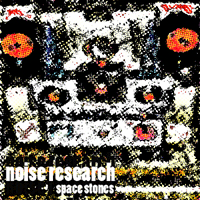
Ever-conscientious, Noise Research’s Ian Simpson goes out of his way to admit the traditional approach of this album-length EP, with its use of tape-loop and musique-concrete methods. It’s not a confession that matters. Plenty of atmosphere musicians draw on those techniques; just as plenty draw on the traditions of 1970s kosmische music and Germanic space-drones, or nod to the eerie smudge-cascades of spectralism.

It’s a rarer achievement to not only conjure up those astronomical Krautrock noises (and those visions of spaceships with sports-car contours) but also to recreate the feeling of otherness impinging on your comfortable, oblivious life; of gigantic impersonal forces tapping on the outside of the bubble.  Each of the four pieces on ‘Space Stones’ sends me spinning back to my eight-year-old self, and the sense of awe that I felt each time I saw the silhouette of the antique Zeiss projector that squatted, like a giant querulous bug, at the heart of the old London Planetarium.

With all but one piece being over nine minutes in length, each has plenty of time to unfold as an event in sound. Simultaneous chilliness and warmth pervade Cosmic Stones, in which a ringing organ overtone sits serenely under chilly breathlike rushes of a galactic string section. Over time (and almost at whim) the home pitch slides mercurially into a new position, a new anchor for thinking at the heart of a gradually expanding pool of reverb. Sun Stones sounds like the solar wind made audible: deep tenor flute-edge sounds bending and straining themselves around invisible objects, with an open-pipe high tenor drone loudening behind them.

A single organ cluster-tone sits suspended in place for Earth Stones – a bullet-time slice of instrumental captured and magnified from the middle of a stabbed, jarring chord. Around this, overtones change with geological slowness. Buried inside them, intimations of voices and trumpets come and go, as if the sounds and those who eavesdrop on them are in parallel times – unmatched, and unmatching.

Most suggestive is Space Stones itself, in which Noise Research’s sounds imply a slow, relentless poisoning at a molecular level. Aluminium oscillations dominate the sound, like radiation wavefronts hitting the metal skin of a space capsule. In the background, single-chord clusters roll like a muted brass-band section; by a third of the way through they’ve faded, giving way to slow swells of barely-there unease. By then, the pulsed sounds are echoing more rapidly, penetrating the capsule and bouncing off the inside. Two-thirds of the way in we’re looking at a dead scene: sonic suggestions of bars of unheeded light rotate eerily and unheeded across cabin space as the music drifts onwards. All that’s left is the paralysed fascination as we float on.

Noise Research: ‘Space Stones’ EP
Electronic Musik, EM162
Free download-only EP
Released: 2nd January 2012

Get it from:
Free download from archive.org

Noise Research online:
Homepage Tumblr

March 2011 – mini-album reviews – Playing with Nuns’ ‘Wave Equation’ (“a fly’s-ear perspective of a Zeppelin crash”)

15 Mar
Playing With Nuns: 'Wave Equation'

Playing With Nuns: ‘Wave Equation’

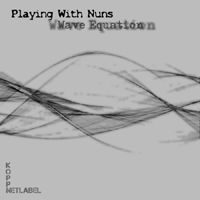
With hundreds of releases in the bag already, it’s difficult to even summarise the dark-ambient work of Playing With Nuns (alias D.I.Y. Argentine noiseworker Ariel Chapuis), let alone sort it through item by item. However, a few things are apparent for ‘Wave Equation’. One is that (by the usual Playing With Nuns standards) it presents a gentler face. The titles of the recording and of the individual songs are more reflective than usual: the elegant mathematical graph-shot on the cover art is devoid of the forthright challenge of other releases, No huge and tilting cranes, no feral cartoons. No naked women wrapped up in hazard tape.

By the bullish, confrontational standards of some avant-noise artists this might be taken as signs of a cop-out; or at least a digression into mathematical navel-gazing. That’s not the case. To my ears, this recording’s sound world is one of giganticism – everyday objects ramped up to a stunning blur of over-scaled, colliding sound. At particular points, it’s borderline unbearable (which Chapuis would probably take as a sober compliment). It might not have you fretting over dysfunctional anger, but it might make you too scared to catch the bus.

On the other hand, there’s little here in the way of avant-garde theatrics. Everything is matter-of-fact. There’s no attempt to make an obvious wall of aural assault, or to engage in shock tactics for the sake of it. Chapuis simply lets his noises off the leash, and lets them take their course.

In Advertising For Lizards, plunderphonics are writ large against a dirty-celestial skirl of feedback. Scraps of conversation are distorted and giganticised into enormous blurred wind instruments and furniture drags. These roll and scrape, as if being pulled along the inside of a vast balloon, while Chapuis cunningly pans them around the sound-field.

I Let You Tools is a little more traditionally concrète, making a clear play of sampling construction devices, power drills and saws. It also deliberately deforms samples of other noises (including voices) into sounding like power tools before it collages everything that it’s found. The final result is a sandwich of technological interactions: almost a cartoon. A set of cheery telephone pulse-codes are sandwiched into it, trapped between a barrage of tool noises on one side and a rumbling wall of power-electronics on the other. The latter sails up to loom large and demanding, like an particularly needy cruise liner.

On Sequences of Lost Children, the clearest sound is two alternating organ notes. The dominant sound, however, is microphone-fry; sizzling and crackling around the clunk of struck pipework and the playful vocal grumbles of synthesizer. Throughout, there’s the crunch of an abused pickup, crushed and buffeted underwater. Unpleasant aural suggestions swim into place – a polluted zone for drownings, filled with ominous and suspicious objects. It’s immersive, threatening, possibly death-haunted. Perversely, all of this busy sonic activity inflates it with an uncomfortable life-force.

Initially, Wave Equation itself offers the closest thing to a let-up. A loop of pleased-with-itself electronic hum, waver-pulse and munching static chews the cud. For about a minute, it’s joined by a radio voice of crunched, compressed Spanish. This relative calm doesn’t last. After one-and-a-half minutes, the idiot noise arrives – an inflated shrieking grind which bounces and rolls over the static, over the percolating electronics, over everything.

Nine-and-a-half minutes long, the spectacularly queasy Decline & Fall is the album centrepiece. It sounds like dynamic travel sickness – a soundscape of hugely magnified stomach flutters, aircraft propellers and groaning feedback. Meanwhile, something is continually crashing and bouncing along the ground, ploughing up colossal waves and furrows of static. Imagine a fly’s-ear perspective of a Zeppelin crash… yet even that doesn’t communicate the terrifying, carefree attitude to the sound.

That’s the key to the unease in this record. Picture a world run out of control and shrunk down to the clatter of a battered and juddering gearbox; and picture ourselves, in turn, shrunk down to ant-scale and trapped inside it. There’s the feel that the grinding forces and crunch of object (in particular, Decline & Fall’s perpetually prolonged ongoing crash) is just business as usual – a humdrum and relentless process of clumsy mechanical brutality while machines plough and scrape their way between destinations and across targets, indifferent to the rattled and fragile animals within and around them. Whatever happens, happens. If it’s brutal, that’s simply the nature of things. It’s like that power-lathe which doesn’t mean to deafen you, but which certainly will deafen you if you sit next to it. It’s nothing personal.

Playing With Nuns: ‘Wave Equation’
Kopp Netlabel, KOPP.17
Download-only mini-album (free)
Released: 6th March 2011

Buy it from:
Free download from Kopp Netlabel (rightclick) or Archive.org

Playing With Nuns online:
Homepage Facebook MySpace Soundcloud

December 2010 – single & track reviews – Soaring on Their Pinions’ ‘Veni, Veni, Emmanuel’ (featuring Whitney Drury)(“just the singing and what can be teased out of it”)

20 Dec
Soaring On Their Pinions: 'Veni, Veni, Emanuel'

Soaring On Their Pinions: ‘Veni, Veni, Emanuel’

Thinking drummers are to be treasured. Not just the sparky virtuosi cast up by jazz and progressive rock – clear and plain equals to anyone whom they share a stage with. Nor even just those examples of drummer-plus such as Levon Helm or Gary Husband, for whom drumming is just a part of their all-round musicianship, and hence nourishes (and is nourished by) everything else they strum, press, blow or sing.

Here and now, I’m talking about the drummers who get so involved with the idea of pure sound in itself that they down sticks (in some cases permanently), and sail away to pursue it. Mick Harris, for example, who quit Napalm Death and thrash metal in order to explore deep industrial noise and beatless drones with Scorn and Lull. Drummers’ projects in this vein don’t seem to have the half-hearted taint of similar work by guitarists or keyboard players. Maybe the physical immediacy of drumming, from big bangs to stroked whispers, breed a special restraint and particular listening skills – a sensitivity to how air moves and responds to touch.

Within Houston’s underground music scene, Lance Higdon is best known for driving various math rock, improvisation, noisecore and psychedelic projects via superb kit-work. With Soaring on Their Pinions, his musical imagination moves him away from the drums – though probably not permanently. As Harris did in his ‘Murder Ballads’ collaboration with Martyn Bates, Higdon has turned to reworking traditional folk and liturgical songs via beatless ambient electronics. Where his method differs is that his electronics are, in effect, inaudible. Unlike the dark, low wind-noise of Harris’ machines, Higdon’s can only be detected by the imprints and embossing which they leave in other sounds. Specifically, he’s sifting and sampling the unaccompanied singing voices of women, getting deep into the grain in search of textures and fragments which he can then build back to the song. In some ways, it’s a nod back to the 1950s and the electro-acoustic methods of musique concrete, but it has a particular purity. No other sound sources – just the singing and what can be teased out of it.

At the heart of this debut single is the first of his guests-cum-raw-material – Atlantan mezzo-soprano Whitney Drury. She sings the Advent hymn ‘O Come, O Come, Emmanuel’. The original Latin title is kept, but the sung words are English. Drury’s delivery is sung straight and beautifully, with a lone candle-flame clarity. It’s also thoroughly American, with a creamy Southern curve to her “r”s. and “o”s. Is that relevant? Perhaps – if you consider that Soaring on Their Pinions is about layering, and that even before Higdon begins his own work on this particular song he is dealing with a long tradition of accretion.

As a song, ‘O Come, O Come, Emmanuel’ can look back over a thousand years of travel: from Hebrew and Latin antiphon through Franciscan hymn to the muscular piety of Victorian Anglicans. Anyone taking it on is joining a lengthy queue of interpretations. A Christian favourite, the song has almost become a cliché, with everyone getting in on the act: robed Episcopalians, clean-shaven New Agers with check shirts and acoustic guitars, even Whitney Houston (who gospelled up a version with Take 6 in 2003). It’s hardly less popular to secular ears, sparking (or surviving) multiple interpretations even recently (by Enya, North Sea Radio Orchestra and even metalcore heroes August Burns Red).

Perhaps mindful of this, Higdon’s treatment doesn’t make any attempt to dig into or smooth over tradition. Instead he rediscovers the song from the base level of Drury’s vocal. The latter may start off clean and polished and contemporary (like air-conditioning and throat-care capsules). Yet as Higdon shaves, clones and reattaches fragments from it, he shapes and reveals something more ancient: something which could have wafted from a lonely hermit’s cell. He buoys the vocal up on cellular flutters of transposed echo – first arresting it, later turning it into a kind of slipped, arrested madrigal. He enshrines it in a subtle crypt of reverb. He steals and multiplies Drury’s sibilants, feeding them back past her in fuzzy air-serpents of susurration. Later on, distorted shreds of voice, crushed beyond recognition, waft through the song like smuts: while higher shreds tap out a shattered, stuttering Morse.

Yet ultimately Higdon’s a gatherer, not a harrower – respecting the song and the singer even as he refracts it. Such is the serene melodic beauty of the original that it’s easy to miss that it’s actually a desperate prayer for deliverance: a call for a Messiah to revitalise law, to destroy tyranny and captivity, to open up Heaven. In other words, it’s a spiritual protest song… or just a spiritual. Higdon’s treatment returns it to that level, while rendering it vulnerable to collapse or corruption. His sound-sculpting surrounds that beauty with loneliness, threat and uncertainty (via loop hazard and eeriness) while retaining its core of beleaguered faith.

Soaring on Their Pinions (featuring Whitney Drury): ‘Veni, Veni, Emmanuel’
self-released (no catalogue number or barcode)
Download-only single
Released:
20th December 2010

Get it from:
Free download from Bandcamp

Soaring on Their Pinions (Lance Higdon) online:
Facebook, Bandcamp

September 2002 – album reviews – Resindust’s ‘Resindust’ (“scattered art rock, post-rock, guru-guitar serenity and air-sculpture”)

14 Sep

Resindust: 'Resindust'

Resindust: ‘Resindust’

Let’s imagine that somewhere within British art-music, there’s a recovery zone, and that that’s where we find the two Resindust blokes trying to help each other out. On the one hand, there’s Lewis Gill – part of the North-West English avant-garde via guitar improv with The Psychiatric Challenge, full-on death-drone noisescaping with Sebastian, and rolling about in the electronica toybox with Vivahead. And on the other hand, there’s Tony Harn – the dedicated solo instrumental craftsman, happily out-of-step with time and trends. Usually, Tony purveys appealing guitar heroics blending jazz-fusion, ’70s rock beef and ’80s echo-box chitter somewhere between Durutti Column, Brian May and John Scofield.

Shape-shifter, meet Trusty.

Now… let’s say that perhaps Trusty’s seeking a way to become less clever and mannered. And perhaps Shape-shifter is experimenting with how to be less sprawling and bizarre. And let’s also consider that while most new projects are intended to be springboards, Resindust might well be intended as a set of emergency dampers. But that’s far too glib. Rather than chaperoning or circumscribing each other, the Resindusters thrive on creative, positive dilution. Ignoring the arm-wrestling of most jazz-rock and avant-garde stand-up fights, they melt into each other’s music at each meeting.

Thriving on the opposing poles of their drives and talents, they make the most of previous chemistry (having briefly played fusion-rock together in Lifebox) and of the interesting DIY sonic and instrumental layers they use to augment their odd-couple guitar work. Vocal hums, artlessly sweet woodwind, veering masses of low-key electronica, wind-chimes and flapping hoods of bass combine in a melange of scattered art rock, post-rock, guru-guitar serenity and air-sculpture. Recalling Fred Frith, Mike Oldfield, This Heat and AR Kane in equal parts, ‘Resindust’ contains some of the most thought-provoking music that either Tony or Lewis have produced to date.

For the guitar-led pieces, they opt for a disciplined approach: collective cycles of electric counterpoint, urged gently towards the panoramic. In Wireweave, Lewis’ earnest neurotic parts intersect Tony’s majestically burnished clockwork patterns in a cat’s-cradle of multiple guitar lines: but Tony also delivers a fat Queen-gone-space-rock solo, nudging through the delicacy like a gold-plated airship. When Tony’s in the driving seat, the duo incline towards ornate and looping structures with a definite prog taste. Suzanna weaves precisely-etched pastoral guitars into repeating, mellifluous Fabergé glitter. On Resindust itself, dogged multi-tracked guitars burrow up out of the same kind of minimalist shards and sketches as Bark Psychosis’ Pendulum Man. As these mesh together in a slow, precise pile-up, Tony’s bowed guitar and fretless bass offer bleak and slanting commentary amidst the hovering ambient string talk.

Lewis generally plays rogue element to Tony’s jewelled approach. He lets the guitars hang everywhere – polluting the atmospherics and hovering around their miasmic impressions of mosquitoes, sirens and beast growls. On Vorpmix, his slow-brewed sleet of industrial noise sharpens Tony’s beefy moans and scrapes of guitar ambience. The baleful, semi-ambient Critical is a trapdoor-land of sour and haunting guitar swells, with bent and wind-blown chords dropping from above like sheets of corroded tinfoil, scattering over the crematorium organ and thirsty windchimes. Yet it’s Lewis’ naïve murmurs of song-vapour which anchor Suzanna to earth, and for the softness of ‘Cotlife’ his guitars tease out tiny, waltzing, bluesy curlicues (beautifully judged and deliciously expressive; trimmed back to the size of comforting ghosts).


But although graceful or abused guitars dominate Resindust’s music, there’s no drop in interest when they’re laid aside in favour of Lewis and Tony’s remaining noisemakers. Windscream sets itself down in draughty chills of ambient keyboard and lamenting, clay-fluting recorder notes. A lone fretless bass mouths like a shipwrecked plesiosaur while vocal keens and burrs, chings and echoes chew gently at what remains of the structure. And for Artism, Lewis’ looped and layered a-cappella vocals wobble precariously over collapsing dub drum-spasms. Multiple descending harmonies skip down over nasal, throbbing madrigal jollity. Lapping slices of conversation toss words onto the shoreline beyond: phrases like “jigsaw puzzle” wash up from the background, and for a moment you wonder what it’d be like if Alan Bennett had ever muscled in on a Henry Cow chorale.

‘Resindust’ is an album of solace and reconciliation. It’s not just because of the gentle beauty and bewitching chaos that peek through its music from time to time, but because of the affectionate wit in the way it reconciles studied, precise musicality with the chance factors and absurdity of raw art instincts… all without so much as a stepped-on toe. Harn and Gill never really needed to use each other as a cure. They just needed that mutual hand-up to where they could bridge the nagging gaps together.

Resindust: ‘Resindust’
Resindust (no catalogue number or barcode)
CD-only album
Released: 2002

Buy it from:
Very rare – best obtained second-hand.

Tony Harn online:
Facebook MySpace YouTube

Lewis Gill online:
Homepage MySpace

The Nazgul: ‘Plujectories/Habitually’ single (“ugly things going about their business”)

18 Sep
The Nazgul: 'Plujectories/Habitually'

The Nazgul: ‘Plujectories/Habitually’

The Nazgul – shadowy figures from the most obscure Krautrock fringes of the ’70s – are back. And lurking in full public view.  They’ve been occasional housemates of Tom Waits, and probably got the chance to have a gnaw on his bone machine. They’ve been studio ghouls scratching atmospheres out of trash and implements down in the Turkish quarter of Cologne in the mid-’70s, and they’ve been people who don’t just seem to coax sound out of the most unlikely sources, but draw it out via seance. The rumour is that they’ve even developed a way of recording ghost voices from over-amplifying the signals impinging on bare wires. And these two tracks – crouching malignantly on a new slice of black vinyl – were recorded using only voice, twenty-foot drainpipe and 270 feet of microphone cable. Oh, plus an accordion, for that homely folk edge. As if.

Forget the motorik aspects of Krautrock; forget the shapes it scratches and growls, whatever its texture. The Nazgul have taken it to a point where there’s almost nothing but texture: a rhythmless, frighteningly impure cloud of sound shot through with disturbing noises. Plujectories is a thick worm of static hiss, whirring compressor grind and bass-bin hum, scratching through your ears like a fibreglass cotton swab. Lunging ghostlike through the centre are flattened steam-whistle screeches, the shrill treble songs of nerve-fibres being burnt through, sometimes a barely-recognisable voice stretched in a submerged roar. It’s the sort of sound you’re scared to imagine a microphone collecting, because of what that implies about the world it’s listening to. You close your eyes, and imagine the solar flares burning through your house.

Habitually is more accessible. Hmmm. As if that mattered at this stage of the game. Although as soon as it’s let you in, you feel as if something dark has closed in behind you and cut you off. It’s an experience, a sound picture of an unsteady walk along a polluted foreshore. The crunching and crackling noises that slide around you could be the sand crumbling beneath your feet and dissolving under the dirty water, could be the stone and mortar of the old dock wall disintegrating like perished rubber; could even be the air frying and corroding under the malignant fumes emanating from that squat, broad, frightening factory over the estuary. Distant boats slither past on the sullen greying surface of the water, no faces showing on deck. Occasionally harsh dark chords and dischords blow out, looming up to enormous foghorn dimensions – something to flinch at. There are slammings, as of giant train doors: and, always around, the barely-there voices. Whistling, rustling, wheezing and gasping, part of the architecture of this corner of nowhere good.

But The Nazgul somehow seem to make all of this sound like… just another dark day, ugly things going about their business as the world slowly chokes on the last polluted shreds of its poisoned lifetime. One of the scariest things to consider is the fact that people can get used to anything. The Nazgul are up on the harbour wall watching you as you come to realise this, while you’re knee-deep and imperceptibly sinking in the dull sand. And they’re wraithed in smiles.


The Nazgul: ‘Plujectories/Habitually’
day Release Records Ltd., DR103
12-inch vinyl-only single
Released: July 1999

Buy it from:
Best looked for second-hand.

The Nazgul online:
No dedicated websites available.

September 1999 – album reissue reviews – King Crimson’s ‘In the Court of the Crimson King’ & ‘In the Wake of Poseidon’ 30th anniversary reissues (“an indisputable classic, but one which sits uncomfortably in the role: forever pulling at the seamless stylistic joins that hold it together, as if to test them to destruction”)

17 Sep

What can one say about a legendary record? Well, just have a look at the magazine racks in any record store and you’ll find that everyone’s got something to say about ‘Astral Weeks’, ‘Sergeant Pepper’, ‘Marquee Moon’, ‘Innervisions’… Dealing with the legend of King Crimson‘s debut is different, though. Partly because its impact is perpetually obscured by the revisionism of punk and current Americana; and partly because overtly literary qualities of legend are already there, squatting in the barbs of the flamboyant lyrics and present in every razz of saxophone.
King Crimson: 'In the Court of the Crimson King'

King Crimson: ‘In the Court of the Crimson King’

There are various legends about the making of ‘In the Court of the Crimson King’. Collapsing producers. Good fairies with a taste for evil-sounding music, marching out of the astral plane to guide the compositions and performances. Even painter Barry Godber’s sudden death shortly after creating the distorted face that yells, horrified, from the cover. But then, few albums have engaged so flagrantly with the mythic straight from the first moment.

For better or for worse, ‘…Court…’ is the prog wellspring, responsible for all the dark castles, capering grotesques and mediaeval garments that’ve festooned its followers ever since. Whatever your expectations, you’ll find that it still sounds amazing. Remastering gives more savour to the feast, of course, but ‘…Court…’ has always been a record that jumps out and grabs you by the scruff of the ears.

No surprise here: that feverish pitch of attention has just been made a few inches larger all round, a bigger take on a picture that was big to begin with. It took, as its frame, a strongly European perspective – mediaeval-to-modern cities rubbed in the blood, flags and dirt of history and repeating cruelties, in which all that Tennysonian mooning around sundials and gardens is an integral, complementary part of that world. Later proggies fell in love with the idyll alone. Few besides Crimson had the capacity to engage with the violence that maintained that idyll, to relate it to modern-day realities so effectively, or to represent in music the confusing threads of history that made up that picture.

In the band’s sound you can hear the haughty, ghostly artificiality of Mellotron orchestras, the angry saxophone protest of Civil Rights jazz, and the squall of avant-garde chaos. However, it draws equally on hotel dance-bands from the wilderness of ’50s England and from the stormy wildness of Stravinsky, Bartok and the troubled classicism of the Eastern Frontier, with all the elements bound together by the expansive rock sensibility ruling the revolutionary roost at the time. And although Peter Sinfield‘s words are chock-a-block with excessively mannered Gothic metaphor and allusion, at their best they evoke plenty of the monstrosities that hung over the late ’60s. Spectres of Vietnam war trauma, twisted agriculture, political manipulation and malignant science all dance alongside his tarot-card shuffles of yellow jesters and purple pipers.

Although it’s guitar strategist Robert Fripp who’s forever seen as the boss of King Crimson, it was Ian McDonald who was the major player at this point. He’s the only musician listed on every single song credit, and he who left the band within a year because he felt (amongst other things) that Fripp was butchering his music. Standing between classical formality and jazz passion, he could leap readily into either with the intelligence to know just what to use. His fiery saxophones, elegant flutes and assured keyboards shaped King Crimson into the full-soundtrack monster they were, even now putting the lie to the idea that prog’s ornamentations were a flabby irrelevance. Michael Giles’s jazzy drumming is a masterclass in compressed percussive thinking: and as for Fripp, even this early glimpse of his playing displays a unique balance between cerebral focus and emotional demands – at least as intent as it is intense, from the humming wail of his electric solos to the spidery precision of his hooded acoustics.


The music itself has sustained pretty well across the album and across history. Perhaps its claws seem fussily manicured compared to the raw filth’n’fury The Stooges would unleash a few years later, and which would ultimately leave a stronger mark on today’s underground. But then again, the Stooges never flung their ideas as wide as Crimson did. 21st Century Schizoid Man remains among the most accurate and nasty rock pieces ever laid down on tape, as ferocious as any punk body-blow. McDonald’s brass-knuckled horn attack and the ugly strands of distortion add a raucous streetfighter’s edge, Sinfield contributes a tearing sketch of distress and conflict, and the entire band roar off across a delicious violent staccato charge like a murderous hunt closing in on the prey.

In contrast, Epitaph is a theatrical, lushly orchestrated anthem of doubt and foreboding – mannered by the standards of the bombast that’s followed (from Yes to Oasis), but universal enough for any era of coming trouble. Mellotron strings and kettle drums lumber into the darkness like the Flying Dutchman. While the young Greg Lake’s impeccably enunciated singing (still a year or two away from his ringmaster swagger with Emerson, Lake & Palmer) might’ve always been too formal, too educated to make him a real rock’n’roller, the apprehensive angst of his delivery here is perfect – “If we make it we can all sit back and laugh / But I fear tomorrow I’ll be crying…”


Perhaps it was inevitable that ‘…Court…’ would be touched by the flower-strewn, Anglo-Celtic folk impressions that were also sweeping through pop music at the time – and this is possibly the album’s Achilles’ heel. I Talk to the Wind (midway between McCartney and Donovan, dominated by McDonald’s dusky flutes) ultimately proved universal enough to be reinvented for the ’90s dance crowd by Opus III, and the original still sounds as lovely today, a more melancholy existential take on Fool On The Hill. But Moonchild risks sending new Crimson initiates away snarling. Only Fripp’s eldritch vacuum-draining howl of guitar raises any question of a world outside this bubble of mediaeval English hippydom, winsomely sucking in its cheeks and playing at courtly love; its talk of silver wands and milk-white gowns only a whisker away from a simper.


And the excessively muted free improv that follows – broken whispers, pings and shuffles between guitar, drums and vibraphone – is guaranteed to piss off anyone who was fired up by Schizoid Man’s driven nerve or Epitaph’s towering romantic majesty. If you listen hard, though, the remaster reveals in full the telepathy of the Fripp/Giles/McDonald interplay, allowing you almost to hear the thoughts that kick out each nimble, abbreviated scurry of sub-audible notes… But you’ll need to listen. Even then, King Crimson could be uncompromising about the value of all of their music; and however much perspective thirty-odd years may have given us on their intentions, the consequent imbalances on their debut remain as frustrating to the floating musical voter as they ever did.


The title track of ‘In the Court of the Crimson King’ – also the finale – sets the seal on the album. For good or ill, it leaves us with another slab of McDonald/Sinfield orchestral folk balladry, closing the record with a mediaeval flavour (tootling pipe organs, choirs of monks, thunderheads of Early Music strings) and without a hint of the alchemical rock momentum to counterweight Sinfield’s Gothic metaphors of palaces and fire-witches.


‘In the Court of the Crimson King’ is an indisputable classic, but one which sits uncomfortably in the role: forever pulling at the seamless stylistic joins that hold it together, as if to test them to destruction. It’s one that forever splits the voters. As they watch the music pounce from peak to dissimilar peak, many realise that it suffers from the way it never entirely resolves the band’s magnificent talents for more than nine minutes at any one time.

King Crimson: 'In the Wake of Poseidon'

King Crimson: ‘In the Wake of Poseidon’

It’s odd to find that King Crimson’s second album ‘In The Wake Of Poseidon’ – recorded with a depleted band and a floating pool of guests, and usually seen as the debut’s feebler brother – should solve many of these problems. But solve them it does. Remastering, like the cleaning of an oil painting, has restored plenty of the innate presence of an album which always seemed to suffer from the whispers in between the shouts. It’s subdued compared to the brazen ambition of ‘…Court…’, with the recurring acoustic Peace theme sounding apologetic compared to former roarings.


There is, admittedly, a sense of people arranging things tidily before they leave. Ian McDonald – then seen as King Crimson’s heart – had already vanished by that point, off to fashion a lighter, more summery pastoral prog elsewhere. Mike Giles would shortly be off to join him, but – drumming on ‘…Poseidon…’ as a goodbye favour – he turns in a tremendously sympathetic farewell performance of subtlety and fire, far outshining his work on ‘…Court…’. Greg Lake, too, has his own hand on the doorknob, waiting to depart to the ‘Top Gun’ frolics of ELP (meaning that Gordon Haskell‘s soft bumblebee tones take over lead vocals for ‘Cadence And Cascade’). Only Fripp and Sinfield – guitar and lyrics’n’lights respectively – would still be travelling in Crimson once the tape reels stopped moving.

 
Whatever the weaknesses of a splitting band, though, they are countered by the strengths of the guest players. Peter Giles (the remaining part of the pre-Crimson Giles, Giles & Fripp trio) provides rich, intuitive bass playing. Mel Collins‘ saxophones and flutes are bold and assured in interpretation; and while most of the expansive ensemble keyboards on ‘…Court…’ departed with McDonald, the inspired British jazz pianist Keith Tippett provides perfect contributions wherever needed (with Fripp picking gamely up on Mellotron and celeste).

Ironically, King Crimson as enforced studio project recorded more convincingly on album than King Crimson as gigging band. The textures are fuller, the dynamics subtler and more secretive (check out Fripp’s near-inaudible fretboard sighs on the midsection of Pictures of a City). And although McDonald’s absence is felt, and his musical imprint haunts ‘…Poseidon…’ from beginning to end, King Crimson were learning more about consistent balance.


They were also learning about how to reconcile their taste for baroque fantasy with a closer reflection of reality. Pictures of a City, rejoicing in a delectably nasty jazz-horn vamp and razor-wire Fripp guitar, reinvents New York as an overground circle of Dante’s Inferno in which Sinfield runs wild with information overload (“bright light, scream, beam, brake and squeal / Red, white, green, white, neon wheel”). Cadence and Cascade’s sleepy song of groupie courtship sees Tippett and Fripp trading glimmers of piano and celeste beyond an atypically gentle acoustic guitar, anticipating Nick Drake’s riverside reveries by several years. And even if the huge title song’s laden with yet more layers of Mellotron and Edgar Allen Poe imagery (harlequins, hags, midnight queens, chains and madmen all jostled together), Greg Lake – in a last burst of empathy – cuts right through to the heart of Sinfield’s overwrought symbolism, and delivers it as a magnificently poignant galactic swan song.


The first half of ‘…Poseidon…’ might mirror that of the previous album (matching the violent/pastoral/symphonic alternation of Schizoid Man, I Talk to the Wind and Epitaph) but the second half is a very different story. There’s Cat Food, for instance – one of the few Crimson singles, and as tuneful and as cheeky as anything on ‘The White Album’. This pulls out all the stops so far left untouched. In one lateral-thinker’s spring, Tippett advances from sensitive accompanist to aggressive frontline collaborator, hammering out explosive scrambles of piano notes and barrelhouse staccato. Lake hollers an absurdist Sinfield supermarket tale, Fripp toots and yelps jazzily and the Giles brothers jump in and out of each others’ syncopated footprints. It winds down in an animated mixture of excited jazz stutter and beautiful Debussian piano flourish, having blown apart King Crimson’s po-faced reputation for a few minutes. At the same time, it’s given them access to pop’s wonderful holy-fool zone, where playful silliness cracks open a reservoir of sheer joyous inspiration.

 
Matters turn far more serious when Fripp – whose musical responsibilities were doubled and weighed heavy on him after McDonald’s departure – takes over the remainder of the album. For The Devil’s Triangle he’s left pretty much to his own devices, putting his guitar aside to lean heavily on occult Mellotron and keyboard textures. Although the initial results draw heavily on Crimson’s infamous live interpretation of Gustav Holst’s ‘Mars’, they go far beyond it and into the dark shadows of avant-garde sound-sculpting and musique concrète.

Dark, trapped minor-key harmonies hover on the edge of terrifying dissonance, a constantly pitched battle march is suddenly hideously yanked up in pitch as Fripp assaults the tape speed, and found sounds (bits of orchestra, samples from the previous album) glint in the fog. Tippett contributes butcher’s piano, like a sledgehammer through glassware. At one point, hot wind scours the studio of all other sounds save that of an interrupted metronome. The full band return for an unresolved finale, surrounded by shrieks, whistles and a baroque circus melody on a tinny keyboard playing scratchily over the top of them, before Mel Collins’ cloud of flutes cast down the tension and bring it to a close as the Peace theme returns for a hushed (if ultimately unresolved) finale.


If the mark of a classic is tight conceptual continuity, then ‘In the Wake of Poseidon’ fares little better than ‘In the Court of the Crimson King’. But in a quieter way, it achieves its ambitions with greater consistency, taking on King Crimson’s multi-levelled world view and presenting it with less arriviste flash and a more mature grip on its latent chaos – something which Fripp and Sinfield would pursue further on the next album.

Beyond that, both albums still remain as another high-water mark (flaws notwithstanding) in rock’s assimilation of other musical forms. Held together, they’re a fascinating (if frequently stiff) European counterpart to the multi-media explorations of The Velvet Underground or Miles Davis’ polychromatic meltdown music on ‘Bitches’ Brew’. This music still sounds mythic, enrobed, and somehow atavistic; as if it was made for Old English giants to knock down the world’s cities to.

King Crimson: ‘In the Court of the Crimson King”
Virgin Records Ltd., CDVKCX1 (7243 8 48099 2 8)
King Crimson: ‘In the Wake of Poseidon”
Virgin Records Ltd., CDVKCX2 (7243 8 48948 2 5)
CD-only reissue albums
Released:
14th September 1999
Get them from: (2020 update) Both records have now been superseded by 40th Anniversary Editions with new remastering and additional tracks. Current or former versions can be obtained from the King Crimson stores at Burning Shed and the Schizoid Shop.
King Crimson online:
Homepage Facebook Twitter MySpace Soundcloud Tumblr Last FM Apple Music YouTube Vimeo Deezer Google Play Pandora Spotify Tidal Instagram Amazon Music
 

LOOKBACKS – album reviews – Cindytalk’s ‘Wappinschaw’, 1994 (“one of 1994’s most intense, perverse and unusual lost albums”)

30 Aug

Cindytalk: 'Wappinschaw'

Cindytalk: ‘Wappinschaw’

For almost fourteen years now, Cindytalk have been forging a lonely path through the ever-changing styles of modern music. Despite the soft pink flush of their name, Cindytalk’s music has always been so out-there, so much a music of violent extremes, that they have (more or less by default – how much could you change when you touch both ends of the spectrum?) stayed the same – no bad thing – while refining their sound on each album.

Gordon Sharp, the mainstay of Cindytalk’s many line-ups, is perhaps best known as the voice of three haunting tracks on the first album by 4AD art-collective This Mortal Coil, which also spawned Elizabeth Fraser’s honey-drenched version of Tim Buckley’s Song To The Siren in 1983. Yet 4AD-ethereal was never really Sharp’s bag. Cindytalk operate in the same dark areas that Michael Gira and Swans did before they transformed into doom-laden acoustic hippies (no more titles like Raping A Slave, then, Michael? cheers, love!), or The Birthday Party before Nick Cave mellowed out into Satan’s crooner.

They’ve wilfully, awkwardly, pursued music of extremes. Their first album, ‘Camouflage Heart’, must rank somewhere alongside Lou Reed’s ‘Metal Machine Music’ for sheer unlistenable music for (dis)pleasure, that has to be owned simply to piss people off. And the mammoth ‘In This World’ was a double album of contradictions – one record of near-industrial rock with razor-sharp guitar sounds (varying between tooth- extraction by electric power drill or sheet-metal white noise), and one record of near-ambient instrumentals and songs, mostly played on very soft piano like Erik Satie on Mogadon.

But it’s been a long time since any new Cindytalk material; perhaps because of artistic reclusiveness, perhaps through being a true cult act. Having already had a protracted recording between 1990 and 1992, this album took a further two years to emerge on a record label in 1994. A lone concert aside, we’ve heard nothing from them since (that’s what y-o-u think.. – ED.). Hence this five-years-after-the-event review: cults can always do with getting bigger while they wait for the resurrection.

So, ‘Wappinschaw’; one of 1994’s most intense, perverse and unusual lost albums…


It opens deceptively simply, with an a-capella reworking of Ewan MacColl’s The First Time Ever I Saw Your Face, reflecting Gordon Sharp’s interest in folk idioms (especially his own native Scots). He’s singing solo, without echo or reverb, up close, right there in your darkened room. His voice – one of the most expressive at conveying rage, pain, fear – displays power here yet, somehow, also insecurity. A Song Of Changes is leaden-paced at first, but David Ros’ guitars are more blurry and hazed than previous industrial strength Cindytalk noise. Suddenly the guitars hit an almost bright riff around which Sharp fluctuates and soars. A song of changes, indeed – light is breaking into Cindytalk’s dark world: “Within the heart of everything, there is you…”


It doesn’t last, though. Return To Pain (hah!) lurches in on a mix of barely-scrubbed electric and slide guitars, creating an empty and menacing atmosphere as Sharp emotes through wordless high vocals. It’s nightmare swamp music, midnight in the Mississippi plains accompanied by the scariest of companions, before the tension explodes into a barrage of noise. Drums, shotgun guitars, and Sharp wailing that “everybody is Christ.” Y-e-e-es; whatever you say, Gordon.


Whichever expectations are set for them, Cindytalk trump them on this record. Wheesht is introduced by a tape of Alisdair Gray reading an extract from his mammoth Scottish psycho-epic ‘Lanark’: a story of a young boy dreaming about what lies beyond the clouds. Recorded over the sound of a ticking clock and a ghostly musical box, this exercise in unsettling atmospherics chills the spine and sets us up for Wheesht itself: a brutally short, non- musical violent collage of bass drones, sonic interferences, sampled voices, blood-curdling screams and other genuinely unnerving sounds.


To the looping, echoed scrapings of a low-tuned violin, Snowkiss restores some sense of calm with more of Cindytalk’s music for winter nights – Gordon’s vocals imploding out of their rage into delicate lines and wordless harmonies sung over the gentlest of chiming, raindrop pianos. The lyrics of Disappear evoke a painfully trapped life: “You’re in heaven now, / Inside your head. / No thoughts of flight, / Your wings are clipped…”, while a strongly martial beat provides the tracks only propulsion as guitars and sampled interference compete with each other in a swirling eddy of sound. The lively, echoing trumpet on Traumlose Nacht, mingled with delicate piano and evocative waves of rolling drums, provide some relief and a different sonic vocabulary – it sounds like incidental music for the dark magic and oppressive heat of ‘Angel Heart’.


The final track, Hush, starts as an guitar-and-solo-vocal acoustic lament (back to the folk singing of the opening track) but then gives way to influential voices from the heavens (including samples of Orson Welles and Joseph Beuys) before everything fades to leave a long passage of bagpipe music that is, after the tumult of Cindytalk in action, strangely beguiling and soothing… but wait. After a long pause, a final hidden track, Muster. An incendiary, veritably Napalm-Death’s- worth battery of hideous thrash-noise, over which Sharp’s passionate ragged voice issues forth evocations to notable spirits: “The Wappinschaw is an invocation of the spirits of Shiva: Rise, William Wallace, rise! Rise, Arthur Rimbaud, rise!” He goes on to summon the spirits of Pasolini, Sitting Bull, Che Guevara and Ho Chi Minh, amongst others. So unearthly does Sharp sound, so compelling, that I have no doubt that the spirits responded. Quite the most disturbing sound heard on CD for some time.


I wouldn’t like to hazard too close a guess at what kind of emotional traumas Gordon Sharp purges from himself to make this music; all razor blades, blizzards and crow feathers. It’s enough to say that, after fourteen years on the extremes, Cindytalk demand your rapt attention, your horrified fascination…

(review by Col Ainsley)

Cindytalk: ‘Wappinschaw’
Touched Recordings, TOUCH 1 (5 021958 432021)
CD-only album
Released: 1994

Get it from:
(2018 update) best obtained second-hand

Cindytalk online:
Homepage Homepage Facebook Twitter MySpace Soundcloud Bandcamp Last FM

July 1998 – album reviews – G.P. Hall’s ‘Marks on the Air’ (“a rough’n’ready homemade ethos”)

20 Jul

G.P. Hall: 'Marks On The Air'

G.P. Hall: ‘Marks On The Air’


On ‘Marks On The Air’ (an album of live recordings from concerts in London and Wiltshire), the eccentricity and affections of British experimental guitarist G.P. Hall is presented wide open and unashamed.

To make the record, Hall teamed up with binaural recording whiz Mike Skeet. It’s Skeet’s voice you can hear bookending the concert – running up stairs and heading down in lifts, describing his surroundings with the nattering enthusiasm of a ‘Playschool’ presenter, and popping any remaining hopes of arty detachment. Still, it somehow adds to the warmth of the atmosphere which Hall’s live playing induces. Apart for the oddly truncated applause and the removal of Hall’s shy, uncontrived audience chat, it’s as close to one of his concerts as you’re going to get without leaving your home. Skeet’s superb recording techniques (his binaural miking technology directly mimicking the listening experience of ears on a human head) presents this music in the enveloping, directly tactile environment it requires.

Compared to the more assured sonic constructions you’ll find on a Hall album, ‘Marks On The Air’ is less sophisticated and more risky, but it’s equally ambitious. Skeet’s interjections aside, this is a one-man show. It relies entirely on how much Hall can get out of his hands and his immediate music loops while still keeping an audience entertained. With four separate speaker stacks, an assorted collection of guitars and effects pedals, and the armoury of unorthodox guitar-abusing sundries which he uses as playing implements (bows and battery fans, crocodile clips and Velcro, toy cars and electric razors), Hall is at least well-armed to do that, Even the clean, dated, digital rattle-and-thunk of his 1980s rhythm box lends the enterprise an endearing extra dimension of naivety.

Hall’s pictorial – even painterly – approach to music is consistent throughout. New England Woods is cut from the same lambent aural cloth which Hall made his own with Spirit Sky Montana – swelling curtains of sounds midway between country steel guitar and cello parts strolling and dallying in a soft adagio. Docklands attempts to recreate the brazenly lively colourfulness of a polluted industrial sunset – the shambling drums falling lopsided, the whooshing saw-sounds and lemon-sharp guitar echoes pressing out the shape of the skyline.

Live, however, Hall can be tempted away from his more elegant pastoral confections and into heavier statements. The impressionistic heavy metal of City Signals and Uncharted Territory both offer searing and swaggering chromium-blue lead lines, plenty of echoed backings and slow rolling pummels of drum-sound. Rippling, prolonged ambient humming and field recordings of indistinct conversation fill the gaps, like smog pouring into a heat-haze. For the tremendous scrunch of Flying Ants, Hall turns to his six-string bass and his flamenco knowledge. The result sounds like an over-scaled Gypsy guitar played with helicopter blades for fingernails. A delightfully yobbish take on the form, it flicks between tremendous chocolate-y gurgles of sound and (when Hall kicks in the distortion pedal) impenetrable hedges of distorted overload.

Much of this music is punctuated by clipped and plunking programmed synth-bass lines. Outside of mid-’80s chart hits, these ought to sound cheap and unpleasant. Instead, they fit surprisingly well into Hall’s musical sketches of the grubbier side of cities. They can be as brash and tacky as scattered burger boxes at your feet; as the failing neon signs and fly-by-night minicab firms gummed onto and into frowning old brickwork. On Flying Ants, they’re just appealingly cyborg. On Figments Of Imagination – where they’re working alongside metallic wails, hand-pumped stutters of echo and the rattle of crocodile clips – they add to the rough’n’ready homemade ethos of the music.

The hypnotic On Every Life (A Little Rain Must Fall) goes further into the wilderness. Nodding to Native American rhythm patterns, it calls up the feel of a parched Arizonan desert view. The delicate whine and rush of the guitar patterns swap between impressions of the dry, red heat and dust and of the shocking whiteness and colours of the tasselled fragments of cloud. Notes call and repeat, tranced out. Towards the end there’s a moment when it all stops. All but a faint swirling echo, as if the whole desert was looking upwards; and then the mass of sound crams back in again, like a cloudburst.

Best of all, perhaps, is the build- up of The Lonely Road, coalescing sustained, sorrowful coats of sound and small factory noises. Tinges of ambient-blues embrace a tired old worker’s knotted muscles at the end of the day. Part of the human focus comes in via the twanging, Frisell pluck’n’pang of Hall’s guitar. It’s capped, however, by the endearingly rough burst of busker’s harmonica which he wafts over the floating sorrow. Brave and defiant, it’s answered in kind by the elephant-trumpet of a rotary-saw sound.

Despite the odd bit of bluster, ‘Marks On The Air’ goes further towards expressing Hall’s gently appealing emotional nakedness as player and creator. What he sometimes loses in the grace stakes, he gains back in honesty and sympathy. There are a couple of unselfconscious, winning little cameos of “tiny music” which could have come from a children’s theatre. Drum sounds pop and clatter against the clipped melody and zither-blues intonation of Chinese Firecrackers. Suvi’s Little Crickets is built out of simple yet exquisite acoustic child-song patterns, which regularly rests while Hall circles a boxful of mechanical insects, chirping peacefully, around his microphone. Further hints into the private man are suggested by the deep pulsing chant of Alcharinga (in which guitars are abandoned altogether, in favour of throat-singing through an old answering machine mike). Marks On The Air itself is a long, mournful study on classical guitar – swept back and forth in eddies of echo, resigning itself beautifully to its own impermanence.

G.P. Hall manages to be many things. The garage player amongst the avant-garde; the warm-hearted soft touch among the arthouse players. The naive wonderstruck kid in the crowd of post-adolescent posers, the transfigurer of the straight, and the benevolent ghost in the machinery. Not a bad set of credentials, at that.

G.P. Hall: ‘Marks On The Air’
Future Music Records, FMR CD46-V0997 (7 86497 26442 1)
CD-only album
Released: 15th July 1998

Buy it from:
G.P. Hall homepage or Future Music Records

G.P. Hall online:
Homepage Facebook Twitter MySpace Bandcamp YouTube

April 1998 – album reviews – G.P. Hall’s ‘Steel Storms & Tender Spirits’ (“grand painterly instincts”)

7 Apr

G.P. Hall: 'Steel Storms & Tender Spirits'

G.P. Hall: ‘Steel Storms & Tender Spirits’

Despite the luminous loveliness of much of his music, the career of style-hopping guitarist G.P. Hall hasn’t been smooth (even by the uneven standards of the experimental music he dips in and out of). Regardless, ‘Steel Storms & Tender Spirits’ shows that he’s still up for taking a gamble.

A trust-risking double-album package, clearly intended to emphasize his dynamic musical dialectic, it also highlights the tension between his experimental side and his taste for romantic melody. There’s one disc of rough treatment (industrial noise-layering, screaming electricity) and one of ear-stroking pastoralism (the natural sound of wood and air, tickled by occasional breaths of spectral electronics). However, with Hall being who he is, the two ideas tend to bleed back together: in some cases, maybe more than was intended.

The ‘Steel Storms’ half of the set features a wealth of Hall’s “industrial sound sculptures”. Layered compositions played on his stock of prepared-and-processed guitars (via plectrum, fingertips, battery fans, velcro and more), they also make cunning use of assorted noise-makers ranging from scavenged autoharps and scrap metal to oven racks and household bricks. Texture is the predominant element in the music, but a surprising tunefulness and dark melodies often penetrate in the form of solemn classical adagios. It’s these which underpin the clattering chains, metallic rasps and harmonics of Industrial Sights, or the billowing clouds of rolling fragmented piano and wrenching distortion in Eye Saw It 2.

There’s an impressive documentary flamboyance at hand, too. When the insistently ringing, collapsing-steel groan-tones of Tsunami blend with both close-up atonal jangles of autoharp and with distant, skinny guitar-string shivers, the visual qualities of Hall’s music are particularly clear. Some of his work here wanders out to a distant edge. Two tracks in particular, Steel Storms and Steel Landscape, are almost wholly abstract – musical testaments to metal fatigue and the disorientating feel of post-industrial spaces. Grumbling, malignant loops and glittering boils of guitar drown in swills of rattling shard-metal and bass-drum booms. The pieces are laced with elephantine bursts of distortion; and with brief, dying surfacings of chemical-corroded blues playing.

Throughout, Hall’s grand painterly instincts tug the sound closer towards beauty – however twisted – than towards flat and impersonal horror. A whole album of such Hall industrialisms would be something to treasure. Unfortunately, ‘Steel Storms’ is continually gate-crashed by other sides of his musical personality. On River Flow, he revives one of his signature approaches: fluent Spanish guitar over detailed rolls of textural soundscaping. It’s as lovely as ever, but it’s misplaced here; and it’s anybody’s guess as to what Gypsy Gathering (a virtually straight piece of flamenco) is doing on the record.

In cases like these, Hall’s distracted eclecticism undermines the original intent of ‘Steel Storms’. Worse comes when that willing, stubborn naivety which lies at the heart of his music (giving it both its emotional strength and its core of idealism) becomes diluted into reproducing other people’s cliches. Since the mid-’90s, Hall has been an enthusiastic miner of his past work, dicing up his out-of-print albums to recombine their contents in new sequences. Often this has worked out well, juxtaposing his newer, tuneful solo tapestries with older, intriguing avant-jazz duets, trios and quartets (often featuring sundry members of Isotope, Gilgamesh or Nucleus). Unfortunately, on this occasion he’s pulled up some dross along with the gems.

Perhaps Hall’s work in library music during the lean years is to blame. He’s too interesting a musician to produce stock blandness (and even his failures have moments of interest) but on a record with a purpose, these lesser scraps should have stayed on the shelf. Yet several ‘Steel Storms’ tracks come from this lifeless batch, splotched with anonymous moves and tinny keyboard presets. No Man’s Land is drab robotic cop-chase stuff, the kind of thing a particularly cheesed-off Mark Knopfler might clunk out at the dull end of a soundtrack contract. The less said about the appalling Barbed Wire Bop (brittle ‘Seinfeld’ plastic-funk with the tones of a dodgy synth-demo) the better.

Happily, other ‘Steel Storms’ approaches are much more successful, toying fruitfully with the tight blare of fiesta horns, or with a kind of impressionistic stadium rock held together with paper-clips. The rainy-night drive of City Signals funnels determined loose-jointed funk elements through cascades of drumming, a marching-call trumpet leading the tune above Hall’s steel-saw guitar chops. On Docklands, an acoustic guitar explores and ranges over washing licks of soundscape; electric guitars swipe between factory-machine screeches and trumpet blasts; an echoing hip-hop beat – blind, gigantic and mechanical – stumbles through the landscape beyond.

Sometimes, everything comes together. Though centered on the aggressive, questioning rawness of an up-close flamenco guitar, B-E-trayed provides a discreet light-industrial twist to its traditional base, dragging its intermittent sheath of noises back into the realm of the personal. Already bouncing off tricky drumbox beats, it heads into more sinister areas when swarming, echoing drones and bitter laughter flicker across the speakers. At one point, Hall yells cathartically into the soundhole of his guitar.

All interesting, but the industrial theme becomes increasingly tenuous over the course of the record, though it does rally at points. Heavily overdriven cutting-blade sounds return for Fiya, in which blurred polluted riffs meet mournfully defiant Latin horns and gut-strung guitar. On Dancing On Cracking Ice the guitar plays a supporting role to mariachi horns (and to Sam Brown’s exploratory world-rock rattle of percussion), as Hall’s chopping slashing echoes and metal-fatigue string groans lead off into a leisurely Latin funk stretch. Funk is also one of the central elements of Battery Charger, colliding with big-band horns and space-rock as Hall’s snappy twang-melodies and jittering string harmonics are bounced through some serious Ash Ra Tempel echo.

While there’s no shortage of ideas and impressiveness on ‘Steel Storms’, as an album it’s a missed opportunity – too bitty, too unstructured, and not quite ruthless enough to do justice to its theme. You can dive in for the more thrilling patches – and hold your nose at the bad points – but at times it’s the wrong kind of bumpy ride. Fortunately, its companion album compensates for the missteps by being an experience of unqualified and perfectly integrated beauty.

Where ‘Steel Storms’ shows Hall straining after too many things at once, ‘Tender Spirits’ showcases a beautifully focused vision. Dominated by his acoustic playing and by the subtler side of his electrophonic treatments (sometimes heightened by softly resonant brass and drums), it sounds as if it was recorded under a great cool bowl of night sky. It also proves that, however much energy he puts into his experimentalism, he remains a superbly expressive guitarist once the trickery is removed. Here, the wise simplicity and romance at the center of his music come into their own, in full.

Judging by many of the pieces here, classical music lost a fine player and interpreter in Hall when he went left-field, not to mention a fine folk-fusion composer. Listen to those Spanish arpeggios (mournfully meditative on Love Lies Bleeding, restless and subtly unresolved on Slipstreams) or to the singing Irish ballad inflections of Patricia O’Leary. Alternatively, enjoy Hall’s subtle reunion with electricity on Shooting Stars, Ember or Dandelion Clocks. The first two are slow astral wheelers, their notes stroked into long, long, beautifully smudged trails and pining crystalline tubes of sound; the last is chuckling child-music, clean notes bubbled through a sparkling halo of echo.

Hall’s more multi-tracked and constructed compositions fit just as seamlessly into the mood. Some are familiar – here’s another outing for the thrumming bowed-bass winter scenery of Miles From No-Where (White Wilderness), a piece which Hall continually revisits. Similarly, there’s a new version of another favourite, Spirit Sky Montana, in which David Ford’s sleepy flugelhorn and Sam Brown’s slow swish of cymbal pull Hall’s stretched-bell guitar layers and church-music structure up to further heights of passionate serenity. A more ambiguous moment is granted on Incandescence, where a baroque six-string bass is smeared into dark and swollen horn sounds, voicing in shifting minor-key planes, searching for a place to settle.

However, it’s the magnificent Lonely Road which shows Hall at his very best. Loose, hanging drapes of luscious sound, distant detonating percussion, his Spanish guitar upfront again with a heart-tugging melody, and a final DIY touch – this time, a lonely and beautifully frail harmonica part. This is music you could live in. There’s a direct, emotional involvement in G.P. Hall’s work that’s rarely found among experimental musicians – probably because in spite of his gizmos and his taste for modernist expression he connects far deeper with the earthy roots of music than with the narrowed, exclusive intellectual demands of music as a science.

Ultimately, the main reason that ‘Tender Spirits’ is stronger than ‘Steel Storms’ is that in spite of Hall’s fascination with the impact of industrialism on our lives and senses, he knows it’s merely a part of our experience of the world: a relatively recent human-scale derangement overlaying much older terrain and themes. The two superb acoustic pieces which open and close ‘Tender Spirits’ could easily predate the factories, machinery and artefacts that inspire his industrial sound sculptures; both being intimately concerned with human survival within the simpler, starker hostilities of nature itself.

For the majestic impressionist-flamenco study of Sandstorm, Hall’s fingers slither out whips of string noise among the sharp and fluttering notes, conjuring up the flying dust. Sea Sorrow (Lament Of Lewis) is at the other end of the scale: a paean to shipwrecked souls in which Spanish guitar technique merges with a plaintive Celtic air. Within it, bitter bereavement struggles with acceptance and an awareness of continuance. Those who live with the sea are sustained by it and robbed by it, and this feeling lives in the music. As visual as anything Hall comes up with via loops and layers and implements, the plangent tones of this naked acoustic piece shape an image of someone alone and bleak on the headland, staring out at the ambiguous and often-merciless ocean which they must ultimately come to terms with.

It’s true that G.P. Hall’s road is, ultimately, a lonely one – sometimes assured, sometimes erratic, always marginalised. Yet it’s always one which he treads with a stubborn faith – wrong steps and slip-ups notwithstanding – and one that makes him all the more unique.

G.P. Hall: ‘Steel Storms & Tender Spirits’
Future Music Records, FMR CD46-V0997 (786497264421)
CD/download double album
Released: 31st March 1998

Get it from:
Future Music Records (CD only) or Bandcamp (download-only, as two separate albums, ‘Steel Storms‘ and ‘Tender Spirits

G.P. Hall online:
Homepage Facebook Twitter MySpace Bandcamp YouTube

August 1997 – album reviews – G.P. Hall’s ‘Mar-Del-Plata’ (“ranges with restless compassion across a wide field”)

10 Aug
G.P. Hall: 'Mar-Del-Plata'

G.P. Hall: ‘Mar-Del-Plata’

Still clearing out the accumulated tapes of an inexplicably neglected career, Graham Peter Hall is continuing to come up with the goods. He’s been through thirty years of uneasy development on that rocky, unrewarding terrain between the simple sureties of the rock and roots instrumentalist and the often complacent indulgences of the full-on avant-garde blower. Marginalisation and bad luck might have ensured that he’s received little financial reward – nor has he gained the kind of brittle, precious reputation that marks out the darlings of the art-music intelligentsia – but it has resulted in a stock of lovely, emotive music in its own right.

Certainly Hall has managed to remain one of Britain’s most individual and complete guitarists over that time. Mastering a variety of styles from flamenco to rock to folk and blues, he’s also immersed himself in experimentation via technology – multiple speakers and pedal processors; vast, slow delay loops. Additionally, he draws on a repertoire of bizarre playing techniques and plectrum substitutes (involving battery fans, tiny psaltery bows, electric razors, toy cars and velcro, among others) which reflects the reinvention of guitar function explored by Fred Frith or Keith Rowe. With these methods in place, he’s explored sound through the textural suggestions of his “industrial sound sculptures”. Light industry, that is – Hall’s mimicry is closer to handsaws and governor motors rather than, say, Trent Reznor’s car-crushers and stamping presses.

Yet in amongst this, Hall has somehow never lost the ability to embrace expressive tunes; or to weave a handrail of familiarity into his sonic constructions. Perhaps that’s why ‘Wire’ types don’t seem to go for him; why he doesn’t have the kudos that the likes of Rowe, Frith, Eugene Chadbourne or Glenn Branca enjoy. He can get in your face – or wander off the usual path – with the best of them, but it’s generally in order to touch your sympathies. Ironically, in choosing to express his conservative and traditional side as equally important to (and entwined with) his avant-garde side, he’s gone too far for some.

‘Mar-Del-Plata’ is by far the most accessible and diverse of the compiled albums which Hall has been assembling this decade from deleted vinyl and assorted unreleased tapes. It’s a tour across a loose, but affecting, composing and performing imagination which ranges with restless compassion across a wide field. Sometimes you’re listening to a skittering, wilful flamenco performance. Sometimes it sounds like Cocteau Twins doing home improvements in the Mediterranean. Sometimes it’s the sort of individual, humanistic free improv/New Music result which you’d expect from Frith at his more lighthearted and relaxed, or from Simon H. Fell.

But though the record is full of experimentalism, Hall’s sense of melody is at the forefront – and the predominant voice on ‘Mar-Del-Plata’ is his masterfully expressive Spanish guitar playing. This can usually be found angling over long aching stretches of choral electronic humming, plangent violin and eerie ambient sounds called up from the industrial processors. In some ways it’s like a semi-unplugged take on a Robert Fripp Soundscape, in which guitar textures span out into infinity.

At other times, it takes on the simple directness of a folk tune: a dance of sparkling acoustic lights on Ionian Water, or the staccato accented Latin melodies of Mar-Del-Plata itself, underpinned by a geological murmur of bass. On the final hot gusting of Sierra Morena Dust Storm, the gut strings spit and scatter in rich melody, reaching new heights of sinewy passion. Here, Hall also bows some winnowing textures in his electric guitar accompaniment, using serrated steel bars from his box of implements.

Where technology plays a more direct role, Hall’s humanity doesn’t falter or go under. The hymnal swells of billowing electric warmth on Spirit Sky Montana (somewhere between Bill Frisell’s cinematic romance and David Torn’s eccentric string-warps) are the most beautiful and enveloping sound on the record, tapping deeply into church music and Romantic classical composing. The trickle of wind chimes, langorous piano, and enveloping sighs of Humidity Despair provide a gusting, luxurious impression of a sultry night: it’s lush enough to lean right back into.

Some tracks, fleshed out by Hall’s sound-loops and D.I.Y. treatments, are detailed, impressionistic oil-paintings in music and tone. Deep Blue sounds like someone chainsawing up a frozen Alpine lake, its jangling piano chords and thumping bass a mass of irregularities. The smear of bright spring-loaded colourflow on Charmouth Beach rings beautiful alarm bells. The menacing bass growl of Enigmatic is like a cave-bear thumping around in your dreams: squeaks and rattles from fingerboard and autoharp move around in slow disquiet, enclosed by knocking metal.

Plutonium Alert (in which Hall abandons guitar altogether in favour of soprano sax and the ring of auto-harps) treads similar territory to the ominous King Crimson improvisations from the mid-’70s. It goes for an all-out sensory mix of apocalyptic aftertones: angular bell-sounds and aggressive Grappelli violins entangling themselves with a spasmodically awkward funk rhythm. Weirdest (and most satisfying) of all is Fahrenheit 451 – juddering guitar, saw sounds, the shriek of a whistling kettle, and treble scratching all mix like toxic vapours under heavy pressure, pushing your head back against your rising hackles. Horribly enjoyable.

The scattered effects of the attempt to capture all of Hall’s ideas across a single CD does mean that ‘Mar-Del- Plata’ misses out on the cohesion which would render it excellent, but it’s a close-run thing. The centrepiece – a long-form creation called The Estates – pulls all the elements of the album together. A version of a 1975 long-form composition, it blends the chiming, restless clatter of its improv ensemble with Hall’s own quiveringly angry solo acoustic guitar. The brooding theme of The Estates is the crappiness and autocracy of post-war British urban programming. In thrall to modernism without being able to master it, its utopian vision (heartily botched and compromised) laid down a blight on communities, their architecture and their cohesion wrecked by the same tower blocks and support links designed to improve them.

Hall and co. express the disillusion and neurosis which resulted, with pulses of frustration and alienation hurl themselves against the confines of the music. Dulcimers, clarinets, and a huge array of percussion all seethe and pant over twenty-five minutes of desperate musical invocation; all overhung by the forbidding scrapes and alarm-clangs of two adapted metal piano frames (played like harps with assorted chains, wires, and implements). Hall’s panic-stricken guitar playing conjures the nightmare of a new, fatally-flawed sprawl of roads and buildings: swarming locust-like, unchecked and unconsidered, over beloved landscapes.

Incidentally, in the sleevenotes Hall gives a blood’n’guts description of the struggle it took to assemble and perform The Estates. Apparently, some of the manufactured instruments continue to drift through the art world with a life of their own. The piano frames – still counter-invading the architecture – were last seen as part of a “fire sculpture”. Meanwhile, the piece itself has an additional afterlife as a reflection on Hall’s own love/hate relationship with modernism; his own playing and arrangements echoing and championing the sounds of the traditional past even as they break them up in performance and execution.

As a body of work ‘Mar-Del-Plata’ has its faults – yet judged on its parts (and at its undisciplined best), it’s a touching, passionate and diverse album. Throughout, we get the sort of peek at Hall’s open heart (warts, gooey patches and all) which most experimental musicians, hard-wired into intellectual dryness, would never risk expressing.

G.P. Hall: ‘Mar-Del-Plata’
Future Music Records, FMR CD46-V0997 (7 86497 26442 1)
CD-only album
Released: 12 April 1997

Buy it from:
G.P. Hall homepage or Future Music Records

G.P. Hall online:
Homepage Facebook Twitter MySpace Bandcamp YouTube

October 1996 – album reviews – Moonshake’s ‘Dirty and Divine’ (“like ghost trains – whistling and rattling across the room”)

10 Oct
Moonshake: 'Dirty And Divine'

Moonshake: ‘Dirty And Divine’

Even as a small chunk of mid-’90s London rediscovered how to swing and posed for Time Magazine, life carried on as usual for most of the rest of us. The weeks of quiet desperation, the litter in the corners, the urges and the grinds that don’t match up. While the Britpop scene whooped it up in the happening neighbourhoods, Moonshake were sitting up late with whitened knuckles in rented high-rise rooms, or prowling the mean streets spitting out stories.

Moonshake’s intensely visual songwriting and soundcraft always seemed born of hard-boiled cinematic overload. On 1994’s stunning ‘The Sound Your Eyes Can Follow’, lead ‘Shake Dave Callahan rubbed the unsparing urban soul-mining of The The up against The Young Gods’ overpowering walls of sampled sound, and beat both of them for sheer grit and presence. Determinedly guitar-free, taking their cornered-rat savagery from Callahan’s paint-stripping sneer and Raymond Dickaty’s ferocious arsenal of treated saxes and flutes, Moonshake’s harrowing street-literature songs were heavily sample-textured: but they travelled light and fast, drawing on tooth-rattling, uptight, Can-inflected dub grooves. They were twenty-first-century urban blues, as tough and unyielding as steel wire. Most importantly, sound was everywhere: cramming into the ears, surrounding the head with a blurred, terrifying out-of-scale world.

For some, the methodology of post-rock has served as an excuse to get lost, to unshackle yourself from precision, swallow your own guitar, womb yourself up in universal sonic tissue and drop out of language altogether. For Moonshake, it goes the other way. Callahan’s bitter, precise, dramatic language – shading his harsh sorties into hard-times lives with a poetic flair reminiscent of a punk Dickens, or of Brecht and Weill – is central. It’s just that rock instrumentation is too imprecise, too blunt to do it justice. Post-rock possibilities, and the overwhelming landscapes regurgitated by samplers is the only sensible framework for the way this band captures the world. Moonshake songs are like ghost trains – whistling and rattling across the room on forbidding, chilling loops of warped and mangled sampled sound, whirling you through a clatter of noise; dropping you into the thick of things; fucking with your sense of placement and angles, and thrusting gritty reality into your face.

‘Dirty And Divine’ is – at first hearing, anyway – more modest in its scope than ‘The Sound Your Eyes Can Follow’, That album lunged out of the speakers and went for your throat, both the epic stinking script and score for a vast, hideous film about the downside of the London experience. In comparison, ‘Dirty And Divine’ is more Mike Leigh to its predecessor’s Terry Gilliam. The ram-raided orchestra samples are pared back in favour of metallic whooshes and industrial-sump bubbling; Dickaty’s been given a free rein to mutate himself into an ensemble of mangled brass and breath. Centrally, Callahan’s songwriting emphasis has narrowed down. The clank and snap of Cranes sets the agenda, capturing the ebb and flow of a locked-down, clock-watching workforce in widescreen: “the builders are earning their daily bread / and they make sure they eat it every day at one o’clock… / The housewife’s dreams evaporate / as her husband’s nightshift ends at eight.”

Yet ‘Dirty And Divine’ also provides the backdrop for rebellions against the timeclock and the grind. Most of the album homes in on the stories of individuals. Where previous songs were a pageant of strain, entrapment and stagnation (a whore and her regulars, a protracted divorce) this record deals with what happens when frustration breaks out and escalates into quests for further, greater stimulation. The chance-addict of Gambler’s Blues gropes for a chance to be empowered, to face a challenge he can respect (“sometimes I pluck order out of the form – / I slack for a moment, the moment is gone”) but pays the price anyway: “I’m a gambler, and sometimes I lose, / but the kick’s in the playing, not paying the dues. / Always an offer I cannot refuse, / always a time-bomb I cannot defuse.”

In Exotic Siren Song, a young man hits the wide world for a perilous life of opium-dens, brothels and high stakes, keeping company with gun-runners and fraudsters, dodging pirates and police. Initially rejoicing at the chance to live by his wits, he ends up jaded, complaining “nothing now is really new.” The adrenalin-hooked petty crook on Up For Anything lives by his instincts and his appetites – “I’ll balance on the balcony, twenty-one floors high, / swinging from the vapour trails, ropes in the sky… / I can’t count the conquests and I can’t tell the time.” The buzz is still strong enough for him to dismiss the damage that will come, when “in ten year’s time I’ll be the boy with the mashed potato body. / All this champagne living on beer money, / out among the bumper-car people who never say sorry.” His counterpart, the elusive criminal in House On Fire (think Nine Inch Nails meets ‘Badlands’) has perfected the art of living on the edge. His wife may break under police questioning, his invisibility may evaporate and the law pounce on him, but he’s already working on plans for manipulating his fellow jailbirds.


He’s the exception – in most songs the downslide is never far away. Throughout the album, speed and appetite are portrayed as a drive that becomes a monkey on the back. Yet while it lasts it’s a hell of a ride. Another of Callahan’s savage stress-head characters snarls: “You’re too open, and you’re too easy. / When I’m out, I do as I damn well pleasey… / The only light I need sweeps through the window… / Keeping a monster comes in handy. / Hard candy…” To stop and think in this rolling, callous world is to invite despair.

To do him credit, Callahan unflinchingly represents this as well, offering up a couple of his most intimate songs. The make-or-break musings of Nothing But Time ponder the next step (“now I come to a fork in the road”) and weigh up possibilities: “Shall I cause some destruction that none shall understand, / undyke my finger and flood the whole land?… / I let you go and then you come back. / Shall I pick at your nature until you react?” Ultimately, plans are left perpetually hanging in weary, lonely resignation (“I’ve got my own design for something quite grand… / You can appreciate even if you don’t understand,”) all wrapped in rolling Arabian horns and the gonging sound of empty vessels.

Too late. The Taboo (swathed in flugelhorn and rippling harpstrings) surfaces at the end of the album: the last moment of awful drunken clarity before the final fall. It’s a lament for the loss of honesty – for the lost ability to be vulnerable and unveil the tender truth of yourself. Cards should be on the table, but no-one will make the move. “If I were to be really careful, / and take pride in everything I do, / I would show you what ‘really’ is – / and I can’t, ‘cos it’s taboo.” The seasick backing music swirls: vision flattens. The loved one recedes across the table, behind a wall of well- worn gambling chips and smeared shot-glasses. “If I were to show you how I feel, / would you call me blue? / If we could reach out and touch each other? / But we can’t, ‘cos it’s taboo.” Almost touching, but out of sight. House wins.

This album is a brutally compassionate mausoleum to burnout, made from raw words and cracked sinews. Lay those dusty dreams to rest.

Moonshake: ‘Dirty And Divine’
C/Z Records/World Domination Records, WDOM028CD (5032059002822)
CD-only album
Released: 4th October 1996

Buy it from:
Various suppliers, or second-hand.

Moonshake online:
Facebook MySpace Last FM

SWOONAGE

Swoon. /swo͞on/ A verb. To be emotionally affected by someone or something that one admires; become ecstatic. Here are some people and things that make me swoon. #swoon #swoonage

Post-Punk Monk

Searching for divinity in records from '78-'85 or so…

theartyassassin

...wandering through music...

Get In Her Ears

Promoting and Supporting Women in Music

Die or D.I.Y.?

...wandering through music...

Music Aficionado

Quality articles about the golden age of music

THE ACTIVE LISTENER

...wandering through music...

Planet Hugill

...wandering through music...

Listening to Ladies

...wandering through music...

ATTN:Magazine

Not from concentrate.

Xposed Club

improvised/experimental/music

The Quietus

...wandering through music...

I Quite Like Gigs

Music Reviews, music thoughts and musical wonderings

furia log

...wandering through music...

The Recoup

SINCE 2013: Books and books and books and books and occasionally other things

A jumped-up pantry boy

To say the least, oh truly disappointed

PROOF POSITIVE

A new semi-regular gig in London

Gapplegate Classical-Modern Music Review

...wandering through music...

When The Horn Blows

...wandering through music...

:::::::::::: Ekho :::::::::::: Women in Sonic Art

Celebrating the Work of Women within Sonic Art: an expanding archive promoting equality in the sonic field

Ned Raggett Ponders It All

Just another WordPress.com weblog

FLIPSIDE REVIEWS

...wandering through music...

Headphone Commute

honest words on honest music

The One-Liner Miner

...wandering through music...

Yeah I Know It Sucks

an absurdist review blog

Obat Kanker Payudara Ginseng RH 2

...wandering through music...

poplifer.wordpress.com/

Waiting for the gift of sound and vision

Good Music Speaks

A music blog written by Rich Brown

Do The Math

...wandering through music...

Archived Music Press

Scans from the Melody Maker and N.M.E. circa 1987-1996

The World's Worst Records

...wandering through music...

Soundscapes

...wandering through music...

OLD SCHOOL RECORD REVIEW

Where You Are Always Wrong

FRIDAY NIGHT BOYS

...wandering through music...

Fragile or Possibly Extinct

Life Outside the Womb

a closer listen

a home for instrumental and experimental music

...wandering through music...

Life Just Bounces

...wandering through music...

Lucid Culture

JAZZ, CLASSICAL MUSIC AND THE ARTS IN NEW YORK CITY

Aquarium Drunkard

...wandering through music...

eyesplinters

Just another WordPress.com site

NewFrontEars

...wandering through music...

FormerConformer

Striving for Difference