Archive | dance music RSS feed for this section

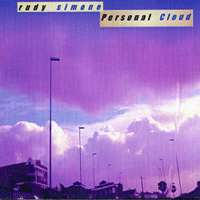
May 1999 – mini-album reviews – Rudy Simone’s ‘Personal Cloud’ (“contradictory shards and half-formed knots of feeling”)

14 May

Rudy Simone: 'Personal Cloud'

Rudy Simone: ‘Personal Cloud’

“I wrap my lips around a cigarette / instead of you,” mourns Rudy Simone on the title track of ‘Personal Cloud’. Her voice pipes and teeters on a precipice of reproach. It’s gently, perpetually, pulled back by beautiful harp-like guitars and throaty bass synth. Here’s a lullaby for the betrayed, somewhere between the sweet hyper-conscious dissolve of a Jane Siberry ballad and a Rose Royce disco symphony. Clasping heartbreak to itself, like an addict in recovery, and gently rocking to soothe; while allowing all of the contradictory shards and half-formed knots of feeling to swim free for a moment, a float of voices and words knocking against each other.

“I thought I was drowning, it was only rain./ Thought I felt fire, it was only smoke. / Never leave me… / Oh, will this world take you from me? / I tried, I tried to leave it alone…”

‘Personal Cloud’ is all about this kind of mixed, eddying feeling. Intensities and unravellings. Throwing vitriol and clinging to loyalty. The need to stab the same person you might be begging to pick you up off the floor two hours later. And if it wavers dramatically – both in its musicality and in its consistency – that’s only in keeping with what it’s about, as Rudy explores her emotional devastation using various forms of music. Club elements invade baggily-hanging acoustic confessionals. Wobbly jazz singing gatecrashes trance-dance. Free association yanks a tune bloodily from its roots. Throughout, moods swing like road-signs in a gale, confusing direction.

 “I swear sometimes I wish an alien will take you from this planet / then I turn around, y’know, / I never meant it,” frets Rudy on Velvet, an all-over-the place straggle of guitar, cello and drums where jealousy, need and pride disrupt each other. At one moment, she’s showing the lover her boot and the door  (“Go on out / take your place and find the one who does it all for you,”). At the next, she’s turned the full blowtorch of greedy sexuality onto him to melt him back down again (“It don’t fit into your plans to be so selfish / when all that velvet is waiting for your kiss…”).

Puppet strings yank themselves; kissing lips bruise on gritted teeth. A foot slides, caressing, up a lover’s calf. The same foot turns and hammers a heel, hard, into his instep.

This kind of tense no-man’s land is a stressful place to be. Sometimes there’s a wordless protest, as expressed in Galactica – cosmic trance-techno, where the lonely cry of a star-burned keening synth is cheered up by a flamboyant crash of bells and bucked up by a roguish, tarry bubble of club bassline. Alternatively, Stronger Than You Know meanders along on its skinny guitar and string synths, changing its shape, like a girl dancing drunkenly across treacherous ground, knowing where to put her feet but lurching dangerously close to disaster. It seems fey, but only because it’s discovered a different kind of resistance, dissolving again to escape damage – “Oh, you’re kicking light, / you’re punching air.”

The militaristic Bjork-ish beat of Glimmer Of Hope, the tension of guitar and listing punchdrunk voice, belies its positivity – “I see a glimmer of hope in the clouds / and it’s all I need to see my way out of this.”  On Feel Like I Belong, the club electronics bang and bubble under one of Rudy’s sweetest bluesiest sighs, and bloody experience is weighed up – “memories can drown if you let them – / just because you can it doesn’t mean that you should.” Only the drunken brooding of surly fuzz-guitar suggests there’s something wrong behind this particular attempt at finding peace.

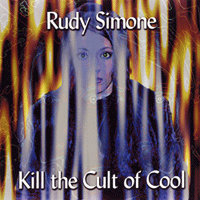
record-rudysimone-ktcocFar more satisfying (in terms of comfort, anyway) is the spooky guitar and spiralling trip-hop of the haunted single Kill The Cult Of Cool – remarkable in any context, particularly moving here, it sounds like a night’s spiritual battle committed to tape. On the single cover Rudy, visibly haunted, stared down fear out of a circle of tall, slender flames, and the song’s occult, speaking-in-tongues feel is still immediate. Over Gothic movie keyboards, Rudy delivers a Buffy-esque putdown in a cool, girl-with-a-mission voice – “I’ve got nothing but derision for your apocalyptic vision. / Anti-amorous, not glamorous. / Time to kill the cult of cool,” – before rolling off into a weird, syncopated mixture of American indie, sampledelia and trip-hop in which everything seems to slide gracefully in and out of time. Ruminative, sandpapery hip-hop beats do the slippery shuffle-and-collapse in the basement. Frail raga-trance vocal melodies drape themselves in irregular folds over the roof. White noise, static radio fizz and heart-monitor bleeps struggle in and out of the mix: a dreamy staircase of guitars (including a spaghetti-Western dobro) twangs at the heart of the chorus.

The rest is a weave of lost-girl chant and coos, a multiplicity of voices flipping backwards and forwards, a narcotic nuzzle towards solace. “Help up, I shall bless,” keens one line. “Ooh yes, honour – there’s no-one there…” murmurs another. Rudy duels weightlessly with other wounded voices (“I was the quiet one in school, never made any trouble…”) and absentee gods before declaring with quiet assurance, “I don’t care what you say, I’m not crazy.” The fact that this happens at the beginning of ‘Personal Cloud’ – and not as a tidy resolution at the end – suggests that this isn’t the first time she’s had to take up arms against her own crowded inner sea of troubles.

Uneven, unsettling, and mixing awkward un-coordination with gliding grace, ‘Personal Cloud’ reveals the wayward talent of a potential cult heroine – unafraid to grasp at the chaos and trash of the battered heart.

Rudy Simone: ‘Personal Cloud’
Phat Lady Records (no catalogue number or barcode)
CD-R-only mini-album
Released: 1999

Buy it from:
Extremely rare – best found second-hand.

Rudy Simone online:
Homepage Facebook Twitter Bandcamp Last FM YouTube

October 1998 – EP reviews – The Isolationist’s ‘Hydrogen Slush’ (“this bleak, rolling, night-time piece of vinyl”)

27 Oct

The Isolationist: 'Hydrogen Slush'

The Isolationist: ‘Hydrogen Slush’

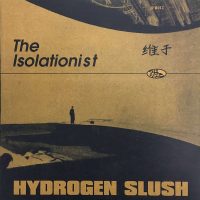
Beats go postal these days. Released by a small British label, The Isolationist is a project uniting American rappers (New York’s elusive Anti Pop Consortium) with producers from London (DJ Primecuts) and London-via-Russia (DJ Vadim); a company of strangers rather than a posse. Perhaps this explains why, by hip-hop standards, it carries a strange chill with it. The rappers fire off into clear, chiming, deathly voids as if they’re carving out the insides of giant floating ice-cubes with the warmth of their breath and the crackle of their thoughts.

There isn’t a comforting funk loop to be found anywhere on this bleak, rolling, night-time piece of vinyl: just the thinnest iciest slivers of the coolest, most spartan jazz, the sidewalk-pounding beats, and the feel of sound slipping back off chrome and concrete. The nod to electronica’s near-autistic Isolationism movement ain’t a hollow one, either. The DJs scratch in their snatches of old-school records and kung-fu soundtracks with the efficiency and flair of unsmiling master butchers. Their beats are audibly frosted; their backdrops are an unfriendly cliff of minimal tonal touches that seems to gaze down at the rappers as if to say “Show me…”. Collaboration may be challenge, but this one’s more of a staring match.


Held up against R’n’B’s e-e-easiness or the violent tag-team dynamics of Wu-Tang-style hardcore, The Isolationist’s modus operandi strikes an intriguingly perverse note – an implied, introverted refusal of cooperation, of support or brotherhood; an alliance of denial. Set against this is the feverishly lyrical excellence of the Anti Pop Consortium: criminally absent from hip-hop’s compilation industry, and perhaps best known in Britain for linkups with Vernon Reid, with Moa and with Attica Blues.

We only get two of them here – Beans and Priest (M. Sayid’s opted to sit this round out) – but for guys spirited out of the city that never sleeps and into Vadim’s glacial dream-darkness, they’re coping well; reeling out cunning, multi-levelled raps like levitating, metaphysical Last Poets on fast-forward, lit by flashes of black science and prophecy, and more likely to namedrop Stephen Hawking than Stagger Lee. And they make their position in hip-hop culture clear, boasting “bombs like voluptuous brown big breasts” and chucking their word-games of empowerment and enlightenment into the silence at the gangsta rap funerals, apparently in the hopes of shaking up a lasting, blooming, conscious golden age.


Pitted against cultural sickness, the A.P.C. are powerful antibodies. On B-side Timeless Void, Priest scorns the inadequacy of “MCs’ band-aids for bullet-holes / under an umbrella for nuclear fallout from toxic water-balloons… / Your flatness and one-dimensional portrayal / is a betrayal / of my legacy” Urging us to “feel free to escape your entrapment: rapwards! / Over your head, hard to catch, like a bouquet made of thorns on a course for the laws of sentiment” he hits prophetic highs with “build and destroy again, restart civilisation from an amoeba / firm believer in perceiving extra-sensory signals, / my insignia the inscription in the clouds at dusk / – the fall of man…”


For Hydrogen Slush itself, Beans slams down the gauntlet with a staggering set of rhymes to scatter light across the wounds on black America’s soul. Some are metaphysical (“your ears are my punching-bag”); some earthy (“a hustla turned horsemeat / befitted the amoeba in a spit-puddle”). Some are poetically ominous – “sunbathing without an ozone layer / the sense you’re burning ants under glass. / UV suffering – no reason to go on, a desire to be by the beating wings but their arms are tired” – and some are consumed by a rage against the breakdown of the spirit: “these things sink deep into the flesh of the tormented: / unity of the ego is shattered, / indiscriminate sensibility debilitated by the winners of impending emptiness”. His words land righteous hyper-literate blows on the nihilistic greed of playa-culture. As cultural champions, they obviously feel there’s more to success than just buying it. Behind them, though, the cold cityscape rolls on.

This EP is like a graffiti artist rolling up his sleeves in front of a cold, stark-white wall, and launching an explosive artistic assault with a bagful of sharp colours. Motormouth MCs versus stonewaller DJs; quick tongues versus clenched teeth; involved dialogue up against cold silences The Isolationist is a bizarre marriage which looks like it’ll lead to some compelling arguments. You’ll find me next door, eavesdropping.


The Isolationist: ‘Hydrogen Slush’
Jazz Fudge Recordings, JFR012 (5030433001263)
10-inch vinyl-only EP
Released:
26th October 1998
Get it from: (2020 update) original vinyl EP best obtained second-hand. Some tracks are downloadable or streamable from Bandcamp and Spotify
The Isolationist online:
MySpace Bandcamp Last FM YouTube Spotify Amazon Music

Anti Pop Consortium online:
Facebook Twitter MySpace Soundcloud Last FM Apple Music YouTube Vimeo Deezer Google Play Pandora Spotify Amazon Music

DJ Vadim online:
Homepage Facebook Twitter MySpace Soundcloud Bandcamp Last FM Apple Music YouTube Vimeo Deezer Google Play Pandora Spotify Tidal Instagram Amazon Music

DJ Primecuts online:
Facebook MySpace Soundcloud Last FM YouTube Deezer Pandora Spotify Instagram Amazon Music
 

October 1998 – album reviews – Michael Manring’s ‘The Book of Flame’ (“to get on the good foot while booting great clusters of noise about with the other”)

15 Oct

Michael Manring: 'The Book of Flame'

Michael Manring: ‘The Book of Flame’

If you’re already at the top of the tree, technique-wise – as Michael Manring is – you risk losing yourself in the skill, reheating old ideas with the energy you should be using to take yourself somewhere new. Thankfully, Manring’s smarter than that.

The meticulous, mellifluous bass guitarist who flowed his way through graceful jazz/New Age composites a decade ago has evolved into a much broader musician. His central playing style (a clean blend of Jaco Pastorius’ near-vocal virtuosity and the late Michael Hedges’ percussive contrapuntal bounce) remains intact, as do his harmonically dense tapping skills and fondness for stretching things out with the EBow sustainer. But having evolved a wider arsenal of bass noises – giant distorted trunks of feedback, fretboard noise, infinite-sustain drones, occasional On-U-Sound-a-like dub effects – he’s put them to compositional use, pushing out the envelope that way.

‘The Book of Flame’ continues the process begun on 1994’s ‘Thonk’: despite its good points, essentially a reaction record jumping vigorously into noisy heavy-metal fusion to ensure Manring wasn’t tagged with the “dextrous-wimp” label. Subsequent band work – dystopian prog-funk with Sadhappy, jazz-metal with Attention Deficit, more spacious experimental improv with Cloud Chamber – has seen Manring developing the side of his playing that looks towards “why” rather than “how”.

Though ‘The Book of Flame’ uses familiar colleagues (Michael Masley; Tim Alexander; Oregon reedsman Paul McCandless) as well as a few unfamiliar ones, it’s emphatically a solo album, with two-thirds of the tracks exclusively Manring-performed. And it’s his timeliest album to date, the one best attuned to its contemporary contexts. Although he hasn’t abandoned playing for computers and pure beat-science, Manring has discovered samplers, dance methodology and loop-culture with a vengeance, and battened onto them ravenously.


Having said that, there are enough real-time bass solos to satisfy technique-junkies: as usual with Manring, extending the instrument’s parameters. The Fire Sermon – executed on Manring’s ten-string bass, each string individually tuned – sounds like a squad of Terminators tap-dancing down a Busby Berkeley stairway, red eyes twinkling, chromium top hats waggling aloft. La Sagrada Familia hangs slippery fretless shapes in tuneful, trapeze-act harmonics patterns; and blurs from sustained notes to clusters of aggressive tapping (similar to Red Right Returning from 1992’s ‘Drastic Measures’). And there’s an echo of Stanley Clarke’s pluck’n’pop on No Wontons for Elvis, mingling athletic bluesiness with impossible tangles of contrapuntal squeaks.

Best of all is The Book of Living and Dying, a beautiful memorial and tribute to the late Hedges in the shape of a mournful lilting tune which shoots off to Hedges’ aspirant, meteor-popping celestial heights but then pulls itself back with a lump in its throat. But these are pretty much a sideline to the real business of ‘The Book of Flame’, which is to get on the good foot while booting great clusters of noise about with the other.


While there’s a lot of sonic experimentation on hand, this is also Manring’s most danceable record yet, with a set of busy tunes that shake their booties over cheeky, compressed, Prince-flavoured funk grooves with that tight, offhanded boom-blat rhythm. Adult Content/Brief Nudity has that, when it’s not breaking step into narcotic stumble-shuffling trip-hop ambience. Manring’s gang of basses converse with each other and McCandless’s bass clarinet, which explores and comments like Johnny Hodges taking the air in Paisley Park. Theseus in the Rains never entirely loses its hand-clappy purple groove-chat, even when Manring brings in skirling EBowed whines, percussive string bangs like abused filing-cabinets, and an assemblage of scrapes, pops and whines like an ailing flying saucer.


The approach goes furthest on Your Ad Here, which sets out like Adhan from ‘Thonk’ (high and low EBow drones like pipes and ney-flutes), but soon develops the legs of a tinny hip-hop beat. Manring exchanges singing Prince-y riffettes (descending from high plucked bass) and sharp, contrasting beat-science breakdowns – earthquake-wobbles, psychedelic space-echoes, drum shadows and computer noise. Closer to Tackhead than to Stu Hamm, anyhow, and with a similar dystopian flavour to its irresistible dance impulses.


‘The Book of Flame’ also sees Manring’s compositional and arranging diversity at its peak. Most misleading track award goes to The Adamski Photographs, both straight and twisted. Dave Tweedie’s violent heavy-Cobham drumming and the belligerent Allan Holdsworth-ish choruses could’ve tied it down to mainstream fusion, but Manring’s bass attacks (sputtering, clattering, playing a solo like someone molding tarmac) and the jarring groove (centred on Barry Gurley’s lurching, Thelonious Monk piano) ensure otherwise. In contrast, Ephemeris is a clean, almost inhumanly perfect two-minute phase of cyclical process music. A duo of basses playing in rolling, cascading minimalist harmony: each moving in and out, in-step, in a build-and-fade composition like a jazzed-up take on Philip Glass.


Booming swells of sustained cosmos-bass open The Book of Lies: an undulating atmospheric weave of drillbit melodies, tight clusters of clipped Jaco harmonics and thrumming prayer-like vocal groans before Alexander’s thunderous upfront drumming drags in Manring’s distorted heavy-metal lead bass, spluttering into all kinds of squealing feedback. And eventually it falls to Dromedary to bridge all the previous directions together: a framework of heavy funk and kitchen-sink-contents percussion regularly kicked in by distorted noisecore riffs and outer-space sample weirdness, around which Manring darts bubbling, talkative solo lines.


Accessible, yet challenging – and far too open-ended/minded to settle into the role of self-conscious masterpiece – ‘The Book of Flame’ is the best evidence yet of Michael Manring’s importance. Juggling high art and down-to-earth fun, he’s evolved from a rarified treasure into a broader pleasure, and seems set on the road to continue that way for a long time.

Michael Manring: ‘The Book of Flame’
Alchemy Records Ltd., ALCD 1015 (607387101520)
CD-only album
Released:
13th October 1998
Get it from: (2020 update) CD best obtained from large online dealers or second-hand.
Michael Manring online:
Homepage Facebook Twitter MySpace Bandcamp Last FM Apple Music YouTube Vimeo Deezer Google Play Pandora Spotify Instagram Amazon Music
 

October 1998 – live reviews – ‘The Sound Of Satellite’ (featuring Sand, Lucha Libre, Yossarian, Karamazov, Heavy Q) @ Notre Dame Hall, London, Friday 9th October (“The Young Gods meet ‘Rugrats’…”)

13 Oct

This time, I’ve done it.

For once, I’ve arrived on time… and Notre Dame Hall is so empty that I reckon I’m going to be outnumbered by the bands. Above me, a glitterball spins very, very slowly. Off to stage-right, a slide is projected onto the wall back-to-front. Smoke drifts across from the other side of the stage, as if one of the boxes of gear has quietly caught fire. Horace Andy plays over the sound system. I’ve never noticed that squirmy edge to the sweetness of his voice; or how well it suits embarrassment.

No. It doesn’t go on like that. In fact, and independently of tonight’s acts, it ends up as one of the friendliest concerts I’ve been to in ages. But that first half-hour – of me as the lone non-label person in the house – gives me an idea of the risk which labels like Satellite take on whenever they put a night like this together. If you’re a mainstream label with a nice little crop of pushable guitar pop bands, and you want to hire out some dedicated pub for a concert party: well, fine, you’re probably onto a winner. If, alternatively, you’re a small label best known for fringe electronica such as Fridge, Rothko, and Add N To X (one of whom is DJ-ing tonight) and you’re hiring this big cinematic ballroom… then you must be trying not to sneak nervous, sidelong glances into the looming face of failure.

When I befriend Pete, the Satellite house photographer, he tells me that as soon as tonight is finished they’re taking the whole thing – lock, stock and barrel – over to Paris, to repeat the concert. Within the day. Gluttons for punishment. Or people who believe in what they have to offer.

* * * * * * * *

What they offer (or unleash) first is Heavy Q, whom I know from a single truly bizarre piece of experimental vinyl. He/she/it/they?… He. One Japanese guy, Lee Young Sin, in a glitterscaled wrestlers mask, hunched over a pair of samplers as if preparing to split them in half by sheer willpower (one of them, appropriately, is labelled “Quasimidi”). We’ll see him later as part of Lucha Libre, the other members of whom are tracing his every move with Handycams.

What he’s up to right now is squeezing out slice’n’dice anti-dance music as the hall begins to fill up; a scary dead-funk cyborg strop interspersed with cut-ups of Japanese telly chatter and cheering. At one point a sampled announcer burbles a bit of plain English – “breaking the earth for us tonight” – with the cheesy enthusiasm of someone who knows the next bit of hype which they can stick in their arm will be along in another few minutes. That same hysterically enthusiastic announcer will be weaving in and out of Lee’s music like a persistent hiccup; a glassy, untrustable ringmaster to his sonic circus.

Heavy Q’s second piece is a randomised assault of backbreaking drum sounds; drum’n’bass minus the calming balance of the bass. His third is a children’s chant, slapped up against a deathly brutal industrial tom rattle. As he moves over to rummage on his table of electronic debris, the sound runs on without him, mutating into Bollywood singsong, strangled by tortured electronics. By the end of it, Lee has turned himself into a vast, vulgar techno-god statue on top of the table. Arching back and moaning a deep thick bass vocal into his microphone, he’s almost at one with his sampler. He drinks from a sparkle ray-gun; he adjusts his electronics like he’s tying his shoelaces. Throwing a sarcastic cock-rock pose, he waves a theremin aerial around at phallus height.

Is this the answer to the problem of the personality void in electronica? Living up to the gigantic sonics by taking onto yourself the aspects of a monster movie?

* * * * * * * *

Talking of the personality void… things are working out contrary to expectations. At any given unpretentious, good-time indie gig, I’ll be out in the cold, a blip on the doorlist among self-satisfied strangers. Here, on a night that ought to smack of exclusive club, a night which you’d expect to exclude, I’m making ceaseless cheerful conversation. Buoyed by camaraderie, I and my new friends agree that, in contrast to Heavy Q’s theatrics, Karamasov have the slightly bored, stiff look of too many art-scene bands.

Perhaps it’s that old cliche of Teutonic cool: half of the band is genuinely German (guitarist/cellist Johannes von Weizsacker and stately blonde percussionist Berit Immig), while the London half (bassist Harry Rambaut and synth player Adam Stewart) aren’t exactly Essex ravers. Certainly their music’s lodged in European post-rock cool rather than Pacific rim commercial frenzy, their set opener wheeling along on Harry’s sproingy pre-jazz bass, Jonathan’s phased guitar scrub, and a lonely, farting-Dalek riff on Moogbass. They look at each other as if they’re setting up lab equipment; or preparing John Cage’s piano, like good little acolytes. Their second piece is something from the chillier end of Stereolab‘s science school, albeit with a few sniffs of quiet humanity appended. Echo-slapping cello effects, and skinny Moog squirts something like Philly soul strings, sketched and autopsied. The cello scrapes like a worn wheel; Berit’s oddly heavy-metal drumming is rookie-tense, but snaps tight regardless. On the beady-eyed Roadsnack, she switches to spiky organ against Jonathan’s piano-ping guitar.

Out on the floor, meanwhile, we’re waiting for them to enjoy themselves. I know, I know; there’s a certain credibility to that kind of icily unmoved, Euro-scientific music creation. But… Karamasov come across so much better when they drop it, hang out, and just play. It’s probably not intentional, but Uneven Surface sounds something like Genesis’ Watcher Of The Skies filtered through Faust. Hmmm. ‘The Wire’ would have a fit; but the bass stabs and drum riffs are received with joy by the Satellite audience. Happy Hour ain’t the Housemartins (which would’ve been interesting, come to think of it), but sounds more like Neu! reinventing lounge music, as Berit tinkles out melodies on the vibraphone. Most welcome of all is a piece I didn’t catch the name of, in which the increasingly impressive Berit sings in a detached Nico murmur (not unlike Elizabeth K.’s interjections for Eyeless In Gaza) over a tune not unlike a relaxed cross between Levitation and A.R. Kane (with a bit of the brisk arty hoppiness of a warmer German band, F.S.K).

During the next interval, the DJ plays Egg and Soft Machine rather than some fearsome tranche of blunt improv. A definite feeling of thaw is in the air.

* * * * * * * *

Yossarian turns out to be both a band (two keyboardists out of a ’50s B-movie and a drummer) and a bald mad-scientist character, looking not unlike Alan McGee. This is Tim London – Yossarian’s prime human body. In a previous life, he was the slightly warped pop brains behind Soho (if you remember the Smiths-sampling ‘Hippychick’, not that there was much else).
These days he’s wrapping his cortex round far artier pop shapes. One piece – all drones, cymballine drums and organ – sounds like Mark Hollis knitting together Labradford and Spiritualized; a chorus of “I will call, and you will come” and an unexpected blaze of harmonica. Other pieces sound like late ‘60s Scott Walker sitting down hard on late ‘80s Pet Shop Boys, and others…

Vocoders, yet! Those pained machine voices are back, along with Air-style pretty melodies served with an avant-garde hiss and a cheesy Bontempi beat under the flagrant detail. What is this nut trying to morph into and sell to us now? E.L.P.? The Glitter Band? By the time I’ve decided that it’s a sort of electronica ‘Parklife’ with car-crash keyboards, he’s exploring bleak Bowie ‘Low’-ies and hitching them up onto Prodigy-style wall-of-fire beatoramas like an erupting Las Vegas volcano.

All of a sudden, I see Tim London revealed as electronic art’s own John Shuttleworth, and relax a bit. It’s an impression carried in his archness, in his taste for a classically creaky lounge-pop tune, his self- conscious anti-cool (“I’ve never played in that time signature before”, he drawls), his total deadpan approach to the ridiculous or to any intimations of hubris, and most of all in the way that, having thrown electronics at us all evening, he encores by – get this – playing the spoons. Respect is due. My old man’s a Cyberman an’ all that.

* * * * * * * *

Osakan noisefreak-fusioneers Lucha Libre have bigger hats than anyone else. They also have bigger presence, taking the stage like EMF used to do. They possess a double-brass frontline – one capering trombonist leader (Teruhiko Heima) in a Kiss ‘Destroyer’ T-shirt; one surreally dignified sax player (Akifumi Minamimoto). There’s also a transplanted heavy metal core in the shape of Takashi Sakuma, a sampler-wielding guitarist with long tartan shorts, a serious Van Halen fixation, and one of those hilariously literal Japanese sweatshirts. This one reads “Pretty Tough Sport”. Finally, they have a digital heart on frantic overdrive – everyone except drummer Jun Tsutusui seems to be doubling on synth.

By their seventh number their bassist (Lee Young Sin, back in a different guise) is walking on his hands and playing the synth with his head amidst a hurricane of Coltrane-meets-Black-Sabbath saxophone. Before that, we’ve been privy to a Donington’s-worth of heavy-metal axe abuse; a swelter of industrial goofing and salsa horns; and a stage act best described as The Young Gods meet ‘Rugrats’. We’ve also, as a responsible audience, totally turned around received notions about arty label nights by absolutely loving it to bits and yelling for more, as the twit from ‘Melody Maker’ shakes his head and frets about missing ‘Friends’. Lucha Libre continue their delightful murder of cool regardless.

Now they sound like ships coming into a drunken docking on Mars – big trombone blurts, the rattle and squiggle of electronic timepieces, and phenomenal yowls and divebombs from the metal kid. Now they’re on a big, spacious, tricky funk beat: Akifumi an oasis of reedy calm as a funky harpsichord riff pops up from keyboardist Soichi Murota and the band head into the slabby, tottering, Theremin-ized jazz-funk of the ‘We Have No Our Groove’ single. Next, they pull out in order to plait Led Zeppelin into the ‘Mission Impossible’ theme.

By the encore, Teruhiko is hammering out a torn tom tattoo on a commandeered chunk of Jun’s drumkit. Stuck horn drones giggle at him; the sax thrashes – squalling and wailing – in a cauldron of frenzied bop, and Takahashi fires Heavy Q’s abandoned raygun into his guitar pickups. It’s like seeing a particularly extrovert software virus trash your screen, in blazes of grinning colour. As they settle into a long final lope, razzing trombone carrying the melody over the clipped sax and Durutti guitar picking, the air inexplicably fills with a powdery scent of flowers. This is some sort of Lucha Libre Japanese magic, I guess: the sort of thing which that passionately confused nation throws up so well.

* * * * * * * *

With a massive wall of dry-ice fog and a sound like Satan belching (it’s some sort of conch, in fact), Sand prepare to close the evening. A massive mound of frizzy dreadlocks hoves into view and starts growling Andean death-metal at us. Crops wither within a three-mile radius.

This thing is – to stretch the Trades Description Act a little – Sand’s singer. Whether it’s possible to declare a force of nature part of your band is a matter for Sand and their lawyers. They used to be called Germ, which is an understatement and a half. They should have been Epidemic. To put Sand into perspective, they are something of a return to normality after Lucha Libre’s mad playground display, even if they do both feature upfront trombone. Sand are also, by far, the most assured band on tonight – elastic harmonic bass from John Edwards, the precise touches on Rowan Oliver’s looping drums, the wash of ravishing electro-gale off Tim Wright’s keyboards: a bit like Rain Tree Crow with a trombone, but only if they’d been fronted by David Sylvian’s monster-from-the-Id. This is something which the Sonic Youth-style drumsticked drone guitar and the ‘Bitches Brew’ mute on Hilary Jeffery’s trombone only accentuates.

The monster on vocals – whose name is, apparently, George – evidently knows harmonic overtone chanting. His reverberating rasp blends in with the trombone’s blare, the slipping geological sample and the Bruford threes which Rowan is now shooting off the top of his kit. The mike slips deeper into that mane of dreads. From the unseen mouth the Devil pukes noise, sprawling and rolling: echoes of Diamanda Galas, balled’n’bassed up, or of Magma. If many of the smooth dream-rock tones of Sand suggest a vigorous muscle-flexing tone-up, that voice feels like being rolled hard in the gravel afterwards. Among other things, Sand offer a crushing world-music for the ever-so-slightly masochistic.

“You can dance to the next one,” comments band spokesman Hilary, draining the spit from his trombone as John brings on a double bass to play… well, some salsa from hell; the guitar and keyboard filling up the spaces in the music with an inspired patina of drone-trash. As another Sand piece forms (a reedy melodica, skullclick percussion, a lost wail from Mr Mountain as the band traverses a flat, disturning plain of atonal movement) you wonder whether this band would ever really make you want to dance. Why should you want them to, when instead you can suffer the perverse enjoyment of feeling Sand twitch the crust of the earth from under your feet?

* * * * * * * *

I don’t care. The liberating, socialising force of dance was the one aspect of electronic music that was ignored tonight; possibly because it was redundant. In between writing my notes I’ve filled my ears, had a doughnut, leafed through vinyl stalls, and spent an evening in the belly of the art-beast, chatting away to some of the nicest people I’ve met in ten years of making up gig numbers.

I finally let my tired eyelids swell, and turn my weary ankles homewards. Satellite are packing up, engrimed with cigarette smoke and fired up on the warmth of the evening, making ready to ship it all across the Channel to the City of Light.

This time, I don’t fear for them.

Sand online:
Homepage

Lucha Libre online:
Homepage

Yossarian online:
Homepage

Karamazov online:
Homepage

Heavy Q Connection online:
Homepage

Satellite Records online:
Homepage

(2018 update – after twenty years, it’s no surprise that most of those bands and projects have long since ended. Post-2001, Satellite Records was mostly reabsorbed into its ongoing parent label, Soul Jazz; and the Satellite, Yossarian, Lucha Libre and Heavy Q links above connect only to discographies. Yossarian’s Tim London (a.k.a. Tim Brinkhurst) now works as a film-maker, as a music lecturer at the British & Irish Modern Music Institute in Birmingham, and as producer, most notably with Young Fathers. The members of Karamazov are still friends and collaborators, working together in various combinations in The Chap and Omo. Sand also continues in various forms and names, generally helmed by Tim Wright and Hilary Jeffery. It’s unclear what’s become of the members of Lucha Libre, although saxophonist Akifumi Minamimoto did also put some time in with “jazz/R.I.O. progsters” Djamra. Meanwhile, Notre Dame Hall ended four decades of musical history covering beat pop to punk to avant-gardery in 2001, when it became first the Venue theatre and then the Leicester Square Theatre.

Oh – and sorry about the lack of pictures. When I got friendly with Satellite’s photographer, it clearly didn’t include me blagging post-concert photos out of him.)

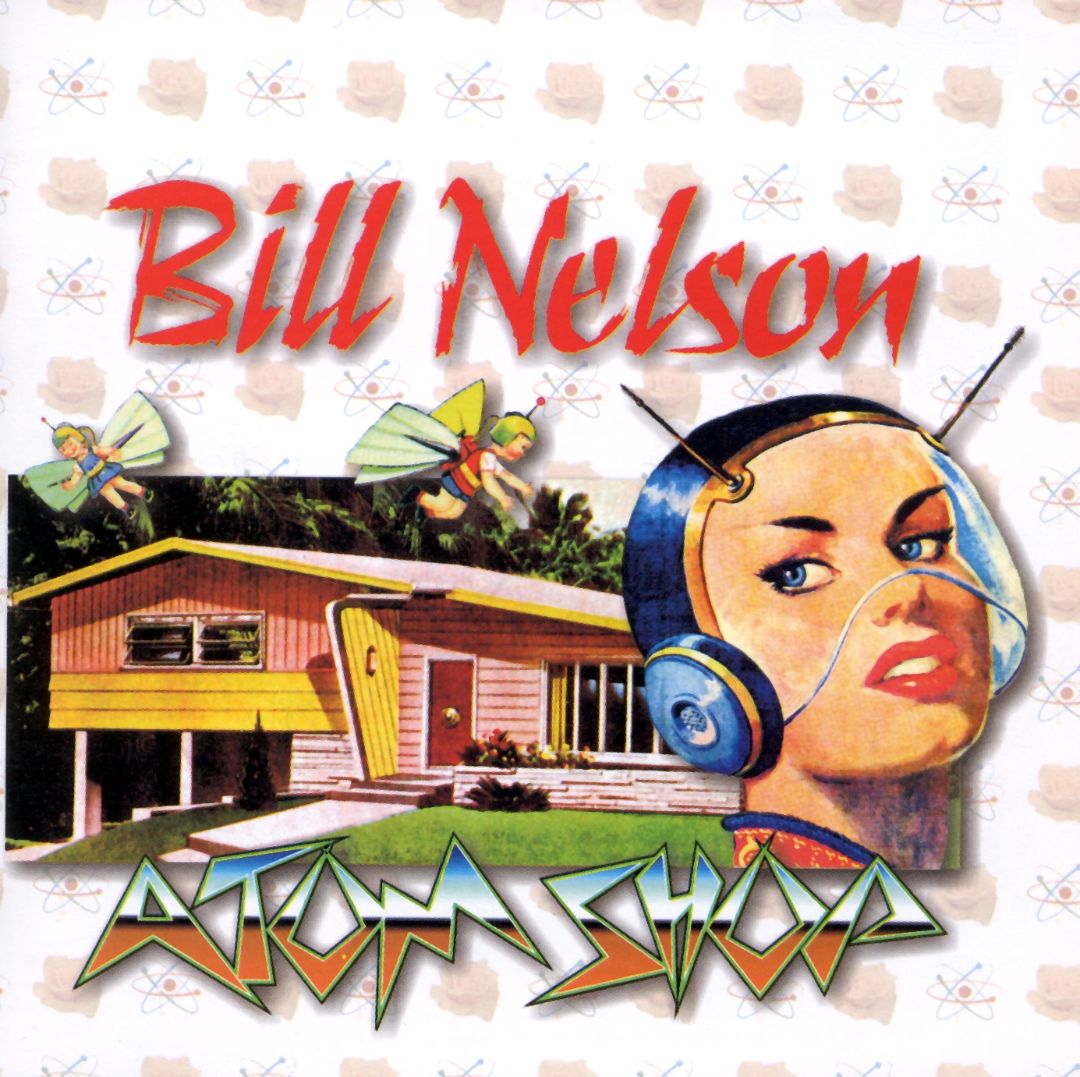
September 1998 – album reviews – Bill Nelson’s ‘Atom Shop’ (“freefalling away with the breakbeat imprint stamped onto the songs”)

20 Sep
Bill Nelson: 'Atom Shop'

Bill Nelson: ‘Atom Shop’

Compare and contrast. A while ago, Bowie – in a last-ditch attempt to prove he’s still relevant, still the musical chameleon of old – clambered aboard the drum’n’bass gravy train. That music’s normally made by lone bedsit technoheads; Bowie tried to do it with a bloated old rock band. Oops. Still, being Bowie, he could always pick up the phone and request the services of Goldie or some other jungle luminary. The end result sounded clumsy and desperate and – pointedly – as if Bowie had no real interest in drum’n’bass, since he kept dragging the music back towards the ever-more-familiar Bowierock. Not good.

On the other hand… Bill Nelson, him from ’70s Bowie contemporaries Be Bop Deluxe (and a man who mostly holed up in an ambient hermitage in Wakefield during the ’80s and ’90s) has also discovered drum’n’bass. A year before Bowie, too, with 1996’s rattlin’ good ‘After The Satellite Sings’, which sounded – unlike Bowie’s studied “so-how-do-I-do-jungle?” approach – like it had been a revelation and release to him, and without surrendering his own musical personality. Call me romantic, but I could imagine the middle-aged Nelson huddled over his radio each evening, tuning through the FM jungle pirate stations, listening in awe to the complex rhythms and then rushing to his music room to apply what he heard.

‘…Satellite…’ was a suave salvo of smartly retrofitted ’50s-accented art-pop with a bloodstream of “quintessentially English” drum’n’bass, if you can imagine such a thing – Nelson’s laid-back vocals (like a cross between David Sylvian and Cabaret Voltaire’s Stephen Mallinder) topping a very compacted sound, curiously lacking bass oomph but loaded with frenetic drum patterns, beatbox-assaulting jungle snares, burbling electronics and witty speech samples, including someone sounding suspiciously like Maggie Thatcher exclaiming “absolutely dazzled!” over the rush of beats. It was cheeky, it was damn cool, and it had a heart beating under its sharp starched creases.

‘Atom Shop’ is the follow-up; a boxload of demos that failed to get enough funding for the full studio treatment. All the better, ‘cos we know that that way lies ‘Earthling’, Bowie lumbering into a clumsy three-point turn and spilling his load. This album’s rougher edges help – not enough to convert a hardcore junglist, but evading the slickness of most crossover efforts. And it continues ‘…Satellite…’s so-quaint-it’s-cool eccentricity, from Nelson’s memories of being in hock to American glamour during his ’50s childhood and art-college ’60s in Yorkshire.

Pulp fiction, Beat writers, cartoons, natty bebop and cars with silver fins are all part of Atom Shop’s dream fabric. It kicks off with Wild & Dizzy’s swirl of trumpet mixups, dry drum’n’bass pulse, chill synths and blue guitar, peppered with ’50s dude voices. And one of the other songs is called Viva Le Voom-Voom, baby. There’s a lot of fanboy energy here: he’s knocking on 50, but Bill Nelson still sounds naïve and sparkling with enthusiasm, bless the old goat.


Though one thing you notice pretty fast is that ‘Atom Shop’ doesn’t have the hurtling clubby drive of ‘After the Satellite Sings’. Train With Fins looks back towards the more drum’n’bassed ‘…Satellite…’ songs like Flipside – fast and clattering upfront snare drum patterns, with a techno twang and banks of horn-like guitars calling up the ghosts of Stax – but, though speedy, it never breaks much of a sweat. Which is also true of Rocket Ship’s sliding jazz/d’n’b snake rattle and Trevor Horn stabs, or Popsicle Head Trip’s Ferry smooch and tight heavy-metal riffs – all mingling through the drum’n’bass dryness, but the beats ain’t so obvious as they could’ve been.


Magic Radio has a light d’n’b push to it, but ends up like The Orb doing Somewhere Over The Rainbow. ‘Atom Shop’ sounds more touched deeply in passing by drum’n’bass, rather than grabbed by it; as if it’s freefalling away with the breakbeat imprint stamped onto the songs, a teacher’s kiss. Here you’ll more often feel the pathways of d’n’b rather than the punch; the points where space has been prepared, the dynamics of the beat, waiting for the kick that never quite comes.

Oddly, though, ‘Atom Shop’s a much blacker album than its predecessor, even if it does sound less like a session on Massive FM. ‘…Satellite…’s most awkward point – the strafing, Fripp-like guitar solos – have been phased out for a bluesier approach. Nelson’s guitar is busy everywhere, and if there’s some of B.B.D.’s fluid finickiness to it, he can also sound like a sample-era John Lee Hooker, or the subtler detailing Hendrix of Little Wing and Up From The Sky. All this is dovetailed into the minimal trip-hop feel taken to the top of the charts by Garbage, Sneaker Pimps et al (especially for the more ominous Girlfriend With Miracles), but Nelson’s got a more developed musical sense.


So everywhere you look, there are things going on: elements of electronica, samples and live instruments in a complex, but never fussy or muso, interweaving. Dobros and slides are all over Pointing At The Moon’s sleepiness, little bits of rural blues and gospel organs jostle into the arrangements; and so do probably all the “s”s in Mississippi too, if you can find ’em. And jazz dances wherever there’s room; trippy Dizzy Gillespie trumpet cascades, cheeky clarinets, even a bit of scat. Bill Nelson’s found, and gone into, the future we’re starting to guess at from our Portishead records and big-beat singles. A glittering, malleable, disorienting wonderland built out of chewed-up scraps of our past and ghosts in the record players. Something which he pins down in the sizzling hip-hop/jazz hybrid of Spinning Dizzy On the Dial when he sings “I’ve seen the luminous stuff of dreams, / I know what’s going down… Awake to all eternity / with the jazziest ghosts in town.”


It’s about a sensibility, I guess, a feeling. Which leaves us with the preoccupations of Nelson’s sighed, sometimes stoned vocals through an album of songs that are mostly poised in dreaminess. ‘…Satellite…’ celebrated the liberation Nelson’s kinetic d’n’b exploits offered him, poked fun at those who thought he might be a little old to join the jungle massive (“I had my sonic youth / When you were lost in ether… / I’ve got nothing to say, and I’m saying it. / Yeah, that’s the stuff for me.”) and had an undercurrent of suspicion at the American dream (“Whither thou goest, America, in thy shiny car in the night?”). But ‘Atom Shop’s more content to bask in sighs about “the way things swing”, “moving stars spun from mirror ball”, “Chet Baker on the lo-hi-fi”, trippy kittens, glamour girls from Mars, and Kerouac’s Dharma Bums. Perhaps he made his point the first time around.


Rest assured that it stays on the right side of Austin Powers, thanks to things like the Beat-rapping on Billy Infinity, the shuffling shoe-drag balladry and springy guitars of She Gave Me Memory, and the way in which My World Spins cooks everything together best – gospel emphasis, lucid little guitar and electric piano strums, pitter-pat drum’n’bass velocity, a Cars-style creaky hipness and Nelson’s determination to keep his head clear: “now everybody’s got their information / but none of it matches mine. / Saints preserve my reputation and keep my thoughts sublime.” The sense of a mind open to new sounds and influences pervades. Before the closing Jetsons-style supermarket jingle, Nelson’s declared himself to be “sending signals and leaving clues / from the hymns of history to the far-future blues.”


And aside from the excitement for the listener, part of the greatness of Nelson’s current trajectory is hearing a rejuvenated art-rocker enjoying exploring startlingly new musical forms and weaving them into his history. Doing it for himself, without a style guru or scenester shoving a batch of 12-inch white labels into his hands, saying “Sample some breaks from this – it’s what the kids are into.” Keep flicking through those FM stations, Mr Nelson…

(review by Col Ainsley)

Bill Nelson: ‘Atom Shop’
Discipline Global Mobile, DGM 9806 (633367980625)
CD-only album
Released: 15th September 1998

Get it from:
Best obtained second-hand.

Bill Nelson online:
Homepage Facebook Twitter Soundcloud Bandcamp Last FM

September 1998 – EP reviews – Blowholy’s ‘Psalm 666’ (“a very young Trent Reznor chasing Tony Iommi down an endless cobbled alley”)

11 Sep
Blowholy: 'Psalm 666'

Blowholy: ‘Psalm 666’

For all the wild promo bluff (foaming descriptions of “’70s hell-riffing axe-gods having lo-fi nervous breakdowns whilst being sodomised by Satan’s own sampler under a layer of time-warped filth and modulated interference waves”) it’s easy to pin this one down. It was only a matter of time before someone copped on to the possibilities of fusing the rhythmical extremity of drum’n’bass junglism with the punch and theatrical flair of heavy metal. Strangely Brown (Blowholy’s one-man noise army) aims to be at the front of the queue to mate two musics more obsessed than most with extremity and big bangs.

If you can imagine a very young Trent Reznor chasing Tony Iommi down a narrow, endless cobbled alley, you’re halfway to imagining Blowholy. Knife-life guitar-riffs – pure Deep Purple and Black Sabbath, cored from their early ’70s pomp – ride on glittering junglist axles with a witchy, wiry vocal wound over the top. Electro-rattle meets bludgeon riffola – simple as that. Ministry did something similar with industrial techno at the start of the ’90s, and it’s fair to say that Blowholy owe them something. However, much of this EP springs from a distinctly British brand of humour and resentment.

Some of this is pulled from punk, some from the anarchic spirit of resistance in the free festivals, and some from the brutal rained-on sarcasm of the English cynic. Riding way back in the mix, crushed and distorted to a thin buzz, Strangely’s tones have a lip-smacking relish to them. He’s a rebellious and gleefully smart-arsed underdog, spitting out slap after slap to familiar targets, but with a engaging vigour. On the titular Psalm 666, he tears straight into consumerism (“Just buy what you’re told, / you are what you own. / Just do what you’re told and you’ll never be alone,”) and its pernicious work at frightening individuals into conformism. As with the metallic riffing, the song’s righteous punk disdain is tinged with Sabbath-style heavy-metal demonics (“Strip away the inane and just one voice remains. / It’s so subliminal, the devil’s own marching call: / ‘Come on, come on, come on, come on now, / fit in, fit in, fit in with the crowd’…”).

While Do As You’re Done By initially sounds more like personal revenge (“God, it gets me high to see the realisation dawn. / At last you’re facing someone you should really not have scorned!”) it’s more of a general roasting of the brainwashed – “I’ve had you here a year but you just never seem to learn. / So now it’s time to find out just what makes your flywheel turn. / If I open up your head I’ll see your tiny poisoned mind / I’m not expecting much, but I will see what I can find.” Beneath the occasional dungeon lyrics, it isn’t schoolboy sadism that drives Strangely: it’s ire at the smug, or the sheeplike, or the pretentious. ‘Dig Your Own’ (which mixes in some Mike Patton-style brat-rapping and a fistful of psychotically wiggling sax samples from Naked City) rips enthusiastic holes in some swell’s ballooning ego. “Claiming to bring the ultimate coup, / only to say what we already knew. / You’re going on so fast that you bring your own disaster. / En route from god to bastard, / so big; could not be vaster. / You’re going on so fast that it could never, ever last you…”

Scene & Herd charges back to the big unison Black Sabbath riffs, taking a sniff at speed-garage while it’s there. The dance elements are better integrated, wrapped in a grinning, glistening embrace with the guitars. This time, Strangely takes his knife to bandwagon-jumpers whose opportunism outstrips their knowledge or sincerity. “In all you do, it’s only you that you want to please… / There is no credence to the so-called words of wisdom that you sell. / But who can tell?” With great pleasure, he pronounces sentence: “It’s your fate to emulate / the world you think you have escaped / but merely aped.”

All well and good, but once the trick of drum’n’bass/metal fusion has become familiar, you do start hankering after some new tricks. Luckily, there’s Iconoplastic (Tzawai), in which Blowholy take a step on from the initial hybrid and produce something much more interesting. The power-riffing electric guitars are gone this time (occasionally replaced by scrabbles across a dislocated acoustic) and the stripes of waiting vacuum and rushing, balefully-textured noise stretched across the shuddering beat are more along the unrelenting sampledelic lines of Moonshake, Muslimgauze or The Young Gods than anything that finds its natural home in ‘Kerrang!’. The ominous Arabic samples (courtesy of Chalf Hassan) merge with the lo-fi percussive impulse, a jihad strike-force speeding across the sands. Meanwhile, the sardonic word-dancing has reached new levels of acidity. “Here we go again, with your self-important jive / about how you made a difference filling empty lives… / Well, it’s such a bed of roses with your collection of pet psychoses. / So tormented, like you meant it. / Oh, such a sensitive man!”

Blowholy are halfway there – they’re on the right track, but if they’re to become as musically interesting as the Naked City and Mr Bungle tracks they sample, they need the courage to consistently extend their own envelope. In other words, more Iconoplastics. But at least the drum’n’bass/metal crossover floodgates have been thrown open. That shaggy, long-in-the tooth rock monster has grown itself a new skeleton and is about to road-test it.

Blowholy: ‘Psalm 666’
Ketamine Leper Music, KETCDS 01 (no barcode)
CD-only EP
Released: 1998

Buy it from:
Best looked for second-hand, although CD versions will be extremely rare. Some tracks can be downloaded from Soundcloud as part of the ‘Church Bizarre’ album.

Blowholy online:
Homepage Facebook Soundcloud

August 1998 – album reviews – Darkroom’s ‘Daylight’ (“subtly distressed electronica”)

14 Aug

Darkroom: 'Daylight'

Darkroom: ‘Daylight’

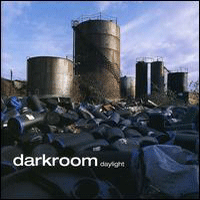
To work out where Darkroom are coming from, you could do worse than take a look at ‘Daylight’s arresting cover. It’s a study of sturdy, corroded old industrial tanks, encircled by metal stairways and surrounded by a devil’s playground of battered, abandoned plastic drums. The drums are marked with hazard labels but yawn open, suggesting that their toxic contents have long since leached out into the environment.

Behind the towering tanks is a radiant blue sky and a slanting blanket of pure white fluffy cloud, against which they rear up like Reims Cathedral. It’s beautiful, in a warped way – the wreckage and castoffs of a once-bright new industry that, nonetheless, continue to assert themselves. Yet in this toxic paradise there’s not a person in sight.

No, this isn’t suggesting that Darkroom are the sort of electronica trio who revel in futurism, and who excise humanity from their orderly sequenced and oscillating musical vision of the world. The opposite is true. Darkroom’s music (in which Os’ sequences and textures are balanced by Michael Bearpark’s mutated post-industrial guitars and Tim Bowness’ naked swoony vocal wail) has humanity in spades. The live instrumentation and vocalising unites with the programmed sound and beats in a way that’s rare in over-purified electronic music, but in the music that emerges – one in which the technology provides uncertainty rather than comfortable form, and in which the threat of chaos and upset looms constantly in the background – the main note sounded is one of loss. One of the main qualities of daylight, after all, is its impermanence.

Via a previous EP, we’ve already heard the discontented seethe of Carpetworld: roof-skittering drum’n’bass with guttering snarls of wounded guitar and Tim’s voice reined in to a hooded whisper of acidic verbiage – the only lyrics on the record, and they’re about bad sex, looting and dodgy discos. We’ve also heard the beautiful flush of ‘Daylight’s title track: a tumbling chant (mournful but blissful) against a slow wallow of bass, the singing notes of Mike’s Frippertronical guitar, and Os’ dawn chorus of flickering sound. Darkroom can do in-yer-face, and they can do strokin’-yer-cheek. They do each of these in roughly equal amounts. Often they do both together, in an elusive blur of ambiguous emotion – the sort that makes you keep one eye on them and the other, anxiously, on the door; but which keeps you held in place, unable to resist the desire to see for yourself what comes next.

Ambiguity is in fact the keyword for this music. Brash, defined techno structures are missing, their place taken by sketchy outlines which the trio fill up with evolving, chaotic detail. The beats are light-footed: slow breaks languidly pacing the background, or pattering techno pulses like rats’ paws. The electronics hum like supercharged fridges close to bursting flamewards, or keen out lovely auroral shivers in the sky and in the shadowed spaces. Tim’s full-voiced mixture of blurred word-shapes and sub-verbal whoops are sometimes Buckley-ish in their tortured flamboyance, sometimes more like Liz Fraser’s outraged brother. Melodies drift, loop and contort: massy and queasily mutable, cloudscapes tortured out of their natural forms by the force of some cruel idiot god.

Sometimes Darkroom’s music sounds like Underworld (though tumbled from their throne and reeling with the impact of a massive nervous breakdown) or like Fripp and Eno sailing their boat into much more malevolent waters. Sprawl growls its overcast way past complex shifting slapping beats, squelched bass, crushed radio-talk and vocal frailties; a baleful camera scanning a wasteland. The opener, Crashed, is strung out, lovely but disfocussed, with a streak of elegant suffering running through it. The guitars rattle like motoring moon-buggies, the voice oppresses like a summer shower, and somewhere in the background, behind the throaty tick of percussion, a lone voice of optimism: a marimba chinking out its own little Steve Reich wavelet.

There are episodes of naked grace on board, beside the pollution, but ‘Daylight’ is still one of the most subtly distressed records to wriggle out of late ‘90s electronica. This is most obvious in the wrenching, frozen agony of Vladimir; but Died Inside seems to sob in anticipation for a collapse waiting to happen but never quite arriving. Looped calls, lilting gasps are answered across a chill and echoing gulf by the icy fuzz of a guarded guitar, prowling and snarling in its own isolation. Once, Tim’s voice reaches a rare degree of intelligibility – a panicked, unanswered plea of “d’you feel the same?”

The wonder that comes close in hand with this fear is laid out explicitly in No History. A soft hip-hop beat holds down the sky-stretchingly rapt vocal and the beautiful subterranean guitar moans: a soundtrack to the forever-flavoured moment when you lie stricken at the bottom of that fatal crevasse, watching the last and most brilliant stars of your lifetime pierce the beckoning void overhead. Like a fleeting memory of softer times, a snippet of (Sittin’ On The) Dock Of The Bay slips in. The amplifier buzz at the end is a benediction.

If there’s a time when there’s resolution, it’s when those two questioning background voices reach out across the comforting pulse of Estragon – Michael’s guitar like a high, bowed bell, Tim toned down to a florid whisper. Still, as it sails on towards its hushed conclusion, the key feeling of ‘Daylight’ remains one of loss. A lament for something unknown, but something voiceable. Something long gone past but reaching out for you again, as the day goes down and fades off into the poisonous beauty of a industrial sunset haunted by old unquiet ghosts.

Darkroom: ‘Daylight’
3rd Stone Ltd./The Halloween Society, HAL 8002 CD (5 023693 800226)
CD-only album
Released: 7th August 1998

Buy it from:
Burning Shed or Bandcamp

Darkroom online:
Homepage Facebook Twitter MySpace BandcampLastFM

July 1998 – EP reviews – Darkroom’s ‘Carpetworld’ (“swathed in contradiction… one long, haunting slab of sonic terrorism”)

15 Jul

Darkroom: 'Carpetworld' EP

Darkroom: ‘Carpetworld’ EP

Darkroom come swathed in contradiction: daytime shoppers on the sleeve, savage nightlife in the music. And no credits, though apparently it’s another one of those confounded No-Man offshoots ‑ don’t these bloody people ever sleep or anything? Evidently not, if the tracks on this single serve as an example of the sounds pulsating through their brains.

Carpetworld itself breaks all the rules ‑ the rules that say you can’t put vocals and lyrics recalling Soft Cell‑era Marc Almond over churning, vicious Frippish guitar ambience and hard‑as‑nails mechanoid beats falling somewhere between jungle and hardcore techno. A knife in the side of the rave generation’s blissout, it’s elegant in its brutality (“taking a twirl with your best friend’s girl, while the rest of the gang torch Carpetworld”), hovering in tatty clubs and observing the rituals of nihilism unfold as the backwash of bad E and the not-so-gentle ’90s poison the clubbers’ dreams.

Dance darkhorse it might be (it doesn’t run with any obvious scene, and fuck knows which playlist it’ll fit on in the increasingly segregated world of dance radio) but this is still cutting‑edge contemporary, with absolutely no fluffiness and Tim Bowness spitting out lyrics the likes of which we’ve never heard fall from his previously poetic mouth ‑ “Have useless sex with your ugly ex… / You velvet‑sneakered chancer, you broken-fist romancer…” as the beats flutter like a death’s head moth trapped in the throat. I’ll stay well out of the disturbing urban nightmare Darkroom are living in, but I’ll happily live it vicariously through their warped imaginings. Dante’s disco inferno.

After that, the Carpetwarehouse reworking does lacks a certain spontaneity. The original sounds like it’s literally fallen together in a paranoid improv session after a thoroughly unpleasant experience: This – apart from simply not being different enough – simply sounds like Darkroom have tried too hard at the atmospherics. OK, the beats are even more frenetic and Bowness achieves something he’s previously never managed in previous recordings: i.e., sounding fucking terrifying as his distorted voice rasps out the repeated mantra “I’m coming after you!” If you ever thought, from listening to No-Man’s work, that you could have that Bowness chap in a fight ‑ think again… Nonetheless, one does yearn for a battering, bloody remix from the diseased mind of Jim ‘Foetus’ Thirlwell, or Aphex Twin.

But, hell, Darkroom’s maverick genius still encompasses enough space for much more roaming, ambient trips. Daylight, in particular. Tim Bowness (like Martyn Bates) has always had one of those voices that are perfect to use as an instrument integral to a piece such as this, weaving magical wordless nothings in and around underwater tones and splashes of electronica. Anchoring this thoughtful pause from drifting off into inconsequentiality, a beautifully melodic bass riff and eerily clattering percussion ‑ like the echoing sound of camera shutters ‑ keep proceedings somewhere near planet Earth.

Ardri, though (nonsensical title ‑ always a bad sign), reeks too much of late ’70s/early ’80s ambient ‑ the kind of stuff the BBC would choose to soundtrack beautiful nature footage. Look, it’s a personal thing ‑ until someone out there finds even a slightly new direction with ambient (and I would certainly not rule Darkroom out of this), then the only sounds that interest me are the ones that either completely chill me out, or those that make the hairs on the back of my neck rise. This final track (like too much else in the field) gets my mind wandering after the first minute and thinking “So? What’s next?”

So, a downbeat end to a marvellous debut from Darkroom. Buy it for the title track and (whatever my gripes) for the remix, and just treat them as one long, haunting slab of sonic terrorism. Brilliant.

(review by Col Ainsley)

Darkroom: ‘Carpetworld’
3rd Stone Ltd./The Halloween Society, HAL 8001CD (5023693800158)
CD-only EP
Released: 6th July 1998

Buy it from:
(2018 update) This is now one of the rarest Darkroom releases – best obtained second-hand or from iTunes.

Darkroom online:
Homepage Facebook Twitter MySpace Soundcloud BandcampLastFM

May 1998 – album reviews – Blowpipe’s ‘Pendulum’ (“half given over to Blowpipe’s previous grace, half to a new and more aggressive club attack”)

18 May

Blowpipe: 'Pendulum'

Blowpipe: ‘Pendulum’

In jazz, things move on, and Blowpipe are no exception to this. Father-and-son brass-and-reed players Robin and Andrew Blick joined forces last year, making a mark for themselves last year at the point between hips and heads for their own spin on jazz-meets-clubland, sliding in alongside acid jazz with something a little more sophisticated and challenging.

The enthralling ‘First Circle‘ was the outcome: a rich and rewarding chill-out-and-expand intertwining of busily-bubbling electronica with old-school jazz conversation. Alongside guitarist Paul Reeson and the remarkable electronic sound-weaver Stephen Watkins, the Blicks set up a heartfelt and fertile union of jazz expression and latter-day dance-floor pulse, a tapestry of burbling intelligent techno, deft horn dialogue and fluent electro-acoustic textures. It was a joy to listen to, and its success has been recognised in one direction, at least.

‘Pendulum’ (a hot-on-the-heels follow up to ‘First Circle’) comes after Blowpipe’s deeper welcome into the ongoing club revolution – they’ve played on the new album by drum’n’bass pioneer Grooverider – and a big line-up shake-up. Whether burnt, inquisitive or disillusioned, the Blicks have opted to change the band’s instrumental chemistry. Blowpipe’s armoury of blowables (which already featured the Blicks’ trumpets, saxes, assorted horns and abused pipework) has been expanded by the addition of Nick Reynolds’ harmonica; they’ve also added a steady bass player in Tom Harrison; and there are frequent guest appearances (and stronger links to the jazz world) from saxophonist/flautist John Burgess of the Harry Beckett band and the Tom Bancroft Orchestra. But most crucially, both Reeson and Watkins are now out of the picture (apparently, halfway through recording). Consequently, while half of ‘Pendulum’ is given over to Blowpipe’s previous acoustic/ambient/electronica grace, the other half is shaped by a new and more aggressive club attack.

Of the old school stuff, Airport Woman is the most graceful: a mass of beat-free, blurring big spaces: back-and-forth cello loops, rainy-night muted trumpets, glows of soprano sax and a brief return from Paul Reeson. The Spell is Broken is wrapped in a backwards bassy ostinato (padded up by Tycho Andrews’ wah-guitar) like an orchestra in a North Sea fog, thick hazy air through which Andrew Blick’s trumpet clarion cuts like a lone lighthouse beam. Muting down and vague-ening in the heavy atmosphere, it gently illuminates (above the clanking guitar rhythm and the creak-crunching sonics).

However, this album’s signature is definitely made by the harder breed of Blowpipe pieces, by the post-Grooverider drum’n’bass influences. This could have been a good thing, given that music’s ferociously intelligent, toppy rhythmic attack: the bebop of the club scene. But in practice? Um… maybe not.

The main problem is a loss of that crucial Blowpipe balance. Neither of Stephen Watkins’ on/off successors (Patrick Mosley and Mike Servent) possess any of his subtlety, meaning that the detailed electronic textures of ‘Full Circle’ have been overturned in favour of synth washes and more blatant beats. And while the Blicks remain as eloquent as ever, Nick Reynolds’ harmonica virtuosity is of the tinny, bullying breed: a soulless Mark Feltham cop. Sometimes the new marriage is a happy one, as on Avanti’s drowsy harmonica patina and cloudy brass blankets, mixing it up with breakbeats, Harrison’s Bootsy bass, and Andrew’s cold trumpet motif. But when it’s at its worst, the Blicks seem sidelined within their own project, locked down in the cages of snare drum.

The analogue gut gurgles and video games blippery of Usurper work quite well, as Reynolds’ sharp harmonica riffs mingle with fluent fluttering sax and muted trumpet. But Unravel’s tight fast rattle and saurian bass quakes are overcome by the belting raucous harmonica and brass. Robin Blick’s soprano scribbles too frantically, Andrew’s echoed trumpet sounds busy and sour. The raw power of Scorched Earth’s distorted breakbeat and Harrison Wobble-y bassline can’t make up for the yammering, overbearing harmonica overkill: Reynolds blowing flatulently all over the Blicks’ bitty chips of sax and trumpet and Katherine Blake’s skidding tremolo violin. And School Disco (working title or what?) is just clodhopping: a flatfooted stomp which sounds like it was recorded in an underpass. John Burgess’ guesting flute fights to keep grace going against the dirty swathes of distorted harmonica.

When Reynolds is kept on a tighter leash, things work out much better. On the climactic Phoenix, for example, where Burgess’ bass clarinet and Andrew’s dawning trumpet lines repeatedly criss-cross each other over didgeridoo droning and Robin’s sax hangings. Or on Pendulum itself, which uses power without clumsiness. Rising off a big Bonham-y stomp with overdriven trumpet and giant floppy bass, Robin laces in some ascending saxes and curtains of brass. There’s a guest tenor scrawl from John Burgess: then, amid the whale-song trumpets, an incongruous Scott Walker sample pops up to breathe in bluer air. “The little clocks stop ticking now…” Everything does stop ticking. Everything kicks off again. Marvellously perverse, and a particular highlight on an album which sometimes fails to live up to Blowpipe’s initial promise, reminding us of how good they can be once they’re back in focus.

Blowpipe: ‘Pendulum’
Robot Records, ROB 001 (5019148617297)
CD-only album
Released:
15th May 1998
Get it from: (2020 update) Best obtained second-hand, or streamed.
Blowpipe online:
MySpace Amazon Music
Additional notes: Robin Blick now leads Blick Trio; Andrew Blick leads Gyratory System.
 

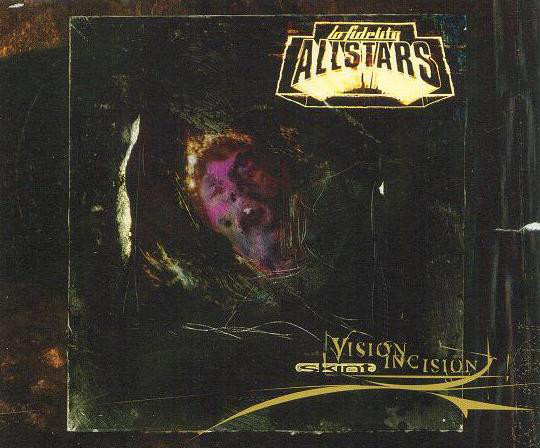
March 1998 – maxi-single reviews – Lo Fidelity Allstars’ ‘Vision Incision’ (“promises to blow our minds wide open, but falls well short of the promise”)

26 Mar

Lo Fidelity Allstars: 'Vision Incision' maxi-single

Lo Fidelity Allstars: ‘Vision Incision’ maxi-single

I had this lot down all wrong at first, I admit it. From the bragging “we’re the greatest” interviews, and the “dance music with real instruments” tag, even the look of the group, I had them down as (god forbid) the new baggy. I was fully prepared to go out and shoot them so I didn’t have to live through the horror that was baggy yet again. But a couple of odd tracks here and there have persuaded me to save my bullets… for now.

Sure, there’s a “real band” sound at the heart of the Lo Fidelity Allstars, but they can manage to make their take on turn‑of‑the‑millennium genre‑defying dance culture a gloriously uplifting thing. Their baggy forerunners (Happy Mondays, Stone Roses) always sounded like they were prevented from gliding to a higher musical plane by having their feet firmly stuck in the field of mud labelled “indie”. The Lo Fi’s, firmly centred on the sampler and decks, don’t have the same problem as they reel off ribbons and streams of sound, rather than chug doggedly away like an old pro dealing with a new fad. But…


Oh, the senseless waste. Vision Incision promises to blow our minds wide open, but falls well short of the promise. Good start, mind. Smooth beats, hedonistic keyboard riff, an infectious soul-diva backing hook, and the matter of the live band sound becomes irrelevant as the track lifts and soars smoothly like the most uplifting house or techno, boasting “As we travel at magnificent speeds around the universe…” At which point the Lo-Fi-s prime weak spot is revealed: Dave The Wrekked Train’s bland Speak’n’Spell vocals. Mashing up randomised texts, as he does on other Lo-Fi-s sonic collisions, they work fine. Faced with actual poetry, they creak like a ground axle. Please, if this is the way he carries on all the time, sack him. He has delusions of being a more hip Mark E. Smith, but ends up just sounding like a London cabbie – a monotone mumble grating over the divine music and pointing up the dreadful rhymes in some of his lyrics.

Perhaps he reckons he’s aiming at the street-level psychedelic lyricism of hip-hoppers like the Wu-Tang Clan: the thing is, those guys sound like they believe the weed-fuelled surreal-o-vision they’re raving about. Dave just sounds embarrassed, as if he’d rather have stayed in his siding and chatted to Thomas The Tank Engine this time around. Consequently, I can’t decide whether this is a successor to Orbital’s Chime for the genre‑busting, cross‑pollinating late ’90s dance scene, or just OMD meeting The Orb in a spot of megalomaniac galactic synthpop. Or, alternatively, the KLF doing Spinal Tap.


The remix is referred to as a “12” mix” ‑ how bloody Eighties. I suspect that, in homage to their record label, this is the Lo‑Fi-s’ attempt at the Big Beat remix. The Late Train has mutated (oh god!) into the slower‑talking brother of The Shamen’s Mr C. for the first part of this extended work‑out. Wisely, they quickly dispense of his services and crank up the heavy beats to provide a real tour de force instrumental for the band. Proving that if you like your beats big and bouncy, then this dissipated bunch can turn their devious minds to that too. The Midfield General Shorter mix is the sparse techno‑electronica version. A mechanistic, simple beat, overlaid by electronic squelches and interferences, as the original track is ripped to shreds and rebuilt, as elements and sequences of the original drift in and out of the mix. Oh, and Train-In-Vain is just a distant, distorted presence, way back in the ether. Wise move, guys.


By this stage, frankly, it’s difficult to tell whether Gringo’s Return To Punk Paste is, in fact, a new track, or yet another radical remix of the original. What it does prove, yet again, is that the Lo‑Fi-s can also turn their hands (deep breath) to a ’90s version of the sounds of early ’80s rap and electro. Skeletal beats and distorted, squelching basslines set the parameters for that unmistakeable sound, aided by some nifty no‑nonsense American speech samples.


Cunning remixes or no, even if feted as the best new band in Britain by ‘Melody Maker’ and handed The Future on a giant silver platter to play with, the Lo Fi’s are still going to bellyflop if they keep expecting that stuff like Vision Incision’s going to justify that reputation. It’s not that they’re talentless rip-off merchants. On the contrary, their sampledelic experimentation – when they’ve taken all the sounds of the world, scrunched them up and run with them – is at least as heart-jumpingly astounding as any other visionary pop cut-ups around, if not more so. Hype or no hype, they can bring the noise with a vengeance. This is a real Quality Street of a band – whatever your favourite tribe in the current cross‑cultural collision, there’s music for you here. And if this is the sort of open‑minded group that all the mess of sounds in the ’90s can produce, then the future is wearing some very cool shades.

But compared to their own mighty One Man’s Fear (the world being slowly and gloriously wrenched to sticky bits by Jim Morrison’s psychotic baby grandchild), this ain’t so much a vision incision as a mere blink. Someone had their eye on nothing more noble than a chart placing when they knocked this lot together. Just cut it out, OK? Show me stars, not hot gas.

(review by Col Ainsley)

Lo Fidelity Allstars: ‘Vision Incision’
Skint Records, SKINT 33CD (5025425503320)
CD/cassette/7- & 12-inch maxi single
Released: 23rd March 1998

Get it from:
(2018 update) best obtained second-hand.

Lo Fidelity Allstars online:
Twitter MySpace Soundcloud Tumblr Bandcamp Last FM

September 1997 – album reviews – R.O.C.’s ‘Virgin’ (“from the surreal and experimental to pure pop and simple emotion”)

8 Sep
R.O.C.: 'Virgin'

R.O.C.: ‘Virgin’

Cut‑ups are wonderful things. TV samples. Answering machines. Category‑defying noises. Harsh vocals. Scattershot free associations. Beautiful vocals. Hazy guitars. Clattering electro‑rhythms. A sense of the surreal. A sense of the melodic. Glorious eclecticism. The perfect post‑modern pop group.

Hallelujah! R.O.C. are back.

And against the odds, too. The debut album of this transatlantic trio (Fred Browning, Karen Sheridan and Patrick Nicholson, with roots in American, Ireland and Britain) welded pop music with a wilfully obscure grab‑bag of eclectic styles. Spookily emerging out of nowhere, it was critically hailed as the pinnacle of the ’90s zeitgeist, but the record‑buying public remained resolutely silent. Yet, here are R.O.C. ‑ back! ‑ on a new major record label deal (Good on you, Virgin, I take back everything I’ve ever said about the majors… well, almost…)

Dada opens the album with a statement of intent akin to the surreal art movement of the same name. Grasshoppers and various indecipherable speech samples give way to pounding, discordant and (very definitely) tuneless harsh electronica, accompanied by sinister laughter. Jeez, they’re such awkward people that you almost get the feeling that this is the spirit of ROC laughing at you for not understanding it, not getting it. Not very welcoming, either musically or emotionally. Thus, not for nothing does the oh‑so‑English conversation (too formal, too well‑accented to call rap) of the next track (Dis)Count Us In begin with the question “Are you still with me?” before Fred Browning relates a tale of watching a woman across a crowded room, to a backing of post‑modern electro‑pop.


All change. Mountain is R.O.C. as a slightly less comatose Mazzy Star performing to acoustic guitar and warm This Mortal Coil‑style atmospherics. Karen’s lyrics detail her observations ‑ highly emotional but somehow dispassionate ‑ of someone whose life has no direction and is spinning out of their control ‑ “Here we go again, / You’re going to take another rollercoaster ride through hell” ‑ in a beautifully recorded wash of womb‑like electronics.

Cheryl is a pop Suicide for the ’90s, an almost cheesy pop melody set to gleaming pulsating electronics and interludes of demolition percussion. Karen sings (Cheryl’s?) lyrics of a big fuck‑off to a man (antiquated sexist attitudes, thinks he’s God’s gift) and states her own terms for independence; “If it’s all the same / I think I’ll move on up… / I’m gonna get myself some dedication.”

Ever Since Yesterday starts as an acoustic‑guitar based lament to the departure of Fred Browning’s lover before all manner of randomly‑emitting Disco Inferno‑ish sampledelia and phased electronica makes its presence felt, distorting the whole sonic collage and moving it out into the realms of post‑rock. Instead of fading out, it collapses in on itself as the tape mangles. Gorgeous.

25 Reasons To Leave Me features Browning returning to his husky Shaun Ryder vocal style, set to a loping laid‑back musical backing not unlike a more uptight Happy Mondays; whilst K.C is a dry disconcerting, upfront recording, led by a simple and affecting sequence of organ chords, later joined by a soloing trumpet and brass accompanying a vocal of more third‑person observation from Sheridan. It’s no criticism to say that this track resembles late‑night bedsit pop at its best. Kind of a meeting between Prefab Sprout and The Cure, if you will.

Cold Chill Just Lately details the crossed wires, cross‑currents, accusations and arguments of a relationship break‑up. This rather harrowing subject is carried by the track’s broken, exhausted vocals. He’s not happy, but there is a certain black humour typical of R.O.C.: “But I guess it’s just a fucked‑up world we’re living in, / and you know it couldn’t get much worse. / But then it turns you over and fucks you in the ass… / She only cares about herself / She never cared about me.” Such bile is performed to an incongruous accompaniment of smoothly enveloping, ebbing waves of sound, a lurching rhythm, and throbbing strings adding a chamber‑pop element.

The final track, Ocean And England, opens with the sound of thunder and rain, and a bare strummed guitar‑‑the poignant musical lead is then swapped to a ringing electric piano and harpsichord before a huge sampled orchestra swoons in. Like many bravely experimental acts, ROC always remember that, sometimes, all one needs is a song and an affecting melody. “Ocean And England” is just that, and even includes a lovelorn lyric: “Hey you, / the ocean and England are so far away. / Won’t you consider coming home / to be with me again?”

Ultimately, though, this album lacks a little of the debut album’s magical Wonderland atmosphere ‑ swapping the feeling that anything could happen within the space of the next track for the feeling that yes, plenty will happen, but it will be more regimented and organised. Yet how many bands would have the sense of vision to travel, in one album, from the surreal and experimental to pure pop and simple emotion?

R.O.C. Still utterly beguiling.

R.O.C.: ‘Virgin’
Virgin Records, CDV 2829 (7 24384 29472 4)
CD-only album
Released: 8th September 1997

Get it from:
(2018 update) quite a rare release these days, best obtained second-hand.

R.O.C. online:
Homepage Facebook

August 1997 – album reviews – Ramshackle’s ‘Chin On the Kerb’ (“rocking and poised on the balls of their heels, preparing to take the blow and meet the challenge whenever it snakes out of nowhere to catch them”)

18 Aug
Ramshackle: 'Chin On the Kerb'

Ramshackle: ‘Chin On the Kerb’

Ramshackle‘s second album amply displays the fact that they’re stars in waiting. Or straining at the starting gate, perhaps; as ‘Chin On the Kerb’ feels like someone pacing in anticipation, winding up in order to lash out, someone containing so much but unsure of their moment.

Steve Roberts, Johnson Somerset and Ben Chapman make up Ramshackle. With their previous album ‘Depthology’ they sent admiring ripples through the midground of the blues and soul scene, yet so far they’ve eclipsed by the Bristol superstars on one hand and the steamroller marketing of American R&B on the other. A pity – because the longer you listen to this album the more impressive Ramshackle sound. Compare it to the successive waves of smug, self-satisfied vocal stars that carpet-bomb our soul shelves. It’s like the difference between listening to the shouts of a bandstanding actor and eavesdropping on an intense conversation in the corner of a bar. This band are smooth, but they never sound like they’re big-E Entertainment paste.

The central axis is Roberts’ British/Caribbean voice, bowled in somewhere between the edgy sweetness of Horace Andy, Austin Howard’s lushly muscular prowl and the testifying tenor roar of Doug Pinnick. And Ramshackle seem to have their initial foundations on whatever boundary lines there may be between Massive Attack, On-U Sound and Ellis, Beggs & Howard, but let themselves roam a good deal further. The ranked and sussed electro-acoustic instrumentation touches on trip-hop, on U2 Big Music rock and on techno, on soul and R&B, on church singing, Jamaica dub-juice and slow funk shakedown. Ramshackle are letting it all come to them, nourished by the convergence of those rich streams similar to the all-embracing muse of their Brit-soul contemporary Lewis Taylor, or – in intent, if not manner – to the Prince of The Cross or Symbol.

Certainly they’ve sheathed their black-pop instincts in richly crafted clothing. From My Mind emerges from cloudy electronic shapes to a sweet spartan R&B groove and tiny, intent piano kisses. Works of Devotion lounges on the dubbier ingredient of padded bass, high echoing Jericho trumpet flickers and bouncy toasting; Roberts blazes with quiet righteousness, balancing out the snaky threat of the industrial synth that slides through the song like the worm in the apple. And they’ve got a knack with uplifting ballad pop. The acoustic strum and sweet-rocking sway of Don’t Turn Me Away; the bluesy plaint of (What About) Tomorrow with its hip-hop beats and train-whistle wastelands; the joyous, sunny gospel sighs and carnival brass that ripple through the blissed-out single, Freshly Rained-On Grass; or Eden’s gospelly piano’n’beats, laden with dangling glittery sounds like harmonica memories and a family of chorus vocals.

But ‘Chin On the Kerb’ is shadowed by palpable alarm – “Let me tell you / I smell blood in the water.” Even when they’re taking the air and laughing into the sunlight on Freshly Rained-On Grass, there’s a sense of Ramshackle rocking and poised on the balls of their heels, preparing to take the blow and meet the challenge whenever it snakes out of nowhere to catch them. Granted, it’s no ‘Mezzanine’ – it lacks the spookiness, the seductive alienation, the naked rage Massive Attack are allowing themselves. And what darkness exists in this album happens to Roberts’ protagonists, it’s not of them. But there’s a religious sense of right and wrong driving this, which sets up a particular tension in Ramshackle’s tales of life on the rough edge. Just as Roberts can flick lightly between street-sly patois and preacher pomp, Ramshackle’s moods are volatile beneath the smoothness.

If there’s anything you take away from the album, it’s the impression of a hot-headed and contrary man paying a loyal personal tribute to the resilience of the beleaguered black experience. The pomp-rock-tinged Temple – piano and bass from house music meeting a Tackhead-style forcefulness, Roberts’ voice fracturing into sweet choruses and torn-up foreboding roars – warns of hostile worlds outside the church doors. No Touchi”s tales of a crime-ridden community on the last scraps of its pride (“I see less clearly in these advancing years.. / No touchi’ rock, combat bad intentions”) touch on Gaye’s Inner City Blues, ragga inflections dodging the drilling whine of synth and the discreet knife-play of scratching.

Though the above is mild compared to the vengeful slash at brotherhood betrayed on Broken Soul. Or to the vipers-nest atmosphere of the album’s loping title track, where the guitars clot and loom like hangovers, and the synths gleam like yellowed morning-after teeth: “The Judas kiss / of cold glass to my lips / tells me I’m gonna keep doing this all of the time.” Roberts sounds as if he’s washed up against a pissed-on wall, torn pants fouled and down round bruised thighs, surfacing into one of those horrible moments of absolute truth when there’s nothing between you and the raddled wound that you called your soul before you got lost on the dirty side.

Still, even while lying in the gutter, the old line about looking at the stars still applies. In the end, it’s about the determination of faith-under-fire, as in the hymnal, luscious-as-tears Let Em Go and in the way the devotional vision in Lament bears as much witness to the devastation of black communities by alcoholism and self-hating violence as it does to the landscape of promised redemption; Roberts’ voice embracing all of this.

The closer, Safe (with its unexpected crest of sumptuous weeping violas), is a soldier’s song. Fraternal and distressing as a lost harmonica left on a torn battlefield, and acknowledging the brutalisation of young boys into fighting men – “and when I met the enemy / it was just a boy’s eyes, cold and distant. / Such savagery / coming from a man like me.” But when the last words come, they aren’t just a plea for support, but a resolution to find one’s way back to truth: “I wish to be safe in the arms of the Lord / I want to be faithful in deeds and words.”

They might believe that love will triumph over rage, but they don’t treat that rage lightly. Ramshackle? Anything but. Rich and rewarding.

Ramshackle: ‘Chin On the Kerb’
Edel UK Records/Whatever… Records, EDEL 098602WHE (4009880986028)
CD-only album
Released:
18th April 1997
Get it from: (2020 update) Best obtained second-hand.
Ramshackle online:
Last FM Amazon Music

May 1997 – album reviews – Ragga & The Jack Magic Orchestra’s ‘Ragga & The Jack Magic Orchestra’ (“music for Disney cartoon castles in the sky”)

24 May

Ragga & The Jack Magic Orchestra: 'Ragga & The Jack Magic Orchestra'

Ragga & The Jack Magic Orchestra: ‘Ragga & The Jack Magic Orchestra’

Do I have to do all the usual obvious journalistic crap about Iceland? Do I? Oh, if I must. They eat puffins, or something. They drink tons of cheap alcohol. It’s bloody cold there. It’s dark all winter, light all summer, or something. Magnus Magnússon. Mad elfin pixie Bjork… blah blah blah. Will this do?

Oh, and I have to act surprised that Iceland can produce such great music, and be really patronising about that in particular. Because we British love looking down on small nations, don’t we?

All that gone through, just because two-thirds of Ragga & The Jack Magic Orchestra are Icelandic. Ragga sang You Don’t on Tricky’s ‘Maxinquaye’ album – a track full of filmic strings, soloing flutes and slow shuffling beats -which casts some light on this album. Previously, Ragga and keyboardist Jakob Magnússon were in a successful Icelandic band together; when they ended up in London, Magnússon worked as Icelandic cultural attache while Ragga attended drama school. Later, they formed Ragga & The Jack Magic Orchestra with English sampling wizard Mark Davies from Voices Of Kwahn. With this debut, they bring all these diverse strands of experience together to produce a magical experience. Huge, colourful swathes of sound; music for Disney cartoon castles in the sky.


So – Fairy Godmother opens on a feather-bed of lapping sea, boat-horns, celeste chimes and toybox orchestra that scream “Disney”, before the trip-hop beats are introduced. But the JMO is always very natural, organic-sounding – no harsh electronica scraping here. And Ragga’s voice is a magical thing – Kate Bush in a lower register, with some of Bjork’s expressive stylings. Like Bjork, her lyrics tell strange stories, but she introduces Shot almost matter-of-factly: “I got shot in the head by a man / who had been aiming at me / for many days… / At the moment I got / the paper from my doorstep.” To an almost easy-listening palette of relaxing hues, jazzy woodwind and flutes, she philosophically concludes that “love can hurt…” Well, it would, wouldn’t it?

Daringly, styles keep shifting, track by track: somehow in keeping with the fairy-tale transformations of the lyrics and samples. Passion For Life has a soulful belted-out chorus (Ragga does brazen Broadway as easily as schmaltzy Hollywood), a slow, loping early-hours atmosphere of spooky keyboards and bone-rattles for beats, and brilliantly lifts an evocative passage from Samuel Barber’s ‘Adagio For Strings’ (the music from “Platoon”, if your imagination’s still settled in the cinema after those Disney references). In Where Are They Now? – to surging orchestral strings, keyboard arpeggios and sparse but powerful metallic percussion – Ragga sings a torch-song elegy to the lost children of wars. Even when no lyrics intrude, Ragga’s evocative harmonies over a battalion of drums and stabbing strings are just as emotional.


The mix of folky guitars and flutes, East European violin and pleasantly shuffling beats on Turn It Off remind one of Beth Orton’s marriage of bedsit folk and electronica. Deep Down also has a deceptively simple sound: alternately hushed and passionate vocals over shifting sands of decaying electronics and a barrage of junkshop percussion. It hits a groove and stays there – perfectly. With the fairy-tale assertion that “sometimes I can breathe underwater / Sometimes I can fly around the sky”, Underwater features more Disney-like wonderment: reverberating drones, slippery strings lilting through the melody and expert percussion care of a Steve Jansen/Rain Tree Crow sample fluidly weaving in and around the programmed beats.

Despite its title and distorted electro-beats, Beatbox Controller isn’t some ’90s ode to the DJ/mixer in the manner of Last Night A DJ Saved My Life. The “beatbox” referred to is the heart – “you are my beatbox controller / A telepathic mixer of emotion…” Ragga’s vocals are almost helium-light and, musically, the track sounds like twenty-first century reggae-lite. In an extended coda where he duets with Jacob Magnússon’s improvising keyboards, Mark Davies makes beautiful music out of sampled percussion – this man’s going to be a figure to watch in the world of electronica, to rank alongside DJ Shadow or Howie B.

Indeed, Two Kisses is built on a disconcerting, clattering rhythm track of samples of god-knows-what. Buzzes, radio waves, ghostly fluttering flutes and Eastern pipes are all jammed into the mix. Ragga sings a multi-tracked ethereal chorus and her voice is, at one point, treated to sound – well, er – exactly like a Smurf, to be honest. Weird, peculiar – Laurie Anderson jamming with The Art Of Noise produced by Tricky is about the closest comparison. Close, but nowhere near. So, yes, if weirdness to the point of absurdity overtakes them every so often (Man In The Moon overdoes the lyrics on the wrong side of Kate Bush kooky pop, and the overblown melody reminds one of… Christ! The Thompson Twins!) it’s a price worth paying for the trio’s musical vision.


Music for your fairy-tale nightmares. A perfect accompaniment to drifting away while watching “Fantasia” for the hundredth time, safe in the knowledge that the good witch now works her magic with a sampler.

Touched by the wand of the sorcerer’s apprentice.

(review by Vaughan Simons)

Ragga & The Jack Magic Orchestra: ‘Ragga & The Jack Magic Orchestra’
EMI Records Ltd., CDEMD 1107 (7243 8 56728 2 8)
CD/cassette album
Released: 19th May 1997

Get it from:
(updated 2018) buy original CD second-hand, or get the reissued download from Amazon or iTunes.

Ragga & The Jack Magic Orchestra online:
Soundcloud Last FM

May 1997 – album reviews – State of Grace’s ‘Everyone Else’s Universe’ (“an oozing of tepid ambience”)

3 May

State Of Grace: 'Everyone Else's Universe'

State Of Grace: ‘Everyone Else’s Universe’

And this is 1997?

In the world of contemporary pop music, I thought ‑ hell, we all thought ‑ we had the equation worked out. Electronica = The Future. Trad Guitar Rock (Oasis + Kula Shaker + Cast + Ocean Colour Scene) = The Past. But State Of Grace, a Northampton electro‑ambient quartet now on their third album, are here to prove otherwise. It’s electronic, yes, but it’s also as retro and dated as Noel Gallagher’s Beatles pastiches.

Conspiracy is a six‑part concept track… or rather, it’s an obvious way to become immediately suspicious about an album just by looking at the track listing. (Six‑part concept tracks issue a subliminal message to me. That message is “run away!”). Part 1, Forest Fields Forever is horribly slick‑sounding trance, complete with weedy female vocal and obligatory ethnic voice sample. The parts seem often to be linked by ambient wind and water effects… oh no, sorry, that was Part 2. I dozed off for a moment. Part 3 (Single Spies) tries to be Dubstar, but with Sarah Simmond’s ultra‑forgettable voice and gibberish lyrics, plus powder‑puff electronics, it makes Dubstar sound like Nine Inch Nails. Part 4, Noel Street Blues, ups the tempo to a sleek techno and, by including the sampled combination of a warbling operatic diva, more generic‑ethnic wailing and an accordion, momentarily arouses some interest. But by this point I didn’t know which part I was listening to. It all continued in this insipid vein for a number of years, by which time I’d lost the will to live.

Perfect And Wild is more suffocatingly polite techno‑pop, with the joyful addition of a twee slide guitar. Still, as so often on this album, the awful lyrics offer a laugh. “And when love is calling / Like an open book” ‑ look, I’m sorry, but books don’t call; they’re inanimate objects! So innocuous and bland is this music that you could walk round supermarkets to its accompaniment.

Now where was I? I need a dozen eggs, some margarine, a packet of mini chicken kievs… oh, sorry. Right, then. Er, Sea‑Saw. Oh, mild trip‑hop. Sarah tries to sing with a lazy, underwater vibe, but only ends up sounding as disinterested as I am, like she’s about to drop off to sleep. And will somebody please alter that bloody drum machine pattern! Now! (If you think I’m losing patience, you’re right).


Be afraid. Be very afraid, for there are three versions of the track Hello on this album (they obviously place great faith in the song‑‑poor, deluded souls). This version, subtitled Fall Out The Lions (eh? Your guess is as good as mine…), is musically somewhat engaging: mournful violins and a rising/falling keyboard sequence over brushed electronic drums. But the words are more sixth-form gobbledegook: “In the silence / the colour is an island. / Fall out the lions, / take everybody with you.” What? Still, the chorus is one to join in on – “Is it so? Hello, hello. / Is it so? / Hello, hello.” Poetry, utter poetry.

Version two of Hello is a remix by Jack Dangers of Meat Beat Manifesto. To a clattering beat and a phased dub keyboard, plus Meat‑treated vocal, it all manages to sound at least vaguely contemporary, whilst hardly essential. Version three (gosh, you can have too much of a good thing, can’t you?) is an Aphex Twin‑style remix‑‑it dismisses all the elements of the original track save for a ghost of the vocals, and constructs a stomping bass‑heavy techno track. By now, it is so far from State Of Grace’s original that it hardly belongs to them at all. Consequently, it’s the best thing on the album.


Rose II begins and ends in an oozing of tepid ambience, but would potentially be an affecting minor‑chord‑laden melody if it hadn’t been subjected to another sheen of bland synthesizers and, worst of all, whining treated electronic guitar. By now, lost somewhere in a maddening nightmare, praying for this album to end, I suddenly sense a name appearing before me. M…? M…? M… M‑… M‑Mike Oldfield?! Jesus, it does ‑ it sounds like bleedin’ Mike Oldfield!! (Worse than that, Vaughan. It sounds like late ’80s Mike Oldfield, the stuff that not even Oldfield fans seem to have any more… ‑ PROG ED.)

State Of Grace are awfully, horribly dated. They are trying to be some sort of combination of modern ambient techno ‑ for which the music sounds simply too out‑of‑date‑‑and the pristine machine pop of, say, Propaganda… yet lacking that group’s excellent song constructions. The lyrics are abysmal, too. The hip new title State Of Grace would like to have conferred on them ‑ electronica ‑ is redundant. This is, being as kind as possible, what used to be known in the pop world as “electronic music”, which would firmly date it as being pre‑1987’s acid‑house revolution.

But let’s not be kind. Let’s be unkind. This is out‑of‑date, bad europop, bad trance, bad electro‑prog… get the idea?

I don’t want it in my universe.

(review by Vaughan Simons)

State Of Grace: ‘Everyone Else’s Universe’
3rd Stone Ltd., STONE 028CD (5023693002828)
CD‑only compilation album
Released: 28th April 1997

Get it from:
(2018 update) best obtained second-hand.

State Of Grace/Fatal Charm online:
Homepage Facebook Soundcloud Last FM YouTube

March 1997 – album reviews – Jocelyn Pook’s ‘Deluge’ (“a suite of stunning invention and sheer beauty”)

1 Mar

Jocelyn Pook: 'Deluge'

Jocelyn Pook: ‘Deluge’

The elegant grace of tragedy is often linked with the splat of farce. This album’s major selling point (on some copies of the CD, it’s trumpeted by a sticker ‑ I kid you not) is that it features the music from last year’s TV ads for Orange mobile phones, namely Jocelyn Pook’s setting of “Blow The Wind Southerly” sung by Kathleen Ferrier.

Sigh. It’s sad but true that increasingly weird and wonderful music is getting picked up and co‑opted by advertising agencies for their campaigns. Your average ‘Coronation Street’ ad‑break may currently play to a soundtrack of Michael Nyman, Gavin Bryars, Aphex Twin, U‑Ziq, Cocteau Twins… and Pook. They’re selling their souls for the filthy lucre from red‑braced ad execs. Of course they are: rampant fucking capitalism is bringing us the best that post‑modern music has to offer. It’s art selling out!

But… Mr or Ms Normal Music Fan are going into Our Price and humming this music over the counter to Shop Assistant. Consequently, they’re getting turned on to (at least relatively) experimental music, er, man… And as Jocelyn Pook joins the hideous capitalist gravy train (look, I’m not being cruel: my tongue is in my cheek) from obscurity to the CD racks, the musos among us will smugly tell that Pook is widely known as the leader of the Electra Strings (along with Caroline Lavelle, Sonia Slaney and others), who have no doubt been rushed off their feet in the past couple of years as every British pop act decided they must show their serious side by having at least one strings‑based track in their repertoire (I think we call it “hiring in a touch of class”).

But here ‑ ably backed by the Electras, knife‑edged art‑scene soprano Melanie Pappenheim and a pocketful of exotic musicians and sounds ‑ Jocelyn Pook shows herself as being beyond simply a viola player. She’s a composer of emotion and invention and, in the best traditions of post‑modernism, introduces classical and traditional musics to the brave new world of samples and electronics. OK, so it has to be admitted that Dead Can Dance are an immediate and convenient comparison, but ‘Deluge’ is warmer, more emotional: less monumentally impressive, perhaps, but also nowhere near as harsh and Wagnerian.


The twelve tracks of ‘Deluge’ (germinating from a clutch of “post‑modern hymns” written for a Canadian dance‑theatre project) are best appreciated as one pre‑millennial suite with recurring themes (the emotions drawn from the year 1000, the methodology from 2000). Requiem Aeternam, like many elements of the other tracks, opens the album with solo and multitracked singing of a traditional requiem over one sustained root note. Post‑modern chamber plainsong, in other words, founded upon a sense of inevitability that’s unchanged by the impact of technology.


Technology, in fact, might even be hastening that grand inevitable. Oppenheimer is undoubtedly one of the central parts of ‘Deluge’. It opens with a disturbing sample of Robert Oppenheimer talking (he seems heavy with emotion, a man with the weight of his discovery of nuclear destruction bearing down upon him) surrounded by a foreboding nuclear wind: this merges into the poignant but more hopeful sound of the Jewish call to prayer and a dawn chorus of birds. As the central sung theme from the first track returns with a supporting string section, a haunting, heartbreaking elegy is created.

For Oppenheimer himself, this could be the emotions created by his dread and foresight at what he had created. More powerfully, however, this piece stands as a requiem for a world forever changed by the knowledge of possible nuclear annihilation. A post‑Cold War planet we may now be, but his music took me right back to the nervousness of the mid‑’80s and its accompanying, tangible dread of nuclear war.


Lightening the mood and returning to the music, Blow The Wind (subtitled Pie Jesu) does indeed feature that Orange ad music again. Heard without those connotations, however, this is a brilliant interweaving of samples and live sound, as Kathleen Ferrier’s familiar rendition of the traditional vocal is interspersed with Pappenheim and Pook’s plangent vocal counterpoint, the echoing sounds of children playing, and more soaring strings. As in hip‑hop, the form that originally used sampling to such great effect and historic importance, the sample of Ferrier is used as a basis to build other musical sequences, instrumentation and vocals. It’s humble, beautiful, and ends far too soon.


The lessons in the new technology of music Jocelyn Pook has gained will undoubtedly further influence the writing and performance of her music for her own instrument ‑ strings. The penultimate piece, La Blanche Traversée, appears to be a fairly standard chamber‑piece setting of words by Racine, but more remarkable is the subtle instrumental backing. Pook and the Electra Strings play a slightly off‑rhythm pattern of oscillating notes that, to any DJ or mixer who knows his decks, would be regarded as a loop. I feel that it is safe to assume that the original hip‑hop DJs never had this development in mind when they crafted scratching and looping. ‘Deluge’ is a long way from being electronica, but the ’90s cross‑pollination continues.


While music has broken all the boundaries of genre in the ’90s, the end products have resulted in albums of naked emotion or sonic inventiveness. But rarely both together. ‘Deluge’ is a suite of stunning invention and sheer beauty in its music, but with all the necessary emotion of a requiem for the post‑nuclear age. The wind blows cold, with the sound of ravens on the air, but it tugs your whole life right to the surface of your skin.

Never mind the politics of how you got to hear of Jocelyn Pook or ‘Deluge’. Open your mind to it.

(review by Vaughan Simons)

Jocelyn Pook: ‘Deluge’
Virgin Records, CDVE 933 7243 (7 24384 29632 2)
CD-only album
Released: 24th February 1997

Get it from:
(2018 update) long out-of-print, so best picked up second-hand. Most of the tracks on ‘Deluge’ were remixed and reissued on the ‘Flood’ album in 1999.

Jocelyn Pook online:
Homepage Facebook Twitter MySpace Soundcloud Tumblr Last FM YouTube Vimeo

February 1997 – album reviews – James’ ‘Whiplash’ (“dabbles in new styles, mostly unsatisfactorily”)

25 Feb
James: 'Whiplash'

James: ‘Whiplash’

When a band have made it, are popular, and their songs are heard in every commercial outlet, a person is simply playing a game of pathetic one‑upmanship if they smugly proclaim: “Oh, I liked them when they were a cult band. They’ve gone all pop now!” These are very sad people.

Ahem. Now…

I liked James when they were a cult band. They’ve gone all pop now. Yes, I admit it. I am a sad person and I claim my five pounds.

In truth, I lost touch with James after ‘Gold Mother’, when they entered the pop stratosphere and those T‑shirts became ubiquitous. My attitude to Sit Down exemplifies my attitude to ‘Whiplash’. Sit Down started life as a strumalong of identification with those who felt alone or slightly dispossessed, insecure. It was re‑released as an epic soundtrack which seemed to command “You WILL Sit Down!!”. And whilst every baggy‑shirted indie kid and raver performed the increasingly meaningless charade of plonking their arses on the stage, that song (and James themselves) sounded, to these ears, like a New Age, slightly more subtle Simple Minds. When my mother chose Sit Down as her favourite song, opined that Tim Booth was “a nice young man” and started asking me which one in the band was “James”, my interest in the band as a pop entity virtually evaporated. (You none‑more‑punk, you! ‑ ED.)


‘Whiplash’ promises much. It is heralded as “a return to form”. For old James fans, this is a pronouncement we’ve heard before. But the opening track, Tomorrow, has the pulsing rhythm, the simplicity and directness, the expanding layers of sound that I so remember were classic James; and so it is better to forget, perhaps, that this song is about three years old and first appeared in embryonic form on ’94’s experimental excursion ‘Wah Wah’. Elsewhere, Lost A Friend features verses with a skeletal musical backing and Booth returning to hitting all those strange half‑note harmonies of old, before breaking into the obligatory big chorus. It’s still James’ version of their Big Music, but it no longer lumbers like an over‑produced fabrication as in recent years. Sadly, trite lyrics like “my TV’s telling me / that all of our money goes into the military” and “I see some soldiers with guns / they are killing for fun / they are killing to entertain me” do not raise my political consciousness one iota. May I call you Bono, Tim?

 
This album’s biggest problems come where the much‑vaunted contemporary feel exerts itself. There is always an awful doubt when a band returns from a long break saying that they’ve been listening to techno/trip‑hop/drum’n’bass/ambient (or whatever; delete as applicable), and the new masterpiece is produced under these influences. Eighty per cent of ‘Whiplash’ features these dabbles in new styles, mostly unsatisfactorily.

The album’s first single, She’s A Star, is the most startling and perhaps most successful, sounding like Suede-lite. But it lacks Brett Anderson’s detailing of urban degeneration, suburbia and glamorous smack habits. With Suede, She’s A Star would be blackly ironic ‑ she would be a lonely girl in a dead commuter belt, or a wasted junkie. But Tim means it ‑ she really is a “star”. That’s lovely for him and her (whoever she may be), but ultimately rather naive for us.


Go To The Bank is roughly the third song on the album that mentions TVs, so James have obviously spent their time away wisely. Seemingly a diatribe against the evils of money, the lyrics leave a bad taste in the mouth with the repeated line “it all belongs to Caesar…” Is someone rather peeved about recently having to settle a large bill for unpaid taxes, eh? This track and the next, Play Dead, are full of techno effects that ultimately do not go far enough. They dabble in electronica, but still align themselves to typical James nervy strumalongs. But the two styles don’t gel, and they’d be more satisfying as one or the other. Play Dead, in particular, could be one of James’ truly haunting acoustic numbers if it dropped the excess techno zeitgeist baggage: it is one of the few obviously beautiful melodies here.


Greenpeace (oh Tim, do you have to be so fucking obvious? What next? Veggie? ’90s Hippie? Beanbag?) is a dark, slightly rockier take on trip‑hop, alternating between distorted vocals and ambience in the verses and a chorus that feels like it’s built on the bassline of Massive Attack’s Safe From Harm. It is leaden, and rather desperate to show how contemporary it is. Where James once had that aura of being a band of weird but pleasant loners down the end of the corridor, they now come across more like insufferably tedious born‑again Christians; but, as Greenpeace shows, ones who are desperate to prove to the church elders that they are hip and rebellious, and that “this is what the kids are into.”


It’s all so frustrating when elsewhere there’s such a blatant demonstration of the simple, peculiar emotional alchemy that James can muster so well. I’m talking about Blue Pastures, a quiet, near‑acoustic whisper of a coda to ‘Whiplash’s technophilic sprawl. Jim Glennie’s bass rings like a sleepy bell, guitars fill out dark clouds in the sky, and James’ old Patti Smith influences are evoked once more as Booth unwinds the story: someone quietly putting things to rights, then walking out into the snow to die. Their thoughts slow, the ground gets closer. Snow covering. Peace arriving. Fade‑out. Perfection ‑ for once, we respond with tears of compassion and recognition rather than of frustration.


But in the reckoning, this album is a disappointment after the marvellous and underrated ‘Wah Wah’. Which proved that, in the right laid‑back conditions and with the right production influence from Brian Eno (who part‑produced and “interfered” with this one, but evidently not enough), James could come up with the post‑modern experimental pop they so desperately seek on ‘Whiplash’. Chained, often rather clumsily, to the typical James of old, the two styles pull against each other. U2 have managed to cling to the bandwagon by enlisting the best technoheads around. If James want to do likewise, they’d better get someone who can do a better job at improving the rather leaden attempts at electronica on here. Or they can forget the zeitgeist and return to being the pre‑pomposity weirdo folkies still to be glimpsed occasionally.

Which way, Tim?

(review by Col Ainsley)

James: ‘Whiplash’
Mercury Records/Fontana Records, 534 354‑2 (731453435421)
CD/cassette album
Released: 24th February 1997

Get it from:
on general release.

James online:
Homepage Facebook Twitter MySpace Soundcloud Last FM YouTube

November 1996 – album reviews – Various Artists’ ‘Radio Hepcats’ compilation (“a strong whiff of dark-toned, filigreed, 4AD style introspection… heady, winning underground music”

26 Nov
Various Artists: 'Radio Hepcats'

Various Artists: ‘Radio Hepcats’

Can you can imagine a sort of cross between ‘Friends’ and a pre-job-market ‘This Life’, in which all the characters appear to be played by close relatives of those odd, unclassifiable, button nosed mammals (what the hell were they, then? bear/possum crossbreeds? doughboys?) who got perpetually stuck with the supporting roles in Disney Club comics?

If so, then you’ll have a fair (if reductionist) idea of Martin Wagner’s ongoing graphic novel ‘Hepcats’. Along with its darker and more tragic sister strip ‘Snowblind’, this warm, witty, compassionate and beautifully drawn adult strip – set on the campus of the University of Texas – follows the fortunes of a small group of students (Erica, Joey, Gunther, and Arnie) and their perpetual struggle of balancing friendships and growing maturity with an acceptable level of fun and the freedom to make mistakes. Sounds familiar? In Martin’s hands it’s both recognisable and sparkling.

Currently celebrating a new linkup with Antarctic Press and the consequent release from the headaches and pitfalls of self publishing, Martin’s just expanded the “Hepcats” world by releasing the first in a set of companion CDs: not so much a ‘Hepcats’ soundtrack as just a set of, as Martin puts it, “damn good songs that seem right at home with Erica and the gang.” But if you’re expecting another college beerkeg singalong album, think again.

Despite the tendency of the Hepcats cast to engage in animated chat as opposed to holing up in their bedrooms brooding over a Walkman, there’s a strong whiff of dark-toned, filigreed, 4AD style introspection to this compilation. It’s the tendency of the bands involved to spice their music with a little darkness, a little ornateness: and as a result ‘Radio Hepcats’ is generally closer to the sombre and unsettling shades of ‘Snowblind’ than the lively sun-washed tints of ‘Hepcats’ itself. Green Day’s pogo party this ain’t: it’s more like Ivo Watts-Russell’s children coming home to roost.


Explicitly, sometimes. The Curtain Society‘s waltzing Ferris Wheel has that familiar sound of twangling Cocteau Twins bass and grumbling spiky washes of guitar under the melancholic push-and-pull vocals. More of those queasy, giggling, Robin Guthrie-ish guitars show up on Siddal‘s Secrets of the Blind, a two parter that swings unexpectedly from chirpy drunken-fairy pop into one of those Cocteaus alien piano ballads that dislocate you from your own consciousness.

And if you’ve ever wondered what a troubled hermit’s answer to the arresting, barren grandeur of Dead Can Dance might be like, look no further than Soul Whirling Somewhere. Unhittable – utterly isolated and beautiful darkwave – drifts up as if from the bottom of a well: Michael Planter’s ashy, yearning voice floating out from its shrouds of tolling Joy Division bass and dark persuasive ambience, which caress and pull it down like water saturating the clothes of a drowner. It lulls you with sepulchral beauty while draining the warmth out of the room: you can all but see ice forming on the speakers.


But let’s not nit-pick. Even if the 4AD pointers can sometimes be pretty self evident, this is – at the very least – an album of heady, winning underground music. They might have some obvious forebears, but the bands on ‘Radio Hepcats’ also possess persuasive and seductive sounds, which are especially welcome in the current atmosphere of half asleep indie and heritage Britpop. With The Red Dots, An April March plunge down into their own thunderous take on guitar heavy dream pop with enough force to squish any of their British shoegazer ancestors (Chapterhouse, Slowdive). This stuff rides on a natural internal dynamic as much as on any phaser pedal setting, and coasts in on a dark thrum of guitar as impersonal and unstoppable as a typhoon.


Martin’s offered us the odd surprise, too. Visible Shivers have the sort of name to suggest more of the same chilly darkwave as Soul Whirling Somewhere but prove, in fact, to have the same sort of Southern States nerviness as their near brothers in name, Shudder to Think. Lo-fi country-flavoured twelve-string jangle pop, complete with plaintive harmonica and plonky bass, which on After Glory prances closer to the Appalachian chirp of Robbie Robertson, Dr Hook or ‘Fables…’-era REM than to the stonecarved artiness of much of the rest of the ‘Radio Hepcats’ broadcast. Then there’s William McGinney‘s ‘Hepcats’-themed snatch of filmic lo-fi piano and synthwork, halfway between ‘Knotts Landing’ and Angelo Badalamenti. And to silence any remaining doubts, there’s two more bands on here – the shimmeringly lovely Mistle Thrush and the ever-magnificent No-Man – who transcend genrework altogether.


Mistle Thrush open the CD with a soulful seduction, giving us Wake Up (The Sleep Song). First it curls into our hearts like a gorgeously soporific Julee Cruise ballad, and then suddenly expands into a huge cathedralline Bark Psychosis space where Valerie Fargione’s voice strips itself of anxious sugar and powers up into a huge, majestic Patsy Cline alto, as if the lump in our throats has finally gulped them into a place more fit for their bewitching talents. Further on, No-Man provide two wildly different and divergent contributions: the industrial, near incomprehensible clatter pop of Infant Phenomenon (which powers along on a rattling log drum beat, offensively dirty guitars and gasped, abstract lyrics), and the all embracing Steve Reich-ian trance funk of Heaven Taste; a sweetly slumbering twenty plus minute ambient monster with a bellyful of twinkling lights, sky tickling violin, leviathan Mick Karn bass and perhaps a couple of bites of Chartres Cathedral.


Martin Wagner’s not only compiled a beautifully-paced compilation album, he’s also given much deserved space to a clutch of very under-regarded bands. And the latest activity on the ‘Hepcats’ site suggests that an even more captivating follow-up compilation is on the way. The whole ‘Hepcats’ affair, both on and off record, is looking like a series well worth tuning in to. Cool for cats and everyone else.

Various Artists: ‘Radio Hepcats’
Antarctic Press, RHCD1 (no barcode)
CD-only album
Released:
November 1996
Get it from: (2020 update) Long out of-print, rare, and best obtained second-hand. Originally came free with deluxe edition of “Hepcats” #0.
Hepcats online:
Martin Wagner’s Hepcats blog, and online reprints of the original comic at Comic Genesis.
Additional notes: (2020 update) Of the artists on this album, The Curtain Society and No-Man are both still active; Visible Shivers enjoyed a ten year career between 1990 and 2000; Mistle Thrush’s Valerie Forgione was later in Van Elk, while Soul Whirling Somewhere’s Michael Plaster resurfaced in Yttriphie and An April March’s Danella Hocevar later worked as Danellatron. William McGinney has divided his time between film music and academia.
 

August 1996 – EP reviews – Andrea Parker’s ‘The Rocking Chair’ (“sounds like the dark shadow of club culture”)

5 Aug

Andrea Parker: 'The Rocking Chair'

Andrea Parker: ‘The Rocking Chair’

The club’s gone cold and the dancing has come to a halt. Something’s lurking in the chill-out room, and the chill’s gone down several notches.

The word was that Andrea Parker‘s ‘The Rocking Chair’ was the missing link between Goldie, Mahler and Kate Bush. It’s not quite like that. You could think of Cranes at their most ornate and ambitious (and a couple of merciful octaves lower), you could think of a decidedly deeper Portishead or, at a pinch, Bjork’s Play Dead, but you’d have to add the loomingness of prime Dead Can Dance, or Gorecki’s weight of suffering. There’s no dance beat whatsoever, though the seismic bassiness sounds like the dark shadow of club culture. No trancey twinkles, even. Just that bleak blood-smudged thread of vocal. And the slow-motion-nightmare modern-classical strings, strings, strings, all swallowed up in a huge cavern of electronic space and suffocatingly close reverb.

Bloody moody. Bloody scary. Try playing this sucker to a crowd of E’d-up ravers at Heaven. Shivering wrecks four-deep on the floor, I think.

 
The Rocking Chair has an overwhelming horror-bound beauty. Like a swelling, building mushroom cloud, or the spume of the avalanche as it blots out your sun for good. But what’s it all about? Andrea is singing as if she was stretched flat on her back in a coffin, with an eerily drained and colourless calmness to her voice. It sounds like a paean to nothing; to a kind of amnesia where memories stay and it’s the present that’s blanked out. And only flashes of coherence seep from those lips: “so far in the distance, yet so close to my heart.” All I know is that what I can hear – quiet, and far off in the distance – are what sound like blades being sharpened. And Andrea’s singing “Behind you…”

I suppose I should tell you that you get a thirty-five-minute suite for your money. There are two remixes. Attica Blues‘ DR55 Mix drapes Andrea in drivelling pianos over runaway tango-tinsel techno and human-beatboxing. The Major Force West one adds twangs, sitars and ‘Doctor Who’ radiophonic burbles to take her off to one of those space-age batchelor pads. There’s a little spinback track to give another nod to the clubbers. There’s a strings-only version for the Michael Nyman fans. Quality control is at an all-time high, but none of them really alter the impact of the original.


If this is the reputed great club-generation comedown, I want to be watching from the other side of the room. The terrible beauty of something ending, and a genuine frightener. Who is this Ms. Parker? What huge, hungry night skies hang in her mind’s eye? Well, until I find out…

I want more. Now.

I demand my terminal tape loop.


Andrea Parker: ‘The Rocking Chair’
Mo’Wax Recordings/A&M Records. MW045CD/S (7 31458 15692 5)
CD/12-inch vinyl EP
Released:
5th August 1996
Get it from: (2020 update) Best obtained second-hand.
Andrea Parker online:
Homepage Facebook Twitter MySpace Soundcloud Bandcamp Last FM Apple Music YouTube Deezer Google Play Pandora Spotify Amazon Music
 

May 1996 – EP reviews – No-Man’s ‘Housewives Hooked on Heroin’ (“turning away from the light to embroil themselves in a polluted twilight”)

30 May
No-Man: 'Housewives Hooked on Heroin' EP

No-Man: ‘Housewives Hooked on Heroin’ EP

Mumsy cover art, titillating tabloid title and five tracks of wilful wrongfooting? For their first new material in two years, No-Man are not relying on the comforts of familiarity. Compared to the ornate, orchestrated silkiness of their first three albums, the No-Man sound of ’96 is much more confrontational. Bigger, noisier, dirtier; a swamp rather than a garden; these aesthetes are turning away from the light to embroil themselves in a polluted twilight.

‘Housewives Hooked on Heroin’ is the baleful first single from the forthcoming ‘Wild Opera‘ album – downbeat, low-key, opening on a bed of twangy guitar and suffocated electric piano chimes like a smog-ridden dawn over Las Vegas. A disaffected gasp of vocal pans over a landscape of weathered, weary icons – ageing pop starts, Howard Hughes – before enormous sour guitars slide in and drag it into a rolling chorus with the deathly beat-driven wallop of Sisters of Mercy. “Not even housewives hooked on heroin / could match my appetite for sin…”

No-Man come on like a flattened, ever-so-slightly Gothic Bowie, full of the empty hunger which you get on those evenings when there’s nothing you want to do, the heat’s pressing down and the light of day is stained by a sodium glow. Fittingly, Scanner’s Housewives Hooked on Methadone remix recasts the song in a fuzzy cloud of radio static, sirens and dusky synths hovering over a dry, frenetic junglist beat. I do miss his usual trademark dialogue samples, though, snatched illicitly from hidden conversations on mobile phones. Perhaps the housewives were on hold that evening.

If you’re already missing the thought of that departed beauty, No-Man do allow a nod to their more recent past with Where I’m Calling From, another fragile, obscure No-Man ballad connecting the stagnation of the earthbound and isolated with the loneliness of the stars. Tingling Robert Fripp Soundscapes meld with a limpid Steven Wilson Stars Die melody and the bitter, uncertain comment of Ian Carr’s reedy trumpet. Tim Bowness sings as if encapsulated in a phone box, wheeling through the outskirts of the Milky Way, making one final disaffected farewell call. “Where I’m calling from, you wouldn’t want to know…/ Where I’m calling from, you wouldn’t want to go.” A dog barks suddenly in the middle of all of this – it’s like the real world trying to get a last foothold in this dangerous reverie.

But that’s about as familiar as it gets. The spidery twitch of Hit the Ceiling (written and recorded, from start to finish, in one hour) hurls the spontaneous risks of current No-Man working strategies straight into our faces. Breakneck rattling drum track, skeletal guitar and the reverberating coloratura of a disembodied diva – Halloween in the attic of the Paris Opera. Urban Disco deepens their dance content with a dystopian shadowy blur of suffocating beats and whispering, glancing lyrical swipes at the self-satisfaction of hedonism, leaving the solipsis of previous No-Man behind in order to flit like a malevolent ghost around the cigarette-ends of the high life.

The ‘Wild Opera’ overture has been played. People seduced by the warm caresses of ‘Flowermouth’ and ‘Heaven Taste’ look set to be in for a rude awakening, but an interesting trip.

No-Man: ‘Housewives Hooked on Heroin’
3rd Stone Ltd, STONE 026CD (5023693002651)
CD-only EP
Released:
28th May 1996

Get it from: (2020 update) Original EP best obtained second-hand or from Burning Shed; Housewives Hooked on Heroin appears on No-Man’s ‘Wild Opera’ album, while Urban Disco reappeared on the ‘Dry Cleaning Ray’ mini-album. All of the EP tracks bar Housewives Hooked on Methadone were included on the 2010 double CD remaster of ‘Wild Opera’.

No-Man online:
Homepage, Facebook, Twitter, Soundcloud, Last.fm, YouTube, Instagram, online store, Apple Music, Deezer, Spotify, Amazon Music

December 1995 – live reviews – Anna Palm + Mandalay @ Upstairs at The Garage, Highbury, London, 20th December (“as full of explosive energy as a pan of popping corn… / …stately, kaleidoscopic and coolly hallucinatory”)

22 Dec

Oops. I’ve come to what I thought was a serious, arty gig to find exotic scarves hanging from the ceiling and a little green-nylon Christmas tree sitting in the corner. What with this, the candle-lit tables and the cheerful little greetings flyers under said tree, I get the feeling that I’ve crashed someone else’s Christmas party.

This particular party’s being thrown by violinist-turned-singer-songwriter Anna Palm, known for a journey that started with busking in Covent Garden and Chelsea and went on to a stint with acoustic punk-folkers Nyah Fearties, a handful of albums and singles on One Little Indian, and support contributions to a variety of artists from YesSteve Howe to New Wave synth poet Anne Clark, ascerbic dream-pop realists Kitchens of Distinction and avant-Goth experimentalist Danielle Dax. It’s an interesting resume. Well, I hate to bad-mouth my hostess, and maybe it’s unfair to judge an artist from an event coming across very much as a fun gig, but I’m decidedly underwhelmed. Despite an indie all-star band (with various members of The Farm, Loop Guru and Kitchens of Distinction taking time out to back her up) she fails to shine.

It’s not as if she doesn’t try: a Violet Elizabeth figure in a frilly little-girl party dress, she’s as full of explosive energy as a pan of popping corn, exhorting people onto the floor to dance, singing with verve (if not always great pitch) and sawing acrobatically at her violin. But the band is under-rehearsed and scrappy, falling apart much too often. Anna’s songs, too, lack individuality and the delivery to make them memorable. A shame, as when she sets bow to strings some spirited and slyly lovable playing emerges.

Anna’s obviously a good player, but as far as being a singer-songwriter goes she still doesn’t seem to know what to do with herself. File under “needs work” and leave it at that for now. However, the mess does yield up one unexpected delight – a dance-groove version of Kites, compelling and grin-inducing, with Anna’s riotous violin scurrying over an early-’90s style baggy beat and the whole thing carrying a strong hint of I Will Survive. A novelty, perhaps, but it’s good to see Simon Dupree’s old hippy hit hopping onto a modern groove and feeling right at home. These particular Kites really fly. I wonder if the Shulman brothers (who notoriously hated their early Dupree-ism despite its success) might ease up and grin and bop along if they were here to hear this.

The real reason why I’m here is a duo called Mandalay, hiding further down the bill: it’s the new project by multi-instrumentalist and electronica aceSaul Freeman, who used to perform a similar role as half of the band Thieves alongside stratospheric singer David McAlmont. Thieves are long (and acrimoniously) split now, with what would have been their debut album a little uncomfortably repackaged as the stunning McAlmont debut (and if you haven’t heard that, you missed one of the most vitally progressive pop records of 1994).

Now Saul is quietly rematerializing, in partnership with singer Nicola Hitchcock, to reclaim some of his lost thunder. But although it shares the glittering crystalline texture of Thieves’ songs, Mandalay’s music is nowhere near as easy. As with Thieves, Cocteau Twins should be mentioned (especially when listening to the effects-swallowed guitars of Enough Love); so too should the frozen sadness of Portishead (especially on the chilly trilling of Enough Love). but Mandalay is more involved and intricate than either. These are multi-dimensional songs, Nicola’s frail but enthralling vocal melodies elevated from the ground on staggeringly complex musical architecture courtesy of interlocking blurry sequencers, obsessively repeating samples and eerie guitar treatments. Saul stands impassively amongst his host of computers and effects racks, gazing absently down at his guitar and its network of pedals. Every now and again he’ll tap and flick at the strings and a second later a whole web of music will swell from the speakers.

Mandalay’s style – stately, kaleidoscopic and coolly hallucinatory – is best exemplified by the silvery net of sampled vocals, the stabbing kick drum and the harmonica-skank guitar of More Than Venus: Nicola’s whispering Bush-y enunciation gives the perky melody an awkward, appealing sensuality. Walk By the Sea rumbles by on an ominous 3/4 riff, double-looped spiral claustrophobia and panic-pitch piano plinking. The Waiting gives full reign to Saul’s subtle space-age guitar work: cunningly-placed “brang”s and attenuated bell-notes amongst the fabric of a languorous techno-warble.

There’s plenty of pop in this (and, despite the duo’s clear and ineluctable whiteness of manner as well as appearance, more than a helping of trip-hop) but Mandalay are also decidedly post-rock. They’re part of the astonishing movement which also includes Moonshake, Laika and the late-lamented Disco Inferno, and which junks the conventional hierarchies of rock instrumentation in favour of the uncanny textures of digital sampling and electronic ensemble processing. This might not sound appealing to the traditionalists out there, but believe me, Mandalay are much more than noodling experimentalists. Try to think of their songs as angst-under-amber, refracted into confusing multiples by an unearthly light. Unsettling but beautiful pop for an uncertain info-saturated future. You want progression? It’s happening here.

Anna Palm online:
Homepage Facebook MySpace Last FM YouTube Spotify Tidal Amazon Music

Mandalay online:
Last FM Apple Music YouTube Deezer Google Play Spotify Amazon Music

Additional notes: (2020 update) Anna Palm now lives and occasionally performs in Stroud. Mandalay recorded two albums for V2 Music before splitting in 2002: both Nicola Hitchcock and Saul Freeman have continued intermittent solo careers.

September 1995 – live reviews – Shriekback + Holly Penfield @ Upstairs at the Garage, Highbury, London, 6th September (“a few degrees different… / …madly danceable but bursting with wild and intriguing approaches”)

9 Sep

Holly Penfield, delayed by technical problems, is not having a great night. For those who haven’t previously seen the Diva of Dysfunction, this is maybe not an ideal introduction to her unnerving songbook of emotional explorations, cramped as it is into a shortened set-time opening for Shriekback.

Nonetheless, as she sings out her heart and wrings the notes out of her synth, her quality shines through as she leans on the more conventional songs of her standard set – the vulnerable unwindings of ‘Parts of My Privacy’; the clarion-blast of ‘Calling All Hearts’; the stormy tribute to city derelicts in ‘Over the Edge’. The long frozen yearn of ‘Stay with Me’ is as potent as over; the climactic anthem and disintegration of Misfit still jolting and captivating. Tonight she may seem only a few degrees different from most mainstream songwriting women; but they’re important degrees.

Shriekback may be familiar to those of you who’ve followed the career of XTC. Lubricious singer and frontman Barry Andrews was once part of that band, although now (shaven-headed and muscular in black singlet and leather trousers) he looks more like an escapee from Right Said Fred. Watchers of the ’80s alternative scene might also remember the band as being artily plastic white funkers – during the time when Dave Allen and Carl Marsh made up a fierce creative triumvirate alongside Andrews – but they’ve changed quite a bit since then. Thronging the stage like a post-civilisation white road tribe from ‘Mad Max’ or Circus Archaos (and always seeming to be twice as numerous as they actually are) Shriekback still play what could be described as funk, but it’s a mutated progressive variant: still madly danceable but bursting with wild and intriguing approaches.

The instrumentation has something to do with it. A vast array of percussion instruments played by the entire band, like a mongrelised salsa troupe, include – in addition to the standard kit, congas and bongos – giant mutant tambourines, Arabian dumbeks, Irish bodhrans, cymbal-clappers and what looks like an array of motor springs on a huge chunk of wood. Guitarist Lu Edmonds has dumped his six-string in favour of a couple of electrified Turkish instruments – the cümbüs (apparent bastard child of a banjo and a twelve-string guitar) and the saz (like a bouzouki with moveable frets) – chopping and rolling out subtly different parts. The bassist loops and taps on a full-toned fretless. Courtesy of Mark Raudva, didgeridoo and mandolin both make appearances during the evening. Barry himself plays accordion as if he’s wrestling with a giant python, and somehow manages to extract an eerie sound for a wired-up tree root.

Funky it may be, but “get down y’all” is not on the agenda. Shriekback are progressive funk barbarians with a cunning primitivist edge, as happy with a sort of savage pagan sea shanty or primal drum throb as with a Prince-ly groove. Stately, it isn’t. The wild percussive stomp that opens proceedings is as far from po-faced art seriousness as you can get, and they possess the super-greasy compulsive rhythms of the dirty end of prime funk. Their sheer enjoyment and eclectiveness in the ingredients they brew into their music marks them down as yet another oddball manifestation of the progressive spirit…. and who said barbarians had to be dumb? There’s a roiling intelligence in evidence throughout their set. Barry Andrews has always played the hooligan-intellectual card really well, and he’s not stopping now.

Shriekback follow a different and ever-so-slightly alien logic in the way that they look at the world. You can see this in the list of “un”-things in ‘Un-Sound’ (“unacceptable, unreliable, unheard”) or in the semiotic question/percussion barrage of ‘Signs’, in which traffic signs, car logos and football graffiti are all part of one great rush of urban information which you need to understand and to decode for survival. All of it comes to the fore on the didgeridoo-led nightmare parable ‘Captain Cook Said’, in which Barry narrates the story of Cook’s omen-ridden first meeting with indigenous Australians back in the eighteenth century and of the destructive force of the civilisation which he trailed behind him – “we’re here to transmit the virus called the future…” Some XTC cleverness emerges, too, in the wryly cynical ‘Pond Life’ and in the hard rhythm’n’blues/country-inspired wallop ‘Seething’, with its fierce accordion.

All of this plus the fact that you can dance to this band without having to leave your brain at home. On all counts, Shriekback deliver. If you occasionally need to let the smart barbarian out of yourself, there are few better bands available to help you do it.

Shriekback online:
Homepage Facebook MySpace Soundcloud Tumblr Last FM Apple Music YouTube Vimeo Deezer Google Play Pandora Spotify Tidal Instagram Amazon Music

Holly Penfield online:
Homepage Facebook Twitter Last FM Apple Music YouTube Deezer Google Play Spotify Tidal Instagram Amazon Music

July 1995 – album reviews – Mark Tschanz’s ‘Blue Dog’ (“vast expressionistic tableaus”)

10 Jul
Mark Tschanz: 'Blue Dog'

Mark Tschanz: ‘Blue Dog’

It starts well: a dark slow maelstrom of synth choir nailed down by a harsh hammering drum, then synth double bass adding a steely spring over a tickle of menacing percussion. Pagan synth-brass blares force their way in: finally a brandy-soaked voice like the High Priest of the Temple of Dark Desires roars “this is the life!” and in come slamming techno beats and snarling, snorting metal guitars.

Vangelis jams with Nine Inch Nails? Well, there’s a few perceptions busted.

I first heard about Mark Tschanz from a chance encounter on a train, when someone described him to me as a Swiss Peter Gabriel. This was a little misleading. Mark Tschanz is in fact a Swiss Elvis Presley as orchestrated by Carl Orff and directed by Cecil B. De Mille, with words by Jim Morrison and spiritual guidance by Mephistopheles on mescalin. And while Gabriel mostly writes intimate and vulnerable psychological dramas, Tschanz always opts for vast expressionistic tableaus: angels, typhoons, and circuses casting stark shadows against deserts and discoloured skies.

His music is correspondingly epic – symphonic synthesized Euro-pomp and harsh Prokofiev pitches melded with steamy drum loops and biting guitars, and topped off with the stony intensity of the itinerant, isolated lone bluesman. He also has an ear for uncanny lyrics – unless it’s just the tricks of translation – with imagery ranging from the sharply poetic (“the white clown who blows great big bubbles full of screams”) to the plain bizarre (“I’ll be the heat inside your dog”). And he’s blessed with the kind of dark, monolithic baritone voice that sounds like the pronouncements of a huge pagan idol. It gives his brooding forays into colossitude an edge that rescues them from the “big-music” cliches they skirt.

Like his obvious antecedents – Dead Can Dance, for one – Mark Tschanz has enough sheer presence to justify the scale of his musical canvas. And it is on a huge scale: his dark meditations on the human spirit are swollen to Wagnerian proportions. ‘The Immortals’ broods thunderously on stagnation – “I am the church upon the hill, and I am full of infidels / As they are all trying to kill what of me still wants to rebel.” Both ‘Happy’ and ‘Rattlesnake’ charge off into darkly orchestrated funk-metal, sizzling dance loops wound around with metallic sheets of funk-wah guitar and scraping, rasping ba-a-a-d vocals – “the world takes us like a whirling wind, and it would be so good not to be wondering… / Something in you knows, baby, / whatever makes you happy is what will set you free.”

The stark loneliness in ‘Time’ is illustrated with an epically mournful rush of thunderously weeping cellos and guitars, as Tschanz ties himself together with starving dogs, swollen rivers and weeping women in a net of timeless patience and pain. And the apocalyptic forebodings of ‘Storm’ are medieval ones – the world, in half-conscious anticipation, slowing to a halt, angels and demons preparing for battle in the skies, and earthbound horses huddling close to fences in nameless dread and desire for human warmth. Tschanz hovers above all this with the sardonic air of someone who knows what sort of bill has to be paid: “one day you will turn around, / maybe only for a second, / and there will be no-one to call, / and there will be nothing at all.”

Yes. All right. At its worst it’s pumped-up goth pomp; and one might question why everything has to be so gigantic. Incubus, in particular, sounds like a cathedral hosting a black mass in full swing: screeching metal guitar, menacing choral stabs and deep belling synths as Tschanz roars and broods on the seductions of immortality (“Look at history unfold. / Are you sure time can’t grow old? / I’ve got something on my mind / that wants you to live forever.”), acknow,edging that such desires are rarely pure – “I hear it howling!”. Mr Crowley, they’re playing your tune.

Still, many of these songs somehow knit the existential dreads of Robert Johnson’s blues to the blood-soaked threads of Eastern European history that thrum through the music of Gorecki or Orff; as in Time, the blurred carnival blues of ‘Love Song’, or the tear-smudged ‘Rain’ which takes the striving and drama of human achievements, of wars good or bad, of systems that swallow and actions significant, and reduces them all to washed-away impermanence. And Tschanz knows when to skewer the pomp with humour: as ‘The Life’ peaks, he snarls “I drink to fiction and monsters and paradise, / I drink to the light, the out of sight – I drink a lot!”

The threatening, showy grandeur of ‘Blue Dog’ might not be for everyone, but if big-bastard stadium paganism is your bag then it’ll stalk you, grab you by the ankle and won’t let go. And if his musical world doesn’t implode under the weight of its own epicness, we can expect great things from Mark Tschanz’s savagely baroque imagination. The Wicker Man probably has this playing on his wicker headphones.

Mark Tschanz: ‘Blue Dog’
Warner Music UK, 0630-10606- 2
CD-only album
Released:
10th July 1995
Get it from: (2020 update) Best obtained second-hand.
Mark Tschanz online:
Homepage Facebook Twitter Last FM Spotify Amazon Music

SWOONAGE

Swoon. /swo͞on/ A verb. To be emotionally affected by someone or something that one admires; become ecstatic. Here are some people and things that make me swoon. #swoon #swoonage

Post-Punk Monk

Searching for divinity in records from '78-'85 or so…

theartyassassin

...wandering through music...

Get In Her Ears

Promoting and Supporting Women in Music

Die or D.I.Y.?

...wandering through music...

Music Aficionado

Quality articles about the golden age of music

THE ACTIVE LISTENER

...wandering through music...

Planet Hugill

...wandering through music...

Listening to Ladies

...wandering through music...

ATTN:Magazine

Not from concentrate.

Xposed Club

improvised/experimental/music

The Quietus

...wandering through music...

I Quite Like Gigs

Music Reviews, music thoughts and musical wonderings

furia log

...wandering through music...

The Recoup

SINCE 2013: Books and books and books and books and occasionally other things

A jumped-up pantry boy

To say the least, oh truly disappointed

PROOF POSITIVE

A new semi-regular gig in London

Gapplegate Classical-Modern Music Review

...wandering through music...

When The Horn Blows

...wandering through music...

:::::::::::: Ekho :::::::::::: Women in Sonic Art

Celebrating the Work of Women within Sonic Art: an expanding archive promoting equality in the sonic field

Ned Raggett Ponders It All

Just another WordPress.com weblog

FLIPSIDE REVIEWS

...wandering through music...

Headphone Commute

honest words on honest music

The One-Liner Miner

...wandering through music...

Yeah I Know It Sucks

an absurdist review blog

Obat Kanker Payudara Ginseng RH 2

...wandering through music...

poplifer.wordpress.com/

Waiting for the gift of sound and vision

Good Music Speaks

A music blog written by Rich Brown

Do The Math

...wandering through music...

Archived Music Press

Scans from the Melody Maker and N.M.E. circa 1987-1996

The World's Worst Records

...wandering through music...

Soundscapes

...wandering through music...

OLD SCHOOL RECORD REVIEW

Where You Are Always Wrong

FRIDAY NIGHT BOYS

...wandering through music...

Fragile or Possibly Extinct

Life Outside the Womb

a closer listen

a home for instrumental and experimental music

...wandering through music...

Life Just Bounces

...wandering through music...

Lucid Culture

JAZZ, CLASSICAL MUSIC AND THE ARTS IN NEW YORK CITY

Aquarium Drunkard

...wandering through music...

eyesplinters

Just another WordPress.com site

NewFrontEars

...wandering through music...

FormerConformer

Striving for Difference