Despite the underlying wildness of her songwriting, Marika Hackman appreciates and makes use of the power of restraint. Previous songs such as Bath Is Black and Itchy Teeth have revealed a compelling songwriter with a cool fascination for messy play, for psychological dirt and guilt and the wracked physicality of the uneasy soul. That she doesn’t scream these things out adds to her power. Her cool, polished folk tones deliver her surreal, slithering insights and her deft, subtle analyses with the same thoughtful poise, whether she’s chiding or sharing, empathizing or emphasizing.
Underneath the spooky Latinesque folktronica groove of ‘Animal Fear’ (full of Shankar-ish string wails and spaghetti western gunshots) a menstrual werewolf subtext is swirling. Part ‘Ginger Snaps’ and part ‘Being Human’, it embraces blood and feminity, bandages, and the helpless stink of male terror. “I’ve been weeping silent like a wound. / Would you stitch me up or let the blood soak through, / watching my world turn from white to blue?” She sings as if she might be dying; she sings as if to a lover or a brother; but she’s never really pleading, never wholly dependent. She sits inside her transforming body and watches the changes come; watches the fumblings of her companion with the same half-resigned curiosity. “Look into my eyes and convince us both that I’ll last through the night; / I could land on my feet if I tried. / I’ve never jumped a chasm so wide / and made it to the opposite side. / Even now as we’re standing here, / I can see the doubt in your eyes, / I can smell the animal fear.”
The song is a tender, chiding mixture of vulnerability and disappointment, but its observations are shot through with self-awareness. “I was not a heavenly child,” admits Marika, “savage, with a temperament wild.” As the song travels through the changes, it blends into acceptance, a new understanding bleeding through in flashes (“oh, my body trembling… / and teeth… / I won’t bite.. / Sweet too soon, treacherous night.”) We don’t get to find out how this ends, but even as Marika (now more initiate than invalid) murmurs “she calls my name” you’re left with her finely-honed sense of self. Under the fur and nipples, under the wracking pain, an image emerges of a woman who may wander but will never be truly lost.
* * * *
Tanya Tagaq – a Canadian Inuit throat singer – also seems to have some empathy with this kind of lycanthropic humanity. She’s recently delivered a forthright cover of Pixies’ ‘Caribou’ like a tundra bolero with violins and horns, picking up on its occult hints and dreams of a changed, more animal life outside the city and slinging it back with an Inuit twist and the bloody-minded wit of a hard-bitten outdoorswoman. Tanya first came to broader attention a decade ago (thanks to her four-song turn on Björk’s ‘Medúlla’), and has continued to work her way into Western musical awareness via work with the Kronos Quartet and Mike Patton. This kind of collaborator choice suggests a determination to broaden and involve her music rather than dilute it. With last year’s award-winning Canadian success for her ‘Animism’ album, she’s pitched to continue making breakthroughs on her own terms.
‘Uja’ confirms this. A trailer single for a broader overseas release of ‘Animism’, it has something in common with previous deeply-involved folktronic endeavours such as or Foxout! and Mouth Music. It might mate and merge with electronic beats in longstanding worldbeat fashion, but rather than pandering to easy tastes it’s a stirring textural affair, deliberately pitched between ritual and pounding. It feels like an Arctic club night with all of the technology freezing round the edges and only kept functional by fierce body-warmth.
Log-clock ticks, harsh electronic reverb, and a ragged fabric of synth-noise and incisive drumming make up a base and a blanket. Over, under and around this Tanya works in multiple layers of percussive hum-grunts, drawls, gasps, seal barks and harmonic growls. Occasional shamanic interjections in Inuit (sliding in over the top like a wake-up call filtering through sleep) might be terse warnings, defiant fuck-you statements or camouflaged jokes at the expense of Anglo monolinguals. With Tanya being an assertively political artists and performer, they could be any or all. If I’m the butt of the joke, though, I can take it this time. ‘Uja’ made the blood jump in my feet and in my temples.
* * * *
London/Angeleno good-time band Swim Mountain retrofits, but in an easier, breezier way. They cover Beyoncé’s ‘Love On Top’ like someone flirting under a blanket, musical lines and instrumental parts wriggling under the surface like coy, excited limbs. As he showed on the debut Swim Mountain EP last autumn, head Swimmer Tom Skyrme is very good at disguising fairly limitd resources under a swelling, lucid-dream production style. He claims to have put this one together on a whim, belatedly falling in love with the song’s bravura modulations and ‘80s-inspired peppiness.
Personally, the Beyoncé diva-juggernaut leaves me cold. Despite her well-honed skills and precision vocals, much of what I see is branded, sub-Madonna acquisition and media powder-puffing (if she is the twenty-first century Madonna, we’ve all gone beige) so it’s interesting to hear the song outside her wind-tunnel of glamour. Tom’s lightly buttered, lysergic popcorn-soul take makes no attempt to match the ceiling-bumping, helium balloon assertiveness of the original. The pace is agreeable ‘70s midtempo; the wah-guitar plays peekaboo; the boinking bass comes sheathed in a tight reverb. The phaser button adds a gentle, sexy yawn; Tom’s warm nasal drawl (just on the likeable side of bland) dawdles amiably on the swooping paths Beyoncé cut, making no attempt to match her commanding calisthenics. A cloudy puff of keyboards fills the gaps, like a lazy pink smoke-bomb.
Previous Swim Mountain stylings have mostly recalled the stoned, sleeting Byrds guitar of ‘Five Miles High’: this one sounds like what Arnold Layne might have become if Syd Barrett had drunk deep on Memphis soul before he rolled another one, or like a more nappy-headed tie-dyed version of the Clarke/Duke Project. It’s all a little throwaway (despite the unexpected ending, which scrambles down an unexpected dip and clunks like a plastic lyre) but it’s lovingly crafted throwaway; a sugar basket which takes less time to eat than it does to admire. Plus I do like the way that Tom’s mix rolls out individual delicate moments for our attention, as if his faders were the sliding drawers in a jeweller’s desk.
Marika Hackman: ‘Animal Fear’
Dirty Hit Records (no barcode or catalogue number)
Download-only single (released 9th January 2015)
Tanya Tagaq: ‘Uja’
Six Shooter Records (no barcode or catalogue number
Stream-only single (released 6th January 2015)
Swim Mountain: ‘Love On Top’
Swim Mountain (no barcode or catalogue number)
Stream-only single (released 7th January 2015)
Both as year and as song, ‘2015’ is another fitful emergence for Enfield polymath Glen Byford – poet, photographer, digital trinketer, small-time maker and on-off DJ. In the past, he’s put out his original music (anxious water-tank electronica, skinny-wistful glitch tunes, poppy plunderphonics and disillusioned spoken-word bedsit blurts) under the cover names of Hunchbakk or Giles Babel. As of this year, all projects seem to have merged under the Babel label and shrunk down to their most skeletal: or perhaps that’s just how it feels under a January hangover.
Peeling off and discarding his usual quilt of samples, the perpetually uncomfortable Glen distractedly slung this one together on an iPad app while reading and watching television – as if he was working behind his own back and didn’t want to catch himself at it. It’s downbeat, clipped and telegrammatic – budget-tronica pows and zips; a knocking and near-undanceable beat; minimal decoration. Rather than opting for best hopes and public drive, he chooses to sit back and take the poison pill – “Another new year, and another January of good intentions. / Another January of new perceptions, misconceptions that things could change.”
The music, though, seems to disagree – glitching and flipping into a rumble of double-time, or shoving the voice to the back of the drawer like an unwanted sock. Meanwhile, Glen fidgets between hope and cynicism (“This year will be my year – / yeah, just like last year, / and just like every year,”)and represents that year with a brief collage of Playstation chip music, pings and trills, mutters, and incongrous hip hop samples of block party shouts and cheering crowds (“we have a party, right?… I tell you what we do…” Uncertain inspirations reign. Glen pads, tentative and barefoot, around his room.
* * * *
Shot of Hornets: ‘Elvis is Dead?’
In the time that Glen would take to roll over twice and go back to sleep, Shot of Hornets would have squeezed five quick changes into a song. Apparently not much older than 2014’s Christmas wrapping-paper, this band’s blocky, power-oozing pounce-and-trap tones suggests a much longer-established band: they mingle math-metal’s block-feints with hot funk spaces, thrash riffs with anthemic grunge righteousness, but never entirely pin themselves to anything. When he’s not bursting into hardcore screams, the soulful wreck of singing drummer Conor Celahane’s vocals are reminiscent of gospel-tinged hard-rock heroes King’s X (as are the clotted, meaty guitar wails of his brother Dan), but there’s just as much of Megadeth’s grand irritation in the stew as well.
Elvis is Dead? is a shape-changing dust-off about nothing more specific than uncertainty, vague disappointment and finding the pieces to pick up. The King himself only shows up in a desultory moan about Spotify (so I’m guessing that there’s something being said about the commodification and shrinkage of cultural heroes here), but generally the song sees the band gathering together their compass-bearings and firing off the odd sarcastic broadside. “So here we are now, / no better and no worse off, / in the same world as everyone else,” notes Conor, going on to confess “I have a number of doubts.”
The music is sinewy and jumpy beneath the roaring guitar, and every couple of minutes, there’s a change – a glide of softer melody, a shift into death growls, a barrage of bouncing swipes and screams. “The first prize for gift of the gab / goes straight to you / how d’you feel about that?” Conor yells before the song turns anthemic, finding both the funk and its final feet. (“Turning my back on ignorance, turning my back on selfish people, turning my back on ignorance and lies.”) In a final riff-bout, the rhythm hurtles and rebounds like an evil-minded squash ball. Promising. Let’s see what they do when their concentration settles.
* * * *
Even compared to the other prog juggernauts of the ’70s, King Crimson aren’t given much credit for contributing to the classic songbook. Given the various song-gems lurking in their back catalogue, this is unfair. It probably owes more to Robert Fripp’s unfortunate (and somewhat unfair) reputation as a lofty demon headmaster, verbally withering casual listeners from his lectern before immolating them with sprays of burning guitar sludge – an image which does his Bowie collaborations no harm, but which drags his main band down like a concrete overcoat. The fact remains that outside of slavish interpretations from neo-prog bands, as far as Crimson cover versions go there’s been little more than a speckling.
In the past few years, though, this has changed significantly. In 2011, The Unthanks transformed Crimson’s Starless into a haunting Northumbrian chorale. The year before, Symbolyc One ripped 21st Century Schizoid Man to ominous ribbons and recombined them for Kanye West’s ‘Power’. A year before that, Maynard James Keenan of Tool snarled his way through a pure Schizoid Man cover for The Human Experimente (It was impressive, in an art-metal way, although personally I’m keener on Johnny G’s lo-fi delta-blues version from 1982).
I Talk to the Wind, however, is probably the closest King Crimson has to a standard. A ghostly, semi-existential folk song from their first album, it’s already attracted several reinterpretations. Italian new-wavers Violet Eves did a respectfully mournful and elegant cover in 1985; Camper Van Beethoven and Eugene Chadbourne tore up a hilarious country-punk version in 1987. Probably the most famous version is Opus III’s techno-house take from 1992 (complete with New Romantic Gilliam-cum-Dali fantasy video, mashing up ‘Dune’, ‘Logopolis’ and ‘The Man Who Fell to Earth’ as Kirsty Hawkshaw’s androgynous glam-waif stalks, slinks and smoulders her way around a desert lodge).
For their own version, Heylel have chosen to recapture some of the original Crimson’s sumptuousness. Serving as a coda to the Red Giant sequence on the epic prog/folk/metal of their ‘Nebulae’ album, their take on I Talk To The Wind is solemn and sealed. The ceremonial pace, the full-scale orchestral tremble, the fathoms of shoegaze-guitar shudder and the solemn, Gilmourian guitar solo render it inter-generationally grand: touching on the string-swoons of Craig Armstrong or Sinatra’s orchestras, the stadium turbulence of ‘The Wall’ and the mournful psychedelic drones of Spiritualized or Slowdive. The video suggests that they’re heading up the live sessions in the Black Lodge from ‘Twin Peaks’.
Yet the original song is a small, lonesome beast – lyrical flute, a gentle fug of guitar, a pre-ELP Greg Lake singing the melancholy words with a vulnerable humility that he’d never show again. Heylel singer Ana Batista keeps this in mind. Her vocal might be full of assured, implicit soul-pop power, but she’s never tempted to let rip, never loses sight of that original restraint: and, restored to a waking dream, the song’s allowed to settle over us once again.
Giles Babel: ‘2015’
Hunchbakk (no catalogue number or barcode)
Download-only single (released 1st January 2015)
Shot of Hornets: ‘Elvis is Dead’
Shot of Hornets (no catalogue number or barcode)
Download-only single (released 1st January 2015)
Heylel: ‘I Talk To The Wind’
Heylel (no catalogue number or barcode)
Download/streaming single (released 7th January 2015)
Get them from:
Giles Babel: ‘2015’ – Bandcamp (pay-what-you-want)
Shot of Hornets: ‘Elvis is Dead’ – Bandcamp (pay-what-you-want)
Heylel: ‘I Talk To The Wind’ – Bandcamp or iTunes (as part of ‘Nebulae’ album)
Skittering through electronic dance music like a grinning cartoon centipede, Julian Michal Zembrowski (a.k.a. Dead Hippie Squadron) has remained tongue-in-cheek so far. He’s dabbled with pranky plunderphonics (as in the George Bush Jr.-baiting Skull And Bones). He’s teased and celebrated dance culture’s mongrelised New Age aesthetics via tracks like Dubsteppenwolf and Interstellar Transhuman Psyche (and via 2013’s ‘Black Magic’ album, a skimming sample-heavy techno grimoire). Most of his artwork consists of spooky, crudely-Photoshopped snapshots of his dog; or of himself posing next to pet-food displays, wearing a kitten mask.
However much he pisses about with themes and imagery, his music has been seriously solid: a more successful mongrelisation. No matter how flighty or parodic their names might be, DHS tracks are filled with cunning, tickling complexity and multiple levels. Power-dive pitch-shifts, plenty of real instrumentation (including throaty ping-bass and glitched-up piano studies), an argumentative bricolage of vocal samples and Julian’s own mumbling lo-fi intrusions. Spliced references abound – a Club Dog take on the Bomb Squad, silly Zappa voices, minglings of Art Of Noise mischief with Meat Beat Manifesto drive, spooked ambient drift and IDM clatter.
Though it’s a good deal breezier than what’s gone before, Chilling Spree is as much of a witty DHS mash-up as ever. I’m guessing that Julian had his radio on and was both cocking his ear to and thumbing his nose at the chillout stations when this one rolled off his mind. Downtempo and smoothly textured, it shimmers around on ever-so-slightly theatrical accordion musings (like an airy Joe Zawinul jazz track at a long-ago summer festival) before rising up to a silvery, tinselly synth-pop crest. The drums sound mostly Lebanese: those jazzy, ahead-of-the-beat Stewart Copeland rattles, the furry rills. Humming in the background, Joe makes his best approximations of a Bollywood chorus.
A lot of those little citizen-of-the-world, coffee shop boxes seem to be being ticked… but the boxes are collapsing under the pen-strokes. That occasional blurting stutter of bass drum stupidity is straight out of electro; the tunefulness is cunningly crumpled. Meanwhile, we’re hearing part of an argument in the next apartment. “I want you to get mad,” burbles a man’s voice – aggressive in a slightly fruity way, and convinced of its own righteousness. “All I know is that first you’ve got to get mad.” Someone’s not really getting along with the chillout programme – there will be splintered knick-knacks soon. Over in his corner, Julian takes a long cool sip of a dark-amber drink with a complicated name and a couple of ditzy umbrellas, and treats himself to a long, low chuckle.
Dead Hippie Squadron: ‘Chilling Spree’
Dead Hippie Squadron (self-released, no catalogue number or barcode)
Download-only single
Released: 30th April 2014
With a name like that, you expect an MC with a slew of stories. A brilliant, squat little microphone hassler compensating for his own lack of sleek, straightforward charm with a quacking, manic inventiveness and left-field imagination. You expect one story, at least.
Instead, Jimmy The Hideous Penguin is a turntablist; using that ludicrous name as a billboard to cover the heads-down, ’phones-on business of scratching, filtering and triggering. A member of DJ quartet Vince Mack Mahon (and one of the masterminds behind the Community Skratch turntable initiative) he’s from Galway. Appropriately, ‘Colours’ sounds like a sketch of Galway on a moderately bad day – soggy and drizzled-misted, but still bright and creative – but you can only stretch his hometown associations so far.
Ducking any of Galway’s high-culture Eire-isms (and, to be fair, many of Vince Mack Mahon’s hip-hop inspirations) Jimmy’s music instead listens eastwards towards Rhine-Ruhr electronica, while picking up occasional bits of English scruff on the needle. It also listens downwards (into well-travelled vinyl grooves) and inwards (through a radio dial set to a perpetually-displaced rural 1970s). Its electrophonic wanderings owe a fair bit to Kraftwerk, a little bit to BBC Radiophonics and quite a large bit to those early Jimmy Cauty-era Orb recordings. Adding a raw backbone of analogue synth-steps and thick, flittering drones to his eddies of turntable work, beat loops and found noises, Jimmy works up some interesting slop behind that cartoon billboard. Instead of those MC stories, you get scenery to make stories – an occasionally playful plunderphonic montage; a harbourful of soused and bobbing vinyl; a frown of uneasy concentration.
While there are some visitations from the drum-burrs and rhythmic grapples of drum and bass, dubstep and techno, Jimmy’s music prefers to wander off on its own. Moving along messier roads, it kicks up a little historic debris as it goes. Red, in particular, sounds like flotsam; washing up out of swells and reversals of wadded-up torch songs, old shellac albums part-drowned in the tide. Jimmy moves the music drunkenly around a European receiver, shuffling aural zones. First he’s playing frail electronic trumpets against twanging, nasal staccatos; then he’s manhandling a sneaking strand of funk drum, a hungry worm of double-time rattle accelerating it from within. Then he’s meandering through abandoned dockscapes at the back of a dark wind, and finally ends in a bend of misdirected psychedelic organ.
On much of the EP (in which one piece strays into another in jostling transitions), ’70s fantasy seems to be rubbing up against ’70s slump. When a stray Dalek shows up at the end of Green – grating out “they are approaching” – it sounds both menacing and surly. It even sounds impotent; like a grumpy gate-guard on the inside of a power-station picket line, slouched in its own little pocket of hate and with a tepid thermos of well-stewed tea clamped onto its sucker, watching strikers slouch into position for the start of a day of mutual glaring. The rest of the piece feels similarly boxed-in – a pained, brontosaurine lumber of panel-beating snare drum and warping sub-bass, weighed down by an oppressive dark-ambient echo and drifting off into a carbon-monoxide grind.
On the subject of ‘Doctor Who’, I could have sworn that I heard a far more obscure ’60s Whovian critter show up, too – ECCO, the incomprehensible computer from ‘The Ice Warriors‘ with the infuriating papery stutter which (even in 1967) made it sound like a remix victim. Presumably, Jimmy’s too young to remember this first-hand: if he’s not been crate-digging deeper into the Beeb’s sound library, maybe he’s been digging up and scratching someone else’s memories.
It’s equally likely that Jimmy’s stumbled across a bit of the Galway countryside that is forever 1978, or at least has a damp box of that year’s proggier vinyl dumped there. Quite early on during Blue’s multi-part sprawl, some of the more oceanic swirls from Jean Michel Jarre’s ‘Equinoxe’ waft through the mix. Later on, Jimmy will varispeed a eerie floating snatch of psychedelic folk (reed-boned flutes and acoustic guitar, like a conjunction of Mike Oldfield’s ‘Ommadawn’, Popol Vuh and ‘The Wicker Man’) before trickling a clip of muffled Rakim-esque rap-and-chatter over twinkles of fairytale guitar lifted straight from Yes’ ‘Circus Of Heaven’.
At the start, however, Blue is lo-fi, dodgem-car techno with a bassline like someone clubbing moles with a car door It’ll make a shift into chugging steamtrain funk, some rare old-school DJ scratching (“wicky-wicky” and all) and the sort of downbeat synth stagger that groans “hangover” at you. Wobbling out from the layering, voices sing with so much gauziness that you can’t tell whether they’re Irish or Lebanese. Others mutter wanly and stagger around the kitchen, failing to fry some eggs. From the latter, one glum mumble of “bugger…” turns into a single-word mantra. It travels mournfully round and round the turntable like a dropped glob of peanut butter: part of the soused, engaging sloppiness that gives the EP its own distinctive flavour.
Jimmy The Hideous Penguin: ‘Colours’
CS² Recordings, CS²-009
CD/download EP
Released: 2nd July 2013
A skilled and flexible working guitarist since the early 1970s (travelling through punk, post-punk, pub rock, rhythm-and-blues and progressive rock in no particular order), John Ellis has never curdled as a musician. What he’s avoided doing up to now is making a player’s album. Generally he’s been content to tweak a song’s architecture as a team member (in The Vibrators and the mark two Stranglers) or as a flexible, innovative sideman (delivering fanged electric churn for Peters Hammill and Gabriel, or airship noises and roaring-Twenties fanfares for Judge Smith). Even when left to his own devices, he’s stayed away from guitar heroics – often, away from the guitar itself. He’s fermented semi-ambient hubbub for art galleries, filtered Victorian Japonisms through electronica, and taken strides into multimedia, but left the protracted strutting and soloing alone.
On ‘Sly Guitar’, however he returns to (and lays into) his main instrument with a sharp-clawed and swaggering stylishness. It’s the kind of performance that suggests he’s ripped the tail-fin off a 1950s Cadillac and carved a new guitar from it. Things are different this time. In some respects, the key to appreciating ‘Sly Guitar’ is knowing about John’s participation in a 2007 art prank, when he helped to fake a lost Hendrix rendition of the Welsh national anthem. While this particular stunt got his playing onto ‘Newsnight‘ – and was originally a joke about co-opting celebrities into random causes – viewed from here, it’s as much about the puckish and gleeful enjoyment which John gets out of playing guitar. Aspects of Ellis wit might show up on the records he’s worked on (qv. the intuitive bite of those Hammill albums, his thoughtful tricks with Smith, or the raw horse-laughs in his own rare solo songs), but a sense of liberated fun doesn’t always make it across. On ‘Sly Guitar’ it does.
I said “player’s album” – I’m also suggesting that this is the record on which John Ellis finally lets it all hang out. That’s a little misleading. Discreetly virtuosic yet always understated, John’s technique is marked out by the lean, sharp economy he’s learned from years of punk and art-rock. There are also plenty of examples of his taste for bouncing around inside delay units, and for the blocky synthwork and drum loops explored on 2008’s ‘Map of Limbo’. The music’s also liberally slathered with John’s beloved EBow sustainer, transforming notes into assorted hoots and stuttering violin chugs, or pulling them out into taffee-lengths.
These in turn blend in with ideas from all over the place. Fun notwithstanding, John’s art-school training consistently underlies his current approach (one track, with all irony intact, is called I Remember Futurism). He picks up odds-and-ends from the fashions and fads he’s seen pass by and reinterprets them with a playful magpie interest. The results blend an edgy and brittle flair with fastidious design, offset with a mischievous, practical form of musical adapt-and-reclaim.
Many of the tunes on ‘Sly Guitar’ have much in common with old pop-instrumental albums. There are tinges of Joe Meek and of perky surf-guitar capsules from the ’60s; and of those meticulous prog-tinged jingles from the ’70s. But this is just part of an overall collage effect which plucks inspiration from Hendrix, Hank Marvin and John Williams, from Robert Fripp and John Martyn; even from the likes of Fred Frith and Henry Kaiser. It also suggests that over the years John has copped a listen to everything from ‘No Pussyfooting’ and ‘Temple Head’ to On-U Sound and Moby. At the least, he’s caught their echoes as they’ve seeped through airwaves or were circulated alongside technology.
Certainly John’s thinking hard about latterday pop and accessibility; insistent club beats and nods to old crowd-pleasers drive much of the album. Pieces like Levitation and the eleven-minute title track sit on funk grooves with sleek flicks of rhythm guitar and curved, humming chromium lead lines. Snappily and space-ily rendered, the latter are recorded close enough to hear the speaker cones jumping and flattening while wellings of EBow sustain stack up behind like a pile of moonlit clouds. In the chop’n’chat of Farud Gets Electricity, John mixes a Latin loop and a dash of Stray Cats rockabilly into the recipe. Futuro’s leisurely boom-bat, wood-clack beat and clipped industrial framing recall a slimline version of Tackhead’s industrial hip-hop. Making the most of the album’s pop-up digital production sheen, it’s fleshed out by jawharp synth boings and fake horn stabs; its smoulder-point guitar lines hanging in the middle distance like burning ropes.
The beats may be familiar, but the tweaked and ruffled electrophonic timbres which John uses to build up the tunes are less so. Pedalo is as rhythmic as anything else on the record (gliding atop a cavernous trip-hop loop and cracking dub snare) but its body is made up of a mongrel set of slotted-in guitar voices – fanfare tones of firefly and conch; power-growls of distorted fuzz; a pitch-shifted shrill of parade melody teetering on top. All of these come together in spite of themselves, an ill-matched platoon who’ve learned to march in step. Under a skywriting blast of EBow sustain, I Remember Futurism interweaves a rippling set of arpeggios, passing them between a calm sky-blue organ and a guitar which sounds like a harp made of iron girders.
Embedded deep in the mix of the latter are the tinkling, caught-up accents of Brazilian cymbals and bells, and other pieces probe even deeper into worldbeat. Walking in the footsteps of Jon Hassell’s Fourth World Music, and of Transglobal Underground, John brews up vividly staged polycultural blends in which the frowning lines between ethnology and fraudulence, sympathy and exploitation might perhaps blur into irrelevance. His cyborg guitar tones counterpoint the eerie ornamented leaps of the Middle Eastern music he sources, undercutting its spiritual passion with impressionist sound-builds recalling insect swarms, oppressive heat, or the spine-crawling sense of secret surveillance. Hollowing out a Nile processional (on Don’t Be Misled By Your Eyes), he repacks it with drilling mosquito sounds, duetting Arabian slide lines and choral synths. The leisurely Levantine trip-hop of Flies elevates a souk-call vocal sample like a dreamy kite, but then subtly pollutes it with hovering swarms of static guitar buzz.
These last are much like the withering drones employed by Robert Fripp on ‘Exposure’ back in 1979, painting threatening sonic portraits of decaying industrial landscapes. You could only speculate as to whether John’s applying these same ominous atmospherics to the torn cities of the Arab spring; the idea hangs heavy. Initially The Bowl Maker of Lhasa (framed by temple bells and further baleful Frippish insect buzzes and pitch-collapses) sounds as if it’s going to do something similarly politicized for Tibet. However, it rapidly returns to clear hip-hop and funk sources – the sleek dancing duel between stinging clean guitar and EBow whistle, the playful way it lifts and reshapes a sly quote from ‘Freddie’s Dead’ in the middle of its drum-machine swing. While there are a few left-field touches (such as a timbral shift which refracts the familiar street beats into something with a twist of copper and stained glass), perhaps it’s better just to enjoy the imaginative, enthusiastic sound-painting; and not to over-freight the pieces with too much extra meaning.
The remaining tracks, though, bypass the club beats for a deeper exploration of John’s textural art-rock side. The brief roundabout of Echoplexing presents a bone-and-wood clatter of choppily-strummed flamenco guitar: echoing off to the sides of the soundfield, it joins stinging treble guitar lines and zipping insect sounds, stitched together by a child-chant organ part. The loop-and-splay Infanta shows John at his purest both as player and as music processor. Dialling up a sparkling silvery electric guitar tone, he begins the tune with Spanish classical inflections nestled in a sharp snappy reverb before abruptly leaving them to pulse and circle inside a loop-hang while he gets on with other business. He goes on to juggle a section of Hendrix jinks and transfigured rock’n’roll quotes; a countrified oud tone; elegant touches of shading, slurring and EBow elisions; a razor buzz bouncing in the background.
Elsewhere, March Of The Kitchen Taps floats a cluster of hovering, uneasy guitar parts (floats, wails and squeals) against swishing electronics like ventilation fan-blades, and against massed samples of metallic taps and bangs which flutter, slice and nail the pulse down. Cue jokes about everything-and-the-kitchen-sink: Crow On A Dying Dog eggs these on further, blending even more twiddling kitchen metals with a bagful of plastic electronics – bass twangs, burbling random-pitched vocalise, synthesized big-band swing and blaring horn-guitar parts. As a flight of sampled rooks flap past, it sounds like a weird and wilful collision between suitcase synth-pop and bleak mediaeval soundtracks.
It’s these particular pieces, in fact, that seal both the fate and triumph of ‘Sly Guitar’. Forks and taps aside, it is a kitchen-sink album: one which flea-jumps enthusiastically between slick beats and toy noises, easy funk and experimental chop-suey, clippable music and idiosyncratic personal sketches. John may have finally turned in his “player’s” album, but even this far along in the game he refuses to play it straight. Dipping in and out of formalism and fooling around, coursing around plug-ins and unravellings, he’s turned in an album which celebrates and fans out his plurality as a musician. Having mastered a humble, low-key chameleonic wilfulness – in which the appropriate art and the immediate idea directly shapes the method – he’s let it become part of him, even when he’s flexing free.
John Ellis: ‘Sly Guitar’
Chanoyu Records, CHA002
CD/download album
Released: 6th May 2013
The second part in Darkroom’s ‘Fallout’ trilogy ( a set of interwoven concert travelogues) sees the unorthodox dark-ambient trio shrink to fit circumstances: recorded over the course of four gigs in Cambridge between spring 2000 and spring 2001, ‘Fallout 2’ records their first period of work as a duo. With singer Tim Bowness temporarily absent from the group, the five lengthy live tracks see Darkroom’s sound now built up entirely from Andrew Ostler’s infinitely malleable, polluted volume of electronic sounds and Michael Bearpark’s massed, heaven-and-hell loop guitars.
Subtracting the singer should have meant removing the human face from Darkroom’s activities. It should have forced their music – which was already suffused with hanging menace, dense atmospherics and chaotic leanings – further down the road to alienation. In fact, the opposite is true. Minus those fragmentary Bowness sighs, whispers and melodic wails, Darkroom do relinquish part of their edge of romance and distress. But they also dispense with the intimations of human disintegration, morbidity and panic which Tim’s beautifully tortured vocal tones brought to the project.
In his absence, Darkroom is able to relax and experiment with a two-way balance instead of the three-way teeter they’d thrived on previously. Os and Michael sit back and play off each other – not in unison, but in a dialogue of occasional crossings and of deceptive, mock-disengaged responses. As with ‘Fallout One‘, the two-man Darkroom continue to embrace instinctive wandering noise-stews rather than art-rock discipline.
For this album, at least, these are gentler brews: one even begins with a serene duet of heaven-scented loop guitar and a windblown squiggle of pink noise, rather than the warning tones of before. Released from some of his duties as textural foil to Tim, it’s Michael who now gives the music its anchors: cyclic calling phrases, humming confections of layered Frippertronic-like loops, space-echoed licks, sometimes a sound like someone wrenching their way out of a giant metal tank. Os – as usual – takes responsible for most of the layers of sonic detail and for the most drastic directional shifts within Darkroom’s ever-restless improvisations.
Os’ increasing plunderphonic tendencies (linking and threading pieces with snippets of international radio conversation, Cambridge choristers or muezzin calls) prove that behind his responsibilities for the main body of Darkroom’s sound, he’s also the joker in the pack, dialling up effects and textures from a vast trick-bag of electronic sounds which he then sloshes across the speakers and leaves to evolve. His rhythms, too, betray a sense of cool, amused mischief. He’ll stitch in trails of techno beats, or hijack a piece five-and-a-half minutes in with jazzy cymbals and toms drenched in flapping dub treatments. He’ll even drop in the occasional comedy drum-wallop to accompany some blooping synth sounds he appears to have stolen off a kiddy-ride in a shopping center. Inscrutable humour aside, Os also assembles a remarkable variety of more solid elements to flesh out Darkroom’s randomness: imposing psychedelic cadences, static veils and suggestive electrophonic shapes.
Though Michael Bearpark’s playing still owes a debt to Robert Fripp (via his “Bearatronics” loops and his occasional digressions into trumpet-guitar), he’s far less formally-minded. While you could also draw parallels to the mangled roots sounds used by David Torn, Michael is a far more reticent, distant and watchful guitarist: less flamboyant, but similarly eclectic. Across the album, he comes up with the kind of junkyard guitar that Marc Ribot would be proud of; or treats us to yanks and scrabbles of twanging guitar in the vein of Henry Kaiser or Fred Frith. He unwinds collapsing, Spanish-guitar-style electric rolls; or feeds in the Bill Frisell-influenced ghost-country minimalism that he’s increasingly stamped onto Darkroom music. Os responds with gusty, gauzy swirls of noise, or busies himself chopping up the sound even as Michael enriches it.
It’s co-operation of a kind, I suppose. Sometimes the Bearpark/Os interplay is gloriously subtle. More often, they’re engaged in a game of reverse-chicken in which they seem to be seeing just how far they can wander from each other’s playing before Darkroom collapses, adding a kind of free-jazz risk to the elements of illbience, Krautrock and musique concrete that already flourish in the group’s sound. Darkroom’s apparent abstract shapelessness (more accurately their indifference to, and boredom with, the monotonous formality of much electronic music) seems to put a lot of people off. However, their loosely-knit and liberated music still has few rivals or peers in electronica.
Darkroom: ‘Fallout 3’
Tim Bowness returns for ‘Fallout 3’ which at first listen sounds as if it could be pegged as the kinder, gentler Darkroom. This seems an unlikely label. Nonetheless, the album initially seems something of a let-up from Darkroom’s unsettling dark-ambient explorations.
As the group’s main studio-flexer, Os exerts most of the active control over the emerging music. On this occasion, he does this by taking more of those Darkroom live recordings and drastically remixing them. Drawn from two of the mid-2000 Cambridge gigs which initiated ‘Fallout 2’ (plus four other gigs between 1999 and 2000 in Cambridge and London), ‘Fallout 3’ is tagged as “a celebration of the art of post-production” and compresses their rich, chaotic improvised sprawl into a thickening wall of noise. This is Darkroom as jelly, rather than their usual coils of prismatic vapour. In the process, it displays a side of the group which might appeal better to ambient-music aficionados and art/noise acolytes (those who’ve so far proved immune to, or unconscious of, Darkroom’s brooding wide-open power).
The art-rock richness of Tim’s keening, beautiful-agony vocal was previously something of a scene-stealer – especially when it reached heights of drama which recalled Peter Hammill at full tilt. This time it drifts faintly through the mix like a displaced ghost. Half-obscured, half-dreamy, its physical presence fades to a livid imprint. As for the industrial-melodic textures of Michael’s guitars (and his layered MiniDisc manipulations), these have sunk even deeper than before into the fabric of Darkroom sounds, as have most of the drum loops. The most audible Darkroom instrumentation to be heard on ‘Fallout 3’ is the humble studio fader and the reverb unit, teasing their way through the music and rebuilding detail.
Turned right down, ‘Fallout 3’ sounds like the smooth-peanut-butter option compared to the crunchier varieties of ‘Fallout One’ and ‘Fallout 2′. Turned up, though, the music piles upwards inexorably; like a thick fluid shot through with veins of displaced voices. Sometimes these voices belong to Tim, processed almost beyond recognition to become muttering crowds or alien choirboys. Sometimes they’re radio voices stroked out of the ether by Os’ continuing casual interest in plunderphonics. Those little instrumental dialogues and monologues that used to weave through Darkroom pieces have been melted down too. Everything played becomes food to feed this new amorphous monster.
The result is that, more than ever, Darkroom’s music has the amnesiac, dissolving qualities of oceans. Powerful and ever-massing, and strangely indifferent to the repercussions of its nature. The sound itself, for what it’s worth, is closer to dry land if perhaps not stable ground. That continuously-rumbling, near-geological depth of soundfield and the thick “angry-earth” quality to the sound brings this reinvented Darkroom closer to the relentless, tectonic grind of Robert Hampson’s dark-ambient process music in Main. Like Main’s, the pieces on ‘Fallout 3’ are much of a muchness. All are slightly differing curves on a line mostly heading in one direction, arcing beyond post-rock to the land of out-rock. There’s far less of the more identifiable tendencies of the past – nowhere near as much of that Fripp-&-Eno-swimming-in-Lee-Perry’s-galactic-fishtank feel. The always diffuse identities of the Darkroom players are now barely there at all. The music has turned them inside out.
Consequently this is seventy-five minutes of impressive and utter liquefaction that’s still– identifiably – Darkroom, and which also enables them to thumb an invisible nose at past accusations of formlessness. Even when their musical substance is reduced to something as intangible as this, Darkroom’s baleful and beautiful intent remains intact: a long way beyond the easy trance to which most electronic acts are finally reduced. Darkroom’s vision is still inexplicable and alien. It’s also still undeniable.
Neither kinder nor gentler, then. Just even more seductively suffocating and inscrutable.
Darkroom: ‘Fallout 2’ & ‘Fallout 3’ Burning Shed (no catalogue numbers or barcodes)
CD-R/download albums
Released: 01 January 2002 (‘Fallout 2’) & 1st February 2002 (‘Fallout 3’)
‘Faith In Worthless Things’ was one of 2012’s surprise pleasures. Lee Fletcher’s debut album was the late-blossoming distillation of years of work as engineer and confidant to assorted art-rock musicians, and of even more years absorbing influences and refining them in a budding songwriter’s heart.
What emerged was a sleek, assured and finely-honed planned-patchwork of an album. It pulled in sounds from touch guitars, Uillean pipes, crunchy rhythm loops, ukeleles, powdered trumpets and silky synthesizers; it mused on betrayals, work, bewitchment and people in general; and it drew on a wide but surprising coherent blend of string-quartet chamber pop, soul and trip hop, 1970s Scott Walker, King Crimson-flavoured progressive rock, electronica and Anglo-folk.
While Lee’s firm and expansive vision gave the album both shape and finish, it was also very much a group effort, achieved hand in hand with his singer wife Lisa plus the chameleonic touch guitarist/soundscaper Markus Reuter and a small battalion of interested musicians from around the world. This short album of follow-up remixes keeps that spirit, with a couple of returning collaborators and new reinventors let loose on the tracks.
Only two songs from ‘Faith In Worthless Things’ make it to this particular phase. There’s the title track – originally a humble state-of-the-world address sung by Lisa but dispatched by Lee, people-watching at the railway station in his Devon hometown, and sampling a picture of humanity from its wandering fragments on an ordinary morning. There’s also The Inner Voice, in which Lisa soars on a rich carpet of soul-inspired smoothness; delicately and beadily picking apart matters of confidence and collaboration, while unhitching – scuffed, but quietly determined – from a dragging entanglement. The latter was the album’s obvious single, so it’s interesting to see three different remixers work three different shades of pop out of it.
Of these, Brazilian proggers-turned-clubbers Worldengine offer perhaps the most satisfying reinvention – a slink-and-roll electronica take full of whispering creep, voice fuzz and closed-eye pulse beats. The smooth soul of the original is pared back in favour of odd, gently challenging chording and textures: as if Lisa’s vocal line has been gently unwound from its original branch and wrapped carefully around a new one. Imagine what might happen if David Torn had as much pop clout as Madonna does, and you’ll have some idea of where Worldengine take this.
Two other remixers take The Inner Voice further out, but perhaps with less originality. The mix from German DJ Ingo Vogelmann battles and switches restlessly between its whispering electronic-ambient chamber intro, heavily synthesized cyberpop and a naked acoustic strum. The onetime 4hero cohort Branwen Somatik offers a similarly morphing dance switchback – initially a slightly dubby hip-hop take with an eerie twist, then a transformation to minimally-sheathed soul-pop, finally melting away in a dubby whisper of liquefying beats.
There are no fewer than six versions of Faith In Worthless Things, including a return for Ingo Vogelmann who offers a mix replete with Orb/Jean Michel Jarre-flavoured electronica (strong on the breezy minimalism, and dappled with bits of dub and techno). Adrian Benavides has honed himself an industrial pop version full of collapsing sheet metal and drill bits. Fabio Trentini provides an ambient pop take with an art-pop tweak – part Japan (if the ‘Gentlemen Take Polaroids’ era took precedence) and part Crafty Guitarist. Lee’s words and Lisa’s sweet-but-stately vocals sit, unfazed, in these new cradles.
Having said that, this particular song is less suited to being strapped into dance, and other approaches are preferable. Under his Hollowcreature alias, David Picking seems to realise this; he keeps and highlights the train-swish from the intro, brings Lee’s own warm and pleasant guide vocals to the forefront for half of the time, and comes up with a subtly dubby version of the song’s English pastoral feel. The latter quality is something which Tim Motzer appears to have picked up on too, as he moves Faith In Worthless Things into a more British progressive rock area. This he does via a number of changes – jazz vibraphone, the ghost of a hard-rock riff and eventually a build up into a Pink Floyd blaze replete with Gilmourian guitar. It seems obvious, but there’s some clever sleight-of-hand here: Lisa is metamorphosed cunningly by the new arrangement into a leathered-up rock goddess, all without a change to her vocal part.
Tobias Reber, on the other hand, manages to be both daring and successful in his own mix, taking an unexpected creative risk and pulling it off. He contributes the best of the remixes on offer, as well as the most original. His reconstructive take on the songs sees it unstitched and re-embroidered, re-folded. The song is re-imagined over an uneasy sea-roll of structure. New chording, constructed from the components of the original piece, produces a striking new perspective; a different place from which Lee, through Lisa, can watch the world and see its unsettling currents ripple past and under him.
Each remix, though, gently unbuttons ‘Faith In Worthless Things’ again and reminds us of that collaborative feeling which suffused it. The rolling and friction between Lee’s ideas and where his accomplished collaborators took them – a journey in motion.
Lee Fletcher: ‘The Cracks Within: FiWT Remixes’
Unsung Records (no catalogue number or barcode)
Download-only mini-album
Released: 5th February 2013
Maybe it’s due to simply not being on the right label (they’re homed neither at Warp Records nor at Rephlex, nor at any of the other established electronica houses who provide a credible passport to attention). Maybe it’s the frustration of continually bouncing, disregarded and unloved, off the defense radar at ‘The Wire’. Maybe it’s simply the usual difficulties regarding working on and playing an abstract, thickly electronic music with even fewer anchors than most of the buzzing, bleeping efforts in that particular field.
Whatever it is, while the mightily amorphous Darkroom should have been a serious avant-garde cult act by now. Instead, they’ve been in retreat since their initial late ‘90s rising and since those times when they brought their galactic rumble-and-wail to some of the artier club-nights around London. It’s dispiriting – but at least this has been a strategic retreat rather than slinking off, defeated, to lick their wounded diodes.
Darkroom remain active, particularly in their native Cambridge. They still haunt basements, galleries and art-house cinemas whenever they can, recording hours and hours of live material. They’re still more or less unknown: but they’ve been making the most of this anonymity. At least it allows them to continue to explore their own unsettling take on ambient music, unencumbered by the demands of the more familiar electronica clubs or by any micro-cultures other than their own. The ‘Fallout’ trilogy (of which this is the first installment) is the result.
These recordings present an unadulterated Darkroom, live and in the raw – a sound of boiling sea-stuff, of natural chaos, of expansively stewing noise. They’ve abandoned the song experiments and the more disciplined, streamlined aspects of their previous album ‘Seethrough‘ in order to embrace more of the chaotic, massy, polytextural wanderings that they touched on in their ‘Daylight’ debut. Each of the tracks on ‘Fallout One’ is functionally numbered: One to Seven. None are graced with any more of a name, nor indeed any more clues of any kind. There are no sine-wave surfing references, no snippets of French or intimations of disturbance, no jokes (unless you count the press release name-checking both Photek and Satan). There aren’t even any nods to the collective’s old Samuel Beckett fetish.
Darkroom don’t guide anymore. They drift remotely through their music with a mixture of utter authority and confusing haphazardness, stirring ideas in and spinning them out. You can’t place yourself with this music: you can only live with it. Any associations which you care to make are now entirely your own.
‘Fallout One’ also emphasizes an increasing musical dominance by Andrew Ostler, the keyboard-and-programming corner of the Darkroom triangle. Freshly returned from his solo project Carbon Boy, Os brings back plenty – he adds a glut of shortwave radio voices; he disrupts Darkroom’s light-footed beats and breaks them up into free-jazz stumbles. His relentless mutations of dense electronics regularly distort and destroy any settled landscapes that the group might have settled on. Lurking in the background, Michael Bearpark concentrates on turning his guitar into a slow-hand blur of inscrutable forbidding noise. When he’s not doing that he’s building up a succession of aquamarine loops, sounding like a coldly psychotic take on Michael Brook.
By comparison, singer Tim Bowness seems more displaced than ever. Already abstract, whenever his vocals appear now they take the form of shocked, drowning, incoherent whoops and keens, half-submerged in the swirl of choking ambience and psychedelic space echo which his collaborators are cooking up. As ever, the effect is similar to the contorted vocal tapestries of Tim Buckley’s ‘Starsailor’. This time, though, Bowness sounds as if he’s gradually being sucked down a black hole, protesting all the way. It’s a far cry from the measured, beautifully-finished art-pop tones and diction of his day-job in no-man. Still, he seems to thrive on the chance to unleash this kind of utterly unguarded noise.
Caught as live as this, Darkroom’s music is more disorientating and disturbing than it’s ever been before on album. Though always too lushly endowed with timbre and detail to be unrelentingly hostile, it offers little in the way of chill-out calm or methodical reassurance. Even the gentler tracks such as Three or Four regularly see Darkroom’s more pastoral landscapes bent out of shape. A desperate, looping Bowness mantra of “say” will be overcome by data squirts and snippets of Gregorian chant; a hum of guitar will be scratched over by a violently juddering, reedy electronic screech; clicking needles will have a strange banana-boat yodel stretched across them.
Throughout, Os’ sculpting of the sounds induces sonic meltdown. Hiccups of sounds, whale song, a mutilated loop of geothermal Mellotron or a dignified broadcaster’s voice will all be sucked up, shredded and blown out, or brought round and round like a small corpse flattened onto a moving tyre. In their collision of the beautiful, the horror-inducing and the plain distorted, Darkroom offer nothing easy. ‘Fallout One’ is music for dissolving cities – a cool-headed, unconditional embracing of confusion.
Darkroom: ‘Fallout One’
Burning Shed (no catalogue number or barcode)
CD-R/download album
Released: 01 January 2001
One Thousand Lucky Cranes: ‘One Thousand Lucky Cranes’ EP
From Tennessee to the heart of the mountains of central Japan is a long way. I’m not sure what’s brought Ben Bryant from one to the other, but his debut offering as One Thousand Lucky Cranes shows the stretch. While these four tunes are nominally in the box for downtempo chillout electronica (with a side helping of glitch), they’re also attenuated, deconstructed tunes. Untitled agglutinations. Restful hiccups. A feeling that’s a little like that moment when, relaxing on a beach somewhere, you’re momentarily jolted into realising just how far from home you are.
Despite the tumbling data-flop of its intro (and the corrupting glitch atmospherics which score creases and interruptions into its texture), No.1 quickly reveals itself as deconstructed soul. More specifically, a Philly-inspired slow jam; from the lustrous breath-sighs to the jazzy climbs, to those Air-style analogue doodles with their pitch-bending vocalisé effect. Everything in it has that cushioned lushness and summertime daydream feel to it, with electric piano pads stroked and lovingly distorted into tiled, fuzzed chillout chimes. Notes and sounds have a fallaway feel to them, as Ben toys with wavering queasy pitching or leaves us in expectation. Japanese trinket tinkles worm their way into the mix: toys wearing down their batteries on the console.
There’s a little bit of soul in No.2, though only the slightest taste. One of Ben’s sounds is sourced from the sweetest electric organ sounds, but sliced off the top of the frequencies and rendered from gospel hints into an artful saccharin. Most of the other sounds are flickered by processing – treble-sharpened melody gurgles, a sweet baby-tone climb glimpsed through a strobing blur of reverb. Even the drum sounds (despite keeping a thread of industrial funk running throughout) are inverted and upended, imploded beats and cymbal hits trapped in a thicket.
On No.3, glitched beats are dropped into the music like someone dropping random glass beads into a Geiger counter. A slow phased sweep of synth pads (like the luminous cloud-roll Prophet-noise of the late ‘70s), offers something slightly meditative and slightly irritated, cross-legged but glaring sideways. Layers of glitched percussion twists and carpet-bomb bass distortions are folded into the mix. If you’ve still kept hold of that beachy simile from above, imagine the same, but with little smoke-shells bursting in mid-air above the mellow golden sands.
No.4 rises out of a sea of finely sifted white noise, revealing an ominous minor-key structure behind it. There’s something here that’s similar to the sweetly-sung anxieties of Horace Andy at work with Massive Attack on ‘Mezzanine’: a hint of ghost-town industry, of grand soul with the security sucked out of it… perhaps an echo of Detroit despair imprinted on in the architecture. Rather than Andy’s sensual suede-creak of a voice, though, the vocal here is an accelerated burble, part-housefly and part child-babble, stretching and meandering around the slow-stepping arches of fuzzy melody. Glitch-taps and dubstep activity fire about in the percussion, data-screeches kick some cold sparks off the chords. Throughout, the white noise comes through in hose-spurts; or tide-smacks, pushing its way through the buildings – a dream of the first drops of the flood. As with all of the tracks on this EP, the sense of solidity, dislocation and imminent upset come bundled close together, blurred over like a multiple exposure.
One Thousand Lucky Cranes: ‘One Thousand Lucky Cranes’
One Thousand Lucky Cranes (self-released, no catalogue number or barcode)
Vinyl/download EP
Released: 26th November 2012
Various Artists: ‘Leader Of The Starry Skies – A Tribute To Tim Smith – Songbook 1’
Listen. They’re singing at his bedside.
In June 2008, en route back from a My Bloody Valentine concert, the world fell in for Tim Smith. A sudden heart attack (and in immediate cruel succession, a pair of devastating strokes) failed to kill him, but only just. Now he’s in long-term recuperation, condemned to that long wait in the margins. With his damaged body now his enemy, his brain’s left to flick over the days until something – anything – gets better and his luck turns. This is a sad story. Even sadder, given that many similar stories must shuffle out of hospitals every month.
There’s an extra layer of pain here in that for over four decades Tim Smith was a dedicated, compulsive fount and facilitator of music. As the singer, composer and main player of some of the most eerily intense, unique and cryptic songs ever recorded, he sat at an unmapped musical crossroads where apparently incompatible musics met. In turn, his songs were hymnal, punky and part-classical; shot through with crashing guitars, keyboard trills and mediaeval reeds; festooned with swings and changes. They were sometimes choral, or full of martial pomp or playground squabble. They were sometimes ghostly. They were a damned ecstatic racket, or a parched and meditative whisper. With what’s now become a brutal irony they also frequently fluttered, quizzically, across the distinctions of life and death; sometimes seeing little separation between the two states, sometimes hovering somewhere in between; sometimes seeing as much meaning in the wingbeat of a stray insect as in the scrambling for human significance.
Tim’s rich and puzzled perspective on life and the weave of the world travelled out to a fervent cult following via a sprouting tree of projects – the quaking mind-mash rock of Cardiacs; the psychedelic folk of Sea Nymphs, the tumbledown explorations of Oceanland World or Spratleys Japs. In addition (and belying the manic, infantile mood-swings of his onstage persona) the man was generous of himself. Via sound production, video art or simple encouragement, his influence and peculiar energy spread from feisty indie rock bands right across to New Music performers and bedroom-studio zealots. It spread far wider than his nominally marginal status would suggest. For all of this, Smith never received adequate reward or overground recognition for these years of effort – another sting in the situation (though, having always been a stubborn goat, he’s probably dismissed it).
Yet if he’s been slender of pocket, he’s proved to be rich in love. His praises may not have been sung by the loudest of voices, but they are sung by a scrappy and vigorous mongrel choir, scattered around the houses. The Smith influence haunts cramped edit suites and backwater studios. It lingers in the scuffed shells of old ballrooms, and in the intimate acoustics of a handful of cramped Wren churches in London: it’s soaked into the battered ash-and-beer-stained sound desks of rock pubs. Most particularly, it lives in the memories of thirty years of backroom gigs where people baffled at, laughed at and finally yelled along with the giddy psychological pantomime of a Cardiacs concert; and where they lost their self-consciousness and finally stumbled away with their armour discarded.
And now, all silenced?
No.
In many cases, these same people who yelled and sang from the audience (or, onstage, from beside Tim) would go on to form bands which demonstrated that three chords and a crude truth was far too blunt a brush with which to paint a picture of the world. All of this outgoing wave of energy comes rolling back with a vengeance on ‘Leader Of The Starry Skies’. Put together by Bic Hayes (best known for galactic guitar in Levitation and Dark Star, but in his time a Cardiac) and Jo Spratley (Tim’s former foil in Spratleys Japs), it’s an album of Smith cover versions in which every penny of profit going back to raise money for Tim’s care. In effect, it’s swept up many of those people who sang along with Tim Smith over the years (all grown up now, and numbering characters as diverse as The Magic Numbers, Julianne Regan and Max Tundra) and brought them back for visiting hours.
And they sang outside his window, and they sang in the corridors; and from the ponds and rivers, from the windows of tower blocks and from lonely cottages…
Given Tim Smith’s own eclecticism, it’s hardly surprising that ‘Leader Of The Starry Skies’ is one of the most diverse tribute albums imaginable. Despite the familial feel, the musical treatments on here vary enormously. Lost broadcasts, festooned in unsettling noise, rub up against stately electric folk. Psychedelic grunge balances out colourful playschool techno. Unaccompanied Early Music recreations drift one way, while centipedal Rock-in-Opposition shapes charge off in another. None of this would work if Tim’s songs – seemingly so resistant – didn’t readily adapt. Anyone can get around the shape of a Neil Young song, a Paul McCartney song or even a Morrissey song for a tribute: but these rampant compositions with their peculiar twists are of a different, wilder order. However, every contributor has managed to embrace not only the unorthodox Smith way with a Jacob’s Ladder tumble of chords but also his dense lyrical babble, which grafts nonsense onto insight and the ancient onto the baby-raw. Everyone involved has striven to gently (or vigorously) tease the songs out of cult corner and bring them to light.
Take, for instance, what The Magic Numbers have done with A Little Man and a House. This anguished Cardiacs ode to the 9-to-5 misfit has never seemed quite so universal, slowly pulling out from one man’s chafing frustration for a panoramic view of a worldful of human cogs. (“And there’s voices inside me, they’re screaming and telling me ‘that’s the way we all go.’ / There’s thousands of people just like me all over, but that’s the way we all go.”) The original’s pained South London squawk and huffing machinery noises are replaced by Romeo Stodart’s soft American lilt, while massed weeping clouds of piano and drums summon up an exhausted twilight in the Monday suburbs. Likewise, when Steven Wilson (stepping out of Porcupine Tree for a moment) sighs his way through a marvelously intuitive and wounded solo version of Stoneage Dinosaurs, he takes Tim’s hazy memories of childhood fairgrounds and incipient loss and makes them glisten like rain on a car mirror while sounding like the saddest thing in the world. Even with Wilson’s own formidable reputation behind him, this is immediately one of the finest things he’s ever done – an eerie ripple through innocence; a sudden, stricken look of grief flitting for a moment across a child’s face.
Three of the covers have added poignancy from being connected to ends, to new beginnings, or to particular paybacks. When Oceansize abruptly split up at the peak of their powers, their final word as a band turned out to be Fear (this album’s loving cover of an obscure Spratleys Japs track). Rather than their usual muscular and careening psychedelic brain-metal, they render this song as a soft-hued exit, a fuzzed-up tangle of fairy lights which wanders hopefully down pathways as they gently peter out. Conversely, glammy Britpop anti-heroes Ultrasound set an acrimonious decade-old split behind them and reformed especially to record for this project. Their whirling clockwork version of the Cardiacs anthem Big Ship is all boxed-in and wide-eyed. It bobs along like a toy theatre while the band fire off first pain (“the tool, the tool, forever falling down / planes against the grain of the wood / for the box, for my soul / and my aching heart,”) and ultimately burst into the kind of incoherent, hymnal inclusiveness which was always a Cardiacs trademark – “All of the noise / takes me to the outside where there’s all /creations, joining in / celebrating happiness and joy; /all around the world, / on land and in the sea.” It seems to have worked for them – they sound truly renewed.
Some of Tim Smith’s songs have a strangely mediaeval tone or texture to them, and some have a twist of eerie folk music. These attract different interpretations. Foundling was once a particularly bereft and fragile Cardiacs moment: an orphaned, seasick love-song trawled up onto the beach. Accompanied by elegant touches of piano and guitar, the genteel art-rockers Stars in Battledress transform it into a heartfelt, change-ringing English bell-round. North Sea Radio Orchestra travel even further down this particular line – their bright tinkling chamber music sweeps up the hammering rock parade of March and turns it into a sprightly, blossoming cortege. Packing the tune with bells, bassoon and string quartet, they dab it with minimalism and a flourishing Purcell verve: Sharron Fortnam’s frank and childlike soprano clambers over the darker lyrics and spins them round the maypole.
Deeper into folk, Katherine Blake (of Mediaeval Baebes) and Julianne Regan (the shape-shifting frontwoman for All About Eve and Mice) each take an eerie acoustic Sea Nymphs fragment and rework it on their own. Julianne’s version of the children’s dam-building song Shaping the River adds rattling tambourine, drowsy slide guitar and a warm murmur of voice: it’s as if the faded lines of the song had washed up like a dead leaf at her feet, ready to be reconstructed at folk club. (“Pile some sticks and pile some mud and some sand. / Leave the ends wide, / three against the side, / plug the heart of flow.”) Katherine’s narcotic a-cappella version of Up in Annie’s Room might have shown up at the same concert. A world away from the pealing cathedral organ of the original, it slips away into empty space in between its gusts of eerie deadened harmonizing and Tim’s sleepy, suggestive cats-cradle of words (“Fleets catch your hair on fire. / The fleet’s all lit up – flags, flame on fire…”)
Max Tundra, in contrast, sounds very much alive and fizzing. His pranktronica version of the brutal Will Bleed Amen re-invents it as delightfully warm and loopy Zappa-tinted techno. Its abrupt air-pocketed melody opens out like a sped-up clown car: when a convoluted cone of lyrics punches his voice up and sticks it helpless to the ceiling, former Monsooon Bassoon-er Sarah Measures is on hand to provide a cool clear vocal balance, as well as to build a little open cage of woodwind at the heart of the rush. It’s a terrific reinvention, but perhaps not the album’s oddest turnaround. That would be courtesy of Rose Kemp and Rarg – one a striving indie-rock singer and blood-heir to the Steeleye Span legacy, the other the laptop-abusing keyboard player with Smokehand. Rose is a Cardiacs interpreter with previous form: this time she’s fronting a forbidding glitch-electronica version of Wind And Rains Is Cold with all of the cute reggae bounce and innocence pummeled out of it. While Rarg flattens and moves the scenery around in baleful planes, Rose delivers the nursery-rhyme lyric with a mixture of English folk stridency and icy Germanic hauteur, uncorking its elliptical menace as she does – “Now you remember, children, how blessed are the pure in heart – / want me to take ’em up and wash ’em good?… / Hide your hair, it’s waving all lazy and soft, / like meadow grass under the flood.”
While most of the musicians on ‘Leader…’ could cite Tim Smith as an influence, Andy Partridge was a influence on Tim himself, way back in his XTC days. Three-and-a-half decades later he repays the appreciation by guesting on the dusky autumnal spin which The Milk & Honey Band‘s Robert White gives to a Sea Nymphs song, Lilly White’s Party. Redolent with regret (for more innocent times, before a fall), it covers its eyes and turns away from the shadows falling across the hillside. Partridge’s deep backing vocals add an extra thrum of sympathy: “Let’s not reinvent the wheel, let’s not open that can of worms, / Let’s not say what we did, and play by ear. / Back to square one…”
The backbone of ‘Leader Of The Starry Skies’ however, comes from the contributions of former Cardiacs players reconnecting with the family songbook. As with any family over time, they’re scattered. One of the earliest members, Pete Tagg, now drums for The Trudy, who take the bucketing psychedelic charge of Day is Gone and offer a more down-to-earth spin on it for the indie disco, keeping that heady chromatic slide of chorus but adding a suspiciously blues-rock guitar solo and Melissa Jo Heathcote’s honeyed vocals. One of the more recent Cardiacs additions, Kavus Torabi, brings his band Knifeworld to the party. He hauls a particularly involved and proggy Cardiacs epic – The Stench of Honey – back through a 1970s Henry Cow filter of humpbacked rhythms, woodwind honks, baby squeaks and rattletrap percussion. Double-strength art rock, it could have been a precious step too far. Instead, it’s triumphant, its skeletal circular chamber music salad-tossed by stomping bursts and twitches of joy.
Onetime Cardiacs keyboard player William D. Drake offers a gentler, kinder tribute, taking the shanty-rhythms of Savour and spinning them out into soft Edwardiana with harmonium, ukulele and a gently bobbing piano finale. Drake’s predecessor Mark Cawthra brings an eerie sense of pain to his own cover version: back in the earliest days, he was Tim Smith’s main foil, playing lively keyboards and drums as well as sharing the bumper-car vocals. Now he sounds like the head mourner, taking on the heavy tread of Let Alone My Plastic Doll and sousing it with Vanilla Fudge-slow organ, doubled guitar solos and sigh-to-wail vocals. The twitchy, baby-logic lyrics are slowly overwhelmed by an undercurrent of grief, but the kind of grief that can only come from a older, wiser man.
Under his Mikrokosmos alias, Bic Hayes takes on Cardiacs’ biggest near-hit (Is This The Life) and subjects it to startling psychedelic noise-storms and industrial drum twirling. In the process, he shakes out and enhances its original pathos. Blown splay-limbed into a corner by a tornado of white noise, plug-in spatters and buzzing malfunctions, Bic’s voice is nasal, lost and forlorn. It sings of split and rootless identity against a wall of forbidding harmonium: “Looking so hard for a cause, and it don’t care what it is; / and never really ever seeing eye to eye / though it doesn’t really mind. / Perhaps that’s why / it never really saw.” Although Jo Spratley coos reassurance under ululations of alto feedback, Bic still ends up cowering like a damaged crane-fly under showers of distorted harpsichords and Gothic synths. Bewitchingly damaged.
The last word goes to The Scaramanga Six, the swaggering Yorkshire theatricalists who were the main beneficiaries of Smith production work before the accident. By their usual meaty standards, the Six’s take on The Alphabet Business Concern (Cardiacs’ tongue-in-cheek corporate anthem, packed to the gunwales with flowery salutes) initially seems cowed, as if flattened by dismay and sympathy at Tim’s misfortune. But it doesn’t end there. Starting tremulous and hushed, with nothing but the embers of faith to keep it up, it builds gradually from tentative acoustic guitars and hiding vocals up through a gradual build of electric instruments, feeding in and gaining strength: “and now the night of weeping shall be / the morn of song…” Over the course of the anthem the Six go from crumpled to straightened to proud cheat-beating life. By the end, the recording can hardly contain their vigorous Peter Hammill bellows, as they sweep out in a grand procession with rolling guitars, pianos and extended Cardiacs choirs. It’s a stirring, defiant finale to an album that’s done everything it could to blow away the ghosts of helplessness and to charge up not just an armful of Smith songs but, in its way, a vivid sense of Smith. He might have taken a bad, bad fall; but the humming and rustling vitality of the music, the way that it’s become a spray of vivid lively tendrils reaching far and wide, is an enormous reassurance.
Listen. He’s alive. He’s alive.
Various Artists: ‘Leader Of The Starry Skies – A Tribute To Tim Smith – Songbook 1’ Believer’s Roast, BR003 (5060243820372)
CD/vinyl/download album
Released: 13th December 2010
Perhaps the passage of time forces a shape on what used to be abstract, giving it some meaning. Perhaps Darkroom just got tired of toying with slow nebulae and with clouds of diffused adrenalin and panic. At any rate, the Cambridge dark-ambient duo (now based around Hertfordshire) are changing. Their first full-release album since 2002’s ‘Fallout 3‘ sees them producing a very different music from the leashed chaos of their first decade. Those looming, passive-aggressive electronic thunderheads and those forbidding razor-smears of guitar are easing into a sweeter mood.
There’s also the question of how that passage of time works the same effect on people as it does on bands. In many respects, watching Darkroom evolve has been like watching – in extreme slow motion – the unknotting of a glower. Whatever the image, there’s always more to electronica artists than their boxfuls of clicks and drones or their “take-it-or-leave-it” detachment from their completed music, for which the finely-honed details of a recording (rather than the performance within) is the ultimate statement. For Darkroom, perhaps this is closer to the surface than most. The group has rarely, if ever, been sought out for interview, but anyone who’s taken the trouble to talk to them has encountered soft-spoken yet determined men keeping a tremendous exploratory brainpower in reserve. While no-man singer Tim Bowness was part of Darkroom (howling wordless imprecations and grand voice fragments, a guttering horror-struck Lucifer tumbling through a churn of collapsing stars) much of this emphasis fell on him. With Tim long-since melted out of the picture, any such curiosity has to move in on the remaining Darkroom pair and what they might be bringing in.
It becomes more interesting, for example, that synth lynchpin Os programs (as Expert Sleepers) innovative sound modules and methods for other musicians to pursue, and cooks up lighting effects for video gaming at the point where it bleeds into video art; or that guitar-broiler Michael Bearpark’s sinewy textural playing is a flipside to his day-job in cutting-edge computational chemistry. While this kind of hard science hasn’t obviously dictated the form of Darkroom (generally they’ve surrendered to the unknown rather than tried to map it) it does seems that ideas of coloration, reaction, chemical excitement and chiaroscuro are built into the group at a deep and evolving level.
When I originally reviewed ‘Fallout 3’, I toyed with the idea of a kinder, gentler Darkroom, in which the pressured frowns and disorientations of their earlier music relinquished its forbidding edge. Here, this comes to pass. While they’re not exactly rolling over to have their bellies tickled, Darkroom have, in their way, mellowed. A decade into their work, they’ve stopped overwhelming us with gigantic, impenetrable sonic proofs and begun welcoming us with musicality. Though star-stuff is still implied, and they’ve kept much of their cosmic scale and atmospherics, they’ve switched off most of their former barrage of hostile radiation. What comes through now are blushes and bobs of warmth, a new appreciation of carefully worked detail. With Michael’s recent embrace of acoustic guitars (and the deployment of drummer Andrew Booker as a new group foil) we also get the sound of physical velocity, friction and fingerprints; of hands on sticks, gut and wood as well as electronic triggers. Where they once engaged in perpetual fall, now they roam.
Their 1999 album ‘Seethrough‘ (an unexpected collection of songs recorded while Tim Bowness was still on board and tugging them back towards his own musical heartland) originally seemed like a blip in Darkroom’s career. Listening to the camouflaged melodies and song structures sliding past in ‘Some Of These Numbers…’ suggests that with or without Tim some seeds might have been planted them for later emergence. Bar the vertiginous, unsettling loll of Insecure Digital (a teetering reminder of Darkroom’s roots in echoing noise and psychedelic dub) the music here sounds as if it comes from the heart and not from the more obscure sets of glands. Mercury Shuffle, in particular, rides on a soft and subtle ballad-chord sequence, inspiring rippled melodics. Booker, in his most prominent moment on the record, provides a subtle shuffle from which to launch Os’ rhapsodic faux-CS-80 synth buzz and Michael’s batwing-rises of screech-guitar. Beyond the drowsy interplay, the backgrounds show Darkroom at their gentlest: a riffling submarine twang, or space-rock-tinged Americana with a touch of Bill Frisell (and, perhaps more than a couple of echoes of Red River Valley).
While Darkroom have generally been open about their enjoyment of 1970s prog and fusion, and of 1980s pop (as well as the 1990s electronica boom which they both sprang from and dodged) it’s becoming more evident in the sounds they choose and the structures they etch. Album opener The Valley of Ten Thousand Smokes revisits some aspect of the group’s original brutal beauty – a brow-furrowed mumble of baleful sound, its hooded swamp-dragon guitar tones move foggily over a bass-drum thud that’s part hip-hop and part dream-course, as if some of the trancier elements of Pink Floyd’s Echoes were cheek-to-cheeking with the Aphex Twin. Yet it’s also more structured than they’d have allowed themselves before: more painstakingly orchestrated. Treated guitar parts flash over the lip of the tune’s leading edge like a handful of blades, sounding in the deep like Wagner horns or mingling Delta slide with digital interrupts.
A whole rackful of ideas are bound into the album’s title track, which travels from electronics fluttering around elegant classical-styled guitar harmonics via a subtly slowhanded Bearpark melody and bouncing Eurotrance suggestions from Os. These in turn thin out into a post-rock brew of expressive but hidden guitar and a succession of themes, each beautifully suggestive but barely touched upon. They’re like the points of a mathematical iceberg, nudged and smoothed by equally brief musical salutes (an aerial Fripp burn, a little Talking Heads funk) and, towards the end, the crash and hiss of sea-breakers.
While they’re shyly opening out this fan-spread of influences, Darkroom also reveal a new skill: that of touching on and drawing on the times and tones which inspire them without ever getting stuck to them. My Sunsets Are All One-Sided simultaneously revisits the rootless, reborn feel of very early jazz-fusion (before the pulls of groove and tradition dragged it back to something more predictable) and the creeping 1950s curiosity of the European avant-garde. Here’s a gentle Stockhausen toy-chime, eventually discovering its own little medley of small tunes. Here’s a lighthouse-revolve of guitar swells. Here’s a move, by degrees, from Zawinul to Hammer; to a point where a ‘Miami Vice’ bass-synth pulse and subtle Booker cymbalwork grounds Michael’s leaf-fall guitar work, and a shuffling batter of electronic funk is shadowed by the jingle of a roller toy.
Cuddling up with the light celestial touches of ’70s chamber-soul while filtering them through carefully-reserved 1990s arrangements, No Candy No Can Do also hints at the diaphanous mid-’80s tundrascapes on Cocteau Twins’ ‘Victorialand’. Twinkly flechettes of electric piano, slow spins of programmed glitter-dust and a watery Booker shuffle provide the shape, with a countrified psychedelic guitar patrolling the hazy horizon. Hints of dub, apparently played on a toy organ, even makes links to the frayed and contemplative Birmingham exotica of Pram.
The key to Darkroom’s transformation is in Michael’s work on acoustic nylon and steel-string guitars, which bring him down from his cruising altitudes and up from his witches-brew textural bubbling and leave him bare-armed at Darkroom’s forefront. On Two Is Ambient, he’s hooking out a Spanish guitar clang, looping against his own electric drones, warbles and wah-wah cycles and against Booker’s industrial snare and tight cymbals. The latter pulls in yet another layered Bearpark, this one exploring a stepping probing bass sound (begun on the low nylon strings, fretbuzz and all, and ending up somewhere in cavernous double bass territory). Os seems to be both manipulating these sounds with one hand and pushing again them with the other: presumably it’s him who’s responsible for the final chromatic crash and pink noise weirdout. Similarly, it’s Os who throws up the gelid synth-wobble, string-section cycles and speed-oscillation pranks in Chalk Is Organised Dust – a necessary wildcard foil to the loping, snapping drums (part Bill Bruford and part Can) and the snatches of blues, classical double-stops and jazz-bass ostinato which Michael’s now feeding into the tune (as if for ten years he’s been a hostage virtuoso, now finally set free of his leg-irons and running off in a kind of fluid hobble).
Turtles All The Way Down concludes the album on a dry joke. The title’s from Stephen Hawking, via any number of sources. It covers infinite regression (handy for loopers), desperate mythologizing and arguments stretched thin. The music itself is fired off from on the abstract coil of a steel-strung guitar lick in which jazz, blues, minimalism and an awkward all-ways dash combine in a way which would’ve raised a sour grin from John Fahey. This quickly moves into a gnarly munching electric drone, ghostly post-rock keyboards and spacious drum clatter. It’s a last-minute hollowing out of what’s gone before, the sounds and atmospherics recalling the anxious small-hours cruises of Bark Psychosis (sliding past the red lights at 3am, somewhere close to home but never in a stranger place).
It’s as if Darkroom have suddenly stopped, shaken awake, and reminded themselves not to let us settle into too much comfort. Much of the music on ‘Some Of These Numbers Mean Something’ may have dropped out of the previous interstellar char-and-chill in order to embrace a more human-scaled and earthbound warmth. Darkroom aren’t forgetting that the inhuman extremes are still there, waiting indifferently just outside the envelope.
Darkroom: ‘Some Of These Numbers Mean Something’
Burning Shed, BSHED 0408 (5060164400059)
CD/download album
Released: 3rd October 2008
Less than a week ago, the House of Stairs label put on their Camden launch gig at the Underworld: Max Tundra DJ-ed, filling the gaps with a spicy and witty mix of art-rock, prank techno and pop buzz. But tonight we’re out east in the pizza, pine and paintings environment of the Arts Café for the second, “quiet” gig – and Richard Larcombe is de-facto man-on-the-muzak, even as he bustles about setting up for his turns in two of tonight’s bands. Eerie shapes and twists of music waft through the busy air: the chatter at the bar is underscored by the filtering eeriness of Messiaen and the swooping rattling studio gulps of Boulez. East End might mean left-field tonight.
Miss Helsinki, bless them, display more pop bones in their body. Popping up from the wreck of the much-lamented Monsoon Bassoon, they feature both of the Bassoon’s singing guitarists (Dan Chudley and Kavus Torabi) plus the increasingly ubiquitous Larcombe on bass and harmonies. But they’ve lost both a drummer and Kavus’s keyboard-playing brother Bobak in the last month: and so it’s a stripped-down-and-unplugged Helsinki trio playing for us tonight, both aided and hindered by a backing tape. It’s only their third live appearance.
Frustratingly, they’re still lolling like a tall layer cake whipped out of the oven too soon. There’s something to be said for a bit of engaging pop roughness; and for Torabi’s endearing habit of boggling like Tom Baker at the end of a tricky lick. But although Miss Helsinki’s ambitions are clear, they’re still struggling to reach them. They have a tough act to follow, of course. One of the few bands to unite the approval of both London proggies and the NME, The Monsoon Bassoon wrapped a broad spectrum of ingredients (including Naked City, King Crimson and Shudder to Think) into their explosive, racing psychedelic rock.
Though Miss Helsinki retain some of those flavours, they’ve pastoralised them: the bursts of unusual chording and rampant arpeggiating are still there, but the thrashing intensity has been replaced by a sunny warmth and they’ve obviously settled on Andy Partridge as their guardian angel. But Helsinki music is a good deal more complex and demanding than XTC’s, straining the abilities of Chudley and Torabi’s affable, unvirtuosic boy-next-door voices as they hop over the cheerfully convoluted melodies like tap-dancing cats on a hot tin roof.
Despite this – and despite the fluffed notes and stumbles over the over-detailed backing tapes – ‘I Felt Your Arms Around Me’ is a bright little gem of spiky-haired art-pop, powered by the same giddy celebration of the best Monsoon Bassoon songs. Kavus (air-punching and doing triumphant kicks from his guitar stool) obviously knows it. ‘Surf’s Up’ – featuring a repeated chant of “silhouettes you know from fire” – takes them to places last touched by the psychedelic folk-science of Gastr del Sol; and the romping cowboy-pop of ‘Rodeo’ (“the world seems drunk, with a stetson in place”) ensures that they finish on a note of charm and enthusiasm. Miss Helsinki are a long way from filling the Bassoon’s busy shoes, but the signs are good.
With Miss Helsinki, Richard Larcombe is a deft, understated bass player. With his own band Defeat the Young – backed up by brother James – he steps up to become a witty, elegant frontman with tales of social absurdity and romantic scrapes. But tonight, for Stars in Battledress (an equal-partnership duo of both Larcombe brothers), he takes a step sideways. Up onstage, he cuts a quieter, more sober figure than he does with Defeat the Young. His sophisticated social-jester persona is mostly absent. His ready wit is intact, but here it’s diffused – more musing in its nature, leaning on subtle insinuations and surreal impressions rather than crackling wordplay. It’s also tinted with a peculiar, guarded English melancholy, and there’s an unsettling sense of loss and submission behind Richard’s refined and aristocratic drawl. “Blessed are all with vision unswerving. / Don’t watch me weep – go back to sleep…”
On Richard’s guitar – round about where people usually paste their dude-rock logos or political slogans – there’s a beautifully executed painting of a mallard duck, apparently snipped from a spotter’s guide. It’s appropriate. Stars in Battledress’ drifting tapestries of songscape take place in a watery never-land England of ponds and rivers and thin blue children, posh academies and school gymnasiums, the rituals of government offices and the embarrassments of public speaking; Cambridge water-meadows distorted by a lysergic autumnal haze. Someone in the audience mutters that Stars in Battledress are the best argument he’s ever witnessed against a public school education. I think he’s failing to press past the immaculate antique sheen of their surface. Theirs is a ghostly watercolour world of ruefully suppressed emotions with a tidal tendency to seep back up. Part Evelyn Waugh, part Syd Barrett and part Sea Nymphs.
James – strumming and fondling snowfall arpeggios from his piano and contributing apple-bright harmonies – provides most of Stars in Battledress’ colours, picking up on his brother’s words and extending them outwards in rippling classically-inspired musical inventions. Richard plays some understated, skeletal guitar and trundles a harmonium through the queasy distress signal of ‘Haunted Hotel’, but mostly he stays out at the front, clasping the mike stand like a sad, dapper figurehead. There’s a break from this in the roaring-’40s guitar-waltz of ‘Hollywood Says So’, as Richard delves hilariously into ludicrous showbiz gaudiness (“drive fast cars, play guitars, win prizes / – girls in every port, in all five sizes”) but ends up spat out in a wad of comic bitterness. (“I’ve been over-directed, I’ve been cut in one take. / I’m a dated two-reeler that no-one will make.”) Their cryptic finale – the hummed, valedictory ‘Women from the Ministry’ – hovers in the mind like the flicker of antique cinema light, images of lost houses, withered photographs.
Cheval de Frise are… plain remarkable. Bare to the waist and sporting Trotsky glasses, Vincent Beysselance studies his drumkit with a jazz warrior’s eye, his lean expression and sculpted moustachios lending him the air of a razor-sharp beatnik. Guitarist Thomas Bonvalent looks as if the Taliban have booted him out for excessive zeal. Sporting an enormous bushy chest-length beard, battered clothes and an expression of sincerely crazed intensity, he’s twitching visibly even before he plays a note. His nylon-string acoustic guitar has been modified – or de-modified, with both the sound-hole and the pre-amp controls crudely and defiantly smothered with duct tape. As he plays, biting on a pick, his face seethes beneath his beard.
“Pastoral acoustic mathcore” was what someone wrote on the Cheval de Frise packet. Ah ha, ha, ha – I don’t think so. Pastoral acoustic mathcore would be very nice – perhaps a Guitar Craft picking exercise, pared down by post-punk minimalism and softened by visions of green fields. Are Cheval de Frise like that? No. For the first seven minutes or so, Cheval de Frise seem absolutely demented. After that – and once the broken seizures of drumming and the intricate splatterwork of guitar has had time to get to work on your brain and your reflexes – you start to understand. Although your body will make the connection before your mind does.
Right from the off, Bonvalent’s playing is disturbingly wild; slamming down obsessively on a single note or isolated interval, or spasming music up, down or across the neck of the guitar. Beysselance’s drumming is a boiling whirl of ideas and instincts, acted out with a brinksman’s forcefulness, with enough breakneck substance both to keep the duo’s momentum and to craze it with brilliant stress fractures. People cram to the edge of the Arts Café’s tiny stage, swaying like a wheatfield in a whirlwind, and yelping approval.
Behind the apparent free-scene chaos, Cheval de Frise have serious intentions. The drums have their melodies as well as their upheavals, and although Bonvalent’s open-mouthed drooling visage suggests a man in terminal acid psychosis, he frequently rips into hyperspeed, hypertonal spirals of intense picking which John McLaughlin would be proud of. Every now and again, in the midst of a free section, the two Friseurs exchange a quick cue-ing glance and then slam into perfect alignment, calling a rigorous Zappa-style composed music module up out of memory. Bonvalent’s playing might often parallels the spewing, disjointed clicking noises of the post-Derek Bailey improv school, but the musician he’s really closest to is the iconoclastic lo-fi jazz rebel Billy Jenkins. Deliberately or not, Cheval de Frise ‘s music is a hyperactive flamencoid strain of Jenkins’ “spass” approach – a slew of intense musicality in which ugly sounds, wrong notes, anti-technique and smash-ups in timing and phrasing are as part of the great spontaneous inspiration as skill, structure, complex ambition or the beautiful moment.
It is, also, an intensely devotional music, as burningly thrilling as Nusrat Fateh Ali Khan’s qu’waali shriek, a gospel choir tearing the roof off the sucker, or the closer-to-God whirling of a Sufi dervish. Bonvalent’s physical abandonment (at points close to ecstatic convulsions) is religious in its intensity. As pieces skid to a halt, he bobs his head thankfully to the audience, smiling and almost moved to tears. If it’s like that onstage, it’s not that much less intense down here. Being up close to music this inspirationally driven raises the hairs on the back of the neck. When Cheval de Frise finally peel off their instruments and stumble into the crowd, the feel of the audience unclipping themselves from their joyful tenterhooks is like a dam bursting.
I don’t envy William D. Drake – a onetime Cardiac songwriter with a joyous genteel-gone-berserk keyboard style – for having to follow that. But I’m going to have to leave him to it, as I’m double-booked for gigs this evening; and so I have to slip out of the Arts Café to stride the Spitalfields half-mile or so over to 93 Feet East, to see Delicate AWOL on a rare London visit. I’ll just have to promise to catch up with the Drakey magic next time he plays… I will, really…
93 Feet East turns out to be an over-pleased-with-itself Brick Lane bar, milking the wobbly momentum of trendy Shoreditch Twattery while it still lasts. It also has the rudest security staff I’ve ever met. Not five minutes after the music stops, they’re in your face; all but digging their chins into your shoulders, dangling heavy barrier chains in one hand with the bored and arrogant stance of animal stockmen, yelling at you to move out. Regular punters must really want to come back to this place.
It’s a sorry way to end an evening, especially after Delicate AWOL have been exercising their luminous charm on you. Walking in on the band mid-flow, the first thing I see is Caroline Ross joyfully bouncing tiny beaters off the keys of her little glockenspiel. Its fairy tingles resound in the air as the rest of the band keep up a stiff-swung groove behind her. Delicate AWOL have been drawing connections between Latinate ’70s fusion and limpid Tortoise-school indie art-rock for a few years now. These days – extended from a guitar-rock indie four-piece to a more ambitious sextet featuring Ben Page’s swishing textural synths, Jo Wright’s Chet Baker-ish trumpet commentary and Ross’ own multi-instrumental enthusiasm – they’re in a much better position to cook up their jazzified stew.
Inevitably, the enchantingly gamine Ross is the focus, smiling beatifically from beneath her shaggy russet bob and swapping between percussion, flute and thoughtful slide guitar. There’s also her soft spring-thaw of a voice: a gentle but commanding stroke to soothe the ruffling from the craggier guitar of husband Jim Version and the dogged Can-ish rhythm-section circling of Michael Donelly and Tom Page. Rising above the hum and the wind-rattle of ‘That Terminal’s Down’, brushing against the reedy melancholia of a melodica, drawling through a sleepy-lidded chant of “your breath goes slow”, she’s hypnotic, bringing a hint of Scottish lullaby into Delicate AWOL’s sleepy mix. Alongside the Pram-like tinkles and kitchen-table craftsmanship, the woozy instrumental Americana of ‘The China-Green Prairie Tribunal’, the southern-border dance-steps of ‘Broken Window in a Mexican Bank’ and the doughnut-bulging space-groove they hop into for ‘The Rolling Year’.
One of Delicate AWOL’s greatest strengths is their ability to wander open-armed between these varied inspirations without ever inducing the suspicion that they’re simply trying to fill their basket with crowd-pleasing nuggets. Their intelligence is of the gentle kind – simply enjoying their explorations rather than ticking them off on a list and practising their traveller’s poses afterwards. Surprising, this takes them further than a ruthless musical ambition would – as does the way they flit disarmingly between other-worldliness and neighbourly charm, most evident in Version’s professorial enthusiasm and Ross’ affectionate, amused handling of fans and hecklers alike.
Even in the grubby concrete shell of an average indie-circuit venue, Delicate AWOL can get a campfire atmosphere going. A rewarding thing on a cold February night, especially with the impatient rattle of a chain behind you. If I ended up being treated like cattle, at least I got to spend half-an-hour home on the range beforehand.
Well-worn jokes about “first steps” line up at my door, to be kicked aside. Let’s not goof about. As the House of Stairs label throws its musical launch party, the Underworld fills with familiar London pronk and math-rock faces, fans and musicians grinning at each other as if it was the first day of a school trip. The still-friendly fragments of The Monsoon Bassoon, the occasional Cardiac, plus those particular paying punters who materialise like the genie of the lamp at the faintest hint of a twitchy rhythm or a whole-tone scale blasted out of a loud guitar.
For once, the records being played between the bands nudge and tickle the audience’s mind rather than simply provide aural cud to chew in the interval. When you’re lucky enough to have avant-prog, lo-fi techno wunderkind Max Tundra on hand to do your DJ-ing for you, you get more than the usual jukebox package – Peter Gabriel songs mingle with prank cut-ups of Tony Blair speeches, hilarious jungle-electronica renditions of ’80s pop hits, and ear-opening art-rock oddities whipped from rare vinyl. Priceless from any perspective.
Defeat the Young are the most literate – or literary – members of the House of Stairs stable by a country mile. They’re also the most demanding listen. Richard Larcombe‘s wit is complex and arch; his melodies are crenellated and mediaevalesque, pumped out of harmoniums, sharp-fingered guitars and hurdy-gurdies. Also, while there’s a distinctly proggy kink to his music (like Kevin Ayers cuddling up with Gentle Giant or William D. Drake), he’s drawn more to Havelock Ellis and Groucho Marx than to Tolkien or Carlos Castenada. Thank God for that. A faux-Edwardian English Zappa with highbrow kinks might not be to everyone’s taste. But it’s infinitely better than being subjected to another charlatan wrapped in suspect mysticism and stale denim.
Like a skilful card-trick, Larcombe’s wicked sense of humour also works best up close. In the cavernous rock cellar of The Underworld, he seems out of place – squinting against dim lighting in a venue more accustomed to thrash-metal and ska-punk than to his own rampantly sophisticated English stylings. I always seem to come up with flower metaphors whenever I try reviewing Defeat the Young. Tonight, the phrase is “hothouse flowers”. With two nouveau-metal bands roaring up from behind them, I’m worrying over whether the rarified and sophisticated humour in DTY’s music will wilt in this blunter setting. But they try hard, displaying a determined refusal to compromise. A long, scene-setting introduction (involving virtually the entire plot of The Marx Brothers’ ‘Duck Soup’) sprinkles conceptual theatrics back into the agenda, while (at the other end of preciousness) Jodie Scott’s feedback-heavy guitar adds some belligerent beef to the sound.
Still, it’s not until ‘Nothing from Something’ that things really get moving, as Larcombe gets to grips with his maze-y rake’s progress, bringing some deceptively drawling wit to bear. By ‘Natural Cash’ he’s in ebullient form, punching the air while his feet cycle his pedal harmonium and his lime-tinted vocal quicksteps adroitly through the tricky pitches. Propelled by his perverse and wayward imagination, he guides us through a risque world of sepia photos, elegant penmanship, social theorising and sexual quirks, all couched in a shower of beautiful golden language. Tonight wasn’t really quite his night, but Richard Larcombe is undoubtedly a major talent. He’s already way out there in that field where the erudite spectre of Oscar Wilde grabs the twisty bones of art-rock for a feverish waltz (and for a good snog, if it’s lucky).
The gap between Defeat the Young and the harder-rocking shapes of the rest of the evening should have been bridged by the violent, mordantly comical dada-metal of Lapsus Linguae, but for reasons unknown, they’ve had to stay in Glasgow. The evil smirks and the transmogrified Iron Maiden t-shirts remain north of the border tonight, to infest the queasy nightmares of pub-rockers who’d rather be dreaming of Joe Elliott. So it’s straight on to Foe – whose drummer Paul Westwood hardly gets a break from his turn on the drums and hammer dulcimer for Defeat the Young before he’s clambering back behind the kit for his main band.
If a change really is as good as a rest, he doesn’t need the break – the light percussive touch he uses for Defeat the Young has no place in Foe. Pop-eyed, Westwood lashes his way through this set like an escaped convict desperately hurdling fences. Jason Carty and Crawford Blair thread the gaps in his drumming with rapid intricacies of guitar and bass – a constantly shifting and jerking formation, pouncing in multiple directions. They’re not so much a power trio as a pared-down swarm. One part Don Caballero, one part double-duo King Crimson, and one part higher mathematics, Foe’s music sounds as if it’s been threshed out in cold areas of the brain until it finally lost its temper and exploded. Yet – Westwood’s controlled, wide-eyed intensity aside – Foe themselves are calm, observing their music and keeping it ticking busily until the time comes to dive in with all six feet for a burst of sudden violence.
Sounds familiar? Consciously or otherwise, the all-instrumental Foe parallel the current Crimson’s cerebral-metal approach, apart from refusing to sweeten it with the occasional pop tune. Blair’s grinding bass is as brutal and pitiless as a giant clock ticking, but also carries their complex whole-tone melodies up and down the scale and across the contorting tempi. Carty’s metallic creative/disruptive guitar acts as dissector and illustrator – raiding the harmony and timing of each piece and asking the tricky questions before rocking out into triumphant predatory riffs, pulling the whole band into line with it. Sometimes Foe hurtle like speed-metal Rock in Opposition; sometimes they spend a couple of seconds pinging and pulsing like free-jazzers; sometimes they slam into unyielding hardcore for a few bars.
“How do I play this again?”, yells a mock-baffled Carty, during a break in the action. He’s chuckling – he does remember it, but it’d be easy to get lost in the wanton folds and traps of this music. It’s a real lark’s tongue-twister; more Cuneiform than uniform. In spite of that, there’s a woman dancing in the front row. Incredibly, she’s performing a delighted bump and grind to Foe’s music – her pelvis and body twirls and undulates in perfect time to their constantly altering rhythms. So much for this being brain-only music.
She turns out to be the girlfriend of Nøught‘s drummer. Which explains a lot. Nøught themselves emerge onstage shadowed by conflicting reputations. They’re not actually a House of Stairs band at the moment, but they could be so easily. For evolutionary rockers, grumbling hopefully over their CD players, Nøught are a beacon band – assimilating the instrumental ideas of King Crimson, John McLaughlin and R.I.O., then marrying them to the urgency and directness of punk, grunge and hardcore. But their constant line-up and instrumentation changes (perhaps driven by James Sedwards’ need to bring a variety of tools and voices to his music) have tended to scupper the band and dip it into inactivity rather then renew its energy. Today’s Nøught are a conventional rock power trio plus keyboards, dispending with the second guitarists or Theremins of past live outings. They could be an octet with triangles, euphoniums and bagpipes next week and it wouldn’t surprise me too much. I’d just be happy so long as they kept playing, and stopped disappearing.
Sedwards himself is surrounded by guitars. Two of them are impeccably-finished Les Pauls mounted on flat racks, their strings prepared with objects and blocks (as if John Cage had infiltrated Yes ‘ road crew.) But his guitar of choice is the trashy, rhomboid Fender Jaguar: a Kurt Cobain favourite. It tells you a lot about his approach. Yes, Nøught do like to make a lot of noise. Sedwards’ reticent, un-rocking look (like a young Rowan Atkinson) belie his talents as a fierce, assertive guitarist. And then some. Nøught’s music leaps out of his guitar in a series of bucketing, challenging jumps: a boggling harmonic steeplechase, leaving few notes untouched. Imagine quickfire origami, performed with steel sheets, and you get some idea of how Nøught work.
Their raciness also brings to mind King Crimson’s ‘Red’ gone mutant mariachi. There’s constructive dissonance a-plenty – Sedwards revels in throwing flamboyant, startling chords into his majestic grand designs, catching us off guard. On record, Sedwards revels in the use of choppy strings and blazing big-band brass, and though there’s nothing of that here, there’s been a renaissance in the keyboards department. That muscular undercurrent of organ (triumphant chords supporting the widening paths of guitar and wiry, driven bass) brings an unexpected rhythm’n’blues feel back to the music. Touches of Hendrix or Muddy Waters roots to blend in with the Fripp roars, the John McLaughlin jumps and the Sonic Youth smashes, bringing a different grittiness to Nøught’s aggressive playing. The band has never sounded so human, so assured – and it’s a good balance to those industrial moments when Sedwards assaults his flat-mounted guitars with drumsticks or runs the screams of whirling power-drill chucks through the pickups. Whatever else Nøught’s downtime has provided, it’s brought them a sense of roots and placement that was so lacking in the wall-of-noise incarnation that rattled the walls of venues a year or so ago.
This is an undersung gig, to be sure – a half-full (though comfortable) Underworld suggests that half of the art-rock community in London haven’t even heard about the concert – but there’s a definite sense of homecoming heroes to this one. Good foundations for a strong new house of deserving players, I hope.
Various Artists: ‘House of Stairs Vol. 1 – Useless in Bed’
Placing yourself on faultlines, rather than easily marketable turf, brings risks but inspiration – ask a San Franciscan. That the three London art-rock bands who originally set up the House of Stairs label (The Monsoon Bassoon, Geiger Counter, and Ursa) have all now split or mutated into something else is perhaps proof of both.
Regardless, ‘Useless In Bed’ – the first House of Stairs release – is a declaration of brotherhood. Compiling the work of musicians dwelling on various faultlines (though still mostly centred on London art-rock, it also takes in music from Chicago, Atlanta and Bordeaux), it both defines the edges of prog, jazz, art-rock, hardcore, electronica, folk, improv and noise rock, or encourages people to spill across them.
Hard-rocking math-proggers Foe – sprung from the wreckage of Geiger Counter – offer the most urgent track. ‘Triangulator’ is full of furious refracting guitar lines over Crawford Blair’s piano-growl of bass. For six minutes it swings, chops, drops down trapdoors, executes perverse King Crimson leaps between mordantly grim chords, and savages minor keys like The 5uu’s on far too much coffee. Geiger Counter’s posthumous statement is ‘Drink Your Milk’ – less obviously wired than ‘Triangulator’, it still carves up its grunge-y math riffs with heavy enthusiasm, embracing sweeter interludes of short-lived luminous peace as it does so. Nouveau Metal is spreading…
The Monsoon Bassoon‘s own posthumous offering is a explosive and complicated song from when their mingling of Henry Cow and gamelan-Crimson art-rock ran full tilt into their love of American alt.rockers like Shudder To Think. The psychedelic squeal of guitars on ‘Stag’ marches from plateau to jagged plateau in a skirl of trippy flute and meshing riffs, held together by the band’s tight discipline.
These days various Bassooners have regrouped in Miss Helsinki, who deliver a sparkling piece of progressive pop called ‘I Felt Your Arms Around Me’. Less surreal than most Bassoon confections, it’s still an acid-flavoured love song whose rattling good XTC jangle and tootling clarinets don’t stop it hurtling delightedly into a complex, storm-tossed middle section in which they see just how much you can rock the train without slinging it off the rails.
If you’d prefer to stick with the Bassoon’s skronkier legacy, Chicago’s Sweep the Leg Johnny are still juggling that torch. With the superb ‘Only in a Rerun’, they’re obviously on a roll – it’s a rich mixture of harsh Schizoid Man tones and flamboyant jazz-metal attack from the raw husky wail of Steve Sostak’s alto sax and Chris Daly’s bloodthirsty roar of guitar, tossing Sostak’s airy vocal like a bull tossing a skinny matador. Slewing between dEUS busyness and violent post-Slint minimalism, this is a rough bareback ride to put a wicked smile on your face.
Manic Glaswegian pranksters Lapsus Linguae provide ‘Olestra (There’s Only One Drinking Fountain in Heaven)’. A stab of theatrical art-metal somewhere between Faith No More and Beck (with a Resident eyeballing it from the director’s chair) it has all you need to storm the castle of pomp. There’s a man called Penelope Collegefriend singing in a rampant bellow like a punk Freddie Mercury; there’s an inexplicable strings break and a rolling piano line continually chopped off with guillotine precision; there are namechecks for Hermann Hesse and Charlton Heston, and choicely bizarre lyrics like “More I eat, the hungrier I feel – / I lick menus, ignore the meals.”
Holding up the genteel-er proggie end are the whimsical and witty projects of the Larcombe brothers. With ‘Sand (Blowing About)’, Stars in Battledress provide a beautiful dance of fluent piano and autoharp: but beyond the divertimento prettiness, James Larcombe leads the duo through eddies of suggestive Debussyan chords.
Richard Larcombe goes on to turn in a conceptual tease on Defeat the Young‘s wonderful ‘I’m Ruining Something’ – an absurdist essay on the corruptions of power which blends Gentle Giant with Lewis Carroll and Stravinsky. Larcombe greets his ensemble of actors, trombone, and full-blown operatic chorus as a lounge-lizard lord of misrule, sighing a manifesto of playful destruction in his arch, refined tones. “I’m recognised as your one sovereign Lord Protector / Trust me – I’ve learned of your country by tape and slide projector. / Each day I’ll go out of my way to spoil, deface and tarnish, / like he who ruins carpentry by swapping glue for varnish.” Oboe, piano and hammer dulcimer float in a dreamy arrangement like an August haze. Apparently there’s a whole album’s worth of this story in the Larcombe shed – ‘The Golden Spike’ – and it’s only one of their dastardly plans.
Both of House Of Stairs’ lo-fi electronica boffins seem to grab inspiration from bargain-bucket electrical goods. Desmotabs create an appealing Stylophone fanfare buzz on ‘Gaseous Exchange at the Alveoli’, let their drum machine go nuts and assault a heart monitor, and squiggle some demented Mini-Moog solos before the entire track melts like a Dali model. Max Tundra (the Frank Zappa of the techno world) continues his marvellous and bizarre mission to fuse hardcore dance music with prog rock. ‘Life in a Lift Shaft’ equals Desmotabs buzz-for-buzz while festooning tough and hilariously uptight Tundra beats with jittery robot piano and fat sub-bass from the tar-pits. Alarm-clocks fly past on tiny wings trying to take bites out of the zany, sunny tune.
The free-er bands – as usual – have a harder time. Gnarly bass-and-drums duo Guapo can be the missing link between ‘Red’ and Ruins when they want to be. However, their grinding ‘Pharoah’ – despite Dave Smith’s excellent Brufordian snarework – is mostly as subtle as a flying breezeblock. Dragging large chunks of pyramid across the desert and insisting that you appreciate each tortuous step, they occasionally snap, shoot off the flywheel and go ape with some fearsome tattoo riffs. Hardcore acoustic fusioneers Cheval de Frise hop up and down with impatience on ‘Chiendents’, banging their heads against their own lo-fi envelope, manically coiling up tighter and tighter acoustic guitar scrabbles against the tussling drums. Compression to destruction, breaking out in wild slashes.
And finally there’s the hardcore department, with the recently defunct Ursa demonstrating why they’ll be a sad loss to the British heavy scene. Avoiding hardcore’s usual fixed, deafening riffage and reductive howling, ‘The Blooding’ begins with a studied ponderousness and heaviness which gives way to an inspiring controlled demolition. Galloping punked-up Iron Maiden guitar runs charge under giant toppling riffs, the band dodging falling masonry via nifty turn-on-a-dime spins while losing none of their brute power. American Heritage, likewise, execute proggie timeswitches with rapid and brutal thrash flair, their sound a bleak, bare cliff of thick guitar noise. It’s anyone’s guess as to why they’ve called their track ‘Phil Collins’ – it’s an unlikely tribute, whether it’s aimed square at the Genesis drumstool or at the white-soul crowdpleaser.
Anyhow… here’s a house of many doors, happily balanced on the rougher brinks and fringes and demonstrating the breadth of personalities camped out in even one small part of today’s art-rock community. Admirable.
Various Artists: ‘House of Stairs Volume 1: Useless in Bed’
House of Stairs, HOS001 (5030094077829)
CD-only compilation album
Released: 2nd December 2002
Get it from: (2020 update) best obtained second-hand
Deprived of their singer Chris Joyce (apparently drawn away by some cryptic act of God), Norwich genre-malcontents Ovahead have rethought their music since “A Perfect View of Everybody Else”. The mixed flavours of their follow-up suggest that perhaps they’re enjoying the process more than the conclusions.
A good third of ‘Sound Venture’ suggests that, rather than replacing Joyce outright, Ovahead are sidling away from the constrictive demands of indie songwriting in order to tackle the other options offered by their taste for eclectic musicianship. Although keyboard player Mark Jennings now contributes have-a-go (albeit uninspiringly mumbled) vocals, it’s rarely with the conviction of a committed singer. And although half the songs are still thick with guitars, ‘Sound Venture’ eventually owes more to the layered pop sound-building of music like mid-period Beastie Boys or Disco Inferno as it does to guitar-whacking moments from Ovahead’s Norfolk contemporaries like Magoo (although the latter’s Owen Taylor presided over the album mix).
There’s not much bad news for trad-indie fans, who’ll be appeased by the chunks of the album which fall back on reliable indie-pub staples. Ovahead can still churn out the wind-tunnel rock of ‘Timely Strike’, the acoustic dreampop mumble of ‘Comfy’ (decidedly more woolly jumper than crystal cathedral) or the scruffy Creation Records psychedelia of ‘The Sky is Lowering’, and they can still sing through a scuffed lens of memory about clouds and summer days, companionship and unspoken change. They can also grease up for the Hawkwind biker-art grind of ‘dy/dx’; which cops some disturbed moods from the ghost of Slint, jiggling in disoriented fashion between math-rock and faith-rock on top of its urgent, pummelling single-note riff.
But given the choice between lazy psychedelic mutterings like “the little boy with golden hair turned out to be the enemy” on one hand, or Ovahead’s friend/occasional sound provider Claire S. caught on voicemail enthusing “I blasted a bit of steel – now that is a wicked noise!” on the other, I’m more tempted to go for the one which sounds Powerbook instead of by-the-book. And I suspect that the band share the same temptations, given that even the most predictable of their “new Ovahead” excursions (the pleasant, rustically organic rare-groove-trip-hop of ‘Palmist on Bronco’, complete with well-aged cinema organ and sweet cascades of Bittersweet Symphony string pomp) seems far fresher than anything they’ve cooked up for ‘Sound Venture’ with two guitars in a room.
Ovahead are, if anything, more comfortable in their new terrain of eclectic groove and friendly soundclashes than they are with guitar rock. Quiet yet animated snatches of studio chat swim in the mix, apparently fascinated with instruction manuals and the drop-in/drop-out possibilities of DJ culture. ‘Me and My Headphones’ has them embracing the world of laptop-pop, cranking some rich moodies and techno leanings out of their technology like a shyer Super Furry Animals, with some sweet naive strums of acoustic guitar frisking along in its wake.
On ‘Ill Descent’, they’ve discovered how to feed their psychedelic leanings through a squash of mix’n’match processes. Another would-be trip hop groove blends with a sampleadelic intro of blurred, folded brass straight from Jon Hassell’s Fourth World. A booming twist of noise (either extreme guitar or a massively-amplified turntable scratch) haunts the background like a malformed Moebius strip or like ice scoring the Titanic’s hull; while swimming incursions of out-of-phase clocks and double-speed jungle loops tease and stretch at Ovahead’s portrayal of time.
Some of this is pulled back with them whenever the tides of their motivation return them to guitar rock. The powerfully atmospheric ‘Shadow of the Sun’ might owe a few conceptual dues to New Order for its verses, Husker Du for its choruses, and Mogwai for its ferocious gloom. But the fluttering soprano and G-funk whine are all Ovahead, as is the way all these ingredients pull together to feed the bad-acid intensity (“I wanna pay you back for all I couldn’t say. / The simple facts so hard to explain / a momentary lapse in a chemist’s brain.”).
‘Analogue vs. Digital’ is steeped from title to root in their new awareness of dance manoeuvres, but deliberately undercut, its uneasy and drunken guitar distortion and queasy unbalanced funk somehow lending it a powerful homesickness. “These instruments fight because they can’t decide” puzzles Mark as the band for a moment resemble Bark Psychosis arm-wrestling Ray Manzarek, though the Numan-esque analogue synths buzzing over the blue beats at the end sign the song off in a strangely perky and faux-confident manner.
Decisiveness – between tracks at least – isn’t the best quality of ‘Sound Venture’. But the widening loop of Ovahead’s thinking certainly is.
Ovahead: ‘Sound Venture’ Fire Records, FIRECD075 (8 092361 007523)
CD-only album
Released: 18th March 2002 Get it from:(2020 update) Best obtained second-hand, or streamed via Spotify. Ovahead online: Additional notes:(2020 update) Ovahead’s Mark Jennings is now half of Broads.
There are some musicians who claim to consider themselves aerials, with their feet lightly arched off the ground and their heads inclined into some kind of ether, through which they conduct the music and songs which are looking for a means to get to earth. Robert Fripp is one of these claimants, but whether his occasional disciples centrozoon think the same way is questionable.
centrozoon’s touch-guitarist Markus Reuter is a graduate of Fripp’s school of Guitar Craft, and previously played with the Craft-inspired Europa String Choir, but an enquiring look at the Centrozoon website reveals little in the way of earnest, wintry Frippian mystique (though much in the way of dry German humour). If centrozoon (of whom the other half is synth-and-beats man Bernhard Wöstheinrich) are channelling music, it’s of a much more liberating and less clotted variety than Fripp has been downloading into King Crimson over the past few years.
There’s certainly a latter-day Crimsonic element to their work – the rich swathes of Soundscapes-style ambient tone colour, the wild electronic percussion, and the brassy or droning sounds that Markus employs while soloing on his Warr Guitar. But there’s less of the tightness that makes and sometimes mars King Crimson’s music; and a more thoroughly integrated use of the clubland elements of trance, techno and garage that have recently been informing Crimsonic offshoots like BPM&M and ProjeKCts Three and X.
Thúsgg (Skinny and Crazed Mix) possesses that analogue-synth gastric twist that regularly seeps up into club music. Bernhard launches a rapid, broken-beat squirt-funk-and-dripping-water cave ambience, through which Markus flies big wheeling paths of Frippian improvisation in unearthly arpeggios. But barely halfway through, most of the beats quietly fall away: Markus’s chilly howl of overdriven Warr briefly rises, saxophone-like, into free-time jazz questioning, before both centrozooners dissolve into a duet of shifting ambient lambency.
The sixteen-minute extract from ‘The Cult of: Bibiboo’ shows an even broader example of centrozoon’s fusion of club culture and evolutionary rock textures. The duo engage in a kind of relay race across trance territory, whipping up a tautly disciplined psychedelic frenzy. It flowers from auroral ambience through thunder-drum percussion and what sounds like nods to the ‘X-Files’ theme, to warm and constellatory ambient drifts, cut by flares of harmonised Warr and quizzical harmonies.
Five-and-a-half minutes in, it’s become a glittering chillout zone covered in singing glassy loops. By nine minutes, Markus’s weaving Soundscapes are rubbing up against clipped artillery shell boom-beats, and by eleven minutes he’s razoring the starry sky with saw-toothed shapes and snarls. By the thirteen-minute marker Bernhard’s thundering distorted beats have forced Markus back into the angelic role, and they finally coast onto a home stretch of firework bangs and prismatic orchestration.
Tagging all this rich invention as “Fripp on Ecstasy” seems cheap, but it’ll do for now as we start to tune in to the powerful, thrilling hybrid music centrozoon have to offer.
centrozoon: ‘The Divine Beast’
self-released, CZCD01 (no barcode)
CD-only EP
Released: September 2001 Get it from: download from Bandcamp or Amazon Music centrozoon online:
Having followed a series of assured, wide-spanning loops passing through jazz, art-rock, prog, ambient electronics and Gong’s fertile psychedelic universe, perhaps it’s time for Theo Travis to come home. Or, perhaps, to build a home.
One of Britain’s finest (yet least precious) saxophonists, Travis has paid tribute to the post-bop traditions of Coltrane and Tyner, blown full improv and racing fusion, played balladeer and pop romanticist, and breathed frost over ambient darkness. ‘Heart Of The Sun’ summarises this breadth on a single album, unifying itself around his compositional variety and the flexible determination of his playing voice. It’s remarkable for the humility and warmth of its approach – partly from Steven Wilson’s beautifully atmospheric mixing (an object lesson in letting jazz studio performances breathe as naturally as live gigs), but more significantly from Travis’ uncomplicated attitude towards allowing music to happen.
A sometimes-unguarded, sometimes-studious musician – who gives his all either way – Travis is also someone who doesn’t need to throw a leader’s weight around. Subtly poised and authoritative, he stands back from the obvious limelight throughout ‘Heart Of The Sun’, allowing his guests (in particular, pearly-toned trumpet veteran Palle Mikkelborg) to illuminate the music, and then gracefully reflecting that light back himself. Grinding no axes, ‘Heart Of The Sun’ sits itself down at the accessible end of jazz, with Travis discreetly polishing his musical breadth to a smooth evanescent ‘Kind Of Blue’ consistency.
His standard quartet members – David Gordon on piano and organ, Andy Hamill on double bass and Marc Parnell on drums – are the album’s backbone (with occasional rhythm section substitutions from Stefan Weeke and Björn Lücker). Theo’s partnerships with these players allow him to exercise some more straightahead jazz moves, via a tenor sax tone blending the polished New York bite of Michael Brecker and Dave Liebman with the earthier strengths of British bluesman Dick Heckstall-Smith: as demonstrated on the velvet-smokey blues of All I Know. On the other hand, the standard crew also raise the stakes on Fast Life, in which Andy Hammill makes the most of his experiences backing contemporary drum’n’bass luminaries like 4 Hero and LTJ Bukem. It’s a nimble, daring demonstration of how clubland’s drum’n’bass beatscapes are both nourished by jazz and able to feed back into it. Hammill, Parnell and Gordon slip and slide through a succession of sleek, exciting, ever-morphing junglist pulses, like Red Snapper in black ties. Travis and Mikkelborg travel cheek to cheek over these flexing surges, quoting mischievously from mariachi and Mission Impossible, Mikkelborg occasionally rinsing the beats in a wash of wah-wah’ed electric trumpet.
It’s also the standard quartet who are behind the very different approach of Northern Lights – texturally, a close cousin to Travis’ dark-ambient work as half of the electronica duo Cipher. His soprano sax (making its only appearance) stands poised in a lonely, bowed-head intro, redolent with melancholia, over Eno-esque dark-water atmospherics. Mikkelborg responds with a silvery, fantastically tender muted melody – comforting and passionate – that comes and goes like caught breaths and compassionate advice above the carpet of Gordon’s Hammond organ, slowly warming and soothing that initial exposed chill.
The quartet – this time augmented by Mystics guitarist Mark Wood, a companion from Travis’ nights in the improv lab – turn in a relaxed yet magnificent performance on Barking Dogs And Caravans. A musical picture of childhood holidays and British holiday camps, it provides Travis’ best melodic solo of the album. But with its friendly air of disarmed tongue-in-cheek pomp, the barrel-organ Hammond figures and Wood’s Frisell-ish lacing of bell-like guitar, it’s also an opportunity for Travis to explore the more unselfconsciously affectionate corners of the British jazz impulse. Here, you can hear the same mingling of warm, pubby matey-ness and superbly expressive playing as found in the Loose Tubes school of Django Bates and Iain Ballamy: particularly when Travis cuts loose with some celebratory, laughing tenor wails.
Elsewhere, British improv-scene tendencies get a look in on That Old Smile: initially a deceptive, straight sounding blues strut driven by Parnell’s haughty cymbal. Wood – using a solid-yet-limber blowtorching tone – moves outward from a supporting position via a series of iridescent bubbles of sound, allying themselves with Gordon’s increasingly shardlike organ, The piece’s impatiently accelerating choruses (and its nods to the excitability of prog) moves to a point where the playing melts, with a dropping silence, into a heated atonal Bitches Brew jam. Inflamed by hissing cymbal work, Wood’s Sonny Sharrock-ish car-crusher guitar explorations utterly displace the saxophone as the heart of an aggressive whirl of mutinous invention.
More extra-curricular activities are represented by Gong guru Daevid Allen. His infamous glissando guitar (a gentle, thrilling shiver of sound, like sheets of luminous rain stroked by fingers of wind) adds an unearthly, spine-prickling element to offset the familiarity in the album’s lone cover – Van Heusen and Burke’s Here’s That Rainy Day. The returning Mikkelborg (on serenely confident flugelhorn) and Travis (in luxuriant, purring ballad mode) handle the traditional melodics, while the subtle icicle colorations of Gordon’s piano and Björn Lücker’s steady click of rimshot mingle with Allen’s eerie distortions of the atmosphere.
More outright subversion of tradition comes with the surreal Last Flight From Twinwood – an impressionistic, pulse-free, last-days-of-Glenn-Miller tribute in which a spectral big-band sound is provided care of multi-tracked Travis flutes and the one-man clarinet ensemble of Stewart Curtis (moonlighting from Kletzmer Groove). Mikkelborg’s delicately wah-ed electric trumpet haunts the music’s open spaces; Travis’ sometimes anguished tenor cuts across them. But the trump card comes in the unrepentant, disincorporated screech and spring-noise of Mark Wood’s distant guitar, a harbinger of failing aircraft machinery…
The sixteen-minute trail of Bass Rock is a final piece of Travis landscape portraiture, tracing a fluent and understated post-bop slide. Its freedom is defined by Stefan Weeke’s beautifully-timed, gliding elisions on double bass and the casually intent whisper of Lücker’s brush-drumming. And also by its cessations into near-silence but for oscillating ambient loops. Here, Gordon’s flickering touches of piano are sometimes the only foil to Travis’ sax – liberated now from discretion or restraint, to cry with a kind of baffled joy into the night. An open-ended homecoming.
Theo Travis: ‘Heart Of The Sun’ 33 Jazz Records, 33JAZZ063 (5020883330631)
CD/download album
Released: 3rd September 2001
The carefree voice sails back: “Too fast to live, but too young to die. / Undertaking, in overdrive.”
Pushuan used to be the model-gorgeous frontman for glam-punks Vago, but apparently all that time he wanted to be a glamorous hybrid of James Hunt and Steve Harley; all gleaming teeth, waggling eyebrows and go-faster stripes. If not, the title track on his debut solo EP is one of the most enjoyable piss-takes I’ve heard in a long time – a perky paean to motoring excess that ought to be on perpetual repeat on Jeremy Clarkson’s Discman.
With the talents of fellow Vago-ist (and onetime Cay member) Ed Sonsino bolstering the music, ‘Va Va Voom!’ has all the bonkers retro thrill of a fat-motored dragster rally: firing pistons every which-way as it wobbles along, and pushing every cheap disco-rocker button in sight with its cheapo drum machine and raunchy guitar. Pushuan adds to the fun by singing half of it like a grease-monkey and the other half in ludicrous, free-associating posh-Biggles rapping – “hot pant, ball-bearing, gasoline, strip-tease, / party here, party there, posh glad rags; / Martini, Pina Baeur, suntan, October flower, / pedal to the metal on booze and fags…” It’s got the same “fuck you, we’re rich” playboy attitude as champagne and charlie served off a hot engine cowling. If it wasn’t so roaringly camp and you weren’t laughing so hard, you’d be firing grenades at it.
Pushuan is, in fact, ‘Absolutely Fabulous’ on wheels and guitars. As much in love with wriggling his way into the in-crowd as he is with reducing the same scene through parody. The wacky agri-punk blast of ‘Cow’ aside (a goodbye kiss to Vago), this well-crammed EP is steeped in gossip-hungry pop and sardonic whispers. Beyond its hilarious analogue-disco gurgle, ‘The Boy with the Best Disco Tits in Town’ (“looking good, and he knows he’s it… / He puts the F.U. back into fun,”) paints a gleeful picture of the heartlessness of tastemakers. “He’s rolling with the homies and he’s got you in sight, / and you’ve got to be fit to keep pace. / But you’ll get nowhere near the sybarites, try as you might, / if he doesn’t like the look of your face.”
In his more rocking guitar-heavy moments, Pushuan picks at the disaffections and discontentments that fester further from the centre. ‘Clothed Coition’ sarcastically breaks down the horrible jaded slither from sex-thrill to sex-chill. “When a blue eye no longer suffices, / when all that comes to mind are a list of vices, / is it something we can use to slide? / Or is your saddle so high you won’t let me ride?” In particular, Pushuan’s advice for the dumped in ‘Specialise’ is fashionista culture par excellence: a “go, girlfriend” moment where the secret weapon turns out to be shoes to kill for. “You want to make him bleat? The answer’s at your feet… / So you lost your stud, went to your best bud, want to drink her blood… / There’s no need to blush: yeah, you’re looking lush. / You can rely upon what you’re standing on… / Taunting like a tart, make a brand new start. / Baby, must be art – when you specialise.”
Maximum bitchy glam magic.
Pushuan: ‘Va Va Voom!’ Bluefire Records, BLU18 (no barcode number)
CD-only EP
Released: April 2001
Get it from:(2022 update) Best obtained second-hand. No download re-release to date.
On last year’s ‘Mathematics’, Dan Black (the voice, face and most of the limbs of The Servant) lifted the lid on a peculiar pop world, fascinated by the chasms between reality and imagination and between formal order and animal madness. ‘Mathematics’ was a dance of numbers, monkeys and peculiar people-watching, jamming in suspicions of murder, deranged Bunuel-ish aristocrats and shopping mall alienation. Unusually, its sonic palette was just as wild as its subject matter. It was as chopped-up and mercurial as it was catchy and danceable, emphasising Dan’s omnivorous sampler as much as his peculiar sneer (thin and venomous, but in its way the wildest and most devil-may-care British pop vocal this side of Billy Mackenzie).
With Chris Burrows now recruited to the project to beef up the guitars, ‘With the Invisible’ hints at being a more conventional follow-up to ‘Mathematics’. In many ways, it is. It’s less extreme, more aligned towards the needs of a guitar band: the sounds are much less wild and varied, with less cunningness required to ensure the gelling of the musical ingredients. Hell, it could almost be Britpop; albeit at the Pulp end as opposed to the Shed Seven end. But I’m not convinced that this means Dan Black has shot his artistic wad. In fact, I’ve a suspicion that where ‘Mathematics’ rattled the cage of the fantastical, ‘With the Invisible’ (right down to the title) documents Dan’s interaction with the everyday – the office jobs, adverts, commuter rushes, conspicuous consumption and car ownership that most of us take on continually and take for granted.
Certainly ‘Biro’ is about sulking in an office, your mind scrabbling desperately for escape either in desk-based sculpture, the limited options of the office party (“wet-look in my hair?”) or violent fantasies – “I just killed my new boss / shut that cock up, with a rock, / non-stop in his face, / and what a smug face.” Inevitably, it concludes “it’s plain to you and it’s plain to me, / there’s nothing for you and there’s nothing for me,” but it has a colourful time getting there.
With that admitted, the next question is how to live under those circumstances, if at all. The brass-pumping ‘Milk Chocolate’ is a rebellion, which finds Dan capering under the motorway next to a blazing bonfire. Systematically, he’s burning all of his possessions from hi-fi to furniture right down to his clothes, trying to shake off the packaging of the modern world. But with “milk chocolate pumping through my heart” the contamination of consumption has already reached to the core of him, leaving him with the logical conclusion of joining his own trash on the fire.
Or not. The bodypopping, Prince-like, bubblegum funk of ‘In a Public Place’ suggests an accommodation, even a brainwave to slake that thirst for stimulation. Art gets made, covertly, in rush-hour. “Among stumbling commuters / I think about each step, / not where I’m trying to get.. / In a limited space, / I try to find a cube for me. / With suble changes of pace, / I move through various densities.” There’s even peace to be found – “watching people move, / they appear to groove / with the invisible.”
For a while, our man seems happy in a formal suit and in step with this world. By the time the White Town-ish synth pop of ‘Driving at Night’ shows up – deliberately tidy – he’s possibly taken it too far. “I try hard to be like I’m in an advert / as we descend upon upon the M1.” Before long, though, The Servant are back to poking holes in the fabric of the world again, trying to expose the workings. In the Jam-versus-hip-hop bust of ‘The Entire Universe’, this happens via rampant, tongue-in-cheek paranoia. “How can I trust my own memory? / Did what I thought I saw before occur?” yammers Dan, almost with relief, as flute shrieks and silvery Indian strings zing off the barking guitars. “How can I trust my own family? / Maybe they’ve lied for years to me.”
By the finale, ‘She Cursed Me’, the music is heading back towards the heady mix of sounds that characterised ‘Mathematics’: ironic tinges mixing with intimate pastiche, music box interludes, bright dreamy shifts of mood and texture with a sharp mind manipulating them. And Dan’s narration has moved well clear of city rules, looking backwards to villagey beginnings, the first stirrings of curiosity (“she cursed me with impatience / and I need to follow clouds,”) and the repercussions of actions (“our conversations by the pond / I wonder if they’re still going on – / swimming on the gluey pool, / around the church and up to the school.”)
The Servant are still marching to their own inner promptings; still bouncing on the shock of impulse. Still the colourful alien probe that’s embedded in the mundane. Keep watching.
The Servant: ‘With the Invisible’
Splinter Recordings, SP003CD (5 038622 102326)
CD-only mini-album
Released: 22nd January 2001 Get it from:(2020 update) CD best obtained second-hand; stream from last.fm. The Servant online: Additional notes:(2020 update) The Servant split up in 2007. Dan Black moved on to a solo career; Trevor Sharpe has played in Deadcuts.
Radiohead are history. And they know they are: elevated into a pantheon of great expectations and rock landmarks a mere three albums into their career, and somewhat against their own wishes. Like a latterday Pink Floyd crossed with Nirvana (with the universality of both) they’ve had the rock world at their feet. But they’re also fully aware that, like Miles Davis before them, they need to let go of an expected history before they congeal. Embracing the difficult development of their own history by allowing – or forcibly inducing – change to come through.
So it’s goodbye to Old Radiohead’s upfront army of rock guitars, Thom Yorke’s frenzied in-yer-face angst, and those singles scooping at the soul like the hook in the fish’s mouth. And all the talk of the band making a record that mostly junks standard concepts of guitars, lyrics and pure song in favour of Warp Records-style electronica and muttering left-field oddness has turned out to be true.
‘Kid A’ does indeed have no singles and no singalongs – lovesick, punch-drunk or otherwise. It has a bleary, fractalized, impersonal mountain-scape etched out on computer for a cover; a lyrical agenda which is plainest in its absence. And its diverse pieces are deliberately disassociated from each other. Sometimes chill, sometimes as mechanistic as automata moving in a warehouse; all strung-out and scrambled by filters, Pro-Tools or anti-technique. Trusted “recorder” Nigel Godrich plays an odd mixture of Eno and Albini roles, squeezed alongside the band in the producer’s chair. Sometimes you can hear a band member at work, untweaked. More often you can’t. It’s like a set of glass cases enclosing specimens, puzzling specimens of music pulled up and laid out with a firm “that’s what you’re getting – goodbye” sense to it. Anti-pop, not pleasing anyone’s appetite for a snackable chorus.
And already (to filch another Yorke line) the knives are out. Radiohead are busily having their seams ripped open and their functioning organs speared, teased out and compared scrupulously against charts; a list of names marking off the components of ‘Kid A’ track by track. And, increasingly, marking it down. “Charles Mingus, Autechre, Alice Coltrane, Boards of Canada, Aphex Twin…” goes the chant. “Rip-off. Buy the originals. Who the hell do Radiohead think they are?” And yes, none of ‘Kid A’ is as groundbreaking as any of those recorded texts, which Yorke and co readily cite as influences. There’s no element that a student of improv, post-rock, serious electronica or revolution jazz won’t have heard already. But this also means that one of the world’s biggest rock bands have admitted they’re at least as much learners as teachers. Sounds like cause for celebration to me.
In fact it’s other legendary records – the likes of Robert Wyatt’s ‘Rock Bottom’, Scott Walker’s ‘Tilt’ and Robert Fripp‘s ‘Exposure’ – which ‘Kid A’ is most genuinely akin to. Each of these records strives to meet its ends by a mixture of instinct, cold science flushed hot again with consuming passion, and their own secretive internalised logic. It’s a big step going from ‘OK Computer’ (one of the most explicit and upfront records of the ’90s, in which Thom Yorke was a incandescent clench of ego; stubborn, scarred, and railing against the draining fear and indifference of the adult world we’re trained for) to a twenty-first century record which is as weirdly egoless as this one is. An inarticulate speech of the heart via samplers, hazard and evasion.
Significantly, the most memorable and accessible song on ‘Kid A’ (the tear-blown strum and shivering strings of How To Disappear Completely, echoing both King Crimson‘s desperately vulnerable Waiting Man and Walker’s cryptic Patriot) sees Yorke singing softly and acceptingly of the ultimate relinquishment. Drifting away from himself in Dublin, becoming insubstantial, not as a surrender, but as some kind of transcendence. “I’m not here… this isn’t happening,” he sings, a tired relief (and, almost, a kind of love) suffusing his voice as the quivering violins flutter down, snow-like, obscuring the signposts.
It’s the emotional rightness in ‘Kid A’ that finally pulls it clear of the dissectory attacks people are aiming at it. As if the cry of rage that dominated ‘OK Computer’ is now diffused in a temporarily helpless scatter of images and impulses. As if the echo, coming back, has impacted on a band whose foes and fears are now nested in the fabric of the world, who can no longer respond with a simple song.
The fabulously grotesque artwork (a booklet of nightmare kid’s drawings) that lurks, hidden, in the back of the CD tray, gives a little glance into this world. Stick men boot each other in the balls; small mice squeaking copyright signs wander into the maw of a toothy beast growling a trademark; frightened eyes stare out of threatened houses, and Tony Blair’s PR grin is distorted into empty-eyed predatory lust. A nation of grinning little bears end up on the end of people’s forks or balaclava-clad and tooled up with Kalashnikovs, and a screaming parade of vitriolically surreal words march across the pages like circus handbills. Like the doomsday rhetoric of Godspeed You Black Emperor, it’s almost comical… yet it jolts, like the sound of a chisel stealthily tapping at your wall.
And perhaps ‘Kid A’, rather than being the rebel songbook for this world, is the recovery notes for those as cracked by it as ‘OK Computer’ predicted they would be. There’s a terrible surrender and relief about Everything in Its Right Place, freewheeling along on tranquillised electric piano chording with a slipstream of sliced up, gossamer-keening Yorke vocals tangled in its tail. In which two of the few comprehensible lines are “yesterday I woke up sucking on a lemon – yesterday I woke up soaking,” and “what is that you tried to say?” This is disarrangement, dysfunctionality – not order. Yet Yorke seems to realise that this too has its place in a person’s history; and the sheer beauty of his singing throughout implies there’s hope waiting up beyond the dissolution.
About half of ‘Kid A’ ties in with this dissolve. The clinking music-box-meets-hip-hop narcosis of the title track, a nursery lullaby as rendered by an uptight and drier Massive Attack. Yorke’s bass-warped, filtered and generally fucked voice wavers, croons and ties little musical bows in and out of the pernickety beats, while words about “heads on sticks”, “ventriloquists” and “a little white lie” work their way through the dirty pink clouds. Who blinks first? The gaudily humming electro-disco on Idioteque reveals an empty dancefloor grooving away to itself as catastrophe looms. Yorke, in a slurred keen, is spilling out surreal sub-sense like David Byrne on sodium pentothal (“laugh until my head falls off / I swallow ’til I burst… / Women and children first, and children first…”) but sounds ecstatically happy (“here I’m alive, everything all of the time”), and the last sounds on the track aren’t death-booms but an aviary of feverish guitar loops.
The breakdown’s in the motorik groove of The National Anthem, adhesive thumbstains of bass underpinning a brawling rabble of brass that sound fresh from a vigorous drunken debate at Mingus’ Jazz Workshop or the Art Ensemble of Chicago. Yorke’s voice winds out of the airshaft with a lobotomised “everyone around here… everyone is so clear”: later quavering “everyone has got the fear” as the horns become restive, but affirming “it’s holding on… it’s holding on.”
The other half? Anyone’s guess. The smears and rumbles, the webbing of indistinct voices, the gusts of emotion hurtling up towards invisible targets, all blur the picture. The ghostly tundra ring of Treefingers gives away nothing but a deathly peace. The unravelling trip-hop of In Limbo, full of unhitched folk guitar and stutters of echoed organ, is lost somewhere in the subconscious: grumbling “you’re living in a fantasy world” while itself threatened by nightmares of loss and disappearance (“I’m on your side, / nowhere to hide, / trapdoors that open, / I spiral down”), and finally swirling away in a rush of killing reverb as if down an enormous storm drain.
There are a few dud or ill-fitting moments while Radiohead grope in the fog. Morning Bell, for one, where they knock out a scratchy, swamping, insect-buzzing song which sounds like nothing so much as Echo & The Bunnymen shaking with the D.T.s. Or the tribal tom booms, wiry laceration of rhythm guitars and guilt-ridden lyric on Optimistic, harkening back too much to ‘The Bends’ (or the out-of-focus U2 of ‘The Unforgettable Fire’). But the starved boniness renders these hauntingly hollow-eyed stuff, compared to the previous fire. “If you try the best you can / the best you can is good enough,” sings Yorke, with a scratched, dented demeanour belying his words.
The final act is Motion Picture Soundtrack, journeying on an exultant wheeze of harmonium, celestially riffling harps and gusting bass wind as Thom Yorke settles back into love as if he’s settling back into a wrecked old armchair. And it’s love among the trashed – “red wine and sleeping pills / help me get back to your arms. / Cheap sex and sad films / Help me get where I belong.” Querulous (as he protests “Stop sending letters, / letters always get burned. / It’s not like the movies,”), but there’s happy-sad commitment here as he murmurs “I think you’re crazy, maybe… / I will see you in the next life.” Then one last delayed pink gush of electrophonic orchestration, and out.
But it’s in its totality that ‘Kid A’ sinks into your mind. There’s no way it could ever be counted as a flawless record – in fact, it revels in its flagrant imperfection with such a fierce joy (and one born of abstract willpower) that it’s hard to condemn it for that. But it’s a vitally important record for Radiohead; and a rewarding one for the listener.
The peculiar triumph of ‘Kid A’ is the way that it transcends both its own wanton abstractions and Radiohead’s past explicitness to resonate beyond each of them, in the way that an impact on a random strand can shake the whole web. To hear it is to be haunted by the emotional husks of messages long lost and made irrelevant, or by the impressions left by intentions deflected and displaced into half-formed actions and events. To have your mind rippled by the last exhausted breeze from a shockwave far, far away. To be moved by the vibration of history – Radiohead’s history, at any rate – as it passes.
Radiohead: ‘Kid A’
Parlophone, CDKIDA 1 (72435 2959020)/7243 5 27753 4 7 (72435 27753 47)/LPKIDA 1 (724352 959013)
CD/cassette/10-inch double vinyl album
Released: 2nd October 2000 Get it from:(2020 update) buy/download from W.A.S.T.E. Store, Google Play or Amazon Music; stream via Soundcloud, Deezer, YouTube, Apple Music or Spotify Radiohead online:
Shot through with aftershocks of abandonment, dispossession, self-doubt and the battle to stay afloat, Rudy Simone’s debut album doesn’t resolve the questions she’s raised before. It doesn’t round off those battleworn displays of uneasy heart from the previous year’s ‘Personal Cloud‘ EP, nor does it offer clear clues about where she’ll be travelling in the future.
Fresh as she sounds, Rudy already has plenty of past. Originally from Buffalo, New York State (where, as Rita Seitz, she sang in various obscure bands during the early 1980s) she turned emotional refugee later in life and crossed the Atlantic to Liverpool, where her own songs emerged amid a landscape of acoustic sessions and nightclub rushes. Most debut albums are a statement, however crude. This one’s a scrambling steeplechase across Rudy’s emotions and her spiritual restlessness. It stays true to the disruptive collisions between the life singing in the head and the life that lurks outside. What ‘To Put The Sun Back In The Sky’ resembles most is an attempt to wrap up Rudy’s fraught baggage in a big, unwieldy brown paper package; to tie it together with guitar strings and beats, to spray it with disco glitter and then set it free somewhere down the Mersey. Drifting seawards, it comes unstuck and reveals itself.
Attempting to cram in all her gushes of inspiration, Rudy ends up with a confusing whole. Seemingly at random, songs appear in alternate acoustic and instrumental alternate versions; there are two takes on the eerie Kill The Cult Of Cool single, and a trancier reworking of Personal Cloud. ‘To Put The Sun Back In The Sky’ ends up as an anxious, fractured goodie-bag, unsure about whether floaty beats are better than strumming, and telling repeated stories in different tones. Don’t expect track-by-track coherence – but do expect plenty of understated feeling, a maverick DIY pop sense in full effect, and some determined songcraft. This album is a necklace-worth of interesting, often touching episodes.
In some respects, Rudy fits in with that rough wave of confessional women emerging in the 1990s via trip-hop and indie rock, including the two Beths (Gibbons and Orton) and Juliana Hatfield. There are some similarities to Jane Siberry; though Rudy is more loosely strung, she shares elliptical, Siberryesque feminine perspectives, blown about by impressions and finding solid little truths in the midst of abstraction. But for my money the artist whom she’s closest to is Lida Husik. Both Rudy and Lida resist committing themselves to any one musical approach or way of looking; both seem suspicious of tradition or sturdy craftsmanship. As with Husik, Rudy’s wispily sweet vocal belies her determination to discover and envision things her own way, learning from time and from chance. Both, too, are peripatetic and intuitive to a fault: they’re both quite prepared to walk into mires of embarrassing self-conscious fluff if that’s where an idea takes them (in Rudy’s case, a misplaced James Brown tribute called Bony Little, giddy and apologetic, in which she bangs on forever about her skinny white ass).
For this album, the club dance elements have triumphed in Rudy’s big bag of sounds – as they did on Husik’s ‘Green Blue Fire’ album four years previously. Techno producer Sheldon Southworth, a.k.a Diffusion, is a vital collaborator for half the album. He’s the Beaumont Hannant to Rudy’s Husik, adding his own club-friendly trance sparkle to hers and replacing guitars with the zing of electronics. For The Secret Sayings Of Jesus, Rudy whispers god-inside Gnostic philosophy, floating it like evangelical thistledown over Diffusion’s bright trance beats and aquatic keyboard textures. Despite her trippy tones, hypnotically soft, the chant is a desperate prayer rather than navel-gazing. It’s a counterpoint to the other songs, which make up a travelogue of delusions to be overcome in oneself or endured from others.
Vanity’s Car perks its way through cheerful Euro-trance and Soft Cell gurgles, but Rudy’s lyrics dwell on how the wrong kind of excitement can lessen a person’s grasp on reality – “amazing how far you’ll go when you lose control – / I’ve got to get out on my feet / and be the things I always wanted to be.” The fallout is clear: “I might be sitting in your living room / but I might as well be in another country,” Rudy protests on Can’t Go There. “You can drive if you wanna, but I prefer to stay on my feet… / ‘cos you’re so blind, you can’t see that it’s right across the street.” Warm swelling synths, glinting funk-wah guitar, and house piano echo that communal gospel glory which Primal Scream tapped on Come Together. Rudy’s own hopes of connection, though, are dissolving.
While Diffusion’s contributions are valuable, there’s no question that Rudy remains convincing on her own. The brief pure-dance diversion of Mentallium hurls rapid drum’n’bass kitfire headlong into chilly trance electronica: to wild things up a little, Rudy mixes twitchy diva calls, jazzy double bass and kettle drums into the instrumental. Out on the other edge of her music, she abandons beats and boxes. A blues-y acoustic guitar version of Vanity’s Car brings its warnings closer to the surface, no longer masked by shiny bodywork. Part pop-plaint, but mostly blues rant, the all-acoustic Water’s Edge sees the banalities of love (“Sometimes I’d like to kill him, / but I always gotta thrill him”) splinter in a glare of rage. Wailing like a cross between PJ Harvey and Etta James, Rudy walks the shoreline, grappling with a moment of agonising choice. Violence is poised within her, ready to strike inwards or outwards, and only the lone conscious voice of the song cries out against it. “Don’t go, you’ll only make your mama cry / Don’t go, you’ll only fuck your baby’s mind.”
As a single, Kill The Cult Of Cool got lost in the no-budget wilds which sank so many others; yet its emotional hop-skip-and-jump was a remarkable coming-together of ideas and instinct. It still is. Broody horror synths, laceworks of folk guitar and a patchwork of voice snippets quilt together into something haunted, defiant and transformative. In keeping with the rest of the album’s repetitions and revisitings, the song gets a double outing (the Derision Mix transforms it into radiophonic electro-funk replete with glitchy scratching and whooshing, frothing Vangelis synth splurge) but it’s the original that really matters. Something of a signature song for Rudy ever since it first showed up on ‘Personal Cloud‘, its cohesive spirit remains clear as its splintered voices ask for compassion, pray for guidance, plant down stubborn feet. “I was the quiet one in school, never made any trouble,” stammers a sampled man; “I don’t care what you say, I’m not crazy,” Rudy adds quietly. It’s full of struggle, though never precisely clear what that struggle is – the claw back to sanity out of the creeping horrors? a defense of alternative thinkers and scapegoats? – yet it’s also affecting in a way in which few things that I hear are.
The spine of the album, though, is the title track and Personal Cloud. The former’s a grieving white-girl rap about a marriage snapped violently in half: here, Rudy sounds as soft-spoken but as wide-awake’n’dreaming as Margaret Fiedler does while puzzling out dreams in Laika. Almost cushioned by the pain, she lets moments of heartbreaking reproach crest over it and into the words: when she murmurs “you say you’re following your heart / I say fear has played a much bigger part”, real agony glints. In a new take on Personal Cloud (remixed by M@2K into radar blips, ambient funk and blue-light electronics) more displaced degrees of mourning are added to Rudy’s grapple with addictions, love and loneliness (“I wrap my lips around a cigarette instead of you…”). Her voice flutters, weightless and bereft: a hydrogen balloon un-anchored by faithless hands.
Maybe ‘To Put The Sun Back In The Sky’ is not the album Rudy Simone’s capable of. It’s more like several different shots at an album: all crowded into the kitchen together, taking anxious and uncomfortable refuge. No clear clues; a spinning signpost; but indications of an effective, if scattered, talent – one worth investing some love in.
Rudy Simone: ‘To Put The Sun Back In The Sky’
Phat Lady Records (no catalogue number or barcode)
CD-R-only album
Released: 2000
Buy it from:
Extremely rare – best found second-hand.
To realise just how good The Servant are, you have to look back a few years and see just how bad they could have been. Back to 1990s Swinging London and the age of the Young British Artists: paint, press and garbage flying everywhere while Damien Hirst, Tracy Emin and co. latched onto the multi-media cow and deliriously milked it for all it was worth. Restaurant tie-ins, TV shows, crappy crazy-golf designs… Anything which took the piss, got attention, built the empire.
British pop – siamese-twinned to art-school anyway – didn’t escape this cross-media surge. A slew of appalling artist/band tie-ins tumbled into the world. Big Bottom, Fat Les (or anything else in which Alex James cosied up to fellow Goldsmiths’ alumni). Various one-of/fuck-offs with conceptual artists barging onstage, messing around or just singing badly in the name of deconstruction or situationism. The original spark for this was Minty, the performance-art-cum-pop band assembled by the late Leigh Bowery – a genius costumier, an infamous artist’s model, an indispensable link between conceptual art and gay clubbing, portraiture and pop trash.
Minty, though, was his one ignominious failure, remaining better known for Nicola Chapman’s transparent dresses (and for Bowery literally shitting on his audience at one fateful concert) than for music or vision. Noisomely cheesy in their calculated obscenity, their attention-grabbing stunts and their sherbety gargling squeak-pop, they left a couple of singles (the childish shock-pop stream of sneering abuse on Useless Man and the paper-thin, bored-with-it-all drone of That’s Nice) which still sometimes pop up in arty DJ sets to remind us all of what was putrid even before it was dead and buried. Two fatal errors doomed Minty. One was their assumption that calling themselves “artists” ensured that art (rather than amplified fads) would come through them; and the other was attempting to plaster conceptual art’s whims onto the surface of pop, like cheap multicoloured cladding.
Servant leader Dan Black – who, like his bandmates Matt Fisher and Trevor Sharpe, was once part of the Minty circus – has obviously learnt from this. With The Servant, Black is smart enough to work from the other way around this time: writing scratchy, catchy songs which actually work, and then twisting their vision from within. Certainly The Servant avoids Minty’s sub-Wildean, cripplingly trashy desire to celebrate the trivial and superficial. Instead of sloppy art-to-pop, ‘Mathematics’ is full of shrewd Bowie’n’Devo-esque pop-to-art. Cleverly constructed songs which nonetheless loll open like burgled cupboards, disarranged and pried into.
It’s constructive criminality, though. Vandalising pop with creative intent, layering it with pop-up samples, buggering about with the implications, enjoying the theatrical interplay of sounds. It’s also the truest British parallel to Beck yet. Dan slithers in and out of sketchy transparent personas; paralleling Beck’s American easiness with his own Home Counties fussiness, Beck’s quirky patchwork of ideas and soul-revue showmanship with a violent jarring of public and private universes and with arch music-hall wit.
Dan himself seems to be constantly hovering, saturnine, above the songs. He’s just that little bit smarter than the music – involved in it but not quite of it. Although his thin nasal sneer of a voice recalls his previous band, this time he’s made sure that his irony has something substantial to grip onto. Teased for his eccentric dancing skills (“an orang-outan body-popping… a monkey who is rocking”), he gleefully makes himself the butt of an old Darwinian joke. “Look darling, it’s our cousins. / Come in and meet the family. / We are eating. / Well, you must join us. / Come on dear, lay another place for the apes and the chimpanzees,” he sings, to the accompaniment of brittle white soul-funk as monkeys cackle feverishly behind him, and broken pianos spin into the breaks.
It’s not just the supercilious servility of the band’s name that’s suspicious. Messing around with perceptions is The Servant’s stock-in-trade. Tuneful and catchy the songs may be, but each one is a mass of elaborately layered confusion in sound and text. Instruments and sounds appear in the wrong places, or squeezed into unusual forms by hip-hop-era sonic tinkering; and airy lyrics are jostled by intrusive sounds. It seems right that Dripping On Your Maths (popper-fuelled disco rhythms mixed up with a particularly wilful string quartet) makes jumpy little attacks on correctness and rationality. “Hunched up poring over graphs – / don’t blink, / just think / of all things and their link,” sings Dan sardonically, like a rebel maths tutor watching his sweating pupil’s tidy equations succumb to chaos. “Is this what you studied for? / A kind of mime, from nought to nine…”
The Servant’s music is a colourful, disturbingly surreal puppet show, in Dan plays the role of head marionette as well as that of chief string- puller. At the same time, he’s violently shaking the scenery with whichever limb is free, in order to reveal the workings of this enclosed world. The masterstroke in this approach is Conversation. It rips off and flips over the infamous Kashmir riff as a starter, but that isn’t all that it flips over. Initially, a kitchen-sink drama (illicit love, a girl making secret trips to a payphone, the delaying of a promised call) promises to develop into a classic little story. Then Dan starts to dismantle it with a cool, sadistic science. “The girl from verse one / Does not exist / Sure, you can feel her hands, but she’s just an idea.”
Toying with both our impatience and that of the luckless, fictional heroine (“Don’t you find the waiting tough / Even when occupied by love / and all that kind of stuff?”), he’s also dropping heavy hints to us that he’s not only the narrator, but the feckless love interest. “The tragedy is that Gary’s me / and it’s 7.40…” When he brazenly admits “If you feel any pain, / well, I’m to blame,” it’s a multiple confession. It’s also a superbly heartless one, with the air of a man pushing models around on a strategy board, or an author invading his own story for reasons of control or revenge. Yet it also pokes hard at our own complicity in the tale, as readers; while helping everything along via a smashing, seductively slithery tune.
More authorial meddling comes free with the supermarket voyeurism of Tangled Up in Headphone Lead. Lazily people-watching from a mall cafe, Dan attempts to divine the personalities of strangers from disconnected clues and cues (rubber marks left by hot shoes, hands running pinlike across tins, peculiar walks). The result’s a distracted, disassociated love song in which the lovers never even meet, and in which affection, confusion and atmospherics become hopelessly intermingled. There’s romantic, summery acoustic guitar, yes; but there’s also alien booms of Scuba breath. Heavenly swells of synth jab jaggedly as Dan’s latest persona meanders from thought to dysfunctional thought: “I wonder how you feel. / I struggle with complex food.” Obviously, he’s a stranger here himself.
The other thrust in ‘Mathematics’ is the creation of artfully sinister images of England. This makes Dan Black the evil quad to the three other recent self-conscious bards of Blighty: Neil Hannon, Richard Larcombe and (the pre-’13’) Damon Albarn. Too Late is an effete-yet-violent English nightmare. It drowses in cello sounds and summery meanders, but it’s also encircled by thunderstorms and by Miranda Sex Garden’s gently menacing backing vocals. “I imported horses from Dubai,” drones the aristocratic narrator. “Like great white sharks, we rode around the local park.. / Like spraying paint we flew across pedestrians…” It’s a decorous rampage with a sticky end; a final fall that’s heralded by a genteel waltz.
If that’s macabre, Walking Through Gardens is positively disturbing. Any song that claims “when my wife died I was happy” (and which talks about a corpse buried in the backyard with the same concern that it shows regarding the installation of a barbeque) is never going to make it onto Our Tune. Blending with echoes of Fred West’s psychotic house-proud callousness and with the pomp of English gardening culture, chaos and horror break through the herbaceous borders. “We’re finally going to get a patio!” announces our hero. Triumphally sweet orchestras and brave trumpet greet the joyful news, but other music is also worming up to meet it: violent surges of drum’n’bass, claustrophobically oppressive bass synths, metallic dripping noises and a meat-mincer of a mix. It’s ‘Ground Force’ versus ‘Blue Velvet’, with Foetus as referee. Guess who’s winning.
Life’s what you make it, and The Servant make it decidedly strange. But it’s been a long time since we’ve had anyone in British pop toying with the paper moons, mining the flutters and lunges of the subconscious, with such wit and danger or with such cunning artfulness.
The Servant: ‘Mathematics’
Splinter Recordings, SP001CD (5 038622 101626)
CD-only mini-album
Released: 24th April 2000 Get it from:(2020 update) CD best obtained second-hand; stream from last.fm. The Servant online: Additional notes:(2020 update) The Servant split up in 2007. Dan Black moved on to a solo career; Trevor Sharpe has played in Deadcuts.
Its presence ghosts off this record like chill off the sea. The more you listen, the more obvious it gets; the more appropriate it seems. Twelve songs about different levels of letdown – alienation and betrayal; shortfall and disgust, “high fives and corporate anthems” – but always, always possessing an ability to be lifted above it; to float in a strange and tragic euphoria in which pain and torment are overwhelmed. A rush of transcendent languorous bliss while the mind hovers above, intact and unmarked.
Even if Sneaker Pimps weren’t so candid about backstage recreation (or didn’t drop lyrical hints like “my aim’s so weak that I’d fail to get into my arm”), you can’t escape the fact that their second album is a heroin album par excellence. Admittedly, a smarter and more professional brand of smack music – no William Burroughs squalor, no Needle Park lowlife. The spike goes in beside a penthouse window, lying on a sleek leather couch; no dust on the floor. But then, as a pop group, Sneaker Pimps always seemed far too smart for the daytime shows and MTV gladhandings.
Well, some of them did. I saw an Sneaker Pimps interview in which Kelli Dayton – their original Goth pixie-ette singer – sat flirting and babbling on a sofa, flanked by Chris Corner and Liam Howe. When not answering their own questions, with a cool intelligence, they observed her with the bored and slightly amazed looks of gentleman experts faced with a posturing child. The hapless Kelli isn’t part of Sneaker Pimps any more. She’s been dropped out – as if via hidden trapdoor – or simply excised.
For ‘Splinter’, Chris Corner glides forward like Dracula to take over the mic. His slackly sensual looks (young Johnny Thunders and Ronnie Wood, with a wild crow’s nest of dyed-black hair) lounge all over the artwork of ‘Splinter’, much as his lisping, artfully-forlorn whisper floats ahead of the music’s tide. Perhaps it’s just extra clarity – with Kelli no longer an oblivious mouthpiece – but ‘Splinter’ feels like cresting a roller-coaster. A swelling build of dawning clarity, darker- toned, which sets you up for the plunge.
‘Splinter’ is also the most seductive pop record I’ve heard in a long time. Not coy winks or overblown soul-boy mating calls, not even on the acid-coated, Suede-stinging-Cameo-to-death stamp of ‘Ten to Twenty’. This is a more abstract seduction, the lure of rich fabric, sweet smoke or smouldering looks. It’s born not just from the unveiling of secrets but from Liam Howe’s shockingly opulent backdrop. Creamy, orchestrated synths and samplers traced with beautifully disturbing sound. Pianos echo, fretful in the cavernous dark. ‘Omen’ choirs or wailing-wall chants lunge out at Chris, trying to lassoo him. Small slivers of Oriental melody glitter in the fabric, and beyond the luscious trip-hop grooves eerie Bernard Hermann strings are trembling, bursting, warning. Female singers, disturbingly blank, shadow Chris’ pinched tones.
The whole album’s in a state of sensual motion, like restless waters or billowing tapestries. As for mood and motif, it’s always ominous – always half in love with the idea of beautiful corpses and wanton failures; with sultry sicknesses and the bloody romance of despair. Kelli or no Kelli, there’s always been a Goth undercurrent to Sneaker Pimps (and not just because the industrial-tinged, reverberant rock of Superbug also has a distinct tang of The Mission). When Chris sings “strike me down, give me everything you’ve got. / Strike me down, I’ll be everything I’m not,” on ‘Lightning Field’, he sounds bright-eyed, waiting for the lash.
On ‘Half Life’, accompanied by the liquid, trembling swirl of pianos and ghost orchestras, Chris muses at the syringe or at the lover he’s failing with – “half life wastes before it goes – / it’s funny how your bee-sting touch never leaves me whole. / It’s not enough to stay here, almost trying. / You kept your last laugh, watch this dying.” On the magnificently disdainful, disgusted ‘Low Five’ he delicately spits back corporate language and schmooze-talk with savage grace – “Kite-marked for true low standards / where more wants all and no less. / Just change with no real progress… / I’m a low five downsize no-one else. / Do you love yourself?”
Bad relationships. With the biz, with the needle or with girlfriends – all three bleed together in Sneaker Pimps’ crafted disaffection. Only on ‘Cute Sushi Lunches’ does this seem brattish, as Chris sneers “nineteen steps out from under your feet. / Can’t eat, won’t eat… / Hate like a child hates his hair cut,” and the instruments obstruct each other, stubbornly refusing to gel… but not quite enough to derail the song.
It’s a suspect confessional, a cunning blind to absorb attack while Sneaker Pimps slip the rest of the album past your resistance. The worm-turning cruelty of ‘Curl’, popping with funk under its lustrous ballad verses, stung by zithers and pulsating psychedelic grind – “I curl to break consent… / and I curl now to help me find you out.” And the little thrusts and revelations like “never compromise – you’re just always weak”; “it takes too much to please me – / attached but no real feeling,”; and (most killingly) “failure was on me, / but your ideals bore me.” All of it wrapped in that dark and dreamy music.
Beyond the sensual overkill – that luxuriant death-by-soundtrack – the rich nightlife sounds are sometimes folded away in favour of small rooms dominated by Chris’ spider-legged acoustic guitar. ‘Flowers and Silence’ is the most explicit trip to the shooting gallery. Skeletal slow jazz waltzing among the radar blips somewhere between Scott Walker and John Lydon, moth-wing vibrations of synth, and a dry-mouthed Chris murmuring “she’s nowhere, she mainlines, / helps me out – now I can speak… / So nothing’s free. / Ghost-drunk, out of reach.”
Behind the dogged strum and distant alarms of ‘Destroying Angel’, strings slither down – blood trickling across a window – while Chris turns in the most sinister performance on the record. “The stones beneath the water that you walk on to be taller, / the hands you stuck together ‘cos you prayed you’d wait forever,”, he whispers, picking apart a dying affair full of desperate power games and scams, and ruthlessly stripping it away from himself, right down to the tattoos (“the words beneath my skin / the ink that you put in, / destroying all the things you left around.”). There’s torch music on ‘Empathy Low’ – as well as a rich sleazy purr of double bass – but if so it’s torch reduced to clammy ashes, as Chris stares into the recesses of his soul and finds them disturbingly bare. “Proves herself to be closer, / but not me forever, not me… / My memory’s so / empathy low.”
And there’s ‘Splinter’ itself, the guitar zinging and slapping while things prowl in the shadows – growling, creaking double bass, moaning and scraping; boiling, ghostly noises from Liam Howe’s black boxes. Then there’s Chris, flint-eyed and flint- voiced – “Does it take the fireworks to make you look in wonder? / Would you give reaction to the cause I’m under? / So coloured by you, but your monkey messed it up – / surrounded by you, your monkey’s long-while had enough.” If David Sylvian had stayed in London, corrupted by the smoke and cynicism, he might have ended up this sleekly poisonous: enveloped in beautiful, cultured ambient sound and existential melancholy, but honing a small silvery sleeve-dagger for the right moment.
The final song – ‘Wife by Two Thousand’ – could be a subway busk, with one of Chris’ faceless women singing back at him from further down the tunnel. A draught sucks at it, pulling Liam’s subliminal buzzes and celesta clinks away into the oblivious sounds of a crowd. While Chris strings phrases from ‘I Can Sing a Rainbow’ into the chorus (as if trying to get back to childhood assurance), the song’s an attempted seduction, in spite of everything that’s gone before. Chris is playing the vulnerable card this time, with a cynical, pleading desperation. “Never so complete, just failing on its feet… / I think that I need working on, so work on me / I feel that nothing’s getting though, so get to me.”
But the last we hear of him is a nonchalant nothing-can- hurt-me whistle. He’s disappearing into the city with his bag of secrets closed up again, leaving you to make your guesses. The kind of doomed, fascinating bastard whom your eyes still follow, and whom your hands reach out to in spite of yourself. Damn.
Trust a junkie? Never. But they can be as compelling as their habits.
Sneaker Pimps: ‘Splinter’
Clean Up Records Ltd., CUP 040CD (5029271004024)
CD/download album
Released: 29th October 1999
The Rob Beadle Triangle Band: ‘A Different Kettle of Fish’
Duck past the appalling name and the two obvious sub-Goodies joke tracks on here, and you’ll find there’s more to The Rob Beadle Triangle Band than their comedy-schtick image.
Yes, they’re student types from the University of Bath, laden down with flash gear and a taste for laddish zaniness that’s very British, very ’70s. No, that’s not all. Like Barenaked Ladies, the Bonzos and Frank Zappa (or Prince, if he’d had slapstick leanings), they’re musically skilled and canny enough to leap seamlessly between pop styles and come up with songs which can exist both as piss-takes and as serious efforts; regardless of the goofy laughter which comes with them.
If you picked key comparisons, they’d be the “belly-laughs, angst-quirks, ‘n’ serious playing” ethic of the long-lost 64 Spoons, or 10cc’s keen and unerring collective ear for tunes and parody filtered through studiedly cheesy wit – hence the near-perfect Bee Gees disco pastiche on The Face. Embarrassment, misadventures and eccentric desires are the Beadle boys’ main obsession. Nude gardening, suddenly finding your mum’s the star player in the porn film your friends are watching – that sort of thing.
The Bitch Grated My Thumb jumps between Jeff Lynne wussiness and panicky thrash; a tale of picking up a deranged bag-lady (“come to me, picture of beauty – lying in the gutter’s no place to be”) and of subsequently suffering assault by kitchenware. She Had No Teeth kicks off with ‘Mission Impossible’ kettledrums and rampaging funk-wah guitar, and deals with the horror of waking up next to the woman you’ve pulled and discovering her gums are as bare as Patrick Stewart’s scalp. As the band clatter on, whooping away on their Theremin synths, glassy jazz-funk organ riffs and Funkadelic party racket, a girl-group chorus airily sings “Things were different last night – she looked like a siren, he had his beer-goggles on” – while an anguished muffled voice yelps “Why me? Why me?”.
It’s all delivered with crisp production and flashes of superb musicianship (Hendrix/Hazel/Isleys-styled guitar, expert polyrhythmic drumming and keyboard swirls, Kristian Wood’s crucially light touch on voice and bass), and taking care not to let the silliness derail the winning flutter of pop. Thankfully, they’re closer to Space or Poisoned Electrick Head than to Barron Knights. The wiggly You Are Confusing Me sounds like the young Julian Cope spouting gibberish Gong lyrics, giggling his socks off in front of OMD synth overload.
And something better is hinted at by the quite lovely Strawberries and Cream. With flowing Spanish guitar, dancing flute lines and puffs of tremulous falsetto harmonies, it sounds like pastoral-period XTC and – in mischievous Andy Partridge tradition – is a lyrical love-song for food-fetishists, Kristian delicately murmuring “you, you’re the sweetest thing I’ve seen – / let me cover you with cream (and strawberries). / We could find new ways of keeping clean, / let me lick you til you gleam (and sparkle).”
A pocket 10cc, then, with an even more warped sense of humour, writing songs for a cleaned-up ‘Viz’.
The Rob Beadle Triangle Band; ‘A Different Kettle of Fish’
Teeth Records, RBTB 9901 (Barcode)
CD-only EP
Released: 2nd August 1999 Get it from:(2020 update) Original EP best obtained second-hand; stream via Spotify The Rob Beadle Triangle Band online:
Transparent neither in style nor intent, Darkroom’s second album is demanding, mysterious; trickily opaque. This is not an unfamiliar position for this most obscure, obscured and inexplicable of ambient/illbient groups. The billowing instrumentals of Darkroom’s first album, ‘Daylight‘, made their points obliquely through a spray of trip-hop grace, thick detail and industrial derangement. About half of ‘Seethrough’ follows a similar path – baleful/beautiful semi-improvised noisescapes of layered electronics, angrily-stewing loop guitar and naked caress-through-to-howl vocals.
Resident synth necromancer Os fires off ratlike background rattles and spectral drum’n’bass rhythm triggers on the glutinous and dubbed-up Galaxy Craze, a threatening arrhythmic undulation in which Tim Bowness’ minimal, wraith-like subway singing is menaced by a fretless bass guitar part which probes like a giant animal’s tongue. On Charisma Carpenter, old-school ’80s synthpop riffs underpin the dense aviary heat of Michael Bearpark’s textured guitar. These OMD-styled tinklings make an unexpectedly cheerful counterpart to Tim’s lustrous and vaporous vocal chanting, which remains the most bizarre aspect of Darkroom’s music. Singing mere tumbling vowels, or sounds on the edge of becoming words, Tim delivers them with an eerily precise and chilly diction: like droplets of love-song which freeze to alien sleet as soon as they leave his mouth.
In spite of the textural invention and intelligence at work, only Kaylenz hints at the shocking intensity of Darkroom at full, live, improvising intensity. It takes up fourteen sprawling, disorientating minutes of the album, during which the tension between the celestial and the pestilential growing ever more violent. Electronica loops shade upwards into alarm, distorted hospital bells shrill. Mike’s country-toned guitar tang gives way to sharp buzz-edged swarming, while Tim’s vocals travel from weary, loving sorrow to a hysterical pitch of recriminations and a dash of lyrical perversity. Just before Kaylenz steps up – or breaks down – into a chaotic torrent of frighteningly emotional randomness, we hear Tim singing in a lost corner of the studio: a bored, beautiful, detached whisper of “you again, you again – / who’s to blame, if it’s all the same?”
This brings us to the wild card of ‘Seethrough’ – the presentation of Darkroom’s songwriting side, in which they sketch withering surreal portraits of disenchantment and alienation helped along by spacey glissandos of electric slide guitar. They’ve dabbled in words before (on the drum’n’bass/Fripp & Eno soundclash of the Carpetworld single) but here it’s more leisurely, more controlled; more disturbing. In some ways it’s an extension of Tim’s work on the cryptic dark-city musings of No-Man’s ‘Wild Opera’. In others it reflects the burnt-out, amoral contemplations of Tricky’s surreal, spliff-fuelled ‘Maxinquaye’.
If so, this is Tricky as played by Alec Guinness, dropping casual, vinegar-dry references to both Def Leppard and Janet Frame while somehow maintaining a ghostly mystique unhindered by the flapping of library cards. On the bobbing Morricone-meets-Orb dub of King Of The Cowboy Singers, Tim’s guarded, musical speaking voice recites both nonsense and significance to the beat – “trying to find a new life in an old boot, / walking to the new place in your old suit – / the king of the cowboy singers, / the toast of the Old School dinners…” The roiling, improvised star-stuff that usually pools out of Darkroom’s speakers is swapped for Dada-tinged narratives of shifting identities and habits; of introverted, stiffly English insanity and implosions of a starchy order.
Having said that, although Darkroom no longer quite sound as if they’re playing live from the surface of the sun, they’ve only retreated as far as a ski-lodge on Mercury. The glimpses of sky are always a bright merciless glare, the ground always dry dust; the scenery just a few steps away from white-out. Surly and blinded, Bludgeon Riffola surfaces through a swimming of harness bells as a filthy punk-blues fed through post-rock processing and glowing tracer-paths of needling synth-noise, Tim’s petulant vocals rope-swung and curdled with distortion.
The album’s masterpiece – the ten-minute stretch of Bottleneck – is blindingly white and exposed; a sinister mixture of Aphex Twin and Bill Frisell. Sparse, desolate slide guitar is chewed at by Os’ echoing dead-sea-surf static and smeared brass textures. Tim’s lonesome vocal (once it finally arrives) rides a stately dance of plucked orchestra strings, drawing out the shapes of a puzzle of betrayal and disgust. The charges are clear – “You never really loved your wife… / you never really knew your boys… / you never even liked the girl you said had claimed your heart – restart, restart.” But the story’s obscured: gaps between snapshots swallow it up. The figure of a man is reduced to a hat, a cigarette; an unfinished meal; an absence.
Then again, Darkroom aren’t here to provide clarity. Seethrough itself seals the album in a light and feverish running pulse, frosted by far-off gilded sprays of reserved prog-rock guitar. It’s tremulously sweet and frantic – trance-techno that’s neurotic rather than narcotic – and with a blurred, vocoder-ed vocal that queries the giddy transcendence of the music. “Too much misunderstanding; too much, too little love. / Too much to keep your hand in, too much to float above.” Dancing lightly on its feet, it moves with the crowd only to slip away quietly as the dreams evaporate. “Too much deliberation, too much you want to be. / Too much anticipation, too much you’ll never see – see through, seethrough.”
Blink, and it’s gone. Darkroom tease us with clarity, but lead us to a vanishing in the end.
Darkroom: ‘Seethrough’ Peoplesound, ART 4249-CD01
CD-only album
Released: 1999
Buy it from:
Original release deleted. 2003 remastered CD-R version available from Burning Shed; download version from Bandcamp.
Swoon. /swo͞on/ A verb. To be emotionally affected by someone or something that one admires; become ecstatic. Here are some people and things that make me swoon. #swoon #swoonage





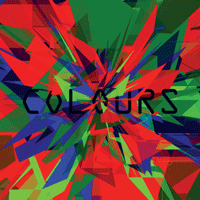






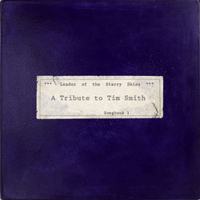










 Misfit City