Archive | cross-cultural music RSS feed for this section

June 2015 – upcoming London gigs – some options for Thursday night – Birdeatbaby leading the theatrics at the Black Heart; or Jammin’ Society at The Others

16 Jun

A few options for London gig-going this coming Thursday night.

event-20150618birdeatsbaby
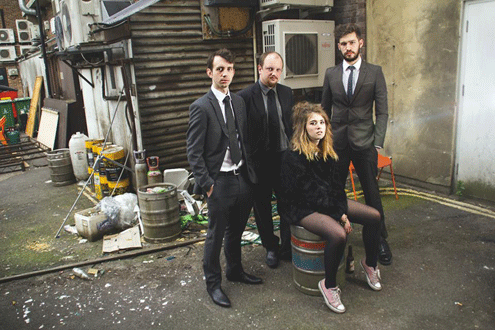
Birdeatsbaby + Gabby Young + Death In Texas, (The Black Heart, 2-3 Greenland Place, London NW1 0AP, UK, Thursday 18th June, 8.00pm)

There’s an invasion of Brightonian theatrics (with some honorary Londoners on board) at the Black Heart in Camden as the ambitious orchestral rockers/dark-cabaret pop stars Birdeatsbaby launch their new single – a cover of Muse’s Muscle Museum. The band promise “an unmissable launch party featuring some amazing live musicians, visuals and videos, new costumes and special guests!” Support comes from another showstopper – Gabby Young of Gabby Young & Other Animals fame (described by ‘The Guardian’ as “a gloriously cheerful live performer with an entertaining jumble of styles that match her flamboyant image. She has the power, clarity and precision of an opera diva but also an impressive jazz singer (with) thoughtful, sophisticated songs that continually switch direction,”) – and from the London-based Death In Texas, a dark and dreamy keyboards-and-drums drama-pop duo (whom we’ve encountered before). Tickets available here – priced £8.00. For a potential taste of the evening, have a look at the three videos below.

Alternatively, if you fancy something a little more interactive, there’s this:

The Jammin Society (The Others, 6-8 Manor Road, Stoke Newington, London, N16 5SA, UK, Thursday 18th June, 7.00pm) – free event

This is billed as “an alternative weekly vox, MC, muso, artist, dancer, poet, DJ, performer jam night. Bring your voice, your instrument or just your ears and get involved with the creation/appreciation of a unique sonic soundscape: KAOSS pads, Space Echoes, phasers, creative compression and homemade reverbs all have a role to play! All the gear provided: kit, amps, mics, conga, keys, lights, projectors, decks, dancefloor, bar, comfy sofas…” There’s a different house band providing the core of the music each week – I think that this week it’s Vibe Machine, but the Society season will also feature No Jam, Mana Wax and Playpen Playboys. More details here.

June 2015 – upcoming gigs – two more Darkroom gigs in London – Hubbub @ Wellcome Collection; Listening Club in Peckham

8 Jun

Having only just played at the last-for-now Tuesdays Post concert this past Sunday, loop duo Darkroom are performing at two more London gigs this month, both of them at typically interesting events.

Hubbub @ The Hub, The Wellcome Collection, 183 Euston Road, London NW1 2BE, UK, Thursday 11th June (time t.b.c.)

The Hubbub group (based at the Wellcome Trust) is a project with a brief to explore work, rest and play; past, present and future. The two members of Darkroom will be participating in a closed session, being “wired up and investigated” as part of the research. Details are still a little unclear (although I do know that the work will be live-streamed) so keep an eye on the Darkroom Twitter account. For an early taste of the project, here’s psychologist, writer and Hubbub investigator Charles Fernyhough guesting on a half-hour long Darkroom track, a late-night atmospheric piece recorded in The Hub earlier this year.

And on the upcoming Sunday, there’s this:

Listening Club @ The Peckham Pelican, 92 Peckham Road, London, SE15 5PY, UK – 4.00pm to 9.00pm – free entry

This is an events series in association with St John Sessions ( showcasing new experimental music. In addition to Darkroom, the gig also features sound artists Kostis Kilymis (from Thessaloniki via London), Franz Rosati (from Rome) and Memorial Bench (from London, I think). More chat about this over on Twitter.

June 2015 – upcoming gigs – tomorrow and this weekend in London and Watford – Chant Live! interactive gig; Silencio Sessions presents Surfing On Sinewaves; Daylight Music

4 Jun

Shortly after I posted news on voicelooper Georgina Brett’s Tuesdays Post concert on Sunday (which, incidentally, will be the last one for a while) she got in touch with news of two more gigs she’s playing tomorrow and on Saturday, so here’s the information on those (more or less in her own words).

Chant Live!, 5th June 2015

Chant Live! featuring Dave Barbarossa/Youth/Georgina Brett/Regina Martin/Dan Morrell/Jon Moss/Tom Nettlemouth/Jamie Grashion & very special guests, (Unit 5, Mirage Centre, First Way, Wembley, London, HA9 0J, Friday 5th June, 7.30pm)

The return of the legendary open source band! A showcase gig in a hidden private club venue in Wembley, ten minutes walk from Wembley Park tube – a bit of magic brought to the perimeter of the stadium itself. On stage will be myself, Dave Barbarossa (Adam & the Ants, Bow, Wow, Wow), Youth (Killing Joke, The Orb), Jon Moss (Culture Club) and Cosmic Trigger (Jamie Grashion and Tom Nettlemouth). There’s also pre gig talks about all things cosmic, the fractal universe and drumming with Gina Martin and the Queenswood Drummers. Great club sound system. An adventure!! Two drum kits, two bass guitars, djembe drum circle. Give voice, give hands, be the band: bring a drum or a shaker, percussion, chants, on-the-fly recordings, loops, mixes, mashes. Free event – for more info, call Guy on 07947 061257.

Silencio Sessions, 6th June 2015

Silencio Sessions, 6th June 2015

Silencio presents ‘Surfing On Sine Waves’ featuring Georgina Brett/Cos Chapman/James Conway/Tom Fox (LP Cafe, 173 The Parade, Watford, Hertfordshire WD17, Saturday 6th June, 6.30pm)

A night of looping, experimental and electronic improvised music.  As well as me there’s:

Cos Chapman, former oceanographer turned solo improvised electronics performer and member of both I Am Meat and Rude Mechanicals (there will be a fascinating video of how he creates his instruments from recycled materials).

James Conway, a Brighton based musician usually seen with electronic outfit Not These Tones: this time it’s an eclectic solo show on mixer, sampler and synth duties. No two performances by James are the same; it’s method in the moment, thrill in the risk.

Tom Fox, an experimental instrument builder who focuses on using reclaimed materials to create new and unique sounds and textures from common items, and will be presenting a film on his methods.

More info here – tickets £6.00 on the door.

Also just in, news on this weekend’s Daylight Music event…

Daylight Music 191: School of Noise + Sarah Angliss + Astra Forward (Union Chapel, Compton Terrace, Islington, London, N1 2UN – Saturday 6th June, 12pm to 2pm)

School of Noise are a collective of artists who run workshops for children, enabling them to make their own weird and wonderful instruments and experiment with sound art. They’re appearing live on stage for the first time performing their own pieces of experimental and electronic music. The group, made up of children ages 7-13, met at the School of Noise workshops where they explored a variety of approaches to creating, sculpting and listening to sound. The project, started by London musician Dan Mayfield, has been influenced by the works of Brian Dennis who ran the Shoreditch Experimental Music School in the late 1960’s.

Sarah Angliss is an award winning composer and performer whose music reflects her fascination with European folklore, faded variety acts and long-forgotten machines. Sarah is known for her highly unusual stage set which mixes theremin, saw and ancient instruments with the ensemble of musical robots she’s designed and built to work with her on stage.

Astra Forward is a Brighton based singer-songwriter and multi-instrumentalist. A raw vocal talent, she combines acapella, synth organ drones, ethereal harmonies and alternate guitar tunings into her performances. As a singer and keyboardist in The Robot Heart and Diagrams, Astra has toured throughout Europe and the U.K, supporting the likes of Gomez, Ben Ottewell, Athlete and St. Vincent. At this concert, she will play a solo set of her intricate and beautifully vulnerable electronica.

Alex Hall/Elephant returns to create an improvised guitar soundscape in between acts this week.

Free entry, but donations are (as ever) encouraged.

June 2015 – upcoming gigs – Sink and Alabaster DePlume on brief English tour this week

1 Jun

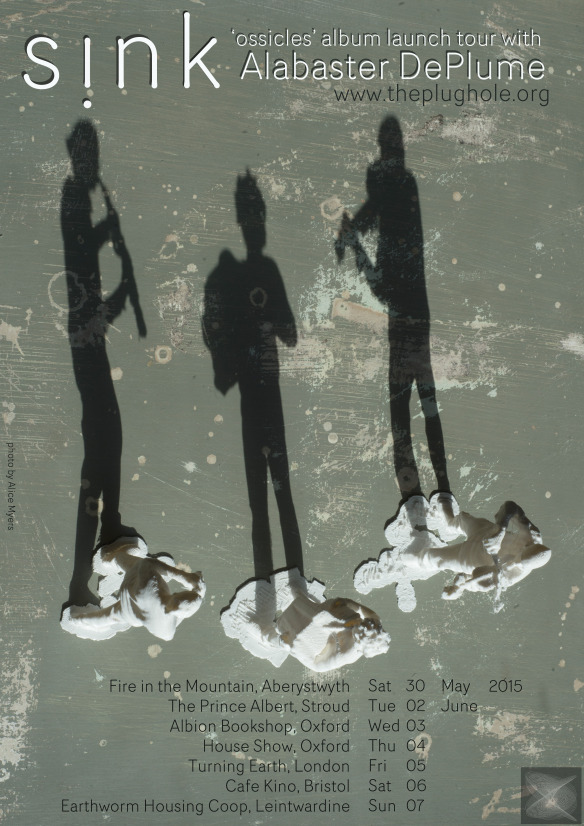
This just in from all-round Mancunian multi-media bloke (poet, songwriter, saxophonist, theatre-and-film collaborator) Alabaster DePlume. He’s on a tour of off-the-beaten track venues in the south of England this week with experimental Edinburgh improvisers SiNK, having started off in Aberystywyth over the weekend (sorry, I heard about that gig too late). It’s not entirely clear what they’re doing, but it’s safe to assume that there’ll be a spirit of discovery.

About SiNK, Alabaster says:

The tour celebrates their new album, ‘Ossicles’… Last time I played with them they created a ‘sound mirror’ – a bass drum on its side filled with water, with a speaker underneath. They played their music through the speaker and projected a light onto the water which was reflected onto the ceiling, where it displayed the geometrical shapes created by the sounds. They then played in response to the shapes (and each other) which changed in response to their playing.

event-20150601sinkalabaster

Tour dates:

The Prince Albert, Rodborough Hill, Stroud, Gloucestershire, GL5 3SS, Tuesday 2nd June, 8.00 pm – free event.

The Albion Beatnik Bookshop, 34 Walton Street, Oxford, OX2 6AA, Wednesday 3rd June, 7.30pm – tickets £8.00 (£5.00 concessions);

Nest Collective @ Turning Earth Ceramics Studio, Railway Arches 361-362, Whiston Road, London, E2 8BW, Friday 5th June, 8.30 pm – tickets £8.00 to £10.00 from here.

Café Kino, 108 Stokes Croft, Bristol, BS1 3RU, Saturday 6th June, 8.00 pm – tickets £6.00.

Earthworm Housing Co-Op, Wheatstone House, High Street, Leintwardine, Craven Arms, Shropshire, SY7 0LH, Sunday 6th June, 7.30 pm – free event.

Sounds intriguing…

June 2015 – upcoming London gigs – prog rock/math rock/post-hardcore @ The Facemelter; electro-pop/drum’n’brass/loops/experimental ambience @ Tuesdays Post; eclectic classical/experimental chamber music/kletzmer & Bulgarian voices @ The Forge

31 May

Some more early June gig previews for London – these would have been in the previous post if I’d picked up on them earlier.

Firstly, a Facemelter promotion (from the experimental rock/post-hardcore wing of the Chaos Theory organisation whose jazz gigs I’ve also enjoyed)…

Facemelter, 5th June 2015

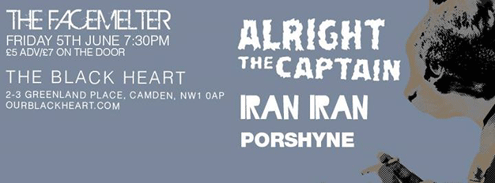
Alright The Captain + Iran Iran + Porshyne @  The Facemelter (The Black Heart, 2-3 Greenland Place, Camden, London, NW1 0AP, Friday 5th June , 7.30pm

Three heroes of math rock, alternative and post-rock travel from different corners of the UK to unite and form this amazing lineup.

Derby-based trio Alright The Captain masterfully combine virtuosic instrumentalism with unabashed musical experimentation and have effortlessly established themselves as a sonic force to be reckoned with, thanks to their increasingly inimitable, uniquely imaginative brand of math-rock. Their sprawling and varied career has seen them sharing stages with post-rock luminaries including Mono, toe, 65daysofstatic, Pelican, Tera Melos, ASIWYFA, Maybeshewill, Adebisi Shank (RIP), This Will Destroy You, ZU and many more. Their new album ‘Contact Fix’ (which ‘Musical Mathematics’ describes as “div(ing)  in and out of math rock, prog and post rock – but, at its heart, it’s different”) has gone down a storm.

Iran Iran are another supremely talented bunch of musicians who stunned and impressed all who saw them at ArcTanGent last year. With insanely complex rhythms and thunderously heavy riffs, the four-piece from Bristol have evolved since their excellent first EP ‘Crystal Math’ and are packing a punch. They’ve played with Future Of The Left, Cleft, Alright The Captain, This Town Needs Guns, You Slut!, Alpha Male Tea Party, Death Pedals and many others. Fans of complex musical wizardry or heavy riffs will love their new EP ‘Milk Time For Spiders’.

Brightoners Porshyne dance between ambient intervals and melodic vocals to intensely intricate, fantastically crunchy  prog rock riffs. With just a few single releases and a session filmed by Small Pond Recordings, they already sold out their first headline show in Brighton. This is your chance to catch the band before their career takes off.

More info here and here, and tickets here (£5.00 advance, £7.00 on the door).

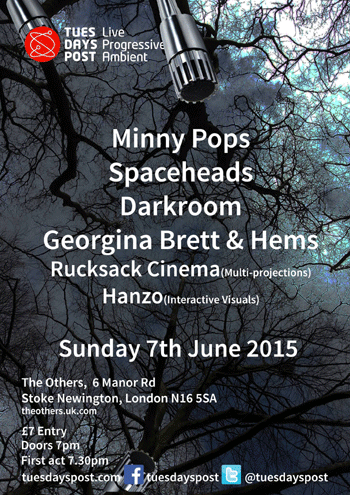
At the end of the same week, Georgina Brett’s Tuesdays Post event returns to Stoke Newington with another evening of ambient/progressive live music, including ‘Misfit City’ favourites Darkroom

event-20150607tuesdayspost

Minny Pops/Spaceheads/Darkroom/Georgina Brett & Hems @ Tuesdays Post, (The Others, 6 Manor Rd, London, N16 5SA, Friday 7th June, 7.00pm)

Formed by vocalist/band leader Wally van Middendorp in Amsterdam in 1978, Dutch electro pioneers Minny Pops took their name from a primitive Korg drum machine. The band released several singles and a debut album, Drastic Measures, Drastic Movement, on independent Dutch label Plurex before joining the legendary Manchester label Factory Records in 1980 (which resulted in them being produced by Martin Hannett, touring with both Joy Division and New Order, and becoming the first Dutch group to record a Peel Session). Singles including Dolphin’s Spurt, Secret Story and Time were followed by the acclaimed album ‘Sparks In A Dark Room’ in 1982. The band released two further albums (‘Poste Restante’ and ‘Fourth Floor’) before splitting in 1985. In 2012, the band reunited for a series of gigs in the UK, the Netherlands and Belgium and recorded a 7-inch single for Tim Burgess’ O Genesis label. After a pause to draw breath, 2014 has seen Minny Pops performing live once again.

Spaceheads are a cosmic duo of trumpet electronics and drums. Formed in 1990, they have developed a blend of electronics and sunshine fanfares over the course of ten albums, three EPs and much touring across Europe and the USA. Andy Diagram (also of James) plays trumpet with a mobile phone stuck to the top with a fish slice and Richard Harrison plays drums with big bendy metal sheets stuck to the top. They create live looped layers of brass driven by flurries of free flowing funky drums. Andy and Richard have achieved an intuition of what each is about to do next which makes their semi-improvised gigs a joy to behold. They release their first studio album in ten years – ‘A Short Ride On The Arrow of Time’ – this Autumn.

Darkroom – the UK-based duo of Michael Bearpark (guitars) and Andrew Ostler (synths)- expertly ride the line between luscious, old-school progressive rock and modern ambient electronics. At times reminiscent of early Tangerine Dream with hints of Fripp and Eno, they create clouds of sequenced synths, chewy grooves, and looped phrases to support a variety of acoustic and electric guitar melodies that twist and turn in surprising, occasionally aggressive, ways.

Hems Aka Henrique Matias will be playing live with Georgina Brett. Henrique is a multi-talented composer, programmer and DJ. He specialises in Multimedia programming (from internet things to Max/MSP and similars), although not all his live music and performances sounds like computer music (sometimes he takes his drum machines and crazy things out of the house). Georgina Brett’s music is created using her voice and effects pedals, creating instant choirs of sound, often in an hypnotic style. The point of this music is not only to captivate with extraordinary timing and melodic style but also to help the listener to relax in our ever-increasingly fast world.

Interactive visuals and multimedia projections are by Hanzo and Rucksack Cinema.

More information here – tickets £7.00 on the door.

By all accounts The Forge (in Camden Town) has spent the last few years becoming one of north London’s most interesting small venues for mixed music. I’ve yet to go there and see for myself: but in its full June calendar (also featuring funk, jazz, classical and Cuban music as well as assorted poetry) the following four concerts caught my interest:

Notus Winds & Eliza McCarthy (Wednesday 3nd June, 7.30pm)

Part of the classical monthly series Wednesdays at The Forge, this time featuring award-winning chamber ensemble Notus Winds and solo pianist Eliza McCarthy with a program of contemporary compositions (more information here). Tickets £10.00 to £12.00.

Programme:

Harrison Birtwistle – 5 Distances
György Ligeti – Ten Pieces
Arvo Pärt – Quintettino
Anders Hillborg – Six Pieces for Wind Quintet

Fenella Humphreys: Bach to the Future Part 1 (Tuesday 9th June, 7.30pm)

The first of three concerts presented by violinist Fenella Humphreys, featuring commissions of six new works by six of Britain’s leading composers to accompany Bach’s glorious 6 Sonatas and Partitas for unaccompanied violin. This first concert includes new works by Cheryl Frances-Hoad and Gordon Crosse alongside extraordinary music by Bach, Scott, Westhoff, Hindemith. Tickets £10.00 to £12.00.

Programme:

Cyril Scott – Bumble-Bees (1928)
Johann Paul von Westhoff – Suite no. 5 in D minor (1682)
Gordon Crosse – Orkney Dreaming (2014)
Fritz Kreisler – Recitativo and Scherzo-Caprice op. 6 (1911)
Paul Hindemith – Sonata op. 31 no. 2 ‘Es ist so schönes Wetter draussen’ (1924)
Johann Sebastian Bach – Partita no. 3 in E major BWV 1006 (c. 1720)
Cheryl Frances-Hoad – Suite no. 1 (2014)
Eugene Ysaye – 2nd Sonata op. 27 (1923)

Reciprocity: a new work by Daniel Patrick Cohen (Wednesday 10th June, 7.00pm)

Reciprocity is a 28 minute work for voice, taped narration, eight celli, piano, and percussion. The piece was composed by Daniel Patrick Cohen from six poems by the late Darya Farha, a Canadian poet, therapist, filmmaker and clothing designer. Darya was an extraordinary woman whose sharp intelligence, dry wit, distaste for orthodoxies and boundless empathy fuelled restless journey through her unfinished life. Darya died of breast cancer in 2011 when she was 46, and Reciprocity was commissioned by her sister Juliana Farha, who lives in London. Reciprocity is not about cancer, however. Instead, its human and universal themes of joy, pleasure, fear and anger, along with its intriguing instrumentation are sure to engage a broad audience. You can read more on the project here, and here. Tickets £6.00.

She’Koyokh & Veda Slovena Bulgarian Choir (Thursday 11th June, 8.00pm)

In a unique collaboration, She’Koyokh & Veda Slovena Bulgarian Choir combine the fiery panache of klezmer and Balkan music with the timeless beauty of Bulgarian voices, weaving Jewish, Turkish and Balkan music into the rich tapestry of the Bulgarian choral tradition. Read She’Koyokh’s piece on their Veda Slovena collaboration here. Tickets £10.00 to £12.00.

(All events taking place at The Forge, 3-7 Delancey Street, London, NW1 7NL)

June 2015 – upcoming London gigs – A Formal Horse & Ham Legion; Olga Stezhko; The Spiders of Destiny play Frank Zappa; a Bowie Night in Soho

29 May

Here’s some quick info on upcoming gigs in early June which I’ve heard about – all of them in London.

Over the last couple of years, Westminster Kingsway College has established itself as one of the capital’s finest homes for quirky art-rock – by which I don’t mean student hobby bands thrown together for campness or for ironic prankery, but a rich, complex, committed electric music spanning the range between gutter-punk and flouncing prog via metal, jazz, folk, avant-gardening and anything else which gets melted down into the stew. Here’s one of those gigs that proves the point.

A Formal Horse, 2015

A Formal Horse + Ham Legion (Westminster Kingsway College, 211 Gray’s Inn Road, London, WC1X 8RA, Tuesday 2nd June, 6.30pm)

A Formal Horse is a new progressive rock quartet based in Southampton. Although the band’s sound is difficult to pinpoint, their dense instrumental passages are reminiscent of King Crimson and Mahavishnu Orchestra, whilst Francesca Lewis’ lead vocals evoke the whimsical surrealism of the 1970s’ Canterbury scene. Wonky melodies and serene vocals over a brutal sound – their music keeps you on your toes. However, A Formal Horse go beyond simply regurgitating the music of their predecessors. With influences as diverse as Bartók and Bon Iver, the band prove that there is still much territory to be explored in the field of British progressive rock.

In June 2014, the band released their debut EP, which was recorded by Rob Aubrey (IQ, Transatlantic). They went on to perform at London’s Resonance Weekend alongside Bigelf and Änglagård, and were described by Prog Magazine as a “festival highpoint”. Since, they have shared stages with Knifeworld and Lifesigns, cementing their position at the forefront of the British progressive scene.

Ham Legion spent 2014 honing their sound and developing a storming live show. You can expect a collision of beaming up beat power pop, grinding metal outbursts, dramatic changes of mood, sudden passages of twistingly epic prog then moments of restrained delivery and somber reflection. They are striking out in 2015 with the release of their debut album towards the end of the year.

Tickets available here – £6.00/£5.00

Olga Stezkho: 'Eta Carinae'

Olga Stezkho: ‘Eta Carinae’

Olga Stezhko (the far-thinking Belarusian classical pianist whose ‘Eta Carina’ album impressed me so much last year) has two London concerts coming up in the first fortnight of the month. The second’s likely to be an all-access crowd-pleaser. Given its charity fundraiser status, I’m not sure whether the first is likely to feature or indulge any of Olga’s intriguing conceptual preoccupations with Scriabin, Busoni, cosmology and early twentieth century consciousness, but even if it isn’t it’s a great opportunity to see a fine musician at work in a grand location.

Olga Stezhko charity piano recital in aid of Friends of the Belarusian Children’s Hospice (St Pancras Parish Church, Euston, London NW1 2BA, Thursday 4th June, 1:15pm – 2:00pm)

Programme not revealed – free admission, donations requested.

EC4 Music in aid of The Prince’s Trust (Barbican Hall, Tuesday 9th June, 7:30pm – 9:30pm)

The choir and orchestra of London-based EC4 Music return for their seventh fundraising concert in aid of The Prince’s Trust with a stirring selection of music from both sides of the Atlantic.

Programme:

Leonard Bernstein – Overture from ‘Candide’
Aaron Copland – Appalachian Spring
George Gershwin – Rhapsody in Blue
Vaughan Williams – Serenade to Music
Leonard Bernstein – Chichester Psalms
Eric Whitacre – Water Night
Hubert Parry – Blest Pair of Sirens

Performers:

EC4 Music Choir and Orchestra
Tim Crosley – conductor
Olga Stezhko – piano
Claire Seaton – soprano
Roderick Morris – countertenor
Thomas Herford – tenor
Adam Green – baritone

Tickets available here – prices from £10.00 – £35.00 plus booking fee.

Some of London’s most active art-rockers are brewing up a free Zappa homage in Croydon at around the same time. Details below:

event-20150606spidersplayza
The Spiders of Destiny play Frank Zappa (The Oval Tavern, 131 Oval Road, Croydon, CR0 6BR, Saturday 6th June, 8:30pm)

Great googly moogly! On June 6th, nine-piece tribute band Spiders Of Destiny come to The Oval Tavern to play a marathon set of music by the late, great Frank Zappa. Featuring world class performers with a sense of humour from notable prog/alternative bands such as: Knifeworld, Perhaps Contraption, Pigshackle, Medieval Baebes, The Display Team, Hot Head Show, Poino, Spiritwo, First, A Sweet Niche and more. So polish up your zircon-encrusted tweezers, trim your poodle, learn the mudshark dance and join us as we propagate the conceptual continuity instigated by one of the masters of modern music.

More info here – this gig is FREE ENTRY but there will be a donations jug doing the rounds during the intermission.

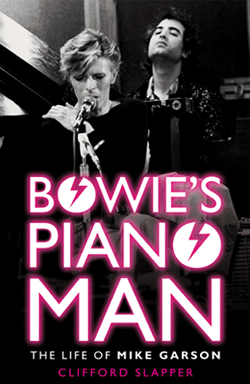
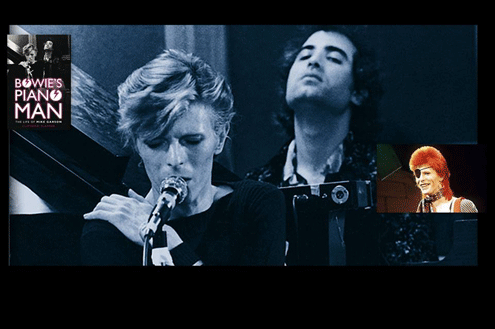
book-bowiespianomanAnyone with an interest in David Bowie, rock history, cabaret, electropop and all of the other things that get swept up into Bowie’s art should head to Soho on Thursday 11th June for A Bowie Night at Gerry’s Club, at which pianist and writer Clifford Slapper launches his book ‘Bowie’s Piano Man: The Life of Mike Garson‘ (which also has its own Facebook page).

As well as readings and signings there will be performances of Bowie songs from avowed fans Danie Cox (from “flock-rockers” The Featherz), Ray Burmiston (of ’80s heroes Passion Puppets), club siren Katherine Ellis (Freemasons, Ruff Driverz, Bimbo Jones etc.) and acoustic singer Jorge Vadio. There’ll also be a performance from a longtime ‘Misfit City’ favourite – London balladeer, Brel translator and onetime ‘Pirate Jenny’s’ host Des de Moor, who’ll presumably be singing his Bowie-gone-chanson interpretations from his ‘Darkness and Disgrace’ show. (I’m particularly pleased to see that Des is back onstage. It’s been a long time.)

More on the book below, and more on Gerry’s Club here.

“It is pointless to talk about his ability as a pianist. He is exceptional. However, there are very, very few musicians, let alone pianists, who naturally understand the movement and free thinking necessary to hurl themselves into experimental or traditional areas of music, sometimes, ironically, at the same time. Mike does this with such enthusiasm that it makes my heart glad just to be in the same room with him.” – David Bowie

Mike Garson has played piano on sixteen David Bowie albums, including Aladdin Sane, with his celebrated piano solo on its title track, Diamond Dogs, Young Americans, 1. Outside and Reality. He has also played live with Bowie on countless tours and shows, and remains his most long-standing and frequent band member.

For some time Clifford Slapper has been working very closely with Garson to write a book which explores the life of this extraordinary and eccentric modern musician. It documents in detail how as a pianist he was catapulted overnight from the obscure world of New York’s avant-garde jazz scene to a close and long connection with Bowie. In addition, Garson is recognised as a classical virtuoso, a jazz master and one of the world’s greatest exponents of improvisation. He has also recorded and performed live with other rock legends such as the Smashing Pumpkins and Nine Inch Nails. All of this is covered by this first ever biography of Mike Garson.

Its starting point was several days of in-depth and frank conversation with Garson himself, and covers a wide range of themes which will be of interest to all Bowie fans, but also to anyone with a passion for music, social history or the process of creative inspiration. Input has also come from many interviews with those who have worked with him over the years, including Earl Slick, Trent Reznor, Sterling Campbell, Reeves Gabrels, Dave Liebman and many others.

event-20150611bowienight

May 2015 – upcoming London rock gigs – Gryphon’s crumhorn-wielding at the Union Chapel (preview via ‘Organ’)

28 May

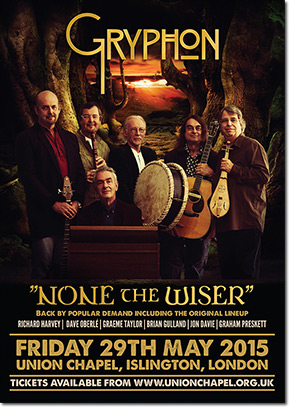
I’m really out of the loop – I didn’t even know that Gryphon were playing, let alone touring. If I’d known, I’d have blogged about it earlier (and perhaps saved up for a ticket).

Gryphon are a wonderful band – a serious-minded but no-bullshit bassoon-and-crumhorn-toting electric folk/prog oddity with a perfect and elegant focus. They seemed to come about almost by accident in the early ’70s, as if a group of matter-of-fact mediaeval music scholars had suddenly been caught up on a lolling tongue of rock and taken off for a ride for a few years. I’ve not seen them play since 2009, when after thirty-one years they finally put on a reunion at the Queen Elizabeth Hall. In a lone concession to rock theatre, reed player Brian Gulland turned up in a Wild Man of Borneo barnet and matching beard, and had the latter shaved off with a straight razor during the encore. Otherwise it was a straight demonstration that it was Gryphon’s music which had always mattered – inclusive, always choosing the deft path over the clotted, as clear as a bell and never overblown. They promised us a new album, but went quiet about that very quickly: at least they’re still up for playing.

If you’ve not already committed to something else for tomorrow’s London evening (and I know I’ve already pitched you two other options in the past week) do go along, but don’t just take my word for it. Here’s Organ’s typically gonzo-rapturous take on the band and the tour. I couldn’t agree with them more.

seanworrall's avatarTHE ORGAN

gryphon_unionchapel_flyeGryphon are on tour, this is a very very good thing, Gryphon are gloriously beautiful, they’re like Bagpuss or strawberry jam on toast, they’re like every good thing from back there when all was good, pipe organs and tank engines and crumhorn-wielding and jousting and as cool as f. And tomorrow is the final night of their rather unexpected current tour – It has been a long time coming and so it is with enormous pleasure that we announce the Gryphon “None the Wiser” tour. – Gryphon bring their unique blend of English prog, refined folk and mediaeval warmth to London’s Union Chappel

Gryphon is the oldest and the newest thing – a legendary British band that’s as exhilarating, energetic, unpredictable and addictive now as it was when the band last toured, in the 1970s. At that time, no-one could pigeonhole Gryphon. The band appeared on BBC Radios 1, 2…

View original post 413 more words

May 2015 – End-of-May gigs (mostly London) – Bank Holiday weekenders from Daylight Music and SmileAcoustic; a mixed-classical benefit for Nepal; Knifeworld again; fun and frolics underneath the arches with John Ellis and co.

22 May

Just because I’m likely to be stuck indoors for the next fortnight doesn’t mean that you have to be. Some interesting gigs are coming up in – mostly in London, I’m afraid – but just in case any of you are London-based, here are some ideas to see you through until June.

First of all, there are two free Daylight Music events over the weekend. Running eclectic free gigs that span from cosy to experimental, and from classical to folk to noise-pop, Daylight Music have been a Misfit City favourite for a long time. See here for reviews of previous events in September and October 2013 and in January 2014; and see below for details on the upcoming concerts…

Join us for a weekend of music with artist travelling from Los Angeles, Wales and Spain to dazzle you. And while you’re reading this, have a listen to a special mix by Ex-Easter Island Head.

Daylight Music 190: Winter Villains + Poppy Ackroyd + Jon DeRosa (Union Chapel – Saturday 23rd May, midday to 2pm)

The new Spring Season kicks off with a name to watch; Poppy Ackroyd is a classically trained pianist and violinist who weaves delicate, atmosphere music by manipulating and multi-tracking sounds from just those two instruments. On the same week, you can hear Cardiff’s Winter Villains and their intricate chamber pop music (the duo were nominated for the Welsh Music Prize in 2013) and Jon DeRosa from the USA, whose new album ‘Black Halo’ is out via Rocket Girl on 25 May. Hannah Lawrence plays some usual and some unusual melodies on the Henry Willis organ in between this week. Full details here.

Colleen with Ex-Easter Island Head (LSO St Luke’s – Sunday 24th May 7.30pm)

A double bill of musicians renowned for manipulating your expectations as much as they do their instruments; creating hypnotic minimalist music from simple arrays of strings, percussion and even just vocals. Colleen mixes acoustic instruments with electronic sampling techniques to create rhythmic, lyrical folk-pop songs. Her new album Captain of None will focus on a melodic repertoire, with fast-paced tracks rooted by prominent bass lines and her instruments of choice, the treble viola da gamba and her voice. Liverpool-based Ex-Easter Island Head turn the electric guitar on its head, to compose physical, droning soundscapes.

Next up, on Bank Holiday Monday there’s an afternoon-and-evening free concert in Bethnal Green, promoted by unplugged specialists Smile Acoustic (who are new to me, but seem very welcoming). Far too many different acts to summarize quickly – although I do recognise Matt Finucane, who first came to my attention doing anti-pop with Empty Vessels years ago and who’s now matured (though he probably wouldn’t use the word) into a sinister songwriter and a horror/science fiction writer. Read on…

SmileAcoustic: Tasting Menu Bank Holiday Special (Rich Mix – Monday 25th May, 4pm onwards)

Smile Acoustic has been making many friends, and all our friends seem to make great music… so we thought it high time for a get together. An extra long weekend requires extra entertainment after all! So we present a feast of flavours, in our first ever Tasting Menu. Full information here.

4pm – Prash Gor, Kirsten McClure, Lauren Lucille, Matt Finucane, Dave Santos, Gian Luca, Mark Harrison, Jeremy of The Green Rock River Band, Horatio James

7pm – Bellatrix, Camilo Menjura, Arthur Lea

Yes we’re cramming in a ridiculous amount of talent into an additional late afternoon show, as well as our usual evening gig. An incredible array of original songsters will be gracing the stage, with a line up that takes us all the way from banjo to beatbox. Free entry as ever, as is the cake. See you there!

On Friday 29th May, in west London, UK Music for Nepal are putting on a classical music benefit aiming to raise ten thousand pounds for the victims of the earthquake. It’s mostly performances of Romantic and Baroque work (by Chopin, Rachmaninoff, Brahms, Bach, Liszt and Fauré), but with a few outbreaks of early twentieth century modernism via some Scriabin pieces, plus a world premiere of a new piano work by composer Keith Burstein (a onetime Romantic Futurist and still an ongoing champion of latterday tonal music – see here for a long-ago review of his first String Quartet). It’s also got a striking array of performance talent – see below…

Gala Concert for Nepal @ St Barnabas Church, Ealing, May 29th 2015
Gala Concert for Nepal (St Barnabas Church, Ealing, London, Friday 29th May, 7.30pm)

Programme:

Johann Sebastian Bach – Chorale Prelude “Nun Komm die Heiden Heiland” BMV 659
Frédéric Chopin – Polonaise-fantaisie in A flat major, Op.61
Gabriel Fauré – Sicilienne, Op.78
Gabriel Fauré – Élégie, Op.24
Aleksandr Scriabin – Etude in D# minor Op.8 No12
Aleksandr Scriabin – Nocturne for Left Hand
Sergei Rachmaninov – Cello Sonata in G minor, Op.19
Franz Liszt – Consolations, S.172
Sergei Rachmaninov – Prelude in G minor Op. 23 No. 5
Johannes Brahms – Variations on a theme by Paganini (Book 1)
(and a world premiere by composer Keith Burstein)

Performers:

Alicja Fiderkiewicz, Carlo Grante, Artur Pizarro, Murray McLachlan, Viv McLean, Nico de Villiers, Keith Burstein – piano
Corinne Morris – cello

Tickets available here – prices from £20.00 to £50.00.

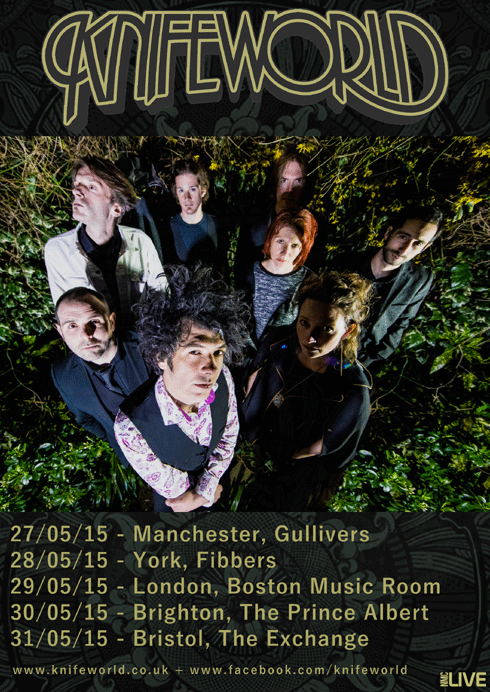
Also on Friday 29th May there’s the latest London gig by Knifeworld, part of a five-date English tour also taking in Manchester, York, Bristol and Brighton (as mentioned a few posts back). Expect an evening of explosive, tuneful and corrugated art rock played with the vigour of a soul revue and the complexities of a ’70s prog band. For the York gig, they’re supported by motorik rockers Muttley Crew and for the London gig by bounding art-rockers Barringtone (ex-Clor) and Cesarians. The Brighton gig is a Tim Smith benefit gig at which they’re supported by prog-poppers Ham Legion, the mysterious M U M M Y (a brand new project by Cardiacs affiliates Jo Spratley and Bic Hayes) and self-styled bitter and twisted songwriter Stephen Evens (who says of himself that “the songs are beautiful and the words are horrible. I don’t know why you don’t think that’s a good thing…”).

Knifeworld on tour, May 2015

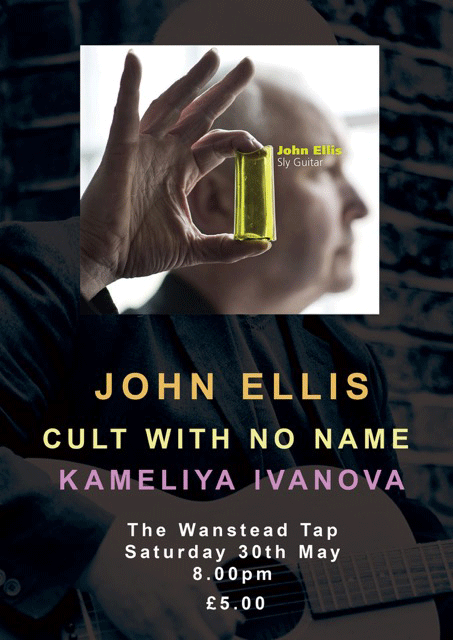
Finally, on Saturday 30th May at 8pm there’s what’s billed as “a night of fun and frolics” at the Wanstead Tap (a craft beer shop in Forest Gate which doubles – or quadruples – as café, bar and performance space). The main attraction is John Ellis (the former Peter Hammill, Stranglers and Peter Gabriel guitarist whom ‘Misfit City’ last encountered via his ‘Sly Guitar‘ album). John’s solo gigs are rare, but he’s something of a master of post-punk art-rock guitar, so well worth seeing. Also on the bill are “post-punk electronic balladeers” Cult With No Name and Kamelia Ivanova (who’s either highly mysterious or needs to fix his or her Facebook page). See below for the flyer.

John Ellis concert @ The Wanstead Tap, 30th May 2015

November 2012 – EP reviews – One Thousand Lucky Cranes’ ‘One Thousand Lucky Cranes’ (“restful hiccups”)

28 Nov
One Thousand Lucky Cranes: 'One Thousand Lucky Cranes' EP

One Thousand Lucky Cranes: ‘One Thousand Lucky Cranes’ EP

From Tennessee to the heart of the mountains of central Japan is a long way. I’m not sure what’s brought Ben Bryant from one to the other, but his debut offering as One Thousand Lucky Cranes shows the stretch. While these four tunes are nominally in the box for downtempo chillout electronica (with a side helping of glitch), they’re also attenuated, deconstructed tunes. Untitled agglutinations. Restful hiccups. A feeling that’s a little like that moment when, relaxing on a beach somewhere, you’re momentarily jolted into realising just how far from home you are.

Despite the tumbling data-flop of its intro (and the corrupting glitch atmospherics which score creases and interruptions into its texture), No.1 quickly reveals itself as deconstructed soul. More specifically, a Philly-inspired slow jam; from the lustrous breath-sighs to the jazzy climbs, to those Air-style analogue doodles with their pitch-bending vocalisé effect. Everything in it has that cushioned lushness and summertime daydream feel to it, with electric piano pads stroked and lovingly distorted into tiled, fuzzed chillout chimes. Notes and sounds have a fallaway feel to them, as Ben toys with wavering queasy pitching or leaves us in expectation. Japanese trinket tinkles worm their way into the mix: toys wearing down their batteries on the console.

There’s a little bit of soul in No.2, though only the slightest taste. One of Ben’s sounds is sourced from the sweetest electric organ sounds, but sliced off the top of the frequencies and rendered from gospel hints into an artful saccharin. Most of the other sounds are flickered by processing – treble-sharpened melody gurgles, a sweet baby-tone climb glimpsed through a strobing blur of reverb. Even the drum sounds (despite keeping a thread of industrial funk running throughout) are inverted and upended, imploded beats and cymbal hits trapped in a thicket.

On No.3, glitched beats are dropped into the music like someone dropping random glass beads into a Geiger counter. A slow phased sweep of synth pads (like the luminous cloud-roll Prophet-noise of the late ‘70s), offers something slightly meditative and slightly irritated, cross-legged but glaring sideways. Layers of glitched percussion twists and carpet-bomb bass distortions are folded into the mix. If you’ve still kept hold of that beachy simile from above, imagine the same, but with little smoke-shells bursting in mid-air above the mellow golden sands.

No.4 rises out of a sea of finely sifted white noise, revealing an ominous minor-key structure behind it. There’s something here that’s similar to the sweetly-sung anxieties of Horace Andy at work with Massive Attack on ‘Mezzanine’: a hint of ghost-town industry, of grand soul with the security sucked out of it… perhaps an echo of Detroit despair imprinted on in the architecture. Rather than Andy’s sensual suede-creak of a voice, though, the vocal here is an accelerated burble, part-housefly and part child-babble, stretching and meandering around the slow-stepping arches of fuzzy melody. Glitch-taps and dubstep activity fire about in the percussion, data-screeches kick some cold sparks off the chords. Throughout, the white noise comes through in hose-spurts; or tide-smacks, pushing its way through the buildings – a dream of the first drops of the flood. As with all of the tracks on this EP, the sense of solidity, dislocation and imminent upset come bundled close together, blurred over like a multiple exposure.

One Thousand Lucky Cranes: ‘One Thousand Lucky Cranes’
One Thousand Lucky Cranes (self-released, no catalogue number or barcode)
Vinyl/download EP
Released: 26th November 2012

Get it from:
Nimbit Music, Bandcamp.

One Thousand Lucky Cranes online:
Facebook Twitter Soundcloud Tumblr Bandcamp

March 2010 – album reviews – Meczûp’s ‘Hanging from the Purgatory’s Pendulum’ (“intimations of strings, pipes and carefully torn air”)

12 Mar

History can catch at things and mess them around. Take the theremin – a serious instrument, reduced to a circus trick, with a story that reads like a map of twentieth-century aspirations and follies. Early days were heady: born from Russian security research, Léon Theremin’s electronic instrument was quickly diverted to more high-minded classical music uses: mostly summoning up the sounds of the ethereal spheres for mystically-minded intellectuals. Now? The gimmick tray. Its “woo-woo” glissandi are used to evoke gimcrack spookiness, or as a quick and flashy shorthand for psychedelic derangement.

Worse – on half of those occasions when you’re assured that you’re actually hearing a theremin (Good Vibrations, the original ‘Star Trek’ theme, early Portishead) what you’re actually hearing is a forgery. Based on motion detectors and on hands that aren’t allowed to touch anything, the genuine instrument is tougher to play than a greased fiddle. Hence (for those who want a quick route to the theremin sound without the sweat, physicality and sheer involvement of playing one) the slew of knock-off devices and plug-ins available for faking the flitter.

It’s all a little sad. Despite the efforts of a distinguished handful of composers (not least Shostakovich and Miklós Rózsa) the theremin passed quickly from being the sound-of-the-future to becoming a sonic trinket and a source of freaky icing – all via pop culture, counterfeitery and the Cold War. You could scarcely blame Léon Theremin if he were spinning in his grave (sounding a heavenly wavering burble of rage as he did so). Hearing a theremin played in a way that’s even slightly close to the original intent is something of a rarity these days. While he’s not exactly a purist, Cihan Gülbudak (better known as Meczûp) clearly takes his own theremin seriously enough to steer it back to roots-level.

On ‘Hanging From The Purgatory’s Pendulum’, Meczûp’s theremin is accompanied only by its own looped signals, and sometimes by a gauzy, delicate brushing of fuzz-noise shrouding the pure tone in a gentle, finely-milled distortion. Mostly, though, Meczûp suspends the instrument in wide space, sending its sliding, sustained tones out as a majestic keen. His control is exemplary, mastering the air-shaping swoops and pinches necessary to pull away from plain electronic tone and towards intimations of strings, pipes and carefully torn air. Where a little more flex is required there’s a whammy-pedal available, heaving the pitches up and down in tidal zooms, and giving the music the apocalyptic boom of a Messaien organ-blast.

Besides the skill of Meczûp’s fingertips, the other key ingredient in his work is locale. Based in Istanbul, he sits at the historic conceptual crossroads of East and West. Seemingly setting aside contemporary blendings of globalization and cyberculture, his music taps into older frictions and fertilizations. There’s an old-fashioned sense of discovery here. Geographies slide across each other and voices strain to mingle, from the earnestly mangled English of the song titles to the cross-sifting of the musical impulses. Throughout the album, echoes of the classical European yearn-to-order meet intimations of Eastern devotional. Despite Meczûp’s classic theremin technique his musical lines don’t have the chilly ethereality of the original approach. They sound more like ney flutes, duduks or zurnas – Middle Eastern wind instruments with their own connection to Sufi, shamanism and oral histories; to the angelic and diabolic aspects of spiritual experience; or the difficult memories of the region’s blood-mottled sway between the heights of civilization and the depths of brutality and pain. There are notes of beauty and agony here, calling up more than a few old ghosts.

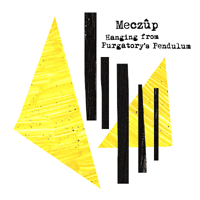
Meczûp: 'Hanging From The Purgatory's Pendulum' (previous cover)

Meczûp: ‘Hanging From The Purgatory’s Pendulum’ (previous cover)

At its most basic, Meczûp’s music sounds predominantly Eastern (the brief Arabic piping of Shadow: A Parable) but the musical crossings-over are far more interesting. Beneath the long whining melodies that cap and guide A Tale For Lancinant Screws, a kind of slender and abbreviated suggestion of Renaissance counterpoint emerges. It’s less an outright structure than a kind of haunting, like the image of a face flattened out across an endless carpet. A similar device haunts The Ribald Genie, ghosting underneath a lonely melody which gradually alters from pure keen to distorted scream and finally to a melancholy sarangi moan. For the brief but wide-ranging Garoun A, more of these suggestions blur into whalesong glissandi: a succession of theremin voices from teetering soprano to slithering sub-bass chase each other before tailing off into echoes.

Meczûp’s sharp appreciation of lines of beauty dominates the record, although at points this is deliberately overstretch to the point of breakdown. On Puriest Morning of All Times, baroque intimation destroys its own bounds: a vaulting lead melody (first soprano, then alto) strides downwards into echo-space before more parts build into a looping, uneasy fugue. As it moves on, the theremin sound begins to rip and degrade, eventually becoming a mass of gargling sharp-edged rattles like a rockslide or a Geiger counter. Blossoming in Cemetery sits between Bach liturgy and Armenian lament, maintaining an ache and yearn for six minutes before the theremin’s translucent cloak of distortion cracks and dissolves, and the melody starts to reiterate as a scabrous insect buzz.

In spite of his austere tendencies, Meczûp allows a little fantasy into the mix for a couple of pieces, drawing on and transforming pinches of popular culture. The first of these is Kwaidan, rooted in Japanese ghost tales via Lafcadio Hearn and cinema. Relinquishing the counterpoint which informs the rest of the record, it brings out more of the Eastern melodies while walls of looped theremin churn in the background, fluttering and stuttering on a grand scale.

The second is The Bridge of Khazad-dûm – an etiolated isolationist drone which becomes perhaps the most powerful work on an album already full of grand-scale intimations. It takes its inspiration from Tolkien: specifically, that chasm-spanning subterranean stone bridge which (at a key point in ‘Lord of the Rings’) becomes a locus for death, despair and ruin. Meczûp interprets another aspect, capturing something of Tolkien usually drowned under torrents of merchandising: his valedictory quality, the way his stories shuffle and re-deal the racked old bones of history, romance and inevitable decay for one final mournful hurrah. Meczûp’s vision of the bridge is of an ancient, significant place deserted. Plangent teary layers of theremin fuse together, cold spaces emerge in the music, and entwined senses of antiquity and abandonment are caught in broad view.

In fact, this sense of stricken grandeur applies equally to the rest of the album. Meczûp’s eerie, assertive picking-over and teasing-out of elements within of his music feels like a week spent immersed in history. It has the same tasting of triumphs and fleeting beauty; the same dawning feeling that one somehow fits into something so much broader and complicated. Through it all, the theremin rises triumphant. Survival and vindication.

Meczûp: ‘Hanging From The Purgatory’s Pendulum’
BFW Recordings, BFW038 (no barcode)
Download-only album
Released: 1st March 2010

Buy it from:
BWF Recordings, Magyar Walltapper or Reverb Nation. 9-track version also available from Bandcamp

Meczûp online:
Facebook Twitter MySpace Bandcamp

LOOKBACKS – album reviews – Cindytalk’s ‘Wappinschaw’, 1994 (“one of 1994’s most intense, perverse and unusual lost albums”)

30 Aug

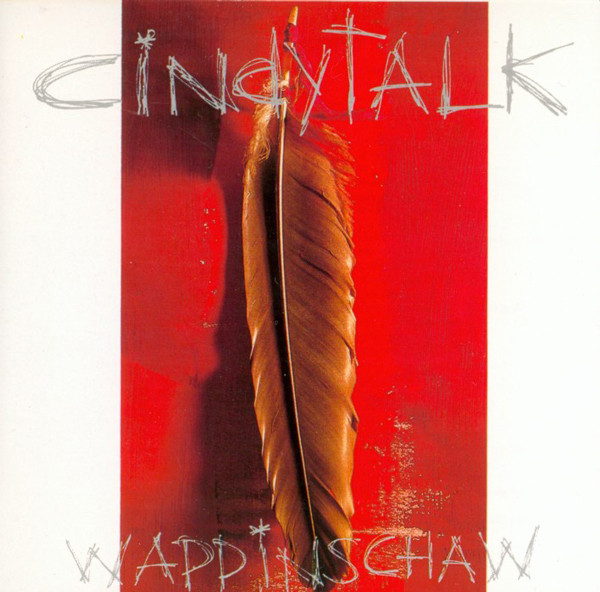
Cindytalk: 'Wappinschaw'

Cindytalk: ‘Wappinschaw’

For almost fourteen years now, Cindytalk have been forging a lonely path through the ever-changing styles of modern music. Despite the soft pink flush of their name, Cindytalk’s music has always been so out-there, so much a music of violent extremes, that they have (more or less by default – how much could you change when you touch both ends of the spectrum?) stayed the same – no bad thing – while refining their sound on each album.

Gordon Sharp, the mainstay of Cindytalk’s many line-ups, is perhaps best known as the voice of three haunting tracks on the first album by 4AD art-collective This Mortal Coil, which also spawned Elizabeth Fraser’s honey-drenched version of Tim Buckley’s Song To The Siren in 1983. Yet 4AD-ethereal was never really Sharp’s bag. Cindytalk operate in the same dark areas that Michael Gira and Swans did before they transformed into doom-laden acoustic hippies (no more titles like Raping A Slave, then, Michael? cheers, love!), or The Birthday Party before Nick Cave mellowed out into Satan’s crooner.

They’ve wilfully, awkwardly, pursued music of extremes. Their first album, ‘Camouflage Heart’, must rank somewhere alongside Lou Reed’s ‘Metal Machine Music’ for sheer unlistenable music for (dis)pleasure, that has to be owned simply to piss people off. And the mammoth ‘In This World’ was a double album of contradictions – one record of near-industrial rock with razor-sharp guitar sounds (varying between tooth- extraction by electric power drill or sheet-metal white noise), and one record of near-ambient instrumentals and songs, mostly played on very soft piano like Erik Satie on Mogadon.

But it’s been a long time since any new Cindytalk material; perhaps because of artistic reclusiveness, perhaps through being a true cult act. Having already had a protracted recording between 1990 and 1992, this album took a further two years to emerge on a record label in 1994. A lone concert aside, we’ve heard nothing from them since (that’s what y-o-u think.. – ED.). Hence this five-years-after-the-event review: cults can always do with getting bigger while they wait for the resurrection.

So, ‘Wappinschaw’; one of 1994’s most intense, perverse and unusual lost albums…

 
It opens deceptively simply, with an a-capella reworking of Ewan MacColl’s The First Time Ever I Saw Your Face, reflecting Gordon Sharp’s interest in folk idioms (especially his own native Scots). He’s singing solo, without echo or reverb, up close, right there in your darkened room. His voice – one of the most expressive at conveying rage, pain, fear – displays power here yet, somehow, also insecurity. A Song Of Changes is leaden-paced at first, but David Ros’ guitars are more blurry and hazed than previous industrial strength Cindytalk noise. Suddenly the guitars hit an almost bright riff around which Sharp fluctuates and soars. A song of changes, indeed – light is breaking into Cindytalk’s dark world: “Within the heart of everything, there is you…”

 
It doesn’t last, though. Return To Pain (hah!) lurches in on a mix of barely-scrubbed electric and slide guitars, creating an empty and menacing atmosphere as Sharp emotes through wordless high vocals. It’s nightmare swamp music, midnight in the Mississippi plains accompanied by the scariest of companions, before the tension explodes into a barrage of noise. Drums, shotgun guitars, and Sharp wailing that “everybody is Christ.” Y-e-e-es; whatever you say, Gordon.

 
Whichever expectations are set for them, Cindytalk trump them on this record. Wheesht is introduced by a tape of Alisdair Gray reading an extract from his mammoth Scottish psycho-epic ‘Lanark’: a story of a young boy dreaming about what lies beyond the clouds. Recorded over the sound of a ticking clock and a ghostly musical box, this exercise in unsettling atmospherics chills the spine and sets us up for Wheesht itself: a brutally short, non- musical violent collage of bass drones, sonic interferences, sampled voices, blood-curdling screams and other genuinely unnerving sounds.

 
To the looping, echoed scrapings of a low-tuned violin, Snowkiss restores some sense of calm with more of Cindytalk’s music for winter nights – Gordon’s vocals imploding out of their rage into delicate lines and wordless harmonies sung over the gentlest of chiming, raindrop pianos. The lyrics of Disappear evoke a painfully trapped life: “You’re in heaven now, / Inside your head. / No thoughts of flight, / Your wings are clipped…”, while a strongly martial beat provides the tracks only propulsion as guitars and sampled interference compete with each other in a swirling eddy of sound. The lively, echoing trumpet on Traumlose Nacht, mingled with delicate piano and evocative waves of rolling drums, provide some relief and a different sonic vocabulary – it sounds like incidental music for the dark magic and oppressive heat of ‘Angel Heart’.

 
The final track, Hush, starts as an guitar-and-solo-vocal acoustic lament (back to the folk singing of the opening track) but then gives way to influential voices from the heavens (including samples of Orson Welles and Joseph Beuys) before everything fades to leave a long passage of bagpipe music that is, after the tumult of Cindytalk in action, strangely beguiling and soothing… but wait. After a long pause, a final hidden track, Muster. An incendiary, veritably Napalm-Death’s- worth battery of hideous thrash-noise, over which Sharp’s passionate ragged voice issues forth evocations to notable spirits: “The Wappinschaw is an invocation of the spirits of Shiva: Rise, William Wallace, rise! Rise, Arthur Rimbaud, rise!” He goes on to summon the spirits of Pasolini, Sitting Bull, Che Guevara and Ho Chi Minh, amongst others. So unearthly does Sharp sound, so compelling, that I have no doubt that the spirits responded. Quite the most disturbing sound heard on CD for some time.

 
I wouldn’t like to hazard too close a guess at what kind of emotional traumas Gordon Sharp purges from himself to make this music; all razor blades, blizzards and crow feathers. It’s enough to say that, after fourteen years on the extremes, Cindytalk demand your rapt attention, your horrified fascination…

(review by Col Ainsley)

Cindytalk: ‘Wappinschaw’
Touched Recordings, TOUCH 1 (5 021958 432021)
CD-only album
Released: 1994

Get it from:
(2018 update) best obtained second-hand

Cindytalk online:
Homepage Homepage Facebook Twitter MySpace Soundcloud Bandcamp Last FM

October 1998 – live reviews – ‘The Sound Of Satellite’ (featuring Sand, Lucha Libre, Yossarian, Karamazov, Heavy Q) @ Notre Dame Hall, London, Friday 9th October (“The Young Gods meet ‘Rugrats’…”)

13 Oct

This time, I’ve done it.

For once, I’ve arrived on time… and Notre Dame Hall is so empty that I reckon I’m going to be outnumbered by the bands. Above me, a glitterball spins very, very slowly. Off to stage-right, a slide is projected onto the wall back-to-front. Smoke drifts across from the other side of the stage, as if one of the boxes of gear has quietly caught fire. Horace Andy plays over the sound system. I’ve never noticed that squirmy edge to the sweetness of his voice; or how well it suits embarrassment.

No. It doesn’t go on like that. In fact, and independently of tonight’s acts, it ends up as one of the friendliest concerts I’ve been to in ages. But that first half-hour – of me as the lone non-label person in the house – gives me an idea of the risk which labels like Satellite take on whenever they put a night like this together. If you’re a mainstream label with a nice little crop of pushable guitar pop bands, and you want to hire out some dedicated pub for a concert party: well, fine, you’re probably onto a winner. If, alternatively, you’re a small label best known for fringe electronica such as Fridge, Rothko, and Add N To X (one of whom is DJ-ing tonight) and you’re hiring this big cinematic ballroom… then you must be trying not to sneak nervous, sidelong glances into the looming face of failure.

When I befriend Pete, the Satellite house photographer, he tells me that as soon as tonight is finished they’re taking the whole thing – lock, stock and barrel – over to Paris, to repeat the concert. Within the day. Gluttons for punishment. Or people who believe in what they have to offer.

* * * * * * * *

What they offer (or unleash) first is Heavy Q, whom I know from a single truly bizarre piece of experimental vinyl. He/she/it/they?… He. One Japanese guy, Lee Young Sin, in a glitterscaled wrestlers mask, hunched over a pair of samplers as if preparing to split them in half by sheer willpower (one of them, appropriately, is labelled “Quasimidi”). We’ll see him later as part of Lucha Libre, the other members of whom are tracing his every move with Handycams.

What he’s up to right now is squeezing out slice’n’dice anti-dance music as the hall begins to fill up; a scary dead-funk cyborg strop interspersed with cut-ups of Japanese telly chatter and cheering. At one point a sampled announcer burbles a bit of plain English – “breaking the earth for us tonight” – with the cheesy enthusiasm of someone who knows the next bit of hype which they can stick in their arm will be along in another few minutes. That same hysterically enthusiastic announcer will be weaving in and out of Lee’s music like a persistent hiccup; a glassy, untrustable ringmaster to his sonic circus.

Heavy Q’s second piece is a randomised assault of backbreaking drum sounds; drum’n’bass minus the calming balance of the bass. His third is a children’s chant, slapped up against a deathly brutal industrial tom rattle. As he moves over to rummage on his table of electronic debris, the sound runs on without him, mutating into Bollywood singsong, strangled by tortured electronics. By the end of it, Lee has turned himself into a vast, vulgar techno-god statue on top of the table. Arching back and moaning a deep thick bass vocal into his microphone, he’s almost at one with his sampler. He drinks from a sparkle ray-gun; he adjusts his electronics like he’s tying his shoelaces. Throwing a sarcastic cock-rock pose, he waves a theremin aerial around at phallus height.

Is this the answer to the problem of the personality void in electronica? Living up to the gigantic sonics by taking onto yourself the aspects of a monster movie?

* * * * * * * *

Talking of the personality void… things are working out contrary to expectations. At any given unpretentious, good-time indie gig, I’ll be out in the cold, a blip on the doorlist among self-satisfied strangers. Here, on a night that ought to smack of exclusive club, a night which you’d expect to exclude, I’m making ceaseless cheerful conversation. Buoyed by camaraderie, I and my new friends agree that, in contrast to Heavy Q’s theatrics, Karamasov have the slightly bored, stiff look of too many art-scene bands.

Perhaps it’s that old cliche of Teutonic cool: half of the band is genuinely German (guitarist/cellist Johannes von Weizsacker and stately blonde percussionist Berit Immig), while the London half (bassist Harry Rambaut and synth player Adam Stewart) aren’t exactly Essex ravers. Certainly their music’s lodged in European post-rock cool rather than Pacific rim commercial frenzy, their set opener wheeling along on Harry’s sproingy pre-jazz bass, Jonathan’s phased guitar scrub, and a lonely, farting-Dalek riff on Moogbass. They look at each other as if they’re setting up lab equipment; or preparing John Cage’s piano, like good little acolytes. Their second piece is something from the chillier end of Stereolab‘s science school, albeit with a few sniffs of quiet humanity appended. Echo-slapping cello effects, and skinny Moog squirts something like Philly soul strings, sketched and autopsied. The cello scrapes like a worn wheel; Berit’s oddly heavy-metal drumming is rookie-tense, but snaps tight regardless. On the beady-eyed Roadsnack, she switches to spiky organ against Jonathan’s piano-ping guitar.

Out on the floor, meanwhile, we’re waiting for them to enjoy themselves. I know, I know; there’s a certain credibility to that kind of icily unmoved, Euro-scientific music creation. But… Karamasov come across so much better when they drop it, hang out, and just play. It’s probably not intentional, but Uneven Surface sounds something like Genesis’ Watcher Of The Skies filtered through Faust. Hmmm. ‘The Wire’ would have a fit; but the bass stabs and drum riffs are received with joy by the Satellite audience. Happy Hour ain’t the Housemartins (which would’ve been interesting, come to think of it), but sounds more like Neu! reinventing lounge music, as Berit tinkles out melodies on the vibraphone. Most welcome of all is a piece I didn’t catch the name of, in which the increasingly impressive Berit sings in a detached Nico murmur (not unlike Elizabeth K.’s interjections for Eyeless In Gaza) over a tune not unlike a relaxed cross between Levitation and A.R. Kane (with a bit of the brisk arty hoppiness of a warmer German band, F.S.K).

During the next interval, the DJ plays Egg and Soft Machine rather than some fearsome tranche of blunt improv. A definite feeling of thaw is in the air.

* * * * * * * *

Yossarian turns out to be both a band (two keyboardists out of a ’50s B-movie and a drummer) and a bald mad-scientist character, looking not unlike Alan McGee. This is Tim London – Yossarian’s prime human body. In a previous life, he was the slightly warped pop brains behind Soho (if you remember the Smiths-sampling ‘Hippychick’, not that there was much else).
These days he’s wrapping his cortex round far artier pop shapes. One piece – all drones, cymballine drums and organ – sounds like Mark Hollis knitting together Labradford and Spiritualized; a chorus of “I will call, and you will come” and an unexpected blaze of harmonica. Other pieces sound like late ‘60s Scott Walker sitting down hard on late ‘80s Pet Shop Boys, and others…

Vocoders, yet! Those pained machine voices are back, along with Air-style pretty melodies served with an avant-garde hiss and a cheesy Bontempi beat under the flagrant detail. What is this nut trying to morph into and sell to us now? E.L.P.? The Glitter Band? By the time I’ve decided that it’s a sort of electronica ‘Parklife’ with car-crash keyboards, he’s exploring bleak Bowie ‘Low’-ies and hitching them up onto Prodigy-style wall-of-fire beatoramas like an erupting Las Vegas volcano.

All of a sudden, I see Tim London revealed as electronic art’s own John Shuttleworth, and relax a bit. It’s an impression carried in his archness, in his taste for a classically creaky lounge-pop tune, his self- conscious anti-cool (“I’ve never played in that time signature before”, he drawls), his total deadpan approach to the ridiculous or to any intimations of hubris, and most of all in the way that, having thrown electronics at us all evening, he encores by – get this – playing the spoons. Respect is due. My old man’s a Cyberman an’ all that.

* * * * * * * *

Osakan noisefreak-fusioneers Lucha Libre have bigger hats than anyone else. They also have bigger presence, taking the stage like EMF used to do. They possess a double-brass frontline – one capering trombonist leader (Teruhiko Heima) in a Kiss ‘Destroyer’ T-shirt; one surreally dignified sax player (Akifumi Minamimoto). There’s also a transplanted heavy metal core in the shape of Takashi Sakuma, a sampler-wielding guitarist with long tartan shorts, a serious Van Halen fixation, and one of those hilariously literal Japanese sweatshirts. This one reads “Pretty Tough Sport”. Finally, they have a digital heart on frantic overdrive – everyone except drummer Jun Tsutusui seems to be doubling on synth.

By their seventh number their bassist (Lee Young Sin, back in a different guise) is walking on his hands and playing the synth with his head amidst a hurricane of Coltrane-meets-Black-Sabbath saxophone. Before that, we’ve been privy to a Donington’s-worth of heavy-metal axe abuse; a swelter of industrial goofing and salsa horns; and a stage act best described as The Young Gods meet ‘Rugrats’. We’ve also, as a responsible audience, totally turned around received notions about arty label nights by absolutely loving it to bits and yelling for more, as the twit from ‘Melody Maker’ shakes his head and frets about missing ‘Friends’. Lucha Libre continue their delightful murder of cool regardless.

Now they sound like ships coming into a drunken docking on Mars – big trombone blurts, the rattle and squiggle of electronic timepieces, and phenomenal yowls and divebombs from the metal kid. Now they’re on a big, spacious, tricky funk beat: Akifumi an oasis of reedy calm as a funky harpsichord riff pops up from keyboardist Soichi Murota and the band head into the slabby, tottering, Theremin-ized jazz-funk of the ‘We Have No Our Groove’ single. Next, they pull out in order to plait Led Zeppelin into the ‘Mission Impossible’ theme.

By the encore, Teruhiko is hammering out a torn tom tattoo on a commandeered chunk of Jun’s drumkit. Stuck horn drones giggle at him; the sax thrashes – squalling and wailing – in a cauldron of frenzied bop, and Takahashi fires Heavy Q’s abandoned raygun into his guitar pickups. It’s like seeing a particularly extrovert software virus trash your screen, in blazes of grinning colour. As they settle into a long final lope, razzing trombone carrying the melody over the clipped sax and Durutti guitar picking, the air inexplicably fills with a powdery scent of flowers. This is some sort of Lucha Libre Japanese magic, I guess: the sort of thing which that passionately confused nation throws up so well.

* * * * * * * *

With a massive wall of dry-ice fog and a sound like Satan belching (it’s some sort of conch, in fact), Sand prepare to close the evening. A massive mound of frizzy dreadlocks hoves into view and starts growling Andean death-metal at us. Crops wither within a three-mile radius.

This thing is – to stretch the Trades Description Act a little – Sand’s singer. Whether it’s possible to declare a force of nature part of your band is a matter for Sand and their lawyers. They used to be called Germ, which is an understatement and a half. They should have been Epidemic. To put Sand into perspective, they are something of a return to normality after Lucha Libre’s mad playground display, even if they do both feature upfront trombone. Sand are also, by far, the most assured band on tonight – elastic harmonic bass from John Edwards, the precise touches on Rowan Oliver’s looping drums, the wash of ravishing electro-gale off Tim Wright’s keyboards: a bit like Rain Tree Crow with a trombone, but only if they’d been fronted by David Sylvian’s monster-from-the-Id. This is something which the Sonic Youth-style drumsticked drone guitar and the ‘Bitches Brew’ mute on Hilary Jeffery’s trombone only accentuates.

The monster on vocals – whose name is, apparently, George – evidently knows harmonic overtone chanting. His reverberating rasp blends in with the trombone’s blare, the slipping geological sample and the Bruford threes which Rowan is now shooting off the top of his kit. The mike slips deeper into that mane of dreads. From the unseen mouth the Devil pukes noise, sprawling and rolling: echoes of Diamanda Galas, balled’n’bassed up, or of Magma. If many of the smooth dream-rock tones of Sand suggest a vigorous muscle-flexing tone-up, that voice feels like being rolled hard in the gravel afterwards. Among other things, Sand offer a crushing world-music for the ever-so-slightly masochistic.

“You can dance to the next one,” comments band spokesman Hilary, draining the spit from his trombone as John brings on a double bass to play… well, some salsa from hell; the guitar and keyboard filling up the spaces in the music with an inspired patina of drone-trash. As another Sand piece forms (a reedy melodica, skullclick percussion, a lost wail from Mr Mountain as the band traverses a flat, disturning plain of atonal movement) you wonder whether this band would ever really make you want to dance. Why should you want them to, when instead you can suffer the perverse enjoyment of feeling Sand twitch the crust of the earth from under your feet?

* * * * * * * *

I don’t care. The liberating, socialising force of dance was the one aspect of electronic music that was ignored tonight; possibly because it was redundant. In between writing my notes I’ve filled my ears, had a doughnut, leafed through vinyl stalls, and spent an evening in the belly of the art-beast, chatting away to some of the nicest people I’ve met in ten years of making up gig numbers.

I finally let my tired eyelids swell, and turn my weary ankles homewards. Satellite are packing up, engrimed with cigarette smoke and fired up on the warmth of the evening, making ready to ship it all across the Channel to the City of Light.

This time, I don’t fear for them.

Sand online:
Homepage

Lucha Libre online:
Homepage

Yossarian online:
Homepage

Karamazov online:
Homepage

Heavy Q Connection online:
Homepage

Satellite Records online:
Homepage

(2018 update – after twenty years, it’s no surprise that most of those bands and projects have long since ended. Post-2001, Satellite Records was mostly reabsorbed into its ongoing parent label, Soul Jazz; and the Satellite, Yossarian, Lucha Libre and Heavy Q links above connect only to discographies. Yossarian’s Tim London (a.k.a. Tim Brinkhurst) now works as a film-maker, as a music lecturer at the British & Irish Modern Music Institute in Birmingham, and as producer, most notably with Young Fathers. The members of Karamazov are still friends and collaborators, working together in various combinations in The Chap and Omo. Sand also continues in various forms and names, generally helmed by Tim Wright and Hilary Jeffery. It’s unclear what’s become of the members of Lucha Libre, although saxophonist Akifumi Minamimoto did also put some time in with “jazz/R.I.O. progsters” Djamra. Meanwhile, Notre Dame Hall ended four decades of musical history covering beat pop to punk to avant-gardery in 2001, when it became first the Venue theatre and then the Leicester Square Theatre.

Oh – and sorry about the lack of pictures. When I got friendly with Satellite’s photographer, it clearly didn’t include me blagging post-concert photos out of him.)

Image

October 1997 – album reviews – Indigo Falls’ ‘Indigo Falls’ (“luxuriates in rich, sensual detail and blooms into a hothouse of musical perfumes”)

16 Oct

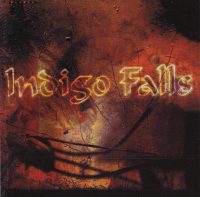
Indigo Falls: 'Indigo Falls'

Indigo Falls: ‘Indigo Falls’

This is as lovely as the insensuous smoke from a joss stick… and, in many respects, suffers from the same flaws and failings. But we’ll come to that later.

Indigo Falls are the husband and wife songwriting team of Richard and Suzanne Barbieri. He provides a mass of detailed keyboard fabric, she leads with a voice of immense clarity (a sort of cleaned-up, smoothed-over, less affected mixture of Kate Bush, Holly Penfield, and Sarah Brightman). And though the phrase “New Age songwriter album” may be loaded with suspicion, that’s precisely what this is, despite efforts to sell them as a pop duo or the noisy, mannered rock gestures of Only Forwards. All of the tell-tale signs are here: a soft delicacy of sounds, a rejection of urban tensions (and inspirations) in favour of vague spiritual atmospheres, and – inescapably – an unmistakeable ingenuous desire to play earnest folk music on synths, to touch the fragrant earth but keep your twenty-four-track studio regardless. Plenty of people have slid into waffle on those premises.

 
However, Richard Barbieri’s astonishing sonics elevate Indigo Falls far above the genre’s usual weediness. From his Mary Quant-ed days behind the Japan keyboards back in the early ’80s, through his ethnological textures with Rain Tree Crow and his contemporaneous dreamy synthwork as part of Porcupine Tree, he’s been one of the absolute masters of textured electronics. And ‘Indigo Falls’ is no disappointment in this department. Check out the undersea music boxes and the froth of musical bubbles building up the aquamarine tints of World’s End: and mixing with the inevitable organs are jangling harp sounds, harmonious turbojet squalls; swathes of thick, scalding distorted guitarry smears; the sounds of the air being sliced with a palette knife and refracted into traces of luminous colour.

 
The synths here have an organic tenderness, merging flesh-on-flesh with Jakko Jakszyk‘s lyrical, passionate guitar flourishes and Theo Travis‘ verdant saxophone. Consequently, ‘Indigo Falls’ luxuriates in rich, sensual detail and blooms into a hothouse of musical perfumes. Tunes flutter, soothe and arch like lazy ecstatic cats – in particular on Falling Into Years – where sax notes flutter down like rose petals, and which melts into an instrumental coda of sublime sensuality, breaking down out of its gentle pop rigour into fragmented little archipelagos; islands of sax, piano, bells and trade-wind electrophonics.

 
But even if Richard provides whatever big name cachet there is (as well as most of the duo’s sound) this is very much Suzanne Barbieri’s album. Her lyrical preoccupations shape and define the songs for better or worse, and whether or not you go for them will depend very much on whether you see eye to eye with her vision. And – unfortunately – relentless, vaporous symbolism dominates these songs. Shadows, nights, seas; dreamers, Babylon, totem animals; inner children. None of which are explored so much as checked off, as if the album was a spotter’s guide to mystical furnishings.

Let’s be fair, sometimes it works well. As on The Wilderness, where Richard’s sounds and Suzanne’s words mesh together most effectively. Sandstorm-under-stars synth, a big lazy open-skinned clatter of percussion, and Suzanne’s most direct singing: “no sign of life, just sand on sand / and hollow bloodless trees”. Steve Wilson‘s sparse acoustic guitar shadow-boxes with Suzanne’s rituals. Bones rattle, shadows pass overhead, past lives regress before our eyes… The magic works. But…

 
The thing about incense is that it transforms rooms and moods, making you feel as if you’re in touch with something… but it’s only smoke in the air. You’re being moved by something insubstantial. Immaterial. And if such a thing reaches towards profundity, and fails, it’s glaringly obvious. Feed the Fire obviously wants to fly with Rain Tree Crow: a thick percussive pulse propelled by Mick Karn‘s muddy bassline while Suzanne delivers her throaty take on Native American chanting (“The burning birds in spiral flights. / The hide within breaks through the skin. / The beast inside, the silent guide… / Muscles stretch and sinews snap / and spirits rise. / Sundancing…”). But unlike Rain Tree Crow’s immersive cultural explorations, this feels more like tourism: someone trying on a feathered headdress in one of those sad little souvenir shops scattered round the edge of the Navajo Nation.

 
The Achilles’ heel of Indigo Falls is the sheer bathetic naivety that slinks in under the cover of beauty. On Towards the Light, the ambition in Jakko’s yearning wails of aspirant guitar and Richard’s stratospheric synths (mountains carving notes out of the wind – oh, please, indulge me: here I can genuinely enthuse) is brought low by Suzanne’s beautifully-sung codswallop about sleepwalkers and her lurches into mediocre therapy speak. “We are all children, we are all crying”. No, we aren’t all crying: some of us are just griping because we want the nice lady to start singing something we can relate to. Music this sensuous should be devoted to something human, something real. Not to supernatural, psycho-babbling vagueness.

 
And if Indigo Falls ditched the New Age posing and got down to the nitty-gritty, they’d truly be on to what the sound of the record only hints at. There is a suggestion of what this could be like: on Sky Fall, which closes the album. The ghosts of beats sway sleepily, a pillowing organ and soprano sax curve gently around the melody as Suzanne sings. The hippy-chick histrionics are sloughed off. Instead, in comes a swathe of human vulnerability: the naked relief and wonder at the risks of love paying off. “We crossed a line, but the world still turns / The sky didn’t fall, and nothing has changed… we’re home again, home again.” There are flickers of doubt (“should I believe this is real? Should I believe in you?…”) and the knowledge of fallibility (“Keep a light in your heart for me / I’m not as strong as you think / I could slip away so easily.”) A whole album like this could melt the most cynical heart. Most of the songwriting on ‘Indigo Falls’, sadly, provides the cynical heart with as much ammunition as it requires.

Undoubtedly very beautiful. But is that enough? After the smoke clears, we need a genuine vision.

Indigo Falls: ‘Indigo Falls
Medium Productions Ltd., MPCD5 (6 04388 42402 3)
CD/download album
Released:
13th October 1997
Get it from: (2020 update) Best obtained second-hand; download version and some CDs available from Bandcamp.
Indigo Falls online:
Facebook MySpace Soundcloud Bandcamp Last FM Amazon Music
 

March 1997 – album reviews – Jocelyn Pook’s ‘Deluge’ (“a suite of stunning invention and sheer beauty”)

1 Mar

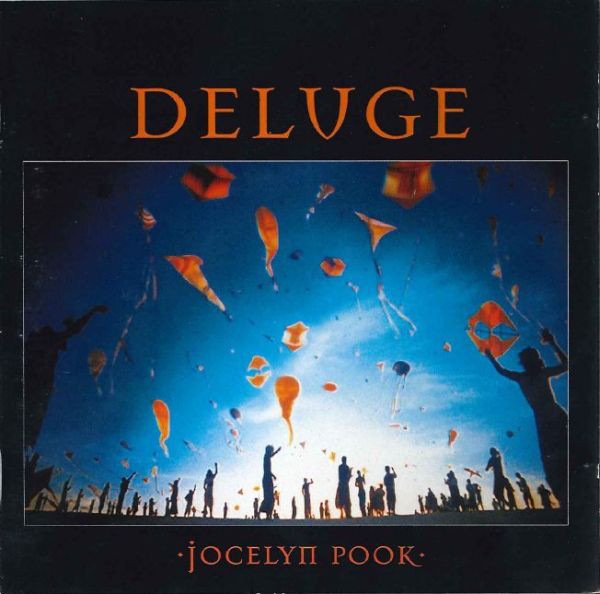
Jocelyn Pook: 'Deluge'

Jocelyn Pook: ‘Deluge’

The elegant grace of tragedy is often linked with the splat of farce. This album’s major selling point (on some copies of the CD, it’s trumpeted by a sticker ‑ I kid you not) is that it features the music from last year’s TV ads for Orange mobile phones, namely Jocelyn Pook’s setting of “Blow The Wind Southerly” sung by Kathleen Ferrier.

Sigh. It’s sad but true that increasingly weird and wonderful music is getting picked up and co‑opted by advertising agencies for their campaigns. Your average ‘Coronation Street’ ad‑break may currently play to a soundtrack of Michael Nyman, Gavin Bryars, Aphex Twin, U‑Ziq, Cocteau Twins… and Pook. They’re selling their souls for the filthy lucre from red‑braced ad execs. Of course they are: rampant fucking capitalism is bringing us the best that post‑modern music has to offer. It’s art selling out!

But… Mr or Ms Normal Music Fan are going into Our Price and humming this music over the counter to Shop Assistant. Consequently, they’re getting turned on to (at least relatively) experimental music, er, man… And as Jocelyn Pook joins the hideous capitalist gravy train (look, I’m not being cruel: my tongue is in my cheek) from obscurity to the CD racks, the musos among us will smugly tell that Pook is widely known as the leader of the Electra Strings (along with Caroline Lavelle, Sonia Slaney and others), who have no doubt been rushed off their feet in the past couple of years as every British pop act decided they must show their serious side by having at least one strings‑based track in their repertoire (I think we call it “hiring in a touch of class”).

But here ‑ ably backed by the Electras, knife‑edged art‑scene soprano Melanie Pappenheim and a pocketful of exotic musicians and sounds ‑ Jocelyn Pook shows herself as being beyond simply a viola player. She’s a composer of emotion and invention and, in the best traditions of post‑modernism, introduces classical and traditional musics to the brave new world of samples and electronics. OK, so it has to be admitted that Dead Can Dance are an immediate and convenient comparison, but ‘Deluge’ is warmer, more emotional: less monumentally impressive, perhaps, but also nowhere near as harsh and Wagnerian.

 
The twelve tracks of ‘Deluge’ (germinating from a clutch of “post‑modern hymns” written for a Canadian dance‑theatre project) are best appreciated as one pre‑millennial suite with recurring themes (the emotions drawn from the year 1000, the methodology from 2000). Requiem Aeternam, like many elements of the other tracks, opens the album with solo and multitracked singing of a traditional requiem over one sustained root note. Post‑modern chamber plainsong, in other words, founded upon a sense of inevitability that’s unchanged by the impact of technology.

 
Technology, in fact, might even be hastening that grand inevitable. Oppenheimer is undoubtedly one of the central parts of ‘Deluge’. It opens with a disturbing sample of Robert Oppenheimer talking (he seems heavy with emotion, a man with the weight of his discovery of nuclear destruction bearing down upon him) surrounded by a foreboding nuclear wind: this merges into the poignant but more hopeful sound of the Jewish call to prayer and a dawn chorus of birds. As the central sung theme from the first track returns with a supporting string section, a haunting, heartbreaking elegy is created.

For Oppenheimer himself, this could be the emotions created by his dread and foresight at what he had created. More powerfully, however, this piece stands as a requiem for a world forever changed by the knowledge of possible nuclear annihilation. A post‑Cold War planet we may now be, but his music took me right back to the nervousness of the mid‑’80s and its accompanying, tangible dread of nuclear war.

 
Lightening the mood and returning to the music, Blow The Wind (subtitled Pie Jesu) does indeed feature that Orange ad music again. Heard without those connotations, however, this is a brilliant interweaving of samples and live sound, as Kathleen Ferrier’s familiar rendition of the traditional vocal is interspersed with Pappenheim and Pook’s plangent vocal counterpoint, the echoing sounds of children playing, and more soaring strings. As in hip‑hop, the form that originally used sampling to such great effect and historic importance, the sample of Ferrier is used as a basis to build other musical sequences, instrumentation and vocals. It’s humble, beautiful, and ends far too soon.

 
The lessons in the new technology of music Jocelyn Pook has gained will undoubtedly further influence the writing and performance of her music for her own instrument ‑ strings. The penultimate piece, La Blanche Traversée, appears to be a fairly standard chamber‑piece setting of words by Racine, but more remarkable is the subtle instrumental backing. Pook and the Electra Strings play a slightly off‑rhythm pattern of oscillating notes that, to any DJ or mixer who knows his decks, would be regarded as a loop. I feel that it is safe to assume that the original hip‑hop DJs never had this development in mind when they crafted scratching and looping. ‘Deluge’ is a long way from being electronica, but the ’90s cross‑pollination continues.

 
While music has broken all the boundaries of genre in the ’90s, the end products have resulted in albums of naked emotion or sonic inventiveness. But rarely both together. ‘Deluge’ is a suite of stunning invention and sheer beauty in its music, but with all the necessary emotion of a requiem for the post‑nuclear age. The wind blows cold, with the sound of ravens on the air, but it tugs your whole life right to the surface of your skin.

Never mind the politics of how you got to hear of Jocelyn Pook or ‘Deluge’. Open your mind to it.

(review by Vaughan Simons)

Jocelyn Pook: ‘Deluge’
Virgin Records, CDVE 933 7243 (7 24384 29632 2)
CD-only album
Released: 24th February 1997

Get it from:
(2018 update) long out-of-print, so best picked up second-hand. Most of the tracks on ‘Deluge’ were remixed and reissued on the ‘Flood’ album in 1999.

Jocelyn Pook online:
Homepage Facebook Twitter MySpace Soundcloud Tumblr Last FM YouTube Vimeo

March 1996 – album reviews – Nicola Alesini & Pier Luigi Andreoni’s ‘Marco Polo’ (“like diving into a tapestry”)

24 Mar

Nicola Alesini & Pier Paulo Andreoni: 'Marco Polo'

Nicola Alesini & Pier Paulo Andreoni: ‘Marco Polo’

Listening to this album is like diving into a tapestry. Well, I guess a lot of prog and ambient-related music is, given its emphasis on the visual qualities of music and the proggy tendency (in particular) to fixate on the past; and that counts for even more at the crossover point. Nicola Alesini and Pier Luigi Andreoni, though, do it that much better. ‘Marco Polo’ – based loosely on the adventures of said merchant, explorer and diplomatic in the mediaeval Cathay of Kublai Khan – is a journey on the silkiest of roads, one on which you could really lose yourself in the billowing, drifting shapes which reality assumes.

 
Even while rising in the world of Italian jazz, saxophonist Alesini has also frequently been drawn into the world of art rock, kosmische music and ambient electronica. Andreoni’s already had a two-decade history as a multi-instrumentalist – starting out with Piacenzan comedy rockers La Pattona in the mid-’70s and passing through New Wave, experimental folk and minimalist synthing via The Doubling Riders and A.T.R.O.X. during the ’80s. Most recently, he’s been making a showing in the experimental ambient Andreolina duo during the ’90s. Much of the latter (with the exception of the comedy) leaves its mark on ‘Marco Polo’, although arguably the defining musical voice is Alesini’s upfront, intimate soprano sax – breathy, sweet and fragile, yet possessing a white-flame passion.

 
Andreoni, meanwhile, reveals himself to be a master of ambient keyboarding following the Brian Eno and Richard Barbieri path, using his instruments as subtle invisible chisels for sculpting electrons and the air into a colossal romantic spectrum of sound. Between the two of them they craft a set of compositions that phase slowly across the face of the world, colouring their own instrumental textures with the careful deployment of harmoniums and bouzoukis, cello and atmosphere guitar. This is an album of travelling, of seeing heartstopping landscapes for the first time, of releasing those feelings that the wanderer knows, of attempting to paint all of this in music.

 
This they do in glowing detail; the snake-charmer sax of Sumatra, the warped radio-chat and disassociated sway of Buchara, the metallophone Chinese chiming and fluting reeds of Quinsai, La Citta’del Cielo. With this type of thought being brought to bear on it, ‘Marco Polo’ is very much a deep-shaded ambient dreamscape album of the David Sylvian school, filled with sweeps of electronic space and shade, and immeasurably elevated when other musicians drift into the mix to stir up Alesini and Andreoni’s immaculate studies. David Torn‘s contribution of guitars, for instance, which bellow like yaks or hover like the promise of avalanches in Yangchow or M. Polo; or when Harold Budd places his sparse Himalayan points of piano into Samarca or The Valley of Pamir.

 
Roger Eno is on board as well, his less polished keyboard approach adding a wonderfully naïve human touch to the lambent, warmly aloof perfection (in particular on the aquamarine piano study of Il Libro dell’Incessante Accordo con Il Cielo). The pale vulnerable tones of his voice carry reedily through the twinkling spectral travel-songs of M. Polo and Samarca. Arturo Stalteri (the New Age keyboardist who originally made his name in progressive Italian folk duo Pierrot Lunaire) adds harmonium to the former, buried deep in the mix somewhere. The best moments come, though, when David Sylvian himself is brought in to sing on three tracks; his luminous baritone wreathing through the misty dawn-music of Come Morning (Stalteri’s bouzouki adding a glimmering coda), fluttering above the vague rattling sketches of Maya, or brooding (over cello, sax and a rippling ghost of electronic percussion) on dreamy images of god-games on The Golden Way.

 
And yet, in spite of all of the talent squeezed onto the album, somehow ‘Marco Polo’ doesn’t completely satisfy. It’s a little too remote, too self-contained and preoccupied with its own panoramic reveries. Behind the rich melodies and atmospheres, there’s only the vaguest engagement with the historical Marco Polo and Cathay; there’s not quite enough substance behind the shimmering surface of the album’s undeniable loveliness. Maybe it’s best viewed from the other end of a room, from a distance where the threads in the tapestry blue together into a captivating portrait which defies laws of time and space, where it can give such a convincingly four-dimensional performance that its audience can forget its two-dimensional thinness. But if you can live with that, ‘Marco Polo’ makes a wonderful tapestry.

 
Nicola Alesini & Pier Luigi Andreoni: ‘Marco Polo’
Materiali Sonori, MASO CD 90069 (8012957006921)
CD-only album
Released:
22nd March 1996
Get it from: (2020 update) Get CD from Materiali Sonori, or second-hand; stream from last.fm, Apple Music, Google Play or Spotify.
Nicola Alesini & Pier Luigi Andreoni online:
Last FM YouTube Google Play Amazon Music
Nicola Alesini online:
Facebook Last FM Apple Music Vimeo Deezer Amazon Music
Pier Luigi Andreoni online:
Homepage Facebook Last FM Apple Music YouTube Vimeo Deezer Google Play Spotify Amazon Music
 

September 1995 – live reviews – Shriekback + Holly Penfield @ Upstairs at the Garage, Highbury, London, 6th September (“a few degrees different… / …madly danceable but bursting with wild and intriguing approaches”)

9 Sep

Holly Penfield, delayed by technical problems, is not having a great night. For those who haven’t previously seen the Diva of Dysfunction, this is maybe not an ideal introduction to her unnerving songbook of emotional explorations, cramped as it is into a shortened set-time opening for Shriekback.

Nonetheless, as she sings out her heart and wrings the notes out of her synth, her quality shines through as she leans on the more conventional songs of her standard set – the vulnerable unwindings of ‘Parts of My Privacy’; the clarion-blast of ‘Calling All Hearts’; the stormy tribute to city derelicts in ‘Over the Edge’. The long frozen yearn of ‘Stay with Me’ is as potent as over; the climactic anthem and disintegration of Misfit still jolting and captivating. Tonight she may seem only a few degrees different from most mainstream songwriting women; but they’re important degrees.

Shriekback may be familiar to those of you who’ve followed the career of XTC. Lubricious singer and frontman Barry Andrews was once part of that band, although now (shaven-headed and muscular in black singlet and leather trousers) he looks more like an escapee from Right Said Fred. Watchers of the ’80s alternative scene might also remember the band as being artily plastic white funkers – during the time when Dave Allen and Carl Marsh made up a fierce creative triumvirate alongside Andrews – but they’ve changed quite a bit since then. Thronging the stage like a post-civilisation white road tribe from ‘Mad Max’ or Circus Archaos (and always seeming to be twice as numerous as they actually are) Shriekback still play what could be described as funk, but it’s a mutated progressive variant: still madly danceable but bursting with wild and intriguing approaches.

The instrumentation has something to do with it. A vast array of percussion instruments played by the entire band, like a mongrelised salsa troupe, include – in addition to the standard kit, congas and bongos – giant mutant tambourines, Arabian dumbeks, Irish bodhrans, cymbal-clappers and what looks like an array of motor springs on a huge chunk of wood. Guitarist Lu Edmonds has dumped his six-string in favour of a couple of electrified Turkish instruments – the cümbüs (apparent bastard child of a banjo and a twelve-string guitar) and the saz (like a bouzouki with moveable frets) – chopping and rolling out subtly different parts. The bassist loops and taps on a full-toned fretless. Courtesy of Mark Raudva, didgeridoo and mandolin both make appearances during the evening. Barry himself plays accordion as if he’s wrestling with a giant python, and somehow manages to extract an eerie sound for a wired-up tree root.

Funky it may be, but “get down y’all” is not on the agenda. Shriekback are progressive funk barbarians with a cunning primitivist edge, as happy with a sort of savage pagan sea shanty or primal drum throb as with a Prince-ly groove. Stately, it isn’t. The wild percussive stomp that opens proceedings is as far from po-faced art seriousness as you can get, and they possess the super-greasy compulsive rhythms of the dirty end of prime funk. Their sheer enjoyment and eclectiveness in the ingredients they brew into their music marks them down as yet another oddball manifestation of the progressive spirit…. and who said barbarians had to be dumb? There’s a roiling intelligence in evidence throughout their set. Barry Andrews has always played the hooligan-intellectual card really well, and he’s not stopping now.

Shriekback follow a different and ever-so-slightly alien logic in the way that they look at the world. You can see this in the list of “un”-things in ‘Un-Sound’ (“unacceptable, unreliable, unheard”) or in the semiotic question/percussion barrage of ‘Signs’, in which traffic signs, car logos and football graffiti are all part of one great rush of urban information which you need to understand and to decode for survival. All of it comes to the fore on the didgeridoo-led nightmare parable ‘Captain Cook Said’, in which Barry narrates the story of Cook’s omen-ridden first meeting with indigenous Australians back in the eighteenth century and of the destructive force of the civilisation which he trailed behind him – “we’re here to transmit the virus called the future…” Some XTC cleverness emerges, too, in the wryly cynical ‘Pond Life’ and in the hard rhythm’n’blues/country-inspired wallop ‘Seething’, with its fierce accordion.

All of this plus the fact that you can dance to this band without having to leave your brain at home. On all counts, Shriekback deliver. If you occasionally need to let the smart barbarian out of yourself, there are few better bands available to help you do it.

Shriekback online:
Homepage Facebook MySpace Soundcloud Tumblr Last FM Apple Music YouTube Vimeo Deezer Google Play Pandora Spotify Tidal Instagram Amazon Music

Holly Penfield online:
Homepage Facebook Twitter Last FM Apple Music YouTube Deezer Google Play Spotify Tidal Instagram Amazon Music

September 1995 – live reviews – Kate St. John @ DreamHouse @ The Water Rats, Kings Cross, London, 5th September (“like finding a pearl in the Sunday teacups”)

8 Sep

Kate St. John is best known as reedsperson to the stars: whenever someone wants a solo oboe on a rock record, she’s usually the one who gets the call. In her time, she’s been a member of The Ravishing Beauties, of Dream Academy and of the collective Channel Light Vessel (which also boasted Bill Nelson and Roger Eno). Now there’s the solo project – an apparently gorgeous album called ‘Indescribable Night’ and a four-piece acoustic band in which her voice and reeds are joined by guitar, viola and fretless bass.

What with her past work and the sessions for the likes of Julian Cope, we’d expect her to launch into a crazy and beautiful atmosphere project. But what Kate seems to be into right now is a featherlight fusion of classical, lounge jazz and blues – ‘Green Park Blues’ being the most obviously successful example tonight. A love of the French chanson tradition shows itself as well, in the summery ‘Paris Skies’ and in Kate’s choice of cover version tonight (Francoise Hardy’s ‘Le Premiere Bonheur de Toujours’).

This comes as quite a surprise (positioned as it is in the midst of a DreamHouse evening of intense contemporary rock singer-songwriters with guitars, but Kate and co. are unfailingly tasteful: beautiful arrangements played impeccably to form a sort of mildly fusion-flavoured chamber music. One can’t help thinking, though, that it’s a pretty tame world for such musicians to be installing themselves in. It all just floats along gracefully on leisurely viola shapes and restrained guitar, with Kate’s wispily pretty voice bathing in nostalgic warmth. And then she places an oboe, a cor anglais or an alto sax in her mouth, and out comes this phenomenally beautiful sound which stops you dead in your tracks and sets hunger in your soul…

It’s like finding a pearl in the Sunday teacups: sheer beauty reduced by finely-crafted but over-genteel surroundings. Kate St. John’s musicality needs a more passionate setting than this, a possibility hinted at by the ethereal mediaeval vocalising of ‘There is Sweet Music’ with its heart-stoppingly lovely cor anglais. But until then, at least we have this fine quartet. Many of you may be intrigued by this tasteful breed of crossover music: if so, I’d advise you to seek out the album. I myself am left wondering what it would take for such a phenomenal thread of music to be allowed freedom from the cosiness of café memories and to fly liberated, soaring to the heights that each and every one of tonight’s reed solos hints at.

Kate St. John online:
Homepage Facebook MySpace Bandcamp Last FM YouTube Deezer Pandora Spotify Instagram Amazon Music
Additional notes: (2020 update) Kate St. John spends most of her time supervising film music these days – if you want to listen to the album which this music came from, it’s available on Bandcamp.

SWOONAGE

Swoon. /swo͞on/ A verb. To be emotionally affected by someone or something that one admires; become ecstatic. Here are some people and things that make me swoon. #swoon #swoonage

Post-Punk Monk

Searching for divinity in records from '78-'85 or so…

theartyassassin

...wandering through music...

Get In Her Ears

Promoting and Supporting Women in Music

Die or D.I.Y.?

...wandering through music...

Music Aficionado

Quality articles about the golden age of music

THE ACTIVE LISTENER

...wandering through music...

Planet Hugill

...wandering through music...

Listening to Ladies

...wandering through music...

ATTN:Magazine

Not from concentrate.

Xposed Club

improvised/experimental/music

The Quietus

...wandering through music...

I Quite Like Gigs

Music Reviews, music thoughts and musical wonderings

furia log

...wandering through music...

The Recoup

SINCE 2013: Books and books and books and books and occasionally other things

A jumped-up pantry boy

To say the least, oh truly disappointed

PROOF POSITIVE

A new semi-regular gig in London

Gapplegate Classical-Modern Music Review

...wandering through music...

When The Horn Blows

...wandering through music...

:::::::::::: Ekho :::::::::::: Women in Sonic Art

Celebrating the Work of Women within Sonic Art: an expanding archive promoting equality in the sonic field

Ned Raggett Ponders It All

Just another WordPress.com weblog

FLIPSIDE REVIEWS

...wandering through music...

Headphone Commute

honest words on honest music

The One-Liner Miner

...wandering through music...

Yeah I Know It Sucks

an absurdist review blog

Obat Kanker Payudara Ginseng RH 2

...wandering through music...

poplifer.wordpress.com/

Waiting for the gift of sound and vision

Good Music Speaks

A music blog written by Rich Brown

Do The Math

...wandering through music...

Archived Music Press

Scans from the Melody Maker and N.M.E. circa 1987-1996

The World's Worst Records

...wandering through music...

Soundscapes

...wandering through music...

OLD SCHOOL RECORD REVIEW

Where You Are Always Wrong

FRIDAY NIGHT BOYS

...wandering through music...

Fragile or Possibly Extinct

Life Outside the Womb

a closer listen

a home for instrumental and experimental music

...wandering through music...

Life Just Bounces

...wandering through music...

Lucid Culture

JAZZ, CLASSICAL MUSIC AND THE ARTS IN NEW YORK CITY

Aquarium Drunkard

...wandering through music...

eyesplinters

Just another WordPress.com site

NewFrontEars

...wandering through music...

FormerConformer

Striving for Difference