Archive | minimalism RSS feed for this section

November 2015 – upcoming gigs – Illuminations London present Holly Herndon, Jam City and Claire Tolan in Bethnal Green and Josh T. Pearson, Richard Dawson, Briana Marela and Let’s Eat Grandma in Hackney; Laura Moody plays solo in Cardiff and Sheffield; Jenny Hval and Briana Marela tour the UK

2 Nov

Some more concert dates for the current week. If you’re thinking that these have a definite female slant to them, you’re right. I’m indulging my latent X as well as stretching my perspective.

Holly Herndon expanded A/V show (featuring Mat Dryhurst and Colin Self) + Jam City + Claire Tolan (Barbican & Rockfeedback present Illuminations  @ Oval Space, 29-32 The Oval, Bethnal Green, London, E2 9DT, UK, Wednesday 4th November 2015, 7:30pm) – £15.00

Having already made a showing at Liverpool and Bristol during October, peripatetic techno-pop/IDM composer Holly Herndon brings her expanded show to London. This is a full multi-media experience including the usual music, visuals and dance elements but with an interactive component that goes far beyond Holly’s onstage collaborations with programmer/life partner Mat Dryhurst and with interpretative dancer/additional singer Colin Self. In particular, Mat’s adaptive and conceptual SAGA software reaches out beyond the stage to work – consensually – with the audience members’ own browser histories and Facebook content; mixing it all into the visuals (and, potentially, the sounds) as a communal mashup, both representational and communicatory.

Intriguing as this factor is, it’s an adjunct to Holly’s music; which remains the core material of the show. Continually glitched, tweaked and deconstructed, her compositions are a cool, complex, thoughtful and exhilarating mixture. They’re informed by post-classical forms, dance techno, and anthemic synth pop; they utilize experimental textures and broad vocal stylings (from standard singing to semi-voluntary sounds) and they bury philosophical queries deep within their tunes. Holly’s soundwork is as immersive as her stagings, full of implied questions and reflections regarding our access to and immersion in technology and how this affects the way in which we think and express ourselves, leaving comet-trails of information, interaction and yearnings.

All of these additional subtexts and pointers are there if you want them, but Holly is first and foremost a communicating musician, and her pieces are as melodious and accessible as they are multi-layered. Drawing on her ongoing music studies (doctorate level at Stanford) , her time as a precocious and enquiring teenager steeped in the heat and fun of the Berlin club scene, and her work with everything from choirs to customised laptop software, they sometimes sound like particularly complicated pop songs, stuttering their way through myriad changes of attention and focus. Sometimes they sound like accelerated dream-state dances; sometimes like madrigals sung during earthquakes (see Unequal, below). At other times, they’re like the chatter of path-switching in a circuit; or like carefully-directed cultural channel-surfings which quick-step deftly back and forth across a breadth of urban art and experience (from grand opera house to downloads in cramped bedsits). Brain food which encourages you to wander.

http://www.youtube.com/watch?v=YdcUBRa47as

Also on the bill are Jam City and Claire Tolan, both of whom share Holly’s interest in interactions and in the results of our being embedded within a dense informational culture, although each has their own way of approaching the situation.

Jam City is the alias of dance-electronica producer and deconstructionist Jack Latham. Though Jack’s background in fashion and “corporate espionage” sounds almost too good to be true, as if it’s been dream-tailored for counter-cultural media discussions and for high-end elitist posing, he doesn’t use it that way. As a musician, he’s evolved from collaging various dubstep tropes towards using his work to develop and express questioning, outright political critiques of neoliberal capitalism (such as the Unhappy single, which explores the dulled angst of online porn consumers while juxtaposing it with riot footage). In the process, Jack’s also developed as a performer – backgrounding the laptops and the passive role of the standard electronica performer in order to retake the stage as guitarist and singer, and delivering a new phase of material described as sounding like a Prince record constructed from cold, chunky industrial sounds”.

Claire Tolan is an artist, programmer, sampler, writer and soundscaper specializing in autonomous sensory meridian r – a psychological process in which carefully-arranged sound and speech – usually a blend of themed, targeted whispers and quiet diegetic noises (scratches, scuffs, intimate room sounds) – triggers euphoric physical and mental reactions in the listener. With sharp wit, Claire links all of this to new developments in programming and acoustic surveillance technologies, exploring the question of how it might be applied: from simple mood enhancements and healing systems through to neurolinguistics and perception and to the potential manipulation and control of people. Her recent Holly Herndon collaboration Lonely At The Top (see below) might give some clues as to her concert performance. A cosseting monologue, coffee-pot dribbles and the close-up noises of small rooms are interspersed with the rubs and slaps of massage, fingernails ticking on keyboards and screens, and increasingly intimate sounds of hand and mouth: the language, desires and end results of relaxation tapes, executive relief, socially-reinforced senses of entitlement and prostitution blend and overlap to sardonic, disturbing effect.

http://www.youtube.com/watch?v=XdtCzPrx-JE

Information and tickets for the concert are here  while the Facebook event page is here. At the end of the month, Holly will also be appearing at All Tomorrow’s Parties at Prestatyn.

* * * * * * * *

There are some similarities between Holly Herndon and Laura Moody  – not least an overlap with classical music and a sense of being on the outcrops of songcraft, delving up malleable truths and questions. Yet whereas Holly’s a post-classical theoretician (reconciling her education with her human instincts, and with life outside the college bubble) and works primarily on computer, Laura comes from older and more familiar traditions, and is almost exclusively an acoustic performer. Possessing outstanding talent both as a singer and as a cellist – and able to cover both fields simultaneously, as well as beatboxing and cello-drumming – she pounces into her own music with the terrifying, exhilarating technical skills of a top-drawer classical soloist.

Laura’s songwriting instinct, meanwhile, seem to come from multiple directions at once. Tense twentieth-century string figures (from her earlier years playing avant-garde pieces with the Meredith Monk Ensemble, and her current work with the Elysian Quartet); ancient, eerie folk airs; expressionist opera; P.J. Harvey’s cleaver intensity; the clever, idiosyncratic and individual art pop of a Kate Bush, a Tom Waits or a Bjork. Everything that she delivers sounds immediate, whether it’s the savagely equivocal hormonal take-down of an older man on Creeping Alopecia, the raindrop attenuations of Call This Time Love, or the stormy dissections of love-gone-wrong and betrayal on Turn Away and We Are Waiting.

The live gigs are enthralling wonders: supple switchings between Laura’s own welcoming personality and the performance persona which handles the songs, blurring the line of physicality which separates woman and cello. She’s out on a brief tour now, playing outside London for a few events. Go see for yourselves.

Laura Moody:

* * * * * * * *

For many female pop musicians, an increasingly outright or explicit public sexuality is both a marketing point and the prime hook. To an extent, this is also true of Jenny Hval. Many people will have initially heard about her thanks to what seemed to be a head-turningly saucy lyric:“I arrived in town with an electric toothbrush pressed against my clitoris.” Curious (and possibly a little numbed by Rihanna, plus memories of lubricious Prince party-funk), many of us will have followed this expecting a licentious slow jam, only to find something very different – the opening line of a mirror-calm songscape of hovering bells, limpid murmurs and breathed-on acoustic guitars which dealt with the secret worlds of strangers within cities and, in particular, their self-reliance.

A polymath whose methods blur as artfully as her perspectives, Jenny doesn’t write songs so much as drop carefully-charged texts and pointers, and then explore and adorn these recitatives with chantlike melodies and poised minimal instrumental textures, pulling them apart and working in and out of the word-rhythms. Her guitars, keyboards and samplers (as well as her heavy-lashed, light-tongued vocals) work like soft-edged sculpting tools. Her lyrics are the lines of resistance.

For both new listeners and previous converts, sexuality remains a prime Hval hook. It’s what we expect to hear from her, although we’ve quickly learnt to appreciate that she turns the expected approaches on their heads and back-to-front. She revels in the unfixed: in the course of a single song, lovers will pass fluidly from mysterious passion to friendship to absence, and between gender, ages, species or state. Even when singing of cupping her own cunt (while cupping the blunt, unadorned and troublesome word itself, delivered throughout her songbook without a hint of shame, taboo or aggression and with a succinct matter-of-fact poise) she’ll let the action lead her somewhere that doesn’t fit the usual expectations and commodities – appreciating its centrality at her body’s core; being inspired to cup in turn a lover’s “soft dick… accepting restlessness, accepting no direction, accepting this fearful wanting that isn’t desire… can we just lie here being?”; or imagining a world of peaceful masturbators (“a million bedrooms with hands softly lulling… without telling anyone, a million ships come alone out on the calmest seas”) while asking, with a sense of disquiet “are we loving ourselves now? Are we mothering ourselves?”

Also running through Jenny’s work (whether entwined with or separate from the sexual themes), are ambiguous accounts of bodily disintegration. Opening her second album ‘Innocence Is Kinky’ with an account of watching online porn, she moves from commodified enervation into an eerie and exultant dream of escape, relinquishing her own body and its passive needs, and finally symbolically destroying the eyes with which she consumes the images. Yet this song and its sisters aren’t quite nightmares. Sometimes they’re triumphs – disassociative fantasies of freedom in which the wrack and ruin seem to be the natural rites of passage of a cool mind walking free, unconcerned, its passions become processes.

Jenny’s writing casts a wide net – violent upsets echoing classic French surrealism; deep-running strands of myth both classical and original (from the “Oslo Oedipus” of Innocence Is Kinky to the dark, quasi-pagan tree-figure in Amphibious, Androgynous that stands as lover, doppelganger and the next phase of self); and musings on the ambiguous trap of language (“the tongue is upon for the restless /An indecipherable alphabet / Each word an island less… And we speak in tongues from part to parts, broke all to parts / From invisible state, to invisible state…”). Most recently, on her latest album ‘Apocalypse, Girl’ the political subtexts have broken cover to become direct challenges (“You say I’m free now, that battle is over, / and feminism is over and socialism’s over. / Yeah, I say, I can consume what I want now..”). So too have preoccupations with ageing and survival (in the breathless narrative of Heaven, surrounded by loops and fractures of cemeteries and childhood choirs, Jenny wrestles with the pull of memory and the drag of mortality) and a increasingly solid approach to identity. “What is it to take care of yourself? Getting paid? Getting laid? Getting married? Getting pregnant? Fighting for visibility in your market? Realizing your potential? Being healthy, being clean, not making a fool of yourself, not hurting yourself? Shaving in all the right places?”

All of the above – the obliqueness and the rapier hits – makes listening to Jenny’s records akin to haunting her apartment at 2am (or some similar time  when manners and manneredness come unstuck and the shapes of other truths come walking). I’ve not been fortunate enough to see what her music is like live – though I know that past concert showings have seen her play bolstered with  guests or simply alone, surrounded by laptops, devices and ideas. On the five quick dates of her current UK tour, you’ll be able to see for yourselves.

Jenny Hval:

* * * * * * * * *

On the Glasgow, Manchester and Bristol dates, Jenny will be joined by her on-off tourmate Briana Marela, a singer-songwriter from the Pacific North-West who’s currently working a string of European tour dates in support of her second album ‘All Around Us’. As you might expect from something recorded in Iceland and co-produced with Sigur Rós associate Alex Somers, ‘All Around Us’ is ghosted and garnished with touches of Hopelandic enchantment (with beautiful smeared, paper-thin sounds intruding on the edge of the mix, like lost amnesiac ghosts or distant pipes), but it’s very much Briana’s inspiration – a luminous, thoughtful work blending layered melodic sample-patches and banking her petal-delicate vocals into choirs and a capella counterpoint.

Though Briana cites Björk, Laura Veirs, Vashti Bunyan and Meredith Monk as influences (she has something in common with Laura Moody, then), I can also hear the same kind of all-round sound-mastery that’s on display and working away in the songs of Imogen Heap; deep-level sonic exploration and sound curation tied to the urge to tell you a story and sing you a straight earworm. In the album’s lead single Surrender I can even hear something of the pure pop of ABBA, while the midnight lushness of the follow-up, Dani, recalls a Julee Cruise ‘Twin Peaks’ ballad.

Though Briana’s voice is soft, it’s never wispy – never insubstantial. If there’s a hint of girl-next-door to what she does, she’s the quiet, observant girl full of thoughts, going her own way but ready to let you walk alongside.  Like Jenny, though less explicitly, she explores possibilities of intimacy. Her songs hover carefully on the borderline between selfhood and loneliness, a delicate staking out of possible togetherness, subtly resisting the pressures to put out or submit, to be deformed by needs and expectations (“What does love mean in this day and age? /  To me it’s a moment where we resonate at two frequencies close in phase… /  It’s not a competition /  Everyone has music within them.” ). Meanwhile, the perfectly-pitched American-visionary tone of the album (its hallucinatory fairy-tale sonics, leaflike piano falls and misty country swells) suggests that there’s common ground between Briana’s dream pop and the ostensibly cleaner work of breakthrough CCM-pop singers like Lexi Elisha, which in turn suggests that there’ll be a lot of people who’ll end up liking this.

* * * * * * * *

In between dates with Jenny Hval, Briana Marela will also be joining the bill at another Illuminations concert in London, this one a stew of assorted flavours which also includes the battered Americana of Lift To Experience frontman Josh T. Pearson  and the skewed Tyneside noise-troubadour work of Richard Dawson.

Probably because of the female orientation of this particular post, I’ve got to admit that I’m more intrigued by the youngest act on the bill, and the only other female one. It’s difficult to work out just how tongue-in-cheek the psychedelic rag-doll sludge-pop” duo Let’s Eat Grandma are, assuming that they’re joking at all. Eyes down, singing from beneath and behind tumbling pre-Raphaelite locks, and tucked into stolen Stevie Nicks dresses, Rosa and Jenny rummage with various instruments like toybox-divers and play songs as if it’s only occurred to them to do so. Two Norwich teenagers who’ve known each other since childhood, they’ve sustained, into near adulthood, that mysterious blankness of two little girls who are ignoring your interruptions to their game. The songs themselves are tangled musical fairy stories, or (as with ‘Eat Shiitake Mushrooms Into Chocolate Sludge Cake’) extended wooden-legged instrumental mantras owing more to Faust or Beefheart: spontaneous-seeming, utterly absorbed in themselves. The band feels like a musical chrysalis twitching what might become an astounding breadth of wing. It’s all to discover.

Josh T. Pearson/Richard Dawson/Briana Marela/Let’s Eat Grandma (Rockfeedback present Illuminations @ St. John Church at Hackney, Lower Clapton Road, Hackney, London, E5 0PD, UK, Saturday 7th November 2015, 6.00pm) – £20.00 –  informationtickets

http://www.youtube.com/watch?v=4Nk8p-PiJJM

http://www.youtube.com/watch?v=R0mqRc0kaF0

* * * * * * * *

More concert previews coming shortly for November…

November 2015 – upcoming London gigs – assorted classical and related – Lubomyr Melnyk’s continuous piano (plus James Blackshaw’s flexible guitar and a Franco-Palestinian-Bedouin quintet from Kamilya Jubran & Sarah Murcia); and a Mexican evening with the London Philharmonic Orchestra, Jaime Martín and Arturo Chacón-Cruz

30 Oct

Yesterday it was upcoming classical concerts; today it’s close relations of various kinds…

I’ve previously covered, in passing, the Labyrinths series of international live music events (presented by Thirtythree Thirtythree – the team behind St John Sessions – and Nawa Recordings) which are taking place throughout 2015 across Beirut, Cairo and London. Here’s another one, featuring music spanning Palestine, France, the Ukraine and Sussex and mingling Western and Eastern classical, jazz, folk baroque and Arabic forms.

Lubomyr Melnyk + Kamilya Jubran & Sarah Murcia + James Blackshaw (St John Sessions @ St John at Hackney Church, Lower Clapton Road, Clapton, London, E5 0PD, UK, Tuesday 3rd November 2015, 6.30pm) – £16.50

Lubomyr Melnyk & friends

Lubomyr Melnyk is a Ukrainian composer and pianist who has pioneered ‘Continuous Piano Music’. Classically trained and greatly affected by the minimalist movement in the early 1970s, he has developed his own unique language for the piano, named after the principle of maintaining a continuous, unbroken stream of sound. The rapid sequences, coupled with Melnyk’s awe-inspiring ability of playing up to 19 notes per second with each hand simultaneously create a tapestry of sound that transcends sonic waves into a very tangible, physical experience. Having spent much of his artistic life in obscurity, Lubomyr Melnyk’s work was recently rediscovered by a whole new generation of music lovers, offering the piano virtuoso a well-deserved renaissance with world-wide tours.

Kamilya Jubran (Palestinian singer and oud player) and Sarah Murcia (French jazz double bassist and composer) will present the UK debut of their ‘Nhaoul’ project as a quintet also featuring Régis Huby (violin), Guillaume Roy (viola) and Atsushi Sakai (cello). Kamilya and Sarah’s first meeting dates back to 1998, when Sarah joined Sabreen – an innovative Palestinian group whose lead singer was Kamilya – for an album and concert tour of Europe and the Middle East. ‘Nhaoul’ (Arabic for “loom”) was first created together as a duo as a result of a profound exchange around their respective musical interests.

The basis of their duet rests on an amazing musical and aesthetic convergence which has solidified through delving deeper into several compositions by Kamilya based on prose poems, so as to give to the oud a total rhythmic and melodic freedom. Sarah has approached them in a vertical way in adding her harmonies. Her string arrangements, cast against Arabic music, deal with the economy, colours, matter. Kamilya Jurban, on the other hand, comes from a highly melodic and modal culture and thinks her music horizontally.

Over several years of reflection and mutual learning, the two musicians worked to create a common language: Sarah made a point of learning to play the quarter-tones of oriental scales and memorize long labyrinthine sentences – of the oral tradition – which are the rule in Arab music. Kamilya Jubran, in turn, began to internalise the methods of limited transposition and complex rhythmic structures (asymmetry, polyrhythm), following Sarah’s suggestions. The texts selected for setting are chosen from the work of contemporary poets; or are, for ‘Suite Nomade’, excerpts from Bedouin poems from the deserts of the Sinai and Negev published by Clinton Bailey in his collection ‘Bedouin Poetry’ (Saqi Books, reissued in 2002). Kamilya Jubran sings them in dialect remembering the Bedouin women she came across in her childhood.

Hastings-based guitarist and pianist James Blackshaw primarily plays an acoustic 12-string guitar in fingerstyle fashion (for which he has grown long pick-like fingernails on his right hand). A musician blending ideas from assorted folk cultures around the world and from the classical concert hall, James has been compared to cross-genre guitar explorers such as Bert Jansch, Robbie Basho, John Fahey, Jack Rose and Leo Kottke. He has released albums on the labels Celebrate Psi Phenomenon, Static, Digitalis Industries, Important Records, Tompkins Square, and Young God Records.

James has previously collaborated with Lubomyr Melnyk on ‘The Watchers’, a 2013 collection of improvised duets recorded at the Vortex Jazz Club. It’s possible that they might repeat the engagement at this gig.

http://www.youtube.com/watch?v=gYn7WpgLg48

More information is here, and tickets are here.

Jaime Martin, 2015

Jaime Martin, 2015

Several things have drawn me toward central and south American music recently. One of these things is Alex Ross’ fascinating history (in ‘Listen To This’) of the journey of the chaconne from Africa to south America, and from there to Spain, moving on through Europe and feeding into Monteverdi, the emerging baroque music atmosphere at Versailles, and Bach (there’s a version the whole story at Alex’ blog, here).

The other is the Harp Consort’s wonderful 2002 album, ‘Missa Mexicana‘, which carefully constructs an impression of a Spanish colonial church service in Baroque-era Puebla City, threading secular dances through a Juan Gutiiérez de Padilla mass, with African, traditional Spanish and fresh Mexican musical ideas intertwined.

With both of these in my mind, it was intriguing to see this advertised…

London Philharmonic Orchestra/Jaime Martín/Arturo Chacón-Cruz perform Mexican Magic (Royal Festival Hall @ Southbank Centre, Belvedere Road, Waterloo, London, SE1 8XX, UK, Friday 6th November 2015, 7.30pm) – £9.00 to £65.00

Experience a dazzling programme of Mexican classical music as we celebrate The Year of Mexico in the UK. Mexican classical music is about more than folklore and colour. Eclectic and sophisticated, it spans a broad spectrum of musical possibilities and embodies the spirit of Mexico in all its richness and diversity. Join London Philharmonic Orchestra and conductor Jaime Martín for the slithering sounds of Revueltas’ ‘Sensemayá’, Ibarra’s ear-teasing ‘Sinfonía No. 2 ‘and Márquez’ toe-tapping ‘Danzón No.2’ alongside a selection of popular songs from Mexico (sung by tenor Arturo Chacón-Cruz).

Programme:

Ricardo Castro – Intermezzo from ‘Atzimba’
Charles Gounod – L’amour… Ah! lève-toi, soleil (from ‘Roméo et Juliette’)
Federico Ibarra – Sinfonía No.2 (Las Antesalas des sueño)
Various – Mexican Songs
Leonard Bernstein – Symphonic Dances from ‘West Side Story’
Silvestre Revueltas – Sensemayá
Arturo Márquez – Danzón No.2

More information here, and tickets here.

* * * * * * * *

More November gig previews shortly…

November 2015 – upcoming London gigs – assorted classical and related – another Fenella Humphreys Bach-plus violin evening (with extra Peter Maxwell Davies/Adrian Sutton premieres) and a multimedia Rachmaninoff symphony from Arensky Chamber Orchestra

29 Oct

Two upcoming classical concerts here, both at the Forge…

* * * * * * * *

Fenella Humphreys: Bach to the Future Part 3 (The Forge, 3-7 Delancey Street, Camden Town, London, NW1 7NL, UK, Tuesday 3rd November 2015, 7.30pm) – £10.00-£12.00

Fenella Humphreys (photo by Gary Barton)

Fenella Humphries (photo by Gary Barton)

Violinist Fenella Humphreys presents the third of her Bach to the Future projects at The Forge, featuring commissions of new works by Britain’s leading composers to accompany Bach’s glorious Sonatas and Partitas for unaccompanied violin. The third concert includes new works by Sir Peter Maxwell Davies and Adrian Sutton alongside extraordinary music by Bach, Sibelius, Biber and Ysaye.

Programme:

Jean Sibelius – En Glad Musikant
Sir Peter Maxwell Davies – new work (2015)
J.S. Bach – Sonata no. 3 in C major BWV 1005
Heinrich Biber – Passacaglia in G minor
Adrian Sutton – new work (2015)
Eugene Ysaye – Solo Sonata no. 3 ‘Ballade’ op. 27

Fenella is also making studio recordings of the project for Champs Hill Records over two CDs – ‘Volume One’ was released in August 2015.

More information and tickets here.

* * * * * * * *

Here’s something familiar in a new setting…

The Arensky Chamber Orchestra presents: Rachmaninoff Symphony No. 2 (The Forge, 3-7 Delancey Street, Camden Town, London, NW1 7NL, UK, Wednesday 4th November 2015, 8.00pm) – £12.00

Led by international prize-winning conductor William Kunhardt, The Arensky Chamber Orchestra has established itself as one of London’s most exciting young ensembles since its debut in 2009 – dedicated to revitalising the concert experience with theatrical and brilliant productions of classical music. Described as “deeply moving” by ‘The Independent’ in 2014, the ACO has produced numerous broadcast recordings on national radio and regularly performs in the country’s leading venues, including Cadogan Hall, Queen Elizabeth Hall, and the Southbank Centre’s Purcell Room.

The orchestra’s performances fuse electric performance with lighting design, “live” programme notes delivered from the stage and unusual venue use. Past collaborators have included leading soloists such as Jennifer Pike and Benjamin Grosvenor, guest directors including the leaders of the Philharmonia, the Orchestra of the Royal Opera House and the Orchestra of the Age of Enlightenment and institutions and festivals ranging from the Royal College of Art to the Greenwich and Docklands Festival. The ACO also regularly combine their performances with specially created food and drink menus and commissioned work from other artists, including video DJs, artists, actors and dancers.

The ACO return to The Forge with Sergei Rachmaninoff’s opulent Second Symphony, arranged for chamber orchestra. Revered as the greatest pianist of his time, yet scorned as an out-of-date and sentimental composer, Rachmaninoff’s music is an oasis of drama, colour and feeling in the increasingly rational and cold 20th Century musical world. Whilst all Rachmaninoff’s music sings with a heart-wrenching honesty, his Second Symphony is perhaps the most personal piece he ever wrote. Rachmaninoff’s First Symphony – a huge failure – had led to three years in the musical wilderness, to crushing self-doubt and writers block. He published his Second only after intense courses of hypnotherapy and years of reworking the manuscript.

As a result, it is a true autobiography of his soul: it speaks of fierce patriotism, exile and of a yearning to return to a home that was now lost to him. It tells of his worldwide triumphs, yet also of his failings and self doubt. The “dies irae” chant lurks in the shadows, a morbid reminder of Rachmaninoff’s preoccupation with death. But above all it sings with extraordinary beauty, sumptuous colour and unending, impossible-to-forget melodies. Join the ACO as they unravel the luxurious sound-world of this symphony with excerpts, short performances and stories from Rachmaninoff’s life. Then sit back and enjoy perhaps the ultimate Romantic symphony, and the world premiere performance of its new arrangement.

“Music is a calm moonlit night, the rustle of leaves in Summer. Music is the far off peal of bells at dusk! Music comes straight from the heart and talks only to the heart: it is Love! Music is the Sister of Poetry and her Mother is sorrow.” – Sergei Rachmaninoff

More information and tickets are here.

October 2015 – upcoming London gigs – folk supergroup The Furrow Collective at Kings Place on the 1st; Mary Hampton, Nadine Khouri and Daudi Matsiko at Daylight Music; Alexander Hacke, Danielle de Picciotto and Thomas Ragsdale at the Hackney Attic on the 3rd; Andre Canniere at the Vortex on the 4th

26 Sep

A look forward to the first week of the coming month, with plenty of alternative folk, acoustic singer-songwriters and some multi-media music from a couple of former Berlin arts-scene linchpins, ending up with some jazz…

The Furrow Collective (Hall Two @ Kings Place, 90 York Way, Kings Cross, London, N1 9AG, UK, Thursday, 1 October 2015 – 8:00pm) – £9.50/£14.50

The Furrow Collective brings together four of the finest, award winning musicians on the UK folk scene – Rachel Newton, Lucy Farrell, Emily Portman and Alasdair Roberts – and delves into the obscure world of balladry at its darkest and quirkiest.

Each singer airs lesser-known gems from their traditional repertoire with an eclectic backing of harp, guitar, viola, concertina, banjo, musical saw and rousing harmonies. With a bold, improvisatory approach, their common focus is to capture the raw edges and fleeting magic of ballads, with storytelling taking centre stage. Emily and Alasdair are both known for their original, folklore-influenced songwriting, and, often finding themselves on the same bills they struck up a musical friendship, sharing stages and collaborating on each others albums. Lucy and Rachel are both bewitching solo artists in their own right as well as being sought-after session players and long-time collaborators with Emily Portman in her trio.

The Furrow Collective’s 2014 debut release, ‘At Our Next Meeting’ received widespread critical acclaim, as well as a BBC Radio Two Folk Award for Best Group and a Best Traditional Track nomination this year. A new EP is currently being recorded for release in autumn 2015, followed by an album in early 2016.

Tickets available here.

* * * * * * * *

More people singing at the weekend…

Daylight Music #201

Daylight Music 201: Mary Hampton, Nadine Khouri + Daudi Matsiko (Union Chapel, Compton Terrace, Islington, London, N1 2UN, UK – Saturday 3rd October 2015, 12.00pm-2.00pm) – free entry, suggested donation £5.00

Inspired by a passion for the winding road of the oral tradition from Homer onwards, Brighton-based songwriter Mary Hampton‘s songs possess an unusual transportive energy, moving her listeners through a sequence of shimmering landscapes that belong to past and present simultaneously. Accompanying herself on tenor guitar, and sometimes with members of her band Cotillion, she interprets material gathered from a wide range of sources, performing traditional songs alongside original work and settings of literary prose and poetry.

Nadine Khouri is a singer-songwriter currently based in London. A guitar-wielding folkie, with a love for shoegaze, moody soundtracks and spoken-word, Khouri’s music has been described by Rough Trade as a “music born of perennial outsider-status.” Her last release ‘A Song to the City’ was co-produced with Ryan Alfred (Calexico.) The EP also caught the attention of producer John Parish (PJ Harvey, This is the Kit) who invited her to guest on a song for his ‘Screenplay’ LP and subsequently to record her first album in his hometown of Bristol. Recorded live in a Georgian basement with a band assembled by Khouri, the resulting album ‘Lost Continents’ is a raw, atmospheric collection of meditations on loss and transformation, held within the hushed intimacy of Khouri’s voice. The first single from the album, You Got A Fire, is due for release in late October 2015.

Huntingdon is not famous for much. It was the birthplace of Oliver Cromwell and its local MP for many years was former Prime Minister John Major. Unlikelier still that the extraordinary songwriting talents of Daudi Matsiko (his name is pronounced “dowdy”) were nurtured in nearby Ramsey. Yet Daudi’s roots were somewhat further than Ramsey, his parents moving over from Uganda in the early 1980s. Daudi has been playing music since he was eight years old and writing songs since he was a teenager: although he’s still young, they speak of experience and trauma and gathered wisdom. Having suffered mental health problems in the past, he has used his music as a crucial salve in times of strife and stress. Daudi was lucky to grow up among a strong community of musicians – many of his Cambridgeshire buddies played on his breakthrough EP ‘A Brief Introduction To Failure’, which was supported by Gilles Peterson and helped bring him to a wider audience. His influences run the gamut, from The Mars Volta to Jeff Buckley, Beach Boys to Nick Drake. Plans are afoot for a new EP (working title: ‘The Lingering Effects Of Disconnection’).

More information on the concert is here.

* * * * * * * *

On the evening of the same day, Chaos Theory Promotions are back, displaying a continued knack for landing substantial art-music names…

Alexander Hacke/Danielle de Picciotto, October 3rd 2015

Alexander Hacke & Danielle de Picciotto + Thomas Ragsdale (Chaos Theory @ The Hackney Attic, Hackney Picturehouse, 270 Mare Street, Hackney, London, E8 1HE, UK, Saturday 3rd October 2015, 8.00pm) – £14.00/£18.00

Chaos Theory enthuse:

We cannot wait to share this.

After watching the onset of gentrification filling their previous creative oasis in Berlin, the extraordinary duo of multi-instrumentalist/producer Alexander Hacke (Einstürzende Neubauten) & multimedia artist-musician Danielle de Picciotto (of Berlin club culture, Pop Surrealism and Love Parade fame, as well as being a member of the latest Crime & The City Solution lineup alongside Alexander) have been nomadic since 2010.

Alexander Hacke/Danielle de Picciotto, 2015Giving up their home and most of their possessions, Danielle and Alexander have been touring the world, performing in Australia, doing residencies in Prague, Canada and Ireland, working in New York and recording in the Mojave Desert. (You may have seen them performing at Café Oto earlier this year, alongside Jarboe and Helen Money, as part of our 5 Years Of Chaos celebrations.)

This is the only UK show in their ongoing ‘We Are Gypsies Now’ tour, in which they will present music from Danielle’s new solo album ‘Tacoma’ (which speaks of leaving everything behind and trusting destiny to lead one’s way) and from their communal album ‘Perseverantia’ (which speaks of the strength and persistence necessary to survive outside of the grid) as well as material from their graphic diary ‘We Are Gypsies Now’ (which tells of how they gradually chose to become nomads) via glorious cinematic visuals. Here’s a small excerpt of their performance of ‘Perseverantia’ in February:

Thomas Ragsdale – best known as half of Manchester techno duo Ghosting Season and ambient duo worriedaboutsatan, as well as for his solo project Winter Son), also works as a film composer. He released his new album ‘Bait’ at the end of August via This Is It Forever, to coincide with the screening of Dominic Brunt’s film of the same name at Film4 Frightfest.

Thomas Ragsdale, 2015

The album started life as a film score to the UK thriller; but rather than just release the various background drones and atmospheres, Ragsdale re-opened the files he’d given Brunt and started to re-imagine the whole thing as one complete album, as opposed to merely a soundtrack. Thomas adds “after carefully editing the original soundtrack by expanding on some parts, and cutting back on others, ‘Bait’ was sequenced to take you down a similar path to the movie: at once beautiful as it is beguiling, intense as it is disturbing – shimmering drones give way to gnarled bass, refracting synth lines clatter over arctic atmospheres.” This night we’ll see the full fruits of his labours in a multi-media performance.

Tickets are available here.

* * * * * * * *

And finally…

LUME logo

Andre Canniere (LUME @ The Vortex Jazz Club, 11 Gillett Square, London, N16 8AZ, UK, Sunday 4th October 2015, 7.30pm) – £8.00/£10.00

LUME pitch in with some words:

For our October gig at the Vortex, we are pleased to welcome the fantastic trumpet player and LUME On Tour survivor Andre Canniere!

Andre Canniere is an acclaimed trumpet player, composer and educator. Originally from rural Pennsylvania (USA), he spent the first five years of his career in New York City where he worked with artists such as Maria Schneider, Bjorkestra, Kate McGarry, Ingrid Jensen, Donny McCaslin and Darcy James Argue. He has toured widely throughout the United States and Europe with performances at Wigmore Hall, Carnegie Hall, Birdland, the London Jazz Festival, The Hague Jazz Festival and the Rochester International Jazz Festival.

Since his arrival in the UK, Canniere’s profile has been steadily rising, both as a solo artist and a collaborator. ‘Coalescence’ (defined as “the union of diverse things into one body or form”) is his second release for Whirlwind Recordings and follows the critically acclaimed debut ‘Forward Space’, which Jazzwise Magazine hailed as “one of the best recordings in a long time” and included in their Albums of the Year list. Tonight Canniere presents his exciting new band – himself on trumpet plus Brigitte Beraha (voice), Tori Freestone (tenor saxophone), John Turville (piano), Dave Manington (bass), Tim Giles (drums) – performing new music inspired by the poetry of Charles Bukowski and Rainer Maria Rilke.

More on upcoming October gigs shortly, as I take a look at the second week…

…oh, hold on, here’s one more

September 2015 – upcoming London gigs – Darkroom gently mess with our minds at Hubbub Late Spectacular, Friday 4th September

3 Sep

Just quickly plugging this event, as I unintentionally left it off the early-September preview from Tuesday. While I was initially drawn to it by the musical involvement of textural loop duo )and longtime ‘Misfit City’ favourites) Darkroom, there’s plenty here to interest anyone with curiosity about the workings of the mind. It’s free, although the scheduled talks and some larger activities are ticketed (you’ll need to get tickets for those from the Wellcome Collection on the night, from 6.30pm onwards).


Hubbub Late Spectacular, 4th September 2015

Hubbub Late Spectacular @ The Hub, The Wellcome Collection, 183 Euston Road, London NW1 2BE, UK, Friday 4th September 2015, 7.00pm) – free entry

A night to explore rest… and its opposites. What does “rest” mean to you? Join the Hubbub team to investigate rest and its opposites: from daydreaming and doodling, to fidgeting and lullabies. Catch a talk on the latest discoveries about what your brain’s up to when you’re doing nothing, or experience a live stream of sound from around Heathrow airport. From a documentary about an ape retirement home, to a workshop where you can try out historical relaxation techniques, this is an evening that will transform how you understand rest.

Activities – hear contemporary lullabies and add to a collaborative collection; learn about mapping alertness and environment through self-tracking; experience variations of relaxation and cacophony with a brand new audio piece from radio collective In The Dark; put rest to the test as you investigate some of the methods used by scientists to measure rest and its opposites; join the debate on “what’s wrong with work?”

Talks – “Fantasy and Fiction” with social scientist Felicity Callard and poet James Wilkes; “Free Time and Mindwandering” with psychologists and authors Claudia Hammond and Charles Fernyhough; “Mapping Rest” with neuroscientist Daniel Margulies and anthropologist Josh Berson.

Some comments from Hubbub investigator Charles Ferneyhough (the whole blog post is here):

The research project in Hubbub is investigating topics such the relation between the shifting periodicities of ambient music and the changing rhythms of conscious experience, and how and in what contexts these can have restful and restorative effects. We plan to extend these investigations into studies of neural connectivity in the “resting state”: the dynamic, fearsomely complex and increasingly well-studied patterns of activation shown by a brain that is not performing any specific task. We are employing new methodologies for assessing these nuances of subjective experience (both for audience and performers) in a scientifically rigorous manner, as well as exploring implications for clinical interventions… Darkroom are interrupting a tour promoting their new album ‘The Rest is Noise’ to perform with me in a sequence of three extended sets at the Hubbub Late Spectacular. Come and hear the sounds of improvised ambient music, and get a chance to give your feedback on the psychological and emotional effects of listening to this kind of music.

…plus some from Darkroom themselves:

Darkroom will play three sets, with unpredictably different shades and contrasts. It’s a free event (apart from the drinks) at this spectacular venue, and there’s an opportunity to take part in the experiment, as well as take in other talks and exhibitions on the night, and meet some of the other investigators and our collaborators.

Reposted here is a Soundcloud recording of Darkroom and Charles Fernyhough collaborating on a half-hour long track recorded at The Hub earlier this year.


Full event details are here and here.

August 2015 – upcoming London gigs (Rumour Cubes in Camden on Friday 7th August, Arthur Russell Instrumentals in Bethnal Green on Monday 10th August)

6 Aug

More quick London gig news – art rock, post-rock, electronica, and a dash of classic New York downtown.

Rumour Cubes + Dresda + kontakte @ Facemelter, August 2015

Rumour Cubes + Dresda + kontakte @ The Facemelter (The Black Heart, 2-3 Greenland Place, Camden, London, NW1 0AP, UK, Friday 7th August, 7.30pm – £8.00/£6.00)

Sumptuous instrumental and electronic post-rock from ex-Glastonbury and ArcTanGent Festival performers, plus a UK debut.

Post-rock veterans Rumour Cubes have been spreading tentacles of ambient, soaring soundscapes across the globe, catching people’s attention with their classical and electronic nuances, attention to the finest details and unassuming political statements embedded in their writing. Their work with poets and film-makers has allowed them to create a multi-media experience and has propelled them to performances at Glastonbury, ArcTanGent and a support slot for Sólstafir; while their albums ‘The Narrow State’ (2012) and ‘Appearances Of Collections’ (2014) received wide critical acclaim.

Celebrating their tenth anniversary this year,  Dresda hail from Genova, Italy, and will be driving over to make their UK debut. Their music is intricate, dense and introspective yet gloriously cinematic. They have several well-received releases under their belts, including soundtracks for critically acclaimed Italian independent movie ‘The Krolevsky Case’, and the short movie ‘La lingua del disordine’. In 2009, they were featured on the Italian DVD edition of the Canadian documentary ‘RIP! A remix manifesto’, distributed by Feltrinelli Real Cinema nationwide.

Conceived in 2005 from a string of old 4-track demos and further realized via a labyrinth of digital workstations and computer software, kontakte blend organic instrumentation within an electronic and hypnotic framework of programmed beats and pulsing synths. Pooling influences such as Godspeed You! Black Emperor, Mogwai together with Brian Eno, krautrock and shogaze sounds, this duo manages to perfectly blend shimmering electronics and ethereal melodies. They have too many releases to name and have been remixed by many visionaries including Tim Holmes of Death In Vegas, Chris Olley of Six By Seven and Russell. M. Harmon.

More details here, and tickets available here.

* * * * * * * *

There might also be tickets remaining for the performance of Arthur Russell’s Instrumentals early in the following week. This is a repeat visit of a show that’s been on and off the road at various points around the world since 2012 and which last visited London via Cecil Sharp House earlier this year… so if you missed it before, now’s your chance.

Visions presents: Arthur Russell’s Instrumentals, directed by Peter Gordon @ Visions Festival (Oval Space, 29-32 The Oval London, Bethnal Green, London, E2 9DT, UK, Monday 10th August, 7.30pm – £21.50 plus booking fee)

For those of you who don’t know about Arthur Russell’s turbulent, productive (and sadly curtailed) life, he was a vigorous participant within the downtown New York music scene between the mid-1970s and early 1990s. Having studied as an avant-garde cellist and composer, he rebelled into Manhattan nightlife, vigorous cross-fertilization and event curation. Russell rubbed up against Fluxus, disco, avant-garde theatre, New Wave and no-wave, making the most of the breadth of the prolonged New York creative ferment of the times, feeding his assorted roots and collisions into music of his own.

During the last decade of his life Russell wrote and performed voice-and-cello songs – predominantly solo but employing loops, echo and sundry effects. In these, he synthesized all that he’d learned into what were perhaps his most personal and accessible works. These are probably what he’s best known for now, thanks to the more prominent releases of albums such as ‘World Of Echo’ and ‘Another Thought’, but they’re only one aspect of his work

A notorious perfectionist reknowned for agonised work gestations (and who left hundreds of pieces uncompleted at his death) Russell nonetheless completed what was, at the time a remarkably bold, broad and modern array of work from orchestral pieces and theatre music to forays into electro-pop and dance music under project names including Dinosaur (for ‘Kiss Me Again’) and Loose Joints (‘Tell You Today’). Today this kind of equivalence and eclecticism is more commonplace in the orchestral or ensemble work of composers such as John Zorn, Django Bates, Anna Meredith or Tansy Davies. In the 1970s, though, Russell was a pioneer, notoriously shocking the staider elements of his avant-garde classical audience with ‘24-24 Music’ (a contemporary classical piece equating the pulses and disciplines of New York minimalism with those of disco music).

http://www.youtube.com/watch?v=8_LO4QIs-30

Coming from the zone of Russell’s talent which drew most on his contemporary classical roots, ‘Instrumentals’ is an example of his chamber music, Dating from the late ‘70s, it was initially conceived as a forty-eight hour piece, its duration far exceeding even the infamously massy protracted works of Morton Feldman. Versions of the work were performed over the years, and a selection of excerpts appeared on a Disques du Crepuscule release in the mid-‘80s.

The piece as it stands owes much to Russell’s friend Peter Gordon, a fellow eclectician from the 1970s downtown scene and Russell’s bandmate in The Flying Hearts and Gordon’s own ongoing Love Of Life Orchestra. Gordon worked closely on the original performed version, assisting on keyboards, arrangement and notation. Two decades after Russell’s death in 1992, Gordon brought a new version of ‘Instrumentals’ back to The Kitchen (Russell’s old home venue in Manhattan. Following the initial sold-out performance in March 2012, Gordon has periodically revived and toured the new arrangement. The performance at Oval Space will feature several members of Russell’s original ensemble, and will also feature photographs by Yuko Nonomura which were projected during the original 1975/78 Manhattan performances of ‘Instrumentals’.

More information and tickets are available here.


Arthur Russell Instrumentals @ Oval Space, August 2015

July 2015 – upcoming London gigs this week – LUME on Thursday (Nick Costley-White/Bleep Test); Daylight Music on Saturday (The UCC Handbell Ringers/Ryan Teague/Ellie Lovegrove, with Angèle David-Guillou)

13 Jul

More upcoming London gigs this week. Firstly, various kinds of jazz on Thursday…

LUME logo

Nick Costley-White & Bleep Test (LUME @ Long White Cloud, 151 Hackney Road, Hoxton, London, E2 8JL, UK, Thursday 16th July, 8.00pm

This week at LUME… original and improvised music. We’ve got a tasty double bill for you this Thursday with solo guitar explorations and an exciting new electronic jazz ensemble mixing beats and tunes. Should be a great evening of cutting edge new sounds. Entry is one Bank of England note of your choice. (£5, £10, £20… £50???!)

Bleep Test (Fraser Smith – tenor sax/effects; Joe Webb – synths; Lloyd Haines – drums; Matthew Read – bass) combine house, breaks, drum & bass and jazz. Analog synths, electric drums and a screaming saxophone tie this band to the growing scene of exciting, genre defying music groups emerging from London’s creative underground. Fiery grooves and memorable melodies push these musicians out of the traditional jazz improvisation realm and into another soundscape that hits hard.

Nick Costley-White is fast becoming one of the most in demand young guitarists in the London jazz scene. With a developed sound and individual voice on his instrument, Nick has had the opportunity to perform professionally with some of the country’s finest musicians including Stan Sulzmann, Jeff Williams, Gareth Lockrane, Tom Challenger, Martin Speake, Ivo Neame, Tommy Andrews, Jon Scott, Dave Hamblet and Josh Arcoleo.
Nick studied jazz and classical guitar at the Guildhall School of Music and Drama with Phil Robson, Colin Oxley and John Parricelli, graduating with first class honours and awarded the 2011 Yamaha Jazz Scholarship for Outstanding Musicians.

See you there!

On Saturday, there’s the last Daylight Music concert of the season, with definite sacred and classical tinges to it…

The UCC Handbell Ringers @ Daylight Music, 18th July 2015


Daylight Music 197: The UCC Handbell Ringers + Ryan Teague + Ellie Lovegrove (Union Chapel, Compton Terrace, Islington, London, N1 2UN – Saturday 18th July, 12pm to 2pm)

A Bells and Bronze afternoon will ring out this season of Daylight in style.

The UCC Handbell Ringers are a select group of nineteen young people, ages fourteen to eighteen, from the University Christian Church in Fort Worth, Texas. This Church is situated across the street from the Texas Christian University School of Music and since its founding in 1873, the music ministry has been an integral part in the life of the church. The UCC Ringers ring one of the church’s two five-octave sets of English handbells cast by the Whitechapel Bell Foundry in London. The bell choirs have a long tradition of musical excellence and have been an integral part of the life of the church for many years. They have toured regularly. In addition to being the first bell choir to perform at Westminster Abbey, they have played in worship services and in concert at the Royal Festival Hall, York Minster, St. Mary Redcliffe Church in Bristol and the Collegiate Church of St. Mary in Warwick; and at Exeter, Bristol, Gloucester, Canterbury, Winchester, Salisbury, Christ Church Oxford and Coventry Cathedrals.

Ryan Teague is a composer, producer and multi-instrumentalist based in Bristol. His music combines acoustic instrumentation and arrangements with electronic and processed material, the results of which incorporate minimalist, ambient and electro-acoustic music. Ryan has released numerous albums and EPs on labels including Village Green, Sonic Pieces and Type Records. He also produces music and sound design for various film & TV productions and has spent an extended period of time in Indonesia studying Javanese gamelan music. This afternoon’s music will also feature a new and exclusive composition premiere ‘Storm Or Tempest May Stop Play’ by Ryan Teague with Gamelan Ensemble.

From a musical family in Ware, Hertfordshire, Ellie Lovegrove began learning the trumpet at school aged seven. She later played principal trumpet with the Hertfordshire County Youth Orchestra, joined the National Youth Orchestra at the Proms, and went on to study at the Royal College of Music, London. Here she received tuition from Paul Beniston, Neil Brough and Michael Laird, winning the Brass Ensemble Prize and the Brass Concerto Competition. Ellie continued her studies with Kristian Steenstrup and Mark David. Professionally, Ellie enjoys a varied freelance career. Her work as an orchestral player includes concerts and broadcasts with the BBC National Orchestra of Wales, BBC Scottish Symphony Orchestra, Orchestra of the Age of Enlightenment, RTÉ Concert Orchestra, Royal Ballet Sinfonia and the Britten Sinfonia. She has also deputised for the the Royal Shakespeare Company as the onstage trumpeter in their production of ‘The Roaring Girl’ and in their recent production of ‘Henry IV’ at the Barbican. As a chamber musician, Ellie has performed at The London Handel Festival on period instruments, and has enjoyed working with Chaconne Brass, including a commercial recording of a new work by Bob Chilcott with Wells Cathedral Choir. Her trumpet and organ duo Illumina have performed recitals at St Paul’s Cathedral, Fairfield Halls and Alexandra Palace, and have recently commissioned a new work from composer Paul Burke.

If that wasn’t enough magic then Angèle David-Guillou will plays some chiming melodies on the piano. Angèle is best known for a brace of critically acclaimed electro-acoustic dream-pop albums under the alias Klima, for her signature contributions to cult Anglo-French ensemble Piano Magic and for cameos on albums by the likes of The Go! Team, Peter Astor and Ginger Ale. In contrast to much of her oeuvre to date, Angèle’s debut album under her given name is a largely, if not exclusively, instrumental work, predominantly consisting of melodically opulent, emotionally compelling compositions for the grand piano (and, on three songs, a Wurlitzer electric piano), many of them emblazoned with vivid arrangements for strings, woodwind, musical saw and percussion.

Free entry, but donations are (as ever) encouraged.

June 2015 – upcoming gigs – two more Darkroom gigs in London – Hubbub @ Wellcome Collection; Listening Club in Peckham

8 Jun

Having only just played at the last-for-now Tuesdays Post concert this past Sunday, loop duo Darkroom are performing at two more London gigs this month, both of them at typically interesting events.

Hubbub @ The Hub, The Wellcome Collection, 183 Euston Road, London NW1 2BE, UK, Thursday 11th June (time t.b.c.)

The Hubbub group (based at the Wellcome Trust) is a project with a brief to explore work, rest and play; past, present and future. The two members of Darkroom will be participating in a closed session, being “wired up and investigated” as part of the research. Details are still a little unclear (although I do know that the work will be live-streamed) so keep an eye on the Darkroom Twitter account. For an early taste of the project, here’s psychologist, writer and Hubbub investigator Charles Fernyhough guesting on a half-hour long Darkroom track, a late-night atmospheric piece recorded in The Hub earlier this year.

And on the upcoming Sunday, there’s this:

Listening Club @ The Peckham Pelican, 92 Peckham Road, London, SE15 5PY, UK – 4.00pm to 9.00pm – free entry

This is an events series in association with St John Sessions ( showcasing new experimental music. In addition to Darkroom, the gig also features sound artists Kostis Kilymis (from Thessaloniki via London), Franz Rosati (from Rome) and Memorial Bench (from London, I think). More chat about this over on Twitter.

June 2015 – upcoming gigs – tomorrow and this weekend in London and Watford – Chant Live! interactive gig; Silencio Sessions presents Surfing On Sinewaves; Daylight Music

4 Jun

Shortly after I posted news on voicelooper Georgina Brett’s Tuesdays Post concert on Sunday (which, incidentally, will be the last one for a while) she got in touch with news of two more gigs she’s playing tomorrow and on Saturday, so here’s the information on those (more or less in her own words).

Chant Live!, 5th June 2015

Chant Live! featuring Dave Barbarossa/Youth/Georgina Brett/Regina Martin/Dan Morrell/Jon Moss/Tom Nettlemouth/Jamie Grashion & very special guests, (Unit 5, Mirage Centre, First Way, Wembley, London, HA9 0J, Friday 5th June, 7.30pm)

The return of the legendary open source band! A showcase gig in a hidden private club venue in Wembley, ten minutes walk from Wembley Park tube – a bit of magic brought to the perimeter of the stadium itself. On stage will be myself, Dave Barbarossa (Adam & the Ants, Bow, Wow, Wow), Youth (Killing Joke, The Orb), Jon Moss (Culture Club) and Cosmic Trigger (Jamie Grashion and Tom Nettlemouth). There’s also pre gig talks about all things cosmic, the fractal universe and drumming with Gina Martin and the Queenswood Drummers. Great club sound system. An adventure!! Two drum kits, two bass guitars, djembe drum circle. Give voice, give hands, be the band: bring a drum or a shaker, percussion, chants, on-the-fly recordings, loops, mixes, mashes. Free event – for more info, call Guy on 07947 061257.

Silencio Sessions, 6th June 2015

Silencio Sessions, 6th June 2015

Silencio presents ‘Surfing On Sine Waves’ featuring Georgina Brett/Cos Chapman/James Conway/Tom Fox (LP Cafe, 173 The Parade, Watford, Hertfordshire WD17, Saturday 6th June, 6.30pm)

A night of looping, experimental and electronic improvised music.  As well as me there’s:

Cos Chapman, former oceanographer turned solo improvised electronics performer and member of both I Am Meat and Rude Mechanicals (there will be a fascinating video of how he creates his instruments from recycled materials).

James Conway, a Brighton based musician usually seen with electronic outfit Not These Tones: this time it’s an eclectic solo show on mixer, sampler and synth duties. No two performances by James are the same; it’s method in the moment, thrill in the risk.

Tom Fox, an experimental instrument builder who focuses on using reclaimed materials to create new and unique sounds and textures from common items, and will be presenting a film on his methods.

More info here – tickets £6.00 on the door.

Also just in, news on this weekend’s Daylight Music event…

Daylight Music 191: School of Noise + Sarah Angliss + Astra Forward (Union Chapel, Compton Terrace, Islington, London, N1 2UN – Saturday 6th June, 12pm to 2pm)

School of Noise are a collective of artists who run workshops for children, enabling them to make their own weird and wonderful instruments and experiment with sound art. They’re appearing live on stage for the first time performing their own pieces of experimental and electronic music. The group, made up of children ages 7-13, met at the School of Noise workshops where they explored a variety of approaches to creating, sculpting and listening to sound. The project, started by London musician Dan Mayfield, has been influenced by the works of Brian Dennis who ran the Shoreditch Experimental Music School in the late 1960’s.

Sarah Angliss is an award winning composer and performer whose music reflects her fascination with European folklore, faded variety acts and long-forgotten machines. Sarah is known for her highly unusual stage set which mixes theremin, saw and ancient instruments with the ensemble of musical robots she’s designed and built to work with her on stage.

Astra Forward is a Brighton based singer-songwriter and multi-instrumentalist. A raw vocal talent, she combines acapella, synth organ drones, ethereal harmonies and alternate guitar tunings into her performances. As a singer and keyboardist in The Robot Heart and Diagrams, Astra has toured throughout Europe and the U.K, supporting the likes of Gomez, Ben Ottewell, Athlete and St. Vincent. At this concert, she will play a solo set of her intricate and beautifully vulnerable electronica.

Alex Hall/Elephant returns to create an improvised guitar soundscape in between acts this week.

Free entry, but donations are (as ever) encouraged.

June 2015 – upcoming London gigs – prog rock/math rock/post-hardcore @ The Facemelter; electro-pop/drum’n’brass/loops/experimental ambience @ Tuesdays Post; eclectic classical/experimental chamber music/kletzmer & Bulgarian voices @ The Forge

31 May

Some more early June gig previews for London – these would have been in the previous post if I’d picked up on them earlier.

Firstly, a Facemelter promotion (from the experimental rock/post-hardcore wing of the Chaos Theory organisation whose jazz gigs I’ve also enjoyed)…

Facemelter, 5th June 2015

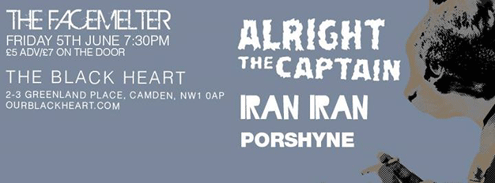
Alright The Captain + Iran Iran + Porshyne @  The Facemelter (The Black Heart, 2-3 Greenland Place, Camden, London, NW1 0AP, Friday 5th June , 7.30pm

Three heroes of math rock, alternative and post-rock travel from different corners of the UK to unite and form this amazing lineup.

Derby-based trio Alright The Captain masterfully combine virtuosic instrumentalism with unabashed musical experimentation and have effortlessly established themselves as a sonic force to be reckoned with, thanks to their increasingly inimitable, uniquely imaginative brand of math-rock. Their sprawling and varied career has seen them sharing stages with post-rock luminaries including Mono, toe, 65daysofstatic, Pelican, Tera Melos, ASIWYFA, Maybeshewill, Adebisi Shank (RIP), This Will Destroy You, ZU and many more. Their new album ‘Contact Fix’ (which ‘Musical Mathematics’ describes as “div(ing)  in and out of math rock, prog and post rock – but, at its heart, it’s different”) has gone down a storm.

Iran Iran are another supremely talented bunch of musicians who stunned and impressed all who saw them at ArcTanGent last year. With insanely complex rhythms and thunderously heavy riffs, the four-piece from Bristol have evolved since their excellent first EP ‘Crystal Math’ and are packing a punch. They’ve played with Future Of The Left, Cleft, Alright The Captain, This Town Needs Guns, You Slut!, Alpha Male Tea Party, Death Pedals and many others. Fans of complex musical wizardry or heavy riffs will love their new EP ‘Milk Time For Spiders’.

Brightoners Porshyne dance between ambient intervals and melodic vocals to intensely intricate, fantastically crunchy  prog rock riffs. With just a few single releases and a session filmed by Small Pond Recordings, they already sold out their first headline show in Brighton. This is your chance to catch the band before their career takes off.

More info here and here, and tickets here (£5.00 advance, £7.00 on the door).

At the end of the same week, Georgina Brett’s Tuesdays Post event returns to Stoke Newington with another evening of ambient/progressive live music, including ‘Misfit City’ favourites Darkroom

event-20150607tuesdayspost

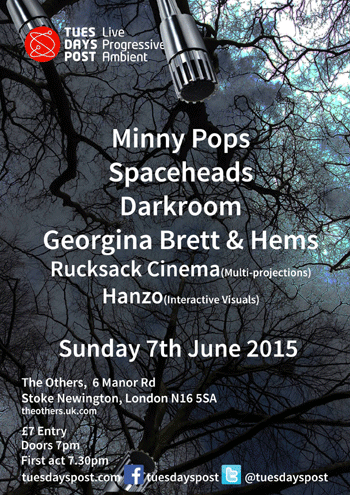
Minny Pops/Spaceheads/Darkroom/Georgina Brett & Hems @ Tuesdays Post, (The Others, 6 Manor Rd, London, N16 5SA, Friday 7th June, 7.00pm)

Formed by vocalist/band leader Wally van Middendorp in Amsterdam in 1978, Dutch electro pioneers Minny Pops took their name from a primitive Korg drum machine. The band released several singles and a debut album, Drastic Measures, Drastic Movement, on independent Dutch label Plurex before joining the legendary Manchester label Factory Records in 1980 (which resulted in them being produced by Martin Hannett, touring with both Joy Division and New Order, and becoming the first Dutch group to record a Peel Session). Singles including Dolphin’s Spurt, Secret Story and Time were followed by the acclaimed album ‘Sparks In A Dark Room’ in 1982. The band released two further albums (‘Poste Restante’ and ‘Fourth Floor’) before splitting in 1985. In 2012, the band reunited for a series of gigs in the UK, the Netherlands and Belgium and recorded a 7-inch single for Tim Burgess’ O Genesis label. After a pause to draw breath, 2014 has seen Minny Pops performing live once again.

Spaceheads are a cosmic duo of trumpet electronics and drums. Formed in 1990, they have developed a blend of electronics and sunshine fanfares over the course of ten albums, three EPs and much touring across Europe and the USA. Andy Diagram (also of James) plays trumpet with a mobile phone stuck to the top with a fish slice and Richard Harrison plays drums with big bendy metal sheets stuck to the top. They create live looped layers of brass driven by flurries of free flowing funky drums. Andy and Richard have achieved an intuition of what each is about to do next which makes their semi-improvised gigs a joy to behold. They release their first studio album in ten years – ‘A Short Ride On The Arrow of Time’ – this Autumn.

Darkroom – the UK-based duo of Michael Bearpark (guitars) and Andrew Ostler (synths)- expertly ride the line between luscious, old-school progressive rock and modern ambient electronics. At times reminiscent of early Tangerine Dream with hints of Fripp and Eno, they create clouds of sequenced synths, chewy grooves, and looped phrases to support a variety of acoustic and electric guitar melodies that twist and turn in surprising, occasionally aggressive, ways.

Hems Aka Henrique Matias will be playing live with Georgina Brett. Henrique is a multi-talented composer, programmer and DJ. He specialises in Multimedia programming (from internet things to Max/MSP and similars), although not all his live music and performances sounds like computer music (sometimes he takes his drum machines and crazy things out of the house). Georgina Brett’s music is created using her voice and effects pedals, creating instant choirs of sound, often in an hypnotic style. The point of this music is not only to captivate with extraordinary timing and melodic style but also to help the listener to relax in our ever-increasingly fast world.

Interactive visuals and multimedia projections are by Hanzo and Rucksack Cinema.

More information here – tickets £7.00 on the door.

By all accounts The Forge (in Camden Town) has spent the last few years becoming one of north London’s most interesting small venues for mixed music. I’ve yet to go there and see for myself: but in its full June calendar (also featuring funk, jazz, classical and Cuban music as well as assorted poetry) the following four concerts caught my interest:

Notus Winds & Eliza McCarthy (Wednesday 3nd June, 7.30pm)

Part of the classical monthly series Wednesdays at The Forge, this time featuring award-winning chamber ensemble Notus Winds and solo pianist Eliza McCarthy with a program of contemporary compositions (more information here). Tickets £10.00 to £12.00.

Programme:

Harrison Birtwistle – 5 Distances
György Ligeti – Ten Pieces
Arvo Pärt – Quintettino
Anders Hillborg – Six Pieces for Wind Quintet

Fenella Humphreys: Bach to the Future Part 1 (Tuesday 9th June, 7.30pm)

The first of three concerts presented by violinist Fenella Humphreys, featuring commissions of six new works by six of Britain’s leading composers to accompany Bach’s glorious 6 Sonatas and Partitas for unaccompanied violin. This first concert includes new works by Cheryl Frances-Hoad and Gordon Crosse alongside extraordinary music by Bach, Scott, Westhoff, Hindemith. Tickets £10.00 to £12.00.

Programme:

Cyril Scott – Bumble-Bees (1928)
Johann Paul von Westhoff – Suite no. 5 in D minor (1682)
Gordon Crosse – Orkney Dreaming (2014)
Fritz Kreisler – Recitativo and Scherzo-Caprice op. 6 (1911)
Paul Hindemith – Sonata op. 31 no. 2 ‘Es ist so schönes Wetter draussen’ (1924)
Johann Sebastian Bach – Partita no. 3 in E major BWV 1006 (c. 1720)
Cheryl Frances-Hoad – Suite no. 1 (2014)
Eugene Ysaye – 2nd Sonata op. 27 (1923)

Reciprocity: a new work by Daniel Patrick Cohen (Wednesday 10th June, 7.00pm)

Reciprocity is a 28 minute work for voice, taped narration, eight celli, piano, and percussion. The piece was composed by Daniel Patrick Cohen from six poems by the late Darya Farha, a Canadian poet, therapist, filmmaker and clothing designer. Darya was an extraordinary woman whose sharp intelligence, dry wit, distaste for orthodoxies and boundless empathy fuelled restless journey through her unfinished life. Darya died of breast cancer in 2011 when she was 46, and Reciprocity was commissioned by her sister Juliana Farha, who lives in London. Reciprocity is not about cancer, however. Instead, its human and universal themes of joy, pleasure, fear and anger, along with its intriguing instrumentation are sure to engage a broad audience. You can read more on the project here, and here. Tickets £6.00.

She’Koyokh & Veda Slovena Bulgarian Choir (Thursday 11th June, 8.00pm)

In a unique collaboration, She’Koyokh & Veda Slovena Bulgarian Choir combine the fiery panache of klezmer and Balkan music with the timeless beauty of Bulgarian voices, weaving Jewish, Turkish and Balkan music into the rich tapestry of the Bulgarian choral tradition. Read She’Koyokh’s piece on their Veda Slovena collaboration here. Tickets £10.00 to £12.00.

(All events taking place at The Forge, 3-7 Delancey Street, London, NW1 7NL)

March 2013 – album reviews – The JazzFakers’ ‘Here is Now’ (“accumulates itself out of loose particles of imagination; like a rogue dust-bunny”)

27 Mar
The JazzFakers: 'Here Is Now'

The JazzFakers: ‘Here Is Now’

I guess that any full-on free improvising band that makes it through to their third album must have become something of a fixture. Rolling and roiling within the Brooklyn branch of the New York improv scene, The JazzFakers probably also qualify via assorted free-music spillages (Brooklyn’s Experimental Music Meet-Ups, the Experi-MENTAL Festival) since their 2008 inception. Their humming, grappling music still suggests nothing particularly fixed.

Two of the four ‘Fakers, David Tamura and Robert L. Pepper, are certainly well-established promiscuous players and upsetters. Lynchpins of the Brooklyn multimedia collective PAS, they’ve placed themselves firmly into a matrix of oppositional noise, construction and deconstruction. All of their multi-instrumental noise-cramming in The JazzFakers has been nourished by multiple collaborations with a long train of musicians (soundtrack layerist Philippe Pettit, improv veterans Kidd Jordan and Charles K. Noyes, the spontaneous composers Ron Anderson and Grady Gerbracht). The other two ‘Fakers are maybe less ubiquitous – and less space-filling – but they certainly bring their own vitality. The anxious rubbery bass lines of Raphael Zwyer add a restless, nervy sproing. Drummer Steve Orbach has turned up bright and eager to the sessions, his sticks a-quiver like bug antennae, ready to prod and feel their way into the music.

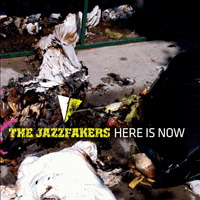
The album name, ‘Here Is Now’ suggests fresh, bright immediacy – improvisation without worry. The individual track names (a set of successive anagrams, all worked out from the album title) suggest playfulness and an enjoyment of structure games. The dirty kerb, torn binbags and scattered garbage – tied-off shirts, food fragments – of the cover shot tell a different story, and a more truthful one. JazzFakers are about debris and disparity, not consonance. There’s little about them that suggests structure apart from the swarming, disturbing liveliness of their intent.

Instead, their music accumulates itself out of loose particles of imagination; like a rogue dust-bunny. Or, more accurately, like a gigantic hairball – something rolling restlessly around the band members’ Brooklyn rooms and lofts, accreting a body from discarded bits of living and usefulness. Any given JazzFakers piece is a cannibal mass, crammed with china plate-shards, snapped pencils, and the sparking remnants of semi-dismantled technology; given extra lift by rolled-in springy fibres and by jazz-honk air-pockets. Runaway guitars, violins and reeds tussle with sundry distortions and tangled-up masses of electronic blips, and with a collection of synth voices which range from the raw to the deliberately corny.

While David Tamura is responsible for plenty of overdriven splintery electric guitar lines (rolling around furiously on the floors of the compositions, like injured scorpions), he’s also the band’s saxophone player. Unusually, this also means he’s often the band’s main link to more conventional structures. Certainly it’s him that provides the powdery, blues-rich tenor melody that boards the loose-boned march of Oh Rise New, adding a recognizable jazz voice to the restless buzz-keyboard swirls and mosquito-drill guitar, the rambling bass tune and the childlike organ which hangs and fidgets on a single disruptive chord. On Horse Wine, it’s his smartly turned-out tenor sax that moves in to converse calmly with Robert’s chorused violin saws and Raphael’s panicky bass, trembling and muttering on the upper harmonics. Steve’s subtle drumming adds some calming authority to the occasion, a taste of West African skintalk to offset the balloon-scraping sense of fear elsewhere.

On the other hand, David’s not to be relied on to provide anchors and grip all the time. Weise Horn, rising out of a wobble of shortwave synth whines, sees him let rip on free tenor: Robert responds with scrapescapes of violin, Raphael with a bass performance like a surprised bear. More than any other on the album, the piece becomes a free blow, but one struggling with a sense of being trapped. Led by David’s frantically wiggling sax, it’s claustrophobic, filled with screeches and frantic prison drumming in background sounding like someone drumming up a riot on a cooking-oil can.

There’s more free-sax contortions on Her Woe Sin (this time on alto) while a trepidatious, intense organ harmonic squeezes the band into a single trapped pitch cluster. Here, it feels as if they’re all being forced out through the neck of a bottle. As they reach a peak of compression, the piece becomes a revolving oscillation of guitar rub and smudged noises; trapped on a machine wheel, while Steve keeps a slow walking drum time at the rear.

Like David’s easy slips into conversational sax, that walking rhythm is another old-school jazz touch that comes rising up to reassure us through various JazzFakers confusions. There’s a brief, loose touch of it at the end of Nowhere Is – David and Steve bobbing along together in a moment of drums and sax companionship. Earlier it’s been a game of tack-blows, with Raphael’s rubber-mallet bass rebounding off curving chunks of organ, water-bottle tocks and flits of synth. As this moves into a more abrasive grind of free noise, David’s bluesy touch on sax makes a return, holding the band together with a stitch of melody. Ever-so-slightly wild, it sits in with the pugnacious racket like an old guy bantering with youths, laughing as his own wiles are tickled by their random energy.

Whine Rose reminds us that New York (like other cosmopolitan homes of music) isn’t just full of its own stylings, but also winds immigrant memories into its fabric. This piece sounds like an impression of the docks in Istanbul. Robert’s violin lines toy with a flaring, challenging Turkish-trumpet attack. Raphael’s bass strings scrape and creak like cargo cables: Steve drums like a longshoreman slinging and bumping crates across a quay. Every so often a long scraping drone in a reverberant arch will overwhelm the chatter and noise, push through the dirt and air-flashes from the band’s electronics and come in to rest, like a giant ship harbouring. At the end another jazz walk falls into place, free and swaggering, but trying to get back into comradely step. For a moment, the ‘Fakers sound like a cluster of dockers going off-shift, strutting out of the yard in search of a bar and perhaps a bit of trouble to bond the team together.

But while hints of jazz tradition, diasporan memory and other bits of cultural consonance may surface briefly through the matted fabric of their musical hairball, the JazzFakers are always predominantly about shredding sound – grabbing and shaking it into rag and rampage. Bar a brief breather in the middle (an interlude of silence, broken by gentle koto plucks), Where’s Ion gathers up raw hanks of sound to stretch and shear. Morse-blipping electronics and flinders of keyboard fight their way through a seesawing murky gale of playing. Robert’s abrasive, distorted violin wrenches back and forth, overdriven to the point where its melody fissures and cracks; time pulled and flexed too far out of shape to cling to. The second part entirely and willingly overwhelms itself: a shitstorm onslaught of scribbling guitar and a mass of excited electronic buzzing and whooping meets Steve’s drums and percussion head on, as they rattle like an upended ship’s galley.

The cheerful Whee Irons has its share of noisy Tamura guitar tangles and collapsing Pepper electronics, but also seems to be toying with broken bits of 1980s pop (trying on the hairstyles and waving around some of the sonic tropes). A bouncing, pulsing vocoder patch promises some kind of hook before becoming just something to squish and pulp against a jittering music box. Raphael (briefly in the spotlight) visits the upending, cunning-stunt territory of Tony Levin or Mick Karn. His bass jolts out high squeets, tap-and-hold skids, talkative burbles; on one occasion, a game-changing downward slide before slipping comfortably back into freestyle wandering for the second stretch. More elements tossed hopefully into the mix include some double-speed Zappa saxophone rushes and some corny, choral angel-voice keyboard, mocking at the huffing, bellowing drums and the drilling lead guitar.

At the end, with the twelve minutes of Hero We Sin, the band don’t so much tie up the record as relax the tangles. While free, it’s less furious. There’s less jostling and more listening, from the fake sci-fi theremin intro (echoing over lightly-struck and watchful cymbals) to the final saxophone-argues-with-egg-slicer fadeout. Along the way, the quartet shuffles a handful of musical cards: the edge-stalking Miles Davis fusion of 1971 (both invoked and undermined by little stings of toy piano); the undulant glissando guitar-wave of Syd Barrett; even a hint of the Sugar Plum Fairy. Clearer solos emerge. An aggressively awake guitar (swelling large over grinding distorted drum crunches like rusty clockwork being forcibly wound); cloudy, floating high toms and cymbals over a gastric electronic splatter; a vibraphone over a phased electronic phase buzz, deep pitches, sanding noises and high birdlike twitters, which in turn give way to a cradling bulk-photocopier slide and clunk.

Towards the close, while electronic percussion boils and rattles like popcorn at the side, Robert’s scratch violin is caught in debate with David’s saxophone – the one complaining and cramping, the other remonstrating and stretching. The work’s ending. Time for sense. Time to flex the remaining knots out.

The JazzFakers: ‘Here Is Now’
Alrealon Musique, ALRN043
CD/download album
Released: 25th March 2013

Get it from:
Bandcamp.

Artist online:
Facebook MySpace Soundcloud

REVIEW – Dutch Uncles: ‘Fester’ single, 2012 (“a butter-toffee in a world of cheap smokes”)

26 Oct

Dutch Uncles: 'Fester'

Dutch Uncles: ‘Fester’


That’s a repulsive title for a single. Then again, Dutch Uncles have always been something of an irritant. I mean that in a good way, as it happens. Some of my favourite bands are irritants. Too many bands just want to be stimulants – crude and obvious, they roar in with a snort and a thump, hammering hard on the most obvious buttons. After a while, you just need more and more of it to elicit even a small buzz, and you end up bored and bloated.

An irritant, on the other hand – that does its job of stirring up a reaction in a different way. You can’t ignore it. It focuses the attention, often by making you aware of sensitivities that you didn’t even know you had. Dutch Uncles have always been happy to spike the necessary nerve and keep feeding a pulse into it. If you’re familiar with those dancing, sidestepping cycles of guitar riff which festooned and hiccuped all over their earlier singles (Fragrant, The Ink, Face In) then Fester will sound halfway familiar. If you persuaded Steve Reich to write around eleven Disco Phases, then stacked them up on top of each other, you’d have the basic bones already. It rotates like a carousel full of drunk mathematicians, with Duncan Wallis’ warm alto hoot (still a butter-toffee in a world of cheap smokes) muttering and musing atop the pile.

What’s new for Dutch Uncles is a delightful infusion of art-rock colourings – that bass guitar which thunks like a piano; that bony clink of marimba hook; the guitar which blows and bloozes like a sleepy horn solo. There’s a delicious feeling of confusion and clothes-swapping wrapped into the song: it’s reminiscent of early Roxy Music and their upsetting of texture, of the otherworldly kink of Associates. With Duncan’s tone of repressed and airy hysteria, there’s also got something of the closeted wildness of Sparks (albeit in one of their mellower moods). Dutch Uncles have that nervy theatrical cleverness to them, as if they’re delicately stepping along a rail with ideas dropping out of their pockets and with tell-tales twitching at the corners of their eyes.

I mentioned a song, didn’t I? It’s built into the jittery mosaic of instruments; and it’s a protest, of sorts. “There’s a time to hide everything – the way that you are; where you’ve been. / And the feeling I’ve tried to fight, / pieces I’m left in inside.” In a genteel way, Duncan’s pissed off; chanting “takes me to the bone” as he swats, distractedly, at a lingering pain. Fractured syntax dribbling in his wake, he argues his position and tells his story like a hungover man struggling with a jigsaw. “And the times you cry at everything / for reasons we don’t mean anything. / And the times I hide behind a smile / that says you were right, you were always right.” By the end of his efforts, he’s trying to strip-mine his way into sense by plunging headlong into tongue-twisters (“The worst is hardly, hardly known, / I trust the worst is hard to know. / The worst is hardly, hardly known, / I know the worst is hard to know,”) as the band pound delicately around him. Irritation confuses, scatters against structure: but few things are better at making you feel.

Dutch Uncles: ‘Fester’
Memphis Industries, MI0250D/MI0250S
vinyl 7″/download single
released: 20th September (download) & 12th November (vinyl) 2012

Buy it from:
Memphis Industries (vinyl); Dutch Uncles homepage
or Memphis Industries news page (download)

Dutch Uncles online:
Homepage Facebook Twitter MySpace

April 2009 – album reviews – John P. Hastings with New Century Players & Ensemble 303’s ‘Chamber Music’ (“stark rectitude and detachment”)

25 Apr
John P. Hastings with New Century Players & Ensemble 303: 'Chamber Music'

John P. Hastings with New Century Players & Ensemble 303: ‘Chamber Music’

As well as being a composer, John P. Hastings is a curator. Actually… no. Separating the two terms suggest that there’s a gap between them: some kind of change in philosophy or mental state. It’s true that when he’s not composing, Hastings involves himself in arranging and hosting music events and sonic installations in his adopted home of Brooklyn, New York (via the ‘Sound Series’ at Presents Gallery) as well as co-running ‘The Experimental Music Yearbook’. However, it seems clear that these other activities might not involve much of a conceptual shift. I’ll come back to this later.

Starting off in Washington and Virginia, Hastings was at one time a late-’90s college rocker, playing guitar and writing songs for the post-grunge band Utris. After that he moved his base to CalArts and moved his musical allegiance – with a vengeance – to New Music via avant-garde process work and sonic art. While Utris occasionally dabbled in hard-rocking drones, Hastings’ subsequent music (be it orchestral, laptop-based or both) has quietly and methodically embraced many of the scientific components of late-twentieth-century conservatoire culture. His work sometimes shades carefully and soberly into the post-modern (via technology, found sound, chance methods and a fascination for the minutiae of microtones and the harmonic series) but his primary commitment has been to formalism and to music which establishes, as he defines it, “a logical and rationally satisfying whole.” His early chamber music pieces are rooted at the sternest end of late modernism, asserting a profound minimalism and blending it with clear process-based choices.

This debut collection reflects this position in all of its stark rectitude and detachment. All three of the minimal yet sonorous pieces here were performed either by the New Century Players (CalArts’ ensemble of “emerging musical language” musicians) or by Ensemble 303 (the experimental music group co-led by Hastings and Casey Thomas Anderson). Similarly, they were recorded in guarded heart-zones of the Californian avant-garde – two pieces in Roy O. Disney Hall at CalArts, and one in The Wulf gallery in downtown Los Angeles. These rooms seem to enclose and encourage the music in its deliberately slender and depthless form; its impassiveness; its focus on insidious pared-down number structures beneath the apparent form and textures. The musical notes themselves are explicitly passive components in a sparse mathematical schema, although this doesn’t stop them from often being beautiful.

Hastings makes his allegiance to science and mathematics plain from the off: the large-ensemble piece ‘telluric currents’ (performed by the New Century Players) is named after subterranean electric fields. Less scientifically, Hastings also describes in terms somewhere between angels’ trumpets and astro-metaphysics – “the music of the spheres, sounded with a low B-flat.” Translated, this means a single-note composition, though Hastings also states that it’s actually “one note, two curves.” The latter would appear to mean a gradual rise in pitch and an arc across the differing ranges of orchestral instruments. As for the former, every component note of the piece is a B-flat: precise timbre, octave and duration vary, but the pitch class doesn’t. The result is a kind of a chameleonic sound-curtain made up of nothing but octave variations on the same note.

In the opening moments, a low string drone is gradually joined by a low brass drone: after a minute and a half, the mid-range strings are backing up the low ones. Soon afterwards, the first of a set of horn soundings begin, adding to an enveloping hum. With no more than a single stacked set of octave intervals available to him, Hastings induces a surprisingly full sound, overlaying different instruments in different timbres and within different octaves to cover a broader spectrum of sound. The New Century Players seamlessly slot in replacement instruments as others fall out. It’s a little like a Risset scale trick reversed: instead of producing a continuous cyclic illusion of rising, the process camouflages a genuine rise. Those final sustained high B-flats (carried on stratospheric harmonics once all lower-pitched instruments have fallen away) come almost as a surprise. While this renders ‘telluric currents’ as more of an acoustic demonstration than a composition, Hastings’ arrangement of pitches and the ensemble’s dedication ensure that the listener walks away feeling that they’ve received much more musical information than they have.

‘Sonic Spiral’ (recorded by Ensemble 303 at the Wulf) is billed as “music and math in direct correlation” and as “a sound equivalent of the Fibonacci series.” It’s not the first time that the latter has been employed in structuring music. Building up from a start-point of zero and one, successive Fibonacci numbers sum the previous two, resulting in rapid and increasing jumps in magnitude as the sequence progresses. Spirals based on a linear and increasing Fibonacci sequence closely resemble “perfect” spirals based on the golden ratio, tying them in with idealised human architecture. Their appeal in guiding a compositional approach is obvious – allegedly, Bartók used them to compute part of the structure for ‘Music For Strings, Percussion And Celesta’.

Hastings’ own seventeen-minute Fibonacci piece is written for 11 unspecified tunable instruments. On the Wulf recording, I think I can hear low brass, standard and bass clarinets, violin and viola, saxophone… but what I predominantly hear is sustain, and the long harmonics which it allows to play against each other. Hasting winds the piece up with a little silver key of mathematics and simply lets it unfurl. Over seventeen minutes, the development is glacially slow. More accurately, it’s indifferent to human priorities of time and gratification; obeying rules of harmonic motion or aggrandisement set by the Fibonacci sequence.

Sitting on its locked tonal centre, the piece seems static, a softly growing hum within a gentle dynamic range. It’s actually an ever-growing and increasingly complex chord, moving subliminally up a spectrum of pitch into which new notes are eased and out of which silvery harmonic whistles sprout according to acoustic interference. Around eight minutes and forty-five seconds a lone violin seems to emerge from the stack, dipping over its own sustain and briefly leading the ensemble. It’s an illusion: the instrumentation is less dense at that point, revealing the mechanical workings of one briefly exposed instrument. The tiny dips and recoveries in pitch between continuous bowstrokes, the human flutter and inevitable tiny flaws of the working player, seem momentarily to impose a new idea on the piece: but the grand plan has always been dictated by the numbers. Just as the piece was wound up, so it winds back down.

Unlike the other two pieces, ‘desertum’ lacks a stated mathematical context. Instead, following Hastings’ habit of bringing in arcane or mythological references, it’s touted as “the dark shadow of an Earthly paradise.” Apparently performances of ‘desertum’ can be between fourteen and twenty-one minutes long. Perhaps I’ve missed some obscure rule-of-seven which Hastings hasn’t mentioned. This particular recording is eighteen minutes and twenty-two seconds long – or one thousand, one hundred and two seconds. Neither of which fit the sevens. Maybe maths isn’t dictating the process this time, although I suspect that its hidden rational hand still guides the way: perhaps the clues are elsewhere.

Despite the instrumental billing – brass quintet and percussion quartet – the main instrumentation on ‘desertum’ is an uncredited sub-bass tone. Pure, continuous and borderline subliminal, it runs throughout at a single unchanging pitch. Too textureless for an actual drone, it acts as a flattened-out level ground for the other instruments to perch on: utterly unyielding, it renders everything they do impermanent. Periodically, the brass instruments engage in a kind of minimal fanfare, each playing a single elongated note as part of a staggered, overlapping arpeggio.

The resulting sound resembles a diagonal chord, changing component notes slightly on each widely-spaced repetition. The hierarchy of pitches changes too, sometimes with the higher notes sounding first, sometimes the lower or midrange. They stack up like wobbling columns of stones, or like the same ruins viewed from different angles. During the lengthy pauses between these chord-piles, assorted percussion winds quietly across that monotone floor – wary rattlesnakes sneaking past. There may well be a long game of determined structure here: a slow-motion play through a specialised harmonic sequence played out at an inhumanly attenuated, Morton Feldman-esque pace. Perhaps, without the score, I lack the patience or the ear to determine it.

Instead (listening with more abstract, literary ears) what I hear in ‘desertum’ is a generalised sense of place – a parched and uncaring environment in which any human scratch or sculpting remains solitary and ignored, however vividly it stands up against the dry horizon. Hastings’ chords stand unrewarded and unresolved, isolated between ground and sky. Any message or change which they might carry is reduced to a molecular level. Wherever the idea of an earthly paradise fits in is an open guess. Perhaps the brass instrumentation was chosen for its association with angels, and the broken contortions of chords and desolate lack of movement imply the failure of Eden and the bitter aridity of Exodus. Perhaps Hastings’ rationalism discourages too much of a literary or Biblical interpretation, and ‘desertum’ is simply an existential communication about us – placed in hostile and impartial landscapes, struggling against the odds to make our lives and establish our significance.

Rooms and spaces which encourage. Landscapes that reject… All right, these are classic pathetic fallacies of the kind which Hastings’ more rational side might reject. But on the other hand, I think that this more emotive idea of placings, of placement, does have a relevance. Bar the utterly aleatoric or the free improvisers, almost all working composers ensure that each note and harmony used has a place in the scheme. The utter minimalism provided by these works (with their mathematical maps, their formal constraints, their refusal to allow any kind of horizontal development other than that permitted for duration and equation) works differently.

In these pieces, Hastings comes across less as a composer and more as a kind of… curator of notes. Rather than putting those notes to work, he maps them, provides them with a decreed academic location, gives them their single fixed point in his sonic display and keeps them safe there. He can and will demonstrate where they come from and how they fit in, but it’s as if his artistic work as curator of events has overlapped and merged with his compositional creativity to the extent that it’s now difficult to tell them apart. Similarly (and with the possible exception of the stonily suggestive ‘desertum’) its hard to imagine these three pieces existing and living outside the shelter of the Wulf, the Disney Hall  or their equivalent art-labs dotted around the world. It’s where music like this is safe: is understood and identified; ultimately, is pinned down.

To be honest, sometimes it’s as much about the chamber as it is about the music.

John P. Hastings with New Century Players & Ensemble 303: ‘Chamber Music’
Bandcamp
Download-only album
Released: 21st April 2009

Buy it from:
Bandcamp

John P. Hastings online:
Homepage FacebookBandcampTumblr

New Century Players online:
Homepage

Ensemble 303 online:
Homepage

March 2003 – live reviews – North Sea Radio Orchestra @ St Clement Eastcheap, City of London, England, 15th March (“a polished Victorian never-never land of intricate miniatures and toymaker’s details”)

18 Mar

Once you’ve found it (tucked away in the cramped, confusing whorls of buildings and alleyways near the Monument) the diminutive Christopher Wren church of St Clement Eastcheap is like an old-fashioned kid’s treasure-box, hidden in a chest-of-drawers. Small but perfectly-formed (and bearing the decorous marks of its mid-Victorian refurbishment), it perches pertly between two well-known architectural schools – “enchanting” and “cute”. Tidy pillars spring up hopefully at the sides of its nave. That creamy yellow tint in the immaculate plasterwork of the walls sets off the lovingly-worn mahogany of choir stalls, pews and the massive pulpit. It’s tiny enough for a smallish art-rock audience to squeeze into and feel cosy: and there’s a nursery-rhyme connection too, if you know your oranges and your lemons.

Really, the North Sea Radio Orchestra couldn’t have picked a more appropriate venue. For the music of this retrofitted, romantic-progressive chamber ensemble, St Clements fits like a glove. It shares those hints of modestly-mingled English eras of scaled-down splendour, the atmosphere of nostalgic time travel and aan affectionate polish of traditional heritage. Once you’re inside, both of them also tempt you to blissfully engulf yourself in a luxurious dream of old England – open fields, spinneys, bright stars, sunlight and green thoughts – while all around you the ruthlessness, frenetic urban pace and concrete encroachment looms and sprawls. This may all be an imaginary, selective stance. On a superficial level, you could also get suspicious of well-spoken contemporary white musicians in London warding off angst by cooking up a hand-crafted pre-industrial daydream. But this does the NSRO a disservice. You could accuse them of forcing their innocence – and maybe yours as well – but whatever else they’re doing here is done entirely without malice.

Twenty people settle onstage and get a grip on their violas, cellos, trombones, bass clarinets or whatever. Familiar London art-rock faces abound. Conductor-composer Craig Fortnam and the ensemble’s soprano singer Sharron Saddington used to bob up and down on the fringes of the Cardiacs scene, first in the psychedelic tea-party of William D. Drake’s short-lived Lake Of Puppies and then in the bumptiously charming folk-pronk of The Shrubbies. James Larcombe (Stars In Battledress’ elegantly-tailored smoothie of a keyboard player) is soberly fingering a chamber organ. His brother and bandmate Richard is boosting the numbers in the eight-strong choir, right next to the wild Persian afro of onetime Monsoon Bassoon-er (and current Cardiac) Kavus Torabi. Out in the audience, the aforementioned Mr Drake sits next to Tim Smith, his old friend and former boss in Cardiacs. Across from them, there are various Foes and Ursas and Sidi Bou Saids. There’s a sense of occasion. We get a beautifully designed arts-and-crafts-styled programme to take home. It’s a long way from Camden pub gigs.

This isn’t solely because of the surroundings. North Sea Radio Orchestra might carry their assorted historical splinters of psychedelic rock, folk, and even punk along with them, but they are unabashedly classical in intent. Even the twistiest and most abrasive of the art-rockers in the lineup are sporting the sober concentration of churchgoers, and Sharron has traded her former outfit of cosy specs and jumpers (though not her artlessly warm smile) for a modest diva gown. Craig, his back turned, conscientiously conducts the ensemble. When he sits aside to strum a little polite guitar, he has to crane his neck round anxiously, making sure that the music is still running smoothly.

He needn’t worry. Despite the shades of complex tonality which inform the NSRO’s compositions (Frank Zappa, Benjamin Britten and Tim Smith have all left their mark on Craig’s inspiration), the music flows readily. Sometimes it’s a simple organ drone as a base for Dan Hewson’s trombone expositions. At the other end of the measure, there’s the rollicking Occasional Tables: a dancing interplay between clarinets with a gloriously drunken, attention-switching Frank Zappa/Henry Cow approach. With its mediaeval echoes, and an additional infusion of the peculiar darkness of post-Morton Feldman Californian conservatoire music, it’s given an edge by the astringent, atonal vibraphone shiver (and by Craig’s strict, almost military turn on bongos).

Intriguing as these are, it’s the NSRO’s orchestration of poems which connect deepest with the audience. Mostly these are Tennyson settings (with a sprinkling of Thomas Hardy and other contemporaries) but even Daniel Dundas Maitland’s modern Sonnet looks back to ornate Victoriana. So does Craig’s music, swirling its Early Music and contemporary classical influences together to meet halfway in a polished Victorian never-never land of intricate miniatures and toymaker’s details. Sharron’s vocals – sometimes piping, sometimes emoting in keen, theatrical wails – make for exquisitely brittle sugar-sculpture shapes, while rivulets of strings and woodwind launch themselves from the melody.

The heavenly sway of Move Eastward Happy Earth sets Sharron’s winsome soprano against the lazy, streaming clarinet of Nick Hayes and against Ben Davies’ slow waltz of trimmed-down piano. The choir (with a hearty, clever enthusiasm that reminds me of nothing so much as Gentle Giant) leaps in for stepped, skipping choruses and glorious vocal resolutions. For The Flower, drifts of strings slip from the vocal line and weave busily like something out of Schubert’s Trout Quintet. Onstage, everyone who isn’t smiling looks happily dazed, as if drunk on the sunny harmonies.

And so it continues, with parts of the NSRO dropping in and out to suit the music. For Thumb Piano, Craig trims it down to a revolving arpeggio of guitar harmonics in trio with the blues-tinged fluting of Hayes’ sweet’n’wild clarinet and Katja Mervola’s pizzicato viola. Harry Escott provides a cello improvisation, impressively-voiced chordal melodies sliding on top of a slithering bass drone. James Larcombe sketches out a collage of beady, kaleidoscopic chord progressions in his studious organ solo. The chorus, for their part, sing lustily in a London melting-pot of diverse accents. For the canon setting of Yeats’ He Wishes For The Cloths Of Heaven, the whole orchestra sings its way through Craig’s pop-folk melodies.

When the whole ensemble is running at full strength, St Clement brightens with music. Shelley’s Skylark, in particular, is profoundly ambitious – semi-connected cello lines swing like foghorns, thick Michael Byron-ish string parts disgorge dominant melodies, and the chorus is a rich blur of voices, pumping resolution into Hardy’s words. But best of all is a generous Fortnam orchestration of a piece by his former bandleader William D. Drake – a setting of William Johnson Cory’s Mimnermus In Church. With Richard Larcombe stepping out from the chorus to duet with Sharron, and the North Sea Radio Orchestra performing at its fullest stretch, the results are captivating. The voices of Sharron and Richard move around each other in dusty, reedy, yearning harmonies (he floating up to countertenor) while strings, piano, clarinets and brass open out like a delicate night-bloomer, fragrantly illustrating Cory’s salute to flawed and transient life in the face of a perfect yet chilly heaven. “All beauteous things for which we live by laws of time and space decay. / But O, the very reason why I clasp them is because they die.”

Yes, in pop culture terms it is music for an ivory tower, or for a detached oasis where you can secrete yourself away from the world. Only a mile or two to the west, I’m sure that electric guitars are roaring out rock, garage clubs are spinning off beats and bling, and someone’s delivering tonight’s definitive urban hymn. But emerging into the City of London – all higgledy-piggledy with glass skyscrapers, Renaissance guildhalls and mediaeval street names, a ragbag of congealed history in parallels – I couldn’t care less.

Like the best musicians, North Sea Radio Orchestra tap into timeless things (beauty, transient joys, the shift of seasons). But like the stubbornest, they also know the colours and shades of the times which they’ll want to employ, finding a way to make them mean something whenever and wherever they’re played. And though an antique church and a Victorian altar cloth made a beautiful frame tonight, this music – at its peak – would’ve sounded good even if the whole ensemble had been balanced atop a Docklands trash-heap.

North Sea Radio Orchestra online:
Homepage Facebook MySpace

St Clement Eastcheap online:
Homepage

December 2002 – EP reviews – North Sea Radio Orchestra’s ‘North Sea Radio Orchestra’ demo EP (“the bluffness and friendly beauty of English music – all clotted cream and cider”)

5 Dec

North Sea Radio Orchestra: 'North Sea Radio Orchestra' demo EP

North Sea Radio Orchestra: ‘North Sea Radio Orchestra’ demo EP

Though it isn’t a patch on their ornately gilded live performances, there’s still much on the North Sea Radio Orchestra’s debut recording to give you an idea of their fledgling fragility and freshness.

Making strikingly pretty voyages into English chamber music, the NSRO are a vehicle for the Frank-Zappa-meets-Benjamin-Britten compositions of the former Shrubbies/Lake Of Puppies guitarist Craig Fortnam. They feature a cross section of classical musicians and serious moonlighters from latter-day London art-rock bands like Cardiacs and Stars In Battledress; and they mingle a palpable innocence of intent with a taste for engagingly convoluted melodic decoration. All this plus eminent Victorian poetry too. At this rate, Craig will wake up one day to find out that the National Trust has staked him out.

He could use some backup, to tell the truth. This time, budget constraints mean that the NSRO’s flexible little company of clarinets, piano, violin, organ, cello and harmonium (plus Craig’s own nylon-strung electric guitar) gets squeezed into a recording vessel too small to give them justice. It’s a measure of the music’s innate charm that it transcends these cramped conditions, aided in part by the loving assistance of head Cardiac Tim Smith at the console.

Music For Two Clarinets And Piano, in particular, strides out in delicious pulsating ripples as it evolves from a folky plainness to an increasingly brinksman-like disconnection. The clarinets hang off the frame of the music like stunt-riders, chuckling and babbling cheerfully at each other, held up by bubbling piano. The keyboard trio of Nest Of Tables also overcomes the plinking tones of the necessarily-synthesized vibraphone and harp to embark on a long, waltzing journey over a stack of tricky chords: leaning on the piano, the benevolent spectres of Tim Smith and Kerry Minnear nod approval in the background like a pair of proud godfathers. Organ Miniature No. 1 (written and delivered by Stars In Battledress’ James Larcombe) manages to find a convincing meeting point for relaxed Messiaen, strict chapel and the better-groomed end of Zappa.

For many it’ll be the three Alfred Lord Tennyson settings which encapsulate the heart of the North Sea Radio Orchestra’s appeal. Featuring the soprano vocals of Sharron Saddington (Craig’s longtime musical and romantic partner), they’re as tart and sweet as freshly pressed apple juice. Somehow they manage to dress the poems up in artful, beautifully-arranged chamber flounces and frills without swamping them in too much chintz. It’s a fine line, which the NSRO tread by matching Tennyson’s blend of mellifluous personal introspection and cosmological scenery with similarly perfumed and illuminated music. Soft but increasingly detailed puffs of chamber organ gently rock Sharron’s summertime lament on The Lintwhite, from where it’s cradled in its bed of harmonium. Perhaps it’s no coincidence that Craig chooses to orchestrate The Flower (a fable of beauty, nurture and prejudice which conceals a sharp judgmental barb) with a muted brass arrangement reminiscent of another sharp musical fabulist, Kurt Weill.

The crowning glory is Move Eastward Happy Earth, where Sharron sings a hymnal wedding waltz over joyfully welling piano. Refusing to sing in either classical bel canto or pure pop, Sharron comes up with her own tones in a full sweep of approaches between urchin, candyfloss and diva: here, she carols in a kind of beautifully-mannered choirboy ecstasy. She’s backed up by an exuberant miniature chamber choir who sweep between yo-ho-ho-ing madrigal accompaniment and full-throated burst festive celebration via a set of boldly harmonised canons. It’s a little trek through the bluffness and friendly beauty of English music – all clotted cream and cider.

Perhaps that last idea is as fancifully romantic of me as is Tennyson’s own image of the spinning planet, racing him on towards his marriage day. Or perhaps underneath it all I’m being as phoney as John Major, last decade, waxing corny about a vintage Albion of cycling spinsters and cricket whites on the village green. Dreams of English innocence and cleanliness can end up trailing their roots through some pretty murky places unless you’re careful. Nonetheless, for three-and-a-half minutes North Sea Radio Orchestra could restore your faith in its well-meaningness – all without a trace of embarrassment, or recourse to snobbery. They earn their right to their genuine dreamy innocence, and (for all of their blatant nostalgia) to their sincerity too.

Shoebox recording or not, here’s a little piece of wood-panelled chamber magic for you.

North Sea Radio Orchestra: ‘North Sea Radio Orchestra’ demo EP
North Sea Radio Orchestra (no catalogue number or barcode)
CD-only EP
Released: late November 2002

Buy it from:
(Updated, 2016) Best obtained second-hand – although it’s as rare as hen’s teeth.

North Sea Radio Orchestra online:
Homepage Facebook MySpace

August 2001 – album reviews – Michael Jon Fink’s ‘I Hear It in the Rain’ (“into the tundra of forgetfulness”)

25 Aug
Michael Jon Fink: 'I Hear It In The Rain'

Michael Jon Fink: ‘I Hear It In The Rain’

Often it’s as simple as this – for true treasure, let go of the precious.

Michael Jon Fink (operating within New Music but sidestepping much of its systematic, lab-dulled pretensions) proves it on this album of close-up and subtle music, aided by remarkably sympathetic collaborators – textural guitarist Rick Cox, percussionist Dan Morris, Bryan Pezzone on piano and celesta, and bass clarinetist Marty Walker. There’s something of Gavin Bryars’ evanescent emotional skill to Fink’s music; something of the soft spatial blur of the Evanses (both Bill and Gil); but little of the chart-plotting dryness of a composer after cleverness points. Although Fink’s composing seems to be romantic at heart, he’s well aware of what modernism lets him draw by implication. ‘I Hear It In The Rain’ has feeling in plenty, but doesn’t lay out its secrets that easily.

During Five Pieces For Piano, Bryan Pezzone’s soft playing presses oh-so-gently on our ears. Fink’s music emerges from Pezzone’s piano so delicately that it hardly disturbs the air, as silent as night-travelling stealth ships, yet it sets reactions moving. The musical voicings are widely spaced, just dissonant enough for a shadow of doubt. The melodies are simple – songs from a sleepy child on the road – and it’s Pezzone’s exquisite touch on both keys and pedals that brings out Fink’s intentions.

 
The sparse sketch of Passing sounds like Debussy, but also like worksong. Its tentative descending melodies touch down in firm but unsettled chords – displaced, jazz-shadowed. Constrained by its skeletal melodic discipline, Mode uses space instead to ask its wordless questions, which remain unanswered by the rising minor-key bass arpeggio of Fragment and the two-note treble alternation which rings on and on – absently, a long-ignored alarm that’s forgotten both urgency and reason and instead beats out its worn, relaxing ritual. For Echo, two cycles of elegantly picked-out notes overlap each other, engaging not like machine parts but like two people caught unwittingly in a loose parallel. The fifth and final piece, Epitaph, draws the harmony together. The sustained, rising rumble of each decaying bass note holds the attention, while a melody in the mid-range takes up the implications of a death song.

 
This is not about feelings being directly manipulated. Fink’s music induces them, drawing into the gaps and implications between the notes. A lot of it is timing: the attuned sensibilities of a performer and a composer both inspired by the subtle, near-telepathic interreactions of small-group jazz. More of the slender, yet involving, same can be found within Two Preludes For Piano. The first of these, Image, keeps that same poise between amnesia and raptness as the Five Pieces do, tiny details slipping past the pared-back structure of Fink’s notes. The second, Wordless, heads further into the tundra of forgetfulness: the tenor- and soprano-range parts thoughtful and reassuring, but set just far enough apart from each other for disturbance, fading unresolved into the deep evening.

When Fink and Pezzone leave the piano’s subtle, powerful dynamism, they favour the celesta – an instrument which demands (and produces) an exquisite clarity, but with soap-bubble fragility. While the instrument is chillier and less robust than the timbrally similar Rhodes piano (the jazzer’s usual choice for the otherworldly), Fink turns this into a virtue. Initially, For Celesta seems as physically ephemeral as a frost-painting – bright points glimmering on a window – but grows by degrees as Pezzone brings out the full resonance of the instrument’s range. A beautifully sleepy melody grows, reflection by reflection. It’s precise, yet weighted oddly by its slow ebb and return of acceleration; and by the sudden unexpected welling-up of emotional and physical volume midway through, before returning to its soft contemplation.

 
Elsewhere, Fink’s moods are less compressed and matter-of-fact titles are left behind for more poetic names. On Living To Be Hunted By The Moon (which could be a nod to Gurdijieff’s mythology of soul-eating moons, or to even older fears) Fink builds a landscape of powerful but distant sampler drones. These slant across the sky like angled, endless, featureless walls, each one eerily bisecting the former with a disquieting geometry. Underneath this beautiful and subtly oppressive canopy the marvellously expressive Marty Walker purrs and throbs all-but-subliminal lines on his bass clarinet. It comes across as a supernatural play of light represented in sound, but once again Fink’s near-narcotic sense of subtle disassociation comes into play. His soundscapes hover overhead like a deferred threat, or like a beautiful, cruel and thoughtless god – something to be crept past; something of predatory attentions, carefully evaded.

 
No such emotional deferral happens on the album’s title track, which is also it’s haunting and lovely finale. Everything that has been promised (or hidden) elsewhere on the album settles home like final snow, or final tears. Where all else has been sparse and minimal, I Hear It In The Rain is luxuriant and gently cathartic. Dreamily slow, founded on Fink’s pedal-point of bass guitar and the gentle rocking motion of his bell-like keyboards, it’s shot through with fluttering orchestra-sized samples of tremulous cellos, blending with the soft rushes of Morris’ gongs and bell trees. Rick Cox’s electric guitars (teased into hallucinatory smears by sponge or glass implements) buoy up the spectral and blissfully desolate melodies, dissolving the emotional suspense in one long resolution; dissolving you too and easing you out through your opening window up into another warm and solitary Los Angeles night.

 
Words aplenty… I could go on and on to you about the restraint and wisdom in Michael Jon Fink’s work, but what gets me every time is its sheer and honest beauty. There’s a disciplined mind at work here: it’s also one which is in touch with such universality of feelings that praising his deft economy and musical grammar seems reductive. I could pin him down further for you, but what matters might be beyond by reach – though, even as I finish this, it’s come filtering through the air to reach back to me again. Simple. Special. Indispensable.

Michael Jon Fink: ‘I Hear It In The Rain’
Cold Blue Music, CB0004 (800413000426)
CD/download album
Released: 18th June 2001

Buy it from:
Cold Blue Music (CD) – various downloads available from Amazon and similar.

Michael Jon Fink online:
HomepageLast FM iTunes

April 1999 – album reviews – Michael Bearpark/Peter Chilvers’ ‘Thin Air’ (“scraping waves and langorous tides”)

10 Apr
Michael Bearpark/Peter Chilvers: 'Thin Air'

Michael Bearpark/Peter Chilvers: ‘Thin Air’

I could take the easy route first and say that if you’ve heard ‘No Pussyfooting’, you’ve more or less heard ‘Thin Air’. But that’d be a weaselling statement: technically correct but still untrue, and also of neither use nor value to you. As if I said that the most important defining characteristic of an apple was that it was round and green, and thought that that was all there was to it.

Yes – it is true that the Bearpark/Chilvers album is very Fripp & Eno (or a close musical cousin to Richard Pinhas). Its five tracks (titled, without fuss, One to Five) make up a little under an hour of droning, buzzing, looped Les Paul guitar textures and minimal synth. It comes in scraping waves and langorous tides, sometimes broken by a tightly-controlled welling of overdriven melody. The Frippertronics comparison is more than appropriate: it’s exact. Here is the same methodology, and similar equipment – although Peter Chilvers’ digital keyboards and hard-drive recording are far removed from Eno’s primitive VCS3 and Revoxes back in 1972.

But with that said, we can move on to the distinctions. It’s the same methodology, yes – but with a different intent. Fripp & Eno were taking a vacation from disciplined, cunningly constructed early ’70s art-rock when they made ‘No Pussyfooting’. While they’ll have absorbed the same influences second-hand (not least through Fripp and Eno themselves), Bearpark and Chilvers’ active roots lie in the lusher ambient fields of the ’80s, the small home thoughts of the ’90s, and elsewhere. For feeding grounds there’s been the avant-garde songwriter croon of Samuel Smiles (of which, together, they make up half the line); the ethereal, tranquillised nu-folk of Chilver’s Alias Grace project; and the remarkable extended electrophonic improvising of Darkroom in which Michael coaxes and abuses guitar, and in which Peter occasionally guests on subliminal bass noises.

Consequently, ‘Thin Air’ simply doesn’t have the same flavour as ‘No Pussyfooting’ – although there’s a case to be made for its relationship with the subsequent ‘Evening Star’ centerpiece Wind On Water, or indeed with David Sylvian’s Fripp-starring Gone To Earth. The music here is more accepting of meditative flows and of fallings-into-place than Fripp & Eno’s passive-aggressive merger of science and chance, where the tones bristled like affronted scholars even as they delivered their assertions. New Age it’s not, though; finding a rich and revealing depth as it surrenders to the floating moment. As One progresses, Peter’s keyboards become more predominant as well as more sacramental in tone; swelling in sermon-ish washes or setting out tiny, meditative piano lines like an English Roedelius. Three sees him levitate a celestial synth in a bathe of high, light sounds over a sawing, working guitar loop, ending in what feels oddly like a High Church benediction.

Michael Bearpark – though he’s a Fripp-ish soundpainter for sure – has a very different musical personality. Dirtier, more repressed and seething than Fripp’s near-religious passion and pilgrim’s drive to grace, his slow-hand playing is actually more bloody-handed; sometimes leaning on notes as if he was trying to crush them, or to push their heads underwater and drown them. And there’s a strong element of filtered, chemically refined blues welling through the music; an ultra-distilled moan of frustration and clenched force, adding an extra human bite to the industrial friction sounds that gnaw gently in the background. All of the above makes his ultimate surrender to the trance more affecting.

What’s most revealing is what the two musicians give to each other in this context. Michael’s drawn-out, demanding focus draws Peter away from his tendencies to sober prettiness. In turn, Peter’s thoughtful but assertive calm (the pastor to the guitarist’s restless congregation) helps Michael to allay his own wayward illbient tendencies. And fortunately the result’s a compound of the two, rather than a dilution. If Two has the tightest discipline (a deep comforting growl of a bass loop, a starlit synth chord journeying from space to space in the stretched weave of guitar patterns), Four is a fall-apart – a dissolving narcosis of disintegrating guitar arpeggios over the looping waft of a nearly-was organ. Five is an absent farewell, looped up and down like a slow-motion roller coaster at midnight. The attention is elsewhere, but it’s gently captivating.

Yes, in terms of equipment lists and step-by-step instructions, this is something you’ve heard before. But one thing Michael Bearpark and Peter Chilvers prove on ‘Thin Air’ is that, whatever the gear and gizmos, this kind of process music is formed first and foremost by personalities – not by equations, function maps or manuals.

Michael Bearpark/Peter Chilvers: ‘Thin Air’
PeopleSound, 270370 (no barcode)
CD-R-only album
Released: 1999

Get it from:
The original PeopleSound CD-R is now long-deleted and best obtained second-hand. The album has been reissued as a CD-R by Burning Shed.

Michael Bearpark online:
Homepage Facebook Last FM

Peter Chilvers online:
Homepage Facebook Soundcloud Last FM YouTube

June 1998 – EP reviews – Mogwai’s ‘No Education=No Future (Fuck the Curfew)’ (“the politics are in the sound”)

30 Jun

Mogwai: 'No Education=No Future (Fuck the Curfew)' EP

Mogwai: ‘No Education=No Future (Fuck the Curfew)’ EP

Mogwai – Glasgow’s “young team” of guitar noise-puppies – are just drawing out of their teens, but they’re already two-and-a-half albums old, and tour veterans. The name’s appropriate – in the sleeve photos they may look a little cute and fresh-faced to an twenty-seven-year-old codger like me, but if ‘No Education…’ is any indication, they do change into something far scarier at night. (They beat Hanson’s burbling Ewoks, anyway).

The punch-card stabs of guitar are pure Slint, but whereas Slint would lay muttered, emotional stories over their six-stringed dots and dashes, Mogwai are vocal-free and rely on pure, bullish emotion as walloped out by plectrum and drumstick. The explicit political rage of the EP’s title isn’t spat out in teen-punk slogan songs, nor in Prodigy chants. It’s carried in the rushing up against the front of the beat: it’s in their surges against the decay of sound. It’s in the faith (which they share with Sonic Youth and My Bloody Valentine) in big dirty noise over a mediocre world. The politics are in the sound.

Perhaps it’s because of the sparse, distant, classical-in-rebellion melodies from Luke Sutherland’s guesting violin, but Xmas Steps carries an odd resemblance to King Crimson‘s Larks Tongues In Aspic. It emerges from a soft interlocking hush of irregular rolls of bass and barely-there guitars (similar to the tension-gatherings of Bark Psychosis) then rises – nerves preparing for the clench – to a building, slashing crescendo and an eventual scrubbing, screeching roar of amp-shredding overdrive and machine-gun spurts of snare, before unclenching its fists and subsiding down into peace again, calmed by the mothering voice of the violin. It nods to Neu!’s jerky rhythms of robot-thrash as much as to Slint or Crimson, but, crucially, it’s warmer than any of them. You can hear the exact moment when strummed guitars, under growing pressure, begin to rebel and distort. Towards the end there’s a papery bang of noise; perhaps an amp blowing up from suppressed rage and cutting across the quiet wind-down.

 
After Xmas Steps the other two tracks seem like little brothers, but maintain the interest. Rollerball’s a sort of classical Krautrock etude. Soft guitar figures, sub-audible tinkles of piano off on the fringes, rough points of drum decoration: the final sound is of the lads downing instruments and strolling out of the studio, and it’s as much a part of the piece as any of the notes were. Small Children in the Background lays its sleepy guitar glints over a glassy fuzz-trail. It rises, almost orchestral, to an emotional peak, then cuts out to small and precious ensemble playing as sensitive as an eyelash. Whispers of voice lap back and forth at the front of the mix.

 
Without words, without direct vocals, without even an individual signature to each player, Mogwai’s music is oddly impersonal… but still, somehow, powerfully emotional. As they glower out from behind their clanking guitars, they might place themselves among the Glasgow arties, but in fact they’re in another place altogether. They’ll hate me for mentioning the “prog” word, but – in the best sense – it’s there in the music already. They’re already far closer to the intensely shaped, angular expressionism of Rothko, Henry Cow or The Monsoon Bassoon than they are to The Delgados’ Velvet Undergound impressions or to Bis’ synthesised pogo-sticking.

At the moment, they’ve got all the dynamics, all the expressive intensity they need – all they need now is the technique, and they’ll break through to that level their music is yearning towards. Expect great things from them by the time they hit twenty-five. ‘Til then, the least we can do is to lift the curfew on them.

Mogwai: ‘No Education=No Future (Fuck the Curfew)’
Chemikal Underground Ltd., CHEM026CD (5 020667 342652)
CD-only EP
Released:
29th June 1998
Get it from: (2020 update) Original EP best obtained second-hand; download available from Chemikal Underground
Mogwai online:
Homepage Facebook Twitter MySpace Soundcloud Bandcamp Last FM Apple Music YouTube Vimeo Deezer Google Play Pandora Spotify Tidal Instagram Amazon Music
 

SWOONAGE

Swoon. /swo͞on/ A verb. To be emotionally affected by someone or something that one admires; become ecstatic. Here are some people and things that make me swoon. #swoon #swoonage

Post-Punk Monk

Searching for divinity in records from '78-'85 or so…

theartyassassin

...wandering through music...

Get In Her Ears

Promoting and Supporting Women in Music

Die or D.I.Y.?

...wandering through music...

Music Aficionado

Quality articles about the golden age of music

THE ACTIVE LISTENER

...wandering through music...

Planet Hugill

...wandering through music...

Listening to Ladies

...wandering through music...

ATTN:Magazine

Not from concentrate.

Xposed Club

improvised/experimental/music

The Quietus

...wandering through music...

I Quite Like Gigs

Music Reviews, music thoughts and musical wonderings

furia log

...wandering through music...

The Recoup

SINCE 2013: Books and books and books and books and occasionally other things

A jumped-up pantry boy

To say the least, oh truly disappointed

PROOF POSITIVE

A new semi-regular gig in London

Gapplegate Classical-Modern Music Review

...wandering through music...

When The Horn Blows

...wandering through music...

:::::::::::: Ekho :::::::::::: Women in Sonic Art

Celebrating the Work of Women within Sonic Art: an expanding archive promoting equality in the sonic field

Ned Raggett Ponders It All

Just another WordPress.com weblog

FLIPSIDE REVIEWS

...wandering through music...

Headphone Commute

honest words on honest music

The One-Liner Miner

...wandering through music...

Yeah I Know It Sucks

an absurdist review blog

Obat Kanker Payudara Ginseng RH 2

...wandering through music...

poplifer.wordpress.com/

Waiting for the gift of sound and vision

Good Music Speaks

A music blog written by Rich Brown

Do The Math

...wandering through music...

Archived Music Press

Scans from the Melody Maker and N.M.E. circa 1987-1996

The World's Worst Records

...wandering through music...

Soundscapes

...wandering through music...

OLD SCHOOL RECORD REVIEW

Where You Are Always Wrong

FRIDAY NIGHT BOYS

...wandering through music...

Fragile or Possibly Extinct

Life Outside the Womb

a closer listen

a home for instrumental and experimental music

...wandering through music...

Life Just Bounces

...wandering through music...

Lucid Culture

JAZZ, CLASSICAL MUSIC AND THE ARTS IN NEW YORK CITY

Aquarium Drunkard

...wandering through music...

eyesplinters

Just another WordPress.com site

NewFrontEars

...wandering through music...

FormerConformer

Striving for Difference