Archive | 21st century classical music RSS feed for this section

October 2015 – upcoming immersive concert in London: ‘Objects At An Exhibition’ by Aurora Orchestra @ The Science Museum (and your opportunity to volunteer)

8 Aug

Charles Babbage's Difference Engine (© Science Museum/Science & Society Picture Library)

Charles Babbage’s Difference Engine (© Science Museum/Science & Society Picture Library)

Right – if you’re reading this at the time when I posted it, you’ve got exactly
two days within which to volunteer as a performance guide for ‘Objects At An Exhibition’. This is the latest in a series of immersive walk-through musical concert stagings by the Aurora Orchestra –  this time, spread across the galleries of the Science Museum in London.

Aurora notes that each participant (there’ll need to be 50, aged 16 or upwards) “will have a specific role in helping to animate the audience’s experience, navigating people between locations through prepared routes, or mobilising with others for interventions during the show… No performance skills or experience of any kind are necessary – just the time to be able to commit to rehearsals and the performance… Volunteers should be prepared potentially to be mobile throughout (four hours).” Rehearsals start in late September, preparing for the early October concert. For full details, click here and (if you’re interested) register by email before the end of Monday 10th August.

As for the performance itself…

'Objects At An Exhibition', Science Museum, 3rd October 2015

 The Aurora Orchestra: ‘Objects At An Exhibition’ (The Science Museum, Exhibition Road, London, SW7 2DD, UK, Saturday 3rd October 2015, 7.45pm (£25, discounts available) 

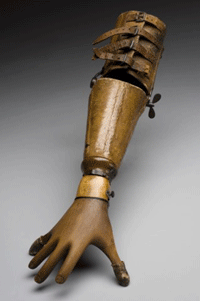
Prosthetic arm for pianist (© Science Museum/Science & Society Picture Library)

Prosthetic arm for pianist (© Science Museum/Science & Society Picture Library)

The concert features six brand new contemporary classical pieces inspired by objects and galleries in the Museum, which also commissioned the pieces in collaboration with NMC Recordings as part of the latter’s 25th anniversary. Re-imagining the concept behind Mussorgsky’s ‘Pictures At An Exhibition’ for the twenty-first century, each piece will be performed by the Aurora Orchestra in the presence of the object or space which inspired its composition. The orchestra will be conducted by Nicholas Collon and the whole event’s conceptual staging is directed by Tim Hopkins.

Programme:

Gerald Barry – The One-Armed Pianist (presented in the Making the Modern World Gallery and inspired by an octave-stretching prosthetic arm made in the Edwardian era for an amputee musician who went on to use it for a performance in the Albert Hall. Gerald: “The piece is in two halves. The first is philosophical acceptance, the second is the octave played by the wooden arm.”)

Barry Guy – Mr Babbage is Coming to Dinner (presented in the Making the Modern World Gallery, and consisting of a graphic score inspired by engineering drawings for Charles Babbage’s Difference Engine.)

2L0 transmitter (© Science Museum/Science & Society Picture Library)

2LO transmitter (© Science Museum/Science & Society Picture Library)

Christopher Mayo – Supermarine (presented in the Flight Gallery, inspired by its slate statue of Spitfire designer R.J. Mitchell and by Christopher’s own interest in mathematics and engineering, aiming to “allow the audience to make some of the same connections that I have made on the journey from idea to inspiration to composition to performance.”)

Claudia Molitor – 2TwoLO (presented in the Information Age Gallery, and inspired by the mechanism of the BBC’s first radio transmitter 2LO and by the politics behind its use. Claudia: “I stumbled across the information that initially the transmission of music was prohibited by the licenser, only speech was deemed acceptable. TwoLO imagines how one might pull the wool over the licenser’s ears by creating a piece to be broadcast under these conditions that one could successfully argue is ‘not music’.”)

Machinery in the Energy Hall (© Science Museum/Science & Society Picture Library)

Machinery in the Energy Hall (© Science Museum/Science & Society Picture Library)

Thea Musgrave – Power Play (presented in and inspired by the Energy Hall Gallery, taking advantage of its various levels to split the ensemble, Thea’s work illustrating “the wonders of discovery, with soloists ‘taking off’ with flights of fancy against the more earth-bound group below.”)

David Sawer – Coachman Chrono (presented in the Making the Modern World gallery, and inspired both by the London-York mail coach and by Thomas De Quincey’s related essay on its driver’s focus on balancing velocity and accuracy. David: “My imaginary musical journey from A to B aims to reflect the fact that in a world which increasingly emphasises speed, clarity can perhaps be best achieved when time stands still.”)

The Aurora Orchestra: 'Objects At An Exhibition'

The Aurora Orchestra: ‘Objects At An Exhibition’

For full details on the performance, click here, while tickets are directly available from the Science Museum here. More background information is at this Science Museum blog entry by the museum’s Tim Boon.

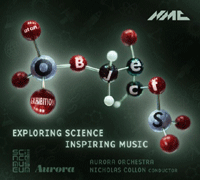
The ‘Objects At An Exhibition’ album (featuring the world premiere recordings of all six pieces) will be released on NMC Recordings on 18th September 2015, two weeks before the concert. It’s available for pre-order now.

July 2015 – upcoming London gigs this week – LUME on Thursday (Nick Costley-White/Bleep Test); Daylight Music on Saturday (The UCC Handbell Ringers/Ryan Teague/Ellie Lovegrove, with Angèle David-Guillou)

13 Jul

More upcoming London gigs this week. Firstly, various kinds of jazz on Thursday…

LUME logo

Nick Costley-White & Bleep Test (LUME @ Long White Cloud, 151 Hackney Road, Hoxton, London, E2 8JL, UK, Thursday 16th July, 8.00pm

This week at LUME… original and improvised music. We’ve got a tasty double bill for you this Thursday with solo guitar explorations and an exciting new electronic jazz ensemble mixing beats and tunes. Should be a great evening of cutting edge new sounds. Entry is one Bank of England note of your choice. (£5, £10, £20… £50???!)

Bleep Test (Fraser Smith – tenor sax/effects; Joe Webb – synths; Lloyd Haines – drums; Matthew Read – bass) combine house, breaks, drum & bass and jazz. Analog synths, electric drums and a screaming saxophone tie this band to the growing scene of exciting, genre defying music groups emerging from London’s creative underground. Fiery grooves and memorable melodies push these musicians out of the traditional jazz improvisation realm and into another soundscape that hits hard.

Nick Costley-White is fast becoming one of the most in demand young guitarists in the London jazz scene. With a developed sound and individual voice on his instrument, Nick has had the opportunity to perform professionally with some of the country’s finest musicians including Stan Sulzmann, Jeff Williams, Gareth Lockrane, Tom Challenger, Martin Speake, Ivo Neame, Tommy Andrews, Jon Scott, Dave Hamblet and Josh Arcoleo.
Nick studied jazz and classical guitar at the Guildhall School of Music and Drama with Phil Robson, Colin Oxley and John Parricelli, graduating with first class honours and awarded the 2011 Yamaha Jazz Scholarship for Outstanding Musicians.

See you there!

On Saturday, there’s the last Daylight Music concert of the season, with definite sacred and classical tinges to it…

The UCC Handbell Ringers @ Daylight Music, 18th July 2015


Daylight Music 197: The UCC Handbell Ringers + Ryan Teague + Ellie Lovegrove (Union Chapel, Compton Terrace, Islington, London, N1 2UN – Saturday 18th July, 12pm to 2pm)

A Bells and Bronze afternoon will ring out this season of Daylight in style.

The UCC Handbell Ringers are a select group of nineteen young people, ages fourteen to eighteen, from the University Christian Church in Fort Worth, Texas. This Church is situated across the street from the Texas Christian University School of Music and since its founding in 1873, the music ministry has been an integral part in the life of the church. The UCC Ringers ring one of the church’s two five-octave sets of English handbells cast by the Whitechapel Bell Foundry in London. The bell choirs have a long tradition of musical excellence and have been an integral part of the life of the church for many years. They have toured regularly. In addition to being the first bell choir to perform at Westminster Abbey, they have played in worship services and in concert at the Royal Festival Hall, York Minster, St. Mary Redcliffe Church in Bristol and the Collegiate Church of St. Mary in Warwick; and at Exeter, Bristol, Gloucester, Canterbury, Winchester, Salisbury, Christ Church Oxford and Coventry Cathedrals.

Ryan Teague is a composer, producer and multi-instrumentalist based in Bristol. His music combines acoustic instrumentation and arrangements with electronic and processed material, the results of which incorporate minimalist, ambient and electro-acoustic music. Ryan has released numerous albums and EPs on labels including Village Green, Sonic Pieces and Type Records. He also produces music and sound design for various film & TV productions and has spent an extended period of time in Indonesia studying Javanese gamelan music. This afternoon’s music will also feature a new and exclusive composition premiere ‘Storm Or Tempest May Stop Play’ by Ryan Teague with Gamelan Ensemble.

From a musical family in Ware, Hertfordshire, Ellie Lovegrove began learning the trumpet at school aged seven. She later played principal trumpet with the Hertfordshire County Youth Orchestra, joined the National Youth Orchestra at the Proms, and went on to study at the Royal College of Music, London. Here she received tuition from Paul Beniston, Neil Brough and Michael Laird, winning the Brass Ensemble Prize and the Brass Concerto Competition. Ellie continued her studies with Kristian Steenstrup and Mark David. Professionally, Ellie enjoys a varied freelance career. Her work as an orchestral player includes concerts and broadcasts with the BBC National Orchestra of Wales, BBC Scottish Symphony Orchestra, Orchestra of the Age of Enlightenment, RTÉ Concert Orchestra, Royal Ballet Sinfonia and the Britten Sinfonia. She has also deputised for the the Royal Shakespeare Company as the onstage trumpeter in their production of ‘The Roaring Girl’ and in their recent production of ‘Henry IV’ at the Barbican. As a chamber musician, Ellie has performed at The London Handel Festival on period instruments, and has enjoyed working with Chaconne Brass, including a commercial recording of a new work by Bob Chilcott with Wells Cathedral Choir. Her trumpet and organ duo Illumina have performed recitals at St Paul’s Cathedral, Fairfield Halls and Alexandra Palace, and have recently commissioned a new work from composer Paul Burke.

If that wasn’t enough magic then Angèle David-Guillou will plays some chiming melodies on the piano. Angèle is best known for a brace of critically acclaimed electro-acoustic dream-pop albums under the alias Klima, for her signature contributions to cult Anglo-French ensemble Piano Magic and for cameos on albums by the likes of The Go! Team, Peter Astor and Ginger Ale. In contrast to much of her oeuvre to date, Angèle’s debut album under her given name is a largely, if not exclusively, instrumental work, predominantly consisting of melodically opulent, emotionally compelling compositions for the grand piano (and, on three songs, a Wurlitzer electric piano), many of them emblazoned with vivid arrangements for strings, woodwind, musical saw and percussion.

Free entry, but donations are (as ever) encouraged.

June 2015 – upcoming London classical gigs – Jane Manning curates Voiceworks – two concerts of contemporary classical song

21 Jun

For anyone who’s interested in contemporary classical song, here are details on two London afternoon concerts taking place this week and next week…

event-201506janemanningvoiceworks

Voiceworks Song Recitals: 
Concert 1 – St Olave Hart Street, 8 Hart Street, London, EC3R 7NB, UK, Thursday 25th June, 1.05pm
Concert 2 – St Stephen Walbrook, 39 Walbrook, London, EC4N 8BN, UK, Tuesday 30th June, 1.05pm

Senior Guildhall School of Music musicians are giving free lunchtime concerts in churches across the City as part of the City of London Festival 2015. In the Voiceworks concerts, postgraduate singers and pianists perform in two programmes of twentieth & twenty-first century repertoire curated by soprano Jane Manning (in conjunction with ‘New Vocal Repertory For The 21st Century’, her forthcoming book for Oxford University Press).

Songs to be performed include repertoire by Alison Bauld (both concerts); Joseph Horovitz, Cecilia McDowall and John McLeod, Edward Nesbit, Anthony Payne and Thierry Pecou (concert 1); Sebastian Currier, Lori Laitman, Anthony Milner, Mel Powell, Malcolm Singer and Huw Watkins (concert 2).

Performers:

(Concert 1:)

Holly-Marie Bingham – mezzo-soprano
Sarah Killian – soprano
Jean-Max Latteman – countertenor
Juliane Gallant, Michelle Santiago, Dylan Perez – piano

(Concert 2:)

Genevieve Colletta, Joana Gil – soprano
James Robinson – tenor
Michelle Santiago, Natalie Burch – piano

More information is here for concert 1 and here for concert 2.

June 2015 – upcoming London gigs – North-eastern classical – a London debut for the Baltic Music Society

17 Jun

Baltic Music Society, London - inaugural concert

Baltic Music Society – Inaugural Concert (All Saints Church,, Clydesdale Road, Notting Hill, London W11 1JE, UK, Saturday 20th June, 7.00pm)

The newly-formed Baltic Music Society in London hosts its debut concert of classical chamber music this coming Saturday, in Notting Hill.

This first concert features music by Erkii Sven-Tuur, Jāzeps Vītols and a host of living composers including Arvo Part. It includes the world premiere of a specially commissioned new work – ‘Memories of Lithuania’ by Keith Burstein, a British composer of Lithuanian descent – and music by a wide range of Baltic state composers including Zita Bružaitė, Bronius Kutavičius, Anatolijus Šenderovas, and Ariel Anenburg.

The Baltic states of Lithuania, Latvia and Estonia lie on one of the critical geopolitical faultlines of the world and yet still little is known of their culture in the West. However the burgeoning creativity of the region now promises a new wave of cultural riches. The Baltic Music Society exists to explore, present and introduce music from or inspired by the Baltic region. The world refracted through the amber stone of the Baltic – a new light from a new music. Join us at the beginning of this pathway of discovery.

Programme:

Zita Bružaite – Novelette

Bronius Kutavičius – Three Metamorphoses

Jāzeps Vītols – Romance

Erkki-Sven Tüür – Piano Sonata

Keith Burstein – Trio for Viola, Clarinet and Piano, “Memories of Lithuania” (world premiere)

Anatolijus Šenderovas – Cantus in memoriam Jascha Heifetz

Arvo Pärt – Spiegel im Spiegel

Keith Burstein – PianoWorks

Ariel Anenburg – Images

Performers:

Jelena Makarova, Rimantas Vingras, Kristiina Rokashevich, Keith Burstein – piano
Antanas Makštutis – clarinet
Orpheus Papafilippou – violin,
Barbara Gumėnaitė – viola.

Expect a broad range of musical voices, from folk-inspired pieces to torrid, fractured flights of neo-romantic piano through to Pärt’s familiar “holy minimalism”. More information is here, and tickets are available here – price £10.00.

For a few tastes of what’s on offer, I’ve tracked down a few YouTube performances of some of the pieces on the programme – see below:

June 2015 – upcoming London gigs – prog rock/math rock/post-hardcore @ The Facemelter; electro-pop/drum’n’brass/loops/experimental ambience @ Tuesdays Post; eclectic classical/experimental chamber music/kletzmer & Bulgarian voices @ The Forge

31 May

Some more early June gig previews for London – these would have been in the previous post if I’d picked up on them earlier.

Firstly, a Facemelter promotion (from the experimental rock/post-hardcore wing of the Chaos Theory organisation whose jazz gigs I’ve also enjoyed)…

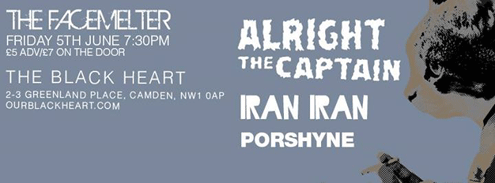
Facemelter, 5th June 2015

Alright The Captain + Iran Iran + Porshyne @  The Facemelter (The Black Heart, 2-3 Greenland Place, Camden, London, NW1 0AP, Friday 5th June , 7.30pm

Three heroes of math rock, alternative and post-rock travel from different corners of the UK to unite and form this amazing lineup.

Derby-based trio Alright The Captain masterfully combine virtuosic instrumentalism with unabashed musical experimentation and have effortlessly established themselves as a sonic force to be reckoned with, thanks to their increasingly inimitable, uniquely imaginative brand of math-rock. Their sprawling and varied career has seen them sharing stages with post-rock luminaries including Mono, toe, 65daysofstatic, Pelican, Tera Melos, ASIWYFA, Maybeshewill, Adebisi Shank (RIP), This Will Destroy You, ZU and many more. Their new album ‘Contact Fix’ (which ‘Musical Mathematics’ describes as “div(ing)  in and out of math rock, prog and post rock – but, at its heart, it’s different”) has gone down a storm.

Iran Iran are another supremely talented bunch of musicians who stunned and impressed all who saw them at ArcTanGent last year. With insanely complex rhythms and thunderously heavy riffs, the four-piece from Bristol have evolved since their excellent first EP ‘Crystal Math’ and are packing a punch. They’ve played with Future Of The Left, Cleft, Alright The Captain, This Town Needs Guns, You Slut!, Alpha Male Tea Party, Death Pedals and many others. Fans of complex musical wizardry or heavy riffs will love their new EP ‘Milk Time For Spiders’.

Brightoners Porshyne dance between ambient intervals and melodic vocals to intensely intricate, fantastically crunchy  prog rock riffs. With just a few single releases and a session filmed by Small Pond Recordings, they already sold out their first headline show in Brighton. This is your chance to catch the band before their career takes off.

More info here and here, and tickets here (£5.00 advance, £7.00 on the door).

At the end of the same week, Georgina Brett’s Tuesdays Post event returns to Stoke Newington with another evening of ambient/progressive live music, including ‘Misfit City’ favourites Darkroom

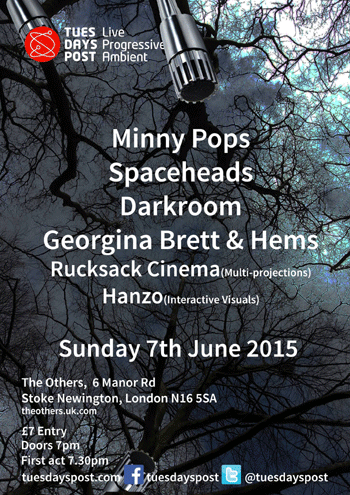
event-20150607tuesdayspost

Minny Pops/Spaceheads/Darkroom/Georgina Brett & Hems @ Tuesdays Post, (The Others, 6 Manor Rd, London, N16 5SA, Friday 7th June, 7.00pm)

Formed by vocalist/band leader Wally van Middendorp in Amsterdam in 1978, Dutch electro pioneers Minny Pops took their name from a primitive Korg drum machine. The band released several singles and a debut album, Drastic Measures, Drastic Movement, on independent Dutch label Plurex before joining the legendary Manchester label Factory Records in 1980 (which resulted in them being produced by Martin Hannett, touring with both Joy Division and New Order, and becoming the first Dutch group to record a Peel Session). Singles including Dolphin’s Spurt, Secret Story and Time were followed by the acclaimed album ‘Sparks In A Dark Room’ in 1982. The band released two further albums (‘Poste Restante’ and ‘Fourth Floor’) before splitting in 1985. In 2012, the band reunited for a series of gigs in the UK, the Netherlands and Belgium and recorded a 7-inch single for Tim Burgess’ O Genesis label. After a pause to draw breath, 2014 has seen Minny Pops performing live once again.

Spaceheads are a cosmic duo of trumpet electronics and drums. Formed in 1990, they have developed a blend of electronics and sunshine fanfares over the course of ten albums, three EPs and much touring across Europe and the USA. Andy Diagram (also of James) plays trumpet with a mobile phone stuck to the top with a fish slice and Richard Harrison plays drums with big bendy metal sheets stuck to the top. They create live looped layers of brass driven by flurries of free flowing funky drums. Andy and Richard have achieved an intuition of what each is about to do next which makes their semi-improvised gigs a joy to behold. They release their first studio album in ten years – ‘A Short Ride On The Arrow of Time’ – this Autumn.

Darkroom – the UK-based duo of Michael Bearpark (guitars) and Andrew Ostler (synths)- expertly ride the line between luscious, old-school progressive rock and modern ambient electronics. At times reminiscent of early Tangerine Dream with hints of Fripp and Eno, they create clouds of sequenced synths, chewy grooves, and looped phrases to support a variety of acoustic and electric guitar melodies that twist and turn in surprising, occasionally aggressive, ways.

Hems Aka Henrique Matias will be playing live with Georgina Brett. Henrique is a multi-talented composer, programmer and DJ. He specialises in Multimedia programming (from internet things to Max/MSP and similars), although not all his live music and performances sounds like computer music (sometimes he takes his drum machines and crazy things out of the house). Georgina Brett’s music is created using her voice and effects pedals, creating instant choirs of sound, often in an hypnotic style. The point of this music is not only to captivate with extraordinary timing and melodic style but also to help the listener to relax in our ever-increasingly fast world.

Interactive visuals and multimedia projections are by Hanzo and Rucksack Cinema.

More information here – tickets £7.00 on the door.

By all accounts The Forge (in Camden Town) has spent the last few years becoming one of north London’s most interesting small venues for mixed music. I’ve yet to go there and see for myself: but in its full June calendar (also featuring funk, jazz, classical and Cuban music as well as assorted poetry) the following four concerts caught my interest:

Notus Winds & Eliza McCarthy (Wednesday 3nd June, 7.30pm)

Part of the classical monthly series Wednesdays at The Forge, this time featuring award-winning chamber ensemble Notus Winds and solo pianist Eliza McCarthy with a program of contemporary compositions (more information here). Tickets £10.00 to £12.00.

Programme:

Harrison Birtwistle – 5 Distances
György Ligeti – Ten Pieces
Arvo Pärt – Quintettino
Anders Hillborg – Six Pieces for Wind Quintet

Fenella Humphreys: Bach to the Future Part 1 (Tuesday 9th June, 7.30pm)

The first of three concerts presented by violinist Fenella Humphreys, featuring commissions of six new works by six of Britain’s leading composers to accompany Bach’s glorious 6 Sonatas and Partitas for unaccompanied violin. This first concert includes new works by Cheryl Frances-Hoad and Gordon Crosse alongside extraordinary music by Bach, Scott, Westhoff, Hindemith. Tickets £10.00 to £12.00.

Programme:

Cyril Scott – Bumble-Bees (1928)
Johann Paul von Westhoff – Suite no. 5 in D minor (1682)
Gordon Crosse – Orkney Dreaming (2014)
Fritz Kreisler – Recitativo and Scherzo-Caprice op. 6 (1911)
Paul Hindemith – Sonata op. 31 no. 2 ‘Es ist so schönes Wetter draussen’ (1924)
Johann Sebastian Bach – Partita no. 3 in E major BWV 1006 (c. 1720)
Cheryl Frances-Hoad – Suite no. 1 (2014)
Eugene Ysaye – 2nd Sonata op. 27 (1923)

Reciprocity: a new work by Daniel Patrick Cohen (Wednesday 10th June, 7.00pm)

Reciprocity is a 28 minute work for voice, taped narration, eight celli, piano, and percussion. The piece was composed by Daniel Patrick Cohen from six poems by the late Darya Farha, a Canadian poet, therapist, filmmaker and clothing designer. Darya was an extraordinary woman whose sharp intelligence, dry wit, distaste for orthodoxies and boundless empathy fuelled restless journey through her unfinished life. Darya died of breast cancer in 2011 when she was 46, and Reciprocity was commissioned by her sister Juliana Farha, who lives in London. Reciprocity is not about cancer, however. Instead, its human and universal themes of joy, pleasure, fear and anger, along with its intriguing instrumentation are sure to engage a broad audience. You can read more on the project here, and here. Tickets £6.00.

She’Koyokh & Veda Slovena Bulgarian Choir (Thursday 11th June, 8.00pm)

In a unique collaboration, She’Koyokh & Veda Slovena Bulgarian Choir combine the fiery panache of klezmer and Balkan music with the timeless beauty of Bulgarian voices, weaving Jewish, Turkish and Balkan music into the rich tapestry of the Bulgarian choral tradition. Read She’Koyokh’s piece on their Veda Slovena collaboration here. Tickets £10.00 to £12.00.

(All events taking place at The Forge, 3-7 Delancey Street, London, NW1 7NL)

June 2015 – upcoming London gigs – A Formal Horse & Ham Legion; Olga Stezhko; The Spiders of Destiny play Frank Zappa; a Bowie Night in Soho

29 May

Here’s some quick info on upcoming gigs in early June which I’ve heard about – all of them in London.

Over the last couple of years, Westminster Kingsway College has established itself as one of the capital’s finest homes for quirky art-rock – by which I don’t mean student hobby bands thrown together for campness or for ironic prankery, but a rich, complex, committed electric music spanning the range between gutter-punk and flouncing prog via metal, jazz, folk, avant-gardening and anything else which gets melted down into the stew. Here’s one of those gigs that proves the point.

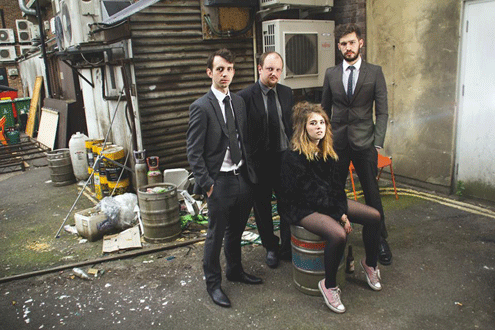
A Formal Horse, 2015

A Formal Horse + Ham Legion (Westminster Kingsway College, 211 Gray’s Inn Road, London, WC1X 8RA, Tuesday 2nd June, 6.30pm)

A Formal Horse is a new progressive rock quartet based in Southampton. Although the band’s sound is difficult to pinpoint, their dense instrumental passages are reminiscent of King Crimson and Mahavishnu Orchestra, whilst Francesca Lewis’ lead vocals evoke the whimsical surrealism of the 1970s’ Canterbury scene. Wonky melodies and serene vocals over a brutal sound – their music keeps you on your toes. However, A Formal Horse go beyond simply regurgitating the music of their predecessors. With influences as diverse as Bartók and Bon Iver, the band prove that there is still much territory to be explored in the field of British progressive rock.

In June 2014, the band released their debut EP, which was recorded by Rob Aubrey (IQ, Transatlantic). They went on to perform at London’s Resonance Weekend alongside Bigelf and Änglagård, and were described by Prog Magazine as a “festival highpoint”. Since, they have shared stages with Knifeworld and Lifesigns, cementing their position at the forefront of the British progressive scene.

Ham Legion spent 2014 honing their sound and developing a storming live show. You can expect a collision of beaming up beat power pop, grinding metal outbursts, dramatic changes of mood, sudden passages of twistingly epic prog then moments of restrained delivery and somber reflection. They are striking out in 2015 with the release of their debut album towards the end of the year.

Tickets available here – £6.00/£5.00

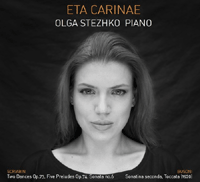
Olga Stezkho: 'Eta Carinae'

Olga Stezkho: ‘Eta Carinae’

Olga Stezhko (the far-thinking Belarusian classical pianist whose ‘Eta Carina’ album impressed me so much last year) has two London concerts coming up in the first fortnight of the month. The second’s likely to be an all-access crowd-pleaser. Given its charity fundraiser status, I’m not sure whether the first is likely to feature or indulge any of Olga’s intriguing conceptual preoccupations with Scriabin, Busoni, cosmology and early twentieth century consciousness, but even if it isn’t it’s a great opportunity to see a fine musician at work in a grand location.

Olga Stezhko charity piano recital in aid of Friends of the Belarusian Children’s Hospice (St Pancras Parish Church, Euston, London NW1 2BA, Thursday 4th June, 1:15pm – 2:00pm)

Programme not revealed – free admission, donations requested.

EC4 Music in aid of The Prince’s Trust (Barbican Hall, Tuesday 9th June, 7:30pm – 9:30pm)

The choir and orchestra of London-based EC4 Music return for their seventh fundraising concert in aid of The Prince’s Trust with a stirring selection of music from both sides of the Atlantic.

Programme:

Leonard Bernstein – Overture from ‘Candide’
Aaron Copland – Appalachian Spring
George Gershwin – Rhapsody in Blue
Vaughan Williams – Serenade to Music
Leonard Bernstein – Chichester Psalms
Eric Whitacre – Water Night
Hubert Parry – Blest Pair of Sirens

Performers:

EC4 Music Choir and Orchestra
Tim Crosley – conductor
Olga Stezhko – piano
Claire Seaton – soprano
Roderick Morris – countertenor
Thomas Herford – tenor
Adam Green – baritone

Tickets available here – prices from £10.00 – £35.00 plus booking fee.

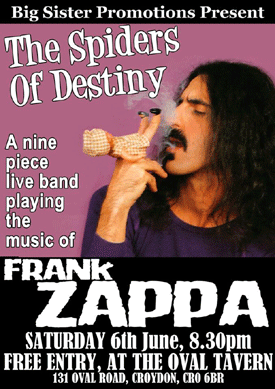
Some of London’s most active art-rockers are brewing up a free Zappa homage in Croydon at around the same time. Details below:

event-20150606spidersplayza
The Spiders of Destiny play Frank Zappa (The Oval Tavern, 131 Oval Road, Croydon, CR0 6BR, Saturday 6th June, 8:30pm)

Great googly moogly! On June 6th, nine-piece tribute band Spiders Of Destiny come to The Oval Tavern to play a marathon set of music by the late, great Frank Zappa. Featuring world class performers with a sense of humour from notable prog/alternative bands such as: Knifeworld, Perhaps Contraption, Pigshackle, Medieval Baebes, The Display Team, Hot Head Show, Poino, Spiritwo, First, A Sweet Niche and more. So polish up your zircon-encrusted tweezers, trim your poodle, learn the mudshark dance and join us as we propagate the conceptual continuity instigated by one of the masters of modern music.

More info here – this gig is FREE ENTRY but there will be a donations jug doing the rounds during the intermission.

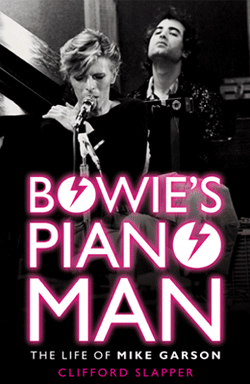
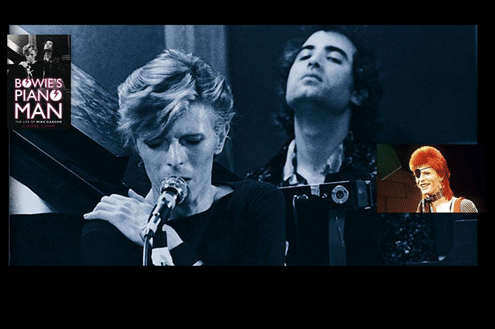
book-bowiespianomanAnyone with an interest in David Bowie, rock history, cabaret, electropop and all of the other things that get swept up into Bowie’s art should head to Soho on Thursday 11th June for A Bowie Night at Gerry’s Club, at which pianist and writer Clifford Slapper launches his book ‘Bowie’s Piano Man: The Life of Mike Garson‘ (which also has its own Facebook page).

As well as readings and signings there will be performances of Bowie songs from avowed fans Danie Cox (from “flock-rockers” The Featherz), Ray Burmiston (of ’80s heroes Passion Puppets), club siren Katherine Ellis (Freemasons, Ruff Driverz, Bimbo Jones etc.) and acoustic singer Jorge Vadio. There’ll also be a performance from a longtime ‘Misfit City’ favourite – London balladeer, Brel translator and onetime ‘Pirate Jenny’s’ host Des de Moor, who’ll presumably be singing his Bowie-gone-chanson interpretations from his ‘Darkness and Disgrace’ show. (I’m particularly pleased to see that Des is back onstage. It’s been a long time.)

More on the book below, and more on Gerry’s Club here.

“It is pointless to talk about his ability as a pianist. He is exceptional. However, there are very, very few musicians, let alone pianists, who naturally understand the movement and free thinking necessary to hurl themselves into experimental or traditional areas of music, sometimes, ironically, at the same time. Mike does this with such enthusiasm that it makes my heart glad just to be in the same room with him.” – David Bowie

Mike Garson has played piano on sixteen David Bowie albums, including Aladdin Sane, with his celebrated piano solo on its title track, Diamond Dogs, Young Americans, 1. Outside and Reality. He has also played live with Bowie on countless tours and shows, and remains his most long-standing and frequent band member.

For some time Clifford Slapper has been working very closely with Garson to write a book which explores the life of this extraordinary and eccentric modern musician. It documents in detail how as a pianist he was catapulted overnight from the obscure world of New York’s avant-garde jazz scene to a close and long connection with Bowie. In addition, Garson is recognised as a classical virtuoso, a jazz master and one of the world’s greatest exponents of improvisation. He has also recorded and performed live with other rock legends such as the Smashing Pumpkins and Nine Inch Nails. All of this is covered by this first ever biography of Mike Garson.

Its starting point was several days of in-depth and frank conversation with Garson himself, and covers a wide range of themes which will be of interest to all Bowie fans, but also to anyone with a passion for music, social history or the process of creative inspiration. Input has also come from many interviews with those who have worked with him over the years, including Earl Slick, Trent Reznor, Sterling Campbell, Reeves Gabrels, Dave Liebman and many others.

event-20150611bowienight

May 2015 – End-of-May gigs (mostly London) – Bank Holiday weekenders from Daylight Music and SmileAcoustic; a mixed-classical benefit for Nepal; Knifeworld again; fun and frolics underneath the arches with John Ellis and co.

22 May

Just because I’m likely to be stuck indoors for the next fortnight doesn’t mean that you have to be. Some interesting gigs are coming up in – mostly in London, I’m afraid – but just in case any of you are London-based, here are some ideas to see you through until June.

First of all, there are two free Daylight Music events over the weekend. Running eclectic free gigs that span from cosy to experimental, and from classical to folk to noise-pop, Daylight Music have been a Misfit City favourite for a long time. See here for reviews of previous events in September and October 2013 and in January 2014; and see below for details on the upcoming concerts…

Join us for a weekend of music with artist travelling from Los Angeles, Wales and Spain to dazzle you. And while you’re reading this, have a listen to a special mix by Ex-Easter Island Head.

Daylight Music 190: Winter Villains + Poppy Ackroyd + Jon DeRosa (Union Chapel – Saturday 23rd May, midday to 2pm)

The new Spring Season kicks off with a name to watch; Poppy Ackroyd is a classically trained pianist and violinist who weaves delicate, atmosphere music by manipulating and multi-tracking sounds from just those two instruments. On the same week, you can hear Cardiff’s Winter Villains and their intricate chamber pop music (the duo were nominated for the Welsh Music Prize in 2013) and Jon DeRosa from the USA, whose new album ‘Black Halo’ is out via Rocket Girl on 25 May. Hannah Lawrence plays some usual and some unusual melodies on the Henry Willis organ in between this week. Full details here.

Colleen with Ex-Easter Island Head (LSO St Luke’s – Sunday 24th May 7.30pm)

A double bill of musicians renowned for manipulating your expectations as much as they do their instruments; creating hypnotic minimalist music from simple arrays of strings, percussion and even just vocals. Colleen mixes acoustic instruments with electronic sampling techniques to create rhythmic, lyrical folk-pop songs. Her new album Captain of None will focus on a melodic repertoire, with fast-paced tracks rooted by prominent bass lines and her instruments of choice, the treble viola da gamba and her voice. Liverpool-based Ex-Easter Island Head turn the electric guitar on its head, to compose physical, droning soundscapes.

Next up, on Bank Holiday Monday there’s an afternoon-and-evening free concert in Bethnal Green, promoted by unplugged specialists Smile Acoustic (who are new to me, but seem very welcoming). Far too many different acts to summarize quickly – although I do recognise Matt Finucane, who first came to my attention doing anti-pop with Empty Vessels years ago and who’s now matured (though he probably wouldn’t use the word) into a sinister songwriter and a horror/science fiction writer. Read on…

SmileAcoustic: Tasting Menu Bank Holiday Special (Rich Mix – Monday 25th May, 4pm onwards)

Smile Acoustic has been making many friends, and all our friends seem to make great music… so we thought it high time for a get together. An extra long weekend requires extra entertainment after all! So we present a feast of flavours, in our first ever Tasting Menu. Full information here.

4pm – Prash Gor, Kirsten McClure, Lauren Lucille, Matt Finucane, Dave Santos, Gian Luca, Mark Harrison, Jeremy of The Green Rock River Band, Horatio James

7pm – Bellatrix, Camilo Menjura, Arthur Lea

Yes we’re cramming in a ridiculous amount of talent into an additional late afternoon show, as well as our usual evening gig. An incredible array of original songsters will be gracing the stage, with a line up that takes us all the way from banjo to beatbox. Free entry as ever, as is the cake. See you there!

On Friday 29th May, in west London, UK Music for Nepal are putting on a classical music benefit aiming to raise ten thousand pounds for the victims of the earthquake. It’s mostly performances of Romantic and Baroque work (by Chopin, Rachmaninoff, Brahms, Bach, Liszt and Fauré), but with a few outbreaks of early twentieth century modernism via some Scriabin pieces, plus a world premiere of a new piano work by composer Keith Burstein (a onetime Romantic Futurist and still an ongoing champion of latterday tonal music – see here for a long-ago review of his first String Quartet). It’s also got a striking array of performance talent – see below…

Gala Concert for Nepal @ St Barnabas Church, Ealing, May 29th 2015
Gala Concert for Nepal (St Barnabas Church, Ealing, London, Friday 29th May, 7.30pm)

Programme:

Johann Sebastian Bach – Chorale Prelude “Nun Komm die Heiden Heiland” BMV 659
Frédéric Chopin – Polonaise-fantaisie in A flat major, Op.61
Gabriel Fauré – Sicilienne, Op.78
Gabriel Fauré – Élégie, Op.24
Aleksandr Scriabin – Etude in D# minor Op.8 No12
Aleksandr Scriabin – Nocturne for Left Hand
Sergei Rachmaninov – Cello Sonata in G minor, Op.19
Franz Liszt – Consolations, S.172
Sergei Rachmaninov – Prelude in G minor Op. 23 No. 5
Johannes Brahms – Variations on a theme by Paganini (Book 1)
(and a world premiere by composer Keith Burstein)

Performers:

Alicja Fiderkiewicz, Carlo Grante, Artur Pizarro, Murray McLachlan, Viv McLean, Nico de Villiers, Keith Burstein – piano
Corinne Morris – cello

Tickets available here – prices from £20.00 to £50.00.

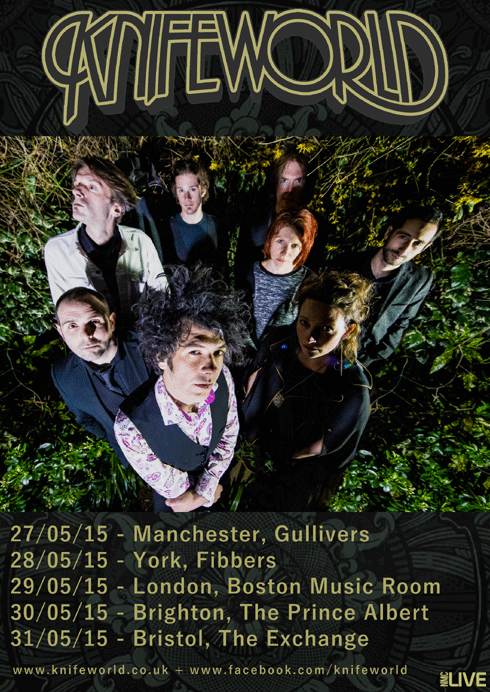
Also on Friday 29th May there’s the latest London gig by Knifeworld, part of a five-date English tour also taking in Manchester, York, Bristol and Brighton (as mentioned a few posts back). Expect an evening of explosive, tuneful and corrugated art rock played with the vigour of a soul revue and the complexities of a ’70s prog band. For the York gig, they’re supported by motorik rockers Muttley Crew and for the London gig by bounding art-rockers Barringtone (ex-Clor) and Cesarians. The Brighton gig is a Tim Smith benefit gig at which they’re supported by prog-poppers Ham Legion, the mysterious M U M M Y (a brand new project by Cardiacs affiliates Jo Spratley and Bic Hayes) and self-styled bitter and twisted songwriter Stephen Evens (who says of himself that “the songs are beautiful and the words are horrible. I don’t know why you don’t think that’s a good thing…”).

Knifeworld on tour, May 2015

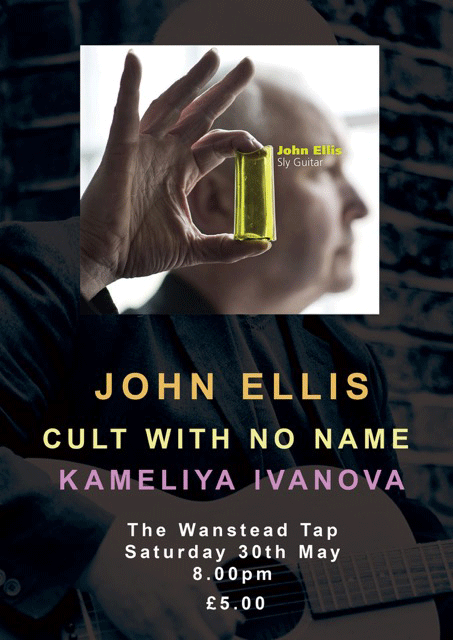
Finally, on Saturday 30th May at 8pm there’s what’s billed as “a night of fun and frolics” at the Wanstead Tap (a craft beer shop in Forest Gate which doubles – or quadruples – as café, bar and performance space). The main attraction is John Ellis (the former Peter Hammill, Stranglers and Peter Gabriel guitarist whom ‘Misfit City’ last encountered via his ‘Sly Guitar‘ album). John’s solo gigs are rare, but he’s something of a master of post-punk art-rock guitar, so well worth seeing. Also on the bill are “post-punk electronic balladeers” Cult With No Name and Kamelia Ivanova (who’s either highly mysterious or needs to fix his or her Facebook page). See below for the flyer.

John Ellis concert @ The Wanstead Tap, 30th May 2015

May 2015 – upcoming London gigs – ‘William D.Drake Pawformance’ – Friday 22nd May 2015. London. Schott Music Shop.

22 May

If you’re free and easy in London tonight – and fancy an evening of intriguing piano music – try this. In spite of some of the more ominous language used in the Subba-Cultcha review, Bill’s music is as full of light, flight and green-leafed freshness as it is of strange chords and left-field turns. Fans of post-modernist dissonance, polystylism and mongrel English romanticism will all be well satisfied. As a bonus, you get extra listening pleasure via James Larcombe (of Stars In Battledress and Arch Garrison) fingering one of his collection of tuneful antiques.

William D Drake's avatarWilliam D Drake

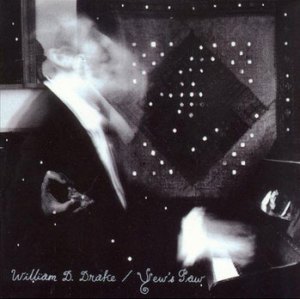
yewspawlpcoverGrabwebYou are most warmly invited to an evening performance of ‘Yew’s Paw’ in the intimate surroundings of Schott Music Shop in Central London.

Glass of wine and nibbles will be provided with Mr Drake’s compliments.

Be sure to arrive early to enjoy Mr James Larcombe performing on his marvellous melodeon.

Yew’s Paw is an album of piano pieces written and performed by Mr Drake at his pianoforte, and released in February 2007.

Listen to tracks and buy the album here.

Friday 22nd May 2015.  7.30-9.30pm

Tickets £10 – Buy in person from Schott Music Shop or by telephone 020 7534 0710.

Schott Music Shop (Recital Room), 48 Great Marlborough Street, London. W1F 7BB

‘YEW’S PAW’ – ALBUM REVIEWS

Subba-Cultcha. February 2007 – Jonathan Sebire

‘Yew’s Paw’ consists of thirteen solo piano pieces, a macabre soundtrack that draws forth a huge swell of foreboding and tempered power across its…

View original post 148 more words

June 2014 – through the feed – Lucy Claire ‘Collaborations No 1’ EP and London launch gig, plus ‘Tim Smith’s Extra-Special OceanLand World’ reissue

3 Jun

Lucy Claire, dishing it out (photo courtesy of This Is It Forever Records)

Lucy Claire, dishing it out
(photo courtesy of This Is It Forever Records)

Lucy Claire Thornton – currently better known as “Lucy Claire” – is a contemporary classical/ambient electronic crossover composer who counts Erik Satie, Peter Broderick and Bjork as influences, and whose work has been hailed as “brilliant, delicately-wrought sketches” by ‘The Quietus‘ and as “immersive and slightly disorienting” by New Music webcast station ‘Amazing Radio‘. She’s releasing her newest release ‘Collaborations EP No 1’ on This Is It Forever Records on June 15th: the same week features a launch concert in London promoted by Chaos Theory (the inspired crew who put on that Sweet Niche/Macchiana del Tiempo/What?! triple bill of fusion jazz which I reviewed last summer). Here’s what they have to say about this gig:

“(We are) excited to host this launch party for the first in a series of collaborations EPs from Lucy Claire, along with many guest performers. ‘Collaborations EP No 1’ will be available with unique handmade packaging at a reduced price at this event only, along with two download codes for remixes by worriedaboutsatan and Message To Bears…. This evening we will see Lucy perform works from ‘Collaborations No 1’, featuring (contributions from German singer/songwriter/producer) Alev Lenz and producer Bruised Skies.

Support will come from electronic classical composers Leah Kardos and Jim Perkins. Almost three years after we worked with Leah on the launch of her debut album ‘Feather Hammer’, we’re delighted to be back together. Tonight we will see bigo & twigetti label-mates Leah and Jim performing new collaborative material… as well as selected works from Leah’s second album ‘Machines’, a concept album with lyrics made up from cut up spam emails, which will feature singer Laura Wolk-Lewanowicz. We will also hear them perform new material by Jim (which will be released later in the year on bigo & twigetti) and re-workings of material from ‘Feather Hammer’.”

All three acts will be basing their performance around piano, electronics, and string quartet. The concert takes place on Thursday 19th June at 7.30pm, at Servant Jazz Quarters in Dalston, and advance tickets can be bought here for under a tenner. For various frustrating reasons, I suspect that I won’t be able to attend this gig myself. Perhaps someone who’s reading this could go, and then tell me what it was like? (Not that I want to make you feel like interns…)

* * *

Considering that he’s still cruelly immobilised by the after-effects of the strokes that felled him six years ago (see ‘Misfit City’ posts passim, here and here), the voice of Tim Smith has rarely been heard in the land so loudly. The profile of his band Cardiacs has been stealthily growing (albeit through YouTube and nostalgic webchat rather than their much-missed live shows) and we’ve recently had or will have new or imminent releases from self-confessed Smith acolytes Arch Garrison, Knifeworld and Stars In Battledress.

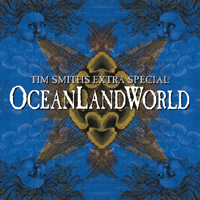
Tim Smith: 'Tim Smith's Extra Special OceanLandWorld'

Tim Smith: ‘Tim Smith’s Extra Special OceanLandWorld’

Meanwhile, the core Smith-eries just keep on coming – this year’s already seen reissues of relatively rare Smithwork (Mr & Mrs Smith & Mr Drake or Spratleys Japs) and a deluxe double vinyl reissue of key Cardiacs album ‘Sing To God’ is due for July). At the end of last month, Tim’s mysterious label The Alphabet Business Concern also sneaked out a CD re-release of his obscure 1995 solo album ‘Tim Smith’s Extra-Special OceanLand World’. A typically arch and sinister ABC press release reveals all (well, not really… and all capitals are deliberate, or at least deliberately annoying):

“AN ANNOUNCEMENT! PLUCKY? PERHAPS. GIFTED? PERHAPS NOT. Nonetheless Tim Smith, in an unforeseen spat of hubris, took it upon himself to exclude his so-called friends (acquaintances at best) to perform a collection of songs in isolation. Foolhardily believeing it may raise enough capital to barter his way from the labyrinthine clutches of obligation to which HE had previously agreed and to which, thankfully, he is bound to this day, in 1995 this solo album was release. Circumstance , of both design and fate have since rendered this ‘offering’ unavailable. UNTIL NOW. As if to mock his feeble attempt at emancipation THE ALPHABET BUSINESS CONCERN once again make available ‘OceanLandWorld’ with the proviso that the covenant can never be broken.”

Ducking under Alphabet’s theatre-of-cruelty bombast, the following actual facts can be dug up. The OceanLandWorld album was recorded by Tim on his own between 1989 and 1990, during a time of upheaval in the entangled world of Cardiacs. Three of the band’s key instrumentalists – Sarah Smith, William D. Drake and Tim Quy – had all either left or were about to leave, and at the same time Tim’s marriage to Sarah had ended. Next to nothing’s been said about this last event, and the other departures have always been described in a matter-of-fact way. In the long term, it seems that the baggy, unlikely, familial mass of Cardiacs-people (with their collective love of music and their sense of common adversity and purpose) managed to accommodate and contain the various splits and departures without lasting bitterness.

Still, although the suggestion in the sleeve-notes that Tim recorded and performed the ‘OceanLandWorld’ songs alone “by way of a penance” is a typically Alphabettian joke, there’s a certain rue to the tone of the album (not least when, behind a bouncy pop march, Tim sings cryptically about tears and about worms chewing on wooden people). Previously wrung happily through the efforts of other people, Tim’s songs are now being filtered through machines: check out those cascading sequencers and springy synth-bass whacks behind his reedy squawk and bustling guitars. Hardly surprisingly, there’s a slight pre-fab feel to the album. If previous Cardiacs albums sometimes felt like the scruffy, well-lived-in old houses in the band’s south-west London suburbs, then ‘OceanLandWorld’ feels like a race around a new satellite town: thin slivers of post-war history, new bricks and formica, a Toytown street plan.

That sense of uneasy rootlessness plays a part in this picture. Tim stutters out an album of faux-jaunty pop songs, without his musical family to push against and to be held by (even if Sarah does briefly return on one song for a gracing of saxophone). The familiar staggering, stumbling embrace of Cardiacs songs is replaced by a Scalextric skid. It’s to Tim’s credit that he somehow turns this into an asset: to these ears, ‘OceanlandWorld’ captures the giddy weightless of post-traumatic sensation, the impression that everything you are has been tossed up into the air like streamers and comes down spread-out and thinned-out, but still recognisably you. In the same way, familiar Cardiacs tics and inspirations work their way through the fabric of the album, with epic punky chorales and proggy vistas opening up like a junkyard requiem.

The album also features one of Tim’s most breathtakingly beautiful songs, Swimming With The Snake. The man rarely, if ever, even starts to explain what his songs are about, but this particular song communicates mysterious undercurrents of pain, loss and love with a rare and stunning magic.

If what you’ve seen, heard, and read here intrigues you, you can order the reissued ‘OceanLandWorld’ from here.

Lucy Claire online:
Homepage Facebook Twitter Soundcloud Bandcamp Vimeo

Tim Smith online:
Facebook

Leah Kardos online:
Homepage Facebook Twitter Soundcloud Bandcamp YouTube

Jim Perkins online:
Homepage Facebook Twitter Last FM

Alev Lenz online:
Homepage Facebook Twitter Soundcloud Tumblr YouTube

Chaos Theory Promotions online:
Homepage FacebookTwitter Soundcloud

June 2014 – through the feed – Markus Reuter (soundscape & orchestral albums), Death In Texas (debut album news and promotion), Vespers (three little tastes)

1 Jun

Markus Reuter: 'Sultry Kissing Lounge'

Markus Reuter: ‘Sultry Kissing Lounge’

Fresh from his successful European spring tour with The Crimson ProjeKct (in which three veteran members of the 1990s King Crimson teamed up with three younger musicians in order to revisit and revitalise Crimson music of the ’80s and ’90s in concert mode), Markus Reuter has released an album called ‘Sultry Kissing Lounge’. This is a selection of the opening live improvisations/ instant compositions which Markus performed as curtain-raisers on the TCP tour.

Markus was filling some particularly big shoes for that particular tour. In King Crimson terms alone, he was taking on, developing, reinventing and re-personalising the live role once taken by the band’s prime mover/form-dictator Robert Fripp. In doing so, he played a key role in providing a window onto an alternative King Crimson – one minus Fripp’s key presence. By all accounts that I’ve heard, the results were no less potent than the original band was. (Sadly I had to miss the shows, so can’t bear witness myself).

Markus Reuter, 2014 (photo by Danil Golovkin)

Markus Reuter, 2014 (photo by Danil Golovkin)

Among other things, Markus was responsible for replacing those droning, skirling, semi-abstract soundscapes (sometimes celestial, sometimes nightmarish) which Fripp used to deepen Crimson textures, to uproot rigid Crimson structures and to express the band’s contradictory undercurrents of formal futurism, chance risks and frustrated romanticism. Historically, soundscapes have often been used as intros to Crimson concerts, gelling a mood and a context out of simple but deepening ingredients. Markus continued this tradition, playing his U8 Touch Guitar through extensive laptop processing and looping, and it’s this particular work that you’ll be listening to here. These pieces set the tone for each concert, and provided a launch-pad for TCP drummers Pat Mastellotto and Tobias Ralph to begin their own regular opening duet.

Markus brought his own tones and personality to the role. For those who are familiar with King Crimson, it’s interesting to contrast his soundscapes to those of Fripp. To my ears, Markus’ soundscapes tend to be more oblique: simultaneously more rational and more abstract than Fripp’s. They ask different questions, and in many respects give less away, seemingly more interested in opening up the audience’s minds rather than jogging their hearts or jogging their complacency. A Reuterscape demands a little more audience involvement, presenting a different vista in which to think rather than performing Fripp’s process of reeling in the listener by expressing wonder and those more tender, contradictory sensibilities that his more aggressive straight guitar playing didn’t allow. I may be wrong. Judge for yourselves – here are two of Markus’ soundscapes, recorded in the Czech Republic and in Switzerland respectively, and each named after a different woman (no doubt Markus can explain why.)


If these tempt you, ‘Sultry Kissing Lounge’ is available as a CD or download (featuring artwork by another TCP band-mate, bass guitarist Julie Slick) and can be ordered from here.

* * *

Later this month, Markus releases another long-cherished project – the full orchestral recording of his generative concerto ‘Todmorden 513’. I’ve touched on this in a previous bit of crowdfunder news. Originally a electro-acoustic ensemble work based mostly around Markus’ own touch guitar tracks, the composition has already been compared to those of Messiaen, Feldman and Debussy. It was re-arranged for full orchestra by Thomas A. Blomster (who, long ago, was half of Pale Boy) and then debuted and recorded by the Colorado Chamber Orchestra, conducted by Thomas.

Markus Reuter: 'Todmorden 513 (Concerto for Orchestra)'

Markus Reuter: ‘Todmorden 513 (Concerto for Orchestra)’

The documentary ‘Breaking 513‘ provides more information on how the project was conceived and developed. Here’s some interim compositional notes for those interested, taken from combined sources (including the original electro-acoustic version liner notes by Henry Warwick, plus comments by Joshua Meggitt of Cyclic Defrost):

“A continuous movement and sequence of five hundred and thirteen harmonies and triads generated by a combinatorial compositional technique of Reuter’s own design. The notes of each harmony or triad is then fed back into the same algorithm, resulting in a progression of chords and note clusters of highly varied density, ranging from simple two note harmonies to dense twelve note chords spread across several octaves. Starting on an A flat, the sequences of pitches form a kind of melodic or thematic line throughout… Each of the 50 string, woodwind, brass, and percussion musicians performing an individual solo part. These solo parts are in turn each a part of a trio or quartet, all joining together to form the orchestra… The rhythms (were) derived from the chord sequences themselves, which were looped across the whole piece, mapped to the notes of each chord, then mixed together. From there it was split into three or four independent voices respectively. The result is a shifting set of harmonic densities… Instruments mesh together, in ensembles of varying size, creating a kind of gauzy web through which development takes place.”

If you want to know what that might sound like (or if you’re just baffled by the description), there’s a video excerpt below:

The recording of the CCO performance is being released on 17 June 2014 on the 7D Media label, as a CD/DVD double pack with both stereo and surround sound mixes, plus an alternate 2.0 stereo mix by ambient music pioneer Robert Rich (see the embedded stream below). More info is here and the album can be pre-ordered from here.

* * *

Meanwhile, husband-and-wife team Ruth and Kane Powers – better known as virtuosic drama-pop duo Death In Texas – have also gotten in touch. Since the pair moved from New Zealand and started tearing up small venues in London five years ago, their self-confessed “grandiose, over the top and cinematic” music and performances – full of guts and gear-changes – has seen them compared to Lana Del Rey, The Dresden Dolls, Tori Amos and ‘The Phantom Of The Opera’ (I’d suggest that they’ve also got a judicious dash of Emerson, Lake & Palmer in gleeful entertainer mode and perhaps a hint of Suzi Quatro). More recently they’ve been in flux, solidifying recent changes in tone, personnel and approach and preparing to get it all recorded. Over to them:

“Last time we wrote it was for the release of (the video for) Sonic Switchblade, so much has happened since then behind the scenes. We have been crazily writing songs, then rewriting them, arranging and recording them in our home studio and trying to make a good guide for what will eventually be our debut full-length record. We have been listening to a whole lot of new music, taking in new influences and have shaped a new sound for Death In Texas which we are excited to show you. In July we will be heading into the studio to begin recording an album we’ve spent the last seven months preparing for. This is the best music we’ve made yet; it’s ethereal, powerful and more refined. We’ll be excited to share it with you once it’s ripened.”

Death In Texas: 'Pluck' EP

Death In Texas: ‘Pluck’ EP

To fund the album, Ruth and Kane set up a crowdfunding deal a short time ago. As it happens, they’re already hit their target (and sold out of the initial run of the forthcoming DiT album) but in order to clear space and merchandise and to ensure that there’s enough in the album fund to cover eventualities, they’re currently offering an additional deal for T-shirts plus a free download of last year’s ‘Pluck‘ EP. If you’re interested, click here.

If you’re curious as to what you’d be getting, there are videos for two ‘Pluck tracks below, the music for which was recorded back when Death In Texas was a piano/ bass/drums trio. Assuming that they’ve built on their music for the forthcoming album, rather than utterly reformatting themselves, expect to hear more of Ruth’s arresting vocal and piano and of Kane’s dense-but-nimble drumming.

* * *

Finally – here’s a quick word about the London folk trio Vespers. I only really discovered them yesterday when I saw them play at Daylight Music (although they’ve been nice enough to follow the ‘Misfit City’ Twitter feed for a while). This definitely won’t be the last time I write about them – their generous blend of voices, their acoustic delicacy and their combined songwriting skills promise plenty, and their approach wells with compassion.

So far as I know, they have no album ready, and are still working to finesse a new demo which they’re happy with, but they do have three tracks up on Soundcloud in the meantime. I’ll save more comments for the live review later. Have a listen for yourselves.


Markus Reuter online:
Homepage Facebook Twitter MySpace Soundcloud Bandcamp Last FM YouTube

‘Todmorden 513’ project online:
Homepage

Death In Texas online:
Homepage Facebook Twitter Bandcamp YouTube

Vespers online:
Homepage Facebook Twitter MySpace Soundcloud

May 2014 – through the feed – Johnny Parry Orchestra, Matt Stevens: new and new-ish albums

19 May

I keep a regular eye on the ‘Organ’ blog. In the good old, grim old days of print, paste, photocopy and crude HTML, ‘Organ’ was a big inspiration for ‘Misfit City’. While there’s been a lot of turbulent water under the bridge since then, and though Sean Worrall – he who is ‘Organ’ – claims his days of animated gonzo reviewing are long past, the current blog is still a great source of news and rapid-fire information/reaction regarding music, the London art scene, occasional politics and whatever other related thoughts are passing through Sean’s head. Some time (when I’m feeling even more solipsistic than usual) I might write some more about ‘Organ’ and ‘Misfit City’ and the 1990s, although I suspect that few people can pronounce better on Sean and his singular range of experiences than he can himself. (I’m hoping that he writes a proper memoir one of these days.)

Right now, here’s something I picked up from ‘Organ’ late last week and am sharing now: it triggers a different kind of nostalgia.

Johnny Parry Orchestra: 'An Anthology Of All Things'

Johnny Parry Orchestra: ‘An Anthology Of All Things’

Today, the Johnny Parry Orchestra release their second album ‘An Anthology Of All Things’. I first became aware of Johnny in 2002 when, as a solo act, he sent his debut album ‘Break Your Little Heart’ to the original incarnation of ‘Misfit City’. At the time ‘Misfit City’ was going down with all hands (ie, me) and so despite all best intentions and protestations, the album just sat on my shelf. I think it’s still there. I owe it to Johnny to revisit it properly sometime.

Fortunately (for my conscience, anyway), being neglected by me hasn’t hurt Johnny in the slightest. In the intervening twelve years he’s continued to work on and release music from his base in Bedford, steadily building himself up from solo dream-popster to trio leader, then becoming a small-ensemble boss and eventually expanding to the role of orchestral maestro. Now moving with assurance within the world of substantial arts grants, community music and event concerts, the latter-day Johnny Parry composes, arranges and conducts on a large scale and has worked with musical names as diverse as Talvin Singh, Michael Nyman, Seb Rochford and Beth Orton as well as Turner Prize-winning artist Martin Creed. Not bad for someone whom in 2002 was wandering Toronto amidst the wreckage of a record contract, seeking solace and inspiration from the city’s buskers. If life handed him a lemon, he certainly went on to grow lemon groves.

‘An Anthology Of All Things’ is Johnny’s second orchestral/choral album – funded by Bedford Creative Arts, it features (in addition to the JPO) the Bedford Arts Choir and soprano Donna Lennard. Already gaining comparisons to Benjamin Britten – albeit a Britten with a strong pop leaning – it’s very much community-shaped, with Johnny drawing his settable texts from lyrics donated (consciously or otherwise) by the Bedford public. The video excerpts below should demonstrate how this works. The first of these (for the sixth movement) is the result of Johnny soliciting and assembling original romantic testaments from friends, including couples, about their own feelings:

The second video is for the fifth movement, which gleans its text from the dedications on park benches in and around Bedford:

Some of the remaining movements are inspired by reflections on Bedford historical figures and childhood heroes, plus the town’s memories of the Second World War: others draw on more general or abstracted themes such as the human body, the elements of narrative, the components of travel and “youthful boundary defiance”. Here are a few more snippings from the press release:

“A captivating small town experience that has a far wider resonance… magnificent, masterful and sweepingly heart-warming, and performs a velvety emotional cut and paste approach. It dares to be huge and expansive but retains a deeply personal core which carries the intimate, often evocative thoughts and statements that are at times uncomfortable, innocent, whimsical and on occasions playfully risqué.”

The album can be ordered directly from here (though you’ll need to use PayPal)

While I’m beating myself up a little for not keeping up with obligations, here’s something from someone else whose work I need to keep up with more regularly. Matt Stevens is no stranger to ‘Misfit City’ – see this review of him threshing up a lively storm at Roastfest a few years ago with just an acoustic guitar, loops, a pedalboard and plenty of bearish enthusiasm. Likewise, there are a couple of reviews of his early work with the collaborative band The Fierce & The Dead (here and here), an outfit which has grown from a trio of interesting polystylistic rock dabblers into a roaring garage-prog quartet with a shaggy, behemoth sound to it.

Matt Stevens: 'Lucid'

Matt Stevens: ‘Lucid’

First and foremost, though, Matt is a ceaselessly enthusiastic solo artist, and in March he released his fourth solo album ‘Lucid’. Compared to his earlier solo work, it’s more of a band record, predominantly based around Matt’s friends and contemporaries in British art-rock (Stuart Marshall from The Fierce & The Dead and Charlie Cawood from Knifeworld are the rhythm section for most of the record, while sundry other Fiercies, Knifeworlders, Trojan Horses, Guapo-sians and Chrome Hoofers also make a showing – hello Emmett Elvin, Nick Duke and Kev Feazey). However, it also draws from latterday prog via Jem Godfrey (of Frost*), dark ambience from Helicopter Quartet‘s violinist Chrissie Caulfield, and cosmic jazz in the shape of Lorenzo Feliciati of Naked Truth, who may or may not be responsible for the presence on the album of his NT bandmate Pat Mastelloto, the increasingly ubiquitous and inventive King Crimson drummer who’s become something of a touchstone for art-rock crossovers. (Mysterious vibraphone player Jon Hart is also on board but, as always, wherever he’s coming from is anyone’s guess.)

Matt himself describes ‘Lucid’ as:

“a significant step up from the previous albums. It’s inspired by a bit of a dark time, but hopefully it’s an uplifting record… all the players really were outstanding. It’s a record that reflects my love of Jesu and Celtic Frost as much as the Mahavishnu Orchestra and King Crimson or even Peter Gabriel and I’m really proud of it. If you’re not going to take risks and try and do something interesting what’s the point?”

The preview video below (which has been out for a few months now) should give you some idea of what Matt’s aiming for. If you like what you hear, the album’s out on Esoteric Antenna Records and you can get it either from Burning Shed or Cherry Red.

Johnny Parry online:
Homepage Facebook Twitter YouTube

Matt Stevens online:
Homepage Facebook Twitter MySpace Bandcamp LastFM YouTube

Two music crowdfunding campaigns (Utter:Jazz, Markus Reuter)

8 Jun

Partly for the sake of broadening ‘Misfit City’s music coverage – and partly because it makes me feel a little more involved in music – I’ve decided to start covering music crowdfunding campaigns which interest me. As I’m generally short of ready cash, I was late to the music pledge phenomenon as it grew, although I found it potentially fascinating when I did encounter it (see my wide-eyed response to some of Kickstarter’s more cultish implications in the middle of this review). Increasingly it’s a vision of the future – or at the very least, the future of the honest hustle – as the music industry continues to crumble and narrow down to a point where more and more of the interesting music is forced to turn self-propelled and troubadour, travelling hopefully to an unknown audience whom it’ll eventually all but know by name.

Before I get too lost in the theory, though, here are two campaigns which currently interest me:

The first is the Kickstarter campaign for the ‘Look, Stranger’ project by Utter:Jazz Collective, set up by Jazzberries singer Ruthie Culver. This is a ferment of Benjamin Britten’s music, W.H. Auden’s verse, the voices of Ruthie and several of Britain’s greatest stage actors, and the transformative flood of twenty-first century jazz. Sounds risky (the options for falling into camp or cuteness are legion) but the caliber of the people involved suggests that they’ll pull it off with flair. Ruthie’s a singer whose explorations have taken her from opera to chanson, Sondheim to cabaret, poetry to swing. Between them the Utter:Jazz instrumentalists – double bassist Jonny Gee, reeds player Mick Foster, pianist/trombonist Dan Hewson and drummer Andrea Trillo – have covered jazz, baroque music, contemporary classical music, opera, tango, pop and salsa; have worked with a swathe of bandleaders and situation-starters including Herbie Hancock, Ravi Shankar, Nigel Kennedy and Jarvis Cocker, and have tried everything from classical stand-up and serious education to writing their own string quartets.

Utter:Jazz: 'Look, Stranger'

Utter:Jazz: ‘Look, Stranger’

At time of posting Utter:Jazz are four days into their five-week campaign, and are 3% of the way towards their £8,000 goal. Here’s what Ruthie has to say about the project:

“Over the past year, my band and I have been through through a mind-boggling process of musical experimentation and harmonic analysis with twelve songs by Benjamin Britten, re-interpreting them through all the technicolour grooves and vibrant influences of 21st century jazz, including swing, samba, funk and blues… We chose Britten (whose centenary is this year) because his harmonies and melodies are delicious – something to get your teeth into – modern and beautiful. The song lyrics are satirical, romantic and witty, and all written by WH Auden (who wrote ‘Stop all the Clocks’, made famous in Four Weddings and a Funeral).

“I invited a few actors we’ve met over the years to read some Auden between the songs when we tour the project – they all said yes! Simon Russell Beale, Samuel West, Roger Lloyd Pack or Sir Derek Jacobi (one per gig) will be joining me and my brilliant quartet of world-class musicians. We have 18 performances lined up (details below) between July & November 2013, at festivals and theatres up and down the country including Northumberland, Devon, Yorkshire, Cumbria, Sussex, Suffolk, Hampshire, Herefordshire and London.”

The second crowdfunder I’m going to mention is the PledgeMusic campaign for the orchestral version of Todmorden 513, a long-form piece composed by Markus Reuter. Markus is best known for his work with centrozoon and his contributions to various King Crimson spinoffs (The Crimson ProjeKCt, Stick Men) but his work ranges beyond art-rock and explores a spectrum of ambient music, pop, systems work and contemporary classical composition.

Originally a recording for treated touch guitar and small ensemble, Todmorden 513 has now been arranged for full orchestra by Thomas Blomster who, once upon a time, was half of Pale Boy (and was responsible for the superb arrangements on their only album) but now runs the Youth Orchestra of the Rockies. The piece has recently been performed and recorded by the Colorado Chamber Orchestra, with Thomas as conductor.

Here’s a little more on the piece:

“Todmorden 513 is a unique contemporary composition of an hours duration for orchestra. It is 513 measures long and is a Concerto for Orchestra, with each of the 50 string, woodwind, brass, and percussion musicians performing an individual solo part. These solo parts are in turn each a part of a trio or quartet, all joining together to form the orchestra. The Colorado Chamber Orchestra is very excited to present this enigmatic, mysterious, genre-bending music.”

And here’s some more background on the original Todmorden 513 in its small ensemble form:

“Employing violins, viola, cello, guitars, organ, glockenspiel, synthesisers and electronics, these instruments mesh together, in ensembles of varying size, creating a kind of gauzy web through which development takes place. Texturally its often like those wispy moments in the orchestral music of Debussy or Messiaen, combined with the tolling crawl of Feldman’s Coptic Light, but proceeding to its own rules. This is a truly stunning piece of music.” – Joshua Meggitt, Cyclic Defrost

“Markus Reuter’s Todmorden 513 is a complex work of algorithmic composition of an hour’s duration. Given Reuter’s linguistic background, one might think that the title is an exercise in existential dread in German as “Tod” means “death” and “morden” means “to murder” – forming a truly grim portmanteau. However, the title’s sourcing is actually of a small town in northern England, northeast of Manchester. 513 refers to its construction: it is a continuous movement and sequence of five hundred and thirteen harmonies and triads generated by a combinatorial compositional technique of Reuter’s own design. The notes of each harmony or triad is then fed back into the same algorithm, resulting in a progression of chords and note clusters of highly varied density, ranging from simple two note harmonies to dense twelve note chords spread across several octaves. Starting on an A flat, the sequences of pitches form a kind of melodic or thematic line throughout. The rhythms of the performing instrumental trios and quartets were derived from the chord sequences themselves, which were looped across the whole piece, mapped to the notes of each chord, then mixed together. From there it was split into three or four independent voices respectively. The result is a shifting set of harmonic densities — at times quite spare — ranging from a harmony of two instruments to other moments of thick and lush instrumentation.” – Henry Warwick (original liner notes for ensemble recording)

The difference between this and the Utter: Jazz campaign is that Markus’ project is technically complete – orchestrated, recorded, mastered and now moving towards release. However, that’s not the end of the story and any further pledging and involvement will help it move further into the next (and arguably more tortuous) phase of promotion and outreach to people who want to hear it (even if they don’t know it yet). Another incentive for involvement is that 5 % over goal will be donated to the Youth Orchestra of the Rockies. It’s a little late in the day, but there’s still an opportunity to get involved in this.

There’ll be more crowdfunders along as I find them…

LOOKBACKS – Elinor Armer & Ursula LeGuin: ‘Lockerbones/Airbones’ song-suite 1985/1988, released 2010 (“as hardened and hollowed-out as driftwood sculpture”)

14 Jun

While some of her work has been set to music, Ursula LeGuin is best known for her reconfigurations of science fiction, fantasy and myth. The narratives of her stories sheathe cunning, detailed challenges to race, to gender and to the ways in which one can tell a story. More recently her tales have shaded into a kind of conceptual ethnography in order to build stories almost entirely out of explorations of culture.

Less well known, LeGuin’s poetry initially seems like a different beast. Close examination sees the same preoccupations written in microcosm. Sparse and spare, the words in her poems are the tips of long quills of implied experience; to be drawn out and savoured. In these mid-’80s recordings, Californian composer Elinor Armer has taken five disparate Ursula LeGuin poems and (working in a stark, economical style as hardened and hollowed-out as driftwood sculpture) whittled a musical housing for them.

Assuming that it’s a song-cycle at all, ‘Lockerbones/Airbones’ is a loose one. The poems are taken from three separate volumes spanning thirteen years, and the interconnections in LeGuin’s text are tenuous. There are fleeting references to bodies of water. A falcon links two songs; extending this, references to birds link a full three. Unspecified protagonists (all of them apparently female) are observed via brief passing notes and at various ages, generally in relation to a loaded past or a fervently desired future. The obscure bones of the title transform and recur in the shape of crustacean shells or as feathers or teeth; possibly even in the irreducible state of the lean phrases making up the poems.

Armer, in turn, faithfully honours LeGuin’s verbal economy. Her music stops, starts and leaves prolonged expectant spaces as she delicately feathers the text. For ‘Lockerbones/Airbones’ she uses a quintet: flute, violin, piano and percussion set plus Wendy Hillhouse’s stooping mezzo-soprano. Armer keeps her own compositional liveliness on a tight leash. Nonetheless, she brings her particular yen for musical illustration to the table (as well as leavening touches of humour and compassion). Initially building up from a reserved, near-atonal sketchpad, Armer still works in tinges of modern America, ancient Greece and traditional Japan. Direct musical themes are hidden in favour of attentive, close-bound responses to the emotional charges of the poems. Ultimately, it’s this that provides the cycle’s unifying factor.

Elinor Armer & Ursula LeGuin: ‘The Anger’

In the first piece, The Anger, a young woman’s frustrations burst out. She’s trapped between worlds of experience – one outgrown and chafing, the other filled with promise but sealed away). Rira Watanabe’s chivvying violin and Keisuke Nakagoshi’s piano accents usher in a flare of rage, with the first line sung against tolling, breaking percussion: “Unlock, unlock! / So long a silence / needs shouting / and latches smashed / and the damned hinges broken…” In airier drifts, the middle section dreams welcome and ceremony – “open air, the wine / poured out, the hands / empty: and slowly, / grave, straight, smiling, / to step across the threshold.” It feeds the eventual conclusion, in which that earlier impotent frustration becomes a clear, confident command.

Elinor Armer & Ursula LeGuin: ‘The Child on the Shore’

The Child on the Shore is made up of a split dialogue between a daughter and her dead mother. Neither address each other directly: in the poem, their communications are carried by intermediaries of the natural world, by song, by death itself. The entire piece is a bleached landscape of bereavement rituals. Esther Landau’s lyrical flute-playing embodies the elements into which propitiatory gifts are flung – a ring into the sea, a feather into the wind.

In turn, Hillhouse gives voice to two exhausted threnodies, one for each woman. The child’s voice is angry with grief, demanding return of both tokens and parent. The mother’s is windblown and accepting; a thank-you for the gifts, a desire to soothe. Yet there is no confirmation that this message of comfort has been heard. The intermediaries themselves remain silent throughout. Armer divides the two voices with a bleak, unyielding curve of violin melody. Behind them, abrupt traces of marimba and piano stray and hit like bruising raindrops.

Elinor Armer & Ursula LeGuin: ‘Footnote’

Footnote briefly enters the thoughts of a solitary woman. It’s unclear whether she’s an exile or a recluse, whether she’s young or old. Her hints at an aristocratic background could be no more than whim, or the last vestige of hauteur. Regardless of this, she finds kinship with nature in all of its wrack, decay and continuance – not just through the heraldic glamour of the falcons, but via the cast-up seaweed, the scavengers, the passing insects and the weather.

Armer treats this cultivated loneliness (and acceptance of the world) in kind. Still, slow and minimal in nature, the music is pierced and enlivened by visitants. After a drifting reflective start, a shift to a dissonant emphasis and Erica Johnson’s rattling wood percussion greets the naming of “crabs / prancing in the shadow / of fierce, stranded seaweed” while the appearance of bats is accompanied by violin and flute.

Elinor Armer & Ursula LeGuin: ‘Hard Words’

In Hard Words, Armer abandons melody altogether and goes for a plosive, theatrical hayashi approach. Hillhouse speaks and swoops LeGuin’s words like a Noh theatre chanter, springing the rhythms in the poetry, which itself abandons all but the most essential nuggets of phrase in an oblique look at the failings of human language. “Hard words / lockerbones / this is sour ground / dust to ashes / sounds soft / hard in the mouth / as stones / as teeth / Earth speaks birds / airbones / diphthongs.” The instrumentalists respond with zings of percussion; with tongued flutes, piano fragments and instrumental noises (including a short resigned squall of violin like the last gasp of a fax machine). On the final word, a lacuna of mingled flute and gong ends in a sub-audible skirl of breath. Relief and release.

Elinor Armer & Ursula LeGuin: ‘For Katya’

The songs conclude with the wounded, optimistic For Katya. A muted and slender melody – seasoned by anger – fleshes out LeGuin’s words, which reinterprets the struggles for control between men and women in the form of a stark fairytale built from halting, frustrated syntax. “They always shut us up in towers / ever since once upon a…” Comfort arrives in the same mythic form, as a transformation of both sentence and outlook: “So we learn alone there / arts of unlocking / Till the old terrors / shed wolfskin and stand brothers…”

It’s an exhausted comfort: yet it’s indomitable, a long parched resistance holding out for a sane outcome. As Hillhouse sounds out the last word, a capella, its pitch hangs unresolved; waiting for the future to catch up with the hope.

Elinor Armer & Ursula LeGuin: ‘Lockerbones/Airbones’
Private release
Download tracks
Released: 2010 (recorded 1985/1988)

Buy it from:
Free download from Ursula LeGuin’s homepage.

Elinor Armer online:
Homepage Facebook

Ursula LeGuin online:
Homepage

December 2010 – single & track reviews – Soaring on Their Pinions’ ‘Veni, Veni, Emmanuel’ (featuring Whitney Drury)(“just the singing and what can be teased out of it”)

20 Dec
Soaring On Their Pinions: 'Veni, Veni, Emanuel'

Soaring On Their Pinions: ‘Veni, Veni, Emanuel’

Thinking drummers are to be treasured. Not just the sparky virtuosi cast up by jazz and progressive rock – clear and plain equals to anyone whom they share a stage with. Nor even just those examples of drummer-plus such as Levon Helm or Gary Husband, for whom drumming is just a part of their all-round musicianship, and hence nourishes (and is nourished by) everything else they strum, press, blow or sing.

Here and now, I’m talking about the drummers who get so involved with the idea of pure sound in itself that they down sticks (in some cases permanently), and sail away to pursue it. Mick Harris, for example, who quit Napalm Death and thrash metal in order to explore deep industrial noise and beatless drones with Scorn and Lull. Drummers’ projects in this vein don’t seem to have the half-hearted taint of similar work by guitarists or keyboard players. Maybe the physical immediacy of drumming, from big bangs to stroked whispers, breed a special restraint and particular listening skills – a sensitivity to how air moves and responds to touch.

Within Houston’s underground music scene, Lance Higdon is best known for driving various math rock, improvisation, noisecore and psychedelic projects via superb kit-work. With Soaring on Their Pinions, his musical imagination moves him away from the drums – though probably not permanently. As Harris did in his ‘Murder Ballads’ collaboration with Martyn Bates, Higdon has turned to reworking traditional folk and liturgical songs via beatless ambient electronics. Where his method differs is that his electronics are, in effect, inaudible. Unlike the dark, low wind-noise of Harris’ machines, Higdon’s can only be detected by the imprints and embossing which they leave in other sounds. Specifically, he’s sifting and sampling the unaccompanied singing voices of women, getting deep into the grain in search of textures and fragments which he can then build back to the song. In some ways, it’s a nod back to the 1950s and the electro-acoustic methods of musique concrete, but it has a particular purity. No other sound sources – just the singing and what can be teased out of it.

At the heart of this debut single is the first of his guests-cum-raw-material – Atlantan mezzo-soprano Whitney Drury. She sings the Advent hymn ‘O Come, O Come, Emmanuel’. The original Latin title is kept, but the sung words are English. Drury’s delivery is sung straight and beautifully, with a lone candle-flame clarity. It’s also thoroughly American, with a creamy Southern curve to her “r”s. and “o”s. Is that relevant? Perhaps – if you consider that Soaring on Their Pinions is about layering, and that even before Higdon begins his own work on this particular song he is dealing with a long tradition of accretion.

As a song, ‘O Come, O Come, Emmanuel’ can look back over a thousand years of travel: from Hebrew and Latin antiphon through Franciscan hymn to the muscular piety of Victorian Anglicans. Anyone taking it on is joining a lengthy queue of interpretations. A Christian favourite, the song has almost become a cliché, with everyone getting in on the act: robed Episcopalians, clean-shaven New Agers with check shirts and acoustic guitars, even Whitney Houston (who gospelled up a version with Take 6 in 2003). It’s hardly less popular to secular ears, sparking (or surviving) multiple interpretations even recently (by Enya, North Sea Radio Orchestra and even metalcore heroes August Burns Red).

Perhaps mindful of this, Higdon’s treatment doesn’t make any attempt to dig into or smooth over tradition. Instead he rediscovers the song from the base level of Drury’s vocal. The latter may start off clean and polished and contemporary (like air-conditioning and throat-care capsules). Yet as Higdon shaves, clones and reattaches fragments from it, he shapes and reveals something more ancient: something which could have wafted from a lonely hermit’s cell. He buoys the vocal up on cellular flutters of transposed echo – first arresting it, later turning it into a kind of slipped, arrested madrigal. He enshrines it in a subtle crypt of reverb. He steals and multiplies Drury’s sibilants, feeding them back past her in fuzzy air-serpents of susurration. Later on, distorted shreds of voice, crushed beyond recognition, waft through the song like smuts: while higher shreds tap out a shattered, stuttering Morse.

Yet ultimately Higdon’s a gatherer, not a harrower – respecting the song and the singer even as he refracts it. Such is the serene melodic beauty of the original that it’s easy to miss that it’s actually a desperate prayer for deliverance: a call for a Messiah to revitalise law, to destroy tyranny and captivity, to open up Heaven. In other words, it’s a spiritual protest song… or just a spiritual. Higdon’s treatment returns it to that level, while rendering it vulnerable to collapse or corruption. His sound-sculpting surrounds that beauty with loneliness, threat and uncertainty (via loop hazard and eeriness) while retaining its core of beleaguered faith.

Soaring on Their Pinions (featuring Whitney Drury): ‘Veni, Veni, Emmanuel’
self-released (no catalogue number or barcode)
Download-only single
Released:
20th December 2010

Get it from:
Free download from Bandcamp

Soaring on Their Pinions (Lance Higdon) online:
Facebook, Bandcamp

April 2009 – album reviews – John P. Hastings with New Century Players & Ensemble 303’s ‘Chamber Music’ (“stark rectitude and detachment”)

25 Apr
John P. Hastings with New Century Players & Ensemble 303: 'Chamber Music'

John P. Hastings with New Century Players & Ensemble 303: ‘Chamber Music’

As well as being a composer, John P. Hastings is a curator. Actually… no. Separating the two terms suggest that there’s a gap between them: some kind of change in philosophy or mental state. It’s true that when he’s not composing, Hastings involves himself in arranging and hosting music events and sonic installations in his adopted home of Brooklyn, New York (via the ‘Sound Series’ at Presents Gallery) as well as co-running ‘The Experimental Music Yearbook’. However, it seems clear that these other activities might not involve much of a conceptual shift. I’ll come back to this later.

Starting off in Washington and Virginia, Hastings was at one time a late-’90s college rocker, playing guitar and writing songs for the post-grunge band Utris. After that he moved his base to CalArts and moved his musical allegiance – with a vengeance – to New Music via avant-garde process work and sonic art. While Utris occasionally dabbled in hard-rocking drones, Hastings’ subsequent music (be it orchestral, laptop-based or both) has quietly and methodically embraced many of the scientific components of late-twentieth-century conservatoire culture. His work sometimes shades carefully and soberly into the post-modern (via technology, found sound, chance methods and a fascination for the minutiae of microtones and the harmonic series) but his primary commitment has been to formalism and to music which establishes, as he defines it, “a logical and rationally satisfying whole.” His early chamber music pieces are rooted at the sternest end of late modernism, asserting a profound minimalism and blending it with clear process-based choices.

This debut collection reflects this position in all of its stark rectitude and detachment. All three of the minimal yet sonorous pieces here were performed either by the New Century Players (CalArts’ ensemble of “emerging musical language” musicians) or by Ensemble 303 (the experimental music group co-led by Hastings and Casey Thomas Anderson). Similarly, they were recorded in guarded heart-zones of the Californian avant-garde – two pieces in Roy O. Disney Hall at CalArts, and one in The Wulf gallery in downtown Los Angeles. These rooms seem to enclose and encourage the music in its deliberately slender and depthless form; its impassiveness; its focus on insidious pared-down number structures beneath the apparent form and textures. The musical notes themselves are explicitly passive components in a sparse mathematical schema, although this doesn’t stop them from often being beautiful.

Hastings makes his allegiance to science and mathematics plain from the off: the large-ensemble piece ‘telluric currents’ (performed by the New Century Players) is named after subterranean electric fields. Less scientifically, Hastings also describes in terms somewhere between angels’ trumpets and astro-metaphysics – “the music of the spheres, sounded with a low B-flat.” Translated, this means a single-note composition, though Hastings also states that it’s actually “one note, two curves.” The latter would appear to mean a gradual rise in pitch and an arc across the differing ranges of orchestral instruments. As for the former, every component note of the piece is a B-flat: precise timbre, octave and duration vary, but the pitch class doesn’t. The result is a kind of a chameleonic sound-curtain made up of nothing but octave variations on the same note.

In the opening moments, a low string drone is gradually joined by a low brass drone: after a minute and a half, the mid-range strings are backing up the low ones. Soon afterwards, the first of a set of horn soundings begin, adding to an enveloping hum. With no more than a single stacked set of octave intervals available to him, Hastings induces a surprisingly full sound, overlaying different instruments in different timbres and within different octaves to cover a broader spectrum of sound. The New Century Players seamlessly slot in replacement instruments as others fall out. It’s a little like a Risset scale trick reversed: instead of producing a continuous cyclic illusion of rising, the process camouflages a genuine rise. Those final sustained high B-flats (carried on stratospheric harmonics once all lower-pitched instruments have fallen away) come almost as a surprise. While this renders ‘telluric currents’ as more of an acoustic demonstration than a composition, Hastings’ arrangement of pitches and the ensemble’s dedication ensure that the listener walks away feeling that they’ve received much more musical information than they have.

‘Sonic Spiral’ (recorded by Ensemble 303 at the Wulf) is billed as “music and math in direct correlation” and as “a sound equivalent of the Fibonacci series.” It’s not the first time that the latter has been employed in structuring music. Building up from a start-point of zero and one, successive Fibonacci numbers sum the previous two, resulting in rapid and increasing jumps in magnitude as the sequence progresses. Spirals based on a linear and increasing Fibonacci sequence closely resemble “perfect” spirals based on the golden ratio, tying them in with idealised human architecture. Their appeal in guiding a compositional approach is obvious – allegedly, Bartók used them to compute part of the structure for ‘Music For Strings, Percussion And Celesta’.

Hastings’ own seventeen-minute Fibonacci piece is written for 11 unspecified tunable instruments. On the Wulf recording, I think I can hear low brass, standard and bass clarinets, violin and viola, saxophone… but what I predominantly hear is sustain, and the long harmonics which it allows to play against each other. Hasting winds the piece up with a little silver key of mathematics and simply lets it unfurl. Over seventeen minutes, the development is glacially slow. More accurately, it’s indifferent to human priorities of time and gratification; obeying rules of harmonic motion or aggrandisement set by the Fibonacci sequence.

Sitting on its locked tonal centre, the piece seems static, a softly growing hum within a gentle dynamic range. It’s actually an ever-growing and increasingly complex chord, moving subliminally up a spectrum of pitch into which new notes are eased and out of which silvery harmonic whistles sprout according to acoustic interference. Around eight minutes and forty-five seconds a lone violin seems to emerge from the stack, dipping over its own sustain and briefly leading the ensemble. It’s an illusion: the instrumentation is less dense at that point, revealing the mechanical workings of one briefly exposed instrument. The tiny dips and recoveries in pitch between continuous bowstrokes, the human flutter and inevitable tiny flaws of the working player, seem momentarily to impose a new idea on the piece: but the grand plan has always been dictated by the numbers. Just as the piece was wound up, so it winds back down.

Unlike the other two pieces, ‘desertum’ lacks a stated mathematical context. Instead, following Hastings’ habit of bringing in arcane or mythological references, it’s touted as “the dark shadow of an Earthly paradise.” Apparently performances of ‘desertum’ can be between fourteen and twenty-one minutes long. Perhaps I’ve missed some obscure rule-of-seven which Hastings hasn’t mentioned. This particular recording is eighteen minutes and twenty-two seconds long – or one thousand, one hundred and two seconds. Neither of which fit the sevens. Maybe maths isn’t dictating the process this time, although I suspect that its hidden rational hand still guides the way: perhaps the clues are elsewhere.

Despite the instrumental billing – brass quintet and percussion quartet – the main instrumentation on ‘desertum’ is an uncredited sub-bass tone. Pure, continuous and borderline subliminal, it runs throughout at a single unchanging pitch. Too textureless for an actual drone, it acts as a flattened-out level ground for the other instruments to perch on: utterly unyielding, it renders everything they do impermanent. Periodically, the brass instruments engage in a kind of minimal fanfare, each playing a single elongated note as part of a staggered, overlapping arpeggio.

The resulting sound resembles a diagonal chord, changing component notes slightly on each widely-spaced repetition. The hierarchy of pitches changes too, sometimes with the higher notes sounding first, sometimes the lower or midrange. They stack up like wobbling columns of stones, or like the same ruins viewed from different angles. During the lengthy pauses between these chord-piles, assorted percussion winds quietly across that monotone floor – wary rattlesnakes sneaking past. There may well be a long game of determined structure here: a slow-motion play through a specialised harmonic sequence played out at an inhumanly attenuated, Morton Feldman-esque pace. Perhaps, without the score, I lack the patience or the ear to determine it.

Instead (listening with more abstract, literary ears) what I hear in ‘desertum’ is a generalised sense of place – a parched and uncaring environment in which any human scratch or sculpting remains solitary and ignored, however vividly it stands up against the dry horizon. Hastings’ chords stand unrewarded and unresolved, isolated between ground and sky. Any message or change which they might carry is reduced to a molecular level. Wherever the idea of an earthly paradise fits in is an open guess. Perhaps the brass instrumentation was chosen for its association with angels, and the broken contortions of chords and desolate lack of movement imply the failure of Eden and the bitter aridity of Exodus. Perhaps Hastings’ rationalism discourages too much of a literary or Biblical interpretation, and ‘desertum’ is simply an existential communication about us – placed in hostile and impartial landscapes, struggling against the odds to make our lives and establish our significance.

Rooms and spaces which encourage. Landscapes that reject… All right, these are classic pathetic fallacies of the kind which Hastings’ more rational side might reject. But on the other hand, I think that this more emotive idea of placings, of placement, does have a relevance. Bar the utterly aleatoric or the free improvisers, almost all working composers ensure that each note and harmony used has a place in the scheme. The utter minimalism provided by these works (with their mathematical maps, their formal constraints, their refusal to allow any kind of horizontal development other than that permitted for duration and equation) works differently.

In these pieces, Hastings comes across less as a composer and more as a kind of… curator of notes. Rather than putting those notes to work, he maps them, provides them with a decreed academic location, gives them their single fixed point in his sonic display and keeps them safe there. He can and will demonstrate where they come from and how they fit in, but it’s as if his artistic work as curator of events has overlapped and merged with his compositional creativity to the extent that it’s now difficult to tell them apart. Similarly (and with the possible exception of the stonily suggestive ‘desertum’) its hard to imagine these three pieces existing and living outside the shelter of the Wulf, the Disney Hall  or their equivalent art-labs dotted around the world. It’s where music like this is safe: is understood and identified; ultimately, is pinned down.

To be honest, sometimes it’s as much about the chamber as it is about the music.

John P. Hastings with New Century Players & Ensemble 303: ‘Chamber Music’
Bandcamp
Download-only album
Released: 21st April 2009

Buy it from:
Bandcamp

John P. Hastings online:
Homepage FacebookBandcampTumblr

New Century Players online:
Homepage

Ensemble 303 online:
Homepage

March 2004 – live reviews – Mondriaan Kwartet @ Fuse Leeds 04 festival (performing John Zorn/Toek Numan/John de Simone/Richard Ayres) @ The Venue, Leeds College of Music, Quarry Hill, Leeds, UK, 4th March (“brimming over with the enjoyment of physical and audience challenge”)

12 Mar

We’re all consenting adults tonight, in for an evening of potential torment at the hands of four extremely accomplished Dutch experts. As we wait, we’re eyeing an ominous device. Rearing up from the floor, it initially resembles a homemade shower cabinet, adapted to work as an electrocution chamber.

Any second thoughts?

The towering gizmo is the Octachord. It’s a nine-foot sound-sculpture (to be precise, an electrophonic harp) doing double duty as accompaniment for Mondriaan Kwartet –  but that’s for later. Right now, its main role is to focus our attention. Eight metal extrusions like park-fence railings (actually tubes holding the Octachord’s strings and movable bridges) jut up from a chipboard sound-box, sitting on a set of squat castors. Hugged by a tracery of control wires and delicate devices, the tubes ascend to a cross-brace like an oversized hash sign.

Like many sound-sculptures, the Formica surfaces of the Octachord and its festoonings of light-industrial debris give it a frail, domesticated Heath Robinson structural logic, offsetting its intimations of menace and tortured electricity. You could imagine it sitting in the corner of your spare room, exchanging polite machine-conversation with the boiler. But you wouldn’t want to imagine it roaming the house in the dead of night: looming towards the bedroom door, exuding fat blue sparks…

I was mentioning torment? That’ll be courtesy of John Zorn. For as long as he’s been blowing frenetically over jazz and hardcore art-rock, this viciously intelligent post-modern saxophone maven has doubled as a modern classical composer. His waspish chamber music dominates the Mondriaan’s repertoire tonight – and when I say “torment”, I mean it literally.

By Zorn’s own admission, the splintered suite music of ‘The Dead Man’ is a detailed representation of a sadomasochism session in progress. Violins, viola and cello conjure the impact of blows and the rests of anticipation; the distortion of twists and cruel stretches; the shocks and the sensuality. If this sounds like sensationalism or game-playing, then bear in mind that Zorn apparently practices what he’s preaching here. If he’s setting up as an ambassador for the joys of S&M he makes a compelling job of it, by writing music that’s as eerily seductive as it is violent.

As for the performers, Mondriaan Kwartet are a New Music string quartet par excellence – an effortless collective embodiment of Dutch cool and elegance – but they’re clearly brimming over with the enjoyment of physical and audience challenge. They dive passionately into Zorn’s music with its hornet squeals; its sudden pops of ordnance; its super-pianissimo glass-pane skitterings of bow on strings. The Dead Man itself sounds like nothing so much as music for duelling crabs – perilous music, with its structure continually threatened by tensile collapse. The concerted classical discipline and harmonies are beset by savage scrapes, and by drifting descending tones and atmospheres that alter the air like eerie lighting effects. When they’re not slithering their bows over the strings, the players rattle them against the fingerboards; or swat at the air with them, making muted whip swooshes. Over the top of her viola, Annette Bergman’s eyes flick from colleague to colleague for cues. On the execution of a particularly tricky Zornism, a broad grin flashes across her face – guileless, yet mischievous.

Setting Zorn for a while, the Mondriaan move to ‘Stringtones for String Quartet’ by Dutch composer Toek Numan. Reflecting his work in dance theatre and film soundtracks, Numan’s piece is presented in highly visual terms – performed in near-darkness accompanied by film projections, a rotor of light passing across gelid red tiles and flickering and fractionating into restless patterns. The music itself is a shudder of anticipation, broken by staccato plucks before it’s allowed to go far in sustaining itself: a drone undermined by quick strikes and harmonies, eroding backbone even as they provide an intriguing sour extension. Revealed in parallel, Numan’s work embodies and illustrates a dividing line between continuity and the disturbances arising in its wake.Throughout, its value seems to lie in the challenge of balance which it sets its players.

There’s a problem with this at first, as it seems that (beyond the admiration we can offer to the Mondriaan’s brinksmanship and precision) there’s little for us to grip out here in the audience. But then there are the flashes of small reward. A shared line of falling/rising harmonic keen from the violins. There’s a brief, bright glimpse of harmony as the Mondriaan power through a sudden and unexpected mosaic of notes (like The Kronos Quartet on full Manhattan throttle), only for it to disappear just as rapidly. These moments materialize more and more frequently as the piece progresses and finally ‘Stringtones…’ is revealed for what it is : a modernist’s veil dance – thoroughly orchestrated, but with its component parts almost always left entirely masked, or extracted and scattered across its length.

Throughout all of this, the Octachord broods onstage like a threatening science fiction prop. Appropriately, it’s finally brought into play for John de Simone‘s ‘Deus ex Machina’ – a compositional nod to the primal thrills of science fiction B-movies, in which the Octachord plays the Alien Menace to the string quartet’s Earthlings. At the Octachord’s controls, its creator Robert Pravda gets to play the obligatory mad scientist, but only up to a point. Unshaven, and sporting long warrior’s hair, he provides an air both of frizzy chaos and of gentle politeness. This sets off the Mondriaan’s collective neatness and precision before a single note is played.

The Mondriaan go to work around Pravda in a sawn-up staccato, one violin off on a gull-flight glissando above the dense, intense, angrily compressed structure. As bows swoop up and down to precise point on instrument necks, Pravda totes a seven-foot button-studded control stick with an air of mild trepidation. Finally, cued in by a two-note violin ostinato, the Octachord activates with a brutal transformer hum before swelling out to a factory bray like a clutch of singing drill-bits. Under Pravda’s gaze, flashing green lights crawl up and down the rods like slow abseilers, riding the bridges as they set the pitch. The sound is terrific – vast, oppressive and urgent harmonic waves.

Unfortunately, it’s immediately a fatal distraction from the quartet music. This vanishes into indifference as the Octachord rides balefully along within its own entirely separate space. Given a long solo passage, with many of its dancing lights alight, it renders us a wonderful unearthly noise like a glass harmonica being ravished by ravenous microscopic metal worms. Watching it chunter along like a psychedelic cathedral clock (or a captivating ‘Doctor Who’ relic), we forget all about the strings, and the composer.

With ‘Deus Ex Machina’ over and the interval in progress, I sidle up to the Octachord (alongside other nosy audients) and sneak a peek at Pravda’s copy of the score. Our explosive giggles prove that curiosity has finally cracked up the cat. The instructions from de Simone are simply to turn the Octachord on, to let the Mondriaan phase in with the string drones and come to a halt; and to then “do your thing for 2-3 minutes, or until audience is bored…” It’s a good joke. Still, it’s not enough to make up for the feeling that a marvellous sound-sculpture roar has been wasted –  that it’s been bolted onto a halfway-interesting chunk of aggressive minimalism in a cavalier and casual fashion, only for both to fall flat. Yoked together, to death.

Another new work – the two-part ‘No.38 for String Quartet’ by Cornish composer Richard Ayres – begins with bouzouki-style picking. Armed with plectra, the Mondriaan members claw gently at the strings of cello, viola and violin for Part 1. Jan Erik van Regteren Altena’s first violin, is the exception: ejecting a thin strand of stressed melody, hurtling helplessly off the side of the instrument. Part 2 has the full quartet engaged in a hopping dance full of skidding harmonics. Dispatched with zest and vigour, it sounds like children’s skipping songs being enticed into a motorcycle formation, and then run violently off the road. Later on, other vivacious dances are sliced and diced in Ayres’ conceptual grinder. It seems that John Zorn doesn’t claim the monopoly on cheerful sadism.

However, Zorn does claim composer’s laurels for the evening, as the Mondriaan close the concert with his ‘Cat O Nine Tails’ – a masterfully disruptive witty soundtrack to an imaginary cartoon. Ripe with cunning flirtations with chaos – and peppered with a wealth of Americana – it offers the Mondriaan another opportunity to stretch out and relish. Scourging turbulence and shimmers cross over with jaws and saws; fragments of hoedown reels start up and are swallowed by silence, jump-cut with passages of rich serenity or sly threat. Inside its parade of styles and suggestions, Eduard van Regteren Altena gets to quote jazz bass on his cello, and Zorn also throws in a brief shuffled history of the fiddle’s musical journey across Europe and America via kletzmer, Appalachia and Hollywood. Certainly, there are gimmicks a-plenty – but here, as in cartoons, the architecture of gag and message combine, part of a bigger picture.

Mondriaan Kwartet online:
Homepage

John Zorn online:
Homepage MySpace LastFM

Toek Numan online:
Homepage Homepage - blog LastFM

John de Simone online:
MySpace

Richard Ayres online:
Homepage MySpace

Robert Pravda & the Octachord  online:
Homepage Facebook and also this article.

The Venue (Leeds College of Music) online:
Homepage

March 2003 – live reviews – North Sea Radio Orchestra @ St Clement Eastcheap, City of London, England, 15th March (“a polished Victorian never-never land of intricate miniatures and toymaker’s details”)

18 Mar

Once you’ve found it (tucked away in the cramped, confusing whorls of buildings and alleyways near the Monument) the diminutive Christopher Wren church of St Clement Eastcheap is like an old-fashioned kid’s treasure-box, hidden in a chest-of-drawers. Small but perfectly-formed (and bearing the decorous marks of its mid-Victorian refurbishment), it perches pertly between two well-known architectural schools – “enchanting” and “cute”. Tidy pillars spring up hopefully at the sides of its nave. That creamy yellow tint in the immaculate plasterwork of the walls sets off the lovingly-worn mahogany of choir stalls, pews and the massive pulpit. It’s tiny enough for a smallish art-rock audience to squeeze into and feel cosy: and there’s a nursery-rhyme connection too, if you know your oranges and your lemons.

Really, the North Sea Radio Orchestra couldn’t have picked a more appropriate venue. For the music of this retrofitted, romantic-progressive chamber ensemble, St Clements fits like a glove. It shares those hints of modestly-mingled English eras of scaled-down splendour, the atmosphere of nostalgic time travel and aan affectionate polish of traditional heritage. Once you’re inside, both of them also tempt you to blissfully engulf yourself in a luxurious dream of old England – open fields, spinneys, bright stars, sunlight and green thoughts – while all around you the ruthlessness, frenetic urban pace and concrete encroachment looms and sprawls. This may all be an imaginary, selective stance. On a superficial level, you could also get suspicious of well-spoken contemporary white musicians in London warding off angst by cooking up a hand-crafted pre-industrial daydream. But this does the NSRO a disservice. You could accuse them of forcing their innocence – and maybe yours as well – but whatever else they’re doing here is done entirely without malice.
Twenty people settle onstage and get a grip on their violas, cellos, trombones, bass clarinets or whatever. Familiar London art-rock faces abound. Conductor-composer Craig Fortnam and the ensemble’s soprano singer Sharron Saddington used to bob up and down on the fringes of the Cardiacs scene, first in the psychedelic tea-party of William D. Drake’s short-lived Lake Of Puppies and then in the bumptiously charming folk-pronk of The Shrubbies. James Larcombe (Stars In Battledress’ elegantly-tailored smoothie of a keyboard player) is soberly fingering a chamber organ. His brother and bandmate Richard is boosting the numbers in the eight-strong choir, right next to the wild Persian afro of onetime Monsoon Bassoon-er (and current Cardiac) Kavus Torabi. Out in the audience, the aforementioned Mr Drake sits next to Tim Smith, his old friend and former boss in Cardiacs. Across from them, there are various Foes and Ursas and Sidi Bou Saids. There’s a sense of occasion. We get a beautifully designed arts-and-crafts-styled programme to take home. It’s a long way from Camden pub gigs.

This isn’t solely because of the surroundings. North Sea Radio Orchestra might carry their assorted historical splinters of psychedelic rock, folk, and even punk along with them, but they are unabashedly classical in intent. Even the twistiest and most abrasive of the art-rockers in the lineup are sporting the sober concentration of churchgoers, and Sharron has traded her former outfit of cosy specs and jumpers (though not her artlessly warm smile) for a modest diva gown. Craig, his back turned, conscientiously conducts the ensemble. When he sits aside to strum a little polite guitar, he has to crane his neck round anxiously, making sure that the music is still running smoothly.

He needn’t worry. Despite the shades of complex tonality which inform the NSRO’s compositions (Frank Zappa, Benjamin Britten and Tim Smith have all left their mark on Craig’s inspiration), the music flows readily. Sometimes it’s a simple organ drone as a base for Dan Hewson’s trombone expositions. At the other end of the measure, there’s the rollicking Occasional Tables: a dancing interplay between clarinets with a gloriously drunken, attention-switching Frank Zappa/Henry Cow approach. With its mediaeval echoes, and an additional infusion of the peculiar darkness of post-Morton Feldman Californian conservatoire music, it’s given an edge by the astringent, atonal vibraphone shiver (and by Craig’s strict, almost military turn on bongos).

Intriguing as these are, it’s the NSRO’s orchestration of poems which connect deepest with the audience. Mostly these are Tennyson settings (with a sprinkling of Thomas Hardy and other contemporaries) but even Daniel Dundas Maitland’s modern Sonnet looks back to ornate Victoriana. So does Craig’s music, swirling its Early Music and contemporary classical influences together to meet halfway in a polished Victorian never-never land of intricate miniatures and toymaker’s details. Sharron’s vocals – sometimes piping, sometimes emoting in keen, theatrical wails – make for exquisitely brittle sugar-sculpture shapes, while rivulets of strings and woodwind launch themselves from the melody.

The heavenly sway of Move Eastward Happy Earth sets Sharron’s winsome soprano against the lazy, streaming clarinet of Nick Hayes and against Ben Davies’ slow waltz of trimmed-down piano. The choir (with a hearty, clever enthusiasm that reminds me of nothing so much as Gentle Giant) leaps in for stepped, skipping choruses and glorious vocal resolutions. For The Flower, drifts of strings slip from the vocal line and weave busily like something out of Schubert’s Trout Quintet. Onstage, everyone who isn’t smiling looks happily dazed, as if drunk on the sunny harmonies.

And so it continues, with parts of the NSRO dropping in and out to suit the music. For Thumb Piano, Craig trims it down to a revolving arpeggio of guitar harmonics in trio with the blues-tinged fluting of Hayes’ sweet’n’wild clarinet and Katja Mervola’s pizzicato viola. Harry Escott provides a cello improvisation, impressively-voiced chordal melodies sliding on top of a slithering bass drone. James Larcombe sketches out a collage of beady, kaleidoscopic chord progressions in his studious organ solo. The chorus, for their part, sing lustily in a London melting-pot of diverse accents. For the canon setting of Yeats’ He Wishes For The Cloths Of Heaven, the whole orchestra sings its way through Craig’s pop-folk melodies.

When the whole ensemble is running at full strength, St Clement brightens with music. Shelley’s Skylark, in particular, is profoundly ambitious – semi-connected cello lines swing like foghorns, thick Michael Byron-ish string parts disgorge dominant melodies, and the chorus is a rich blur of voices, pumping resolution into Hardy’s words. But best of all is a generous Fortnam orchestration of a piece by his former bandleader William D. Drake – a setting of William Johnson Cory’s Mimnermus In Church. With Richard Larcombe stepping out from the chorus to duet with Sharron, and the North Sea Radio Orchestra performing at its fullest stretch, the results are captivating. The voices of Sharron and Richard move around each other in dusty, reedy, yearning harmonies (he floating up to countertenor) while strings, piano, clarinets and brass open out like a delicate night-bloomer, fragrantly illustrating Cory’s salute to flawed and transient life in the face of a perfect yet chilly heaven. “All beauteous things for which we live by laws of time and space decay. / But O, the very reason why I clasp them is because they die.”

Yes, in pop culture terms it is music for an ivory tower, or for a detached oasis where you can secrete yourself away from the world. Only a mile or two to the west, I’m sure that electric guitars are roaring out rock, garage clubs are spinning off beats and bling, and someone’s delivering tonight’s definitive urban hymn. But emerging into the City of London – all higgledy-piggledy with glass skyscrapers, Renaissance guildhalls and mediaeval street names, a ragbag of congealed history in parallels – I couldn’t care less.

Like the best musicians, North Sea Radio Orchestra tap into timeless things (beauty, transient joys, the shift of seasons). But like the stubbornest, they also know the colours and shades of the times which they’ll want to employ, finding a way to make them mean something whenever and wherever they’re played. And though an antique church and a Victorian altar cloth made a beautiful frame tonight, this music – at its peak – would’ve sounded good even if the whole ensemble had been balanced atop a Docklands trash-heap.

North Sea Radio Orchestra online:
Homepage Facebook MySpace

St Clement Eastcheap online:
Homepage

December 2002 – EP reviews – North Sea Radio Orchestra’s ‘North Sea Radio Orchestra’ demo EP (“the bluffness and friendly beauty of English music – all clotted cream and cider”)

5 Dec

North Sea Radio Orchestra: 'North Sea Radio Orchestra' demo EP

North Sea Radio Orchestra: ‘North Sea Radio Orchestra’ demo EP

Though it isn’t a patch on their ornately gilded live performances, there’s still much on the North Sea Radio Orchestra’s debut recording to give you an idea of their fledgling fragility and freshness.

Making strikingly pretty voyages into English chamber music, the NSRO are a vehicle for the Frank-Zappa-meets-Benjamin-Britten compositions of the former Shrubbies/Lake Of Puppies guitarist Craig Fortnam. They feature a cross section of classical musicians and serious moonlighters from latter-day London art-rock bands like Cardiacs and Stars In Battledress; and they mingle a palpable innocence of intent with a taste for engagingly convoluted melodic decoration. All this plus eminent Victorian poetry too. At this rate, Craig will wake up one day to find out that the National Trust has staked him out.

He could use some backup, to tell the truth. This time, budget constraints mean that the NSRO’s flexible little company of clarinets, piano, violin, organ, cello and harmonium (plus Craig’s own nylon-strung electric guitar) gets squeezed into a recording vessel too small to give them justice. It’s a measure of the music’s innate charm that it transcends these cramped conditions, aided in part by the loving assistance of head Cardiac Tim Smith at the console.

Music For Two Clarinets And Piano, in particular, strides out in delicious pulsating ripples as it evolves from a folky plainness to an increasingly brinksman-like disconnection. The clarinets hang off the frame of the music like stunt-riders, chuckling and babbling cheerfully at each other, held up by bubbling piano. The keyboard trio of Nest Of Tables also overcomes the plinking tones of the necessarily-synthesized vibraphone and harp to embark on a long, waltzing journey over a stack of tricky chords: leaning on the piano, the benevolent spectres of Tim Smith and Kerry Minnear nod approval in the background like a pair of proud godfathers. Organ Miniature No. 1 (written and delivered by Stars In Battledress’ James Larcombe) manages to find a convincing meeting point for relaxed Messiaen, strict chapel and the better-groomed end of Zappa.

For many it’ll be the three Alfred Lord Tennyson settings which encapsulate the heart of the North Sea Radio Orchestra’s appeal. Featuring the soprano vocals of Sharron Saddington (Craig’s longtime musical and romantic partner), they’re as tart and sweet as freshly pressed apple juice. Somehow they manage to dress the poems up in artful, beautifully-arranged chamber flounces and frills without swamping them in too much chintz. It’s a fine line, which the NSRO tread by matching Tennyson’s blend of mellifluous personal introspection and cosmological scenery with similarly perfumed and illuminated music. Soft but increasingly detailed puffs of chamber organ gently rock Sharron’s summertime lament on The Lintwhite, from where it’s cradled in its bed of harmonium. Perhaps it’s no coincidence that Craig chooses to orchestrate The Flower (a fable of beauty, nurture and prejudice which conceals a sharp judgmental barb) with a muted brass arrangement reminiscent of another sharp musical fabulist, Kurt Weill.

The crowning glory is Move Eastward Happy Earth, where Sharron sings a hymnal wedding waltz over joyfully welling piano. Refusing to sing in either classical bel canto or pure pop, Sharron comes up with her own tones in a full sweep of approaches between urchin, candyfloss and diva: here, she carols in a kind of beautifully-mannered choirboy ecstasy. She’s backed up by an exuberant miniature chamber choir who sweep between yo-ho-ho-ing madrigal accompaniment and full-throated burst festive celebration via a set of boldly harmonised canons. It’s a little trek through the bluffness and friendly beauty of English music – all clotted cream and cider.

Perhaps that last idea is as fancifully romantic of me as is Tennyson’s own image of the spinning planet, racing him on towards his marriage day. Or perhaps underneath it all I’m being as phoney as John Major, last decade, waxing corny about a vintage Albion of cycling spinsters and cricket whites on the village green. Dreams of English innocence and cleanliness can end up trailing their roots through some pretty murky places unless you’re careful. Nonetheless, for three-and-a-half minutes North Sea Radio Orchestra could restore your faith in its well-meaningness – all without a trace of embarrassment, or recourse to snobbery. They earn their right to their genuine dreamy innocence, and (for all of their blatant nostalgia) to their sincerity too.

Shoebox recording or not, here’s a little piece of wood-panelled chamber magic for you.

North Sea Radio Orchestra: ‘North Sea Radio Orchestra’ demo EP
North Sea Radio Orchestra (no catalogue number or barcode)
CD-only EP
Released: late November 2002

Buy it from:
(Updated, 2016) Best obtained second-hand – although it’s as rare as hen’s teeth.

North Sea Radio Orchestra online:
Homepage Facebook MySpace

CONCERT REVIEW – The Bochmann Quartet (performing Keith Burstein’s ‘String Quartet No. 1 – ‘Dance Of Death/Dream Of Love’) @ Highgate Literary & Scientific Institution, Highgate, London, UK, sometime in 2002 (“rich, dissenting harmonies… the discolorations of love”)

28 Apr

Outside it’s a dark and rainy night in Highgate. Random and forceful, the wind lashes a miserable drizzle against the Highgate Lit and Sci’s bright white rational walls and skylighted roof. Sometimes, nature just cues you in.

Initially it seems perverse for the Bochmann Quartet to sandwich Keith Burstein’s new composition between two gems of classical string assurance (Mozart’s Quartet In G, K387 and Beethoven’s Quartet In F Opus 18 No. 1). As a latterday composer, surely Burstein’s work belongs with the moderns… whoever they are in these days of “post”s and “quasi”s.

But maybe not. Burstein’s “post-atonal” compositions are far from the deconstructed chance/hazard/subjective strategy of the varied Cage and Stockhausen traditions, from the shocking trills and tangles of Peter Maxwell Davies and Harrison Birtwistle (one British compositional generation up) or even from the complex, angry clash of his near-contemporary Mark-Anthony Turnage. Also, his passionate defense of a renewed respect for traditional tonality suggests he’s spinning back towards the arms of classical music, where the breadth of human emotion can be represented in harmonious, resolvable tone colours; and where every piece contains all the pointers to a final flourish, a final satisfying closure of emotion before the dignified applause.

Well… not quite. The actual separation is made explicit by the Bochmanns’ assured navigation of Mozart’s enlightened equations beforehand, and by their stately walkthrough of Beethoven’s forest moods afterwards: each of them eminently satisfying. It’s not just the qualities of musicianship from all four players – committed and graceful throughout. It’s the way that those familiar pieces, rich in harmony and involvement, leave a pure satisfaction in their wake. In the face of jagged modernist upheaval and playful post-modernist scatter, our educated, structured culture still prizes its rationality: the patterns of classical music run through this, reassuring us that whatever emotions we go through, all will pass to resolution. Of all compositions, string quartets (as Bochmann cellist Peter Adams reminds us) were once considered the pinnacle of composed music – that which implies an ideal for living, for feeling.

Burstein’s String Quartet No. 1 (which sports, with an antique and near-mediaeval directness, the subtitle of “Dance Of Death/Dream Of Love”) reflects this particular ideal and its associated duty far more than does the dissonance and overt chaos of modernity and post-modernity. Yet as a composer Burstein remains too honest to simply copy the balance of classical music’s ideals. Marked by different times (when ideals are less easy to envisage, let alone achieve) this string quartet is rooted in an earlier Burstein composition – ‘This Year’s Midnight”, a choral meditation on the Holocaust. It draws on the bitter nourishment of bereavement; and of the splintered confusion when the rudder of faith snaps and incomprehensible chaos seems to have moved in for good. Contained in a shell of formal behaviour and formal tonality, it illustrates disturbance with diffident, insinuating elegance.

Movement 1 (Farewell) builds out of gently interleaving, swelling tonal planes – each instrument alternating through slow arcs of intensity, circulating restlessly. An elegy, for certain, but one in which decorum and dissension mix like the conflicting undercurrents of grief at a death. Complex emotions are hauled up skittering into the open; a disagreeing family protesting mutely and piecemeal at the funeral speeches, their disagreement only in betrayed by the shifting of tense shoulders and the blur of lips. Similar in its morbid beauty to the disturbed vigil-music of Billy Strayhorn’s Blood Count, Farewell is tolled to silence by Adams’ tense cello before Burstein conjures an aspirant, wounded passage with a translucent John Taverner frugality. Launched achingly upwards, it’s kept airborne by the Bochmann Quartet’s gritted bowing: both composition and performance feeling like the heroic efforts of straining birds’ wings.

As a counterweight – a celebration of ongoing lives and commitments in the face of loss – Movement 2 (Paradiso) is a wedding dedication. Filled with serenity, lofted on a bluesy cello arpeggio, its aspirational qualities are still shaded by rich, dissenting harmonies. Here, Burstein seems to have captured the discolorations of love. He illustrates its small perversities, the need for steering, the impossibility of a pure love in a troubled world, but the sheer necessity of striving towards it.

Keith Burstein: ‘String Quartet No. 1 (Dance Of Death/Dream Of Love’) – 2nd movement: ‘Paradiso’ (performed by The Bochmann Quartet)

The third movement, Animato Nervosa, seems to show the alternative – or what happens if loss and fear are allowed to overshadow life. Distracted and lonely, it suggests a neurotic correctness forever threatened by worry. The vivid spectre of collapse tugs constantly at its order and structure, the disturbance led by Adams’ increasingly aggressive cello lines. More brittle than the preceding movements, it’s also more obvious in its violence. The title is as much medical as musical – the dissension hovering in Farewell is ingrained here. It’s more personal, more destructive in the fierce shying of the melodies; and it’s here that the Bochmann Quartet show a darker mettle in the broken, conflicting string lines. As Adams delivers a final growling, twisted stab, there’s a tense pause; then Helen Roberts replies – and seals the movement – with a vicious snap of viola strings.

The fourth and final movement (Totentanz/Liebestraum) sees Burstein draw more sharply on the Jewish music in his background and on the collective bereavement which informed The Year’s Midnight. The nervous jazzy energy and cartoonish structures of Kletzmer folk music simultaneously energize the piece and seem to set it up for wreckage. In the rush of the dance, Michael Bochmann and Mark Messenger deliver bold violin strokes which grow gradually more and more frantic, almost leaping backwards onto each other’s toes. All is suddenly cut off, leaving all four musicians rocking precariously on the brink of a void. From here, the Quartet seem to be picking up pieces of music and attempting fearfully to rethread them on a sobre spine of cello. At last, love’s dream melody arrives – but as comforting as it is, it’s also shot through with trauma (not least by the return of the tolling cello from the first movement).

Burstein’s work is more tuneful and more polite than much of what we’re accustomed to from today’s abrasive, bullishly challenging concert-hall premieres. But in its mannered English way, it’s just as confrontational about the fears that beset us.

The Bochmann Quartet (Michael Bochmann) online:
Homepage

Keith Burstein online:
Homepage

Highgate Literary & Scientific Institution online:
Homepage Facebook Twitter

August 2001 – album reviews – Michael Jon Fink’s ‘I Hear It in the Rain’ (“into the tundra of forgetfulness”)

25 Aug
Michael Jon Fink: 'I Hear It In The Rain'

Michael Jon Fink: ‘I Hear It In The Rain’

Often it’s as simple as this – for true treasure, let go of the precious.

Michael Jon Fink (operating within New Music but sidestepping much of its systematic, lab-dulled pretensions) proves it on this album of close-up and subtle music, aided by remarkably sympathetic collaborators – textural guitarist Rick Cox, percussionist Dan Morris, Bryan Pezzone on piano and celesta, and bass clarinetist Marty Walker. There’s something of Gavin Bryars’ evanescent emotional skill to Fink’s music; something of the soft spatial blur of the Evanses (both Bill and Gil); but little of the chart-plotting dryness of a composer after cleverness points. Although Fink’s composing seems to be romantic at heart, he’s well aware of what modernism lets him draw by implication. ‘I Hear It In The Rain’ has feeling in plenty, but doesn’t lay out its secrets that easily.

During Five Pieces For Piano, Bryan Pezzone’s soft playing presses oh-so-gently on our ears. Fink’s music emerges from Pezzone’s piano so delicately that it hardly disturbs the air, as silent as night-travelling stealth ships, yet it sets reactions moving. The musical voicings are widely spaced, just dissonant enough for a shadow of doubt. The melodies are simple – songs from a sleepy child on the road – and it’s Pezzone’s exquisite touch on both keys and pedals that brings out Fink’s intentions.

 
The sparse sketch of Passing sounds like Debussy, but also like worksong. Its tentative descending melodies touch down in firm but unsettled chords – displaced, jazz-shadowed. Constrained by its skeletal melodic discipline, Mode uses space instead to ask its wordless questions, which remain unanswered by the rising minor-key bass arpeggio of Fragment and the two-note treble alternation which rings on and on – absently, a long-ignored alarm that’s forgotten both urgency and reason and instead beats out its worn, relaxing ritual. For Echo, two cycles of elegantly picked-out notes overlap each other, engaging not like machine parts but like two people caught unwittingly in a loose parallel. The fifth and final piece, Epitaph, draws the harmony together. The sustained, rising rumble of each decaying bass note holds the attention, while a melody in the mid-range takes up the implications of a death song.

 
This is not about feelings being directly manipulated. Fink’s music induces them, drawing into the gaps and implications between the notes. A lot of it is timing: the attuned sensibilities of a performer and a composer both inspired by the subtle, near-telepathic interreactions of small-group jazz. More of the slender, yet involving, same can be found within Two Preludes For Piano. The first of these, Image, keeps that same poise between amnesia and raptness as the Five Pieces do, tiny details slipping past the pared-back structure of Fink’s notes. The second, Wordless, heads further into the tundra of forgetfulness: the tenor- and soprano-range parts thoughtful and reassuring, but set just far enough apart from each other for disturbance, fading unresolved into the deep evening.

When Fink and Pezzone leave the piano’s subtle, powerful dynamism, they favour the celesta – an instrument which demands (and produces) an exquisite clarity, but with soap-bubble fragility. While the instrument is chillier and less robust than the timbrally similar Rhodes piano (the jazzer’s usual choice for the otherworldly), Fink turns this into a virtue. Initially, For Celesta seems as physically ephemeral as a frost-painting – bright points glimmering on a window – but grows by degrees as Pezzone brings out the full resonance of the instrument’s range. A beautifully sleepy melody grows, reflection by reflection. It’s precise, yet weighted oddly by its slow ebb and return of acceleration; and by the sudden unexpected welling-up of emotional and physical volume midway through, before returning to its soft contemplation.

 
Elsewhere, Fink’s moods are less compressed and matter-of-fact titles are left behind for more poetic names. On Living To Be Hunted By The Moon (which could be a nod to Gurdijieff’s mythology of soul-eating moons, or to even older fears) Fink builds a landscape of powerful but distant sampler drones. These slant across the sky like angled, endless, featureless walls, each one eerily bisecting the former with a disquieting geometry. Underneath this beautiful and subtly oppressive canopy the marvellously expressive Marty Walker purrs and throbs all-but-subliminal lines on his bass clarinet. It comes across as a supernatural play of light represented in sound, but once again Fink’s near-narcotic sense of subtle disassociation comes into play. His soundscapes hover overhead like a deferred threat, or like a beautiful, cruel and thoughtless god – something to be crept past; something of predatory attentions, carefully evaded.

 
No such emotional deferral happens on the album’s title track, which is also it’s haunting and lovely finale. Everything that has been promised (or hidden) elsewhere on the album settles home like final snow, or final tears. Where all else has been sparse and minimal, I Hear It In The Rain is luxuriant and gently cathartic. Dreamily slow, founded on Fink’s pedal-point of bass guitar and the gentle rocking motion of his bell-like keyboards, it’s shot through with fluttering orchestra-sized samples of tremulous cellos, blending with the soft rushes of Morris’ gongs and bell trees. Rick Cox’s electric guitars (teased into hallucinatory smears by sponge or glass implements) buoy up the spectral and blissfully desolate melodies, dissolving the emotional suspense in one long resolution; dissolving you too and easing you out through your opening window up into another warm and solitary Los Angeles night.

 
Words aplenty… I could go on and on to you about the restraint and wisdom in Michael Jon Fink’s work, but what gets me every time is its sheer and honest beauty. There’s a disciplined mind at work here: it’s also one which is in touch with such universality of feelings that praising his deft economy and musical grammar seems reductive. I could pin him down further for you, but what matters might be beyond by reach – though, even as I finish this, it’s come filtering through the air to reach back to me again. Simple. Special. Indispensable.

Michael Jon Fink: ‘I Hear It In The Rain’
Cold Blue Music, CB0004 (800413000426)
CD/download album
Released: 18th June 2001

Buy it from:
Cold Blue Music (CD) – various downloads available from Amazon and similar.

Michael Jon Fink online:
HomepageLast FM iTunes

June 2001 – album reviews – Marty Walker’s ‘Dancing on Water’ (“a leading light in bass clarinet”)

10 Jun
Marty Walker: 'Dancing On Water'

Marty Walker: ‘Dancing On Water’

Blowing thick darkness, cheery reed-chatter and diva moans with equal facility, Marty Walker has earned himself a New Music name as a leading light in bass clarinet. Over eighty pieces by diverse composers have been written specifically for his particular gifts, and he’s effectively the in-house reedsman for many of the “California school” cadre of composers. For ‘Dancing On Water’ – his first release under his own name on Cold Blue Music – the California school returns the favours. Works from five of its members – the blissful voice-music of Daniel Lentz, the plotted-out ellipses of Michael Byron, Jim Fox’s expansive impressionism, Michael Jon Fink’s lonely, romantic grace-of-few-words and Peter Garland’s percussion-slanted Native American leanings – all juxtapose in different ways with different aspects of Marty’s interpretative approach.

On several of these pieces, Marty gets to stow away his bass clarinet (along with all of its invites to the New Music party) and bring his B-flat clarinet out from under its cousin’s shadow. The close-up duets of Peter Garland’s two-part Dancing On Water sets Walker down next to William Winant and David Johnson’s four-handed marimba. The music neatly folds Mexican folk melodies into minimalist discipline: the marimba clinks with sharp solemnity, both childlike and gamelan-esque. It’s a wily dance of toys, slicing the simple cadences up with unpredictable yet precise spaces. While the clarinet traces similar curves up through the arpeggios, Marty invests it with warmth plus infinitesmal bluesy slides and fades from small-group jazz: a wink in the midst of discipline. Moonlight is the meditation afterwards – a tremolo marimba twinkling like water underneath a much sleepier, dreamier clarinet, Marty coaxing utter expressiveness out of Garland’s clipped material.

 
On Daniel Lentz’s efflorescent Song(s) Of The Sirens, Marty’s ten overdubbed clarinets are matched by ten overdubbed pianos (played by Bryan Pezzone, another Cold Blue loyalist). But rather than being slaved to a rigid percussive regimentation, all twenty instruments are worked into Lentz’s familiar fascination with overlaid, overlapping vocal fragments. A sensuous undulation of slightly disfocussed pitches are linked by Pezzone’s summery, waterfalling spirals of virtuoso piano; a squadron of tiny icicles falling on the ear.

Amy Knoles’ sighing, narcotised voice (doppelgangered and folded into blurry harmonies and elisions, stacked like sated bodies) provides the siren’s role. This reaches us as a meandering stream of single spoken words – “lips”, “let”, “love”, “air”, “sweet”; “to”, “our”, “listen”, “touch”, “voices”, “you” – all of which are lifted and displaced from their sentences, suggesting an erotic, subliminal hypnosis. As digital manipulation slowly brings the intent into focus, full sentences and melodies coalesce from the haze. Marty’s role here, though, is simply as one (or ten) of the ensemble dreamers, voicing Lenz’s drowsy vision via the clarinet’s sleepy yawning tones. By the time of the stirring, ecstatic finale of piano rolls rumbling out of the trance, he’s not even there anymore.

 
In the end, it remains the bass clarinet that provides the best bridge between Marty Walker and the composers who seek him out. It’s on that instrument that his expressiveness achieves its most fascinating levels. Certainly it’s fascinated Michael Byron, whose composition Elegant Detours has the most obsessive interest in Marty’s abilities. Byron, however, seems more interested in Marty Walker as a performance mechanism rather than as an emoter. Trapped inside an implied run up a three-octave whole-tone scale, Elegant Detours scurries in super-compressed bursts to explore the possible patterns available. A workout of bass clarinet extremes (from tiny puffs of air to sweeps across its whole range) it ends in lung-bustingly sustained wails knifing the attention to the wall, almost physically painful to listen to. Marty rises superbly to the technical challenge, but it’s frantically clinical. The music seems to feast on itself; like competitive weightlifting, or like laying bets on the frantic mice attempting to escape from a lab maze.

 
Using far fewer games of structure, Jim Fox demonstrates that he understands the empathy in Marty’s playing. Fox usually works with quiet, beautifully ominous nightscapes and slow-creeping tonalities, and his piece – Among Simple Shadows – is no exception. Trumpeter Wadada Leo Smith blows a transparent and hushed last-post of a tune, which Marty shadows like the last hum resonating from the throat of a gospel bass. Bryan Pezzone’s piano flaps weightlessly in the wind, and casts anxious repeating clots of melody after the mingled brass and woodwind as they move through a dark-blue spectrum of emotions from quiet grief to undefinable hope.

 
Of all the composers, Rick Cox might have the most fellow feeling for Marty Walker. After all, throughout On Tuesday that’s his own contra-alto clarinet playing in counterpoint to Marty’s bass model. This chokingly slow four-movement duet has more than a tinge of swamp-blues to it – like the last notes restlessly clinging onto the grass tussocks after the funeral procession is long gone and the coffin rests in its mausoleum, floating above the bayou. With both instruments burring and smearing towards the bottom of their ranges, there’s a sense of exhaustion. As with much to do with the blues, there’s also a feeling of unfinished business.

 
David Johnson (on vibraphone this time) returns to help Marty tackle Michael Jon Fink’s micro-concerto As Is Thought/Aurora. This time, they make a trio with orchestral harpist Susan Allen. A tense set of precise unison arpeggios, venturing warily out into space, are connected and soothed by Marty, whose jazz-inflected way with the shaping of his bridging phrases counters the music-box abruptness of the other instruments. As the piece’s initial trepidation melts, like the dissolution of fear, Allen’s harp comes more to the fore. Each instrument softens, progressively handing the others a tiny cadence of notes to repeat – a canon which clambers on like hands swapping grip-space on a rope, continuing to move outwards.

 
Overall, ‘Dancing On Water’ reaffirms Marty Walker’s excellence as an interpretative musician, providing a set of multiple masques – or masks – for him to excel in. Still, I’m left uncomfortably whetted and slightly unsatisfied. His generous illumination of the music of others draws me into hankering after other aspects of his musicality – the creator, the improviser; the Marty Walker who’s drawn on his own music to provide that illumination. Hints of this are dotted all over ‘Dancing On Water’ in every cunningly bent note, in every hint of intelligence drawn from outside – even in the times when he steps back into the ensemble, upstaged on his own record.

There’s power in a name. Perhaps Marty Walker’s name, and his musical identity, has become too powerful to let him play second fiddle on his recordings. ‘Dancing On Water’ certainly showcases his talents, but in comparison to other Cold Blue albums – each firmly stamped with a composer’s identity – it feels like a picture of a man grown just a bit too big to comfortably wear other people’s handed-over suits in his own house.

Marty Walker: ‘Dancing On Water’
Cold Blue Music, CB0005 (800413000525)
CD-only album
Released: 5th June 2001

Buy it from:
Cold Blue Music

Marty Walker online:
Homepage