A few posts ago, I covered Nonclassical and their various post-classical mashups. I’ve just cottoned on to the fact that they’re back with another one.
Inspired by Martinů (Czech Centre London + Nonclassical @ The Forge , 3-7 Delancey Street, Camden Town, London, NW1 7NL, UK, Wednesday 21st October 2015, 7.30pm) – £10.00/£12.00
‘Inspired by Martinů’ juxtaposes selected parts of the oeuvre of 20th century Czech composer Bohuslav Martinů (whose 125th birth anniversary we’ll celebrate in December this year), with London’s contemporary classical scene as represented by artists around the acclaimed Nonclassical label.
For this concert, Nonclassical founder, composer and DJ Gabriel Prokofiev (on laptop) will be joined onstage by piano virtuoso Lada Valešová, violin wunderkind Tereza Anna Přívratská (of Jubilee Quartet) and vibrant mezzo-soprano Lucie Špičková. They will be carrying out a unique attempt to reimagine Martinů’s most influential chamber pieces by creating real-time improvised soundtracks, avant-garde audiovisual installations and once-in-a-lifetime musical reworks.
Full details on and tickets for the event are here, with the Facebook page here. Nonclassical have been kind enough to point us towards a Martinů cheat sheet. I’ve probably plugged this a little too late for anybody else to enter the Martinů remix competition, but here’s the information on that if you’re interested. Here too is a video clip in which Nonclassical’s Eleanor Ward explaining some of the ideas behind both Nonclassical itself and the remix project.
As a fuller taste of Martinů, here are clips of part of one of his violin sonatas and a live performance of his Fantasie for theremin, oboe, string quartet and piano.
* * * * * * * *
Meanwhile, Daylight Music are setting aside the acoustic rock’n’folk songwriters for a week in order to take one of their occasional forays into contemporary classical fusion. Read on…
The Iskra String Quartet (their name meaning “a spark” – to ignite) is a London-based collaborative group of string players who enjoy making music together regardless of genre. The quartet has had a particularly strong relationship with Icelandic composer Johann Johannsson, whose music they’ve toured extensively across Europe: a particular highlight being a set of performances of Johannsson’s ‘The Miners’ Hymns’ in collaboration with American artist film maker Bill Morrison.
As sometime pop performers, Iskra has worked closely with pianist/composer Olafur Arnalds, with The xx (on the ‘Coexist’ album and on Jamie xx ‘s score for the ‘Tree Of Codes’ ballet) and with Radiohead (creating a string quartet remix of The Reckoner from ‘In Rainbows’) as well as with Vampire Weekend, Sufjan Stevens, Benjamin Francis Leftwich, Katie Melua, Duke Special and My Brightest Diamond. Recently they performed as a trio alongside The Lone Bellow on ‘Later…with Jools Holland’. Within the world of film and theatre soundtracks, Iskra have collaborated with composers Dustin O’Halloran, David Julyan (with whom they performed for the 177th Daylight Music concert in November 2014) and Alex Baranowski (on the twice-BAFTA- nominated film ‘McCullin’ and for Sir Nicholas Hytner’s National Theatre production of ‘Hamlet’ starring Rory Kinnear).
Iskra’s first release was the three-track ‘Discoveries & Inventions’ EP in 2010. Their forthcoming album, ‘Iskra’ (1613 Recordings, October 2015) celebrates their tenth anniversary and features contributions from composers previously linked with the group (Johann Johannsson, Olafur Arnalds, Alex Baranowski, David Julyan) as well as new composer collaborators (Peter Gregson, Luke Anthony, Paul Frith and Isobel Waller-Bridge).
Working as Minotaur Shock, Bristol-based David Edwards first made a name for himself nearly fifteen years ago via albums and EPs of wide-screen pastoral folk-tinged electronica incorporating field recordings and other instances of nature-love (he once released an EP with a title that might have been lifted from a birdwatching manual.) Of his five albums since 2001, the most recent is 2012’s ‘Orchard’ for which he returned to his original record label Melodic following a two-album stint with 4AD. ‘Orchard’ also saw him returning to the use of acoustic instrumentation (strings, flutes, clarinets) in addition to his own electronics, drums and “weedy acoustic guitar”. He has a previous connection with Iskra – his 2008 composition ‘Accelerated Footage At Night’ (originally released on the ‘Amateur Dramatics’ album) was rearranged and performed by the quartet on ‘Discoveries & Inventions’.
As a composer,Isobel Waller-Bridgehas worked primarily in television and theatre and film (she won the Best Composer award at 2014’s Underwire Film Festival for her score for Claire Oakley’s film ‘James’, and has scored multiple plays performed in venues across the UK). Her work spans a wide range from large scale orchestral music to experimental to folk, and has been performed in concert halls across Europe, USA and the UK (sometimes by a mixed ensemble of her own combining acoustic strings with piano, minimal sounds and electronics).
Her ‘Music For Strings‘ album, featuring six symphonic works for large string orchestra (including Untouched By A Storm, during which the orchestra divides into twenty separate string parts), was released in April this year. Isobel has recently been commissioned to write a ten-minute “cosmological” work to score projection-mapping of the story of the universe onto Durham Cathedral as part of the Lumiere Festival in November.
A special additional guest, Angus Macrae, will be playing piano at points during the afternoon. These will be in a similar vein to the pieces found on ‘Awake’, the debut EP released by Angus this year, which featured intimate piano improvisations with a backdrop of spiralling tape delays, distant voices and deep analog synthesisers.
Like Isobel, Angus is a composer-musician best known for his soundtrack and theatre work, having composed for a wide range of productions at venues in London and Edinburgh; for short films including this year’s ‘Interlude’ (winner of the 2015 Sci-Fi London 48 hour film challenge), ‘The Listener’, ‘Way Out’ and the documentary ‘On Guardian Mountain’; and for dance works including Wayne Parsons’ ‘Meeting’ and Tamsin Fitzgerald’s ‘Lucid Grounds’ (the latter in collaboration with Alex Baranowski.) A follow up to ‘Awake’ is currently in development with a planned release in late 2015.
Up-to-date info on this particular Daylight Music afternoon is here.
* * * * * * * *
I first saw Pierre Bensusan many years ago at the Union Chapel. Although he was supporting fellow guitarist Antonio Forcione (who’s a master not only in terms of staggering technique but also in terms of showmanship), he more than held his own against the headliner’s prowess. Bensunan didn’t and doesn’t play with that hand-spinning percussive flash that’s in vogue with many acoustic fingerstyle guitarists, then and now (including Forcione and Jon Gomm, above). He didn’t need to. Instead he offered a deep, communicatory and involved playing style with a depth and complexity all of its own, drawing from his own French-Algerian-Sephardic background and broad listening, interweaving a host of simultaneous techniques from traditional to jazz to neo-acoustic, and spinning out polyphonic melodies as sun-warmed and vivid as a Mediterranean afternoon. He was a pleasure to hear.. and he’s back in London for three dates this coming week.
Pierre Bensusan (The Half Moon, 93 Lower Richmond Rd, Putney, London SW15 1EU, London, UK, Sunday 25th to Tuesday 27th October 2015, 8.00pm) – £10.00/£12.00
Here’s the tour blurb…
The “Mozart of Guitar” is back in the UK. Over the past forty years, fingerstyle acoustic guitar virtuoso Pierre Bensusan has taken his unique blend of world, Celtic, jazz and folk inspired music to all corners of the globe. Winner of the 2014 Independent Music Award in the Live Performance Album category for his triple live album ‘Ecore’ Pierre is recognized as one of the great guitar players of the 21st century. Described as a “genius” by the likes of Jon Gomm and ‘Melody Maker’, immortalised by the tune ‘Bensusan’ written in tribute by the late Michael Hedges, and referenced as an important inspiration to many other great musicians, Pierre Bensusan is a one-of-a-kind artist whose music transcends genre and time.
“How the guitar would want to sound if it could play itself” … in Pierre’s music there is an uninhibited sense of musical freedom and expression, a sense of something both playful and serious, otherworldly yet right here right now. His “manner” of playing defies classification – crossing world, classical, jazz, traditional, folk and more. None can be isolated as simply “world music”, “Celtic”, “Arabic” or “French”; rather, they represent our world in its current state, a world sharing itself, fusing cultures together in ways we have never experienced. Not to be missed!
* * * * * * * *
The final October gig previews are coming up shortly, plus the first November ones…
During the middle of next week, there’s a set of new or rare contemporary classical pieces being performed in Camden Town.
Picking Up The Pieces: Darragh Morgan & Mary Dullea (The Forge, 3-7 Delancey Street, Camden Town, London, NW1 7NL, UK, Wednesday 14th October 2015, 7.30pm) – £10.00/£12.00
Here’s what the Forge has to say about it:
Described by BBC Music Magazine as ‘agile, incisive and impassioned’ violinist Darragh Morgan and pianist Mary Dullea are renowned soloists of new music as well as members of The Fidelio Trio, one of the UK’s leading chamber ensembles. ‘Picking up the Pieces’ explores new and recent repertoire, much of it written for this duo, by a diverse selection of composers. Among the program items, Richard Causton’s ‘Seven States of Rain’ (dedicated to Mary and Darragh) won the first ever British Composers’ Award; while Gerald Barry’s ‘Midday’ receives its world premiere alongside other London premieres from Camden Reeves and Benedict Schlepper-Connolly.
Here’s the original premiere recording of Darragh and Mary playing ‘Seven States of Rain’.
Tickets and up-to-date information are here. This concert is being recorded by BBC Radio for future transmission on Hear & Now.
* * * * * * * *
On the Saturday following, there’s a triple bill of Bills at Daylight Music. Now that’s cute, even for them. Here are the words, direct from the top…
Daylight Music 203: William D. Drake + Bill Pritchard + Bill Botting (Union Chapel, Compton Terrace, Islington, London, N1 2UN, UK – Saturday 17th October 2015, 12.00pm-2.00pm) – free entry, suggested donation £5.00
For his fifth solo excursion, former Cardiacs keysmith William D Drake takes us on a serpentine path through the inner regions of ‘Revere Reach’, a part-imagined landscape composed of memory and fantasy. At once heart-felt, hearty and absurd, its heady reveries blend ancient-seeming modal folk melody with an obliquely-slanted rock thrust.
Bill Pritchard is a beloved cult British-born singer/songwriter. You may remember. You may not. He started writing songs for various bands at school but it wasn’t until he spent time in Bordeaux as part of a college degree that his style flourished. He did a weekly show with two friends on the radio station La Vie au Grand Hertz (part of the burgeoning ‘radio libre’ movement) and was introduced to a lot of French artists from Antoine to Taxi Girl. In 2014 Bill released – Trip to the Coast (Tapeste Records). He’s recently resurfaced with a cracking new album, the songs of which are classic Bill Pritchard. Guitar pop, hooky chorus’, melodic ballads and personal everyday lyrics about love, loss, and Stoke-On-Trent.
Our final Bill is Bill Botting – best known as the bass player from Allo Darlin with the encouraging face, or as one half of indie electro wierdos Moustache of Insanity. Bill returned to playing his own music sometime in 2014. What started as a solo act has now grown into a complete band featuring members of Owl and Mouse, Allo Darlin and The Wave Pictures. A 7-inch single out later in the year on the wiaiwya label has a country slant but an indie heart.
Up-to-date info on this particular Daylight Music afternoon is here.
* * * * * * * *
Laura Moody’s captivating cello-and-voice songcraft (which edges along the boundary lines of avant-garde classical, art pop and heart-on-sleeve folk music, while demonstrating a daunting mastery of both vocal and instrument) has been a favourite of mine for a while. On this particular week, she’s performing as part of the Match&Fuse Festival in London on 17th October, which I’d have made more of a noise about had I cottoned on to it earlier. She’ll be following up her London show with a date on 20th October at Leeds College of Music: unfortunately, this concert (which also features a talk) is only for LCM students/staff, but if you happen to be attending the college, grab the chance to go along.
There’ll be more on Laura shortly, as she’s embarking on a brief British tour next month which dovetails quite neatly with some other brief tours I’d like to tie together in a post. Watch this space.
Meanwhile, I might as well provide a quick rundown of the Match&Fuse events. This will be a short and scrappy cut’n’paste’n’link, since I’m honouring my own last-minute pickup (and, to be honest, because I exhausted myself listing out all the details of the Manchester Jazz Festival events earlier in the year).
By the sound of it, though, the festival deserves more attention than I’m providing. Even just on spec, it’s a delightful bursting suitcase of British and European music; much of which consists of various forms of jazz and improvisation, but which also takes in electronica, math rock, accordion-driven Tyrolean folk-rap, vocalese, glam punk, the aforementioned Ms. Moody and what appears to be a huge scratch ensemble closing the events each night. It’s spread over three days including a wild triple event on the Saturday. Tickets are starting to sell out; so if you want to attend, be quick.
Committed to the composers and bands who propel, compel and challenge, Match&Fuse turns it on and ignites the 4th London festival in October. Dissolving barriers between genres and countries, it’s a rare chance to hear a spectrum of sounds from underground European and UK artists. On Saturday 17th October our popular wristband event will give you access to three Dalston venues and about thirteen artists and bands. Strike a match…
The Vortex Jazz Club, 11 Gillett Square, London, N16 8AZ, UK, Thursday 15th October 2015, 7.30pm – £9.90
Midnight – The Eirik Tofte Match&Fuse Orchestra (Europe)
00.30am – Soccer 96 (UK) party – stripped-down, amped-up analogue synth vs. live drum assault
Full details of Match&Fuse London 2015 are here and here, with tickets (including wristbands) available here. There’s also a playlist available – see below.
* * * * * * * *
More October gig previews coming up shortly, plus some more for November…
Here are details on some more interesting concerts coming up later this month. These run the gamut from soft psychedelic world-folk atmospherics to jabbering electric art-punk noise and sprechtstimme via dream-folk, caustic love songs and extended-technique art-rock instrumentals. (It was a shame to hear about the cancellation of the Charles Hayward gig in London on the 23rd – taking its ANTA, Gnob and Kavus Torabi support slots with it – but I’m sure that something similar will be rescheduled for anyone in need of their art-mash/stoner/prog/psych/metal salad…)
Dave Sturt presents An Evening of Dreams & Absurdities (Upstairs @ The Red Lion, Market Place, Wirksworth, Matlock, Derbyshire, DE4 4ET, UK, 23rd September 2015, 8.00pm) – £8.00
As part of the Wirksworth Festival Fringe, Dave Sturt (bass guitarist with Gong, Bill Nelson, Steve Hillage and Jade Warrior, as well as being half of Cipher) showcases tracks from his forthcoming solo album ‘Dreams & Absurdities’ in an evening of world-class all-instrumental musicianship featuring beautiful eclectic music, soundscapes and various field recordings from Gong tours and elsewhere. The music is “mostly mellow and ambient – somewhere between melancholy and elation.”
For the performance, Dave will be accompanied by three guests. Chris Ellis (guitar and piano) is a multi-instrumentalist/singer-songwriter/actor, an ex-member of Anglesey band Ghostriders, and an award-winning soundtrack composer – he’s also a collaborator with Dave on the Past Lives Project (which recreates the recent ancestral histories of British communities by resurrecting their old cinefilm recordings and setting them to new music). Brian Boothby (low whistle, djembe) is an acclaimed folk musician, dramatist and writer and a member of the Derbyshire mixed-arts collective Genius Loci. Jeff Davenport (drums, percussion, HandSonic pad) has worked with jazz musicians Andy Sheppard and Phil Robson, pop artists James Morrison and Laura Mayne, and currently collaborates regularly with “Silent Pianist” Neil Brand providing soundracks to silent films, as well as working in Europe and the Far East on various projects with all manner of musicians.
On the last post, I plugged a London double event on the 19th – a day with a Daylight Music concert at midday and a noisier rock gig in the evening (both events which are still about to happen as I post this). In another week’s time, history’s repeating (fortunately not as farce, though anyone familiar with the bands in the evening show can expect some twists and jabs of humour) so here’s what’s coming up on September 26th…
Daylight Music 200: Ex-Easter Island Head + French For Rabbits + Louis Barabbas, plus a photo exhibition (Union Chapel, Compton Terrace, Islington, London, N1 2UN, UK – Saturday 26th September 2015, 12.00pm-2.00pm) – free entry, suggested donation £5.00
An extra special event to celebrate the 200th Daylight Music, featuring some of the most popular acts from the last six years (643 performances by 530 different acts; 15,254 cups of tea or coffee drunk; 9,863 slices of cake scoffed; 5,003 pieces of quiche devoured) and during which we’ll be raising funds for Daylight Music in 2016.
Ex-Easter Island Head are a Liverpool based musical collective composing and performing music for solid-body electric guitar, percussion and other instruments. They have performed their original compositions solo, as a duo, trio, quartet and as a large ensemble across a wide variety of events from site-specific installation works to live film scores. They create a sensation whenever they play. If you’ve never seen musicians hitting electric guitars with mallets before, then cancel all other plans for the day and head down.
French For Rabbits hail from the remote natural setting of Waikuku Beach, in New Zealand’s South Island. Vocalist Brooke Singer expresses intimate narratives against the cast of the damp colonial cold; her voice delicately steeled against winsome guitar lines and the eerie instrumentation of her bandmates. It’s a weather-beaten dreamscape, nostalgic for warmth and hopefully lilting towards sunnier climes.
Louis Barabbas is a writer, performer and label director, best known for caustic love songs and energetic stage shows that leave you pumped up and breathless.
The icing on the cake this week is an instrumental soundscape provided by Irish singer-songwriter and multi-instrumentalist Adrian Crowley, who (over his six-album career) has been described by the Independent as “a master of understatement” and cited by Ryan Adams as the answer to the question “who’s the best songwriter that no one’s heard of?”
To celebrate the fantastic photography taken throughout the lifespan of Daylight Music by a very talented bunch of volunteer photographers, there will be a lo-fi photo exhibition consisting of 200 postcards on the pews of the chapel for people to take away; plus there will be a limited numbers of brochures to buy featuring all of the photographs.
In the evening, there’s a change of pace and milieu over in Hackney as post-hardcore rubs up against a bit of playful English Dada. I’ve got a liking for those occasions when rock music drives itself up against persistent, wayward speech and stubs its toes on it; and this gig will offer plenty of opportunities for that…
Blacklisters + Joeyfat + Himself (Pink Mist @ The Shacklewell Arms, 71 Shacklewell Lane, London, E8 2EB, UK, Saturday 26th September 2015, 8.00pm) – £8.00
Blacklisters’ aggressive, confrontational and darkly humorous performances have earned them a reputation as one of the best acts on the UK underground, drawing comparisons to the likes of The Jesus Lizard and Pissed Jeans. Their debut album ‘BLKLSTRS’ was released in 2012 to critical acclaim, landing them supports with Scratch Acid, Pig Destroyer, Future of the Left and Big Business, as well as a live session at Maida Vale studios for the Radio 1 Rock Show. Tonight’s special show is in support of their fearsome new record ‘Adult’ on Smalltown America. Produced by Matt Johnson (aka MJ of Hookworms) the album is a clear progression for the band and sees them fuse abstract art-noise with the brutally minimalist riffs that first put them on the radar.
Also playing are amorphous cult stalwarts Joeyfat, a band who’ve been defying conventions of “band logic” longer than most of us have been able to get into shows at all. Their sinewy math-inspired spoken-word has seen them share stages with the likes of Bilge Pump, S*M*A*S*H, Clearlake, Lords, Dartz, Art Brut, Trencher and Green Day, obviously. Catch them at this rare London show.
Direct from Leeds (unless they stopped off some place on the way), Himself’s shouty/talky interactive noise rock has been winning them plaudits up and down the company, including from Radio’s Daniel P. Carter who invited them to record a live session for the Radio 1 Rock Show earlier this year.
Tickets for the Shacklewell Arms gig are available here and here. Note that this is an 18+ event.
Although there are still some September gigs to flag up, here’s advance notice of four interesting concerts in early October for those of you who are interested in the amorphous terrain between jazz, balladry, art pop and ambient electronica. (Just straight press release stuff – the analysis will have to wait for another time, although I’ve also stuck a few review links in where I’ve covered these musicians before…)
Two of the world’s leading solo bass guitarists together on one stage.
Crossing musical boundaries and blowing listeners’ minds for over thirty years, Jonas Hellborg is one of the great innovators of the bass guitar. From the pyrotechnic flamboyance of his early solo electric albums, to his unique exploration of the richness and depth of the acoustic bass guitar, Jonas has changed the way people think about – and play – the bass. Whether as a solo artist, or collaborating with many of the most respected names in music, from John McLaughlin to PiL, Ginger Baker to Shawn Lane, Jonas’ signature sound and uncompromising creative philosophy have produced an unparalleled body of work, mostly on his own Bardo label. Lauded by press and public alike, this is a rare opportunity to hear Jonas up close in the UK.
Steve Lawson is one of the most celebrated solo bassists in British music history – early in his career, he opened for Level 42 on their first Greatest Hits comeback tour, placing his unique take on melodic looping-based live performance in front of tens of thousands of bass aficionados. Fifteen years of regular gigging across the UK, Europe and the US have solidified his place as a leading exponent of solo bass. Steve’s sound-world borrows liberally from electronica, jazz, pop, rock, ambient and experimental music, to form a sonic fingerprint as compelling as it is unique. Following on from two years of wide-ranging collaboration, playing alongside musicians as diverse as Reeves Gabrels and Beardyman, Andy Gangadeen and Divinity, (and with the imminent release of his twelfth and thirteenth all-solo albums – on the same day!) Steve is back with fresh explorations pushing the notion of what the bass can be in the twenty-first century. (Here are a couple of ‘Misfit City’ reviews of earlier Steve Lawson records for those who’ve not read/heard them -‘Not Dancing For Chicken‘ and ‘Conversations‘).
Full dates, details and links:
Tower of Song, 107 Pershore Rd South, Cotteridge, Birmingham, B30 3EL, UK, Sunday 4th October 2015 – £10.00, tickets here.
The Vortex Jazz Bar, 11 Gillett Street, Dalston, London, N16 8AZ, UK, Monday 5th October 2015 – price t.b.c. – contact venue for tickets.
Left Bank Leeds, The former St Margaret of Antioch Church, Cardigan Road, Hyde Park, Leeds, LS6 1LJ, UK, Tuesday 6th October 2015 – £10.00, tickets here.
* * * * * * * *
Tim Bowness/Peter Chilvers/David Rhodes/Theo Travis (Chapter in association with Burning Shed @ Chapter, Market Road, Canton, Cardiff, Wales, CF5 1QE, UK, Saturday 3rd October 2015, 7.00pm) – £15.00
A unique combination of atmospheric music and songs performed by the following four British art-pop, jazz and textural music mainstays:
Tim Bowness is vocalist/co-writer with the band no-man, a long-running collaboration with Steven Wilson. He has also worked with Richard Barbieri (Porcupine Tree, Japan), Peter Hammill, Judy Dyble (ex-Fairport Convention), Roxy Music’s Phil Manzanera and others. He has released three solo albums – ‘My Hotel Year’ (2004), ‘Abandoned Dancehall Dreams’ (2014) and ‘Stupid Things That Mean The World‘ (2015).
Peter Chilvers is a frequent collaborator with Brian Eno (including co-creating the hugely successful app Bloom), Underworld’s Karl Hyde and Tim Bowness, Chilvers has become known for his innovative work with generative apps and imaginative use of electronic textures. (Here’s a review of ‘Thin Air‘, an album Peter did with Michael Bearpark many years ago).
David Rhodes is one of the world’s most respected and inventive guitarists, having worked extensively with Peter Gabriel as well as with Kate Bush, Talk Talk, Scott Walker, Japan, New Order, Paul McCartney and Blancmange, amongst many others. David has also released two solo albums (2010’s ‘Bittersweet’ and 2014’s ‘The David Rhodes Band’) and was a founding member of the influential post-punk band Random Hold.
Saxophonist and flautist Theo Travis (making his Chapter return after performing with the cinematic/musical crossover project Cipher) has an international reputation as one of the stars of the contemporary UK jazz scene. Travis has more recently emerged as a key figure in the progressive and art rock sphere, working with David Gilmour, Robert Fripp, David Sylvian, Porcupine Tree, Steven Wilson, Bill Nelson, Gong, Soft Machine Legacy, Bill Bruford, Harold Budd and more. He has recently released his ninth solo album ‘Transgression’ (and here’s a review of an earlier one).
The evening is presented by Burning Shed, the online label and store founded by Bowness and Chilvers with Pete Morgan that has become a global specialist in progressive, ambient/electronica and art rock music. As well as releasing works on its own imprint, amongst others, Burning Shed hosts the official online stores for Panegyric (King Crimson, Yes), Ape (Andy Partridge, XTC, The Milk & Honey Band), Jethro Tull, Kscope (Porcupine Tree, Sweet Billy Pilgrim), Thomas Dolby, All Saints (Brian Eno), Medium Productions (Jansen, Barbieri and Karn), Gentle Giant and Roxy Music’s Phil Manzanera. The label has recently expanded into book publishing, and at this concert musician and author Anthony Reynolds (perhaps best known as the former frontman of Jack) will be signing copies of his Burning Shed Publishing book, ‘Japan – A Foreign Place (The Biography 1974-1984)’.
More information here, and tickets available here.
Right – if you’re reading this at the time when I posted it, you’ve got exactly two days within which to volunteer as a performance guide for ‘Objects At An Exhibition’. This is the latest in a series of immersive walk-through musical concert stagings by the Aurora Orchestra – this time, spread across the galleries of the Science Museum in London.
Aurora notes that each participant (there’ll need to be 50, aged 16 or upwards) “will have a specific role in helping to animate the audience’s experience, navigating people between locations through prepared routes, or mobilising with others for interventions during the show… No performance skills or experience of any kind are necessary – just the time to be able to commit to rehearsals and the performance… Volunteers should be prepared potentially to be mobile throughout (four hours).” Rehearsals start in late September, preparing for the early October concert. For full details, click here and (if you’re interested) register by email before the end of Monday 10th August.
As for the performance itself…
The Aurora Orchestra: ‘Objects At An Exhibition’ (The Science Museum, Exhibition Road, London, SW7 2DD, UK, Saturday 3rd October 2015, 7.45pm (£25, discounts available)
The concert features six brand new contemporary classical pieces inspired by objects and galleries in the Museum, which also commissioned the pieces in collaboration with NMC Recordings as part of the latter’s 25th anniversary. Re-imagining the concept behind Mussorgsky’s ‘Pictures At An Exhibition’ for the twenty-first century, each piece will be performed by the Aurora Orchestra in the presence of the object or space which inspired its composition. The orchestra will be conducted by Nicholas Collon and the whole event’s conceptual staging is directed by Tim Hopkins.
Programme:
Gerald Barry – The One-Armed Pianist (presented in the Making the Modern World Gallery and inspired by an octave-stretching prosthetic arm made in the Edwardian era for an amputee musician who went on to use it for a performance in the Albert Hall. Gerald: “The piece is in two halves. The first is philosophical acceptance, the second is the octave played by the wooden arm.”)
Barry Guy – Mr Babbage is Coming to Dinner (presented in the Making the Modern World Gallery, and consisting of a graphic score inspired by engineering drawings for Charles Babbage’s Difference Engine.)
Christopher Mayo – Supermarine (presented in the Flight Gallery, inspired by its slate statue of Spitfire designer R.J. Mitchell and by Christopher’s own interest in mathematics and engineering, aiming to “allow the audience to make some of the same connections that I have made on the journey from idea to inspiration to composition to performance.”)
Claudia Molitor – 2TwoLO (presented in the Information Age Gallery, and inspired by the mechanism of the BBC’s first radio transmitter 2LO and by the politics behind its use. Claudia: “I stumbled across the information that initially the transmission of music was prohibited by the licenser, only speech was deemed acceptable. TwoLO imagines how one might pull the wool over the licenser’s ears by creating a piece to be broadcast under these conditions that one could successfully argue is ‘not music’.”)
Thea Musgrave – Power Play (presented in and inspired by the Energy Hall Gallery, taking advantage of its various levels to split the ensemble, Thea’s work illustrating “the wonders of discovery, with soloists ‘taking off’ with flights of fancy against the more earth-bound group below.”)
David Sawer – Coachman Chrono (presented in the Making the Modern World gallery, and inspired both by the London-York mail coach and by Thomas De Quincey’s related essay on its driver’s focus on balancing velocity and accuracy. David: “My imaginary musical journey from A to B aims to reflect the fact that in a world which increasingly emphasises speed, clarity can perhaps be best achieved when time stands still.”)
The Aurora Orchestra: ‘Objects At An Exhibition’
For full details on the performance, click here, while tickets are directly available from the Science Museum here. More background information is at this Science Museum blog entry by the museum’s Tim Boon.
The ‘Objects At An Exhibition’ album (featuring the world premiere recordings of all six pieces) will be released on NMC Recordings on 18th September 2015, two weeks before the concert. It’s available for pre-order now.
More quick London gig news – art rock, post-rock, electronica, and a dash of classic New York downtown.
Rumour Cubes + Dresda + kontakte @ The Facemelter (The Black Heart, 2-3 Greenland Place, Camden, London, NW1 0AP, UK, Friday 7th August, 7.30pm – £8.00/£6.00)
Sumptuous instrumental and electronic post-rock from ex-Glastonbury and ArcTanGent Festival performers, plus a UK debut.
Post-rock veterans Rumour Cubes have been spreading tentacles of ambient, soaring soundscapes across the globe, catching people’s attention with their classical and electronic nuances, attention to the finest details and unassuming political statements embedded in their writing. Their work with poets and film-makers has allowed them to create a multi-media experience and has propelled them to performances at Glastonbury, ArcTanGent and a support slot for Sólstafir; while their albums ‘The Narrow State’ (2012) and ‘Appearances Of Collections’ (2014) received wide critical acclaim.
Celebrating their tenth anniversary this year, Dresda hail from Genova, Italy, and will be driving over to make their UK debut. Their music is intricate, dense and introspective yet gloriously cinematic. They have several well-received releases under their belts, including soundtracks for critically acclaimed Italian independent movie ‘The Krolevsky Case’, and the short movie ‘La lingua del disordine’. In 2009, they were featured on the Italian DVD edition of the Canadian documentary ‘RIP! A remix manifesto’, distributed by Feltrinelli Real Cinema nationwide.
Conceived in 2005 from a string of old 4-track demos and further realized via a labyrinth of digital workstations and computer software, kontakte blend organic instrumentation within an electronic and hypnotic framework of programmed beats and pulsing synths. Pooling influences such as Godspeed You! Black Emperor, Mogwai together with Brian Eno, krautrock and shogaze sounds, this duo manages to perfectly blend shimmering electronics and ethereal melodies. They have too many releases to name and have been remixed by many visionaries including Tim Holmes of Death In Vegas, Chris Olley of Six By Seven and Russell. M. Harmon.
There might also be tickets remaining for the performance of Arthur Russell’s Instrumentals early in the following week. This is a repeat visit of a show that’s been on and off the road at various points around the world since 2012 and which last visited London via Cecil Sharp House earlier this year… so if you missed it before, now’s your chance.
Visions presents: Arthur Russell’s Instrumentals, directed by Peter Gordon @ Visions Festival (Oval Space, 29-32 The Oval London, Bethnal Green, London, E2 9DT, UK, Monday 10th August, 7.30pm – £21.50 plus booking fee)
For those of you who don’t know about Arthur Russell’s turbulent, productive (and sadly curtailed) life, he was a vigorous participant within the downtown New York music scene between the mid-1970s and early 1990s. Having studied as an avant-garde cellist and composer, he rebelled into Manhattan nightlife, vigorous cross-fertilization and event curation. Russell rubbed up against Fluxus, disco, avant-garde theatre, New Wave and no-wave, making the most of the breadth of the prolonged New York creative ferment of the times, feeding his assorted roots and collisions into music of his own.
During the last decade of his life Russell wrote and performed voice-and-cello songs – predominantly solo but employing loops, echo and sundry effects. In these, he synthesized all that he’d learned into what were perhaps his most personal and accessible works. These are probably what he’s best known for now, thanks to the more prominent releases of albums such as ‘World Of Echo’ and ‘Another Thought’, but they’re only one aspect of his work
A notorious perfectionist reknowned for agonised work gestations (and who left hundreds of pieces uncompleted at his death) Russell nonetheless completed what was, at the time a remarkably bold, broad and modern array of work from orchestral pieces and theatre music to forays into electro-pop and dance music under project names including Dinosaur (for ‘Kiss Me Again’) and Loose Joints (‘Tell You Today’). Today this kind of equivalence and eclecticism is more commonplace in the orchestral or ensemble work of composers such as John Zorn, Django Bates, Anna Meredith or Tansy Davies. In the 1970s, though, Russell was a pioneer, notoriously shocking the staider elements of his avant-garde classical audience with ‘24-24 Music’ (a contemporary classical piece equating the pulses and disciplines of New York minimalism with those of disco music).
Coming from the zone of Russell’s talent which drew most on his contemporary classical roots, ‘Instrumentals’ is an example of his chamber music, Dating from the late ‘70s, it was initially conceived as a forty-eight hour piece, its duration far exceeding even the infamously massy protracted works of Morton Feldman. Versions of the work were performed over the years, and a selection of excerpts appeared on a Disques du Crepuscule release in the mid-‘80s.
The piece as it stands owes much to Russell’s friend Peter Gordon, a fellow eclectician from the 1970s downtown scene and Russell’s bandmate in The Flying Hearts and Gordon’s own ongoing Love Of Life Orchestra. Gordon worked closely on the original performed version, assisting on keyboards, arrangement and notation. Two decades after Russell’s death in 1992, Gordon brought a new version of ‘Instrumentals’ back to The Kitchen (Russell’s old home venue in Manhattan. Following the initial sold-out performance in March 2012, Gordon has periodically revived and toured the new arrangement. The performance at Oval Space will feature several members of Russell’s original ensemble, and will also feature photographs by Yuko Nonomura which were projected during the original 1975/78 Manhattan performances of ‘Instrumentals’.
One of the reasons that I’ve been posting so many concert previews recently is simply that (being mostly homebound at the moment) I miss going to gigs. Looking at the lineup and scope of the 2015 Manchester Jazz Festival (which starts today and runs rampant for ten days through until 9th August) reminds me that not only do I regret not attending the wealth of music that takes place here in London, but that I miss more freewheeling days of music elsewhere. Discovering unexpected, treasurable bands at random while on holiday in Brugge, for instance; or immersing myself in a week of concerts and more in Edinburgh or Leeds (such as the one I reviewed here, over a decade ago.)
We know that, as a British pop and dance city, Manchester punches well above its weight. Despite a bubbling undercurrent of improvised music, its reputation as a jazz town is hazier…. or, more probably, I’m just ignorant. The Festival’s been going for twenty years, long enough to gain enough gravity to generate its own traditions. (One such is ‘Surroundings’, a longer-form ensemble piece by Salford composer Neil Yates. Commissioned for the festival in 2010, it seems to have become the event’s unofficial signature – this year, it’s being revisited as a quartet performance in the Central Library Reading Room.)
Even a quick sift through this year’s programme reveals a jazz party that any city would be proud of – diverse, inclusive, inviting and multi-levelled, an exciting noise ranging from the stately to the vividly scraggled and all the better for it. With many tickets going at only four pounds, (with a ten-pound all-events daily ticket and free-entry deals if you stump up as a low-level event sponsor), they could hardly have made it any more inviting to the casual walker-upper. Excuse me for a moment while I strip-mine press releases and YouTube, and check Soundcloud pages and Bandcamp links.
Starting with the higher-end, bigger name events… Acclaimed Blue Note pianist Robert Glasper slips away from his experimentations with latterday R’n’B to get back to basics with an acoustic trio; John Surman re-teams with the Trans4mation String Quartet to revive the thoughtful, tidally-deep music from his ‘Coruscating’ and ‘The Spaces in Between’ albums. Norma Winstone, Klaus Gesing and Glauco Venier bring along their trans-European project Distances. Partisansbring their transatlantic swing storm; Christine Tobin her ‘Thousand Kisses Deep’ jazzification of Leonard Cohen songs. French Jazz Musician of the Year Airelle Besson makes an appearance with her Quartet for a set of “gently experimental songs animated by heartfelt lyrics, plaintive melodies and rolling harmonies.” backed with pinballing rhythms and punchy countersyncopations.
There are heavyweight two-headed summit performances by acclaimed British jazz talents – one by frequent quartet buddies Mike Walker andGwilym Simcock, another by the more recent pairing of Tori Freestoneand Alcyona Mick. Two further British scene fast risers – Stuart McCallum and Alice Zawadzki – bring string-enhanced performances of ongoing projects (the former offering contemporary soul jazz and bass-heavy electronica with surprise guest singers, the latter a fantastical Mancunian song cycle influenced by various shades of love and fairytale).
There are also several of those gentler, more literate projects which seem to blossom best in a festival atmosphere away from a hot core of gutsy brass. Andrew Woodhead and Holly Thomas’ Snapdragontrio specialize in chilled, ethereal song-settings of literature and poetry (Larkin and Bukowski-inspired) and bursts of vocalese. Mark Pringle‘s A Moveable Feast mates orchestral strings with a bold horn and rhythm section to explore “themes of wildlife, literature and city chaos.” The “fractured Anglicana” of Hugh Nankivell’s multi-instrumental/four-part vocal quartet Natural Causes means that they perform “curious compositions with improbable but poignant texts” including “psychedelic lullabies, pinprick-precise ballads, unpredictable group improvisation and brotherly harmony across the board”, and music which draws on classic and contemporary art pop (Robert Wyatt, XTC and Björk) as much as it does on jazz sources.
Elsewhere, much of the polyglot diversity of jazz today is celebrated. The Cuban tradition is represented by the Pepe Rivero Trio and Orquesta Timbala; the Congolese by Eddy Tshepe Tshepela‘s Afrika Jazz. Central and South American ideas are brought along byAgua Pasa (who, with Dudley Nesbit’s steel pan project Pan Jumby, also touch on the Caribbean). The Quarry Hillbillies (a teaming ofUlrich Elbracht, Ed Jones, Jamil Sheriff) from European contemporary jazz, while the frenetic whirl of Eastern European folk elements are covered by Makanitza. The Gorka Benítez Trio move between Basque-flavoured small group jazz and compelling free-form impressionism. David Austin Grey’s Hansu-Tori ensemble is inspired by natural, elemental and cinematic” ideas, as well as a fascination with Eastern world culture. Percussionist Felix Higginbottom’s Hans Prya provides genre-hopping jazz-dance and Jim Molyneux’s Glowrogues favour funk and hip-hop flavoured pieces. Trumpeter Lily Carassik‘s fusion group Yesa Sikyitake ideas from the ’50s and blend them with popular standards and soul arrangements; while The Stretch Trio include glossier elements from ’70s jazz rock, progressive rock and ’80s pop along with sinuous gusts of wind synth.
Those who prefer classic jazz – more traditional by-the-book American styles – might prefer Russell Henderson and Jamie Taylor’s Ellington-and-Strayhorn tribute ‘The Intimacy Of The Blues’, or the Dan Whieldon Trio‘s salute to Gershwin. The Dave Kane Quartet take inspiration from the knottier ambitions of Charles Mingus, John Zorn and Eric Dolphy. Two groups of students from the Royal Northern College of Music provide live celebrations of the history which they’ve been learning – the James Girling Quintet spans jazz, blues and funk from New Orleans roots through to the 1960s, while the Nick Conn Octet (a self-described “trombone choir”) interweaves re-arranged jazz classics with original material.
Fans of New Orleans jazz can check out genuine New Orleaners The Session (who offer a past-present take on their hometown’s music), or look out for the street sounds of the New York Brass Band (actually from old York, the cheeky buggers) or see how the Riot Jazz Brass Band dust up old New Orleans sounds with dancefloor, dubstep and drum-and-bass incursions. Hot jazz/Gypsy/jazz manouche aficionados can go for the loving recreations of 52 Skidoo (who promise you prohibition speakeasies, rent parties and Tin Pan Alley) or for Gypsies Of Bohemia, who manouche-ify latterday pop songs such as Heart Of Glass, Toxic and Hot In Herre. (Being Mancunian, they also do This Charming Man – I’ll bet that that high-life opening riff translates pretty well).
Of course, much of the fun of a jazz festival involves catching a lesser-known, or even unknown, band carving away at the edge, furiously discovering – and there are plenty of those here. Since they drew me into covering the festival in the first place, I’m going to put a particular word in for Jon Thorne’s Sunshine Brothers (playing at Matt & Phreds on 4th August) in which the double bass/laptop-wielding Jon teams up with drummer Rob Turner (of Blue Note-signed breakbeat jazz electronicists GoGo Penguin) and looping poly-genre bass guitarist Steve Lawson (a ‘Misfit City’ regular) for “a cutting-edge trio of genre-defying musicians mixing jazz, improvisation, electronic and filmic soundscapes to euphoric effect, evoking sounds far removed from their bass origins.”
However, you could just as easily catch a full performance by GoGo Penguin themselves; or by Lauren Kinsella’s Blue-Eyed Hawk, who offer “art-rock, jazz and electronic soundworlds: imaginative and emotive, from pindrop to powerhouse.” The Madwort Saxophone Quartet play intricate four-part math-jazz. “Power-jazz commando team”Taupe (a triple-city trio from Manchester, Newcastle and Edinburgh) punch around themes from jazz, hip hop and heavy metal. Craig Scott’s Lobotomy seem determined to take the cake for upfront experimental exhilaration this time around, delivering shout-outs to John Cage, Captain Beefheart and Frank Zappa, proclaiming a performance in which “experimental jazz rubs shoulders with electronica and DIY alternative rock in a bubbling cauldron of live and recorded sounds” and promising to sample and reconstruction their own improvisations live on stage. There’ll also be a improvised summit involving bands associated with Manchester’s Efpi Records and Paris’ Onze Heures Onze collective.
One way into discovery is to take advantage of the free showcases for emerging bands. Care of the BBC’s ‘Jazz On 3’, London offers three bands – Nérija ( the all-female creative septet from the Tomorrow’s Warriors jazz school), the award-winning piano jazz of the Ashley Henry Trio and the decidedly psychedelic Phaze Theory (a quartet of drums, tuba, voice and guitar dedicated to “exploring the vastness of the musical cosmos”).
But perhaps it’s Jazz North’s Northern Line series that you should be checking out, showcasing bands from the north and the Midlands. Manchester offers the Iain Dixon/Les Chisnall Duo (whose repertoire of self-defined standards stretches from Messaien to Gracie Fields) and the John Bailey Quintet (guitar-led, and similarly inspired by twentieth century classical music). Newcastle provides barrel-house blues and ballads from The Lindsay Hannon Plus and the tricky free jazz/folk/rock/dancefloor entwinings of the Graeme Wilson Quartet. Lancaster and Liverpool provide one act apiece – Andrew Grew’s “total improvisers”The Grew Quartet and the “gothic bebop” of Blind Monk Trio, who claim to fuse the spirit of Thelonius Monk with Persian traditional music and the heavy-rock attitude of Led Zeppelin and Nirvana’s heavy-rock attitude.
However, it’s Leeds (still underrated as a musical powerhouse despite the world-class output of its music college and the vigorous inventiveness of its bands) which dominates the Northern Line. As well as providing the previously-mentioned Pan Jumby, Leeds brings the Portuguese/African/Latin and Indian song-fusions of Manjula, the Django Reinhardt swing of the Matt Holborn Quartet, Cameron Vale‘s ferociously energetic melange of jazz, metal, electronica, Afrobeat and Klezmer and the semi-electric “extreme, eerie to comic” improvisations of Tipping Point (featuring perpetual bad-boy pianist Matthew Bourne). Friendly rivalry aside, there’s also co-operation: Leeds, Manchester and Liverpool all join forces in The Bugalu Foundation for a Latin barrio take on northern soul.
Around all of this jazz there’s the usual happy agglomeration of related music – not quite jazz in itself, but possibly sharing a drink or a roll-up somewhere along the way. The festival covers various popular outcropping such as soul (in assorted Northern, jazz and diva forms courtesy of The Juggernaut Love Band, Terry Shaltiel & The Soultroopers, Charlie Cooper & The CCs) but also ’60s/‘70s funk (Buffalo Brothers), ’70s Afrobeat and Ethiopian pop (Kalakuta), ska (Baked à la Ska) and mbalax (Mamadou & The Super Libidor Band). There’s even an alt-country act (Stevie Williams & The Most Wanted Band) sneaking in at the back door. As for rock’n’roll/folk/reggae/swing scavengers The Flat Cap 3… well, for starters, there’s only two of them, so you can be dubious about anything else you might read, but don’t let that put you off.
Three female songwriters are also bringing their bands, coming from a folk or world music zone and overlapping into jazz. Kirsty McGeeleads her Hobopop Collective through a “joyful, dirty” sound drawing from gospel, blues and a collection of found instruments (including musical saw, waterphone, Humber hubcaps and metal buckets). The constantly shifting song landscapes of the Zoe Kyoti Trio draw from their leader’s Armenian and Greek heritage (as well as Cajun, European and Indian ideas). Saluting home-brewed British polyculture, Shama Rahman‘s ensemble explore her London home, her Bangladeshi roots, and her childhood memories of Middle Eastern desert landscapes in a “sitar,stories and song” melange of jazz-inspired improvisation, classically-inspired melodies and folk-inspired storytelling accompanied by energetic rhythms of swing, funk, hip hop, bossa nova and drum’n’bass.
For parents of very young children, needing to balance a jazz fix with family responsibilities, there are a couple of fully interactive kids’ events with activities, storytelling and improvisations. The Living Story Music Ensemble and illustrator Ann Gilligan collaborate on ‘I Have A Duck Who Can Roar’; the blues-and-roots-tingedHillary Step Quartet work with storyteller Ursula Holden Gill and dancers from The Dalcroze Societyfor ‘How Monkey Found His Swing’. Once the kids are attended to, there are still interactive events for the grown-ups, whether you’re talking about the all-in jazz vinyl night, the mixed-genre dj sets by Mr Scruff, Franny Eubanks‘ open-door blues jam or (for the more technologically inquisitive) Rodrigo Constanzo‘s showcasing of his dfscore software. The latter’s a creative music tool, cueing improvisers via graphical, visual and written clues: on this occasion, anyone with an instrument and a connectible smartphone/tablet/pad should be able to roll up and join in with the roar, joining some leading improvisers in performing music in tandem with the system.
For those remaining soundclips which I’ve not already snatched and pasted, visit the MJF Soundcloud page here … but better yet, if you’re anywhere near Manchester over the next few weeks, drop in at the festival (it’s hard to miss, considering that it’s not just hiding behind club doors but has effectively taken over the town’s main square for a fortnight). Seeing something this impressive light up and roll on fills me with delight – even if on this occasion I’m also filled with rue at not being able to go myself. But never mind me…
Here are a couple of gigs this week in London and Cambridge, if you’re in the mood for either joyous jazz or experimental pop chorale. Inner Space Music,LUME @ Long White Cloud, 151 Hackney Road, Hoxton, London, E2 8JL, UK, Thursday 23rd July, 8.00pm
For our last gig of the season we welcome trumpeter and composer Loz Speyer and his group Inner Space Music. In the footsteps of the likes of Duke Ellington, Charles Mingus and Ornette Coleman, Inner Space Music takes improvisation into new territory, and frames it within a set of strongly melodic tunes with references going back into jazz history. Compositions such as Rocket Science and From A To B To Infinity play around with a combination of fast, slow and free time, as a flexible framework for improvising, exploring the fine line between structure and freedom that is a central theme in the jazz tradition. The band is Loz Speyer (trumpet, flugelhorn), Chris Biscoe (alto saxophone, alto clarinet), Rachel Musson (tenor/soprano saxophone), Olie Brice (double bass) and Gary Willcox (drums). Here’s a video clip of them playing at the Vortex a few years ago. http://www.youtube.com/watch?v=fJ5nzeM5Wqw Entry is one Bank of England note of your choice (£5, £10, £20… £50???!). See you there!
On Saturday, open choral and instrumental ensemble The Dowsing Sound Collective (who interpret anything from soaring club anthems and indie hits back to plainsong and early polyphony, and who’ve collaborated with Basement Jaxx and Dirty Freud) are playing a double gig in Cambridge. http://www.youtube.com/watch?v=cIYIZyezDtkThe Dowsing Sound Collective: The Quench Gig (St John’s College Chapel, St John’s Street, Cambridge, CB2 1TP, UK – Saturday 25th July, 5.30pm or 8.00pm) – £16.50 to £7.00
We’re playing two gigs in one night in the gorgeous, lush acoustic of St John’s College Chapel, Cambridge. Gig venues don’t come more exquisite than this and we can’t wait. We’re going all native with a mostly unplugged line-up, returning to the raw, stripped back approach of our acclaimed ‘Love. Light. Intimate. Unplugged‘ gig on Valentine’s Day last year. We’ll be unfurling tracks by artists as diverse as Alabama Shakes, Vampire Weekend, Ane Brun, The Polyphonic Spree and Guillemots with our trademark layered, exploratory sound (a hundred voices and between five and twenty instrumentalists). This is one not to be missed. Tickets are on sale now for the 5.30pm and 8.00pm shows – a percentage of gig profits support The DoSoCo Foundation (funding music therapy, music access, music education and the innovative use of sound and music for social good). We’re expecting to sell out, so get them quick. And get there in good time on the night – the seats are unreserved, so the early bird catches…
Daylight Music 195: Lucy Claire & Imogen Bland + HART + Thomas Stone, with Laish (Union Chapel, Compton Terrace, Islington, London, N1 2UN – Saturday 27th June, 12pm to 2pm)
A Daylight Music exclusive, with the premier performance of musician Lucy Claire and dancer/choreographer Imogen Bland’s ‘Moon/Yew‘. The pair present a stark and beautiful music-and-movement exploration of Sylvia Plath’s ‘The Moon and the Yew Tree’. The music is a mix of classical ambience, field recordings and glitchy electronics. An ethereal atmospheric sound, warm and comforting yet strange and haunting with choreography telling a tale of isolation, ritualistic acts and unclear paths ahead. It’s the first time that Daylight has welcomed a dancer to the stage, making this an even more special occasion.*
HART is the ethereal shoe-gazing dream-pop/folk project of singer/songwriter Daniel Pattison. His debut EP is out in May 2015 and features string arrangements from the acclaimed American composer Nico Muhly.
Thomas Stone creates his immersive music using contrabassoon, samplers and activated percussion, exploring themes of ritual and presence while blurring the boundaries of electronic and acoustic sound production. An enforced simplicity runs throughout the compositions – long tones underpinning slowly evolving motifs punctuated by cyclic rhythms, and gentle dissonances breaking to moments of fragile beauty.
In between the main performances this week will be shorter ones from Daniel Green, a.k.a. Laish. A member of Brighton-based acoustic revivalists The Willkommen Collective, he’s made a name for himself as a writer and deliverer of captivating stories in song: on this occasion, however, he’ll be treating us to improvised guitar sets.
* Actually, it’s not the first time – they had a flamenco dancer onstage last year with Ida y Vuelta. It says a lot about just how much happens at Daylight Music that they can actually forget things like that while writing their own blurb.
******
In spite of fairly frequent visits to Daylight Music, so far I’ve not made it down the road to visit the affiliated Hangover Lounge (part distant cousin, part slightly-more-rumpled neighbour). If they’re going to put on more free bills like the one on this Sunday, I’ll have to make more of an effort.
David Callahan + The Left Outsides (The Hangover Lounge @ The Lexington, 96-98 Pentonville Road, London, N1 9JB, Sunday 28th June 2015, 3.00pm – free)
David Callahan is best known as the frontman – or co-frontman – of two bands. The first of these, The Wolfhounds, was a mid-’80s post-punk band associated (for good or ill) with NME’s infamous C86 cassette to which they contributed alongside The Wedding Present, a young Primal Scream, The Pastels and others. While C86 set up and juxtaposed what were to become British indie archetypes (on the one side a parochial pop of jangling guitars and under-achievement, on the other an abrasive noisiness and surreal tendencies), The Wolfhounds were always a cut above, aided by a jagged garage-noisy way with a melody and their broader conceptual focus, plus David’ smart pointed way with a lyric and his arresting vocal (a precise, razoring punk sneer a few shades away from bitter blues – imagine a less theatrical Matt Johnson, if that helps). ‘If You Know What I Mean’ has described them as “the Stooges tempered by Big Star poetics” – read some more about that here.
Much of this carried over into David’s next project, Moonshake: one of a number of diverse but loosely-affiliated East London post-rock and indietronica bands (also including Stereolab, Disco Inferno, Bark Psychosis and A.R. Kane) who, for a few years, vigorously stripped out and rebooted pop and rock forms with experimental techniques. For the first few Moonshake albums (an exciting mangle of dub bass, guitar-noise and sample barrages owing equal amounts to hip hop and musique concrete), David worked in an exciting, two-headed arrangement with an equally distinctive singer-songwriter, Margaret Fiedler. When this ended in acrimony (and after Margaret wheeled away with half of the band to form Laika), David led Moonshake on his own for two further albums, adopting an increasingly cinematic and introspective approach (I’ve got a review of the last one here).
Since reuniting with a reinvigorated Wolfhounds in 2005 (a belated reunion album, ‘Middle Aged Freaks’, arrived nine years later), David has reverted to a more guitar-based sound but continued to write and record, with his broad and trenchant perspective intact. This Sunday’s solo appearance looks as if it’s going to be a rare acoustic set from him – featuring “all-new songs, sometimes in funny tunings” – but as he recently dug out his old Moonshake sampler for work with Manyfingers, he might surprise us with something a little more torrential and noisy.
I know less about the opening act, The Left Outsides, so the following is stolen straight from their Facebook page:
The Left Outsides are Mark Nicholas and Alison Cotton, a duo from Walthamstow, London who have been playing together since the winter of 2003. Both are former members of The Eighteenth Day of May and Mark is a former member of acid expressionists Of Arrowe Hill. Alison’s considerable viola skills have been put to good use in numerous bands including Saloon and Mathew Sawyer & The Ghosts. Their debut EP ‘Leaving The Frozen Butterflies Behind’ was released on the I Wish I Was Unpopular label in January 2006 and their album (titled ‘And Colours In Between’) was released in May 2007 on Transistor Records. A live album titled ‘Live At The Drop Out’ was self-released in January 2008. A 7″ single ‘The Third Light’ was released on the Hi-Beat Records label in July 2008. The Left Outsides are currently awaiting the release of their most recent album.
Up-to-date information on the Hangover Lounge gig is here.
For anyone who’s interested in contemporary classical song, here are details on two London afternoon concerts taking place this week and next week…
Voiceworks Song Recitals:
Concert 1 – St Olave Hart Street, 8 Hart Street, London, EC3R 7NB, UK, Thursday 25th June, 1.05pm
Concert 2 – St Stephen Walbrook, 39 Walbrook, London, EC4N 8BN, UK, Tuesday 30th June, 1.05pm
Senior Guildhall School of Music musicians are giving free lunchtime concerts in churches across the City as part of the City of London Festival 2015. In the Voiceworks concerts, postgraduate singers and pianists perform in two programmes of twentieth & twenty-first century repertoire curated by soprano Jane Manning (in conjunction with ‘New Vocal Repertory For The 21st Century’, her forthcoming book for Oxford University Press).
Baltic Music Society – Inaugural Concert (All Saints Church,, Clydesdale Road, Notting Hill, London W11 1JE, UK, Saturday 20th June, 7.00pm)
The newly-formed Baltic Music Society in London hosts its debut concert of classical chamber music this coming Saturday, in Notting Hill.
This first concert features music by Erkii Sven-Tuur, Jāzeps Vītols and a host of living composers including Arvo Part. It includes the world premiere of a specially commissioned new work – ‘Memories of Lithuania’ by Keith Burstein, a British composer of Lithuanian descent – and music by a wide range of Baltic state composers including Zita Bružaitė, Bronius Kutavičius, Anatolijus Šenderovas, and Ariel Anenburg.
The Baltic states of Lithuania, Latvia and Estonia lie on one of the critical geopolitical faultlines of the world and yet still little is known of their culture in the West. However the burgeoning creativity of the region now promises a new wave of cultural riches. The Baltic Music Society exists to explore, present and introduce music from or inspired by the Baltic region. The world refracted through the amber stone of the Baltic – a new light from a new music. Join us at the beginning of this pathway of discovery.
Programme:
Zita Bružaite – Novelette
Bronius Kutavičius – Three Metamorphoses
Jāzeps Vītols – Romance
Erkki-Sven Tüür – Piano Sonata
Keith Burstein – Trio for Viola, Clarinet and Piano, “Memories of Lithuania” (world premiere)
Anatolijus Šenderovas – Cantus in memoriam Jascha Heifetz
Expect a broad range of musical voices, from folk-inspired pieces to torrid, fractured flights of neo-romantic piano through to Pärt’s familiar “holy minimalism”. More information is here, and tickets are available here – price £10.00.
For a few tastes of what’s on offer, I’ve tracked down a few YouTube performances of some of the pieces on the programme – see below:
Some more early June gig previews for London – these would have been in the previous post if I’d picked up on them earlier.
Firstly, a Facemelter promotion (from the experimental rock/post-hardcore wing of the Chaos Theory organisation whose jazz gigs I’ve also enjoyed)…
Alright The Captain + Iran Iran + Porshyne @ The Facemelter (The Black Heart, 2-3 Greenland Place, Camden, London, NW1 0AP, Friday 5th June , 7.30pm
Three heroes of math rock, alternative and post-rock travel from different corners of the UK to unite and form this amazing lineup.
Derby-based trio Alright The Captain masterfully combine virtuosic instrumentalism with unabashed musical experimentation and have effortlessly established themselves as a sonic force to be reckoned with, thanks to their increasingly inimitable, uniquely imaginative brand of math-rock. Their sprawling and varied career has seen them sharing stages with post-rock luminaries including Mono, toe, 65daysofstatic, Pelican, Tera Melos, ASIWYFA, Maybeshewill, Adebisi Shank (RIP), This Will Destroy You, ZU and many more. Their new album ‘Contact Fix’ (which ‘Musical Mathematics’ describes as “div(ing) in and out of math rock, prog and post rock – but, at its heart, it’s different”) has gone down a storm.
Iran Iran are another supremely talented bunch of musicians who stunned and impressed all who saw them at ArcTanGent last year. With insanely complex rhythms and thunderously heavy riffs, the four-piece from Bristol have evolved since their excellent first EP ‘Crystal Math’ and are packing a punch. They’ve played with Future Of The Left, Cleft, Alright The Captain, This Town Needs Guns, You Slut!, Alpha Male Tea Party, Death Pedals and many others. Fans of complex musical wizardry or heavy riffs will love their new EP ‘Milk Time For Spiders’.
Brightoners Porshyne dance between ambient intervals and melodic vocals to intensely intricate, fantastically crunchy prog rock riffs. With just a few single releases and a session filmed by Small Pond Recordings, they already sold out their first headline show in Brighton. This is your chance to catch the band before their career takes off.
More info here and here, and tickets here (£5.00 advance, £7.00 on the door).
At the end of the same week, Georgina Brett’s Tuesdays Post event returns to Stoke Newington with another evening of ambient/progressive live music, including ‘Misfit City’ favourites Darkroom…
Minny Pops/Spaceheads/Darkroom/Georgina Brett & Hems @ Tuesdays Post, (The Others, 6 Manor Rd, London, N16 5SA, Friday 7th June, 7.00pm)
Formed by vocalist/band leader Wally van Middendorp in Amsterdam in 1978, Dutch electro pioneers Minny Pops took their name from a primitive Korg drum machine. The band released several singles and a debut album, Drastic Measures, Drastic Movement, on independent Dutch label Plurex before joining the legendary Manchester label Factory Records in 1980 (which resulted in them being produced by Martin Hannett, touring with both Joy Division and New Order, and becoming the first Dutch group to record a Peel Session). Singles including Dolphin’s Spurt, Secret Story and Time were followed by the acclaimed album ‘Sparks In A Dark Room’ in 1982. The band released two further albums (‘Poste Restante’ and ‘Fourth Floor’) before splitting in 1985. In 2012, the band reunited for a series of gigs in the UK, the Netherlands and Belgium and recorded a 7-inch single for Tim Burgess’ O Genesis label. After a pause to draw breath, 2014 has seen Minny Pops performing live once again.
Spaceheads are a cosmic duo of trumpet electronics and drums. Formed in 1990, they have developed a blend of electronics and sunshine fanfares over the course of ten albums, three EPs and much touring across Europe and the USA. Andy Diagram (also of James) plays trumpet with a mobile phone stuck to the top with a fish slice and Richard Harrison plays drums with big bendy metal sheets stuck to the top. They create live looped layers of brass driven by flurries of free flowing funky drums. Andy and Richard have achieved an intuition of what each is about to do next which makes their semi-improvised gigs a joy to behold. They release their first studio album in ten years – ‘A Short Ride On The Arrow of Time’ – this Autumn.
Darkroom – the UK-based duo of Michael Bearpark (guitars) and Andrew Ostler (synths)- expertly ride the line between luscious, old-school progressive rock and modern ambient electronics. At times reminiscent of early Tangerine Dream with hints of Fripp and Eno, they create clouds of sequenced synths, chewy grooves, and looped phrases to support a variety of acoustic and electric guitar melodies that twist and turn in surprising, occasionally aggressive, ways.
Hems Aka Henrique Matias will be playing live with Georgina Brett. Henrique is a multi-talented composer, programmer and DJ. He specialises in Multimedia programming (from internet things to Max/MSP and similars), although not all his live music and performances sounds like computer music (sometimes he takes his drum machines and crazy things out of the house). Georgina Brett’s music is created using her voice and effects pedals, creating instant choirs of sound, often in an hypnotic style. The point of this music is not only to captivate with extraordinary timing and melodic style but also to help the listener to relax in our ever-increasingly fast world.
Interactive visuals and multimedia projections are by Hanzo and Rucksack Cinema.
More information here – tickets £7.00 on the door.
By all accounts The Forge (in Camden Town) has spent the last few years becoming one of north London’s most interesting small venues for mixed music. I’ve yet to go there and see for myself: but in its full June calendar (also featuring funk, jazz, classical and Cuban music as well as assorted poetry) the following four concerts caught my interest:
Notus Winds & Eliza McCarthy (Wednesday 3nd June, 7.30pm)
Part of the classical monthly series Wednesdays at The Forge, this time featuring award-winning chamber ensemble Notus Winds and solo pianist Eliza McCarthy with a program of contemporary compositions (more information here). Tickets £10.00 to £12.00.
Programme:
Harrison Birtwistle – 5 Distances
György Ligeti – Ten Pieces
Arvo Pärt – Quintettino
Anders Hillborg – Six Pieces for Wind Quintet
Fenella Humphreys: Bach to the Future Part 1 (Tuesday 9th June, 7.30pm)
The first of three concerts presented by violinist Fenella Humphreys, featuring commissions of six new works by six of Britain’s leading composers to accompany Bach’s glorious 6 Sonatas and Partitas for unaccompanied violin. This first concert includes new works by Cheryl Frances-Hoad and Gordon Crosse alongside extraordinary music by Bach, Scott, Westhoff, Hindemith. Tickets £10.00 to £12.00.
Programme:
Cyril Scott – Bumble-Bees (1928)
Johann Paul von Westhoff – Suite no. 5 in D minor (1682)
Gordon Crosse – Orkney Dreaming (2014)
Fritz Kreisler – Recitativo and Scherzo-Caprice op. 6 (1911)
Paul Hindemith – Sonata op. 31 no. 2 ‘Es ist so schönes Wetter draussen’ (1924)
Johann Sebastian Bach – Partita no. 3 in E major BWV 1006 (c. 1720)
Cheryl Frances-Hoad – Suite no. 1 (2014)
Eugene Ysaye – 2nd Sonata op. 27 (1923)
Reciprocity: a new work by Daniel Patrick Cohen (Wednesday 10th June, 7.00pm)
Reciprocity is a 28 minute work for voice, taped narration, eight celli, piano, and percussion. The piece was composed by Daniel Patrick Cohen from six poems by the late Darya Farha, a Canadian poet, therapist, filmmaker and clothing designer. Darya was an extraordinary woman whose sharp intelligence, dry wit, distaste for orthodoxies and boundless empathy fuelled restless journey through her unfinished life. Darya died of breast cancer in 2011 when she was 46, and Reciprocity was commissioned by her sister Juliana Farha, who lives in London. Reciprocity is not about cancer, however. Instead, its human and universal themes of joy, pleasure, fear and anger, along with its intriguing instrumentation are sure to engage a broad audience. You can read more on the project here, and here. Tickets £6.00.
She’Koyokh & Veda Slovena Bulgarian Choir (Thursday 11th June, 8.00pm)
In a unique collaboration, She’Koyokh & Veda Slovena Bulgarian Choir combine the fiery panache of klezmer and Balkan music with the timeless beauty of Bulgarian voices, weaving Jewish, Turkish and Balkan music into the rich tapestry of the Bulgarian choral tradition. Read She’Koyokh’s piece on their Veda Slovena collaboration here. Tickets £10.00 to £12.00.
(All events taking place at The Forge, 3-7 Delancey Street, London, NW1 7NL)
Here’s some quick info on upcoming gigs in early June which I’ve heard about – all of them in London.
Over the last couple of years, Westminster Kingsway College has established itself as one of the capital’s finest homes for quirky art-rock – by which I don’t mean student hobby bands thrown together for campness or for ironic prankery, but a rich, complex, committed electric music spanning the range between gutter-punk and flouncing prog via metal, jazz, folk, avant-gardening and anything else which gets melted down into the stew. Here’s one of those gigs that proves the point.
A Formal Horse + Ham Legion (Westminster Kingsway College, 211 Gray’s Inn Road, London, WC1X 8RA, Tuesday 2nd June, 6.30pm)
A Formal Horse is a new progressive rock quartet based in Southampton. Although the band’s sound is difficult to pinpoint, their dense instrumental passages are reminiscent of King Crimson and Mahavishnu Orchestra, whilst Francesca Lewis’ lead vocals evoke the whimsical surrealism of the 1970s’ Canterbury scene. Wonky melodies and serene vocals over a brutal sound – their music keeps you on your toes. However, A Formal Horse go beyond simply regurgitating the music of their predecessors. With influences as diverse as Bartók and Bon Iver, the band prove that there is still much territory to be explored in the field of British progressive rock.
In June 2014, the band released their debut EP, which was recorded by Rob Aubrey (IQ, Transatlantic). They went on to perform at London’s Resonance Weekend alongside Bigelf and Änglagård, and were described by Prog Magazine as a “festival highpoint”. Since, they have shared stages with Knifeworld and Lifesigns, cementing their position at the forefront of the British progressive scene.
Ham Legion spent 2014 honing their sound and developing a storming live show. You can expect a collision of beaming up beat power pop, grinding metal outbursts, dramatic changes of mood, sudden passages of twistingly epic prog then moments of restrained delivery and somber reflection. They are striking out in 2015 with the release of their debut album towards the end of the year.
Olga Stezhko (the far-thinking Belarusian classical pianist whose ‘Eta Carina’ album impressed me so much last year) has two London concerts coming up in the first fortnight of the month. The second’s likely to be an all-access crowd-pleaser. Given its charity fundraiser status, I’m not sure whether the first is likely to feature or indulge any of Olga’s intriguing conceptual preoccupations with Scriabin, Busoni, cosmology and early twentieth century consciousness, but even if it isn’t it’s a great opportunity to see a fine musician at work in a grand location.
Programme not revealed – free admission, donations requested.
EC4 Music in aid of The Prince’s Trust (Barbican Hall, Tuesday 9th June, 7:30pm – 9:30pm)
The choir and orchestra of London-based EC4 Music return for their seventh fundraising concert in aid of The Prince’s Trust with a stirring selection of music from both sides of the Atlantic.
Programme:
Leonard Bernstein – Overture from ‘Candide’
Aaron Copland – Appalachian Spring
George Gershwin – Rhapsody in Blue
Vaughan Williams – Serenade to Music
Leonard Bernstein – Chichester Psalms
Eric Whitacre – Water Night
Hubert Parry – Blest Pair of Sirens
Performers:
EC4 Music Choir and Orchestra
Tim Crosley – conductor
Olga Stezhko – piano
Claire Seaton – soprano
Roderick Morris – countertenor
Thomas Herford – tenor
Adam Green – baritone
Tickets available here – prices from £10.00 – £35.00 plus booking fee.
Some of London’s most active art-rockers are brewing up a free Zappa homage in Croydon at around the same time. Details below:
The Spiders of Destiny play Frank Zappa (The Oval Tavern, 131 Oval Road, Croydon, CR0 6BR, Saturday 6th June, 8:30pm)
Great googly moogly! On June 6th, nine-piece tribute band Spiders Of Destiny come to The Oval Tavern to play a marathon set of music by the late, great Frank Zappa. Featuring world class performers with a sense of humour from notable prog/alternative bands such as: Knifeworld, Perhaps Contraption, Pigshackle, Medieval Baebes, The Display Team, Hot Head Show, Poino, Spiritwo, First, A Sweet Niche and more. So polish up your zircon-encrusted tweezers, trim your poodle, learn the mudshark dance and join us as we propagate the conceptual continuity instigated by one of the masters of modern music.
More info here – this gig is FREE ENTRY but there will be a donations jug doing the rounds during the intermission.
Anyone with an interest in David Bowie, rock history, cabaret, electropop and all of the other things that get swept up into Bowie’s art should head to Soho on Thursday 11th June for A Bowie Night at Gerry’s Club, at which pianist and writer Clifford Slapper launches his book ‘Bowie’s Piano Man: The Life of Mike Garson‘ (which also has its own Facebook page).
As well as readings and signings there will be performances of Bowie songs from avowed fans Danie Cox (from “flock-rockers” The Featherz), Ray Burmiston (of ’80s heroes Passion Puppets), club siren Katherine Ellis (Freemasons, Ruff Driverz, Bimbo Jones etc.) and acoustic singer Jorge Vadio. There’ll also be a performance from a longtime ‘Misfit City’ favourite – London balladeer, Brel translator and onetime ‘Pirate Jenny’s’ host Des de Moor, who’ll presumably be singing his Bowie-gone-chanson interpretations from his ‘Darkness and Disgrace’ show. (I’m particularly pleased to see that Des is back onstage. It’s been a long time.)
More on the book below, and more on Gerry’s Club here.
“It is pointless to talk about his ability as a pianist. He is exceptional. However, there are very, very few musicians, let alone pianists, who naturally understand the movement and free thinking necessary to hurl themselves into experimental or traditional areas of music, sometimes, ironically, at the same time. Mike does this with such enthusiasm that it makes my heart glad just to be in the same room with him.” – David Bowie
Mike Garson has played piano on sixteen David Bowie albums, including Aladdin Sane, with his celebrated piano solo on its title track, Diamond Dogs, Young Americans, 1. Outside and Reality. He has also played live with Bowie on countless tours and shows, and remains his most long-standing and frequent band member.
For some time Clifford Slapper has been working very closely with Garson to write a book which explores the life of this extraordinary and eccentric modern musician. It documents in detail how as a pianist he was catapulted overnight from the obscure world of New York’s avant-garde jazz scene to a close and long connection with Bowie. In addition, Garson is recognised as a classical virtuoso, a jazz master and one of the world’s greatest exponents of improvisation. He has also recorded and performed live with other rock legends such as the Smashing Pumpkins and Nine Inch Nails. All of this is covered by this first ever biography of Mike Garson.
Its starting point was several days of in-depth and frank conversation with Garson himself, and covers a wide range of themes which will be of interest to all Bowie fans, but also to anyone with a passion for music, social history or the process of creative inspiration. Input has also come from many interviews with those who have worked with him over the years, including Earl Slick, Trent Reznor, Sterling Campbell, Reeves Gabrels, Dave Liebman and many others.
I’m really out of the loop – I didn’t even know that Gryphon were playing, let alone touring. If I’d known, I’d have blogged about it earlier (and perhaps saved up for a ticket).
Gryphon are a wonderful band – a serious-minded but no-bullshit bassoon-and-crumhorn-toting electric folk/prog oddity with a perfect and elegant focus. They seemed to come about almost by accident in the early ’70s, as if a group of matter-of-fact mediaeval music scholars had suddenly been caught up on a lolling tongue of rock and taken off for a ride for a few years. I’ve not seen them play since 2009, when after thirty-one years they finally put on a reunion at the Queen Elizabeth Hall. In a lone concession to rock theatre, reed player Brian Gulland turned up in a Wild Man of Borneo barnet and matching beard, and had the latter shaved off with a straight razor during the encore. Otherwise it was a straight demonstration that it was Gryphon’s music which had always mattered – inclusive, always choosing the deft path over the clotted, as clear as a bell and never overblown. They promised us a new album, but went quiet about that very quickly: at least they’re still up for playing.
If you’ve not already committed to something else for tomorrow’s London evening (and I know I’ve already pitched you two other options in the past week) do go along, but don’t just take my word for it. Here’s Organ’s typically gonzo-rapturous take on the band and the tour. I couldn’t agree with them more.
Gryphon are on tour, this is a very very good thing, Gryphon are gloriously beautiful, they’re like Bagpuss or strawberry jam on toast, they’re like every good thing from back there when all was good, pipe organs and tank engines and crumhorn-wielding and jousting and as cool as f. And tomorrow is the final night of their rather unexpected current tour – It has been a long time coming and so it is with enormous pleasure that we announce the Gryphon “None the Wiser” tour. – Gryphon bring their unique blend of English prog, refined folk and mediaeval warmth to London’s Union Chappel
Gryphon is the oldest and the newest thing – a legendary British band that’s as exhilarating, energetic, unpredictable and addictive now as it was when the band last toured, in the 1970s. At that time, no-one could pigeonhole Gryphon. The band appeared on BBC Radios 1, 2…
Just because I’m likely to be stuck indoors for the next fortnight doesn’t mean that you have to be. Some interesting gigs are coming up in – mostly in London, I’m afraid – but just in case any of you are London-based, here are some ideas to see you through until June.
First of all, there are two free Daylight Music events over the weekend. Running eclectic free gigs that span from cosy to experimental, and from classical to folk to noise-pop, Daylight Music have been a Misfit City favourite for a long time. See here for reviews of previous events in September and October 2013 and in January 2014; and see below for details on the upcoming concerts…
Join us for a weekend of music with artist travelling from Los Angeles, Wales and Spain to dazzle you. And while you’re reading this, have a listen to a special mix by Ex-Easter Island Head.
Daylight Music 190: Winter Villains + Poppy Ackroyd + Jon DeRosa (Union Chapel – Saturday 23rd May, midday to 2pm)
The new Spring Season kicks off with a name to watch; Poppy Ackroyd is a classically trained pianist and violinist who weaves delicate, atmosphere music by manipulating and multi-tracking sounds from just those two instruments. On the same week, you can hear Cardiff’s Winter Villains and their intricate chamber pop music (the duo were nominated for the Welsh Music Prize in 2013) and Jon DeRosa from the USA, whose new album ‘Black Halo’ is out via Rocket Girl on 25 May. Hannah Lawrence plays some usual and some unusual melodies on the Henry Willis organ in between this week. Full details here.
Colleen with Ex-Easter Island Head (LSO St Luke’s – Sunday 24th May 7.30pm)
A double bill of musicians renowned for manipulating your expectations as much as they do their instruments; creating hypnotic minimalist music from simple arrays of strings, percussion and even just vocals. Colleen mixes acoustic instruments with electronic sampling techniques to create rhythmic, lyrical folk-pop songs. Her new album Captain of None will focus on a melodic repertoire, with fast-paced tracks rooted by prominent bass lines and her instruments of choice, the treble viola da gamba and her voice. Liverpool-based Ex-Easter Island Head turn the electric guitar on its head, to compose physical, droning soundscapes.
Next up, on Bank Holiday Monday there’s an afternoon-and-evening free concert in Bethnal Green, promoted by unplugged specialists Smile Acoustic (who are new to me, but seem very welcoming). Far too many different acts to summarize quickly – although I do recognise Matt Finucane, who first came to my attention doing anti-pop with Empty Vessels years ago and who’s now matured (though he probably wouldn’t use the word) into a sinister songwriter and a horror/science fiction writer. Read on…
SmileAcoustic: Tasting Menu Bank Holiday Special (Rich Mix – Monday 25th May, 4pm onwards)
Smile Acoustic has been making many friends, and all our friends seem to make great music… so we thought it high time for a get together. An extra long weekend requires extra entertainment after all! So we present a feast of flavours, in our first ever Tasting Menu. Full information here.
Yes we’re cramming in a ridiculous amount of talent into an additional late afternoon show, as well as our usual evening gig. An incredible array of original songsters will be gracing the stage, with a line up that takes us all the way from banjo to beatbox. Free entry as ever, as is the cake. See you there!
On Friday 29th May, in west London, UK Music for Nepal are putting on a classical music benefit aiming to raise ten thousand pounds for the victims of the earthquake. It’s mostly performances of Romantic and Baroque work (by Chopin, Rachmaninoff, Brahms, Bach, Liszt and Fauré), but with a few outbreaks of early twentieth century modernism via some Scriabin pieces, plus a world premiere of a new piano work by composer Keith Burstein (a onetime Romantic Futurist and still an ongoing champion of latterday tonal music – see here for a long-ago review of his first String Quartet). It’s also got a striking array of performance talent – see below…
Gala Concert for Nepal (St Barnabas Church, Ealing, London, Friday 29th May, 7.30pm)
Programme:
Johann Sebastian Bach – Chorale Prelude “Nun Komm die Heiden Heiland” BMV 659
Frédéric Chopin – Polonaise-fantaisie in A flat major, Op.61
Gabriel Fauré – Sicilienne, Op.78
Gabriel Fauré – Élégie, Op.24
Aleksandr Scriabin – Etude in D# minor Op.8 No12
Aleksandr Scriabin – Nocturne for Left Hand
Sergei Rachmaninov – Cello Sonata in G minor, Op.19
Franz Liszt – Consolations, S.172
Sergei Rachmaninov – Prelude in G minor Op. 23 No. 5
Johannes Brahms – Variations on a theme by Paganini (Book 1)
(and a world premiere by composer Keith Burstein)
Tickets available here – prices from £20.00 to £50.00.
Also on Friday 29th May there’s the latest London gig by Knifeworld, part of a five-date English tour also taking in Manchester, York, Bristol and Brighton (as mentioned a few posts back). Expect an evening of explosive, tuneful and corrugated art rock played with the vigour of a soul revue and the complexities of a ’70s prog band. For the York gig, they’re supported by motorik rockers Muttley Crew and for the London gig by bounding art-rockers Barringtone (ex-Clor) and Cesarians. The Brighton gig is a Tim Smith benefit gig at which they’re supported by prog-poppers Ham Legion, the mysterious M U M M Y (a brand new project by Cardiacs affiliates Jo Spratley and Bic Hayes) and self-styled bitter and twisted songwriter Stephen Evens (who says of himself that “the songs are beautiful and the words are horrible. I don’t know why you don’t think that’s a good thing…”).
Finally, on Saturday 30th May at 8pm there’s what’s billed as “a night of fun and frolics” at the Wanstead Tap (a craft beer shop in Forest Gate which doubles – or quadruples – as café, bar and performance space). The main attraction is John Ellis (the former Peter Hammill, Stranglers and Peter Gabriel guitarist whom ‘Misfit City’ last encountered via his ‘Sly Guitar‘ album). John’s solo gigs are rare, but he’s something of a master of post-punk art-rock guitar, so well worth seeing. Also on the bill are “post-punk electronic balladeers” Cult With No Name and Kamelia Ivanova (who’s either highly mysterious or needs to fix his or her Facebook page). See below for the flyer.
John P. Hastings with New Century Players & Ensemble 303: ‘Chamber Music’
As well as being a composer, John P. Hastings is a curator. Actually… no. Separating the two terms suggest that there’s a gap between them: some kind of change in philosophy or mental state. It’s true that when he’s not composing, Hastings involves himself in arranging and hosting music events and sonic installations in his adopted home of Brooklyn, New York (via the ‘Sound Series’ at Presents Gallery) as well as co-running ‘The Experimental Music Yearbook’. However, it seems clear that these other activities might not involve much of a conceptual shift. I’ll come back to this later.
Starting off in Washington and Virginia, Hastings was at one time a late-’90s college rocker, playing guitar and writing songs for the post-grunge band Utris. After that he moved his base to CalArts and moved his musical allegiance – with a vengeance – to New Music via avant-garde process work and sonic art. While Utris occasionally dabbled in hard-rocking drones, Hastings’ subsequent music (be it orchestral, laptop-based or both) has quietly and methodically embraced many of the scientific components of late-twentieth-century conservatoire culture. His work sometimes shades carefully and soberly into the post-modern (via technology, found sound, chance methods and a fascination for the minutiae of microtones and the harmonic series) but his primary commitment has been to formalism and to music which establishes, as he defines it, “a logical and rationally satisfying whole.” His early chamber music pieces are rooted at the sternest end of late modernism, asserting a profound minimalism and blending it with clear process-based choices.
This debut collection reflects this position in all of its stark rectitude and detachment. All three of the minimal yet sonorous pieces here were performed either by the New Century Players (CalArts’ ensemble of “emerging musical language” musicians) or by Ensemble 303 (the experimental music group co-led by Hastings and Casey Thomas Anderson). Similarly, they were recorded in guarded heart-zones of the Californian avant-garde – two pieces in Roy O. Disney Hall at CalArts, and one in The Wulf gallery in downtown Los Angeles. These rooms seem to enclose and encourage the music in its deliberately slender and depthless form; its impassiveness; its focus on insidious pared-down number structures beneath the apparent form and textures. The musical notes themselves are explicitly passive components in a sparse mathematical schema, although this doesn’t stop them from often being beautiful.
Hastings makes his allegiance to science and mathematics plain from the off: the large-ensemble piece ‘telluric currents’ (performed by the New Century Players) is named after subterranean electric fields. Less scientifically, Hastings also describes in terms somewhere between angels’ trumpets and astro-metaphysics – “the music of the spheres, sounded with a low B-flat.” Translated, this means a single-note composition, though Hastings also states that it’s actually “one note, two curves.” The latter would appear to mean a gradual rise in pitch and an arc across the differing ranges of orchestral instruments. As for the former, every component note of the piece is a B-flat: precise timbre, octave and duration vary, but the pitch class doesn’t. The result is a kind of a chameleonic sound-curtain made up of nothing but octave variations on the same note.
In the opening moments, a low string drone is gradually joined by a low brass drone: after a minute and a half, the mid-range strings are backing up the low ones. Soon afterwards, the first of a set of horn soundings begin, adding to an enveloping hum. With no more than a single stacked set of octave intervals available to him, Hastings induces a surprisingly full sound, overlaying different instruments in different timbres and within different octaves to cover a broader spectrum of sound. The New Century Players seamlessly slot in replacement instruments as others fall out. It’s a little like a Risset scale trick reversed: instead of producing a continuous cyclic illusion of rising, the process camouflages a genuine rise. Those final sustained high B-flats (carried on stratospheric harmonics once all lower-pitched instruments have fallen away) come almost as a surprise. While this renders ‘telluric currents’ as more of an acoustic demonstration than a composition, Hastings’ arrangement of pitches and the ensemble’s dedication ensure that the listener walks away feeling that they’ve received much more musical information than they have.
‘Sonic Spiral’ (recorded by Ensemble 303 at the Wulf) is billed as “music and math in direct correlation” and as “a sound equivalent of the Fibonacci series.” It’s not the first time that the latter has been employed in structuring music. Building up from a start-point of zero and one, successive Fibonacci numbers sum the previous two, resulting in rapid and increasing jumps in magnitude as the sequence progresses. Spirals based on a linear and increasing Fibonacci sequence closely resemble “perfect” spirals based on the golden ratio, tying them in with idealised human architecture. Their appeal in guiding a compositional approach is obvious – allegedly, Bartók used them to compute part of the structure for ‘Music For Strings, Percussion And Celesta’.
Hastings’ own seventeen-minute Fibonacci piece is written for 11 unspecified tunable instruments. On the Wulf recording, I think I can hear low brass, standard and bass clarinets, violin and viola, saxophone… but what I predominantly hear is sustain, and the long harmonics which it allows to play against each other. Hasting winds the piece up with a little silver key of mathematics and simply lets it unfurl. Over seventeen minutes, the development is glacially slow. More accurately, it’s indifferent to human priorities of time and gratification; obeying rules of harmonic motion or aggrandisement set by the Fibonacci sequence.
Sitting on its locked tonal centre, the piece seems static, a softly growing hum within a gentle dynamic range. It’s actually an ever-growing and increasingly complex chord, moving subliminally up a spectrum of pitch into which new notes are eased and out of which silvery harmonic whistles sprout according to acoustic interference. Around eight minutes and forty-five seconds a lone violin seems to emerge from the stack, dipping over its own sustain and briefly leading the ensemble. It’s an illusion: the instrumentation is less dense at that point, revealing the mechanical workings of one briefly exposed instrument. The tiny dips and recoveries in pitch between continuous bowstrokes, the human flutter and inevitable tiny flaws of the working player, seem momentarily to impose a new idea on the piece: but the grand plan has always been dictated by the numbers. Just as the piece was wound up, so it winds back down.
Unlike the other two pieces, ‘desertum’ lacks a stated mathematical context. Instead, following Hastings’ habit of bringing in arcane or mythological references, it’s touted as “the dark shadow of an Earthly paradise.” Apparently performances of ‘desertum’ can be between fourteen and twenty-one minutes long. Perhaps I’ve missed some obscure rule-of-seven which Hastings hasn’t mentioned. This particular recording is eighteen minutes and twenty-two seconds long – or one thousand, one hundred and two seconds. Neither of which fit the sevens. Maybe maths isn’t dictating the process this time, although I suspect that its hidden rational hand still guides the way: perhaps the clues are elsewhere.
Despite the instrumental billing – brass quintet and percussion quartet – the main instrumentation on ‘desertum’ is an uncredited sub-bass tone. Pure, continuous and borderline subliminal, it runs throughout at a single unchanging pitch. Too textureless for an actual drone, it acts as a flattened-out level ground for the other instruments to perch on: utterly unyielding, it renders everything they do impermanent. Periodically, the brass instruments engage in a kind of minimal fanfare, each playing a single elongated note as part of a staggered, overlapping arpeggio.
The resulting sound resembles a diagonal chord, changing component notes slightly on each widely-spaced repetition. The hierarchy of pitches changes too, sometimes with the higher notes sounding first, sometimes the lower or midrange. They stack up like wobbling columns of stones, or like the same ruins viewed from different angles. During the lengthy pauses between these chord-piles, assorted percussion winds quietly across that monotone floor – wary rattlesnakes sneaking past. There may well be a long game of determined structure here: a slow-motion play through a specialised harmonic sequence played out at an inhumanly attenuated, Morton Feldman-esque pace. Perhaps, without the score, I lack the patience or the ear to determine it.
Instead (listening with more abstract, literary ears) what I hear in ‘desertum’ is a generalised sense of place – a parched and uncaring environment in which any human scratch or sculpting remains solitary and ignored, however vividly it stands up against the dry horizon. Hastings’ chords stand unrewarded and unresolved, isolated between ground and sky. Any message or change which they might carry is reduced to a molecular level. Wherever the idea of an earthly paradise fits in is an open guess. Perhaps the brass instrumentation was chosen for its association with angels, and the broken contortions of chords and desolate lack of movement imply the failure of Eden and the bitter aridity of Exodus. Perhaps Hastings’ rationalism discourages too much of a literary or Biblical interpretation, and ‘desertum’ is simply an existential communication about us – placed in hostile and impartial landscapes, struggling against the odds to make our lives and establish our significance.
Rooms and spaces which encourage. Landscapes that reject… All right, these are classic pathetic fallacies of the kind which Hastings’ more rational side might reject. But on the other hand, I think that this more emotive idea of placings, of placement, does have a relevance. Bar the utterly aleatoric or the free improvisers, almost all working composers ensure that each note and harmony used has a place in the scheme. The utter minimalism provided by these works (with their mathematical maps, their formal constraints, their refusal to allow any kind of horizontal development other than that permitted for duration and equation) works differently.
In these pieces, Hastings comes across less as a composer and more as a kind of… curator of notes. Rather than putting those notes to work, he maps them, provides them with a decreed academic location, gives them their single fixed point in his sonic display and keeps them safe there. He can and will demonstrate where they come from and how they fit in, but it’s as if his artistic work as curator of events has overlapped and merged with his compositional creativity to the extent that it’s now difficult to tell them apart. Similarly (and with the possible exception of the stonily suggestive ‘desertum’) its hard to imagine these three pieces existing and living outside the shelter of the Wulf, the Disney Hall or their equivalent art-labs dotted around the world. It’s where music like this is safe: is understood and identified; ultimately, is pinned down.
To be honest, sometimes it’s as much about the chamber as it is about the music.
John P. Hastings with New Century Players & Ensemble 303: ‘Chamber Music’ Bandcamp
Download-only album
Released: 21st April 2009
We’re all consenting adults tonight, in for an evening of potential torment at the hands of four extremely accomplished Dutch experts. As we wait, we’re eyeing an ominous device. Rearing up from the floor, it initially resembles a homemade shower cabinet, adapted to work as an electrocution chamber.
Any second thoughts?
The towering gizmo is the Octachord. It’s a nine-foot sound-sculpture (to be precise, an electrophonic harp) doing double duty as accompaniment for Mondriaan Kwartet – but that’s for later. Right now, its main role is to focus our attention. Eight metal extrusions like park-fence railings (actually tubes holding the Octachord’s strings and movable bridges) jut up from a chipboard sound-box, sitting on a set of squat castors. Hugged by a tracery of control wires and delicate devices, the tubes ascend to a cross-brace like an oversized hash sign.
Like many sound-sculptures, the Formica surfaces of the Octachord and its festoonings of light-industrial debris give it a frail, domesticated Heath Robinson structural logic, offsetting its intimations of menace and tortured electricity. You could imagine it sitting in the corner of your spare room, exchanging polite machine-conversation with the boiler. But you wouldn’t want to imagine it roaming the house in the dead of night: looming towards the bedroom door, exuding fat blue sparks…
I was mentioning torment? That’ll be courtesy of John Zorn. For as long as he’s been blowing frenetically over jazz and hardcore art-rock, this viciously intelligent post-modern saxophone maven has doubled as a modern classical composer. His waspish chamber music dominates the Mondriaan’s repertoire tonight – and when I say “torment”, I mean it literally.
By Zorn’s own admission, the splintered suite music of ‘The Dead Man’ is a detailed representation of a sadomasochism session in progress. Violins, viola and cello conjure the impact of blows and the rests of anticipation; the distortion of twists and cruel stretches; the shocks and the sensuality. If this sounds like sensationalism or game-playing, then bear in mind that Zorn apparently practices what he’s preaching here. If he’s setting up as an ambassador for the joys of S&M he makes a compelling job of it, by writing music that’s as eerily seductive as it is violent.
As for the performers, Mondriaan Kwartet are a New Music string quartet par excellence – an effortless collective embodiment of Dutch cool and elegance – but they’re clearly brimming over with the enjoyment of physical and audience challenge. They dive passionately into Zorn’s music with its hornet squeals; its sudden pops of ordnance; its super-pianissimo glass-pane skitterings of bow on strings. The Dead Man itself sounds like nothing so much as music for duelling crabs – perilous music, with its structure continually threatened by tensile collapse. The concerted classical discipline and harmonies are beset by savage scrapes, and by drifting descending tones and atmospheres that alter the air like eerie lighting effects. When they’re not slithering their bows over the strings, the players rattle them against the fingerboards; or swat at the air with them, making muted whip swooshes. Over the top of her viola, Annette Bergman’s eyes flick from colleague to colleague for cues. On the execution of a particularly tricky Zornism, a broad grin flashes across her face – guileless, yet mischievous.
Setting Zorn for a while, the Mondriaan move to ‘Stringtones for String Quartet’ by Dutch composer Toek Numan. Reflecting his work in dance theatre and film soundtracks, Numan’s piece is presented in highly visual terms – performed in near-darkness accompanied by film projections, a rotor of light passing across gelid red tiles and flickering and fractionating into restless patterns. The music itself is a shudder of anticipation, broken by staccato plucks before it’s allowed to go far in sustaining itself: a drone undermined by quick strikes and harmonies, eroding backbone even as they provide an intriguing sour extension. Revealed in parallel, Numan’s work embodies and illustrates a dividing line between continuity and the disturbances arising in its wake.Throughout, its value seems to lie in the challenge of balance which it sets its players.
There’s a problem with this at first, as it seems that (beyond the admiration we can offer to the Mondriaan’s brinksmanship and precision) there’s little for us to grip out here in the audience. But then there are the flashes of small reward. A shared line of falling/rising harmonic keen from the violins. There’s a brief, bright glimpse of harmony as the Mondriaan power through a sudden and unexpected mosaic of notes (like The Kronos Quartet on full Manhattan throttle), only for it to disappear just as rapidly. These moments materialize more and more frequently as the piece progresses and finally ‘Stringtones…’ is revealed for what it is : a modernist’s veil dance – thoroughly orchestrated, but with its component parts almost always left entirely masked, or extracted and scattered across its length.
Throughout all of this, the Octachord broods onstage like a threatening science fiction prop. Appropriately, it’s finally brought into play for John de Simone‘s ‘Deus ex Machina’ – a compositional nod to the primal thrills of science fiction B-movies, in which the Octachord plays the Alien Menace to the string quartet’s Earthlings. At the Octachord’s controls, its creator Robert Pravda gets to play the obligatory mad scientist, but only up to a point. Unshaven, and sporting long warrior’s hair, he provides an air both of frizzy chaos and of gentle politeness. This sets off the Mondriaan’s collective neatness and precision before a single note is played.
The Mondriaan go to work around Pravda in a sawn-up staccato, one violin off on a gull-flight glissando above the dense, intense, angrily compressed structure. As bows swoop up and down to precise point on instrument necks, Pravda totes a seven-foot button-studded control stick with an air of mild trepidation. Finally, cued in by a two-note violin ostinato, the Octachord activates with a brutal transformer hum before swelling out to a factory bray like a clutch of singing drill-bits. Under Pravda’s gaze, flashing green lights crawl up and down the rods like slow abseilers, riding the bridges as they set the pitch. The sound is terrific – vast, oppressive and urgent harmonic waves.
Unfortunately, it’s immediately a fatal distraction from the quartet music. This vanishes into indifference as the Octachord rides balefully along within its own entirely separate space. Given a long solo passage, with many of its dancing lights alight, it renders us a wonderful unearthly noise like a glass harmonica being ravished by ravenous microscopic metal worms. Watching it chunter along like a psychedelic cathedral clock (or a captivating ‘Doctor Who’ relic), we forget all about the strings, and the composer.
With ‘Deus Ex Machina’ over and the interval in progress, I sidle up to the Octachord (alongside other nosy audients) and sneak a peek at Pravda’s copy of the score. Our explosive giggles prove that curiosity has finally cracked up the cat. The instructions from de Simone are simply to turn the Octachord on, to let the Mondriaan phase in with the string drones and come to a halt; and to then “do your thing for 2-3 minutes, or until audience is bored…” It’s a good joke. Still, it’s not enough to make up for the feeling that a marvellous sound-sculpture roar has been wasted – that it’s been bolted onto a halfway-interesting chunk of aggressive minimalism in a cavalier and casual fashion, only for both to fall flat. Yoked together, to death.
Another new work – the two-part ‘No.38 for String Quartet’ by Cornish composer Richard Ayres – begins with bouzouki-style picking. Armed with plectra, the Mondriaan members claw gently at the strings of cello, viola and violin for Part 1. Jan Erik van Regteren Altena’s first violin, is the exception: ejecting a thin strand of stressed melody, hurtling helplessly off the side of the instrument. Part 2 has the full quartet engaged in a hopping dance full of skidding harmonics. Dispatched with zest and vigour, it sounds like children’s skipping songs being enticed into a motorcycle formation, and then run violently off the road. Later on, other vivacious dances are sliced and diced in Ayres’ conceptual grinder. It seems that John Zorn doesn’t claim the monopoly on cheerful sadism.
However, Zorn does claim composer’s laurels for the evening, as the Mondriaan close the concert with his ‘Cat O Nine Tails’ – a masterfully disruptive witty soundtrack to an imaginary cartoon. Ripe with cunning flirtations with chaos – and peppered with a wealth of Americana – it offers the Mondriaan another opportunity to stretch out and relish. Scourging turbulence and shimmers cross over with jaws and saws; fragments of hoedown reels start up and are swallowed by silence, jump-cut with passages of rich serenity or sly threat. Inside its parade of styles and suggestions, Eduard van Regteren Altena gets to quote jazz bass on his cello, and Zorn also throws in a brief shuffled history of the fiddle’s musical journey across Europe and America via kletzmer, Appalachia and Hollywood. Certainly, there are gimmicks a-plenty – but here, as in cartoons, the architecture of gag and message combine, part of a bigger picture.
Mondriaan Kwartet online:
John Zorn online:
Toek Numan online:
John de Simone online:
Richard Ayres online:
Robert Pravda & the Octachord online: and also this article.
Once you’ve found it (tucked away in the cramped, confusing whorls of buildings and alleyways near the Monument) the diminutive Christopher Wren church of St Clement Eastcheap is like an old-fashioned kid’s treasure-box, hidden in a chest-of-drawers. Small but perfectly-formed (and bearing the decorous marks of its mid-Victorian refurbishment), it perches pertly between two well-known architectural schools – “enchanting” and “cute”. Tidy pillars spring up hopefully at the sides of its nave. That creamy yellow tint in the immaculate plasterwork of the walls sets off the lovingly-worn mahogany of choir stalls, pews and the massive pulpit. It’s tiny enough for a smallish art-rock audience to squeeze into and feel cosy: and there’s a nursery-rhyme connection too, if you know your oranges and your lemons.
Really, the North Sea Radio Orchestra couldn’t have picked a more appropriate venue. For the music of this retrofitted, romantic-progressive chamber ensemble, St Clements fits like a glove. It shares those hints of modestly-mingled English eras of scaled-down splendour, the atmosphere of nostalgic time travel and aan affectionate polish of traditional heritage. Once you’re inside, both of them also tempt you to blissfully engulf yourself in a luxurious dream of old England – open fields, spinneys, bright stars, sunlight and green thoughts – while all around you the ruthlessness, frenetic urban pace and concrete encroachment looms and sprawls. This may all be an imaginary, selective stance. On a superficial level, you could also get suspicious of well-spoken contemporary white musicians in London warding off angst by cooking up a hand-crafted pre-industrial daydream. But this does the NSRO a disservice. You could accuse them of forcing their innocence – and maybe yours as well – but whatever else they’re doing here is done entirely without malice.
Twenty people settle onstage and get a grip on their violas, cellos, trombones, bass clarinets or whatever. Familiar London art-rock faces abound. Conductor-composer Craig Fortnam and the ensemble’s soprano singer Sharron Saddington used to bob up and down on the fringes of the Cardiacs scene, first in the psychedelic tea-party of William D. Drake’s short-lived Lake Of Puppies and then in the bumptiously charming folk-pronk of The Shrubbies. James Larcombe (Stars In Battledress’ elegantly-tailored smoothie of a keyboard player) is soberly fingering a chamber organ. His brother and bandmate Richard is boosting the numbers in the eight-strong choir, right next to the wild Persian afro of onetime Monsoon Bassoon-er (and current Cardiac) Kavus Torabi. Out in the audience, the aforementioned Mr Drake sits next to Tim Smith, his old friend and former boss in Cardiacs. Across from them, there are various Foes and Ursas and Sidi Bou Saids. There’s a sense of occasion. We get a beautifully designed arts-and-crafts-styled programme to take home. It’s a long way from Camden pub gigs.
This isn’t solely because of the surroundings. North Sea Radio Orchestra might carry their assorted historical splinters of psychedelic rock, folk, and even punk along with them, but they are unabashedly classical in intent. Even the twistiest and most abrasive of the art-rockers in the lineup are sporting the sober concentration of churchgoers, and Sharron has traded her former outfit of cosy specs and jumpers (though not her artlessly warm smile) for a modest diva gown. Craig, his back turned, conscientiously conducts the ensemble. When he sits aside to strum a little polite guitar, he has to crane his neck round anxiously, making sure that the music is still running smoothly.
He needn’t worry. Despite the shades of complex tonality which inform the NSRO’s compositions (Frank Zappa, Benjamin Britten and Tim Smith have all left their mark on Craig’s inspiration), the music flows readily. Sometimes it’s a simple organ drone as a base for Dan Hewson’s trombone expositions. At the other end of the measure, there’s the rollicking Occasional Tables: a dancing interplay between clarinets with a gloriously drunken, attention-switching Frank Zappa/Henry Cow approach. With its mediaeval echoes, and an additional infusion of the peculiar darkness of post-Morton Feldman Californian conservatoire music, it’s given an edge by the astringent, atonal vibraphone shiver (and by Craig’s strict, almost military turn on bongos).
Intriguing as these are, it’s the NSRO’s orchestration of poems which connect deepest with the audience. Mostly these are Tennyson settings (with a sprinkling of Thomas Hardy and other contemporaries) but even Daniel Dundas Maitland’s modern Sonnet looks back to ornate Victoriana. So does Craig’s music, swirling its Early Music and contemporary classical influences together to meet halfway in a polished Victorian never-never land of intricate miniatures and toymaker’s details. Sharron’s vocals – sometimes piping, sometimes emoting in keen, theatrical wails – make for exquisitely brittle sugar-sculpture shapes, while rivulets of strings and woodwind launch themselves from the melody.
The heavenly sway of Move Eastward Happy Earth sets Sharron’s winsome soprano against the lazy, streaming clarinet of Nick Hayes and against Ben Davies’ slow waltz of trimmed-down piano. The choir (with a hearty, clever enthusiasm that reminds me of nothing so much as Gentle Giant) leaps in for stepped, skipping choruses and glorious vocal resolutions. For The Flower, drifts of strings slip from the vocal line and weave busily like something out of Schubert’s Trout Quintet. Onstage, everyone who isn’t smiling looks happily dazed, as if drunk on the sunny harmonies.
And so it continues, with parts of the NSRO dropping in and out to suit the music. For Thumb Piano, Craig trims it down to a revolving arpeggio of guitar harmonics in trio with the blues-tinged fluting of Hayes’ sweet’n’wild clarinet and Katja Mervola’s pizzicato viola. Harry Escott provides a cello improvisation, impressively-voiced chordal melodies sliding on top of a slithering bass drone. James Larcombe sketches out a collage of beady, kaleidoscopic chord progressions in his studious organ solo. The chorus, for their part, sing lustily in a London melting-pot of diverse accents. For the canon setting of Yeats’ He Wishes For The Cloths Of Heaven, the whole orchestra sings its way through Craig’s pop-folk melodies.
When the whole ensemble is running at full strength, St Clement brightens with music. Shelley’s Skylark, in particular, is profoundly ambitious – semi-connected cello lines swing like foghorns, thick Michael Byron-ish string parts disgorge dominant melodies, and the chorus is a rich blur of voices, pumping resolution into Hardy’s words. But best of all is a generous Fortnam orchestration of a piece by his former bandleader William D. Drake – a setting of William Johnson Cory’s Mimnermus In Church. With Richard Larcombe stepping out from the chorus to duet with Sharron, and the North Sea Radio Orchestra performing at its fullest stretch, the results are captivating. The voices of Sharron and Richard move around each other in dusty, reedy, yearning harmonies (he floating up to countertenor) while strings, piano, clarinets and brass open out like a delicate night-bloomer, fragrantly illustrating Cory’s salute to flawed and transient life in the face of a perfect yet chilly heaven. “All beauteous things for which we live by laws of time and space decay. / But O, the very reason why I clasp them is because they die.”
Yes, in pop culture terms it is music for an ivory tower, or for a detached oasis where you can secrete yourself away from the world. Only a mile or two to the west, I’m sure that electric guitars are roaring out rock, garage clubs are spinning off beats and bling, and someone’s delivering tonight’s definitive urban hymn. But emerging into the City of London – all higgledy-piggledy with glass skyscrapers, Renaissance guildhalls and mediaeval street names, a ragbag of congealed history in parallels – I couldn’t care less.
Like the best musicians, North Sea Radio Orchestra tap into timeless things (beauty, transient joys, the shift of seasons). But like the stubbornest, they also know the colours and shades of the times which they’ll want to employ, finding a way to make them mean something whenever and wherever they’re played. And though an antique church and a Victorian altar cloth made a beautiful frame tonight, this music – at its peak – would’ve sounded good even if the whole ensemble had been balanced atop a Docklands trash-heap.
North Sea Radio Orchestra: ‘North Sea Radio Orchestra’ demo EP
Though it isn’t a patch on their ornately gilded live performances, there’s still much on the North Sea Radio Orchestra’s debut recording to give you an idea of their fledgling fragility and freshness.
Making strikingly pretty voyages into English chamber music, the NSRO are a vehicle for the Frank-Zappa-meets-Benjamin-Britten compositions of the former Shrubbies/Lake Of Puppies guitarist Craig Fortnam. They feature a cross section of classical musicians and serious moonlighters from latter-day London art-rock bands like Cardiacs and Stars In Battledress; and they mingle a palpable innocence of intent with a taste for engagingly convoluted melodic decoration. All this plus eminent Victorian poetry too. At this rate, Craig will wake up one day to find out that the National Trust has staked him out.
He could use some backup, to tell the truth. This time, budget constraints mean that the NSRO’s flexible little company of clarinets, piano, violin, organ, cello and harmonium (plus Craig’s own nylon-strung electric guitar) gets squeezed into a recording vessel too small to give them justice. It’s a measure of the music’s innate charm that it transcends these cramped conditions, aided in part by the loving assistance of head Cardiac Tim Smith at the console.
Music For Two Clarinets And Piano, in particular, strides out in delicious pulsating ripples as it evolves from a folky plainness to an increasingly brinksman-like disconnection. The clarinets hang off the frame of the music like stunt-riders, chuckling and babbling cheerfully at each other, held up by bubbling piano. The keyboard trio of Nest Of Tables also overcomes the plinking tones of the necessarily-synthesized vibraphone and harp to embark on a long, waltzing journey over a stack of tricky chords: leaning on the piano, the benevolent spectres of Tim Smith and Kerry Minnear nod approval in the background like a pair of proud godfathers. Organ Miniature No. 1 (written and delivered by Stars In Battledress’ James Larcombe) manages to find a convincing meeting point for relaxed Messiaen, strict chapel and the better-groomed end of Zappa.
For many it’ll be the three Alfred Lord Tennyson settings which encapsulate the heart of the North Sea Radio Orchestra’s appeal. Featuring the soprano vocals of Sharron Saddington (Craig’s longtime musical and romantic partner), they’re as tart and sweet as freshly pressed apple juice. Somehow they manage to dress the poems up in artful, beautifully-arranged chamber flounces and frills without swamping them in too much chintz. It’s a fine line, which the NSRO tread by matching Tennyson’s blend of mellifluous personal introspection and cosmological scenery with similarly perfumed and illuminated music. Soft but increasingly detailed puffs of chamber organ gently rock Sharron’s summertime lament on The Lintwhite, from where it’s cradled in its bed of harmonium. Perhaps it’s no coincidence that Craig chooses to orchestrate The Flower (a fable of beauty, nurture and prejudice which conceals a sharp judgmental barb) with a muted brass arrangement reminiscent of another sharp musical fabulist, Kurt Weill.
The crowning glory is Move Eastward Happy Earth, where Sharron sings a hymnal wedding waltz over joyfully welling piano. Refusing to sing in either classical bel canto or pure pop, Sharron comes up with her own tones in a full sweep of approaches between urchin, candyfloss and diva: here, she carols in a kind of beautifully-mannered choirboy ecstasy. She’s backed up by an exuberant miniature chamber choir who sweep between yo-ho-ho-ing madrigal accompaniment and full-throated burst festive celebration via a set of boldly harmonised canons. It’s a little trek through the bluffness and friendly beauty of English music – all clotted cream and cider.
Perhaps that last idea is as fancifully romantic of me as is Tennyson’s own image of the spinning planet, racing him on towards his marriage day. Or perhaps underneath it all I’m being as phoney as John Major, last decade, waxing corny about a vintage Albion of cycling spinsters and cricket whites on the village green. Dreams of English innocence and cleanliness can end up trailing their roots through some pretty murky places unless you’re careful. Nonetheless, for three-and-a-half minutes North Sea Radio Orchestra could restore your faith in its well-meaningness – all without a trace of embarrassment, or recourse to snobbery. They earn their right to their genuine dreamy innocence, and (for all of their blatant nostalgia) to their sincerity too.
Shoebox recording or not, here’s a little piece of wood-panelled chamber magic for you.
North Sea Radio Orchestra: ‘North Sea Radio Orchestra’ demo EP
North Sea Radio Orchestra (no catalogue number or barcode)
CD-only EP
Released: late November 2002
Buy it from: (Updated, 2016) Best obtained second-hand – although it’s as rare as hen’s teeth.
Outside it’s a dark and rainy night in Highgate. Random and forceful, the wind lashes a miserable drizzle against the Highgate Lit and Sci’s bright white rational walls and skylighted roof. Sometimes, nature just cues you in.
Initially it seems perverse for the Bochmann Quartet to sandwich Keith Burstein’s new composition between two gems of classical string assurance (Mozart’s Quartet In G, K387 and Beethoven’s Quartet In F Opus 18 No. 1). As a latterday composer, surely Burstein’s work belongs with the moderns… whoever they are in these days of “post”s and “quasi”s.
But maybe not. Burstein’s “post-atonal” compositions are far from the deconstructed chance/hazard/subjective strategy of the varied Cage and Stockhausen traditions, from the shocking trills and tangles of Peter Maxwell Davies and Harrison Birtwistle (one British compositional generation up) or even from the complex, angry clash of his near-contemporary Mark-Anthony Turnage. Also, his passionate defense of a renewed respect for traditional tonality suggests he’s spinning back towards the arms of classical music, where the breadth of human emotion can be represented in harmonious, resolvable tone colours; and where every piece contains all the pointers to a final flourish, a final satisfying closure of emotion before the dignified applause.
Well… not quite. The actual separation is made explicit by the Bochmanns’ assured navigation of Mozart’s enlightened equations beforehand, and by their stately walkthrough of Beethoven’s forest moods afterwards: each of them eminently satisfying. It’s not just the qualities of musicianship from all four players – committed and graceful throughout. It’s the way that those familiar pieces, rich in harmony and involvement, leave a pure satisfaction in their wake. In the face of jagged modernist upheaval and playful post-modernist scatter, our educated, structured culture still prizes its rationality: the patterns of classical music run through this, reassuring us that whatever emotions we go through, all will pass to resolution. Of all compositions, string quartets (as Bochmann cellist Peter Adams reminds us) were once considered the pinnacle of composed music – that which implies an ideal for living, for feeling.
Burstein’s String Quartet No. 1 (which sports, with an antique and near-mediaeval directness, the subtitle of “Dance Of Death/Dream Of Love”) reflects this particular ideal and its associated duty far more than does the dissonance and overt chaos of modernity and post-modernity. Yet as a composer Burstein remains too honest to simply copy the balance of classical music’s ideals. Marked by different times (when ideals are less easy to envisage, let alone achieve) this string quartet is rooted in an earlier Burstein composition – ‘This Year’s Midnight”, a choral meditation on the Holocaust. It draws on the bitter nourishment of bereavement; and of the splintered confusion when the rudder of faith snaps and incomprehensible chaos seems to have moved in for good. Contained in a shell of formal behaviour and formal tonality, it illustrates disturbance with diffident, insinuating elegance.
Movement 1 (Farewell) builds out of gently interleaving, swelling tonal planes – each instrument alternating through slow arcs of intensity, circulating restlessly. An elegy, for certain, but one in which decorum and dissension mix like the conflicting undercurrents of grief at a death. Complex emotions are hauled up skittering into the open; a disagreeing family protesting mutely and piecemeal at the funeral speeches, their disagreement only in betrayed by the shifting of tense shoulders and the blur of lips. Similar in its morbid beauty to the disturbed vigil-music of Billy Strayhorn’s Blood Count, Farewell is tolled to silence by Adams’ tense cello before Burstein conjures an aspirant, wounded passage with a translucent John Taverner frugality. Launched achingly upwards, it’s kept airborne by the Bochmann Quartet’s gritted bowing: both composition and performance feeling like the heroic efforts of straining birds’ wings.
As a counterweight – a celebration of ongoing lives and commitments in the face of loss – Movement 2 (Paradiso) is a wedding dedication. Filled with serenity, lofted on a bluesy cello arpeggio, its aspirational qualities are still shaded by rich, dissenting harmonies. Here, Burstein seems to have captured the discolorations of love. He illustrates its small perversities, the need for steering, the impossibility of a pure love in a troubled world, but the sheer necessity of striving towards it.
The third movement, Animato Nervosa, seems to show the alternative – or what happens if loss and fear are allowed to overshadow life. Distracted and lonely, it suggests a neurotic correctness forever threatened by worry. The vivid spectre of collapse tugs constantly at its order and structure, the disturbance led by Adams’ increasingly aggressive cello lines. More brittle than the preceding movements, it’s also more obvious in its violence. The title is as much medical as musical – the dissension hovering in Farewell is ingrained here. It’s more personal, more destructive in the fierce shying of the melodies; and it’s here that the Bochmann Quartet show a darker mettle in the broken, conflicting string lines. As Adams delivers a final growling, twisted stab, there’s a tense pause; then Helen Roberts replies – and seals the movement – with a vicious snap of viola strings.
The fourth and final movement (Totentanz/Liebestraum) sees Burstein draw more sharply on the Jewish music in his background and on the collective bereavement which informed The Year’s Midnight. The nervous jazzy energy and cartoonish structures of Kletzmer folk music simultaneously energize the piece and seem to set it up for wreckage. In the rush of the dance, Michael Bochmann and Mark Messenger deliver bold violin strokes which grow gradually more and more frantic, almost leaping backwards onto each other’s toes. All is suddenly cut off, leaving all four musicians rocking precariously on the brink of a void. From here, the Quartet seem to be picking up pieces of music and attempting fearfully to rethread them on a sobre spine of cello. At last, love’s dream melody arrives – but as comforting as it is, it’s also shot through with trauma (not least by the return of the tolling cello from the first movement).
Burstein’s work is more tuneful and more polite than much of what we’re accustomed to from today’s abrasive, bullishly challenging concert-hall premieres. But in its mannered English way, it’s just as confrontational about the fears that beset us.
Renewing his Cold Blue Music label for the millennium, Californian composer Jim Fox has set himself up as its figurehead, although not in a triumphal manner. Pomp and flamboyance wouldn’t sit well with Cold Blue’s explorations in New Music, and this first new release out of the Cold Blue bag doesn’t need to grab attention, anyway. The two Fox compositions on this album (slow-moving, implicatory, atmospheric and deliciously disturbing) surround you instead, like floodwater in the night.
With distractedly moving electronic traces making up the bulk of the music, ‘The Copy of the Drawing’ is rooted in chopped, diced and rearranged texts from letters sent to Mount Wilson Observatory between 1915 and 1955 while Los Angeles swelled from backwater to metropolis. These fragments are recited by Janyce Collins in an ice-queen whisper. Her cold lips brush your ear with a beautifully cool eroticism, its detachment only increasing its power. Often phrases are followed by glassy, ratcheting harmonic sound: as if a telescope, smoothly rotating on gimbals, is trying to take a fix on the target the words imply.
Slithering passes of moth-soft electronics slide around the words as if they’re unimportant, part of the ambient backchat in any place of science. Occasionally almost-vocal smudges of transparent noise ring up in (and fall away from) the foreground: although in some respects there is no foreground, just a slow sub-zero swirl of ambient hints, briefly smeared, like time-exposure photographs. Scrapes and subliminal swarms, jump-starting drifting thoughts in the narration; quick-drowning sounds like disturbances in ice-water or the imprints of decaying viola counterpoint and dying Gregorian chant.
Allegedly, ‘The Copy of the Drawing’ is non-dramatic. But Fox’s placement of these words, the stop/start fragments and interrupted clauses (“a jumbled mess – enough to give you an idea”) suggest otherwise. The phenomena of observed and notated science are often invoked with the reverence with which scientists replace religious awe, but sometimes as a kind of anchor (“light is always the same – water is H2O…”) against the misgivings whispered in brief passes elsewhere. “Self-deficient – diffused self – applied phenomena – name – danger lies in the abstract…” Before long we’ve heard statements of meticulous preparations (“I have put it in three different envelopes – airproof, fireproof, waterproof”) and chilly accounts of emotional hallucinations. “I still heard talking – I have heard babies crying and screaming – like in a photo – babies can hear me writing this – the pictures can talk to me – they’re not lonely – and it won’t stop…”
Explicit disturbance is rare, and Collins’ voice remains uniformly glacial whatever the content of her script. Nonetheless, anxiety and revelation are blended throughout, with the prismatic narrative musing on thoughts such as “No-one may ever have the same knowledge – everything running up and in and out.” Certainly there’s disintegration here – a loss of assurance, causality dissolving into “a possibility – there was such a thing – invisibility… before that – all history – it doesn’t seem possible… / it’s closer if you draw a line – on that line – all depends.” At one point, Collins recites a list which explicitly fails to reduce events, phenomena and states of existence to anything tidy. “Stuff – factors – motion – the perpendicularity – the process – the parts of things – the female principles of nature – etcetera – quite incomprehensible due to its invisibility – something that is true – close by – far…”
Covertly, Fox seems to be attempting to reconcile the cosmological with the personal. Collins’ narration of astronomers’ notes seem to take on revealingly intimate suggestions (“thousands of small pushes a second – inertia is very great”) and equates the paths of cosmic debris with those of people (“one of the incoming pieces of matter – there may be more – they may travel together…”) Maybe it’s a reflection of the gravity of cities like Los Angeles – pulling in immigrants, the lost and wandering, accreting mass as it does so. Maybe it’s an idea about scientists allowing the unsettling parallels of poetry and metaphor to sneak into their notebooks and resound in those working lives which they’ve obediently sealed away from personal concerns. This is observatory music, for certain. But the question of exactly what is being observed here is an open question. It’s one which ultimately leaves you without an answer; although perhaps it does leave you with a cold, indifferently sensuous kiss.
With ‘Last Things’ itself, the sky is lowering. An ominous drop, as Fox conjures up not so much a drone of bass synth as a faraway envelope of it (massed over our heads like apocalyptic cloud) and then rings us round with a distant thunderous fence of bass-register piano, rumbling tectonically and eerily, like the harbinger of the great Californian earthquake. Trapped between stooping sky and unquiet ground, we bear witness to a passionate, wordless pieta in which the dominant instrumental voice (Marty Walker‘s brilliantly tortuous bass clarinet) sounds famished, and as oppressed as we are by the press of sound. Walker’s control is remarkable – he travels between delicate, near-inaudible quivers of notes; great wide splits of sound that crack with emotion; and magnificent mournful coyote calls, summoning up visions of friendless desert vistas.
Relief, of a sort, comes from Chas Smith‘s pedal steel guitar. Almost choral in its breadth, it’s the one truly calming element in Fox’s musical painting. It’s a Pacific palliative which voices itself as distant balm to Walker’s painful questioning, or as a glimmer of light on the crack of the horizon. At around the eight-and-a-half minute mark, sounds like distant foghorns appear in the murk to add their own skein of warning and disquiet. More ethereal, less hungry, but hardly less of a disturbing portent are the rubbing glass rods on Rick Cox‘s treated guitar, hanging dying trails of luminescence in the middle distance.
When ‘Last Things’ fades out, the hope of things resolved has given way to a kind of acceptance. We’ve come to terms with the fearsome displacement and anxiety in Fox’s California soundscapes to such a degree that we’ve probably failed to notice that he’s finally resolved the music with a chordal and dynamic shift so subtle as to almost escape notice – like life settling itself in, a warm beast, around the jags, harshnesses and daily warnings of a threatening environment.
Jim Fox: ‘Last Things’ Cold Blue Music, CB0001 (800413000129)
CD/download album
Released: 19th March 2001
Buy it from: Cold Blue Music (CD) – various downloads available from Amazon and similar.
From 1970 to 1972, King Crimson existed as a kind of fragile invalid’s-cat’s-cradle between its two ideas men (guitarist/composer Robert Fripp and lyricist/lights man/presentation polymath Peter Sinfield), with one faithful and exceptionally talented sax’n’flute player (Mel Collins) hanging on philosophically to the bouncing threads.
Perhaps it was a comedown for the band who, only a couple of years previously, had single-handedly redefined British rock music and almost stolen Hyde Park from the Rolling Stones in concert. However, this was still a time when they produced prolifically. Matters weren’t helped by internal conflict and a regular turnover of personnel (lead singers in particular). But despite having already lost key members to ELP (magisterial manchild singer Greg Lake), the sessions world (dazzling but personally wayward drummer Michael Giles) and Foreigner (composer and jack-of-all-instruments Ian McDonald, though strictly speaking he wouldn’t help form the AOR collossi for another few years yet), Crimson soldiered on. And, in the process, came up with some of their most surprising – yet most neglected – music.
King Crimson: ‘Lizard’
Psychologically, ‘Lizard’ has always felt like the oddest King Crimson album. Hurtling out at the tail-end of 1970 (less than a year after ‘In the Wake of Poseidon‘) and with a shroud of silence surrounding its making, it’s like a black hole in King Crimson’s history. No-one involved in the making of ‘Lizard’ seems to talk about it much. The fact that the band started recordings with a brand new vocal/rhythm section (singing bassist Gordon Haskell from Fleur De Lys and ex-Manfred Mann drummer Andy McCulloch), and ended the sessions with both men shot out of the saddle and vanishing before even playing a note onstage, has given the album’s reputation more than a tinge of sulphur and daggers drawn. Haskell still doesn’t talk to Fripp, and his contributions have been ostentatiously removed from Crimson compilations ever since. Silent prickles. Ooh, nasty.
The new remaster provides few clues to the musical politics behind ‘Lizard’, but does throw its obsessive ambition into sharp relief. It’s a remarkable record – the most panoramic thing Robert Fripp ever attempted until he blew up ambient music with his Soundscapes twenty years later. And it’s also the most anti-rock record he’s released to this day; as far from being a “band” album as this particular Crimson were from being a live band.
The music comes in floods of cryptic decoration, riding on the back of Fripp’s dark and abrasive chordal imagination. Both leaders are on intriguingly different form: Fripp mostly leaving his Les Paul untouched and playing devilishly tricky acoustic guitar, Sinfield throwing away most of his clotted Gothic lyric totems in favour of shifting psychedelic parlour tricks. But pride of place goes to semi-detached piano player Keith Tippett, a jazz guerilla who constantly refused Fripp’s offers of joint musical leadership of King Crimson but (for ‘Lizard’, anyhow) seems to have taken it on anyway.
Fripp had produced and played with Tippett’s band Centipede; and the jazzer returns the favour in full measure here, bringing along oboe player Robin Millar, trombonist Nick Evans and cornet player Mark Charig (all reknowned for Soft Machine contributions) to join Mel Collins and himself in expanding King Crimson’s musical voicings. Consequently ‘Lizard’ jangles and loons with a bright, big-band free-jazz sound as the horn section and Tippett’s fulsomely unpredictable pianos joust with Fripp’s gargantuan Mellotron sounds and the blooping cartoon synthesizers. Certain songs – Happy Family in particular, seem to abandon the rigorous Crimson discipline altogether and worry themselves to bits, with Tippett keeping a relaxed but steady grip on the anarchic play.
Peter Sinfield, for his part, stays in an almost domestic realm for the first half of the album. His lyric for the perky Indoor Games is a bizarre Bunuel-meets-Doctor-Seuss poke at the pretentions of bourgeois bohemians, his protagonist barely keeping himself afloat in the showy menagerie of his household. The Cirkus which opens the album is reached in a dream-voyage, a gaudy cruel entertainment which immediately succumbs to stampede and peril. Happy Family is one of the acts which could’ve been performed there – an impossibly tortuous metaphorical tribute to the sorry end of The Beatles. Throughout, Tippett tops every surreal word-twist with another kink in his piano playing.
Tippett, in fact, is far more at home than half of the official Crimsons. Gordon Haskell’s a great bluesy singer; but while sunk in this whirling confection of oboes and exploding pianos, drowning in Sinfield’s crossword puzzle wordplay, he struggles even to be heard (let alone draw meaning out of the songs). Andy McCulloch copes better with music that requires him to jump between drum approaches from jazz hiss to orchestral percussion and military rattle. Still, you can almost hear him furrowing his brow and wondering what the hell all this has got to do with headlining the Marquee Club.
Poor old Haskell – a good guy in a bad position – gets some respite on Lady of the Dancing Waters where they give him a wistful tune with a trombone and a little English clearing to serenade in… only for him to be upstaged by the beautifully husky choirboy vocals of Yes singer Jon Anderson for the next song. At the conclusion of Indoor Games he unleashes one of the most fascinating laughs in rock history – a demented, yelping hiccup of crazed, fearful mirth which the engineer picks up and slaps back and forth across the speakers. It’s all in keeping with the chamber-jazz-on-laughing-gas feel of ‘Lizard’. But it also sounds like a helplessly honest reaction to the horribly sinister undercurrent beneath the playfulness – the oily black saw of Mellotron, the thousand little knives in Fripp’s clean cross-picking and Tippett’s electric piano jabs.
The second half – the Lizard suite itself – is King Crimson’s most ambitious conception up until that point, in which chamber symphonics and iconic mediaeval imagery return to the band’s music again. Prince Rupert Awakes opens the suite with a tragic cryptic ballad: a heraldic Anderson singing over Tippett’s rippling piano, tension intruding from the wind-chimes which ripple the surface of the beauty and from the deliberately discordant Mellotron which flicks ghastly shadows across the daylight.
Although Sinfield’s overcooked poetry is almost impenetrable, there’s substance here. Near-suffocated beneath rococo imagery of temple wax, peacocks and “tarnished devil’s spoons” is a small saga of civilisations clashing in a profitless war. Rather than a tale of heroism, it represents the fear, frenzied mood swings and devastation that war visits on human beings. Bolero (anchored on McCulloch’s half-march/half-dance drumming) starts with a long, lyrically sad oboe line bidding farewell to peace, but soon moves into a jagged desperate revelry, the partying before the fight. Slurring, drunken trombone and sax grab the oboe theme and o roaring off with it as Tippett’s piano becomes steadily more impressionistic and jumpy and Fripp’s Mellotron infuses an uneasy, compromised warmth.
Dawn Song is the morning after: Haskell sings softly and haltingly, to sparse piano and oboe, of broken ploughs and spokeless wheels, and of soldiers “burnt with dream and taut with fear” waiting for the inevitable reckoning of spears and armour. Which duly arrives in Last Skirmish with brutally knotted jazz snare and more typically Frippish minor key riffs, stately and dark – initially on Mellotron, then taken up by harsh baritone sax with a petrified overblown flute dipping and waving above. As battle commences in earnest, bluesier saxes and an enraged elephantine trombone wail alongside a resurgent Fripp guitar and Tippett’s increasingly shattered piano attack.
In the background, Fripp jacks up an initially sweet and civilised Mellotron string part until the pitch is tortured beyond endurance. Then there’s a brief respite (glimmering lucid guitar and distant rills of piano) before the sound of a hue and cry, galloping brass and hunting horn clamour in the most frantic moment yet. Finally, Prince Rupert’s Lament, the wreckage of bodies and hopes on the battlefield afterwards. A tolling bass ostinato, exhausted kettle drum rolls and a distant bagpipe shriek of Fripp guitar, utterly bereft and angry. ‘Lizard’ is over.
Abstract, absurdist and oblique it may be, but if you avoid involving yourself too literally in Sinfield’s wordplay and just allow the music to speak into you, ‘Lizard’ is an album which has plenty to offer. The game-playing cast of its music only adds to its power, puncturing prog pomposity and adding new dimensions of conceptual menace which the band had never previously achieved. At times, it’s like observing a particularly venomous orgy.
As the last part of ‘Lizard’ fades away, Big Top careens out of the silence – a quease-inducing carousel of circus music in which the pitch spirals further up and out of control than ever before, snagging the ensemble players like a Kansas tornado and dragging them off into the unknown skies, still squiggling out treacherous silvery worms of music.
King Crimson: ‘Islands’
Although the ever-underrated ‘Lizard’ now jumps out of the speakers with renewed animation and significance, the real rediscovery from King Crimson’s current reissue phase is 1971’s ‘Islands’.
Long-unavailable on CD, this album was recorded by those Crimsoneers who’d survived the latest falling out (Sinfield, Collins and Fripp) with two new full-time recruits – Boz Burrell and Ian Wallace.
The new boys were grounded in rootsy jazz and rhythm’n’blues. Boz, in particular, seems antithetical to the perceived Way Of Crimson – a brash and commanding singer with scatting tendencies, and perhaps suspicious of Crimson’s grand designs as hatched on prog touchstone ‘In the Court of the Crimson King’ and further honed on ‘In the Wake of Poseidon’ and the formal dementia of ‘Lizard’.
In spite of this, ‘Islands’ is the King Crimson album that’s furthest from the roots heartlands. There is one exception – Ladies of the Road, in which Sinfield turns in a salacious lyric of international groupie action that allows the band to engage in their dirtiest and most gleeful playing ever. Collins roars boozily on dick-grabbing tenor sax; Fripp plays as if his guitar’s strung with Mississippi baling wire and slams down some gloriously sloppy, sleazy little solos; and Boz revels in the rampant bluesy shouting. Even the flute and the fragrant Paul McCartney harmonies in the chorus can’t shake the sweat off this one.
It’s certainly a sharp contrast to The Letters. This is the album’s main sticking point, with aggressively stilted music rescued from Crimson’s early days and a lyric of pure antiquated Jacobean melodrama (poison pens, adultery, madness and suicide) in which sex is the engine of betrayal and degradation.
However, neither of these pieces fairly represent the unprecedented warmth and clarity of intent on ‘Islands’. If the preceding ‘Lizard’ was perhaps Tippett and Sinfield’s album – liberally dusted with the excitement and lawlessness of free jazz and untrammeled purple poetry – ‘Islands’ is most definitely Fripp’s, its scope narrowed down with superb clarity. It’s King Crimson’s simplest album by far, one in which the tunes and the placing of changes and instruments are far more important than complexity or the thrill of clash.
Several ‘Lizard’ buddies – jazz pianist Keith Tippett, Marc Charig on cornet and Robin Millar on oboe – are all along for the album sessions, and ‘Islands’ is also suffused with the warmth, light and mesmeric relaxing qualities of the Mediterranean and Aegean seas, inspired by Sinfield’s travelling. After the demented rush of ‘Lizard’ it’s a much more contemplative work, with Tippett returning to a reflective supporting role and with that Crimson intensity redirected towards knowledge and timing instead of flamboyant theatre. Formentera Lady (introduced by fluttering flute, romantic swirls of piano and the deep bowed chording of Harry Miller’s double bass) sees Sinfield “shadowed by a dragon fig tree’s fan, /rRinged by ants and musing over man”, and that’s to be the central flavour of the album.
Ian Wallace was the perfect drummer for this music – well aware of the jazz and rock heat needed for the Crimson repertoire, but equally capable of the delicate timekeeping needed for the gentler pace of the new material. Formentera Lady ticks along on his hushed bass drum and cymbals, his trickles of wind chime and seed-pod percussion, and Boz’s gentle two-note bass riff. And whatever Boz’s feelings for the material might have been (he’s the prime suspect for having described much of ‘Islands’ as “airy-fairy shit”) he sings Sinfield’s contented landlocked reveries in a nostalgic, light tenor with a surprisingly humble and innocent charm. The gentle pulse of Fripp’s supportive acoustic guitar arrives four-and-a-half minutes in. Greek strings hum in trapezoidal shapes, and when King Crimson’s first familiar slip into the texture of legend arrives it happens seamlessly, cued by “here Odysseus charmed for dark Circe fell”, when guest soprano Paulina Lucas opens her throat for prolonged eerie siren singing, merging with Collins’s explorations on tenor sax.
Equally seamlessly, it gives way – on the rising heat of Wallace’s ride cymbal – to Sailor’s Tale, Fripp’s musical portrait of Odysseus’ doomed navigation between the parallel forces of destruction, Scylla and Charybdis. If Formentera Lady is King Crimson entranced in siesta time, Sailor’s Tale is a slow awakening to peril. Not the Gothic nightmares that the band used to specialise in. This time, what’s central to the piece’s power is the sheer excitement it generates.
Fripp and Collins (the former back on his rich drone of overdriven guitar) play prolonged horn notes off each other above Wallace’s rapid triple-time jazz pulse, reaching a peak at which they split off and howl their own paths – Collins squalling like Ayler or Coltrane, while Fripp prepares to deliver the most colossally dirty solo of his career. Played on a shattering echo like a deranged banjo, it passes through a maelstrom crescendo of hellish Mellotron and frantic cymballing out into free space, disintegrates spectacularly and falls into nothingness. Only the dark primeval bass of Sinfield’s prolonged oceanic synthesizer chords to witness its passing. The hairs don’t settle on the back of the neck for a good few minutes.
The rest of the album returns to the sun- and sea-warmed peace of Formentera Lady. The Song of the Gulls prelude is a small Fripp-written study for Robin Millar’s oboe and polite strings: no more than a serene intro to the album’s title-track finale, bridging the huge stylistic gap between Ladies of the Road and the final resolution of Sinfield’s escape. Islands itself is a subtle compositional triumph: King Crimson’s own miniature ‘Sketches of Spain’, finally proving that they can sustain a gentle and nourishing rhapsody without tweeness or needing to pounce back into violence. Wallace is almost invisible but for a few lightly brushed cymbals, letting Collins’s miraculously tender bass flute and Tippett’s delicately shaded Bill Evans-ish piano set the atmosphere. Fripp abandons guitar altogether to quietly pump a small harmonium (you can hear his feet patiently working the pedals).
Boz sings alone and unaffected, again displaying a surprising empathy for Sinfield’s lyric of separateness yielding to inclusion over time – “grain after grain love erodes / the high weathered walls which fend off the tide… / Equal in love, bound in circles. / Earth stream and tree return to the sea. / Waves sweep the sand from my island, / from me.” Mark Charig’s jazzy, sleepy cornet plays a crucial part, taking up the melody and soaking it in acceptance and the weary joy of homecoming, before a softly swelling finale where sedate and harmonious Mellotron strings lift the ensemble to resolution. “Beneath the wind turned wave, / infinite peace. / Islands join hands / ‘neath heaven’s sea.”
But for a brief hidden track (in which we hear a burst of studio tune-ups and Fripp’s soft Dorset burr patiently instructing the oboe and string players) that’s the end. Incidentally, it was also the end of King Crimson’s “grand design” phase. The core five-piece would briefly tour and squabble (with Peter Sinfield’s departure forever closing the early Crimson songbook) and the rootsy bar-band which lurked in the ‘Islands’ line-up would then honk its way across the States, jettisoning all the Debussy and fragrance of the album as it went.
It would all end in tooth-sucking enmity and anger, with everyone but Fripp abandoning King Crimson in favour of rhythm’n’blues. Boz would even end up thumping bass for Bad Company, which evidently pleased him musically and financially but seems a sorry waste of talent after his showing on ‘Islands’. The next time that Fripp surfaced, he’d be leading a far louder, far more cryptic improvisatory band, which would immediately overshadow his work here. This period of King Crimson’s existence is always outshone by the horns and flurries of the band’s debut years, by the bold and bitter brute minimalism of ‘Red’, by the stalking menace of the European improv years or the poppy art-rock of their New Wave era.
But both ‘Islands’ and its companion ‘Lizard’ – two of the most unusual to emerge from the body of rock – contain some of King Crimson’s best-planned, best executed and most intricately beautiful work, with a unified conceptual scope the bands would never really match again. These reissues bring that buried treasure back to light, revealing an exciting early ’70s meeting point between musical forms that’s been poorly served by an increasing suspect official history. It’s time to put it back on the chart. If more of today’s bands had the same open-minded determination – stumbles and all – that King Crimson exhibit here, we’d be better served ourselves.
King Crimson: ‘Lizard’
Virgin Records Ltd., CDVKCX3 (7243 8 48947 2 6)
King Crimson: ‘Islands’
Virgin Records Ltd., CDVKCX4 (7243 8 48949 2 4 )
CD-only reissue albums
Released: 6th March 2000 Get them from:(2020 update) Both records have now been superseded by 40th Anniversary Editions with new remastering and additional tracks. Current or former versions can be obtained from the King Crimson stores at Burning Shed and the Schizoid Shop. King Crimson online:
What can one say about a legendary record? Well, just have a look at the magazine racks in any record store and you’ll find that everyone’s got something to say about ‘Astral Weeks’, ‘Sergeant Pepper’, ‘Marquee Moon’, ‘Innervisions’… Dealing with the legend of King Crimson‘s debut is different, though. Partly because its impact is perpetually obscured by the revisionism of punk and current Americana; and partly because overtly literary qualities of legend are already there, squatting in the barbs of the flamboyant lyrics and present in every razz of saxophone.
King Crimson: ‘In the Court of the Crimson King’
There are various legends about the making of ‘In the Court of the Crimson King’. Collapsing producers. Good fairies with a taste for evil-sounding music, marching out of the astral plane to guide the compositions and performances. Even painter Barry Godber’s sudden death shortly after creating the distorted face that yells, horrified, from the cover. But then, few albums have engaged so flagrantly with the mythic straight from the first moment.
For better or for worse, ‘…Court…’ is the prog wellspring, responsible for all the dark castles, capering grotesques and mediaeval garments that’ve festooned its followers ever since. Whatever your expectations, you’ll find that it still sounds amazing. Remastering gives more savour to the feast, of course, but ‘…Court…’ has always been a record that jumps out and grabs you by the scruff of the ears.
No surprise here: that feverish pitch of attention has just been made a few inches larger all round, a bigger take on a picture that was big to begin with. It took, as its frame, a strongly European perspective – mediaeval-to-modern cities rubbed in the blood, flags and dirt of history and repeating cruelties, in which all that Tennysonian mooning around sundials and gardens is an integral, complementary part of that world. Later proggies fell in love with the idyll alone. Few besides Crimson had the capacity to engage with the violence that maintained that idyll, to relate it to modern-day realities so effectively, or to represent in music the confusing threads of history that made up that picture.
In the band’s sound you can hear the haughty, ghostly artificiality of Mellotron orchestras, the angry saxophone protest of Civil Rights jazz, and the squall of avant-garde chaos. However, it draws equally on hotel dance-bands from the wilderness of ’50s England and from the stormy wildness of Stravinsky, Bartok and the troubled classicism of the Eastern Frontier, with all the elements bound together by the expansive rock sensibility ruling the revolutionary roost at the time. And although Peter Sinfield‘s words are chock-a-block with excessively mannered Gothic metaphor and allusion, at their best they evoke plenty of the monstrosities that hung over the late ’60s. Spectres of Vietnam war trauma, twisted agriculture, political manipulation and malignant science all dance alongside his tarot-card shuffles of yellow jesters and purple pipers.
Although it’s guitar strategist Robert Fripp who’s forever seen as the boss of King Crimson, it was Ian McDonald who was the major player at this point. He’s the only musician listed on every single song credit, and he who left the band within a year because he felt (amongst other things) that Fripp was butchering his music. Standing between classical formality and jazz passion, he could leap readily into either with the intelligence to know just what to use. His fiery saxophones, elegant flutes and assured keyboards shaped King Crimson into the full-soundtrack monster they were, even now putting the lie to the idea that prog’s ornamentations were a flabby irrelevance. Michael Giles’s jazzy drumming is a masterclass in compressed percussive thinking: and as for Fripp, even this early glimpse of his playing displays a unique balance between cerebral focus and emotional demands – at least as intent as it is intense, from the humming wail of his electric solos to the spidery precision of his hooded acoustics.
The music itself has sustained pretty well across the album and across history. Perhaps its claws seem fussily manicured compared to the raw filth’n’fury The Stooges would unleash a few years later, and which would ultimately leave a stronger mark on today’s underground. But then again, the Stooges never flung their ideas as wide as Crimson did. 21st Century Schizoid Man remains among the most accurate and nasty rock pieces ever laid down on tape, as ferocious as any punk body-blow. McDonald’s brass-knuckled horn attack and the ugly strands of distortion add a raucous streetfighter’s edge, Sinfield contributes a tearing sketch of distress and conflict, and the entire band roar off across a delicious violent staccato charge like a murderous hunt closing in on the prey.
In contrast, Epitaph is a theatrical, lushly orchestrated anthem of doubt and foreboding – mannered by the standards of the bombast that’s followed (from Yes to Oasis), but universal enough for any era of coming trouble. Mellotron strings and kettle drums lumber into the darkness like the Flying Dutchman. While the young Greg Lake’s impeccably enunciated singing (still a year or two away from his ringmaster swagger with Emerson, Lake & Palmer) might’ve always been too formal, too educated to make him a real rock’n’roller, the apprehensive angst of his delivery here is perfect – “If we make it we can all sit back and laugh / But I fear tomorrow I’ll be crying…”
Perhaps it was inevitable that ‘…Court…’ would be touched by the flower-strewn, Anglo-Celtic folk impressions that were also sweeping through pop music at the time – and this is possibly the album’s Achilles’ heel. I Talk to the Wind (midway between McCartney and Donovan, dominated by McDonald’s dusky flutes) ultimately proved universal enough to be reinvented for the ’90s dance crowd by Opus III, and the original still sounds as lovely today, a more melancholy existential take on Fool On The Hill. But Moonchild risks sending new Crimson initiates away snarling. Only Fripp’s eldritch vacuum-draining howl of guitar raises any question of a world outside this bubble of mediaeval English hippydom, winsomely sucking in its cheeks and playing at courtly love; its talk of silver wands and milk-white gowns only a whisker away from a simper.
And the excessively muted free improv that follows – broken whispers, pings and shuffles between guitar, drums and vibraphone – is guaranteed to piss off anyone who was fired up by Schizoid Man’s driven nerve or Epitaph’s towering romantic majesty. If you listen hard, though, the remaster reveals in full the telepathy of the Fripp/Giles/McDonald interplay, allowing you almost to hear the thoughts that kick out each nimble, abbreviated scurry of sub-audible notes… But you’ll need to listen. Even then, King Crimson could be uncompromising about the value of all of their music; and however much perspective thirty-odd years may have given us on their intentions, the consequent imbalances on their debut remain as frustrating to the floating musical voter as they ever did.
The title track of ‘In the Court of the Crimson King’ – also the finale – sets the seal on the album. For good or ill, it leaves us with another slab of McDonald/Sinfield orchestral folk balladry, closing the record with a mediaeval flavour (tootling pipe organs, choirs of monks, thunderheads of Early Music strings) and without a hint of the alchemical rock momentum to counterweight Sinfield’s Gothic metaphors of palaces and fire-witches.
‘In the Court of the Crimson King’ is an indisputable classic, but one which sits uncomfortably in the role: forever pulling at the seamless stylistic joins that hold it together, as if to test them to destruction. It’s one that forever splits the voters. As they watch the music pounce from peak to dissimilar peak, many realise that it suffers from the way it never entirely resolves the band’s magnificent talents for more than nine minutes at any one time.
King Crimson: ‘In the Wake of Poseidon’
It’s odd to find that King Crimson’s second album ‘In The Wake Of Poseidon’ – recorded with a depleted band and a floating pool of guests, and usually seen as the debut’s feebler brother – should solve many of these problems. But solve them it does. Remastering, like the cleaning of an oil painting, has restored plenty of the innate presence of an album which always seemed to suffer from the whispers in between the shouts. It’s subdued compared to the brazen ambition of ‘…Court…’, with the recurring acoustic Peace theme sounding apologetic compared to former roarings.
There is, admittedly, a sense of people arranging things tidily before they leave. Ian McDonald – then seen as King Crimson’s heart – had already vanished by that point, off to fashion a lighter, more summery pastoral prog elsewhere. Mike Giles would shortly be off to join him, but – drumming on ‘…Poseidon…’ as a goodbye favour – he turns in a tremendously sympathetic farewell performance of subtlety and fire, far outshining his work on ‘…Court…’. Greg Lake, too, has his own hand on the doorknob, waiting to depart to the ‘Top Gun’ frolics of ELP (meaning that Gordon Haskell‘s soft bumblebee tones take over lead vocals for ‘Cadence And Cascade’). Only Fripp and Sinfield – guitar and lyrics’n’lights respectively – would still be travelling in Crimson once the tape reels stopped moving.
Whatever the weaknesses of a splitting band, though, they are countered by the strengths of the guest players. Peter Giles (the remaining part of the pre-Crimson Giles, Giles & Fripp trio) provides rich, intuitive bass playing. Mel Collins‘ saxophones and flutes are bold and assured in interpretation; and while most of the expansive ensemble keyboards on ‘…Court…’ departed with McDonald, the inspired British jazz pianist Keith Tippett provides perfect contributions wherever needed (with Fripp picking gamely up on Mellotron and celeste).
Ironically, King Crimson as enforced studio project recorded more convincingly on album than King Crimson as gigging band. The textures are fuller, the dynamics subtler and more secretive (check out Fripp’s near-inaudible fretboard sighs on the midsection of Pictures of a City). And although McDonald’s absence is felt, and his musical imprint haunts ‘…Poseidon…’ from beginning to end, King Crimson were learning more about consistent balance.
They were also learning about how to reconcile their taste for baroque fantasy with a closer reflection of reality. Pictures of a City, rejoicing in a delectably nasty jazz-horn vamp and razor-wire Fripp guitar, reinvents New York as an overground circle of Dante’s Inferno in which Sinfield runs wild with information overload (“bright light, scream, beam, brake and squeal / Red, white, green, white, neon wheel”). Cadence and Cascade’s sleepy song of groupie courtship sees Tippett and Fripp trading glimmers of piano and celeste beyond an atypically gentle acoustic guitar, anticipating Nick Drake’s riverside reveries by several years. And even if the huge title song’s laden with yet more layers of Mellotron and Edgar Allen Poe imagery (harlequins, hags, midnight queens, chains and madmen all jostled together), Greg Lake – in a last burst of empathy – cuts right through to the heart of Sinfield’s overwrought symbolism, and delivers it as a magnificently poignant galactic swan song.
The first half of ‘…Poseidon…’ might mirror that of the previous album (matching the violent/pastoral/symphonic alternation of Schizoid Man, I Talk to the Wind and Epitaph) but the second half is a very different story. There’s Cat Food, for instance – one of the few Crimson singles, and as tuneful and as cheeky as anything on ‘The White Album’. This pulls out all the stops so far left untouched. In one lateral-thinker’s spring, Tippett advances from sensitive accompanist to aggressive frontline collaborator, hammering out explosive scrambles of piano notes and barrelhouse staccato. Lake hollers an absurdist Sinfield supermarket tale, Fripp toots and yelps jazzily and the Giles brothers jump in and out of each others’ syncopated footprints. It winds down in an animated mixture of excited jazz stutter and beautiful Debussian piano flourish, having blown apart King Crimson’s po-faced reputation for a few minutes. At the same time, it’s given them access to pop’s wonderful holy-fool zone, where playful silliness cracks open a reservoir of sheer joyous inspiration.
Matters turn far more serious when Fripp – whose musical responsibilities were doubled and weighed heavy on him after McDonald’s departure – takes over the remainder of the album. For The Devil’s Triangle he’s left pretty much to his own devices, putting his guitar aside to lean heavily on occult Mellotron and keyboard textures. Although the initial results draw heavily on Crimson’s infamous live interpretation of Gustav Holst’s ‘Mars’, they go far beyond it and into the dark shadows of avant-garde sound-sculpting and musique concrète.
Dark, trapped minor-key harmonies hover on the edge of terrifying dissonance, a constantly pitched battle march is suddenly hideously yanked up in pitch as Fripp assaults the tape speed, and found sounds (bits of orchestra, samples from the previous album) glint in the fog. Tippett contributes butcher’s piano, like a sledgehammer through glassware. At one point, hot wind scours the studio of all other sounds save that of an interrupted metronome. The full band return for an unresolved finale, surrounded by shrieks, whistles and a baroque circus melody on a tinny keyboard playing scratchily over the top of them, before Mel Collins’ cloud of flutes cast down the tension and bring it to a close as the Peace theme returns for a hushed (if ultimately unresolved) finale.
If the mark of a classic is tight conceptual continuity, then ‘In the Wake of Poseidon’ fares little better than ‘In the Court of the Crimson King’. But in a quieter way, it achieves its ambitions with greater consistency, taking on King Crimson’s multi-levelled world view and presenting it with less arriviste flash and a more mature grip on its latent chaos – something which Fripp and Sinfield would pursue further on the next album.
Beyond that, both albums still remain as another high-water mark (flaws notwithstanding) in rock’s assimilation of other musical forms. Held together, they’re a fascinating (if frequently stiff) European counterpart to the multi-media explorations of The Velvet Underground or Miles Davis’ polychromatic meltdown music on ‘Bitches’ Brew’. This music still sounds mythic, enrobed, and somehow atavistic; as if it was made for Old English giants to knock down the world’s cities to.
King Crimson: ‘In the Court of the Crimson King”
Virgin Records Ltd., CDVKCX1 (7243 8 48099 2 8)
King Crimson: ‘In the Wake of Poseidon”
Virgin Records Ltd., CDVKCX2 (7243 8 48948 2 5)
CD-only reissue albums
Released: 14th September 1999 Get them from:(2020 update) Both records have now been superseded by 40th Anniversary Editions with new remastering and additional tracks. Current or former versions can be obtained from the King Crimson stores at Burning Shed and the Schizoid Shop. King Crimson online:
Reluctantly, as the music finally dissipates into quiet, I surface for facts – and here they are.
Philip Sheppard is cellist with the Composers’ Ensemble and with The Smith Quartet (a London answer to New Music ensembles like Kronos Quartet). He’s taken on the knotty work of Michael Tippett and Oliver Knussen: his list of close collaborators outside the classical world have included Abdullah Ibrahim and Jeff Buckley. Freed from the demands of repertoire and support roles, his own music for solo cello leads into meditative, overlapping multi-tracked soundscapes.
That’s the definition, the bare bones of it. A modern-classical musician, as composer-performer, looping or patterning processed sounds in the path followed by Terry Riley, Steve Reich and Gavin Bryars, and by Robert Fripp and Brian Eno.
This doesn’t convey how far beyond the plain facts of the process Philip Sheppard gets – how he’s boiled down the structure of classical expression to small and beautiful hints in a sustained electrophonic atmosphere. The captivating and wonderfully played music on ‘The Glass Cathedral’ is close, in its way, to the devotional reachings of Fripp’s ‘A Blessing of Tears’: but it’s more abstract, a music of suggestions and amnesia. Philip manages to suggest vistas of embracing vastness with simple and delicately executed elements gradually mixed into an ever-expanding palette of cello textures, running from a discordant plumbing-scrape to an overwhelming snatch of piercing, striving melody. There are only two pieces on here, both vastly different, both extraordinary.
‘Harrison’s Chronometer’ uses Philip’s electric cello – a custom-built five-string cyborg which readily sinks itself into an evanescent minor-chord drone, gradually resolving and passing through moods; a Mahler trance in multi-track. The name’s taken from the 18th century timepiece designed to revolutionise navigation and safety at sea; providing a fixed, reliable timekeeping process, aiding judgement of distance, mapping and location. Inspired by this, the music sounds like a steady, resolute voyage through half- known climes, as Philip fills the air with the sounds of beasts and uncertainties. String snarls slide and slink away, high harmonics keen and shiver. Low, rumbling deep sea monsters scrape away in the bass registers.
Living but impersonal detail builds up, as gorgeously and inhumanly hostile as a crystal jungle; and into this comes tentative tracings of order. There’s a high pulse; a sawing Greek riff of chorused cellos; snap-and-lock ostinatos in the bass recalling the clipped Mediterranean funk of Mick Karn. A melody materialises in the alto range, cleanly distorted – to the point where it finds a rough perfection – but it tails out. Nothing is resolved; eventually the music fades away into the dark, although its recognisable touches are still isolated within the surrounding chaos. Expressive to the last, they sit like lonely markers; or like humans in a small, fragile boat on brutally indifferent seas that have hardly even begun to yield their perilous secrets.
Compared to ‘Harrison’s Chronometer’, the title track of The Glass Cathedral is sublimely peaceful: though in its own way it’s just as deliquescent, just as much part of that territory where post- classical meets post-rock and where both begin to blend with the subtle dissolutional anarchy that is drift. It’s played on a vintage cello with a history implied rather than certain: a mid- 8th century instrument possessed of a rich verdant tone and traced back to an anonymous London craftsman. Whether its ambiguous story is true or false, I’d like to think it informs the piece, which has hints of more intimate John Taverner compositions but links back to the past via a quote from Monteverdi’s ‘Orfeo’ which coalesces and dissolves throughout the composition.
Here, the music seems to wake itself in sensual, melodic stretches of cello, in exquisite glass-harmonica deviations of sound. It is like drowsing inside a translucent sacred building, allowing a whole day to become a time-exposure. Overdubbed drones and harmonies acting like light beams, branching off at odd angles, allowing the corners of the church to be lit gently and briefly before the source slides off somewhere else. A solo cello establishes itself in centre with a contemplative, yearning changing theme. It gives dominance over to the light angles and the Monteverdi fragment… then, as if shot through a prism, a whole chamber of cellos are swimming off in a new direction, embarking on a related theme, only to dissolve out gently in loosely woven trios.
I’d say more, but I’m already spewing too many abstractions. It’s enough to say that if it’s true that architecture is frozen music, then this is (just as equally) a beautiful, dissolving architecture.
Philip Sheppard: ‘The Glass Cathedral’
Blue Snow, BSNCD1 (no barcode)
CD/download mini-album
Released: 5th July 1999
Get it from:
CD version best obtained second-hand: download available via Bandcamp.
“This music is dedicated to the spirit that moved the first humans to speak the unspeakable, and thus to sing”. Thus spake John Law, improvising pianist and British free-scene eminence gris. And the audience did open their ears, with a subtle flip of their hopeful hearts, and did prepare to receive his wisdom.
As Law explains in the liner notes, this is the third of a trio of recordings for which he’s written piano music in the form of plainchant. On this occasion, inspired by the ‘Liber Usualis’ devotional prayer-chants of Benedictine monks, he’s adapted and extrapolated a set of vocal melodies to correspond with the eight hours of prayer the monks observe. So, in effect, he’s set himself the task of portraying a whole community’s profoundest expression in music. Moreover, a community who’ve secluded themselves from the world specifically to perform that expression. Tall order.
‘The Hours’ is split into two eight-section parts. Firstly, an exposition of eight “chants”, all but one under a minute in length, each a single melody line or parallel harmony with minimal chordal support. Secondly, ‘The Hours’ proper: eight extrapolations of the preceding chants in which Law’s freed up to add his own interpretations and textures. So for the first half, we get a lone piano in the middle distance playing (with heavy use of the muting pedal) dutifully uninflected melodies with all the emotion of a canning plant: the beauty of the lines frosted over, clean as an abandoned cloister. For the second, the piano’s intended to take on a life of its own, expounding off the original melodies.
In the first of the improvising pieces, Matins/Vigilae, this doesn’t amount to much more besides the odd syncopated jazz twitch, surprisingly crass after the sterile beauty of the naked themes. For the superior Lauds it’s the decoration of the theme of Chant II by a sprinkle of high treble notes from the top of the piano, a subtly emotive sea-swell of tenor phrasing from below. For Prime, a Keith Jarrett-y stroll during which Law transmutes Chant III into a whirling spiral of shifting arpeggios that tumble somewhere between György Ligeti and Allan Holdsworth. Terce (one of the most successful pieces) staggers echoes of Chant IV – vibraphone-like – with occasional flashes of beauty when Law lets his guard down: then moves into peculiar John Cage mutes as he interferes with the strings in the piano frame, letting buzzes and flutters distort with the fluttering trills.
The problems really start to arise after this, when Sext’s boogie-woogie serialism (which moves into more of those acrobatic arpeggios) sounds a little too comical to take seriously, and the stomp of Nones has taken the feel so far from the original source that you’ll have forgotten you began this recording ostensibly listening to chants in an abbey. Vespers turns its own source, inexplicably, into stammered staccato pseudo-stride piano with spurts of hammering, constrained exploration. None of which would matter were it not for Law’s efforts in the liner notes to link his music to the devotional, whereas what he’s actually done is link it to the architectural. Like it or not, plainchant ain’t gospel, and its beauty doesn’t survive the transition into jazz unless – as Jan Garbarek proved with the Hilliard Ensemble on ‘Officium’ – you allow the jazz to meet it on its own territory and terms.
Compline makes some belated amends by being a gentle Bill Evans-style study of the final chant, but it’s the necessary little coming far too late. ‘The Hours’ is just too academic, too dryly sophisticated, too damn measured in its intent to take to heart. Law’s sophisticated, he avoids corniness, he has discipline. Oh God, does he have discipline. That, in itself, is what sinks this fine but soulless recording. Finally, for all the concentration, seriousness and cleverness of ‘The Hours’ it leaves you with no vision of God, no vision even of devotion; just a vision of a musician dissecting an act of faith for its structure alone. What it also leave you with is the impression that John Law – rather like the monks he’s allegedly saluting with this music – should really get out more often.
John Law: ‘The Hours’ Future Music Records, FMR CD41-V0697 (7 86497 26352 3)
CD-only album
Released: September 1997 Get it from:(2020 update)Cornucopia Recordings. John Law online:
Swoon. /swo͞on/ A verb. To be emotionally affected by someone or something that one admires; become ecstatic. Here are some people and things that make me swoon. #swoon #swoonage


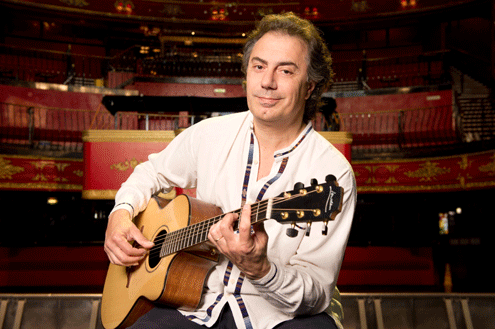


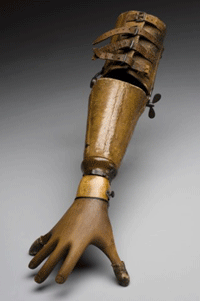




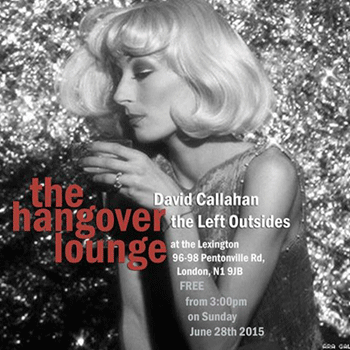
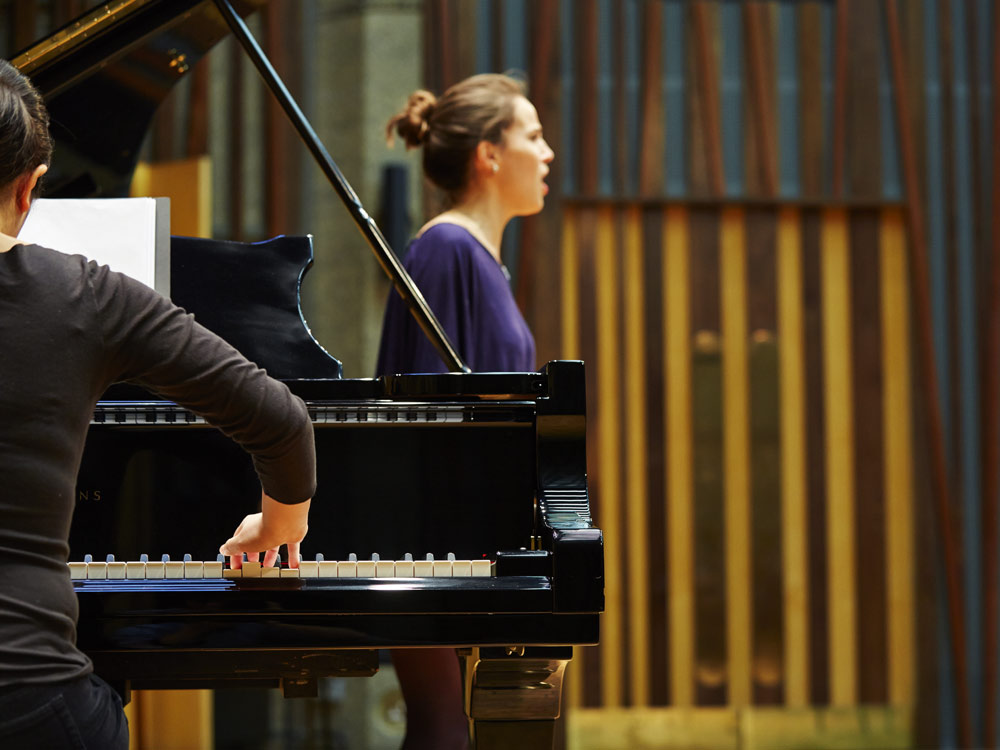
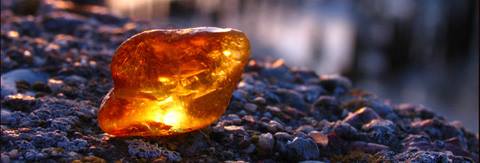
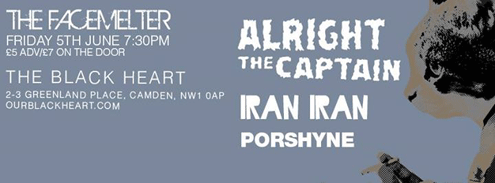
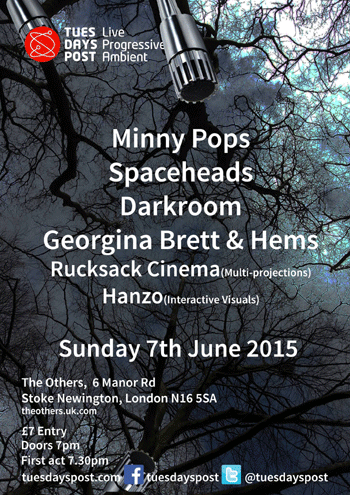

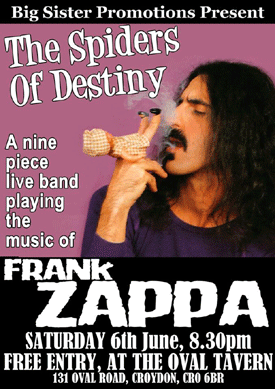
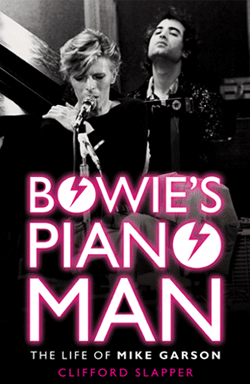
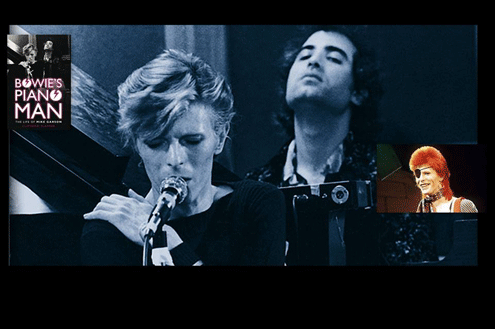

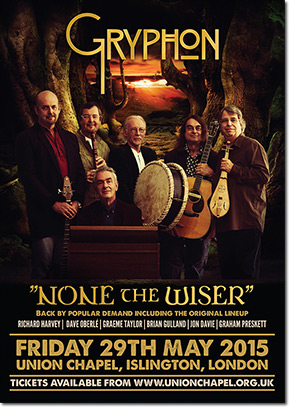

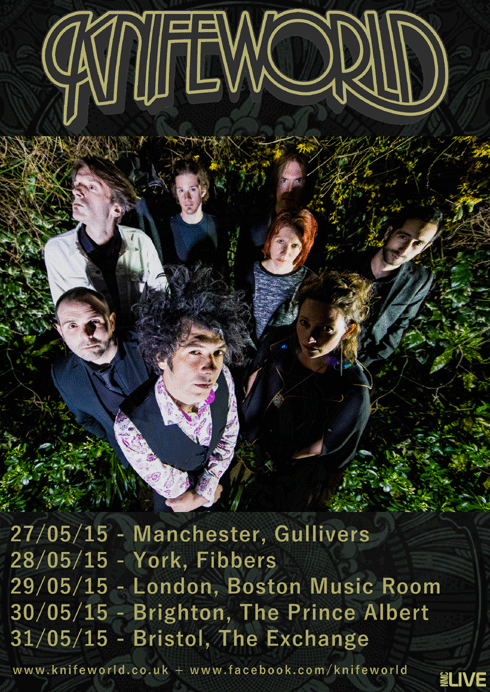





 Misfit City