Archive | psychedelic ambient music RSS feed for this section

October 2015 – upcoming gigs – Jonas Hellborg & Steve Lawson in Birmingham, London & Leeds; Tim Bowness, Peter Chilvers, David Rhodes, Theo Travis quartet gig in Cardiff

7 Sep

Although there are still some September gigs to flag up, here’s advance notice of four interesting concerts in early October for those of you who are interested in the amorphous terrain between jazz, balladry, art pop and ambient electronica. (Just straight press release stuff – the analysis will have to wait for another time, although I’ve also stuck a few review links in where I’ve covered these musicians before…)

Hellborg & Lawson, 2015

Two of the world’s leading solo bass guitarists together on one stage.

Crossing musical boundaries and blowing listeners’ minds for over thirty years, Jonas Hellborg is one of the great innovators of the bass guitar. From the pyrotechnic flamboyance of his early solo electric albums, to his unique exploration of the richness and depth of the acoustic bass guitar, Jonas has changed the way people think about – and play – the bass. Whether as a solo artist, or collaborating with many of the most respected names in music, from John McLaughlin to PiL, Ginger Baker to Shawn Lane, Jonas’ signature sound and uncompromising creative philosophy have produced an unparalleled body of work, mostly on his own Bardo label. Lauded by press and public alike, this is a rare opportunity to hear Jonas up close in the UK.

Steve Lawson is one of the most celebrated solo bassists in British music history – early in his career, he opened for Level 42 on their first Greatest Hits comeback tour, placing his unique take on melodic looping-based live performance in front of tens of thousands of bass aficionados. Fifteen years of regular gigging across the UK, Europe and the US have solidified his place as a leading exponent of solo bass. Steve’s sound-world borrows liberally from electronica, jazz, pop, rock, ambient and experimental music, to form a sonic fingerprint as compelling as it is unique. Following on from two years of wide-ranging collaboration, playing alongside musicians as diverse as Reeves Gabrels and Beardyman, Andy Gangadeen and Divinity, (and with the imminent release of his twelfth and thirteenth all-solo albums – on the same day!) Steve is back with fresh explorations pushing the notion of what the bass can be in the twenty-first century. (Here are a couple of ‘Misfit City’ reviews of earlier Steve Lawson records for those who’ve not read/heard them -‘Not Dancing For Chicken‘ and ‘Conversations‘).

Full dates, details and links:

  • Tower of Song, 107 Pershore Rd South, Cotteridge, Birmingham, B30 3EL, UK, Sunday 4th October 2015 – £10.00, tickets here.
  • The Vortex Jazz Bar, 11 Gillett Street, Dalston, London, N16 8AZ, UK, Monday 5th October 2015 – price t.b.c. – contact venue for tickets.
  • Left Bank Leeds, The former St Margaret of Antioch Church, Cardigan Road, Hyde Park, Leeds, LS6 1LJ, UK, Tuesday 6th October 2015 – £10.00, tickets here.

* * * * * * * *

Bowness/Chilvers/Rhodes/Travis, October 2015

Tim Bowness/Peter Chilvers/David Rhodes/Theo Travis (Chapter in association with Burning Shed @ Chapter,  Market Road, Canton, Cardiff, Wales, CF5 1QE, UK, Saturday 3rd October 2015, 7.00pm) – £15.00

A unique combination of atmospheric music and songs performed by the following four British art-pop, jazz and textural music mainstays:

Tim Bowness is vocalist/co-writer with the band no-man, a long-running collaboration with Steven Wilson. He has also worked with Richard Barbieri (Porcupine Tree, Japan), Peter Hammill, Judy Dyble (ex-Fairport Convention), Roxy Music’s Phil Manzanera and others. He has released three solo albums – ‘My Hotel Year’ (2004), ‘Abandoned Dancehall Dreams’ (2014) and ‘Stupid Things That Mean The World‘ (2015).

Peter Chilvers is a frequent collaborator with Brian Eno (including co-creating the hugely successful app Bloom), Underworld’s Karl Hyde and Tim Bowness, Chilvers has become known for his innovative work with generative apps and imaginative use of electronic textures. (Here’s a review of ‘Thin Air‘, an album Peter did with Michael Bearpark many years ago).

David Rhodes is one of the world’s most respected and inventive guitarists, having worked extensively with Peter Gabriel as well as with Kate Bush, Talk Talk, Scott Walker, Japan, New Order, Paul McCartney and Blancmange, amongst many others. David has also released two solo albums (2010’s ‘Bittersweet’ and 2014’s ‘The David Rhodes Band’) and was a founding member of the influential post-punk band Random Hold.

Saxophonist and flautist Theo Travis (making his Chapter return after performing with the cinematic/musical crossover project Cipher) has an international reputation as one of the stars of the contemporary UK jazz scene. Travis has more recently emerged as a key figure in the progressive and art rock sphere, working with David Gilmour, Robert Fripp, David Sylvian, Porcupine Tree, Steven Wilson, Bill Nelson, Gong, Soft Machine Legacy, Bill Bruford, Harold Budd and more. He has recently released his ninth solo album ‘Transgression’ (and here’s a review of an earlier one).

The evening is presented by Burning Shed, the online label and store founded by Bowness and Chilvers with Pete Morgan that has become a global specialist in progressive, ambient/electronica and art rock music. As well as releasing works on its own imprint, amongst others, Burning Shed hosts the official online stores for Panegyric (King Crimson, Yes), Ape (Andy Partridge, XTC, The Milk & Honey Band), Jethro Tull, Kscope (Porcupine Tree, Sweet Billy Pilgrim), Thomas Dolby, All Saints (Brian Eno), Medium Productions (Jansen, Barbieri and Karn), Gentle Giant and Roxy Music’s Phil Manzanera.  The label has recently expanded into book publishing, and at this concert musician and author Anthony Reynolds (perhaps best known as the former frontman of Jack) will be signing copies of his Burning Shed Publishing book, ‘Japan – A Foreign Place (The Biography 1974-1984)’.

More information here, and tickets available here.

September 2015 – upcoming London gigs – Darkroom gently mess with our minds at Hubbub Late Spectacular, Friday 4th September

3 Sep

Just quickly plugging this event, as I unintentionally left it off the early-September preview from Tuesday. While I was initially drawn to it by the musical involvement of textural loop duo )and longtime ‘Misfit City’ favourites) Darkroom, there’s plenty here to interest anyone with curiosity about the workings of the mind. It’s free, although the scheduled talks and some larger activities are ticketed (you’ll need to get tickets for those from the Wellcome Collection on the night, from 6.30pm onwards).


Hubbub Late Spectacular, 4th September 2015

Hubbub Late Spectacular @ The Hub, The Wellcome Collection, 183 Euston Road, London NW1 2BE, UK, Friday 4th September 2015, 7.00pm) – free entry

A night to explore rest… and its opposites. What does “rest” mean to you? Join the Hubbub team to investigate rest and its opposites: from daydreaming and doodling, to fidgeting and lullabies. Catch a talk on the latest discoveries about what your brain’s up to when you’re doing nothing, or experience a live stream of sound from around Heathrow airport. From a documentary about an ape retirement home, to a workshop where you can try out historical relaxation techniques, this is an evening that will transform how you understand rest.

Activities – hear contemporary lullabies and add to a collaborative collection; learn about mapping alertness and environment through self-tracking; experience variations of relaxation and cacophony with a brand new audio piece from radio collective In The Dark; put rest to the test as you investigate some of the methods used by scientists to measure rest and its opposites; join the debate on “what’s wrong with work?”

Talks – “Fantasy and Fiction” with social scientist Felicity Callard and poet James Wilkes; “Free Time and Mindwandering” with psychologists and authors Claudia Hammond and Charles Fernyhough; “Mapping Rest” with neuroscientist Daniel Margulies and anthropologist Josh Berson.

Some comments from Hubbub investigator Charles Ferneyhough (the whole blog post is here):

The research project in Hubbub is investigating topics such the relation between the shifting periodicities of ambient music and the changing rhythms of conscious experience, and how and in what contexts these can have restful and restorative effects. We plan to extend these investigations into studies of neural connectivity in the “resting state”: the dynamic, fearsomely complex and increasingly well-studied patterns of activation shown by a brain that is not performing any specific task. We are employing new methodologies for assessing these nuances of subjective experience (both for audience and performers) in a scientifically rigorous manner, as well as exploring implications for clinical interventions… Darkroom are interrupting a tour promoting their new album ‘The Rest is Noise’ to perform with me in a sequence of three extended sets at the Hubbub Late Spectacular. Come and hear the sounds of improvised ambient music, and get a chance to give your feedback on the psychological and emotional effects of listening to this kind of music.

…plus some from Darkroom themselves:

Darkroom will play three sets, with unpredictably different shades and contrasts. It’s a free event (apart from the drinks) at this spectacular venue, and there’s an opportunity to take part in the experiment, as well as take in other talks and exhibitions on the night, and meet some of the other investigators and our collaborators.

Reposted here is a Soundcloud recording of Darkroom and Charles Fernyhough collaborating on a half-hour long track recorded at The Hub earlier this year.


Full event details are here and here.

June 2015 – upcoming live events – Steve Lawson plays in Poole, Birmingham & London; the Ian Smith 50th birthday event at the Vortex

24 Jun

Gregarious loop bassist Steve Lawson has announced (at pretty short notice) three gigs in England over the coming week. As ever, they’ll be a tuneful/melodic/noisy hybrid of jazz, pop, electronic and ambient influences squeezed through Steve’s battery of sound treatments, and salted by the usual mixture of stand-up comedy, general gabby friendliness and opinionation; the last of which isn’t a word, but is a pretty good definition of what Steve does when he’s not playing, and sometimes when he is playing. At a Lawson gig you get the whole brand, and then some. You can take your family; you can take your friends; you can take a donkey whose legs are in need of a bit of honing…

Steve Lawson live

Steve Lawson + Echo Engine + others (SoundCellar @ The Blue Boar, 29 Market Close, Poole, Dorset, BH15 1NE, UK, Thursday June 25th – 8.30pm, £8.50 )

This is the one which counts as a full gig – a solo Steve Lawson set, after which he’ll be joined by the Echo Engine trio (Daniel Biro on keyboards, ) plus ex Bjork/D’Influence drummer Pascal Consoli and the ECM-inspired saxophonist Jon Lloyd. Up-to-date info is here and here, and you can reserve your ticket via email here.

Scott Pellegrom + Andy Edwards + Adam Gammage (Birmingham Dream Cymbals Day @ Glee Club, Birmingham, B5 4TD, UK – Sunday June 28th, 6.00pm – £10.00/£15.00)

This is actually a drum clinic appearance, at which Steve will be playing with drummer and regular collaborator Andy Edwards. Up-to-date info is here and tickets are here. Also performing are Adam Gammage (Baxter Dury band) and Scott Pellegrom.

Ian Smith’s 50th Birthday Event @ The Vortex Jazz Club, 11 Gillett Square, London, N16 8AZ, UK, Monday June 29th, 6.00pm – £13.20

Steve will be performing at this expansive celebratory gig for London Improvisers Orchestra founder Ian Smith – an event so substantial that it needs its own section further down this post. Steve will be playing in the 10pm slot alongside drummer Jason Cooper and guitarist Reeves Gabrels (both currently members of The Cure). Tickets here: more on the event in a moment.

As usual, Steve has plenty of other things going on, not least an appearance at The One Dayer: Independent Music, Money & Tech conference at Cecil Sharp House in London on July 1st, where (as a longstanding advocate of independent artist-run music careers) he’ll be one of the speakers. He’s also planning further collaborations with loop vocalist/beatboxer Beardyman (having previously played with him in a “dream team” improvising quartet alongside drummer Andy Gangadeen and guitar journeyman Gary Lucas), with fellow bass guitarists Divinity Roxx and Jonas Hellborg (the latter for an October tour) and with Jon Thorne’s semi-experimental Sunshine Brothers trio (for an August appearance at the Manchester Jazz Festival. If you want to read about what he did earlier in his career, here are links to the ‘Misfit City’ archive reviews of ‘And Nothing But The Bass‘, ‘Not Dancing For Chicken‘, ‘Conversations‘ and the first in the ‘Lessons Learned From An Ancient Feline‘ series, early steps on a path of explorations and musical hook-ups.

*****

And now, some more on the Ian Smith birthday event at the Vortex at the end of the month, which sees a remarkable lineup of British jazz players and other improvisers swarm into Dalston to pay tribute to one of their own living heroes. (Hopefully the timings I’ve cited here are right, as the layouts in the original postings are a little confusing…)

Ian Smith 50th Birthday Event @ The Vortex

Ian Smith’s 50th Birthday Event @ The Vortex Jazz Club, 11 Gillett Square, London, N16 8AZ, UK, Monday June 29th, 6.00pm – £13.20

Ian MacGowan (aka Smith) arrived in London in 1990 from Dublin with two phone numbers in his hand: John Stevens and Derek Bailey. Those were the only two numbers he wanted at the time, but as the months went on he got to know and play with many amazing musicians – he founded The Gathering with Maggie Nichols, and the London Improvisers Orchestra with Steve Beresford and Evan Parker. He ended up playing and recording with John and Derek, and plays with anybody who wants to start from nothing. Most of tonight’s cast are old friends; some new; all are beautifully personal voices. He’ll be playing with most of them.

In the Square, 6.00pm:
Henry Lowther, Byron Wallen – trumpets
Julian Faultless – french horn
Alan Tomlinson, Sarah Gail Brand, Ed Lucas – trombones
Oren Marshall, Dave Powell – tubas
Steve Beresford – occasional conductor

In the Vortex downstairs, 7.00pm:
Pete McPhail – alto sax
Tom Wheatley – bass
Steve Noble – drums

In the Vortex upstairs, 8.00pm
B. J. Cole – pedal steel
Ansuman Biswas – percussion

In the Vortex upstairs, 9.00pm:
Rowland Sutherland – flutes
Marcio Mattos – bass

In the Vortex upstairs, 9.30pm:
Sibyl Madrigal – poetry

In the Vortex upstairs, 10.00pm:
Reeves Gabrels – guitar
Steve Lawson – bass guitar
Jason Cooper – drums

and more special guests to be confirmed.

Tickets here.

June 2015 – upcoming gigs this weekend – Daylight Music in London (with Jo Mango, The Great Albatross, Circle Meets Dot), Matt Stevens house concert in Rome

11 Jun

Here are the details on this weekend’s Daylight Music event in London…

Daylight Music 193: Jo Mango + The Great Albatross + Circle Meets Dot (Union Chapel, Compton Terrace, Islington, London, N1 2UN – Saturday 13th June, 12pm to 2pm)

Glasgow-based multi-instrumentalist Jo Mango’s second album ‘Murmuration’ was released in 2012 to great acclaim. This wonderfully wistful album combined unique selections from Jo’s eclectic musical instrument collection, with inspiration from her adventures: travelling the world as a member of Vashti Bunyan’s band; her experiences completing a Doctorate in Musicology; her collaborations with David Byrne, Devendra Banhart, Coco Rosie, Teenage Fanclub and Admiral Fallow amongst others.

The Great Albatross is the indie music project of singer/songwriter A. Wesley Chung (formerly of Boris Smile). The project was formed in Glasgow, Scotland in 2011 and consists of an expansive, international list of contributors and collaborators. The project has performed both in the US and UK, including both days of the 2013 Count Your Lucky Stars/Topshelf Records SXSW showcase in Austin, TX. The Great Albatross have performed alongside the likes of Into It. Over It., Admiral Fallow, Miaoux Miaoux, Jo Mango, Owen, Joan of Arc, Empire! Empire! (I was a lonely estate), Joie de Vivre, and Football, Etc.

Sparking with the energy of a brand new meeting of minds, Circle Meets Dot is an emerging collaboration between Wesley Chung of The Great Albatross and Jo Mango. Soaring summer melodies steeped in California sunshine meet cloudy-day Scottish literary lyricism

Ed Dowie will be providing some light bird music in between the acts today/on Saturday. Using his mouth, his keyboard, some Max/MSP twiddlings and a whole host of bird recordings, he hopes to soundtrack the audience’s toilet and coffee breaks, as well as providing a backdrop to some cardboard bird spotting around James Cubitt’s beautiful building. Ed has been making music since the late 1990s, firstly as one third of Parlophone’s Brothers in Sound, then later a solo act under the name Redarthur. After a 5-year hiatus which he spent living in University libraries & music technology labs making strange bleeps, he returned to the music industry to join The Paper Cinema, a puppetry/animation/theatre/music hybrid (that tours both internationally & in Hackney).

Free entry, but donations are (as ever) encouraged.

Or if you’re in Rome, looping guitarist Matt Stevens is playing a house concert in the Batteria Nomentana district in the evening. As it’s a private gig, public information is scarce, but tickets and details are available here. For an earlier account of Matt in action, here’s a live review of his appearance at Roastfest from a few years ago. Matt will be performing again in the UK shortly with The Fierce & The Dead – more details on that soon.

June 2015 – upcoming gigs – two more Darkroom gigs in London – Hubbub @ Wellcome Collection; Listening Club in Peckham

8 Jun

Having only just played at the last-for-now Tuesdays Post concert this past Sunday, loop duo Darkroom are performing at two more London gigs this month, both of them at typically interesting events.

Hubbub @ The Hub, The Wellcome Collection, 183 Euston Road, London NW1 2BE, UK, Thursday 11th June (time t.b.c.)

The Hubbub group (based at the Wellcome Trust) is a project with a brief to explore work, rest and play; past, present and future. The two members of Darkroom will be participating in a closed session, being “wired up and investigated” as part of the research. Details are still a little unclear (although I do know that the work will be live-streamed) so keep an eye on the Darkroom Twitter account. For an early taste of the project, here’s psychologist, writer and Hubbub investigator Charles Fernyhough guesting on a half-hour long Darkroom track, a late-night atmospheric piece recorded in The Hub earlier this year.

And on the upcoming Sunday, there’s this:

Listening Club @ The Peckham Pelican, 92 Peckham Road, London, SE15 5PY, UK – 4.00pm to 9.00pm – free entry

This is an events series in association with St John Sessions ( showcasing new experimental music. In addition to Darkroom, the gig also features sound artists Kostis Kilymis (from Thessaloniki via London), Franz Rosati (from Rome) and Memorial Bench (from London, I think). More chat about this over on Twitter.

June 2015 – upcoming gigs – tomorrow and this weekend in London and Watford – Chant Live! interactive gig; Silencio Sessions presents Surfing On Sinewaves; Daylight Music

4 Jun

Shortly after I posted news on voicelooper Georgina Brett’s Tuesdays Post concert on Sunday (which, incidentally, will be the last one for a while) she got in touch with news of two more gigs she’s playing tomorrow and on Saturday, so here’s the information on those (more or less in her own words).

Chant Live!, 5th June 2015

Chant Live! featuring Dave Barbarossa/Youth/Georgina Brett/Regina Martin/Dan Morrell/Jon Moss/Tom Nettlemouth/Jamie Grashion & very special guests, (Unit 5, Mirage Centre, First Way, Wembley, London, HA9 0J, Friday 5th June, 7.30pm)

The return of the legendary open source band! A showcase gig in a hidden private club venue in Wembley, ten minutes walk from Wembley Park tube – a bit of magic brought to the perimeter of the stadium itself. On stage will be myself, Dave Barbarossa (Adam & the Ants, Bow, Wow, Wow), Youth (Killing Joke, The Orb), Jon Moss (Culture Club) and Cosmic Trigger (Jamie Grashion and Tom Nettlemouth). There’s also pre gig talks about all things cosmic, the fractal universe and drumming with Gina Martin and the Queenswood Drummers. Great club sound system. An adventure!! Two drum kits, two bass guitars, djembe drum circle. Give voice, give hands, be the band: bring a drum or a shaker, percussion, chants, on-the-fly recordings, loops, mixes, mashes. Free event – for more info, call Guy on 07947 061257.

Silencio Sessions, 6th June 2015

Silencio Sessions, 6th June 2015

Silencio presents ‘Surfing On Sine Waves’ featuring Georgina Brett/Cos Chapman/James Conway/Tom Fox (LP Cafe, 173 The Parade, Watford, Hertfordshire WD17, Saturday 6th June, 6.30pm)

A night of looping, experimental and electronic improvised music.  As well as me there’s:

Cos Chapman, former oceanographer turned solo improvised electronics performer and member of both I Am Meat and Rude Mechanicals (there will be a fascinating video of how he creates his instruments from recycled materials).

James Conway, a Brighton based musician usually seen with electronic outfit Not These Tones: this time it’s an eclectic solo show on mixer, sampler and synth duties. No two performances by James are the same; it’s method in the moment, thrill in the risk.

Tom Fox, an experimental instrument builder who focuses on using reclaimed materials to create new and unique sounds and textures from common items, and will be presenting a film on his methods.

More info here – tickets £6.00 on the door.

Also just in, news on this weekend’s Daylight Music event…

Daylight Music 191: School of Noise + Sarah Angliss + Astra Forward (Union Chapel, Compton Terrace, Islington, London, N1 2UN – Saturday 6th June, 12pm to 2pm)

School of Noise are a collective of artists who run workshops for children, enabling them to make their own weird and wonderful instruments and experiment with sound art. They’re appearing live on stage for the first time performing their own pieces of experimental and electronic music. The group, made up of children ages 7-13, met at the School of Noise workshops where they explored a variety of approaches to creating, sculpting and listening to sound. The project, started by London musician Dan Mayfield, has been influenced by the works of Brian Dennis who ran the Shoreditch Experimental Music School in the late 1960’s.

Sarah Angliss is an award winning composer and performer whose music reflects her fascination with European folklore, faded variety acts and long-forgotten machines. Sarah is known for her highly unusual stage set which mixes theremin, saw and ancient instruments with the ensemble of musical robots she’s designed and built to work with her on stage.

Astra Forward is a Brighton based singer-songwriter and multi-instrumentalist. A raw vocal talent, she combines acapella, synth organ drones, ethereal harmonies and alternate guitar tunings into her performances. As a singer and keyboardist in The Robot Heart and Diagrams, Astra has toured throughout Europe and the U.K, supporting the likes of Gomez, Ben Ottewell, Athlete and St. Vincent. At this concert, she will play a solo set of her intricate and beautifully vulnerable electronica.

Alex Hall/Elephant returns to create an improvised guitar soundscape in between acts this week.

Free entry, but donations are (as ever) encouraged.

June 2015 – upcoming London gigs – prog rock/math rock/post-hardcore @ The Facemelter; electro-pop/drum’n’brass/loops/experimental ambience @ Tuesdays Post; eclectic classical/experimental chamber music/kletzmer & Bulgarian voices @ The Forge

31 May

Some more early June gig previews for London – these would have been in the previous post if I’d picked up on them earlier.

Firstly, a Facemelter promotion (from the experimental rock/post-hardcore wing of the Chaos Theory organisation whose jazz gigs I’ve also enjoyed)…

Facemelter, 5th June 2015

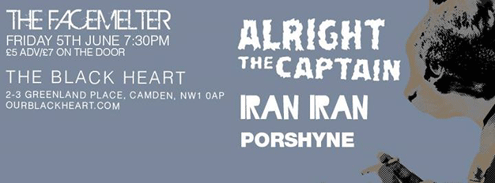
Alright The Captain + Iran Iran + Porshyne @  The Facemelter (The Black Heart, 2-3 Greenland Place, Camden, London, NW1 0AP, Friday 5th June , 7.30pm

Three heroes of math rock, alternative and post-rock travel from different corners of the UK to unite and form this amazing lineup.

Derby-based trio Alright The Captain masterfully combine virtuosic instrumentalism with unabashed musical experimentation and have effortlessly established themselves as a sonic force to be reckoned with, thanks to their increasingly inimitable, uniquely imaginative brand of math-rock. Their sprawling and varied career has seen them sharing stages with post-rock luminaries including Mono, toe, 65daysofstatic, Pelican, Tera Melos, ASIWYFA, Maybeshewill, Adebisi Shank (RIP), This Will Destroy You, ZU and many more. Their new album ‘Contact Fix’ (which ‘Musical Mathematics’ describes as “div(ing)  in and out of math rock, prog and post rock – but, at its heart, it’s different”) has gone down a storm.

Iran Iran are another supremely talented bunch of musicians who stunned and impressed all who saw them at ArcTanGent last year. With insanely complex rhythms and thunderously heavy riffs, the four-piece from Bristol have evolved since their excellent first EP ‘Crystal Math’ and are packing a punch. They’ve played with Future Of The Left, Cleft, Alright The Captain, This Town Needs Guns, You Slut!, Alpha Male Tea Party, Death Pedals and many others. Fans of complex musical wizardry or heavy riffs will love their new EP ‘Milk Time For Spiders’.

Brightoners Porshyne dance between ambient intervals and melodic vocals to intensely intricate, fantastically crunchy  prog rock riffs. With just a few single releases and a session filmed by Small Pond Recordings, they already sold out their first headline show in Brighton. This is your chance to catch the band before their career takes off.

More info here and here, and tickets here (£5.00 advance, £7.00 on the door).

At the end of the same week, Georgina Brett’s Tuesdays Post event returns to Stoke Newington with another evening of ambient/progressive live music, including ‘Misfit City’ favourites Darkroom

event-20150607tuesdayspost

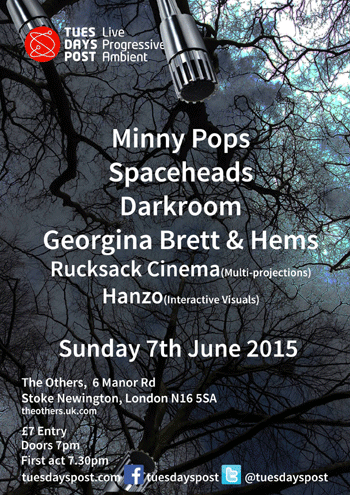
Minny Pops/Spaceheads/Darkroom/Georgina Brett & Hems @ Tuesdays Post, (The Others, 6 Manor Rd, London, N16 5SA, Friday 7th June, 7.00pm)

Formed by vocalist/band leader Wally van Middendorp in Amsterdam in 1978, Dutch electro pioneers Minny Pops took their name from a primitive Korg drum machine. The band released several singles and a debut album, Drastic Measures, Drastic Movement, on independent Dutch label Plurex before joining the legendary Manchester label Factory Records in 1980 (which resulted in them being produced by Martin Hannett, touring with both Joy Division and New Order, and becoming the first Dutch group to record a Peel Session). Singles including Dolphin’s Spurt, Secret Story and Time were followed by the acclaimed album ‘Sparks In A Dark Room’ in 1982. The band released two further albums (‘Poste Restante’ and ‘Fourth Floor’) before splitting in 1985. In 2012, the band reunited for a series of gigs in the UK, the Netherlands and Belgium and recorded a 7-inch single for Tim Burgess’ O Genesis label. After a pause to draw breath, 2014 has seen Minny Pops performing live once again.

Spaceheads are a cosmic duo of trumpet electronics and drums. Formed in 1990, they have developed a blend of electronics and sunshine fanfares over the course of ten albums, three EPs and much touring across Europe and the USA. Andy Diagram (also of James) plays trumpet with a mobile phone stuck to the top with a fish slice and Richard Harrison plays drums with big bendy metal sheets stuck to the top. They create live looped layers of brass driven by flurries of free flowing funky drums. Andy and Richard have achieved an intuition of what each is about to do next which makes their semi-improvised gigs a joy to behold. They release their first studio album in ten years – ‘A Short Ride On The Arrow of Time’ – this Autumn.

Darkroom – the UK-based duo of Michael Bearpark (guitars) and Andrew Ostler (synths)- expertly ride the line between luscious, old-school progressive rock and modern ambient electronics. At times reminiscent of early Tangerine Dream with hints of Fripp and Eno, they create clouds of sequenced synths, chewy grooves, and looped phrases to support a variety of acoustic and electric guitar melodies that twist and turn in surprising, occasionally aggressive, ways.

Hems Aka Henrique Matias will be playing live with Georgina Brett. Henrique is a multi-talented composer, programmer and DJ. He specialises in Multimedia programming (from internet things to Max/MSP and similars), although not all his live music and performances sounds like computer music (sometimes he takes his drum machines and crazy things out of the house). Georgina Brett’s music is created using her voice and effects pedals, creating instant choirs of sound, often in an hypnotic style. The point of this music is not only to captivate with extraordinary timing and melodic style but also to help the listener to relax in our ever-increasingly fast world.

Interactive visuals and multimedia projections are by Hanzo and Rucksack Cinema.

More information here – tickets £7.00 on the door.

By all accounts The Forge (in Camden Town) has spent the last few years becoming one of north London’s most interesting small venues for mixed music. I’ve yet to go there and see for myself: but in its full June calendar (also featuring funk, jazz, classical and Cuban music as well as assorted poetry) the following four concerts caught my interest:

Notus Winds & Eliza McCarthy (Wednesday 3nd June, 7.30pm)

Part of the classical monthly series Wednesdays at The Forge, this time featuring award-winning chamber ensemble Notus Winds and solo pianist Eliza McCarthy with a program of contemporary compositions (more information here). Tickets £10.00 to £12.00.

Programme:

Harrison Birtwistle – 5 Distances
György Ligeti – Ten Pieces
Arvo Pärt – Quintettino
Anders Hillborg – Six Pieces for Wind Quintet

Fenella Humphreys: Bach to the Future Part 1 (Tuesday 9th June, 7.30pm)

The first of three concerts presented by violinist Fenella Humphreys, featuring commissions of six new works by six of Britain’s leading composers to accompany Bach’s glorious 6 Sonatas and Partitas for unaccompanied violin. This first concert includes new works by Cheryl Frances-Hoad and Gordon Crosse alongside extraordinary music by Bach, Scott, Westhoff, Hindemith. Tickets £10.00 to £12.00.

Programme:

Cyril Scott – Bumble-Bees (1928)
Johann Paul von Westhoff – Suite no. 5 in D minor (1682)
Gordon Crosse – Orkney Dreaming (2014)
Fritz Kreisler – Recitativo and Scherzo-Caprice op. 6 (1911)
Paul Hindemith – Sonata op. 31 no. 2 ‘Es ist so schönes Wetter draussen’ (1924)
Johann Sebastian Bach – Partita no. 3 in E major BWV 1006 (c. 1720)
Cheryl Frances-Hoad – Suite no. 1 (2014)
Eugene Ysaye – 2nd Sonata op. 27 (1923)

Reciprocity: a new work by Daniel Patrick Cohen (Wednesday 10th June, 7.00pm)

Reciprocity is a 28 minute work for voice, taped narration, eight celli, piano, and percussion. The piece was composed by Daniel Patrick Cohen from six poems by the late Darya Farha, a Canadian poet, therapist, filmmaker and clothing designer. Darya was an extraordinary woman whose sharp intelligence, dry wit, distaste for orthodoxies and boundless empathy fuelled restless journey through her unfinished life. Darya died of breast cancer in 2011 when she was 46, and Reciprocity was commissioned by her sister Juliana Farha, who lives in London. Reciprocity is not about cancer, however. Instead, its human and universal themes of joy, pleasure, fear and anger, along with its intriguing instrumentation are sure to engage a broad audience. You can read more on the project here, and here. Tickets £6.00.

She’Koyokh & Veda Slovena Bulgarian Choir (Thursday 11th June, 8.00pm)

In a unique collaboration, She’Koyokh & Veda Slovena Bulgarian Choir combine the fiery panache of klezmer and Balkan music with the timeless beauty of Bulgarian voices, weaving Jewish, Turkish and Balkan music into the rich tapestry of the Bulgarian choral tradition. Read She’Koyokh’s piece on their Veda Slovena collaboration here. Tickets £10.00 to £12.00.

(All events taking place at The Forge, 3-7 Delancey Street, London, NW1 7NL)

March 2010 – album reviews – Meczûp’s ‘Hanging from the Purgatory’s Pendulum’ (“intimations of strings, pipes and carefully torn air”)

12 Mar

History can catch at things and mess them around. Take the theremin – a serious instrument, reduced to a circus trick, with a story that reads like a map of twentieth-century aspirations and follies. Early days were heady: born from Russian security research, Léon Theremin’s electronic instrument was quickly diverted to more high-minded classical music uses: mostly summoning up the sounds of the ethereal spheres for mystically-minded intellectuals. Now? The gimmick tray. Its “woo-woo” glissandi are used to evoke gimcrack spookiness, or as a quick and flashy shorthand for psychedelic derangement.

Worse – on half of those occasions when you’re assured that you’re actually hearing a theremin (Good Vibrations, the original ‘Star Trek’ theme, early Portishead) what you’re actually hearing is a forgery. Based on motion detectors and on hands that aren’t allowed to touch anything, the genuine instrument is tougher to play than a greased fiddle. Hence (for those who want a quick route to the theremin sound without the sweat, physicality and sheer involvement of playing one) the slew of knock-off devices and plug-ins available for faking the flitter.

It’s all a little sad. Despite the efforts of a distinguished handful of composers (not least Shostakovich and Miklós Rózsa) the theremin passed quickly from being the sound-of-the-future to becoming a sonic trinket and a source of freaky icing – all via pop culture, counterfeitery and the Cold War. You could scarcely blame Léon Theremin if he were spinning in his grave (sounding a heavenly wavering burble of rage as he did so). Hearing a theremin played in a way that’s even slightly close to the original intent is something of a rarity these days. While he’s not exactly a purist, Cihan Gülbudak (better known as Meczûp) clearly takes his own theremin seriously enough to steer it back to roots-level.

On ‘Hanging From The Purgatory’s Pendulum’, Meczûp’s theremin is accompanied only by its own looped signals, and sometimes by a gauzy, delicate brushing of fuzz-noise shrouding the pure tone in a gentle, finely-milled distortion. Mostly, though, Meczûp suspends the instrument in wide space, sending its sliding, sustained tones out as a majestic keen. His control is exemplary, mastering the air-shaping swoops and pinches necessary to pull away from plain electronic tone and towards intimations of strings, pipes and carefully torn air. Where a little more flex is required there’s a whammy-pedal available, heaving the pitches up and down in tidal zooms, and giving the music the apocalyptic boom of a Messaien organ-blast.

Besides the skill of Meczûp’s fingertips, the other key ingredient in his work is locale. Based in Istanbul, he sits at the historic conceptual crossroads of East and West. Seemingly setting aside contemporary blendings of globalization and cyberculture, his music taps into older frictions and fertilizations. There’s an old-fashioned sense of discovery here. Geographies slide across each other and voices strain to mingle, from the earnestly mangled English of the song titles to the cross-sifting of the musical impulses. Throughout the album, echoes of the classical European yearn-to-order meet intimations of Eastern devotional. Despite Meczûp’s classic theremin technique his musical lines don’t have the chilly ethereality of the original approach. They sound more like ney flutes, duduks or zurnas – Middle Eastern wind instruments with their own connection to Sufi, shamanism and oral histories; to the angelic and diabolic aspects of spiritual experience; or the difficult memories of the region’s blood-mottled sway between the heights of civilization and the depths of brutality and pain. There are notes of beauty and agony here, calling up more than a few old ghosts.

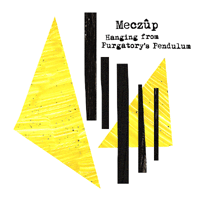
Meczûp: 'Hanging From The Purgatory's Pendulum' (previous cover)

Meczûp: ‘Hanging From The Purgatory’s Pendulum’ (previous cover)

At its most basic, Meczûp’s music sounds predominantly Eastern (the brief Arabic piping of Shadow: A Parable) but the musical crossings-over are far more interesting. Beneath the long whining melodies that cap and guide A Tale For Lancinant Screws, a kind of slender and abbreviated suggestion of Renaissance counterpoint emerges. It’s less an outright structure than a kind of haunting, like the image of a face flattened out across an endless carpet. A similar device haunts The Ribald Genie, ghosting underneath a lonely melody which gradually alters from pure keen to distorted scream and finally to a melancholy sarangi moan. For the brief but wide-ranging Garoun A, more of these suggestions blur into whalesong glissandi: a succession of theremin voices from teetering soprano to slithering sub-bass chase each other before tailing off into echoes.

Meczûp’s sharp appreciation of lines of beauty dominates the record, although at points this is deliberately overstretch to the point of breakdown. On Puriest Morning of All Times, baroque intimation destroys its own bounds: a vaulting lead melody (first soprano, then alto) strides downwards into echo-space before more parts build into a looping, uneasy fugue. As it moves on, the theremin sound begins to rip and degrade, eventually becoming a mass of gargling sharp-edged rattles like a rockslide or a Geiger counter. Blossoming in Cemetery sits between Bach liturgy and Armenian lament, maintaining an ache and yearn for six minutes before the theremin’s translucent cloak of distortion cracks and dissolves, and the melody starts to reiterate as a scabrous insect buzz.

In spite of his austere tendencies, Meczûp allows a little fantasy into the mix for a couple of pieces, drawing on and transforming pinches of popular culture. The first of these is Kwaidan, rooted in Japanese ghost tales via Lafcadio Hearn and cinema. Relinquishing the counterpoint which informs the rest of the record, it brings out more of the Eastern melodies while walls of looped theremin churn in the background, fluttering and stuttering on a grand scale.

The second is The Bridge of Khazad-dûm – an etiolated isolationist drone which becomes perhaps the most powerful work on an album already full of grand-scale intimations. It takes its inspiration from Tolkien: specifically, that chasm-spanning subterranean stone bridge which (at a key point in ‘Lord of the Rings’) becomes a locus for death, despair and ruin. Meczûp interprets another aspect, capturing something of Tolkien usually drowned under torrents of merchandising: his valedictory quality, the way his stories shuffle and re-deal the racked old bones of history, romance and inevitable decay for one final mournful hurrah. Meczûp’s vision of the bridge is of an ancient, significant place deserted. Plangent teary layers of theremin fuse together, cold spaces emerge in the music, and entwined senses of antiquity and abandonment are caught in broad view.

In fact, this sense of stricken grandeur applies equally to the rest of the album. Meczûp’s eerie, assertive picking-over and teasing-out of elements within of his music feels like a week spent immersed in history. It has the same tasting of triumphs and fleeting beauty; the same dawning feeling that one somehow fits into something so much broader and complicated. Through it all, the theremin rises triumphant. Survival and vindication.

Meczûp: ‘Hanging From The Purgatory’s Pendulum’
BFW Recordings, BFW038 (no barcode)
Download-only album
Released: 1st March 2010

Buy it from:
BWF Recordings, Magyar Walltapper or Reverb Nation. 9-track version also available from Bandcamp

Meczûp online:
Facebook Twitter MySpace Bandcamp

September 2001 – EP reviews – centrozoon’s ‘The Divine Beast’ (“a kind of relay race across trance territory, whipping up a tautly disciplined psychedelic frenzy”)

27 Sep

centrozoon: 'The Divine Beast'

centrozoon: ‘The Divine Beast’

There are some musicians who claim to consider themselves aerials, with their feet lightly arched off the ground and their heads inclined into some kind of ether, through which they conduct the music and songs which are looking for a means to get to earth. Robert Fripp is one of these claimants, but whether his occasional disciples centrozoon think the same way is questionable.

centrozoon’s touch-guitarist Markus Reuter is a graduate of Fripp’s school of Guitar Craft, and previously played with the Craft-inspired Europa String Choir, but an enquiring look at the Centrozoon website reveals little in the way of earnest, wintry Frippian mystique (though much in the way of dry German humour). If centrozoon (of whom the other half is synth-and-beats man Bernhard Wöstheinrich) are channelling music, it’s of a much more liberating and less clotted variety than Fripp has been downloading into King Crimson over the past few years.

There’s certainly a latter-day Crimsonic element to their work – the rich swathes of Soundscapes-style ambient tone colour, the wild electronic percussion, and the brassy or droning sounds that Markus employs while soloing on his Warr Guitar. But there’s less of the tightness that makes and sometimes mars King Crimson’s music; and a more thoroughly integrated use of the clubland elements of trance, techno and garage that have recently been informing Crimsonic offshoots like BPM&M and ProjeKCts Three and X.


Thúsgg (Skinny and Crazed Mix) possesses that analogue-synth gastric twist that regularly seeps up into club music. Bernhard launches a rapid, broken-beat squirt-funk-and-dripping-water cave ambience, through which Markus flies big wheeling paths of Frippian improvisation in unearthly arpeggios. But barely halfway through, most of the beats quietly fall away: Markus’s chilly howl of overdriven Warr briefly rises, saxophone-like, into free-time jazz questioning, before both centrozooners dissolve into a duet of shifting ambient lambency.


The sixteen-minute extract from ‘The Cult of: Bibiboo’ shows an even broader example of centrozoon’s fusion of club culture and evolutionary rock textures. The duo engage in a kind of relay race across trance territory, whipping up a tautly disciplined psychedelic frenzy. It flowers from auroral ambience through thunder-drum percussion and what sounds like nods to the ‘X-Files’ theme, to warm and constellatory ambient drifts, cut by flares of harmonised Warr and quizzical harmonies.

Five-and-a-half minutes in, it’s become a glittering chillout zone covered in singing glassy loops. By nine minutes, Markus’s weaving Soundscapes are rubbing up against clipped artillery shell boom-beats, and by eleven minutes he’s razoring the starry sky with saw-toothed shapes and snarls. By the thirteen-minute marker Bernhard’s thundering distorted beats have forced Markus back into the angelic role, and they finally coast onto a home stretch of firework bangs and prismatic orchestration.

Tagging all this rich invention as “Fripp on Ecstasy” seems cheap, but it’ll do for now as we start to tune in to the powerful, thrilling hybrid music centrozoon have to offer.

centrozoon: ‘The Divine Beast’
self-released, CZCD01 (no barcode)
CD-only EP
Released:
September 2001
Get it from: download from Bandcamp or Amazon Music
centrozoon online:
Homepage Facebook Twitter MySpace Bandcamp Last FM YouTube Vimeo Google Play Pandora Spotify Amazon Music
 

October 2000 – album reviews – Radiohead’s ‘Kid A’ (“allowing – or forcibly inducing – change to come through”)

2 Oct
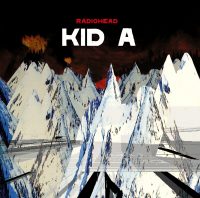
Radiohead: 'Kid A'

Radiohead: ‘Kid A’

Radiohead are history. And they know they are: elevated into a pantheon of great expectations and rock landmarks a mere three albums into their career, and somewhat against their own wishes. Like a latterday Pink Floyd crossed with Nirvana (with the universality of both) they’ve had the rock world at their feet. But they’re also fully aware that, like Miles Davis before them, they need to let go of an expected history before they congeal. Embracing the difficult development of their own history by allowing – or forcibly inducing – change to come through.

So it’s goodbye to Old Radiohead’s upfront army of rock guitars, Thom Yorke’s frenzied in-yer-face angst, and those singles scooping at the soul like the hook in the fish’s mouth. And all the talk of the band making a record that mostly junks standard concepts of guitars, lyrics and pure song in favour of Warp Records-style electronica and muttering left-field oddness has turned out to be true.

‘Kid A’ does indeed have no singles and no singalongs – lovesick, punch-drunk or otherwise. It has a bleary, fractalized, impersonal mountain-scape etched out on computer for a cover; a lyrical agenda which is plainest in its absence. And its diverse pieces are deliberately disassociated from each other. Sometimes chill, sometimes as mechanistic as automata moving in a warehouse; all strung-out and scrambled by filters, Pro-Tools or anti-technique. Trusted “recorder” Nigel Godrich plays an odd mixture of Eno and Albini roles, squeezed alongside the band in the producer’s chair. Sometimes you can hear a band member at work, untweaked. More often you can’t. It’s like a set of glass cases enclosing specimens, puzzling specimens of music pulled up and laid out with a firm “that’s what you’re getting – goodbye” sense to it. Anti-pop, not pleasing anyone’s appetite for a snackable chorus.

And already (to filch another Yorke line) the knives are out. Radiohead are busily having their seams ripped open and their functioning organs speared, teased out and compared scrupulously against charts; a list of names marking off the components of ‘Kid A’ track by track. And, increasingly, marking it down. “Charles Mingus, Autechre, Alice Coltrane, Boards of Canada, Aphex Twin…” goes the chant. “Rip-off. Buy the originals. Who the hell do Radiohead think they are?” And yes, none of ‘Kid A’ is as groundbreaking as any of those recorded texts, which Yorke and co readily cite as influences. There’s no element that a student of improv, post-rock, serious electronica or revolution jazz won’t have heard already. But this also means that one of the world’s biggest rock bands have admitted they’re at least as much learners as teachers. Sounds like cause for celebration to me.

In fact it’s other legendary records – the likes of Robert Wyatt’s ‘Rock Bottom’, Scott Walker’s ‘Tilt’ and Robert Fripp‘s ‘Exposure’ – which ‘Kid A’ is most genuinely akin to. Each of these records strives to meet its ends by a mixture of instinct, cold science flushed hot again with consuming passion, and their own secretive internalised logic. It’s a big step going from ‘OK Computer’ (one of the most explicit and upfront records of the ’90s, in which Thom Yorke was a incandescent clench of ego; stubborn, scarred, and railing against the draining fear and indifference of the adult world we’re trained for) to a twenty-first century record which is as weirdly egoless as this one is. An inarticulate speech of the heart via samplers, hazard and evasion.


Significantly, the most memorable and accessible song on ‘Kid A’ (the tear-blown strum and shivering strings of How To Disappear Completely, echoing both King Crimson‘s desperately vulnerable Waiting Man and Walker’s cryptic Patriot) sees Yorke singing softly and acceptingly of the ultimate relinquishment. Drifting away from himself in Dublin, becoming insubstantial, not as a surrender, but as some kind of transcendence. “I’m not here… this isn’t happening,” he sings, a tired relief (and, almost, a kind of love) suffusing his voice as the quivering violins flutter down, snow-like, obscuring the signposts.

It’s the emotional rightness in ‘Kid A’ that finally pulls it clear of the dissectory attacks people are aiming at it. As if the cry of rage that dominated ‘OK Computer’ is now diffused in a temporarily helpless scatter of images and impulses. As if the echo, coming back, has impacted on a band whose foes and fears are now nested in the fabric of the world, who can no longer respond with a simple song.

The fabulously grotesque artwork (a booklet of nightmare kid’s drawings) that lurks, hidden, in the back of the CD tray, gives a little glance into this world. Stick men boot each other in the balls; small mice squeaking copyright signs wander into the maw of a toothy beast growling a trademark; frightened eyes stare out of threatened houses, and Tony Blair’s PR grin is distorted into empty-eyed predatory lust. A nation of grinning little bears end up on the end of people’s forks or balaclava-clad and tooled up with Kalashnikovs, and a screaming parade of vitriolically surreal words march across the pages like circus handbills. Like the doomsday rhetoric of Godspeed You Black Emperor, it’s almost comical… yet it jolts, like the sound of a chisel stealthily tapping at your wall.


And perhaps ‘Kid A’, rather than being the rebel songbook for this world, is the recovery notes for those as cracked by it as ‘OK Computer’ predicted they would be. There’s a terrible surrender and relief about Everything in Its Right Place, freewheeling along on tranquillised electric piano chording with a slipstream of sliced up, gossamer-keening Yorke vocals tangled in its tail. In which two of the few comprehensible lines are “yesterday I woke up sucking on a lemon – yesterday I woke up soaking,” and “what is that you tried to say?” This is disarrangement, dysfunctionality – not order. Yet Yorke seems to realise that this too has its place in a person’s history; and the sheer beauty of his singing throughout implies there’s hope waiting up beyond the dissolution.


About half of ‘Kid A’ ties in with this dissolve. The clinking music-box-meets-hip-hop narcosis of the title track, a nursery lullaby as rendered by an uptight and drier Massive Attack. Yorke’s bass-warped, filtered and generally fucked voice wavers, croons and ties little musical bows in and out of the pernickety beats, while words about “heads on sticks”, “ventriloquists” and “a little white lie” work their way through the dirty pink clouds. Who blinks first? The gaudily humming electro-disco on Idioteque reveals an empty dancefloor grooving away to itself as catastrophe looms. Yorke, in a slurred keen, is spilling out surreal sub-sense like David Byrne on sodium pentothal (“laugh until my head falls off / I swallow ’til I burst… / Women and children first, and children first…”) but sounds ecstatically happy (“here I’m alive, everything all of the time”), and the last sounds on the track aren’t death-booms but an aviary of feverish guitar loops.


The breakdown’s in the motorik groove of The National Anthem, adhesive thumbstains of bass underpinning a brawling rabble of brass that sound fresh from a vigorous drunken debate at Mingus’ Jazz Workshop or the Art Ensemble of Chicago. Yorke’s voice winds out of the airshaft with a lobotomised “everyone around here… everyone is so clear”: later quavering “everyone has got the fear” as the horns become restive, but affirming “it’s holding on… it’s holding on.”


The other half? Anyone’s guess. The smears and rumbles, the webbing of indistinct voices, the gusts of emotion hurtling up towards invisible targets, all blur the picture. The ghostly tundra ring of Treefingers gives away nothing but a deathly peace. The unravelling trip-hop of In Limbo, full of unhitched folk guitar and stutters of echoed organ, is lost somewhere in the subconscious: grumbling “you’re living in a fantasy world” while itself threatened by nightmares of loss and disappearance (“I’m on your side, / nowhere to hide, / trapdoors that open, / I spiral down”), and finally swirling away in a rush of killing reverb as if down an enormous storm drain.


There are a few dud or ill-fitting moments while Radiohead grope in the fog. Morning Bell, for one, where they knock out a scratchy, swamping, insect-buzzing song which sounds like nothing so much as Echo & The Bunnymen shaking with the D.T.s. Or the tribal tom booms, wiry laceration of rhythm guitars and guilt-ridden lyric on Optimistic, harkening back too much to ‘The Bends’ (or the out-of-focus U2 of ‘The Unforgettable Fire’). But the starved boniness renders these hauntingly hollow-eyed stuff, compared to the previous fire. “If you try the best you can / the best you can is good enough,” sings Yorke, with a scratched, dented demeanour belying his words.


The final act is Motion Picture Soundtrack, journeying on an exultant wheeze of harmonium, celestially riffling harps and gusting bass wind as Thom Yorke settles back into love as if he’s settling back into a wrecked old armchair. And it’s love among the trashed – “red wine and sleeping pills / help me get back to your arms. / Cheap sex and sad films / Help me get where I belong.” Querulous (as he protests “Stop sending letters, / letters always get burned. / It’s not like the movies,”), but there’s happy-sad commitment here as he murmurs “I think you’re crazy, maybe… / I will see you in the next life.” Then one last delayed pink gush of electrophonic orchestration, and out.


But it’s in its totality that ‘Kid A’ sinks into your mind. There’s no way it could ever be counted as a flawless record – in fact, it revels in its flagrant imperfection with such a fierce joy (and one born of abstract willpower) that it’s hard to condemn it for that. But it’s a vitally important record for Radiohead; and a rewarding one for the listener.

The peculiar triumph of ‘Kid A’ is the way that it transcends both its own wanton abstractions and Radiohead’s past explicitness to resonate beyond each of them, in the way that an impact on a random strand can shake the whole web. To hear it is to be haunted by the emotional husks of messages long lost and made irrelevant, or by the impressions left by intentions deflected and displaced into half-formed actions and events. To have your mind rippled by the last exhausted breeze from a shockwave far, far away. To be moved by the vibration of history – Radiohead’s history, at any rate – as it passes.

Radiohead: ‘Kid A’
Parlophone, CDKIDA 1 (72435 2959020)/7243 5 27753 4 7 (72435 27753 47)/LPKIDA 1 (724352 959013)
CD/cassette/10-inch double vinyl album
Released:
2nd October 2000
Get it from: (2020 update) buy/download from W.A.S.T.E. Store, Google Play or Amazon Music; stream via Soundcloud, Deezer, YouTube, Apple Music or Spotify
Radiohead online:
Homepage Facebook Twitter MySpace Soundcloud Bandcamp Last FM Apple Music YouTube Vimeo Deezer Google Play Pandora Spotify Tidal Instagram Amazon Music
 

December 1998 – album reviews – Porcupine Tree’s ‘Metanoia’ (“the possibilities which the band’s music has while it’s still at the point of wide-eyed, newborn naivety”)

27 Dec

Porcupine Tree: 'Metanoia'

Porcupine Tree: ‘Metanoia’

As Porcupine Tree straighten out their more obviously exploratory aspects and firm up into a more solid rock configuration, Steven Wilson seems concerned to show us that although his psychedelic prog band is solidifying, it’s not becoming rigid. After last year’s live album ‘Coma Divine‘, here’s ‘Metanoia’: a collector’s set of band improvisations from the rehearsal studio during the making of ‘Signify’.

Obviously intended to illustrate the possibilities which the band’s music has while it’s still at the point of wide-eyed, newborn naivety, it’s also a window into the band’s uncensored enjoyment of music-making. At the beginning of Mesmer III you can hear drummer Chris Maitland enthusing like a schoolboy – “Brilliant, Richard… That’s really evil!” – while Richard Barbieri unwraps a particularly ominous electronic texture from his mysterious lash-up of analogue synths. Compared to the carefully-honed concert expansions of ‘Coma Divine’ (allowing the band to play out loud without ever getting too self-indulgent), ‘Metanoia’ takes Porcupine Tree’s live freedom off in a different direction, where the only limitations (or necessary brakes) are the musicians’ awareness of those specific moments in time.

Mesmer II is the most confident (and consequently least yielding) of the improvs. It begins as a Frippish guitar fanfare over Prince-style boom-bat drums; it gradually psyches itself up into more familar Porcupine Tree planetarium music, with orrery twinkles and rolls from Barbieri. But it’s an exploration in which the influences seem to have blended naturally into the moment – a good sign.


Of most obvious interest to regular Porcupine Tree followers will be the Metanoia I/Intermediate Jesus medley, featuring a first draft of the Intermediate Jesus instrumental from ‘Signify’. This version emerges out of a typical raw Porkies atmospheric. Dreamy, swampy psych-rock fragments flicker in and out of a quiet power-station ambience: Colin Edwin‘s small, arching bass hook becomes the keel over which Wilson decorates the distance with echo-guitar details. The music eventually settles down into a dark-tinged, broody, space-psych flavour with a backwash of drowsy sonic fabric: reminiscent of the beautiful golden haze which U2’s Eno-assisted ‘Unforgettable Fire’ revelled in, in between the rock hits. At this point, still uncertain of itself, the music of Porcupine Tree has an uncontrived innocence to it; something that’s rare anywhere in the current prog canon, let alone in their own history.


Mesmer I builds from minimal, grudging soundscapes of cymbal tones, electrosculpture and flanged guitar effects. Eventually, it’s been shaped into a disjointed groove (a gawkier, rockier take on ‘In A Silent Way’, maybe) up to the point where it’s hit U2 funk and a dance-groove recalling Porcupine Tree’s own ‘Voyage 34’. Here, Barbieri’s inventiveness plays foil to the brasher edge of Wilson’s stadium-rock guitar flourishes, brushing in and out of the mix with scratchily tender gusts of electronics like the wet coronas around streetlights. Metanoia II, like its predecessor, is anchored by a little Edwin bass hook around which Maitland lays haphazardly tremorous drumming, Wilson a fragmentary glissando, and Barbieri abuses his wibbling VCS3 in full On the Run tradition. This piece will subsequently (a) blossom lyrically and (b) accelerate into a kind of soft-edged speed-metal, with the same sort of instinctive flow as Porcupine Tree’s own ‘Moonloop’.


It’s Mesmer III/Coma Divine, though, that allows Porcupine Tree to insinuate themselves into the improvising tradition. “Do something completely different” suggests a restless Wilson. Time out for meditation – and already Steven is bored… Someone fiddles with a shortwave radio but, ending up with dull afternoon cut-ups, abandons it. Behind tiny touches from a dormant rhythm section, the band start to induce shifting planes of sound. A Barbieri noise (an orchestra haunting a train tunnel) ebbing in and out; hardly there, like kettle steam. A suspicion of an introverted ’70s jazz-rock, melted down in ’90s solvent, draining out in a Barbieri wing-flutter. A section which has the lonely looping meander of Bark Psychosis‘ Bloodrush. At last, a return to a very soft take on the band’s psych-rock drift, Wilson’s guitar trailing over rocking-chair drum and bass, transparent synth swathing a shroud of narcosis around it. A band usually lumped in with Marillion and Gong has just paid visits to the post-rock haunts of Tortoise, Labradford and beyond, without contrivance, drawing up natural sound from the source. When they finish, it’s like the shift in reality at the end of a sleepwalk.


As an afterthought, there’s Milan – Porcupine Tree out of the studio and captured in conversation during one of those bleached, interminable spare moments on tour. They’re uncomfortable, travel-blurred, in unfamiliar suits and ineptly trying to organise their Italian meal. In the “gastronomic capital of the world… known for its joi-de-vivre,” they’re ill-at-ease, messed around, trying to cope, teasing each other. “I just feel stupid,” is the final aggrieved statement of the album – a moment of Spinal Tap bathos to counter the explorations elsewhere. Displaced from normal patterns, they’re forced to improvise again, in the way we all have to. They’re surviving.

Porcupine Tree: ‘Metanoia’
Delerium Records/Chromatic Records, CHRM 003 (no barcode)
10-inch vinyl-only double album
Released:
December 1998
Get it from: (2020 update) Original vinyl version best obtained second-hand; album was later reissued on CD.
Porcupine Tree online:
Homepage Facebook Twitter MySpace Soundcloud Bandcamp Last FM Apple Music YouTube Vimeo Deezer Google Play Pandora Spotify Tidal Instagram Amazon Music
 

October 1998 – live reviews – ‘The Sound Of Satellite’ (featuring Sand, Lucha Libre, Yossarian, Karamazov, Heavy Q) @ Notre Dame Hall, London, Friday 9th October (“The Young Gods meet ‘Rugrats’…”)

13 Oct

This time, I’ve done it.

For once, I’ve arrived on time… and Notre Dame Hall is so empty that I reckon I’m going to be outnumbered by the bands. Above me, a glitterball spins very, very slowly. Off to stage-right, a slide is projected onto the wall back-to-front. Smoke drifts across from the other side of the stage, as if one of the boxes of gear has quietly caught fire. Horace Andy plays over the sound system. I’ve never noticed that squirmy edge to the sweetness of his voice; or how well it suits embarrassment.

No. It doesn’t go on like that. In fact, and independently of tonight’s acts, it ends up as one of the friendliest concerts I’ve been to in ages. But that first half-hour – of me as the lone non-label person in the house – gives me an idea of the risk which labels like Satellite take on whenever they put a night like this together. If you’re a mainstream label with a nice little crop of pushable guitar pop bands, and you want to hire out some dedicated pub for a concert party: well, fine, you’re probably onto a winner. If, alternatively, you’re a small label best known for fringe electronica such as Fridge, Rothko, and Add N To X (one of whom is DJ-ing tonight) and you’re hiring this big cinematic ballroom… then you must be trying not to sneak nervous, sidelong glances into the looming face of failure.

When I befriend Pete, the Satellite house photographer, he tells me that as soon as tonight is finished they’re taking the whole thing – lock, stock and barrel – over to Paris, to repeat the concert. Within the day. Gluttons for punishment. Or people who believe in what they have to offer.

* * * * * * * *

What they offer (or unleash) first is Heavy Q, whom I know from a single truly bizarre piece of experimental vinyl. He/she/it/they?… He. One Japanese guy, Lee Young Sin, in a glitterscaled wrestlers mask, hunched over a pair of samplers as if preparing to split them in half by sheer willpower (one of them, appropriately, is labelled “Quasimidi”). We’ll see him later as part of Lucha Libre, the other members of whom are tracing his every move with Handycams.

What he’s up to right now is squeezing out slice’n’dice anti-dance music as the hall begins to fill up; a scary dead-funk cyborg strop interspersed with cut-ups of Japanese telly chatter and cheering. At one point a sampled announcer burbles a bit of plain English – “breaking the earth for us tonight” – with the cheesy enthusiasm of someone who knows the next bit of hype which they can stick in their arm will be along in another few minutes. That same hysterically enthusiastic announcer will be weaving in and out of Lee’s music like a persistent hiccup; a glassy, untrustable ringmaster to his sonic circus.

Heavy Q’s second piece is a randomised assault of backbreaking drum sounds; drum’n’bass minus the calming balance of the bass. His third is a children’s chant, slapped up against a deathly brutal industrial tom rattle. As he moves over to rummage on his table of electronic debris, the sound runs on without him, mutating into Bollywood singsong, strangled by tortured electronics. By the end of it, Lee has turned himself into a vast, vulgar techno-god statue on top of the table. Arching back and moaning a deep thick bass vocal into his microphone, he’s almost at one with his sampler. He drinks from a sparkle ray-gun; he adjusts his electronics like he’s tying his shoelaces. Throwing a sarcastic cock-rock pose, he waves a theremin aerial around at phallus height.

Is this the answer to the problem of the personality void in electronica? Living up to the gigantic sonics by taking onto yourself the aspects of a monster movie?

* * * * * * * *

Talking of the personality void… things are working out contrary to expectations. At any given unpretentious, good-time indie gig, I’ll be out in the cold, a blip on the doorlist among self-satisfied strangers. Here, on a night that ought to smack of exclusive club, a night which you’d expect to exclude, I’m making ceaseless cheerful conversation. Buoyed by camaraderie, I and my new friends agree that, in contrast to Heavy Q’s theatrics, Karamasov have the slightly bored, stiff look of too many art-scene bands.

Perhaps it’s that old cliche of Teutonic cool: half of the band is genuinely German (guitarist/cellist Johannes von Weizsacker and stately blonde percussionist Berit Immig), while the London half (bassist Harry Rambaut and synth player Adam Stewart) aren’t exactly Essex ravers. Certainly their music’s lodged in European post-rock cool rather than Pacific rim commercial frenzy, their set opener wheeling along on Harry’s sproingy pre-jazz bass, Jonathan’s phased guitar scrub, and a lonely, farting-Dalek riff on Moogbass. They look at each other as if they’re setting up lab equipment; or preparing John Cage’s piano, like good little acolytes. Their second piece is something from the chillier end of Stereolab‘s science school, albeit with a few sniffs of quiet humanity appended. Echo-slapping cello effects, and skinny Moog squirts something like Philly soul strings, sketched and autopsied. The cello scrapes like a worn wheel; Berit’s oddly heavy-metal drumming is rookie-tense, but snaps tight regardless. On the beady-eyed Roadsnack, she switches to spiky organ against Jonathan’s piano-ping guitar.

Out on the floor, meanwhile, we’re waiting for them to enjoy themselves. I know, I know; there’s a certain credibility to that kind of icily unmoved, Euro-scientific music creation. But… Karamasov come across so much better when they drop it, hang out, and just play. It’s probably not intentional, but Uneven Surface sounds something like Genesis’ Watcher Of The Skies filtered through Faust. Hmmm. ‘The Wire’ would have a fit; but the bass stabs and drum riffs are received with joy by the Satellite audience. Happy Hour ain’t the Housemartins (which would’ve been interesting, come to think of it), but sounds more like Neu! reinventing lounge music, as Berit tinkles out melodies on the vibraphone. Most welcome of all is a piece I didn’t catch the name of, in which the increasingly impressive Berit sings in a detached Nico murmur (not unlike Elizabeth K.’s interjections for Eyeless In Gaza) over a tune not unlike a relaxed cross between Levitation and A.R. Kane (with a bit of the brisk arty hoppiness of a warmer German band, F.S.K).

During the next interval, the DJ plays Egg and Soft Machine rather than some fearsome tranche of blunt improv. A definite feeling of thaw is in the air.

* * * * * * * *

Yossarian turns out to be both a band (two keyboardists out of a ’50s B-movie and a drummer) and a bald mad-scientist character, looking not unlike Alan McGee. This is Tim London – Yossarian’s prime human body. In a previous life, he was the slightly warped pop brains behind Soho (if you remember the Smiths-sampling ‘Hippychick’, not that there was much else).
These days he’s wrapping his cortex round far artier pop shapes. One piece – all drones, cymballine drums and organ – sounds like Mark Hollis knitting together Labradford and Spiritualized; a chorus of “I will call, and you will come” and an unexpected blaze of harmonica. Other pieces sound like late ‘60s Scott Walker sitting down hard on late ‘80s Pet Shop Boys, and others…

Vocoders, yet! Those pained machine voices are back, along with Air-style pretty melodies served with an avant-garde hiss and a cheesy Bontempi beat under the flagrant detail. What is this nut trying to morph into and sell to us now? E.L.P.? The Glitter Band? By the time I’ve decided that it’s a sort of electronica ‘Parklife’ with car-crash keyboards, he’s exploring bleak Bowie ‘Low’-ies and hitching them up onto Prodigy-style wall-of-fire beatoramas like an erupting Las Vegas volcano.

All of a sudden, I see Tim London revealed as electronic art’s own John Shuttleworth, and relax a bit. It’s an impression carried in his archness, in his taste for a classically creaky lounge-pop tune, his self- conscious anti-cool (“I’ve never played in that time signature before”, he drawls), his total deadpan approach to the ridiculous or to any intimations of hubris, and most of all in the way that, having thrown electronics at us all evening, he encores by – get this – playing the spoons. Respect is due. My old man’s a Cyberman an’ all that.

* * * * * * * *

Osakan noisefreak-fusioneers Lucha Libre have bigger hats than anyone else. They also have bigger presence, taking the stage like EMF used to do. They possess a double-brass frontline – one capering trombonist leader (Teruhiko Heima) in a Kiss ‘Destroyer’ T-shirt; one surreally dignified sax player (Akifumi Minamimoto). There’s also a transplanted heavy metal core in the shape of Takashi Sakuma, a sampler-wielding guitarist with long tartan shorts, a serious Van Halen fixation, and one of those hilariously literal Japanese sweatshirts. This one reads “Pretty Tough Sport”. Finally, they have a digital heart on frantic overdrive – everyone except drummer Jun Tsutusui seems to be doubling on synth.

By their seventh number their bassist (Lee Young Sin, back in a different guise) is walking on his hands and playing the synth with his head amidst a hurricane of Coltrane-meets-Black-Sabbath saxophone. Before that, we’ve been privy to a Donington’s-worth of heavy-metal axe abuse; a swelter of industrial goofing and salsa horns; and a stage act best described as The Young Gods meet ‘Rugrats’. We’ve also, as a responsible audience, totally turned around received notions about arty label nights by absolutely loving it to bits and yelling for more, as the twit from ‘Melody Maker’ shakes his head and frets about missing ‘Friends’. Lucha Libre continue their delightful murder of cool regardless.

Now they sound like ships coming into a drunken docking on Mars – big trombone blurts, the rattle and squiggle of electronic timepieces, and phenomenal yowls and divebombs from the metal kid. Now they’re on a big, spacious, tricky funk beat: Akifumi an oasis of reedy calm as a funky harpsichord riff pops up from keyboardist Soichi Murota and the band head into the slabby, tottering, Theremin-ized jazz-funk of the ‘We Have No Our Groove’ single. Next, they pull out in order to plait Led Zeppelin into the ‘Mission Impossible’ theme.

By the encore, Teruhiko is hammering out a torn tom tattoo on a commandeered chunk of Jun’s drumkit. Stuck horn drones giggle at him; the sax thrashes – squalling and wailing – in a cauldron of frenzied bop, and Takahashi fires Heavy Q’s abandoned raygun into his guitar pickups. It’s like seeing a particularly extrovert software virus trash your screen, in blazes of grinning colour. As they settle into a long final lope, razzing trombone carrying the melody over the clipped sax and Durutti guitar picking, the air inexplicably fills with a powdery scent of flowers. This is some sort of Lucha Libre Japanese magic, I guess: the sort of thing which that passionately confused nation throws up so well.

* * * * * * * *

With a massive wall of dry-ice fog and a sound like Satan belching (it’s some sort of conch, in fact), Sand prepare to close the evening. A massive mound of frizzy dreadlocks hoves into view and starts growling Andean death-metal at us. Crops wither within a three-mile radius.

This thing is – to stretch the Trades Description Act a little – Sand’s singer. Whether it’s possible to declare a force of nature part of your band is a matter for Sand and their lawyers. They used to be called Germ, which is an understatement and a half. They should have been Epidemic. To put Sand into perspective, they are something of a return to normality after Lucha Libre’s mad playground display, even if they do both feature upfront trombone. Sand are also, by far, the most assured band on tonight – elastic harmonic bass from John Edwards, the precise touches on Rowan Oliver’s looping drums, the wash of ravishing electro-gale off Tim Wright’s keyboards: a bit like Rain Tree Crow with a trombone, but only if they’d been fronted by David Sylvian’s monster-from-the-Id. This is something which the Sonic Youth-style drumsticked drone guitar and the ‘Bitches Brew’ mute on Hilary Jeffery’s trombone only accentuates.

The monster on vocals – whose name is, apparently, George – evidently knows harmonic overtone chanting. His reverberating rasp blends in with the trombone’s blare, the slipping geological sample and the Bruford threes which Rowan is now shooting off the top of his kit. The mike slips deeper into that mane of dreads. From the unseen mouth the Devil pukes noise, sprawling and rolling: echoes of Diamanda Galas, balled’n’bassed up, or of Magma. If many of the smooth dream-rock tones of Sand suggest a vigorous muscle-flexing tone-up, that voice feels like being rolled hard in the gravel afterwards. Among other things, Sand offer a crushing world-music for the ever-so-slightly masochistic.

“You can dance to the next one,” comments band spokesman Hilary, draining the spit from his trombone as John brings on a double bass to play… well, some salsa from hell; the guitar and keyboard filling up the spaces in the music with an inspired patina of drone-trash. As another Sand piece forms (a reedy melodica, skullclick percussion, a lost wail from Mr Mountain as the band traverses a flat, disturning plain of atonal movement) you wonder whether this band would ever really make you want to dance. Why should you want them to, when instead you can suffer the perverse enjoyment of feeling Sand twitch the crust of the earth from under your feet?

* * * * * * * *

I don’t care. The liberating, socialising force of dance was the one aspect of electronic music that was ignored tonight; possibly because it was redundant. In between writing my notes I’ve filled my ears, had a doughnut, leafed through vinyl stalls, and spent an evening in the belly of the art-beast, chatting away to some of the nicest people I’ve met in ten years of making up gig numbers.

I finally let my tired eyelids swell, and turn my weary ankles homewards. Satellite are packing up, engrimed with cigarette smoke and fired up on the warmth of the evening, making ready to ship it all across the Channel to the City of Light.

This time, I don’t fear for them.

Sand online:
Homepage

Lucha Libre online:
Homepage

Yossarian online:
Homepage

Karamazov online:
Homepage

Heavy Q Connection online:
Homepage

Satellite Records online:
Homepage

(2018 update – after twenty years, it’s no surprise that most of those bands and projects have long since ended. Post-2001, Satellite Records was mostly reabsorbed into its ongoing parent label, Soul Jazz; and the Satellite, Yossarian, Lucha Libre and Heavy Q links above connect only to discographies. Yossarian’s Tim London (a.k.a. Tim Brinkhurst) now works as a film-maker, as a music lecturer at the British & Irish Modern Music Institute in Birmingham, and as producer, most notably with Young Fathers. The members of Karamazov are still friends and collaborators, working together in various combinations in The Chap and Omo. Sand also continues in various forms and names, generally helmed by Tim Wright and Hilary Jeffery. It’s unclear what’s become of the members of Lucha Libre, although saxophonist Akifumi Minamimoto did also put some time in with “jazz/R.I.O. progsters” Djamra. Meanwhile, Notre Dame Hall ended four decades of musical history covering beat pop to punk to avant-gardery in 2001, when it became first the Venue theatre and then the Leicester Square Theatre.

Oh – and sorry about the lack of pictures. When I got friendly with Satellite’s photographer, it clearly didn’t include me blagging post-concert photos out of him.)

July 1998 – EP reviews – Darkroom’s ‘Carpetworld’ (“swathed in contradiction… one long, haunting slab of sonic terrorism”)

15 Jul

Darkroom: 'Carpetworld' EP

Darkroom: ‘Carpetworld’ EP

Darkroom come swathed in contradiction: daytime shoppers on the sleeve, savage nightlife in the music. And no credits, though apparently it’s another one of those confounded No-Man offshoots ‑ don’t these bloody people ever sleep or anything? Evidently not, if the tracks on this single serve as an example of the sounds pulsating through their brains.

Carpetworld itself breaks all the rules ‑ the rules that say you can’t put vocals and lyrics recalling Soft Cell‑era Marc Almond over churning, vicious Frippish guitar ambience and hard‑as‑nails mechanoid beats falling somewhere between jungle and hardcore techno. A knife in the side of the rave generation’s blissout, it’s elegant in its brutality (“taking a twirl with your best friend’s girl, while the rest of the gang torch Carpetworld”), hovering in tatty clubs and observing the rituals of nihilism unfold as the backwash of bad E and the not-so-gentle ’90s poison the clubbers’ dreams.

Dance darkhorse it might be (it doesn’t run with any obvious scene, and fuck knows which playlist it’ll fit on in the increasingly segregated world of dance radio) but this is still cutting‑edge contemporary, with absolutely no fluffiness and Tim Bowness spitting out lyrics the likes of which we’ve never heard fall from his previously poetic mouth ‑ “Have useless sex with your ugly ex… / You velvet‑sneakered chancer, you broken-fist romancer…” as the beats flutter like a death’s head moth trapped in the throat. I’ll stay well out of the disturbing urban nightmare Darkroom are living in, but I’ll happily live it vicariously through their warped imaginings. Dante’s disco inferno.

After that, the Carpetwarehouse reworking does lacks a certain spontaneity. The original sounds like it’s literally fallen together in a paranoid improv session after a thoroughly unpleasant experience: This – apart from simply not being different enough – simply sounds like Darkroom have tried too hard at the atmospherics. OK, the beats are even more frenetic and Bowness achieves something he’s previously never managed in previous recordings: i.e., sounding fucking terrifying as his distorted voice rasps out the repeated mantra “I’m coming after you!” If you ever thought, from listening to No-Man’s work, that you could have that Bowness chap in a fight ‑ think again… Nonetheless, one does yearn for a battering, bloody remix from the diseased mind of Jim ‘Foetus’ Thirlwell, or Aphex Twin.

But, hell, Darkroom’s maverick genius still encompasses enough space for much more roaming, ambient trips. Daylight, in particular. Tim Bowness (like Martyn Bates) has always had one of those voices that are perfect to use as an instrument integral to a piece such as this, weaving magical wordless nothings in and around underwater tones and splashes of electronica. Anchoring this thoughtful pause from drifting off into inconsequentiality, a beautifully melodic bass riff and eerily clattering percussion ‑ like the echoing sound of camera shutters ‑ keep proceedings somewhere near planet Earth.

Ardri, though (nonsensical title ‑ always a bad sign), reeks too much of late ’70s/early ’80s ambient ‑ the kind of stuff the BBC would choose to soundtrack beautiful nature footage. Look, it’s a personal thing ‑ until someone out there finds even a slightly new direction with ambient (and I would certainly not rule Darkroom out of this), then the only sounds that interest me are the ones that either completely chill me out, or those that make the hairs on the back of my neck rise. This final track (like too much else in the field) gets my mind wandering after the first minute and thinking “So? What’s next?”
So, a downbeat end to a marvellous debut from Darkroom. Buy it for the title track and (whatever my gripes) for the remix, and just treat them as one long, haunting slab of sonic terrorism. Brilliant.
(review by Col Ainsley)

Darkroom: ‘Carpetworld’
3rd Stone Ltd./The Halloween Society, HAL 8001CD (5023693800158)
CD-only EP
Released: 6th July 1998

Buy it from:
(2018 update) This is now one of the rarest Darkroom releases – best obtained second-hand or from iTunes.

Darkroom online:
Homepage Facebook Twitter MySpace Soundcloud BandcampLastFM

April 1998 – album reviews – Bass Communion’s ‘Bass Communion’ (“things flirt round the edges of familiarity”)

29 Apr

Bass Communion: 'Bass Communion' ('Bass Communion I')

Bass Communion: ‘Bass Communion’ (‘Bass Communion I’)

The potential for making noise, making our own personalised sound via brain, limb or breath, has always been with us. In the sampler age – where you can trap any sound in a digital jar and then play musical Darwin with it – the option range has hurtled up several levels in the space of half a generation, and the serious sound addict can now personalise any noise no matter who or what the source.

Which brings us to Bass Communion, the latest brainchild of studio wizard Steven Wilson. As if he weren’t busy enough psych-rocking with Porcupine Tree, cult- popping with No-Man, or working out his Kraut/post-rock urges with The Incredible Expanding Mindfuck. Let’s face it, few people are better qualified as a sound-addict.

Bass Communion (no thumpin’, pumpin’ house-music project, despite the suspicious name) is Wilson’s most direct attempt to date at riding this addiction. It’s also his most cryptic and esoteric, in which he rejects his usual battery of synthesizers in favour of the use of sounds “sampled, looped, transposed, layered, filtered, and processed into infinity” via electronic circuitry and sampler exploration. Wilson permits himself occasional real instruments (such as the skinny, echoing Bark Psychosis-style guitar on Drugged), but they sort of stand off to one side, like nervous uncles at parties. This isn’t really their show. For those who only skim the surface of Steven Wilson via the odd No-Man phuture-pop single, or hear the odd Porkies guitar blowout and maybe damn him as a wannabe Dave Gilmour, Bass Communion will come as a beautifully disorientating shock. This music shares secluded room-space with the work of Aphex Twin, Muslimgauze, Oval or Paul Schutze.

It might be a logical extension of Porcupine Tree’s ambient atmospherics or No-Man’s avant-garde leanings, but it’s also a giant leap of pure faith. There are no tunes, cheesy or otherwise. At all. And no attempts to please – there’s no equivalent to Aphex’s Come to Daddy on ‘Bass Communion’. Melodies, if they happen, seem to evolve almost by accident. Harmony is something that occurs occasionally when patterns coincide, rather than something that’s held to. Things flirt round the edges of familiarity, repeat and loop, but don’t so much hold the attention as massage it. When in doubt, it stays quiet. Actually, it’s always in doubt and always quiet, but never entirely at a loss about where to go. Bass Communion is profoundly experimental, but Wilson’s sharp, pop-attuned ear ensures that at least it never paints itself into a corner.


Shopping, the opener, deflects digital coldness from the off via its crackle and fluff of sampled vinyl noise: quiet, but almost drowning out the amnesiac wafts of melody which float, with disassociated loveliness, off to one side of the listening ear. They come in, they go; a wobbly snatch of Bach jumps out at you, trips over, cuts out. From then on, you’re on your own in Bass Communion’s subtly surreal electronic world.


Orphan Coal sounds like night in an abandoned telephone exchange. A clattering can drum pulses its elliptical way around and around. Echoing blips of voice trail after it – a hiccup in the system – and tones flicker irregularly like monitoring lights, going from ice to feather-stroke in seconds. Sheens of sound arch in ghostly fashion overhead: at peace, but disturbing yours. You almost expect HAL 9000 to be keeping a watchful red eye on it all. In which case the slow flood of Sleep Etc. is the digital limbo after the plugs are pulled and the lobotomy comes down, sending tides of electronic fluid trickling across the speakers, rising and implying a slow suffocation. Leafy rustles and long low scraping whale-like groans overlap deep subterranean booms and lost dizzy ringing sounds. Somewhere back in there there are hints of double basses, Rhodes pianos, and Mexican percussion – it could, conceivably, have started off as Wilson chopping up something like Weather Report and reducing it to sonic pulp for a new recipe. Whatever the source, now it sounds like icebergs having prolonged nightmares.


With all the experimentation going on, it’s almost a shame to admit that it’s the two versions of Drugged – apparently the first parts of an evolving sound series – that hit the spot best. How to define them? As “not-duets”, probably. Collaborations with live musicians that aren’t live, aren’t jams, weren’t composed, yet still sound like immediate and co-operative performances even though they’re manipulated and mutated bits of taped sound sent through Wilson’s cloud chamber. The effect is eerie: you feel that if you lent Steven Wilson your soul, he’d hand it back to you within days polished, cleaned and reconditioned, and with a few welcome surprises in the pockets.


On the first Drugged, Theo Travis‘ plaintive soprano saxophone replicates and proliferates, dozens of birdsinging reeds fluttering and fading over the warm upholstery of reverently pastoral organ chords. His playing is the most directly human and emotive on the record, yet here he sounds as if his personality is being melted down even as he makes his mark. There’s somehow something of the swan-song to what he’s doing, as if he and Wilson were carrying out a voluntary, luxuriant suicide pact.


The second Drugged, featuring the celestial guitar Soundscapes of Robert Fripp, is an especially inspired bit of audio piracy: a close cousin to the similar and marvellous Born Simple from No-Man’s ‘Flowermix’. Seven seconds of Fripp lifted from an old No-Man source tape, then refracted through Wilsonian concepts and gizmos for twenty-five minutes of protracted, blissful imagination. Frippophiles might notice that it equals about any genuine Soundscape they care to name: everyone else will be up with Steve ‘n’ Bob, nuzzling the starry skies.

A deep-down indulgence well worth sharing. Filter me another one, bass-boy.

Bass Communion: ‘Bass Communion’ (‘Bass Communion I’)
3rd Stone Ltd., STONE 036CD (Barcode)
CD-only album
Released:
April 1998
Get it from: (2020 update) Bandcamp, Burning Shed or Amazon
Bass Communion:
Homepage Facebook Twitter MySpace Soundcloud Bandcamp Last FM Apple Music YouTube Deezer Google Play Spotify Instagram Amazon Music

March 1998 – maxi-single reviews – Lo Fidelity Allstars’ ‘Vision Incision’ (“promises to blow our minds wide open, but falls well short of the promise”)

26 Mar

Lo Fidelity Allstars: 'Vision Incision' maxi-single

Lo Fidelity Allstars: ‘Vision Incision’ maxi-single

I had this lot down all wrong at first, I admit it. From the bragging “we’re the greatest” interviews, and the “dance music with real instruments” tag, even the look of the group, I had them down as (god forbid) the new baggy. I was fully prepared to go out and shoot them so I didn’t have to live through the horror that was baggy yet again. But a couple of odd tracks here and there have persuaded me to save my bullets… for now.

Sure, there’s a “real band” sound at the heart of the Lo Fidelity Allstars, but they can manage to make their take on turn‑of‑the‑millennium genre‑defying dance culture a gloriously uplifting thing. Their baggy forerunners (Happy Mondays, Stone Roses) always sounded like they were prevented from gliding to a higher musical plane by having their feet firmly stuck in the field of mud labelled “indie”. The Lo Fi’s, firmly centred on the sampler and decks, don’t have the same problem as they reel off ribbons and streams of sound, rather than chug doggedly away like an old pro dealing with a new fad. But…


Oh, the senseless waste. Vision Incision promises to blow our minds wide open, but falls well short of the promise. Good start, mind. Smooth beats, hedonistic keyboard riff, an infectious soul-diva backing hook, and the matter of the live band sound becomes irrelevant as the track lifts and soars smoothly like the most uplifting house or techno, boasting “As we travel at magnificent speeds around the universe…” At which point the Lo-Fi-s prime weak spot is revealed: Dave The Wrekked Train’s bland Speak’n’Spell vocals. Mashing up randomised texts, as he does on other Lo-Fi-s sonic collisions, they work fine. Faced with actual poetry, they creak like a ground axle. Please, if this is the way he carries on all the time, sack him. He has delusions of being a more hip Mark E. Smith, but ends up just sounding like a London cabbie – a monotone mumble grating over the divine music and pointing up the dreadful rhymes in some of his lyrics.

Perhaps he reckons he’s aiming at the street-level psychedelic lyricism of hip-hoppers like the Wu-Tang Clan: the thing is, those guys sound like they believe the weed-fuelled surreal-o-vision they’re raving about. Dave just sounds embarrassed, as if he’d rather have stayed in his siding and chatted to Thomas The Tank Engine this time around. Consequently, I can’t decide whether this is a successor to Orbital’s Chime for the genre‑busting, cross‑pollinating late ’90s dance scene, or just OMD meeting The Orb in a spot of megalomaniac galactic synthpop. Or, alternatively, the KLF doing Spinal Tap.


The remix is referred to as a “12” mix” ‑ how bloody Eighties. I suspect that, in homage to their record label, this is the Lo‑Fi-s’ attempt at the Big Beat remix. The Late Train has mutated (oh god!) into the slower‑talking brother of The Shamen’s Mr C. for the first part of this extended work‑out. Wisely, they quickly dispense of his services and crank up the heavy beats to provide a real tour de force instrumental for the band. Proving that if you like your beats big and bouncy, then this dissipated bunch can turn their devious minds to that too. The Midfield General Shorter mix is the sparse techno‑electronica version. A mechanistic, simple beat, overlaid by electronic squelches and interferences, as the original track is ripped to shreds and rebuilt, as elements and sequences of the original drift in and out of the mix. Oh, and Train-In-Vain is just a distant, distorted presence, way back in the ether. Wise move, guys.


By this stage, frankly, it’s difficult to tell whether Gringo’s Return To Punk Paste is, in fact, a new track, or yet another radical remix of the original. What it does prove, yet again, is that the Lo‑Fi-s can also turn their hands (deep breath) to a ’90s version of the sounds of early ’80s rap and electro. Skeletal beats and distorted, squelching basslines set the parameters for that unmistakeable sound, aided by some nifty no‑nonsense American speech samples.


Cunning remixes or no, even if feted as the best new band in Britain by ‘Melody Maker’ and handed The Future on a giant silver platter to play with, the Lo Fi’s are still going to bellyflop if they keep expecting that stuff like Vision Incision’s going to justify that reputation. It’s not that they’re talentless rip-off merchants. On the contrary, their sampledelic experimentation – when they’ve taken all the sounds of the world, scrunched them up and run with them – is at least as heart-jumpingly astounding as any other visionary pop cut-ups around, if not more so. Hype or no hype, they can bring the noise with a vengeance. This is a real Quality Street of a band – whatever your favourite tribe in the current cross‑cultural collision, there’s music for you here. And if this is the sort of open‑minded group that all the mess of sounds in the ’90s can produce, then the future is wearing some very cool shades.

But compared to their own mighty One Man’s Fear (the world being slowly and gloriously wrenched to sticky bits by Jim Morrison’s psychotic baby grandchild), this ain’t so much a vision incision as a mere blink. Someone had their eye on nothing more noble than a chart placing when they knocked this lot together. Just cut it out, OK? Show me stars, not hot gas.

(review by Col Ainsley)

Lo Fidelity Allstars: ‘Vision Incision’
Skint Records, SKINT 33CD (5025425503320)
CD/cassette/7- & 12-inch maxi single
Released: 23rd March 1998

Get it from:
(2018 update) best obtained second-hand.

Lo Fidelity Allstars online:
Twitter MySpace Soundcloud Tumblr Bandcamp Last FM

October 1997 – live album reviews – Porcupine Tree’s ‘Coma Divine (“driving performances, captured with crystal clarity… showing what the band can be like when removed from Wilson’s zealous studio-bound quality control”)

20 Oct
Porcupine Tree: 'Coma Divine'

Porcupine Tree: ‘Coma Divine’

In the eleven years that he’s been developing it, Steven Wilson has guided his Porcupine Tree project along a path of sinuous, gentle, considered swerves. We’ve seen it emerge from a clutch of playful one-man bedroom-band attempts to emulate the psychedelic heroism of the Gong/Floyd/Hillage/Can era, and go on to flirt with the wide-eyed double dawn of acid-house and rave while dipping in and out of experimental sonic abstractions. Eventually it established itself as a full-figured four-man contemporary rock group, and today’s band is a much sleeker, more professional thing than its origins suggested. Solid and melodic, rocking effortlessly, drawing on the pellucid visions of psychedelic sound and the soaring space-blues solos of ‘Wish You Were Here’, reweaving them into the starfield sweeps of ’90s rave and trance-techno, and allowing them to blossom out of the heart of spectral English pop and folk dreams.

Wilson has an ambiguous, on-off relationship with progressive rock. One month he’ll be asserting himself as the British prog scene’s lone saviour amongst a swill of sub-Genesis, the next rebranding his work as “modern rock” among the likes of The Verve, Korn or Mansun. Something which belies the simple truth that Porcupine Tree are, in essence, a contemporary prog-rock band. But if so, they’re one which is practising what the scene ought to be practising. They’re leaning to past traditions of impeccable extended musicianship and structural ambition, but eschewing podgy FM blandness and looking instead to contemporary musical motifs, technologies and methodologies.

That said, 1996’s ‘Signify’ was almost too accomplished. Sixty-odd minutes of polished, grooving songs and sleek instrumental blowouts that went down like a little pinch of manna with a worldwide prog audience, but which also ensured the Porkies’ ascendency at the expense (to this reviewer, at least) of their warmth and their mutable possibilities. ‘Coma Divine’ redresses the balance a bit – not just by being a particularly good live album (driving performances, captured with crystal clarity) but by showing what the band can be like when removed from Wilson’s zealous studio-bound quality control. Recorded during the band’s Italian tour in 1997, it captures them in ripping form, tearing through the likes of ravening distorted acid-rocker Not Beautiful Anymore and the stabbing, mathematical Neu!-style thrash of Signify, expounding on the dreamy rock tone-poem of The Sky Moves Sideways, and delivering a poised, hypnotic Radioactive Toy to an ecstatic audience.


Porcupine Tree draw frequent Pink Floyd comparisons, invited by the band’s preference for atmosphere and solid construction over any temptations to proggy twiddles and busyness. And also by the cushioning synthesizers, Wilson’s quiet vocals and his protracted, articulate bluesy guitar leads. When you hear them live, the parallels don’t hold nearly as much water. Floyd have never really rocked out with such intensity as this band, and have always possessed a certain English stolidity which Porcupine Tree avoid (in spite of Wilson’s nonchalant approach to front-man duties). Waiting – previously no more than a Tree-by-numbers single – is reborn here, jauntified by Wilson’s jangling electric twelve-string. And even if The Sleep of No Dreaming strays dangerously near to the despised neo-prog (it’s just a little too close to a half-hearted ‘Dark Side of the Moon’), Wilson’s unusually raw wail on the chorus gives the live version all the authority it needs.


It’s the live freedom offered to other members of the band that makes the most difference. Colin Edwin‘s fretless bass, reliable but uninspired on record, becomes a looming stretchy presence on ‘The Sky Moves Sideways’. When he steps on his mutron pedal, he’s more Bootsy Collins than Roger Waters. Dislocated Day (always one of the Tree’s most thrilling moments) gets a huge boost from his interaction with Chris Maitland‘s hissing cymbals and turbocharged drums, the rhythm section taking the song and running with it. Although it’s keyboardist Richard Barbieri who proves to be the Tree’s ace-in-the-hole when he’s let off the leash. He matches Wilson blast for blast as he wrenches blistering melodies, frayed foaming tones and astonishingly vocal burbles out of his armoury of old analogue synths; or embraces the band in a sea of marble-sheened electronics.

And while Wilson’s guitar takes centre stage, it’s Barbieri’s utter mastery of sonics which gives Porcupine Tree their robe of starlight as – at their most liberated – they swell through the long, trancey second section of Waiting, the mesmerised improvisations that extend Radioactive Toy. Or the highlight of ‘Coma Divine’: a beautifully fluid journey through Moonloop which evolves through honey-warm ambience, glittering astronomical detail, guitar explorations that sleepwalk and levitate, to the final joyous rampage through spacey, ornamental, Ozrics-y riffing at the climax. Splendid.

Porcupine Tree: ‘Coma Divine’
Delerium Records, DELEC CD 067 (5 032966 096723)
CD-only album
Released:
20th October 1997
Get it from: (2020 update) Original CD best obtained second-hand; expanded 2016 double CD edition available from Burning Shed.
Porcupine Tree online:
Homepage Facebook Twitter MySpace Soundcloud Bandcamp Last FM Apple Music YouTube Vimeo Deezer Google Play Pandora Spotify Tidal Instagram Amazon Music

May 1997 – album reviews – Ragga & The Jack Magic Orchestra’s ‘Ragga & The Jack Magic Orchestra’ (“music for Disney cartoon castles in the sky”)

24 May

Ragga & The Jack Magic Orchestra: 'Ragga & The Jack Magic Orchestra'

Ragga & The Jack Magic Orchestra: ‘Ragga & The Jack Magic Orchestra’

Do I have to do all the usual obvious journalistic crap about Iceland? Do I? Oh, if I must. They eat puffins, or something. They drink tons of cheap alcohol. It’s bloody cold there. It’s dark all winter, light all summer, or something. Magnus Magnússon. Mad elfin pixie Bjork… blah blah blah. Will this do?

Oh, and I have to act surprised that Iceland can produce such great music, and be really patronising about that in particular. Because we British love looking down on small nations, don’t we?

All that gone through, just because two-thirds of Ragga & The Jack Magic Orchestra are Icelandic. Ragga sang You Don’t on Tricky’s ‘Maxinquaye’ album – a track full of filmic strings, soloing flutes and slow shuffling beats -which casts some light on this album. Previously, Ragga and keyboardist Jakob Magnússon were in a successful Icelandic band together; when they ended up in London, Magnússon worked as Icelandic cultural attache while Ragga attended drama school. Later, they formed Ragga & The Jack Magic Orchestra with English sampling wizard Mark Davies from Voices Of Kwahn. With this debut, they bring all these diverse strands of experience together to produce a magical experience. Huge, colourful swathes of sound; music for Disney cartoon castles in the sky.


So – Fairy Godmother opens on a feather-bed of lapping sea, boat-horns, celeste chimes and toybox orchestra that scream “Disney”, before the trip-hop beats are introduced. But the JMO is always very natural, organic-sounding – no harsh electronica scraping here. And Ragga’s voice is a magical thing – Kate Bush in a lower register, with some of Bjork’s expressive stylings. Like Bjork, her lyrics tell strange stories, but she introduces Shot almost matter-of-factly: “I got shot in the head by a man / who had been aiming at me / for many days… / At the moment I got / the paper from my doorstep.” To an almost easy-listening palette of relaxing hues, jazzy woodwind and flutes, she philosophically concludes that “love can hurt…” Well, it would, wouldn’t it?

Daringly, styles keep shifting, track by track: somehow in keeping with the fairy-tale transformations of the lyrics and samples. Passion For Life has a soulful belted-out chorus (Ragga does brazen Broadway as easily as schmaltzy Hollywood), a slow, loping early-hours atmosphere of spooky keyboards and bone-rattles for beats, and brilliantly lifts an evocative passage from Samuel Barber’s ‘Adagio For Strings’ (the music from “Platoon”, if your imagination’s still settled in the cinema after those Disney references). In Where Are They Now? – to surging orchestral strings, keyboard arpeggios and sparse but powerful metallic percussion – Ragga sings a torch-song elegy to the lost children of wars. Even when no lyrics intrude, Ragga’s evocative harmonies over a battalion of drums and stabbing strings are just as emotional.


The mix of folky guitars and flutes, East European violin and pleasantly shuffling beats on Turn It Off remind one of Beth Orton’s marriage of bedsit folk and electronica. Deep Down also has a deceptively simple sound: alternately hushed and passionate vocals over shifting sands of decaying electronics and a barrage of junkshop percussion. It hits a groove and stays there – perfectly. With the fairy-tale assertion that “sometimes I can breathe underwater / Sometimes I can fly around the sky”, Underwater features more Disney-like wonderment: reverberating drones, slippery strings lilting through the melody and expert percussion care of a Steve Jansen/Rain Tree Crow sample fluidly weaving in and around the programmed beats.

Despite its title and distorted electro-beats, Beatbox Controller isn’t some ’90s ode to the DJ/mixer in the manner of Last Night A DJ Saved My Life. The “beatbox” referred to is the heart – “you are my beatbox controller / A telepathic mixer of emotion…” Ragga’s vocals are almost helium-light and, musically, the track sounds like twenty-first century reggae-lite. In an extended coda where he duets with Jacob Magnússon’s improvising keyboards, Mark Davies makes beautiful music out of sampled percussion – this man’s going to be a figure to watch in the world of electronica, to rank alongside DJ Shadow or Howie B.

Indeed, Two Kisses is built on a disconcerting, clattering rhythm track of samples of god-knows-what. Buzzes, radio waves, ghostly fluttering flutes and Eastern pipes are all jammed into the mix. Ragga sings a multi-tracked ethereal chorus and her voice is, at one point, treated to sound – well, er – exactly like a Smurf, to be honest. Weird, peculiar – Laurie Anderson jamming with The Art Of Noise produced by Tricky is about the closest comparison. Close, but nowhere near. So, yes, if weirdness to the point of absurdity overtakes them every so often (Man In The Moon overdoes the lyrics on the wrong side of Kate Bush kooky pop, and the overblown melody reminds one of… Christ! The Thompson Twins!) it’s a price worth paying for the trio’s musical vision.


Music for your fairy-tale nightmares. A perfect accompaniment to drifting away while watching “Fantasia” for the hundredth time, safe in the knowledge that the good witch now works her magic with a sampler.

Touched by the wand of the sorcerer’s apprentice.

(review by Vaughan Simons)

Ragga & The Jack Magic Orchestra: ‘Ragga & The Jack Magic Orchestra’
EMI Records Ltd., CDEMD 1107 (7243 8 56728 2 8)
CD/cassette album
Released: 19th May 1997

Get it from:
(updated 2018) buy original CD second-hand, or get the reissued download from Amazon or iTunes.

Ragga & The Jack Magic Orchestra online:
Soundcloud Last FM

July 1996 – album reviews – Cradle’s ‘Baba Yaga’ (“infinite shades of smoke rather than supernovae”)

1 Jul
Cradle: 'Baba Yaga'

Cradle: ‘Baba Yaga’

Three years ago, towards the end of an especially fraught Levitation concert, singer/guitarist Terry Bickers finally gave vent to his dissatisfaction, announcing to an astonished audience “oh dear, we’ve really lost it, haven’t we?” He bailed out of the band immediately afterwards, effectively scuppering two years of new progressive explorations, and disappeared to God knows where. Some said hermitages, some said a reclusive existence in Brighton. Rumours began to circulate about name changes, new ways of approaching music, and finally a new band called Cradle, which surfaced with an obscure one-off single called Earth Belly, played with Canterbury-techno act Ultramarine and disappeared again before we’d had time to blink, off to spend two years incubating and recording this debut.

According to Bickers, Cradle is not so much a band as a way of doing things, a loose musical collective of shifting personnel which changes depending on what the music needs. Perhaps this is just his way of saying that, following the tensions of Levitation, he doesn’t want to work within a formal band structure. Although Cradle does centre around Bickers – he’s the only person who plays throughout – you can never quite pin him down as the leader of the other five contributors, the most prominent of whom is singer Caroline Tree. It helps that while most of the music retains a Bickers flavour, it’s entirely the same as before. Compared to the eerie guitar attack of his days in The House of Love, or the head-expanding maximal space-prog of Levitation, Cradle is a definite retreat – music coming from a distant dusk-lit field or a big shadowy attic. There’s still some of the same eerie Bickers guitar textures, there’s still the Levitation fixation on hypnotic minimalist riff cycles and a childlike sense of wonder, but Cradle is introverted, quiet; infinite shades of smoke rather than supernovae.

The songs are slower, more influenced by the threads of Early and mediaeval music, perhaps; the turbulent anxiety of previous years is now leashed. It enables the beauty previously swathed in alarm to emerge. The ethereal Gifts of Unknown Things is the loveliest thing Bickers has ever done – Clannad meets ‘Ummagumma’ in a sort of Gregorian trance-rock, layers of harp-like guitars, the noise of birdsong and a distant helicopter, the swooning voices of Terry and Caroline delicately harmonising and overlapping. Baby Heart is a ravishing, rambling love ballad, relaxed to the point of disjointedness; sleepy Hammonds, piano and woozy acoustic guitars. The Clangers and the Moomins has the same slo-mo aquamarine instrumental grace as Fleetwood Mac’s Albatross or Adrian Belew‘s underwater instrumental Ballet for a Blue Whale. Consequences echoes George Harrison’s Indian-inflected mantra pop, while Immortal goes for jumpier prog rhythms, although its amoeboid atmosphere soon boils them down to a psychedelic jam with Tree hoots and mumbles over the top.

Although a darker sense of damage occasionally rears its head (most obviously on the spooky, funereal Home, where Bickers turns his book on the world and burrows into his own soul), for the most part ‘Baba Yaga’ is meditative, reflective and – in a deserted-city kind of a way – pastoral. A healing record, although as with all healing records it has its undercurrents of pain and wrongness; ambient-ish; sometimes lovely… not mellow.

Still, the album’s got its flaws, and all too often the sticking point is Caroline Tree. She rocks the Cradle boat for half of the record: where other Cradle-ers would pull together, she obstinately pulls away, and those songs with her firm stamp on them tug the group in a none-too-successful alternative direction. The clanging New Wave/psychedelic cross of Second Nature sounds like Elastica gone hippy; while In the Forest may celebrate flower-children running naked in the woods, but Caroline comes across more as Siouxsie Sioux than Sally Oldfield or Melanie. Then there’s Goodnight Eloise’s gooey fantasy of jellyflowers, trees of dreams, gingerbread men and paddling in stardust, set to a cobwebby space-blues chug. The sound of Caroline’s icy, unyielding voice declaiming childlike verses about cloud, trees, bread and peaches over Hammond organs and fizzing Bickers guitars is disorientating in the extreme – you feel as if you’re being set up for a sarcastic sucker punch which never arrives. Black Tea is no more than a slavish imitation of PJ Harvey’s granite-y swamp-blues, down to the last raddled moan.

Despite the hippy lyrics, Tree seems iron-willed and probably thinks that her wilful contrary hold on Cradle steers the project towards diversity; but instead she tends to run it aground, chasing ideas and idols without any genuine understanding of how to achieve her ideas, and scattering laboured spiritual references everywhere to no great effect. Bickers, meanwhile, seems to exude wide-eyed otherworldly mysticism as part of his everyday life. The result is an uneven and misshapen album lurching between churchy minimalist proggiedelia and whichever heroine or bit of aggressive New Agery that Tree’s decided to emulate that week. It has its brilliant moments, but this Cradle is far from balanced yet.

For now, there’s a happy ending. Chloe’s Room, the album’s final sixteen-minute epic, unifies the Tree and Bickers strand and works. Guitars, Mellotrons, organs and drums make a luminous fog around Tree’s gentle whispers – a ghostly two-chord thrum, a dream-mist of psychedelic textures, part Set the Controls for the Heart of the Sun, part The End, and a fair part Lewis Carroll (since they’ve raided his ‘Hunting of the Snark’ as lyrical fuel for the journey. Space-rock me to sleep.

Cradle: ‘Baba Yaga’
Ultimate Records, TOPPCD 042 (5018791600564)
CD/double vinyl album
Released:
1st July 1996
Get it from: (2020 update) Best obtained second-hand.
Cradle (Terry Bickers) online:
Homepage Facebook YouTube
Additional notes: (2020 update) Cradle was a short-lived band and didn’t survive for long. Terry Bickers remains musically active with a variety of projects, most visibly a reformed House of Love, Americana band Montana Rain and an ongoing collaboration with ex-Adorable frontman Pete Fij.

March 1996 – live reviews – Robert Fripp’s South Bank Soundscapes @ Queen Elizabeth Hall foyer, South Bank, London, 10th March (“more challenging abstractions than Fripp’s ever attempted before”)

12 Mar

'Now You See It...':  Robert Fripp Soundscapes, 10th March 1996

‘Now You See It…’: Robert Fripp Soundscapes, 10th March 1996

Tucked against a curving concrete wall, under a sweep of plate-glass windows, there’s the familiar stool with a beautiful rock-fetishist’s dream of a Les Paul guitar, flanked by rack-mounted gizmos like a gaggle of worshipful Artoo Detoos and a flat henge of volume pedals and multi-purpose stomp-boxes. Over to the right, David Singleton sits at the mixing desk, quite the portrait of the calm fixer for the artist’s determined leaps. Arranged in a long staggered curve in front of the opposite wall, lining the long walk between the entrance and the Purcell Room, are at least eight tall speaker cabinets. Occasionally in residence is the sleek, compact form of Wimborne’s most formidable musical son.

These Soundscapes are part of the ‘Now You See It…’ season of contemporary performance art, sharing the building with the Hypermusic Symposium (in which Peter Gabriel, Brian Eno, David Toop and others debate the future of music, and people nervously finger such unorthodox instruments as literally musical chairs and picture frames or the Interactive Baton) while avant-garde dance groups hijack the Purcell Room and stick the audience on the stage, and (less happily) over at the Lyric Theatre in Hammersmith an appallingly pretentious bunch of Euro-thespians do a vandalistic mixed-media Schubert performance.

In these surroundings, Robert Fripp‘s increasingly out-there journeys in solo sound fit in surprisingly well, both physically and intellectually. When a squadron of incredibly young women in bare feet and little black dresses trot busily past (every quarter of an hour, on the dot) to meet their cues in a back-to-front theatre piece next door, it seems inexplicably appropriate. Tonight – Sunday 10th – is the fourth of Fripp’s residencies, a mere four-hour performance compared to the rear-numbing six- and even ten-hour marathons he’s performed earlier in the week. Some people have returned, regardless. Within that length of time, anything could happen: the music that Fripp claims to channel rather than compose could lead him anywhere.

Soundscapes, the successor to the layered sound-loops of Frippertronics, is a major leap forwards, sideways, anyways from its progenitor: the digital technology stores his patterns and transforms his tones to the point where there isn’t a single recognisable Crimsonic guitar sound to be heard all evening. In effect, Fripp and Singleton are playing a wholly new collective instrument, a community of speakers, desk, guitar and digital cyberspace. The end results are a swathe of overlapping, opposing electrophonic voices, sometimes beautiful and sometimes disturbing – polytextural hums; a sound like a seventy-foot high piece of glass being torn like cloth; wailing, spectral swells like American freight trains blowing a blue whistle into a desert of ghosts; aquatic, gem-faceted calls of a Loch Ness Monster; tingling pianistic or xylophonic ringing; squiggling crystal-bat chitters. It emerges as a sound that’s on the brink of being recognisable, somewhere deep down in the soul… but not quite.

As it rolls on, evolving like strata, burying what’s come before like the march of ages, you may find it impossible to concentrate on (four hours is a long time) but it saturates your mind regardless: you’ll sure as hell be thinking differently. While I’m here, I meet somebody who ascribes near-mystical powers to the first Soundscapes album, ‘A Blessing of Tears’ – “any pain you have, any problem, it will heal it…” Even on the basis of what I’m personally experiencing in the music tonight (the rollers, breakers, capricious tides and immense flickering lulls of an alien sea under a midnight-blue sky, occasionally rent by sheets of violet lightning and mile-wide twists in the current… I think I’m in for a night on the ocean wave) I can believe him. This isn’t New Age pretty-stuff.

And so the Soundscapes are installed, piece by lambent unsettling piece, more challenging abstractions than Fripp’s ever attempted before. But most of the people here seem to have missed the point – sitting deferentially in the arc of chairs facing Robert and his little cliffs of winking lights, watching him silently manipulate his gold-top Les Paul or peer into his effects racks, they pay a silent tribute. This isn’t how to do it. When Fripp calls what he does “Soundscapes”, he means it literally. There’s a fifth element in that communal instrumentation: three-dimensional space. Each of the eight speakers arranged in an arc behind the audience is fed by a slightly different sound source. Walking slowly back and forth across the foyer, one passes in and out of phase with the sounds: a different listening angle provides a different piece, an ability and opportunity to concentrate on a different section of the Fripp orchestra. Music to literally explore.

I feel a bit of a fool, though, pacing up and down the floor to curious glances from the audience; it’s not quite the same as hanging around, in gig-approved fashion, with a drink in your hand and lunging up and down gently to your favourite song. Mind you, the rest of the audience are behaving exactly in the way you’d expect at a Fripp-related gig or an art installation. Here are a couple snogging vigorously, French-kissing amidst the unsettling washes of the music; three rows in from the front, a man appears to have passed out, lolling over the back of his chair with his wide-open mouth pointing wetly at the ceiling. Music to intoxicate? Perhaps: it ignores standard musical dimensions in a way that one only otherwise hears in the most deliriously spaced-out Lee Perry dubscapes, although the notoriously drug-free Fripp looks more composed than I’ve even seen him before.

'Now You See It...':  Robert Fripp Soundscapes, 10th March 1996 (programme)

‘Now You See It…’: Robert Fripp Soundscapes, 10th March 1996 (programme)

But then perhaps once the music slips beyond the control of his fretting fingers, flexing feet and console-fondling fingers, it ceases to be his responsibility anyway. The nature of Soundscapes is such that Fripp’s very presence can become little more than a trigger. Turn away at the wrong time and you’ll turn back to find the guitar leaned against the stool and Fripp gone, sipping at a cup of coffee over by the mixing desk as the music wreathes onwards without him, or wandering out through the audience to check a corner of the sound. It’s a little disturbing when, conversing quietly and walking around the circuit of speakers to experience the different sounds, one comes within six inches of Fripp padding lightly in the opposite direction, close enough for you to sense the implacability of his will, pushing at the realms of the possible like a smooth arrowhead.

The element of hazard plays its role too. Sometimes, amongst the layers of harmonic tissue that Fripp is laying down, a mismatch occurs. Or a part decays too soon, or a speaker refuses to cooperate with the vision, and the musical organism is deformed, loses balance, develops cancer. At such times Fripp shrugs in frustration and looks over to Singleton, or out to the audience in the only acknowledgement he ever gives them, lets go of the guitar with palms turned upwards in the universal gesture of helplessness. The music thins out and he begins to build his organism again.

This continues for four hours: time to get several drinks, chat quietly in the background, arrange assignations with other musicians and writers, even formulate whole arguments about what we’re seeing (in other words, make our own contributions to the Soundscape ambience), and still not miss out on the crystallising veils of sound that drift around the foyer, perplexing this evening’s Mozart concertgoers, putting thoughtful expressions on the faces of the cloakroom attendants as it numbs their resistance. At the end, Fripp puts the guitar down, as he’s done so many times before during the evening, and walks slowly away to vanish down the passageway leading to the dressing rooms. The applause that follows his retreating back is sincere, but oddly unfocussed, as if the audience is unsure whether they should be applauding him or the air that’s been buoying up the music and carrying it around like a whispered ritual, I catch the train home, as I usually do; things seem just a touch sharper than normal. Soundscapes don’t so much take you to another world as grant you a shimmering new lens to experience this one through.

Robert Fripp online:
Homepage Facebook Twitter MySpace Soundcloud Bandcamp Last FM Apple Music YouTube Vimeo Deezer Google Play Pandora Spotify Tidal Instagram Amazon Music
 

September 1995 – live reviews – B. J. Cole & The Transparent Music Ensemble + Billy Currie & Blaine L. Reininger @ Upstairs at the Garage, Highbury, London, 20th September (“a classical dissection of folk, like Irish airs meeting New York minimalism… / …a beautiful translucent sound”)

23 Sep

A definite whiff of conservatoire rock tonight. Viola player Billy Currie used to be in Ultravox,: nowadays he looks more like an Irish pub musician, but his music has taken a more interesting turn, as has his choice of collaborators. Former Tuxedomoon violinist and occasional singer Blaine L. Reininger – with his unnerving bespectacled stare, lugubrious ironic drawl, Zappa face-fuzz and impeccable suit – looks like a college professor whom you wouldn’t allow near the children, and draws most of the attention this evening.

This unlikely pair perform a set of serious brow-furrowed John Cale-y string duets with a flavour of compressed folk, using an endearingly cheap sequencer to expand the instrumentation: clave and sweep piano program on Bittersweet, digital string orchestra on Overcast. On The Reach of Memory, sparse piano clumps, drum program and synth bass kicks into Currie and Reininger’s apparent take on Appalachian mountain music. The Thin End of the Wedge sees Reininger on trashy art-rock guitar for a Velvet Underground feel.

Their music has a strange, detachedly astringent feel; a classical dissection of folk, like Irish airs meeting New York minimalism. A sense of towering expression repressed, amplified, by Reininger’s menacing suavity: the set highlight is The Green Door, in which Reininger sings words from a documentary on schizophrenia to a strong melody over sparse drum program and organ. Seems wholly appropriate. I’m impressed, but I feel a little queasy.

In contrast, pedal steel guitarist B.J. Cole is a ridiculously normal-looking guy with a peculiar past. Back in the ’70s he was the leader of Cochise (probably the only prog/psychedelic band based around pedal steel) and subsequently explored psychedelic country music in 1973 on his ‘New Hovering Dog’ album. Over the years since then, he’s been the ubiquitous sideman and sessioneer to everyone who wants an open-minded pedal steel approach, from The Orb to Björk to Procul Harum to Scott Walker, and in particular John Cale. Since 1989 he’s also been leading this occasional band; the Transparent Music Ensemble, an ambient-flavoured chamber music quintet also featuring keyboards, cello, percussion and violin prodigy Bobby Valentino, best known for his London country music stardom.

Cole’s Transparent Music is a sedate, relaxing experience, pleasantly beautiful and unfussy, far too laid-back to be pretentious. Reflective melodic strings tie in with his steel lines, keyboards support gently, percussion shades rather than impels. Some people point out Brian Eno as the inventor of ambient music: others such as Cole know that it goes back to the days of Satie and Debussy, both of whole expressed ambient intentions long before the days of synths and tape loops, wishing to create music that merged with the tinkle of cutlery. Works by both are played tonight, along with a version of Ennio Morricone’s Once Upon a Time in the West, a slow cloudy cover with Cole’s ringing pedal steel dreaming out the tune.

Transparent Music is unselfconsciously universal: if something fits in with that softly lustrous sound, Cole and co. play it and let someone else draw up the distinctions if they’ve got nothing better to do. The original pieces stream neatly into place alongside the classics: Indian Willow’s choppy subterranean strings, Promenade & Arabesque’s pizzicato accents. Throughout, Cole’s steel pines and slides gracefully. That is, when he hasn’t MIDI-processed it into another sound – sad film-noir saxophone on Adagio in Blue to contrast with Valentino’s passionate classical violin, or the fluting electronic sounds on Easter Cool counterpointing the piano and bass drum.

It isn’t exactly music to stir the blood. What it is is very accomplished classy atmosphere music, a beautiful translucent sound whose function is just to exist and to please. That may sound superficial, but if so it’s a refined and civilised pleasure of superficiality. Gentle classics stroked with electricity and with a sense of ambient context, reclaiming the sector where popular instrumental and classical cross, and with no hint of elevator music. Easy listening with a brain. Satie and Debussy would have approved.

B. J. Cole online:
Homepage Facebook MySpace Last FM Apple Music YouTube Deezer Spotify Tidal Amazon Music

Billy Currie online:
Homepage Facebook Twitter MySpace Last FM Apple Music YouTube Deezer Pandora Spotify Tidal Amazon Music

Blaine L. Reininger online:
Homepage Facebook Twitter MySpace Soundcloud Bandcamp Last FM Apple Music YouTube Vimeo Deezer Google Play Pandora Spotify Amazon Music
 

October 1994 – mini-album reviews – King Crimson’s ‘VROOOM’ (“like a gigantic work-worn machine developing a telling fault”)

31 Oct

King Crimson: 'VROOOM'

King Crimson: ‘VROOOM’

The first new music from King Crimson in a whole decade rolls in with a yawn… or the sound of a hitman’s car tyres slithering quietly past your house. I don’t know. Whatever it is, it’s subliminal – a dark, stretching, barely audible ambient sound. Reverbed and resting right on the edge of the listener’s attention, it’s something which creeps in and cases the joint, maybe clears it of distractions. The last set of King Crimson albums, back in the ’80s, went straight in with clean, pealing, bell-like guitar patterns. Perhaps there’s a big clue to current Crimsonizing in that this one doesn’t.

Although the band’s known for its high turnover of disparate personnel and fresh starts, ‘VROOOM’ unexpectedly reunites that stable-against-the-odds 1980s Crimson lineup (Robert Fripp, Adrian Belew, Tony Levin and Bill Bruford) but augments them with two new members: Trey Gunn (a graduate of Fripp’s Guitar Craft course, doubling Levin’s 10-string Chapman Stick) and Pat Mastelotto (a jobbing, dextrous rock drummer best known for being part of American AOR act Mr Mister). Historically, when Crimson’s added members it’s been for as much for specific sonorities as much as personal approach. Perhaps a jazz or military saxophonist to break up a beat group, or a violinist to bring in classical textures. Maybe a Stick player to replace, fan out and reshape the bass chair; maybe, to upset the whole applecart and reboot the other players’ brains, an avant-garde improv percussionist with a thousand-yard stare and a junkyard armoury, or a master of cartoonish sound-effect guitar. Conversely, this is the first time Fripp’s apparently hired people mostly to thicken out the existing sound. This might be another clue.

What emerges – after that scouting roll – does and doesn’t sound like King Crimson. The New York brightnesses of the ’80s lineup (those circular Steve Reich and Talking Heads echoes which so thoroughly rebooted Crimson’s former Anglo-prog approach) have been banished. The title track is a descending, angry staircase of screech – simultaneously in synch and slightly ragged, like a gigantic work-worn machine developing a telling fault. If there’s a template for it, it’s the sound and structure of key ’70s Crimson track Red (the frowning, minimalist/totalitarian march which announced that Fripp had honed his once-florid instincts to a fine metallic economy).

The difference is that the big bare bones of this follow-up are fletched with additional details; disruptive flams and spurs, heavy digital processing resulting in analogue splurge, gears splintering but carrying on. A second huge instrumental track – THRaK – lurches forward in angry displacements, a blind giant hammering at a wall. In both tracks there are breathers which aren’t breathers – sighing passages where instruments fall back and Fripp’s misty ambient drones come in; or where a clambering bittersweet arpeggio makes a bed for a solo passage of wracked and pearly beauty before the hammers come down again. Throughout, there’s the sense of highly-stressed engineering precision just one slip away from disastrously throwing a rod, or a kind of hellish chamber music electrified to breaking point.

The band’s nervously sunny human face during the ’80s, Adrian Belew has been sucked backwards into this bigger, blurrier ensemble (predominantly providing a battery of guitar shrieks, leftfield lunges and rubbery solo lines). He still sings; is still the go-to song guy; but it’s clear that the songs have been almost entirely subverted by the new approach. On Sex Sleep Eat Drink Dream, King Crimson rattles through a bluesy lurch; Adrian sounding like an animatronic waiter covering John Lee Hooker, delivering sub-Dada wordplay in murmur-to-scream builds before the band explodes into barely contained passages of full-on percussive chaos.

A little of the ’80s Crimson is allowed into Cage, with Fripp’s cackling speed-arpeggios making it a close cousin to ‘Discipline’s breakneck Thela Hun Ginjeet. Like Thela, it’s a neurotic street cry, but what was once simply threatening has now turned actively murderous as Belew’s prissy paranoia is taken up to international level (“walking down the street, do you stare at your feet / and never do you let your eyes meet the freaks, / the deadbeat addicts, social fanatics, / they’re a dime a dozen and they carry guns. / Halloween every other day of the week… Holy smoke! somebody blew up the Pope!”) while didgeridoos yelp and Fripp provides a barrage of his most jarring, churning guitar disruptions.


A third instrumental – When I Say Stop, Continue – mingles both King Crimson’s old knack for doomy improvised sound-pictures and the band’s puckishly dry sense of humour. Over an ambient creeping horror of a Fripp Soundscape, the band knock, shrill, drill and build up a swelling industrial noiseuntil Belew yells “Ok, come to a dead stop. One, two, three, four!…” only for the band to wilfully drift on without him, trailing ghostly shrouds of presence, until the drummers slam and nail the doors shut.


Only with One Time do both King Crimson and Belew emerge from this deliberately uneasy fug. Here, the sextet drop delicately into perfect synch and sweet restraint, a softly-mutated post-bossa pulse and Levin’s springy bassline coaxing along Belew’s lapping reverse-rhythm guitar and gentle vocal melancholia. It’s a reminder that King Crimson also have a knack for the beautiful offbeat ballad alongside the harsh upheaval. This is no exception, grasping wistfully and tenderly after a fleeting sense of centredness, throwing what’s come before into a more human-scaled relief.

King Crimson: ‘VROOOM’
Discipline Global Mobile, DGM 0004 (5 028676 900016)
CD-only mini-album
Released:
31st October 1994
Get it from: (2020 update) some original copies still available from Burning Shed – also reissued, along with the material from its companion volume ‘The VROOOM Sessions’, as part of 2015’s 16-disc ‘THRAK BOX (King Crimson Live and Studio Recordings 1994-1997)’, also available from Burning Shed
King Crimson online:
Homepage Facebook Twitter MySpace Soundcloud Last FM Apple Music YouTube Vimeo Deezer Google Play Pandora Spotify Tidal Instagram Amazon Music
 

SWOONAGE

Swoon. /swo͞on/ A verb. To be emotionally affected by someone or something that one admires; become ecstatic. Here are some people and things that make me swoon. #swoon #swoonage

Post-Punk Monk

Searching for divinity in records from '78-'85 or so…

theartyassassin

...wandering through music...

Get In Her Ears

Promoting and Supporting Women in Music

Die or D.I.Y.?

...wandering through music...

Music Aficionado

Quality articles about the golden age of music

THE ACTIVE LISTENER

...wandering through music...

Planet Hugill

...wandering through music...

Listening to Ladies

...wandering through music...

ATTN:Magazine

Not from concentrate.

Xposed Club

improvised/experimental/music

The Quietus

...wandering through music...

I Quite Like Gigs

Music Reviews, music thoughts and musical wonderings

furia log

...wandering through music...

The Recoup

SINCE 2013: Books and books and books and books and occasionally other things

A jumped-up pantry boy

To say the least, oh truly disappointed

PROOF POSITIVE

A new semi-regular gig in London

Gapplegate Classical-Modern Music Review

...wandering through music...

When The Horn Blows

...wandering through music...

:::::::::::: Ekho :::::::::::: Women in Sonic Art

Celebrating the Work of Women within Sonic Art: an expanding archive promoting equality in the sonic field

Ned Raggett Ponders It All

Just another WordPress.com weblog

FLIPSIDE REVIEWS

...wandering through music...

Headphone Commute

honest words on honest music

The One-Liner Miner

...wandering through music...

Yeah I Know It Sucks

an absurdist review blog

Obat Kanker Payudara Ginseng RH 2

...wandering through music...

poplifer.wordpress.com/

Waiting for the gift of sound and vision

Good Music Speaks

A music blog written by Rich Brown

Do The Math

...wandering through music...

Archived Music Press

Scans from the Melody Maker and N.M.E. circa 1987-1996

The World's Worst Records

...wandering through music...

Soundscapes

...wandering through music...

OLD SCHOOL RECORD REVIEW

Where You Are Always Wrong

FRIDAY NIGHT BOYS

...wandering through music...

Fragile or Possibly Extinct

Life Outside the Womb

a closer listen

a home for instrumental and experimental music

...wandering through music...

Life Just Bounces

...wandering through music...

Lucid Culture

JAZZ, CLASSICAL MUSIC AND THE ARTS IN NEW YORK CITY

Aquarium Drunkard

...wandering through music...

eyesplinters

Just another WordPress.com site

NewFrontEars

...wandering through music...

FormerConformer

Striving for Difference