Archive | ambient music RSS feed for this section

March/April 2019 – upcoming British experimental gigs – Sarah Angliss’ eerie Air Loom on tour in Britain (26th March to 8th April, various) – also featuring Noize Choir, Kate Arnold, Thomas Stone, Embla Quickbeam, Good News From The Future, Ben Gwilliam and Cath & Phil Tyler

23 Mar

The Air Loom project is on tour across England (with appearances in Scotland and Wales) during the end of March and early April.

Headed up by electro-acoustic composer and inventor Sarah Angliss, the project also features soprano vocalist Sarah Gabriel and Ensemble Bash percussionist Stephen Hiscock; but the vision is entirely an Angliss one: one of “phantasmagoria” and “electrical mysticism” which can incorporate“robotic carillons, telephonic counterpoint and a new instrument made from the salvaged parts of a Welsh chapel organ.” A former folk-club performer, Sarah is steeped and classically trained in the music of the baroque and Renaissance eras, and spends much of her time constructing and delivering music for theatre and for live film soundtracks. She’s also part of a generation of composer-performers who re-examine the archaic and antique from both a present-day perspective and a feeling of questing connection.

 
This kind of thing doesn’t always work out (folktronica’s a fine idea but often gets reduced to the cliché of just playing folk music on synths), but Sarah’s approach is a fresh one – folding the process over with technological visions which themselves are deliberately selected for their own innate antiquity in order to explore “resonances between English folklore and early notions of sound and machines.” Possessing traditional Early Music instrumental skills (on recorder and ancestral keyboards), she mates them with contemporary jiggery-pokery: the latter covering the kind of twentieth-century technology now acquiring a museum patina (theremins, analogue telephones, radiophonic devices) and more virtual twenty-first century tech such as current custom MAX patches and apps.

 
Backed up by Stephen and by Sarah G, the Air Loom tour and album features Sarah performing on a mixture of recorders, electronics, theremin and the clavisimbalum (a “sonorous, fourteenth-century Latvian cousin of the harpsichord” – in this case one that’s been connected to custom synth processing). The other things to mention are the eerie, enchanting robotic instruments which she conceives, designs and then brings on tour to operate, building them out of bits of abandoned acoustic instruments and sundry homely/associative objects. Some are more anthropomorphic and animatronic – a drum-playing 1960s shop mannequin; a handbag playing triple duty as a heart and a drumbox; a theremin-playing doll called Clara; a disembodied ventriloquist’s-dummy head operating as a spycam; a robot crow. Others present more clearly as machines, such as the automated, radiation-sensitive, hyperspeed bell carillion built with technologist Dan Stowell which was the centrepiece of her previous ‘Ealing Feeder’ album and the “wheezing, robotic Shruti box” that’s the centrepiece of ‘Air Loom’.

 
The resulting music is enthralling and a little displaced. Rumbles, chimes and airs adding up to hauntology-in-the-machine stuff; all of it in line with Sarah’s desire to create work which captures the “disquieting and uncanny” and “the crackle of the galvanic on the telephone wire.” While there isn’t currently any grabbable Air Loom work online for me to show you, here’s something a little similar – Sarah in the grand baroque Hawksmoor space of St Anne’s Limehouse two years ago, performing her ‘Ealing Feeder’ piece A Wren In The Cathedral along with Stephen Hiscock, Colin Utley and her animatronics. Echoes of the unearthly, the mundane and the dignified run through the performance: summonings, weaving, the patience of listening, the trances of spaces.

 
As you’d expect, a tour like this draws in interesting supports.

In Brighton and in London, Kate Arnold from Fear Of The Forest will open the Air Loom shows with a solo hammer-dulcimer-and-voice set of the kind with which she’s been tremendously busy over the past year (see passim). Looping full-range contrabassoonist and sound-triggerer Thomas Stone supports at Bristol, providing his usual slow-evolve sonic immersion from reed tones, beat and hiss.

 
At the Yorkshire art-nexus of Todmorden, Air Loom are joined by a couple of field-recording and sound collage artists – Embla Quickbeam (who opts for a naturalistic approach, overlaying and engraining recordings of places with homemade sonics) and Ben Gwilliam, who prefers to affect and manipulate similar recordings via open tape reels, magnets and a mingling of technical performance art with a kind of deconstructive electrophonic storytelling which can vary from absolute obliqueness to narrative snagging. This time he’s working with “super 8 projectors, ice and homemade electronics in an attempt to amplify the space between microphone and medium.”

 
At Newcastle, support comes from local avant-garde vocal performance collective Noize Choir, who wield an extended human-voice approach “free of the traditional restraints of typical choral settings, language or musical notation” in which singing, breathing, coughing, wailing, humming or any other vocal excursion has equal merit. They also investigate and reflect on the venues which they perform at via “phenomenological explorations (or) imaginings of our geological past” while pegging themselves firmly to a very North-East England post-industrial perspective in which science, landscape and culture merge. On this particular evening everyone’s performing in an award-winning conversion of a former carpet warehouse, now housing an independent cinema company first based on the quayside and then in a squatted abandoned prop store, and with an eye on delivering a future community spirit in ominous times…. so they’ll have all that to unpack with a click and a whoop. Anyhow, here’s them vocalising Lindisfarne (the holy island and bird sanctuary, not the folk rockers).

 
At the Swansea date (for Welsh art-music initiative NAWR) there’s another double support. The first is Newcastle folk duo Cath & Phil Tyler, latter-day exponents of traditional folk narratives, American mountain banjo and full-voiced Sacred Harp singing, which they strip down to its most minimal and concentrated folk, able to bewitch anything from the most cramped little folk club to the vast arena of the Albert Hall. The second is Welsh music-and-movement project Good News From The Future, a collective of mature performers (in their fifties or older) co-ordinated by Mike Pearson (once of 1980s Cardiff avant-garde site-specific theatre company Brith Gof, now emeritus professor of performance studies at the University of Aberystywth). It’s unclear about exactly what they’re doing this time around: some sources say a spoken-word piece, others a movement piece. By all accounts they’re equally skilled at telling a story either way. Here’s something of what – and how – they performed a few years ago at Cardiff’s Chapter venue.

 
* * * * * * * *

Air Loom dates:

  • The Marlborough Pub & Theatre, 4 Princes Street, Brighton, BN2 1RD, England – Tuesday 26th March 2019, 8.00pm (with Kate Arnold) – information here, here and here
  • Kings Place, 90 York Way, Kings Cross, London, N1 9AG, England – Saturday 30th March 2019, 8.00pm (with Kate Arnold) – information here and here
  • The Glad Café C.I.C, 1006A Pollokshaws Road, Glasgow, G41 2HG, Scotland – Wednesday 3rd April 2019, 7.30pm – information here and here
  • Star & Shadow Cinema, Warwick Street, Newcastle Upon Tyne, NE2 1BB, England – Thursday 4th April 2019, 7.30pm (with Noize Choir) – information here and here
  • The International Anthony Burgess Foundation, Engine House, Chorlton Mill, 3 Cambridge Street, Manchester, M1 5BY, England – Friday 5th April 2019, 7.30pm – information here and here
  • The Golden Lion, Fielden Square, Todmorden, OL14 6LZ, England – Saturday 6th April 2019, 8.00pm (with Embla Quickbeam and Ben Gwilliam) – information here
  • The Cube, Dove Street South (off top-left of King Square), Kingsdown, Bristol, BS2 8JD, England – Sunday 7th April 2019, 7.30pm (with Thomas Stone) – information here and here
  • NAWR#35 @ BBC Hall at Swansea Studios, 32 Alexandra Road, Swansea, SA1 5DT, Wales – Monday 8th April 2019, 7.00pm (with Good News from The Future and Cath & Phil Tyler) – information here, here, here and here

…and here’s Sarah’s robot carillon again, this time transmitting bird song (to the audible delight of a baby)…
 

March 2019 – music and theatre as ‘The Marchlands Arms’ takes over London’s transmigrational pub Ye Olde Mitre for a couple of evenings of border culture (23rd & 24th March)

19 Mar

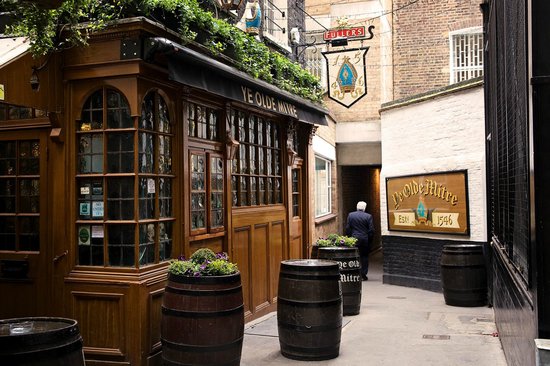
A little way into the western edge of the City of London, between the jewellers’ quarter of Hatton Gardens and the gated enclave of Ely Place, there’s an inviting little alleyway – a tuckaway court still marked by Victorian streetlights, a little like an urban Narnia portal. As you wend your way up it, negotiating the gentle kink in the middle, a pub appears – a pub which gives the damnedest impression of having materialised from elsewhere and wedged itself into the cut-through.

Ye Olde Mitre (photographer unknown)

Ye Olde Mitre (photographer unknown)

This pub, Ye Olde Mitre, has actually been around in some shape or form since the middle of the sixteenth century – and for a long time it was perhaps London’s only example of a place which was in another place. Specifically, it was legally a part of Cambridgeshire. The beneficiary of a legal agreement regarding land jurisdiction set up around the London estate of the Bishop of Ely, it was the drinking establishment for his London servants. There are tall tales about people on the run from the City of London coppers claiming sanctuary in there, and arguing that the City police had no jurisdiction within the pub walls; no more than the Met did either.

Obviously this is a quirk of law, power and accommodation – mostly a long-standing in-joke for pint-supping conveyancers dropping in from the Inns of Court. Nonetheless, visiting Ye Olde Mitre always feels like taking a step into another kingdom, one which disregards standard unities of time and place in favour of fashioning its own. There’s the mythic touch added by the resident cherry tree, of course (which dates back to Elizabethan times and comes complete with its own Queen Elizabeth legend); but even when you’re not looking for magical signifiers – and long before you’ve become swimmy-headed on beer – the pub has the relaxed, self-contained air of somewhere entirely separate from the London bustle. Many pubs strive to become places in their own right; friendly drop-in nations. Content as its own little capsule of peace, Ye Olde Mitre manages it much better than almost anywhere else I know.

The Marchland Arms, 23rd & 24th March 2019

It’s unsurprisingly that such a place – one that flaunts and celebrates its quirky liminality – has drawn the attention of Marchland, the music-and-theatre production alliance which fixes and thrives on ideas of history and borderlines (as evidenced in their previous festival at the Bridewell a year ago.). This coming weekend, they’ll be taking over the pub, recasting it as “The Marchland Arms” and filling it with nine performances in three separate sections, turning the different spaces within the pub into murmuring, discursive rooms within which performance, music and song will gently ricochet.

* * * * * * * *

Marchland Arms - 'Once & Future Europe'

Marchland Arms – ‘Once & Future Europe’

Three pieces make up the ‘Once And Future Europe’ section, triggered by Marchland’s “fascinat(ion with) the cultural history of the legendary states that once straddled Europe’s borders. For the three shows that make up this session we asked the artists involved to, in the words of Rimbaud, remember Europe and her ancient ramparts. This is work that explores the influence of those half-imaginary places on the European psyche, and how their legacy continues to influence our notions of identity and belonging.”

The first of these pieces, ‘Lyonesse’, appears to be (at root) a conceptual celebration and exploration of the mythical drowned kingdom between Cornwall and Brittany – in other words, the sunken link in the geographical continuity of the broader Celtic nation. On spec, that sounds like a dusty old disinterral of Edwardian romanticism; but judging by the participants and their preoccupations, it won’t be. Poet-ecologist Dom Bury will, I guess, be mingling Lyonessean legend from his own West Country roots with contemporary concerns about flooding and dissolution, bolstered interjections and engagements from Katharina Engel, a German academic and theatre director whose preoccupation with hills and climbing may also feed into the work. The two will be accompanied by music from singer Sophia Brumfitt and veteran percussionist/hammer dulcimer player Dhevdhas Nair in a rich blend of European Early Music, Indian subcontinental music, jazz and African elements: Euromyth interfolding with full-world diaspora.

 
The pub snug will house ‘The Capital of Europe’ in which Charles Webber – whose two-decade-plus career as a sound artist has seen him write multimedia sound/light-and-music operas (he’s the artistic director of operaNCV), plus work with Crass’ Eve Libertine and innumerable experimental musicians and theatre companies – and Strasbourgian poet/Théâtre Volière co-director Mick Wood collaborate on “an installation of treated sound, found objects, and cut up poetry”, providing “an unguided tour through the abandoned corners, quiet squares and restless banlieues of an ideal, unreal city on the Rhine.” Sounds delightfully like an old pub story, but one which unfolds into multiple additional dimensions and textures; like that European flaneur’s collaboration between Johnny Morris and China Miéville which never actually happened.

Transforming the lounge, the last of the three ‘Once And Future Europe’ pieces – ‘Ionic’ – asks us to reimagine the space as“a café in fin de siècle Alexandria” in which a new dance theatre piece will play out. Rambert School graduate Janacek Wood choreographs an episode of interweaving texts and movements based around the work of Cairo-based, Alexandria-born Egyptian-Greek poet Constantin Cavafy, whose early life saw his family relocate between France, England and Constantinople in their own mournful, economically-driven private diaspora.

Cavafy himself ended up writing a body of work that’s a Hellenistic re-examination of what Wiki summarises as “uncertainty about the future, sensual pleasures, the moral character and psychology of individuals, homosexuality, and a fatalistic existential nostalgia.” The best-known of these poems is the sardonic Waiting For The Barbarians, in which an external exotic threat serves as both spice and hollowing-out of a moribund politics: I can’t think what that reminds me of now. Music comes from two Greek musicians – singer Savina Yannatou and classical guitarist Nikos Baroutsakis – and from electric guitarist/composer/personal ethnologist Alex Roth, who’s recently been pursuing his own Jewish diasporan heritage on a three-cornered journey that’s taken in Manchester, London and his current dwelling place of Warsaw.

* * * * * * * *

Marchland Arms - 'Customs & Duty'

Marchland Arms – ‘Customs & Duty’

Three more pieces make up ‘Customs & Duty’, “a session of shows exploring the interaction between folk culture and high art, and how identities shift when the lines between arbitrarily imagined communities are blurred… Must we declare our customs at the customs post? Is it our duty to pay duty on them? To whom do they belong? Who decides what they’re worth? What will they cost us when they’re taken away, dissected, repackaged, and sold back to us?”

For this, there’ll be a variation on the ‘Before and After Schengen’ piece which was one of last year’s Marchland centrepieces: Hungarian-born poet George Szirtes responses to Spanish photographer Ignacio Evangelista’s photos of border facilities, with guests and actors from the Marchland Arms Company contributing to a staging of the outcome, making the room “the Kafka-esque border post of a once or future East-European regime.”

Last time around at Marchland, Carneval String Trio’s viola player Shiry Rashkovsky contributed the ‘Shengen’ music. This year, she’s reviving a nineteenth-century middle-European tale with storyteller James Peacock in the shape of ‘Fritz and the Bohemian’ a tale of kindness, cyclic events and wanderings (“each year, on the first day of Spring, an itinerant musician comes to play beneath Fritz Kobus’ window…”).

Rounding off this section is a new Théâtre Volière play, ‘Goethe in Alsace’ – a one-act historical tale of cultural enrichment, “careless play-acting (and) casual cruelty” set around the border region of France and Germany, and questioning the assumptions and entitlements surrounding nascent male artists and the women whom they select as muses.

* * * * * * * *

Marchland Arms - 'The Northern Marches'

Marchland Arms – ‘The Northern Marches’

The three final Marchland Arms pieces comprise ‘The Northern Marches’ and focus specifically on the Scottish and English border country “(a) region, rich with the history of the Border Reivers of the debatable lands, the Roman garrisons of Hadrian’s Wall, and dramatic elopements to Gretna Green, has other, fresher stories to tell. How does its often romanticised past inform the Scottish borders’ present, and to whom do its stories old and new actually belong?” For this section, there’s a play (of sorts), a talk and a musical session.

Théâtre Volière return – teamed with poet Katie Hale and singing, fiddle-playing Scottish music specialist Lori Watson – to deliver a preview of ‘Gretna’: an actors/reciter/musician performance and ongoing project “exploring the culture of the region from the perspective of the women so often written out of its history.”

On the trail of linguistics and naming, University of Glasgow professor Eila Williamson provides ‘The Meaningful Merse’; throwing a little light on her REELS project work (Recovering the Earliest English Language in Scotland) in “a fascinating look at how history’s great, long term shifts in ethnic and cultural identity are often written in to the localised place-names, folk memory and dialects of Europe’s border regions.”

Finally, Lori Watson returns with her own set, performing in duo and bringing Scottish coastal and border folk music to close out the section in “a haunting collision between traditional music and found, ambient sound, in a performance ranging from the intimate to the epic.”

* * * * * * * *

There’s a general preview here:

 
Dates and times:

Marchland presents:
‘The Marchland Arms’
Ye Olde Mitre, Ely Court, off Ely Place/Hatton Garden, Holborn, London, EC1N 6SJ, England

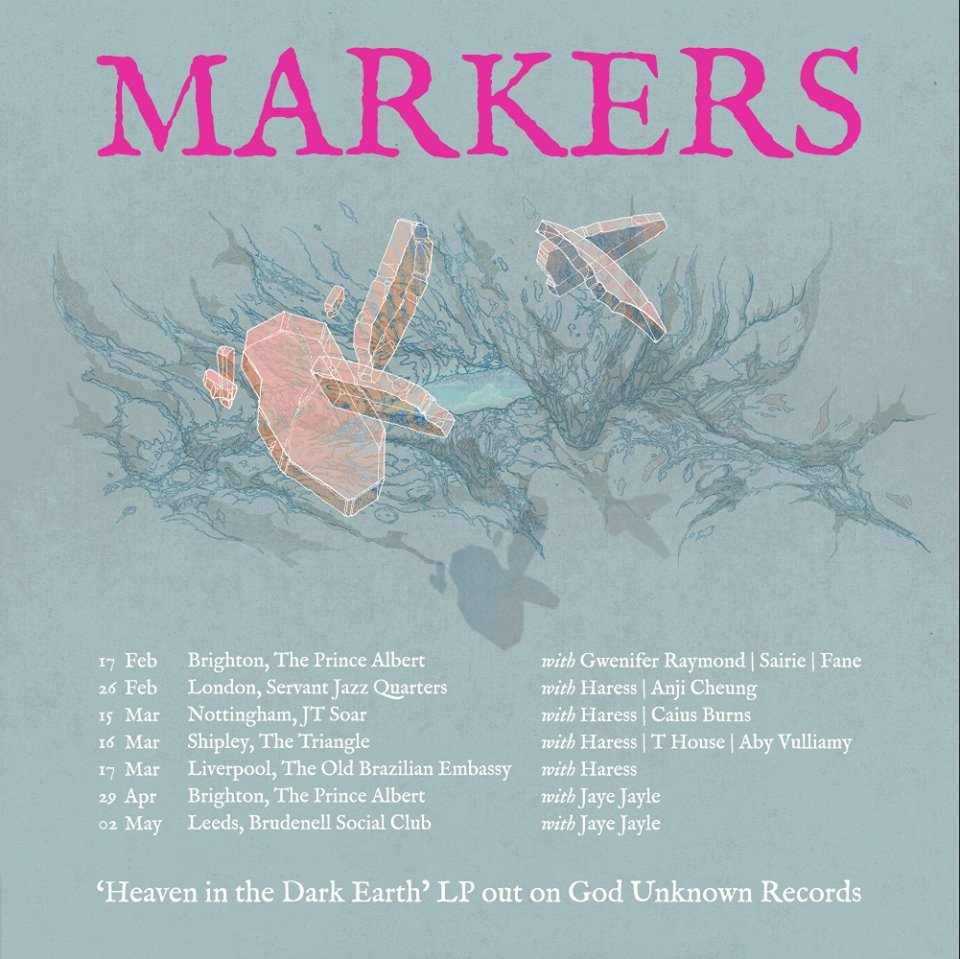
February/March/April/May 2019 – upcoming English experimental/rock gigs – Markers and Haress on tour with appearances by Tom House, Anji Cheung, Caius Burns and Aby Vulliamy; plus later dates with Jaye Jayle and Motes

23 Feb

One of the connections which particularly intrigues me (for which read “always baffles me and induces me to go over it again”) is the one between folk music and hardcore punk. Apparently it’s a love based on a number of things – the inclination towards keeping to the basics, the austerity which is fostered both by that and by a distrust of commercialism and toys, a sense of political purity and of dodging corruption… It’s perhaps a little one-sided – punk tends to love folk more, although you’ll get some acknowledgement coming back the other way, increasingly so as more young folkies grow up with punk. Regardless of the relative exchange, you’ll see quite a bit of traffic moving around here. An upcoming British tour looks into this particular dynamic and feel, at the stripped-down point where the genres meet: along the way, there are more overlappings and enfoldings.

Markers on tour, February-May 2019Markers’ Jodie Cox always seemed like a gifted guy that strolled into hardcore with a positive attitude, rather than hunching or raging his way into it. Even when he was blitzing and shrieking away at the front of short-lived London seedbedders Ursa during the late ‘90s, he seemed cheerfully unlimited by the constraints of form. Ever since then (via transatlantic journeys through Earth, Narrows, Bullet Union, Sex Swing, Exes and others) he’s always seemed to be where he wanted to be rather than being forced into it: a sunny, enthusiastic character who’s helped humanise and hearten any project he’s been in. Jodie’s bandmate, contemporary and friend Jason Carty began his career in the same time and place. Stubborn, meticulous and sometimes anxious, he twitched and reeled various fluent post-rock/prog/post-metal guitar complexities through Geiger Counter and Foe like a ferocious engraver, then threw all of that aside to play blattering post-hardcore doom bass in Art Of Burning Water before embracing silence for a number of years.

Now reunited and united, Jason and Jodie’s all-instrumental work as Markers sees the two of them eschewing other musicians and hairy-arsed distortion in order to see what they can get out of two (mostly) clean electric guitars. Their debut album ‘Heaven In The Dark Earth’ is a beautifully executed thing. As Jodie’s put it elsewhere, rather than roaring easily through fuzz they’re now aiming for something “tonally heavy” (Even if they have covered Jesus Lizard, they went for one of that gonzo band’s rarer gentle tunes, and it came out sounding like late lamented bass frowners Rothko.)

Markers’ music is immediately atmospheric, recorded at a larger-than-life scale in which the listener feels as if they’re about a foot high, wandering around the duo’s feet and their suddenly gargantuan amplifiers. When processing does turn up it’s mostly in the form of encompassing shivers of reverb, or discreet echo – wider brushstrokes and spongeings to complement delicate penwork. Apart from that it’s wood, wire, pickups and an intuitive, space-filled musical marriage between the two players, pursuing a fluid sparseness and a sombre/passionate flaring of arpeggios and arabesques, flotsam folk figures and fragments rubbed smooth enough for their provenance to stay ambiguous. It’s a kind of post-industrial classical guitar, making the most of sparse resources and close-mouthedness, mysterious conversations through fingers and dusty speaker-cones. These buggers always had a lot more depth than previous circumstances have allowed them to show: or perhaps, more than they allowed themselves to make clear. In Markers, they no longer have either of these problems.


Following their recent showing at a mid-February gig in Brighton (hands up, I admit that I missed it) Markers are setting out on tour with kindred spirits Haress. Hailing from arty market town Bishop’s Castle in Shropshire, Haress are fundamentally the guitar duo of David Hand and Elizabeth Still. Mantric, minimalist, low-hanging and close-knit, theirs is a music in which several tight and lowering musical disciplines meets. Art-rock, hardcore edge, meditational post-rock and American electric folk fragments emerge via very loud, mostly clean electric guitars (on the lip of distortion and at the precarious peak of electromagnetic responsiveness) and meet shruti and amp drones plus delicate percussion tingles. Below are a couple of clips of David and Elizabeth meeting inside and outside:

 
Haress sometimes expand for live dates. The current ones see them augmented by a third guitarist (Chris Summerlin of dubby Notts psych/noise-ians Kogumaza, accelerated post-Beefheart screamers Wolves of Greece, and bluescore trio Lord), by a singer (Tom House, best known as the frontman for a pair of Brighton bands, hollering post-hardcore act Charlottefield and its more tender-fleshed followup Sweet Williams) and by drummer David Smyth of Liverpudlian synthcore/space-punks Kling Klang. No clips for that, I’m afraid…

At the London show (also the Markers album launch, with ticket/LP/download bundles available for those who want them), Anji Cheungprovides “audio intermissions”. She was in here earlier this month being previewed at the Matthew Shaw/English Heretic show, sandwiched between rural synth ambience and psychogeographic audio-visual. I can’t immediately improve much on what I said about her back then, so here it is again – “unnerving, frowning amplifier buzzes rolling over the listener like a gigantic clumsy wheel, with dramatically chopped/distorted/otherwise incomprehensible vocals implying pirate-radio-eavesdropping on a covert ritual… car-boot clatter under a lowering sky… beautiful lost female murmur-melodies stalked by drainage-ditch fuzz…. Another aspect of New Weird Britain: ambiguously multicultural and urban, mixing and obscuring London and Chinese references, but sounding mostly as if it stems from a place where jerry-built tower blocks break up old fields around the city’s tired periphery and where unknown syncretic practises are carried out (perhaps only half-understood even by the people involved).”


In Nottingham, Kagoule’s frontman Caius Burns will be bolstering the evening: sidestepping the noisy fantastical post-hardcore of his main band to deliver an acoustic voice-and-guitar set of his own songs, all in an old-school folk baroque form complete with slippery Jantschian fingerpicking. (And here he is in transient mode, halfway between folk and electropop…)

https://soundcloud.com/caius-burns/blues-run-the-game
 
The Shipley show is the most extensive on the mini-tour: a four-act event with Tom House stepping forward out of the Haress lineup to perform a set of his own queasy, sludgy, draggy-pop slowcore. Hometown girl Aby Vulliamy is also joining the evening. A multi-instrumentalist (piano, viola, flute, musical saw, accordion) and singer/composer across a remarkable range of genres, she was covered in here a few years ago via her part-written/part-improvised Mothercore project, in which she teamed up with established musicians Laura Cole and Maria Jardardottir plus an ever-shifting cast of local musician/mothers who joined in whenever the main trio rolled into their town. Mothercore was inspired by, and triggered by, the ambiguous experience of motherhood, and appears to have led into last year’s long-overdue Aby solo album, ‘Spin Cycle’.

If Mothercore thrived on solidarity, ‘Spin Cycle’ places itself, sometimes unnervingly, on “mother alone yet not alone”: its songs tracing their way across a webwork of maternal experience (broader voicings of political anger at the forcing of roles onto women of childbearing age; the claustrophobic vortex of love, fear and exhaustion surrounding breastfeeding; an awareness of the greater female timespan of girl baby to young woman, watched over by mother all the way). Depending on your gender, your situation and where you are in your own lifespan, it’ll either shed light onto a much generalised-over, much-misunderstood state of being, or simultaneously rue and celebrate what’s one of the greatest and most turbulent tasks, all to a DIY backing of diverse, intimate floating-folk instrumentation.


The final tour show, in Liverpool, is just Haress and Markers on their own. I can’t tell you where the Old Brazilian Embassy is, although longstanding Liverpudlians might be able to hazard a guess, while the organisers appear to be a collective who throw concerts at home and overlap with avant-garde rock ensemble Ex-Easter Island Head (so now you know who to chase up and pester if you really want to come). Apparently this isn’t the only show these guys are putting on, although the proximity of neighbours and license issues means that they’ve got to keep the volume down… Merseyside art musicians who operate at the quiet end of things, here’s a new place to beat a pathway to (if you can find it yourself).

Outside the tour, Haress and Tom House will also be plying their trade at a mid-March gig in Bristol, for which they’re joined by obscure Somersetters Motes, who come bearing the priceless label of “drunk-minimal/hypnotist-un-rock based at the ventriloquistic intersection of Barrow Gurney and Old Market”. There’s no way I can better that sentence – it’s its own short film, all by itself – but here they are, playing a couple of their lo-fi guitar-and-drum, barn-under-the-motorway scrambles:


San Haress, Markers go on to play a couple of dates in Brighton and Leeds on the cusp of April and May with American “dark-indie” band Jaye Jayle. Formed in Louisville around onetime Young Widows songwriter Evan Patterson and with other personnel sporting a history including The For Carnation, Freakwater, and Phantom Family Halo, Jay Jayle connect American roots music and Southern Gothic musical sensibilities with drone, garage rock, and bits of kosmische analogue-tronic drive (much of it brought by Corey Smith’s “auxiliary instrumentation”). They’re an exciting thrumble of Velvets-y deathmarch, down-home fucked-up country backroads, factory sirens, momentary blackouts and haunted, incoherent confessionals. They sing the songs of drifters on long, dark trips; of people in back-prickling situations; and of people who’ve picked at the scabs of guarded obscure places just enough to show you why you shouldn’t pick at any more of them. Jay Jayle are compelling. I think I’ll be back to give them another listen.


Also on hand at the first of those two shows – the one in Brighton – is Nick Hudson’s own home-grown take on the “psychedelic dystopian gnostic-Gothic post-punk” approach, The Academy Of Sun. Some overlap with Jay Jayle’s sound, perhaps, but quite a bit more verbose and self-consciously literary, to be honest. Somewhere between Johnny Cash and dark cabaret, with a dash of biting chanson – but then as Brightoneers they’re not much more than a stone’s throw away from either the sea or Nick Cave (and, judging by the sound of this, from a mouldering salt-stained stack which when pulled apart bursts into a sprawl of old Furniture records and bright West Coast glad-rags).


* * * * * * * *

Dates:

Markers & Haress on tour:

  • Servant Jazz Quarters, 10a Bradbury Street, Dalston, London, N16 8JN, England – Tuesday 26th February 2019, 8.00pm(Markers album release gig, also featuring Anji Cheung) – information here, here and here
  • JT Soar, 2 Aberdeen Street, Nottingham, NG3 1JB, England – Friday 15th March 2019, 7.30pm(also featuring Caius Burns) – information here
  • The Triangle, 47 Bradford Road, Shipley, Bradford, West Yorkshire, BD18 3DS, England – Saturday 16th March 2019, 7.00pm (also featuring Tom House + Aby Vulliamy) – information here
  • The Old Brazilian Embassy, somewhere in Liverpool, England – Sunday 17th March 2019 – ask around for information

Haress + Tom House + Motes
The Old England, 43 Bath Buildings, Bristol, BS6 5PT, England
Thursday 14th March 2019, 8.00pm
– information here

Jay Jayle and Markers:


February/March 2019 – upcoming British folk/experimental gigs – Bell Lungs on tour with Raiments (20th February to 2nd March, various) with appearances by Despicable Zee, Michael Clark, The Nature Centre, Halcyon Jane, Tara Clerkin Trio and various DJs. Plus sundry other Bell Lungs shows in March including a København evening with Hugh Tweedie and Tanja Vesterbye Jessen, a show with David Toop and Rashad Becker, a date with Gaze Is Ghost.

16 Feb

Working with a multi-instrumental, device-heavy palette which includes guitar, harmonium, Omnichord, electric violin, lyre, bouzouki, saz, voice and a host of effects pedals, avant-folk singer/writer/sometime promoter Ceylan Hay (a.k.a. Bell Lungs) sits at the middle of a host of possible routes. Her sound incorporates post-folk and drone, dream pop, noise and free improv, psychedelia and site-specific realisations, while her psychohistorian subject matter takes in the ancient, the near-ancient and the presently numinous: probing prehistoric spaces, the ghosts of the industrial age, day-to-day feelings and the slide into a new virtual existence space via online culture.

Reflecting these overlaid levels (and what might be, at different perspective points, either shockingly near or completely occluded), her vocal delivery steps between ornamental trad-folk crenellations, feathery ambient warbles and horrific screams. You can never quite tell whether she’s going to lull you or scare you, but you know she cares about what she’s ferrying across to you.

With a new EP, the wintry ‘Wolves Behind Us‘, to promote (apparently it’s a return to folk and landscapes after recent science fiction/site-specific digressions, and is “Joan Aiken’s ‘Wolves of Willoughby Chase’, Olaf Stapledon’s ‘Last and First Men’, caravan living in the Highlands and the ancient cosmology idea of dividing the year into two halves; the opening and closing of the wolf’s mouth”), Bell’s embarking on five weeks of touring (primarily alongside Raiments) through Scotland, England, Wales, followed up by other Raiments-less shows in Scotland, England and Denmark. (She’ll also be playing in Wales next month, but more on that later…)


Before taking a look at the tour, let’s take a look at her tourmates. Formed on the Berlin avant-garde scene, Raiments are fronted by sing-murmurer/left-field guitarist Mano Camatsos, and they sound like a soft-stepping muttering blend of Lou Reed and Momus fronting a band that mixes lurking dark-jazz styling (hardwood clarinet burr and groove-pattering trashdrums) with the DIY rattle of Pram and the dark throb of Morphine. Mano’s wildcard guitar is a clinking noisemaker and pulse generator taking note of hip hop, of avant-garde classical extended techniques and of mysterious instruments and methods gleaned from ethnological recordings. His songwriting voice is a oddball surreal instinct leading inexorably towards songs about ants or baffling seductions.

 
Tracing their upcoming footsteps on the tour is a joy, like following a plough which turns up small treasures as it reveals what’s in the earth. It’s partly the succession of intriguing off-the-beaten-path venues – squatty art-pubs, recovered eighteenth-century coal basins, pocket cinemas and art centres, diehard folk rooms and out-of-the-way sipperys – but also the revealing of similarly off-the-wall musical talents and enthusiasts they join up with en route.

In Edinburgh, Bell and Raiments are playing with Claquer – previously three-piece improvisers Claque until they spun off their American drummer an unspecified time ago. Now it’s just the Edinburgh contingent: free/experimental guitarist Jer Reid and viola player/speaker Lisa Fannen. They deal in lo-fi clangs, loopings and scrapes and spoken word: momentary moment-music.


In Newcastle, the main support comes from the soft melody murmurs and drowsy, cushioned keens of ambient/improv folk duo Halcyon Jane, a Tyneside/Humberside teamup. Upfront with the voice, guitar and devices is Newcastle performance art polymath Jayne Dent, better known via her own electronic/noisy folk project Me Lost Me, in which she buffers and buffets her singing with concertinas and samplers: when she played Hull back in December, support came from local ambient electronic beatsman Halcyon Neumann, who’s worked with The Body Farmers and with Sarah Shiels and who carries out sonic explorations of “the technological vs. the archaic/the spiritual vs. the scientific/the supernatural vs. the psychological.” Together they tease out a semi-improvised border music, part weird electro-folk and part post-shoegaze wisp.

Also playing is Michael Clark, providing slurred, wise, trepidatious and crepuscular folk music with fogrolls of noise behind an acoustic guitar. Despite being a Londoner, he sounds more like a moor-dweller; or like someone who lives in the kind of port city London used to be, one in which strange tales and intimation billow up the streets with the dock mist: this time out, his strange tales are backed up by a full band.

https://soundcloud.com/michaelclarkmusic/trails-of-ice-1
 
I’ve encountered The Nature Centre before. Headlining the Club Integral-hosted Birmingham show above Bell Lung and Raiments, they’re an affable rural/suburban pop quartet like a four-person one-man band, sprouting banjos and clarinets and found percussion alongside their drum kit and guitars. Drawn to playing at weirder gigs, they’ve shared bills with people like Bob Drake and have their own batchful of three-minute pop songs avidly reflecting the off-kilter visions of previous English songwriter eccentrics (the Syd Barretts, Robyn Hitchcocks and Tim Smiths). Handling the in-between-bands slot is someone new to me but not new to Brum’s vinyl-istas: Moseley Folk Festival’s house DJ and Moseley Record Fair co-organiser DJ Rome, promising his own selection of crate-dug oddities and inspirations.

 
In Bristol, the DJ backup comes from “bleary-eyed staggerer” Siegfried Translator of the Grey Area radio show (another haven for intriguingly weird music from all over the globe), but the gig predominantly features the Tara Clerkin Trio: the DIY musical brainchild of a ceramicist who also seems to have a yen for gamelan/minimalist-sounding pattern tinkling sprinkled with voiceloops, friendly saxophonic intrusions and other pitch-ins from whichever musical friends she can rope in for the occasion. (At other times, she creates her own slumberous take on experimental countrified pop.)

 
The Oxford show (promoted by Divine Schism) is primarily a launch event for the second EP by Zahra Haji Fath Ali Tehrani, a.k.a. Despicable Zee – a live-looper, improviser and conscious patterner of fifteen years standing, mixed Anglo/Irish/Iranian heritage, and a history of drumming in Oxford bands since her teens. Now the drums (plus loopstations and recordings) are used to create live solo tracks in which Zee employs a lo-fi, lo-technique approach to overlapping rhythm garlands and triggered conversations. As an artist (as well as an educator and mother), Zee’s increasingly conscious of the female lines she carries within her: the patched-in samples which wobble her current project along feature the voices of her mother and grandmother, mingling with Zee’s own sing-speak-raps as if they’ve dropped by for some kind of experimental music cross-cultural kaffee klatsch.


The London show (at Paper Dress Vintage) is an evening of music and spoken word put together by promoters Spilt Milk in order to raise money and awareness for North London Action for the Homeless. Shapeshifter experimental pop poet Alabaster dePlume comperes: also in the corner is Jenny Moore’s Mystic Business, who showed up in ‘Misfit City’ a little over a year ago.

Jenny’s another artist whose field extends from the visual and situational into action and music: the Mystic Business involves pulling together friends and strangers into a collective performance event that’s part communal clapalong choir, part percussion workshop and good-natured culture-jamming protest (with food). Guileless and charming, but nonetheless political and détournementational, it’s an attempt to get collective conscience back into the body, containing and encouraging a cheerful but insistent protest.


The Conventry and Brighton gigs appear to feature just Bell Lungs and Raiments on their own, but news just coming in re. the Liverpool date (at dockside art-pub Drop the Dumbulls) says that support there comes from Merseyside “synthwhisperer” and outsider synthpopper Claire Welles. She’s been rolling out her contrary songs for over a decade now, singing increasingly unsettling lyrics in a deep deadpan tone with a sarcastic medicated edge, while the backings deliquesce from elegant ageless Europop into something a little misshapen. It all becomes something like those conversations during which you wake up a third of the way in, not quite sure how you got into them, not quite believing that you’re stuck in there and will just have to ride it out.


* * * * * * * *

Following the Raiments tour, Bell heads off separately for other shows. A mid-March showing at Manchester’s Peer Hat is a solo gig, but there’s also an Argyll event (in the enchanting recording-studio-as-art-nook surroundings of St Marys Space) at which she’s supporting baroque poptronic project Gaze Is Ghost: itinerant Northern Irish singer/songwriter/post-classical composer Laura McGarrigle, noted for “spectral vocals and impressionist piano playing” as well as drifts into harmonium and ambient atmospherics. In recent years Laura’s let Zed Penguin drummer/artist Casey Miller into the project and (following a number of pre-Casey singles), Gaze Is Ghost are finally readying a debut album as a duo.

 
A return to Glasgow on 28th March sees Bell performing on a talk’n’play bill with musicologist and audio culturer David Toop and Berlin sonicist Rashad Becker (who, having polished over a thousand records by other people spanning noise to techno, has begun stepping out into music creation of his own with the resonant faux-ethnological synthwork of ‘Traditional Music of Notional Species, Vol. I’).

On the 30th she’s back in Edinburgh to support another experimental folker, looper and performance artist: David Thomas Broughton, whose brilliantly wayward path has included looping his own heckles, blurring the line between song performance and experimental theatre. Along the way he’s released eight albums of accessible, tremulous, oddly haunting alt.folk delivered in an arresting genderless vocal tone a little reminiscent of Anthony/Anohni, and won the respect and collaborative contributions of (among others) Beth Orton, Sam Amidon, and Aidan Moffat. David will be in the early stages of his own tour, which I really should cover on its own.


Before any of these, though, she’s crossing the North Sea to perform at an experimental folk event in København. Part of the city’s Fanø Free Folk Festival, it’s hosted by local label Dendron Records, specializers in “small runs of abstract electronics, ghostly folk songs and surprisingly hummable tunes.” The concert will also feature two København-based British emigres Hugh Tweedie and Tanja Vesterbye Jessen. Hugh’s been operating for years under various names including The Weave And The Weft and Taiga Taiga, creating shadowy understated mostly-acoustic songs with a literary bent, and he regularly helps out with David Folkmann Drost’s homemade folk project Moongazing Hare. Previously known as a radical electric guitarist in Vinyl Dog Joy, Amstrong and Distortion Girls, Tanja recently struck out on her own with a solo debut, ‘Feeling Love’ in which she embraces and deconstructs pop songs, writing them acoustically before bringing assorted damaged amplification and effects-pedal interference to bear on them, resulting in songscapes covering a field from heavy-lidded noise-folk to cataclysmic “drone-metal disco”.


* * * * * * * *
Dates:

Bell Lungs & Raiments tour:

  • Henry’s Cellar Bar, 16A Morrison Street, Edinburgh EH3 8BJ – Wednesday 20th February 2019, 7.00pm (with Claquer) – information here
  • Cobalt Studios, 10-16 Boyd Street, Newcastle-upon-Tyne, NE2 1AP, England – Thursday 21st February 2019, 7.00pm(with Michael Clark + Halcyon Jane) – information here
  • The Edge, 79-81 Cheapside, Digbeth, Birmingham, B12 0QH, England – Friday 22nd February 2019, 8.00pm (with The Nature Centre + DJ Rome) – information here and here
  • Cube Cinema, Dove Street South (off top-left of King Square), Kingsdown, Bristol, BS2 8JD, England – Sunday 24th February 2019, 8.00pm(with Tara Clerkin Trio + The Grey Area DJs) – information here and here
  • Fusion Arts, 44b Princes Street, Cowley Road, Oxford, OX4 1DD, England – Monday 25th February 2019, 7.30pm(with Despicable Zee) – information here
  • Paper Dress Vintage Bar & Boutique, 352a Mare Street, Hackney, London, E8 1HR, England – Tuesday 26th February 2019. 7.30pm (with Jenny Moore’s Mystic Business + Alabaster dePlume) – information here and here
  • The Rose Hill Tavern, 70-71 Rose Hill Terrace, Brighton, West Sussex, BN1 4JL, England – Thursday 28th February 2019, 7.00pm – information here
  • The Tin @ The Coal Vaults, Unit 1-4 Coventry Canal Basin, St. Nicholas Street, Coventry, CV1 4LY, England – Friday 1st March 2019, 8.00pm – information here and here
  • Drop the Dumbulls @ The Bull, 2 Dublin Street, Liverpool, L3 7DT, England – Saturday 2nd March 2019, 7.00pm (with Claire Welles) – information here

Bell Lungs standalone dates with various others (tbc):

  • Fanø Free Folk Festival @ Alice, Norre Alle 7, DK-2200 København N, Norway – Monday 4th March 2019, 7.00pm(with Hugh Tweedie + Tanja Vesterbye Jessen) – information here
  • St Marys Space, Fasnacloich, Argyll, Scotland, PA38 4BJ – Saturday 9th March 2019, 7.00pm(supporting Gaze Is Ghost) – information here
  • The Peer Hat, 14-16 Faraday Street, Manchester M1 1BE – Thursday 14th March 2019, 7.00pm – information here and here
  • Stereo/The Old Hairdressers, 20-28 Renfield Lane, Glasgow, G2 5AR, Scotland – Thursday 28th March 2019, 7.00pm (with David Toop + Rashad Becker) – information here and here
  • The Waverley, 3-5 St. Mary’s Street, Edinburgh, EH1 1TA, Scotland – Saturday 30th March 2019, 9.00pm (supporting David Thomas Broughton) – information here

February 2019 – upcoming English folk-rock-but-not-just-folk-rock gigs – My Octopus Mind on tour (13th, 16th, 21st, 22nd February) with Jakabol, The Display Team, Lapis Lazuli and Malika Collective; Hexvessel and Arktau Eos in London (22nd February)

10 Feb

Flexible Bristol almost-acoustic trio My Octopus Mind occupy a pleasing position, settled in their own web of connections between a number of different influences but reliant upon none of them. There’s a jazzy rattle, predominantly via the gloriously noisy effected double bass of Izy Ellis (a growling, punchy, conversational art-box; upfront timber and raw electronic treatments). The whole band’s informed by post-Radiohead/Mars Volta art rock and by the mating of contrasts implicit in assorted culture collisions (such the Hindustani-classical meets New-York-loft-music teaming achieved in one particular favourite, Philip Glass and Ravi Shankar’s ‘Passages’). Frontman singer and guitarist Liam O’Connell cites the sonic and psychological crescendos of Jeff Buckley and Josh Homme’s mix of heaviness and irony, but also the restraint of Jose Gonzales. Ex-Lambhorneer Oliver Cocup adds refreshed drum bounce, and racing through the whole thing is a rivulet – or, more accurately, an unstoppable jet – of skittish Balkan folk.

 
With a debut album, ‘Maladyne Cave’, nearing release, My Octopus Mind are out on a brief English tour wriggle this month, taking in Manchester, Canterbury, London and their hometown. In part, it’s to celebrate the recent release of their debut single Elska, with its increasingly disturbing Coppelian dance video (in which a man wheels an impassive doll-woman around in a suitcase, engaging in secret and increasingly frustrated trysts with her).

While Manchester is an evening for the band on their own, various temporary tourmates slot in elsewhere – in London, it’ll be the accomplished Afro-Latin groove band Malika Collective. The Canterbury show sports an eclectic psychedelic edge with local jam band and “maximalist psych-prog heroes” Lapis Lazuli plus the convoluted Zappa-brass meets London-urchin-pop of The Display Team (see passim) and psych/prog/punk funk/soul/dub/afro combination DJ interludes from Professor Appleblossom. The Bristol tour launch show, meanwhile, also features Jakabol, a warm Bristolian instrumental band in which violin, harp, guitar and drums leap and lurch tunefully around a set pitched midway between post-rock gutter and country hoedown (perhaps a further extension of the rural post-rocking I’ve been hearing from Rumour Cubes and Apricot Rail).

https://soundcloud.com/jakabolbristol/goram-and-vincent
 
* * * * * * * *

Linkings between folk music and heavy rock go back pretty much all of the way to the start of the latter, especially in Europe. In plain sight, Led Zeppelin regularly immersed themselves in Welsh border hillsides and Janschian jangle; a little later, Jethro Tull brought in the jigs, liltings and mandolins while allying them to Ian Anderson’s witty, sardonic absolutely-in-the-moment songwriting voice (which swept in the eclectic interests and erudition of a restless, randy, contemporary urban boulevardier who could’ve make the idea of a leprechaun in your sitting room sound like something contemporary, adult and immediate rather than twee). In the ‘90s a swell of Celtic/Nordic folk metal and Gothic paganism via bands such as Skyclad led to a revival of mythic musical drama; in the Noughties, there was the feeling that the likes of Opeth were peering over their successive ramparts of black metal and prog in search of something offering more air and antiquity. Nowadays, you can hardly move for this sort of thing sprouting up from Ireland to Israel: driving a guitar through a hefty amp seems like one of the most effective ways to kick off an interest in your own folk history.

In many respects, latterday Anglo-Irish-Finnish heavy-folk-rockers Hexvessel hanker back to Tull – some of the lilts and jangles are there, as are the banging barn-door blurts of chunky electric guitar work – but they also trade in some of the dramatic minor keys and broody, nonconforming, subculture-meets-antiquity feel of Skyclad. Of course, this is probably incidental: it would be more constructive to reconsidering the swirling body of interests and philosophy surrounding singer and prime mover Mat McNerney. Despite Mat’s former black metal links (as “Kvohst”, he cavorted across stages with bands like Dødheimsgard and Code), Hexvessel avoid certain predictable pitfalls – no ludicrous demonic posturing; no arid hating; no polluted white-is-right old-Europe nationalism. This is primarily because under the corpse paint Kvohst always seems to have been a thoughtful and sensible chap with a well-calibrated bullshit detector, sorting the nourishing myths from the toxic ones.

 
Instead, Hexvessel explore a range of thinking stimuli – post-/pre-Catholic pagan magick; the connecting threads connecting contemporary Finnish woodland psych with the brooding kosmische stews of Amon Duul and the chatty verbal maximalism of early ‘70s British psych folk; comic book legendariums; and respectful pro-feminist reintegrations of women back into musical forms that have often wandered too far down macho paths. Later this month, they’re setting up camp at St Johns Bethnal Green; playing a London show as part of the European tour in support of brand new album ‘All Tree’, in which they’ve endeavoured to blend Mat’s memories of old ghost stories and other transmissions of folk culture with their own dramatic Samhain vibes and symbolic forest-folk musical experiments (including playing tree boughs with violin bows). Mat sees it as a way of connecting to Samhain’s liminal side; a time when ancestors, as spirits and memories, are that much closer.

Hexvessel’s tree-bowing was captured out by the band’s resident field recording/sound conjuring wizard Antti Haapapuro. In another incarnation – as half of sacking-masked ritual ambient/oneiric duo Arktau Eos – he and fellow Eosian Antti Litmanen open the show, rubbing the psychic gateways open with their primeval sounding drones, swells and invocation of significant spaces – simultaneously post-industrial and prehistoric, thrumming out of a green church, resonating nook or ancient gravehole like a stone-tape playback of ancient, dignified rites.

Steeped in hermetic philosophy and Apophatic theology, Arktau Eos come across as thoughtful ceremonial scholars in interviews such as this one in the ‘This Is Darkness’ ezine. Eloquent and courteous if you care to track them down for a respectful conversation, but unswayed by distractions from their business of the mining of the “ur-currents” of religious faith; the pull of site-specific mysteries, apprehending experience without attempting to stare it in the face or pin it down with sentences. In a similar spirit, I think I should just leave the descriptions there, as they stand. Essentially, it’s all in the sound and the placement, and the ceremonial use of the available moment. Understand them that way.


* * * * * * * *
Dates:

My Octopus Mind:

  • The Crofters Rights, 117-119 Stokes Croft, Bristol, BS1 3RW, England – Wednesday 13th February 2019, 7.30pm (with Jakabol) – information here and here
  • The Old Abbey Taphouse, Guildhall Close, Manchester, M15 6SY, England – Saturday 16th February 2019, 7.30pm – information here
  • UCA Bar Canterbury, New Dover Road, Canterbury, Kent, CT1 3AN, England – Thursday 21st February 2019, 7.30pm (with The Display Team + Lapis Lazuli) – information here
  • The Magic Garden, 231 Battersea Park Road, Battersea, London, SW11 4LG, England – Friday 22nd February 2019, 7.00pm (with Malika Collective) – information here and here

Old Empire proudly presents:
Hexvessel + Arktau Eos
St John on Bethnal Green, 200 Cambridge Heath Road, Bethnal Green, London, E2 9PA, England
Friday 22nd February 2019, 7.00pm
– information here and here
 

February 2019 – upcoming experimental gigs – Kammer Klang: Taylor Le Melle’s Afrodiasporic spectrum with Venus Ex Machina, Morgan Craft and Shenece Oretha (5th February)

31 Jan

Bah. I’ve got a swelling head cold and am consequently as thick as a cement omelette. Not the best time to try to preview a complicated experimental evening. Sorry for the vagueness in this post… even more than usual, this is hidden music to be sought out and learned from.

Kammer Klang: Venus Ex Machina + Morgan Craft + Shenece Oretha, 5th February 2019

The first Kammer Klang of the year unites various sonic experimentalists from the African diaspora under the curatorship of Taylor Le Melle. That’s probably the best way of putting it: the lack of a portentous event title means it’s not pinned down to any more specific narrative. Though predominantly a writer, Taylor spends a lot of time as a creative enabler (co-running independent publisher PSS and artist/workers’ audio-visual cooperative not/nowhere, and facilitating debate), and this isn’t her first Oto event. I’m assuming that it’s going to throw up ideas from across a broad spectrum of ideas and identities, some of which are outlined here.

Venus Ex Machina (a.k.a. Zimbabwean emigre Nontokozo F. Sihwa) is one of an ever-more visible number of interdisciplinary artists and computer coders eliding non-binary gender ideas into the worlds of music, games and visuals. Interested in “mythical and borderless” radio communication, she’ll be performing her own ‘Anno Lucis’ piece from 2018.

I’ve no idea whether this other Venus piece, ‘Paraquat’, is any reflection of what’s to be performed on the night; but here it is for illumination (with its mixture of Geiger counter industrial twists, ringing friction noise apparently siphoned from the bearings holding up the music of the spheres, and arrestingly vocal synth parts summoning up both heavenly European chapel choirs and complex African alarm whoops).

https://soundcloud.com/venusexmachina/paraquat
 
Attempting to place solo electric guitarist and sonic mystic/realist Morgan Craft involves multiple questions about geography, roots and discovery. A Minnesota-born African-American, he’s an escapee from the New York experimental scene of twenty years ago; but rather than questing directly into Africa he sought refreshment and new paths in the Tuscan mountains of Italy for over a decade (before settling in Amsterdam, where he works with Giulia “Mutamassik” Loli on the Circle of Light label and the Rough Americana project. Now he’s an “Afro-American Viking futurist”, whatever that means. Drawing on the classical legends and contemporary politics of African, European and American cultures alike, his essays sift and fold his multi-positional overview: an expatriate American black man querying his background, a critiquer of capitalist and street culture, a person with one eye on a new dawn due to rise over the muck.

Morgan’s textural guitar pieces are expansive and questioning personal monologues, abstracting manifold concerns into detailed shades. He will be performing his 2018 piece ‘Godel’: here are several earlier pieces from a big releasing burst in 2016.


Montserrat-born Shenece Oretha mostly concerns herself with polyvocality and immediate listening – as she puts it, “choreograph(ing) layers of music, voice, recordings and noise to shape moments of communion and ceremony.” Land-tilling metaphors of potential and nurturing pervade her definition of herself – “hypothetical gardener, future farmer, speculative horticulturalist.” Her sound work, or at least, that of it which I’ve heard so far, is much less pastoral; simultaneously dicing up and unifying strands of black experience from the wounded and fierce to the ecstatic and congregational, from the lone voice ululating to the whumphing in-your-face assertions of co-opted technology.

 
In addition to Oretha’s Fresh Klang performance – a piece called ‘to plot together, to breathe together’ – Testing Grounds (her “installation with multiple openings”) makes a temporary home at Oto for three days in advance of the show. With spaces for invited guests available (to “accompany the sound and participate in the sounding out”), it’s a live-performed sonic stew “present(ing) and incorporate(ing) her ongoing research project, black whole…, orchestrat(ing) a series of interruptions/interventions ‘in the breaks’.”

 
Kammer Klang presents:
Kammer Klang: Venus Ex Machina + Morgan Craft + Shenece Oretha
Café Oto, 18-22 Ashwin Street, Dalston, London, E8 3DL, England
Tuesday 5th February 2019, 7.30pm
– information here, here and here
(‘Testing Grounds’ – Saturday 2nd to Monday 4th February 2019, 5-9pm)
 

February 2019 – upcoming London experimental gigs – drone evenings – NYX & Iona Fortune plus Flora Yin-Wong (3rd February); Matthew Shaw, Anji Cheung and English Heretic (7th February)

29 Jan

A couple of evenings of drone and weird noise for you, here in the Smoke.

* * * * * * * *

 
Electronic drone choir NYX and Glaswegian electro-acoustic drone instrumentalist Iona Fortune join forces in Bethnal Green during the coming weekend, for what they’re calling “a liminal ceremony” based on an exploration of the I Ching. The latter’s a particular interest of Iona’s – she’s already released the first of a planned octet of releases on the subject. Live, she blends instrumental performance work on the gamelan percussion set and guzheng zither with vintage electronic textures generated by the EMS Synthi AKS (the same early-’70s suitcase synth that’s responsible for early Pink Floyd sequencing, mid-period radiophonics and various Enossifications), via a composition technique which “involves inner cultivation”. For their part, NYX (eight veiled women singing together from behind two tables strewn with vocal sound processors) stress “mindful experiences, psycho-acoustics and sound healing through an immersive exploration of ambient, noise and electronic music”. Expect a mixture of avant-garde eeriness and ancient intimations, then, mixed with a fat emollient smear of New Age healer atmospherics: something silkily psychoactive.

The focus on I Ching divinations might be Iona’s choice, but the sonic method is NYX’s, who are leading a series of similar concerts (this is the third of four, it seems) in which they coax a collaborator to let go of some of their own battery of electronics and/or field recordings and allow NYX to replace it with their own poly-chorused vocal blocks and twinings. A recent ‘If Only’ interview with NYX’s Sian O’Gorman has plenty of talk about mother principles and the like, but it does make them sound genuine: intrigued by the interaction of specific voices with specific bits of electronic kit, and well aware of different vocal practises delved into across hundreds of years and thousands of miles.

They’re also determined – and proud – to promote the female voice, skills and mindset. All performers in the concert series have been women: unsettling folktronica performance artist Gazelle Twin following operatic chanter Hatis Noit, with layering classical/noise minimalist Alicia Jane Turner scheduled for the next event.

Meanwhile here’s a little of Iona working on her own, plus a snippet of NYX working with Gazelle Twin. Chop, edit and remix in your mind’s eye as appropriate.

https://soundcloud.com/ionafortune/xu-5

 
As a kind of counterbalance to the concert’s Orientalist leanings (for all the sincerity, with this amount of New Agery it can feel as if it’s an act of looking in rather than belonging), the support slot goes to an actual Asian diasporan musician: electronicist Flora Yin-Wong, Chinese-Malaysian by roots but London-born. With an outright interest in club culture and dissonance, Flora seems to be more futurist than tourist but touches on the evening’s mystical tone via her use of field recordings from south-East Asian temples, re-brewed and teased within electronic processing and contemporary beat frameworks. Some of what she does twinkles, but other parts form arresting fields of explosive ritual noise right from the first note – see below.

https://soundcloud.com/floraytw/dispel-michael-speers-edit
 
* * * * * * * *

The following Thursday, up in Manor House, New River Studios plays host to the London launch event for Matthew Shaw‘s “debut” album ‘Among The Never Setting Stars’.

Calling it a debut is a little disingenous, since Matthew’s been putting out music for two decades now. At the turn of the century he sat somewhere between Bark Psychosis, Mojave 3 and a sedated Mike Oldfield, releasing soft-edged, deeply rural dream pop as Tex La Homa. At the start it was murmured acoustic-indie guitar folk – equal parts Drake and Velvets – expanded by synth rills, echo and field recordings; but gradually the singing diminished and the backing tracks became more interesting, the sounds took over and the local Dorset landscape (both physical and psychic, stone circles and solstices) impressed itself ever more deeply on the music. Though Matthew was also spending time helping to add sonic depth and audio subtext to folktronic pop band Sancho, in his own work the pop structures were dissolving away to allow the other ingredients to billow forwards.

By the middle of the decade Matthew was carrying out duo work: bizarre electrophonic ritual music with Nick Grey as 230 Divisadero and theosophical dronery with Andrew Paine as The Blue Tree. Since 2010, he’s run the limited-edition experimental label Apollolaan Recordings and issued a couple of Cornish/antiquarian-slanted location music releases in collaboration with Brian Lavelle as Fougou. Suggesting that he’s only officially going solo now is also a little disingenous – there have been releases under the Matthew Shaw name since he started Apollolaan, with a host of them still on Bandcamp. They’ve explored the usual territories of the recurring mystic tradition – alchemy and magick, psychogeography, cosmic astrology – but without the pomposity that’s usually bundled into the package.

Generally speaking, Matthew comes across as a listener rather than an imposer; travelling from temporary cottage to temporary cottage and from site to site with his guitars, sampler, KAOSS pad and electronics as an itinerant tinker would carry his tools. His work often sounds like an attempt to fuse an English pastoral tradition with spiritual/kosmische protractions and with occult/avant-garde post-punk aesthetics, blending in a folk-inspired interest in the cycles of seasons and life plus the rituals one makes to mark them. Typically New Weird Britain, then – and ‘Among The Never Setting Stars’, true to form, is apparently based around field recordings of “occult landscapes”. I would have expected the resulting pieces to have been more alarming, or at least more disorientating in the standard dark-ambient style (in which thunderheads mass like war in heaven and nature is overwhelmed by random electricity and ferociously foraging ants). On this occasion, however, Matthew seems to have been brought to a pitch of innocent (if slightly eerie) pastoral serenity – his source material buried to the point of absolute dilution or effective erasure beneath a gentle edgeless electrophonic skirl, like a cloud-organ recital in a roofless, open green church.


Also on board for the New River concert are the harsher drone-and-sample-scapes of Anji Cheung. Sometimes these are unnerving, frowning amplifier buzzes rolling over the listener like a gigantic clumsy wheel, with dramatically chopped/distorted/otherwise incomprehensible vocals implying pirate-radio-eavesdropping on a covert ritual. Sometimes they’re car-boot clatter under a lowering sky; sometimes they’re beautiful lost female murmur-melodies stalked by drainage-ditch fuzz. If Matthew’s work remains rural (and white), Anji’s is another aspect of NWB: ambiguously multicultural and urban, mixing and obscuring London and Chinese references, but sounding mostly as if it stems from a place where jerry-built tower blocks break up old fields around the city’s tired periphery and where unknown syncretic practises are carried out (perhaps only half-understood even by the people involved).


Playing hosts are English Heretic, the multimedia collective who for fifteen years have been self-appointed English psycho-historical curators, magickal Situationists and NWB forerunners. They’ve always carried their enthusiastic immersion in all things Britannic, eldritch and peculiar with warmth and wit, embracing the absurd without turning it into a cheap laugh; and putting a more inclusive and welcoming face onto the uncanny, sometimes belying the depth of their work. If I ever need an exorcism (or, more likely, some kind of psychic mediator) I’ll probably give them a call.

Plenty of music can be fed into the English Heretic stewpot – they’ve cited “psychedelic folk, ritual ethnographic recordings, electronica” as part of their fuel, and they’re very happy to drop into thrumming cusp-of-the-’70s psych rock at any opportunity, but in many respect the music’s secondary to the tales and the texts, the visual images and the intimations. Head Heritageur Andy Sharp has mentioned, in ‘The Quietus’, his tendency to extrapolate scraps and findings into something bardic and numimous – “reading around, something will catch your attention, and then I treat it in a magical context: taking the view that restless spirits or troubled souls inhabit the environment.” Sparks from hidden resonances (including those which are actually in plain sight and hearing) permeate the work.

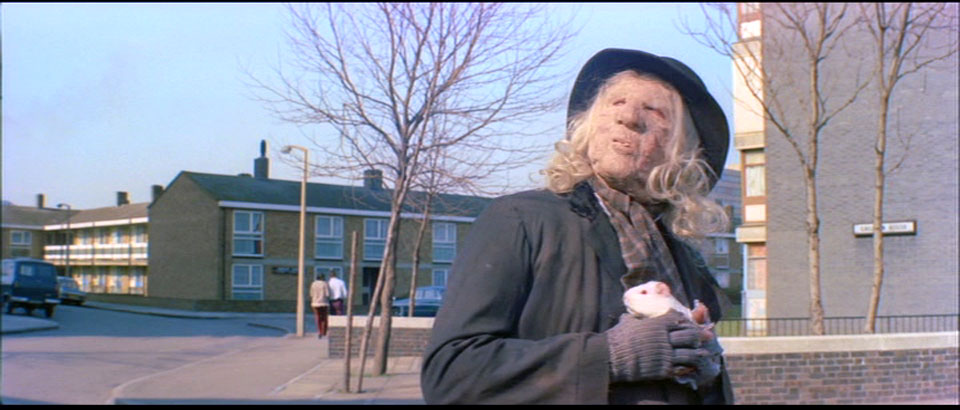
For this particular concert, English Heritage is airing part of the ongoing audio-visual project ‘London’s Imagined Dead: Cinematic Deaths in London’. The section they’ve picked takes its cues from the Brit-horror era of the late ‘60s and early ‘70s: the era which spawned ‘The Wicker Man’ and ‘The Blood on Satan’s Claw’, although they’re focussing on a lesser-known Hammer offering, ‘The Asphyx’. A 1972 tale of horribly botched Victorian research into the transmigration of souls, the film’s final sequence features the cadaverous, wandering-Jew meanderings of the story’s main character, still alive in the 1970s and condemned to a hateful, decrepit, guilt-ridden immortality. That last sequence was filmed at Battersea’s Winstanley Estate, later briefly notorious (in UK garage circles and in tabloid-land) as the home turf of So Solid Crew.

The finale of 'The Asphyx'. (Well, it was the early '70s and they'd run out of budget. Just concentrate on the concept...)

The finale of ‘The Asphyx’. (Well, it was the early ’70s and they’d run out of budget. Just concentrate on the concept…)

Visiting the present-day location, EH have taken note of the estate’s mysterious-looking murals (actually reliefs, carved into the Winstanley’s concrete walls) and have drawn from them to create new visual scores. Full of primal symbols and strange abstracted geometries, the carvings have an ancient air to them; but actually they’re early ‘60s commissions from William Mitchell Design Consultants, formally put up as part of the refurbishment during the estate’s post-war rebuild, and not even a decade old when ‘The Asphyx’ was filmed. English Heretic know this, of course, but are well aware that the ideas which places, objects and initial associations trigger off are at least as important as the actual truth. In this case, they’ve intersected film and building fabric to inspire literal musique concrète. Their pun, not mine. Not that I’m sulking about having been beaten to the punch…

* * * * * * * *

Dates:

comm-une presents:
NYX with Iona Fortune
The Pickle Factory, 13-14 The Oval, Bethnal Green, London, E2 9DT, England
Sunday 3rd February 2019, 6.30pm
– information here and here

English Heretic presents:
Matthew Shaw + Anji Cheung + English Heretic
New River Studios, Ground Floor Unit E, 199 Eade Road, Manor House, London, N4 1DN, England
Thursday 7th February 2019, 8.00pm
– information here
 

February 2019 – upcoming jazz gigs in London and Cambridge – Seed Ensemble (1st February); Warmer Than Blood (2nd February); Irreversible Entanglements and Matana Roberts (2nd February)

28 Jan

Cassie Kinoshi & SEED Ensemble, 1st February 2019

Perhaps there’s not a great deal that I need to say about Cassie Kinoshi. The most visible of the current generation of jazzwomen from the Tomorrow’s Warriors Female Collective, she’s clearly on the ascendant, working extensively across the jazz, classical, dance and drama worlds, and with her two-year-old SEED Ensemble now getting high-profile gigs. One of these is at Kings Place this Friday, in which SEED unveil their debut album ‘Driftglass’, showing off the end product of the multicultural London influences which inspire them: groove-based British jazz with strong flavour of West African and Caribbean diasporan music.

If that sounds a bit cuddly, then check out the title – and the combative, sarcastic thump – of the second of the two clips below. It’s a parodic, pointed Mingus-worthy musical representation of white people’s fear-driven misconceptions about black people, drawing on the wildness, grief and defiance of New Orleans funeral music and underpinned by the double-low-end honk-n’razz attack of Theon Cross’ tuba and Rio Kai’s double bass.

 
* * * * * * * *

Up in Cambridge the following day, guitarist/composer Chris Montague (previously seen in here via his work with Alex Roth and Chris Sharkey in Future Currents) reveals his new project Warmer Than Blood. It’s a trio in which he combines with pianist Kit Downes (Troyka, F-IRE Collective) and bass guitarist Ruth Goller, whose pedigree takes in a host of projects from Acoustic Ladyland to Sephardim ballad revivers Sephiroth plus (amongst others) the manouche of Kamao Quintet, the punk jazz of Let Spin and rough-edged North African-influenced Melt Yourself Down, the Latin folk of Oriole and the up-in-the-air experimental indie-rock of Bug Prentice.

Warmer Than Blood, 2nd February 2019

All three are longtime friends and collaborators, seeking yet another new approach. They seem to have found it with Chris’ newest batch of compositions and improvisation-seeding situations, which he suggests consist of “intricate textures, dark pools of harmony, layered melodies, kinetic group improvisation and percussive prepared piano… fractious composed passages can inhabit the same sonic space as spare, ambient melodies, often described as melancholic and uplifting at the same time.”

Warmer Than Blood are a couple of months away from properly recording a debut album, but two live tracks on their homepage point the way in which they’re going. Introverted and ominous, their name-track’s a quiet etiolated piano exploration over a minimal pulsing guitar-chord cycle and locked-in bass rumble. The excerpt from a longer piece, FTM, is a gradual evolver in which Chris hovers in menacing sustain/volume-swell textural clouds and momentary dust-devils over ghost-Latin clicks and bass piano thuds (Kit muting the piano at both ends) before the trio expand into what’s partly a kind of haunted country music (like a Bill Frisell ensemble scoured to the bone by plains wind), and partly like a salsa band coming to terminal grief in a badlands dustbowl.

* * * * * * * *

Back in London, and also on the Saturday, the Barbican’s Milton Court hosts Brooklyn-based “liberation-minded free jazz collective” Irreversible Entanglements. If you’re after a jazz band to represent and reflect these increasingly ugly, stormy, oppressive times from the bottom up, you couldn’t find a better one – but be careful what you wish for. They aren’t an easy listen, and they’ve got no intention of being so.

Irreversible Entanglements, 2nd February 2019

Free jazz (especially, though not always, when it becomes a hand-me-down in the hands of white musicians) can often be a fussy, elitist abstraction. Irreversible Entanglements uncompromisingly return it to its roots in black radicalism and to an absolute connection to the injustices of society. In doing that, they’re stepping into the first-generation protest-jazz shoes of Archie Shepp, Joseph Jarman, Max Roach, Albert Ayler.

If you’ve been reading ‘Misfit City’ over the last couple of months, you may remember Elaine Mitchener reviving this tradition with her Vocal Classics Of The Black Avant Garde project last month. While operating in a similar field, Irreversible Entanglements have no interest in curating those impetus and protests as museum pieces. Instead, they create their own protest. It should go without saying that they’re tied deeply into the #BlackLivesMatter initiative. Originally forming the band four years ago to play at a Musicians Against Police Brutality event, saxophonist Keir Neuringer, bassist Luke Stewart and poet/proclaimer Camae Ayewa subsequently added trumpeter Aquiles Navarro and drummer Tcheser Holmes for more rhythm and flammability.

The resulting quintet sounds far bigger, far angrier and far more righteous than seems possible, jetting out sheets of rattling, scouring brass over gargantuan shifting rhythms like wrenched building piles. Key to it all is the fierce female voice at the core. Camae’s better known for her Moor Mother solo project, in which she declaims jarring, terrifying accounts of personal and cultural pain over a barrage of hip-hop/slamtronic sound. I’ve written previously about the way in which her deep drilling of psychic scar-tissue within the African-American experience turns her into time-traveller, authorative witness-bearer and angry documentarian. With Irreversible Entanglements, she taps into another heady well of black American cultural memory, this one passed down via saxophones, bop and overblown sheets of sound. It’s not the first time that a jazz band has been centred on a woman’s voice, but you’ll rarely, if ever, have heard it done this way, in which the texts and the delivery not only match the hurricane of music, but simultaneously drive and ride them. This is serious schooling.


In support at Milton Court is Chicago-born, New York-based saxophonist and sound experimentalist Matana Roberts. While it’s not unusual for a jazz player to appear on a record on post-rock spearhead label Constellation, it is unusual for one to be signed to the label. Matana, however, is not a standard jazzer (she prefers the term “sound adventurer”, considering herself to be a hybrid connected to multiple sonic approaches), and she was probably signed more because of her general experimental tendencies than because of her past collaborations with Silver Mt. Zion and with Tortoise members.

An orchestral clarinettist with a politicized background, Matana journeyed through punk, Riot Grrl and avant-garde music to where she is now. Though she seems quite capable of punching out Chicago post-bop/free sax on the stand, she doesn’t restrict herself to standard (though demanding) jazz forms. Instead, she treats music as a prime artistic unifier crossing over into dance, theatre, poetry…. not in itself unusual, but rather than just strapping standard music tropes onto other forms she allows those forms to wash in, dissolving and reforming her approach to her music.

Matana’s best known for her ongoing ‘Coin, Coin’ series, a projected twelve-album project started in 2005 and still in its relatively early stages (it’s about a third done). In this, whether working on her own or with others, she utilises a technique she originally dubbed “panoramic sound quilting”, joining together blocks of noise and scoring from a variety of sources but with an assemblage idea borrowed from rag-bag folk art. In particular when she’s recording alone, her pieces feature multiple Matanas – some rolling out saxophone lines, but many engaged in vocal chants or drones, or layered swatches of conversation. Some sing or scream, or hurtle along the arresting bloodied ribbon that separates the two: like Moor Mother, Matana takes pride in black history and resistance while establishing that it has to be represented via a certain sound of historical pain. The rawness there goes beyond filters of culture and into filters of humanness.”

Unsurprisingly, her performances have a reputation for being immersive experiences. Sounds like she’ll make the perfect gigmate for Irreversible Entanglements.

 
* * * * * * * *

Dates:

Jazz re:freshed present:
SEED Ensemble
Kings Place, 90 York Way, Kings Cross, London, N1 9AG, England
Friday 1st February 2019, 8.00pm
– information here and here

Listen! presents
Warmer Than Blood
Unitarian Church, 5 Emmanuel Road, Cambridge, CB1 1JW, England
Saturday 2nd February 2019, 7.30pm
– information here and here

Irreversible Entanglements + Matana Roberts
Milton Court Concert Hall @ Guildhall School of Music & Drama, Silk Street, Barbican, London, EC2Y 8DT, England
Saturday 2nd February 2019, 7.30pm
– information here and here
 

January 2019 – upcoming London experimental gigs – Armed With Bow & Portia van de Braam, Devon Loch and DJ Francesco Fusaro (30th January); UnicaZürn and Howlround (1st February)

27 Jan

Armed With Bow & Portia van de Braam + Devon Loch + Francesco Fusaro, 30th January 2019

As Armed With Bow, cellist and synth operator Will Langstone creates layered post-classical loop music with a psychedelic Moog-prog twist, exercising his fascination with cosmic planetarium visions, space voyaging and the like. The show he’s headlining at 93 Feet East this Wednesday will present his ‘First Encounter’ piece: a “four-part space odyssey conjured through cello, synthesizer, and four analog tape emulators” and a collaboration with dancer-choreographer Portia van de Braam.

 
Under his Devon Loch alias, Richard Greenan (founder of exotic miscellania label Kit Records) will play a set of his own. It’s touted as a “hybrid live/DJ performance, combining manipulated classical, field recordings and live electronics.” Presumably, it also draws on the sweetly warped ambience of his recorded work, with its protracted porcelain-tinkling post-Cluster synths, its Satie-citing frosted parlour-piano knots, its unexpected moments of gentle folk guitar and its subtle, surrealist-radio-inspired electronic disruptions.

 
On formal DJ duties, there’s Francesco Fusaro – journalist, broadcaster and co-curator of smart/knowingly bizarre Anglo-Italian mutant dance/post-classical label MFZ and the 19’40” “anti-classical” recording series and, as “Froz”, occasional trap techno-musician (something which he approaches with the same thoughtful dedication and whimsical wit as his other work).

* * * * * * * *

UnicaZürn + Howlround, 1st February 2019A couple of days later at IKLECTIK, UnicaZürn (the longstanding team-up between Arkkon/Shock Headed Peters guitarist David Knight and Coil/Cyclobe’s keyboards-and-reeds player Stephen Thrower) resurface to play music from their new album accompanied by one of their regular friends, Guapo percussionist Dave Smith.

There aren’t too many details, but I’m guessing that it continues the scenic but chilly slow-evolving boil of waterside atmospherics and psychedelic sound-painting which they’ve displayed on their previous albums ‘Transpandorem’, ‘Temporal Bends’ and ‘Dark Earth Distillery’: a lapping tidal cascade of heavily treated guitars and saxophones, stratified synth textures and ringing light patterns. It’s the sound that emerges when you’re charmed and transfixed by the water-and-light textures and presences of the sea and river scapes you live beside, but keep having them disrupted and transformed by feed-in from the third eye perspective you’ve also maintained.

 
Fellow Touch label artists Howlround (named after splurging patterns of electronic audio-visual feedback and centred on itinerant sound designers Robin “The Fog” Warren and Chris Weaver) are also performing. They’re happy to retrofit not just from old BBC Radiophonic Workshop concepts, but from a fair amount of the original technology. I can’t vouch for where all of their gear comes from (though they reject artificial reverb and computer processing), but they’re usually to be found manipulating a quartet of old reel-to-reel tape machines, to the extent that it’s a creative and performance trademark. Frequently, they produce site-specific sounds, on-the-spot film soundtracks and made-to-measure musique concrete.


Much of Howlround’s output sounds like studio offcuts – bleedthroughs and bloopings, bits of strange reverb, amplifier grumbles, signal chain malfunctions swept up from the floor. What’s surprising is how these elements are cleverly recombined into new pieces – not novelty cut-ups, as you might expect, but a pleasingly spooky chamber music which also sometimes shows off their ability to twine surprisingly sweet melodies into the noise. Both Simon Reynolds and ‘The Quietus’ reckon that they’re hauntological. If so, the haunts in question are beloved rooms where the ghosts of technicians and visionary tinkerers linger, prolonging the memories of three decades of sonic experimentation and the summoning of peculiar, arresting, inspiring aural landscapes.

(Re that last little flight of fancy – I think it’s worth mentioning that Robin actually did do something like this back in 2011 – prowling the corridors of onetime BBC World Service home Bush House, and first capturing and then reworking the ambience before the Beeb moved out for good.)


* * * * * * * *
Dates:

Distroed presents:
Armed With Bow & Portia van de Braam + Devon Loch + Francesco Fusaro
93 Feet East, 150 Brick Lane, Shoreditch, London, E1 6QL, England
Wednesday 30th January 2019, 7.30pm
– information here, here

Touch presents…
UnicaZürn + Howlround
IKLECTIK, Old Paradise Yard, 20 Carlisle Lane, Waterloo, London, SE1 7LG, England
Friday 1st February 2019, 7.30pm
– information here, here and here
 

January/February 2019 – upcoming London classical gigs – two premieres – BBC Symphony Orchestra delivers Richard Causton’s ‘Ik zeg: NU’ alongside Brahms and Schumann (23rd January); Peter Eötvös conducts his own ‘Multiversum’ for the Philharmonia alongside Bartók, Stravinsky and Stockhausen (7th February)

20 Jan

Quick news on two classical premieres coming up…

On 23rd January, Richard Causton’s new orchestral piece ‘Ik zeg: NU’ (‘I Say: NOW’) receives its debut performance courtesy of the BBC Symphony Orchestra. It’s in good company; sitting alongside a double bill of Brahms’s Third Symphony and Schumann’s heart-on-sleeve Cello Concerto, conceived to “celebrate the friendship and musical kinship between the two composers”, conducted by Sakari Oramo and with Stephen Isserlis doing the cello honours for the Schumann.

Richard Causton

Richard Causton

But let’s focus on the Causton piece. A pleasantly humble, persistently thoughtful composer, he’s consistently delivered the goods for over twenty years now, coming up with carefully-conceived and intuitively shaped compositions. Rather too many contemporary composers hide behind their lofty concepts and allow the verbal summaries to make up for shortfalls in musical communication or audience connection. This isn’t the case here – Richard specialises not in the kind of pieces which provide concertgoer kudos without any particular joy and enlightenment, but the kind which gently, kindly set the intelligence humming. Regardless of your level of classical cultivation, you tend to leave a performance of a Causton piece feeling cleverer and more enthused than you did when you went in. It’s a rare gift, whether you’re talking about something wielded or something given.

In a recent interview with ‘Final Note’ magazine, Richard sheds some light on the new work, which is inspired by family history and the sudden sense of being set against larger, more confusing/difficult-to-process events, while also drawing comparisons between life and music. “…It’s always slipping through your fingers and if you’re lucky enough you might have some wonderful time, but you can never keep it… Music can do things with time that no other art form can… (it) can have a complex and oblique relationship with clock time; it can intensify or stretch it…. There’s a lot of fast music, which is also quite static; it’s like when you walk past a school playground you can hear so many different games, voices and conversations, and with all that going on it can still seem static – but at the same time playful and too rapid to grasp properly. We can stand back and listen to it as one big landscape. There are other parts of my piece that are extremely slow, but transform gradually over time, which can force us into a very slow place of listening. In the collision of these two kinds of music the ear is pulled in different directions.”

On 7th February, veteran Hungarian composer Peter Eötvös conducts his own new piece ‘Multiversum’ for the Philharmonia Orchestra. Written for orchestra, pipe organ (played by Iveta Apkalna) and – unusually – a Hammond organ to be played by László Fassang (and chosen as an instrument for its timbral ability to “continuously change colours” ), it’s a reiteration of space-age wonder which arrives at a time when awareness of space exploration and research is on the upturn.

Peter Eötvös (photo © Jean-Francois Leclercq)

Peter Eötvös (photo © Jean-Francois Leclercq)

It’s also an exploration of deep-level physics: Peter, who has previous form for experimenting with amplified instrument technology (not least during a lengthy spell as Stockhausen’s engineer, copyist, conductor and general utility man) and for investigating cosmically-slanted compositions, comments that “since Yuri Gagarin´s journey into space in 1961, technological advancements have caused us to marvel at the miracle of the cosmos. Research like Witten´s theory of the eleven dimensions and string theory has astounded us with its speculation on the nature of outer space, and has spurred me on in my compositional fantasy.”

In an interview this month on ‘Bachtrack’, Peter confesses that he’s been fascinated with the idea of creating a giant ambient cosmic sound since he was a teenager, and throws some more light on the conception and arrangement of the piece, including the unusual but carefully-considered positioning of the musicians onstage to provide the right kind of sonic wraparound.

‘Multiversum’ comprises the second half of a performance which also includes Schoenberg’s ‘Accompaniment to an Imaginary Film Scene’, Bartók’s ‘Dance Suite’ and Stravinsky’s ‘Symphony in Three Movements’, all chosen for their rhythmic charge and twitching nervous orchestral energy.

Obviously there are no advance clips for listening to, but here are a couple of previous Causton and Eötvös works for the curious…

https://youtu.be/7HNDPiKxxAg

 
* * * * * * * *

Dates:

BBC Symphony Orchestra/Sakari Oramo/Steven Isserlis: ‘Richard Causton, Schumann and Brahms’
Barbican Hall @ Barbican Arts Centre, Silk Street, Barbican, London, EC2Y 8DS, England
Wednesday 23rd January 2019, 7.30pm
– information here

Philharmonia Orchestra/Peter Eötvös/Iveta Apkalna/László Fassang: ‘Bartók, Stravinsky & Eötvös’
Royal Festival Hall, Southbank Centre, Belvedere Road, Waterloo, London, SE1 8XX, England
Thursday 7th February 2019, 7.30pm
– information here

January 2019 – upcoming London eclectic gigs – Chlöe Herington curates ‘Overlaps’ with members of Knifeworld, Prescott, Two Pale Boys etc (15th January); No One’s Watching #4 featuring Ale Hop, Jylda, flies+flies and Famous Eno (19th January); a side-date with Dowry and Participant (23rd January)

9 Jan

While she’s been active for much of the past two decades as an ubiquitous reed-blowing sidewoman, 2018 was something of a breakout year for Chlöe Herington in that she became more ubiquitous in her own right. Last year, her V A L V E project seemed to be popping up everywhere. Originally a solo effort (in which she worked her bassoons and saxophones around peculiar avant-garde musical concepts, and orchestrated by building Heath Robinson-meets-Hugh-Davies instruments out of tobacco tins, transistors and bits of shelving), it’s now an all-female singing/multi-instrumental trio with a post-punk/immediate-music ethos. Sporting concert harps, bass guitars and microsynths, it happily dances up what initially look like musical cul-de-sacs only to raucously redecorate them.

'Overlaps', 15th January 2019

On top of that there’s been the regular work – helping to keep Lindsay Cooper’s music alive and performed; adding horn and woodwind razz (and a touch of glamour) to Knifeworld; and (most recently) joining brass-dappled techno outfit Hirvikolari to fatten up the hornwork. Meanwhile, Chlöe’s also been working behind the scenes as promoter and realiser for Westking Music, setting up assorted concerts and musical outlets at the Harrison in Kings Cross covering avant-pop, folk and more. The latest burst of the latter comes in the shape of the new ‘Overlaps’ evening she’s put together for the 17th this month with fellow Westminster Kingsway tutor and current Pere Ubu/Prescott guitarist Keith Moliné (whose own music sounds like a restless cross between a swamp musician, a distant train horn and a 1960s telephone exchange, when it’s not running off into morphing MIDI).

Apparently inspired by a circle of chairs they noticed in the Harrison one college lunchtime, ‘Overlaps’ is intended to be a dedicated experimental tag-team workout involving six different musicians joining up for improvisation, collaboration and the overlapping of work. For the first of these sessions, Chlöe and Keith themselves will be taking part.

 
Of the other players signed up for the launch gig, art-improv drummer Frank Byng usually works with Snorkel (both the band and the recording studio) and plays with Keith in Prescott. For two decades he’s driven, adjusted, pounced around and subverted the beat behind a host of playing projects from This Is Not This Heat to Crackle. Chlöe’s Knifeworld bandmate Kavus Torabi has spent the same two decades overturning rock applecarts as guitarist with Knifeworld, Guapo, Cardiacs and others. Depending on mood, he can sound like Fred Frith throwing it all up one illuminated lysergic evening to go hillbilly, or like a coffin-dragging psych-folk Django staggering home under a black sun.


The remaining two contributors are less well-known. Singer/ranter/sound manipulator/explorer Merlin Nova came into music-making via spoken word and radio soundcaping. Last year’s ‘Protect Your Flame’ EP is a happily unsettled beast which sees her travelling between batsqueak acapella songs, fractured megaphone poetics, experimental pop-bounce and strange devotional noise abstractions. Earlier work is a mixture of unsettling sonics and persona-shifting performance art.

Even less is known about the sixth musician, Farz, other than that he’s another shadowy figure from the Westgate Kingsway staff who released a debut EP on drum-and-bass label Peer Pressure last September. Whoever’s lurking behind the mononym, his music’s a dankly ornamental take on the d&b idea. In some ways, it’s reminiscent of the oft-overlooked ventures into art-dance by ex-Japan refugees Jansen Barbieri Karn from the tail end of the ’90s – deracinated from its direct origins (and losing a little of the context and directness), but gaining other context from its expansion elsewhere; carefully textured; occasionally yarping into digressions of curving, cirrus-tailed jazz-fusion synths.


https://soundcloud.com/user-615512661/live-subcity-sessions-291115


If this evening works out then it’ll apparently develop into a gig series with a constantly shifting roster of players. I hope so.

* * * * * * * * *

 
'No-One's Watching #4', 19th January 2019The people behind another semi-experimental music evening, No-One’s Watching, have already managed to get to their fourth night before I got around to noticing them. Par for the course with me, unfortunately, but I think I’ll be keeping an eye on them in future. Tagging their latest event on 19th January as “three wonderfully surreal live acts topped off with a serious session of leftfield dancehall heaters”, they’re aiming for some kind of umami spot between basic pop appeal, beat impulse and avant-garde perspectives, happily seizing on the backdrop of new-ish Dalston art house SET with its mingled milieu of “the Twin Peaks Red Lodge (sic) and a northern working man’s club.”

Despite a name which reads like a Sussex pub folk session, headliner Ale Hop is Peruvian, currently working in Berlin after a spell in New York. Her early work was a strange wedding of discombobulated synthpop, psychedelic guitar sludge and vocal murmurs clinging together in fall-apart structures: sprawling, untethered songs moving sluggishly in drugged amber. Since then she’s been moving even further from formal areas, mostly using her effects-mangled guitar and voice as sonic sources. The results have a strange, off-the-wall drama to them: subterranean tunnelscape walkarounds in which ringing tones, distant treated guitars and scratchy rat-choir vocals are heard around corners and in which surprises lurk (synth-organ steamclouds, club kickdrums, computer register bleeps and sudden bursts of beat program). Her cover of the old black spiritual Sinnerman incarcerates it in a confounding, refracting trapfold of echoing guitar and voice (given additional heft by Caroline Araoz’ huge shofar-ish saxophone parts which rage in the background like natural disasters).


The other two live acts are gentle in comparison, but have their own charm and ambition. A recent transferee from Berlin to London, Gianna Gehlhar – or Jylda – strays along the line between a fairly conventional dreamy pop trip and more avant-garde distractions. Not much has been recorded/released beyond The Body, a slightly slurred, distractedly eroticised slice of distraction, with a narcotised drag weaving itself into a gloriously woozy climax of glockenspiel rainfall and synth tingles. Apparently the live show is where it’s at, with Jylda giving full reign to her vocals “constantly drift(ing) between extremes, from sounding high and soft, sometimes operatic and siren-like on the one hand, and keen and metallic on the other.” She won over a Paper Dress Vintage audience a while back, and now it’s Dalston’s turn.

 
No-One’s Watching house band Flies + Flies create their own unsettling pop that hovers that crucial two or three degrees of the normal. Admittedly it’s taken them a while to get there. Early material was bogged down in lead-footedness, but over four years though, they’ve evolved to the point where the interaction of Dan Griffis’ mellifluous vocal and Pet Rok’s subtly tussling instrumentation sounds like Jeff Buckley taking a wrong turn into a Mute-flavoured analogue-electrophonic dystopia. Chilly electronic skybuzzes and analogue bass, along with the clicks and clacks of old school drumboxes, frame a vocal sounding like a balladeer wrenched out of romantic simplicities and forced to navigate stranger dream-logic terrains. There’s a welcome hint of Robert Smith here too, albeit a Smith shorn of The Cure’s rolling, roiling rock traditions and given a tent, an incomplete map and some more interesting books.

 
Bringing some DJ culture to the night, Pet Rok will also be showing up on the decks in tandem with DJ PLS in order to play “weird bangers from across the globe”; while Swing Ting label DJ/producer Famous Eno brings a set of his own, touching on his work in grime, bashment, Afro-house and a host of other overlapping dance genres.


* * * * * * * * *

On the 23rd, Éna Brennan is quietly slipping away from the ongoing Bell X-1 tour, on which she’s providing the Irish indie-rockers with violin parts at the helm of her Dowry Strings quartet, and spending an evening simply as Dowry. As part of this, she’s hooking up again with Stephen Tiernan, a.k.a pop soloist Participant, with whom she went out on a successful double-header tour in Ireland last year. This month, London gets its own taste of this down in the basement at Servant Jazz Quarters, now well established as one of the best rough’n’ready showcase venues in town.

Dowry + Participant, 23rd January 2019

Dowry is Éna’s loop-fiddle project. While drawing on her experience as multi-instrumentalist, broadcaster and composer, it sits off on its own as a
kind of unification of Terry Riley systems music with the oft-sidelined traditions of Irish classical (generally overshadowed by the more readily exportable folk tradition, but offering its own Eirean essence of rainsoaked strings and staunch intransigent romance). In a typical piece, overlaid violin parts will pile up like slowing lava flows, increasingly hallucinatory and vertiginous. They’re like a growing conflation of idiosyncratic conversational voices; mutters both gentle and harsh, running increasingly out-of-sync and punctuated by actual subvocalisations and breath punctuations from Éna as she plays.

https://soundcloud.com/dowrymusic/is-it-because
 
In comparison to Dowry’s heady confusions, Participant could hardly be clearer or sharper. A Dubliner, Stephen Tiernan’s been releasing assorted singles and EPs for four years now. A gawkily handsome presence, he’s an unlikely baby-voiced literalist who rides his intricately-worked-out songs from folk-cellar plucking to enormous, romantic Disney orchestral arrangements. Presumably he’s brought his arrangement dynamics along with him in a black box: otherwise, expect an unplugged hearthside show with trace-elements of other Irish songwriters in there (I can hear the ghostly solo work of Martin Furey, as well as a touch of Damien Rice) but Stephen’s understated precision is all his own.


* * * * * * * * *

Dates:

‘Overlaps’ (featuring Chlöe Herington + Keith Moliné + Frank Byng + Kavus Torabi + Merlin Nova + Farz)
The Harrison, 28 Harrison Street, Kings Cross, London, WC1H 8JF, England
Tuesday 15th January 2019, 7.30pm
– information here

No One’s Watching presents:
No One’s Watching #4: Ale Hop + Jylda + flies+flies + Famous Eno
SET (Dalston Lane), 27a Dalston Lane, Dalston, London, E8 3DF, England
Saturday 19th January 2019, 9.00pm
– information here and here

Dowry + Participant
Servant Jazz Quarters, 10a Bradbury Street, Dalston, London, N16 8JN, England
Wednesday 23rd January 2019, 8.00pm
– information here, here and here
 

October 2018 – more Daylight Music sessions in London – Caoilfhionn Rose, Tomorrow’s Warriors StringTing and Abimaro (6th October); Terry Edwards, Seamus Beaghen, Douglas Dare and Deerful for ‘Organ Reframed’ (13th October)

1 Oct

Daylight Music‘s autumn season of free family-friendly Saturday lunchtime gigs continues with organ music, singer-songwriters, brass, jazz strings and synthpop…

* * * * * * * *

Daylight Music 290: Caoilfhionn Rose + Tomorrow's Warriors StringTing + Abimaro - Saturday 6th October 2018The 6th October show features Caoilfhionn Rose, Tomorrow’s Warriors StringTing and Abimaro.

Caoilfhionn Rose has an eclectic range of influences, including the Mummers, Polly Paulusma, Broadcast, Rachel Sermanni and Peter Broderick. She featured on The Durutti Column’s 2014 album ‘Chronicle LX:XL.’ She is currently recording her debut album with Matthew Halsall of Gondwana Records.

 
Tomorrow’s Warriors StringTing is a flagship ensemble from Tomorrow’s Warriors, the celebrated hothouse for young jazz talent in the UK, led by violinist Rhiannon Dimond. Blazing a wide trail for women and strings in jazz, their musicians are core players in Tomorrow’s Warriors’ acclaimed Nu Civilisation Orchestra and are ones to watch as they begin to make an indelible mark on the London jazz scene.

 
Abimaro is a singer and songwriter from London who is inspired by life, faith and stories. Having previously lent her vocals to bands such as Zero 7, Cinematic Orchestra and The Free, Abimaro released her debut solo EP in July 2017. Abimaro is also a Music Facilitator, regularly leading projects for organisations including The Roundhouse, Spitalfields Music and the Southbank Centre.”

 
* * * * * * * *

The 13th October show is another in the Union Chapel’s ‘Organ Reframed‘ series, in which a variety of musicians play, interact with or are accompanied by the Chapel’s resident Willis pipe organ. In Daylight Music’s case, a variety of singer-songwriters from different disciplines are involved. On this occasion, the performers are Terry Edwards (with Seamus Beaghen), Douglas Dare and Deerful.

Daylight Music 291: 'Organ Reframed' - Terry Edwards (with Seamus Beaghen) + Douglas Dare + Deerful - Saturday 13th October 2018

“Jazz and rock multi-instrumentalist Terry Edwards has performed and released records both as a solo artist and in collaboration with artists such as Madness, PJ Harvey, Spiritualised, Nick Cave and Tindersticks. For this special performance, he will be joined by composer Seamus Beaghen on Union Chapel’s Henry Willis organ. Seamus has played with Iggy Pop, Death in Vegas, Madness and Morrissey, to name but a few. The performance is going to be semi-improvised in four interlocking sections. A multi-genre musical offering, wind-based without electronics – the improvised giddy sound of pipes, trumpet and saxes (occasionally two at once!).

 
Douglas Dare is a London-based singer-songwriter, originally from the coastal town of Bridport, South West England. His live sound combines acoustic instrumentation including piano and percussion with glitchy electronic elements. Inspired by the likes of Portishead, Elliott Smith and James Blake, Douglas combines a rich and haunting vocal with lyrics crafted from his own poems and short prose. For this performance he aims to play the organ as sensitively as he can, reworking some of his older material and introducing some new as he explores the organ’s sonorities in the chapel, singing tenderly with this powerful machine for the first time.

 
Deerful is Emma Winston, a keyboard player, singer and producer based in London. She writes lush, sad, romantic electropop about feelings on synthesisers small enough to use on the bus. For this performance, Emma will combine the chapel’s Henry Willis organ with electronics.”

 
Daylight add “to get you in the mood for this show, we did an organ playlist from previous years and other related shows. It took a lot of organ-ising so we hope you’ll pull out the stops to make time to listen…ahem…”

 
* * * * * * * *

All gigs are at the usual place – Union Chapel, 19b Compton Terrace, Islington, London, N1 2UN, England – with a suggested donation of five pounds (go on, it’s worth it…) Dates below:

  • Daylight Music 290: Caoilfhionn Rose + Tomorrow’s Warriors StringTing + Abimaro – Saturday 6th October 2018, 12:00pminformation
  • Daylight Music 291: ‘Organ Reframed’ – Terry Edwards (with Seamus Beaghen) + Douglas Dare + Deerful – Saturday 13th October 2018, 12:00pminformation

Details on November Daylight concerts to follow in due course…

September 2018 – upcoming London experimental gigs – eight for WITCiH’s ‘The State of Gender?’ festival (26th to 28th September) – Bishi, Chagall, Miri Kat, Di Mainstone, Lia Mice, Vicky O’Neon, Rebekah Ubuntu and Gazelle Twin

17 Sep

 
Music tech initiative WITCiH (positive, feminist, genderfluid, multicultural) returns to its regular canalside home at the end of the month, for its first work as a full commissioning platform. ‘The State of Gender?’ is a full festival following several standalone WITCiH concerts over the past few years. While open to all genders, skin tones and persuasions, the three nights of the festival present, foreground and celebrate WITCiH’s central preoccupations – women, technology and creativity. In additional, they continue to promote WITCiH’s extended interest in teasing out and broadening (and, where necessary, seizing) opportunities generally only offered to the male, the straight and the white, and sharing them out across a wider community.

If this sounds like a revolution, it’s a charming and positive one. The people in and around WITCiH are unafraid to critique and push against orthodoxy, and are equally unafraid of their own strength and potential; but this is primarily a celebration rather than a catharsis. Enthusiastic about its geekery, revelling in dressing up and performance, it seems to call into being a place and time in which the worst of patriarchal glowering and rigidity has been dispelled or dissolved; where the culture wars have been won from dance and crafting studios, and from workshops and sheds where electronic components are used to reel in the future. A place and time in which people are just free to get on with open-ended, humanitarian tech-play.

As regards how to get there, there’s a good interview here, at ‘Wyldemag’, in which WITCiH co-founder (and living, walking, proactive “giant culture clash”) Bishi points out her cultural-creative ethos, and that of WITCiH. “People are deciding – especially women and people of colour – that the simple answer is that you have to invest. I mean, it’s great that there’s more awareness and blah blah blah, but it’s really simple, with the minority groups in society, it’s not just about building awareness; it’s the sustained investment that comes with that. And, of course, all the social media and stuff is helpful, but living in a city is so expensive, and politically, everything is so rough and uneven and uncertain, and there’s something powerful about a collective of people coming together physically.”

On this occasion, it’s eight women (or, to be more precise, seven women plus a non-binary person with a female name) coming together. In amongst the music, three of them are going to be providing lectures – physical-pop explorer Chagall, “movician” Di Mainstone and conceptual wildcard Gazelle Twin.

Amsterdam-born but London-based, Chagall is an electronic music singer-songwriter, producer, and performer inspired by a wide-ranging collective-culture range of influences including “nature, Greek poetry, Bjork, James Blake, Beethoven, Nina Simone, Erykah Badu, Joni Mitchell & Miriam Makeba.”. Her particular musical approach embraces gestural and reactive technology: she was an early adopter of a key gestural synth controller, the Mi.Mu Gloves, and her performances involve choreography and triggered interactive visuals.

 
Chagall’s interest in body-gestural sound sourcing is shared – and then some – by “movician” Di Mainstone: artist-in-residence for Queen Mary College at the University of London, and one of the “new generation visionaries” of the international digital arts scene (according to the ‘New York Times’). Working with researchers from QMC’s Centre for Digital Music and Media Arts & Technology, Di creates musical instruments as wearable technology for dancers: electronic extensions of the human body, triggered by movement. These include the Human Harp (which she uses to play suspension bridges), the spring-based Whimsichord, the squeeze’n’jig Hydrochordion, the limb-like “choreophonic prosthetic” Serendipitichord and – outside of music – the Scorpions (a set of kinetic garments with a life of their own). Di also coined the “movician” term – a name for a player of her devices, “a hybrid artist who explores and composes sound through movement.”

 
Earlier on, I suggested that WITCiH was predominantly utopian. The work of Gazelle Twin provides a hellish counterpoint indicating that there’s still plenty of struggles to go through, whether it’s from sinister social forces or our own unacknowledged darknesses.

Beneath her alarming/exciting dual skins of latex costumery and processed sound, Gazelle Twin is Elizabeth Bernholz – composer, producer, incantationeer, framework-overturner and time-traveller. Via loops, sampling and processing, her work jams and transforms acoustic and Early Music sources (recorder, harpsichord, female chorus) against found sounds and electronic “shades of ‘90s house and the once-thriving rural rave scene, albeit recalled as a watery, second-hand memory.” The results buck and bray, ripple and snarl; delivering disturbing, liberating dreamscapes and warning fables with a violently physical component. In her videos, we see hissing ferocious folk devils battling it out; or blank-masked hooded figures capering and proliferating, barking and twitching like dysfunctional maenads. Much of it comes across as mingled summoning, exorcism and terrible warning. There’s rather a lot of teeth, and an underlying exploration of specific modern sicknesses via primeval mythology (redressed in manmade synthetics).

Elizabeth’s lecture promises to unpack and reveal the complex vision of one of Britain’s most unsettling and unexpectedly timely artists: it will cover the creation of the latest Gazelle Twin audio-visual project ‘Pastoral‘, including the influences and ideas behind this year’s Hobby Horse single and video (the aforementioned devilfest). En route, it will branch out into related fields exploring “fascism and horror in the English landscape past and present, (Elizabeth’s) own creative process from writing to recording/production, and her identity as a working artist and mother.”

 
Other musicians will be performing newly commissioned audio-visual music pieces. Bishi herself is performing in the middle of the bill on all three nights. There’s no specific clues as to what she’s doing, but on past form expect a melange of some or all of the following:

  • interlocking pop forms (from classic English to Eurosynth to Hindi filmi songs).
  • a headlong, full-on involvement with the intersection of grand costume and high fashion.
  • sitars, ukeleles, extended voice and Ableton synth controllers.
  • traditional folk material from the Balkans to Bengal; classical ideas from Hindustani tradition to contemporary opera.
  • vocal inspirations from Meredith Monk and Yoko Ono.
  • fervent and earnest positive politics (including song cycles about immigration, and a long-standing loyalty to queer club culture).
  • and finally, Bishi’s own strong and self-willed musical identity, which never rules out a willingness to interact or integrate with anyone from Sean Lennon to the London Symphony Orchestra (and with anything from interactive wind-harps to Christina Rosetti poems and giant floating holograms of Tony Benn).

 
By day, Miri Kat works as a Novation Music engineer, designing and finessing electronic musical instruments. She’s also a combined audio-visual artist and music producer, interested in algorithmic music, webtech and generative visuals, with further interests in hacking, live coding and immersive multimedia in general. Mainly composed with Max/MSP Supercollider (and with found sounds live-coded from open ecosystems with open-source tools), her productions provide “hyperactive textures (and) ephemeral collages, in turns frenetic and and lyrical, in a unique brand of glitchy grindcore for a post-Internet age.”


https://vimeo.com/159042254
 
Lia Mice‘s work covers multiple bases: live electronic artist, producer, DJ and instrument designer. Sometimes she’s to be found applying her live analog sampling skills across “high energy vinyl-hybrid” DJ sets of electro, Italo, tech noir, acid and “weird-pop”. At other times she applies them to live sets of original music alongside “self-hacked” instruments and Max/MSP, while her recordings can stir in eight-track tape mangling alongside influences from Laurie Anderson, BBC Radiophonics and electronica across forty years from German pioneers to American outliers. Live sets also feature both live voice sampling and Lia’s own custom-designed tactile-interface instruments – such as the Delia Derbyshire-inspired Reeltime sound manipulator (based on a broken reel-to-reel tape recorder) and the suspended tap’n’tilt/swing/spin ChandeLIA (designed to blend the organic bell-like sound of tapping on a metal chandelier with the sound of the electricity powering its lights).

A major WITCiH supporter, Lia also designs sonic sculptures, is a contributor to the Augmented Instruments Lab in the Centre for Digital Music and is “forever taking refuge in the mysteries of the sonic universe.” Her third solo album, ‘The Sampler As A Time Machine’, is a selection of “experimental dance x wave-y industrial x parallel-dimension pop tracks”. For the festival, she’ll be presenting a lecture based on the album and its studio experiments (themselves inspired by time travel writings by philosophers, physicists, neurologists and psychologists from Mark Fisher to Oliver Sacks to Stephen Hawking).

 
An explosively enthusiastic character (and WITCHiH regular), Vicky O’Neon performs in a dazzle of beats plus shocking day-glo costumery and makeup. Born Vicky Österberg in Finland, she was originally a class-topping, award-winning drummer and percussionist at the British Institute of Modern Music. She went on to work around the world as sessioneer and tour-band member for the likes of Pharell Williams, Johnny Marr, Hans Zimmer and assorted live-set DJs. Since summer 2017, she’s gone solo, buoyed up by the success and positivity of her parallel work in tech/instrumental teaching and in co-founding girl-promoting music initiatives Girls Rock London, Rock Donna and Racuma.

Vicky characterises herself as a “relentlessly optimistic Riot Grrrl multi-instrumentalist, with fluoro-glowing intentions to inspire the masses with harmony, laughter and love … on a mission from a higher plane of consciousness, devoted to the elevation of human vibration.” Her one-woman show involves her making a delightful proactive racket via drum pads, loopstations, acoustic percussion, body-worn percussion triggers and MicroKorg synth, plus her own “tongue-in-cheek lyrics and visuals”. As the founder of the Electric Vegetable Orchestra she also mixes tech with vegetable husbandry, carving new instruments from fruit, tubers and other root vegetables, then playing them through loops and effects to create “catchy tunes and singalongs with the audience.” However she chooses to entertain you at WITCiH, she’s certainly got plenty of options to choose from.

 
Vicky’s fellow BIMM graduate Rebekah Ubuntu is a multimedia performance artist, musician and culture scholar experimenting with “ideas of futurism, rebellion, and paradoxes” filtered through queer, non-binary, black and feminist perspectives. Their work spans synthwave, glitch music, techno and various forms of Afro-futurism (including reference to black poets and writers such as Audre Lorde and Octavia Butler, black rock and punk statement, and Afro-orientated pop/house/trap/beat forms) as well as electronic soundscapes and vocal manipulations.

As with most of the other participants, Rebecca’s got a strong allegiance to (and grounding in) club culture, and they’ve recently played sets at black pride, queer and general futurist events from Berlin to Norwich and Birmingham’s FLUID festival. Outside of clubwork, previous work has included last year’s ‘trans.mission.Q’ sonic installation project for Tate Britain (in which Rebecca posed as an extra-terrestrial DJ encouraging gallery visitors to “add your voice(s) to the live soundscape as we broadcast our earthly messages to the remotest regions of outer space”. They also recently guest-edited new music webzine ‘The Sampler’, interviewing five queer, trans & non-binary sound-and-music artists about the intersection of their identities with their music.

 
* * * * * * * *

Full dates:

  • WITCiH presents ‘The State of Gender?’, evening 1: Chagall (lecture) + Bishi + Miri Kat – Wednesday 26th September 2018
  • WITCiH presents ‘The State of Gender?’, evening 2: Di Mainstone (lecture) + Bishi + Lia Mice + Vicky O’Neon – Thursday 27th September 2018
  • WITCiH presents ‘The State of Gender?’, evening 3: Gazelle Twin (lecture) + Bishi + Rebekah Ubuntu – Friday 28th September 2018

All events are at The Barge House, 46a De Beauvoir Crescent, De Beauvoir Town, London, N1 5RY, England at 7.00pm. Further information is here, here and here.

Note that on the evening of the 27th – the day before her appearance at the festival – Gazelle Twin will also be making a live in-store appearance at Rough Trade East off Brick Lane, performing tracks from ‘Pastoral’.
 

September 2018 – upcoming London experimental gigs – Merlin Nova, Bell Lungs and Inchindown at the Horse Hospital (21st September)

15 Sep

There’s an interesting show coming up at the Horse Hospital in Bloomsbury next week. A wilder, more countercultural echo of the ICA, and clinging onto the fringes of the university district and the gentrification around the Brunswick Centre, the place mostly features transgressive films, performance art and sundry esoterica, but it’s always worth keeping an eye on their music schedule. This particular gig is musical fringework: weird and beautiful urban and rural atmospherics, vocal hauntings, transformations of places and times, acoustic folk and electronic noise.

Am hurrying off to do something else right now, but I’ll just give you the press release before I go…

* * * * * * * *

Merlin Nova + Bell Lungs + Inchindown, 21st September 2018

“The Horse Hospital presents a night of expanded musical performance spanning adventures in sound, pop theatrics and psychedelia with Merlin Nova, Bell Lungs and Inchindown.

Merlin Nova is sound, song and movement. Ecstatic energy blast. Clear-cut. Quick fix. Immediate. Set scene sound. Landscape, temperature and feeling. Here with you, together.

“Her debut EP, ‘Protect Your Flame’, celebrates determination and life, a vast and colourful human emotional landscape that explores sounds ability to excite visualisation. Each track is a scene to exist within. Vocal delivery, stripped back instrumentation and use of sound effects convey a state of being as efficient as possible. This way of making music evolved out of her weekly radio show Nova Waves, which broadcasted from Subcity Radio: on the show Merlin would create music, soundscapes and use sound effects to build imagined worlds. It was not until she was asked to DJ at Subcity’s 20th Birthday Exhibition, ‘pure radio sex’, that she chose to combine her own soundscapes, poetry and song – thus beginning the assemblage of this music.


https://soundcloud.com/user-615512661/slow-mo-travel
https://soundcloud.com/user-615512661/live-subcity-sessions-291115
 
Bell Lungs is a one-woman band from Scotland, where she’s been building an excellent live reputation and carving out her unique post-folk sound using layered vocals, electric violin, guitar, tuned percussion, field recordings and effects pedals since 2016. Her music is atmospheric; a shifting soundscape incorporating snippets of songs with field recordings to create inherently transcendental experiences, musing upon rural idylls, post-industrial heartlands and online culture infused with psychedelic, drone, improvisational, jazz, dream pop and folk elements.


Inchindown is a collaboration between Tim Garratt (Moon Zero) & Matthew Heywood (Bruised Skies), whose self-titled debut album Inchindown is released by Blank Editions. Their self-titled debut album portrays a powerfully mournful, but beautifully stark work. The soundtrack to walking through a storm of ash, only to realise that the city is on fire and viewing this incredible spectacle from afar. It is a dark, yet somehow hopeful record and a focussed collaboration that expands upon their ambient solo work. Although named after a small industrial town in Scotland, the record grounds itself to their hometown of Hackney. The three-part ‘Ridley Road’, with its waves of distorted bass, metallic synths and detuned vocals could be heard as a tone poem for the rapid gentrification that threatens to engulf the historic market street, before authentic field recordings remind us of what we stand to lose.”


Merlin Nova + Bell Lungs + Inchindown
The Horse Hospital, Colonnade, WC1N1 London, United Kingdom
Friday 21st September 2018, 7.00pm
– information here and here
 

September 2018 – more Daylight Music sessions in London – The Cornshed Sisters, Mesadorm and Kadialy Kouyate (15th September); The Left Outsides, Sister Cookie and Albecq (22nd September); ‘The Sea at the End of Her String’ with Resina, Emilie Levienaise-Farrouch and Shida Shahabi (29th September)

8 Sep

Daylight Music (London’s best regular free gig series – family-friendly, but never letting that spoil or limit its sense of curiosity and enquiry) sprouts back into action again mid-month for its 2018 autumn season. The gigs in the September set are a typical Daylight melange: art-pop, roots pop, electro-acoustica, folk-pop, post-classical, Kouyate griot and ambient electronica.

* * * * * * * *

The 15th September show features The Cornshed Sisters, Mesadorm and Kadialy Kouyate.

Daylight Music 287: The Cornshed Sisters + Mesadorm + Kadialy Kouyate,15th September 2018

The Cornshed Sisters are four singer-songwriters based in Tyne and Wear, who weave together pop, folk, ballad and protest music into a unique and distinctive style. Drawing on a palette of solo and harmony vocals and a blend of acoustic and electronic instruments, they convey their stories with sensitivity and humour.

“Formed in Bristol in 2015, Mesadorm is the new collaborative project of Blythe Pepino, formerly of London art pop trio Vaults. Debut album ‘Heterogaster’ is based around ideas of family, sex, trust and disconnection, using layered rich vocal harmonies to represent these issues, resulting in a truly special and original sound.

Kadialy Kouyate is a musician, a singer songwriter inspired by the West African Griot repertoire. Born into the great line of Kouyate Griot in Southern Senegal, Kadialy’s mesmerising kora playing and singing style have been appreciated in many prestigious venues as both a soloist and in different ensembles.”

https://www.youtube.com/watch?v=tygFh25Hpr4
 
* * * * * * * *

The 22nd September show features The Left Outsides, Sister Cookie and Albecq.

Daylight Music 288: The Left Outsides + Sister Cookie + Albecq, 22nd September 2018

The Left Outsides (Alison Cotton and Mark Nicholas) are a wife/husband duo based in London. Their atmospheric, hypnotic songs echo Nico’s icy European folk, pastoral psychedelia and chilly English fields at dawn. Their recent album, ‘All That Remains’ album continues to achieve deserved critical acclaim, having been placed as folk album of the month in ‘The Guardian’ during May and receiving regular plays on BBC6 Music and WFMU in the USA.

Sister Cookie is a fixture of the vintage and retro music scenes in London. Having absorbed different genres of music throughout her formative years, from the juju, highlife, reggae and soul records favoured by her mother to the jazz LPs in her father’s collection, she developed a lasting passion for jazz and the blues, together with a unique sound and charisma.

Albecq is the project of three London-based experimental artists and composers – Angus MacRae, James Jones, and Thom Robson. The collective was formed in late 2016 based on a love of vintage synths, unhurried free-flowing soundscapes, and the pioneering ambient expeditions of Basinski and Stars Of The Lid.”

https://soundcloud.com/cardinaldistro/the-left-outsides-the-yellow-wallpaper

 
* * * * * * * *

The 29th September show is the collective concert ‘The Sea At The End Of Her String’, showcasing the work of four post-classical female composer/performers on FatCat Records’ 130701 imprint: Resina, Emilie Levienaise-Farrouch and Shida Shahabi. (As previously posted, this last gig is part of a late September tour which also takes in Brighton, Bristol and Faversham.)

Daylight Music 289: The Sea at the End of Her String: Resina + Emilie Levienaise-Farrouch + Shida Shahabi, Saturday 29th September 2018

Resina is the alias of Karolina Rec, a cellist and composer based in Warsaw, Poland. A compulsive live artist, Karolina’s style is primarily characterized by personal language of improvisation and alternative approach to melody.

Emilie Levienaise-Farrouch is an award-winning French pianist/composer currently living in London. Spanning film score, bespoke composition and sound design, her work is connected by its high quality and its evocative, meticulous craft – a common sensibility of elegant, instinctual composition.

Shida Shahabi is a Swedish-Iranian pianist/composer and is currently based in Stockholm. She has made site-specific sound installations, plays in bands and writes music both solo and for dance, film, theatre and fine art contexts. Her debut album is set for release in 2018.”

 
* * * * * * * *

All gigs are at the usual place – Union Chapel, 19b Compton Terrace, Islington, London, N1 2UN, England – and are free, but chuck a fiver in the bucket to keep things going. Dates below:

  • Daylight Music 287: The Cornshed Sisters + Mesadorm + Kadialy Kouyate – Saturday 15th September 2018, 12:00pminformation
  • Daylight Music 288: The Left Outsides + Sister Cookie + Albecq – Saturday 22nd September 2018, 12:00pminformation
  • Daylight Music 289: The Sea at the End of Her String: Resina + Emilie Levienaise-Farrouch + Shida Shahabi, Saturday 29th September 2018, 12:00pminformation

 
Details on October Daylight concerts to follow in due course…
 

September 2018 – upcoming experimental electronica gigs in London – Pita plus Finlay Shakespeare and Nik Colk Void at Sutton House (7th & 8th September); Andrew Heath and Toby Marks at the Old Church (21st September)

31 Aug

A couple of interesting electronic music shows in historic buildings, coming up in various parts of Hackney during September…

* * * * * * * *

Pita (plus guests), 7th & 8th September 2018

Second-wave industrial/noise music star and extreme computer music pioneer Peter Rehberg (a.k.a. Pita) will be filling up the old Tudor space of the Great Chamber of Hackney’s Sutton House with sounds from his current modular analogue electronics work, on a double date postponed from May.

“Born in London, Rehberg has resided in Vienna for his adult life. It was here, in the early ’90s, that Rehberg harnessed aspects of noise, industrial, electro-acoustic and techno to develop a new approach to music. Whether constructing an album entirely from the recordings of a fridge, or harnessing the live electronic potential of laptops soon after they hit the market, Pita has always been at the forefront of contemporary radical music practice.

“Birthing the extreme computer music genre, scoring the works of controversial French theatre director Gisele Vienne, ongoing collaborations with Jim O’Rourke, Fennesz, Marcus Schmickler and Stephen O’Malley… all define Rehberg’s open ended approach to the creative act. As head of the influential Editions Mego family of labels, he has released albums by renowned artists like Fennesz, Heather Leigh, Klara Lewis, Kevin Drumm, Thomas Brinkmann, Florian Hecker, Bernard Parmegiani, Russell Haswell, KTL, Iannis Xenakis, Oren Ambarchi, Bill Orcutt, Mark Fell and many more.

“As Pita, Rehberg has produced over a dozen albums, covering an astonishing variety of experimental electronic styles. The ‘Get Out’/’Get Down’/’Get Off’ trilogy received broad international critical acclaim and helped define the radical underground experimental electronic scene of the 90’s. Pita has played numerous concerts all over the world including SONAR, ATP, CTM Berlin, MUTEK, Donaufestival, Le Guess Who?, Atonal etc. In 1999 he won the Prix Ars Electronica for Digital Musics & Sound Art.”

Pita’s most recent recorded offering is his 2016 album ‘Get In’, his first in twelve years and his first following a 2015 return to live work with a new modular setup. It’s a tremendously assured work, sometimes bullish, with none of the noncommittal airiness that often blights the EM and ambient genres.

Part of this is to do with scale – it’s a varied, huge-sounding record which sidesteps simple vulgar loudness for an impressive architectural dominance. Wherever Pita offers gently scintillating greenhouse meditations, they also happen to be the size of the Eden Project; his Galaxian blip-brainstorms, meanwhile, crack the game cabinet and head for great-hall pronouncements. With barely an obvious beat in sight, this is an urgently physical music which also puts the mind on sharp alert. There’s glitch and squelch; but there’s also grand romanticism which sternly punishes itself, and challenges the listener with passages of synthesized orchestral meditation penetrated by shrieks of solo noise and a frowning, compelled patina of distortion vandalism. This is exceptional stuff.

 
On each of his two Sutton House concerts, Pita will be joined by a guest musician.

On Friday 7th, it will be Finlay Shakespeare: analogue synth minder to the stars (via his work at the Moog Sound Lab) and also chief engineer and founder of Future Sound Systems, where he builds worryingly-named modular components including the Convulsion Generator, the Spectral Devastator and an updated version of Chris Carter’s Throbbing Gristle sound-processing unit, the Gristleizer (as used to unsettling effect throughout the original Gristle’s career).

Since last year, via his prolific series of ‘Housediet’ releases, Finlay has been creating his own passionate and evocative take on old-school experimental European synthpop, filled with flattened analogue blatters, skirling fanfares, cybernetic dance pulses and borderline-hysterical incantatory pop vocals.


On Saturday 8th, the guest will be Nik Colk Void. Twenty years ago (as Nikki Colk) she was running songblasts of pop-punk through dense effects-pedal work as frontwoman for Norwich experimental rockers KaitO. These days, she’s to be found as one-half of Factory Floor and one-third of post-Throbbing Gristle trio Carter Tutti Void.

Nik’s solo work leaves songcraft far behind in favour of wonderfully suggestive post-industrial sonic abstractions. Haunted factories, steam hisses and wheel-rim scrapes; neurotically-looped ventilation-duct eavesdroppings on unseen devices; or even something as simple as single-scratch passes (like bored, rolling marbles) paired with intermittent grain bag-rattles, like blank shamanic rituals played out on abandoned machine-shop benches.

 
I-D.A Projects & care in the community recordings present:
The New Arts & Music Programme at Sutton House: PITA
Sutton House, 2-4 Homerton High Street, Homerton, London, E9 6JQ, England
– Friday 7th September 2018, 7.30pm
(with Finlay Shakespeare) – information here and here
Saturday 8th September 2018, 7.30pm (with Nik Colk Void) – information here and here

* * * * * * * *

A fortnight later, and a mile or so northwest, Toby Marks and Andrew Heath are bringing a softer, spacier double bill of solo electronic music to London within the preserved Saxon confines of Stoke Newington’s Old Church. Full details below.

 
Andrew Heath + Toby Marks, 21st September 2018“A soundscape artist and composer, Andrew Heath creates quiet, ambient, lower-case music based around piano, electronics and field recordings, drawing inspiration from a simple piano motif, an electronic shimmer or a processed found sound. The work he produces blends piano, electronics and found sounds into a mix that on the surface sounds quite minimal and open, but on closer listening, contains detailed fragments, constantly shifting and changing place.

“Early collaborations using Fender Rhodes, piano and electronics with fellow musician, Felix Jay under the name Aqueous led to a partnership with the legendary Hans-Joachim Roedelius. Andrew went on to produce a number of video and site-specific, sound installations which re-introduced him to the technique of working with field recordings, often leaving in the sonic detritus that most would seek to eliminate as being “non-musical”.

“In performance, Andrew re-interprets his studio work weaving multiple layers of textural field recordings balanced with etherial whispers of electronic sound and half-glimpsed piano melodies. Recent performances have seen him add acoustic instruments to his palette – often bowed or e-bowed, but certainly not played conventionally. This is immersive, ambient music. It drifts. It constantly shifts as it charts new topographies, creating and following maps that are full of change.


Banco de Gaia’s Toby Marks will be exploring the gentler end of his catalogue, presenting ambient works old and new accompanied by live improvisation and manipulation. Ranging from cinematic grandeur through tender minimalism to otherworldly fantasies, this performance will take you to places of beauty rarely visited.


“Visuals will be provided by Patrick Dunn (currently touring with Tangerine Dream) who blends real world imagery and computer generated graphics to create a mesmerising, immersive world.”

Disco Gecko presents:
Andrew Heath + Toby Marks
The Old Church, Stoke Newington Church Street, Stoke Newington, London, N16 9ES, England
Friday 21st September 2018, 7.30pm
– information here and here
 

August 2018 – upcoming London gigs – Phaze Theory blends occult Blake-and-Yeats visions with brooding jazz rock (28th August)

25 Aug

Phaze Theory, 28th August 2018

When I think of musicians citing the mystical, revolutionary poetry of Yeats or Blake, I’m likely to think of assorted classic rock fops; or young white literate/ dissolute pretenders fitting the pair in between their Rimbaud and Verlaine namedrops. The Libertines loved Blake; as have a swathe of musicans ranging from stadium botherers Robert Plant, Richard Ashcroft and U2 to dedicated underground upsetters like The Fugs, Duglen and Coil. Further delving turns up quotings and reverent steals by Pet Shop Boys and Bloc Party, plus the fact that Blake himself was a songwriter. As for Yeats, Joni Mitchell has set him to music, as has Van Morrison: the Hold Steady met him at a party in Chicago Seemed Tired Last Night, Bright Eyes quotes him in Four Winds; and from her debut album, Sinead O’Connor’s devastating Troy reshapes and reclaims his ‘No Second Troy’.

As for those who take on both, there’s North Sea Radio Orchestra with their sweet folk-toned chamber music settings. More prominently, there’s Patti Smith, who shook Blake-and-Yeats vision out into her early punk poetry and has kept it up ever since. Then there’s Patti’s ardent acolyte, Mike Scott of The Waterboys, who’s kept both by him on his travels: snarling about Blakean tigers and savage earth hearts on his debut album, capping ‘Fisherman’s Blues’ by fusing Yeats fairy tales with New York minimalism and Irish chamber-folk, and devoting a whole album to Yeats-isms twenty-three years after that.

 
What I’m getting at is that Blake-and-Yeats setters and expressers, in music, tend to be storm-tossed white romantics… with the music to match. Bar guesting singers here and there (including some formidable soul wailers), Phaze Theory are certainly white, are probably romantics, and may well be storm-tossed, but it’s initially a surprise to encounter their own take on this particular poetry; working it as a collective muse for a band that, while it calls its music art rock, has more in common with reggae, dub and the glowering Dark Magus electric wrack of Miles Davis in the early ‘70s.

Around in various forms since 2014, they’re led by a questing mystic of a tuba player, Christopher Barrett. Their conservatoire backgrounds and well-schooled chops belie their strange geological ferocity, stemming from an interest in Britain’s occult traditions and how these break through into sounds and words. Dedicated to “exploring the vastness of the musical cosmos” they lay claim to “roots in the deep grooves of the earth and the city and our branches reaching to the stars… we seek to free your feet, open your heart and liberate your spirit.”

In tone and intent, and at full heat, they’re an unexpected outpost of New Weird Britain, set in a jazzier wilderness in which Marco Quarantotto’s echoed drums, Tal Janes’ gnarled heavy guitar and in particular Barrett’s rumbling, adroit, effects-burnished electric tuba (which shifts seamlessly from bass to horn parts, sometimes with no immediate break) probe and scald across a foreboding, eerie terrain of post-industrial brambles, Tannoy vocals and perhaps a little Hendrix crunch. Compare and contrast their troubling, hallucinatory take on The Song of Wandering Aengus (recorded with Manchester singer Rae Jones) with the polished, melodious elegance of the Waterboys version above.

 
Currently collaborating with London rhythm-&-blues/Southern soul singer Arthur Lea, this imminent end-of-the-month gig at the Vortex is part of their ongoing process of bringing their music back to London and England after a brief Californian shift. Back to the grime but also back to the original fertility, I guess.

Phaze Theory
The Vortex Jazz Club, 11 Gillett Square, Dalston, London, N16 8AZ, England
Tuesday 28th August 2018, 8.00pm
– information here and here
 

August 2018 – upcoming London eclectic gigs – strange and compelling folk, pop, and improvisatory strands from L’Ocelle Mare, Daniel O’Sullivan and Cucina Povera at the Dentist (28th August)

24 Aug

There’s an intriguing multi-genre show coming up at the Dentist in Homerton, spanning weird folk, experimental pop and some delicious electro-vocal soundscaping.

Promoter Theo is more than capable of collating and unfurling his own spiel, so here’s me passing it on with the minimum of grubby tinkering…

L'Ocelle Mare + Daniel O'Sullivan + Cucina Povera, 28th August 2018

“…”The instrumentation is composite, rustic, yet paradoxically sophisticated: piano, 6 string bass banjo, mechanical metronome, tuning forks, claves, hand and foot clapping and tapping, mini amps, amps, subwoofer, microphones, small mix desk, bells, mouth organ fragments, concertina, componiums, “stringin it”, audio ducker, drum skins, clockwork motors…” A rare performance of the astounding music of L’Ocelle Mare is perhaps best trailed by the above instrumental inventory and the promise that Thomas Bonvalet (Powerdove/Cheval Frise) will bring forth an intense, highly syncopated and ultra-focused music from the chattering sonic menagerie it might seem to suggest. The Dentist’s cup will overflow given that the above will be prefigured by a solo appearance by Daniel O’Sullivan (Grumbling Fur/Laniakaea/This Is Not This Heat) playing what can only be described as wabi-sabi or null rotation in six-dimensional whortleberry and friends; and (in a late addition, pushing the bill in to the realms of triple headline transcendence) a live set from fabulous Glasgow based Fenno-karelian producer Cucina Povera.

“Self-taught multi-instrumentalist Thomas Bonvalet commenced his vocation as a bassist and cemented it as a guitarist at the heart of the band Cheval de Frise (1998-2004). Progressively straying from the guitar, he began to integrate foot tapping and various wind and percussive instruments into his performance, incorporating mechanical elements and stray amped-up objects into the soundscape. This formed the guiding principle of his solo project, L’Ocelle Mare, initiated in 2005, and continues to form the core of his instrumentation. In recent years Bonvalet has collaborated – most notably with Powerdove, Arlt, Radikal Satan, Jean Luc Guionnet, Arnaud Rivière, Will Guthrie, Gaspar Claus, Daunik Lazro, Fred Jouanlong and Sylvain Lemètre. Without renouncing his solo work, his interruption from it has allowed a slower and more elastic evolution, permitting ancient shapes to gradually metamorphose. In this way new compositions successively articulated themselves in an almost self-determining manner.

“‘Temps En Terre’ is the fifth album release from L’Ocelle Mare, and the first to have been recorded in a studio. The preceding releases were characterised by a marked acoustic: the echoey reverberations inherent to ‘Serpentement’ were thanks to the Protestant temple it was recorded in; ‘Engourdissement’ was entirely recorded in forest expanses, upon ponds and enclosed within remote wood cabins; ‘Porte d’Octobre’ was recorded entirely in urban spaces; and his first, unnamed album was entirely recorded in caves and churches. The release of ‘Serpentement’ in 2012 marked the end of a cycle of four progressive stages, homogeneous but distinct from one another, released with successive regularity, proceeding with the elaboration of his singular set up, implicating the human body into a simultaneity of associated gestures and sonic tools and forming a commonality of timbres and tremors. This structure remained fluid and adaptable, finding a balance which lent itself quite naturally to collaborations, entering into the fields of improvisation, folk, rock and contemporary music. The pieces forming ‘Temps en Terre’ however, are recorded under a harsher gaze, presented in far cruder light, comparable to that of a live recording.

 
Daniel O’Sullivan is a London-based composer and multi-instrumentalist. Working across of range of musics and artistic platforms he has made a strong impact on the international avant community. Whether solo or in his varied collaborative projects, O’Sullivan’s work is remarkable in the way it infuses familiar everyday experience with traces of the uncanny, the secret and the magickal. Traces of his many projects all meet and mingle in his most recent album ‘VELD’: from his solo music as Mothlite to the lysergic songcraft and space-time vortices of Grumbling Fur and Laniakea, the reality-distorting zones of Æthenor and Ulver, the electronic pop of Miracle (with Zombi synth maestro Steve Moore), and his recent involvement with another pioneering London group, This Is Not This Heat.

“Released in June 2017 on Tim Burgess’ curated imprint O Genesis Recordings, ‘VELD’ is one of O’Sullivan’s most immediate and moving pop albums to date; yet one that’s strikingly dense and allusive, alive with enticing sonic diversions, hypnotic mantras and eerie biomechanical rhythms.


“Glasgow-based musician Maria Rossi, a.k.a. Cucina Povera, has named her project after a style of southern Italian traditional cooking associated with precarity and making-do; a philosophy of simplicity and stoicism that applies perfectly to the spare but beautiful music Rossi experiments with. Marrying minimal synth, field recordings and the hymnal dexterity of Rossi’s vocal performances, it creates a new language, sometimes literally, to be spoken in some mythological Fourth World we’ve yet to create.”

https://soundcloud.com/cucinapovera/sokerihyhma
https://soundcloud.com/cucinapovera/avainsyoppo
 
L’Ocelle Mare + Daniel O’Sullivan + Cucina Povera
The Old Dentist, 33 Chatsworth Road, Homerton, London, E5 0LH, England
Tuesday 28th August 2018, 7.30pm
– information here and here

August 2018 – husk, rime and lanterns – a double dose of Jack Hayter in a Gravesend lightship (18th August)

14 Aug

I like the idea of a mobile arts venue. A seabound one is even better. LV21, a forty-metre decommissioned former lightship, once kept other ships from foundering on the rocks along the Kentish coast. Now it’s a floating art space and performance facility, moving intermittently between Thames estuary towns. Although it’s been resting at a long-term Gravesend mooring since summer 2016, LV21 still fits the measure for art-on-the-move (while its sister vessel, LV18, performs a similar function at a similar mooring up the coast at Harwich).

International Lighthouse Lightship Weekend @ LV21, 18th August 2018

Wherever it happens to be at the time, LV21 opens up in full each summer for the overlapping International Lighthouse Lightship Weekend and International Lighthouse Heritage Weekend, allowing visitors to explore the vessel and immerse themselves in lightship and lighthouse history from around the world. Also on offer at the event this year – this weekend – are lessons in tying sailor’s knots, a soldering and radio workshop (build your own pocket amplifier and speaker) and Nicola Pollard of stripped-down drama company Up The Road Theatre inviting discussion for the next UTR production, ‘Peril At Sea’ (set to explore “stories, memories, myths and songs of smuggling, shipwrecks and survival” and to tour around English coastal towns including Lowestoft, Portsmouth and Wells-next-the-Sea).

Jack Hayter @ ILLW 2018, Gravesend, 18th August 2018Of course, it’s music rather than knots that’s attracting my interest. Also on hand is Jack Hayter – wandering multi-instrumentalist, onetime Hefner member, ex-Dollboy-er, Ralegh Long and Papernut Cambridge collaborator; the writer and performer of memorable contemporary folk songs and a relatively recent new Gravesend resident. He has two interesting – and very different – nautical music productions going on in the bowels of the ship.

The first of these is ‘Flashes & Occultations’, a sonic installation in the generator room comprising “a seventy-seven-minute-long sonic improvisation on lighthouse life.” It was originally released by London indie label Where It’s At Is Where You Are in 2017 as part of their ‘Seven@77‘ compilation, on which it loomed massively over the thirteen other pieces (each of them clocking in at a measly seventy-seven seconds). In typically dry and witty fashion, Jack describes it as a salvage job on a foolhardy, ambitious effort to sidestep the requested seventy-seven-minute pedal steel improvisation in favour of an attempt to make “a transient sound sculpture from the identification patterns of distant lighthouses, buoys and light vessels; to convert their flashes and occultations into small voltages using telescopes, light-sensitive resistors and photodiodes, then to use those derived signals to trigger samples and control analogue synths. I was overambitious and my experiments were largely a technical failure. I also got cold and muddy while recording foghorns. Worse still, those supposedly unique and exciting light patterns often turned out to be “one flash every twenty seconds” or “red occulting thrice every minute on a Tuesday. Then I ran out of time.”

Salvaging the project wreckage, Jack returned to the original brief – improvising on pedal steel around field recordings, stirring in documentary dialogue, eight-bit synth pads and calling in a few friends and favours to obtain further ingredients: poetry, wordless harmony singing, harmonium drones and electronic oscillator. Despite his disclaimers, he came up with an effective, charming piece – at different points lulling, humorous and lyrically haunting – which absolutely deserves its second life amongst the Gravesend solenoids and gauges, where Jack claims he might play along with it “from time to time” on live fiddle. Here’s a short excerpt with accompanying video (filmed up at the Firth of Forth) – also, if you’re curious but can’t make it down to LV21 this Saturday, here’s the whole piece in audio.


Jack’s second musical contribution of the day is the one-off free live gig he’s performing in the ship (on deck? in the hold?) during the evening, in which he’s going to be performing “a set of my songs and stories which will loosely follow the river from Deptford down to Gravesend finishing up at Margate, with diversions.” Here’s where you get to see Jack in the raw – a rangy, weatherbeaten feller with a voice as chewed-up and resilient as an ancient poster still clinging onto a seafront fence. His recent album, ‘Abbey Wood‘, is one of 2018’s under-the-radar triumphs, a compelling song collection recorded in defiantly threadbare folk fashion but with infusions of avant-garde turn-up-and-play instrumentation. Its ace in the hole, however, is Jack’s songwriter vision. As ever, he writes with a documentarian’s timing and eye for sparse, telling detail; with a poet’s knack for sifting detritus and forgotten trash to find significance; and with a determination to tell stories from those broad, deliberately ignored margins of society which actually make up its overlooked majority.

Jack’s songbook includes tales of post-war slump and of the rural working class swept into conflict; the hopes and dreams of sewage workers; the luckless POWs sunk with the SS Andora Star; the fumblings of early love under the shadow of the Cold War. Crucially – and despite his sharp, assured literacy – he always writes these from the inside and on the level, rather than as booky preachings from above. These are stories about people on lean means, living within strung-together moments: a compassionate, sometimes subtly angry cinema of life’s grain outside the slick and aspirational. They vouch and voice for the itinerate, the sidelined; the workers who just get on with it; the kids with foggy futures stirred and impelled by vast indifferent forces.

Jack’s delivery of these tales, meanwhile, is battered, warm, inclusive, strangely dignified, and mesmeric. Check out an earlier review I did of one of Jack’s previous live performances; or have a dip into the selection of tracks below.


Jack Hayter @ International Lighthouse Lightship Weekend 2018
Light Vessel 21, (currently moored at) St Andrews Quay, Royal Pier Road, Gravesend, Kent DA12 2BD, England
Saturday 18 August 2018
• ILLW full event duration: 12.00pm-11.00pm
• Flashes & Occultations installation: 12.00pm-4.00pm
• Jack Hayter free live set: 7.00pm-11.00pm

– free event – information here, here, here and here
 

August 2018 – upcoming London gigs – flexi-clectica at Apple Tree: The Live Lounge Vol II with Rudi Douglas, J. Aria, Awkward Ndure, DJ Sonikku, Martell O’Neill, Daryl Fox-Huxley and DJ Kevin Morosky (2nd August)

31 Jul

Apple Tree: The Live Loung Vol. II, 2nd August 2018Since its launch earlier this year, broad-based London music-and-performance event Apple Tree has set itself a bold framework. Curated by tireless promoter and club personality Mark-Ashley Dupé and by cross-disciplinary designer/film-maker Samuel Douek, its Live Lounge event is dedicated to celebrating LGBTQIA musicians and artists from across the city (that’s lesbian, gay, bisexual, trans, queer, intersex and asexual/allies, for those having trouble keeping up with those ever-burgeoning inclusive acronyms). It’s also happily intersectional in both intent and in entertainment. The convergence of queerness and blackness already seems to be a specialty, offsetting the compressive grinding of racism and the bristling aggression of homophobes by providing a stage for some fiery and assertive performers.

If this is starting to sound too specialised, too academic, or too much like a sexual/political cul-de-sac, I should reign things in a bit. In fact, the backbone of the debut Apple Tree evening back in June (which I only caught up and heard about recently, several months after the event) seems to have been electric/eclectic soul, provided by singer-songwriters Miggy Dela Rosa, Albert Gold and Awkward Ndure. Gay electro-acoustic composer Daniel McBride was also on hand, his work bridging that gap between the capital’s young classical scene, its queer-arts scene and the electronic music continuum which unites (in both work and play) pop, dance culture and high-art experimentalism. Bringing the words was topical poet and fervent discursor Black Ops Poetry; bringing the costumes and personae was queer cabaret sensation Rhys Holis (performer of Rhys’ Pieces and founder of Dalston cabaret night Queefy); and bringing damn near everything was operatic/discursive costumed electro-acoustic performance artist Oberon White (who considers himself “part of an eclectic tradition incorporating shamans, clowns, automata, cyborgs and drag artists”).

In other words, Apple Tree’s shaping up to be an event that’s equally comfortable with party pop and far-out high art concepts, unifying them through a flexible, diverse queer lens. There aren’t that many places where you can see a happy, possibly camp singalong immediately followed by a text-spouting man dressed as a mythical Greek bird-god.

The upcoming second Apple Tree Live Lounge show at the beginning of August is perhaps a tad less adventurous than the debut was, but it’s all part of the ebb and flow, and comes packaged with dinner care of Shoreditch’s Hoi Polloi brasserie and a DJ set from photographer/film director Kevin Morosky. As for the performers, Awkward makes a return from the launch event with her Latin-tinged folk-soul – at least I think it’s her, since some of the publicity suggests that it might be Evan Williams from MTV teen comedy ‘Awkward’ (which in turn makes me feel as if I’m slipping down some rabbit hole of an involved in-joke). Assuming that I do have the right Awkward, here’s a clip of her performing with guitarist Sim Chappelle a couple of years ago. I’m on more solid ground with the billing for accomplished soul’n’stage singer Martell O’Neil (whose past and current work includes the travelling Motown revue ‘How Sweet It Is’); and for Daryl Fox-Huxley, the current/former guitarist for house-tinged indie pop act The Hook, now concentrating on solo work with a folk-pop base, “his own East London twist and lyrics to match” and probably at least a few other hints and approaches brought in from his abiding love for reggae, techno and techhouse.

 
Headliner Rudi Douglas is a onetime ‘X Factor’ contestant (he was in the 2006 series when he was nineteen) but don’t hold that against him, or allow it to constrain him. Instead, take a look at and have a listen to this – ‘He Won’t Swim In My Ocean’, a four-year-old but evergreen song which proves that Rudi doesn’t need the Cowell circus to help him make grand heartbursting pop, with a gay theme but a universal touch.

 
For this session, the more experimental kudos is provided by DJ Sonikku (who mashes ‘80s house into chiptune with the aid of the purloined and repurposed guts of Sega Mega Drive consoles) and even more so by Jacob Aria – a.k.a non-binary soundscaper J. Aria. Interested in “tension, desolation, morbidity and eroticism”, J. creates intricate, absorbing musical washes, beats and tapestries via sampler, turntable and voice in which hauntology, psychedelic ambience and hints of house engage in a spectral, full-bodied mysterious dance: a ghostly neighbourhood of percolating histories for “a world of heterotopic ‘otherness’, pushing senses of horror and psychosis within queerdom and the incidental beauty of the fractured”.

https://soundcloud.com/j_aria/pigs
 
Apple Tree Live presents:
Apple Tree – The Live Lounge – Vol. 2: Rudi Douglas + Jacob Aria + Awkward Ndure + DJ Sonikku + Martell O’Neill + Daryl Fox-Huxley + DJ Kevin Morosky
Miranda @ Ace Hotel London Shoreditch, 100 Shoreditch High Street, Shoreditch, London, E1 6JQ, England
Thursday 2nd August 2018, 6.00pm
– information here and here
 

July 2018 – upcoming London gigs – Multi-Storey’s cabinet of pop disorientations featuring Famous, The Guest, Wharfwhit, Bianca Scout and Great Dad (24th July)

18 Jul

Sometimes it’s particularly rewarding to see a new band emerge. I’m feeling that way about Great Dad. Springing from the chrysalis of genderqueer punk-poppers Worm Hears (who, however interesting their component people, pronouns and propositions may be, maintain an unsurprising musical approach), they are currently breaking out – humming, carolling, blurring – into something far more promising. They’re making journeys into avant-pop, approaching it with a thin-skinned sense of wonder and detournement via a multiplicity of FX-sculpted vocals and the implication of an identity whose fluidity moves even beyond gender, and by soundbuilding which flitters between different pop forms, different cultural tones.

I’ve previously tagged them as “electronic bricolage”, but they’re also like some kind of tiny relentless broadcast drone, flying precariously between much bigger, looming shapes ideas and experiences; crashing into them and rebounding, reporting back in half-processed bursts. Some day they’re going to land and clarify, even if it’s only for a moment. Until then, I’m enjoying the buffeting ride and what I also tagged as “free-associating mashups of love, political paranoia, consumer anomie, salty language and an ever-strange out-of-step physicality half-trapped between distress and wonder.”


Great Dad are appearing next week on the bill for a Multi-Storey show which makes a lot of noise about being one to attend “if you unashamedly love indie” or “if you want reckless, guitar-led, drum-heavy aural delight”. Unless there’s been some new shift in language and I’m too dull to pick up on it, Multi-Storey are wantonly taking the piss. This is an unabashed weird pop evening, collaged together out of DIY electronica and from increasingly pixellated and fluid performance identities. The guitars (when they’re present at all) are struggling their way through Ballardian refractions or assorted studio fuckery. If you’re out for mediocre-white-hope guitar rock, look elsewhere.

Famous + The Guest + Wharfwit + Bianca Scout + Great Dad, 24th July 2018

Headlining are post-disco/art pop/glam crooner sextet Famous fronted by blazer-sporting singer Jack Merrett. They’ve been gigging for at least a year and a half, but I don’t know much about them. Like the enigmatic Black MIDI (and like Sistertalk, Multi-Storey headliners from earlier in the week) they’re a band who save their promotional energies for their live shows, percolating a word-of-mouth campaign that pretty much relies on your ears being around the right mouths (which mine often aren’t).

Famous’ web presence is matter-of-fact, minimal – almost disdainful. Single videos pop up on Youtube and are whisked away; the Soundcloud page just features a ‘Fitter Happier’-esque four minutes of spoken-word manifesto delivered by the Fred speech synth. Odd bits of gig promo blurb have pegged Famous as “combining pop craftsmanship with a penchant for the theatrical”; and back in April, ‘Not Another Music Blog’ sketched them out as “stylistically look(ing) like six strangers that wouldn’t even talk at a bus stop” and as delivering a set of “Joy Division, disco, and punk-influenced indie-pop bangers”. So we’ve got a shape, we’ve got faces and we’ve got a peg… the rest you’ll need to discover for yourself.

One thing’s for certain: Famous are the straightest band on the bill by far – the cement that holds the other acts in place and provides a link to standard underground pop.

A while ago, Gus Lobban (one-third of up-and-coming bitpop/dancehall act Kero Kero Bonito) played a solo gig as Augustus. Now it’s the turn of his bandmate Jamie Bulled, who – for a while now – has also been writing and performing as Wharfwhit. Under this fresh alias, he gobs out waywardly explosive, dynamically physical digital pop stunts involving a variety of collaborators. A typical Wharfwit piece might features sampled body noises – motions, grunts, wheezes – plus a deliberately inconclusive/confused hank of rapping from some emergent South London MC, or a shrill cutesy barrage of Mandarin from an Asian underground pop act.


There’s something a little lightweight about Jamie’s post-vaporwave/post-chop-and-screw stunts, but that’s part of the point. They’re divorced from any concept of gravity. They’re meticulously giddy, apparently still in love with a coalescing teenaged mindset of consumer-tech connection and sensual disarray (Skype hook-ups, the fading narcotic contrail of purple-drank culture) while still being able to comment on it… inasmuch as there’s any comment apart from arranging these chunks of experience, connection and distraction together into one pumping track: the components of a spread of options too busy happening to invite analysis. Log on and go.

No less fractured are the works of spectral deconstructer Bianca Scout – loose, yawing things clinging onto the edge of pop by a casual fingertip. Beats struggle like cocooned insects; synthesizers billow slo-mo smoke-clouds and kitchen metals scrape like a knife-drawer ballet… it’s a kind of timeslip electronica, in which the listener always seems to be nodding out into split-second blackouts. Bianca’s own voice winds intermittently and erratically through the mix, sometimes sounding like a Raudive voice – an incomprehensible ghost on the wire or muttering in between radio stations, now slipping to the foreground. At other times, her narcotic girlsing piles up like sediment; her voice pillow-muffled, her message prolonged and complicated by fuzzy detailand disintegrating enunciation, sliding from her murmuring lips. Other tracks are swaying, tide-tossed arrays of new age atmospherics mingling with urban air currents and sounds drawn around tower blocks. Unpicking all of this will be a long job, like teasing out a knotted tangle you’ve found in the back of a forgotten drawer.


Also back from a couple of other earlier Windmill gigs is enigmatic cheapsynth narrator and electronicist The Guest, unspooling low-budget electro/techno and odd little faux-stream-of-consciousness stories and commentaries. A touch of blank, owlish humour to season the mysteries.

https://soundcloud.com/user-541493481/theme-from-failure-pt1
https://soundcloud.com/user-541493481/track-1
 

Multi-Storey presents:
Famous + The Guest + Wharfwhit + Bianca Scout + Great Dad
The Windmill, 22 Blenheim Gardens, Brixton, London, SW2 5BZ, England
Tuesday 24th July 2018, 7.30pm
– information here, here and here
 

July 2018 – upcoming London gigs – another delightfully eclectic pop evening with Multi-Storey’s HighRise 2.0: Sistertalk, A House In The Trees, Thidius, The Mantis Opera, Chartreuse, LL Burns and Sunken (21st July)

14 Jul

Having recently celebrated a year of gig-staging, as well as a growing reputation for broad thinking and clever band picking, Multi-Storey are back next week with seven hours worth of Saturday night music, reasoning “we don’t know about you, but having only a few short hours for a gig never sits quite right with us. So we took a lineup of bands that have blown us away, and blew it up to tremendous proportions. Turbulent corridors of endless interlocking rooms full of inventive sounds await you – picture that one corridor from the intro to Scooby Doo, except each door is a band, I guess.”

Get to it, meddling kids…

Multi-Storey High Rise 2.0, 21st July 2018

Spivvish, Horrors-compared pop dramatists Sistertalk headline: one of those bands so young (and possibly so strategic) that they’ve not slapped any tunes online yet. Still, rumours emerge from the live gigs – talk of saxophones and backing singers, a “serene and sensual” stage presence. I’m hearing hints about “ghoulish keyboards”, “deliciously confident” and “melodramatic stories with a menacing undercurrent” from DIY Magazine, along with rumours of “suave ‘60s suits” and “genre bending at its most excellent (from) psychedelic, post-punk and the experimental” from ‘Clash Music’. On spec, they sound like a post-punk Cockney Rebel with a twist of goth and Roxy glam: in practice, they’re probably something else. I’m particularly interested in the storytelling: the feeling of greater substance emerging through the stylistic signifiers.

New Cross-ers Thidius (led by sister-and-brother Izzy and George Risk) may offer a tingling dream-dub pop, but rather than the usual post-Banshees/post-Lush trudge they instead choose to sneak and skip across a songscape infused by Latin pop and yé-yé, while blowing some of the sleep-dirt off it. It’s the gaps which are crucial – the warm spaces within the rhythms, the little games of silence and hopscotched accents, the shifting play of beats underneath the songs (and the slightly rubbery lyrics) which light them up. Meanwhile, Thidius continue to play with instrumental ingredients which, within pop, have always travelled under a shifting light of cool and uncool – Fender Rhodes, echoed jazz chords on guitar, the discreet touches of post-‘80s drum pads. Their debut EP ‘Rush You’ is four years old: this evening’s performance might show us what the band have learned since then.


The evening has a definite air of classic pop recipes undergoing various remixes. Certainly it seems as if recent re-evaluations of yacht-rock has left its mark, with Fleetwood Mac and George Benson showing up in the mix of influences under the glossy, part-ambient surface of Birmingham indie-pop quartet Chartreuse (alongside that of the cruise-ier elements of mid-‘70s Pink Floyd and the bluesy folk-soul of John Martyn).

Meanwhile, Sunken initially recall the retrofitted trip-hop of Portishead (and not a little of the delicacy of the latter’s underrated peers Mandalay). They’ve got a nice line in shifting accents and little swoops of rhythmic spacing; in dreamy soul and jazz memories filtering from turntable to ear to brain and to re-emergence. Seventeen-year-old singer Poppy Billingham delivers watchful, slightly detached little-black-dress murmurs in a perfectly pitched and angled voice. Backed by the band’s swathes of after-hours melody, she’s already full of finesse, singing ambiguous statements of will (or of love) which aren’t quite pleas and aren’t quite demands; they’re more statements of what’s necessary, or what’s happening regardless of intent. Wise before their time, Sunken still refuse to preach musically or lyrically: preferring instead to embody a contradictory mix of lethargy and sharp lucidity with Poppy keeping a poised distance, as if she’s looking down a long spiral staircase at the machinations and desires being played out in the ballroom below.

 
More detached ambiguity comes from London “collective of angels” A House In The Trees, who produce contemporary electronic pop with a strong visual streak; not just in the motion-study video they’ve produced for recent song Summertime, but in their increasingly fluid, subtly dysfunctional arrangements. From tentative, stiffer beginnings four years ago, they’ve turned into a smooth channel for hypnagogic studio/headphone simmers. Lazy-toned songs slide unconsciously or imperceptibly into haunted ones. Duality and disassociation are accented by setting sped-up backing vocals against protracted drawn-out beats and slowed-down guitar arpeggios; or by the way in which the alternating male and female voices offer not even the hint of a duet, but stay encapsulated in their own cool, heavy-lidded solipsism.

The aforementioned Summertime evokes the gravity-drag of heat against the bliss of sun, the sensuous delight of season warmth against the sudden shock of a murderous gunshot. Don’t Fall Asleep takes hold of the sonic fabric of a slow jam and pulls it out of shape… like fingers through oil paint, like a willing slither into narcosis or the slow loll into a Dutch angle. How this works live is anyone’s guess. Somehow they’ll have to draw us into their sound while refusing to touch us: an impersonal, unsettling seduction at a mask party.

 
The evening isn’t all strolls through pop. A completely different experience is offered by The Mantis Opera, synth-and-guitar-rock purveyors of Allister Kellaway’s wide-awake brain music. I’ve previously described them as “avant-prog keeping watch from under a dream-pop veil” with Allister’s lyrics wrangling their way through “themes of resistance, logic, language and compliance with the air of a man trying to bring intellectual rigour to the pub, grabbing at the misty answers before the closing bell rings.” Their complex but clearly-delineated thinking tunes (with the bustle of a busy engine room underneath, and a superstructure bristling with antennae) should go hissing through the pop atmospherics like a particle beam through silk. Also on the bill are LL Burns, another underbubbler band from the Brixton scene. Led by the Morrissey brothers, they provide “brooding atmospheric electric soul noir”: a romantic Big Easy feel from south London, their whiskey-and-heat Americana balladeering like a less vicious Michael J. Sheehy.

https://soundcloud.com/llburns/not-right-now
 

DJ-ing is provided by “the mysterious collective who, just this once, go by the name “4/4 Grilled“… out of hiding for one night only, but until then their identity remains a secret”. There’ll also be a slew of in-venue artwork and ‘zine business from ‘Delinquent Magazine‘, ‘Cool Brother‘, ‘Spit Tease‘, ‘Saxon Zine‘ and ‘This Must Be For You‘.

Multi-Storey presents:
HighRise 2.0: Sistertalk + A House In The Trees + Thidius + The Mantis Opera + Chartreuse + LL Burns + Sunken
The Moth Club, Old Trades Hall, Valette Street, Hackney, London, E9 6NU, England
Saturday 21st June 2018, 5.00pm
– information here and here

More news shortly on another imminent Multi-Storey event…
 

July 2018 – upcoming rock gigs – A Sudden Burst of Colour, a-tota-so and Theo tear up The Facemelter (6th July); Heldon and Hirvikolari at Café Oto (14th July)

2 Jul

A quick boost for the heavy stuff at the Facemelter this week, and for an avant-rock return at Café Oto mid-month….

* * * * * * * *

The Facemelter: A Sudden Burst Of Colour + a-tota-so + Theo, 6th July 2018
“Hailing from Motherwell, Scotland, A Sudden Burst Of Colour captures fans of electronic, ambient, dance and rock music with their soundscapes and encapsulating songwriting. Their sound is bright, shimmering and generally uplifting. The instrumental quartet have four globally acclaimed EP releases under their belt, which is evidenced by features from ‘BBC Introducing’, ‘The Scotsman’, ‘Earmilk’ (USA), ‘Arctic Drones’ (Turkey), ‘Stereofox’ (Germany) and many more, so this is a good time to catch them before they break into the wider world. Their recent single ‘I Am The Storm’ was premiered on Daniel P. Carter’s BBC Radio 1 Rock Show and they’re currently in pre-production for their forthcoming album, which is due for release at the end of the year.”

 
Replacing Bristolian mathrockers Hoggs Bison (who, like Barringtone recently, have come down with a bad case of broken wrist) are “noisy math/grunge band a-tota-so (formed by members of Alright the Captain and Cheap Jazz), who we’ve been dying to put on for ages! In their short one-and-a-half-year existence, they’ve already toured the UK and Europe, shared the stage with Tera Melos, Tangled Hair, Alpha Male Tea Party, Chiyoda Ku, Memory of Elephants, VASA and many more, and played at ArcTanGent and StrangeForms Festival. After a successful crowdfunding campaign, the band recently recorded their debut album at Nice Weather For Airstrikes and Snug Recording Co. and are set to release it in September 2018.

 
“To open, there’s a rare appearance from soloist Theo (described as “an extraordinary maelstrom of soundscapes, loops, beats and power” by ‘Louder Than War), who creates layers of tight guitar melodies and riffs by looping them over and over again, before sitting down at his drum kit and smashing out some fantastic rhythms to them. The range of dynamics and changes he achieves, as well as his ability to make the entire piece a coherent tune from start to finish, is astonishing. We’ve seen him perform around the country, including at ArcTanGent and at our late night Facemelter with Poly-Math and EVILLOOKINGBIRD, so we’re glad to see him make a return.”


Chaos Theory Music Promotions presents:
The Facemelter: A Sudden Burst of Colour + a-tota-so + Theo
The Black Heart, 2-3 Greenland Place, Camden Town, London, NW1 0AP, England
Friday 6th July 2018, 7.30pm
– information here and here

* * * * * * * *

Heldon + Hirvikolari, 14th July 2018

The upcoming Heldon and Hirvikolari gig at Café Oto appears to be happily selling itself without my input, partially thanks to Heldon mainstay Richard Pinhas‘ reputation as “the French Robert Fripp”. If that’s a fair comparison (and Richard has readily acknowledged that “Fripp has always been my Hendrix”), he might not have King Crimson’s ability to fill larger theatres but he does seem to have a far less compromised reputation in avant-garde hubs like Oto – for one thing, you wouldn’t generally find Robert Fripp going head-to-head with members of The Boredoms. A former junior philosophy professor, he jumped the academic ship in 1974, inspired by his own comparisons between philosophers and rock stars (and by his own taste for science fiction) to form an electronic rock band with a trans-sonic bent. This was Heldon, one of the very first French bands to use synthesizers, and one which would subsequently fall under the spell of King Crimson, Fripp and Brian Eno and develop their own droning improvisatory rock forms.

While the band originally only lasted for the course of the 1970s, Heldon’s albums are currently being reissued by Bureau B: this year, an archive live album, ‘Live in Metz 77’, was released by Bam Balaam. All of which has prompted a return to live action by Richard under the Heldon name. This is their first London concert for literally decades: expect to see an excited anticipatory audience of prog/avant-rock fans of all ages.

https://youtu.be/VRzIailKMGo
 
Hirvikolari – modular synthesist Mike Bourne and processed-trumpet guy Sam Barton – are more often found being two-fifths of Teeth Of The Sea Last time round, I described them as follows: “while Teeth Of The Sea tend to play great stomping horror-slabs of musical architecture (a flying saucer spitting out rows and rows of heavily-armed tower blocks) Hirvikolari prefer to take the slow path and evolve themselves a great bolus of stewed electronic burble and resonating brass tracks. Ennio Morricone’s been cited as a comparison, as has the long tradition of counter-culture festival techno: both comparisons have some grounding.”

 
There’s about three handfuls-worth of tickets left: if you want to pluck them from the eager grip of Baba Yaga’s Hut, I’m sure they’d be all too willing to let you have your chance.

Baba Yaga’s Hut presents:
Heldon + Hirvikolari
Café Oto, 18-22 Ashwin Street, Dalston, London, E8 3DL, England
Saturday 14th July 2018, 8.00pm
– information here, here and here
 

June 2018 – upcoming experimental gigs – Darkroom in Letchworth (24th June) and at Ambience Chasers in London with Kieran Mahon (26th June)

17 Jun

Darkroom gigs have perhaps become a little rarer since bass clarinettist/modular synth master Andrew Ostler dismantled their shared Hertfordshire base by moving wholesale to Edinburgh (where he’s currently and happily troubling Auld Reekie’s experimental scene on his own).

That said, geography’s really the only working challenge that Darkroom currently face. The electronica duo are a tight, happy and assured unit who, for over twenty years, have continued a well-paced, well-knit career entirely under their own control; happy to lurk a hair’s breadth under the radar while wedding Os’ fluttering flexing rhythms, synth drones, thoughtful reed interjections and dancing timbral adjustments to Michael Bearpark’s powerfully brooding guitar (a sound and approach which blends a thorny, unsettled widescreen texturalism to the muscular, compelled melodic drive of a Neil Young, a David Torn or a David Gilmour). The results have been labelled as “a crossing point between avant-free jazz improvisation and Fripp/Eno-style ambient looping”, compared to Photek, Paul Schutze, Michael Brooks and supernovae, and described as “by turns beautiful and beautifully ugly… a very human music despite the inevitable technology that produces it.”

Darkroom, 24th June 2018The first of this month’s two gigs is back in their previous Letchworth home, in the Arts-and-Crafts-Movement embrace of the town’s reknowned Cloisters venue, as part of the Letchworth Festival. They’ll be part of a Cloisters afternoon of “amazing pieces of art work, live performances and (information) about the alternative history of Letchworth”. This is more interesting and less parochial than it sounds, given the town’s influential status as the world’s first self-sufficient garden city design as well as its links with Theosophy and British astronomy and its hordes of sinister black squirrels. There’s no info on who else is playing or exhibiting, nor what times Darkroom are scheduled to have sets in place, so either watch the webpages or just turn up in the early afternoon and let the Letchworth experience wash over you.

Darkroom + Kieran Mahon, 26th June 2018Darkroom will also be playing in London a couple of nights later, when they perform at Sonic Cathedral‘s Ambience Chaser electronic night on a bill with minimalist drone-loop-echo man Kieran Mahon. Keiron’s music (informed by hallucination, “acid-drenched dronescapes” and “time and space being ripped apart”) sometimes sounds like the stern ghost of a Highland bagpipe possessing a power sander and then imposing its will on a Tangerine Dream session. For all of the noisy loomings, drapes and abrasions, there’s a sturdy romantic grandeur to his textures and to his constructions: listening to him is never a chore. In addition there’ll be DJ sets from an actual Tangerine Dream-er (Ulrich Schnauss) and from Sonic Cathedral label head Nathaniel Cramp.

Dates:

  • Darkroom @ Letchworth Festival ‘Art, Music & Performance’ @ The Cloisters, Barrington Road, Letchworth Garden City, Hertfordshire, SG6 3TH, England, Sunday 24th June 2018 2.00pm onwards – free entry – information here
  • Darkroom + Kieran Mahon @ Ambience Chasers #16 – The Social, 5 Little Portland Street, Fitzrovia, London, W1W 7JD, England, Tuesday 26th June 2018, 7:00pm – free entry – information here and here


SWOONAGE

Swoon. /swo͞on/ A verb. To be emotionally affected by someone or something that one admires; become ecstatic. Here are some people and things that make me swoon. #swoon #swoonage

Post-Punk Monk

Searching for divinity in records from '78-'85 or so…

theartyassassin

...wandering through music...

Get In Her Ears

Promoting and Supporting Women in Music

Die or D.I.Y.?

...wandering through music...

Music Aficionado

Quality articles about the golden age of music

THE ACTIVE LISTENER

...wandering through music...

Planet Hugill

...wandering through music...

Listening to Ladies

...wandering through music...

ATTN:Magazine

Not from concentrate.

Xposed Club

improvised/experimental/music

The Quietus

...wandering through music...

I Quite Like Gigs

Music Reviews, music thoughts and musical wonderings

furia log

...wandering through music...

The Recoup

SINCE 2013: Books and books and books and books and occasionally other things

A jumped-up pantry boy

To say the least, oh truly disappointed

PROOF POSITIVE

A new semi-regular gig in London

Gapplegate Classical-Modern Music Review

...wandering through music...

When The Horn Blows

...wandering through music...

:::::::::::: Ekho :::::::::::: Women in Sonic Art

Celebrating the Work of Women within Sonic Art: an expanding archive promoting equality in the sonic field

Ned Raggett Ponders It All

Just another WordPress.com weblog

FLIPSIDE REVIEWS

...wandering through music...

Headphone Commute

honest words on honest music

The One-Liner Miner

...wandering through music...

Yeah I Know It Sucks

an absurdist review blog

Obat Kanker Payudara Ginseng RH 2

...wandering through music...

poplifer.wordpress.com/

Waiting for the gift of sound and vision

Good Music Speaks

A music blog written by Rich Brown

Do The Math

...wandering through music...

Archived Music Press

Scans from the Melody Maker and N.M.E. circa 1987-1996

The World's Worst Records

...wandering through music...

Soundscapes

...wandering through music...

OLD SCHOOL RECORD REVIEW

Where You Are Always Wrong

FRIDAY NIGHT BOYS

...wandering through music...

Fragile or Possibly Extinct

Life Outside the Womb

a closer listen

a home for instrumental and experimental music

Bird is the Worm

New Jazz: We Search. We Recommend. You Listen.

...wandering through music...

Life Just Bounces

...wandering through music...

Lucid Culture

JAZZ, CLASSICAL MUSIC AND THE ARTS IN NEW YORK CITY

Aquarium Drunkard

...wandering through music...

eyesplinters

Just another WordPress.com site

NewFrontEars

...wandering through music...

FormerConformer

Striving for Difference