Archive | March, 2013

March 2013 – album reviews – The JazzFakers’ ‘Here is Now’ (“accumulates itself out of loose particles of imagination; like a rogue dust-bunny”)

27 Mar
The JazzFakers: 'Here Is Now'

The JazzFakers: ‘Here Is Now’

I guess that any full-on free improvising band that makes it through to their third album must have become something of a fixture. Rolling and roiling within the Brooklyn branch of the New York improv scene, The JazzFakers probably also qualify via assorted free-music spillages (Brooklyn’s Experimental Music Meet-Ups, the Experi-MENTAL Festival) since their 2008 inception. Their humming, grappling music still suggests nothing particularly fixed.

Two of the four ‘Fakers, David Tamura and Robert L. Pepper, are certainly well-established promiscuous players and upsetters. Lynchpins of the Brooklyn multimedia collective PAS, they’ve placed themselves firmly into a matrix of oppositional noise, construction and deconstruction. All of their multi-instrumental noise-cramming in The JazzFakers has been nourished by multiple collaborations with a long train of musicians (soundtrack layerist Philippe Pettit, improv veterans Kidd Jordan and Charles K. Noyes, the spontaneous composers Ron Anderson and Grady Gerbracht). The other two ‘Fakers are maybe less ubiquitous – and less space-filling – but they certainly bring their own vitality. The anxious rubbery bass lines of Raphael Zwyer add a restless, nervy sproing. Drummer Steve Orbach has turned up bright and eager to the sessions, his sticks a-quiver like bug antennae, ready to prod and feel their way into the music.

The album name, ‘Here Is Now’ suggests fresh, bright immediacy – improvisation without worry. The individual track names (a set of successive anagrams, all worked out from the album title) suggest playfulness and an enjoyment of structure games. The dirty kerb, torn binbags and scattered garbage – tied-off shirts, food fragments – of the cover shot tell a different story, and a more truthful one. JazzFakers are about debris and disparity, not consonance. There’s little about them that suggests structure apart from the swarming, disturbing liveliness of their intent.

Instead, their music accumulates itself out of loose particles of imagination; like a rogue dust-bunny. Or, more accurately, like a gigantic hairball – something rolling restlessly around the band members’ Brooklyn rooms and lofts, accreting a body from discarded bits of living and usefulness. Any given JazzFakers piece is a cannibal mass, crammed with china plate-shards, snapped pencils, and the sparking remnants of semi-dismantled technology; given extra lift by rolled-in springy fibres and by jazz-honk air-pockets. Runaway guitars, violins and reeds tussle with sundry distortions and tangled-up masses of electronic blips, and with a collection of synth voices which range from the raw to the deliberately corny.

While David Tamura is responsible for plenty of overdriven splintery electric guitar lines (rolling around furiously on the floors of the compositions, like injured scorpions), he’s also the band’s saxophone player. Unusually, this also means he’s often the band’s main link to more conventional structures. Certainly it’s him that provides the powdery, blues-rich tenor melody that boards the loose-boned march of Oh Rise New, adding a recognizable jazz voice to the restless buzz-keyboard swirls and mosquito-drill guitar, the rambling bass tune and the childlike organ which hangs and fidgets on a single disruptive chord. On Horse Wine, it’s his smartly turned-out tenor sax that moves in to converse calmly with Robert’s chorused violin saws and Raphael’s panicky bass, trembling and muttering on the upper harmonics. Steve’s subtle drumming adds some calming authority to the occasion, a taste of West African skintalk to offset the balloon-scraping sense of fear elsewhere.

On the other hand, David’s not to be relied on to provide anchors and grip all the time. Weise Horn, rising out of a wobble of shortwave synth whines, sees him let rip on free tenor: Robert responds with scrapescapes of violin, Raphael with a bass performance like a surprised bear. More than any other on the album, the piece becomes a free blow, but one struggling with a sense of being trapped. Led by David’s frantically wiggling sax, it’s claustrophobic, filled with screeches and frantic prison drumming in background sounding like someone drumming up a riot on a cooking-oil can.

There’s more free-sax contortions on Her Woe Sin (this time on alto) while a trepidatious, intense organ harmonic squeezes the band into a single trapped pitch cluster. Here, it feels as if they’re all being forced out through the neck of a bottle. As they reach a peak of compression, the piece becomes a revolving oscillation of guitar rub and smudged noises; trapped on a machine wheel, while Steve keeps a slow walking drum time at the rear.

Like David’s easy slips into conversational sax, that walking rhythm is another old-school jazz touch that comes rising up to reassure us through various JazzFakers confusions. There’s a brief, loose touch of it at the end of Nowhere Is – David and Steve bobbing along together in a moment of drums and sax companionship. Earlier it’s been a game of tack-blows, with Raphael’s rubber-mallet bass rebounding off curving chunks of organ, water-bottle tocks and flits of synth. As this moves into a more abrasive grind of free noise, David’s bluesy touch on sax makes a return, holding the band together with a stitch of melody. Ever-so-slightly wild, it sits in with the pugnacious racket like an old guy bantering with youths, laughing as his own wiles are tickled by their random energy.

Whine Rose reminds us that New York (like other cosmopolitan homes of music) isn’t just full of its own stylings, but also winds immigrant memories into its fabric. This piece sounds like an impression of the docks in Istanbul. Robert’s violin lines toy with a flaring, challenging Turkish-trumpet attack. Raphael’s bass strings scrape and creak like cargo cables: Steve drums like a longshoreman slinging and bumping crates across a quay. Every so often a long scraping drone in a reverberant arch will overwhelm the chatter and noise, push through the dirt and air-flashes from the band’s electronics and come in to rest, like a giant ship harbouring. At the end another jazz walk falls into place, free and swaggering, but trying to get back into comradely step. For a moment, the ‘Fakers sound like a cluster of dockers going off-shift, strutting out of the yard in search of a bar and perhaps a bit of trouble to bond the team together.

But while hints of jazz tradition, diasporan memory and other bits of cultural consonance may surface briefly through the matted fabric of their musical hairball, the JazzFakers are always predominantly about shredding sound – grabbing and shaking it into rag and rampage. Bar a brief breather in the middle (an interlude of silence, broken by gentle koto plucks), Where’s Ion gathers up raw hanks of sound to stretch and shear. Morse-blipping electronics and flinders of keyboard fight their way through a seesawing murky gale of playing. Robert’s abrasive, distorted violin wrenches back and forth, overdriven to the point where its melody fissures and cracks; time pulled and flexed too far out of shape to cling to. The second part entirely and willingly overwhelms itself: a shitstorm onslaught of scribbling guitar and a mass of excited electronic buzzing and whooping meets Steve’s drums and percussion head on, as they rattle like an upended ship’s galley.

The cheerful Whee Irons has its share of noisy Tamura guitar tangles and collapsing Pepper electronics, but also seems to be toying with broken bits of 1980s pop (trying on the hairstyles and waving around some of the sonic tropes). A bouncing, pulsing vocoder patch promises some kind of hook before becoming just something to squish and pulp against a jittering music box. Raphael (briefly in the spotlight) visits the upending, cunning-stunt territory of Tony Levin or Mick Karn. His bass jolts out high squeets, tap-and-hold skids, talkative burbles; on one occasion, a game-changing downward slide before slipping comfortably back into freestyle wandering for the second stretch. More elements tossed hopefully into the mix include some double-speed Zappa saxophone rushes and some corny, choral angel-voice keyboard, mocking at the huffing, bellowing drums and the drilling lead guitar.

At the end, with the twelve minutes of Hero We Sin, the band don’t so much tie up the record as relax the tangles. While free, it’s less furious. There’s less jostling and more listening, from the fake sci-fi theremin intro (echoing over lightly-struck and watchful cymbals) to the final saxophone-argues-with-egg-slicer fadeout. Along the way, the quartet shuffles a handful of musical cards: the edge-stalking Miles Davis fusion of 1971 (both invoked and undermined by little stings of toy piano); the undulant glissando guitar-wave of Syd Barrett; even a hint of the Sugar Plum Fairy. Clearer solos emerge. An aggressively awake guitar (swelling large over grinding distorted drum crunches like rusty clockwork being forcibly wound); cloudy, floating high toms and cymbals over a gastric electronic splatter; a vibraphone over a phased electronic phase buzz, deep pitches, sanding noises and high birdlike twitters, which in turn give way to a cradling bulk-photocopier slide and clunk.

Towards the close, while electronic percussion boils and rattles like popcorn at the side, Robert’s scratch violin is caught in debate with David’s saxophone – the one complaining and cramping, the other remonstrating and stretching. The work’s ending. Time for sense. Time to flex the remaining knots out.

The JazzFakers: ‘Here Is Now’
Alrealon Musique, ALRN043
CD/download album
Released: 25th March 2013

Get it from:
Bandcamp.

Artist online:
Facebook MySpace Soundcloud

REVIEW – Liam Singer: ‘Stranger I Know’ single, 2013 (“sings in a tone of wonder – and of determination”)

26 Mar
Liam Singer: 'Stranger I Know'

Liam Singer: ‘Stranger I Know’

What a wonderful mind for composition Liam Singer has. Four albums into his career, he’s coming up with ever-more-detailed songs which only fit the pop label due to their presentation and singability. In all other respects, he’s a classical songwriter, building a song from cellar to roof, all parts in parallel: a detailed patterner with each idea serving the larger one.

A very small number of songwriters take the trouble to think like this. Brian Wilson and Prince, obviously. Jeff Lynne, Sufjan Stephens and Stephen Merritt, perhaps. Tim Smith, definitely – the interplay of vocal parts on Stranger I Know particularly recalls Smith’s pastoral work with Sea Nymphs or the more delicate moments on Cardiacs records as worked out with William D. Drake (another comparison that can be thrown into the circle). At work in his current hideaway in Queens, Liam Singer belongs to this world of the total song-composers: the ones for whom genre barriers are predominantly bubbles of resistance, and for whom form and content are inseparable.

Stranger I Know sounds like many things. Its links to American minimalism are clear in its collection of elegant cycles (from oompah bass to arching cello; shakers and flute; a mathematical glockenspiel climb) as they move against each other, interplaying in uplifting counter-rhythms. Beyond that, Liam’s omnivorous musical diet is made clear in the breadth of arrangement and intonation, stretching from romantic piano to staccato gamelan pot-clunk. Each instrument comes sheathed in its own immediate mood and pace, hanging onto its place in the dance by a skilful fingertip: just enough to snag a little tension and independence; just enough to flirt.

Shadowed and overflown (as ever) by the spectral caroling of soprano voices, Liam sings in a tone of wonder – and of determination. It’s all a little archaic: a spiritual love ballad with swaying time, an elusive subject and a courtly seriousness which ultimately fails to mask its fervour. “Stranger I know / thy face / from a dream. / All night I’ve yearned to hear that song. / – Once, it sang me.” There are hints of transformation and liberation here – “What was / before me / is now / behind me. / Strings fall / off of / a body,” – but devotion and freedom end up so closely wound together that there’s nothing between them. Liam finally stands set loose on the verge of… something. It’s unclear, it’s unsure, it could even be an end; but it’s welcomed, and while Liam’s left some things behind, he’s not alone. “Saw God’s / features – they / can keep ’em all. / There is no / voice to follow / now. / And as the / noise / takes over, you / just hold your / breath, I’ll hold / mine too.”

Stranger I Know is also a little exercise in time-travel, working a gentle auger down through several generations of American tune and peeping through the hole. Liam’s previous songs have been beautifully arranged, evoking a classical ambience. This one – balancing a subtle, minimal complexity with fleeting kisses at its reference points – ups the game. In its shifting and its overlaying, you can hear migration at work. A little dose of romantic Europe dapples a line of American mountains: the breathless chorus (its rhythm offset from the dreamy verse) steps in like an old-country village dance setting up against the pistons and presses of a little factory in the hills. Behind the tinkling delicacy, that bass drum which comes in for the bridge hint at a barn-dance stomp: Shaker Loops to hometown hoedown.

All of this activity is encapsulated within less than three minutes. In, out, open. A little wonder.

Liam Singer: ‘Stranger I Know’
Hidden Shoal Recordings (no catalogue number or barcode)
Download-only single
Released: 6th March 2013

Get it from:
Free download from Hidden Shoal Recordings or Bandcamp

Liam Singer online:
Homepage MySpace Bandcamp

March 2013 – album reviews – Felipe Otondo’s ‘Tutuguri’ (“sound moulded by careful hands”)

26 Mar
Felipe Otondo: 'Tutuguri'

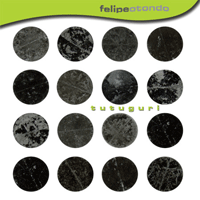
Felipe Otondo: ‘Tutuguri’

Having pursued his studies from his native Chile to Denmark and then to the UK (he currently teaches at the University of Lancaster), electro-acoustic musician Felipe Otondo has already made himself a world traveler. The cosmopolitan sourcing of his music ensures that he travels even further afield, even while sitting at his computer. The four pieces on his debut album ‘Tutuguri’ draw on concepts, patterns, sounds and language from India, Java and Mexico as well as from European and American sound-labs.

This reminds me that, like bats, human beings use sound to find where we are. We often remain unaware of this, or even dismiss it. In cities, for example, we tend to think in terms of filtering out the extraneous noise – the rumbling press of traffic, the too-close babble of our neighbours on public transport or through the thin walls of apartment blocks; the persistent layering of unwanted music as ambient features for shopping or working. In spite of this, we’ll still use sounds to judge our way and to establish our place in a shifting world. Recurring sounds in the subway tell us that the service is regular, or when we need to change direction. Changing accents in voices and even birdsong rachet our subliminal paranoia up or down. Subtle switches in the quality of sound moving through the air tell us about weather, and about the places we move through. Some newly-blind people even report developing an echo-location sense, measuring the presence of oncoming pedestrians, lamp-posts and corners by the minute changes in echo and sound positioning.

Most importantly, we associate the places we know with an arrangement of sound. Wind will be shaped around a building in a particular way, the patterns of dialogue and intonation spoken in and around particular shops and café. Traffic lights and contraflows generate their own rhythms and exchanges. Blindfolded, I’d still be able to recognise the back-street where I currently live from its specific sound patterns: cars nudging the speed-bumps with a particular speed and duration, the toss and bend of the trees in the wind paths, the pitches of children’s voices in the school half-way along, the frequency of slow buses creeping to the nearby bus garage. These recognitions surprise us, often in ways which we don’t even consider until the connections occur to us.

To me (being less of a traveler than many) Felipe’s sound sources are more exotic, initially implying spatial journeys or international visits. The complex and beautifully-packaged CD sleeve for ‘Tutuguri’ enhances this, opening up like an origami flower (or like the jaws of a concealed alligator). The four intent and deceptively challenging pieces within the album are designed to shuffle the consciousness rather than soothe it. They divert the listener along other paths: associative, temporal, historical; hallucinatory or sacramental. When Felipe cites them as being “meditative”, he doesn’t mean relaxing, or lazy. Listening care is required. At a distance – at a point of detachment or reduction to background – Felipe’s pieces will sound like a fluttery wallpaper of treated sound effects. Up close, turned up, or simply heard on headphones, the craft is evident: Felipe’s years studying spatial sound and timbral perception have been well spent. He’ll set you down in the middle of a set of beautifully recorded instruments or noises – or as an offset, slightly distanced observer – and then gradually alter that sound-world in increments, or in sudden dartings.

The oldest piece on offer here, Ciguri, takes Native Mexican bell and gong sounds and cuts them loose from root time. This isn’t as straightforwardly surgical, or as uninvolved, as it might read. Felipe is open about the inspiration he’s drawn from the Mexican peyote ceremony (and from Antonin Artaud’s writings on it). In particular, he’s interested in the time-distortion effect experienced when ingesting mescaline (which he recreates here via digital editing). On the way, he also explores inharmonicity – the additional non-harmonic tones created within a sound, via variations in the source material’s state of rigidity and elasticity. Strictly speaking, this is a physical exploration, but if you’re talking ritual – if you’re talking metaphysics – the same idea might be extended to the participants in the ceremony. As in any sacrament, each of their experiences will be shaped by their willingness, and by how their own histories and attitudes impact on how their brain works and how their world is conceived.

On Ciguri, Felipe doesn’t make matters quite that explicit, but he does his very best to remind us of how subjective an experience this can be. Sound-wise, he places us in the heart of a slow heat of hanging metals, and we listen (over nine minutes) as they alter. During this time, different parts of the surrounding structure take turns to transmute while others remain still. Gently struck tones blur from a simple ping to a fluttering hummingbird drill: the substance of the metals themselves seem to move restlessly between solid resonant bronze, a whispering foil, or a mere shining hiss of elements. The reasons behind this may be all in the math, but it doesn’t feel that way. As the numbers race through their patterns, the world around us changes and we’re hypnotized by what feels like the universe breathing.

Another piece, Irama, draws directly on Javanese gamelan orchestra music (using manipulated recordings of the Sekar Petak ensemble at the University of York). Irama’s title comes from a flexible gamelan term – one that can be used to define the time between two notes, or the time between two actions; or the rhythmic relationships between parts of the composition; or tempo in general. Drawing all of these meanings together under one conceptual net suggests a substantial and integral connection between all of them, much as each of the Indonesian gongs, flutes, pots and zithers in a specific gamelan orchestra is honed and tuned to fit only with instruments from the same orchestra. Of course, digital electro-acoustic processing means that any relationship between notes, pitches or rhythms which didn’t already exist can be first conceived and then molded into shape: and Felipe flexes and reshapes the gamelan sounds according to his own design.

Irama’s gong sounds range from the familiar bronze boom to the kind of light dry patterings and tight-hide raps which you’d expect to hear bounding from frame drums. Over a particularly deep gong sound, a metallophone texture is stretched into a soft drone: when the broader percussion section returns, it’s joined by soft struck pings and an oceanic flutter. At crucial points, particular gong chimes cut through to suggest changes of intent and mood. Apart from these, all of the sounds which lope through Irama reinforce themselves, subtly adding to an arrangement which becomes denser and denser, shifting to a jazzier pulses before (nearly four minutes in) rising to flood-rate and then dispelling into nothing. A second section begins – sterilized pings and rings, more German laboratory than Javanese ritual. Drilling echoes are buried inside it, ringing edge-tones place themselves above it. At six minutes, the frame-drums return; at seven, the pulse has multiplied again to the point of flooding; at eight, softened rings are the dominant sound as the piece diminishes into calmness. As with Ciguri, there seems to be more than the mathematics at work here; but beyond the calculations, all of Irama could itself be an illustration of time as human experience – its repetitions, its bewildering multiplicity of voices; its moments of collective intensity and its sudden rapid lulls.

 
As a listener, attempting to put narratives (however clumsy) onto more elusive or abstract pieces of music is a common strategy. Thankfully, the mixed instrumental/vocal piece Teocalli already comes with a narrative. It’s based on ‘The Night Face Up’, a short story by the Argentine writer Julio Cortázar, whose surreal-modernist approach (creatively disrupting his plots and chances of resolution via a shifting, subjective consciousness and by the restless straw-shuffling of jazz) is well suited to the cut/paste/reshuffle of Felipe’s compositional tools.

The original tale is about an injured, hospitalized motorcyclist: delirious, and dreaming that he’s a man hunted by the ancient Aztecs and targeted for sacrifice. Location and context come adrift in the dreamer’s mind, but are carefully deployed by the writer – here, Felipe steps carefully into the latter role, guiding his strips and layers of sound into place. Hunters’ drums roll in the background, sometimes scooping up in an enormous glottal curl of extreme echo, swooped by fierce panning and sound-fielding. At times, they run backwards, creating great ominous bowls of sound-space. In a recurring cut-up, a little choir of men sing what sounds like a Mexican popular tune. This moves in and out of Teocalli like a radio which can’t stay fixed on the station, just as the injured man in the story can’t stay fixed within his own time or his own experience. Watchful silences bead within the piece, within the drum-slides; filled with tiny arrested hangs of reverberation.

Through these silences (but also often in the midst of great surging wrenches of drums, as they wrestle for our attention) women’s voices speak. Zapotec women, from a pre-Spanish civilization that lives alongside and intertwined with modern Mexico. They converse and chat, presumably about ordinary human matters – these are interview snippets, not field recordings. But as these women are separated from listeners like us by their language (and by our own crude knowledge, and cruder guesses, about their culture), they innocently become part of the sinister hallucinatory sound environment which Felipe creates. As drums sweep and skirl around our heads, so too does a whole jungle of suggestions – brief clusters of crickets, digitally squeezed and timeslid; bird calls, as of hunters hidden in the undergrowth. When one of the women speaks again, her unconcerned and easy voice is shaded into callousness. When, at one point, she suddenly laughs, easy and confident, the dense paranoia and wilderness swirling around her conspires to render her cruel.

There’s no final outcome to Teocalli – no cathartic slaughter, no rescue. Eventually Felipe’s piece just blows away into the shadows, like the memory of ugly wings pressed around you. The fever dream is over. With the passing sweat those eerie vicious terrors go with them. The deep-rooted fear (part-humble, part-racist) of an ancient, incipient otherness. The fear of comfort and security crumpling and allowing the past to pluck you away; a raw, helpless morsel.

 
In its way, the final ‘Tutuguri’ piece – Sarnath – is as ritualistic as the others, yet it doesn’t rely so much on recreating states of mind. Instead, it attempts to sculpt suggestions of place, history and connections. It’s based on Francis Booth’s Indian location recordings of places associated with the story of the Buddah (and is named after the deer park in which Buddhist Dharma was first taught). In a sense, Sarnath is both site-specific and displaced, bringing the noises of Buddah-touched locations to wherever its soundfiles are played. Concert venue. Boom box. Perhaps even a trekker’s smartphone, being carried on a pilgrimage of its own.

As Felipe switches between recordings (clicking up one-by-one the sonic capturess of different geographical stops on the Buddah journey), Sarnath itself seems to be moving from place to place in search of something. Literally, a footprint? Literally, an echo? Felipe toys with the field recordings: folding them on themselves, stretching them over time. A bell might sound, swell hugely, then drop away. Chants may be heard. On a half-distant road, a procession of ecstatically banging drums may wind its way to a shrine. Behind these, birds and animals twitter. Away from the devotions, there are the soft chips and scrapes of human work being carried on regardless. Here, Felipe’s notes most obviously cite the intense, subtle states of mind connected with meditation: here, with whispers of Buddha making their presence felt, it’s a traditional part of the tale. Here, too, are the tiny sounds to focus meditation; the small sonic flakes of the natural world around which attention can be wound.

 
‘Tutuguri’ is four pieces; four stories. None of them conclusive; and despite the sleevenotes and the substantial clues, at least part of the stories I’ve recounted here have been dreamed up by me. The solo listener – the sound moulded by careful hands around my ears, yes; some of the intimations perhaps patted into place. But in other cases this music is just process doing what process does: forming channels for their own sake, numbers making shapes and illusions as part of the pattern comes into view, and only part of that’s actually recognized. Much of the purely technical side of Felipe Otondo’s music escapes me: instead, I experience much of it as the psychological backwash, like the vapour trails after the plane has passed. Still, if I’m creating my own ideas for what Felipe’s music might entail or might intimate, there’s clearly enough extra substance there for me to build on. That’s what humans do: we use sound to find out where we are. Finding places we know: judging our way through what’s being presented to us; sometimes, the recognitions surprise us.

Working blind, but guided by sound, I travel too.

Felipe Otondo: ‘Tutuguri’
Sargasso Records, SCD28070 (5065001338700)
CD/download album
Released: 25th March 2013

Get it from:
Sargasso Records (CD) or Amazon (download).

Felipe Otondo online:
Homepage Soundcloud LastFM

REVIEW – What?!: ‘Tikka Masala’ single, 2012 (“a sweet-natured hall-of-mirrors groove”)

19 Mar
What?!: 'Tikka Masala' single

What?!: ‘Tikka Masala’ single

Sometimes you can come across simple treasures hiding in the backroom. Dutch guitarist Niels Bakx, Sicilian drummer Raphael Lanthaler and Tyrolean bass player Agostino Collura are part of that under-appreciated swirl of humble, talented international musicians who fly in, settle down and quietly underpin bands in London, as in many big cities. People like these plug away behind the people with the big ideas and the knack for fronting. They’re the ones who finesse the roughness, who add the musical depth and the polish which brings shine and sophistication to performance. And sometimes, they secretly bring more.

Individually, each of these three have clearly got the chops and the temperament to keep themselves in demand with songwriters (Agostino plays with Anna Waldmann’s band The Cry Baby, Niels and Raphael back Charlotte Eriksson in The Glass Child), embedded in soul collectives (Agostino’s work with Retrospective For Love) and driving mixed groove-band (Raphael’s Snail Trail). Together, though, Niels, Raphael and Agostino are something else.

As What?!, they’re an assured and formidable unit; an airy, confident groove-trio audibly revelling in their flexibility and their knack for carefully-sprung timing. On spec, there’s nothing particularly unusual in what they do. Enough years spent plugging away at sessions and keeping punters happy with funk, soul, jazz and reggae tunes have made them experts in warm, sunny, foot-moving musicality: but it’s what’s beyond the blueprint that’s interesting.

Their debut single Tikka Masala (named, consciously or not, after a meal made up on the spot to keep British customers happy) is a sweet-natured hall-of-mirrors groove, light and slinky. There’s reggae in it, thanks to Raphael’s displaced bass drum taps, his tight-tuned tom rattles and Niel’s skinny-supple rhythm guitar. There’s funk in the warm spaces between strokes and beats. There’s jazz in everything, from the little golden runs of licks to the turnarounds to the feel that the rhythms are to be flung from hand to hand, danced over, teased and tag-teamed around. There are subtle refractions, interruptions of rhythm and key, that make you think briefly of progressive rock at its least bombastic and most aware. There are also flares of hard rock when all three musicians line up under a suddenly roaring guitar and suddenly start jabbing together ahead of the beat.

What’s really special about it is their complete control over the music. Their discipline is absolute but relaxed, with the feel that at any time they could shift rhythm, speed, genre back and forth in a moment, and yet not drop a single thing along the way. There are no self-conscious cut-ups in What?!’s music – no need to deconstruct. Why should there be when they’re masters of structure? – so much that if you flipped Tikka Masala around and spun it backwards it would keep every bit of its symmetry and bounce. For a demonstration of this, play the bonus track Alasam Akkit as that’s exactly what that is – a backwards-play of the A-side which sounds almost as good as the forwards version. A backwards-play which you can still dance to. Remarkable.

Exactly what this leads to, I’m not sure. Perhaps the outcome is that What?! set themselves up as a twenty-first century Sly and Robbie-plus-one. Perhaps they remain a supremely-accomplished hobby band, something which the trio engage in when they’re not otherwise employed keeping other people happy. Or do they push ahead as self-sufficient instrumentalists, seeing how far they can push, stretch and double-feint their masterful musicality? The only thing I can be sure of is that, whenever they do get together, all ways – for those moments – are open; and it’s tremendously refreshing.

What?!: ‘Tikka Masala’
What?! (self-released) (no catalogue number or barcode)
Download-only single
Released: 11th October 2012

Get it from:
Bandcamp.

What?! online:
FacebookTwitter Bandcamp SoundcloudYouTube

March 2013 – EP reviews – Henry Fool: ‘The Free Henry Fool Download EP’ (“picking carefully through detailed instrumental weaves”)

19 Mar
Henry Fool: 'The Free Henry Fool Download EP'

Henry Fool: ‘The Free Henry Fool Download EP’

Something old, something new, something borrowed, something blue; and all in one package. Henry Fool (resurgent with the ‘Men Singing‘ album after over a decade of woodshedding) are offering a free look at what they do and what they’ve done. A four-minute edit of a rolling juggernaut from the new album; an exclusive, keyboard-led instrumental; two tracks lifted from the band’s 2001 debut album.

While the older tracks (touted via their expansive Steven Wilson mix) might pull in some attention, Henry Fool offer plenty on their own account. Like a number of their contemporaries (such as Sanguine Hum, with whom they currently share drummer Andrew Booker) the band pick carefully through the detailed instrumental weaves of progressive rock left behind by the likes of Soft Machine and Genesis during the early ’70s. Admittedly, they’ve also got the odd thing in common with the sometimes inspired, sometimes benighted neo-proggers of the 1980s. Keyboard whiz Stephen Bennett was one; while guitar puzzler and sometime singer Tim Bowness (better known for no-man) had his own mid-’80s brush with the genre via a bellowing one-night stand with Hertfordshire pompsters Gothique. However, the Fool’s music is churned and tinted by connections and cross-talk with jazz, Brian Eno, Cambridge, avant-garde texture loops and post-rock, making it a subtler and more diverse stew.

For the most part Henry Fool are reappraising that old-school prog fabric, re-cutting it via thinking shaped by four more decades of musical developments, step-backs and parallels. At no point does it feel that they’re simply replicating the old vintage – still less watering it down. It’s more as if they’re inhabiting it; as if they’d moved into an old house, given the interiors a fresh coat of paint, and are now at the stage where they’re hanging bright new pictures and squinting at them, trying to see if they fit with the lines of the beams. Plucked from ‘Men Singing’, the four-minute edit of Everyone In Sweden (trimmed down from its original fourteen) keeps much of its vigour and its cunning ancestry: slow-motion Soft Machine keyboard cascades married to the rapid aggressive wobble of a 1976 Genesis groove, layered with scribbling synth lines which scurry over the structure like a gang of weasels. While clipped, wrangling guitars (part-post-punk, part-post-rock) hack against the smoothness, the edit brings out aspects less evident in the long version – the chippy funk in Peter Chilvers’ fretless bass, or the ghost-train lean of the chords.

As you might expect from the punning title, the Bennett-led A Canterbury Scene (exclusive to the EP) reveals more Soft Machine elements. Centred around the brittle tones of electric piano – wah-ed and echoed in the style of late ’60s Miles Davis bands – it gradually shifts to more Egg-like territories collided with grand Yes string parts. Lurking in the shadows of pomp, it edges its way around the outside, never setting a foot in the brasher spotlight. Written in a dicey 25/8, Poppy Q (its counterpart from those 2001 tracks) is a careful pick-through of electric piano, like a tiptoe through a prog minefield. One minimal keyboard figure arches over odd chords and a faux-Mellotron counterpoint, before the whole band step up into a stately twitching rhythm, keyboards interplaying with a bass part which pulls its shape from the original piano line.

Heartattack (also from the 2001 album) is the only track on which Tim Bowness unleashes his whispered, impeccably English spring-water croon. It’s also the song that best shows how Henry Fool differ from the standard prog approaches. While so many bands in the genre expand everything from ballad to suite into a mass of crammed lyrics and grand significance, Tim opts for a quick peep-show look into a life more ordinary, with a jolt of inner panic. “Stone-in-love and lost again, / you’re walking through the fields. / Summer fresh, your life’s a mess, / you’re wearing down your heels. / Don’t look back, / you’ll have a heart attack.” Thirty-five syllables of narrative, and that’s it. The rest is your own guess, to be worked out against a backdrop of clover-burst keyboard chords, discreet-but-urgent guitar peals and clenching rhythms. Prog balladry from the leanest side, in which the musical scenery is as much the story as the words are, but in which the delicacy asserts a refusal to hammer home the meaning.

Henry Fool: ‘The Free Henry Fool Download EP’
Burning Shed (no catalogue number or barcode)
Download-only EP
Released: 8th March 2013

Get it from:
Free download from Burning Shed

Henry Fool online:
Homepage Facebook

Album reviews – Darkroom: ‘Fallout 2’ & ‘Fallout 3’ albums, 2002 (“a game of reverse-chicken… impressive and utter liquefaction”)

18 Mar

Darkroom: 'Fallout 2'

Darkroom: ‘Fallout 2’

The second part in Darkroom’s ‘Fallout’ trilogy ( a set of interwoven concert travelogues) sees the unorthodox dark-ambient trio shrink to fit circumstances: recorded over the course of four gigs in Cambridge between spring 2000 and spring 2001, ‘Fallout 2’ records their first period of work as a duo. With singer Tim Bowness temporarily absent from the group, the five lengthy live tracks see Darkroom’s sound now built up entirely from Andrew Ostler’s infinitely malleable, polluted volume of electronic sounds and Michael Bearpark’s massed, heaven-and-hell loop guitars.

Subtracting the singer should have meant removing the human face from Darkroom’s activities. It should have forced their music – which was already suffused with hanging menace, dense atmospherics and chaotic leanings – further down the road to alienation. In fact, the opposite is true. Minus those fragmentary Bowness sighs, whispers and melodic wails, Darkroom do relinquish part of their edge of romance and distress. But they also dispense with the intimations of human disintegration, morbidity and panic which Tim’s beautifully tortured vocal tones brought to the project.

In his absence, Darkroom is able to relax and experiment with a two-way balance instead of the three-way teeter they’d thrived on previously. Os and Michael sit back and play off each other – not in unison, but in a dialogue of occasional crossings and of deceptive, mock-disengaged responses. As with ‘Fallout One‘, the two-man Darkroom continue to embrace instinctive wandering noise-stews rather than art-rock discipline.

For this album, at least, these are gentler brews: one even begins with a serene duet of heaven-scented loop guitar and a windblown squiggle of pink noise, rather than the warning tones of before. Released from some of his duties as textural foil to Tim, it’s Michael who now gives the music its anchors: cyclic calling phrases, humming confections of layered Frippertronic-like loops, space-echoed licks, sometimes a sound like someone wrenching their way out of a giant metal tank. Os – as usual – takes responsible for most of the layers of sonic detail and for the most drastic directional shifts within Darkroom’s ever-restless improvisations.

Os’ increasing plunderphonic tendencies (linking and threading pieces with snippets of international radio conversation, Cambridge choristers or muezzin calls) prove that behind his responsibilities for the main body of Darkroom’s sound, he’s also the joker in the pack, dialling up effects and textures from a vast trick-bag of electronic sounds which he then sloshes across the speakers and leaves to evolve. His rhythms, too, betray a sense of cool, amused mischief. He’ll stitch in trails of techno beats, or hijack a piece five-and-a-half minutes in with jazzy cymbals and toms drenched in flapping dub treatments. He’ll even drop in the occasional comedy drum-wallop to accompany some blooping synth sounds he appears to have stolen off a kiddy-ride in a shopping center. Inscrutable humour aside, Os also assembles a remarkable variety of more solid elements to flesh out Darkroom’s randomness: imposing psychedelic cadences, static veils and suggestive electrophonic shapes.

Though Michael Bearpark’s playing still owes a debt to Robert Fripp (via his “Bearatronics” loops and his occasional digressions into trumpet-guitar), he’s far less formally-minded. While you could also draw parallels to the mangled roots sounds used by David Torn, Michael is a far more reticent, distant and watchful guitarist: less flamboyant, but similarly eclectic. Across the album, he comes up with the kind of junkyard guitar that Marc Ribot would be proud of; or treats us to yanks and scrabbles of twanging guitar in the vein of Henry Kaiser or Fred Frith. He unwinds collapsing, Spanish-guitar-style electric rolls; or feeds in the Bill Frisell-influenced ghost-country minimalism that he’s increasingly stamped onto Darkroom music. Os responds with gusty, gauzy swirls of noise, or busies himself chopping up the sound even as Michael enriches it.

It’s co-operation of a kind, I suppose. Sometimes the Bearpark/Os interplay is gloriously subtle. More often, they’re engaged in a game of reverse-chicken in which they seem to be seeing just how far they can wander from each other’s playing before Darkroom collapses, adding a kind of free-jazz risk to the elements of illbience, Krautrock and musique concrete that already flourish in the group’s sound. Darkroom’s apparent abstract shapelessness (more accurately their indifference to, and boredom with, the monotonous formality of much electronic music) seems to put a lot of people off. However, their loosely-knit and liberated music still has few rivals or peers in electronica.

Darkroom: 'Fallout 3'

Darkroom: ‘Fallout 3’

Tim Bowness returns for ‘Fallout 3’ which at first listen sounds as if it could be pegged as the kinder, gentler Darkroom. This seems an unlikely label. Nonetheless, the album initially seems something of a let-up from Darkroom’s unsettling dark-ambient explorations.

As the group’s main studio-flexer, Os exerts most of the active control over the emerging music. On this occasion, he does this by taking more of those Darkroom live recordings and drastically remixing them. Drawn from two of the mid-2000 Cambridge gigs which initiated ‘Fallout 2’ (plus four other gigs between 1999 and 2000 in Cambridge and London), ‘Fallout 3’ is tagged as “a celebration of the art of post-production” and compresses their rich, chaotic improvised sprawl into a thickening wall of noise. This is Darkroom as jelly, rather than their usual coils of prismatic vapour. In the process, it displays a side of the group which might appeal better to ambient-music aficionados and art/noise acolytes (those who’ve so far proved immune to, or unconscious of, Darkroom’s brooding wide-open power).

The art-rock richness of Tim’s keening, beautiful-agony vocal was previously something of a scene-stealer – especially when it reached heights of drama which recalled Peter Hammill at full tilt. This time it drifts faintly through the mix like a displaced ghost. Half-obscured, half-dreamy, its physical presence fades to a livid imprint. As for the industrial-melodic textures of Michael’s guitars (and his layered MiniDisc manipulations), these have sunk even deeper than before into the fabric of Darkroom sounds, as have most of the drum loops. The most audible Darkroom instrumentation to be heard on ‘Fallout 3’ is the humble studio fader and the reverb unit, teasing their way through the music and rebuilding detail.

Turned right down, ‘Fallout 3’ sounds like the smooth-peanut-butter option compared to the crunchier varieties of ‘Fallout One’ and ‘Fallout 2′. Turned up, though, the music piles upwards inexorably; like a thick fluid shot through with veins of displaced voices. Sometimes these voices belong to Tim, processed almost beyond recognition to become muttering crowds or alien choirboys. Sometimes they’re radio voices stroked out of the ether by Os’ continuing casual interest in plunderphonics. Those little instrumental dialogues and monologues that used to weave through Darkroom pieces have been melted down too. Everything played becomes food to feed this new amorphous monster.

The result is that, more than ever, Darkroom’s music has the amnesiac, dissolving qualities of oceans. Powerful and ever-massing, and strangely indifferent to the repercussions of its nature. The sound itself, for what it’s worth, is closer to dry land if perhaps not stable ground. That continuously-rumbling, near-geological depth of soundfield and the thick “angry-earth” quality to the sound brings this reinvented Darkroom closer to the relentless, tectonic grind of Robert Hampson’s dark-ambient process music in Main. Like Main’s, the pieces on ‘Fallout 3’ are much of a muchness. All are slightly differing curves on a line mostly heading in one direction, arcing beyond post-rock to the land of out-rock. There’s far less of the more identifiable tendencies of the past – nowhere near as much of that Fripp-&-Eno-swimming-in-Lee-Perry’s-galactic-fishtank feel. The always diffuse identities of the Darkroom players are now barely there at all. The music has turned them inside out.

Consequently this is seventy-five minutes of impressive and utter liquefaction that’s still– identifiably – Darkroom, and which also enables them to thumb an invisible nose at past accusations of formlessness. Even when their musical substance is reduced to something as intangible as this, Darkroom’s baleful and beautiful intent remains intact: a long way beyond the easy trance to which most electronic acts are finally reduced. Darkroom’s vision is still inexplicable and alien. It’s also still undeniable.

Neither kinder nor gentler, then. Just even more seductively suffocating and inscrutable.

Darkroom: ‘Fallout 2’ & ‘Fallout 3’
Burning Shed (no catalogue numbers or barcodes)
CD-R/download albums
Released: 01 January 2002 (‘Fallout 2’) & 1st February 2002 (‘Fallout 3’)

Get them from:
Burning Shed (‘Fallout 2‘, ‘Fallout 3‘) or Bandcamp (‘Fallout 2‘, ‘Fallout 3‘)

Darkroom online:
Homepage Facebook Twitter MySpace BandcampLastFM

Digressions: What pi sounds like

16 Mar

Now isn’t this lovely – Michael John Blake, of the Quebec Antique project, delivers this sweet piece of music for Pi Day. This is a couple of days old, so many of you may have seen it, but well, here we are in ‘Misfit City’ and we’re no strangers to the idea of something arriving a bit late. So… a musical extrapolation of pi for a growing ensemble of piano, glockenspiel, accordion, autoharp, ukelele and more. I don’t know whether Michael had some idea in advance of how his number to notes-and-chords conversion would sound, but I like the result. Thanks to mixolydianblog for bringing it to my attention.

March 2013 – album reviews – Henry Fool’s ‘Men Singing’ (“the friendly grapple between wide-eyed fluency and beady, quizzical interference”)

13 Mar
Henry Fool: 'Men Singing'

Henry Fool: ‘Men Singing’

Perhaps it’s his own fault for perpetually playing the faded-lily crooner, the songwriter victim of ever-blasted hopes, the sigher in lonely cafes. At any rate, Tim Bowness doesn’t get nearly enough credit for his mischievous sense of humour. For instance: in his understated and perfectly burnished way, he’s one of the most stylish and distinctive vocalists in British rock, whether he’s refining and wrangling art-pop with Steven Wilson in no-man or lending his silky melancholy tenor to assorted projects from OSI to centrozoon, Rajna to White Willow. Yet for the whole of this second Henry Fool record – for which the involvement of him and his voice might have been the biggest selling points – he shuts up altogether and plays guitar instead. Inevitably, the album’s called ‘Men Singing’.

Tim also contributes the track titles – enigmatic, silly, sometimes both simultaneously – and, I’m guessing, the sleevenotes. In the latter, his Henry Fool partner-in-chief Stephen Bennett is credited with impressions of Miles Davis and Terry Riley, but also with an impression of Mavis Riley from ‘Coronation Street’. It’s an intriguing glance into their working relationship. Presumably, this means Tim gets to be Rita Tanner. Not inconceivable. Following a phase of relatively sober hairstyles, he is looking more bouffant these days.

Of course, Henry Fool have a history of not quite doing what’s expected of them. While they’re nominally a progressive rock band, you might better describe them as highly-accomplished prog fans on a weekend trip to their influences, who get bored with the direct route and carry out chance diversions to their other interests as they go. Their 2001 debut album certainly drew echoes and ripples from Soft Machine, from mid-’70s Genesis or Pink Floyd, or the more ruminative moments of King Crimson. Yet there were post-punk spikes in the road, stopping the music from becoming grand and flowery; and stubborn, counter-intuitive post-rock kinks (reminiscent of Slint, Fridge or Tortoise) that reigned in or derailed the pastoral draperies.

In addition, rather than grand drama or ill-advised theories-of-everything, Tim’s songwriting (sparse and bloodsqueezed, honed for understatement) offered flashes of human fragility, thumbnail sketches of love and loneliness, and brief twilight peeks into inconclusive lives. It made for an uneasy listen, and maybe the prog world as a while wasn’t ready for a band more Raymond Carver than William Gibson or Siddharta. Henry Fool made a couple of slightly disjointed festival appearances and then went to sleep for a decade under a haystack of perfectionism, studio wrangling and sundry distractions.

Cue, much later, this re-emergence – in which the entire band sounds utterly invigorated. There might be no words this time, (and the music’s smooth flow belies its long gestation) but the intent is clear.

As of the moment, Henry Fool’s a seven-piece collective: part-time players and guest players (many from the no-man orbit) fluttering in and out of place to pulse out fluent streams of music, like happy quasars. Most of the original collaborators are back – multi-instrumental Eno collaborator Peter Chilvers returns on fretless bass, Cambridge jazz veteran Myke Clifford provides reeds and woodwind, and Michael Bearpark continues to commit a variety of guitar solos and interferences from skittering textural glissandi to raw, probing melodies. Of the newer recruits, Andrew Booker (from the no-man live band and, more recently, Sanguine Hum) draws, drives and hauls the drum patterns. The latest player to be pulled into the talent pool is I Monster’s Jarrod Gosling, who brings further prog- and post-rock ingredients along with him as well as sounds from the world of organic electronica – mixing, Mellotrons, a touch of Moog bass and a tinkling glockenspiel.

Most of the out-and-out proggery still comes courtesy of Stephen Bennett, whose keyboard skills and theatrical instincts (thanks to some solid neo-prog history via his 1980s band LaHost) adds most of the harmony and decoration to the project. The Tim Bowness stamp on the project is in the ideas and the overall compass. Never an instrumental virtuoso himself, he leaves the spotlight to others and provides the music’s spine rather than its face – sitting in the background, he rolls out a variety of low-key but crucial guitar lines. These generate the music’s understated art-rock elements of challenge and upset; and it’s still the friendly grapple between Stephen’s wide-eyed fluency and Tim’s beady, quizzical interference that brings the music to life.

The four lengthy, semi-improvised tracks on ‘Men Singing’ manage to be steeped in English prog and psychedelic reference points without becoming waterlogged by any of them. Even the guest appearance of a genuine ’70s art-rock guest star – Phil Manzanera, invited in to channel Quiet Sun on two tracks – fails to upset the balance. Instead, he slots smoothly into the work, engaging in an equal-terms quadrille of unorthodox lead and rhythmic noises with Michael Bearpark. It’s due to the band’s thinking patterns. Rather than going for an unfolding narrative or for linear doodling, Henry Fool works as a kind of coasting, vertical jam; with layer upon layer of subtle music thoughts playing out and exploring over their rolling instrumentals. Throughout, Peter Chilvers restrains himself to spare, crunching, authoritative rumbles and wahs on bass, like a giant turning over in bed – pinning and shaping each long measure with the minimum of showmanship.

The fourteen minutes of Everyone In Sweden are those which most strongly suggest mid-’70s British jazz-rock, carried as they are on upfront and ever-fluid Booker drumming, and woven through by high-buzzing analogue synths. At points it could sound like Soft Machine taking a crack at Los Endos, although a variety of knotty guitar approaches from Manzanera, Bearpark and Bowness and the airy punch of Myke Clifford’s soprano sax spin the music through further territories and changes. At half the length, Man Singing sounds like a lost jam between Miles Davis and the journeying Pink Floyd of ‘Ummagumma’ – elusive funk with bursts of Herbie Mann-ish flute from Myke Clifford, irritated-elephant interjections from Manzanera, and juicy elusive funk-slurs and pings from Chilvers. Bowness, meanwhile, hovers on a tremulous Bark Psychosis guitar; glimpsed occasionally through gaps in the rest of the music, and keeping the questions raised.

The lumbering two-note fuzz bass anchoring and stippling My Favourite Zombie Dream suggests something less gracious. On this one the band plays cruder even as it holds and manipulates tension. Toms bob uneasily, synthesizers string out warped buzzes and trumpeting tonal tumbles. A backdrop of Mellotron gauzes, crash-spring guitar and wrenched organ tones add further disruptive edges. Increasing layers of Stephen Bennett parts pay tribute to a variety of keyboard players from prog to Krautrock – all simultaneously.

Thirteen-and-a-half minutes of Chic Hippo round everything off. This one’s a game of two halves. The first is a leisurely, arena-friendly stroll – the boom-bat drums and the pecking bass, the brace of real violins (courtesy of Steve Bingham) flying alongside the pop-up musings of the Mellotron. There are trumpet lines, moving in jabbing boxer shuffles; and melting electric piano dreams. There are flown-in swerves of parachute-collapse guitar distortion, or bulges like the revving of temperamental guitars. For the second half, a steamy mid-tempo pulse decorated with stern doubled saxophone honks and Wurlitzer piano arpeggios picks everything else up and runs with it. Guitars hang off the sides of the tune, peeling in strips: Bowness offers serene minor arpeggios, Bearpark a scything fuzzed slide line.

Yet while the album is drenched in detail and in finely-worked passing salutes to the creative hum of the early ’70s, that’s not what’s important about it. What matters is the lifting and the liberation; those layers of floated space stacked up above the rhythms and the tickalongs, and the way in which they’re filled. Henry Fool’s biggest achievement is the way in which they’ve freed themselves. It could be a decade of clever editing – something given back from those years of doubt and wrangling – but that doesn’t explain the spirit of fluency here.

While the band have kept some of that beady edge and economy which set them apart on their original arrival, every second of this album is packed with the kind of music that seems to have arrived without agenda or awkwardness. In between the shifts in tone, the mood colourings and the instrumental dialogs, Henry Fool have found a way to travel in a state of easy grace. From the opening cymbal twists to the final harmonious thin-out, every single sound on here (collectively hovering in position like an immaculate air display) feels like the sound of a musician playing through their instruments in the right voice for the right moment… and that’s a rare achievement anywhere. For nearly forty sustained minutes, everyone’s attuned; all in chorus.

Men singing. What do you know? – perhaps it wasn’t a joke after all.

Henry Fool: ‘Men Singing’
KScope Music, KSCOPE244 / 802644824420 or KSCOPE836 / 802644583617
CD/vinyl/download album
Released: 11th March 2013

Buy it from:
Burning Shed

Henry Fool online:
Homepage Facebook Twitter

SWOONAGE

Swoon. /swo͞on/ A verb. To be emotionally affected by someone or something that one admires; become ecstatic. Here are some people and things that make me swoon. #swoon #swoonage

Post-Punk Monk

Searching for divinity in records from '78-'85 or so…

theartyassassin

...wandering through music...

Get In Her Ears

Promoting and Supporting Women in Music

Die or D.I.Y.?

...wandering through music...

Music Aficionado

Quality articles about the golden age of music

THE ACTIVE LISTENER

...wandering through music...

Planet Hugill

...wandering through music...

Listening to Ladies

...wandering through music...

ATTN:Magazine

Not from concentrate.

Xposed Club

improvised/experimental/music

The Quietus

...wandering through music...

I Quite Like Gigs

Music Reviews, music thoughts and musical wonderings

furia log

...wandering through music...

The Recoup

SINCE 2013: Books and books and books and books and occasionally other things

A jumped-up pantry boy

To say the least, oh truly disappointed

PROOF POSITIVE

A new semi-regular gig in London

Gapplegate Classical-Modern Music Review

...wandering through music...

When The Horn Blows

...wandering through music...

:::::::::::: Ekho :::::::::::: Women in Sonic Art

Celebrating the Work of Women within Sonic Art: an expanding archive promoting equality in the sonic field

Ned Raggett Ponders It All

Just another WordPress.com weblog

FLIPSIDE REVIEWS

...wandering through music...

Headphone Commute

honest words on honest music

The One-Liner Miner

...wandering through music...

Yeah I Know It Sucks

an absurdist review blog

Obat Kanker Payudara Ginseng RH 2

...wandering through music...

poplifer.wordpress.com/

Waiting for the gift of sound and vision

Good Music Speaks

A music blog written by Rich Brown

Do The Math

...wandering through music...

Archived Music Press

Scans from the Melody Maker and N.M.E. circa 1987-1996

The World's Worst Records

...wandering through music...

Soundscapes

...wandering through music...

OLD SCHOOL RECORD REVIEW

Where You Are Always Wrong

FRIDAY NIGHT BOYS

...wandering through music...

Fragile or Possibly Extinct

Life Outside the Womb

a closer listen

a home for instrumental and experimental music

Bird is the Worm

New Jazz: We Search. We Recommend. You Listen.

...wandering through music...

Life Just Bounces

...wandering through music...

Lucid Culture

JAZZ, CLASSICAL MUSIC AND THE ARTS IN NEW YORK CITY

Aquarium Drunkard

...wandering through music...

eyesplinters

Just another WordPress.com site

NewFrontEars

...wandering through music...

FormerConformer

Striving for Difference