…and this would have been in the previous post about first-week-of-October gigs had I found out about it sooner. For a while now, I’ve been a fan of Tigmus‘ portable crowdfunding formula for making gigs happen, so it’s good to be spurred into plugging one such gig – especially since it features Arch Garrison (whose wonderful second album gained an extensive ‘Misfit City’ review last year) and takes place in such an unusual location…
Arch Garrison + Lisa Doscher (Tigmus @ Garrick’s Temple to Shakespeare, Hampton Court Road, Hampton, London, TW12 2EN, UK, Saturday 3rd October 2015, 7.00pm) – £10.00
Over to Tigmus:
The second concert in our autumn series at the Garrick Temple to Shakespeare features the beautiful sounds of Arch Garrison and Lisa Doscher.
Having garnered much critical acclaim for his larger-scale compositions and songs with North Sea Radio Orchestra, Craig Fortnam also writes and performs in singer-songwriter mode, alongside James Larcombe (NSRO/Stars in Battledress/William D. Drake) on keyboards as Arch Garrison, who have released two albums; ‘King of the Down’ (2010) and the latest work ‘I Will Be A Pilgrim’ (2014).
‘…Pilgrim…’ details Fortnam’s attachment to the chalk downland of Southern England; a landscape criss-crossed with ancient trackways, droves and green lanes, and dotted with Neolithic mounds and barrows, evidence of the Great Stone Culture – all calling him to pull on his walking boots, whistle for the dogs and hit the road, to undertake a pilgrimage to nowhere. He walks the ancient paths as an act of connecting to something intangible but present in the marks left by man, be they burial mounds or pylons – it’s all the same really – all grist to the songwriting mill – walk walk hum sing walk…
Originally from New Hampshire, USA, but now settled in Oxfordshire, England, Lisa Doscher creates soulful vocals with lovely cosy harmonies. Indie-folk peppered with gospel, Americana and urban rhythms; uplifting songs from the heart and soul-powered rhythms for sharing around the campfire and joining in. In her first full-length album, aptly titled ‘Return Home’, she charts her last ten years of diverse musical experience with introspective songwriting and her atmospheric alt-folk sound. The songs each provide a landscape for some discovery that is essential for understanding one’s place in the world.
Garrick’s Temple to Shakespeare is a small garden folly erected in 1756 on the north bank of the River Thames at Hampton, London. It was built by the actor David Garrick to honour the playwright William Shakespeare, whose plays Garrick performed to great acclaim throughout his career. After a campaign supported by distinguished actors and donations from the National Lottery’s “good causes” fund, it was restored in the late 1990s and reopened to the public as a museum and memorial to the life and career of Garrick. It is reputedly the world’s only shrine to Shakespeare.
Up-to-date info on the gig is here, and tickets are available here.
One of the reasons that I’ve been posting so many concert previews recently is simply that (being mostly homebound at the moment) I miss going to gigs. Looking at the lineup and scope of the 2015 Manchester Jazz Festival (which starts today and runs rampant for ten days through until 9th August) reminds me that not only do I regret not attending the wealth of music that takes place here in London, but that I miss more freewheeling days of music elsewhere. Discovering unexpected, treasurable bands at random while on holiday in Brugge, for instance; or immersing myself in a week of concerts and more in Edinburgh or Leeds (such as the one I reviewed here, over a decade ago.)
We know that, as a British pop and dance city, Manchester punches well above its weight. Despite a bubbling undercurrent of improvised music, its reputation as a jazz town is hazier…. or, more probably, I’m just ignorant. The Festival’s been going for twenty years, long enough to gain enough gravity to generate its own traditions. (One such is ‘Surroundings’, a longer-form ensemble piece by Salford composer Neil Yates. Commissioned for the festival in 2010, it seems to have become the event’s unofficial signature – this year, it’s being revisited as a quartet performance in the Central Library Reading Room.)
Even a quick sift through this year’s programme reveals a jazz party that any city would be proud of – diverse, inclusive, inviting and multi-levelled, an exciting noise ranging from the stately to the vividly scraggled and all the better for it. With many tickets going at only four pounds, (with a ten-pound all-events daily ticket and free-entry deals if you stump up as a low-level event sponsor), they could hardly have made it any more inviting to the casual walker-upper. Excuse me for a moment while I strip-mine press releases and YouTube, and check Soundcloud pages and Bandcamp links.
Starting with the higher-end, bigger name events… Acclaimed Blue Note pianist Robert Glasper slips away from his experimentations with latterday R’n’B to get back to basics with an acoustic trio; John Surman re-teams with the Trans4mation String Quartet to revive the thoughtful, tidally-deep music from his ‘Coruscating’ and ‘The Spaces in Between’ albums. Norma Winstone, Klaus Gesing and Glauco Venier bring along their trans-European project Distances. Partisansbring their transatlantic swing storm; Christine Tobin her ‘Thousand Kisses Deep’ jazzification of Leonard Cohen songs. French Jazz Musician of the Year Airelle Besson makes an appearance with her Quartet for a set of “gently experimental songs animated by heartfelt lyrics, plaintive melodies and rolling harmonies.” backed with pinballing rhythms and punchy countersyncopations.
There are heavyweight two-headed summit performances by acclaimed British jazz talents – one by frequent quartet buddies Mike Walker andGwilym Simcock, another by the more recent pairing of Tori Freestoneand Alcyona Mick. Two further British scene fast risers – Stuart McCallum and Alice Zawadzki – bring string-enhanced performances of ongoing projects (the former offering contemporary soul jazz and bass-heavy electronica with surprise guest singers, the latter a fantastical Mancunian song cycle influenced by various shades of love and fairytale).
There are also several of those gentler, more literate projects which seem to blossom best in a festival atmosphere away from a hot core of gutsy brass. Andrew Woodhead and Holly Thomas’ Snapdragontrio specialize in chilled, ethereal song-settings of literature and poetry (Larkin and Bukowski-inspired) and bursts of vocalese. Mark Pringle‘s A Moveable Feast mates orchestral strings with a bold horn and rhythm section to explore “themes of wildlife, literature and city chaos.” The “fractured Anglicana” of Hugh Nankivell’s multi-instrumental/four-part vocal quartet Natural Causes means that they perform “curious compositions with improbable but poignant texts” including “psychedelic lullabies, pinprick-precise ballads, unpredictable group improvisation and brotherly harmony across the board”, and music which draws on classic and contemporary art pop (Robert Wyatt, XTC and Björk) as much as it does on jazz sources.
Elsewhere, much of the polyglot diversity of jazz today is celebrated. The Cuban tradition is represented by the Pepe Rivero Trio and Orquesta Timbala; the Congolese by Eddy Tshepe Tshepela‘s Afrika Jazz. Central and South American ideas are brought along byAgua Pasa (who, with Dudley Nesbit’s steel pan project Pan Jumby, also touch on the Caribbean). The Quarry Hillbillies (a teaming ofUlrich Elbracht, Ed Jones, Jamil Sheriff) from European contemporary jazz, while the frenetic whirl of Eastern European folk elements are covered by Makanitza. The Gorka Benítez Trio move between Basque-flavoured small group jazz and compelling free-form impressionism. David Austin Grey’s Hansu-Tori ensemble is inspired by natural, elemental and cinematic” ideas, as well as a fascination with Eastern world culture. Percussionist Felix Higginbottom’s Hans Prya provides genre-hopping jazz-dance and Jim Molyneux’s Glowrogues favour funk and hip-hop flavoured pieces. Trumpeter Lily Carassik‘s fusion group Yesa Sikyitake ideas from the ’50s and blend them with popular standards and soul arrangements; while The Stretch Trio include glossier elements from ’70s jazz rock, progressive rock and ’80s pop along with sinuous gusts of wind synth.
Those who prefer classic jazz – more traditional by-the-book American styles – might prefer Russell Henderson and Jamie Taylor’s Ellington-and-Strayhorn tribute ‘The Intimacy Of The Blues’, or the Dan Whieldon Trio‘s salute to Gershwin. The Dave Kane Quartet take inspiration from the knottier ambitions of Charles Mingus, John Zorn and Eric Dolphy. Two groups of students from the Royal Northern College of Music provide live celebrations of the history which they’ve been learning – the James Girling Quintet spans jazz, blues and funk from New Orleans roots through to the 1960s, while the Nick Conn Octet (a self-described “trombone choir”) interweaves re-arranged jazz classics with original material.
Fans of New Orleans jazz can check out genuine New Orleaners The Session (who offer a past-present take on their hometown’s music), or look out for the street sounds of the New York Brass Band (actually from old York, the cheeky buggers) or see how the Riot Jazz Brass Band dust up old New Orleans sounds with dancefloor, dubstep and drum-and-bass incursions. Hot jazz/Gypsy/jazz manouche aficionados can go for the loving recreations of 52 Skidoo (who promise you prohibition speakeasies, rent parties and Tin Pan Alley) or for Gypsies Of Bohemia, who manouche-ify latterday pop songs such as Heart Of Glass, Toxic and Hot In Herre. (Being Mancunian, they also do This Charming Man – I’ll bet that that high-life opening riff translates pretty well).
Of course, much of the fun of a jazz festival involves catching a lesser-known, or even unknown, band carving away at the edge, furiously discovering – and there are plenty of those here. Since they drew me into covering the festival in the first place, I’m going to put a particular word in for Jon Thorne’s Sunshine Brothers (playing at Matt & Phreds on 4th August) in which the double bass/laptop-wielding Jon teams up with drummer Rob Turner (of Blue Note-signed breakbeat jazz electronicists GoGo Penguin) and looping poly-genre bass guitarist Steve Lawson (a ‘Misfit City’ regular) for “a cutting-edge trio of genre-defying musicians mixing jazz, improvisation, electronic and filmic soundscapes to euphoric effect, evoking sounds far removed from their bass origins.”
However, you could just as easily catch a full performance by GoGo Penguin themselves; or by Lauren Kinsella’s Blue-Eyed Hawk, who offer “art-rock, jazz and electronic soundworlds: imaginative and emotive, from pindrop to powerhouse.” The Madwort Saxophone Quartet play intricate four-part math-jazz. “Power-jazz commando team”Taupe (a triple-city trio from Manchester, Newcastle and Edinburgh) punch around themes from jazz, hip hop and heavy metal. Craig Scott’s Lobotomy seem determined to take the cake for upfront experimental exhilaration this time around, delivering shout-outs to John Cage, Captain Beefheart and Frank Zappa, proclaiming a performance in which “experimental jazz rubs shoulders with electronica and DIY alternative rock in a bubbling cauldron of live and recorded sounds” and promising to sample and reconstruction their own improvisations live on stage. There’ll also be a improvised summit involving bands associated with Manchester’s Efpi Records and Paris’ Onze Heures Onze collective.
One way into discovery is to take advantage of the free showcases for emerging bands. Care of the BBC’s ‘Jazz On 3’, London offers three bands – Nérija ( the all-female creative septet from the Tomorrow’s Warriors jazz school), the award-winning piano jazz of the Ashley Henry Trio and the decidedly psychedelic Phaze Theory (a quartet of drums, tuba, voice and guitar dedicated to “exploring the vastness of the musical cosmos”).
But perhaps it’s Jazz North’s Northern Line series that you should be checking out, showcasing bands from the north and the Midlands. Manchester offers the Iain Dixon/Les Chisnall Duo (whose repertoire of self-defined standards stretches from Messaien to Gracie Fields) and the John Bailey Quintet (guitar-led, and similarly inspired by twentieth century classical music). Newcastle provides barrel-house blues and ballads from The Lindsay Hannon Plus and the tricky free jazz/folk/rock/dancefloor entwinings of the Graeme Wilson Quartet. Lancaster and Liverpool provide one act apiece – Andrew Grew’s “total improvisers”The Grew Quartet and the “gothic bebop” of Blind Monk Trio, who claim to fuse the spirit of Thelonius Monk with Persian traditional music and the heavy-rock attitude of Led Zeppelin and Nirvana’s heavy-rock attitude.
However, it’s Leeds (still underrated as a musical powerhouse despite the world-class output of its music college and the vigorous inventiveness of its bands) which dominates the Northern Line. As well as providing the previously-mentioned Pan Jumby, Leeds brings the Portuguese/African/Latin and Indian song-fusions of Manjula, the Django Reinhardt swing of the Matt Holborn Quartet, Cameron Vale‘s ferociously energetic melange of jazz, metal, electronica, Afrobeat and Klezmer and the semi-electric “extreme, eerie to comic” improvisations of Tipping Point (featuring perpetual bad-boy pianist Matthew Bourne). Friendly rivalry aside, there’s also co-operation: Leeds, Manchester and Liverpool all join forces in The Bugalu Foundation for a Latin barrio take on northern soul.
Around all of this jazz there’s the usual happy agglomeration of related music – not quite jazz in itself, but possibly sharing a drink or a roll-up somewhere along the way. The festival covers various popular outcropping such as soul (in assorted Northern, jazz and diva forms courtesy of The Juggernaut Love Band, Terry Shaltiel & The Soultroopers, Charlie Cooper & The CCs) but also ’60s/‘70s funk (Buffalo Brothers), ’70s Afrobeat and Ethiopian pop (Kalakuta), ska (Baked à la Ska) and mbalax (Mamadou & The Super Libidor Band). There’s even an alt-country act (Stevie Williams & The Most Wanted Band) sneaking in at the back door. As for rock’n’roll/folk/reggae/swing scavengers The Flat Cap 3… well, for starters, there’s only two of them, so you can be dubious about anything else you might read, but don’t let that put you off.
Three female songwriters are also bringing their bands, coming from a folk or world music zone and overlapping into jazz. Kirsty McGeeleads her Hobopop Collective through a “joyful, dirty” sound drawing from gospel, blues and a collection of found instruments (including musical saw, waterphone, Humber hubcaps and metal buckets). The constantly shifting song landscapes of the Zoe Kyoti Trio draw from their leader’s Armenian and Greek heritage (as well as Cajun, European and Indian ideas). Saluting home-brewed British polyculture, Shama Rahman‘s ensemble explore her London home, her Bangladeshi roots, and her childhood memories of Middle Eastern desert landscapes in a “sitar,stories and song” melange of jazz-inspired improvisation, classically-inspired melodies and folk-inspired storytelling accompanied by energetic rhythms of swing, funk, hip hop, bossa nova and drum’n’bass.
For parents of very young children, needing to balance a jazz fix with family responsibilities, there are a couple of fully interactive kids’ events with activities, storytelling and improvisations. The Living Story Music Ensemble and illustrator Ann Gilligan collaborate on ‘I Have A Duck Who Can Roar’; the blues-and-roots-tingedHillary Step Quartet work with storyteller Ursula Holden Gill and dancers from The Dalcroze Societyfor ‘How Monkey Found His Swing’. Once the kids are attended to, there are still interactive events for the grown-ups, whether you’re talking about the all-in jazz vinyl night, the mixed-genre dj sets by Mr Scruff, Franny Eubanks‘ open-door blues jam or (for the more technologically inquisitive) Rodrigo Constanzo‘s showcasing of his dfscore software. The latter’s a creative music tool, cueing improvisers via graphical, visual and written clues: on this occasion, anyone with an instrument and a connectible smartphone/tablet/pad should be able to roll up and join in with the roar, joining some leading improvisers in performing music in tandem with the system.
For those remaining soundclips which I’ve not already snatched and pasted, visit the MJF Soundcloud page here … but better yet, if you’re anywhere near Manchester over the next few weeks, drop in at the festival (it’s hard to miss, considering that it’s not just hiding behind club doors but has effectively taken over the town’s main square for a fortnight). Seeing something this impressive light up and roll on fills me with delight – even if on this occasion I’m also filled with rue at not being able to go myself. But never mind me…
A few options for London gig-going this coming Thursday night.
Birdeatsbaby + Gabby Young + Death In Texas, (The Black Heart, 2-3 Greenland Place, London NW1 0AP, UK, Thursday 18th June, 8.00pm)
There’s an invasion of Brightonian theatrics (with some honorary Londoners on board) at the Black Heart in Camden as the ambitious orchestral rockers/dark-cabaret pop stars Birdeatsbaby launch their new single – a cover of Muse’s Muscle Museum. The band promise “an unmissable launch party featuring some amazing live musicians, visuals and videos, new costumes and special guests!” Support comes from another showstopper – Gabby Young of Gabby Young & Other Animals fame (described by ‘The Guardian’ as “a gloriously cheerful live performer with an entertaining jumble of styles that match her flamboyant image. She has the power, clarity and precision of an opera diva but also an impressive jazz singer (with) thoughtful, sophisticated songs that continually switch direction,”) – and from the London-based Death In Texas, a dark and dreamy keyboards-and-drums drama-pop duo (whom we’ve encountered before). Tickets available here – priced £8.00. For a potential taste of the evening, have a look at the three videos below.
Alternatively, if you fancy something a little more interactive, there’s this:
The Jammin Society (The Others, 6-8 Manor Road, Stoke Newington, London, N16 5SA, UK, Thursday 18th June, 7.00pm) – free event
This is billed as “an alternative weekly vox, MC, muso, artist, dancer, poet, DJ, performer jam night. Bring your voice, your instrument or just your ears and get involved with the creation/appreciation of a unique sonic soundscape: KAOSS pads, Space Echoes, phasers, creative compression and homemade reverbs all have a role to play! All the gear provided: kit, amps, mics, conga, keys, lights, projectors, decks, dancefloor, bar, comfy sofas…” There’s a different house band providing the core of the music each week – I think that this week it’s Vibe Machine, but the Society season will also feature No Jam, Mana Wax and Playpen Playboys. More details here.
If I was a Brightonian, I suspect that I’d be spending quite a lot of evenings at the Hope & Ruin. Not only does it host some of the town’s most interesting gigs, its interior décor – patched together in a pack-rat/caddis-fly jumble of enthusiasm – makes it feel like the vessel of some spacegoing carny out of ‘Firefly’ or ‘Doctor Who’.
I’m guessing that most people who’ve read the post title will already know all about these – since cult art, Brighton and a gossip grapevine make a happy mash – but two upcoming Hope & Ruin gigs have caught my attention. One features two leading lights of the original Krautrock/kosmische/German experimental rock scene (something else that’s become as Brightonian as the Pavilion). The other one sees the return of one of Britain’s more interesting wrangle-rock rackets from the 1990s: on this occasion, backed up by a more than worthy heir from the current decade. Both are stops on longer UK tours – I’ll include details on those as well.
Jaki Liebezeit & Hans Joachim Irmler @ The Hope & Ruin, 11-12 Queens Road, Brighton, BN1 3WA, UK, Thursday 17th June (doors 8.00pm)
The former Can drummer Jaki Liebezeit is one of the great beat stylists of experimental rock. Described as “a master of the pause and the stop”, he plays cutting, lean and propulsive rhythms from a small kit: alongside Neu!’s Klaus Dinger, he pioneered the mechanistic motorik beat which you’ll hear behind half a hundred nouveau-Krautrock bands. Hans Joachim Irmler () has had various multi-instrumental and production role in and around Faust over the years, but predominantly plays organ (a highly customisable transistor model which he built himself over forty years ago) and boxes-of-tricks (having created or co-created most of Faust’s unusual noise processors). Longstanding collaborators, Irmler and Liebezeit released the ‘FLUT’ album in 2014 featuring a “hypnotic maelstrom” of organ and drum improvisations. I’ve not reviewed it, but the ever-reliable ‘Quietus’ did – and it’s this vein of music which they’ll be performing.
More details here – although if you’re a fan, all of this will be old news and you’ll already have your tickets. If the Krautrock galaxy is still relatively new and obscure to you – and you’re within grabbing distance of Brighton – this sounds like the perfect opportunity to immerse yourself in the cult. (If recent rumblings about Liebezeit’s retirement are true, it might also be one of your last opportunities to taste the original flavour). If you’re not in Brighton, note that there are also tour dates in London, Fife and Glasgow (beginning on Friday) as listed below:
Sunday 14th June 2015 – Platform, The Bridge, 1000 Westerhouse Road, Glasgow, G34 9JW, UK – details here.
Tuesday 16th June – Cafe OTO, 18-22 Ashwin Street, Dalston, London E8 3DL, UK – details here.
Prolapse + Slum Of Legs @ The Hope & Ruin, 11-12 Queens Road, Brighton, BN1 3WA, UK, Tuesday 23rd June (doors 8.00pm)
Art-punks who emerged in the 1990s, Prolapse came up with a much more assured and individual take on the form than most, apparently by accident. The dual vocal frontline of Linda Steelyard and Mick Derrick (the former singing and the latter ranting,) often came across as disruptive theatre, a performance partnership which veered dramatically between combative duologues, utter disjunction or play-fights. Meanwhile the band behind them pegged brutally away on Krautrockian/Fall-esque rhythms, riffs and noises, like a Dada Hummvee worn down to its wheel-rims. The members have tended to claim that it all happened spontaneously and in general was a muckaround, but this was a band that was smart enough to work out when not to think – if you dug deep enough into them you found Master’s degrees, archaeologists, ceramicists and future journalists.
In 1999, after three albums and enough touring to wear them down, Prolapse very sensibly split up just before the point when it all became too frustrating. This year, having been enticed back from various locations and interesting jobs by Mogwai (who’ve invited them to play support at the latter’s 20th anniversary shows) they’ve opted to play a six-date UK tour, for which the other remaining dates are:
Friday 19th June – The Maze, 257 Mansfield Road, City Centre, Nottingham, NG1 3FT, UK, 19th June (supported by Grey Hairs and Hot Shorts) – buy tickets here.
Monday 22nd June – Colchester Arts Centre, Church Street, Colchester, C01 1NF, UK (no support) – buy tickets here.
Playing support at the Brighton gig are Slum of Legs – an inspirational, instrument-swapping, all-female travelling brainstorm of a band. Although they have roots in Raincoats-style post-punk and Riot Grrl (and more than a few similarities to the spontaneous inventiveness of Prolapse) Slum Of Legs have a particular approach to lyric writing which is all their own – intricate, irreverent, literate and broad-ranging. So even if the musical style doesn’t altogether appeal to you, go for the sake of the words and see what else falls into place. (Again, I’m late to the table for this one, so I’ll refer you to this spray of enthusiasm from ‘Collapse Board’, which sets out a view of the Slum Of Legs stall in a way that’s far better, and probably far closer to their pulse, than I could right now.) More info on the gig is here.
Even while he’s working on bright young Los Angeles neo-soul with Idesia, or dipping into African fusion pop with Izinde, bass playing producer Daniel Oldham carries around a pocketful of other projects. When he’s nurturing his dance svengali side, he’s danny0, with a debut single pursuing a darker, more twisted side… or so he says. It’s co-written and sung (with poise and operatic smoulder) by Anna Delaria of Anna & The Static, who – like Daniel – seems to be looking for the diva-frowns and broody depths that her day band doesn’t seem to offer.
It’s almost a pity that ‘Fire’ is so cute – a slinky haunch of electronic R’n’B hanging from a fingersnap and great stomping blocks of fuzzy synthesizer. There are probably too many songs with that particular title (a magnet for posturing and duff lyrics). True to form, some of the words here wobble as Daniel and Anna toy with images of flames, menace and insouciance, some of which slip through their fingers. Anna, however, never loses her step. Strutting and ducking through the keyboard slams, she sells the song like a haughty Liza Minnelli.
Daniel’s production seals the deal. He seems eager to confess a debt to Rich Costey and Kimbra, but in truth this is his own beast, full of glowing slithering detail, ghost-orchestra arabesques and some subtle rug-pulling. Like the massive pixellated orange explosions in old video games, two-dimensional blossoms of blurred expansive sound belly out in great fan-dancing puffs, covering up a few shortcoming as they go. ‘Fire’ isn’t perfect, but as Anna rides it around the dance floor on its fat hairy tentacles, trailing a veil of flickering embers, you could easily forget that it isn’t.
* * * *
I finished with a sex rap last time, and I’m picking up with another one now, although the rich fantastical swirl which Appalachian crew Hypenkrünk indulge on ‘Clitmatist’ lies far over the mountains from Ardamus’ down-to-earth D.C.-based romantic farces. Forty years in, one of the joys of hip hop’s current universality is that anyone can wallow in its rich sea of roleplay. In this case, stocky thirtysomething white guys from Tennessee who look like pro wrestlers get to pose as love gods. “Keeping it real” was always a wobbly concept for hip-hop: let’s just go with the dance of masks for a moment.
We’ve had dirty South for a while. This is mountain-man smut, with a swirl of German oscillators. For much of the ‘Clitmatist’ video, rapper Realtree (pallid stony-faced expression, magician’s robe, and whiskers that are part kung-fu-villain and part backwoods outlaw) lovingly serenades an only-just-offscreen vulva. He’s armed with ouija board, hypnotist’s watch, and a lubriciously loaded tongue. Explicit promises roll off the latter in a drench of hip hop wordplay (“Stow that hidden treasure packed away upon a shelf / You could never reach it – I think that I can help… / I would have brought some flowers but I’m here to smell yours,”) and down-home Southern innuendo. The words crawl over a billowing duvet of mongrelised electronica: some whining G-funk synth, Hawkwind gizmo dabbles and an undulating mattress of Berlin School sequencer. A discreet psychedelic guitar glints and swells as part of the ensemble. While nobody’s looking it sneaks out a sitar impression, as if furnishing a ‘70s-themed shag-pad.
In between glimpses of Realtree’s cartoon crib, stoned shots of trees claw the sky. A second Hypenkrünker shows up as a Charon figure. As fat, bald and impassive as a Turkish masseur in a peep-show (and poling his punt down a misty vagina-pink Styx), he’s a living “man-in-the-boat” gag who, at one point, shares a raunchy topless man-massage with Realtree. The Hypenkrünk PR promises essay on duality, alternate worlds, evolved consciousness and animal nature, and the lyrics drop references to stargazing and meditating as well as mystic rides; but right now our potential guru (when not rhyming “Kundalini” with “bikini”) seems more concerned with urging his date to “spread it like a flying squirrel.”
OK, you’re probably snorting your drink out of your nose by now. All of this is a joke, at least on one level. The players are moonshiners and moonlighters, coming in from assorted east Tennessee electronica, prog and psychedelic projects as well as from hip hop; while both in and out of the video, there’s a tinge of good-natured, low-budget, storytelling porn (tacky costumes, audience complicity, and all). But even as they rip the piss out of slutty-Romeo raps, whacking-material traditions and cosmic posturing in sound and vision alike, (“I am the saviour / of your l-l-labia – / I’m gonna see you on your worst behaviour, freaky neighbour,”) there’s an authentic tang to both Hypenkrünk’s trippy vapours and their juicier ends. As a self-styled master of sex Realtree’s clearly devoted to the task – from end to end, the song’s entirely and exclusively about serving female pleasure – and as musicians Hypenkrünk sink themselves deeply, devotedly into every genre they love and pillage. Filthy, sweaty, trippy, and even tender… at least, this time round.
* * * *
Conversely, it’s the last time around for Derbyshire alt.pop brothers Low Low Low La La La Love Love Love, but on their final single they’re speaking up for the bemused and frightened beast in people. Initially, ‘Burrow’ comes across like The Walker Brothers heard through a static storm, or like Phil Spector hauling My Bloody Valentine back into the ‘60s. Drums boom like warehouse crates, tubular bells are smacked: a cavernous crooning blur of backing vocals rides the swagger and swells like a sailor’s choir, while guitars shrug off a gluey sonic trail and a slow low-tide lick of quiet frying noise. Kelly Dyson’s vocals are nasal and poppy, while the words they’re singing are pitched between nightmare and compassion – “The weight of fears above the burrow, / of teeth and fur and blood / I clear my throat at a circle of sky / from the back of the hole I dug.”
It’s a singalong rabbit siege; a fatalistic, cowering gnash back at life’s terrors, a last burst of resistance before fate takes shape and takes hold. (“Maybe I’ll bolt out into the snare / from the back of the hole I dug. / And feel the cold metal wire tear / at the fur and skin and sinew around my throat.”) You can’t help thinking that the latterday Scott Walker, looking back over his own post-crooner gnarls of cruelties and complications, would tip his baseball cap in approval at the Low Low efforts, as well as the way they interweave animal behaviour and human anxieties. “I’ll lay and watch the long migrations / and envy the southward bound formations. /All the world performs the same motions / as I choke and wretch and spit and curse at my complications.” After the recording sessions were over, one of the Dysons immediately quit the band and Derbyshire, and lit out for London. Presumably he ducked the snare. Let’s hope he escapes the city predators.
The B-side, ‘Stop Spinning the Birdcage’ drops the fuzz drapes and the timpani booms for a brace of acoustic guitars and syrupy West Coast harmonies. Until banjo, bass and noisy lead guitar (all squeak and corrosion) work their way in (gradually sickening and splintering the song into disorientation) it sounds like an unplugged Byrds on the cusp of psychedelia, with the voices keeping their candy throughout. From the start, though, sunny, stoned-love-song intentions are hijacked by morbid distractions – “butterflies all around her eyes / I wonder when she makes up her eyes / if she draws blood?” – and its lazy and blissful carnality ends up hopelessly confused (“My eyes are carnivores / I’m thinking which bit of her face I should have first. / Little mouth or little nose? / I wonder, should I kiss it / or should I eat it whole?”).
Yet there’s no malice, no self-conscious weirdness to it: While a songwriter like Momus would have had a detailed and literate field day with this kind of polymorphous perversity, the Dysons are content to leave it as a passing blip. A sprained acid hiccup on a day for canoodling, a momentary surfacing of something more animal. A good, ever-so-slightly provocative note to go out on.
danny0: ‘Fire’ (featuring Anna Dellaria)
danny0 (no catalogue number or barcode)
Stream-only single (released 27th January 2015)
Hypenkrünk: ‘Clitmatist’
El Deth Recordings (no catalogue number or barcode)
Stream-only single (released 28th January 2015)
Low Low Low La La La Love Love Love: ‘Burrow’
Audio Antihero/Other Electricities (no catalogue number or barcode)
Download-only pay-what-you-like single (released 26th January 2015)
Get them from:
danny0: ‘Fire’ (featuring Anna Dellaria) – stream-only via Soundcloud.
Hypenkrünk: ‘Clitmatist’ – stream from Bandcamp or YouTube, or download from Bandcamp, iTunes or Amazon as part of ‘Lords of Rap, Volume 1: Just Da Tip’ album.
Low Low Low La La La Love Love Love: ‘Burrow’ – Bandcamp.
There are no peculiar moments (or quivering perspectives) with Grayhound O.C.D., despite their goofy name. They play straight modern rock throughout: the U2 root-note pulse in the bass, the sugar-frosted piano picking its way lightly through the chords, the choral synths. The guitars have that caressing thresh we know from Coldplay – gauze-wrapped shoegaze thunder, honed down from trance-inducer to aural duvet. Frontman Gray calls his girlfriend a “shining star” and – in the video – loiters theatrically at the tops of castles and by the side of lakes, staring meaningfully at imaginary horizons like a Thor-bearded Bono-in-waiting. He seems oblivious to the fact that the weather has seriously let him down (staying resolutely nice and clear when it could have had the decency to whip up a quick squall or dramatic cloud) or that maybe there’s another tour party waiting to squeeze past on the battlements.
In other words, everything’s in place but the actual drama, underlining how contrived and calculated the band are. I’m happy to let bands off their own contrivances, if there’s some wit involved. I’m less inclined to do the same for a band apparently poised to snatch up any tour or festival gaps left by touring Anglophone acts. Yet for three minutes they almost have me. Maybe Gray wins his day pass simply because it makes a change to hear an inflated arena-rock package with a soft-sung German accent rather than a simpering high-volume falsetto. Maybe it’s the superb, sensual production that buffs everything up to the glossy, summer-storm sheen of mid-‘80s Simple Minds (a sound I’ve always loved, even when the mighty winds curdle to warmed-over gassiness). Perhaps its the simple pleasure to be had by hearing assured musicians hit their mark and keep the rhythm bounding – a perpetual mid-air freeze-frame.
I also suspect that none of my skepticism is going to stop boys from Hamburg to Vienna snogging their girlfriends to this one from now till early summer. They’ll probably also be breaking up and making up to the B-side, Alone – its dark-toned modal guitar figure offering a bit more of the meat and sours. Still, it’s not long before Gray is pledging to plunge into deepest seas and climb highest mountains. Pass, pal.
* * * *
Even on her singles, Ellen Sunde (a.k.a. Sea Change) doesn’t showboat or swagger. Instead, she deliquesces. The blooping bedroom-pop of ‘Squares’ is both epic and introverted – a small constellation of freezing glows and vapours and the impatient blat of cheap drum programmes, with her small, sighing sob of a voice nestled at the heart of it, a warm breath on ice slurs.
In some respects Ellen resembles her fellow Norwegian, Anja Garbarek, working within a modest, birdlike sound and a haunted sketchbook, grappling with ghostly nervy ideas. In other respects, she’s whittled down the ideas of Kate Bush’s jarring, demonic ‘Get Out Of My House’ from primal screams to a flinching dodge. You could call it dream pop if it wasn’t so wide awake and bug-eyed. Far from heavy-lidded narcosis, this is dream-sharpened wakefulness and sometimes it hurts.
‘Squares’ is neurotic, fearful and ultimately brave. At times it sounds like an existential crisis wrapped in fairy lights (“just go inside, oh just go inside me / There’s no-one here”), but it’s mostly a crisis of confidence (“If I go there with you I will not be safe / All that lives inside me, all that you can see./ If you knew what I was – a frozen me, / what grows inside me – / then you’d let it go.”) Batting aside help, Ellen’s her own haunted house, her own jailor. Also, it seems, she’s her own salvation, instinctive and unpredictable, ready to burst shackles and flee without plans. “So don’t look back, don’t look back. / Out of this place, out of this house – / ‘cos if I don’t go there, / oh then my feet run, my feet will bring me there / My feet will run all they can.”
Trying to grasp at the song seems to melt it – it won’t keep a solid shape, it won’t provide a firm conclusion. Is this about self-hatred or about fervid, elusive independence? Resolving one’s own terrors, or bolting from them by panic and chance? “Save yourself first,” advises Ellen, towards the end of the song. She could be addressing a loved one, or herself: it could be nobility, or a covert brush-off. Sea Change offers transformation of circumstance and state, but also a fluttering ambiguity. Nothing is mapped out. I’m alarmed. I’m fascinated.
* * * *
Sex raps are integral to hip hop: another part of that expressing-yourself-over-a-beat ethos, and a good way to keep a live and restless audience onside. Unless you’ve got a broad sense of humour, they can be touchy areas – too louche, or (at their worst) channels for power-posturing, misogyny and spite. Happily, Ardamus might bitch a bit – and might even settle a few minor scores on the side – but he doesn’t really hold grudges. ‘At Least I Got Laid’ could have been so damn nasty – a wheedler’s boast. Instead, it’s a shrug and a counting-of-blessings from a late-30s Washington rapper, thumbing through his temporary dating and mating memories for a piece that’s not so much bump-and-grind as bump-and-fall-off-the-couch.
Most of the endearing low-budget video (earthily-mimed rom-com looking like it’s been shot on the flickering, selective colour stock of memory) actually takes place on a couch, but what we see isn’t really love action. It’s the bits in between. The getting-to-know you exercises, the different books and the telling eye-rolls. The separate laptop and TV watching; the bumbling between what two different people want. The sulks and the missed tell-tales; the irritating or opportunistic friends. Eventually and inevitably, it’s the get-outs, fall-outs or peter-outs. (Heh. No pun intended). Yes, it’s a bloke’s record and a man’s-eye view. There’s annoyance and relief (“the divorce and the wedding would have been shotgun”; “if you want headaches then, shit, you can have her”) and Ardamus does delivers a superb low blow in the battle of the sexes when he complains about how “a tampon now becomes puppet strings.”
Still, it seems that Ardamus’ concerns aren’t about who stays on top, but how things are played out (“you can’t play games like that / and not expect to get called on it”). Rather than being coldly profane, he’s endearingly filthy – there’s some marriage-proposal wordplay which is well worth a spin or two. (Hint: it’s all about going down. And exactly where you put the ring. Veil optional.) When he’s not going for double-takes and horse-laughs, he’s also pretty good at pinpointing the sorry farce of how things go wrong (“the small talk that you want to step over: / pushed away at the table – you a leftover,”) and the mutual clinging (“getting mouldy, make-believe it / you need each other, so now trade diseases.”) He knows how two can screw up. The summery light of Soulful’s production textures – bass Rhodes figures and wobbly wipes of soul voice samples, like a cuddlier Wu-Tang sprawling back on a picnic rug – draws out any venom. Whatever had been said and done – if you’d been Ardamus’ girlfriend, I think at least he’d shake your hand at the end of it.
Grayhound O.C.D.: “And I Love You”
Khb Music/Timezone Records (no catalogue number or barcode)
CD/download single (released 16th January 2015)
Sea Changes: ‘Squares’
Sea Changes (no catalogue number or barcode)
Stream-only single (released 20th??? January 2015)
Ardamus: ‘At Least I Got Laid’
Ardamus (no barcode or catalogue number)
Stream-only single (released 13th January 2015)
Get them from:
Grayhound O.C.D.: ‘And I Love You’ – iTunes or Amazon.
Sea Change: ‘Squares’ – stream-only via Soundcloud.
Despite the underlying wildness of her songwriting, Marika Hackman appreciates and makes use of the power of restraint. Previous songs such as Bath Is Black and Itchy Teeth have revealed a compelling songwriter with a cool fascination for messy play, for psychological dirt and guilt and the wracked physicality of the uneasy soul. That she doesn’t scream these things out adds to her power. Her cool, polished folk tones deliver her surreal, slithering insights and her deft, subtle analyses with the same thoughtful poise, whether she’s chiding or sharing, empathizing or emphasizing.
Underneath the spooky Latinesque folktronica groove of ‘Animal Fear’ (full of Shankar-ish string wails and spaghetti western gunshots) a menstrual werewolf subtext is swirling. Part ‘Ginger Snaps’ and part ‘Being Human’, it embraces blood and feminity, bandages, and the helpless stink of male terror. “I’ve been weeping silent like a wound. / Would you stitch me up or let the blood soak through, / watching my world turn from white to blue?” She sings as if she might be dying; she sings as if to a lover or a brother; but she’s never really pleading, never wholly dependent. She sits inside her transforming body and watches the changes come; watches the fumblings of her companion with the same half-resigned curiosity. “Look into my eyes and convince us both that I’ll last through the night; / I could land on my feet if I tried. / I’ve never jumped a chasm so wide / and made it to the opposite side. / Even now as we’re standing here, / I can see the doubt in your eyes, / I can smell the animal fear.”
The song is a tender, chiding mixture of vulnerability and disappointment, but its observations are shot through with self-awareness. “I was not a heavenly child,” admits Marika, “savage, with a temperament wild.” As the song travels through the changes, it blends into acceptance, a new understanding bleeding through in flashes (“oh, my body trembling… / and teeth… / I won’t bite.. / Sweet too soon, treacherous night.”) We don’t get to find out how this ends, but even as Marika (now more initiate than invalid) murmurs “she calls my name” you’re left with her finely-honed sense of self. Under the fur and nipples, under the wracking pain, an image emerges of a woman who may wander but will never be truly lost.
* * * *
Tanya Tagaq – a Canadian Inuit throat singer – also seems to have some empathy with this kind of lycanthropic humanity. She’s recently delivered a forthright cover of Pixies’ ‘Caribou’ like a tundra bolero with violins and horns, picking up on its occult hints and dreams of a changed, more animal life outside the city and slinging it back with an Inuit twist and the bloody-minded wit of a hard-bitten outdoorswoman. Tanya first came to broader attention a decade ago (thanks to her four-song turn on Björk’s ‘Medúlla’), and has continued to work her way into Western musical awareness via work with the Kronos Quartet and Mike Patton. This kind of collaborator choice suggests a determination to broaden and involve her music rather than dilute it. With last year’s award-winning Canadian success for her ‘Animism’ album, she’s pitched to continue making breakthroughs on her own terms.
‘Uja’ confirms this. A trailer single for a broader overseas release of ‘Animism’, it has something in common with previous deeply-involved folktronic endeavours such as or Foxout! and Mouth Music. It might mate and merge with electronic beats in longstanding worldbeat fashion, but rather than pandering to easy tastes it’s a stirring textural affair, deliberately pitched between ritual and pounding. It feels like an Arctic club night with all of the technology freezing round the edges and only kept functional by fierce body-warmth.
Log-clock ticks, harsh electronic reverb, and a ragged fabric of synth-noise and incisive drumming make up a base and a blanket. Over, under and around this Tanya works in multiple layers of percussive hum-grunts, drawls, gasps, seal barks and harmonic growls. Occasional shamanic interjections in Inuit (sliding in over the top like a wake-up call filtering through sleep) might be terse warnings, defiant fuck-you statements or camouflaged jokes at the expense of Anglo monolinguals. With Tanya being an assertively political artists and performer, they could be any or all. If I’m the butt of the joke, though, I can take it this time. ‘Uja’ made the blood jump in my feet and in my temples.
* * * *
London/Angeleno good-time band Swim Mountain retrofits, but in an easier, breezier way. They cover Beyoncé’s ‘Love On Top’ like someone flirting under a blanket, musical lines and instrumental parts wriggling under the surface like coy, excited limbs. As he showed on the debut Swim Mountain EP last autumn, head Swimmer Tom Skyrme is very good at disguising fairly limitd resources under a swelling, lucid-dream production style. He claims to have put this one together on a whim, belatedly falling in love with the song’s bravura modulations and ‘80s-inspired peppiness.
Personally, the Beyoncé diva-juggernaut leaves me cold. Despite her well-honed skills and precision vocals, much of what I see is branded, sub-Madonna acquisition and media powder-puffing (if she is the twenty-first century Madonna, we’ve all gone beige) so it’s interesting to hear the song outside her wind-tunnel of glamour. Tom’s lightly buttered, lysergic popcorn-soul take makes no attempt to match the ceiling-bumping, helium balloon assertiveness of the original. The pace is agreeable ‘70s midtempo; the wah-guitar plays peekaboo; the boinking bass comes sheathed in a tight reverb. The phaser button adds a gentle, sexy yawn; Tom’s warm nasal drawl (just on the likeable side of bland) dawdles amiably on the swooping paths Beyoncé cut, making no attempt to match her commanding calisthenics. A cloudy puff of keyboards fills the gaps, like a lazy pink smoke-bomb.
Previous Swim Mountain stylings have mostly recalled the stoned, sleeting Byrds guitar of ‘Five Miles High’: this one sounds like what Arnold Layne might have become if Syd Barrett had drunk deep on Memphis soul before he rolled another one, or like a more nappy-headed tie-dyed version of the Clarke/Duke Project. It’s all a little throwaway (despite the unexpected ending, which scrambles down an unexpected dip and clunks like a plastic lyre) but it’s lovingly crafted throwaway; a sugar basket which takes less time to eat than it does to admire. Plus I do like the way that Tom’s mix rolls out individual delicate moments for our attention, as if his faders were the sliding drawers in a jeweller’s desk.
Marika Hackman: ‘Animal Fear’
Dirty Hit Records (no barcode or catalogue number)
Download-only single (released 9th January 2015)
Tanya Tagaq: ‘Uja’
Six Shooter Records (no barcode or catalogue number
Stream-only single (released 6th January 2015)
Swim Mountain: ‘Love On Top’
Swim Mountain (no barcode or catalogue number)
Stream-only single (released 7th January 2015)
Both as year and as song, ‘2015’ is another fitful emergence for Enfield polymath Glen Byford – poet, photographer, digital trinketer, small-time maker and on-off DJ. In the past, he’s put out his original music (anxious water-tank electronica, skinny-wistful glitch tunes, poppy plunderphonics and disillusioned spoken-word bedsit blurts) under the cover names of Hunchbakk or Giles Babel. As of this year, all projects seem to have merged under the Babel label and shrunk down to their most skeletal: or perhaps that’s just how it feels under a January hangover.
Peeling off and discarding his usual quilt of samples, the perpetually uncomfortable Glen distractedly slung this one together on an iPad app while reading and watching television – as if he was working behind his own back and didn’t want to catch himself at it. It’s downbeat, clipped and telegrammatic – budget-tronica pows and zips; a knocking and near-undanceable beat; minimal decoration. Rather than opting for best hopes and public drive, he chooses to sit back and take the poison pill – “Another new year, and another January of good intentions. / Another January of new perceptions, misconceptions that things could change.”
The music, though, seems to disagree – glitching and flipping into a rumble of double-time, or shoving the voice to the back of the drawer like an unwanted sock. Meanwhile, Glen fidgets between hope and cynicism (“This year will be my year – / yeah, just like last year, / and just like every year,”)and represents that year with a brief collage of Playstation chip music, pings and trills, mutters, and incongrous hip hop samples of block party shouts and cheering crowds (“we have a party, right?… I tell you what we do…” Uncertain inspirations reign. Glen pads, tentative and barefoot, around his room.
* * * *
Shot of Hornets: ‘Elvis is Dead?’
In the time that Glen would take to roll over twice and go back to sleep, Shot of Hornets would have squeezed five quick changes into a song. Apparently not much older than 2014’s Christmas wrapping-paper, this band’s blocky, power-oozing pounce-and-trap tones suggests a much longer-established band: they mingle math-metal’s block-feints with hot funk spaces, thrash riffs with anthemic grunge righteousness, but never entirely pin themselves to anything. When he’s not bursting into hardcore screams, the soulful wreck of singing drummer Conor Celahane’s vocals are reminiscent of gospel-tinged hard-rock heroes King’s X (as are the clotted, meaty guitar wails of his brother Dan), but there’s just as much of Megadeth’s grand irritation in the stew as well.
Elvis is Dead? is a shape-changing dust-off about nothing more specific than uncertainty, vague disappointment and finding the pieces to pick up. The King himself only shows up in a desultory moan about Spotify (so I’m guessing that there’s something being said about the commodification and shrinkage of cultural heroes here), but generally the song sees the band gathering together their compass-bearings and firing off the odd sarcastic broadside. “So here we are now, / no better and no worse off, / in the same world as everyone else,” notes Conor, going on to confess “I have a number of doubts.”
The music is sinewy and jumpy beneath the roaring guitar, and every couple of minutes, there’s a change – a glide of softer melody, a shift into death growls, a barrage of bouncing swipes and screams. “The first prize for gift of the gab / goes straight to you / how d’you feel about that?” Conor yells before the song turns anthemic, finding both the funk and its final feet. (“Turning my back on ignorance, turning my back on selfish people, turning my back on ignorance and lies.”) In a final riff-bout, the rhythm hurtles and rebounds like an evil-minded squash ball. Promising. Let’s see what they do when their concentration settles.
* * * *
Even compared to the other prog juggernauts of the ’70s, King Crimson aren’t given much credit for contributing to the classic songbook. Given the various song-gems lurking in their back catalogue, this is unfair. It probably owes more to Robert Fripp’s unfortunate (and somewhat unfair) reputation as a lofty demon headmaster, verbally withering casual listeners from his lectern before immolating them with sprays of burning guitar sludge – an image which does his Bowie collaborations no harm, but which drags his main band down like a concrete overcoat. The fact remains that outside of slavish interpretations from neo-prog bands, as far as Crimson cover versions go there’s been little more than a speckling.
In the past few years, though, this has changed significantly. In 2011, The Unthanks transformed Crimson’s Starless into a haunting Northumbrian chorale. The year before, Symbolyc One ripped 21st Century Schizoid Man to ominous ribbons and recombined them for Kanye West’s ‘Power’. A year before that, Maynard James Keenan of Tool snarled his way through a pure Schizoid Man cover for The Human Experimente (It was impressive, in an art-metal way, although personally I’m keener on Johnny G’s lo-fi delta-blues version from 1982).
I Talk to the Wind, however, is probably the closest King Crimson has to a standard. A ghostly, semi-existential folk song from their first album, it’s already attracted several reinterpretations. Italian new-wavers Violet Eves did a respectfully mournful and elegant cover in 1985; Camper Van Beethoven and Eugene Chadbourne tore up a hilarious country-punk version in 1987. Probably the most famous version is Opus III’s techno-house take from 1992 (complete with New Romantic Gilliam-cum-Dali fantasy video, mashing up ‘Dune’, ‘Logopolis’ and ‘The Man Who Fell to Earth’ as Kirsty Hawkshaw’s androgynous glam-waif stalks, slinks and smoulders her way around a desert lodge).
For their own version, Heylel have chosen to recapture some of the original Crimson’s sumptuousness. Serving as a coda to the Red Giant sequence on the epic prog/folk/metal of their ‘Nebulae’ album, their take on I Talk To The Wind is solemn and sealed. The ceremonial pace, the full-scale orchestral tremble, the fathoms of shoegaze-guitar shudder and the solemn, Gilmourian guitar solo render it inter-generationally grand: touching on the string-swoons of Craig Armstrong or Sinatra’s orchestras, the stadium turbulence of ‘The Wall’ and the mournful psychedelic drones of Spiritualized or Slowdive. The video suggests that they’re heading up the live sessions in the Black Lodge from ‘Twin Peaks’.
Yet the original song is a small, lonesome beast – lyrical flute, a gentle fug of guitar, a pre-ELP Greg Lake singing the melancholy words with a vulnerable humility that he’d never show again. Heylel singer Ana Batista keeps this in mind. Her vocal might be full of assured, implicit soul-pop power, but she’s never tempted to let rip, never loses sight of that original restraint: and, restored to a waking dream, the song’s allowed to settle over us once again.
Giles Babel: ‘2015’
Hunchbakk (no catalogue number or barcode)
Download-only single (released 1st January 2015)
Shot of Hornets: ‘Elvis is Dead’
Shot of Hornets (no catalogue number or barcode)
Download-only single (released 1st January 2015)
Heylel: ‘I Talk To The Wind’
Heylel (no catalogue number or barcode)
Download/streaming single (released 7th January 2015)
Get them from:
Giles Babel: ‘2015’ – Bandcamp (pay-what-you-want)
Shot of Hornets: ‘Elvis is Dead’ – Bandcamp (pay-what-you-want)
Heylel: ‘I Talk To The Wind’ – Bandcamp or iTunes (as part of ‘Nebulae’ album)
Another crowdfunding request arrived in one of my inboxes yesterday (I have multiple identities and secret lives, but there’s no escape from news). This one was from Laura Moody, whom regular and assiduous ‘Misfit City’ readers might remember from her low-key guest appearance at the Liam Singer/Foxout!!! gig which I reviewed in summer 2013.
As well as being a superb cellist (with fistfuls of classical and extended techniques) Laura’s also an extremely good singer-songwriter responsible for a self-titled three-track EP released back in 2009 and which I really ought to review sometime. It showed her sweeping her multi-textured cello playing and her stunt-kite vocals into the service of some extraordinary songs. Complicated, tuneful and wood-noisy, they quivered with a thoroughly female complexity dealing mostly with the passage through womanhood (brains tussling with sexuality, daughterly angst, the farcical behaviour of older men) and brimming with an exuberant, theatrical wit. Here’s what ‘The Irish Times‘ said about Laura some time ago:
“…for enjoyable astonishment, nothing quite beats the singer-cellist Laura Moody. She plays lyrically; then as if it was a box for sound effects. She sings her own almost-pop songs, gurgles, hoots, wails, taps her throat with the bow. Yet it’s all seamless, as if she, the cello and the music are a single organism.”
I can second that, and here’s some more evidence.
While I’m dragging my feet about reviewing that EP properly, you can listen to it here. Meanwhile, there’s a follow-up coming soon, and here is Laura’s crowdfunding request:
“Dear Friends,
Well, it seems spring has sprung in more ways than one for me and I have really exciting developments to report! My debut album is very very nearly finished and I have a launch date for your diaries – 26th June this year at Wiltons Music Hall! I can’t wait to welcome you all there for what I think is going to be a magical evening at the most beautiful venue in London. But before I can do any of that I’m afraid I need to ask for your help…
I have launched a crowdfunding campaign on indiegogo to help me raise the money I need for the final stages of production and release. I really hope you’ll take a look at the video, the rewards on offer and consider getting involved. I am going to be releasing on my own label – the newly christened Surbiton Lagoon Records – but what this campaign really means is that you wonderful people will essentially be becoming my record label, the force that makes getting my music out into the world possible.
Some of you might have noticed on Facebook or Twitter that I rather nervously launched the campaign late on Friday afternoon. I figured that not much would happen until this week when I would have a chance to contact all of you properly about it. However… things kind of went a bit bananas with people pitching in to get me to 10% of my target by the end of the day and 30% by the end of the weekend. I am completely stunned and deeply moved by the enthusiasm and generosity everyone has shown. If you have already contributed to the campaign I really must thank you so, so much.
Thank you again for your time, support, encouragement and patience with getting this album out. It’s so close now and I’ll be keeping you updated as to how this all goes.
More soon
Laura xx
PS I will be supporting my friends Dollyman at the Hackney Attic in London this Friday. If you’re free please do come along for some songs and a drink to celebrate a great first week for my campaign!”
While I know Laura, I don’t know Dollyman, but for what it’s worth ‘Time Out’ described them as “fractious Mingus-informed punky jazz quartet offers broken themes full of menace and mischief. Possibly what Tom Waits’ band might sound like after he’s popped out for a smoke,” – all of which sounds promising.
What a pulsating Union Chapel hangover might be like…
You reckon that lost weekends are just for drunks? Try parenthood. Joyous as it may be, it can also be a swirl of cash-and time-poverty, torn-up plans, and utter confusion, much of which homes in on the weekend and turns it upside down. It’s the same, I tell you. The smear of lost hours, the existential dread, the sensation that you’ve fallen into a pocket outside of the real world; not to mention the worry that you won’t make it through to the end…
Regular ‘Misfit City’ readers know that my family and I tend to use Daylight Music’s Saturday concert afternoons (at the Union Chapel, up in the neck of Islington), as a way of finding ourselves again and of giving our weekends a bit of shape. Child-friendly and refreshing – and free – it’s something of a life-saver. So here we are again, slightly blurred and bleary. On this occasion, Daylight Music are doing their own Lost Weekend, teaming up with musical-comedown club The Hangover Lounge (another cultured and kid-friendly free event a few streets away in Pentonville) for a concert which sprawls over two days rather than one. Sounds interesting. Let’s see what we can make of it, starting at the Chapel… and come on, I shouldn’t be moaning. Just in order to be here, everyone playing today has travelled a lot further than we have.
Take the two women who make up The Middle Ones. Originally from different bits of the north of England, Anna Nols (voice, guitar, knee-socks) and Grace Denton (voice, occasional accordion, sceptical warmth) met up in Norwich, over to the east. These days, they’re separated between east and west – while Anna’s stayed put, Grace now lives and works in Bristol. Any Middle Ones activity now must involve clambering into a bus, a train or a tiny car, then driving a couple of hundred miles (quite a substantial, exciting deal in a country the size of England), and piling straight into playing or recording.
Anna Nols of The Middle Ones.
They don’t let this slow them down. I suspect that they thrive on it. If it turns out that Grace and Anna are smart, economical and unromantic (the kind of band who just email each other soundfiles over their iPhones) I’ll be broken-hearted. I prefer to think of The Middle Ones as being as spontaneous and goofy as their onstage chemistry suggests, like a happy hen-party stumbling across a pier. Beneath the horseplay, just as affectionate and committed to each other as they ever were, even if they now live leagues and leagues apart.
On record Anna and Grace are artful, exploratory and spontaneous, recording ad-hoc and lo-fi in churches, kitchens and staircases. Wrapped and soused in ingenious bumblescapes and immediate invention, their songs embrace slopped kitchen metals, slurred kid’s-band horns, and drunken drones, staggering enthusiastically through their rumpled mixes. Live, The Middle Ones trim themselves back to semi-acoustica: just an enthusiastic down-strummed indie guitar, that accordion and the sweet undubbed snag of their paired voices.
That Faust/Raincoats side to their work takes a back seat as a consequence, but another strand from their skein jumps right up to take its place. It’s the post-punk folkswoman tradition: the one which ladders down through Marine Girls, Harriet Wheeler of The Sundays, the fizzing, intermittent charms of The Bush The Tree & Me and many others. Anna and Grace might be less finessed than any of the above, but they make a virtue out of it. Gawky and charming, they twinkle at the Chapel’s imposing space; chuckle about their own shyness; lose track of their thoughts, and make jokes about being hemmed in by the mikes.
Grace Denton of The Middle Ones.
If that makes The Middle One sound like a pair of simpering dollies, you’re getting the wrong idea. When they stumble and laugh, I see no defensive, please-like-me gush; no apologies for being on a bigger stage than they think they deserve. I see two women well aware of how ludicrous performance can be, and of the inevitable clumsiness of gestures under a spotlight. I see them accept and forgive it all, happy to be nobody’s stars and nobody’s muses. Here’s a particularly female state of mind in which everything is both serious and funny at the same time, and where fresh insight sprouts in fertile terrain far away from narcissism. (As a dogged, navel-gazing writerbloke I’ve got to confess that I envy it.)
Their onstage demeanour, in fact, reveals what they’re really about as artists as well as performers. As they gently josh or beam at each other – or bend double over a shared joke – their songs celebrate the spectrum of sympathy and friendship in all of its impossibility, unlikeliness, awkward junctures and rebounding. In Quite Something (an indie jig underpinned and smeared about with Grace’s wayward accordion), they chew this over, singing “My lover, my love in a hundred different ways. / Still, you’re right – we could never quite both be the same.” Another song deals with the fluttering nerves of a faltering first date: cutting rapidly between the viewpoints of boy and girl, it puts them and their choices into a perspective of unrolling time. “She is lying on the grass, with her arm across her waist, / she is trying to be brave but I know what she won’t say… I don’t want to look back and think ‘why didn’t I say that?’ / I don’t want to look back and think ‘I should have shown him that – I should have shown him more.’”
Anna and Grace sing about the saddest or sweetest of things with the same bright earnestness. It makes them look straightforward. Actually, it distracts from their complexities. Like plenty of songwriters (or short-story stylists, come to that) The Middle Ones deal mostly with variants of the same situation, but shift around the factors – characters, memory, the weather. “This is something like faith, but a bit more real-life,” they announce on Courage, a clarion call for passion on the upswing. “It is the rehearsal that will make this – / we were not born to fit together. / Sleeping side by side, occasionally entwined, / there is a design but it’s not so divine… I like to see your name written down, the warmth is folding round… / looks like you’re coming home with me.” As regards relationships what seems to fascinate them is not so much individual feelings but the way in which people overlap and merge, sometimes imperfectly, sometimes not. At one point, they sing “we are two thoughts that fade together,” and this idea of wobbly unity is reflected in the way their voices interlace: an untutored, empathic harmony.
In the lyrics, this can become an echo of overlapped, stumbling thoughts. Upbeat and enthused – positively illuminated – I Liked You Straight Away sees their singing become a shingled babble of thoughts and joy-jets. “I liked you straight away (who wouldn’t?) / I like to think I’d say (I suddenly) / knew there’d come a day when I would think of little… yes,/ but how the light (a miracle) / round your mouth and eyes (a miracle) / make me sad, and I will always find something… / In supermarket aisles I’ll see you / laugh to look like fire (I’m dancing). / Dearest friend of mine, you were a perfect stranger – / I wish that I could see / the moment when it first hit me.” As it peaks, the song races away in a delighted game of shifting grammar and ecstatic time-travelling adoration, while Grace and Anna frisk onstage. “Oh, love, I should have known it then. / Love, I should have known you then. / Oh, love, didn’t I know back then. / Love, if I had know you then.”
The Middle Ones.
While The Middle Ones are great at sprinkling insight into this breathless, puppy-tumbling eroticism, they’re just as good when tackling other kinds of involvement. Portraying a younger woman’s friendship with an elderly man (on Young Explorer), they work out its strands and its development without ever needing to hammer home detail. They don’t reveal whether he’s friend, neighbour or relative. What’s important is that he’s one of her fixtures – one who’s about to be swallowed by time, one who’ll be missed. “I thought the old houses would all fall down / I thought the cobblestones would surely overturn / before they came and took and moved you out / to someone else’s road, / and someone else’s strange white clothes.” Over the course of the song, an initial childlike affection shades into deeper understanding (“your clever words struggled to be heard, / but your eyes still shine like in older times / when you were crossing borders, stranger waters … / With your luggage tied around the handle bars, / you don’t know where you’re going but you’re headed pretty far,”) and eventually an unexpected torch is passed as his long-ago young-man’s efforts inspire her own present-day awakening. Empathy blossoms like roses in the final harmonies: while the sentences tumble, the joy and fellow-feeling are daylight-clear. “The words, these are the words that you said. / Here we stand, up, up here, / and I can see you. / I can see you from up, up here. / I can see, oh / so much more now.”
Again and again, The Middle Ones’ songs delve into time – its chemistry and alterations, its revelations and decodings. In Hannah, they look at long-standing female friendships and how they simultaneously decay and sustain themselves: Passing years, marked through correspondence, see illnesses wax and wane, marriages arrive, and old bonds gradually fade to early chapters. “You’re the sweetest girl I’ve ever known… / I know you have shaped me, / just like I know we both keep changing, / but I’ll always be grateful – but I was twenty, and with you… I looked at myself and I saw you.”
Ironic, then, that Anna and Grace seem so untouched by time themselves. Edging towards their thirties, each woman still looks and acts like the half of the undergraduate duo they once were. Anna – pencil-slender, blinking and beaming through her glasses as she pecks happily away at her guitar – is the spit’n’archetype of the bohemian homespinner: all thrift-shop ingenuity, universally adored. Keying the accordion while punctuating the songs with delicate frowns and bursts of baffled humour, Grace is her unlikely travelling companion: the Thirties screen-queen lookalike, the one who’d frankly rather be Anna’s kind of bohemian. All of this might be camouflage for those keen songwriting minds – but I think not. For all of their onstage bumps and stumbles, they seem so comfortable in their skins that I can’t see it as anything other than genuine. They’re the odd couple who turn out to be the natural couple. They’ve come a long way. I can imagine them still travelling it, still chuckling along it, in fifty years time, with purple ribbons threaded into the accordion.
Plenty of hints are dropped today that most of the crowd has come for Clémence Freschard. I can see why. She ticks plenty of boxes for the kind of person who carefully, calculatedly chooses cooler brands of cigarette and songwriter. Her personal travelogue alone (which stretches from her beginnings in rural France through Parisian trottoirs, a spell in New York as a Brooklyner, and her present-day arty-émigré berth in Berlin) is more than enough to tickle the taste of a landlocked London hipster.
Clémence Freschard.
Added to that, there’s her lean, quiet singing – with its slight falling quality and its accented European English – and her eerie agelessness, in which those glints in her fall of bark-brown hair could be spotlight reflections or strands of early silver. Most of all, there’s her imperturbable presence. She delivers few, if any stage announcements. She doesn’t try to win us over with jokes. Whichever scenarios are played out in her lyrics (and, by implication, in her history) never ruffle her still expression. In both person and in song, she suggests an apparently blank slate – one which slowly and softly reveals its secret etchings.
Yet though she’s doll-like in her impassivity, she’s certainly not trying to be anyone’s toy. I couldn’t really call her Stepfordian (any more than I could call her Clémence – that “Freschard” mask is a perfect fit) but there’s an eerie automatic quality to her movements and playing, and to the mood that she projects. She smiles quite often. Her gaze maintains a bright, slightly absent sheen throughout her set, only warming a little when she spots a songwriter ally up in the gallery and invites him to sing along with her.
I remember that Laurie Anderson once described herself as a spy. It’s tempting to wonder whether Freschard might be following the same path. It’s certainly easy to imagine her sitting motionless in the same chair forever, with people coming and going around her in a shuffled, speeded blur, while all of the time she’s watching, observing.
Freschard – the impassive spy.
Sometimes she seems to be nothing but poise. Minus even the minimal arrangements of her records (the clipped touches of horn and mandriola, the bare and drowsy bossa percussion) she’s left with the classic, cloudy ring of her black guitar and those slight, faint-lined songs. Even these seem to have carefully combed and stripped before she came to play. Everything deemed surplus to requirement has long since floated away; unregarded; long stray hairs of songcraft coiling off, abandoned, on silent air currents.
It’s often difficult to make out what she’s left behind to hold on to. There’s plenty of falling rain, for sure, and plenty of inbetween moments. Too much of either, in fact. Aimless, distracted and lonely, I Miss You leans on First Avenue scenery for support, but does nothing with it. When Freschard murmurs about swamp water, dry whisky, Cajun stations and woozy kisses (on Sweet Sweet South) it feels as if she’s listlessly shuffling through antique Dixie postcards in a flea market before dropping them back, unbought. When she attempts to conjure the ennui of abandonment via a song about drumming fingers and staring out of windows, she skirts self-parody.
Angel finally tips the scale from delicate to dreary. Probably it’s a love song; perhaps something more morbid and sinister; but as its grey lines meander tiredly and tracelessly through my attention, it feels the same either way. That’s hard to forgive. Sometime it seems as if Freschard is no more than we choose to project onto her; and that if we really got bored, she might just cruise to a halt, staring blankly ahead until we had another idea.
Gradually, as better songs and better implications make a virtue of that impassive calm, she becomes more compelling. She begins to draw me into her unrippled world: one tune, mingling drowsy funk and Russian folk tune (dotted with hums and a languid hint of sex) curls insistently around my ears like a preening cat. Another – Boom Biddy Boom – maps eerie Eastern European folk inflections onto old rhythm-and-blues bop. It’s part-Diddley, part-John Lee Hooker, and either would have added a twist of salaciousness or solace to the swing. Freschard plays it as blank as a catwalk dancer, as a sleight-of-sashay, presenting fleeting and enigmatic visions of desperation in between the sways. “But’s and no, yes’es and no’es, / her hands on her hips, here she goes… / She’s a shout, she’s mighty fine. / Spit it out – she’s dynamite… / She’s sick sometime, / bound to lose. / Didn’t choose, didn’t plan. / Get the bouncing shoes… / It’s easy to start, it’s easy to let go. / Cross my heart, kiss my elbow.”
Wit and wickedness are welcome developments, and Freschard’s songs pick up when she allows herself to exercise them. Inside the thrumming pulse of Investigate, she probes themes of faithlessness and obsession with dry, vengeful precision. “When I’m not sleuthing, I’m gumshoe-ing, / I follow your every movement… / You think murder is my favourite crime, because it’s different every time / I have to tell you that’s not true / I just guess who loves who.” Fans and skeptics alike warm up a little. Her faint smile turns a little more mischievous.
But it’s two other songs that really slip out from beneath Freschard’s imperturbable gloss, fleshing out her stillness while making the best use of it. Where Did You Go – agoraphobic and lonely, absent and chilling – suggests that quietness is sometimes a deflated scream. “Household’s dry / like a river run dry… / I keep heading for the window like a locked-up fly, / with the birds buzzing in my head,” she sighs, with tired dysfunctionality seeping out from every line. “Didn’t make a difference – just to know,” she admits, before murmuring “I hit my head on the window pane” over and over again; a deadened mantra of acceptance. The song winds towards a conclusion of utter pathos – “if you come back I’ll put on an act, and you will never see / how I’ve fallen apart, and how sentimental I can be.” If you don’t pay attention, you’ll miss the vein of madness in the unmoving flesh, the pool of darkness spreading underneath the song. But then, that’s the point.
On her set-closer, High Tides, Freschard leafs through bittersweet recent memories, mapping the last dissolving phase of a love affair in which people fade from being ex-lovers to baffled friends grown thin and insubstantial. Shuffling disappointments without slipping under them, the song suggests a shaping, an accommodation; something to help with living alongside the letdowns. “You let salt water come between us. / We haven’t been wet; salt’s for peanuts,” she chides, softly. “But you know what? I don’t mind. / At least we cared, at least we tried.” Drawing happier times into the present, she lets them slip and fade away into a wistful dusk. “Told me, when you came around, my sun was sinking into the ground. / I found it cute, but it was true. / I thought of my first trip with you, / and the part I liked the most was the drive along the coast. / The driver’s jokes, the rear-view glances – / he called us ‘Mr and Mrs.’”
What’s left are those small signs of regret, the other small signs of tenderness, and in them there’s a kind of forgiveness. “Cleaning out my closet, I found your shirt / I wondered whose it was at first – / and when I go to bed, I wear it. / I know it’s strange, but I like the smell of it.” She breathes in and, at last, breaches her facade for us.
“There’ll be a lot of miserable songs,” warns Johnny Lynch, about a third of the way into his set. He eyes us – mock-beady, mock-bullish – over his tuning pegs. “I’m in a foul mood. I’m taking it out on you. If I’ve made one person cry, it’s been worth it.”
Johnny Lynch, a.k.a, The Pictish Trail.
We Londoners are happy to lap up Freschard’s blend of continental mystique and Brooklyn cool, but we’re also suckers for this kind of thing. Contrary to what you’d believe, we love being the butt of classic passive-aggressive Scottish wit… just as long as it growls at us with a twinkle in its eye. Johnny’s already got us in the palm of his hand, and he knows it. You’d expect the man behind The Pictish Trail‘s lo-fi folktronica to be shy and hunched. Instead, he’s ebullient – a natural, friendly showman who squanders half of his set on stand-up comedy and comes off none the worst for it.
The lone bloke on the bill today, he’s a manic sweating ball of cheerful energy: a short-legged fisherman figure, bobble-hatted, bristling of beard, remarkably charismatic. He’s dressed less for the Chapel’s mild wintery chill than for stiff sea breezes. He teases us with wry digressions. We tease him with friendly heckles, which he cheerfully fields and slings back at us. It feels as if we’re in a conspiracy together. He might want to make us blub, but he’s also got some bobble-hats to sell us; and, perhaps, some more things to share.
Having spent a heroic decade up in Fife (helping his erstwhile buddy King Creosote to run the D-I-Y folk initiative Fence Collective), Johnny moved on a year or so ago when the wheels came off Fence’s cart. Precisely what happened, and who’s in or out (or indeed, exactly what “out” means) is still a little vague – a gentleman’s disagreement, it seems, involving a metaphorical exchange of keys and a certain amount of clumping around before it was settled. Now Johnny’s on the other side of Scotland: settled on the Isle of Eigg, building his own house and his own new label, Lost Map. Expect no backbiting. Any scars from Fence seem to have been shrugged off. He’d prefer to show us his engagement ring, joke about London trains, and enthuse about Reeves and Mortimer’s bollock-tugging. He seems to enjoy sharing. Johnny’s come the best part of six hundred miles to entertain us for free. He seems happy with that too.
Cheerfulness – even that particular, mordant, Scottish cheerfulness-with-an-edge – isn’t something you’d usually associate with The Pictish Trail. On record, Johnny squashes cheap, startling synth-and-drumbox noises into his homemade recordings, ending up just as crumpled and experimental as The Middle Ones are. Suggestive and disfocussed, Pictish songs usually sound as if they’ve been recorded onto rubberized burlap. Blipping, spurting, gacking and murmuring from the shadows, they’re often both sinister and exhausted. When Johnny rolls them out in this more portable live setup (just voice and steel-string guitar) he has to steer them back towards traditional singer-songwriter territory. Fortunately, they make the crossing with some of their eerie magic intact. Settling back onto the barer uplands of acoustic folk, they touch down lightly but tellingly: a drift of plastic supermarket bags with freshly-scrawled stories on them.
Johnny’s voice – a high, carrying thing – comes across far better than it does when it has to wend its way through the fuzz and interruptions of his gizmos. It lifts and drops like a dying wind, going from thistledown-tender to elevated keen. While this wood-and-bare-wires version of his work has a few stray echoes of John Martyn in its brooding fingerpicking dynamism (and in Johnny’s own stealthy charisma) he shares with Alisdair Roberts a reluctance to play the polished singer-entertainer offering up something bonneted and twee, preferring instead to go and dig for ghost-songs and ancient patterns and to float them back into the present. I can also hear faint echoes of the Celtic impressionism which feeds, variously, Van Morrison, The Bathers and The Blue Nile – songs evanescing out into misty thinness without ever losing their emotional impact; or those deliberate, savouring steps that Johnny takes away from the expected path or the finishing point. It’s also there in that dusting of pervasive melancholia, settling without ever hardening into crude sentimental crusts.
Banter aside, Johnny’s working in serious territory. His songs carry plenty in them – much of it sorrowful – but much of it contained in verbal texture and suggestion rather than a straightforward lyric. He gives us deliberately blurred, inconclusive tales and narratives, dissolved down to elusive scraps and evocative fragments. Often, the songs seem to be rolling over in bed, as if driven by unquiet sleep. The Handstand Crowd, a sad soft account of isolation (“a party that everyone’s going to… / I’m staying at home… / you shouldn’t expect the worst, / it’s what you deserve,”) gradually deepens from its lonesome indie-folk mope and saturates with hallucinatory paranoia, like a napkin filling with dark water. “I can’t hide – / there’s no reason to your shadows closing in. /Oh, sordid silhouettes appear tonight… / he is tapping at my window.”
Pictish brood.
Earlier on, Johnny’s been singing unsettling suggestions which spiral straight out of childhood nightmares – “You know what’s good for you? /To leave the puppets in their cupboard with white sheets around their stomachs, / like they’re standing up in bed – are you sure they’re not dead?” Getting through these hauntings seems to be the greatest triumph (“Good morning, I don’t care… / I’m still alive, / I’ve waited the longest night.”) A little later, Johnny will introduce The Lighthouse as a tale “about a lighthouse keeper – he starts turning off the light and watching people die.” We chuckle along with him at the cheesy Gothic suspense story this brings to mind. The song – when it arrives – is a vision of the paralysis which chews away at a person’s responsibility and sense of connection. “I collect these thoughts…, / my lighthouse keeping the sun switched on… / My days I sleep alone; my nights I turn to stone… / and I watch you struggle – oh, I watch you struggle.”
A fervent, thoughtful cover of Graham Coxon’s A Day Is Far Too Long fits right into this lowering milieu, like a stone sunk into a wet beach. “On sticks and sand, lost my money, lost my hand. / Blood on my brain, too much salt in my veins, / and I thought pain was clean, and I thought hearts were strong, / but bones aren’t sticks anymore, and a day is far too long.” On I Will Pour It Down, the story that Johnny’s telling meets a flood of rural imagery and blurs right into it – “to the edge of time, I ride my bike to the sea – the colours of the fields, the glow when they start burning. / I’m calling in the cows, the horses and the sheep; / I’m calling in the light and the years.” Merging into a psychedelic tributary to a mass of time and landscape, it doesn’t quite dissolve to the point where Johnny’s hints of reproach dissolve as well. “If I was the sun I would not hide behind the cloud. / If I could rain, I would pour it down, / I would pour it down. / I would pour it down on your town.”
Lynch faces the mob…
This afternoon’s all-acoustic version of Wait Until is dedicated to Trigger from ‘Only Fools and Horses’. Another gag. We probably need it. It’s one of the first songs that Johnny wrote after the death of his mother – one which seems to mingle a helplessly dependent love song with a dreamscaped murder ballad. The original electrobeat-chiller version (with its stark, unsettling video of a stricken and glowering Johnny presiding over a basement full of hard-faced dancing schoolchildren) is almost too much to take on. Today, unplugged and unpropped, Johnny quietly underplays it; and while some of its furious edge melts away, its shifting painful core remains. “Wait until I arrive to tell me you’re going away / to tell me you’re so sorry. / Can we wait for water one last time / until the water covers our mouths? and our eyes, our eyes, our eyes. / Wait until your last chance to say goodbye, goodbye, goodbye.” Grief and violence thread inexorably together, betrayal merges with extinction. “I’m pushing you over so I can’t get up, I’m pushing you in fast so I can’t pull you out… / Oh the crime, the crime – / cover for me, cover me in your love, your love. / Tell me of your love, stay here my love.”
If you’re listening to the noises, it’s no more than a sad and sorry breath in the heather. If you tune in properly, it’s a primal scream. Maybe Johnny’s stand-up act – all of that friendly swashbuckling wit – isn’t just charm, but necessity. Maybe the gags and the friendly buffets are there to stop him, and us, from falling into the songs. In between two numbers, he delivers another quip: we laugh, and he grins like a flying cannonball. In another song, he asserts “I will just talk behind my stories and tell my life, spill my guts / I couldn’t live more, feel nothing at all – I live, or not.”
On the other hand, maybe he’s bearing witness rather than using his audience as a confessional. Those Scots intonations, soft and human, are rolling over a greater darkness – rain-stippled postcard beauty hunched on top of frowning granite. As with Iceland, the Hebrides (and Eigg in particular) have a reputation for hard-bitten common sense coexisting with the numinous and dangerous. I don’t know how much of that is true – you’d have to ask Johnny, and what’s true for Eigg might be less true in Fife, where some of his stories were born. It’s certainly true that Pictish Trail songs, however vague or mumbled, have been striped through with a fearful beauty and with a sense of inexplicable forces. The characters within them, even when they’re from this day and age, seem to tread old grooves of ritual and remembrance, weather and wake. Their new sorrows fall, naturally, into ancient places.
As Daylight Music ends for today, Johnny’s out at the front doing the meet-and-greet. People – little children, grandparents, students, young mothers – flock around him like happy birds. Some of them seem to have bought his bobble-hats, some haven’t. He looks overjoyed either way, as if there’s nowhere he’d rather be than here, enthusiastically making contact. Whatever ghosts and forces may have reared up as he sang, he himself looks far from haunted.
***
What? Oh yes…
The other half of the Lost Weekend, in which three other bands played on the following day down at the Hangover Lounge? We didn’t make it. Sorry – the weekend swallowed us again. I could try to make some comment about conceptual continuity here, and pretend to be pleased with it, but I’m too annoyed and embarrassed that we didn’t try to travel a little further, just this one time. It’s not as if we didn’t have some good examples to follow. We chickened out. I’m going to have to blame it on those bloody weekend timewarps.
(What a lame ending for a review. I need a drink.)
Someone you love. Just the thought of them gives you a little catch, right there, under the chest; like a hard kiss or a light blow, reminding you that even when it’s going right, love is never entirely safe.
Devotion makes us vulnerable. You’re never more than a moment from the topple or the stumble, from the interrupted step to the full-force sprawl. That’s what Leah Banks’ songs are like. They don’t need much amplification beyond their feather-soft country-folk shapes and the superb, subtle brush-drum work that stokes them (more like the breath and sinews of a jazz master than the shed-whack of honky-tonk). They’ve got their own transporting power, their own risk, wrapped up in the hush.
Riverside, the first song on Leah’s ’Sincerely’ EP, has the panting pitch of the Song of Solomon. A coil of eroticism rises up like a sacrament via a thudflutter rush of muted acoustic guitar, heartbeat bass and swimming cello. The words are breathless and obsessive – “I can’t wait to see you, to look upon your face / I’ll dive into your adoring eyes and hang on every word you say. / And I can’t wait to feel you, to be held in your arms – / one hand resting on the small of my back, and the other round my neck.”
Leah’s delivery is a tense urgent moan, stretching and bending phrases, pushing against the metre as if it were clothes that suddenly felt too hot and too tight. There’s a touch of Sinead O’Connor in her fervour as she rides the buried complexities of female desire, poised between a caress and a snap, between devotion and greedy hunger. “Lover, please hurry, / I’m not sure how long I’ll last, / waiting here by the riverside, / my breath is wasted on the wind and waves, / when it should be dwelling in a kiss… / I’ll press into your chest as the wind blows my dress / and steal warmth from your presence.” Towards the end, there’s a little lacuna of drop-away. The song vanishes for a second, then gusts back into place. “The water is rushing, and without you here / I think I might fall in,” Leah warns. There’s been a change in the climate. Ignore it at your own risk.
That hint of the Song of Solomon lingers in the mind: while Leah’s own spiritual beliefs are never stated, all three of the songs on ‘Sincerely’ could have a religious cast. The grit and carnality in them don’t have to be a barrier. If we’re following this line of thought, consider the steamy metaphor in the ecstacy of Saint Theresa, or, closer to now, Al Green singing “Belle – oh, it’s you I want, but it’s Him I need.” The blend of the holy and the earthbound-but-urgent is no new thing – it’s what lets gospel tug at the hearts of secular people, and what lends that numinous shiver to country, to blues and indeed to anything which reaches out of the mess in the hope of finding something higher. Leah herself is telling without telling, although ambiguous clues flicker through the songs.
In contrast to the feverish pulse of longing in Riverside, The Only One is a confessional. “I wish I could stop my eyes from wandering / and keep my mind from its hungering,” Leah sings, in a regretful insomniac sigh. “Listen, the struggle makes me weak – / now I can hardly stand on my feet.” A tattoo of snare and acoustic guitar sets the reflective pace, while a mandolin (and an occasional brush of banjo) draws slow, colourful paper hoops around the chorus. At the kernel, the song might be about keeping faith, and the sometime bitterness of submitting to it: “How long will I drink from this cup? / Maybe I should just give up, / give up trying to fight it out, / give up trying to live without doubt.”
At one point Leah craves to return to a time “before our hearts were involved”, suggesting a lovers wrangle; yet throughout the song’s soft bourbon haze she leaves the surface meaning blurred. It could be about straying from religious devotion; it could just be a lonely kitchen-table song as Leah tries to scrape herself up off the floor one wretched and heart-sore night. There’s reproach in here, and somewhere there’s a reckoning to be had; but it’s never quite clear who’s to blame, or even if she’s blaming anyone. “And how does it feel to be the only one standing? / and how does it feel to be the only one left?” she sings, with a touch of asperity, before settling on a conclusion which weaves not through what’s happened, but through what’s going to happen next. “Lets go back to the beginning, / bring it back to the start. / I won’t do it again now – / this time I’ll do it right.”
Blame is easier to pin down in the final song on ‘Sincerely’: its title track. Carried along on a light and rolling road-pulse of guitar (which, along with the restless jazzy jabs of vocal, echoes Joni Mitchell’s reflective road-burned floats on ‘Hejira’), Leah holds her own hands up in admission. “I know I said I would, but what if I can’t?” she asks. “Sometimes I say things without even thinking, / sometimes I jump the gun.” In flight from somewhere, in flight to something, honesty is being pressed out of her with every roll of the wheels; although she doesn’t claim to have cured her failings. In her apology, there’s a blunt statement of self-knowledge. “There’s a sinking in my heart, / I know that I have failed you. / I just didn’t see it coming / and you never warned me, / so, / well, I could say I’m sorry, and I would be sincere. / I could try harder next time, but I would still be here.”
Even with guilt admitted and delivered, and even hoping to be saved and forgiven by love, there’s still grit in Leah; enough for her to throw her own challenge out into the confession. Once again, the lines blur in the song – lover, saviour, self. “I know that you love me – so where are you now? she “Make yourself known – / no, make yourself heard.” Perhaps she’s hoping, like Jacob, to encounter her angel on the road and to wrestle some meaning out of him. I suspect that she won’t settle for less. A woman of heart and mind, by any measure.
Leah Banks: ‘Sincerely’
Inus Records (no catalogue or barcode)
Download-only EP
Released: 16th October 2012
The effect is similar to one of those pocket mandalas you pick up at weekend markets. Do you know the ones I mean? Those little spheres of interwoven articulated wires which, under simple pressure, reform to flat discs; or extrude themselves out and around to form new, near-identical spheres with tiny spatial differences.
In such a way, Delicate AWOL have turned themselves inside out – the old shape inverting and realigning within itself. The blunt, metallic math-rock dots and points remain, as do the little axe-blows of guitar and the keen, floating intelligence. But the hard-bitten, streetwise urban perspectives they displayed on ‘Random Blinking Lights‘ have been flexed away, replaced by a blunted pastel sleepiness. Their music used to fit the sullen sludge of London’s clogged traffic arteries. Now it sounds as if it’s drifting through an endlessly attenuated suburban daybreak: through sleeping ranks of tidy little white subdivision houses, stretched out along the fringes of some anonymous American town.
None of the above is a slag-off. Yes, Delicate AWOL have retired their striking Throwing Muses-versus-Laika qualities of nerve, and have replaced them with the oddly narcotic soulfulness and dusty whispering you’d expect from Low or Cowboy Junkies. No, this is not a bad move. It’s allowed their minds to work in a different way, letting their thoughts seep out instead of being propelled out onto tape.
Warm, intimate, laden with clinging morning torpor, Hurray For Sugar lilts and tilts like a girl on a lazy swing; Caroline’s voice stroking your floppy ears, a lone glockenspiel tingling out a little scatter of light. “Arise, you’re waking – hurray for sugar. / Aware, a little – hurray for coffee… / beside your body, catherine wheels spin.” And even if the guitars have a clotted sleep-dirt feel to them, this is still a song about vision; or about the moments of utterly unguarded perception which adhere to the sticky margin between sleeping and fully waking. “I breathe in, I open the curtains. / I look outside at my neighbours, / behind their fences… such radiant faces.” A lovely piece of work, shambling like a sated and drowsy lover.
Having reabsorbed their 40 Shades Of Black instrumental alter-ego, Delicate AWOL express it again in Camford Heights: which sounds like a sort of Sonic Youth picnic for the close of a West English summer, the sun slanting away down the back of a sky like a rumpled sofa. Blunted, slurred jazz chords and round, resounding Manchester bass carry the tune, completed with casual drop-in visits from all kinds of other fellow travellers: Mogwai all stoned and finger-mumbling a cryptic chant off their massed steel strings, a young Adrian Belew in noise-haze mode, Frank Zappa adding a dirty air-sculpture like a colophon of smog. Before it’s over, Delicate AWOL have passed through a bewitching slew of guitar sounds: passing train bells, crashing wires, the music of pylons in the wind. From wan, sweet daybreak to dusty, sun-stupored dusk, they’ve got it all covered.
Delicate AWOL: ‘Hurray For Sugar’
day Release Records Ltd., DR106 (no barcode)
Vinyl-only single
Released: 2000
Buy it from:
Long-deleted – try to find this second-hand.
While some of her work has been set to music, Ursula LeGuin is best known for her reconfigurations of science fiction, fantasy and myth. The narratives of her stories sheathe cunning, detailed challenges to race, to gender and to the ways in which one can tell a story. More recently her tales have shaded into a kind of conceptual ethnography in order to build stories almost entirely out of explorations of culture.
Less well known, LeGuin’s poetry initially seems like a different beast. Close examination sees the same preoccupations written in microcosm. Sparse and spare, the words in her poems are the tips of long quills of implied experience; to be drawn out and savoured. In these mid-’80s recordings, Californian composer Elinor Armer has taken five disparate Ursula LeGuin poems and (working in a stark, economical style as hardened and hollowed-out as driftwood sculpture) whittled a musical housing for them.
Assuming that it’s a song-cycle at all, ‘Lockerbones/Airbones’ is a loose one. The poems are taken from three separate volumes spanning thirteen years, and the interconnections in LeGuin’s text are tenuous. There are fleeting references to bodies of water. A falcon links two songs; extending this, references to birds link a full three. Unspecified protagonists (all of them apparently female) are observed via brief passing notes and at various ages, generally in relation to a loaded past or a fervently desired future. The obscure bones of the title transform and recur in the shape of crustacean shells or as feathers or teeth; possibly even in the irreducible state of the lean phrases making up the poems.
Armer, in turn, faithfully honours LeGuin’s verbal economy. Her music stops, starts and leaves prolonged expectant spaces as she delicately feathers the text. For ‘Lockerbones/Airbones’ she uses a quintet: flute, violin, piano and percussion set plus Wendy Hillhouse’s stooping mezzo-soprano. Armer keeps her own compositional liveliness on a tight leash. Nonetheless, she brings her particular yen for musical illustration to the table (as well as leavening touches of humour and compassion). Initially building up from a reserved, near-atonal sketchpad, Armer still works in tinges of modern America, ancient Greece and traditional Japan. Direct musical themes are hidden in favour of attentive, close-bound responses to the emotional charges of the poems. Ultimately, it’s this that provides the cycle’s unifying factor.
In the first piece, The Anger, a young woman’s frustrations burst out. She’s trapped between worlds of experience – one outgrown and chafing, the other filled with promise but sealed away). Rira Watanabe’s chivvying violin and Keisuke Nakagoshi’s piano accents usher in a flare of rage, with the first line sung against tolling, breaking percussion: “Unlock, unlock! / So long a silence / needs shouting / and latches smashed / and the damned hinges broken…” In airier drifts, the middle section dreams welcome and ceremony – “open air, the wine / poured out, the hands / empty: and slowly, / grave, straight, smiling, / to step across the threshold.” It feeds the eventual conclusion, in which that earlier impotent frustration becomes a clear, confident command.
The Child on the Shore is made up of a split dialogue between a daughter and her dead mother. Neither address each other directly: in the poem, their communications are carried by intermediaries of the natural world, by song, by death itself. The entire piece is a bleached landscape of bereavement rituals. Esther Landau’s lyrical flute-playing embodies the elements into which propitiatory gifts are flung – a ring into the sea, a feather into the wind.
In turn, Hillhouse gives voice to two exhausted threnodies, one for each woman. The child’s voice is angry with grief, demanding return of both tokens and parent. The mother’s is windblown and accepting; a thank-you for the gifts, a desire to soothe. Yet there is no confirmation that this message of comfort has been heard. The intermediaries themselves remain silent throughout. Armer divides the two voices with a bleak, unyielding curve of violin melody. Behind them, abrupt traces of marimba and piano stray and hit like bruising raindrops.
Footnote briefly enters the thoughts of a solitary woman. It’s unclear whether she’s an exile or a recluse, whether she’s young or old. Her hints at an aristocratic background could be no more than whim, or the last vestige of hauteur. Regardless of this, she finds kinship with nature in all of its wrack, decay and continuance – not just through the heraldic glamour of the falcons, but via the cast-up seaweed, the scavengers, the passing insects and the weather.
Armer treats this cultivated loneliness (and acceptance of the world) in kind. Still, slow and minimal in nature, the music is pierced and enlivened by visitants. After a drifting reflective start, a shift to a dissonant emphasis and Erica Johnson’s rattling wood percussion greets the naming of “crabs / prancing in the shadow / of fierce, stranded seaweed” while the appearance of bats is accompanied by violin and flute.
In Hard Words, Armer abandons melody altogether and goes for a plosive, theatrical hayashi approach. Hillhouse speaks and swoops LeGuin’s words like a Noh theatre chanter, springing the rhythms in the poetry, which itself abandons all but the most essential nuggets of phrase in an oblique look at the failings of human language. “Hard words / lockerbones / this is sour ground / dust to ashes / sounds soft / hard in the mouth / as stones / as teeth / Earth speaks birds / airbones / diphthongs.” The instrumentalists respond with zings of percussion; with tongued flutes, piano fragments and instrumental noises (including a short resigned squall of violin like the last gasp of a fax machine). On the final word, a lacuna of mingled flute and gong ends in a sub-audible skirl of breath. Relief and release.
The songs conclude with the wounded, optimistic For Katya. A muted and slender melody – seasoned by anger – fleshes out LeGuin’s words, which reinterprets the struggles for control between men and women in the form of a stark fairytale built from halting, frustrated syntax. “They always shut us up in towers / ever since once upon a…” Comfort arrives in the same mythic form, as a transformation of both sentence and outlook: “So we learn alone there / arts of unlocking / Till the old terrors / shed wolfskin and stand brothers…”
It’s an exhausted comfort: yet it’s indomitable, a long parched resistance holding out for a sane outcome. As Hillhouse sounds out the last word, a capella, its pitch hangs unresolved; waiting for the future to catch up with the hope.
Be wary of barristas, especially in airy little cafés in quiet back-streets. They feed you your coffee, they bring you your cake and cookies – in return, you ignore them and any of their own dreams. While you’re unwinding with the brew, relaxing or kvetching, gossiping or confessing, they’re stuck there with the crunch of the grinder, at a loose end. On quiet days, you’re probably the entertainment. If they happen to be writers of some kind, one day one of your stories might come bubbling back up.
As it happens, two members of StillWife still put in time as coffee-shucking barristas back in the band’s Melbourne hometown. Have any washed-up conversations washed up into their songs? I’m just saying. Or is it the coffee talking?…
There’s little that’s caffeinated about StillWife’s debut EP. Apart from those moments when one of the guitarists drives in a power-chord, a pointed solo or a burst of white noise (generally with the reluctance of a man drilling a necessary hole in the porch) it’s primarily about detailed acoustic fingerpicking and sleepy man-and-woman harmonies. There’s a soft, dusty touch of country music here. There’s something of Grandpappy in those guileless dollops of antique synth tone, like bubbles in the sun. There’s a little of Low in the semi-hush, as if they’d recorded it all on a distant Australian veranda. The drums are played by someone who’s so good, so subtle and egoless, he becomes the invisible springs that hold in place the band’s buoyant way with disillusionment.
Of the two primary singers, Dylan has the stoic country clarity of a youthful Willie Nelson while Moat’s she-panther tones capture the langourous, wounded and incurably passionate feel of both Stevie Nicks and Briana Corrigan. As for the songs, they’re about awkwardnesses and aches rather than grand passions. Their stock-in-trade is the ambiguities you don’t grow out of; the kind that make you mumble (as StillWife do in Olympia) “I know it’s wrong but I can’t bring myself to say I’m sorry. / You’re all I want, but I can’t say that I’m not feeling worried.” Both Moat and Dylan sound as if they’re in love with the slow, subtly adult pains that they sing about. Each of their voices comes twined around with the murmuring sounds of various bandmates singing along: as close as lovers, and sounding like straying echoes.
The EP’s centrepiece, Out To Sea, begins life as a duet of unraveling and entwining love and goes somewhere more apocalyptic. Moat sings cryptically about fire, about names and letting go, while from the second verse, Dylan’s muttering a grim counterpoint – “searching for the meaning in closing fires – / I’m calling on awful writers – / I’m taking pleasure in my own undoing.” As the song winds on, Moat launches meaningful non-sequiturs to wash up on the beach (“The youngest child, it don’t feel right, / it never will – he’s lost his light,”) while Dylan circles in despair (“and there is no me and there is no you; / and if there is no us, then there is no love; / and if there is no love then there’s nothing that’s true.”) The longer it continues, the more hallucinatory it becomes: even as they sing of separation, the two singers drift closer together. By the end, they’re not so much duetting as singing different parts of the same mind, chanting out “it’s in the way that winter’s coming around; / it’s in the snow-like stain, blood on the ground; / it’s in the wave descending, pulling me out to sea…”
Olympia – simpler – could just be about being too shy to ask someone out, its hotel setting a place of missed connections and missed handshakes. Or it could be about a failure of nerve in general – not having the pluck or energy to ask for what you want, even if it’s just a question of knocking on a door and speaking. In comparison, Haven’t You Heard is fairly lightweight: but perhaps its whimsy and gentler touch is needed to counterbalance the deeper aches elsewhere. Slung in a hammock of wry country picking, Dylan muses on unthinking aggression and ambition (“When I was a kid I had a lot to prove, / I was young and angry, with an overactive muse”), and touches – ever-so-lightly – on human cruelty. When not singing about warning off unwary aliens, he gently salutes the time when he finally “opened up my eyes and saw the view. / Saw the world for what it was – unfolding and askew.” A wonky electric solo ambles in like a sheepish grin. A second one opens out into a concluding cobweb of pulsating guitar noise, like a countrified version of Heroes.
With its Bo Diddley beats and stutters, its sudden embrace of dirty noise and its chopped-up minimal lyrics, So Sued turns StillWife’s usual working methods on their heads. Yet it still ties in with the band’s exploration of heartbreaks and awkwardnesses. A barbed kiss-off from girl-left-behind to boy-off-to-find-himself, it’s sung by Moat in a sardonic hiccup like a raised eyebrow. “You’re going solo, into the night… / You’re going solo / so get it right.” she jabs, before mocking with a chorus of “On the road, uh-huh; / on the road, ah-hah; / on the road, eh-heh… / We get it.” It’s bitter honey, powering on into pileups of screeching guitar as Moat wails – blue and biting – like a sarcastic banshee.
Creatures, though, might be the key to it all – the kind of beautifully wracked, subtle-heartbreak song that any lovelorn person needs to hear at least once. Licked around by misty synthesizers like weeping foghorns, it offers more of a Blue Nile approach to heartbreak – an intangible moment or event which nonetheless means everything, stretched in time as it soaks into the soul. Across a room, a soft-singing Dylan watches his lover dance; and at that moment realizes that it’s over, that what they’ve had has somehow been lost. “Through the crowd I see your face – content and undirected gaze. / Barefooted you begin to sway; I dance under the twilight’s haze, / and though it hurts I hold my tongue – some things can never be undone.”
Exactly what’s gone wrong, or what’s happened, is never revealed. An unthinking betrayal; or maybe simply the moment when common cause slips away, leaving just two separate bodies moving in an ever-growing space. There’s a tremendously sad dignity to this song, but that’s not all. A desperate hope-against-hope breaks through in a final pleading chorus: a sudden flare of forgiveness stretched out like a shaking hand – “Tell me you make mistakes – mistakes can always be unmade. / Tell me I’ve faith and I will pray – / just don’t leave me here this way…”
Utter quality. More of this, please.
StillWife: ‘StillWife EP’, 2012 Bandcamp
Download-only EP
Released: 8th March 2012
Having made her initial mark with a couple of quirky, tricky-to-pigeonhole folk-pop albums, Edwige has made one on which she intends to celebrate “God’s beautiful gift of singing.” This could mean a lot of things. Perhaps she’s taking that unorthodox, archly beautiful voice of hers on an exploration of experimental a-capella songs, or a pure set of vocal rounds. Perhaps she’s made an album of devotional folk; or an unexpected gospel record.
As it happens, none of these are exactly the case. Edwige’s embrace of the joy of singing may be heartfelt, but it’s also comfortable. The key tone of ‘Rise and Sing’ is relaxation, and of Edwige’s assurance in her own work and her own methods. In many respects, it remains a familiar Edwige album. Many familiar tastes certainly remain intact. She still favours upfront lyrical messages, and continues to steer a course placing her somewhere between cabaret entertainer (especially on the oompah-pop of Bad Hair Day) and announcing angel.
She’s also continuing to develop her tendencies towards baroque pop arrangements. I Just Can’t Resist That Love is given lift by a suspended chorus of trilling voices and sunny passages of oboe; Into View is threaded with reeds, harpsichord, and tuba; while a harp adds sparkle to the simple, open love song After The Rain. The perky swing of New Mexico – with its elasticated guitars and psychedelic pedal-steel keyboards in tow – shows another side of her tastes, this time a dash of country music for the road.
The most surprising aspect of ‘Rise And Sing’ is a new affection for noisy guitar pop. Edwige’s latest producer (former Homer/Robyn Hitchcock sideman Andrew Claridge) sploshes some crashing electric guitars around several songs here, beefing up the acoustic strumming with touches of indie-pop, swamp-rock and grunge. The unplugged directness of previous Edwige albums, with their ornate bursts of cuteness and their denser musical surprises, sounded as if they’d come from odd-shaped rooms in an apartment piled high with spiritual books and knick-knacks. This album suggests that Edwige has recently knocked through a wall or two, and built a nice scruffy garage to play in. Her voice, as ever, is peppered with odd pitch-swoops, vibrato and declamatory theatrical inflections, and is still French-accented even after years of living in London. It’s an odd match for this bristly rock clanging – yet she thrives on the cruder energy that the extra noise provides.
With her perpetual good humour intact, Edwige uses the extra force to help her to drive home a few righteous stilettos. Straddling a catchy swaggering hook on Ears On Fire, she takes dry pot-shots at questionable cults with unreliable gurus – “I heard he was unfaithful to his wife, / I promptly took his words, and boiled them with my rice.” On Elegy For You, she skewers another bad-news, would-be Mephistopheles, decorating her lines with layered falsetto shimmers of vocalese while using the main lyric to sketch his cunning in song – “You’re so good at enchanting – / you lure with hopes and dreams / held through your spindly fingers, / and have them crushed like a crumply paper ball.” She also draws on this energy on Time For The Glorious: switching between midvoice and falsetto, rising serenely over the fuzzy rock backing to declaim “the leaf wouldn’t be but for the tree, / the wave wouldn’t roll but for the sea, / your heart wouldn’t be / but for a love much greater than one can ever conceive.”
Ah, yes. There are God-songs on ‘Rise and Sing’. Previously Edwige has only alluded to her personal, devotional brand of Christianity through cryptic clues, but now she’s beginning to become more direct. While she’s not yet citing chapter and verse, or names, the sacred aspect is clearer now, and this in turn reveals the true nature of many of her previous songs. As for the new ones, I Just Can’t Resist That Love pulls off the old soul-music trick of blurring across the boundaries of love song and devotional hymn. Opting for generosity rather than hectoring, Edwige’s revealed evangelism takes a variety of forms over a broad range of experience and musical method.
We get our gospel song after all – I May Have, in which Edwige testifies doubts and faith over a soft bed of electric chapel organ and little electric guitar agreements. Behind the pretty arrangement, Into View reveals itself as a waltzing tale of a Damascene conversion. For the jazz-tinged acoustica of Tea Light Sympathy Edwige turns teacher, with a gentle (but stern) offer to share her path. On Fusion, she becomes an ecstatic celebrant, kicking off a startling, delirious cocktail of techno pulse, hard-rocking fuzzpunk and hoedown. Choppy cello and guitars meet up with a stomping dance-floor beat and speaker-trashing bassline, and are in turn covered in festoons of Edwige as she chants, lets rip again with the vocalese and sends up fireworks of singing.
The thing about devotion, though, is that it involves letting go. Edwige is such a determined performer – so enthralled with the message, the observations, the little dialogues of life – that little of this (bar the rampaging delight of Fusion) rips through into the ecstatic. The message is always already decided, never discovered, and so the sense of actual revelation is lost. That’s a shame – for believer and unbeliever alike, observing or sharing a revelation of faith is often a fuse for crucial sympathy, and on her songs Edwige seems to miss out on this transformatory moment.
There’s one significant exception, in which Edwige’s wayward journey takes her up into a place she’s never visited before in song. Do I is that music-of-the-moment that’s missing elsewhere. An unexpected (and welcome) bit of psychedelic noise-folk, it’s set on Nico organ drones and on a cloudy screech of guitars so overdriven that they sound like English brass bands scattered by gales. The lyric is the simplest of declarations – no angles, no patter, just a naked, assured statement of devotion. “Do I come? – I do. / Will I follow? – I will. / In the light or darkness, pray for strength, / ah my love, … / Give me the warmth of your love. / Safe with you forever, ever, ever, ever.” Stepping up from the chapel drone, rising above this massing, crashing confusion of tangled feedback, Edwige is making her leap of faith for us; all cabaret cuteness falling away.
It’s the kind of inspiring moment which that unearthly voice was made for. I wish she’d do more like this.
Edwige: ‘Keep The Change’
Quasar Music, EDW3CD
CD album
Released: 2004
Edwige: ‘You Show Them The Moon And They Look At Your Finger’
I seem to remember that that title is a Chinese proverb about fools missing the point: presumably this is a warning that Edwige is pointing to somewhere interesting, and that if you pay too much attention to the way she does it then you’ll miss the why. Certainly you can get sidetracked by trying to pigeonhole her music. Like any city-smart pigeon, it struggles and flits away from capture.
So what is this? It’s folky, but with at least one eye trained above the treetops. It’s French but it isn’t (despite the accent and the chanson/cabaret flutter, Edwige is London-based and Anglophone, aligned to the world in general, and open to angels). It’s poppy, but salted with the ascerbic willpower of a woman who’s lived long enough to have her own individual way of doing things. And while she’ll welcome fellow travellers, she’s confident enough not to be too worried about whether you go along with it or not. I think I like that.
It brings back a memory, too. When I was about fourteen, one of the key albums for my raging, hormonal inner life was Kate Bush’s ‘Never For Ever’. I used to have an odd relationship with that record. I’d play it all the time, never sure whether I actually wanted to or not. I remember it felt like a wayward friend on a perpetual mood swing: it was poised on a wobbly adolescent axis of feyness, promise and wisdom, and put me through bouts of frustration and love. How could one album zoom so unpredictably between cutesy kiddie fairy tales and vaginal vamping, between stardust fantasy and nuke-generation fears, vengefulness and nurture? And how could it tangle them all up in such a wayward, compelling way, but still make me want to smack the naivety out of it? No wonder I eventually ended up shoving it in the cupboard and heading for the more straightforward push and bump of indie-pop to soundtrack my later teens.
Many years of The Smiths, The Fall and My Bloody Valentine later, ‘You Show Them The Moon…’ reminds me of that early shamanic Kate Bush girl-pop. It’s not just because those arch, slanting vocals constantly recall ‘Never For Ever’s Coffee Homeground; or because I Am A Temple, from its Nile guitar twang to its waft of desert synth and the aerial-bending vocals, is a ringer for the storybook mystique Bush brought into play on Egypt. OK, Edwige’s music doesn’t carry the same weight of sensual bewitchment. It betrays its budget origins via keyboards that sometimes dip into tweeness and rinky-dink; and by a no-frills recording that sonically cramps her cosmic-tinged imaginings, cramming the cornucopia into a garden shed. But ‘You Show Them The Moon…’ does show the same fascination with the free-flowing mind that’s one of hippydom’s more useful legacies, and it can carry its eccentricity convincingly as well.
A lot of this is to do with Edwige’s voice: a wonderful, peculiar, obliquely beautiful thing. It curves itself round the tones of opera singer, cat purr, wise seductress, vocal trapeze… all with glass-etching clarity and weird ricochets. It’s like a combination of Liz Fraser from Cocteau Twins and a French Eddi Reader without the gawkiness or the broadsheet approval. Actually, don’t stop there: look towards the Strange And Flamboyant Women In Pop section. In spite of the two-dimensional production, Edwige also pulls off the trick of sounding a bit like Bjork’s long-lost boho auntie. She doesn’t possess Bjork’s genius spark of child-vision, or her way with a contemporary sound (it’s French cafe culture round here, not club culture: you’ll find no beats, samples or Trickies). But she does have that same bungee-elastic vocal yaw – admittedly delivered with Edith Piaf’s brand of declamation, and with the sort of melodies and poised guitar strums that go with ten-foot silk scarfs swirled round swan-necks.
The songs themselves fizz just on the right side of easy listening. They’re frequently soft and fluffy, but with deceptive bends. Each is a moment, polished and expansively lit, in a life that’s become a quest in which there’s no goal but an understanding – an ordinary life illuminated by extraordinary lights. Downtrodden and downbeat on No Shape For Love, Edwige can be revived enough to put on a spiritual throb of benediction for Be Blessed. She’ll caress you with a dedication of warm, supportive love on Serve You Well. She’ll also slap you down with a moment’s notice, scolding and instructing in slightly fractured English. “If I open up my heart, it’s not to please your fantasy… / You think you are my king, you’re just a slave of your own enemy.”
Throughout the album, Edwige slings assorted moods and styles around herself like hula-hoops, keeping a core of determination but remaining free-floating. She will go all Jane Siberry and produce fluffy-edged clouds of electric guitar for The Dearest – a fragile love song where the unselfconscious fairytale imagery teases out a winning pathos. If pushed, she’ll become flamboyant, defiant and unreachable, as she is on I Am A Temple (“don’t you dare pry into my life!”). Yet she’s happy – on If You Were The One – to suddenly ditch the eerie and mystical to trill away on the kind of cosy tap-dancing tearoom jazz that you’d have thought long-lost on 1950s lounge records, or to toss out a dash of Celtic sounds with ‘The Omen’ (Clannad harps and tricky jig-in-a-box/jump-into-the-sea rhythms).
Back in 1999, the original version of this album was also noisier. Edwige occasionally dabbled in a kind of accidental techno, or flew in some famished rock guitars to add roar. For this 2003 reissue, she’s ditched these particular quirks and re-recorded a couple of songs as acoustic versions. Something’s lost when Tune Up All Your Violins has its bull-in-a-china-shop clatter removed, but Edwige, strumming away solo and singing forcefully, still uses it to plunge through cosmic arcana like a costumed hero on her own cryptic spiritual mission. They Won’t Make Me Nervous is shorn of its crashing electric guitars and bendy orchestral fogs of synth, but keeps everything else, including the super-soaring choruses on which Edwige zips and kinks like a skidding comet.
The two songs at each end of the album unfurl Edwige’s searching musical and spiritual ambitions to the full, the instruments coming alive out of their budget politeness and warming the air. To Discover lounges in rich, luxurious music – lazy acoustic guitars, damask curtains of synth – but Edwige’s voice cuts through the slumber like a little silver knife. In the middle of comfort (“thinking love is here forever to remain… / and life has no more to offer than what you already knew”) there are breakdowns and hard lessons ahead: “you still have to discover.” And the climatic grandeur of Stillness suggests that she’s reached some sort of peace, looking back over the terrain of the life-quest with a sympathetic eye.
“You need to be loved, and you need to be told, but there’s no reassurance… / You feed yourself with books and beliefs / and stick on your windshield / pictures and maps / so you won’t see your direction… / And try to get peace rearranging confusion… / Still looking for Eden, El Dorado, still looking for a search / when in the stillness…is home.”
Then The Voice shoots up to ecstatic heights, hits the stars, ignites them in a wave of flame, and sees out the album with an ascending, aspirant note. Edwige is smiling and pirouetting somewhere on the pavement where Parisian cafe music (accordions and sparklers) meets the sussed cosmic chick (tarot, tai-chi and her own flat). Someone get her a decent producer and the space to fling a few more scarves around, and she’ll take us off to a brighter night, where a giant moon is untroubled by idiots pointing and where cats somersault over the chimney pots.
Edwige: ‘You Show Them The Moon And They Look At Your Finger’
Quasar Music, EDW1CD/KCA (634479459061)
CD/cassette/download album
Released: 2003 (originally released 1996)
One of my small daydreams of alternate pop history involves Clare Torry. Having raised the hairs on the back of my neck with her ecstatic singing on Pink Floyd’s ‘Great Gig in the Sky’, she wouldn’t have slipped away anonymously. She’d’ve gone into the studio with songs for herself and produced at least one album with that voice, that understanding set free. When (on Francis Dunnery‘s ‘Close My Door‘) I first heard Eddy Moran’s arresting wordless vocal soaring skywards – twisting, keening, cracking and surging – I felt that same hair-raising chill. Flashed straight back to the same daydream.
I’m luckier in my dreaming sometimes. Although, for her debut EP as A Girl Called Eddy, she’s not repeating the magnificent Torry-esque splendour that turned my head the first time, Eddy has found other ways to chill me. Her songs could’ve waltzed out of the ’30s, or the ’60s: torch songs set to low glow, fanned into sudden flares by a crack in control. Cool heartbreak in her voice, she’s like a more ambiguous Tracey Thorn. Not someone who’ll glut her despair centre stage: she’s more like someone who you might catch staring at you piercingly from beside the bar, quiet, wise and intent.
‘Fading’ does its bit to draw back the curtains of sorrow. A fragment of Blue Nile lushness, slurs and fake orchestra, it revolves like a ferris wheel trailed by a puff of New Orleans trumpet. Cinematic, but less so than ‘Soundtrack of Your Life’; which – set on capturing the swinging ’60s side of Eddy’s imagination with its bossa lilt and breezy “bah-bah” chorus – doesn’t follow the torch course so closely. But beyond its cigarettes, its memories from film and old photos, its gushes of grand Mellotron and sitars, it has its centre of bereftness. “If ignorance is bliss, then seal it with a kiss, / but it was never supposed to end like this.”
‘Heartache’ – eased along with upright bass, a mascara-slur of brush drums and soft dips of weary piano – brings out the real phantoms of loss. “You’ve seen his face somewhere before. / Now you know for sure / that you can call him heartache – yeah, you can call him that,” Eddy breathes. “Yeah, you can call him heartache – you’ll never get it back.” Ragged memories and the force of erotic imagination are where these particular ghosts live, and Eddy’s well aware of it.
A ghost of another kind haunts ‘Girls Can Really Tear You Up Inside’ – the spectre of a vanished, never-known father. Like the bewildered girl in the song, Eddy simply pieces together scraps. Yet the result is a reverie carrying its own kind of romantic longing – “she’s heard you sing / and that your eyes are very, very, very blue…” In this web of connections and betrayal, there’s as much lurking passion, fear and anticipation as there is in any straight love song. Eddy reveals this, trace by trace, as she rides an elliptical path to its frightened heart, addressing the vanished man as she does so. “Why do you run, / why do you hide / from all you are?” Eddy muses, a dreamy voice of conscience and excitement amongst the traffic noise and the strums of an almost blues-y harpsichord. “You’re just a man, but she could tear you up inside.”
The greatest crack in the cool comes with her take on Stephen Bishop’s ‘The Same Old Tears’, recorded in her Greenwich Village kitchen in a flash of inspiration, with just an acoustic guitar and a divine echo. “Seeing you as an old photograph, it hurts too much to laugh,” Eddy sings, midway between croon, tears and laughter, before soaring off into a beautiful blue plate-cracking keen – “But I’m all right, I’m all right…”
Just for a flash, you see to the knot of the problem, and need know no more. Wanting more is different, of course. Eddy knows this – and, listening to this EP, so do I, now.
“Driesh” sounds like one of those arcane words which early-Noughties art-rockers festoon their work with. It’s actually the name of one of Delicate AWOL‘s favourite mountains. When not hiding out in Stockwell recording increasingly soulful post-rock melodies, they’ve got a taste for scrambling cheerfully up the heights of the Scottish highlands, all fleeces and crampons.
On the subject of mountain climbing (sort of), Delicate AWOL are still ascending. ‘Driesh’ is their finest EP to date. It’s not a question of ambition, more one of balance. Delicate AWOL have never sounded more balanced, more aware of music as an expression of what is instead of what you force it to be.
The magnificent ‘Dust’ – a majestic, footsore sway of poignant, lead-heavy guitars – demonstrates this principle. The first time you hear it you have no idea what it is: you’re just caught up in Caroline Ross’ powerful and moving, yet surrendering, vocal. The second time, you realize where the surrender comes from. This is a paean to pollutants, no less: small things which change our immediate world with neither our volition nor our involvement. And this is a song that finds, without a hint of irony, beauty in these changes; honing that balance with acceptance and a fine-art vision. “Dust from satellites fills the skies, / lends an orange hue to buildings they designed in grey /… Dirt from satellites coats the meteorites, / shares its redder touch with rocks that are mostly dust. / And I give thanks for dust.”
Off to one side, ‘Evergreen China Prairie Tribunal’ is one of the band’s affectionate amblings into mutant country/Hawaiian instrumentals. Short guitar notes are stretched lazily and luxuriantly during their brief lifespans; slide guitar, flown behind like a kite, does some happy yawning. The drums and bass patter on, chattering like a pair of old mule drivers on a slow road.
On the other side, the quietly swarming clang of ‘Moggie’ is one of Delicate AWOL’s periodic nods to Mogwai’s crowded fuzz-riffing. However, it’s more homespun, imbued with a positive energy rather than Mogwai’s rampant insecurity. Where Mogwai are tight and tense, Delicate AWOL are endearingly woolly: they’re unconcerned with occasional sloppy accents, and lessen the weight on the guitars to let light sliding curls of notes unravel from the ends of the song. Caroline’s soft, half-buried wail drifts in like a cat singing in the hallway.
Only one song on the EP goes against this serene and meditative stasis. In the languid, perturbed awakening of ‘What in the World to Do Ingrid’, Caroline serenades a woman whose stasis is a matter of routine, and an unwelcome routine at that. “Had enough of breaking bread, / had enough of freaking out. / What in the world to do, Ingrid? / Summer will be here sooner now.” As faintly ominous guitars stir against Caroline’s questioning, they hint that Ingrid’s own nature, under stress, is beginning to crack both her routine and her normality. “Rising inside her – / another, more beautiful woman. / Caught another glimpse of her, hiding in the mirror frame. / What in the world to do, Ingrid? / she’ll be taking over sooner than…”
Just when you think this is going to turn into another tale of a woman slipping into madness, there’s a happier transformation. A joyous hand-clapping lift and gurgles of Hammond organ (the latter straight out of old Memphis R’n’B), and the song becomes a story about stripping off the safety of a firm uniform in favour of striding off naked but unburdened. Caroline sings out another question – “Could it be worse?” – but with the brightening quizzical tones of someone who knows that it won’t be.
Delicate AWOL: ‘Driesh’
day Release Records Ltd., DR401 (no barcode)
CD-only EP
Released: 20th November 2000
Buy it from:
Long-deleted – try to find this second-hand.
Shot through with aftershocks of abandonment, dispossession, self-doubt and the battle to stay afloat, Rudy Simone’s debut album doesn’t resolve the questions she’s raised before. It doesn’t round off those battleworn displays of uneasy heart from the previous year’s ‘Personal Cloud‘ EP, nor does it offer clear clues about where she’ll be travelling in the future.
Fresh as she sounds, Rudy already has plenty of past. Originally from Buffalo, New York State (where, as Rita Seitz, she sang in various obscure bands during the early 1980s) she turned emotional refugee later in life and crossed the Atlantic to Liverpool, where her own songs emerged amid a landscape of acoustic sessions and nightclub rushes. Most debut albums are a statement, however crude. This one’s a scrambling steeplechase across Rudy’s emotions and her spiritual restlessness. It stays true to the disruptive collisions between the life singing in the head and the life that lurks outside. What ‘To Put The Sun Back In The Sky’ resembles most is an attempt to wrap up Rudy’s fraught baggage in a big, unwieldy brown paper package; to tie it together with guitar strings and beats, to spray it with disco glitter and then set it free somewhere down the Mersey. Drifting seawards, it comes unstuck and reveals itself.
Attempting to cram in all her gushes of inspiration, Rudy ends up with a confusing whole. Seemingly at random, songs appear in alternate acoustic and instrumental alternate versions; there are two takes on the eerie Kill The Cult Of Cool single, and a trancier reworking of Personal Cloud. ‘To Put The Sun Back In The Sky’ ends up as an anxious, fractured goodie-bag, unsure about whether floaty beats are better than strumming, and telling repeated stories in different tones. Don’t expect track-by-track coherence – but do expect plenty of understated feeling, a maverick DIY pop sense in full effect, and some determined songcraft. This album is a necklace-worth of interesting, often touching episodes.
In some respects, Rudy fits in with that rough wave of confessional women emerging in the 1990s via trip-hop and indie rock, including the two Beths (Gibbons and Orton) and Juliana Hatfield. There are some similarities to Jane Siberry; though Rudy is more loosely strung, she shares elliptical, Siberryesque feminine perspectives, blown about by impressions and finding solid little truths in the midst of abstraction. But for my money the artist whom she’s closest to is Lida Husik. Both Rudy and Lida resist committing themselves to any one musical approach or way of looking; both seem suspicious of tradition or sturdy craftsmanship. As with Husik, Rudy’s wispily sweet vocal belies her determination to discover and envision things her own way, learning from time and from chance. Both, too, are peripatetic and intuitive to a fault: they’re both quite prepared to walk into mires of embarrassing self-conscious fluff if that’s where an idea takes them (in Rudy’s case, a misplaced James Brown tribute called Bony Little, giddy and apologetic, in which she bangs on forever about her skinny white ass).
For this album, the club dance elements have triumphed in Rudy’s big bag of sounds – as they did on Husik’s ‘Green Blue Fire’ album four years previously. Techno producer Sheldon Southworth, a.k.a Diffusion, is a vital collaborator for half the album. He’s the Beaumont Hannant to Rudy’s Husik, adding his own club-friendly trance sparkle to hers and replacing guitars with the zing of electronics. For The Secret Sayings Of Jesus, Rudy whispers god-inside Gnostic philosophy, floating it like evangelical thistledown over Diffusion’s bright trance beats and aquatic keyboard textures. Despite her trippy tones, hypnotically soft, the chant is a desperate prayer rather than navel-gazing. It’s a counterpoint to the other songs, which make up a travelogue of delusions to be overcome in oneself or endured from others.
Vanity’s Car perks its way through cheerful Euro-trance and Soft Cell gurgles, but Rudy’s lyrics dwell on how the wrong kind of excitement can lessen a person’s grasp on reality – “amazing how far you’ll go when you lose control – / I’ve got to get out on my feet / and be the things I always wanted to be.” The fallout is clear: “I might be sitting in your living room / but I might as well be in another country,” Rudy protests on Can’t Go There. “You can drive if you wanna, but I prefer to stay on my feet… / ‘cos you’re so blind, you can’t see that it’s right across the street.” Warm swelling synths, glinting funk-wah guitar, and house piano echo that communal gospel glory which Primal Scream tapped on Come Together. Rudy’s own hopes of connection, though, are dissolving.
While Diffusion’s contributions are valuable, there’s no question that Rudy remains convincing on her own. The brief pure-dance diversion of Mentallium hurls rapid drum’n’bass kitfire headlong into chilly trance electronica: to wild things up a little, Rudy mixes twitchy diva calls, jazzy double bass and kettle drums into the instrumental. Out on the other edge of her music, she abandons beats and boxes. A blues-y acoustic guitar version of Vanity’s Car brings its warnings closer to the surface, no longer masked by shiny bodywork. Part pop-plaint, but mostly blues rant, the all-acoustic Water’s Edge sees the banalities of love (“Sometimes I’d like to kill him, / but I always gotta thrill him”) splinter in a glare of rage. Wailing like a cross between PJ Harvey and Etta James, Rudy walks the shoreline, grappling with a moment of agonising choice. Violence is poised within her, ready to strike inwards or outwards, and only the lone conscious voice of the song cries out against it. “Don’t go, you’ll only make your mama cry / Don’t go, you’ll only fuck your baby’s mind.”
As a single, Kill The Cult Of Cool got lost in the no-budget wilds which sank so many others; yet its emotional hop-skip-and-jump was a remarkable coming-together of ideas and instinct. It still is. Broody horror synths, laceworks of folk guitar and a patchwork of voice snippets quilt together into something haunted, defiant and transformative. In keeping with the rest of the album’s repetitions and revisitings, the song gets a double outing (the Derision Mix transforms it into radiophonic electro-funk replete with glitchy scratching and whooshing, frothing Vangelis synth splurge) but it’s the original that really matters. Something of a signature song for Rudy ever since it first showed up on ‘Personal Cloud‘, its cohesive spirit remains clear as its splintered voices ask for compassion, pray for guidance, plant down stubborn feet. “I was the quiet one in school, never made any trouble,” stammers a sampled man; “I don’t care what you say, I’m not crazy,” Rudy adds quietly. It’s full of struggle, though never precisely clear what that struggle is – the claw back to sanity out of the creeping horrors? a defense of alternative thinkers and scapegoats? – yet it’s also affecting in a way in which few things that I hear are.
The spine of the album, though, is the title track and Personal Cloud. The former’s a grieving white-girl rap about a marriage snapped violently in half: here, Rudy sounds as soft-spoken but as wide-awake’n’dreaming as Margaret Fiedler does while puzzling out dreams in Laika. Almost cushioned by the pain, she lets moments of heartbreaking reproach crest over it and into the words: when she murmurs “you say you’re following your heart / I say fear has played a much bigger part”, real agony glints. In a new take on Personal Cloud (remixed by M@2K into radar blips, ambient funk and blue-light electronics) more displaced degrees of mourning are added to Rudy’s grapple with addictions, love and loneliness (“I wrap my lips around a cigarette instead of you…”). Her voice flutters, weightless and bereft: a hydrogen balloon un-anchored by faithless hands.
Maybe ‘To Put The Sun Back In The Sky’ is not the album Rudy Simone’s capable of. It’s more like several different shots at an album: all crowded into the kitchen together, taking anxious and uncomfortable refuge. No clear clues; a spinning signpost; but indications of an effective, if scattered, talent – one worth investing some love in.
Rudy Simone: ‘To Put The Sun Back In The Sky’
Phat Lady Records (no catalogue number or barcode)
CD-R-only album
Released: 2000
Buy it from:
Extremely rare – best found second-hand.
Imagine working at something for the best part of twenty years. Perfecting it to your best ability, gaining a reputation and respect; making a decent living as well as finding a way to make it speak for you, give you another voice to communicate with. And then, all at once, having it taken away from you.
This is what happened to Peggy Green. Up until the point when repetitive strain injury gripped her working hands in 1990, she was one of the most respected pedal steel guitarists in New England; not to mention also crafting her way in private as a six-string player and songwriter. Subsequent neuromuscular complications during the ’90s robbed her, at various times, of the ability to use the blocking and rapid picking techniques which are the staple of pedal steel playing; to work the crucial left pedal of her instrument; to walk anything further than short distances without crippling swelling of the hands; or even to play for more than ten seconds. It’s the kind of situation which unites musicians – via both the heart and the pocket – in a cold sweat. The cut-off, seemingly irrevocable.
No, there isn’t a glitzy TV movie outcome. Peggy has recovered partially since then, but not completely. These days, you won’t find her duelling onstage with Buddy Emmons and Bruce Kaphan; or burning up Nashville pedal steel playoffs with a revitalised, zippier technique; or wearing Dolly Parton hats while having her hand shaken by the President. Life often doesn’t let us wallow in such easy tears and such feel-good endings. But what life can be is dignified.
Constrained by the cold facts of injury, Peggy could have retreated into honourable retirement, taking another job and accepting her loss as some kind of act of God. What she’s done instead does involve acceptance. But humble defeat? Not so. ‘Songs Of Naka Peida’ is a defiantly post-RSI album of pedal steel guitar music, played on a couple of custom built acoustic instruments built by legendary pedal steel maker Paul Franklin Sr. Dubbed “ped-a-bro”s, they merge the penetrating “jump-at’cha” sound of dobro resonator guitars with the flexible bends and glides of conventional steels.
As you can imagine, these are naked instruments – the kind which won’t hide a players errors behind a comforting wall of amplified smoothing. They’d be a challenge for a player in prime fitness, let alone one with hand problems, but Peggy’s chosen to make her way on them. Having accepted the limitations imposed by RSI, she’s dispensed with the flash and trickiness she could previously deploy for showboating country musicianship. Now she’s concentrating on a slow, considered, delicately melodic way of playing – clipped in approach; tailored to avoid the spasms, locks and numbness of the condition: a way in which she can, as she puts it “achieve that old connection between my soul and my hands.” She’s also elected to record in a way which makes every creak of the ped-a-bro mechanism and every shift of the player’s stool discreetly audible, so that you can hear her at work.
It works wonderfully. Peggy offers sparse, slowhand, bluesy playing nourished by lonesome American roots; at the same time she offers short, shallowly-picked notes with an exquisite attention to placement that’s associated more with East Asian music (with the yang ch’ins of China, the kotos of Japan and the assorted zithers of Carnatic music). These precise patterns can – at the right moment – be lifted off the map and up into the air, with just a push on a pedal. All of this is achieved with a patient grace and melodicism, the kind which wouldn’t shame Bill Frisell or Martin Taylor. Not that there isn’t some therapeutic wrestling with demons here. Titles like Achin’ Deep Down In My Bones and Fair Affliction assure us of that. But most of ‘Songs Of Naka Peida’ is – while never transcendently happy – remarkable in its serenity.
There’s also a background concept here. The album has a speculative yarn attached: a self-referential creation with strong flavours of Ursula K. LeGuin. In the stricken, disaster-oppressed Continuum society of the future, Naka Peida is the name of a character – the Continuum’s Chief Archivist. Each song on the album is linked to a story of the rediscovery of Peggy’s music, and its connection and implications to both Naka Peida and the Continuum. Evidently Peggy’s not interested solely in her own healing.
The music travels on, learning from places as it goes. There’s the graceful glissandi of Koroen; the tart, sparkling Indian cascades of Love’s Last Chance; the welcoming Japanese formality of Nakahama (named after the location where most of the album was both written and recorded) or the curving Hawaiian warmth of The Pedalist or Wrong Stop Blue. If the music doesn’t necessarily draw from a sense of place, it can draw from time instead. One of the approaches Peggy uses is to place herself in a particular moment. Goodbye To The Twentieth Century was recorded in Osaka on Millennium Eve, and comes out as the most hopeful piece on the entire album. Affected by its Japanese setting, it also revels in its vertiginous, playfully lovely slides and swoops, in the celebratory birdsong harmonics. For a moment, Peggy even lets the ped-a-bro sing with the jazzy bends of Billie Holiday.
The three-part Improvisations In The Moonlit Dawn (billed by Peggy as being “the closest you can come to sitting with me while musical ideas are being born and tried out”) comes from a February morning, closer to home in New York. It’s more sober (Five Note Blues is positively respectful) and more American (you could even expect Robert Johnson to be moaning over Evening Turns). Finally, it’s brasher when the punchy, multiple stop-and-slide slowhanding of Make Way For Dawn makes its presence felt. Assertive, muscular and far more assured than you’d have expected, it still loses none of the delicate melodicism of the rest of the album.
“My struggle against the adversity of my injury makes me the player I am today,” notes Peggy. Whatever she may have been before the axe fell, she’s a pretty remarkable player now. Without much of a big sound, without banner-waving, this album is quietly inspiring and humbling: even profoundly moving.
Peggy Green: ‘Songs Of Naka Peida’
Peggy Green (self-released), MHG737 (no barcode)
CD/download album
Released: 27th June 2000
Edwige is a true original and determined with it, outspoken in her contemplative pantheism and in reaching towards the divine spirit that binds her universe together. It’s difficult to pin her down to any songwriter school – even within the eccentric fringes of spiritual folk, French chamber-chanson and psychedelic New Age she seems to incline to, she’s an odd customer and obviously wants it no other way.
You’ll either love or hate her unorthodox and uneasily captivating voice as it zooms and dodges (like a brilliantly coloured, elusive dragonfly) over her baroque and mystical songs. It’s more unpredictable now than ever – zigzagging through melodies, it’s never quite where you expect it to be. She’ll carol, coo, stick you with a sharp note. She’ll shiver herself into blocks of eerie harmonies flickering between celestial and dischordant. She’ll double back on herself, frustrate you, salve you; and finally dissolve into a lovely swarm of voice-clouds.
The voice remains the same, but the music has moved on since her jaunty, budget-recorded debut album. Faithful keyboardist Joe Evans is still on board, but admitting Alexander Zuchrow (guitarist, engineer and, most crucially, arranger) to the heart of the music means that Edwige’s songs have been framed and fleshed out in richer textures. Harpsichord and dream-pad sounds replace the previous tinny synth presets. Gentle bluesy guitars add new body; cellos, Appalachian fiddles and soft saxophones peep out of the corners. ‘Keep The Change’ possesses the nebulous, pine-forest cleanliness of Narada Records, or of Windham Hill folk.
If the first album was postcards from Edwige’s imagination, ‘Keep The Change’ brings you a breath of countryside as well as further maps of her spiritual landscape. Edwige’s themes of continuance and connection, of inner illumination and the dispelling of fear, sit in leaf-green settings. A puff of baby-Clannad folk in Water; tinkling Vivaldi pop for Reflection. The lyrics (and the rootsier atmospheres) are permeated by rain-mists and mermaids, wind and light. Via perky fiddles and banjo, the gracious Joy Song (both a letdown and a thank-you to a luckless admirer) threads country and Irish airs around Edwige’s serenity. The bizarre falsetto-waltz melody of No Two Ways bobs balloon-like over strings and harpsichord (which could’ve come from ‘Five Leaves Left’) and a clink of lounge vibraphone (which definitely didn’t).
Sometimes Edwige brushes up against the exquisite. On the contemplative ethereal anthem, Something Deep she mixes her “everywhere god” faith with a touch of Duke Ellington gospel shapes plus lemon-flavoured jazz cello. On He Only Knows (over yielding beds of keyboards, clarinets, luscious classical guitar ripples and soprano sax) she sings of journeying – “an arm coming from nowhere / far away has taken him. / Now he changes his road again,” – and then sets the seal on it with her own signature swim of voices. On I’m Out she sings of passing through peril to attain faith. A tapestry of Enya-esque chanting and the urgent wire-tang of a Jantsch-y folk guitar finally dissolves down into another magnificently luscious voicescape, though it basks a little too contentedly in the warmth of fuzzy piano and sax along the way.
Equally, sometimes she misses the mark. Her tendency to overbalance into tweeness is one thing (the popcorn cafe-jazz of Leave Your Mind At The Gate being the worst offender). It’s worse when the same determination that stretches Edwige’s songs towards dizzy heights sometimes leads her to stretch them out of shape. Eager to illustrate, she pushes too hard, letting her lyrics crowd out the melody and garble the song. At such times, she bustles against the delicate arrangements instead of nestling in them. For example, amongst the chirruping violins and Spanish guitars of So They Say, her message of opting for instinct (over demands for hard facts, or superstitions) is smothered by the tangled, forced and fussy words.
It’s all far better when Edwige relinquishes the strict and portentous hippy lectures and just lets her songs breathe; when she stops banging against aspirational truths and taps into the grace she sings about. This happens on Wherever It Is (a sparkling ballad of devotion) and on Light Energy Love, where a sweet, open melody (reminiscent of Bryan Maclean’s gossamer hums on Love’s ‘Forever Changes’) merges with a champagne tingle of fiddles, guitars and harmoniums and with Zuchrow’s gently gurgling psychedelic streams. It’s in songs like this that her determination pays off and her quest progresses.
On the final song, Something Deep, she sings with an equal measure of frustration, patience and commitment. “You keep plugging your ears so you won’t hear my song… / Something deep inside of me knows / I still sing for you.” Going down fighting, or transcending closed minds? The little soul warrior with the effervescing voice isn’t going to give up.
Edwige: ‘Keep The Change’
Quasar Music, EDW2CD (634479464935)
CD/download/cassette album
Released: 1999
“I wrap my lips around a cigarette / instead of you,” mourns Rudy Simone on the title track of ‘Personal Cloud’. Her voice pipes and teeters on a precipice of reproach. It’s gently, perpetually, pulled back by beautiful harp-like guitars and throaty bass synth. Here’s a lullaby for the betrayed, somewhere between the sweet hyper-conscious dissolve of a Jane Siberry ballad and a Rose Royce disco symphony. Clasping heartbreak to itself, like an addict in recovery, and gently rocking to soothe; while allowing all of the contradictory shards and half-formed knots of feeling to swim free for a moment, a float of voices and words knocking against each other.
“I thought I was drowning, it was only rain./ Thought I felt fire, it was only smoke. / Never leave me… / Oh, will this world take you from me? / I tried, I tried to leave it alone…”
‘Personal Cloud’ is all about this kind of mixed, eddying feeling. Intensities and unravellings. Throwing vitriol and clinging to loyalty. The need to stab the same person you might be begging to pick you up off the floor two hours later. And if it wavers dramatically – both in its musicality and in its consistency – that’s only in keeping with what it’s about, as Rudy explores her emotional devastation using various forms of music. Club elements invade baggily-hanging acoustic confessionals. Wobbly jazz singing gatecrashes trance-dance. Free association yanks a tune bloodily from its roots. Throughout, moods swing like road-signs in a gale, confusing direction.
“I swear sometimes I wish an alien will take you from this planet / then I turn around, y’know, / I never meant it,” frets Rudy on Velvet, an all-over-the place straggle of guitar, cello and drums where jealousy, need and pride disrupt each other. At one moment, she’s showing the lover her boot and the door (“Go on out / take your place and find the one who does it all for you,”). At the next, she’s turned the full blowtorch of greedy sexuality onto him to melt him back down again (“It don’t fit into your plans to be so selfish / when all that velvet is waiting for your kiss…”).
Puppet strings yank themselves; kissing lips bruise on gritted teeth. A foot slides, caressing, up a lover’s calf. The same foot turns and hammers a heel, hard, into his instep.
This kind of tense no-man’s land is a stressful place to be. Sometimes there’s a wordless protest, as expressed in Galactica – cosmic trance-techno, where the lonely cry of a star-burned keening synth is cheered up by a flamboyant crash of bells and bucked up by a roguish, tarry bubble of club bassline. Alternatively, Stronger Than You Know meanders along on its skinny guitar and string synths, changing its shape, like a girl dancing drunkenly across treacherous ground, knowing where to put her feet but lurching dangerously close to disaster. It seems fey, but only because it’s discovered a different kind of resistance, dissolving again to escape damage – “Oh, you’re kicking light, / you’re punching air.”
The militaristic Bjork-ish beat of Glimmer Of Hope, the tension of guitar and listing punchdrunk voice, belies its positivity – “I see a glimmer of hope in the clouds / and it’s all I need to see my way out of this.” On Feel Like I Belong, the club electronics bang and bubble under one of Rudy’s sweetest bluesiest sighs, and bloody experience is weighed up – “memories can drown if you let them – / just because you can it doesn’t mean that you should.” Only the drunken brooding of surly fuzz-guitar suggests there’s something wrong behind this particular attempt at finding peace.
Far more satisfying (in terms of comfort, anyway) is the spooky guitar and spiralling trip-hop of the haunted single Kill The Cult Of Cool – remarkable in any context, particularly moving here, it sounds like a night’s spiritual battle committed to tape. On the single cover Rudy, visibly haunted, stared down fear out of a circle of tall, slender flames, and the song’s occult, speaking-in-tongues feel is still immediate. Over Gothic movie keyboards, Rudy delivers a Buffy-esque putdown in a cool, girl-with-a-mission voice – “I’ve got nothing but derision for your apocalyptic vision. / Anti-amorous, not glamorous. / Time to kill the cult of cool,” – before rolling off into a weird, syncopated mixture of American indie, sampledelia and trip-hop in which everything seems to slide gracefully in and out of time. Ruminative, sandpapery hip-hop beats do the slippery shuffle-and-collapse in the basement. Frail raga-trance vocal melodies drape themselves in irregular folds over the roof. White noise, static radio fizz and heart-monitor bleeps struggle in and out of the mix: a dreamy staircase of guitars (including a spaghetti-Western dobro) twangs at the heart of the chorus.
The rest is a weave of lost-girl chant and coos, a multiplicity of voices flipping backwards and forwards, a narcotic nuzzle towards solace. “Help up, I shall bless,” keens one line. “Ooh yes, honour – there’s no-one there…” murmurs another. Rudy duels weightlessly with other wounded voices (“I was the quiet one in school, never made any trouble…”) and absentee gods before declaring with quiet assurance, “I don’t care what you say, I’m not crazy.” The fact that this happens at the beginning of ‘Personal Cloud’ – and not as a tidy resolution at the end – suggests that this isn’t the first time she’s had to take up arms against her own crowded inner sea of troubles.
Uneven, unsettling, and mixing awkward un-coordination with gliding grace, ‘Personal Cloud’ reveals the wayward talent of a potential cult heroine – unafraid to grasp at the chaos and trash of the battered heart.
Rudy Simone: ‘Personal Cloud’
Phat Lady Records (no catalogue number or barcode)
CD-R-only mini-album
Released: 1999
Buy it from:
Extremely rare – best found second-hand.
Usually, the stage is festooned with objects. Antique candlesticks, mutilated dolls, little aliens and masks and stuffed rats. Inflatable replicas of Munch’s ‘Scream’; drapes and toy guitars and candles and mirrors. A travelogue of places been, of people touched and gifts given and received. It’s like walking into a voodoo shrine when you go to one of Holly Penfield’s shows, with a Kurzweil keyboard synth as the altar and a most singular priestess creating sympathetic magic.
Tonight, though, it’s not like that – and, to tell you the truth, it hasn’t been for some time.
When I knew it in the early ’90s, the ‘Fragile Human Monster’ Show had set itself up as a Kilburn cult: blazing and guttering as a shredded star in the Black Lion’s lofty function room, an intense piece of performance art sitting oddly on the schedule among the jazz nights and the inevitable country and Irish bands. I used to be a regular, travelling an ungainly “v”-shape by Tube from Highgate to Kilburn via Charing Cross every few weeks to take in this precarious celebration of the outsider’s turmoil. I’d be hearing new audience members mutter “I’m absolutely fucking gobsmacked!” and “she’s a shaman, that’s what she is!” as Holly hauled her exhausted self offstage after the climax of every show, to meet the cluster of new converts. Or watching others sitting bolt-upright in their seats, uncertain as to whether they should move or breathe yet.
Kilburn has a long-standing reputation for nurturing street-fighters, poets and geniuses, but no-one was ever entirely prepared for the sheets of tumultuous emotion that blasted off that stage, winding the audience in out of their cloistered London selves. It was no crowd-pleasing assemblage of easy pieces. It was an exorcism, sung out of the psyche of an unstable California songwriter come to earth and berth as North London’s answer to Tori Amos, whose self-appointed mission was to celebrate the glorious awkwardness of being alive and being human.
She did it in style and with her whole heart, exploring our contradictory and troubled natures with her bag of striking songs and her full-on keyboards and singing. Part synth-pop diva, part 1970s rock siren, she came across like a full-throttle Stevie Nicks or Grace Slick invading and overwhelming a Laurie Anderson show-and-tell, and she brought a brace of personas with her. At times she was the enigmatic seductress, at others the knowing child or the wise fool, the little girl lost who sees with the clearest eye. Sometimes – especially in the wilder second half of the show – she was the liberating hysteric, encouraging the whole pub into primal screaming with her, or delving into the world of the compulsively needy in the sonic barrage of Cuddle Me.
Being a member of Holly’s audience meant being enticed into shedding those cloaks of cynicism and reserve we use to insulate ourselves, and opening your heart up to the rawest kind of sympathy and honesty. The show became a part of us, as much as we were a part of it, the church of the misfits she embraced. We dropped our guard, she sang: a voice for our odd angles and our visceral fears. OK, it wasn’t always successful. If you didn’t buy into her stylings and sounds, or suspected her for the years she’d clearly spent grinding away and trapped in the Los Angeles pop factory, you’d have been left cold from the start. Holly’s whimsical song-stories of peculiar goings-on down at the ranch burbled where they should enlighten. Her savage onslaughts on her inflatable Scream dolls did look like kids’ TV for psychos; and some songs fell across the line dividing the inspired from the self-indulgent. If you led with your sense of cool, or your cynicism, there was no chance.
But at full tilt, it was unmatchable. Banners unfurling, defining the nature of the misfit – and, years later, inspiring the name of this blog. The keyboard was caressed and hammered, abused and enchanted, responding with waves and roars of sound, chimes and ripples as those melodies cascaded out of it. Inevitably, the show would climax in a crash of sound and fury as Holly’s rage and passion reached a colossal peak and she smashed at keyboard and walls with terrifying fervour. Some evenings she’d pull herself up from the floor to let us off the hook with a song of redemption. Some evenings she’d given out so much that she couldn’t…
And eventually, it died a death. The show’s welcoming inclusiveness coagulated, and shrank to one woman’s neurosis replayed again and again on stage as a stubborn loop. Locked into her ritual of combat and confrontation, Holly became unapproachable: stopped listening. People, reduced from being family to being just punters, felt that; they stopped listening themselves; drifted away. Eventually, one evening (watching Holly run through a show that had become no more than a process, a jukebox for the disturbed) I realised that everything that had drawn me to attend the Fragile Human Monster Show – to be a part of the show – had slid out of Holly’s hands as they contorted on her keyboard, and drained away.
Quietly, and unmissed, I left. I heard that it ground on for maybe half a year longer – until Holly’s compulsion to keep performing it had finally ebbed – and then faded out. Radio silence.
That was then. Now… a tentative return to action. Holly’s show is no longer a monkey on her back, no longer a vampiric therapy devouring its own subject. And – by word of mouth, by phone – she’s calling back the family. There’s a new, one-off venue, in a more genteel neighbourhood. And there’s a gentler, shorter ‘Fragile Human Monster Show’. Less of a pitched battle this time. Testing the waters, for sharks and for soothing.
So… no decoration tonight. No Screams either. Just the keyboard, and Holly: still wand-slim, wispily blonde, petite; still looking as if you could break her between a couple of fingers. And, tonight, apprehensive as she works her way back into performing the show. When she takes the stage, however, she’s anything but insubstantial. That voice, that playing, those songs… are still intact. Little miracles of warmth and tension, instantly memorable as her astoundingly expressive voice curves little bluesy, jazzy curves round heartbreaking corners.
Penfieldia is a place to hide and be inspired, inhabited by characters like the homeless poet living in a box in Over The Edge or the unravelling lovers in the hollow urban landscape of City Of Lights. There’s familiarity to them, yes. These songs could conceivably have sat in the charts – or in piano bars. But, just as it all seems to be getting too straight, Holly twists it and it’s off in a different direction, or barbed with something unexpected that sneaks in and turns your heart like a doorknob.
Parts Of My Privacy unwraps the fears of the distrusting recluse. In Stay With Me slow coils of piano reach into the depths of loneliness, still the sound of a woman slowly sliding into the dark. Sea Of Love offers us respite with a slow sated love ballad and Don’t Hide sends out a rousing percussion call to faith. And Voices – a slow, winding sleepy version in which Holly leans on every note to push it home into the air – has the audience gently thrumming, always on the edge of a breath.
The clincher was always going to be the climactic ‘Misfit’ finale, the explosion which always blew the cork out of the frustration raging in the original shows. It still has that drama, that rage and stubbornness… but now it seems content to rest on its own worth, not to burst into hysteria and hallucinations. She’s keeping us guessing. Or, maybe, questioning herself about what her misfit resistance should be doing now and how its battle cry should sound, now that it’s escaped from the torments of the hall of mirrors.
Tonight, though, was something more important than just songs. It was the night that this most involving of shows gave itself back to the people who’d buoyed it up and who’d lived it as much as Holly Penfield herself. A collection of fragile human monsters found themselves, once again, with the sweet shared ache along the same shared faultlines.
No matter how much she could’ve dressed the show up, it would have been immeasurably poorer without that.
This is as lovely as the insensuous smoke from a joss stick… and, in many respects, suffers from the same flaws and failings. But we’ll come to that later.
Indigo Falls are the husband and wife songwriting team of Richard and Suzanne Barbieri. He provides a mass of detailed keyboard fabric, she leads with a voice of immense clarity (a sort of cleaned-up, smoothed-over, less affected mixture of Kate Bush, Holly Penfield, and Sarah Brightman). And though the phrase “New Age songwriter album” may be loaded with suspicion, that’s precisely what this is, despite efforts to sell them as a pop duo or the noisy, mannered rock gestures of Only Forwards. All of the tell-tale signs are here: a soft delicacy of sounds, a rejection of urban tensions (and inspirations) in favour of vague spiritual atmospheres, and – inescapably – an unmistakeable ingenuous desire to play earnest folk music on synths, to touch the fragrant earth but keep your twenty-four-track studio regardless. Plenty of people have slid into waffle on those premises.
However, Richard Barbieri’s astonishing sonics elevate Indigo Falls far above the genre’s usual weediness. From his Mary Quant-ed days behind the Japan keyboards back in the early ’80s, through his ethnological textures with Rain Tree Crow and his contemporaneous dreamy synthwork as part of Porcupine Tree, he’s been one of the absolute masters of textured electronics. And ‘Indigo Falls’ is no disappointment in this department. Check out the undersea music boxes and the froth of musical bubbles building up the aquamarine tints of World’s End: and mixing with the inevitable organs are jangling harp sounds, harmonious turbojet squalls; swathes of thick, scalding distorted guitarry smears; the sounds of the air being sliced with a palette knife and refracted into traces of luminous colour.
The synths here have an organic tenderness, merging flesh-on-flesh with Jakko Jakszyk‘s lyrical, passionate guitar flourishes and Theo Travis‘ verdant saxophone. Consequently, ‘Indigo Falls’ luxuriates in rich, sensual detail and blooms into a hothouse of musical perfumes. Tunes flutter, soothe and arch like lazy ecstatic cats – in particular on Falling Into Years – where sax notes flutter down like rose petals, and which melts into an instrumental coda of sublime sensuality, breaking down out of its gentle pop rigour into fragmented little archipelagos; islands of sax, piano, bells and trade-wind electrophonics.
But even if Richard provides whatever big name cachet there is (as well as most of the duo’s sound) this is very much Suzanne Barbieri’s album. Her lyrical preoccupations shape and define the songs for better or worse, and whether or not you go for them will depend very much on whether you see eye to eye with her vision. And – unfortunately – relentless, vaporous symbolism dominates these songs. Shadows, nights, seas; dreamers, Babylon, totem animals; inner children. None of which are explored so much as checked off, as if the album was a spotter’s guide to mystical furnishings.
Let’s be fair, sometimes it works well. As on The Wilderness, where Richard’s sounds and Suzanne’s words mesh together most effectively. Sandstorm-under-stars synth, a big lazy open-skinned clatter of percussion, and Suzanne’s most direct singing: “no sign of life, just sand on sand / and hollow bloodless trees”. Steve Wilson‘s sparse acoustic guitar shadow-boxes with Suzanne’s rituals. Bones rattle, shadows pass overhead, past lives regress before our eyes… The magic works. But…
The thing about incense is that it transforms rooms and moods, making you feel as if you’re in touch with something… but it’s only smoke in the air. You’re being moved by something insubstantial. Immaterial. And if such a thing reaches towards profundity, and fails, it’s glaringly obvious. Feed the Fire obviously wants to fly with Rain Tree Crow: a thick percussive pulse propelled by Mick Karn‘s muddy bassline while Suzanne delivers her throaty take on Native American chanting (“The burning birds in spiral flights. / The hide within breaks through the skin. / The beast inside, the silent guide… / Muscles stretch and sinews snap / and spirits rise. / Sundancing…”). But unlike Rain Tree Crow’s immersive cultural explorations, this feels more like tourism: someone trying on a feathered headdress in one of those sad little souvenir shops scattered round the edge of the Navajo Nation.
The Achilles’ heel of Indigo Falls is the sheer bathetic naivety that slinks in under the cover of beauty. On Towards the Light, the ambition in Jakko’s yearning wails of aspirant guitar and Richard’s stratospheric synths (mountains carving notes out of the wind – oh, please, indulge me: here I can genuinely enthuse) is brought low by Suzanne’s beautifully-sung codswallop about sleepwalkers and her lurches into mediocre therapy speak. “We are all children, we are all crying”. No, we aren’t all crying: some of us are just griping because we want the nice lady to start singing something we can relate to. Music this sensuous should be devoted to something human, something real. Not to supernatural, psycho-babbling vagueness.
And if Indigo Falls ditched the New Age posing and got down to the nitty-gritty, they’d truly be on to what the sound of the record only hints at. There is a suggestion of what this could be like: on Sky Fall, which closes the album. The ghosts of beats sway sleepily, a pillowing organ and soprano sax curve gently around the melody as Suzanne sings. The hippy-chick histrionics are sloughed off. Instead, in comes a swathe of human vulnerability: the naked relief and wonder at the risks of love paying off. “We crossed a line, but the world still turns / The sky didn’t fall, and nothing has changed… we’re home again, home again.” There are flickers of doubt (“should I believe this is real? Should I believe in you?…”) and the knowledge of fallibility (“Keep a light in your heart for me / I’m not as strong as you think / I could slip away so easily.”) A whole album like this could melt the most cynical heart. Most of the songwriting on ‘Indigo Falls’, sadly, provides the cynical heart with as much ammunition as it requires.
Undoubtedly very beautiful. But is that enough? After the smoke clears, we need a genuine vision.
Indigo Falls: ‘Indigo Falls
Medium Productions Ltd., MPCD5 (6 04388 42402 3)
CD/download album
Released: 13th October 1997 Get it from: (2020 update) Best obtained second-hand; download version and some CDs available from Bandcamp. Indigo Falls online:
Should I name a shrub? Probably a blackberry bush on this occasion. Convoluted, stubborn, furnished with tricky little thorns so that you have to be careful how you approach it… but also blessed with tangy little knots of piquant fruit which make the effort and the odd scratch worthwhile.
The Shrubbies are yet another branch of the Cardiacs family tree. Here, Sharron Saddington and Craig Fortnam (both of whom have done time in Lake of Puppies, William D. Drake‘s genteel “acoustiCardiacs” band) are joined by two bona fide ex-Cardiacs, Dominic Luckman and Sarah Smith. Unsurprisingly, the influence of Cardiacs (or their original acoustic Sea Nymphs alter-ego) has left its mark on the music. Here are four complex and leaping songs, swinging through an adventure playground of sophisticated eccentric harmony based around Craig’s dextrous gut-strung acoustic guitars and Sharron’s fluffy chirrup – although it’s Sarah’s sax and keyboard riffs, as fat and jolly as laughing Buddhas, that you tend to remember.
But Cardiacs music is clenched, neurotic, compulsively driven. Listening to the Shrubbies is much more of a relaxing activity: more like bouncing up and down on a deep springy pile of autumn leaves. This is sort of like The Sundays might sound if Kevin Ayers was in the driving seat: innocent but wise as a tuned-in child listening to the wind, with a dollop of Caravan/Canterbury breeziness stirred in alongside a seasoning of Early Music and kitchen-folk singalong. It reminds me of nothing so much, though, as great lost London hopes The Wise Wound, some of whose visionary acoustic/psychedelic outlook they share.
Excepting the surreal, Barrett-ised Sabled Fur, these songs tap directly into nature, caught up in the passage of seasons (Carefree Clothes) while mainlining jumpy sap for hormones, and fascinated by the moment (Perfect Present, with its mariachi keyboards and sax). Most of all, they’re driven by the sheer animal spark of life, in particular on the intricate spiny Body Cried Alive with its dark stretchy Mellotron riffs and epiphany of survival: “spiral down to the ground / like a seed that flies through the air / and affix myself to the ground / crying I am alive! alive!”
Small and marvellous; like the delicious shudder in the daylight when the sun and the clouds do their dance-of-the-seven-veils thing.
The Shrubbies: ‘The Shrubbies’ Merlin Audio, MER97028CD (no barcode)
CD-only EP
Released: 20th September 1997 Get it from: (2020 update – original EP is best picked up second-hand; all tracks reappeared on The Shrubbies’ lone 1999 album ‘Memphis in Texas’, from which all of the soundclips here are taken and which you can still download or order from Bandcamp). The Shrubbies online:
Swoon. /swo͞on/ A verb. To be emotionally affected by someone or something that one admires; become ecstatic. Here are some people and things that make me swoon. #swoon #swoonage






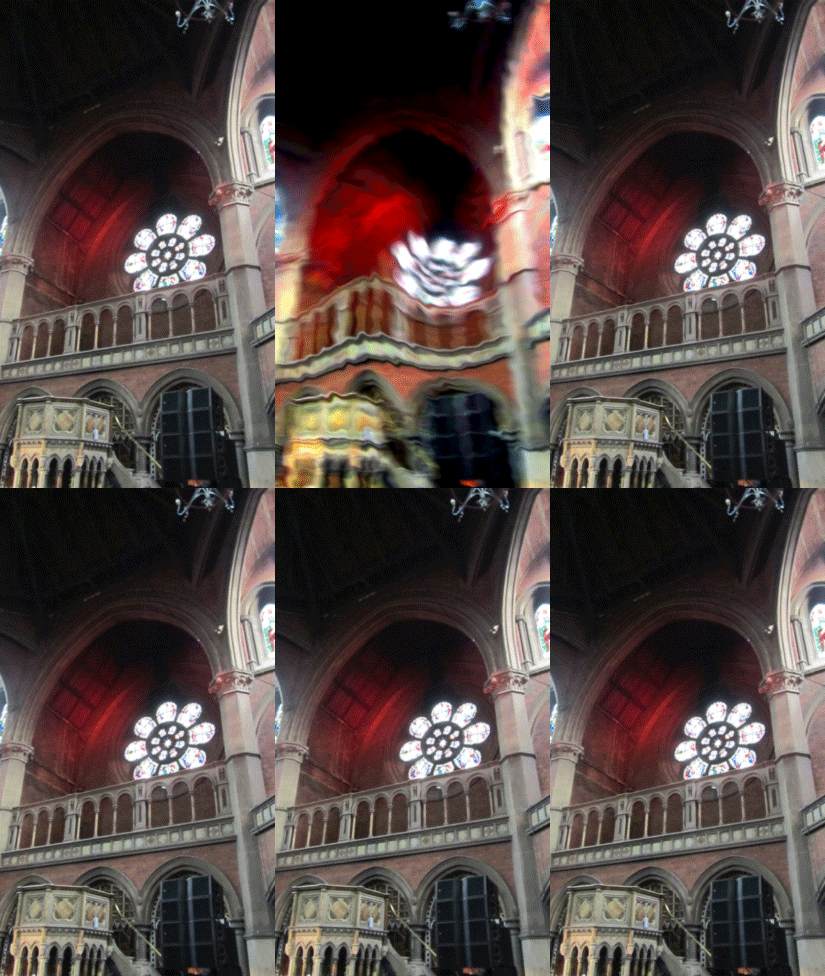
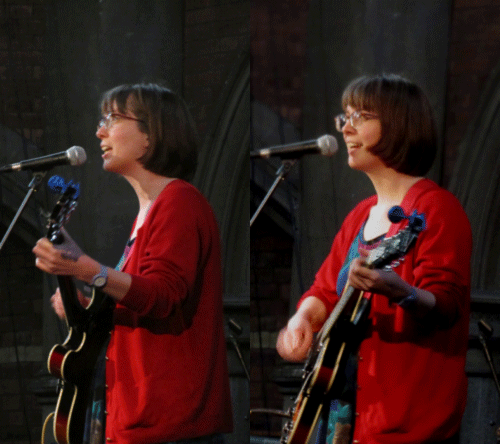
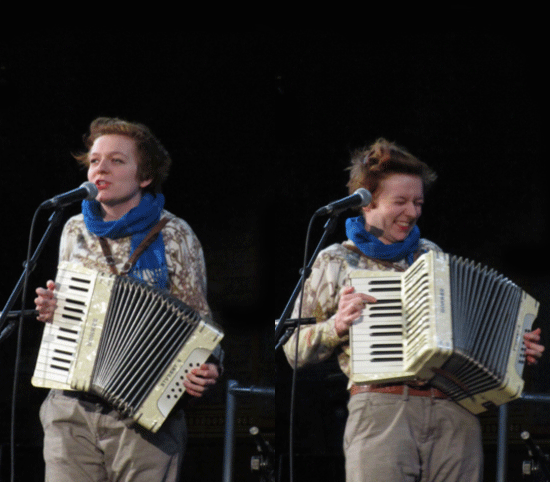
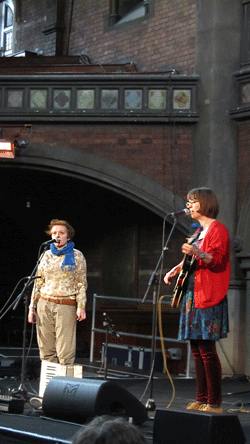
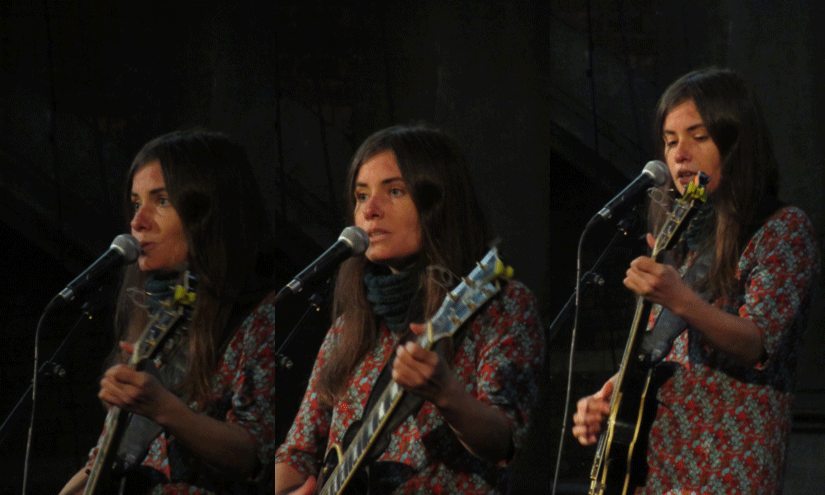
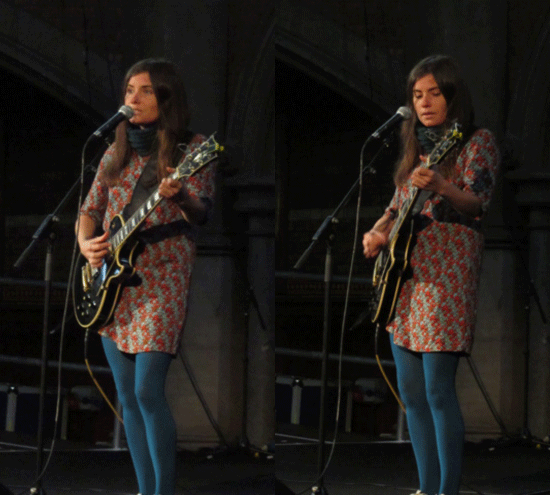
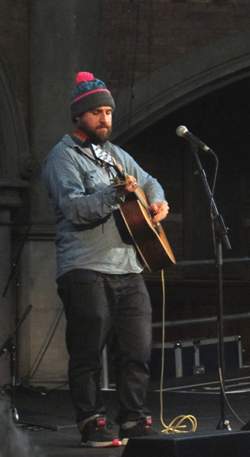
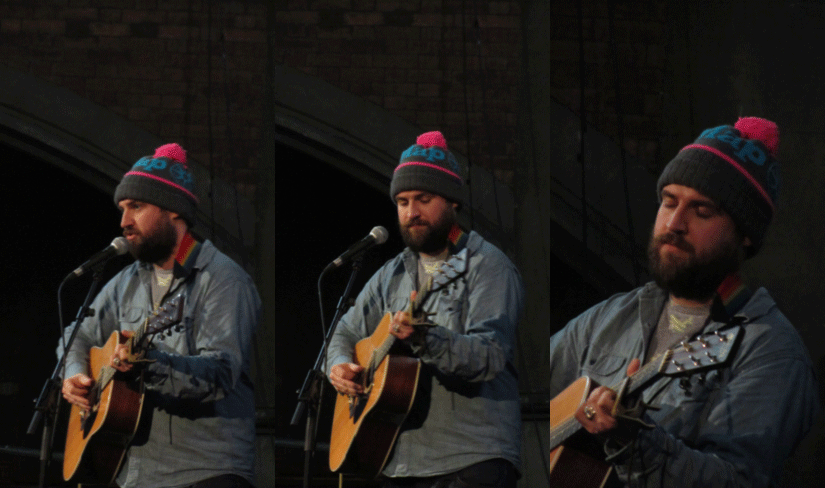
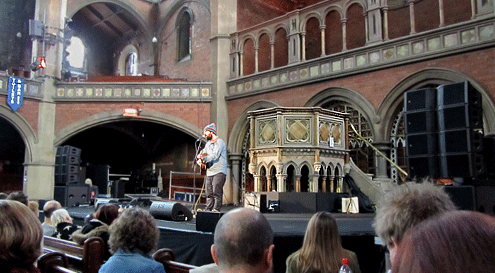






 Misfit City