Tag Archives: William D. Drake

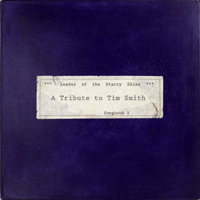
December 2010 – album reviews – Various Artists ‘Leader of the Starry Skies – A Tribute to Tim Smith – Songbook 1’ (“an unmapped musical crossroads… one of the most diverse tribute albums imaginable”)

20 Dec
Various Artists: 'Leader Of The Starry Skies – A Tribute To Tim Smith – Songbook 1'

Various Artists: ‘Leader Of The Starry Skies – A Tribute To Tim Smith – Songbook 1’

Listen. They’re singing at his bedside.

In June 2008, en route back from a My Bloody Valentine concert, the world fell in for Tim Smith. A sudden heart attack (and in immediate cruel succession, a pair of devastating strokes) failed to kill him, but only just. Now he’s in long-term recuperation, condemned to that long wait in the margins. With his damaged body now his enemy, his brain’s left to flick over the days until something – anything – gets better and his luck turns. This is a sad story. Even sadder, given that many similar stories must shuffle out of hospitals every month.

There’s an extra layer of pain here in that for over four decades Tim Smith was a dedicated, compulsive fount and facilitator of music. As the singer, composer and main player of some of the most eerily intense, unique and cryptic songs ever recorded, he sat at an unmapped musical crossroads where apparently incompatible musics met. In turn, his songs were hymnal, punky and part-classical; shot through with crashing guitars, keyboard trills and mediaeval reeds; festooned with swings and changes. They were sometimes choral, or full of martial pomp or playground squabble. They were sometimes ghostly. They were a damned ecstatic racket, or a parched and meditative whisper. With what’s now become a brutal irony they also frequently fluttered, quizzically, across the distinctions of life and death; sometimes seeing little separation between the two states, sometimes hovering somewhere in between; sometimes seeing as much meaning in the wingbeat of a stray insect as in the scrambling for human significance.

Tim’s rich and puzzled perspective on life and the weave of the world travelled out to a fervent cult following via a sprouting tree of projects – the quaking mind-mash rock of Cardiacs; the psychedelic folk of Sea Nymphs, the tumbledown explorations of Oceanland World or Spratleys Japs. In addition (and belying the manic, infantile mood-swings of his onstage persona) the man was generous of himself. Via sound production, video art or simple encouragement, his influence and peculiar energy spread from feisty indie rock bands right across to New Music performers and bedroom-studio zealots. It spread far wider than his nominally marginal status would suggest. For all of this, Smith never received adequate reward or overground recognition for these years of effort – another sting in the situation (though, having always been a stubborn goat, he’s probably dismissed it).

Yet if he’s been slender of pocket, he’s proved to be rich in love. His praises may not have been sung by the loudest of voices, but they are sung by a scrappy and vigorous mongrel choir, scattered around the houses. The Smith influence haunts cramped edit suites and backwater studios. It lingers in the scuffed shells of old ballrooms, and in the intimate acoustics of a handful of cramped Wren churches in London: it’s soaked into the battered ash-and-beer-stained sound desks of rock pubs. Most particularly, it lives in the memories of thirty years of backroom gigs where people baffled at, laughed at and finally yelled along with the giddy psychological pantomime of a Cardiacs concert; and where they lost their self-consciousness and finally stumbled away with their armour discarded.

And now, all silenced?

No.

In many cases, these same people who yelled and sang from the audience (or, onstage, from beside Tim) would go on to form bands which demonstrated that three chords and a crude truth was far too blunt a brush with which to paint a picture of the world. All of this outgoing wave of energy comes rolling back with a vengeance on ‘Leader Of The Starry Skies’. Put together by Bic Hayes (best known for galactic guitar in Levitation and Dark Star, but in his time a Cardiac) and Jo Spratley (Tim’s former foil in Spratleys Japs), it’s an album of Smith cover versions in which every penny of profit going back to raise money for Tim’s care. In effect, it’s swept up many of those people who sang along with Tim Smith over the years (all grown up now, and numbering characters as diverse as The Magic Numbers, Julianne Regan and Max Tundra) and brought them back for visiting hours.

And they sang outside his window, and they sang in the corridors; and from the ponds and rivers, from the windows of tower blocks and from lonely cottages…

Given Tim Smith’s own eclecticism, it’s hardly surprising that ‘Leader Of The Starry Skies’ is one of the most diverse tribute albums imaginable. Despite the familial feel, the musical treatments on here vary enormously. Lost broadcasts, festooned in unsettling noise, rub up against stately electric folk. Psychedelic grunge balances out colourful playschool techno. Unaccompanied Early Music recreations drift one way, while centipedal Rock-in-Opposition shapes charge off in another. None of this would work if Tim’s songs – seemingly so resistant – didn’t readily adapt. Anyone can get around the shape of a Neil Young song, a Paul McCartney song or even a Morrissey song for a tribute: but these rampant compositions with their peculiar twists are of a different, wilder order. However, every contributor has managed to embrace not only the unorthodox Smith way with a Jacob’s Ladder tumble of chords but also his dense lyrical babble, which grafts nonsense onto insight and the ancient onto the baby-raw. Everyone involved has striven to gently (or vigorously) tease the songs out of cult corner and bring them to light.

Take, for instance, what The Magic Numbers have done with A Little Man and a House. This anguished Cardiacs ode to the 9-to-5 misfit has never seemed quite so universal, slowly pulling out from one man’s chafing frustration for a panoramic view of a worldful of human cogs. (“And there’s voices inside me, they’re screaming and telling me ‘that’s the way we all go.’ / There’s thousands of people just like me all over, but that’s the way we all go.”) The original’s pained South London squawk and huffing machinery noises are replaced by Romeo Stodart’s soft American lilt, while massed weeping clouds of piano and drums summon up an exhausted twilight in the Monday suburbs. Likewise, when Steven Wilson (stepping out of Porcupine Tree for a moment) sighs his way through a marvelously intuitive and wounded solo version of Stoneage Dinosaurs, he takes Tim’s hazy memories of childhood fairgrounds and incipient loss and makes them glisten like rain on a car mirror while sounding like the saddest thing in the world. Even with Wilson’s own formidable reputation behind him, this is immediately one of the finest things he’s ever done – an eerie ripple through innocence; a sudden, stricken look of grief flitting for a moment across a child’s face.

Three of the covers have added poignancy from being connected to ends, to new beginnings, or to particular paybacks. When Oceansize abruptly split up at the peak of their powers, their final word as a band turned out to be Fear (this album’s loving cover of an obscure Spratleys Japs track). Rather than their usual muscular and careening psychedelic brain-metal, they render this song as a soft-hued exit, a fuzzed-up tangle of fairy lights which wanders hopefully down pathways as they gently peter out. Conversely, glammy Britpop anti-heroes Ultrasound set an acrimonious decade-old split behind them and reformed especially to record for this project. Their whirling clockwork version of the Cardiacs anthem Big Ship is all boxed-in and wide-eyed. It bobs along like a toy theatre while the band fire off first pain (“the tool, the tool, forever falling down / planes against the grain of the wood / for the box, for my soul / and my aching heart,”) and ultimately burst into the kind of incoherent, hymnal inclusiveness which was always a Cardiacs trademark – “All of the noise / takes me to the outside where there’s all /creations, joining in / celebrating happiness and joy; /all around the world, / on land and in the sea.” It seems to have worked for them – they sound truly renewed.

Some of Tim Smith’s songs have a strangely mediaeval tone or texture to them, and some have a twist of eerie folk music. These attract different interpretations. Foundling was once a particularly bereft and fragile Cardiacs moment: an orphaned, seasick love-song trawled up onto the beach. Accompanied by elegant touches of piano and guitar, the genteel art-rockers Stars in Battledress transform it into a heartfelt, change-ringing English bell-round. North Sea Radio Orchestra travel even further down this particular line – their bright tinkling chamber music sweeps up the hammering rock parade of March and turns it into a sprightly, blossoming cortege. Packing the tune with bells, bassoon and string quartet, they dab it with minimalism and a flourishing Purcell verve: Sharron Fortnam’s frank and childlike soprano clambers over the darker lyrics and spins them round the maypole.

Deeper into folk, Katherine Blake (of Mediaeval Baebes) and Julianne Regan (the shape-shifting frontwoman for All About Eve and Mice) each take an eerie acoustic Sea Nymphs fragment and rework it on their own. Julianne’s version of the children’s dam-building song Shaping the River adds rattling tambourine, drowsy slide guitar and a warm murmur of voice: it’s as if the faded lines of the song had washed up like a dead leaf at her feet, ready to be reconstructed at folk club. (“Pile some sticks and pile some mud and some sand. / Leave the ends wide, / three against the side, / plug the heart of flow.”) Katherine’s narcotic a-cappella version of Up in Annie’s Room might have shown up at the same concert. A world away from the pealing cathedral organ of the original, it slips away into empty space in between its gusts of eerie deadened harmonizing and Tim’s sleepy, suggestive cats-cradle of words (“Fleets catch your hair on fire. / The fleet’s all lit up – flags, flame on fire…”)

Max Tundra, in contrast, sounds very much alive and fizzing. His pranktronica version of the brutal Will Bleed Amen re-invents it as delightfully warm and loopy Zappa-tinted techno. Its abrupt air-pocketed melody opens out like a sped-up clown car: when a convoluted cone of lyrics punches his voice up and sticks it helpless to the ceiling, former Monsooon Bassoon-er Sarah Measures is on hand to provide a cool clear vocal balance, as well as to build a little open cage of woodwind at the heart of the rush. It’s a terrific reinvention, but perhaps not the album’s oddest turnaround. That would be courtesy of Rose Kemp and Rarg – one a striving indie-rock singer and blood-heir to the Steeleye Span legacy, the other the laptop-abusing keyboard player with Smokehand. Rose is a Cardiacs interpreter with previous form: this time she’s fronting a forbidding glitch-electronica version of Wind And Rains Is Cold with all of the cute reggae bounce and innocence pummeled out of it. While Rarg flattens and moves the scenery around in baleful planes, Rose delivers the nursery-rhyme lyric with a mixture of English folk stridency and icy Germanic hauteur, uncorking its elliptical menace as she does – “Now you remember, children, how blessed are the pure in heart – / want me to take ’em up and wash ’em good?… / Hide your hair, it’s waving all lazy and soft, / like meadow grass under the flood.”

While most of the musicians on ‘Leader…’ could cite Tim Smith as an influence, Andy Partridge was a influence on Tim himself, way back in his XTC days. Three-and-a-half decades later he repays the appreciation by guesting on the dusky autumnal spin which The Milk & Honey Band‘s Robert White gives to a Sea Nymphs song, Lilly White’s Party. Redolent with regret (for more innocent times, before a fall), it covers its eyes and turns away from the shadows falling across the hillside. Partridge’s deep backing vocals add an extra thrum of sympathy: “Let’s not reinvent the wheel, let’s not open that can of worms, / Let’s not say what we did, and play by ear. / Back to square one…”

The backbone of ‘Leader Of The Starry Skies’ however, comes from the contributions of former Cardiacs players reconnecting with the family songbook. As with any family over time, they’re scattered. One of the earliest members, Pete Tagg, now drums for The Trudy, who take the bucketing psychedelic charge of Day is Gone and offer a more down-to-earth spin on it for the indie disco, keeping that heady chromatic slide of chorus but adding a suspiciously blues-rock guitar solo and Melissa Jo Heathcote’s honeyed vocals. One of the more recent Cardiacs additions, Kavus Torabi, brings his band Knifeworld to the party. He hauls a particularly involved and proggy Cardiacs epic – The Stench of Honey – back through a 1970s Henry Cow filter of humpbacked rhythms, woodwind honks, baby squeaks and rattletrap percussion. Double-strength art rock, it could have been a precious step too far. Instead, it’s triumphant, its skeletal circular chamber music salad-tossed by stomping bursts and twitches of joy.

Onetime Cardiacs keyboard player William D. Drake offers a gentler, kinder tribute, taking the shanty-rhythms of Savour and spinning them out into soft Edwardiana with harmonium, ukulele and a gently bobbing piano finale. Drake’s predecessor Mark Cawthra brings an eerie sense of pain to his own cover version: back in the earliest days, he was Tim Smith’s main foil, playing lively keyboards and drums as well as sharing the bumper-car vocals. Now he sounds like the head mourner, taking on the heavy tread of Let Alone My Plastic Doll and sousing it with Vanilla Fudge-slow organ, doubled guitar solos and sigh-to-wail vocals. The twitchy, baby-logic lyrics are slowly overwhelmed by an undercurrent of grief, but the kind of grief that can only come from a older, wiser man.

Under his Mikrokosmos alias, Bic Hayes takes on Cardiacs’ biggest near-hit (Is This The Life) and subjects it to startling psychedelic noise-storms and industrial drum twirling. In the process, he shakes out and enhances its original pathos. Blown splay-limbed into a corner by a tornado of white noise, plug-in spatters and buzzing malfunctions, Bic’s voice is nasal, lost and forlorn. It sings of split and rootless identity against a wall of forbidding harmonium: “Looking so hard for a cause, and it don’t care what it is; / and never really ever seeing eye to eye / though it doesn’t really mind. / Perhaps that’s why / it never really saw.” Although Jo Spratley coos reassurance under ululations of alto feedback, Bic still ends up cowering like a damaged crane-fly under showers of distorted harpsichords and Gothic synths. Bewitchingly damaged.

The last word goes to The Scaramanga Six, the swaggering Yorkshire theatricalists who were the main beneficiaries of Smith production work before the accident. By their usual meaty standards, the Six’s take on The Alphabet Business Concern (Cardiacs’ tongue-in-cheek corporate anthem, packed to the gunwales with flowery salutes) initially seems cowed, as if flattened by dismay and sympathy at Tim’s misfortune. But it doesn’t end there. Starting tremulous and hushed, with nothing but the embers of faith to keep it up, it builds gradually from tentative acoustic guitars and hiding vocals up through a gradual build of electric instruments, feeding in and gaining strength: “and now the night of weeping shall be / the morn of song…” Over the course of the anthem the Six go from crumpled to straightened to proud cheat-beating life. By the end, the recording can hardly contain their vigorous Peter Hammill bellows, as they sweep out in a grand procession with rolling guitars, pianos and extended Cardiacs choirs. It’s a stirring, defiant finale to an album that’s done everything it could to blow away the ghosts of helplessness and to charge up not just an armful of Smith songs but, in its way, a vivid sense of Smith. He might have taken a bad, bad fall; but the humming and rustling vitality of the music, the way that it’s become a spray of vivid lively tendrils reaching far and wide, is an enormous reassurance.

Listen. He’s alive. He’s alive.

Various Artists: ‘Leader Of The Starry Skies – A Tribute To Tim Smith – Songbook 1’
Believer’s Roast, BR003 (5060243820372)
CD/vinyl/download album
Released: 13th December 2010

Buy it from:
Genepool (CD) or iTunes (download)

Tim Smith online:
Facebook

‘Leader Of The Starry Skies – A Tribute To Tim Smith – Songbook 1’ online:
Homepage Facebook

March 2003 – live reviews – North Sea Radio Orchestra @ St Clement Eastcheap, City of London, England, 15th March (“a polished Victorian never-never land of intricate miniatures and toymaker’s details”)

18 Mar

Once you’ve found it (tucked away in the cramped, confusing whorls of buildings and alleyways near the Monument) the diminutive Christopher Wren church of St Clement Eastcheap is like an old-fashioned kid’s treasure-box, hidden in a chest-of-drawers. Small but perfectly-formed (and bearing the decorous marks of its mid-Victorian refurbishment), it perches pertly between two well-known architectural schools – “enchanting” and “cute”. Tidy pillars spring up hopefully at the sides of its nave. That creamy yellow tint in the immaculate plasterwork of the walls sets off the lovingly-worn mahogany of choir stalls, pews and the massive pulpit. It’s tiny enough for a smallish art-rock audience to squeeze into and feel cosy: and there’s a nursery-rhyme connection too, if you know your oranges and your lemons.

Really, the North Sea Radio Orchestra couldn’t have picked a more appropriate venue. For the music of this retrofitted, romantic-progressive chamber ensemble, St Clements fits like a glove. It shares those hints of modestly-mingled English eras of scaled-down splendour, the atmosphere of nostalgic time travel and aan affectionate polish of traditional heritage. Once you’re inside, both of them also tempt you to blissfully engulf yourself in a luxurious dream of old England – open fields, spinneys, bright stars, sunlight and green thoughts – while all around you the ruthlessness, frenetic urban pace and concrete encroachment looms and sprawls. This may all be an imaginary, selective stance. On a superficial level, you could also get suspicious of well-spoken contemporary white musicians in London warding off angst by cooking up a hand-crafted pre-industrial daydream. But this does the NSRO a disservice. You could accuse them of forcing their innocence – and maybe yours as well – but whatever else they’re doing here is done entirely without malice.

Twenty people settle onstage and get a grip on their violas, cellos, trombones, bass clarinets or whatever. Familiar London art-rock faces abound. Conductor-composer Craig Fortnam and the ensemble’s soprano singer Sharron Saddington used to bob up and down on the fringes of the Cardiacs scene, first in the psychedelic tea-party of William D. Drake’s short-lived Lake Of Puppies and then in the bumptiously charming folk-pronk of The Shrubbies. James Larcombe (Stars In Battledress’ elegantly-tailored smoothie of a keyboard player) is soberly fingering a chamber organ. His brother and bandmate Richard is boosting the numbers in the eight-strong choir, right next to the wild Persian afro of onetime Monsoon Bassoon-er (and current Cardiac) Kavus Torabi. Out in the audience, the aforementioned Mr Drake sits next to Tim Smith, his old friend and former boss in Cardiacs. Across from them, there are various Foes and Ursas and Sidi Bou Saids. There’s a sense of occasion. We get a beautifully designed arts-and-crafts-styled programme to take home. It’s a long way from Camden pub gigs.

This isn’t solely because of the surroundings. North Sea Radio Orchestra might carry their assorted historical splinters of psychedelic rock, folk, and even punk along with them, but they are unabashedly classical in intent. Even the twistiest and most abrasive of the art-rockers in the lineup are sporting the sober concentration of churchgoers, and Sharron has traded her former outfit of cosy specs and jumpers (though not her artlessly warm smile) for a modest diva gown. Craig, his back turned, conscientiously conducts the ensemble. When he sits aside to strum a little polite guitar, he has to crane his neck round anxiously, making sure that the music is still running smoothly.

He needn’t worry. Despite the shades of complex tonality which inform the NSRO’s compositions (Frank Zappa, Benjamin Britten and Tim Smith have all left their mark on Craig’s inspiration), the music flows readily. Sometimes it’s a simple organ drone as a base for Dan Hewson’s trombone expositions. At the other end of the measure, there’s the rollicking Occasional Tables: a dancing interplay between clarinets with a gloriously drunken, attention-switching Frank Zappa/Henry Cow approach. With its mediaeval echoes, and an additional infusion of the peculiar darkness of post-Morton Feldman Californian conservatoire music, it’s given an edge by the astringent, atonal vibraphone shiver (and by Craig’s strict, almost military turn on bongos).

Intriguing as these are, it’s the NSRO’s orchestration of poems which connect deepest with the audience. Mostly these are Tennyson settings (with a sprinkling of Thomas Hardy and other contemporaries) but even Daniel Dundas Maitland’s modern Sonnet looks back to ornate Victoriana. So does Craig’s music, swirling its Early Music and contemporary classical influences together to meet halfway in a polished Victorian never-never land of intricate miniatures and toymaker’s details. Sharron’s vocals – sometimes piping, sometimes emoting in keen, theatrical wails – make for exquisitely brittle sugar-sculpture shapes, while rivulets of strings and woodwind launch themselves from the melody.

The heavenly sway of Move Eastward Happy Earth sets Sharron’s winsome soprano against the lazy, streaming clarinet of Nick Hayes and against Ben Davies’ slow waltz of trimmed-down piano. The choir (with a hearty, clever enthusiasm that reminds me of nothing so much as Gentle Giant) leaps in for stepped, skipping choruses and glorious vocal resolutions. For The Flower, drifts of strings slip from the vocal line and weave busily like something out of Schubert’s Trout Quintet. Onstage, everyone who isn’t smiling looks happily dazed, as if drunk on the sunny harmonies.

And so it continues, with parts of the NSRO dropping in and out to suit the music. For Thumb Piano, Craig trims it down to a revolving arpeggio of guitar harmonics in trio with the blues-tinged fluting of Hayes’ sweet’n’wild clarinet and Katja Mervola’s pizzicato viola. Harry Escott provides a cello improvisation, impressively-voiced chordal melodies sliding on top of a slithering bass drone. James Larcombe sketches out a collage of beady, kaleidoscopic chord progressions in his studious organ solo. The chorus, for their part, sing lustily in a London melting-pot of diverse accents. For the canon setting of Yeats’ He Wishes For The Cloths Of Heaven, the whole orchestra sings its way through Craig’s pop-folk melodies.

When the whole ensemble is running at full strength, St Clement brightens with music. Shelley’s Skylark, in particular, is profoundly ambitious – semi-connected cello lines swing like foghorns, thick Michael Byron-ish string parts disgorge dominant melodies, and the chorus is a rich blur of voices, pumping resolution into Hardy’s words. But best of all is a generous Fortnam orchestration of a piece by his former bandleader William D. Drake – a setting of William Johnson Cory’s Mimnermus In Church. With Richard Larcombe stepping out from the chorus to duet with Sharron, and the North Sea Radio Orchestra performing at its fullest stretch, the results are captivating. The voices of Sharron and Richard move around each other in dusty, reedy, yearning harmonies (he floating up to countertenor) while strings, piano, clarinets and brass open out like a delicate night-bloomer, fragrantly illustrating Cory’s salute to flawed and transient life in the face of a perfect yet chilly heaven. “All beauteous things for which we live by laws of time and space decay. / But O, the very reason why I clasp them is because they die.”

Yes, in pop culture terms it is music for an ivory tower, or for a detached oasis where you can secrete yourself away from the world. Only a mile or two to the west, I’m sure that electric guitars are roaring out rock, garage clubs are spinning off beats and bling, and someone’s delivering tonight’s definitive urban hymn. But emerging into the City of London – all higgledy-piggledy with glass skyscrapers, Renaissance guildhalls and mediaeval street names, a ragbag of congealed history in parallels – I couldn’t care less.

Like the best musicians, North Sea Radio Orchestra tap into timeless things (beauty, transient joys, the shift of seasons). But like the stubbornest, they also know the colours and shades of the times which they’ll want to employ, finding a way to make them mean something whenever and wherever they’re played. And though an antique church and a Victorian altar cloth made a beautiful frame tonight, this music – at its peak – would’ve sounded good even if the whole ensemble had been balanced atop a Docklands trash-heap.

North Sea Radio Orchestra online:
Homepage Facebook MySpace

St Clement Eastcheap online:
Homepage

December 1998 – live reviews – The Sea Nymphs @ The Falcon, Camden Town, London, 13th December (“a long curving wave of sea-songs, swimming keyboards, children’s play-rhymes”)

18 Dec

In reality, the music room at The Falcon is a tumbledown concrete box shoved out onto a bit of waste ground. Right now, though, we could easily imagine it transformed by our collective warmth, enwebbed with flowered arbors and the hum of big lovable insects.

This is good. The air’s alive with a warm, fireside excitement and the sound of a zillion Christmas triangles. Up on stage, Tim Smith has just flicked us one of his weird little opening-envelope smiles. Bill Drake – goateed and woolly-hatted, somewhere between pharoah and trainspotter – settles in behind his keyboards, half-in and out of the parallel universe he normally inhabits. Someone bleats like a sheep. Everyone laughs. Sarah Smith – unreservedly sexy and wholesome, like a fairytale milkmaid – readies her saxophone, smiles mischievously.

As they make a showing for the first time in years, The Sea Nymphs bring us the same sense of unguarded wonder that we’d get from watching some obscure and exquisite little beast uncurl itself from hibernation or hatch out of a chrysalis. There’s that, and there’s their uncanny ability to awaken the sort of love that I haven’t felt sweep through a concert for ages. We’re crammed in shoulder-to-shoulder – on any other day, we’d be the usual indie-rock cattle, and we’d feel it. This time, it feels more like being a step away from holding hands.

It’s as if we’re all buoyed up on a long curving wave of sea-songs, swimming keyboards, children’s play-rhymes; of twinkle-fingered piano, folk fragments, and pale running saxophones; plus Edward Lear, Edward Gorey, and all the other unguarded wistful subconscious flickers that may (or may not) inform The Sea Nymphs’ music. Somehow, they’re managing to remove the tarnish that’s caked onto the joy that we’ve almost forgotten: that straightforward joy at being alive. Because this is music that disarms and rebuilds somehow – it’s ducking aside from the panicky hurtle of London neurosis that’s going on outside, and taking us with it.

This may seem a woolly cop-out; as if I’m just burbling. The truth is that The Sea Nymphs, in work and in performance, seem to be offering a mystery of creation that doesn’t bear too much thinking about. Too much breakdown won’t break the spell – it will just ease you out of it, painlessly, like a splinter; into the cold again. And that’s something which you don’t want to happen. Within Sea-Nymphs-space, we’ve all found a place in which we very much want to be. We want to rest in the anchoring embrace of Tim’s warm and rounded basslines, to cotton on to how the querying melody-hop of Little Creations sounds like a baby making its very first connections. We want to enjoy the unselfconscious way Sarah rejoices in striking a gong, as if she was dusting a clock.

As the tipsy near-waltzes sway around the air, as Tim, Sarah and Bill’s voices twine and alternate (from naked and frayed harmonies to scratchy yelps, to impossibly sweet helium coos) we’re given the opportunity to pig out on a different kind of instinct than that triggered off by the standard lash of rebellious rock noise. There’s something baptismal in that sound – the little lilts of Shaping The River, the cries of “sponge me clean again” vaulting over a chunky acoustic strum. Maybe it’s something to do with a natural, maternal comfort. The key line of Blind In Gaiety And Leafy In Love is “she smells just like you and she smells just like me”, while Appealing To Venus stretches out a begging hand to an absent goddess, pleading “dwell among the people. / Come back to us, we need you.”

Maybe – behind the celebratory music and those rosettes of voice and exhilarated sax, lofting toward the ceiling – the vulnerable flutter at the heart of it all is the fears. Fears at the treacherous terrain of potential fuck-ups and traps, opening up like a dirty promise before newborns as they begin their blundering pilgrimages onward from birth through a childhood and adulthood of busts and confusions. “Back to square one… / large as life and twice as natural… / Let’s not reinvent the wheel; open that can of worms…”

Still. Here and now Sea Nymphs restore our openness – our willingness to ride our curiosity. For a brief time, at least, it becomes our strength again; and when, in Mr Drake’s Big Heart, the band tell us “something’s going to happen today”, we all feel as if we’re a part of it. After tonight, at the very least, we’ll have been able to say that we were together for a while, and it was good.

The Sea Nymphs online:
Homepage MySpace

The Falcon, Camden online:
Homepage

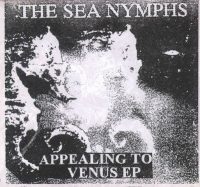
June 1998 – EP reviews – The Sea Nymphs’ ‘Appealing to Venus’ (“quivering, shipwrecked dreams and prayers”)

3 Jun
The Sea Nymphs: 'Appealing to Venus' EP

The Sea Nymphs: ‘Appealing to Venus’ EP

There’s something about the ‘Appealing to Venus’ EP which sounds incredibly ancient. Not dated, as such – for all its leanings towards progginess, it’s nothing passe or stilted, and any awkwardness is an integral part of the charm. No, it’s the murky timelessness and pre-tech fragility of the songs. It’s music in the trembling, bewildered nude; emerging from its shell of strength to blink in the light. To voice, in a halting manner, its own concerns, as the bright lights and brash neon of the pop scene whirl around it, uncomprehending.

Not that it’s come from nowhere. The Sea Nymphs are an (almost) acoustic alter-ego for the manically electric and intense Cardiacs: a mass of scrawny acoustic guitars, ‘Rock Bottom’ harmoniums, mellotrons and melodicas, baroque Black Death keyboards, crumhorn saxes and touchingly scratchy singing. Cardiacs’ convoluted songs have always had threads of Early Music woven into them. With The Sea Nymphs, we get to wind back along those threads and see where they lead.

 
These four tracks (salvaged from the Nymphs’ criminally ignored debut album) exorcise, or exercise, Cardiacs’ curiosity about pre-pop. You can hear old folk melodies seeping into Low Church music, shreds of sea-shanties and work-song, ramshackle European fragments existing independently of the blues or classical traditions… the bits that pop forgot, in other words. Though compared to, say, Dead Can Dance’s lordly, haughty take on Early Music, The Sea Nymphs sound as if they’ve crawled their ungainly way out of a Vincent Ward peasant odyssey of quivering, shipwrecked dreams and prayers.

 
Listening to the reedy, march-y slog of careening organs, plodding piano and parping synth on the title track, you hear a heartbreakingly wistful devotion. In the giant cathedral boom of Up in Annie’s Room, string synths smear the shuddering air around Tim’s cracked, lost, voice, swallowing it up in a churchy swamp of sound. He sounds as if he’s trying to outshout a God who’s cold and indifference to his vulnerable defiance. The mediaeval shawm-sneeze of God’s Box – fifty people on comb, paper and bells – seems lighter, The Sea Nymphs – flotsam and jetsam but its skipping ward against evil (“God’s good, the Devil is bad – he always gives me money,”) sounds ambiguous in Sarah’s blank, gauzy, little-girl vocals. “Never Setting Things on Fire, / never bad,” she sings, as if considering her options.

 
It’s left to the exquisite Shaping the River (in which a lilting falsetto choir sways, shanty-like, behind watery spangles of piano) to bring us something to warm our bared hearts. A work-song, something shared; a relationship with nature even as you alter it: “River in the middle of / Nowhere / Three of us suck on its heart, / and its head. / …Plant the heart, all from the heart / … only in the heart.”

 
The skeletal bonus tracks – lifted from even older tapes by Mr & Mrs Smith & Mr Drake (the prototype Nymphs) – pull us further into blurry pasts. There’s Bill’s gentle, bemused Camouflage, a twelve-tone sprig on Syd Barrett’s nursery-rhyme legacy. The meandering but intensely purposeful tone poem Little Creations clambers like a drunken squirrel from branch to branch, complete with manuscript rustling and equipment fumbling. Hymn rounds everything off; a live bootleg of Tim blinking over an austere organ sound, a pagan taking his first faltering steps into the chapel. These songs, too, have that unnervingly ancient-but-ageless quality; the same indefinable, painful, yet suspect innocence that haunts the songs of Robert Wyatt or Elizabeth Fraser.

 
Which all means that The Sea Nymphs are both as frail and damp as a newborn, and as old as the hills. Just listening to them pulls you back that much closer to the original greenwood, little shoots cracking their way out of your hidden memories.

The Sea Nymphs: ‘Appealing to Venus’
Org Records Ltd., ORGAN 044CD (5 028151 010445)
CD-only EP
Released:
1st June 1998
Get it from: (2020 update) Original EP best obtained second-hand. Appealing to Venus, God’s Box, Up in Annie’sRoom and Shaping the River all appear on the eponymous debut album by The Sea Nymphs (available as a download from The Alphabet Business Concern), while Little Creations and Camouflage appear on the lone eponymous album by Mr & Mrs Smith and Mr Drake. Hymn is in fact a Cardiacs song used as an early 1980s set closer: the version here was recorded at the 1984 Stonehenge Free Festival and appears nowhere else apart from on bootlegs.
The Sea Nymphs (Cardiacs) online:
Homepage Facebook MySpace Soundcloud Bandcamp Last FM Apple Music YouTube Amazon Music
 

September 1995 – live reviews – Organ Night: Lake of Puppies + The Monsoon Bassoon + Fear of Fear @ The Monarch, Chalk Farm, London, 19th September (“music to spin the brain like a top”)

24 Sep

Just across the road, the great decaying wheel of the Roundhouse is housing Cirque Surreal and Wakeman with Wakeman. Over here, in the less salubrious surroundings of the Monarch, a collection of various punks, proggies and other wonderful low-lifers (including myself) are cramped together to check out some rather lower-profile musicians. Somehow, I think we’ve got the better deal.

This is ‘Organ’ Night, so we’re guaranteed a rich feast of music from all directions, as exemplified by opening act Fear of Fear, whose Metallica-meets-PJ-Harvey take on the punk/funk thing is tight and excellent. But judging by the overwhelming number of Alphabet Business Concern T-shirts filling the room, plus Bic Hayes hanging around near the bar, it’s a pretty safe bet that tonight is going to have a strong Cardiacs flavour. And yes, those unjustifiably obscure prog/punk/music-hall eccentrics do have a lot to answer for as regards the shape of this evening. Some of the seeds they’ve sown during their lunatic nine-album career are springing up with a vengeance in this little Camden pub.

The Monsoon Bassoon are a real brain-skewing treat, and a demanding one. Their music has those Cardiacs components of mind-boggling tempo changes, raucous crashing melodies and cheerful gibberish in Cockney/Estuarine English (although they’re originally from Plymouth, so my ear must be out of tune). The War Between Banality and Interest is a fine example, a Cardiacs-type tossed rhythmic salad so perkily crazed that it makes ‘Larks’-period King Crimson sound like James Last. Aside from Cardiacs and King Crimson, The Monsoon Bassoon show an affinity with the wilder American side of things: the “anything goes” spirit of Captain Beefheart and (to pick a more recent example) Mercury Rev. The double voice-and-guitar team of Kavus and Dan, Sarah’s voice, flute and clarinet, and the rhythm section of Laurie and Jim offer us song titles to die for and music to spin the brain like a top.

How is it that they can play songs so insanely complex yet so insanely catchy? Five hundred hooks and time changes in each four-minute burst, it seems. And how can they play it with such unflappable cheerfulness, Kavus in particular finding the time for some Who-style scissor jumps? Forget it… just stand back and have your mind tickled… Oh, comparisons? well, if I must…

Some simplified examples: Bullfight in a China Shop is a stretchy boogie in 5/4 with Mercury Rev flute, Leyline PLA is like a crunchy thrashy Schizoid Man played by an unholy alliance of The Buzzcocks and Ian Anderson with the odd lick of harmonised Queen guitar. Bright Lucifer goes from a cataclysmic snare-roll opening to Cardiacs-meets-‘Thrak’ mayhem, while Aladdin mates Frame by Frame with Living in the Past. Tokmeh has elements of that wandering Frippy gamelan sound of the ’80s, but ends up as the sound of five instruments dancing separate dances to a common end – a freaky fugue. And that’s where The Monsoon Bassoon are at. A pure, wild, Dionysiac musicality with a roguish five-fold intelligence kicking it into gear: hung up on no scene, naturally sparking and kinking. Let them into your life and watch your world take on brighter, loopier colours.

Headlines Lake of Puppies have a more direct link to Cardiacs – they’re led by William D. Drake, who was formerly Cardiacs’ keyboard player, And yes, it does show – although the anarchic musical mayhem which is one of the central Cardiacs characteristics is absent here, Drake’s new band share that specifically English eccentricity. In fact, they take it down a few notches and on a few steps. If Cardiacs’ Tim Smith is the intense, slightly scary motormouth maniac on the rural bus, Bill is his refined elder cousin who restricts his own lunacy to deranged sessions on the tennis court. Lake of Puppies are like Cardiacs exhuming the ghost of Noel Coward for tea on the lawn: all summery waltzes, genteel harmonies from Bill and from singing bassist Sharron, easy-going nylon-string guitar (from Craig) and the cosy burr of baritone sax and clarinet. Kevin Ayers could get a mention on the influences list, as could the Kate Bush of Coffee Homeground.

All of this is not as harmlessly cuddly as it sounds. Although the lyrics are difficult to make out amidst the weaving melodies, I get the impression that Lake of Puppies are singing about trickier subjects than crustless sandwiches. There’s the occasional burst of noise when Bill abandons his piano for fuzzy organ and the band launch into gutsy cyclonic roaring, and the music is just too complex and cerebral to be entirely cosy. But in the prog environment of today – where bands tend to be either sickly, prissy and pompous or thrashily confrontational and noisy – Lake of Puppies stick out as a sunnily listenable and enjoyable alternative. And I wouldn’t be surprised if all of that gentility was a Trojan horse for something gloriously warped… definitely one to check out again.

Keep it up, ‘Organ’!

Lake of Puppies online:
Homepage Facebook Last FM

The Monsoon Bassoon online:
MySpace Soundcloud Last FM YouTube Spotify Amazon Music

Fear of Fear online:
(no online presence)

Additional notes: (2020 update) Lake of Puppies didn’t last very long, with various bandmembers going on to The Shrubbies, North Sea Radio Orchestra and Quickspace while William D. Drake eventually started a solo career. There have been a couple of Lake of Puppies concert reunions over the years, with the latest one being at 2018’s ‘Spring Symposium‘. The Monsoon Bassoon lasted until 2001, with Kavus Torabi moving on to a multitude of projects including Knifeworld, Guapo, Cardiacs, Gong, The Utopia Strong and a solo career, while Laurie Osborne moved into dubstep with Appleblim. Daniel Chudley Le Corre also has an intermittent solo career. Several former Monsoon Bassoon members occasionally reunite in sea-shanty band Admirals Hard. I have no idea what happened to Fear of Fear.
 

SWOONAGE

Swoon. /swo͞on/ A verb. To be emotionally affected by someone or something that one admires; become ecstatic. Here are some people and things that make me swoon. #swoon #swoonage

Post-Punk Monk

Searching for divinity in records from '78-'85 or so…

theartyassassin

...wandering through music...

Get In Her Ears

Promoting and Supporting Women in Music

Die or D.I.Y.?

...wandering through music...

Music Aficionado

Quality articles about the golden age of music

THE ACTIVE LISTENER

...wandering through music...

Planet Hugill

...wandering through music...

Listening to Ladies

...wandering through music...

ATTN:Magazine

Not from concentrate.

Xposed Club

improvised/experimental/music

The Quietus

...wandering through music...

I Quite Like Gigs

Music Reviews, music thoughts and musical wonderings

furia log

...wandering through music...

The Recoup

SINCE 2013: Books and books and books and books and occasionally other things

A jumped-up pantry boy

To say the least, oh truly disappointed

PROOF POSITIVE

A new semi-regular gig in London

Gapplegate Classical-Modern Music Review

...wandering through music...

When The Horn Blows

...wandering through music...

:::::::::::: Ekho :::::::::::: Women in Sonic Art

Celebrating the Work of Women within Sonic Art: an expanding archive promoting equality in the sonic field

Ned Raggett Ponders It All

Just another WordPress.com weblog

FLIPSIDE REVIEWS

...wandering through music...

Headphone Commute

honest words on honest music

The One-Liner Miner

...wandering through music...

Yeah I Know It Sucks

an absurdist review blog

Obat Kanker Payudara Ginseng RH 2

...wandering through music...

poplifer.wordpress.com/

Waiting for the gift of sound and vision

Good Music Speaks

A music blog written by Rich Brown

Do The Math

...wandering through music...

Archived Music Press

Scans from the Melody Maker and N.M.E. circa 1987-1996

The World's Worst Records

...wandering through music...

Soundscapes

...wandering through music...

OLD SCHOOL RECORD REVIEW

Where You Are Always Wrong

FRIDAY NIGHT BOYS

...wandering through music...

Fragile or Possibly Extinct

Life Outside the Womb

a closer listen

a home for instrumental and experimental music

...wandering through music...

Life Just Bounces

...wandering through music...

Lucid Culture

JAZZ, CLASSICAL MUSIC AND THE ARTS IN NEW YORK CITY

Aquarium Drunkard

...wandering through music...

eyesplinters

Just another WordPress.com site

NewFrontEars

...wandering through music...

FormerConformer

Striving for Difference