I can tell I’ve not kept my eye on the ball – nothing makes a person feel less alert than suddenly finding that three of his favourite musical projects (plus one new recent favourite and one older interest) are suddenly pouncing out new releases and. I step out for a moment, for another writing project, and someone moves all of the furniture around.
The Duke Of Norfolk: ‘A Revolutionary Waltz’
So… let’s start with news of fresh work from The Duke of Norfolk, a.k.a transplanted Oklahoman folkie Adam Howard, now resident in Edinburgh. He’s currently offering a free single – A Revolutionary Waltz – in part-promotion, commenting “I am launching a Kickstarter project in two weeks to fund the making of a live video EP, and would like to give you this recording in the meantime. It’s just a wee sonic experiment, but I hope you enjoy it!”
If you’re wondering whether there’s a Scottish Nationalist tie-in here, given recent political events in Britain, Adam’s adopted hometown, and that beautifully sympathetic and country-tinged setting of Robbie Burns’ Ae Fond Kiss on which he duets with Neighbour, think otherwise. In fact, this song is a darker cousin to An Evening Waltz (from his 2013 album ‘Le Monde Tourne Toujours’): a foreboding meditation on the inexorable turn of fate’s wheel, tying together three histories of power, betrayal and fall. Despite its timeless trad-folk lyric, Adam’s busking roots (and the lusciously acoustic sound of much of his other material) it’s also a rough-and-ready take on digital folk, either demo-rough or intended to display Adam’s other roots in sound design. A clipped electrophonic waltz picks its way across a murky psychedelic smudge and a droning feedback pibroch: its characters sea-waltz to the grim, dry beat of a hand drum and a scattering of cowrie-shell percussion. It’s well worth a listen. As for progress on the Duke Of Norfolk video Kickstarter campaign, it’s probably best to keep tabs on his Facebook page.
Cardiacs: ‘Guns’
Following the success of their double vinyl LP reissue of 1995’s ‘Sing To God‘ album, Cardiacs are doing the same with its 1999 follow-up, ‘Guns’. While it’s not the magnificent sprawler that ‘Sing To God’ is, ‘Guns’ offers a more concise take on the pepper-sharp 1990s Cardiacs quartet that featured Bob Leith and gonzo guitarist Jon Poole alongside the band-brothers core of Tim and Jim Smith. As Cardiacs albums go it’s an even brasher beast than usual, hiding its gnarly depths under brass-balled upfront confidence and strong seasonings of glam-bang, pell-mell punk, whirring Krautrock, and jags of heavy metal looning.
‘Guns’ is also one of the most obscure Cardiacs works. Drummer Bob joined Tim on lyric duties, helping to turn the album’s words into a dense hedge-witch thicket of allusion and play, in which typically naked Cardiacs preoccupations (dirt, wartime, suspicion, indeterminate life and death) are tied up into an almost impenetrable web, driven along by the music’s eight-legged gallop. The fact that Tim and Bob were slipping in random borrowings from ‘English As She Is Spoke‘, a notoriously bungled Victorian phrasebook with its own wonky and unintentional poetry, only added to the tangle.
You can pre-order the ‘Guns’ reissue here for end-of-June shipping. It’s a single vinyl record, with no extra thrills or treats, but does come with the promise of beautiful packaging and pressing. You can expect to hear news on more Cardiacs reissues over the next few years. The current plan is to reissue the band’s whole back catalogue on vinyl after years of exile (predominantly spent huddled exclusively on iTunes).
Meanwhile, see below for a taste of ‘Guns’ magnificent oddness. Here’s the grinding drive of Spell With A Shell (which encompasses the lives of pets, the terror and wonder of transformation, and the cruelty, loneliness and confused loyalties of childhood). Here’s a collision of outsider folk and reggae in Wind And Rains Is Cold (via a fan video of clips from ‘Night Of The Hunter’, from which Cardiacs frequently filch scraps of lyric). Finally, here’s the scavenged, scratchy prog of Junior Is A Jitterbug with its prolonged and celebrated unravelling coda.
Cardiacs: ‘Day Is Gone’
For those without turntables, there’s been a relatively recent CD reissue of Cardiacs’ 1991 EP ‘Day Is Gone’ – which I somehow managed to miss when it was first announced – and which includes the original three B-sides (No Bright Side, Ideal and concert favourite Joining The Plankton). This is from the pre-‘Sing To God’ lineup: another quartet but with Dominic Luckman on drums and, ostensibly, Bic Hayes on second guitar (prior to his explosive stints in Levitation and Dark Star, and to his current position etching dark psychedelic guitar shadings in ZOFFF).
Actually, since this was a time of shuffle and change in the band it’s unclear as to whether Bic or Jon Poole is providing the extra galactic bangs and shimmerings on the EP. However, for Day Is Gone itself the attention should be on Tim Smith’s grand bottle-rocket of a solo, capping what’s both one of Cardiacs’ most autumnal songs and one of their most headrushing cosmic efforts – a bout of November skygazing gone bright and vivid. See below for the original video in all of its low-budget saucer-eyed glory, and pick up the CD here.
Cardiacs: ‘Heaven Born And Ever Bright’
Note also that a couple of other early-‘90s Cardiacs recordings have made it back on CD in the past six months. ‘Heaven Born And Ever Bright’ (the parent album for Day Is Gone) shows Cardiacs at their brightest and bashing-est, but hiding a wounded heart. ‘All That Glitters Is A Mares Nest’ – the recording of a raucous 1990 septet concert at the Salisbury Arts Centre – was both the last hurrah of the 1980s lineup (with carousel keyboards, saxophone and half-a-scrapyard’s-worth of percussion rig) and, for my money, is also one of the greatest live rock recordings ever made. See if you agree.
Cardiacs: ‘All That Glitters Is A Mares Nest’ (2014 reissue)
‘Mares Nest’ also made a welcome resurfacing on DVD a couple of years ago – see below for a typically quaking example of the band in action. It’s also worth repeating that all of the profits from the recording sales continue to go towards palliative care and physical therapy for Tim Smith, who’s still engaged in the slow painful recovery from his crippling stroke of 2008.
Knifeworld: ‘Home Of The Newly Departed’
Meanwhile, Knifeworld – who feature an ex-Cardiac and, while being very much their own eclectic and tuneful proposition, carry a certain continuation of the Cardiacs spirit along with them – have collated early, interim and now-unavailable tracks onto a full-length album, ‘Home Of The Newly Departed’. The seven tracks (dating from between 2009 and 2012) bridge the space between their ‘Buried Alone: Tales of Crushing Defeat’ debut and last year’s tour-de-force ‘The Unravelling’.
If you want to read my thoughts on the original releases, visit the original ‘Misfit City’ reviews of the ‘Dear Lord, No Deal’ and ‘Clairvoyant Fortnight’ EPs from which six of the tracks are taken. (I’ve just had a look back myself and discovered that I’ve previously described them as a band who could drag up exultation with their very fingernails, as starchildren weighed down by dark matter, as possessing “a knack of dissecting difficult feelings via swirling psychedelic sleight-of-hand” and as “an almighty and skilful art-rock mashup, with horns and bassoons poking out of it every which-way and strangely kinking, spiraling spines of rhythm and harmony locking it all together.” I must have been pretty excitable, on each occasion.)
Alternatively, have a look at the videos below. Also, if you’re in England during the end of May, the band (in full eight-person glory) are out on a short tour featuring the debut of new music.
Tim Bowness: ‘Stupid Things That Mean The World’
With his erstwhile/ongoing no-man bandmate Steven Wilson going from strength to strength as a solo act, Tim Bowness also continues to concentrate on work under his own name – sleek, melancholy art-pop with a very English restraint, fired with a desperate passion and shaded with subtleties and regrets. His third album, ‘Stupid Things That Mean The World’, is due for release on July 17th; barely a year after his last effort ‘Abandoned Dancehall Dreams’ (one of my own favourite records of 2014).
If it ain’t broke, don’t fix it. ‘Stupid Things That Mean The World’ features the ‘Abandoned…’ core band of Tim plus his usual cohorts Michael Bearpark, Stephen Bennett, and Andrew Booker, and on spec sounds as if it’ll be a smooth progression and development from the previous album. It also features guest showings from three generations of art rock (Phil Manzanera and Peter Hammill; David Rhodes and Pat Mastelotto; Colin Edwin, Bruce Soord, Anna Phoebe and Rhys Marsh) and string arrangements by art-rock-friendly composer Andrew Keeling.
Expect a typically Burning Shed-ish range of format options: the double CD mediabook edition (with companion disc of alternate mixes and demos including an unreleased no-man demo from 1994), and LP versions in either black vinyl or transparent vinyl (CDs included with each). Pre-ordering gets you a downloadable FLAC version of the 5.1 mix, plus the usual cute postcard. Sorry – I have no early tasters for ‘Stupid Things…’, but here’s a taste of one of the slower, lusher tracks from ‘Abandoned Dancehall Dreams’ for the benefit of anyone who missed it last year.
Earlier on, while discussing Cardiacs, I briefly mentioned Bic Hayes and his time in Levitation. For those of you who are unfamiliar with them – or who weren’t around in early ’90s Britain to witness their brief, Roman candle of a run – they were a band who eagerly fused together an enormous sound, leashing and running with a frenzied and energized take on psychedelic rock, driving post-punk noise and earnest, distressed chanting from their singer, the former House of Love guitar star Terry Bickers. Sadly, they’ve become best known as the springboard by which Terry catapulted himself first into frontmanhood, then into the uncharted and finally (via some tortured decisions and unfortunate outbursts) into the obscure.
In truth, Levitation were an equal conspiracy of five. As well as Terry and Bic, there was Robert White (a baby-faced free-festival veteran and secret-weapon multi-instrumentalist, who’d later lead The Milk & Honey Band), an undersung alt.rock bass hero called Laurence O’Keefe and David Francolini, an astounding and slightly demonic drummer who could run the gamut from pattering rain to pneumatic drill in a single roll round his kit (and who, within Levitation, had the perfect opportunity to do so). Fuelled equally by inspiration, drugs and sheer hard work, they strived for three intense years while living on the outside of their skins, and briefly came close to making some very unfashionable sounds current again.
While they were certainly a “head” band – hippy punks who joined floating threads of British counter-culture, spontaneity and resistance together – it’s vital to remember that Levitation were never your average festival band. They were never complacent, never entitled. More Yippie than trustafarian, they seemed (Bickers, in particular) to be desperately chasing revelations just over the rim of the horizon. Their ethos and experience was best summed up – or, more accurately, caught in a passing flare – in a lyric from their song Against Nature ), with Terry choking out “there is an answer, but I’ve yet to find out where” over a raging foam of guitars. Fingers (and not a few minds) got scorched along the way. In May 1993, it culminated in Terry’s wracked, brutal self-ejection from the band – in a spurt of slogans and despair – during a concert at the Tufnell Park Dome, just a short walk from Misfit City’s current home.
There have been some reconcilations since then (not least Bic, David and Laurence reuniting in the wonderful but equally short-lived Dark Star five years afterwards) but there have been no reunion, and no-one has ever seemed to want to go back. However, on Monday this week – Record Store Day 2015 – the Flashback label released the first Levitation music for twenty years – ‘Never Odd Or Even’, a vinyl-only EP containing three tracks from the band’s lost 1992 album ‘Meanwhile Gardens’ (these being Never Odd Or Even, Greymouth and Life Going Faster). More information is here, although if you want to pick up one of the five hundred copies you’d better find your nearest participating British record store here: they might have some left. (There’s an earlier version of the title track below, in perhaps a rawer form.)
I’ve described ‘Meanwhile Gardens’ as a lost album, which isn’t strictly true. Although the record was recorded prior to Terry’s explosive departure, there was life after Bickers, For just over a year, singer Steve Ludwin took on the frontman role; during this time the band took it upon themselves to partially re-work the album with Ludwin’s vocals rolled out firmly over Terry’s. The resulting version of ‘Meanwhile Gardens’ was only released briefly in Australia. Following the split of the Ludwin lineup and the final end of the band, it’s always been regarded (rightly or wrongly) as something of a bastard appendix to the Bickers-era albums.
The happier news is that, following up ‘Never Odd Or Even’, Flashback are about to give ‘Meanwhile Gardens’ its own new lease of life with the active collaboration of the original lineup (including Terry Bickers). The album’s original vocals have been restored, the songs polished to satisfaction and a final tracklisting agreed upon. Although former album tracks Graymouth and Life Going Faster have been ceded to the ‘Never Odd…’ EP, the 2015 version of ‘Meanwhile Gardens’ keeps four of the tracks familiar from the Ludwin version (Food For Powder, Gardens Overflowing, Even When Your Eyes Are Open and the vaulting soar of King of Mice) and adds five songs previously only available via bootlegs (Bodiless, Imagine The Sharks, Evergreen, I Believe, Burrows and Sacred Lover). Apparently, it’ll be out sometime in “summer 2015” as a single CD and limited-edition double LP, each coming with gatefold sleeve and new artwork by original Levitation cover artist Cally.
It’s probably best to keep track of progress on the ‘Meanwhile Gardens’ release here; but meanwhile here’s the Bickers version of Even When Your Eyes Are Open (the last single the band released before he quit) and a bootleg-sourced version of the startling post-psychedelic stretchout Burrows – just to whet the appetite.
You must have heard this one before. Alan Moore’s told a version, so has Groucho Marx. So have many others as the tale creeps down the years, gathering new clothes to wrap its bones in. Here’s another version.
One afternoon a doctor receives an unexpected patient – a middle-aged man, cheeks slack and jaw unshaven, creeping shyly into the consulting room where he sits, quivering, on the chair. His shoulders are hunched as if expecting a blow to fall. He wrings his battered hat in his hands and stammers that his world is imploding, that he feels that he cannot face a cruel present and uncertain future; that his body and mind are suffering and he doesn’t think that he can go on. The doctor is tempted to say “cheer up, it may never happen,” but restrains himself. It’s not purely out of professionalism – there’s something in his visitor’s muddy eyes that suggests that such flippancy would be more than cruel. Then the doctor has an idea. He puts on his most comforting, most reasonable voice. “What you need, my friend, is laughter. Here, I know the very thing for you. The great clown Grock is playing in town tonight – go and buy a ticket. He will make you forget your worries and your terrors.” The man says nothing for a moment, then, as he rises to leave, his eyes fill with terrible wounded tears. “But Doctor,” he stammers. “I am Grock…”
Chewing over this old chestnut has put me in mind of Knifeworld’s leader Kavus Torabi – a musician who’s spent years stuck fast in the guts of cult appeal but who’s suddenly starting to look a little ubiquitous. Steps upward via bigger cult bands (to Gong via Cardiacs and Mediaeval Babes) have helped him here. So, too, have his vigorous radio-show hostings and his eccentric, affectionate charm, belatedly recognised by a horde of magazines and webzines. So too, the frequency with which his lanky frame, explosive hairdo and glowing enthusiasm rock up at and around London gigs. By now, he’s well on his way to becoming a public personality – a vivacious, goofy, black-dandelion star with an infectious grin and throaty chuckle, whose career (to a new fan) would seem to have burst upwards in a series of random turns and innocent accidents.
The flipside of this is that he’s become something of a beloved clown, and it could have sunk him. Flying in the face of anxious rock pomposity and its accelerated quest for significance, Kavus openly refers to his work as “funny-music”. For two decades, on-and-off, he’s been releasing swarms of supercharged tatterdemalion art-rock songs (in which Canterbury whim grapples with Chicago nerve while spinning cogs of power-pop, psychedelia, prog and folk joust with reed-crammed avant-garde blares and slamming flashes of heavy metal) and ices this wild cake with baroque psychedelic imagery turned into a daffy, tongue-in-cheek juggling act. Upfront and loveable, Kavus will always bring accessibility and charm to the musical tumult behind him; but his oddball image has sometimes resisted and obscured deeper engagement. There’s a risk that his growing audience won’t grow with him; that when they listen to the ornate, shaggy-lantern rock of Knifeworld’s 2009 debut album ‘Buried Alone…‘ they might hear only its knotty playfulness, its busy collisions. While revelling in Knifeworld’s bird-flipping refusals to be either meat-and-potatoes rock or polished narcissistic artfulness, they’ll miss the emotive depths which wind beneath the band’s fairground-dazzle surface. Instead, they’ll be demanding constant cheery Kavus looning while they augur their own vague Phineas Freakears rebellions from the flyaway whorls in his barnet.
All in all, ‘The Unravelling’ – with its crucial shift in tone and weight – has arrived right on time. Kavus’ funny-music mask needs to crack. His entertainer face needs to blanch a little. He can’t remain the cute bastard child of Daevid Allen and Tom Baker forever.
That said, there’s little to suggest that Knifeworld’s second album is a calculated attempt at growing up, or at brushing away frivolity. Neither is it a “poor-me” album of mid-life crises or bleats about B-list fame. (Nor, in case you were worrying, are there any arch, camped-up traces of sad clown.) Instead, ‘The Unravelling’ seems to have formed out of sheer necessity. Its aches, fears and stalking black dogs have been cast out into the open by compulsive honesty and irresistible pressure. While undercurrents of darkness have snaked through the band’s colourful fantasias before, they’ve always been couched in fragmented word-games and arcane disguises – late-night fears sprouted a psychedelic froth of in-jokes, and tales of betrayal and shortfalls would spread and mutate into Ancient Mariner epics. Kavus was constantly hedging his bets; hanging little baubles of angst and honesty in his jagged, branching tunes like Christmas decorations. No more. Finally, he’s stopped the tease, stopped the sleight-of-hand and the fucking fan-dance.
What he’s revealing now is engaging, intimate and entirely human. At times, it’s heartbreaking. “My friends call out to me, / but I’m not home too many times,” he confides, on the very first song, swelling to a sudden pitch of raw hurt. “So some escaped or reproduced and some just fell apart. / Why? / Why did you grow those teeth in your heart?” At its roots, ‘The Unravelling’ is about love and vulnerability. It’s about feeling naked and thin-skinned at the mercy of dreadful forces of fate and irrationality, of memory and error. In its most reflective moments, it’s about the painful process of accepting the wounds. “Every passing year,” laments Kavus. “I feel those icy fingers poking me.”
Perversely, he’s singing about this while fortified by his biggest, most accomplished band yet. The current Knifeworld lineup is a solid brass-and-reeds-bolstered eight-piece – capable of fierce King Crimson snarls, elastic Shudder To Think bounds, sidesteps into complex harmonic spaghetti (a la Henry Cow) and rapid shifts of time signature or dynamic, but also possessing the immediate poise of a finely-honed pop band. Where on spec they ought to sprawl, they’re actually dead on-point. That extra cannonade of saxophones and Emmett Elvin’s wandering, watchful keyboards are as tight as an old-school soul revue. Musically, they’re brimming with confidence and simmering power: just listen to them charge their way through Don’t Land On Me like a progged-up John Barry Orchestra, deliver a pummelling but light-footed jazz-metal barrage on The Orphanage, or spice a vocal or string arrangement with an ingenious Kate Bush twist. Often they stop just short of swagger.
Some Knifeworld tics and tropes remain the same. Still present and correct are the proud eclecticism and visceral drive beneath the ornamentation; the vocal interplay between Kavus’ rusty earnestness and Mel Woods’ cool matter-of-fact tones; the naval tang of shanty and sea-song that soaks deep into the band’s marrow along with the rock-in-opposition and bristling prog. Yet the sound, formerly wayward and freewheeling, has been squeezed and sharpened by Kavus’ new preoccupations. Just as the lyrics have been pared from puzzle to pith, the vaulting chambers of psychedelic echo have been reduced to a tighter space (as if Gong had suddenly fallen under Joy Division’s shadow) and the tuneful sprawl has narrowed down to sinews and bones. Despite all of Knifeworld’s brassy collective strength, a miasma of unease hazes their horizon. It’s as if the whole octet – amps, guitars, horns, bassoon and all – are hurrying fearfully along the rim of a weakened dam. As if they’ve never felt so fragile, so ungainly and as likely to stumble… and it’s a long, long way down.
This is hardly surprising. In song terms, everything that Kavus has previously lived with but toyed with or danced around has finally reared up and shaken off the frills and protection. By his own account, ‘The Unravelling’ was inspired by ripples of pain in and around his own life and his tight-knit friendships in the last few years – solid bonds dissolving, unexpected savage blows from out of the darkness, free spirits tumbling into madness while the chickens come home to roost as vultures. Unsettling noises lope alongside several tunes – scrapes, friction-screeches or skeletal rattles; watch-ticks, muted footfalls and knocks – like eerie fellow travellers or frightened ghosts haunting dingy rooms, huddled in corners or stumbling, stricken; trying to stay unnoticed; afraid to live. Ominous bad-trip lyrics and phrases creep from song to song as eyes are shuttered, blocked off or sprout hideously from bare skulls; as hands hold secrets to be fumbled, dropped or cherished.
All of the trauma may or may not have settled to echoes now, but the music is still caught in the teeth of the drama. The Orphanage’s quick-flail riffing (packed with panicky staircases of crowded saxophone) frames a brief and bitter lyric of introverted desperation and disgusted intimacy, primed to implode, while the grand album opener I Can Teach You How To Lose A Fight bellies with muscular, operatic disquiet. Esther Dee’s guesting soprano dips and soars – a Valkyrie figurehead – while Knifeworld arc through star-peppered space and oncoming storms like the Flying Dutchman, and Mel delivers a portrait-in-flashes of a relationship wrenched off course by suspicions, resentments and absences. (“You’ll sleep alone, / bet I don’t get the chance / to watch it every night I’m home. / That halo won’t have far to drop, / ‘til it becomes a noose, /and I’m not gonna break you loose, no. / So steep inside my room, / when I’m not there, / too many times. / A witch-hunt for a bed, / uncover all my plan.”) In choral passion, and over explosive minefield rhythms, the band beat their hearts against the swelling poison – “every fight you lose, that breaks over us. / All the fights that you lost from the start, / unravelled something inside of you. / Every tooth you grew, that bites into us.” Even in Don’t Land On Me’s prog-Bolan/James Bond swagger (which bursts from thunder into light via great cruising stretches of acoustic guitar, dreamy verses and flashes of gospel ecstacy), Kavus unpacks bald moments of emotion. Confession, guilt and disconnection intertwine with his lysergic reveries of dream cities, withering stars, and the jolt of awakening. “Inside your dying sun, and you never caught me out. / Inside you’re dying, son. / Broken, unfound, there is only one thing I find – / we ran aground when I wouldn’t make up my mind.”
Back when he was a fresh-eyed twentysomething – wrangling guitars in The Monsoon Bassoon, and hatching ideas that would blossom again in Knifeworld – Kavus wrote a song called The Best Of Badluck 97. Wrapped in cryptic legends of iron swords and bitten hands, It covered a particular annus horribilis that sprawled and stank across the lives of him and his friends: band splits, broken romances, fallings-outs and other youthful horrors. Sixteen years on, history repeats with a fearful weight. In ‘The Unravelling’s eerie centrepiece (a haunted jig of snake-slide bass and revolving Rhodes piano) Kavus cites it directly – and with bitter rueful nostalgia – while nightmares of ruination and frightened statues take hold and things claw their way out of the garden. “That cursed year that caused the great divide. / …when we all regrouped it felt so different then, / like something had been lost, something had died. / Chemicals, craziness and confusion, / betrayals in between another’s thighs. / But I’d trade all I have to be right back there now, / ‘cos the skulls we buried have regrown their eyes.”
As a counterpart, Knifeworld deliver a bittersweet tribute to survival and thwarted hopes on Destroy The World We Love. “Oh well, it always ends up underground, then. / The best minds and all of that were going down,” sings Kavus. “The years that passed between, / unravelled all our dreams.” As the band thread and weave an intricate psychedelic cobweb (majestic crabbed guitar lines, Steve Reich wind cycles and delicate glock’n’Rhodes chimes) he muses over what’s been lost and what’s been salvaged: “I kind of miss all the madness, / I kind of miss the way we were, but, / for all the loss and the sadness, / me and you we made it through, / me and you we made it. / So we can never replace it, / and it’ll never come again, but / we got so close I could taste it.”
One particular story looms high above this knot of sorry tales – that of fallen Cardiacs leader Tim Smith, Kavus’ friend, onetime boss and profound inspiration. Although the man was shattered and silenced by a set of devastating strokes six years ago, his musical presence haunts ‘The Unravelling’, from its singalongs and switchbacks to the complex contrary rigging of its songcraft. His painful absence inspires the album’s two most involving songs, in which Kavus’ mingled love and grief burst into plain view. (“In my dreams still, you’re just like you were, you’re just fine. / In my waking, you are never out of my mind.”)
Travelling from exultation to dismay, and showcasing Knifeworld in all of their delicious tunefulness and irritation, Send Him Seaworthy is a coded parable of Tim Smith’s fall. Chloe Herington’s bassoon (increasingly, Knifeworld’s hotline to avant-garde classical rigour) lofts in stern spiny hogbacks above welters of nautical metaphor, as a jaunty sea-song is stretched and corrugated into proud crenellations, surging somewhere between the Sloop John B and Henry Cow. As the band defiantly fly their Cardiacs flag (“most set sail in the usual way, / and always stand to reason, / never set themselves ablaze. / Our proud galleon that sails today, /just dwarves the other vessels, / cuts through the waves,”) Kavus pursues his melody into every cranny and corner, as if hoping that he’ll find Tim tucked away in one of them, grinning and healed. “Enlisted men hit the waves again, / I can’t adjust the rudder – man overboard! / I never knew you’d capsize, my friend, /I said you were my brother, / I thought you’d be restored.” At the height of the drama, emotion capsizes the metaphor. Kavus drops all of the nautical play for an agonised real-life account of his own. “On the telephone at four AM, you said you wanted to stay. / It came as no surprise, ‘cos you were always that way. / I made up your bed and went back to mine. Yeah, I drifted but then, / when you never showed, how could I have known you’d never show up again?”
These same cold awakenings gnaw at This Empty Room Once Was Alive. A haunted, minimal hole-in-the-hull, this is a close cousin to Japan’s Ghosts: a stripped and eerie confessional in which a bass-less, drum-less, de-horned Kavus shivers outside the protection of his band. Only Emmett’s rippling dream-clock of Rhodes and Mel’s spectral harmony are there to keep him company against the night sounds and the early hours as he stares at the wall, “too terrified to sleep in case / the dreams in which you’re walking come, / that find me woken, staring at my pillow, / broken, spent, undone.” A background of ominous grinds and creaking scrapes suggest crumbling houses or rotting ship-hulks, or a slow, stranded disintegration of worth and significance. “When the curtain draws, / and buried all are we, / would this have made a difference? / And in the afterlife, / a gaudy purgatory,/ would we still remember?”
Then, with a strummed and beautiful sigh of cuatro strings, Kavus lets it all loose: a direct address to his broken friend, the words scraping against his teeth, full of profound sadness, sorrow and an acceptance of fear finally laid bare. “All I am is frightened / I’ll forget just what we had, / and all I am is scared / to cast what’s left of my mind back. / My dear friend, my sweet captain, / I can’t find the words to tell you, / just how deep the hole you left behind you when you fell became. /Around in circles limps this crippled horse that I’m still riding, / while old friends ring me up to ask me where have I been hiding?” At last he hits rock bottom… or, perhaps, ‘Rock Bottom’, as some of Robert Wyatt’s fluid account of transformative feeling is echoed here too, laving the sadness – that feeling of stun and shift; the sense of wonder, and of the human connection which redeems the disaster.
It’s that last which is going to save us, if anything will. Happy endings aren’t simply gifted to people: Kavus is sad enough and wise enough not to cheat and deny these bleak experiences he’s sung about (nor the marks they’ve scored onto people) by painting a smiley face over them. Instead, he leaves warmer points to glow inside the darker corners of these songs; bright crumbs of hope for us to gather up, those scraps that weren’t torn or whirled away. Destroy The World We Love patches some resolution and consolation into both its pealing Kavus guitar solo (which blends humility and dented heroism) and its warm, ghostly bind of a-capella – “Back in my room again, / I can’t remember when / you put to sleep my wars, /and turned my life to yours.”
To wrap up ‘The Unravelling’, I’m Hiding Behind My Eyes provides a bittersweet post-apocalyptic reverie. With cycling acoustic guitar and brittle piano flourishes, and a suppurating cosmic bleed as a backdrop, the song trudges away from the self-made wreckage as in brief, knotty breaks of guitar and horns, the band levers itself off the ground and puts itself back together. In soft and ashy tones, Kavus and Mel weigh up the losses, loyalties and shortfalls; accept them; then make a ragged plea for forgiveness, acceptance and something better. “Heavens fall, across the room, across the world, / After all we’ve lost… / If I fell into your arms, into your world, / could I dwell in your universe, / universe? / Even now I can’t begin to form the words, / to tell you how you’re my everything, / everything. / Worlds collapse, heavens fall, / and after all there’s really only us now.”
There’s no need to be a Grock (trapped in yourself, baling out hollow laughs to an audience that can’t really see you) nor a lost space cadet, out on your own and burned by your own dreams. In the end, ‘The Unravelling’ puts the remains of its battered faith behind compassion, and suggests that we can cede our own pain and finally surrender to our better natures simply by surrendering to each other, being ready to feel each other’s pain and being transformed by it. “Passing through this world of shadows, / I’m in love with you. / I’ll erase this world alive behind my eyes, / to spend my days in your universe.” That last word repeats and repeats to the fade, a hopeful mantra to the last.
Knifeworld: ‘The Unravelling’
Inside Out Music, 0506 858 (5052205068588)
CD/vinyl album
Released: 22nd July 2014
Lucy Claire, dishing it out (photo courtesy of This Is It Forever Records)
Lucy Claire Thornton – currently better known as “Lucy Claire” – is a contemporary classical/ambient electronic crossover composer who counts Erik Satie, Peter Broderick and Bjork as influences, and whose work has been hailed as “brilliant, delicately-wrought sketches” by ‘The Quietus‘ and as “immersive and slightly disorienting” by New Music webcast station ‘Amazing Radio‘. She’s releasing her newest release ‘Collaborations EP No 1’ on This Is It Forever Records on June 15th: the same week features a launch concert in London promoted by Chaos Theory (the inspired crew who put on that Sweet Niche/Macchiana del Tiempo/What?! triple bill of fusion jazz which I reviewed last summer). Here’s what they have to say about this gig:
“(We are) excited to host this launch party for the first in a series of collaborations EPs from Lucy Claire, along with many guest performers. ‘Collaborations EP No 1’ will be available with unique handmade packaging at a reduced price at this event only, along with two download codes for remixes by worriedaboutsatan and Message To Bears…. This evening we will see Lucy perform works from ‘Collaborations No 1’, featuring (contributions from German singer/songwriter/producer) Alev Lenz and producer Bruised Skies.
Support will come from electronic classical composers Leah Kardos and Jim Perkins. Almost three years after we worked with Leah on the launch of her debut album ‘Feather Hammer’, we’re delighted to be back together. Tonight we will see bigo & twigetti label-mates Leah and Jim performing new collaborative material… as well as selected works from Leah’s second album ‘Machines’, a concept album with lyrics made up from cut up spam emails, which will feature singer Laura Wolk-Lewanowicz. We will also hear them perform new material by Jim (which will be released later in the year on bigo & twigetti) and re-workings of material from ‘Feather Hammer’.”
All three acts will be basing their performance around piano, electronics, and string quartet. The concert takes place on Thursday 19th June at 7.30pm, at Servant Jazz Quarters in Dalston, and advance tickets can be bought here for under a tenner. For various frustrating reasons, I suspect that I won’t be able to attend this gig myself. Perhaps someone who’s reading this could go, and then tell me what it was like? (Not that I want to make you feel like interns…)
* * *
Considering that he’s still cruelly immobilised by the after-effects of the strokes that felled him six years ago (see ‘Misfit City’ posts passim, here and here), the voice of Tim Smith has rarely been heard in the land so loudly. The profile of his band Cardiacs has been stealthily growing (albeit through YouTube and nostalgic webchat rather than their much-missed live shows) and we’ve recently had or will have new or imminent releases from self-confessed Smith acolytes Arch Garrison, Knifeworld and Stars In Battledress.
Tim Smith: ‘Tim Smith’s Extra Special OceanLandWorld’
Meanwhile, the core Smith-eries just keep on coming – this year’s already seen reissues of relatively rare Smithwork (Mr & Mrs Smith & Mr Drake or Spratleys Japs) and a deluxe double vinyl reissue of key Cardiacs album ‘Sing To God’ is due for July). At the end of last month, Tim’s mysterious label The Alphabet Business Concern also sneaked out a CD re-release of his obscure 1995 solo album ‘Tim Smith’s Extra-Special OceanLand World’. A typically arch and sinister ABC press release reveals all (well, not really… and all capitals are deliberate, or at least deliberately annoying):
“AN ANNOUNCEMENT! PLUCKY? PERHAPS. GIFTED? PERHAPS NOT. Nonetheless Tim Smith, in an unforeseen spat of hubris, took it upon himself to exclude his so-called friends (acquaintances at best) to perform a collection of songs in isolation. Foolhardily believeing it may raise enough capital to barter his way from the labyrinthine clutches of obligation to which HE had previously agreed and to which, thankfully, he is bound to this day, in 1995 this solo album was release. Circumstance , of both design and fate have since rendered this ‘offering’ unavailable. UNTIL NOW. As if to mock his feeble attempt at emancipation THE ALPHABET BUSINESS CONCERN once again make available ‘OceanLandWorld’ with the proviso that the covenant can never be broken.”
Ducking under Alphabet’s theatre-of-cruelty bombast, the following actual facts can be dug up. The OceanLandWorld album was recorded by Tim on his own between 1989 and 1990, during a time of upheaval in the entangled world of Cardiacs. Three of the band’s key instrumentalists – Sarah Smith, William D. Drake and Tim Quy – had all either left or were about to leave, and at the same time Tim’s marriage to Sarah had ended. Next to nothing’s been said about this last event, and the other departures have always been described in a matter-of-fact way. In the long term, it seems that the baggy, unlikely, familial mass of Cardiacs-people (with their collective love of music and their sense of common adversity and purpose) managed to accommodate and contain the various splits and departures without lasting bitterness.
Still, although the suggestion in the sleeve-notes that Tim recorded and performed the ‘OceanLandWorld’ songs alone “by way of a penance” is a typically Alphabettian joke, there’s a certain rue to the tone of the album (not least when, behind a bouncy pop march, Tim sings cryptically about tears and about worms chewing on wooden people). Previously wrung happily through the efforts of other people, Tim’s songs are now being filtered through machines: check out those cascading sequencers and springy synth-bass whacks behind his reedy squawk and bustling guitars. Hardly surprisingly, there’s a slight pre-fab feel to the album. If previous Cardiacs albums sometimes felt like the scruffy, well-lived-in old houses in the band’s south-west London suburbs, then ‘OceanLandWorld’ feels like a race around a new satellite town: thin slivers of post-war history, new bricks and formica, a Toytown street plan.
That sense of uneasy rootlessness plays a part in this picture. Tim stutters out an album of faux-jaunty pop songs, without his musical family to push against and to be held by (even if Sarah does briefly return on one song for a gracing of saxophone). The familiar staggering, stumbling embrace of Cardiacs songs is replaced by a Scalextric skid. It’s to Tim’s credit that he somehow turns this into an asset: to these ears, ‘OceanlandWorld’ captures the giddy weightless of post-traumatic sensation, the impression that everything you are has been tossed up into the air like streamers and comes down spread-out and thinned-out, but still recognisably you. In the same way, familiar Cardiacs tics and inspirations work their way through the fabric of the album, with epic punky chorales and proggy vistas opening up like a junkyard requiem.
The album also features one of Tim’s most breathtakingly beautiful songs, Swimming With The Snake. The man rarely, if ever, even starts to explain what his songs are about, but this particular song communicates mysterious undercurrents of pain, loss and love with a rare and stunning magic.
If what you’ve seen, heard, and read here intrigues you, you can order the reissued ‘OceanLandWorld’ from here.
The second Knifeworld album, ‘The Unravelling’ is due out on 21st July on Inside Out Music. Featuring the full-on, brassed-up octet version of the band which made their debut on the Stabbing A Dead Horse tour and the ‘Don’t Land On Me‘ single, the album should bring Knifeworld’s intricate psychedelic pop splatter (with its rotating riffs, clambering harmonies and hyperactive ornamentation) to the bigger audience that it deserves. Three British live dates to support the album follow in September – more details here. (UPDATE, August 2014 – since writing this preview I’ve reviewed the album.)
Knifeworld: ‘The Unravelling’
It sounds as if it’s been a tough journey to get the album in place. Knifeworld frontman and prime mover Kavus Torabi often comes across as an irrepressible freak puppydog, effervescent with a universal enthusiasm, but anyone who’s taken note of the title to Knifeworld’s debut ‘Buried Alone (Tales Of Crushing Defeat)’ and dipped deeper into the album (or read the ‘Misfit City’ review from a few years ago) will know that all of that fizz, Frith and apparent freakery mask thoughtfulness, vulnerability and a man who sometimes struggles to fit all of life’s fragments into place. ‘The Unravelling’ is inspired by a catalogue of what Kavus describes as “hopelessly grim, sad and heartbreaking events seemed to unfold all around me. Friends were diagnosed with incurable diseases, sectioned and imprisoned. Or worse. My once happy, enlightened, beautiful circle of radical, free-thinking freaks seemed to be collapsing and falling apart. I didn’t think the joy or craziness would come to an end. My previous experience of tragedy and bad luck seemed marginal in the light of what seemed to be occurring. Yet, somehow, in spite of it all everyone just gets through it.”
Kavus goes on to comment “I’d never channelled ‘real stuff’ so overtly into my music before. Although previously most of my lyrics had been autobiographical, I had always put in enough obfuscation and ambiguity to render them a little more abstract. I suppose I took a dim view of being so blatant, it felt a bit like crying in public.This time round the words seemed to write themselves and I felt loath to change them regardless of how uncomfortable they made me feel. I felt like it would be a disservice to what was happening and what I was trying to achieve. ‘The Unravelling’ has been, by a long way, the most difficult album I’ve yet made.”
If this makes the album sound as if it will be a dispiriting slog to listen to, don’t believe it. Take a look at the video for ‘Don’t Land On Me’, above; also note that Kavus promises an even greater commitment to the exhilarating, omnivorous rock music approach which he brought to the previous Knifeworld releases and to his earlier work (in the 1990s) with The Monsoon Bassoon. As he puts it: “When music can be about everything, can be whatever glorious, fucked up, kaleidoscopic, fantastical, bizarre shape you want, can sound like anything you’re able to think up and bully people into playing; when it can steal from everywhere and still sound unique, can be mysterious, unexplainable; when it can sound like the subconsciousness left to run wild, like the sky has cracked open and the very cogs of the Universe have been revealed… why would anyone choose to make it about so little?” Amen to that.
Key to the grim events that inspired ‘The Unravelling’ mournful undertow was the 2008 felling (by heart attack and stroke) of Kavus’ friend, inspiration and onetime employer Tim Smith, the leader of Cardiacs. Much of Kavus’s impassioned rant about music’s potential could cite Tim’s work as a model, and over the years plenty has been written about Tim and Cardiacs in various versions of ‘Misfit City. Plenty more will be written – for the moment check out the review of the ‘Leader Of The Starry Skies‘ tribute album, in which a dazzling variety of musicians from all over the place poke around inside Tim’s back catalogue, reinvent it and illuminate it (all to raise funds for Tim’s ongoing rehabilitation – he survived his ordeal, but it will be a long road back).
Cardiacs: ‘Sing To God’
Also, if you’re a vinyl buyer, you could consider picking up the upcoming heavy vinyl reissue of Cardiacs’ ‘Sing To God’ album, out on July 14th. Originally released in 1995, it’s often been hailed as Cardiacs’ finest work. That’s up for debate. What’s not up for debate is the album’s joyous variety, its tremendous dynamic sweep, and its tooth-rattling tunefulness. If you want the ‘Mojo’ metaphor, ‘Sing To God’ is Cardiacs’ ‘White Album’ – a double effort, bursting with ideas and playfulness, with little sign of any anxiety that the group might burst their bag or lose their identity in broadening out as far as they could go. Songs could reference unusual heartbreaks, the trenches of the Somme, the world-views of dogs and children, football sirens, even being shat on by a bird. Across the album the music crash-zoomed into and over Beatles, Tallis, scissors, Faust, thrash-metal, Zappa, egg-beaters, Mellotronics, Gong even a kind of punk-Mahler guitarchestra while still remaining true to Cardiacs’ urchin-squawk, love of crashing noise and heaving, fractured pop-sense. (By all accounts, it was also much more fun to make than ‘The White Album’ was.)
The press release gets it right:
“Whatever superlatives previously applied to Cardiacs music: psychedelic, epic, strange, otherworldly, terrifying, magnificent, spectral, progressive, weird; were expanded into technicolour, re-imagined in four dimensions and attached to the tail of a rocket with the release of this magnum opus. ‘Sing To God’ was the realisation of everything that had been inside Tim Smith’s head since birth. And what a realisation. ‘Sing To God’ was devastating. Nearly 20 years since this CD was originally released it is time to realise this beauty on double gatefold heavy vinyl. And so it has been done.”
Go find out for yourself – the vinyl reissue should be available from here before too much longer. (UPDATE, August 2014 – the reissue is now into a second pressing.) For tasters, consider the three ‘Sing To God’ tracks below.
(Actually, one of the earliest and best-known reviews in the original ‘Misfit City’ covered this album. I’ve been meaning to post it back up for a while, but it probably needs some rewriting first. I suspect that the entire Cardiacs back catalogue warrants piece-by piece reviewing. Right, that’s now on the to-do list…)
Crest the ridge, now. Slow down at the sitting-stone, park your bones and aching muscles there, and take stock. Look at the way the landscape spreads out from up here – all of the fields and rills and, beneath, the skeleton of the land, the rocks and water, the things which give it shape. Moving back up a few layers, there’s the earth and grass and moving animals; the places lived in; the crows’ feet, the salt-and-pepper…
First, let’s look at the shapes which are closest to hand. Pick them up; have a squint.
On his second album of latter-day folk-baroque at the head of Arch Garrison, Craig Fortnam moulds and reworks diverse old and new traditions to delightful effect. His dexterous fingers strip webworks of notes from his acoustic guitars – nylon and steel, telegraph and gut. Within these, home-grown (or at least home-brewed) elements travel from song to song in a loose continuum, stretching from Elizabethan lute ballads through Celtic-American folk to Davey Graham’s flowing Anglo-Arab fingerstyle and the febrile reinventions of John Fahey. Elsewhere, the slides and clinks of change-ringing rows are smuggled from English church bells onto keys and strings.
Other specks and strains within the music seem to have been picked up from other parts of the world. A vellum-dry recording and a staccato attack nod to Ali Farka Touré’s Malian folk-blues, with the debt explicit on two lilting instrumental vamps. That elegant lilting baroque figure which opens the record initially steps out like something broader (a koto flourish, or a banjo beginning) and is returned to for the coda; this time built upon by bobbing, sliding, Cluster-esque layers of electronic organ, the drift of stained-glass shadows on flagstones. Across the album, while Craig sings the songs into life in his thin hopeful straw of a voice, a feathering of psychedelic burr hangs in the air like the faint memory of a benign, long-ago acid trip – a touch of the Barretts.
While Arch Garrison aren’t quite as numerous as they once were, Craig isn’t alone on his voyage. Over at his right hand, James Larcombe plays buzzing monosynths and gently teetering Philicorda, fusing the meticulous discipline of a classical organ scholar with a blend of Krautrock tangents. His playing can carry hints of wilful trance and of conscious airy detachment, but he also has the focus to draw an assured bead on what the moment requires and to nail it. On ‘I Will Be A Pilgrim’s title track, the duo reach a pinnacle of mutual intricacy and involvement. James builds up a musing Philicorda fanfare (part kosmische, part chapel) amongst strands of piano, synth and swirling cymbal. Craig’s screw-threaded clawhammer guitar bursts through this massing kaleidoscope of psychedelic refractions to launch the song proper, whereupon Arch Garrison twirl deftly through knotwork prog breaks, rough-dancing harmonised vocals and capering mediaeval percussion (constantly pinned to a kind of Gothic lysergia via glimmering, echoed guitar counter-melodies).
The business of unpicking this intricate little treasure-box of an album can be fascinating: you can lay out its gears and bones, and marvel at how Appalachia, Forst, Tombouctou and Wiltshire can be encouraged to dance together. But getting distracted by the spread of ingredients on show would be missing the deeper points. On this set of songs, skilled fingerwork and compositional complexity sit in support of finer gravities of heart and of belonging. On Arch Garrison’s previous album, ‘King Of The Down’, Craig sketched the opening lines of a personal landscape – stretches and twinges, journeys and feelings, embraces and aches. It was even there in the album title, which encompassed Craig’s beloved southern English hills and his own wounded doubts. But it’s only now, with ‘I Will Be A Pilgrim’, that he’s fully realised the craft of mapping these outer and inner geographies together, growing deeper into his own voice as he does so.
Craig has spent much of his musical history in the charismatic, ever-present shadow of his wife and bandmate Sharron. In their teamwork within The Shrubbies and North Sea Radio Orchestra (as with briefer work with the fFortingtons and Lake of Puppies), his writing set out most of the musical substance, but it was her striking vocal and personal anneal of post-punk bounce, classical soprano and folk chirp which set the tone. Voluntary as all of this was, in recent years the balance has shifted, with Craig singing several NSRO pieces in a smaller version of the band. While Sharron initially came along for Arch Garrison on bass guitar and harmonies, it was Craig who took the vocal lead. Now the Garrison trio’s reduced to a duo, and the older alliance is temporarily severed. Sharron is on leave-of-absence, away on the same maternity break that has currently put NSRO into mothballs. Although James provides conversational hums of backup vocal as well as his multi-jointed keyboards, Craig’s singing alone as he never has before.
Serendipitously, this has happened at the perfect time. ‘I Will Be A Pilgrim’ is the album on which both Craig’s songwriting and his growing hunger (after NSRO’s sculpted Edwardianisms) for direct expression fully mature. Fragile tones notwithstanding, you can’t imagine anyone else singing these songs, let alone singing them better. Just as Craig’s voice has come into focus, so too have his lyrics, with every song now an open, expanding kernel of idea and a signpost for an open road. The picture that emerges is of the restlessness that beats and tugs at men in the middle passage of life, turning them into helpless sails for every fearful yaw or sneaking gust of emotion.
Over the course of eight songs and three instrumentals, ‘I Will Be A Pilgrim’ explores parenthood, competition, faith, engagement with art and the ambivalence of loneliness. Its core – both symptoms and solutions – is centred round the act of walking. Propelled by his sinewy melodies and striding harmonic progressions, which roll across the album the way old wire fences roll across hills, Craig is constantly journeying, pressing currents of angst and uncertainty underfoot. From being a fragmented and distracted modern man, he strides back into connection, rediscovering himself in subconscious acceptance of history and place. Here and there, from song to song, a line recurs – “chalk under the bone” – as Craig acknowledges and encourages this strata of belonging. When he sings “never more known” he’s talking about both the hidden and the savoured.
Two river songs roll the point home. On The Oldest Road Craig has a full-on metaphysical vision of the Downs hills in a state of historical flux, and explores them in tones that echo William Blake and Edward Thomas as well as his old mentor Tim Smith. “Chalk arises overhead, up above alluvial. / Is it true what you said, chalk springs the fluvial? – / flows into town, / scatters people all around. / Do they feel it, do they know / chalk under the bone?” While landscape offers him escapism (“disappear into the haze – / happy days,”) he also greets the growing sense of heritage that it brings to him (“I was born with flint in hand, / write my name upon the land,”) and ends up celebratory, an open-ended bounds-walker freed from linear time altogether. “It only takes an hour, / even in an hour / feel the time unwind, boy… / I have walked the open road, made ten thousand years ago. / And when the earth explodes, / atomise the oldest road, never more known.”
On the title track (amidst James’ stitchwork of keyboards and the rattling percussion) Craig begins another journey – this time in London, tracing his beloved River Thames outwards “from the Cheap to the Fleet to the Strand, / then up to the fields, / then over the land, the grey-green and brown. / Oh the city, city wide, / beautiful river rolling by.” A former Londoner himself, perhaps he starts off by retracing his own path; but as soon as the city falls behind him the song opens out into more universal territories. Specific details and place-names dissolve; the journey becomes as permeable as dreams and as material as aching feet. Sadness and inspiration, solitude and engagement alternate and counterbalance each other. “In the morning, don’t be low. / There’s a ribbon of road. / Early morning – the giant stride. / The steeper the hill, then the faster walk I. / I will never, never tire.”
Eventually, Craig’s progress becomes open-ended; a pick-up-the-pace walk song in which he threads in and out of other people’s lives – ever the visitant. “I spring out of the sun, feel sigh. / Oh, people ringing… / In a pilgrim’s high… / oh pilgrim, wander by… / Oh, the lonely, lonely road. / Chalk under the bone.” Running alongside this wandering engagement is a sense of displacement; of letting oneself fall loose from the world of family and neighbours, tugging at the lead, tempted to drift away under a vague compulsion and never knowing whether it’s the right thing to do. “By the evening, don’t be low, there’s a light in a window,” Craig sings softly, grasping after a sense of home and fulfilment in the midst of wandering.
In contrast, the album’s opening song – Where The Green Lane Runs – sees him preparing to set it all aside. It’s more than a little unsettling to open your record with a vision of your own death, but that’s what this is. In a careful picking-out of parts and purposes (part march, part folk dance, meticulously lined on nylon-string guitar and a thin wheedle of organ) Craig sets out his exit. “I’ll make my own bed when the time comes / under a tree where the green lane runs. / You’ll never find me, I hope you wouldn’t look. / I’ll leave our home without a jacket on, / head to the west and the setting sun… / I’ll do a Captain Oates and step outside, / checking out the great divide.” If the river songs placed him on the landscape, this one sees him finally merging with it, plotting out a resting place which echoes his own increasingly blurred position between modernity and antiquity: “where the green lane divides… / between the A road and the river that flows.” There’s much to mull over here, not least the uneasy mixture of feelings – defiance (with a flicker of warrior spirit in the pledge to “look for high ground, / there I’ll make my stand,”), self-sacrifice (the evocation of the wounded Oates, wandering away to die alone rather than bring others down with him) and the underlying course of loneliness; the hooded, blurred reason for the walking-away and that final solitary end.
Meanwhile, while still earthbound, there’s still the business of living and of making day-to-day sense. Three songs deal with the frustrations of making art and the fluctuations of faith. On Everything All (a flourishing blues-y hop, with James blending in crayon synth and cheerful monkey-bar clamberings of piano) Craig’s reflections are weary, beaten by the grind and by other people’s indifference. They tend towards sadness and hints of retirement. “Sometimes it’s everything all / moving the air in a room or a hall / Trying to explain what I don’t understand, / The song is a mirror / I’m taking it down.” Other People, a tickling float of flamenco plucking resolving into a more classical structure, casts an uneasier look at competition and the perils of letting life slip out of your grasp. “You’re not other people – / if you were, they’d look you in the eye, / but they’re active, pushing along the road, / and you’re passive with the flow… / We used to live together, but they’re active – up the ladder, watch them go.”
As with the rest of the record, Craig keeps us guessing as to where he’s aiming his reflections. His gentle chiding could be a nudge at a torpid friend, or a dialogue with himself – a dose of pragmatism while stuck somewhere along the road. “You’re not undeserving of course, but there’s something you should know. / Life’s out selling, and you’re passive with the flow – / you go, go, go – / and the world is active – look, the spinning globe.” By the time he gets to Six Feet Under Yeah, he’s cemented some resolution. Accompanied by beautiful Tudoresque chording (festooned with joyfully quilled keyboard lines and fugues atop a sliding bass) he prods and encourages, and finally celebrates the struggle in a rousing gain-in-spite-of-pain anthem. “You don’t appreciate / the beauty of what you make… / Don’t be dissatisfied / keep your eye on the prize / Create it, then get it out – / yeah, get it out. / It ain’t over / ‘til it’s over.”
In spite of the darker veins that cross its vision (those vagabond drifts away from home, the spectre of lonely death, the cracks which erode confidence), ‘I Will Be A Pilgrim’ ultimately emerges onto the uplands of optimism. It’s not just about Six Feet Under Yeah’s concluding reclamations of course and momentum: in Bubble, Craig sets aside solitary thoughts and immerses himself in a simple celebration of parenthood. A squiggled bass riff boinks, a busy trio of guitars stand for family, and while James floats streamers of monosynth over everything (like a playful uncle) Craig sings unguardedly of little hats and tiny hands, chuckling over the chaos of cheerful, burgeoning family life – “we’ve skidded again… Blessed are we now, we’ll never be the same.”
All of this is capped, as it should be, by Craig’s reunion with Sharron on So Sweet Tomorrow; an old fFortingtons country tune turned nursery-rhyme on which the two harmonise, take turns and all but curtsey to each other. A soft mule-trudge rhythm, dappled with deceptively Christmassy bells, it has some of their old wide-eyed Shrubbies feel to it (“after today / we’ll ring a true bell, / when all is well”), but its heady couple-sung doggerel taps into older rituals of season and celebrations of survival. “Oh come along you, to light a spire, / wash out the mire, and raise the shadow, / dig under belly-o.” Spectres still flit around the edges, but the overall flavour is one of resilience. “Bring out your dying, and near-to-dead, / but still the final breath is left.”
Pull back and reflect. If there’s a final form to that psychic landscape – the one which we were scouting out from that hill-brow, back then when we first sat down, and the one which Craig’s been limning throughout the record – it’s here. Ghost-thoughts and dark loomings might protrude through the weak points, but the weak points aren’t everything; nor are they the defining features, just as a walk isn’t entirely defined by the blisters it raises. Walks are terrain, no less. Smoothnesses disrupted; routes which are more difficult and more revealing than the maps which you started with; stumbles leading to unexpected vistas. ‘I Will Be A Pilgrim’ is a record which (in its soft-spoken revealings and sway-back moods) ultimately embraces those stones in the shoes, the crows-feet and skiddings and the salt-and-pepper, the simple actions which maybe ache a little more than they used to. While it doesn’t make a meal of the fact, it’s also a record which absorbs something important – the point that pilgrimage isn’t just the journey or the destination, it’s the chance to discover yourself along the way.
All right, now. Rest-time is over, and there are roads to tread. Come on – ease yourself up. Put your pack back on; check your shoes. Comfortable enough. You’ll make it. Go.
Arch Garrison: ‘I Will Be A Pilgrim’
The Household Mark, THM003
CD/download album
Released: 19th May 2014 Get it from: Amazon or iTunes or Wayside Music. Arch Garrison online:
News on two long-awaited second albums, both now available for pre-order.
(Brief rant first. Up until now ‘Misfit City’ has avoided reproducing or paraphrasing current news releases, apart from the odd crowdfunding mention. Too many music blogs are rolling shills, just throwing out links and one or two lines of PR blurb – fine if you only want a quick squirt of info, but I prefer to provide something to read and reflect on. Now I’m relaxing my stance: partly because release schedules are moving too fast for me to keep up with them properly, and also because ‘Misfit City’ readers probably appreciate the opportunity to pursue a few things on their own. Hence this first “through the feed” post, passing on and personalising info on promising upcoming releases or events which I’ve heard about. This will flesh out the City’s posting schedules and also allow me to indulge myself as pure enthusiast, minus the more sober and serious responsibilities that come with in-depth reviewing. Having unbent myself a little, I’ve found I’m enjoying it. Wheedling rant over. Now…)
Tim Bowness: ‘Abandoned Dancehall Dreams’
On 23rd June, Tim Bowness releases ‘Abandoned Dancehall Dreams’ on Inside Out Music. I know I wasn’t alone in hoping for Tim to release a new no-man album this year, but thanks to bandmate Steven Wilson’s ongoing commitments to his own solo career, we get this as an alternative: a might-have-been no-man album reworked as a Bowness solo effort. The album features contributions from the no-man live band (including Darkroom‘s Mike Bearpark and Henry Fool‘s Stephen Bennett) plus a scatter of interesting guest players (King Crimson’s Pat Mastelotto, Porcupine Tree’s Colin Edwin, Anna Phoebe from Trans-Siberian Orchestra, composer/string arranger Andrew Keeling).
Those who’ll still miss the presence of Steven Wilson can console themselves by the fact that he’s done the album mix, but it’s always worth pointing out that no-man is an equal partnership for a very good reason – and that Tim’s work outside no-man during the band’s lengthy absences over the past decade has flowered into much broader areas and accomplishments. For ‘Abandoned Dancehall Dreams’, expect plenty of violins, choirs, an edgy croon and some immediate art-rock songs which should effortlessly combine the wracked, the sleek and a very English blend of wryness and longing. One song, The Warm-Up Man Forever, was premiered as a highlight of the no-man tour back in 2012.
A download version comes later, but as regards the solid options the usual Burning Shed boutique format options apply for the pre-order. For turntable worshippers, there’s not only a vinyl version but also a very limited white vinyl edition, both of which come with a free CD version. For musical completists and sleeve-note fans, the double CD version comes with alternate/outtake versions plus remixes by Richard Barbieri, UXB and Grasscut, as well as a nice fat 16-page essay booklet (of the kind I used to write, once upon a time). Sweet. Some live dates follow in July, featuring members of the erstwhile Bowness band, the no-man live band, and Henry Fool (all of whom appear to have morphed together into an overlapping art-rock amoeba). Loop-guitar thresher Matt Stevens and silky Italian art-rockers Nosound appear as support at some dates.
Stars In Battledress: ‘In Droplet Form’
The week before that, on June 16th, sibling duo James and Richard Larcombe – a.k.a Stars In Battledress – release their own second album ‘In Droplet Form’ on Believers Roast. Their debut album was one of 2003’s hidden, intricate gems – a marvellous multi-levelled faux-antique toybox of sepia-ed wit, sophisticated arrangements, sly poetry and clambering harmony. Fans of Neil Hannon, Robert Wyatt, Stephen Merritt and Cyril Tawney should all have had a field day with it, but for a variety of reasons, it remained hidden. (I’m sure that my own wretched inability to complete a review at the time didn’t help…)
Since then Stars In Battledress have only reappeared sporadically, although the brothers have kept busy both separately and together. Both have worked as ensemble members of North Sea Radio Orchestra and of William D. Drake & Friends: James has played keyboards in Arch Garrison and Zag & The Coloured Beads; Richard has kept himself busy with his Sparkysongs project for children, no less of a challenge than keeping cranky art-rock fans happy. Yet absolutely nothing else that the Larcombes do can top the particular magic they cook up when they’re together and completely in control of their own songs.
With an eleven year gap between albums, some of these songs have been around for quite a while. The romping wit of Hollywood Says So, the rambling melodic spikes of Fluent English (an oblique essay on rebellion, Empire, personal misplacement and embarrassment) and the haunting cadences of The Women From The Ministry – all of these were highlights of Battledress sets back in the early Noughties, so it’s lovely to finally have them arriving in recorded form. If you want some idea of what Stars In Battledress are like live, here’s a review of them at Roastfest in 2011. As a taster for the new album, here’s their video for the opening track A Winning Decree (directed by Ashley Jones of Chaos Engineers).
‘In Droplet Form’ is a CD-only release for now, and can be pre-ordered here, with a London album launch (also featuring Arch Garrison and Prescott) downstairs at the Roundhouse on April 13th.
Also in June, the Laura Moody debut album should be appearing. I’m really looking forward to that one too.
So what’s it to be, then? Stubborn elbows or secret soft centre? For Knifeworld, as ever, it’s both and neither. Kavus Torabi runs on this kind of contradiction. It’s what enables (or maybe forces) him to roll out singles like this – the kind which always seem to promise him the attention he deserves but never quite get him enough. Generally his songs teeter like dazed cats trying to scramble over the fence dividing open fields of sunny pop from that intricately entangled tesseract-space of what Kavus calls “funny music” (and which the rest of us drain our adjective-and-hyphen stores over, vainly trying to pin down a workable term).
‘Don’t Land On Me’ finally kicks down the fence. In its swirl and pounces, in its tiny bluffs and blind corners, in each acoustic guitar rope-trick and each Halloween feint of Emmett Elvin’s keyboards, it brings in the usual juicy psychedelic Knifeworld kinks. I suspect that Kavus can’t look at a nice fresh acid blotter without seeing a potential origami crocodile in there, waiting to be made. Yet this time, for every formidable bit of bassoon-pretzeling that Kavus offers up to the memory of his beloved Henry Cow there are two shots of pop. For every bit of elastic Shudder To Think limbo-dancing, there’s a flash of Marc Bolan coltishly tossing his curls and foot-stomping with Led Zeppelin.
Having unexpectedly ballooned into an octet (with a three-line battery of reeds and saxophones), Knifeworld are starting to sound bizarrely like a 1970s soul revue, albeit one that’s lurching out of line. ‘Don’t Land On Me’ has gilded harmony stabs and sugar-wraps of acoustic guitar; it has gratuitous campy explosions; it has stirring gospel-mama “yeahhh!”s from Chantal Brown (bringing a Loa or two from Vōdūn). Most surprisingly, it seems to have gobbled up that swashbuckling vamp from Live And Let Die, hiccupped it out again and gotten away with it – regularly, the band throw their hip intricacies to the wind and just romp up and down a ladder of soft-rock pizazz. Threaded through all of this sturdy bravado, though, is sadness and fear – a hollowing of the heart.
Half of the lyrics are Kavus’ usual ribbons of third-eye babble: tales of dying suns and mysterious cities of the mind, as much bragging as illumination. Yet all of a sudden he’ll turn out a belter: “In that treacherous slippery no-man’s land / between bolt-upright and dead-to-the-world in sleep, / I was dreaming that you were in my arms. / Dreams will only give promises they cannot keep.” Later on he’s hiding behind his own tune, chanting “falling down, unravelling”, and it’s up to his vocal foil Mel Woods to step up and deliver the drop – “Broken, unfound, there is only one thing I find – / we ran aground, and I wouldn’t make up my mind. / Hide it behind your hands, my eyes no longer see / Heavens above, stars explode, but don’t land on me.”
Kramies: ‘The Wooden Heart’
As the band charge off into the vamp again, they sound as if they’re dancing at the end-of-the-world party in mirror-strewn top hats: I’m guessing that Kavus will be trying not to meet the gaze of any of his own reflections. Kramies Windt, meanwhile, will be standing several good paces away, waving goodbye to everything with full acceptance.
While Knifeworld fret about doom and ward it off with their showbiz, Kramies gets by on faith. Not for him Knifeworld’s tussle of John Barry and John Adams, nor their trick-cycling. With Todd Tobias keeping a gentle producer’s eye on things, ‘The Wooden Heart’ rolls along on that familiar drowsy acoustic-guitar trudge that’s served forty years of green-tinted psychedelia from Camel to Mercury Rev to Porcupine Tree. A spectral moonlit fungus of vaporous keyboards grow on and around everything: a high-altitude electric wash of sparks, smoothness and textural drag spreads out at telescope height, snowploughing the Milky Way. As for the song, it’s less involved and intricate than much of the material which Kramies has sung up for us since his 2008 emergence. A dream-pop caroller with a lucid organic twist to his songs, he once came across as a mellower Paddy McAloon with a hint of pixie. Now he’s closer to visionary Neil Young territory, the point where American folk-song blurs without a jolt into slumbering subconscious. He’s singing softly and with understanding beyond his sleepy burr, like a wise newborn already dusted from the road.
This is a love song, of a different kind. Kramies is pulling up memories: treasuring them, but also acknowledging how memory and memorabilia gently cheat and distort the truths which they’re set up to hold onto – “Forged from the photograph when the tides they rode you down; / smudged from the perfect lens, so I brought you back to ground.” Despite the dreamy, distant atmospheres Kramies isn’t dwelling on someone gone. He’s celebrating someone never lost, someone coming into clearer focus as present merges with memory: “We fell in love with wind, sun and movies, / no need to stay. / Countdowns and journeys, conversations, fell through our day.”
In the middle, the song holds its breath for half a moment, then rises into a blissful dream-pop threshing; a massed quilt of hammering Slowdive-ian guitars joyfully plunging down onto each beat. “Spill out the haven, throw my maths chart away, ‘cos you’re the one,” Kramies sings, in an exultant sigh. “Throw my maps, a castaway.” It’s rare to find dream-pop that resolves with such assured optimism, in which you can sense experience shifting into its proper place. While Kavus and Knifeworld constantly quest for resolution – and spin some dazzling pirouettes along the way – Kramies seems to have mastered the talent of simply breathing it into shape.
Knifeworld: ‘Don’t Land On Me’ Believer’s Roast (no catalogue number or barcode)
Download-only single
Released: 9th September 2013
Kramies: ‘The Wooden Heart’ single
Hidden Shoals Recordings (no catalogue number or barcode)
Download-only single
Released: 5th September 2013
“Everything is free now, / that’s what they say. / Everything I ever done, / gonna give it away.”
Innocence blisters. Sometimes you have to take it – and yourself – away for a while, to cradle it and let it heal.
In spite of over thirty years in the songwriting business (he started young, with anything that he could get his hands on), Robert White still has that quality of innocence. If he’s got scars, he bears them calmly and with acceptance, but he must have suffered some psychic sunburn along the way. There were those early ’80s swirls around no-budget London psychedelia, keeping up a fit of giggles and avoiding becoming a casualty. Then there was the bristling musical tensions of Levitation, continually blowing their own heat-shield and ending up as five men biting each others ankles. Finally, there was the pearly, patchy career of his own Milk & Honey Band.
It’s not as if the Milks were the only people in the last couple of decades who smoked and breathed that Beatles mix of singalong wit, music hall parp and peacock splendor (Karl Wallinger and Roland Orzabal, to name but two, made a decent fist of it). But for my money, if you want that luminous Lennon/McCartney glow picked up and rolled out like a quilt, then Bob’s yer avuncular. He and the Milks should have been treasured by everyone. You; your granny; ‘Mojo’ Man; that painfully hip little boy down the road who secretly yearns for pure pop and papers his bedroom wall with old Byrds and Teenage Fanclub sleeves. Instead, you probably never got to hear them. Shame. And for three years, Bob has been hiding up and keeping quiet: skulking in Fulking, on the South Downs chalkhills. Those gifts which he used to apply to music, he’s been spending on photography instead – pictures of local landscapes blown up with a wondrous inner light; an illumination rendering sweeping Sussex hillsides alive with warm energies.
Here, though, is Bob alone; drawn back to instruments, woodshedding again. Now he’s pulling the dustcloth off a beautiful brand new Gillian Welch cover for us to have a listen to. Welch seems to be something of a go-to girl for art-rockers; at least, for those of them who are thirsty for a wellspring of country without the taste of cattle and spurs (see also A Marble Calm’s glorious Frisell-meets-Eno roll through I Dream A Highway) and Bob’s version honours her original simplicity. He could have festooned it in harmonies and ringing guitars, but instead it’s mostly just him, a light-as-moonbeams piano, and the kind of reverb that turns slapback into caress. Everything else there has blossomed onto the song like dew. There are touches of synth cello, a glockenspiel or two; maybe a celesta towards the end. As things travel onwards, water-drop swells of backward sound are delicately varnished onto the keystrokes.
That’s the sound: now listen to the song, and the singer. Bob’s voice is lower than it was, perhaps tempered with a couple of hairline cracks of resignation, as he slips inside Welch’s words and makes them his own. The business bruises; the thoughts of escape, and of dignity – “I can get a tip jar, gas up the car, / try to make a little change down at the bar. / Or I can get a straight job – I’ve done it before. / Never minded working hard, it’s who I’m working for.” Disaffection, though, doesn’t entirely clog up the world. The compulsion of songs is sometimes sung about as if it were a curse: here, it’s more about music coming regardless. It’s hard not to feel that Bob’s singing for himself when he murmurs out lines of guarded, flowing creation (“every day I wake up humming a song / but I don’t need to run around, I just stay home,”) and, finally, resolution. (“I’m going to do it anyway / even if it doesn’t pay.”) I think he’s back. Please don’t miss him this time, will you?
Robert White: ‘Everything Is Free’
Robert White (no catalogue number or barcode)
Video-only single
Released: 13th February 2013
Get it from:
Currently only viewable as video – no wider release announced yet. Video by Nick Power @ iseetigers.
After six years of making off-kilter indie rock, Sterbus seems ready to make the jump from cult to cute. His previous albums and EPs have shuffled between serious tunes, determined explorations and playful jokes. ‘Smash The Sun Alight’ concentrates firmly on his most accessible side – fuzzy, funny-angled guitar pop launched into a chunky meander through the air, like a prog-dusted bumblebee.
If these seven songs and instrumentals had a colour, it would be orange-gold – blurry and amiable. Sterbus injects sunshine and smog from his native Rome straight into the heart of his rampant, time-travelling pop. One of his feet might be jammed happily into a big bucket of prog and psychedelia; the other’s rooted deeply in power pop and eclectic 1990s indie, with driving earworm-bursts of chorus. In his twists of tunefulness and humour and his love of scruffy noise, you can see traces of Blur, Small Faces and XTC (or, looking further west, Weezer, Steve Malkmus and Guided By Voices). Sterbus also has an ear for those drowsy, medicated-modal melodies that served Nirvana so well; and the dogged musical extravagance of Cardiacs infests his work like a glittering spiral, turning every tune into a hopeful steeplechase of extra chords and whole-tone hops.
It’s hardly straightforward; yet somehow Sterbus doesn’t overdo it and lose you along the way. It’s rare to hear so much bounding complexity tied up so neatly into buzzing firecrackers of song. The saturated bounce of Gay Cruise is typical of what’s on offer, kitting out a tuneful, sludgy Dinosaur Jr. fuzz-growl with some dissonant King Crimson pitches before hammering in a break of piled-up chords to grab us by the ear and take us mountaineering. The eccentric Welsh popster Curig Pongle is along for the ride, playing organ like a swerving Mini: the song also sideswipes a random Andy Partridge sample in which the great man is gurning on about Arthur Askey.
As for Sterbus’ lyrics, they’re a vegetable stew of soft little fragments. The occasional clear phrase bubbles up out of the gentle mumble and hum – uneasy (“troubles in the pool / making me cold”), tender (“My dear baby, what can I do? / You make me feel like I’ve been over-ruled,”) or whimsical (“Unboyfriendable girlies show no love”). Occasionally a skewed aphoristic image surfaces, like something cast up by a young Peter Blegvad (“Birds and second wives, / trying to be polite.”). Much of the time, though, the stew remains a stew, the language dissolved into flavours rather than shapes.
In some songs, such as the ukele-driven A Sigh of Relief, it’s not so much English as an impression of English; just as Sterbus’ breezy mouth-trombone solo and music-hall-McCartney bassline is a sepia impression of holidays in fading seaside resorts. Maybe he knows that songs of life, love and feeling can work just as well as gauzy murmurs. Perhaps it’s just a chewing-over of words to blend into an earnest, reassuring blur – a swirl of cream to smooth the mongrel clamberings of the music.
Oh well, perhaps innocence can be complicated too. That’s why those Irish fiddle parts are there to usher in Otorinolaringoiatria, unless they’re there to soothe us after the tongue-twister (and to stop us wondering why the only distinct word in the song is “sauerkraut”). That’s why You Can’t Be Sirius is tied up like a Sunday roast – its laddering chords held together by tight power-pop drumming, lashing those goosed leaps of organ into position, securing those shivering tremolo-blocks and speaker-fizzes of guitar.
That’s also why Wooden Spheres + Heartquakes plays its pass-the-parcel game. A pelting punk-pop three-chord wonder abruptly switches to Curtis Mayfield funk with sunny popcore punk choruses; then, after changing gear for the tiniest of organ solos, ends up jammed and droning like a stuck tide of Scandinavian prog. Similar in its out-and-out playfulness is The Amazing Frozen Yogurt: setting power chords against breezy mellowness, it sounds like a summery merge of Caravan and The Wildhearts. Lonnie Shetter’s sheets-of-sound sax scribble is flown in for a jolt, offsetting that mid-song switch into Zappa kitsch complete with vibraphone. Sterbus flutters around both parody and self-parody here, but his freshness steers him clear.
The near-seven minutes of Flatworms (Eggs Of Joy) tie together not just Sterbus’ musical agility and bevy of influences, but also his sense of connection. Away from the sung sections, it owes something to the severe angles of King Crimson’s Red; yet it’s also the most Cardiacs-styled piece on offer: a self-confessed attempt to write a sequel to that band’s Dirty Boy (which Sterbus has already covered) and its massive parade of chords. Sterbus’ drowsy vocals soften the cavalcade; the brief flashes of conga draw a little nourishing groove into it. While the lyrics are as obscure as anything else in this clutch of songs, they get the message of impermanence and humbling across. “Running away – far from heaven, / diggin’ the grave, the sun. / Crying away – all your glory; / useless and vain, in time.” It might be an oblique gesture of fellow feeling towards Tim Smith, Cardiacs stricken leader. Certainly, the song’s payoff line casts aside any artifice in favour of the purest sympathy ( “I see you, / I feel you. /You heal me. / Uncomplicated ways.”) and brings the inclusive generosity at the heart of Sterbus’ music to a natural home.
Nothing to be afraid of. Sun’s out. Come and warm yourself.
Sterbus: ‘Smash The Sun Alight’
Sterbus (no catalogue number or barcode)
Download-only mini-album
Released: 16th November 2012
Another summer with Knifeworld: another EP with everything on it. If Kavus Torabi was a builder, rather than being head Knifeworlder, he wouldn’t simply build houses. He’d build deliciously awkward crenellated wonders, with Escher staircases and extra rooms poking out into the street two floors up.
As it is, Knifeworld songs never sound as if they started with an earnest bloke strumming away on a stool. Instead, they tend to sound like a gang of scruffy tattooed pixies, busily hauling down a fairy castle and squabbling over the work-shanties. The final outcome tends to be an almighty and skilful art-rock mashup, with horns and bassoons poking out of it every which-way and strangely kinking, spiraling spines of rhythm and harmony locking it all together. You could never accuse Knifeworld of being parsimonious with their music. That said, the amount of musicality which the band can squeeze into their songs is only one of the factors at work.
It’s almost a shame to digress from the sheer fun at play here, from the helter-skelter confection of Knifeworld’s riffs and melodies and the visual humour they’re now bringing to their video work. But it’s important to realize that across its three songs the ‘Clairvoyant Fortnight’ EP actually deals with some pretty serious matters – faith, grounding, mistakes and the business of building a life. All of this might be filtered through eccentric and kaleidoscopic wordplay; but whether expressed via the galactic prog visions of The Prime Of Our Decline, the magic’n’showbiz gabble of the title track or the dancing grumbles of In A Foreign Way, these songs are about spinning something solid out of flim-flam, and gaining the right perspectives.
Under its festoons of decoration and past the hither-and-yon dash of its scurrying melody, Clairvoyant Fortnight itself shows that Knifeworld can compress their strategic wildness into something approaching a catchy single – albeit on their own unusual terms. Half of the time the song sounds like an amalgam of various tasty and tuneful things that shouldn’t fit together but do – XTC, Motown, The Flaming Lips, a dash of 1950s finger-clicking and a brief twist of rapping. The rest of the time, it sounds like an Edwardian fairground carousel trying to slam-dance. Meanwhile, the lyrics are peppered with all manner of mystical, supernatural and hippy tropes. “Well, I’m in a relapse – everyone looks like I did when I was sixteen, yeah?” snipes Kavus, name-checking third eyes, second sight and Ouija boards alongside prophets and scripture.
Grousing and arguing as he sings, Kavus is torn between scepticism and credulity throughout. While he’s clearly implying that there’s little difference between cheap, narrow parlour magic and other forms of belief, he also recognizes the gravitational pull of the supernatural and the way that so many people use it to blot out or cure boredom, uncertainty and terror. In fact, he’s wrangled all of this into an oblique love song, embracing challenge, partnership and natural change as a better way out. “I never felt like giving up before,” he admits, towards the end. “You wrecked my life, but you gave me more… I dig your voodoo and I dig your vibe – I really think that we could make it.” He seems to be suggesting that as much as you choose your own poison, perhaps you choose your own magic too.
There’s plenty to be said about The Prime Of Our Decline. Most simply, it’s unabashed nu-prog done right, from its flamenco beginnings and sea-shanty lilt to the Zappa-meets-Yes riffage, the jumping glockenspiels and the dancing Gong-honkery when it gets up to speed. I could wax lyrical about the slippery percussion allsorts and the stellar rattle of Khyam Allami’s Brufordian snare drum; or about the cheeky burst near the end when the band briefly channels multiple ’70s prog bands in rapid slice-and-dice succession. Throughout its seven-and-a-half minutes, the song also keeps its streamlined shape – as slick as any pop hit you’d care to mention, its tricks with meter and texture cunningly sheathed within a hurtling, bell-swiping, sing-along whole.
Yet this too is a song about footholds; about grasping (and grasping at) your place in the universe. Knifeworld have a knack of dissecting difficult feelings via swirling psychedelic sleight-of-hand – this time, astronomical. Even as Mel and Kavus yammer about black holes and passing stars, their sunny-sounding chants are shot through with evocations of hubris (“we could foresee the day / when nature would bend to our will”), lonely voids, being cast adrift and self-disgust (“orbits and revolutions of the heart / have changed me into something I hate.”) They might be playing at being starchildren, but they’re still weighed down by dark matter.
Somewhere between these two songs there’s In A Foreign Way, a stately chamber-pop jig wobbling under sideswipes at its metre and batterings at the foundations. As the band hack and bounce, the melody doggedly maintains its rhythm, like an Irish matron under attack from a gang of larky Newton’s cradles. Appropriate: underneath the avant-rock fun (including the brief injection of a slice of Henry Cow) this is a song about the frayings and fixes of middle-age.
Kavus frets and kvetches as things unravel around him, old bungles come back to plague him and the familiar becomes blurred. As he does his best to perform running repairs, a chant circles his head – “Where you up to, where you up to, where you up to?” to which the resigned reply is “halfway…” It’d be grim if it weren’t for the zing of the music – stippled with tuned marching-band percussion and the clatter of brains happily at work. That’s Knifeworld for you, though – few bands make it so evident that the sheer joy of music can always salvage something from the darkness.
Knifeworld: ‘Clairvoyant Fortnight’ Believer’s Roast, BR008
CD/download EP
Released: 11th June 2012
Buy it from: (updated, May 2015) Original EP now deleted: all tracks are now available on the compilation album ‘Home Of The Newly Departed’.
It’s a bit like coming home. My first venture out into gigworld for a while, and I’m walking into a rough-looking rock pub out on the elbow of Tufnell Park. Not so many years ago, the Unicorn was a genuine trouble dive in the industrial frownage north of Kings Cross – just a spit away from the troubled estates around Caledonian Park. Reinventing itself as a part-time heavy metal venue a few years ago turned out to be its salvation. Now it’s been turned around to become a friendly local. The only blood’n’guts making an appearance is on the death-metal flyers by the door.
Today The Unicorn is packed out with a warm crowd of allsorts-people whom you could never easily pin down as a clear scene. Arcane T-shirts stretch around comfy bodies; hairstyles range from metallic red to casually balding, The people here are as likely to be agricultural workers or car-hire operators as hipsters or metalheads, and they’re almost as likely to have flown in from Italy or Poland as have driven or walked in from Worcester or Camden Town. In between acts, the PA spits out recordings as diverse and potentially divisive as John Adams, The Melvins, King Crimson or early ’90s agit-samplers Disco Inferno. Nobody seems in the least bit disorientated, nor do they pester the DJ for Kasabian. In any stylistic sense, confusion reigns. In an emotional sense there’s the warm, scruffy feeling of a tribe who coalesce only occasionally, but always feel very much at home when they do so.
I’ve been here before. This is the Cardiacs flavour. Although Cardiacs as a band are now several years gone-to-ground, as a culture their rampaging jigsaw of unorthodox sensibilities and connections survives – even thrives – through a network of enthusiasts and musical heirs. Uber-fan and hitchhiking hero Adrian Bell is bouncing around the Unicorn swapping stories, spilling his beer and enthusiastically flogging his Cardiacs book. Snooker star-turned-prog champion Steve Davis is here, proving once again that his enthusiasm stretches much further than simply supporting ’70s legends over at the Queen Elizabeth Hall. That silver-tongued James-Bond figure also doing the rounds (plugging a dedicated Cardiacs disco at “battle volume” for next January) turns out to be Dominic Luckman: he’s evidently taken plenty of lessons in suave since his gurning, flour-covered years behind the Cardiacs drumkit. Other former Cardiacs will be performing in various permutations throughout the day: although to be honest this is less to do with tributes or fan-service than it is to do with the tendency of certain musicalities to continue beyond the brand name.
The whole kit and caboodle of Roast Fest itself has been put together by Kavus Torabi. Recently a Cardiac (and before that, in The Monsoon Bassoon) he’s currently heading up both his own band – Knifeworld – and the Believers Roast label that’s hosting the event. This also means that he’s today’s overburdened one-man juggling act. When I first catch sight of him, he’s boggle-eyed with worry, stapling a merchandise board together and hoping that everything will stay together. A self-styled (or self-slandered) psychedelic flake, Kavus seems to half-expect chaos round the corner and for all of this to come tumbling down around his ears. As ever, he’s doing himself down. While he’s relatively new to the full weight of carrying a cottage industry (let alone two, plus the bottled randomness of a mini-festival), his instincts are true and his audience sound. This feels as if it’s going to go well.
It also starts quietly as Craig Fortnam makes his first appearance of the day in Arch Garrison, a solo project which has a tendency to flit between one man-band and acoustic trio. On this occasion it’s a duo, with Craig joined by James Larcombe (today’s man-of-many-bands) on a variety of reedy little keyboards. Initially their sound is ornate and a little introverted, with James drawing angular pipelines of awkward tune across the artful spinning cogs and involved strums of Craig’s acoustic guitar. Together they build up a succession of gangling, summery blueprints; intricate and skeletal folk-baroque miniatures which scroll across time and pitch like attenuated Heath Robinson gizmos.
Some of the wedding-cake decorativeness of Craig’s main project (the retrofitted chamber ensemble North Sea Radio Orchestra) is present and correct, as is a taste of the baroque side of Michael Nyman. Yet Arch Garrison is less formal than either of these, and although seemingly delicate and fey to the point of flimsiness, the music is actually underlaid by an assured, precise musicality. Craig’s acoustic guitar-playing, in particular, is tremendously strong: part Renaissance lutenist, part gutsy Nick Drake fingerpickery, and part atomic clock. Sometimes he also sings – in an easy and distracted murmur, as if daydreaming in his front room.
In spite of this air of detachment (and with the help of an audience that’s warm and receptive from the start), musicians and crowd move closer together as the set progresses, and as the songs take on life from their elegantly quilled and tapestried beginnings and shamble out into the room. Arch Garrison’s music clambers off the Unicorn’s shabby stage like a hung-over peacock emerging from a cardboard box – bedraggled but with flashes of finery. Wreathed in compassion and energetic flourishes, a sweet-natured, gently chiding call to art and arms called Six Feet Under Yeah comes across especially well. Borderline precious they may be, but by the end of the set this band’s earned the kind of affection you’d give to a battered family heirloom.
I’ve heard plenty of loop musicians in my time. Once you’ve seen one they’re like gateway drugs to hundreds of others. (I’m sorry – I’ve battled my addiction for years, but it keeps coming back…) Most of them are sit-down sound brewers: reserved in aspect, slowly adding detail to their patterns, absorbed in their banks of effects pedals.
Matt Stevens cooking up a loopstorm, RoastFest 2011 (photo by Ashley Jones @ Chaos Engineers)
Matt Stevens isn’t like that. A hulking figure – wild of hair and beard and with the imposing build of a rugby forward – he’s also afire with nervous energy, hailing his audience with a delighted sportsman’s roar. As regards potential gear-fiddling, he looks more likely to hurl himself onto his pedals and roll across the stage, wrestling with lashing cables and flying components, rather than indulge in prissy fondling. In the event, he settles for stabbing owlishly at his pedalboard as he hacks into his set with furious enthusiasm, attacking a battered acoustic guitar with the energy of a born-again busker.
Even if Matt is an extroverted bear in a loopers’ community of aloofness, he’s still obliged to spend some onstage time engrossed in loop-science. This he does both with earnestness and the air of a smouldering volcano. Bashing aggressively-strummed chords into the loop in order to build up his layered compositions, he crams in his extra details later, subverting his acoustic noises with wah-wah or strange compressions which bring out new instrumental parts like falls of slate or torn hunks of burnished copper. Throughout, a powerful rhythmic momentum is key (whether it’s expressed via out-and-out rockiness, a stuttered systemic pulse or a slither of percussive noise) as is Matt’s total involvement in what he’s doing. If he couldn’t squeeze the next loop idea out, you feel that he’d burst. His joy when things fall into place is palpable.
That said, Matt’s seasoned enough not to dissolve into petulance when things don’t go right. There’s not an error that can’t be turned into an opportunity, not a glitch that can’t be an excuse for a new bit of fun. Even when a string snaps with a whip-like crack, its echoed ghost is built so assertively into Matt’s wall of sound that the piece would ultimately have been less without it. Plenty of loopers reference the more academic touchstones of the genre – Shaeffer and Stockhausen, Fripp and Eno. Matt Stevens has some of that too, but he most definitely grabs us by the scruff of our collective neck to drag us back to the roughneck folk days of John Martyn and his rattling Echoplex (now there was a man who knew something about chance and hazard…) And as he tears us off a Moebius strip, we love him for it.
Fighting an unsympathetic sound mix, Stars in Battledress aren’t having it easy. Of course, life isn’t generally easy for massively over-educated brothers who form art-rock duos, mix up rolling minimalism with genteel English folk and a jigsaw of elaborate lyrical conceits, and then act as if they’ve teleported in from a 1930s gentleman’s club.
If Stars in Battledress were, in fact, playing all of these factors up for laughs (as if they were some kind of parody lounge act), they might be quids-in for a while. The problem is that while they’re flushed with a vein of dense and playful humour, they’re also entirely sincere. Almost everything that makes them remarkable – even wonderful – also makes them hard to sell in England. It’s probably one of the reasons why their gigs are rare these days.They’re willfully out of time; hothouse blooms in a climate that doesn’t favour greenhouses. Even the reviews they inspire turn artful and drip sepia.
The precision brotherhood: Stars In Battledress, RoastFest 2011 (photo by Ashley Jones @ Chaos Engineers)
As ever, Richard Larcombe cuts an intriguing figure – a pocket-sized handsome devil, part scholarly fop, part English pop eccentric (as if the two have never been known to overlap). Occasionally, you feel that his air of genteel amusement will slip away and he’ll suddenly go for your neck. Until then, he plays master-of-ceremonies with mixed breeziness and nerves, darting his head like a kestrel, picking fastidiously at his big jazzman’s guitar. His wicked grin and arched eyebrow seep into his vocal tone – a well-spoken tenor, moving between rich warm folk-drone and spooked falsetto. Smiling kindly behind his keyboard, James Larcombe is the obliging laid-back Swann to his brother’s sardonic Flanders: playing fluidly, bringing the solidity to support Richard’s genial spikiness.
With the audience on their side despite the sound flutters, Stars In Battledress treat us to a five-song set, forging a path through shellac-scented easy listening, deep English folk music and Canterbury-esque whimsy, all laced together with strands of Chicago art-rock, cycling piano lines and a dab or two of prog-rock glue. On spec, this sounds like a pile-up. In fact, every song is carefully thought through: lovingly hand-crafted and loaded with the kind of shrewd, floridly verbose lyrical wit that plays a circling game with its listeners. A blowsy chunk of psychedelic antiquarianism, Come Write Me Down references both copperplate and the Copper Family. If Morrissey had been forcibly cut-and-pasted into an Ealing comedy, he’d probably have riposted with something like Fluent English (in which Richard spirals defiantly through levels and levels of social awkwardness, a passive-aggressive cad-seeking missile).
More touchingly, Richard dedicates the brand-new Matchless Bride to his own wife (clambering over and dismissing both Cleopatra and Helen of Troy en route) and behind the dry theatrical wit, the Larcombes occasionally demonstrate a more elusive side. Pinocchio Falls In Love takes Disney and pulls it somewhere towards Syd Barrett in chapel, losing itself in hypnotic circles. The roaring distorted guitar fanfare of Remind Me Of The Thames Or Else, meanwhile, reminds us that this is a band that listens to Battles and Voivod as eagerly as it does to Northumbrian bagpipe reels.
Though it’s been nearly thirty years since Mark Cawthra was a Cardiac, you could still describe him as the band’s second severed head. In early lineups he’d hop around between keyboards, drums and singing, egging Tim Smith on to greater and greater heights of manic invention. These days, he’s still multi-instrumental, but the jibber and twitch of the early years has been replaced by something more relaxed and thoughtful.
Mark Cawthra of Redbus Noface plays a wry and mournful chord, RoastFest 2011 (photo by Ashley Jones @ Chaos Engineers)
On record, Mark’s Redbus Noface project stretches slightly askew of classic English mainstream pop, ending up like a slightly more psychedelic Chris Difford. Live (with a pickup band of assorted Cardiacs and other friends) Redbus Noface are considerably chunkier. They present a drenched crash of solid rock musicianship, run through with a soft vein of melancholy – and, on this occasion, substantial technical hitches. Mark, fronting the band on guitar, deals with his setbacks with patience; which is something that could also be said for the majestically glum music.
It’s not that the band are miserable, per se. It’s more that they’re operating under a glimmering halo of resignation; of acceptance, of carrying on. Hard to put your finger on, though if you’re carrying a few more years it becomes easier. Compared to the jumping-jack of the Cardiacs years, the current Mark is soberer, but if the energy is reduced, the wisdom is broader. The Redbus cover of an early Cardiacs song, Let Alone My Plastic Doll, takes the stubborn heels-dug-in-tone of the original and fills it with grime, sand and saturated weight. In the process, it makes it weightier, more substantial. Mark Cawthra is not what he was. He’s more – and it’s neither show nor tell. It’s feel.
Usually Thumpermonkey can rely on various supports. On record, it’s the studio playground in which Michael Woodman can shore up his ambitious musical constructions with assorted sound trickery. Out live (and minus the gracings of harmonies, samplers, mandolins or keyboards) it’s at least helpful to have a bass player to pin down the foundations of their brooding new-prog grind. (Think Killing Joke meets Van Der Graaf Generator meets Tool, and then get frustrated at how poorly that captures their music’s sly muscularity and brainpower.)
Tonight they have neither of these things. Instead, Thumpermonkey are appearing as a two-guitarred power trio with the basslines covered by octave pedals and a Rush-like determination to dance their way over the personnel gaps by sheer skill and musical ingenuity. Fortunately Michael and his main foil, Rael Jones, have this in spades. They also have a batch of complex, restless songs which roar out from the stage: a slowly swirling mass of ever-altering metallic riffs in shades of grunge-baroque, hardcore punk and ermine cape, all staked into shape by Ben Wren’s needle-sharp drumming and topped off by Michael’s rich baronial voice.
Thumpermonkey get mean, RoastFest 2011 (photo by Ashley Jones @ Chaos Engineers)
The latter’s a sound which demands attention. Scorning both sterile heavy-metal strutting or the self-righteous monotone screech of hardcore (though he can roar and scream with the best of them) Michael unleashes a vocal ever bit as striking and expressive as his Escher-knot of instrumental patterns. As he and Rael crash and chisel out the guitar lines, Michael treats us to a series of hard-rock soliloquies: heady declamation, musings, ominous mutters and runaway wails adding the muscle to his intricate lyrics.
In turn, this fits neatly into the undulating, stuttering landscape of Thumpermonkey’s music. Even when the band’s stripped down, the music thrives – catching at your ears, presenting tantalising gaps of rhythm and tension. Thumpermonkey know that if there are enough good ingredients in the stew, then there’s no such thing as overcooking. They may have always been a band with too many ideas, but they’ve become brilliant at blending and poising them all. They also visibly enjoy their arch humour, a witty blend of pastiches from cyberpunk to Gothic melodrama to art cinema oddity.
It’s got to be said that as metallers (even of the brainiac kind), they don’t quite look or act the part. Few obvious tattoos are in evidence; and they could shed their roles as easily as their T-shirts. Rael – part bespectacled boffin, part spindly golden eagle – prowls the stage with the barely-suppressed excitement of a toddler at Christmas, while Michael – even in full yell – has the cuddly softness of a plush-doll Paul McCartney, complete with smile and shaggy moptop. Look them in the eye, though, and see the twinkling confidence of men with total self-belief and the humour to enjoy it all the way to the end of the set and home. Ultimately it’s the music which sets Thumpermonkey’s ranking, and on every bit of evidence here, that’s pretty high.
William D. Drake comes complete with a throng of “So-Called Friends”, including the Larcombe brothers, Mark Cawthra (back behind the drumkit) and the Trudy’s Jon Bastable on bass. With singer Dug Parker and clarinetist Nicola Baigent also squeezed in, there are almost too many people to fit onstage. Richard Larcombe has to comically mountaineer his way back and forth between songs, a guitar swivelling around his body like a slapstick plank – you’d almost expect a Spike Jones soundtrack of thwacks, boings and yelps.
Such is the geniality onstage, however, that any clouts from a straying instrument would be taken in good heart. Squeezed they might be, but the seven-piece band do some sprawling justice to the clutch of Drakesongs on offer tonight. Each of them spring gently open when played, an overstuffed old trunk full of homemade melodies and worn-down reeds. Another onetime Cardiac, Bill Drake used to exude jollity and warmth around a chubby smile even when he was slathered in smeary slap and rolling out a convulsed fugal organ line. Two decades on, the freak trappings have long since washed off but the warmth has blossomed.
William D. Drake (and the Larcombes throwing shapes), RoastFest 2011 (photo by Ashley Jones @ Chaos Engineers)
Upfront at his piano, Bill’s like the avuncular monk in charge of the brewery. For a while, the November evening turns to a leaf-strewn end-of-summer afternoon as he sings in his split, woody voice – a kind of innocence in itself, straining heartily against its natural restrictions to break out into a flattened earnest roar or into a conversational softness. His songs thrive on ripples of piano and clarinet, on the hoppity bounce of half-forgotten novelty records; on hushed moments of old English reverie. It’s as if they’ve sprung up from a snowed-in village, put together by a group of people enjoying the warmth of companionship. One of the newer songs – Homesweet Homestead Hideaway – travels sedately from happy plonk to sea music, and from chamber music to music hall, all in a single unrolling skein.
The So-Called Friends nearly overwhelm the stage: Knifeworld transcend it. Tonight, they’re the only band that really do. Maybe it’s because they’re Kavus’ own band, briefly releasing him from organiser’s headaches, letting him take up his white Gretsch guitar and fire off a little compositional lightning. At any rate, Knifeworld take their set at full-tilt, as if they’re playing on excited tiptoe prior to leaping through the ceiling. Even the sonic missteps or rough patches don’t slow them down – any occasional keyboard plunk or fluffed vocal note is scooped up and along to fuel their energy.
In more than one respect, the band bristle. Grown to a six-piece (and swallowing up a couple of Chrome Hoof members along the way), they now have electric pianos and bassoons poking out of them like crazy hairpins. Kavus’ veering and breathless songs need no less these days. Crammed with escapologist riffs, abrupt time-changes and flagrant decorations, they’re like manically accelerated conversations complete with excited table-bangings. They’re also like mashed-up city traffic – dozens of different ideas like wandering cars, edging into narrow streets, getting squeezed into a bigger and more diverse picture, but somehow managing to manoeuvre and thrive.
Knifeworld roar into action, RoastFest 2011 (photo by Ashley Jones @ Chaos Engineers)
Up at the front Kavus’ gruff and friendly bark of voice mingles with that of his vocal foil Mel Woods. They sing with a chatty roughness which almost, but not quite, disarms the furious musical mechanisms churning away behind them: part prog, part Rock-In-Opposition, part surreal shanty. Chloe Herrington’s steely bassoon playing is the newest Knifeworld ingredient, as tart as molasses and threading a new dark vein through the songs, most of which are newer work, including the benign lurches of In A Foreign Way and the chittering pump-riffage of Pilot Her.
The best comes last. Fully warmed up, Knifeworld lock in a few more gears, summon up a few more notches of the power and launch into The Prime Of Our Decline, a piece so new that it’s still glistening. It rampages past our ears and through our brains in a blizzard of lights and joy. It’s a streaking Mediterranean storm of flamencoid prog pulse and haul song, flashing out memories of John McLaughlin, Yes and Fred Frith (each at the peak of their communicative powers), but it also sustains along its entire length, the heart-racing punch of a top pop hook. I feel my jaw drop. For five minutes, the entire band seem to be leaning into an ecstatic curve; or levitating an inch above the Unicorn’s scruffy stage carpet. It’s not often that I see a band suddenly move up a level, right in front of me. It takes my breath away when it actually happens.
It does strike me that, were most of these bands American, they’d be getting proper respect. All credit to them for coming together to light up this obscure little corner of North London, but they’re still running along in a distant neglected parallel, some way out of the club of the British musicians who are properly celebrated, who are held up as the exemplars of what we ought to be doing as a musical nation. Some of them have been at it for years in one form or another, and to see their clear talent unrewarded is hard.
It’s something to do with a pop aesthetic worn down to a neurotic sliver, I suppose. An idea is always easier to sell if it’s been pre-formed and pre-warmed; and not only does the emphasis on the shape of the British pop song often end up as a straitjacket, British musical jingoism has a flipside of fawning insecurity. From a British perspective, it often seems as if it’s only Americans who are allowed to experiment, to embrace their own whimsy to the hilt, to draw in something less urban and less in cahoots with fashion; and in Britain it’s only American musicians who are allowed to be celebrated for this. The Roastfest roster – profoundly British, without a pop art flag in sight – flip a cheerful collective finger at this notion.
Still, I have to admit that coping with Roastfest’s rich stew of acts in relentless succession does eventually take it out of you. I’m flagging by the time Sanguine Hum arrive onstage. Not too long ago, they were called The Joff Winks Band, and they used to lie to people. Travelling under a classic-pop flag to mislead people, they played beautifully, wrote intricate Canterbury-mellow prog-rock songs while pretending not to, and made the kind of tasteful support-band ripples you’d expect if you spent your time opening for people like Joseph Arthur and Regina Spektor.
Prog of a more delicate stripe… Joff Winks of Sanguine Hum, RoastFest 2011 (photo by Ashley Jones @ Chaos Engineers)
In parallel, Joff and his bandmates also had alter-egos. They explored a lighthearted, Anglicised post-rock as Antique Seeking Nuns, and pegged out some spacey textural music as Nunbient. Maybe proving themselves in these fields has given them the confidence of finally making themselves over as an overt prog band. Hurray for that.
During the course of their set I drift around the pub, a little dazed by standing and by keeping myself fuelled on bar snacks. Consequently Sanguine Hum’s airy prog blend – in which Rhodes-propelled Camel mellowness blends with occasional Zappa seizures – doesn’t grab enough of my wandering attention. By the end of the evening my impression of the band is hazy, and my notes too vague to be of much use. Sanguine Hum seem cleaner and more polite than anyone else on offer – they’ve kept the classic ’70s pop sheen, for certain – and I have to nod to both Matt Baber’s bright, dazzling keyboard touch and Joff’s sweet-natured frontman work. The rest of what they are will have to wait until we next cross paths. Sorry, Joff. Not your fault. I just wasn’t quite up to it this time.
The evening ends with a big, scrappy folk noise. Admirals Hard don’t pretend to be anything other than what they are – émigré Plymouth art-rockers gone acoustic (plus a few London friends), indulging hometown roots with a string of traditional sea-shanties. The affable Andy Carne fronts this busman’s holiday, but both of the Larcombe brothers are back onstage too, along with chunks of The Monsoon Bassoon (Dan Chudley on bass and fur cap, while Kavus, letting his hair down at the end of the night, jangles a mandolin). Onetime Foe drummer Paul Westwood plays harmonium and hammered dulcimer; Tungg! singer Becky Jacobs joins in too.
In fact, everyone sings – not just the whole band (with the affable Carne performing as much as an MC as lead vocalist) but the audience. While Admirals Hard have been known to fling in shipworm-friendly covers of Cardiacs and Iron Maiden (their take on Stranger In A Strange Land is surprisingly convincing as well as funny), these aren’t needed tonight. At the end of a day of invention, the trad songs cheerfully mop up. An international audience of music obsessives let down hair and inhibitions, drink the last of the bar dry and sing along to All For Me Grog, Eddystone Light and Thou Hast Drunk Well Man; the roaming Janners and honorary Janners onstage let their accents broaden, strum out a sound like a skinny Pogues and imagine a rolling deck. With the bar drunk dry, that’s probably not too much of a stretch by now.
Finally we disperse into the November night, trailing bright scraps of music as we go. I head for Archway, humming something complicated, or something simple. Something warm. Something welcome.
Buy a memento:
Various Artists: ‘The Central Element’ (compilation album with one track from each Roastfest band) – available from Genepool.
Firstly: three years after Kavus Torabi’s old employers Cardiacs were forced to drop their torch (leaving their compulsive, convulsive music scattered on the ground), he finally seems to have acknowledged that he’s the person to pick it up what remains and to run on with it. Secondly: the transformation of Kavus’ Knifeworld project into a full band with fresh blood and new sounds (Craig Fortnam’s burnished-copper basslines, Chloe Herington’s fierce battery of reeds, Emmett Elvin’s assured way with harpsichord and Rhodes) give it some of the sturdy anchors it’s lacked and has hankered for. And thirdly: if a boy grows up near the sea, you can take him away from it but he’ll wash back in on his own tide.
Possibly inspired by Kavus’s native Plymouth, ‘Dear Lord, No Deal’ has turned out decidedly maritime. Oceanic and naval metaphors wash gently through it and open it up with watery fingers. At the very least, Kavus is pushing the boat out. While Knifeworld’s previous single ‘Pissed Up on Brake Fluid’ was a catchy straight-ahead rock belter (belying the band’s complex and wandering spirit) their follow-up EP places an expansive musical imagination upfront.
Pilot Her is the opener: an unreliably cheerful tugboat jolting along as triple-jointed power pop (both nicking from and nodding to Cardiacs, via the choppy beat-slipping riff from Too Many Irons in the Fire). As the band judder out the chorus, Kavus plays fretful figurehead. “Plans that give themselves away,” he muses. “All of the things she did for me… she’s all I hear, she’s all I see.” Lyrically it’s something more than boy-meets-girl, something less than happy-ever-after. Musically, it could be some kind of corps anthem (when the band aren’t spasming away at thrash-metal in the breaks) until a squad of sway-backed woodwinds amble past in a completely different rhythm.
Elsewhere, Dear Lord No Deal itself is lost somewhere in the hull, tinkering around and looking out for a hatchway. A raw acoustic strum, clambering over ever-changing Zappa-esque strata of rhythm or mood, it bumps into harpsichord and tootling organ as it goes. Its queasy narrative avoids looking too closely at anything, perhaps for good reason, as shapeless guilts, confusing awakenings and dawn-flits are all seeping into the picture. “I got a bad feeling about last week and now it’s time to split the scene – / I kept my part of the bargain, kept myself unseen.”
Furthest out there is HMS Washout, in which Knifeworld reveal just how far they’ve cut loose. Foreboding, despair, elation, and vivid whisper-to-wallop dynamics unfold over fourteen rich minutes of compelling maritime mindscape. Little is explicit, though the song hints at a landscape of betrayal and abandonment (“Touch them, the bridges that can’t take the load… it always seems like it’s someone you know…”). Much of it is cryptic, including the gently washing centre section in which a thick-tongued Kavus, becalmed like the Ancient Mariner, whispers murmurs of disillusion (“Cut loose and with scurvy, / crew sent me seaworthy / and all that I could say / was ‘Saw their arms away’…”) only to be answered by an eerie choir of drowned sailors.
Throughout, the music breathes and turns like a treacherous sea. Sometimes it’s an ominous ambient lull full of waterline clunks and creaking timbers; sometimes a fragmented shanty; sometimes a blaze of unhinged trumpet-mouthpiece riffle and thunderous drum pummel (part Mahavishnu spray, part Pharoah’s Dance burnt up in a rush of St Elmo’s Fire). Laden with psychedelic paranoia and stranded at a midpoint of grief, the song finally bursts out into a defiant apotheosis. A looping math-rock guitar reels; violins, saxes and woodwind at full joyous stomp; and the song’s own troubled lyrics snatched back up again, this time as a battle cry.
It might be lonely out there, but they’ve dragged up exultation with their very fingernails. From some angles, it’s all much like a post-punk re-imagining of A Plague of Lighthouse Keepers; the sea-bound, expressionistic Van der Graff Generator nightmare epic of isolation, regret and madness. While Knifeworld ultimately offer something less explicit (and maybe, more accepting), they’re tapping into the same wild ambition. Torch grabbed. Hurtle on.
Knifeworld: ‘Dear Lord, No Deal’ Believer’s Roast, BR004
CD/download EP
Released: 4th July 2011
Buy it from: (updated, May 2015) Original EP now deleted: all tracks are now available on the compilation album ‘Home Of The Newly Departed’.
Various Artists: ‘Leader Of The Starry Skies – A Tribute To Tim Smith – Songbook 1’
Listen. They’re singing at his bedside.
In June 2008, en route back from a My Bloody Valentine concert, the world fell in for Tim Smith. A sudden heart attack (and in immediate cruel succession, a pair of devastating strokes) failed to kill him, but only just. Now he’s in long-term recuperation, condemned to that long wait in the margins. With his damaged body now his enemy, his brain’s left to flick over the days until something – anything – gets better and his luck turns. This is a sad story. Even sadder, given that many similar stories must shuffle out of hospitals every month.
There’s an extra layer of pain here in that for over four decades Tim Smith was a dedicated, compulsive fount and facilitator of music. As the singer, composer and main player of some of the most eerily intense, unique and cryptic songs ever recorded, he sat at an unmapped musical crossroads where apparently incompatible musics met. In turn, his songs were hymnal, punky and part-classical; shot through with crashing guitars, keyboard trills and mediaeval reeds; festooned with swings and changes. They were sometimes choral, or full of martial pomp or playground squabble. They were sometimes ghostly. They were a damned ecstatic racket, or a parched and meditative whisper. With what’s now become a brutal irony they also frequently fluttered, quizzically, across the distinctions of life and death; sometimes seeing little separation between the two states, sometimes hovering somewhere in between; sometimes seeing as much meaning in the wingbeat of a stray insect as in the scrambling for human significance.
Tim’s rich and puzzled perspective on life and the weave of the world travelled out to a fervent cult following via a sprouting tree of projects – the quaking mind-mash rock of Cardiacs; the psychedelic folk of Sea Nymphs, the tumbledown explorations of Oceanland World or Spratleys Japs. In addition (and belying the manic, infantile mood-swings of his onstage persona) the man was generous of himself. Via sound production, video art or simple encouragement, his influence and peculiar energy spread from feisty indie rock bands right across to New Music performers and bedroom-studio zealots. It spread far wider than his nominally marginal status would suggest. For all of this, Smith never received adequate reward or overground recognition for these years of effort – another sting in the situation (though, having always been a stubborn goat, he’s probably dismissed it).
Yet if he’s been slender of pocket, he’s proved to be rich in love. His praises may not have been sung by the loudest of voices, but they are sung by a scrappy and vigorous mongrel choir, scattered around the houses. The Smith influence haunts cramped edit suites and backwater studios. It lingers in the scuffed shells of old ballrooms, and in the intimate acoustics of a handful of cramped Wren churches in London: it’s soaked into the battered ash-and-beer-stained sound desks of rock pubs. Most particularly, it lives in the memories of thirty years of backroom gigs where people baffled at, laughed at and finally yelled along with the giddy psychological pantomime of a Cardiacs concert; and where they lost their self-consciousness and finally stumbled away with their armour discarded.
And now, all silenced?
No.
In many cases, these same people who yelled and sang from the audience (or, onstage, from beside Tim) would go on to form bands which demonstrated that three chords and a crude truth was far too blunt a brush with which to paint a picture of the world. All of this outgoing wave of energy comes rolling back with a vengeance on ‘Leader Of The Starry Skies’. Put together by Bic Hayes (best known for galactic guitar in Levitation and Dark Star, but in his time a Cardiac) and Jo Spratley (Tim’s former foil in Spratleys Japs), it’s an album of Smith cover versions in which every penny of profit going back to raise money for Tim’s care. In effect, it’s swept up many of those people who sang along with Tim Smith over the years (all grown up now, and numbering characters as diverse as The Magic Numbers, Julianne Regan and Max Tundra) and brought them back for visiting hours.
And they sang outside his window, and they sang in the corridors; and from the ponds and rivers, from the windows of tower blocks and from lonely cottages…
Given Tim Smith’s own eclecticism, it’s hardly surprising that ‘Leader Of The Starry Skies’ is one of the most diverse tribute albums imaginable. Despite the familial feel, the musical treatments on here vary enormously. Lost broadcasts, festooned in unsettling noise, rub up against stately electric folk. Psychedelic grunge balances out colourful playschool techno. Unaccompanied Early Music recreations drift one way, while centipedal Rock-in-Opposition shapes charge off in another. None of this would work if Tim’s songs – seemingly so resistant – didn’t readily adapt. Anyone can get around the shape of a Neil Young song, a Paul McCartney song or even a Morrissey song for a tribute: but these rampant compositions with their peculiar twists are of a different, wilder order. However, every contributor has managed to embrace not only the unorthodox Smith way with a Jacob’s Ladder tumble of chords but also his dense lyrical babble, which grafts nonsense onto insight and the ancient onto the baby-raw. Everyone involved has striven to gently (or vigorously) tease the songs out of cult corner and bring them to light.
Take, for instance, what The Magic Numbers have done with A Little Man and a House. This anguished Cardiacs ode to the 9-to-5 misfit has never seemed quite so universal, slowly pulling out from one man’s chafing frustration for a panoramic view of a worldful of human cogs. (“And there’s voices inside me, they’re screaming and telling me ‘that’s the way we all go.’ / There’s thousands of people just like me all over, but that’s the way we all go.”) The original’s pained South London squawk and huffing machinery noises are replaced by Romeo Stodart’s soft American lilt, while massed weeping clouds of piano and drums summon up an exhausted twilight in the Monday suburbs. Likewise, when Steven Wilson (stepping out of Porcupine Tree for a moment) sighs his way through a marvelously intuitive and wounded solo version of Stoneage Dinosaurs, he takes Tim’s hazy memories of childhood fairgrounds and incipient loss and makes them glisten like rain on a car mirror while sounding like the saddest thing in the world. Even with Wilson’s own formidable reputation behind him, this is immediately one of the finest things he’s ever done – an eerie ripple through innocence; a sudden, stricken look of grief flitting for a moment across a child’s face.
Three of the covers have added poignancy from being connected to ends, to new beginnings, or to particular paybacks. When Oceansize abruptly split up at the peak of their powers, their final word as a band turned out to be Fear (this album’s loving cover of an obscure Spratleys Japs track). Rather than their usual muscular and careening psychedelic brain-metal, they render this song as a soft-hued exit, a fuzzed-up tangle of fairy lights which wanders hopefully down pathways as they gently peter out. Conversely, glammy Britpop anti-heroes Ultrasound set an acrimonious decade-old split behind them and reformed especially to record for this project. Their whirling clockwork version of the Cardiacs anthem Big Ship is all boxed-in and wide-eyed. It bobs along like a toy theatre while the band fire off first pain (“the tool, the tool, forever falling down / planes against the grain of the wood / for the box, for my soul / and my aching heart,”) and ultimately burst into the kind of incoherent, hymnal inclusiveness which was always a Cardiacs trademark – “All of the noise / takes me to the outside where there’s all /creations, joining in / celebrating happiness and joy; /all around the world, / on land and in the sea.” It seems to have worked for them – they sound truly renewed.
Some of Tim Smith’s songs have a strangely mediaeval tone or texture to them, and some have a twist of eerie folk music. These attract different interpretations. Foundling was once a particularly bereft and fragile Cardiacs moment: an orphaned, seasick love-song trawled up onto the beach. Accompanied by elegant touches of piano and guitar, the genteel art-rockers Stars in Battledress transform it into a heartfelt, change-ringing English bell-round. North Sea Radio Orchestra travel even further down this particular line – their bright tinkling chamber music sweeps up the hammering rock parade of March and turns it into a sprightly, blossoming cortege. Packing the tune with bells, bassoon and string quartet, they dab it with minimalism and a flourishing Purcell verve: Sharron Fortnam’s frank and childlike soprano clambers over the darker lyrics and spins them round the maypole.
Deeper into folk, Katherine Blake (of Mediaeval Baebes) and Julianne Regan (the shape-shifting frontwoman for All About Eve and Mice) each take an eerie acoustic Sea Nymphs fragment and rework it on their own. Julianne’s version of the children’s dam-building song Shaping the River adds rattling tambourine, drowsy slide guitar and a warm murmur of voice: it’s as if the faded lines of the song had washed up like a dead leaf at her feet, ready to be reconstructed at folk club. (“Pile some sticks and pile some mud and some sand. / Leave the ends wide, / three against the side, / plug the heart of flow.”) Katherine’s narcotic a-cappella version of Up in Annie’s Room might have shown up at the same concert. A world away from the pealing cathedral organ of the original, it slips away into empty space in between its gusts of eerie deadened harmonizing and Tim’s sleepy, suggestive cats-cradle of words (“Fleets catch your hair on fire. / The fleet’s all lit up – flags, flame on fire…”)
Max Tundra, in contrast, sounds very much alive and fizzing. His pranktronica version of the brutal Will Bleed Amen re-invents it as delightfully warm and loopy Zappa-tinted techno. Its abrupt air-pocketed melody opens out like a sped-up clown car: when a convoluted cone of lyrics punches his voice up and sticks it helpless to the ceiling, former Monsooon Bassoon-er Sarah Measures is on hand to provide a cool clear vocal balance, as well as to build a little open cage of woodwind at the heart of the rush. It’s a terrific reinvention, but perhaps not the album’s oddest turnaround. That would be courtesy of Rose Kemp and Rarg – one a striving indie-rock singer and blood-heir to the Steeleye Span legacy, the other the laptop-abusing keyboard player with Smokehand. Rose is a Cardiacs interpreter with previous form: this time she’s fronting a forbidding glitch-electronica version of Wind And Rains Is Cold with all of the cute reggae bounce and innocence pummeled out of it. While Rarg flattens and moves the scenery around in baleful planes, Rose delivers the nursery-rhyme lyric with a mixture of English folk stridency and icy Germanic hauteur, uncorking its elliptical menace as she does – “Now you remember, children, how blessed are the pure in heart – / want me to take ’em up and wash ’em good?… / Hide your hair, it’s waving all lazy and soft, / like meadow grass under the flood.”
While most of the musicians on ‘Leader…’ could cite Tim Smith as an influence, Andy Partridge was a influence on Tim himself, way back in his XTC days. Three-and-a-half decades later he repays the appreciation by guesting on the dusky autumnal spin which The Milk & Honey Band‘s Robert White gives to a Sea Nymphs song, Lilly White’s Party. Redolent with regret (for more innocent times, before a fall), it covers its eyes and turns away from the shadows falling across the hillside. Partridge’s deep backing vocals add an extra thrum of sympathy: “Let’s not reinvent the wheel, let’s not open that can of worms, / Let’s not say what we did, and play by ear. / Back to square one…”
The backbone of ‘Leader Of The Starry Skies’ however, comes from the contributions of former Cardiacs players reconnecting with the family songbook. As with any family over time, they’re scattered. One of the earliest members, Pete Tagg, now drums for The Trudy, who take the bucketing psychedelic charge of Day is Gone and offer a more down-to-earth spin on it for the indie disco, keeping that heady chromatic slide of chorus but adding a suspiciously blues-rock guitar solo and Melissa Jo Heathcote’s honeyed vocals. One of the more recent Cardiacs additions, Kavus Torabi, brings his band Knifeworld to the party. He hauls a particularly involved and proggy Cardiacs epic – The Stench of Honey – back through a 1970s Henry Cow filter of humpbacked rhythms, woodwind honks, baby squeaks and rattletrap percussion. Double-strength art rock, it could have been a precious step too far. Instead, it’s triumphant, its skeletal circular chamber music salad-tossed by stomping bursts and twitches of joy.
Onetime Cardiacs keyboard player William D. Drake offers a gentler, kinder tribute, taking the shanty-rhythms of Savour and spinning them out into soft Edwardiana with harmonium, ukulele and a gently bobbing piano finale. Drake’s predecessor Mark Cawthra brings an eerie sense of pain to his own cover version: back in the earliest days, he was Tim Smith’s main foil, playing lively keyboards and drums as well as sharing the bumper-car vocals. Now he sounds like the head mourner, taking on the heavy tread of Let Alone My Plastic Doll and sousing it with Vanilla Fudge-slow organ, doubled guitar solos and sigh-to-wail vocals. The twitchy, baby-logic lyrics are slowly overwhelmed by an undercurrent of grief, but the kind of grief that can only come from a older, wiser man.
Under his Mikrokosmos alias, Bic Hayes takes on Cardiacs’ biggest near-hit (Is This The Life) and subjects it to startling psychedelic noise-storms and industrial drum twirling. In the process, he shakes out and enhances its original pathos. Blown splay-limbed into a corner by a tornado of white noise, plug-in spatters and buzzing malfunctions, Bic’s voice is nasal, lost and forlorn. It sings of split and rootless identity against a wall of forbidding harmonium: “Looking so hard for a cause, and it don’t care what it is; / and never really ever seeing eye to eye / though it doesn’t really mind. / Perhaps that’s why / it never really saw.” Although Jo Spratley coos reassurance under ululations of alto feedback, Bic still ends up cowering like a damaged crane-fly under showers of distorted harpsichords and Gothic synths. Bewitchingly damaged.
The last word goes to The Scaramanga Six, the swaggering Yorkshire theatricalists who were the main beneficiaries of Smith production work before the accident. By their usual meaty standards, the Six’s take on The Alphabet Business Concern (Cardiacs’ tongue-in-cheek corporate anthem, packed to the gunwales with flowery salutes) initially seems cowed, as if flattened by dismay and sympathy at Tim’s misfortune. But it doesn’t end there. Starting tremulous and hushed, with nothing but the embers of faith to keep it up, it builds gradually from tentative acoustic guitars and hiding vocals up through a gradual build of electric instruments, feeding in and gaining strength: “and now the night of weeping shall be / the morn of song…” Over the course of the anthem the Six go from crumpled to straightened to proud cheat-beating life. By the end, the recording can hardly contain their vigorous Peter Hammill bellows, as they sweep out in a grand procession with rolling guitars, pianos and extended Cardiacs choirs. It’s a stirring, defiant finale to an album that’s done everything it could to blow away the ghosts of helplessness and to charge up not just an armful of Smith songs but, in its way, a vivid sense of Smith. He might have taken a bad, bad fall; but the humming and rustling vitality of the music, the way that it’s become a spray of vivid lively tendrils reaching far and wide, is an enormous reassurance.
Listen. He’s alive. He’s alive.
Various Artists: ‘Leader Of The Starry Skies – A Tribute To Tim Smith – Songbook 1’ Believer’s Roast, BR003 (5060243820372)
CD/vinyl/download album
Released: 13th December 2010
Knifeworld: ‘Buried Alone (Tales of Crushing Defeat)’
Barely two tracks in, and (against a backdrop of spidery chords and distant whistling bird-noise) you can hear Kavus Torabi sigh “way to go – a scream fanfares the notion / that fortune and art don’t make good bedfellows.” He ought to know. Since the early 1990s, he’s fought plenty of tough uphill battles in order to fuel strange, intoxicating and awkward music: eight years of startling psychedelic math-rock with The Monsoon Bassoon and six of dogged multi-jointed expressionism with Cardiacs (plus digressions into latterday Zeuhl, madrigal, folk and chamber rock).
You could have forgiven Kavus if he’d played safe on this first, pseudonymous solo album. As one of those people who knows just how ecstatic and luminous music can become if you have the determination to push and ride it all the way, he’s also learned the hard way about how ambition and application don’t necessarily open the ears of the public – or stop the wheels coming off your band in a shower of sparks. Then again, musicians of his omnivorous and kaleidoscopic nature will never be truly happy rolling around the same well-trodden streets as everyone else.
True to past Torabi form, ‘Buried Alone…’ is a dense and complicated thicket of an album, infested with a riot of ideas: an explosion of technicolour shagginess to set against a rank of forward-sweep Britrock haircuts. Anyone who remember the cyclic romps and the full-tilt joyful roar of The Monsoon Bassoon will find some recognizable DNA in here. Yet if that former band was bottled lightning, then Knifeworld is a far more scattered beast. Standard rock instrumentation clusters, interlocks and spins apart in a glorious swirl of noise: an additional palette of clarinets, toy xylophones, violins and santoors adds wood, spit and rattle to proceedings. Crowded and impossibly animated (with multiple styles rubbing up against each other), the album sounds as if Kavus has ripped off the top of his head and let a decade’s worth of listening and imagination just spill out. Yet everything finds its own step in the dance.
Singled Out for Battery exemplifies the intricate wildness on offer, as shivering walls of electric distortion set off a dancing chorus and fairy-ring reels on recorder, guitar and piano. Hollered psychedelic tabloid headlines cartwheel through the verses and everything builds to the kind of exultant boiling guitar solo that suggests King Crimson and Hendrix dancing together around a ‘Wicker Man’ maypole. Large swathes of the album resemble an unstoppable pile-up in Toytown. Propulsive alt.rock riffery worthy of Pixies, Buzzcocks or Shudder to Think is sandwiched by bursts of staccato chamber music or thorny-backed melodic wanderings reminiscent of Henry Cow. Spindly Syd Barrett mumblings sprawl into unresolved mantras, while multi-angled web-work phrases on acoustic guitar are mown down by breaks of crushing thrash-metal.
In one corner, soft voices lilt mysteriously across a barren heathscape; ecstatic and sinister. In another, a dayglo Latin chant flirts with crunching power riffs, hammer dulcimers and fluting see-saw Mellotron before tangling with a crash’n’burn burst of Nancarrow player-piano. In the middle of it all there’s even a delirious single, Pissed Up On Brake Fluid. Horn-heavy and stuffed full of chart-pleasing hookery, it rampages happily towards indie rock radio entirely on its own terms. It’s about a deal with the devil going embarrassingly wrong; or it’s about failing to beat your own devil; or it’s about pranging your car as a metaphor for life. Kavus fires it straight through the center of the record, like a jaguar through a hoop. It soars past – waving the same catchy, compulsive freak flag as The Monsoon Bassoon’s Wise Guy – and then it’s gone, leaving fiery paw-prints on the swarming musical landscapes which surround it.
Despite all of this wildness and waywardness, you can’t simply write the album off as pure self-indulgence. Although Kavus shuffles all of his elements with the free inspiration, impulsiveness and rough edges of a true experimentalist, he also has the structural suss of a prog-rocker to back it up. His wrestling scatter of ingredients ultimately fall into patterns that make sense, however eccentric. On The Wretched Fathoms, jazzy woodwind slashes force themselves onto a lurching tune and drag on the beat like grappling-hooks. Open childlike melodies are mounted atop Corpses Feuding Underground: but underneath it’s restlessly shucking its way through shifting ground and moods, fitting in rockabilly guitar grumbles and brass parps as it does so.
As you might have guessed by now, ‘Buried Alone…’ isn’t an easy listen. Nor, despite the ambition and diversity of its strong medicine, is it all that it could be. Towards the end the album bellies out into a string of uneasy warped dirges which don’t quite match the inventiveness of earlier tracks. Yet this is also the most genuinely psychedelic rock album in ages, and one of the very few psychedelic albums which genuinely deserve the title. Rather than losing himself in noodling out aural wallpaper for stoners, Torabi offers up a succession of yawing mind-flickers which weave between thought, dream and reality as much as they do between styles.
The battered, urban feel of the album – suggesting stretches of blasted fox-ridden scrub ground between Hackney tower blocks, untended bomb-sites and smog-smeared children’s playgrounds – only adds to this. In the gaps between (and within) songs, ominous sounds filter through: the caw of a raven, leaking water, booms of collapse, and distant sirens from hunting police cars. Then there are the lyrics: on first hearing, an obscure word salad sung in earnest, artless tones by Torabi and guest singer Mel Woods (from Sidi Bou Said). Picking deeper into them – past the twirl and bounce of the music and the witty, tongue-in-cheek dips into outright bafflegab – and you find the corpse in the bathtub, a raw web of terrors and regrets rising to the surface.
That hammy album title isn’t just there for a joke. Across the record, there are seeded references to “broken hands”, friends who “hide real agendas in the sidings”, or the terrible phone call that tells you “there’s been an accident.” Corpses Feuding Underground jitters over the fragility of relationships, with unresolved threats looming from both above and below ground, from both the living and the dead. Kavus frets about the return of claustrophobic “clammy horror”, mutters “I’ve buffer-zoned my friends, shut the family out” and wonders aloud “is it vibrations what make us tick over, / or is shrugging doubt, death pulling hard at your cuff?” On No More Dying, over a panicked rotisserie of New York minimalism (computerized piano edge and pulsing Philip Glass clarinets) he wails “all my friends, one by one, sever their correspondence.” The same energy that fires up the album has its flipside in the paranoia which shakes things to pieces. On the swaybacked Severed Of Horsehoof, an exhausted Mel seems almost to have given up. “Just go to sleep,” she sighs, resignedly. “I wish I could…”
Throughout ‘Buried Alone…’, there seems to be a recurrence of the same “be-he-alive-or-be-he-dead” uncertainty that’s also soaked its way, from the beginning, through the work of Cardiacs. A visceral confusion, which ends up rendering Knifeworld’s patchwork of song more vital. Perhaps it’s due to a conviction that whatever life there is – with all of its nightmares, random churnings and visits from the dark side – it is (or has been) precious. “Oh, we dazzled when we were alive” muse Kavus and Mel together on Torch. On the final champing swirl of Me To The Future Of You, Knifeworld’s vision of Armageddon is suffused with acceptance and love. “When oceans earn the right to dry up / and stars have fallen earthward by the score. / Ah the end reeks of familiar, of ever after me to you… / Lips and lids are closing, it’s alright.”
It’s peace, of a kind: an admission and demonstration that our peculiar battles do have meaning in the end.
Knifeworld: ‘Buried Alone: Tales of Crushing Defeat’ Believer’s Roast, BRR 002 (5060078526074)
CD/download album
Released: 17th August 2009
Less than a week ago, the House of Stairs label put on their Camden launch gig at the Underworld: Max Tundra DJ-ed, filling the gaps with a spicy and witty mix of art-rock, prank techno and pop buzz. But tonight we’re out east in the pizza, pine and paintings environment of the Arts Café for the second, “quiet” gig – and Richard Larcombe is de-facto man-on-the-muzak, even as he bustles about setting up for his turns in two of tonight’s bands. Eerie shapes and twists of music waft through the busy air: the chatter at the bar is underscored by the filtering eeriness of Messiaen and the swooping rattling studio gulps of Boulez. East End might mean left-field tonight.
Miss Helsinki, bless them, display more pop bones in their body. Popping up from the wreck of the much-lamented Monsoon Bassoon, they feature both of the Bassoon’s singing guitarists (Dan Chudley and Kavus Torabi) plus the increasingly ubiquitous Larcombe on bass and harmonies. But they’ve lost both a drummer and Kavus’s keyboard-playing brother Bobak in the last month: and so it’s a stripped-down-and-unplugged Helsinki trio playing for us tonight, both aided and hindered by a backing tape. It’s only their third live appearance.
Frustratingly, they’re still lolling like a tall layer cake whipped out of the oven too soon. There’s something to be said for a bit of engaging pop roughness; and for Torabi’s endearing habit of boggling like Tom Baker at the end of a tricky lick. But although Miss Helsinki’s ambitions are clear, they’re still struggling to reach them. They have a tough act to follow, of course. One of the few bands to unite the approval of both London proggies and the NME, The Monsoon Bassoon wrapped a broad spectrum of ingredients (including Naked City, King Crimson and Shudder to Think) into their explosive, racing psychedelic rock.
Though Miss Helsinki retain some of those flavours, they’ve pastoralised them: the bursts of unusual chording and rampant arpeggiating are still there, but the thrashing intensity has been replaced by a sunny warmth and they’ve obviously settled on Andy Partridge as their guardian angel. But Helsinki music is a good deal more complex and demanding than XTC’s, straining the abilities of Chudley and Torabi’s affable, unvirtuosic boy-next-door voices as they hop over the cheerfully convoluted melodies like tap-dancing cats on a hot tin roof.
Despite this – and despite the fluffed notes and stumbles over the over-detailed backing tapes – ‘I Felt Your Arms Around Me’ is a bright little gem of spiky-haired art-pop, powered by the same giddy celebration of the best Monsoon Bassoon songs. Kavus (air-punching and doing triumphant kicks from his guitar stool) obviously knows it. ‘Surf’s Up’ – featuring a repeated chant of “silhouettes you know from fire” – takes them to places last touched by the psychedelic folk-science of Gastr del Sol; and the romping cowboy-pop of ‘Rodeo’ (“the world seems drunk, with a stetson in place”) ensures that they finish on a note of charm and enthusiasm. Miss Helsinki are a long way from filling the Bassoon’s busy shoes, but the signs are good.
With Miss Helsinki, Richard Larcombe is a deft, understated bass player. With his own band Defeat the Young – backed up by brother James – he steps up to become a witty, elegant frontman with tales of social absurdity and romantic scrapes. But tonight, for Stars in Battledress (an equal-partnership duo of both Larcombe brothers), he takes a step sideways. Up onstage, he cuts a quieter, more sober figure than he does with Defeat the Young. His sophisticated social-jester persona is mostly absent. His ready wit is intact, but here it’s diffused – more musing in its nature, leaning on subtle insinuations and surreal impressions rather than crackling wordplay. It’s also tinted with a peculiar, guarded English melancholy, and there’s an unsettling sense of loss and submission behind Richard’s refined and aristocratic drawl. “Blessed are all with vision unswerving. / Don’t watch me weep – go back to sleep…”
On Richard’s guitar – round about where people usually paste their dude-rock logos or political slogans – there’s a beautifully executed painting of a mallard duck, apparently snipped from a spotter’s guide. It’s appropriate. Stars in Battledress’ drifting tapestries of songscape take place in a watery never-land England of ponds and rivers and thin blue children, posh academies and school gymnasiums, the rituals of government offices and the embarrassments of public speaking; Cambridge water-meadows distorted by a lysergic autumnal haze. Someone in the audience mutters that Stars in Battledress are the best argument he’s ever witnessed against a public school education. I think he’s failing to press past the immaculate antique sheen of their surface. Theirs is a ghostly watercolour world of ruefully suppressed emotions with a tidal tendency to seep back up. Part Evelyn Waugh, part Syd Barrett and part Sea Nymphs.
James – strumming and fondling snowfall arpeggios from his piano and contributing apple-bright harmonies – provides most of Stars in Battledress’ colours, picking up on his brother’s words and extending them outwards in rippling classically-inspired musical inventions. Richard plays some understated, skeletal guitar and trundles a harmonium through the queasy distress signal of ‘Haunted Hotel’, but mostly he stays out at the front, clasping the mike stand like a sad, dapper figurehead. There’s a break from this in the roaring-’40s guitar-waltz of ‘Hollywood Says So’, as Richard delves hilariously into ludicrous showbiz gaudiness (“drive fast cars, play guitars, win prizes / – girls in every port, in all five sizes”) but ends up spat out in a wad of comic bitterness. (“I’ve been over-directed, I’ve been cut in one take. / I’m a dated two-reeler that no-one will make.”) Their cryptic finale – the hummed, valedictory ‘Women from the Ministry’ – hovers in the mind like the flicker of antique cinema light, images of lost houses, withered photographs.
Cheval de Frise are… plain remarkable. Bare to the waist and sporting Trotsky glasses, Vincent Beysselance studies his drumkit with a jazz warrior’s eye, his lean expression and sculpted moustachios lending him the air of a razor-sharp beatnik. Guitarist Thomas Bonvalent looks as if the Taliban have booted him out for excessive zeal. Sporting an enormous bushy chest-length beard, battered clothes and an expression of sincerely crazed intensity, he’s twitching visibly even before he plays a note. His nylon-string acoustic guitar has been modified – or de-modified, with both the sound-hole and the pre-amp controls crudely and defiantly smothered with duct tape. As he plays, biting on a pick, his face seethes beneath his beard.
“Pastoral acoustic mathcore” was what someone wrote on the Cheval de Frise packet. Ah ha, ha, ha – I don’t think so. Pastoral acoustic mathcore would be very nice – perhaps a Guitar Craft picking exercise, pared down by post-punk minimalism and softened by visions of green fields. Are Cheval de Frise like that? No. For the first seven minutes or so, Cheval de Frise seem absolutely demented. After that – and once the broken seizures of drumming and the intricate splatterwork of guitar has had time to get to work on your brain and your reflexes – you start to understand. Although your body will make the connection before your mind does.
Right from the off, Bonvalent’s playing is disturbingly wild; slamming down obsessively on a single note or isolated interval, or spasming music up, down or across the neck of the guitar. Beysselance’s drumming is a boiling whirl of ideas and instincts, acted out with a brinksman’s forcefulness, with enough breakneck substance both to keep the duo’s momentum and to craze it with brilliant stress fractures. People cram to the edge of the Arts Café’s tiny stage, swaying like a wheatfield in a whirlwind, and yelping approval.
Behind the apparent free-scene chaos, Cheval de Frise have serious intentions. The drums have their melodies as well as their upheavals, and although Bonvalent’s open-mouthed drooling visage suggests a man in terminal acid psychosis, he frequently rips into hyperspeed, hypertonal spirals of intense picking which John McLaughlin would be proud of. Every now and again, in the midst of a free section, the two Friseurs exchange a quick cue-ing glance and then slam into perfect alignment, calling a rigorous Zappa-style composed music module up out of memory. Bonvalent’s playing might often parallels the spewing, disjointed clicking noises of the post-Derek Bailey improv school, but the musician he’s really closest to is the iconoclastic lo-fi jazz rebel Billy Jenkins. Deliberately or not, Cheval de Frise ‘s music is a hyperactive flamencoid strain of Jenkins’ “spass” approach – a slew of intense musicality in which ugly sounds, wrong notes, anti-technique and smash-ups in timing and phrasing are as part of the great spontaneous inspiration as skill, structure, complex ambition or the beautiful moment.
It is, also, an intensely devotional music, as burningly thrilling as Nusrat Fateh Ali Khan’s qu’waali shriek, a gospel choir tearing the roof off the sucker, or the closer-to-God whirling of a Sufi dervish. Bonvalent’s physical abandonment (at points close to ecstatic convulsions) is religious in its intensity. As pieces skid to a halt, he bobs his head thankfully to the audience, smiling and almost moved to tears. If it’s like that onstage, it’s not that much less intense down here. Being up close to music this inspirationally driven raises the hairs on the back of the neck. When Cheval de Frise finally peel off their instruments and stumble into the crowd, the feel of the audience unclipping themselves from their joyful tenterhooks is like a dam bursting.
I don’t envy William D. Drake – a onetime Cardiac songwriter with a joyous genteel-gone-berserk keyboard style – for having to follow that. But I’m going to have to leave him to it, as I’m double-booked for gigs this evening; and so I have to slip out of the Arts Café to stride the Spitalfields half-mile or so over to 93 Feet East, to see Delicate AWOL on a rare London visit. I’ll just have to promise to catch up with the Drakey magic next time he plays… I will, really…
93 Feet East turns out to be an over-pleased-with-itself Brick Lane bar, milking the wobbly momentum of trendy Shoreditch Twattery while it still lasts. It also has the rudest security staff I’ve ever met. Not five minutes after the music stops, they’re in your face; all but digging their chins into your shoulders, dangling heavy barrier chains in one hand with the bored and arrogant stance of animal stockmen, yelling at you to move out. Regular punters must really want to come back to this place.
It’s a sorry way to end an evening, especially after Delicate AWOL have been exercising their luminous charm on you. Walking in on the band mid-flow, the first thing I see is Caroline Ross joyfully bouncing tiny beaters off the keys of her little glockenspiel. Its fairy tingles resound in the air as the rest of the band keep up a stiff-swung groove behind her. Delicate AWOL have been drawing connections between Latinate ’70s fusion and limpid Tortoise-school indie art-rock for a few years now. These days – extended from a guitar-rock indie four-piece to a more ambitious sextet featuring Ben Page’s swishing textural synths, Jo Wright’s Chet Baker-ish trumpet commentary and Ross’ own multi-instrumental enthusiasm – they’re in a much better position to cook up their jazzified stew.
Inevitably, the enchantingly gamine Ross is the focus, smiling beatifically from beneath her shaggy russet bob and swapping between percussion, flute and thoughtful slide guitar. There’s also her soft spring-thaw of a voice: a gentle but commanding stroke to soothe the ruffling from the craggier guitar of husband Jim Version and the dogged Can-ish rhythm-section circling of Michael Donelly and Tom Page. Rising above the hum and the wind-rattle of ‘That Terminal’s Down’, brushing against the reedy melancholia of a melodica, drawling through a sleepy-lidded chant of “your breath goes slow”, she’s hypnotic, bringing a hint of Scottish lullaby into Delicate AWOL’s sleepy mix. Alongside the Pram-like tinkles and kitchen-table craftsmanship, the woozy instrumental Americana of ‘The China-Green Prairie Tribunal’, the southern-border dance-steps of ‘Broken Window in a Mexican Bank’ and the doughnut-bulging space-groove they hop into for ‘The Rolling Year’.
One of Delicate AWOL’s greatest strengths is their ability to wander open-armed between these varied inspirations without ever inducing the suspicion that they’re simply trying to fill their basket with crowd-pleasing nuggets. Their intelligence is of the gentle kind – simply enjoying their explorations rather than ticking them off on a list and practising their traveller’s poses afterwards. Surprising, this takes them further than a ruthless musical ambition would – as does the way they flit disarmingly between other-worldliness and neighbourly charm, most evident in Version’s professorial enthusiasm and Ross’ affectionate, amused handling of fans and hecklers alike.
Even in the grubby concrete shell of an average indie-circuit venue, Delicate AWOL can get a campfire atmosphere going. A rewarding thing on a cold February night, especially with the impatient rattle of a chain behind you. If I ended up being treated like cattle, at least I got to spend half-an-hour home on the range beforehand.
Well-worn jokes about “first steps” line up at my door, to be kicked aside. Let’s not goof about. As the House of Stairs label throws its musical launch party, the Underworld fills with familiar London pronk and math-rock faces, fans and musicians grinning at each other as if it was the first day of a school trip. The still-friendly fragments of The Monsoon Bassoon, the occasional Cardiac, plus those particular paying punters who materialise like the genie of the lamp at the faintest hint of a twitchy rhythm or a whole-tone scale blasted out of a loud guitar.
For once, the records being played between the bands nudge and tickle the audience’s mind rather than simply provide aural cud to chew in the interval. When you’re lucky enough to have avant-prog, lo-fi techno wunderkind Max Tundra on hand to do your DJ-ing for you, you get more than the usual jukebox package – Peter Gabriel songs mingle with prank cut-ups of Tony Blair speeches, hilarious jungle-electronica renditions of ’80s pop hits, and ear-opening art-rock oddities whipped from rare vinyl. Priceless from any perspective.
Defeat the Young are the most literate – or literary – members of the House of Stairs stable by a country mile. They’re also the most demanding listen. Richard Larcombe‘s wit is complex and arch; his melodies are crenellated and mediaevalesque, pumped out of harmoniums, sharp-fingered guitars and hurdy-gurdies. Also, while there’s a distinctly proggy kink to his music (like Kevin Ayers cuddling up with Gentle Giant or William D. Drake), he’s drawn more to Havelock Ellis and Groucho Marx than to Tolkien or Carlos Castenada. Thank God for that. A faux-Edwardian English Zappa with highbrow kinks might not be to everyone’s taste. But it’s infinitely better than being subjected to another charlatan wrapped in suspect mysticism and stale denim.
Like a skilful card-trick, Larcombe’s wicked sense of humour also works best up close. In the cavernous rock cellar of The Underworld, he seems out of place – squinting against dim lighting in a venue more accustomed to thrash-metal and ska-punk than to his own rampantly sophisticated English stylings. I always seem to come up with flower metaphors whenever I try reviewing Defeat the Young. Tonight, the phrase is “hothouse flowers”. With two nouveau-metal bands roaring up from behind them, I’m worrying over whether the rarified and sophisticated humour in DTY’s music will wilt in this blunter setting. But they try hard, displaying a determined refusal to compromise. A long, scene-setting introduction (involving virtually the entire plot of The Marx Brothers’ ‘Duck Soup’) sprinkles conceptual theatrics back into the agenda, while (at the other end of preciousness) Jodie Scott’s feedback-heavy guitar adds some belligerent beef to the sound.
Still, it’s not until ‘Nothing from Something’ that things really get moving, as Larcombe gets to grips with his maze-y rake’s progress, bringing some deceptively drawling wit to bear. By ‘Natural Cash’ he’s in ebullient form, punching the air while his feet cycle his pedal harmonium and his lime-tinted vocal quicksteps adroitly through the tricky pitches. Propelled by his perverse and wayward imagination, he guides us through a risque world of sepia photos, elegant penmanship, social theorising and sexual quirks, all couched in a shower of beautiful golden language. Tonight wasn’t really quite his night, but Richard Larcombe is undoubtedly a major talent. He’s already way out there in that field where the erudite spectre of Oscar Wilde grabs the twisty bones of art-rock for a feverish waltz (and for a good snog, if it’s lucky).
The gap between Defeat the Young and the harder-rocking shapes of the rest of the evening should have been bridged by the violent, mordantly comical dada-metal of Lapsus Linguae, but for reasons unknown, they’ve had to stay in Glasgow. The evil smirks and the transmogrified Iron Maiden t-shirts remain north of the border tonight, to infest the queasy nightmares of pub-rockers who’d rather be dreaming of Joe Elliott. So it’s straight on to Foe – whose drummer Paul Westwood hardly gets a break from his turn on the drums and hammer dulcimer for Defeat the Young before he’s clambering back behind the kit for his main band.
If a change really is as good as a rest, he doesn’t need the break – the light percussive touch he uses for Defeat the Young has no place in Foe. Pop-eyed, Westwood lashes his way through this set like an escaped convict desperately hurdling fences. Jason Carty and Crawford Blair thread the gaps in his drumming with rapid intricacies of guitar and bass – a constantly shifting and jerking formation, pouncing in multiple directions. They’re not so much a power trio as a pared-down swarm. One part Don Caballero, one part double-duo King Crimson, and one part higher mathematics, Foe’s music sounds as if it’s been threshed out in cold areas of the brain until it finally lost its temper and exploded. Yet – Westwood’s controlled, wide-eyed intensity aside – Foe themselves are calm, observing their music and keeping it ticking busily until the time comes to dive in with all six feet for a burst of sudden violence.
Sounds familiar? Consciously or otherwise, the all-instrumental Foe parallel the current Crimson’s cerebral-metal approach, apart from refusing to sweeten it with the occasional pop tune. Blair’s grinding bass is as brutal and pitiless as a giant clock ticking, but also carries their complex whole-tone melodies up and down the scale and across the contorting tempi. Carty’s metallic creative/disruptive guitar acts as dissector and illustrator – raiding the harmony and timing of each piece and asking the tricky questions before rocking out into triumphant predatory riffs, pulling the whole band into line with it. Sometimes Foe hurtle like speed-metal Rock in Opposition; sometimes they spend a couple of seconds pinging and pulsing like free-jazzers; sometimes they slam into unyielding hardcore for a few bars.
“How do I play this again?”, yells a mock-baffled Carty, during a break in the action. He’s chuckling – he does remember it, but it’d be easy to get lost in the wanton folds and traps of this music. It’s a real lark’s tongue-twister; more Cuneiform than uniform. In spite of that, there’s a woman dancing in the front row. Incredibly, she’s performing a delighted bump and grind to Foe’s music – her pelvis and body twirls and undulates in perfect time to their constantly altering rhythms. So much for this being brain-only music.
She turns out to be the girlfriend of Nøught‘s drummer. Which explains a lot. Nøught themselves emerge onstage shadowed by conflicting reputations. They’re not actually a House of Stairs band at the moment, but they could be so easily. For evolutionary rockers, grumbling hopefully over their CD players, Nøught are a beacon band – assimilating the instrumental ideas of King Crimson, John McLaughlin and R.I.O., then marrying them to the urgency and directness of punk, grunge and hardcore. But their constant line-up and instrumentation changes (perhaps driven by James Sedwards’ need to bring a variety of tools and voices to his music) have tended to scupper the band and dip it into inactivity rather then renew its energy. Today’s Nøught are a conventional rock power trio plus keyboards, dispending with the second guitarists or Theremins of past live outings. They could be an octet with triangles, euphoniums and bagpipes next week and it wouldn’t surprise me too much. I’d just be happy so long as they kept playing, and stopped disappearing.
Sedwards himself is surrounded by guitars. Two of them are impeccably-finished Les Pauls mounted on flat racks, their strings prepared with objects and blocks (as if John Cage had infiltrated Yes ‘ road crew.) But his guitar of choice is the trashy, rhomboid Fender Jaguar: a Kurt Cobain favourite. It tells you a lot about his approach. Yes, Nøught do like to make a lot of noise. Sedwards’ reticent, un-rocking look (like a young Rowan Atkinson) belie his talents as a fierce, assertive guitarist. And then some. Nøught’s music leaps out of his guitar in a series of bucketing, challenging jumps: a boggling harmonic steeplechase, leaving few notes untouched. Imagine quickfire origami, performed with steel sheets, and you get some idea of how Nøught work.
Their raciness also brings to mind King Crimson’s ‘Red’ gone mutant mariachi. There’s constructive dissonance a-plenty – Sedwards revels in throwing flamboyant, startling chords into his majestic grand designs, catching us off guard. On record, Sedwards revels in the use of choppy strings and blazing big-band brass, and though there’s nothing of that here, there’s been a renaissance in the keyboards department. That muscular undercurrent of organ (triumphant chords supporting the widening paths of guitar and wiry, driven bass) brings an unexpected rhythm’n’blues feel back to the music. Touches of Hendrix or Muddy Waters roots to blend in with the Fripp roars, the John McLaughlin jumps and the Sonic Youth smashes, bringing a different grittiness to Nøught’s aggressive playing. The band has never sounded so human, so assured – and it’s a good balance to those industrial moments when Sedwards assaults his flat-mounted guitars with drumsticks or runs the screams of whirling power-drill chucks through the pickups. Whatever else Nøught’s downtime has provided, it’s brought them a sense of roots and placement that was so lacking in the wall-of-noise incarnation that rattled the walls of venues a year or so ago.
This is an undersung gig, to be sure – a half-full (though comfortable) Underworld suggests that half of the art-rock community in London haven’t even heard about the concert – but there’s a definite sense of homecoming heroes to this one. Good foundations for a strong new house of deserving players, I hope.
North Sea Radio Orchestra: ‘North Sea Radio Orchestra’ demo EP
Though it isn’t a patch on their ornately gilded live performances, there’s still much on the North Sea Radio Orchestra’s debut recording to give you an idea of their fledgling fragility and freshness.
Making strikingly pretty voyages into English chamber music, the NSRO are a vehicle for the Frank-Zappa-meets-Benjamin-Britten compositions of the former Shrubbies/Lake Of Puppies guitarist Craig Fortnam. They feature a cross section of classical musicians and serious moonlighters from latter-day London art-rock bands like Cardiacs and Stars In Battledress; and they mingle a palpable innocence of intent with a taste for engagingly convoluted melodic decoration. All this plus eminent Victorian poetry too. At this rate, Craig will wake up one day to find out that the National Trust has staked him out.
He could use some backup, to tell the truth. This time, budget constraints mean that the NSRO’s flexible little company of clarinets, piano, violin, organ, cello and harmonium (plus Craig’s own nylon-strung electric guitar) gets squeezed into a recording vessel too small to give them justice. It’s a measure of the music’s innate charm that it transcends these cramped conditions, aided in part by the loving assistance of head Cardiac Tim Smith at the console.
Music For Two Clarinets And Piano, in particular, strides out in delicious pulsating ripples as it evolves from a folky plainness to an increasingly brinksman-like disconnection. The clarinets hang off the frame of the music like stunt-riders, chuckling and babbling cheerfully at each other, held up by bubbling piano. The keyboard trio of Nest Of Tables also overcomes the plinking tones of the necessarily-synthesized vibraphone and harp to embark on a long, waltzing journey over a stack of tricky chords: leaning on the piano, the benevolent spectres of Tim Smith and Kerry Minnear nod approval in the background like a pair of proud godfathers. Organ Miniature No. 1 (written and delivered by Stars In Battledress’ James Larcombe) manages to find a convincing meeting point for relaxed Messiaen, strict chapel and the better-groomed end of Zappa.
For many it’ll be the three Alfred Lord Tennyson settings which encapsulate the heart of the North Sea Radio Orchestra’s appeal. Featuring the soprano vocals of Sharron Saddington (Craig’s longtime musical and romantic partner), they’re as tart and sweet as freshly pressed apple juice. Somehow they manage to dress the poems up in artful, beautifully-arranged chamber flounces and frills without swamping them in too much chintz. It’s a fine line, which the NSRO tread by matching Tennyson’s blend of mellifluous personal introspection and cosmological scenery with similarly perfumed and illuminated music. Soft but increasingly detailed puffs of chamber organ gently rock Sharron’s summertime lament on The Lintwhite, from where it’s cradled in its bed of harmonium. Perhaps it’s no coincidence that Craig chooses to orchestrate The Flower (a fable of beauty, nurture and prejudice which conceals a sharp judgmental barb) with a muted brass arrangement reminiscent of another sharp musical fabulist, Kurt Weill.
The crowning glory is Move Eastward Happy Earth, where Sharron sings a hymnal wedding waltz over joyfully welling piano. Refusing to sing in either classical bel canto or pure pop, Sharron comes up with her own tones in a full sweep of approaches between urchin, candyfloss and diva: here, she carols in a kind of beautifully-mannered choirboy ecstasy. She’s backed up by an exuberant miniature chamber choir who sweep between yo-ho-ho-ing madrigal accompaniment and full-throated burst festive celebration via a set of boldly harmonised canons. It’s a little trek through the bluffness and friendly beauty of English music – all clotted cream and cider.
Perhaps that last idea is as fancifully romantic of me as is Tennyson’s own image of the spinning planet, racing him on towards his marriage day. Or perhaps underneath it all I’m being as phoney as John Major, last decade, waxing corny about a vintage Albion of cycling spinsters and cricket whites on the village green. Dreams of English innocence and cleanliness can end up trailing their roots through some pretty murky places unless you’re careful. Nonetheless, for three-and-a-half minutes North Sea Radio Orchestra could restore your faith in its well-meaningness – all without a trace of embarrassment, or recourse to snobbery. They earn their right to their genuine dreamy innocence, and (for all of their blatant nostalgia) to their sincerity too.
Shoebox recording or not, here’s a little piece of wood-panelled chamber magic for you.
North Sea Radio Orchestra: ‘North Sea Radio Orchestra’ demo EP
North Sea Radio Orchestra (no catalogue number or barcode)
CD-only EP
Released: late November 2002
Buy it from: (Updated, 2016) Best obtained second-hand – although it’s as rare as hen’s teeth.
Various Artists: ‘House of Stairs Vol. 1 – Useless in Bed’
Placing yourself on faultlines, rather than easily marketable turf, brings risks but inspiration – ask a San Franciscan. That the three London art-rock bands who originally set up the House of Stairs label (The Monsoon Bassoon, Geiger Counter, and Ursa) have all now split or mutated into something else is perhaps proof of both.
Regardless, ‘Useless In Bed’ – the first House of Stairs release – is a declaration of brotherhood. Compiling the work of musicians dwelling on various faultlines (though still mostly centred on London art-rock, it also takes in music from Chicago, Atlanta and Bordeaux), it both defines the edges of prog, jazz, art-rock, hardcore, electronica, folk, improv and noise rock, or encourages people to spill across them.
Hard-rocking math-proggers Foe – sprung from the wreckage of Geiger Counter – offer the most urgent track. ‘Triangulator’ is full of furious refracting guitar lines over Crawford Blair’s piano-growl of bass. For six minutes it swings, chops, drops down trapdoors, executes perverse King Crimson leaps between mordantly grim chords, and savages minor keys like The 5uu’s on far too much coffee. Geiger Counter’s posthumous statement is ‘Drink Your Milk’ – less obviously wired than ‘Triangulator’, it still carves up its grunge-y math riffs with heavy enthusiasm, embracing sweeter interludes of short-lived luminous peace as it does so. Nouveau Metal is spreading…
The Monsoon Bassoon‘s own posthumous offering is a explosive and complicated song from when their mingling of Henry Cow and gamelan-Crimson art-rock ran full tilt into their love of American alt.rockers like Shudder To Think. The psychedelic squeal of guitars on ‘Stag’ marches from plateau to jagged plateau in a skirl of trippy flute and meshing riffs, held together by the band’s tight discipline.
These days various Bassooners have regrouped in Miss Helsinki, who deliver a sparkling piece of progressive pop called ‘I Felt Your Arms Around Me’. Less surreal than most Bassoon confections, it’s still an acid-flavoured love song whose rattling good XTC jangle and tootling clarinets don’t stop it hurtling delightedly into a complex, storm-tossed middle section in which they see just how much you can rock the train without slinging it off the rails.
If you’d prefer to stick with the Bassoon’s skronkier legacy, Chicago’s Sweep the Leg Johnny are still juggling that torch. With the superb ‘Only in a Rerun’, they’re obviously on a roll – it’s a rich mixture of harsh Schizoid Man tones and flamboyant jazz-metal attack from the raw husky wail of Steve Sostak’s alto sax and Chris Daly’s bloodthirsty roar of guitar, tossing Sostak’s airy vocal like a bull tossing a skinny matador. Slewing between dEUS busyness and violent post-Slint minimalism, this is a rough bareback ride to put a wicked smile on your face.
Manic Glaswegian pranksters Lapsus Linguae provide ‘Olestra (There’s Only One Drinking Fountain in Heaven)’. A stab of theatrical art-metal somewhere between Faith No More and Beck (with a Resident eyeballing it from the director’s chair) it has all you need to storm the castle of pomp. There’s a man called Penelope Collegefriend singing in a rampant bellow like a punk Freddie Mercury; there’s an inexplicable strings break and a rolling piano line continually chopped off with guillotine precision; there are namechecks for Hermann Hesse and Charlton Heston, and choicely bizarre lyrics like “More I eat, the hungrier I feel – / I lick menus, ignore the meals.”
Holding up the genteel-er proggie end are the whimsical and witty projects of the Larcombe brothers. With ‘Sand (Blowing About)’, Stars in Battledress provide a beautiful dance of fluent piano and autoharp: but beyond the divertimento prettiness, James Larcombe leads the duo through eddies of suggestive Debussyan chords.
Richard Larcombe goes on to turn in a conceptual tease on Defeat the Young‘s wonderful ‘I’m Ruining Something’ – an absurdist essay on the corruptions of power which blends Gentle Giant with Lewis Carroll and Stravinsky. Larcombe greets his ensemble of actors, trombone, and full-blown operatic chorus as a lounge-lizard lord of misrule, sighing a manifesto of playful destruction in his arch, refined tones. “I’m recognised as your one sovereign Lord Protector / Trust me – I’ve learned of your country by tape and slide projector. / Each day I’ll go out of my way to spoil, deface and tarnish, / like he who ruins carpentry by swapping glue for varnish.” Oboe, piano and hammer dulcimer float in a dreamy arrangement like an August haze. Apparently there’s a whole album’s worth of this story in the Larcombe shed – ‘The Golden Spike’ – and it’s only one of their dastardly plans.
Both of House Of Stairs’ lo-fi electronica boffins seem to grab inspiration from bargain-bucket electrical goods. Desmotabs create an appealing Stylophone fanfare buzz on ‘Gaseous Exchange at the Alveoli’, let their drum machine go nuts and assault a heart monitor, and squiggle some demented Mini-Moog solos before the entire track melts like a Dali model. Max Tundra (the Frank Zappa of the techno world) continues his marvellous and bizarre mission to fuse hardcore dance music with prog rock. ‘Life in a Lift Shaft’ equals Desmotabs buzz-for-buzz while festooning tough and hilariously uptight Tundra beats with jittery robot piano and fat sub-bass from the tar-pits. Alarm-clocks fly past on tiny wings trying to take bites out of the zany, sunny tune.
The free-er bands – as usual – have a harder time. Gnarly bass-and-drums duo Guapo can be the missing link between ‘Red’ and Ruins when they want to be. However, their grinding ‘Pharoah’ – despite Dave Smith’s excellent Brufordian snarework – is mostly as subtle as a flying breezeblock. Dragging large chunks of pyramid across the desert and insisting that you appreciate each tortuous step, they occasionally snap, shoot off the flywheel and go ape with some fearsome tattoo riffs. Hardcore acoustic fusioneers Cheval de Frise hop up and down with impatience on ‘Chiendents’, banging their heads against their own lo-fi envelope, manically coiling up tighter and tighter acoustic guitar scrabbles against the tussling drums. Compression to destruction, breaking out in wild slashes.
And finally there’s the hardcore department, with the recently defunct Ursa demonstrating why they’ll be a sad loss to the British heavy scene. Avoiding hardcore’s usual fixed, deafening riffage and reductive howling, ‘The Blooding’ begins with a studied ponderousness and heaviness which gives way to an inspiring controlled demolition. Galloping punked-up Iron Maiden guitar runs charge under giant toppling riffs, the band dodging falling masonry via nifty turn-on-a-dime spins while losing none of their brute power. American Heritage, likewise, execute proggie timeswitches with rapid and brutal thrash flair, their sound a bleak, bare cliff of thick guitar noise. It’s anyone’s guess as to why they’ve called their track ‘Phil Collins’ – it’s an unlikely tribute, whether it’s aimed square at the Genesis drumstool or at the white-soul crowdpleaser.
Anyhow… here’s a house of many doors, happily balanced on the rougher brinks and fringes and demonstrating the breadth of personalities camped out in even one small part of today’s art-rock community. Admirable.
Various Artists: ‘House of Stairs Volume 1: Useless in Bed’
House of Stairs, HOS001 (5030094077829)
CD-only compilation album
Released: 2nd December 2002
Get it from: (2020 update) best obtained second-hand
Change your name: it doesn’t always change your problems. Take Sleepy People, for example, who hauled their lively kaleidoscopic music around an unrewarding British indie circuit (and through a dozen fragile lineups) for a decade. In 2000 they relaunched as Blue Apple Boy, yet retained their perennial instability. Within a year, bandleader Paul Hope was stalled back home in Newcastle minus a singer and half of his musicians.
Sometimes, though, you can take advantage of the problems. At the same time, Britpop anti-hero Tiny Wood (the former frontman for indie-glam stars Ultrasound) was also back in Newcastle, his former band smeared across London as a smouldering Icarus-heap of terminal wreckage and recriminations. Before all that, back in the mid-’90s, Tiny had been the original Sleepy People singer: now he and Paul had common wounds to lick, common sympathies, some comforting nostalgia. Perhaps they even shared, and enjoyed, some affinity-building stubbornness. A mutually beneficial team-up must have seemed so logical…
All of which leads us to the Blue Apple Boy debut album, ‘Salient’ – effectively, a Sleepy People reunion, with the additional expectations of an Ultrasound sequel looming over it. Even before a note is heard, this album struggles with the conflicting yanks of cult-pop demands. Blue Apple Boy make as much hay as possible from Tiny’s cult-hero status, but risk a spurning from aggressively heartbroken Ultrasound fans (who might just crucify a hero who won’t do what they want of him). In practice, ‘Salient’ makes the most of these pressures and contradictions. It’s not quite what’s expected, yet it’s firmly familiar and keeps its own defiant identity to the end.
As with Sleepy People, the songwriting remains predominantly under Paul Hope’s control, and it’s his particular psychedelic quirks that dominate the record. All Systems Fail and Who’s That Calling are typical of this: cute and melodic, in-your-face playful; and leaping off in odd, sometimes vexing, directions as they caper and strive for your attention. Peculiar stories are flourished at you like a fistful of hallucinated tabloid pages. Riffling through assorted newspapers, Paul tracked down real-life accounts of sleepwalkers, bridge-fallers and other unfortunates: re-filtered through the Hope song prism, these tales suggest a tilted world in which people constantly stray off into the margins, crumpled and bizarre.
Whatever other changes the band have gone through, their free-romping jolliness remains intact. They retain their twitchy rhythms, their chugging power-pop guitar lines and their fairy-dust spangles of keyboard, (this time, provided by Vietgrove’s Norman Fay). Paul’s wife Rachel Theresa is still on hand to add her twirling cascades of flute and bubbling analogue synthesizer. In the space of a single song, Blue Apple Boy are likely to traverse space-rock, ska, post-punk and light entertainment. They’ll mix up, with equal affection, the memories of Magazine and The Monochrome Set with those of dusty archive clips of ‘Children’s Hour’; or fuse the nervous thresh of Cardiacs with the sitcom jingles of Ronnie Hazlehurst.
The band’s tinges of eerie head-spinning sound and fairytale absurdity – all very English – also nod to Syd Barrett or, more often, Gong. Despite Tiny’s top billing and Paul’s songwriting dominance, there’s occasionally a communal Gong-family feel to the album, and on three tracks, Tiny is absent altogether. It’s Rachel who provides the spun-sugar lead vocals to The Moon Is Hungry’s Gurdijieffian bossa-nova; and to the hokey-cokey, carousel-prog of Leave The Mud For The Worms. On Apples And Pears (a brief whimsical interlude of psychedelic innocence and nursery babble) Paul and Rachel’s children provide chatter and giggles.
Yet at the heart of the album is the return of Tiny – who has never seemed more at home anywhere than he does here. While Ultrasound had their moments of true connection and emotion, they were ultimately victims of their own grandiose quest for scale and significance: at their worst, they’d belly-flop into grotesque navel-gazing parodies of arena-rock. ‘Salient’ proves that Tiny’s brooding outsider tendencies and flinty tones turn out to be better in smaller environments, posting beady jabs of art-rock from halfway up the pole.
In addition, Tiny displays a knack for adding sardonic, solemn depth to even the most whimsical ideas. Carefully souring Paul Hope’s sonic candy, he highlights the dirt and scrapes lurking behind the playfulness. If Rachel has always been Paul’s most loyal musical foil, Tiny’s always been the one to add grit to his fancies.
For instance, a song about the disorientation and horror of retirement homes (Sunshine Valley Paradise Club) has almost too much musical gamesmanship going on. There are bundles of instruments falling out of the cupboard; there’s a spooky careen of a verse leading into a chorus like a ’70s sitcom theme wrestling with Iggy Pop, then tumbling down the stairs. To cap it off, there’s a dirty great plume of polluted guitar noise from Richard Green (another ex-Ultrasounder and former Sleepy Person, passing through with a psychedelic razz). Yet it’s Tiny, teetering between dignity and hysteria, who reaches through all of this romping and draws out the song’s humanity; the failing dignity of the elderly narrator, the chintz and decorum which rubs shoulders with the sinister.
At other times, Tiny shoves his way through a song like the bastard bare-knuckled offspring of Howard Devoto and the young Peter Gabriel. On Hanghar, Blue Apple Boy deliver a dogged psychedelic pelt along the reality faultline. While a bossa-nova flute-and-birdsong break sweetens the pill for a moment, Paul’s choppy blunt-razor-punk guitar and Tiny’s snarling slides across the melodies make it flit edgily between freedom and menace, vision and insanity. “Seeing the door that’s carelessly open, sliding like a shadow you move… / Light as a feather you’re sailing / while they’re nailing your face to the floor.”
Across the album, Tiny proves to have many more strings to his bow. He lends a junk-Sinatra majesty to the moonstruck marine gloom of Every Wave is Higher on the Beach, with its midnight compulsions and harbour lights: while its cryptic lyric is actually about spawning turtles led astray and into peril by human encroachments on their world, Tiny makes it sound like the return of a disorientated prodigal son. On the sinister sleepwalking fantasia of Dead Man Walking, he snarls over the spasming riffs like a resentful marionette. When he’s simply interpreting a song, though, he adds no more than implications, fine though they are. When he’s given a hand in the songwriting – adding layered lyrics to Hope’s musical inventiveness – he focuses the whole band onto something more pointed.
On the two occasions when this happens, Blue Apple Boy rise above their eccentricities to blaze out two Tiny-scaled anthems for the lost and sidelined (“Born from hope to homelessness, I think / Life is just a kitchen sink…”) As theatrical as anything Ultrasound offered, they recapture that band’s zest in spitting from the outside. These two songs also see Tiny fully focused – a surreal, self-appointed martyr; a champion of car-crash lives at the sharp end of a brutal universe. One of them, Cold War, is even explicitly billed as a follow-up to Ultrasound’s blisteringly romantic Stay Young. It sounds like the evil twin of a Christmas single – stately, but apocalyptic. Tiny struggles though a blasting, suffocating winter-of-the-soul: as people die in the snow around him, distant heartless bells tinkle.
The other song, Jump Start, has already had a few trips around the block. Previously (with different lyrics and frontman) it was a jittering, paedophile-panic single called Freak. Transformed by Tiny, it becomes a cavalcading anthem of blockages, resurgences and blown chances. “The golden door, / it shuts in your face and you’re always poor.” As melodies veer and crash around him, Tiny delivers a sardonic twist on the ageing underground spirit – “Citizen Smith went to heaven, and everyone else drove to Brighton / Cleaner, greener, newer – and I’m frightened…” Maybe it’s a portrait of the Ultrasound collapse; maybe it’s just Tiny voicing a sudden sense of the cold wind that suddenly blows around ageing romantics and freezes the Byron out of them.
Either way, it encapsulates the way this late, reconciling album works. There are bumps in the dream. If handed a nasty twist in the tale, sing it out with your own twist.
Blue Apple Boy (with Tiny Wood): ‘Salient’
Soma Sound, SOMASOUND002
CD album
Released: 28th October 2002
More songs brought out of the woods in a bloody enormous bucket, then? A bucket that’s small enough and big enough to hold the moon and all the stars in the night sky, in one drink of water…
‘Hazel’ is a single, of sorts. It’s a little taste of Spratleys Japs, the youngest bud on the twisty family tree of Cardiacs. If you believe some of the yarns being spun about them, then they’re a cunning trans-Atlantic bud, gene-splicing Cardiacs’ abrasive brand of psychedelia (in which punk squawk and London brick-ends collide with a particularly rowdy mediaeval minstrels gallery) with singing urchin Jo Spratley and a gaggle of American high-desert rockers called the Rev-Ups. If you believe some of the other rumours, the hybrid songs that resulted were recorded in a spooky little shack deep in damp, spidery New Forest darkness: head Cardiac Tim Smith going outlaw as he pulled them all together with an audience of rats and a tenuous umbilical of dodgy power lines. Hence my strange intro back there. Hence the babbling.
(Anyway, Cardiacs lie. It’s best to remember that.)
Regardless of rats or forests, Hazel sounds neither young nor American. It’s a stately, ghostly, mouldering-castle fanfare – tear-blown strings, brass, kettle-drums and harps. It wheels massively in the sky like a planetarium show, or booms out low and ponderous like a ritual march. Just as it seems to have settled into its dinosaur vastness, it’s halted by the tiniest thing… Jo’s child-size voice, squished and distorted to a ghost-broadcast tinniness. She sounds seasick, she sounds strained and flattened as wallpaper; and she’s keening out a desperate minimal anti-tune from some dusty corner, words smeared beyond recognition. Everything (bar a shimmering, failing wall of high Mellotron) just stops – dead. Then the Jo-ghost fades, nervous guitars stir the air, and the orchestra pours in again. It’s the same tune, but transmuted somehow from its original pomp into something overwhelmingly compassionate. Then it all happens again. Then it happens no more. What they’re getting at defies the workings of my brain; but it digs up my emotions, as if it’s forking up mulch.
Two other songs – Curfew and the sleepy, knotted Secret, both voiced scratchily by Tim – are closer to the usual Cardiacs bashes. They clamber, jagged and monkey-like, around the whole-tone scale. They’re like folk songs forgotten in the womb, carrying a scolding kind of order in their baroque keyboard structures and the little child-choir voices. Perhaps they deal with more complete stories, on a more human scale: one of the Gothic scenarios which bubbles up is about a woman desperately trying to muffle a pealing bell, using her own body to hold off her husband’s execution. But it’s elsewhere that Spratleys Japs are really active on the borders of instinct: where they’re at their most stimulating. No answers. Exposure. A little fear. Good medicine?
A jarring change of gear after the spooky grandeur of Hazel, Home is just upsetting. There’s not much to it – just some captured seconds of studio chatter during which Jo breaks down into a panic attack, whimpering and gulping like a scalded child. Tim and sundry other SpratJaps leave the tape rolling, heartlessly, as they prepare for the next song. It’s intrusive, it’s claustrophobic, it’s horribly naked. It could well be a prank. But along with Hazel, it does get to the back-ways of the heart. Sometimes Spratleys Japs do this with a soothe, sometimes with a jolt, but they do it as if they’re twitching a curtain aside to reveal something outside the normal angle of view: something beautiful, terrifying or wondrous, but unquestionably there. Something which changes you just by being seen.
Spratleys Japs: ‘Hazel’
All My Eye And Betty Martin Music, AME CD002 (502127203848)
CD-only EP
Released: 2001
You could say that The Monsoon Bassoon are like three train-tracks converging on a single set of points. Going full-tilt on the first is a savage, grinning, tuneful thing from that edgy end of indie-rock that spawned Pixies or Shudder To Think – one eye a gimlet, the other a Catherine wheel. Riding the second, there’s a rigorous interlocking mechanism poised like a mantis: its lifeblood a nerve-pumping mix of math-rock mesh and prog rock verve. Careening along the third track is a thrashing shotgun wedding of baroque black metal and head-fuck psychedelia, steam spurting out of every joint. High speed. Impact imminent. This could be messy.
In fact, it ends up as something wonderful. Where there should’ve been mangled smoking fragments strewn across the neighbourhood, an ornate and brand-new beast is racing ahead. Gleaming gears whirling, showering fat sparks – taking on the stodgy, mulchy, rotted-down state of guitar rock and carving an intricate furrow through it, smashing exuberantly through fences en route. Ten tracks of delirious celebratory intricacies, and explosive rock detonations, ‘I Dig Your Voodoo’ rejoices unashamed in the sheer excitement of motion. If you could fix it so that a tropical rainstorm blasted through a double reed, you’d probably end up with this kind of melodious shrapnel.
The very thought of latterday psychedelic rock can prompt a checklist: druggy sonic syrup, honeybee harmonies, static songs, ad-infinitum wobbly jamming… Forget that. Instead, and for starters, imagine a roller-coasting XTC arguing their way down the corkscrew. Imagine Gorky’s Zygotic Mynci if they’d been shorn of their Brian Wilson fixation, off their heads on chaos theory and frantically shagging a stapling machine. In The Monsoon Bassoon two duelling slashing guitars, a fat-geared-but-light-footed rhythm section and three urchin-meets-starchild singers (Sarah Measures, Dan Chudley and Kavus Torabi) fractalise their songs into manic battling melodies. There are pop hooks aplenty, generally on the verge of turning into egg-whisks and grappling irons: there’s an alphabet soup of puzzling riffs, quirks and blissful deranged woodwind. If the band are clearly enthralled by their own avid craftmanship, they’re also firing up their gloriously twisted tunes with gritty, testifying zeal, running the shoe-leather off the soul-punk poseurs.
Even so, managing to bag an NME Single of the Week with each of their three singles so far must have been as vividly strange for the Bassooners as their songs are to everyone else. At a time when artier British tastemakers generally save their praise for musicians across the Atlantic – Flaming Lips and Pavement, Jim O’Rourke, Godspeed, Dave Pajo and his ever-unwinding adventures – left-field rockers over here are rarely given many sniffs of approval. While there are some exceptions, the Bassoon doesn’t fit the gaps in the sorter. They lack the 1960s classic-pop castellations of the aforementioned Gorky’s, or Super Furry Animals; nor do they have the latter’s comfortable indie pounding and canny dilution of experimental juices: nor do they ever resort to those sullen, reductive punk-gang posturings with which Mogwai feel they need to justify their own rugged sound-paintings. Operating right off the critical and commercial radar, driven by a stubborn and guileless enthusiasm, the Monsoon Bassoon give off the impression of a band mounting an unexpected coup which is as much of a surprise to them as it is to everyone else.
That said, a shortage of ambition – or of sheer bloody cheek – is the last thing that this band need to worry about. With joyous, inspirational disregard for their own dignity, The Monsoon Bassoon blow the lid off the whole shebang in a well-overdue explosion – and the last that I heard, it was still heading skywards. When ‘The King of Evil’ kicks in at Mach 3 (with its interweaving jitterbug melodies and Sarah purring her foxy way along the switch-backing melody) and when it closes in a welter of rough’n’ready choral excitement, giant celebratory chords and the sound of Kavus and Dan’s guitars utterly losing it, screaming in delight… you can hear liberation. This is rock music flowering into shape without the usual restrictions on decreed shape, or on fashion manifesto; and it’s all the better for it, yelling “fuck you, get out of my way!” while in the same breath flashing a brilliant grin and adding “but you can come too.”
There are left-field forebears to spot, for sure. Beyond the Naked City reed-punk and the manic gearshifting, there’s a chainmail of intent and disciplined guitar patterns (equal parts Television and Henry Cow) while their zeal for distressed chords and textures would do Sonic Youth proud. Blue Junction – in which meticulous chamber-minimalism suddenly explodes into New Wave thrash – anchors them to Steve Reich, as does their ‘Magic Roundabout’ way with a circling riff. Sometimes the band resemble a younger, more hyperactive King Crimson (those revolving guitars, Sarah’s daredevil flutes and reeds, the way the music booms back and forth between celestial minimalism and bellowing, screaming blasts of red-hot air) yet they have more of a sense of sheer fun and active dynamism. The lunatic shadow of Cardiacs walks alongside them too – unsurprisingly, as it’s Tim Smith’s jaggedy production that’s trimming off any of the album’s residual cuteness, feathering the guitars with a swarming shiver, and turning the music into a multi-coloured paintbomb blowing up in a garage.
But The Monsoon Bassoon are very much their own people – sporting their irrepressible pop edge; spin-drying their surreal, prismatic lyrics into motion-blurs; bouncing melodies off a riot-ballet of pummelling rhythms. The band’s collective readiness to go from ragged pop coo to thrash to heavy prog to freak-noise – all at the flick of a wrist – ensures that nothing has time to go stale. They could be strafing and racing, relentlessly hammering a metallic riff to death until it haemorrhages rainbows, as they do on The Constrictor and Commando. Or (as on ‘Soda Pop and Ash’) they could be fattening a snakey wisp of wistful melody on those knotty guitars and skewering your attention through your third eye. Or – as on the fragmentary, wonder-struck ‘Volcano’ – they could be sliding off the edge of the world, pupils dilated, as a lone glissando guitar scribbles hazy colour across the sky. Whichever way they go, a brainstorm of invention is guaranteed to hit you in the ears at just the right moment, spinning the music into a fascinating new course.
‘Wise Guy’ was the first of their singles to wear a bizarre groove in London indie-radio playlists and has lost none of its ability to set your head dancing. Six minutes of choppy pop (as if they’d collided the best bits of ‘Red’, ‘Fear of Music’, ‘Living in the Past’ and ‘Paranoid Android’ to audaciously tuneful effect), it periodically explodes like axe-heads coming through hotel-room doors, twirls pirouettes, and leaps up to a trumpeting, triumphant, speaker-melting fanfare. Kavus, Dan and Sarah babble about uncut diamonds and flashbulbs and gravity gone bored; about digging (perhaps into trouble, probably into revelation), and about “three silver sixes” (which might be about dice, and might be about something more occult). Both wild and meticulous, the music races away into a game of pouncing, quick swap grooves and joshing body-slams. Through the flashes, the song’s actual meaning is more elusive, more felt than voiced; it flirts around you and threads its way into your instincts, dancing on giddy splinters as it does.
Yet in spite of the tangled, giddy innocence their enthusiasm suggests, there’s more to the Monsoon Bassoon than just adrenalin art or an agreeably scrambled psychedelic circus. As their leaf-storm of lyrics tumbles by, it leaves scratches of faith, fear, things seen from the corners of eyes and in the corners of souls. Flashes of purgatory, intimations of danger – “lovely tornado, / who is such a fucking laugh, / turns up on my turf… Like glass I may crack. / Unlike glass I’ll not be replaced.” The menace lurking in the places where a glittering chord can’t hurl illumination. It’s all of a piece with the band’s fizzing, open spirit of inquiry: it’s the other side of the receiver. Their journey offers fractured glimpses of disturbing places – a kaleidoscopic stream of raw life-jolts, bad comedowns, metaphysical jitters and naked feelings all fusing together.
It takes guts and risk to walk the Bassoon’s kind of wayward line, to let yourself be carried along in the impulses of creating this music’s headlong rush. Towards the end of the gloriously-titled Fuck You Fuck Your Telescope, there’s a panicked, repeating wail of “wake up teetering everyday.” On Blue Junction the music bursts from serenity into pulsing frenzy as soon as Kavus blurts “he was out of the country and down on his luck / when you came out laughing and I came unstuck.” Among the chopping riffs and lofting spirals of ‘Best of Badluck 97’, Kavus is seething and licking wounds. “I broke my neck to kiss her / The year this mother went up to 11. / Saddle-sore and still there’s more… / No sword of iron ever struck such blows. / Such a swarm of death, self-centred I… / Inside I’m six foot deep.” Shortly afterwards, the whole group carols “and I can’t catch up, / and I can’t wake up, / and I won’t grow up, / and I can’t stand up” as if their collective backs are against the wall, and all that they can do is sing the threat away: a harmony of defiance.
The forbidding tones of ‘In the Iceman’s Back Garden’ (slow, pagan, cathedralline), closes the album like a shower of luminous earth hitting a coffin lid. It’s the sort of epic you’d expect from a band stuck into their fourth album, grown-up, newly spiritual and eager to wrestle with the indifferent savagery of the universe. A world away from the vivacious peekaboo of ‘Wise Guy’, it’s no less impressive. If the former was a firework display, ‘…Iceman’ is the glow on the lip of a volcano, showing that The Monsoon Bassoon are just as effective when rooted to the planet and letting something dark and troubling seep through them to the surface. It starts off as dark embers, slowly fanned and building up to destroying flame: an enormous iron clang, then a foreboding clarinet, intoning over the top of a massive, bells-of-doom guitar lattice that’s enough to send most of the Goth bands of the world running home to mother. And this time there’s an almost religious terror in the vocals – a fierce song commemorating the end of something as it has been known before, and tinged with fear as to what will happen next.
The voices and lyrics are murky, mysterious, entranced. Faces, dirt, hair, stars, cries and eyes creep out of the word-darkness – little clues. In one of the few clear moments, they’re keening “He won’t dare…” There are a few moments of tumbling vocals, slashing guitars and urgent reeds during which the whole thing seems to whirl: then the guitars flail and the clarinet screams as a fierce, beautiful, terrible light pours down from above. A final, desperately beautiful chant, then they beat our hearts to death with a riff the size of the sky before bursting into a stream of starry feedback that sweeps all before it. If the apocalypse is going to be this beautiful, roll on Doomsday.
Stubborn, ludicrous, gloriously eccentric; ‘I Dig Your Voodoo’ is all these things: but it’s also one of the bravest, most exciting British rock albums of its time… by a long twisty neck. Jumping the tracks with style and a vengeance.
The Monsoon Bassoon: ‘I Dig Your Voodoo’
Weird Neighbourhood Records, WNRS4 (5 024545 078428)
CD-only album
Released: 7th June 1999 Buy it from: Best obtained second-hand. (Note, April 2013 – Believers Roast plan to reissue this along with the rest of the Monsoon Bassoon catalogue at some point in the next few years.) The Monsoon Bassoon online:
In reality, the music room at The Falcon is a tumbledown concrete box shoved out onto a bit of waste ground. Right now, though, we could easily imagine it transformed by our collective warmth, enwebbed with flowered arbors and the hum of big lovable insects.
This is good. The air’s alive with a warm, fireside excitement and the sound of a zillion Christmas triangles. Up on stage, Tim Smith has just flicked us one of his weird little opening-envelope smiles. Bill Drake – goateed and woolly-hatted, somewhere between pharoah and trainspotter – settles in behind his keyboards, half-in and out of the parallel universe he normally inhabits. Someone bleats like a sheep. Everyone laughs. Sarah Smith – unreservedly sexy and wholesome, like a fairytale milkmaid – readies her saxophone, smiles mischievously.
As they make a showing for the first time in years, The Sea Nymphs bring us the same sense of unguarded wonder that we’d get from watching some obscure and exquisite little beast uncurl itself from hibernation or hatch out of a chrysalis. There’s that, and there’s their uncanny ability to awaken the sort of love that I haven’t felt sweep through a concert for ages. We’re crammed in shoulder-to-shoulder – on any other day, we’d be the usual indie-rock cattle, and we’d feel it. This time, it feels more like being a step away from holding hands.
It’s as if we’re all buoyed up on a long curving wave of sea-songs, swimming keyboards, children’s play-rhymes; of twinkle-fingered piano, folk fragments, and pale running saxophones; plus Edward Lear, Edward Gorey, and all the other unguarded wistful subconscious flickers that may (or may not) inform The Sea Nymphs’ music. Somehow, they’re managing to remove the tarnish that’s caked onto the joy that we’ve almost forgotten: that straightforward joy at being alive. Because this is music that disarms and rebuilds somehow – it’s ducking aside from the panicky hurtle of London neurosis that’s going on outside, and taking us with it.
This may seem a woolly cop-out; as if I’m just burbling. The truth is that The Sea Nymphs, in work and in performance, seem to be offering a mystery of creation that doesn’t bear too much thinking about. Too much breakdown won’t break the spell – it will just ease you out of it, painlessly, like a splinter; into the cold again. And that’s something which you don’t want to happen. Within Sea-Nymphs-space, we’ve all found a place in which we very much want to be. We want to rest in the anchoring embrace of Tim’s warm and rounded basslines, to cotton on to how the querying melody-hop of Little Creations sounds like a baby making its very first connections. We want to enjoy the unselfconscious way Sarah rejoices in striking a gong, as if she was dusting a clock.
As the tipsy near-waltzes sway around the air, as Tim, Sarah and Bill’s voices twine and alternate (from naked and frayed harmonies to scratchy yelps, to impossibly sweet helium coos) we’re given the opportunity to pig out on a different kind of instinct than that triggered off by the standard lash of rebellious rock noise. There’s something baptismal in that sound – the little lilts of Shaping The River, the cries of “sponge me clean again” vaulting over a chunky acoustic strum. Maybe it’s something to do with a natural, maternal comfort. The key line of Blind In Gaiety And Leafy In Love is “she smells just like you and she smells just like me”, while Appealing To Venus stretches out a begging hand to an absent goddess, pleading “dwell among the people. / Come back to us, we need you.”
Maybe – behind the celebratory music and those rosettes of voice and exhilarated sax, lofting toward the ceiling – the vulnerable flutter at the heart of it all is the fears. Fears at the treacherous terrain of potential fuck-ups and traps, opening up like a dirty promise before newborns as they begin their blundering pilgrimages onward from birth through a childhood and adulthood of busts and confusions. “Back to square one… / large as life and twice as natural… / Let’s not reinvent the wheel; open that can of worms…”
Still. Here and now Sea Nymphs restore our openness – our willingness to ride our curiosity. For a brief time, at least, it becomes our strength again; and when, in Mr Drake’s Big Heart, the band tell us “something’s going to happen today”, we all feel as if we’re a part of it. After tonight, at the very least, we’ll have been able to say that we were together for a while, and it was good.
Hallelujah. David Francolini, Laurence O’Keefe and Christian “Bic” Hayes – refugees from the indie/prog/psych collision of Levitation – have quietly regrouped as Dark Star. Listening to their superb debut EP somehow makes the whole painful Levitation saga (all those spats, frustrations and blown hopes) worthwhile. But while Levitation ran, jumped, shook rooms, dazzled, and finally shattered, Dark Star – a power’n’glory trio that’ll rip off your head and return it to you all lit up and twice the size – take every bit of that energy, aim it, and channel it on course.
So what would happen if someone took British underground psych-rock as a foundation, then scanned the heights of British ’90s indie for what it had to offer? If they took Primal Scream’s panoramic hallucinatory peak, the funky drummer grace of The Stone Roses on ‘Fool’s Gold’, Radiohead’s lacerating skill and intensity, Spiritualized‘s on-off blinks of revelation, the waves of transporting guitar frenzy The Verve dealt in when Ashcroft cut out the rock-god schtick, and then fused it all together? And – unbelievably – got it right? They’d get this.
‘Graceadelica’ itself storms right out at you full-tilt, laced with detail, power and adrenalin quakes. Bic’s ghostly guitars are everywhere – chittering in the midground, weaving sensuous smoky patterns and Cocteaus star-clusters beyond, sketching spare cascading melodies upfront, then suddenly exploding into your ear in a storm of shocked echo over Francolini’s immaculate power-funk drumming. And it’s about memory barbed and refracted by mystery: someone stalking the city with a incredible secret to recover. “I must have hit the floor, / some dark uncertain hours before /…Those half familiar streets / were swimming underneath my cobwebbed feet. / My aching bones were dry, / a skeleton beneath the lead-grey sky. / Yeah, it’s all coming back to me now… maybe too late.” Pounding the pavement, finding a pathway to the key. “Feels like I’m walking over water, / subhuman urban messiah. / Slow-bound for church of the neon, / my resurrection’s in a glass on the bar…”
The title track carries off the prize for grace and scope, but the whole EP is a fistful of brilliant flares criss-crossed with human fragility. The heavy-metal bullet of ‘Crow Song’ – like PJ Harvey fucking Ted Hughes on Metallica’s drum riser – is haunted, a hapless killer’s nightmare. O’Keefe’s supple, astonishing basswork oozes power, but the song itself is flinching from guilt (“Hope you don’t mind, but if I let you in – no-one must know, no-one must know”) and the unfolding of terrible rituals: “You see, he speaks to me in sleep: and I don’t like what he says. And when I wake I find another feather, just next to me on the pillow…”
On ‘New Model Worker’, Bic’s voice is both tannoy-sneer and humble plea, the guitars a cataclysmic swing between grinding industrial filth and tiny, tender, praying filaments. “Season’s cycle’s turning overtime, and I’m a new model worker with too much on the mind. / There’s nothing to decide, there’s nowhere here to hide. / And just to breath in; the future becomes what’s left behind.” ‘Solitude Song’, hovering over a huge depressive plunge, refuses to deny anything – “There’s nothing wrong with you / (“I’m sorry, Doctor”) / You’re acting like a fool (“Well, someone’s got to…”) “. Instead, it’s braved out, and they jerk your tears out while they howl for strength “until the cloud’s gone, and we’re through… / Laugh when it’s over.”
Dark Star have only just started, and already they’re way better than Levitation ever were. Unless they blow out that revealing light again. Like Levitation, Dark Star are possessed of such power that they could as easily shake the world or tear the muscles off their own bones. Top marks for effort and promise, lads, but don’t let the frenzy buck you off this time. ‘Gracedelica’, at least, is an object lesson in how to ride the bastard over the horizon and back.
Dark Star: ‘Gracedelica’
EMI Records Ltd/Harvest Records, CDEM523/10EM523 (724388615822)
CD/vinyl EP
Released: 26th October 1998
Get it from: (2020 update – best obtained second-hand) Dark Star online:
There’s something about the ‘Appealing to Venus’ EP which sounds incredibly ancient. Not dated, as such – for all its leanings towards progginess, it’s nothing passe or stilted, and any awkwardness is an integral part of the charm. No, it’s the murky timelessness and pre-tech fragility of the songs. It’s music in the trembling, bewildered nude; emerging from its shell of strength to blink in the light. To voice, in a halting manner, its own concerns, as the bright lights and brash neon of the pop scene whirl around it, uncomprehending.
Not that it’s come from nowhere. The Sea Nymphs are an (almost) acoustic alter-ego for the manically electric and intense Cardiacs: a mass of scrawny acoustic guitars, ‘Rock Bottom’ harmoniums, mellotrons and melodicas, baroque Black Death keyboards, crumhorn saxes and touchingly scratchy singing. Cardiacs’ convoluted songs have always had threads of Early Music woven into them. With The Sea Nymphs, we get to wind back along those threads and see where they lead.
These four tracks (salvaged from the Nymphs’ criminally ignored debut album) exorcise, or exercise, Cardiacs’ curiosity about pre-pop. You can hear old folk melodies seeping into Low Church music, shreds of sea-shanties and work-song, ramshackle European fragments existing independently of the blues or classical traditions… the bits that pop forgot, in other words. Though compared to, say, Dead Can Dance’s lordly, haughty take on Early Music, The Sea Nymphs sound as if they’ve crawled their ungainly way out of a Vincent Ward peasant odyssey of quivering, shipwrecked dreams and prayers.
Listening to the reedy, march-y slog of careening organs, plodding piano and parping synth on the title track, you hear a heartbreakingly wistful devotion. In the giant cathedral boom of Up in Annie’s Room, string synths smear the shuddering air around Tim’s cracked, lost, voice, swallowing it up in a churchy swamp of sound. He sounds as if he’s trying to outshout a God who’s cold and indifference to his vulnerable defiance. The mediaeval shawm-sneeze of God’s Box – fifty people on comb, paper and bells – seems lighter, The Sea Nymphs – flotsam and jetsam but its skipping ward against evil (“God’s good, the Devil is bad – he always gives me money,”) sounds ambiguous in Sarah’s blank, gauzy, little-girl vocals. “Never Setting Things on Fire, / never bad,” she sings, as if considering her options.
It’s left to the exquisite Shaping the River (in which a lilting falsetto choir sways, shanty-like, behind watery spangles of piano) to bring us something to warm our bared hearts. A work-song, something shared; a relationship with nature even as you alter it: “River in the middle of / Nowhere / Three of us suck on its heart, / and its head. / …Plant the heart, all from the heart / … only in the heart.”
The skeletal bonus tracks – lifted from even older tapes by Mr & Mrs Smith & Mr Drake (the prototype Nymphs) – pull us further into blurry pasts. There’s Bill’s gentle, bemused Camouflage, a twelve-tone sprig on Syd Barrett’s nursery-rhyme legacy. The meandering but intensely purposeful tone poem Little Creations clambers like a drunken squirrel from branch to branch, complete with manuscript rustling and equipment fumbling. Hymn rounds everything off; a live bootleg of Tim blinking over an austere organ sound, a pagan taking his first faltering steps into the chapel. These songs, too, have that unnervingly ancient-but-ageless quality; the same indefinable, painful, yet suspect innocence that haunts the songs of Robert Wyatt or Elizabeth Fraser.
Which all means that The Sea Nymphs are both as frail and damp as a newborn, and as old as the hills. Just listening to them pulls you back that much closer to the original greenwood, little shoots cracking their way out of your hidden memories.
The Sea Nymphs: ‘Appealing to Venus’
Org Records Ltd., ORGAN 044CD (5 028151 010445)
CD-only EP
Released: 1st June 1998 Get it from:(2020 update) Original EP best obtained second-hand. Appealing to Venus, God’s Box, Up in Annie’sRoom and Shaping the River all appear on the eponymous debut album by The Sea Nymphs (available as a download from The Alphabet Business Concern), while Little Creations and Camouflage appear on the lone eponymous album by Mr & Mrs Smith and Mr Drake. Hymn is in fact a Cardiacs song used as an early 1980s set closer: the version here was recorded at the 1984 Stonehenge Free Festival and appears nowhere else apart from on bootlegs. The Sea Nymphs (Cardiacs) online:
Should I name a shrub? Probably a blackberry bush on this occasion. Convoluted, stubborn, furnished with tricky little thorns so that you have to be careful how you approach it… but also blessed with tangy little knots of piquant fruit which make the effort and the odd scratch worthwhile.
The Shrubbies are yet another branch of the Cardiacs family tree. Here, Sharron Saddington and Craig Fortnam (both of whom have done time in Lake of Puppies, William D. Drake‘s genteel “acoustiCardiacs” band) are joined by two bona fide ex-Cardiacs, Dominic Luckman and Sarah Smith. Unsurprisingly, the influence of Cardiacs (or their original acoustic Sea Nymphs alter-ego) has left its mark on the music. Here are four complex and leaping songs, swinging through an adventure playground of sophisticated eccentric harmony based around Craig’s dextrous gut-strung acoustic guitars and Sharron’s fluffy chirrup – although it’s Sarah’s sax and keyboard riffs, as fat and jolly as laughing Buddhas, that you tend to remember.
But Cardiacs music is clenched, neurotic, compulsively driven. Listening to the Shrubbies is much more of a relaxing activity: more like bouncing up and down on a deep springy pile of autumn leaves. This is sort of like The Sundays might sound if Kevin Ayers was in the driving seat: innocent but wise as a tuned-in child listening to the wind, with a dollop of Caravan/Canterbury breeziness stirred in alongside a seasoning of Early Music and kitchen-folk singalong. It reminds me of nothing so much, though, as great lost London hopes The Wise Wound, some of whose visionary acoustic/psychedelic outlook they share.
Excepting the surreal, Barrett-ised Sabled Fur, these songs tap directly into nature, caught up in the passage of seasons (Carefree Clothes) while mainlining jumpy sap for hormones, and fascinated by the moment (Perfect Present, with its mariachi keyboards and sax). Most of all, they’re driven by the sheer animal spark of life, in particular on the intricate spiny Body Cried Alive with its dark stretchy Mellotron riffs and epiphany of survival: “spiral down to the ground / like a seed that flies through the air / and affix myself to the ground / crying I am alive! alive!”
Small and marvellous; like the delicious shudder in the daylight when the sun and the clouds do their dance-of-the-seven-veils thing.
The Shrubbies: ‘The Shrubbies’ Merlin Audio, MER97028CD (no barcode)
CD-only EP
Released: 20th September 1997 Get it from: (2020 update – original EP is best picked up second-hand; all tracks reappeared on The Shrubbies’ lone 1999 album ‘Memphis in Texas’, from which all of the soundclips here are taken and which you can still download or order from Bandcamp). The Shrubbies online:
Swoon. /swo͞on/ A verb. To be emotionally affected by someone or something that one admires; become ecstatic. Here are some people and things that make me swoon. #swoon #swoonage

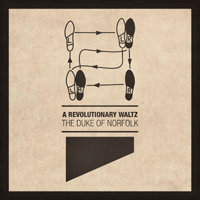
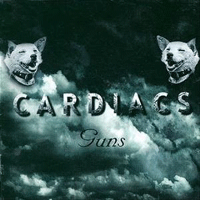

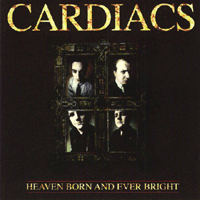




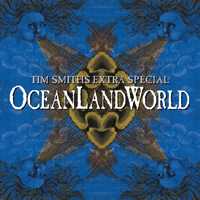


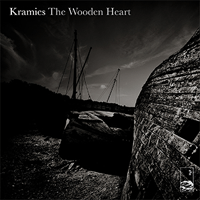
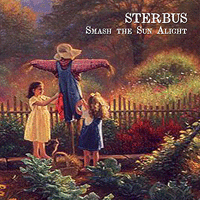


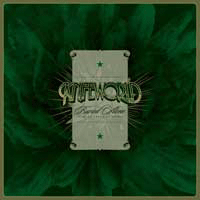


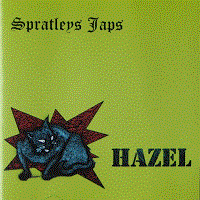



 Misfit City