When I think of musicians citing the mystical, revolutionary poetry of Yeats or Blake, I’m likely to think of assorted classic rock fops; or young white literate/ dissolute pretenders fitting the pair in between their Rimbaud and Verlaine namedrops. The Libertines loved Blake; as have a swathe of musicans ranging from stadium botherers Robert Plant, Richard Ashcroft and U2 to dedicated underground upsetters like The Fugs, Duglen and Coil. Further delving turns up quotings and reverent steals by Pet Shop Boys and Bloc Party, plus the fact that Blake himself was a songwriter. As for Yeats, Joni Mitchell has set him to music, as has Van Morrison: the Hold Steady met him at a party in Chicago Seemed Tired Last Night, Bright Eyes quotes him in Four Winds; and from her debut album, Sinead O’Connor’s devastating Troy reshapes and reclaims his ‘No Second Troy’.
As for those who take on both, there’s North Sea Radio Orchestra with their sweet folk-tonedchamber music settings. More prominently, there’s Patti Smith, who shook Blake-and-Yeats vision out into her early punk poetry and has kept it upever since. Then there’s Patti’s ardent acolyte, Mike Scott of The Waterboys, who’s kept both by him on his travels: snarling about Blakean tigers and savage earth hearts on his debut album, capping ‘Fisherman’s Blues’ by fusing Yeats fairy tales with New York minimalism and Irish chamber-folk, and devoting a whole album to Yeats-isms twenty-three years after that.
What I’m getting at is that Blake-and-Yeats setters and expressers, in music, tend to be storm-tossed white romantics… with the music to match. Bar guesting singers here and there (including some formidable soul wailers), Phaze Theory are certainly white, are probably romantics, and may well be storm-tossed, but it’s initially a surprise to encounter their own take on this particular poetry; working it as a collective muse for a band that, while it calls its music art rock, has more in common with reggae, dub and the glowering Dark Magus electric wrack of Miles Davis in the early ‘70s.
Around in various forms since 2014, they’re led by a questing mystic of a tuba player, Christopher Barrett. Their conservatoire backgrounds and well-schooled chops belie their strange geological ferocity, stemming from an interest in Britain’s occult traditions and how these break through into sounds and words. Dedicated to “exploring the vastness of the musical cosmos” they lay claim to “roots in the deep grooves of the earth and the city and our branches reaching to the stars… we seek to free your feet, open your heart and liberate your spirit.”
In tone and intent, and at full heat, they’re an unexpected outpost of New Weird Britain, set in a jazzier wilderness in which Marco Quarantotto’s echoed drums, Tal Janes’ gnarled heavy guitar and in particular Barrett’s rumbling, adroit, effects-burnished electric tuba (which shifts seamlessly from bass to horn parts, sometimes with no immediate break) probe and scald across a foreboding, eerie terrain of post-industrial brambles, Tannoy vocals and perhaps a little Hendrix crunch. Compare and contrast their troubling, hallucinatory take on The Song of Wandering Aengus (recorded with Manchester singer Rae Jones) with the polished, melodious elegance of the Waterboys version above.
Currently collaborating with London rhythm-&-blues/Southern soul singer Arthur Lea, this imminent end-of-the-month gig at the Vortex is part of their ongoing process of bringing their music back to London and England after a brief Californian shift. Back to the grime but also back to the original fertility, I guess.
Phaze Theory The Vortex Jazz Club, 11 Gillett Square, Dalston, London, N16 8AZ, England
Tuesday 28th August 2018, 8.00pm – information here and here
There’s classic and there’s Classic. I guess you could say that “classic” refers to whatever emerges from the past and underpins the future, something that becomes part of the way things are done, things are thought. Something that is there, to be tapped into. Archetypes.
On the other hand, there’s “Classic”. A sort of snob’s trademark; a lovingly-restored, polished artifact from the past, like fleets of Model T Fords puttering around a private racetrack in 1998. Something you can buy, like horse-brasses or fake-Tudor house frontage. Hired vintage suits.
That’s why it will always be utterly incomprehensible to me how The Verve are compared to Oasis; are hangers-on in that awful Weller/Ocean Colour Scene/Creation band circle of “friends of Oasis”. A scene where all inspiration has been submerged in encroaching conservatism; where authenticity is no more than off-the-peg habit; where you imagine that by thieving the possessions and the poses of the great, you can become great. A beggar’s court of stained carpets, grubby heirlooms… and “Classic” songwriting. You would’ve thought that by now The Verve would’ve wiped the sleep from their eyes, taken an incredulous look around themselves at that pack of plodding duffers, and buggered off out of there.
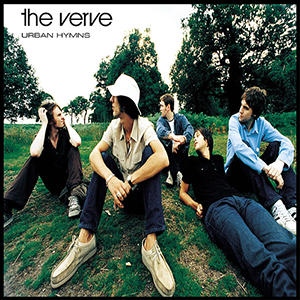
Look, with this mighty album, The Verve are well clear of that paltry, inflated “Noelrock” equation. The battle for greatest guitar rock album of ’97 was between Radiohead’s ‘OK Computer’ and ‘Urban Hymns’. While Radiohead’s more experimental approach has created an album for the exposed and overloaded pre-millennial soul, arguably this album is pure music for the timeless, stripped heart. Songs, surging choruses, swelling strings, drenched in emotion. Yes, it is a “classic rock” thing. Yes, the basic shapes are extremely familiar, even timeworn sometimes. Yes, guitars do swagger between romantic and pugnacious, and lads still sing out the untidy facets of their rough-diamond hearts. But even with all this, it’s still somehow an album of the moment.
And while I defy any intelligent person to listen to Don’t Look Back In Anger without bursting into derisive laughter, Richard Ashcroft and the rest of The Verve seem somehow able to plug directly into the genuine classic rock tradition. You know, that one which Noel Gallagher can only wear like a little boy swiping his parents’ clothes, waddling into the front room with sleeves flapping a foot below his hands and shoes dangling around his tiny feet – “Look at me! I’m a grown-up too!”
Enough of that. Leave it behind. The Verve have, whether they’ll acknowledge it or not. ‘Urban Hymns’ may ease its broad shoulders into certain well-known-and-namechecked spaces: The Rolling Stones, Lennon, Hendrix, The Doors, a hint of Pink Floyd in ’69 or ’71, The Stone Roses… But there’s more to this than the aspirations of a bunch of Wigan pub-rockers. A lot more.
Bitter Sweet Symphony, of course, everyone knows by now. But hold on, this is a piece of systems music if I’ve ever heard one. (Um, aren’t you supposed to be going on about Northern Soul like everybody else, Col? – ED.) The strings sequence slides in (courtesy of Andrew Loog Oldham’s orchestral version of the Stones’ The Last Time) complete with bells (bells! glorious!), the staccato drum pattern motors off… and, basically, that’s it. The structure builds subtly, but there’s no real bridge or chorus. Ashcroft leads the melody by weaving around and harmonising with the band’s hypnotic spatial groove. The video had the feel just right – put the track on headphones, follow the walking-pace rhythm, and you immediately Do The Ashcroft. Tunnel vision, walking straight ahead, oblivious. Magical.
Both here and throughout ‘Urban Hymns’, the crucial ingredient is in the detail. Behind the familiar riffage, behind Ashcroft’s raw and tender delivery, there stretches a vast depth of sound, like a field of stars seen from high above. And Nick McCabe lives in this space, manipulating a guitar like Van Gogh’s ‘Starry Night’ paintbrush: moans, swooshes, calls, swathes of colour and musical dialogue. It’s easy to see why The Verve could not be such a magical band without him. Most lead guitarists stick to one spot, on stage or one record: but McCabe seems to be fucking everywhere, cut loose from gravity, from his body, from everything. It’s a bit “Floyd”, a bit “Jimi”, a bit space-rock, but it’s always intensely, dynamically involved; never adrift in a haze of selfish narcosis.
Space And Time, though, swaps the lush atmospherics for a more straightforwardly guitar-based sound with an anthemic chorus, but still parades Ashcroft’s insecurity like a beacon for those with similar feelings: “I just can’t make it alone.” Within weeks, then, this track will have established itself as a rallying call to legions of insecure fans. Just wait and see. And, yes, one could be cynical about such identification with mere pop songs, but how many artists wouldn’t sell their soul for such emotional power? Many bands have one such song (Sit Down, A Design For Life). The Verve have just written virtually a whole album of them.
Sonnet utilises, not for the only time on this album, a romantically lush, almost country sound. A simple electric rhythm guitar and tinkling piano accompany the verses, before the full Verve power blooms in the life-affirming chorus – “Yes, there’s love if you want it…”
The Drugs Don’t Work is the massive morning comedown after what seemed to be the best night of your life – chemically enhanced, of course – and you’ve realised that you can’t block everything out, no matter how hard you try. Beautiful strings, subtly countrified lead from McCabe, Ashcroft’s emotionally affecting vocal – this song is so finely constructed, with an ear for peaks and lows, that it already has the feel of a timeless standard that’s always existed within some heavenly rock canon. It also contains one of the most eloquent avowals of unstinting, devoted love that I’ve ever heard in my life – “If heaven falls, I’m coming too / Just like you said / ‘You leave my life, I’m better off dead.'” Make no mistake, this is one song that’s gonna feature in those 3-a.m.-highly-emotional-end-to-a-party situations for years to come.
But it’s not all dark nights of the soul. “Happiness, / more or less, / it’s just a change in me. / Something in my liberty… / But I’m a lucky man…” – Lucky Man is a song of hope and thanks for the crowd to sing, too. Another classic melody, performed by this oddly timeless band – another strings-laden track where The Verve perform with subtle, understated grace. Unlike so many other bands who witlessly drag in a string section to add a touch of authenticity, The Verve understand the dynamics of strings and orchestra and throughout the album they perfectly complement the sound rather than compete with it.
Well, look, if this is getting too romantic, lush and orchestral… the thumping intro to The Rolling People leads into a swaggering Doors-style guitars’n’rhythm assault. This song also allows greater opportunity for Nick McCabe to let fly on lead guitar, proving again that he’s as skilled in delicate atmospherics as well as able to play with great power. On Neon Wilderness (on which he takes the lead writing credit) he takes The Verve back to the ambient rock of ‘A Storm In Heaven’ as he builds stately shifting ice-floes of guitar submerged in the band’s watery echoes and Ashcroft’s vocals appear to free-associate in a waking dream.
The album’s only weak link is This Time, the only track that noticeably breaks the medium-slow tempo. It attempts an awkward mix of The Verve’s new melodicism with a “guitar-dance” feel (shuffling percussion, treated vocals, funky guitars, you know the score) but in contrast to the rest of the album’s majestic assurance it just sounds directionless, with Ashcroft’s most loose-limbed lyrics just filling up space. Better baggy, basically. It would have been a revelation in 1991; now, it just sounds like one of The Verve’s few concessions to their own nostalgia.
Come On, the final track, is the rawest we hear The Verve on ‘Urban Hymns’. Powerfully self-assured and confident, it is a barrage of full-on band attack, rock guitars leading the charge plus the return of the “Mad Richard” of the band’s fledgling years – holding forth, shouting, challenging (and frankly, probably talking bollocks) atop the sonic attack. Glorious it is too. “Come along with our sound / Let the spirit move you…” Indeed.
This is one of the few times recently where rockers with an eye on the past have come up with its substance as well as its shape. As Come On, and the album itself, spirals noisily towards its climax (there is one hidden track, a swelling soundscape of studio clatter, radio interference, feedback, a crying baby and a haunting deliquescent guitar line: as if The Verve have grabbed so much inspired sound from nature that it demands to be given birth to, song or no song) the scale and magnitude of what The Verve have achieved in the past thirteen tracks all gets a bit much for “Mad Richard” as he shouts out “Fuck you! This is a myth!” That’s what I heard, anyway.
I hope that’s what he says. It should be what he says. Against all odds, a mythical, legendary album.
(review by Col Ainsley)
The Verve: ‘Urban Hymns’
Virgin Records/Hut Recordings, CD HUT 45 (7 24384 49132 1)
CD/cassette album
Released: 29th September 1997
Swoon. /swo͞on/ A verb. To be emotionally affected by someone or something that one admires; become ecstatic. Here are some people and things that make me swoon. #swoon #swoonage




 Misfit City