Since when did November become so generous? There’s plenty to see and hear this coming week, including the continuing Jenny Hval/Briana Marela tour (with Bristol and London dates), Laura Moody following up recent shows in Cardiff and Sheffield with a house concert in Edinburgh on the 12th (email her directly in case tickets are still available) and, in London, the opening dates of the London Jazz Festival and the End Festival. Plus the following:
* * * * * * *
With Briana Marela, Jenny Hval and Holly Herndon all touring or playing in Britain this month – and with Joanna Newsom having already sold out her lone British date at the Eventim Apollo on Monday – it’s a good month for seeing art-pop with a distinctly female hue or ethos (although to be honest there’s always a wealth of such things around, if you look hard enough and dip under the radar).
To the above, add Julia Holter, who’s working a short British tour over the course of the week. It’s an opportunity to see how rapidly Julia’s exploratory, highly literary work has evolved and altered over a decade of recording time: from the Debussy-an glistenings of 2006’s ‘Eating the Stars’ to the oblique sonic and textual puzzles of 2011’s ‘Tragedy’ (mixing transfigured Greek drama, disorientating found sound and transparent barely-there parings of songcraft) and the impressionistic jazz-novel assemblage of ‘Loud City Song’ in 2013 (which drew on Collette, MGM musicals and belle-epoque).
Julia’s newest album, this year’s ‘Have You in My Wilderness’, is something of a step into the known. Her once-baffling minimal musical stylings – which, on ‘Tragedy’ in particular, hung precariously on the edge of what might be described as “song” – have by now transformed themselves into what sounds like dreamy, distracted takes on late-‘60s/early-‘70s Brill Building songwriter pop. That said, the album’s meditations on solitude and companionship (real, imagined, rejected or deconstructed) retain Julia’s distinctive tone of lateral thinking and musing, and if the songs seem more conservative on the outside they soon reveal themselves as different, more fluid creations, if Carole King had been enticed into French surrealism (note the nods to Dali, Bunuel, Germaine Dulac and Gérard de Nerval in the video for ‘The Sea Calls Me Home’, above). It’s also clear that if ‘Have You In My Wilderness’ does invite a broader audience by way of its more comfortable textures, it’s not a sell-out: keeping firmly in touch with her earlier impulses and schemas, Julia has included a re-recording of Betsy On The Roof (a pre-‘Tragedy’ song best known from her rare 2010 live tapes).
Julia Holter:
Komedia, 44-47 Gardner St, Brighton, East Sussex BN1 1UN Monday 9th November 2015) – information – tickets
There are two chamber music concerts coming up at The Forge in London:
Ensemble Perpetuo presents: Heavenly Sights (The Forge, 3-7 Delancey Street, Camden Town, London, NW1 7NL, UK, Monday 9th November 2015, 7.30pm) – £10.00 to £12.00 – information & tickets – more information
Founded in 2013 by English oboist James Turnbull, Ensemble Perpetuois a dynamic and versatile collective of musicians who perform a wide variety of traditional and contemporary chamber music in new settings; bringing it to new audiences through exciting collaborations and innovative repertoire choices; and seeking new pathways in which to experiment and augment the concert experience through multi-art form collaborations. Perpetuo has embarked on a number of exciting mini-residences throughout the UK and is taking music to new venues including concerts in theatres, museums, cafes, found spaces and other unexpected locations.
Join Perpetuo for the final event in their groundbreaking series of chamber music concerts for 2015 – an evening of incredible music that takes you on a journey to the furthest reaches of the galaxy. ‘Heavenly Sights’ is an evening of music inspired by space, flight and motion. Featuring music from Beethoven and Piazzolla to Weir and Muhly, experience over two hundred years of chamber music in one evening.
Programme:
Robert Schumann – Mondnacht (arr. Colin Matthews)
George Benjamin – Flight
Nico Muhly – Motion
Judith Weir – Airs From Another Planet
Anthony Powers – In Sunlight
Charlotte Bray – Trail Of Light
Astor Piazzolla – Milonga del Angel
Ludwig van Beethoven – Moonlight Sonata
Cheryl Frances-Hoad – My Fleeting Angel
CHROMA: Gorton, Scheuregger and British Music (The Forge, 3-7 Delancey Street, Camden Town, London, NW1 7NL, UK,Wednesday 11th November 2015, 7.30pm) – £10.00-£12.00 – information & tickets – more information
Founded in 1997, the critically acclaimed CHROMAis an acclaimed, London-based, flexible chamber ensemble dedicated both to new music and to revisiting classic repertoire in fresh and exciting contexts; mentoring the next generation of composers, and involving audiences in compelling, inspirational experiences.
Closely associated with the performance of contemporary music the ensemble has forged close links with many prominent British composers through many commissioned premières and collaborations (including work with Luke Bedford, Michael Nyman, David Bruce, Tarik O’Regan, Michael Zev Gordon, Raymond Yiu, Claudia Molitor, Julian Grant, Arlene Sierra, and Marcus Barcham-Stevens) .
CHROMA has a lively strand of intimate chamber concerts combining music and storytelling, which has resulted both in its first own-label album ‘Folk Tales’ and in various opera stagings in association with the opera festival Tête à Tête, the Linbury Studio Theatre and others. The ensemble’s mentoring programme includes ongoing work with student composers at the Royal Academy of Music, Royal Holloway University of London and Oxford University.
This concert (featuring Roderick Chadwick on piano) is the culmination of composer Martin Scheuregger’s residency at the British Music Collection. Martin’s new work, ‘Harlequin’, and ‘Burgh Castle’ by David Gorton form the centre of the programme. Harlequin engages with and reflects on the themes and ideas Martin has been exploring through the music of The Collection, whilst ‘Burgh Castle’ – a CHROMA aural-visual commission for piano and ensemble – is inspired by the landscape of the East Anglian Fens. Pieces from the BMC – from both lesser-known and established composers – place these new works in the context of Martin’s residency and the music with which he has surrounded himself for the last 18 months.
Programme:
Philip Cashian – Horn Trio
Helen Grime – Snow and Snow
Martin Scheuregger – Harlequin (world premiere)
David Gorton – Burgh Castle (world premiere)
Anthony Powers – In Sunlight
Sadie Harrison – The Bride’s Journey in Three Songs and a Memory
I’m sorry that this is another last-minute posting, but if you’re reading this in or around New York, there might be some tickets left for this concert.
Michael Chinworth & The Rudder Band + Will Stratton + Jonah Parzen-Johnson (Union Hall, 702 Union Street, Brooklyn, New York, NY, USA, Friday August 21st 2015, 7.30pm) – $10.00
Part of the generation from the liberal arts Bennington College which also fostered Trevor Wilson (Anawan, Vocal Ensemble), Tavo Carbone (Horse’s Mouth) and J.J. Beck, Michael Chinworth maintains that group’s indifference to musical boundaries, keeping up a New York tradition of playing (like latterday Arthur Russells) across genres. Exploring his Bandcamp page throws up assorted experiments in cut’n’paste electro-acoustic collages and vocalese plus assorted various college-classical chamber pieces in various contemporary Romantic, minimalist or post-Ligeti forms. On this occasion, he’s following his well-established alternative pop side, performing his own lustrously tuneful take on a Trevor Wilson song cycle – 2013’s ‘Rudder Songs’ – which he’s due to release on album the following day.
‘Rudder Songs’ is in keeping with much of Trevor’s work – simultaneously vague and pointed, obscure and lovely, and often subtly provocative. While never being so obvious as to make a straightforward point, it suggests a unsettled fluidity of sexual identity and choices of vision; providing off-kilter, stream-of-consciousness hymns to unorthodox friendships and the possibilities of city life that nonetheless wilfully and regularly flees to open countryside or the solitary road life. Familiar elements from folk, torch song, soul jazz and psychedelia float alongside each other, recombining at odd intoxicated angles; or explode from straightforward beginnings into thought patterns too complicated for a simple frame to contain.
If you want to compare the Chinworth versions to the Wilson originals (sung and recorded solo at Meredith Monk’s piano, no less) you can find the latter above. Michael’s smooth, Wurlitzer-tickled blue-eyed soul approach might initially seem miles away from Trevor’s wayward and uninhibited performances and whisper-to-caterwaul vocalising (in some respects, it’s like Frank Ocean covering Kevin Coyne or John Cale at their most frothing). Still, if you’re familiar with Michael’s work on Trevor’s songs elsewhere, both the link and the sympathy are clearly intact; and it’s clear that their work together in Anawan (in which both Michael’s voice and Wurlitzer play a key role) paves a way towards Michael’s slant on the Rudder material. Check out his performance in the video for Anawan’s ‘Breaded Me’, below, and then compare it to his versions of a pair of Rudder Songs underneath (one exploring an unusual fissile threesome, the other obliquely fishing in a friend’s thoughts).
In addition to Michael the Rudder Band lineup includes guitar visionary Ben Seretan and fellow Benningtonians J.J. Beck and Matt Scott, plus Trevor Wilson himself on additional keyboards. Re the collaboration, Trevor comments “In many more ways than one, this is a repeat of a much-admired album from 1970, ‘Nilsson Sings Newman’. Harry Nilsson, inspired by the odd, rude composition style of Randy Newman, wanted to take the songs and re-imagine them with his signature vocal layering and general studio beautifying. These two songwriters, equal but so different in their contribution to musical history, united to create this album together without ego, without agenda. (Maybe. I hope.) As I will do (at the concert), Newman plays and sings on Nilsson’s adaptation of his own songs… with another bandleader.
“I think everyone should have the opportunity to do this with their form of expression. Not to get too 3rd-grade-after-school-assignment-y, but seriously, try it out. Ask one of your contemporaries, friends, colleagues if you can ‘cover’ their thing, and have them sit in the passenger seat somewhere during the process. Or the other way around. You’ll both learn a thousand things. Michael has a rare gift of seeing music on its own terms- terms that don’t exist within human realities- and he has certainly shown me things about my compositions that has changed my whole process. The band is sounding great, and I am so happy to be a part of it.”
There are two support acts. Folk songwriter Will Stratton will be playing songs drawn from his five full-length albums; while Jonah Parzen-Johnson (frequently seen as part of New York afrobeat ensemble Zongo Junction) will be bringing his lo-fi music for solo circular-breathing saxophone and analogue synthesizer, described as follows – “Imagine the raw energy of an Appalachian Folk choir, tempered by a lofi, minimal aesthetic inspired by the music of Bill Callahan… (Jonah) has meticulously constructed a world of warm memories remembered in a cold present, as he melds the evocative nature of folk music with the chilling power of experimentalism.” Judge for yourselves at the gig, or via the previews below.
Up-to-date information and tickets for the gig are available here – and if you can’t make it, you can view in on video stream here.
More quick London gig news – art rock, post-rock, electronica, and a dash of classic New York downtown.
Rumour Cubes + Dresda + kontakte @ The Facemelter (The Black Heart, 2-3 Greenland Place, Camden, London, NW1 0AP, UK, Friday 7th August, 7.30pm – £8.00/£6.00)
Sumptuous instrumental and electronic post-rock from ex-Glastonbury and ArcTanGent Festival performers, plus a UK debut.
Post-rock veterans Rumour Cubes have been spreading tentacles of ambient, soaring soundscapes across the globe, catching people’s attention with their classical and electronic nuances, attention to the finest details and unassuming political statements embedded in their writing. Their work with poets and film-makers has allowed them to create a multi-media experience and has propelled them to performances at Glastonbury, ArcTanGent and a support slot for Sólstafir; while their albums ‘The Narrow State’ (2012) and ‘Appearances Of Collections’ (2014) received wide critical acclaim.
Celebrating their tenth anniversary this year, Dresda hail from Genova, Italy, and will be driving over to make their UK debut. Their music is intricate, dense and introspective yet gloriously cinematic. They have several well-received releases under their belts, including soundtracks for critically acclaimed Italian independent movie ‘The Krolevsky Case’, and the short movie ‘La lingua del disordine’. In 2009, they were featured on the Italian DVD edition of the Canadian documentary ‘RIP! A remix manifesto’, distributed by Feltrinelli Real Cinema nationwide.
Conceived in 2005 from a string of old 4-track demos and further realized via a labyrinth of digital workstations and computer software, kontakte blend organic instrumentation within an electronic and hypnotic framework of programmed beats and pulsing synths. Pooling influences such as Godspeed You! Black Emperor, Mogwai together with Brian Eno, krautrock and shogaze sounds, this duo manages to perfectly blend shimmering electronics and ethereal melodies. They have too many releases to name and have been remixed by many visionaries including Tim Holmes of Death In Vegas, Chris Olley of Six By Seven and Russell. M. Harmon.
There might also be tickets remaining for the performance of Arthur Russell’s Instrumentals early in the following week. This is a repeat visit of a show that’s been on and off the road at various points around the world since 2012 and which last visited London via Cecil Sharp House earlier this year… so if you missed it before, now’s your chance.
Visions presents: Arthur Russell’s Instrumentals, directed by Peter Gordon @ Visions Festival (Oval Space, 29-32 The Oval London, Bethnal Green, London, E2 9DT, UK, Monday 10th August, 7.30pm – £21.50 plus booking fee)
For those of you who don’t know about Arthur Russell’s turbulent, productive (and sadly curtailed) life, he was a vigorous participant within the downtown New York music scene between the mid-1970s and early 1990s. Having studied as an avant-garde cellist and composer, he rebelled into Manhattan nightlife, vigorous cross-fertilization and event curation. Russell rubbed up against Fluxus, disco, avant-garde theatre, New Wave and no-wave, making the most of the breadth of the prolonged New York creative ferment of the times, feeding his assorted roots and collisions into music of his own.
During the last decade of his life Russell wrote and performed voice-and-cello songs – predominantly solo but employing loops, echo and sundry effects. In these, he synthesized all that he’d learned into what were perhaps his most personal and accessible works. These are probably what he’s best known for now, thanks to the more prominent releases of albums such as ‘World Of Echo’ and ‘Another Thought’, but they’re only one aspect of his work
A notorious perfectionist reknowned for agonised work gestations (and who left hundreds of pieces uncompleted at his death) Russell nonetheless completed what was, at the time a remarkably bold, broad and modern array of work from orchestral pieces and theatre music to forays into electro-pop and dance music under project names including Dinosaur (for ‘Kiss Me Again’) and Loose Joints (‘Tell You Today’). Today this kind of equivalence and eclecticism is more commonplace in the orchestral or ensemble work of composers such as John Zorn, Django Bates, Anna Meredith or Tansy Davies. In the 1970s, though, Russell was a pioneer, notoriously shocking the staider elements of his avant-garde classical audience with ‘24-24 Music’ (a contemporary classical piece equating the pulses and disciplines of New York minimalism with those of disco music).
Coming from the zone of Russell’s talent which drew most on his contemporary classical roots, ‘Instrumentals’ is an example of his chamber music, Dating from the late ‘70s, it was initially conceived as a forty-eight hour piece, its duration far exceeding even the infamously massy protracted works of Morton Feldman. Versions of the work were performed over the years, and a selection of excerpts appeared on a Disques du Crepuscule release in the mid-‘80s.
The piece as it stands owes much to Russell’s friend Peter Gordon, a fellow eclectician from the 1970s downtown scene and Russell’s bandmate in The Flying Hearts and Gordon’s own ongoing Love Of Life Orchestra. Gordon worked closely on the original performed version, assisting on keyboards, arrangement and notation. Two decades after Russell’s death in 1992, Gordon brought a new version of ‘Instrumentals’ back to The Kitchen (Russell’s old home venue in Manhattan. Following the initial sold-out performance in March 2012, Gordon has periodically revived and toured the new arrangement. The performance at Oval Space will feature several members of Russell’s original ensemble, and will also feature photographs by Yuko Nonomura which were projected during the original 1975/78 Manhattan performances of ‘Instrumentals’.
Multi-disciplinary New York trio Sontag Shogun (including Jeremy Young, whom I reviewed playing live in London last year as Foxout!’s guitarist) sent me some news about the recent release of their debut album ‘Tale’. Ostensibly post-rockers, Sontag Shogun don’t conform much to the genre’s more insular tendencies, being made up of three restless multi-media artists moving from craft to craft and from continent to continent. Jeremy, for instance, also co-runs the band’s not-just-a-record-label Palaver Press, which unifies sound publication with assorted texts and fine-art bookbinding.
‘Tale’ was recorded in carefully-hoarded scraps created around the world while Jeremy (sound sources and contact miking) was studying in London, Jesse Perlstein (laptop, tweaked voice and kleptomaniac microphone) was traveling in Korea, and Ian Temple (the grand piano) was back at home in Brooklyn. Field recordings were gleaned from diverse adventures including “a trek through a Columbian jungle, a piano tuner testing the ivory at the Southbank Centre and a South Korean traditional singer hitting a buk (or leather folk drum).” Back in New York, the results were looped, layered and mixed with planned performance (both final takes and rehearsal scrapings) to create a tender collage and a trans-genre which Sontag Shogun call “lullanoise”.
For a taste of what this sounds like, here’s the simple and beautiful but implicatory video for one of the album’s piano-led tracks, The Musk Ox (directed by Isabel Nao):
and here’s a video of Sontag Shogun performing another album track, Let The Flies In, live in France in 2013:
‘Tale’ is available as either CD and download and can be ordered from here.
A fortnight on from our last visit to Daylight Music, my family and I are back again. Blame the warmth of the welcome, blame the homemade cake; blame my little son Oscar’s hopes of grabbing a set of hand-bells again. Blame a rare opportunity for us all to like the same kind of thing, but I think we’re hooked. If not hooked, we’re already used to that Daylight Music atmosphere: the occasional sound of a baby’s coo echoing through the cavernous vault of the Union Chapel, the slightly sleepy post-lunchtime ambience, the arts’n’crafts feel to proceedings; that gentle, polite undercurrent of London community ambience that’s getting more and more difficult to find in this time of mounting rents and bugger-my-neighbour.
Daylight family matters – Caitlin and Ben.
A full-family, free-or-whatever event at a major London junction, Daylight remains something to treasure. Things do change here, of course. The autumn wears on and there’s less and less sun to slip in and kiss the Gothic brickwork, less physical warmth to rouge the stone. The lowering October light dims the room rather than illuminates it, so that everyone onstage seems to be performing inside an unrestored oil painting, beneath a filmy pall of soot and years – but the Daylight mixture of low-key quirk and put-you-at-yer-ease continues to work its magic. Compering the event with his usual pin-point fuzziness, Ben Eshmade seems more and more like a gentle young cousin slowly evolving into a beloved uncle. Caitlin Hogan (Daylight’s beaming, leggy factotum-and-mascot) not only plays the church organ but frisks cheerfully around at the interval with an usherette’s tray. We’re warmed – and when we aren’t, we just pull our clothes around ourselves a little tighter and wait to see who’s come to the show this time.
A short time ago, New York singer-songwriter Annie Dressner crossed the Atlantic to England, swapping the brashness of her hometown for the more reticent self-assurance of Cambridge. As part of the deal, gridlocks were traded for grass commons, skyscrapers for Gothic spires, the swarming of yellow cabs for the purr of passing bicycles. New York isn’t entirely left behind, though: Annie’s very first song today is called Brooklyn. Her soft strum sketches out an altogether quieter place than the ever-rising hipster centre we’d expect: more sideslip Bohemian ’50s than rattling, overcrowded Noughties. The art-life, though, remains at the core of the story in the passing images of painter’s hats and “whiskey in a broken glass”, in the sketch of flawed new lives, the talk of friends, the passing spectre of discouragement.
Annie Dresser – softness is deceptive.
Annie herself seems winsome, demure, even folk-soprano cute at the start (Oscar, who’s something of a two-year-old ladykiller, is certainly intrigued). Her dialogue, as she chats to us in between songs, is a halting soft-voiced take on that scatting New York curl of rapid ideas and the slipping between subjects. She claims not to be used to holding a crowd on her own (“Usually my husband plays with me. He tells jokes about cheese,”) but she gives it her best shot: giving us North London travel advice, or revealing which of her songs is her grandmother’s favourite. I’m not sure that she’s quite as much the shy ingénue as she implies. For all her easy-going, soft-cheeked charm, and for all the hushed and humble tones to her singing, she’s got a subtle self-assurance as she stands up there: for all the world like a Modigliani model who got the joke.
I’m not sure how much difference Annie’s Cambridge relocation is likely to make to her songwriting. Her songs don’t need backdrops of big cities or the hungers of creativity in order to work or to find focus: they can work anywhere. In fact, her quiet songs seem better suited to quieter rooms in quieter towns, or just to moments in which people’s reactions are contained in reflection – delicately muted regrets, a steady and accepting love.
Annie seems to write songs like other people read books – pulling in her attention, quietening; becoming stiller, gently illuminated. She’s mastered small, telling, understated images and the knack of placing them, lightly, in the best passing places. Something innocuous like a picture of a turtle becomes tinted with significance, as if caught by a stray beam of light at just the right moment.
Dressner in detail.
Rather than being dramas, Annie’s songs are filled, unobtrusively, with little details of life’s motions. When the blows fall, as they must, they fall softly but decisively, like the moment in Lost In A Car where she sings “the wind was high / and your candle blew out.” When she sings about death, she sings about it in a series of aftershocks or in that slow repetitive rub of mingled grief, guilt and simple wishes that silently burnishes the pain: “if I had come / out in the cold dark night… / I can’t forget, even if I tried: / I can’t forget the night you died… / If I had come a minute sooner…”
Heartbreaker (which, like Lost In A Car, is from this year’s spring EP, ‘East Twenties’) picks over the memory of love lost by running over domestic details, slowly working around and creating the sketch of a man (“your father was a painter and your mother was a teacher – I remember all the things in your house”) but never obsessing over the man himself. Instead the song becomes a gentle, telling rebuke: the testament of someone who cared enough to notice all of the small building blocks of a loved one’s life; the account of someone who cared enough to remember. Annie doesn’t wreak obvious and horrible revenges in song. She’ll just tack you to the scene of your crime – once, with one expertly- and regretfully-placed pin – and what’s worse, she’ll stay sympathetic.
A band of Buriers.
For the most part, this kind of subtlety is the sort of things Buriers just trip over – or more likely, stride over – while their eyes stay fixed on a savage, lowering horizon full of stormclouds and junk. A thunder-tommed, string-heavy vehicle for the splintered, semi-apocalyptic ramblings of poet-songwriter James P. Honey, superficially they seem to be snapping at the heels of Godspeed! You Black Emperor; intent on seizing the title of house-band for the Grand Collapse. Despite eschewing electric instruments (this time out, at least), they’ve certainly got most of the necessary ingredients. Cello and viola, droning menacingly or carving the air with dark, bitten post-romantic melodies; a smoggy aura of passive-aggressive ferocity with a hint of tragic, tender despair leaching through; war-drum rumbles and a close relationship with the dystopian spoken word.
Their first piece sets the scene and nails it – an unsettled English almost-rap layering slashes of scene over lowering, growling string drones. Hollow wood, full of heavy weather. Looking beyond those easy Godspeed comparisons, though, Buriers have a voice of their own – one with a distinct purple tint. Post–rock parsimonies be damned: chivvied on by James’ welter of words, Buriers continually thump up against their disciplined constraints in search of something which sprawls or potentially brawls. They smudge and crumple the lines between booze-spattered vignettes of romance (emerging wearily from behind nicotine stains and inertia) and violent Ginsbergdelaireian flowerings of collaged, surreal imagery.
Laura Mallows of Buriers strings us along.
On Slides By, for instance, James and the band spin out loose-jointed low-rent vignettes. Passion that accumulates itself from tawdry scraps and spontaneous moments of visual poetry, hungrily seized upon. “Glass of bourbon, a poorly rolled smoke, / then it’s time to go home. / Spend my whole night chasing your eyes – two flakes of burning coal… / And so I say to you, I swear / nowhere could ever seem so dreary. / Within your palm a lock of hair is smouldering and rising up, oh so lightly. / Snaking upwards, coiling along the ceiling. / Rebuild our cynicism there, / abreast to all my mighty, misty, misplaced feelings.”
On Stuffing A Chest (led by Jamie Romain’s ominous cello figure) James blurts out a kaleidoscope chant of cut-up impressions and intimations – “A skin like flung paint on a window… / Head on to the edge of the night / residing in a western crockery plantation… / Material plenitude, / seraphim skin, / sexually potent media and humour hanged and left silhouetted through a dazzling stained-glass window to wither.” As his portents pile up, the song seems no more than a few loose images away from disemboweling itself. The anchoring string growl of Jamie (and of violinist Laura Mallon) holds it together, like coarse sail-thread.
It’s a shame to deny the atmospheric power of the Buriers ensemble as a whole, but the attention is constantly caught and held by the febrile James. No slouch as a guitarist (he contributes a beautiful, rippled nylon-string finger-picking part to Dim Half Light, and intermittently wrings delicate sprawls out of a ukelele) it’s as voice and emoter that he shines; or, rather, smoulders with a dark discomfort. His vocal is crisp and doomy, brooding and fastidious. He doesn’t mince his words: he snaps them off, shifting agitatedly between politics and abstractions (a snarled “well-heeled” is rapidly rhymed with a distracted “old film reel”), but snipping each phrase clean.
By nature James sounds fey, even effete, but voice and song are transformed by the ferocity of his words and convictions as they slide over each other. In attitude, if not in tone, his performance carries with it a labyrinth of echoes – Cohen, Reed and Patti Smith among them – but there’s a stubborn Englishness in there as well. Not just in the way that his verbal flashes of fang, whisker and dissent recall modern English songs’ own crepuscular, compelling rank of anti-heroes (Curtis, Hammill, Mark E. Smith). There’s also that porcelain gnash of thwarted, inward-turned privilege that hangs around him. Sometimes he could be a harried, half-deranged young schoolmaster, trapped in a staid public school while dreaming of freedom in the slums; one binge of words and absinthe away from fomenting revolt.
James P. Honey in flow and frenzy…
Then there’s his physical presence. Trapped in position by his microphone, James squirms and chafes against the necessity like a bug stuck on a pin, while haranguing us with hellfire intensity. His head rocks and bobs; his eyes and teeth lock; his feet sway and twitch in tiny shuffles and anxious hops. When not constrained by guitar or uke his elbows flail, as his forearms move in frantic twists and swivels. While he declaims his words, his hands accent them in frantic conduction, clasp in desperate spasms, or pluck savagely at his T-shirt as if trying to scrape their way through to his vitals.
Set against his rolling, literary imagery and precise, mannered diction, James’ tortured physicality almost looks comical – less Cave or Iggy than a Rowan Atkinson vicar possessed by the spirit of a rabid weasel. What sells it to us is his naked fervour. Maybe it’s a willing possession: James’ surrender to his bursts of words suggest that poetic discipline will always be less important to him than channeling (or reviving) an epileptic torrent of meaning.
Not everyone is sold on this (including the scattering of toddlers in the Daylight audience – Oscar toddles determinedly off to the colouring-in table during Buriers’ set, and stays there) but there’s no denying the commitment onstage and the band’s sustained grind of shimmering intensity. By the time Lynch Mob Hero rolls around, facing off against a time “when the city kills off the poets”), James is increasingly wracked; stumbling to the front of the drum-kit to hammer at the cymbals with a pair of beaters. Wriggling in a fury of words, he lets them shake him out as they will. On Buriers’ final song, he pleads for a kind of mercy – “God be kind – my ship is small.”
* * *
A change of act and a change of mood. I retrieve Oscar from the crayons and felt tips. There’s another short break. Let’s go back a bit…
In November 1973 (when I was barely three years old, and missing most of the significance at the time), Mike Oldfield’s ‘Tubular Bells’ was nowhere near as ubiquitous as it is today. While there was a growing buzz about its fusion of rock technology, ’60s conservatoire minimalism and folk textures, its all-conquering grip on record players, planetaria, whistling hippy milkmen and (by degrees) pop culture in general was still some way off. Nonetheless, at that point it had enough momentum for a reluctant Oldfield to be cajoled into playing a version on television. To reproduce what had previously been a mass of overdubs, Oldfield was joined by an diverse dream-team.
For those who are interested, here’s that original telly performance (courtesy of YouTube). A sizeable chunk of Oldfield’s broadcast band came from Henry Cow, touchstone avant-rockers inspired by Mao, blues, free-jazz, performance poetry and fearsome contemporary composition, who’d been organising their own cross-genre Explorers’ Club events. (The Cow’s work is worth a whole article in itself: their questioning collective spirit led them to challenges which still lurk in the musical undergrowth to this day, still challenging any halfway-political art musician prepared to kick at the wheels of the applecart). With remaining spaces to fill, Oldfield pulled in musicians drawn from a wide but sympathetic spectrum – from Gong; from Soft Machine; from The Rolling Stones; from folk and classical woodwind-playing.
To put it mildly, it was a crowded podium that evening, pregnant with cross-genre possibilities and implicit predictions. Karl Jenkins blew oboe – a Soft Machine member at the time, it was twenty-two long years before he himself would grow grand on his own wave of chart-storming cross-genre malarkey, via ‘Adiemus’. A few years before that one of the Gongsters – Steve Hillage – would stage his own later-life transformation, returning with System 7’s ambient techno to woo and wow a 1990s generation of dance freaks. Even the most obscure contributor, Ted Speight, was a musical journeyman: his own career would map from Lol Coxhill’s avant-garde fusion jazz to the artful punkified pub-rock of Kilburn & The High Road (at the side of Ian Dury) and, by the millennium, back again to London jazz.
That one-off broadcast wasn’t the end of the story, either. By the following year David Bedford (Oldfield’s friend, and a burgeoning crossover composer) had written up an orchestral version of Tubular Bells to perform and record with the Royal Philharmonic Orchestra. In doing so he joined further significant British culture dots to the puzzle. The Royal Albert Hall – where the concert was recorded, and where high art meets broad public a stone’s throw from London’s royal palaces. Thomas Beecham, the RPO’s belligerent founder, conductor and impresario – eight years dead by the time his orchestra was playing Oldfield, but with his own legacy of revitalising English concert music still very much intact. Lastly, Worcester Cathedral, where Oldfield eventually re-recorded some of his Tubular Bells guitar parts under the soar and shadow of five hundred years worth of evolving English architecture.
The reason that I’m bringing all of these things up is that the Tubular Bells events were, in their way, high-water marks in post-war British music. In terms of that era’s art-music fusion they might have been at the easy-listening end, but their tunefulness and canny textural appeal allowed them to poke their heads right up into the mainstream. For a brief moment, they trespassed over those stubborn cultural divides which separated music into sullen and defensive camps muttering stale arguments about high versus low, fossilized versus spontaneous, conservative versus radical. It wasn’t a moment which lasted. With a few honourable exceptions (most obviously in jazz, such as Mike Gibbs and Keith Tippett) few musicians maintained those crossing points.
Many British musicians (Henry Cow among them) ultimately had to look to Europe or America if they wanted to cross-fertilise, at that level or a higher one. Back at home, most of the genres subsided back into their cramped little stockades to percolate and evolve separately. It was as if, as a musical nation, the British had given up on inclusiveness in favour of more miserly joys. They swapped the possibilities of crosstalk for more limited experiences of belonging – being in on an exclusive clique, the petty rivalries of defining your own group against another; the footie-fan logic and competing crunch of pop tribes. A proud Mod might argue that this was a good thing; another reviewer might argue that the friction between scenes and identities provided sparks of its own, and they’d have a point. For me, though, disappointments came with the choice. It’s not that all the opportunities vanished, but for a long time it was as if many of us had gone into our houses and shut the doors.
We Are Children (We Make Sound).
This is turning into a rant. Let’s get back to 2013, to the considered, warm inclusivity of Daylight Music, and to where a ten-to-fifteen strong We Are Children (We Make Sound) are onstage, picking their way through a note-perfect version of Tubular Bells, revelling gently in their own tender, communal sound; and gently blowing away not just the years, but the resistances. I can’t call them revolutionary, especially in the light of what I’ve just written about memories of early-’70s icebreaking. I can’t even claim that they’re the only barrier-crossing ensemble around. But it’s great to be able to peg them as an indicator of how Western music culture – and, narrowing the scope, British music culture – has softened its adolescent stiffness, relaxed its intolerant bark.
Born from after-hours jams between students and staff from the Institute of Contemporary Music Performance, over in Kilburn, We Are Children come from a fresh generation of musicians (most, but by no means all of them, are still in their twenties). Within the lineup, I spot some half-familiar faces from various London gigs and cellar-jams. Here’s the sensual feline pout and mussed-blond curls of Chinese Missy rocker Richard Bond, today dividing his time between guitar and clarinet. Here’s dreadlocked guitarist Niels Bax from groove-players What?!. Here are singer Gyongyi Salla and flautist Abi Murray, both of whom hover around the capital as songwriters (Ziaflow and ABI, respectively). As individuals, as part of smaller groups, as gigging and communicating musicians, these and other We Are Children members continually work and learn across a wide range of music throughout London, and they don’t thinking twice about doing so. That genre permeability which was ground-breaking in 1973 (and which was subsequently scorned as a betrayal of the tribe) is reestabished within a broader perspective; a healthy, heterogeneous fabric taken for granted, and casually encouraged.
Assorted Children…
Having said all that, We Are Children are playing a little bit safe today, perhaps in friendly deference to Daylight’s sleepy early-afternoon babies. Happy to work with both driving rock pulses and dance-and-dubstep mixology experiments, they bring neither to this afternoon’s live party. While they’re nominally a composing and arranging collective, this afternoon’s showcase is a little more conservative, focussing on a couple of familiar classics of melodious minimalism plus a solid pair of pieces from the leadership. For now, though, this gentler, more doctrinal taste is fine. The ensemble sets up a cool October glow, breathing a loving life back into the familiar and working up some new tunes of their own. As they carefully, unfussily work their way around what were once crusted old encampments, We Are Children have a tender communal feel to them. Nominal leaders Dan Gaylard and Alastair Beveridge both look as if butter wouldn’t melt in their mouths. Meanwhile, Audrey Riley – the veteran strings sessioneer and the band’s tutor-cum-guiding-light – oversees proceedings and provides some silent backbone. She glares protectively from behind her cello, a determined mother-hen with a steely glint.
Audrey might provide the anchor, but it’s Alistair who’s responsible for today’s Tubular Bells treatment, leading from the grand piano and providing a remarkably faithful arrangement for We Have Children’s smaller forces (centred predominantly round a quintet of clean electric guitars, bass and a string duo of Audrey and violinist Richard Jones). Imperceptibly, and with great skill, he shaves down Oldfield’s ringing repetitions and multiple layers to fit a ten-minute piece and a thirteen-person ensemble (the core bolstered by glockenspiel, by Abi’s flute and by the voices of both Gyongyi and fellow London songwriter Jo Kelsey. The piano anchors with that familiar dancing, pulse, and somehow all of the missing textures are masked. If anything, the original piece emerges refreshed, especially after two decades of intermittent and questionable reworking by Oldfield himself. Earlier on, a somewhat reshuffled We Are Children (flute, glock and voices out; drumkit and a second bass guitar in) have already taken us on an immaculate trip through Steve Reich’s Electric Counterpoint – less trippy-disciplined than the original, with the opened-up instrumentation and acoustic-electric sound bringing out intimations of both folk-round and disco pulse. The music is replete with examples of the mutual sympathy and interaction which We Are Children have built up over three years of jamming and unlikely pub gigs – violin and flute blend for a second, then cycle smoothly apart: guitars ravel into a delicate thirty-string mechanism.
Cell-out…
The ensemble’s original material fits in seamlessly with the regroomed, revitalised Reich and Oldfield warhorses. Circles (written by Alistair) slims down We Are Children to the string duo, a quartet of guitars and a single bass. It manages to be many things – a neo-minimalist declaration, smooth and detailed. Riding on a Satie-esque continuo, the melody line passes in a ripple through the players: an oscillated hocketed sway with a tingling, conversational counterpoint. A fourth piece (for which I don’t catch the name) has a murkier quality. They’ve shuffled the lineup again – the electric guitar quartet against the string duo; a return of bass, piano, drums and female voices; a returning flute this time joined by clarinet. What emerges from this configuration journeys through a set of moods, interlocked like a meshwork of paper rings. A Scottish/English border folk air filters through string duo and piano, dissolving into string noise. Drums and piano pick up and point a beat in three-time. A dawdling sensual theme passes from violin to clarinet; as flute is worked in, the drums become jazzier, stretching and moulding the rhythm around the weaving melody instruments.
Viewed as a whole, We Are Children’s pieces (whether adopted or originated) build up a utopian sound-picture, part rural and part urban – they’re both verdant woodlands and immaculate ductwork; warm sunsets on glass; the patter and pulse of working cities overlaid with their parks, borders and spaces to dream. Sitting on my lap, Oscar listens quietly and thoughtfully, his attention held. I was ten before I first heard ‘Tubular Bells’; sixteen before I heard Reich. In this band’s inclusive space- itself enveloped by Daylight Music’s easy welcome – my son’s getting an earlier and much more natural introduction than I did, untroubled by tribal antipathies. When Ben Eshmade first brought We Are Children into Daylight Music – much earlier in their concert series – he described them as “what I imagined a Daylight band might sound like.” He’s righter than he knows, and it’s a credit to both ensemble and event.
As I get off the bus in Clapton, the midsummer evening sun is giving the neighbourhood a lingering kiss. It brushes across the Clapton Portico (a bewildered, disinherited classical remnant, grafted onto a school at the end of an abbreviated road), takes away its sadness and helps it in its lonely loom. It limns the shopfronts of convenience stores and barbers and closed-down shops, and perks them up. It lends soft glows and sends little licks of shadow chasing around the stonework of the Round Chapel, and it brings out the last sleepy cheeps of the day from the local sparrows as I head down Glenarm Road towards Homerton.
Waiting for someone to sing..
Thirteen years ago – when I was living a lengthy stone’s-throw to the west, over in Stoke Newington – this part of east London was a soured inner suburb with a brooding, bullet-ridden reputation. The length of Clapton Road was tagged as Murder Mile – an edgy and angry place beset by resentments, drive-by shootings and unprovoked beatings. Flickers of anger sometimes still plague it. Almost two years ago, the second night of the 2011 London riots kicked off just a few minutes walk from here: a churn of flames, looting and outright war between police and estate kids. Barely a block away in Clarence Road, Pauline Pearce delivered the impassioned harangue which would establish her as a Hackney heroine. Now though, all is peaceful: and it gives me the chance to reflect that, as with people, the hair-raising reputations of many places come only from their occasional spasms.
The biggest fuck-you I get tonight comes from a house painted in a shocking purple and gesturing out from an otherwise cream-and-beige Victorian terrace, like some kind of bolshy architectural remix. As I’ve come to know in recent years, this part of London is a place where a very diverse set of people get on with living: it’s also the kind of area where people get out of doors not to go hunting but to break that pesky London reserve and meet their neighbours. Pubs become sitting rooms; sitting rooms and armchairs spill onto streets – another embedded global village. While people are a little thin on the ground tonight, this late-June evening (just beginning to show the mottlings of dusk) is suffused with an easy warmth. Later in the evening, Liam Singer will chuckle from behind his keyboard and gift the neighbourhood with a more welcome tag than it’s had in years. “It’s like Brooklyn, but if everyone was really friendly.”
Lampshading.
Sitting on the border of Clapton and Homerton, The Dentist is nothing if not hopeful. A former drop-in surgery a little north of the hospital, it’s a genial wreck of a building. Crumbled, scarified and grime-smeared, it stands like a worn, chewed tooth in a shopping parade halfway between old London main drag and international souk. An enterprising guy called Phil calls the upstairs home, while using the downstairs for pop-up gigs, shoestring theatre, and scratch-and-strike art gallery exhibits. The back garden is full of splintered wood and earth hummocks, plus a makeshift tabletop bar. The wine is rolled up from the cellar via a scary ravine. The whole place thrums with friendliness.
Inside, crowded into the front room and sharing its atmosphere of ravage and reclaim, we’re part of a show. In a place this small, within breathing or patting range of the musicians, it’s hard not to feel that way. Behind the players, the curving plate-glass façade of the old shopfront runs across and around: over their shoulders, we look out at the street life. It looks right back at us, sometimes with suspicious flicks of the eyes (a man in a shalwar kameez, hurrying past to the makeshift mosque next door), sometimes with a bemused acceptance (a local geezer ambling along to the chippy) and sometimes with outright delight (younger locals on a stroll, pointing and celebrating on their way to and from the Hackney bars further into town).
Sealionwoman – Tye and Kitty as the daylight fades.
To them, this must look like a gig in a bottle – the audience in full view, the musicians upfront but backs turned, the music bleeding out in faint enticing vapours. Speaking of which… cue musicians.
Tye McGivern slumps over a double bass, plucking, bowing and sometimes wrenching his notes: a man with strong, thoughtful butchers hands and the face of a weary rabbi. To his right, Kitty Whitelaw sways barefoot – grubby toes, blue nails, a jazz pulse, a little black dress and a feel for the taut sinews of a song. There’s no-one else. About five years ago Tye and Kitty were two-thirds of Kitty & The Drowning Bag, were a lot noisier, and had a drummer. For the couple of years that they’ve been Sealionwoman they’ve been drummer-less and bring their own extra noise in their pockets.
Sealionwoman deal in blurred versions of jazz and torch, and they’re perfectly suited to the smear of dusk that’s coming on as they begin to play. As influences, they’ll cite the crepuscular – Nick Cave and Morphine – but also cite the vivid, iconoclastic enactments and reinterpretations of jazz songs as carried off by Mina Agossi. There’s something in that. While they deal with plenty of old jazz standards – passed from hand to hand, worn smooth like wooden heirlooms – Sealionwoman share a trace of that Agossi rebellion against jazz performance manners and form, preferring to draw out song essence and perhaps a thread of history along with it.
Sealionwoman – Kitty Whitelaw possesses another standard.
However, what I’m hearing is something which shades Peggy Lee with Patti Smith. It’s partially that everything they do sounds a little bit like Fever – songs carried entirely and by necessity on the honk, creak and slide of Tye’s bass and the teasing dance-around of Kitty’s voice. It’s partly the lazily assured flutter of Kitty’s demeanour, and the way that it can quickly shift and escalate to an incantatory yell.
What they do has little to do with straightforward theatrics, and still less to do with diva drama. In his hands and on her lips, the songs turn as wayward as blown smoke: dip in and out of ritual; become stretched-out, yammering versions of themselves; go from breezy cool to swimming, waking dream. Sometimes Tye leans over to prod at a laptop or a fuzz pedal, furring up those woody bass notes to turn them into air-horns, or a sweep across concrete. Sometimes he drums with a pair of brushes on boxes and chairs. At other times his hands drum vigorously on the wood of the bass, booming out ritual and conversation, a vigorous and physical lover teetering on the border of tenderness and violence. Kitty sways, stands on tiptoe; brushes against the songs as if stretching for a passing kiss. Her voice folds around the melody line and uses it as a jumping off point, springing into the air, hanging, returning. Every so often a familiar tune and lyric slides through the circling murk. I spot Night And Day.
Mostly, though, it’s all about mood. Strangely blissful, narcoleptic – although by the end of the set and the dip of the late sunset they’ve risen in a slow heat, culminating in a Dionysiac frenzy of bass-drumming and banshee wails. It’s probably enough to put the wind up the Muslim congregation next door, praying their way through Asr. If they’re as Hackneyfied as everyone else around here, though, they’ll just shrug it off.
Foxout! ‘s Daniel Merrill, bowing against the dusk.
The gloaming has well and truly arrived as Foxout! settle down and begin. Perched opposite each other on a couple of stools, Daniel Merrill and Jeremy Young hunch over a network of effects pedals and rummage through what looks like a box of yellowed prehistoric teeth: these they mouth and mumble, blowing into a microphone to build up a warm, rambling noisescape of notes, feedback and harmonic buzz before they even pick up an instrument.
In fact, the teeth are reed tubes gutted from an old harmonium. Foxout! enjoy rejigging bits and pieces of antique musicality, and they’re extraordinarily good at it. Some more history might be useful, before we go any further. Essex-raised but with feet made for journeying, Daniel is the fiddler in Dead Rat Orchestra. Despite his youthful looks, he already has a decade of improvised folk music behind him, plus tours all over the globe (some of which were in the company of Godspeed You! Black Emperor (from whom he may have filched Foxout!’s abrupt exclamation mark). Another young veteran, Jeremy’s from Brooklyn music – he once played bleakly beautiful post-Godspeed chamber music with [the] slowest runner [in all the world] and limpid post-rock atmospherics with Sontag Shogun before moving on to solo experimental tonescapes and spoken word as szilárd. Both men wander; both men curate the work of others. Both men mingle.
Foxout! – Jeremy Young.
Right now, both men are studying here in London. As their orbits have converged, Foxout! has emerged – immersed in the tributaries of Celtic folk but flowing through some crafty filters as it contributes to the journey. Certainly the prime stamp and weft of the music is Celtic – reels and pibrochs; plangent, sad melodies. Yet it’s Celtic music folded back over itself, cross-cut with experimental sounds and processing, and by strands of improvisation from elsewhere.
Daniel is one of those musicians who looks extraordinarily sad while he plays. Concentration renders his long, bearded face into a subtle mask of tragedy until you expect lock-gates to burst and for three hundred years of folk laments to come pouring out of him. His fiddle is the main melodic phrasing voice, with Jeremy’s acoustic guitar serving as a taut, bounding dodging rhythm source. Jeremy himself is constantly watchful and supportive, his eyes fixed on Daniel, holding up his partner’s passionate forays.
Speaker.
What emerges is remarkable, not least for the way in which it shape-shifts between different disciplines, experiments and sound-art tricks with neither seam nor strain. At times Foxout! broil with a heated minimalism or take on a grain of compulsive, systematic Futurist patterning. At others, a flexing bough or current of history catches at them and pulls them back to direct expression. One piece is a sensitive plucked-and-bowed air-ballad played (for half its length), over the sound of a draining straw, but with neither bathos nor disruption. Strips of noise sometimes bluster through the wood and strings, like another conversation passing through. Another gorgeous ballad tune sounds as if it could have be minted yesterday, simultaneously fresh and ancient. In the latter, there’s a moment of perfect meshing as Daniel and Jeremy briefly sweep into lockstep, rolling out a near-telepathic unison of notes before dancing away from each other again.
Night begins to settle in properly. Shades of indigo, of dulled London brick and of gaudy shop-front neon sift in through the window. The Dentist’s front room starts to take on something of the air of an Irish lock-in – nothing rowdy, but with the same sense of deep involvement in the music. As Daniel announces “a new ditty”, a couple of guests step up. Usually, Laura Moody’s a mischievous classical renegade or an acrobatic singer-songwriter when she’s not a fizzing cocktail of both. Right now, though, she and her cello are demure and thoughtful – the sober and quiet accompanist providing deep, cloudy strings while Liam Singer (just a few minutes away from his headlining set), sits in to sing.
Foxout! – strings against the dying light.
The song all four share with us in semi-darkness- which may or may not be called As The Wind Turns Away – is a perfect closer. Sombre and gripping, there may not be too much too it (certainly Liam’s softly yearning tenor seem to be making much with fragmentary, cycling sentences) but they make a virtue of that.The song builds softly and inexorably with the dying of the light: a folky threnody for something a little out of focus, something over your shoulder, waiting to be picked up on. Listening to Foxout! gives you the dreamy and welcome impression that if you didn’t have roots before, you’re growing some now.
Liam Singer – songs against the sirens.
Sat behind a borrowed piano, and minus the sophisticated ornamentations that colour his chamber pop and detailed modern-classical minatures on record (those strings, mandolins and marimbas; those sundry twists and shifts of sound), Liam Singer runs his own set on a shoestring, and runs it well. As the delicate instrumental fantasia of On Earth A Wandering Stranger Was I Born unspools itself, it’s tenebrous but increasingly shot with hopeful illumination. While Liam performs, police cars occasionally sail up Chatworth Road in search of trouble, passing behind him in a quick welter of blue-and-red lights and siren-wail. They rock his soft resilient bubble of song, but don’t burst it.
Easygoing and enthusiastic in person, Liam ripples his own depths when he sits down to sing. Even when stripped down to piano-and-voice, his songs grow their own bosky Edenic atmosphere, filling out his excursions into classical minimalism with deeper shadings. I’ve noticed, previously, how he dips into American antiquity and draws it up up like well-water. His high, open tenor brings freshness and a glow of innocence, but older things lie in wait in the shade to snatch that away. At times, Liam’s like a young scholar running assured, fascinated fingers over the scuffed and scraped covers of ancient leather-bound books; but when the mood deepens and takes him, he sings like the man who’s been spat back out of the faery mound – fully aware and alive, but displaced, crucially out-of-joint with his times.
Still life at The Dentist – mixing desk, lollipops and scarification.
This is not just down to the tinge of Edwardian parlour song within Liam’s work, nor yet the occasional antiquarian “thou” or “thee” in his lyrics. There’s a mildly febrile quality to his songwriting, a flicker of Blakeian hallucination to add to the forays into classical piano and the Tennyson tint of mediaeval inflections. His song world is notable for its permeability – the mythic or the supernatural soak through into it, adding piquancy to his sharply edged portraits of involvement and solitude. On The Brief Encounter, Liam can bump into swarms of gentle slacker ghosts, massing there to comfort him as he heads up the coastal road. In the middle of Oh Endless Storm he can cite a rock-chained Andromeda, looming spectrally above him and disdaining rescue as he veers towards a break-up.
Liam immerses himself in the story-swirls, homing in on the core as he sings, “Love is a wind, rips through our hearts, that takes control / We long for a language to lose ourselves, / or for a way to let go.” Later on – as his piano notes spiral in a stately, panicking dance on One Breath Out – he’ll clutch after disappearing chances. “Never could I know as each one passed, / that the last would be the last… / Just one breath out and the world grows colder; / fight the war, but not the soldier. / And one hand moves to protect the other now – / but we’re falling anyhow.” Yet none of this is mawkish or precious – in between songs, Liam is relaxed, gently self-mocking and friendly. Two songs played with Laura Moody on cello (a snatched opportunity before she catches the train back to West London) become affectionate tickles and tussles, ranging from childlike warmth to a rousing gamelan jig.
Liam Singer
Even his solo piano miniatures, potentially an excuse for indulgence, carefully balance their romantic invention with a pucker of thoughtful modesty. The Dance of Cupid and Psyche pays subtle passing visits to Chopin, Satie and Air On The G-String, flushing its economy with a dash of vigour. On Hannah’s Dance (a lone flash from his decade-old debut, ‘The Empty Heart Of The Chameleon’) Liam displays a Tori Amos drive and fluidity but rounds it off within a single minute. The sweet cascading single, Stranger I Know, slips out of its crafty Shaker-gamelan arrangement and breathes easier, now less of a revelation than a relaxed celebration: “suckers, speeches, they can keep ’em all.”
In one week’s time, Liam’s new album – ‘Arc Iris‘ – is released, yet already he’s moving on from it. Half of the set is songs so new that they’re not on any record, and at least one of them – Three Songs – is fresh out of the notebook. “I’ll fuck it up tastefully,” promises Liam, shuffling his sheet music into place.
What emerges suggests that the drift away from Liam’s earlier experimentalism into fully-fledged romance (as promised by much of ‘Arc Iris’) is accelerating. Here is a beautiful but unnerving love-song, holding strong on the edge of wreck; swimming with gas-masks and cruelty and an unsettling Saint Sebastian gasp. “Someday I’ll see you sideways, / your pretty words are opening like arrows in the middle of my chest / ’til petals fall from my mouth / and I, I gasp for air / ‘cos something inside is pressurized… / When you feel it, you will know / that I was not crazy when I had to let it go.” Running through the words are hints of fairytale transmogrifications; always restlessness. Liam’s heading east after this concert, travelling over to play more gigs in France and Belgium. In another new song, with a vocal line like a perilous descent down crags and scree, he muses “from one skin to another we slide endlessly.” Perhaps he’d like to keep wandering on, heading to the edge of the world.
Ceiling.
Sitting beside the mixing desk is a jar of lollipops. By now, the contents are making the rounds among the audience and consequently Liam’s playing is being punctuated by furtive, respectful cellophane rustles, which he takes in good heart. Someone else is passing around a copy of ‘Paradise Lost’, which seems more appropriate, as the prowling monsters name-checked back in Oh Endless Storm are resurfacing in Love Me Today (“”There are dark things in the earth / soon they’ll be twisted / up for air /… as the ground gives way.”) Maybe I’m a being little suggestible, but it seems to me that there are also shadings of the twenty-first century ghosts which haunt Liam’s adopted hometown of New York. For over a decade the city’s romantic signifiers, once brash and confident, have been haunted by the shock of sudden and brutal dissolution. While Liam’s not one for hammer-blow songcraft, much of what he sings enfolds an onset of loss, from the counting to (ominously) the banking aircraft. “In the shadow of the moon, as our planes spin away / You know my eyes may tell you lies, but love me today.”
Under the cheerful coloured bulbs strung across The Dentist’s battered ceiling, he offers us a last dance. This’ll be to Unhand Me (You Horrid Thing), from ‘Arc Iris’, a brief, deliciously rueful song which sketches out the mixture of hope, awkward embarrassment and careful blundering steps that make up an ordinary, flakey relationship – prickles and all. “They’re playing our favourite song, the one that makes us both dance for a dare / ’til our feet turn to air / and our hands come apart, / as the guitar solo starts. / And that is the part / that breaks my heart.” It’s a different, generous note to end on, for a gig that’s felt like a cosy but inspiring house party. As I say my goodbyes and slip out of The Dentist, it looks as if the party will be going on for a while longer. Not only sound carries. Warmth does, too.
I guess that any full-on free improvising band that makes it through to their third album must have become something of a fixture. Rolling and roiling within the Brooklyn branch of the New York improv scene, The JazzFakers probably also qualify via assorted free-music spillages (Brooklyn’s Experimental Music Meet-Ups, the Experi-MENTAL Festival) since their 2008 inception. Their humming, grappling music still suggests nothing particularly fixed.
Two of the four ‘Fakers, David Tamura and Robert L. Pepper, are certainly well-established promiscuous players and upsetters. Lynchpins of the Brooklyn multimedia collective PAS, they’ve placed themselves firmly into a matrix of oppositional noise, construction and deconstruction. All of their multi-instrumental noise-cramming in The JazzFakers has been nourished by multiple collaborations with a long train of musicians (soundtrack layerist Philippe Pettit, improv veterans Kidd Jordan and Charles K. Noyes, the spontaneous composers Ron Anderson and Grady Gerbracht). The other two ‘Fakers are maybe less ubiquitous – and less space-filling – but they certainly bring their own vitality. The anxious rubbery bass lines of Raphael Zwyer add a restless, nervy sproing. Drummer Steve Orbach has turned up bright and eager to the sessions, his sticks a-quiver like bug antennae, ready to prod and feel their way into the music.
The album name, ‘Here Is Now’ suggests fresh, bright immediacy – improvisation without worry. The individual track names (a set of successive anagrams, all worked out from the album title) suggest playfulness and an enjoyment of structure games. The dirty kerb, torn binbags and scattered garbage – tied-off shirts, food fragments – of the cover shot tell a different story, and a more truthful one. JazzFakers are about debris and disparity, not consonance. There’s little about them that suggests structure apart from the swarming, disturbing liveliness of their intent.
Instead, their music accumulates itself out of loose particles of imagination; like a rogue dust-bunny. Or, more accurately, like a gigantic hairball – something rolling restlessly around the band members’ Brooklyn rooms and lofts, accreting a body from discarded bits of living and usefulness. Any given JazzFakers piece is a cannibal mass, crammed with china plate-shards, snapped pencils, and the sparking remnants of semi-dismantled technology; given extra lift by rolled-in springy fibres and by jazz-honk air-pockets. Runaway guitars, violins and reeds tussle with sundry distortions and tangled-up masses of electronic blips, and with a collection of synth voices which range from the raw to the deliberately corny.
While David Tamura is responsible for plenty of overdriven splintery electric guitar lines (rolling around furiously on the floors of the compositions, like injured scorpions), he’s also the band’s saxophone player. Unusually, this also means he’s often the band’s main link to more conventional structures. Certainly it’s him that provides the powdery, blues-rich tenor melody that boards the loose-boned march of Oh Rise New, adding a recognizable jazz voice to the restless buzz-keyboard swirls and mosquito-drill guitar, the rambling bass tune and the childlike organ which hangs and fidgets on a single disruptive chord. On Horse Wine, it’s his smartly turned-out tenor sax that moves in to converse calmly with Robert’s chorused violin saws and Raphael’s panicky bass, trembling and muttering on the upper harmonics. Steve’s subtle drumming adds some calming authority to the occasion, a taste of West African skintalk to offset the balloon-scraping sense of fear elsewhere.
On the other hand, David’s not to be relied on to provide anchors and grip all the time. Weise Horn, rising out of a wobble of shortwave synth whines, sees him let rip on free tenor: Robert responds with scrapescapes of violin, Raphael with a bass performance like a surprised bear. More than any other on the album, the piece becomes a free blow, but one struggling with a sense of being trapped. Led by David’s frantically wiggling sax, it’s claustrophobic, filled with screeches and frantic prison drumming in background sounding like someone drumming up a riot on a cooking-oil can.
There’s more free-sax contortions on Her Woe Sin (this time on alto) while a trepidatious, intense organ harmonic squeezes the band into a single trapped pitch cluster. Here, it feels as if they’re all being forced out through the neck of a bottle. As they reach a peak of compression, the piece becomes a revolving oscillation of guitar rub and smudged noises; trapped on a machine wheel, while Steve keeps a slow walking drum time at the rear.
Like David’s easy slips into conversational sax, that walking rhythm is another old-school jazz touch that comes rising up to reassure us through various JazzFakers confusions. There’s a brief, loose touch of it at the end of Nowhere Is – David and Steve bobbing along together in a moment of drums and sax companionship. Earlier it’s been a game of tack-blows, with Raphael’s rubber-mallet bass rebounding off curving chunks of organ, water-bottle tocks and flits of synth. As this moves into a more abrasive grind of free noise, David’s bluesy touch on sax makes a return, holding the band together with a stitch of melody. Ever-so-slightly wild, it sits in with the pugnacious racket like an old guy bantering with youths, laughing as his own wiles are tickled by their random energy.
Whine Rose reminds us that New York (like other cosmopolitan homes of music) isn’t just full of its own stylings, but also winds immigrant memories into its fabric. This piece sounds like an impression of the docks in Istanbul. Robert’s violin lines toy with a flaring, challenging Turkish-trumpet attack. Raphael’s bass strings scrape and creak like cargo cables: Steve drums like a longshoreman slinging and bumping crates across a quay. Every so often a long scraping drone in a reverberant arch will overwhelm the chatter and noise, push through the dirt and air-flashes from the band’s electronics and come in to rest, like a giant ship harbouring. At the end another jazz walk falls into place, free and swaggering, but trying to get back into comradely step. For a moment, the ‘Fakers sound like a cluster of dockers going off-shift, strutting out of the yard in search of a bar and perhaps a bit of trouble to bond the team together.
But while hints of jazz tradition, diasporan memory and other bits of cultural consonance may surface briefly through the matted fabric of their musical hairball, the JazzFakers are always predominantly about shredding sound – grabbing and shaking it into rag and rampage. Bar a brief breather in the middle (an interlude of silence, broken by gentle koto plucks), Where’s Ion gathers up raw hanks of sound to stretch and shear. Morse-blipping electronics and flinders of keyboard fight their way through a seesawing murky gale of playing. Robert’s abrasive, distorted violin wrenches back and forth, overdriven to the point where its melody fissures and cracks; time pulled and flexed too far out of shape to cling to. The second part entirely and willingly overwhelms itself: a shitstorm onslaught of scribbling guitar and a mass of excited electronic buzzing and whooping meets Steve’s drums and percussion head on, as they rattle like an upended ship’s galley.
The cheerful Whee Irons has its share of noisy Tamura guitar tangles and collapsing Pepper electronics, but also seems to be toying with broken bits of 1980s pop (trying on the hairstyles and waving around some of the sonic tropes). A bouncing, pulsing vocoder patch promises some kind of hook before becoming just something to squish and pulp against a jittering music box. Raphael (briefly in the spotlight) visits the upending, cunning-stunt territory of Tony Levin or Mick Karn. His bass jolts out high squeets, tap-and-hold skids, talkative burbles; on one occasion, a game-changing downward slide before slipping comfortably back into freestyle wandering for the second stretch. More elements tossed hopefully into the mix include some double-speed Zappa saxophone rushes and some corny, choral angel-voice keyboard, mocking at the huffing, bellowing drums and the drilling lead guitar.
At the end, with the twelve minutes of Hero We Sin, the band don’t so much tie up the record as relax the tangles. While free, it’s less furious. There’s less jostling and more listening, from the fake sci-fi theremin intro (echoing over lightly-struck and watchful cymbals) to the final saxophone-argues-with-egg-slicer fadeout. Along the way, the quartet shuffles a handful of musical cards: the edge-stalking Miles Davis fusion of 1971 (both invoked and undermined by little stings of toy piano); the undulant glissando guitar-wave of Syd Barrett; even a hint of the Sugar Plum Fairy. Clearer solos emerge. An aggressively awake guitar (swelling large over grinding distorted drum crunches like rusty clockwork being forcibly wound); cloudy, floating high toms and cymbals over a gastric electronic splatter; a vibraphone over a phased electronic phase buzz, deep pitches, sanding noises and high birdlike twitters, which in turn give way to a cradling bulk-photocopier slide and clunk.
Towards the close, while electronic percussion boils and rattles like popcorn at the side, Robert’s scratch violin is caught in debate with David’s saxophone – the one complaining and cramping, the other remonstrating and stretching. The work’s ending. Time for sense. Time to flex the remaining knots out.
The JazzFakers: ‘Here Is Now’ Alrealon Musique, ALRN043
CD/download album
Released: 25th March 2013
What a wonderful mind for composition Liam Singer has. Four albums into his career, he’s coming up with ever-more-detailed songs which only fit the pop label due to their presentation and singability. In all other respects, he’s a classical songwriter, building a song from cellar to roof, all parts in parallel: a detailed patterner with each idea serving the larger one.
A very small number of songwriters take the trouble to think like this. Brian Wilson and Prince, obviously. Jeff Lynne, Sufjan Stephens and Stephen Merritt, perhaps. Tim Smith, definitely – the interplay of vocal parts on Stranger I Know particularly recalls Smith’s pastoral work with Sea Nymphs or the more delicate moments on Cardiacs records as worked out with William D. Drake (another comparison that can be thrown into the circle). At work in his current hideaway in Queens, Liam Singer belongs to this world of the total song-composers: the ones for whom genre barriers are predominantly bubbles of resistance, and for whom form and content are inseparable.
Stranger I Know sounds like many things. Its links to American minimalism are clear in its collection of elegant cycles (from oompah bass to arching cello; shakers and flute; a mathematical glockenspiel climb) as they move against each other, interplaying in uplifting counter-rhythms. Beyond that, Liam’s omnivorous musical diet is made clear in the breadth of arrangement and intonation, stretching from romantic piano to staccato gamelan pot-clunk. Each instrument comes sheathed in its own immediate mood and pace, hanging onto its place in the dance by a skilful fingertip: just enough to snag a little tension and independence; just enough to flirt.
Shadowed and overflown (as ever) by the spectral caroling of soprano voices, Liam sings in a tone of wonder – and of determination. It’s all a little archaic: a spiritual love ballad with swaying time, an elusive subject and a courtly seriousness which ultimately fails to mask its fervour. “Stranger I know / thy face / from a dream. / All night I’ve yearned to hear that song. / – Once, it sang me.” There are hints of transformation and liberation here – “What was / before me / is now / behind me. / Strings fall / off of / a body,” – but devotion and freedom end up so closely wound together that there’s nothing between them. Liam finally stands set loose on the verge of… something. It’s unclear, it’s unsure, it could even be an end; but it’s welcomed, and while Liam’s left some things behind, he’s not alone. “Saw God’s / features – they / can keep ’em all. / There is no / voice to follow / now. / And as the / noise / takes over, you / just hold your / breath, I’ll hold / mine too.”
Stranger I Know is also a little exercise in time-travel, working a gentle auger down through several generations of American tune and peeping through the hole. Liam’s previous songs have been beautifully arranged, evoking a classical ambience. This one – balancing a subtle, minimal complexity with fleeting kisses at its reference points – ups the game. In its shifting and its overlaying, you can hear migration at work. A little dose of romantic Europe dapples a line of American mountains: the breathless chorus (its rhythm offset from the dreamy verse) steps in like an old-country village dance setting up against the pistons and presses of a little factory in the hills. Behind the tinkling delicacy, that bass drum which comes in for the bridge hint at a barn-dance stomp: Shaker Loops to hometown hoedown.
All of this activity is encapsulated within less than three minutes. In, out, open. A little wonder.
Liam Singer: ‘Stranger I Know’
Hidden Shoal Recordings (no catalogue number or barcode)
Download-only single
Released: 6th March 2013
There’s the shadow of a melody in the house, floating in the dusty air. It’s coming from just around the corner, or maybe from up by the crumbling moulding.
Preludes is Matt Gasda (the sotto-voce poet who did most of the singing and keyboards in the ghostly riverbank psychedelics Bears in America) and his sister Emily. The Bears were a group so reticent and self-involved that listening to them was like spying on a set of old footprints, long-abandoned and filling with water. Some Preludes songs began life as Bears pieces before falling into this new form and flavour, so you can expect something of a family resemblance. Yet in their hypnotic and looping way, with their camp-fire canons and travelling-man guitars, Bears in America fitted (just) into the Americana bracket. In contrast, Preludes looks wistfully eastward, back towards Europe.
More specifically, Preludes capture a lost and fading atmosphere of East Coast grandeur: one which jealously guards its Old World connections, its cultural loftiness, its yellowing old money in a deadened and dreamy grip. While Matt may have relocated to New York City and settled in Brooklyn, Preludes seems to have set its heart further uptown. These songs emerge like a sigh haunting a shabby brownstone mansion on the Upper East Side, clinging to the scuffed books in its neglected library, or fluttering with a swirl of yellow leaves in its deep walled garden. It’s not that these are wordy songs of privilege; instead, they’re leisurely blurs of decaying luxury, drunk on elevated sensation and cut right back to free-drifting images of moons, flowers, loss and water, their stories dissolved. An encroaching darkness hovers around them, like time and chemistry eroding sepia photographs. At the same time, there’s a rapturous quality to the music: the thrill of the last gasp, the final pirouette of memory.
‘The Moth’ EP, and its title track in particular, set up the Preludes recipe from the start – pianos (drowned in a flat and musty reverb), blurry-edged keyboard layers (in this case, a wavering swoon of fake strings), and a faint and faded rag of vocal yearning after something it can’t quite describe, catching on whatever surrounds the moment. There’s a touch of Goth in the mix, and more than a suspicion of Nico or Anthony Hegarty; but the obliqueness and the gauzy obscurity are all Matt’s. Moonstruck, he murmurs soft, semi-operatic vocals in the backgrounds, muttering about cicadas and strange, longing transformations. Halfway along, a cheap drum machine begins to tap out a stately dance rhythm and Matt steps up to a new level of obscure, gently-impassioned reverie. (“And we’ll walk along the opening geraniums… /The light of the moon. / Open your milk-white eyes… We will never grow so old.”) It doesn’t mean so much when you pin it down. Just a handful of fleeting images, lighter than anything. Open your hand and let it drift on this sigh of breath, however, and it flushes gently with life.
It’s Emily Gasda who sings the out-of-focus waltz of The Moon And The Bonfires – sings in a small and distracted way over a softened skirl of goth keyboards; a spiralling distant dream of a barrel organ melody. Here’s more obscurity (nightswimming and natural lights; the sense of a particular, autumnal time of year). Here’s more plucking at floating, flowery images (“The violets of memory are growing in the water… / It’s like a debt you share…”) She sounds like a more peaceful version of Cranes’ Alison Shaw. The Goth tambourine and the bass drum thud behind her sound like a lull in a noisy evening. Perhaps these songs are some kind of refuge.
As goosefeather-soft as the rest, the last song – Nightlight Child – begins as a ghostly lullaby. A muffled drum and music box playout becomes a throb while Matt and Emily sing together, and for a while they’re Victorian in their magic and ruffles, their willingness to slip away into dream logic and wordplay and into ornamental fantasy. “Like water drawn from the well – moon drawn like a fish. / Nightlight child, it’s all right. / Nightlight child come to life / and from the shell alight. /A starry, starry night.” Gradually the lullaby play fades seamlessly into surreal and transforming fable: images turn macabre (moth eyes, floods rising from the throat to drown) and innocence and horror overlap. Unwinding ourselves from this particular gauze is less easy.
Preludes: ‘The Swan’
Five-and-a-half months later (swimming back into view with a second EP, ‘The Swan’) Preludes are just as enclosed and enrapt in their consumptive old-world decay. “Snow falls in Central Park, / and for a day your fever drops,” sings Emily on a song which also coos “love is so cold” and reminisces – with a quiet, absorbed bliss – about kissing frozen hands. There’s never a suggestion that there’s any danger involved here, or a direct flicker of death. That particular disquiet just seeps into the gap that’s left for it.
In general the themes of sleep, death, illness and wasting-dream simply blush gently through the EP’s songs, each of them thinning the walls between experiences. The strangest of these is the title track, wrought with a chilly expressionism and drifting symbols. “I love the sorrow of your voice / and the wreckage of the old days” Matt muses, beneath a cloudy Blue Nile synth pad (a mirage of traffic in the evening sky) and a funerary piano line (a shard of dusty porcelain from a lost urn). Death and revival blur together (“you’re enclosed in the petals / made of snow, / born up into the clouds like ash”) in a way that’s as much phoenix as swan. “I’ll wait by the river / for the ice to tear itself up,” promises Matt, as the ritual works its way to conclusion. “Your blood will germinate the spring.” Over a minute of silence at the end of the song eases the point home.
On Sleepy Eye’d (backed by an enthusiastic music-box twinkle and lambent synth), Emily enjoys a much more innocent dream – “We’ll tear up the feathers of the stars / and make our bedding on the moon… / Take my hand, we’ll go skating on the glass, / catch fireflies with our hands.” For a while, Preludes sound as if they’ve slipped into ‘Little Nemo in Slumberland‘ and the air of rapt surrender lightens a little.
It’s only on The Well that brother and sister find out what happens when they write and sing together. Here, Emily sounds eerily like Mama Cass (moving almost imperceptibly from her previous ghostly solipsism to a kind of centred passion) while Matt murmurs an ashy, barely-there harmony. Somewhere in there is an ancient Scottish air, missing its drone but making do with a broken-limbed piano line and rising string-synth bleeds. “And the love you held in your hands like a bird / is waking up again.” sings Emily, cupping revival in her voice. “I will go down to the well / draw up water in my hands. / Tell all, all the dead / the world is now beautiful – / stop the clocks and open the windows. / We can’t understand.”
By the end of the song, it seems as if those strange arrested Preludes atmospheres might finally be breaking down, offering release. “Now I feel time as it flows / like the melting snow.” sings Emily. Somewhere out of earshot a gate is opening, a clock starting, a breath deepening.
As you might have expected if you’d already heard his ‘Spinning the Compass’ album, Tom Slatter’s ‘Seven Curses’ plays as if plucked straight from an Edwardian hardback or for an early Hammer horror short. It all rarely rises above tale-telling folk dynamics, but Tom’s voice creaks with hammy foreboding, while the music is draped with spooky death-strings and apprehensive guitar cadences.
His patronising English explorer (for which read “tomb-robber”) gets punished when he walks straight into a crossfire of malignant defensive spells, rendering him a disaster magnet spilling misfortune and death onto people around. It’s the other ‘Get Carter’. Tom sort of plays it straight, but fireside-storyteller straight, more than willing to bug his eyes and make spooky gestures of voice and arm if it helps the tale roll along. In the end, it’s a fragment of weird-camp, its plot unresolved, its narrator muttering evasively about a “compulsion” which might be his determination to tough it out or a coded admission of responsibilities for the series of mysterious deaths which are beginning to blot his passage through life.
‘Lines in the Dirt’, on the flipside, shuffles its sorcerous signifiers like Tarot cards. “Geoglyphs and pyramids, / the voices of the aliens. / Mashing up the holy root. / The feathers sprouting from your skin, / shaping babies’ skulls.” Again, there are witchy metal bands out there who’d play this straight, lurking by bookcases and growling out of the depths of their trench coats, drawing sigils with one hand and, with the other, fingering mysterious objects deep in their pockets. Tom, by comparison, sings it almost like a lounge song, despite the encroaching minor-key darkness of his chord voicings. A coda of droning, low-heat psychedelic guitars and Moog-y squeals restores some mystique, but it still feels as if Tom’s teasing us by flapping a book cover at us. Both songs feel like preludes, not quite satisfying in themselves: dainty bait to pull us into a full Slatter show with all of the invisible strings, stage-winks and poltergeist cupboard-flutters.
Zoo Kid has a similar home-made feel to his music, although on the evidence of ‘A Lizard State’, he favours boudoir soul rather than cosy weird-fic. As with the Slatterisms above, you can see mechanisms and levers being exposed within the songs, but in Zoo Kid’s case it seems to be because he can’t help those songs from starting to fall apart. ‘A Lizard State’ starts off like a soul record with a strong splash of doo-wop, but very quickly begins to warp. Literally. The rhythm guitar licks are off-kilter; the bass popping like yeast-bubbles from a dodgy batch. It’s increasingly unclear what’s coming from futzed samples and turntables and what’s coming from crooked live instruments.
Zoo Kid himself seems to be trying to embark on an Isaac Hayes-ian, blues-shaded song-rap about love and frustrations, but keeps baring fangs and throwing moodies, continually sabotaging himself with bursts of bitter insults and hip hop disses. As the song wobbles along, the feeling grows of being both pissed and pissed off while huddled up in the corner of some lounge club, losing control of the playlist. I’m guessing that what we’ve got here is a carefully-orchestrated live car-crash – lo-fi and saboteur-minded, ramshackle but clever, with Zoo thumbing his nose at conventional storytelling songcraft while embracing chaotic moods and sour, jittery emotional stews. I want to hear more of these messes.
Madvillain: ‘Papermill’
Combining the densely threaded raps of MF Doom with the broad sonic curiosity and production suss of Madlibz, hip hop groundbreakers Madvillain have been pretty quiet since their dazzling 2004 debut: various remixes and placeholders have kept things humming on a protracted low rumble while the two members pursue separate paths. Abrupt and deliberately inconclusive, a sudden slap out of nowhere, ‘Papermill’ breaks up the silence and moves things along.
Jerking loudly into life with no warning, as if woken with a cattle prod, it seems to be pretending that there’s been no hiatus, no interim questions. A deep-funk scat-and-guitar loop stolen from an obscure German band wobbles like a stack of pancakes. Doom freestyles over it in a blizzard of surreal sentence fragments, bits of loopy hustler aggrandisement scattering across flashes of lucidity and poet boasts – “stirred not shaken, / absurd verbs since word to hot bacon. / Wrote this rhyme on standard sandpaper, / worked out the plan and plot for grand caper.” There seems to be an underlying theme of conning the curious, and of baiting chaos in order to keep sharp. “Any bent ‘cept, idle threats all irrelevant. / Get your man’s wallet, tell him “found it”, and sell him it… / Forest Gump chumps get clumps of nuttin’ for nuttin’ / Tourist, show ’em where the shore is where the shark’s at. / Hold up, spark that, park rat… / Hand in the jar, got stuck, took it.”
There’s a Koranic quote near the end which translates as “you have your religion, while I have mine”. In true MC style, Doom’s positioning himself as being better, but it seems just as important that he’s different; building himself a portable compound of words and schemes, all too oblique to let himself be pinned down by anyone. There’s no attempt to build anything with clarity. You get a peek into the moment and that’s it, sucker. You’ll just have to wait until the next time that they swing over. Six more years? Perhaps, if you’re lucky.
Tom Slatter: ‘Seven Curses/Lines in the Dirt’ self-released (no catalogue number or barcode) Download/streaming single Released: 23rd May 2010
Get/stream it from: (2022 update) Currently unavailable; might be reissued at some point as part of Tom Slatter’s Immoral Supporters club content.
Zoo Kid: ‘A Lizard State’ self-released (no catalogue number or barcode) Download/streaming single Released: 23rd May 2010
Get/stream it from: (2022 update) Soundcloud, YouTube. Original download single was later made available on Zoo Kid’s ‘U.F.O.W.A.V.E.’ album. Currently reissued on the Kid Krule album ‘6 Feet Below the Moon’, streamable/downloadable from Apple Music, Deezer, Tidal, Spotify and Amazon Music.
Madvillain: ‘Papermill’ [adult swim](no catalogue number or barcode) Download/streaming single Released: 26th May 2010
Get/stream it from: (2022 update) Original download no longer available; still streamable via YouTube. Track was briefly available on the download-only Various Artists compilation ‘Adult Swim Singles Program’.
John P. Hastings with New Century Players & Ensemble 303: ‘Chamber Music’
As well as being a composer, John P. Hastings is a curator. Actually… no. Separating the two terms suggest that there’s a gap between them: some kind of change in philosophy or mental state. It’s true that when he’s not composing, Hastings involves himself in arranging and hosting music events and sonic installations in his adopted home of Brooklyn, New York (via the ‘Sound Series’ at Presents Gallery) as well as co-running ‘The Experimental Music Yearbook’. However, it seems clear that these other activities might not involve much of a conceptual shift. I’ll come back to this later.
Starting off in Washington and Virginia, Hastings was at one time a late-’90s college rocker, playing guitar and writing songs for the post-grunge band Utris. After that he moved his base to CalArts and moved his musical allegiance – with a vengeance – to New Music via avant-garde process work and sonic art. While Utris occasionally dabbled in hard-rocking drones, Hastings’ subsequent music (be it orchestral, laptop-based or both) has quietly and methodically embraced many of the scientific components of late-twentieth-century conservatoire culture. His work sometimes shades carefully and soberly into the post-modern (via technology, found sound, chance methods and a fascination for the minutiae of microtones and the harmonic series) but his primary commitment has been to formalism and to music which establishes, as he defines it, “a logical and rationally satisfying whole.” His early chamber music pieces are rooted at the sternest end of late modernism, asserting a profound minimalism and blending it with clear process-based choices.
This debut collection reflects this position in all of its stark rectitude and detachment. All three of the minimal yet sonorous pieces here were performed either by the New Century Players (CalArts’ ensemble of “emerging musical language” musicians) or by Ensemble 303 (the experimental music group co-led by Hastings and Casey Thomas Anderson). Similarly, they were recorded in guarded heart-zones of the Californian avant-garde – two pieces in Roy O. Disney Hall at CalArts, and one in The Wulf gallery in downtown Los Angeles. These rooms seem to enclose and encourage the music in its deliberately slender and depthless form; its impassiveness; its focus on insidious pared-down number structures beneath the apparent form and textures. The musical notes themselves are explicitly passive components in a sparse mathematical schema, although this doesn’t stop them from often being beautiful.
Hastings makes his allegiance to science and mathematics plain from the off: the large-ensemble piece ‘telluric currents’ (performed by the New Century Players) is named after subterranean electric fields. Less scientifically, Hastings also describes in terms somewhere between angels’ trumpets and astro-metaphysics – “the music of the spheres, sounded with a low B-flat.” Translated, this means a single-note composition, though Hastings also states that it’s actually “one note, two curves.” The latter would appear to mean a gradual rise in pitch and an arc across the differing ranges of orchestral instruments. As for the former, every component note of the piece is a B-flat: precise timbre, octave and duration vary, but the pitch class doesn’t. The result is a kind of a chameleonic sound-curtain made up of nothing but octave variations on the same note.
In the opening moments, a low string drone is gradually joined by a low brass drone: after a minute and a half, the mid-range strings are backing up the low ones. Soon afterwards, the first of a set of horn soundings begin, adding to an enveloping hum. With no more than a single stacked set of octave intervals available to him, Hastings induces a surprisingly full sound, overlaying different instruments in different timbres and within different octaves to cover a broader spectrum of sound. The New Century Players seamlessly slot in replacement instruments as others fall out. It’s a little like a Risset scale trick reversed: instead of producing a continuous cyclic illusion of rising, the process camouflages a genuine rise. Those final sustained high B-flats (carried on stratospheric harmonics once all lower-pitched instruments have fallen away) come almost as a surprise. While this renders ‘telluric currents’ as more of an acoustic demonstration than a composition, Hastings’ arrangement of pitches and the ensemble’s dedication ensure that the listener walks away feeling that they’ve received much more musical information than they have.
‘Sonic Spiral’ (recorded by Ensemble 303 at the Wulf) is billed as “music and math in direct correlation” and as “a sound equivalent of the Fibonacci series.” It’s not the first time that the latter has been employed in structuring music. Building up from a start-point of zero and one, successive Fibonacci numbers sum the previous two, resulting in rapid and increasing jumps in magnitude as the sequence progresses. Spirals based on a linear and increasing Fibonacci sequence closely resemble “perfect” spirals based on the golden ratio, tying them in with idealised human architecture. Their appeal in guiding a compositional approach is obvious – allegedly, Bartók used them to compute part of the structure for ‘Music For Strings, Percussion And Celesta’.
Hastings’ own seventeen-minute Fibonacci piece is written for 11 unspecified tunable instruments. On the Wulf recording, I think I can hear low brass, standard and bass clarinets, violin and viola, saxophone… but what I predominantly hear is sustain, and the long harmonics which it allows to play against each other. Hasting winds the piece up with a little silver key of mathematics and simply lets it unfurl. Over seventeen minutes, the development is glacially slow. More accurately, it’s indifferent to human priorities of time and gratification; obeying rules of harmonic motion or aggrandisement set by the Fibonacci sequence.
Sitting on its locked tonal centre, the piece seems static, a softly growing hum within a gentle dynamic range. It’s actually an ever-growing and increasingly complex chord, moving subliminally up a spectrum of pitch into which new notes are eased and out of which silvery harmonic whistles sprout according to acoustic interference. Around eight minutes and forty-five seconds a lone violin seems to emerge from the stack, dipping over its own sustain and briefly leading the ensemble. It’s an illusion: the instrumentation is less dense at that point, revealing the mechanical workings of one briefly exposed instrument. The tiny dips and recoveries in pitch between continuous bowstrokes, the human flutter and inevitable tiny flaws of the working player, seem momentarily to impose a new idea on the piece: but the grand plan has always been dictated by the numbers. Just as the piece was wound up, so it winds back down.
Unlike the other two pieces, ‘desertum’ lacks a stated mathematical context. Instead, following Hastings’ habit of bringing in arcane or mythological references, it’s touted as “the dark shadow of an Earthly paradise.” Apparently performances of ‘desertum’ can be between fourteen and twenty-one minutes long. Perhaps I’ve missed some obscure rule-of-seven which Hastings hasn’t mentioned. This particular recording is eighteen minutes and twenty-two seconds long – or one thousand, one hundred and two seconds. Neither of which fit the sevens. Maybe maths isn’t dictating the process this time, although I suspect that its hidden rational hand still guides the way: perhaps the clues are elsewhere.
Despite the instrumental billing – brass quintet and percussion quartet – the main instrumentation on ‘desertum’ is an uncredited sub-bass tone. Pure, continuous and borderline subliminal, it runs throughout at a single unchanging pitch. Too textureless for an actual drone, it acts as a flattened-out level ground for the other instruments to perch on: utterly unyielding, it renders everything they do impermanent. Periodically, the brass instruments engage in a kind of minimal fanfare, each playing a single elongated note as part of a staggered, overlapping arpeggio.
The resulting sound resembles a diagonal chord, changing component notes slightly on each widely-spaced repetition. The hierarchy of pitches changes too, sometimes with the higher notes sounding first, sometimes the lower or midrange. They stack up like wobbling columns of stones, or like the same ruins viewed from different angles. During the lengthy pauses between these chord-piles, assorted percussion winds quietly across that monotone floor – wary rattlesnakes sneaking past. There may well be a long game of determined structure here: a slow-motion play through a specialised harmonic sequence played out at an inhumanly attenuated, Morton Feldman-esque pace. Perhaps, without the score, I lack the patience or the ear to determine it.
Instead (listening with more abstract, literary ears) what I hear in ‘desertum’ is a generalised sense of place – a parched and uncaring environment in which any human scratch or sculpting remains solitary and ignored, however vividly it stands up against the dry horizon. Hastings’ chords stand unrewarded and unresolved, isolated between ground and sky. Any message or change which they might carry is reduced to a molecular level. Wherever the idea of an earthly paradise fits in is an open guess. Perhaps the brass instrumentation was chosen for its association with angels, and the broken contortions of chords and desolate lack of movement imply the failure of Eden and the bitter aridity of Exodus. Perhaps Hastings’ rationalism discourages too much of a literary or Biblical interpretation, and ‘desertum’ is simply an existential communication about us – placed in hostile and impartial landscapes, struggling against the odds to make our lives and establish our significance.
Rooms and spaces which encourage. Landscapes that reject… All right, these are classic pathetic fallacies of the kind which Hastings’ more rational side might reject. But on the other hand, I think that this more emotive idea of placings, of placement, does have a relevance. Bar the utterly aleatoric or the free improvisers, almost all working composers ensure that each note and harmony used has a place in the scheme. The utter minimalism provided by these works (with their mathematical maps, their formal constraints, their refusal to allow any kind of horizontal development other than that permitted for duration and equation) works differently.
In these pieces, Hastings comes across less as a composer and more as a kind of… curator of notes. Rather than putting those notes to work, he maps them, provides them with a decreed academic location, gives them their single fixed point in his sonic display and keeps them safe there. He can and will demonstrate where they come from and how they fit in, but it’s as if his artistic work as curator of events has overlapped and merged with his compositional creativity to the extent that it’s now difficult to tell them apart. Similarly (and with the possible exception of the stonily suggestive ‘desertum’) its hard to imagine these three pieces existing and living outside the shelter of the Wulf, the Disney Hall or their equivalent art-labs dotted around the world. It’s where music like this is safe: is understood and identified; ultimately, is pinned down.
To be honest, sometimes it’s as much about the chamber as it is about the music.
John P. Hastings with New Century Players & Ensemble 303: ‘Chamber Music’ Bandcamp
Download-only album
Released: 21st April 2009
Harkening back to 1980s art rock without being absolutely in hock to it, Manchester’s Everything Everything announce themselves with a single that puts a little fizz under the brain. Two stuttering guitars chatter over a rolling melodic bass part and tight disciplined drums; bursts of sweet harmonies offset awkward subjects. A super-literate wandering lyric repeatedly crosses back over its own tracks via wordplay, deliberate overthinking and self-mockery.
Thirty years ago, Everythings’ singer Jonathan Higgs – a brainy, twitchy, hectoring choirboy – could have slotted in neatly alongside post-modern post-punks like Edwyn Collins, Paddy McAloon, Green Gartside or Paul Haig, engaging deftly with more profound ideas and a brainier school of pop. These days he’s mostly got Alex Kapranos for company; but what sets him apart from his forebears and peers is that tone of a febrile urgency only just held in check. Everything Everything definitely have a sense of humour, but it’s also pretty clear that they pick serious matters, appreciate them, and choose to siren them out in a scalding and beautiful falsetto.
‘Suffragette Suffragette’ is a deliberately jumbled, deliberately uncomfortable boy-reaction to navigating the politics of feminism, and of attachment, while not laying down a straight party line. On the surface, Everything Everything might have a preachy pitch, but while they’re eager to dig up these thorny issues, they’re not going to lecture about them; rather, they’ll illustrate them in a variety of shifting voices and complex characterisations. Railing in character, Jon frets over mixed social and sexual signals, and an innate inability to process them.“When she casts off her clothes, I don’t know what is reality. / And my death throes, this indefinite pose, / her flesh codes inconceivable. / Oh, suffragette, suffragette, / I wanna be outlawed and AWOL. / No alphabet can be used yet; / no cassette is available. / Oh, I dunno how, I dunno how, / I’m gonna reset my whole radar.”
A querulous little guitar lick (like a frown crossing a forehead, or an interrupted gesture of doubt) keeps imposing itself on the tune. A great dumb metallic crunk of riffage repeatedly gatecrashes the chorus. The chorus itself is the whole band carolling “who’s gonna sit on your fence when I’m gone? / Who’s gonna sit on your fence when I’m not there?” (with “fence” sounding suspiciously like “face”). The whole song ends up as a huge stage wink being made about – and to – male awkwardness; but elsewhere Jon is busy spicing up the pot by spilling out quick, slippery lyrical gags about mediaeval humours, dog food and Electra complexes. The good news is you can sit down and unpack all of this while still humming the hooks. The bad news is that we’re going to have to wait a while before we hear any more.
For the moment, though, we have a startling B-side, ‘Luddites and Lambs’. A word-avalanche set to a sort of heavy-metal/prog Prefab Sprout tumult, it tears off in a fugue of multiple directions – carnality, car-crashes, evolution, pathology, even a cameo appearance by Girls Aloud. Lyrically, they’re grabbing a camera, pointing it at a situation, and violently zooming it in and out in order to capture absolutely all of the factors seeping in and bleeding out. Either that, or they’re determined to blow up scenarios and point excitedly at their atoms, while the guitars crash and bounce around them like splintering shale. Either way, they seem intent on bringing their own brand of New Complexity into pop music. It’s as thrilling as it is confusing.
Following up on her loving detailed tribute to ‘60s soul pop and girl groups back in February (on ‘I Decided’), Solange’s ‘Sandcastle Disco’ continues along similar lines. Classic Motown, Shirelles and Shangri-Las sounds are carefully re-honed with touches of contemporary R&B electronics, but with the hip hop firmly sidelined. Straddling R&B history, it draws on more decades than simply the ‘60s: producers Soulshock and Karlin originally made their mark with CeCe Peniston, Monica and Brandy back in the 1990s, while there’s also more than a few little touches from the Scandinavian Anglo-pop explosion of the last ten years; with co-writer Cee Lo Green bringing just a hint of Gnarls Barkley revivalism to the stew.
Most of it, however, is Solange herself in the present – directing a lively video which puts a contemporary CGI spin on all of those early green-screen seventies clips of tiny pop stars dancing on gigantic instruments; and, more importantly, delivering a song which doesn’t rely on its production dress-up to be on target. ‘Sandcastle Disco’ has upbeat insecurity. It has vulnerability delivered on top of a crisp, subtly muscular beat. “I’m a cool old Jane with the skip on my feet. / I play tough as nails with my heart on my sleeve,” sings Solange. “I’m nothing but a sand castle / Baby don’t blow me away, away.”
A brassier Freemasons Club mix puts some smack, sirens’n’stutter back into the atmosphere and sharpens the intent, but it doesn’t particularly reveal anything that wasn’t in there before – strong bones under the dropping of guardedness, a plea before the dice roll but one which won’t stop them being rolled in the first place. Admittedly it still sounds like a consolidation as Solange finds her developing voice (despite the lines which hit the money, a few of the other lyrics come across as fumbled factory off-cuts), but as stepping stones go, this is a lasting one.
Thinning his eyeliner, dropping his pitch and sinking waist-deep into a buzzing, drum-flailing electronica sound, William Francis (from upbeat Pacific seaboard horror-punks Aiden) has become William Control. ‘Beautiful Loser’ takes its title from Leonard Cohen and its spurt of morbid lyrics from any number of death-cult pop-rant traditions as William yells on about self-ending and terminal dances. “One last kiss before they cart me away / and just take one last look before my body decays. This is my last night on earth / My fucking hell. / All my life, all I’ve wanted to say / This is love, love, love, while the symphony plays. / Here in death, I would cut my breath just to stay. / I’ll never love again. / Take the vision away.”
Of course, it’s all accompanied by a compulsive stomping floor-filler of a tune, and it’s hard to immerse yourself in a genuine death spiral when you’re wanting to get up and monster-mash, a belligerent grin on your face, to a slasher beat like this one. William says that the William Control project allows him to express “dark lyrical content” which won’t work with Aiden. I think he just wants to keep his corpse paint on while escaping from the tinniness of pop-punk.
This single blazes with an arrogant energy, belying its end-of-the-line posturing. William’s not heading down; he’s stepping up while turning up the heat under the broiling dark energies and warped romanticism that energize and preserve goth culture and can make people like him figureheads. He knows exactly what he’s doing.
Everything Everything: ‘Suffragette Suffragette’ Salvia, TIC 008 (no catalogue number or barcode) 7″ vinyl single Released: 24th November 2008
Watching from a sparsely attended moshpit, it strikes me that Foe are an uncommonly serene rock band, especially for a metalfest like this one. It’s partly the demeanour. Stage right, Jason Carty with guitar, looking like a slightly-built Viking who’s opted for books and meditation instead of battleaxe. Stage left, the looming ox-powerful figure of bassist Crawford Blair, with the blank, heavy-lidded poise of the expert craftsman at work on his five-hundredth perfect replica. Only Paul Westwood – lashing at the drums with pop-eyed concentration – seems to have read the metal-frenzy rulebook, expressing enough frantic urgency to cover for all of his bandmates’ apparent dispassion.
To be fair, it’s a dispassion that’s illusory. Foe care profoundly about what they do, sending long clean jags of rippling twelve-tone math-metal out into the air. Each Foe piece seems to have been built out of a spasming DNA helix, infallibly convulsing and tearing off in a new direction every fifteen seconds. Time signatures and pitches leap about like fleas. In half a minute alone, King Crimson, Naked City, Henry Cow and Dillinger Escape Plan appear in the music, tip a hat, and disappear again. The overall impression, though, is of the passionate serenity (that word again) and protracted seriousness of a Frank Zappa guitar solo, mapped out on graph paper and rearranged for post-punk power-metal trio. Crawford reluctantly delivers comments between songs, as if his arm’s being lightly twisted by an offstage manager. One song’s apparently called Pick On God for a Good Laugh.
Dolled up to the nines, the London metal crowd line the Underground’s upper terrace and look on. Black clothing which creaks; carefully-selected offensive t-shirts. Cleavage and translucence for the girls, studs and sculptured hair for almost everyone; black-and-white goth paint here and there. Puzzled looks almost everywhere, as Foe continue their intricate, tone-carving wranglings. All of the metal regalia, though, is outshone by a single Foe fan in a homemade melange of furry lite-pastel artificial fabrics, a choker made of luminous toys, trousers made from railwaymen’s safety vests, and (the crowning glory) a Hello Kitty rucksack. It’s as boldly twisted as any of Foe’s shape-shattering melodies. A couple of new converts scuttle into the moshpit, as the numbers click into place and joyful grins break across faces. It’s tough getting this kind of rocket science across to an audience.. but there are always more free agents to pick up.
Click. Next.
“All right, fuckers, we’re Needleye!” bawls a hefty bloke with mascara, a shoulder-length sweep of black Silkience hair and a mysteriously off-white jutting broom of Catweazle beard. Unlike Foe, Needleye have no intention of letting the music do all the talking. Four stretched-out men do their best to look roof-scrapingly tall while decked out in swarms of tattoos, PVC, scalplocks, leather and the kind of satanic Pharoah beards you suspect they’ve swiped from Slayer’s make-up cupboard. Plus there’s one wraith-thin possible-ladyboy in black-metal corset, pancake and black lippy, scowling down at a stack of technology while jabbing and tweaking it with the sadistic, nipping fingers of a bully at a girl’s school.
The boxes respond with a counter-barrage of ripping samples, clamorous plane-crash textures, and Uzi drumbeats. There’s no actual drummer. Drummers just aren’t lean and scary enough any more. There are some green “alien” lights, though. And some angular guitars that have to be played with a convulsive whole-body flick, like grain bending in the wind while in the throes of an epileptic fit.
The music? Fear Factory-style cyber-thrash, if you hadn’t guessed already. Head Needler Duncan Wilkinson vomits up phlegm-wads of incomprehensible words from his pancreas, presumably before Cannibal Corpse can go in after them with their nice new bonesaw. Two guitarists make noises like sheet-metal presses on nasty speed, while a space station goes berserk in the background. There is much lunging up and down.
The next half-hour is filled by relentless music that hogs the air like a swarm of flies. As yet another identical piece lifts off from the stage and barrel-rolls over the bouncing audience, I suddenly realise what’s been nagging me about the unvarying tempos, the constant machine-gun beat spray, the static web of guitar thunder. Those frozen and unyielding dynamics, the way nothing whatsoever changes throughout Needleye’s set… For all of the tortured rage and costume drama being acted out in the electro-terrorism onstage, this is actually about reassurance. This is ambient music for headbangers.
(At some point during Needleye’s ranting, I get introduced to a woman who makes sculptures of toilets out of chocolate. Somehow this makes sense. It’s that kind of an evening.)
After the theatrics, watching returning metal veterans Prong is almost like watching B.B. King. Actually, that’s not too far off. Underneath their muscular, knowing thrash assault is more healthy hot space than you’d expect. I keep having R’n’B flashbacks: like Aerosmith before them, Prong have a healthy sprinkling of the other black music to them. There’s swing and swagger behind their raucous noise (more than a few moments are closer to Cameo than to Metallica), which leaves some healthy breathing room in the music between their crushing riffs.
And compared to Needleye’s painstaking obsession with image, this band pay no more than basic-black, sufficiently shaggy attention to the metal uniform. With sixteen years of changes behind him, singer/guitarist Tommy Victor is the only remaining original Prong member: and with the band’s links to darker musicians like Killing Joke and Swans now consigned to the past (guitarist Monte Pittman’s most recent gig was with Madonna), they’re able to bathe a little more in mainstream American metal. If it rocks, don’t glitz it.
If there’s a little more compromise to Prong’s music than there was back in the days when they were thrash-metal spearheads, it’s a compromise made entirely with their fans and no-one else. As the atmosphere of the now-packed Underworld begins to build up to New-Year’s-Party level, Tommy makes no attempt to conceal how much he’s enjoying himself. He’s the first man I’ve ever seen deliver those crypt-rattling hardcore/death metal vocals with a broad grin (instead of gurning in agony as if undergoing brutal rectal surgery), and he revels in bringing his Cockneyfied punk singing-accent back to its hometown.
Sweeping through a long set that draws on pin-sharp vintage thrash, bridge-girder hardcore tunes and even a couple of sandpaper-throated singalongs, Prong are as comfortable as they are tight. A band with enough history, and enough of a grasp of history, to relax into the flow and enjoy their snug place in the pulse of tradition. There’s more than one route to serenity.
This sticks with me. Unusual. Hardcore punk’s generally a thing of the moment; bringing you alive in the feverish moshpit (or while you’re skulking at the back, trying to listen through to whatever the core of the ‘core is). All that power, that typhoon of ire, just goes through you in a one-dimensional spasm. But under the volume, The Judas Factor (various refugees from Resurrection, Floorpunch, and Indecision) write about souls tender as eyeballs, bared hearts turned to stricken leather, and the struggle for emotional truth within a world drugging and veiling itself into brutal indifference.
When Robert Fish – the remarkable split-hearted voice of the band – isn’t roaring his lyrics flat against the ceiling, he murmurs in a cracked bleed of compassion, full of winded pain and the anger that wings across despair. Or he’ll burn up in a cathartic gesture, the distress flare bringing the message home. “Tongue-tied purist, rich in regret, sometimes it’s all I have… / kiss suicide, that look has found life in my eyes… / sad songs never felt so real / tears never felt so good” – although the descending metal storm of Kiss Suicide itself roots Robert’s identity in pure pain, he’s streets ahead of most punk noise-sulkers.
He could’ve chosen to stew in self-obsessed frustration. Instead, he’ll take things further, picking over the hope that sets us up (“we all want to be victims of happiness”). Or throwing himself unflinchingly into the loser’s diary of One Fine Day, where the job’s finally done by the bluntest possible tool. “Gun in hand, purpose, clear intentions… / All I ever wanted was control… / Now it’s in my hand… / Never should be, but for one sad second I felt control.” In Safety Net he’s sign-painting, putting up warnings for Bukowski’s camp-followers with the ruefulness of someone who’s been there already. “Human wrecks seem so romantic. / Play out that fall from grace one more time… / all we wanted was to find comfort with each other… / comfort for ourselves.”
The rest of The Judas Factor respond with music that fills rooms with rage and loss, led by a thrumming, thunderous bass hanging like a helicopter gunship while guitars paint alarms around it in every shade. And though they can do utterly bone-crushing, heart-wringing power – from the weird grandeur of the mourning thrash that clusters Music Without Person, from foreboding whisper right through to all-too-late nuclear alert – they can still play quiet like a child’s breath. And blend in little glowing samples; little graces of trumpet and heavenly pings swimming up out of nowhere, tiny opalescent Bark Psychosis moments before the mood breaks and jackhammers the heart open again. Even though Robert’s words are torn up in the screaming, clamouring emo-core peaks of anguish, it’s spellbinding.
What genuinely makes ‘Kiss Suicide’ a thing of wonder, though, is November 20, 1999, where everything about The Judas Factor falls into perfect place; from the frantic, muted, blizzarding rub of the instruments to Robert’s trembling delivery. A spoken story of lesbian awakening, aching with empathy and foreboding, it takes you (word by passionate word) to the delicious shock at the centre of that long-awaited first love. The one that draws you out of loneliness. And then, standing horrified, we see it forbidden: shattered in a sudden rush of violent bigotry. “You heard their footsteps and you told her to run. You turned around for the fight of your life. You never stood a chance in the world… In our names another life is taken. All because she loved another woman.” Up until then Robert’s kept his compassionate, anguished fury leashed, but finally it lashes out in a woodsplitting scream – “It’s not just words when we speak the same language / It’s not just words when some live life in fear” – as the band roar down like God’s gavel. Indelible force of heart.
Swoon. /swo͞on/ A verb. To be emotionally affected by someone or something that one admires; become ecstatic. Here are some people and things that make me swoon. #swoon #swoonage


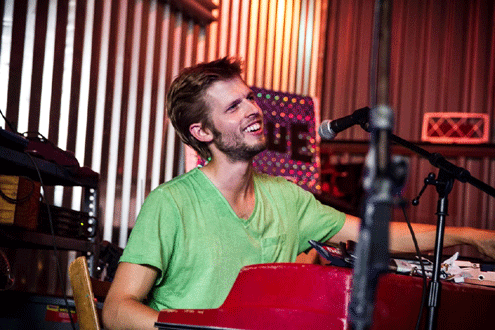


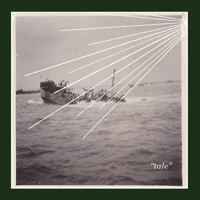


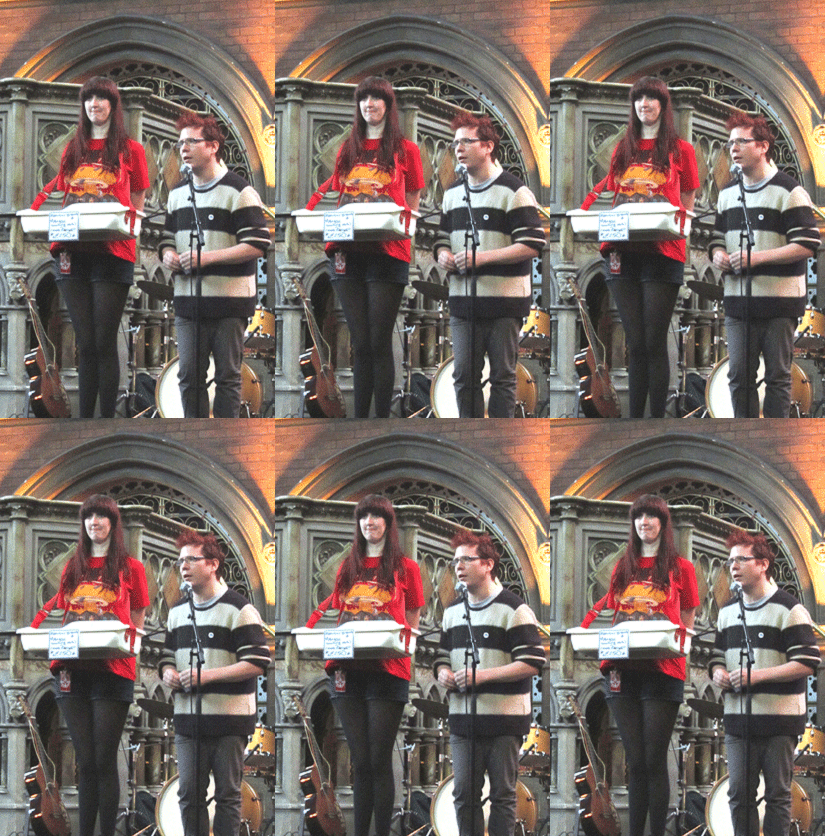


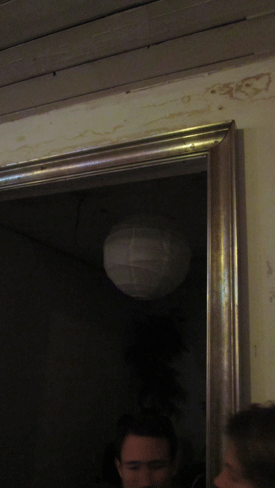
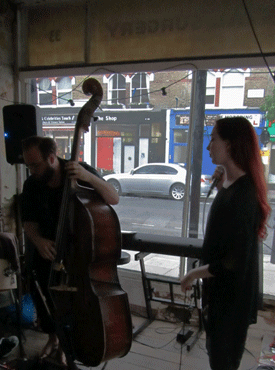

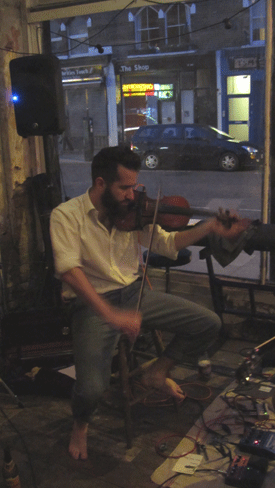
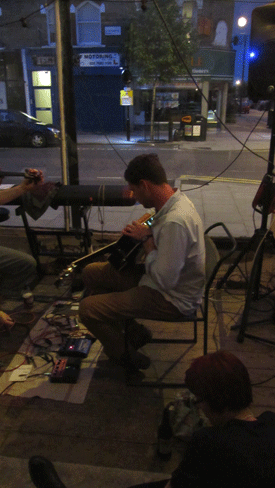
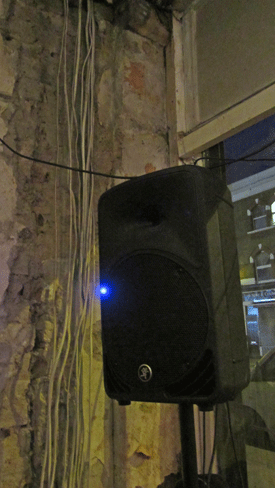
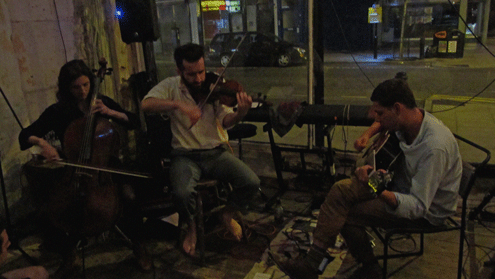
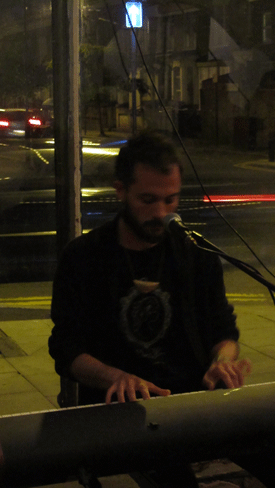
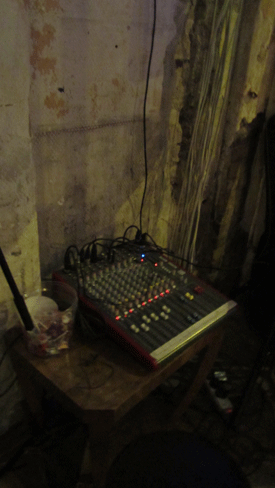
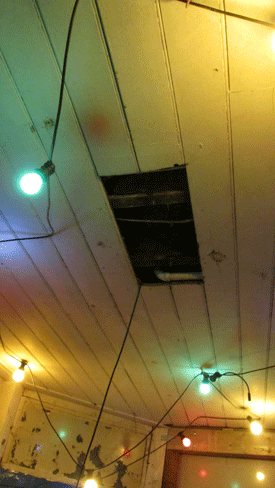
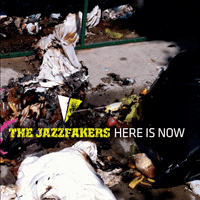
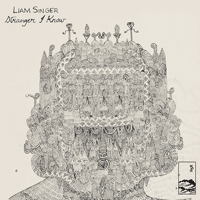



 Misfit City