Tag Archives: multi-instrumentalists

REVIEW – Elephant: ‘Ants’ single, 2011 (“somewhere between love-gone-wrong and epilepsy”)

30 May
Elephant: 'Ants/Wolf Cry'

Elephant: ‘Ants/Wolf Cry’

Band named after large thing actually sounds small. Single named after tiny things suggests that small-sounding band (named after large thing) could go massive. Sometimes I love pop’s ridiculous anti-logic.

Elephant are two. Christian Pinchbeck coaxes noises out of computers and wrangles chittering textures from guitars. Amelia Rivas plays old sounds on modern keyboards while swimming and sighing distractedly through the middle, avoiding eye contact. It’s synth-pop, allegedly, but it’s also nothing quite so obvious. Amelia and Christian may or may not be a couple, but that’s not clear either. With Elephant, not much is.

Ants is Elephant’s debut single, and it spends its three minutes cunningly, surprisingly persuading various things that shouldn’t work together to cosy up and make something which does work. A gentle reggae bounce, a dribble of whiter-than-anything psychedelic guitar direct from Cocteau Twins; a roughed-up reedy synth figure like a bass accordion with hiccups. As for what the song might be about, it’s somewhere between love-gone-wrong and epilepsy; like David Lynch reimagined as lovers rock. “I’m tired and I’m bruised for you,” Amelia murmurs, moping elegantly across the backbeat. “The war that I fought made my body contort… I’m down in the black, and I’m blue.”

When we talk of indie-pop being sickly, we usually mean that it lacks power. Here, sickliness is power. Unease and disease blend together, reality is erased by symptoms, and experience is somehow amplified by the giddiness and blank alarm. Throughout, there are references to buckling knees; to floating and amnesia and jump-offs; to falling to the ground or into song. Even the chorus avoids clarity in favour of hallucinatory warp (“Ants now scurry on the floor, / I just can’t remember before,”) with all perspective thrown right out-of-whack. Yet Elephant snatch a victory from these flashes of confusion and disaster, sheathing them into a subtle, catchy, play-it-again heartbeat of song; a cool, black-and-white flicker of distress call.

While Ants cloaks strangeness under bits of spooky washed-out reggae ballad, its flipside Wolf Cry goes for out-and-out surrealism in a stream of Bunuel electro-punk. Amelia sings of seasons, seafarers and parted lovers. Deeper into the song, she jinks these acid-folk fairytales into blurred dreams of power struggles, throwing out images of hunky aristocrats or “militants on the roof.” Everything hangs together – precariously – over Christian’s alienated instrumental bonework: a flat backdrop of flat echoing skitters, deep red bassquakes, ghostly chords and spray-can snare hits. As the song riffles balefully through its repertoire of cinematic flashes, impressions build and cut (“the ticking of a clock, jumps to interior,”) or flirt, archly, around games of obscurity (“we all wear a mask to a fellow passer-by.”)

Ultimately, Wolf Cry comes apart in the fingers if you squeeze too hard (the strange syntax, the dodging of plot, their mingling of seduction and avoidance) in much the same way that the story of Ants comes to us half-melted. Elephant have a knack for this kind of anti-logical play, squeezing into the gaps in the story. Besides, they’ve already demonstrated that they’re masters at magicking something coherent out of disorientated fragments – not least via a fine mournful tune or two. Evasive or not, they’re very much in the room. I suspect that I’m going to go on talking about them.

Elephant: ‘Ants’
Memphis Industries, MI0172S
vinyl 7″/download single
released: 17th January 2011

Get it from:
Memphis Industries.

Elephant online:
Facebook Twitter MySpace Tumblr Bandcamp

November 2011 – EP reviews – Elephant’s ‘Assembly’ (“how the war is contained”)

20 Nov
Elephant: 'Assembly'

Elephant: ‘Assembly’

Though Elephant’s Amelia and Christian actually hail from semi-rural English idylls (Pontefract and Stroud), their band is a London band and behaves like one. Rather, it presents itself in the way many pop bands made in London by incomers tend to. There’s something a little guarded about Elephant’s music – detailed and consuming notes from the inner life versus a chilly, self-constructed poise. It’s difficult to see which side is winning. It’s interesting seeing how the war is contained.

Two previous singles, ‘Ants’ and ‘Allured’, have dabbled in pop-reggae and R’n’B respectively, merging these with Amelia’s dazed and distorted lyricism and Christian’s avant-garde dream-pop trickery. With ‘Assembly’, Elephant now seem to be moving into more mainstream territories – more Anglo or European, certainly a little whiter. Think of a tranquillized Yazoo strained through 1960s West Coast pop; and then through the submarine guitar rills of Cocteau Twins, Slowdive or My Bloody Valentine. Think of a poppier yet more introspective Broadcast.

Think, also, of slow-paced black and white movies in which no-one seems to do much. While most synth-pop blazes outwards, Elephant’s blanched-out songs (offhanded in manner but carefully constructed) are always on the verge of collapsing inwards. Smooth swatches of organ, pulses of vintage keyboard and a solid sense of classic pop songwriting provide their work with an anchorage. But even when the synth trills and frills are at their liveliest, Elephant are increasingly trading in infinite shades of grey – monochrome filigree, slanted shadows, deadened responses. Amelia’s hopeless, surrendered sigh should be the band’s weak point, flattening Elephant’s pop soar into a graceful, endless nose-dive. In practise, those last drops of romance which cling to her resignation render the songs that much more intriguing.

Within the songs, the band’s brains are ticking away even when they sound as if they’re dazed by cough-mixture hangovers. Under its icy shrouding, Assembly pop-bops and puppy-bounces like The Teardrop Explodes; but still takes its medication straight to a frozen heart, anatomizing and dissecting the impact of closeness gone wrong. “It’s like a disease,” complains Amelia. “Think too hard, the brain goes cold.” While she’s dishing out a few sharp survival tips amongst the scalloped echoes and fairy-dust twinkles – “don’t dwell on who won’t dwell over you” – most of the song is convalescence and consolidation. “I have a mind,” she muses, pulling herself in. “The rest is numb, just a skeleton.”

The deeper into the EP you go, the further Elephant conceal outright emotion under festoons of Cocteau Twins guitar, blood-pulse synth and studied blankness. This is happening even as the lines they deliver lean more and more towards the romantic. Even the desert island setting of Shipwrecked doesn’t cut the chill. Amelia wanders through blurs of physicality (“shuffle, ricochet on the ground”), then fails to connect (“don’t try to confuse me again, / you speak so slow, sand falls on my head”) and finally all but gives up (“What’s the point of time? It dissolves in the sea. / If you sail with the tide, will you shipwreck back to me?”) While Christian’s sounds trail and spiral onwards, Amelia chases a half-stunned chorus – “that’s where my heart, the rest of my heart is” – as if grasping after a pair of slow-moving balloons.

The imperious blast of keyboards at the start of Hopeless herald an out-and-out dizzy love song. It’s part classic ’60s girl-group, part hi-NRG synth-pop. In its way – in Elephant’s particular way – it’s even quite triumphant. Elephant’s way, though, usually involves some kind of collapse. Amelia spins through the middle of the song, twirling like a stray leaf, sounding happy to be blown around by feeling. “Hopeless I know, I sway to and fro – / I can’t hide from you.”

But by the end of the EP, Elephant are hiding out. At Twilight is a step back to their earlier, artier work: from its swallowed-up chorused vocals and witch-queen intro, to its deathly pace and dreamy lyrics about a “circus moon”, it’s also deep trip-hop collapsing into Gothwave. A bass pulse lags and limps outside of the funereal beat: Amelia stares at her hands and murmurs “I need to leave, but I don’t know how,” as a foam of feedback gradually fills up the space. Inner life boiling over? Perhaps. Elephant play a teasing game with their songwriting tensions. It makes us keep listening.

Elephant: ‘Assembly’
Memphis Industries, MI0200CD/D
CD/download EP
released: 14th November 2011

Get/stream it from:

(2022 update) CD EP best obtained second-hand; download/stream from Deezer, Tidal & Spotify; the tracks ‘Assembly’ and ‘Shipwrecked’ also appear on the ‘Sky Swimming’ album available from Memphis Industries, Bandcamp, Apple Music, Spotify & Amazon Music; Elephant online:
Facebook, Twitter, MySpace, Soundcloud, Bandcamp, Last.fm, Apple Music, Deezer, Tidal, Spotify, Amazon Music 

June 2004 – live reviews – The Cox Cruise @ MV King Arthur, floating along the River Severn, Gloucestershire, early summer 2004 (featuring Earnest Cox, Ghosting, Charlie Says, Michael J. Sheehy & Paddy McCarthy of St Silas Intercession, Datapuddle) (“a self-propelled music bash”)

30 Jun

All we can see outside in the dark are moving, ghostly fronds – foliage bleached by the passing light spilling from our boat, nodding in the gusting winds above the lap of water. We’re on the river at night. We can’t see where we’re going, and we’ve entrusted our safety to a group of people with the seedy, ingratiating collective name of Earnest Cox. Things look bleak.

“It’s ‘Nam, man!” some joker screams suddenly. “Charlie’s out there, and he don’t surf! We’re all gonna die, man!”

He’s greeted by laughter. It’s all far, far too English for any of that: those nodding leaves we’re passing are in quiet Gloucestershire, and the River Severn isn’t winding us towards the heart of darkness… not unless Bristol’s having a really bad Saturday night. The double-decker boat we’re riding – the MV King Arthur – has been hired from the National Waterways Museum, and in under four hours we’ll have looped back to its safe berth in Gloucester. On the way, we’ll be enjoying a self-propelled music bash featuring the aforementioned Coxers and a little circle of related bands from Gloucester and London. There’s even a raffle. Cosy.

Had we set out a little earlier in the summer, and during the day, it would have been picnics and beer all round by now. As the red and gold lights of a jolly riverside pub bob past like a luminous Johnny Walker bottle, it’s clear that any actual weirdness will need to be handled by the bands. Crammed onto chairs on the makeshift band stage wedged into the top deck, Datapuddle do what they can. Alex Vald (who once played filthy guitar for Dream City Film Club) cradles an electric mandolin across his chest like a sulking cat. When not distractedly plucking and strumming at it as if he were plucking a chicken, his hands dart restlessly towards a litter of electronic gizmos on a table: a virtual theremin, a cheap sequencer, a plastic voice-changer and other bits of toy-box guts. Stephen Huddle plays sketchy acoustic guitar and pushes broken murmurs and mumbles of song up into Alex’s cobwebs of sound.
Datapuddle at The Cox Cruise

Datapuddle at The Cox Cruise

What ultimately emerges is a lo-fi cat’s-cradle of strung-together and slightly strung-out elements. Tidal dub; debris and dusty notes swept out of an Irish-American bar; bits of memory and reaction scattered like dandruff – all glued by static electricity and misfiring synapse energy to the guitar strings of a long-fried singer-songwriter. “Here’s a little sea shanty,” says Stephen brightly. A water-blip of electronics merges with a Lloyd Cole chug of guitar, rocking it on its rhythmic base. Alex buzzes a harmonica into an overlapping backwards loop, transforming it into a reversed melodica.

On the next song, trip-hop snare-drum smoke merges with psychedelic space whisper like the first skunked-out collision between Portishead and Hawkwind. Alex’s mandolin maintains a relentless, disappearing clang like a freight train bell, while Stephen mutters like Tom Waits ruffled from deep sleep. Peril – another shaggy-dog shanty written especially for tonight – namechecks the Severn amidst its steam-train chunter of knocks, old-school electro breaks, and harmonica rasps. “Don’t buy the brown acid,” Stephen sings, channelling up the confusion of a different party as ours sways cheerfully along the river.

Datapuddle come to a purring end with lashings of electric theremin wibble and a lengthy musical chew on a genuine melodica which has surfaced from their box of battered goodies. Watching them was like watching someone scrabble a shack together out of estuary trash and flotsam. In its way, it was just as raw and triumphant.

Paddy McCarthy & Michael J. Sheehy at The Cox Cruise.

Paddy McCarthy & Michael J. Sheehy at The Cox Cruise.

While the upstairs audience return to conversation and shore-spotting, Michael J. Sheehy and Paddy McCarthy are down below decks mopping up the leftovers (along with any beer that’s available). Cuddling a pair of honey-blonde acoustic guitars, the brothers from St Silas Intercession (and, previously, Dream City Film Club) have wedged themselves into a corner to hammer out rough’n’ready London-Irish punk blues as brutal as paving stones and hard-luck sneers. Eventually they’re joined by a wandering harmonica player and by a growing crowd of boozy party stragglers. Before too long, the corner turns into an enthusiastic trash-music shebeen (staggered over the changeover times between the acts upstairs) during which everyone’s treated to rattling, spat-out’n’spattered takes of the songs from the debut St Silas EP, starting with the vicious roar of You Don’t Live Here Anymore.

St Silas Intercession’s music is a London echo of the brutally direct and bluesy garage noise still spilling out of Detroit (and all of the little Detroits that have sprung up in the wake of Jack White or The Dirtbombs). Venomous as a dirty flick-knife and as blunt as masonry nails, it’s some way down the evolutionary tree from the corrupted sophistication of Sheehy’s recent songwriter albums, or even from the trawling sleaze of his old work with Dream City Film Club. Obviously the man himself couldn’t give a shit about all that: judging by the twinkle in his eyes and in Paddy’s, as they face each other off over sprawling riffs and hollers, they’ve rarely been happier with their music than now.

Paddy McCarthy at The Cox Cruise.

Paddy McCarthy at The Cox Cruise.

The brute-blues meanness of Get My Share has a good hard whiskey sting to it; as does the defiance of Caravan Rock (“me and my kids and their mum, / living in a caravan, moving on, moving on…”). A lacerating spurt through All About The Money sets people bobbing, scrambling and bouncing as well as a seven-and-a-half foot deck ceiling will allow. But as Paddy’s permanent goofy cartoon grin indicates, the St Silas brothers never take themselves too seriously. “It’s always about the money!” Michael protests, through a cheap megaphone. His voice suddenly jumps tracks from Louisiana bawl back through his London grit to an ‘EastEnders’ stage-Cockney. “You sla-a-a-g!”

Back upstairs, a dirty blonde in a cute plush cap is hammering a comradely nail into Mr Sheehy’s coffin. “Michael slags me off in his songs, and I slag him off in my songs,” explains Charlie Beddoes. Then she bowls us the rapaciously scornful putdowns of Vitriolic Alcoholic which kerb-kicks a snarling addict with a series of offhanded verbal wallops, culminating in “do I look like I give a toss? / It’s not my problem, not my loss.” It’s good to have friends.

The determined, diminutive Charlie is both the figurehead and the core of the shifting cult-of-personality that calls itself Charlie Says. Tonight, they’re three boot-babes and a moll-boy. Backed up by sidekick Ben Fisher’s car-crash guitar and by Lian and Kim Warmington’s ice-diva backing vocals and cool basilisk stares, Charlie plucks a remarkably articulate bass, sings like a breezeblock with lipstick and thuds out middle-weight girlpunk. Not short of charisma, Charlie holds the audience in the palm of her hand. The trouble is, she then rolls them around as if she doesn’t quite know what to do with them.

There’s a big difference between true punk and mere punk-ertainment, and Charlie Says wander a bit too close to the latter end of the scale. While Charlie’s former background in hip-hop art-rockers Rub Ultra is promising, discovering that both she and Ben are recent refugees from the touring band of tech-rocker Martin Grech pokes some suspicious holes in their lo-fi rebel stance. It just makes their music seem a little contrived. Not that the songs always help: It’s All About The Music is just another me-and-my guitar anthem, and Hey Leadfinger, Why You Gotta Keep Putting Me Down? is a foray into garage-blues which is far less interesting than its title is.

What pulls the band up out of fun-punk poseur-world are Charlie’s bright flickers of blunt humour and determination. The girlpower swagger of Venus Envy suddenly flings out “if the balls are in our court, then at least we have some,” while This Is Not My Story claims “whichever way it lands, my heart will keep on beating.” Little gems of lead-pipe wit and guts like this are what will make Charlie Says special; not desperate attempts to hitch onto whichever punk or garage soul flits past next. For the rest of the evening, I see Charlie perched here and there around the boat – beaming with life, always as if on the verge of delivering another breezy wisecrack. Let’s have more of that.

For all their efforts, Charlie Says don’t make me want to riot. Ghosting do… but I’d be rioting on their behalf. Five more minutes of hearing boozy party blabber drown out their beautiful, beautiful songs and I’d be flinging bottles around myself. Ghosting are heartbreakingly soft – as vulnerable and resilient as fresh grass bending underfoot. Unlike any other band this evening, they create little pockets of pure songcraft which you need to crane your head into to find out what’s going on.

Upfront, Dan Pierce picks out gentle acoustic guitar arpeggios which ride up into the atmosphere like thermals, and lets his voice follow suit. In the corner, wedged into a little cage of half-drumkit, laptop and miniature keyboard, George Moorey handles the rest. Intent and anxious-looking, he peers at his screen like a nervy microbiologist watching a virus proliferate. In fact, he’s just making sure that the sounds arrive on time – making tiny triggering adjustments to a mouse, reaching out one hand to roll off a gentle peal of Blue Nile piano, or swivelling to make precise soft taps on cymbal and snare with the single drumstick he holds in his other hand. It’s like watching someone play a one-man-band suit and conduct an orchestra at the same time. Yet even more impressive than this deft and diffident juggling act are the way Ghosting’s songs pool in the atmosphere – gradually, quietly filling up the space.

Dan’s big genial frame contains a songwriter’s spirit of rare and seductive delicacy. Faced with a chattering crowd, he simply shifts his guitar in his hands and sings soft, warm and open… and slowly the chatter drains away as the spell begins to work. Gently, Ghosting explore topics spanning all the way from frayed love songs (Your Love Don’t Make Sense) through thoughtful disillusion all the way to ending up being fingered as a murder suspect (Someone At The Door). Hopefully not as a natural progression – but if it was, you’d suspect that they’d’ve illustrated even that story with colossal and convincing sensitivity.

By the time Ghosting are midway through the exquisite, naked plea of I Want You To See Me, the crowd is hushed and half of them are hooked. Dan’s flexible and heartfelt singing – mostly a feather on tremulous breath, but rising to a swoony peak of intensity – sometimes recalls Mike Scott or Robert Forster at their very softest. In a fey, English, breathy way, he even has flashes of the fluttering abandonment of a Van Morrison or an Aaron Neville. Like them, he’s singing songs of real people grasping out at the intangible – unsure of what to believe on Anything That Might Be True, or “waiting for the one thing which really might have been some help,” on Good Year, only to wait in vain. Intangible desires, tangible heartaches. They’ll probably rise like damp rather than rockets, but I suspect that within a few years Ghosting will be very important to a lot of people.

Having put the whole cruise together in the first place, Earnest Cox get a well-deserved heroes’ welcome once they arrive onstage. They respond with perhaps their most energetic and assured set to date. It’s the third or fourth time I’ve caught the Cox, over a time when I’ve watched their sturdy intelligence getting to grips with lacing together their multiple influences. It’s taken a while for their mixture of old Memphis R’n’B, ’60s lad-rock, ’80s indie textures and prowling street poetry to gel.

Tonight it does with a vengeance. Hello Stranger sweeps out of the gate with a swagger of rogue testosterone coupled with a smart and beady eye, as Cox singer La Windo immediately takes on the audience with his particular blend of strut and twice-burned wariness. Perhaps it’s recent honeymoon rejuvenations or perhaps it’s the side effects of squabbling over their current recordings, but Earnest Cox are smouldering tonight. Still looking like a disparate houseful of mature students (the band’s a bewildering range of types from motherly to mysterious, from rogue to stockbroker) they continue to draw on what’s in them already rather than trying to squeeze themselves into an image.

The rhythm section used to be little more than agreeably white’n’slightly-funky: now it’s moving towards a lubricious slippery groove, with bass player/occasional MC Simon abandoning cheese and cheeriness to join drummer Shane in seriously flexing the pocket. Nicola parachutes in flights of piano, springs of Booker T. Hammond organ or splurges of synth when she needs to, while Marc buries himself in the middle of the band, cooking up lightly-textured mats of funky guitar texture to fly blurs across the gaps.

Up front, where you’d expect to find a preening Rod Stewart lookalike, La continues to prowl like a Gloucester merging of Shaun Ryder and Lou Reed, delivering his narratives of edgy small-town life like the most restless man in the pub and shaking his percussion as if testing the heft of a throwing knife. He looks pretty handy: yet the Cox don’t exactly trade on casual violence, even when La hurls out scathing fighting talk on You’re Not Fit To Lick (The Shit From My Shoes).

Rather, they seize on restlessness in general, whether it’s randiness, boredom, the unease as your parents age towards death, or the bumps in love’s road. There’s swagger, vengeance and one-upmanship aplenty in songs like Two Can Play At That Game, Baby and Scratching The Same Old Itch: yet in spite of this Earnest Cox’s songs are about survival if they’re about anything. No More Happy Endings treads the ashes of hopes and securities with the dogged, battered trudge of someone who’s had the knocks, has sagged, but won’t go down yet.

The Cox’s musical cockiness almost makes them part of that line of lad’s bands dipping in and out of pubs, taverns and speakeasys (and finally Royal Command performances). Yet the way the bruises on the songs never entirely fade (and the way that La quietly retreats into himself, gaze distracted, mid-song) hints at a band who’ve accepted, even embraced, the dragging baggage of personal history rather than saturating themselves in adolescent posing. Marc’s refusal to play the role of the strutting guitar stud (keeping his back almost entirely turned to La and the audience as he brews up his noises) confirms it and heightens the internal dignity beyond the Cox’s miscellaneous looks.

Perhaps it’s this mixture of getting by, getting on and getting on with it even within limited horizons that makes Earnest Cox local heroes on the Gloucester scene. The familiar tastes of that stew of pop ingredients they serve it up with, plus their band’s anti-glorious English universality and their bumpy everyman charisma should win them friends around the country, whether or not they bring their boat with them.

As the Cox set hits its climax, we look up and find ourselves back in the Gloucester lock. Hometime, Charlie.

Datapuddle online:
Homepage TwitterMySpace Bandcamp LastFM

Michael J. Sheehy online:
Facebook MySpace LastFM

Miraculous Mule (what Sheehy/McCarthy/St Silas Intercession did next) online:
Homepage Facebook Twitter MySpace Soundcloud LastFM

Charlie Says online:
Homepage

Ghosting online:
Homepage MySpace Bandcamp

Earnest Cox online:
MySpace

MV King Arthur online:
Homepage

September 2002 – album reviews – Resindust’s ‘Resindust’ (“scattered art rock, post-rock, guru-guitar serenity and air-sculpture”)

14 Sep

Resindust: 'Resindust'

Resindust: ‘Resindust’

Let’s imagine that somewhere within British art-music, there’s a recovery zone, and that that’s where we find the two Resindust blokes trying to help each other out. On the one hand, there’s Lewis Gill – part of the North-West English avant-garde via guitar improv with The Psychiatric Challenge, full-on death-drone noisescaping with Sebastian, and rolling about in the electronica toybox with Vivahead. And on the other hand, there’s Tony Harn – the dedicated solo instrumental craftsman, happily out-of-step with time and trends. Usually, Tony purveys appealing guitar heroics blending jazz-fusion, ’70s rock beef and ’80s echo-box chitter somewhere between Durutti Column, Brian May and John Scofield.

Shape-shifter, meet Trusty.

Now… let’s say that perhaps Trusty’s seeking a way to become less clever and mannered. And perhaps Shape-shifter is experimenting with how to be less sprawling and bizarre. And let’s also consider that while most new projects are intended to be springboards, Resindust might well be intended as a set of emergency dampers. But that’s far too glib. Rather than chaperoning or circumscribing each other, the Resindusters thrive on creative, positive dilution. Ignoring the arm-wrestling of most jazz-rock and avant-garde stand-up fights, they melt into each other’s music at each meeting.

Thriving on the opposing poles of their drives and talents, they make the most of previous chemistry (having briefly played fusion-rock together in Lifebox) and of the interesting DIY sonic and instrumental layers they use to augment their odd-couple guitar work. Vocal hums, artlessly sweet woodwind, veering masses of low-key electronica, wind-chimes and flapping hoods of bass combine in a melange of scattered art rock, post-rock, guru-guitar serenity and air-sculpture. Recalling Fred Frith, Mike Oldfield, This Heat and AR Kane in equal parts, ‘Resindust’ contains some of the most thought-provoking music that either Tony or Lewis have produced to date.

For the guitar-led pieces, they opt for a disciplined approach: collective cycles of electric counterpoint, urged gently towards the panoramic. In Wireweave, Lewis’ earnest neurotic parts intersect Tony’s majestically burnished clockwork patterns in a cat’s-cradle of multiple guitar lines: but Tony also delivers a fat Queen-gone-space-rock solo, nudging through the delicacy like a gold-plated airship. When Tony’s in the driving seat, the duo incline towards ornate and looping structures with a definite prog taste. Suzanna weaves precisely-etched pastoral guitars into repeating, mellifluous Fabergé glitter. On Resindust itself, dogged multi-tracked guitars burrow up out of the same kind of minimalist shards and sketches as Bark Psychosis’ Pendulum Man. As these mesh together in a slow, precise pile-up, Tony’s bowed guitar and fretless bass offer bleak and slanting commentary amidst the hovering ambient string talk.

Lewis generally plays rogue element to Tony’s jewelled approach. He lets the guitars hang everywhere – polluting the atmospherics and hovering around their miasmic impressions of mosquitoes, sirens and beast growls. On Vorpmix, his slow-brewed sleet of industrial noise sharpens Tony’s beefy moans and scrapes of guitar ambience. The baleful, semi-ambient Critical is a trapdoor-land of sour and haunting guitar swells, with bent and wind-blown chords dropping from above like sheets of corroded tinfoil, scattering over the crematorium organ and thirsty windchimes. Yet it’s Lewis’ naïve murmurs of song-vapour which anchor Suzanna to earth, and for the softness of ‘Cotlife’ his guitars tease out tiny, waltzing, bluesy curlicues (beautifully judged and deliciously expressive; trimmed back to the size of comforting ghosts).

 
But although graceful or abused guitars dominate Resindust’s music, there’s no drop in interest when they’re laid aside in favour of Lewis and Tony’s remaining noisemakers. Windscream sets itself down in draughty chills of ambient keyboard and lamenting, clay-fluting recorder notes. A lone fretless bass mouths like a shipwrecked plesiosaur while vocal keens and burrs, chings and echoes chew gently at what remains of the structure. And for Artism, Lewis’ looped and layered a-cappella vocals wobble precariously over collapsing dub drum-spasms. Multiple descending harmonies skip down over nasal, throbbing madrigal jollity. Lapping slices of conversation toss words onto the shoreline beyond: phrases like “jigsaw puzzle” wash up from the background, and for a moment you wonder what it’d be like if Alan Bennett had ever muscled in on a Henry Cow chorale.

‘Resindust’ is an album of solace and reconciliation. It’s not just because of the gentle beauty and bewitching chaos that peek through its music from time to time, but because of the affectionate wit in the way it reconciles studied, precise musicality with the chance factors and absurdity of raw art instincts… all without so much as a stepped-on toe. Harn and Gill never really needed to use each other as a cure. They just needed that mutual hand-up to where they could bridge the nagging gaps together.

Resindust: ‘Resindust’
Resindust (no catalogue number or barcode)
CD-only album
Released: 2002

Buy it from:
Very rare – best obtained second-hand.

Tony Harn online:
Facebook MySpace YouTube

Lewis Gill online:
Homepage MySpace

September 2001 – album reviews – Tony Harn’s ‘Moving Moons’ (“beautiful liquid-gold guitar with its shoes kicked off”)

2 Sep

Tony Harn: 'Moving Moons'

Tony Harn: ‘Moving Moons’

Little has changed in Tony Harn’s approach, but the Warrington fusion-rock guitarist has never sounded happier. His lyrical, tightly-controlled hard-rock drive is still set off against tumbling, multi-faceted art-rock arpeggios, plus enquiring shapes and vocalised textures drawn in from the world of modern jazz guitar. But the lightness of touch on ‘Moving Moons’ – and its renewed breadth of expression – makes it his most assured work to date.

This third album seems to be about simply enjoying the flow. Its gently sparkling mood is that of a well-pleased man, leaning sensually into his work. As ever, Harn (playing or programming all the instruments) blends his music without cynicism or self-consciousness about his comfortable sound. The bright, guileless weave of cyclic minimalism, gleaming Factory Records economy and judiciously-employed jazz-prog flamboyance retains Harn in a small, well-kept territory of his own.

You can trace a Pat Metheny legacy in some of those friendly guitar percolations, and that of Vini Reilly in the glittering, spindly-but-intricate echo-box patterns. But the overdriven keens of his lead lines have the affable, comfy edge of a ’70s geezer rocker – good-natured, puppy-rough and serenely blissful. At root, ‘Headstart’ is a Satriani-style rocker, growling from the pit of its sulky, dirty wah-rhythm and attempting to swagger. Yet Harn focuses and soothes it, opening the music outwards and festooning it with reflective pointillistic arpeggios; finally leading it towards inclusiveness and away from posturing.

Compared to the pastoral English flavour of Harn’s previous album ‘Lifebox‘, ‘Moving Moons’ is built on a summery Mediterranean warmth – hot nights of brilliant stars, or energising washes of daylight and bright stucco walls. Although Harn sometimes lets his airy keyboards dominate (especially on the pocket-funk throb of Pulsecode, synth riffs chuckling like contented babies), the pervading sound of the album is acoustic, or near-acoustic. Despite of the squadron of stratospheric rock wails and the sheath of Andy Summers textural swells, what really informs Jackal is Spanish guitar, all tangy attack and tremolo. Anger And Empathy provides a dynamic demonstration of Harn’s experimental side – a slow-motion volcano-burst of bent whammy-bar swells, scrapes and tortured violin-bow noises, all fed through outer-space distortions and echoes. But this too flows forward into another Spanish-styled guitar progression, clean and sweet: and ‘Safe Again’ is full of perky acoustic strumming as Harn takes flight, deliciously chasing his own echo.

Although this strays closer to driving music for the Algarve than it does to Paco Peña, Harn invariably saves the day with his ear for tunes, his knack for beautifully refracted arrangements, or his mastery of unabashed constructive naivety. The marriage of technology and innocence – a rare quality in guitarists – is Harn’s ace card, and a surprisingly effective one.

Moving Moons itself is a fragrant nightscape – tootling synths kissing up to arpeggio guitar and the sound of floats bobbing in reflective water. Sweet meteor trails of guitar-wail arc across the air for a rendezvous with moving cross-rhythms; and more spare, sweet paths of feedback show up on the deliciously lazy study of Standing In The Doorway To Your World. Here, they play over the gently assured structures built up by Harn’s synths and organs, or ease breathlessly across a classical-minimal duo of Reilly-esque clean guitars. Lake Song has Harn orchestrating a duet of twinkling post-punk guitar and hooting ’70s overdrive, the drumbox teased by reggae-tinted bass beneath those double-stopped minimalist patterns.

Generally avoiding the temptation to rampage incessantly across his fretboard, Harn’s drawn instead towards finding and sitting on pretty patterns. Sometimes this gets dangerously close to cuteness – the breezy Bubbleburst, for example, like a chance meeting between Alphonso Johnson and Brian May in the kids’ end of the jazz-rock pool. User One (Moon Two) also lives in the bright-eyed zone, bouncing its swirly jangle of notes against the night sky, keeping them up and moving via its pumping, lightly-whipped funk bass-line.

As a counterweight, Harn addresses his jazz leanings more substantially in a couple of loose fusion ballads. Time For Answers merges swing rhythms, prog assertions and a Django Reinhardt gypsy wriggle, leading them all through to a celebratory duet of guitar and tootling synth. Sixlowdown aims at the jazz pocket through the gaps of another reggae-styled bassline: a bubbling, tripping sway like a mid-’80s Miles Davis ballad, emphasized by the growl of bluesy distortion Harn employs for terse comments from the sidelines, flexing a few John McLaughlin sensibilities.

‘Moving Moons’ sometimes seems a little becalmed within its coasting motions – a touch too happy in its light’n’easy beauty – but with such lovely scenery to glide through, it’s little wonder that Harn’s opting to cruise easily. Ultimately, this time he’s offering beautiful liquid-gold guitar with its shoes kicked off, and whether you choose to join him on the sundeck is your own affair. But he couldn’t be any more welcoming if he tried.

Tony Harn: ‘Moving Moons’
Tony Harn, THCD2 (no barcode)
CD-only album
Released: 2001

Buy it from:
Burning Shed.

Tony Harn online:
Facebook MySpace YouTube

July 2001 – album reviews – William Maxwell’s ‘Cardinal Points’ (“a delicacy and poise John Williams would admire”)

26 Jul

William Maxwell: 'Cardinal Points'

William Maxwell: ‘Cardinal Points’

Of course, no American musicians ever bear grudges about the demand for fake country bands to fill America’s bars. Nor about the rules of economics and averages, which mean that most professional rock or jazz musicians have to spend a significant part of their career biting their lips while propelling a Formica hoe-down tune towards a beer-splattered dance floor.

William Maxwell’s composition, Bass-ically Country, has nothing to do with this. Nope. It must be a coincidence: the way he keeps pulling his multi-tracked bass guitar out from the cage of those diddly riffs and hilariously plodding walking-blues lines and firing it up into more interesting concepts (a snappy little Stanley Clarke line; a crashing feedback-drenched heavy-metal solo; a dawnlit ambient moment) only to have it yanked back into line and back into the walk.

For about four tongue-in-cheek minutes, you’re getting a portrait of Dreamy Bassist with Ideas locked in combat with Insensitive Band, losing most of the battles but not giving up on the war. Maxwell (generally found playing bass for pan-European/Celtic proggies Tempest) has obviously been there and done that, and is able to laugh at it. Inevitably, Bass-ically Country brings back memories of the late-’80s bass showman Stuart Hamm and his rollicking banjo-slap pisstakes. Some of the aforementioned Dreamy Bassist’s little lines are quite silly, after all, though the naiveté is charming.

In reality, Maxwell’s a much more thoughtful musician than this jokey sketch of bassline frustration suggests. As for dreaming… Well, while the sonic ambitions of his ‘Cardinal Points’ album are sometimes held back by budget (and by too much reliance on predictable synth presets), they’re still very much audible. Deploying his armoury of four-, five-, six- and eight-stringed basses (and backing himself up with some cosy keyboards and percussion), William sets out to explore a typically Western American breadth of music. Melodic electric jazz, New Age, funk-rock, Celtic and light prog influences all gel together. Even the dreaded country music is welcomed into the stew.

Though Maxwell shares Hamm’s taste for transposing classical music onto electric bass, he has a far greater understanding of his source material. His version of Scarlatti’s Sonata In D – baroque harpsichord music arranged for a choir of multi-tracked basses – is particularly impressive. It demonstrates a real understanding of both Scarlatti’s ecstatic mathematics and of that fussy enthusiasm that’s part of the harpsichord sound; while cunningly adding a smidgen of American swing (straight out of Chet Atkins’ Classical Gas). The gently blossoming study of Sweet Dreams (drawing on his early classical guitar training) sees Maxwell pluck a six-string bass with a delicacy and poise John Williams would admire.

Still, technique is a secondary matter on ‘Cardinal Points’. Despite Maxwell’s dexterity, he isn’t offering us a player’s album. He’s as happy when playing a child’s melody or chord wash on synth as he is executing twiddly turnarounds on bass. His true interest is in composition and arranging – his basses are dragooned into illustrating his musical ideas, not flying along on top of them. Rather than pursuing The Great Solo, he spends his time on constructing latticeworks of harmonic chimes, or on an agreeable rumble of conversing fretless and fretted instruments.

The Gold Rush is one of the only moments where Maxwell gives in to any boy-racer super-soloist desires. Fortunately, he does this with jollity instead of arrogance; building himself a piece of music full of skipping strums and curvy chromed planes of distorted EBow sustain, which bounces like an off-road vehicle. Rich Bradley injects a shot of serious jazz, providing a burst of antsy soprano sax (Dave Liebman style) to explode over Maxwell’s heavy popcorn slap. More frequently, ‘Cardinal Points’ sits happily in that comfortably idealised pastoral-prog idiom inspired by bands like Happy The Man or Montreux. Although Carol From An Irish Cabin (its watercolour synths dampening a politely romantic fretless bass) is a step too far towards Windham Hill wallpaper, both The Big Bird and Early Morning Rising follow the path more fruitfully; working in folk melodies and pinches of fuzzy overdriven jazz-fusion to their relaxed, innocent arrangements.

It’s sweet, but not as interesting as the experiments in sparseness, space and counterpoint elsewhere. On Not Tonight I Have A Headache, delicate layers of bass harmonics, thumb pianos and gongs inter-balance each other in a chime of mechanisms; while more basses brew up a blurred but rather beautiful dialogue of growls and stoned-cat noises to rise up behind it. Every Time takes the same kind of chiming bell effects and applies it to a gentrified jazz ballad (with an elastically expressive fretless melody to the fore).

Best of all, there’s the stately (and ever-so-slightly-psychedelic) jazz-rock march of Cardinal Points itself, demonstrating just how much Maxwell prioritizes composing and realizing music over spotlight hogging. Few bass soloists would share their best piece with another top-drawer bassist, let alone two (Harmony Grisman’s sidekick Tami Pallington and the increasingly legendary Michael Manring). Even fewer would make the piece dependent on the subtle collective interaction of all three musicians, rather than on lick-trading.

But that’s exactly what happens here. Pallington builds a silvery canopy of deftly clanging harmonics over Maxwell’s rich twilight orchestration, clarinet-style EBow lines and trick-stepping rhythm. Manring’s own response to Maxwell’s musical hospitality is to turn out one of his finest ever signature melodies – a musing solo slithering luxuriously around the fretboard like a stretching cat in a sunbeam, extending notes into passionate vapour trails via his own EBow. A generous response, it’s one of the high points of a generous album.

William Maxwell: ‘Cardinal Points’
Maxtrix (no catalogue number or barcode)
CD-R only album
Released: 2001

Buy it from:
Best obtained second-hand, or enquire via William Maxwell homepage.

William Maxwell online:
Homepage

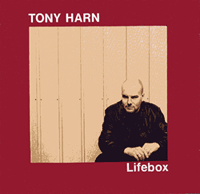
July 1999 – album reviews – Tony Harn’s ‘Lifebox’ (“settle into the music’s bright and rapid embrace”)

24 Jul

Tony Harn: 'Lifebox'

Tony Harn: ‘Lifebox’

Since striking out on his own with ‘From The Inside‘ in 1997, Warringtonian guitarist Tony Harn has gone from strength to strength. It’s not that ‘Lifebox’ is all that different from its predecessor. It’s the same recipe of glittering, admirably economical rock guitar arrangements backed up by simple keyboard sounds and lightly-cymballed percussion programming – the sort of thing that would have made Harn a hero of British instrumental rock in the 1970s, or even the ’80s. In the late ’90s, it makes him more of a finely-tuned curio. A guilty pleasure.

Still, being out-of-step with the times has little to do with your innate value; and Tony Harn’s got plenty of that. His concept of melodic rock moving towards a jazz vocabulary has had to pass through a Manchester filter first. There’s a lot of meticulousness and post-industrial reserve here, an underlying balance of sounds and patterns that’s got more to do with Factory-style Futurism than feet-on-monitors and flailing hair. Not that Harn’s cover photo – the purposefully-shaven skull and meaningful gaze – shows hair to flail anyway.

In a nutshell, Tony Harn is what Joe Satriani might have been if he’d had Durutti Column’s sensibilities. His full-blooded melody-metal tone, his tunefulness and his sweet tooth for rock romanticism is reined in by Northern English economies on gesture and gush. Except for a solitary Van Halen moment – a short-lived explosion of devil fingers called Reaction:Release (In One Motion) – all is controlled and thoughtful. Layers of staccato echoed phrasing and delicate flat-picked motifs interplay with tuneful, assured lead lines. Harn’s guitars can chatter and circle busily, or pine away in expressive overdriven wails, all without letting the music lose its well-suspended balance. It can be as dignified as fine civic architecture, or it can roll like a landscape of green English hills. Pastoral, but never pastel; surprisingly serene, but not soporific with it.

And (if all of this isn’t starting to sound too cute) proggy without being boggy. Since the sometimes-perfunctory tunes of ‘From The Inside’, Harn’s developed a well-deserved confidence in taking on longer-form compositions. The fifteen-minute, multi-phase Reaction:Repeat (In Six Motions) bubbles with understated invention – it’s a drawn-out, trance-y rockscape of shifting heroic tunes and dance pulses, bouncing off the same constellations as Porcupine Tree did on ‘Voyage 34’. Split The Sketch jumps from sleepy church music (cavernous swells, sweet-dream melody and the chink and whisper of string noise) into the sort of split-metred riffing and racing arpeggios that Steve Hackett would’ve been happy to set his name to. Blue Blazes doesn’t go for length, but for shimmering detail, weaving tiny repetitive phrases into sky-written spirals around an airborne ripple of synth.

Even if his silvery jazz-inflected chording doesn’t quite qualify these efforts as fusion, Harn’s push towards jazz is becoming easier to distinguish. You can hear him trying out conversations with the themes in Eve Of Obligation; and if you listen beyond the diamante guitars on Pseudotalk, you’ll hear a pretty, melting tune that wants to sit down with a jazz quintet and make friends. But if Harn does move into that world, it shouldn’t be at the expense of the straightforward and joyful way he expresses his melodies – the folkiness of Last Town, the wedding bell tumble of Twelve Years, or how his romantic heart sits self-evidently on his sleeve for Forgotten Summer as his guitars and bass court each other. It shouldn’t be at the expense of digressions into haunting soundscaping such as Dark Age; in which, through organ drift and dreaming guitar sculptures, a girl’s guilt-stricken voice murmurs “I never used to think about it before.”

This, after all, is that rare breed of rock guitar album – one which you play not to worship at the Church of Guitar but to settle into the music’s bright and rapid embrace, and to lean back into it. ‘Lifebox’. A good name for such an unassuming package, spilling out such fertile enthusiasm.

Tony Harn: ‘Lifebox’
Tony Harn, THCD2 (no barcode)
CD-only album
Released: 1999

Buy it from:
Limited availability – contact Tony Harn for information.

Tony Harn online:
Facebook MySpace YouTube

August 1998 – EP reviews – No-Man’s ‘Carolina Skeletons’ (“loaded with meaning, swollen thick with suppressed tears”)

29 Aug

They claim it as “a totally new approach” for the band, but thankfully, this time they’re wrong. After the diverse experimentation of the ‘Wild Opera’ and ‘Dry Cleaning Ray’ albums, it’s more of a look back to their roots in the deceptively simple, poignant flush of ambiguous romance. No-Man are going home. And as they do, this falls – as if from a worn-out pocket – into our hands.

Carolina Skeletons could just be the finest single No-Man have ever released. A rhythm track like a weary hubcap rolling its way home; Steve Wilson’s lovelorn, restrained piano and sleepy, teary guitar touches. A simple, unchanging dynamic evoking both a state of grace and a state of stagnation. A set of chords that fall, question and resolve – heartbreakingly – around Tim Bowness’ quietly yearning vocal. A distant almost inaudible organ, hovering like a night scent. And a short glimpse of a few moments of a trapped life.

It’s a snapshot of a lonely woman paralysed by inertia, watching as time “strips the tinsel from her hair” and the mingled forces of gravity and grief tug her down. It has the same sketch-like quality of American Music Club or The Blue Nile – a few lines loaded with meaning, swollen thick with the suppressed tears – and breathes out, with its eyes closed, the same ineffably bruised air as Mark Hollis’ melancholy reveries. You get a feeling that for its solitary anti-heroine, Cowboy Kate, time is slowing but history has already halted.

So much for the lead track. But the whole EP shivers with an underlying, understated tension; the sort of slight ache that nags and means that at best only a flawed and brittle peace is possible. Caught up in the acoustic guitar webbing of Something Falls, Tim’s words are entangled and shivering in the anticipation of a shock to come: “You’re far too near it to feel it… / You’re far too near it to fear it…”

In Close Your Eyes (a swoonier, more grace-inspired take on their old Desert Heart epic) Mellotron strings hover near or retreat over rolling slot-drums: elegant stalkers on the uppers of their nerves. Twinkles and illuminations come and go like soft offshore lights – halfway through a guitar screams alone in the middle distance. Caressed, Tim sings a beatific, burnished chorus while the verses hint at love, violence and dependency: “His hands were hard, your face was soft. / He kissed your heavy head – and then you lost your strength…” It ends on a poised and prolonged outbreath, with Tim wailing passionately into the void up ahead: “You break, you swim alone, like a child…”

To close – a reverberant, distant, Budd-like reprise of the Carolina piano line in all of its beautiful worn-down dignity. The dust blows forward and the dust blows back. Sometimes all there is to do is to carry on, face set to the wind and tears stroked back towards where you’ve come from. Beautiful.

No-Man: ‘Carolina Skeletons’
3rd Stone Ltd., STONE037CD (5023693003757)
CD-only EP
Released: August 1998

Get it from: (2022 update) Original CD EP best obtained second-hand. The title track (and a different version of ‘Close Your Eyes’) ended up on No-Man’s ‘Returning Jesus’ album in 2001: all of the EP tracks were reissued on the triple-vinyl release of ‘Returning Jesus (The Complete Sessions)’ in 2006.

No-Man online:
Homepage, Facebook, Twitter, Soundcloud, Last.fm, YouTube, Instagram, online store, Apple Music, Deezer, Spotify, Amazon Music

July 1998 – album reviews – G.P. Hall’s ‘Marks on the Air’ (“a rough’n’ready homemade ethos”)

20 Jul

G.P. Hall: 'Marks On The Air'

G.P. Hall: ‘Marks On The Air’


On ‘Marks On The Air’ (an album of live recordings from concerts in London and Wiltshire), the eccentricity and affections of British experimental guitarist G.P. Hall is presented wide open and unashamed.

To make the record, Hall teamed up with binaural recording whiz Mike Skeet. It’s Skeet’s voice you can hear bookending the concert – running up stairs and heading down in lifts, describing his surroundings with the nattering enthusiasm of a ‘Playschool’ presenter, and popping any remaining hopes of arty detachment. Still, it somehow adds to the warmth of the atmosphere which Hall’s live playing induces. Apart for the oddly truncated applause and the removal of Hall’s shy, uncontrived audience chat, it’s as close to one of his concerts as you’re going to get without leaving your home. Skeet’s superb recording techniques (his binaural miking technology directly mimicking the listening experience of ears on a human head) presents this music in the enveloping, directly tactile environment it requires.

Compared to the more assured sonic constructions you’ll find on a Hall album, ‘Marks On The Air’ is less sophisticated and more risky, but it’s equally ambitious. Skeet’s interjections aside, this is a one-man show. It relies entirely on how much Hall can get out of his hands and his immediate music loops while still keeping an audience entertained. With four separate speaker stacks, an assorted collection of guitars and effects pedals, and the armoury of unorthodox guitar-abusing sundries which he uses as playing implements (bows and battery fans, crocodile clips and Velcro, toy cars and electric razors), Hall is at least well-armed to do that, Even the clean, dated, digital rattle-and-thunk of his 1980s rhythm box lends the enterprise an endearing extra dimension of naivety.

Hall’s pictorial – even painterly – approach to music is consistent throughout. New England Woods is cut from the same lambent aural cloth which Hall made his own with Spirit Sky Montana – swelling curtains of sounds midway between country steel guitar and cello parts strolling and dallying in a soft adagio. Docklands attempts to recreate the brazenly lively colourfulness of a polluted industrial sunset – the shambling drums falling lopsided, the whooshing saw-sounds and lemon-sharp guitar echoes pressing out the shape of the skyline.

Live, however, Hall can be tempted away from his more elegant pastoral confections and into heavier statements. The impressionistic heavy metal of City Signals and Uncharted Territory both offer searing and swaggering chromium-blue lead lines, plenty of echoed backings and slow rolling pummels of drum-sound. Rippling, prolonged ambient humming and field recordings of indistinct conversation fill the gaps, like smog pouring into a heat-haze. For the tremendous scrunch of Flying Ants, Hall turns to his six-string bass and his flamenco knowledge. The result sounds like an over-scaled Gypsy guitar played with helicopter blades for fingernails. A delightfully yobbish take on the form, it flicks between tremendous chocolate-y gurgles of sound and (when Hall kicks in the distortion pedal) impenetrable hedges of distorted overload.

Much of this music is punctuated by clipped and plunking programmed synth-bass lines. Outside of mid-’80s chart hits, these ought to sound cheap and unpleasant. Instead, they fit surprisingly well into Hall’s musical sketches of the grubbier side of cities. They can be as brash and tacky as scattered burger boxes at your feet; as the failing neon signs and fly-by-night minicab firms gummed onto and into frowning old brickwork. On Flying Ants, they’re just appealingly cyborg. On Figments Of Imagination – where they’re working alongside metallic wails, hand-pumped stutters of echo and the rattle of crocodile clips – they add to the rough’n’ready homemade ethos of the music.

The hypnotic On Every Life (A Little Rain Must Fall) goes further into the wilderness. Nodding to Native American rhythm patterns, it calls up the feel of a parched Arizonan desert view. The delicate whine and rush of the guitar patterns swap between impressions of the dry, red heat and dust and of the shocking whiteness and colours of the tasselled fragments of cloud. Notes call and repeat, tranced out. Towards the end there’s a moment when it all stops. All but a faint swirling echo, as if the whole desert was looking upwards; and then the mass of sound crams back in again, like a cloudburst.

Best of all, perhaps, is the build- up of The Lonely Road, coalescing sustained, sorrowful coats of sound and small factory noises. Tinges of ambient-blues embrace a tired old worker’s knotted muscles at the end of the day. Part of the human focus comes in via the twanging, Frisell pluck’n’pang of Hall’s guitar. It’s capped, however, by the endearingly rough burst of busker’s harmonica which he wafts over the floating sorrow. Brave and defiant, it’s answered in kind by the elephant-trumpet of a rotary-saw sound.

Despite the odd bit of bluster, ‘Marks On The Air’ goes further towards expressing Hall’s gently appealing emotional nakedness as player and creator. What he sometimes loses in the grace stakes, he gains back in honesty and sympathy. There are a couple of unselfconscious, winning little cameos of “tiny music” which could have come from a children’s theatre. Drum sounds pop and clatter against the clipped melody and zither-blues intonation of Chinese Firecrackers. Suvi’s Little Crickets is built out of simple yet exquisite acoustic child-song patterns, which regularly rests while Hall circles a boxful of mechanical insects, chirping peacefully, around his microphone. Further hints into the private man are suggested by the deep pulsing chant of Alcharinga (in which guitars are abandoned altogether, in favour of throat-singing through an old answering machine mike). Marks On The Air itself is a long, mournful study on classical guitar – swept back and forth in eddies of echo, resigning itself beautifully to its own impermanence.

G.P. Hall manages to be many things. The garage player amongst the avant-garde; the warm-hearted soft touch among the arthouse players. The naive wonderstruck kid in the crowd of post-adolescent posers, the transfigurer of the straight, and the benevolent ghost in the machinery. Not a bad set of credentials, at that.

G.P. Hall: ‘Marks On The Air’
Future Music Records, FMR CD46-V0997 (7 86497 26442 1)
CD-only album
Released: 15th July 1998

Buy it from:
G.P. Hall homepage or Future Music Records

G.P. Hall online:
Homepage Facebook Twitter MySpace Bandcamp YouTube

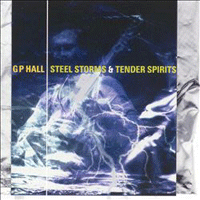
April 1998 – album reviews – G.P. Hall’s ‘Steel Storms & Tender Spirits’ (“grand painterly instincts”)

7 Apr

G.P. Hall: 'Steel Storms & Tender Spirits'

G.P. Hall: ‘Steel Storms & Tender Spirits’

Despite the luminous loveliness of much of his music, the career of style-hopping guitarist G.P. Hall hasn’t been smooth (even by the uneven standards of the experimental music he dips in and out of). Regardless, ‘Steel Storms & Tender Spirits’ shows that he’s still up for taking a gamble.

A trust-risking double-album package, clearly intended to emphasize his dynamic musical dialectic, it also highlights the tension between his experimental side and his taste for romantic melody. There’s one disc of rough treatment (industrial noise-layering, screaming electricity) and one of ear-stroking pastoralism (the natural sound of wood and air, tickled by occasional breaths of spectral electronics). However, with Hall being who he is, the two ideas tend to bleed back together: in some cases, maybe more than was intended.

The ‘Steel Storms’ half of the set features a wealth of Hall’s “industrial sound sculptures”. Layered compositions played on his stock of prepared-and-processed guitars (via plectrum, fingertips, battery fans, velcro and more), they also make cunning use of assorted noise-makers ranging from scavenged autoharps and scrap metal to oven racks and household bricks. Texture is the predominant element in the music, but a surprising tunefulness and dark melodies often penetrate in the form of solemn classical adagios. It’s these which underpin the clattering chains, metallic rasps and harmonics of Industrial Sights, or the billowing clouds of rolling fragmented piano and wrenching distortion in Eye Saw It 2.

There’s an impressive documentary flamboyance at hand, too. When the insistently ringing, collapsing-steel groan-tones of Tsunami blend with both close-up atonal jangles of autoharp and with distant, skinny guitar-string shivers, the visual qualities of Hall’s music are particularly clear. Some of his work here wanders out to a distant edge. Two tracks in particular, Steel Storms and Steel Landscape, are almost wholly abstract – musical testaments to metal fatigue and the disorientating feel of post-industrial spaces. Grumbling, malignant loops and glittering boils of guitar drown in swills of rattling shard-metal and bass-drum booms. The pieces are laced with elephantine bursts of distortion; and with brief, dying surfacings of chemical-corroded blues playing.

Throughout, Hall’s grand painterly instincts tug the sound closer towards beauty – however twisted – than towards flat and impersonal horror. A whole album of such Hall industrialisms would be something to treasure. Unfortunately, ‘Steel Storms’ is continually gate-crashed by other sides of his musical personality. On River Flow, he revives one of his signature approaches: fluent Spanish guitar over detailed rolls of textural soundscaping. It’s as lovely as ever, but it’s misplaced here; and it’s anybody’s guess as to what Gypsy Gathering (a virtually straight piece of flamenco) is doing on the record.

In cases like these, Hall’s distracted eclecticism undermines the original intent of ‘Steel Storms’. Worse comes when that willing, stubborn naivety which lies at the heart of his music (giving it both its emotional strength and its core of idealism) becomes diluted into reproducing other people’s cliches. Since the mid-’90s, Hall has been an enthusiastic miner of his past work, dicing up his out-of-print albums to recombine their contents in new sequences. Often this has worked out well, juxtaposing his newer, tuneful solo tapestries with older, intriguing avant-jazz duets, trios and quartets (often featuring sundry members of Isotope, Gilgamesh or Nucleus). Unfortunately, on this occasion he’s pulled up some dross along with the gems.

Perhaps Hall’s work in library music during the lean years is to blame. He’s too interesting a musician to produce stock blandness (and even his failures have moments of interest) but on a record with a purpose, these lesser scraps should have stayed on the shelf. Yet several ‘Steel Storms’ tracks come from this lifeless batch, splotched with anonymous moves and tinny keyboard presets. No Man’s Land is drab robotic cop-chase stuff, the kind of thing a particularly cheesed-off Mark Knopfler might clunk out at the dull end of a soundtrack contract. The less said about the appalling Barbed Wire Bop (brittle ‘Seinfeld’ plastic-funk with the tones of a dodgy synth-demo) the better.

Happily, other ‘Steel Storms’ approaches are much more successful, toying fruitfully with the tight blare of fiesta horns, or with a kind of impressionistic stadium rock held together with paper-clips. The rainy-night drive of City Signals funnels determined loose-jointed funk elements through cascades of drumming, a marching-call trumpet leading the tune above Hall’s steel-saw guitar chops. On Docklands, an acoustic guitar explores and ranges over washing licks of soundscape; electric guitars swipe between factory-machine screeches and trumpet blasts; an echoing hip-hop beat – blind, gigantic and mechanical – stumbles through the landscape beyond.

Sometimes, everything comes together. Though centered on the aggressive, questioning rawness of an up-close flamenco guitar, B-E-trayed provides a discreet light-industrial twist to its traditional base, dragging its intermittent sheath of noises back into the realm of the personal. Already bouncing off tricky drumbox beats, it heads into more sinister areas when swarming, echoing drones and bitter laughter flicker across the speakers. At one point, Hall yells cathartically into the soundhole of his guitar.

All interesting, but the industrial theme becomes increasingly tenuous over the course of the record, though it does rally at points. Heavily overdriven cutting-blade sounds return for Fiya, in which blurred polluted riffs meet mournfully defiant Latin horns and gut-strung guitar. On Dancing On Cracking Ice the guitar plays a supporting role to mariachi horns (and to Sam Brown’s exploratory world-rock rattle of percussion), as Hall’s chopping slashing echoes and metal-fatigue string groans lead off into a leisurely Latin funk stretch. Funk is also one of the central elements of Battery Charger, colliding with big-band horns and space-rock as Hall’s snappy twang-melodies and jittering string harmonics are bounced through some serious Ash Ra Tempel echo.

While there’s no shortage of ideas and impressiveness on ‘Steel Storms’, as an album it’s a missed opportunity – too bitty, too unstructured, and not quite ruthless enough to do justice to its theme. You can dive in for the more thrilling patches – and hold your nose at the bad points – but at times it’s the wrong kind of bumpy ride. Fortunately, its companion album compensates for the missteps by being an experience of unqualified and perfectly integrated beauty.

Where ‘Steel Storms’ shows Hall straining after too many things at once, ‘Tender Spirits’ showcases a beautifully focused vision. Dominated by his acoustic playing and by the subtler side of his electrophonic treatments (sometimes heightened by softly resonant brass and drums), it sounds as if it was recorded under a great cool bowl of night sky. It also proves that, however much energy he puts into his experimentalism, he remains a superbly expressive guitarist once the trickery is removed. Here, the wise simplicity and romance at the center of his music come into their own, in full.

Judging by many of the pieces here, classical music lost a fine player and interpreter in Hall when he went left-field, not to mention a fine folk-fusion composer. Listen to those Spanish arpeggios (mournfully meditative on Love Lies Bleeding, restless and subtly unresolved on Slipstreams) or to the singing Irish ballad inflections of Patricia O’Leary. Alternatively, enjoy Hall’s subtle reunion with electricity on Shooting Stars, Ember or Dandelion Clocks. The first two are slow astral wheelers, their notes stroked into long, long, beautifully smudged trails and pining crystalline tubes of sound; the last is chuckling child-music, clean notes bubbled through a sparkling halo of echo.

Hall’s more multi-tracked and constructed compositions fit just as seamlessly into the mood. Some are familiar – here’s another outing for the thrumming bowed-bass winter scenery of Miles From No-Where (White Wilderness), a piece which Hall continually revisits. Similarly, there’s a new version of another favourite, Spirit Sky Montana, in which David Ford’s sleepy flugelhorn and Sam Brown’s slow swish of cymbal pull Hall’s stretched-bell guitar layers and church-music structure up to further heights of passionate serenity. A more ambiguous moment is granted on Incandescence, where a baroque six-string bass is smeared into dark and swollen horn sounds, voicing in shifting minor-key planes, searching for a place to settle.

However, it’s the magnificent Lonely Road which shows Hall at his very best. Loose, hanging drapes of luscious sound, distant detonating percussion, his Spanish guitar upfront again with a heart-tugging melody, and a final DIY touch – this time, a lonely and beautifully frail harmonica part. This is music you could live in. There’s a direct, emotional involvement in G.P. Hall’s work that’s rarely found among experimental musicians – probably because in spite of his gizmos and his taste for modernist expression he connects far deeper with the earthy roots of music than with the narrowed, exclusive intellectual demands of music as a science.

Ultimately, the main reason that ‘Tender Spirits’ is stronger than ‘Steel Storms’ is that in spite of Hall’s fascination with the impact of industrialism on our lives and senses, he knows it’s merely a part of our experience of the world: a relatively recent human-scale derangement overlaying much older terrain and themes. The two superb acoustic pieces which open and close ‘Tender Spirits’ could easily predate the factories, machinery and artefacts that inspire his industrial sound sculptures; both being intimately concerned with human survival within the simpler, starker hostilities of nature itself.

For the majestic impressionist-flamenco study of Sandstorm, Hall’s fingers slither out whips of string noise among the sharp and fluttering notes, conjuring up the flying dust. Sea Sorrow (Lament Of Lewis) is at the other end of the scale: a paean to shipwrecked souls in which Spanish guitar technique merges with a plaintive Celtic air. Within it, bitter bereavement struggles with acceptance and an awareness of continuance. Those who live with the sea are sustained by it and robbed by it, and this feeling lives in the music. As visual as anything Hall comes up with via loops and layers and implements, the plangent tones of this naked acoustic piece shape an image of someone alone and bleak on the headland, staring out at the ambiguous and often-merciless ocean which they must ultimately come to terms with.

It’s true that G.P. Hall’s road is, ultimately, a lonely one – sometimes assured, sometimes erratic, always marginalised. Yet it’s always one which he treads with a stubborn faith – wrong steps and slip-ups notwithstanding – and one that makes him all the more unique.

G.P. Hall: ‘Steel Storms & Tender Spirits’
Future Music Records, FMR CD46-V0997 (786497264421)
CD/download double album
Released: 31st March 1998

Get it from:
Future Music Records (CD only) or Bandcamp (download-only, as two separate albums, ‘Steel Storms‘ and ‘Tender Spirits

G.P. Hall online:
Homepage Facebook Twitter MySpace Bandcamp YouTube

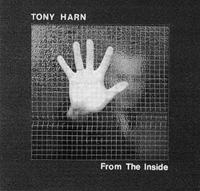
September 1997 – album reviews – Tony Harn’s ‘From the Inside’ (“hard-rock directness with intricate layering”)

18 Sep

Tony Harn: 'From The Inside'

Tony Harn: ‘From The Inside’

Tony Harn used to be in Spacematic, a Warrington duo who – had they survived – might’ve carved out a niche for themselves as music history’s only cross between Morrissey and Jeff Beck. Their 1996 demo was an odd and edgy marriage between Dave Harrison’s bleak bedsit lyrics and mournful vocals and Harn’s fluently melodic guitars (which mingled hard-rock directness with intricate layering). Imagine what their gigs might have been like. Two guys onstage in the throes of song and lost to the world – oblivious to the panicky expressions on the faces of their audience, as the tribal reps for the indie depressives and the rock hogs were forced to eye each other nervously across the clubroom floor, clutching their snakebites and beers for support. Ah, social awkwardness rattles its cage. Fine times. And – if they ever existed – gone times.

Parted from Harrison, Harn spent a year left to his own devices and ‘From The Inside’ is the result – an self-released instrumental guitar album which allows him to explore spaces of playing and composing which Spacematic could never have accommodated. Usually, rock guitar solo records are unparalleled opportunities for musical showing-off. While Harn’s got the necessary technical skill (and enough classic rock in his playing) to go for total guitar-hero blowout, ‘From The Inside’ is remarkably modest, and its musicality is expressed with unusual restraint. For instance, the title track’s Brian May explosion of passionate electric pomp and romance, lasts barely over a minute and fades out in a subdued loop of Vini Reilly arpeggios. Harn’s experiments in five- and seven-time are lilting, accessible and lovingly melodic: his lead lines are concise, memorable and authoritative. Acting as his own support musician, his crisp drum programming and sturdy work on bass and keyboards (as integrated as his guitar playing) lend the album a homely sound.

One of the best things about Harn’s playing is that, for all the skill of his fingers, not one note is superfluous or wasted. He’s more likely to sit comfortably on top of a bold tune than to play stuntman; he knows when to let exploration stop, and when to let silence stand. In a musical zone stuffed with supremely accomplished fret-wankers suffering from fingerboard diarrhoea, that’s a rare and cherishable talent. As far as obvious influences go, the above-mentioned Jeff Beck gets a look in (something in the attack, the indisputably British rock stylings); there’s a little of the ’80s Alex Lifeson in the hard-rock digital jangle; and sweet lyrical solos like Mike Oldfield or even Prince. Harn also has a strong touch of Joe Satriani’s out-and-out lyrical tone and way with a melody (most obviously on the sunny rush of Playsafe and Pseudoseven, or the echoing Room One which recalls Satriani’s Circles).

But what ‘From The Inside’ reminds me of most is the pair of albums Andy Summers and Robert Fripp recorded in the mid-80s – ‘I Advance Masked’ and ‘Bewitched’. Harn’s playing has neither Fripp’s intensity nor his academic sternness. Nor does it have Summers’ taste for textures on the guitar synth. But his fondness for the spangly echoes of the delay pedal, his exuberantly climbing note patterns and ear for counter-arranged, bell-toned rhythm-picking lines comes directly from their legacy. In Turning Time, guitars dodge and somersault cheerfully over the rising drones and evolving multiple rhythms. The cycling riff in Pseudopool recalls Talking Heads and I Zimbra: its long sweet smudge of a solo hearken back to Fripp’s New York years.

‘From The Inside’ does have its flaws, the most obvious one being that it carries the predictable symptoms of a guitarist’s showcase. Some pieces show this more blatantly than others (Beat The Bad, for example – a pretty superfluous bit of guitar-rock reggae style). You could also quibble about some slightly cheesy keyboard tones and parts, which pull some compositions a little too far towards travel-show soundtracks. Yet at least they err on the side of cuteness rather than flabbiness, and are essentially there to support the guitar work. Harn can be forgiven these lapses given that plenty of rock guitar soloists choose sixteen minutes of assorted widdly-widdly as a showcase, while his own offering is a well-worked-out album of tunes and interplaying.

In spite of Harn’s knack for those solid tuneful elements, many of the high points of the album come when he slows down and makes shapes. The eerie scrapings and siren wails which set the scene for the title track, for instance. Or Coloursound, in which ringing slow-swelling chords mingle gorgeously with the whispered sample on the voiceover: “Particularly at night, I have this incredible feeling of intense blackness… I mean, I’ve never experienced such darkness…” It could’ve sat comfortably on David Sylvian’s ‘Gone To Earth’, as could its drowsy vapour-trail of a melody.

I’d really love to hear Tony Harn working in a fuller band situation, or with collaborators who’d really bring out the best in him – but this’ll do for now. One of Britain’s finest undiscovered rock guitarists has left his calling-card, and I’d advise you to get in touch.

Tony Harn: ‘From The Inside’
Tony Harn, THCD1 (no barcode)
CD-only album
Released: 1997

Buy it from:
Limited availability – contact Tony Harn for information.

Tony Harn online:
Facebook MySpace YouTube

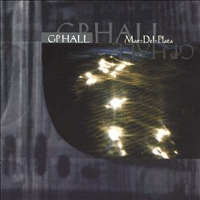
August 1997 – album reviews – G.P. Hall’s ‘Mar-Del-Plata’ (“ranges with restless compassion across a wide field”)

10 Aug

G.P. Hall: 'Mar-Del-Plata'

G.P. Hall: ‘Mar-Del-Plata’

Still clearing out the accumulated tapes of an inexplicably neglected career, Graham Peter Hall is continuing to come up with the goods. He’s been through thirty years of uneasy development on that rocky, unrewarding terrain between the simple sureties of the rock and roots instrumentalist and the often complacent indulgences of the full-on avant-garde blower. Marginalisation and bad luck might have ensured that he’s received little financial reward – nor has he gained the kind of brittle, precious reputation that marks out the darlings of the art-music intelligentsia – but it has resulted in a stock of lovely, emotive music in its own right.

Certainly Hall has managed to remain one of Britain’s most individual and complete guitarists over that time. Mastering a variety of styles from flamenco to rock to folk and blues, he’s also immersed himself in experimentation via technology – multiple speakers and pedal processors; vast, slow delay loops. Additionally, he draws on a repertoire of bizarre playing techniques and plectrum substitutes (involving battery fans, tiny psaltery bows, electric razors, toy cars and velcro, among others) which reflects the reinvention of guitar function explored by Fred Frith or Keith Rowe. With these methods in place, he’s explored sound through the textural suggestions of his “industrial sound sculptures”. Light industry, that is – Hall’s mimicry is closer to handsaws and governor motors rather than, say, Trent Reznor’s car-crushers and stamping presses.

Yet in amongst this, Hall has somehow never lost the ability to embrace expressive tunes; or to weave a handrail of familiarity into his sonic constructions. Perhaps that’s why ‘Wire’ types don’t seem to go for him; why he doesn’t have the kudos that the likes of Rowe, Frith, Eugene Chadbourne or Glenn Branca enjoy. He can get in your face – or wander off the usual path – with the best of them, but it’s generally in order to touch your sympathies. Ironically, in choosing to express his conservative and traditional side as equally important to (and entwined with) his avant-garde side, he’s gone too far for some.

‘Mar-Del-Plata’ is by far the most accessible and diverse of the compiled albums which Hall has been assembling this decade from deleted vinyl and assorted unreleased tapes. It’s a tour across a loose, but affecting, composing and performing imagination which ranges with restless compassion across a wide field. Sometimes you’re listening to a skittering, wilful flamenco performance. Sometimes it sounds like Cocteau Twins doing home improvements in the Mediterranean. Sometimes it’s the sort of individual, humanistic free improv/New Music result which you’d expect from Frith at his more lighthearted and relaxed, or from Simon H. Fell.

But though the record is full of experimentalism, Hall’s sense of melody is at the forefront – and the predominant voice on ‘Mar-Del-Plata’ is his masterfully expressive Spanish guitar playing. This can usually be found angling over long aching stretches of choral electronic humming, plangent violin and eerie ambient sounds called up from the industrial processors. In some ways it’s like a semi-unplugged take on a Robert Fripp Soundscape, in which guitar textures span out into infinity.

At other times, it takes on the simple directness of a folk tune: a dance of sparkling acoustic lights on Ionian Water, or the staccato accented Latin melodies of Mar-Del-Plata itself, underpinned by a geological murmur of bass. On the final hot gusting of Sierra Morena Dust Storm, the gut strings spit and scatter in rich melody, reaching new heights of sinewy passion. Here, Hall also bows some winnowing textures in his electric guitar accompaniment, using serrated steel bars from his box of implements.

Where technology plays a more direct role, Hall’s humanity doesn’t falter or go under. The hymnal swells of billowing electric warmth on Spirit Sky Montana (somewhere between Bill Frisell’s cinematic romance and David Torn’s eccentric string-warps) are the most beautiful and enveloping sound on the record, tapping deeply into church music and Romantic classical composing. The trickle of wind chimes, langorous piano, and enveloping sighs of Humidity Despair provide a gusting, luxurious impression of a sultry night: it’s lush enough to lean right back into.

Some tracks, fleshed out by Hall’s sound-loops and D.I.Y. treatments, are detailed, impressionistic oil-paintings in music and tone. Deep Blue sounds like someone chainsawing up a frozen Alpine lake, its jangling piano chords and thumping bass a mass of irregularities. The smear of bright spring-loaded colourflow on Charmouth Beach rings beautiful alarm bells. The menacing bass growl of Enigmatic is like a cave-bear thumping around in your dreams: squeaks and rattles from fingerboard and autoharp move around in slow disquiet, enclosed by knocking metal.

Plutonium Alert (in which Hall abandons guitar altogether in favour of soprano sax and the ring of auto-harps) treads similar territory to the ominous King Crimson improvisations from the mid-’70s. It goes for an all-out sensory mix of apocalyptic aftertones: angular bell-sounds and aggressive Grappelli violins entangling themselves with a spasmodically awkward funk rhythm. Weirdest (and most satisfying) of all is Fahrenheit 451 – juddering guitar, saw sounds, the shriek of a whistling kettle, and treble scratching all mix like toxic vapours under heavy pressure, pushing your head back against your rising hackles. Horribly enjoyable.

The scattered effects of the attempt to capture all of Hall’s ideas across a single CD does mean that ‘Mar-Del- Plata’ misses out on the cohesion which would render it excellent, but it’s a close-run thing. The centrepiece – a long-form creation called The Estates – pulls all the elements of the album together. A version of a 1975 long-form composition, it blends the chiming, restless clatter of its improv ensemble with Hall’s own quiveringly angry solo acoustic guitar. The brooding theme of The Estates is the crappiness and autocracy of post-war British urban programming. In thrall to modernism without being able to master it, its utopian vision (heartily botched and compromised) laid down a blight on communities, their architecture and their cohesion wrecked by the same tower blocks and support links designed to improve them.

Hall and co. express the disillusion and neurosis which resulted, with pulses of frustration and alienation hurl themselves against the confines of the music. Dulcimers, clarinets, and a huge array of percussion all seethe and pant over twenty-five minutes of desperate musical invocation; all overhung by the forbidding scrapes and alarm-clangs of two adapted metal piano frames (played like harps with assorted chains, wires, and implements). Hall’s panic-stricken guitar playing conjures the nightmare of a new, fatally-flawed sprawl of roads and buildings: swarming locust-like, unchecked and unconsidered, over beloved landscapes.

Incidentally, in the sleevenotes Hall gives a blood’n’guts description of the struggle it took to assemble and perform The Estates. Apparently, some of the manufactured instruments continue to drift through the art world with a life of their own. The piano frames – still counter-invading the architecture – were last seen as part of a “fire sculpture”. Meanwhile, the piece itself has an additional afterlife as a reflection on Hall’s own love/hate relationship with modernism; his own playing and arrangements echoing and championing the sounds of the traditional past even as they break them up in performance and execution.

As a body of work ‘Mar-Del-Plata’ has its faults – yet judged on its parts (and at its undisciplined best), it’s a touching, passionate and diverse album. Throughout, we get the sort of peek at Hall’s open heart (warts, gooey patches and all) which most experimental musicians, hard-wired into intellectual dryness, would never risk expressing.

G.P. Hall: ‘Mar-Del-Plata’
Future Music Records, FMR CD46-V0997 (7 86497 26442 1)
CD-only album
Released: 12 April 1997

Buy it from:
G.P. Hall homepage or Future Music Records

G.P. Hall online:
Homepage Facebook Twitter MySpace Bandcamp YouTube

September 1994 – album reviews – The Milk & Honey Band’s ‘Round the Sun’ (“pollen-soaked brightness”)

30 Sep

The Milk & Honey Band: 'Round The Sun'

The Milk & Honey Band: ‘Round The Sun’

Life in Levitation appears to have been pretty intense. It wasn’t just the careening violence of that band’s supercharged stew of indie-metal and psychedelia (which usually brought to mind eerie and sickly dawn comedowns, or bloated nebulae savaging each other in a chilly night-sky) but the personal cost as well. Five equally creative underground rock musicians – each with hungry histories behind them – yoked together into a single band and choosing an open-ended approach, then unexpectedly exploding into semi-celebrity across the British indie-rock circuit.

Excesses of talent and volatility (and too much “too much” in general) inspired Levitation, but also wore it down. In particular, the sudden and very public departure of the band’s doggedly wayward frontman Terry Bickers in summer ’93 seemed acrimonious enough to raise blisters. Perhaps this is why whenever Levitation’s keyboard player Bob White stepped away from the band for a breather of his own, the music that he produced had such pollen-soaked brightness to it. Compared to Levitation’s soaring, guttering galactic frenzies, The Milk & Honey Band feels more like waking up in a warm barn in the woozy heat of an August afternoon, knowing that there’s just enough of the summer left for you to relax into.

Collected together as a full album, these songs float together gracefully and lazily. Despite the communal, homespun suggestions of the name, Bob is on his own here – producing and playing absolutely everything from the shakers to the luscious layered guitars. He seems more than happy to be carrying all the weight. Of course, he’s made it easier for himself by making Milk & Honey Band music so softly buoyant: an easygoing psychedelia with a nostalgic undertow. ‘Round The Sun’ is pervaded by a sunny West Coast feel, with banks of multi-tracked Bobs murmuring in cloudy harmonies.

There’s an illuminated sting to Not Heaven’s punchy rhythm, but listen to that glorious coda as the guitars slide deliciously over each other – a sensual Moebius strip of sound. A trio of pastoral guitars in Raining, set against a gentle downpour, recall Peter Green. Mandolins ring tenderly on Out Of Nowhere. The slow, sleepy, rumple of the title track builds on rich and majestic layers of spliffed-up guitars and harmonium; Bob lovingly croons “feels like life has put the world in your arms” amidst touches of melodica and tingling vibraphone. Even a digression into pelting distorted rock-out for Another Perfect Day (which sounds like an agreeably tranquillized Bob Mould) is haloed with positivity.

West Coast syrup and sunshine aside, the Milk & Honey Band is also as English as chips in newspaper. Often it could be a never-was memory of imaginary childhood holidays. Something remembered by a happier Syd Barrett, perhaps – saved from drowning, and lost in a contented swirl of dope smoke as he hangs out with an equally relaxed Andy Partridge.

Two rogue Milk & Honey Band instrumentals also anchor themselves to an endearing shabby gentility, like fading Edwardian seaside pavilions going quietly to seed in the dying sunlight. The first of these, Tea (sweetened with organ, glockenspiel and fake clarinet), summons up sepia memories of elderly swinging dance-bands. The snatch of elegant minimalism on Pier View (shifting interlocking waltzes of piano and synth oboe) isn’t a million miles away from the  more mannered moments of  Penguin Café Orchestra’s chamber-music joys.

Still… beyond the simple humming pleasures, there’s a subtle tinge of melancholy. It’s intangible, like a barely-there sense of the mistakes you’ve not yet realised that you’ve made. On Puerto, hazy recollections from family holidays – train journeys, shapes made by a father’s hands – are just flakes of memory, snapshots of times that are gone. Only the cavernous darkness of Light – slow drums booming, guitars like giant creaking girders; a smudgy, apprehensive fog of vocals – points back towards Levitation’s broiling stress.

Yet there are hints that the warmth in which The Milk & Honey Band sits is a resting place which must be eventually left behind; or a long-ago photograph in which the colours will eventually turn wan and wear away. Listening past the folky, bluesy cats-cradle of clean-picked guitars (recalling the Stones in wasted lament on Wild Horses) you’ll hear Bob singing softly about blood on his hands that won’t wash away. Elsewhere, he gently pleads “Take a lot of stupid noise / and try to understand the words that I say.”

It’s as if he’s aware that the time available for understanding is short: circumscribed by circumstance, and with far too much human frailty getting in its way. Presumably, fraught energies will be beckoning again sometime soon. In the meantime this album is here, as floaty and comforting as a hammock-ride – and as vulnerable.

The Milk & Honey Band: ‘Round the Sun’
Rough Trade Records, R3572 (5022781203574)
CD/vinyl/download album
Released:
29th September 1994
Get it from: (2012 update) Download from Burning Shed; CD is long-deleted and best looked for second-hand.
The Milk & Honey Band online:
Facebook Twitter MySpace Bandcamp Last FM YouTube Vimeo Pandora Spotify Amazon Music
 

SWOONAGE

Swoon. /swo͞on/ A verb. To be emotionally affected by someone or something that one admires; become ecstatic. Here are some people and things that make me swoon. #swoon #swoonage

Post-Punk Monk

Searching for divinity in records from '78-'85 or so…

theartyassassin

...wandering through music...

Get In Her Ears

Promoting and Supporting Women in Music

Die or D.I.Y.?

...wandering through music...

Music Aficionado

Quality articles about the golden age of music

THE ACTIVE LISTENER

...wandering through music...

Planet Hugill

...wandering through music...

Listening to Ladies

...wandering through music...

ATTN:Magazine

Not from concentrate.

Xposed Club

improvised/experimental/music

The Quietus

...wandering through music...

I Quite Like Gigs

Music Reviews, music thoughts and musical wonderings

furia log

...wandering through music...

The Recoup

SINCE 2013: Books and books and books and books and occasionally other things

A jumped-up pantry boy

To say the least, oh truly disappointed

PROOF POSITIVE

A new semi-regular gig in London

Gapplegate Classical-Modern Music Review

...wandering through music...

When The Horn Blows

...wandering through music...

:::::::::::: Ekho :::::::::::: Women in Sonic Art

Celebrating the Work of Women within Sonic Art: an expanding archive promoting equality in the sonic field

Ned Raggett Ponders It All

Just another WordPress.com weblog

FLIPSIDE REVIEWS

...wandering through music...

Headphone Commute

honest words on honest music

The One-Liner Miner

...wandering through music...

Yeah I Know It Sucks

an absurdist review blog

Obat Kanker Payudara Ginseng RH 2

...wandering through music...

poplifer.wordpress.com/

Waiting for the gift of sound and vision

Good Music Speaks

A music blog written by Rich Brown

Do The Math

...wandering through music...

Archived Music Press

Scans from the Melody Maker and N.M.E. circa 1987-1996

The World's Worst Records

...wandering through music...

Soundscapes

...wandering through music...

OLD SCHOOL RECORD REVIEW

Where You Are Always Wrong

FRIDAY NIGHT BOYS

...wandering through music...

Fragile or Possibly Extinct

Life Outside the Womb

a closer listen

a home for instrumental and experimental music

Bird is the Worm

New Jazz: We Search. We Recommend. You Listen.

...wandering through music...

Life Just Bounces

...wandering through music...

Lucid Culture

JAZZ, CLASSICAL MUSIC AND THE ARTS IN NEW YORK CITY

Aquarium Drunkard

...wandering through music...

eyesplinters

Just another WordPress.com site

NewFrontEars

...wandering through music...

FormerConformer

Striving for Difference