Here are details on some more interesting concerts coming up later this month. These run the gamut from soft psychedelic world-folk atmospherics to jabbering electric art-punk noise and sprechtstimme via dream-folk, caustic love songs and extended-technique art-rock instrumentals. (It was a shame to hear about the cancellation of the Charles Hayward gig in London on the 23rd – taking its ANTA, Gnob and Kavus Torabi support slots with it – but I’m sure that something similar will be rescheduled for anyone in need of their art-mash/stoner/prog/psych/metal salad…)
Dave Sturt presents An Evening of Dreams & Absurdities (Upstairs @ The Red Lion, Market Place, Wirksworth, Matlock, Derbyshire, DE4 4ET, UK, 23rd September 2015, 8.00pm) – £8.00
As part of the Wirksworth Festival Fringe, Dave Sturt (bass guitarist with Gong, Bill Nelson, Steve Hillage and Jade Warrior, as well as being half of Cipher) showcases tracks from his forthcoming solo album ‘Dreams & Absurdities’ in an evening of world-class all-instrumental musicianship featuring beautiful eclectic music, soundscapes and various field recordings from Gong tours and elsewhere. The music is “mostly mellow and ambient – somewhere between melancholy and elation.”
For the performance, Dave will be accompanied by three guests. Chris Ellis (guitar and piano) is a multi-instrumentalist/singer-songwriter/actor, an ex-member of Anglesey band Ghostriders, and an award-winning soundtrack composer – he’s also a collaborator with Dave on the Past Lives Project (which recreates the recent ancestral histories of British communities by resurrecting their old cinefilm recordings and setting them to new music). Brian Boothby (low whistle, djembe) is an acclaimed folk musician, dramatist and writer and a member of the Derbyshire mixed-arts collective Genius Loci. Jeff Davenport (drums, percussion, HandSonic pad) has worked with jazz musicians Andy Sheppard and Phil Robson, pop artists James Morrison and Laura Mayne, and currently collaborates regularly with “Silent Pianist” Neil Brand providing soundracks to silent films, as well as working in Europe and the Far East on various projects with all manner of musicians.
On the last post, I plugged a London double event on the 19th – a day with a Daylight Music concert at midday and a noisier rock gig in the evening (both events which are still about to happen as I post this). In another week’s time, history’s repeating (fortunately not as farce, though anyone familiar with the bands in the evening show can expect some twists and jabs of humour) so here’s what’s coming up on September 26th…
Daylight Music 200: Ex-Easter Island Head + French For Rabbits + Louis Barabbas, plus a photo exhibition (Union Chapel, Compton Terrace, Islington, London, N1 2UN, UK – Saturday 26th September 2015, 12.00pm-2.00pm) – free entry, suggested donation £5.00
An extra special event to celebrate the 200th Daylight Music, featuring some of the most popular acts from the last six years (643 performances by 530 different acts; 15,254 cups of tea or coffee drunk; 9,863 slices of cake scoffed; 5,003 pieces of quiche devoured) and during which we’ll be raising funds for Daylight Music in 2016.
Ex-Easter Island Head are a Liverpool based musical collective composing and performing music for solid-body electric guitar, percussion and other instruments. They have performed their original compositions solo, as a duo, trio, quartet and as a large ensemble across a wide variety of events from site-specific installation works to live film scores. They create a sensation whenever they play. If you’ve never seen musicians hitting electric guitars with mallets before, then cancel all other plans for the day and head down.
French For Rabbits hail from the remote natural setting of Waikuku Beach, in New Zealand’s South Island. Vocalist Brooke Singer expresses intimate narratives against the cast of the damp colonial cold; her voice delicately steeled against winsome guitar lines and the eerie instrumentation of her bandmates. It’s a weather-beaten dreamscape, nostalgic for warmth and hopefully lilting towards sunnier climes.
Louis Barabbas is a writer, performer and label director, best known for caustic love songs and energetic stage shows that leave you pumped up and breathless.
The icing on the cake this week is an instrumental soundscape provided by Irish singer-songwriter and multi-instrumentalist Adrian Crowley, who (over his six-album career) has been described by the Independent as “a master of understatement” and cited by Ryan Adams as the answer to the question “who’s the best songwriter that no one’s heard of?”
To celebrate the fantastic photography taken throughout the lifespan of Daylight Music by a very talented bunch of volunteer photographers, there will be a lo-fi photo exhibition consisting of 200 postcards on the pews of the chapel for people to take away; plus there will be a limited numbers of brochures to buy featuring all of the photographs.
In the evening, there’s a change of pace and milieu over in Hackney as post-hardcore rubs up against a bit of playful English Dada. I’ve got a liking for those occasions when rock music drives itself up against persistent, wayward speech and stubs its toes on it; and this gig will offer plenty of opportunities for that…
Blacklisters + Joeyfat + Himself (Pink Mist @ The Shacklewell Arms, 71 Shacklewell Lane, London, E8 2EB, UK, Saturday 26th September 2015, 8.00pm) – £8.00
Blacklisters’ aggressive, confrontational and darkly humorous performances have earned them a reputation as one of the best acts on the UK underground, drawing comparisons to the likes of The Jesus Lizard and Pissed Jeans. Their debut album ‘BLKLSTRS’ was released in 2012 to critical acclaim, landing them supports with Scratch Acid, Pig Destroyer, Future of the Left and Big Business, as well as a live session at Maida Vale studios for the Radio 1 Rock Show. Tonight’s special show is in support of their fearsome new record ‘Adult’ on Smalltown America. Produced by Matt Johnson (aka MJ of Hookworms) the album is a clear progression for the band and sees them fuse abstract art-noise with the brutally minimalist riffs that first put them on the radar.
Also playing are amorphous cult stalwarts Joeyfat, a band who’ve been defying conventions of “band logic” longer than most of us have been able to get into shows at all. Their sinewy math-inspired spoken-word has seen them share stages with the likes of Bilge Pump, S*M*A*S*H, Clearlake, Lords, Dartz, Art Brut, Trencher and Green Day, obviously. Catch them at this rare London show.
Direct from Leeds (unless they stopped off some place on the way), Himself’s shouty/talky interactive noise rock has been winning them plaudits up and down the company, including from Radio’s Daniel P. Carter who invited them to record a live session for the Radio 1 Rock Show earlier this year.
Tickets for the Shacklewell Arms gig are available here and here. Note that this is an 18+ event.
More upcoming September gigs, from tomorrow through to Saturday 19th…
a.P.A.t.T. + Tom O.C. Wilson Ensemble + 4tRECk + Some of My Best Friends (The Windmill, 22 Blenheim Gardens, Brixton, London, SW2 5BZ, UK, Thursday 9th September 2015, 8.00pm) – £6.00/£7.00
a.P.A.t.T. , 2015
A Brixton evening of skewed and experimental pop, shading off into other directions including R’n’B, improvised instrumentals and assorted prankery. (Age restriction – 18 years minimum)
The a.P.A.t.T. of today take a skilled yet cheeky approach to playing progressive pop that owes as much to Kurt Schwitters and the Chapman Brothers as it does to ABBA and Zappa. In touring new album ‘Fun With Music’, a.P.A.t.T. have condensed their vision-quest into forty-five minutes of hooky, style-busting live band material, evading capture at every turn. This is the band that swaps instruments live mid-track and has even run its own small country for an evening: it’s a restless and relentless take on 21st century music and performance through a lens of knowing, winking, quintessentially British humour.
The Tom O.C Wilson Ensemble offers forward thinking pop music that combines classic songwriting values with boundless musical curiosity. Wilson describes himself as “a composer and performer driven by the desire to create music that doesn’t exist but should”, and his work (ranging from experimental pop albums to concert pieces for amateur orchestras) has won praise from Field Music, Michael Finnissy and Devendra Banhart among others.
The USSB of Hamburg-based Some Of My Best Friends is a Unit of Science, Socialism and Booty. Some Of My Best Friends use tunes and words. Some Of My Best Friends don’t approve of unnecessary effort. Some Of My Best Friends never travel with more than one case. Think psycho dub, garage soul, trap, and Karl Marx’s booty in sequin overalls.
In existence for years and years, Sam Callow’s 4tRECk project makes music based around spontaneous improvisation, chance, using various instruments (piano, guitar, violin, accordion, home-made stringed instruments, percussion, voice) the “wrong” way, ideas, and detailed composition. The results are broad, with a melancholic side.
Friday 11th sees the launch of a “new regular night, bringing you new sounds and non-traditional world music, folk, contemporary classical, trip hop and downtempo music. We start with some truly breathtaking bands…” This kind of blarney could be an attempt to heat up some very thin and bland material indeed, but the people behind Whispers & Hurricanes are Chaos Theory, who already sweat bullets to bring interesting jazz, post-prog, metal and post-hardcore into and out of London, so I think we can trust them. Here’s the bill:
Seven-piece band Mishaped Pearls are at the forefront of a very exciting new wave of UK folk. Their adventurous song combination of the ancient and the new finds an echo in their musical make up – banjo, saz baglama, bodhran, violin and mandolin mix with acoustic guitar, keyboards, electric bass and drums, all led by the mezzo-soprano voice of Manuela Schuette. Their music’s roots in tradition expand into progressive folk and rock, eastern modal music and shows elements of contemporary classical influence. Their most recent album ‘Thamesis’ has received outstanding reviews across the media.
Consisting of multi-instrumentalist and composer Caroline Jago and drummer Lesley Malone (both also of Sol Invictus) plus singing violinist Éilish McCracken, Seventh Harmonic are a neoclassical darkwave ensemble creating sensual euphoric epics that draw on a great diversity of influences. The music blends an intoxicating kaleidoscope of rhythmic intensity and soaring vocals with ethno-symphonic overtures, defying categorisation yet always beating with a dark romantic heart.
Forged amongst the hustle and bustle of North London’s folk scene, TEYR (“3” in the Cornish language) are a trio of formidable musicians who showcase the many sounds of the British Isles. With roots running from Ireland to Wales to Cornwall, James Gavin (guitar and fiddle), Dominic Henderson (uilleann pipes and whistles) and Tommie Black-Roff (accordion), the players thrive on close interplay and pushing the possibilities of acoustic music. Having met on the traditional music scene through late night sessions, each performer holds an intuitive sense of folk music, evident in their deft arrangements and compositions. The trio draws influence from neo-folk groups such as Lau, Kan and Lúnasa, whilst harnessing an innovative combination of strings, reeds and voices. With this distinct mix, TEYR strike an enigmatic path through the current folk wave.
Tickets from here – note that this is another 18-and-over event.
* * * * * * * *
Admittedly the following is late rather than early September, but if you look forward to Saturday 19th you can anticipate spending from noon until early afternoon admiring architecture to a soundtrack of chamber classical, contemporary folk and experimental pop, and then head into the fringes of south-west London for something a little scruffier and garage-friendly.
In conjunction with the Open House London Weekend (which takes in their home venue of the Union Chapel as well as a wealth of other fantastic London architecture – check it out), Daylight Music are doing a special double-length all-ages Saturday session. Details below…
Daylight Music 199: Sean O’Hagan, Ellie Lovegrove/Illumina, Pip Mountjoy + Elephant (Union Chapel, Compton Terrace, Islington, London, N1 2UN, UK – Saturday 19th September 2015, 10.00am-2.00pm) – free entry, suggested donation £3.50
Sean O’Hagan is a legend of the indie scene, initially from his work in Microdisney and latterly from his time in The High Llamas who have been following their own lights for the past eighteen years, making records and essentially occupying their own genre in doing so. Their music is timeless; elements of retro and modern share the space, creating a unique time and place that is outside the lines of history as we experience it. Today Sean will be providing a solo performance.
Consisting of Ellie Lovegrove (trumpets) and Richard Moore (church organ), classical chamber music duo Illumina were formed in 2012 for a bespoke private recital and enjoy performing a wide variety of music, including works by Handel, Bach, Purcell, Stanley, Elgar, Damase, Takemitzu, and Eben.
Up-and-coming singer-songwriter Pip Mountjoy has been championed by BBC Introducing. She has toured the UK extensively, supporting the likes of Ryan Adams, John Smith, Slow Club, playing festivals such as Glastonbury, Isle of Wight and Cambridge Folk, and leaving audiences “simultaneously entertained, depressed, amused, bemused and delighted.”
Elephant is an intriguing creature hand reared by Lymington-based Alex Hall. Armed with a laptop and a modest collection of instruments, he set forth in piecing together and recording a collection of material inspired by his love of experimental indie, ’60s surf pop and more contemporary lo-fi electronic music. This is the result.
Approximate timings:
10.00am Doors
10.30am Elephant
11.30am Illumina
12.30pm Pip Mountgrove
1.30pm Sean O’Hagan
In between, there are musical interludes by unsigned indie-folk duo Swallow & The Wolf (about whom there’s an ever-growing buzz) and by Jack Hayter (the multi-instrumentalist perhaps best known for work with Darren Hayman and Hefner, and on this occasion providing pedal steel improvisations similar to his Dollboy work plus “the odd jazz standard” though his solo performances of his own engagingly battered folk songs are also well worth seeing).
In the evening, in Kingston-upon-Thames, there’s a benefit gig: another in the ongoing series of support fundraisers for the cruelly-stricken Tim Smith of Cardiacs. Even if Cardiacs in the raw, uncompromising original isn’t quite your thing, if you’ve got any interest in slightly complicated, roughened pop and garage-band grit, go along anyway. These are among the warmest of gigs…
From The Pond: a benefit for Tim Smith featuring Redbus Noface + 7shades + Sterbus + t.b.c. (The Fighting Cocks, 56 Old London Road, Kingston-upon-Thames, London, KT2 6QA, UK, Saturday 19th September 2015, 7.00pm) – £10.00
“A multi-faceted psychedelic pop-punk benefit gig… four extraordinary bands (all Cardiacs-y), beautiful and exclusive merchandise… every penny raised goes to Tim.”
Redbus Noface is the band project from latterday recording engineer and long-ago Cardiac Mark Cawthra. The first Redbus Noface album, ‘#1 If It Fights The Hammer, It Will Fight The Knife’, was released in 2011 and represents many years of Cawthra songwriting and musical ideas – a sturdy, beautifully crafted art-pop gem in the tradition of assorted English mavericks such as XTC.
Led by Neil Spragg, 7shades are a musical project which “pays tribute to the music of Tim Smith and Cardiacs – but with all original music” – a sometimes-nine-piece band delivering vigorously convoluted pop and blurts of punky, proggy, psychedelic noise, all equipped with a fantastical and humorous edge and no fear of either looking or sounding ridiculous.
Sterbus is from Rome, but his musical heart is in the shaggier, dreamier end of 1990s Britpop and American indie rock (Blur and Cardiacs, Elliott Smith and Nirvana, Supergrass and Pavement) and also delves happily into prime prog (with King Crimson, Zappa, Porcupine Tree and the fuzzier rockier chunks of the Canterbury scene). Self-releasing – and working mainly solo – he’s mixed this menu into a series of albums of warm double-jointed oddpop. Returning to the Fighting Cocks for his second Smith benefit gig, he’s performing in duet with his regular band foil Dominique D’Avanzo (him on guitar, her on clarinet, recorder and mouth harp, and both of them singing) for what he describes as “something very Sea Nymph-y and full of chords that Tim would love.”
Sadly, one of the scheduled bands has had to pull out… but if you’re still interested in the garage-rocker sounds of The Spencers (who “make noises. Loud noises. Noises that make you all happy and sad and angry… and sometimes, all at the same time” via a grime of guitars, low-budget organs and rock-siren vocals, plus distinctly Cardiacs twists of wandering harmonies and attention-deficit mood‘n’pace changes) here’s a taste of them anyway.
The event will be compered by writer and comedian Robin Ince (he of ‘The Infinite Monkey Cage‘) who’s apparently “bringing a friend. And may be doing a little music.” There will also be visuals by South Coast animator Cyriak Harris, whose hilarious, playful and slightly disturbing videos have been a YouTube staple ever since he delivered a monster-movie ‘EastEnders’ tribute to the BBC nearly a decade ago…
Ongoing news regarding From The Pond (including any last-minute substitutes for The Spencers) is here and tickets are here.
More September gigs shortly, plus a look at October and further on.
Prescott – as beautiful as the chance meeting on a dissecting-table of a sewing-machine and an umbrella…
Prescott + A Sweet Niche + V A L V E (The Harrison, 28 Harrison Street, Kings Cross, London, WC1H 8JF, UK, Wednesday 26th August, 7.00pm) – £5.00
Prescott are a percolating musical alliance between Kev Hopper (who once played elasticated bass guitar for Stump and went on to participate in offbeat experimental projects from laptop improv to pocket pop), veteran avant-indie/improvising drummer Frank Byng (of Crackle, Snorkel and the Slowfoot label) and polymath keyboard player Rhodri Marsden, whose curiosity, industry and dry wit has drawn him through a patchwork career of interesting music (including The Keatons, Zuno Men, The Free French, Gag and Scritti Politti) and deft, wry journalism on everything from drum machines to dating disasters.
According to the Harrison’s blurb, the band deliver “a curious mix of the melodic and discordant with syncopated funky, skewed beats and lopsided, sometimes jabbing riffs that emerge from a complex web of musical interactions and expand or contract like sections of a stuck record.” The band themselves talk about “jabbing heteroclite riffs, circular rhythmic patterns, vibrating harmonic clashes, irregular note intervals, all contrasted with pockets of beautiful melody” and their trick of “microriffing” – repeating the same tiny melodic segment for “as long as they can hold their nerve” (out of a sense of persistence, a zest for irritancy or a desire to pay homage to loop culture) .
I’ll add that while these descriptions make Prescott sound like a set of ticks on a battered art-music bingo card, they’re actually one of the most entertaining and even danceable bands I’ve seen in recent years; pumping out a surprisingly melodious batch of hiccups, peculiar grooves and inventive colours, and sometimes seeming to plug into a monstrous late-Miles Davis synth-fusion groove (entirely by mistake).
I’ve written about A Sweet Niche before, having encountered them a few years ago when they were roaring the roof of a cellar off in Spitalfields. Between them, guitarist Keir Cooper, baritone saxophonist Oliver Sellwood and drummer Tim Doyle have an intimidating list of project credits. In this band, however, they make a brinksman’s racket of free-form punk-jazz, bringing in whatever else they’ve learned from excursions into rock, theatre work and the thornier ends of contemporary classical.
Making the most of their disparate backgrounds (Oliver is a qualified musical academian, Keir more of a non-institutional outsider, newer boy Tim somewhere in between) they’ll attack their musical ideas at full blurt and with plenty of noise, like angry men stripping the wreck of a ca. They’ll toss disparate fragments up into the air and rant about them, but then sideswipe expectations with a run at a cute theme. Last time I described them as “if Bagpuss had joined Slayer”, and they seemed to like it. See what you think.
V A L V E is the solo project of Chlöe Herington – reedswoman, experimenter and Magma/Zappa/Peter Maxwell Davies fan. She’s best known for blowing taut, assertive bassoon and saxophone parts in Knifeworld and Chrome Hoof, but has also worked with lo-fi art-rockers Jowe Head & The Demi Monde and elusive psycho-lounge band Made By Monsters, as well as a clutch of contemporary classical projects. V A L V E places the bassoon to centre stage, surrounded by Chlöe’s clusters of technology and (when required) selected guests. At the Harrison, the project will be appearing in “its first non-gallery show ever”, which might either involve letting it off the leash or playing a little more safe. (Come and find out.)
Dotted around Chlöe’s other band commitments, V A L V E releases have been sparse so far – odd fits and starts on Soundcloud or YouTube plus a couple of Bandcamp tracks. Here are a few tasters, including the soundtrack to a dinosaur battle, something which Chlöe developed from a piece of music found in a skip, and a more sombre contemporary classical effort.
Up-to-date gig information available here and here. (Or, if none of this really floats your boat and you’d prefer some lustrous art-rock croon, here’s one last linking plug for the Tim Bowness/Improvizone gig at the Boston Music Room on the same night.)
* * * * * * * *
On the Saturday, it’s time to welcome back Daylight Music, who are starting up a new series of free midday gigs (and are still writing their own promo blurb, which makes things a little easier for me).
Daylight Music 198: Pete Astor + TEYR + The Left Outsides (Union Chapel, Compton Terrace, Islington, London, N1 2UN, UK – Saturday 29th August, 12pm to 2pm)
Ex-leader of The Loft, The Weather Prophets and numerous other esteemed acts, Pete Astor creates timeless chamber-pop, brimming with wry lyrical insight and haunting melodic hooks. Now recording for Fortuna POP!, he has his first full length album for four years ready for release. This has been made with Ultimate Painting, Veronica Falls and Proper Ornaments main man James Hoare along with Pam Berry (Black Tambourine, Withered Hand) on vocals, Alison Cotton (The Left Outsides) on viola, Jack Hayter (Hefner) on pedal steel and guitar, Emma Winston on synth bass (Darren Hayman’s Long Parliament, Owl & Mouse) and Susan Milanovic (Feathers) on drums. The recent single, ‘Mr Music’ has been very warmly received with Astor and band recording sessions for Marc Riley and headlining the Church stage at this years’ Indie Tracks festival among many other recent live outings. For the Daylight Music show Astor will be joined onstage by James, Pam, Alison, Jack, Emma and Susan making a seven-piece group playing Astor’s songs, old and new, for an edifying and nutritious lunchtime performance.
Forged amongst the hustle and bustle of North London’s folk scene, TEYR (“3” in the Cornish language) are a trio of formidable musicians who showcase the many sounds of the British Isles. With roots running from Ireland to Wales to Cornwall, James Gavin (guitar and fiddle), Dominic Henderson (uilleann pipes and whistles) and Tommie Black-Roff (accordion), the players thrive on close interplay and pushing the possibilities of acoustic music. Having met on the traditional music scene through late night sessions, each performer holds an intuitive sense of folk music, evident in their deft arrangements and compositions. The trio draws influence from neo-folk groups such as Lau, Kan and Lúnasa, whilst harnessing an innovative combination of strings, reeds and voices. With this distinct mix, TEYR strike an enigmatic path through the current folk wave.
The Left Outsides are Mark Nicholas and Alison Cotton, a London-based husband and wife duo whose atmospheric, hypnotic songs echo Nico’s icy European folk, pastoral psychedelia and chilly English fields at dawn. Their second album ‘The Shape Of Things To Come’ has just received a welcome and much-praised vinyl release on Dawn Bird Records and an album of new material is currently being recorded. The duo have played across the UK, France, Germany and in the USA; and have recorded radio sessions for Stuart Maconie’s Freakzone, Tom Robinson’s show on BBC6 Music, Pete Paphides show for Soho Radio and Tom Cox’s radio show.
As ever, Daylight Music is free, although you’ll have to pay for your tea and cake, and further donations are encouraged. Full up-to-date information is available here.
More upcoming London gigs this week. Firstly, various kinds of jazz on Thursday…
Nick Costley-White & Bleep Test (LUME @ Long White Cloud, 151 Hackney Road, Hoxton, London, E2 8JL, UK, Thursday 16th July, 8.00pm
This week at LUME… original and improvised music. We’ve got a tasty double bill for you this Thursday with solo guitar explorations and an exciting new electronic jazz ensemble mixing beats and tunes. Should be a great evening of cutting edge new sounds. Entry is one Bank of England note of your choice. (£5, £10, £20… £50???!)
Bleep Test (Fraser Smith – tenor sax/effects; Joe Webb – synths; Lloyd Haines – drums; Matthew Read – bass) combine house, breaks, drum & bass and jazz. Analog synths, electric drums and a screaming saxophone tie this band to the growing scene of exciting, genre defying music groups emerging from London’s creative underground. Fiery grooves and memorable melodies push these musicians out of the traditional jazz improvisation realm and into another soundscape that hits hard.
Nick Costley-White is fast becoming one of the most in demand young guitarists in the London jazz scene. With a developed sound and individual voice on his instrument, Nick has had the opportunity to perform professionally with some of the country’s finest musicians including Stan Sulzmann, Jeff Williams, Gareth Lockrane, Tom Challenger, Martin Speake, Ivo Neame, Tommy Andrews, Jon Scott, Dave Hamblet and Josh Arcoleo.
Nick studied jazz and classical guitar at the Guildhall School of Music and Drama with Phil Robson, Colin Oxley and John Parricelli, graduating with first class honours and awarded the 2011 Yamaha Jazz Scholarship for Outstanding Musicians.
See you there!
On Saturday, there’s the last Daylight Music concert of the season, with definite sacred and classical tinges to it…
Daylight Music 197: The UCC Handbell Ringers + Ryan Teague + Ellie Lovegrove (Union Chapel, Compton Terrace, Islington, London, N1 2UN – Saturday 18th July, 12pm to 2pm)
A Bells and Bronze afternoon will ring out this season of Daylight in style.
The UCC Handbell Ringers are a select group of nineteen young people, ages fourteen to eighteen, from the University Christian Church in Fort Worth, Texas. This Church is situated across the street from the Texas Christian University School of Music and since its founding in 1873, the music ministry has been an integral part in the life of the church. The UCC Ringers ring one of the church’s two five-octave sets of English handbells cast by the Whitechapel Bell Foundry in London. The bell choirs have a long tradition of musical excellence and have been an integral part of the life of the church for many years. They have toured regularly. In addition to being the first bell choir to perform at Westminster Abbey, they have played in worship services and in concert at the Royal Festival Hall, York Minster, St. Mary Redcliffe Church in Bristol and the Collegiate Church of St. Mary in Warwick; and at Exeter, Bristol, Gloucester, Canterbury, Winchester, Salisbury, Christ Church Oxford and Coventry Cathedrals.
Ryan Teague is a composer, producer and multi-instrumentalist based in Bristol. His music combines acoustic instrumentation and arrangements with electronic and processed material, the results of which incorporate minimalist, ambient and electro-acoustic music. Ryan has released numerous albums and EPs on labels including Village Green, Sonic Pieces and Type Records. He also produces music and sound design for various film & TV productions and has spent an extended period of time in Indonesia studying Javanese gamelan music. This afternoon’s music will also feature a new and exclusive composition premiere ‘Storm Or Tempest May Stop Play’ by Ryan Teague with Gamelan Ensemble.
From a musical family in Ware, Hertfordshire, Ellie Lovegrove began learning the trumpet at school aged seven. She later played principal trumpet with the Hertfordshire County Youth Orchestra, joined the National Youth Orchestra at the Proms, and went on to study at the Royal College of Music, London. Here she received tuition from Paul Beniston, Neil Brough and Michael Laird, winning the Brass Ensemble Prize and the Brass Concerto Competition. Ellie continued her studies with Kristian Steenstrup and Mark David. Professionally, Ellie enjoys a varied freelance career. Her work as an orchestral player includes concerts and broadcasts with the BBC National Orchestra of Wales, BBC Scottish Symphony Orchestra, Orchestra of the Age of Enlightenment, RTÉ Concert Orchestra, Royal Ballet Sinfonia and the Britten Sinfonia. She has also deputised for the the Royal Shakespeare Company as the onstage trumpeter in their production of ‘The Roaring Girl’ and in their recent production of ‘Henry IV’ at the Barbican. As a chamber musician, Ellie has performed at The London Handel Festival on period instruments, and has enjoyed working with Chaconne Brass, including a commercial recording of a new work by Bob Chilcott with Wells Cathedral Choir. Her trumpet and organ duo Illumina have performed recitals at St Paul’s Cathedral, Fairfield Halls and Alexandra Palace, and have recently commissioned a new work from composer Paul Burke.
If that wasn’t enough magic then Angèle David-Guillou will plays some chiming melodies on the piano. Angèle is best known for a brace of critically acclaimed electro-acoustic dream-pop albums under the alias Klima, for her signature contributions to cult Anglo-French ensemble Piano Magic and for cameos on albums by the likes of The Go! Team, Peter Astor and Ginger Ale. In contrast to much of her oeuvre to date, Angèle’s debut album under her given name is a largely, if not exclusively, instrumental work, predominantly consisting of melodically opulent, emotionally compelling compositions for the grand piano (and, on three songs, a Wurlitzer electric piano), many of them emblazoned with vivid arrangements for strings, woodwind, musical saw and percussion.
Free entry, but donations are (as ever) encouraged.
This weekend you could choose some unorthodox transplanted Americana, or some equally unorthodox English nooks and crannies. Or (as long as you were somewhere around London or Brighton) you could feasibly enjoy both of them, given that you’ve got more than twenty-four hours to cover the fifty miles between the options. (It’s bright. It’s hot. Enjoy the weekend out. Go on…)
First, the Saturday show in London…
Daylight Music 196: Piney Gir + Rodney Branigan + Player Piano, with Gemma Champ (Union Chapel, Compton Terrace, Islington, London, N1 2UN – Saturday 4th July, 12pm to 2pm)
Blurb follows…
July brings an American Independence day special to Daylight Music.
Piney Gir hails from the American Midwest, home of wide-open plains with sunflowers that go on as far as the Earth curves. The “you’re not in Kansas anymore” jokes never wear thin, because Piney embraces her heritage bringing it with her to the UK, where she’s lived in London for over a decade now (yes, she does have a sparkly red shoe collection and yes, she wears a lot of gingham). She is celebrating the recent launch of her sixth album ‘mR hYDE’S wILD rIDE’, released on Damaged Goods Records on June 8th.
Texan guitar virtuoso Rodney Branigan is a multi-intrumentalist who learned to play in Austin, perform in Los Angeles, craft songs in Nashville and put it all together in London. His current album ‘Sketches.’ (written on the road in China, India, Europe, the US and the UK) reflects this diversity, combining laid-back blues and acoustic folk with undertones of rock, flamenco, classical, bluegrass and jazz. His lyrics have an abundance of imaginative substance to them that eclipse many of his songwriting peers. With vocals compared to Jeff Buckley and playing compared to Rodrigo Y Gabriela, the album has been written, arranged and recorded around his renowned ambidextrous live performance.
Player Piano is the musical vessel of Jeremy Radway, a refugee from Indianapolis, USA (home of Kurt Vonnegut, Jr., after whose first published book the group was named). On his previous EP ‘Into The Dark’ (released on the Fife-based Fence Records label), there was a mix of rich strings and glam-pop pomp, inspiring the ‘Sunday Times’ to write “evoking solo-Lennon string arrangements, the unfettered creativity of early Bowie and the Walker Brothers, and the vocal plangency of Chris Martin and Rufus Wainwright, it tugs at the heartstrings and ensnares you with the scope of its ambition.” Radway continues to explore new sounds and forms, trading strings for synths and moving in a more upbeat progressive direction, still staying grounded in melody and harmony. He’ll be releasing his new album ‘Radio Love’ this summer on State51 Records (home to gUiLLeMoTs and Psapp),
In between, Gemma Champ will play melodies jammed full of stars and stripes; and yes, there will be cookies!
Free entry, but donations are (as ever) encouraged.
********
On Sunday, down in Brighton, there’s this…
William D. Drake/Crayola Lectern/Heavy Lamb (Komedia Studio Bar, 44-47 Gardner Street, Brighton, BN1 1UN, UK, Sunday 5th July 2015, 7.30pm – £7.00)
Bill Drake (the onetime Cardiacs keyboard player turned baroque-solo singer-songwriter) celebrates the mid-June release of his new album ‘Revere Reach’ with what promises to be a typically joyous concert, unfolding new/old sounding original songs both complex and sweet, rampant keyboarding, hurdy-gurdys and assorted friends. A couple of examples are below.
In support is Crayola Lectern – Chris Anderson’s songwriting project which sweeps from solemn cellar melancholia to a flickering psychedelic noon via piano, trumpet and shimmering electronics. See these…
Also playing support are Heavy Lamb, a self-styled “loud demented pop” band. See below for a demo track and for a video of them playing a joyfully received Spratleys Japs cover at the Alphabet Business Convention earlier this year.
Daylight Music 195: Lucy Claire & Imogen Bland + HART + Thomas Stone, with Laish (Union Chapel, Compton Terrace, Islington, London, N1 2UN – Saturday 27th June, 12pm to 2pm)
A Daylight Music exclusive, with the premier performance of musician Lucy Claire and dancer/choreographer Imogen Bland’s ‘Moon/Yew‘. The pair present a stark and beautiful music-and-movement exploration of Sylvia Plath’s ‘The Moon and the Yew Tree’. The music is a mix of classical ambience, field recordings and glitchy electronics. An ethereal atmospheric sound, warm and comforting yet strange and haunting with choreography telling a tale of isolation, ritualistic acts and unclear paths ahead. It’s the first time that Daylight has welcomed a dancer to the stage, making this an even more special occasion.*
HART is the ethereal shoe-gazing dream-pop/folk project of singer/songwriter Daniel Pattison. His debut EP is out in May 2015 and features string arrangements from the acclaimed American composer Nico Muhly.
Thomas Stone creates his immersive music using contrabassoon, samplers and activated percussion, exploring themes of ritual and presence while blurring the boundaries of electronic and acoustic sound production. An enforced simplicity runs throughout the compositions – long tones underpinning slowly evolving motifs punctuated by cyclic rhythms, and gentle dissonances breaking to moments of fragile beauty.
In between the main performances this week will be shorter ones from Daniel Green, a.k.a. Laish. A member of Brighton-based acoustic revivalists The Willkommen Collective, he’s made a name for himself as a writer and deliverer of captivating stories in song: on this occasion, however, he’ll be treating us to improvised guitar sets.
* Actually, it’s not the first time – they had a flamenco dancer onstage last year with Ida y Vuelta. It says a lot about just how much happens at Daylight Music that they can actually forget things like that while writing their own blurb.
******
In spite of fairly frequent visits to Daylight Music, so far I’ve not made it down the road to visit the affiliated Hangover Lounge (part distant cousin, part slightly-more-rumpled neighbour). If they’re going to put on more free bills like the one on this Sunday, I’ll have to make more of an effort.
David Callahan + The Left Outsides (The Hangover Lounge @ The Lexington, 96-98 Pentonville Road, London, N1 9JB, Sunday 28th June 2015, 3.00pm – free)
David Callahan is best known as the frontman – or co-frontman – of two bands. The first of these, The Wolfhounds, was a mid-’80s post-punk band associated (for good or ill) with NME’s infamous C86 cassette to which they contributed alongside The Wedding Present, a young Primal Scream, The Pastels and others. While C86 set up and juxtaposed what were to become British indie archetypes (on the one side a parochial pop of jangling guitars and under-achievement, on the other an abrasive noisiness and surreal tendencies), The Wolfhounds were always a cut above, aided by a jagged garage-noisy way with a melody and their broader conceptual focus, plus David’ smart pointed way with a lyric and his arresting vocal (a precise, razoring punk sneer a few shades away from bitter blues – imagine a less theatrical Matt Johnson, if that helps). ‘If You Know What I Mean’ has described them as “the Stooges tempered by Big Star poetics” – read some more about that here.
Much of this carried over into David’s next project, Moonshake: one of a number of diverse but loosely-affiliated East London post-rock and indietronica bands (also including Stereolab, Disco Inferno, Bark Psychosis and A.R. Kane) who, for a few years, vigorously stripped out and rebooted pop and rock forms with experimental techniques. For the first few Moonshake albums (an exciting mangle of dub bass, guitar-noise and sample barrages owing equal amounts to hip hop and musique concrete), David worked in an exciting, two-headed arrangement with an equally distinctive singer-songwriter, Margaret Fiedler. When this ended in acrimony (and after Margaret wheeled away with half of the band to form Laika), David led Moonshake on his own for two further albums, adopting an increasingly cinematic and introspective approach (I’ve got a review of the last one here).
Since reuniting with a reinvigorated Wolfhounds in 2005 (a belated reunion album, ‘Middle Aged Freaks’, arrived nine years later), David has reverted to a more guitar-based sound but continued to write and record, with his broad and trenchant perspective intact. This Sunday’s solo appearance looks as if it’s going to be a rare acoustic set from him – featuring “all-new songs, sometimes in funny tunings” – but as he recently dug out his old Moonshake sampler for work with Manyfingers, he might surprise us with something a little more torrential and noisy.
I know less about the opening act, The Left Outsides, so the following is stolen straight from their Facebook page:
The Left Outsides are Mark Nicholas and Alison Cotton, a duo from Walthamstow, London who have been playing together since the winter of 2003. Both are former members of The Eighteenth Day of May and Mark is a former member of acid expressionists Of Arrowe Hill. Alison’s considerable viola skills have been put to good use in numerous bands including Saloon and Mathew Sawyer & The Ghosts. Their debut EP ‘Leaving The Frozen Butterflies Behind’ was released on the I Wish I Was Unpopular label in January 2006 and their album (titled ‘And Colours In Between’) was released in May 2007 on Transistor Records. A live album titled ‘Live At The Drop Out’ was self-released in January 2008. A 7″ single ‘The Third Light’ was released on the Hi-Beat Records label in July 2008. The Left Outsides are currently awaiting the release of their most recent album.
Up-to-date information on the Hangover Lounge gig is here.
Another week and another free/pay-what-you-want Daylight Music event in London, to flesh out your Saturday.
Daylight Music 194: Field Harmonics + Component#4 + Benjamin Thomas Holton, with Seamajesty (Union Chapel, Compton Terrace, Islington, London, N1 2UN – Saturday 20th June, 12pm to 2pm)
The second label showcase of the season, this time for Staffordshire-based Wayside and Woodland Recordings, bringing Field Harmonics, Benjamin Thomas Holton and Component#4 to the Union Chapel’s stage.
Following 2013’s critically acclaimed debut album ‘Walls’, Midlands electropop favourites Field Harmonics spring into 2015 with an even more accomplished and confident sound and vision, bolstered by the addition of new frontwoman Bryony Williams. Eighteen-year-old multi-instrumentalist Williams joins musician/producer Rob Glover (of ambient pastoralists epic45) for Phase II of Field Harmonics, bringing with her an assured swagger far beyond her years and an iconic vocal style that perfectly complements Glover’s crisp production.
Benjamin Thomas Holton has been creating and releasing music for nearly 20 years, whether as part of ambient pastoralists epic45, with the folk tinged song and sound experiments of My Autumn Empire or under various other shadowy pseudonyms. For this exclusive solo performance, Benjamin will be performing stripped down versions of songs from the forthcoming My Autumn Empire album ‘Dreams Of Death And Other Favourites’, as well as a handful of songs from previous releases.
Component#4 is Mike Rowley. Born and raised in the postindustrial, post-Thatcher remnants of the Black Country, Rowley’s music draws on the decaying factories, vandalized bus shelters and litter-strewn canals which formed the landscape of his childhood. Live, Rowley is joined by Andy Langford on drums and will perform versions of tracks from the 12″ EP ‘Barbed Wire Sunday’ and the recently released Component#4 debut album ‘Into Memory’.
The afternoon will also feature short laptop-based sets by Seamajesty (a.k.a. James Yates) using material he has recently built up under the project of ‘Tea and Biscuits’. Previously the drummer for such bands as The Pattern Theory and epic45, or session percussionist for German metal bands WFAHM or The Ocean, James’ current work as an engineer has helped him home in on certain directions he knew he wanted to pursue. To this end he built a studio in his garage, and started experimenting, recording to analog wherever possible and using several car-boot-found reel-to-reel and cassette tape machines to shape the recordings, adding a much loved lo-fi grit.
Free entry, but donations are (as ever) encouraged.
As an additional bonus, since this is an early afternoon event it still leaves you free to go to that inaugural Baltic Music Society concert in the evening. Not that I’m putting pressure on you…
Here are the details on this weekend’s Daylight Music event in London…
Daylight Music 193: Jo Mango + The Great Albatross + Circle Meets Dot (Union Chapel, Compton Terrace, Islington, London, N1 2UN – Saturday 13th June, 12pm to 2pm)
Glasgow-based multi-instrumentalist Jo Mango’s second album ‘Murmuration’ was released in 2012 to great acclaim. This wonderfully wistful album combined unique selections from Jo’s eclectic musical instrument collection, with inspiration from her adventures: travelling the world as a member of Vashti Bunyan’s band; her experiences completing a Doctorate in Musicology; her collaborations with David Byrne, Devendra Banhart, Coco Rosie, Teenage Fanclub and Admiral Fallow amongst others.
The Great Albatross is the indie music project of singer/songwriter A. Wesley Chung (formerly of Boris Smile). The project was formed in Glasgow, Scotland in 2011 and consists of an expansive, international list of contributors and collaborators. The project has performed both in the US and UK, including both days of the 2013 Count Your Lucky Stars/Topshelf Records SXSW showcase in Austin, TX. The Great Albatross have performed alongside the likes of Into It. Over It., Admiral Fallow, Miaoux Miaoux, Jo Mango, Owen, Joan of Arc, Empire! Empire! (I was a lonely estate), Joie de Vivre, and Football, Etc.
Sparking with the energy of a brand new meeting of minds, Circle Meets Dot is an emerging collaboration between Wesley Chung of The Great Albatross and Jo Mango. Soaring summer melodies steeped in California sunshine meet cloudy-day Scottish literary lyricism
Ed Dowie will be providing some light bird music in between the acts today/on Saturday. Using his mouth, his keyboard, some Max/MSP twiddlings and a whole host of bird recordings, he hopes to soundtrack the audience’s toilet and coffee breaks, as well as providing a backdrop to some cardboard bird spotting around James Cubitt’s beautiful building. Ed has been making music since the late 1990s, firstly as one third of Parlophone’s Brothers in Sound, then later a solo act under the name Redarthur. After a 5-year hiatus which he spent living in University libraries & music technology labs making strange bleeps, he returned to the music industry to join The Paper Cinema, a puppetry/animation/theatre/music hybrid (that tours both internationally & in Hackney).
Free entry, but donations are (as ever) encouraged.
Or if you’re in Rome, looping guitarist Matt Stevens is playing a house concert in the Batteria Nomentana district in the evening. As it’s a private gig, public information is scarce, but tickets and details are available here. For an earlier account of Matt in action, here’s a live review of his appearance at Roastfest from a few years ago. Matt will be performing again in the UK shortly with The Fierce & The Dead – more details on that soon.
Shortly after I posted news on voicelooper Georgina Brett’s Tuesdays Post concert on Sunday (which, incidentally, will be the last one for a while) she got in touch with news of two more gigs she’s playing tomorrow and on Saturday, so here’s the information on those (more or less in her own words).
Chant Live! featuring Dave Barbarossa/Youth/Georgina Brett/Regina Martin/Dan Morrell/Jon Moss/Tom Nettlemouth/Jamie Grashion & very special guests, (Unit 5, Mirage Centre, First Way, Wembley, London, HA9 0J, Friday 5th June, 7.30pm)
The return of the legendary open source band! A showcase gig in a hidden private club venue in Wembley, ten minutes walk from Wembley Park tube – a bit of magic brought to the perimeter of the stadium itself. On stage will be myself, Dave Barbarossa (Adam & the Ants, Bow, Wow, Wow), Youth (Killing Joke, The Orb), Jon Moss (Culture Club) and Cosmic Trigger(Jamie Grashion and Tom Nettlemouth). There’s also pre gig talks about all things cosmic, the fractal universe and drumming with Gina Martin and the Queenswood Drummers. Great club sound system. An adventure!! Two drum kits, two bass guitars, djembe drum circle. Give voice, give hands, be the band: bring a drum or a shaker, percussion, chants, on-the-fly recordings, loops, mixes, mashes. Free event – for more info, call Guy on 07947 061257.
Silencio Sessions, 6th June 2015
Silencio presents ‘Surfing On Sine Waves’ featuring Georgina Brett/Cos Chapman/James Conway/Tom Fox (LP Cafe, 173 The Parade, Watford, Hertfordshire WD17, Saturday 6th June, 6.30pm)
A night of looping, experimental and electronic improvised music. As well as me there’s:
Cos Chapman, former oceanographer turned solo improvised electronics performer and member of both I Am Meat and Rude Mechanicals (there will be a fascinating video of how he creates his instruments from recycled materials).
James Conway, a Brighton based musician usually seen with electronic outfit Not These Tones: this time it’s an eclectic solo show on mixer, sampler and synth duties. No two performances by James are the same; it’s method in the moment, thrill in the risk.
Tom Fox, an experimental instrument builder who focuses on using reclaimed materials to create new and unique sounds and textures from common items, and will be presenting a film on his methods.
Also just in, news on this weekend’s Daylight Music event…
Daylight Music 191: School of Noise + Sarah Angliss + Astra Forward (Union Chapel, Compton Terrace, Islington, London, N1 2UN – Saturday 6th June, 12pm to 2pm)
School of Noise are a collective of artists who run workshops for children, enabling them to make their own weird and wonderful instruments and experiment with sound art. They’re appearing live on stage for the first time performing their own pieces of experimental and electronic music. The group, made up of children ages 7-13, met at the School of Noise workshops where they explored a variety of approaches to creating, sculpting and listening to sound. The project, started by London musician Dan Mayfield, has been influenced by the works of Brian Dennis who ran the Shoreditch Experimental Music School in the late 1960’s.
Sarah Angliss is an award winning composer and performer whose music reflects her fascination with European folklore, faded variety acts and long-forgotten machines. Sarah is known for her highly unusual stage set which mixes theremin, saw and ancient instruments with the ensemble of musical robots she’s designed and built to work with her on stage.
Astra Forward is a Brighton based singer-songwriter and multi-instrumentalist. A raw vocal talent, she combines acapella, synth organ drones, ethereal harmonies and alternate guitar tunings into her performances. As a singer and keyboardist in The Robot Heart and Diagrams, Astra has toured throughout Europe and the U.K, supporting the likes of Gomez, Ben Ottewell, Athlete and St. Vincent. At this concert, she will play a solo set of her intricate and beautifully vulnerable electronica.
Alex Hall/Elephant returns to create an improvised guitar soundscape in between acts this week.
Free entry, but donations are (as ever) encouraged.
Just because I’m likely to be stuck indoors for the next fortnight doesn’t mean that you have to be. Some interesting gigs are coming up in – mostly in London, I’m afraid – but just in case any of you are London-based, here are some ideas to see you through until June.
First of all, there are two free Daylight Music events over the weekend. Running eclectic free gigs that span from cosy to experimental, and from classical to folk to noise-pop, Daylight Music have been a Misfit City favourite for a long time. See here for reviews of previous events in September and October 2013 and in January 2014; and see below for details on the upcoming concerts…
Join us for a weekend of music with artist travelling from Los Angeles, Wales and Spain to dazzle you. And while you’re reading this, have a listen to a special mix by Ex-Easter Island Head.
Daylight Music 190: Winter Villains + Poppy Ackroyd + Jon DeRosa (Union Chapel – Saturday 23rd May, midday to 2pm)
The new Spring Season kicks off with a name to watch; Poppy Ackroyd is a classically trained pianist and violinist who weaves delicate, atmosphere music by manipulating and multi-tracking sounds from just those two instruments. On the same week, you can hear Cardiff’s Winter Villains and their intricate chamber pop music (the duo were nominated for the Welsh Music Prize in 2013) and Jon DeRosa from the USA, whose new album ‘Black Halo’ is out via Rocket Girl on 25 May. Hannah Lawrence plays some usual and some unusual melodies on the Henry Willis organ in between this week. Full details here.
Colleen with Ex-Easter Island Head (LSO St Luke’s – Sunday 24th May 7.30pm)
A double bill of musicians renowned for manipulating your expectations as much as they do their instruments; creating hypnotic minimalist music from simple arrays of strings, percussion and even just vocals. Colleen mixes acoustic instruments with electronic sampling techniques to create rhythmic, lyrical folk-pop songs. Her new album Captain of None will focus on a melodic repertoire, with fast-paced tracks rooted by prominent bass lines and her instruments of choice, the treble viola da gamba and her voice. Liverpool-based Ex-Easter Island Head turn the electric guitar on its head, to compose physical, droning soundscapes.
Next up, on Bank Holiday Monday there’s an afternoon-and-evening free concert in Bethnal Green, promoted by unplugged specialists Smile Acoustic (who are new to me, but seem very welcoming). Far too many different acts to summarize quickly – although I do recognise Matt Finucane, who first came to my attention doing anti-pop with Empty Vessels years ago and who’s now matured (though he probably wouldn’t use the word) into a sinister songwriter and a horror/science fiction writer. Read on…
SmileAcoustic: Tasting Menu Bank Holiday Special (Rich Mix – Monday 25th May, 4pm onwards)
Smile Acoustic has been making many friends, and all our friends seem to make great music… so we thought it high time for a get together. An extra long weekend requires extra entertainment after all! So we present a feast of flavours, in our first ever Tasting Menu. Full information here.
Yes we’re cramming in a ridiculous amount of talent into an additional late afternoon show, as well as our usual evening gig. An incredible array of original songsters will be gracing the stage, with a line up that takes us all the way from banjo to beatbox. Free entry as ever, as is the cake. See you there!
On Friday 29th May, in west London, UK Music for Nepal are putting on a classical music benefit aiming to raise ten thousand pounds for the victims of the earthquake. It’s mostly performances of Romantic and Baroque work (by Chopin, Rachmaninoff, Brahms, Bach, Liszt and Fauré), but with a few outbreaks of early twentieth century modernism via some Scriabin pieces, plus a world premiere of a new piano work by composer Keith Burstein (a onetime Romantic Futurist and still an ongoing champion of latterday tonal music – see here for a long-ago review of his first String Quartet). It’s also got a striking array of performance talent – see below…
Gala Concert for Nepal (St Barnabas Church, Ealing, London, Friday 29th May, 7.30pm)
Programme:
Johann Sebastian Bach – Chorale Prelude “Nun Komm die Heiden Heiland” BMV 659
Frédéric Chopin – Polonaise-fantaisie in A flat major, Op.61
Gabriel Fauré – Sicilienne, Op.78
Gabriel Fauré – Élégie, Op.24
Aleksandr Scriabin – Etude in D# minor Op.8 No12
Aleksandr Scriabin – Nocturne for Left Hand
Sergei Rachmaninov – Cello Sonata in G minor, Op.19
Franz Liszt – Consolations, S.172
Sergei Rachmaninov – Prelude in G minor Op. 23 No. 5
Johannes Brahms – Variations on a theme by Paganini (Book 1)
(and a world premiere by composer Keith Burstein)
Tickets available here – prices from £20.00 to £50.00.
Also on Friday 29th May there’s the latest London gig by Knifeworld, part of a five-date English tour also taking in Manchester, York, Bristol and Brighton (as mentioned a few posts back). Expect an evening of explosive, tuneful and corrugated art rock played with the vigour of a soul revue and the complexities of a ’70s prog band. For the York gig, they’re supported by motorik rockers Muttley Crew and for the London gig by bounding art-rockers Barringtone (ex-Clor) and Cesarians. The Brighton gig is a Tim Smith benefit gig at which they’re supported by prog-poppers Ham Legion, the mysterious M U M M Y (a brand new project by Cardiacs affiliates Jo Spratley and Bic Hayes) and self-styled bitter and twisted songwriter Stephen Evens (who says of himself that “the songs are beautiful and the words are horrible. I don’t know why you don’t think that’s a good thing…”).
Finally, on Saturday 30th May at 8pm there’s what’s billed as “a night of fun and frolics” at the Wanstead Tap (a craft beer shop in Forest Gate which doubles – or quadruples – as café, bar and performance space). The main attraction is John Ellis (the former Peter Hammill, Stranglers and Peter Gabriel guitarist whom ‘Misfit City’ last encountered via his ‘Sly Guitar‘ album). John’s solo gigs are rare, but he’s something of a master of post-punk art-rock guitar, so well worth seeing. Also on the bill are “post-punk electronic balladeers” Cult With No Name and Kamelia Ivanova (who’s either highly mysterious or needs to fix his or her Facebook page). See below for the flyer.
What a pulsating Union Chapel hangover might be like…
You reckon that lost weekends are just for drunks? Try parenthood. Joyous as it may be, it can also be a swirl of cash-and time-poverty, torn-up plans, and utter confusion, much of which homes in on the weekend and turns it upside down. It’s the same, I tell you. The smear of lost hours, the existential dread, the sensation that you’ve fallen into a pocket outside of the real world; not to mention the worry that you won’t make it through to the end…
Regular ‘Misfit City’ readers know that my family and I tend to use Daylight Music’s Saturday concert afternoons (at the Union Chapel, up in the neck of Islington), as a way of finding ourselves again and of giving our weekends a bit of shape. Child-friendly and refreshing – and free – it’s something of a life-saver. So here we are again, slightly blurred and bleary. On this occasion, Daylight Music are doing their own Lost Weekend, teaming up with musical-comedown club The Hangover Lounge (another cultured and kid-friendly free event a few streets away in Pentonville) for a concert which sprawls over two days rather than one. Sounds interesting. Let’s see what we can make of it, starting at the Chapel… and come on, I shouldn’t be moaning. Just in order to be here, everyone playing today has travelled a lot further than we have.
Take the two women who make up The Middle Ones. Originally from different bits of the north of England, Anna Nols (voice, guitar, knee-socks) and Grace Denton (voice, occasional accordion, sceptical warmth) met up in Norwich, over to the east. These days, they’re separated between east and west – while Anna’s stayed put, Grace now lives and works in Bristol. Any Middle Ones activity now must involve clambering into a bus, a train or a tiny car, then driving a couple of hundred miles (quite a substantial, exciting deal in a country the size of England), and piling straight into playing or recording.
Anna Nols of The Middle Ones.
They don’t let this slow them down. I suspect that they thrive on it. If it turns out that Grace and Anna are smart, economical and unromantic (the kind of band who just email each other soundfiles over their iPhones) I’ll be broken-hearted. I prefer to think of The Middle Ones as being as spontaneous and goofy as their onstage chemistry suggests, like a happy hen-party stumbling across a pier. Beneath the horseplay, just as affectionate and committed to each other as they ever were, even if they now live leagues and leagues apart.
On record Anna and Grace are artful, exploratory and spontaneous, recording ad-hoc and lo-fi in churches, kitchens and staircases. Wrapped and soused in ingenious bumblescapes and immediate invention, their songs embrace slopped kitchen metals, slurred kid’s-band horns, and drunken drones, staggering enthusiastically through their rumpled mixes. Live, The Middle Ones trim themselves back to semi-acoustica: just an enthusiastic down-strummed indie guitar, that accordion and the sweet undubbed snag of their paired voices.
That Faust/Raincoats side to their work takes a back seat as a consequence, but another strand from their skein jumps right up to take its place. It’s the post-punk folkswoman tradition: the one which ladders down through Marine Girls, Harriet Wheeler of The Sundays, the fizzing, intermittent charms of The Bush The Tree & Me and many others. Anna and Grace might be less finessed than any of the above, but they make a virtue out of it. Gawky and charming, they twinkle at the Chapel’s imposing space; chuckle about their own shyness; lose track of their thoughts, and make jokes about being hemmed in by the mikes.
Grace Denton of The Middle Ones.
If that makes The Middle One sound like a pair of simpering dollies, you’re getting the wrong idea. When they stumble and laugh, I see no defensive, please-like-me gush; no apologies for being on a bigger stage than they think they deserve. I see two women well aware of how ludicrous performance can be, and of the inevitable clumsiness of gestures under a spotlight. I see them accept and forgive it all, happy to be nobody’s stars and nobody’s muses. Here’s a particularly female state of mind in which everything is both serious and funny at the same time, and where fresh insight sprouts in fertile terrain far away from narcissism. (As a dogged, navel-gazing writerbloke I’ve got to confess that I envy it.)
Their onstage demeanour, in fact, reveals what they’re really about as artists as well as performers. As they gently josh or beam at each other – or bend double over a shared joke – their songs celebrate the spectrum of sympathy and friendship in all of its impossibility, unlikeliness, awkward junctures and rebounding. In Quite Something (an indie jig underpinned and smeared about with Grace’s wayward accordion), they chew this over, singing “My lover, my love in a hundred different ways. / Still, you’re right – we could never quite both be the same.” Another song deals with the fluttering nerves of a faltering first date: cutting rapidly between the viewpoints of boy and girl, it puts them and their choices into a perspective of unrolling time. “She is lying on the grass, with her arm across her waist, / she is trying to be brave but I know what she won’t say… I don’t want to look back and think ‘why didn’t I say that?’ / I don’t want to look back and think ‘I should have shown him that – I should have shown him more.’”
Anna and Grace sing about the saddest or sweetest of things with the same bright earnestness. It makes them look straightforward. Actually, it distracts from their complexities. Like plenty of songwriters (or short-story stylists, come to that) The Middle Ones deal mostly with variants of the same situation, but shift around the factors – characters, memory, the weather. “This is something like faith, but a bit more real-life,” they announce on Courage, a clarion call for passion on the upswing. “It is the rehearsal that will make this – / we were not born to fit together. / Sleeping side by side, occasionally entwined, / there is a design but it’s not so divine… I like to see your name written down, the warmth is folding round… / looks like you’re coming home with me.” As regards relationships what seems to fascinate them is not so much individual feelings but the way in which people overlap and merge, sometimes imperfectly, sometimes not. At one point, they sing “we are two thoughts that fade together,” and this idea of wobbly unity is reflected in the way their voices interlace: an untutored, empathic harmony.
In the lyrics, this can become an echo of overlapped, stumbling thoughts. Upbeat and enthused – positively illuminated – I Liked You Straight Away sees their singing become a shingled babble of thoughts and joy-jets. “I liked you straight away (who wouldn’t?) / I like to think I’d say (I suddenly) / knew there’d come a day when I would think of little… yes,/ but how the light (a miracle) / round your mouth and eyes (a miracle) / make me sad, and I will always find something… / In supermarket aisles I’ll see you / laugh to look like fire (I’m dancing). / Dearest friend of mine, you were a perfect stranger – / I wish that I could see / the moment when it first hit me.” As it peaks, the song races away in a delighted game of shifting grammar and ecstatic time-travelling adoration, while Grace and Anna frisk onstage. “Oh, love, I should have known it then. / Love, I should have known you then. / Oh, love, didn’t I know back then. / Love, if I had know you then.”
The Middle Ones.
While The Middle Ones are great at sprinkling insight into this breathless, puppy-tumbling eroticism, they’re just as good when tackling other kinds of involvement. Portraying a younger woman’s friendship with an elderly man (on Young Explorer), they work out its strands and its development without ever needing to hammer home detail. They don’t reveal whether he’s friend, neighbour or relative. What’s important is that he’s one of her fixtures – one who’s about to be swallowed by time, one who’ll be missed. “I thought the old houses would all fall down / I thought the cobblestones would surely overturn / before they came and took and moved you out / to someone else’s road, / and someone else’s strange white clothes.” Over the course of the song, an initial childlike affection shades into deeper understanding (“your clever words struggled to be heard, / but your eyes still shine like in older times / when you were crossing borders, stranger waters … / With your luggage tied around the handle bars, / you don’t know where you’re going but you’re headed pretty far,”) and eventually an unexpected torch is passed as his long-ago young-man’s efforts inspire her own present-day awakening. Empathy blossoms like roses in the final harmonies: while the sentences tumble, the joy and fellow-feeling are daylight-clear. “The words, these are the words that you said. / Here we stand, up, up here, / and I can see you. / I can see you from up, up here. / I can see, oh / so much more now.”
Again and again, The Middle Ones’ songs delve into time – its chemistry and alterations, its revelations and decodings. In Hannah, they look at long-standing female friendships and how they simultaneously decay and sustain themselves: Passing years, marked through correspondence, see illnesses wax and wane, marriages arrive, and old bonds gradually fade to early chapters. “You’re the sweetest girl I’ve ever known… / I know you have shaped me, / just like I know we both keep changing, / but I’ll always be grateful – but I was twenty, and with you… I looked at myself and I saw you.”
Ironic, then, that Anna and Grace seem so untouched by time themselves. Edging towards their thirties, each woman still looks and acts like the half of the undergraduate duo they once were. Anna – pencil-slender, blinking and beaming through her glasses as she pecks happily away at her guitar – is the spit’n’archetype of the bohemian homespinner: all thrift-shop ingenuity, universally adored. Keying the accordion while punctuating the songs with delicate frowns and bursts of baffled humour, Grace is her unlikely travelling companion: the Thirties screen-queen lookalike, the one who’d frankly rather be Anna’s kind of bohemian. All of this might be camouflage for those keen songwriting minds – but I think not. For all of their onstage bumps and stumbles, they seem so comfortable in their skins that I can’t see it as anything other than genuine. They’re the odd couple who turn out to be the natural couple. They’ve come a long way. I can imagine them still travelling it, still chuckling along it, in fifty years time, with purple ribbons threaded into the accordion.
Plenty of hints are dropped today that most of the crowd has come for Clémence Freschard. I can see why. She ticks plenty of boxes for the kind of person who carefully, calculatedly chooses cooler brands of cigarette and songwriter. Her personal travelogue alone (which stretches from her beginnings in rural France through Parisian trottoirs, a spell in New York as a Brooklyner, and her present-day arty-émigré berth in Berlin) is more than enough to tickle the taste of a landlocked London hipster.
Clémence Freschard.
Added to that, there’s her lean, quiet singing – with its slight falling quality and its accented European English – and her eerie agelessness, in which those glints in her fall of bark-brown hair could be spotlight reflections or strands of early silver. Most of all, there’s her imperturbable presence. She delivers few, if any stage announcements. She doesn’t try to win us over with jokes. Whichever scenarios are played out in her lyrics (and, by implication, in her history) never ruffle her still expression. In both person and in song, she suggests an apparently blank slate – one which slowly and softly reveals its secret etchings.
Yet though she’s doll-like in her impassivity, she’s certainly not trying to be anyone’s toy. I couldn’t really call her Stepfordian (any more than I could call her Clémence – that “Freschard” mask is a perfect fit) but there’s an eerie automatic quality to her movements and playing, and to the mood that she projects. She smiles quite often. Her gaze maintains a bright, slightly absent sheen throughout her set, only warming a little when she spots a songwriter ally up in the gallery and invites him to sing along with her.
I remember that Laurie Anderson once described herself as a spy. It’s tempting to wonder whether Freschard might be following the same path. It’s certainly easy to imagine her sitting motionless in the same chair forever, with people coming and going around her in a shuffled, speeded blur, while all of the time she’s watching, observing.
Freschard – the impassive spy.
Sometimes she seems to be nothing but poise. Minus even the minimal arrangements of her records (the clipped touches of horn and mandriola, the bare and drowsy bossa percussion) she’s left with the classic, cloudy ring of her black guitar and those slight, faint-lined songs. Even these seem to have carefully combed and stripped before she came to play. Everything deemed surplus to requirement has long since floated away; unregarded; long stray hairs of songcraft coiling off, abandoned, on silent air currents.
It’s often difficult to make out what she’s left behind to hold on to. There’s plenty of falling rain, for sure, and plenty of inbetween moments. Too much of either, in fact. Aimless, distracted and lonely, I Miss You leans on First Avenue scenery for support, but does nothing with it. When Freschard murmurs about swamp water, dry whisky, Cajun stations and woozy kisses (on Sweet Sweet South) it feels as if she’s listlessly shuffling through antique Dixie postcards in a flea market before dropping them back, unbought. When she attempts to conjure the ennui of abandonment via a song about drumming fingers and staring out of windows, she skirts self-parody.
Angel finally tips the scale from delicate to dreary. Probably it’s a love song; perhaps something more morbid and sinister; but as its grey lines meander tiredly and tracelessly through my attention, it feels the same either way. That’s hard to forgive. Sometime it seems as if Freschard is no more than we choose to project onto her; and that if we really got bored, she might just cruise to a halt, staring blankly ahead until we had another idea.
Gradually, as better songs and better implications make a virtue of that impassive calm, she becomes more compelling. She begins to draw me into her unrippled world: one tune, mingling drowsy funk and Russian folk tune (dotted with hums and a languid hint of sex) curls insistently around my ears like a preening cat. Another – Boom Biddy Boom – maps eerie Eastern European folk inflections onto old rhythm-and-blues bop. It’s part-Diddley, part-John Lee Hooker, and either would have added a twist of salaciousness or solace to the swing. Freschard plays it as blank as a catwalk dancer, as a sleight-of-sashay, presenting fleeting and enigmatic visions of desperation in between the sways. “But’s and no, yes’es and no’es, / her hands on her hips, here she goes… / She’s a shout, she’s mighty fine. / Spit it out – she’s dynamite… / She’s sick sometime, / bound to lose. / Didn’t choose, didn’t plan. / Get the bouncing shoes… / It’s easy to start, it’s easy to let go. / Cross my heart, kiss my elbow.”
Wit and wickedness are welcome developments, and Freschard’s songs pick up when she allows herself to exercise them. Inside the thrumming pulse of Investigate, she probes themes of faithlessness and obsession with dry, vengeful precision. “When I’m not sleuthing, I’m gumshoe-ing, / I follow your every movement… / You think murder is my favourite crime, because it’s different every time / I have to tell you that’s not true / I just guess who loves who.” Fans and skeptics alike warm up a little. Her faint smile turns a little more mischievous.
But it’s two other songs that really slip out from beneath Freschard’s imperturbable gloss, fleshing out her stillness while making the best use of it. Where Did You Go – agoraphobic and lonely, absent and chilling – suggests that quietness is sometimes a deflated scream. “Household’s dry / like a river run dry… / I keep heading for the window like a locked-up fly, / with the birds buzzing in my head,” she sighs, with tired dysfunctionality seeping out from every line. “Didn’t make a difference – just to know,” she admits, before murmuring “I hit my head on the window pane” over and over again; a deadened mantra of acceptance. The song winds towards a conclusion of utter pathos – “if you come back I’ll put on an act, and you will never see / how I’ve fallen apart, and how sentimental I can be.” If you don’t pay attention, you’ll miss the vein of madness in the unmoving flesh, the pool of darkness spreading underneath the song. But then, that’s the point.
On her set-closer, High Tides, Freschard leafs through bittersweet recent memories, mapping the last dissolving phase of a love affair in which people fade from being ex-lovers to baffled friends grown thin and insubstantial. Shuffling disappointments without slipping under them, the song suggests a shaping, an accommodation; something to help with living alongside the letdowns. “You let salt water come between us. / We haven’t been wet; salt’s for peanuts,” she chides, softly. “But you know what? I don’t mind. / At least we cared, at least we tried.” Drawing happier times into the present, she lets them slip and fade away into a wistful dusk. “Told me, when you came around, my sun was sinking into the ground. / I found it cute, but it was true. / I thought of my first trip with you, / and the part I liked the most was the drive along the coast. / The driver’s jokes, the rear-view glances – / he called us ‘Mr and Mrs.’”
What’s left are those small signs of regret, the other small signs of tenderness, and in them there’s a kind of forgiveness. “Cleaning out my closet, I found your shirt / I wondered whose it was at first – / and when I go to bed, I wear it. / I know it’s strange, but I like the smell of it.” She breathes in and, at last, breaches her facade for us.
“There’ll be a lot of miserable songs,” warns Johnny Lynch, about a third of the way into his set. He eyes us – mock-beady, mock-bullish – over his tuning pegs. “I’m in a foul mood. I’m taking it out on you. If I’ve made one person cry, it’s been worth it.”
Johnny Lynch, a.k.a, The Pictish Trail.
We Londoners are happy to lap up Freschard’s blend of continental mystique and Brooklyn cool, but we’re also suckers for this kind of thing. Contrary to what you’d believe, we love being the butt of classic passive-aggressive Scottish wit… just as long as it growls at us with a twinkle in its eye. Johnny’s already got us in the palm of his hand, and he knows it. You’d expect the man behind The Pictish Trail‘s lo-fi folktronica to be shy and hunched. Instead, he’s ebullient – a natural, friendly showman who squanders half of his set on stand-up comedy and comes off none the worst for it.
The lone bloke on the bill today, he’s a manic sweating ball of cheerful energy: a short-legged fisherman figure, bobble-hatted, bristling of beard, remarkably charismatic. He’s dressed less for the Chapel’s mild wintery chill than for stiff sea breezes. He teases us with wry digressions. We tease him with friendly heckles, which he cheerfully fields and slings back at us. It feels as if we’re in a conspiracy together. He might want to make us blub, but he’s also got some bobble-hats to sell us; and, perhaps, some more things to share.
Having spent a heroic decade up in Fife (helping his erstwhile buddy King Creosote to run the D-I-Y folk initiative Fence Collective), Johnny moved on a year or so ago when the wheels came off Fence’s cart. Precisely what happened, and who’s in or out (or indeed, exactly what “out” means) is still a little vague – a gentleman’s disagreement, it seems, involving a metaphorical exchange of keys and a certain amount of clumping around before it was settled. Now Johnny’s on the other side of Scotland: settled on the Isle of Eigg, building his own house and his own new label, Lost Map. Expect no backbiting. Any scars from Fence seem to have been shrugged off. He’d prefer to show us his engagement ring, joke about London trains, and enthuse about Reeves and Mortimer’s bollock-tugging. He seems to enjoy sharing. Johnny’s come the best part of six hundred miles to entertain us for free. He seems happy with that too.
Cheerfulness – even that particular, mordant, Scottish cheerfulness-with-an-edge – isn’t something you’d usually associate with The Pictish Trail. On record, Johnny squashes cheap, startling synth-and-drumbox noises into his homemade recordings, ending up just as crumpled and experimental as The Middle Ones are. Suggestive and disfocussed, Pictish songs usually sound as if they’ve been recorded onto rubberized burlap. Blipping, spurting, gacking and murmuring from the shadows, they’re often both sinister and exhausted. When Johnny rolls them out in this more portable live setup (just voice and steel-string guitar) he has to steer them back towards traditional singer-songwriter territory. Fortunately, they make the crossing with some of their eerie magic intact. Settling back onto the barer uplands of acoustic folk, they touch down lightly but tellingly: a drift of plastic supermarket bags with freshly-scrawled stories on them.
Johnny’s voice – a high, carrying thing – comes across far better than it does when it has to wend its way through the fuzz and interruptions of his gizmos. It lifts and drops like a dying wind, going from thistledown-tender to elevated keen. While this wood-and-bare-wires version of his work has a few stray echoes of John Martyn in its brooding fingerpicking dynamism (and in Johnny’s own stealthy charisma) he shares with Alisdair Roberts a reluctance to play the polished singer-entertainer offering up something bonneted and twee, preferring instead to go and dig for ghost-songs and ancient patterns and to float them back into the present. I can also hear faint echoes of the Celtic impressionism which feeds, variously, Van Morrison, The Bathers and The Blue Nile – songs evanescing out into misty thinness without ever losing their emotional impact; or those deliberate, savouring steps that Johnny takes away from the expected path or the finishing point. It’s also there in that dusting of pervasive melancholia, settling without ever hardening into crude sentimental crusts.
Banter aside, Johnny’s working in serious territory. His songs carry plenty in them – much of it sorrowful – but much of it contained in verbal texture and suggestion rather than a straightforward lyric. He gives us deliberately blurred, inconclusive tales and narratives, dissolved down to elusive scraps and evocative fragments. Often, the songs seem to be rolling over in bed, as if driven by unquiet sleep. The Handstand Crowd, a sad soft account of isolation (“a party that everyone’s going to… / I’m staying at home… / you shouldn’t expect the worst, / it’s what you deserve,”) gradually deepens from its lonesome indie-folk mope and saturates with hallucinatory paranoia, like a napkin filling with dark water. “I can’t hide – / there’s no reason to your shadows closing in. /Oh, sordid silhouettes appear tonight… / he is tapping at my window.”
Pictish brood.
Earlier on, Johnny’s been singing unsettling suggestions which spiral straight out of childhood nightmares – “You know what’s good for you? /To leave the puppets in their cupboard with white sheets around their stomachs, / like they’re standing up in bed – are you sure they’re not dead?” Getting through these hauntings seems to be the greatest triumph (“Good morning, I don’t care… / I’m still alive, / I’ve waited the longest night.”) A little later, Johnny will introduce The Lighthouse as a tale “about a lighthouse keeper – he starts turning off the light and watching people die.” We chuckle along with him at the cheesy Gothic suspense story this brings to mind. The song – when it arrives – is a vision of the paralysis which chews away at a person’s responsibility and sense of connection. “I collect these thoughts…, / my lighthouse keeping the sun switched on… / My days I sleep alone; my nights I turn to stone… / and I watch you struggle – oh, I watch you struggle.”
A fervent, thoughtful cover of Graham Coxon’s A Day Is Far Too Long fits right into this lowering milieu, like a stone sunk into a wet beach. “On sticks and sand, lost my money, lost my hand. / Blood on my brain, too much salt in my veins, / and I thought pain was clean, and I thought hearts were strong, / but bones aren’t sticks anymore, and a day is far too long.” On I Will Pour It Down, the story that Johnny’s telling meets a flood of rural imagery and blurs right into it – “to the edge of time, I ride my bike to the sea – the colours of the fields, the glow when they start burning. / I’m calling in the cows, the horses and the sheep; / I’m calling in the light and the years.” Merging into a psychedelic tributary to a mass of time and landscape, it doesn’t quite dissolve to the point where Johnny’s hints of reproach dissolve as well. “If I was the sun I would not hide behind the cloud. / If I could rain, I would pour it down, / I would pour it down. / I would pour it down on your town.”
Lynch faces the mob…
This afternoon’s all-acoustic version of Wait Until is dedicated to Trigger from ‘Only Fools and Horses’. Another gag. We probably need it. It’s one of the first songs that Johnny wrote after the death of his mother – one which seems to mingle a helplessly dependent love song with a dreamscaped murder ballad. The original electrobeat-chiller version (with its stark, unsettling video of a stricken and glowering Johnny presiding over a basement full of hard-faced dancing schoolchildren) is almost too much to take on. Today, unplugged and unpropped, Johnny quietly underplays it; and while some of its furious edge melts away, its shifting painful core remains. “Wait until I arrive to tell me you’re going away / to tell me you’re so sorry. / Can we wait for water one last time / until the water covers our mouths? and our eyes, our eyes, our eyes. / Wait until your last chance to say goodbye, goodbye, goodbye.” Grief and violence thread inexorably together, betrayal merges with extinction. “I’m pushing you over so I can’t get up, I’m pushing you in fast so I can’t pull you out… / Oh the crime, the crime – / cover for me, cover me in your love, your love. / Tell me of your love, stay here my love.”
If you’re listening to the noises, it’s no more than a sad and sorry breath in the heather. If you tune in properly, it’s a primal scream. Maybe Johnny’s stand-up act – all of that friendly swashbuckling wit – isn’t just charm, but necessity. Maybe the gags and the friendly buffets are there to stop him, and us, from falling into the songs. In between two numbers, he delivers another quip: we laugh, and he grins like a flying cannonball. In another song, he asserts “I will just talk behind my stories and tell my life, spill my guts / I couldn’t live more, feel nothing at all – I live, or not.”
On the other hand, maybe he’s bearing witness rather than using his audience as a confessional. Those Scots intonations, soft and human, are rolling over a greater darkness – rain-stippled postcard beauty hunched on top of frowning granite. As with Iceland, the Hebrides (and Eigg in particular) have a reputation for hard-bitten common sense coexisting with the numinous and dangerous. I don’t know how much of that is true – you’d have to ask Johnny, and what’s true for Eigg might be less true in Fife, where some of his stories were born. It’s certainly true that Pictish Trail songs, however vague or mumbled, have been striped through with a fearful beauty and with a sense of inexplicable forces. The characters within them, even when they’re from this day and age, seem to tread old grooves of ritual and remembrance, weather and wake. Their new sorrows fall, naturally, into ancient places.
As Daylight Music ends for today, Johnny’s out at the front doing the meet-and-greet. People – little children, grandparents, students, young mothers – flock around him like happy birds. Some of them seem to have bought his bobble-hats, some haven’t. He looks overjoyed either way, as if there’s nowhere he’d rather be than here, enthusiastically making contact. Whatever ghosts and forces may have reared up as he sang, he himself looks far from haunted.
***
What? Oh yes…
The other half of the Lost Weekend, in which three other bands played on the following day down at the Hangover Lounge? We didn’t make it. Sorry – the weekend swallowed us again. I could try to make some comment about conceptual continuity here, and pretend to be pleased with it, but I’m too annoyed and embarrassed that we didn’t try to travel a little further, just this one time. It’s not as if we didn’t have some good examples to follow. We chickened out. I’m going to have to blame it on those bloody weekend timewarps.
(What a lame ending for a review. I need a drink.)
A fortnight on from our last visit to Daylight Music, my family and I are back again. Blame the warmth of the welcome, blame the homemade cake; blame my little son Oscar’s hopes of grabbing a set of hand-bells again. Blame a rare opportunity for us all to like the same kind of thing, but I think we’re hooked. If not hooked, we’re already used to that Daylight Music atmosphere: the occasional sound of a baby’s coo echoing through the cavernous vault of the Union Chapel, the slightly sleepy post-lunchtime ambience, the arts’n’crafts feel to proceedings; that gentle, polite undercurrent of London community ambience that’s getting more and more difficult to find in this time of mounting rents and bugger-my-neighbour.
Daylight family matters – Caitlin and Ben.
A full-family, free-or-whatever event at a major London junction, Daylight remains something to treasure. Things do change here, of course. The autumn wears on and there’s less and less sun to slip in and kiss the Gothic brickwork, less physical warmth to rouge the stone. The lowering October light dims the room rather than illuminates it, so that everyone onstage seems to be performing inside an unrestored oil painting, beneath a filmy pall of soot and years – but the Daylight mixture of low-key quirk and put-you-at-yer-ease continues to work its magic. Compering the event with his usual pin-point fuzziness, Ben Eshmade seems more and more like a gentle young cousin slowly evolving into a beloved uncle. Caitlin Hogan (Daylight’s beaming, leggy factotum-and-mascot) not only plays the church organ but frisks cheerfully around at the interval with an usherette’s tray. We’re warmed – and when we aren’t, we just pull our clothes around ourselves a little tighter and wait to see who’s come to the show this time.
A short time ago, New York singer-songwriter Annie Dressner crossed the Atlantic to England, swapping the brashness of her hometown for the more reticent self-assurance of Cambridge. As part of the deal, gridlocks were traded for grass commons, skyscrapers for Gothic spires, the swarming of yellow cabs for the purr of passing bicycles. New York isn’t entirely left behind, though: Annie’s very first song today is called Brooklyn. Her soft strum sketches out an altogether quieter place than the ever-rising hipster centre we’d expect: more sideslip Bohemian ’50s than rattling, overcrowded Noughties. The art-life, though, remains at the core of the story in the passing images of painter’s hats and “whiskey in a broken glass”, in the sketch of flawed new lives, the talk of friends, the passing spectre of discouragement.
Annie Dresser – softness is deceptive.
Annie herself seems winsome, demure, even folk-soprano cute at the start (Oscar, who’s something of a two-year-old ladykiller, is certainly intrigued). Her dialogue, as she chats to us in between songs, is a halting soft-voiced take on that scatting New York curl of rapid ideas and the slipping between subjects. She claims not to be used to holding a crowd on her own (“Usually my husband plays with me. He tells jokes about cheese,”) but she gives it her best shot: giving us North London travel advice, or revealing which of her songs is her grandmother’s favourite. I’m not sure that she’s quite as much the shy ingénue as she implies. For all her easy-going, soft-cheeked charm, and for all the hushed and humble tones to her singing, she’s got a subtle self-assurance as she stands up there: for all the world like a Modigliani model who got the joke.
I’m not sure how much difference Annie’s Cambridge relocation is likely to make to her songwriting. Her songs don’t need backdrops of big cities or the hungers of creativity in order to work or to find focus: they can work anywhere. In fact, her quiet songs seem better suited to quieter rooms in quieter towns, or just to moments in which people’s reactions are contained in reflection – delicately muted regrets, a steady and accepting love.
Annie seems to write songs like other people read books – pulling in her attention, quietening; becoming stiller, gently illuminated. She’s mastered small, telling, understated images and the knack of placing them, lightly, in the best passing places. Something innocuous like a picture of a turtle becomes tinted with significance, as if caught by a stray beam of light at just the right moment.
Dressner in detail.
Rather than being dramas, Annie’s songs are filled, unobtrusively, with little details of life’s motions. When the blows fall, as they must, they fall softly but decisively, like the moment in Lost In A Car where she sings “the wind was high / and your candle blew out.” When she sings about death, she sings about it in a series of aftershocks or in that slow repetitive rub of mingled grief, guilt and simple wishes that silently burnishes the pain: “if I had come / out in the cold dark night… / I can’t forget, even if I tried: / I can’t forget the night you died… / If I had come a minute sooner…”
Heartbreaker (which, like Lost In A Car, is from this year’s spring EP, ‘East Twenties’) picks over the memory of love lost by running over domestic details, slowly working around and creating the sketch of a man (“your father was a painter and your mother was a teacher – I remember all the things in your house”) but never obsessing over the man himself. Instead the song becomes a gentle, telling rebuke: the testament of someone who cared enough to notice all of the small building blocks of a loved one’s life; the account of someone who cared enough to remember. Annie doesn’t wreak obvious and horrible revenges in song. She’ll just tack you to the scene of your crime – once, with one expertly- and regretfully-placed pin – and what’s worse, she’ll stay sympathetic.
A band of Buriers.
For the most part, this kind of subtlety is the sort of things Buriers just trip over – or more likely, stride over – while their eyes stay fixed on a savage, lowering horizon full of stormclouds and junk. A thunder-tommed, string-heavy vehicle for the splintered, semi-apocalyptic ramblings of poet-songwriter James P. Honey, superficially they seem to be snapping at the heels of Godspeed! You Black Emperor; intent on seizing the title of house-band for the Grand Collapse. Despite eschewing electric instruments (this time out, at least), they’ve certainly got most of the necessary ingredients. Cello and viola, droning menacingly or carving the air with dark, bitten post-romantic melodies; a smoggy aura of passive-aggressive ferocity with a hint of tragic, tender despair leaching through; war-drum rumbles and a close relationship with the dystopian spoken word.
Their first piece sets the scene and nails it – an unsettled English almost-rap layering slashes of scene over lowering, growling string drones. Hollow wood, full of heavy weather. Looking beyond those easy Godspeed comparisons, though, Buriers have a voice of their own – one with a distinct purple tint. Post–rock parsimonies be damned: chivvied on by James’ welter of words, Buriers continually thump up against their disciplined constraints in search of something which sprawls or potentially brawls. They smudge and crumple the lines between booze-spattered vignettes of romance (emerging wearily from behind nicotine stains and inertia) and violent Ginsbergdelaireian flowerings of collaged, surreal imagery.
Laura Mallows of Buriers strings us along.
On Slides By, for instance, James and the band spin out loose-jointed low-rent vignettes. Passion that accumulates itself from tawdry scraps and spontaneous moments of visual poetry, hungrily seized upon. “Glass of bourbon, a poorly rolled smoke, / then it’s time to go home. / Spend my whole night chasing your eyes – two flakes of burning coal… / And so I say to you, I swear / nowhere could ever seem so dreary. / Within your palm a lock of hair is smouldering and rising up, oh so lightly. / Snaking upwards, coiling along the ceiling. / Rebuild our cynicism there, / abreast to all my mighty, misty, misplaced feelings.”
On Stuffing A Chest (led by Jamie Romain’s ominous cello figure) James blurts out a kaleidoscope chant of cut-up impressions and intimations – “A skin like flung paint on a window… / Head on to the edge of the night / residing in a western crockery plantation… / Material plenitude, / seraphim skin, / sexually potent media and humour hanged and left silhouetted through a dazzling stained-glass window to wither.” As his portents pile up, the song seems no more than a few loose images away from disemboweling itself. The anchoring string growl of Jamie (and of violinist Laura Mallon) holds it together, like coarse sail-thread.
It’s a shame to deny the atmospheric power of the Buriers ensemble as a whole, but the attention is constantly caught and held by the febrile James. No slouch as a guitarist (he contributes a beautiful, rippled nylon-string finger-picking part to Dim Half Light, and intermittently wrings delicate sprawls out of a ukelele) it’s as voice and emoter that he shines; or, rather, smoulders with a dark discomfort. His vocal is crisp and doomy, brooding and fastidious. He doesn’t mince his words: he snaps them off, shifting agitatedly between politics and abstractions (a snarled “well-heeled” is rapidly rhymed with a distracted “old film reel”), but snipping each phrase clean.
By nature James sounds fey, even effete, but voice and song are transformed by the ferocity of his words and convictions as they slide over each other. In attitude, if not in tone, his performance carries with it a labyrinth of echoes – Cohen, Reed and Patti Smith among them – but there’s a stubborn Englishness in there as well. Not just in the way that his verbal flashes of fang, whisker and dissent recall modern English songs’ own crepuscular, compelling rank of anti-heroes (Curtis, Hammill, Mark E. Smith). There’s also that porcelain gnash of thwarted, inward-turned privilege that hangs around him. Sometimes he could be a harried, half-deranged young schoolmaster, trapped in a staid public school while dreaming of freedom in the slums; one binge of words and absinthe away from fomenting revolt.
James P. Honey in flow and frenzy…
Then there’s his physical presence. Trapped in position by his microphone, James squirms and chafes against the necessity like a bug stuck on a pin, while haranguing us with hellfire intensity. His head rocks and bobs; his eyes and teeth lock; his feet sway and twitch in tiny shuffles and anxious hops. When not constrained by guitar or uke his elbows flail, as his forearms move in frantic twists and swivels. While he declaims his words, his hands accent them in frantic conduction, clasp in desperate spasms, or pluck savagely at his T-shirt as if trying to scrape their way through to his vitals.
Set against his rolling, literary imagery and precise, mannered diction, James’ tortured physicality almost looks comical – less Cave or Iggy than a Rowan Atkinson vicar possessed by the spirit of a rabid weasel. What sells it to us is his naked fervour. Maybe it’s a willing possession: James’ surrender to his bursts of words suggest that poetic discipline will always be less important to him than channeling (or reviving) an epileptic torrent of meaning.
Not everyone is sold on this (including the scattering of toddlers in the Daylight audience – Oscar toddles determinedly off to the colouring-in table during Buriers’ set, and stays there) but there’s no denying the commitment onstage and the band’s sustained grind of shimmering intensity. By the time Lynch Mob Hero rolls around, facing off against a time “when the city kills off the poets”), James is increasingly wracked; stumbling to the front of the drum-kit to hammer at the cymbals with a pair of beaters. Wriggling in a fury of words, he lets them shake him out as they will. On Buriers’ final song, he pleads for a kind of mercy – “God be kind – my ship is small.”
* * *
A change of act and a change of mood. I retrieve Oscar from the crayons and felt tips. There’s another short break. Let’s go back a bit…
In November 1973 (when I was barely three years old, and missing most of the significance at the time), Mike Oldfield’s ‘Tubular Bells’ was nowhere near as ubiquitous as it is today. While there was a growing buzz about its fusion of rock technology, ’60s conservatoire minimalism and folk textures, its all-conquering grip on record players, planetaria, whistling hippy milkmen and (by degrees) pop culture in general was still some way off. Nonetheless, at that point it had enough momentum for a reluctant Oldfield to be cajoled into playing a version on television. To reproduce what had previously been a mass of overdubs, Oldfield was joined by an diverse dream-team.
For those who are interested, here’s that original telly performance (courtesy of YouTube). A sizeable chunk of Oldfield’s broadcast band came from Henry Cow, touchstone avant-rockers inspired by Mao, blues, free-jazz, performance poetry and fearsome contemporary composition, who’d been organising their own cross-genre Explorers’ Club events. (The Cow’s work is worth a whole article in itself: their questioning collective spirit led them to challenges which still lurk in the musical undergrowth to this day, still challenging any halfway-political art musician prepared to kick at the wheels of the applecart). With remaining spaces to fill, Oldfield pulled in musicians drawn from a wide but sympathetic spectrum – from Gong; from Soft Machine; from The Rolling Stones; from folk and classical woodwind-playing.
To put it mildly, it was a crowded podium that evening, pregnant with cross-genre possibilities and implicit predictions. Karl Jenkins blew oboe – a Soft Machine member at the time, it was twenty-two long years before he himself would grow grand on his own wave of chart-storming cross-genre malarkey, via ‘Adiemus’. A few years before that one of the Gongsters – Steve Hillage – would stage his own later-life transformation, returning with System 7’s ambient techno to woo and wow a 1990s generation of dance freaks. Even the most obscure contributor, Ted Speight, was a musical journeyman: his own career would map from Lol Coxhill’s avant-garde fusion jazz to the artful punkified pub-rock of Kilburn & The High Road (at the side of Ian Dury) and, by the millennium, back again to London jazz.
That one-off broadcast wasn’t the end of the story, either. By the following year David Bedford (Oldfield’s friend, and a burgeoning crossover composer) had written up an orchestral version of Tubular Bells to perform and record with the Royal Philharmonic Orchestra. In doing so he joined further significant British culture dots to the puzzle. The Royal Albert Hall – where the concert was recorded, and where high art meets broad public a stone’s throw from London’s royal palaces. Thomas Beecham, the RPO’s belligerent founder, conductor and impresario – eight years dead by the time his orchestra was playing Oldfield, but with his own legacy of revitalising English concert music still very much intact. Lastly, Worcester Cathedral, where Oldfield eventually re-recorded some of his Tubular Bells guitar parts under the soar and shadow of five hundred years worth of evolving English architecture.
The reason that I’m bringing all of these things up is that the Tubular Bells events were, in their way, high-water marks in post-war British music. In terms of that era’s art-music fusion they might have been at the easy-listening end, but their tunefulness and canny textural appeal allowed them to poke their heads right up into the mainstream. For a brief moment, they trespassed over those stubborn cultural divides which separated music into sullen and defensive camps muttering stale arguments about high versus low, fossilized versus spontaneous, conservative versus radical. It wasn’t a moment which lasted. With a few honourable exceptions (most obviously in jazz, such as Mike Gibbs and Keith Tippett) few musicians maintained those crossing points.
Many British musicians (Henry Cow among them) ultimately had to look to Europe or America if they wanted to cross-fertilise, at that level or a higher one. Back at home, most of the genres subsided back into their cramped little stockades to percolate and evolve separately. It was as if, as a musical nation, the British had given up on inclusiveness in favour of more miserly joys. They swapped the possibilities of crosstalk for more limited experiences of belonging – being in on an exclusive clique, the petty rivalries of defining your own group against another; the footie-fan logic and competing crunch of pop tribes. A proud Mod might argue that this was a good thing; another reviewer might argue that the friction between scenes and identities provided sparks of its own, and they’d have a point. For me, though, disappointments came with the choice. It’s not that all the opportunities vanished, but for a long time it was as if many of us had gone into our houses and shut the doors.
We Are Children (We Make Sound).
This is turning into a rant. Let’s get back to 2013, to the considered, warm inclusivity of Daylight Music, and to where a ten-to-fifteen strong We Are Children (We Make Sound) are onstage, picking their way through a note-perfect version of Tubular Bells, revelling gently in their own tender, communal sound; and gently blowing away not just the years, but the resistances. I can’t call them revolutionary, especially in the light of what I’ve just written about memories of early-’70s icebreaking. I can’t even claim that they’re the only barrier-crossing ensemble around. But it’s great to be able to peg them as an indicator of how Western music culture – and, narrowing the scope, British music culture – has softened its adolescent stiffness, relaxed its intolerant bark.
Born from after-hours jams between students and staff from the Institute of Contemporary Music Performance, over in Kilburn, We Are Children come from a fresh generation of musicians (most, but by no means all of them, are still in their twenties). Within the lineup, I spot some half-familiar faces from various London gigs and cellar-jams. Here’s the sensual feline pout and mussed-blond curls of Chinese Missy rocker Richard Bond, today dividing his time between guitar and clarinet. Here’s dreadlocked guitarist Niels Bax from groove-players What?!. Here are singer Gyongyi Salla and flautist Abi Murray, both of whom hover around the capital as songwriters (Ziaflow and ABI, respectively). As individuals, as part of smaller groups, as gigging and communicating musicians, these and other We Are Children members continually work and learn across a wide range of music throughout London, and they don’t thinking twice about doing so. That genre permeability which was ground-breaking in 1973 (and which was subsequently scorned as a betrayal of the tribe) is reestabished within a broader perspective; a healthy, heterogeneous fabric taken for granted, and casually encouraged.
Assorted Children…
Having said all that, We Are Children are playing a little bit safe today, perhaps in friendly deference to Daylight’s sleepy early-afternoon babies. Happy to work with both driving rock pulses and dance-and-dubstep mixology experiments, they bring neither to this afternoon’s live party. While they’re nominally a composing and arranging collective, this afternoon’s showcase is a little more conservative, focussing on a couple of familiar classics of melodious minimalism plus a solid pair of pieces from the leadership. For now, though, this gentler, more doctrinal taste is fine. The ensemble sets up a cool October glow, breathing a loving life back into the familiar and working up some new tunes of their own. As they carefully, unfussily work their way around what were once crusted old encampments, We Are Children have a tender communal feel to them. Nominal leaders Dan Gaylard and Alastair Beveridge both look as if butter wouldn’t melt in their mouths. Meanwhile, Audrey Riley – the veteran strings sessioneer and the band’s tutor-cum-guiding-light – oversees proceedings and provides some silent backbone. She glares protectively from behind her cello, a determined mother-hen with a steely glint.
Audrey might provide the anchor, but it’s Alistair who’s responsible for today’s Tubular Bells treatment, leading from the grand piano and providing a remarkably faithful arrangement for We Have Children’s smaller forces (centred predominantly round a quintet of clean electric guitars, bass and a string duo of Audrey and violinist Richard Jones). Imperceptibly, and with great skill, he shaves down Oldfield’s ringing repetitions and multiple layers to fit a ten-minute piece and a thirteen-person ensemble (the core bolstered by glockenspiel, by Abi’s flute and by the voices of both Gyongyi and fellow London songwriter Jo Kelsey. The piano anchors with that familiar dancing, pulse, and somehow all of the missing textures are masked. If anything, the original piece emerges refreshed, especially after two decades of intermittent and questionable reworking by Oldfield himself. Earlier on, a somewhat reshuffled We Are Children (flute, glock and voices out; drumkit and a second bass guitar in) have already taken us on an immaculate trip through Steve Reich’s Electric Counterpoint – less trippy-disciplined than the original, with the opened-up instrumentation and acoustic-electric sound bringing out intimations of both folk-round and disco pulse. The music is replete with examples of the mutual sympathy and interaction which We Are Children have built up over three years of jamming and unlikely pub gigs – violin and flute blend for a second, then cycle smoothly apart: guitars ravel into a delicate thirty-string mechanism.
Cell-out…
The ensemble’s original material fits in seamlessly with the regroomed, revitalised Reich and Oldfield warhorses. Circles (written by Alistair) slims down We Are Children to the string duo, a quartet of guitars and a single bass. It manages to be many things – a neo-minimalist declaration, smooth and detailed. Riding on a Satie-esque continuo, the melody line passes in a ripple through the players: an oscillated hocketed sway with a tingling, conversational counterpoint. A fourth piece (for which I don’t catch the name) has a murkier quality. They’ve shuffled the lineup again – the electric guitar quartet against the string duo; a return of bass, piano, drums and female voices; a returning flute this time joined by clarinet. What emerges from this configuration journeys through a set of moods, interlocked like a meshwork of paper rings. A Scottish/English border folk air filters through string duo and piano, dissolving into string noise. Drums and piano pick up and point a beat in three-time. A dawdling sensual theme passes from violin to clarinet; as flute is worked in, the drums become jazzier, stretching and moulding the rhythm around the weaving melody instruments.
Viewed as a whole, We Are Children’s pieces (whether adopted or originated) build up a utopian sound-picture, part rural and part urban – they’re both verdant woodlands and immaculate ductwork; warm sunsets on glass; the patter and pulse of working cities overlaid with their parks, borders and spaces to dream. Sitting on my lap, Oscar listens quietly and thoughtfully, his attention held. I was ten before I first heard ‘Tubular Bells’; sixteen before I heard Reich. In this band’s inclusive space- itself enveloped by Daylight Music’s easy welcome – my son’s getting an earlier and much more natural introduction than I did, untroubled by tribal antipathies. When Ben Eshmade first brought We Are Children into Daylight Music – much earlier in their concert series – he described them as “what I imagined a Daylight band might sound like.” He’s righter than he knows, and it’s a credit to both ensemble and event.
In some respects, when you’re chasing music, being broke is easy. Almost everyone sympathises with it (not least the musicians themselves). A bigger challenge is to keep up with both music and a young family: neglect either, and you feel sick at heart. Chances fly past and it sometimes seems as if, whatever you do, someone’s going to get disappointed.
My own, fairly recent family is typical in this. Getting us all together behind one piece of music, at one time, can be tricky. Regular readers will already know that I like music in all its forms – from scream to coo; from four-square pop craftsmanship to impulsive tangle-ups; from stroke to slap, from massed strings to static. In the face of this indiscriminate barrage, my wife prefers her music to be more ordered and comfortable. (We did enjoy a freak one-off bonding over some Belgian avant-jazz six years ago – marriage always has its surprises). As for Oscar, at two-and-a-half years old he hasn’t settled on absolute likes yet; but as he hones his toddler free-improv skills and makes up scrambled songs about the Gruffalo, making musical noises with any convenient object (or watching other people do it) fascinates him.
Well, if you’re broke, you track down free gigs – as for the other challenge, go looking for something family-friendly. Hiding in plain sight in the middle of north London, Daylight Music offers both, hosting fortnightly pay-what-you-like triple bills beneath the piling, bounding Victorian-Gothic rooftops of Union Chapel. Persuading Clare and Oscar to go is easy. It’s a single bus ride away; it’s in the early afternoon; it’s mostly acoustic. Apparently, there’s cake. I think that’s the clincher. We go.
Inside, we find something like a church fête. The merchandise stall nuzzles up against Christian Aid posters; and yes, there’s cake – people volunteer to bake and bring it in. Beneath the Chapel’s bold and cavernous octagon of elevated brickwork, a gentle, meandering throng of people criss-cross the aisles like drowsy autumn bees, settling gradually into the wooden pews. Children’s faces are dotted around the audience – happy or distracted toddlers, anxious infants who’ll be smiling at the thumps and arpeggios later. During breaks in performance, a strikingly tall and kind-looking lady called Caitlin cat-steps over to the grand pipe organ and plays us a weave of half-melted pop hits and memory-songs. Despite the Chapel’s imposing scale, this is all remarkably cosy.
In recent years, unfriendly rumbles have rattled round the woodwork of the more family-friendly, acousti-folky end of music. Certain commentators have been drawing ominous conclusions about a resurgent conservatism, the rejection of multiculturalism and the stealthy rehabilitation of a rigid and stratified Britain strapped into place by ersatz traditions. It’s an uneasy picture, not least because the distaste drives so many things before it – farmer’s markets, bespoke festivals, the parodification and commodification of working-class folk culture, even the innocuous folk-rock of Mumford & Sons are all rolled up into a looming kipple-spectre of incipient English fascism. You could imagine the same questionable bile being aimed at Daylight Music – at the grand church setting, the tea-and-cakes, the shortage of outright punk and smoke, the Mothercare cups, even the efforts to make people comfortable.
Look a little more closely, and the cheap shots are belied. There’s a faint fray of urbanism to Daylight Music and to the Chapel – a slight scuffing and engriming in the Victorian iron and woodwork; a dash of non-conformism (both with and without the capitals) to the gathering and its setting. There are glimpses of more lived-in faces punctuating the young professionals, yummy mummies and cultured grandparents (hard-bitten elderly hippies, tattooed ex-bruisers; that nervy look which struggling musicians get, two decades into lean times). There’s that mingling of quiet anxiety with generosity which hangs around the trestle-table food counter, raising money for the homeless. Indeed, there’s even something of the trade union fund-raiser to Daylight Music.You sling your voluntary contribution into a plastic bucket at the door; you’re smiled at; you feel like part of something bigger and more inclusive, and a little more generous.
Daylight Music’s Ben Eshmade – making us an offer we won’t refuse.
Although plenty of people are involved, Daylight Music is primarily another outcropping of enthusiasm from Ben Eshmade: broadcaster, promoter, occasional French horn blower and the man behind Arctic Circle, Chiller Cabinet and other warm-spirited musical things with cold names. Ambling onstage to introduce acts and deliver Daylight parish notices, Ben’s the gentler kind of presiding presence. Despite his amiable, bumbling manner (part distracted curate, part Sunday scholar and part walk-leader) it’s clear that there’s expertise and resolve hidden beneath those layers of fuzz and softness. I suspect that he knows everything that’s ticking over throughout the afternoon. Ever so slightly, there’s a sense that Daylight Music are holding off the darkness of ignorance in a matter-of-fact way and with the simplest of tools – decency, enthusiasm, a place to gather and music’s qualities of balm and binding. If London was flattened by meteorites or missiles tomorrow, you get the impression that Ben and the rest of the Daylighters would be dusting themselves down and going around afterwards – knocking at the fragments of doors; rigging tarpaulins and mending guitars; ensuring that everyone was given a flapjack while we put society back together.
Jack Hayter, at work.
Today’s first act seems as if he’s already been through a little war or two. Looking like a man carved out of driftwood (and dwarfed by the Chapel’s glowing rose window) a slightly battered Jack Hayter is suffering, though not on our account. He’s got toothache, and he might have managed to give himself organophosphate poisoning this week from accidentally squirting dog-flea killer in his eye. He’s taking it well, though: downbeat afflictions and mishaps seem to suit him. Later on, he’ll be singing “I’ve got teeth like tombstones, skin like clay – / well, it could be the scurvy, but anyway.. / The symptoms will fade if you come around / tomorrow – well, I was thinking, I’ll impress you somehow…”
Despite twelve years of on/off solo work (plus bandwork with Spongefinger and Dollboy) Jack seems perpetually fated to be known from his Jack-of-all-trades period with Hefner – when he was Darren Hayman’s handy sidekick, the have-a-go guy playing pedal steel and anything else which the others couldn’t manage. Watching him up there by himself with just his acoustic guitar (and a voice that’s not so much husky as husk), I can’t think of him as anything else but his own man. Both he and his songs are of a part: stubbed and illuminated by poverty and handiwork, scraped down to the bumpy grain and crafted to the true.
His Devon-gone-Estuary accent rattling against his throat, he sings movingly – even elegaically – about the come-and-go of Margate seafront, capturing in fingernail sketches hints of dereliction, the sweep of world currents, and the ongoing business of life: “Seahorse eggs, bladder wrack, / starfish in the sand, / and the Balkan girls on the West Beach with their prams.” With wryness and fellow feeling, he sings about being short of money (“it just sits in my wallet / rehearsing its final goodbye…/ Every letter that hits the welcome mat / is a fancy shade of brown,”) and shifts seamlessly between the metaphysical and the bare-boned personal. (“Trust is just belief without evidence. / Faith is a river that leads to the light. / So I’ll write songs… / so we can sleep better tonight.”)
Jack Hayter – songs of tall ships, peeling paint, old aircraft and weathered people.
While there’s a soft centre to his songs, Jack’s a long way from that breed of walking-pullover songwriters who fluff up the average acoustic night. I mentioned driftwood earlier, but perhaps weathered garden sheds are better comparisons: those unintentional brittle monuments to ordinary men’s lives and their fumbled, uncompleted dreams. Gaps and splinters in the planking; fugs of memories of hard work and shaping, of small private failings and imaginary wickedness.
There are snags in these songs. In one rippled, helpless brooding on love and mistakes Jack casts wildering, dissonant chords in amongst the slash and finger-picking. He passionately rasps fragments of revealing (“your freckled arms wrapped around to drag me under or set me free… / She puts her trust in lucky charms… / Every time we go to pieces, every time we go to war,”) with his bleached, crumpled vocals making them sound like damaged photographs held fearfully at fingertips, their significance lingering even as their colours and clarity parch.
Where Jack truly comes into his own, though, is when he blends these roughened surfaces and threadbare textures with a broader scope: the hauntings of memory, perhaps, or a drunken fantasy. I Stole The Cutty Sark is the latter, a boozy-dream-come-lover’s-bet in which Jack’s decrepit old soak of a narrator imagines commandeering the famous old Greenwich clipper and sailing it (topgallants filled with drunkard’s breath) across south London parkland and streets to serenade his girl at Lee (“I bet she’d sleep with a man who’s got a tall ship…”). It snatches romance from the brink of the ludicrous – even restores a little dignity and life to its own shipwrecked subject.
‘Misfit City’ Jr. at play – Oscar enjoys the show.
Another antique vessel – this time a plane – haunts The Shackleton: a post-war sub-hunter haunting the north-eastern coast in the 1960s, droning overhead while lonely Cold War teenagers pursue the wrong people, go through pregnancy scares and flinch from dreams of the mushroom cloud. From these elements, and from two tales of shredded correspondence in sorry little boxes, Jack spins out an aching kitchen-sink ballad of how people repeat their mistakes, neglect their cues, fail to be protected; in the end, how they come to miss what they feared and learn (too late) to love what they once only took for granted. He calls all of this time-travel. Oscar, too young to understand any of it, is still fascinated by the plaintive bony man onstage with his exhausted face and his air of dessicated kindness; the songs lolling from his guitar.
A few things about Candythief take me back to that wrangle which I mentioned earlier – the one about the politics of folk music. Superficially, they seem worlds (and perhaps a property band or two) away from Jack Hayter. As driving force and songwriter, Diana de Cabarrus has learned to be flexible while leading a Lego-flexible band lineup which clicks and pops available members into place as and when possible. This afternoon they’re a duo – Diana fronting on lipstick-red guitar, with Jason Dickinson’s vigorous fiddle playing and vocal harmonies adding some friendly sinew to her songs.
Part of a Daylight Music experience – baby cups, toys, Victorian woodwork, and Candythief in the background.
There’s nothing wrong with Candythief’s craft – it’s their cleanliness that jolts a little, after Jack’s scuff and scrape. Diana’s taste for adding a little crunch to her guitar is offset by her occasional dashes of loopage – choir-lady codas, little ziggurats of arpeggios – while Jason’s all-around virtuosity is further buffered by his beaming, ready-to-please showmanship. Their cheerful confidence extends to each other and to the audience; they deliver updates and clear intros at every opportunity, they’re nicely turned-out… They could hardly be more iconic of the modern, middle-class, tech’ed-up professional folkie if they tried.
Still, it’s churlish to snap at them for their impeccable diction, or for the fresh-faced, well-brushed aspect which they bring to their music and manner – after all, no-one snaps at Kate Rusby for making the effort. A songwriter’s voice finds itself while working through all manner of factors – family, shoes, regions, songs caught up from records or by ear, the day-jobs cadged on and survived, the places traveled and the things seen in passing. Diana’s own background (taking in a desert childhood and links with King Creosote and lo-fi Fence Records folk) suggests that there’s more to her than the assured, well-groomed perpetual-debutante which she presents as. Listening past the image doesn’t necessarily reveal all of this, but it does reveal a songwriter of thoughtfulness and impact behind the cool tones and bright sounds.
Candythief-in-chief – Diana de Cabarrus
Not just that, but Diana proves to have a taste for mournful reflection which parallels those scrappier, plangent Hayter regrets. Her songs are windows onto other lives, onto which her own feelings overlap to etch away the politeness with a soft, stubborn acid. Many of the subjects are other women; such as the young girl at the centre of one particular time-blurred song, in which you can’t be sure whether Diana is looking at a daughter or niece, at a stranger, or at herself. Whoever it is, Diana appears to be both looking towards future journeys and looking back on them from that future, her responses a mixture of concern, solidarity and trepidation. (“Your face was so smooth – / you had no idea.”)
In the sleeve-plucking Time In The Tin Diana protests at how everyday lives are pecked away and blurred by the waste and distraction of marketing: “Please don’t spend the hours staring at the distant shrines in shopping malls, / the speechless saints in magazines and city walls… /With our minds thus occupied / we didn’t see our hands get tied… / Who dares tell you good enough / means buying into all this stuff / while the thoughts inside your head / are dismissed, remain unsaid?” As with the best political songs, the polemic is tempered by the personal, reflecting “summer was discovery – now the slightest wind chills me, / and I’ve set nothing aside. / I’ve only scattered thoughts to hide / from quicker clock face hands, from rain that turns it all to sand. / A bit more life is in the can: with hands outstretched we try to cram / every last taste and scent and breath / that rings of life, but every pledge / holds its promise and the line / towards home is hard to find.”
Jason Dickinson (Candythief’s fiddler).
Also buried beneath that clean surface and Diana’s own still, bright-eyed presence (like a guitar-toting reedbird) is Candythief’s taste for the cunning disarrangements of psychedelia and of folk – the flicks in the beat, the wrong-footing rhythms which inspire thought and dance together. Several Candythief songs skip between multiple paces, stirring up the barbs and challenges in the narratives. “We thought we were walking, making our own path… /You can’t close your grip ‘cos your hands are cold… / You ate up the insults, described them as fate. / Rattling the cage, / rewriting the same page – / footprints on your skin / where the robbers all crept in.”
They end – joyfully – on a new single, The Starting Gun, which takes this practically to prog levels. Leaping from a scrum of guitar and violin up to a stepped and spiky arrangement, it’s a stirring wake-up shout. “Your heart’s a roaring furnace underneath the evening news, / a mighty engine longing for the chance to be the fuse… / Draw the curtain back, join what was once apart, / scrape the grease from your beating heart. / We are bullets of pure light unraveling in time / through damage, loss, theft; the darkest of each other’s crimes.” Jason and Diana end on a confident crash, grinning at each other – clean sparks.
The soft armoury – Directorsound in action.
It takes a while for Directorsound‘s pool of mostly acoustic instruments to be assembled onstage. A nylon-strung guitar and a bouzouki, an autoharp and an accordion, a Tibetan singing bowl; dangling hammers, sticks and strikeables; sundry pedals; a miniature gong the breadth of a hand. Most vividly, there’s a compact and jutting array of hand-bells painted in bright toy-like colours, pointing outwards like clown-car klaxons. Apparently, this last item is a belldalabra.
If you’re still determined to think about things politically, there are a few options. Should we be expecting an admirable, inclusive world-music approach, or just the spoilt, self-indulgent tourism of an inveterate instrument collector? Is all of this wood, brass and hollow space about a love of open sound, or is it simple acoustic puritanism? I have to admit that I’m musing on something completely different – Daylight Music’s family atmosphere and the band name mingle lazily into a daydream of Thomas the Tank Engine, the Fat Controller hiding himself away from squabbling trains in order to piece together steampunk tunes in his bedroom. (Of course, it turns out that someone’s already beaten me to this…)
Idle speculation is rendered moot by the ambling arrival of Directorsound himself, Nick Palmer. Far from being any kind of poser – or any kind of prover – he’s a sweet skinny haystack of a man for whom any hints of ego or preciousness dissolve into the air with his music. He communicates with us via friendly mutters and the occasional warm, shy peer-out from between tousled fringe and beard. From the off, he engrosses himself in the business of stroking sound out of bells and strings and drum-skins, beginning with a ruminative solo on Spanish guitar but soon progressing to a smooth shuttling between instruments (an assured, hands-on craftsman, moving between tools).
Accompanying Nick on his explorations are two ghostly, gentle-faced women: one on harmonium, one on flute. Standing on either side of him, like handmaidens or like muses, they mingle an air of the slightly worn with one of peaceful contentment. Neither of them speak: instead, both softly watch Nick as they play, possibly picking up cues, most of which are invisible if they exist at all. While it’s Nick who initiates most of the patterns and melodies (and who rides swap-shot on the reliable single-instrument drones and figures his companions provide), no-one onstage appears to be in absolute charge. Instead, music happens as a mutual pass-around, shifting its focus equably between woodwind, soundbox, reed-buzz, string and chime. Three pieces along, Nick is picking up his piano accordion, playing his own take on a café reel and punctuating it with horn-honks and stomps of foot-tambourine, until the trio are summoning up strolling, bobbing images of fairground and French sidewalk.
Directorsound spread out…
The belldalabra (which has been sitting tantalisingly in plain sight throughout the set) finally comes to the fore on the fourth piece. “It even sounds good when you move it,” Nick chuckles in passing, bringing it in closer even as he’s strapping on a pair of leg-bells. What follows is a stirring, flurrying one-man duet. Nick’s autoharp lies flat on a chair, his beaters ringing softly off its strings when they’re not rapping and fluttering across the belldalabra in exquisite slithers and chimes, a full flow of musical counterpoint from harmonium and flute turning the ringing into glints on the tide. In time, Nick sets the beaters aside in favour of the bouzouki; but his strumming hand still makes regular, hawk-talon lunges back at the autoharp as the piece blossoms into a Celto-Grecian tapestry of stamps and zings. When it’s going at full tilt, Nick is racking belldalabra, tambourine, leg-bells, gong and even a set of box-hinges in a continuous weaving sweep.
If this prolonged and frequently ecstatic dream-folk reminds me of anything in particular, it’s The Incredible String Band, though that’s a tenuous connection at best. Nick’s sunlit tunefulness and his enthusiasm for quilting diverse and divergent instruments into the mix certainly recalls the ISB’s “grab-anything” psychedelic enthusiasm. Yet he has no pretensions towards following their wildly cluttered and creative songcraft, nor any interest in emulating their engaging cracked-crow vocals. Directorsound’s music stays all-instrumental, and comparatively edgeless. Rather than being the product of quirky scattershot individualism, it’s both evasive and welcoming. Nick and his fellow players seem content to summon up broad, bright, impressionistic blurs of scene and culture (a ripple across a wheatfield, a Mistral gust, or holiday memories of a drift of indigenous evening music winding down a warm street) rather than dig into their roots or to challenge them.
Oscar explores the belldalabra.
In spite of this, Directorsound remain honest – and, frankly, loveable. Simultaneously introverted and inclusive, the music absorbs musical ideas and feelings like a sponge, but breathes them all back out without a hint of selfishness or self-consciousness. The other Incredible String Band component that’s missing is the alpha-male jockeying for position which both fired up and benighted the latter group. With Nick as the lone (and unchallenged) Directorsound member in the studio, the project was never going to be anyone’s wrestling ground, but even with this in mind, the courtesy, the mutual kindness and the shy, unassuming generosity of the band is palpable from the moment they set foot onstage to the moment that they finally wander off, instruments in hand, into the Chapel’s shadows.
Before that, while Directorsound are still packing up. I bring Oscar up for a closer look at the instruments. Those previously silent women are now happily animated, smiling broadly, chatting to people from the stage. With an open smile, Nick shoves the belldalabra and a beater over towards us. Encouraged, Oscar taps out some ringing notes of his own, briefly making himself part of the band and part of the afternoon. It’s very much a Daylight Music moment.
Swoon. /swo͞on/ A verb. To be emotionally affected by someone or something that one admires; become ecstatic. Here are some people and things that make me swoon. #swoon #swoonage


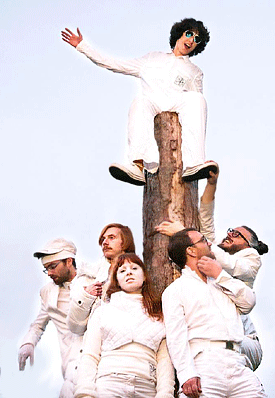


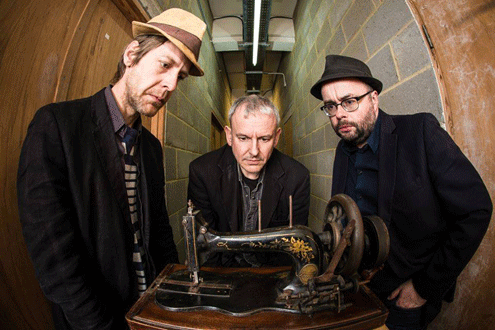



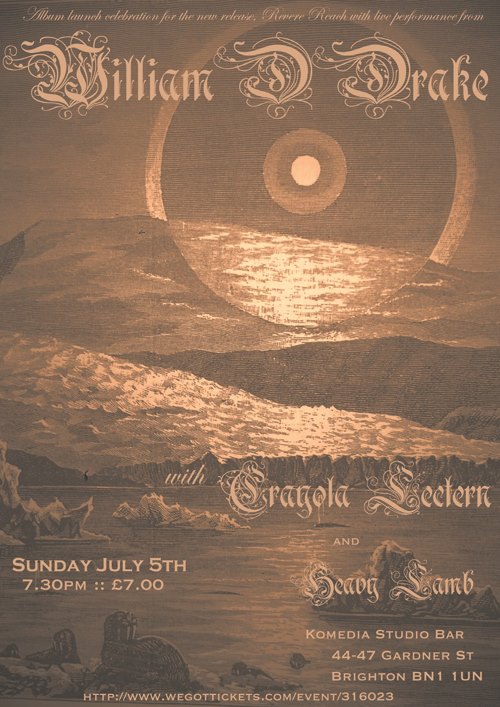
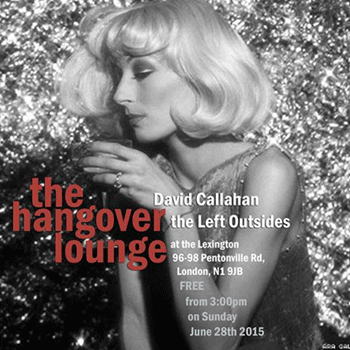


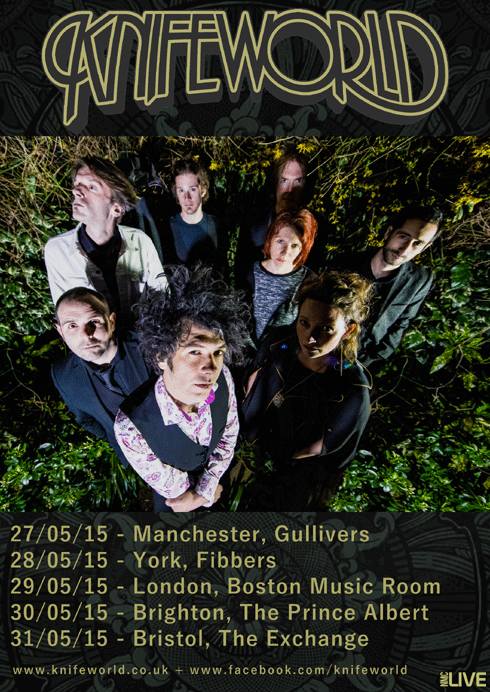
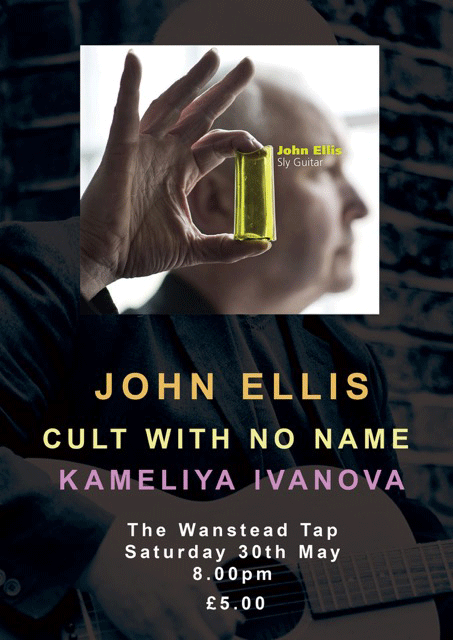
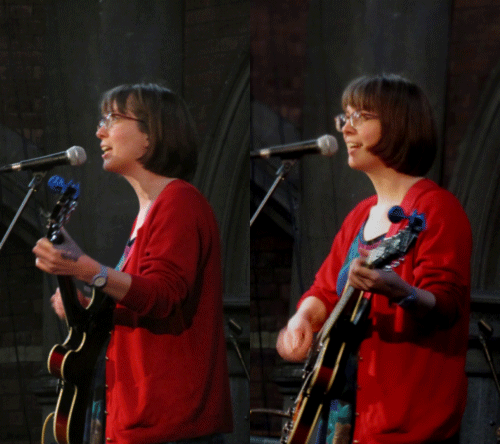
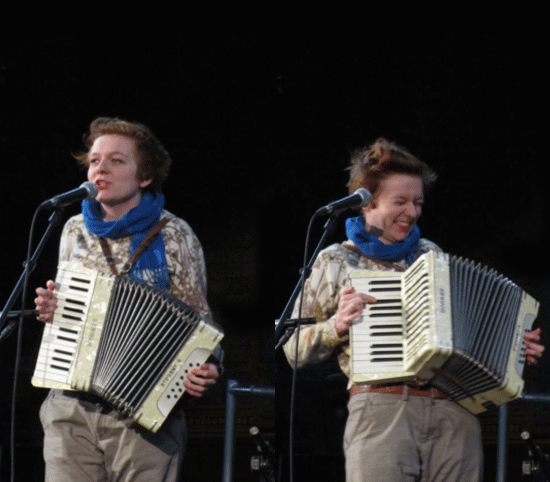
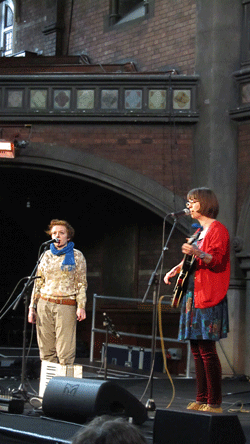
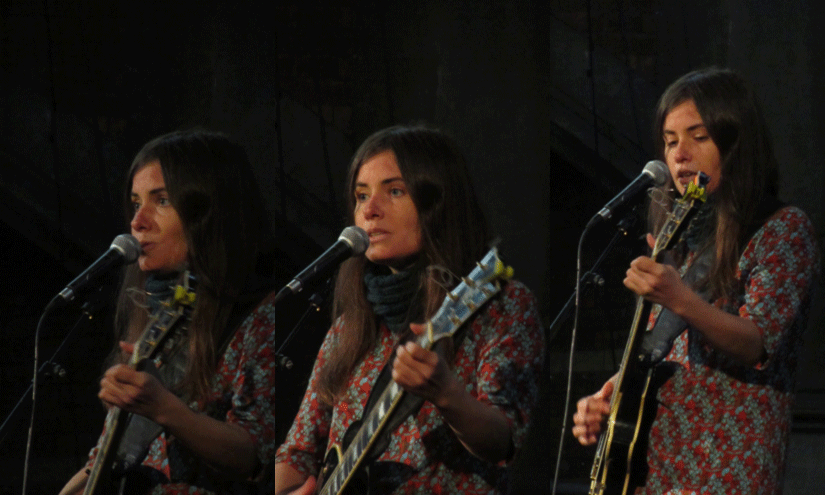
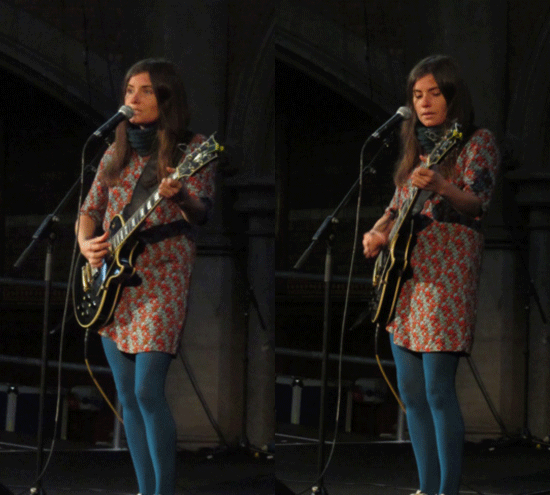
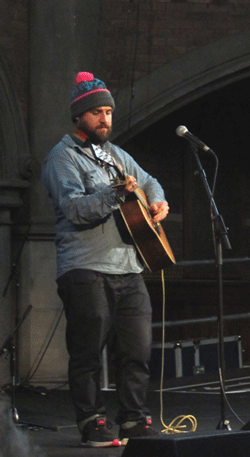
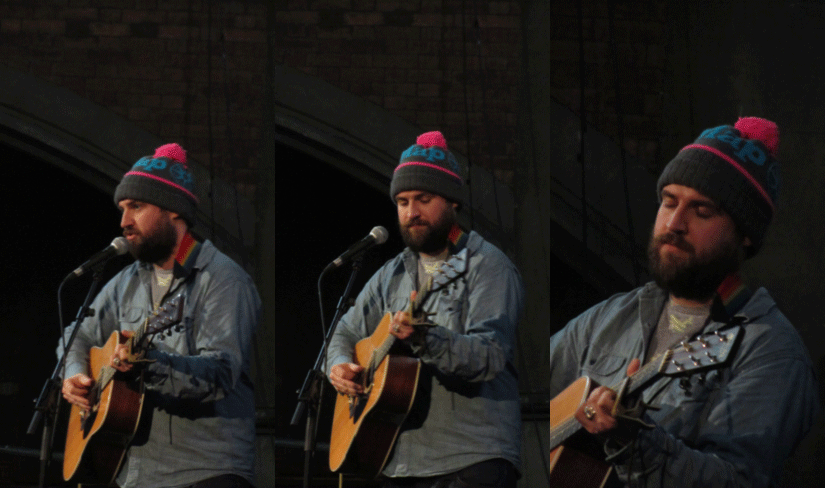
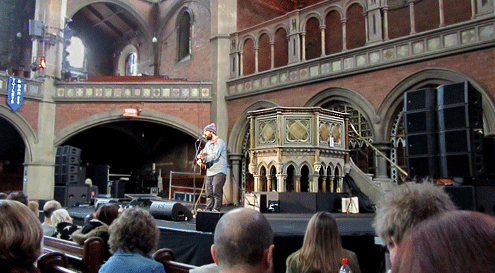


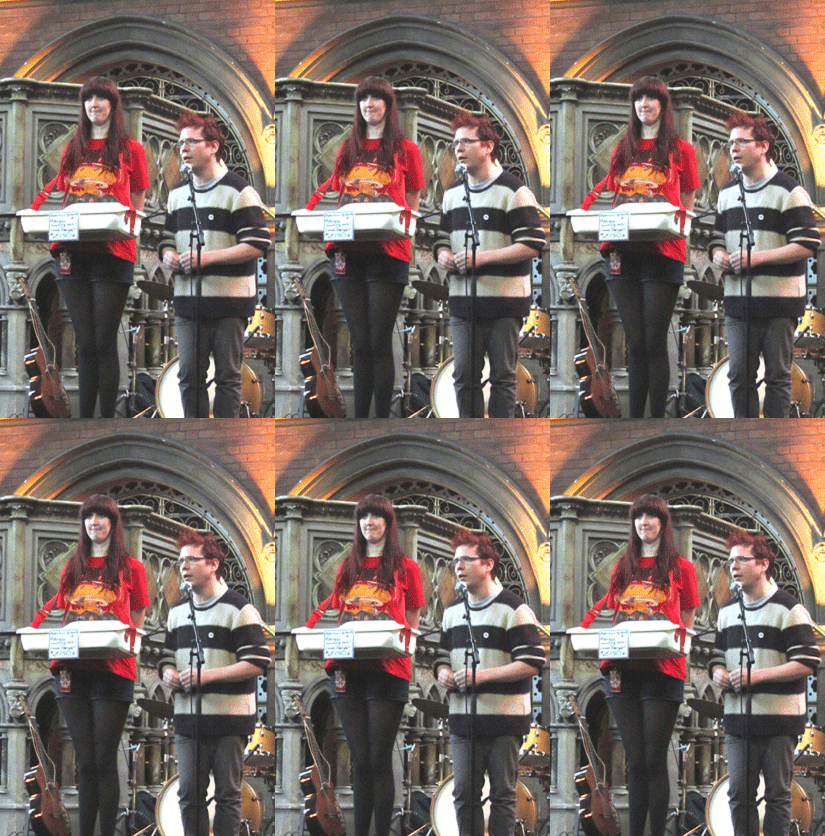


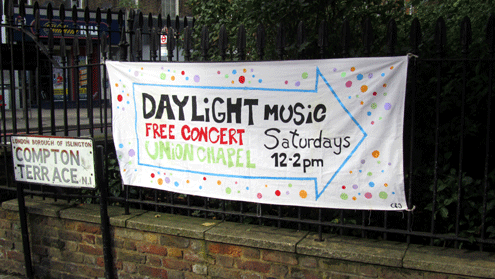
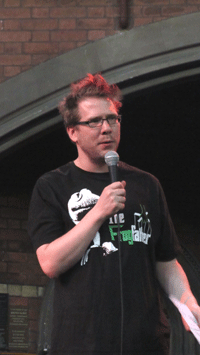
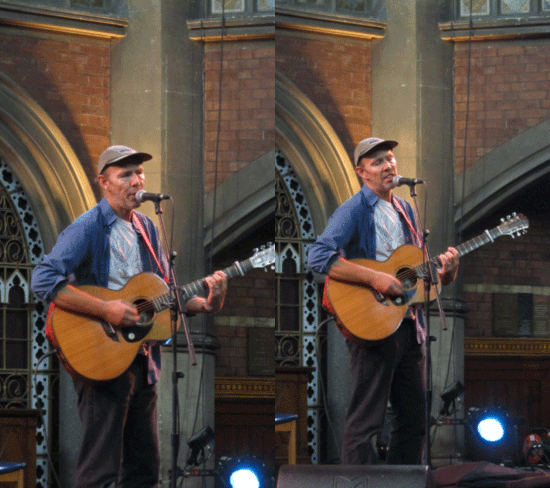
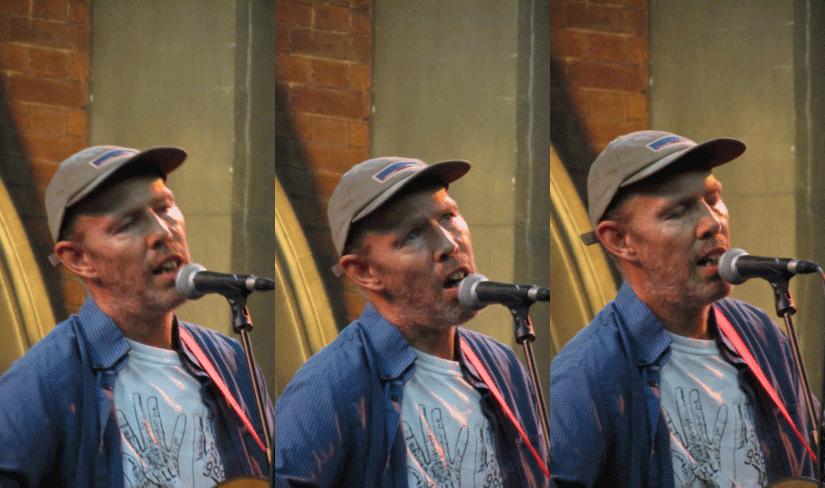
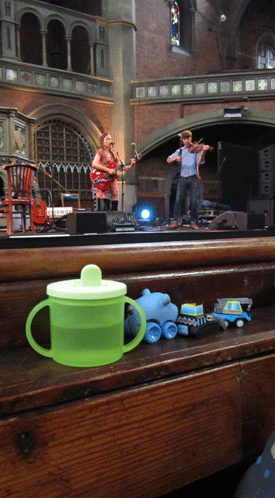
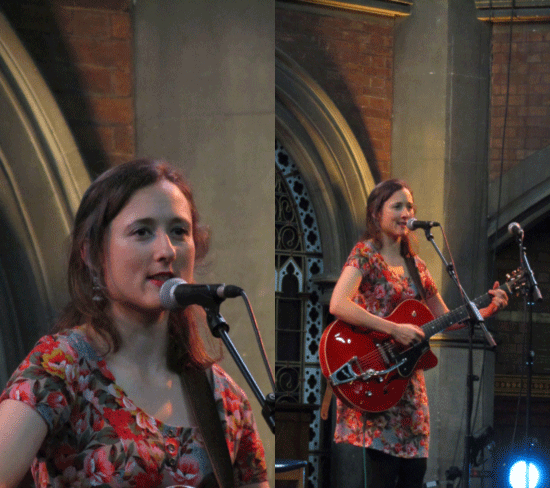
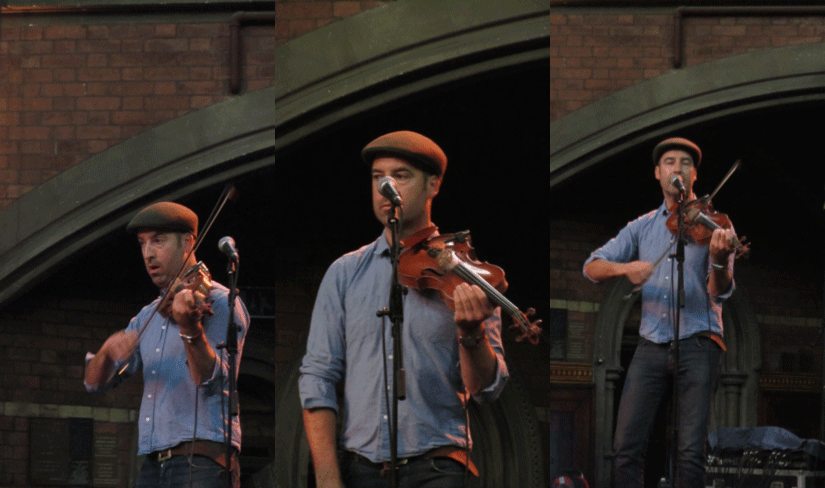
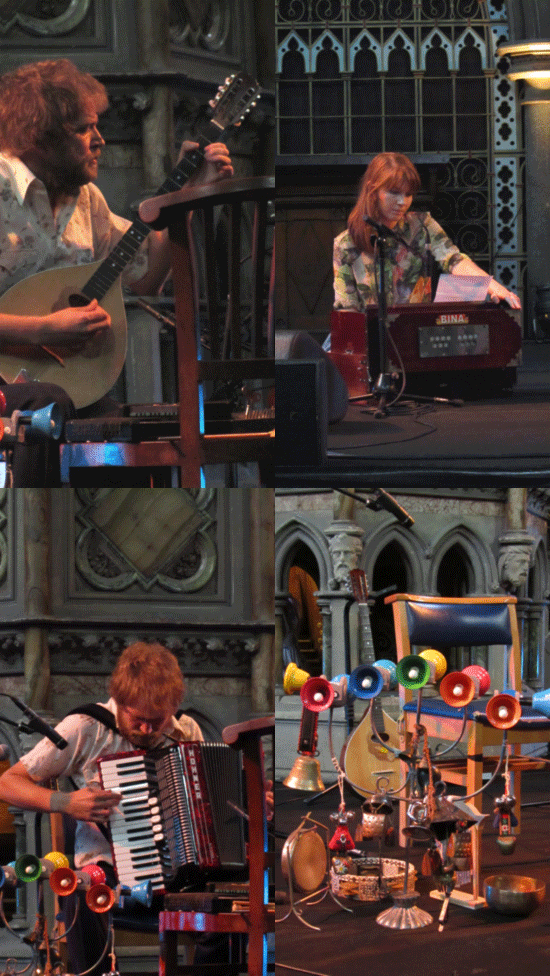
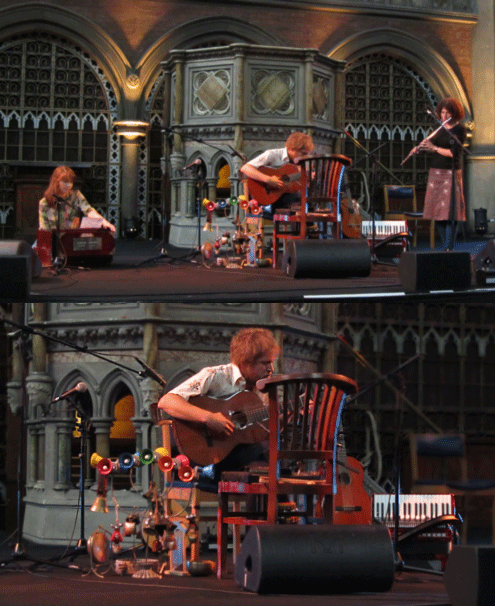
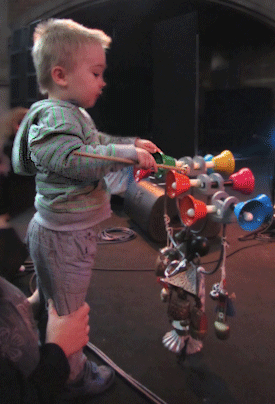
 Misfit City