Archive | singer-songwriter RSS feed for this section

March 2004 – album reviews – Edwige’s ‘Rise and Sing’ (“while she’s not yet citing chapter and verse, the sacred aspect is clearer now”)

22 Mar
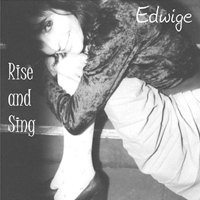
Edwige: 'Rise And Sing'

Edwige: ‘Rise And Sing’

Having made her initial mark with a couple of quirky, tricky-to-pigeonhole folk-pop albums, Edwige has made one on which she intends to celebrate “God’s beautiful gift of singing.” This could mean a lot of things. Perhaps she’s taking that unorthodox, archly beautiful voice of hers on an exploration of experimental a-capella songs, or a pure set of vocal rounds. Perhaps she’s made an album of devotional folk; or an unexpected gospel record.

As it happens, none of these are exactly the case. Edwige’s embrace of the joy of singing may be heartfelt, but it’s also comfortable. The key tone of ‘Rise and Sing’ is relaxation, and of Edwige’s assurance in her own work and her own methods. In many respects, it remains a familiar Edwige album. Many familiar tastes certainly remain intact. She still favours upfront lyrical messages, and continues to steer a course placing her somewhere between cabaret entertainer (especially on the oompah-pop of Bad Hair Day) and announcing angel.

She’s also continuing to develop her tendencies towards baroque pop arrangements. I Just Can’t Resist That Love is given lift by a suspended chorus of trilling voices and sunny passages of oboe; Into View is threaded with reeds, harpsichord, and tuba; while a harp adds sparkle to the simple, open love song After The Rain. The perky swing of New Mexico – with its elasticated guitars and psychedelic pedal-steel keyboards in tow – shows another side of her tastes, this time a dash of country music for the road.

The most surprising aspect of ‘Rise And Sing’ is a new affection for noisy guitar pop. Edwige’s latest producer (former Homer/Robyn Hitchcock sideman Andrew Claridge) sploshes some crashing electric guitars around several songs here, beefing up the acoustic strumming with touches of indie-pop, swamp-rock and grunge. The unplugged directness of previous Edwige albums, with their ornate bursts of cuteness and their denser musical surprises, sounded as if they’d come from odd-shaped rooms in an apartment piled high with spiritual books and knick-knacks. This album suggests that Edwige has recently knocked through a wall or two, and built a nice scruffy garage to play in. Her voice, as ever, is peppered with odd pitch-swoops, vibrato and declamatory theatrical inflections, and is still French-accented even after years of living in London. It’s an odd match for this bristly rock clanging – yet she thrives on the cruder energy that the extra noise provides.

With her perpetual good humour intact, Edwige uses the extra force to help her to drive home a few righteous stilettos. Straddling a catchy swaggering hook on Ears On Fire, she takes dry pot-shots at questionable cults with unreliable gurus – “I heard he was unfaithful to his wife, / I promptly took his words, and boiled them with my rice.” On Elegy For You, she skewers another bad-news, would-be Mephistopheles, decorating her lines with layered falsetto shimmers of vocalese while using the main lyric to sketch his cunning in song – “You’re so good at enchanting – / you lure with hopes and dreams / held through your spindly fingers, / and have them crushed like a crumply paper ball.” She also draws on this energy on Time For The Glorious: switching between midvoice and falsetto, rising serenely over the fuzzy rock backing to declaim “the leaf wouldn’t be but for the tree, / the wave wouldn’t roll but for the sea, / your heart wouldn’t be / but for a love much greater than one can ever conceive.”

Ah, yes. There are God-songs on ‘Rise and Sing’. Previously Edwige has only alluded to her personal, devotional brand of Christianity through cryptic clues, but now she’s beginning to become more direct. While she’s not yet citing chapter and verse, or names, the sacred aspect is clearer now, and this in turn reveals the true nature of many of her previous songs. As for the new ones, I Just Can’t Resist That Love pulls off the old soul-music trick of blurring across the boundaries of love song and devotional hymn. Opting for generosity rather than hectoring, Edwige’s revealed evangelism takes a variety of forms over a broad range of experience and musical method.

We get our gospel song after all – I May Have, in which Edwige testifies doubts and faith over a soft bed of electric chapel organ and little electric guitar agreements. Behind the pretty arrangement, Into View reveals itself as a waltzing tale of a Damascene conversion. For the jazz-tinged acoustica of Tea Light Sympathy Edwige turns teacher, with a gentle (but stern) offer to share her path. On Fusion, she becomes an ecstatic celebrant, kicking off a startling, delirious cocktail of techno pulse, hard-rocking fuzzpunk and hoedown. Choppy cello and guitars meet up with a stomping dance-floor beat and speaker-trashing bassline, and are in turn covered in festoons of Edwige as she chants, lets rip again with the vocalese and sends up fireworks of singing.

The thing about devotion, though, is that it involves letting go. Edwige is such a determined performer – so enthralled with the message, the observations, the little dialogues of life – that little of this (bar the rampaging delight of Fusion) rips through into the ecstatic. The message is always already decided, never discovered, and so the sense of actual revelation is lost. That’s a shame – for believer and unbeliever alike, observing or sharing a revelation of faith is often a fuse for crucial sympathy, and on her songs Edwige seems to miss out on this transformatory moment.

There’s one significant exception, in which Edwige’s wayward journey takes her up into a place she’s never visited before in song. Do I is that music-of-the-moment that’s missing elsewhere. An unexpected (and welcome) bit of psychedelic noise-folk, it’s set on Nico organ drones and on a cloudy screech of guitars so overdriven that they sound like English brass bands scattered by gales. The lyric is the simplest of declarations – no angles, no patter, just a naked, assured statement of devotion. “Do I come? – I do. / Will I follow? – I will. / In the light or darkness, pray for strength, / ah my love, … / Give me the warmth of your love. / Safe with you forever, ever, ever, ever.” Stepping up from the chapel drone, rising above this massing, crashing confusion of tangled feedback, Edwige is making her leap of faith for us; all cabaret cuteness falling away.

It’s the kind of inspiring moment which that unearthly voice was made for. I wish she’d do more like this.

Edwige: ‘Keep The Change’
Quasar Music, EDW3CD
CD album
Released: 2004

Buy it from:
Quasar Music or CD Baby.

Edwige online:
Homepage YouTube

July 2003 – album reviews – Edwige’s ‘You Show Them the Moon and They Look At Your Finger’ reissue (“opera singer, cat purr, wise seductress, vocal trapeze”)

27 Jul
Edwige: 'You Show Them The Moon And They Look At Your Finger'

Edwige: ‘You Show Them The Moon And They Look At Your Finger’

I seem to remember that that title is a Chinese proverb about fools missing the point: presumably this is a warning that Edwige is pointing to somewhere interesting, and that if you pay too much attention to the way she does it then you’ll miss the why. Certainly you can get sidetracked by trying to pigeonhole her music. Like any city-smart pigeon, it struggles and flits away from capture.

So what is this? It’s folky, but with at least one eye trained above the treetops. It’s French but it isn’t (despite the accent and the chanson/cabaret flutter, Edwige is London-based and Anglophone, aligned to the world in general, and open to angels). It’s poppy, but salted with the ascerbic willpower of a woman who’s lived long enough to have her own individual way of doing things. And while she’ll welcome fellow travellers, she’s confident enough not to be too worried about whether you go along with it or not. I think I like that.

It brings back a memory, too. When I was about fourteen, one of the key albums for my raging, hormonal inner life was Kate Bush’s ‘Never For Ever’. I used to have an odd relationship with that record. I’d play it all the time, never sure whether I actually wanted to or not. I remember it felt like a wayward friend on a perpetual mood swing: it was poised on a wobbly adolescent axis of feyness, promise and wisdom, and put me through bouts of frustration and love. How could one album zoom so unpredictably between cutesy kiddie fairy tales and vaginal vamping, between stardust fantasy and nuke-generation fears, vengefulness and nurture? And how could it tangle them all up in such a wayward, compelling way, but still make me want to smack the naivety out of it? No wonder I eventually ended up shoving it in the cupboard and heading for the more straightforward push and bump of indie-pop to soundtrack my later teens.

Many years of The Smiths, The Fall and My Bloody Valentine later, ‘You Show Them The Moon…’ reminds me of that early shamanic Kate Bush girl-pop. It’s not just because those arch, slanting vocals constantly recall ‘Never For Ever’s Coffee Homeground; or because I Am A Temple, from its Nile guitar twang to its waft of desert synth and the aerial-bending vocals, is a ringer for the storybook mystique Bush brought into play on Egypt. OK, Edwige’s music doesn’t carry the same weight of sensual bewitchment. It betrays its budget origins via keyboards that sometimes dip into tweeness and rinky-dink; and by a no-frills recording that sonically cramps her cosmic-tinged imaginings, cramming the cornucopia into a garden shed. But ‘You Show Them The Moon…’ does show the same fascination with the free-flowing mind that’s one of hippydom’s more useful legacies, and it can carry its eccentricity convincingly as well.

A lot of this is to do with Edwige’s voice: a wonderful, peculiar, obliquely beautiful thing. It curves itself round the tones of opera singer, cat purr, wise seductress, vocal trapeze… all with glass-etching clarity and weird ricochets. It’s like a combination of Liz Fraser from Cocteau Twins and a French Eddi Reader without the gawkiness or the broadsheet approval. Actually, don’t stop there: look towards the Strange And Flamboyant Women In Pop section. In spite of the two-dimensional production, Edwige also pulls off the trick of sounding a bit like Bjork’s long-lost boho auntie. She doesn’t possess Bjork’s genius spark of child-vision, or her way with a contemporary sound (it’s French cafe culture round here, not club culture: you’ll find no beats, samples or Trickies). But she does have that same bungee-elastic vocal yaw – admittedly delivered with Edith Piaf’s brand of declamation, and with the sort of melodies and poised guitar strums that go with ten-foot silk scarfs swirled round swan-necks.

The songs themselves fizz just on the right side of easy listening. They’re frequently soft and fluffy, but with deceptive bends. Each is a moment, polished and expansively lit, in a life that’s become a quest in which there’s no goal but an understanding – an ordinary life illuminated by extraordinary lights. Downtrodden and downbeat on No Shape For Love, Edwige can be revived enough to put on a spiritual throb of benediction for Be Blessed. She’ll caress you with a dedication of warm, supportive love on Serve You Well. She’ll also slap you down with a moment’s notice, scolding and instructing in slightly fractured English. “If I open up my heart, it’s not to please your fantasy… / You think you are my king, you’re just a slave of your own enemy.”

Throughout the album, Edwige slings assorted moods and styles around herself like hula-hoops, keeping a core of determination but remaining free-floating. She will go all Jane Siberry and produce fluffy-edged clouds of electric guitar for The Dearest – a fragile love song where the unselfconscious fairytale imagery teases out a winning pathos. If pushed, she’ll become flamboyant, defiant and unreachable, as she is on I Am A Temple (“don’t you dare pry into my life!”). Yet she’s happy – on If You Were The One – to suddenly ditch the eerie and mystical to trill away on the kind of cosy tap-dancing tearoom jazz that you’d have thought long-lost on 1950s lounge records, or to toss out a dash of Celtic sounds with ‘The Omen’ (Clannad harps and tricky jig-in-a-box/jump-into-the-sea rhythms).

Back in 1999, the original version of this album was also noisier. Edwige occasionally dabbled in a kind of accidental techno, or flew in some famished rock guitars to add roar. For this 2003 reissue, she’s ditched these particular quirks and re-recorded a couple of songs as acoustic versions. Something’s lost when Tune Up All Your Violins has its bull-in-a-china-shop clatter removed, but Edwige, strumming away solo and singing forcefully, still uses it to plunge through cosmic arcana like a costumed hero on her own cryptic spiritual mission. They Won’t Make Me Nervous is shorn of its crashing electric guitars and bendy orchestral fogs of synth, but keeps everything else, including the super-soaring choruses on which Edwige zips and kinks like a skidding comet.

The two songs at each end of the album unfurl Edwige’s searching musical and spiritual ambitions to the full, the instruments coming alive out of their budget politeness and warming the air. To Discover lounges in rich, luxurious music – lazy acoustic guitars, damask curtains of synth – but Edwige’s voice cuts through the slumber like a little silver knife. In the middle of comfort (“thinking love is here forever to remain… / and life has no more to offer than what you already knew”) there are breakdowns and hard lessons ahead: “you still have to discover.” And the climatic grandeur of Stillness suggests that she’s reached some sort of peace, looking back over the terrain of the life-quest with a sympathetic eye.

“You need to be loved, and you need to be told, but there’s no reassurance… / You feed yourself with books and beliefs / and stick on your windshield / pictures and maps / so you won’t see your direction… / And try to get peace rearranging confusion… / Still looking for Eden, El Dorado, still looking for a search / when in the stillness…is home.”

Then The Voice shoots up to ecstatic heights, hits the stars, ignites them in a wave of flame, and sees out the album with an ascending, aspirant note. Edwige is smiling and pirouetting somewhere on the pavement where Parisian cafe music (accordions and sparklers) meets the sussed cosmic chick (tarot, tai-chi and her own flat). Someone get her a decent producer and the space to fling a few more scarves around, and she’ll take us off to a brighter night, where a giant moon is untroubled by idiots pointing and where cats somersault over the chimney pots.

Edwige: ‘You Show Them The Moon And They Look At Your Finger’
Quasar Music, EDW1CD/KCA (634479459061)
CD/cassette/download album
Released: 2003 (originally released 1996)

Buy it from:
Quasar Music or CD Baby.

Edwige online:
Homepage YouTube

June 2002 – EP reviews – David Hurn’s ‘No Love’ (“a shadowed smile”)

24 Jun
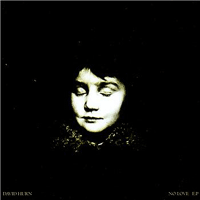
David Hurn: 'No Love'

David Hurn: ‘No Love’

The stained bedsitter velvet has been slung out of the window. One of David Hurn’s hands has grabbed a palmful of chicken grease; the other’s holding that classic rock’n’roll cigarette he’s just taken a big drag on. A blue train runs through his music now, threading into the lyrics and sounds of No Love (smoke-puffs, whistles and all), carrying honky-tonk piano and a bucketing Scotty Moore guitar along with it. And David’s voice, which once murmured behind doors and into fringes, now croons with that peculiar blend of pain and relief which you hear in the voices of those who’ve cast away a beloved burden. He sounds positively frisky for someone who’s fallen off the love-boat.

But then, there’s often relief in shucking a responsibility which you knew you never had the stomach for. “A child’s morning prayer couldn’t save my soul / or deliver you the miracle that I know you’re waiting for. / Oh, where is the good in anything, / when there’s no love in your heart any more?” This is less David Hurn Unplugged than David Hurn Unshaven – as if he’s woken up to find that much in the world still sucks, but has met the day with a wry grimace and is simply getting on with it, having learned the protective value of the shrug. Even when delivering a line like “the little piece of hope that I had – well, it just turned bad, / and it’s hiding in my flesh but it’s never coming back”, his lugubrious voice has a shadowed smile to it that it’s never possessed before: even a hint of flirtation.

Despite the soakings of Americana, ‘No Love’ is a change from David’s previous leanings towards the moodiness of American Music Club and Ryan Adams. As is his Elvis tribute in covering ‘Is It So Strange’ – faithful to every nuance of slapback, shake’n’tremble and deep-fried ham, it’s full-fat Presley rendered with unconditional love, rather than the cartoon camp that usually strangles that Memphis hiccup. But the familiar Hurn sadcore isn’t far away: the gorgeous alternative “slow version” of ‘No Love’ (drowning in Low murmur and narcotic steel guitar) could’ve sat proudly on AMC’s ‘Engine’ or ‘United Kingdom’.

David Hurn: ‘No Love (slow version)’

Both ‘Books Etc.’ and ‘Ballad for a Lost Cause’ – the latter recorded live at Moriarty’s, with police sirens howling past and bleeding through the walls – are quiet acoustic-driven breaths fogging the cold mirror of hope, struggling with self-determination (“I don’t need to know if anything’s above me, watching me cry my tears. / Don’t need a light showing me my fears,”) and delivering harsh truths (“the lesson is hard only if you’re stupid /and didn’t know what you threw away, / or what you could have saved…”). ‘Ballad for a Lost Cause’ in particular – with its Nick Drake mixture of deceptively soft textures and oblique, meditative lyrics – sees David keeping a firm grip on his lonesome songwriter laurels as he picks apart another story from a mishandled life. “Failure to the end, you didn’t know how to win favours from impossible dreams. / So you should hold something back, but you’ll never see…”

He hasn’t thrown away the key to his bedsit yet, whatever the pull of that train-whistle.

David Hurn: ‘No Love’
Fire Records, PUFF 003
CD/download EP
Released: 24th June 2002

Buy it from:
Fire Records or Bandcamp (CD only).

David Hurn online:
Homepage Facebook MySpace Bandcamp

July 2001 – EP reviews – A Girl Called Eddy’s ‘Tears All Over Town’ (“torch songs set to low glow, fanned into sudden flares by a crack in control”)

31 Jul
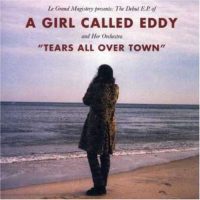
A Girl Called Eddy: 'Tears All Over Town' EP

A Girl Called Eddy: ‘Tears All Over Town’ EP

One of my small daydreams of alternate pop history involves Clare Torry. Having raised the hairs on the back of my neck with her ecstatic singing on Pink Floyd’s ‘Great Gig in the Sky’, she wouldn’t have slipped away anonymously. She’d’ve gone into the studio with songs for herself and produced at least one album with that voice, that understanding set free. When (on Francis Dunnery‘s ‘Close My Door‘) I first heard Eddy Moran’s arresting wordless vocal soaring skywards – twisting, keening, cracking and surging – I felt that same hair-raising chill. Flashed straight back to the same daydream.

I’m luckier in my dreaming sometimes. Although, for her debut EP as A Girl Called Eddy, she’s not repeating the magnificent Torry-esque splendour that turned my head the first time, Eddy has found other ways to chill me. Her songs could’ve waltzed out of the ’30s, or the ’60s: torch songs set to low glow, fanned into sudden flares by a crack in control. Cool heartbreak in her voice, she’s like a more ambiguous Tracey Thorn. Not someone who’ll glut her despair centre stage: she’s more like someone who you might catch staring at you piercingly from beside the bar, quiet, wise and intent.

‘Fading’ does its bit to draw back the curtains of sorrow. A fragment of Blue Nile lushness, slurs and fake orchestra, it revolves like a ferris wheel trailed by a puff of New Orleans trumpet. Cinematic, but less so than ‘Soundtrack of Your Life’; which – set on capturing the swinging ’60s side of Eddy’s imagination with its bossa lilt and breezy “bah-bah” chorus – doesn’t follow the torch course so closely. But beyond its cigarettes, its memories from film and old photos, its gushes of grand Mellotron and sitars, it has its centre of bereftness. “If ignorance is bliss, then seal it with a kiss, / but it was never supposed to end like this.”

‘Heartache’ – eased along with upright bass, a mascara-slur of brush drums and soft dips of weary piano – brings out the real phantoms of loss. “You’ve seen his face somewhere before. / Now you know for sure / that you can call him heartache – yeah, you can call him that,” Eddy breathes. “Yeah, you can call him heartache – you’ll never get it back.” Ragged memories and the force of erotic imagination are where these particular ghosts live, and Eddy’s well aware of it.

A ghost of another kind haunts ‘Girls Can Really Tear You Up Inside’ – the spectre of a vanished, never-known father. Like the bewildered girl in the song, Eddy simply pieces together scraps. Yet the result is a reverie carrying its own kind of romantic longing – “she’s heard you sing / and that your eyes are very, very, very blue…” In this web of connections and betrayal, there’s as much lurking passion, fear and anticipation as there is in any straight love song. Eddy reveals this, trace by trace, as she rides an elliptical path to its frightened heart, addressing the vanished man as she does so. “Why do you run, / why do you hide / from all you are?” Eddy muses, a dreamy voice of conscience and excitement amongst the traffic noise and the strums of an almost blues-y harpsichord. “You’re just a man, but she could tear you up inside.”

The greatest crack in the cool comes with her take on Stephen Bishop’s ‘The Same Old Tears’, recorded in her Greenwich Village kitchen in a flash of inspiration, with just an acoustic guitar and a divine echo. “Seeing you as an old photograph, it hurts too much to laugh,” Eddy sings, midway between croon, tears and laughter, before soaring off into a beautiful blue plate-cracking keen – “But I’m all right, I’m all right…”

Just for a flash, you see to the knot of the problem, and need know no more. Wanting more is different, of course. Eddy knows this – and, listening to this EP, so do I, now.

A Girl Called Eddy: ‘Tears All Over Town’
Le Grand Magistery, HRH-021 (6 16656 00212 3)
CD-only EP
Released:
31st July 2001
Get it from: (2020 update) Le Grand Magistery; or stream via Deezer, Apple Music or Spotify. Different versions of Heartache and Girls Can Really Tear You Up Inside appear on the eponymous debut album by A Girl Called Eddy.
A Girl Called Eddy online:
Homepage, Facebook, Myspace, Soundcloud, Bandcamp, Last.fm, Apple Music, YouTube, Deezer, Spotify, Tidal, Instagram, Amazon Music

August 2000 – album reviews – Rudy Simone’s ‘To Put the Sun Back in the Sky’ (“shot through with aftershocks of abandonment, dispossession, self-doubt and the battle to stay afloat”)

19 Aug

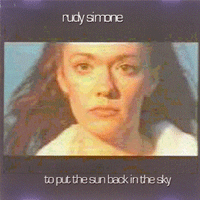
record-rudysimone-putthesun

Shot through with aftershocks of abandonment, dispossession, self-doubt and the battle to stay afloat, Rudy Simone’s debut album doesn’t resolve the questions she’s raised before. It doesn’t round off those battleworn displays of uneasy heart from the previous year’s ‘Personal Cloud‘ EP, nor does it offer clear clues about where she’ll be travelling in the future.

Fresh as she sounds, Rudy already has plenty of past. Originally from Buffalo, New York State (where, as Rita Seitz, she sang in various obscure bands during the early 1980s) she turned emotional refugee later in life and crossed the Atlantic to Liverpool, where her own songs emerged amid a landscape of acoustic sessions and nightclub rushes. Most debut albums are a statement, however crude. This one’s a scrambling steeplechase across Rudy’s emotions and her spiritual restlessness. It stays true to the disruptive collisions between the life singing in the head and the life that lurks outside. What ‘To Put The Sun Back In The Sky’ resembles most is an attempt to wrap up Rudy’s fraught baggage in a big, unwieldy brown paper package; to tie it together with guitar strings and beats, to spray it with disco glitter and then set it free somewhere down the Mersey. Drifting seawards, it comes unstuck and reveals itself.

Attempting to cram in all her gushes of inspiration, Rudy ends up with a confusing whole. Seemingly at random, songs appear in alternate acoustic and instrumental alternate versions; there are two takes on the eerie Kill The Cult Of Cool single, and a trancier reworking of Personal Cloud. ‘To Put The Sun Back In The Sky’ ends up as an anxious, fractured goodie-bag, unsure about whether floaty beats are better than strumming, and telling repeated stories in different tones. Don’t expect track-by-track coherence – but do expect plenty of understated feeling, a maverick DIY pop sense in full effect, and some determined songcraft. This album is a necklace-worth of interesting, often touching episodes.

In some respects, Rudy fits in with that rough wave of confessional women emerging in the 1990s via trip-hop and indie rock, including the two Beths (Gibbons and Orton) and Juliana Hatfield. There are some similarities to Jane Siberry; though Rudy is more loosely strung, she shares elliptical, Siberryesque feminine perspectives, blown about by impressions and finding solid little truths in the midst of abstraction. But for my money the artist whom she’s closest to is Lida Husik. Both Rudy and Lida resist committing themselves to any one musical approach or way of looking; both seem suspicious of tradition or sturdy craftsmanship. As with Husik, Rudy’s wispily sweet vocal belies her determination to discover and envision things her own way, learning from time and from chance. Both, too, are peripatetic and intuitive to a fault: they’re both quite prepared to walk into mires of embarrassing self-conscious fluff if that’s where an idea takes them (in Rudy’s case, a misplaced James Brown tribute called Bony Little, giddy and apologetic, in which she bangs on forever about her skinny white ass).

For this album, the club dance elements have triumphed in Rudy’s big bag of sounds – as they did on Husik’s ‘Green Blue Fire’ album four years previously. Techno producer Sheldon Southworth, a.k.a Diffusion, is a vital collaborator for half the album. He’s the Beaumont Hannant to Rudy’s Husik, adding his own club-friendly trance sparkle to hers and replacing guitars with the zing of electronics. For The Secret Sayings Of Jesus, Rudy whispers god-inside Gnostic philosophy, floating it like evangelical thistledown over Diffusion’s bright trance beats and aquatic keyboard textures. Despite her trippy tones, hypnotically soft, the chant is a desperate prayer rather than navel-gazing. It’s a counterpoint to the other songs, which make up a travelogue of delusions to be overcome in oneself or endured from others.

Vanity’s Car perks its way through cheerful Euro-trance and Soft Cell gurgles, but Rudy’s lyrics dwell on how the wrong kind of excitement can lessen a person’s grasp on reality – “amazing how far you’ll go when you lose control – / I’ve got to get out on my feet / and be the things I always wanted to be.” The fallout is clear: “I might be sitting in your living room / but I might as well be in another country,” Rudy protests on Can’t Go There. “You can drive if you wanna, but I prefer to stay on my feet… / ‘cos you’re so blind, you can’t see that it’s right across the street.” Warm swelling synths, glinting funk-wah guitar, and house piano echo that communal gospel glory which Primal Scream tapped on Come Together. Rudy’s own hopes of connection, though, are dissolving.

While Diffusion’s contributions are valuable, there’s no question that Rudy remains convincing on her own. The brief pure-dance diversion of Mentallium hurls rapid drum’n’bass kitfire headlong into chilly trance electronica: to wild things up a little, Rudy mixes twitchy diva calls, jazzy double bass and kettle drums into the instrumental. Out on the other edge of her music, she abandons beats and boxes. A blues-y acoustic guitar version of Vanity’s Car brings its warnings closer to the surface, no longer masked by shiny bodywork. Part pop-plaint, but mostly blues rant, the all-acoustic Water’s Edge sees the banalities of love (“Sometimes I’d like to kill him, / but I always gotta thrill him”) splinter in a glare of rage. Wailing like a cross between PJ Harvey and Etta James, Rudy walks the shoreline, grappling with a moment of agonising choice. Violence is poised within her, ready to strike inwards or outwards, and only the lone conscious voice of the song cries out against it. “Don’t go, you’ll only make your mama cry / Don’t go, you’ll only fuck your baby’s mind.”

As a single, Kill The Cult Of Cool got lost in the no-budget wilds which sank so many others; yet its emotional hop-skip-and-jump was a remarkable coming-together of ideas and instinct. It still is. Broody horror synths, laceworks of folk guitar and a patchwork of voice snippets quilt together into something haunted, defiant and transformative. In keeping with the rest of the album’s repetitions and revisitings, the song gets a double outing (the Derision Mix transforms it into radiophonic electro-funk replete with glitchy scratching and whooshing, frothing Vangelis synth splurge) but it’s the original that really matters. Something of a signature song for Rudy ever since it first showed up on ‘Personal Cloud‘, its cohesive spirit remains clear as its splintered voices ask for compassion, pray for guidance, plant down stubborn feet. “I was the quiet one in school, never made any trouble,” stammers a sampled man; “I don’t care what you say, I’m not crazy,” Rudy adds quietly. It’s full of struggle, though never precisely clear what that struggle is – the claw back to sanity out of the creeping horrors? a defense of alternative thinkers and scapegoats? – yet it’s also affecting in a way in which few things that I hear are.

The spine of the album, though, is the title track and Personal Cloud. The former’s a grieving white-girl rap about a marriage snapped violently in half: here, Rudy sounds as soft-spoken but as wide-awake’n’dreaming as Margaret Fiedler does while puzzling out dreams in Laika. Almost cushioned by the pain, she lets moments of heartbreaking reproach crest over it and into the words: when she murmurs “you say you’re following your heart / I say fear has played a much bigger part”, real agony glints. In a new take on Personal Cloud (remixed by M@2K into radar blips, ambient funk and blue-light electronics) more displaced degrees of mourning are added to Rudy’s grapple with addictions, love and loneliness (“I wrap my lips around a cigarette instead of you…”). Her voice flutters, weightless and bereft: a hydrogen balloon un-anchored by faithless hands.

Maybe ‘To Put The Sun Back In The Sky’ is not the album Rudy Simone’s capable of. It’s more like several different shots at an album: all crowded into the kitchen together, taking anxious and uncomfortable refuge. No clear clues; a spinning signpost; but indications of an effective, if scattered, talent – one worth investing some love in.

Rudy Simone: ‘To Put The Sun Back In The Sky’
Phat Lady Records (no catalogue number or barcode)
CD-R-only album
Released: 2000

Buy it from:
Extremely rare – best found second-hand.

Rudy Simone online:
Homepage Facebook Twitter Bandcamp Last FM YouTube

May 2000 – single & track reviews – Badly Drawn Boy’s ‘Disillusion’; Inter’s ‘Radio Finland’; Porcupine Tree’s ‘4 Chords That Made a Million’

8 May

Badly Drawn Boy: 'Disillusion'

Badly Drawn Boy: ‘Disillusion’

For someone with such a reputation for being ramshackle, unpredictable, accidental, awkward (insert your favourite anti-star adjective here) and so on, that there Badly Drawn Boy doesn’t half make polished pop records when he wants to.

The Boy – Darren Gough, when he’s out of uniform – positively thrives on that kind of early Beck slacker/random “just rolled out of bed and made this record” image that wins over the crowds of reluctant punka-monkeys, for whom professionalism’s a suspicious word at best. Doesn’t change the fact that his last single (Once Around the Block) sounded suspiciously like that Latino swing that used to punctuate ‘Sesame Street’ and made you want to check if he had an Astrid Gilberto LP hidden under his battered old mixing desk underneath all the crumpled tape and cigarette butts. Most of the similarly-touted Manc alt-rockers Doves back him up on this one, and guess what? it does sound like a slightly crumpled take on mid-’70s soul-pop. Sort of like Hall & Oates refried for that crate-digger’s Latin funk angle plus a New York thrift-shop feel.


I like it – it’s hard not to enjoy all those vintage sounds bouncing up and down together like a smiling, sweaty block party – but it’s becoming a little difficult not to see Badly Drawn Boy as a lovable cottage-industry faker of slightly worn urban folk. Or as someone who likes smudging his own messy fingerprints on the records in a ‘Mojo’ buried-treasure box. OK, perhaps I’m being a little unfair. Bottle of Tears seems to restore your faith in the boy Gough’s image – a slightly Beta Band-style stoned skiffle, loaded up with boo-bams and other things that go clonk and with all the recording levels cheekily whacked up to a crunchily chewable wall of treble. There’s a bit of hoodlum science on the menu too. Wrecking the Stage is a yobbish rockabilly riff slamming headfirst into some sampler boffin’s cut-up experiment, so you get to hear big stoopid guitar and drums duking it out with primitive electronic froth and a colossal roll of psychedelic bell tones.


There is some kind of split genius here – on the one hand, for postmodern pop pastiche; on the other, for mating cheery tunes with outrageously back-to-front “who gives a fuck?” production. But as regards that carefully-constructed image of the lovable neighbourhood eccentric stumbling brilliantly into music, the game’s well and truly up. There’s a mainstream pop talent here dressing down for effect; and if he’s trying to disguise that with silly hats and goofy chuckles, methinks the Boy doth protest too much.

Inter: 'Radio Finland'

Inter: ‘Radio Finland’

It’s been a long time since Inter‘s ‘National Paranoia’ showed up (with its coltish Wonder Stuff-y bite), but here comes the follow-up single, straight down the turnpike. ‘Radio Finland’ is slyly anthemic: smoother, laced with chimey Celt-rock chords, stronger on the skat hooks and harmonies, but it’s another “we’ve already discovered that rock delusions suck” songs, worldly-wise behind the “da doo da da dit”s. As lines like “every hour of every day / I’ve got a direct line into your brain” lock horns with self-referential gibes like “what a show, but you’re nothing new”, Inter seem to be deconstructing and sending themselves up before they’re even under scrutiny.


The venomous sideswipe of You Lose shows they can still muster simple brat bile when they want to: perhaps when they hit the big time they’ll’ve gone full circle and gotten all naive and sellably arrogant again. But You Can Always Depend On Me, brazening out the confessions of a self-aware blunderer, suggests there’s fat chance of that – “I’ve wasted my potential trying hard to sound too sincere / and I don’t wanna get myself in deeper saying things you don’t want to hear / …I’m way too shameless to ever get it right.” In Inter’s songs, pop bursts out in tuneful flash-flowers of ballsy resistance. The good new is that even if they have rooted their sound in The Wonder Stuff, they’ve also matched the Stuffies’ tuneful urchin aggression and cracklingly sharp lyrics too. Nice to see a set of heirs that don’t let the old firm down for once.

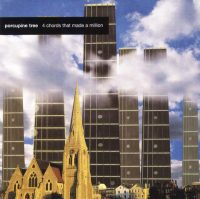
Porcupine Tree: '4 Chords That Made a Million'

Porcupine Tree: ‘4 Chords That Made a Million’

A side effect of Porcupine Tree‘s inexorable rise to the forefront of British psych-rock has been the consensus that’s set into their previously unbounded music. But they can still surprise us. Last year it was the dry wit of the ‘Piano Lessons’ single: this year it’s something less subtle, but still a jump away from the strummed ’70s friendly psych-anthems which Steven Wilson comes up with on an average day.

At the root, ‘4 Chords That Made A Million’ still stomps along with big mainstream boots on. But the sound is something new for them: aggressive raga-rock riffs with guitar wails like huge bloodstained battle-axes and a brutally cynical adventurist swagger to it that’s more ‘Definitely Maybe’ than ‘Wish You Were Here’. The effect’s a sort of explosive post-Anokha heavy metal: laden with tabla lines and drones, and with Richard Barbieri spurting out dirty synth lines like someone spunking up into a pot of orchids. The subject matter’s the one thing that unites arena-rock and punk lurkers – that standard disaffection with the biz. “Another moron with a chequebook / will take you out to lunch, who knows? / He will tell you you’re the saviour / and then he’ll drop you like a stone.” Mind you, what does it mean when you’re writing lyrics about the futility and emptiness of arena-rock and you then do your level best to set them in a full-on mosher of an arena-rock crowd pleaser? Has Wilson gone all Manic Street Preachers “we’ll have our cake but claim we’re dieting” on us, all of a sudden?

 
The B-sides are more familiar Tree twiglets. Disappear is almost unplugged, Wilson’s lazy swirl of flyaway harmonies, licks of luscious sombre wah and the blissful final surge of organ, Mellotron and drums notwithstanding. And it’s another fame story, this time the tale of someone wilfully giving up on the threshold: “I gatecrashed parties and just stood and stared / I moved to London and stayed in all year… / You’ll be famous and I’ll disappear. / I erase myself again.”


In Formaldehyde sounds like one of Radiohead’s disintegrating nearly-ballads fed through Camel: a lovely, helpless, descending Wilson melody to match the boring, frustrating pain of a decaying love. The sonic decorations, an enchanting swirl of dulcimer scratches and NASA blips, enhance a prime piece of trademark Porcupine Tree gliss-guitaring sky-glide. But while back in the ’70s this kind of psychedelic lament would’ve accompanied spliffed-out stargazing, here it’s soundtracking the miserable chill that settles into comfy middle-class apartments as they crumble into broken homes and even the drugs become unsatisfying toys. “Dust in the kitchen – coffee pot, microdot. / Now we are constant: / talking less, breeding stress.”


Perhaps it shows just how everyday the psychedelic has become today (with an acid trip in every other advert), but it also shows that, whatever spaceman noises and Big Rock Issues Porcupine Tree want to play with, they can still bring themselves off the spangly podium and home to the heart when they need to.

Badly Drawn Boy: ‘Disillusion’
XL Recordings/Twisted Nerve, TNXL005CD (6 34904 10052 0)
CD/10″ vinyl single
Released:
3rd May 2000
Get it from: (2020 update) Original single best obtained second-hand; Disillusion appears on the debut Badly Drawn Boy album ‘The Hour of Bewilderbeast’.
Badly Drawn Boy online:
Homepage Facebook Twitter MySpace Soundcloud Last FM Apple Music YouTube Vimeo Deezer Google Play Pandora Spotify Tidal Instagram Amazon Music

Inter: ‘Radio Finland’
Yoshiko Records, YR 002 CDS002
CD/7-inch vinyl single
Released:
8th May 2000
Get it from: (2020 update) Original single best obtained second-hand; Radio Finland appears on the lone Inter album ‘Got My Nine’.
Inter online:
Facebook MySpace Amazon Music

Porcupine Tree: ‘4 Chords That Made A Million’
Snapper Music/K-Scope, SMASCD111/SMAXCD111/SMAS7111 (6 36551 21112 3)
CD/7-inch vinyl single
Released:
2nd May 2000
Get it from: (2020 update) Original single best obtained second-hand: ‘4 Chords That Made a Million’ is included on Porcupine Tree’s ‘Lightbulb Sun’ album, while the others made it onto the ‘Recordings’ compilation.
Porcupine Tree online:
Homepage Facebook Twitter MySpace Soundcloud Bandcamp Last FM Apple Music YouTube Vimeo Deezer Google Play Pandora Spotify Tidal Instagram Amazon Music
 

April 2000 – album reviews – Pale Boy’s ‘Pale Boy’ (“transparent as blown newsprint”)

26 Apr
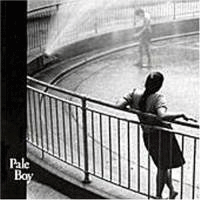
Pale Boy: 'Pale Boy'

Pale Boy: ‘Pale Boy’

Apparently what fires Seth Geltman up is Astor Piazolla – fiery, complex, challenging music, stirring feet into instinctive dance. But it’s a stiller, smaller flame that Piazolla has lit in Geltman’s heart. His own songwriting is a more reserved thing altogether. You could compare what Seth Geltman and Thomas Blomster do with Pale Boy to what Stephen Merritt does with Magnetic Fields: “from the brain straight through the heart – the shortest distance”, as Geltman puts it.

Although not as accessible (or Broadway-bound) as Merritt’s, Geltman’s songwriting is similarly sophisticated. It’s cerebral, and sometimes difficult for ears attuned to pure pop. Dark closeted harmonies abound; melodies fade into shadowy doubts rather than aspiring. An air of introversion and dry, wounded carefulness is always present. If Spice Girls had Geltman’s number, they wouldn’t call it. If Stephen Sondheim had it, he might.

Pale Boy’s delicate and mannered debut is loaded with thought and detail. Life is constantly being breathed in by Blomster’s exquisite arrangements: a chamber-orchestra palette of fluttering jazz and flamenco guitars, violins, reeds and brass plus Blomster’s own piano, ever-crisp drumming and knack for tuned percussion. Drawing on latter-day classical, jazz, and the area where the two blend together, this is music fleshed out with the same kind of light, miniaturist detail as Penguin Cafe Orchestra. Seth handles most of the singing himself – his light bloodless voice as untouchable and inflection-free as Leonard Cohen’s and as transparent as blown newsprint.

Although Pale Boy are Denver-based, their spiritual home is European – either an autumnal and imaginary Paris of skating rinks, cafe culture and falling leaves, or the ascerbic Germany that Brecht and Weil knew. Or, perhaps, a hundred points between Moscow and San Francisco where dispossessed Old Worlders with shabby coats and battered instrument cases laid down their baggage and played for a while… Think that. Then factor in a touch of Smog, with trailer parks, shitty hotels and bad teeth replaced by faded, once-grand apartments and battered books. That nails the Pale Boy world as closely as anything.

The other occasional touchstone is Love’s ‘Forever Changes’ – intricate folk strumming, surging orchestras, and dreamy heads running up against barriers. Just A Thought (in which Seth, up to his knees in toil, casts his mind free over slinking brass and woodwind) hints at Aloneagainor in its mingled innocence and frustration – “There’s so much more than the grind every day – / there’s the blue, and the cats, and the letter K. / Far from the chatter and the money hunt, / there’s a thought of an autumn afternoon.”

A darker taste of Love, mingled with twelve-tone operetta, enters Promise Me, shading into a moody resignation: “Promise me obscurity / Turn out the spotlight… / Come and go but never leave. / Let me make my best guess how to ride your slippery lines, / you fleeting joking prayer.” Best of all are the sweet express-train violins, budding trumpets and John Adams throb of It’s Good, the point where Pale Boy succumb to instinct (“Over all this sprawling mess, / rising slow in the abdomen, / taking hold of what we know. / Is this another fine mess / or an opulent waltz in the wrong direction?”) and where a new note of assurance enters Seth’s voice: “Yes, it’s good. / Just sit tight, / wait for light…”

Here and everywhere in this painstakingly adult music you can sense the presence of those cracks and draughts which betray us each time we succumb to the unexpected currents and shamings that toy with stable lives and clean ambitions. “Facts march all over an ordinary day / Paper’s got nothing to say except scandals, sports, atrocities… / Scattered friction everywhere.” The understated title track might bury itself under a forgettable melody, but its vivid lyric (of lost directions, of a hectoring young man engulfed by a stifling fence) penetrates deeper. Acrobat is cutting and unforgiving, a bored audience turning away from a “gaudy little crackpot showing off with all his might” and ignoring him as he heads into his fatal fall. Bossa-nova and muted brass line the music of October Hat, a surreal ballet of a song in which one scribbled sonnet, lost to the sea, signifies one man’s misdirected attempt to capture and circumscribe the sense of his own life.

“Well, you made your point, / and the only audience that mattered never showed up” Geltman murmurs pointedly on Hum In The Clouds. Storm-tossed lounge jazz rolls around him, wrestling with a Reich-ian xylophone, and the debris of divorce bangs into both. “What did you think would happen? Why did you leave so soon? / Do you know how much was missed and lost on those Saturday afternoons?” Throughout the record, mixed feelings and shifting views struggle for dominance; as in Wearing Your Time Out, when patient drudgery gives way to “the corner of your eye / going suddenly awry / after getting lost on lines of reason.”

This ambiguity is best caught in the trio of songs sung by Jeana Dodge. Her restrained classical soprano lends them an affectingly uptight and anxious yearning. The light, mournful marriage waltz of Almost illustrates profoundly thankful love, yet ever-so-slightly sullied by restlessness and defensiveness – “Almost a connection that couldn’t exist. / Almost all I need to subsist.” On Underside Of A Terrible Thought, an unspecified angst is picked apart with determination, disgust and fascination – “Hold it high in the muddy light… / Hold your nose and hold it very tight… / It warms your brain and quickens your blood… / this twisted tangled orphan.” The polite cadences and lullaby-vibraphone of All We’re Left With show compressed resentment seeping from the civilised rubble of a relationship – “Kept my patience, bought the flowers, went to college, put out fires… / brought home bacon, / scrubbed the windows… / and I followed the rules.”

Less successful are attempts at straightforward anger, which only sap Pale Boy of both spirit and tunes. I Hate You greys out into dull minimalism (in spite of precise, venomous lyrics (and Blomster’s poignant arrangement of funeral reeds), and while Ton Of Blue gropes at the lovelorn existential dread of the deepest blues, it only ends up sulking, morose and snappish, in its conservatoire setting. No – Pale Boy’s understated emotions fare better with  subtler, yet more complex  bonds and empathies. An endearing, awkward eroticism nibbles at the floating, detached spring-dream of Shy Beast. The wistful, tear-jerking strings and muffled brass of I Know What You’re Thinking make it a Scott Walker fall-apart thing. Here, Seth singing at his gentlest. “I know you’ve been drinking / from the oldest hope that ever was. Rising up through your spine, / flowing through the brain and through the heart, the part glowing… / And I know what you’re thinking – / ‘Get me through this jagged night’.”

At the end, Stay Hidden makes a quiet and wary bid for intimacy, with Seth pursuing truth with all the extra senses of the once-bitten. “It leaks its news through unsuspecting clues, / it lies in wait for all of us.” By this time, those cracks and gaps have been assuaged by something. Perhaps it was the still, small sound of a hopeful trumpet. This album’s not for everyone; but if you’ve silently burned, quietly frayed or seen something dear to you stretch out of your gentle grasp, it’ll strike up a little chord in you.

Pale Boy: ‘Pale Boy’
Kale Music, ERG82299 (no barcode)
CD-only album
Released: 18th April 2000

Buy it from:
CD Baby

Pale Boy (Seth Geltman) online:
Homepage

October 1999 – album reviews – Sneaker Pimps’ ‘Splinter’ (“half in love with the idea of beautiful corpses and wanton failures”)

29 Oct
Sneaker Pimps: 'Splinter'

Sneaker Pimps: ‘Splinter’

Smack.

Its presence ghosts off this record like chill off the sea. The more you listen, the more obvious it gets; the more appropriate it seems. Twelve songs about different levels of letdown – alienation and betrayal; shortfall and disgust, “high fives and corporate anthems” – but always, always possessing an ability to be lifted above it; to float in a strange and tragic euphoria in which pain and torment are overwhelmed. A rush of transcendent languorous bliss while the mind hovers above, intact and unmarked.

Even if Sneaker Pimps weren’t so candid about backstage recreation (or didn’t drop lyrical hints like “my aim’s so weak that I’d fail to get into my arm”), you can’t escape the fact that their second album is a heroin album par excellence. Admittedly, a smarter and more professional brand of smack music – no William Burroughs squalor, no Needle Park lowlife. The spike goes in beside a penthouse window, lying on a sleek leather couch; no dust on the floor. But then, as a pop group, Sneaker Pimps always seemed far too smart for the daytime shows and MTV gladhandings.

Well, some of them did. I saw an Sneaker Pimps interview in which Kelli Dayton – their original Goth pixie-ette singer – sat flirting and babbling on a sofa, flanked by Chris Corner and Liam Howe. When not answering their own questions, with a cool intelligence, they observed her with the bored and slightly amazed looks of gentleman experts faced with a posturing child. The hapless Kelli isn’t part of Sneaker Pimps any more. She’s been dropped out – as if via hidden trapdoor – or simply excised.

For ‘Splinter’, Chris Corner glides forward like Dracula to take over the mic. His slackly sensual looks (young Johnny Thunders and Ronnie Wood, with a wild crow’s nest of dyed-black hair) lounge all over the artwork of ‘Splinter’, much as his lisping, artfully-forlorn whisper floats ahead of the music’s tide. Perhaps it’s just extra clarity – with Kelli no longer an oblivious mouthpiece – but ‘Splinter’ feels like cresting a roller-coaster. A swelling build of dawning clarity, darker- toned, which sets you up for the plunge.

‘Splinter’ is also the most seductive pop record I’ve heard in a long time. Not coy winks or overblown soul-boy mating calls, not even on the acid-coated, Suede-stinging-Cameo-to-death stamp of ‘Ten to Twenty’. This is a more abstract seduction, the lure of rich fabric, sweet smoke or smouldering looks. It’s born not just from the unveiling of secrets but from Liam Howe’s shockingly opulent backdrop. Creamy, orchestrated synths and samplers traced with beautifully disturbing sound. Pianos echo, fretful in the cavernous dark. ‘Omen’ choirs or wailing-wall chants lunge out at Chris, trying to lassoo him. Small slivers of Oriental melody glitter in the fabric, and beyond the luscious trip-hop grooves eerie Bernard Hermann strings are trembling, bursting, warning. Female singers, disturbingly blank, shadow Chris’ pinched tones.

The whole album’s in a state of sensual motion, like restless waters or billowing tapestries. As for mood and motif, it’s always ominous – always half in love with the idea of beautiful corpses and wanton failures; with sultry sicknesses and the bloody romance of despair. Kelli or no Kelli, there’s always been a Goth undercurrent to Sneaker Pimps (and not just because the industrial-tinged, reverberant rock of Superbug also has a distinct tang of The Mission). When Chris sings “strike me down, give me everything you’ve got. / Strike me down, I’ll be everything I’m not,” on ‘Lightning Field’, he sounds bright-eyed, waiting for the lash.

On ‘Half Life’, accompanied by the liquid, trembling swirl of pianos and ghost orchestras, Chris muses at the syringe or at the lover he’s failing with – “half life wastes before it goes – / it’s funny how your bee-sting touch never leaves me whole. / It’s not enough to stay here, almost trying. / You kept your last laugh, watch this dying.” On the magnificently disdainful, disgusted ‘Low Five’ he delicately spits back corporate language and schmooze-talk with savage grace – “Kite-marked for true low standards / where more wants all and no less. / Just change with no real progress… / I’m a low five downsize no-one else. / Do you love yourself?”

Bad relationships. With the biz, with the needle or with girlfriends – all three bleed together in Sneaker Pimps’ crafted disaffection. Only on ‘Cute Sushi Lunches’ does this seem brattish, as Chris sneers “nineteen steps out from under your feet. / Can’t eat, won’t eat… / Hate like a child hates his hair cut,” and the instruments obstruct each other, stubbornly refusing to gel… but not quite enough to derail the song.

It’s a suspect confessional, a cunning blind to absorb attack while Sneaker Pimps slip the rest of the album past your resistance. The worm-turning cruelty of ‘Curl’, popping with funk under its lustrous ballad verses, stung by zithers and pulsating psychedelic grind – “I curl to break consent… / and I curl now to help me find you out.” And the little thrusts and revelations like “never compromise – you’re just always weak”; “it takes too much to please me – / attached but no real feeling,”; and (most killingly) “failure was on me, / but your ideals bore me.” All of it wrapped in that dark and dreamy music.

Beyond the sensual overkill – that luxuriant death-by-soundtrack – the rich nightlife sounds are sometimes folded away in favour of small rooms dominated by Chris’ spider-legged acoustic guitar. ‘Flowers and Silence’ is the most explicit trip to the shooting gallery. Skeletal slow jazz waltzing among the radar blips somewhere between Scott Walker and John Lydon, moth-wing vibrations of synth, and a dry-mouthed Chris murmuring “she’s nowhere, she mainlines, / helps me out – now I can speak… / So nothing’s free. / Ghost-drunk, out of reach.”

Behind the dogged strum and distant alarms of ‘Destroying Angel’, strings slither down – blood trickling across a window – while Chris turns in the most sinister performance on the record. “The stones beneath the water that you walk on to be taller, / the hands you stuck together ‘cos you prayed you’d wait forever,”, he whispers, picking apart a dying affair full of desperate power games and scams, and ruthlessly stripping it away from himself, right down to the tattoos (“the words beneath my skin / the ink that you put in, / destroying all the things you left around.”). There’s torch music on ‘Empathy Low’ – as well as a rich sleazy purr of double bass – but if so it’s torch reduced to clammy ashes, as Chris stares into the recesses of his soul and finds them disturbingly bare. “Proves herself to be closer, / but not me forever, not me… / My memory’s so / empathy low.”

And there’s ‘Splinter’ itself, the guitar zinging and slapping while things prowl in the shadows – growling, creaking double bass, moaning and scraping; boiling, ghostly noises from Liam Howe’s black boxes. Then there’s Chris, flint-eyed and flint- voiced – “Does it take the fireworks to make you look in wonder? / Would you give reaction to the cause I’m under? / So coloured by you, but your monkey messed it up – / surrounded by you, your monkey’s long-while had enough.” If David Sylvian had stayed in London, corrupted by the smoke and cynicism, he might have ended up this sleekly poisonous: enveloped in beautiful, cultured ambient sound and existential melancholy, but honing a small silvery sleeve-dagger for the right moment.

The final song – ‘Wife by Two Thousand’ – could be a subway busk, with one of Chris’ faceless women singing back at him from further down the tunnel. A draught sucks at it, pulling Liam’s subliminal buzzes and celesta clinks away into the oblivious sounds of a crowd. While Chris strings phrases from ‘I Can Sing a Rainbow’ into the chorus (as if trying to get back to childhood assurance), the song’s an attempted seduction, in spite of everything that’s gone before. Chris is playing the vulnerable card this time, with a cynical, pleading desperation. “Never so complete, just failing on its feet… / I think that I need working on, so work on me / I feel that nothing’s getting though, so get to me.”

But the last we hear of him is a nonchalant nothing-can- hurt-me whistle. He’s disappearing into the city with his bag of secrets closed up again, leaving you to make your guesses. The kind of doomed, fascinating bastard whom your eyes still follow, and whom your hands reach out to in spite of yourself. Damn.

Trust a junkie? Never. But they can be as compelling as their habits.

Sneaker Pimps: ‘Splinter’
Clean Up Records Ltd., CUP 040CD (5029271004024)
CD/download album
Released: 29th October 1999

Buy it from:
Available from most sources.

Sneaker Pimps online:
Homepage FacebookMySpace Last FM

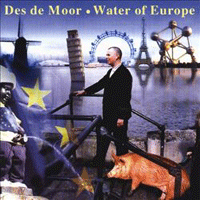
October 1999 – album reviews – Des de Moor’s ‘Water of Europe’ (“a cherubic smart bomb of chanson”)

1 Oct
Des de Moor: 'Water Of Europe'

Des de Moor: ‘Water Of Europe’

Like a cherubic smart bomb, Des de Moor has popped up whenever London needs a sniff of wicked European song. In his time, he’s helmed the Pirate Jenny’s cabaret club, fought for chanson and acidic cabaret old and new, or made a public case for tying together songwriters as diverse as Boris Vian, Georges Brassens, Martin Jacques of The Tigerlillies, David Bowie and The Magnetic Fields maestro of puckish gloom, Stephen Merritt.

When Des can fit in an album of his own, it’s recorded in bursts of enthusiasm in between all these other burst of enthusiasm. As with everything else he does, it bears the stamp of that sweep of songcraft and resistance he’s devoted himself to, as he elbows his way into his own niche and into the history of chanson. When “fuck you, I won’t do what you tell me” has become our most famous protest lyric, and our concept of resistance-in-song is measured by the PC-baiting and broody solipsism of Eminem, Marilyn Manson or Wu-Tang Clan, it’s good to hear a dash of genuinely sharp social writing – even if it comes couched in a musical language nearly a century old (which in turn suggests that we might have been missing a lot since we cut those particular stylings out of the popular consciousness).

‘Water Of Europe’ must’ve been recorded for tuppence, and sometimes sounds as if it was lashed together with parcel string. No Dagmar Krause big-budget political cabaret job this, all respectably outrageous and state-concert-hall friendly. It’s sealed and sold on the vigorous punky pocket-orchestra enthusiasm of the players – bumped guitars, cellos, pianos, snapping percussion, Daniel “Boum!” Teper’s accordion.

Des’ voice is the common key – a florid, unusual mixture of madrigal tenor and soapbox preacher; or a grown-up, apostate choirboy in the political thick of a pub argument. It sits at the heart of the de Moor way of working, and is as pugnacious and theatrical as his barbed lyrics. Each word is bitten into shape and flung out with flair. Although most of his music could’ve easily have strolled straight out of the 1930s (Des might have drawn on punk’s assertive spirit of questioning, but he clearly finds more verve and expressiveness in a mix of jazz, folk and cafe singalong), his lyrics are less time-locked. They dig into the dirt and humanity of yesterday, today and tomorrow, exploring themes of exploitation and injustice, politics and deception, war and its wounds, gay life and its hauntings.

Des de Moor: ‘Dirty Pictures’ (preview)

Skidding and acerbic, the punchy accordion tango of Dirty Pictures tears into public figures embroiled in the noisy scams of censorship and social decency, taking forthright aim at their implicit hypocrisy, their encroaching voyeurism and their lust for personal exhibition (“You’ve seen the camera, it’s seen you… / you’ve wanked in front of mirrors too.”) With a sarcastic zest, Des savages the double standard of class and education – “Let middle classes get their kicks: / subtitled sex in foreign flicks / can’t cause infection. / The masses, couch potatoes all, / whose dishes sprout from every wall: / they need protection.” He also spotlights broader horrors for which there’s less willpower for banning (“Pot-bellied children / rooting in rubbish / as food mountains rot; / The obscene, often-seen, / ultimate snuff scene / between have and have-not.”)

Des de Moor: ‘Heart Of A Heartless World’ (preview)

On a more mythological scale, Heart Of A Heartless World (which sounds something like a state-of-the-world take on Fairytale Of New York) takes on the compromised cultures of colonialism, famine relief and the points where they intertwine. Retelling a sweep of human history as a journey from a lost African paradise into a famine filled by suspicious prophets and priests (“vultures that pick at the corpse of the poor”), Des suggests that the journey has bequeathed us a present-day of false hearts, superstition and moralistic humbug where “priests and prime ministers pray for our sins / and mystics on telly guess lottery wins.”

Des de Moor: ‘Margins’ (preview)

Des’ words spit and crackle even when – Germanically – they cluster, fight and split the envelope of the tune. The magnificent Margins (just waspish accordion, Des in marvellously stroppy voice and the bitter backdrop of the Bosnian conflict) jumps out at you, laying waste to the complicity of media and state interests in the parceling-up and selective suppressions of a world in conflict. “Believe what you hear and believe what you’re willing: / a severed head here, and there a mass killing. / We’ll print it provided / it’s clearly one-sided / and something is left to the margins, / at the bottom of the page in the margins.” In this song, little escapes the de Moor tonguelashing – not the journalists who “roam far and wide collecting tales of atrocities / from regular soldiers and mercenaries” and not the conferences that re-order things, ratifying the mess the way the biggest powers want it. Certainly not the scapegoating stories that thrive “so long as they’re hearsay, undated, / uncorroborated / and blame the right side… / We’ve forgot the Ustashe and found the new Nazis / in Belgrade this time.”

A debt to the history of chanson and folk is paid via a handful of gutsy covers and interpretations. Terry Callier’s Ordinary Joe is one, boasting gloriously hooded trombone from Dave Keech and a guarded, evasive street philosophy – “Down here on the ground, / when you find folks are giving you the runaround, / keep your game uptight / – and if you must, just take your secrets underground.” A rough’n’ready, guitar’n’free-verse declamation of Brecht and Eisler’s To Those Born After (An Die Nachtboren) is another, exploring the crummier details of toiling in the revolution. “I ate my dinners between the battles, / I lay down to sleep among the murderers, / I didn’t care for much for love / and for nature’s beauties I had little patience… / Oh we, who wished to lay for the foundations for peace and friendliness, / could never be friendly ourselves… / In the future, when no longer / do human beings still treat themselves as animals, / look back on us with indulgence.”

Des de Moor: ‘To Those Born After’ (preview)

Most impressively, a new translation of Jacques Brel’s My Father Said polishes Des’ claim to be the best English-speaking Brel interpreter – in either sense of the word. The song explicitly links Britain and Europe: a legend of kinship, of severance by high North winds and high water (both brought to musical life by Kev Hopper’s magnificent solo on musical saw), and of humanity blown before the rough and beautiful forces of nature. “The earth was rent / between Zeebrugge and the cliffs of Kent: / and London’s left cut loose and free, / with the Bruges headland taunting the sea. / And London’s left to forever be / a suburb of Bruges, lost in the sea.”

Des de Moor: ‘My Father Said’ (preview)

My Father Said stands as a counterweight to Des’ own Water Of Europe itself – another exploration of kinship. Here, Des places himself on a fantastical odyssey of his own, sending his thoughts out from Britain and around Europe. He finds first an island, and then a continent, locked in a common defensiveness and an ugly sense of purity. Each exploits “the Other” but denies them harbourage – “If they desire a water of Europe / it is the cold grey sea that divides. / Or the deep and inviolable water / taking and making sides.” Against this he calls on the forces and floods of history, hoping for the day when “truth decontaminates water supplies”, and “the fracturing chains of the workers of Europe / have strangled the boy with his thumb in the dijk.” Whips snap, castanets rattle, accordions and guitars throw punches. There’s going to be a party out there when the storm breaks.

Des de Moor: ‘Water Of Europe’ (preview)

Some of Des’ gestures aren’t carried nearly so well. However musical he is, he’s a man of words first and foremost, and this can mean that in his forthright sincerity the songs scramble across an imbalance of text and melody, like a flapping banner dragged by the wind. In the squabbling, tricky surveillance satire of Big Sister, for instance, his voice drowns in his densely-packed lyric: “More cameras than Hollywood, more tape than Scotch, / more logs than Canada, much more to watch… /I am your friend in the fight against crime. / Won’t you be safe when I’m there all the time – / minding your kitchen and minding your bed, / and, for extra security, / minding your head?”

Des de Moor: ‘Big Sister’

The Fairground Attraction swing of Grandmother Was A Hero, with its perceptive picture of human flaws, also should have been better as a standalone song. Over-pressured by words, it lacks smoothness and poise. Yet if you can accept that Des’ prime aim is to get his tales across, it has a lot to offer. Weighing up his monstrous grandmother’s peacetime behaviour, Des offsets it against her tireless protection and concealment of refugee Jews during wartime. “She didn’t have much wit or grace, / nor brains in large amounts. / But Grandmother was a human / and being human counts.” In telling her story, in a voice and lyric that build, ebb and resurge through a complex knot of anger, admiration and pity, Des finally arrives at solidarity, and presents his memorial:

“Just think how it must have been / as a hausfrau in poor Holland when the Wehrmacht goose-stepped in / With a husband that you hate, but there is nothing you can do: / It’s an emergency situation, and your man’s your comrade too. / In that fearful hunger winter when all your two kids have to eat / is potato peelings, pea pods and the snow from off the street – / and they’re handing out the yellow stars that one by one blink out, / and you know you have to help them, and there is no time for doubt. / Until the Gestapo knock on your door, and you find yourself alone / and in the settled dust you’re just a German widow / far from home.”

Des de Moor: ‘Grandmother Was A Hero’

Elsewhere, a loose trilogy about workers in London merges a realist’s acceptance with the strong protest of an angry survivor. In Avocado, Des examines the gritty detail of the kitchen worker’s desperate struggle between hopes and exhaustion – memories crumpled in the heat and hubbub, but not yet devoid of the sting of style. In doing so, he etches a picture of life of triumphs and traps. “Choose a plump, ripe avocado, just like on your first exam / at a college back in Glasgow. Stop the memories if you can. / Take that plump, ripe avocado, slice it with the sharpest knife, / Smile and summon your bravado: it’s a cold, raw kind of life.”

Des de Moor: ‘Avocado’

In Joey’s Dreams, Des delivers a rock song turned back into seething left-wing folk ballad, the story of a gentle working bloke who’s gradually ground into resentment by hard times and defeat – “a beast that’s pacing in a pen / at the edge of a feast for rather richer men.” He goes on to trace how resentment leads to poison, and frustration to an ugly fall, shading it into a larger picture of a caste crushed down from honour into malevolence. “Joey’s cramped contractor’s terms, / that force his crawl among the worms, / create a breeding ground for germs: / opinions that the world confirms… The clots of rot clog up each bend, / the queues for casualty don’t end. / You can’t believe in your MP – now Joey’s voting BNP.”

Des de Moor: ‘Joey’s Dreams’ (preview)

Beyond these small fierce sketches, there’s the fractured battlement of Sleaze City. Des takes an uneasy stroll through his beloved south-east London, past strangled docks and thriving bailiffs, sniffing and frowning at the muggy wind of corruption shrouding Westminster even as homeless beggars huddle in sleeping bags, a stone’s throw away over in the Strand. Throughout, a sweep of history – compromise, an age-old London scrabble and a sense of loss – provides depth. “At Surrey Quays, saluting the seas / sets flags bobbing. Along the shores ex-stevedores / watch gulls mobbing… /The last leaking hulks have long furled their sheets / at Woodpecker, Evelyn, Crossfields and Pepys…. / There’s whole careers / in chasing arrears, still shivers / though shirts are soaking. / Sleaze City’s choking / in the ozone.”

Des de Moor: ‘Sleaze City’ (preview)

For more personal struggles, there’s Sharp Contradictions and Last Orders Please. On the former, Julia Doyle’s double bass and David Harrod’s needling piano pick out itchy broken harmonies like the stab of toothache. Des anatomises the terrifying wonder of a fall into love, like an attacking scalpel or virus winding to the very centre of a person. “Alive and kicking, awake, aware / with a billion lights that sparkle and flare / in the brain above. / But put in the knife and start to twist – / the lizard hisses and lashes a fist. / The world goes runny when you get pissed. / And then there’s love.” Surreal spiraling rhymes paint the upheaval, with a dark coda of sombre feeling – “And it is the time I spend sinking / that sharpens and tempers my thinking. / And it is this feeling you give / that reminds me just how much I live.”

Des de Moor:’Sharp Contradictions’ (preview)

In contrast, Last Orders Please is a death song of the kind you get only in cabaret, filled with defiance and fear. It’s also the only outright gay song which Des has allowed himself for the record; overshadowed by the horrific harvest of AIDS, the hollowing, slithering sense of time passing too fast and too hard, and of youth becoming a strange, sinister and heartless territory. “Now I’m older, Death is a young man, not the skull-faced spook from ‘The Seventh Seal’ / but a bronze Adonis with eyes as blank / as a half-filled diary’s empty pages.”

Des de Moor: ‘Last Orders Please’

Yet although the song starts in a rumble of melodrama, it bursts into a fiery salsa – “At close of day, there’s burning rages / for a hundred loose ends, / for the lovers and friends, / for the wind into which we were pissing / when we never knew what we were missing, / for the might-have-been, could-have-been, never-was life we’ve been living.” Des has the energy – and more – to spit out a last rallying call for the scared and threatened: “We’ve nothing to lose in the trying. / If life is a bitch unless you’re fucking rich, / no wonder we’re frightened of dying.”

The bloodstream of folk music also harbours germs of resistance. Des de Moor’s very much part of that particular flow, provocatively pumping heart and all.

Des de Moor: ‘Water Of Europe’
Irregular Records, IRR038 (5036265000078)
CD-only album
Released: 22nd September 1999

Buy it from:
Irregular Records (or Amazon).

Des de Moor online:
HomepageFacebookTwitterMySpaceLast FM

September 1999 – album reviews – Edwige’s ‘Keep the Change’ (“nebulous, pine-forest cleanliness”)

30 Sep

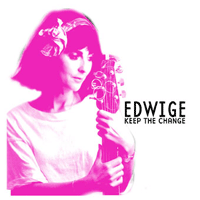
Edwige: 'Keep The Change'

Edwige: ‘Keep The Change’

Edwige is a true original and determined with it, outspoken in her contemplative pantheism and in reaching towards the divine spirit that binds her universe together. It’s difficult to pin her down to any songwriter school – even within the eccentric fringes of spiritual folk, French chamber-chanson and psychedelic New Age she seems to incline to, she’s an odd customer and obviously wants it no other way.

You’ll either love or hate her unorthodox and uneasily captivating voice as it zooms and dodges (like a brilliantly coloured, elusive dragonfly) over her baroque and mystical songs. It’s more unpredictable now than ever – zigzagging through melodies, it’s never quite where you expect it to be. She’ll carol, coo, stick you with a sharp note. She’ll shiver herself into blocks of eerie harmonies flickering between celestial and dischordant. She’ll double back on herself, frustrate you, salve you; and finally dissolve into a lovely swarm of voice-clouds.

The voice remains the same, but the music has moved on since her jaunty, budget-recorded debut album. Faithful keyboardist Joe Evans is still on board, but admitting Alexander Zuchrow (guitarist, engineer and, most crucially, arranger) to the heart of the music means that Edwige’s songs have been framed and fleshed out in richer textures. Harpsichord and dream-pad sounds replace the previous tinny synth presets. Gentle bluesy guitars add new body; cellos, Appalachian fiddles and soft saxophones peep out of the corners. ‘Keep The Change’ possesses the nebulous, pine-forest cleanliness of Narada Records, or of Windham Hill folk.

If the first album was postcards from Edwige’s imagination, ‘Keep The Change’ brings you a breath of countryside as well as further maps of her spiritual landscape. Edwige’s themes of continuance and connection, of inner illumination and the dispelling of fear, sit in leaf-green settings. A puff of baby-Clannad folk in Water; tinkling Vivaldi pop for Reflection. The lyrics (and the rootsier atmospheres) are permeated by rain-mists and mermaids, wind and light. Via perky fiddles and banjo, the gracious Joy Song (both a letdown and a thank-you to a luckless admirer) threads country and Irish airs around Edwige’s serenity. The bizarre falsetto-waltz melody of No Two Ways bobs balloon-like over strings and harpsichord (which could’ve come from ‘Five Leaves Left’) and a clink of lounge vibraphone (which definitely didn’t).

Sometimes Edwige brushes up against the exquisite. On the contemplative ethereal anthem, Something Deep she mixes her “everywhere god” faith with a touch of Duke Ellington gospel shapes plus lemon-flavoured jazz cello. On He Only Knows (over yielding beds of keyboards, clarinets, luscious classical guitar ripples and soprano sax) she sings of journeying – “an arm coming from nowhere / far away has taken him. / Now he changes his road again,” – and then sets the seal on it with her own signature swim of voices. On I’m Out she sings of passing through peril to attain faith. A tapestry of Enya-esque chanting and the urgent wire-tang of a Jantsch-y folk guitar finally dissolves down into another magnificently luscious voicescape, though it basks a little too contentedly in the warmth of fuzzy piano and sax along the way.

Equally, sometimes she misses the mark. Her tendency to overbalance into tweeness is one thing (the popcorn cafe-jazz of Leave Your Mind At The Gate being the worst offender). It’s worse when the same determination that stretches Edwige’s songs towards dizzy heights sometimes leads her to stretch them out of shape. Eager to illustrate, she pushes too hard, letting her lyrics crowd out the melody and garble the song. At such times, she bustles against the delicate arrangements instead of nestling in them. For example, amongst the chirruping violins and Spanish guitars of So They Say, her message of opting for instinct (over demands for hard facts, or superstitions) is smothered by the tangled, forced and fussy words.

It’s all far better when Edwige relinquishes the strict and portentous hippy lectures and just lets her songs breathe; when she stops banging against aspirational truths and taps into the grace she sings about. This happens on Wherever It Is (a sparkling ballad of devotion) and on Light Energy Love, where a sweet, open melody (reminiscent of Bryan Maclean’s gossamer hums on Love’s ‘Forever Changes’) merges with a champagne tingle of fiddles, guitars and harmoniums and with Zuchrow’s gently gurgling psychedelic streams. It’s in songs like this that her determination pays off and her quest progresses.

On the final song, Something Deep, she sings with an equal measure of frustration, patience and commitment. “You keep plugging your ears so you won’t hear my song… / Something deep inside of me knows / I still sing for you.” Going down fighting, or transcending closed minds? The little soul warrior with the effervescing voice isn’t going to give up.

Edwige: ‘Keep The Change’
Quasar Music, EDW2CD (634479464935)
CD/download/cassette album
Released: 1999

Buy it from:
Quasar Music or CD Baby.

Edwige online:
Homepage YouTube

REVIEW – David Hurn: ‘Sick Of Hate’ single, 1999 (“drained of energy but not of humanity”)

26 Sep
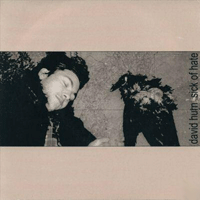
David Hurn: 'Sick Of Hate'

David Hurn: ‘Sick Of Hate’

For better or worse, former Ever-Opening Flower frontman David Hurn left behind a lot when he quit that band’s deep-blue, textured shades and unusual blend of Rain Tree Crow, Rush and Morrissey. It wasn’t just the rock-band muscle and ghostly electronics that Ever-Opening Flower offered, but the aggressiveness of the detail; the assertion and meaty impersonality offered by a pushing bass, rock drumming and high amplification… the way it can obstruct and drown any soft brush of associations which you might want to imply rather than state outright. Pros and cons.

Left to his own devices, Hurn’s songs are hushed, internalized, almost entirely acoustic; and none of them rises much above a whisper. His guitar and the wistfully resigned tones of his low-tenor voice are joined by droplets of detached, forgetful piano and the sorrowful whistle of detuned radios. Sick Of Hate is a spare, isolated, note-picking thing; drained of energy but not of humanity. It’s the soft, tired noise left behind after the London bustle has passed and the frantic energy has ebbed. “I’m sick and tired of hate, / Of rain on the streets./ You and me are far too small to make a difference…” If it fights back, it fights back like the grass – bent back by hostile forces but refusing to be shaped by them.

There are some shades of Red House Painters (and the perennial Nike Drake) in there. It’s the sighing gloom, the mouse-like quiet; the way you have to focus yourself in on the story, to have to want to care before you can get anything out of it. You’re eavesdropping on the final deterioration of a love affair, the lack of conclusion after the arguments become meaningless. David murmurs “The mess that we made needs cleaning up for the last time. / Are you feeling weak and poor, or just tired?” In some ways Sick Of Hate also looks back towards Hurn’s old debt to David Sylvian; but where Sylvian wraps himself in impenetrable mystical robes and perfects the shamanic droop of his eyelids, the other David still cares about the realities ruling the strained existences of everyday people. “The value of our lives, that we would both die for – / but something’s telling me the truth matters more…”

The B-side – (For Missguided) – is Hurn at the ambient guitar sketchpad. He improvises with sombre, spinily picked chords on his acoustic and with moaning soundscapes of experimental string noise: pings, knocks and microtonal whale whispers. It’s like the spookier moments of Pink Floyd’s ‘Meddle’, or like Bill Nelson locked in with Bert Jansch during a rain-swept dusk. In its way, it continues Sick Of Hate’s autumnal atmosphere of regret, inertia and (with its empathic sense of resignation) even a touch of grace. While the bittersweet fog of sadcore usually blows, trapped, around the happysad streets of San Francisco (or wherever Will Oldham or Bill Callaghan might be hanging their battered hats), David Hurn, a prince of rueful shrugs, is establishing a bridgehead for it over here in the tired old brickwork of the Smoke.

David Hurn: ‘Sick Of Hate’
day Release Records Ltd., DR105
7-inch vinyl single
Released: 1999

Buy it from:
original vinyl single was a limited edition of 1,000 copies – buy it secondhand, or download from Bandcamp.

David Hurn online:
Homepage Facebook TwitterMySpaceSoundcloud Bandcamp Last FM

May 1999 – mini-album reviews – Rudy Simone’s ‘Personal Cloud’ (“contradictory shards and half-formed knots of feeling”)

14 May

Rudy Simone: 'Personal Cloud'

Rudy Simone: ‘Personal Cloud’

“I wrap my lips around a cigarette / instead of you,” mourns Rudy Simone on the title track of ‘Personal Cloud’. Her voice pipes and teeters on a precipice of reproach. It’s gently, perpetually, pulled back by beautiful harp-like guitars and throaty bass synth. Here’s a lullaby for the betrayed, somewhere between the sweet hyper-conscious dissolve of a Jane Siberry ballad and a Rose Royce disco symphony. Clasping heartbreak to itself, like an addict in recovery, and gently rocking to soothe; while allowing all of the contradictory shards and half-formed knots of feeling to swim free for a moment, a float of voices and words knocking against each other.

“I thought I was drowning, it was only rain./ Thought I felt fire, it was only smoke. / Never leave me… / Oh, will this world take you from me? / I tried, I tried to leave it alone…”

‘Personal Cloud’ is all about this kind of mixed, eddying feeling. Intensities and unravellings. Throwing vitriol and clinging to loyalty. The need to stab the same person you might be begging to pick you up off the floor two hours later. And if it wavers dramatically – both in its musicality and in its consistency – that’s only in keeping with what it’s about, as Rudy explores her emotional devastation using various forms of music. Club elements invade baggily-hanging acoustic confessionals. Wobbly jazz singing gatecrashes trance-dance. Free association yanks a tune bloodily from its roots. Throughout, moods swing like road-signs in a gale, confusing direction.

 “I swear sometimes I wish an alien will take you from this planet / then I turn around, y’know, / I never meant it,” frets Rudy on Velvet, an all-over-the place straggle of guitar, cello and drums where jealousy, need and pride disrupt each other. At one moment, she’s showing the lover her boot and the door  (“Go on out / take your place and find the one who does it all for you,”). At the next, she’s turned the full blowtorch of greedy sexuality onto him to melt him back down again (“It don’t fit into your plans to be so selfish / when all that velvet is waiting for your kiss…”).

Puppet strings yank themselves; kissing lips bruise on gritted teeth. A foot slides, caressing, up a lover’s calf. The same foot turns and hammers a heel, hard, into his instep.

This kind of tense no-man’s land is a stressful place to be. Sometimes there’s a wordless protest, as expressed in Galactica – cosmic trance-techno, where the lonely cry of a star-burned keening synth is cheered up by a flamboyant crash of bells and bucked up by a roguish, tarry bubble of club bassline. Alternatively, Stronger Than You Know meanders along on its skinny guitar and string synths, changing its shape, like a girl dancing drunkenly across treacherous ground, knowing where to put her feet but lurching dangerously close to disaster. It seems fey, but only because it’s discovered a different kind of resistance, dissolving again to escape damage – “Oh, you’re kicking light, / you’re punching air.”

The militaristic Bjork-ish beat of Glimmer Of Hope, the tension of guitar and listing punchdrunk voice, belies its positivity – “I see a glimmer of hope in the clouds / and it’s all I need to see my way out of this.”  On Feel Like I Belong, the club electronics bang and bubble under one of Rudy’s sweetest bluesiest sighs, and bloody experience is weighed up – “memories can drown if you let them – / just because you can it doesn’t mean that you should.” Only the drunken brooding of surly fuzz-guitar suggests there’s something wrong behind this particular attempt at finding peace.

record-rudysimone-ktcocFar more satisfying (in terms of comfort, anyway) is the spooky guitar and spiralling trip-hop of the haunted single Kill The Cult Of Cool – remarkable in any context, particularly moving here, it sounds like a night’s spiritual battle committed to tape. On the single cover Rudy, visibly haunted, stared down fear out of a circle of tall, slender flames, and the song’s occult, speaking-in-tongues feel is still immediate. Over Gothic movie keyboards, Rudy delivers a Buffy-esque putdown in a cool, girl-with-a-mission voice – “I’ve got nothing but derision for your apocalyptic vision. / Anti-amorous, not glamorous. / Time to kill the cult of cool,” – before rolling off into a weird, syncopated mixture of American indie, sampledelia and trip-hop in which everything seems to slide gracefully in and out of time. Ruminative, sandpapery hip-hop beats do the slippery shuffle-and-collapse in the basement. Frail raga-trance vocal melodies drape themselves in irregular folds over the roof. White noise, static radio fizz and heart-monitor bleeps struggle in and out of the mix: a dreamy staircase of guitars (including a spaghetti-Western dobro) twangs at the heart of the chorus.

The rest is a weave of lost-girl chant and coos, a multiplicity of voices flipping backwards and forwards, a narcotic nuzzle towards solace. “Help up, I shall bless,” keens one line. “Ooh yes, honour – there’s no-one there…” murmurs another. Rudy duels weightlessly with other wounded voices (“I was the quiet one in school, never made any trouble…”) and absentee gods before declaring with quiet assurance, “I don’t care what you say, I’m not crazy.” The fact that this happens at the beginning of ‘Personal Cloud’ – and not as a tidy resolution at the end – suggests that this isn’t the first time she’s had to take up arms against her own crowded inner sea of troubles.

Uneven, unsettling, and mixing awkward un-coordination with gliding grace, ‘Personal Cloud’ reveals the wayward talent of a potential cult heroine – unafraid to grasp at the chaos and trash of the battered heart.

Rudy Simone: ‘Personal Cloud’
Phat Lady Records (no catalogue number or barcode)
CD-R-only mini-album
Released: 1999

Buy it from:
Extremely rare – best found second-hand.

Rudy Simone online:
Homepage Facebook Twitter Bandcamp Last FM YouTube

October 1998 – live reviews – Holly Penfield’s ‘Fragile Human Monster Show’, Downstairs @ The Washington, Belsize Park, London, sometime in 1998 (“calling back the family”)

3 Oct

Usually, the stage is festooned with objects. Antique candlesticks, mutilated dolls, little aliens and masks and stuffed rats. Inflatable replicas of Munch’s ‘Scream’; drapes and toy guitars and candles and mirrors. A travelogue of places been, of people touched and gifts given and received. It’s like walking into a voodoo shrine when you go to one of Holly Penfield’s shows, with a Kurzweil keyboard synth as the altar and a most singular priestess creating sympathetic magic.

Tonight, though, it’s not like that – and, to tell you the truth, it hasn’t been for some time.

When I knew it in the early ’90s, the ‘Fragile Human Monster’ Show had set itself up as a Kilburn cult: blazing and guttering as a shredded star in the Black Lion’s lofty function room, an intense piece of performance art sitting oddly on the schedule among the jazz nights and the inevitable country and Irish bands. I used to be a regular, travelling an ungainly “v”-shape by Tube from Highgate to Kilburn via Charing Cross every few weeks to take in this precarious celebration of the outsider’s turmoil. I’d be hearing new audience members mutter “I’m absolutely fucking gobsmacked!” and “she’s a shaman, that’s what she is!” as Holly hauled her exhausted self offstage after the climax of every show, to meet the cluster of new converts. Or watching others sitting bolt-upright in their seats, uncertain as to whether they should move or breathe yet.

Kilburn has a long-standing reputation for nurturing street-fighters, poets and geniuses, but no-one was ever entirely prepared for the sheets of tumultuous emotion that blasted off that stage, winding the audience in out of their cloistered London selves. It was no crowd-pleasing assemblage of easy pieces. It was an exorcism, sung out of the psyche of an unstable California songwriter come to earth and berth as North London’s answer to Tori Amos, whose self-appointed mission was to celebrate the glorious awkwardness of being alive and being human.

She did it in style and with her whole heart, exploring our contradictory and troubled natures with her bag of striking songs and her full-on keyboards and singing. Part synth-pop diva, part 1970s rock siren, she came across like a full-throttle Stevie Nicks or Grace Slick invading and overwhelming a Laurie Anderson show-and-tell, and she brought a brace of personas with her. At times she was the enigmatic seductress, at others the knowing child or the wise fool, the little girl lost who sees with the clearest eye. Sometimes – especially in the wilder second half of the show – she was the liberating hysteric, encouraging the whole pub into primal screaming with her, or delving into the world of the compulsively needy in the sonic barrage of Cuddle Me.

Being a member of Holly’s audience meant being enticed into shedding those cloaks of cynicism and reserve we use to insulate ourselves, and opening your heart up to the rawest kind of sympathy and honesty. The show became a part of us, as much as we were a part of it, the church of the misfits she embraced. We dropped our guard, she sang: a voice for our odd angles and our visceral fears. OK, it wasn’t always successful. If you didn’t buy into her stylings and sounds, or suspected her for the years she’d clearly spent grinding away and trapped in the Los Angeles pop factory, you’d have been left cold from the start. Holly’s whimsical song-stories of peculiar goings-on down at the ranch burbled where they should enlighten. Her savage onslaughts on her inflatable Scream dolls did look like kids’ TV for psychos; and some songs fell across the line dividing the inspired from the self-indulgent. If you led with your sense of cool, or your cynicism, there was no chance.

But at full tilt, it was unmatchable. Banners unfurling, defining the nature of the misfit – and, years later, inspiring the name of this blog. The keyboard was caressed and hammered, abused and enchanted, responding with waves and roars of sound, chimes and ripples as those melodies cascaded out of it. Inevitably, the show would climax in a crash of sound and fury as Holly’s rage and passion reached a colossal peak and she smashed at keyboard and walls with terrifying fervour. Some evenings she’d pull herself up from the floor to let us off the hook with a song of redemption. Some evenings she’d given out so much that she couldn’t…

And eventually, it died a death. The show’s welcoming inclusiveness coagulated, and shrank to one woman’s neurosis replayed again and again on stage as a stubborn loop. Locked into her ritual of combat and confrontation, Holly became unapproachable: stopped listening. People, reduced from being family to being just punters, felt that; they stopped listening themselves; drifted away. Eventually, one evening (watching Holly run through a show that had become no more than a process, a jukebox for the disturbed) I realised that everything that had drawn me to attend the Fragile Human Monster Show – to be a part of the show – had slid out of Holly’s hands as they contorted on her keyboard, and drained away.

Quietly, and unmissed, I left. I heard that it ground on for maybe half a year longer – until Holly’s compulsion to keep performing it had finally ebbed – and then faded out. Radio silence.

That was then. Now… a tentative return to action. Holly’s show is no longer a monkey on her back, no longer a vampiric therapy devouring its own subject. And – by word of mouth, by phone – she’s calling back the family. There’s a new, one-off venue, in a more genteel neighbourhood. And there’s a gentler, shorter ‘Fragile Human Monster Show’. Less of a pitched battle this time. Testing the waters, for sharks and for soothing.

So… no decoration tonight. No Screams either. Just the keyboard, and Holly: still wand-slim, wispily blonde, petite; still looking as if you could break her between a couple of fingers. And, tonight, apprehensive as she works her way back into performing the show. When she takes the stage, however, she’s anything but insubstantial. That voice, that playing, those songs… are still intact. Little miracles of warmth and tension, instantly memorable as her astoundingly expressive voice curves little bluesy, jazzy curves round heartbreaking corners.

Penfieldia is a place to hide and be inspired, inhabited by characters like the homeless poet living in a box in Over The Edge or the unravelling lovers in the hollow urban landscape of City Of Lights. There’s familiarity to them, yes. These songs could conceivably have sat in the charts – or in piano bars. But, just as it all seems to be getting too straight, Holly twists it and it’s off in a different direction, or barbed with something unexpected that sneaks in and turns your heart like a doorknob.

Parts Of My Privacy unwraps the fears of the distrusting recluse. In Stay With Me slow coils of piano reach into the depths of loneliness, still the sound of a woman slowly sliding into the dark. Sea Of Love offers us respite with a slow sated love ballad and Don’t Hide sends out a rousing percussion call to faith. And Voices – a slow, winding sleepy version in which Holly leans on every note to push it home into the air – has the audience gently thrumming, always on the edge of a breath.

The clincher was always going to be the climactic ‘Misfit’ finale, the explosion which always blew the cork out of the frustration raging in the original shows. It still has that drama, that rage and stubbornness… but now it seems content to rest on its own worth, not to burst into hysteria and hallucinations. She’s keeping us guessing. Or, maybe, questioning herself about what her misfit resistance should be doing now and how its battle cry should sound, now that it’s escaped from the torments of the hall of mirrors.

Tonight, though, was something more important than just songs. It was the night that this most involving of shows gave itself back to the people who’d buoyed it up and who’d lived it as much as Holly Penfield herself. A collection of fragile human monsters found themselves, once again, with the sweet shared ache along the same shared faultlines.

No matter how much she could’ve dressed the show up, it would have been immeasurably poorer without that.

Holly Penfield online:
Homepage Facebook Twitter Last FM Apple Music YouTube Deezer Google Play Spotify Tidal Instagram Amazon Music

The Washington, Belsize Park online:
HomepageTwitter

September 1998 – album reviews – Bill Nelson’s ‘Atom Shop’ (“freefalling away with the breakbeat imprint stamped onto the songs”)

20 Sep
Bill Nelson: 'Atom Shop'

Bill Nelson: ‘Atom Shop’

Compare and contrast. A while ago, Bowie – in a last-ditch attempt to prove he’s still relevant, still the musical chameleon of old – clambered aboard the drum’n’bass gravy train. That music’s normally made by lone bedsit technoheads; Bowie tried to do it with a bloated old rock band. Oops. Still, being Bowie, he could always pick up the phone and request the services of Goldie or some other jungle luminary. The end result sounded clumsy and desperate and – pointedly – as if Bowie had no real interest in drum’n’bass, since he kept dragging the music back towards the ever-more-familiar Bowierock. Not good.

On the other hand… Bill Nelson, him from ’70s Bowie contemporaries Be Bop Deluxe (and a man who mostly holed up in an ambient hermitage in Wakefield during the ’80s and ’90s) has also discovered drum’n’bass. A year before Bowie, too, with 1996’s rattlin’ good ‘After The Satellite Sings’, which sounded – unlike Bowie’s studied “so-how-do-I-do-jungle?” approach – like it had been a revelation and release to him, and without surrendering his own musical personality. Call me romantic, but I could imagine the middle-aged Nelson huddled over his radio each evening, tuning through the FM jungle pirate stations, listening in awe to the complex rhythms and then rushing to his music room to apply what he heard.

‘…Satellite…’ was a suave salvo of smartly retrofitted ’50s-accented art-pop with a bloodstream of “quintessentially English” drum’n’bass, if you can imagine such a thing – Nelson’s laid-back vocals (like a cross between David Sylvian and Cabaret Voltaire’s Stephen Mallinder) topping a very compacted sound, curiously lacking bass oomph but loaded with frenetic drum patterns, beatbox-assaulting jungle snares, burbling electronics and witty speech samples, including someone sounding suspiciously like Maggie Thatcher exclaiming “absolutely dazzled!” over the rush of beats. It was cheeky, it was damn cool, and it had a heart beating under its sharp starched creases.

‘Atom Shop’ is the follow-up; a boxload of demos that failed to get enough funding for the full studio treatment. All the better, ‘cos we know that that way lies ‘Earthling’, Bowie lumbering into a clumsy three-point turn and spilling his load. This album’s rougher edges help – not enough to convert a hardcore junglist, but evading the slickness of most crossover efforts. And it continues ‘…Satellite…’s so-quaint-it’s-cool eccentricity, from Nelson’s memories of being in hock to American glamour during his ’50s childhood and art-college ’60s in Yorkshire.

Pulp fiction, Beat writers, cartoons, natty bebop and cars with silver fins are all part of Atom Shop’s dream fabric. It kicks off with Wild & Dizzy’s swirl of trumpet mixups, dry drum’n’bass pulse, chill synths and blue guitar, peppered with ’50s dude voices. And one of the other songs is called Viva Le Voom-Voom, baby. There’s a lot of fanboy energy here: he’s knocking on 50, but Bill Nelson still sounds naïve and sparkling with enthusiasm, bless the old goat.


Though one thing you notice pretty fast is that ‘Atom Shop’ doesn’t have the hurtling clubby drive of ‘After the Satellite Sings’. Train With Fins looks back towards the more drum’n’bassed ‘…Satellite…’ songs like Flipside – fast and clattering upfront snare drum patterns, with a techno twang and banks of horn-like guitars calling up the ghosts of Stax – but, though speedy, it never breaks much of a sweat. Which is also true of Rocket Ship’s sliding jazz/d’n’b snake rattle and Trevor Horn stabs, or Popsicle Head Trip’s Ferry smooch and tight heavy-metal riffs – all mingling through the drum’n’bass dryness, but the beats ain’t so obvious as they could’ve been.


Magic Radio has a light d’n’b push to it, but ends up like The Orb doing Somewhere Over The Rainbow. ‘Atom Shop’ sounds more touched deeply in passing by drum’n’bass, rather than grabbed by it; as if it’s freefalling away with the breakbeat imprint stamped onto the songs, a teacher’s kiss. Here you’ll more often feel the pathways of d’n’b rather than the punch; the points where space has been prepared, the dynamics of the beat, waiting for the kick that never quite comes.

Oddly, though, ‘Atom Shop’s a much blacker album than its predecessor, even if it does sound less like a session on Massive FM. ‘…Satellite…’s most awkward point – the strafing, Fripp-like guitar solos – have been phased out for a bluesier approach. Nelson’s guitar is busy everywhere, and if there’s some of B.B.D.’s fluid finickiness to it, he can also sound like a sample-era John Lee Hooker, or the subtler detailing Hendrix of Little Wing and Up From The Sky. All this is dovetailed into the minimal trip-hop feel taken to the top of the charts by Garbage, Sneaker Pimps et al (especially for the more ominous Girlfriend With Miracles), but Nelson’s got a more developed musical sense.


So everywhere you look, there are things going on: elements of electronica, samples and live instruments in a complex, but never fussy or muso, interweaving. Dobros and slides are all over Pointing At The Moon’s sleepiness, little bits of rural blues and gospel organs jostle into the arrangements; and so do probably all the “s”s in Mississippi too, if you can find ’em. And jazz dances wherever there’s room; trippy Dizzy Gillespie trumpet cascades, cheeky clarinets, even a bit of scat. Bill Nelson’s found, and gone into, the future we’re starting to guess at from our Portishead records and big-beat singles. A glittering, malleable, disorienting wonderland built out of chewed-up scraps of our past and ghosts in the record players. Something which he pins down in the sizzling hip-hop/jazz hybrid of Spinning Dizzy On the Dial when he sings “I’ve seen the luminous stuff of dreams, / I know what’s going down… Awake to all eternity / with the jazziest ghosts in town.”


It’s about a sensibility, I guess, a feeling. Which leaves us with the preoccupations of Nelson’s sighed, sometimes stoned vocals through an album of songs that are mostly poised in dreaminess. ‘…Satellite…’ celebrated the liberation Nelson’s kinetic d’n’b exploits offered him, poked fun at those who thought he might be a little old to join the jungle massive (“I had my sonic youth / When you were lost in ether… / I’ve got nothing to say, and I’m saying it. / Yeah, that’s the stuff for me.”) and had an undercurrent of suspicion at the American dream (“Whither thou goest, America, in thy shiny car in the night?”). But ‘Atom Shop’s more content to bask in sighs about “the way things swing”, “moving stars spun from mirror ball”, “Chet Baker on the lo-hi-fi”, trippy kittens, glamour girls from Mars, and Kerouac’s Dharma Bums. Perhaps he made his point the first time around.


Rest assured that it stays on the right side of Austin Powers, thanks to things like the Beat-rapping on Billy Infinity, the shuffling shoe-drag balladry and springy guitars of She Gave Me Memory, and the way in which My World Spins cooks everything together best – gospel emphasis, lucid little guitar and electric piano strums, pitter-pat drum’n’bass velocity, a Cars-style creaky hipness and Nelson’s determination to keep his head clear: “now everybody’s got their information / but none of it matches mine. / Saints preserve my reputation and keep my thoughts sublime.” The sense of a mind open to new sounds and influences pervades. Before the closing Jetsons-style supermarket jingle, Nelson’s declared himself to be “sending signals and leaving clues / from the hymns of history to the far-future blues.”


And aside from the excitement for the listener, part of the greatness of Nelson’s current trajectory is hearing a rejuvenated art-rocker enjoying exploring startlingly new musical forms and weaving them into his history. Doing it for himself, without a style guru or scenester shoving a batch of 12-inch white labels into his hands, saying “Sample some breaks from this – it’s what the kids are into.” Keep flicking through those FM stations, Mr Nelson…

(review by Col Ainsley)

Bill Nelson: ‘Atom Shop’
Discipline Global Mobile, DGM 9806 (633367980625)
CD-only album
Released: 15th September 1998

Get it from:
Best obtained second-hand.

Bill Nelson online:
Homepage Facebook Twitter Soundcloud Bandcamp Last FM

August 1998 – EP reviews – No-Man’s ‘Carolina Skeletons’ (“loaded with meaning, swollen thick with suppressed tears”)

29 Aug

They claim it as “a totally new approach” for the band, but thankfully, this time they’re wrong. After the diverse experimentation of the ‘Wild Opera’ and ‘Dry Cleaning Ray’ albums, it’s more of a look back to their roots in the deceptively simple, poignant flush of ambiguous romance. No-Man are going home. And as they do, this falls – as if from a worn-out pocket – into our hands.

Carolina Skeletons could just be the finest single No-Man have ever released. A rhythm track like a weary hubcap rolling its way home; Steve Wilson’s lovelorn, restrained piano and sleepy, teary guitar touches. A simple, unchanging dynamic evoking both a state of grace and a state of stagnation. A set of chords that fall, question and resolve – heartbreakingly – around Tim Bowness’ quietly yearning vocal. A distant almost inaudible organ, hovering like a night scent. And a short glimpse of a few moments of a trapped life.

It’s a snapshot of a lonely woman paralysed by inertia, watching as time “strips the tinsel from her hair” and the mingled forces of gravity and grief tug her down. It has the same sketch-like quality of American Music Club or The Blue Nile – a few lines loaded with meaning, swollen thick with the suppressed tears – and breathes out, with its eyes closed, the same ineffably bruised air as Mark Hollis’ melancholy reveries. You get a feeling that for its solitary anti-heroine, Cowboy Kate, time is slowing but history has already halted.

So much for the lead track. But the whole EP shivers with an underlying, understated tension; the sort of slight ache that nags and means that at best only a flawed and brittle peace is possible. Caught up in the acoustic guitar webbing of Something Falls, Tim’s words are entangled and shivering in the anticipation of a shock to come: “You’re far too near it to feel it… / You’re far too near it to fear it…”

In Close Your Eyes (a swoonier, more grace-inspired take on their old Desert Heart epic) Mellotron strings hover near or retreat over rolling slot-drums: elegant stalkers on the uppers of their nerves. Twinkles and illuminations come and go like soft offshore lights – halfway through a guitar screams alone in the middle distance. Caressed, Tim sings a beatific, burnished chorus while the verses hint at love, violence and dependency: “His hands were hard, your face was soft. / He kissed your heavy head – and then you lost your strength…” It ends on a poised and prolonged outbreath, with Tim wailing passionately into the void up ahead: “You break, you swim alone, like a child…”

To close – a reverberant, distant, Budd-like reprise of the Carolina piano line in all of its beautiful worn-down dignity. The dust blows forward and the dust blows back. Sometimes all there is to do is to carry on, face set to the wind and tears stroked back towards where you’ve come from. Beautiful.

No-Man: ‘Carolina Skeletons’
3rd Stone Ltd., STONE037CD (5023693003757)
CD-only EP
Released: August 1998

Get it from: (2022 update) Original CD EP best obtained second-hand. The title track (and a different version of ‘Close Your Eyes’) ended up on No-Man’s ‘Returning Jesus’ album in 2001: all of the EP tracks were reissued on the triple-vinyl release of ‘Returning Jesus (The Complete Sessions)’ in 2006.

No-Man online:
Homepage, Facebook, Twitter, Soundcloud, Last.fm, YouTube, Instagram, online store, Apple Music, Deezer, Spotify, Amazon Music

January 1998 – album reviews – Mark Eitzel’s ‘Caught in a Trap and I Can’t Back Out ‘Cause I Love You Too Much, Baby’ (“its songs, voiced in a spare fatal music pitched between Robert Johnson and Nick Drake, increasingly illustrate a life close to an exhausted edge”

22 Jan

Mark Eitzel: 'Caught in a Trap and I Can't Back Out 'Cause I Love You Too Much, Baby'

Mark Eitzel: ‘Caught in a Trap and I Can’t Back Out ‘Cause I Love You Too Much, Baby’

It’s almost unbelievable to think that Mark Eitzel has left San Francisco. American Music Club’s former frontman seemed umbilically tied to the city where manifest destiny unravels on the edge of the continent, whose battered and crumbling communities of survivors – whores, AIDS victims, blown-out drifters slipping off the Dream – inhabited his heartwracking music, and fleshed out the nagging sense of dislocation and struggle that’s marked his life both in and out of song. But leave it he has, settling in the sharper climes of New York City.

Exchanging the Bay for Times Square seems to have lent his work an East Coast leanness. Now Eitzel’s songs exist in a flat, pressed-out space, far removed from AMC’s rich troubled orchestrations, or even from the jazz’n’torch-toned crooner feel of his ’60 Watt Silver Lining’ solo debut. Sometimes more acid is etched into a song via a bleak, distant bilous buzz or splurge of electric guitar (from former Cramp/Bad Seed Kid Congo Powers – the hollow roar of an empty belly at 4 a.m. A couple of songs are hammered home with bass and drums, courtesy of various Yo La Tengo-ists and Sonic Youth-ers. But most often it’s the man himself alone. Tumbles of bleak, dirty imagery which Eitzel’s cracked, scuffed baritone (sometimes horrified, most often seamed with the scars of painful living) releases over the tangled patterns of the acoustic guitar he fingers as if it were a crown of thorns.

Previously, in the transcendent sadness of AMC songs like Blue & Grey Shirt or Will You Find Me?, this recipe included beautiful compassionate tunes which yearned and reached towards something beyond the earthbound and betrayed. ‘Caught in a Trap…’ (which actually predates ‘West’, Eitzel’s gentler but underwhelming ’97 collaboration with Peter Buck) makes few attempts to sweeten the bitter brilliant pills of Eitzel’s words. Its songs, voiced in a spare fatal music pitched between Robert Johnson and Nick Drake, increasingly illustrate a life close to an exhausted edge.

If it isn’t quite Eitzel’s ‘Pink Moon’, it comes near enough in its cryptic fatalism – though his image of a barfly Santa Claus pursued by wolves on Xmas Lights Spin suggest it might be his Hellhound On My Trail. Eitzel’s surreal yet bitingly direct lyrics spin past in a tattered blur of clown suits, heavy air, butcher’s shops, paralysed snowmen and the inevitable cheerless bars – sort of like Jean-Paul Sartre as a battered folk singer, trapped in a junkshop haunted with the tracings of hopes and dreams.


Importantly, though, it’s not a question of self-pity. Are You the Trash addresses a hapless somebody lifted and dumped by a seductive other (“Evil wears a big smile, evil loves your mind, evil gets what it wants, evil leaves you behind…”). Yet it acknowledges our own capacity to play out our victimhood – “Even when he hurts you, well, it all seems okay. / His beauty is always beyond you / and somehow always gets in the way.” Years ago, Eitzel reminded us that “bad habits make our decisions for us.” ‘Caught In A Trap…’ deals with what happens when those habits become a way of life, as they have for the lost souls he’s sketching when he sings “most people want to inhabit their lives like ghosts and drift from room to room, / and brag about what imprisons them, and wait for the sweep of a broom.”


This time around, it’s more of a warning. On Auctioneer’s Song your heart can pull skywards like a balloon, but at the price of being as loseable, likely to find all of that lift someone else’s careless hot air, while callous smiling figures prance in to move the world on around you. Whoever’s narrating the drained Bob Mould-ish Cold Light of Day, wrapped up in ice-storm guitar, is frighteningly isolated – lurking in “the darkest part of the trees” or “five fathoms down”, determined not to hurt anybody but in constant fear of discovery. Queen of No One seems to be a portrait of a gay bar filled with scared men unable to find courage even on their own turf, as if frostbite had suddenly scarred and paralysed them at the humid peak of their Mardi Gras.


While in the past Eitzel might have railed against these little stagnations, now he’s considering them with a new eye. As prompted on the otherwise exhausted Goodbye: “Seeing eye dog on the end of its leash says ‘how can you live without trust?'” Often the best decision seems to be to close things down with as much grace and acceptance as you can. One song, with a hushed dark finger-picked melody mixing seduction with warning, sees Eitzel left behind, watching his companion travel solo on a collapsing funfair ride and concluding “If I had a gun, I would seal my fate with you… / I would give you your freedom.” Maybe it’s suicide or murder he has in mind, maybe a death pact or an escape, but you know that given the power he’s going to make some decisive gesture, simple and final.

And the need for this becomes heartbreaking in Go Away (the latest in Eitzel’s vein of harrowing songs about his doomed muse Kathleen Burns), during which Eitzel seems to be pushing with both palms and a stricken gaze, trying to tap the strength of his towering love into one last desperate attempt towards freeing his lover into an uncertain redemption: “I know you’ve got a plank to walk, I know you’ve got a kite to fly.” The knowledge that you’re going to have to strip yourself away from someone for whom you can do no more – or whom you simply hinder – is far harder than a simple thwarted love. That’s the place where everything slips out of both your grasp and your tread – as Eitzel sings “my touch just makes you draw / farther and farther / and farther away.” And it’s no wonder that the way he’s howling the title in the chorus finds him stuck on the hard place between searingly selfless compassion and blind, wounded resentment.


At least he’s seen a few ways out of the trap. On Atico 18 things have got to the point where cynicism manifests as an aimless couch-potato snake haunting the living room, but even as it grumbles in the corner, it’s lost its power. Eitzel’s already ignoring it: “the only love you’ll ever know is to look beyond the things you know.”

By Sun Smog Seahorse (which also made a showing on last year’s rare-as-hen’s-teeth, fans-only album ‘Lover’s Leap USA‘) he seems to have reached a point of peace. Squinting up throught the fog into a sky that finally seems benign in its indifference; screwed-up eyes and relinquishment, a rope that “ties it up, delivers it home.” It feels like a suicide abandoned – one which has been lost to a day’s acceptance. Redemption in the ability to let go, to blank out of it for long enough.

Mark Eitzel: ‘Caught in a Trap and I Can’t Back Out ‘Cause I Love You Too Much, Baby’
Matador Records Ltd., OLE 179-2 (7 44861 01792 9)
CD/LP album
Released:
20th January 1998
Get it from: on general release.
Mark Eitzel online:
Homepage Facebook Twitter MySpace Soundcloud Bandcamp Last FM Apple Music YouTube Vimeo Deezer Google Play Pandora Spotify Tidal Instagram Amazon Music
 

Image

October 1997 – album reviews – Indigo Falls’ ‘Indigo Falls’ (“luxuriates in rich, sensual detail and blooms into a hothouse of musical perfumes”)

16 Oct

Indigo Falls: 'Indigo Falls'

Indigo Falls: ‘Indigo Falls’

This is as lovely as the insensuous smoke from a joss stick… and, in many respects, suffers from the same flaws and failings. But we’ll come to that later.

Indigo Falls are the husband and wife songwriting team of Richard and Suzanne Barbieri. He provides a mass of detailed keyboard fabric, she leads with a voice of immense clarity (a sort of cleaned-up, smoothed-over, less affected mixture of Kate Bush, Holly Penfield, and Sarah Brightman). And though the phrase “New Age songwriter album” may be loaded with suspicion, that’s precisely what this is, despite efforts to sell them as a pop duo or the noisy, mannered rock gestures of Only Forwards. All of the tell-tale signs are here: a soft delicacy of sounds, a rejection of urban tensions (and inspirations) in favour of vague spiritual atmospheres, and – inescapably – an unmistakeable ingenuous desire to play earnest folk music on synths, to touch the fragrant earth but keep your twenty-four-track studio regardless. Plenty of people have slid into waffle on those premises.


However, Richard Barbieri’s astonishing sonics elevate Indigo Falls far above the genre’s usual weediness. From his Mary Quant-ed days behind the Japan keyboards back in the early ’80s, through his ethnological textures with Rain Tree Crow and his contemporaneous dreamy synthwork as part of Porcupine Tree, he’s been one of the absolute masters of textured electronics. And ‘Indigo Falls’ is no disappointment in this department. Check out the undersea music boxes and the froth of musical bubbles building up the aquamarine tints of World’s End: and mixing with the inevitable organs are jangling harp sounds, harmonious turbojet squalls; swathes of thick, scalding distorted guitarry smears; the sounds of the air being sliced with a palette knife and refracted into traces of luminous colour.


The synths here have an organic tenderness, merging flesh-on-flesh with Jakko Jakszyk‘s lyrical, passionate guitar flourishes and Theo Travis‘ verdant saxophone. Consequently, ‘Indigo Falls’ luxuriates in rich, sensual detail and blooms into a hothouse of musical perfumes. Tunes flutter, soothe and arch like lazy ecstatic cats – in particular on Falling Into Years – where sax notes flutter down like rose petals, and which melts into an instrumental coda of sublime sensuality, breaking down out of its gentle pop rigour into fragmented little archipelagos; islands of sax, piano, bells and trade-wind electrophonics.


But even if Richard provides whatever big name cachet there is (as well as most of the duo’s sound) this is very much Suzanne Barbieri’s album. Her lyrical preoccupations shape and define the songs for better or worse, and whether or not you go for them will depend very much on whether you see eye to eye with her vision. And – unfortunately – relentless, vaporous symbolism dominates these songs. Shadows, nights, seas; dreamers, Babylon, totem animals; inner children. None of which are explored so much as checked off, as if the album was a spotter’s guide to mystical furnishings.

Let’s be fair, sometimes it works well. As on The Wilderness, where Richard’s sounds and Suzanne’s words mesh together most effectively. Sandstorm-under-stars synth, a big lazy open-skinned clatter of percussion, and Suzanne’s most direct singing: “no sign of life, just sand on sand / and hollow bloodless trees”. Steve Wilson‘s sparse acoustic guitar shadow-boxes with Suzanne’s rituals. Bones rattle, shadows pass overhead, past lives regress before our eyes… The magic works. But…


The thing about incense is that it transforms rooms and moods, making you feel as if you’re in touch with something… but it’s only smoke in the air. You’re being moved by something insubstantial. Immaterial. And if such a thing reaches towards profundity, and fails, it’s glaringly obvious. Feed the Fire obviously wants to fly with Rain Tree Crow: a thick percussive pulse propelled by Mick Karn‘s muddy bassline while Suzanne delivers her throaty take on Native American chanting (“The burning birds in spiral flights. / The hide within breaks through the skin. / The beast inside, the silent guide… / Muscles stretch and sinews snap / and spirits rise. / Sundancing…”). But unlike Rain Tree Crow’s immersive cultural explorations, this feels more like tourism: someone trying on a feathered headdress in one of those sad little souvenir shops scattered round the edge of the Navajo Nation.


The Achilles’ heel of Indigo Falls is the sheer bathetic naivety that slinks in under the cover of beauty. On Towards the Light, the ambition in Jakko’s yearning wails of aspirant guitar and Richard’s stratospheric synths (mountains carving notes out of the wind – oh, please, indulge me: here I can genuinely enthuse) is brought low by Suzanne’s beautifully-sung codswallop about sleepwalkers and her lurches into mediocre therapy speak. “We are all children, we are all crying”. No, we aren’t all crying: some of us are just griping because we want the nice lady to start singing something we can relate to. Music this sensuous should be devoted to something human, something real. Not to supernatural, psycho-babbling vagueness.


And if Indigo Falls ditched the New Age posing and got down to the nitty-gritty, they’d truly be on to what the sound of the record only hints at. There is a suggestion of what this could be like: on Sky Fall, which closes the album. The ghosts of beats sway sleepily, a pillowing organ and soprano sax curve gently around the melody as Suzanne sings. The hippy-chick histrionics are sloughed off. Instead, in comes a swathe of human vulnerability: the naked relief and wonder at the risks of love paying off. “We crossed a line, but the world still turns / The sky didn’t fall, and nothing has changed… we’re home again, home again.” There are flickers of doubt (“should I believe this is real? Should I believe in you?…”) and the knowledge of fallibility (“Keep a light in your heart for me / I’m not as strong as you think / I could slip away so easily.”) A whole album like this could melt the most cynical heart. Most of the songwriting on ‘Indigo Falls’, sadly, provides the cynical heart with as much ammunition as it requires.

Undoubtedly very beautiful. But is that enough? After the smoke clears, we need a genuine vision.

Indigo Falls: ‘Indigo Falls
Medium Productions Ltd., MPCD5 (6 04388 42402 3)
CD/download album
Released:
13th October 1997
Get it from: (2020 update) Best obtained second-hand; download version and some CDs available from Bandcamp.
Indigo Falls online:
Facebook MySpace Soundcloud Bandcamp Last FM Amazon Music
 

July 1997 – album reviews – The Geraldine Fibbers’ ‘Butch’ (“a uninhibited maelstrom of ferocious guitars that lash like electrified hair… black humour in spades, but the Fibbers’ brand of fucked-up country keeps the ravaged heartland heartstrings and sour juice intact”)

3 Jul

The Geraldine Fibbers; 'Butch'

The Geraldine Fibbers; ‘Butch’

Various riot-on grrls and drama queens, once they’ve tired of punking up girl-group lisping, like to play with those oh so challenging images of junkies and whores. Well, good luck, kids. Play nicely. But while you try on the roles like they’re attention grabbing prom dresses, Carla Bozulich has genuinely Been There, Done That during her own harrowing past. And she’s brought back a mass of bone-breaking songs with her on her voyage back from the brink. And her band, The Geraldine Fibbers, bring them to life the way a flamethrower brightens up, oh, any social gathering where plenty of flammable frills are clustered together. Wake up time, you pretty things.

Oh yes. See them run for cover.

Whoever’s heard the previous Fibbers album, ‘Lost Somewhere Between the Earth and My Home’, will have an idea of what to expect. Except that ‘Butch’ is to its predecessor what ‘Nevermind’ is to ‘Slippery When Wet’. Maybe it’s the recruitment of new guitarist Nels Cline, or maybe it’s just Carla finally diving full into the fray with both feet; but ‘Butch’ is a uninhibited maelstrom of ferocious guitars that lash like electrified hair, bass that booms like an iceberg smacking up the side of the Titanic, spasms of frenetic voodoo drumming and Jessy Greene’s violin flaying the skin off any ear that’s left unflattened.

Oh, and Carla’s voice. Emmylou Harris channeling Diamanda Galas doesn’t come halfway to this. As sharp and as powerful as a swung shoulderblade, as pointed as a knitting needle driven through the brain. The raw power of someone who’s lived through enough not to give a flying fuck about what anybody else thinks.


Of course in Fibberworld the fucks are probably flying. Like fists. Airborne, fast, rolling over; brutal, biting, clawing like rabid eagles. Sex permeates this album like river water in Ophelia’s bridegown, and while there’s a wild exhilaration to it, it’s never far from violence, meted out by Carla herself or by one of the other stark shadowy characters who ripple through her songs like sharks in a blood trail. There’s been nothing like this since that crack of psychic thunder that was the first Throwing Muses album twelve years ago. And if you’ve always missed that original, wantonly possessed Kristin Hersh since she mellowed into first a college rock icon and then an eldritch acoustic housewife, Carla beckons with a sharply bevelled fingernail and a mouthful of mercilessly shredded woman-words.

You think “Muses”, you think “X”; you think “Hole with talent instead of just posturing”; you think “early Velvets on nightmare acid, and with Nico convulsing out of that Teutonic cool for once.” And you also think country music, which soaks the fabric of “Butch” and ferments their Los Angeles punk hearts. But this is no joker’s cowpunk. It’s got black humour in spades, but the Fibbers’ brand of fucked-up country keeps the ravaged heartland heartstrings and sour juice intact.

Folks Like Me’s wooden, honky-tonk four-four has the inevitable slippery lap steel and plaintive weave of fiddle, the queasy bends of guitar and voice. But this is a tale of life off the highways, in the darkest and most twisted woods: Tammy Wynette via ‘Deliverance’ and ‘Angel Heart’. This time, the woman who can’t stand by her man comes of strange and sinister stock (“My heart wants to remain what I’ve become… / There’s no word for this where I come from”) and she knows that the idyll must end before her own blood catches up with her: “Your Lord knows I don’t want to leave here. / I’d like to stay in this little house and provide for you / and if I knew I’d only be risking my own life, / I’d stay until they came and struck me dead, / but I couldn’t stand to see them hurt a hair on your sweet head…”


Pet Angel gives us an American Gothic waltz with lyrics infested by wild wood romance and ‘Twins Peaks’ owls: “You cradle my body in sweetness and warmth, and a sweet wind blows through the trees… / The rain cracks the sky like tears of joy… makes mischief in her hair.” Love and death are inextricably combined (“You are my sunshine, I pull the drapes shut tight. / It’s curtains for you, goodbye. / The cat’s in the bag, the bag’s in the river, / the river makes me cry”), and out here, murder’s as natural as prayer: “To you, to you, straight up to you, / into your charitable hands/ Take care of him, Jesus, I know you’ll do what’s best / Lay his wicked soul to rest.”


Carla’s worldview is nightmarish, constantly under attack, with even the sun joining in with the warfare – on California Tuffy, she announces “a ball of light comes down / to bite me on the ass, the legs, the breasts / I’m falling from my nest.” And the answer is a swipe back with all the claws out, claiming “Yes I am just a tart, a heart on stilts. / Pick the flower and it will wilt, / to die in bliss, for a greedy lover’s kiss” before stinging back with a flail of electric noise and “you will never get my heart.” Toy Box is brutally, near unbearably graphic, a hall of distorting mirrors and wartime dispatches from the sex trade – “My shell on top of your knotty fist / with a speculum shoved up my cunt after hours… / For one lousy minute she felt like a queen. / I stand her naked at attention. Is this my only skill?”


Then there’s the metal hammering of I Killed the Cuckoo, as guitars screech, text goes through the mincer, fate and conflict body-slam in illegible shards. “The clock is dead for once and for all / until the next time I run in with you… / Lay me lower than I prayed for sweety heart… / In the end you crash into a milk truck. / I can see it in the tea leaves: you’re fucked.” In Arrow to My Drunken Eye there’s a flicker of incestuous horror in the warning “don’t be caught with your nightie mussed / and if you are questioned don’t tell them what we’ve discussed.”


Maybe it’s for respite from the rage, but scattered through ‘Butch’ are doorways to elsewhere as the band sink the odd claw into the avant-garde. There’s the drowned fairground ghosting of Heliotrope; or the venomous ambient murk enveloping Claudine’s New Orleans lurch, full of knuckly hideous life, like facehuggers trying to clamber out of a gumbo. And there’s a blood pulsing, amyl nitrate cover of Can’s You Doo Right – enough to scare the gloves off Holger Czukay and have aseptic contemporary Krautrock boys bricking it en masse.


However, it’s always Carla’s songs that snatch the attention; and rightly so. Here’s a reckless and merciless imagination at work, exploring the fragility of an ageing drag queen on the title track (“pushin’ thirty five under an answer blanket”) who’s “always a much prettier bird than any old girl bird… / Shades of light green, deep blue and just a touch of rouge / It’s funny how easy it is to lose / And all you’re left with is chaos and a dirty face.” Or diving into chaos with Seven or In 10 as she explodes around the body of a enemy lover, abandoning control and bringing down a foe with her: “I’ve gotta little trick for you. / I can split in two / or in seven / or in ten / little friends on whom I can depend… / We told you not to get inside our head or in our bed. / You wanna own this dish so you can eat it any time you wish… / Not so fast, fucker!”


But even as Carla delivers a full on primal punk scream of “you might think I hate you!”, she offers us no straight answers. Well, there aren’t any. Part of the impact of ‘Butch’ is that whatever Carla’s had to go through, she’s now so well adapted to it that you can’t imagine her living away from it. The world’s often built on chaos and violence; Carla’s found out more about that than most; and she’s now too much a part of it to ever escape. But if she’s ambiguously intertwined with the hand that beats, she’s also biting it ’til it bleeds.


Roll up the sunroof, mount rocket launchers on the beach buggy and hit Venice Beach with your anger clenched in your fist. Run down any fucker that gets in your way. It’s a sun ripped jungle out there, full of dangerous fruit. California dreaming will never be the same again.

The Geraldine Fibbers: ‘Butch’
Virgin Records America Inc., CDVUS 133 / 7243 8 44629 2 5 (724384462925)
CD-only album
Released:
1st July 1997
Get it from: (2020 update) Best obtained second-hand or streamed.
The Geraldine Fibbers online:
Homepage Facebook Twitter MySpaceBandcamp Last FM YouTube Vimeo Deezer Pandora Spotify Amazon Music
Additional notes: (2020 update) The Geraldine Fibbers split up after ‘Butch’. Carla Bozulich and Nels Cline went on to form Scarnella; more famously, Nels eventually joined Wilco. Carla now has a solo career as well as working with her band Evangelista.
 

May 1997 – album reviews – Mark Eitzel’s ‘Lovers’ Leap USA’ (“contains some of Eitzel’s best songs and some previously unseen directions for his art… a half-baked masterpiece”)

30 May

Mark Eitzel: 'Lover's Leap USA'

Mark Eitzel: ‘Lover’s Leap USA’

Culled and scraped up from Mark Eitzel‘s demo drawer in order to finance touring, ‘Lovers’ Leap USA’ is not exactly the album we’re hoping the former American Music Club frontman will make. In fact, most of it is apparently outtakes from Eitzel’s actual forthcoming album (which rejoices in the catchy, cheery title of ‘Caught in a Trap and I Can’t Back Out ‘Cause I Love You Too Much, Baby‘) plus what sounds like his final San Francisco demos (with AMC’s multi-instrumentalist Bruce Kaphan fleshing out the sound). Not always to Eitzel’s satisfaction, as he’s urged us to skip the first two “really awful” tracks. Well, he’s always been his own best publicist.

In spite of Eitzel’s deprecations and the album’s unpolished, occasionally sullen state (effectively, it’s a scrappy bootleg), ‘Lovers Leap USA’ contains some of Eitzel’s best songs and some previously unseen directions for his art, making it something of a half-baked masterpiece. Some songs – What Good is Love, The Big House, Have No Words – are little more than straight acoustic skeletons, on which Eitzel’s singing is either mesmeric or painfully flat and jumbled. Some (such as Leave Her Alone) sound more like exhausted Arab Strap trudges, with a drawerful of industrial grind muddying the atmosphere. In others, Eitzel drifts off into trip-hop atmospherics – easy- listening string loops, opiated piano touches, giant slow shadowy drums. And on the expansive feel of Lost and Lonely, Eitzel’s whispers sound uncannily like Chris Isaak, floating above the swish of passing cars and birdsong like a dawn haze.

‘Lovers Leap USA’ also shows that Eitzel remains in touch with the majestic tunes that floated or roared through American Music Club’s angst. How Will You Face Yourself in Sleep takes us back to the delicate traceries of fear that graced Gratitude Walks or Laughingstock. Red velvet curtains haunt the lyrics and the sounds of a song set in a hotel full of unspecified performers and travellers, restless “under a thin blanket, ’cause when you’re on the move you don’t need to be warm – / you pull another dark flood over your hidden form.” These people are worn down enough to see the machinery (“you can see through every plot, you know how they end… / Always said you would quit before you got fired. / Now you’re treading water, forgotten and tired…”) and trudge through their roles, only consoled by knowing which strings will pull on them.

Dream in Your Heart, with its dark burning fuzz of angry guitars, could’ve been one of AMC’s more aggressive moments, replete with classic Eitzel runaway metaphors (“the bitterness wears me like a chain, since I’m too Mark Eitzel vain for the Man of Steel I’ve become”) and the choruses which clasp frantically at elusive hopes (“I saw a dream in your heart / for a beauty beyond your eyes”). If people still sung protest songs at the enemy, you’d imagine a phalanx of indignant American feminists roaring Leave Her Alone at Pat Robertson. As it is, here we have a battle-scarred Eitzel limping defiantly across a bloodied drag of guitar and churned-up trash-noise to stick pins into a bigot. “You’re God’s little soldier, making sure his thunderbolts get thrown… / I just want to bang nails in your cross, I want to drive those nails home.” He’s never sung out with such positive pride before – “My sister never got credit for anything; / her life was just a constant second-guessing. / She doesn’t need your holy undressing, / and most of all, she doesn’t need your blessing.”

Two suspicious meditations on fame, The Big House and Nice Nice Nice, might have sprung from the bitter backwash of AMC’s brief encounter with the big time. The first, in cranky acoustic cynicism, strips the glitz from the glittering bubble at the top of the pile (“antique paintings from across the pond, chandeliers and porcelain figurines / an island in the calm of the storm, scattered meaningless shouted words and bored security guards,”), and sees Eitzel as spectator in a backstage zone “as hollow as King Tut’s womb”, munching cheerlessly on bar snacks and watching “this treadmill… moving the river of green, / …freedom slipping through the cracks.” It’s someone else in the spotlight this time, atop a fortress of speaker stacks, kidding himself he’s empowered; but Eitzel’s disgust is the scorn of a man who’s been close enough to get stained himself. “Let ’em weigh you and judge you, let ’em use you as their tool. / You give it away, you fool, you fool, you fool.”

Even more cuttingly, Nice Nice Nice deals with the artistic failure-turned-self-promoter – “This is the wall you broke your head on, / the one you’ve lied about so many times. / And now you’ll display a marvel for the ages, / a masterpiece of grace and design / with a meaning that no-one really finds.” Here mass acceptance comes with the price of knowing “you’re just like them, deep down”, but it’s impossible to know which side the alienated but notoriously anti-precious Eitzel’s really on.

There are some glimpses of a starker personal honesty. The spindly blues of What Good is Love (in which Eitzel’s clacking metronome sounds as if it’s snipping strips from his life) is an agnostic’s sleepless night, dismantling the articles of faith one by one and feeling the emptiness grow. “All my chicken-bone dreams left on a windowsill too long, / so easy to pull them apart… / And if it won’t set us free, and there’s nothing above, / then what good are we, and what good is love?”

Steve I Always Knew is Eitzel’s first open acknowledgement in song of his own bisexuality. But that’s less of a revelation than the way in which he strips himself bare in it. In the upfront world of gay pickups, he’s hard-put to swagger: “I guess all this means we’re going to sleep together – / outside I’m hard as a brick, inside I’m like a feather… / I guess in bed I was kind of a sweet nothing – / and for your money, you could’ve done much better.” Although Eitzel’s the one who’s first dumped, then denied (“You moved to New York to clean up, and came back married to a cop. / And when I saw you on the street, I could tell you didn’t want to stop,”) he ends up the strong one, able to face what his erstwhile lover recognises but can’t deal with. “You said the only way through fear is to give in, / and you were right, you were right.”


The most fascinating songs here are the ones where the borders of the problem are lost to view. In Lost and Lonely, Eitzel’s walking from dawn ’til dusk “like the ghost of a man… beyond the blessing of women and the shadow of doubt”, under “cruel summer starlight on a dark street.” The song unravels in murmuring drunken thought, a fumbling of fleeting images (“measure the life in miles forgotten”; “why hold a seance? I know you won’t call”; “who would chain the stars too heavy to walk?”) and a repeating mumble of “thought you were lonely as me.” Towards the end, Eitzel mutters a barely audible “thank you”, like a sleepwalking Fat Elvis.

It’s that particular Elvis who seems to haunt the remaining pieces, which are Eitzel’s hypnotically dissolving forays into trip hop. Like the narcotic but impenetrable lushness of Your Glass Jaw, in which strings, vibes and congas seem to be buoying up a deadweight singer “high in a bright light” who only sloughs off more of those cryptic, disconnected mumbles – “dissolve bright eyes”; “mosquito hunger, the blood of saints.” It might be the collapse of a champion, the same pulverised resistance that Scott Walker evoked on ‘Tilt’.

Pay It Back loops satellite chatter and rumbling gongs around Eitzel’s skinny strums, an irretrievably distant and uncaring brushoff from a frozen heart. “Do I owe you my soul for your heartbeat to inhabit? / Well you can have it… / Buried alive, better off dead. /… Whatever it is I owe you, I’ll pay you back.” And in Lost My Humor, Eitzel returns to double-bass’n’piano torch-song sounds, but submerges them in an obscuring post-rock drone. Likewise, his voice is a half- buried baritone whisper like gutter-trodden velvet, repeating “I lost my humor” as a cynical mantra, trailing it with clinchers from the self-mockingly spiteful (“I was bored to death by your song, and the rest of popular culture”) to the philosophical (“it means I give up any claim to being a voice for tomorrow”), to the cold (“don’t assume that they see you, don’t assume that they like you”) through to post-modern fatalism – “I’m doomed to live without – negotiate your sorrow.”

So far, so Zombie-David Byrne, the Prisoner of Vegas. But what gives this its frightening depth is the way in which, by the end, he’s trying to rouse himself. The chant has become “I lost my spirit”, and he’s casting around trying to make sense of it again “like the mirror I smashed, trying to fit it back together,” and realising what’s been lost: “I lost my spirit – someone put it in your pocket… / I lost my spirit…”

In the end, wherever Mark Eitzel goes, he’s lost. But no-one sends letters from the wilderness like he can.


Mark Eitzel: ‘Lovers Leap USA’
self-released, ME 1001 (no barcode)
CD-only album
Released:
May 1997
Get it from: (2004 update) Extremely rare and best obtained second-hand. ‘Lover’s Leap USA’ was sold exclusively by Mark Eitzel himself during his 1997 touring – only 500 copies were made and it has never been reissued.
Mark Eitzel online:
Homepage Facebook Twitter MySpace Soundcloud Bandcamp Last FM Apple Music YouTube Vimeo Deezer Google Play Pandora Spotify Tidal Instagram Amazon Music
 

April 1997 – album reviews – Matt Keating’s ‘Killjoy’ (“one of those people who speaks openly of the little wounds we all Band-Aid our souls over and shut up about”)

10 Apr

Matt Keating: 'Killjoy'

Matt Keating: ‘Killjoy’

Heard it all before, but I can always hear it again.

Matt Keating is one of those characters who’s always to be found blowing in off the road and settling himself on the stage. The sort of guy who could quite easily survive in a world made up merely of roads, acoustic guitars, small vans, and at every stop a bar with a stage. His music’s of that well-worn style that’s like those magical rock star jeans Springsteen’s patented that never wear out, just go on weathering forever.

You’ve heard what it’s like many times before, in a world where guitars are sharp, to the point, and preferably recorded in one take in a converted potato shed (or a basement eight track in Matt’s case) and where Neil Young, Tom Petty et al still have the last word in what something should sound like. But with ‘Killjoy’, where it’s at is in what he’s saying, not how he sounds.

‘Killjoy’ is a bleak, wistful record. Memories of apartments and arguments, knowing that you’re too smart to deserve the fate you’re doling out to yourself, but too much pulled down by slack to get out of it. The travelogue of a not-so-beautiful loser, punctuated by cracks of sharp, self-aware laughter: “you wanted a man of substance, you got one with substance abuse”, or “once in a while I lose control, and gain my soul.” Matt’s world is one where it’s a constant struggle to crawl out from under the rocks: shame, despondency, the baggage of the past. In the dozen songs on this record, he drags himself about halfway out. The beaky stare he’s giving me off the back of the album seems to say “well, I try, but it’s life that slumps.”


That said, it’s not one of those whinging therapy records, even if The L Word’s chunky garage guitar and swamp-bird slide hints otherwise. In a post-breakdown breakdown of all the denials in a life, Matt explores the words for the ideas which people forbid themselves to say out of fear, and thereby condemn themselves to ignorance and incapability. Suicide, the mysteries of sex, the terrors of commitment – all end up edged around in language reducing them from human situations to “specimens / floating in formaldehyde.”


Far better to try to get your message across, though more people seem to be spending their time escaping from the obligation to do this. You and Me and This TV has Matt and his girlfriend cheek-to-cheek in a small room, numbed out of conversation by the telly (“stranded on a cathode sea, surfing channels for days, / fixing our gaze – not on each other”), as he pleads “just hit the remote and read what I wrote / before the rays erase me.” Not that getting through is easy with the other things crawling out from under those rocks, too. Like the sour small town working man in While We Fiddle whose discontent leads him into the arms of right wing revolt: or the girl in Just to Feel Something who starts off cutting herself and ends up cutting off her own hope.

The perversity of human nature is on display everywhere. In the Leonard Cohen-ish drawl of The Fruit You Can’t Eat, Matt sourly comments “young people wish they were old, the old folks all wish they were young, / and some people wish they were dead, but most would just settle to see someone hung / for a crime they dream of committing, but commitment’s what they’re afraid of. / In this case the punishment’s fitting to wring your own hands ’til your fingers are numb.” Against this wounded cynicism you can set his compassion, continually coming through like cracks in a stone face – “I wouldn’t trade a day for the moments I’ve wasted / listening to your heart pound like a sad drummer’s beat.”


Like Mark Eitzel or Morrissey, he continually stares into the abyss yawning behind humanity’s tiny fractures, unable to ignore it. Transcendent despair and anger isn’t his way, though: more a sturdy refusal to give in. On By the Way, Matt might complain that “the pieces fit, but I’m still puzzled”, but he knows that to be alive means having to constantly deal with the swinging inconsistent gaps between aspiration, failure and effort: to recognise sometimes that “what you’ve mistaken for peaceful / is only the sound of good and evil’s uneasy truce.” And that being alive and caring about all this means that you’re stuck with the bittersweet burden.


On Happy Again, rolling around the outskirts of the Trees Lounge to the accompaniment of near-comatose piano, he announces “I don’t ever want to be happy again, I’m feeling too free. / I don’t ever want to feel something someone could steal. / But just between you and me I’m happy again again, and so terribly / ‘Cos I can’t even pretend that happiness won’t come to an end.”

In other words, he’s one of those people who speaks openly of the little wounds we all Band-Aid our souls over and shut up about: one of those people whom we handle with a little admiration, a little fear, both too intimate for comfort. Later, I’ll speak to Matt at the bar. I’ll buy him a drink when it’s my turn. We’ll spend about fifteen minutes chatting, but no more. When we part, we’ll have recognised a lot in each other; there’ll be a lot of sympathy, even. But we’ll probably not meet again. He’ll be back on the road, taking his tales of working TVs and broken relationships on to some new town and waking up fellow spirits there. I’ll go home with this album. Brief, shrugged encounter.

Matt Keating: ‘Killjoy’
Alias Records, A093 ADV (093716009320)
CD/LP album
Released:
8th April 1997
Get it from: Alias Records
Matt Keating online:
Homepage Facebook MySpace Soundcloud <Last FM Apple Music YouTube Deezer Pandora Spotify Instagram Amazon Music
 

February 1997 – album reviews – The Bathers’ ‘Kelvingrove Baby’ (“full of Celtic soul histrionics, surging choruses and delicate instrumental interludes”)

24 Feb
The Bathers: 'Kelvingrove Baby'

The Bathers: ‘Kelvingrove Baby’

Oh, but I do worry about Chris Thomson.

Chris Thomson is The Bathers. He’s been ploughing his lonely furrow for ten years, since the break up of the seminal Glasgow group Friends Again (who also featured James Grant of Love And Money ‑ no, me neither…). This is The Bathers’ fifth album ‑ it will doubtless be received with the same resounding silence as all the others, save for the tiny devoted following who will think manna has descended from heaven. So why was I worried? Well, the sleeve to the last album, ‘Sunpowder’, contained the desperately insecure messages “Support the Arts ‑ Hug A Musician” and “The Dream Is Over ‑ Long Live The Dream”. Sob.

Now you’ll have to take The Bathers to your hearts, surely…?

In truth, the first three or so tracks are a touch disconcerting by normal Bathers standards. The (frankly pretentious, but marvellous) European‑influenced titles are absent; the credits show a preponderance of Wurlitzer, Rhodes and electric pianos rather than the normally ever‑present ethereal strings and chiming classical piano lines. And while Van Morrison has often been an undoubted influence, on this album the influence is perhaps too pervasive, and it verges at times on sounding like an avant‑garde Hothouse Flowers. The trio of Girlfriend, If Love Could Last Forever and East Of East Delier ‑ whilst gloriously late‑night ‑ can make them sound like a barely‑audible, zonked‑out but musically polite cafe band. At one point, I half expected Thomson to slur: “Ladeez and gennelmen, we’re your band this evening. Gonna take a little ol’ break now. See you at the bar, which is now open.”.
But for East Of East Delier, the European outlook (“I dreamed she’d come from Copenhagen…”) is back, serenaded by Thomson’s 2 a.m‑feel, decidedly tipsy, highly emotional display, and the album twitches into life with No Risk No Glory. With a sparse acoustic base to the verse, and sympathetic soul‑style backing vocals (by, of all people, Del Amitri’s Justin Currie ‑ bang goes the indie cred) that echo Thomson’s lyric, the chorus rises to breast‑beating Celtic soul and a lyric full of self‑awareness ‑ “I was born to suffer.”

And after a slightly hazy start to the album, Once Upon A Time On The Rapenburg restores my faith. It’s like an old friend, and you should never change an old friend. All the signature Bathers motifs are there ‑ the classical piano, the strings, the over‑emotional vocals, the continental cool. And the lyrical concern is a familiar one about kissing a girl under starlit skies in various exotic European locations. What a guy…

Kelvingrove Baby itself is the album’s central epic ‑ there’s always one, full of Celtic soul histrionics, surging choruses and delicate instrumental interludes. It begins as a simple piano motif before bursting into life with haunting voices and an operatic diva weaving in and out of Thomson’s lyrics ‑ which could be corny, but instead sends a shiver down the spine. He’s expectantly waiting for a girl again, and dedicating his overflowing paean of love to her hometown. The music regularly builds, swells and bursts like a raincloud, as Thomson reaches ecstatic preacherly heights of inspiration: “when your girl looks at you, and she sighs, / when she moves beside you, you want the moment touched with magic and immortality. / You want rain, / you want soft music, / and the last words to be about love!” Pianos and drums explode. The song ends, soaked to the skin and smiling.

On a quieter tip, Girl From The Polders is a good example of what Thomson does so well: taking a standard, timeless melody (you know the tune already, from the first notes onwards) and drawing out of it something haunting and emotional. He seems to be waiting through the seasons, until summer, for her this time. (Hands up if you see a lyrical theme emerging…)

The one unforgivable track ‑ the first real blot on Thomson’s copy book I’ve heard in ages, is Dial. More cafe band music; too mellow, man. Lots of filmic guitar, elongated major‑7th chords, treacle‑smooth backing vocals and an irredeemably cringeworthy chorus ‑ “Caller, you’re divine.” Ugh. But Hellespont In A Storm (yes! titles! titles!) wins us back: a late‑night lament guided by an accordion, acoustic guitar and violin. Although, gorgeous as it is, Thomson’s way with a familiar melody takes a tumble in the verses, where echoes of Unchained Melody can be clearly heard. Oh, never mind…

The final track, Twelve, finds Thomson devoting himself to a girl in the most poetic and tangible of ways; “I’ll love you ’til the roses lose their perfume… / until the poets run out of rhymes… / ’til the twelfth of never. / And, baby, you know / that’s a long, long time…” Then that “Bathers moment” appears ‑ distant voices appear and disappear through snatches of ghostly telephone conversations, string passages shoot up at the back of the recording like incense rushing up the dome of St Peter’s. The callers hang up.

Chris Thomson will be waiting for you, bottle of red wine in hand in the late‑night rain, under the street lamp’s orange glow. He’ll be singing quietly to himself.

Goodbye, Chris. See you at the same place next time.

(review by Vaughan Simons)

The Bathers: ‘Kelvingrove Baby’
Marina Records, MA 22/MACD 4468‑2 (4 015698 446821)
CD-only album
Released: 24th February 1997

Get it from:
(2018 update) the original Marina pressing of this album has long since sold out, so is best obtained second-hand. The 2000 reissue on Wrasse Records is still available.

The Bathers online:
Facebook MySpace Bandcamp Last FM Apple Music Deezer Google Play YouTube Spotify Amazon Music

October 1996 – live reviews – The Blue Nile + Sinéad Lohan @ The Palladium, London, 8th October

10 Oct

Wait in any given place for a long time and reckon up the odds. Which are you more likely to see passing by – Bigfoot, Lord Lucan, or a member of The Blue Nile? The chances are about equal each way.

In a business that thrives and surfeits on over-exposure, The Blue Nile only sidle into view when they absolutely have to. In fourteen years of tenuous existence, this reclusive biz-shy Glaswegian trio has offered up no more than three short albums of exquisite ambient Celtic soul; stripping away the armour of the heart with cheap drum machines, breathing synths and skeletal guitars, and the scalded, mournful grace of Paul Buchanan’s desperately romantic deep-tenor voice, leaving us flat on the floor and then departing so quietly we don’t hear the door shut.

While they’ve had stiff competition from Kate Bush and Scott Walker in the stakes for lying quietly in the long grass, sometimes The Blue Nile are out of view for so long that they seem no more than the shadows of our own heartbreaks. Three phantoms whom we can fill with the overflow of our ruined, hopeless good intentions and the agonising rush of a love with nothing and nowhere to ground itself on. Every now and then, though, they surface – as they have tonight – put out a record, and those shadows take on flesh.

But first we have Sinéad Lohan; a Cork lass with beaded hair, a salving murmur of a voice, and the composure of a marble Madonna figurine. From out of nowhere to the grandiosity of the Palladium, and still she’s not batting an eyelid as she delivers her soft thrumming folky songs to a warm reception. She even invites questions, and gets them. She has that atmosphere that some quietly private people have, the stillness that invites fascination.

From up here her eyes seem sleepy, focussed inwards, and her songs are the same, ripples of feeling reflected in still pools that make you feel like a privileged eavesdropper. All of this and the quietness makes her seem like an Irish Tanita Tikaram without the air of lazy resentment. After she’s left the stage, I realise I can’t actually remember what any of the songs were about, but the impressions of the emotions involved remain etched lightly on my imagination. She’s as subtle and strong a carver as smooth river water.

After seven years out of the public eye, most bands would return to the stage in a blaze of glory. The Blue Nile don’t even turn the lights out properly first as they slope onstage like reluctant supply teachers. I mistake them for roadies until I recognise Paul Buchanan’s pained, elegant features among the men fumbling to pick up the instruments, all but flinching at the applause and the eyes trained on them. But it’s something they’ll have to deal with.

For all of their heart-stricken loneliness, The Blue Nile carry a very special feeling of empathy and homecoming around with them. Literally, in some respects: tonight’s audience ripples with the voices of Glaswegian emigres. And when one Scots voice, brought to a pitch of excitement, calls out “Glasgow Celtic!” it’s followed as fast as a counterpunch by a Rangers fan’s disgusted “fuck off!” Rather than a slit face, this results in a ripple of laughter and recognition around the auditorium. There are wry, self-conscious chuckles from the band as they finally launch into the Van Morrison-gone-synth-pop chug’n’whoop of Body and Soul.

All of this civility (and this nod to a respectable musical touchstone) prompts the question. Have The Blue Nile, for all their cult status, ended up as another branch of hoary pop tradition for the impeccably adult? Certainly they shy away from sarky pop irony, and they’ve a sheepish but determined commitment to presenting their songs unvarnished by gimmicks. Don’t even try looking for Pet Shop Boys cleverness here.

And then there’s the impeccable cleanliness of their sound – the clipped white-gold ring of it, the slow stretch of the falling-evening keyboards, even the live drums compressed to stiff Linn thuds… Or, on the other hand, the occasional hints of country in the songs from the new ‘Peace At Last’ album and how Stay’s heartbroken synth pointillism develops from a Scottish electro-pop lament to a finale with suspicious hints of rockabilly or hoedown. And, of course, there’s the way Paul’s huge voice draws from Frank Sinatra’s warm cocooning sound, rather than any from any obvious rock source.

Sinatra, though, never sounded this touched; this blown through by overpowering feelings. Even behind the theatrics of his saddest songs there was a man preening in his power; the guy who was laughing now; the honorary Mob capo whose very tone was a muscle. Behind these songs are a man who winces; who knows the scuffed concrete in the buildings he walks past will outlive him. Who’s haunted by the moments where decisions rest before they fall into becoming facts, and who’s never short of melody but is often stripped of words. And who, on this occasion, is swigging Lemsip by the gallon to beat off a vicious cold. It brings the vulnerability of The Blue Nile’s songs into sharper focus.

But then they’ve never suggested that the business of being adult is supposed to be easy, or even make much sense. ‘Peace At Last’ made that as explicit as anything ever is in the Blue Nile universe – a middle-aged album (Paul Buchanan turned forty while recording it) which showed youthful, domestic and spiritual certainties past their flush and breaking down into a unflattering mirror of doubts and shaky illusions. A new testing ground after their landscapes of young men’s fears had slipped away back into the years. While The Blue Nile don’t go so far as to drag middle-aged trappings – such as chipped crucifixes or well-dusted-yet-unloved three-piece suites – onstage with them, they wouldn’t need them. The words to these songs swim to the surface in flashes; brief snatches and sketches of anguished images that settle into the heart’s eye as if their places had been waiting for them forever.

A couple of songs from 1989’s peerlessly lovelorn ‘Hats’ album illustrate this – Over The Hillside fumbles through the burden of day-to-day failure and the pull away from home; Headlights On The Parade sees Paul lose himself in night-haunted reverie, borne on by the serpentine romantic curve of the melody over the mechanistic drumming. Tonight’s rendition of Happiness, a song already riven by doubt (“Now that I’ve found peace at last, / tell me, Jesus, / will it last?”) has to replace the soaring black gospel chorus that boosts it on record with three uneasy white men murmuring into shared mikes. You wouldn’t have thought that it could reach the same hymnal level, but it does, albeit becoming more of a private prayer.

Another ‘Hats’ classic, The Downtown Lights, has the transcending, unresolved journey-feel of a crying fit; heart-stricken keyboard swells giving way to beautifully sad reflection and back again, rising to a frantic crescendo of loss. The atmospheric abstractions of A Walk Across The Rooftops don’t give away much in the way of clues, but they do give a night-time stroll a tint of darkest foreboding.

And Family Life just overwhelms – a mid-life crisis set to song. Echoes of Tom Waits, Randy Newman and crumbling Hollywood Christmases coming together in the heartbroken drunken pleas of a man whose marriage is unravelling, whose boyhood innocence is rising to ask bewildered questions. Paul, singing like a man suddenly and shockingly shrunken, plays the role to the hilt. But there’s no storytelling, no plot; just feelings and the alcohol dissolving reasoning down to more questions and a blurred, blundering comprehension. “Say, you know, / no honeymoons, / just separate chairs in separate rooms. / Jesus, please, / make us happy sometime – / no more shout, / no more fight…” As the last scraps of piano dissolve in the hush, the frenzied applause seems to spray tears of recognition and relief.

It’s still as un-showbiz as you can get. All of these emotions are being let off on a very tight leash. The magisterial Robert Bell doesn’t crack his stern kirkman’s expression all evening, whether he’s forcing compelling crabbed funk lines out of a bass, keening his rare backing vocals into Buchanan’s mike, or crouched cross-legged onstage beating out patterns from the tiny synth in his lap. Over on stage right, P.J. Moore plays with an abstracted serenity as the Blue Nile’s bare, effective colorations flood out from his keyboards. The supplemental three on drums, guitar and synths play with their heads slightly bowed – more quiet men. So it’s the hunched, embarrassed Buchanan that’s the reluctant centre of attention; muttering wry Glasgow “let’s-get-this-over-with” asides between the songs, but singing his heart out of his chest and punching it up at the sky every time the music rises.

I guess that even with embarrassment weighing at his coat-tails, he can’t help it. There’s often a desperate strand of hope-against-hope in The Blue Nile. The near-delirious Sentimental Man ascends out of a jumble of chippy funk facets to hit gospelly heights; the intently energised strum of Tomorrow Morning rushes towards the light as if Buchanan was trying to beat the pain off by hurtling towards hope. Tinseltown in the Rain – which belts along as if it was the peak of some uncompleted Glaswegian street-opera – bursts up to a plateau of emotion, aggressive certainty struggling with a sense of doom. (“do I love you? Yes, I love you! / Will we always be happy-go- lucky?… / But it’s easy come, and it’s easy go. / All this talking – / talking is only bravado”) before exploding in a carillon of stammering, tear-jerking guitar.

And on Saturday Night you can feel the blessed surge of relief at a simple romance – “an ordinary girl” hymned with a incredulous delight, an everyday date turned into a haven from the wracked, exhausting, damn-near-religious romantic angst of the Nile songbook – turning out right for once. As the last swooning joyous chimes mount the air, I hear a ecstatic voice screaming “Yes!”. It’s my own. I can’t help it either.

Later, Bell and Moore take up positions at the synths on each side of the stage, waiting to play Easter Parade. White-clad, calmly watching each other for the cue, they have the assured and tranquil air of surgeons waiting to lay on the hands and bring out the pain. Then the song comes – plangent clutchings of piano, gushes of night-breeze synth and Buchanan singing of being alone in a rapt crowd, carried along like a solitary bubble in their exhilaration. And the empathy is summoned up and floods through us like medicine.

They can still touch the pressure points of the soul like no-one else. In another few months they’ll be hiding from us again, but that touch is going to stay with us until they feel able to venture out into the world again, blinking with trepidation at the looming feelings waiting to catch them.

The Blue Nile online:
Homepage Facebook Twitter MySpace Soundcloud Last FM Apple Music YouTube Deezer Google Play Pandora Spotify Tidal Amazon Music

Sinéad Lohan online:
Facebook MySpace Last FM Apple Music YouTube Deezer Google Play Pandora Spotify Amazon Music
 

September 1996 – album reviews – John Greaves/David Cunningham’s ‘Greaves, Cunningham’ reissue (“a muted treasure”)

10 Sep

John Greaves, David Cunningham: 'Greaves, Cunningham'

John Greaves, David Cunningham: ‘Greaves, Cunningham’

Too much information.

I’ll own up to being the occasional sad muso, the sort of person who wants to know which guest musician banged the tambourine on the second (unused) take of The Beatles’ Revolution on June 24, 1968, and what colour trousers they were wearing. (Look, it’s a hypothetical. Don’t send your replies).

It’s refreshing, then, to be recommended an album and know little or nothing about the artist. David Cunningham I am familiar with as the person behind The Flying Lizards, purveyors of bizarre‑sounding kitchen‑sink electronics who had a surprise hit in the ’70s with a version of early Motown hit Money, and has since produced much of Michael Nyman’s work. John Greaves? Search me. My excellent editor will no doubt insert a knowledgeable mini‑biog here. I think John Greaves may have been in some way involved in prog. God help us… (Near enough. He used to be in Henry Cow ‑ an enthralling but demanding gang of ferociously complex Maoist art‑rockers in the ’70s ‑ playing bass on revolutionary stuff that was far too twisty to sing over. Perhaps as a reaction, he’s been a song‑albums man ever since. Prog by default, I guess: the difference isn’t as wide as some would like to imply ‑ ED.).

So I didn’t know what to expect. What I found is a delicate and intensely beautiful curio. Totally motionless. Ice cold. Pure electronics, free of the distortion and sampling that we so associate with the form now, and only occasionally breathed upon by natural sounds. And a voice that sings of emotion but remains, almost intriguingly, detached.

The Mirage is a less than promising opening, though. It almost justifies the accusation that much avant‑garde music is simply nice melodies and good singers ruined by someone working randomly through all the programs on their synth in the background. But one is immediately struck by the voice of John Greaves: somewhere between Dominic Appleton of Breathless (and, more famously, This Mortal Coil) and John Cale ‑ appropriately, Greaves is also a Welsh tenor. The sort of voice, frankly, that is only ever heard in art‑rock. It’s heard to great effect on one of the stand‑out tracks, The Magical Building. A beautiful melody and a peculiarly touching analogy ‑ “Oh darling, it’s all so mysterious / The magical building that is us” ‑ despite its unusually clinical feel. Cunningham’s stark, clean electronic backing evokes further This Mortal Coil comparisons.


One Summer allows about the most human emotion on this album. Regret. The harmonies are all‑too‑real in beautifully surrounding Greaves’ voice as he regrets: “Swimming all around and never getting closer / To the one damn thing you knew we needed most…/ In a way, we never happened / In a way, we were never there / In a way, we were phantoms / In a way, we were fish in air…/ In a way, we didn’t care / And there’s nobody left to tell the tale.” If that doesn’t get you weeping over summer love affairs long gone, you are truly heartless.


In between the longer vocal tracks, there are a number of short ambient pieces. Whilst all retain the icy atmosphere of the album, the vocals elsewhere are so stunning one longs for their return. Nevertheless, the instrumentals are arresting in their own way, several of them sharing similarities with the recent work of Jansen and Barbieri; particularly the final track, The Map Of The Mountains, where marimbas play a softly rhythmic motif over an evolving ambient sequence. The Red Sand is a rhythmic instrumental of pulsating piano, percussion, strange dislocated vocal snatches, parping saxes and clarinet. The Other World ‑ due to its instrumentation in particular ‑ proves to be a more substantial interruption to the flow of the songs. The acoustic guitars and saxophone bring a more laid‑back feel when the steel‑cold otherworldly electronics have just got you entranced. One big flaw, though ‑ the sax player is given far too many solos whilst suffering from avant‑garditis. He doesn’t so much play the tune so much as parp strange caterwauling noises. Cheers, mate ‑ do ruin the atmosphere. Anyway…


The Voice returns. The Inside, penned by Greaves alone, is (apart from a recurring, majestic‑bubblegum hook of “oh, baby, oh”) sung entirely in French. So, no, I have no idea what it’s about: suffice to say that it appears an unwritten rule of art‑rock albums that they must feature a track sung in French. Whatever the content, this is an achingly simple torch song, so standard in its verse‑chorus‑verse‑bridge structure that it emerges as a feat of understatement when the temptation to load on the sounds would have been all too easy. The Same Way, also a Greaves‑penned track, is another song about lost love, finding love, insecurity about love ‑ “You could say I’m way off course / You could say I love you.” Indeed, it ends in the same way it began.

This is an album, a muted treasure, to discover as autumn ends. Music for a midwinter morning ‑ intensely cold, but intensely beautiful.

(review by Vaughan Simons)

John Greaves/David Cunningham: ‘Greaves, Cunningham’
Piano, PIANO 506 (604388401024)
CD-only album reissue
Released: 1996

Get it from:
(2018 update) best obtained second-hand.

John Greaves online:
Homepage Facebook Soundcloud Last FM

David Cunningham online:
Homepage Last FM

June 1996 – live reviews – Francis Dunnery @ The Borderline, Soho, London, 1st June (“bursting at the seams with music”)

4 Jun

From the moment he first strides gawkily on stage, grinning from ear to ear, Francis Dunnery radiates joyful energy. On last year’s low-profile British acoustic tours he was cautiously sticking his head up over the parapet to find out, to his surprise and delight, that he hadn’t been forgotten. This year it’s different. Perhaps it’s the success he’s finally been garnering in other corners of the world, or perhaps the reasons are closer to the heart, but Frank’s gotten a second wind and new fire. With a vengeance.

There’s less of the jokes this time around. Now, he’s bursting at the seams with music, so much that there’s less time for chat. As before, he’s armed with just an acoustic guitar (plus a cheap fuzzbox for those moments when only a dirty burst of distortion will do) but he makes both of them deliver as much as any full band would as he blasts straight into the positivity avalanche of I Believe I Can Change My World to kick off an evening drawing mostly from the new ‘Tall Blonde Helicopter’ album, his simplest and most joyous work to date.

Although he’s started playing fluent solos again – with a newly haphazard glee – the irrepressible energy with which he once drove It Bites is now harnessed to less cosmic, more essential ends and powered by faith rather than amplifier wattage. So are the songs. The raucous, overdriven joy-and-salvation of The Way Things Are; Grateful and Thankful’s humble confessional folk; the breezy Latin-flavoured pop of Rain or Shine; and the brand new Crazy Little Heart of Mine which has everyone yelping along to the scatting chorus like a pack of blissed-out Muppets.

True, there’s one moment of comparative darkness: Frank’s raw, stormy lament for his father, Feel Like Kissing You Again. As he dives into a wrenching, angry acoustic solo, shredding savagely at his own technique, he parades through trademark Dunnery riffs and those infamous looping fretboard licks, but now with a scalding discontent. It’s as if he’s saying “all of this skill… but still I couldn’t do anything to save him.” For a moment, some of the old pain comes through, and I find myself holding my breath…

For the most part, though, the concert is given over to the positivity spilling from Frank’s mouth in the “universal laws” which he’s declaiming from the stage – part Californian New Age-ery, but several more parts blunt northern-English honesty. Somehow he manages to restore faith in those old positive-thinking clichés; perhaps this is because, in this little subterranean music club, they don’t come across as corny arena-rock “put-cha-hands-tu-getha” sentiment, but as the testament of a man who’s won the war against his own dark side, making the pinwheeling, euphoric In My Dreams and the fragile unconditional devotion of Sunshine ring all the truer.

But it’s not just the smaller venues that are making Dunnery shows more intimate. It’s three-hundred-odd people packing the floor and clogging the stairs, still singing along to the anthemic moments like Everyone’s a Star and Still Too Young to Remember… but as if they were at a front-room party rather than a football stadium. It’s smaller things, like people filling in missing vocal harmonies. Or Frank extending his guitar audience-ward to let a fan strum a final chord; asking our opinion on a new riff; or bringing a child onstage (his nephew Charlie) to help out with singing Little Snake. It’s the wistful generosity of Good Life. It’s the people who, to Frank’s astonishment, already know the brand-new single B-side Just a Man and can sing along with its family-of-man message, joining him in flicking the finger at the bigots.

Most of all, though, it’s the new feeling that Francis Dunnery exudes: the feeling that he and all of us no longer have to be imprisoned in guilt and sin, that we can all be forgiven. Homegrown has somehow lost its sourness and emphasises freedom. He delivers the sly have-your-cake-and-eat-it self-portrait of The Johnny Podell Song with such a disarming mix of laddish swagger and rueful self-awareness that its roguishness is more irresistible, more forgivable then before. Conversely, its savagely witty and acerbic flipside Too Much Saturn is played much more gently than expected.

Perhaps it’s this same sense of redemption which induces Frank to perform a sparkling, beautifully appropriate cover of Peter Gabriel‘s Solsbury Hill – one of the several moments tonight that suggests a rapprochement with his proggie days. More It Bites material is being woven back into his setlist, too. Here’s a snatch of the old Tapboard extravaganza Reprise popping up in American Life in the Summertime; there’s a brief snippet of I’ll Meet You in the Spring sneaking into Still Too Young to Remember. More obvious and touching is a complete version of the acoustic version of Yellow Christian, which surfaced on a couple of dates last year; although the biggest surprise of the evening is Frank’s brief resurrection, out of the blue, of Once Around the World. Even if, in the end, he goes no further than the pastoral intro… to gleeful yells of “chicken!” from an audience that still remembers all the words. He grins. No problem – it’s all his music now, and if it feels right, why not play it?

And it does feel right. Francis Dunnery’s stubborn sticking to his guns, through right and wrong, is finally beginning to pay off both inside and out. He’s practically glowing up there. “Absolutely fuckin’ refuse to go under,” he exhorts from the stage, “and you can do absolutely anything you want to.” Another simple message. And – tonight at least – worth much more than a fifteen-minute suite.

Francis Dunnery online:
Homepage Facebook Twitter MySpace Soundcloud Bandcamp Last FM Apple Music YouTube Vimeo Deezer Google Play Pandora Spotify Tidal Instagram Amazon Music
 

March 1996 – live reviews – Tori Amos @ Royal Albert Hall, Knightsbridge, London, 9th March (“the Raisin Girl is not communicating”)

11 Mar

It shouldn’t be like this. Call Tori Amos kooky, pretentious, over-precious, almost anything you like – but don’t call her boring. Not possible. A woman whose mouth and piano strive to out-motor each other, a torrent of perverse creativity, a handful of sharp pins in satin – Tori is riveting even when she’s being irritating.

So why am I spending so much time – up here in the balcony seats – bored? Why the itching urge to check my watch, when on previous tours I’ve been hanging on the edge of my seat?

The reason is that tonight the Raisin Girl is not communicating. Webbed up in the twinkling Santa’s-grotto lights of her stage set, leaning hungrily into her piano or capering over the keys of her harpsichord, Tori is playing resolutely inwards. Hips raked backwards, fingers thundering out melody, head and neck curved to the hovering mike, her face is turned out to us with that familiar elfin, ever-so-slightly ruthless expression. Despite the thrumming love emanating out to her from the capacity crowd, despite the on-stage company of Steve Caton and the soft, sly voices of his textural guitar, she’s never seemed so alone.

For someone who’s opened herself up to us as much as Tori has, this is sad. It’s particularly sad when you consider that she’s playing in Britain, the country that cradled her when she was the unknown émigré and winced as it took the charged barbs of ‘Little Earthquakes’ to its heart. At certain gigs you can feel the heart of the audience, as if it were one huge collective animal. Here, as at all of the Tori Amos gigs I’ve been to, it feels like the love borne for someone you know intimately, quietly, unreservedly.

Tori, though, is having none of it. We sit patiently through some of her recent interminable doodlings (Little Amsterdam is not longer slinky, just tedious; Not The Red Baron is beauty in search of obscurity) and specks of nonsense (the pointless verbal confetti of Space Dog). She plays on. This year, she’s not responding.

No, it’s not blandness that she’s offering us. The fury in her songbook is served well: a scorching rampage through Precious Things with a carnal girl-growl, a twitchy Crucify. The demanding sarcasm of Leather and the tingling, surfing buzz of Cornflake Girl (in which Caton kicks up a silvery storm of rhythm guitar) kick in with that familiar strength. But the sharing that used to set Tori apart from the herd… gone. That grueling romantic break-up with her engineer and onetime confidante Eric Rosse; the red-tinged and ruthless period which spawned the ‘Boys For Pele’ album; both seem to have left her wired and defensive. There have been too many considered steps back from the poised-tenterhook tenderness of Silent All These Years (which, significantly, she doesn’t play tonight.

Maybe this is why Bells For Her – previously a trembling inward coil of twisted, conflicting love played out on a treated piano – has somehow changed into a horrifying banshee curse now that she’s conjuring it out of her harpsichord. Maybe this is why few songs tonight sound as flat-out relished as the vicious, vampiric Blood Roses; why the more restrained snarl of Doughnut Song falls flat; why her infamous, languorous cover of Smells Like Teen Spirit (still missing that essential final verse, but this time with a capricious insert from ‘South Pacific’) seems like a letter abandoned too soon. Oh denial, oh denial.

Tori can still touch and be touched, though. We’re reminded of this in a mutually terrifying moment, one that we’d rather have avoided. Her first-person rape account, Me And A Gun, brings an absolute silence down into this huge hall – and a sense of stretched, time-slowing horror. Suddenly, about four-fifths of the way through, she stops. Dead. Her hand moves to her face in a movement that seems to take forever. A century passes – a terrifying gap into which our attention tumbles. Then she pulls herself together, finishes the song. Swallows the last word, stumbles offstage into darkness and tears.

At a time when she’s professing the most arrogant creative strength, Tori actually seems to be – more than ever before – walking wounded. Despite an assured China, the encores fail to restore confidence. Putting The Damage On trembles and falters; the love-regrets in Baker Baker now seem as detached as a pallid watercolour. Sweet Dreams breaks off as she drums out the rhythm on the lid of the harpsichord and the words slump out of her memory. A harmonium finale of Hey Jupiter is broken-backed, limping off-pitch, beaten down beyond the point of hope. She may have claimed to grab the perverse power of the volcano goddess – from here, it looks as if it’s burning her up from within.

But… so much love filling that enormous Victorian barn. If only she could have brought herself to reach out and accept it.

Tori Amos online:
Homepage Facebook Twitter MySpace LastFM

The Royal Albert Hall online:
Homepage Facebook Twitter