Archive | post-punk RSS feed for this section

2000 – EP reviews – Empty Vessels’ ‘Empty Vessels’ EP (“uptight urban fuck-up music”)

14 Jul

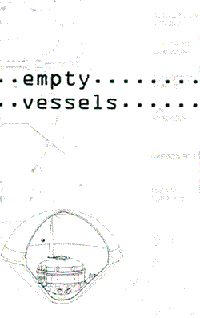
Empty Vessels: 'Empty Vessels' (demo cassette, 2000)

Empty Vessels: ‘Empty Vessels’ (demo cassette, 2000)

Perhaps I was spoilt by the absolute flamboyance of David Devant And His Spirit Wife (a band of music-hall performance artists in Britpop camouflage, fronted by another Vessel) but I initially found Empty Vessels a bit underwhelming. Billing themselves as a “breakbeat/guitar soundclash”, I was expecting to be walloped around the head with seething snare cracks, to have my arse booted by kick-drum hits and my ears burned by electric wailings (all in a comfortable metaphorical way, mind). I was expecting festival style-ee-ee expansiveness. A sort of Asian Dub Foundation that had been gutted and stripped out, but were still rustling defiantly.

But Empty Vessels are less of a soundclash than a crowded minibus jammed with noises. They sound as if they do their recording in one of those tiny closets in Islington that estate agents try to flog to people as homes… or maybe in the cupboard of one of those closets. The usual claustrophobia of sped-up drum’n’bass-style breakbeats could only be amplified by these cramped, super lo-fi recordings; all skinny and vertical, never laying out when they can tense up. The sort of music inspired by hunching up and listening to hoarded CDs rather than by losing oneself on a sweaty, body-heavy dancefloor. Beat-science with a home chemistry set…

Nicotine is an unfortunate starter: neurotically trapped rushes of synth bass, shrill Killing An Arab-style guitar licks through budget fuzztones, and some pug-dog yelping courtesy of a bloke who sounds like Steve Harley forcibly bundled into a filing cabinet. Skip it for Chew-Up, a smarter shot in which all the beats are turned up and a careening sub-bass runs away with the foundations. Here the fuzzy shoulderings of guitar are a relief from the needling drums. The voice runs like a mumbling rat, complaining but flicking from rhythm to rhythm, and you find yourself wanting to catch on to what it’s ranting about. Empathising too much with your own sampler, it seems. “Chewing up experience, and chewing up experience… / It’s mine! It’s mine! / I acquire.”

Empty Vessels sound best when they don’t sound in control, when they’re running after their technology like it’s the last bus out of town. Sneering Face is one of those intriguing accidents that happen when you have white guys playing gladiatorial black dance music, desperately and unsuccessfully trying to get around their own whiteness, and ending up somewhere else entirely when they fail, sounding pretty liberated for it. While it starts as a wayward attempt at speed rapping (invaded by psychedelic space guitar echo), Empty Vessels have decided to fuck it all off about two-thirds of the way in and go for the ridiculous. Creaky vocal interjections that belong in Jim Henson’s Creature Workshop (“I – ought to teach them a leh-sson!”), seasick bloots of guitar, falsetto operatics wobbling in the background. The sort of vandalism that suggests they meant to do it from the start.

Uptight urban fuck-up music. Tower-block friendly. Angry summer sounds for days when none of your clothes seem to fit. I can’t say I like this, but it’s successfully sneaked into my curiosity field.

Empty Vessels: ‘Empty Vessels’ demo cassette
self-released (no catalogue number or barcode)
Cassette-only demo
Released: 11th June 2012

Buy it from:
The original cassette is long gone, although it was possibly reissued as a Peoplesound CD single which might be available second-hand. These three tracks have since been resurrected on ‘Empty Vessels 1‘, available from Bandcamp

Empty Vessels online:
Homepage BandcampYouTube

REVIEW – Forty Shades Of Black: ‘Belisha’ single, 1999 (“smudged and ever-so-slightly stifling”)

27 Sep

Forty Shades Of Black rear up with the dirty, sticky, galumphing riffs of Belisha – an elephantine math-rock construction with stubble somewhere that’s annoying it. It lumbers around, red-eyed and furious, tearing a few trees up in fits of fiery rage. It also provides a way for the spiky London post-rockers Delicate AWOL to let off steam (Forty Shades Of Black is basically a handy alter-ego for them when they don’t want to sing).

We’ve met Belisha before, on Delicate AWOL’s ‘Random Blinking Lights‘ EP. Put centre-stage, its grind’n’chop, Mogwai-meets-Ruins sardine-can shapes bang aggressively against your eardrums, and look set to dominate. That is, until the band unveil the smudged and ever-so-slightly stifling sound-painted dreams of the other tracks. These reveal themselves gradually, like disintegrating lacework peeling off an old dressmaker’s dummy.

The soft explorations of Sidings are a post-rocker’s picture of a shunting yard being swallowed by the encroaching dark. Intermittent bass throbs mutter alongside shivering guitar. Caroline’s quiet moans float past alongside feathery passes of brushes on drumskins. Notes slide by, softly massive and indifferent – red lanterns looming out of the darkness. Much less of a reverie, Advanced Formula is as fragile and awkwardly stretched as a crane fly. Spidery math-rock chording scratches out a place to sit: an E-Bowed solo paints a long wavering strip of electric-blue Bill Nelson light across the cloud cover, while the shapes give way to a relaxed out-of-synch swing.

I’ve mentioned before how Delicate AWOL seem hung up on disintegration. This time, watching things decay and fall apart seems somehow satisfying – the return of something to its disassociated elements, instead of the fraying of desires. Whichever is your favourite collapse, inside or out, this band can orchestrate both.

Forty Shades Of Black: ‘Belisha’
day Release Records Ltd., DR102 (no barcode)
7-inch vinyl-only single
Released: 1999

Buy it from:
Long-deleted – try to find this second-hand.

Delicate AWOL (Forty Shades Of Black) online:
MySpace

September 1999 – album reviews – John Ellis’ ‘Spic’n’Span’ (“a minor treasury of passing ideas”)

24 Sep
John Ellis: 'Spic'N'Span'

John Ellis: ‘Spic’N’Span’

The lifespans of pop musicians are usually measured in five-year units – generally just one each before they’re inserted into the “where are they now?” file. But for every ten who went into hostelry, college lecturing or millinery, one adapted and carried on the journey as best they could and perhaps saw how their talents and ideas could fit into the next stage.

As guitarist, songwriter and sound-shaper John Ellis is hardly a household name, but his work and adaptability have both been consistent. He’s already discreetly chameleoned his way through three decades of music. A founder member of The Vibrators during the punk era, he went on to play an integral role in the Peter Hammill and Peter Gabriel bands over the cusp of the ’70s and ’80s. Links with Jean-Jacques Burnel eventually led him (along with Paul Roberts) into the post-Hugh-Cornwell Stranglers line-up; he developed an electronica sideline via his digressions into gallery music, There’s even a touch of prog beyond Gabriel and Hammill: John also plays guitar for Judge Smith’s ongoing “song-story” projects.

John’s journeyman credentials are unquestionable, and to each position he’s brought his own supporting voice and particular marks. However, always being the lieutenant means some of your ideas bounce off the boss (or the inflexibility of circumstances) and get stashed away. ‘Spic’N’Span’ corralls together unheard odds’n’sods from John’s curvy journey through music, and consequently it’s a musical scrapbook rather than an album.

A third of the tunes are the kind of thing that many working musicians knock out for TV music library discs – bright jingles and “we’re going somewhere” music, executed on cupboard synth orchestras. The synthetic Euro-funk/perky testcard tunes of Wild Talent and Tune-O-Matic fall into this category; as do the flying-over- mountains melody of Early Riding Daddy, the New Age-y pop march of The Needs Of The Soul and the rather more ambitious baroque-jazz stylings of Running Through The Trees. Still… behind many of these you can hear little pop chicks trying to hatch out of the multi-track demos, hoping to drop into the collective lap of an ’80s boy band, to do that five-year round; and to then cheat death by popping up in a nostalgia DJs record box, taking a ride on a revival. It might not have actually happened, but then the business of selling songs has always been a bit of a lottery.

Another third of ‘Spic’N’Span’ is a set of genuine ’80s pop songs. All of these are produced in the squeaky-clean studio fashion of the time; but all are executed with the restraint, intelligence and puritanical zeal of post-punk. The pin-sharp shimmy of John’s guitar is the linking factor – wailing away on E-bow sustain, sparking off claw-hand finger-picking, or adroitly yanked from note to note.

Three of these songs are sung by Alex Legg – his spooky vocal resemblance to Peter Gabriel shows us how things might have been had Gabriel and Ellis joined forces and run off together into the showy pop territory eventually colonised by Tears For Fears instead. The Space Between Us (a soulful, regretful R’n’B lament of hostility, injustice and enmity) could easily have fitted onto an album like ‘So’. Similarly, Joe Jackson would have been proud to have written the pumping Monopoly (the biting list song of an abusive marriage, a woman’s increasingly desperate attempts to escape it, and the grim consequences). Off on its own, the John Greaves-ish piano song Mumble Jumble (pointing up the Ellis art-school/art-rock background) ponders the confusions and blocks of language.

Two more songs are sung by John himself. Giving Up The Ghost, with its airbrushed console-blues sound and phantom horn section, strives after the authenticity of roots Americana only to arrive as a Eurythmics B-side instead. But the glinty, polished Elevator Man (which sounds more like Steve Harley doing J-pop) works better, capturing the arch giddiness of stardom from a slight but crucial degree of separation. “I went from rags to riches, from riches to rags. / I was an overnight sensation.”

Then there’s a third section: a couple of tunes which seem to be trying for the early ’80s link between electro, hip-hop, and primitive British synth pop. Such is the buzz and piping of Stutter Gun with its earnest, uptight vocal samples and its synaesthesic theme: “it’s beautiful… the colours will flash… the sounds will embrace you.” Jimi Jam studs its gurgling electro with little sampled Hendrix asides – “Hey, what’s happening?… Oh no, I think I’m out of tune.” Discreetly decorated with wobbling wails of clean sustained feedback, it’s so cheerfully plastic when compared to Hendrix’s controlled brinksmanship that it has to be a piss-take.

There are also a couple of genuine, delightful misfit chunks in the stew. The panoramic zither chug of One Way Street walks in step with Trans-Global Underground in its mess of world beats, the spine-shivering harmonies of crowd hums from old Lomax recordings, and the Republic serial dialogue snippets (“All the streets are one way!”; “What better way to commemorate the dead?”). John performs a solo joke on The Best Part Of The Cabbage: woozy slide guitar and sleepy voice shambling out a ramshackle joke-blues on cannibalism. (“Looking at you, I lick my lips…”) The sensuous laziness of the tune offsets the wonderfully appalling humour: “If you ain’t got a fridge yet, there’s not much on a midget – / a mouthful, or two.”

A minor treasury of passing ideas, ‘Spic’N’Span’ will never be more than a curio, but one that remains open and friendly throughout.

John Ellis: ‘Spic’N’Span’
Furious Productions (no catalogue number or barcode)
CD-only album
Released: September 1999

Get it from:
Best obtained second-hand: this was released as a very-limited-edition run of 50 copies, so it’s extremely rare.

John Ellis online:
Homepage Facebook MySpace Soundcloud

August 1999 – EP reviews – Schulte/Eriksson’s ‘For the Sake of Clarity/Answering Machine’ (“a loose cluster of stoned bees”)

24 Aug
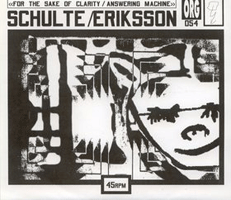
Schulte/Eriksson: 'For The Sake Of Clarity'

Schulte/Eriksson: ‘For The Sake Of Clarity’

It’s an inviting idea. Anna Schulte and Lisa Eriksson sit around in a room in Liverpool with a couple of detuned guitars and some basic looping gear (plus a pair of rhythm-section men borrowed from Mersey psychedelics The Living Brain) to see what happens. They hum out songs and snatches of conversation in a way that’s always on the verge of crumbling to bits, but still holds together, like the immortality of crudded-up cobwebs – lots of interesting little fragments bound up in a tenuous snaggle.

Listening to the bits and pieces of lo-fi invention which they’ve kept on tape shows that Schulte/Eriksson have something in their music like the wobbly stagger of Captain Beefheart’s bloodshot jamming. Or like the scratchier bits of German science-rock that get played at you during music parties (the ones where the competitive art-freak boys are trying to uber-weird each other). But Anna and Lisa seem totally unconcerned with any of these fixations on pointers and signifiers. They’re an offbeat double act, sounding simultaneously bizarre and totally natural. It’s not just their German and Swedish accents as they bounce off English ears. When one of them asks the other “if I say the word ‘sexuality?’ to you, what do you think about that?” she’s met with an incredulous giggle (as if she’d asked “what sound does bread make?”) and neither of them come up with anything.

There’s something warm and alien about these women. Likeable but unreachable – like the futile task of trying to make a cat explain itself, trying to get beyond that affectionate and satisfied manner that displays nothing you can recognise and use for leverage. Interviews have (so far) revealed a pair of women totally detached from earnestness, preciousness or any other self-conscious qualities, and with a simple and unconcerned desire to just let music come.

The music, scribbling and swerving across the grooves of their single like a loose cluster of stoned bees, seems happy to oblige. The straightest that Schulte/Eriksson ever get is the bizarre jazz-train lurch of For The Sake Of Clarity. Their guitar (tuned with a kind of hummingbird logic) hop and pump ahead of the beat; their voices play up and down in stretchy harmonies. “Henry Kaiser playing a samba” is one possible description. I’m also wondering whether Sonic Youth might have produced something shaped like this, in the sweet muzziness after a Brazilian bender.

In Answering Machine the blokes from the Brain bash and stumble away manfully to give the song a bone structure, but in vain. All of the attention goes to the way Lisa and Anna’s voices tug up at their dismal otherworldly sag of guitar chords and take it to somewhere else. For the queasy First Ear Reset/Schaller/Riff, they sound like they’ve turned their guitars upside down: more perturbing jazz-punk chords and steam-whistle tweets yanked off the strings. A violent riff smashes in from another tape and shuts everything down. Their serene smiles probably didn’t drop a notch. But they were obviously laughing when they stuck a phony dance-pop title onto Bassline Loop/No. 1 Hit – it’s about a minute of drunken, tarry slide guitar and murmuring voices which are suddenly exposed as the instruments fall silent and intersect in lovely arcs like a tiny choir of mediaeval nuns… just as the tape runs out.

Scratching cheerfully at the join of subconscious and curiosity, Schulte/Eriksson might use a disorienting private language to run the dig – but you still feel invited to perch nearby. If you’ve ever felt like sitting in on the beginnings of music, here’s a chance to do it.

Schulte/Eriksson: ‘For the Sake of Clarity/Answering Machine’
Org Records, ORG 054
7-inch vinyl-only single
Released: 1999

Buy it from:
Org Records, or look for it second-hand.

Schulte/Eriksson online:
MySpace

July 1999 – EP reviews – Cardiacs/Camp Blackfoot’s ‘Cardiacs Meet Camp Blackfoot’ EP (“an explosion in a fairground repair shop… a belting mixture of howling-for-vengeance free-jazz saxes, prog-from-hell and hardcore trash-blues”)

12 Jul
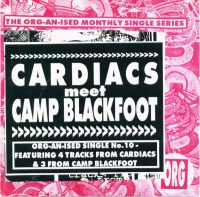
Cardiacs/Camp Blackfoot: 'Cardiacs Meet Camp Blackfoot' EP

Cardiacs/Camp Blackfoot: ‘Cardiacs Meet Camp Blackfoot’ EP

You already know Cardiacs, or you ought to. They’re that gang of besuited gentlemen from Chessington, Kingston and Milton Keynes – upsetters of pop rules known for busting out of tight waistcoats, with a sound like an explosion in a fairground repair shop. And who specialise in hatefully brilliant singles midway between masochism and ecstacy, as pleasurable as scratching a really luxurious, pestilential itch.

‘Sleep All Eyes Open’ doesn’t let that line of guilty pleasures down, tying knots in Super Furry Animals and The Glitter Band to make a glammy mess of noisy guitars and monkey-gland logic. Here’s something that really enjoys how gloriously dumb-to-the-max it is – listen to those handclaps, and that dum-dum riff bouncing its knuckles along the ground. Yet it evolves fast, ideas yomping around, running off into ever-more crowded angles and arguments while Tim Smith yelps like a circusful of trampolining dogs. Cardiacs always cram their songs to bursting point but never lose any of it to blind alleys or prog meandering. And if I still haven’t a clue what they’re singing about, I think there’s something in the back of my head which does, whooping and waving a flag whenever I hear them let something like this out of the box.

The five-year-old bonus tracks (from the mind-boggling ‘Sing to God’ album) haven’t worn badly either. ‘Dirty Boy’ hammers and claws through seven minutes of huge black-metal guitars and ends up flailing against the wall in an ecstatic stuck groove of wailing choir and electric-shock organ. Foundling is a mediaeval creak of sleep, death and aching men’s feet, worthy of Robert Wyatt. Finally, there’s a celebratory, singalongaTim instrumental mix of ‘Insect Hooves on Lassie’ – and that’s so tuneful it could get a corpse up and idiot-dancing within seconds. These guys are old enough to be Blur’s granddads, for God’s sake – how come they still make almost any other British rock group sound half-hearted and half-asleep?


Camp Blackfoot, hanging onto the other half of this EP, grab the challenge with both hands and a ravening mouthful of teeth. It says here that they’ve chewed their way out of the corpse of Thirteen Ghosts (Oxford’s finest in thrash-improv… hmmm), and they don’t bother with all that business of the dichotomy between social discipline and chaotic emotions. They just hit the record button and scream. A belting mixture of howling-for-vengeance free-jazz saxes, prog-from- hell and hardcore trash-blues comes tumbling out onto the carpet and burns a huge hole in it. Somewhere, Lester Bangs is laughing his head off.

If you wanted to hear serious avant-garde psychobilly locked into a no-holds-barred deathmatch with art-noise, you’ve come to the right place. Ruins forcibly manhandling the Blues Explosion into a blender wouldn’t even come close to the shredding monster-movie music of ‘The Blue Hood’; while ‘The Other Giaconda’ is what might’ve happened had King Crimson ever really exploded onstage in squalling Stooges style, neurotic precision blowing the safety valve a foot deep into the ceiling. And ‘The Red Mist’ tops the lot- squiggly Morricone noises that burst into enormous barbed- wire riffing and an epically hallucinating murder song, a weird doomed narrative which sees a desperate man’s mutter rising to a horrified scream: “The street melts under my feet… I’m drowning in a boiling sea of salt,/ faces are ugly / I – Mother of God!”


Songs to crash your car to, and the soundtrack to strutting away from the blaze looking cooler than ever. Not really something that works with Coldplay, I think.

Cardiacs/Camp Blackfoot: ‘Cardiacs Meet Camp Blackfoot’
Org Records, ORG 056CD (5 028151 010568)
CD-only EP
Released: 12th July 1999

Get it from: (2020 update) Limited edition of 1,000 – best obtained second-hand.
Cardiacs online:
Homepage Facebook MySpace Soundcloud Bandcamp Last FM Apple Music YouTube Google Play Pandora Amazon Music
Camp Blackfoot online:
Homepage MySpace Last FM YouTube Amazon Music

December 1998 – live reviews – The Sea Nymphs @ The Falcon, Camden Town, London, 13th December (“a long curving wave of sea-songs, swimming keyboards, children’s play-rhymes”)

18 Dec

In reality, the music room at The Falcon is a tumbledown concrete box shoved out onto a bit of waste ground. Right now, though, we could easily imagine it transformed by our collective warmth, enwebbed with flowered arbors and the hum of big lovable insects.

This is good. The air’s alive with a warm, fireside excitement and the sound of a zillion Christmas triangles. Up on stage, Tim Smith has just flicked us one of his weird little opening-envelope smiles. Bill Drake – goateed and woolly-hatted, somewhere between pharoah and trainspotter – settles in behind his keyboards, half-in and out of the parallel universe he normally inhabits. Someone bleats like a sheep. Everyone laughs. Sarah Smith – unreservedly sexy and wholesome, like a fairytale milkmaid – readies her saxophone, smiles mischievously.

As they make a showing for the first time in years, The Sea Nymphs bring us the same sense of unguarded wonder that we’d get from watching some obscure and exquisite little beast uncurl itself from hibernation or hatch out of a chrysalis. There’s that, and there’s their uncanny ability to awaken the sort of love that I haven’t felt sweep through a concert for ages. We’re crammed in shoulder-to-shoulder – on any other day, we’d be the usual indie-rock cattle, and we’d feel it. This time, it feels more like being a step away from holding hands.

It’s as if we’re all buoyed up on a long curving wave of sea-songs, swimming keyboards, children’s play-rhymes; of twinkle-fingered piano, folk fragments, and pale running saxophones; plus Edward Lear, Edward Gorey, and all the other unguarded wistful subconscious flickers that may (or may not) inform The Sea Nymphs’ music. Somehow, they’re managing to remove the tarnish that’s caked onto the joy that we’ve almost forgotten: that straightforward joy at being alive. Because this is music that disarms and rebuilds somehow – it’s ducking aside from the panicky hurtle of London neurosis that’s going on outside, and taking us with it.

This may seem a woolly cop-out; as if I’m just burbling. The truth is that The Sea Nymphs, in work and in performance, seem to be offering a mystery of creation that doesn’t bear too much thinking about. Too much breakdown won’t break the spell – it will just ease you out of it, painlessly, like a splinter; into the cold again. And that’s something which you don’t want to happen. Within Sea-Nymphs-space, we’ve all found a place in which we very much want to be. We want to rest in the anchoring embrace of Tim’s warm and rounded basslines, to cotton on to how the querying melody-hop of Little Creations sounds like a baby making its very first connections. We want to enjoy the unselfconscious way Sarah rejoices in striking a gong, as if she was dusting a clock.

As the tipsy near-waltzes sway around the air, as Tim, Sarah and Bill’s voices twine and alternate (from naked and frayed harmonies to scratchy yelps, to impossibly sweet helium coos) we’re given the opportunity to pig out on a different kind of instinct than that triggered off by the standard lash of rebellious rock noise. There’s something baptismal in that sound – the little lilts of Shaping The River, the cries of “sponge me clean again” vaulting over a chunky acoustic strum. Maybe it’s something to do with a natural, maternal comfort. The key line of Blind In Gaiety And Leafy In Love is “she smells just like you and she smells just like me”, while Appealing To Venus stretches out a begging hand to an absent goddess, pleading “dwell among the people. / Come back to us, we need you.”

Maybe – behind the celebratory music and those rosettes of voice and exhilarated sax, lofting toward the ceiling – the vulnerable flutter at the heart of it all is the fears. Fears at the treacherous terrain of potential fuck-ups and traps, opening up like a dirty promise before newborns as they begin their blundering pilgrimages onward from birth through a childhood and adulthood of busts and confusions. “Back to square one… / large as life and twice as natural… / Let’s not reinvent the wheel; open that can of worms…”

Still. Here and now Sea Nymphs restore our openness – our willingness to ride our curiosity. For a brief time, at least, it becomes our strength again; and when, in Mr Drake’s Big Heart, the band tell us “something’s going to happen today”, we all feel as if we’re a part of it. After tonight, at the very least, we’ll have been able to say that we were together for a while, and it was good.

The Sea Nymphs online:
Homepage MySpace

The Falcon, Camden online:
Homepage

October 1998 – EP reviews – Dark Star’s ‘Graceadelica’ (“a fistful of brilliant flares criss-crossed with human fragility”)

28 Oct

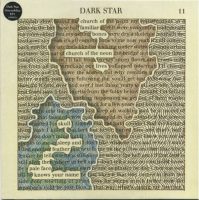
Dark Star: 'Graceadelica' EP

Dark Star: ‘Graceadelica’ EP

Hallelujah. David Francolini, Laurence O’Keefe and Christian “Bic” Hayes – refugees from the indie/prog/psych collision of Levitation – have quietly regrouped as Dark Star. Listening to their superb debut EP somehow makes the whole painful Levitation saga (all those spats, frustrations and blown hopes) worthwhile. But while Levitation ran, jumped, shook rooms, dazzled, and finally shattered, Dark Star – a power’n’glory trio that’ll rip off your head and return it to you all lit up and twice the size – take every bit of that energy, aim it, and channel it on course.

So what would happen if someone took British underground psych-rock as a foundation, then scanned the heights of British ’90s indie for what it had to offer? If they took Primal Scream’s panoramic hallucinatory peak, the funky drummer grace of The Stone Roses on ‘Fool’s Gold’, Radiohead’s lacerating skill and intensity, Spiritualized‘s on-off blinks of revelation, the waves of transporting guitar frenzy The Verve dealt in when Ashcroft cut out the rock-god schtick, and then fused it all together? And – unbelievably – got it right? They’d get this.

‘Graceadelica’ itself storms right out at you full-tilt, laced with detail, power and adrenalin quakes. Bic’s ghostly guitars are everywhere – chittering in the midground, weaving sensuous smoky patterns and Cocteaus star-clusters beyond, sketching spare cascading melodies upfront, then suddenly exploding into your ear in a storm of shocked echo over Francolini’s immaculate power-funk drumming. And it’s about memory barbed and refracted by mystery: someone stalking the city with a incredible secret to recover. “I must have hit the floor, / some dark uncertain hours before /…Those half familiar streets / were swimming underneath my cobwebbed feet. / My aching bones were dry, / a skeleton beneath the lead-grey sky. / Yeah, it’s all coming back to me now… maybe too late.” Pounding the pavement, finding a pathway to the key. “Feels like I’m walking over water, / subhuman urban messiah. / Slow-bound for church of the neon, / my resurrection’s in a glass on the bar…”


The title track carries off the prize for grace and scope, but the whole EP is a fistful of brilliant flares criss-crossed with human fragility. The heavy-metal bullet of ‘Crow Song’ – like PJ Harvey fucking Ted Hughes on Metallica’s drum riser – is haunted, a hapless killer’s nightmare. O’Keefe’s supple, astonishing basswork oozes power, but the song itself is flinching from guilt (“Hope you don’t mind, but if I let you in – no-one must know, no-one must know”) and the unfolding of terrible rituals: “You see, he speaks to me in sleep: and I don’t like what he says. And when I wake I find another feather, just next to me on the pillow…”

On ‘New Model Worker’, Bic’s voice is both tannoy-sneer and humble plea, the guitars a cataclysmic swing between grinding industrial filth and tiny, tender, praying filaments. “Season’s cycle’s turning overtime, and I’m a new model worker with too much on the mind. / There’s nothing to decide, there’s nowhere here to hide. / And just to breath in; the future becomes what’s left behind.” ‘Solitude Song’, hovering over a huge depressive plunge, refuses to deny anything – “There’s nothing wrong with you / (“I’m sorry, Doctor”) / You’re acting like a fool (“Well, someone’s got to…”) “. Instead, it’s braved out, and they jerk your tears out while they howl for strength “until the cloud’s gone, and we’re through… / Laugh when it’s over.”

Dark Star have only just started, and already they’re way better than Levitation ever were. Unless they blow out that revealing light again. Like Levitation, Dark Star are possessed of such power that they could as easily shake the world or tear the muscles off their own bones. Top marks for effort and promise, lads, but don’t let the frenzy buck you off this time. ‘Gracedelica’, at least, is an object lesson in how to ride the bastard over the horizon and back.

Dark Star: ‘Gracedelica’
EMI Records Ltd/Harvest Records, CDEM523/10EM523 (724388615822)
CD/vinyl EP
Released: 26th October 1998
Get it from:
(2020 update – best obtained second-hand)
Dark Star online:
Facebook MySpace Last FM Apple Music YouTube Deezer Spotify Amazon Music
 

October 1998 – live reviews – ‘The Sound Of Satellite’ (featuring Sand, Lucha Libre, Yossarian, Karamazov, Heavy Q) @ Notre Dame Hall, London, Friday 9th October (“The Young Gods meet ‘Rugrats’…”)

13 Oct

This time, I’ve done it.

For once, I’ve arrived on time… and Notre Dame Hall is so empty that I reckon I’m going to be outnumbered by the bands. Above me, a glitterball spins very, very slowly. Off to stage-right, a slide is projected onto the wall back-to-front. Smoke drifts across from the other side of the stage, as if one of the boxes of gear has quietly caught fire. Horace Andy plays over the sound system. I’ve never noticed that squirmy edge to the sweetness of his voice; or how well it suits embarrassment.

No. It doesn’t go on like that. In fact, and independently of tonight’s acts, it ends up as one of the friendliest concerts I’ve been to in ages. But that first half-hour – of me as the lone non-label person in the house – gives me an idea of the risk which labels like Satellite take on whenever they put a night like this together. If you’re a mainstream label with a nice little crop of pushable guitar pop bands, and you want to hire out some dedicated pub for a concert party: well, fine, you’re probably onto a winner. If, alternatively, you’re a small label best known for fringe electronica such as Fridge, Rothko, and Add N To X (one of whom is DJ-ing tonight) and you’re hiring this big cinematic ballroom… then you must be trying not to sneak nervous, sidelong glances into the looming face of failure.

When I befriend Pete, the Satellite house photographer, he tells me that as soon as tonight is finished they’re taking the whole thing – lock, stock and barrel – over to Paris, to repeat the concert. Within the day. Gluttons for punishment. Or people who believe in what they have to offer.

* * * * * * * *

What they offer (or unleash) first is Heavy Q, whom I know from a single truly bizarre piece of experimental vinyl. He/she/it/they?… He. One Japanese guy, Lee Young Sin, in a glitterscaled wrestlers mask, hunched over a pair of samplers as if preparing to split them in half by sheer willpower (one of them, appropriately, is labelled “Quasimidi”). We’ll see him later as part of Lucha Libre, the other members of whom are tracing his every move with Handycams.

What he’s up to right now is squeezing out slice’n’dice anti-dance music as the hall begins to fill up; a scary dead-funk cyborg strop interspersed with cut-ups of Japanese telly chatter and cheering. At one point a sampled announcer burbles a bit of plain English – “breaking the earth for us tonight” – with the cheesy enthusiasm of someone who knows the next bit of hype which they can stick in their arm will be along in another few minutes. That same hysterically enthusiastic announcer will be weaving in and out of Lee’s music like a persistent hiccup; a glassy, untrustable ringmaster to his sonic circus.

Heavy Q’s second piece is a randomised assault of backbreaking drum sounds; drum’n’bass minus the calming balance of the bass. His third is a children’s chant, slapped up against a deathly brutal industrial tom rattle. As he moves over to rummage on his table of electronic debris, the sound runs on without him, mutating into Bollywood singsong, strangled by tortured electronics. By the end of it, Lee has turned himself into a vast, vulgar techno-god statue on top of the table. Arching back and moaning a deep thick bass vocal into his microphone, he’s almost at one with his sampler. He drinks from a sparkle ray-gun; he adjusts his electronics like he’s tying his shoelaces. Throwing a sarcastic cock-rock pose, he waves a theremin aerial around at phallus height.

Is this the answer to the problem of the personality void in electronica? Living up to the gigantic sonics by taking onto yourself the aspects of a monster movie?

* * * * * * * *

Talking of the personality void… things are working out contrary to expectations. At any given unpretentious, good-time indie gig, I’ll be out in the cold, a blip on the doorlist among self-satisfied strangers. Here, on a night that ought to smack of exclusive club, a night which you’d expect to exclude, I’m making ceaseless cheerful conversation. Buoyed by camaraderie, I and my new friends agree that, in contrast to Heavy Q’s theatrics, Karamasov have the slightly bored, stiff look of too many art-scene bands.

Perhaps it’s that old cliche of Teutonic cool: half of the band is genuinely German (guitarist/cellist Johannes von Weizsacker and stately blonde percussionist Berit Immig), while the London half (bassist Harry Rambaut and synth player Adam Stewart) aren’t exactly Essex ravers. Certainly their music’s lodged in European post-rock cool rather than Pacific rim commercial frenzy, their set opener wheeling along on Harry’s sproingy pre-jazz bass, Jonathan’s phased guitar scrub, and a lonely, farting-Dalek riff on Moogbass. They look at each other as if they’re setting up lab equipment; or preparing John Cage’s piano, like good little acolytes. Their second piece is something from the chillier end of Stereolab‘s science school, albeit with a few sniffs of quiet humanity appended. Echo-slapping cello effects, and skinny Moog squirts something like Philly soul strings, sketched and autopsied. The cello scrapes like a worn wheel; Berit’s oddly heavy-metal drumming is rookie-tense, but snaps tight regardless. On the beady-eyed Roadsnack, she switches to spiky organ against Jonathan’s piano-ping guitar.

Out on the floor, meanwhile, we’re waiting for them to enjoy themselves. I know, I know; there’s a certain credibility to that kind of icily unmoved, Euro-scientific music creation. But… Karamasov come across so much better when they drop it, hang out, and just play. It’s probably not intentional, but Uneven Surface sounds something like Genesis’ Watcher Of The Skies filtered through Faust. Hmmm. ‘The Wire’ would have a fit; but the bass stabs and drum riffs are received with joy by the Satellite audience. Happy Hour ain’t the Housemartins (which would’ve been interesting, come to think of it), but sounds more like Neu! reinventing lounge music, as Berit tinkles out melodies on the vibraphone. Most welcome of all is a piece I didn’t catch the name of, in which the increasingly impressive Berit sings in a detached Nico murmur (not unlike Elizabeth K.’s interjections for Eyeless In Gaza) over a tune not unlike a relaxed cross between Levitation and A.R. Kane (with a bit of the brisk arty hoppiness of a warmer German band, F.S.K).

During the next interval, the DJ plays Egg and Soft Machine rather than some fearsome tranche of blunt improv. A definite feeling of thaw is in the air.

* * * * * * * *

Yossarian turns out to be both a band (two keyboardists out of a ’50s B-movie and a drummer) and a bald mad-scientist character, looking not unlike Alan McGee. This is Tim London – Yossarian’s prime human body. In a previous life, he was the slightly warped pop brains behind Soho (if you remember the Smiths-sampling ‘Hippychick’, not that there was much else).
These days he’s wrapping his cortex round far artier pop shapes. One piece – all drones, cymballine drums and organ – sounds like Mark Hollis knitting together Labradford and Spiritualized; a chorus of “I will call, and you will come” and an unexpected blaze of harmonica. Other pieces sound like late ‘60s Scott Walker sitting down hard on late ‘80s Pet Shop Boys, and others…

Vocoders, yet! Those pained machine voices are back, along with Air-style pretty melodies served with an avant-garde hiss and a cheesy Bontempi beat under the flagrant detail. What is this nut trying to morph into and sell to us now? E.L.P.? The Glitter Band? By the time I’ve decided that it’s a sort of electronica ‘Parklife’ with car-crash keyboards, he’s exploring bleak Bowie ‘Low’-ies and hitching them up onto Prodigy-style wall-of-fire beatoramas like an erupting Las Vegas volcano.

All of a sudden, I see Tim London revealed as electronic art’s own John Shuttleworth, and relax a bit. It’s an impression carried in his archness, in his taste for a classically creaky lounge-pop tune, his self- conscious anti-cool (“I’ve never played in that time signature before”, he drawls), his total deadpan approach to the ridiculous or to any intimations of hubris, and most of all in the way that, having thrown electronics at us all evening, he encores by – get this – playing the spoons. Respect is due. My old man’s a Cyberman an’ all that.

* * * * * * * *

Osakan noisefreak-fusioneers Lucha Libre have bigger hats than anyone else. They also have bigger presence, taking the stage like EMF used to do. They possess a double-brass frontline – one capering trombonist leader (Teruhiko Heima) in a Kiss ‘Destroyer’ T-shirt; one surreally dignified sax player (Akifumi Minamimoto). There’s also a transplanted heavy metal core in the shape of Takashi Sakuma, a sampler-wielding guitarist with long tartan shorts, a serious Van Halen fixation, and one of those hilariously literal Japanese sweatshirts. This one reads “Pretty Tough Sport”. Finally, they have a digital heart on frantic overdrive – everyone except drummer Jun Tsutusui seems to be doubling on synth.

By their seventh number their bassist (Lee Young Sin, back in a different guise) is walking on his hands and playing the synth with his head amidst a hurricane of Coltrane-meets-Black-Sabbath saxophone. Before that, we’ve been privy to a Donington’s-worth of heavy-metal axe abuse; a swelter of industrial goofing and salsa horns; and a stage act best described as The Young Gods meet ‘Rugrats’. We’ve also, as a responsible audience, totally turned around received notions about arty label nights by absolutely loving it to bits and yelling for more, as the twit from ‘Melody Maker’ shakes his head and frets about missing ‘Friends’. Lucha Libre continue their delightful murder of cool regardless.

Now they sound like ships coming into a drunken docking on Mars – big trombone blurts, the rattle and squiggle of electronic timepieces, and phenomenal yowls and divebombs from the metal kid. Now they’re on a big, spacious, tricky funk beat: Akifumi an oasis of reedy calm as a funky harpsichord riff pops up from keyboardist Soichi Murota and the band head into the slabby, tottering, Theremin-ized jazz-funk of the ‘We Have No Our Groove’ single. Next, they pull out in order to plait Led Zeppelin into the ‘Mission Impossible’ theme.

By the encore, Teruhiko is hammering out a torn tom tattoo on a commandeered chunk of Jun’s drumkit. Stuck horn drones giggle at him; the sax thrashes – squalling and wailing – in a cauldron of frenzied bop, and Takahashi fires Heavy Q’s abandoned raygun into his guitar pickups. It’s like seeing a particularly extrovert software virus trash your screen, in blazes of grinning colour. As they settle into a long final lope, razzing trombone carrying the melody over the clipped sax and Durutti guitar picking, the air inexplicably fills with a powdery scent of flowers. This is some sort of Lucha Libre Japanese magic, I guess: the sort of thing which that passionately confused nation throws up so well.

* * * * * * * *

With a massive wall of dry-ice fog and a sound like Satan belching (it’s some sort of conch, in fact), Sand prepare to close the evening. A massive mound of frizzy dreadlocks hoves into view and starts growling Andean death-metal at us. Crops wither within a three-mile radius.

This thing is – to stretch the Trades Description Act a little – Sand’s singer. Whether it’s possible to declare a force of nature part of your band is a matter for Sand and their lawyers. They used to be called Germ, which is an understatement and a half. They should have been Epidemic. To put Sand into perspective, they are something of a return to normality after Lucha Libre’s mad playground display, even if they do both feature upfront trombone. Sand are also, by far, the most assured band on tonight – elastic harmonic bass from John Edwards, the precise touches on Rowan Oliver’s looping drums, the wash of ravishing electro-gale off Tim Wright’s keyboards: a bit like Rain Tree Crow with a trombone, but only if they’d been fronted by David Sylvian’s monster-from-the-Id. This is something which the Sonic Youth-style drumsticked drone guitar and the ‘Bitches Brew’ mute on Hilary Jeffery’s trombone only accentuates.

The monster on vocals – whose name is, apparently, George – evidently knows harmonic overtone chanting. His reverberating rasp blends in with the trombone’s blare, the slipping geological sample and the Bruford threes which Rowan is now shooting off the top of his kit. The mike slips deeper into that mane of dreads. From the unseen mouth the Devil pukes noise, sprawling and rolling: echoes of Diamanda Galas, balled’n’bassed up, or of Magma. If many of the smooth dream-rock tones of Sand suggest a vigorous muscle-flexing tone-up, that voice feels like being rolled hard in the gravel afterwards. Among other things, Sand offer a crushing world-music for the ever-so-slightly masochistic.

“You can dance to the next one,” comments band spokesman Hilary, draining the spit from his trombone as John brings on a double bass to play… well, some salsa from hell; the guitar and keyboard filling up the spaces in the music with an inspired patina of drone-trash. As another Sand piece forms (a reedy melodica, skullclick percussion, a lost wail from Mr Mountain as the band traverses a flat, disturning plain of atonal movement) you wonder whether this band would ever really make you want to dance. Why should you want them to, when instead you can suffer the perverse enjoyment of feeling Sand twitch the crust of the earth from under your feet?

* * * * * * * *

I don’t care. The liberating, socialising force of dance was the one aspect of electronic music that was ignored tonight; possibly because it was redundant. In between writing my notes I’ve filled my ears, had a doughnut, leafed through vinyl stalls, and spent an evening in the belly of the art-beast, chatting away to some of the nicest people I’ve met in ten years of making up gig numbers.

I finally let my tired eyelids swell, and turn my weary ankles homewards. Satellite are packing up, engrimed with cigarette smoke and fired up on the warmth of the evening, making ready to ship it all across the Channel to the City of Light.

This time, I don’t fear for them.

Sand online:
Homepage

Lucha Libre online:
Homepage

Yossarian online:
Homepage

Karamazov online:
Homepage

Heavy Q Connection online:
Homepage

Satellite Records online:
Homepage

(2018 update – after twenty years, it’s no surprise that most of those bands and projects have long since ended. Post-2001, Satellite Records was mostly reabsorbed into its ongoing parent label, Soul Jazz; and the Satellite, Yossarian, Lucha Libre and Heavy Q links above connect only to discographies. Yossarian’s Tim London (a.k.a. Tim Brinkhurst) now works as a film-maker, as a music lecturer at the British & Irish Modern Music Institute in Birmingham, and as producer, most notably with Young Fathers. The members of Karamazov are still friends and collaborators, working together in various combinations in The Chap and Omo. Sand also continues in various forms and names, generally helmed by Tim Wright and Hilary Jeffery. It’s unclear what’s become of the members of Lucha Libre, although saxophonist Akifumi Minamimoto did also put some time in with “jazz/R.I.O. progsters” Djamra. Meanwhile, Notre Dame Hall ended four decades of musical history covering beat pop to punk to avant-gardery in 2001, when it became first the Venue theatre and then the Leicester Square Theatre.

Oh – and sorry about the lack of pictures. When I got friendly with Satellite’s photographer, it clearly didn’t include me blagging post-concert photos out of him.)

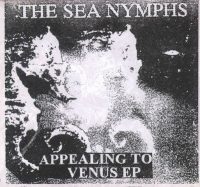
June 1998 – EP reviews – The Sea Nymphs’ ‘Appealing to Venus’ (“quivering, shipwrecked dreams and prayers”)

3 Jun
The Sea Nymphs: 'Appealing to Venus' EP

The Sea Nymphs: ‘Appealing to Venus’ EP

There’s something about the ‘Appealing to Venus’ EP which sounds incredibly ancient. Not dated, as such – for all its leanings towards progginess, it’s nothing passe or stilted, and any awkwardness is an integral part of the charm. No, it’s the murky timelessness and pre-tech fragility of the songs. It’s music in the trembling, bewildered nude; emerging from its shell of strength to blink in the light. To voice, in a halting manner, its own concerns, as the bright lights and brash neon of the pop scene whirl around it, uncomprehending.

Not that it’s come from nowhere. The Sea Nymphs are an (almost) acoustic alter-ego for the manically electric and intense Cardiacs: a mass of scrawny acoustic guitars, ‘Rock Bottom’ harmoniums, mellotrons and melodicas, baroque Black Death keyboards, crumhorn saxes and touchingly scratchy singing. Cardiacs’ convoluted songs have always had threads of Early Music woven into them. With The Sea Nymphs, we get to wind back along those threads and see where they lead.


These four tracks (salvaged from the Nymphs’ criminally ignored debut album) exorcise, or exercise, Cardiacs’ curiosity about pre-pop. You can hear old folk melodies seeping into Low Church music, shreds of sea-shanties and work-song, ramshackle European fragments existing independently of the blues or classical traditions… the bits that pop forgot, in other words. Though compared to, say, Dead Can Dance’s lordly, haughty take on Early Music, The Sea Nymphs sound as if they’ve crawled their ungainly way out of a Vincent Ward peasant odyssey of quivering, shipwrecked dreams and prayers.


Listening to the reedy, march-y slog of careening organs, plodding piano and parping synth on the title track, you hear a heartbreakingly wistful devotion. In the giant cathedral boom of Up in Annie’s Room, string synths smear the shuddering air around Tim’s cracked, lost, voice, swallowing it up in a churchy swamp of sound. He sounds as if he’s trying to outshout a God who’s cold and indifference to his vulnerable defiance. The mediaeval shawm-sneeze of God’s Box – fifty people on comb, paper and bells – seems lighter, The Sea Nymphs – flotsam and jetsam but its skipping ward against evil (“God’s good, the Devil is bad – he always gives me money,”) sounds ambiguous in Sarah’s blank, gauzy, little-girl vocals. “Never Setting Things on Fire, / never bad,” she sings, as if considering her options.


It’s left to the exquisite Shaping the River (in which a lilting falsetto choir sways, shanty-like, behind watery spangles of piano) to bring us something to warm our bared hearts. A work-song, something shared; a relationship with nature even as you alter it: “River in the middle of / Nowhere / Three of us suck on its heart, / and its head. / …Plant the heart, all from the heart / … only in the heart.”


The skeletal bonus tracks – lifted from even older tapes by Mr & Mrs Smith & Mr Drake (the prototype Nymphs) – pull us further into blurry pasts. There’s Bill’s gentle, bemused Camouflage, a twelve-tone sprig on Syd Barrett’s nursery-rhyme legacy. The meandering but intensely purposeful tone poem Little Creations clambers like a drunken squirrel from branch to branch, complete with manuscript rustling and equipment fumbling. Hymn rounds everything off; a live bootleg of Tim blinking over an austere organ sound, a pagan taking his first faltering steps into the chapel. These songs, too, have that unnervingly ancient-but-ageless quality; the same indefinable, painful, yet suspect innocence that haunts the songs of Robert Wyatt or Elizabeth Fraser.


Which all means that The Sea Nymphs are both as frail and damp as a newborn, and as old as the hills. Just listening to them pulls you back that much closer to the original greenwood, little shoots cracking their way out of your hidden memories.

The Sea Nymphs: ‘Appealing to Venus’
Org Records Ltd., ORGAN 044CD (5 028151 010445)
CD-only EP
Released:
1st June 1998
Get it from: (2020 update) Original EP best obtained second-hand. Appealing to Venus, God’s Box, Up in Annie’sRoom and Shaping the River all appear on the eponymous debut album by The Sea Nymphs (available as a download from The Alphabet Business Concern), while Little Creations and Camouflage appear on the lone eponymous album by Mr & Mrs Smith and Mr Drake. Hymn is in fact a Cardiacs song used as an early 1980s set closer: the version here was recorded at the 1984 Stonehenge Free Festival and appears nowhere else apart from on bootlegs.
The Sea Nymphs (Cardiacs) online:
Homepage Facebook MySpace Soundcloud Bandcamp Last FM Apple Music YouTube Amazon Music
 

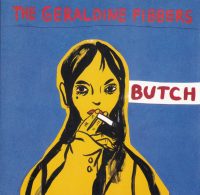
July 1997 – album reviews – The Geraldine Fibbers’ ‘Butch’ (“a uninhibited maelstrom of ferocious guitars that lash like electrified hair… black humour in spades, but the Fibbers’ brand of fucked-up country keeps the ravaged heartland heartstrings and sour juice intact”)

3 Jul

The Geraldine Fibbers; 'Butch'

The Geraldine Fibbers; ‘Butch’

Various riot-on grrls and drama queens, once they’ve tired of punking up girl-group lisping, like to play with those oh so challenging images of junkies and whores. Well, good luck, kids. Play nicely. But while you try on the roles like they’re attention grabbing prom dresses, Carla Bozulich has genuinely Been There, Done That during her own harrowing past. And she’s brought back a mass of bone-breaking songs with her on her voyage back from the brink. And her band, The Geraldine Fibbers, bring them to life the way a flamethrower brightens up, oh, any social gathering where plenty of flammable frills are clustered together. Wake up time, you pretty things.

Oh yes. See them run for cover.

Whoever’s heard the previous Fibbers album, ‘Lost Somewhere Between the Earth and My Home’, will have an idea of what to expect. Except that ‘Butch’ is to its predecessor what ‘Nevermind’ is to ‘Slippery When Wet’. Maybe it’s the recruitment of new guitarist Nels Cline, or maybe it’s just Carla finally diving full into the fray with both feet; but ‘Butch’ is a uninhibited maelstrom of ferocious guitars that lash like electrified hair, bass that booms like an iceberg smacking up the side of the Titanic, spasms of frenetic voodoo drumming and Jessy Greene’s violin flaying the skin off any ear that’s left unflattened.

Oh, and Carla’s voice. Emmylou Harris channeling Diamanda Galas doesn’t come halfway to this. As sharp and as powerful as a swung shoulderblade, as pointed as a knitting needle driven through the brain. The raw power of someone who’s lived through enough not to give a flying fuck about what anybody else thinks.


Of course in Fibberworld the fucks are probably flying. Like fists. Airborne, fast, rolling over; brutal, biting, clawing like rabid eagles. Sex permeates this album like river water in Ophelia’s bridegown, and while there’s a wild exhilaration to it, it’s never far from violence, meted out by Carla herself or by one of the other stark shadowy characters who ripple through her songs like sharks in a blood trail. There’s been nothing like this since that crack of psychic thunder that was the first Throwing Muses album twelve years ago. And if you’ve always missed that original, wantonly possessed Kristin Hersh since she mellowed into first a college rock icon and then an eldritch acoustic housewife, Carla beckons with a sharply bevelled fingernail and a mouthful of mercilessly shredded woman-words.

You think “Muses”, you think “X”; you think “Hole with talent instead of just posturing”; you think “early Velvets on nightmare acid, and with Nico convulsing out of that Teutonic cool for once.” And you also think country music, which soaks the fabric of “Butch” and ferments their Los Angeles punk hearts. But this is no joker’s cowpunk. It’s got black humour in spades, but the Fibbers’ brand of fucked-up country keeps the ravaged heartland heartstrings and sour juice intact.

Folks Like Me’s wooden, honky-tonk four-four has the inevitable slippery lap steel and plaintive weave of fiddle, the queasy bends of guitar and voice. But this is a tale of life off the highways, in the darkest and most twisted woods: Tammy Wynette via ‘Deliverance’ and ‘Angel Heart’. This time, the woman who can’t stand by her man comes of strange and sinister stock (“My heart wants to remain what I’ve become… / There’s no word for this where I come from”) and she knows that the idyll must end before her own blood catches up with her: “Your Lord knows I don’t want to leave here. / I’d like to stay in this little house and provide for you / and if I knew I’d only be risking my own life, / I’d stay until they came and struck me dead, / but I couldn’t stand to see them hurt a hair on your sweet head…”


Pet Angel gives us an American Gothic waltz with lyrics infested by wild wood romance and ‘Twins Peaks’ owls: “You cradle my body in sweetness and warmth, and a sweet wind blows through the trees… / The rain cracks the sky like tears of joy… makes mischief in her hair.” Love and death are inextricably combined (“You are my sunshine, I pull the drapes shut tight. / It’s curtains for you, goodbye. / The cat’s in the bag, the bag’s in the river, / the river makes me cry”), and out here, murder’s as natural as prayer: “To you, to you, straight up to you, / into your charitable hands/ Take care of him, Jesus, I know you’ll do what’s best / Lay his wicked soul to rest.”


Carla’s worldview is nightmarish, constantly under attack, with even the sun joining in with the warfare – on California Tuffy, she announces “a ball of light comes down / to bite me on the ass, the legs, the breasts / I’m falling from my nest.” And the answer is a swipe back with all the claws out, claiming “Yes I am just a tart, a heart on stilts. / Pick the flower and it will wilt, / to die in bliss, for a greedy lover’s kiss” before stinging back with a flail of electric noise and “you will never get my heart.” Toy Box is brutally, near unbearably graphic, a hall of distorting mirrors and wartime dispatches from the sex trade – “My shell on top of your knotty fist / with a speculum shoved up my cunt after hours… / For one lousy minute she felt like a queen. / I stand her naked at attention. Is this my only skill?”


Then there’s the metal hammering of I Killed the Cuckoo, as guitars screech, text goes through the mincer, fate and conflict body-slam in illegible shards. “The clock is dead for once and for all / until the next time I run in with you… / Lay me lower than I prayed for sweety heart… / In the end you crash into a milk truck. / I can see it in the tea leaves: you’re fucked.” In Arrow to My Drunken Eye there’s a flicker of incestuous horror in the warning “don’t be caught with your nightie mussed / and if you are questioned don’t tell them what we’ve discussed.”


Maybe it’s for respite from the rage, but scattered through ‘Butch’ are doorways to elsewhere as the band sink the odd claw into the avant-garde. There’s the drowned fairground ghosting of Heliotrope; or the venomous ambient murk enveloping Claudine’s New Orleans lurch, full of knuckly hideous life, like facehuggers trying to clamber out of a gumbo. And there’s a blood pulsing, amyl nitrate cover of Can’s You Doo Right – enough to scare the gloves off Holger Czukay and have aseptic contemporary Krautrock boys bricking it en masse.


However, it’s always Carla’s songs that snatch the attention; and rightly so. Here’s a reckless and merciless imagination at work, exploring the fragility of an ageing drag queen on the title track (“pushin’ thirty five under an answer blanket”) who’s “always a much prettier bird than any old girl bird… / Shades of light green, deep blue and just a touch of rouge / It’s funny how easy it is to lose / And all you’re left with is chaos and a dirty face.” Or diving into chaos with Seven or In 10 as she explodes around the body of a enemy lover, abandoning control and bringing down a foe with her: “I’ve gotta little trick for you. / I can split in two / or in seven / or in ten / little friends on whom I can depend… / We told you not to get inside our head or in our bed. / You wanna own this dish so you can eat it any time you wish… / Not so fast, fucker!”


But even as Carla delivers a full on primal punk scream of “you might think I hate you!”, she offers us no straight answers. Well, there aren’t any. Part of the impact of ‘Butch’ is that whatever Carla’s had to go through, she’s now so well adapted to it that you can’t imagine her living away from it. The world’s often built on chaos and violence; Carla’s found out more about that than most; and she’s now too much a part of it to ever escape. But if she’s ambiguously intertwined with the hand that beats, she’s also biting it ’til it bleeds.


Roll up the sunroof, mount rocket launchers on the beach buggy and hit Venice Beach with your anger clenched in your fist. Run down any fucker that gets in your way. It’s a sun ripped jungle out there, full of dangerous fruit. California dreaming will never be the same again.

The Geraldine Fibbers: ‘Butch’
Virgin Records America Inc., CDVUS 133 / 7243 8 44629 2 5 (724384462925)
CD-only album
Released:
1st July 1997
Get it from: (2020 update) Best obtained second-hand or streamed.
The Geraldine Fibbers online:
Homepage Facebook Twitter MySpaceBandcamp Last FM YouTube Vimeo Deezer Pandora Spotify Amazon Music
Additional notes: (2020 update) The Geraldine Fibbers split up after ‘Butch’. Carla Bozulich and Nels Cline went on to form Scarnella; more famously, Nels eventually joined Wilco. Carla now has a solo career as well as working with her band Evangelista.
 

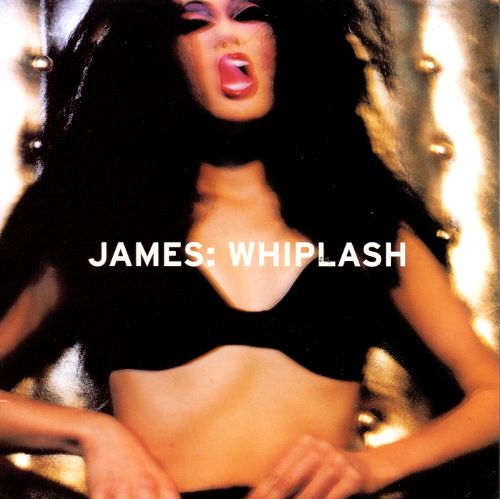
February 1997 – album reviews – James’ ‘Whiplash’ (“dabbles in new styles, mostly unsatisfactorily”)

25 Feb
James: 'Whiplash'

James: ‘Whiplash’

When a band have made it, are popular, and their songs are heard in every commercial outlet, a person is simply playing a game of pathetic one‑upmanship if they smugly proclaim: “Oh, I liked them when they were a cult band. They’ve gone all pop now!” These are very sad people.

Ahem. Now…

I liked James when they were a cult band. They’ve gone all pop now. Yes, I admit it. I am a sad person and I claim my five pounds.

In truth, I lost touch with James after ‘Gold Mother’, when they entered the pop stratosphere and those T‑shirts became ubiquitous. My attitude to Sit Down exemplifies my attitude to ‘Whiplash’. Sit Down started life as a strumalong of identification with those who felt alone or slightly dispossessed, insecure. It was re‑released as an epic soundtrack which seemed to command “You WILL Sit Down!!”. And whilst every baggy‑shirted indie kid and raver performed the increasingly meaningless charade of plonking their arses on the stage, that song (and James themselves) sounded, to these ears, like a New Age, slightly more subtle Simple Minds. When my mother chose Sit Down as her favourite song, opined that Tim Booth was “a nice young man” and started asking me which one in the band was “James”, my interest in the band as a pop entity virtually evaporated. (You none‑more‑punk, you! ‑ ED.)


‘Whiplash’ promises much. It is heralded as “a return to form”. For old James fans, this is a pronouncement we’ve heard before. But the opening track, Tomorrow, has the pulsing rhythm, the simplicity and directness, the expanding layers of sound that I so remember were classic James; and so it is better to forget, perhaps, that this song is about three years old and first appeared in embryonic form on ’94’s experimental excursion ‘Wah Wah’. Elsewhere, Lost A Friend features verses with a skeletal musical backing and Booth returning to hitting all those strange half‑note harmonies of old, before breaking into the obligatory big chorus. It’s still James’ version of their Big Music, but it no longer lumbers like an over‑produced fabrication as in recent years. Sadly, trite lyrics like “my TV’s telling me / that all of our money goes into the military” and “I see some soldiers with guns / they are killing for fun / they are killing to entertain me” do not raise my political consciousness one iota. May I call you Bono, Tim?


This album’s biggest problems come where the much‑vaunted contemporary feel exerts itself. There is always an awful doubt when a band returns from a long break saying that they’ve been listening to techno/trip‑hop/drum’n’bass/ambient (or whatever; delete as applicable), and the new masterpiece is produced under these influences. Eighty per cent of ‘Whiplash’ features these dabbles in new styles, mostly unsatisfactorily.

The album’s first single, She’s A Star, is the most startling and perhaps most successful, sounding like Suede-lite. But it lacks Brett Anderson’s detailing of urban degeneration, suburbia and glamorous smack habits. With Suede, She’s A Star would be blackly ironic ‑ she would be a lonely girl in a dead commuter belt, or a wasted junkie. But Tim means it ‑ she really is a “star”. That’s lovely for him and her (whoever she may be), but ultimately rather naive for us.


Go To The Bank is roughly the third song on the album that mentions TVs, so James have obviously spent their time away wisely. Seemingly a diatribe against the evils of money, the lyrics leave a bad taste in the mouth with the repeated line “it all belongs to Caesar…” Is someone rather peeved about recently having to settle a large bill for unpaid taxes, eh? This track and the next, Play Dead, are full of techno effects that ultimately do not go far enough. They dabble in electronica, but still align themselves to typical James nervy strumalongs. But the two styles don’t gel, and they’d be more satisfying as one or the other. Play Dead, in particular, could be one of James’ truly haunting acoustic numbers if it dropped the excess techno zeitgeist baggage: it is one of the few obviously beautiful melodies here.


Greenpeace (oh Tim, do you have to be so fucking obvious? What next? Veggie? ’90s Hippie? Beanbag?) is a dark, slightly rockier take on trip‑hop, alternating between distorted vocals and ambience in the verses and a chorus that feels like it’s built on the bassline of Massive Attack’s Safe From Harm. It is leaden, and rather desperate to show how contemporary it is. Where James once had that aura of being a band of weird but pleasant loners down the end of the corridor, they now come across more like insufferably tedious born‑again Christians; but, as Greenpeace shows, ones who are desperate to prove to the church elders that they are hip and rebellious, and that “this is what the kids are into.”


It’s all so frustrating when elsewhere there’s such a blatant demonstration of the simple, peculiar emotional alchemy that James can muster so well. I’m talking about Blue Pastures, a quiet, near‑acoustic whisper of a coda to ‘Whiplash’s technophilic sprawl. Jim Glennie’s bass rings like a sleepy bell, guitars fill out dark clouds in the sky, and James’ old Patti Smith influences are evoked once more as Booth unwinds the story: someone quietly putting things to rights, then walking out into the snow to die. Their thoughts slow, the ground gets closer. Snow covering. Peace arriving. Fade‑out. Perfection ‑ for once, we respond with tears of compassion and recognition rather than of frustration.


But in the reckoning, this album is a disappointment after the marvellous and underrated ‘Wah Wah’. Which proved that, in the right laid‑back conditions and with the right production influence from Brian Eno (who part‑produced and “interfered” with this one, but evidently not enough), James could come up with the post‑modern experimental pop they so desperately seek on ‘Whiplash’. Chained, often rather clumsily, to the typical James of old, the two styles pull against each other. U2 have managed to cling to the bandwagon by enlisting the best technoheads around. If James want to do likewise, they’d better get someone who can do a better job at improving the rather leaden attempts at electronica on here. Or they can forget the zeitgeist and return to being the pre‑pomposity weirdo folkies still to be glimpsed occasionally.

Which way, Tim?

(review by Col Ainsley)

James: ‘Whiplash’
Mercury Records/Fontana Records, 534 354‑2 (731453435421)
CD/cassette album
Released: 24th February 1997

Get it from:
on general release.

James online:
Homepage Facebook Twitter MySpace Soundcloud Last FM YouTube

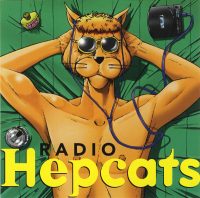
November 1996 – album reviews – Various Artists’ ‘Radio Hepcats’ compilation (“a strong whiff of dark-toned, filigreed, 4AD style introspection… heady, winning underground music”

26 Nov
Various Artists: 'Radio Hepcats'

Various Artists: ‘Radio Hepcats’

Can you can imagine a sort of cross between ‘Friends’ and a pre-job-market ‘This Life’, in which all the characters appear to be played by close relatives of those odd, unclassifiable, button nosed mammals (what the hell were they, then? bear/possum crossbreeds? doughboys?) who got perpetually stuck with the supporting roles in Disney Club comics?

If so, then you’ll have a fair (if reductionist) idea of Martin Wagner’s ongoing graphic novel ‘Hepcats’. Along with its darker and more tragic sister strip ‘Snowblind’, this warm, witty, compassionate and beautifully drawn adult strip – set on the campus of the University of Texas – follows the fortunes of a small group of students (Erica, Joey, Gunther, and Arnie) and their perpetual struggle of balancing friendships and growing maturity with an acceptable level of fun and the freedom to make mistakes. Sounds familiar? In Martin’s hands it’s both recognisable and sparkling.

Currently celebrating a new linkup with Antarctic Press and the consequent release from the headaches and pitfalls of self publishing, Martin’s just expanded the “Hepcats” world by releasing the first in a set of companion CDs: not so much a ‘Hepcats’ soundtrack as just a set of, as Martin puts it, “damn good songs that seem right at home with Erica and the gang.” But if you’re expecting another college beerkeg singalong album, think again.

Despite the tendency of the Hepcats cast to engage in animated chat as opposed to holing up in their bedrooms brooding over a Walkman, there’s a strong whiff of dark-toned, filigreed, 4AD style introspection to this compilation. It’s the tendency of the bands involved to spice their music with a little darkness, a little ornateness: and as a result ‘Radio Hepcats’ is generally closer to the sombre and unsettling shades of ‘Snowblind’ than the lively sun-washed tints of ‘Hepcats’ itself. Green Day’s pogo party this ain’t: it’s more like Ivo Watts-Russell’s children coming home to roost.


Explicitly, sometimes. The Curtain Society‘s waltzing Ferris Wheel has that familiar sound of twangling Cocteau Twins bass and grumbling spiky washes of guitar under the melancholic push-and-pull vocals. More of those queasy, giggling, Robin Guthrie-ish guitars show up on Siddal‘s Secrets of the Blind, a two parter that swings unexpectedly from chirpy drunken-fairy pop into one of those Cocteaus alien piano ballads that dislocate you from your own consciousness.

And if you’ve ever wondered what a troubled hermit’s answer to the arresting, barren grandeur of Dead Can Dance might be like, look no further than Soul Whirling Somewhere. Unhittable – utterly isolated and beautiful darkwave – drifts up as if from the bottom of a well: Michael Planter’s ashy, yearning voice floating out from its shrouds of tolling Joy Division bass and dark persuasive ambience, which caress and pull it down like water saturating the clothes of a drowner. It lulls you with sepulchral beauty while draining the warmth out of the room: you can all but see ice forming on the speakers.


But let’s not nit-pick. Even if the 4AD pointers can sometimes be pretty self evident, this is – at the very least – an album of heady, winning underground music. They might have some obvious forebears, but the bands on ‘Radio Hepcats’ also possess persuasive and seductive sounds, which are especially welcome in the current atmosphere of half asleep indie and heritage Britpop. With The Red Dots, An April March plunge down into their own thunderous take on guitar heavy dream pop with enough force to squish any of their British shoegazer ancestors (Chapterhouse, Slowdive). This stuff rides on a natural internal dynamic as much as on any phaser pedal setting, and coasts in on a dark thrum of guitar as impersonal and unstoppable as a typhoon.


Martin’s offered us the odd surprise, too. Visible Shivers have the sort of name to suggest more of the same chilly darkwave as Soul Whirling Somewhere but prove, in fact, to have the same sort of Southern States nerviness as their near brothers in name, Shudder to Think. Lo-fi country-flavoured twelve-string jangle pop, complete with plaintive harmonica and plonky bass, which on After Glory prances closer to the Appalachian chirp of Robbie Robertson, Dr Hook or ‘Fables…’-era REM than to the stonecarved artiness of much of the rest of the ‘Radio Hepcats’ broadcast. Then there’s William McGinney‘s ‘Hepcats’-themed snatch of filmic lo-fi piano and synthwork, halfway between ‘Knotts Landing’ and Angelo Badalamenti. And to silence any remaining doubts, there’s two more bands on here – the shimmeringly lovely Mistle Thrush and the ever-magnificent No-Man – who transcend genrework altogether.


Mistle Thrush open the CD with a soulful seduction, giving us Wake Up (The Sleep Song). First it curls into our hearts like a gorgeously soporific Julee Cruise ballad, and then suddenly expands into a huge cathedralline Bark Psychosis space where Valerie Fargione’s voice strips itself of anxious sugar and powers up into a huge, majestic Patsy Cline alto, as if the lump in our throats has finally gulped them into a place more fit for their bewitching talents. Further on, No-Man provide two wildly different and divergent contributions: the industrial, near incomprehensible clatter pop of Infant Phenomenon (which powers along on a rattling log drum beat, offensively dirty guitars and gasped, abstract lyrics), and the all embracing Steve Reich-ian trance funk of Heaven Taste; a sweetly slumbering twenty plus minute ambient monster with a bellyful of twinkling lights, sky tickling violin, leviathan Mick Karn bass and perhaps a couple of bites of Chartres Cathedral.


Martin Wagner’s not only compiled a beautifully-paced compilation album, he’s also given much deserved space to a clutch of very under-regarded bands. And the latest activity on the ‘Hepcats’ site suggests that an even more captivating follow-up compilation is on the way. The whole ‘Hepcats’ affair, both on and off record, is looking like a series well worth tuning in to. Cool for cats and everyone else.

Various Artists: ‘Radio Hepcats’
Antarctic Press, RHCD1 (no barcode)
CD-only album
Released:
November 1996
Get it from: (2020 update) Long out of-print, rare, and best obtained second-hand. Originally came free with deluxe edition of “Hepcats” #0.
Hepcats online:
Martin Wagner’s Hepcats blog, and online reprints of the original comic at Comic Genesis.
Additional notes: (2020 update) Of the artists on this album, The Curtain Society and No-Man are both still active; Visible Shivers enjoyed a ten year career between 1990 and 2000; Mistle Thrush’s Valerie Forgione was later in Van Elk, while Soul Whirling Somewhere’s Michael Plaster resurfaced in Yttriphie and An April March’s Danella Hocevar later worked as Danellatron. William McGinney has divided his time between film music and academia.
 

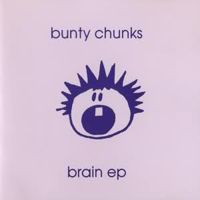
November 1996 – mini-album reviews – Bunty Chunks’ ‘Brain Ep’ (“violent eccentricity and an atmosphere of coded warning”)

16 Nov
Bunty Chunks: 'Brain Ep'

Bunty Chunks: ‘Brain Ep’

A bizarre, triple-jointed noise, ‘Brain Ep’ is twenty-two minutes worth of sixteen razor-honed two-minute songs. Any band of indie stoners could copy this note for note, slow it down by two-thirds and still end up with enough music for three years of releases. Bunty Chunks slam it all out at once. They’re probably one of the only groups who could deliver you a full concept album using only a split 7-inch with Napalm Death. And the Ep is short for Epilepsy.

So what kind of band would name themselves after a dismembered issue of a long-defunct girl’s comic? Well, theirs is a sound of seriously intense stunt guitar, twitchy hardcore tub-bashing and voice-of-doom Valkyrie vocals from Lisa Bailey. It’s as if Steve Vai (during his Zappa tenure, not his metal stardom) had skidded on the soap during bathtime, crashed through the window dripping and naked as a newborn, and finally fallen splat through next door’s roof, straigh into the middle of a women-only workshop of opera lessons. (Yeah, well, things like that happen to me most weeks…) I could also suggest L7 doing a jigsaw with Wire, Slapp Happy being forced to speak after being shut away and mainlining espresso for a solid month, or a Public Image Ltd. lineup with a Zappa complexity fetish. Otherwise there don’t seem to be many precedents for Bunty Chunks’ music. Which is a shame, because then life would be a lot more interesting than it actually is.

‘Brain Ep’ delivers a fruit salad stunt-punk, where the guitar weaves ridiculously complicated loops as Lisa vomits up hairball blasts of surrealist rhetoric. These in turn are decorated with scattered ad-slogans, one-liners and dismembered moments of sharp poetry. Seemingly taking as much influence from random cartoons and Rorschach blots as from real life, Bunty Chunks lean heavily into a disturbed world of childlike imagination and often topple into ludicrous playroom weirdness. Songs sport titles like Dog Made of Foam, Kojak Ring of Confidence or Fly Away Sausage Boy. Lisa’s lyrics are full of sinister, comical transformations: feet turn into chickens, stirrup pumps hurl abuse, and even Pavarotti reveals a hideous alter-ego. Yet there are stories in there too (embedded in the word-rashes) even if they do seem to have been tied in knots by a Turkish masseur and forced through a shattered kaleidoscope.

Lisa’s unstoppable voice – iron-hard and utterly committed, with a car-alarm urgency – is key to this. Taking what could otherwise be colourful whimsy, she pushes it out sounding like no-nonsense observation. She can navigate the paranoid mutterings and memories of a vagrant (in Hobo) or hurl out chattering expressions of rage at the demands of scrounging friends and partners (in Pay Up Ape). Similarly, she can also handle the put-upon fretting that sizzles in The Cat Tooth; the feverish dreams of mortality and aging in We Grow Up With Bones; and all of the bizarre characters that these songs suggest are marching in and out of her memory and life like a plague of amorphous, opportunistic aliens. (“Years later I would say I realise then, the only thing you can sell and still own… he was not a cripple, but he could pretend to be like no other.”)

While there’s little variety in her arresting, confrontational tone, its sheer conviction nails Bunty Chunks’ apparent flights of fancy down hard to the tarmac, rendering them as gritty as life in a rotting tower block. Despite the hallucinatory feel of the band’s songs, her edge gives them a visionary clarity. Lisa’s simultaneously the person who urgently buttonholes you for attention in the wasteland, and the woman who’s guarding and watching at the door, keeping a hard eye on the inside and the outside. Balanced between violent eccentricity and an atmosphere of coded warning, ‘Brain Ep’ comes across like a lifetime of very tricky parallel-dimension social work, carried out in a city of grotesques.

Considering that they’re the ones who got us into this, Bunty Chunks make pretty good guides to get us through. This in spite of the fact that they’ve junked verse-chorus-verse, and you’d better come in strapped up for a relentless (sometimes irritating) barrage of storm-tossed notes. But it’s worth the visit. At the very least you get to see Lisa and the other ‘Chunks playing with giddy intent: within sight of a million tunes yet never settling on any particular one, with eyes and ears stretched far too wide open to settle for anything as simple as boy-meets-girl. “Brain ep convulsions.” You said it, Lisa. Fits for a queen. So where’s the sixty-minute triple album, then?

Bunty Chunks: ‘Brain Ep’
Noiseburger Records, NB5 (5019148710073)
CD-only mini-album
Released: 1996

Buy it from:
Long deleted – look for this second-hand.

Bunty Chunks online:
LastFM

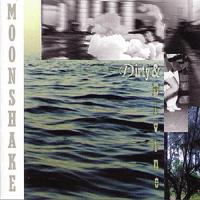
October 1996 – album reviews – Moonshake’s ‘Dirty and Divine’ (“like ghost trains – whistling and rattling across the room”)

10 Oct
Moonshake: 'Dirty And Divine'

Moonshake: ‘Dirty And Divine’

Even as a small chunk of mid-’90s London rediscovered how to swing and posed for Time Magazine, life carried on as usual for most of the rest of us. The weeks of quiet desperation, the litter in the corners, the urges and the grinds that don’t match up. While the Britpop scene whooped it up in the happening neighbourhoods, Moonshake were sitting up late with whitened knuckles in rented high-rise rooms, or prowling the mean streets spitting out stories.

Moonshake’s intensely visual songwriting and soundcraft always seemed born of hard-boiled cinematic overload. On 1994’s stunning ‘The Sound Your Eyes Can Follow’, lead ‘Shake Dave Callahan rubbed the unsparing urban soul-mining of The The up against The Young Gods’ overpowering walls of sampled sound, and beat both of them for sheer grit and presence. Determinedly guitar-free, taking their cornered-rat savagery from Callahan’s paint-stripping sneer and Raymond Dickaty’s ferocious arsenal of treated saxes and flutes, Moonshake’s harrowing street-literature songs were heavily sample-textured: but they travelled light and fast, drawing on tooth-rattling, uptight, Can-inflected dub grooves. They were twenty-first-century urban blues, as tough and unyielding as steel wire. Most importantly, sound was everywhere: cramming into the ears, surrounding the head with a blurred, terrifying out-of-scale world.

For some, the methodology of post-rock has served as an excuse to get lost, to unshackle yourself from precision, swallow your own guitar, womb yourself up in universal sonic tissue and drop out of language altogether. For Moonshake, it goes the other way. Callahan’s bitter, precise, dramatic language – shading his harsh sorties into hard-times lives with a poetic flair reminiscent of a punk Dickens, or of Brecht and Weill – is central. It’s just that rock instrumentation is too imprecise, too blunt to do it justice. Post-rock possibilities, and the overwhelming landscapes regurgitated by samplers is the only sensible framework for the way this band captures the world. Moonshake songs are like ghost trains – whistling and rattling across the room on forbidding, chilling loops of warped and mangled sampled sound, whirling you through a clatter of noise; dropping you into the thick of things; fucking with your sense of placement and angles, and thrusting gritty reality into your face.

‘Dirty And Divine’ is – at first hearing, anyway – more modest in its scope than ‘The Sound Your Eyes Can Follow’, That album lunged out of the speakers and went for your throat, both the epic stinking script and score for a vast, hideous film about the downside of the London experience. In comparison, ‘Dirty And Divine’ is more Mike Leigh to its predecessor’s Terry Gilliam. The ram-raided orchestra samples are pared back in favour of metallic whooshes and industrial-sump bubbling; Dickaty’s been given a free rein to mutate himself into an ensemble of mangled brass and breath. Centrally, Callahan’s songwriting emphasis has narrowed down. The clank and snap of Cranes sets the agenda, capturing the ebb and flow of a locked-down, clock-watching workforce in widescreen: “the builders are earning their daily bread / and they make sure they eat it every day at one o’clock… / The housewife’s dreams evaporate / as her husband’s nightshift ends at eight.”

Yet ‘Dirty And Divine’ also provides the backdrop for rebellions against the timeclock and the grind. Most of the album homes in on the stories of individuals. Where previous songs were a pageant of strain, entrapment and stagnation (a whore and her regulars, a protracted divorce) this record deals with what happens when frustration breaks out and escalates into quests for further, greater stimulation. The chance-addict of Gambler’s Blues gropes for a chance to be empowered, to face a challenge he can respect (“sometimes I pluck order out of the form – / I slack for a moment, the moment is gone”) but pays the price anyway: “I’m a gambler, and sometimes I lose, / but the kick’s in the playing, not paying the dues. / Always an offer I cannot refuse, / always a time-bomb I cannot defuse.”

In Exotic Siren Song, a young man hits the wide world for a perilous life of opium-dens, brothels and high stakes, keeping company with gun-runners and fraudsters, dodging pirates and police. Initially rejoicing at the chance to live by his wits, he ends up jaded, complaining “nothing now is really new.” The adrenalin-hooked petty crook on Up For Anything lives by his instincts and his appetites – “I’ll balance on the balcony, twenty-one floors high, / swinging from the vapour trails, ropes in the sky… / I can’t count the conquests and I can’t tell the time.” The buzz is still strong enough for him to dismiss the damage that will come, when “in ten year’s time I’ll be the boy with the mashed potato body. / All this champagne living on beer money, / out among the bumper-car people who never say sorry.” His counterpart, the elusive criminal in House On Fire (think Nine Inch Nails meets ‘Badlands’) has perfected the art of living on the edge. His wife may break under police questioning, his invisibility may evaporate and the law pounce on him, but he’s already working on plans for manipulating his fellow jailbirds.


He’s the exception – in most songs the downslide is never far away. Throughout the album, speed and appetite are portrayed as a drive that becomes a monkey on the back. Yet while it lasts it’s a hell of a ride. Another of Callahan’s savage stress-head characters snarls: “You’re too open, and you’re too easy. / When I’m out, I do as I damn well pleasey… / The only light I need sweeps through the window… / Keeping a monster comes in handy. / Hard candy…” To stop and think in this rolling, callous world is to invite despair.

To do him credit, Callahan unflinchingly represents this as well, offering up a couple of his most intimate songs. The make-or-break musings of Nothing But Time ponder the next step (“now I come to a fork in the road”) and weigh up possibilities: “Shall I cause some destruction that none shall understand, / undyke my finger and flood the whole land?… / I let you go and then you come back. / Shall I pick at your nature until you react?” Ultimately, plans are left perpetually hanging in weary, lonely resignation (“I’ve got my own design for something quite grand… / You can appreciate even if you don’t understand,”) all wrapped in rolling Arabian horns and the gonging sound of empty vessels.

Too late. The Taboo (swathed in flugelhorn and rippling harpstrings) surfaces at the end of the album: the last moment of awful drunken clarity before the final fall. It’s a lament for the loss of honesty – for the lost ability to be vulnerable and unveil the tender truth of yourself. Cards should be on the table, but no-one will make the move. “If I were to be really careful, / and take pride in everything I do, / I would show you what ‘really’ is – / and I can’t, ‘cos it’s taboo.” The seasick backing music swirls: vision flattens. The loved one recedes across the table, behind a wall of well- worn gambling chips and smeared shot-glasses. “If I were to show you how I feel, / would you call me blue? / If we could reach out and touch each other? / But we can’t, ‘cos it’s taboo.” Almost touching, but out of sight. House wins.

This album is a brutally compassionate mausoleum to burnout, made from raw words and cracked sinews. Lay those dusty dreams to rest.

Moonshake: ‘Dirty And Divine’
C/Z Records/World Domination Records, WDOM028CD (5032059002822)
CD-only album
Released: 4th October 1996

Buy it from:
Various suppliers, or second-hand.

Moonshake online:
Facebook MySpace Last FM

July 1996 – album reviews – Eyeless In Gaza’s ‘All Under The Leaves, The Leaves Of Life’ (“rings the sonic changes track by track”)

25 Jul

Eyeless In Gaza: 'All Under The Leaves, The Leaves Of Life'

Eyeless In Gaza: ‘All Under The Leaves, The Leaves Of Life’

Still undimmed after years of following a winding path from visionary post-punk to surreal pop, and through to a beautiful breed of semi-ambient outsider-folk, Eyeless In Gaza continue to blossom in their triumphant 1990s renaissance. They’re also as restless as ever – following soon after their ‘Bitter Apples‘ album (with its sustained autumnal mood) ‘All Under The Leaves, The Leaves Of Life’ rings the sonic changes track by track.

Indeed, Eyeless seem as happy to draw on their post-punk past as they are to explore the ghostly folk that’s left an impressive stamp on their recent music. Monstrous Joy opens the album and… God help us, it’s 1981 again! Joy Division bass rumbles, spindly single-note synths, buzzingly active electronic drums. Yet despite the timewarp, this is no Xerox copy of those years. Instrumentally, it’s a skilfully layered slice of pop atmospherics: lyrically, emotions are conveyed much more directly. Gone are the allusions to nature, but the atmosphere holds a definite frost in the air – “here is a sorrow that owns me, here is a sorrow that speaks.”


Struck Like Jacob Marley (despite the Dickensian title, a highly contemporary standout) does nothing to ease the chill. Led by rumbling bass guitar and defiantly noisy and distorted electric guitar, the lyrics are upfront advice to a friend consumed by cynicism – “it’s almost as though you have no positive view / and the old warmth is going, even though you don’t wish it to.” Hard words.

Meanwhile, the sonic adventures just keep on coming. Fracture Track is a mesmerising and bloody assault on the Eyeless sound. A violently struck, hypnotic rhythm guitar riff is blasted on all sides by discordant drones and buzzes: there are no drums, yet it sounds huge, and Martyn Bates pushes out a harsh-edged, ferocious vocal. “Blasted and blinded to chaos… / riding an animal hatred… / forcing such a numb and wasting path for you to blithely tread.” The violent and nihilistic imagery only adds towards making this the darkest, most fearsome track Eyeless In Gaza have ever recorded.

The traditional Leaves Of Life, as arranged by Eyeless, sounds like a less wasted Flying Saucer Attack turned on their heads. The vocals and spartan folk acoustics take place up close, whilst the unsettling ambience – provided mainly by startlingly severe treatment and distortion of electric guitars and other electrical interferences – scares the life out of you in the background. Gothic folk at its best. And trip-hop? Well, OK, nearly. Answer Song And Dance definitely possesses a dark, nervous trip-hop undercarriage, with a slow, menacing beat, cool electronic sheen and Martyn’s vocals relayed through digital effects and compression: more experiments in new sound are going on here.


Three Ships, another arrangement of a traditional piece, is perhaps the most reassuringly familiar Eyeless In Gaza track here, comprising a solo vocal over Peter Becker’s long churchy organ notes (“all the black keys”, as they once called it). Even here, though, the second part of the track becomes subject to the unsettling aural sculptures of pervasive otherworldly drones, sonic interferences and sinister electronic pulses. It sounds like a late 90’s version of one of the frankly peculiar little improvised instrumentals that have littered Eyeless B-sides and rarities in the past: but, satisfyingly, it’s an example of technology finally catching up with the duo’s ambitious musical vision, so that they can finally express their experimental sides to the full.


It’s tempting to see this album as the second side of the coin flipped by ‘Bitter Apples’ last year. If the former was the familiar world of acoustic alchemy, natural imagery and the avant-folk song, then ‘All Under The Leaves…’ sees Eyeless In Gaza striking out for new challenges: testing their own musical limits, and casting off the gauze of allusion and allegory to put forward sometimes difficult lyrical statements directly. And while, on ‘Bitter Apples’, vibrant colours were all around and there was a last gasp of summer’s warmth, ‘…Leaves…’ is winter-cold. Challenging, but ultimately beautiful when viewed in the harshest of frosts.

Since unexpectedly bursting back into life in 1993, Eyeless In Gaza have been immensely prolific. But as their continuing string of albums in the comeback sequence show, quality has remained high: and Bates and Becker’s desire to move forward and experiment – while retaining Eyeless’ essential character – remains intact and proud.

(review by Vaughan Simons)

Eyeless In Gaza: ‘All Under The Leaves, The Leaves Of Life’
Ambivalent Scale Recording, A‑SCALE 021 (5 021958 463025)
CD‑only album
Released: 19th July 1996

Get it from:
(2018 update) original CD and 2009 Cherry Red Records reissue best obtained second-hand.

Eyeless In Gaza online:
Homepage Facebook MySpace Soundcloud Tumblr Last FM

November 1995 – album reviews – Eyeless In Gaza’s ‘Bitter Apples’ (“an autumnal album in the most inspiring way”)

30 Nov

Eyeless In Gaza: 'Bitter Apples'

Eyeless In Gaza: ‘Bitter Apples’

After seventeen years on the wildest, furthest reaches of contemporary music, Eyeless In Gaza’s time may finally have come. With the British music scene proclaiming itself as boundary-free, cross-pollination of styles is the name of the game. Experimentation is the byword. Ears are open to new sounds.

Eyeless, of course, have been doing it for ages – from industrial electronics through early-80’s sparse electronic punk, bedsit acoustic folk, a stab at a big pop sound and experiments with mechanistic ambience. Then a seven-year abeyance followed by a shock return with the modern dance-pop of ‘Fabulous Library’ and by ‘Saw You In Reminding Pictures’ (an album of improvised, cinematic, ambient songs and atmospheres). Yet all, thanks to Martyn Bates’ distinctive, expressive voice and Peter Becker’s endlessly inventive musical collages, recognisably Eyeless In Gaza.

Much of Europe has been in on their greatness for years. Now that they have returned it is time that Britain listened in; particularly as, since Eyeless reformed, their career has been no nostalgic re-run of past styles, but a body of work that has engaged with the best of them in the camp marked “pre-millennial boundary-breaking zeitgeist experimentation”. Or something.


Following the head-expanding soundscape world of ‘Saw You In Reminding Pictures’, ‘Bitter Apples’ comes announced as a return to song structures and a live folk feel (acoustic guitars, bass, drums). The matured Eyeless In Gaza are now reinventing the brand of avant-folk song first heard on their Drumming The Beating Heart album over a decade ago. Lyrics such as those on Bushes And Briars immediately announce the folk influence – “through bushes and through briars / I lately made my way / all for to hear the young birds sing / and the lambs to skip and play.”

But any hint of preciousness about such a style is dispelled by the ghostly a-capella treatment of Bates’ voice, treated with vocal effects that make him sound like a possessed changeling, wrapped in his own tingling harmonies. Martyn Bates’ voice is unique – expressive in hushing to a sense of menace, or delicate and weary, or surging with the power to hit the rafters. He occasionally retains a slight rasp, an edge, to his voice from the first punk-inflected vocals of early Eyeless. A comparison? Impossible.


Year Dot demonstrates how Eyeless In Gaza can produce powerfully rhythmic, surging music from the basis of harsh acoustic riffs, Martyn letting his voice roam over the melodies with unfettered power. But technology is not anathema to such natural surroundings, though – the track closes in a sharp crescendo of electronic interference. Contemporary experimentation mixes it further with avant-folk on Jump To Glory Jane – zither passages are built upon bursts of white noise, klaxons, and improvised wordless vocal harmonies as just another instrument in the delicate construction. It’s a perfect demonstration of the duo’s implicit feel for building such atmospheres, and sets the tone for much of the rest of the album.

Perhaps the central track, though, is To Listen Across The Sands: powerful and urgent, built upon a crashing electronic drum pattern remorselessly pushing the rhythm forward and echoing the lyrical theme of listening to “all the mad, crashing waves.” The song would seem to be an allegory for a journey through a stormy life – “listen across the sands / to the waves drifting where you stand / and all their voices swallowing your life.” A theme that is returned to, lyrically and musically, on the title track. To an up-tempo soundtrack of syncopated guitar and percussion (plus a star appearance from a keyboard relic in Peter Becker’s armoury of sounds – the Wasp), nature’s imagery is once again summoned to describe the unpleasant aspects of life we sometimes have to wade through. “Such a bitter harvest, such a windfall falling that I can’t move… / all that I taste wastes me away – all that I’m succoured by and living on… / bitter apples…”

This is an autumnal album in the most inspiring way – new invigorating cooler winds provoking the falling leaves and scudding clouds. And Eyeless in Gaza are long-overdue for rediscovery, yet still ripe. Pluck.

(review by Vaughan Simons)

Eyeless In Gaza: ‘Bitter Apples’
Ambivalent Scale Recording, A‑SCALE 020 (5021958453026)
CD‑only album
Released: autumn 1995

Get it from:
(2018 update) original CD best obtained second-hand. There was a 2011 reissue on Hand/Eye Records which might be easier to find.

Eyeless In Gaza online:
Homepage Facebook MySpace Soundcloud Tumblr Last FM

September 1995 – live reviews – B. J. Cole & The Transparent Music Ensemble + Billy Currie & Blaine L. Reininger @ Upstairs at the Garage, Highbury, London, 20th September (“a classical dissection of folk, like Irish airs meeting New York minimalism… / …a beautiful translucent sound”)

23 Sep

A definite whiff of conservatoire rock tonight. Viola player Billy Currie used to be in Ultravox,: nowadays he looks more like an Irish pub musician, but his music has taken a more interesting turn, as has his choice of collaborators. Former Tuxedomoon violinist and occasional singer Blaine L. Reininger – with his unnerving bespectacled stare, lugubrious ironic drawl, Zappa face-fuzz and impeccable suit – looks like a college professor whom you wouldn’t allow near the children, and draws most of the attention this evening.

This unlikely pair perform a set of serious brow-furrowed John Cale-y string duets with a flavour of compressed folk, using an endearingly cheap sequencer to expand the instrumentation: clave and sweep piano program on Bittersweet, digital string orchestra on Overcast. On The Reach of Memory, sparse piano clumps, drum program and synth bass kicks into Currie and Reininger’s apparent take on Appalachian mountain music. The Thin End of the Wedge sees Reininger on trashy art-rock guitar for a Velvet Underground feel.

Their music has a strange, detachedly astringent feel; a classical dissection of folk, like Irish airs meeting New York minimalism. A sense of towering expression repressed, amplified, by Reininger’s menacing suavity: the set highlight is The Green Door, in which Reininger sings words from a documentary on schizophrenia to a strong melody over sparse drum program and organ. Seems wholly appropriate. I’m impressed, but I feel a little queasy.

In contrast, pedal steel guitarist B.J. Cole is a ridiculously normal-looking guy with a peculiar past. Back in the ’70s he was the leader of Cochise (probably the only prog/psychedelic band based around pedal steel) and subsequently explored psychedelic country music in 1973 on his ‘New Hovering Dog’ album. Over the years since then, he’s been the ubiquitous sideman and sessioneer to everyone who wants an open-minded pedal steel approach, from The Orb to Björk to Procul Harum to Scott Walker, and in particular John Cale. Since 1989 he’s also been leading this occasional band; the Transparent Music Ensemble, an ambient-flavoured chamber music quintet also featuring keyboards, cello, percussion and violin prodigy Bobby Valentino, best known for his London country music stardom.

Cole’s Transparent Music is a sedate, relaxing experience, pleasantly beautiful and unfussy, far too laid-back to be pretentious. Reflective melodic strings tie in with his steel lines, keyboards support gently, percussion shades rather than impels. Some people point out Brian Eno as the inventor of ambient music: others such as Cole know that it goes back to the days of Satie and Debussy, both of whole expressed ambient intentions long before the days of synths and tape loops, wishing to create music that merged with the tinkle of cutlery. Works by both are played tonight, along with a version of Ennio Morricone’s Once Upon a Time in the West, a slow cloudy cover with Cole’s ringing pedal steel dreaming out the tune.

Transparent Music is unselfconsciously universal: if something fits in with that softly lustrous sound, Cole and co. play it and let someone else draw up the distinctions if they’ve got nothing better to do. The original pieces stream neatly into place alongside the classics: Indian Willow’s choppy subterranean strings, Promenade & Arabesque’s pizzicato accents. Throughout, Cole’s steel pines and slides gracefully. That is, when he hasn’t MIDI-processed it into another sound – sad film-noir saxophone on Adagio in Blue to contrast with Valentino’s passionate classical violin, or the fluting electronic sounds on Easter Cool counterpointing the piano and bass drum.

It isn’t exactly music to stir the blood. What it is is very accomplished classy atmosphere music, a beautiful translucent sound whose function is just to exist and to please. That may sound superficial, but if so it’s a refined and civilised pleasure of superficiality. Gentle classics stroked with electricity and with a sense of ambient context, reclaiming the sector where popular instrumental and classical cross, and with no hint of elevator music. Easy listening with a brain. Satie and Debussy would have approved.

B. J. Cole online:
Homepage Facebook MySpace Last FM Apple Music YouTube Deezer Spotify Tidal Amazon Music

Billy Currie online:
Homepage Facebook Twitter MySpace Last FM Apple Music YouTube Deezer Pandora Spotify Tidal Amazon Music

Blaine L. Reininger online:
Homepage Facebook Twitter MySpace Soundcloud Bandcamp Last FM Apple Music YouTube Vimeo Deezer Google Play Pandora Spotify Amazon Music
 

September 1995 – live reviews – Shriekback + Holly Penfield @ Upstairs at the Garage, Highbury, London, 6th September (“a few degrees different… / …madly danceable but bursting with wild and intriguing approaches”)

9 Sep

Holly Penfield, delayed by technical problems, is not having a great night. For those who haven’t previously seen the Diva of Dysfunction, this is maybe not an ideal introduction to her unnerving songbook of emotional explorations, cramped as it is into a shortened set-time opening for Shriekback.

Nonetheless, as she sings out her heart and wrings the notes out of her synth, her quality shines through as she leans on the more conventional songs of her standard set – the vulnerable unwindings of ‘Parts of My Privacy’; the clarion-blast of ‘Calling All Hearts’; the stormy tribute to city derelicts in ‘Over the Edge’. The long frozen yearn of ‘Stay with Me’ is as potent as over; the climactic anthem and disintegration of Misfit still jolting and captivating. Tonight she may seem only a few degrees different from most mainstream songwriting women; but they’re important degrees.

Shriekback may be familiar to those of you who’ve followed the career of XTC. Lubricious singer and frontman Barry Andrews was once part of that band, although now (shaven-headed and muscular in black singlet and leather trousers) he looks more like an escapee from Right Said Fred. Watchers of the ’80s alternative scene might also remember the band as being artily plastic white funkers – during the time when Dave Allen and Carl Marsh made up a fierce creative triumvirate alongside Andrews – but they’ve changed quite a bit since then. Thronging the stage like a post-civilisation white road tribe from ‘Mad Max’ or Circus Archaos (and always seeming to be twice as numerous as they actually are) Shriekback still play what could be described as funk, but it’s a mutated progressive variant: still madly danceable but bursting with wild and intriguing approaches.

The instrumentation has something to do with it. A vast array of percussion instruments played by the entire band, like a mongrelised salsa troupe, include – in addition to the standard kit, congas and bongos – giant mutant tambourines, Arabian dumbeks, Irish bodhrans, cymbal-clappers and what looks like an array of motor springs on a huge chunk of wood. Guitarist Lu Edmonds has dumped his six-string in favour of a couple of electrified Turkish instruments – the cümbüs (apparent bastard child of a banjo and a twelve-string guitar) and the saz (like a bouzouki with moveable frets) – chopping and rolling out subtly different parts. The bassist loops and taps on a full-toned fretless. Courtesy of Mark Raudva, didgeridoo and mandolin both make appearances during the evening. Barry himself plays accordion as if he’s wrestling with a giant python, and somehow manages to extract an eerie sound for a wired-up tree root.

Funky it may be, but “get down y’all” is not on the agenda. Shriekback are progressive funk barbarians with a cunning primitivist edge, as happy with a sort of savage pagan sea shanty or primal drum throb as with a Prince-ly groove. Stately, it isn’t. The wild percussive stomp that opens proceedings is as far from po-faced art seriousness as you can get, and they possess the super-greasy compulsive rhythms of the dirty end of prime funk. Their sheer enjoyment and eclectiveness in the ingredients they brew into their music marks them down as yet another oddball manifestation of the progressive spirit…. and who said barbarians had to be dumb? There’s a roiling intelligence in evidence throughout their set. Barry Andrews has always played the hooligan-intellectual card really well, and he’s not stopping now.

Shriekback follow a different and ever-so-slightly alien logic in the way that they look at the world. You can see this in the list of “un”-things in ‘Un-Sound’ (“unacceptable, unreliable, unheard”) or in the semiotic question/percussion barrage of ‘Signs’, in which traffic signs, car logos and football graffiti are all part of one great rush of urban information which you need to understand and to decode for survival. All of it comes to the fore on the didgeridoo-led nightmare parable ‘Captain Cook Said’, in which Barry narrates the story of Cook’s omen-ridden first meeting with indigenous Australians back in the eighteenth century and of the destructive force of the civilisation which he trailed behind him – “we’re here to transmit the virus called the future…” Some XTC cleverness emerges, too, in the wryly cynical ‘Pond Life’ and in the hard rhythm’n’blues/country-inspired wallop ‘Seething’, with its fierce accordion.

All of this plus the fact that you can dance to this band without having to leave your brain at home. On all counts, Shriekback deliver. If you occasionally need to let the smart barbarian out of yourself, there are few better bands available to help you do it.

Shriekback online:
Homepage Facebook MySpace Soundcloud Tumblr Last FM Apple Music YouTube Vimeo Deezer Google Play Pandora Spotify Tidal Instagram Amazon Music

Holly Penfield online:
Homepage Facebook Twitter Last FM Apple Music YouTube Deezer Google Play Spotify Tidal Instagram Amazon Music

SWOONAGE

Swoon. /swo͞on/ A verb. To be emotionally affected by someone or something that one admires; become ecstatic. Here are some people and things that make me swoon. #swoon #swoonage

Post-Punk Monk

Searching for divinity in records from '78-'85 or so…

theartyassassin

...wandering through music...

Get In Her Ears

Promoting and Supporting Women in Music

Die or D.I.Y.?

...wandering through music...

Music Aficionado

Quality articles about the golden age of music

THE ACTIVE LISTENER

...wandering through music...

Planet Hugill

...wandering through music...

Listening to Ladies

...wandering through music...

ATTN:Magazine

Not from concentrate.

Xposed Club

improvised/experimental/music

The Quietus

...wandering through music...

I Quite Like Gigs

Music Reviews, music thoughts and musical wonderings

furia log

...wandering through music...

The Recoup

SINCE 2013: Books and books and books and books and occasionally other things

A jumped-up pantry boy

To say the least, oh truly disappointed

PROOF POSITIVE

A new semi-regular gig in London

Gapplegate Classical-Modern Music Review

...wandering through music...

When The Horn Blows

...wandering through music...

:::::::::::: Ekho :::::::::::: Women in Sonic Art

Celebrating the Work of Women within Sonic Art: an expanding archive promoting equality in the sonic field

Ned Raggett Ponders It All

Just another WordPress.com weblog

FLIPSIDE REVIEWS

...wandering through music...

Headphone Commute

honest words on honest music

The One-Liner Miner

...wandering through music...

Yeah I Know It Sucks

an absurdist review blog

Obat Kanker Payudara Ginseng RH 2

...wandering through music...

poplifer.wordpress.com/

Waiting for the gift of sound and vision

Good Music Speaks

A music blog written by Rich Brown

Do The Math

...wandering through music...

Archived Music Press

Scans from the Melody Maker and N.M.E. circa 1987-1996

The World's Worst Records

...wandering through music...

Soundscapes

...wandering through music...

OLD SCHOOL RECORD REVIEW

Where You Are Always Wrong

FRIDAY NIGHT BOYS

...wandering through music...

Fragile or Possibly Extinct

Life Outside the Womb

a closer listen

a home for instrumental and experimental music

...wandering through music...

Life Just Bounces

...wandering through music...

Lucid Culture

JAZZ, CLASSICAL MUSIC AND THE ARTS IN NEW YORK CITY

Aquarium Drunkard

...wandering through music...

eyesplinters

Just another WordPress.com site

NewFrontEars

...wandering through music...

FormerConformer

Striving for Difference