During the middle of next week, there’s a set of new or rare contemporary classical pieces being performed in Camden Town.
Picking Up The Pieces: Darragh Morgan & Mary Dullea (The Forge, 3-7 Delancey Street, Camden Town, London, NW1 7NL, UK, Wednesday 14th October 2015, 7.30pm) – £10.00/£12.00
Here’s what the Forge has to say about it:
Described by BBC Music Magazine as ‘agile, incisive and impassioned’ violinist Darragh Morgan and pianist Mary Dullea are renowned soloists of new music as well as members of The Fidelio Trio, one of the UK’s leading chamber ensembles. ‘Picking up the Pieces’ explores new and recent repertoire, much of it written for this duo, by a diverse selection of composers. Among the program items, Richard Causton’s ‘Seven States of Rain’ (dedicated to Mary and Darragh) won the first ever British Composers’ Award; while Gerald Barry’s ‘Midday’ receives its world premiere alongside other London premieres from Camden Reeves and Benedict Schlepper-Connolly.
Here’s the original premiere recording of Darragh and Mary playing ‘Seven States of Rain’.
Tickets and up-to-date information are here. This concert is being recorded by BBC Radio for future transmission on Hear & Now.
* * * * * * * *
On the Saturday following, there’s a triple bill of Bills at Daylight Music. Now that’s cute, even for them. Here are the words, direct from the top…
Daylight Music 203: William D. Drake + Bill Pritchard + Bill Botting (Union Chapel, Compton Terrace, Islington, London, N1 2UN, UK – Saturday 17th October 2015, 12.00pm-2.00pm) – free entry, suggested donation £5.00
For his fifth solo excursion, former Cardiacs keysmith William D Drake takes us on a serpentine path through the inner regions of ‘Revere Reach’, a part-imagined landscape composed of memory and fantasy. At once heart-felt, hearty and absurd, its heady reveries blend ancient-seeming modal folk melody with an obliquely-slanted rock thrust.
Bill Pritchard is a beloved cult British-born singer/songwriter. You may remember. You may not. He started writing songs for various bands at school but it wasn’t until he spent time in Bordeaux as part of a college degree that his style flourished. He did a weekly show with two friends on the radio station La Vie au Grand Hertz (part of the burgeoning ‘radio libre’ movement) and was introduced to a lot of French artists from Antoine to Taxi Girl. In 2014 Bill released – Trip to the Coast (Tapeste Records). He’s recently resurfaced with a cracking new album, the songs of which are classic Bill Pritchard. Guitar pop, hooky chorus’, melodic ballads and personal everyday lyrics about love, loss, and Stoke-On-Trent.
Our final Bill is Bill Botting – best known as the bass player from Allo Darlin with the encouraging face, or as one half of indie electro wierdos Moustache of Insanity. Bill returned to playing his own music sometime in 2014. What started as a solo act has now grown into a complete band featuring members of Owl and Mouse, Allo Darlin and The Wave Pictures. A 7-inch single out later in the year on the wiaiwya label has a country slant but an indie heart.
Up-to-date info on this particular Daylight Music afternoon is here.
* * * * * * * *
Laura Moody’s captivating cello-and-voice songcraft (which edges along the boundary lines of avant-garde classical, art pop and heart-on-sleeve folk music, while demonstrating a daunting mastery of both vocal and instrument) has been a favourite of mine for a while. On this particular week, she’s performing as part of the Match&Fuse Festival in London on 17th October, which I’d have made more of a noise about had I cottoned on to it earlier. She’ll be following up her London show with a date on 20th October at Leeds College of Music: unfortunately, this concert (which also features a talk) is only for LCM students/staff, but if you happen to be attending the college, grab the chance to go along.
There’ll be more on Laura shortly, as she’s embarking on a brief British tour next month which dovetails quite neatly with some other brief tours I’d like to tie together in a post. Watch this space.
Meanwhile, I might as well provide a quick rundown of the Match&Fuse events. This will be a short and scrappy cut’n’paste’n’link, since I’m honouring my own last-minute pickup (and, to be honest, because I exhausted myself listing out all the details of the Manchester Jazz Festival events earlier in the year).
By the sound of it, though, the festival deserves more attention than I’m providing. Even just on spec, it’s a delightful bursting suitcase of British and European music; much of which consists of various forms of jazz and improvisation, but which also takes in electronica, math rock, accordion-driven Tyrolean folk-rap, vocalese, glam punk, the aforementioned Ms. Moody and what appears to be a huge scratch ensemble closing the events each night. It’s spread over three days including a wild triple event on the Saturday. Tickets are starting to sell out; so if you want to attend, be quick.
Committed to the composers and bands who propel, compel and challenge, Match&Fuse turns it on and ignites the 4th London festival in October. Dissolving barriers between genres and countries, it’s a rare chance to hear a spectrum of sounds from underground European and UK artists. On Saturday 17th October our popular wristband event will give you access to three Dalston venues and about thirteen artists and bands. Strike a match…
The Vortex Jazz Club, 11 Gillett Square, London, N16 8AZ, UK, Thursday 15th October 2015, 7.30pm – £9.90
Midnight – The Eirik Tofte Match&Fuse Orchestra (Europe)
00.30am – Soccer 96 (UK) party – stripped-down, amped-up analogue synth vs. live drum assault
Full details of Match&Fuse London 2015 are here and here, with tickets (including wristbands) available here. There’s also a playlist available – see below.
* * * * * * * *
More October gig previews coming up shortly, plus some more for November…
And October rushes on, with a couple of Baba Yaga’s Hut shows…
Sax Ruins + Richard Pinhas (Baba Yaga’s Hut @ Corsica Studios, 4-5 Elephant Road, London, SE17 1LB, UK, Monday 12th October 2015, 7.30pm) – £11.00
Ruins (in both their original configuration and their various spinoffs) are among the best-known and most influential of Japanese experimental rock bands, with their complex rhythmic ideas and expression stretching across progressive rock, Rock in Opposition, jazz and punk. Founded in 1985, their stretchy, power-flurried drums-and-voice/bass guitar/nothing else approach has been described as “a palace revolt against the established role of the rhythm section” and set the initial format for any number of loud-bastard bass-and-drums duos.
Since 1994 they’ve also run assorted noise-rock and improv collaborations including Ronruins (a romping trio alliance with multi-instrumentalist Ron Anderson) and longstanding hook-ups with Derek Bailey, Kazuhisa Uchihashi and Keiji Haino. Post-2004, Ruins has given way to Ruins-alone: a solo project in both practical and actual terms, with Tatsuya Yoshida (Ruins’ drummer, jabberer, main composer and only consistent member) opting to tour and record solo as a drums-and-tapes act.
Active since 2006, Sax Ruinsis yet another iteration of the Ruins concept – a musical tag team in which Yoshida spars happily with Nagoya-based saxophonist Ryoko Ono of Ryorchestra (an all-round improviser steeped in jazz, rock, funk, rhythm & blues classical and hip hop. Their recordings are “extremely complex with irregular beats, frequent excessive overdubbing, and restructured orchestration. The result sounds like a big band playing progressive jazz hardcore. For live performance of Sax Ruins they make hardcore sound like a huge band by full use of effects, also incorporating improvisation. Their shows unfold as a vehement drama.” For further evidence, see below.
Composer, guitarist and synthesizer player Richard Pinhas has often laboured under the reductive tag of “the French Robert Fripp”. This is unfair to him; he may have begun as an admirer of both Fripp and Brian Eno, but whatever he’s learned from them he took in his own direction. Starting out in the early ‘70s with a Sorbonne philosophy doctorate, a keen interest in speculative science fiction and a brief stint heading the post-Hawkwind psych outfit Schizo, Pinhas went on to lead the second-generation progressive rock band Heldon for four years between 1974 and 1978.
Geographically and conceptually, Heldon sat bang in the ‘70s midpoint between the artier end of British prog, the proggier end of British art-pop and the chilly sequenced robo-mantras of German electronics. Initially inspired by King Crimson, Eno and Tangerine Dream, they also shared both musicians and ideas with Magma, and at times squinted over the Atlantic towards Zappa and Utopia: no passive followers, they always brought their own assertive, inquiring spin to the party. (A late ‘90s revival version of the band brought in the psychedelic punk and techno imperatives of the dance movement).
Since Heldon, Pinhas has pursued an ongoing and diverse solo career. It’s taken in collaborations with Scanner, Peter Frohmader, Merzbow, Råd Kjetil Senza Testa, Wolf Eyes and Pascal Fromade, plus assorted words-and music projects involving speculative writers and philosophers such as Maurice Dantec, Philip K. Dick, Gilles Deleuze, Norman Spinrad and Chloe Delaume (these include the cyberpunk-inspired Schizotrope). When performing solo, Pinhas uses a loops-layers-and-textures guitar approach which parallels (and to some ears, surpasses) the densely processed and layered Soundscapes work of his original inspiration Fripp. I guess it’s most likely that he’ll employ this at Corsica Studios on the 12th (although as Tatsuya Yoshida has been another of Pinhas’ collaborators over the years, perhaps you might expect another spontaneous team-up…)
Up-to-date info on the concert is here, with tickets available here.
* * * * * * * *
On the Saturday evening, Baba Yaga’s Hut is running another gig, much of it apparently based around the noise-and-sludge projects which record at south London’s Dropout Studio in Camberwell. I’ve got to admit that I’m quite ambivalent about the hit-and-miss nature of noise-rock – I suspect that it’s too much of a haven for charlatans, and if I can’t drag out anything interesting to say about the noise they produce bar a slew of reference points, then what am I doing if not reviewing my own boredom? – but I like BYH’s omnivorous, ambitious and sharing attitude as promoters, so I’m happy to boost the signal on this one.
Sex Swing + Early Mammal + Casual Sect (Baba Yaga’s Hut @ The Lexington, 96-98 Pentonville Road, Islington, London, N1 9JB, UK, Saturday 17th October 2015, 8.00pm) – £7.00
Sex Swing are “a drone supergroup” featuring South London noisenik Tim Cedar (one of Dropout Studio’s owner/producers, previously a member of both Ligament and Part Chimp), Dethscalator’s Dan Chandler and Stuart Bell, Jason Stoll (bass player with Liverpool kraut-psych band Mugstar) and skronkophonist Colin Webster. On aural evidence, they inhabit a post-Can, post-Suicide hinterland of hell, spring-echoed and tannoy-vocaled – a sinister quotidian landscape of blank anomie and oppression; a Los Alamos penal colony haunted by uranium ghosts, ancient Morse telegraphs, metal fatigue and the zombie husks of Albert Ayler and Ian Curtis. (Well, that’s certainly someone’s perfect birthday present.)
Described variously as raw power, psych-blues, primitive lysergia and threatening backwoods jams, Early Mammal are another Dropout-affiliated Camberwell band. They’re a stoner rock three-piece who’ve drawn further comparisons not just to latterday stoner crews like White Hills or Uncle Acid & The Deadbeats, or to predictable perennial touchstones like Captain Beefheart and Hawkwind parallels; but also to broody Harvest Records psych (Edgar Broughton and the ‘Obscured by Clouds’ Pink Floyd), Irmin Schmidt and (a rare and welcome cite, this) the grand dramatics of Aphrodite’s Child (the late-‘60s Greek prog band which skirted the 1966 Paris riots and served as an unlikely launch pad for both Vangelis and Demis Roussos).
Past incarnations have seen Early Mammal stir in some “Turkish-flavoured synth”, but the current lineup is a power trio of ex-Elks guitarist Rob Herian and 85bear’s Ben Tat and Ben Davis, adding baritone guitar and drone box to the usual guitar/bass/drums array.
I’m less sure about the south London/Dropout associations as regards Casual Sect, who seem to be north-of-the-river people; but, armed with their own hardcore noise-punk, they’ll either clatter away like wind-up toys or belly-sprawl on great bluffs of surly noise. They seem to love both citing and mocking conspiracy theory, so I’ll let them yell away on their own behalf – see below…
Up-to-date info on this gig is here, and tickets are available from here.
Here are details on some more interesting concerts coming up later this month. These run the gamut from soft psychedelic world-folk atmospherics to jabbering electric art-punk noise and sprechtstimme via dream-folk, caustic love songs and extended-technique art-rock instrumentals. (It was a shame to hear about the cancellation of the Charles Hayward gig in London on the 23rd – taking its ANTA, Gnob and Kavus Torabi support slots with it – but I’m sure that something similar will be rescheduled for anyone in need of their art-mash/stoner/prog/psych/metal salad…)
Dave Sturt presents An Evening of Dreams & Absurdities (Upstairs @ The Red Lion, Market Place, Wirksworth, Matlock, Derbyshire, DE4 4ET, UK, 23rd September 2015, 8.00pm) – £8.00
As part of the Wirksworth Festival Fringe, Dave Sturt (bass guitarist with Gong, Bill Nelson, Steve Hillage and Jade Warrior, as well as being half of Cipher) showcases tracks from his forthcoming solo album ‘Dreams & Absurdities’ in an evening of world-class all-instrumental musicianship featuring beautiful eclectic music, soundscapes and various field recordings from Gong tours and elsewhere. The music is “mostly mellow and ambient – somewhere between melancholy and elation.”
For the performance, Dave will be accompanied by three guests. Chris Ellis (guitar and piano) is a multi-instrumentalist/singer-songwriter/actor, an ex-member of Anglesey band Ghostriders, and an award-winning soundtrack composer – he’s also a collaborator with Dave on the Past Lives Project (which recreates the recent ancestral histories of British communities by resurrecting their old cinefilm recordings and setting them to new music). Brian Boothby (low whistle, djembe) is an acclaimed folk musician, dramatist and writer and a member of the Derbyshire mixed-arts collective Genius Loci. Jeff Davenport (drums, percussion, HandSonic pad) has worked with jazz musicians Andy Sheppard and Phil Robson, pop artists James Morrison and Laura Mayne, and currently collaborates regularly with “Silent Pianist” Neil Brand providing soundracks to silent films, as well as working in Europe and the Far East on various projects with all manner of musicians.
On the last post, I plugged a London double event on the 19th – a day with a Daylight Music concert at midday and a noisier rock gig in the evening (both events which are still about to happen as I post this). In another week’s time, history’s repeating (fortunately not as farce, though anyone familiar with the bands in the evening show can expect some twists and jabs of humour) so here’s what’s coming up on September 26th…
Daylight Music 200: Ex-Easter Island Head + French For Rabbits + Louis Barabbas, plus a photo exhibition (Union Chapel, Compton Terrace, Islington, London, N1 2UN, UK – Saturday 26th September 2015, 12.00pm-2.00pm) – free entry, suggested donation £5.00
An extra special event to celebrate the 200th Daylight Music, featuring some of the most popular acts from the last six years (643 performances by 530 different acts; 15,254 cups of tea or coffee drunk; 9,863 slices of cake scoffed; 5,003 pieces of quiche devoured) and during which we’ll be raising funds for Daylight Music in 2016.
Ex-Easter Island Head are a Liverpool based musical collective composing and performing music for solid-body electric guitar, percussion and other instruments. They have performed their original compositions solo, as a duo, trio, quartet and as a large ensemble across a wide variety of events from site-specific installation works to live film scores. They create a sensation whenever they play. If you’ve never seen musicians hitting electric guitars with mallets before, then cancel all other plans for the day and head down.
French For Rabbits hail from the remote natural setting of Waikuku Beach, in New Zealand’s South Island. Vocalist Brooke Singer expresses intimate narratives against the cast of the damp colonial cold; her voice delicately steeled against winsome guitar lines and the eerie instrumentation of her bandmates. It’s a weather-beaten dreamscape, nostalgic for warmth and hopefully lilting towards sunnier climes.
Louis Barabbas is a writer, performer and label director, best known for caustic love songs and energetic stage shows that leave you pumped up and breathless.
The icing on the cake this week is an instrumental soundscape provided by Irish singer-songwriter and multi-instrumentalist Adrian Crowley, who (over his six-album career) has been described by the Independent as “a master of understatement” and cited by Ryan Adams as the answer to the question “who’s the best songwriter that no one’s heard of?”
To celebrate the fantastic photography taken throughout the lifespan of Daylight Music by a very talented bunch of volunteer photographers, there will be a lo-fi photo exhibition consisting of 200 postcards on the pews of the chapel for people to take away; plus there will be a limited numbers of brochures to buy featuring all of the photographs.
In the evening, there’s a change of pace and milieu over in Hackney as post-hardcore rubs up against a bit of playful English Dada. I’ve got a liking for those occasions when rock music drives itself up against persistent, wayward speech and stubs its toes on it; and this gig will offer plenty of opportunities for that…
Blacklisters + Joeyfat + Himself (Pink Mist @ The Shacklewell Arms, 71 Shacklewell Lane, London, E8 2EB, UK, Saturday 26th September 2015, 8.00pm) – £8.00
Blacklisters’ aggressive, confrontational and darkly humorous performances have earned them a reputation as one of the best acts on the UK underground, drawing comparisons to the likes of The Jesus Lizard and Pissed Jeans. Their debut album ‘BLKLSTRS’ was released in 2012 to critical acclaim, landing them supports with Scratch Acid, Pig Destroyer, Future of the Left and Big Business, as well as a live session at Maida Vale studios for the Radio 1 Rock Show. Tonight’s special show is in support of their fearsome new record ‘Adult’ on Smalltown America. Produced by Matt Johnson (aka MJ of Hookworms) the album is a clear progression for the band and sees them fuse abstract art-noise with the brutally minimalist riffs that first put them on the radar.
Also playing are amorphous cult stalwarts Joeyfat, a band who’ve been defying conventions of “band logic” longer than most of us have been able to get into shows at all. Their sinewy math-inspired spoken-word has seen them share stages with the likes of Bilge Pump, S*M*A*S*H, Clearlake, Lords, Dartz, Art Brut, Trencher and Green Day, obviously. Catch them at this rare London show.
Direct from Leeds (unless they stopped off some place on the way), Himself’s shouty/talky interactive noise rock has been winning them plaudits up and down the company, including from Radio’s Daniel P. Carter who invited them to record a live session for the Radio 1 Rock Show earlier this year.
Tickets for the Shacklewell Arms gig are available here and here. Note that this is an 18+ event.
Here’s the second of two previews for the first week of September, this one covering the weekend which has just arrived. Four gigs on Saturday (from post-classical to garage rock, from Afrobeat and kosmiche-influenced art pop to Canterbury-inspired lo-fi, from witty post-prog to Southern rock) and a chamber jazz gig on Sunday.
* * * * * * * *
After ten years of putting on post-classical club nights in east London, some way outside the heart of the British classical establishment, the Nonclassical organisation gets to play in the centre – a festival role, a high-profile corporate sponsorship, ads on the Tube and all. Come and judge whether they’re changing the game or being absorbed (beneficially or otherwise) into the belly of the beast. Whichever way this is going, the concert itself looks fascinating.
Nonclassical Club Night (Deloitte Ignite Festival @ Paul Hamlyn Hall, Royal Opera House, Covent Garden, London, WC2E 9DD, UK, Saturday 5th September 2015, 8.00pm) – £10.00
Nonclassical label leader Gabriel Prokofiev (a polystylist composer with a background in electroacoustic work whose works include a Concerto for Turntables & Orchestra, an “orchestral remix” of Beethoven’s Ninth and production work on hip hop, grime, and electro records) will be performing at the event, as will five-string-electric-cellist/composer/technologist Peter Gregson (whose adventures in sound include film soundtracking, multiple premieres of newly composed work plus three albums of original compositions, and a “data sonification” of Twitter).
Also performing will be the amplified prepared-piano artist Klavikon (a.k.a. Leon Michener, who uses various pickups, real time analogue processing and playing-mechanism inventions including a robot dog to fuse aleatoric ideas from Stockhausen and Cage with electronic dancefloor work including “cascading batteries of percussion, sub-basses and abstract soundscapes”); the “post-a-cappella” group Juice Vocal Ensemble (whose voicework encompasses everything from classical sources to hip hop, Irish folk, close-harmony vocal jazz and the experimental approaches of Meredith Monk and of Björk’s ‘Medúlla’), and Gabriel’s DJ collaborator Mr Switch.
There will also be a collaboration between classical soprano Sarah Dacey and the “Tendons” music theatre project initiated earlier this year by Holly Lowe and Nwando Ebizie. Based around harp, spoken word, performance art and electronics while mingling repertoire work with improvisation, this draws on and expands two modern classical pieces (Salvatore Sciarrino’s ‘L’addio a Trachis’ and John Cage’s ‘Dream’) plus the ‘Siciliano’ from Bach’s ‘Sonata in E flat’ and was premiered in June at the Nonclassical Downtown Loft Concert at The Russet in Shacklewell – one of the label’s ongoing attempts to encourage a London equivalent of the New York loft-music scene of the ‘70s and ‘80s.
* * * * * * * *
If you prefer to have your brain tickled by other means, Group Therapy are presenting what they call a night of “good ol’-fashioned noise rock” down at an east London art-rock stronghold.
Trojan Horse + Thumpermonkey + Godzilla Black (Group Therapy@ The Sebright Arms,33-35 Coate Street, London, E2 9AG, United Kingdom, Saturday 5th September 2015, 8.00pm) Entry £7 otd £5.50 advance
What this actually seems to be is a night mixing a sharp-minded self-aware take on post-progressive rock and a rollicking contemporary version of what my local library used to call “popular instrumental”, and would stick in a rack alongside James Last and The Shadows (from which, long ago, in the early days of my musical education, I’d pull out the likes of Mike Oldfield, Sky and Vangelis’ ‘Heaven and Hell’, and later the raging electric jazz raga of David Torn’s ‘Cloud About Mercury‘ – ten years later, I’d might been using it to catch the Deodato lounge revival). But if my comment makes the gig sound as if it’s in any way mild or lounge-friendly or mild, think again. This is very much a rock evening and it’s explicitly clear that this night’s crop of bands have soaked up Boredoms, Swans, Big Black, Sonic Youth and The Melvins alongside any Genesis or King Crimson which they might have imbibed. It’s just that it’s refreshing to be able to go along to one of those gigs, with that label, and not encounter yet another bunch of predictable art-punks posing with their distortion pedals and their feedback zones while reheating old daydreams about free jazz and No Wave…
I’m bitching. I don’t like doing that. Let’s have a look at the bands on the bill.
Manchester’s Trojan Horse are post-prog omnivores with tuneful hearts and a refreshing lack of shame. While their records pillage, digest and absorb a wide diet from Pink Floyd to James Brown to The Kinks to the 13th Floor Elevators, they also use their appetites to build their own muscle and identity – one through which they filter a broad, contemplative awareness of British and Mancunian history and how it soaks through into the lives of present-day people (although you don’t need to analyse that in order to enjoy one of their rambunctious gigs).
Simultaneously theatrical and punk-lean, Thumpermonkey can stake a claim to being one of the smartest British bands this side of Everything Everything (with whom they share a geeky brainiac quality driven home by vigorous, tuneful force). Couched in a crunching but colourful hard-rock vein with big pinches of post-hardcore and prog, their dramatic convoluted stalk-and-punch compositions are playful but melodious and rewarding. You can bang your head to a Thumpermonkey song, but you can also think to it. In Michael Woodman (a man like a knowing fusion of Peter Hammill, Nick Cave and Peter Blegvad) they’ve also got a frontman who’s one of the best singers and cleverest current lyricists in rock, delivering allusive and elusive barrages of sly wordplay in a resonant rock-operatic voice.
Finally, the big, bold, brazen sound of Godzilla Black lands precisely midway between No Wave and pin-sharp easy-listening film themes, or between James Black and the John Barry Seven, with rollicking drums, tight stunt brass (and yes, all right, distortion and computer sleet). They also play at a blistering, speaker-pummelling volume, so maybe there’s something in that noise rock description).
Headlining, Nottingham’s Canteloupe offer an omnivorous mix of pop, Krautrock, Afrobeat and disco. London’s Barringtone (featuring former Clor frontman Barry Dobbin) continue to pursue their motoric English art pop in the wake of the ‘Fever Head’ single. From Bradford, Gurglez blend what their neighbours Jumbo Records call “the power of prog, the drama of opera and the AOR grooves of the 70’s… poetic moments à la Terry Durham and free-jazz à la Nice” and “(turn) them on their head with a kind of left of field madness that Zappa would be proud of” (which, to these ears. also makes them sound more than a little like Sleepy People…) There should also be one more act to be added, which you can find out about in due course with the other gig information here and here.
* * * * * * * *
If you’d prefer something a little looser (or, as a clincher, something that was free to get into) for Saturday night, there’s this literally free-for-all concert taking place in the middle of Hackney and hosted by Sound Events Solutions, who have also provided the summary…
The Little Things + Alkatraz + Picturebox + Marianne Hyatt + Pit Ponies (Sound Events Solutions @ Bohemia Hackney, Unit 2, Bohemia Place, Mare Street, Hackney, London, E8 1DU, United Kingdom, Saturday 5th September 2015, 7.45pm) – free
With The Little Things it’s funk, and then it’s 70s New York new wave alt-rock, and then it’s pop, but it’s all seamless and it’s funky and cool as fuck – an uncanny indie-ish dance party band that just never suck no matter how much they flirt with mass appeal.
Alkatraz provide the psychotic reactions and spontaneous psychedelic combustions of trippin’ psychedelic garage rock.
Picturebox (centred around home-recordist Robert Halcrow) are leading lights (and probably the main constituents) of Canterbury Lo-Fi, a new clandestine pop movement encapsulating all the charm but none of the noodling of the legendary old Canterbury Scene. When Halcrow sings a song like Ruth Bakes A Cake, he is neither being ironic nor twee nor coquettishly kitchen-sink. There is a light-hearted, profoundly uncynical love for humanity running through his lyrics that can sometimes remind you of the way Syd Barrett used to sing about the lost idea of simple kindness. Special things don’t always hit you over the head with a mallet, and neither will Picturebox. But you just never know, sometimes a movement can start with an instrumental named in allusion to a little hi-fi shop next to a supermarket car-park in Canterbury, some heartfelt tributes to pop stars, and lots of tea and cake.
Frontwoman of (variously) Dragstripper, Temple of Sound, Anarchistwood and Country Dirt, MarianneHyatt is a London-based deep southern songstress from Austin Texas. She’s equal parts Patsy Cline, Janis Joplin and Jim Morrison, has sung with The Frogs at ATP, with Bill Callahan at Meltdown Festival and played a late-night pickup in Richard Linklater’s ‘Slacker’. She writes and plays platonic lovesongs to sexworkers, country reggae odes to schizophrenic madames and protest tunes to natural disasters… a walking triumph of lost causes and no-longer living legends.
Pit Ponies are renegades from Naughties rockney/post-punk/knees-up beer boys Corporal Machine & The Bombers, fusing ‘90s indie with pissed pub fights and ‘70s pub-rock. (In spite of this preamble, they’ll actually be playing an acoustic set.)
After all of this, on Sunday, there’s jazz via the return of the LUME evenings via the Vortex. Blurb for the first evening is below.
Mark Pringle’s A Moveable Feast & Rebecca Nash (LUME @ The Vortex Jazz Club, 11 Gillett Square, Dalston, London, N16 8AZ, UK, Sunday 6th September 2015, 7.30pm – £10.00
A Moveable Feast is a group led by jazz pianist Mark Pringle (a Peter Whittingham Award winner for the year 2015, following in the footsteps of previous recipients Gwilym Simcock, Trish Clowes and Elliot Galvin). Heavily inspired by time spent studying in Paris in 2013, the music draws on multiple cultural influences, containing themes of nature, wildlife, literature, the chaos of cities, the lives of people who inhabit them, woodland creatures and strange beasts… This autumn sees the group undertaking a national tour to promote the release of their album, ‘A Moveable Feast’, on Stoney Lane Records.
Featuring a twelvetet line up of strings, horns and rhythm section, the group explore Mark’s music with great freedom of approach, resulting in music that is eclectic, adventurous and highly unique. The band are Mark Pringle (piano), Percy Pursglove (trumpet), Chris Young (alto saxophone), Dan Searjeant (tenor and alto saxophones, flute), Alicia Gardener-Trejo (bass clarinet, baritone saxophone, alto flute), Ben Lee (electric guitar), James Banner (double bass) and Euan Palmer (drums), plus a string quartet of Christine Cornwell, Sarah Farmer, Megan Jowett and Lucy French.
Rebecca Nash‘s music, written with the intention of creating a new cohesive sound, blends together all the things she loves about music. Most important is a sense of purpose, identity and beauty. It is inspired by many musical influences which primarily include jazz musicians such as Pat Metheny and Wayne Shorter but also other styles too, such as electronica and folk music. Rebecca’s own style, rooted in the contemporary jazz genre, blends acoustic and electronic elements with strong melodies, underpinned by dense harmonies and unusual grooves with the aim of creating one overall soundscape.
This latest project is Rebecca’s first as a bandleader, and all of the music performed is original material from her forthcoming album, due to be recorded later this year. Tonight she leads a small group with herself on piano, Percy Pursglove on trumpet, Matt Fisher on drums, and Chris Mapp on bass guitar.
More information on the event is here, with tickets available here.
Here’s a quick signal booster (or, perhaps more accurately, noise booster) for the debut Mutations festival coming up in Brighton at the end of November. (The press release just came in from Stereo Sanctity today). Note that tickets go on sale in the middle of this week, and that there’s only a thousand tickets. I’ve just seen a Facebook counter suggesting that 330 people have already committed themselves to tickets. Move fast.
Mutations is a new multi-venue inner city festival in Brighton, England, born out of last years acclaimed DRILL:BRIGHTON. With Wire’s touring project moving onto the next urban sonic assault, co-curators One Inch Badge decided the time was right for a forward thinking, annual, artist-lead festival that would be static to Brighton on the last weekend of November
Spanning two days and nights on the 28th and 29th November with an incredibly intimate capacity of just 1,000, Mutations is a music-lover’s event. Alongside the music you can also expect pop-up record fairs, poster art exhibitions, photography and more.
Mutations is a creative mass of genre hybrids and expression, delivering some of the most inspiring, creative and interesting music the world has to offer; a host of other national and international acts including genuinely alternative rock, aggressive noise, experimental house, singer-songwriters, doom metal, electronica, drone, experimental folk and various other experimental sounds.
Prescott – as beautiful as the chance meeting on a dissecting-table of a sewing-machine and an umbrella…
Prescott + A Sweet Niche + V A L V E (The Harrison, 28 Harrison Street, Kings Cross, London, WC1H 8JF, UK, Wednesday 26th August, 7.00pm) – £5.00
Prescott are a percolating musical alliance between Kev Hopper (who once played elasticated bass guitar for Stump and went on to participate in offbeat experimental projects from laptop improv to pocket pop), veteran avant-indie/improvising drummer Frank Byng (of Crackle, Snorkel and the Slowfoot label) and polymath keyboard player Rhodri Marsden, whose curiosity, industry and dry wit has drawn him through a patchwork career of interesting music (including The Keatons, Zuno Men, The Free French, Gag and Scritti Politti) and deft, wry journalism on everything from drum machines to dating disasters.
According to the Harrison’s blurb, the band deliver “a curious mix of the melodic and discordant with syncopated funky, skewed beats and lopsided, sometimes jabbing riffs that emerge from a complex web of musical interactions and expand or contract like sections of a stuck record.” The band themselves talk about “jabbing heteroclite riffs, circular rhythmic patterns, vibrating harmonic clashes, irregular note intervals, all contrasted with pockets of beautiful melody” and their trick of “microriffing” – repeating the same tiny melodic segment for “as long as they can hold their nerve” (out of a sense of persistence, a zest for irritancy or a desire to pay homage to loop culture) .
I’ll add that while these descriptions make Prescott sound like a set of ticks on a battered art-music bingo card, they’re actually one of the most entertaining and even danceable bands I’ve seen in recent years; pumping out a surprisingly melodious batch of hiccups, peculiar grooves and inventive colours, and sometimes seeming to plug into a monstrous late-Miles Davis synth-fusion groove (entirely by mistake).
I’ve written about A Sweet Niche before, having encountered them a few years ago when they were roaring the roof of a cellar off in Spitalfields. Between them, guitarist Keir Cooper, baritone saxophonist Oliver Sellwood and drummer Tim Doyle have an intimidating list of project credits. In this band, however, they make a brinksman’s racket of free-form punk-jazz, bringing in whatever else they’ve learned from excursions into rock, theatre work and the thornier ends of contemporary classical.
Making the most of their disparate backgrounds (Oliver is a qualified musical academian, Keir more of a non-institutional outsider, newer boy Tim somewhere in between) they’ll attack their musical ideas at full blurt and with plenty of noise, like angry men stripping the wreck of a ca. They’ll toss disparate fragments up into the air and rant about them, but then sideswipe expectations with a run at a cute theme. Last time I described them as “if Bagpuss had joined Slayer”, and they seemed to like it. See what you think.
V A L V E is the solo project of Chlöe Herington – reedswoman, experimenter and Magma/Zappa/Peter Maxwell Davies fan. She’s best known for blowing taut, assertive bassoon and saxophone parts in Knifeworld and Chrome Hoof, but has also worked with lo-fi art-rockers Jowe Head & The Demi Monde and elusive psycho-lounge band Made By Monsters, as well as a clutch of contemporary classical projects. V A L V E places the bassoon to centre stage, surrounded by Chlöe’s clusters of technology and (when required) selected guests. At the Harrison, the project will be appearing in “its first non-gallery show ever”, which might either involve letting it off the leash or playing a little more safe. (Come and find out.)
Dotted around Chlöe’s other band commitments, V A L V E releases have been sparse so far – odd fits and starts on Soundcloud or YouTube plus a couple of Bandcamp tracks. Here are a few tasters, including the soundtrack to a dinosaur battle, something which Chlöe developed from a piece of music found in a skip, and a more sombre contemporary classical effort.
Up-to-date gig information available here and here. (Or, if none of this really floats your boat and you’d prefer some lustrous art-rock croon, here’s one last linking plug for the Tim Bowness/Improvizone gig at the Boston Music Room on the same night.)
* * * * * * * *
On the Saturday, it’s time to welcome back Daylight Music, who are starting up a new series of free midday gigs (and are still writing their own promo blurb, which makes things a little easier for me).
Daylight Music 198: Pete Astor + TEYR + The Left Outsides (Union Chapel, Compton Terrace, Islington, London, N1 2UN, UK – Saturday 29th August, 12pm to 2pm)
Ex-leader of The Loft, The Weather Prophets and numerous other esteemed acts, Pete Astor creates timeless chamber-pop, brimming with wry lyrical insight and haunting melodic hooks. Now recording for Fortuna POP!, he has his first full length album for four years ready for release. This has been made with Ultimate Painting, Veronica Falls and Proper Ornaments main man James Hoare along with Pam Berry (Black Tambourine, Withered Hand) on vocals, Alison Cotton (The Left Outsides) on viola, Jack Hayter (Hefner) on pedal steel and guitar, Emma Winston on synth bass (Darren Hayman’s Long Parliament, Owl & Mouse) and Susan Milanovic (Feathers) on drums. The recent single, ‘Mr Music’ has been very warmly received with Astor and band recording sessions for Marc Riley and headlining the Church stage at this years’ Indie Tracks festival among many other recent live outings. For the Daylight Music show Astor will be joined onstage by James, Pam, Alison, Jack, Emma and Susan making a seven-piece group playing Astor’s songs, old and new, for an edifying and nutritious lunchtime performance.
Forged amongst the hustle and bustle of North London’s folk scene, TEYR (“3” in the Cornish language) are a trio of formidable musicians who showcase the many sounds of the British Isles. With roots running from Ireland to Wales to Cornwall, James Gavin (guitar and fiddle), Dominic Henderson (uilleann pipes and whistles) and Tommie Black-Roff (accordion), the players thrive on close interplay and pushing the possibilities of acoustic music. Having met on the traditional music scene through late night sessions, each performer holds an intuitive sense of folk music, evident in their deft arrangements and compositions. The trio draws influence from neo-folk groups such as Lau, Kan and Lúnasa, whilst harnessing an innovative combination of strings, reeds and voices. With this distinct mix, TEYR strike an enigmatic path through the current folk wave.
The Left Outsides are Mark Nicholas and Alison Cotton, a London-based husband and wife duo whose atmospheric, hypnotic songs echo Nico’s icy European folk, pastoral psychedelia and chilly English fields at dawn. Their second album ‘The Shape Of Things To Come’ has just received a welcome and much-praised vinyl release on Dawn Bird Records and an album of new material is currently being recorded. The duo have played across the UK, France, Germany and in the USA; and have recorded radio sessions for Stuart Maconie’s Freakzone, Tom Robinson’s show on BBC6 Music, Pete Paphides show for Soho Radio and Tom Cox’s radio show.
As ever, Daylight Music is free, although you’ll have to pay for your tea and cake, and further donations are encouraged. Full up-to-date information is available here.
Daylight Music 195: Lucy Claire & Imogen Bland + HART + Thomas Stone, with Laish (Union Chapel, Compton Terrace, Islington, London, N1 2UN – Saturday 27th June, 12pm to 2pm)
A Daylight Music exclusive, with the premier performance of musician Lucy Claire and dancer/choreographer Imogen Bland’s ‘Moon/Yew‘. The pair present a stark and beautiful music-and-movement exploration of Sylvia Plath’s ‘The Moon and the Yew Tree’. The music is a mix of classical ambience, field recordings and glitchy electronics. An ethereal atmospheric sound, warm and comforting yet strange and haunting with choreography telling a tale of isolation, ritualistic acts and unclear paths ahead. It’s the first time that Daylight has welcomed a dancer to the stage, making this an even more special occasion.*
HART is the ethereal shoe-gazing dream-pop/folk project of singer/songwriter Daniel Pattison. His debut EP is out in May 2015 and features string arrangements from the acclaimed American composer Nico Muhly.
Thomas Stone creates his immersive music using contrabassoon, samplers and activated percussion, exploring themes of ritual and presence while blurring the boundaries of electronic and acoustic sound production. An enforced simplicity runs throughout the compositions – long tones underpinning slowly evolving motifs punctuated by cyclic rhythms, and gentle dissonances breaking to moments of fragile beauty.
In between the main performances this week will be shorter ones from Daniel Green, a.k.a. Laish. A member of Brighton-based acoustic revivalists The Willkommen Collective, he’s made a name for himself as a writer and deliverer of captivating stories in song: on this occasion, however, he’ll be treating us to improvised guitar sets.
* Actually, it’s not the first time – they had a flamenco dancer onstage last year with Ida y Vuelta. It says a lot about just how much happens at Daylight Music that they can actually forget things like that while writing their own blurb.
******
In spite of fairly frequent visits to Daylight Music, so far I’ve not made it down the road to visit the affiliated Hangover Lounge (part distant cousin, part slightly-more-rumpled neighbour). If they’re going to put on more free bills like the one on this Sunday, I’ll have to make more of an effort.
David Callahan + The Left Outsides (The Hangover Lounge @ The Lexington, 96-98 Pentonville Road, London, N1 9JB, Sunday 28th June 2015, 3.00pm – free)
David Callahan is best known as the frontman – or co-frontman – of two bands. The first of these, The Wolfhounds, was a mid-’80s post-punk band associated (for good or ill) with NME’s infamous C86 cassette to which they contributed alongside The Wedding Present, a young Primal Scream, The Pastels and others. While C86 set up and juxtaposed what were to become British indie archetypes (on the one side a parochial pop of jangling guitars and under-achievement, on the other an abrasive noisiness and surreal tendencies), The Wolfhounds were always a cut above, aided by a jagged garage-noisy way with a melody and their broader conceptual focus, plus David’ smart pointed way with a lyric and his arresting vocal (a precise, razoring punk sneer a few shades away from bitter blues – imagine a less theatrical Matt Johnson, if that helps). ‘If You Know What I Mean’ has described them as “the Stooges tempered by Big Star poetics” – read some more about that here.
Much of this carried over into David’s next project, Moonshake: one of a number of diverse but loosely-affiliated East London post-rock and indietronica bands (also including Stereolab, Disco Inferno, Bark Psychosis and A.R. Kane) who, for a few years, vigorously stripped out and rebooted pop and rock forms with experimental techniques. For the first few Moonshake albums (an exciting mangle of dub bass, guitar-noise and sample barrages owing equal amounts to hip hop and musique concrete), David worked in an exciting, two-headed arrangement with an equally distinctive singer-songwriter, Margaret Fiedler. When this ended in acrimony (and after Margaret wheeled away with half of the band to form Laika), David led Moonshake on his own for two further albums, adopting an increasingly cinematic and introspective approach (I’ve got a review of the last one here).
Since reuniting with a reinvigorated Wolfhounds in 2005 (a belated reunion album, ‘Middle Aged Freaks’, arrived nine years later), David has reverted to a more guitar-based sound but continued to write and record, with his broad and trenchant perspective intact. This Sunday’s solo appearance looks as if it’s going to be a rare acoustic set from him – featuring “all-new songs, sometimes in funny tunings” – but as he recently dug out his old Moonshake sampler for work with Manyfingers, he might surprise us with something a little more torrential and noisy.
I know less about the opening act, The Left Outsides, so the following is stolen straight from their Facebook page:
The Left Outsides are Mark Nicholas and Alison Cotton, a duo from Walthamstow, London who have been playing together since the winter of 2003. Both are former members of The Eighteenth Day of May and Mark is a former member of acid expressionists Of Arrowe Hill. Alison’s considerable viola skills have been put to good use in numerous bands including Saloon and Mathew Sawyer & The Ghosts. Their debut EP ‘Leaving The Frozen Butterflies Behind’ was released on the I Wish I Was Unpopular label in January 2006 and their album (titled ‘And Colours In Between’) was released in May 2007 on Transistor Records. A live album titled ‘Live At The Drop Out’ was self-released in January 2008. A 7″ single ‘The Third Light’ was released on the Hi-Beat Records label in July 2008. The Left Outsides are currently awaiting the release of their most recent album.
Up-to-date information on the Hangover Lounge gig is here.
If I was a Brightonian, I suspect that I’d be spending quite a lot of evenings at the Hope & Ruin. Not only does it host some of the town’s most interesting gigs, its interior décor – patched together in a pack-rat/caddis-fly jumble of enthusiasm – makes it feel like the vessel of some spacegoing carny out of ‘Firefly’ or ‘Doctor Who’.
I’m guessing that most people who’ve read the post title will already know all about these – since cult art, Brighton and a gossip grapevine make a happy mash – but two upcoming Hope & Ruin gigs have caught my attention. One features two leading lights of the original Krautrock/kosmische/German experimental rock scene (something else that’s become as Brightonian as the Pavilion). The other one sees the return of one of Britain’s more interesting wrangle-rock rackets from the 1990s: on this occasion, backed up by a more than worthy heir from the current decade. Both are stops on longer UK tours – I’ll include details on those as well.
Jaki Liebezeit & Hans Joachim Irmler @ The Hope & Ruin, 11-12 Queens Road, Brighton, BN1 3WA, UK, Thursday 17th June (doors 8.00pm)
The former Can drummer Jaki Liebezeit is one of the great beat stylists of experimental rock. Described as “a master of the pause and the stop”, he plays cutting, lean and propulsive rhythms from a small kit: alongside Neu!’s Klaus Dinger, he pioneered the mechanistic motorik beat which you’ll hear behind half a hundred nouveau-Krautrock bands. Hans Joachim Irmler () has had various multi-instrumental and production role in and around Faust over the years, but predominantly plays organ (a highly customisable transistor model which he built himself over forty years ago) and boxes-of-tricks (having created or co-created most of Faust’s unusual noise processors). Longstanding collaborators, Irmler and Liebezeit released the ‘FLUT’ album in 2014 featuring a “hypnotic maelstrom” of organ and drum improvisations. I’ve not reviewed it, but the ever-reliable ‘Quietus’ did – and it’s this vein of music which they’ll be performing.
More details here – although if you’re a fan, all of this will be old news and you’ll already have your tickets. If the Krautrock galaxy is still relatively new and obscure to you – and you’re within grabbing distance of Brighton – this sounds like the perfect opportunity to immerse yourself in the cult. (If recent rumblings about Liebezeit’s retirement are true, it might also be one of your last opportunities to taste the original flavour). If you’re not in Brighton, note that there are also tour dates in London, Fife and Glasgow (beginning on Friday) as listed below:
Sunday 14th June 2015 – Platform, The Bridge, 1000 Westerhouse Road, Glasgow, G34 9JW, UK – details here.
Tuesday 16th June – Cafe OTO, 18-22 Ashwin Street, Dalston, London E8 3DL, UK – details here.
Prolapse + Slum Of Legs @ The Hope & Ruin, 11-12 Queens Road, Brighton, BN1 3WA, UK, Tuesday 23rd June (doors 8.00pm)
Art-punks who emerged in the 1990s, Prolapse came up with a much more assured and individual take on the form than most, apparently by accident. The dual vocal frontline of Linda Steelyard and Mick Derrick (the former singing and the latter ranting,) often came across as disruptive theatre, a performance partnership which veered dramatically between combative duologues, utter disjunction or play-fights. Meanwhile the band behind them pegged brutally away on Krautrockian/Fall-esque rhythms, riffs and noises, like a Dada Hummvee worn down to its wheel-rims. The members have tended to claim that it all happened spontaneously and in general was a muckaround, but this was a band that was smart enough to work out when not to think – if you dug deep enough into them you found Master’s degrees, archaeologists, ceramicists and future journalists.
In 1999, after three albums and enough touring to wear them down, Prolapse very sensibly split up just before the point when it all became too frustrating. This year, having been enticed back from various locations and interesting jobs by Mogwai (who’ve invited them to play support at the latter’s 20th anniversary shows) they’ve opted to play a six-date UK tour, for which the other remaining dates are:
Friday 19th June – The Maze, 257 Mansfield Road, City Centre, Nottingham, NG1 3FT, UK, 19th June (supported by Grey Hairs and Hot Shorts) – buy tickets here.
Monday 22nd June – Colchester Arts Centre, Church Street, Colchester, C01 1NF, UK (no support) – buy tickets here.
Playing support at the Brighton gig are Slum of Legs – an inspirational, instrument-swapping, all-female travelling brainstorm of a band. Although they have roots in Raincoats-style post-punk and Riot Grrl (and more than a few similarities to the spontaneous inventiveness of Prolapse) Slum Of Legs have a particular approach to lyric writing which is all their own – intricate, irreverent, literate and broad-ranging. So even if the musical style doesn’t altogether appeal to you, go for the sake of the words and see what else falls into place. (Again, I’m late to the table for this one, so I’ll refer you to this spray of enthusiasm from ‘Collapse Board’, which sets out a view of the Slum Of Legs stall in a way that’s far better, and probably far closer to their pulse, than I could right now.) More info on the gig is here.
“Well, I know, I know the story – / the fall of the sun and the vengeance of glory revoked. / So well, I know how the seas turned to dust, / and how the known earth choked. / So well, I know, I know the ending: / the carriage from its zenith bending, / a comet slung through ashen skies / and burst against the banks.”
Cinematic. Epic. These are words which have been whored out far too often, especially when it comes to describing and defining music. Froth and PR corrode their meanings, reducing them to fancy synonyms for nothing more than crude scale, and we forget that other qualities are wrapped into them. These words shouldn’t just be cheap and glittery tags for charlatans – the kind who steep their tunes in giant vats of reverb, or who substitute eye-watering grandiosity for sincerity. There are more crucial meanings. There’s storytelling, and the churn of history. There’s the play of images, the triggering of senses. Eventually, there should be some kind of understanding.
Ian Crause knows all of this. Back in the 1990s – when he was barely out of his teens, and the driving force behind the startling expressionist pop band Disco Inferno – he was struggling with it himself. Even then, though, he wasn’t stumbling to understand: he was striving to perfect. Disco Inferno had come from limited beginnings but grown fast. Originally a dour post-punk power trio, they’d seized the opportunities presented by technology and imagination and transformed themselves into a whole-world window. Hot-wiring their way into the disruptions and illuminations of found-sound and musique concrète, they plugged guitar, bass and drums into digital samplers and grew themselves an ever-expanding sheath of noises: a startling collage of jarring sound effects, layered into composition and twisted into context.
Disco Inferno’s swarm of noise was never there simply to overwhelm. Instead, it refracted and illuminated the poignant dissatisfied pop songwriting which stood, steadfast, at the band’s core. They were doggedly political, but owed nothing to dogma. Caught within ominous social currents and inside treacherous personal eddies, their songs bore witness to cruelties, both intended and impersonal. Those tearing rivulets of sound-montage were flashes of further illumination, put there to side-swipe and snag the attention, and to up-end complacency. The fragments of birdsong and clattering glassware; the careful punctuation of trains and screams and distant firework-pops; the sound of feet jogging grimly away through a numbing snowfall – all of it bore witness to the swerving cacophony of the world, smearing past our ears and battering our psyche, carrying its deeper meanings and significances into us via a pummeling swirl.
At the heart of this unsettling barrage were Ian’s lyrics, which were wise, stark and bleak beyond his years. He sang about the crumbling of vulnerable individuals; about the fraying of the social contract and distortion of social forces. He sang about the stifling, stunting pressures callously imposed from above. He sang about all of this in a still, small, stubborn voice which sounded like the next-to-last exhalation; as if he was a few crucial steps and dogged heel-digs away from giving up and bleeding out. He sounded brave, bitter and doomed – snarling his scorn at the boot-tread even as it rolled over him. For a while, it was a self-fulfilling prophecy. Bands who refuse to comfort us (or refuse to stroke our sundry petty vanities) rarely get rewarded, and Disco Inferno were no exception – the strains of dealing with commercial indifference and inner despair finally tore them to bits in 1997. A couple of barely-noticed Ian Crause solo EPs hiccupped out in the band’s wake over the next few years, and then he too seemed to drop out of the story.
In fact, he’d only dropped out of the cheaper kind of mythology. That’s the one in which ducking out of music becomes death or disappearance by another name. His own story – the real story – moved on regardless. There were years of growing up and grim jobs to come, and years of being chewed over by the same callous forces he once sang about. In amongst the drudgery, there were other factors. There was fatherhood, and family. Surprisingly (for a lyricist already so accomplished and intelligent) Ian made his first adult engagement with literacy. Curiosity, plus a determination to pursue the roots of song and storytelling, led him to the themes and voices of classical literature. His developing interest in the telling parallels with contemporary society kept him immersed in it. Crucially, Ian discovered the works of Ovid – Roman epic poet and exile – via dedicated translations by Ted Hughes and David R. Slavitt.
Like Ovid, Ian would eventually become an exile himself (a self-determined one, abandoning Britain for Bolivia) and enter into a new swell of creativity. Via his ‘Metamorphoses’, Ovid eventually inspired The Song Of Phaethon – Ian Crause’s formal return to music, transformed and developed. It might not be the first new note he’s delivered after eleven years of radio silence. That would be More Earthly Concerns, which welled out via Mixcloud and blogclick in March 2012, and which I’ll talk about elsewhere. But (as Ian begins to dole out his work, in handfuls, onto Bandcamp) The Song Of Phaethon is the first of Ian’s songs to be let out into the marketplace. It’s also probably more crucial in understanding his evolution since his Disco Inferno days.
The protagonist, Phaethon, is and was one of those half-divine children who pepper Greek mythology – he’s the bastard of the sun god Apollo Helios, a malcontent boy strutting up to his sun-father’s palace to claim his ancestry and birthright before he has the wisdom to use it. Greeted, given the acknowledgment he craves, and granted the gift of driving the sun’s chariot for a day, Phaethon is warned of the terrible risks involved. Swallowed up by his grand moment, and too conceited to listen, he takes all of his opportunities to their ruinous conclusions. Losing control of the chariot, he transforms a triumphal fly-past into a joyride and then into a catastrophe. Before the high god Zeus restores order by striking him down, Phaethon scorches a gigantic swathe across the world and casts the seasons into chaos.
Like most figures woven into the complex psychological map of Greek myth, Phaethon still has his role to play. He’s a metaphor for arrogance and a sense of entitlement; he also stands for the destructive potential which both of these follies possess. It’s deep literary currency, and maybe not the first thing which you’d think of as a match for the Crause songcrafting method – so direct and personal in Disco Inferno days. Yet Ian’s battering splay of noises and disaffection opens itself up readily to the mythology, which sinks in grain-for-grain. Explosive futurism meets stern and ancient legend, and both are renewed.
Some of Disco Inferno’s post-punk grit remains at the spine of the music (listen to those dogged dot-trails of frowning bass, or to the occasional flares of wire-wool guitar), but the song falls far away from rock into something older. Myths lend themselves to being channeled into new courses by any means available – Phaethon, for instance, worked his way into a Patricia Barber jazz epic six years previously. Ian rises to his own challenge superbly. In any worthwhile sense, what he comes up for The Song Of Phaethon is a new take on a bardic chant. Its melody is minimal and hypnotic; its rhythms walking, changing pulses constantly driven by the restless words. With vivid artistic appetite, Ian also mines the story’s depths for any resonances which he can transmogrify and feed into his own samples-as-narrative approach.
In this he’s served well – the mythic structure and detail inspire and transform his lyrics, which in turn take on the layered build of classical imagery. Various whispers of fateful moira and foreshadowing rise up to nourish the sounds. From early on, Phaethon’s life is marked by the celestial – right down to the transformation of his familiar landscapes by the passage of the sun and moon each day, continual reminders of his thwarted birthright. Ian reflects this in the woven detail of the narrative: “Every day their shadows ran / down Asia like a lyre, strumming / past his village, swinging down at perihelion / to touch upon his mother’s house / then over dark and quiet woods – / their distant hawks and watching deer / oblivious in bending shade – / descending into seacloud mist, / and down towards the gull-cloud cliffs / to pour their jewels and precious metals / out along the sea.”
Just as he did with Disco Inferno, Ian juxtaposes sound effects with the lyrics to create telling sonic scenery. Though he generally wields these with the skills of a master ironist, he slam them into place with forthright punk brutality whenever he needs to. Throughout, the Greek horns and lyres are a pointed racket: ritual blares, ancient continuo lines. Signatures of antiquity and origin stand solid against the thrumming synths and Ian’s tidal electrophonic swirl of throbbing samples. In prophetic flashes, the clip-clop of horse’s hooves and the slam of violent collisions clatter and blur in and out of the mix, while Phaethon’s more innocent youth is illustrated by the clank of herd bells and goats. In time, his dogged journey through Asia and towards Apollo is dappled and smeared by a souksworth of Asian instruments and chatter, careering past the listener in a flickering travelogue: “Levantine cities raised themselves, then hazed away in dreams of sand, where sand subsumes / the earth itself and still ahead his path led on. But falling always out of reach, the rising sun. / Into the dawn, alone he walked.”).
The effect is of a kind of illuminated text – a cinematic compression of time and location into a vivid illustrative story. That story remains paramount: even while we, as listeners, are being drawn inside those blood-in-the-head thunders and are surrounded by a glorious noise, as if we’ve been trapped under the encircling lip of a vast bronze bell. Beyond the story, though, other dimensions to the tale are coming into play. The song is also a loose parable of another gatecrashing of grand power. “He knew, he knew – / his place was beyond.”
Superimposed – a ghostly transparency – over Phaethon’s story is the tale of Tony Blair’s entry into the Second Gulf War. As this emerges through the song, it’s clear that Ian sees this as another disastrous snatch at high significance and public destiny. Something which flew high and upwards towards glory, only to destroy any achievement of its own, wreaking havoc on the ground and people below. Cunningly, occasional Blairisms are woven both into the narrative and into Phaethon’s thoughts and speech. At one point, he even blathers, Blair-like, “look, you know,” before sliding into advocate pomp and hubristic heroics. For a moment, the pleading voices of the two men overlap within Ian’s narration, making a contradictory cats-cradle out of public morality, power-grabs and a preening Promethean sense of mission. “It was not just God but also man / who clearly needs some representing – / A case I’ll take for free… / Evidentially it takes / a half-divinity to raise / the flag of man aloft for man…”
It follows – with a harsh and unforgiving logic – that the noises of modern warfare should persistently break through the song’s tapestry of ancient sounds. As Ian goes beyond everyday sound effects and begins to violently splice present-day horrors into the textures of the mythical plot and signifiers, the song is slashed up into a jittery palimpsest. Almost from the start, those bleating goats on the ancient Greek hillsides are blindsided by gunshots and by the crash of heavy munitions. With booms, crunches and clatters the shattered, warped shards of twenty-first century concrete and metal scrape and shoulder their own way into the past.
Even specific events from the myth draw across, from recent times, their own crooked parallels. The bursting, clattering crowd-sound of Phaethon’s entry into Apollo’s hall is lifted and twisted from the peak of Blair’s 2003 address to the US Congress. It becomes a Dionysiac smear of fanatical applause and whistles: something turned into a nightmare puppet show, or a rainstorm ripped horribly out of kilter. At the coda, Phaethon is poised unwitting on the brink of disaster. The ascension of the Sun’s chariot merges, indistinguishably, into the noise of a jet fighter launch. Backed by the white-hot screech of the afterburners, the lyrics weave both tales, both times and a set of terrible implications – “the steeds were armed: a blinding shock; / a ferrous scream; a rubber stamp; / and up,” – into final, irrevocable process.
By anyone’s standard, The Song Of Phaethon is a major achievement – a jump-up into fiercely intelligent, confident high art, it stakes new claims and transfigures old ground. It even manages to both stay true to and transcend the moral and political commitments Ian held with Disco Inferno. And yet… it raises a tremulous question of what might have happened to the other side of Ian Crause. Between the immersion in classical tradition (and the dense time-folding focus of the samplers) what’s left of the fervent young New Order fan who always saw himself as fronting a pop band? What, in other words, became of Crause the unlikely pop singer?
Ian Crause: ‘Suns May Rise’
For the answer, look to Suns May Rise, released three months after The Song Of Phaethon. Ian’s mining of Greek mythology is still in place (as are his detailed tapestries of sound-effect) but they’re now wrapped around an out-and-out pop song and a lustrous, dancing melody that Bernard Sumner would give his eye-teeth for. Those Greek lyres and zithers are back, as are the layers of sound effects (sea-spray and thunderous surf crash billow through Suns May Rise from start to finish); but they’re bolstered by massed stadium synth and guttering pop guitar; by angelic powder-puffs of fake-choir; and by warbling rococo flourishes of electronics. Even Ian’s voice – usually so dry, and pointed – is flushed with the balmy blue of a Mediterranean summer. Scritti Politti and Cocteau Twins, each at their flounciest, could find common ground with this song’s feverish, chattering opulence. So, come to that, could latterday Marillion.
I suspect that all of this ’80 ornamentation is deliberate. After all, it skips hand-in-hand with other ’80s excesses, and that’s not too far from where Ian’s caustic, righteous attention is focused. Beneath this gleeful and gorgeous bluster, he’s unraveling a story from the Odyssey: a warning bell for avaricious times. As the story has it, Odysseus (while returning from the Trojan Wars) visited the generous Keeper of the Winds, who gave him a bag of sea-gales to ensure that the sails of his ships would be filled and his voyage home would be swift. En route, Odysseus slept; and his friends sneaked up to rifle the bag, in search of treasure which they were sure he’d hidden from them. All they succeeded in doing was to unleash the winds, which blew the ships hither and yon and – eventually – blew them back to where they had started. Reckless avarice, bringing down calamity, provides the keystone of the song. “There will always be some fool / to pull the strings apart. /And suns may set and moons may wax, / and moons may wane and suns may rise – / the gold within his eyes will weigh / Man down a stumbling fool.”
When Ian starts singing about this, though, it’s from the point of view of that corrupted, consensual chorus of friends – the “brothers bound in bronze.” Their coy, self-congratulatory rapaciousness soak his tones like a stain on the teeth. Flushed and greedy with loot already, all they can see is the chance to grab some more. From his own place at the reins of the narrative, Ian reveals their mythic echo in today’s freebooting boy-club of bankers and stockbrokers. Men of unfettered appetite goad each other on. People who simply don’t know when to stop – and who wouldn’t want to even after being handed a sobering, sickening lesson – would still pick perilous holes in opportunity. “You had enjoyed a peace of sorts / The winds had been re-tamed and so / of course the bag was bursting fat: / It fell to men to see to that. / Again so sure the bag would hold / either wine or gold, / Necessity appeared, demanding ‘Open this’.”
It’s here (with a careering inflative screech on “bursting fat”) that Ian himself deliberately unleashes the hidden forces within Suns May Rise, to overwhelm it. From here on in, sounds rise and cyclone – seaspray, radio chatter and winnowing churns of air; a lash of strained rope which morphs from background effect to edgy kick-drum. Amongst all of this the thread of pop song holds fast, stretched taut over an ever-burgeoning epic. In a parading weave of rapid soundbites, assorted newscasters and pundits and politicians roll past in a potted history of the last generation of monetarism. At its tail-end, George W. Bush (waving through a banker’s rescue programme of the kind he’d never have brooked for any other group of people) chokes, gargles and drowns amongst the becalmed wreckage of Odysseus’ ships. Throughout, that teasing pop melody ensures that we’ll remember what happened this time around.
So… the forces eventually sink the meddlers, but there always seem to be more of the latter. Ian conjures up further mythic winds, more specters bringing in ruin from the other far-flung breeding grounds of a destructive capitalist carnival. “Through solids, countries, paper bonds; / The world again reveals itself / in entrails; in open wounds. / The priests and seers shed tears of glee / and privately amuse on how / it still can be that after so long… / there will always be some chance / to pull the threads apart.” Again, the bones of legend rear up inside the flesh of current affairs. Again, this unlikely sample-punk turned foley-bard turns up to show us where those bones are poking through – his words a layered and subtle scourge; even an education. For Ian Crause, it’s been a long and often stony road from transformative teenage angst to his current role of reveal-and-illuminate, but it’s also been a journey of integrity and hard-won vision. The results are even a story in themselves.
Ian Crause: ‘The Song Of Phaethon’ & ‘Suns May Rise’
Ian Crause (self-released, no catalogue number or barcode)
Download-only singles
Released: 20th November 2012 (‘The Song of Phaethon’), 18th February 2013 (‘Suns May Rise’)
Buy it from:
‘The Song Of Phaethon’ – Bandcamp(the original version reviewed here has now been replaced by this mini-album)
‘Suns May Rise’ – Bandcamp(the single version reviewed here has now been replaced by this version from ‘The Vertical Axis’ album)
A skilled and flexible working guitarist since the early 1970s (travelling through punk, post-punk, pub rock, rhythm-and-blues and progressive rock in no particular order), John Ellis has never curdled as a musician. What he’s avoided doing up to now is making a player’s album. Generally he’s been content to tweak a song’s architecture as a team member (in The Vibrators and the mark two Stranglers) or as a flexible, innovative sideman (delivering fanged electric churn for Peters Hammill and Gabriel, or airship noises and roaring-Twenties fanfares for Judge Smith). Even when left to his own devices, he’s stayed away from guitar heroics – often, away from the guitar itself. He’s fermented semi-ambient hubbub for art galleries, filtered Victorian Japonisms through electronica, and taken strides into multimedia, but left the protracted strutting and soloing alone.
On ‘Sly Guitar’, however he returns to (and lays into) his main instrument with a sharp-clawed and swaggering stylishness. It’s the kind of performance that suggests he’s ripped the tail-fin off a 1950s Cadillac and carved a new guitar from it. Things are different this time. In some respects, the key to appreciating ‘Sly Guitar’ is knowing about John’s participation in a 2007 art prank, when he helped to fake a lost Hendrix rendition of the Welsh national anthem. While this particular stunt got his playing onto ‘Newsnight‘ – and was originally a joke about co-opting celebrities into random causes – viewed from here, it’s as much about the puckish and gleeful enjoyment which John gets out of playing guitar. Aspects of Ellis wit might show up on the records he’s worked on (qv. the intuitive bite of those Hammill albums, his thoughtful tricks with Smith, or the raw horse-laughs in his own rare solo songs), but a sense of liberated fun doesn’t always make it across. On ‘Sly Guitar’ it does.
I said “player’s album” – I’m also suggesting that this is the record on which John Ellis finally lets it all hang out. That’s a little misleading. Discreetly virtuosic yet always understated, John’s technique is marked out by the lean, sharp economy he’s learned from years of punk and art-rock. There are also plenty of examples of his taste for bouncing around inside delay units, and for the blocky synthwork and drum loops explored on 2008’s ‘Map of Limbo’. The music’s also liberally slathered with John’s beloved EBow sustainer, transforming notes into assorted hoots and stuttering violin chugs, or pulling them out into taffee-lengths.
These in turn blend in with ideas from all over the place. Fun notwithstanding, John’s art-school training consistently underlies his current approach (one track, with all irony intact, is called I Remember Futurism). He picks up odds-and-ends from the fashions and fads he’s seen pass by and reinterprets them with a playful magpie interest. The results blend an edgy and brittle flair with fastidious design, offset with a mischievous, practical form of musical adapt-and-reclaim.
Many of the tunes on ‘Sly Guitar’ have much in common with old pop-instrumental albums. There are tinges of Joe Meek and of perky surf-guitar capsules from the ’60s; and of those meticulous prog-tinged jingles from the ’70s. But this is just part of an overall collage effect which plucks inspiration from Hendrix, Hank Marvin and John Williams, from Robert Fripp and John Martyn; even from the likes of Fred Frith and Henry Kaiser. It also suggests that over the years John has copped a listen to everything from ‘No Pussyfooting’ and ‘Temple Head’ to On-U Sound and Moby. At the least, he’s caught their echoes as they’ve seeped through airwaves or were circulated alongside technology.
Certainly John’s thinking hard about latterday pop and accessibility; insistent club beats and nods to old crowd-pleasers drive much of the album. Pieces like Levitation and the eleven-minute title track sit on funk grooves with sleek flicks of rhythm guitar and curved, humming chromium lead lines. Snappily and space-ily rendered, the latter are recorded close enough to hear the speaker cones jumping and flattening while wellings of EBow sustain stack up behind like a pile of moonlit clouds. In the chop’n’chat of Farud Gets Electricity, John mixes a Latin loop and a dash of Stray Cats rockabilly into the recipe. Futuro’s leisurely boom-bat, wood-clack beat and clipped industrial framing recall a slimline version of Tackhead’s industrial hip-hop. Making the most of the album’s pop-up digital production sheen, it’s fleshed out by jawharp synth boings and fake horn stabs; its smoulder-point guitar lines hanging in the middle distance like burning ropes.
The beats may be familiar, but the tweaked and ruffled electrophonic timbres which John uses to build up the tunes are less so. Pedalo is as rhythmic as anything else on the record (gliding atop a cavernous trip-hop loop and cracking dub snare) but its body is made up of a mongrel set of slotted-in guitar voices – fanfare tones of firefly and conch; power-growls of distorted fuzz; a pitch-shifted shrill of parade melody teetering on top. All of these come together in spite of themselves, an ill-matched platoon who’ve learned to march in step. Under a skywriting blast of EBow sustain, I Remember Futurism interweaves a rippling set of arpeggios, passing them between a calm sky-blue organ and a guitar which sounds like a harp made of iron girders.
Embedded deep in the mix of the latter are the tinkling, caught-up accents of Brazilian cymbals and bells, and other pieces probe even deeper into worldbeat. Walking in the footsteps of Jon Hassell’s Fourth World Music, and of Transglobal Underground, John brews up vividly staged polycultural blends in which the frowning lines between ethnology and fraudulence, sympathy and exploitation might perhaps blur into irrelevance. His cyborg guitar tones counterpoint the eerie ornamented leaps of the Middle Eastern music he sources, undercutting its spiritual passion with impressionist sound-builds recalling insect swarms, oppressive heat, or the spine-crawling sense of secret surveillance. Hollowing out a Nile processional (on Don’t Be Misled By Your Eyes), he repacks it with drilling mosquito sounds, duetting Arabian slide lines and choral synths. The leisurely Levantine trip-hop of Flies elevates a souk-call vocal sample like a dreamy kite, but then subtly pollutes it with hovering swarms of static guitar buzz.
These last are much like the withering drones employed by Robert Fripp on ‘Exposure’ back in 1979, painting threatening sonic portraits of decaying industrial landscapes. You could only speculate as to whether John’s applying these same ominous atmospherics to the torn cities of the Arab spring; the idea hangs heavy. Initially The Bowl Maker of Lhasa (framed by temple bells and further baleful Frippish insect buzzes and pitch-collapses) sounds as if it’s going to do something similarly politicized for Tibet. However, it rapidly returns to clear hip-hop and funk sources – the sleek dancing duel between stinging clean guitar and EBow whistle, the playful way it lifts and reshapes a sly quote from ‘Freddie’s Dead’ in the middle of its drum-machine swing. While there are a few left-field touches (such as a timbral shift which refracts the familiar street beats into something with a twist of copper and stained glass), perhaps it’s better just to enjoy the imaginative, enthusiastic sound-painting; and not to over-freight the pieces with too much extra meaning.
The remaining tracks, though, bypass the club beats for a deeper exploration of John’s textural art-rock side. The brief roundabout of Echoplexing presents a bone-and-wood clatter of choppily-strummed flamenco guitar: echoing off to the sides of the soundfield, it joins stinging treble guitar lines and zipping insect sounds, stitched together by a child-chant organ part. The loop-and-splay Infanta shows John at his purest both as player and as music processor. Dialling up a sparkling silvery electric guitar tone, he begins the tune with Spanish classical inflections nestled in a sharp snappy reverb before abruptly leaving them to pulse and circle inside a loop-hang while he gets on with other business. He goes on to juggle a section of Hendrix jinks and transfigured rock’n’roll quotes; a countrified oud tone; elegant touches of shading, slurring and EBow elisions; a razor buzz bouncing in the background.
Elsewhere, March Of The Kitchen Taps floats a cluster of hovering, uneasy guitar parts (floats, wails and squeals) against swishing electronics like ventilation fan-blades, and against massed samples of metallic taps and bangs which flutter, slice and nail the pulse down. Cue jokes about everything-and-the-kitchen-sink: Crow On A Dying Dog eggs these on further, blending even more twiddling kitchen metals with a bagful of plastic electronics – bass twangs, burbling random-pitched vocalise, synthesized big-band swing and blaring horn-guitar parts. As a flight of sampled rooks flap past, it sounds like a weird and wilful collision between suitcase synth-pop and bleak mediaeval soundtracks.
It’s these particular pieces, in fact, that seal both the fate and triumph of ‘Sly Guitar’. Forks and taps aside, it is a kitchen-sink album: one which flea-jumps enthusiastically between slick beats and toy noises, easy funk and experimental chop-suey, clippable music and idiosyncratic personal sketches. John may have finally turned in his “player’s” album, but even this far along in the game he refuses to play it straight. Dipping in and out of formalism and fooling around, coursing around plug-ins and unravellings, he’s turned in an album which celebrates and fans out his plurality as a musician. Having mastered a humble, low-key chameleonic wilfulness – in which the appropriate art and the immediate idea directly shapes the method – he’s let it become part of him, even when he’s flexing free.
John Ellis: ‘Sly Guitar’
Chanoyu Records, CHA002
CD/download album
Released: 6th May 2013
That’s a repulsive title for a single. Then again, Dutch Uncles have always been something of an irritant. I mean that in a good way, as it happens. Some of my favourite bands are irritants. Too many bands just want to be stimulants – crude and obvious, they roar in with a snort and a thump, hammering hard on the most obvious buttons. After a while, you just need more and more of it to elicit even a small buzz, and you end up bored and bloated.
An irritant, on the other hand – that does its job of stirring up a reaction in a different way. You can’t ignore it. It focuses the attention, often by making you aware of sensitivities that you didn’t even know you had. Dutch Uncles have always been happy to spike the necessary nerve and keep feeding a pulse into it. If you’re familiar with those dancing, sidestepping cycles of guitar riff which festooned and hiccuped all over their earlier singles (Fragrant, The Ink, Face In) then Fester will sound halfway familiar. If you persuaded Steve Reich to write around eleven Disco Phases, then stacked them up on top of each other, you’d have the basic bones already. It rotates like a carousel full of drunk mathematicians, with Duncan Wallis’ warm alto hoot (still a butter-toffee in a world of cheap smokes) muttering and musing atop the pile.
What’s new for Dutch Uncles is a delightful infusion of art-rock colourings – that bass guitar which thunks like a piano; that bony clink of marimba hook; the guitar which blows and bloozes like a sleepy horn solo. There’s a delicious feeling of confusion and clothes-swapping wrapped into the song: it’s reminiscent of early Roxy Music and their upsetting of texture, of the otherworldly kink of Associates. With Duncan’s tone of repressed and airy hysteria, there’s also got something of the closeted wildness of Sparks (albeit in one of their mellower moods). Dutch Uncles have that nervy theatrical cleverness to them, as if they’re delicately stepping along a rail with ideas dropping out of their pockets and with tell-tales twitching at the corners of their eyes.
I mentioned a song, didn’t I? It’s built into the jittery mosaic of instruments; and it’s a protest, of sorts. “There’s a time to hide everything – the way that you are; where you’ve been. / And the feeling I’ve tried to fight, / pieces I’m left in inside.” In a genteel way, Duncan’s pissed off; chanting “takes me to the bone” as he swats, distractedly, at a lingering pain. Fractured syntax dribbling in his wake, he argues his position and tells his story like a hungover man struggling with a jigsaw. “And the times you cry at everything / for reasons we don’t mean anything. / And the times I hide behind a smile / that says you were right, you were always right.” By the end of his efforts, he’s trying to strip-mine his way into sense by plunging headlong into tongue-twisters (“The worst is hardly, hardly known, / I trust the worst is hard to know. / The worst is hardly, hardly known, / I know the worst is hard to know,”) as the band pound delicately around him. Irritation confuses, scatters against structure: but few things are better at making you feel.
Dutch Uncles: ‘Fester’ Memphis Industries, MI0250D/MI0250S vinyl 7″/download single released: 20th September (download) & 12th November (vinyl) 2012
There’s the shadow of a melody in the house, floating in the dusty air. It’s coming from just around the corner, or maybe from up by the crumbling moulding.
Preludes is Matt Gasda (the sotto-voce poet who did most of the singing and keyboards in the ghostly riverbank psychedelics Bears in America) and his sister Emily. The Bears were a group so reticent and self-involved that listening to them was like spying on a set of old footprints, long-abandoned and filling with water. Some Preludes songs began life as Bears pieces before falling into this new form and flavour, so you can expect something of a family resemblance. Yet in their hypnotic and looping way, with their camp-fire canons and travelling-man guitars, Bears in America fitted (just) into the Americana bracket. In contrast, Preludes looks wistfully eastward, back towards Europe.
More specifically, Preludes capture a lost and fading atmosphere of East Coast grandeur: one which jealously guards its Old World connections, its cultural loftiness, its yellowing old money in a deadened and dreamy grip. While Matt may have relocated to New York City and settled in Brooklyn, Preludes seems to have set its heart further uptown. These songs emerge like a sigh haunting a shabby brownstone mansion on the Upper East Side, clinging to the scuffed books in its neglected library, or fluttering with a swirl of yellow leaves in its deep walled garden. It’s not that these are wordy songs of privilege; instead, they’re leisurely blurs of decaying luxury, drunk on elevated sensation and cut right back to free-drifting images of moons, flowers, loss and water, their stories dissolved. An encroaching darkness hovers around them, like time and chemistry eroding sepia photographs. At the same time, there’s a rapturous quality to the music: the thrill of the last gasp, the final pirouette of memory.
‘The Moth’ EP, and its title track in particular, set up the Preludes recipe from the start – pianos (drowned in a flat and musty reverb), blurry-edged keyboard layers (in this case, a wavering swoon of fake strings), and a faint and faded rag of vocal yearning after something it can’t quite describe, catching on whatever surrounds the moment. There’s a touch of Goth in the mix, and more than a suspicion of Nico or Anthony Hegarty; but the obliqueness and the gauzy obscurity are all Matt’s. Moonstruck, he murmurs soft, semi-operatic vocals in the backgrounds, muttering about cicadas and strange, longing transformations. Halfway along, a cheap drum machine begins to tap out a stately dance rhythm and Matt steps up to a new level of obscure, gently-impassioned reverie. (“And we’ll walk along the opening geraniums… /The light of the moon. / Open your milk-white eyes… We will never grow so old.”) It doesn’t mean so much when you pin it down. Just a handful of fleeting images, lighter than anything. Open your hand and let it drift on this sigh of breath, however, and it flushes gently with life.
It’s Emily Gasda who sings the out-of-focus waltz of The Moon And The Bonfires – sings in a small and distracted way over a softened skirl of goth keyboards; a spiralling distant dream of a barrel organ melody. Here’s more obscurity (nightswimming and natural lights; the sense of a particular, autumnal time of year). Here’s more plucking at floating, flowery images (“The violets of memory are growing in the water… / It’s like a debt you share…”) She sounds like a more peaceful version of Cranes’ Alison Shaw. The Goth tambourine and the bass drum thud behind her sound like a lull in a noisy evening. Perhaps these songs are some kind of refuge.
As goosefeather-soft as the rest, the last song – Nightlight Child – begins as a ghostly lullaby. A muffled drum and music box playout becomes a throb while Matt and Emily sing together, and for a while they’re Victorian in their magic and ruffles, their willingness to slip away into dream logic and wordplay and into ornamental fantasy. “Like water drawn from the well – moon drawn like a fish. / Nightlight child, it’s all right. / Nightlight child come to life / and from the shell alight. /A starry, starry night.” Gradually the lullaby play fades seamlessly into surreal and transforming fable: images turn macabre (moth eyes, floods rising from the throat to drown) and innocence and horror overlap. Unwinding ourselves from this particular gauze is less easy.
Preludes: ‘The Swan’
Five-and-a-half months later (swimming back into view with a second EP, ‘The Swan’) Preludes are just as enclosed and enrapt in their consumptive old-world decay. “Snow falls in Central Park, / and for a day your fever drops,” sings Emily on a song which also coos “love is so cold” and reminisces – with a quiet, absorbed bliss – about kissing frozen hands. There’s never a suggestion that there’s any danger involved here, or a direct flicker of death. That particular disquiet just seeps into the gap that’s left for it.
In general the themes of sleep, death, illness and wasting-dream simply blush gently through the EP’s songs, each of them thinning the walls between experiences. The strangest of these is the title track, wrought with a chilly expressionism and drifting symbols. “I love the sorrow of your voice / and the wreckage of the old days” Matt muses, beneath a cloudy Blue Nile synth pad (a mirage of traffic in the evening sky) and a funerary piano line (a shard of dusty porcelain from a lost urn). Death and revival blur together (“you’re enclosed in the petals / made of snow, / born up into the clouds like ash”) in a way that’s as much phoenix as swan. “I’ll wait by the river / for the ice to tear itself up,” promises Matt, as the ritual works its way to conclusion. “Your blood will germinate the spring.” Over a minute of silence at the end of the song eases the point home.
On Sleepy Eye’d (backed by an enthusiastic music-box twinkle and lambent synth), Emily enjoys a much more innocent dream – “We’ll tear up the feathers of the stars / and make our bedding on the moon… / Take my hand, we’ll go skating on the glass, / catch fireflies with our hands.” For a while, Preludes sound as if they’ve slipped into ‘Little Nemo in Slumberland‘ and the air of rapt surrender lightens a little.
It’s only on The Well that brother and sister find out what happens when they write and sing together. Here, Emily sounds eerily like Mama Cass (moving almost imperceptibly from her previous ghostly solipsism to a kind of centred passion) while Matt murmurs an ashy, barely-there harmony. Somewhere in there is an ancient Scottish air, missing its drone but making do with a broken-limbed piano line and rising string-synth bleeds. “And the love you held in your hands like a bird / is waking up again.” sings Emily, cupping revival in her voice. “I will go down to the well / draw up water in my hands. / Tell all, all the dead / the world is now beautiful – / stop the clocks and open the windows. / We can’t understand.”
By the end of the song, it seems as if those strange arrested Preludes atmospheres might finally be breaking down, offering release. “Now I feel time as it flows / like the melting snow.” sings Emily. Somewhere out of earshot a gate is opening, a clock starting, a breath deepening.
So they’re trying on some sparkle, now? The last time I heard Matt Steven’s improv-rock trio they were lurking and cruising somewhere in the loose territory between bluesy prog, smoky space music and easygoing math-rock. They were promising, but they weren’t upsetting much: their initial statement was more of a drawl than a grand pronouncement. However, having shambled forward and established themselves, The Fierce & The Dead are getting down to more serious play. Ideas that were only hinted at last time, down in the small details, now wriggle forward.
For starters, 10×10 itself scrunches up and throws away the idea that this band is just Matt Stevens and pals. Bass player Kev Feazey, a solemn support musician on the band’s opening shot, steps up and all-but-leads the band on their second. His slithering springy bass line, full of New Wave funk, recalls both turn-of-the-’80s Talking Heads and long-lost London math/surf rockers Kenny Process Team: gentle arty neurosis, pinned to a love of groove. A spluttering, stuttering synth break adds a raw danceable edge.
Meanwhile, Matt is quietly at work all over the background – catching a surf of noise in the distance, opening out the landscape beyond with torch-beams of sustain guitar. Some looping, arpeggiating guitars dragged along after the bassline draw their drive from a long-gone, edgier New York: skitchers grabbing velocity from a speeding car, or Robert Fripp’s cyclic proto-‘Discipline’ Manhattan patterns. There’s even a dash of rave dynamics as a delicate, dewdrop-fine piano break spins us around for a look at the dawn. In the cloud of “post”-widget names that swarm around art-rock music these days, pick “post-glum”.
The second track, Foreign Languages is even livelier. A blues-rock grind on bass over mechanical drums; spankingly sharp fingerpicked guitar and a bubbling, ground-shimmying feel of dub.An old ‘Galaxian’ game in the corner of the studio seems to have joined in too, adding zips and lassoos of gurgling analogue sparkle. There’s a tremendous sense of free play – old familiar elements reshuffled and re-zested, and looked at afresh. Since ‘Part 1’, The Fierce and the Dead have recharged their time machine, and now skip merrily between the dreamy psychedelia of the ’70s and the boggling pluralism of the post-punk ’80s with ease and a yen for reinvention. Where next?
The Fierce & The Dead: ’10×10′ Bandcamp
Download-only single
Released: 4th April 2011
The Many Few don’t exactly do precision. One guitarist slops acoustic rhythms around like a drunken waiter losing control of a tray. The other doodles away cheerfully, or hiccups free-improv dribbles in a corner. Sometimes both of them land in the same song. Meanwhile, two singers are jostling together: Johnnynorms (he of the small, dry voice) and Melissa Wyatt (who aims for creamy breathiness and theatrical intimacy but ends up kittenish and blowsy). The drummer pins everything together, but worries and wobbles over anything more complex than a mid-paced chuff-along. The bass guitar stumbles vaguely after the other instruments, distracted by a nearby jazz gig.
Unless they’re deliberately deconstructing their pop, or unless they record only while cheerfully drunk (both of which are possible), The Many Few are a thorough fucking shambles, and I think they know it. Do you think I’m going to bury them for it? Hardly. That tumbledown, lopsided indie-pop stagger is integral to their approach and charm. You can toss in those usual Syd Barrett and Captain Beefheart comparisons (you know, the ones applied to almost any wayward indie band who ramble outside the beat a little) but The Many Few are far too friendly and floppy for that. In their cheery, ramshackle way, they sound more like ’90s nouveau-skifflers Zuno Men… if the latter had been stuck in a house-share with a teenaged Kate Bush and spent most of their time half-cut.
You could easily imagine them all sprawled over a tatty sofa – arguing over the washing-up, loving each other and picking over the usual daily scams of living together. You can imagine them hurrying off, at any opportunity, to the local pub for the kind of lock-in which ends in howls of laughter and wrestlings over a battered old board game. I wouldn’t want to be the one to try getting them organized. It would only spoil it. This scraggy comfort must have been all over the making of this enjoyable batch of songs, which they call “armchair surrealisms” and I’d call animated scrawls, as cosily misshapen as candle stubs.
On the irresistible Catching, Johnnynorms repeatedly starts off on a story, only for Melissa to barge in and take it over. As all of the stories are about naïve men making comically doomed attempts to win over smarter women, this is only appropriate. Wonky high-life guitar ambles around like a cheery woodpecker as Melissa teases “I’m sorry but she had a child when she was young / and she’s not catching that from you”, before announcing her intent of fleecing some other poor bloke for all he’s got.
The upbeat Sweep and Swipe (part genial commuter-belt revolt, part kid’s TV song) bumbles through work, procrastination and rebellion in a very British jumble. There’s a sense of urgent feelings swaddled up and hidden under a brittle, chirpy exterior: something which this song shares with another, Typical British Weather (itself tipsy, woozy and smiling a crooked smile in the rain). It’s left to the messy, chunky power-punk of Meet my Clone to sideline the shambling and the evasions via dirty guitar, a tight irritated momentum and the band’s most ingenious idea. Johnnynorms and Melissa wrangle over the doppelganger relationships of people grown close in appearance and habit, but not feelings: “Eye to eye you’d think we were the same. / But it’s me that feels all the guilt, and rage, and love, and shame.”
Past the 18th Town is entirely different. A haunting acoustic dirge touching (in the briefest of sketches) on transient people, it follows them as they move from rented room to rented room. As old roots fade and new roots become stunted, they lose their ability to recognize and return love. Tingles of guitar harmonics tickle the nerves while the band capture a world of disengagement in simple, telling lines like “send the letters on, / send them back unknown.” It suggests that the ghost of a cold and lonely wind, blowing under that gap in the door, sometimes haunts The Many Few’s sprawling house party.
The Many Few: assorted Soundcloud demos Soundcloud (no catalogue numbers)
Free download tracks
Released: various dates in 2011
Your past is a different country. Wander into the wrong part of it and you might get socked on the back of the head: yes, you may have been there before, but you can’t do things in the same way now. At the same time, you’ll find that you’re already changed by having been there in the first place, so you can’t do those things in the same way anyway. Meilyr Jones knows about all this – now – and he’s keen to tell you about it.
Compared to some of the music Meilyr and his band have put out previously – exciting indie pop with an experimental edge rumpling up the sound – Mates is fairly straightforward. In common with many other Welsh pop bands, Race Horses have that Cymric reputation for lateral thinking squatting on their shoulders; but they wear it lightly. Instead of opening up a window through which you can peer into their world, they come lolloping over to meet yours, trailing the odd strange decoration or kooky wristband to colour things up a little.
Mates does start off as exotic process. The title, chanted, is an offbeat factory loop over which the song is assembled: a marimba plinks throughout, stolen from the school music room in order to scatter musical cherries on top. The muscle of the song itself is something of a hiccupping cha-cha-cha, led by the bass. The melody and words, though, make up a cheerful self-deprecating Britpop boysprawl, all big feet and perky singalong tune. It’s a song about being dumped – knocked sideways and woebegone – but it refuses to just lie down and die. The same clever boyishness has kept classic Madness songs fresh since the ’80s (though Race Horses sound as much like a decade-stretching handshake between the Bowies of ‘Scary Monsters’ and ‘Hunky Dory’, even down to the music-hall quirks).
As for where Race Horses find themselves at the moment, it’s in that freefalling zone between “us” and “you and me”, where laws of belief are tumbled over and even geography gets overwritten with new, painful memories. “All the times I used to doubt it / but now I find I’m lost without it” complains Meilyr, groping after a love that’s evaporated and left him staggering. This could be chapter one of a Casanova’s progress, as he seems to have found the first sniff of something he’s suddenly found himself hooked on. For now, he’s still fumbling in disbelief around the ache. “Your words, cold and heavy, / echo down the walls of the place we used to go, / when we were mates.” I know what he means – for me, a particular park in Crouch End is haunted even in bright sunshine, and I still can’t see a shooting star without feeling a twinge.
Still, despite the complaints, Meilyr seems to have already wrapped up the experience into a little eight-syllable summary which he can hold up like a snowglobe – “It cuts, it soothes. / It comes, it’s you,” – and the bouncing plink of the tune sounds more happy than despondent. Perhaps it’s the indomitable bungee-rope of young testosterone. Perhaps Meilyr’s just singing in the sure knowledge that Mates could be one of those songs which make a lot of capering indie pop kids happy during the summer of 2012. Hey ho, the twisted power of love gone splat. Ouch.
Race Horses: ‘Mates’ Stolen Recordings (no catalogue number or barcode)
Download-only single
Released: 9th May 2012
Buy it from: Download free from Race Horses Facebook page.
Punk helps you cut loose from your roots. Where you land is your own business. Take lo-fi riser Vex Ruffin, who turns his back on the Californian sunshine of his Chino Hills hometown and dreams himself over the Atlantic to Blighty, to a soggy Stockport or a drizzled Haywards Heath. Once there, he’ll while away the time throwing some deliberately awkward shapes and kicking the bleached ghost of Martin Hannett round a multi-storey car-park.
Back in his real home, Vex is fertile soil with a growing reputation – a onetime Cure fan with a parallel taste for Ruff Riders hip-hop, an anti-technique approach to guitar, and a wide-open yen for discovery and striking scratch-video. Potentially, it’s an interesting combination for creative confusion; especially as he doesn’t appear to be the fringe-dwelling white geek you’d expect, but a bandana-rocking American Asian with a penchant for moody or macabre photocalls (ruling alone on a bench with an intimidating glower, or playing shot-to-death up against a wall). Despite the gangster trimmings, Vex is also an artistic loner, playing with anyone but following no-one, and vocally eschewing scenes.
Strange then, that ‘Eulogy’ should so precisely capture the dank anti-achievement atmosphere of a single scene; English post-punk from the dying days of the 1970s. It’s all there – the rat-scuttle drum-machine sounds and tin-tube vocals; the primitive synth-blipping (from early Mute singles); the street-sweeping snarl-up of half-buried guitar. Even the jittery sheathes of reverb and echo, recalling Hannett’s work with the Invisible Girls and John Cooper Clarke.
Distant and detached, Vex’s voice funnels into the mix as if it’s been blown in with the leaves. The baleful alienation feels like Public Image Ltd. – on Eulogy itself, Vex even declares “I don’t wanna be seen, and isolate myself with your scene… I don’t want it” in a gruff Jah Wobble growl. But Vex simultaneously goes both further and not so far, archly clipping his thoughts and lyrics down to a bare, bored minimum. On Perfect Congestion he just chants “I don’t want to hear it, I don’t want to hear it.” Even the drumbox blip and cheap synth tang of Secret Weapon (with its hopeful refrain of “You’ll stand, you’ll see”, halfway to a classic cyber-single) sounds like a marching call bleached down nearly to nothing; like five-year-old graffiti traces.
It’s a freebie EP, so perhaps it’s best not to expect the cream. Yet this is bland coming from someone who recently made his name with postcard singles and fired up his restlessness with I’m Creative. OK, the sounds were similar, but this time Vex succumbs to a drizzling disaffection. In Tunnel Vision, Vex toys with a tale of inspiration (“it was late afternoon when I felt the brilliance, and it was truly original,”) but delivers it in a robotic monotone, ending up in a blind-alley moan over a slew of guitar fuzz. For Space Out , he flaunts his Cure fandom in a shambles of punk psychedelia and stair-tumbling drum loops, intoning “I can barely breathe, I need to clear my head, I need to get inspired” in a Peter Sellers joke voice.
I suspect that he’s taking the piss on a grand scale (why call anything ‘Eulogy’ when you sound so fucking bored with it all?) but the joke’s a pretty thin one. There’s something in the tone of this which suggests a smart guy deliberately turning his back. While this leaves a disappointing taste, it’s not quite enough to justify me returning the favour and turning my own: Vex has more in him, but it’s time to start taking some risks.
Vex Ruffin: ‘Eulogy’ EP Stone’s Throw Recordings (no cat. number) Free download EP Released: 9th March 2012
It’s a bit like coming home. My first venture out into gigworld for a while, and I’m walking into a rough-looking rock pub out on the elbow of Tufnell Park. Not so many years ago, the Unicorn was a genuine trouble dive in the industrial frownage north of Kings Cross – just a spit away from the troubled estates around Caledonian Park. Reinventing itself as a part-time heavy metal venue a few years ago turned out to be its salvation. Now it’s been turned around to become a friendly local. The only blood’n’guts making an appearance is on the death-metal flyers by the door.
Today The Unicorn is packed out with a warm crowd of allsorts-people whom you could never easily pin down as a clear scene. Arcane T-shirts stretch around comfy bodies; hairstyles range from metallic red to casually balding, The people here are as likely to be agricultural workers or car-hire operators as hipsters or metalheads, and they’re almost as likely to have flown in from Italy or Poland as have driven or walked in from Worcester or Camden Town. In between acts, the PA spits out recordings as diverse and potentially divisive as John Adams, The Melvins, King Crimson or early ’90s agit-samplers Disco Inferno. Nobody seems in the least bit disorientated, nor do they pester the DJ for Kasabian. In any stylistic sense, confusion reigns. In an emotional sense there’s the warm, scruffy feeling of a tribe who coalesce only occasionally, but always feel very much at home when they do so.
I’ve been here before. This is the Cardiacs flavour. Although Cardiacs as a band are now several years gone-to-ground, as a culture their rampaging jigsaw of unorthodox sensibilities and connections survives – even thrives – through a network of enthusiasts and musical heirs. Uber-fan and hitchhiking hero Adrian Bell is bouncing around the Unicorn swapping stories, spilling his beer and enthusiastically flogging his Cardiacs book. Snooker star-turned-prog champion Steve Davis is here, proving once again that his enthusiasm stretches much further than simply supporting ’70s legends over at the Queen Elizabeth Hall. That silver-tongued James-Bond figure also doing the rounds (plugging a dedicated Cardiacs disco at “battle volume” for next January) turns out to be Dominic Luckman: he’s evidently taken plenty of lessons in suave since his gurning, flour-covered years behind the Cardiacs drumkit. Other former Cardiacs will be performing in various permutations throughout the day: although to be honest this is less to do with tributes or fan-service than it is to do with the tendency of certain musicalities to continue beyond the brand name.
The whole kit and caboodle of Roast Fest itself has been put together by Kavus Torabi. Recently a Cardiac (and before that, in The Monsoon Bassoon) he’s currently heading up both his own band – Knifeworld – and the Believers Roast label that’s hosting the event. This also means that he’s today’s overburdened one-man juggling act. When I first catch sight of him, he’s boggle-eyed with worry, stapling a merchandise board together and hoping that everything will stay together. A self-styled (or self-slandered) psychedelic flake, Kavus seems to half-expect chaos round the corner and for all of this to come tumbling down around his ears. As ever, he’s doing himself down. While he’s relatively new to the full weight of carrying a cottage industry (let alone two, plus the bottled randomness of a mini-festival), his instincts are true and his audience sound. This feels as if it’s going to go well.
It also starts quietly as Craig Fortnam makes his first appearance of the day in Arch Garrison, a solo project which has a tendency to flit between one man-band and acoustic trio. On this occasion it’s a duo, with Craig joined by James Larcombe (today’s man-of-many-bands) on a variety of reedy little keyboards. Initially their sound is ornate and a little introverted, with James drawing angular pipelines of awkward tune across the artful spinning cogs and involved strums of Craig’s acoustic guitar. Together they build up a succession of gangling, summery blueprints; intricate and skeletal folk-baroque miniatures which scroll across time and pitch like attenuated Heath Robinson gizmos.
Some of the wedding-cake decorativeness of Craig’s main project (the retrofitted chamber ensemble North Sea Radio Orchestra) is present and correct, as is a taste of the baroque side of Michael Nyman. Yet Arch Garrison is less formal than either of these, and although seemingly delicate and fey to the point of flimsiness, the music is actually underlaid by an assured, precise musicality. Craig’s acoustic guitar-playing, in particular, is tremendously strong: part Renaissance lutenist, part gutsy Nick Drake fingerpickery, and part atomic clock. Sometimes he also sings – in an easy and distracted murmur, as if daydreaming in his front room.
In spite of this air of detachment (and with the help of an audience that’s warm and receptive from the start), musicians and crowd move closer together as the set progresses, and as the songs take on life from their elegantly quilled and tapestried beginnings and shamble out into the room. Arch Garrison’s music clambers off the Unicorn’s shabby stage like a hung-over peacock emerging from a cardboard box – bedraggled but with flashes of finery. Wreathed in compassion and energetic flourishes, a sweet-natured, gently chiding call to art and arms called Six Feet Under Yeah comes across especially well. Borderline precious they may be, but by the end of the set this band’s earned the kind of affection you’d give to a battered family heirloom.
I’ve heard plenty of loop musicians in my time. Once you’ve seen one they’re like gateway drugs to hundreds of others. (I’m sorry – I’ve battled my addiction for years, but it keeps coming back…) Most of them are sit-down sound brewers: reserved in aspect, slowly adding detail to their patterns, absorbed in their banks of effects pedals.
Matt Stevens cooking up a loopstorm, RoastFest 2011 (photo by Ashley Jones @ Chaos Engineers)
Matt Stevens isn’t like that. A hulking figure – wild of hair and beard and with the imposing build of a rugby forward – he’s also afire with nervous energy, hailing his audience with a delighted sportsman’s roar. As regards potential gear-fiddling, he looks more likely to hurl himself onto his pedals and roll across the stage, wrestling with lashing cables and flying components, rather than indulge in prissy fondling. In the event, he settles for stabbing owlishly at his pedalboard as he hacks into his set with furious enthusiasm, attacking a battered acoustic guitar with the energy of a born-again busker.
Even if Matt is an extroverted bear in a loopers’ community of aloofness, he’s still obliged to spend some onstage time engrossed in loop-science. This he does both with earnestness and the air of a smouldering volcano. Bashing aggressively-strummed chords into the loop in order to build up his layered compositions, he crams in his extra details later, subverting his acoustic noises with wah-wah or strange compressions which bring out new instrumental parts like falls of slate or torn hunks of burnished copper. Throughout, a powerful rhythmic momentum is key (whether it’s expressed via out-and-out rockiness, a stuttered systemic pulse or a slither of percussive noise) as is Matt’s total involvement in what he’s doing. If he couldn’t squeeze the next loop idea out, you feel that he’d burst. His joy when things fall into place is palpable.
That said, Matt’s seasoned enough not to dissolve into petulance when things don’t go right. There’s not an error that can’t be turned into an opportunity, not a glitch that can’t be an excuse for a new bit of fun. Even when a string snaps with a whip-like crack, its echoed ghost is built so assertively into Matt’s wall of sound that the piece would ultimately have been less without it. Plenty of loopers reference the more academic touchstones of the genre – Shaeffer and Stockhausen, Fripp and Eno. Matt Stevens has some of that too, but he most definitely grabs us by the scruff of our collective neck to drag us back to the roughneck folk days of John Martyn and his rattling Echoplex (now there was a man who knew something about chance and hazard…) And as he tears us off a Moebius strip, we love him for it.
Fighting an unsympathetic sound mix, Stars in Battledress aren’t having it easy. Of course, life isn’t generally easy for massively over-educated brothers who form art-rock duos, mix up rolling minimalism with genteel English folk and a jigsaw of elaborate lyrical conceits, and then act as if they’ve teleported in from a 1930s gentleman’s club.
If Stars in Battledress were, in fact, playing all of these factors up for laughs (as if they were some kind of parody lounge act), they might be quids-in for a while. The problem is that while they’re flushed with a vein of dense and playful humour, they’re also entirely sincere. Almost everything that makes them remarkable – even wonderful – also makes them hard to sell in England. It’s probably one of the reasons why their gigs are rare these days.They’re willfully out of time; hothouse blooms in a climate that doesn’t favour greenhouses. Even the reviews they inspire turn artful and drip sepia.
The precision brotherhood: Stars In Battledress, RoastFest 2011 (photo by Ashley Jones @ Chaos Engineers)
As ever, Richard Larcombe cuts an intriguing figure – a pocket-sized handsome devil, part scholarly fop, part English pop eccentric (as if the two have never been known to overlap). Occasionally, you feel that his air of genteel amusement will slip away and he’ll suddenly go for your neck. Until then, he plays master-of-ceremonies with mixed breeziness and nerves, darting his head like a kestrel, picking fastidiously at his big jazzman’s guitar. His wicked grin and arched eyebrow seep into his vocal tone – a well-spoken tenor, moving between rich warm folk-drone and spooked falsetto. Smiling kindly behind his keyboard, James Larcombe is the obliging laid-back Swann to his brother’s sardonic Flanders: playing fluidly, bringing the solidity to support Richard’s genial spikiness.
With the audience on their side despite the sound flutters, Stars In Battledress treat us to a five-song set, forging a path through shellac-scented easy listening, deep English folk music and Canterbury-esque whimsy, all laced together with strands of Chicago art-rock, cycling piano lines and a dab or two of prog-rock glue. On spec, this sounds like a pile-up. In fact, every song is carefully thought through: lovingly hand-crafted and loaded with the kind of shrewd, floridly verbose lyrical wit that plays a circling game with its listeners. A blowsy chunk of psychedelic antiquarianism, Come Write Me Down references both copperplate and the Copper Family. If Morrissey had been forcibly cut-and-pasted into an Ealing comedy, he’d probably have riposted with something like Fluent English (in which Richard spirals defiantly through levels and levels of social awkwardness, a passive-aggressive cad-seeking missile).
More touchingly, Richard dedicates the brand-new Matchless Bride to his own wife (clambering over and dismissing both Cleopatra and Helen of Troy en route) and behind the dry theatrical wit, the Larcombes occasionally demonstrate a more elusive side. Pinocchio Falls In Love takes Disney and pulls it somewhere towards Syd Barrett in chapel, losing itself in hypnotic circles. The roaring distorted guitar fanfare of Remind Me Of The Thames Or Else, meanwhile, reminds us that this is a band that listens to Battles and Voivod as eagerly as it does to Northumbrian bagpipe reels.
Though it’s been nearly thirty years since Mark Cawthra was a Cardiac, you could still describe him as the band’s second severed head. In early lineups he’d hop around between keyboards, drums and singing, egging Tim Smith on to greater and greater heights of manic invention. These days, he’s still multi-instrumental, but the jibber and twitch of the early years has been replaced by something more relaxed and thoughtful.
Mark Cawthra of Redbus Noface plays a wry and mournful chord, RoastFest 2011 (photo by Ashley Jones @ Chaos Engineers)
On record, Mark’s Redbus Noface project stretches slightly askew of classic English mainstream pop, ending up like a slightly more psychedelic Chris Difford. Live (with a pickup band of assorted Cardiacs and other friends) Redbus Noface are considerably chunkier. They present a drenched crash of solid rock musicianship, run through with a soft vein of melancholy – and, on this occasion, substantial technical hitches. Mark, fronting the band on guitar, deals with his setbacks with patience; which is something that could also be said for the majestically glum music.
It’s not that the band are miserable, per se. It’s more that they’re operating under a glimmering halo of resignation; of acceptance, of carrying on. Hard to put your finger on, though if you’re carrying a few more years it becomes easier. Compared to the jumping-jack of the Cardiacs years, the current Mark is soberer, but if the energy is reduced, the wisdom is broader. The Redbus cover of an early Cardiacs song, Let Alone My Plastic Doll, takes the stubborn heels-dug-in-tone of the original and fills it with grime, sand and saturated weight. In the process, it makes it weightier, more substantial. Mark Cawthra is not what he was. He’s more – and it’s neither show nor tell. It’s feel.
Usually Thumpermonkey can rely on various supports. On record, it’s the studio playground in which Michael Woodman can shore up his ambitious musical constructions with assorted sound trickery. Out live (and minus the gracings of harmonies, samplers, mandolins or keyboards) it’s at least helpful to have a bass player to pin down the foundations of their brooding new-prog grind. (Think Killing Joke meets Van Der Graaf Generator meets Tool, and then get frustrated at how poorly that captures their music’s sly muscularity and brainpower.)
Tonight they have neither of these things. Instead, Thumpermonkey are appearing as a two-guitarred power trio with the basslines covered by octave pedals and a Rush-like determination to dance their way over the personnel gaps by sheer skill and musical ingenuity. Fortunately Michael and his main foil, Rael Jones, have this in spades. They also have a batch of complex, restless songs which roar out from the stage: a slowly swirling mass of ever-altering metallic riffs in shades of grunge-baroque, hardcore punk and ermine cape, all staked into shape by Ben Wren’s needle-sharp drumming and topped off by Michael’s rich baronial voice.
Thumpermonkey get mean, RoastFest 2011 (photo by Ashley Jones @ Chaos Engineers)
The latter’s a sound which demands attention. Scorning both sterile heavy-metal strutting or the self-righteous monotone screech of hardcore (though he can roar and scream with the best of them) Michael unleashes a vocal ever bit as striking and expressive as his Escher-knot of instrumental patterns. As he and Rael crash and chisel out the guitar lines, Michael treats us to a series of hard-rock soliloquies: heady declamation, musings, ominous mutters and runaway wails adding the muscle to his intricate lyrics.
In turn, this fits neatly into the undulating, stuttering landscape of Thumpermonkey’s music. Even when the band’s stripped down, the music thrives – catching at your ears, presenting tantalising gaps of rhythm and tension. Thumpermonkey know that if there are enough good ingredients in the stew, then there’s no such thing as overcooking. They may have always been a band with too many ideas, but they’ve become brilliant at blending and poising them all. They also visibly enjoy their arch humour, a witty blend of pastiches from cyberpunk to Gothic melodrama to art cinema oddity.
It’s got to be said that as metallers (even of the brainiac kind), they don’t quite look or act the part. Few obvious tattoos are in evidence; and they could shed their roles as easily as their T-shirts. Rael – part bespectacled boffin, part spindly golden eagle – prowls the stage with the barely-suppressed excitement of a toddler at Christmas, while Michael – even in full yell – has the cuddly softness of a plush-doll Paul McCartney, complete with smile and shaggy moptop. Look them in the eye, though, and see the twinkling confidence of men with total self-belief and the humour to enjoy it all the way to the end of the set and home. Ultimately it’s the music which sets Thumpermonkey’s ranking, and on every bit of evidence here, that’s pretty high.
William D. Drake comes complete with a throng of “So-Called Friends”, including the Larcombe brothers, Mark Cawthra (back behind the drumkit) and the Trudy’s Jon Bastable on bass. With singer Dug Parker and clarinetist Nicola Baigent also squeezed in, there are almost too many people to fit onstage. Richard Larcombe has to comically mountaineer his way back and forth between songs, a guitar swivelling around his body like a slapstick plank – you’d almost expect a Spike Jones soundtrack of thwacks, boings and yelps.
Such is the geniality onstage, however, that any clouts from a straying instrument would be taken in good heart. Squeezed they might be, but the seven-piece band do some sprawling justice to the clutch of Drakesongs on offer tonight. Each of them spring gently open when played, an overstuffed old trunk full of homemade melodies and worn-down reeds. Another onetime Cardiac, Bill Drake used to exude jollity and warmth around a chubby smile even when he was slathered in smeary slap and rolling out a convulsed fugal organ line. Two decades on, the freak trappings have long since washed off but the warmth has blossomed.
William D. Drake (and the Larcombes throwing shapes), RoastFest 2011 (photo by Ashley Jones @ Chaos Engineers)
Upfront at his piano, Bill’s like the avuncular monk in charge of the brewery. For a while, the November evening turns to a leaf-strewn end-of-summer afternoon as he sings in his split, woody voice – a kind of innocence in itself, straining heartily against its natural restrictions to break out into a flattened earnest roar or into a conversational softness. His songs thrive on ripples of piano and clarinet, on the hoppity bounce of half-forgotten novelty records; on hushed moments of old English reverie. It’s as if they’ve sprung up from a snowed-in village, put together by a group of people enjoying the warmth of companionship. One of the newer songs – Homesweet Homestead Hideaway – travels sedately from happy plonk to sea music, and from chamber music to music hall, all in a single unrolling skein.
The So-Called Friends nearly overwhelm the stage: Knifeworld transcend it. Tonight, they’re the only band that really do. Maybe it’s because they’re Kavus’ own band, briefly releasing him from organiser’s headaches, letting him take up his white Gretsch guitar and fire off a little compositional lightning. At any rate, Knifeworld take their set at full-tilt, as if they’re playing on excited tiptoe prior to leaping through the ceiling. Even the sonic missteps or rough patches don’t slow them down – any occasional keyboard plunk or fluffed vocal note is scooped up and along to fuel their energy.
In more than one respect, the band bristle. Grown to a six-piece (and swallowing up a couple of Chrome Hoof members along the way), they now have electric pianos and bassoons poking out of them like crazy hairpins. Kavus’ veering and breathless songs need no less these days. Crammed with escapologist riffs, abrupt time-changes and flagrant decorations, they’re like manically accelerated conversations complete with excited table-bangings. They’re also like mashed-up city traffic – dozens of different ideas like wandering cars, edging into narrow streets, getting squeezed into a bigger and more diverse picture, but somehow managing to manoeuvre and thrive.
Knifeworld roar into action, RoastFest 2011 (photo by Ashley Jones @ Chaos Engineers)
Up at the front Kavus’ gruff and friendly bark of voice mingles with that of his vocal foil Mel Woods. They sing with a chatty roughness which almost, but not quite, disarms the furious musical mechanisms churning away behind them: part prog, part Rock-In-Opposition, part surreal shanty. Chloe Herrington’s steely bassoon playing is the newest Knifeworld ingredient, as tart as molasses and threading a new dark vein through the songs, most of which are newer work, including the benign lurches of In A Foreign Way and the chittering pump-riffage of Pilot Her.
The best comes last. Fully warmed up, Knifeworld lock in a few more gears, summon up a few more notches of the power and launch into The Prime Of Our Decline, a piece so new that it’s still glistening. It rampages past our ears and through our brains in a blizzard of lights and joy. It’s a streaking Mediterranean storm of flamencoid prog pulse and haul song, flashing out memories of John McLaughlin, Yes and Fred Frith (each at the peak of their communicative powers), but it also sustains along its entire length, the heart-racing punch of a top pop hook. I feel my jaw drop. For five minutes, the entire band seem to be leaning into an ecstatic curve; or levitating an inch above the Unicorn’s scruffy stage carpet. It’s not often that I see a band suddenly move up a level, right in front of me. It takes my breath away when it actually happens.
It does strike me that, were most of these bands American, they’d be getting proper respect. All credit to them for coming together to light up this obscure little corner of North London, but they’re still running along in a distant neglected parallel, some way out of the club of the British musicians who are properly celebrated, who are held up as the exemplars of what we ought to be doing as a musical nation. Some of them have been at it for years in one form or another, and to see their clear talent unrewarded is hard.
It’s something to do with a pop aesthetic worn down to a neurotic sliver, I suppose. An idea is always easier to sell if it’s been pre-formed and pre-warmed; and not only does the emphasis on the shape of the British pop song often end up as a straitjacket, British musical jingoism has a flipside of fawning insecurity. From a British perspective, it often seems as if it’s only Americans who are allowed to experiment, to embrace their own whimsy to the hilt, to draw in something less urban and less in cahoots with fashion; and in Britain it’s only American musicians who are allowed to be celebrated for this. The Roastfest roster – profoundly British, without a pop art flag in sight – flip a cheerful collective finger at this notion.
Still, I have to admit that coping with Roastfest’s rich stew of acts in relentless succession does eventually take it out of you. I’m flagging by the time Sanguine Hum arrive onstage. Not too long ago, they were called The Joff Winks Band, and they used to lie to people. Travelling under a classic-pop flag to mislead people, they played beautifully, wrote intricate Canterbury-mellow prog-rock songs while pretending not to, and made the kind of tasteful support-band ripples you’d expect if you spent your time opening for people like Joseph Arthur and Regina Spektor.
Prog of a more delicate stripe… Joff Winks of Sanguine Hum, RoastFest 2011 (photo by Ashley Jones @ Chaos Engineers)
In parallel, Joff and his bandmates also had alter-egos. They explored a lighthearted, Anglicised post-rock as Antique Seeking Nuns, and pegged out some spacey textural music as Nunbient. Maybe proving themselves in these fields has given them the confidence of finally making themselves over as an overt prog band. Hurray for that.
During the course of their set I drift around the pub, a little dazed by standing and by keeping myself fuelled on bar snacks. Consequently Sanguine Hum’s airy prog blend – in which Rhodes-propelled Camel mellowness blends with occasional Zappa seizures – doesn’t grab enough of my wandering attention. By the end of the evening my impression of the band is hazy, and my notes too vague to be of much use. Sanguine Hum seem cleaner and more polite than anyone else on offer – they’ve kept the classic ’70s pop sheen, for certain – and I have to nod to both Matt Baber’s bright, dazzling keyboard touch and Joff’s sweet-natured frontman work. The rest of what they are will have to wait until we next cross paths. Sorry, Joff. Not your fault. I just wasn’t quite up to it this time.
The evening ends with a big, scrappy folk noise. Admirals Hard don’t pretend to be anything other than what they are – émigré Plymouth art-rockers gone acoustic (plus a few London friends), indulging hometown roots with a string of traditional sea-shanties. The affable Andy Carne fronts this busman’s holiday, but both of the Larcombe brothers are back onstage too, along with chunks of The Monsoon Bassoon (Dan Chudley on bass and fur cap, while Kavus, letting his hair down at the end of the night, jangles a mandolin). Onetime Foe drummer Paul Westwood plays harmonium and hammered dulcimer; Tungg! singer Becky Jacobs joins in too.
In fact, everyone sings – not just the whole band (with the affable Carne performing as much as an MC as lead vocalist) but the audience. While Admirals Hard have been known to fling in shipworm-friendly covers of Cardiacs and Iron Maiden (their take on Stranger In A Strange Land is surprisingly convincing as well as funny), these aren’t needed tonight. At the end of a day of invention, the trad songs cheerfully mop up. An international audience of music obsessives let down hair and inhibitions, drink the last of the bar dry and sing along to All For Me Grog, Eddystone Light and Thou Hast Drunk Well Man; the roaming Janners and honorary Janners onstage let their accents broaden, strum out a sound like a skinny Pogues and imagine a rolling deck. With the bar drunk dry, that’s probably not too much of a stretch by now.
Finally we disperse into the November night, trailing bright scraps of music as we go. I head for Archway, humming something complicated, or something simple. Something warm. Something welcome.
Buy a memento:
Various Artists: ‘The Central Element’ (compilation album with one track from each Roastfest band) – available from Genepool.
The Strzebonsky Noizescene: ‘I Think We’re On To Something’
Like Death From Above 1979 and Lightning Bolt before them, Belgian punk duo The Strzebonsky Noizescene are guitarless. Throughout most of their debut EP, hollering drummer Bert Jacobs plays his kit straight off the fuzzed-up scrunch of Stijn Preuveneers’ bass guitar, and nothing else. Influences aside, perhaps they like each other well enough not to bother with bandmates; perhaps they prefer the uncluttered guttural bounce of four fat strings and a drumkit.
On some of the tracks, it doesn’t make much difference. Often the Noizescene just play like a standard punk rock trio stretching out to cover a night when the guitarist never turned up. Stijn’s chorused tone is broad, fuzzy and high-toned enough to carry the songs alone – played straight and medium-paced, The Zetea Letters easily carries the buzzing irritation and sour-chew urgency of mainstream punk. Similarly, Keep On Dreaming and You Might Think You Know Me cover many of the usual punk sentiments and moves, fanning out across a variety of styles from the straight-ahead pound-away to the side-to-side flail and choppy one-word-at-a-time yelp.
Though their Death From Above 1979 influences hang heavy, sometimes the Noizescene’s boyish shout and growl recalls the flinching swagger of the guitarless, multi-bassed British trio Monkey Boy. On There Is No Plan B, a zigzagging wall of brown sound skates forwards in alternate rushes and swung jitters while Bert takes aim at a despondent quitter: “Holding your head, you’re as good as dead… / just stay in your heaven of misery.” What the Noizescene can also bring to the table is a little of the hot-space awareness of a band that sometimes remembers that it’s a rhythm section, and one which doesn’t have to hold the time down for anyone except themselves. Street-chanting punk vocals aside, Bert and Stijn are more outrightly musical than many of their peers and they sometimes allow themselves to spread out into more interesting sounds. When it’s not covering an abrasive stamp of riff, the bass occasionally swells up and deforms as if it’s been wrapped and smeared around a giant church bell.
In spite of this, the Noizescene need extra elements to really pick up the music, which becomes more interesting when they have something or someone to play against. In Cult Of Personality, their sparring partner’s the bristling ghost of Richard Nixon. The band plays against and around a defensive snippet of the beleaguered President facing a convention of newspaper editors just as Watergate was unzipping and unravelling him. “In all of my years of public life, I have never profited, never profited from public service,” grits Tricky Dicky. “I welcome this kind of examination, people have got to know whether or not their President is a crook. Well, I am not a crook. I have earned everything I have got.” Meanwhile, The Strzebonsky Noizescene work away noisily like a squad of intrusive builders, wobbling the scenery and spoiling the shot. Mockingly, they sing back at him – “Let me build you a cult of personality – / you will love me, nothing to doubt here… / The point is to listen and don’t ask why / all the worst is missing.”
While neither Bert nor Stijn own up to playing them, the addition of hooting, squirting cheap-synthesizer parts open up the Strzebonsky noise even further. On When The Curtain Falls their conventional slam-along of fuzz bass and chuffing drums is draped in minimal post-punk keyboard padding and then overtaken by a cheeky bombastic keyboard line which wraps around it like a brightly coloured cable round a pipe, while the band run junk mail snippets through a speech synthesizer. In the final track – The Strzebonsky Ravescene – the band go enthusiastically dance-punk, remixing themselves into a stew of driven chemical beats and a host of wasp-like analogue synths. For a band pushing at the form, it sounds like the way forward.
The Strzebonsky Noizescene: ‘I Think We’re On To Something’
The Strzebonsky Noizescene (self-released – no catalogue number or barcode)
Download-only EP
Released: 4th February 2011
Various Artists: ‘Leader Of The Starry Skies – A Tribute To Tim Smith – Songbook 1’
Listen. They’re singing at his bedside.
In June 2008, en route back from a My Bloody Valentine concert, the world fell in for Tim Smith. A sudden heart attack (and in immediate cruel succession, a pair of devastating strokes) failed to kill him, but only just. Now he’s in long-term recuperation, condemned to that long wait in the margins. With his damaged body now his enemy, his brain’s left to flick over the days until something – anything – gets better and his luck turns. This is a sad story. Even sadder, given that many similar stories must shuffle out of hospitals every month.
There’s an extra layer of pain here in that for over four decades Tim Smith was a dedicated, compulsive fount and facilitator of music. As the singer, composer and main player of some of the most eerily intense, unique and cryptic songs ever recorded, he sat at an unmapped musical crossroads where apparently incompatible musics met. In turn, his songs were hymnal, punky and part-classical; shot through with crashing guitars, keyboard trills and mediaeval reeds; festooned with swings and changes. They were sometimes choral, or full of martial pomp or playground squabble. They were sometimes ghostly. They were a damned ecstatic racket, or a parched and meditative whisper. With what’s now become a brutal irony they also frequently fluttered, quizzically, across the distinctions of life and death; sometimes seeing little separation between the two states, sometimes hovering somewhere in between; sometimes seeing as much meaning in the wingbeat of a stray insect as in the scrambling for human significance.
Tim’s rich and puzzled perspective on life and the weave of the world travelled out to a fervent cult following via a sprouting tree of projects – the quaking mind-mash rock of Cardiacs; the psychedelic folk of Sea Nymphs, the tumbledown explorations of Oceanland World or Spratleys Japs. In addition (and belying the manic, infantile mood-swings of his onstage persona) the man was generous of himself. Via sound production, video art or simple encouragement, his influence and peculiar energy spread from feisty indie rock bands right across to New Music performers and bedroom-studio zealots. It spread far wider than his nominally marginal status would suggest. For all of this, Smith never received adequate reward or overground recognition for these years of effort – another sting in the situation (though, having always been a stubborn goat, he’s probably dismissed it).
Yet if he’s been slender of pocket, he’s proved to be rich in love. His praises may not have been sung by the loudest of voices, but they are sung by a scrappy and vigorous mongrel choir, scattered around the houses. The Smith influence haunts cramped edit suites and backwater studios. It lingers in the scuffed shells of old ballrooms, and in the intimate acoustics of a handful of cramped Wren churches in London: it’s soaked into the battered ash-and-beer-stained sound desks of rock pubs. Most particularly, it lives in the memories of thirty years of backroom gigs where people baffled at, laughed at and finally yelled along with the giddy psychological pantomime of a Cardiacs concert; and where they lost their self-consciousness and finally stumbled away with their armour discarded.
And now, all silenced?
No.
In many cases, these same people who yelled and sang from the audience (or, onstage, from beside Tim) would go on to form bands which demonstrated that three chords and a crude truth was far too blunt a brush with which to paint a picture of the world. All of this outgoing wave of energy comes rolling back with a vengeance on ‘Leader Of The Starry Skies’. Put together by Bic Hayes (best known for galactic guitar in Levitation and Dark Star, but in his time a Cardiac) and Jo Spratley (Tim’s former foil in Spratleys Japs), it’s an album of Smith cover versions in which every penny of profit going back to raise money for Tim’s care. In effect, it’s swept up many of those people who sang along with Tim Smith over the years (all grown up now, and numbering characters as diverse as The Magic Numbers, Julianne Regan and Max Tundra) and brought them back for visiting hours.
And they sang outside his window, and they sang in the corridors; and from the ponds and rivers, from the windows of tower blocks and from lonely cottages…
Given Tim Smith’s own eclecticism, it’s hardly surprising that ‘Leader Of The Starry Skies’ is one of the most diverse tribute albums imaginable. Despite the familial feel, the musical treatments on here vary enormously. Lost broadcasts, festooned in unsettling noise, rub up against stately electric folk. Psychedelic grunge balances out colourful playschool techno. Unaccompanied Early Music recreations drift one way, while centipedal Rock-in-Opposition shapes charge off in another. None of this would work if Tim’s songs – seemingly so resistant – didn’t readily adapt. Anyone can get around the shape of a Neil Young song, a Paul McCartney song or even a Morrissey song for a tribute: but these rampant compositions with their peculiar twists are of a different, wilder order. However, every contributor has managed to embrace not only the unorthodox Smith way with a Jacob’s Ladder tumble of chords but also his dense lyrical babble, which grafts nonsense onto insight and the ancient onto the baby-raw. Everyone involved has striven to gently (or vigorously) tease the songs out of cult corner and bring them to light.
Take, for instance, what The Magic Numbers have done with A Little Man and a House. This anguished Cardiacs ode to the 9-to-5 misfit has never seemed quite so universal, slowly pulling out from one man’s chafing frustration for a panoramic view of a worldful of human cogs. (“And there’s voices inside me, they’re screaming and telling me ‘that’s the way we all go.’ / There’s thousands of people just like me all over, but that’s the way we all go.”) The original’s pained South London squawk and huffing machinery noises are replaced by Romeo Stodart’s soft American lilt, while massed weeping clouds of piano and drums summon up an exhausted twilight in the Monday suburbs. Likewise, when Steven Wilson (stepping out of Porcupine Tree for a moment) sighs his way through a marvelously intuitive and wounded solo version of Stoneage Dinosaurs, he takes Tim’s hazy memories of childhood fairgrounds and incipient loss and makes them glisten like rain on a car mirror while sounding like the saddest thing in the world. Even with Wilson’s own formidable reputation behind him, this is immediately one of the finest things he’s ever done – an eerie ripple through innocence; a sudden, stricken look of grief flitting for a moment across a child’s face.
Three of the covers have added poignancy from being connected to ends, to new beginnings, or to particular paybacks. When Oceansize abruptly split up at the peak of their powers, their final word as a band turned out to be Fear (this album’s loving cover of an obscure Spratleys Japs track). Rather than their usual muscular and careening psychedelic brain-metal, they render this song as a soft-hued exit, a fuzzed-up tangle of fairy lights which wanders hopefully down pathways as they gently peter out. Conversely, glammy Britpop anti-heroes Ultrasound set an acrimonious decade-old split behind them and reformed especially to record for this project. Their whirling clockwork version of the Cardiacs anthem Big Ship is all boxed-in and wide-eyed. It bobs along like a toy theatre while the band fire off first pain (“the tool, the tool, forever falling down / planes against the grain of the wood / for the box, for my soul / and my aching heart,”) and ultimately burst into the kind of incoherent, hymnal inclusiveness which was always a Cardiacs trademark – “All of the noise / takes me to the outside where there’s all /creations, joining in / celebrating happiness and joy; /all around the world, / on land and in the sea.” It seems to have worked for them – they sound truly renewed.
Some of Tim Smith’s songs have a strangely mediaeval tone or texture to them, and some have a twist of eerie folk music. These attract different interpretations. Foundling was once a particularly bereft and fragile Cardiacs moment: an orphaned, seasick love-song trawled up onto the beach. Accompanied by elegant touches of piano and guitar, the genteel art-rockers Stars in Battledress transform it into a heartfelt, change-ringing English bell-round. North Sea Radio Orchestra travel even further down this particular line – their bright tinkling chamber music sweeps up the hammering rock parade of March and turns it into a sprightly, blossoming cortege. Packing the tune with bells, bassoon and string quartet, they dab it with minimalism and a flourishing Purcell verve: Sharron Fortnam’s frank and childlike soprano clambers over the darker lyrics and spins them round the maypole.
Deeper into folk, Katherine Blake (of Mediaeval Baebes) and Julianne Regan (the shape-shifting frontwoman for All About Eve and Mice) each take an eerie acoustic Sea Nymphs fragment and rework it on their own. Julianne’s version of the children’s dam-building song Shaping the River adds rattling tambourine, drowsy slide guitar and a warm murmur of voice: it’s as if the faded lines of the song had washed up like a dead leaf at her feet, ready to be reconstructed at folk club. (“Pile some sticks and pile some mud and some sand. / Leave the ends wide, / three against the side, / plug the heart of flow.”) Katherine’s narcotic a-cappella version of Up in Annie’s Room might have shown up at the same concert. A world away from the pealing cathedral organ of the original, it slips away into empty space in between its gusts of eerie deadened harmonizing and Tim’s sleepy, suggestive cats-cradle of words (“Fleets catch your hair on fire. / The fleet’s all lit up – flags, flame on fire…”)
Max Tundra, in contrast, sounds very much alive and fizzing. His pranktronica version of the brutal Will Bleed Amen re-invents it as delightfully warm and loopy Zappa-tinted techno. Its abrupt air-pocketed melody opens out like a sped-up clown car: when a convoluted cone of lyrics punches his voice up and sticks it helpless to the ceiling, former Monsooon Bassoon-er Sarah Measures is on hand to provide a cool clear vocal balance, as well as to build a little open cage of woodwind at the heart of the rush. It’s a terrific reinvention, but perhaps not the album’s oddest turnaround. That would be courtesy of Rose Kemp and Rarg – one a striving indie-rock singer and blood-heir to the Steeleye Span legacy, the other the laptop-abusing keyboard player with Smokehand. Rose is a Cardiacs interpreter with previous form: this time she’s fronting a forbidding glitch-electronica version of Wind And Rains Is Cold with all of the cute reggae bounce and innocence pummeled out of it. While Rarg flattens and moves the scenery around in baleful planes, Rose delivers the nursery-rhyme lyric with a mixture of English folk stridency and icy Germanic hauteur, uncorking its elliptical menace as she does – “Now you remember, children, how blessed are the pure in heart – / want me to take ’em up and wash ’em good?… / Hide your hair, it’s waving all lazy and soft, / like meadow grass under the flood.”
While most of the musicians on ‘Leader…’ could cite Tim Smith as an influence, Andy Partridge was a influence on Tim himself, way back in his XTC days. Three-and-a-half decades later he repays the appreciation by guesting on the dusky autumnal spin which The Milk & Honey Band‘s Robert White gives to a Sea Nymphs song, Lilly White’s Party. Redolent with regret (for more innocent times, before a fall), it covers its eyes and turns away from the shadows falling across the hillside. Partridge’s deep backing vocals add an extra thrum of sympathy: “Let’s not reinvent the wheel, let’s not open that can of worms, / Let’s not say what we did, and play by ear. / Back to square one…”
The backbone of ‘Leader Of The Starry Skies’ however, comes from the contributions of former Cardiacs players reconnecting with the family songbook. As with any family over time, they’re scattered. One of the earliest members, Pete Tagg, now drums for The Trudy, who take the bucketing psychedelic charge of Day is Gone and offer a more down-to-earth spin on it for the indie disco, keeping that heady chromatic slide of chorus but adding a suspiciously blues-rock guitar solo and Melissa Jo Heathcote’s honeyed vocals. One of the more recent Cardiacs additions, Kavus Torabi, brings his band Knifeworld to the party. He hauls a particularly involved and proggy Cardiacs epic – The Stench of Honey – back through a 1970s Henry Cow filter of humpbacked rhythms, woodwind honks, baby squeaks and rattletrap percussion. Double-strength art rock, it could have been a precious step too far. Instead, it’s triumphant, its skeletal circular chamber music salad-tossed by stomping bursts and twitches of joy.
Onetime Cardiacs keyboard player William D. Drake offers a gentler, kinder tribute, taking the shanty-rhythms of Savour and spinning them out into soft Edwardiana with harmonium, ukulele and a gently bobbing piano finale. Drake’s predecessor Mark Cawthra brings an eerie sense of pain to his own cover version: back in the earliest days, he was Tim Smith’s main foil, playing lively keyboards and drums as well as sharing the bumper-car vocals. Now he sounds like the head mourner, taking on the heavy tread of Let Alone My Plastic Doll and sousing it with Vanilla Fudge-slow organ, doubled guitar solos and sigh-to-wail vocals. The twitchy, baby-logic lyrics are slowly overwhelmed by an undercurrent of grief, but the kind of grief that can only come from a older, wiser man.
Under his Mikrokosmos alias, Bic Hayes takes on Cardiacs’ biggest near-hit (Is This The Life) and subjects it to startling psychedelic noise-storms and industrial drum twirling. In the process, he shakes out and enhances its original pathos. Blown splay-limbed into a corner by a tornado of white noise, plug-in spatters and buzzing malfunctions, Bic’s voice is nasal, lost and forlorn. It sings of split and rootless identity against a wall of forbidding harmonium: “Looking so hard for a cause, and it don’t care what it is; / and never really ever seeing eye to eye / though it doesn’t really mind. / Perhaps that’s why / it never really saw.” Although Jo Spratley coos reassurance under ululations of alto feedback, Bic still ends up cowering like a damaged crane-fly under showers of distorted harpsichords and Gothic synths. Bewitchingly damaged.
The last word goes to The Scaramanga Six, the swaggering Yorkshire theatricalists who were the main beneficiaries of Smith production work before the accident. By their usual meaty standards, the Six’s take on The Alphabet Business Concern (Cardiacs’ tongue-in-cheek corporate anthem, packed to the gunwales with flowery salutes) initially seems cowed, as if flattened by dismay and sympathy at Tim’s misfortune. But it doesn’t end there. Starting tremulous and hushed, with nothing but the embers of faith to keep it up, it builds gradually from tentative acoustic guitars and hiding vocals up through a gradual build of electric instruments, feeding in and gaining strength: “and now the night of weeping shall be / the morn of song…” Over the course of the anthem the Six go from crumpled to straightened to proud cheat-beating life. By the end, the recording can hardly contain their vigorous Peter Hammill bellows, as they sweep out in a grand procession with rolling guitars, pianos and extended Cardiacs choirs. It’s a stirring, defiant finale to an album that’s done everything it could to blow away the ghosts of helplessness and to charge up not just an armful of Smith songs but, in its way, a vivid sense of Smith. He might have taken a bad, bad fall; but the humming and rustling vitality of the music, the way that it’s become a spray of vivid lively tendrils reaching far and wide, is an enormous reassurance.
Listen. He’s alive. He’s alive.
Various Artists: ‘Leader Of The Starry Skies – A Tribute To Tim Smith – Songbook 1’ Believer’s Roast, BR003 (5060243820372)
CD/vinyl/download album
Released: 13th December 2010
On his own, Matt Stevens is a contemporary guitar virtuoso and solo looper. Buzzing and rebounding (in the space he’s carved out somewhere between Graham Coxon, John Martyn and Robert Fripp), he shreds his way through dramatic, heavily rhythmic acoustic improvs and echo-pedal tickling. He’s not generally the kind of person who needs to beef himself up as part of a trio – for players of his kind, they’re often restrictive – but for The Fierce & The Dead he does just that, accepting those restrictions along with anything else that comes along.
For their first statement (and for nearly nineteen minutes) Stevens, Kev Feazey and Stuart Marshall pour out a continuous stream of low-key improvised space-rock – all pared down to a sparse math-rock or post-rock aesthetic, but peering backward to earlier times when it was OK to showboat a little more. The general feel is of musicians keeping a careful foot in both camps while trying to surreptitiously rub their ankles together and fray a few escape tunnels. For instance, Matt’s impressive guitar skills are still present, but slowed down and judicious. They make themselves felt in a shimmying ring against the strings; in curled and rising fragments of blues like scraps of burning paper; or in retrenchments of tempestuous noise leashed back to a distant roar.
The rhythm section, meanwhile, provides the bulk of the band’s math-rocking. Kev’s grumbling, economical bass sits close up against Stuart’s discreet, spacious drum patterns. Avoiding outright grooves in favour of careful pulses, they soften the mathematical edges, leave rhythms as suggestions. Left free to explore, Matt plays against the mechanisms. His own melodies, textures and double-backs add the human element – questioning, pushing back, and wandering loosely into various styles from minimal clanging to careful soloing to low-key jazz chording.
Over those nineteen minutes, the band takes a long lowering drive through close-linked moods. Sometimes they’re meditating, sometimes decorating; sometimes they’re passing into drones of steel-wool guitar, synthesizer-scour or glowering bass-pedal. It’s part indie-rock jam-band; and part David Gilmour cruise, filtered through Slint. It’s also by no means complete. This is just a dip in the water, a thoughtful flexing of instruments. It noodles along thoughtfully, slyly upturning post-rock aims along the way, implying and wheedling that there’s room for a old-school guitar-slinging power-trio in that strict church of ego-melt and anti-rock-posturing. Some purists are probably going to consider that reactionary treason, or at least a backward step too far. I suspect that with the prog-fanciers who’ve always migrated into post-rock zones, this is a battle well lost long ago.
Yet there are hints that The Fierce & The Dead may have more to offer than being a cautious Groundhogs for post-rock brainiacs. For example, there’s Stuart’s digression into breakbeat crunch at the halfway point, or the unsettling final minute: a coda of skirling and looping up the scale via feedback, microtones and cheap electronics, ending with an abrupt slam into silence. I’m guessing that they’re not intending to stay on cruise control forever: Part 1 is, after all, just the start of any story… But more proof and less scribbling next time, please.
The Fierce & The Dead: ‘Part 1’ EP
The Fierce & The Dead (no catalogue number or barcode)
Download-only EP
Released: 3rd January 2010
All we can see outside in the dark are moving, ghostly fronds – foliage bleached by the passing light spilling from our boat, nodding in the gusting winds above the lap of water. We’re on the river at night. We can’t see where we’re going, and we’ve entrusted our safety to a group of people with the seedy, ingratiating collective name of Earnest Cox. Things look bleak.
“It’s ‘Nam, man!” some joker screams suddenly. “Charlie’s out there, and he don’t surf! We’re all gonna die, man!”
He’s greeted by laughter. It’s all far, far too English for any of that: those nodding leaves we’re passing are in quiet Gloucestershire, and the River Severn isn’t winding us towards the heart of darkness… not unless Bristol’s having a really bad Saturday night. The double-decker boat we’re riding – the MV King Arthur – has been hired from the National Waterways Museum, and in under four hours we’ll have looped back to its safe berth in Gloucester. On the way, we’ll be enjoying a self-propelled music bash featuring the aforementioned Coxers and a little circle of related bands from Gloucester and London. There’s even a raffle. Cosy.
Had we set out a little earlier in the summer, and during the day, it would have been picnics and beer all round by now. As the red and gold lights of a jolly riverside pub bob past like a luminous Johnny Walker bottle, it’s clear that any actual weirdness will need to be handled by the bands. Crammed onto chairs on the makeshift band stage wedged into the top deck, Datapuddle do what they can. Alex Vald (who once played filthy guitar for Dream City Film Club) cradles an electric mandolin across his chest like a sulking cat. When not distractedly plucking and strumming at it as if he were plucking a chicken, his hands dart restlessly towards a litter of electronic gizmos on a table: a virtual theremin, a cheap sequencer, a plastic voice-changer and other bits of toy-box guts. Stephen Huddle plays sketchy acoustic guitar and pushes broken murmurs and mumbles of song up into Alex’s cobwebs of sound.
Datapuddle at The Cox Cruise
What ultimately emerges is a lo-fi cat’s-cradle of strung-together and slightly strung-out elements. Tidal dub; debris and dusty notes swept out of an Irish-American bar; bits of memory and reaction scattered like dandruff – all glued by static electricity and misfiring synapse energy to the guitar strings of a long-fried singer-songwriter. “Here’s a little sea shanty,” says Stephen brightly. A water-blip of electronics merges with a Lloyd Cole chug of guitar, rocking it on its rhythmic base. Alex buzzes a harmonica into an overlapping backwards loop, transforming it into a reversed melodica.
On the next song, trip-hop snare-drum smoke merges with psychedelic space whisper like the first skunked-out collision between Portishead and Hawkwind. Alex’s mandolin maintains a relentless, disappearing clang like a freight train bell, while Stephen mutters like Tom Waits ruffled from deep sleep. Peril – another shaggy-dog shanty written especially for tonight – namechecks the Severn amidst its steam-train chunter of knocks, old-school electro breaks, and harmonica rasps. “Don’t buy the brown acid,” Stephen sings, channelling up the confusion of a different party as ours sways cheerfully along the river.
Datapuddle come to a purring end with lashings of electric theremin wibble and a lengthy musical chew on a genuine melodica which has surfaced from their box of battered goodies. Watching them was like watching someone scrabble a shack together out of estuary trash and flotsam. In its way, it was just as raw and triumphant.
Paddy McCarthy & Michael J. Sheehy at The Cox Cruise.
While the upstairs audience return to conversation and shore-spotting, Michael J. Sheehy and Paddy McCarthy are down below decks mopping up the leftovers (along with any beer that’s available). Cuddling a pair of honey-blonde acoustic guitars, the brothers from St Silas Intercession (and, previously, Dream City Film Club) have wedged themselves into a corner to hammer out rough’n’ready London-Irish punk blues as brutal as paving stones and hard-luck sneers. Eventually they’re joined by a wandering harmonica player and by a growing crowd of boozy party stragglers. Before too long, the corner turns into an enthusiastic trash-music shebeen (staggered over the changeover times between the acts upstairs) during which everyone’s treated to rattling, spat-out’n’spattered takes of the songs from the debut St Silas EP, starting with the vicious roar of You Don’t Live Here Anymore.
St Silas Intercession’s music is a London echo of the brutally direct and bluesy garage noise still spilling out of Detroit (and all of the little Detroits that have sprung up in the wake of Jack White or The Dirtbombs). Venomous as a dirty flick-knife and as blunt as masonry nails, it’s some way down the evolutionary tree from the corrupted sophistication of Sheehy’s recent songwriter albums, or even from the trawling sleaze of his old work with Dream City Film Club. Obviously the man himself couldn’t give a shit about all that: judging by the twinkle in his eyes and in Paddy’s, as they face each other off over sprawling riffs and hollers, they’ve rarely been happier with their music than now.
Paddy McCarthy at The Cox Cruise.
The brute-blues meanness of Get My Share has a good hard whiskey sting to it; as does the defiance of Caravan Rock (“me and my kids and their mum, / living in a caravan, moving on, moving on…”). A lacerating spurt through All About The Money sets people bobbing, scrambling and bouncing as well as a seven-and-a-half foot deck ceiling will allow. But as Paddy’s permanent goofy cartoon grin indicates, the St Silas brothers never take themselves too seriously. “It’s always about the money!” Michael protests, through a cheap megaphone. His voice suddenly jumps tracks from Louisiana bawl back through his London grit to an ‘EastEnders’ stage-Cockney. “You sla-a-a-g!”
Back upstairs, a dirty blonde in a cute plush cap is hammering a comradely nail into Mr Sheehy’s coffin. “Michael slags me off in his songs, and I slag him off in my songs,” explains Charlie Beddoes. Then she bowls us the rapaciously scornful putdowns of Vitriolic Alcoholic which kerb-kicks a snarling addict with a series of offhanded verbal wallops, culminating in “do I look like I give a toss? / It’s not my problem, not my loss.” It’s good to have friends.
The determined, diminutive Charlie is both the figurehead and the core of the shifting cult-of-personality that calls itself Charlie Says. Tonight, they’re three boot-babes and a moll-boy. Backed up by sidekick Ben Fisher’s car-crash guitar and by Lian and Kim Warmington’s ice-diva backing vocals and cool basilisk stares, Charlie plucks a remarkably articulate bass, sings like a breezeblock with lipstick and thuds out middle-weight girlpunk. Not short of charisma, Charlie holds the audience in the palm of her hand. The trouble is, she then rolls them around as if she doesn’t quite know what to do with them.
There’s a big difference between true punk and mere punk-ertainment, and Charlie Says wander a bit too close to the latter end of the scale. While Charlie’s former background in hip-hop art-rockers Rub Ultra is promising, discovering that both she and Ben are recent refugees from the touring band of tech-rocker Martin Grech pokes some suspicious holes in their lo-fi rebel stance. It just makes their music seem a little contrived. Not that the songs always help: It’s All About The Music is just another me-and-my guitar anthem, and Hey Leadfinger, Why You Gotta Keep Putting Me Down? is a foray into garage-blues which is far less interesting than its title is.
What pulls the band up out of fun-punk poseur-world are Charlie’s bright flickers of blunt humour and determination. The girlpower swagger of Venus Envy suddenly flings out “if the balls are in our court, then at least we have some,” while This Is Not My Story claims “whichever way it lands, my heart will keep on beating.” Little gems of lead-pipe wit and guts like this are what will make Charlie Says special; not desperate attempts to hitch onto whichever punk or garage soul flits past next. For the rest of the evening, I see Charlie perched here and there around the boat – beaming with life, always as if on the verge of delivering another breezy wisecrack. Let’s have more of that.
For all their efforts, Charlie Says don’t make me want to riot. Ghosting do… but I’d be rioting on their behalf. Five more minutes of hearing boozy party blabber drown out their beautiful, beautiful songs and I’d be flinging bottles around myself. Ghosting are heartbreakingly soft – as vulnerable and resilient as fresh grass bending underfoot. Unlike any other band this evening, they create little pockets of pure songcraft which you need to crane your head into to find out what’s going on.
Upfront, Dan Pierce picks out gentle acoustic guitar arpeggios which ride up into the atmosphere like thermals, and lets his voice follow suit. In the corner, wedged into a little cage of half-drumkit, laptop and miniature keyboard, George Moorey handles the rest. Intent and anxious-looking, he peers at his screen like a nervy microbiologist watching a virus proliferate. In fact, he’s just making sure that the sounds arrive on time – making tiny triggering adjustments to a mouse, reaching out one hand to roll off a gentle peal of Blue Nile piano, or swivelling to make precise soft taps on cymbal and snare with the single drumstick he holds in his other hand. It’s like watching someone play a one-man-band suit and conduct an orchestra at the same time. Yet even more impressive than this deft and diffident juggling act are the way Ghosting’s songs pool in the atmosphere – gradually, quietly filling up the space.
Dan’s big genial frame contains a songwriter’s spirit of rare and seductive delicacy. Faced with a chattering crowd, he simply shifts his guitar in his hands and sings soft, warm and open… and slowly the chatter drains away as the spell begins to work. Gently, Ghosting explore topics spanning all the way from frayed love songs (Your Love Don’t Make Sense) through thoughtful disillusion all the way to ending up being fingered as a murder suspect (Someone At The Door). Hopefully not as a natural progression – but if it was, you’d suspect that they’d’ve illustrated even that story with colossal and convincing sensitivity.
By the time Ghosting are midway through the exquisite, naked plea of I Want You To See Me, the crowd is hushed and half of them are hooked. Dan’s flexible and heartfelt singing – mostly a feather on tremulous breath, but rising to a swoony peak of intensity – sometimes recalls Mike Scott or Robert Forster at their very softest. In a fey, English, breathy way, he even has flashes of the fluttering abandonment of a Van Morrison or an Aaron Neville. Like them, he’s singing songs of real people grasping out at the intangible – unsure of what to believe on Anything That Might Be True, or “waiting for the one thing which really might have been some help,” on Good Year, only to wait in vain. Intangible desires, tangible heartaches. They’ll probably rise like damp rather than rockets, but I suspect that within a few years Ghosting will be very important to a lot of people.
Having put the whole cruise together in the first place, Earnest Cox get a well-deserved heroes’ welcome once they arrive onstage. They respond with perhaps their most energetic and assured set to date. It’s the third or fourth time I’ve caught the Cox, over a time when I’ve watched their sturdy intelligence getting to grips with lacing together their multiple influences. It’s taken a while for their mixture of old Memphis R’n’B, ’60s lad-rock, ’80s indie textures and prowling street poetry to gel.
Tonight it does with a vengeance. Hello Stranger sweeps out of the gate with a swagger of rogue testosterone coupled with a smart and beady eye, as Cox singer La Windo immediately takes on the audience with his particular blend of strut and twice-burned wariness. Perhaps it’s recent honeymoon rejuvenations or perhaps it’s the side effects of squabbling over their current recordings, but Earnest Cox are smouldering tonight. Still looking like a disparate houseful of mature students (the band’s a bewildering range of types from motherly to mysterious, from rogue to stockbroker) they continue to draw on what’s in them already rather than trying to squeeze themselves into an image.
The rhythm section used to be little more than agreeably white’n’slightly-funky: now it’s moving towards a lubricious slippery groove, with bass player/occasional MC Simon abandoning cheese and cheeriness to join drummer Shane in seriously flexing the pocket. Nicola parachutes in flights of piano, springs of Booker T. Hammond organ or splurges of synth when she needs to, while Marc buries himself in the middle of the band, cooking up lightly-textured mats of funky guitar texture to fly blurs across the gaps.
Up front, where you’d expect to find a preening Rod Stewart lookalike, La continues to prowl like a Gloucester merging of Shaun Ryder and Lou Reed, delivering his narratives of edgy small-town life like the most restless man in the pub and shaking his percussion as if testing the heft of a throwing knife. He looks pretty handy: yet the Cox don’t exactly trade on casual violence, even when La hurls out scathing fighting talk on You’re Not Fit To Lick (The Shit From My Shoes).
Rather, they seize on restlessness in general, whether it’s randiness, boredom, the unease as your parents age towards death, or the bumps in love’s road. There’s swagger, vengeance and one-upmanship aplenty in songs like Two Can Play At That Game, Baby and Scratching The Same Old Itch: yet in spite of this Earnest Cox’s songs are about survival if they’re about anything. No More Happy Endings treads the ashes of hopes and securities with the dogged, battered trudge of someone who’s had the knocks, has sagged, but won’t go down yet.
The Cox’s musical cockiness almost makes them part of that line of lad’s bands dipping in and out of pubs, taverns and speakeasys (and finally Royal Command performances). Yet the way the bruises on the songs never entirely fade (and the way that La quietly retreats into himself, gaze distracted, mid-song) hints at a band who’ve accepted, even embraced, the dragging baggage of personal history rather than saturating themselves in adolescent posing. Marc’s refusal to play the role of the strutting guitar stud (keeping his back almost entirely turned to La and the audience as he brews up his noises) confirms it and heightens the internal dignity beyond the Cox’s miscellaneous looks.
Perhaps it’s this mixture of getting by, getting on and getting on with it even within limited horizons that makes Earnest Cox local heroes on the Gloucester scene. The familiar tastes of that stew of pop ingredients they serve it up with, plus their band’s anti-glorious English universality and their bumpy everyman charisma should win them friends around the country, whether or not they bring their boat with them.
As the Cox set hits its climax, we look up and find ourselves back in the Gloucester lock. Hometime, Charlie.
Datapuddle online:
Michael J. Sheehy online:
Miraculous Mule (what Sheehy/McCarthy/St Silas Intercession did next) online:
Change your name: it doesn’t always change your problems. Take Sleepy People, for example, who hauled their lively kaleidoscopic music around an unrewarding British indie circuit (and through a dozen fragile lineups) for a decade. In 2000 they relaunched as Blue Apple Boy, yet retained their perennial instability. Within a year, bandleader Paul Hope was stalled back home in Newcastle minus a singer and half of his musicians.
Sometimes, though, you can take advantage of the problems. At the same time, Britpop anti-hero Tiny Wood (the former frontman for indie-glam stars Ultrasound) was also back in Newcastle, his former band smeared across London as a smouldering Icarus-heap of terminal wreckage and recriminations. Before all that, back in the mid-’90s, Tiny had been the original Sleepy People singer: now he and Paul had common wounds to lick, common sympathies, some comforting nostalgia. Perhaps they even shared, and enjoyed, some affinity-building stubbornness. A mutually beneficial team-up must have seemed so logical…
All of which leads us to the Blue Apple Boy debut album, ‘Salient’ – effectively, a Sleepy People reunion, with the additional expectations of an Ultrasound sequel looming over it. Even before a note is heard, this album struggles with the conflicting yanks of cult-pop demands. Blue Apple Boy make as much hay as possible from Tiny’s cult-hero status, but risk a spurning from aggressively heartbroken Ultrasound fans (who might just crucify a hero who won’t do what they want of him). In practice, ‘Salient’ makes the most of these pressures and contradictions. It’s not quite what’s expected, yet it’s firmly familiar and keeps its own defiant identity to the end.
As with Sleepy People, the songwriting remains predominantly under Paul Hope’s control, and it’s his particular psychedelic quirks that dominate the record. All Systems Fail and Who’s That Calling are typical of this: cute and melodic, in-your-face playful; and leaping off in odd, sometimes vexing, directions as they caper and strive for your attention. Peculiar stories are flourished at you like a fistful of hallucinated tabloid pages. Riffling through assorted newspapers, Paul tracked down real-life accounts of sleepwalkers, bridge-fallers and other unfortunates: re-filtered through the Hope song prism, these tales suggest a tilted world in which people constantly stray off into the margins, crumpled and bizarre.
Whatever other changes the band have gone through, their free-romping jolliness remains intact. They retain their twitchy rhythms, their chugging power-pop guitar lines and their fairy-dust spangles of keyboard, (this time, provided by Vietgrove’s Norman Fay). Paul’s wife Rachel Theresa is still on hand to add her twirling cascades of flute and bubbling analogue synthesizer. In the space of a single song, Blue Apple Boy are likely to traverse space-rock, ska, post-punk and light entertainment. They’ll mix up, with equal affection, the memories of Magazine and The Monochrome Set with those of dusty archive clips of ‘Children’s Hour’; or fuse the nervous thresh of Cardiacs with the sitcom jingles of Ronnie Hazlehurst.
The band’s tinges of eerie head-spinning sound and fairytale absurdity – all very English – also nod to Syd Barrett or, more often, Gong. Despite Tiny’s top billing and Paul’s songwriting dominance, there’s occasionally a communal Gong-family feel to the album, and on three tracks, Tiny is absent altogether. It’s Rachel who provides the spun-sugar lead vocals to The Moon Is Hungry’s Gurdijieffian bossa-nova; and to the hokey-cokey, carousel-prog of Leave The Mud For The Worms. On Apples And Pears (a brief whimsical interlude of psychedelic innocence and nursery babble) Paul and Rachel’s children provide chatter and giggles.
Yet at the heart of the album is the return of Tiny – who has never seemed more at home anywhere than he does here. While Ultrasound had their moments of true connection and emotion, they were ultimately victims of their own grandiose quest for scale and significance: at their worst, they’d belly-flop into grotesque navel-gazing parodies of arena-rock. ‘Salient’ proves that Tiny’s brooding outsider tendencies and flinty tones turn out to be better in smaller environments, posting beady jabs of art-rock from halfway up the pole.
In addition, Tiny displays a knack for adding sardonic, solemn depth to even the most whimsical ideas. Carefully souring Paul Hope’s sonic candy, he highlights the dirt and scrapes lurking behind the playfulness. If Rachel has always been Paul’s most loyal musical foil, Tiny’s always been the one to add grit to his fancies.
For instance, a song about the disorientation and horror of retirement homes (Sunshine Valley Paradise Club) has almost too much musical gamesmanship going on. There are bundles of instruments falling out of the cupboard; there’s a spooky careen of a verse leading into a chorus like a ’70s sitcom theme wrestling with Iggy Pop, then tumbling down the stairs. To cap it off, there’s a dirty great plume of polluted guitar noise from Richard Green (another ex-Ultrasounder and former Sleepy Person, passing through with a psychedelic razz). Yet it’s Tiny, teetering between dignity and hysteria, who reaches through all of this romping and draws out the song’s humanity; the failing dignity of the elderly narrator, the chintz and decorum which rubs shoulders with the sinister.
At other times, Tiny shoves his way through a song like the bastard bare-knuckled offspring of Howard Devoto and the young Peter Gabriel. On Hanghar, Blue Apple Boy deliver a dogged psychedelic pelt along the reality faultline. While a bossa-nova flute-and-birdsong break sweetens the pill for a moment, Paul’s choppy blunt-razor-punk guitar and Tiny’s snarling slides across the melodies make it flit edgily between freedom and menace, vision and insanity. “Seeing the door that’s carelessly open, sliding like a shadow you move… / Light as a feather you’re sailing / while they’re nailing your face to the floor.”
Across the album, Tiny proves to have many more strings to his bow. He lends a junk-Sinatra majesty to the moonstruck marine gloom of Every Wave is Higher on the Beach, with its midnight compulsions and harbour lights: while its cryptic lyric is actually about spawning turtles led astray and into peril by human encroachments on their world, Tiny makes it sound like the return of a disorientated prodigal son. On the sinister sleepwalking fantasia of Dead Man Walking, he snarls over the spasming riffs like a resentful marionette. When he’s simply interpreting a song, though, he adds no more than implications, fine though they are. When he’s given a hand in the songwriting – adding layered lyrics to Hope’s musical inventiveness – he focuses the whole band onto something more pointed.
On the two occasions when this happens, Blue Apple Boy rise above their eccentricities to blaze out two Tiny-scaled anthems for the lost and sidelined (“Born from hope to homelessness, I think / Life is just a kitchen sink…”) As theatrical as anything Ultrasound offered, they recapture that band’s zest in spitting from the outside. These two songs also see Tiny fully focused – a surreal, self-appointed martyr; a champion of car-crash lives at the sharp end of a brutal universe. One of them, Cold War, is even explicitly billed as a follow-up to Ultrasound’s blisteringly romantic Stay Young. It sounds like the evil twin of a Christmas single – stately, but apocalyptic. Tiny struggles though a blasting, suffocating winter-of-the-soul: as people die in the snow around him, distant heartless bells tinkle.
The other song, Jump Start, has already had a few trips around the block. Previously (with different lyrics and frontman) it was a jittering, paedophile-panic single called Freak. Transformed by Tiny, it becomes a cavalcading anthem of blockages, resurgences and blown chances. “The golden door, / it shuts in your face and you’re always poor.” As melodies veer and crash around him, Tiny delivers a sardonic twist on the ageing underground spirit – “Citizen Smith went to heaven, and everyone else drove to Brighton / Cleaner, greener, newer – and I’m frightened…” Maybe it’s a portrait of the Ultrasound collapse; maybe it’s just Tiny voicing a sudden sense of the cold wind that suddenly blows around ageing romantics and freezes the Byron out of them.
Either way, it encapsulates the way this late, reconciling album works. There are bumps in the dream. If handed a nasty twist in the tale, sing it out with your own twist.
Blue Apple Boy (with Tiny Wood): ‘Salient’
Soma Sound, SOMASOUND002
CD album
Released: 28th October 2002
Deprived of their singer Chris Joyce (apparently drawn away by some cryptic act of God), Norwich genre-malcontents Ovahead have rethought their music since “A Perfect View of Everybody Else”. The mixed flavours of their follow-up suggest that perhaps they’re enjoying the process more than the conclusions.
A good third of ‘Sound Venture’ suggests that, rather than replacing Joyce outright, Ovahead are sidling away from the constrictive demands of indie songwriting in order to tackle the other options offered by their taste for eclectic musicianship. Although keyboard player Mark Jennings now contributes have-a-go (albeit uninspiringly mumbled) vocals, it’s rarely with the conviction of a committed singer. And although half the songs are still thick with guitars, ‘Sound Venture’ eventually owes more to the layered pop sound-building of music like mid-period Beastie Boys or Disco Inferno as it does to guitar-whacking moments from Ovahead’s Norfolk contemporaries like Magoo (although the latter’s Owen Taylor presided over the album mix).
There’s not much bad news for trad-indie fans, who’ll be appeased by the chunks of the album which fall back on reliable indie-pub staples. Ovahead can still churn out the wind-tunnel rock of ‘Timely Strike’, the acoustic dreampop mumble of ‘Comfy’ (decidedly more woolly jumper than crystal cathedral) or the scruffy Creation Records psychedelia of ‘The Sky is Lowering’, and they can still sing through a scuffed lens of memory about clouds and summer days, companionship and unspoken change. They can also grease up for the Hawkwind biker-art grind of ‘dy/dx’; which cops some disturbed moods from the ghost of Slint, jiggling in disoriented fashion between math-rock and faith-rock on top of its urgent, pummelling single-note riff.
But given the choice between lazy psychedelic mutterings like “the little boy with golden hair turned out to be the enemy” on one hand, or Ovahead’s friend/occasional sound provider Claire S. caught on voicemail enthusing “I blasted a bit of steel – now that is a wicked noise!” on the other, I’m more tempted to go for the one which sounds Powerbook instead of by-the-book. And I suspect that the band share the same temptations, given that even the most predictable of their “new Ovahead” excursions (the pleasant, rustically organic rare-groove-trip-hop of ‘Palmist on Bronco’, complete with well-aged cinema organ and sweet cascades of Bittersweet Symphony string pomp) seems far fresher than anything they’ve cooked up for ‘Sound Venture’ with two guitars in a room.
Ovahead are, if anything, more comfortable in their new terrain of eclectic groove and friendly soundclashes than they are with guitar rock. Quiet yet animated snatches of studio chat swim in the mix, apparently fascinated with instruction manuals and the drop-in/drop-out possibilities of DJ culture. ‘Me and My Headphones’ has them embracing the world of laptop-pop, cranking some rich moodies and techno leanings out of their technology like a shyer Super Furry Animals, with some sweet naive strums of acoustic guitar frisking along in its wake.
On ‘Ill Descent’, they’ve discovered how to feed their psychedelic leanings through a squash of mix’n’match processes. Another would-be trip hop groove blends with a sampleadelic intro of blurred, folded brass straight from Jon Hassell’s Fourth World. A booming twist of noise (either extreme guitar or a massively-amplified turntable scratch) haunts the background like a malformed Moebius strip or like ice scoring the Titanic’s hull; while swimming incursions of out-of-phase clocks and double-speed jungle loops tease and stretch at Ovahead’s portrayal of time.
Some of this is pulled back with them whenever the tides of their motivation return them to guitar rock. The powerfully atmospheric ‘Shadow of the Sun’ might owe a few conceptual dues to New Order for its verses, Husker Du for its choruses, and Mogwai for its ferocious gloom. But the fluttering soprano and G-funk whine are all Ovahead, as is the way all these ingredients pull together to feed the bad-acid intensity (“I wanna pay you back for all I couldn’t say. / The simple facts so hard to explain / a momentary lapse in a chemist’s brain.”).
‘Analogue vs. Digital’ is steeped from title to root in their new awareness of dance manoeuvres, but deliberately undercut, its uneasy and drunken guitar distortion and queasy unbalanced funk somehow lending it a powerful homesickness. “These instruments fight because they can’t decide” puzzles Mark as the band for a moment resemble Bark Psychosis arm-wrestling Ray Manzarek, though the Numan-esque analogue synths buzzing over the blue beats at the end sign the song off in a strangely perky and faux-confident manner.
Decisiveness – between tracks at least – isn’t the best quality of ‘Sound Venture’. But the widening loop of Ovahead’s thinking certainly is.
Ovahead: ‘Sound Venture’ Fire Records, FIRECD075 (8 092361 007523)
CD-only album
Released: 18th March 2002 Get it from:(2020 update) Best obtained second-hand, or streamed via Spotify. Ovahead online: Additional notes:(2020 update) Ovahead’s Mark Jennings is now half of Broads.
Picture Center: ‘The Wonders Of God’s Heaven And Earth’
A beautifully understated fatalism hangs, both heavy and light, over the music on Picture Center’s first album. It reminds me of the last time I was – God knows why – wandering on one of the muddy pebble beaches along the Thames Estuary, heart carried like a windsock, fumbled at by a half-hearted drizzle; and when I saw a lonely seagull poised like a pinned crucifixion in the air, almost motionless. Every now and again there was a single convulsion of wings, but the bird always seemed on the brink of a slow, agonised slide down the bank of the air. I remember thinking that it must have been moving forwards once, but something had paralysed it in the middle of a wing-beat…
The words “together” and “forever” haunt ‘The Wonders Of God’s Heaven And Earth’. Persistently returning – sometimes as statements of peeling faith, sometimes as a grim acknowledgement of being stuck. Sometimes a question, hopeful or semi-resigned; the gamble of a last lottery card; the last sarcastic murmur which is the sound an illusion makes as it leaves the body. Another word that returns is “whatever” – breathed out as a throwaway, or embraced with no complaint beyond a drop in the volume and a withdrawal into the kind of shrug that says “here’s as uncertain as anywhere.”
This is familiar. Picture Center have a connection with the late lamented Field Mice… well, more of a fumbled kissing connection, really (they shared some people once, but not any more). Consequently, they’re part of that downbeat English indie bloodline that winds through Sarah Records and its Shinkansen successor – the one that carries the heart-lorn and introverted folk music from the lonely post-war estates – while the countrified, Celtified melancholia of songs like Useless ties in with the romantic resignation of Belle & Sebastian or The Blue Nile.
So, as you’d expect, the pace is wistfully dragging, almost funereal. Girls’ and boys’ voices whisper, tears are long-dry but faces stay crooked. The guitars sigh out the emotions, a mist of greyed-out pearls hanging in the atmosphere. A particular poignant English gloom prevails – wan air; not enough daylight saving; and little towns that aren’t so much sleepy as catatonic on tranquilisers, smack and inertia (“around in circles, but nothing comes of it”). The washed-out-but-beautiful album cover could be a stony beach, or a hill of puffy blossoms… oh, or the soggy styrofoam’n’plastic debris left behind in the fields after the festival closes. Distilling an unusual beauty from such unpromising ingredients is Picture Center’s particular talent.
You can think of psychedelia as colourful, but there’s another strand of it that’s a billion shades of grey and merely half of a painful, ghostly heartbeat away from reality. And that’s where Picture Center live; acknowledging it in their gliding, spectral cover of West Coast Pop Art Experimental Band’s Smell Of Incense. It’s heightened by the other elements they allow to soak into the mix – the occasional country curve of a lonely guitar, the fretful Sigur Ros falsetto and drum-machine bubble on Dreams, the pressed-out Julee Cruise sigh of Forever. The tired glimmers of Cocteau Twins moondust or the hinted imprint of hip-hop’s loops and scratchy gusts behind the music-box delicacy in Never. You know they’ve been there – that place where sorrow floats, suspended in its own little bubble while reality freezes your face into something that’s calm but drained…
Ten pictures of fading dreams, drawn-out disappearances, fateful accomodations (“without my darkness your star wouldn’t shine / You need me like I need you…”) and stories of nothing-going-on, in which despair and beauty still manage to sit hand-in-hand on the same worn-down furniture, and achieve a kind of peace together.
Picture Center: ‘The Wonders Of God’s Heaven And Earth’
North American Recordings, 5 030820 012704
CD album
Released: 27th November 2000
If Grizzlybearunderwear’s terrible name (which might be an old ‘Simpsons’ joke) gets you thinking of a manic yodeling band of gabblers with wacky shorts and tricky fingers, then your reaction needs a rethink. On the other hand, if their music really is the “apocalyptic pop music” which they claim it to be, then that term needs a rethink too. There’ll be no sheets of fire, no torn T-shirts; no glamorous wailing and fucking in the streets while rolling in the torn shreds of the Situationist manifesto. Instead, life as we know it will end in radioactive studio silt and aching bones: and if this is pop music, then the future apocalypse won’t be about dancing and verse-chorus-verse (or even verse-chorus-explosion, verse-weird bit-recap). It’ll be about toil, twisted smiles and arms flailed grimly at faraway silhouettes atop burnt-off hills.
This is cause for cheerfulness if you’re of a certain cast of mind – a lover of Pieter Brueghel the Younger’s cheery hellbound sitcoms, for example, or someone who sees ‘The Seventh Seal’ as an average day at the office. Maybe also if you were the kind of person seduced during the ’80s and ’90s by 4AD’s handful of backwards-future visionaries, soused in reverb and electronic gumbo but somehow touching on something stirringly ancient… even if they’d injected bastardised hip-hop into the mixture. Grizzlybearunderwear (Leipzig-based, led by the enigmatic KGSi) would’ve fitted in perfectly with that crowd. A decade or so further on at the century’s turn – with post-rockers rooting back into that world of blurs, dirt, noise and strangely captivating obscurities – they’ve got a chance to make a whole new set of friends.
So… eleven mostly-instrumental tracks, combed in from the band’s previous run of EPs. Some of this are a little too familiar-sounding. My Esoteric Friends sounds like Dif Juz deciding whether to dig themselves out of a swamp or wallow sensuously in the warm sludge; and if Germany had hosted a Cocteau Twins concert in the middle of a swamp, the bootleg would have sounded like Again, Dangerous Visions (romantic, rusted post-punk bass, fussing drum machine and guest singer Hirshie’s lightly sonorous warning tones, close to that chin-down, guarded alto which Liz Fraser used in more plaintive Cocteaus songs). But the way in which the phased guitar yields to free-form space whispers and to an unhitched scramble of psychedelic organ points the way towards Grizzlybearunderwear’s wilder, woollier intentions.
As KGSi and co. delve deeper, the album proves that they’re not short of ideas for interesting meetings of instruments and noise. Physalia takes a rocky journey from distant cave-drums and tremolo guitars to exhausted sludge-metal riffs and queasy, fingers-at-the-brink harmonium chording. The two-minute Spacer tumbles out of gothic guts like one of Vincent Ward’s lost sound cues from ‘The Navigator’: dragging, muddy-toil rhythms and a lamenting guitar which flaps overhead like a ragged banner. A suffocating sky-duvet of wah-noise cups itself She Drove To The Sea which (with its chain-clanking Slint guitars, Bardo Pond moodies and tinnitus grumble over the top) comes across like one of the more restless new-millennial post-rock bands (perhaps a more despondent Delicate AWOL). Ushuaia strips the detail further back only to add even more noise guitars, suffocatingly entwined, with gushing tidal waters surging relentlessly over the top with a hammering beauty. The gothic bells and sombre Rothko bass clanging of Parthian Shot, clunking bravely in its subterranean echo, mask a swirl of voice being squeezed out of existence in a tempest of rushing noise.
Broader thinking, filtering in dance music, is revealed on Snapdragon (Eniwetok Remix). A squelching bass pulse and a rapidly fluttering trance-techno riff are poised over the everyday, comforting sounds of a shopping mall: you can hear parents and children swarming distractedly through the aisles, as if to set us up for a braver, happier new world of clean architecture and Saturday shopping: suddenly, an abrupt countdown slams the music into driving industrial rock mode, extinguishing the shoppers. When we next hear voices they’re quietly discussing the effects of atomic explosions and the penetrative power of radioactive particles.
It’s revealing that the latter is being talked about in the matter-of-fact tones of Midwestern news broadcasts, and that KGSi’s industrial attack was merely grim and tough rather than decisively devastating. The 4AD bands cowered under the global threat of one overwhelming nuclear apocalypse. The Grizzlies are of a time when the average person’s at risk from a smaller hell – maybe one small package of explosive discontent, stashed in a city bin under a pile of greasy McDonald’s wrappers and waiting coldly for rush hour. Snapdragon’s lack of hysteria suggests that KGSi has accepted these everyday atrocities. His tongue-in-cheek claim of playing “electric chair controls” seems to be an acknowledgement of the casual trappings of horror the world now contains so openly.
Grizzlybearunderwear’s work with dialogue adds to their explorations, although they’re rarely explicit. Patrol These Borders retains the time-honoured spangly guitars (embroidered with the hiccuping spatter of treated toms) but blends in a long chunk of bitter dialogue from ‘The Maltese Falcon’ – the voices of Bogart and Bacall, strained by disappointment and guilt. An assured, untrustworthy telephone voice on Beaver Female Seminary (providing guidelines to “the True Way” in the tones of a used-car salesman) is flattened by heated, weary steam-press thuds and growling Banshees guitars.
Hell Are Other Real People (which samples Jim Jarmusch’s ‘Dead Man’) nods its way along on a scarcely-there-at-all dance thud, while deep, surprisingly vocal guitars hum to each other. Sometimes it’s like a more diffuse, message-less take on Godspeed You Black Emperor. All around crickets are warbling, cars draw up stealthily, a campfire burns, and voices mutter to each other. We’re somewhere in the American West, and they’re talking of stalking and concealment, of victimisation, of the decay of living bodies. The story never clarifies; but the feeling lingers: sinister places and hungry lives constantly poised for flight.
Beneath their guitars and samples, Grizzlybearunderwear certainly have an ear for the messages contained in sound and in the emotional underwash of voices. I might wish they had as good an ear for band names but, given what else they can achieve, I can forgive that lack.
Get it from:
Best obtained secondhand, although some Grizzlybearunderwear tracks are downloadable for free from Edaphon and there’s an album page here.
Swoon. /swo͞on/ A verb. To be emotionally affected by someone or something that one admires; become ecstatic. Here are some people and things that make me swoon. #swoon #swoonage


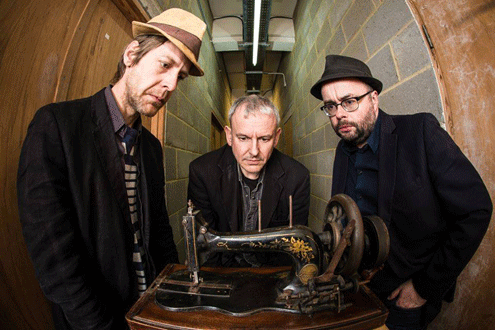
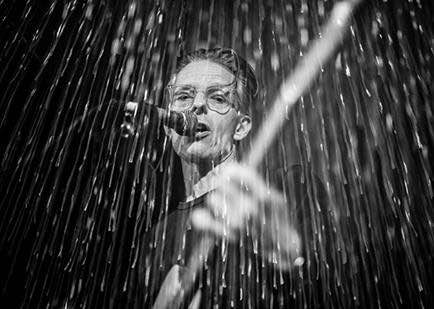
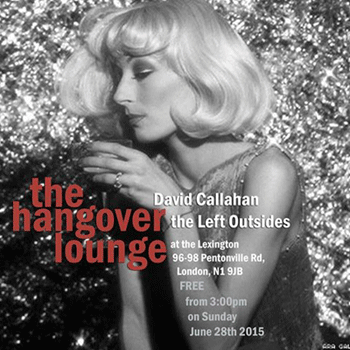










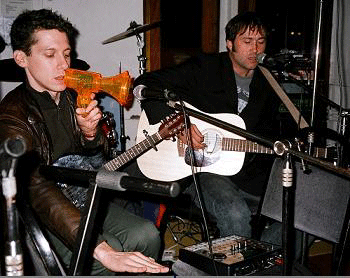



 Misfit City